
Save this booklet! It contains valuable information you can use!
|
|
|
- Catherine Reed
- 10 years ago
- Views:
Transcription
1 Save this booklet! It contains valuable information you can use!

2 Who Are the Clean Water Raingers?

3 Table of Contents What's the Story with Water? What's Wrong with Our Water? Smart Shopping Tips Don t Dump It Down the Drain Getting Around Scoop the Poop Trees, Turf, Bugs, and Birds Slow the Flow Boating and Fishing Tips Getting More Involved Top Ten Things You Can Do to Help Keep Water Clean You've Got the Know-How Now CWR Crossword Puzzle CWR Word Search Acknowledgments The Clean Water Raingers concept was developed by the New Jersey Department of Environmental Protection. Kyra Hoffmann, Coordinator Erin Brodel, Graphic Design & Illustration For additional information, please contact: Clean Water Raingers NJDEP Division of Watershed Management PO Box E. State Street Trenton, NJ MARCH Crossword & Word Search Answers Map of NJ s Waterways & Watersheds

4 The Water Cycle Water. It s an essential part of our lives. We use it to drink, to cook, to bathe, and to clean. It s used by industry and businesses to make their products. Farmers and gardeners use it to water their crops. Fish live in it and other animals need it to survive. The earth has a lot of water - approximately 1.4 quintillion cubic meters of it. Yet, less than 1% of that is fresh, usable water. The oceans, glaciers, and ice caps account for greater than 99% of all water on Earth. That remaining small fraction accounts for every cloud, river, lake, pond, swamp, and aquifer. Of that, more than two thirds is below the Earth s surface. In New Jersey, an average of 44 inches of precipitation per year replenishes the state s 6,500 miles of streams and rivers, 61,000 acres of lakes and an extensive network of underground aquifers. Some rainwater runoff seeps into the ground to become ground water. Ground water moves into water-filled layers of porous rock or soil that are called aquifers. Aquifers are not flowing underground streams or lakes. If the aquifer is close to the surface, its ground water can flow into nearby waterways and wetlands. More than 100 aquifers are below us in New Jersey, covering 7,500 square miles. Through wells, ground water is used for drinking water for half of the people in New Jersey. For millions of years, water has been recycled and reused. It is important to understand how water moves through the Earth s water cycle. When it rains, the rainwater flows on top of the land surface into waterways or is absorbed by the ground or plants. Water evaporates from land and water, becoming water vapor in the atmosphere. Water is also released from trees and other plants through "transpiration." The water vapor from evaporation and transpiration forms clouds in the atmosphere which in turn provide precipitation (rain, hail, snow, sleet) to start the cycle over again. This process of water recycling, known as the water cycle, repeats itself over and over. What is Ground Water?

5 What is a Watershed? A watershed is the area of land surrounding a waterway that drains into it. A watershed includes not only the waterway itself but also the entire land area that drains to it. For example, the watershed of a lake would include not only the streams entering into that lake but also the land area that drains into those streams and eventually the lake. A watershed can be as small as a backyard that drains to a puddle or as large as the sections of New York, Pennsylvania, New Jersey and Delaware that drain into the Delaware. So what happens on the land in a watershed affects the waterway. For example if too many fertilizers are used on lawns, the extra fertilizer can end up in the local waterway. The same thing goes for ground water. The extra fertilizer could end up in ground water and maybe someone s well. Get Your Mind in the Gutter! In urban and suburban parts of the state, manmade systems change the way water flows. Where does the water in the street gutter go? In most places in New Jersey, that gutter leads to a storm drain along the curb which goes directly to a local waterway. Whatever flows down the storm drain enters a series of underground pipes that lead to an outfall pipe that flows into a local waterway. The stormwater does not get treated. All the litter, motor oil drippings, and other debris goes with it into the local waterway. That s why it s important to keep stormwater clean!

6 What s Wrong With Our Water? On his flights over New Jersey, Howie Heron sees that many water pollution problems begin upstream and concentrate as water flows toward the bays and the ocean. He has seen improvement as regulation of industries and improved sewage treatment have helped clean up the water. Now the number one problem in many areas is polluted runoff. Polluted runoff is stormwater runoff that picks up pollution as it washes over lawns, parking lots, roadways, farmland and other surfaces. There are four basic types of pollution in runoff: soil particles, nutrients, bacteria and toxic substances. Soil Particles Nutrients Bacteria Construction sites, farms, and eroded stream banks can be large sources of pollution. Because bare ground lacks plants to hold soil in place, rain and waves can easily lead to soil erosion. Bacteria contained in human and animal wastes can cause diseases such as typhoid, cholera and dysentery. New Jersey s bathing beaches are closely watched for bacteria. If there are too many disease causing bacteria in the water, a beach is closed for swimming. Nutrients, like potassium, phosphorous, and nitrogen, help plants grow. Just like we need food to survive, so do plants in the water. But, an overload of nutrients from fertilizer, manure, or leaking septic systems stimulates algae and plant growth in water. Too much algae is ugly and smells bad -- it clouds the water too! Cloudy water blocks sunlight from reaching underwater plants which are important fish habitat. Another problem occurs when the algae die and decompose, using up precious oxygen in the water needed by fish and other aquatic life. A loss of oxygen can lead to fish kills.

7 Toxic Substances Toxic substances include oil and gas, heavy metals (zinc, mercury, cadmium, lead, etc.) and pesticides. When these substances are washed off sidewalks, parking lots, lawns, gardens, and cropland, they can end up in nearby streams and lakes and can even soak into the ground. Once in the water system, these pollutants can be carried downstream to settle into lakes, bays, and aquifers. Toxic substances can contaminate small organisms, which are eaten by fish and birds. The toxins build up in the fat of the larger animals, possibly leading to illness, birth defects, and even death. What Can You Do? The most important thing you can do to improve New Jersey s water is to learn about the ways in which you and others affect the environment. Lots of little changes will make the biggest difference!

8 Smart Shopping Tips Precycle! That means buying products that use the least amount of packaging. This helps by reducing water pollution from manufacturing and trash disposal problems. Recycle! Find out what is recyclable in your community. Buy products in recyclable containers. Buy containers or products made from recycled materials. Read labels and be aware of what they mean before you buy. Watch for signal words such as caution, warning, and danger. These indicate that an item is a potentially hazardous product that consumers need to be concerned about. Thank You For Shopping Smart! Don t Dump It Down the Drain About 500,000 New Jersey homes use septic systems for the wastewater from their sinks, toilets, dishwashers, washing machines and showers. Rather than send their wastewater to a sewage treatment plant, homes with septic systems treat their wastewater in their own backyard. How does a septic system work? Septic systems work by using bacteria to decompose wastes sent into the system. A typical septic system has underground pipe leading from the home to an underground holding tank where most of the pollutants are treated. An underground system of small pipes leads from the tank into the backyard. These pipes allow treated water to soak into the ground. Treat them with respect. In order to keep these systems working, it s important to treat them right. To do this, you must be careful about what is put down the drain. The following things should not be put down household drains: hazardous household chemicals ( for example, paints, varnishes, pesticides, drain cleaners), motor oil and other automotive fluids, cooking oils and grease, and large amounts of bulky materials such as kitter litter, diapers, or paper towels. These items may cause a septic system to stop working and can contaminate ground water. Conserve. It s also important to conserve water with a septic system. The less water the septic system treats, the longer the system will last.

9 Getting Around You may not think of cars as a source of water pollution but they can be. Think of a parking lot or street. All that oil, grease, and other fluids that stain the pavement are washed into local waterways when it rains or as snow melts. Little bits of tires and brakes that wear off the car drop onto the pavement and are washed into waterways too. How do you avoid this pollution? Cars should be maintained properly and leaks fixed as soon as possible. That makes safety and environmental sense! Scoop the Poop Feces, guano, dung, poop, and road apples are all forms of animal waste which can be a serious water pollution problem. Too much animal waste from pets, wildlife, or livestock adds too many nutrients and disease-causing bacteria to the water. If you walk your pet near a lake or stream, it s important to clean up after your dog. Don t leave animal waste on the sidewalk or roadway either. When it rains, the waste can be washed down the storm drain to the nearest waterway.

10 Trees, Turf, Bugs and Birds Most people like a healthy landscape surrounding their home. It can increase the value of your home and produce environmental benefits such as preventing soil erosion, keeping your home cooler in the summer, and filtering pollutants from runoff. The right combination of plants can even attract wildlife, butterflies, and birds. Unfortunately using too many fertilizers and pesticides on lawns and gardens can also be a source of pollution. It s important to use these products wisely - at the right time and the right amount - if they re needed at all. Make sure the products are needed and, if so, use them according to the label. Many people consider all insects to be harmful to the lawn or garden, but most insects are not harmful. In fact, many of them eat other harmful insects. Don t automatically turn to pesticides. These chemicals can also be dangerous to human health and the environment. All home and garden pesticides are poisonous to some degree. The most important thing to remember is to read and follow the label carefully if you are going to use a pesticide.

11 Mowing the Lawn Always mow with a sharp blade set at the right height (about 2 to 3 inches). Never mow more than one third of the grass height. Cutting more will stress you lawn s health, opening the door to weeds and disease. A healthy lawn doesn t need pesticides. Trees Are Tops Trees provide a whole range of environmental benefits. They provide shade - especially important during a hot summer day. This keeps your house cooler and shelters other plants from the drying sun. Trees use nutrients and can prevent those nutrients from entering waterways. Their roots hold the soil in place, thereby preventing soil erosion.

12 Slow the Flow Like any valuable resource, water should be conserved both outdoors and indoors. We can t make new water so we need to conserve the clean water that s available to us. Inside the home: Don t let the water run while you brush your teeth. Take short showers. Flush only when necessary. Don t use the toilet as a trash can. Outside the home: Don t overwater the yard. Sweep sidewalks and driveways rather than hose them down. Use plants that don t need a lot of water. Boating and Fishing Tips Slow down and observe No Wake zones, which are designated to protect the shore. A wake is the wave caused by a boat moving too quickly through the water. Fast moving boats cause large waves that can cause the shoreline to erode. Recycle old fishing line. Never throw it overboard. Keep a trash bag handy and remember to recycle. Never dispose of bait or fish waste overboard.

13 Glossary - water filled underground layers of cracked rock, sand, gravel, or clay. Wells tap into aquifers to provide water for people to use. - movement of soil commonly caused by running water or wind. - movement of water from land to the air when the sun heats up water and it becomes water vapor. - nutrient source for plants. - water that lies beneath the earth s surface. - chemical used to control a pest, such as an insect, weed or rodent. - rain water or snow melt that carries pollutants. - water that falls back to land from clouds as snow, sleet, hail or rain. - selection of products and packaging that produce the least amount of trash. - reuse of materials such as plastic, glass or metal in either its original or different form rather than putting them in the garbage. - underground pipe system that carries stormwater from streets and parking lots to local waterways. - movement of water from plants to the air. - natural process of recycling water from the land to the air and back again, also called the hydrologic cycle. - the land area from which precipitation flows into a waterway. - a body of water, for example a bay, river, lake, creek or stream.

14 Top Ten Things You Can Do to Help Keep Water Clean 1 Never throw anything down storm drains. They are for rainwater only. 2 Don t litter. Always put trash where it belongs. 3 Always clean up after your pets. Obey your town s "pooper scooper" laws. 4 Tell others how important it is to keep our land and water clean. 5 Plant a tree. They take pollutants out of ground water, provide shade, and clean the air. 6 Find out what waterway you live near. Where does your water come from? 7 Precycle! Buy products that use the least amount of packaging. 8 Recycle. Find out what is recyclable in your community. Buy products in recycled or recyclable containers. 9 Learn about environmental issues. Get involved in local organizations. 10 Conserve water whenever possible. For example, turn off the water while brushing your teeth and don t linger in the shower.

15 You ve Got the Know-How Now! Now you know how to be a Clean Water Rainger! Join the team. Thanks for taking the time to read about how you can become a member of the team that s part of the solution to water pollution.

16 clean water raingers r o ss w or d d o w n a c r o s s

17 clean water raingers word search

18 crossword answers word search answers

19 Atlantic Coastal Lower Delaware Northeast Northwest Raritan New Jersey s Waterways and Watersheds Watersheds Wallkill Papakating Flat Brook Paulins Kill Pequest Wanaque Pequannock Rockaway Whippany Upper Passaic Ramapo Pompton Saddle Lower Passaic Elizabeth Morses Rahway Lockatong South Branch Raritan North Branch Raritan Lower Raritan Millstone South Navesink Shrewsbury Shark Manasquan Assunpink Crosswicks Metedeconk Toms Cedar Forked Mullica Wading Batsto Great Egg Harbor Absecon Tuckahoe Dennis Manumuskin Manantico Maurice Cohansey Alloway Salem Raccoon Repaupo Mantua Big Timber Cooper Pennsauken South Branch Rancocas North Branch Rancocas Assiscunk Crafts Barnegat Bay Oldmans Mid. Passaic Hackensack Pascack Elizabeth Channel Hudson Pohatcong Musconetcong

20 New Jersey Department of Environmental Protection Division of Watershed Management PO Box 418 Trenton, NJ Donald T. DiFrancesco, Acting Governor Robert C. Shinn, Jr., Commissioner

How To Plan A Buffer Zone
 Backyard Buffers Protecting Habitat and Water Quality What is a buffer? A buffer (also called a riparian buffer area or zone) is the strip of natural vegetation along the bank of a stream, lake or other
Phosphorus. Phosphorus Lake Whatcom Cooperative Management. www.ecy.wa.gov/programs/wq/nonpoint/phosphorus/phosphorusban.html
 Phosphorus Phosphorus Brochure Lake Whatcom Cooperative Management Reducing Phosphorus Website Washington State Department of Ecology www.ecy.wa.gov/programs/wq/nonpoint/phosphorus/phosphorusban.html Nutrients
Water Recycles poster
 Water Recycles poster The "Water ReCycles" poster is designed for students of all ages. It shows the natural water cycle and humans influence on water resources. Raincloud illustration The raincloud in
City of Green Bay Department of Public Works Engineering Department
 City of Green Bay Department of Public Works Engineering Department The Difference Between Sanitary & Storm Sewers Contact Information: Department of Public Works City Hall 100 North Jefferson Street,
Water Cycle Unit Test
 Name: Multiple Choice (2 pts each): 1. What is the source of energy for all parts of the water cycle? A. Wind B. The Ocean C. Soil D. The Sun 2. Which of the following processes would result in water pollution?
septic systems What is a Septic System? How does a Septic System Work?
 septic systems What is a Septic System? A septic system is a private sewage treatment system. They are common in rural areas where there are no municipal sewage pipes for homes, farms, businesses or other
Living with the Trinity Lesson Plan 2: The Trinity River Watershed
 Living with the Trinity Lesson Plan 2: The Trinity River Watershed Learning Objective: Students will begin to understand how all of the living things in and around the Trinity River Watershed affect each
Rockdale County Storm Drain Stenciling Program Volunteer Information and Safety Briefing
 BOARD OF COMMISSIONERS RICHARD A. ODEN, CHAIRMAN & CEO OZ NESBITT, SR., COMMISSIONER POST I JANICE VANNESS, COMMISSIONER POST II DEPARTMENT OF PLANNING AND DEVELOPMENT STORMWATER DIVISION (770) 278-7100
NEIGHBORHOOD WATER QUALITY
 1 NEIGHBORHOOD WATER QUALITY Lesson 1: Aquatic Ecosystems Keywords: ecosystem, ecology, watershed, surface water, hydrologic cycle, evaporation, transpiration, precipitation, surface runoff, percolation,
Chapter 2 Stormwater Pollution Prevention Plan (SWPPP) for Park Operations
 SWPPP for Park Operations 2 Chapter 2 Stormwater Pollution Prevention Plan (SWPPP) for Park Operations Bordered by Lake Washington & Lake Sammamish, the City of Bellevue has more than 60 miles of streams,
LEAN WATER PARTNERS. Make it your business to reduce water pollution and flooding.
 C LEAN WATER PARTNERS Make it your business to reduce water pollution and flooding. Clean water is good for business! C LEAN WATER PARTNERS Make it your business to reduce water pollution and flooding.
SEPTIC SYSTEM. Taking care of your. ... what you need to know
 Taking care of your SEPTIC SYSTEM... what you need to know For more information, please call: WATER & WASTE MANAGEMENT PROGRAM (909) 387-4666 Visit our web site: www.sbcounty.gov/dehs A:\Septic System
Frequently Asked Questions about Septic Systems
 What is a septic tank? Where is my septic tank located? Do septic tanks last forever? What should and should not go into my septic tank? How can I tell if my septic tank is working properly? Why should
Water Cycle Bracelets Lesson Plan
 Water Cycle Bracelets Lesson Plan Target age: 8 through 12 (may be adjusted f other ages) Objective: To learn about the water cycle and its components To learn that water is a precious resource shared
Septic Tank Maintenance Information
 Septic Tank Maintenance Information This section has been adapted from materials developed by the Rouge RAP Advisory Council On-site Septic Subcommittee, which included representatives from Oakland, Wayne
Landscape Maintenance
 Photo Credit: Geoff Brosseau Description This category includes businesses that provide landscaping and landscape maintenance/gardening services. Pollutant Sources The following are sources of pollutants:
PUZZLING PIPES. Grade Level: 4-6
 PUZZLING PIPES Overview: Students will learn about the various paths that water takes after it is used. They will trace the path of wastewater either through the storm drain system or the sanitary sewer
Properly maintaining your septic system will help reduce the. It s Your Septic System. Homeowner s Guide. Here s How to Take Care of It
 Homeowner s Guide for Maintenance and Care of On-Site Sewage Systems It s Your Septic System Here s How to Take Care of It Properly maintaining your septic system will help reduce the possibility of health
How To Understand And Understand The Effects Of Pollution And Water Quality
 Lesson 2. Pollution and Water Quality Keywords: pollutants, water pollution, point source, non-point source, urban pollution, agricultural pollution, atmospheric pollution, smog, nutrient pollution, eutrophication,
Environmental Benefits of Pervious Concrete
 Environmental Benefits of Pervious Concrete Concrete Can Be Recycled When the time comes to demolish a concrete structure or pavement, the material need not be wasted. It can be crushed and used as aggregate,
YOUR SEPTIC SYSTEM UNCOVERED
 YOUR SEPTIC SYSTEM UNCOVERED By Raymond King District Director of Environmental Health It s underground where you can t see it. You don t really understand how it works. When it doesn t work your toilets
Don t spit in the well - you may need to drink from it! -- Unknown, Russia.
 Don t spit in the well - you may need to drink from it! -- Unknown, Russia. WATER POLLUTION Water is a unique substance, because it can naturally renew and cleanse itself, by allowing pollutants to settle
ALL YOU NEED TO KNOW...
 ALL YOU NEED TO KNOW... What do you know about your septic tank system? For the purposes of this booklet, a septic tank system refers to any kind of on-site sewage management system including traditional
Environmental Issues In Your Backyard
 Environmental Issues In Your Backyard How to Keep a Healthy Lawn In the pursuit of maintaining green, weed-free lawns, some homeowners may over-apply fertilizer to encourage vigorous growth and pesticides
FOOD SERVICE FACILITIES Best Management Practices Stormwater Management Program City of Bluff City P.O. Box 70, Bluff City, TN 37618 423-538-7144
 FOOD SERVICE FACILITIES Best Management Practices Stormwater Management Program City of Bluff City P.O. Box 70, Bluff City, TN 37618 423-538-7144 This document may be printed and used for reference by
How Your Business Can Prevent Stormwater Pollution
 Tips for a Cleaner Bay How Your Business Can Prevent Stormwater Pollution alameda county You Can Prevent Water Pollution! Storm drains flow directly into creeks and the Bay without any treatment. Because
Water Quality and Water Usage Surveys
 Appendix 1 Water Quality and Water Usage Surveys This appendix contains copies of the Water Quality Survey and the Lake Usage Survey that we used to complete the watershedbased community assessments. We
Module 1: Why is the Environment Important? Activity #1: Your Classroom Environment
 Module 1: Why is the Environment Important? Unit A: What is an environment? Identifying what an environment is can be difficult to do, because an environment comes in many shapes and sizes. Environments
How Your Vehicle Service Facility Can Prevent Stormwater Pollution
 TIPS FOR A CLEANER BAY How Your Vehicle Service Facility Can Prevent Stormwater Pollution alameda county YOU CAN PREVENT WATER POLLUTION! Storm drains flow directly into creeks and the Bay without any
Be a part of the Team! Keep the Bay CLEAN!
 Be a part of the Team! Keep the Bay CLEAN! Water Quality Protection Guidelines for Food Handling Facilities Regional Water Quality Control Plant Operated by the City of Palo Alto for the communities of
Homeowner s GUIDE. to living with a well and septic system. Northeast Colorado. Health. Department. Replacement System. Leach Field. Septic Tank.
 Homeowner s GUIDE to living with a well and septic system Northeast Colorado Health Department Replacement System Leach Field Septic Tank Well Congratulations on the purchase of your new home. Living in
Septic Systems How They Work and How to Keep Them Working
 Septic Systems How They Work and How to Keep Them Working PO Box 9300, 49 Exeter Street, Portland, Maine 04104-9300 (207) 780-4820 www.cascobayestuary.org 201 Main Street, Suite 6, Westbrook, Maine 04092
Water is a valuable and expensive resource.
 Conserving Water VIRGINIA SOL Science 6.5 Social studies CE.1, CE.9 Language arts 6.1, 7.1 Math 6.8, 6.10, 6.18, 7.17, 7.18 Technology C/T8.1, C/T8.4 OBJECTIVES Discuss different uses of water Discuss
Nature's Cleaning Process
 Nature's Cleaning Process Students learn how a septic system cleans wastewater by performing an experiment. Level(s): 6-8 Subject(s): Physical Science, Chemistry, Life Science Virginia SOLs: 6.5 f, g;
You and Your Septic Tank
 You and Your Septic Tank A Guide to the Proper Operation and Maintenance of a Septic Tank System INTRODUCTION In South Florida, our sole source of drinking water is just a few feet beneath the surface
Septic System. Responsibility! Is Your. You should know that:
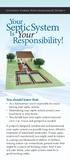 Southwest Florida Water Management District Septic System Your Is Your Responsibility! PIPE SEPTIC TANK DRAIN FIELD SOIL You should know that: As a homeowner you re responsible for maintaining your septic
WHAT YOU NEED TO KNOW...
 A GUIDE TO OPERATING & MAINTAINING YOUR SEPTIC SYSTEM WHAT YOU NEED TO KNOW... The way you treat your septic system will influence how long the system lasts and how well it functions. If you own or rent
St. Joseph, Missouri Water Protection Homeowners Guide to Your Sewer
 St. Joseph, Missouri Water Protection Homeowners Guide to Your Sewer Out of Sight, Out of Mind: Don t wait until you have a problem to maintain your private lateral sewer line. Keeping Excess Water Out
Septic Records and Maintenance Guidelines
 1 Septic Records and Maintenance Guidelines Proper design, installation, and maintenance of your septic system will maximize your system's life. It will prevent failures that can be unsightly, foul-smelling,
Looking after your Septic Tank System
 Looking after your Septic Tank System Name: Bought to you by Address: File this in your property file. 0800 TO FLUSH Call 0800 TO FLUSH 1 What do you know about your septic tank system? Just like your
Water Saver Bingo. Objectives:
 Water Saver Bingo Objectives: Materials: Determine the average amount of water used through daily activities. Recognize that large quantities of water can be wasted from a dripping faucet. Describe different
BEST MANAGEMENT PRACTICES (BMPs)... What are They? GOOD HOUSEKEEPING PRACTICES Your Business Should Employ
 BEST MANAGEMENT PRACTICES (BMPs)... What are They? CLEAN STREETS MEAN CLEAN STREAMS Inexpensive to implement and easy to use, BMPs help you to do your share to protect the environment. The term Best Management
Stormwater Ponds. c ıty of a bı le ne st or m wat e r utı lıty dıv ısı on
 CLEAN WATER FACT SHEET Stormwater Ponds c ıty of a bı le ne st or m wat e r utı lıty dıv ısı on Rapid growth in the City of Abil ene and consequent development, as well as construction of culverts, drains,
4X BMPs for Food Service Facilities
 4X BMPs for Food Service Facilities APPENDIX 4X BEST MANAGEMENT PRACTICES 4X-1 Food Service Facilities Focus of Document This guidance presents BMPs to address the discharge of pollutants to the storm
Lesson Plan: How Do We Clean Polluted Water?
 Lesson Plan: How Do We Clean Polluted Water? Oil Spill Cleanup / Phosphate Cleanup / Groundwater Contamination / Water Treatment Simulation Estimated Time: 2-4 days State Standards taught and addressed
A Developer s Guide: Watershed-Wise Development
 A Developer s Guide: Watershed-Wise Development Environmental Protection What is a watershed? It does not matter how far away you build from a creek, lake, or the ocean, you are in a watershed. Another
BASEMENT FLOODING. Prevention Guide for. Homeowners
 BASEMENT FLOODING Prevention Guide for Homeowners 1 Did You Know? Floods are the most common hazards in Canada. Water damage is a common cause of loss for homeowner insurance. A heavy rainfall can result
Protecting Our Water Resources
 Lakehead Source Protection Area Protecting Our Water Resources A GUIDE FOR SOURCE PROTECTION OF DRINKING WATER Water is necessary for every aspect of our lives. In fact, try to picture a day without water
What Is An On-Lot Sewage Disposal System?
 What Is An On-Lot Sewage Disposal System? Most rural homes and communities in Monroe County are not served by a public sewer system. In order to dispose of the wastewater (sewage) generated by homes and
VEHICLE SERVICE FACILITIES. Best Management Practices
 VEHICLE SERVICE FACILITIES Best Management Practices Chapter 1 of the Best Management Practices Manual for the City s Storm Water Management Program Public Works Department 809 Center Street, Santa Cruz,
100 Ways to Save Water
 Water Saving Tips: Outdoors Lawns, Plants and Watering 100 Ways to Save Water Adjust sprinklers so only the lawn is watered and not the house, sidewalk or street. Choose shrubs and groundcover instead
YOUR GUIDE TO PRACTICAL METHODS THAT PROTECT
 POLLUTION PREVENTION PRACTICES FOR SURFACE CLEANING YOUR GUIDE TO PRACTICAL METHODS THAT PROTECT OUR LOCAL CREEKS, RIVERS, LAKES, AND THE SAN FRANCISCO BAY. DECEMBER 2004 CREATED BY THE NAPA-SOLANO-SONOMA
Working for our future today. Water saving tips. Water saving tips for your home, garden and pool
 Working for our future today Water saving tips Water saving tips for your home, garden and pool From the bathroom to the backyard, there are some simple things you can do that could save thousands of litres
How Do You Feel About Water? Students conduct and analyze a survey about attitudes towards water and assess water knowledge
 Students conduct and analyze a survey about attitudes towards water and assess water knowledge Grade Level: 5-8, 3-4 Subjects: Science, math, social studies and language arts Learning Objectives: Students
The Water Cycle. 4 th Grade Pre-Visit Activity #1
 th Grade Pre-Visit Activity # The Water Cycle Overview Objectives Subjects Earth s water molecules circulate among air, plants, animals, and soil by way of the water cycle. This activity uses a game to
Storm Water Runoff. Managing. A Self-Assessment Guide for Wisconsin Businesses. Storm water runoff is coming. This guide provides businesses
 Managing Storm Water Runoff A Self-Assessment Guide for Wisconsin Businesses Storm water runoff is coming under increasing scrutiny as both a source of pollutants to our lakes and streams, and as a cause
Food Handling Facilities, Waste Reduction & Water Quality Protection Guidelines
 Food Handling Facilities, Waste Reduction & Water Quality Protection Guidelines Food handling facilities such as restaurants, institutional cafeterias, grocery stores, bakeries, and delis, can contribute
Dukes of Hazard Activity Time:
 Dukes of Hazard Activity Time: TEACHERS: Read Populution and Water Source Protection on page 80 of Peel Water Story book. Objectives: Students will: Identify household hazardous waste (HHW) materials around
Good Housekeeping BMP
 E.1. Good Housekeeping BMP Sweep or vacuum shops floor frequently. Use mopping as an alternative to hosing down work areas. Spot clean any spilled oil or fluids using absorbents or rags. Use dry cleanup
Gettysburg Adams Chamber of Commerce Storm Water Management
 Gettysburg Adams Chamber of Commerce Storm Water Management Table of Contents Section 1 Section 2 Section 3 Section 4 Section 5 Section 6 Section 7 Introduction Understanding Location and Landscape 2.1
Freshwater Resources and Water Pollution
 Visualizing Environmental Science Freshwater Resources and Water Pollution Chapter 10 Copyright The Importance of Water Life on Earth would be impossible without water All living organisms contain water
Laws Requiring Pollution Prevention Practices
 Laws Requiring Pollution Prevention Practices Stormwater/urban runoff is being addressed as a result of the 1987 amendments to the Federal Clean Water Act [Section 402(p)], which established requirements
Guidelines for. Permeable Pavement
 What is permeable pavement? Guidelines for Permeable Pavement When rainwater falls on conventional pavement, such as concrete, it accumulates and then flows across and off of this impervious surface as
Detention Ponds. Detention Ponds. Detention Ponds. Detention Ponds. Detention Ponds. Detention Ponds. CIVL 1112 Detention Ponds - Part 1 1/12
 CIVL 1112 - Part 1 1/12 The water cycle, also known as the hydrologic cycle, describes the continuous movement of water on, above and below the surface of the Earth. The water cycle, also known as the
Best Management Practices
 for The City of Paso Robles is required to implement a Phase II Municipal Water Program in order to reduce or eliminate the pollutants that enter our waterways from both storm water and non-storm water
Objectives The student will be able to do the following: Define pollution Identify possible sources of pollution to the stream near the school
 Land Use and Pollution Scavenger Hunt Lesson 7 --------------------------------------------------------------------------------------------------------------------- Objectives The student will be able
Summary This lesson will introduce the concept of the water cycle by using a simple demonstration.
 Partnerships Implementing Engineering Education Worcester Polytechnic Institute Worcester Public Schools Supported by: National Science Foundation Weather: 4.H.3 Water Cycle Grade Level 4 Sessions Seasonality
RainWise Frequently Asked Questions
 RainWise Frequently Asked Questions RAINWISE PROGRAM: HOW TO GET STARTED AND WHAT TO EXPECT What is the RainWise Rebate Program? RainWise is a program offered by Seattle Public Utilities and King County
PREVENTING PEST DAMAGE IN HOME LAWNS
 PREVENTING PEST DAMAGE IN HOME LAWNS Quick Tips Summary Use mixed grass seeds rather than a single variety Fertilize with composted organics or slow-acting synthetic products Keep soil at ph 5.8 6.5 Keep
HAZARDOUS WASTE. liquid material that is toxic, ignitable, corrosive, or reactive enough to explode or release toxic fumes.
 HAZARDOUS WASTE Ø Hazardous waste: is any discarded solid or liquid material that is toxic, ignitable, corrosive, or reactive enough to explode or release toxic fumes. l The two largest classes of hazardous
How to Build a Rain Garden at Your Home
 How to Build a Rain Garden at Your Home Virginia gets an average of 45.22 inches of rain a year. Rain that runs off your roof or patio can flow into a sewer pipe, stream or groundwater. Why not put it
Cleaning. Wash vehicles over an indoor drain leading to an oil/water separator that flows to the sanitary sewer system.
 Underground Oil/Water Separator Cleaning Wash water from cleaning often contains solvents, detergents, and metals. Wash water should never be discharged to a street, gutter, or storm drain. Contact your
Fuel Storage Who to ask: tank farm owners/operators
 Fuel Storage Fuel Storage Who to ask: tank farm owners/operators 89. How many tank farms are there in the village and who owns them? Fuel tank farm The questions in the following section should be answered
Watershed Education for Teachers. Cinde Thomas-Jimenez Guadalupe-Blanco River Authority
 Watershed Education for Teachers Cinde Thomas-Jimenez Guadalupe-Blanco River Authority In This Presentation Why Watersheds Matter What Is a Watershed Water Quality Parameters Point Source and NonPoint
Household customer. Wastewater flooding guidelines. www.thameswateruk.co.uk
 Household customer Wastewater flooding guidelines www.thameswateruk.co.uk We are very sorry that you have recently suffered wastewater flooding to your property. This leaflet has been designed to answer
How To Prevent Over Water Activities
 Objectives Cover Contain Educate Reduce/Minimize Product Substitution Description Over-water activities occur at boat and ship repair yards, marinas, and yacht clubs. The discharge of pollutants to receiving
Fats, Oils and Grease. Educational Kit
 Fats, Oils and Grease Educational Kit When you think of fats, oils and grease, you might say yuck. Well, the real yuck comes when fats, oils and grease are not disposed of properly. Fats, oils and grease
How to Reduce Your Exposure to Chemicals at Home, Work, and Play
 How to Reduce Your Exposure to Chemicals at Home, Work, and Play You come into contact with chemicals every day. This is called chemical exposure. Although some chemical exposures are safe, others are
A copy of Worksheet 1 at the appropriate level for each pupil. Ask pupils to answer the question 'What is sewerage?'
 Waste Water Treatment 1. Fascinating Facts Aim: To introduce pupils to key facts about waste water Materials: A copy of Worksheet 1 at the appropriate level for each pupil String Method: Ask pupils to
Good? Bad? Why? http://uncultured.com/2007/09/20/notre-dame-and-watering-sidewalks/ Training Module 4
 Good? Bad? Why? http://uncultured.com/2007/09/20/notre-dame-and-watering-sidewalks/ Solution Sprinklers should be directed at lawn areas Spraying water on pavement increases runoff Look for more water-efficient
Assessing Your Septic System
 THE UNIVERSITY OF TENNESSEE AGRICULTURAL EXTENSION SERVICE SP508 D TENNESSEE Home A Syst Assessing Your Septic System George F. Smith, Professor, Agricultural Economics & Resource Development Martha W.
THE PLANT KINGDOM: THE WATER CYCLE
 THE PLANT KINGDOM: THE WATER CYCLE Material: The Water Cycle Nomenclature The Water cycle Model Water Ice Heat Source (lamp with a clamp) Tables Presentation 1: Key Experience 1. Say, Today we are going
How To Keep Grease Out Of The Sewer
 FOG Program Fats, Oils & Grease Proper disposal of fats, oils and grease protects your business, public health and the environment. It s the law, and it s the right thing to do. Wherever there s water,
Help protect our special places by maintaining your septic tank
 Help protect our special places by maintaining your septic tank BC3136 A septic tank guide Help protect our special places Rural Auckland is a special place, but the remoteness also means that many homes
Preparation / Background Information:
 Aim / Learning Objective: Looking at the world through science, students can learn about the marine elements of our natural environment and the importance of the water cycle. Students can look at and compare
A Homeowner s Guide to a Healthy Stormwater Drainage System. A publication of The York County Stormwater Advisory Committee
 A Homeowner s Guide to a Healthy Stormwater Drainage System A publication of The York County Stormwater Advisory Committee Table of Contents Introductory Letter... 3 Frequently Asked Questions... 4-9 York
Water Clean- up Crew. Learn about water quality and how to solve different water quality problems. Time Needed 1 hour
 Water Clean- up Crew Learn about water quality and how to solve different water quality problems Time Needed 1 hour Ages 4 th to 6 th Season Any Materials aluminum trays, tape, tin foil, sponges, clay,
MARINA ENVIRONMENTAL MANAGEMENT POLICY
 MARINA ENVIRONMENTAL MANAGEMENT POLICY Clean Water & A Clean Environment Are Essential To Good Boating The Abbey Marina Is Committed To Being Environmentally Compatible STATEMENT OF PURPOSE: CLEAN & PROTECT
DRAFT Guidelines for Manually Diverting Outdoor Wastewater to the Sanitary Sewer
 Only RAIN down the Storm Drain... DRAFT Guidelines for Manually Diverting Outdoor Wastewater to the Sanitary Sewer This publication applies to you if: You generate wastewater outdoors, and The wastewater
This Food Safety Plan was developed in New York as an example for growers. Each grower must develop their own plan which fits their operation.
 G1 This Food Safety Plan was developed in New York as an example for growers. Each grower must develop their own plan which fits their operation. This is a food safety and security program which incorporates
Living on the Fox River
 This information could save you money! Living on the Fox River A Riverfront Property Owners Guide This brochure was developed by Fox River Ecosystem Partnership in cooperation with the Kane-DuPage Soil
MAINTAINING YOUR SEPTIC SYSTEM by Wrentham Board of Health Ravi Nadkarni, Chairman William R. Domey, Agent
 INTRODUCTION MAINTAINING YOUR SEPTIC SYSTEM by Wrentham Board of Health Ravi Nadkarni, Chairman William R. Domey, Agent To most people, a septic system (or a cesspool) is out of sight and out of mind.
Homeowner s Guide to Maintaining a Sewage Treatment System
 Homeowner s Guide to Maintaining a Sewage Treatment System Warren County Combined Health District 416 South East Street Lebanon, OH 45036 513-695-1220 Sewage Treatment Systems Septic Tank and Soil Absorption
Toxic Matters. Protecting Our Families from Toxic Substances. To view this brochure online, go to: www.prhe.ucsf.edu/prhe/toxicmatters.
 Toxic Matters Protecting Our Families from Toxic Substances To view this brochure online, go to: www.prhe.ucsf.edu/prhe/toxicmatters.html A Publication of the University of California, San Francisco Program