
Assessing Your Septic System
|
|
|
- Aldous Carson
- 10 years ago
- Views:
Transcription
1 THE UNIVERSITY OF TENNESSEE AGRICULTURAL EXTENSION SERVICE SP508 D TENNESSEE Home A Syst Assessing Your Septic System George F. Smith, Professor, Agricultural Economics & Resource Development Martha W. Keel, Associate Professor & Leader, Clothing, Housing, & Environmental Stewardship Karin A. Beuerlein, Assistant in Agricultural Extension The goal of Home A Syst is to protect your health and the environment from pollutants in and around your home. The following checklist is designed to help you pinpoint potential problem areas on your property that may affect the quality of your surface and groundwater. If a statement reflects the current situation in your household, check Agree. If the statement does not describe your household, check Disagree. If you disagree with any of these statements, or if you are unsure, you may have a situation on your property that could affect the environment or your health. Refer to the fact section with the same number as that statement (under the heading, What you should know about... ) for more information. Don t be alarmed if you disagreed with many or even all of these statements. That does not automatically mean you have a surface or groundwater problem. It may, however, tell you that change is needed Agree Disagree o o 1. I have a thorough understanding of how a septic system works. o o 2. My septic system is more than 50 feet from my well or spring. o o 3. I ve never had problems with shrub or tree roots plugging my septic lines. o o 4. The soil under my septic lines is a medium-textured soil, such as a clay or loam. o o 5. I ve had my tank pumped within the last six years. o o 6. I never drive heavy vehicles over my system. o o 7. My family and I take measures to conserve water. o o 8. I never use my septic system to dispose of trash like paper towels or disposable diapers. o o 9. I don t use the garbage disposal every day, and I don t regularly put kitchen wastes down the drain. Continued on p.2
2 Agree Disagree o o o o 10. I don t use my septic system to dispose of chemicals like paints, solvents, or pesticides. 11. I ve never noticed wet spots, standing water, or sewage smells near the system, and sewage has never backed up into the house. to avoid potential problems. In the same way, agreeing with every statement does not mean you are not at risk or cannot make improvements. Why should you be concerned? Groundwater is the underground water that supplies wells and springs and recharges surface water bodies. It is the source of drinking water for many Tennesseans. Surface water includes ponds, lakes, rivers, streams, and other bodies of water. Besides their aesthetic and recreational value, they are often an important source of drinking water for livestock. Both surface and groundwater can be affected by improperly managed or failing septic systems. Many homes in Tennessee use some type of septic system to treat household wastewater. These systems are generally economical and effective. However, your septic system must be correctly designed, installed, and maintained to reduce the possibility of contaminating surface and groundwater. Potential contaminants in household wastewater include bacteria, viruses, household chemicals, and nitrate. If any of these contaminants enters surface or groundwater, it could create health problems for you and your family, your livestock and pets, or your neighbors. Proper operation and maintenance of your septic system can have a significant impact on how well it works and how long it lasts. Maintenance saves you money in the long run; failing systems are expensive to repair or replace compared to the cost of pumping the tank. The amount of water entering your septic system is also an environmental concern. Excess water reduces the efficiency of the system and can shorten its life. Water quality is least likely to be affected by your septic system if you use as many low-risk practices as you can. Home A Syst is only for your own use and benefit. It is a voluntary program intended to provide general information about protecting your health and the environment. Information from a Home A Syst assessment will not be collected by Extension or any other outside agency and should remain in your private records. What you should know about Septic system operation Septic systems are used to treat and dispose of wastewater from the home. A properly installed and maintained system will function for many years and minimizes the potential for both surface and groundwater contamination. A poorly constructed or maintained system can fail and return contaminated water to surface or groundwater. Good maintenance can save you money. If your system fails, your only options are expensive ones. A septic system typically has two parts: a septic tank and a drainfield. Wastewater flows from the house into the septic tank. The heavier solids settle to the bottom and form a layer of sludge. The light solids and grease float to the top and form a layer of scum. Bacteria break down the solids into liquids. The bacteria cannot completely break down all the sludge and scum, and so solids accumulate in the tank over 2
3 time. This is why septic tanks need to be pumped periodically. The liquid flows through an outlet into the drainfield as more wastewater enters the tank from the house. The drainfield is usually a series of parallel trenches containing perforated pipes in a bed of gravel or rock. Wastewater trickles out the holes, through the gravel, and into the soil. The soil filters out remaining solids. Bacteria, natural chemical processes, and other organisms in the soil help break down the waste. If the soil is deep enough and the movement of the wastewater slow enough, the solids, microorganisms, and dissolved substances are removed. The safe, naturally treated effluent (the liquid from the septic system) then flows into surface or groundwater. 2. Distance from the well If a septic system is too close to a well or spring, contaminated effluent can get into your drinking water. Current Tennessee regulations require septic systems to be at least 50 feet from a private drinking-water well. (There are no regulations for springs yet, but the 50-foot guideline is a good one to follow.) Ideally, the system should also be downhill from the well or any other source of drinking water. If a septic system is close to a well or spring or uphill from it, the water source is not necessarily being contaminated. However, proper maintenance of the system becomes even more important to reduce the risk of contamination. 3. Distance from trees Roots can enter drainfield lines and plug them. Effluent can become blocked in the drainfield and can saturate the soil, reducing the soil s natural ability to renew wastewater. In extreme cases, flow can be so limited that wastewater backs up into the house. To prevent this problem, don t install a system in a wooded area. When landscaping, don t plant trees or bushes within ten feet of the field lines. Your risk is reduced even more if no trees are within 50 feet of the lines. If roots plug the lines, removing the trees or bushes may be necessary. Some septic tank additives claim to prevent root growth, but, according to experts, evidence to support this is not conclusive Soil type If the soil under the drainfield is deep enough and the movement of the wastewater is slow enough, the solids, microorganisms, and dissolved substances in the effluent are removed, producing water of acceptable quality. If the soil is too shallow (generally less than four feet to bedrock or the groundwater level), the effluent will not be adequately renovated. Likewise, if the texture of the soil is too coarse (as in sands or gravels), wastewater will move quickly and contact time will be too short for adequate natural treatment. In heavy clays, on the other hand, effluent may move too slowly. The soil may become saturated, resulting in incomplete treatment or in effluent s coming to the surface. 5. Septic tank cleanup Bacteria cannot completely break down all the solids in the tank. Solids build up over time and reduce the volume of wastewater the tank can hold. If enough accumulates, sludge and scum can flow out and plug the drainfield. Pumping your septic tank regularly is probably the single most important thing you can do to maintain your system. Most systems should be pumped every four to six years. It should be done more often if you have a small tank for your family size, if your household produces a lot of wastewater, if you use a garbage disposal frequently, or if your family often disposes of trash in the system. On the other hand, if you have a large tank and a small family, conserve water, and are careful about what you flush, pumping the system may only be necessary every 10 to 12 years or even less frequently. 6. Traffic over the system The weight of vehicles or heavy farm equipment can damage the septic tank and drainfield. Reroute traffic and change driving patterns if needed. If you are planning a new system, locate it away from traffic. Driveways or other paved surfaces should not be constructed over septic tanks or drainfields. 7. Water conservation If too much water enters the septic tank in a short period of time, wastewater is pushed out of the tank before solids and grease have time to separate. The system can be overloaded, and the soil in the drainfield becomes saturated because the water has less time to soak in.
4 Reducing the amount of water entering your system means less chance of overloading it, which in turn means better treatment of wastes and longer system life. Water-conservation practices such as taking shorter showers, running only full dishwasher or washing-machine loads, and turning off the water while washing or shaving make surprisingly significant reductions. Repairing leaking faucets or running toilets immediately, as well as using water-saving shower heads, toilets, and other plumbing devices, can also help conserve water. 8. Trash disposal The septic system is not designed to be a disposeall. Paper towels, disposable diapers, sanitary napkins, and other trash are not readily digested by bacteria in the tank. They increase the solid buildup, which can plug the system. The more unnecessary trash you flush, the more often your septic tank will have to be pumped. Flushing trash into the tank also increases the system s water load. Don t dispose of anything in your septic system except wastewater, toilet tissue, and human wastes. 9. Kitchen garbage disposal Garbage disposals add to the solid load as well as increasing the amount of water entering the tank. Kitchen wastes like grease, fats, and cooking oils can plug pipes and build up the scum layer in the tank. Minimize the use of the garbage disposal. Don t add a disposal if you don t already have one. Some experts recommend that disposals not be used by households with septic systems. Don t put grease or oil down the drain. They can plug pipes or build up in the septic tank. Dispose of them with other household garbage. 10. Chemical disposal Paints, solvents, pesticides, and similar products can damage your septic system. They can kill the beneficial bacteria that break down sewage, making the treatment process less effective. Also, bacteria cannot break down some of these chemicals. They pass through the septic system in pure form and may move through the soil to contaminate groundwater. accept many of them; contact your local solid-waste authority or county government to find out when one is scheduled in your area. You may be able to give away or swap leftover materials. These precautions do not apply to household cleaners, laundry soaps, bleach, or drain cleaners. These products should not damage the system with normal use. Also, washing clothes worn when applying pesticides should not harm the system. 11. Symptoms of trouble Wet spots, standing water, and sewage odors are signs of problems with the septic system. In addition to being unpleasant, they may signal that the system is contaminating surface or groundwater with bacteria, nitrates, or other pollutants. Sewage backups are caused by clogs in the drainfield or the plumbing system, or by some other problem blocking the flow of wastewater. Identifying and solving the problem will reduce risks to water quality as well as eliminating unpleasant situations in your home. Suggestions found in this worksheet may solve the problem. However, unclogging drain lines, expanding the drainfield, or installing a new system may be required. Make a note: The table on page 6 of SP508M, Assessing Your Homesite, provides a space for you to list all the problem areas in your home that you find while completing Home A Syst. Take a few minutes now to list any septic-system problems you discovered as you completed Assessing Your Septic System. Later, when you complete Assessing Your Homesite, you will include these items on the map you draw of your property. Potential items from this factsheet include: trees within 50 feet of your drainfield areas of standing water septic system within 50 feet of a well or spring Dispose of these products according to label directions. Household hazardous-waste roundups may 4
5 Remember: Construct any new septic system at least 50 feet from your spring, well, or other drinking-water source. Locate it downhill from the spring or well if possible. Don t construct a new system in a wooded area. Plant trees and shrubs at least ten feet from the drainfield. If soil depth and texture are not adequate for a conventional septic system, install an appropriate alternative system. Pump out your septic tank regularly. Pumping may be needed every year or two, or every 10 to 12 years or more, depending on the size of your tank and the amounts of solids and water entering it. Don t drive vehicles or heavy equipment over your septic system. Don t put a driveway or other paved surface over your septic system. Practice water conservation to reduce the amount of water entering your septic system. Don t add water that doesn t need treatment (like water from roof drains, foundation drains, or basement drain pipes) to the flow into your septic tank. Divert surface water from roof drains, driveways, and paved lots away from the drainfield; saturating the soil reduces its ability to treat wastewater naturally. Don t dispose of anything in your septic system that can be composted or put in the trash. Minimize the use of your garbage disposal. Don t put paint, solvents, pesticides, or similar products into your system. Investigate any signs of problems, such as sewage backup, wet spots, or odors. Take timely action to solve any problems you find to reduce risks of contaminating surface or groundwater. If you want more information... Contact: Your local Extension office Tennessee Department of Environment and Conservation Division of Groundwater Protection L&C Tower, 10th Floor 401 Church Street Nashville, TN (615) Your county health department Septic-system contractors or pumpers Read: Septic Systems. PB On-Site Wastewater Treatment Systems. PB The Low-Pressure Pipe Septic System. SP 392-E. The above publications are available from your University of Tennessee Agricultural Extension Service county office. Your Septic System. 174FSSET. $3.00. This set of five factsheets from Cornell University covers the construction and maintenance of a septic system. To order, write: Cornell University Resource Center 8 BTP Ithaca, NY Download: The University of Tennessee Agricultural Extension Service home page. The U.S. Environmental Protection Agency home page. The Septic System Information Website. 5
6 Comprehensive environmental search engine/bulletin board a great way to find information about any environmental topic. The U.S. Department of Agriculture home page. The U.S. Geological Survey home page. The Tennessee division of USGS. water/water.html National Extension Water Quality Database Website, Purdue University. This Home A Syst assessment does not cover all potential health or environmental risks related to septic systems. It is meant to be a starting point for identifying and addressing the most apparent risks. Tennessee Home A Syst publications have been adapted from the national model by Karin A. Beuerlein and members of the University of Tennessee Agricultural Extension Service Environmental Stewardship Priority Program Team. This project is funded, in part, under an agreement with the Tennessee Department of Agriculture, Nonpoint Source Program and the U.S. Environmental Protection Agency. Federal funds through the Nonpoint Source Program financed 60% or $75,600 of this project. Although this project has been financed in part with state and federal funds, the mention of trade names or commercial products does not constitute endorsement or recommendation by the state or the U.S. Environmental Protection Agency. Printed on recycled paper 6
7 7
8 R SP508D-5M-5/98 A State Partner in the Cooperative Extension System The Agricultural Extension Service offers its programs to all eligible persons regardless of race, color, national origin, sex or disability and is an Equal Opportunity Employer. COOPERATIVE EXTENSION WORK IN AGRICULTURE AND HOME ECONOMICS The University of Tennessee Institute of Agriculture, U.S. Department of Agriculture, and county governments cooperating in furtherance of Acts of May 8 and June 30, Agricultural Extension Service Billy G. Hicks, Dean
Septic Tank Maintenance Information
 Septic Tank Maintenance Information This section has been adapted from materials developed by the Rouge RAP Advisory Council On-site Septic Subcommittee, which included representatives from Oakland, Wayne
Properly maintaining your septic system will help reduce the. It s Your Septic System. Homeowner s Guide. Here s How to Take Care of It
 Homeowner s Guide for Maintenance and Care of On-Site Sewage Systems It s Your Septic System Here s How to Take Care of It Properly maintaining your septic system will help reduce the possibility of health
septic systems What is a Septic System? How does a Septic System Work?
 septic systems What is a Septic System? A septic system is a private sewage treatment system. They are common in rural areas where there are no municipal sewage pipes for homes, farms, businesses or other
SEPTIC SYSTEM. Taking care of your. ... what you need to know
 Taking care of your SEPTIC SYSTEM... what you need to know For more information, please call: WATER & WASTE MANAGEMENT PROGRAM (909) 387-4666 Visit our web site: www.sbcounty.gov/dehs A:\Septic System
Septic Records and Maintenance Guidelines
 1 Septic Records and Maintenance Guidelines Proper design, installation, and maintenance of your septic system will maximize your system's life. It will prevent failures that can be unsightly, foul-smelling,
KY-A-Syst for the Home Environmental Stewardship for Homeowners. Household Wastewater: Septic Systems and Other Treatment Methods
 IP-69 KY-A-Syst for the Home Environmental Stewardship for Homeowners Household Wastewater: Septic Systems and Other Treatment Methods Why Should You Be Concerned? Household wastewater carries dirt, soap,
Septic Systems and Their Maintenance
 Septic Systems and Their Maintenance Why Use a Septic System? Septic systems are used when sewage treatment plants are not accessible. They safely treat and dispose of wastewaters produced in the bathroom,
What Is An On-Lot Sewage Disposal System?
 What Is An On-Lot Sewage Disposal System? Most rural homes and communities in Monroe County are not served by a public sewer system. In order to dispose of the wastewater (sewage) generated by homes and
ALL YOU NEED TO KNOW...
 ALL YOU NEED TO KNOW... What do you know about your septic tank system? For the purposes of this booklet, a septic tank system refers to any kind of on-site sewage management system including traditional
Looking after your Septic Tank System
 Looking after your Septic Tank System Name: Bought to you by Address: File this in your property file. 0800 TO FLUSH Call 0800 TO FLUSH 1 What do you know about your septic tank system? Just like your
WHAT YOU NEED TO KNOW...
 A GUIDE TO OPERATING & MAINTAINING YOUR SEPTIC SYSTEM WHAT YOU NEED TO KNOW... The way you treat your septic system will influence how long the system lasts and how well it functions. If you own or rent
YOUR SEPTIC SYSTEM UNCOVERED
 YOUR SEPTIC SYSTEM UNCOVERED By Raymond King District Director of Environmental Health It s underground where you can t see it. You don t really understand how it works. When it doesn t work your toilets
Homeowner s Guide to Maintaining a Sewage Treatment System
 Homeowner s Guide to Maintaining a Sewage Treatment System Warren County Combined Health District 416 South East Street Lebanon, OH 45036 513-695-1220 Sewage Treatment Systems Septic Tank and Soil Absorption
Frequently Asked Questions about Septic Systems
 What is a septic tank? Where is my septic tank located? Do septic tanks last forever? What should and should not go into my septic tank? How can I tell if my septic tank is working properly? Why should
MAINTAINING YOUR SEPTIC SYSTEM by Wrentham Board of Health Ravi Nadkarni, Chairman William R. Domey, Agent
 INTRODUCTION MAINTAINING YOUR SEPTIC SYSTEM by Wrentham Board of Health Ravi Nadkarni, Chairman William R. Domey, Agent To most people, a septic system (or a cesspool) is out of sight and out of mind.
A HOMEOWNERS GUIDE ON-SITE SEWAGE MANAGEMENT SYSTEMS
 GEORGIA DEPARTMENT OF HUMAN RESOURCES ENVIRONMENTAL HEALTH SECTION A HOMEOWNERS GUIDE TO ON-SITE SEWAGE MANAGEMENT SYSTEMS March 12, 2002 WHAT IS AN ON-SITE SEWAGE MANAGEMENT SYSTEM An on-site sewage management
You and Your Septic Tank
 You and Your Septic Tank A Guide to the Proper Operation and Maintenance of a Septic Tank System INTRODUCTION In South Florida, our sole source of drinking water is just a few feet beneath the surface
Septic System. Responsibility! Is Your. You should know that:
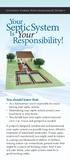 Southwest Florida Water Management District Septic System Your Is Your Responsibility! PIPE SEPTIC TANK DRAIN FIELD SOIL You should know that: As a homeowner you re responsible for maintaining your septic
Homeowners and Home Buyers Guide to Wells and Private Sewage Systems
 Homeowners and Home Buyers Guide to Wells and Private Sewage Systems What every homeowner should know about living with a well and a private sewage system. YOUR ENVIRONMENTAL SYSTEMS Out of sight out of
Septic Systems How They Work and How to Keep Them Working
 Septic Systems How They Work and How to Keep Them Working PO Box 9300, 49 Exeter Street, Portland, Maine 04104-9300 (207) 780-4820 www.cascobayestuary.org 201 Main Street, Suite 6, Westbrook, Maine 04092
Understanding and Caring for Your Septic System
 Understanding and Caring for Your Septic System Summit County Public Health 1867 W. Market Street Akron, Ohio 44313 330-926-5600 www.scphoh.org The purpose of a home's subsurface septic system is to dispose
CERTIFIED SEPTIC EVALUATION PREPARED FOR MATT HASHEM 1673 MT. MAJOR HWY, ALTON, NH 03810
 DATE: May 31, 2013 N.H. LICENSED DESIGNER OF SUBSURFACE DISPOSAL SYSTEMS 216 Hill Road Phone & Fax: 934-6206 Franklin, NH 03235 Cell: 393-3085 CERTIFIED SEPTIC EVALUATION PREPARED FOR MATT HASHEM 1673
FREQUENTLY ASKED SEPTIC SYSTEM QUESTIONS
 FREQUENTLY ASKED SEPTIC SYSTEM QUESTIONS What is an OSSF (On-Site Sewage Facility)? This is the term used when referring to "septic systems". What is septic system? A septic system is a method of dealing
Nature's Cleaning Process
 Nature's Cleaning Process Students learn how a septic system cleans wastewater by performing an experiment. Level(s): 6-8 Subject(s): Physical Science, Chemistry, Life Science Virginia SOLs: 6.5 f, g;
Septic System Care & Maintenance
 Septic System Care & Maintenance A User s Guide for Home/Cottage Owners Spring 2003 Preventing Septic Failure & Malfunction How many of us know how our septic system works, or think we know? We expect
Help protect our special places by maintaining your septic tank
 Help protect our special places by maintaining your septic tank BC3136 A septic tank guide Help protect our special places Rural Auckland is a special place, but the remoteness also means that many homes
SEPTIC SYSTEMS. 1. Building sewer connects the building plumbing to the septic tank.
 SEPTIC SYSTEMS Who Has A Septic System? Approximately 30 percent of Connecticut s population is served by on-site subsurface sewage disposal systems (a.k.a. septic systems). This means a large percentage
This chapter helps you evaluate
 HOME*A*SYST Home Assessment System Chapter 11. Managing Household Wastewater: Septic Systems and Other Treatment Methods This chapter helps you evaluate your septic system and pinpoint risks before they
So... now you own a septic system
 So... now you own a septic system More than million homes, encompassing almost percent of the U.S. population, dispose of domestic wastewater through onsite (unsewered) systems. According to the American
Septic System Management Plan for Below Grade Systems
 The goal of a septic system is to protect human health and the environment by properly treating wastewater before returning it to the environment. Your septic system is designed to kill harmful organisms
31. ECO-INFO -- SEPTIC SAFE PROTECT YOUR HEALTH AND ENVIRONMENT YOUR SEPTIC PUMP-OUT SYSTEM with SELF ASSESSMENT TROUBLE SHOOTING GUIDE
 31. ECO-INFO -- SEPTIC SAFE PROTECT YOUR HEALTH AND ENVIRONMENT YOUR SEPTIC PUMP-OUT SYSTEM with SELF ASSESSMENT TROUBLE SHOOTING GUIDE Edited 21/12/01 Wyong Shire Council has many non sewered areas that
Understanding Septic Tank Systems
 Understanding Septic Tank Systems Sewage and effluent can contain a variety of human disease-causing microorganisms and parasites. Disease can be spread to humans from this material by direct contact or
ON-LOT SEWA G E S Y S T E M S
 ON-LOT SEWA G E S Y S T E M S An Owner s Manual Chester County Health Department Bureau of Environmental Health Protection TABLE OF CONTENTS Page What is an on-lot sewage system 1 Types of on-lot systems
On-site Sewage Disposal Systems A HOMEOWNER S GUIDE
 On-site Sewage Disposal Systems A HOMEOWNER S GUIDE May 2013 Table of Contents Introduction page 3 Private Sewage Disposal Systems.page 3 Background Check of your System..page 3 Maintaining your System.
Understanding and Living With Your Septic System
 Chapter 9 Understanding and Living With Your Septic System Rural versus urban sewage treatment One of the big difference between rural and city life is how sewage is dealt with. Cities usually have community
Operation and Maintenance Guide for Homeowners
 LAGOON SEWAGE TREATMENT SYSTEMS It s Your On-Site System Operation and Maintenance Guide for Homeowners OKLAHOMA DEPARTMENT OF ENVIRONMENTAL QUALITY ENVIRONMENTAL COMPLAINTS AND LOCAL SERVICES P.O. Box
860-7668 KNOWING AND MAINTAINING YOUR SEPTIC SYSTEM. Carleton Pumping Services We look forward to hearing from you! DON T PANIC!
 DON T PANIC! WE LL SAVE YOU FROM YOUR PROBLEMS... Drain Cleaning Pipe Locating Water Jetting Maintenance Camera Inspect ion Plumbing KNOWING AND MAINTAINING YOUR SEPTIC SYSTEM 860-7668 Carleton Pumping
402-475-2462. Septic Maintenance Brochure How to Care for your Septic System And Lagoon
 Septic Maintenance Brochure How to Care for your Septic System And Lagoon Check out our website at www.southwickliquidwaste.com Jason and Jaime Kubik (owners) 105 Locust Street Hickman, NE 68372 402-475-2462
SEPTIC TANK SYSTEMS. Single purpose septic tank receives toilet wastes (blackwater) or sullage (greywater) only.
 SEPTIC TANK SYSTEMS There are three common types of septic tank systems in Tasmania Single purpose septic tank receives toilet wastes (blackwater) or sullage (greywater) only. Dual purpose (or all-waste)
OFFALY COUNTY COUNCIL Comhairle Chontae Uibh Fhailí
 OFFALY COUNTY COUNCIL Comhairle Chontae Uibh Fhailí HOMEOWNER S GUIDE AND MAINTENANCE RECORD FILE FOR WASTEWATER TREATMENT SYSEMS Houses located in rural areas, not served by public sewers, depend on either
Avoiding an expensive
 Avoiding an expensive Understanding and maintaining your septic system Selecting or maintaining a septic system is a consideration most people do not have to worry about when they live in town. But if
Septic System Owner s Manual
 Septic System Owner s Manual Sponsored by: copyright 2013 No part of this publication may be reproduced without our consent. www.callbrownies.com Brownie s Septic and Plumbing has provided quality service
Septic System Owner s Manual
 Septic System Owner s Manual How your septic system works and how to keep it working for you and the environment CORPORATION Innovative Environmental Products and Solutions Since 1970 Table of Contents
Do your Part Be SepticSmart!
 Do your Part Be SepticSmart! A Homeowners Guide to Septic Systems TM U.S. Environmental Protection Agency A Homeowners Guide to Septic Systems www.epa.gov/septicsmart 2 Maintaining Your Septic System:
Homeowner s GUIDE. to living with a well and septic system. Northeast Colorado. Health. Department. Replacement System. Leach Field. Septic Tank.
 Homeowner s GUIDE to living with a well and septic system Northeast Colorado Health Department Replacement System Leach Field Septic Tank Well Congratulations on the purchase of your new home. Living in
Maintenance Guidelines For Homeowners
 ON-SITE WASTEWATER SYSTEMS Maintenance Guidelines For Homeowners PROTECTING YOUR HEALTH, YOUR ENVIRONMENT, YOUR INVESTMENT PRODUCED BY: SWANS-SIG The Small Wastewater And Natural Systems Special Interest
If you have a Septic tank with pump out, this guide is for you.
 If you have a Septic tank with pump out, this guide is for you. Acknowledgments Cartoons by Fran Lowe NSW Department of Local Government 2000 As a septic system owner you are responsible for ensuring that
St. Joseph, Missouri Water Protection Homeowners Guide to Your Sewer
 St. Joseph, Missouri Water Protection Homeowners Guide to Your Sewer Out of Sight, Out of Mind: Don t wait until you have a problem to maintain your private lateral sewer line. Keeping Excess Water Out
Lance DeClue, REHS Environmental Health Specialist II County of San Diego Department of Environmental Health
 Lance DeClue, REHS Environmental Health Specialist II County of San Diego Department of Environmental Health Basic OWTS system design and function OWTS maintenance OWTS failures & repairs OWTS-STS (Supplemental
Septic Systems Maintenance:
 Septic Systems Maintenance: A typical septic system consists of two basic components: a septic tank and an underground disposal field. Wastewater flows from the house to the septic tank. Effluent, after
INDEX. Introduction 3. The Septic System 3. What Does The Septic Tank Do? 4. Where It All Goes 5. Problems 7. Some Dontʼs 8
 1 INDEX Introduction 3 The Septic System 3 What Does The Septic Tank Do? 4 Where It All Goes 5 Problems 7 Some Dontʼs 8 Management of Your On-Site System 9 Tank Maintenance 9 Disposal Field Area 10 Appendix
Septic System Owner s Manual
 CORPORATION Innovative Environmental Products and Solutions Since 1970 Septic System Owner s Manual How your septic system works and how to keep it working for you and the environment Table of Contents
Courtesy of Infiltrator Systems, Inc.
 Courtesy of Infiltrator Systems, Inc. What s Inside... The Residential Septic System: Your Onsite Wastewater Treatment Plant...Page 1 The Infiltrator Chamber System: Today s Modern Solution...Page 4 Dear
CITY OF GOLDEN DEPARTMENT OF PUBLIC WORKS, ENVIRONMENTAL SERVICES DIVISION
 CITY OF GOLDEN DEPARTMENT OF PUBLIC WORKS, ENVIRONMENTAL SERVICES DIVISION Grease, So What's the Problem? Does your facility produce grease? All commercial cooking facilities generate Fats, Oil, and Grease
BASEMENT FLOODING. Prevention Guide for. Homeowners
 BASEMENT FLOODING Prevention Guide for Homeowners 1 Did You Know? Floods are the most common hazards in Canada. Water damage is a common cause of loss for homeowner insurance. A heavy rainfall can result
A Guide for Delaware Homeowners about On-Site Wastewater Treatment and Disposal Systems
 D N R E C A Guide for Delaware Homeowners about On-Site Wastewater Treatment and Disposal Systems On-Site Wastewater Treatment and Disposal Systems How to Obtain a Site Evaluation, Septic Permit and a
RECOMMENDED PROGRAM FOR WELL AND SEPTIC SYSTEM REAL ESTATE TRANSACTION INSPECTIONS
 Contra Costa Environmental Health 2120 Diamond Blvd., Suite 200 Concord, CA 94520 Phone: (925) 692-2500 Fax: (925) 692-2504 www.cchealth.org/eh/ RECOMMENDED PROGRAM FOR WELL AND SEPTIC SYSTEM REAL ESTATE
Soakage Trenches. A better way to manage stormwater. Thinking Globally and Acting Locally
 Soakage Trenches A better way to manage stormwater Thinking Globally and Acting Locally A partnership of the Scranton Sewer Authority, The Lackawanna River Corridor Association and the citizens of Scranton
SAMPLE ACTIVITY. from
 SAMPLE ACTIVITY from The Water SourceBook Distributed By Legacy, Inc., Partners in Environmental Education Funding for this project is made possible by proceeds from the sale of Alabama's Protect Our Environment
Septic System Function and Maintenance
 Your Septic System Millions of suburban and rural New York residents depend on septic systems to treat and dispose of household wastewater. The purpose of a septic system is to store, distribute, and treat
THURSTON COUNTY SEPTIC TANK PUMPERS' MANUAL
 THURSTON COUNTY SEPTIC TANK PUMPERS' MANUAL PREPARED BY: Environmental Health Division, Thurston County Public Health and Social Services Department WITH FUNDING FROM: The Puget Sound Water Quality Authority
A Guide to the Proper Care and Maintenance of Your Onsite Wastewater Treatment System COURTESY OF INFILTRATOR WATER TECHNOLOGIES
 SEPTIC SYSTEM OWNER S MANUAL A Guide to the Proper Care and Maintenance of Your Onsite Wastewater Treatment System COURTESY OF INFILTRATOR WATER TECHNOLOGIES CONGRATULATIONS... What s Inside Page 3 The
PROPERTY OWNERS ON-LOT SEWAGE MANAGEMENT PROGRAM GUIDANCE
 PROPERTY OWNERS ON-LOT SEWAGE MANAGEMENT PROGRAM GUIDANCE Berks Envirotech, Inc. 519 Reading Avenue West Reading, PA 19611 Office: 610-375-7640 Fax: 610-375-7682 Email: [email protected] Website:
WASTEWATER TREATMENT OBJECTIVES
 WASTEWATER TREATMENT OBJECTIVES The student will do the following: 1. Define wastewater and list components of wastewater. 2. Describe the function of a wastewater treatment plant. 3. Create a wastewater
The Town of Lakeshore Basement Flooding Information to Residents
 The Town of Lakeshore Basement Flooding Information to Residents The following information is intended for residents that have homes connected to Municipal storm and sanitary sewers. However, rural residents
Village of St. Louis Sewer Back-up Policy
 Village of St. Louis Sewer Back-up Policy The Village of St. Louis is responsible for maintaining sewer mains and manholes, which are located in public rights-of-way (Village and Provincial maintained
City of Green Bay Department of Public Works Engineering Department
 City of Green Bay Department of Public Works Engineering Department The Difference Between Sanitary & Storm Sewers Contact Information: Department of Public Works City Hall 100 North Jefferson Street,
On Site Treatment Systems
 On Site Treatment Systems Introduction In cases where houses require to be located in the countryside,(i.e. where no sewerage is available),it is necessary to provide a specific on-site treatment system
Homeowner s guide to septic system maintenance
 Homeowner s guide to septic system maintenance This booklet is a product of the Lower Meramec Planning Effort Brush, Fox and LaBarque, Hamilton and Kiefer, Grand Glaize and Fishpot Watersheds in the Lower
http://septic.umn.edu
 for Holding Tank Systems The goal of a septic system is to protect human health and the environment by properly treating wastewater before returning it to the environment. Your holding tank system is designed
Septic Tank Use & Maintenance Tips
 Yellowhead County Hamlet of Cadomin Septic Tank Use & Maintenance Tips This guide gives an overview of the responsibilities for property owners in Cadomin. For Seasonal, Permanent & Vacationing Cadomin
YOUR GUIDE TO PRACTICAL METHODS THAT PROTECT
 POLLUTION PREVENTION PRACTICES FOR SURFACE CLEANING YOUR GUIDE TO PRACTICAL METHODS THAT PROTECT OUR LOCAL CREEKS, RIVERS, LAKES, AND THE SAN FRANCISCO BAY. DECEMBER 2004 CREATED BY THE NAPA-SOLANO-SONOMA
Source Water Protection Practices Bulletin Managing Sanitary Sewer Overflows and Combined Sewer Overflows to Prevent Contamination of Drinking Water
 United States Office of Water EPA 916-F-01-032 Environmental Protection (4606) July 2001 Agency Source Water Protection Practices Bulletin Managing Sanitary Sewer Overflows and Combined Sewer Overflows
WASTEWATER TREATMENT AND DISPOSAL BY ON-SITE WASTEWATER TREATMENT SYSTEMS
 In large areas of Lake County, properly functioning onsite wastewater treatment systems (septic systems) are essential for the protection of the public health, the environment and property values. Throughout
Florida Department of Environmental Protection
 Florida Department of Environmental Protection Background Mobile vehicle and equipment washing involves washing at a location where vehicles are based (such as a trucking company, warehouse, bus station,
A Guide to Owning & Maintaining a Septic System in the St. Albans Bay Watershed
 A Cleaner Bay Starts at Home A Guide to Owning & Maintaining a Septic System in the St. Albans Bay Watershed What s Inside Purpose of this Guide... 1 For More Information... 1 How it Works... 2 Maintaining
To many people, a home s plumbing system is perceived as being extremely
 Chapter 1 Understanding Plumbing In This Chapter Knowing what you re getting yourself into Touring residential plumbing systems To many people, a home s plumbing system is perceived as being extremely
Indiana State Department of Health Construction Guidelines for Gravity and Flood-Dose Trench Onsite Systems
 Indiana State Department of Health Construction Guidelines for Gravity and Flood-Dose Trench Onsite Systems The septic tank-absorption field sewage treatment system is composed of two major elements; the
Septic Savvy. How to care for your Residential Septic System H o u s e h o l d I n f o r m a t i o n K i t
 Septic Savvy How to care for your Residential Septic System H o u s e h o l d I n f o r m a t i o n K i t This information kit is designed to help residents understand the importance of monitoring and
FARM A SYST Farmstead Assessment System. Drinking Water Well Condition
 G3536 1W FARM A SYST Farmstead Assessment System Worksheet #1 Assessing the Risk of Groundwater Contamination from Why should I be concerned? Drinking Water Well Condition About 95 percent of this country
Sewer and Stormwater Back-ups Policy Adopted by Council October 4, 2010
 Sewer and Stormwater Back-ups Policy Adopted by Council October 4, 2010 A. Purpose The purpose of this policy is to explain how and why sewer or stormwater backups occur, what to do in the event a homeowner
Pipeline HOME AEROBIC WASTEWATER TREATMENT: AN ALTERNATIVE TO SEPTIC SYSTEMS
 Pipeline Winter 1996 Vol. 7, No. 1 NATIONAL SMALL FLOWS C L E A R I N G H O U S E any homes in the U.S. are M located in small or rural communities where houses are spaced widely apart. In these communities,
On Site Sewage System Maintenance Inspections. March 2011. Building and Development Branch Ministry of Municipal Affairs and Housing
 On Site Sewage System Maintenance Inspections March 2011 Building and Development Branch Ministry of Municipal Affairs and Housing Introduction The Building Code Act, 1992 and Building Code (Ontario Regulation