
How To Use Powerpoint In Windows Powerpoint (Windows Powerpoint)
|
|
|
- Calvin Silvester Robbins
- 5 years ago
- Views:
Transcription
1 To learn more about this book, visit Microsoft Learning at

2 Table of Contents Acknowledgments xvii Introduction xix Is This Book for Me? xix About the Companion CD xx System Requirements xxi Technical Support xxi 1 The Shell in Windows PowerShell Installing Windows PowerShell Verifying Installation with VBScript Deploying Windows PowerShell Interacting with the Shell Introducing Cmdlets Configuring Windows PowerShell Creating a Windows PowerShell Profile Configuring Windows PowerShell Startup Options Security Issues with Windows PowerShell Controlling the Execution of Cmdlets Confirming Commands Suspending Confirmation of Cmdlets Supplying Options for Cmdlets Working with Get-Help Working with Aliases to Assign Shortcut Names to Cmdlets Additional Uses of Cmdlets Using the Get-ChildItem Cmdlet Formatting Output Using the Get-Command Cmdlet What do you think of this book? We want to hear from you! Microsoft is interested in hearing your feedback so we can continually improve our books and learning resources for you. To participate in a brief online survey, please visit: vii
3 viii Table of Contents Exploring with the Get-Member Cmdlet Summary Scripting Windows PowerShell Why Use Scripting? Configuring the Scripting Policy Running Windows PowerShell Scripts Use of Variables Use of Constants Using Flow Control Statements Adding Parameters to ForEach-Object Using the Begin Parameter Using the Process Parameter Using the End Parameter Using the For Statement Using Decision-Making Statements Using If Elseif Else Using Switch Working with Data Types Unleashing the Power of Regular Expressions Using Command-Line Arguments Summary Managing Logs Identifying the Event Logs Reading the Event Logs Exporting to Text Export to XML Perusing General Log Files Examining Multiple Logs Retrieving a Single Event Log Entry Searching the Event Log Filtering on Properties Selecting the Source Selecting the Severity Selecting the Message
4 Table of Contents ix Managing the Event Log Identifying the Sources Modifying the Event Log Settings Examining WMI Event Logs Making Changes to the WMI Logging Level Using the Windows Event Command-Line Utility Writing to Event Logs Creating a Source Putting Cmdlet Output into the Log Creating Your Own Event Logs Summary Managing Services Documenting the Existing Services Working with Running Services Writing to a Text File Writing to a Database Setting the Service Configuration Accepting Command-Line Arguments Stopping Services Performing a Graceful Stop Starting Services Performing a Graceful Start Desired Configuration Maintenance Verifying Desired Services Are Stopped Reading a File to Check Service Status Verifying Desired Services Are Running Confirming the Configuration Producing an Exception Report Summary Managing Shares Documenting Shares Documenting User Shares Writing Shares to Text Documenting Administrative Shares Writing Share Information to a Microsoft Access Database
5 x Table of Contents Auditing Shares Modifying Shares Using Parameters with the Script Translating the Return Code Creating New Shares Creating Multiple Shares Deleting Shares Deleting Only Unauthorized Shares Summary Managing Printing Inventorying Printers Querying Multiple Computers Logging to a File Writing to a Microsoft Access Database Reporting on Printer Ports Identifying Printer Drivers Installing Printer Drivers Installing Printer Drivers Found on Your Computer Installing Printer Drivers Not Found on Your Computer Summary Desktop Maintenance Maintaining Desktop Health Inventorying Drives Writing Disk Drive Information to Microsoft Access Working with Partitions Matching Disks and Partitions Working with Logical Disks Monitoring Disk Space Utilization Logging Disk Space to a Database Monitoring File Longevity Monitoring Performance Using Performance Counter Classes Identifying Sources of Page Faults Summary

6 Table of Contents xi 8 Networking Working with Network Settings Reporting Networking Settings Working with Adapter Configuration Filtering Only Properties that Have a Value Configuring Network Adapter Settings Detecting Multiple Network Adapters Writing Network Adapter Information to a Microsoft Excel Spreadsheet Identifying Connected Network Adapters Setting Static IP Address Enabling DHCP Configuring the Windows Firewall Reporting Firewall Settings Configuring Firewall Settings Summary Configuring Desktop Settings Working with Desktop Configuration Issues Setting Screen Savers Auditing Screen Savers Listing Only Properties with Values Reporting Secure Screen Savers Managing Desktop Power Settings Changing the Power Scheme Summary Managing Post-Deployment Issues Setting the Time Setting the Time Remotely Logging Results to the Event Log Configuring the Time Source Using the Net Time Command Querying the Registry for the Time Source Enabling User Accounts Creating a Local User Account Creating a Local User Creating a Local User Group

7 xii Table of Contents Configuring the Screen Saver Renaming the Computer Shutting Down or Rebooting a Remote Computer Summary Managing User Data Working with Backups Configuring Offline Files Enabling the Use of Offline Files Working with System Restore Retrieving System Restore Settings Listing Available System Restore Points Summary Troubleshooting Windows Troubleshooting Startup Issues Examining the Boot Configuration Examining Startup Services Displaying Service Dependencies Examining Startup Device Drivers Investigating Startup Processes Investigating Hardware Issues Troubleshooting Network Issues Summary Managing Domain Users Creating Organizational Units Creating Domain Users Modifying User Attributes Modifying General User Information Modifying the Address Tab Modifying the Profile Tab Modifying the Telephone Tab Modifying the Organization Tab Modifying a Single User Attribute Creating Users from a.csv File Setting the Password Enabling the User Account
8 Table of Contents xiii Creating Domain Groups Adding a User to a Domain Group Adding Multiple Users with Multiple Attributes Summary Configuring the Cluster Service Examining the Clustered Server Reporting Cluster Configuration Reporting Node Configuration Querying Multiple Cluster Classes Managing Nodes Adding and Evicting Nodes Removing the Cluster Summary Managing Internet Information Services Enabling Internet Information Services Management Reporting IIS Configuration Reporting Site Information Reporting on Application Pools Reporting on Application Pool Default Values Reporting Site Limits Listing Virtual Directories Creating a New Web Site Creating a New Application Pool Starting and Stopping Web Sites Summary Working with the Certificate Store Locating Certificates in the Certificate Store Listing Certificates Locating Expired Certificates Identifying Certificates about to Expire Managing Certificates Inspecting a Certificate Importing a Certificate Deleting a Certificate Summary
9 xiv Table of Contents 17 Managing the Terminal Services Service Configuring the Terminal Service Installation Documenting Terminal Service Configuration Disabling Logons Modifying Client Properties Managing Users Enabling Users to Access the Server Configuring Client Settings Summary Configuring Network Services Reporting DNS Settings Configuring DNS Logging Settings Reporting Root Hints Querying A Records Configuring DNS Server Settings Reporting DNS Zones Creating DNS Zones Managing WINS and DHCP Summary Working with Windows Server 2008 Server Core Initial Configuration Joining the Domain Setting the IP Address Configuring the DNS Settings Renaming the Server Managing Windows Server 2008 Server Core Monitoring the Server Querying Event Logs Summary A Cmdlet Naming Conventions B ActiveX Data Object Provider Names C Frequently Asked Questions
10 Table of Contents xv D Scripting Guidelines General Script Construction Include Functions in the Script that Calls the Function Use Full Cmdlet Names and Full Parameter Names Use Get-Item to Convert Path Strings to Rich Types General Script Readability Formatting Your Code Working with Functions Creating Template Files Writing Functions Creating and Naming Variables and Constants E General Troubleshooting Tips Index What do you think of this book? We want to hear from you! Microsoft is interested in hearing your feedback so we can continually improve our books and learning resources for you. To participate in a brief online survey, please visit:
11

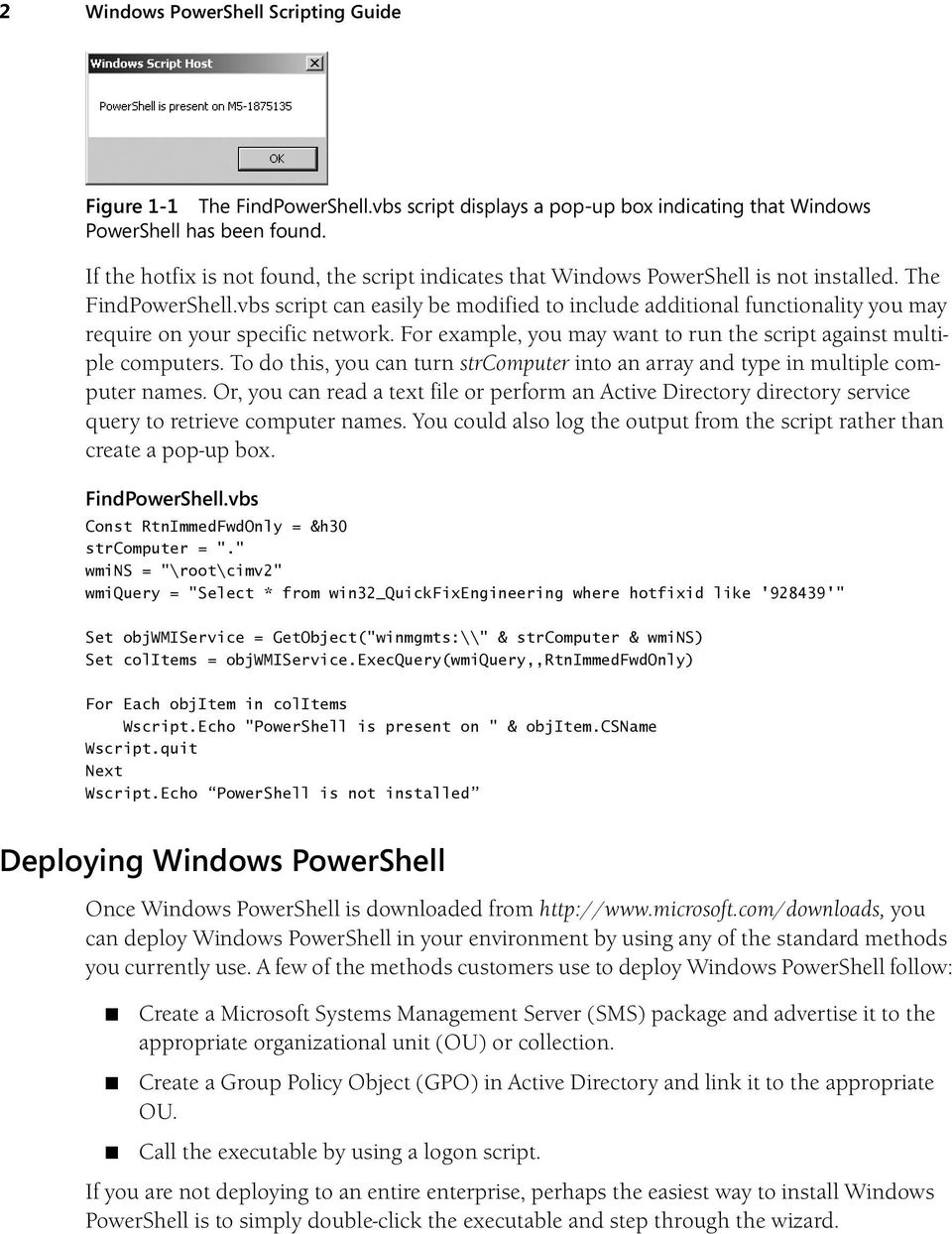
12 Chapter 1 The Shell in Windows PowerShell After completing this chapter, you will be able to: Install and configure Windows PowerShell. Tackle security issues with Windows PowerShell. Understand the basics of cmdlets. Work with aliases to assign shortcut names to cmdlets. Get help using Windows PowerShell. On the Companion Disc All the scripts used in this chapter are located on the CD-ROM that accompanies this book in the \scripts\chapter01 folder. Installing Windows PowerShell Because Windows PowerShell is not installed by default on any operating system released by Microsoft, it is important to verify the existence of Windows PowerShell on the platform before the actual deployment of either scripts or commands. This can be as simple as trying to execute a Windows PowerShell command and looking for errors. You can easily accomplish this from inside a batch file by querying the value %errorlevel%. Verifying Installation with VBScript A more sophisticated approach to the task of verifying the existence of Windows PowerShell on the operating system is to use a script that queries the Win32_QuickFixEngineering Windows Management Instrumentation (WMI) class. FindPowerShell.vbs is an example of using Win32_QuickFixEngineering in Microsoft Visual Basic Scripting Edition (VBScript) to find an installation of Windows PowerShell. The FindPowerShell.vbs script uses the WMI moniker to create an instance of the SwbemServices object and then uses the execquery method to issue the query. The WMI Query Language (WQL) query uses the like operator to retrieve hotfixes with a hotfix ID such as , which is the hotfix ID for Windows PowerShell on Windows XP, Windows Vista, Windows Server 2003, and Windows Server Once the hotfix is identified, the script simply prints out the name of the computer stating that Windows PowerShell is installed. This is shown in Figure

13 2 Windows PowerShell Scripting Guide Figure 1-1 The FindPowerShell.vbs script displays a pop-up box indicating that Windows PowerShell has been found. If the hotfix is not found, the script indicates that Windows PowerShell is not installed. The FindPowerShell.vbs script can easily be modified to include additional functionality you may require on your specific network. For example, you may want to run the script against multiple computers. To do this, you can turn strcomputer into an array and type in multiple computer names. Or, you can read a text file or perform an Active Directory directory service query to retrieve computer names. You could also log the output from the script rather than create a pop-up box. FindPowerShell.vbs Const RtnImmedFwdOnly = &h30 strcomputer = "." wmins = "\root\cimv2" wmiquery = "Select * from win32_quickfixengineering where hotfixid like '928439'" Set objwmiservice = GetObject("winmgmts:\\" & strcomputer & wmins) Set colitems = objwmiservice.execquery(wmiquery,,rtnimmedfwdonly) For Each objitem in colitems Wscript.Echo "PowerShell is present on " & objitem.csname Wscript.quit Next Wscript.Echo PowerShell is not installed Deploying Windows PowerShell Once Windows PowerShell is downloaded from you can deploy Windows PowerShell in your environment by using any of the standard methods you currently use. A few of the methods customers use to deploy Windows PowerShell follow: Create a Microsoft Systems Management Server (SMS) package and advertise it to the appropriate organizational unit (OU) or collection. Create a Group Policy Object (GPO) in Active Directory and link it to the appropriate OU. Call the executable by using a logon script. If you are not deploying to an entire enterprise, perhaps the easiest way to install Windows PowerShell is to simply double-click the executable and step through the wizard.
14 Chapter 1 The Shell in Windows PowerShell 3 Keep in mind that Windows PowerShell is installed by using hotfix technology. This means it is an update to the operating system, and not an add-on program. This has certain advantages, including the ability to provide updates and fixes to Windows PowerShell through operating system service packs and through Windows Update. But there are also some drawbacks, in that hotfixes need to be uninstalled in the same order that they were installed. For example, if you install Windows PowerShell on Windows Vista and later install a series of updates, then install Service Pack 1, and suddenly decide to uninstall Windows PowerShell, you will need to back out Service Pack 1 and each hotfix in the appropriate order. (Personally, at that point I think I would just back up my data, format the disks, and reinstall Windows Vista. I think it would be faster. But all this is a moot point anyway, as there is little reason to uninstall Windows PowerShell.) Understanding Windows PowerShell One issue with Windows PowerShell is grasping what it is. In fact, the first time I met Jeffrey Snover, the chief architect for Windows PowerShell, one of the first things he said was, How do you describe Windows PowerShell to customers? So what is Windows PowerShell? Simply stated, Windows PowerShell is the next generation command shell and scripting language from Microsoft that can be used to replace both the venerable Cmd.exe command interpreter and the VBScript scripting language. This dualistic behavior causes problems for many network administrators who are used to the Cmd.exe command interpreter with its weak batch language and the powerful (but confusing) VBScript language for automating administrative tasks. These are not bad tools, but they are currently used in ways that were not intended when they were created more than a decade ago. The Cmd.exe command interpreter was essentially the successor to the DOS prompt, and VBScript was more or less designed with Web pages in mind. Neither was designed from the ground up for network administrators. Interacting with the Shell Once Windows PowerShell is launched, you can use it in the same manner as the Cmd.exe command interpreter. For example, you can use dir to retrieve a directory listing. You can also use cd to change the working directory and then use dir to produce a directory listing just as you would perform these tasks from the CMD shell. This is illustrated in the UsingPower- Shell.txt example that follows, which shows the results of using these commands. UsingPowerShell.txt PS C:\Users\edwils> dir Directory: Microsoft.PowerShell.Core\FileSystem::C:\Users\edwils
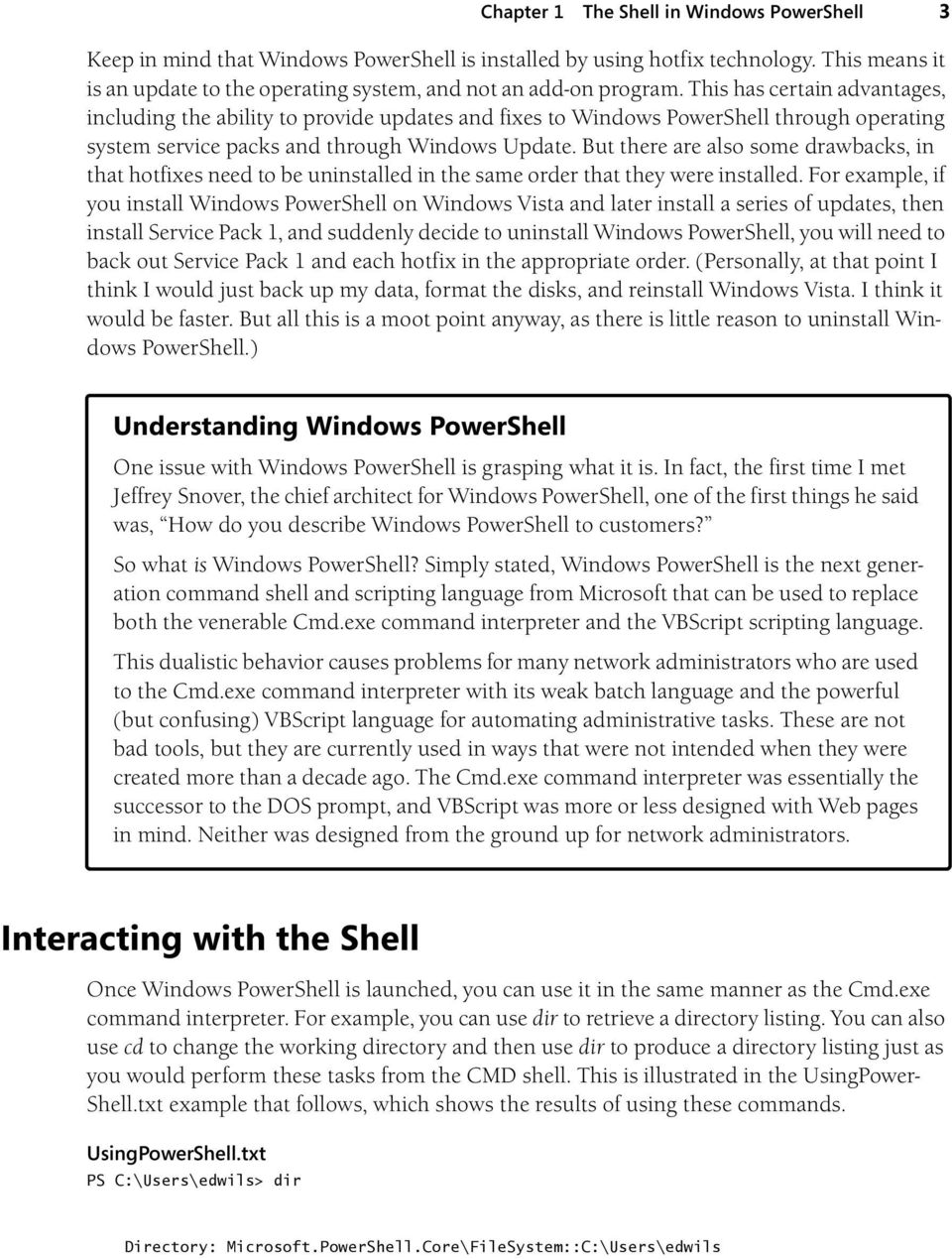
15 4 Windows PowerShell Scripting Guide Mode LastWriteTime Length Name d-r-- 11/29/2006 1:32 PM Contacts d-r-- 4/2/ :51 AM Desktop d-r-- 4/1/2007 6:53 PM Documents d-r-- 11/29/2006 1:32 PM Downloads d-r-- 4/2/2007 1:10 AM Favorites d-r-- 4/1/2007 6:53 PM Links d-r-- 11/29/2006 1:32 PM Music d-r-- 11/29/2006 1:32 PM Pictures d-r-- 11/29/2006 1:32 PM Saved Games d-r-- 4/1/2007 6:53 PM Searches d-r-- 4/2/2007 5:53 PM Videos PS C:\Users\edwils> cd music PS C:\Users\edwils\Music> dir In addition to using traditional command interpreter commands, you can also use some of the newer command-line utilities such as Fsutil.exe, as shown here. Keep in mind that access to Fsutil.exe requires administrative rights. If you launch the standard Windows PowerShell prompt from the Windows PowerShell program group, you will not have administrative rights, and the error shown in Figure 1-2 will appear. Figure 1-2 Windows PowerShell respects user account control and by default will launch with normal user privileges. This can generate errors when trying to execute privileged commands. Fsutil.txt PS C:\Users\edwils> sl c:\mytest PS C:\mytest> fsutil file createnew c:\mytest\mynewfile.txt 1000 File c:\mytest\mynewfile.txt is created PS C:\mytest> dir Directory: Microsoft.PowerShell.Core\FileSystem::C:\mytest Mode LastWriteTime Length Name a--- 5/8/2007 7:30 PM 1000 mynewfile.txt PS C:\mytest>

16 Chapter 1 The Shell in Windows PowerShell 5 Tip I recommend creating two Windows PowerShell shortcuts and saving them to the Quick Launch bar. One shortcut launches with normal user permissions and the other launches with administrative rights. By default you should use the normal user shortcut and document those occasions that require administrative rights. When you are finished working with the files and the folder, you can delete the file very easily by using the del command. To keep from typing the entire file name, you can use wildcards such as *.txt. This is safe enough, since you have first used the dir command to ensure there is only one text file in the folder. Once the file is removed, you can use rd to remove the directory. As shown in DeleteFileAndFolder.txt example that follows, these commands work exactly the same as you would expect when working with the command prompt. DeleteFileAndFolder.txt PS C:\> sl c:\mytest PS C:\mytest> dir Directory: Microsoft.PowerShell.Core\FileSystem::C:\mytest Mode LastWriteTime Length Name a--- 5/8/2007 7:30 PM 1000 mynewfile.txt PS C:\mytest> del *.txt PS C:\mytest> cd c:\ PS C:\> rd c:\mytest PS C:\> dir c:\mytest Get-ChildItem : Cannot find path 'C:\mytest' because it does not exist. At line:1 char:4 + dir <<<< c:\mytest PS C:\> With these examples, you have been using Windows PowerShell in an interactive manner. This is one of the primary uses of Windows PowerShell. In fact, the Windows PowerShell team expects that 80 percent of users will work with Windows PowerShell interactively simply as a better command prompt. You open up a Windows PowerShell prompt and type in commands. The commands can be typed one at a time or they can be grouped together like a batch file. This will be discussed later, as the process doesn t work by default. Introducing Cmdlets In addition to using traditional programs and commands from the Cmd.exe command interpreter, you can also use the cmdlets that are built into Windows PowerShell. Cmdlet is a name created by the Windows PowerShell team to describe these native commands. They are like executable programs but because they take advantage of the facilities built into Windows
17 6 Windows PowerShell Scripting Guide PowerShell, they are easy to write. They are not scripts, which are uncompiled code, because they are built using the services of a special Microsoft.NET Framework namespace. Because of their different nature, the Windows PowerShell team came up with the new term cmdlet. Windows PowerShell comes with more than 120 cmdlets designed to assist network administrators and consultants to easily take advantage of Windows PowerShell without having to learn the Windows PowerShell scripting language. These cmdlets are documented in Appendix A, Cmdlet Naming Conventions. In general, the cmdlets follow a standard naming convention such as Get-Help, Get-EventLog, or Get-Process. The get cmdlets display information about the item that is specified on the right side of the dash. The set cmdlets are used to modify or to set information about the item on the right side of the dash. An example of a set cmdlet is Set-Service, which can be used to change the startmode of a service. An explanation of this naming convention is found in Appendix A, Cmdlet Naming Conventions. Configuring Windows PowerShell Once Windows PowerShell is installed on a platform, there are still some configuration issues to address. This is in part due to the way the Windows PowerShell team at Microsoft perceives the use of the tool. For example, the Windows PowerShell team believes that 80 percent of Windows PowerShell users will not utilize the scripting features of Windows PowerShell; thus, the scripting capability is turned off by default. Find more information on enabling scripting support in Windows Power Shell in Chapter 2, Scripting Windows PowerShell. Creating a Windows PowerShell Profile There are many settings that can be stored in a Windows PowerShell profile. These items can be stored in a psconsole file. To export the console configuration file, use the Export-Console cmdlet as shown here: PS C:\> Export-Console myconsole The psconsole file is saved in the current directory by default, and will have an extension of.psc1. The psconsole file is saved in an.xml format; a generic console file is shown here: <?xml version="1.0" encoding="utf-8"?> <PSConsoleFile ConsoleSchemaVersion="1.0"> <PSVersion>1.0</PSVersion> <PSSnapIns /> </PSConsoleFile> Configuring Windows PowerShell Startup Options There are several methods available to start Windows PowerShell. For example, if the logo you receive when clicking the default Windows PowerShell icon seems to get in your way, you can launch without it. You can start Windows PowerShell using different profiles and even run a
18 Chapter 1 The Shell in Windows PowerShell 7 single Windows PowerShell command and exit the shell. If you need to start a specific version of Windows PowerShell, you can do that as well by supplying a value for the version parameter. Each of these options is illustrated in the following list. Launch Windows PowerShell without the banner by using the -nologo argument as shown here: PowerShell -nologo Launch a specific version of Windows PowerShell by using the -version argument: PowerShell -version 1.0 Launch Windows PowerShell using a specific configuration file by specifying the -psconsolefile argument: PowerShell -psconsolefile myconsole.psc1 Launch Windows PowerShell, execute a specific command, and then exit by using the -command argument. The command must be prefixed by the ampersand sign and enclosed in curly brackets: powershell -command "& {get-process}" Security Issues with Windows PowerShell As with any tool as versatile as Windows PowerShell, there are some security concerns. Security, however, was one of the design goals in the development of Windows PowerShell. When you launch Windows PowerShell, it opens in your Users\userName folder; this ensures you are in a directory where you will have permission to perform certain actions and activities. This technique is far safer than opening at the root of the drive or opening in the system root. To change to a directory, you can t automatically go up to the next level; you must explicitly name the destination of the change directory operation (but you can use the dotted notation with the Set-Location cmdlets as in Set-Location..). Running scripts is disabled by default but this can be easily managed with Group Policy or login scripts. Controlling the Execution of Cmdlets Have you ever opened a CMD interpreter prompt, typed in a command, and pressed Enter so you could see what happens? If that command happens to be Format C:\, are you sure you want to format your C drive? There are several arguments that can be passed to cmdlets to control the way they execute. These arguments will be examined in this section.
19 8 Windows PowerShell Scripting Guide Tip Most of the Windows PowerShell cmdlets support a prototype mode that can be entered by using the -whatif parameter. The implementation of the whatif switch can be decided by the person developing the cmdlet; however, the Windows PowerShell team recommends that developers implement -whatif if the cmdlet will make changes to the system. Although not all cmdlets support these arguments, most of the cmdlets included with Windows PowerShell do. The three ways to control execution are -whatif, -confirm, and suspend. Suspend is not an argument that gets supplied to a cmdlet, but it is an action you can take at a confirmation prompt, and is therefore another method of controlling execution. To use -whatif, first enter the cmdlet at a Windows PowerShell prompt. Then type the -whatif parameter after the cmdlet. The use of the -whatif argument is illustrated in the following WhatIf.txt example. On the first line, launch Notepad. This is as simple as typing the word notepad as shown in the path. Next, use the Get-Process cmdlet to search for all processes that begin with the name note. In this example, there are two processes with a name beginning with notepad. Next, use the Stop-Process cmdlet to stop a process with the name of notepad, but because the outcome is unknown, use the -whatif parameter. Whatif tells you that it will kill two processes, both of which are named notepad, and it also gives the process ID number so you can verify if this is the process you wish to kill. Just for fun, once again use the Stop- Process cmdlet to stop all processes with a name that begins with the letter n. Again, wisely use the whatif parameter to see what would happen if you execute the command. WhatIf.txt PS C:\Users\edwils> notepad PS C:\Users\edwils> Get-Process note* Handles NPM(K) PM(K) WS(K) VM(M) CPU(s) Id ProcessName notepad notepad PS C:\Users\edwils> Stop-Process -processname notepad -WhatIf What if: Performing operation "Stop-Process" on Target "notepad (3052)". What if: Performing operation "Stop-Process" on Target "notepad (3140)". PS C:\Users\edwils> Stop-Process -processname n* -WhatIf What if: Performing operation "Stop-Process" on Target "notepad (3052)". What if: Performing operation "Stop-Process" on Target "notepad (3140)". So what happens if the whatif switch is not implemented? To illustrate this point, notice that in the following WhatIf2.txt example, when you use the New-Item cmdlet to create a new directory named mynewtest off the root, the whatif switch is implemented and it confirms that the command will indeed create C:\myNewtest. Note what happens, however, when you try to use the whatif switch on the Get-Help cmdlet. You might guess it would display a message such as, What if: Retrieving help information for
20 Chapter 1 The Shell in Windows PowerShell 9 Get-Process cmdlet. But what is the point? As there is no danger with the Get-Help cmdlet, there is no need to implement whatif on Get-Help. WhatIf2.txt PS C:\Users\edwils> New-Item -Name mynewtest -Path c:\ -ItemType directory -WhatIf What if: Performing operation "Create Directory" on Target "Destination: C:\myNewTest". PS C:\Users\edwils> get-help Get-Process -whatif Get-Help : A parameter cannot be found that matches parameter name 'whatif'. At line:1 char:28 + get-help Get-Process -whatif <<<< Best Practices The use of the -whatif parameter should be considered an essential tool in the network administrator s repertoire. Using it to model commands before execution can save hours of work each year. Confirming Commands As you saw in the previous section, you can use -whatif to create a prototype cmdlet in Windows PowerShell. This is useful for checking what a command will do. However, to be prompted before the command executes, use the -confirm switch. In practice, using the -confirm switch can generally take the place of -whatif, as you will be prompted before the action occurs. This is shown in the ConfirmIt.txt example that follows. In the ConfirmIt.txt file, first launch Calculator (Calc.exe). Because the file is in the path, you don t need to hard-code either the path or the extension. Next, use Get-Process with the c* wildcard pattern to find all processes that begin with the letter c. Notice that there are several process names on the list. The next step is to retrieve only the Calc.exe process. This returns a more manageable result set. Now use the Stop-Process cmdlet with the -confirm switch. The cmdlet returns the following information: Confirm Are you sure you want to perform this action? Performing operation "Stop-Process" on Target "calc (2924)". [Y] Yes [A] Yes to All [N] No [L] No to All [S] Suspend [?] Help (default is "Y"): You will notice this information is essentially the same as the information provided by the whatif switch but it also provides the ability to perform the requested action. This can save time when executing a large number of commands. ConfirmIt.txt PS C:\Users\edwils> calc PS C:\Users\edwils> Get-Process c*

21 10 Windows PowerShell Scripting Guide Handles NPM(K) PM(K) WS(K) VM(M) CPU(s) Id ProcessName calc casha CcmExec csrss csrss PS C:\Users\edwils> Get-Process calc Handles NPM(K) PM(K) WS(K) VM(M) CPU(s) Id ProcessName calc PS C:\Users\edwils> Stop-Process -Name calc -Confirm Confirm Are you sure you want to perform this action? Performing operation "Stop-Process" on Target "calc (2924)". [Y] Yes [A] Yes to All [N] No [L] No to All [S] Suspend [?] Help (default is "Y"): y PS C:\Users\edwils> Get-Process c* Handles NPM(K) PM(K) WS(K) VM(M) CPU(s) Id ProcessName casha CcmExec csrss csrss Suspending Confirmation of Cmdlets The ability to prompt for confirmation of a cmdlet s execution is extremely useful and at times may be vital in maintaining a high level of system uptime. For example, there are times when you have typed in a long command and then remember that you must perform another procedure first. In this case, simply suspend execution of the command. The commands used in the suspending execution of a cmdlet and associated output are shown in the following SuspendConfirmation.txt example. In the SuspendConfirmation.txt file, first launch Microsoft Paint (Mspaint.exe). Because Mspaint.exe is in the path, you don t need to supply any path information to the file. You then get the process information by using the Get-Process cmdlet. Use the ms* wildcard, which matches any process name that begins with the letters ms. Once you have identified the correct process, use the Stop-Process cmdlet and the confirm switch. Instead of answering yes to the confirmation prompt, just suspend execution of the command so you can run an additional command (perhaps you forgot the process ID number). Once you have finished running the additional command, type exit to return to the suspended command from the nested prompt. Once you have killed the mspaint process, you can once again use the Get- Process cmdlet to confirm the process has been killed.
22 Chapter 1 The Shell in Windows PowerShell 11 SuspendConfirmation.txt PS C:\Users\edwils> mspaint PS C:\Users\edwils> Get-Process ms* Handles NPM(K) PM(K) WS(K) VM(M) CPU(s) Id ProcessName mspaint PS C:\Users\edwils> Stop-Process -id Confirm Confirm Are you sure you want to perform this action? Performing operation "Stop-Process" on Target "mspaint (3064)". [Y] Yes [A] Yes to All [N] No [L] No to All [S] Suspend [?] Help (default is "Y"): s PS C:\Users\edwils>>> Get-Process ms* Handles NPM(K) PM(K) WS(K) VM(M) CPU(s) Id ProcessName mspaint PS C:\Users\edwils>>> exit Confirm Are you sure you want to perform this action? Performing operation "Stop-Process" on Target "mspaint (3064)". [Y] Yes [A] Yes to All [N] No [L] No to All [S] Suspend [?] Help (default is "Y"): y PS C:\Users\edwils> Get-Process ms* Supplying Options for Cmdlets As you have seen in the previous sections, you can use -whatif and -confirm to control the execution of cmdlets. One question students often ask me is, How do I know what options are available? The answer is that the Windows PowerShell team created a set of standard options. These standard options are called common parameters. When you look at the syntax description for a cmdlet, often it will state that the cmdlet supports the common parameters. This is shown here for the Get-Process cmdlet: SYNTAX Get-Process [[-name] <string[]>] [<CommonParameters>] Get-Process -id <Int32[]> [<CommonParameters>] Get-Process -inputobject <Process[]> [<CommonParameters>] One of the useful features of Windows PowerShell is the standardization of the syntax in working with cmdlets. This vastly simplifies learning the new shell and language. Table 1-1 lists the common parameters. Keep in mind that all cmdlets will not implement all of these parameters. However, if the parameters are used they will be interpreted in the same way for all cmdlets because the Windows PowerShell engine interprets the parameters.
23 12 Windows PowerShell Scripting Guide Table 1-1 Parameter -whatif -confirm -verbose -debug -erroraction -errorvariable -outvariable -outbuffer Common Parameters Working with Get-Help Meaning Tells the cmdlet not to execute; instead it will tell you what would happen if the cmdlet were to actually run. Tells the cmdlet to prompt prior to executing the command. Instructs the cmdlet to provide a higher level of detail than a cmdlet not using the verbose parameter. Instructs the cmdlet to provide debugging information. Instructs the cmdlet to perform a certain action when an error occurs. Allowable actions are: continue, stop, SilentlyContinue, and inquire. Instructs the cmdlet to use a specific variable to hold error information. This is in addition to the standard $error variable. Instructs the cmdlet to use a specific variable to hold the output information. Instructs the cmdlet to hold a certain number of objects prior to calling the next cmdlet in the pipeline. Windows PowerShell is intuitively easy to use; learn simply by doing. Online help makes it even easier to use the program. The help system in Windows PowerShell can be entered by several methods. To learn about using Windows PowerShell, use the Get-Help cmdlet as shown here: get-help get-help This command prints out help about the Get-Help cmdlet. The output from this cmdlet is shown here: NAME Get-Help SYNOPSIS Displays information about Windows PowerShell cmdlets and concepts. SYNTAX Get-Help [[-name] <string>] [-component <string[]>] [-functionality <string []>] [-role <string[]>] [-category <string[]>] [-full] [<CommonParameters>] Get-Help [[-name] <string>] [-component <string[]>] [-functionality <string []>] [-role <string[]>] [-category <string[]>] [-detailed] [<CommonParamete rs>] Get-Help [[-name] <string>] [-component <string[]>] [-functionality <string []>] [-role <string[]>] [-category <string[]>] [-examples] [<CommonParamete rs>]
24 Chapter 1 The Shell in Windows PowerShell 13 Get-Help [[-name] <string>] [-component <string[]>] [-functionality <string []>] [-role <string[]>] [-category <string[]>] [-parameter <string>] [<Comm onparameters>] DETAILED DESCRIPTION The Get-Help cmdlet displays information about Windows PowerShell cmdlets and concepts. You can also use "Help {<cmdlet name> <topic-name>" or "<cmd let-name> /?". "Help" displays the help topics one page at a time. The "/?" displays help for cmdlets on a single page. RELATED LINKS Get-Command Get-PSDrive Get-Member REMARKS For more information, type: "get-help Get-Help -detailed". For technical information, type: "get-help Get-Help -full". The awesome thing about online help for Windows PowerShell, is that not only does it display help about commands which you would expect but it also has three different levels of display: normal, detailed, and full. Additionally, you can obtain help about concepts in Windows PowerShell. This last feature is equivalent to having an online instruction manual. To retrieve a listing of all the conceptual help articles, use the Get-Help about* command as shown here: get-help about* Suppose you do not remember the exact name of the cmdlet you wish to use but you remember it was a get cmdlet. You can use a wildcard (such as *) to obtain the name of the cmdlet. This is shown here: get-help get* This technique of using a wildcard operator can be extended further. If you remember the cmdlet was a get cmdlet and it started with the letter p you could use the following syntax to retrieve the desired cmdlet: get-help get-p* Suppose, however, that you know the exact name of the cmdlet but you can t exactly remember the syntax. For this scenario, you could use the -examples argument. To retrieve several examples of the Get-PSDrive cmdlet, you could use Get-Help with the -examples argument as shown here: get-help get-psdrive -examples
25 14 Windows PowerShell Scripting Guide To see help displayed one page at a time, you can use the help function which displays the help output text through the more function. This is useful if you want to avoid scrolling up and down to see the help output. This command is shown here: get-help get-help more The formatted output from the more function is shown in Figure 1-3. Figure 1-3 By using the more function, you can display lengthy help topics one page at a time. To obtain detailed help about the Get-Help cmdlet, use the -detailed argument as shown here: get-help get-help -detailed If you want to retrieve technical information about the Get-Help cmdlet, use the -full argument. This is shown here: get-help get-help -full Getting tired of typing Get-Help over and over? After all, it is eight characters long and one of them is a dash. The solution is to create an alias to the Get-Help cmdlet. An alias is a shortcut keystroke combination that will launch a program or cmdlet when typed. In the create Get- Help alias for this example, you can assign the Get-Help to the gh key combination. Tip Before creating an alias for a cmdlet, confirm there is not already an alias to the cmdlet by using Get-Alias. Then use Set-Alias to assign the cmdlet to a unique keystroke combination.
26 Chapter 1 The Shell in Windows PowerShell 15 Working with Aliases to Assign Shortcut Names to Cmdlets Aliases allow you to assign shortcut names to cmdlets. This can greatly simplify working at the Windows PowerShell prompt and it will allow you to customize the command syntax as you prefer. As an example, suppose you want to create an alias for the Get-Help cmdlet. Instead of typing Get-Help, perhaps you prefer to type gh. This can be accomplished in four simple steps. First, ensure there is not already an alias assigned to the desired keystroke combination to avoid confusion. The next thing you might want to do is review help for the Set-Alias cmdlet. Once you have done this, call the Set-Alias cmdlet and pass the new name you want to create and the name of the cmdlet you wish to alias. After you have created the alias, you may want to use Get-Alias to verify the alias was created properly. The completed code from this section is in the GhAlias.txt file in the chapter01 folder on the companion CD-ROM. 1. Retrieve an alphabetic listing of all currently defined aliases and inspect the list for one assigned to either the Get-Help cmdlet or for the keystroke combination gh. The command to do this is shown here: get-alias sort 2. Once you have determined there is no alias for the Get-Help cmdlet and that none is assigned to the gh keystroke combination, review the syntax for the Set-Alias cmdlet. Use the -full argument to the Get-Help cmdlet. This is shown here: get-help set-alias -full 3. Use the Set-Alias cmdlet to assign the gh keystroke combination to the Get-Help cmdlet. To do this, use the following command: set-alias gh get-help 4. Use the Get-Alias cmdlet to verify the alias was properly created. To do this, use the following command: Get-Alias gh Tip If the syntax of Set-Alias is a little confusing, you can use named parameters instead of the default positional binding. In addition, I recommend using either the whatif switch or the confirm switch. You can also specify a description for the alias. The modified syntax would look like this: Set-Alias -Name gh -Value Get-Help -Description "mred help alias" -WhatIf As you have seen, Windows PowerShell can be used as a replacement to the CMD interpreter. But it also has a large number of built-in cmdlets that provide the opportunity to perform a plethora of activities. These cmdlets can be used either in a stand-alone fashion or they can be run together as a group.
27 16 Windows PowerShell Scripting Guide Accessing Windows PowerShell Once Windows PowerShell is installed, it immediately becomes available for use. However, pressing R while pressing the Windows flag key on your keyboard to bring up the Windows Run dialog box or mousing around doing the old Start button/run dialog box thing and typing PowerShell all the time becomes somewhat less helpful. I created a shortcut to Windows PowerShell and placed that shortcut on my desktop. For me and the way I work, this is ideal. This is so useful, in fact, that I wrote a script to perform this function. This script can be called via a logon script, to automatically create the shortcut on the desktop. The script is named CreateShortCutToPowerShell.vbs: CreateShortCutToPowerShell.vbs Option Explicit Dim objshell Dim strdesktop Dim objshortcut Dim strprog strprog = "powershell.exe" Set objshell=createobject("wscript.shell") strdesktop = objshell.specialfolders("desktop") set objshortcut = objshell.createshortcut(strdesktop & "\powershell.lnk") objshortcut.targetpath = strprog objshortcut.windowstyle = 1 objshortcut.description = funfix(strprog) objshortcut.workingdirectory = "C:\" objshortcut.iconlocation= strprog objshortcut.hotkey = "CTRL+SHIFT+P" objshortcut.save Function funfix(strin) funfix = InStrRev(strin,".") funfix = Mid(strin,1,funfix) End function Additional Uses of Cmdlets Now that you have learned about using the help utilities and working with aliases, it s time to examine some additional ways to use cmdlets in Windows PowerShell. Tip To save time when typing the cmdlet name, simply type enough of the cmdlet name to uniquely distinguish it, and then press the Tab key. What is the result? Tab completion finishes the cmdlet name for you. This also works with argument names and other procedures. Feel free to experiment with this great timesaving technique. You may never have to type get-command again!
28 Chapter 1 The Shell in Windows PowerShell 17 As the cmdlets return objects instead of string values you can obtain additional information about the returned objects. This additional information would not be available if you were working with just string data. To obtain additional information, use the pipe character ( ), then take information from one cmdlet and feed it to another cmdlet. This may seem complicated, but in reality, it is quite simple. By the end of this chapter, the procedure should seem quite natural. At the most basic level, consider the simple example of obtaining and formatting a directory listing. After you retrieve the directory listing, you may want to format the way it is displayed, perhaps as either a table or a list. As you can see, there are two separate operations: obtaining the directory listing and formatting the list. This formatting task takes place on the right side of the pipe after the directory listing has been gathered. This is the way pipelines work. Now, let s examine them in action while looking at the Get-ChildItem cmdlet. Using the Get-ChildItem Cmdlet Earlier in this chapter, you used the dir command to obtain a listing of all the files in a directory. This works because there is an alias built into Windows PowerShell that assigns the Get- ChildItem cmdlet to the letter combination dir. We can verify this by using the Get-Alias cmdlet. This is shown in the GetDirAlias.txt file. GetDirAlias.txt PS C:\> Get-Alias dir CommandType Name Definition Alias dir Get-ChildItem In Windows PowerShell, there really is no cmdlet named dir, nor does it actually use the dir command. The alias dir is associated with the Get-ChildItem cmdlet. This is why the output from dir is different in Windows PowerShell than it is in the Cmd.exe interpreter. The alias dir is shown here when you use the Get-Alias cmdlet to resolve the association. Tip When using Get-ChildItem to produce a directory listing, use the force switch if you want to view hidden and system files and folders. It would look like this: Get-ChildItem -Force. Formatting Output There are four format cmdlets included with Windows PowerShell. Of these cmdlets, you will routinely use three: Format-List, Format-Wide, and Format-Table. The fourth cmdlet, Format- Custom, can display output in a fashion that is not a list, table, or wide format. It accomplishes this by using a *.format.ps1xml file. You can use either the default view contained in the *.format.ps1xml files or you can define your own format.ps1xml file.
29 18 Windows PowerShell Scripting Guide Let s look at formatting output utilizing the remaining three format cmdlets beginning with the most useful of the three: Format-List. Format-List Format-List is one of the core cmdlets you will use time and again. For example, if you use the Get-WmiObject cmdlet to look at the properties of the Win32_LogicalDisk class, you will receive a minimum listing of the default properties of the class. This listing is shown here: PS C:\> Get-WmiObject Win32_LogicalDisk DeviceID : C: DriveType : 3 ProviderName : FreeSpace : Size : VolumeName : Sea Drive Although in many cases this behavior is fine, there are times when you may be interested in the other properties of the class. The first thing to do when exploring other properties that may be available is to use the wildcard *. This will list all the properties as shown here: PS C:\> Get-WmiObject Win32_LogicalDisk Format-List * Status : Availability : DeviceID : C: StatusInfo : GENUS : 2 CLASS : Win32_LogicalDisk SUPERCLASS : CIM_LogicalDisk DYNASTY : CIM_ManagedSystemElement RELPATH : Win32_LogicalDisk.DeviceID="C:" PROPERTY_COUNT : 40 DERIVATION : {CIM_LogicalDisk, CIM_StorageExtent, CIM_LogicalDevice, CIM_LogicalElement...} SERVER : M NAMESPACE : root\cimv2 PATH : \\M \root\cimv2:Win32_LogicalDisk.DeviceID="C:" Access : 0 BlockSize : Caption : C: Compressed : False ConfigManagerErrorCode : ConfigManagerUserConfig : CreationClassName : Win32_LogicalDisk Description : Local Fixed Disk DriveType : 3 ErrorCleared : ErrorDescription : ErrorMethodology : FileSystem : NTFS
30 Chapter 1 The Shell in Windows PowerShell 19 FreeSpace : InstallDate : LastErrorCode : MaximumComponentLength : 255 MediaType : 12 Name : C: NumberOfBlocks : PNPDeviceID : PowerManagementCapabilities : PowerManagementSupported : ProviderName : Purpose : QuotasDisabled : QuotasIncomplete : QuotasRebuilding : Size : SupportsDiskQuotas : False SupportsFileBasedCompression : True SystemCreationClassName : Win32_ComputerSystem SystemName : M VolumeDirty : VolumeName : Sea Drive VolumeSerialNumber : F0FE15F7 Once you have looked at all the properties that are available for a particular class, you can then choose only the properties you are interested in. Replace the wildcard * with the property names gleaned from the preceding listing. This technique is shown here: PS C:\> Get-WmiObject Win32_LogicalDisk Format-List Name, FileSystem, FreeSpace Name : C: FileSystem : NTFS FreeSpace : Instead of typing a long list of property names, you can choose a range of property names by using wildcard characters. To see only the property names that begin with the letter f, you can use the technique shown here: PS C:\> Get-WmiObject Win32_LogicalDisk Format-List f* FileSystem : NTFS FreeSpace : If you want to see properties that begin with n and with f, then you need to introduce square brackets as shown here: PS C:\> Get-WmiObject Win32_LogicalDisk Format-List [nf]* FileSystem : NTFS FreeSpace : Name : C: NumberOfBlocks :
31 20 Windows PowerShell Scripting Guide These commands, with their associated complete output, can be found in the Format-List.txt file in the chapter01 folder on the companion CD-ROM. Format-Table The Format-Table cmdlet provides a number of features that make it especially well suited for network management tasks. In particular, it produces columns of data that allow for quick viewing. As with Format-List and Format-Wide, you can choose the properties you wish to display, and in so doing, easily eliminate distracting data from annoyingly verbose cmdlets. In the example shown here, first take a recursive look through the hard drive to find all the log files (those designated with the.log extension). While the output is considerable, it has been trimmed here to show a sample of the output. The Format-Table cmdlet is used to produce the output from the Get-ChildItem cmdlet shown here: PS C:\> Get-ChildItem c:\ -Recurse -Include *.log Format-Table Directory: Microsoft.PowerShell.Core\FileSystem::C:\Backup_Extras_92705 Mode LastWriteTime Length Name a--- 8/3/2004 6:34 PM setupapi.log -a--- 8/2/2004 9:32 PM Windows Update.log -a--- 6/8/ :41 AM wmsetup.log In addition to relying on the default behavior of the cmdlet, you can also choose specific properties. One issue with this approach, as shown here, is that the formatting uses the existing screen resolution for the window, thus you often end up with columns on opposite sides of the window. This can be acceptable for a quick-and-dirty column list, but it is not a format for saving data. PS C:\> Get-ChildItem c:\ -Recurse -Include *.log Format-Table -Property name, length, lastwritetime Name Length LastWriteTime setupapi.log /3/2004 6:34:53 PM Windows Update.log /2/2004 9:32:06 PM wmsetup.log /8/ :41:32 AM Debug.log 0 8/23/2006 8:10:38 PM AVCheck.Log /8/2007 9:28:05 AM AVCheckServer.Log /8/2007 9:28:05 AM
32 Chapter 1 The Shell in Windows PowerShell 21 To produce a list that uses the window size a bit more efficiently, you can specify the autosize switch. There is only one thing to keep in mind when using the autosize switch: It needs to know the length of the longest item to be stored in each column. To do this, the switch must wait until all objects have been enumerated, then it will determine the maximum length of each column and determine the size of the listing. This can cause the command execution to block until all items have enumerated, so this process takes a while to complete. You may not want to wait for the autosize to enumerate a large collection of objects if you are in a hurry, for example, working on a server-down issue. For small object sets, the performance hit is negligible; however, with a command that takes a long time to complete, such as this one, the difference is noticeable. The difference in output, however, is also noticeable (and you will probably feel it is worth the wait to have a more manageable output). PS C:\> Get-ChildItem c:\ -Recurse -Include *.log Format-Table -Property name, length, lastwritetime -AutoSize Name Length LastWriteTime setupapi.log /3/2004 6:34:53 PM Windows Update.log /2/2004 9:32:06 PM wmsetup.log /8/ :41:32 AM Debug.log 0 8/23/2006 8:10:38 PM AVCheck.Log /8/2007 9:28:05 AM The last thing to look at in conjunction with Format-Table is pairing it with the Sort-Object cmdlet. Sort-Object allows you to organize data by property and to display it in a sorted fashion. In this example, the alias for Sort-Object (sort) is used, which reduces the amount of typing necessary. The command is still rather long and is wrapped here for readability. (To be honest, when commands begin to reach this length, I have a tendency to turn the process into a script.) When you examine the following command, notice that the data is sorted before feeding it to the Format-Table cmdlet. Please note that by default the Sort-Object cmdlet sorts in ascending (smallest to largest) order. If desired, you can specify the -descending switch to see the files organized from largest to smallest. PS C:\>Get-ChildItem c:\ -Recurse -Include *.log Sort -Property length Format-Table name, lastwritetime, length -AutoSize Name LastWriteTime Length PASSWD.LOG 5/10/2007 2:44:58 AM 0 sam.log 11/29/2006 1:14:33 PM 0 poqexec.log 2/1/2007 6:50:49 PM 0 ChkAcc.log 5/10/2007 2:45:00 AM 0 Debug.log 8/23/2006 8:10:38 PM 0 setuperr.log 3/16/2007 7:18:17 AM 0 setuperr.log 4/4/2007 6:34:54 PM 0 netlogon.log 2/1/2007 7:04:44 PM 3 There are also other ways to sort. For example, you can sort the list of log files by date modified in descending order. By doing this, you can see the most recently modified log files. To perform this procedure, you need to modify the sort object. The remainder of the command is
33 22 Windows PowerShell Scripting Guide the same. A portion of this output is shown here. It is interesting to note that the majority of these logs were modified during the log-on process. PS C:\> Get-ChildItem c:\ -Recurse -Include *.log Sort -Property lastwritetime -descending Format-Table name, lastwritetime, length -AutoSize Name LastWriteTime Length mtrmgr.log 5/10/2007 4:56:52 AM LocationServices.log 5/10/2007 4:56:26 AM StateMessage.log 5/10/2007 4:55:00 AM Scheduler.log 5/10/2007 4:55:00 AM StatusAgent.log 5/10/2007 4:53:24 AM edb.log 5/10/2007 4:51:49 AM PolicyEvaluator.log 5/10/2007 4:51:25 AM ClientLocation.log 5/10/2007 4:51:24 AM FSPStateMessage.log 5/10/2007 4:51:18 AM CBS.log 5/10/2007 4:46:55 AM CertificateMaintenance.log 5/10/2007 4:42:17 AM CcmExec.log 5/10/2007 4:00:51 AM wmiprov.log 5/10/2007 3:03:11 AM PolicyAgentProvider.log 5/10/2007 2:54:02 AM UpdatesHandler.log 5/10/2007 2:53:19 AM CIAgent.log 5/10/2007 2:53:19 AM ScanAgent.log 5/10/2007 2:53:18 AM UpdatesDeployment.log 5/10/2007 2:53:18 AM SrcUpdateMgr.log 5/10/2007 2:53:02 AM smssha.log 5/10/2007 2:52:02 AM execmgr.log 5/10/2007 2:52:02 AM InventoryAgent.log 5/10/2007 2:52:02 AM ServiceWindowManager.log 5/10/2007 2:52:02 AM SdmAgent.log 5/10/2007 2:49:46 AM UpdatesStore.log 5/10/2007 2:49:43 AM WUAHandler.log 5/10/2007 2:49:39 AM CAS.log 5/10/2007 2:49:35 AM PeerDPAgent.log 5/10/2007 2:49:35 AM 7900 PolicyAgent.log 5/10/2007 2:49:35 AM RebootCoordinator.log 5/10/2007 2:49:35 AM InternetProxy.log 5/10/2007 2:49:34 AM ClientIDManagerStartup.log 5/10/2007 2:49:34 AM WindowsUpdate.log 5/10/2007 2:46:46 AM edb.log 5/10/2007 2:46:43 AM setupapi.dev.log 5/10/2007 2:46:38 AM setupapi.app.log 5/10/2007 2:46:38 AM WMITracing.log 5/10/2007 2:45:57 AM ChkAcc.log 5/10/2007 2:45:00 AM 0 PASSWD.LOG 5/10/2007 2:44:58 AM 0 If you look at the Format-Table.txt file in the chapter01 folder, you will notice there are many errors in the log file. This is because the Get-ChildItem cmdlet attempted to access directories and files that are protected, causing access-denied messages. During development these errors are helpful to let you know that you are not accessing files and folders; however, they
34 Chapter 1 The Shell in Windows PowerShell 23 become problematic once you begin to analyze the data. An example of one of these errors is shown here: Get-ChildItem : Access to the path 'C:\Windows\CSC' is denied. At line:1 char:14 The error message is helpful in that it tells you the name of the cmdlet that caused the error and the action that provoked the error. You can eliminate these types of errors by using the -ErrorAction common parameter on the Get-ChildItem cmdlet, specifying the SilentlyContinue keyword. This modified line of code is shown here: PS C:\> Get-ChildItem c:\ -Recurse -Include *.log -erroraction SilentlyContinue Sort -Property lastwritetime -descending Format-Table name, lastwritetime, length -AutoSize Format-Wide The Format-Wide cmdlet is not nearly as useful as Format-Table or Format-List. This is due to the limitation of displaying only one property per object. It can be useful, however, to have such a list. For example, suppose you only want a list of the processes running on your computer. You can use Get-Process cmdlet, and pipeline the resulting object to the Format-Wide cmdlet. This is shown here: PS C:\> Get-Process Format-Wide ApMsgFwd Apoint casha csrss dwm FwcAgent InoRpc InoTask lsm MSASCui powershell rundll32 SearchIndexer services smss SRUserService svchost svchost svchost svchost svchost svchost svchost System taskeng ApntEx audiodg CcmExec csrss explorer Idle InoRT lsass mobsync powershell PowerShellIDE SearchFilterHost SearchProtocolHost SLsvc spoolsv svchost svchost svchost svchost svchost svchost svchost svchost taskeng ThpSrv
35 24 Windows PowerShell Scripting Guide ThpSrv wininit WINWORD WmiPrvSE TODDSrv winlogon wmdc WmiPrvSE The output, while serviceable, uses a lot of lines on the console and it also wastes quite a bit of screen real estate. A better output can be obtained by using the -column parameter. This is illustrated here: PS C:\> Get-Process Format-Wide -Column 4 Although the four-column output cuts the list length by half, it still does not maximize all the available screen space. Though it might be possible to write a script that will figure out the optimum value of the -column parameter, such as the following DemoFormatWide.ps1 script, it is hardly worth the time and the trouble to pursue such an undertaking. DemoFormatWide.ps1 function fungetprocess() { if ($args) { Get-Process Format-Wide -autosize } else { Get-Process Format-Wide -column $i } } cls $i = 1 for ($i ; $i -le 10 ; $i++) { Write-Host -ForegroundColor red "`$i is equal to $i" fungetprocess } Write-Host -ForeGroundColor red "Now use format-wide -autosize" fungetprocess("auto") A better option for finding the optimum screen configuration for Format-Wide is to use the -autosize switch, shown here: PS C:\> Get-Process Format-Wide -AutoSize Using the Get-Command Cmdlet There are three cmdlets that are analogous to the three key spices used in Cajun cooking. You can make anything in the Cajun style of cooking if you remember: salt, pepper, and paprika. You want to make Cajun green beans? Add some salt, pepper, and paprika. You want to work
36 Chapter 1 The Shell in Windows PowerShell 25 with Windows PowerShell? Remember the Cajun cmdlets: Get-Help, Get-Command, and Get-Member. Calling on these three cmdlets, you can master Windows PowerShell. Since you have already looked at Get-Help, the next cmdlet to examine is Get-Command. The most basic use of Get-Command is to produce a listing of commands available to Windows PowerShell. This is useful if you want to quickly see which cmdlets are available. This elementary use of Get-Command is illustrated here. One point to notice is that the definition is truncated. PS C:\> Get-Command CommandType Name Definition Cmdlet Add-Content Add-Content [-Path] <String[]> [-Value] <Object[... Cmdlet Add-History Add-History [[-InputObject] <PSObject[]>] [-Pass... Cmdlet Add-Member Add-Member [-MemberType] <PSMemberTypes> [-Name]... Cmdlet Add-PSSnapin Add-PSSnapin [-Name] <String[]> [-PassThru] [-Ve... Cmdlet Clear-Content Clear-Content [-Path] <String[]> [-Filter <Strin... Cmdlet Clear-Item Clear-Item [-Path] <String[]> [-Force] [-Filter... By default, Get-Command is limited to producing a listing of cmdlets; therefore the cmdlet field is redundant. A nicer format of the list can be achieved by pipelining the resulting object into the Format-List cmdlet and choosing only the name and definition. This is illustrated here. As you can see in the code, this output is much easier to read and it provides the syntactical definition of each command: PS C:\> Get-Command Format-List name, definition Name : Add-Content Definition : Add-Content [-Path] <String[]> [-Value] <Object[]> [-PassThru] [-Filter <String>] [-Include <String[]>] [-Exclude <String[]>] [-Force] [-Credential<PSCredential>] [-Verbose] [-Debug] [-ErrorAction <ActionPreference>] [-ErrorVariable<String>] [-OutVariable <String>] [-OutBuffer <Int32>] [-WhatIf] [-Confirm][-Encoding <FileSystemCmdletProviderEncoding>] Add-Content [-LiteralPath] <String[]> [-Value] <Object[]> [-PassThru][-Filter <String>] [-Include <String[]>] [-Exclude <String[]>] [-Force] [-Credential<PSCredential>] [-Verbose] [-Debug] [-ErrorAction <ActionPreference>] [-ErrorVariable <String>] [-OutVariable <String>] [-OutBuffer <Int32>] [-WhatIf] [-Confirm] [-Encoding <FileSystemCmdletProviderEncoding>] Name : Add-History Definition : Add-History [[-InputObject] <PSObject[]>] [-Passthru] [-Verbose] [-Debug] [-ErrorAction <ActionPreference>] [-ErrorVariable <String>] [-OutVariable String>] [-OutBuffer <Int32>]
37 26 Windows PowerShell Scripting Guide So far, we have looked at normal usage of the Get-Command cmdlet. However, a more interesting method uses our knowledge of the noun and verb combination of cmdlet names. Armed with this information, we can look for commands that have a noun-called process in the name of the cmdlet This command would look like the following: PS C:\> Get-Command -Noun process CommandType Name Definition Cmdlet Get-Process Get-Process [[-Name] <String[]>] [-Verbose] [-De... Cmdlet Stop-Process Stop-Process [-Id] <Int32[]> [-PassThru] [-Verbo... Using this procedure, if you want to find a cmdlet that contains the letter p in the noun portion of the name, you can use wildcards to assist. This can reduce typing and help you explore available cmdlets. This command is shown here: PS C:\> get-command -Noun p* CommandType Name Definition Cmdlet Add-PSSnapin Add-PSSnapin [-Name] <String[]> [-PassThru] [-Ve... Cmdlet Convert-Path Convert-Path [-Path] <String[]> [-Verbose] [-Deb... Cmdlet Get-PfxCertificate Get-PfxCertificate [- FilePath] <String[]> [-Verb... Cmdlet Get-Process Get-Process [[-Name] <String[]>] [-Verbose] [-De... Cmdlet Get-PSDrive Get-PSDrive [[-Name] <String[]>] [-Scope <String... Cmdlet Get-PSProvider Get-PSProvider [[-PSProvider] <String[]>] [-Verb... Cmdlet Get-PSSnapin Get-PSSnapin [[-Name] <String[]>] [-Registered]... Cmdlet Join-Path Join-Path [-Path] <String[]> [-ChildPath] <Strin... Cmdlet New-PSDrive New-PSDrive [-Name] <String> [-PSProvider] <Stri... Cmdlet Out-Printer Out-Printer [[-Name] <String>] [-InputObject <PS... Cmdlet Remove-PSDrive Remove-PSDrive [-Name] <String[]> [-PSProvider <... Cmdlet Remove-PSSnapin Remove-PSSnapin [-Name] <String[]> [-PassThru] [... Cmdlet Resolve-Path Resolve-Path [-Path] <String[]> [-Credential <PS... Cmdlet Set-PSDebug Set-PSDebug [-Trace <Int32>] [-Step] [-Strict] [... Cmdlet Split-Path Split-Path [-Path] <String[]> [-LiteralPath <Str... Cmdlet Stop-Process Stop-Process
38 Chapter 1 The Shell in Windows PowerShell 27 [-Id] <Int32[]> [-PassThru] [-Verbo... Cmdlet Test-Path Test-Path [-Path] <String[]> [-Filter <String>]... Cmdlet Write-Progress Write-Progress [-Activity] <String> [-Status] <S... By default, the Get-Command cmdlet displays only cmdlets; however, it can retrieve other items as well even.exe files and.dll files. This is because Get-Command will display information about every item you can run in Windows PowerShell. An example of this is shown here in a listing of commands that contains the word file in the name. One point to remember: Only Windows PowerShell entities are displayed. PS C:\> get-command -Name *file* CommandType Name Definition Application avifile.dll C:\Windows\system32\avifile.dll Application filemgmt.dll C:\Windows\system32\filemgmt.dll Application FileSystem.format.ps1xml C:\Windows\System32\WindowsPowerShell\v1.0\FileS... Application filetrace.mof C:\Windows\System32\Wbem\filetrace.mof Application forfiles.exe C:\Windows\system32\forfiles.exe You can easily correct this behavior by using the -commandtype parameter and limiting the search to cmdlets. This modified command is shown here: PS C:\> get-command -Name *file* -CommandType cmdlet CommandType Name Definition Cmdlet Out-File Out-File [-FilePath] <String> [[-Encoding] <Stri These examples give you an idea of the types of searches you can perform with the Get- Command cmdlet. These commands and their associated output are contained in the Get-Command.txt file in the chapter01 folder on the companion CD-ROM. Exploring with the Get-Member Cmdlet The third important cmdlet provided with Windows PowerShell is Get-Member. Some students look askance when I introduce Get-Member as one of the three Cajun cmdlets. Indeed, I had one student who raised his hand and asked what it was good for. This is a fair question. The thing that makes Get-Member so useful is that it can tell you which properties and methods are supported by an object. If you remember that everything in Windows PowerShell is an object, then you are well on your way to achieving enlightenment with this command. Perhaps a simple example will illustrate the value of this cmdlet.
39 28 Windows PowerShell Scripting Guide If you have a folder named mytest, and use the Get-Item cmdlet to obtain an object that represents the folder, you can store this reference in a variable named $a. This is shown here: PS C:\> $a = Get-Item c:\mytest Once you have an instance of the folder object contained in the $a variable, you can examine the methods and properties of a folder object by pipelining the object into the Get-Member cmdlet. This command and associated output are shown here: PS C:\> $a Get-Member TypeName: System.IO.DirectoryInfo Name MemberType Definition Create Method System.Void Create(), System.Void Create(DirectorySecurity directorysecurity) CreateObjRef Method System.Runtime.Remoting.ObjRef CreateObjRef(Type requestedtype) CreateSubdirectory Method System.IO.DirectoryInfo CreateSubdirectory(String path), System.IO.Director... Delete Method System.Void Delete(), System.Void Delete(Boolean recursive) Equals Method System.Boolean Equals(Object obj) GetAccessControl Method System.Security.AccessControl.DirectorySecurity Get AccessControl(), System GetDirectories Method System.IO.DirectoryInfo[] GetDirectories(), System.IO.DirectoryInfo[GetFiles Method System.IO.FileInfo[] GetFiles(String searchpattern), System.IO.FileInfo[] G... GetFileSystemInfos Method System.IO.FileSystemInfo[] GetFileSystemInfos(String searchpattern), System... GetHashCode Method System.Int32 GetHashCode() GetLifetimeService Method System.Object GetLifetimeService() GetObjectData Method System.Void GetObjectData *(SerializationInfo info, StreamingContext context) GetType Method System.Type GetType() get_attributes Method System.IO.FileAttributes get_attributes() get_creationtime Method System.DateTime get_creationtime() get_creationtimeutc Method System.DateTime get_creationtimeutc() get_exists Method System.Boolean get_exists() get_extension Method System.String get_extension() get_fullname Method System.String get_fullname() get_lastaccesstime Method System.DateTime get_lastaccesstime() get_lastaccesstimeutc Method System.DateTime get_lastaccesstimeutc() get_lastwritetime Method System.DateTime get_lastwritetime() get_lastwritetimeutc Method System.DateTime get_lastwritetimeutc() get_name Method System.String get_name() get_parent Method System.IO.DirectoryInfo get_parent() get_root Method System.IO.DirectoryInfo get_root() InitializeLifetimeService Method System.Object InitializeLifetimeService() MoveTo Method System.Void MoveTo(String destdirname) Refresh Method System.Void Refresh()
40 Chapter 1 The Shell in Windows PowerShell 29 SetAccessControl Method System.Void SetAccessControl(DirectorySecurity directorysecurity) set_attributes Method System.Void set_attributes(fileattributes value) set_creationtime Method System.Void set_creationtime(datetime value) set_creationtimeutc Method System.Void set_creationtimeutc(datetime value) set_lastaccesstime Method System.Void set_lastaccesstime(datetime value) set_lastaccesstimeutc Method System.Void set_lastaccesstimeutc(datetime value) set_lastwritetime Method System.Void set_lastwritetime(datetime value) set_lastwritetimeutc Method System.Void set_lastwritetimeutc(datetime value) ToString Method System.String ToString() PSChildName NoteProperty System.String PSChildName=mytest PSDrive NoteProperty System.Management.Automation.PSDriveInfo PSDrive=C PSIsContainer NoteProperty System.Boolean PSIsContainer=True PSParentPath NoteProperty System.String PSParentPath=Microsoft.PowerShell.Core\FileSystem::C:\ PSPath NoteProperty System.String PSPath=Microsoft.PowerShell.Core\FileSystem::C:\mytest PSProvider NoteProperty System.Management.Automation.ProviderInfo PSProvider=Microsoft.PowerShell.C... Attributes Property System.IO.FileAttributes Attributes {get;set;} CreationTime Property System.DateTime CreationTime {get;set;} CreationTimeUtc Property System.DateTime CreationTimeUtc {get;set;} Exists Property System.Boolean Exists {get;} Extension Property System.String Extension {get;} FullName Property System.String FullName {get;} LastAccessTime Property System.DateTime LastAccessTime {get;set;} LastAccessTimeUtc Property System.DateTime LastAccessTimeUtc {get;set;} LastWriteTime Property System.DateTime LastWriteTime {get;set;} LastWriteTimeUtc Property System.DateTime LastWriteTimeUtc {get;set;} Name Property System.String Name {get;} Parent Property System.IO.DirectoryInfo Parent {get;} Root Property System.IO.DirectoryInfo Root {get;} Mode ScriptProperty System.Object Mode {get=$catr = "";... From the listing of folder members, you can see there is a parent property. You can use the parent property information to find the genus of the mytest folder. This is shown here: PS C:\> $a.parent Mode LastWriteTime Length Name d--hs 5/11/2007 2:39 PM C:\
41 30 Windows PowerShell Scripting Guide Perhaps you are interested in knowing when the folder was last accessed. To check on this, you can use the LastAccessTime property as shown here: PS C:\> $a.lastaccesstime Friday, May 11, :39:12 PM If you want to confirm the object contained in $a is indeed a folder, you can use the PsIsContainer property. The Get-Member output tells you that PsIsContainer is a Boolean value, and so it will reply as either true or false. This command is shown here: PS C:\> $a.psiscontainer True Maybe you would like to use one of the methods returned. You can use the moveto method to move the folder to another location. Get-Member tells you that the moveto method must have a string input that points to a destination directory. So, move the mytest folder to c:\moved- Folder, then use the Test-Path cmdlet to check if the folder was moved to the new location. These commands are illustrated here: PS C:\> $a.moveto("c:\movedfolder") PS C:\> Test-Path c:\movedfolder True PS C:\> Test-Path c:\mytest False PS C:\> To confirm the name of the folder you now have represented by the object in the $a variable, you can use the Name property. This is shown here with the associated output: PS C:\> $a.name movedfolder If you want to delete the folder, you can use the delete method. This is shown here. To confirm it is actually deleted, use dir m* to verify it is gone. These commands are shown here. Note that the folder has now been deleted. PS C:\> $a.delete() PS C:\> dir m* Directory: Microsoft.PowerShell.Core\FileSystem::C:\ Mode LastWriteTime Length Name d---- 4/21/2007 4:56 PM Maps d---- 5/5/2007 3:51 PM music -a--- 2/1/2007 6:17 PM 54 MASK.txt
42 Chapter 1 The Shell in Windows PowerShell 31 All of these commands and their associated output are contained in the Get-Member.txt file in the chapter01 folder on the companion CD-ROM. Working with the.net Framework It might be interesting to note that these commands are actually commands that come from the.net Framework. These are not Windows PowerShell commands at all. Of course the Get-Item, Get-Member, and Test-Path cmdlets are Windows PowerShell commands but System.IO.DirectoryInfo does not come from Windows PowerShell. This means you use the same methods and properties from Windows PowerShell as a professional developer using Visual Basic.NET or C#. This also means that much more information is available to you by using the Microsoft Developer Network (MSDN) and the Windows Software Development Kit (SDK). The good news for you: If you can t find information using the online help (by using Get-Help), you can always refer to the MSDN Web site or the Windows SDK for assistance. Summary This chapter examined the different ways to determine if Windows PowerShell is installed on a computer and the steps involved in configuring Windows PowerShell for use in a corporate enterprise environment. We covered the creation of Windows PowerShell profiles and explored various methods of launching both Windows PowerShell and Windows PowerShell commands. The chapter included extending the features of Windows PowerShell via the creation of custom aliases and functions. Finally, we concluded with a discussion of three Windows PowerShell cmdlets: Get-Help, Get-Command, and Get-Member.
43
44 Chapter 2 Scripting Windows PowerShell After completing this chapter, you will be able to: Configure the scripting policy for Windows PowerShell. Run Windows PowerShell scripts. Use Windows PowerShell flow control statements. Use decision-making and branching statements. Identify and work with data types. Use regular expressions to provide advanced matching capabilities. Use command-line arguments. On the Companion Disc All the scripts used in this chapter are located on the CD that accompanies this book in the \scripts\chapter02 folder. Why Use Scripting? For many network administrators writing scripts any kind of scripts is a dark art more akin to reading tea leaves than administering a server. Indeed, while most large corporations seem to always have a scripting guy, they rarely have more than one. This is in spite of the efforts by Microsoft to promote Visual Basic Scripting Edition (VBScript) as an administrative scripting language. While most professionals will agree that the ability to quickly craft a script to make ad hoc changes to dozens of networked servers is a valuable skill, few actually possess this skill. In reality, however, many of the corporate scripting guy skills are more akin to knowing where to find a script that can easily be modified than to actually understanding how to write a script from scratch. Hopefully, this will change in the Windows PowerShell world. The Windows PowerShell syntax was deliberately chosen to facilitate ease of use and ease of learning. Corporate enterprise Windows administrators are the target audience. So why use scripting? There are several reasons. First, a script makes it easy to document a particular sequence of commands. If you need to produce a listing of all the shares on a computer, you can use the Win32_share WMI class and the Get-WmiObject cmdlet to retrieve the results, as shown here: PS C:\> Get-wmiObject win32_share 33
45 34 Windows PowerShell Scripting Guide Name Path Description ADMIN$ C:\Windows Remote Admin C$ C:\ Default share CCMLogs$ C:\Windows\system32\ccm\logs CCMSetup$ C:\Windows\system32\ccmsetup IPC$ Remote IPC music C:\music none VPCache$ C:\Windows\system32\VPCache WMILogs$ C:\Windows\system32\wbem\logs But, suppose you only want to have a list of file shares? You may not be aware that a file share is a type 0 share. So perhaps you need to search for this information on the Internet. Once you have obtained the information, use the modified command shown here: PS C:\> Get-WmiObject win32_share -Filter "type = '0'" Name Path Description CCMLogs$ C:\Windows\system32\ccm\logs CCMSetup$ C:\Windows\system32\ccmsetup music C:\music none VPCache$ C:\Windows\system32\VPCache WMILogs$ C:\Windows\system32\wbem\logs You can see that not only do you need to remember the share type of 0, but the syntax is a bit more complicated as well. So where do you write down this information? Here s one suggestion: When I was an administrator working on the Digital VAX, I kept a small pocket-size notebook to store such cryptic commands. Of course, if I ever lost my little notebook or failed to carry it, I was in big trouble! Now suppose you are only interested in file shares that do not have a description assigned to them. This command is shown here: PS C:\> Get-WmiObject win32_share -Filter "type = '0' AND description = ''" Name Path Description CCMLogs$ C:\Windows\system32\ccm\logs CCMSetup$ C:\Windows\system32\ccmsetup VPCache$ C:\Windows\system32\VPCache WMILogs$ C:\Windows\system32\wbem\logs At this point, you may feel the command and associated syntax are complicated enough to justify writing a script. Creating the script is easy; simply copy it from the Windows PowerShell console and paste it into a text file. Name the script and change the extension to.ps1. You can then run the script from inside Windows PowerShell. The commands just shown are saved in Share.txt in the chapter02 folder on the companion CD-ROM. The script is named GetFile- Shares.ps1.
46 Chapter 2 Scripting Windows PowerShell 35 An additional advantage to configuring a command as a script is that you can easily make modifications. Whereas the previous command was limited to reporting only on file shares, you can make a change to the script to allow reporting on print shares, remote administrative shares, IPC shares, or any other defined share type. You can modify the script so you can choose a share type when you launch the script. To do this, use an if else statement to see if a command-line argument has been supplied to the script. Tip To check for a command-line argument, look for $args, which is the automatic variable created to hold command-line arguments. If there is a command-line argument, use the value supplied to the command line. If no value is supplied when the script is launched, then you must supply a default value to the script. For this script, you will list file shares and inform the user that you are using default values. The Get-WmiObject syntax is the same as you used previously in the VBScript days. When writing a script, it s also useful to display a usage string. The following script, GetSharesWithArgs.ps1, includes an example command to assist you with typing the correct syntax for the script. GetSharesWithArgs.ps1 if($args) { $type = $args Get-WmiObject win32_share -Filter "type = $type" } ELSE { Write-Host " Using defaults values, file shares type = 0. Other valid types are: for disk drive admin share for print queue admin share for device admin share for ipc$ admin share Example: C:\GetSharesWithArgs.ps1 ' ' " $type = '0' Get-WmiObject win32_share -Filter "type = $type" } Another reason why network administrators write Windows PowerShell scripts is to run the script as a scheduled task. In the Windows world there are multiple task scheduler engines. Using the Win32_ScheduledJob WMI class you can create, monitor, and delete scheduled jobs. This WMI class has been available since the Windows NT 4.0 days. Both Windows XP and Windows Server 2003 have the Schtasks.exe utility, which offers more flexibility than the Win32_ScheduledJob WMI class. Besides Schtasks.exe, Windows Vista and Windows Server 2008 also include the Schedule.Service object to simplify the configuration of scheduled jobs.
47 36 Windows PowerShell Scripting Guide The script, ListProcessesSortResults.ps1, is something you may want to schedule to run several times daily. The script produces a list of currently running processes and writes the results to a text file as a formatted and sorted table. ListProcessesSortResults.ps1 $args = "localhost","loopback"," " foreach ($i in $args) {$strfile = "c:\mytest\"+ $i +"Processes.txt" Write-Host "Testing" $i "please wait..."; Get-WmiObject -computername $i -class win32_process Select-Object name, processid, Priority, ThreadCount, PageFaults, PageFileUsage Where-Object {!$_.processid -eq 0} Sort-Object -property name Format-Table Out-File $strfile} Configuring the Scripting Policy Since scripting in Windows PowerShell is not enabled by default, it is important to verify the level of scripting support provided on the platform before deployment of either scripts or commands. If you attempt to run a Windows PowerShell script when the support has not been enabled, you ll receive an error message and the script won t run. This error message is shown in Figure 2-1. Figure 2-1 Attempting to run a script before scripting support is enabled generates an error.
48 Chapter 2 Scripting Windows PowerShell 37 This is referred to as the restricted execution policy. There are four levels of execution policy that can be configured in Windows PowerShell with the Set-ExecutionPolicy cmdlet. These four levels are listed in Table 2-1. The restricted execution policy can be configured via Group Policy by using the Turn On Script Execution Group Policy setting in Active Directory directory service. It can be applied to either the computer object or to the user object. The computer object setting takes precedence over other settings. Tip To retrieve the script execution policy use the Get-ExecutionPolicy cmdlet. Configure user preferences for the restricted execution policy with the Set-ExecutionPolicy cmdlet but note that these preferences won t override settings configured by Group Policy. Obtain the resulting set of restricted execution policy settings by using the Get-ExecutionPolicy cmdlet. Table 2-1 Level Restricted AllSigned RemoteSigned Unrestricted Script Execution Policy Levels Meaning Will not run scripts or configuration files. All scripts and configuration files must be signed by a trusted publisher. All scripts and configuration files downloaded from the Internet must be signed by a trusted publisher. All scripts and configuration files will run. Scripts downloaded from the Internet will prompt for permission prior to running. You should be aware that on Windows Vista, access to the registry key that contains the script execution policy is restricted. A normal user will not be allowed to modify the key, and even an administrator running with User Account Control (UAC) turned on will not be allowed to modify the setting. If modification is attempted, the error shown in Figure 2-2 will be generated. There are, of course, several ways around the UAC issue. One choice is to simply turn off UAC; in most circumstances this is an undesirable solution. A better solution is to right-click the Windows PowerShell icon and select Run As Administrator as shown in Figure 2-3. If you find right-clicking a bit too time-consuming (as I do!) you might prefer to create a second Windows PowerShell shortcut. You might name this second shortcut admin_ps and configure the shortcut properties to launch with administrative rights. For about 90 percent of all your administrative needs, the first shortcut should suffice. If, however, you need more power, then choose the administrative one. The shortcut properties you can use for the admin_ps administrative PowerShell shortcut are shown in Figure 2-4.
49 38 Windows PowerShell Scripting Guide Figure 2-2 An attempt to run the Set-ExecutionPolicy cmdlet will fail if the user does not have administrative rights. Figure 2-3 To launch Windows PowerShell with administrative rights, you can right-click the icon, and select Run As Administrator.
50 Chapter 2 Scripting Windows PowerShell 39 Figure 2-4 To configure the Windows PowerShell shortcut to run with administrative rights, choose the Run As Administrator check box found under Advanced Properties. Running Windows PowerShell Scripts You can t simply double-click a Windows PowerShell script and have it run. You cannot type the name in the Start Run dialog box, either. If you are inside Windows PowerShell, you can run scripts if you have enabled the execution policy, but you need to type the entire path to the script you want to run and make sure to include the.ps1 extension. If you need to run a script from outside Windows PowerShell, you must type the full path to the script, but you must also feed it as an argument to the PowerShell.exe program. In addition, you probably want to specify the -noexit switch so you can read the output from the script inside the Windows PowerShell console. This syntax is shown in Figure 2-5. Figure 2-5 To run a Windows PowerShell script from outside the console, use the -noexit argument to allow you to see the results of the script. Use of Variables When working with Windows PowerShell, the default is that you don t need to declare variables prior to use; the variable is declared when you use it to hold data. All variable names must be preceded with a dollar sign. There are a number of special variables in Windows PowerShell. These variables are created automatically and each has a special meaning. Table 2-2 lists the special variables and their associated meanings.
51 40 Windows PowerShell Scripting Guide Table 2-2 Use of Constants Use of Special Variables Name Use $^ Contains the first token of the last line input into the shell. $$ Contains the last token of the last line input into the shell. $_ The current pipeline object; used in script blocks, filters, Where-Object, ForEach-Object, and switch. $? Contains the success/fail status of the last statement. $args Used in creating functions requiring parameters. $error If an error occurred, the error object is saved in the $error variable. $executioncontext The execution objects available to cmdlets. $foreach Refers to the enumerator in a foreach loop. $home The user s home directory; set to %HOMEDRIVE%\%HOMEPATH%. $input Input is piped to a function or code block. $match A hash table consisting of items found by the -match operator. $myinvocation Information about the currently executing script or command line. $pshome The directory where Windows PowerShell is installed. $host Information about the currently executing host. $lastexitcode The exit code of the last native application to run. $true Boolean TRUE. $false Boolean FALSE. $null A null object. $this In the Types.ps1 XML file and some script block instances this represents the current object. $ofs Output field separator used when converting an array to a string. $shellid The identifier for the shell. This value is used by the shell to determine the execution policy and what profiles are run at startup. $stacktrace Contains detailed stack trace information about the last error. Constants in Windows PowerShell are like variables with two important exceptions: Their value never changes, and they cannot be deleted. Constants are created by using the Set-Variable cmdlet and specifying the -option argument to be equal to constant. Tip When referring to a constant in the body of the script, you must preface it with the dollar sign just like any other variable. However, when creating the constant (or even a variable) by using the Set-Variable cmdlet, as you specify the name argument you don t include a dollar sign.
52 Chapter 2 Scripting Windows PowerShell 41 In the GetHardDiskDetails.ps1 script that follows, there is a constant named $intdrivetype with a value of 3 assigned. This constant is used because the Win32_LogicalDisk WMI class uses a value of 3 in the DiskType property to describe a local fixed disk. When using Where- Object and a value of 3, you eliminate network drives, removable drives, and ram drives from the items returned. The $intdrivetype constant is only used with the Where filter line. The value of $strcomputer, however, will change once for each computer name that is specified in the array $arycomputers. In the GetHardDiskDetails.ps1 script, the value of $strcomputer will change twice. The first time through the loop it will be equal to loopback and the second time through the loop it will be equal to localhost. Even if you add 250 different computer names, the effect will be the same the value of $strcomputer will change each time through the loop. GetHardDiskDetails.ps1 $arycomputers = "loopback", "localhost" Set-Variable -name intdrivetype -value 3 -option constant foreach ($strcomputer in $arycomputers) {"Hard drives on: " + $strcomputer Get-WmiObject -class win32_logicaldisk -computername $strcomputer Where {$_.drivetype -eq $intdrivetype}} Using Flow Control Statements Once scripting support is enabled on Windows PowerShell, you have access to some advanced flow control cmdlets. However, this does not mean you cannot do flow control inside the console. You can certainly use flow control statements inside the console. This is shown here: PS C:\> Get-Process foreach ( $_.name ) { if ( $_.name -eq "system" ) { Write-Host "system process is ID : " $_.ID } } The problem is the amount of typing. It may be preferable to save such a command in a script. Besides saving a long command in a file, there is also an advantage in readability. For example, you can line up the curly brackets and the other components of the commands. You can also avoid hard-coding process names into the script and instead save them as variables. This makes it easy to modify the script or even to write the script to accept command-line arguments. In the GetProcessByID.ps1 script shown here, you can see these options exhibited. GetProcessByID.ps1 $strprocess = "system" Get-Process foreach ( $_.name ) { if ( $_.name -eq $strprocess ) { Write-Host "system process is ID : " $_.ID } }
53 42 Windows PowerShell Scripting Guide Adding Parameters to ForEach-Object In the GetWmiAndQuery.ps1 script, the ForEach-Object cmdlet produces a listing from all the WMI classes that have names containing usb. This particular script is very useful in that it produces a listing of both the process name and associated process ID (PID). In addition, the GetProcessByID.ps1 script is a good candidate to modify to accept a command-line argument. Begin with the list switch from the Get-WmiObject cmdlet; you ll end up with a complete listing of all WMI classes in the default WMI namespace. Pipeline the resulting object into the Where-Object cmdlet and filter the result set by the Name property when it is like the value contained in the variable $strclass. Using the Begin Parameter Use the -begin parameter of the ForEach-Object cmdlet to write the name used to generate the WMI class listings. This action does not affect the current pipeline object. In fact, neither the -begin parameter or the -end parameter interact with the current pipeline object. But they are great places to perform pre-processing and post-processing. The -process parameter is used to contain the script block that will interact with the current pipeline object. This is the default parameter, and doesn t need to be named. The Get-WmiAndQuery.ps1 script is shown here. GetWmiAndQuery.ps1 $strclass = "usb" Get-WmiObject -List Where { $_.name -like "*$strclass*" } ForEach-Object -begin ` { Write-Host "$strclass wmi listings" Start-Sleep 3 } ` -Process ` { Get-wmiObject $_.name } In the ProcessUsbHub.ps1 script, the Get-WmiObject cmdlet retrieves instances of the Win32_USBHub class. Once we have a collection of usb hub objects, we pipeline the object to the ForEach-Object cmdlet. Suggestion: To make the script easier to read, line up all the -begin, -process, and -end parameters on the left side of the script. However, you will have to use the backtick or grave accent (`) to indicate line continuation. Tip The environment variable %computername% is always available and can be used to extract the computer name for a script. An easy way to retrieve the value of this variable is to use the Get-Item cmdlet to grab the value from the env:\ psdrive. The Value property contains the computer name. This is illustrated here: (Get-Item env:\computername) value.
54 Chapter 2 Scripting Windows PowerShell 43 The -begin section uses a code block to write the name of computer using the Write-Host cmdlet. Use a sub-expression to get the computer name from the env:\ psdrive; use the %computername% variable and extract its value. Using the Process Parameter In the -process section, simply use the current pipeline object (indicated by the $_ automatic variable) to print the PnpDeviceID property from the Win32_USBHub WMI class. Again, use the grave accent to indicate line continuation. Using the End Parameter The last section of the ProcessUsbHub.ps1 script contains the -end parameter. Use the Write- Host cmdlet to print a string that indicates the command completed, and use a sub-expression to print the value returned by the Get-Date cmdlet. The ProcessUsbHub.ps1 script is listed here. ProcessUsbHub.ps1 Get-WmiObject win32_usbhub foreach-object ` -begin { Write-Host "Usb Hubs on:" $(Get-Item env:\computername).value } ` -process { $_.pnpdeviceid} ` -end { Write-Host "The command completed at $(get-date)" } Using the For Statement Similar to the ForEach-Object cmdlet, the for statement is used to control execution of a script block as long as a condition is true. Most of the time, you will use the for statement to perform an action a certain number of times. In the line of code that follows, notice the basic for construction. Use parentheses to separate the expression being evaluated from the code block contained in curly brackets. The evaluated expression is composed of three sections. The first section is a variable $a; you assign the value of 1 to it. The second section contains the condition to be evaluated. In the code shown here, as long as the variable $a is less than or equal to the number 3, the command in the code block section continues to run. The last section of the evaluation expression adds the number 1 to the variable $a. The code block is a simple printout of the word hello. for ($a = 1; $a -le 3 ; $a++) {"hello"} The PingARange.ps1 script shown here is a very useful little script because it can be used to ping a range of Internet protocol (IP) addresses and will tell you whether or not the computer is responding to Internet Control Message Protocol (ICMP) packets. This is helpful in doing network discovery or in ensuring a computer is talking to the network. The $intping variable is set to 10 and defined as an integer. Next, the $intnetwork variable is assigned the string and is defined as a string.
55 44 Windows PowerShell Scripting Guide The for statement is used to execute the remaining code the number of times specified in the $intping variable. The counter variable is created on the for statement line. This counter variable, named $i, is assigned the value of 1. As long as $i is less than or equal to the value set in the $intping variable, the script will continue to execute. The final step, completed inside the evaluator section of the for statement, is to add one to the value of $i. The code block begins with the curly bracket. Inside the code block, first create a variable named $strquery; this is the string that holds the WMI query. Placing this in a separate variable makes it easier to use $intnetwork along with the $i counter variable; these are used to create a valid IP address for the WMI query that results in a ping. The $wmi variable is used to hold the collection of objects that is returned by the Get-WmiObject cmdlet. By using the optional query argument of the Get-WmiObject cmdlet, you are able to supply a WMI query. The StatusCode property contains the result of the ping operation. A 0 indicates success, any other number means the ping failed. To present this information in a clear fashion, use an if else statement to evaluate the StatusCode property. PingARange.ps1 [int]$intping = 10 [string]$intnetwork = " " for ($i=1;$i -le $intping; $i++) { $strquery = "select * from win32_pingstatus where address = '" + $intnetwork + $i + "'" $wmi = get-wmiobject -query $strquery "Pinging $intnetwork$i... " if ($wmi.statuscode -eq 0) {"success"} else {"error: " + $wmi.statuscode + " occurred"} Using Decision-Making Statements The ability to make decisions to control branching in a script is a fundamental technique. In fact, this is the basis of automation. A condition is detected and evaluated, and a course of action is determined. If you are able to encapsulate your logic into a script, you are well on your way to having servers that monitor themselves. As an example, when you open Task Manager on the server, what is the first thing you do? I often sort the list of processes by memory consumption. The GetTopMemory.ps1 script, shown here, does this. GetTopMemory.ps1 Get-Process Sort-Object workingset -Descending Select-Object -First 5
56 Chapter 2 Scripting Windows PowerShell 45 The GetTopMemory.ps1 script might be useful because it saves time in sorting a list. But what do you do next? Do you kill the top memory consuming process? If you do, then there is no decision to make. However, suppose you want to kill off only user mode processes that consume more than 100 MB of memory? That may be a more constructive and better choice. This will require some decision-making capability. Let us first examine the classic if elseif else decision structure. Using If Elseif Else The most basic decision-making statement is the if elseif else structure. This structure is easy to use because it is perfectly natural and is implied in normal conversation. For example, consider the following conversation between two American tourists in Copenhagen: If ( sunny and warm ) { go to NyHavn } Elseif ( cloudy and cool ) { go to Tivoli } Else { take s-tog to Malmo } Even if you don t speak Danish, you will be able to follow the conversation. If it is sunny and warm, then the tourists will go to NyHavn. The first condition evaluation is whether the weather is going to be sunny and warm. The condition is always enclosed in smooth parentheses. The script block that will be executed if the condition is true is in curly brackets. In this example, if the weather is sunny and warm, the tourists will go to NyHavn (a beautiful port with lots of outdoor cafes). However, if the weather is cloudy and cool, they will go to Tivoli (an amusement park in the center of Copenhagen). If neither of these conditions is true, for example, if it is raining or snowing, the tourists will take the train to Malmo (a city in Sweden famous for its shopping). To use the GetServiceStatus.ps1 script, you will first obtain a listing of all the services on the computer. Do this by using the Get-Service cmdlet. Once you have a listing of the services, use the Sort-Object cmdlet to sort the list of services based on their status. Next, use foreach to walk through the collection of services. As you iterate through the services, use if elseif else to evaluate the status. If the service is stopped, use the color red to display the name and status. If the service is running, use green to display the name and status. If the service is in a different state (such as pause), default to yellow to display the name and status. A decision matrix such as this is very useful in allowing you to quickly scan a long list of services. The GetServiceStatus.ps1 script is shown here. The constant color values that can be used with the Write-Host cmdlet are detailed in the table that follows. GetServiceStatus.ps1 Get-Service Sort-Object status -descending foreach { if ( $_.status -eq "stopped") {Write-Host $_.name $_.status -ForegroundColor red}
57 46 Windows PowerShell Scripting Guide elseif ( $_.status -eq "running" ) {Write-Host $_.name $_.status -ForegroundColor green} else {Write-Host $_.name $_.status -ForegroundColor yellow} } Black DarkBlue DarkGreen DarkCyan DarkRed DarkMagenta DarkYellow Gray DarkGray Blue Green Cyan Red Magenta Yellow White Using Switch In other programming languages, switch would be called the select case statement. The switch statement is used to evaluate a condition against a series of potential matches. In this way, it is essentially a streamlined if elseif statement. When using the switch statement, the condition to be evaluated is contained in side parentheses. Then, each condition to be evaluated is placed inside a curly bracket within the code block. This is shown in the following command: $a=5;switch ($a) { 4{"four detected"} 5{"five detected"} } In the DisplayComputerRoles.ps1 script that follows, the script begins by using the $wmi variable to hold the object that is returned by using the Get-WmiObject cmdlet. The DomainRole property of the Win32_computersystem class is returned as a coded value. To produce an output that is more readable, the switch statement is used to match the value of the DomainRole property to the appropriate text value. DisplayComputerRoles.ps1 $wmi = get-wmiobject win32_computersystem "computer " + $wmi.name + " is: " switch ($wmi.domainrole) { 0 {"`t Stand alone workstation"} 1 {"`t Member workstation"} 2 {"`t Stand alone server"} 3 {"`t Member server"} 4 {"`t Back up domain controller"} 5 {"`t Primary domain controller"} default {"`t The role can not be determined"} } Evaluating Command-Line Arguments Switch is ideally suited to evaluate command-line arguments. In the GetDriveArgs.ps1 script example that follows, you can use a function named funarg to evaluate the value of the automatic variable $args. This automatic variable contains arguments supplied to the command line when a script is run. This is a convenient variable to use when working with command-line
58 Chapter 2 Scripting Windows PowerShell 47 arguments. Switch is used to evaluate the value of $args. Four parameter arguments are allowed with this script. The all argument does a WMI query to retrieve basic information on all logical disks on the computer. The argument c is used to return only information about the C drive. An interesting trick: The floppy drive is typically enumerated first, and the second element in the array is the C drive. If this is not the case on your system, you can change it. The purpose of the script is simply to point out the use of switch to parse command-line arguments. Using the array element number is a nice way to retrieve WMI information in Windows PowerShell. The free argument is used to only return free disk space on the C drive. The help argument is used to print a help statement. It uses a here-string to make it easy to type in the help message. The help message displays the purpose of the script and several examples of command lines. GetDriveArgs.ps1 Function funarg() { switch ($args) { "all" { gwmi win32_logicaldisk } "c" { (gwmi win32_logicaldisk)[1] } "free" { (gwmi win32_logicaldisk)[1].freespace } "help" { $help This script will print out the drive information for All drives, only the c drive, or the free space on c: It also will print out a help topic EXAMPLE: >GetDriveArgs.ps1 all Prints out information on all drives >GetDriveArgs.ps1 c Prints out information on only the c drive >GetDriveArgs.ps1 free Prints out freespace on the c drive "@ ; Write-Host $help } } } #$args = "help" funarg($args) Using Switch Wildcards One of the more interesting uses of the switch command is the use of wildcards. This can open up new opportunities to write clear and compact code that is both powerful and easy to implement. The SwitchIPConfig.ps1 script holds the results of the ipconfig /all command in the $a variable. Use switch with the -wildcard argument and feed it the text to parse inside the smooth parenthesis. Then, open the script block with the curly brackets and type the pattern to match. In this case, it is a simple *DHCP Server* phrase. In the script block that will execute when the pattern match is found, use the Write-Host cmdlet to print the current line inside the switch block. The interesting point is the use of the $switch automatic variable as the
59 48 Windows PowerShell Scripting Guide enumerator. Specify the current property and retrieve the current line that is processing. In this way, you can print the line you are interested in examining. The SwitchIPConfig.ps1 script is shown here. SwitchIPConfig.ps1 $a = ipconfig /all switch -wildcard ($a) { "*DHCP Server*" { Write-Host $switch.current } } Using Switch with Regular Expressions Unlike a normal select case statement, the switch statement has the ability to work with regular expressions. When looking for valuable information, you can use the switch statement to open a text file, read the file into memory, and then use regular expressions to parse the file. Regular expressions can be as simple as matching a particular word or phrase or as complicated as validating a legitimate address. The SwitchRegEx.ps1 script that follows examines a sample text file for two words: test and good. If either word is found, the entire line containing the matched word prints. Following the switch statement, you can use the -regex parameter to indicate that you want to use regular expressions as the matching tool. The value to switch on, inside the smooth parentheses, is actually a sub-expression that opens and reads the text file. The $ in front of the curly brackets surrounding the path to a text file is the command to open and read the text file into memory. Open the switch with the curly brackets and place each pattern to match inside single quotations. The code block that will execute if the regular expression is matched is also contained in curly brackets, and in this example it is a simple write-host. Once again, use the $switch enumerator to retrieve the current line where the pattern match occurs. SwitchRegEx.ps1 switch -regex (${c:\testa.txt}) { 'test' {Write-Host $switch.current} 'good' {Write-Host $switch.current} } The text of the TestA.txt file is shown here. This example will assist you in evaluating the output from the script. TestA.txt This was a test file. This was a good file. This was a good test file.
60 Chapter 2 Scripting Windows PowerShell 49 Perhaps a more useful example of using the regular expression feature of the switch statement is the VersionOfVista.ps1 script. Assign the string version to the $strpattern variable, and hold the output of the net config workstation command in the $text variable. Then, use the -regex parameter on the switch statement and feed it the content stored in the $text variable, and look for the pattern that is stored in the $strpattern variable. Once you find it, print the entire line by using the current property of the automatic variable $switch. The nice thing about this script is that it tells you what version of Windows Vista you have. The entire output from net config workstation command is 19 lines long. To compare results, here is a sample output from VersionOfVista.ps1: Software version Windows Vista (TM) Enterprise VersionOfVista.ps1 $strpattern = "version" $text = net config workstation switch -regex ($text) { $strpattern { Write-Host $switch.current } } Working with Data Types Windows PowerShell is a strongly typed language that acts as if it were typeless. This is because Windows PowerShell does a good job of detecting data types and acting on them accordingly. If something appears to be a string, Windows PowerShell will treat it as a string. As an example, consider these three statements: PS C:\> PS C:\> 12:00 + :30 Unexpected token ':00' in expression or statement. At line:1 char:6 + 12:00 <<<< + :30 PS C:\> a + b The term 'a' is not recognized as a cmdlet, function, operable program, or script file. Verify the term and try again At line:1 char:2 + a <<<< + b PS C:\> Notice that only one statement completed without error the one containing Windows PowerShell properly detected these as numbers and allowed the addition to proceed. However, it is impossible to add letters or time. However, if you put the letters a and b within double quotation marks and then add them, you will notice that the action succeeds. This is shown here: PS C:\> "a" + "b" Ab
61 50 Windows PowerShell Scripting Guide This behavior is not surprising, and in fact, is to be expected. Double quotation marks turn the letters a and b into string values and concatenates the two letters. You can see this if you pipeline the letter a into the Get-Member cmdlet as shown here. Notice that the first line of output indicates the letter a is an object of the type system.string. Also observe that there are many properties and methods you can use on a system.string object. PS C:\> "a" get-member TypeName: System.String Name MemberType Definition Clone Method System.Object Clone() System.Int32 CompareTo(String strb) Contains Method System.Boolean Contains(String value) CopyTo Method System.Void CopyTo(Int32 sourceindex, Char[] destination, Int32 destinationin EndsWith Method System.Boolean EndsWith(String value), System.Boolean EndsWith(String value, Equals Method System.Boolean Equals(Object obj), System.Boolean Equals(String value), Syste... GetEnumerator Method System.CharEnumerator GetEnumerator() GetHashCode Method System.Int32 GetHashCode() GetType Method System.Type GetType() GetTypeCode Method System.TypeCode GetTypeCode() get_chars Method System.Char get_chars(int32 index) get_length Method System.Int32 get_length() IndexOf Method System.Int32 IndexOf(Char value, Int32 startindex, Int32 count), System.Int32... IndexOfAny Method System.Int32 IndexOfAny(Char[] anyof, Int32 startindex, Int32 count), System... Insert Method System.String Insert(Int32 startindex, String value) IsNormalized Method System.Boolean IsNormalized(), System.Boolean IsNormalized(NormalizationForm LastIndexOf Method System.Int32 LastIndexOf(Char value, Int32 startindex, Int32 count), System.I... LastIndexOfAny Method System.Int32 LastIndexOfAny(Char[] anyof, Int32 start Index, Int32 count), Sys... Normalize Method System.String Normalize(), System.String Normalize(NormalizationForm normaliz... PadLeft Method System.String PadLeft(Int32 totalwidth), System.String PadLeft(Int32 totalwid... PadRight Method System.String PadRight(Int32 totalwidth), System.String PadRight(Int32 totalw... Remove Method System.String Remove(Int32 startindex, Int32 count), System.String Remove(Int... Replace Method System.String Replace(Char oldchar, Char newchar), System.String Replace(Stri... Split Method System.String[] Split(Params Char[] separator), System.String[] Split(Char[]... StartsWith Method System.Boolean StartsWith(String value), System.Boolean StartsWith(String val... Substring Method System.String Substring(Int32 startindex), System.String Substring(Int32 star...
62 Chapter 2 Scripting Windows PowerShell 51 ToCharArray Method System.Char[] ToCharArray(), System.Char[] ToCharArray(Int32 startindex, Int3... ToLower Method System.String ToLower(), System.String ToLower(CultureInfo culture) ToLowerInvariant Method System.String ToLowerInvariant() ToString Method System.String ToString(), System.String ToString(IFormatProvider provider) ToUpper Method System.String ToUpper(), System.String ToUpper(CultureInfo culture) ToUpperInvariant Method System.String ToUpperInvariant() Trim Method System.String Trim(Params Char[] trimchars), System.String Trim() TrimEnd Method System.String TrimEnd(Params Char[] trimchars) TrimStart Method System.String TrimStart(Params Char[] trimchars) Chars ParameterizedProperty System.Char Chars(Int32 index) {get If you pipeline the number 1 into the Get-Member cmdlet, you will see that it is a system.int32 object, with a smaller listing of methods available than is available with the string class: PS C:\> 1 get-member TypeName: System.Int32 Name MemberType Definition CompareTo Method System.Int32 CompareTo(Int32 value), System.Int32 CompareTo(Object value) Equals Method System.Boolean Equals(Object obj), System.Boolean Equals(Int32 obj) GetHashCode Method System.Int32 GetHashCode() GetType Method System.Type GetType() GetTypeCode Method System.TypeCode GetTypeCode() ToString Method System.String ToString(), System.String ToString(IFormatProvider provider), System.String ToS... Once you have figured out how to use Get-Member to verify the reason for the behavior of an object, you can use the type constraint objects to confirm an object of a specific data type. If you want 12:00 to be interpreted as a date time object, use the [datetime] type constraint to cast the string 12:00 into a date time object. This is shown here: PS C:\> [datetime]"12:00" get-member TypeName: System.DateTime Name MemberType Definition Add Method System.DateTime Add(TimeSpan value) AddDays Method System.DateTime AddDays(Double value) AddHours Method System.DateTime AddHours(Double value) AddMilliseconds Method System.DateTime AddMilliseconds(Double value) AddMinutes Method System.DateTime AddMinutes(Double value) AddMonths Method System.DateTime AddMonths(Int32 months)
63 52 Windows PowerShell Scripting Guide AddSeconds Method System.DateTime AddSeconds(Double value) AddTicks Method System.DateTime AddTicks(Int64 value) AddYears Method System.DateTime AddYears(Int32 value) CompareTo Method System.Int32 CompareTo(Object value), System.Int32 CompareTo(DateTime value) Equals Method System.Boolean Equals(Object value), System.Boolean Equals(DateTime value) GetDateTimeFormats Method System.String[] GetDateTimeFormats(), System.String[] GetDateTimeFormats(IFormat... GetHashCode Method System.Int32 GetHashCode() GetType Method System.Type GetType() GetTypeCode Method System.TypeCode GetTypeCode() get_date Method System.DateTime get_date() get_day Method System.Int32 get_day() get_dayofweek Method System.DayOfWeek get_dayofweek() get_dayofyear Method System.Int32 get_dayofyear() get_hour Method System.Int32 get_hour() get_kind Method System.DateTimeKind get_kind() get_millisecond Method System.Int32 get_millisecond() get_minute Method System.Int32 get_minute() get_month Method System.Int32 get_month() get_second Method System.Int32 get_second() get_ticks Method System.Int64 get_ticks() get_timeofday Method System.TimeSpan get_timeofday() get_year Method System.Int32 get_year() IsDaylightSavingTime Method System.Boolean IsDaylightSavingTime() Subtract Method System.TimeSpan Subtract(DateTime value), System.DateTime Subtract(TimeSpan value) ToBinary Method System.Int64 ToBinary() ToFileTime Method System.Int64 ToFileTime() ToFileTimeUtc Method System.Int64 ToFileTimeUtc() ToLocalTime Method System.DateTime ToLocalTime() ToLongDateString Method System.String ToLongDateString() ToLongTimeString Method System.String ToLongTimeString() ToOADate Method System.Double ToOADate() ToShortDateString Method System.String ToShortDateString() ToShortTimeString Method System.String ToShortTimeString() ToString Method System.String ToString(), System.String ToString(String format), System.String T... ToUniversalTime Method System.DateTime ToUniversalTime() Date Property System.DateTime Date {get;} Day Property System.Int32 Day {get;} DayOfWeek Property System.DayOfWeek DayOfWeek {get;} DayOfYear Property System.Int32 DayOfYear {get;} Hour Property System.Int32 Hour {get;} Kind Property System.DateTimeKind Kind {get;} Millisecond Property System.Int32 Millisecond {get;}property System.Int32 Minute {get;} Month Property System.Int32 Month {get;} Second Property System.Int32 Second {get;} Ticks Property System.Int64 Ticks {get;} TimeOfDay Property System.TimeSpan TimeOfDay {get;} Year Property System.Int32 Year {get;} DateTime ScriptProperty System.Object DateTime {get=if ($this.displayhint -ieq "Date")...
64 Chapter 2 Scripting Windows PowerShell 53 There is no reason to use Get-Member to determine the data type of a particular object if you are only interested in the name of the object. To do this, you can use the gettype() method as shown here. In the first case, you confirm that 12:00 is indeed a string. In the second case, you cast the string into a datetime data type, and confirm it by once again using the gettype() method as shown here: PS C:\> "12:00".getType() IsPublic IsSerial Name BaseType True True String System.Object PS C:\> ([datetime]"12:00").gettype() IsPublic IsSerial Name BaseType True True DateTime System.ValueType All of these commands are in the DataTypes.txt file found in the chapter02 folder on the companion CD-ROM. Additional data type aliases are shown in Table 2-3. Table 2-3 Alias [int] [long] [string] [char] [bool] [byte] [double] [datetime] [decimal] [single] [array] [xml] [hashtable] Data Type Aliases Type 32-bit signed integer 64-bit signed integer Fixed length string of Unicode characters A Unicode 16-bit character True/False value An 8-bit unsigned integer Double-precision 64-bit floating point number DateTime data type A 128-bit decimal value Single precision 32-bit floating point number An array of values Xml objects A hashtable object (similar to a dictionary object) Unleashing the Power of Regular Expressions One of the interesting features of Windows PowerShell is the ability to work with regular expressions. Regular expressions are optimized to manipulate text. You ve learned about using regular expressions with the switch statement to match a particular word, however, you can do as much with the -wildcard switch. Now you ll learn some of the more advanced tasks you can complete with regular expressions. Table 2-4 lists the escape sequences you can use with regular expressions.
65 54 Windows PowerShell Scripting Guide Table 2-4 Escape Sequences Character Description ordinary characters Characters other than. $ ^ { [ ( ) * +? \ match themselves. \a Matches a bell (alarm) \u0007. \b Matches a backspace \u0008 if in a [] character class; in a regular expression, \b is a word boundary. \t Matches a tab \u0009. \r Matches a carriage return \u000d. \v Matches a vertical tab \u000b. \f Matches a form feed \u000c. \n Matches a new line \u000a. \e Matches an escape \u001b. \040 Matches an ASCII character as octal (up to three digits); numbers with no leading zero are backreferences if they have only one digit or if they correspond to a capturing group number. For example, the character \040 represents a space. \x20 Matches an ASCII character using hexadecimal representation (exactly two digits). \cc Matches an ASCII control character; for example, \cc is control-c. \u0020 Matches a Unicode character using hexadecimal representation (exactly four digits). The RegExTab.ps1 script illustrates using an escape sequence in a regular expression script. It opens a text file and looks for tabs. The easiest way to work with regular expressions is to store the pattern in its own variable. This makes it easy to modify and to experiment without worrying about breaking the script (simply use the # sign to comment out the line, then create a new line with the same name and a different value). The RegExTab.ps1 script specifies \t as the pattern. According to Table 2-4 this means you look for tabs. Feed the pattern, contained in $strpattern, to the [regex] type accelerator as shown here: $regex = [regex]$strpattern Next, store the content of the TabLine.txt text tile into the $text variable by using the syntax shown here: $text = ${C:\Chapter02\tabline.txt} Then, use the matches method to parse the text file and look for matches with the pattern specified in the $strpattern. Notice that you have already associated the pattern with the regular expression object in the $regex variable. Count the number of times you have a match. The complete RegExTab.ps1 script is shown here.
66 Chapter 2 Scripting Windows PowerShell 55 RegExTab.ps1 $strpattern = "\t" $regex = [regex]$strpattern $text = ${C:\Chapter02\tabline.txt} $mc = $regex.matches($text) $mc.count Table 2-5 lists the character patterns that can be used with regular expressions for performing advanced pattern matching. Table 2-5 Character [character_group] [^character_group] Character Patterns [firstcharacter-lastcharacter] Description Matches any character in the specified character group. For example, to specify all vowels, use [aeiou]. To specify all punctuation and decimal digit characters, use [\p{p}\d]. Matches any character not in the specified character group. For example, to specify all consonants, use [^aeiou]. To specify all characters except punctuation and decimal digit characters, use [^\p{p}\d]. Matches any character in a range of characters. For example, to specify the range of decimal digits from '0' through '9', the range of lowercase letters from 'a' through 'f', and the range of uppercase letters from 'A' through 'F', use [0-9a-fA-F].. Matches any character except \n. If modified by the Singleline option, a period matches any character. \p{name} Matches any character in the Unicode general category or named block specified by name (for example, Ll, Nd, Z, IsGreek, and IsBoxDrawing). \P{name} Matches any character not in Unicode general category or specified named block \w Matches any word character. Equivalent to the Unicode general categories [\p{ll}\p{lu}\p{lt}\p{lo}\p{nd}\p{pc}\p{lm}]. If ECMA- Script-compliant behavior is specified with the ECMAScript option, \w is equivalent to [a-za-z_0-9]. \W Matches any nonword character. Equivalent to the Unicode general categories [^\p{ll}\p{lu}\p{lt}\p{lo}\p{nd}\p{pc}\p{lm}]. If ECMAScript-compliant behavior is specified with the ECMAScript option, \W is equivalent to [^a-za-z_0-9]. \s Matches any white-space character. Equivalent to the escape sequences and Unicode general categories [\f\n\r\t\v\x85\p{z}]. If ECMAScript-compliant behavior is specified with the ECMA- Script option, \s is equivalent to [ \f\n\r\t\v].
67 56 Windows PowerShell Scripting Guide Table 2-5 Suppose you want to identify white space in a file. To do this, you can use the match pattern \s which is listed in Table 2-5 as a character pattern. The ability to find white space in a text file is quite useful, because for many items, the end of line separator is just white space. To illustrate working with white space, examine the following RegWhiteSpace.ps1 script. The first line of the script includes a line of text to use for testing against. The pattern comes from Table 2-5 and is a simple \s, which tells the regular expression you want to match on white space. Then use the $matches variable to hold the match object returned by the match static method of the regex type accelerator. After printing the results of the match, move to phase two, which is to replace, using the same pattern. To do this, feed the pattern to the replace method along with the variable containing the unadulterated text message. Go ahead and print the value of $strreplace that now contains the modified object. RegWhiteSpace.ps1 Character Patterns (continued) Character Description \S Matches any non-white-space character. Equivalent to the escape sequences and Unicode general categories [^\f\n\r\t\v\x85\p{z}]. If ECMAScript-compliant behavior is specified with the ECMAScript option, \S is equivalent to [^ \f\n\r\t\v]. \d Matches any decimal digit. Equivalent to \p{nd} for Unicode and [0-9] for non-unicode, ECMAScript behavior. \D Matches any nondigit character. Equivalent to \P{Nd} for Unicode and [^0-9] for non-unicode, ECMAScript behavior. $strtext = "a nice line of text. We will search for an expression" $Pattern = "\s" $matches = [regex]::match($strtext, $pattern) "Result of using the match method, we get the following:" $matches $strreplace = [regex]::replace($strtext, $pattern, "_") "Now we will replace, using the same pattern. We will use an underscore to replace the space between words:" $strreplace Using Command-Line Arguments Modifying a script at run time is an important time-saving, labor-saving, and flexibility-preserving technique. In many companies, first-level support is given the ability to run scripts but not to create scripts. The first-level support personnel do not have access to script editors, nor are they expected to know how to modify a script at design time. The solution is to use
68 Chapter 2 Scripting Windows PowerShell 57 command-line arguments that modify the behavior of the script. In this manner, the scripts become almost like custom-written utilities that are edited by the user, rather than components that are modified via a series of switches and parameters. An example of this technique is shown in the ArgsShare.ps1 script. The ArgsShare.ps1 script defines a simple function that is used to perform the WMI query. It takes a single argument from the command line when the script is run. This will determine the kind of shares that are returned. An if else statement is used to determine if a command-line argument is present. If it is not present, then a friendly help message is displayed that suggests running help for the script. In reality, anything that is not a recognized as a valid argument will result in displaying the help string. The help message suggests the common question mark switch. Once it is determined a valid command-line argument is present, the switch statement will assign the appropriate value to the $strshare variable, and will then call the WMI function. This procedure allows a user to type in a simple noun such as: admin, print, file, ipc, or all and generate the appropriate WMI query. However, WMI expects a valid share type integer. By using switch in this way, you generate the appropriate WMI query based upon input received from the command line. If an unexpected command-line argument is supplied, the default switch is used; this simply prints the help message. You can change this to perform an all type of query or some other default WMI query, if desired. You can even paste your default WMI query into the if(!args) statement and allow the default query to run when there is no argument present. This mimics the behavior of some Windows command-line utilities. The ArgsShare.ps1 script is shown here. ArgsShare.ps1 Function FunWMI($strShare) { Get-WmiObject win32_share -Filter "type = $strshare" } if(!$args) { "you must supply an argument. Try ArgsShare.ps1?"} ELSE { $strshare = $args switch ($strshare) { "admin" { $strshare = ; funwmi($strshare) } "print" { $strshare = ; funwmi($strshare) } "file" { $strshare = 0 ; funwmi($strshare) } "ipc" { $strshare = ; funwmi($strshare) } "all" { Get-WmiObject win32_share } Default { Write-Host "You must supply either: admin, print, file, ipc, or all `n Example: > ArgsShare.ps1 admin" } } }
69 58 Windows PowerShell Scripting Guide Summary In this chapter, we first examined the scripting policy provided by Windows PowerShell. We looked at the steps involved in configuring Windows PowerShell for scripting use, explored the various flow control statements, and examined scripts that use flow control for advanced scripting needs. We looked at implementing decision making in Windows PowerShell and saw how encapsulated logic can vastly simplify network administration tasks by acting upon routine events when they are presented to the script. Finally, we explored the use of regular expressions to provide advanced pattern-matching capabilities to both scripts and cmdlets.
Windows PowerShell. 3.0 Step by Step. Ed Wilson
 Windows PowerShell 3.0 Step by Step Ed Wilson Foreword Introduction xix xxi Chapter 1 Overview of Windows PowerShell 3.0 1 Understanding Windows PowerShell 1 Using cmdlets 3 Installing Windows PowerShell
Acknowledgments Finding Your Way Around Windows PowerShell p. 1 Getting Started with Windows PowerShell p. 3 Installing Windows PowerShell p.
 Introduction p. xv Acknowledgments p. xx Finding Your Way Around Windows PowerShell p. 1 Getting Started with Windows PowerShell p. 3 Installing Windows PowerShell p. 3 Installing.NET Framework 2.0 p.
A CIP catalogue record for this book is available from the British Library.
 PUBLISHED BY Microsoft Press A Division of Microsoft Corporation One Microsoft Way Redmond, Washington 98052-6399 Copyright 2007 by Ed Wilson All rights reserved. No part of the contents of this book may
Windows PowerShell Cookbook
 Windows PowerShell Cookbook Lee Holmes O'REILLY' Beijing Cambridge Farnham Koln Paris Sebastopol Taipei Tokyo Table of Contents Foreword Preface xvii xxi Part I. Tour A Guided Tour of Windows PowerShell
Microsoft" Windows8 Home Server
 Paul MeFedries Microsoft" Windows8 Home Server I UNLEASHED Second Edition 800 East 96th Street, Indianapolis, Indiana 46240 USA Table of Contents Introduction 1 Part I Unleashing Windows Home Server Configuration
Paul McFedries. Home Server 2011 LEASHE. Third Edition. 800 East 96th Street, Indianapolis, Indiana 46240 USA
 Paul McFedries Microsoft Windows9 Home Server 2011 LEASHE Third Edition 800 East 96th Street, Indianapolis, Indiana 46240 USA Table of Contents Introduction 1 Part I Unleashing Windows Home Server Configuration
Windows PowerShell Essentials
 Windows PowerShell Essentials Windows PowerShell Essentials Edition 1.0. This ebook is provided for personal use only. Unauthorized use, reproduction and/or distribution strictly prohibited. All rights
Training Guide: Configuring Windows8 8
 Training Guide: Configuring Windows8 8 Scott D. Lowe Derek Schauland Rick W. Vanover Introduction System requirements Practice setup instructions Acknowledgments Errata & book support We want to hear from
GP REPORTS VIEWER USER GUIDE
 GP Reports Viewer Dynamics GP Reporting Made Easy GP REPORTS VIEWER USER GUIDE For Dynamics GP Version 2015 (Build 5) Dynamics GP Version 2013 (Build 14) Dynamics GP Version 2010 (Build 65) Last updated
SUNGARD SUMMIT 2007 sungardsummit.com 1. Microsoft PowerShell. Presented by: Jeff Modzel. March 22, 2007 Course ID 453. A Community of Learning
 SUNGARD SUMMIT 2007 sungardsummit.com 1 Microsoft PowerShell Presented by: Jeff Modzel March 22, 2007 A Community of Learning Agenda Introduction to PowerShell PowerShell Power Developer Angle Long Term
Authoring for System Center 2012 Operations Manager
 Authoring for System Center 2012 Operations Manager Microsoft Corporation Published: November 1, 2013 Authors Byron Ricks Applies To System Center 2012 Operations Manager System Center 2012 Service Pack
Virtual CD v10. Network Management Server Manual. H+H Software GmbH
 Virtual CD v10 Network Management Server Manual H+H Software GmbH Table of Contents Table of Contents Introduction 1 Legal Notices... 2 What Virtual CD NMS can do for you... 3 New Features in Virtual
Microsoft. Jump Start. M3: Managing Windows Server 2012 by Using Windows PowerShell 3.0
 Microsoft Jump Start M3: Managing Windows Server 2012 by Using Windows PowerShell 3.0 Rick Claus Technical Evangelist Microsoft Ed Liberman Technical Trainer Train Signal Jump Start Target Agenda Day One
XMap 7 Administration Guide. Last updated on 12/13/2009
 XMap 7 Administration Guide Last updated on 12/13/2009 Contact DeLorme Professional Sales for support: 1-800-293-2389 Page 2 Table of Contents XMAP 7 ADMINISTRATION GUIDE... 1 INTRODUCTION... 5 DEPLOYING
Lab Answer Key for Module 1: Installing and Configuring Windows Server 2008. Table of Contents Lab 1: Configuring Windows Server 2008 1
 Lab Answer Key for Module 1: Installing and Configuring Windows Server 2008 Table of Contents Lab 1: Configuring Windows Server 2008 1 Information in this document, including URL and other Internet Web
ILTA HANDS ON Securing Windows 7
 Securing Windows 7 8/23/2011 Table of Contents About this lab... 3 About the Laboratory Environment... 4 Lab 1: Restricting Users... 5 Exercise 1. Verify the default rights of users... 5 Exercise 2. Adding
RealPresence Platform Director
 RealPresence CloudAXIS Suite Administrators Guide Software 1.3.1 GETTING STARTED GUIDE Software 2.0 June 2015 3725-66012-001B RealPresence Platform Director Polycom, Inc. 1 RealPresence Platform Director
Powershell Management for Defender
 Powershell Management for Defender 2012 Quest Software, Inc. ALL RIGHTS RESERVED. This guide contains proprietary information protected by copyright. The software described in this guide is furnished under
Installing Active Directory
 Installing Active Directory 119 Installing Active Directory Installing Active Directory is an easy and straightforward process as long as you planned adequately and made the necessary decisions beforehand.
Special Edition for FastTrack Software
 08/14 The magazine for professional system and networkadministration Special Edition for FastTrack Software Tested: FastTrack Automation Studio www.it-administrator.com TESTS I FastTrack Automation Studio
Windows" 7 Desktop Support
 Windows" 7 Desktop Support and Administration Real World Skills for MCITP Certification and Beyond Darril Gibson WILEY Wiley Publishing, Inc. Contents Introduction xxiii Chapter 1 Planning for the Installation
Installing Windows XP Professional
 CHAPTER 3 Installing Windows XP Professional After completing this chapter, you will be able to: Plan for an installation of Windows XP Professional. Use a CD to perform an attended installation of Windows
Security Explorer 9.5. User Guide
 2014 Dell Inc. ALL RIGHTS RESERVED. This guide contains proprietary information protected by copyright. The software described in this guide is furnished under a software license or nondisclosure agreement.
Implementation notes on Integration of Avaya Aura Application Enablement Services with Microsoft Lync 2010 Server.
 Implementation notes on Integration of Avaya Aura Application Enablement Services with Microsoft Lync 2010 Server. Introduction The Avaya Aura Application Enablement Services Integration for Microsoft
Metalogix SharePoint Backup. Advanced Installation Guide. Publication Date: August 24, 2015
 Metalogix SharePoint Backup Publication Date: August 24, 2015 All Rights Reserved. This software is protected by copyright law and international treaties. Unauthorized reproduction or distribution of this
HOUR 3. Installing Windows Server 2003
 HOUR 3 Installing Windows Server 2003 In this hour, we discuss the different types of Windows Server 2003 installations, such as upgrading an existing server or making a clean install on a server that
STATISTICA VERSION 9 STATISTICA ENTERPRISE INSTALLATION INSTRUCTIONS FOR USE WITH TERMINAL SERVER
 Notes: STATISTICA VERSION 9 STATISTICA ENTERPRISE INSTALLATION INSTRUCTIONS FOR USE WITH TERMINAL SERVER 1. These instructions focus on installation on Windows Terminal Server (WTS), but are applicable
Advanced Event Viewer Manual
 Advanced Event Viewer Manual Document version: 2.2944.01 Download Advanced Event Viewer at: http://www.advancedeventviewer.com Page 1 Introduction Advanced Event Viewer is an award winning application
DiskPulse DISK CHANGE MONITOR
 DiskPulse DISK CHANGE MONITOR User Manual Version 7.9 Oct 2015 www.diskpulse.com [email protected] 1 1 DiskPulse Overview...3 2 DiskPulse Product Versions...5 3 Using Desktop Product Version...6 3.1 Product
Clearswift SECURE Exchange Gateway Installation & Setup Guide. Version 1.0
 Clearswift SECURE Exchange Gateway Installation & Setup Guide Version 1.0 Copyright Revision 1.0, December, 2013 Published by Clearswift Ltd. 1995 2013 Clearswift Ltd. All rights reserved. The materials
Using Logon Agent for Transparent User Identification
 Using Logon Agent for Transparent User Identification Websense Logon Agent (also called Authentication Server) identifies users in real time, as they log on to domains. Logon Agent works with the Websense
Deploying Remote Desktop Connection Broker with High Availability Step-by-Step Guide
 Deploying Remote Desktop Connection Broker with High Availability Step-by-Step Guide Microsoft Corporation Published: May 2010 Abstract This guide describes the steps for configuring Remote Desktop Connection
HP IMC Firewall Manager
 HP IMC Firewall Manager Configuration Guide Part number: 5998-2267 Document version: 6PW102-20120420 Legal and notice information Copyright 2012 Hewlett-Packard Development Company, L.P. No part of this
Silect Software s MP Author
 Silect MP Author for Microsoft System Center Operations Manager Silect Software s MP Author User Guide September 2, 2015 Disclaimer The information in this document is furnished for informational use only,
WS_FTP Professional 12
 WS_FTP Professional 12 Tools Guide Contents CHAPTER 1 Introduction Ways to Automate Regular File Transfers...5 Check Transfer Status and Logs...6 Building a List of Files for Transfer...6 Transfer Files
NetSpective Logon Agent Guide for NetAuditor
 NetSpective Logon Agent Guide for NetAuditor The NetSpective Logon Agent The NetSpective Logon Agent is a simple application that runs on client machines on your network to inform NetSpective (and/or NetAuditor)
Hosting Users Guide 2011
 Hosting Users Guide 2011 eofficemgr technology support for small business Celebrating a decade of providing innovative cloud computing services to small business. Table of Contents Overview... 3 Configure
FedEx Ship Manager Software. Installation Guide
 FedEx Ship Manager Software Installation Guide Before you start Check here to see that your PC has what it needs to run FedEx Ship Manager Software: Minimum System and Hardware Requirements Intel Pentium
Interworks. Interworks Cloud Platform Installation Guide
 Interworks Interworks Cloud Platform Installation Guide Published: March, 2014 This document contains information proprietary to Interworks and its receipt or possession does not convey any rights to reproduce,
WhatsUp Gold v16.3 Installation and Configuration Guide
 WhatsUp Gold v16.3 Installation and Configuration Guide Contents Installing and Configuring WhatsUp Gold using WhatsUp Setup Installation Overview... 1 Overview... 1 Security considerations... 2 Standard
Legal Notes. Regarding Trademarks. 2012 KYOCERA Document Solutions Inc.
 Legal Notes Unauthorized reproduction of all or part of this guide is prohibited. The information in this guide is subject to change without notice. We cannot be held liable for any problems arising from
NetWrix USB Blocker. Version 3.6 Administrator Guide
 NetWrix USB Blocker Version 3.6 Administrator Guide Table of Contents 1. Introduction...3 1.1. What is NetWrix USB Blocker?...3 1.2. Product Architecture...3 2. Licensing...4 3. Operation Guide...5 3.1.
User Manual. Onsight Management Suite Version 5.1. Another Innovation by Librestream
 User Manual Onsight Management Suite Version 5.1 Another Innovation by Librestream Doc #: 400075-06 May 2012 Information in this document is subject to change without notice. Reproduction in any manner
Module 5: Implementing Group Policy
 Module 5: Implementing Group Policy Contents Overview 1 Lesson: Creating and Configuring GPOs 2 Lesson: Configuring Group Policy Refresh Rates and Group Policy Settings 16 Lesson: Managing GPOs 27 Lesson:
Installing GFI MailSecurity
 Installing GFI MailSecurity Introduction This chapter explains how to install and configure GFI MailSecurity. You can install GFI MailSecurity directly on your mail server or you can choose to install
VERITAS NetBackup TM 6.0
 VERITAS NetBackup TM 6.0 System Administrator s Guide, Volume II for UNIX and Linux N15258B September 2005 Disclaimer The information contained in this publication is subject to change without notice.
Secure Perfect RAID Recovery Instructions
 Secure Perfect RAID Recovery Instructions Contents Overview Dell PowerEdge 2500 RAID Level 1 Recovery Instructions Overview NOTE If you possess a previous version of this document, you may notice changes
Exchange Mailbox Protection Whitepaper
 Exchange Mailbox Protection Contents 1. Introduction... 2 Documentation... 2 Licensing... 2 Exchange add-on comparison... 2 Advantages and disadvantages of the different PST formats... 3 2. How Exchange
InventoryControl for use with QuoteWerks Quick Start Guide
 InventoryControl for use with QuoteWerks Quick Start Guide Copyright 2013 Wasp Barcode Technologies 1400 10 th St. Plano, TX 75074 All Rights Reserved STATEMENTS IN THIS DOCUMENT REGARDING THIRD PARTY
Introduction. This white paper provides technical information on how to approach these steps with Symantec Antivirus Corporate edition.
 Introduction The process of updating virus definitions on workstations protected by Deep Freeze Enterprise involves three fundamental steps: 1. Rebooting the workstations into a Thawed state so the updates
Things I wish I d known when I started using PowerShell
 PowerShell Day 1 Things I wish I d known when I started using PowerShell John D. Cook http://www.johndcook.com First released 9 April 2009, last updated 1 February 2010 Introduction This booklet captures
Administrator s Guide
 MAPILab Disclaimers for Exchange Administrator s Guide document version 1.8 MAPILab, December 2015 Table of contents Intro... 3 1. Product Overview... 4 2. Product Architecture and Basic Concepts... 4
SPECOPS DEPLOY / OS 4.6 DOCUMENTATION
 Technical documentation: SPECOPS DEPLOY / OS 4.6 DOCUMENTATION By Shay Byrne, Product Manager 1 Getting Started... 4 1.1 Specops Deploy / OS Supported Configurations...4 1.2 Specops Deploy and Active Directory...
GUARD1 PLUS SE Administrator's Manual
 GUARD1 PLUS SE Administrator's Manual Version 4.4 30700 Bainbridge Road Solon, Ohio 44139 Phone 216-595-0890 Fax 216-595-0991 [email protected] www.guard1.com i 2010 TimeKeeping Systems, Inc. GUARD1 PLUS
WhatsUp Gold v16.2 Installation and Configuration Guide
 WhatsUp Gold v16.2 Installation and Configuration Guide Contents Installing and Configuring Ipswitch WhatsUp Gold v16.2 using WhatsUp Setup Installing WhatsUp Gold using WhatsUp Setup... 1 Security guidelines
NetWrix Server Configuration Monitor
 NetWrix Server Configuration Monitor Version 2.2 Quick Start Guide Contents NetWrix Server Configuration Monitor Quick Start Guide 1. INTRODUCTION... 3 1.1 KEY FEATURES... 3 1.2 LICENSING... 4 1.3 HOW
TECHNICAL DOCUMENTATION SPECOPS DEPLOY / APP 4.7 DOCUMENTATION
 TECHNICAL DOCUMENTATION SPECOPS DEPLOY / APP 4.7 DOCUMENTATION Contents 1. Getting Started... 4 1.1 Specops Deploy Supported Configurations... 4 2. Specops Deploy and Active Directory...5 3. Specops Deploy
Archive Attender Version 3.5
 Archive Attender Version 3.5 Getting Started Guide Sherpa Software (800) 255-5155 www.sherpasoftware.com Page 1 Under the copyright laws, neither the documentation nor the software can be copied, photocopied,
Elevation requirements... 18
 Hyper-V Remote Management Configuration Script Contents Hyper-V Remote Management Configuration Script... 1 Introduction... 3 License... 4 Quick start guide... 4 About... 5 Installation & Removal... 5
GFI LANguard 9.0 ReportPack. Manual. By GFI Software Ltd.
 GFI LANguard 9.0 ReportPack Manual By GFI Software Ltd. http://www.gfi.com E-mail: [email protected] Information in this document is subject to change without notice. Companies, names, and data used in examples
Enterprise Vault Installing and Configuring
 Enterprise Vault Installing and Configuring Enterprise Vault 6.0 Legal Notice Copyright 2005 Symantec Corporation. All rights reserved. Symantec, the Symantec Logo, VERITAS, the VERITAS Logo, and Enterprise
TimeValue Software Due Date Tracking and Task Management Software
 User s Guide TM TimeValue Software Due Date Tracking and Task Management Software File In Time Software User s Guide Copyright TimeValue Software, Inc. (a California Corporation) 1992-2010. All rights
enicq 5 System Administrator s Guide
 Vermont Oxford Network enicq 5 Documentation enicq 5 System Administrator s Guide Release 2.0 Published November 2014 2014 Vermont Oxford Network. All Rights Reserved. enicq 5 System Administrator s Guide
Pro-Watch Software Suite Installation Guide. 2013 Honeywell Release 4.1
 Pro-Watch Software Suite Release 4.1 Installation Guide Document 7-901073V2 Pro-Watch Software Suite Installation Guide 2013 Honeywell Release 4.1 Copyright 2013 Honeywell. All rights reserved. Pro-Watch
Step-by-Step Guide to Securing Windows XP Professional with Service Pack 2 in Small and Medium Businesses
 Step-by-Step Guide to Securing Windows XP Professional with Service Pack 2 in Small and Medium Businesses 2004 Microsoft Corporation. All rights reserved. This document is for informational purposes only.
Server Manager Performance Monitor. Server Manager Diagnostics Page. . Information. . Audit Success. . Audit Failure
 Server Manager Diagnostics Page 653. Information. Audit Success. Audit Failure The view shows the total number of events in the last hour, 24 hours, 7 days, and the total. Each of these nodes can be expanded
Tools & Techniques for Remote Help Desk Support
 Tools & Techniques for Remote Help Desk Support Jeff Hicks 1. 8 0 0. 8 1 3. 6 4 1 5 w w w. s c r i p t l o g i c. c o m / s m b I T 2011 ScriptLogic Corporation ALL RIGHTS RESERVED. ScriptLogic, the ScriptLogic
DC Agent Troubleshooting
 DC Agent Troubleshooting Topic 50320 DC Agent Troubleshooting Web Security Solutions v7.7.x, 7.8.x 27-Mar-2013 This collection includes the following articles to help you troubleshoot DC Agent installation
Server & Workstation Installation of Client Profiles for Windows
 C ase Manag e m e n t by C l i e n t P rofiles Server & Workstation Installation of Client Profiles for Windows T E C H N O L O G Y F O R T H E B U S I N E S S O F L A W General Notes to Prepare for Installing
13 Managing Devices. Your computer is an assembly of many components from different manufacturers. LESSON OBJECTIVES
 LESSON 13 Managing Devices OBJECTIVES After completing this lesson, you will be able to: 1. Open System Properties. 2. Use Device Manager. 3. Understand hardware profiles. 4. Set performance options. Estimated
WhatsUp Gold v16.1 Installation and Configuration Guide
 WhatsUp Gold v16.1 Installation and Configuration Guide Contents Installing and Configuring Ipswitch WhatsUp Gold v16.1 using WhatsUp Setup Installing WhatsUp Gold using WhatsUp Setup... 1 Security guidelines
Installing GFI MailEssentials
 Installing GFI MailEssentials Introduction to installing GFI MailEssentials This chapter shows you how to install and configure GFI MailEssentials. GFI MailEssentials can be installed in two ways: Installation
Nexio Connectus with Nexio G-Scribe
 Nexio Connectus with Nexio G-Scribe 2.1.2 3/20/2014 Edition: A 2.1.2 Publication Information 2014 Imagine Communications. Proprietary and Confidential. Imagine Communications considers this document and
Direct Storage Access Using NetApp SnapDrive. Installation & Administration Guide
 Direct Storage Access Using NetApp SnapDrive Installation & Administration Guide SnapDrive overview... 3 What SnapDrive does... 3 What SnapDrive does not do... 3 Recommendations for using SnapDrive...
HP A-IMC Firewall Manager
 HP A-IMC Firewall Manager Configuration Guide Part number: 5998-2267 Document version: 6PW101-20110805 Legal and notice information Copyright 2011 Hewlett-Packard Development Company, L.P. No part of this
After going through this lesson you would be able to:
 18 :: Data Entry Operations 2 Operating System 2.1 INTRODUCTION The operating system in these days uses a graphical user interface (GUI). Here you do not have to remember all the commands by heart. The
IBM WebSphere Application Server Version 7.0
 IBM WebSphere Application Server Version 7.0 Centralized Installation Manager for IBM WebSphere Application Server Network Deployment Version 7.0 Note: Before using this information, be sure to read the
FileMaker Server 10 Help
 FileMaker Server 10 Help 2007-2009 FileMaker, Inc. All Rights Reserved. FileMaker, Inc. 5201 Patrick Henry Drive Santa Clara, California 95054 FileMaker, the file folder logo, Bento and the Bento logo
Troubleshooting File and Printer Sharing in Microsoft Windows XP
 Operating System Troubleshooting File and Printer Sharing in Microsoft Windows XP Microsoft Corporation Published: November 2003 Updated: August 2004 Abstract File and printer sharing for Microsoft Windows
12 NETWORK MANAGEMENT
 12 NETWORK MANAGEMENT PROJECTS Project 12.1 Project 12.2 Project 12.3 Project 12.4 Understanding Key Concepts Backing Up and Restoring Data Monitoring Computer Activity Configuring SNMP Support 276 Networking
Microsoft Windows 7. Administration. Instant Reference. William Panek WILEY. Wiley Publishing, Inc.
 Microsoft Windows 7 Administration Instant Reference William Panek WILEY Wiley Publishing, Inc. Introduction xix PART I: Installation 1 Chapter 1: Installing Windows 7 3 Understand Windows 7's New Features
User Guide. Version 3.2. Copyright 2002-2009 Snow Software AB. All rights reserved.
 Version 3.2 User Guide Copyright 2002-2009 Snow Software AB. All rights reserved. This manual and computer program is protected by copyright law and international treaties. Unauthorized reproduction or
Integrated Virtual Debugger for Visual Studio Developer s Guide VMware Workstation 8.0
 Integrated Virtual Debugger for Visual Studio Developer s Guide VMware Workstation 8.0 This document supports the version of each product listed and supports all subsequent versions until the document
Administrator s Guide
 Attachment Save for Exchange Administrator s Guide document version 1.8 MAPILab, December 2015 Table of contents Intro... 3 1. Product Overview... 4 2. Product Architecture and Basic Concepts... 4 3. System
Pearl Echo Installation Checklist
 Pearl Echo Installation Checklist Use this checklist to enter critical installation and setup information that will be required to install Pearl Echo in your network. For detailed deployment instructions
Test Note Phone Manager Deployment Windows Group Policy Sever 2003 and XP SPII Clients
 Test Note Phone Manager Deployment Windows Group Policy Sever 2003 and XP SPII Clients Note: I have only tested these procedures on Server 2003 SP1 (DC) and XP SPII client, in a controlled lab environment,
Redirect Printer Port to LPT3 for Printing to Local Printer in Remote Desktop Session
 Redirect Printer Port to LPT3 for Printing to Local Printer in Remote Desktop Session Remote Desktop client CAN redirect printing to the local printer while controlling a host. http://support.microsoft.com/kb/312135
Spector 360 Deployment Guide. Version 7
 Spector 360 Deployment Guide Version 7 December 11, 2009 Table of Contents Deployment Guide...1 Spector 360 DeploymentGuide... 1 Installing Spector 360... 3 Installing Spector 360 Servers (Details)...
Installation Instruction STATISTICA Enterprise Small Business
 Installation Instruction STATISTICA Enterprise Small Business Notes: ❶ The installation of STATISTICA Enterprise Small Business entails two parts: a) a server installation, and b) workstation installations
Windows Server 2008 R2: Server Management and PowerShell V2
 Windows Server 2008 R2: Server Management and PowerShell V2 Table of Contents Windows Server 2008 R2: Server Management and PowerShell V2... 1 Exercise 1 Remote Management Using Server Manager... 2 Exercise
VERITAS Backup Exec TM 10.0 for Windows Servers
 VERITAS Backup Exec TM 10.0 for Windows Servers Quick Installation Guide N134418 July 2004 Disclaimer The information contained in this publication is subject to change without notice. VERITAS Software
Desktop Surveillance Help
 Desktop Surveillance Help Table of Contents About... 9 What s New... 10 System Requirements... 11 Updating from Desktop Surveillance 2.6 to Desktop Surveillance 3.2... 13 Program Structure... 14 Getting
EXPRESSCLUSTER X for Windows Quick Start Guide for Microsoft SQL Server 2014. Version 1
 EXPRESSCLUSTER X for Windows Quick Start Guide for Microsoft SQL Server 2014 Version 1 NEC EXPRESSCLUSTER X 3.x for Windows SQL Server 2014 Quick Start Guide Document Number ECX-MSSQL2014-QSG, Version
Dell SupportAssist Version 2.0 for Dell OpenManage Essentials Quick Start Guide
 Dell SupportAssist Version 2.0 for Dell OpenManage Essentials Quick Start Guide Notes, Cautions, and Warnings NOTE: A NOTE indicates important information that helps you make better use of your computer.
BorderGuard Client. Version 4.4. November 2013
 BorderGuard Client Version 4.4 November 2013 Blue Ridge Networks 14120 Parke Long Court, Suite 103 Chantilly, Virginia 20151 703-631-0700 WWW.BLUERIDGENETWORKS.COM All Products are provided with RESTRICTED
PROJECTIONS SUITE. Database Setup Utility (and Prerequisites) Installation and General Instructions. v0.9 draft prepared by David Weinstein
 PROJECTIONS SUITE Database Setup Utility (and Prerequisites) Installation and General Instructions v0.9 draft prepared by David Weinstein Introduction These are the instructions for installing, updating,
EMC NetWorker Module for Microsoft Exchange Server Release 5.1
 EMC NetWorker Module for Microsoft Exchange Server Release 5.1 Installation Guide P/N 300-004-750 REV A02 EMC Corporation Corporate Headquarters: Hopkinton, MA 01748-9103 1-508-435-1000 www.emc.com Copyright
Backup Server DOC-OEMSPP-S/6-BUS-EN-21062011
 Backup Server DOC-OEMSPP-S/6-BUS-EN-21062011 The information contained in this guide is not of a contractual nature and may be subject to change without prior notice. The software described in this guide
Table of Contents. CHAPTER 1 About This Guide... 9. CHAPTER 2 Introduction... 11. CHAPTER 3 Database Backup and Restoration... 15
 Table of Contents CHAPTER 1 About This Guide......................... 9 The Installation Guides....................................... 10 CHAPTER 2 Introduction............................ 11 Required
PC Power Down. MSI Deployment Guide
 PC Power Down MSI Deployment Guide 1. Introduction 1.1. Outline The client software for PC Power Down can be pushed out across a network, saving the effort of individually visiting each computer to install