
Ab initio study of oxygen point defects in GaAs, GaN, and AlN
|
|
|
- Bryan Johnston
- 9 years ago
- Views:
Transcription
1 Powered by TCPDF ( This is an electronic reprint of the original article. This reprint may differ from the original in pagination and typographic detail. Author(s): Mattila, T. & Nieminen, Risto M. Title: Ab initio study of oxygen point defects in GaAs, GaN, and AlN Year: 1996 Version: Final published version Please cite the original version: Mattila, T. & Nieminen, Risto M Ab initio study of oxygen point defects in GaAs, GaN, and AlN. Physical Review B. Volume 54, Issue ISSN X (electronic). DOI: /physrevb Rights: 1996 American Physical Society (APS). This is the accepted version of the following article: Mattila, T. & Nieminen, Risto M Ab initio study of oxygen point defects in GaAs, GaN, and AlN. Physical Review B. Volume 54, Issue ISSN X (electronic). DOI: /physrevb , which has been published in final form at All material supplied via Aaltodoc is protected by copyright and other intellectual property rights, and duplication or sale of all or part of any of the repository collections is not permitted, except that material may be duplicated by you for your research use or educational purposes in electronic or print form. You must obtain permission for any other use. Electronic or print copies may not be offered, whether for sale or otherwise to anyone who is not an authorised user.

2 PHYSICAL REVIEW B VOLUME 54, NUMBER DECEMBER 1996-I Ab initio study of oxygen point defects in GaAs, GaN, and AlN T. Mattila* and R. M. Nieminen Laboratory of Physics, Helsinki University of Technology, Espoo, Finland Received 15 July 1996 We have studied oxygen point defects with the plane-wave pseudopotential method in GaAs, GaN, and AlN. The calculations demonstrate a qualitatively different behavior of oxygen impurities in these materials. O As in GaAs acts as a deep center with an off-center displacement and negative-u behavior, in agreement with the experimental data. O N in GaN is found to be a shallow donor with a low formation energy, and is suggested to act as a partial source for the unintentional n-type conductivity commonly observed in GaN. O in AlN is also found to easily substitute for N, which is consistent with the experimentally observed large oxygen concentrations in AlN. However, O N in AlN is shown to be a deep center due to the wide band gap, in contrast with O N in GaN. Our calculations thus predict that isolated oxygen acts as a DX-type center in Al x Ga 1 x N alloys. Results for other oxygen point defect configurations and for the dominant native defects are also presented. S I. INTRODUCTION Oxygen is a common impurity in many semiconductor materials and has provided a longstanding challenge for investigators in trying to capture the relevant details of its versatile role. The extent of the oxygen incorporation depends strongly on the growth method and the material in question. Czhochralski-grown GaAs is generally known to contain /cm 3 oxygen. 1 The degree of oxygen content in GaN is not yet well documented, but recent secondary ion-mass spectroscopy SIMS measurements indicate that GaN can contain oxygen at least in the range /cm 3. 2 Finally, AlN seems to present an extreme case in this respect, because of the possibility of several percent oxygen incorporation. 3 The theoretical modeling of oxygen in semiconductor materials has remained a challenge for the computational field. This is due to the chemical character of oxygen e.g., bonding properties, large electronegativity, which is difficult to describe truthfully with conventional empirical or semiempirical methods. Ab initio studies have been rare due to the sharp character of the oxygen electronic wave functions, which are computationally costly to expand properly, especially with the plane-wave basis. However, continuous progress in the computer capacity as well as development in computational methods 4 have recently enabled the modeling of oxygen with realistic first-principles simulations. Whereas literature for ab initio studies of O in GaAs remains rather limited, the experimental characterization of oxygen in GaAs is well established. For instance, local vibrational mode LVM measurements 5,6 have given unambiguous information even about the local atomic structure of oxygen point defects in GaAs. Similar studies have not been reported, to the best of our knowledge, for oxygen in GaN or AlN. Our aim in this paper is to study the atomic and electronic structures of oxygen point defects in a systematic way with ab initio simulations in three III-V compounds: GaAs, GaN, and AlN. We start with O As and O i in GaAs, and use the extensive experimental data to verify that our method indeed provides a realistic description of the oxygen behavior. This being established, we proceed to study oxygen in GaN and AlN. Our calculations demonstrate clearly that oxygen behaves as a shallow donor in GaN, which is qualitatively different from the oxygen behavior in GaAs. This difference can be largely explained in simple terms concerning basic physical properties such as the small difference between the ionic radius of O and N compared with the case between O and As. The same argument can be applied to the behavior of O in AlN, but in this case the very wide band gap is shown to induce a deep-center character of the substitutional oxygen. More importantly, a comparison of results in GaN and AlN reveals that oxygen should act as a DX center in Al x Ga 1 x N alloys. The formation energy analysis shows that oxygen should be easily incorporated in both GaN and AlN into the substitutional position. In addition, V Ga 3 in GaN and V Al 3 in AlN are found to be energetically very favorable defects, suggesting that positively charged substitutional oxygen can bind to these negatively charged vacancies, as proposed earlier for AlN. 3 II. METHODS Our calculations are performed using the plane-wave pseudopotential method. The Kohn-Sham equations, based on density-functional theory DFT, are solved selfconsistently using the local-density approximation LDA for the exchange-correlation term. 7 For Ga, As, and Al, we use standard norm-conserving pseudopotentials 8 with the nonlinear core valence exchange-correlation scheme. 9 The s component is used as the local one for the Ga, As, and Al pseudopotentials. Also using these pseudopotentials for N and O would necessitate a huge number of plane waves in properly converged calculations. The reason for this is the sharp character of the nitrogen and oxygen 2p electronic wave functions. Therefore, we employ Vanderbilt-type nonnorm-conserving pseudopotentials 4 for N and O. We expand our plane-wave basis up to a 25-Ry kinetic-energy cutoff. Tests indicate that our results are very well converged with /96/54 23 / /$ The American Physical Society

3 54 AB INITIO STUDY OF OXYGEN POINT DEFECTS IN this basis set. This clearly demonstrates the advantages of using the Vanderbilt pseudopotentials for the first-row elements; usually with the norm-conserving pseudopotentials a comparable convergence can be achieved only with at least a 60-Ry basis. For the electronic structure minimization we employ damped second-order dynamics 10 combined with the Williams-Soler 11 algorithm. For the defect calculations we used 32-atom supercells, which are found to give a good convergence with respect to the system size provided that a proper k-point set is used in the calculations. 12,13 In our case, a k-point mesh 14 is found adequate. When calculating the elemental bulk energies see below, proper special-k-point sets are also used in each case. Full atomic relaxations without symmetry constraints are allowed. The defect calculations are performed in the cubic zinc-blende phase for all three compounds: GaAs, GaN, and AlN. The two nitride materials also exist in the hexagonal wurtzite structure. 15 However, the zinc-blende and wurtzite structures are both tedrahedrally coordinated, which means that the nearest-neighbor shells are equivalent in both cases. Therefore, we believe that our results for O in the cubic phase also describe the situation well in the hexagonal case. This is further corroborated by earlier ab initio studies, 16,17 which show that, e.g., the formation energies and electronic structures for native point defects are very similar in both cases. The defect formation energies and ionization levels were estimated using the conventional method. 18,19 For clarity, below we illustrate the method only in the case of GaN, but the analysis can be simply applied for GaAs by replacing N by As, and similarly for AlN by replacing Ga with Al. The formation energy of a defect in charge state q is defined as E f q E tot q n Ga Ga n N N n O O q e E v, 1 where E tot is the total energy of the defect supercell. n Ga,N,O denotes the number of each atom type involved in the calculation, and Ga,N,O is the atomic chemical potential for each species. e corresponds to the electron chemical potential the Fermi-level position in the gap relative to the valence band. E v denotes the valence-band maximum. The atomic chemical potentials of the major constituent species are constrained by the equation Ga N bulk GaN. The effect of growth conditions is taken into account by calculating the chemical potentials of the elemental reservoirs, which are considered to be orthorhombic-ga, fcc-al, rhombohedral-as, and N 2 -dimer. 20 For instance, if Ga is fixed to the calculated elemental value, and N is derived from Eq. 2, this gives an estimate of nonstoichiometric growth occuring in Ga-rich conditions. In principle, O could be associated with the elemental value (O 2 dimer. However, our calculations show that a more strict criterion for the oxygen chemical potential is set by the formation of the oxides with the group-iii elements, i.e., Ga 2 O 3 and Al 2 O 3. Therefore O, for the maximum oxygen concentration, has to be determined in the example case of GaN from the relation 2 2 Ga 3 O Ga2 O 3. We present all our results in Ga-rich Al-rich for AlN conditions, which are typical of the growth of the two nitrides. Thus we fix Ga ( Al in the case of AlN to the calculated elemental value, and derive N ( As in the case of GaAs and O from Eqs. 2 and 3. The electron chemical potential the Fermi-level position in the gap affects the formation energy for the charged defects. This effect becomes extremely important in the case of wide-band-gap materials, such as GaN and AlN. We use the experimental band-gap values in calculating the formation energies and ionization levels, 23 because of the well-known tendency for gap underestimation in DFT/LDA calculations. The experimental band-gap value for GaAs is 1.5 ev. 24 For zinc-blende GaN the experimental gap is about 3.3 ev. 25 However, for zinc-blende AlN the gap is indirect, and the experimental value is not well established. Therefore we use an approximate value of 5.0 ev based on GW calculations 26,27. We emphasize that we use the band-gap values reported for zinc-blende structures for consistency, and that if the experimental gap values for the wurtzite phase w-gan 3.4 ev and w-aln 6.2 ev Ref. 25 were used in our defect charging analysis, the results would remain essentially unaltered. Due to the finite size of the supercell, the spurious defectdefect interactions shift the reference effective potential level. This fact has been accounted for by comparing the average potential at the atom site farthest from the defect center with the corresponding site in the bulk calculation. 21,19,22 The difference in the two average potential values is then taken into account in the formation energy analysis. III. RESULTS AND DISCUSSION A. Oxygen in GaAs Oxygen in GaAs is experimentally known to exist in several point defect configurations. 5 Most experimental interest has been directed toward O substituting for As (O As ) and isolated O interstitials (O i ). 5,6 LVM experiments have clearly revealed that O As can exist in three charge states, of which the middle one is not stable. The atomic structure of the defect is characterized by O bonding to two Ga neighbors. This means that O substituting for As occupies an offcenter position in the 100 direction, and therefore can be alternatively described as a V As O i complex. Figure 1 illustrates this off-center atomic configuration and the notation used in describing the oxygen position with respect to the four nearest-neighbor Ga atoms. The calculated relaxed atomic positions for each charge state of O As are collected in Table I. 28 The results are in good agreement with experiment, as well as earlier cluster calculations, 29 and reveal that O As,O 2 As, and O 3 As move to an off-center position along the 100 direction due to a symmetry-lowering relaxation. The displacement from the substitutional site is seen to increase slightly as a function of the number of excess electrons. The neutral and singly positive charge states are found to stay on-site accompanied with over 10% inward relaxation of the neighbouring Ga atoms. In agreement with the study by Jones and Öberg, 29 we also 3

4 T. MATTILA AND R. M. NIEMINEN 54 FIG. 1. The O As defect in the off-center position in GaAs. The dark spheres denote Ga atoms, and the lighter one the O atom. The bond lengths and angles for different charge states of the defect are listed in Table I. TABLE I. Details of the atomic configuration of O As in GaAs for different charge states. d i denotes the bond length between the oxygen atom and the nearest-neighbor Ga atoms, and i the corresponding bond angles, illustrated in Fig. 1. The bond-length values are given in units of the nearest-neighbor distance of the perfect lattice. Defect d 1 d 2 d 3 d O As O As O As O As O As FIG. 2. The formation energies for O As and O i in GaAs in different charge states as a function of the electron chemical potential in the band gap. The situation corresponds to the Ga-rich case, and the experimental band-gap value 1.5 ev is used to give the upper limit for the electron chemical potential. The dashed lines correspond to the unstable neutral and doubly negative charge states of the O As defect. find a metastable position for the singly negative charge state at the substitutional site, which lies about 0.2 ev higher in energy than the off-center configuration. The only apparent discrepancy with respect to the cluster calculations 29 is the behavior of the Ga-O-Ga bond angle ( 1 ). In our study the bond angle is seen to increase in the off-center configuration with increasing charge state, while Jones and Öberg 29 found the opposite behavior. Figure 2 shows the formation energies and ionization levels obtained for O As from our calculations. The ionization levels clearly demonstrate the deep-level character of O As in GaAs, consistent with the experiments. O As is seen to be the most favorable charge states for a wide range of Fermilevel positions around the midgap. Two negative-u effects are seen which cause the neutral and doubly negative charge states to be unstable. This effect can be associated with the electron pairing effect: the uppermost electron level of the neutral doubly negative charge states is singly occupied paramagnetic. When another electron is added to this level turning the charge state to singly or triply negative, respectively the gain in electronic pairing energy causes the doubly occupied state to be lower in energy. Because experimentally the off-center behavior is seen to characterize substitutional oxygen in all three charge states, we associate these charge states with O As, O As 2, and O As 3 in our calculations. O As 2 fulfills the experimental observation of instability of the middle one of the three charge states. Furthermore, the assignment is in nice agreement with a recent experiment, 30 in which the unstable state is found to be paramagnetic, which indeed is the case for O As 2. Isolated O i has been experimentally found to bond to a Ga and an As atom. 5 Our calculations are again in good agreement with this observation. The bond length between O and the nearest Ga As atom was found to be in units of the bond length of ideal GaAs. The Ga-O-As bond angle was 134. There are two inequivalent interstitial sites in the zinc-blende lattice, in which O occupies a bridge position bonding to Ga and As atoms. These were found to be energetically nearly degenerate within 0.01 ev in our calculations. This can be motivated by the fact that the nearest neighbors are identical in both cases, and that bonding with these two atoms dominates in the total energy, and therefore the differences in the second-nearest-neighbor shell should not lead to large differences in energy. The formation energy for O i is plotted in Fig. 2, and the defect is found to exist only in the neutral charge state for all Fermi-level positions, which suggests that O i should be electrically inactive. This observation is in perfect agreement with the experiment. 5 The formation energy is comparable with O As, in accordance with the common experimental detection of both oxygen defect types in GaAs. 5 B. Oxygen in GaN At present there exist few experimental studies of oxygen in GaN. Chung and Gershenzon 31 demonstrated that the amount of oxygen in the growth process has a strong influence on the carrier concentration, suggesting that oxygen should act as a shallow donor in GaN. Figure 3 presents the results of our calculations for O N in GaN. The immediate observation is that O substituting for N is singly positively

5 54 AB INITIO STUDY OF OXYGEN POINT DEFECTS IN FIG. 3. The formation energies and ionization levels for the studied defects in GaN for the Ga-rich case. The experimental band-gap value 3.3 ev is used to give the upper limit for the electron chemical potential. charged for nearly all positions of the Fermi level in the band gap. The transition to the neutral charge state occurs close to the conduction-band minimum: experimentally the ionization energy is found to be about 30 mev. 32,2 However, the delocalized nature of the uppermost electronic state of the neutral charge state makes an accurate computational estimate of this ionization level impossible with the supercell calculations employed here. Thus our calculation indeed shows that O N acts as a shallow donor in GaN, which is in clear contrast with the case above, where O As in GaAs was found to be a deep off-site center. The formation energy for O N is very low, as a matter of fact about 2 ev lower than for V N, also depicted in Fig. 3. This suggests that large oxygen concentrations are likely to occur in GaN, which is in agreement with the recent SIMS measurements revealing large O as well as Si contamination. 2 Our results are fully consistent with the ab initio calculations by Neugebauer and Van de Walle, 33 which also predict O N to be energetically clearly favorable compared with V N. We therefore support the suggestion by Neugebauer and Van de Walle 33 that O N is likely to act as one of the dominant donors in GaN, causing the unintentional n-type conductivity in as-grown samples, in agreement with the experimental observations. 31,2,32 The singly positively charged O is isoelectronic with N, and this provides a simple explanation of why O is easily incorporated into the N site. The ionic radius of O is much smaller than that of As, which explains the qualitative difference with GaAs, together with the larger lattice constant of GaAs 5.5 Å compared with GaN 4.5 Å. This argument is in agreement with the observed relaxed atomic positions in our calculations: O N in GaN is found to stay on-site, with about a 3% outward relaxation of the neighboring Ga atoms, while the Ga atoms around O As and O As in GaAs see Table I are found to relax considerably inwards to adjust themselves to the too small oxygen atom occupying the As site. Figure 3 also presents the formation energy for O i in GaN, which can be seen to be several ev higher than for O N, thus excluding its presence in large concentrations in near-equilibrium growth conditions. In our calculations the neutral charge state of O i is seen to dominate a wide range of Fermi-level positions in the gap, showing that the oxygen in the interstitial configuration is not electrically very active. Zolper et al. 32 found a very low activation efficiency for implanted oxygen to be ionized, and proposed as one explanation that the implanted oxygen as a light element is unable to substitute for the nitrogen, i.e., to create first empty nitrogen sites to be occupied. Therefore, if a significant portion of the implanted oxygen remains in the interstitial position, it should remain electrically inactive based on our results, and this could explain the low activation efficiency. On the other hand, as pointed out by Zolper et al., 32 oxygen defect complexes cannot be ruled out as a source of the inactivation. Indeed, as shown in Fig. 3 the formation energy for the triply negative Ga vacancy in n-type conditions is found to be very low. Thus V 3 Ga and O N in GaN are likely to form defect clusters in a similar way as proposed in AlN. 3 We also investigated the possibility of O Ga defects in GaN, as speculated in our earlier study. 13 Our calculations indeed show that the negatively charged oxygen defects at the gallium site experience large spontaneous atomic displacements from the substitutional site due to the Jahn-Teller effect, in close agreement with the behavior of the negatively charged nitrogen antisites. 13,17 However, the formation energy of the O Ga in all charge states is found to be several ev higher than for O N. The lowest formation energy is reached for O 3 Ga in n-type conditions, but even then this defect type remains clearly unfavorable, as can be seen from Fig. 3. Our calculations thus predict that nearly all isolated oxygen should occupy nitrogen sites in a growth process close to thermal equilibrium. C. Oxygen in AlN AlN differs from GaN by the fact that generally it is found to be insulating. This has been related to defect levels which reside deep in the band gap. 15 Figure 4 shows the formation energy and ionization levels for O N and O i based on our calculations for AlN. O N is again found to be energetically a very favorable defect, similarly to the case for GaN. Figure 4 also reveals a clear distinction between O N in AlN and GaN: two ionization levels appear well below the conduction-band edge in AlN. The calculations predict two negative-u effects: the first one between the singly positive and singly negative and the second one between the singly negative and triply negative charge states. Thus the neutral and doubly negative charge states are predicted to be unstable. The low formation energy for O N is in agreement with the experimental observation of an easy oxygen contamination of AlN. 3 Furthermore, the deep character of O N in AlN explains the fact that even a large oxygen concentration does not lead to n-type conductivity, and that AlN remains insulating with a high activation energy over 2.0 ev necessary for electrical conductivity. 34 The positive and neutral charge states of O N in AlN are found to stay on site, as shown in Table II. The negative charge states move to off-center position, similarly to the

6 T. MATTILA AND R. M. NIEMINEN 54 of the high activation energies needed for electrical conductivity. 34 The triply negative Al vacancy is seen to be easily created when the Fermi level is around midgap or higher. Thus V Al 3 and O N are seen to be the most favorable oppositely charged defects to be formed when the Fermi level is somewhat above the midgap. This clearly indicates the possibility for formation of V Al 3 3 O N defect complexes as suggested by Youngman and Harris. 3 FIG. 4. The formation energies and ionization levels for the studied defects in AlN. The situation corresponds to the Al-rich case, and an estimated experimental band gap value 5.0 ev is used to give the limit for the electron chemical potential. Dashed lines correspond to unstable charge states. For clarity, the dashed lines for the unstable O N 2 and V N 2 are omitted. case for GaAs see Table I. However, for the triply negative charge state an additional symmetry-lowering relaxation is observed, which distorts the pairing symmetry observed in GaAs. For negative charge states the magnitude of the offcenter displacement is smaller in AlN than in GaAs, as a comparison between Tables I and II reveals. Similarly to GaAs, we find a metastable on-site configuration for the singly negative charge state in AlN with about 4% symmetric outward relaxation of the nearest-neighbour Al atoms which has 0.16 ev higher total energy than the displaced configuration. The energy barrier separating these two relaxed atomic positions is found to be very small. The formation energies for O i and O Al in AlN are found to be clearly higher than for O N, suggesting that oxygen should prefer the substitutional nitrogen site to all other configurations, very similarly to the case in GaN. Furthermore, Fig. 4 shows that the formation of O N is energetically clearly favored over V N, as was the case in GaN. In contrast to the case in GaN, V N in AlN exhibits ionization levels well below the conduction-band edge. This resembles the observed behavior for O N, and agrees with the experimental observation TABLE II. Details of the atomic configuration of O N in AlN for different charge states. d i denotes the bond length between the oxygen atom and the nearest-neighbor Al atoms, and i the corresponding bond angles, similarly to GaAs illustrated in Fig. 1. The bondlength values are given in units of the nearest-neighbor distance of the perfect lattice. Defect d 1 d 2 d 3 d O N O N O N O N O N D. DX-type behavior of oxygen in Al x Ga 1 x N The point defect formation energies found in our calculations share many common features in GaN and AlN. This can be principally explained by the similar lattice constant and bonding character in these materials. However, the clear distinction between the two materials is the value of the band gap, which directly influences the formation energies of charged defects. As was seen above, while O N in GaN is found to be a shallow donor, in AlN the same defect is a deep center with ionization levels well below the conduction band edge. With an increasing Al concentration in the Al x Ga 1 x N alloy, the band gap opens and can be tuned between the GaN value 3.4 ev for w-gan and the AlN value 6.2 ev for w-aln. However, as our calculations demonstrate, the oxygen electronic levels simultaneuously reside deeper in the gap, and the singly positive substitutional oxygen can capture two more electrons and change from a shallow donor to a deep electron trap. Thus the situation is very similar to the well-known DX centers in Al x Ga 1 x As. 35 When the Al concentration exceeds 22% in Al x Ga 1 x As, the shallow Si donors are known to transform to deep donors, resulting in freeze-out in the n-type carriers. This is explained in a model by Chadi and Chang, 36 where the Si donor moves from the substitutional site along the 111 direction to a displaced position, accompanied by a change in the charge state to the singly negative one. On the other hand, DX behavior is reported also to exist with column-vi dopants, as demonstrated forsinal x Ga 1 x As by the same authors. 36 However, in that case the large atomic relaxation is associated with the displacement of a nearest-neighbor Ga atom. Our results thus clearly predict that a DX-type behavior should also characterize oxygen in Al x Ga 1 x N. As can be seen from Table II, the oxygen atom can find an off-center equilibrium position in negative charge states in AlN. We have also investigated the possibility for the displacement of the nearest-neighbor Al, with O remaining at the substitutional site. Our calculations verify that this kind of configuration in the singly negative charge state is indeed meta stable. The nearest-neighbor Al in the 111 direction finds an equilibrium position with a 30% increase in the bond length to the oxygen atom. The remaining three Al atoms relax slightly 1% outwards. This configuration is found to lie 0.1 ev higher in energy than the case where the oxygen atom is displaced along the 100 direction. On the other hand, when compared with the on-site configuration with all four Al atoms symmetrically surrounding the O atom see the discussion in Sec. III, the total energy is found to be 0.06 ev lower. Again, a very small energy barrier is found to separate these two atomic configurations. However, these small energy differences between the different configurations

7 54 AB INITIO STUDY OF OXYGEN POINT DEFECTS IN approach the accuracy of our calculations, and therefore we are not willing to make a definite conclusion regarding the stablemost oxygen position. In our calculations the position of an observed ionization level from the singly positive to singly negative charge state negative U is approximately 4.0 ev above the valence-band maximum, which means that DX-type behavior should not be present in pure GaN of either zinc-blende or wurtzite structure. When the band gap exceeds a value of about 4.0 ev, the singly negative charge state of the O N defect becomes stable. Thus if we make an approximation that the band gap increases linearly as a function of the Al concentration, DX-type centers due to oxygen should begin to appear at roughly x 0.4 Al concentration in the zinc-blende structure, well below the estimated direct-indirect gap transition occurring at over x If we extrapolate our results for wurtzite Al x Ga 1 x N, the critical Al-concentration estimate decreases to approximately x 0.2. V. CONCLUSIONS With our first-principles calculations, we investigated the behavior of oxygen point defects in GaAs, GaN, and AlN. We demonstrated a clear qualitative difference in the behavior of substitutional oxygen in these materials. O As in GaAs acts as a deep-level defect with an off-center atomic configuration and negative-u behavior in the negative charge states, while O i in GaAs is found to be electrically inactive. The results for both defect types are in good agreement with the wide experimental data, thus verifying the reliability of our theoretical method. Our calculations show that O N in GaN acts as a dominant shallow donor, in clear contrast to the deep center character in GaAs. This gives support to recent suggestions that oxygen in GaN contributes as one of the dominant sources to the unintentional n-type carrier concentration in as-grown samples. When compared with O N, other investigated oxygen point defect configurations (O i and O Ga ) are found to be energetically clearly unfavorable in GaN. When applied to O N in AlN, our calculations reveal that although the positive and neutral defects behave nearly identically in GaN and AlN, the wide band gap of AlN allows the formation of ionization levels deep in the gap below the conduction-band minimum. As a consequence, the same phenomenon is likely to occur in Al x Ga 1 x N alloys with sufficient Al concentrations. The transition from singly positive to singly negative charge states involves a negative-u effect, and in the negative charge state the oxygen atom is displaced into the off-center position in the 100 direction, similarly to the case of O As in GaAs. However, the competing structural relaxation, in which one of the neighboring cations moves to a displaced position along the 111 direction, was found to be energetically comparable with the oxygen displacement in the 100 direction. To summarize, these observations clearly demonstrate that oxygen should act as a DX center in Al x Ga 1 x N. Al x Ga 1 x N alloys are potential materials for blue-uvemitting applications. Therefore, the appearance of oxygeninduced deep levels in the band gap with increasing Al concentration should be kept carefully in mind. The deep levels reduce the n-type carrier concentration as well as serve as parasitic gap levels disturbing the optical performance. The negatively charged cation vacancies (V Ga 3 in GaN and V Al 3 in AlN were found to be energetically very favorable compensating defects. Thus the formation of oxygen-cation vacancy complexes is suggested to occur in both GaN and AlN. Further investigation of these defect complexes is underway. ACKNOWLEDGMENTS We are grateful for discussions with K. Laasonen, A. P. Seitsonen, K. Saarinen, and S. Pöykkö. This research was supported by the Academy of Finland through the Materials Research program. T. M. wants to acknowledge financial support by the Vaisala Foundation. * Electronic address: [email protected] Electronic address: [email protected] 1 G. M. Martin and S. Makram-Ebeid, in Deep Centers in Semiconductors, edited by S. T. Pantelides Gordon and Breach, New York, W. Götz et al., Appl. Phys. Lett. 68, R. A. Youngman and J. H. Harris, J. Am. Ceram. Soc. 73, D. Vanderbilt, Phys. Rev. B 41, ; K. Laasonen et al., ibid. 47, M. Skowronski, Mater. Sci. Forum 83-87, ; Phys. Rev. B 46, H. Ch. Alt, Phys. Rev. Lett. 65, J. Perdew and A. Zunger, Phys. Rev. B 23, G. B. Bachelet, D. R. Hamann, and M. Schlüter, Phys. Rev. B 26, ; D. R. Hamann, Bull. Am. Phys. Soc. 33, Our pseudopotentials are verified to be ghost-free using the method by X. Gonze, R. Stumpf, and M. Scheffler, Phys. Rev. B 44, S. G. Louie, S. Froyen, and M. L. Cohen, Phys. Rev. B 26, F. Tassone, F. Mauri, and R. Car, Phys. Rev. B 50, A. Williams and J. Soler, Bull. Am. Phys. Soc. 32, S. Pöykkö, M. J. Puska, M. Alatalo, and R. M. Nieminen, Phys. Rev. B 54, T. Mattila, A. P. Seitsonen, and R. M. Nieminen, Phys. Rev. B 54, H. J. Monkhorst and J. D. Pack, Phys. Rev. B 13, H. Morkoç, S. Strite, G. B. Gao, M. E. Lin, B. Sverdlov, and M. Burns, J. Appl. Phys. 76, J. Neugebauer and C. G. Van de Walle, in Diamond, SiC and Nitride Wide Bandgap Semiconductors, edited by C.H. Carter, Jr., G. Gildenblat, S. Nakamura, and R. J. Nemanich, MRS Symposia Proceedings No. 339 Materials Research Society, Pittsburgh 1994, p T. Mattila, A. P. Seitsonen, and R. M. Nieminen, in III-V Nitride Materials and Processes, edited by T. D. Moustakas, J. P. Dismukes, and S. J. Pearton Electrochemical Society, Pennington, 1996, p S. B. Zhang and J. E. Northrup, Phys. Rev. Lett. 67,

8 T. MATTILA AND R. M. NIEMINEN S. Pöykkö, M. J. Puska, and R. M. Nieminen, Phys. Rev. B 53, R. W. G. Wyckoff, Crystal Structures Interscience, New York, A. Garcia and J. E. Northrup, Phys. Rev. Lett. 74, K. W. Kwak, D. Vanderbilt, and R. D. King-Smith, Phys. Rev. B 52, The experimental band-gap values are used only to extend the range of chemical potential in Eq. 1 in the formation energy analysis, and do not enter the self-consistent procedure of the LDA/DFT total-energy calculations. 24 H. Ibach and H. Lüth, Solid-State Physics Springer, Berlin, S. Strite, M. E. Lin, and H. Morkoç, Thin Solid Films 231, W. R. L. Lambrecht and B. Segall, Phys. Rev. B 43, A. Rubio, J. L. Corkill, M. L. Cohen, E. L. Shirley, and S. G. Louie, Phys. Rev. B 48, The precision of the presented results is chosen to reveal the trends, e.g., in bond angles, mentioned in the text, and does not reflect the actual estimated accuracy of our calculations. For instance, we repeated all the calculations concerning O in GaAs, using d as the local component in the pseudopotentials, and a few percent differences were seen in the relaxed atomic positions. However, a perfect qualitative agreement remained with the results obtained with s as the local component. An investigation of the origin of these differences related to the choice of the local component is in progress. 29 R. Jones and S. Öberg, Phys. Rev. Lett. 69, M. Linde, J.-M. Spaeth, and H. Ch. Alt, Appl. Phys. Lett. 67, B.-C. Chung and M. Gershenzon, J. Appl. Phys. 72, J. C. Zolper et al., Appl. Phys. Lett. 68, J. Neugebauer and C. G. Van de Walle, in Proceedings of the 22nd International Conference on the Physics of Semiconductors, edited by D. J. Lockwood World Scientific, Singapore, 1994, Vol. III, p W. A. Groen, J. G. van Lierop, and A. Roosen, J. Mater. Sci. Lett. 12, Physics of DX Centers in GaAs Alloys, edited by J. C. Bourgoin Sci-Tech, Lake Isabella, CA, D. J. Chadi and K. J. Chang, Phys. Rev. Lett. 61, ; Phys. Rev. B 39, W. J. Fan, J. Appl. Phys. 79,

Sample Exercise 12.1 Calculating Packing Efficiency
 Sample Exercise 12.1 Calculating Packing Efficiency It is not possible to pack spheres together without leaving some void spaces between the spheres. Packing efficiency is the fraction of space in a crystal
Solid State Detectors = Semi-Conductor based Detectors
 Solid State Detectors = Semi-Conductor based Detectors Materials and their properties Energy bands and electronic structure Charge transport and conductivity Boundaries: the p-n junction Charge collection
Publication VI. c 2012. Reprinted with permission.
 Publication VI C. Rauch, F. Tuomisto, P. D. C. King, T. Veal, H. Lu, and W. J. Schaff. Selfcompensation in highly n-type InN. arxiv:1204.3299v1 [cond-mat.mtrl-sci], pages 1 5, April 2012. c 2012. Reprinted
SEMICONDUCTOR I: Doping, semiconductor statistics (REF: Sze, McKelvey, and Kittel)
 SEMICONDUCTOR I: Doping, semiconductor statistics (REF: Sze, McKelvey, and Kittel) Introduction Based on known band structures of Si, Ge, and GaAs, we will begin to focus on specific properties of semiconductors,
Unit 12 Practice Test
 Name: Class: Date: ID: A Unit 12 Practice Test Multiple Choice Identify the choice that best completes the statement or answers the question. 1) A solid has a very high melting point, great hardness, and
A pure covalent bond is an equal sharing of shared electron pair(s) in a bond. A polar covalent bond is an unequal sharing.
 CHAPTER EIGHT BNDING: GENERAL CNCEPT or Review 1. Electronegativity is the ability of an atom in a molecule to attract electrons to itself. Electronegativity is a bonding term. Electron affinity is the
Matter, Materials, Crystal Structure and Bonding. Chris J. Pickard
 Matter, Materials, Crystal Structure and Bonding Chris J. Pickard Why should a theorist care? Where the atoms are determines what they do Where the atoms can be determines what we can do Overview of Structure
Defects Introduction. Bonding + Structure + Defects. Properties
 Defects Introduction Bonding + Structure + Defects Properties The processing determines the defects Composition Bonding type Structure of Crystalline Processing factors Defects Microstructure Types of
Ch. 4: Imperfections in Solids Part 1. Dr. Feras Fraige
 Ch. 4: Imperfections in Solids Part 1 Dr. Feras Fraige Outline Defects in Solids 0D, Point defects vacancies Interstitials impurities, weight and atomic composition 1D, Dislocations edge screw 2D, Grain
Solid-State Physics: The Theory of Semiconductors (Ch. 10.6-10.8) SteveSekula, 30 March 2010 (created 29 March 2010)
 Modern Physics (PHY 3305) Lecture Notes Modern Physics (PHY 3305) Lecture Notes Solid-State Physics: The Theory of Semiconductors (Ch. 10.6-10.8) SteveSekula, 30 March 2010 (created 29 March 2010) Review
Plate waves in phononic crystals slabs
 Acoustics 8 Paris Plate waves in phononic crystals slabs J.-J. Chen and B. Bonello CNRS and Paris VI University, INSP - 14 rue de Lourmel, 7515 Paris, France [email protected] 41 Acoustics 8 Paris We
Electronic transport properties of nano-scale Si films: an ab initio study
 Electronic transport properties of nano-scale Si films: an ab initio study Jesse Maassen, Youqi Ke, Ferdows Zahid and Hong Guo Department of Physics, McGill University, Montreal, Canada Motivation (of
1 The water molecule and hydrogen bonds in water
 The Physics and Chemistry of Water 1 The water molecule and hydrogen bonds in water Stoichiometric composition H 2 O the average lifetime of a molecule is 1 ms due to proton exchange (catalysed by acids
High Open Circuit Voltage of MQW Amorphous Silicon Photovoltaic Structures
 High Open Circuit Voltage of MQW Amorphous Silicon Photovoltaic Structures ARGYRIOS C. VARONIDES Physics and EE Department University of Scranton 800 Linden Street, Scranton PA, 18510 United States Abstract:
A Beginner s Guide to Materials Studio and DFT Calculations with Castep. P. Hasnip ([email protected])
 A Beginner s Guide to Materials Studio and DFT Calculations with Castep P. Hasnip ([email protected]) September 18, 2007 Materials Studio collects all of its files into Projects. We ll start by creating
Molecular Dynamics Simulations
 Molecular Dynamics Simulations Yaoquan Tu Division of Theoretical Chemistry and Biology, Royal Institute of Technology (KTH) 2011-06 1 Outline I. Introduction II. Molecular Mechanics Force Field III. Molecular
Bonds. Bond Length. Forces that hold groups of atoms together and make them function as a unit. Bond Energy. Chapter 8. Bonding: General Concepts
 Bonds hapter 8 Bonding: General oncepts Forces that hold groups of atoms together and make them function as a unit. Bond Energy Bond Length It is the energy required to break a bond. The distance where
Fall 2004 Ali Shakouri
 University of California at Santa Cruz Jack Baskin School of Engineering Electrical Engineering Department EE-145L: Properties of Materials Laboratory Lab 5b: Temperature Dependence of Semiconductor Conductivity
Modern Construction Materials Prof. Ravindra Gettu Department of Civil Engineering Indian Institute of Technology, Madras
 Modern Construction Materials Prof. Ravindra Gettu Department of Civil Engineering Indian Institute of Technology, Madras Module - 2 Lecture - 2 Part 2 of 2 Review of Atomic Bonding II We will continue
Covalent Bonding & Molecular Orbital Theory
 Covalent Bonding & Molecular Orbital Theory Chemistry 754 Solid State Chemistry Dr. Patrick Woodward Lecture #16 References - MO Theory Molecular orbital theory is covered in many places including most
Lecture 2 - Semiconductor Physics (I) September 13, 2005
 6.012 - Microelectronic Devices and Circuits - Fall 2005 Lecture 2-1 Lecture 2 - Semiconductor Physics (I) September 13, 2005 Contents: 1. Silicon bond model: electrons and holes 2. Generation and recombination
Semiconductors, diodes, transistors
 Semiconductors, diodes, transistors (Horst Wahl, QuarkNet presentation, June 2001) Electrical conductivity! Energy bands in solids! Band structure and conductivity Semiconductors! Intrinsic semiconductors!
Secondary Ion Mass Spectrometry
 Secondary Ion Mass Spectrometry A PRACTICAL HANDBOOK FOR DEPTH PROFILING AND BULK IMPURITY ANALYSIS R. G. Wilson Hughes Research Laboratories Malibu, California F. A. Stevie AT&T Bell Laboratories Allentown,
Ionic and Metallic Bonding
 Ionic and Metallic Bonding BNDING AND INTERACTINS 71 Ions For students using the Foundation edition, assign problems 1, 3 5, 7 12, 14, 15, 18 20 Essential Understanding Ions form when atoms gain or lose
Hydrogen Bonds The electrostatic nature of hydrogen bonds
 Hydrogen Bonds Hydrogen bonds have played an incredibly important role in the history of structural biology. Both the structure of DNA and of protein a-helices and b-sheets were predicted based largely
Section 3: Crystal Binding
 Physics 97 Interatomic forces Section 3: rystal Binding Solids are stable structures, and therefore there exist interactions holding atoms in a crystal together. For example a crystal of sodium chloride
AP Chemistry A. Allan Chapter 8 Notes - Bonding: General Concepts
 AP Chemistry A. Allan Chapter 8 Notes - Bonding: General Concepts 8.1 Types of Chemical Bonds A. Ionic Bonding 1. Electrons are transferred 2. Metals react with nonmetals 3. Ions paired have lower energy
FYS3410 - Vår 2015 (Kondenserte fasers fysikk) http://www.uio.no/studier/emner/matnat/fys/fys3410/v15/index.html
 FYS3410 - Vår 015 (Kondenserte fasers fysikk) http://www.uio.no/studier/emner/matnat/fys/fys3410/v15/index.html Pensum: Introduction to Solid State Physics by Charles Kittel (Chapters 1-9 and 17, 18, 0,
The study of deep-level emission center in ZnO films grown on c-al 2 O 3 substrates
 The study of deep-level emission center in ZnO films grown on c-al 2 O 3 substrates Guotong Du Yuantao Zhang, Jinzhong Wang, Yongguo Cui (College of Electronic Science and Engineering, State Key Laboratory
Chapter Outline Dislocations and Strengthening Mechanisms
 Chapter Outline Dislocations and Strengthening Mechanisms What is happening in material during plastic deformation? Dislocations and Plastic Deformation Motion of dislocations in response to stress Slip
6.5 Periodic Variations in Element Properties
 324 Chapter 6 Electronic Structure and Periodic Properties of Elements 6.5 Periodic Variations in Element Properties By the end of this section, you will be able to: Describe and explain the observed trends
Understanding the p-n Junction by Dr. Alistair Sproul Senior Lecturer in Photovoltaics The Key Centre for Photovoltaic Engineering, UNSW
 Understanding the p-n Junction by Dr. Alistair Sproul Senior Lecturer in Photovoltaics The Key Centre for Photovoltaic Engineering, UNSW The p-n junction is the fundamental building block of the electronic
Elements in the periodic table are indicated by SYMBOLS. To the left of the symbol we find the atomic mass (A) at the upper corner, and the atomic num
 . ATOMIC STRUCTURE FUNDAMENTALS LEARNING OBJECTIVES To review the basics concepts of atomic structure that have direct relevance to the fundamental concepts of organic chemistry. This material is essential
Types of Epitaxy. Homoepitaxy. Heteroepitaxy
 Epitaxy Epitaxial Growth Epitaxy means the growth of a single crystal film on top of a crystalline substrate. For most thin film applications (hard and soft coatings, optical coatings, protective coatings)
Chapter 2. Atomic Structure and Interatomic Bonding
 Chapter 2. Atomic Structure and Interatomic Bonding Interatomic Bonding Bonding forces and energies Primary interatomic bonds Secondary bonding Molecules Bonding Forces and Energies Considering the interaction
Section Activity #1: Fill out the following table for biology s most common elements assuming that each atom is neutrally charged.
 LS1a Fall 2014 Section Week #1 I. Valence Electrons and Bonding The number of valence (outer shell) electrons in an atom determines how many bonds it can form. Knowing the number of valence electrons present
CHAPTER 6 Chemical Bonding
 CHAPTER 6 Chemical Bonding SECTION 1 Introduction to Chemical Bonding OBJECTIVES 1. Define Chemical bond. 2. Explain why most atoms form chemical bonds. 3. Describe ionic and covalent bonding.. 4. Explain
Chapter 8 Basic Concepts of the Chemical Bonding
 Chapter 8 Basic Concepts of the Chemical Bonding 1. There are paired and unpaired electrons in the Lewis symbol for a phosphorus atom. (a). 4, 2 (b). 2, 4 (c). 4, 3 (d). 2, 3 Explanation: Read the question
Numerical Model for the Study of the Velocity Dependence Of the Ionisation Growth in Gas Discharge Plasma
 Journal of Basrah Researches ((Sciences)) Volume 37.Number 5.A ((2011)) Available online at: www.basra-science -journal.org ISSN 1817 2695 Numerical Model for the Study of the Velocity Dependence Of the
CRYSTALLINE SOLIDS IN 3D
 CRYSTALLINE SOLIDS IN 3D Andrew Baczewski PHY 491, October 7th, 2011 OVERVIEW First - are there any questions from the previous lecture? Today, we will answer the following questions: Why should we care
h e l p s y o u C O N T R O L
 contamination analysis for compound semiconductors ANALYTICAL SERVICES B u r i e d d e f e c t s, E v a n s A n a l y t i c a l g r o u p h e l p s y o u C O N T R O L C O N T A M I N A T I O N Contamination
Crystalline solids. A solid crystal consists of different atoms arranged in a periodic structure.
 Crystalline solids A solid crystal consists of different atoms arranged in a periodic structure. Crystals can be formed via various bonding mechanisms: Ionic bonding Covalent bonding Metallic bonding Van
Sampling the Brillouin-zone:
 Sampling the Brillouin-zone: Andreas EICHLER Institut für Materialphysik and Center for Computational Materials Science Universität Wien, Sensengasse 8, A-090 Wien, Austria b-initio ienna ackage imulation
Brazilian Journal of Physics, vol. 26, no. 1, March, 1996 239. Luis V. A. Scalvi and L. Oliveira
 Brazilian Journal of Physics, vol. 26, no. 1, March, 1996 239 Light and Thermal Excitation of Depolarization Current in Indirect Bandgap Al x Ga 1;xAs Luis V. A. Scalvi and L. Oliveira Departamento de
Section 11.3 Atomic Orbitals Objectives
 Objectives 1. To learn about the shapes of the s, p and d orbitals 2. To review the energy levels and orbitals of the wave mechanical model of the atom 3. To learn about electron spin A. Electron Location
CHEMISTRY II FINAL EXAM REVIEW
 Name Period CHEMISTRY II FINAL EXAM REVIEW Final Exam: approximately 75 multiple choice questions Ch 12: Stoichiometry Ch 5 & 6: Electron Configurations & Periodic Properties Ch 7 & 8: Bonding Ch 14: Gas
Graphene a material for the future
 Graphene a material for the future by Olav Thorsen What is graphene? What is graphene? Simply put, it is a thin layer of pure carbon What is graphene? Simply put, it is a thin layer of pure carbon It has
Type of Chemical Bonds
 Type of Chemical Bonds Covalent bond Polar Covalent bond Ionic bond Hydrogen bond Metallic bond Van der Waals bonds. Covalent Bonds Covalent bond: bond in which one or more pairs of electrons are shared
Ionic Bonding Pauling s Rules and the Bond Valence Method
 Ionic Bonding Pauling s Rules and the Bond Valence Method Chemistry 754 Solid State Chemistry Dr. Patrick Woodward Lecture #14 Pauling Rules for Ionic Structures Linus Pauling,, J. Amer. Chem. Soc. 51,,
First-principles spin-polarized calculations on the reduced and reconstructed TiO 2 110 surface
 PHYSICAL REVIEW B VOLUME, NUMBER 23 15 JUNE 1997-I First-principles spin-polarized calculations on the reduced and reconstructed TiO 2 110 surface P. J. D. Lindan and N. M. Harrison Daresbury Laboratory,
Surface-state engineering for interconnects on H-passivated Si(100)
 Surface-state engineering for interconnects on H-passivated Si(100) Roberto Robles, Mikaël Kepenekian, Christian Joaquim, Nicolás Lorente International Workshop on Nanopackaging Grenoble, June 27th 28th,
Free Electron Fermi Gas (Kittel Ch. 6)
 Free Electron Fermi Gas (Kittel Ch. 6) Role of Electrons in Solids Electrons are responsible for binding of crystals -- they are the glue that hold the nuclei together Types of binding (see next slide)
State of the art in reactive magnetron sputtering
 State of the art in reactive magnetron sputtering T. Nyberg, O. Kappertz, T. Kubart and S. Berg Solid State Electronics, The Ångström Laboratory, Uppsala University, Box 534, S-751 21 Uppsala, Sweden D.
3. Diodes and Diode Circuits. 3. Diodes and Diode Circuits TLT-8016 Basic Analog Circuits 2005/2006 1
 3. Diodes and Diode Circuits 3. Diodes and Diode Circuits TLT-8016 Basic Analog Circuits 2005/2006 1 3.1 Diode Characteristics Small-Signal Diodes Diode: a semiconductor device, which conduct the current
Chapter 5: Diffusion. 5.1 Steady-State Diffusion
 : Diffusion Diffusion: the movement of particles in a solid from an area of high concentration to an area of low concentration, resulting in the uniform distribution of the substance Diffusion is process
Exciton dissociation in solar cells:
 Exciton dissociation in solar cells: Xiaoyang Zhu Department of Chemistry University of Minnesota, Minneapolis t (fs) 3h! E, k h! Pc Bi e - 1 Acknowledgement Organic semiconductors: Mutthias Muntwiler,
Defect Engineering in Semiconductors
 Defect Engineering in Semiconductors Silicon Technology: problems of ultra large-scale l integration i Gettering in silicon Defect engineering in HgCdTe Near-surface defects in GaAs after diamond saw-cutting
First Step : Identifying Pseudopotentials
 Quantum Espresso Quick Start Introduction Quantum Espresso (http://www.quantum-espresso.org/) is a sophisticated collection of tools for electronic structure calculations via DFT using plane waves and
3. What would you predict for the intensity and binding energy for the 3p orbital for that of sulfur?
 PSI AP Chemistry Periodic Trends MC Review Name Periodic Law and the Quantum Model Use the PES spectrum of Phosphorus below to answer questions 1-3. 1. Which peak corresponds to the 1s orbital? (A) 1.06
Question 4.2: Write Lewis dot symbols for atoms of the following elements: Mg, Na, B, O, N, Br.
 Question 4.1: Explain the formation of a chemical bond. A chemical bond is defined as an attractive force that holds the constituents (atoms, ions etc.) together in a chemical species. Various theories
6.772/SMA5111 - Compound Semiconductors Lecture 18 - Light Emitting Diodes - Outline
 6.772/SMA5111 - Compound Semiconductors Lecture 18 - Light Emitting Diodes - Outline Recombination Processes (continued from Lecture 17) Radiative vs. non-radiative Relative carrier lifetimes Light emitting
Sample Exercise 8.1 Magnitudes of Lattice Energies
 Sample Exercise 8.1 Magnitudes of Lattice Energies Without consulting Table 8.2, arrange the following ionic compounds in order of increasing lattice energy: NaF, CsI, and CaO. Analyze: From the formulas
An organic semiconductor is an organic compound that possesses similar
 MSE 542 Final Term Paper Title: Organic Semiconductor for Flexible Electronics Name: Chunhung Huang Introduction: An organic semiconductor is an organic compound that possesses similar properties to inorganic
EXPERIMENT 9 Dot Structures and Geometries of Molecules
 EXPERIMENT 9 Dot Structures and Geometries of Molecules INTRODUCTION Lewis dot structures are our first tier in drawing molecules and representing bonds between the atoms. The method was first published
Photovoltaic and Photoelectrochemical Solar Cells
 Photovoltaic and Photoelectrochemical Solar Cells EDDIE FOROUZAN, PH.D. ARTIN ENGINEERING AND CONSULTING GROUP, INC. 7933 SILVERTON AVE. #715 SAN DIEGO, CA 92128 PSES San Diego Chapter 2012-02-10 History
Photoinduced volume change in chalcogenide glasses
 Photoinduced volume change in chalcogenide glasses (Ph.D. thesis points) Rozália Lukács Budapest University of Technology and Economics Department of Theoretical Physics Supervisor: Dr. Sándor Kugler 2010
Optical Hyperdoping: Transforming Semiconductor Band Structure for Solar Energy Harvesting
 Optical Hyperdoping: Transforming Semiconductor Band Structure for Solar Energy Harvesting 3G Solar Technologies Multidisciplinary Workshop MRS Spring Meeting San Francisco, CA, 5 April 2010 Michael P.
Sample Exercise 8.1 Magnitudes of Lattice Energies
 Sample Exercise 8.1 Magnitudes of Lattice Energies Without consulting Table 8.2, arrange the ionic compounds NaF, CsI, and CaO in order of increasing lattice energy. Analyze From the formulas for three
C has 4 valence electrons, O has six electrons. The total number of electrons is 4 + 2(6) = 16.
 129 Lewis Structures G. N. Lewis hypothesized that electron pair bonds between unlike elements in the second (and sometimes the third) row occurred in a way that electrons were shared such that each element
Chemistry. CHEMISTRY SYLLABUS, ASSESSMENT and UNIT PLANNERS GENERAL AIMS. Students should be able to
 i CHEMISTRY SYLLABUS, ASSESSMENT and UNIT PLANNERS GENERAL AIMS Students should be able to - apply and use knowledge and methods that are typical to chemistry - develop experimental and investigative skills,
Observation of Long Transients in the Electrical Characterization of Thin Film BST Capacitors
 Integrated Ferroelectrics, 53: 503 511, 2003 Copyright C Taylor & Francis Inc. ISSN: 1058-4587 print/ 1607-8489 online DOI: 10.1080/10584580390258651 Observation of Long Transients in the Electrical Characterization
4. Impurities and dopants
 4. Impurities and dopants Introduction In the preceding chapter we have only dealt with pure, crystalline metal oxides, and no account was taken of impurities and dopants and their effects on defect equilibria.
Health Science Chemistry I CHEM-1180 Experiment No. 15 Molecular Models (Revised 05/22/2015)
 (Revised 05/22/2015) Introduction In the early 1900s, the chemist G. N. Lewis proposed that bonds between atoms consist of two electrons apiece and that most atoms are able to accommodate eight electrons
KINETIC MOLECULAR THEORY OF MATTER
 KINETIC MOLECULAR THEORY OF MATTER The kinetic-molecular theory is based on the idea that particles of matter are always in motion. The theory can be used to explain the properties of solids, liquids,
Chapter Outline. How do atoms arrange themselves to form solids?
 Chapter Outline How do atoms arrange themselves to form solids? Fundamental concepts and language Unit cells Crystal structures Simple cubic Face-centered cubic Body-centered cubic Hexagonal close-packed
No Evidence for a new phase of dense hydrogen above 325 GPa
 1 No Evidence for a new phase of dense hydrogen above 325 GPa Ranga P. Dias, Ori Noked, and Isaac F. Silvera Lyman Laboratory of Physics, Harvard University, Cambridge MA, 02138 In recent years there has
Chapter Outline Dislocations and Strengthening Mechanisms
 Chapter Outline Dislocations and Strengthening Mechanisms What is happening in material during plastic deformation? Dislocations and Plastic Deformation Motion of dislocations in response to stress Slip
Chapter 4. DFT Calculations for Solid Surfaces. 4.1 Vicinal Surfaces
 Chapter 4 DFT Calculations for Solid Surfaces Surfaces are generated when we split a bulk crystal. The created surface is the place where molecules from the gas phase or a liquid come into contact with
Explain the ionic bonds, covalent bonds and metallic bonds and give one example for each type of bonds.
 Problem 1 Explain the ionic bonds, covalent bonds and metallic bonds and give one example for each type of bonds. Ionic Bonds Two neutral atoms close to each can undergo an ionization process in order
CHEMISTRY BONDING REVIEW
 Answer the following questions. CHEMISTRY BONDING REVIEW 1. What are the three kinds of bonds which can form between atoms? The three types of Bonds are Covalent, Ionic and Metallic. Name Date Block 2.
Chapter 2: The Chemical Context of Life
 Chapter 2: The Chemical Context of Life Name Period This chapter covers the basics that you may have learned in your chemistry class. Whether your teacher goes over this chapter, or assigns it for you
Molecular Geometry and VSEPR We gratefully acknowledge Portland Community College for the use of this experiment.
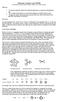 Molecular and VSEPR We gratefully acknowledge Portland ommunity ollege for the use of this experiment. Objectives To construct molecular models for covalently bonded atoms in molecules and polyatomic ions
Characteristics of blocking voltage for power 4H-SiC BJTs with mesa edge termination
 Vol. 31, No. 7 Journal of Semiconductors July 2010 Characteristics of blocking voltage for power 4H-SiC BJTs with mesa edge termination Zhang Qian( 张 倩 ), Zhang Yuming( 张 玉 明 ), and Zhang Yimen( 张 义 门
Unit 2 Periodic Behavior and Ionic Bonding
 Unit 2 Periodic Behavior and Ionic Bonding 6.1 Organizing the Elements I. The Periodic Law A. The physical and chemical properties of the elements are periodic functions of their atomic numbers B. Elements
Accuracy of the coherent potential approximation for a onedimensional array with a Gaussian distribution of fluctuations in the on-site potential
 Accuracy of the coherent potential approximation for a onedimensional array with a Gaussian distribution of fluctuations in the on-site potential I. Avgin Department of Electrical and Electronics Engineering,
New Approach to Analysis of the Switching Current Data in Ferroelectric Thin Films
 Ferroelectrics, 291: 27 35, 2003 Copyright c Taylor & Francis Inc. ISSN: 0015-0193 print / 1563-5112 online DOI: 10.1080/00150190390222510 New Approach to Analysis of the Switching Current Data in Ferroelectric
CHAPTER 6 REVIEW. Chemical Bonding. Answer the following questions in the space provided.
 Name Date lass APTER 6 REVIEW hemical Bonding SETIN 1 SRT ANSWER Answer the following questions in the space provided. 1. a A chemical bond between atoms results from the attraction between the valence
Lecture 6 Scanning Tunneling Microscopy (STM) General components of STM; Tunneling current; Feedback system; Tip --- the probe.
 Lecture 6 Scanning Tunneling Microscopy (STM) General components of STM; Tunneling current; Feedback system; Tip --- the probe. Brief Overview of STM Inventors of STM The Nobel Prize in Physics 1986 Nobel
Luminescence study of structural changes induced by laser cutting in diamond films
 Luminescence study of structural changes induced by laser cutting in diamond films A. Cremades and J. Piqueras Departamento de Fisica de Materiales, Facultad de Fisicas, Universidad Complutense, 28040
Chapter 8 Concepts of Chemical Bonding
 Chapter 8 Concepts of Chemical Bonding Chemical Bonds Three types: Ionic Electrostatic attraction between ions Covalent Sharing of electrons Metallic Metal atoms bonded to several other atoms Ionic Bonding
Solid State Theory Physics 545
 Solid State Theory Physics 545 CRYSTAL STRUCTURES Describing periodic structures Terminology Basic Structures Symmetry Operations Ionic crystals often have a definite habit which gives rise to particular
Test Review Periodic Trends and The Mole
 Test Review Periodic Trends and The Mole The Mole SHOW ALL WORK ON YOUR OWN PAPER FOR CREDIT!! 1 2 (NH42SO2 %N 24.1 %H 6.9 %S 27.6 %O 41.3 % Al %C 35.3 %H 4.4 %O 47.1 Al(C2H3O23 13.2 3 How many moles are
SUPERCONDUCTIVITY. PH 318- Introduction to superconductors 1
 SUPERCONDUCTIVITY property of complete disappearance of electrical resistance in solids when they are cooled below a characteristic temperature. This temperature is called transition temperature or critical