
OpenADR 2.0 Demand Response Program Implementation Guide
|
|
|
- Norman Fox
- 9 years ago
- Views:
Transcription

1 OpenADR 2.0 Demand Response Program Implementation Guide Revision Number: 1.0 Document Status: Released Document Number: The information within this document is the property of the OpenADR Alliance and its use and disclosure are restricted.

2 OpenADR 2.0 DR Program Guide CONTENTS 1 Introduction References Terms and Definitions Abbreviations Demand Response Program Types Deployment Scenarios Direct Direct Direct Direct Facilitator Aggregator Deployment Scenario and DR Program Mapping Selecting a DR Program Template Demand Response Program Templates Critical Peak Pricing Program (CPP) CPP DR Program Characteristics OpenADR Characteristics for CPP Programs Capacity Bidding Program Capacity Bidding DR Program Characteristics OpenADR Characteristics for Capacity Bidding Programs Thermostat Program Thermostat DR Program Characteristics OpenADR Characteristics for Thermostat Programs Fast DR Dispatch Fast DR Dispatch Program Characteristics OpenADR Characteristics for Fast DR Dispatch Programs Residential Electric Vehicle (EV) Time of Use (TOU) Program Residential EV TOU Program Characteristics OpenADR Characteristics for Residential EV TOU Programs Public Station Electric Vehicle (EV) Real-Time Pricing Program Public Station EV RTP Program Characteristics OpenADR Characteristics for Public Station EV RTP Programs Distributed Energy Resources (DER) DR Program Distributed Energy Resources (DER) Program Characteristics OpenADR Characteristics for Distributed Energy Resources (DER) Annex A - Sample Data and Payload Templates A.1 Critical Peak Pricing Program (CPP) A.1.1 CPP Scenario 1 - Simple Use case, A or B Profile A.1.2 CPP Scenario 2 - Typical Use Case, B profile A.1.3 CPP Scenario 3 - Complex Use Case A.1.4 CPP OadrDistributeEvent Payload - Typical B Profile Use Case A.2 Capacity Bidding Program (CBP) A.2.1 CBP Scenario 1 - Simple Use case, A or B Profile... 40
3 OpenADR 2.0 DR Program Guide A.2.2 CBP Scenario 2 - Typical Use Case, B profile A.2.3 CBP Scenario 3 - Complex Use Case A.2.4 CBP OadrDistributeEvent Payload - Typical B Profile Use Case A.3 Thermostat Program A.3.1 Thermostat Scenario 1 - Simple Use case, A or B Profile A.3.2 Thermostat Scenario 2 - Typical Use Case, B profile A.3.3 Thermostat Scenario 3 - Complex Use Case A.3.4 Thermostat OadrDistributeEvent Payload - Typical B Profile Use Case A.3.5 Thermostat Sample oadrregisterreport Payload - Typical B Profile Use Case A.3.6 Thermostat Sample oadrcreatereport Payload - Typical B Profile Use Case A.3.7 Thermostat Sample oadrupdate Report Payload - Typical B Profile Use Case A.4 Fast DR Dispatch A.4.1 Fast DR Scenario 1 - Simple Use case, A or B Profile A.4.2 Fast DR Scenario 2 - Typical Use Case, B profile A.4.3 Fast DR Scenario 3 - Complex Use Case A.4.4 Fast DR OadrDistributeEvent Payload - Typical B Profile Use Case A.4.5 Fast DR Sample oadrregisterreport Payload - Typical B Profile Use Case A.4.6 Fast DR Sample oadrcreatereport Payload - Typical B Profile Use Case A.4.7 Fast DR Sample Update Report Data Payload - Typical B Profile Use Case A.5 Residential Electric Vehicle (EV) Time of Use (TOU) Program A.5.1 Residential EV Scenario 1 - Simple Use case, A or B Profile A.5.2 Residential EV Scenario 2 - Typical Use Case, B profile A.5.3 Residential EV OadrDistributeEvent Payload - Typical B Profile Use Case A.6 Public Station Electric Vehicle (EV) Real-Time Pricing Program A.6.1 Public Station EV Scenario 1 - Typical Use Case, B profile A.6.2 Public Station EV OadrDistributeEvent Payload - Typical B Profile Use Case A.7 Distributed Energy Resources (DER) DR Program A.7.1 Public Station EV Scenario 1 - Typical Use Case, B profile A.7.2 Public Station EV OadrDistributeEvent Payload - Typical B Profile Use Case Annex B - Example Reports From Utility Pilots B.1 M&Vfor Rebates Report Payload Sample B.2 Smart Meter/AMI Interval Data Report Payload Sample Annex C - Services C.1 Open ADR supports the following services: Annex D - Payload Definitions D.1 EiEvent Payloads D.2 EiReport Payloads D.3 EiOpt Payloads D.4 EiRegisterParty Payloads D.5 OadrPoll Payloads... 73

4 OpenADR 2.0 DR Program Guide Annex E - Glossary of Schema Payload Elements Annex F Glossary of Enumerated Values F.1 eventstatus F.2 itemunits F.3 oadrdataquality F.4 oadrresponserequired F.5 optreason F.6 oadrtransportname F.7 OptType F.8 readingtype F.9 reportname F.10 reporttype F.11 scalecode F.12 signalname F.13 signaltype Annex G - OpenADR A and B Profile Differences Annex H - OpenADR Security Certificates... 87

5 OpenADR 2.0 DR Program Guide Introduction The target audience for this guide is utilities planning to deploy Demand Response (DR) programs that utilize OpenADR 2.0 for communicating DR event related messages between the utility and downstream entities, and the manufacturers of equipment that facilitate that communication exchange. It is assumed that the reader has a basic conceptual understanding of both demand response and OpenADR 2.0 (referred to simply as OpenADR from this point forward). The OpenADR profile specifications clearly define the expected behaviour when exchanging DR event related information, however there is enough optionality in OpenADR that the deployment of servers (VTNs) at the utility and clients (VENs) at downstream sites is not a plug-n-play experience. OpenADR characteristics such as event signals, report formats, and targeting must be specified on a DR program-by-program basis. There is no such thing as a standardized DR program. Each DR program design tends to be unique, fitting the structural and regulatory requirements of the geographic region it is deployed in. For each DR program there are numerous possible deployment scenarios involving a variety of actors. The variability in DR program designs, deployment scenarios, and OpenADR characteristics are an inhibitor to expanded deployment of DR and the use of OpenADR. This variability is for the most part a reflection of the fragmented and complex nature of the smart grid. Utilities need examples of typical DR programs so that they can be used as models for their own DR program implementations. Equipment manufacturers need to understand typical DR Program usage models so they can validate interoperability as part of the development process rather than on a DR program deployment specific basis. The intent of this guide is to accomplish both these goals as follows: Define a small set of standard DR Program templates modelled after the common characteristics of the most popular DR programs implemented to date Define a small set of deployment scenarios modelled after real world deployments, with actors and roles clearly identified Define best practices recommendations for OpenADR characteristics specific for each of the DR Program templates Provide a decision tree that utilities can use to identify the useful DR program templates and deployment scenarios based upon their business needs The emphasis in this guide will be on keeping things simple by providing a small set of clear recommendations that will address the majority of the details required to deploy a typical DR program, and to enable interoperability testing of equipment deployed in programs using the recommendations in this guide. 2 References OpenADR Profile Specification and schema Terms and Definitions The following terms and definitions are used in this document. Demand Response: A mechanism to manage customer load demand in response to supply conditions, such as prices or availability signals Aggregator Party This is a party that aggregates multiple Resources together and presents them to the DR Program Party as a single Resource in their DR Programs.

6 OpenADR 2.0 DR Program Guide Aggregator Intermediary Infrastructure - This is the infrastructure, separate from the Demand Side Infrastructure, which is used by the Aggregator Intermediary Party to interact with both the Resources and the grid side entities Agreement: A contractual agreement between parties playing a role in a DR program outlining responsibilities and compensation Asset A type of Resource that represents a specific collection of physical loads. Resources can be composed of Assets, and an Asset may be Resource, but Assets cannot be further decomposed into multiple Assets or Resources. Associated: Provide a programmatic association between two entities, through configuration of a device of database. For instance, associated resources with a VEN Baselines: The calculated or measured energy usage (demand) by a piece of equipment or a site prior to the event as determined by through surveys, inspections, and/or metering at the site. BMS This is the Building Management System that may be used to control resources. This is sometimes referred to as an Energy Management System. Compound Resource This is a special type of Resource that is an aggregation of multiple physical assets that each have their own means of load control. Customer Incentive: An inducement provided to the owner/aggregator of demand side resources for participation in a DR program. Demand Side Infrastructure This is the infrastructure that houses the Resources that are enrolled in the DR Programs DR Logic: Algorithms or logic that convert DR signals into actionable load control. Note that DR Logic may be implemented in many different locations and in some case be distributed among multiple sub-systems. DR Program Party this is the entity that is responsible for the Grid Infrastructure and furthermore for managing the DR Programs used to mitigate grid issues. This is typically a Utility or ISO. Enrolled: The owner/aggregator of demand side resources elects to participate in a DR program and may provide information about the specific resources that may be targeted for DR events Event Active Period: The is the period in the of time during which a change in the load profile is being requested as part of a DR Event Event Constraints: The time frames during which the customer can expect to receive events and related constraints such as no events on weekends or consecutive days Event Days: A day when an DR event occurs. Most programs have limitations as to the number of event days that are allowed in a given calendar period Event Descriptor: Part of the OpenADR event object that describes metadata about the event, such as program name and event priority Event Duration: The length of the event. Most programs define constraints as to the length of an event, as well as the hours of the day during which the event can occur Event Signals: The actionable information contained in an event such as electricity pricing or specific levels of load shed requested that typically trigger some preprogrammed load shed behavior by the recipient of the event. A DR program definition should specify the types of event signals used
7 OpenADR 2.0 DR Program Guide Event Targeting: The load shedding resources that are the intended recipient for the DR event. The may be a geographic area, a particular class of devices, a group identifier, resource ID, or other identifier. A DR program definition should specify how specific resources are going to be targeted. Events: An event is a notification from the utility to demand side resources requesting load shed starting at a specific time, over a specified duration, and may include targeting information designating specific resources that should participate in the event Facilitator Intermediary Infrastructure This is the infrastructure, separate from the Demand Side Infrastructure, which is used by the Facilitator Intermediary Party to interact with both the Resources and the grid side entities. Facilitator: A third party that manages some or all of the execution of the DR program on behalf of the utility Grid Infrastructure This is the infrastructure that is owned or managed by the DR Program Parties. This infrastructure includes the implementation of the OpenADR VTN that is used to send DR signals to Resources enrolled in the DR Programs Intermediary Party This is a party that typically works on behalf of the Resource Party to facilitate their participation in DR Programs. Load Control this is the infrastructure related to a Resource that is responsible for actually controlling the Resource and producing a specific load profile. Load Profile Objective: This motivation behind developing a DR program and issuing events. Such as the desire to shave peak loads. Notification: A period of time prior to the start time of an event where the demand side resource owner is notified of a pending event Opt Behaviour: The expected response from the demand side resource owner upon receipt of an event. This response may take the form of and OptIn or OptOut indication whether or not resource will participate in the event Opt Responses: Whether a specific program should require a response from demand side resources in response to an event, and what those responses typically are. Opt Services: Schedules communicated over OpenADR to indicate temporary changes in resource availability to participate in events. Prerequisite: Criteria that must be met in order for a demand side resource owner to enroll in a DR program. This may include the availability of interval meeting or some minimum load shed capacity Primary Drivers: The primary motivation on the part of the utility for creating the DR program and issuing events. Such as " Peak demand reduction and resource adequacy" Programs These are the DR Programs that the Resources are enrolled in. Program Description: A narrative description of how a program works. Part of the DR Program templates defined in this document Program Time Frame: The time of the year or seasons during with a DR program is typically active Rate Design: The specific modifications to the rate structure or incentives paid to motivate demand side resource owners to participate in the program

8 OpenADR 2.0 DR Program Guide Registration Services: Service used by the OpenADR protocol to establish basic interoperability between a VTN and VEN, and to validate that the VEN is associated with the utility customers account. Reporting Services: Service used by the OpenADR to enable VENs to provide reporting to VENs. DR Program should specify the reporting requirements for the program. Resource Party This is the party that owns the demand side Resources that may be enrolled in DR Programs Resource This is the entity that is enrolled in the DR Programs and is capable of delivering some sort of change to their load profile in response to receiving a DR signal from a VTN. Target Customer: The profile of demand side resources that may enroll in a specific DR programs such as residential, industrial, or perhaps based on level of electricity consumption. Target Loads: The demand side resources whose load should be modified upon receipt of a VEN This is the OpenADR Virtual End Node that is used to interact with the VTN. VTN This is the OpenADR Virtual Top Node that is used to interact with the Resources enrolled in the DR Programs. 4 Abbreviations BMS: Building Management System C&I: Commercial and Industrial Comm: Communications between two entities DR: Demand Response EMS: Energy Management System OpenADR: Open Automated Demand Response Programs: Reference to a Demand Response Program(s) VEN: Virtual End Node VTN: Virtual Top Node 5 Demand Response Program Types This document contains templates for the DR programs shown below. 1. Critical Peak Pricing: Rate and/or price structure designed to encourage reduced consumption during periods of high wholesale market prices or system contingencies by imposing a pre-specified high rate or price for a limited number of days or hours. 2. Capacity Bidding Program: A program which allows a demand resource in retail and wholesale markets to offer load reductions at a price, or to identify how much load it is willing to curtail at a specific price.

9 OpenADR 2.0 DR Program Guide Thermostat Program/Direct Load Control: A demand response activity by which the program sponsor remotely controls a customer s electrical equipment (e.g. air conditioner) on short notice. These programs are primarily offered to residential or small commercial customers. 4. Fast DR Dispatch/Ancillary Services Program: A demand response program that provides incentive payments to customers for load response during an Emergency Demand Response Event. An abnormal system condition (for example, system constraints and local capacity constraints) that requires automatic or immediate manual action to prevent or limit the failure of transmission facilities or generation supply that could adversely affect the reliability of the Bulk Electric System. These type of programs may sometimes be referred to as Ancillary Services. 5. Electric Vehicle (EV) DR Program: A demand response activity by which the cost of charging electric vehicles is modified to cause consumers to shift consumption patterns. 6. Distributed Energy Resources (DER) DR Program: A demand response activity utilized to smooth the integration of distribute energy resources into the smart grid. 6 Deployment Scenarios The way in which a DR program is deployed is somewhat independent of the characteristics of the DR program itself. The following diagrams show a variety of ways in which a DR program might be deployed. The following section provides a cross reference between the deployment scenarios and the DR Programs they are most likely to be utilized with. Altough the enrollment process in not currently defined as part of the OpenADR Profile Specification, the followinig narritave regarding the relationship between VENs, resources, and assets may be helpful when viewing the diagrams in this section that show the relationships between the entities in the various scenarios. The most fundamental entity in a DR program from a Utility perspective is a "resource". It is completely up to the utility to define what a resource is based upon their program design. It might be a single customer load behind a meter, a collection of customer loads behind an aggregator or something as specific as a thermostat. Resources are what are enrolled in DR programs and is the fundamental entity that the Utility interacts with. There is the notion of "assets" which are the physical entities that comprise a resource and are what may be managed by the VEN or some control system behind the VEN. In general the Utility does not interact directly with assets, BUT they may interact with resources in such a way to provide some level of guidance concerning how a resource"s assets should be utilized as part of a dispatch. What this means is that the Utility does not know how to communicate with specific assets (if they did then they would probably be resources), but they could for example tell a resource to only use assets in a specific geographic location or perhaps to only use assets of a specific type. This was specifically supported to allow the Utility to treat an aggregator as a single resource, but also allows the Utility to instruct the aggregator on how to dispatch their portfolio without having to know what assets are in that portfolio. It can also be used to support programs where the customer is only allowed to use certain types of assets (e.g. thermostats), but each thermostat is not being considered an individual resource. A VEN is NOT a resource, it is a way of communicating about resources. There may be one or more resources behind a VEN. In general the Utility will know what resources are associated with a VEN if it is sending a specific message to a specific VEN. When a utility sends out an EiEvent message they can either explicitly specify which resources they are targeting by putting them in the message or they can implicitly target them

10 OpenADR 2.0 DR Program Guide by specifying some other target attribute such as zone or location that can be resolved into one or more resources by the VEN. Note that sending an EiEvent message to a VEN without any further target qualifiers is just a short hand notation for specifying all resources behind a VEN. In addition to providing a means to resolve resources the target attribute can provide further instruction on how a resource should dispatch its assets. If an EiEvent message contains both a specific resource ID and a target specification such as location then this notion is explicit. It is less so if there is only a target specification such as location, but no specific resource identified. 6.1 Direct 1 This is a simple scenario in which there is a direct relationship between the DR Program Party and the Resource Party. The Resource Party is responsible for enrolling their own Resources into the DR Programs and the Grid Infrastructure interacts directly with the Resources via a VEN that resides within the Demand Side Infrastructure. Furthermore the VEN is owned by the Resource Party and is separate from the Resources and their controllers. When a DR signal is received by the VEN it typically does not implement any load control logic, but simply forwards the signals to the load controllers who take the appropriate action. Examples of this scenario would include C&I buildings that may install a gateway that contains an OpenADR VEN and when a signal is received by that gateway it simply translates it into some other protocol and forwards to the load controllers themselves.

11 OpenADR 2.0 DR Program Guide Direct 2 This is very similar to the Direct 1 scenario. The main difference being in how the VEN is instantiated and the interactions with the VTN facilitated. The VEN is instantiated in an entity like a centralized BMS that can implement DR logic and interact with Compound Resource and their many different load controllers from a more centralized location. Examples include large buildings with a BMS that control many different loads in a building (e.g. lighting, HVAC, industrial processes, etc.) to campuses that may have multiple facilities with a centralized control system.

12 OpenADR 2.0 DR Program Guide Direct 3 This scenario is very similar to the Direct 1 scenario. The main difference being that the VEN is instantiated directly in the resource and its load controller. In this case the DR signals are sent directly to the resource and its load controller. The so called prices to devices scenario falls into this category. Examples would include any sort of load controller such as HVAC (i.e. thermostat) that has an embedded VEN that is capable of interacting directly with the grid side entities VTN.

13 OpenADR 2.0 DR Program Guide Direct 4 This is a combination of sorts of the Direct 1 and Direct 2 scenarios. The main difference being that multiple VEN s are associated with a single Compound Resource that is comprised of multiple assets with their own load controllers. Each of the load controllers that comprise the Compound Resource may be associated with a different VEN. Note that all the VEN s would be under control of the same Resource Party that owns the Compound Resource. This scenario exists in order to facilitate Demand Side Infrastructures that have Compound Resources, but do not have a centralized BMS like the Direct 2 scenario. Examples might include buildings with different load controllers on each floor, but no centralized BMS, or campuses with different controllers in each building, but no campus wide controller. Since from the DR Program Party s perspective there is only a single resource enrolled in the program when it wants to send a DR signal to the resource it may simply send the same signals to each of the designated VENs that have been associated with the Resource.

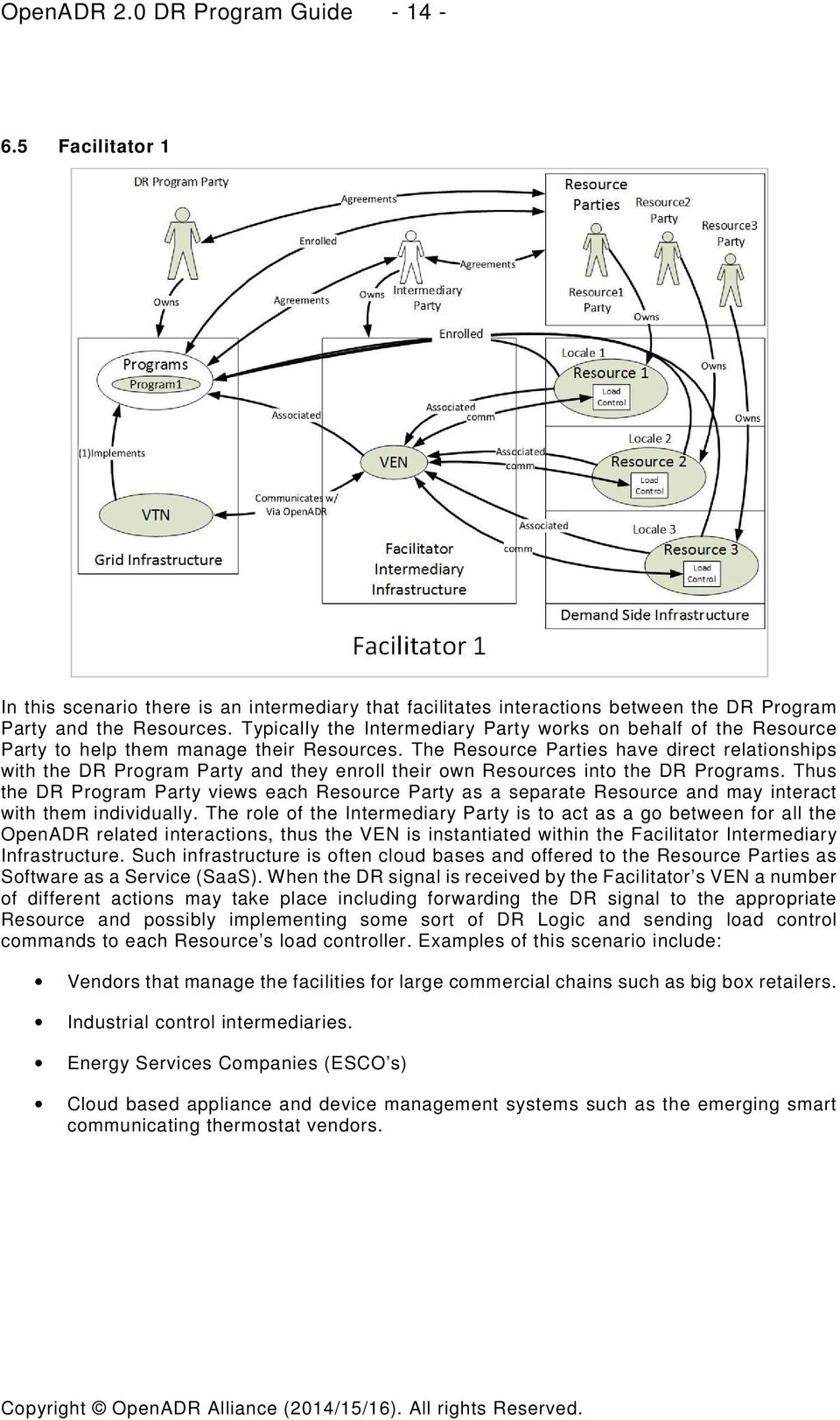
14 OpenADR 2.0 DR Program Guide Facilitator 1 In this scenario there is an intermediary that facilitates interactions between the DR Program Party and the Resources. Typically the Intermediary Party works on behalf of the Resource Party to help them manage their Resources. The Resource Parties have direct relationships with the DR Program Party and they enroll their own Resources into the DR Programs. Thus the DR Program Party views each Resource Party as a separate Resource and may interact with them individually. The role of the Intermediary Party is to act as a go between for all the OpenADR related interactions, thus the VEN is instantiated within the Facilitator Intermediary Infrastructure. Such infrastructure is often cloud bases and offered to the Resource Parties as Software as a Service (SaaS). When the DR signal is received by the Facilitator s VEN a number of different actions may take place including forwarding the DR signal to the appropriate Resource and possibly implementing some sort of DR Logic and sending load control commands to each Resource s load controller. Examples of this scenario include: Vendors that manage the facilities for large commercial chains such as big box retailers. Industrial control intermediaries. Energy Services Companies (ESCO s) Cloud based appliance and device management systems such as the emerging smart communicating thermostat vendors.
15 OpenADR 2.0 DR Program Guide Aggregator 1 This scenario is similar to the Facilitator scenario. The main difference being that the Aggregator Party has the relationship with the DR Program Party as opposed to the Resource Parties. The Aggregator Party aggregates multiple customer Assets into a single Resource that it enrolls into the DR Programs. The DR Program Party does not have visibility into the individual Assets the Aggregator is managing. As with the Facilitator the Aggregator has their own infrastructure where the VEN is instantiated. The difference being that when a DR signal is received it references a single resource and the Aggregator implements some sort of DR logic over all the Assets in their portfolio to achieve the objectives specified in the DR signal.

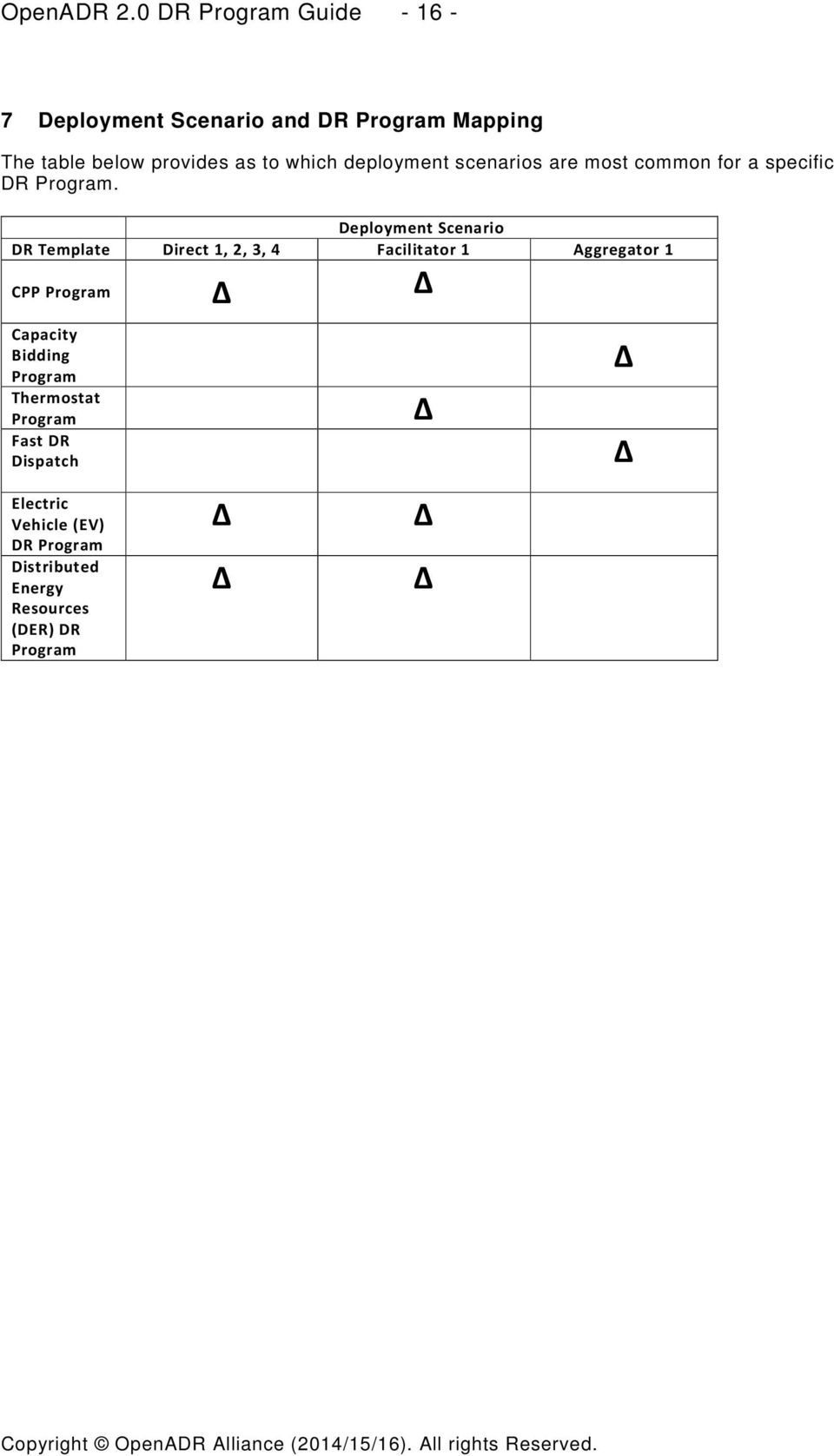
16 OpenADR 2.0 DR Program Guide Deployment Scenario and DR Program Mapping The table below provides as to which deployment scenarios are most common for a specific DR Program. Deployment Scenario DR Template Direct 1, 2, 3, 4 Facilitator 1 Aggregator 1 CPP Program Capacity Bidding Program Thermostat Program Fast DR Dispatch Electric Vehicle (EV) DR Program Distributed Energy Resources (DER) DR Program
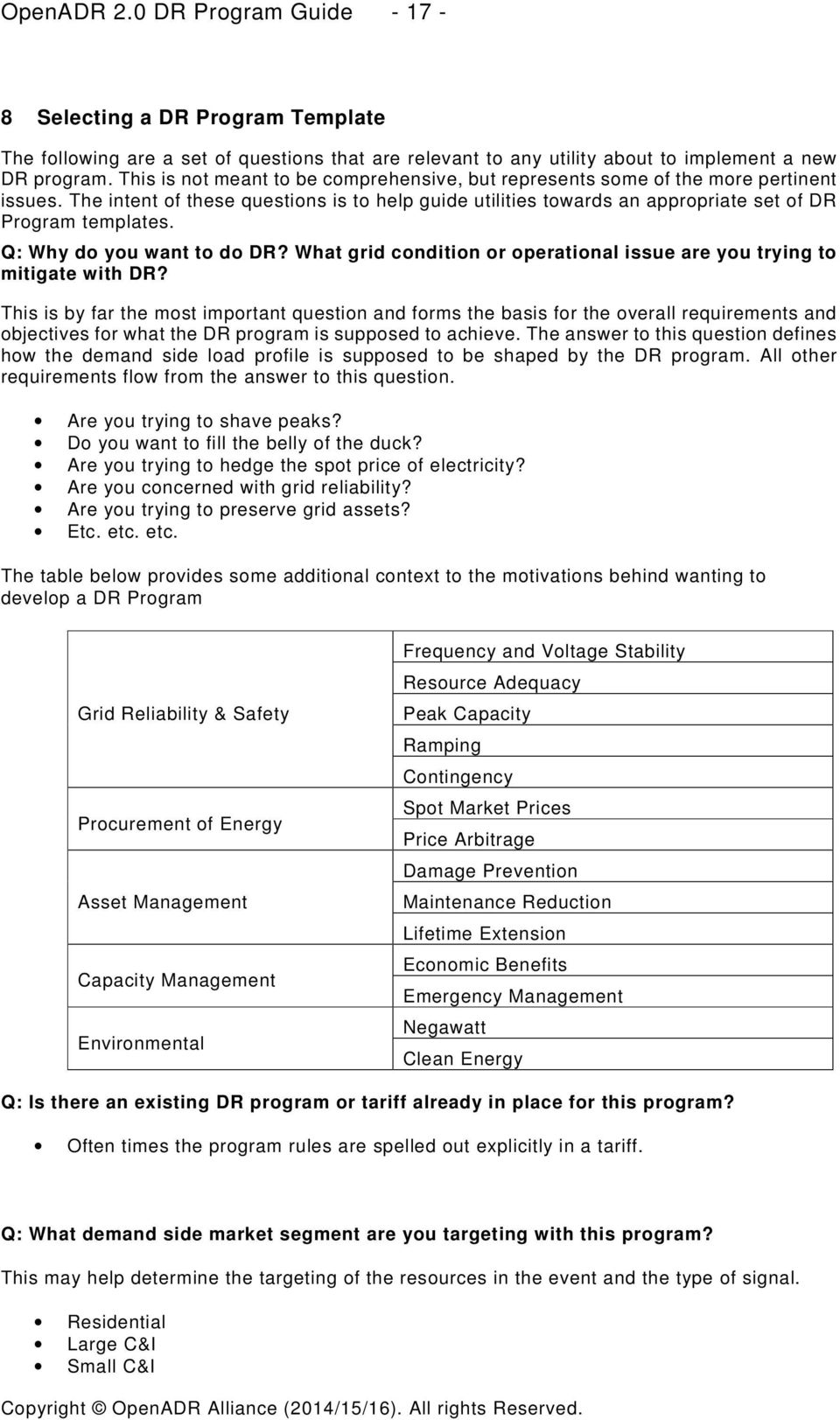
17 OpenADR 2.0 DR Program Guide Selecting a DR Program Template The following are a set of questions that are relevant to any utility about to implement a new DR program. This is not meant to be comprehensive, but represents some of the more pertinent issues. The intent of these questions is to help guide utilities towards an appropriate set of DR Program templates. Q: Why do you want to do DR? What grid condition or operational issue are you trying to mitigate with DR? This is by far the most important question and forms the basis for the overall requirements and objectives for what the DR program is supposed to achieve. The answer to this question defines how the demand side load profile is supposed to be shaped by the DR program. All other requirements flow from the answer to this question. Are you trying to shave peaks? Do you want to fill the belly of the duck? Are you trying to hedge the spot price of electricity? Are you concerned with grid reliability? Are you trying to preserve grid assets? Etc. etc. etc. The table below provides some additional context to the motivations behind wanting to develop a DR Program Grid Reliability & Safety Procurement of Energy Asset Management Capacity Management Environmental Frequency and Voltage Stability Resource Adequacy Peak Capacity Ramping Contingency Spot Market Prices Price Arbitrage Damage Prevention Maintenance Reduction Lifetime Extension Economic Benefits Emergency Management Negawatt Clean Energy Q: Is there an existing DR program or tariff already in place for this program? Often times the program rules are spelled out explicitly in a tariff. Q: What demand side market segment are you targeting with this program? This may help determine the targeting of the resources in the event and the type of signal. Residential Large C&I Small C&I
18 OpenADR 2.0 DR Program Guide Agriculture Water management Electric Vehicles Etc, etc, etc Q: Are you trying to target specific types of loads? Thermostats Electric vehicles Ag pumps etc. Q: What is your deployment model? The answer to this question can influence how resources are defined within the program and determine how those resources are targeted within events. Direct to customers Through intermediaries like aggregators or facilitators Customer responsible for procuring and deploying their own VEN equipment? etc. Q: At what level of specificity do you want to interact with the demand side loads? This question is somewhat related to the deployment model and determines how the resources in the program are defined and targeted. It is one of the most important and possibly complex questions. Interact with each individual resource Interact through a facilitator or aggregator with no specification of the resources behind them Interact through a facilitator or aggregator AND specify which resources behind them should be dispatched Use location as an attribute to specify resources Use some sort of utility defined grouping mechanism to specify resources Target individual assets such as thermostats Interact with no resources at all and just broadcast DR events etc. Q: What interaction pattern do you want to employ to influence your customers load profiles? This question determines the type of DR signals that will be sent to participants in a program. Incentives (e.g. dynamic pricing) Load dispatches (e.g. ancillary services) Direct load control Generic event signal etc. Q: What is the general resource scheduling attributes of the program? Dates and times that events may be called Frequency of events Duration of events Allowable latencies for the propagation of events etc. Q: How is the availability of resources in the program determined?

19 OpenADR 2.0 DR Program Guide By strict program rules As part of some nomination or bidding process done by the resource Opt In/Out allowed? etc. Q: What type of visibility do you need into the resource s performance? This is a very broad question and determines what type of information is fed back from the resources in the DR program. In general this determines the type of reports that are required. Online/Offline Usage (current and/or historical) Load response potential Load availability Load/asset state (current and/or historical) Etc., etc. etc.

20 OpenADR 2.0 DR Program Guide Demand Response Program Templates 9.1 Critical Peak Pricing Program (CPP) CPP DR Program Characteristics Load Profile Objective Primary Drivers Program Description Customer Incentive Rate Design -Peak demand reduction -Reduced capital expenditures and reduced energy costs When utilities observe or anticipate high wholesale market prices or power system emergency conditions, they may call critical events during a specified time period (e.g., 3 p.m. 6 p.m. on a hot summer weekday), the price for electricity during these time periods is substantially raised. Customers may be offered discounted energy prices during non-peak times as an incentive to participate in the program. CPP is a price program with rates increasing during critical peaks in energy consumption. Typically CPP rates are an adder or multiplier to flat, tiered, or TOU base rates. Target Customer -Residential or C&I Target Load Prerequisite Program Time Frame -Any -Customer must have interval metering -C&I customers may have to meet a demand criterion -Typically spans months of the year where peak energy consumption occurs, although may be year round in some cases. Event Constraints -Typically Monday through Friday, excluding holidays, with consecutive day events typically allowed Event Days -Typically 9 to 15 per year Event Duration -Typically during a fixed time frame for all events ranging from 4 to 6 hours during the highest energy consumption times of the day. Notification Opt Behavior Certification Events -Typically day ahead -Typically customers are not required to participate in events -Typically none

21 OpenADR 2.0 DR Program Guide OpenADR Characteristics for CPP Programs Event Signals -A SIMPLE signal with levels 1 to 3 mapped to the pricing impact of the CPP event. If a CPP program has a single pricing component it should be mapped to level 1. For CPP programs with multiple pricing components, the smallest price component should be mapped to level 1, with the other price components mapped to levels 2 and 3 in increasing degree of pricing impact. -If the deployment supports B profile VENs, in addition to the SIMPLE signal, an ELECTRICITY_PRICE signal may be included in the payload with a type of pricerelative, priceabsolute, or pricemultiplier depending on the nature of the program. See Annex A for examples. Opt Responses -VTNs sending events should set the oadrresponserequired element to "always", requiring the VEN to respond with an optin or optout -As participation in a CPP program is a "best effort" exercise, there is no formal meaning to optin or optout beyond a courtesy availability indication of intent to participate. We recommend that VENs respond with optin unless there has been some specific override action taken by the customer. -The oadrcreateopt payload would typically not be used to qualify resources participating in events. Event Descriptor -The event priority should be set to 1 unless the program rules or VTN configuration specify otherwise -Test events are typically not used with CPP programs. However if they are allowed the testevent element should be set to "true" to indicate the test event. If additional parameterized information is required in this element it can follow "true" separated by a space with this additional information. Event Active Period Baselines Event Targeting Reporting Services - eirampup, eirecovery, tolerance elements are typically not used -Baselines are typically not included in the event payload -CPP programs typically don't differentiate between resources for a given customer. Targeting typically specifies the venid, indicating that all the resources associated with the VEN should participate, or a list of all the resourceids associated with VEN. -Telemetry reporting is typically not used as it is not absolutely necessary for CPP programs. Refer to Annex B for examples of reports from utility pilots that might be applicable to this type of program.
22 OpenADR 2.0 DR Program Guide Opt Services -Use of the Opt service to communicate temporary availability schedules typically would not be used as part of a CPP program. However, some deployments could use this service to preserve available event days for customers who indicate lack of availability. Registration Services Polling intervals requested by the VTN for typical day-ahead CPP programs are not required to be more frequent that once an hour. However, the use of polling for heartbeat detection may require more frequent polling.
23 OpenADR 2.0 DR Program Guide Capacity Bidding Program Capacity Bidding DR Program Characteristics Load Profile -Peak demand reduction and resource adequacy Objective Primary Drivers -Reduced capital expenditures and reduced energy costs Program Description The capacity bidding program is used by ISO/utilities to obtain precommitted load shed capacity from aggregators or self aggregated customers. This pre-committed load shed capacity is utilized by ISO/utilities when they observe or anticipate high wholesale market prices, power system emergency conditions, or as part of normal energy resource utilization by calling DR events during a specified time period. Note that each aggregator is typically responsible for designing their own demand response program as well as customer acquisition, and event notification in order to meet the capacity commitments made as part of this program. Customer Incentive Rate Design Aggregators/customers receive two types of incentives. First, they receive a capacity payment for holding a specific amount of load shed capacity available for DR events during a future time window. Second, if an event is called during the future time window an energy payment may be made for load shed over the duration of the event. Participants in the program make a "capacity nomination" bid indicating the load shed capacity they are willing to hold as available during a future time window. The bid may also include the incentive the aggregator/customer is willing to accept for load shed below a baseline value. In utility markets the capacity commitment is typically for the next calendar month, although much longer time frames are used in ISO markets. As part of the capacity nomination, the customer may be able to chose between a number of characteristics including dayahead or day-of notification and the event duration window (such as 1-4 hours, 2-6 hours,...). A capacity payment is made to the customer for this pre-commitment even if there are no events called during the time window. If an event is called during the time window the customer may receive an energy payment for the load shed in relation to a baseline, however penalties may apply if less than the pre-committed load shed capacity is delivered at the time the event is called. Target Customer -Aggregators and self aggregated C&I customers Target Loads - Any
24 OpenADR 2.0 DR Program Guide Prerequisite -Customer must have interval metering -C&I customers may have to meet a demand or bid criterion Program Time -Anytime Frame Event Constraints -Typically Monday through Friday, excluding holidays, with consecutive day events typically allowed Event Days Event Duration Notification Opt Behavior Certification Events -Typically a maximum of 30 hours per month -Typically during a fixed time window for all events during the highest energy consumption times of the day.). Event duration varies by customer capacity commitment with preferences ranging from 1 to 8 hours or as specified by the design of the program -Day-ahead or day-of depending on customer capacity commitment preferences or the design of the program -Typically customers would opt-in to events given that as they have pre-committed load shed capacity. -Typically two per year (Test) OpenADR Characteristics for Capacity Bidding Programs Event Signals -A SIMPLE signal with levels 1 to 3 mapped to the amount of load shed. If the program only supports a single level of load shed, that should be mapped to level 1. For programs with multiple levels of load shed, the smallest change from normal operation should be mapped to the level 1, with the load shed values mapped to levels 2 and 3 in increasing degree of load shed. -If the deployment supports B profile VENs, in addition to the SIMPLE signal, a BID_LOAD and/or BID_PRICE signal may be included in the payload with signal types of setpoint and price, and units of powerreal and currencyperkw respectively. The BID_LOAD would reflect the requested load shed up to capacity amount bid by the aggregator/customer, and the BID_PRICE would reflect the incentive bid by the aggregator/customer. See Annex A for examples. Opt Responses -VTNs sending events should set the oadrresponserequired element to "always", requiring the VEN to respond with an optin or optout -As aggregators/customers have pre-committed capacity VENs should respond with optin. An opt out may be sent in response to the event, but this is an informal availability indication, not a formal opt out of the event.
25 OpenADR 2.0 DR Program Guide The oadrcreateopt payload would typically not be used to qualify resources participating in events as typically the load is a single aggregated entity. Event Descriptor -The event priority should be set to 1 unless the program rules or VTN configuration specify otherwise -Test events may be used with Capacity Bidding programs. If they are allowed, the testevent element should be set to "true" to indicate the test event. If additional parameterized information is required in this element it can follow "true" separated by a space with this additional information. Event Active Period Baselines Event Targeting Reporting Services - eirampup, eirecovery, tolerance elements are typically not used -Baselines are typically not included in the event payload as this data typically not available at the time the event is initiated. However, both utilities and aggregators/customers would view the inclusion of baseline information in events as useful. -Capacity Bidding programs typically don't differentiate between resources for a given customer. Targeting typically specifies the venid, indicating that all the resources associated with the VEN should participate, or includes a resourceid representative of the aggregated load associated with VEN. ISO Capacity Bidding programs typically require TELEMETRY_USAGE reports with powerreal data points. See examples in Annex A. Telemetry reporting for utility Capacity Bidding typically is not required. Note that telemetry reporting requires B profile VENs. Refer to Annex B for examples of reports from utility pilots that might be applicable to this type of program. Opt Services -Use of the Opt service to communicate temporary availability schedules typically would not be used as part of a Capacity Bidding program as customers have pre-committed their availability. However, this service may be useful as an informal way for participants to indicate a lack of availability for extenuating reasons such as equipment failure. Registration Services Polling intervals requested by the VTN for typical day-ahead programs are not required to be more frequent that once an hour. However, the use of polling for heartbeat detection or day-of programs may require more frequent polling.
26 OpenADR 2.0 DR Program Guide Thermostat Program This program is representative of Direct Load Control (DLC) where the Demand Response signal directly modifies the behavior of load shedding resources, without a layer of abstraction between receipt of the signal and the specific load shedding action taken Thermostat DR Program Characteristics Load Profile Objective Primary Drivers -Peak demand reduction -Reduced capital expenditures and reduced energy costs Program Description -When utilities observe or anticipate high wholesale market prices or power system emergency conditions, they may initiate an event that modifies the behavior of the customer's programmable communicating thermostat (PCT) over a specified time period (e.g., 3 p.m. 6 p.m. on a hot summer weekday) in order to reduce energy consumption. -The change to the PCT behavior in response to the event may be a simple change in temperature setpoint for the duration of the event or a more complex set of changes, including pre-cooling, that minimize the impact of the event on the customer's comfort level. Customer Incentive Rate Design -Incentives take two general forms. First, customers may be provided with a free PCT or offered discounts/rebates on customer purchased PCTs as an incentive to enroll in the DR program. Second, customers may receive an ongoing annual stipend for continued enrollment in the program. Less common would be ongoing incentives paid to customers based upon actual energy reduction during events. -Primarily an incentive program, where customers receive discounted or free PCT's for enrolling in the DR program. Some programs may pay a periodic stipend or incentive payments based upon energy reduction during events. Target Customer -Residential or small commercial Target Load Prerequisite Program Time Frame -HVAC -Typically none, as customers receive a PCT as part of the program enrollment -Typically spans months of the year where peak energy consumption occurs, although may be year round in some cases. Event Constraints -Typically Monday through Friday, excluding holidays, with consecutive day events typically allowed. Event Days -Typically 9 to 15 per year
27 OpenADR 2.0 DR Program Guide Event Duration -Events could occur at any time, with durations ranging from 2 to 4 hours, although typically events occur during the highest energy consumption times of the day. Notification Opt Behavior Certification Events -Typically day ahead, although some programs may have notification times as short as 10 minutes. -Customers are not required to participate in events, however they will automatically be opted in to events unless they take action to override the event or make manual adjustments to temperature during the event. -Typically none OpenADR Characteristics for Thermostat Programs Event Signals -A SIMPLE signal with levels 1 to 3 mapped to the change in PCT temperature setpoint offsets or thermostatic cycling percentage. If a residential thermostat program has a single offset/cycling component it should be mapped to level 1. For programs with multiple offset/cycling components, the smallest change from normal operation should be mapped to the level 1, with the other offset/cycling values mapped to levels 2 and 3 in increasing degree of load shed impact. -If the deployment supports B profile VENs, in addition to the SIMPLE signal, a LOAD_CONTROL signal may be included in the payload with a type of x-loadcontrolleveloffset or x-loadcontrolcapacity to specify the desired temperature setpoint offset or thermostatic cycling percentage respectively. It is recommenced that a unit type of "temperature" be used in payloads utilizing the x- loadcontrolleveloffset signaltype to indicate Celsius or Fahrenheit for the offset. See Annex A for examples. Opt Responses -VTNs sending events should set the oadrresponserequired element to "always", requiring the VEN to respond with an optin or optout - VENs Should respond with optin unless there has been some specific override action taken by the customer. -The oadrcreateopt payload may be used by VENs to qualify the participation of resources in an event. For instance, an event may target the resourceid's of two thermostats that control separate HVAC systems. If the customer decides that only one of the HVAC systems can participate in the event, this would get communicated to the VTN using the oadrcreateopt payload. Note that the oadrcreateopt payload is only supported by B profile VENs
28 OpenADR 2.0 DR Program Guide Event Descriptor -The event priority should be set to 1 unless the program rules or VTN configuration specify otherwise -Test events are typically not used with Residential Thermostat programs. However if they are allowed the testevent element should be set to "true" to indicate the test event. If additional parameterized information is required in this element it can follow "true" separated by a space with this additional information. Event Active Period -Randomization is typically used for residential thermostat events using the tolerance element - eirampup and eirecovery elements are typically not used Baselines Event Targeting Reporting Services -Baselines are typically not included in the event payload -Residential Thermostat programs target HVAC resources controlled by PCTs. Targeting typically specifies the resourceids of the HVAC systems (i.e. the thermostat) associated with VEN or the venid with the event signal device class target set to Thermostat -Telemetry reporting is typically not used in residential Thermostat Programs. However, telemetry status reports for small commercial Thermostat programs may be required, reporting at a minimum current setpoint offset of the thermostats which control the load shedding resources, as well as online/override status. Additional reporting data points may include: -Current Temp -Heat Temp Setting -Cool Temp Setting -HVAC Mode Setting -Current HVAC Mode -Fan Mode Setting -Current Hold Mode -Current Away Mode -Current Humidity See Annex A for example. Refer to Annex B for examples of reports from utility pilots that might be also be applicable to this type of program. Opt Services Registration Services -Use of the Opt service to communicate temporary availability schedules typically would not be used as part of a CPP program. Polling intervals requested by the VTN for typical day-ahead Residential Thermostat programs are not required to be more frequent that once an hour. However, the use of polling for heartbeat
29 OpenADR 2.0 DR Program Guide detection may require more frequent polling as would residential thermostat programs with substantially shorter notification times. 9.4 Fast DR Dispatch Fast DR Dispatch Program Characteristics Load Profile -Dispatch resources to achieve load response in real-time Objective Primary Drivers -Grid reliability and ancillary services Program Description Fast DR is used by ISO/utilities to obtain pre-committed load response in real-time. This pre-committed load response is utilized by ISO/utilities when they observe conditions that require immediate action to maintain the stability and integrity of the grid. Real-time means that resources are typically dispatched with a latency ranging from 10 minutes for resources that are used as reserves to 2 seconds for resources that are used for regulation purposes. The size of the load response must be large enough to make a difference in mitigating the grid condition and thus resources are typically very large and often managed by aggregators as part of an aggregated resource. Minimum sizes for the load response for a resource to qualify to participate in ancillary services are typically around 500 kw, but can be as low as 100 kw for some programs. Note that if the resource is used as a reserve it will typically be called upon to decrease (i.e. shed) load, but if it is being used for regulation purposes it may be dispatched to either increase or decrease load. Customer Incentive Rate Design Aggregators/customers typically receive two types of incentives. First, they receive a payment for committing and making available a specific amount of load response available for DR events during a future time window. The amount of load response, the time window of availability and the amount to be paid is typically set by the aggregator/customer. Second, if an event is called during the future time window a payment based upon the amount of load response over the duration of the event. Participants in the program submit a bid indicating the load response they are willing to make available during a future time window. The bid typically also includes the payment the aggregator/customer is willing to accept for the load response. In utility/iso markets the bid is typically submitted either the day ahead or the day of the time period for which the commitment is being made. As part of their qualification and registration in the markets various performance envelops parameters are associated with the resource such as ramp rate and min and max operating limits. Such parameters govern how it will be dispatched.
30 OpenADR 2.0 DR Program Guide If a participant s bid is accepted a payment may be made to the customer for their pre-commitment even if there are no events called during the time window. If an event is called during the time window the customer may receive additional payments for their performance during the event. Such performance based payments may be based on a number of factors including amount energy, power, how closely the resource follows the dispatch instructions, and a mileage payment which reflects how much their load profile was required to change during the event. Some of these parameters such as energy and power may be with respect to a baseline. Target Customer -Aggregators and self-aggregated C&I customers Target Loads - Those which can respond to real-time dispatches. Prerequisite -Customer must have interval metering -Must meet minim size requirements for the load response -Must be able to respond to real-time dispatches -Typically have to supply real-time telemetry that shows the current load response Program Time -Anytime Frame Event Constraints -none Event Days Event Duration Notification Opt Behavior Certification Events -none -Typically short (less than 30 minutes), but in any case will never exceed the time window that the participant made the resource available when they submitted their bid. -none -Customers are opted in to events by default given that they have precommitted load response -Typically one per year (Test) OpenADR Characteristics for Fast DR Dispatch Programs Event Signals -A SIMPLE signal with levels 1 to 3 mapped to the amount of load response. If the program only supports a single level of load response, that should be mapped to level 1. For programs with mutiple levels of load response, the smallest change from normal operation should be mapped to the level 1, with the load shed values mapped to levels 2 and 3 in increasing degree of load response. -If the deployment supports B profile VENs, in addition to the SIMPLE signal, a dispatch in the form of a LOAD_DISPATCH signal may be included in the payload with signal types of setpoint or delta, and
31 OpenADR 2.0 DR Program Guide units of powerreal. This signal represents the desired operating point of the load and can be expressed either as an absolute amount of mw (i.e. setpoint) or some relative number of mw (i.e. delta) from the resources current operating point. See Annex A for examples. Opt Responses -VTNs sending events should set the oadrresponserequired element to "always", requiring the VEN to respond with an optin or optout -As aggregators/customers have pre-committed capacity VENs should respond with optin. An opt out may be sent in response to the event, but this is an informal availability indication, not a formal opt out of the event. -The oadrcreateopt payload would typically not be used to qualify resources participating in events as typically the load is a single aggregated entity. Event Descriptor -The event priority should be set to 1 unless the program rules or VTN configuration specify otherwise -Test events may be used, especially during the registration and qualification of a resource. If they are allowed, the testevent element should be set to "true" to indicate the test event. If additional parameterized information is required in this element it can follow "true" separated by a space with this additional information. Event Active Period Baselines Event Targeting Reporting Services - Tolerance elements are not used. The eirampup and eirecovery periods are typically part of a resource s parameters when they register and may be used. Because of the nature of the dispatches they may be open ended and thus there may be no end time for the event. -Baselines are typically not included in the event payload as this data typically is not be available at the time the event is initiated. However, both utilities and aggregators/customers would view the inclusion of baseline information in events as useful. -Capacity Bidding programs typically don't differentiate between resources for a given customer. Targeting typically specifies the venid, indicating that all the resources associated with the VEN should participate, or includes a resourceid representative of the aggregated load associated with VEN. Fast DR programs typically require TELEMETRY_USAGE reports with powerreal data points. The usage report depicts the resources current operating point and is used by the Utility/ISO to determine how closely the resource is following the dispatch instruction that was sent.
32 OpenADR 2.0 DR Program Guide In some cases the telemetry may include other data points such as voltage readings and charge state (i.e. energy) in the case where the resources is some form of storage. In some cases the reporting frequency may be as high as every 2 seconds. Note that telemetry reporting requires B profile VENs. See Annex A for examples. Also refer to Annex B for examples of reports from utility pilots that might be applicable to this type of program. Opt Services -Use of the Opt service to communicate temporary availability schedules typically would not be used as customers have precommitted their availability. However, this service may be useful as an informal way for participants to indicate a lack of availability for extenuating reasons such as equipment failure. Registration Services Because of the low latency requirements of the real-time dispatches only push interaction patterns are used. Low latency transports may be required for programs of this nature. Implementations supporting this template should support a push exchange model and XMPP.
33 OpenADR 2.0 DR Program Guide Residential Electric Vehicle (EV) Time of Use (TOU) Program Residential EV TOU Program Characteristics Load Profile Objective Primary Drivers Program Description Customer Incentive Rate Design A rate structure by which the cost of charging electric vehicles is modified to cause consumers to shift consumption patterns. Residential energy use peaks in the evening. Since EV charging takes 4-8 hours, it can be delayed for a couple hours to shift load peaks. Customers who have an electric vehicle can sign up for an Electric Vehicle Time-of-Use (EV-TOU) rate and receive lower rates for charging their vehicle during off-peak hours, such as between midnight and 5 A.M. EV-TOU rates are offered to encourage customers to limit daytime usage of electricity, when demand for electricity is highest. Less expensive charging for EVs. TOU with mid-day peak, morning and evening mid-peak, and 12AM- 5AM off-peak Target Customer EV Owner with a load profile that peaks in the evening. Target Loads EV Chargers Prerequisite Customer must have a smart meter and EV Program Time All-year Frame Event Constraints None Event Days Every day, or weekdays only Event Duration 5-8 hours Notification Customer is notified of price tiers on their monthly bills, and VTNs send out event signals day-ahead. Opt Behavior Ratepayers may change their rate plan as they would normally do with a utility. Certification Events OpenADR Characteristics for Residential EV TOU Programs Event Signals ELECTRICITY_PRICE signals with actual price tiers, as well as SIMPLE signals to allow participation by 2.0a VENs See Annex A for examples. Opt Responses Always optin by VENs Event Descriptor One event per week, with event intervals for each price tier Event Active At least 24 hour notification should be used. Each event interval Period should capture the TOU rate tier Baselines N/A Event Targeting No advanced targeting required, only VEN-level targeting. Reporting Services No reporting needed, all data can come from the meter. Refer to Annex B for examples of reports from utility pilots that might be applicable to this type of program.
34 OpenADR 2.0 DR Program Guide Opt Services Registration Services Opt services would not be relevant to this program type. Consumers would pre-provision their VEN with the utility to receive pricing signals. 9.6 Public Station Electric Vehicle (EV) Real-Time Pricing Program Public Station EV RTP Program Characteristics Load Profile Objective Primary Drivers Program Description Customer Incentive Rate Design A demand response activity by which the cost of charging electric vehicles is modified to shift the realities of peak pricing onto consumers. The price of electricity is variable over a day. This program aims to more efficiently match the price of charging to the cost of electricity. Public chargers can exist at workplaces, in public parking lots, and at retail stores. This program relays real-time prices to potential chargers before they plug in, so that they can make an informed decision about whether or not to charge their car. Less expensive charging during off-peak times. Prices can change hourly, but once a customer chooses to plug in their car, the rate is set for the duration of charging. Target Customer Anyone with an EV that needs to charge while away from home. Target Loads Public EV Chargers Prerequisite EV chargers must be internet-connected and OpenADR2.0b certified, or connected to an OpenADR2.0b VEN gateway. Program Time All-year Frame Event Constraints None Event Days Every day, or weekdays only Event Duration 1 hour or longer Notification Customer is notified of the prevailing rate when choosing to plug in their car. Opt Behavior Customers may opt out by deciding not to charge. Certification Events OpenADR Characteristics for Public Station EV RTP Programs Event Signals ELECTRICITY_PRICE signals with prices. See Annex A for examples. Opt Responses Always optin by VENs Event Descriptor Events must be contiguous, and contain one interval. Event Active Period At least 1 hour notification should be used, however utilities may choose to use day-ahead notification. Baselines N/A Event Targeting No advanced targeting required, but targeting can be used to send prices to specific transformers, feeders, or geographic areas.
35 OpenADR 2.0 DR Program Guide Reporting Services Opt Services Registration Services No reporting needed, but can be used if desired. Refer to Annex B for examples of reports from utility pilots that might be applicable to this type of program. Opt services would not be relevant to this program type. A charging station vendor would provision their devices with a utility s VTN. 9.7 Distributed Energy Resources (DER) DR Program The following program description is hypothetical and is based on a research paper (reference Rish's paper) describing how utility customers can utilize DER storage resources to participate in DR programs such as real time pricing (RTP) programs Distributed Energy Resources (DER) Program Characteristics Load Profile Objective Primary Drivers Program Description Customer Incentive Rate Design A demand response activity utilized to smooth the integration of distributed energy resources into the smart grid. -Reduced capital expenditures and reduced energy costs Customers with DER resources that can harvest energy and store it can minimize the cost of purchasing electricity from the grid during high price periods by first utilizing stored energy resources, followed by implementing load shedding strategies Ability to control costs during times of high electricity prices by leveraging stored energy generated via PV or other means and implementing load shedding strategies Electrity rates vary with wholesale market prices or a tariff that varies as a function of time of day, season, or temperature Target Customer Customers with energy storage resources Target Loads Prerequisite Any Energy storage resources Program Time Any time Frame Event Constraints None Event Days Event Duration Every day 24 hours
36 OpenADR 2.0 DR Program Guide Notification Opt Behavior Certification Events Day ahead N/A - A best effort program None OpenADR Characteristics for Distributed Energy Resources (DER) Event Signals ELECTRICITY_PRICE signals with 24 one hour intervals of prices over a 24 hour period. This signal will require the B profile. This program does not lend itself to SIMPLE signaling for A profile VENs. See Annex A for examples. Opt Responses -VTNs sending events should set the oadrresponserequired element to "never", preventing VENs from responding. Event Descriptor -The event priority should be set to 1 unless the program rules or VTN configuration specify otherwise Event Active Period Baselines Event Targeting Reporting Services Opt Services Registration Services 24 hours with 1 hour intervals with day ahead notification N/A No advanced targeting required other then the venid No reporting needed Refer to Annex B for examples of reports from utility pilots that might be applicable to this type of program. Not used Polling intervals requested by the VTN for typical day-ahead t programs are not required to be more frequent that once an hour. However, the use of polling for heartbeat detection may require more frequent polling as would residential thermostat programs with substantially shorter notification times.
37 OpenADR 2.0 DR Program Guide Annex A - Sample Data and Payload Templates The following tables and XML payload samples will provide implementers with tangible examples of how the DR templates in this document should be implemented. The following namespace prefixes are used in the payload examples: o xmlns:oadr=" o xmlns:pyld=" o xmlns:ei=" o xmlns:scale=" o xmlns:emix=" o xmlns:strm="urn:ietf:params:xml:ns:icalendar-2.0:stream" o xmlns:xcal="urn:ietf:params:xml:ns:icalendar-2.0" o xmlns:power=" A.1 Critical Peak Pricing Program (CPP) A.1.1 A.1.2 CPP Scenario 1 - Simple Use case, A or B Profile Event o Notification: Day before event o Start Time: 1pm o Duration:4 hours o Randomization: None o Ramp Up: None o Recovery: None o Number of signals: 1 o Signal Name: simple Signal Type: level Units: N/A Number of intervals 1 Interval Duration(s):4 hours Typical Interval Value(s): 1 Signal Target: N/A o Event Target(s): venid_1234 o Priority: 1 o VEN Response Required: always o VEN Expected Response: optin Reports o None CPP Scenario 2 - Typical Use Case, B profile Event o Notification: Day before event o Start Time:1pm o Duration: 4 hours o Randomization: None o Ramp Up: None o Recovery: None o Number of signals: 2 o Signal Name: simple Signal Type: level Units: N/A Number of intervals 1 Interval Duration(s):4 hours Typical Interval Value(s): 1 or 2
38 OpenADR 2.0 DR Program Guide A.1.3 Signal Target: None o Signal Name: ELECTRICITY_PRICE Signal Type: price Units: USD per Kwh Number of intervals 1 Interval Duration(s):4 hours Typical Interval Value(s): $0.10 to $1.00 Signal Target: None o Event Targets: venid_1234 o Priority: 1 o VEN Response Required: always o VEN Expected Response: optin Reports o None CPP Scenario 3 - Complex Use Case Event o Notification: Day before event o Start Time: 2pm o Duration: 6 hours o Randomization: None o Ramp Up: None o Recovery: None o Number of signals:2 o Signal Name: simple Signal Type: level Units: N/A Number of intervals 3 Interval Duration(s):1 hour, 4 hours, 1 hour Typical Interval Value(s): 1, 2, 1 (for each interval respectively) Signal Target: None o Signal Name: ELECTRICITY_PRICE Signal Type: price Units: USD per Kwh Number of intervals 3 Interval Duration(s): 1 hour, 4 hours, 1 hour Typical Interval Value(s): $0.50, $0.75, $0.50 (for each interval respectively) Signal Target: None o Event Targets: Resource_1, Resource_2, Resource_3 o Priority: 1 o VEN Response Required: always o VEN Expected Response: optin Reports o None A.1.4 CPP OadrDistributeEvent Payload - Typical B Profile Use Case <oadr:oadrpayload> <oadr:oadrsignedobject> <oadr:oadrdistributeevent ei:schemaversion="2.0b"> <pyld:requestid>oadrdisreq091214_043740_513</pyld:requestid> <ei:vtnid>th_vtn</ei:vtnid> <oadr:oadrevent> <ei:eievent> <ei:eventdescriptor> <ei:eventid>event091214_043741_028_0</ei:eventid> <ei:modificationnumber>0</ei:modificationnumber> <ei:priority>0</ei:priority> <ei:eimarketcontext> <emix:marketcontext>
39 OpenADR 2.0 DR Program Guide </ei:eimarketcontext> <ei:createddatetime> t12:37:40z</ei:createddatetime> <ei:eventstatus>far</ei:eventstatus> </ei:eventdescriptor> <ei:eiactiveperiod> <xcal:properties> <xcal:dtstart> <xcal:date-time> t13:00:00z</xcal:date-time> </xcal:dtstart> <xcal:duration> <xcal:duration>pt4h</xcal:duration> </xcal:duration> <ei:x-einotification> <xcal:duration>pt24h</xcal:duration> </ei:x-einotification> </xcal:properties> <xcal:components/> </ei:eiactiveperiod> <ei:eieventsignals> <ei:eieventsignal> <strm:intervals> <ei:interval> <xcal:duration> <xcal:duration>pt4h</xcal:duration> </xcal:duration> <xcal:uid> <xcal:text>0</xcal:text> </xcal:uid> <ei:signalpayload> <ei:value>2.0</ei:value> </ei:signalpayload> </ei:interval> </strm:intervals> <ei:signalname>simple</ei:signalname> <ei:signaltype>level</ei:signaltype> <ei:signalid>sig_01</ei:signalid> <ei:currentvalue> <ei:value>0.0</ei:value> </ei:currentvalue> </ei:eieventsignal> <ei:eieventsignal> <strm:intervals> <ei:interval> <xcal:duration> <xcal:duration>pt4h</xcal:duration> </xcal:duration> <xcal:uid> <xcal:text>0</xcal:text> </xcal:uid> <ei:signalpayload> <ei:value>0.75</ei:value> </ei:signalpayload> </ei:interval> </strm:intervals> <ei:signalname>electricity_price</ei:signalname> <ei:signaltype>price</ei:signaltype> <ei:signalid>sig_02</ei:signalid> <oadr:currencyperkwh> <oadr:itemdescription>currencyperkwh</oadr:itemdescription> <oadr:itemunits>usd</oadr:itemunits> <scale:siscalecode>none</scale:siscalecode> </oadr:currencyperkwh> <ei:currentvalue> <ei:value>0.0</ei:value> </ei:currentvalue> </ei:eieventsignal> </ei:eieventsignals> <ei:eitarget> <ei:venid>venid_1234</ei:venid>
40 OpenADR 2.0 DR Program Guide </ei:eitarget> </ei:eievent> <oadr:oadrresponserequired>always</oadr:oadrresponserequired> </oadr:oadrevent> </oadr:oadrdistributeevent> </oadr:oadrsignedobject> </oadr:oadrpayload> A.2 Capacity Bidding Program (CBP) A.2.1 A.2.2 CBP Scenario 1 - Simple Use case, A or B Profile Event o Notification: Day before event o Start Time: 1pm o Duration:4 hours o Randomization: None o Ramp Up: None o Recovery: None o Number of signals: 1 o Signal Name: simple Signal Type: level Units: N/A Number of intervals 1 Interval Duration(s):4 hours Typical Interval Value(s): 1 Signal Target: N/A o Event Target(s): venid_1234 o Priority: 1 o VEN Response Required: always o VEN Expected Response: optin Reports o None CBP Scenario 2 - Typical Use Case, B profile Event o Notification: Day before event o Start Time:1pm o Duration: 4 hours o Randomization: None o Ramp Up: None o Recovery: None o Number of signals: 2 o Signal Name: simple Signal Type: level Units: LN/A Number of intervals 1 Interval Duration(s):4 hours Typical Interval Value(s): 1 or 2 Signal Target: None o Signal Name: BID_LOAD Signal Type: setpoint Units: powerreal Number of intervals 1 Interval Duration(s):4 hours Typical Interval Value(s): 20kW to 100kW Signal Target: None o Event Targets: venid_1234 o Priority: 1 o VEN Response Required: always o VEN Expected Response: optin
41 OpenADR 2.0 DR Program Guide A.2.3 Reports o None CBP Scenario 3 - Complex Use Case Event o Notification: Day of event o Start Time: 1pm o Duration: 6 hours o Randomization: None o Ramp Up: None o Recovery: None o Number of signals:3 o Signal Name: simple Signal Type: level Units: N/A Number of intervals: 2 Interval Duration(s): 3 hours, 3 hours Typical Interval Value(s): 1, 2 (for each interval respectively) Signal Target: None o Signal Name: BID_LOAD Signal Type: setpoint Units: powerreal Number of intervals 2 Interval Duration(s):3 hours, 3 hours Typical Interval Value(s): 40kW, 80kW (for each interval respectively) Signal Target: None o Signal Name: BID_PRICE Signal Type: price Units: currencyperkw Number of intervals 1 Interval Duration(s):6 hours Typical Interval Value(s): $3.10 Signal Target: None o Event Targets: Resource_1, Resource_2, Resource_3 o Priority: 1 o VEN Response Required: always o VEN Expected Response: optin Report(s) o ISO Market (Refer to Fast DR Report examples in Annex A) o Report Name: TELEMETRY_USAGE o Report Type: usage o Units: powerreal o Reading Type: Direct Read o Report Frequency: every 1 hour o Granularity: 1 Hour A.2.4 CBP OadrDistributeEvent Payload - Typical B Profile Use Case <oadr:oadrpayload> <oadr:oadrsignedobject> <oadr:oadrdistributeevent ei:schemaversion="2.0b"> <pyld:requestid>oadrdisreq091214_043740_513</pyld:requestid> <ei:vtnid>th_vtn</ei:vtnid> <oadr:oadrevent> <ei:eievent> <ei:eventdescriptor> <ei:eventid>event091214_043741_028_0</ei:eventid> <ei:modificationnumber>0</ei:modificationnumber> <ei:priority>0</ei:priority> <ei:eimarketcontext>
42 OpenADR 2.0 DR Program Guide <emix:marketcontext> </ei:eimarketcontext> <ei:createddatetime> t12:37:40z</ei:createddatetime> <ei:eventstatus>far</ei:eventstatus> </ei:eventdescriptor> <ei:eiactiveperiod> <xcal:properties> <xcal:dtstart> <xcal:date-time> t13:00:00z</xcal:date-time> </xcal:dtstart> <xcal:duration> <xcal:duration>pt4h</xcal:duration> </xcal:duration> <ei:x-einotification> <xcal:duration>pt24h</xcal:duration> </ei:x-einotification> </xcal:properties> <xcal:components/> </ei:eiactiveperiod> <ei:eieventsignals> <ei:eieventsignal> <strm:intervals> <ei:interval> <xcal:duration> <xcal:duration>pt4h</xcal:duration> </xcal:duration> <xcal:uid> <xcal:text>0</xcal:text> </xcal:uid> <ei:signalpayload> <ei:value>2.0</ei:value> </ei:signalpayload> </ei:interval> </strm:intervals> <ei:signalname>simple</ei:signalname> <ei:signaltype>level</ei:signaltype> <ei:signalid>sig_01</ei:signalid> <ei:currentvalue> <ei:value>0.0</ei:value> </ei:currentvalue> </ei:eieventsignal> <ei:eieventsignal> <strm:intervals> <ei:interval> <xcal:duration> <xcal:duration>pt4h</xcal:duration> </xcal:duration> <xcal:uid> <xcal:text>0</xcal:text> </xcal:uid> <ei:signalpayload> <ei:value>80.0</ei:value> </ei:signalpayload> </ei:interval> </strm:intervals> <ei:signalname>bid_load</ei:signalname> <ei:signaltype>setpoint</ei:signaltype> <ei:signalid>sig_02</ei:signalid> <power:powerreal> <power:itemdescription>realpower</power:itemdescription> <power:itemunits>w</power:itemunits> <scale:siscalecode>k</scale:siscalecode> <power:powerattributes> <power:hertz>60.0</power:hertz> <power:voltage>220.0</power:voltage> <power:ac>true</power:ac> </power:powerattributes> </power:powerreal> <ei:currentvalue> <ei:value>0.0</ei:value>
43 OpenADR 2.0 DR Program Guide </ei:currentvalue> </ei:eieventsignal> </ei:eieventsignals> <ei:eitarget> <ei:venid>venid_1234</ei:venid> </ei:eitarget> </ei:eievent> <oadr:oadrresponserequired>always</oadr:oadrresponserequired> </oadr:oadrevent> </oadr:oadrdistributeevent> </oadr:oadrsignedobject> </oadr:oadrpayload> A.3 Thermostat Program A.3.1 A.3.2 Thermostat Scenario 1 - Simple Use case, A or B Profile Event o Notification: Day before event o Start Time: 1pm o Duration:4 hours o Randomization: 10 minutes o Ramp Up: None o Recovery: None o Number of signals: 1 o Signal Name: simple Signal Type: level Units: N/A Number of intervals 1 Interval Duration(s):4 hours Typical Interval Value(s): 1 Signal Target: N/A o Event Target(s): Resource_1 o Priority: 1 o VEN Response Required: always o VEN Expected Response: optin Reports o None Thermostat Scenario 2 - Typical Use Case, B profile Event o Notification: Day before event o Start Time:1pm o Duration: 4 hours o Randomization: 10 minutes o Ramp Up: None o Recovery: None o Number of signals: 2 o Signal Name: simple Signal Type: level Units: LevN/A Number of intervals 1 Interval Duration(s):4 hours Typical Interval Value(s): 1 or 2 Signal Target: None o Signal Name: LOAD_CONTROL Signal Type: x-loadcontrolleveloffset Units: Temperature Number of intervals 1 Interval Duration(s):4 hours Typical Interval Value(s): 2 to 6 degrees Fahrenheit Signal Target: None
44 OpenADR 2.0 DR Program Guide A.3.3 o Event Targets: Resource_1, Resource_2 o Priority: 1 o VEN Response Required: always o VEN Expected Response: optin, Possible outout (oadrcreateopt) Reports o Report Name: THERMOSTAT_STATUS o Report Frequency: 1 hour o Granularity: 1 Hour o Report Subject: Thermostat (all data points) o Reading Type: x-notapplicable (all data points) o Data Point rid Used in Sample Report: Status Report Type: x-resourcestatus (oadronline, oadrleveloffset:current) Units: x-notapplicable o Data Point rid Used in Sample Report: Current Temp Report Type: x-thermostatstatus Units: temperature o Data Point rid Used in Sample Report: Heat Temp Setting Report Type: setpoint Units: temperature o Data Point rid Used in Sample Report: Cool Temp Setting Report Type: setpoint Units: temperature o Data Point rid Used in Sample Report: HVAC Mode Setting Report Type: operatingstate Units: customunit Values: 0=OFF, 1=HEAT, 2=COOL, 3=AUTO o Data Point rid Used in Sample Report: HVAC Mode Report Type: operatingstate Units: customunit Values: 0=OFF, 1=HEAT, 2=COOL o Data Point rid Used in Sample Report: Fan Mode Setting Report Type: operatingstate Units: customunit Values: 0=OFF, 1=ON, 2=AUTO o Data Point rid Used in Sample Report: Current Hold Mode Report Type: operatingstate Units: customunit Values: 0=none,1=temporary,2=permanent o Data Point rid Used in Sample Report: Current Away Mode Report Type: operatingstate Units: customunit Values: 0=OFF,1=ON o Data Point rid Used in Sample Report: Current Humidity Report Type: customunit Units: customunit (percent) Event o Thermostat Scenario 3 - Complex Use Case Notification: Day of event
45 OpenADR 2.0 DR Program Guide o Start Time: 1pm o Duration: 6 hours o Randomization: 10 minutes o Ramp Up: None o Recovery: None o Number of signals:2 o Signal Name: simple Signal Type: level Units: N/A Number of intervals: 2 Interval Duration(s): 3 hours, 3 hours Typical Interval Value(s): 1, 2 (for each interval respectively) Signal Target: None o Signal Name: LOAD_CONTROL Signal Type: x-loadcontrolcapacity Units: None Number of intervals 2 Interval Duration(s):3 hours, 3 hours Typical Interval Value(s): 0.9, 0.8 (for each interval respectively) Signal Target: None o Event Targets: Resource_1, Resource_2, Resource_3 o Priority: 1 o VEN Response Required: always o VEN Expected Response: optin, Possible outout (oadrcreateopt) Report(s) o None A.3.4 Thermostat OadrDistributeEvent Payload - Typical B Profile Use Case <oadr:oadrpayload> <oadr:oadrsignedobject> <oadr:oadrdistributeevent ei:schemaversion="2.0b"> <pyld:requestid>oadrdisreq091214_043740_513</pyld:requestid> <ei:vtnid>th_vtn</ei:vtnid> <oadr:oadrevent> <ei:eievent> <ei:eventdescriptor> <ei:eventid>event091214_043741_028_0</ei:eventid> <ei:modificationnumber>0</ei:modificationnumber> <ei:priority>0</ei:priority> <ei:eimarketcontext> <emix:marketcontext> </ei:eimarketcontext> <ei:createddatetime> t12:37:40z</ei:createddatetime> <ei:eventstatus>far</ei:eventstatus> </ei:eventdescriptor> <ei:eiactiveperiod> <xcal:properties> <xcal:dtstart> <xcal:date-time> t13:00:00z</xcal:date-time> </xcal:dtstart> <xcal:duration> <xcal:duration>pt4h</xcal:duration> </xcal:duration> <xcal:tolerance> <xcal:tolerate> <xcal:startafter>pt10m</xcal:startafter> </xcal:tolerate> </xcal:tolerance> <ei:x-einotification> <xcal:duration>pt24h</xcal:duration> </ei:x-einotification> </xcal:properties> <xcal:components/> </ei:eiactiveperiod> <ei:eieventsignals> <ei:eieventsignal> <strm:intervals> <ei:interval>
46 OpenADR 2.0 DR Program Guide <xcal:duration> <xcal:duration>pt4h</xcal:duration> </xcal:duration> <xcal:uid> <xcal:text>0</xcal:text> </xcal:uid> <ei:signalpayload> <ei:value>2.0</ei:value> </ei:signalpayload> </ei:interval> </strm:intervals> <ei:signalname>simple</ei:signalname> <ei:signaltype>level</ei:signaltype> <ei:signalid>sig_01</ei:signalid> <ei:currentvalue> <ei:value>0.0</ei:value> </ei:currentvalue> </ei:eieventsignal> <ei:eieventsignal> <strm:intervals> <ei:interval> <xcal:duration> <xcal:duration>pt4h</xcal:duration> </xcal:duration> <xcal:uid> <xcal:text>0</xcal:text> </xcal:uid> <ei:signalpayload> <ei:value>6.0</ei:value> </ei:signalpayload> </ei:interval> </strm:intervals> <ei:signalname>load_control</ei:signalname> <ei:signaltype>x-loadcontrolleveloffset</ei:signaltype> <ei:signalid>sig_02</ei:signalid> <oadr:temperature> <oadr:itemdescription>temperature</oadr:itemdescription> <oadr:itemunits>fahrenheit</oadr:itemunits> <scale:siscalecode>none</scale:siscalecode> </oadr:temperature> <ei:currentvalue> <ei:value>0.0</ei:value> </ei:currentvalue> </ei:eieventsignal> </ei:eieventsignals> <ei:eitarget> <ei:resourceid>resource_1</ei:resourceid> <ei:resourceid>resource_2</ei:resourceid> </ei:eitarget> </ei:eievent> <oadr:oadrresponserequired>always</oadr:oadrresponserequired> </oadr:oadrevent> </oadr:oadrdistributeevent> </oadr:oadrsignedobject> </oadr:oadrpayload> A.3.5 Thermostat Sample oadrregisterreport Payload - Typical B Profile Use Case <oadr:oadrpayload > <oadr:oadrsignedobject> <oadr:oadrregisterreport ei:schemaversion="2.0b"> <pyld:requestid>regreq120615_122508_975</pyld:requestid> <oadr:oadrreport> <xcal:duration> <xcal:duration>pt10m</xcal:duration> </xcal:duration> <oadr:oadrreportdescription> <ei:rid>status</ei:rid>
47 OpenADR 2.0 DR Program Guide <ei:reportsubject> <power:enddeviceasset> <power:mrid>thermostat</power:mrid> </power:enddeviceasset> </ei:reportsubject> <ei:reportdatasource> <ei:resourceid>resource1</ei:resourceid> </ei:reportdatasource> <ei:reporttype>x-resourcestatus</ei:reporttype> <ei:readingtype>x-notapplicable</ei:readingtype> <emix:marketcontext> <oadr:oadrsamplingrate> <oadr:oadrminperiod>pt1m</oadr:oadrminperiod> <oadr:oadrmaxperiod>pt60m</oadr:oadrmaxperiod> <oadr:oadronchange>false</oadr:oadronchange> </oadr:oadrsamplingrate> </oadr:oadrreportdescription> <oadr:oadrreportdescription> <ei:rid>current Temp</ei:rID> <ei:reportsubject> <power:enddeviceasset> <power:mrid>thermostat</power:mrid> </power:enddeviceasset> </ei:reportsubject> <ei:reportdatasource> <ei:resourceid>resource1</ei:resourceid> </ei:reportdatasource> <ei:reporttype>x-thermostatstatus</ei:reporttype> <oadr:temperature> <oadr:itemdescription>temperature</oadr:itemdescription> <oadr:itemunits>fahrenheit</oadr:itemunits> <scale:siscalecode>none</scale:siscalecode> </oadr:temperature> <ei:readingtype>x-notapplicable</ei:readingtype> <emix:marketcontext> <oadr:oadrsamplingrate> <oadr:oadrminperiod>pt1m</oadr:oadrminperiod> <oadr:oadrmaxperiod>pt10m</oadr:oadrmaxperiod> <oadr:oadronchange>false</oadr:oadronchange> </oadr:oadrsamplingrate> </oadr:oadrreportdescription> <oadr:oadrreportdescription> <ei:rid>heat Temp Setting</ei:rID> <ei:reportsubject> <power:enddeviceasset> <power:mrid>thermostat</power:mrid> </power:enddeviceasset> </ei:reportsubject> <ei:reportdatasource> <ei:resourceid>resource1</ei:resourceid> </ei:reportdatasource> <ei:reporttype>setpoint</ei:reporttype> <oadr:temperature> <oadr:itemdescription>temperature</oadr:itemdescription> <oadr:itemunits>fahrenheit</oadr:itemunits> <scale:siscalecode>none</scale:siscalecode> </oadr:temperature> <ei:readingtype>x-notapplicable</ei:readingtype> <emix:marketcontext> <oadr:oadrsamplingrate> <oadr:oadrminperiod>pt1m</oadr:oadrminperiod> <oadr:oadrmaxperiod>pt10m</oadr:oadrmaxperiod> <oadr:oadronchange>false</oadr:oadronchange> </oadr:oadrsamplingrate> </oadr:oadrreportdescription> <oadr:oadrreportdescription> <ei:rid>cool Temp Setting</ei:rID> <ei:reportsubject> <power:enddeviceasset> <power:mrid>thermostat</power:mrid> </power:enddeviceasset> </ei:reportsubject> <ei:reportdatasource> <ei:resourceid>resource1</ei:resourceid> </ei:reportdatasource> <ei:reporttype>setpoint</ei:reporttype> <oadr:temperature> <oadr:itemdescription>temperature</oadr:itemdescription>
48 OpenADR 2.0 DR Program Guide <oadr:itemunits>fahrenheit</oadr:itemunits> <scale:siscalecode>none</scale:siscalecode> </oadr:temperature> <ei:readingtype>x-notapplicable</ei:readingtype> <emix:marketcontext> <oadr:oadrsamplingrate> <oadr:oadrminperiod>pt1m</oadr:oadrminperiod> <oadr:oadrmaxperiod>pt10m</oadr:oadrmaxperiod> <oadr:oadronchange>false</oadr:oadronchange> </oadr:oadrsamplingrate> </oadr:oadrreportdescription> <oadr:oadrreportdescription> <ei:rid>hvac Mode Setting</ei:rID> <ei:reportsubject> <power:enddeviceasset> <power:mrid>thermostat</power:mrid> </power:enddeviceasset> </ei:reportsubject> <ei:reportdatasource> <ei:resourceid>resource1</ei:resourceid> </ei:reportdatasource> <ei:reporttype>operatingstate</ei:reporttype> <oadr:customunit> <oadr:itemdescription>hvac settings</oadr:itemdescription> <oadr:itemunits>0=off,1=heat,2=cool,3=auto</oadr:itemunits> <scale:siscalecode>none</scale:siscalecode> </oadr:customunit> <ei:readingtype>x-notapplicable</ei:readingtype> <emix:marketcontext> <oadr:oadrsamplingrate> <oadr:oadrminperiod>pt1m</oadr:oadrminperiod> <oadr:oadrmaxperiod>pt10m</oadr:oadrmaxperiod> <oadr:oadronchange>false</oadr:oadronchange> </oadr:oadrsamplingrate> </oadr:oadrreportdescription> <oadr:oadrreportdescription> <ei:rid>current HVAC Mode</ei:rID> <ei:reportsubject> <power:enddeviceasset> <power:mrid>thermostat</power:mrid> </power:enddeviceasset> </ei:reportsubject> <ei:reportdatasource> <ei:resourceid>resource1</ei:resourceid> </ei:reportdatasource> <ei:reporttype>operatingstate</ei:reporttype> <oadr:customunit> <oadr:itemdescription>hvac states</oadr:itemdescription> <oadr:itemunits>0=off,1=heat,2=cool</oadr:itemunits> <scale:siscalecode>none</scale:siscalecode> </oadr:customunit> <ei:readingtype>x-notapplicable</ei:readingtype> <emix:marketcontext> <oadr:oadrsamplingrate> <oadr:oadrminperiod>pt1m</oadr:oadrminperiod> <oadr:oadrmaxperiod>pt10m</oadr:oadrmaxperiod> <oadr:oadronchange>false</oadr:oadronchange> </oadr:oadrsamplingrate> </oadr:oadrreportdescription> <oadr:oadrreportdescription> <ei:rid>fan Mode Setting</ei:rID> <ei:reportsubject> <power:enddeviceasset> <power:mrid>thermostat</power:mrid> </power:enddeviceasset> </ei:reportsubject> <ei:reportdatasource> <ei:resourceid>resource1</ei:resourceid> </ei:reportdatasource> <ei:reporttype>operatingstate</ei:reporttype> <oadr:customunit> <oadr:itemdescription>fan settings</oadr:itemdescription> <oadr:itemunits>0=off,1=on,2=auto</oadr:itemunits> <scale:siscalecode>none</scale:siscalecode> </oadr:customunit> <ei:readingtype>x-notapplicable</ei:readingtype> <emix:marketcontext>
49 OpenADR 2.0 DR Program Guide <oadr:oadrsamplingrate> <oadr:oadrminperiod>pt1m</oadr:oadrminperiod> <oadr:oadrmaxperiod>pt10m</oadr:oadrmaxperiod> <oadr:oadronchange>false</oadr:oadronchange> </oadr:oadrsamplingrate> </oadr:oadrreportdescription> <oadr:oadrreportdescription> <ei:rid>current Hold Mode</ei:rID> <ei:reportsubject> <power:enddeviceasset> <power:mrid>thermostat</power:mrid> </power:enddeviceasset> </ei:reportsubject> <ei:reportdatasource> <ei:resourceid>resource1</ei:resourceid> </ei:reportdatasource> <ei:reporttype>operatingstate</ei:reporttype> <oadr:customunit> <oadr:itemdescription>hold states</oadr:itemdescription> <oadr:itemunits>0=none,1=temporary,2=permanent</oadr:itemunits> <scale:siscalecode>none</scale:siscalecode> </oadr:customunit> <ei:readingtype>x-notapplicable</ei:readingtype> <emix:marketcontext> <oadr:oadrsamplingrate> <oadr:oadrminperiod>pt1m</oadr:oadrminperiod> <oadr:oadrmaxperiod>pt10m</oadr:oadrmaxperiod> <oadr:oadronchange>false</oadr:oadronchange> </oadr:oadrsamplingrate> </oadr:oadrreportdescription> <oadr:oadrreportdescription> <ei:rid>current Away Mode</ei:rID> <ei:reportsubject> <power:enddeviceasset> <power:mrid>thermostat</power:mrid> </power:enddeviceasset> </ei:reportsubject> <ei:reportdatasource> <ei:resourceid>resource1</ei:resourceid> </ei:reportdatasource> <ei:reporttype>operatingstate</ei:reporttype> <oadr:customunit> <oadr:itemdescription>away states</oadr:itemdescription> <oadr:itemunits>0=off,1=on</oadr:itemunits> <scale:siscalecode>none</scale:siscalecode> </oadr:customunit> <ei:readingtype>x-notapplicable</ei:readingtype> <emix:marketcontext> <oadr:oadrsamplingrate> <oadr:oadrminperiod>pt1m</oadr:oadrminperiod> <oadr:oadrmaxperiod>pt10m</oadr:oadrmaxperiod> <oadr:oadronchange>false</oadr:oadronchange> </oadr:oadrsamplingrate> </oadr:oadrreportdescription> <oadr:oadrreportdescription> <ei:rid>current Humidity</ei:rID> <ei:reportsubject> <power:enddeviceasset> <power:mrid>thermostat</power:mrid> </power:enddeviceasset> </ei:reportsubject> <ei:reportdatasource> <ei:resourceid>resource1</ei:resourceid> </ei:reportdatasource> <ei:reporttype>x-thermostatstatus</ei:reporttype> <oadr:customunit> <oadr:itemdescription>current Humidity</oadr:itemDescription> <oadr:itemunits> percent</oadr:itemunits> <scale:siscalecode>none</scale:siscalecode> </oadr:customunit> <ei:readingtype>x-notapplicable</ei:readingtype> <emix:marketcontext> <oadr:oadrsamplingrate> <oadr:oadrminperiod>pt1m</oadr:oadrminperiod> <oadr:oadrmaxperiod>pt10m</oadr:oadrmaxperiod> <oadr:oadronchange>false</oadr:oadronchange> </oadr:oadrsamplingrate>
50 OpenADR 2.0 DR Program Guide </oadr:oadrreportdescription> <ei:reportrequestid>0</ei:reportrequestid> <ei:reportspecifierid>0013a fae</ei:reportspecifierid> <ei:reportname>x-metadata_thermostat_state</ei:reportname> <ei:createddatetime> t19:25:12z</ei:createddatetime> </oadr:oadrreport> <ei:venid> VEN.ID: </ei:venID> </oadr:oadrregisterreport> </oadr:oadrsignedobject> </oadr:oadrpayload>
51 OpenADR 2.0 DR Program Guide A.3.6 Thermostat Sample oadrcreatereport Payload - Typical B Profile Use Case <oadr:oadrpayload> <oadr:oadrsignedobject> <oadr:oadrcreatereport ei:schemaversion="2.0b"> <pyld:requestid>reportreqid130615_192625_230</pyld:requestid> <oadr:oadrreportrequest> <ei:reportrequestid>req:rreq: </ei:reportrequestid> <ei:reportspecifier> <ei:reportspecifierid>0013a fae</ei:reportspecifierid> <xcal:granularity> <xcal:duration>pt60m</xcal:duration> </xcal:granularity> <ei:reportbackduration> <xcal:duration>pt60m</xcal:duration> </ei:reportbackduration> <ei:reportinterval> <xcal:properties> <xcal:dtstart> <xcal:date-time> t13:00:00z</xcal:date-time> </xcal:dtstart> <xcal:duration> <xcal:duration>pt24h</xcal:duration> </xcal:duration> </xcal:properties> </ei:reportinterval> <ei:specifierpayload> <ei:rid>status</ei:rid> <ei:readingtype>x-notapplicable</ei:readingtype> </ei:specifierpayload> <ei:specifierpayload> <ei:rid>current Temp</ei:rID> <ei:readingtype>x-notapplicable</ei:readingtype> </ei:specifierpayload> <ei:specifierpayload> <ei:rid>heat Temp Setting</ei:rID> <ei:readingtype>x-notapplicable</ei:readingtype> </ei:specifierpayload> <ei:specifierpayload> <ei:rid>cool Temp Setting</ei:rID> <ei:readingtype>x-notapplicable</ei:readingtype> </ei:specifierpayload> <ei:specifierpayload> <ei:rid>hvac Mode Setting</ei:rID> <ei:readingtype>x-notapplicable</ei:readingtype> </ei:specifierpayload> <ei:specifierpayload> <ei:rid>current HVAC Mode</ei:rID> <ei:readingtype>x-notapplicable</ei:readingtype> </ei:specifierpayload> <ei:specifierpayload> <ei:rid>fan Mode Setting</ei:rID> <ei:readingtype>x-notapplicable</ei:readingtype> </ei:specifierpayload> <ei:specifierpayload> <ei:rid>current Hold Mode</ei:rID> <ei:readingtype>x-notapplicable</ei:readingtype> </ei:specifierpayload> <ei:specifierpayload> <ei:rid>current Away Mode</ei:rID> <ei:readingtype>x-notapplicable</ei:readingtype> </ei:specifierpayload> <ei:specifierpayload> <ei:rid>current Humidity</ei:rID> <ei:readingtype>x-notapplicable</ei:readingtype> </ei:specifierpayload> </ei:reportspecifier> </oadr:oadrreportrequest> <ei:venid>ven130615_192312_582</ei:venid> </oadr:oadrcreatereport> </oadr:oadrsignedobject> </oadr:oadrpayload>
52 OpenADR 2.0 DR Program Guide A.3.7 Thermostat Sample oadrupdate Report Payload - Typical B Profile Use Case <oadr:oadrpayload> <oadr:oadrsignedobject> <oadr:oadrupdatereport ei:schemaversion="2.0b"> <pyld:requestid>rup-18</pyld:requestid> <oadr:oadrreport> <xcal:dtstart> <xcal:date-time> t02:25:03z</xcal:date-time> </xcal:dtstart> <xcal:duration> <xcal:duration>pt60m</xcal:duration> </xcal:duration> <strm:intervals> <ei:interval> <xcal:dtstart> <xcal:date-time> t02:25:03z</xcal:date-time> </xcal:dtstart> <xcal:duration> <xcal:duration>pt60m</xcal:duration> </xcal:duration> <oadr:oadrreportpayload> <ei:rid>status</ei:rid> <oadr:oadrpayloadresourcestatus> <oadr:oadronline>true</oadr:oadronline> <oadr:oadrmanualoverride>false</oadr:oadrmanualoverride> <oadr:oadrloadcontrolstate> <oadr:oadrleveloffset> <oadr:oadrcurrent>0</oadr:oadrcurrent> </oadr:oadrleveloffset> </oadr:oadrloadcontrolstate> </oadr:oadrpayloadresourcestatus> <oadr:oadrdataquality>quality Good - Non Specific </oadr:oadrdataquality> </oadr:oadrreportpayload> <oadr:oadrreportpayload> <ei:rid>current Temp</ei:rID> <ei:value> </ei:value> <oadr:oadrdataquality>quality Good - Non Specific </oadr:oadrdataquality> </oadr:oadrreportpayload> <oadr:oadrreportpayload> <ei:rid>heat Temp Setting</ei:rID> <ei:value> </ei:value> <oadr:oadrdataquality>quality Good - Non Specific </oadr:oadrdataquality> </oadr:oadrreportpayload> <oadr:oadrreportpayload> <ei:rid>cool Temp Setting</ei:rID> <ei:value> </ei:value> <oadr:oadrdataquality>quality Good - Non Specific </oadr:oadrdataquality> </oadr:oadrreportpayload> <oadr:oadrreportpayload> <ei:rid>hvac Mode Setting</ei:rID> <ei:value>3</ei:value> <oadr:oadrdataquality>quality Good - Non Specific </oadr:oadrdataquality> </oadr:oadrreportpayload> <oadr:oadrreportpayload> <ei:rid>current HVAC Mode</ei:rID> <ei:value> </ei:value> <oadr:oadrdataquality>no Quality - No Value</oadr:oadrDataQuality> </oadr:oadrreportpayload> <oadr:oadrreportpayload> <ei:rid>fan Mode Setting</ei:rID> <ei:value>2</ei:value> <oadr:oadrdataquality>quality Good - Non Specific </oadr:oadrdataquality> </oadr:oadrreportpayload> <oadr:oadrreportpayload>
53 OpenADR 2.0 DR Program Guide <ei:rid>current Hold Mode</ei:rID> <ei:value>2</ei:value> <oadr:oadrdataquality>quality Good - Non Specific </oadr:oadrdataquality> </oadr:oadrreportpayload> <oadr:oadrreportpayload> <ei:rid>current Away Mode</ei:rID> <ei:value>0</ei:value> <oadr:oadrdataquality>quality Good - Non Specific </oadr:oadrdataquality> </oadr:oadrreportpayload> <oadr:oadrreportpayload> <ei:rid>current Humidity</ei:rID> <ei:value> </ei:value> <oadr:oadrdataquality>no Quality - No Value</oadr:oadrDataQuality> </oadr:oadrreportpayload> </ei:interval> </strm:intervals> <ei:eireportid>rp21</ei:eireportid> <ei:reportrequestid>req:rreq: </ei:reportrequestid> <ei:reportspecifierid>0013a fae</ei:reportspecifierid> <ei:reportname>thermostat_state</ei:reportname> <ei:createddatetime> t02:26:04z</ei:createddatetime> </oadr:oadrreport> <ei:venid>ven.id: </ei:venid> </oadr:oadrupdatereport> </oadr:oadrsignedobject> </oadr:oadrpayload> A.4 Fast DR Dispatch A.4.1 A.4.2 Fast DR Scenario 1 - Simple Use case, A or B Profile Event o Notification: 10 minutes o Start Time: 1pm o Duration: 0 (Open Ended) o Randomization: None o Ramp Up: None o Recovery: None o Number of signals: 1 o Signal Name: simple Signal Type: level Units: N/A Number of intervals 1 Interval Duration(s): 0 (Open Ended) Typical Interval Value(s): 1 Signal Target: N/A o Event Target(s): venid_1234 o Priority: 1 o VEN Response Required: always o VEN Expected Response: optin Reports o None Event o o o o o o Fast DR Scenario 2 - Typical Use Case, B profile Notification: 10 minutes Start Time:1pm Duration: 30 minutes Randomization: None Ramp Up: 5 minutes Recovery: 5 minutes
54 OpenADR 2.0 DR Program Guide o Number of signals: 2 o Signal Name: simple Signal Type: level Units: N/A Number of intervals 1 Interval Duration(s): 30 minutes Typical Interval Value(s): 1 or 2 Signal Target: None o Signal Name: LOAD_DISPATCH Signal Type: delta Units: powerreal Number of intervals 1 Interval Duration(s): 30 minutes Typical Interval Value(s): 500 kw to 2mW Signal Target: None o Event Targets: venid_1234 o Priority: 1 o VEN Response Required: always o VEN Expected Response: optin Reports o Report Name: TELEMETRY_USAGE o Report Type: usage o Units: powerreal o Reading Type: Direct Read o Report Frequency: every 1 minute o Granularity: 1 Minute A.4.3 Fast DR Scenario 3 - Complex Use Case Event o Notification: 10 minutes o Start Time: 1pm o Duration: 30 minutes o Randomization: None o Ramp Up: 5 minutes o Recovery: 5 minutes o Number of signals:2 o Signal Name: simple Signal Type: level Units: N/A Number of intervals: 2 Interval Duration(s): 15 minutes, 15 minutes Typical Interval Value(s): 1, 2 (for each interval respectively) Signal Target: None o Signal Name: LOAD_DISPATCH Signal Type: setpoint Units: powerreal Number of intervals 2 Interval Duration(s): 15 minutes, 15 minutes Typical Interval Value(s): 800kW, 900kW (for each interval respectively) Signal Target: None o Event Targets: Resource_1 o Priority: 1 o VEN Response Required: always o VEN Expected Response: optin Report(s) o Report Name: TELEMETRY_USAGE o Report Type: usage o Units: powerreal and voltage
55 OpenADR 2.0 DR Program Guide o o o Reading Type: Direct Read Report Frequency: every 5 seconds Granularity: 5 seconds A.4.4 Fast DR OadrDistributeEvent Payload - Typical B Profile Use Case <oadr:oadrpayload> <oadr:oadrsignedobject> <oadr:oadrdistributeevent ei:schemaversion="2.0b"> <pyld:requestid>oadrdisreq091214_043740_513</pyld:requestid> <ei:vtnid>th_vtn</ei:vtnid> <oadr:oadrevent> <ei:eievent> <ei:eventdescriptor> <ei:eventid>event091214_043741_028_0</ei:eventid> <ei:modificationnumber>0</ei:modificationnumber> <ei:priority>0</ei:priority> <ei:eimarketcontext> <emix:marketcontext> </ei:eimarketcontext> <ei:createddatetime> t12:37:40z</ei:createddatetime> <ei:eventstatus>far</ei:eventstatus> </ei:eventdescriptor> <ei:eiactiveperiod> <xcal:properties> <xcal:dtstart> <xcal:date-time> t13:00:00z</xcal:date-time> </xcal:dtstart> <xcal:duration> <xcal:duration>pt10m</xcal:duration> </xcal:duration> <ei:x-einotification> <xcal:duration>pt10m</xcal:duration> </ei:x-einotification> <ei:x-eirampup> <xcal:duration>pt5m</xcal:duration> </ei:x-eirampup> <ei:x-eirecovery> <xcal:duration>pt5m</xcal:duration> </ei:x-eirecovery> </xcal:properties> <xcal:components/> </ei:eiactiveperiod> <ei:eieventsignals> <ei:eieventsignal> <strm:intervals> <ei:interval> <xcal:duration> <xcal:duration>pt10m</xcal:duration> </xcal:duration> <xcal:uid> <xcal:text>0</xcal:text> </xcal:uid> <ei:signalpayload> <ei:value>2.0</ei:value> </ei:signalpayload> </ei:interval> </strm:intervals> <ei:signalname>simple</ei:signalname> <ei:signaltype>level</ei:signaltype> <ei:signalid>sig_01</ei:signalid> <ei:currentvalue> <ei:value>0.0</ei:value> </ei:currentvalue> </ei:eieventsignal> <ei:eieventsignal> <strm:intervals> <ei:interval> <xcal:duration> <xcal:duration>pt10m</xcal:duration>
56 OpenADR 2.0 DR Program Guide </xcal:duration> <xcal:uid> <xcal:text>0</xcal:text> </xcal:uid> <ei:signalpayload> <ei:value>500.0</ei:value> </ei:signalpayload> </ei:interval> </strm:intervals> <ei:signalname>load_dispatch</ei:signalname> <ei:signaltype>delta</ei:signaltype> <ei:signalid>sig_02</ei:signalid> <power:powerreal> <power:itemdescription>realpower</power:itemdescription> <power:itemunits>w</power:itemunits> <scale:siscalecode>k</scale:siscalecode> <power:powerattributes> <power:hertz>60.0</power:hertz> <power:voltage>220.0</power:voltage> <power:ac>true</power:ac> </power:powerattributes> </power:powerreal> <ei:currentvalue> <ei:value>0.0</ei:value> </ei:currentvalue> </ei:eieventsignal> </ei:eieventsignals> <ei:eitarget> <ei:venid>venid_1234</ei:venid> </ei:eitarget> </ei:eievent> <oadr:oadrresponserequired>always</oadr:oadrresponserequired> </oadr:oadrevent> </oadr:oadrdistributeevent> </oadr:oadrsignedobject> </oadr:oadrpayload> A.4.5 Fast DR Sample oadrregisterreport Payload - Typical B Profile Use Case <oadr:oadrpayload > <oadr:oadrsignedobject> <oadr:oadrregisterreport ei:schemaversion="2.0b"> <pyld:requestid>regreq120615_122508_975</pyld:requestid> <oadr:oadrreport> <xcal:duration> <xcal:duration>pt10m</xcal:duration> </xcal:duration> <oadr:oadrreportdescription> <ei:rid>real_power</ei:rid> <ei:reportdatasource> <ei:resourceid>resource1</ei:resourceid> </ei:reportdatasource> <ei:reporttype>usage</ei:reporttype> <power:powerreal> <power:itemdescription>realpower</power:itemdescription> <power:itemunits>w</power:itemunits> <scale:siscalecode>k</scale:siscalecode> <power:powerattributes> <power:hertz>60.0</power:hertz> <power:voltage>220.0</power:voltage> <power:ac>true</power:ac> </power:powerattributes> </power:powerreal> <ei:readingtype>direct Read</ei:readingType> <emix:marketcontext> <oadr:oadrsamplingrate> <oadr:oadrminperiod>pt1m</oadr:oadrminperiod> <oadr:oadrmaxperiod>pt10m</oadr:oadrmaxperiod> <oadr:oadronchange>false</oadr:oadronchange> </oadr:oadrsamplingrate> </oadr:oadrreportdescription> <ei:reportrequestid>0</ei:reportrequestid> <ei:reportspecifierid>reportspecid120615_122512_481_2</ei:reportspecifierid>
57 OpenADR 2.0 DR Program Guide <ei:reportname>metadata_telemetry_usage</ei:reportname> <ei:createddatetime> t19:25:12z</ei:createddatetime> </oadr:oadrreport> <ei:venid>ec27de207837e1048fd3</ei:venid> </oadr:oadrregisterreport> </oadr:oadrsignedobject> </oadr:oadrpayload> A.4.6 Fast DR Sample oadrcreatereport Payload - Typical B Profile Use Case <oadr:oadrpayload> <oadr:oadrsignedobject> <oadr:oadrcreatereport ei:schemaversion="2.0b"> <pyld:requestid>reportreqid130615_192625_230</pyld:requestid> <oadr:oadrreportrequest> <ei:reportrequestid>reportreqid130615_192625_730</ei:reportrequestid> <ei:reportspecifier> <ei:reportspecifierid>reportspecid120615_122512_481_2</ei:reportspecifierid> <xcal:granularity> <xcal:duration>pt1m</xcal:duration> </xcal:granularity> <ei:reportbackduration> <xcal:duration>pt1m</xcal:duration> </ei:reportbackduration> <ei:reportinterval> <xcal:properties> <xcal:dtstart> <xcal:date-time> t13:00:00z</xcal:date-time> </xcal:dtstart> <xcal:duration> <xcal:duration>pt10m</xcal:duration> </xcal:duration> </xcal:properties> </ei:reportinterval> <ei:specifierpayload> <ei:rid>real_power</ei:rid> <ei:readingtype>x-notapplicable</ei:readingtype> </ei:specifierpayload> </ei:reportspecifier> </oadr:oadrreportrequest> <ei:venid>ven130615_192312_582</ei:venid> </oadr:oadrcreatereport> </oadr:oadrsignedobject> </oadr:oadrpayload> A.4.7 Fast DR Sample Update Report Data Payload - Typical B Profile Use Case <oadr:oadrpayload> <oadr:oadrsignedobject> <oadr:oadrupdatereport ei:schemaversion="2.0b"> <pyld:requestid>reportupdreqid130615_192730_445</pyld:requestid> <oadr:oadrreport> <xcal:dtstart> <xcal:date-time> t02:27:29z</xcal:date-time> </xcal:dtstart> <strm:intervals> <ei:interval> <xcal:dtstart> <xcal:date-time> t02:27:29z</xcal:date-time> </xcal:dtstart> <oadr:oadrreportpayload> <ei:rid>real_power</ei:rid> <ei:confidence>100</ei:confidence> <ei:accuracy>0.0</ei:accuracy> <ei:value>500.0</ei:value> <oadr:oadrdataquality>quality Good - Non Specific</oadr:oadrDataQuality> </oadr:oadrreportpayload> </ei:interval> </strm:intervals> <ei:eireportid>rp_54321</ei:eireportid>
58 OpenADR 2.0 DR Program Guide <ei:reportrequestid>reportreqid130615_192625_730</ei:reportrequestid> <ei:reportspecifierid>reportspecid120615_122512_481_2</ei:reportspecifierid> <ei:reportname>telemetry_usage</ei:reportname> <ei:createddatetime> t02:27:29z</ei:createddatetime> </oadr:oadrreport> <ei:venid>ven130615_192312_582</ei:venid> </oadr:oadrupdatereport> </oadr:oadrsignedobject> </oadr:oadrpayload> A.5 Residential Electric Vehicle (EV) Time of Use (TOU) Program Note that as program communicates rate tiers in a fairly structured form only the simple and typical use cases are shown A.5.1 A.5.2 Residential EV Scenario 1 - Simple Use case, A or B Profile Event o Notification: Day before event o Start Time: 1pm o Duration:24 hours o Randomization: None o Ramp Up: None o Recovery: None o Number of signals: 1 o Signal Name: simple Signal Type: level Units: N/A Number of intervals; equal TOU Tier changes in 24 hours (2-6) Interval Duration(s): TOU tier active time frame (i.e. 6 hours) Typical Interval Value(s): 0-4 mapped to TOU Tiers Signal Target: N/A o Event Target(s): venid_1234 o Priority: 1 o VEN Response Required: always o VEN Expected Response: optin Reports o None Residential EV Scenario 2 - Typical Use Case, B profile Event o Notification: Day before event o Start Time:midnight o Duration: 24 hours o Randomization: None o Ramp Up: None o Recovery: None o Number of signals: 2 o Signal Name: simple Signal Type: level Units: LevN/A Number of intervals: equal TOU Tier change in 24 hours (2-6) Interval Duration(s): TOU tier active time frame (i.e. 6 hours) Typical Interval Value(s): 0-4 mapped to TOU Tiers (0 - Cheapest Tier) Signal Target: None o Signal Name: ELECTRICITY_PRICE
59 OpenADR 2.0 DR Program Guide A.5.3 Signal Type: price Units: USD per Kwh Number of intervals: equal TOU Tier changes in 24 hours (2-6) Interval Duration(s): TOU tier active time frame (i.e. 6 hours) Typical Interval Value(s): $0.10 to $1.00 (current tier rate) Signal Target: None o Event Targets: venid_1234 o Priority: 1 o VEN Response Required: always o VEN Expected Response: optin Reports o None Residential EV OadrDistributeEvent Payload - Typical B Profile Use Case <oadr:oadrpayload> <oadr:oadrsignedobject> <oadr:oadrdistributeevent ei:schemaversion="2.0b"> <pyld:requestid>oadrdisreq091214_043740_513</pyld:requestid> <ei:vtnid>th_vtn</ei:vtnid> <oadr:oadrevent> <ei:eievent> <ei:eventdescriptor> <ei:eventid>event091214_043741_028_0</ei:eventid> <ei:modificationnumber>0</ei:modificationnumber> <ei:priority>0</ei:priority> <ei:eimarketcontext> <emix:marketcontext> </ei:eimarketcontext> <ei:createddatetime> t12:37:40z</ei:createddatetime> <ei:eventstatus>far</ei:eventstatus> </ei:eventdescriptor> <ei:eiactiveperiod> <xcal:properties> <xcal:dtstart> <xcal:date-time> t00:00:00z</xcal:date-time> </xcal:dtstart> <xcal:duration> <xcal:duration>pt24h</xcal:duration> </xcal:duration> <ei:x-einotification> <xcal:duration>pt24h</xcal:duration> </ei:x-einotification> </xcal:properties> <xcal:components/> </ei:eiactiveperiod> <ei:eieventsignals> <ei:eieventsignal> <strm:intervals> <ei:interval> <xcal:duration> <xcal:duration>pt5h</xcal:duration> </xcal:duration> <xcal:uid> <xcal:text>0</xcal:text> </xcal:uid> <ei:signalpayload> <ei:value>0.0</ei:value> </ei:signalpayload> </ei:interval> <ei:interval> <xcal:duration> <xcal:duration>pt7h</xcal:duration> </xcal:duration> <xcal:uid> <xcal:text>1</xcal:text> </xcal:uid> <ei:signalpayload> <ei:value>1.0</ei:value>
60 OpenADR 2.0 DR Program Guide </ei:signalpayload> </ei:interval> <ei:interval> <xcal:duration> <xcal:duration>pt47h</xcal:duration> </xcal:duration> <xcal:uid> <xcal:text>2</xcal:text> </xcal:uid> <ei:signalpayload> <ei:value>2.0</ei:value> </ei:signalpayload> </ei:interval> <ei:interval> <xcal:duration> <xcal:duration>pt5h</xcal:duration> </xcal:duration> <xcal:uid> <xcal:text>3</xcal:text> </xcal:uid> <ei:signalpayload> <ei:value>1.0</ei:value> </ei:signalpayload> </ei:interval> </strm:intervals> <ei:signalname>simple</ei:signalname> <ei:signaltype>level</ei:signaltype> <ei:signalid>sig_01</ei:signalid> <ei:currentvalue> <ei:value>0.0</ei:value> </ei:currentvalue> </ei:eieventsignal> <ei:eieventsignal> <strm:intervals> <ei:interval> <xcal:duration> <xcal:duration>pt5h</xcal:duration> </xcal:duration> <xcal:uid> <xcal:text>0</xcal:text> </xcal:uid> <ei:signalpayload> <ei:value>0.35</ei:value> </ei:signalpayload> </ei:interval> <ei:interval> <xcal:duration> <xcal:duration>pt7h</xcal:duration> </xcal:duration> <xcal:uid> <xcal:text>1</xcal:text> </xcal:uid> <ei:signalpayload> <ei:value>0.55</ei:value> </ei:signalpayload> </ei:interval> <ei:interval> <xcal:duration> <xcal:duration>pt7h</xcal:duration> </xcal:duration> <xcal:uid> <xcal:text>2</xcal:text> </xcal:uid> <ei:signalpayload> <ei:value>0.75</ei:value>
61 OpenADR 2.0 DR Program Guide </ei:signalpayload> </ei:interval> <ei:interval> <xcal:duration> <xcal:duration>pt5h</xcal:duration> </xcal:duration> <xcal:uid> <xcal:text>3</xcal:text> </xcal:uid> <ei:signalpayload> <ei:value>0.55</ei:value> </ei:signalpayload> </ei:interval> </strm:intervals> <ei:signalname>electricity_price</ei:signalname> <ei:signaltype>price</ei:signaltype> <ei:signalid>sig_02</ei:signalid> <oadr:currencyperkwh> <oadr:itemdescription>currencyperkwh</oadr:itemdescription> <oadr:itemunits>usd</oadr:itemunits> <scale:siscalecode>none</scale:siscalecode> </oadr:currencyperkwh> <ei:currentvalue> <ei:value>0.0</ei:value> </ei:currentvalue> </ei:eieventsignal> </ei:eieventsignals> <ei:eitarget> <ei:venid>venid_1234</ei:venid> </ei:eitarget> </ei:eievent> <oadr:oadrresponserequired>always</oadr:oadrresponserequired> </oadr:oadrevent> </oadr:oadrdistributeevent> </oadr:oadrsignedobject> </oadr:oadrpayload> A.6 Public Station Electric Vehicle (EV) Real-Time Pricing Program Note that as this is a real time pricing program there really is no differentiation between a simple, typical, and complex use case. Therefore sample data will only be shown for a typical use case. A.6.1 Public Station EV Scenario 1 - Typical Use Case, B profile Event o Notification: 1 hour ahead o Start Time:1pm o Duration: 1 hours o Randomization: None o Ramp Up: None o Recovery: None o Number of signals: 1 o Signal Name: ELECTRICITY_PRICE Signal Type: price Units: USD per Kwh Number of intervals 1 Interval Duration(s):1 hours Typical Interval Value(s): $0.10 to $1.00 Signal Target: None o Event Targets: venid_1234
62 OpenADR 2.0 DR Program Guide o Priority: 1 o VEN Response Required: always o VEN Expected Response: optin Reports o None A.6.2 Public Station EV OadrDistributeEvent Payload - Typical B Profile Use Case <oadr:oadrpayload> <oadr:oadrsignedobject> <oadr:oadrdistributeevent ei:schemaversion="2.0b"> <pyld:requestid>oadrdisreq091214_043740_513</pyld:requestid> <ei:vtnid>th_vtn</ei:vtnid> <oadr:oadrevent> <ei:eievent> <ei:eventdescriptor> <ei:eventid>event091214_043741_028_0</ei:eventid> <ei:modificationnumber>0</ei:modificationnumber> <ei:priority>0</ei:priority> <ei:eimarketcontext> <emix:marketcontext> </ei:eimarketcontext> <ei:createddatetime> t12:37:40z</ei:createddatetime> <ei:eventstatus>far</ei:eventstatus> </ei:eventdescriptor> <ei:eiactiveperiod> <xcal:properties> <xcal:dtstart> <xcal:date-time> t13:00:00z</xcal:date-time> </xcal:dtstart> <xcal:duration> <xcal:duration>pt1h</xcal:duration> </xcal:duration> <ei:x-einotification> <xcal:duration>pt1h</xcal:duration> </ei:x-einotification> </xcal:properties> <xcal:components/> </ei:eiactiveperiod> <ei:eieventsignals> <ei:eieventsignal> <strm:intervals> <ei:interval> <xcal:duration> <xcal:duration>pt1h</xcal:duration> </xcal:duration> <xcal:uid> <xcal:text>0</xcal:text> </xcal:uid> <ei:signalpayload> <ei:value>0.75</ei:value> </ei:signalpayload> </ei:interval> </strm:intervals> <ei:signalname>electricity_price</ei:signalname> <ei:signaltype>price</ei:signaltype> <ei:signalid>sig_01</ei:signalid> <oadr:currencyperkwh> <oadr:itemdescription>currencyperkwh</oadr:itemdescription> <oadr:itemunits>usd</oadr:itemunits> <scale:siscalecode>none</scale:siscalecode> </oadr:currencyperkwh> <ei:currentvalue> <ei:value>0.0</ei:value> </ei:currentvalue> </ei:eieventsignal> </ei:eieventsignals> <ei:eitarget> <ei:venid>venid_1234</ei:venid> </ei:eitarget>
63 OpenADR 2.0 DR Program Guide </ei:eievent> <oadr:oadrresponserequired>always</oadr:oadrresponserequired> </oadr:oadrevent> </oadr:oadrdistributeevent> </oadr:oadrsignedobject> </oadr:oadrpayload> A.7 Distributed Energy Resources (DER) DR Program Note that as this is a real time pricing program there really is no differentiation between a simple, typical, and complex use case. Therefore sample data will only be shown for a typical use case. A.7.1 Public Station EV Scenario 1 - Typical Use Case, B profile Event o Notification: Day ahead o Start Time:midnight o Duration: 24 hours o Randomization: None o Ramp Up: None o Recovery: None o Number of signals: 1 o Signal Name: ELECTRICITY_PRICE Signal Type: price Units: USD per Kwh Number of intervals 24 Interval Duration(s):1 hours Typical Interval Value(s): $0.10 to $1.00 Signal Target: None o Event Targets: venid_1234 o Priority: 1 o VEN Response Required: never o VEN Expected Response: n/a Reports o None A.7.2 Public Station EV OadrDistributeEvent Payload - Typical B Profile Use Case <oadr:oadrpayload> <oadr:oadrsignedobject> <oadr:oadrdistributeevent ei:schemaversion="2.0b"> <pyld:requestid>oadrdisreq091214_043740_513</pyld:requestid> <ei:vtnid>th_vtn</ei:vtnid> <oadr:oadrevent> <ei:eievent> <ei:eventdescriptor> <ei:eventid>event091214_043741_028_0</ei:eventid> <ei:modificationnumber>0</ei:modificationnumber> <ei:priority>0</ei:priority> <ei:eimarketcontext> <emix:marketcontext> </ei:eimarketcontext> <ei:createddatetime> t12:37:40z</ei:createddatetime> <ei:eventstatus>far</ei:eventstatus> </ei:eventdescriptor> <ei:eiactiveperiod> <xcal:properties> <xcal:dtstart> <xcal:date-time> t00:00:00z</xcal:date-time> </xcal:dtstart> <xcal:duration> <xcal:duration>pt24h</xcal:duration> </xcal:duration> <ei:x-einotification>
64 OpenADR 2.0 DR Program Guide <xcal:duration>pt24h</xcal:duration> </ei:x-einotification> </xcal:properties> <xcal:components/> </ei:eiactiveperiod> <ei:eieventsignals> <ei:eieventsignal> <strm:intervals> <ei:interval> <xcal:duration> <xcal:duration>pt1h</xcal:duration> </xcal:duration> <xcal:uid> <xcal:text>0</xcal:text> </xcal:uid> <ei:signalpayload> <ei:value>0.75</ei:value> </ei:signalpayload> </ei:interval> <ei:interval> <xcal:duration> <xcal:duration>pt1h</xcal:duration> </xcal:duration> <xcal:uid> <xcal:text>1</xcal:text> </xcal:uid> <ei:signalpayload> <ei:value>0.80</ei:value> </ei:signalpayload> </ei:interval> <!-- 22 additional intervals of price data--> </strm:intervals> <ei:signalname>electricity_price</ei:signalname> <ei:signaltype>price</ei:signaltype> <ei:signalid>sig_01</ei:signalid> <oadr:currencyperkwh> <oadr:itemdescription>currencyperkwh</oadr:itemdescription> <oadr:itemunits>usd</oadr:itemunits> <scale:siscalecode>none</scale:siscalecode> </oadr:currencyperkwh> <ei:currentvalue> <ei:value>0.0</ei:value> </ei:currentvalue> </ei:eieventsignal> </ei:eieventsignals> <ei:eitarget> <ei:venid>venid_1234</ei:venid> </ei:eitarget> </ei:eievent> <oadr:oadrresponserequired>never</oadr:oadrresponserequired> </oadr:oadrevent> </oadr:oadrdistributeevent> </oadr:oadrsignedobject> </oadr:oadrpayload>
65 Annex B - Example Reports From Utility Pilots OpenADR Alliance members provided the following B Profile oadrupdatereport payload samples from utility pilot programs where their VENs had been deployed. The following notes accompanied the three payloads samples provided: M&V for Rebates Payload Objective: Status of resources and manual override in the case of opt in Interval data from a KYZ Pulse Counter or Energy Monitor for total energy in KWH and instantaneous demand in KW Smart Meter/AMI Interval Data Payload Objective: AMI meter reading interval is about 15 minutes to 1 hour. Although useful, not granular enough for near real time billing estimates Total Energy in KWH, delta energy in KWH, instantaneous demand in KW The following namespace prefixes are used in the payload examples: o xmlns:oadr=" o xmlns:pyld=" o xmlns:ei=" o xmlns:scale=" o xmlns:emix=" o xmlns:strm="urn:ietf:params:xml:ns:icalendar-2.0:stream" o xmlns:xcal="urn:ietf:params:xml:ns:icalendar-2.0" o xmlns:power=" B.1 M&Vfor Rebates Report Payload Sample <oadr:oadrpayload> <oadr:oadrsignedobject> <oadr:oadrupdatereport ei:schemaversion="2.0b"> <pyld:requestid>rup-10</pyld:requestid> <oadr:oadrreport>
66 OpenADR 2.0 DR Program Guide <xcal:dtstart> <xcal:date-time> t17:41:14z</xcal:date-time> </xcal:dtstart> <xcal:duration> <xcal:duration>pt30s</xcal:duration> </xcal:duration> <strm:intervals> <ei:interval> <xcal:dtstart> <xcal:date-time> t17:41:14z</xcal:date-time> </xcal:dtstart> <xcal:duration> <xcal:duration>pt30s</xcal:duration> </xcal:duration> <oadr:oadrreportpayload> <ei:rid>status</ei:rid> <oadr:oadrpayloadresourcestatus> <oadr:oadronline>true</oadr:oadronline> <oadr:oadrmanualoverride>false</oadr:oadrmanualoverride> </oadr:oadrpayloadresourcestatus> <oadr:oadrdataquality>quality Good - Non Specific</oadr:oadrDataQuality> </oadr:oadrreportpayload> <oadr:oadrreportpayload> <ei:rid>pulse Count</ei:rID> <ei:value> </ei:value> <oadr:oadrdataquality>quality Good - Non Specific</oadr:oadrDataQuality> </oadr:oadrreportpayload> <oadr:oadrreportpayload> <ei:rid>energy</ei:rid> <ei:value> </ei:value> <oadr:oadrdataquality>quality Good - Non Specific</oadr:oadrDataQuality> </oadr:oadrreportpayload> <oadr:oadrreportpayload> <ei:rid>power</ei:rid> <ei:value>1.26</ei:value> <oadr:oadrdataquality>quality Good - Non Specific</oadr:oadrDataQuality> </oadr:oadrreportpayload> </ei:interval> </strm:intervals> <ei:eireportid>rp15</ei:eireportid> <ei:reportrequestid>req:rreq: </ei:reportrequestid>
67 OpenADR 2.0 DR Program Guide <ei:reportspecifierid> </ei:reportSpecifierID> <ei:reportname>telemetry_usage</ei:reportname> <ei:createddatetime> t17:41:50z</ei:createddatetime> </oadr:oadrreport> <ei:venid>ven.id: </ei:venid> </oadr:oadrupdatereport> </oadr:oadrsignedobject> </oadr:oadrpayload> B.2 Smart Meter/AMI Interval Data Report Payload Sample <oadr:oadrpayload> <oadr:oadrsignedobject> <oadr:oadrupdatereport ei:schemaversion="2.0b"> <pyld:requestid>rup-4096</pyld:requestid> <oadr:oadrreport> <xcal:dtstart> <xcal:date-time> t06:26:52z</xcal:date-time> </xcal:dtstart> <xcal:duration> <xcal:duration>pt1m</xcal:duration> </xcal:duration> <strm:intervals> <ei:interval> <xcal:dtstart> <xcal:date-time> t06:26:52z</xcal:date-time> </xcal:dtstart> <xcal:duration> <xcal:duration>pt15s</xcal:duration> </xcal:duration> <oadr:oadrreportpayload> <ei:rid>instantaneousdemand</ei:rid> <ei:value> </ei:value> <oadr:oadrdataquality>no New Value - Previous Value Used</oadr:oadrDataQuality> </oadr:oadrreportpayload> <oadr:oadrreportpayload> <ei:rid>intervaldatadelivered</ei:rid> <ei:value> </ei:value> <oadr:oadrdataquality>no New Value - Previous Value Used</oadr:oadrDataQuality> </oadr:oadrreportpayload> <oadr:oadrreportpayload> <ei:rid>currsumdelivered</ei:rid>
68 OpenADR 2.0 DR Program Guide <ei:value> </ei:value> <oadr:oadrdataquality>no New Value - Previous Value Used</oadr:oadrDataQuality> </oadr:oadrreportpayload> </ei:interval> <ei:interval> <xcal:dtstart> <xcal:date-time> t06:27:07z</xcal:date-time> </xcal:dtstart> <xcal:duration> <xcal:duration>pt15s</xcal:duration> </xcal:duration> <oadr:oadrreportpayload> <ei:rid>instantaneousdemand</ei:rid> <ei:value> </ei:value> <oadr:oadrdataquality>no New Value - Previous Value Used</oadr:oadrDataQuality> </oadr:oadrreportpayload> <oadr:oadrreportpayload> <ei:rid>intervaldatadelivered</ei:rid> <ei:value> </ei:value> <oadr:oadrdataquality>no New Value - Previous Value Used</oadr:oadrDataQuality> </oadr:oadrreportpayload> <oadr:oadrreportpayload> <ei:rid>currsumdelivered</ei:rid> <ei:value> </ei:value> <oadr:oadrdataquality>no New Value - Previous Value Used</oadr:oadrDataQuality> </oadr:oadrreportpayload> </ei:interval> <ei:interval> <xcal:dtstart> <xcal:date-time> t06:27:22z</xcal:date-time> </xcal:dtstart> <xcal:duration> <xcal:duration>pt15s</xcal:duration> </xcal:duration> <oadr:oadrreportpayload> <ei:rid>instantaneousdemand</ei:rid> <ei:value> </ei:value>
69 OpenADR 2.0 DR Program Guide <oadr:oadrdataquality>no New Value - Previous Value Used</oadr:oadrDataQuality> </oadr:oadrreportpayload> <oadr:oadrreportpayload> <ei:rid>intervaldatadelivered</ei:rid> <ei:value> </ei:value> <oadr:oadrdataquality>no New Value - Previous Value Used</oadr:oadrDataQuality> </oadr:oadrreportpayload> <oadr:oadrreportpayload> <ei:rid>currsumdelivered</ei:rid> <ei:value> </ei:value> <oadr:oadrdataquality>no New Value - Previous Value Used</oadr:oadrDataQuality> </oadr:oadrreportpayload> </ei:interval> <ei:interval> <xcal:dtstart> <xcal:date-time> t06:27:37z</xcal:date-time> </xcal:dtstart> <xcal:duration> <xcal:duration>pt15s</xcal:duration> </xcal:duration> <oadr:oadrreportpayload> <ei:rid>instantaneousdemand</ei:rid> <ei:value> </ei:value> <oadr:oadrdataquality>no New Value - Previous Value Used</oadr:oadrDataQuality> </oadr:oadrreportpayload> <oadr:oadrreportpayload> <ei:rid>intervaldatadelivered</ei:rid> <ei:value> </ei:value> <oadr:oadrdataquality>no New Value - Previous Value Used</oadr:oadrDataQuality> </oadr:oadrreportpayload> <oadr:oadrreportpayload> <ei:rid>currsumdelivered</ei:rid> <ei:value> </ei:value> <oadr:oadrdataquality>no New Value - Previous Value Used</oadr:oadrDataQuality> </oadr:oadrreportpayload> </ei:interval> </strm:intervals>
70 OpenADR 2.0 DR Program Guide <ei:eireportid>rp4101</ei:eireportid> <ei:reportrequestid>d5f88bf0-1a8d-0132-eab3-0a5317f1edaa</ei:reportrequestid> <ei:reportspecifierid>00:21:b9:00:f2:a9</ei:reportspecifierid> <ei:reportname>telemetry_usage</ei:reportname> <ei:createddatetime> t06:27:53z</ei:createddatetime> </oadr:oadrreport> <ei:venid>2b2159c0-19cd-0132-eaa3-0a5317f1edaa</ei:venid> </oadr:oadrupdatereport> </oadr:oadrsignedobject> </oadr:oadrpayload>
71 Annex C - Services C.1 Open ADR supports the following services: EiEvent Service - Used by VTNs to send demand response events to VENs, and used by VENs to indicate whether resources are going to participate in the event. The only service supported by the A profile is EiEvent EiReport Service - Used by VENs and VTNs to exchange historical, telemetry, and forecast reports EiOpt Service - Used by VEN to communicate temporary availability schedule to VTNs or to qualify the resources participating in an event EiRegisterParty Service - Initiated by the VEN, and used by both VEN and VTN to exhange information required to ensure interoperable exchange of payloads OadrPoll Service - Used by VENs to poll the VTN for payloads from any of the other services A and B profile service operations are defined by the root element of each payload, excluding the oadrpayload and oadrsignedobject wrappers used on all B profile payloads.
72 OpenADR 2.0 DR Program Guide Annex D - Payload Definitions D.1 EiEvent Payloads oadrrequestevent - Used in a pull exchange model by the VEN to retrieve all relevant events from the VTN. Used as the primary polling mechanism for A profile VENs, but only used on B VENs for syncing with the VTN. oadrdistributeevent - Used by the VTN to deliver demand response events to the VEN oadrcreatedevent - Used by the VEN to communicate whether it intends to participate in an event by opting in or out oadrresponse - Used by the VTN to acknowledge the receipt of the optin or optout from the VEN D.2 EiReport Payloads Note that both VENs and VTNs are capable of being both a report producer and a report requestor, so all the payloads below can be initiated by either party. oadrregisterreport - Used to publish their reporting capabilities in a metadata report oadrregisteredreport -Acknowledge the receipt of oadrregisterreport, optionally request one of the offered reports oadrcreatereport - Used to request a report that has been previously offered by the VEN or VTN oadrcreatedreport - Acknowledge receipt of a report request oadrupdatereport -Deliver a requested report containing interval data oadrupdatedreport - Acknowledge receipt of a delivered report oadrcancelreport - Cancel a previously requested periodic report oadrcanceledreport - Acknowledge a periodic report cancellation oadrresponse - Used as a placeholder response in some pull exchange patterns when an application layer response is delivered in a transport layer request. D.3 EiOpt Payloads oadrcreateopt - Used for two distinctly different purposes o o For the VEN to communicate a temporary availability schedule to the VTN with regards to its ability to participate in DR events For the VEN to qualify the resources participating in an event oadrcreatedopt - Acknowledge the receipt of the oadrcreateopt payload oadrcancelopt -Cancel a temporary availability schedule oadrcanceledopt - Acknowledge a temporary availability report cancellation
73 OpenADR 2.0 DR Program Guide D.4 EiRegisterParty Payloads oadrqueryregistration - A way for the VEN to query the VTNs registration information without actually registering. oadrcreatepartyregistration - A request from the VEN to the VTN to register. Contains information about the VENs capabilities. oadrcreatedpartyregistration - Response to either a oadrqueryregistration or a oadrcreatepartyregistration. Contains VTN capabilities and registration information necessary for the VEN to interoperate oadrcancelpartyregistration - Used by either the VEN or VTN to cancel registration oadrcanceledpartyregistration - Reponse to a oadrcancelpartyregistration. Acknowledges receipt of the registration cancellation oadrrequestreregistration - This payload is used by a VTN in a pull exchange model to signal the VEN to reinitiate the registration sequence oadrresponse - Used as a placeholder response in some pull exchange patterns when an application layer response is delivered in a transport layer request. D.5 OadrPoll Payloads oadrpoll - A generic poling mechanism for the B profile that returns payload for any other service that are new or have been updated. oadrresponse - Used to indicate that there are no new or updated payloads available
74 OpenADR 2.0 DR Program Guide Annex E - Glossary of Schema Payload Elements The following is an alphabetical list of schema elements used in OpenADR 2.0 payloads. The narrative describes their usage as it pertains to OpenADR and thier use in payloads.. When a element definition changes based on the payload it is contained in or its usage context, this will be noted in the narrative. Root payload definitions have been excluded as the are defined in Annex C. ac - A Boolean value indicating whether the power product is alternating current accuracy - Number is in same units as the payload variable for an Interval. When present with Confidence, indicates the likely variability of the prediction. When present with ReadingType, indicates likely error of Reading. aggregatedpnode - An aggregated pricing node is a specialized type of pricing node used to model items such as System Zone, Default Price Zone, Custom Price Zone, Control Area, Aggregated Generation, Aggregated Participating Load, Aggregated Non-Participating Load, Trading Hub, DCA Zone available - An object containing a date-time and duration for an EiOpt availability schedule baselineid - Unique ID for a specific baseline baselinename - Descriptive name for baseline components - confidence - A statistical probability that a reported data point is accurate createddatetime - The datetime the payload was created currency - currencyperkw - currencyperkwh - currencyperthm - current - currentvalue - The payloadfloat value of the event interval currently executing. customunit - Used to define a custom unit of measure for custom reports date-time - dtstart - The starting time for the activity, data, or state change duration - A time period for an event, reporting, or availablity time interval duration - The duration of the activity, data, or state eiactiveperiod - Time frames relevant to the overall event eicreatedevent - Respond to a DR Event with optin or optout eievent -An object containing all the information for a single event eieventbaseline - B profile eieventsignal - An object containing all the information for a single signal in an event eieventsignals - Interval data for one or more event signals and/or baselines
75 OpenADR 2.0 DR Program Guide eimarketcontext - A URI uniquely identifying a demand response program eireportid - Reference ID for a report eirequestevent - Request Event from a VTN in pull mode eiresponse - Indicate whether received payload is acceptable eitarget - Identifies the resources associated with the logical VEN interface. For events, the values specified are the target for the event enddeviceasset - The EndDeviceAssets are the physical device or devices which could be meters or other types of devices that may be of interest energyapparent - Apparent Energy, measured in volt-ampere hours (VAh) energyitem - energyreactive - Reactive Energy, volt-amperes reactive hours (VARh) energyreal - Real Energy, Watt Hours (Wh) eventdescriptor - Information about the event eventid - An ID value that identifies a specific DR event instance. eventresponse - An object containing VENs response to a request to participate in an event eventresponses - optin or optout responses for received events eventstatus - The current status of an event (far, near, active, etc) FeatureCollection/location/Polygon/exterior/LinearRing frequency - granularity - This is the time interval between sampled data in a report request. groupid -This type of target is used for events, reports, and opt schedules. The value would typically be assigned by the utility during enrolment in a DR program groupname - This type of target is used for events, reports, and opt schedules. The value would typically be assigned by the utility during enrolment in a DR program hertz - interval - An object containing data-time and/or duration, and an actionable value in the case of an event or data in the case of a report intervals - One or more time intervals during which the DR event is active or report data is available itemdescription - A description of a report unit of measure itemunits - The base unit of measure for a report data point marketcontext - A URI identifying a DR Program meterasset - The MeterAsset is the physical device or devices that performs the role of the meter modificationdatetime - When an event is modified modificationnumber - Incremented each time an event is modified. modificationreason - Why an event was modified
76 OpenADR 2.0 DR Program Guide mrid - The mrid identifies the physical device that may be a CustomerMeter or other types of EndDevices. node - The Node is a place where something changes (often ownership) or connects on the grid. Many nodes are associated with meters, but not all are. numdatasources - oadrcapacity - oadrcurrent - oadrdataquality - oadrdeviceclass - Device Class target - use only enddeviceasset. oadrevent - An object containing a demand response event oadrextension - oadrextensionname - oadrextensions - oadrhttppullmodel - A boolean indicating whether the VEN want to use a pull exchange model oadrinfo - A key value pair of service specific registration information oadrkey - oadrleveloffset - oadrloadcontrolstate - oadrmanualoverride - If true then the control of the load has been manually overridden oadrmax - oadrmaxperiod - Maximum sampling period oadrmin - oadrminperiod - Minimum sampling period oadrnormal - oadronchange - If true then the data will be recorded when it changes, but at no greater a frequency than that specified by minperiod. oadronline - If true then resource/asset is online, if false then offline. oadrpayload - oadrpayloadresourcestatus - Current resource status information oadrpendingreports - A list of periodic reports still active oadrpercentoffset - oadrprofile - Profile supported by VEN or VTN oadrprofilename - OpenADR profile name such as 2.0a or 2.0b. oadrprofiles - OpenADR profiles supported by the implementation
77 OpenADR 2.0 DR Program Guide oadrreport -An object containing all the information for a single report oadrreportdescription - Desciption of the report characteristics offered by the report producer. Contained in a metadata report oadrreportonly - ReportOnlyDeviceFlag oadrreportpayload - Data point values for reports oadrrequestedoadrpollfreq - The VEN shall send an oadrpoll payload to the VTN at most once for each duration specified by this element oadrresponserequired - Controls when optin/optout response is required. Can be always or never oadrsamplingrate - Sampling rate for telemetry type data oadrservice - oadrservicename - This type of target is used for events, reports, and opt schedules. The value would typically be assigned by the utility during enrolment in a DR program oadrservicespecificinfo - Service specific registration information oadrsetpoint - oadrsignedobject - oadrtransport - A transport name supported by a VEN or VTN oadrtransportaddress - Root address used to communicate with other party. Should include port if required oadrtransportname - OpenADR transport name such as simplehttp or xmpp oadrtransports - OpenADR transports supported by implementation oadrupdatedreport - Acknowledge receipt of a report oadrupdatereport - Send a previously requested report oadrvalue - oadrvenname - VEN name. May be used in VTN GUI oadrxmlsignature - Implementation supports XML signature optid - Identifier for an opt interaction optreason - Enumerated value for the opt reason such as x-schedule opttype - optin or optout of an event, or used to indicate the type of opt schedule defined in the vavailablityobject for the EiOpt service partyid - This type of target is used for events, reports, and opt schedules. The value would typically be assigned by the utility during enrolment in a DR program payloadfloat - Data point value for event signals or for reporting current or historical values. pnode - A pricing node is directly associated with a connectivity node. It is a pricing location for which market participants submit their bids, offers, buy/sell CRRs, and
78 OpenADR 2.0 DR Program Guide settle. pointofdelivery - pointofreceipt - poslist - powerapparent - Apparent Power measured in volt-amperes (VA) powerattributes poweritem powerreactive - Reactive power, measured in volt-amperes reactive (VAR) powerreal - Real power measured in Watts (W) or Joules/second (J/s) priority - The priority of the event in relation to other events (The lower the number higher the priority. A value of zero (0) indicates no priority, which is the lowest priority by default). properties - pulsecount - A reporting data point pulsefactor - kwh per count qualifiedeventid - A unique ID for an event readingtype - Metadata about the Readings, such as mean or derived registrationid - Identifier for Registration transaction. Not included in response to query registration unless already registered replylimit - The maximum number of events to return in an oadrdistributeevent payload reportbackduration - Report back with the Report-To-Date for each passing of this Duration. reportdatasource - Sources for data in this report. Examples include meters or submeters. For example, if a meter is capable of providing two different types of measurements, then each measurement stream would be separately identified. reportinterval - This is the overall period of reporting. reportname - Optional name for a report. reportrequestid - Identifier for a particular report request reportspecifier - Specify data points desired in a particular report instance reportspecifierid - Identifier for a particular Metadata report specification reportsubject - Device Class target - use only enddeviceasset. reporttofollow - Indicates if report (in the form of UpdateReport) to be returned following cancellation of Report reporttype - The type of a report such as usage or price requestid - A ID used to match up a logical transaction request and response resourceid - This type of target is used for events, reports, and opt schedules. The
79 OpenADR 2.0 DR Program Guide value would typically be assigned by the utility during enrolment in a DR program response - responsecode - A 3 digit response code responsedescription - Narrative description of response status responses - rid - ReferenceID for this data point servicearea - This type of target is used for events, reports, and opt schedules. The value would typically be assigned by the utility during enrolment in a DR program servicedeliverypoint - Logical point on the network where the ownership of the service changes hands. It is one of potentially many service points within a ServiceLocation, delivering service in accordance with a CustomerAgreement. Used at the place where a meter may be installed. servicelocation - A customer ServiceLocation has one or more ServiceDeliveryPoint(s), which in turn relate to Meters. The location may be a point or a polygon, depending on the specific circumstances. For distribution, the ServiceLocation is typically the location of the utility customer's premise. signalid - unique Identifier for a specific event signal signalname - The name of a signal such as SIMPLE signalpayload - Signal values for events and baselines siscalecode - A scaling factor for the base unit of measure for a report specifierpayload - An open startafter - Randomization window for start of event statusdatetime - Date and time this artifact references. temperature - testevent - Anything other than false indicates a test event text - Therm - tolerance - An sub-object containing the randomization requirements for an event tolerate - An object containing the randomization requirements for an event transportinterface - The Transport Interface delineates the edges at either end of a transport segment. uid - Used as an index to identify intervals. Unique Identifier value - vavailability - A schedule reflecting device availability for participating in DR events venid - A unique identifier for a VEN voltage - vtncomment - Any text
80 OpenADR 2.0 DR Program Guide vtnid - A unique identifier for a VTN x-einotification - The VEN should receive the DR event payload prior to dtstart minus this duration. x-eirampup - A duration before or after the event start time during which load shed should transit. x-eirecovery - A duration before or after the event end time during which load shed should transit.
81 OpenADR 2.0 DR Program Guide Annex F Glossary of Enumerated Values F.1 eventstatus active - The event has been initiated and is currently active. canceled - The event has been canceled. completed - The event has completed. far - Event pending in the far future. The exact definition of how far in the future this refers is dependent upon the market context, but typically means the next day. near - Event pending in the near future. The exact definition of how near in the future the pending event is active is dependent on the market context..starts concurrent with effective start of the event x-eirampup time. If x-eirampup is not defined for the event, this status will not be used for the event. none - No event pending F.2 itemunits Currency o USD - United States Dollars o To many to list here, refer to schema powerreal o J/s - Joule-second o W - Watts temperature o celsius - o fahrenheit - F.3 oadrdataquality No New Value - Previous Value Used - No Quality - No Value - Quality Bad - Comm Failure - Quality Bad - Configuration Error - Quality Bad - Device Failure - Quality Bad - Last Known Value - Quality Bad - Non Specific - Quality Bad - Not Connected - Quality Bad - Out of Service - Quality Bad - Sensor Failure - Quality Good - Local Override - Quality Good - Non Specific - Quality Limit - Field/Constant - Quality Limit - Field/High - Quality Limit - Field/Low - Quality Limit - Field/Not - Quality Uncertain - EU Units Exceeded - Quality Uncertain - Last Usable Value - Quality Uncertain - Non Specific -
82 OpenADR 2.0 DR Program Guide Quality Uncertain - Sensor Not Accurate - Quality Uncertain - Sub Normal - F.4 oadrresponserequired always - Always send a response for every event received. never - Never respond. F.5 optreason Enumerated reasons for opting. economic - emergency - mustrun - notparticipating - outagerunstatus - overridestatus - participating - x-schedule - F.6 oadrtransportname simplehttp - xmpp - F.7 OptType optin - An indication that the VEN will participate in an event, or in the case of the EiOpt service a type of schedule indicating that resource will be available optout - An indication that the VEN will not participate in an event, or in the case of the EiOpt service a type of schedule indicating that resource will be not available F.8 readingtype Allocated - Meter covers several [resources] and usage is inferred through some sort of pro data computation. Contract - Indicates reading is pro forma, i.e., is reported at agreed upon rates Derived - Usage is inferred through knowledge of run-time, normal operation, etc. Direct Read - Reading is read from a device that increases monotonically, and usage must be computed from pairs of start and stop readings. Estimated - Used when a reading is absent in a series in which most readings are present. Hybrid - If aggregated, refers to different reading types in the aggregate number. Mean - Reading is the mean value over the period indicated in Granularity Net - Meter or [resource] prepares its own calculation of total use over time. Peak - Reading is Peak (highest) value over the period indicated in granularity. For some measurements, it may make more sense as the lowest value. May not be consistent with aggregate readings. Only valid for flow-rate Item Bases, i.e., Power not Energy.
83 OpenADR 2.0 DR Program Guide Projected - Indicates reading is in the future, and has not yet been measured. Summed - Several meters together provide the reading for this [resource]. This is specifically a different than aggregated, which refers to multiple [resources] in the same payload. See also Hybrid. x-notapplicable - Not Applicable x-rms - Root Mean Square F.9 reportname HISTORY_GREENBUTTON - A report containing greenbutton data in an atom feed schema structure HISTORY_USAGE - A report containing histrorical energy usage data METADATA_HISTORY_GREENBUTTON - A metadata report defining the reporting capabilities for HISTORY_GREENBUTTON reports METADATA_HISTORY_USAGE - A metadata report defining the reporting capabilities for HISTORY_USAGE reports METADATA_TELEMETRY_STATUS - A metadata report defining the reporting capabilities for TELEMETRY_STATUS reports METADATA_TELEMETRY_USAGE - A metadata report defining the reporting capabilities for TELEMETRY_USAGE reports TELEMETRY_STATUS - A report containing real time resource status information such as online state TELEMETRY_USAGE - A report containing real time energy usage information F.10 reporttype An enumerated value that gives the type of report being provided. availableenergystorage - Capacity available for further energy storage, perhaps to get to Target Energy Storage avgdemand - Average usage over the duration indicated by the Granularity. See demand for more information. avgusage - Average usage over the duration indicated by the Granularity. See usage for more information. baseline - Can be demand or usage, as indicated by ItemBase. Indicates what [measurement] would be if not for the event or regulation. Report is of the format Baseline. deltademand - Change in demand as compared to the baseline. See demand for more information deltasetpoint - Changes in setpoint from previous schedule. deltausage - Change in usage as compared to the baseline. See usage for more information demand - Report indicates an amount of units (denominated in ItemBase or in the EMIX Product). Payload type is Quantity. A typical ItemBase is Real Power. deviation - Difference between some instruction and actual state. downregulationcapacityavailable - Down Regulation capacity available for dispatch, expressed in EMIX Real Power. Payload is always expressed as positive Quantity. level - Simple level from market at each Interval.
84 OpenADR 2.0 DR Program Guide operatingstate - Generalized state of a resource such as on/off, occupancy of building, etc. No ItemBase is relevant. Requires an Application Specific Payload Extension. percentdemand - Percentage of demand percentusage - Percentage of usage powerfactor - Power factor for the resource price - Price per ItemBase at each Interval reading - Report indicates a reading, as from a meter. Readings are moments in time-changes over time can be computed from the difference between successive readings. Payload type is float regulationsetpoint - Regulation setpoint as instructed as part of regulation services setpoint - Report indicates the amount (denominated in ItemBase or in the EMIX Product) currently set. May be a confirmation/return of the setpoint control value sent from the VTN. Payload type is Quantity. A typical ItemBase is Real Power. storedenergy - Stored Energy is expressed as Real Energy and Payload is expressed as a Quantity. targetenergystorage - Target Energy is expressed as Real Energy and Payload is expressed as a Quantity. upregulationcapacityavailable - Up Regulation capacity available for dispatch, expressed in EMIX Real Power. Payload is always expressed as positive Quantity. usage - Report indicates an amount of units (denominated in ItemBase or in the EMIX Product) over a period. Payload type is Quantity. A typical ItemBase is RealEnergy x-resourcestatus - Percentage of demand F.11 scalecode p - Pico 10**-12 n - Nano 10**-9 micro - Micro 10**-6 m - Milli 10**-3 c - Centi 10**-2 d - Deci 10**-1 k - Kilo 10**3 M - Mega 10**6 G - Giga 10**9 T - Tera 10**12 none - Native Scale F.12 signalname BID_ENERGY - This is the amount of energy from a resource that was bid into a program BID_LOAD - This is the amount of load that was bid by a resource into a program BID_PRICE - This is the price that was bid by the resource CHARGE_STATE - State of energy storage resource DEMAND_CHARGE - This is the demand charge ELECTRICITY_PRICE - This is the cost of electricity
85 OpenADR 2.0 DR Program Guide ENERGY_PRICE - This is the cost of energy LOAD_CONTROL -Set load output to relative values LOAD_DISPATCH - This is used to dispatch load simple - depreciated - for backwards compatibility with A profile SIMPLE - Simple levels (OpenADR 2.0a compliant) F.13 signaltype An enumerated value describing the type of signal such as level or price delta - Signal indicates the amount to change from what one would have used without the signal. level - Signal indicates a program level. multiplier - Signal indicates a multiplier applied to the current rate of delivery or usage from what one would have used without the signal. price - Signal indicates the price. pricemultiplier - Signal indicates the price multiplier. Extended price is the computed price value multiplied by the number of units. pricerelative - Signal indicates the relative price. setpoint - Signal indicates a target amount of units. x-loadcontrolcapacity - This is an instruction for the load controller to operate at a level that is some percentage of its maximum load consumption capacity. This can be mapped to specific load controllers to do things like duty cycling. Note that 1.0 refers to 100% consumption. In the case of simple ON/OFF type devices then 0 = OFF and 1 = ON. x-loadcontrolleveloffset - Discrete integer levels that are relative to normal operations where 0 is normal operations. x-loadcontrolpercentoffset - Percentage change from normal load control operations. x-loadcontrolsetpoint - Load controller set points.
86 OpenADR 2.0 DR Program Guide Annex G - OpenADR A and B Profile Differences The only service supported by the A profile is the EiEvent service. The EiEvent object is simplified in the A profile with the following constraints: Only one signal per event is allowed and that signal must be the OpenADR well-known signal SIMPLE. There is a limited event targeting with only venid, groupid, resourceid, and partyid supported.(eievent:eitarget). Targeting at the signal level with device classes is not supported (eieventsignal:eitarget:enddeviceasset). Baselines are not supported (eievent:eieventsignals:eieventbaseline). modificationdatetime and modificationreason are not supported. The endpoint URL for simple HTTP in 2.0b is: o Some payload elements that were required in the A profile are now optional in the B profile, including: currentvalue
87 OpenADR 2.0 DR Program Guide Annex H - OpenADR Security Certificates The OpenADR conformance rules require the following: TLS Version 1.2 is used for the exchange of X.509 certificates VTN's must have both SHA256 ECC and RSA certificates VENs may support either SHA256 ECC and RSA certificates, and may support both Both VTNs and VENs must be configured to request client certificates if they are going to play the role of a transport server (i.e. responding to requests from the other party) Both VTNs and VENs must provide a client certificate when requested by the other party as part of the TLS negotiation process Certificates provided by NetworkFX will be will be specific to RSA or ECC. The creation of these certificates may occur as the results of filling out forms on the NetworkFX web site to request test certificates or may be the result of requesting production certificates via a Certificate Signing Request (CSR). Regardless of the method, the following files will be provided (examples are shown): Root Certificate Intermediate Root Certificate Device Certificate Private Key In general, the Private Key is used to encrypt payloads sent by a VEN or VTN. The Device Certificate is a set of unique identifying information about a VEN or VTN that has been created by a Certificate Authority and encrypted using the Private Key. The Root and Intermediate files are used to decrypt the Device Certificate and validate that the certificate came from a trusted authority. In a Java environment that utilizes JSSE, there are two certificate stores. One is called a Trust Store and is used to hold the Root Certificate. The second is called a Key Store and is used to store a certificate chain consisting of the device certificate intermediate certificate, as well as the private key Please note that when using an XMPP transport the VEN is communicating with the XMPP server and NOT directly with the VTN. So the configuration of certificates in the XMPP server MUST be equivalent to that of a VTN. The communication between the VTN itself and the XMPP server is transparent to the VEN and is essentially a private link. Nevertheless, most vendors used a set of VEN certs in the VTN when communicating with the XMPP server. If you are using OpenFire as your XMPP server, there is another constraint that you must consider. OpenFire requires that the CN name used in the client device certificates match the devices XMPP username configured on the XMPP server. This can result in some odd client names as a MAC like address is used for the CN name on the VEN certificates (Part of the OpenADR Security Requirements) Finally, most VENs and VTNs when playing the role of a transport client will attempt to validate that the CN field of the certificate provided by the transport server has a CN name that matches the host name of the entity that provided the certificate. This may be another source of interoperability problems when exchanging certificates. Host Name Verification can typically be disabled programmatically to isolate these kinds of issues.
Draft for comment - OpenADR 2.0 Demand Response Program Guide
 Draft for comment - OpenADR 2.0 Demand Response Program Guide Revision Number: 0.75 Document Status: Working Text Document Number: 20140701 The information within this document is the property of the OpenADR
Demand Response Programs
 Southern California Edison Demand Response Programs Join thousands of businesses that work with us to reduce peak electricity use when California needs it most. By participating in Demand Response programs,
Schedule OLM-AS OPTIONAL LOAD MANAGEMENT AND AUTOMATION SERVICES RIDER
 NEVADA POWER COMPANY dba NV Energy -0001 cancels 3rd Revised PUCN Sheet No. 11G Tariff No. 1-A (withdrawn) Cancelling 2nd Revised PUCN Sheet No. 11G APPLICABLE This Rider ( Rider ) is applicable to Customers
Architecture Concepts and Technical Issues for an Open, Interoperable Automated Demand Response Infrastructure
 LBNL-63664 Architecture Concepts and Technical Issues for an Open, Interoperable Automated Demand Response Infrastructure E. Koch, M.A. Piette Energy Environmental Technologies Division October 2007 Presented
Demand Response Management System Smart systems for Consumer engagement By Vikram Gandotra Siemens Smart Grid
 Demand Response Demand Response Management System Smart systems for Consumer engagement By Vikram Gandotra Siemens Smart Grid siemens.com/answers The Siemens Smart Grid Suite DRMS part of Grid Application
Demand Response in the Pacific Northwest
 Demand Response in the Pacific Northwest Presented by: Lee Hall, BPA Smart Grid and Demand Response Program Manager Carol Lindstrom, BPA Energy Efficiency Marketing Larry Bryant, Kootenai Electric Cooperative
Using Demand Response Programs to Benefit the. PtikJ Patrick J. Oshie, Ohi Commissioner Washington Utilities & Transportation Commission
 Using Demand Response Programs to Benefit the Customer and the Utility PtikJ Patrick J. Oshie, Ohi Commissioner i Washington Utilities & Transportation Commission i 1 What is Demand Response? Changes in
Power Supply and Demand Control Technologies for Smart Cities
 Power Supply and Demand Control Technologies for Smart Cities Tomoyoshi Takebayashi Toshihiro Sonoda Wei-Peng Chen One of the missions of smart cities is to contribute to the environment and reduce social
Program Overview. Free intelligent thermostat and gateway device ($150 - $200 value)
 Program Overview What is mpowered? mpowered is an energy conservation program that offers customers advanced technologies and tools to help lower their bills through automated and more strategic utilization
Thank you for joining today s webinar: Electric Vehicles and Automated Demand Response
 Welcome! Thank you for joining today s webinar: Electric Vehicles and Automated Demand Response If you have a question please use the question box located on the right side of your screen. Questions for
New Directions for Demand Response
 New Directions for Demand Response Mary Ann Piette Minnesota PUC Smart Grid Workshop Director, Demand Response Research Center/ Lawrence Berkeley National Laboratory Presentation Overview Linking energy
Managing Electrical Demand through Difficult Periods: California s Experience with Demand Response
 Managing Electrical Demand through Difficult Periods: California s Experience with Demand Response Greg Wikler Vice President and Senior Research Officer Global Energy Partners, LLC Walnut Creek, CA USA
A Successful Case Study of Small Business Energy Efficiency and Demand Response with Communicating Thermostats 1
 A Successful Case Study of Small Business Energy Efficiency and Demand Response with Communicating Thermostats 1 Karen Herter, Seth Wayland, and Josh Rasin ABSTRACT This report documents a field study
Energy Efficiency and Demand Response Programs in the United States
 Energy Efficiency and Demand Response Programs in the United States Structure, Operations, Accomplishments, Lessons Learned Claude Godin Director Energy Data Analytics Overview Introduction - Definitions
Overview of Reliability Demand Response Resource
 Overview of Reliability Demand Response Resource Radha Madrigal Customer Service Department May 8, 2014 Agenda Product overview and purpose Define Reliability Demand Response Resource Agreements & registration
Methodology for Merit Order Dispatch. Version 1.0
 Methodology for Merit Order Dispatch Version 1.0 25 th April 2011 TABLE OF CONTENTS 1. OBJECTIVES... 1 2. ROADMAP FOR IMPLEMENTATION... 1 3. DEFINITIONS... 3 4. OPERATIONS PLANNING... 3 4.1. General Considerations...
GLOSSARY. Glossary of Terms for Capacity Based Demand Response PUBLIC. Issue 3.0 GOT-1
 PUBLIC GOT-1 GLOSSARY Glossary of Terms for Capacity Based Demand Response Issue 3.0 This document provides a glossary of terms with definitions used in the Capacity Based Demand Response program. Public
2012-2014 Demand Response CPUC Filing. 2010 San Diego Gas & Electric Company. All copyright and trademark rights reserved.
 2012-2014 Demand Response CPUC Filing 2010 San Diego Gas & Electric Company. All copyright and trademark rights reserved. Timeline Currently finalizing program plans. 2012-2014 DR filing due March 1, 2011.
Integration of Electric Vehicles National Town Meeting on Demand Response + Smart Grid May 28, 2015
 Integration of Electric Vehicles National Town Meeting on Demand Response + Smart Grid May 28, 2015 DCFC Network: Greenlots North American Footprint Q2 15 Hawaii Total Public DCFC Greenlots DCFC Greenlots
Advanced Data Management and Analytics for Automated Demand Response (ADR) based on NoSQL
 Advanced Data Management and Analytics for Automated Demand Response (ADR) based on NoSQL Bert Taube [email protected] Versant Corporation www.versant.com Rolf Bienert [email protected] OpenADR Alliance
New Approaches in Automating and Optimizing Demand Response to Solve Peak Load Management Problems
 New Approaches in Automating and Optimizing Demand Response to Solve Peak Load Management Problems David Olson, P.E. BuildingIQ 1710 So. Amphlett Blvd. Ste. 340 San Mateo, CA 94402 [email protected]
Salt River Project: The Persistence of Choice Achieving broad acceptance of time-based pricing. Judith Schwartz, To the Point, 28 June 2012
 + Salt River Project: The Persistence of Choice Achieving broad acceptance of time-based pricing Judith Schwartz, To the Point, 28 June 2012 + Approach Used in ADS Case Studies 2 Behind-the-scenes perspective
Enabling 24/7 Automated Demand Response and the Smart Grid using Dynamic Forward Price Offers
 Enabling 24/7 Automated Demand Response and the Smart Grid using Dynamic Forward Price Offers Presented to ISO/RTO Council by Edward G. Cazalet, PhD The Cazalet Group [email protected] www.cazalet.com 650-949-0560
1. Summary. electric grid, strengthen saving programs sponsored by utilities. The project
 1. 1. Summary Honeywell s Smart Grid Investment Grant (SGIG) project demonstrates utility-scale performance of a Under the American Recovery and hardware/software platform for automated demand Reinvestment
Overview and Comparison of Demand Response Programs in North American Electricity Markets
 , pp.22-29 http://dx.doi.org/10.14257/astl.205.97.04 Overview and Comparison of Demand Response Programs in North American Electricity Markets Pedro Faria 1, Zita Vale 1 1 GECAD Knowledge Engineering and
Lawrence Berkeley National Laboratory Demand Response Research Center David Watson Sponsored by California Energy Commission, US Dept of Energy
 Fast Automated Demand Response to Enable the Integration of Renewable Resources APEC Workshop on Addressing Challenges in AMI Deployment and Smart Grids in APEC Region August 2011 Lawrence Berkeley National
Demand Response Measurement & Verification
 AEIC Load Research Committee Demand Response Measurement & Verification Applications for Load Research March 2009 1 Acknowledgements The AEIC Load Research Committee would like to acknowledge the contributions
Con Edison Demonstration Project DE-OE0000197. Customer Sited Resource Management Tools
 Con Edison Demonstration Project DE-OE0000197 Sited Resource Tools Tom Magee General Manager Smart Grid Implementation Group, Con Edison ADS National Town Hall Meeting May 21, 2014 1 Demonstration Project
Demand Response in Capacity and Electricity Markets: What Role Can and Should It Play?
 Demand Response in Capacity and Electricity Markets: What Role Can and Should It Play? Professor Joel B. Eisen Austin Owen Research Fellow University of Richmond School of Law Austin Electricity Conference
Executive Summary... ii. 1. Introduction... 1 1.1 Purpose and Scope... 1 1.2 Organization of this Report... 3
 Table of Contents Executive Summary... ii 1. Introduction... 1 1.1 Purpose and Scope... 1 1.2 Organization of this Report... 3 2. Overview of Demand Side Devices, Systems, Programs, and Expected Benefits...
Key Considerations for Selecting an Energy Management System
 www.siemens.com/sitecontrols Key Considerations for Selecting an Energy Management System How the right partner can deliver a fast ROI through significant annual energy and equipment maintenance savings.
Establishing the Scope for The Business Case Structure to Evaluate Advanced Metering
 Establishing the Scope for The Business Case Structure to Evaluate Advanced Metering What factors should be considered when determining whether to invest in an advanced metering system? How can a business
PG&E Demand Response Programs SVLG DR Workshop December 10, 2013. Peter Chan Pacific Gas and Electric
 1 PG&E Demand Response Programs SVLG DR Workshop December 10, 2013 Peter Chan Pacific Gas and Electric 2 PG&E s Demand Response Programs Current Demand Response Programs Offer to Our Customers Programs
The smart grid and the promise of demand-side management
 38 The smart grid and the promise of demand-side management The next generation of DSM technologies will enable customers to make more informed decisions about their energy consumption, adjusting both
The Smart Energy Pricing Evolution at BGE
 The Smart Energy Pricing Evolution at BGE for The 2011 National Town Meeting on Demand Response and Smart Grid 2011 National Town Meeting on Demand Response and Smart Grid Wayne Harbaugh VP Pricing & Regulatory
Demand Response FAQs
 1 Under the current CAISO tariff, assuming it would otherwise meet the requirements under the CAISO tariff and business practice manuals to do so, can the Load associated with a retail meter participate
SmartConnect Use Case: C7 Utility Uses SmartConnect Data for Targeted Marketing Campaigns December 29, 2009
 SmartConnect Use Case: C7 Utility Uses SmartConnect Data for Targeted Marketing Campaigns December 29, 2009 Author: Edison SmartConnect Page 1 of 34 Document History Revision History Edison SmartConnect
APPENDIX E ARCHITECTURE COMPONENT/ACTOR DESCRIPTIONS
 APPENDIX E ARCHITECTURE COMPONENT/ACTOR DESCRIPTIONS Architecture Component/Actor Descriptions Edge Data Center AMI Back office s Collection of s The AMI Edge Data Center encompasses systems that provide
Energy Efficiency and Automated Demand Response Program Integration: Time for a Paradigm Shift
 Energy Efficiency and Automated Demand Response Program Integration: Time for a Paradigm Shift Christine Riker and Kitty Wang, Energy Solutions Fred Yoo, Pacific Gas and Electric Company ABSTRACT The practice
Demand Response Management System ABB Smart Grid solution for demand response programs, distributed energy management and commercial operations
 Demand Response Management System ABB Smart Grid solution for demand response programs, distributed energy management and commercial operations Utility Smart Grid programs seek to increase operational
Case Studies in Advanced Thermostat Control for Demand Response
 Case Studies in Advanced Thermostat Control for Demand Response Joseph S. Lopes Senior Vice President Applied Energy Group, Inc. Hauppauge, NY www.appliedenergygroup.com J. Lopes; AEIC Load Research Conference
Workshop B. 11:15 a.m. to 12:30 p.m.
 Workshop B Advanced Energy Management Tools: Benefitting from the Competitive Electricity Marketplace Beyond the Fixed Rate & Key Issues to Understand when Comparing Electricity Quotes 11:15 a.m. to 12:30
Electricity Demand Response
 ! Renewable Electricity Conference Calgary, Alberta May 28, 2015 David Rapson Economics Department University of California, Davis Renewables and demand response Outline Review intermittency challenges
WHITE PAPER THE NIAGARA FRAMEWORK A PLATFORM FOR DEMAND RESPONSE
 WHITE PAPER WP THE NIAGARA FRAMEWORK A PLATFORM FOR DEMAND RESPONSE The Niagara Framework A Platform for Demand Response Executive Summary A PLATFORM FOR DEMAND REPONSE The Federal Energy Regulatory Commission
ELECTRICITY PRICING INFORMATION. This list shows the terms that appear on electricity bills and what they mean:
 ELECTRICITY PRICING INFORMATION GLOSSARY OF BILLING TERMS: The Government of Ontario requires all electricity distributors to issue standardized bills to their low- volume consumers, such as residential
THE COMED RESIDENTIAL REAL-TIME PRICING PROGRAM GUIDE TO REAL-TIME PRICING
 THE COMED RESIDENTIAL REAL-TIME PRICING PROGRAM GUIDE TO REAL-TIME PRICING 2014-2015 COMED RESIDENTIAL REAL-TIME PRICING PROGRAM GUIDE TO REAL-TIME PRICING CONTENTS ComEd Residential Real-Time Pricing
Modeling Demand Response for Integration Studies
 Modeling Demand Response for Integration Studies Marissa Hummon, Doug Arent NREL Team: Paul Denholm, Jennie Jorgenson, Elaine Hale, David Palchak, Greg Brinkman, Dan Macumber, Ian Doebber, Matt O Connell,
Demand Response Programs In Ontario. IESO Demand Response Working Group Public Session
 Demand Response Programs In Ontario IESO Demand Response Working Group Public Session April 3, 2014 Outline of Presentation DR Program intent Evolution of DR programs in Ontario Program highlights Key
ATTACHMENT G. Network Operating Agreement
 ATTACHMENT G Network Operating Agreement 1. PURPOSE OF NETWORK OPERATING AGREEMENT The purpose of this Agreement is to identify contractual requirements related to Network Integration Transmission Service
red zone management white paper Making the most of Distribution Use of System (DUoS) Charges
 red zone management white paper Making the most of Distribution Use of System (DUoS) Charges 1. Distribution charges 2. Measuring usage 3. Component parts 4. Time is of the essence 5. Solution provider
Energy in the Wholesale Market December 5, 2012 1:30 p.m. to 3:30 p.m. Irving, Texas Robert Burke, Principal Analyst ISO New England
 Business Models for Transactive Energy in the Wholesale Market December 5, 2012 1:30 p.m. to 3:30 p.m. Irving, Texas Robert Burke, Principal Analyst ISO New England About ISO New England (ISO) Not-for-profit
Automated Demand Response Using OpenADR
 Automated Demand Response Using OpenADR Application Guide 125-010 Rev. 3, July, 2011 Rev. 3, July, 2011 NOTICE Document information is subject to change without notice and should not be construed as a
SMART GRIDS PLUS INITIATIVE
 Demand Response for residential customers -business opportunity for utilities ERA-NET SMART GRIDS PLUS INITIATIVE Sami Sailo, There Corporation Energy markets in Finland Supplier A Supplier B Settlement
What is the Impact of Utility Demand Charges on a DCFC Host?
 What is the Impact of Utility Demand Charges on a DCFC Host? June 2015 Key Conclusions Demand charges associated with 50 to 60-kW high power charging of a direct current (DC) fast charger (DCFC) can have
NetVision. NetVision: Smart Energy Smart Grids and Smart Meters - Towards Smarter Energy Management. Solution Datasheet
 Version 2.0 - October 2014 NetVision Solution Datasheet NetVision: Smart Energy Smart Grids and Smart Meters - Towards Smarter Energy Management According to analyst firm Berg Insight, the installed base
CITY OF ROCKFORD Electricity Aggregation Program. Plan of Operation and Governance
 CITY OF ROCKFORD Electricity Aggregation Program Plan of Operation and Governance 1. Purpose of Electricity Aggregation Program & Services This Plan of Operation and Governance has been developed in compliance
INERTIA ETHICS MANUAL
 SEVENTH FRAMEWORK PROGRAMME Smart Energy Grids Project Title: Integrating Active, Flexible and Responsive Tertiary INERTIA Grant Agreement No: 318216 Collaborative Project INERTIA ETHICS MANUAL Responsible
Carrier Thermostat Quick Reference Guide
 Cool Share Web-Programmable Thermostat Residential Carrier Thermostat Quick Reference Guide Thank you for taking an active role in helping reduce the region s demand for electricity during the summer.
SmartMeter Program Overview. December 2008
 SmartMeter Program Overview December 2008 About Pacific Gas and Electric Company Energy Services to about 15 M People: 5.0 M Electric Customer Accounts 4.1 M Natural Gas Customer Accts 70,000 square miles
CON EDISON CALLABLE LOAD STUDY
 CON EDISON CALLABLE LOAD STUDY Submitted To: Consolidated Edison Company of New York (Con Edison) May 15, 2008 FINAL REPORT Submitted to: Cary Pshena Consolidated Edison Company of New York (Con Edison)
Coordination of Energy Efficiency and Demand Response
 Coordination of Energy Efficiency and Demand Response A RESOURCE OF THE NATIONAL ACTION PLAN FOR ENERGY EFFICIENCY JANUARY 2010 About This Document This paper, Coordination of Energy Efficiency and Demand
SEC. 1301. STATEMENT OF POLICY ON MODERNIZATION OF ELECTRICITY GRID.
 TITLE XIII--SMART GRID SEC. 1301. STATEMENT OF POLICY ON MODERNIZATION OF ELECTRICITY GRID. It is the policy of the United States to support the modernization of the Nation's electricity transmission and
Energy Networks Association. Electricity Demand Side Response Working Group. Demand Side Response Shared Services Framework Concept Paper
 Energy Networks Association Electricity Demand Side Response Working Group Demand Side Response Shared Services Framework Concept Paper For Industry Consultation Contents Executive Summary 3 1 Demand Side
SmartPOWER Critical Peak Pricing (CPP) Pilot
 SmartPOWER Critical Peak Pricing (CPP) Pilot AEIC Load Research Workshop May 21, 2007 Boston, MA Wilbur Johnson, Alabama Power Company Curt Puckett, RLW Analytics Southern Company Service Area Alabama
The Effects of Critical Peak Pricing for Commercial and Industrial Customers for the Kansas Corporation Commission Final Report
 The Effects of Critical Peak Pricing for Commercial and Industrial Customers for the Kansas Corporation Commission Final Report Daniel G. Hansen David A. Armstrong April 11, 2012 Christensen Associates
How does a multi-purpose. network compare to load. management alternatives?
 White Paper Advanced Load Management: Challenges and Solutions How does a multi-purpose network compare to load management alternatives? Mikko Niemi Senior Product Manager Landis+Gyr Clark Pierce Vice
Thank you for joining today s webinar: Developing and Applying Open-Source Implementations of OpenADR
 Welcome! Thank you for joining today s webinar: Developing and Applying Open-Source Implementations of OpenADR If you have a question please use the question box located on the right side of your screen.
A Virtual Power Plant to balance wind energy - A Canadian Smart Grid Project. Number of customers
 PowerShift Atlantic will demonstrate one of the world s first virtual power plants designed to allow for more effective integration and balancing of wind power onto the power grid. The project is a collaborative
Attachment-VEE STANDARDS FOR VALIDATING, EDITING, AND ESTIMATING MONTHLY AND INTERVAL DATA
 Attachment-VEE STANDARDS FOR VALIDATING, EDITING, AND ESTIMATING MONTHLY AND INTERVAL DATA This Page Intentionally Left Blank Table of Contents SECTION A: CA INTERVAL DATA VEE RULES 1. INTRODUCTION...
Smart Energy Consumption and the Smart Grid
 Smart Energy Consumption and the Smart Grid Executive Summary The nation s outdated electrical infrastructure is being transformed. Fundamental changes that add intelligence, integrated communications
AMI and DA Convergence: Enabling Energy Savings through Voltage Conservation
 AMI and DA Convergence: Enabling Energy Savings through Voltage Conservation September 2010 Prepared for: By Sierra Energy Group The Research & Analysis Division of Energy Central Table of Contents Executive
SmartGrids SRA 2035. Summary of Priorities for SmartGrids Research Topics
 SmartGrids SRA 2035 Summary of Priorities for SmartGrids Research Topics Version 19 June 2013 Setting Priorities related to SRA 2035 research areas and topics The following section reports on the conclusions
Status of Demand Response in Europe. Jessica Stromback, Smart Energy Demand Coalition EPFL Lausanne Switzerland Sept 10 th, 2015
 Status of Demand Response in Europe Jessica Stromback, Smart Energy Demand Coalition EPFL Lausanne Switzerland Sept 10 th, 2015 The Smart Energy Demand Coalition (SEDC) is an European Industry Association
Applying ICT and IoT to Multifamily Buildings. U.S. Department of Energy Buildings Interoperability Vision Meeting March 12, 2015 Jeff Hendler, ETS
 Applying ICT and IoT to Multifamily Buildings U.S. Department of Energy Buildings Interoperability Vision Meeting March 12, 2015 Jeff Hendler, ETS ETS is an Energy Technology, Behavior Management, and
Executive Summary. Categorization of Demand-Response Programs
 Table of Contents Executive Summary... i Categorization of Demand-Response Programs... i Program Experience and Performance... ii Lessons Learned from Successful DR Programs...iii 1. Introduction: What
Dynamic Electricity Pricing in California: Do Customers Respond?
 Do Customers Respond? April 19, 2007 Matt Burgess The next few minutes 1. The Problem 25% generating capacity used less than 100 hours/year 2. The Proposed Solution Dynamic peak pricing 3. The Rollout
Specific amendments to the Capacity Allocation and Congestion Management Network Code
 Annex: Specific amendments to the Capacity Allocation and Congestion Management Network Code I. Amendments with respect to entry into force and application The Network Code defines deadlines for several
Executive insights. Shifting the Load: Using Demand Management to Cut Asia's Eletricity Bill. Shifting Load Away from Peak Times
 Volume XVII, Issue 3 Shifting the Load: Using Demand Management to Cut Asia's Eletricity Bill Electric utilities and power retailers in Asia are feeling the heat from households and industrial users whose