
Coordination of Energy Efficiency and Demand Response
|
|
|
- Shannon Dennis
- 10 years ago
- Views:
Transcription
1 Coordination of Energy Efficiency and Demand Response A RESOURCE OF THE NATIONAL ACTION PLAN FOR ENERGY EFFICIENCY JANUARY 2010

2 About This Document This paper, Coordination of Energy Efficiency and Demand Response, is provided as a resource to assist those advancing the National Action Plan for Energy Efficiency s goal of achieving all cost-effective energy efficiency by This paper summarizes existing research on the relationship between energy efficiency and demand response. Using information gathered through interviews with program administrators, customers, and service providers, this paper discusses the coordination of energy efficiency and demand response programs, with a particular focus on current practices and opportunities. It also discusses barriers to coordinating these two types of programs. This paper was developed as a resource for a variety of audiences that may be interested in the nexus between energy efficiency and demand response. Intended audiences include policy-makers, program administrator staff, regulatory staff, service provider organizations, and stakeholders who provide input on the design and implementation of energy efficiency and demand response programs and tariffs.

3 Coordination of Energy Efficiency and Demand Response A RESOURCE OF THE NATIONAL ACTION PLAN FOR ENERGY EFFICIENCY JANUARY 2010

4 The Leadership Group of the National Action Plan for Energy Efficiency is committed to taking action to increase investment in cost-effective energy efficiency. Coordination of Energy Efficiency and Demand Response was developed under the guidance of and with input from the Leadership Group. The document does not necessarily represent a consensus view and does not represent an endorsement by the organizations of Leadership Group members. Coordination of Energy Efficiency and Demand Response is a product of the National Action Plan for Energy Efficiency and does not reflect the views or policies of the federal government. The role of the U.S. Department of Energy and U.S. Environmental Protection Agency is limited to facilitation of the Action Plan. If this document is referenced, it should be cited as: National Action Plan for Energy Efficiency (2010). Coordination of Energy Efficiency and Demand Response. Prepared by Charles Goldman (Lawrence Berkeley National Laboratory), Michael Reid (E Source), Roger Levy, and Alison Silverstein. < For More Information Regarding Coordination of Energy Efficiency and Demand Response, please contact: Larry Mansueti U.S. Department of Energy Office of Electricity Delivery and Energy Reliability Tel: (202) [email protected] Regarding the National Action Plan for Energy Efficiency, please contact: Stacy Angel U.S. Environmental Protection Agency Office of Air and Radiation Climate Protection Partnerships Division Tel: (202) [email protected] Larry Mansueti U.S. Department of Energy Office of Electricity Delivery and Energy Reliability Tel: (202) [email protected] or visit

5 Table of Contents List of Figures...iii List of Tables...iii List of Abbreviations and Acronyms... iv Acknowledgements... v Executive Summary... ES-1 Energy Efficiency and Demand Response... ES-1 Coordinating Energy Efficiency and Demand Response... ES-2 Concerns and Barriers Affecting Coordination... ES-3 Facilitating Coordination... ES-4 Notes... ES-5 1: Introduction Purpose Scope of Research and Approach Notes : Relationship Between Energy Efficiency and Demand Response Energy Efficiency Demand Response Continuum of Customer Options How Energy Efficiency and Demand Response Overlap Notes : What Might Coordination of Energy Efficiency and Demand Response Look Like? Types of Coordination Examples of Coordination Current and Planned Marketing That Ties Together Energy Efficiency and Demand Response Programs Market-Driven Coordination by Service Providers Developments in Wholesale Markets That Facilitate Coordination of Energy Efficiency and Demand Response Notes : Enabling Technologies for Energy Efficiency and Demand Response Residential Market National Action Plan for Energy Efficiency i

6 4.2 Commercial and Institutional Market Notes : Constraints on Coordination of Energy Efficiency and Demand Response Some Market and Regulatory Structures Divide Responsibilities and Funding for Energy Efficiency and Demand Response Aligning Retail Rates with Energy Efficiency and Demand Response Objectives Customers Have Reservations About Demand Response Developing Utility Staff and Contractor Capabilities in Both Areas Will Take Time Barriers to Private Sector Business Models that Combine Energy Efficiency and Demand Response Notes : Developments That Would Support Coordination of Energy Efficiency and Demand Response Clear Policy Signals That Coordination Is Important Establishment of Peak Load Reduction Goals in Addition to Energy Savings Goals Educating Customers on Demand Response Support for Combined Programs That Promote Both Energy Efficiency and Demand Response Strategies that Enable Deployment of Advanced Technologies and Systems Notes : Conclusion Appendix A: National Action Plan for Energy Efficiency Leadership Group... A-1 Appendix B: References... B-1 ii Coordination of Energy Efficiency and Demand Response

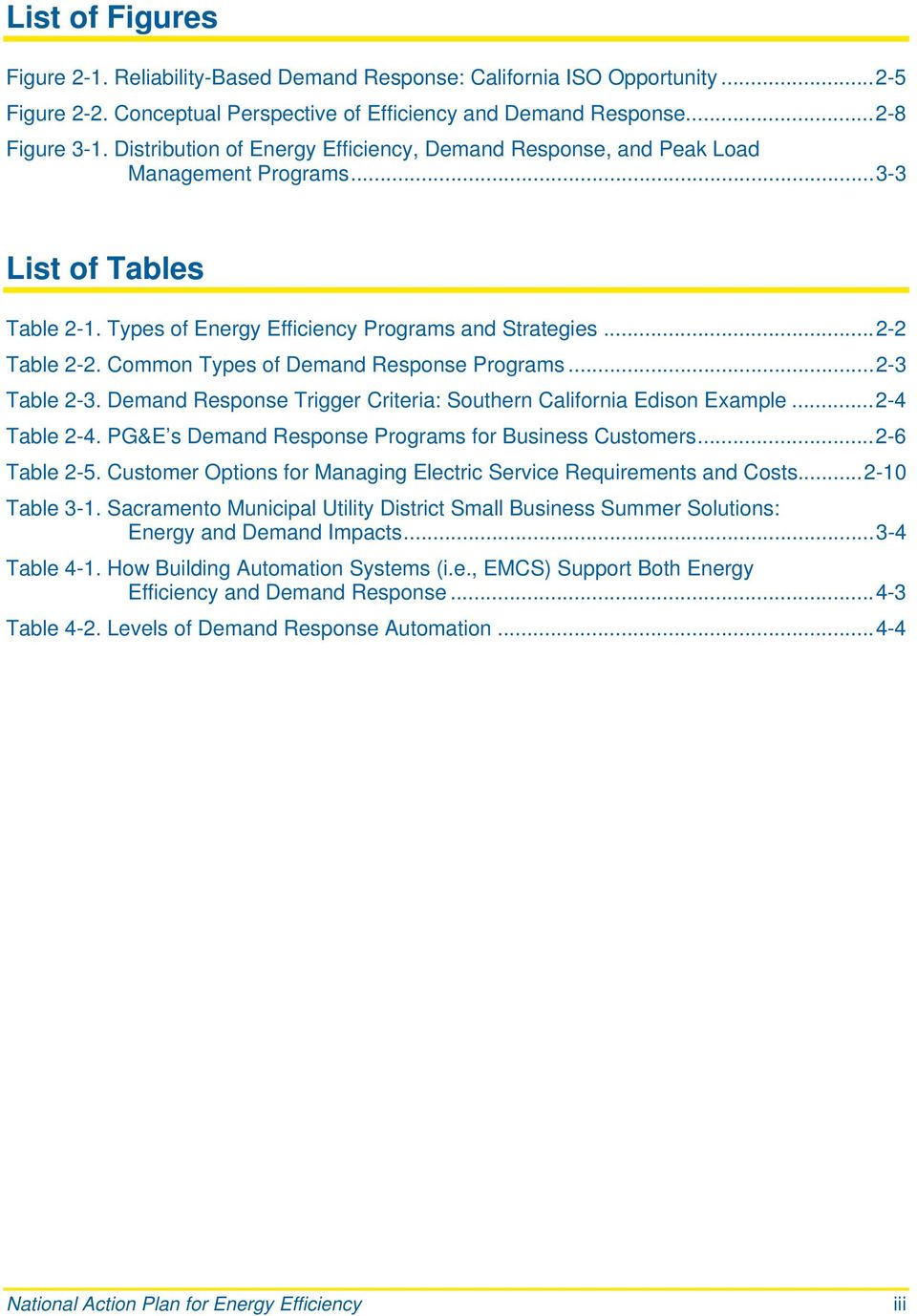
7 List of Figures Figure 2-1. Reliability-Based Demand Response: California ISO Opportunity Figure 2-2. Conceptual Perspective of Efficiency and Demand Response Figure 3-1. Distribution of Energy Efficiency, Demand Response, and Peak Load Management Programs List of Tables Table 2-1. Types of Energy Efficiency Programs and Strategies Table 2-2. Common Types of Demand Response Programs Table 2-3. Demand Response Trigger Criteria: Southern California Edison Example Table 2-4. PG&E s Demand Response Programs for Business Customers Table 2-5. Customer Options for Managing Electric Service Requirements and Costs Table 3-1. Sacramento Municipal Utility District Small Business Summer Solutions: Energy and Demand Impacts Table 4-1. How Building Automation Systems (i.e., EMCS) Support Both Energy Efficiency and Demand Response Table 4-2. Levels of Demand Response Automation National Action Plan for Energy Efficiency iii
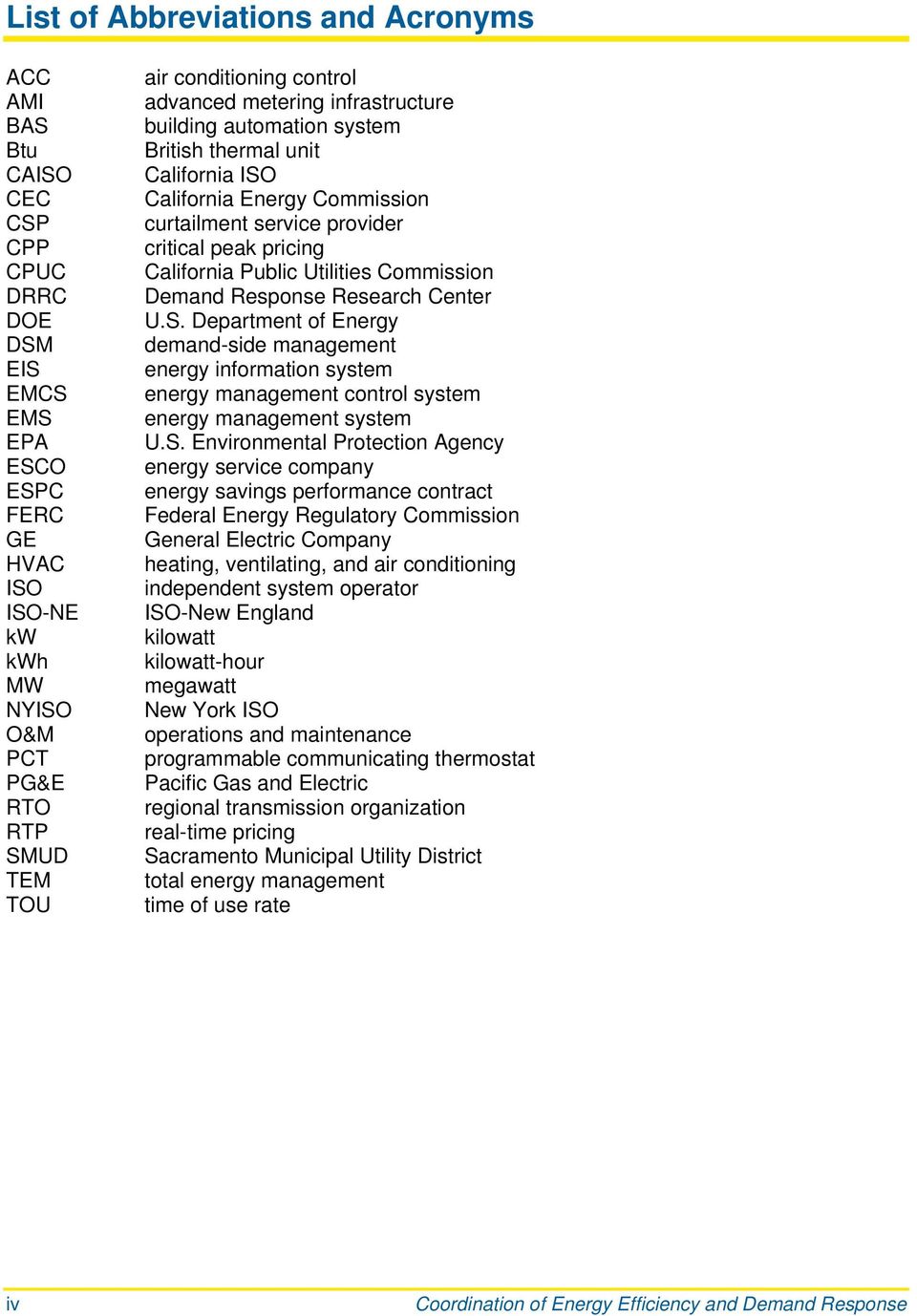
8 List of Abbreviations and Acronyms ACC AMI BAS Btu CAISO CEC CSP CPP CPUC DRRC DOE DSM EIS EMCS EMS EPA ESCO ESPC FERC GE HVAC ISO ISO-NE kw kwh MW NYISO O&M PCT PG&E RTO RTP SMUD TEM TOU air conditioning control advanced metering infrastructure building automation system British thermal unit California ISO California Energy Commission curtailment service provider critical peak pricing California Public Utilities Commission Demand Response Research Center U.S. Department of Energy demand-side management energy information system energy management control system energy management system U.S. Environmental Protection Agency energy service company energy savings performance contract Federal Energy Regulatory Commission General Electric Company heating, ventilating, and air conditioning independent system operator ISO-New England kilowatt kilowatt-hour megawatt New York ISO operations and maintenance programmable communicating thermostat Pacific Gas and Electric regional transmission organization real-time pricing Sacramento Municipal Utility District total energy management time of use rate iv Coordination of Energy Efficiency and Demand Response
9 Acknowledgements This paper, Coordination of Energy Efficiency and Demand Response, is a key product of the Year Two Work Plan for the National Action Plan for Energy Efficiency. Charles Goldman of Lawrence Berkeley National Laboratory served as the lead author of the paper; Michael Reid (E Source) served as co-lead author with assistance from Roger Levy (Levy Associates) and Alison Silverstein (Alison Silverstein Consulting). The Action Plan Leadership Group provided review and comment. A full list of Leadership Group members is provided in Appendix A and at The National Action Plan for Energy Efficiency is facilitated by the U.S. Environmental Protection Agency (EPA) and the U.S. Department of Energy (DOE). Key staff include Larry Mansueti (DOE Office of Electricity Delivery and Energy Reliability), Kathleen Hogan (DOE Office of Energy Efficiency and Renewable Energy), and Stacy Angel and Katrina Pielli (EPA Climate Protection Partnerships Division). Eastern Research Group, Inc. provided copyediting, graphics, and production services. National Action Plan for Energy Efficiency v
10

11 Executive Summary This paper reviews the relationship between energy efficiency and demand response and discusses approaches and barriers to coordinating energy efficiency and demand response. The paper is intended to support the 10 implementation goals of the National Action Plan for Energy Efficiency s Vision to achieve all cost-effective energy efficiency by Improving energy efficiency in our homes, businesses, schools, governments, and industries which consume more than 70 percent of the nation s natural gas and electricity is one of the most constructive, cost-effective ways to address the challenges of high energy prices, energy security and independence, air pollution, and global climate change. While energy efficiency is an increasingly prominent component of efforts to supply affordable, reliable, secure, and clean electric power, demand response is becoming a valuable tool in utility and regional resource plans. The Federal Energy Regulatory Commission (FERC) estimated the contribution from existing U.S. demand response resources at about 41,000 megawatts (MW), about 5.8 percent of 2008 summer peak demand (FERC, 2008). Moreover, FERC recently estimated nationwide achievable demand response potential at 138,000 MW (14 percent of peak demand) by 2019 (FERC, 2009). 2 A recent Electric Power Research Institute study estimates that the combination of demand response and energy efficiency programs has the potential to reduce non-coincident summer peak demand by 157 GW by 2030, or percent below projected levels (EPRI, 2009a). This paper supports the Action Plan s effort to coordinate energy efficiency and demand response programs to maximize value to customers. For information on the full suite of policy and programmatic options for removing barriers to energy efficiency, see the Vision for 2025 and the various other Action Plan papers and guides available at Energy Efficiency and Demand Response Energy efficiency refers to using less energy to provide the same or improved level of service to the energy consumer in an economically efficient way; it includes using less energy at any time, including during peak periods. In contrast, demand response entails customers changing their normal consumption patterns in response to changes in the price of energy over time or to incentive payments designed to induce lower electricity use when prices are high or system reliability is in jeopardy. Because most demand response programs in effect today are eventdriven, customers tend to assume that demand response events occur for limited periods that are called by the grid operator; but critical peak pricing (CPP) and real-time pricing (RTP) are growing in prevalence and impact. Many demand response programs are designed primarily to curtail or shift load for short periods of time; however, those programs that educate customers about energy use with time of use (TOU) rates, dynamic rates, and energy use feedback can also produce measurable reductions in customers total energy use and cost (EPRI, 2009b). There are significant differences in how energy efficiency and demand response are measured, what organizations offer them, how they are delivered to customers, and how they are rewarded in the marketplace. Reducing these differences and coordinating energy efficiency and demand response could be beneficial. Better coordination of energy efficiency and demand response programs at the provider level could bring about cost efficiencies and more rational allocation of resources for both program providers and customers. Coordination could help customers, as National Action Plan for Energy Efficiency ES-1

12 most customers do not understand or care about the difference between energy efficiency and demand response and would be receptive to an integrated, packaged approach to managing their energy usage. Greater customer willingness could also increase demand response market penetration and capture energy savings and customer bill-reduction opportunities that might otherwise be lost. Over the long term, customer and utility smart grid investments in communications, monitoring, analytics, and control technologies will blur many of the distinctions between energy efficiency and demand response and help realize the benefits of this integration. Coordinating Energy Efficiency and Demand Response Coordinating energy efficiency and demand response could provide customers with better tools to understand, manage, and reduce their electricity use. Such coordination can occur in at least four ways: Combined program offerings. Customers could be offered both energy efficiency and demand response opportunities under the same program and provider umbrella; separate programs are the norm today. Coordinated program marketing and education. Without merging the delivery of services at the program level, program sponsors (e.g., utilities) could package and promote energy efficiency and demand response in a closely coordinated or unified way. Energy efficiency and demand response can be complicated topics, requiring sophisticated customer effort and action, so program sponsors should offer education that addresses both topics under a broad energy management theme. Market-driven coordinated services. Coordination need not occur only within the context of programs offered by utilities, public benefit organizations, or independent system operators (ISOs). Coordination of energy efficiency and demand response could also come about through the initiative of private firms that find a market among customers who are interested in reducing their energy costs. Our research and interviews with selected energy service companies (ESCOs) and curtailment service providers (CSPs) suggests that they are interested in this approach; we describe their initial steps in this direction. Building codes and appliance standards. Building codes and appliance efficiency standards can incorporate preferred energy efficiency and demand response features directly into building design and infrastructure and appliance designs, enabling significant reductions in the costs to customers of integrating energy efficiency and demand response strategies and/or measures (e.g., global temperature setback controls, automated demand response, embedded controls in appliances). At the provider level, utilities and grid operators should coordinate energy efficiency and demand response through the resource, budget planning, and rate design processes. Such coordination is needed because energy efficiency affects how much load shift is available from a given customer; chosen energy efficiency measures affect how much money the customer and utility have available to spend on demand response (and vice versa); and rate design, efficiency, and demand response affect the load levels and profiles that supply resources need to serve. ES-2 Coordination of Energy Efficiency and Demand Response
13 Today, few entities combine energy efficiency and demand response into an integrated program. In December 2009, out of 2,016 U.S. and Canadian energy efficiency, demand response, and load management programs in the E Source database, only 56 were identified as serving both energy efficiency and demand response purposes. Some examples of these combined programs include: Austin Energy, Kansas City Power & Light, Long Island Power Authority, and others offer residential smart thermostat programs that provide customers with communicating programmable thermostats in return for participation in a demand response program that curtails load during a limited number of summer hours by raising the thermostat s set point. Properly used, programmable thermostats can also provide daily energy savings. Sacramento Municipal Utility District (SMUD) implemented the Small Business Summer Solutions Research Pilot in summer 2008, targeted to small commercial customers with peak demands less than 20 kilowatts (kw). Building on an energy efficiency audit and conservation and efficiency options, the demand response component gives customers critical peak rates, options to install communicating programmable thermostats, and a variety of pre-cooling and conventional control strategies. This integrated approach led to a 23 percent reduction in weather-adjusted energy use and a 20 percent average peak load reduction on critical peak event days. The New York State Energy Research & Development Authority offers incentives for prequalified measures and performance-based incentives to customers and ESCOs for electric and gas efficiency, as well as incentives that offset the cost of demand response-enabling equipment, such as load-shedding controls and automation equipment. The capability and potential for energy efficiency and demand response at a customer site are derived from four elements the building, its electro-mechanical systems, appliances, and customer behavior. Building design, materials, and orientation are primary determinants of building energy consumption and usage patterns, but that use can be modified and managed by new technology and systems integration tools. Energy control technologies can also enable both energy efficiency and demand response. For example, programmable communicating thermostats (PCTs) can automate energy management; embedded controls, like those being explored with white goods appliances, can enable demand response without significant effort by the consumer; and residential and commercial building energy management systems (EMS) can deliver automated demand response and improve building energy and operational efficiency. Other critical enabling technologies include advanced metering infrastructure (AMI) essential for dynamic pricing and energy information systems (EIS) that provide customers feedback on their energy use. Concerns and Barriers Affecting Coordination Several factors complicate the process of coordinating energy efficiency and demand response. First, some market and regulatory structures separate responsibility and funding for energy efficiency from that for demand response. Second, some customers with energy management program experience express reservations about demand response. Recent interviews with customers indicate the following concerns: 3 Demand response benefits are uncertain, changing with market prices and reliability circumstances, even though energy efficiency impacts are predictable and long-lived. National Action Plan for Energy Efficiency ES-3

14 Demand response programs vary widely across regions and utilities, and in some cases the inconvenience of participating might outweigh the potential payoff. Demand response primarily appears to benefit the utility rather than the customer. Participating in demand response might reduce the amount of funding or staff resources a customer can devote to energy efficiency efforts. Demand response program designers, and those working to design coordinated energy efficien cy and demand response programs, should be aware of these concerns and work to mitigate them. Third, it is important to align retail rates with energy efficiency and demand response objectives. 4 Well-designed tariffs based on dynamic, time-varying prices facilitate demand response without compromising energy efficiency opportunities, and they better reflect the true cost of generating electricity. Many regulators and utilities have been reluctant to place customers on such tariffs. Widespread deployment of an AMI, other enabling technologies, and broad educational efforts will remove one of the major barriers to dynamic pricing among residential and small commercial customers. Fourth, developing utility staff and contractor capabilities in both energy efficiency and demand response will take time. Many utility employees have expertise in one field or the other, but not both. ESCOs specialize in delivering energy efficiency and sell large, capital-intensive technology solutions, such as boiler and heating, ventilating, and air conditioning (HVAC) replacements; this is a very different business model from that used by CSPs, which focus on less capital-intensive operation and control solutions with shorter contracts. Facilitating Coordination There are several ways to encourage better coordination of energy efficiency and demand response: Regulators can direct utilities and grid operators to coordinate the programs more effectively and support rate designs that facilitate energy efficiency and demand response. Demand-side management (DSM) program goals can be articulated more specifically to address both energy efficiency and peak load reduction goals. Customer education about energy efficiency can be broadened to explain demand response and its benefits to the customer. Government lead by example programs can demonstrate the value of coordinating energy efficiency and demand response, particularly with respect to the impact of enabling technologies that serve both purposes. Building codes and appliance efficiency standards can incorporate technology improvements and functionalities that integrate and improve both efficiency and load controllability. ES-4 Coordination of Energy Efficiency and Demand Response

15 While coordinating energy efficiency and demand response can provide benefits, it will not be easy or swift due to many market, human, financial, and institutional obstacles. Executives and policy-makers should articulate some direction and clarity for utilities and program sponsors with respect to priorities for energy efficiency and demand response programs, their coordination, and overall goals. This is particularly important given the long-lasting nature of utility and customer capital investments, the time and effort it takes to change customer behavior and expectations, and the rapid pace of technological change. Program sponsors and customers alike need guidance regarding the best ways to commit their resources to achieve effective energy management. In a few years, as electricity prices and information are delivered more effectively to users and control and communication technologies become more widely accessible, demand response will become more automatic and customer-friendly, allowing customers to identify and more easily target discretionary loads that can be curtailed or shifted. These same technologies will enhance energy efficiency through continuous site commissioning simultaneous with more efficient new buildings including zero net energy sites reducing the amount of electricity available for load-shifting. The nature of demand response is also likely to change. While today the bulk of demand response programs are triggered by reliability events, in 10 years, most demand response might be price-driven (and possibly linked to congestion management), enabled by automated onsite energy controls fed by near-real time pricing information without significant customer effort or intervention. Large-scale deployment of cost-effective energy efficiency resources has the potential to provide significant bill savings for customers and reduce and defer the need for more expensive baseload or intermediate generation resources. Similarly, cost-effective demand response resources have the potential to reduce or defer the need for expensive peak generation and to enhance electric system reliability while also increasing the system s ability to absorb intermittent renewable resources through sophisticated real-time monitoring, analytics, and load controls. Effective coordination of energy efficiency and demand response by policy-makers, utilities, and third-party program providers will be necessary to increase the effectiveness and utilization of energy management resources. While progress has been made in recent years, more work and effort are needed to achieve the full promise and potential of the synergy between energy efficiency and demand response. Notes This paper supports the National Action Plan s Vision for 2025 Implementation Goal Nine, which encourages program administrators to implement state-of-the-art efficiency information sharing and delivery systems and to coordinate energy efficiency and demand response programs to maximize value to customers (National Action Plan for Energy Efficiency, 2008). For information on the full suite of policy and programmatic options for removing barriers to energy efficiency, see the Vision for 2025 and the various other Action Plan papers and guides available at The Achievable Potential scenario estimates the cost-effective demand response potentially available if AMI were universally deployed; dynamic pricing were the default tariff; and other demand response programs, such as direct load control, were available to those who opt out of dynamic pricing. Some primary research was conducted for this study, including interviews with 16 utilities and ISOs; 14 large commercial, industrial, and institutional energy consumers; and five large ESCOs and CSPs that operate nationally. National Action Plan for Energy Efficiency ES-5
16 4 For more information on energy efficiency and retail rates, see National Action Plan for Energy Efficiency (2009). ES-6 Coordination of Energy Efficiency and Demand Response

17 1: Introduction Across the United States, electric utilities and independent system operators (ISOs) 1 are devoting increasing attention and resources to demand response. While energy efficiency is the most prominent component of growing efforts to supply affordable, reliable, secure, and clean electric power, demand response is a key pillar of utilities and ISOs resource plans, and its importance is growing. The Federal Energy Regulatory Commission (FERC) estimated the contribution from existing U.S. demand response resources was about 41,000 megawatts (MW), which represents about 5.8 percent of 2008 summer peak demand (FERC, 2008), close to a 10 percent increase from Moreover, FERC recently completed a national study that estimated demand response potential and identified an achievable potential of 138,000 MW (14 percent of peak demand) by 2019 (FERC, 2009). 2 A recent Electric Power Research Institute study estimates that the combination of demand response and energy efficiency programs has the potential to reduce non-coincident summer peak demand by 157 GW [gigawatts] by 2030, or percent below projected levels (EPRI, 2009a). Energy efficiency and demand response are closely related concepts. The 2006 National Action Plan for Energy Efficiency defined energy efficiency to include some types of demand response that do not compromise the level of energy service received by consumers and reduce total energy consumption and peak demand. 3 Yet, while both energy efficiency and demand response are means to reducing energy consumption and utility bills, there are significant differences in the way these resources are tapped. Market structures have evolved in some regions to vest responsibility for energy efficiency and demand response in separate organizations. Companies that contract to provide energy efficiency or demand response services to utilities and ISOs generally work in one area but not the other. With rare exceptions, energy efficiency and demand response are marketed and delivered to customers in entirely separate programs. Reducing this degree of separation would be beneficial. Better coordination of energy efficiency and demand response programs at the provider level, or even full integration of programs, could bring about cost efficiencies and more rational allocation of resources. Coordination might be beneficial at the customer level, as customers might be receptive to a packaged, rather than piecemeal, approach to managing their energy usage. And greater customer willingness could translate into higher market penetration for programs and capture energy savings and customer bill reduction opportunities that might otherwise be lost. However, relatively little work has been done to date on coordination. Accordingly, the Action Plan s Year Two Work Plan called for exploring the energy efficiency/demand response relationship: Particular focus will be to determine how to incorporate energy efficiency (EE) and demand response (DR) in complementary ways such that customers have increased tools at their disposal to understand and manage and reduce their electricity use (National Action Plan for Energy Efficiency, 2007). This paper was commissioned in support of the above objective. National Action Plan for Energy Efficiency 1-1

18 1.1 Purpose This paper was developed as a discussion document and resource for those utilities, utility regulators, energy efficiency and demand response service providers, consumer advocates, and others interested in the energy efficiency/demand response nexus. It aims to: Summarize existing research on the relationship between energy efficiency and demand response. Present new information, gathered through interviews with program administrators, customers, and service providers, on the coordination of energy efficiency and demand response, focusing in particular on current practices and opportunities. Discuss barriers to coordinating energy efficiency and demand response programs. The target audiences for this report include: Policy-makers who need a short and concise higher level summary of the issue. Program administrator staff members who are involved in designing, marketing, and implementing energy efficiency and demand response programs. Regulatory staff members who are responsible for overseeing and approving energy efficiency and demand response program and tariff offerings. Service provider organizations that are involved in energy efficiency and/or demand response and are considering strategies to facilitate increased coordination of service offerings. Stakeholders who provide input on the design and implementation of energy efficiency and demand response programs and tariffs. 1.2 Scope of Research and Approach This paper includes a literature review and attempts to synthesize findings of the existing studies on coordinating energy efficiency and demand response. Approximately 40 interviews were conducted with program administrators, customers, and service providers to explore their perspectives on coordinating energy efficiency and demand response. Other experts in energy efficiency and demand response were also consulted, and preliminary findings were discussed at the January 2008 meeting of the Action Plan s Leadership Group. 4 For reasons of time and budget, the scope of new primary research for this paper was limited. The utility managers interviewed were from a geographically diverse set of utilities, but the sample size (16) was small. The interviewees included representatives from 11 large, investorowned utilities, three municipal utilities, and two ISOs. Fourteen large commercial, industrial, institutional, and governmental customers were interviewed; no small business or residential customers were surveyed. Interviews were conducted with five large energy service companies (ESCOs) and curtailment service providers (CSPs) that operate nationally. These limitations should be taken into consideration when reading this paper. 1-2 Coordination of Energy Efficiency and Demand Response

19 1.3 Notes U.S. regional electric grid management organizations are classified as either ISOs or regional transmission organizations (RTOs). While there are technical differences between ISOs and RTOs, for the purposes of this paper, they are essentially the same. For simplicity, we sometimes use ISO as shorthand for ISOs and RTOs. The Achievable Potential scenario estimates the cost-effective demand response potentially available if advanced metering infrastructure (AMI) were universally deployed; dynamic pricing were the default tariff; and other demand response programs, such as direct load control, were available to those that opted out of dynamic pricing. The National Action Plan for Energy Efficiency (2006) defines energy efficiency as follows on p. 1-1: The term energy efficiency as used here includes using less energy at any time, including at times of peak demand through demand response and peak shaving efforts. This paper has also benefited from review by the Action Plan Leadership Group and members of the Demand Response Coordinating Council. National Action Plan for Energy Efficiency 1-3
20

21 2: Relationship Between Energy Efficiency and Demand Response For the purposes of this paper, the following definitions are used: Energy efficiency refers to permanent changes to electricity usage through installation of or replacement with more efficient end-use devices or more effective operation of existing devices that reduce the quantity of energy needed to perform a desired function or service. Demand response refers to changes in electric usage by end-use customers from their normal consumption patterns in response to changes in the price of electricity over time, or to incentive payments designed to induce lower electricity use at times of high wholesale market prices or when system reliability is jeopardized. (DOE, 2006) From a policy perspective, many states have committed to recognize demand-side resources and energy savings as the first or priority resource; some specify that energy efficiency is the priority resource while others address both energy efficiency and demand response (National Action Plan for Energy Efficiency, 2008). 2.1 Energy Efficiency York and Kushler (2005) describe energy efficiency as follows: Energy efficiency involves technology measures that produce the same or better levels of energy services (e.g., light, space conditioning, motor drive power, etc.) using less energy. The technologies that comprise efficiency measures are generally long-lasting and save energy across all times when the end-use equipment is in operation. Depending on the time of equipment use, energy efficiency measures can also produce significant reductions in peak demand. This definition of energy efficiency makes three key assumptions: (1) existing consumer devices are replaced with devices that use less energy, assuming no change in operating practice; (2) new energy-using devices should perform their functions using less energy; and (3) actual kilowatt-hour usage is reduced, irrespective of when that reduction occurs (i.e., it is not timesensitive). These attributes are very important to understanding efficiency, how it differs from demand response, and ultimately how energy efficiency and demand response might be coordinated. As stated, energy efficiency does not entail sacrifice or reduction in comfort; rather, installation of high-efficiency equipment and/or measures is assumed to result in the same or better levels of energy services. This definition implicitly distinguishes energy efficiency from conservation (although some people use the terms interchangeably). Conservation often implies a reduction in energy use and services through such actions as lowering thermostats during the heating season and dimming lights below the level presumably preferred by building occupants. Often, conservation is assumed to occur through behavioral changes that are considered short-lived, whereas energy efficiency occurs through installation of long-lasting technologies. National Action Plan for Energy Efficiency 2-1
22 Energy efficiency programs are initiatives that encourage and in many cases provide financial incentives and services to customers or contractors for the acquisition, installation, and use of energy efficiency measures in customer facilities. Currently, such programs are administered by electric and gas utilities, state energy or regulatory agencies, and/or nonprofit or for-profit organizations; models for energy efficiency program administration vary by state. Programs that provide rebates to customers who install energy-efficient equipment are perhaps the most popular, but there are several other types of energy efficiency programs (see Table 2-1 for a sampling). 1 Table 2-1. Types of Energy Efficiency Programs and Strategies Rebates for customers who install energy-efficient lighting, motors, HVAC equipment, building shell measures, etc. Financing, often at a subsidized rate, to offset the upfront cost of energy efficiency measures. Trade-ally incentives paid to businesses that stock, sell, or install energy efficiency measures. Commissioning services that help ensure that buildings energy-using systems are operated and maintained properly. Education for end-users and building/construction trades and other trade allies on the benefits of energy efficiency measures. Appliance standards to incorporate energy efficiency design and embedded demand responsive controls. Building codes to require construction, design, and operational standards that build in energy efficiency and/or demand response capability. HVAC = heating, ventilating, and air conditioning. Energy efficiency is also delivered outside the framework of utility or public-benefit programs. For example, ESCOs design, install, service, and often finance efficiency projects, most often for large public sector institutions (e.g., K-12 schools, universities) and government agencies (e.g., local, state, and federal agencies). Contractors who do not necessarily call themselves ESCOs offer analogous services for residential and business customers. In states with retail energy competition, retail service providers may offer efficiency services in addition to commodity electricity and gas. Some state and federal governments have also offered tax credits to promote installation of high-efficiency equipment and appliances. 2.2 Demand Response Demand response programs are designed to elicit changes in customers electric usage patterns. Some types of demand response, implemented through approved utility tariffs or through contractual arrangements in deregulated markets, vary the price of electricity over time to motivate customers to change their consumption patterns; this approach is termed pricebased demand response. Other demand response programs reward customers for reducing their electric loads upon request or for giving the program administrator some level of control over the customer s electricity-using equipment. These are termed incentive- or event-based demand response. 2-2 Coordination of Energy Efficiency and Demand Response
23 Within these two broad categories of demand response programs (price-based and incentivebased), there are several different program types (see Table 2-2). Table 2-2. Common Types of Demand Response Programs Price Options TOU rates: Rates with fixed price blocks that differ by time of day. a CPP: Rates that include a pre-specified, extra-high rate that is triggered by the utility and is in effect for a limited number of hours. RTP: Rates that vary continually (typically hourly) in response to wholesale market prices. Incentive- or Event-Based Options Direct load control: Customers receive incentive payments for allowing the utility a degree of control over certain equipment. Demand bidding/buyback programs: Customers offer bids to curtail load when wholesale market prices are high. Emergency demand response programs: Customers receive incentive payments for load reductions when needed to ensure reliability. Capacity market programs: Customers receive incentive payments for providing load reductions as substitutes for system capacity. Interruptible/curtailable: Customers receive a discounted rate for agreeing to reduce load on request. b Ancillary services market programs: Customers receive payments from a grid operator for committing to curtail load when needed to support operation of the electric grid (i.e., ancillary services). c CPP = critical peak pricing; RTP = real-time pricing; TOU = time of use. a Some analysts do not consider TOU rates to be a dynamic demand response option because the rating periods and prices are fixed, and utilities typically do not regard customers on TOU as a resource that can be dispatched similar to a generator when needed to support grid operations. A well-designed TOU rate, however, may induce customers to make long-term investments that reduce peak demands. b Some utilities also regard interruptible tariffs as a price-based option, particularly if their interruptible tariff includes dynamic pricing provisions during emergency events (e.g., some tariffs give customers the option of riding through a curtailment event by paying higher real-time prices and still receiving electricity). c Ancillary services demand response arrangements can also be viewed as a pricing program, because real-time pricing signals can be set up under a tariff to trigger event-specific customer behavior. More utilities offer some type of price-based demand response tariff (including time of use [TOU] rates) to customers than incentive-based demand response programs; however, pricebased demand response accounts for just a small part of the total existing demand response resource base. In 2008, customers enrolled in existing incentive-based demand response programs were capable of providing 38,000 MW of potential peak load reductions, while pricebased demand response programs were expected to provide another 2,700 MW. In percentage National Action Plan for Energy Efficiency 2-3
24 terms, about 93 percent of the peak load reduction from existing demand response resources in the United States is provided by various types of incentive-based, event-driven demand response programs (Cappers et al., 2009). Incentive- or event-driven demand response can be invoked in response to a variety of trigger conditions, including local or system temperature, local or regional grid congestion, system economics, or operational reliability requirements. As an example of relevant events that justify a demand response, Table 2-3 shows the trigger criteria for Southern California Edison s demand response programs. Trigger conditions reflect a key difference between demand response and energy efficiency, as energy reductions for demand response are time-dependent whereas reductions for energy efficiency are not. Table 2-3. Demand Response Trigger Criteria: Southern California Edison Example Demand Response Program Demand Response Contracts Capacity Bid/Demand Bid CPP Base Interruptible Air Conditioner Load Control Event Trigger Criteria Varies Power Plant Thermal Heat Rate 15,000 Btu/kWh (as a proxy for high spot market electricity prices and limited generator availability) System conditions, temperature, and price CAISO stage 2 alert CAISO stage 2 alert, storm alert Btu = British thermal unit; CAISO = California ISO; CPP = critical peak pricing; kwh = kilowatt-hour. Demand response events may be triggered by economics (e.g., a spike in the wholesale price of electricity) or by reliability requirements (e.g., a major power plant trips offline, and customer load must be reduced to prevent blackouts). It is common for event-driven programs to have upper limits on the duration of individual events and the total number of event-hours per year. Some definitions of demand response incorporate assumptions that programs will be used no more than 40 to 100 hours per year (Faruqui et al., 2007). 2 The frequency and duration of demand response events can vary substantially from one year to the next, and by utility system and application. The 40 to 100 hour example from the preceding paragraph is generally applicable to bulk-power reliability applications when reserve margins dip below threshold conditions or when wholesale prices spike. Figure 2-1 provides a load duration curve for the California ISO (CAISO) that illustrates the potential target hours and value for a demand response application. CAISO estimates that 15 hours of well-targeted demand response could reduce 5 percent of the CAISO peak load and the associated costs, and 55 hours could reduce 10 percent of its peak load (Goodin, 2008). Event frequency and the value of demand response can vary substantially when targeted to load balancing and other ancillary service applications. Where bulk power reliability and economic applications may prescribe a maximum of 10 to 15 events per year with durations of 4 to 8 hours each, ancillary service applications may necessitate 80 to 120 events per year with 2-4 Coordination of Energy Efficiency and Demand Response
25 durations of 10 to 20 minutes each. The customer impacts, communication and equipment options, and approach to coordination of demand response and energy efficiency will be quite different under these two applications. Limits on the number of hours that customers can be called for demand response programs reflect the limitations of current demand response technologies and capabilities and perceived customer acceptance. As long as customer demand response involves disruptive activities like dimming lights, raising temperatures, or shutting down production operations, participating customers will want strict limits on the extent to which they can be subjected to such inconvenience. These limits have two consequences. First, they affect the degree to which system operators can count on the availability and magnitude of demand response resources for reliability operations. Second, they highlight the value of evolving automation, monitoring, and control technologies for building and energy use process management. As these control systems are integrated and aggregated across multiple facilities and energy applications, they can be operated in a fashion that makes demand response less obstructive and inconvenient for the customer (particularly if demand response resources are aggregated by a load aggregator). At that point, operational limits on the amount of demand response resources that grid operators are willing to include in ancillary service markets may become less restrictive, and demand response could be used more broadly as a tool for reliable power system operations. Figure 2-1. Reliability-Based Demand Response: California ISO Opportunity Source: Data derived from California ISO (CAISO). Demand Response Comes in Many Flavors The greatest number and variety of demand response programs are found in California and New York. Table 2-4 shows the breadth of demand response programs that are available to business customers by one California utility, Pacific Gas & Electric (PG&E). The table is not meant to suggest that every demand response portfolio needs this many options only that there are many ways to structure demand response programs. National Action Plan for Energy Efficiency 2-5
26 Table 2-4. PG&E s Demand Response Programs for Business Customers Program Name Incentive- or Event-Based Demand Response Base Interruptible Program Capacity Bidding Program Demand Bidding Program Optional Binding Mandatory Curtailment Plan Peak Choice Scheduled Load Reduction Program SmartAC (Air Conditioner Load Control) Price-Based Demand Response CPP Demand Response Technical Assistance Technical Assistance and Technology Incentive Programs Integrated Energy Audit Description (Partial) Provides monthly or per-event incentives for curtailing load with either 30-minute or 4-hour advance notification. Curtailments limited to 120 hours per year. Offers monthly payments from May through October for curtailing nominated load on either a day-ahead or day-of basis, up to 24 times per month, when load conditions require the use of generators with heat rates of 15,000 Btu/kWh or greater. Provides payments of $ per kwh to customers who submit day-ahead or day-of offers to curtail load. Allows customers to be exempt from rotating outages in return for agreeing to reduce load by 5 to 15 percent within 15 minutes of notification. Allows customers to customize their demand response by selecting from a range of advance notice, timing, load reduction, and number of day options, where incentives are determined by option combinations. Pays $0.10 per kwh for commitments to reduce load one to three times per week, 4 hours at a time, from June through September. Offers $25 to customers who allow installation of either an air conditioner compressor switch or a smart thermostat that can be used to control load up to 100 hours per year when CAISO declares emergency or near-emergency conditions. This program is also offered to residential customers. Provides lower rates during on-peak and partial-peak hours in exchange for higher (three to five times normal) rates on up to 12 days between May and October when system demand is high. Provide engineering assistance and cash incentives to support installation of equipment or software supporting demand response. Offer audits that comprehensively address opportunities in energy efficiency, time of use management, demand response, self-generation, and renewables. Sources: < < Btu = British thermal unit; CAISO = California ISO; CPP = critical peak pricing; kwh = kilowatt-hour. 2-6 Coordination of Energy Efficiency and Demand Response
27 The event- vs. non-event-driven distinction is important. Customers and program administrators alike are usually referring to event-driven programs when they talk about demand response. (Our interviews with customers, which are discussed later in this paper, reflect this distinction.) On a conceptual level, critical peak pricing (CPP) and real-time pricing (RTP) are under the demand response umbrella, but these options often are discussed and treated separately from discussions about event-driven demand response program options. However, when high wholesale prices or reliability shortages are used as the activation variable for event-driven demand response options, they are proxies for and may be highly correlated with high prices in the real-time energy market. Most demand response programs are sponsored by electric utilities; in some markets they are sponsored by ISOs. Customers can participate directly with the utility or ISO, or they can work through an intermediary. The intermediary role is commonly filled by firms specializing in demand response services, sometimes called curtailment service providers (CSPs) or simply aggregators. In states with retail energy competition, retail service providers may serve as intermediaries in addition to supplying commodity electricity and gas. When customers participate in demand response, there are three possible ways in which they can change their use of electricity (DOE, 2006): Customers can forego or reduce some uses of electricity. Raising thermostat settings, reducing the run time of air conditioners, dimming or reducing lighting levels, or taking some elevators out of service are common customer load curtailment strategies. Customers can shift electricity consumption to a time period outside the demand response event or when the price of electricity is lower. For example, an industrial facility might employ storage technologies to take advantage of lower cost off-peak energy, reschedule or defer some production operations to an overnight shift, or, in some cases, shift production to companion plants in other service areas. Similarly, with enough notice, commercial or residential customers could pre-cool their facilities and shift load from a higher to lower cost time period. Residential and commercial customers could also choose to delay running certain appliances until prices are lower. Most successful demand response programs have a customer override capability that allows the customer to choose not to adjust its energy use when a specific demand response event is called. 3 Customers can self-generate electricity using onsite standby generating equipment, thus reducing their reliance on utility-delivered power Continuum of Customer Options From a conceptual perspective, distinctions between energy efficiency and demand response are somewhat artificial and not always as well understood as they may seem to program administrators. Figure 2-2 depicts efficiency and demand response as more of a continuum and shows the potential impact on customer service levels. The customer s existing building and equipment infrastructure establish the opportunities and potential for both energy efficiency and demand response. In Figure 2-2, the progression of customer options from left to right presumes that the customer should begin first with daily energy efficiency improvements. Succeeding stages involve more sophisticated demand response behavior on shorter timescales, likely requiring additional National Action Plan for Energy Efficiency 2-7
28 investment to execute real-time or fast demand response options (which the power system views as ancillary services, such as spinning reserves). To the degree that it is cost-effective to do so, making the underlying infrastructure as efficient as possible creates permanent load reduction impacts. Figure 2-2. Conceptual Perspective of Efficiency and Demand Response Source: DRRC, The daily energy efficiency category of actions in Figure 2-2 incorporates both short-term conservation actions and long-term investments in energy efficiency. While it is always desirable that customers undertake all appropriate efficiency investments and behaviors before they undertake load management and demand response activities, it is not always feasible for them to do so. There are many well-documented barriers to energy efficiency, including limited funding, the split between owners and beneficiaries, lack of information, and extended payback periods, among others (National Action Plan for Energy Efficiency, 2006). Thus, it is common for a customer to enter into a demand response opportunity because it is available and feasible, even though further efficiency improvements could be made. In fact, the wide spectrum of unfinished efficiency has created many current demand response opportunities; for instance, inefficient buildings and inefficient, uncommissioned heating, ventilating, and air conditioning (HVAC) systems create a large resource for demand response providers who offer peak load reduction strategies. While efficiency-driven load reductions often improve overall electric system effectiveness, they may also reduce the degree to which electricity uses remain available for cost-effective demand response. 2-8 Coordination of Energy Efficiency and Demand Response
29 Figure 2-2 also illustrates that end-use customers have a range of options for managing their electric service requirements and costs: they can invest in energy efficiency, manage the timing of discretionary energy use, or participate in a variety of demand response activities. Movement along the continuum tends to be incremental signing up for a TOU rate may incent a customer to shift loads to off-peak hours to achieve daily peak load management, taking actions such as changing air conditioner settings and setting a pool pump to operate off-peak. Integrating or embedding demand responsive controls in the basic electronics of an appliance can also facilitate movement along this continuum. For example, air conditioners or water heaters with embedded demand responsive controls can be designed to automatically provide day-ahead and real-time response capability. Key attributes and distinguishing features of various customer options include the required frequency of response, underlying motivation and drivers, required customer actions, supporting infrastructure required to enable customers to participate, and potential impact on level of energy services (see Table 2-5). Daily peak load management involves efforts by customers on tariffs that include demand charges (typically commercial and industrial customers) to minimize peak demand usage (see middle column of Table 2-5). Some customer demand-side strategies blend elements from more than one customer option. For example, storage, a strategy that shifts loads using active thermal storage or passive building-mass storage, can be used either for daily peak load management or for event-driven demand response (Kiliccote and Piette, 2005). Similarly, installation of energy-efficient equipment or appliances may reduce the customer s peak demand charge and typically reduces the peak demand on the utility system. National Action Plan for Energy Efficiency 2-9
30 Table 2-5. Customer Options for Managing Electric Service Requirements and Costs Daily Peak Load Attributes Energy Efficiency Demand Response Management Why Participate Bill savings Bill savings Bill savings Energy savings Highest environmental benefits Likely Improve reliability environmental Potential benefits environmental benefit Equipment or Infrastructure Required Energy-efficient Timers and controls Remote control equipment Energy storage switch Energy-efficient Embedded controls building Building EMS infrastructure (e.g., Communications insulation levels, high-efficiency Standby generation windows) Who Buys/Owns the Customer Customer Utility owns control Infrastructure or switch Equipment Customer owns EMCS Required Customer Actions (What must be done to participate?) Who Controls Purchase Purchase Limiting loads O&M O&M Shifting loads Shift loads Shedding loads Displacing grid power (Any/all of the above) Customer Customer For event-based demand response: Distribution utility ISO Aggregator (depending on program option) For price-based demand response: Customer Impact on Energy Services (How does participation affect comfort, production levels, etc.) None None to slight Barely noticeable to substantial Source: Adapted and expanded from Motegi et al EMCS = energy management control system; EMS = energy management system; ISO = independent system operator; O&M = operations and maintenance Coordination of Energy Efficiency and Demand Response
31 2.4 How Energy Efficiency and Demand Response Overlap Energy efficiency programs yield energy savings, and demand response programs yield reductions in demand at critical times, which usually correspond to times of peak power demand (although demand response events can be triggered by occurrences at non-peak times, such as transmission problems). But the programs have overlapping effects: energy efficiency can permanently reduce demand, and demand response, with proper control strategies, also produces some energy savings. Energy Efficiency s Effects on Demand The effect of energy efficiency on electricity demand is clear. Buildings and equipment that use less energy (fewer kilowatt-hours) because they are more efficient impose smaller power loads (lower kilowatts of demand) on the system. Over 20 years of data on efficiency programs document this effect. Because the majority of technologies that are promoted by energy efficiency programs (e.g., lighting, air conditioning) operate during hours of peak demand typically hot summer afternoons across most of the United States they contribute to reductions in system peak (York and Kushler, 2005). Demand Response s Effects on Energy Consumption Whether demand response programs provide energy savings depends on the customer strategy chosen and the timing of the response. As mentioned above, customers participating in demand response can forego electricity consumption, shift it to another time, or displace grid power with self-generation. A commercial building customer that participates in a demand response program might dim its lighting when an event is called; because there is no opportunity to make up the lost light output, there is a net reduction in energy usage. 5 With sufficient advance notice, that same building might shift some of its load from peak to off-peak hours by using its air conditioning system to pre-cool the building in the early morning hours and letting the temperature rise above the normal setting during peak hours; many pre-cooling strategies reduce both energy usage and peak load (CEC, 2006). 6 Engaging self-generation for demand response does not, in and of itself, produce any energy savings at the customer end but may reduce load on the utility s system. 7 York and Kushler (2005) reviewed studies addressing the effect of demand response programs on overall energy efficiency and found that, while some studies have suggested that demand response programs generally yield energy savings, most descriptions of this effect are anecdotal and have not been carefully evaluated. This suggests a need for more systematic evaluations of the energy savings impacts from demand response programs. King and Delurey (2005) conducted a meta-review of studies and reported that dynamic pricing (including TOU rates, RTP, and CPP) produced an average savings effect of 4 percent of energy used, while reliability-oriented demand response programs, generally corresponding to the incentive-based programs in Table 2-2 and operating less than 100 hours per year, reduced energy consumption by 0.2 percent. They found stronger savings effects, on the order of 11 percent, among information/feedback programs, which provide customers with usage information over the Internet or via in-home displays but do not involve equipment controls or commitments to reduce load when called upon. 8 The range of effects reported in the studies they reviewed varied considerably, from -5 percent (i.e., an increase in consumption) to savings in excess of 20 percent. A 2007 update added a few data points, further supporting savings National Action Plan for Energy Efficiency 2-11
32 effects of 3 to 5 percent for pricing-based demand response programs. One new informationonly program reported savings of 6.5 percent (Nemtzow et al., 2007). To summarize, most demand response programs are likely to either produce some energy savings or have no net effect on consumption. Although certain demand response strategies and technologies may increase energy consumption during off-peak hours, and in limited cases may increase total energy consumption, this is not necessarily a drawback increased off-peak usage is less costly for the electric system and society as a whole, improving plant performance, decreasing fuel use, generating lower line losses, and potentially mitigating congestion in the transmission and distribution system. Energy Efficiency, Demand Response, and Environmental Impacts There is extensive documentation on the environmental benefits of energy efficiency, recounting the fact that with every unit of electricity not generated, the nation reduces its consumption of energy resources, air pollutant emissions, water use, and associated land uses. The environmental impacts of demand response are less conclusive because (1) the effects are specific to the time and place where energy use was avoided and (2) the effects depend on whether the electricity use was offset to another time and if so, what power sources were used to generate that electricity. Various considerations affect whether a specific demand response measure offers net environmental benefits or costs: If demand response is used to shift electricity use from on- to off-peak, it may cause a net reduction (or increase) in air emissions. The environmental impact of a demand response-driven load shift will be determined by local utility and regional generation portfolios used during peak and off-peak periods (e.g., nuclear, coal) and actual operations during the demand response event. Some demand response measures have small rebound or snap-back effects, in that after the load reduction is over, the customer consumes more electricity to catch up for the suppressed use (as with air conditioning). However, control improvements may soon alleviate many of these problems. Some demand response measures may cause a net increase in the customer s energy use, and that increase could negate any efficiency benefits from the electricity time shift. If demand response is used to integrate intermittent renewable generation in the future, it can have a net environmental benefit because the additional wind, solar, and other renewable sources are likely to displace fossil fuel-fired generation with higher emissions of pollutants such as nitrous oxides, sulfur oxides, and carbon dioxide. Substituting onsite fossil fuel-fired self-generation (e.g., diesel-fired generators) for gridsupplied power may cause a net increase in fuel use and local air pollution. As smart grid technologies, widespread energy price and use information, and dynamic rates become more accessible for consumers, these tools that facilitate demand response will also enable customers to become more energy-efficient and deliver greater overall environmental benefits from this synergy Coordination of Energy Efficiency and Demand Response
33 2.5 Notes For more information on energy efficiency program types, see National Action Plan for Energy Efficiency (2006) and National Action Plan for Energy Efficiency (2009). The difficulty for the utility or ISO is targeting the limited events or hours of control to the right time period to obtain customer response when needed and to make sure the annual allocation of demand response resources is not exhausted prematurely. Shifting energy usage may increase or decrease total emissions from electricity, depending on regional differences in types of generators used. Onsite generation avoids emissions from supply-side generators but has adverse effects on local air quality when fossil fuel backup generators are used. Additionally, dimming lights may reduce air conditioning requirements, further reducing peak load and consumption. In some cases, a pre-cooling strategy might increase overall energy consumption even while curbing the peak. However, research by the Demand Response Research Center and Purdue University has identified pre-cooling strategies that reduce energy usage and peak load. The net effect of self-generation on fuel consumption depends on the efficiency of onsite generation relative to that of grid-supplied power, including the effects of transmission and distribution losses. King and Delurey (2005) consider information/feedback programs a form of demand response. Referring back to DOE s definition of demand response, which we have adopted for this paper, pure information/feedback programs fall outside the scope of demand response because they do not involve changing price signals or providing incentives to motivate changes in usage. The systems and devices used in information/control programs, however, can be used as enabling technologies in demand response programs. National Action Plan for Energy Efficiency 2-13
34
35 3: What Might Coordination of Energy Efficiency and Demand Response Look Like? As envisioned in the Action Plan s Work Plan, coordinating energy efficiency and demand response is worth exploring because it could provide customers with increased tools... to understand and manage and reduce their electricity use (National Action Plan for Energy Efficiency, 2007). From the customer perspective, coordinating energy efficiency and demand response provides an opportunity to make better use of their time and consider operational changes and investments that minimize their total energy costs. We therefore looked at coordination primarily in terms of what it would mean for retail customers, and we also examined the programs and services retail customers can take advantage of. 3.1 Types of Coordination Energy efficiency and demand response could be coordinated at the customer level in at least four ways: Combined program offerings. Customers could be presented with both energy efficiency and demand response opportunities; separate programs are the norm today. Coordinated program marketing and education. Without merging the delivery of services at the program level, program sponsors (e.g., utilities, state energy agencies) could package and promote energy efficiency and demand response in a closely coordinated or unified way. There is some activity along these lines occurring through regulatory and utility initiatives. Energy efficiency and demand response can be complicated topics that require sophisticated customer effort and action, so program marketing must include a strong educational component. Program sponsors could offer education that addresses both topics under a broad energy management theme. Market-driven coordinated services. Coordination need not occur only within the context of programs offered by utilities, public benefit organizations, or ISOs. Coordination of energy efficiency and demand response could also come about through the initiative of private firms that find a market among customers who are interested in reducing their energy costs. Our research and interviews with selected ESCOs and CSPs suggests that they are interested in this approach; we describe their initial steps in this direction. Building codes and appliance standards. Building codes and appliance efficiency standards can incorporate preferred energy efficiency and demand response features directly into building design and infrastructure and appliance designs. Building these features into the building and appliance infrastructure through codes and standards can lead to significant reductions in the costs to customers of integrating efficiency and demand response strategies and/or measures. For example, global temperature setback, 1 OpenADR, 2 and standard reference designs that facilitate embedded controls in appliances can lower the customer s cost of integrating demand response and energy efficiency. 3 National Action Plan for Energy Efficiency 3-1
36 Coordination could (and does) occur in other ways that are mainly upstream from the retail service level. For example, utilities could (and often do) utilize coordinated planning processes, such that they choose target levels of energy efficiency and demand response resources in a unified process rather than separate planning processes. Energy efficiency and demand response efforts could be (and often are) funded from a single budget rather than separate budgets, and program staff members could be (and in some cases are) trained to provide customer assistance in both energy efficiency and demand response. These types of coordination play supporting roles; ultimately, their purpose is to affect the choices that customers have for managing and reducing their energy use, which is why our primary focus in this study is on retail-level coordination. 3.2 Examples of Coordination Current and Planned Combined Programs That Provide Both Energy Efficiency and Demand Response Currently, energy efficiency and demand response are seldom combined at the program level. To help uncover combination programs, DSMdat TM, an E Source database of programs in the United States and Canada, was analyzed. Programs listed in DSMdat are tagged with their apparent purpose energy efficiency, demand response, peak load management, 4 or multipurpose based on analysts interpretation of program descriptions and marketing materials posted on the sponsors Web sites. As of December 2009, out of 2,016 active programs in DSMdat, just 56, or 3 percent, are tagged as serving more than one purpose (see Figure 3-1). The vast majority of those combination programs are ones that subsidize installation of energy efficiency equipment, provided it can be shown that the equipment will reduce the customer s peak load during the likely peak hours (for example, from 2 to 5 p.m. during summer afternoons). In other words, they support energy efficiency and daily load management (as described in Table 2-5) rather than demand response. In short, DSMdat confirmed that there are very few points of intersection between today s energy efficiency and demand response programs. Using the detailed program entries in DSMdat plus Web and literature searches, we found several existing programs that clearly combine energy efficiency and demand response (as distinct from load management) objectives. For example: Many residential smart thermostat programs provide customers with programmable communicating thermostats (PCTs) an energy efficiency technology in return for participation in a demand response program that curtails load during a limited number of summer hours by raising the thermostat s set point. Such programs are offered, for example, by Austin Energy, 5 Kansas City Power & Light, 6 Long Island Power Authority, 7 and many other utilities, a few of which also allow businesses to participate. PG&E s Integrated Energy Audit is a program for businesses that encompasses analysis of energy efficiency, load management, demand response, distributed generation, and renewable energy opportunities. 8 PG&E s Federal Advanced Lighting Technology Program works with U.S. government agencies to maximize savings through installation of high-efficiency lighting systems that can also be controlled for demand response Coordination of Energy Efficiency and Demand Response
37 Figure 3-1. Distribution of Energy Efficiency, Demand Response, and Peak Load Management Programs Source: E Source, DSMdat TM. A pilot program from NSTAR in Massachusetts, launched in spring 2008, jointly markets energy efficiency, demand response, and distributed generation (photovoltaic systems) to residential and business customers in one community to alleviate overloading of the local distribution system (see sidebar, The Marshfield Energy Challenge ). The New York State Energy Research and Development Authority (NYSERDA) Existing Facilities Program offers incentives for prequalified measures and performance-based incentives to customers or ESCOs for electric and gas efficiency and incentives that partially offset the cost of equipment that enables demand response (e.g., load-shedding controls and automation equipment, load-shedding ballasts if enrolled in a New York ISO [NYISO] demand response program). 10 The Marshfield Energy Challenge With funding from the Massachusetts Technology Collaborative, NSTAR has launched a pilot project in the town of Marshfield, Massachusetts, aiming to test whether an intensive program of energy efficiency and demand response can improve the reliability and capacity of the local 25 MW distribution network. The program aims to provide energy efficiency services to 1,200 homes and 100 businesses. Five hundred customers will be enabled for demand response via smart thermostats. Additionally, 30 photovoltaic systems with a projected capacity of 250 kw will be installed. NSTAR has obtained extensive community involvement in the design of the program and has developed a coordinated marketing approach, including local newspaper ads, local radio spots, direct mail, an energy program curriculum in the schools, and presence at town events. To rally support, the entire effort is named The Marshfield Energy Challenge and even includes its own logo (NSTAR, 2008). National Action Plan for Energy Efficiency 3-3
38 Sacramento Municipal Utility District (SMUD) implemented the Small Business Summer Solutions Research Pilot in summer 2008, targeted to small commercial customers with peak demands less than 20 kw. The demand response component provided customers with critical peak rates, options to install PCTs, and a variety of pre-cooling and conventional control strategies. Pre-project focus groups indicated that customers understood basic demand response concepts; however, the customers highest priority was for assistance in reducing energy use. SMUD capitalized on this need in its marketing by offering to help customers reduce their energy use if the customer would in turn help SMUD by volunteering for the demand response pilot. As a first step, SMUD technicians performed energy audits and provided advice to each customer regarding a range of lighting, efficiency, and conservation options. The integrated efficiency/demand response approach was very successful, and SMUD reported a 23 percent reduction in weather-adjusted energy use (see Table 3-1), along with a 20 percent reduction in average peak load on critical peak event days, with no load rebound measured on top of the reduced energy baseline (Herter, 2009). Table 3-1. Sacramento Municipal Utility District Small Business Summer Solutions: Energy and Demand Impacts Business Type Program Option Monthly Energy Savings kwh/ Month Weather Adjusted % 2007 Baseline Peak Period Demand Impact Average Peak kw Reduced % 2008 Baseline Energy Efficiency Monthly Bill Savings Demand Response Total Office 4 ACC % % $29 $10 $39 CPP % % $39 $7 $46 Retail 4 ACC % % $29 $10 $39 CPP % % $39 $7 $46 Combined % % $36 $8 $43 Source: Herter, ACC = air conditioning control; CPP = critical peak pricing. The City of Ames Electric Service requires customers to agree to participate in its Prime Time Power air conditioner load control program to receive ENERGY STAR incentives for purchasing more efficient air conditioners. In some cases, the control equipment is installed on the air conditioner before the unit leaves the store. This approach simplifies marketing and recruitment for the utility, and it also reduces their installation costs. It 3-4 Coordination of Energy Efficiency and Demand Response
39 also integrates the energy efficiency and demand response incentives, which encourages customers to consider upgrading to even more efficient units. Other utilities are planning to offer combination programs. For instance, an integrated resource plan filed jointly in January 2008 by Connecticut Light & Power and United Illuminating (The Brattle Group, 2008) envisions two business-sector programs that will deliver both energy efficiency and demand response to begin in 2009: Business Energy Services. The goal of this program is to provide a holistic, one-stop energy solution to businesses through integration of energy efficiency, load management, load response, direct load control, distributed generation, renewable energy systems, CHP [combined heat and power] and other initiatives... Business Energy Challenge. This program calls for businesses to make commitments to aggressive energy efficiency and load reduction goals... In exchange for accepting this energy challenge, businesses will receive a custom tailored package of the entire CEEF [Connecticut Energy Efficiency Fund] conservation and load management offerings into one cost-effective bundle, technical consulting services, and other support necessary to make the transition. The California Public Utilities Commission (CPUC) issued a long-term strategic plan for energy efficiency that includes a goal for demand-side management (DSM) coordination and integration: Deliver integrated DSM options that include efficiency, demand response, energy management, and self-generation measures through coordinated marketing and regulatory integration (CPUC, 2008). Continuation and expansion of pilot programs that explore strategies to integrate and coordinate efficiency and demand response is one of four overarching strategies listed by the CPUC to achieve the DSM integration goals (CPUC, 2008). These pilots will offer a bundled product that includes elements of energy efficiency and conservation, customer generation, demand response, and the best available AMI [advanced metering infrastructure] technology (CPUC, 2008). In their program filings, the California investor-owned utilities proposed a number of pilot programs in response to this CPUC strategic priority. There are likely other integrated energy efficiency-demand response programs underway that have not been widely publicized. The roster of DSM programs undergoes continual change, but to date the number of current programs that combine energy efficiency and demand response elements is relatively small. 3.3 Marketing That Ties Together Energy Efficiency and Demand Response Programs Even while maintaining distinct energy efficiency and demand response programs, program sponsors can achieve a measure of coordination through marketing that combines both types of offerings. Utility interviews conducted for this study revealed examples of utilities marketing separate energy efficiency and demand response programs in a coordinated fashion. One approach involves using key account managers the utility representatives who handle relationships with the utility s larger commercial, industrial, and institutional customers. Key account managers are National Action Plan for Energy Efficiency 3-5
40 well-positioned to market both energy efficiency and demand response services to their assigned customers. Our customer people can walk into a facility and talk about our entire portfolio of energy efficiency and demand response, according to an Otter Tail Power executive. Reaching beyond the subset of customers served by key account managers, sponsors can unify their presentation of programs to the entire customer base through advertising and messaging that covers both types, sometimes under an umbrella name or slogan. Some examples: Austin Energy recently adopted Power Saver Program as the name for its entire program portfolio of energy efficiency and demand response programs. Duke Energy is using the name Save-a-Watt Plan for the energy efficiency and demand response programs it has proposed or is implementing in several jurisdictions. NYSERDA has for years used New York Energy $mart as the umbrella name for its energy efficiency and demand response programs. Otter Tail Power strives to use complementary messages for energy efficiency and demand response, and sometimes doubles up its advertising to cover both types of programs. Xcel Energy markets both energy efficiency and programs that will save you money. demand response as environmental All of Texas s electric utilities market a peak demand-targeted load curtailment program (called the Load Management Standard Offer Program) to commercial customers in conjunction with a suite of energy efficiency programs. 11 These marketing and branding strategies ignore the distinctions between energy efficiency and demand response. Instead, the pitches focus on broader objectives that resonate with customers saving energy, saving money, helping the environment because it is believed that most customers do not care which bin a program falls in (nor should they). However, it is not clear whether all utilities that are marketing and branding energy efficiency and demand response together are designing and offering the underlying energy efficiency and demand response programs in ways that are coordinated to help both the utility and its customers. Additionally, some utilities are using the term energy efficiency internally and externally to describe the full breadth of their DSM programs. Austin Energy, for example, changed the name of its Demand-Side Management Division to the Energy Efficiency Division. Duke Energy describes all of its proposed programs as energy efficiency efforts, and they are managed by its Energy Efficiency business unit. Even though it may not be the most technically accurate term, energy efficiency is believed to have more favorable associations for customers than demand response, load management, or demand side management. 12 In California, the CPUC Energy Efficiency Strategic Plan proposes a strategy to carry out integrated marketing of DSM opportunities across all customer classes, with utilities conducting the following near-term implementation activities (CPUC, 2008): Adopt marketing integration plans by sector. 3-6 Coordination of Energy Efficiency and Demand Response
41 Streamline and integrate energy efficiency, demand response, and distributed generation program outreach. Coordinate integrated marketing with AMI deployment. Offer technical assistance and audits that address combined DSM opportunities. 3.4 Market-Driven Coordination by Service Providers Commercial and industrial energy management services represent a well-established offering from building control and energy management system (EMS) vendors, energy and facility management companies, and ESCOs. Historically, energy management services generally focused on maintaining facility operating conditions and providing energy efficiency and other options to minimize customer utility costs. ESCOs expanded this role by pioneering the use of energy savings performance contracts (ESPCs), which use verified energy savings as the basis for financing customer investment in new, more efficient systems and equipment (or onsite clean energy options). In performance contracts, ESCOs have to verify and document multiyear energy savings that result from installing a broad set of measures/strategies; the customer uses the value of these savings to make debt service payments on its contract with a third-party financial institution. In terms of size, the U.S. ESCO industry had annual revenues of approximately $3.6 billion in 2006, with energy efficiency accounting for about 75 percent of those revenues and renewables, onsite generation, and consulting accounting for the remaining 25 percent. 13 Starting in the early 1980s, a number of utilities offered group load curtailment programs that were developed and implemented by third-party aggregators as part of utility load management portfolios. These programs were the genesis for today s third-party demand response aggregators CSPs. CSPs grew with the recent expansion of ISO/regional transmission organization (RTO) and utility demand response programs after There are about 40 active CSPs that are committed to providing more than 10,000 MW of peak demand reductions to ISO/RTOs (and utilities). 14 A number of ESCOs and CSPs are currently assessing how to adapt and enhance their existing business models to coordinate energy efficiency and demand response in their service offerings. Interviews with selected ESCOs and CSPs indicated that total energy management (TEM) (i.e., integrating energy efficiency and demand response) is an attractive concept for many commercial, institutional, and industrial customers. Providing TEM involves optimizing energy management control systems (EMCS) and strategies to manage and control facility energy use, minimize peak demand charges, and maintain comfort conditions; providing energy information services; and serving as the customer s energy advisor. However, both ESCOs and CSPs acknowledged that these enhancements to their existing business models are in their infancy. For example, CSPs stated that demand response provides the foot in the door to engage with customers, and that some customers have used revenues from participating in demand response programs to fund energy efficiency improvements. A few CSPs said that their organizations were expanding and providing energy efficiency services through acquisitions of companies that provide energy efficiency services. One CSP is offering a monitoring-based commissioning service to large commercial and institutional customers. Through this service, the CSP analyzes interval meter, EMCS, and energy information system (EIS) data to provide demand response services and identify energy efficiency opportunities. 15 National Action Plan for Energy Efficiency 3-7
42 Several ESCOs indicated that their energy efficiency products are regularly used for building automation and temperature control in buildings, and that existing high-efficiency EMCS or controls typically have demand response capabilities. However, the ESCOs have historically not emphasized or marketed demand response as a key feature of EMCS. A few ESCOs were exploring partnering arrangements with CSPs as a way to become more familiar with demand response programs in organized markets, as well as examining strategies to more effectively integrate energy efficiency and demand response. The interviewed ESCOs view demand response as a niche market with a relatively steep learning curve, given varying market rules and program participation requirements in organized wholesale markets and the fact that fewer customers are familiar with demand response compared with energy efficiency. 3.5 Developments in Wholesale Markets That Facilitate Coordination of Energy Efficiency and Demand Response While this study focuses primarily on opportunities for effectively coordinating energy efficiency and demand response at the retail level, recent developments in organized, wholesale, forward capacity markets offer new opportunities for customers and service providers to offer load reductions from energy efficiency investments and/or demand response capabilities to offset grid capacity requirements. In December 2008, ISO-New England (ISO-NE) reported the results of its 2011/2012 electric capacity auction, where nearly 3,000 MW of demand resources won capacity contracts. The market rules define demand resources by the way in which they reduce load, not by the technology used to achieve load reductions. ISO-NE recognizes five types of demand resources. Critical Peak, Real-Time, and Real-Time Emergency Generation require participants to be dispatchable and primarily include demand response resources. On-Peak and Seasonal Peak are designed for non-dispatchable measures and include energy efficiency. Energy efficiency resources accounted for about one-third (approximately 980 MW) of the total demand resource commitment. In May 2009, PJM announced results of its electric capacity auction for the 2012/2013 capacity year and reported that demand resources will increase its contribution by 5,680 MW, to 7,050 MW in total. 16 For the first time, energy efficiency resources were explicitly eligible to participate in this auction, with PJM accepting 569 MW of efficiency resources. Market rules require load aggregators to treat and account for different types of demand resources separately for purposes of measuring and verifying load reductions. As a result, load aggregators end up bidding demand response and energy efficiency resources separately to ISO-NE and PJM. The ISO/RTO program rules do not prevent load aggregators from jointly marketing both energy efficiency and demand response services to customers, but as a practical matter, the separate tracking and measurement and verification of savings for different types of demand resources creates additional challenges for load aggregators. 3-8 Coordination of Energy Efficiency and Demand Response
43 3.6 Notes In 2008, the California Energy Commission (CEC) adopted global temperature setback as a Title 24 nonresidential standard and required that temperature settings in all zones in a commercial building be controllable from a single central point. This facilitates the centralized automation of demand response. CEC is considering OpenADR under Title 24 to mandate that all targeted commercial buildings have the capability to receive price, reliability, and event signals via the Internet or other standard communications media. Some energy efficiency strategies that can be incorporated into building codes may reduce the need for demand response because they reduce the need for peak load reductions to remedy buildingdesign-based temperature extremes. These strategies include building orientation and other passive solar design features, daylighting, high-efficiency windows, and enthalpy standards. Demand response/load management is a single tag in DSMdat. A program is tagged with this description if the stated purpose is load reduction (either continually or during demand response events) or if there is a requirement that energy efficiency measures installed under the program provide load reductions during system peak hours. See < See < See < See < See < >. 10 See < 11 See < 12 A 2007 national survey found that the term demand response elicits negative connotations in a large percentage of consumers. Adjectives respondents selected to describe demand response included unpopular (44 percent), annoying (42 percent), and unhelpful (40 percent). In comparison, energy conservation, energy efficiency, smart energy, and clean energy were rated much more positively (Cogar, 2007). 13 See Hopper et al. (2007). There are about 40 ESCOs that offer performance contracting in the United States, although eight to 10 firms account for 75 to 80 percent of the revenue and projects. 14 Many CSPs only work in organized markets (e.g. PJM, ISO-NE, NYISO), and many of these companies are relatively new and small. 15 See < 16 One reason for the sharp increase in demand response contribution in PJM s Reliability Pricing Model was PJM s elimination of the Interruptible Load for Reliability product beginning in the 2012/2013 National Action Plan for Energy Efficiency 3-9
44 capacity year. This action drove load aggregators with several thousand megawatts of demand response into the forward-capacity market Coordination of Energy Efficiency and Demand Response
45 4: Enabling Technologies for Energy Efficiency and Demand Response The capability and potential for energy efficiency and demand response at a customer s facility are derived from a combination and interaction of four distinct elements: the building infrastructure, building electro-mechanical systems, appliances, and customer behavior. New technology and systems integration are key building blocks to enable greater coordination of efficiency and demand response (CPUC, 2008). To illustrate the potential promise of enabling technology to facilitate coordination of demand response and energy efficiency, we describe technology trends in selected customer market segments. 4.1 Residential Market In the residential market, demand response technologies are evolving through a three-stage process, with implications for coordination of energy efficiency opportunities. Stage 1: Retrofit control switches. Historically, utilities targeted selected loads like air conditioners and water heaters through direct load control. The utility installed a control switch on the customer s air conditioner or water heater that allowed the utility to cycle or shed this load for relatively short time periods (e.g., several hours) during a system event. The control switch adds a new demand response capability onto the existing customer appliance. Stage 2: Replacement transition devices. PCTs, or smart thermostats, are an example of a replacement transition device, replacing a customer s existing appliance or control with one that has more utility as an energy efficiency and/or demand response controller. Smart thermostats eliminate the need for a separate control switch and provide a single point of integration between efficiency and demand response actions. When properly set up to match occupants daily schedules, smart thermostats provide efficiency and conservation benefits by ensuring that heating and cooling systems operate only as much as is needed to maintain the desired temperature. They provide demand response capability by allowing a customer (or a utility or CSP, via a communications channel) to adjust the occupant s temperature setting a few degrees to curtail load. Some smart thermostat models now include functionality to act like a bridge device or repeater and pass price, reliability, and event signals on to other appliances and loads. This capability lets smart thermostats act like small-scale, limited-purpose versions of a building automation system (BAS). 1 When produced in large volumes, PCTs have the potential to reduce equipment costs for demand response devices and give customers more control over load sheds and curtailments. Stage 3: Embedded controls. Appliance and white goods vendors are beginning to incorporate demand response functional and engineering logic developed for smart thermostats into other major residential appliances. 2 For example, General Electric (GE) 3 and Whirlpool 4 have announced that they will provide their most efficient washing machines, dryers, dishwashers, refrigerators, water heaters, range tops, and other selected appliances with integrated electronics that provide customers with the capability National Action Plan for Energy Efficiency 4-1
46 to let them listen and respond automatically to price, reliability, and other demand response event signals. Menus of built-in options will enable customers to automatically shift or defer operations and to modify settings to take advantage of low-price periods. Building embedded controls into manufacturers highest efficiency products represents a strong integration of energy efficiency and demand response. This move will substantially reduce demand response equipment technology and installation costs, while appliance-specific, factory-developed control strategies will make it easier for customers to perform demand response operations customized to their family, lifestyle, and business needs. This approach should facilitate customer education because energy efficiency, demand response, and efficiency capability become transparent functions of customer appliances. There are also numerous efforts underway to develop complementary, low-cost energy monitoring systems that further facilitate customer education. Google Power Meter, Microsoft Hohm, Greenbox, Tendril, Control4, OpenPeak, and several other companies are pioneering Internetbased software and hardware to support customer monitoring and control. The combination of these control technologies with better customer information about energy costs and usage is expected to enable customers to adopt more energy-efficient behaviors and invest in more energy-efficient end-use devices, as well as to participate in price- or eventbased demand response programs. The white goods manufacturer and vendor community has indicated that embedded controls are likely to be economically feasible if (1) there is widespread introduction of dynamic pricing to create a market for demand response and a value function for consumers to purchase more capable smart appliances and (2) policies are put in place that open the market to price responsive demand, where customers, rather than the utility, determine what, when, and how to respond Commercial and Institutional Market Automation is the key to commercial and industrial sector energy efficiency and demand response, incorporating monitoring, communications, and control technologies. Many medium to large commercial and institutional buildings have installed enabling technology that has the potential capability to support both energy efficiency and demand response (see requirements of ASHRAE 90.1 Energy Code). Facility managers typically use EMCS to manage and control their HVAC and lighting loads. EMCS can provide efficiency and reduce energy costs by monitoring equipment and enabling ongoing device control, turning equipment on or off at appropriate times or modulating equipment operation. Another example of an EMCS function that supports energy efficiency is optimum start control of the HVAC system based on weather conditions so that heating or cooling of the building occurs just in time to make the building comfortable for the start of the work day. Similarly, specific HVAC control features (e.g., global zone reset, duct static pressure reduction) and lighting control options (e.g., central dimming) can simultaneously support both energy efficiency and demand response (see Table 4-1). EMCS can effect daily load management, reducing demand charges by managing and scheduling equipment loads. EMCS can also improve building equipment efficiency by using monitoring and analytics to perform continuous commissioning, identifying any mis-performing or broken equipment and maintenance needs. Continuous commissioning has been shown to produce energy savings in building and equipment performance of as much as 10 to 15 percent. 4-2 Coordination of Energy Efficiency and Demand Response
47 Table 4-1. How Building Automation Systems (i.e., EMCS) Support Both Energy Efficiency and Demand Response Function: Energy Efficiency Lighting Control Features of BAS Function: Energy Efficiency and Demand Response Function: Demand Response Centralized on/off Central dimming Demand limiting controls, timers Bi-level/zonal switching Lighting sweep Overrides HVAC Control Features of BAS Optimal start Global zone reset Equipment lockout Variable speed drive control Demand-controlled ventilation Chilled water temperature control Condensing temperature control Cooling tower/evaporative condenser fan control Duct static pressure Pre-cooling reduction Thermal energy storage Cooling reduction Fan, pump, or chiller quantity reduction Source: Based on Kiliccote and Piette, BAS = building automation system; EMCS = energy management control system; HVAC = heating, ventilating, and air conditioning. In terms of demand response capability, building operators identify what they can do to reduce load and put their buildings in low power mode during demand response events. These actions are then programmed into their BAS, thus automating the customer s ability to curtail and/or shift load in response to demand response events or high prices. Table 4-2 shows three levels of demand response automation: manual, semi-automated, and fully automated. Even though many large commercial and institutional buildings have EMCS with the capability to fully automate and support both energy efficiency and demand response, the reality is that currently, relatively few large buildings are operated in a fashion that optimizes performance to achieve both energy efficiency and demand response objectives. National Action Plan for Energy Efficiency 4-3
48 Table 4-2. Levels of Demand Response Automation Level Uses BAS? How Response Occurs Manual demand response No People manually turn off lights and equipment when asked to do so. Semi-automated demand response Fully automated demand response ( AutoDR ) Source: Based on Kiliccote and Piette, BAS = building automation system. Yes Yes A person initiates a control strategy preprogrammed into the BAS when a demand response event is called. Receipt of an external price, reliability, or event signal automatically triggers a BAS control sequence that switches the building to lowpower mode; no human intervention is required. California s Demand Response Research Center (DRRC) has pioneered an approach that links utility or ISO/RTO price- and incentive-based demand response event signals directly to a BAS. Through 2008, the three California investor-owned utilities reported 141 participating customers enrolled in AutoDR, representing approximately 54 MW of dispatchable demand response (DRRC, 2009). 6 In aggregate, AutoDR peak load reductions are typically in the 10 to 20 percent range, without any complaints of occupant discomfort (DRRC, 2006; Kiliccote and Piette, 2005). AutoDR has significant potential as a demand response strategy, in part because of the prevalence of BAS. 7 AutoDR provides the facility manager with the capability to re-engineer the existing building to better achieve efficiency and demand response objectives. AutoDR facilitates coordination with energy efficiency because the facility manager can pre-specify operational modes for high-efficiency performance and also specify low power modes that are implemented in response to demand response event signals Notes BAS is also referred to as EMCS and EMS. GE announced that it has re-engineered several of its appliances to further reduce their peak load footprint and provide additional demand response control capability that allows them to automatically change temperature settings or go into low-power mode. See: GE Smart Appliances Empower Users to Save Money, Reduce Need for Additional Energy Generation. < See: Whirlpool Corporation to Make All Electronically Controlled Appliances Smart Grid Compatible by < Private communication with appliance vendors and GE testimony at the California Energy Commission, Integrated Energy Policy Report Committee Workshop, Smart Grid Technologies to Support California s Policy Goals, May 13, Coordination of Energy Efficiency and Demand Response
49 6 7 8 Initial AutoDR pilot research was conducted from 2003 through In 2006 the CPUC issued a ruling that effectively began the commercial rollout of AutoDR to the largest commercial and industrial customers (>200 kw peak load) in the PG&E, Southern California Edison, and San Diego Gas & Electric service territories. As of 2003, nearly one-third of floor area in commercial buildings had a BAS (DOE, 2003); that percentage is growing because BAS are common in new commercial buildings. DRRC researchers cite several benefits of AutoDR: (1) more consistent load response; (2) decrease in time needed to prepare for an event; (3) increased number of times building managers are willing to participate in events; and (4) potentially larger demand reductions (DRRC, 2006). National Action Plan for Energy Efficiency 4-5
50
51 5: Constraints on Coordination of Energy Efficiency and Demand Response There are several reasons why coordinating energy efficiency and demand response may be challenging and may not come about swiftly. 5.1 Some Market and Regulatory Structures Divide Responsibilities and Funding for Energy Efficiency and Demand Response Opportunities for coordinating energy efficiency and demand response among regulated entities are heavily influenced by market structure and design and regulatory policies regarding the administration of demand-side programs. For example, coordination of energy efficiency and demand response is probably easiest for traditional, vertically integrated utilities that are subject to integrated resource planning requirements and are responsible for procuring all demand-side resources. In some markets and states, however, responsibilities for administering energy efficiency and demand response are divided. For example, ratepayer-funded energy efficiency programs might be administered by state agencies (e.g., in Maine and New York) or third-party, non-utility entities (e.g., in Vermont, Oregon, Wisconsin, Delaware, and Hawaii). In nearly all of these states, utilities or ISOs are the primary entities administering demand response programs. Coordination of energy efficiency and demand response is still possible under these institutional arrangements, but it involves coordination across organizations that might require active oversight and support by utility regulators. Many states provide separate funding sources for energy efficiency and demand response. Most of the states with a public benefits fund charge limit use of those funds to energy efficiency. Demand response programs must be funded from other charges to ratepayers, typically involving separate regulatory processes. For example, in California, some energy efficiency programs are funded through a public benefits charge, where restrictions prohibit energy efficiency dollars from being used to support demand response. In this situation, the California utilities must obtain regulatory approval for their energy efficiency and demand response programs in separate regulatory proceedings, and coordination of energy efficiency and demand response requires utilities and other parties to adopt consistent approaches in multiple regulatory processes. In those states with retail competition, the choice of whether and how to offer energy efficiency or demand response services may be wholly up to retail electricity providers and competitive ESCOs rather than the regulated utility. States like Texas and Maryland have addressed this in part by requiring the regulated transmission and distribution utility to meet energy efficiency and/or demand response goals, acquiring the savings from competition between ESCOs. 5.2 Aligning Retail Rates with Energy Efficiency and Demand Response Objectives Customers see energy prices through their rates. 1 Rate design has played a central role in the electricity industry since its inception. In developing retail rates, regulatory commissions and National Action Plan for Energy Efficiency 5-1
52 utilities are typically balancing multiple criteria: promoting economic efficiency and equity, facilitating customer choice, and clearly and simply communicating prices and costs (Faruqui and Hledik, 2009). Other goals that often enter rate design proceedings include bill stability for customers and revenue stability for utilities. In many states, regulators and utilities have been reluctant to require that customers be placed on default tariffs based on time-varying prices that fully reflect the cost to produce and deliver electricity. Large-scale deployment of an AMI removes one of the major barriers to dynamic pricing among residential and small commercial customers (i.e., the inability of existing meters to measure time-varying usage at hourly or shorter intervals). The availability of advanced meters, however, does not ensure that electricity customers will see prices that are sufficiently detailed and informative to motivate appropriate changes in energy use behavior. Well-designed tariffs based on dynamic, time-varying prices (e.g., real-time prices, CPP) facilitate demand response. For more information on rate designs for energy efficiency, including increasing block rates, see National Action Plan for Energy Efficiency (2009). Conceptually, it is possible to develop tariffs for residential customers that include both an increasing block structure and time-varying pricing (e.g., CPP), which may facilitate both energy efficiency and demand response policy objectives. However, few examples exist to date of that type of rate design. Given the challenges, many utilities and regulatory commissions have opted for alternative approaches that rely primarily on providing financial incentives through energy efficiency and/or demand response programs (e.g., rebates for high-efficiency equipment, bill credit for participating in a direct load control program). Over the long term, more use of welldesigned dynamic pricing tariffs would facilitate the development of price responsive demand without adversely impacting energy efficiency opportunities. Whatever the rate design, with or without advanced meters, tariffs and demand response programs work best when supported by extensive customer education. There are many examples of rate designs that work well on paper but failed in the field because customers did not know that rates had changed or did not understand the new rate and how to modify their energy use. A poorly explained, poorly publicized rate can lead to high customer bills, loud protests, and public backlash, regardless of the merits of the underlying goals. 5.3 Customers Have Reservations About Demand Response Among the 16 companies that responded to our questions from the end-user point of view, all reported having active energy management programs, and nearly all said they participate in demand response programs on at least a limited basis. Although these customers seem familiar with demand response, many said that customers find demand response less compelling than energy efficiency and, in some cases, problematic. 2 As a result, customers were frequently less than enthusiastic about the notion of coordination, especially if programs try to deliver energy efficiency and demand response together. Customers voiced the following concerns about demand response, which are worth understanding in the context of coordinating energy efficiency and demand response. 3 Demand response benefits are uncertain. Customers who invest in energy efficiency, as is the case with all of the companies we interviewed, have confidence that those investments will yield steady benefits for many years, assuming proper maintenance of installed equipment. The benefits of demand response, in contrast, are heavily dependent on programs and markets that are outside customers control. A demand response program sponsor may change the terms of the program from year to year or 5-2 Coordination of Energy Efficiency and Demand Response
53 even eliminate the program entirely. Customers monetary benefits from participating in demand response are usually tied to the number of curtailment events and/or wholesale electricity market prices, both of which are highly uncertain. For these reasons, customers see demand response as less than a sure bet. Most demand response programs are performance-based. If your energy performance is already progressive, as ours is, your benefits will be small. - Energy manager, retail chain If I put in more efficient systems and equipment, the benefits don t go away, regardless of what rate I m on. - Energy manager, commercial property management firm The payoff from demand response is not worth the hassle. Participating in demand response, especially for organizations with national footprints, means dealing with a myriad of program requirements and terms that vary significantly. For some customers, aggregating medium-size facilities (e.g., grocery stores) to reach minimum curtailment requirements can be challenging. When these considerations are coupled with the uncertainty regarding whether demand response events will be called, the financial benefit might not be great enough to justify participation. It s hard for us to aggregate to reach participation requirements when we can t run standby generators [due to environmental rules] and about all we can do is reduce lighting. More and more, our lighting is very efficient... and it s a struggle to find what we can turn off without making it difficult to sell stuff. - Energy manager, grocery store chain Demand response is something done for the utility s benefit, not for customers benefit. Some customers think that the direct benefits of demand response accrue mostly for the program sponsor, and, while a customer might be willing to participate on a limited scale upon request, it is not something they will seek out for their organization s benefit. Demand response is what the utilities desire, not what the market is demanding or needing. If everybody got 1 percent more efficient, demand response would be totally unnecessary. - Energy manager, commercial property management firm National Action Plan for Energy Efficiency 5-3
54 Demand response may unacceptably reduce energy services below acceptable levels. This issue was raised by a property management firm which noted that curtailing lighting and raising temperatures during demand response events may violate tenants lease agreements. Demand response programs raise life-safety issues. We won t do anything that would jeopardize the safety of our pets or associates. - Energy manager, pet store chain Participating in demand response may crowd out the pursuit of energy efficiency. Given manpower and budget constraints, some energy managers are reluctant to pursue demand response because they believe it will detract from their energy efficiency activities, to which they give higher priority. We ve got a certain amount of time we can spend on these things, and we think the best paybacks are in things like tune-ups or better controls that save energy all the time, rather than in demand response. - Energy manager, university None of the above concerns directly confronts the issue of coordinating energy efficiency and demand response. But policy-makers or program administrators who want to encourage coordination should take note of these concerns and be prepared to address customers misperceptions about demand response. For one thing, the concerns suggest that program designers should be careful about packaging energy efficiency and demand response in inflexible ways. Pushing demand response on reluctant participants could backfire and even impede energy efficiency programs. 5.4 Developing Utility Staff and Contractor Capabilities in Both Areas Will Take Time Some utilities expressed reservations about their current ability to deliver energy efficiency and demand response services jointly because their employees are more skilled or experienced in one area over the other. For example, account representatives who are more comfortable with energy efficiency concepts and opportunities than with demand response will spend most of their time with customers helping them identify efficiency opportunities. At one utility, we were told that the engineering support staff members who analyze customer opportunities tend to specialize in either energy efficiency or demand response. These are not insurmountable problems they should be fixable through training and, in some cases, reconfiguration of employee responsibilities and performance goals but addressing them might take some time. Similar issues arise with respect to the local, often small, consulting firms and contractors that utilities depend on to help carry out components of programs such as marketing and outreach, energy audits, and installation verification. A few utilities mentioned that, as with their internal staff, it will be challenging to find contractors who are able to perform successfully in both energy efficiency and demand response, because at present few are qualified in both areas. 5-4 Coordination of Energy Efficiency and Demand Response
55 5.5 Barriers to Private Sector Business Models that Combine Energy Efficiency and Demand Response In Section 3.4, we describe how some ESCOs and CSPs are beginning to explore new business strategies and service offerings that move beyond their current areas of focus on energy efficiency and demand response, respectively. While these initiatives are promising, it is too soon to know whether or when market-based coordination will firmly take hold. In our interviews, ESCOs and CSPs identified internal barriers (e.g., limited interest within their company, concerns about whether there was a fit with their basic business model) as well as external barriers (e.g., limited customer interest; complex, fragmented regulatory and market structures and program rules) to more effective coordination. It is also unclear whether the business models of these two specialties are compatible with one another. Many ESCOs tend to concentrate on selling capital-intensive technology solutions (e.g., new chillers, boilers, onsite generation, renewables) and prefer large projects using longterm performance contracts. In contrast, demand response projects tend to have relatively low upfront costs with short contract terms. So far, those CSPs that are exploring and/or offering energy efficiency services are taking a different approach from the ESCO performance contracting business model: analyzing information from EMCS as a means to identify energy efficiency savings opportunities that primarily involve improvements in building operations and controls rather than major capital investments in new equipment. Finally, several organized wholesale markets (e.g., ISO-NE, NYISO, PJM) now allow participation by demand resources. Thus far, various types of demand-side service providers have been aggressively pursuing this new business opportunity with much success. There is little evidence yet, however, to suggest that service providers are leveraging the ISO-NE and PJM forward capacity market to offer coordinated energy efficiency and demand response programs to customers; this is one area that ISO/RTO administrators should assess in evaluating demand-side participation in these markets. 5.6 Notes A rate is typically embedded in a tariff, which is a legal document approved by a regulatory commission that defines the prices to be paid for defined classes of customers under defined terms of service (National Action Plan for Energy Efficiency, 2009). Customers issues and concerns with demand response centered on incentive-based programs. See Table 2-2 for definitions of program types. Text in quotation marks is from interviews; in some cases the remarks have been edited or paraphrased for clarity and to preserve respondents anonymity. National Action Plan for Energy Efficiency 5-5
56
57 6: Developments That Would Support Coordination of Energy Efficiency and Demand Response Coordination of energy efficiency and demand response would be fostered by any of the developments described below. 6.1 Clear Policy Signals That Coordination Is Important To date, the most effective policy signals have been legislative or regulatory statements that energy efficiency and demand response resources and programs are both valuable and should be coordinated. Such statements can change the course of regional and utility integrated resource planning activities and approaches and the nature of utility, grid operator, and thirdparty efficiency and demand response offerings. California has been on a path to encourage coordination of energy efficiency and demand response programs since The state s Energy Action Plan II, an implementation roadmap jointly issued by CEC and the CPUC, listed Integrate demand response programs with energy efficiency programs among the key actions required in the area of energy efficiency (CEC and CPUC, 2005). In October 2007, the CPUC directed California s three investor-owned utilities to prepare a single, comprehensive statewide long-term energy efficiency plan and to integrate customer demand-side programs, such as energy efficiency, self-generation, advanced metering, and demand response, in a coherent and efficient manner (CPUC, 2007). Finally, in the CPUC s Long Term Energy Efficiency Strategic Plan, its vision for DSM coordination and integration is: Energy efficiency, energy conservation, demand response, advanced metering, and distributed generation technologies are offered as elements of an integrated solution that supports energy and carbon reduction goals immediately, and eventually water and other resource conservation goals in the future (CPUC, 2008). Connecticut has not specifically directed utilities to propose integrated programs, but it has legislatively mandated that that the utilities put energy efficiency and demand response on an equal footing, and it requires that each resource type be developed to the fullest extent practicable: Resource needs shall first be met through all available energy efficiency and demand reduction resources that are cost-effective, reliable and feasible. 1 In response, utilities in Connecticut have proposed integrated commercial and industrial programs. Other states could take similar approaches. 6.2 Establishment of Peak Load Reduction Goals in Addition to Energy Savings Goals A number of states have set ambitious energy reduction goals; often, those goals are expressed solely in terms of energy savings (kilowatt-hours). Examples include: The New York State Public Service Commission established an Energy Efficiency Portfolio Standard to implement the governor s 15 by 15 goal, aiming for a 15 percent reduction in electricity consumption below forecasted levels by National Action Plan for Energy Efficiency 6-1
58 Minnesota s Energy Efficiency Portfolio Standard calls for statewide annual energy savings goals equal to at least 1.5 percent of retail sales. 2 Goals established at the state level or for individual utilities that include peak demand (kilowatt) reduction targets can signal that demand response is an important resource that should be pursued alongside energy efficiency. Several states have adopted this approach. In Maryland, the legislature passed the Empower Maryland Energy Efficiency Act of 2008, which calls for a 15 percent reduction in per capita electricity consumption and peak demand by In Ohio, the legislature passed SB221, which requires utilities to reduce electricity use by 22 percent by 2025 and reduce peak demand by 1 percent in 2009, and to continue achieving an additional 0.75 percent reduction in peak demand per year until Pennsylvania has adopted legislative goals for both energy efficiency and peak reduction savings. Texas s energy efficiency goal is expressed in terms of a required reduction from annual peak load growth, and thus requires the state s utilities to acquire both kilowatt and kilowatt-hour savings. The development of joint goals would not necessarily ensure coordination utilities could pursue the two types of programs on separate tracks but it would encourage joint planning and possibly joint marketing and/or joint programs, on the theory that coordinated programs would have synergistic effects. The potential downside of peak reduction targets is that they might not reflect actual electric system needs (e.g., load/resource balance), which could change significantly over time. States that have specified peak reduction targets have also had to confront significant policy and implementation issues. These include: 1. Defining the scope and type of demand-side resources that can be used to satisfy a peak reduction target (e.g., energy efficiency, event-based demand response programs, dynamic pricing). 2. The policy basis and rationale for a peak demand reduction target. 3. Methods used to estimate and verify peak demand impacts and demonstrate capability to reduce peak demand and/or actual peak load. For event-based demand response programs, what happens if events are not called during summer? For dynamic pricing, what happens if wholesale market energy prices remain low or CPP events are not called? 6.3 Educating Customers on Demand Response Our interviews showed that even sophisticated business customers who are clear on the benefits of energy efficiency can be uncertain about the purposes and benefits of demand response. Coordinated programs will stand a better chance of succeeding if customers are clear about the benefits of both types of resources. One educational challenge is to counter the view held by some customers that demand response is primarily a reliability tool that is largely for the utility or power grid s benefit. 6-2 Coordination of Energy Efficiency and Demand Response
59 Lieberman (2005) suggests framing demand response as a resource that can improve the functioning of power markets, provide clean and reliable capacity, and provide new opportunities for customer choice. Customer education can also address specific concerns about demand response, such as those related to comfort, hassle, and uncertain payoffs. Case studies of successful customer participation should help. Additionally, as well-designed demand response tariffs and demand response-enabling technologies (e.g., smart thermostats, automated controls and smart appliances, energy information feedback tools) become more widely available, customers views may evolve and become more positive. 6.4 Support for Combined Programs That Promote Both Energy Efficiency and Demand Response In Section 3.2, the review of existing ratepayer-funded programs suggests that there are relatively few examples of coordinated, customer-focused energy efficiency and demand response programs. A number of utilities and other program administrators (e.g., NYSERDA) have begun to offer combined or coordinated demand-side programs in the last several years, but regulatory commissions need to encourage their utilities to conduct pilots and program offerings in various market segments that explicitly attempt to coordinate energy efficiency and demand response service offerings. In so doing, commissions need to examine and address institutional and regulatory barriers that discourage innovation in coordinated approaches to deploying demand-side resources. In commercial and institutional markets, utilities and private sector providers are exploring coordinated offerings that involve monitoring-based commissioning and demand response capability. A key to the success of this approach is developing well-established measurement and verification protocols for the energy efficiency savings that are achieved through monitoringbased commissioning, as well as documenting best practices in this field, given that the savings tend to be driven by changes in operational practices (Mills, 2009). 6.5 Strategies that Enable Deployment of Advanced Technologies and Systems Chapter 4 describes how emerging technologies and systems integration represent key building blocks for enabling greater coordination of energy efficiency and demand response and provides examples of these technologies in residential and commercial and institutional markets. State and federal regulators and policy-makers and utilities can support strategies that will emphasize testing and deployment of new technologies and systems that support integration and coordination of energy efficiency and demand response. Examples include: Government lead by example demonstrations. With their large inventories of office buildings, hospitals, military bases, and housing, federal and state government agencies provide an important opportunity to lead by example and make investments that will develop effective coordinated energy efficiency and demand response options. Government facilities can provide a foundation for research and development to support the technologies, education, training, and case studies to guide other market sectors. National Action Plan for Energy Efficiency 6-3
60 Emerging technology and demonstration programs. In some states, regulatory commissions encourage utilities to develop programs that demonstrate emerging technologies as part of ratepayer-funded energy efficiency programs, particularly as market transformation efforts. It is possible to also include technologies that enable demand response, particularly those technologies that offer both energy efficiency savings and demand response capability. In light of the growing interest in smart grid technologies, state regulators should consider supporting demonstration programs that deploy emerging technologies that integrate both energy efficiency and demand response. Building codes and appliance efficiency standards. Historically, building codes and appliance efficiency standards have focused primarily on energy-efficient technologies and equipment. Standards can provide common functionality in equipment that lowers cost and increases availability and can eliminate barriers that inhibit the integration of energy efficiency and demand response. Two examples include the global temperature setback and OpenADR standards referenced earlier. Ongoing programs. As demand response technologies and practices evolve and consumers realize the benefits, there should be an increased emphasis on programs that encourage consumer adoption of both energy efficiency and demand response capability. Existing policies. Existing policies, such as tax incentives (e.g., credits), can be expanded to accelerate the adoption of demand response technologies and devices. 6.6 Notes 1 2 Connecticut Public Act , Section 51, effective July In May 2007, the Minnesota legislature passed the New Generation Energy Act of Coordination of Energy Efficiency and Demand Response
61 7: Conclusion In five to 10 years, demand response potentially could look much different from both the customer s perspective and the utility s perspective compared with today, given advances in enabling technology, metering, and communications. As demand response-enabling technologies (control and communication systems) and price information become more sophisticated and widely accessible, customers should realize direct benefits, and their perceptions of demand response should shift from the belief that demand response involves extra effort and sacrifice to the realization that it is discretionary and easy for chosen applications. Moreover, as energy-using devices become more efficient and easier to monitor and control, and as real-time energy information becomes more accessible, there will be less of a distinction between energy efficiency and demand response. In a few years, customers may be able to manage their energy use without caring whether their energy management falls under an energy efficiency or demand response label. Program administrators and policy-makers need to be increasingly cognizant of the impact of energy efficiency on demand response and vice versa, particularly as we move toward a future of low-to-zero net energy buildings and continuous commissioning. The potential for demand response will certainly be impacted (and may be reduced) as buildings and equipment become more energy-efficient and better operated. At the same time, the monitoring and control technologies that enable demand response can produce real energy savings. Both individual building managers and load aggregators aggregating and managing thousands of buildings for demand response have the potential to use that monitoring capability for site-based continuous commissioning, achieving additional energy efficiency in addition to event-specific demand response. Studies on the potential of demand response indicate that price-based demand response may well become increasingly common, facilitated by better customer access to energy usage and price information (FERC, 2009). As advanced meters are installed at accelerated rates across the nation, more utilities will be offering TOU or dynamic pricing rates and price signals. As a result, there will be more customer load responding to dynamic prices by leveraging behind-themeter enabling technologies such as energy control systems and price-responsive devices. Many of these individual customer responses and choices could be opaque to the utility or grid operator, which will see only total load net of the price response. It will be necessary to study and document the long-term load reduction impacts of price-based demand response to understand its net load and system impacts. Program administrators and policy-makers are encouraged to start planning for this future when thinking about the evolution of energy efficiency and demand response. The above capabilities will eventually change the way utilities and grid operators do business and relate to their customers, as expressed by the manager of the Bluebonnet Electricity Cooperative: Giving members an anywhere-anytime, Internet-based ability to control how and when they use their appliances, respond to price signals or peak load emergency situations to save money and conserve energy, and sell their own distributed energy back to the utility, allows them to become meaningful players on the grid. We think it is the distribution grid of the future. We don t sell kilowatts, we sell the service of bringing electricity to your house (McGowan, 2009). National Action Plan for Energy Efficiency 7-1
62 Large-scale deployment of cost-effective energy efficiency resources has the potential to provide significant bill savings for customers and reduce and/or defer the need for more expensive baseload or intermediate generation resources. Similarly, cost-effective demand response resources have the potential to reduce and/or defer the need for more expensive peak generation and enhance electric system reliability, while increasing the system s ability to absorb low-cost intermittent renewable resources through sophisticated real-time monitoring, analytics, and load controls. Effective coordination of efficiency and demand response by policy-makers, utilities, and third-party program providers is a necessary step to increase the effectiveness and utilization of energy management resources. While progress has been made in recent years, more work is needed to achieve the full promise and potential of the synergy between energy efficiency and demand response. While coordinating energy efficiency and demand response is necessary, it will not be easy or swift due to the many market, human, financial, and institutional obstacles. Executives and policy-makers should articulate some direction and clarity for utilities and program sponsors regarding priorities for energy efficiency and demand response programs and their coordination and overall goals. This is particularly important given the long-lasting nature of utility and customer capital investments, the time and effort it takes to change customer behaviors and expectations, and the current rapid pace of technological change. Program sponsors and customers alike need guidance on the best ways to commit their resources to achieve effective energy management. 7-2 Coordination of Energy Efficiency and Demand Response
63 Appendix A: National Action Plan for Energy Efficiency Leadership Group Co-Chairs Marsha Smith Commissioner, Idaho Public Utilities Commission Past President, National Association of Regulatory Utility Commissioners James E. Rogers Chairman, President, and C.E.O. Duke Energy Leadership Group Barry Abramson Senior Vice President Servidyne Systems, LLC Tracy Babbidge Director, Air Planning Connecticut Department of Environmental Protection Angela Beehler Senior Director, Energy Regulation/Legislation Wal-Mart Stores, Inc. Bruce Braine Vice President, Strategic Policy Analysis American Electric Power Jeff Burks Director of Environmental Sustainability PNM Resources Sandra Byrd Vice President, Strategic Affairs Arkansas Electric Cooperative Corporation Kateri Callahan President Alliance to Save Energy Jorge Carrasco Superintendent Seattle City Light Lonnie Carter President and C.E.O. Santee Cooper Sheryl Carter Co-Director, Energy Program Natural Resources Defense Council Gary Connett Director of Environmental Stewardship and Member Services Great River Energy Larry Downes Chairman and C.E.O. New Jersey Natural Gas (New Jersey Resources Corporation) Roger Duncan General Manager Austin Energy Neal Elliott Associate Director for Research American Council for an Energy-Efficient Economy Angelo Esposito Senior Vice President, Energy Services and Technology New York Power Authority Jeanne Fox President New Jersey Board of Public Utilities Philip Giudice Commissioner Massachusetts Department of Energy Resources Dian Grueneich Commissioner California Public Utilities Commission Blair Hamilton Policy Director Vermont Energy Investment Corporation Stephen Harper Global Director, Environment and Energy Policy Intel Corporation Maureen Harris Commissioner New York State Public Service Commission Mary Healey Consumer Counsel for the State of Connecticut Connecticut Consumer Counsel Joe Hoagland Vice President, Energy Efficiency and Demand Response Tennessee Valley Authority Val Jensen Vice President, Marketing and Environmental Programs ComEd (Exelon Corporation) Mary Kenkel Consultant, Alliance One Duke Energy National Action Plan for Energy Efficiency A-1
64 Ruth Kiselewich Director, Demand Side Management Programs Baltimore Gas and Electric Company Harris McDowell Senator Delaware General Assembly Ed Melendreras Vice President, Sales and Marketing Entergy Corporation Janine Migden-Ostrander Consumers Counsel Office of the Ohio Consumers Counsel Michael Moehn Vice President, Corporate Planning Ameren Fred Moore Director, Manufacturing and Technology, Energy The Dow Chemical Company Richard Morgan Commissioner District of Columbia Public Service Commission Diane Munns Vice President, Regulatory Relations and Energy Efficiency MidAmerican Energy Company Clay Nesler Vice President, Global Energy and Sustainability Johnson Controls, Inc. Brock Nicholson Deputy Director, Division of Air Quality North Carolina Department of Environment and Natural Resources Jed Nosal Chief, Office of Ratepayer Advocacy Massachusetts Office of Attorney General Martha Coakley Pat Oshie Commissioner Washington Utilities and Transportation Commission Jim Parks Manager, Energy Efficiency and Customer R&D Sacramento Municipal Utility District John Perkins Consumer Advocate Iowa Office of Consumer Advocate Doug Petitt Vice President, Marketing and Conservation Vectren Corporation Phyllis Reha Commissioner Minnesota Public Utilities Commission Roland Risser Director, Customer Energy Efficiency Pacific Gas and Electric Gene Rodrigues Director, Energy Efficiency Southern California Edison Wayne Rosa Energy and Maintenance Manager Food Lion, LLC Art Rosenfeld Commissioner California Energy Commission Ted Schultz Vice President, Energy Efficiency Duke Energy Larry Shirley Director of the Green Economy North Carolina Department of Commerce Paul Sotkiewicz Senior Economist, Market Services Division PJM Interconnection Jim Spiers Senior Manager, Planning, Rates, and Member Services Tri-State Generation and Transmission Association, Inc. Susan Story President and C.E.O. Gulf Power Company (Southern Company) Tim Stout Vice President, Energy Efficiency National Grid Debra Sundin Director, Energy Efficiency Marketing Xcel Energy Paul Suskie Chairman Arkansas Public Service Commission Dub Taylor Director Texas State Energy Conservation Office David Van Holde Energy Manager, Department of Natural Resources and Parks King County, Washington Brenna Walraven Managing Director, National Property Management USAA Realty Company J. Mack Wathen Vice President, Regulatory Affairs Pepco Holdings, Inc. A-2 Coordination of Energy Efficiency and Demand Response
65 Mike Weedall Vice President, Energy Efficiency Bonneville Power Administration Michael Wehling Strategic Planning and Research Puget Sound Energy Henry Yoshimura Manager, Demand Response ISO New England, Inc. Dan Zaweski Assistant Vice President, Energy Efficiency and Distributed Generation Long Island Power Authority Observers Glen Andersen Program Principal National Conference of State Legislatures Rex Boynton President North American Technician Excellence James W. (Jay) Brew Counsel Steel Manufacturers Association Susan Coakley Executive Director Northeast Energy Efficiency Partnerships Roger Cooper Executive Vice President, Policy and Planning American Gas Association Mark Crisson President and C.E.O. American Public Power Association Dan Delurey Executive Director Demand Response Coordinating Committee Reid Detchon Executive Director Energy Future Coalition Ron Edelstein Director, Regulatory and Government Relations Gas Technology Institute Claire Fulenwider Executive Director Northwest Energy Efficiency Alliance Sue Gander Director, Environment, Energy, and Natural Resources Division National Governors Association Center for Best Practices Jeff Genzer General Counsel National Association of State Energy Officials Donald Gilligan President National Association of Energy Service Companies Chuck Gray Executive Director National Association of Regulatory Utility Commissioners Katherine Hamilton President GridWise Alliance William Hederman Member, IEEE-USA Energy Policy Committee Institute of Electrical and Electronics Engineers Marc Hoffman Executive Director Consortium for Energy Efficiency John Holt Senior Manager, Generation and Fuel National Rural Electric Cooperative Association Eric Hsieh Manager, Government Relations National Electrical Manufacturers Association Lisa Jacobson Executive Director Business Council for Sustainable Energy Wendy Jaehn Executive Director Midwest Energy Efficiency Alliance Meg Matt President and C.E.O. Association of Energy Services Professionals Joseph Mattingly Vice President, Secretary and General Counsel Gas Appliance Manufacturers Association Kate Offringa President and C.E.O. North American Insulation Manufacturers Association Ellen Petrill Director, Public/Private Partnerships Electric Power Research Institute Steven Schiller Board Director Efficiency Valuation Organization Jerry Schwartz Senior Director, Energy and Environmental Policy American Forest and Paper Association National Action Plan for Energy Efficiency A-3
66 Andrew Spahn Executive Director National Council on Electricity Policy Ben Taube Executive Director Southeast Energy Efficiency Alliance Rick Tempchin Executive Director, Retail Energy Services Edison Electric Institute Mark Wolfe Executive Director Energy Programs Consortium Lisa Wood Executive Director Institute for Electric Efficiency Facilitators U.S. Department of Energy U.S. Environmental Protection Agency A-4 Coordination of Energy Efficiency and Demand Response
67 Appendix B: References The Brattle Group (2008). Integrated Resource Plan for Connecticut. Prepared for Connecticut Light & Power and United Illuminating. < Burress, C. (2008). State Dumps Thermostat Control Plan. San Francisco Chronicle, January 17. California Energy Commission and California Public Utilities Commission [CEC and CPUC] (2005). Energy Action Plan II. < California Energy Commission [CEC] (2006). Demand Shifting with Thermal Mass in Large Commercial Buildings: Field Tests, Simulations and Audits. < California Public Utilities Commission [CPUC] (2007). Decision , October 18. California Public Utilities Commission [CPUC] (2008). California Long-term Energy Efficiency Strategic Plan. < California Public Utilities Commission [CPUC] (2009) Marketing, Education & Outreach Strategic Plan. Cappers, P., C. Goldman, and D. Kathan (2009). Demand Response in U.S. Electricity Markets: Empirical Evidence. Ernest Orlando Lawrence Berkeley National Laboratory, report no. LBNL- 2124E. < Cogar, D. (2007). The Green Gap: Communications and Language. EcoPinion Survey Report (Issue 1). Distributed Energy Financial Group. Demand Response Research Center [DRRC] (2006). Auto-DR Successful: Large Commercial Buildings Reduce Load by up to 30%. DRRC Newsletter (March). < Demand Response Research Center [DRRC] (2008). Demand Response Best Practices, Design Guidelines and Standards, Work Papers. Presentation to the California Public Utilities Commission, December. Demand Response Research Center [DRRC] (2009). Open Automated Demand Response: Three Year Progress Report Briefing to the California Public Utilities Commission, July 22. National Action Plan for Energy Efficiency B-1
68 Electric Power Research Institute [EPRI] (2009a). Assessment of Achievable Potential from Energy Efficiency and Demand Response Programs in the U.S. ( ). Technical report no Electric Power Research Institute [EPRI] (2009b). Residential Electricity Use Feedback: A Research Synthesis and Economic Framework. Technical report no Faruqui, A., R. Hledik, S. Newell, and J. Pfeifenberger (2007). The Power of Five Percent: How Dynamic Pricing Can Save $35 Billion in Electricity Costs. The Brattle Group, discussion paper. < Faruqui, A., and R. Hledik (2009). Transition to Dynamic Pricing. Public Utilities Fortnightly 147(3). Federal Energy Regulatory Commission [FERC] (2008). Assessment of Demand Response and Advanced Metering. Staff Report. < Federal Energy Regulatory Commission [FERC] (2009). A National Assessment of Demand Response Potential. Staff Report. < Goodin, J. (2008). California Roundup: Summary of DR Activity in California National Town Meeting on Demand Response, June 8. Herter, K. (2009). Sacramento Municipal Utility District s 2008 Small Business Summer Solutions Pilot: An Energy Efficiency, Dynamic Pricing, Load Control, RDS Communicating Thermostat and Precooling Program. DRRC Technical Advisory Committee Meeting, May 27. Hopper, N., C. Goldman, D. Gilligan, and T. Singer (2007). A Survey of the U.S. ESCO Industry: Market Growth and Development from Ernest Orlando Lawrence Berkeley National Laboratory, report no. LBNL < ISO New England (2005). Frequently Asked Questions: Integrated Energy Management. < ISO/RTO Council (2007). Harnessing the Power of Demand: How ISOs and RTOs Are Integrating Demand Response into Wholesale Electricity Markets. < Kiliccote, S., and M.A. Piette (2005). Advanced Control Technologies and Strategies Linking Demand Response and Energy Efficiency. Proceedings of the Fifth Annual International Conference on Enhanced Building Operations. Ernest Orlando Lawrence Berkeley National Laboratory, report no. LBNL < B-2 Coordination of Energy Efficiency and Demand Response
69 Kiliccote, S., M.A. Piette, G. Wikler, J. Prijyanonda, and A. Chiu (2008). Installation and Commissioning Automated Demand Response Systems. Proceedings of the National Conference on Building Commissioning. Ernest Orlando Lawrence Berkeley National Laboratory, report no. LBNL-187E. < King, C., and D. Delurey (2005). Efficiency and Demand Response: Twins, Siblings, or Cousins? Public Utilities Fortnightly 143(3). Lieberman, B. (2005). Ruminations on Demand Response A View from Chicago. Presentation to the Restructuring Roundtable, Boston, MA, October 28. McGowan, E. (2009). Sharing Load: Technology Means Give and Take. Intelligent Utility (September/October). Mills, E. (2009). Building Commissioning: A Golden Opportunity for Reducing Energy Costs and Greenhouse Gas Emissions. Report prepared for the California Energy Commission PIER Program. < Motegi, N., M.A. Piette, D.S. Watson, S. Kiliccote, and P. Xu (2007). Introduction of Commercial Building Control Strategies and Techniques for Demand Response. Ernest Orlando Lawrence Berkeley National Laboratory, report no. LBNL < National Action Plan for Energy Efficiency (2006). National Action Plan for Energy Efficiency. < National Action Plan for Energy Efficiency (2007). Year Two Work Plan. < National Action Plan for Energy Efficiency (2008). National Action Plan for Energy Efficiency Vision for 2025: A Framework for Change. < National Action Plan for Energy Efficiency (2009). Customer Incentives for Energy Efficiency Through Electric and Natural Gas Rate Design. < Nemtzow, D., D. Delurey, and C. King (2007). The Green Effect: How Demand Response Programs Contribute to Energy Efficiency and Environmental Quality. Public Utilities Fortnightly 145(3). North American Electric Reliability Corporation [NERC] (2007) Summer Assessment: The Reliability of the Bulk Power System in North America. < NSTAR The Marshfield Energy Challenge. PowerPoint presentation, February 26. National Action Plan for Energy Efficiency B-3
70 Pacific Gas & Electric Company, San Diego Gas & Electric Company, Southern California Edison, and Southern California Gas Company [PG&E et al.] (2008). California Energy Efficiency Strategic Plan. Draft (February). < Rocky Mountain Institute, Energy & Environmental Economics, Inc., and Freeman, Sullivan & Co. [RMI et al.] (2007). Marshfield Pilot Design Report. Draft for review (December). < Southern California Edison [SCE] (2008). Exhibit No. SCE-2: Testimony in Support of Southern California Edison Company s Application for Approval of Demand Response Programs, Goals, and Budgets for Appendices. June 2. U.S. Department of Energy [DOE] (2003). Commercial Building Energy Consumption Survey. < U.S. Department of Energy [DOE] (2006). Benefits of Demand Response in Electricity Markets and Recommendations for Achieving Them. < York, D., and M. Kushler (2005). Exploring the Relationship Between Demand Response and Energy Efficiency: A Review of Experience and Discussion of Key Issues. American Council for an Energy-Efficient Economy, report no. U052. < B-4 Coordination of Energy Efficiency and Demand Response
71
72 Funding and printing for this report was provided by the U.S. Department of Energy and U.S. Environmental Protection Agency in their capacity as co-sponsors for the National Action Plan for Energy Efficiency.
Managing Electrical Demand through Difficult Periods: California s Experience with Demand Response
 Managing Electrical Demand through Difficult Periods: California s Experience with Demand Response Greg Wikler Vice President and Senior Research Officer Global Energy Partners, LLC Walnut Creek, CA USA
Using Demand Response Programs to Benefit the. PtikJ Patrick J. Oshie, Ohi Commissioner Washington Utilities & Transportation Commission
 Using Demand Response Programs to Benefit the Customer and the Utility PtikJ Patrick J. Oshie, Ohi Commissioner i Washington Utilities & Transportation Commission i 1 What is Demand Response? Changes in
Demand Response in Capacity and Electricity Markets: What Role Can and Should It Play?
 Demand Response in Capacity and Electricity Markets: What Role Can and Should It Play? Professor Joel B. Eisen Austin Owen Research Fellow University of Richmond School of Law Austin Electricity Conference
Energy Efficiency and Demand Response Programs in the United States
 Energy Efficiency and Demand Response Programs in the United States Structure, Operations, Accomplishments, Lessons Learned Claude Godin Director Energy Data Analytics Overview Introduction - Definitions
U.S. Department of Energy Benefits of Demand Response and Recommendations
 ii The Secretary [of Energy] shall be responsible for not later than 180 days after the date of enactment of the Energy Policy Act of 2005, providing Congress with a report that identifies and quantifies
Demand Response Programs
 Southern California Edison Demand Response Programs Join thousands of businesses that work with us to reduce peak electricity use when California needs it most. By participating in Demand Response programs,
Executive Summary... ii. 1. Introduction... 1 1.1 Purpose and Scope... 1 1.2 Organization of this Report... 3
 Table of Contents Executive Summary... ii 1. Introduction... 1 1.1 Purpose and Scope... 1 1.2 Organization of this Report... 3 2. Overview of Demand Side Devices, Systems, Programs, and Expected Benefits...
Energy Efficiency and Automated Demand Response Program Integration: Time for a Paradigm Shift
 Energy Efficiency and Automated Demand Response Program Integration: Time for a Paradigm Shift Christine Riker and Kitty Wang, Energy Solutions Fred Yoo, Pacific Gas and Electric Company ABSTRACT The practice
NEW COMMERCIAL Rates. Understanding the. Commercial Customers
 Understanding the NEW COMMERCIAL Rates The Austin City Council increased Austin Energy s base rates, which pay for operations and maintenance, for the first time in 18 years. The new rates, which amount
Establishing the Scope for The Business Case Structure to Evaluate Advanced Metering
 Establishing the Scope for The Business Case Structure to Evaluate Advanced Metering What factors should be considered when determining whether to invest in an advanced metering system? How can a business
Increasing Demand Response in Maine
 Increasing Demand Response in Maine January 4, 2008 AUTHORS Rick Hornby, Chris James, Kenji Takahashi, Dr. David White Prepared for Staff of the Maine Public Utilities Commission Table of Contents 1. EXECUTIVE
The smart grid and the promise of demand-side management
 38 The smart grid and the promise of demand-side management The next generation of DSM technologies will enable customers to make more informed decisions about their energy consumption, adjusting both
A Successful Case Study of Small Business Energy Efficiency and Demand Response with Communicating Thermostats 1
 A Successful Case Study of Small Business Energy Efficiency and Demand Response with Communicating Thermostats 1 Karen Herter, Seth Wayland, and Josh Rasin ABSTRACT This report documents a field study
Technology in Commercial Buildings: a Key to Scaling Up Demand Response
 Technology in Commercial Buildings: a Key to Scaling Up Demand Response Issue Brief Kelly Smith Program Manager Michelle Quibell Summer Associate, 2010 August 2010 1 FERC, Reports on Demand Response and
The Effects of Critical Peak Pricing for Commercial and Industrial Customers for the Kansas Corporation Commission Final Report
 The Effects of Critical Peak Pricing for Commercial and Industrial Customers for the Kansas Corporation Commission Final Report Daniel G. Hansen David A. Armstrong April 11, 2012 Christensen Associates
1. Summary. electric grid, strengthen saving programs sponsored by utilities. The project
 1. 1. Summary Honeywell s Smart Grid Investment Grant (SGIG) project demonstrates utility-scale performance of a Under the American Recovery and hardware/software platform for automated demand Reinvestment
Smart Energy Consumption and the Smart Grid
 Smart Energy Consumption and the Smart Grid Executive Summary The nation s outdated electrical infrastructure is being transformed. Fundamental changes that add intelligence, integrated communications
Demand Response Programs: Lessons from the Northeast
 Demand Response Programs: Lessons from the Northeast Charles Goldman E. O. Lawrence Berkeley National Laboratory [email protected] Mid Atlantic Demand Response Initiative Meeting Baltimore MD December
Demand Response in the Pacific Northwest
 Demand Response in the Pacific Northwest Presented by: Lee Hall, BPA Smart Grid and Demand Response Program Manager Carol Lindstrom, BPA Energy Efficiency Marketing Larry Bryant, Kootenai Electric Cooperative
Demand Response in the Pacific Northwest
 REPORT Demand Response in the Pacific Northwest THE CHALLENGE OF PEAK DEMAND Buildings demand for power varies with time of day, climate pattern, and seasonal dependencies. During hot summer days, demand
Performance Metrics. For Independent System Operators And Regional Transmission Organizations
 Performance Metrics For Independent System Operators And Regional Transmission Organizations A Report to Congress In Response to Recommendations of the United States Government Accountability Office April
CON EDISON CALLABLE LOAD STUDY
 CON EDISON CALLABLE LOAD STUDY Submitted To: Consolidated Edison Company of New York (Con Edison) May 15, 2008 FINAL REPORT Submitted to: Cary Pshena Consolidated Edison Company of New York (Con Edison)
A NATIONAL ASSESSMENT OF DEMAND RESPONSE POTENTIAL
 A NATIONAL ASSESSMENT OF DEMAND RESPONSE POTENTIAL Federal Energy Regulatory Commission STAFF REPORT Prepared by The Brattle Group Freeman, Sullivan & Co Global Energy Partners, LLC JUNE 29 The opinions
Electricity Costs White Paper
 Electricity Costs White Paper ISO New England Inc. June 1, 2006 Table of Contents Executive Summary...1 Highlights of the Analysis...1 Components of Electricity Rates...2 Action Plan for Managing Electricity
Demand Response Management System ABB Smart Grid solution for demand response programs, distributed energy management and commercial operations
 Demand Response Management System ABB Smart Grid solution for demand response programs, distributed energy management and commercial operations Utility Smart Grid programs seek to increase operational
Demand Response Measurement & Verification
 AEIC Load Research Committee Demand Response Measurement & Verification Applications for Load Research March 2009 1 Acknowledgements The AEIC Load Research Committee would like to acknowledge the contributions
Draft for comment - OpenADR 2.0 Demand Response Program Guide
 Draft for comment - OpenADR 2.0 Demand Response Program Guide Revision Number: 0.75 Document Status: Working Text Document Number: 20140701 The information within this document is the property of the OpenADR
DELIVERING ON THE PROMISE OF
 june 2014 california senate office of research DELIVERING ON THE PROMISE OF CALIFORNIA S DEMAND RESPONSE programs An Opportunity for the State to Maximize the Flexibility and Efficiency of Its Electrical
Executive Summary. Categorization of Demand-Response Programs
 Table of Contents Executive Summary... i Categorization of Demand-Response Programs... i Program Experience and Performance... ii Lessons Learned from Successful DR Programs...iii 1. Introduction: What
Executive insights. Shifting the Load: Using Demand Management to Cut Asia's Eletricity Bill. Shifting Load Away from Peak Times
 Volume XVII, Issue 3 Shifting the Load: Using Demand Management to Cut Asia's Eletricity Bill Electric utilities and power retailers in Asia are feeling the heat from households and industrial users whose
The Power Market: E-Commerce for All Electricity Products By Edward G. Cazalet, Ph.D., and Ralph D. Samuelson, Ph.D.
 The Power Market: E-Commerce for All Electricity Products By Edward G. Cazalet, Ph.D., and Ralph D. Samuelson, Ph.D. Why not use the Web to buy and sell transmission rights at prices derived from bids
Energy in the Wholesale Market December 5, 2012 1:30 p.m. to 3:30 p.m. Irving, Texas Robert Burke, Principal Analyst ISO New England
 Business Models for Transactive Energy in the Wholesale Market December 5, 2012 1:30 p.m. to 3:30 p.m. Irving, Texas Robert Burke, Principal Analyst ISO New England About ISO New England (ISO) Not-for-profit
Chapter 7: Engaging Electricity Demand
 Chapter 7: Engaging Electricity Demand In this chapter, we discuss the opportunities for grid operation associated with more actively engaging electricity demand. The past several years have seen significant
Report on 2012 Energy Efficiency Utility Program Revenues and Expenditures Pursuant to 30 V.S.A. 209
 Report on 2012 Energy Efficiency Utility Program Revenues and Expenditures Pursuant to 30 V.S.A. 209 by the Vermont Public Service Board April 14, 2014 In accordance with 30 V.S.A. 209, the Public Service
The California Solar Initiative
 The California Solar Initiative The California Solar Initiative (CSI) has a goal to create 3,000 MW of distributed solar generation in California while creating a self-sustaining solar industry free from
Electricity Demand Response
 ! Renewable Electricity Conference Calgary, Alberta May 28, 2015 David Rapson Economics Department University of California, Davis Renewables and demand response Outline Review intermittency challenges
Understanding Cost-Effectiveness of Energy Efficiency Programs: Best Practices, Technical Methods, and Emerging Issues for Policy-Makers
 Understanding Cost-Effectiveness of Energy Efficiency Programs: Best Practices, Technical Methods, and Emerging Issues for Policy-Makers A RESOURCE OF THE NATIONAL ACTION PLAN FOR ENERGY EFFICIENCY NOVEMBER
Modeling of GE Appliances: Cost Benefit Study of Smart Appliances in Wholesale Energy, Frequency Regulation, and Spinning Reserve Markets
 PNNL-XXXXX PNNL-22128 Prepared for the U.S. Department of Energy under Contract DE-AC05-76RL01830 Modeling of GE Appliances: Cost Benefit Study of Smart Appliances in Wholesale Energy, Frequency Regulation,
Business Energy Efficiency. Webinar August 29, 2012
 Business Energy Efficiency Webinar August 29, 2012 Today s presenters and some notes... John Pirko LeClairRyan Greg Booth PowerServices, Inc. Roy Palk LeClairRyan Welcome. With the high number of attendees,
WHITE PAPER THE NIAGARA FRAMEWORK A PLATFORM FOR DEMAND RESPONSE
 WHITE PAPER WP THE NIAGARA FRAMEWORK A PLATFORM FOR DEMAND RESPONSE The Niagara Framework A Platform for Demand Response Executive Summary A PLATFORM FOR DEMAND REPONSE The Federal Energy Regulatory Commission
TAMPA ELECTRIC COMPANY UNDOCKETED: SOLAR ENERGY IN FLORIDA STAFF S REQUEST FOR COMMENTS INTRODUCTION PAGE 1 OF 1 FILED: JUNE 23, 2015.
 INTRODUCTION PAGE 1 OF 1 Introduction Solar power is an important part of Florida s energy future and can provide a number of benefits to Florida and its citizens by generating power without emissions
How To Value Vehicle Power
 i Vehicle-to-Grid Power: Battery, Hybrid, and Fuel Cell Vehicles as Resources for Distributed Electric Power in California by Willett Kempton (Principal Investigator) and Jasna Tomić, University of Delaware
CHAPTER 25. SUBSTANTIVE RULES APPLICABLE TO ELECTRIC SERVICE PROVIDERS. ENERGY EFFICIENCY AND CUSTOMER-OWNED RESOURCES.
 25.181. Energy Efficiency Goal. (a) (b) (c) Purpose. The purpose of this section is to ensure that: (1) electric utilities administer energy efficiency incentive programs in a market-neutral, nondiscriminatory
ENERGY EFFICIENCY: A GROWING UTILITY-BUSINESS SOLUTION TO RELIABILITY, AFFORDABILITY, & SUSTAINABILITY
 ENERGY EFFICIENCY: A GROWING UTILITY-BUSINESS SOLUTION TO RELIABILITY, AFFORDABILITY, & SUSTAINABILITY IEE Issue Brief September 2013 Energy Efficiency: A Growing Utility Business Solution to Reliability,
SAVING ENERGY AND MONEY: HOW TO START, EXPAND, OR REFINE MOU PROGRAMS
 SAVING ENERGY AND MONEY: HOW TO START, EXPAND, OR REFINE MOU PROGRAMS A Guide to Best Practices for Energy Efficiency in Locally Governed Electric Services Areas in the State February 21, 2012 AGENDA Project
Dynamic Electricity Pricing in California: Do Customers Respond?
 Do Customers Respond? April 19, 2007 Matt Burgess The next few minutes 1. The Problem 25% generating capacity used less than 100 hours/year 2. The Proposed Solution Dynamic peak pricing 3. The Rollout
Massachusetts Saving Electricity:
 Commonwealth of Massachusetts Massachusetts Saving Electricity: A Summary of the Performance of Electric Efficiency Programs Funded by Ratepayers Between 2003 and 2005 Executive Office of Energy and Environmental
Power Supply and Demand Control Technologies for Smart Cities
 Power Supply and Demand Control Technologies for Smart Cities Tomoyoshi Takebayashi Toshihiro Sonoda Wei-Peng Chen One of the missions of smart cities is to contribute to the environment and reduce social
FIRST ANNOUNCEMENT AND CALL FOR ABSTRACTS. 7th International Conference on Energy Efficiency in Domestic Appliances and Lighting (EEDAL 13)
 FIRST ANNOUNCEMENT AND CALL FOR ABSTRACTS 7th International Conference on Energy Efficiency in Domestic Appliances and Lighting (EEDAL 13) 11-13 September 2013 Coimbra, Portugal Introduction Citizens and
For over 15 years, Aclara has been a proven innovator in utility customer education and engagement
 Home Energy Reports For over 15 years, Aclara has been a proven innovator in utility customer education and engagement. Aclara s software has helped to demystify energy bills, giving customers the knowledge
NEVADA S ELECTRIC POWER SYSTEM AND THE CLEAN POWER PLAN
 ADVANCED ENERGY ECONOMY the business voice of advanced energy NEVADA S ELECTRIC POWER SYSTEM AND THE CLEAN POWER PLAN The U.S. Environmental Protection Agency (EPA) will soon release the final rule for
Report on Energy Advocacy in California 2007-2008 IDF Final Report
 Report on Energy Advocacy in California 2007-2008 IDF Final Report Tod McKelvy (BOMA Oakland/East Bay) BOMA California Board Member & Chair of the Energy Committee Berding & Weil, LLP BOMA International
SEC. 1301. STATEMENT OF POLICY ON MODERNIZATION OF ELECTRICITY GRID.
 TITLE XIII--SMART GRID SEC. 1301. STATEMENT OF POLICY ON MODERNIZATION OF ELECTRICITY GRID. It is the policy of the United States to support the modernization of the Nation's electricity transmission and
OpenADR 2.0 Demand Response Program Implementation Guide
 OpenADR 2.0 Demand Response Program Implementation Guide Revision Number: 1.0 Document Status: Released Document Number: 20140701 The information within this document is the property of the OpenADR Alliance
Cost-Benefit Analysis of Demand Response Programs Incorporated in Open Modeling Framework
 April 2016 Cost-Benefit Analysis of Demand Response Programs Incorporated in Open Modeling Framework Based on a paper written by: D. W. Pinney and M. Javid, NRECA F. A. Eldali, Graduate Student, Colorado
More MDM Choices: A Hosted MDMS
 More MDM Choices: A Hosted MDMS Jackie Lemmerhirt Director, Product Management Aclara Software February, 2008 Aclara Software (formerly Nexus Energy Software) Founded 1997, offices in MA, AZ, CA, VA over
Chapter 10: Peak Demand and Time-Differentiated Energy Savings Cross-Cutting Protocols
 Chapter 10: Peak Demand and Time-Differentiated Energy Savings Cross-Cutting Protocols Frank Stern, Navigant Consulting Subcontract Report NREL/SR-7A30-53827 April 2013 Chapter 10 Table of Contents 1 Introduction...2
Demand Response Management System Smart systems for Consumer engagement By Vikram Gandotra Siemens Smart Grid
 Demand Response Demand Response Management System Smart systems for Consumer engagement By Vikram Gandotra Siemens Smart Grid siemens.com/answers The Siemens Smart Grid Suite DRMS part of Grid Application
Schedule OLM-AS OPTIONAL LOAD MANAGEMENT AND AUTOMATION SERVICES RIDER
 NEVADA POWER COMPANY dba NV Energy -0001 cancels 3rd Revised PUCN Sheet No. 11G Tariff No. 1-A (withdrawn) Cancelling 2nd Revised PUCN Sheet No. 11G APPLICABLE This Rider ( Rider ) is applicable to Customers
Integrating Demand Response in Third Party Implemented Energy Efficiency Programs
 Integrating Demand Response in Third Party Implemented Energy Efficiency Programs Cody Coeckelenbergh, Solaris Technical Kimberly Rodriguez, Southern California Edison Douglas White, Trane Ingersoll Rand
Siemens ebook. 5 Simple Steps to Making Demand Response and the Smart Grid Work for You
 Siemens ebook 5 Simple Steps to Making Demand Response and the Smart Grid Work for You Overview Chapter 1 Take a Hands-Off Approach Chapter 2 First Do No Harm Chapter 3 Don t Go It Alone Chapter 4 Make
Generator Interconnection and Deliverability Study Methodology Technical Paper
 Generator Interconnection and Deliverability Study Methodology Technical Paper July 2, 2013 Generator Interconnection and Deliverability Study Methodology Table of Contents Introduction... 1 Section One:
A Virtual Power Plant to balance wind energy - A Canadian Smart Grid Project. Number of customers
 PowerShift Atlantic will demonstrate one of the world s first virtual power plants designed to allow for more effective integration and balancing of wind power onto the power grid. The project is a collaborative
In Search of the Elusive Residential
 Energy Demand and Energy Efficiency: What are the Policy Levers? or In Search of the Elusive Residential Demand Function Michael Hanemann Arizona State University & UC Berkeley The question being posed
Architecture Concepts and Technical Issues for an Open, Interoperable Automated Demand Response Infrastructure
 LBNL-63664 Architecture Concepts and Technical Issues for an Open, Interoperable Automated Demand Response Infrastructure E. Koch, M.A. Piette Energy Environmental Technologies Division October 2007 Presented
AN ECONOMIC EVALUATION OF DISTRIBUTED ELECTRICITY GENERATION TECHNOLOGIES
 AN ECONOMIC EVALUATION OF DISTRIBUTED ELECTRICITY GENERATION TECHNOLOGIES ABSTRACT Alexander Mészáros Distributed generation, the small-scale production of electricity at or near customers' homes and businesses,
Market Potential Study for Water Heater Demand Management
 Market Potential Study for Water Heater Demand Management Rebecca Farrell Troutfetter, Frontier Associates LLC, Austin, TX INTRODUCTION Water heating represents between 13 and 17 percent of residential
New Directions for Demand Response
 New Directions for Demand Response Mary Ann Piette Minnesota PUC Smart Grid Workshop Director, Demand Response Research Center/ Lawrence Berkeley National Laboratory Presentation Overview Linking energy
ELECTRIC UTILITY INTEGRATED RESOURCE PLAN (IRP)
 ELECTRIC UTILITY INTEGRATED RESOURCE PLAN (IRP) Demand-Side Resources PRESENTED TO THAI ENERGY REGULATORY COMMISSION, OERC, AND UTILITIES DELEGATION Boston, Massachusetts PRESENTED BY ROMKAEW BROEHM MARIKO
Guide for Conducting Energy Efficiency Potential Studies
 Guide for Conducting Energy Efficiency Potential Studies A RESOURCE OF THE NATIONAL ACTION PLAN FOR ENERGY EFFICIENCY NOVEMBER 2007 About This Document This Guide for Conducting Energy Efficiency Potential
Program Overview. Free intelligent thermostat and gateway device ($150 - $200 value)
 Program Overview What is mpowered? mpowered is an energy conservation program that offers customers advanced technologies and tools to help lower their bills through automated and more strategic utilization
UNITED STATES OF AMERICA FEDERAL ENERGY REGULATORY COMMISSION
 UNITED STATES OF AMERICA FEDERAL ENERGY REGULATORY COMMISSION Reliability Technical Conference Docket No. AD16-15-000 Prepared Statement of Mark Rothleder on behalf of the California Independent System
FERC Workshop on Price Formation: Scarcity and Shortage Pricing, Offer Mitigation, and Offer Caps in RTO and ISO Markets (Docket. No.
 FERC Workshop on Price Formation: Scarcity and Shortage Pricing, Offer Mitigation, and Offer Caps in RTO and ISO Markets (Docket. No. AD14-14-000) October 28, 2014 Market Presentation Design Title & Analysis
Smart Grid Overview How the smart grid will give customers the tools to create the new future for electricity use.
 Smart Grid Overview How the smart grid will give customers the tools to create the new future for electricity use. Presentation to California Municipal Utilities Association Paul Lau Assistant General