
A Study on Teaching English Pronunciation in Primary Schools in Italy
|
|
|
- Corey Ryan
- 9 years ago
- Views:
Transcription
1 Corso di Laurea Magistrale (ordinamento ex D.M. 270/2004) in Scienze del Linguaggio Tesi di Laurea A Study on Teaching English Pronunciation in Primary Schools in Italy Relatore Chiar.mo Prof. Graziano Serragiotto Correlatore Chiar.mo Prof. Paolo E. Balboni Laureanda Susanna Modesti Matricola Anno Accademico 2014 / 2015

2

3 Abstract This thesis discusses the teaching of English pronunciation in primary schools in Italy. The first part presents some theoretical aspects: the importance of pronunciation, the factors that affect the learning of pronunciation, the characteristics of young learners, the difficulties that Italian learners may have and the situation regarding English language teaching in primary schools in Italy. The second part of the thesis presents the results of a case study carried out in three public primary schools of the Veneto region. The purpose is to provide an overview of how English pronunciation is taught and give an outline of the opinions and the perceptions of the teachers and the pupils about this topic. 1

4 Acknowledgements I would like to thank my supervisor Prof. Graziano Serragiotto for his guidance, encouragement and good advice. Furthermore, I would like to thank the teachers and the children for their time and willingness to participate in the study. 2

5 Contents Abstract... 1 Acknowledgements... 2 Introduction Pronunciation Teaching and Intelligibility What is pronunciation? Why is it important to have a good pronunciation? How good does the students pronunciation need to be? Choosing a model for teaching pronunciation Factors Affecting the Learning of Pronunciation Age Exposure to the Target Language Phonetic Ability (Aptitude) Motivation and Attitude The Native Language Young Learners The Characteristics of Young Learners Teaching Pronunciation to Young Learners Listen and Repeat Activities Use of a Phonetic Alphabet (Phonetic Training) Phonetic Placement Methodology (Phonetic Training) Minimal Pairs Songs and Rhymes Tongue Twisters Games Italian Learners Vowels Consonants Spelling and Pronunciation Rhythm and Stress

6 4.5. Intonation Teaching English Pronunciation in Primary Schools in Italy English Language Teaching in Primary Schools English Language Teacher Training Programme The Case Study Purpose of the Study Participants Materials Procedure The Questionnaires The Teacher Questionnaire Teachers training and experience Teachers opinions Perception about the pupils pronunciation skills Amount of time spent on developing pronunciation skills Classroom seating arrangement Materials Techniques for the development of oral production skills Techniques for the development of pronunciation skills Oral linguistic input The Pupil Questionnaire Pupils personal information Pupils opinions and perceptions about English Pupils opinions and perceptions about the way English is taught to them Pupils opinions and perceptions about the oral linguistic input they receive during English lessons Results Teachers Teachers training and experience Teachers opinions Perception about the pupils pronunciation skills Amount of time spent on developing pronunciation skills Classroom seating arrangement Materials Techniques for the development of oral production skills Techniques for the development of pronunciation skills Oral linguistic Input Pupils Pupils personal information Pupils opinions and perceptions about English Pupils opinions and perceptions about the way English is taught to them Pupils opinions and perceptions about the oral linguistic input they receive during English lessons

7 9. Discussion and Conclusion References Appendix 1 Teacher Questionnaire Appendix 2 Pupil Questionnaire

8 Introduction It is widely thought that pronunciation is one of the most neglected aspects of English language teaching. In fact, Harmer explains: almost all English language teachers get students to study grammar and vocabulary, practice functional dialogues, take part in productive skill activities and become competent in listening and reading. Yet some of these same teachers make little attempt to teach pronunciation in any overt way and only give attention to it in passing (Harmer, 2001: 183). Regarding this aspect of the language, it is important to remark that, as Morley states, intelligible pronunciation is an essential component of communicative competence (Morley, 1991: 513). This consideration suggests that teaching pronunciation is crucial to help the students develop the skills that are necessary to communicate in the target language. Harmer claims: pronunciation teaching not only makes students aware of different sounds and sound features (and what these mean), but can also improve their speaking immeasurably and consequently help them achieve the goal of improved comprehension and intelligibility (Harmer, 2001: 183). Therefore, Kelly believes that pronunciation work can, and should, be planned (Kelly, 2000: 13). According to Kelly, the fact that pronunciation tends to suffer from neglect may not be due to teachers lacking interest in the subject but rather to a feeling of doubts as to how to teach it (Kelly, 2000: 13). Harmer adds: it is possible that they are nervous of dealing with sounds and intonation; perhaps they feel they have too much to do already and pronunciation teaching will only making things worse (Harmer, 2001: 183). With regard to the competence of teachers, Kelly claims: many experienced teachers would admit to a lack of knowledge of the theory of pronunciation and they may therefore feel the need to improve their practical skills in pronunciation teaching (Kelly, 2000: 13). In this respect, concerning teacher training in Europe, a study by Henderson et al., that involved English language teachers from various European countries, found that teacher training in relation to the teaching of English pronunciation is woefully inadequate and they remark that this lack of training does not match the emphasis placed on English pronunciation in the Common European Framework of Reference (CEFR) (Henderson et al., 2012: 23). This also happens to be the case in Italy (Dawes and Iavarone, 2013; Balboni and Daloiso, 2011; Alessi, 2006). With regard to this thesis, the decision to focus on primary school pupils was based on two reasons. Firstly, it is commonly accepted that age is a factor that affects the learning of pronunciation; in fact, children up to 12 years of age seem to have a higher sensitivity to phonetic detail in speech than older learners, and therefore are presumably better at imitating what they hear (Slattery and Willis, 2001). Secondly, as Nixon and Tomlinson claim, it is much easier to teach and correct 6

9 pronunciation at an early stage in the learner s development than it is to correct time-compounded pronunciation errors at a later one (Nixon and Tomlinson, 2005: 9). These two points suggest that phonetic training for primary school teachers is very important; in fact, Dawes and Iavarone state: it is vital that children receive a good model of pronunciation from the very beginning of their foreign language experience (Dawes and Iavarone, 2013: 82). 7

10 1. Pronunciation Teaching and Intelligibility This chapter provides some definitions of pronunciation and discusses the importance of pronunciation in oral communication in English. Moreover, it presents some elements that teachers should take into consideration in order to decide what pronunciation model to teach to their students What is pronunciation? There are several definitions of pronunciation. First of all, it is important to point out that there is a difference between phonology and pronunciation. In fact, as John Burgess and Sheila Spencer claim, the phonology of a target language (TL) consists of theory and knowledge about how the sound system of the target language works, including both segmental and supra-segmental features. Pronunciation in language learning, on the other hand, is the practice and meaningful use of the target language phonological features in speaking, supported by practice in interpreting those phonological features in a target language discourse that one hears (Burgess and Spencer, 2000: ). The diagram below illustrates the features of English pronunciation (Burns, 2003). Figure 1: Features of English pronunciation. Source: Burns, 2003: 6 According to Lynda Yates and Beth Zielinski, pronunciation refers to how we produce the sounds that we use to make meaning when we speak. It includes the particular consonants and vowels of a language (segments), aspects of speech beyond the level of the individual segments, such as stress, timing, rhythm, intonation, phrasing, (suprasegmental aspects), and how the voice is projected (voice quality). Although we often talk about these as if they were separate, they all work together in combination when we speak, so that difficulties in one area may impact on another, and it is the 8

11 combined result that makes someone s pronunciation easy or difficult to understand (Yates and Zielinski, 2009: 11). Helen Fraser claimed that pronunciation includes all those aspects of speech which make for an easily intelligible flow of speech, including segmental articulation, rhythm, intonation and phrasing, and more peripherally even gesture, body language and eye contact. Pronunciation is an essential ingredient of oral communication, which also includes grammar, vocabulary choice, cultural considerations and so on (Fraser, 2001: 6). Furthermore, Christiane Datlon and Barbara Seidlhofer state that "we can define pronunciation in general terms as the production of significant sound in two senses. First, sound is significant because it is used as part of a code of a particular language; and so, we can talk about the distinctive sounds in English, French Thai and other languages. In this sense, we can talk about pronunciation as the production and perception of sounds of speech. Second, sound is significant because it is used to achieve meaning in contexts of use. Here, the code combines with other factors in ensuring that communication becomes possible. In this sense, we can talk about pronunciation with reference to acts of speaking" (Dalton and Seidlhofer, 1994: 4) Why is it important to have a good pronunciation? Nowadays, English is the language used for international communication and speakers need to be able to exchange information effectively, both orally and in writing. According to Joan Morley, intelligible pronunciation is an essential component of communicative competence (Morley, 1991: 513). Celce-Murcia et al. agree with her statement claiming that intelligible pronunciation is one of the necessary components of oral communication (Celce-Murcia et al., 1996: 8). As Yates explains, learners with good pronunciation in English are more likely to be understood even if they make errors in other areas, whereas learners whose pronunciation is difficult to understand will not be understood, even if their grammar is perfect (Yates, 2002:1). Similarly, Burns claims: clear pronunciation is essential in spoken communication. Even where learners produce minor inaccuracies in vocabulary and grammar, they are more likely to communicate effectively when they have good pronunciation and intonation (Burns, 2003: 5). Hewings has also underlined the importance of pronunciation in effective communication. He states that difficulties with pronunciation might mean that students fail to get their message across, even when the correct words are being used, or they might fail to understand what is said to them (Hewings, 2004: 11). Furthermore, another aspect to take into account is that people are often judged by the way they speak (Yates, 2002). In this respect, MacCarthy argues, there is no doubt that people have views 9

12 on the subject of how their language should be spoken, how they like to hear it spoken particularly by foreigners and it would be unwise for the learner to disregard them entirely (MacCarthy, 1978: 9). He also points out that, subconscious attitudes unfavourable to the foreign speaker can be due to no more than something about his way of speaking and that these attitudes may take forms such as impatience at undue hesitation or slowness; dislike of some particular mispronunciation that begins to irritate when it keeps recurring; a sense of lack of sympathy or intimacy or deeper understanding because of a pervasive impression of strangeness; or just the vague feeling that the speaker could have taken a greater trouble to pronounce one s language well (MacCarthy, 1978: 9). In fact, as Yates claims, learners with poor pronunciation may be judged as incompetent, uneducated or lacking in knowledge, even though listeners are only reacting to their pronunciation (Yates, 2002:1) How good does the students pronunciation need to be? In recent discussions of English language teaching, the unrealistic idea that learners should sound and speak like native speakers is fast disappearing (Burns, 2003: 5). In fact, Celce-Murcia et al. believe that the goal of teaching pronunciation is not to make students sound like native speakers of English (Celce-Murcia et al., 1996: 8). They claim that, with the exception of a few highly gifted and motivated individuals, such a goal is unrealistic. A more modest and realistic goal is to enable learners to surpass the threshold level so that their pronunciation will not detract from their ability to communicate (Celce-Murcia et al., 1996: 8). Harmer agrees, as he states: students should be able to use pronunciation which is good enough for them to be always understood in order to communicate effectively (Harmer, 2001: 184). Morley formulated four learner goals: a) functional intelligibility, b) functional communicability, c) increased self-confidence, d) speech monitoring abilities and modification strategies for use beyond the classroom (Morley, 1991: 500). According to Burns, it is important that speakers of English can achieve: a) Intelligibility (the speaker produces sound patterns that are recognisable as English); b) Comprehensibility (the listener is able to understand the meaning of what is said); c) Interpretability (the listener is able to understand the purpose of what is said) 10

13 (Burns, 2003: 5). Furthermore, as Hewings claims, it is also important to remember that a person s pronunciation contributes significantly to the impression of their identity that is conveyed to others, and therefore, probably, most people would wish to retain identifiable traces of their national or first language identity when they speak English (Hewings, 2004: 13-14) Choosing a model for teaching pronunciation Generally, in English language teaching the most common pronunciation models are: Received Pronunciation (RP) and General American (GA). Concerning British pronunciation models, RP is undoubtedly the most frequently used; however, it is spoken only by a small minority in England. In this regard, Cook states, a more realistic British standard nowadays might be Estuary English, popular among TV presenters and pop stars; the chief characteristics are the glottal stop [ʔ] for /t/, inserted /r/ in words like sawing, and the vowel-like /w/ for /l/ as in /bjuːʔifuw/ beautiful. So the phonemes and intonation of a particular language that are taught to students should vary according to the choice of regional or status form (Cook, 2008: 78-79). According to Martin Hewings, deciding on what model of English pronunciation to teach English learners is something complex (Hewings, 2004). This is not only because of the numerous varieties of the English language already existing but also because the growing use of English as an international language, as a means of communication between non-native speakers with different first languages, is likely to lead to the development of further varieties (Hewings, 2004: 11-12). In this respect, Cook claims, a global language such as English faces the problem not just of which local variety within a country to teach, but of which country to take as a model if any. The choice of which national model to use can seldom be made without taking into account the political nature of language, particularly in excolonial countries (Cook, 2008: 79). Recently, the importance of using a native pronunciation model is being questioned (Cook, 2008). In terms of pronunciation, as Cook says, apart from those living in English-speaking countries, what is the point of making learners of English understand and use a native standard accent like RP when virtually everybody they will meet is a fellow non-native speaker? The goal should be an accent that is maximally comprehensible by non-native speakers, leaving the native speaker out of the equation except for those who have to deal with them (Cook, 2008: 79). Jenny Jenkins (2000, 2002) proposed a syllabus based on the needs of non-native speakers of English as a lingua franca (ELF). According to her, in ELF communication between speakers of different L1s, the most important considerations to take into account for mutual intelligibility are: 11

14 a) consonants do not cause intelligibility problems, except for the dental fricatives / ð - θ/; b) aspiration after word-initial voiceless plosives /p/, /t/ and /k/ needs to be maintained; c) omission of sounds in word-initial clusters should be avoided; d) the contrast between long and short vowels should be maintained (e.g. the vowels in words like ship and sheep); e) the production and placement of nuclear (tonic) stress is vital, especially when used contrastively (e.g. John is here / John is here / John is here ). (Jenkins, 2000: 159). In order to make the decision on which pronunciation model to teach, Hewings suggests a number of questions to consider: a) In what contexts will your students mainly be using English after the course?; b) Are there varieties that have a particularly high or low status in your teaching context?; c) Is there a variety that your students have particular exposure to outside the classroom?; d) Do your students show an inclination to speak English with a particular pronunciation?; e) Does one variety of pronunciation predominate in the teaching materials available to you?; f) What accent of English do you have? (Hewings, 2004: 12-13). Furthermore, Hewings points out the difference between a model as a target and as a point of reference and underlines that whether you use the one or the other can have a significant impact on how you teach pronunciation (Hewings, 2004: 13). He defines a target as some standard of pronunciation to which the students aspire or which the teacher selects as a goal for students, on the other hand, he defines a point of reference as a guide to English pronunciation with understanding that variation from this model is acceptable provided it does not get in the way of effective communication (Hewings, 2004: 13). 12

15 2. Factors Affecting the Learning of Pronunciation As Wong points out, the teaching of pronunciation is not exclusively a linguistic matter (Wong, 1987: 17). Therefore, teachers need to take into account factors (such as the learner s age, the exposure to the target language, aptitude, identity, personality, attitude, motivation and the native language) which can affect significantly the learning of pronunciation. The following sections introduce some of these factors and explain how they might affect the learning of pronunciation Age One important factor to take into account is the age of the learner, a much researched and controversial topic. In 1966 Lenneberg suggested that after about the age of 12 years, the ability for self-organization and adjustment to the physiological demands of verbal behaviour quickly declines (Lenneberg, 1966: ). In 1967 he hypothesises that there is a critical period for learning a second language (Critical Period Hypothesis), between age 2 and puberty, observing that automatic acquisition from mere exposure to a given language seems to disappear after this age and foreign accents [in an L2] cannot be overcome easily after puberty (Lenneberg, 1967: 176). However, in 1988 Scovel discussed that the Critical Period Hypothesis is only valid when considering the acquisition of the pronunciation of a second language (Scovel, 1988). According to the scholar, this hypothesis is not applicable to other aspects of the language, because pronunciation is the only aspect of language performance that has a neuromuscular basis, requires neuromotor involvement, and has a physical reality (Scovel, 1988: 101). He predicted that learners who start to learn a second language later than around age 12 will never be able to pass themselves off as native speakers and will end up easily identified as non-native speakers of that language (Scovel, 1988: 185). In fact, it is generally accepted that learners who learn an L2 after the end of the critical period have neurological or motor skill constraints that render native-like speech production highly unlikely or impossible (Moyer, 1999: 82). Nevertheless, it should be pointed out, that Scovel (1988) claimed that there may be some exceptions concerning a very limited number of foreign language late learners, who may not have these kind of limitations (Scovel, 1988: 181). Even though, as Kenworthy states, we do not yet have evidence for a simple and straightforward link between age and the ability to pronounce a new language (Kenworthy, 1990: 6), several studies (Asher and Garcia 1969; Oyama 1976; Patkowski 1990; Thompson 1991) have demonstrated that, when it comes to acquiring pronunciation, children have a tendency to perform much better than adults. On the other hand, these studies have not shown such significantly different results between children and adults when taking 13

16 into account the acquisition of other linguistic elements such as syntax, morphology, etc. In conclusion, it has to be noted that, despite these results, the age factor remains a quite controversial topic since not all researchers agree with these assumptions Exposure to the Target Language The amount of exposure to the target language is another important factor. According to Krashen, learners acquire a second language primarily from the input they receive, which has to be in large amounts and, most importantly, comprehensible (Krashen, 1982). In English as a foreign language (EFL) settings, since the students have very limited or no English native input outside the classroom, the burden will fall more on the teacher to provide an adequate model of the target language, and to ascertain that students have opportunities to experience samples of the authentic oral discourse of native speakers (Celce-Murcia et al., 1996: 17). However, as Kenworthy argues, it is not merely exposure that matters, but how the learner responds to the opportunities to listen to and use English, therefore, the amount of exposure, though clearly a contributory factor, is not a necessary factor for the development of pronunciation skills (Kenworthy, 1990: 6) Phonetic Ability (Aptitude) As Kenworthy claims, some people are able to discriminate between two sounds better than others, and/or are able to mimic sounds more accurately (Kenworthy, 1990: 6-7). Celce-Murcia et al. mention the work of Carroll (1962, 1981), in which he assumes that there are four traits that constitute language aptitude: a) phonetic coding ability ; b) grammatical sensitivity ; c) inductive language learning ability ; d) memory (Celce-Murcia et al., 1996: 17). The first trait relates to the capacity to discriminate and code foreign sounds such that they can be recalled ; the second concerns the ability to analyse language and figure out rules ; the third refers to the capacity to pick up language through exposure ; and the fourth involves the amount of rote learning activity needed to internalise something (Celce-Murcia et al., 1996: 17). Learners weak in phonetic coding ability have much more difficulty achieving a readily intelligible 14

17 pronunciation than those with high aptitude in this domain ; therefore teachers need to be sensitive to such learner differences and not expect all learners to achieve the same level of success in the same amount of time (Celce-Murcia et al., 1996: 17) Motivation and Attitude Motivation is another essential factor that influences the success in pronunciation learning. According to Balboni, it constitutes the energy responsible for the memorisation of new information and it is vital for the acquisition of a second language (Balboni, 2012). There is a strong link between motivation and attitude. As Kenworthy, claims, in many studies of attitude and motivation in language learning, it has been shown that those learners who show positive feelings towards the speakers of the new language tend to develop more accurate, native-like accents. (Kenworthy, 1990: 8). This happens because learners demonstrate integrative motivation, which means that they are willing to be integrated into the new speech community and are genuinely interested both in the speakers and in their culture (Kenworthy, 1990: 8) The Native Language Avery and Ehrlich claim: learners of a language speak the target language in a different way: sometimes slightly different and sometimes highly different than the native speakers do, which we call foreign accent, the nature of which is determined to a large extend by a learner s native language (Avery and Ehrlich, 1987: 9). The native language is an important factor that affects the learning of pronunciation. The term cross-linguistic transfer refers to when a person who knows two languages transfers some aspect from one language to another, and what can be transferred depends, among other things, on the relationship between the two languages (Cook, 2008: 76). This phenomenon does not concern only individual sounds but also combinations of sounds and features such as rhythm and intonation (Kenworthy, 1990: 4). As Kenworthy claims, there has been a great deal of research in which the sound systems of English and other languages are compared and the problems and difficulties of learners predicted (Kenworthy, 1990: 4). Concerning individual sounds, Cook mentions the work of Fred Eckmann et al., who have identified three possibilities: a) the first language has neither of the contrasting L2 sounds, therefore learners have to learn two new phonemes from scratch ; b) the second language has one of the L2 sounds, therefore learners have to learn an extra phoneme ; 15

18 c) the second language has both sounds as allophones of the same phoneme, therefore learners have to learn that what they take for granted as alternative forms of the same phoneme are in fact different phonemes in English (Cook, 2008: 76). According to Kenworthy, the more differences there are, the more difficulties the learner will have in pronouncing English (Kenworthy, 1990: 4). In fact, according to Gimson, teaching should obviously be concentrated on those features of English which are not found in the learner s native language (Gimson, 1989: 318). 16

19 3. Young Learners As already mentioned in Chapter 2, it is commonly accepted that age is a factor that affects the learning of pronunciation. Therefore, in order to make decisions on how to teach English pronunciation to children it is necessary to take into account the characteristics of young learners. This chapter introduces the main characteristics of young learners and proposes some activities for the development of English pronunciation skills in children The Characteristics of Young Learners Generally, the term young learners is used to refer to children of primary school age (approximately 5-12 years old). According to Brewster et al., young learners: a) have a lot of physical energy and often need to be physically active; b) have a wide range of emotional needs; c) are emotionally excitable; d) are developing conceptually and are at an early stage of their schooling; e) are still developing literacy in their first language; f) learn more slowly and forget things quickly; g) tend to be self-oriented and preoccupied with their own world; h) get bored easily; i) are excellent mimics; j) can concentrate for a surprisingly long time if they are interested; k) can be easily distracted but also very enthusiastic (Brewster et al., 2002: 27-28). In addition to the list above, Slattery and Willis claim that children: a) learn in a variety of ways, for example, by watching, by listening, by imitating, by doing things; b) can generally imitate the sounds they hear quite accurately and copy the way adults speak; 17

20 c) are naturally curious; d) love to play and use their imagination; e) are comfortable with routines and enjoy repetition; f) have quite a short attention span and so need variety (Slattery and Willis, 2001:4). These characteristics suggest that the best way for young learners to learn pronunciation is to have constant input in the target language (provided by a variety of sources), and to do activities that involve imitating and repeating. Moreover, it is clear that they need to be always motivated since they have a short attention span. Johnstone argues: given appropriate teaching and conditions for learning, younger learners may possess the following advantages over older beginners in learning an additional language: a) they are likely to find it easier to acquire a good command of the sound system of the language, not only the pronunciation of individual sounds but also patterns of intonation; b) they are likely to be less 'language anxious' than many older learners and hence may be more able to absorb language rather than block it out; 1 c) they are likely to have more time available overall. If young beginners at age 5 are compared with older beginners at age 10 then after one year the older group are likely to be ahead. However, if both groups are compared at (say) age 14, then the younger beginners stand a better chance of being ahead, in part because of the greater amount of time available overall; d) an earlier start enables productive links to be made between first and additional languages, which can have important benefits for a child's language awareness and literacy; e) a range of acquisitional processes cam come into play, e.g. largely intuitive processes at an early age, complemented by more analytical processes later. This potentially allows the additional language to become more deeply embedded in the person; 1 Concerning the second point in Johnstone s list, it has to be noted that Mihaljevic Djigunovic (1995) found that children show a significant advantage in terms of language anxiety, attitudes and motivation during the early phases of language learning. 18

21 f) there can be a positive influence on children's general educational development (e.g. cognitive, emotional, cultural) and on the formation of a multilingual and intercultural identity (Johnstone, 2002: 12). In this regard, according to Slattery and Willis, in order to provide the ideal conditions for learning, English language teachers should: a) make learning English enjoyable and fun and remember that they are influencing their attitude to language learning; b) not worry about mistakes, be encouraging, make sure the children feel comfortable, and not afraid to take part; c) use a lot of gestures, actions, pictures to demonstrate what they mean; d) talk a lot to the children in English, especially about things they can see; e) play games, sing songs, say rhymes and chants with the children; f) tell simple stories in English, using pictures and acting with different voices; g) not worry when the children use their mother tongue, since they can answer a mother tongue question in English, and sometimes recast in English what they say in their mother tongue; h) constantly recycle new language but not be afraid to add new things or to use words children do not know; i) plan lessons with varied activities, some quiet, some noisy, some sitting, some standing and moving (Slattery and Willis, 2001: 4). Futhermore, Edelenbos and Kubanek identified some principles that are unique for early language learning: a) more comprehension than production; b) a positive motivation to learning; c) training of the ear; d) training of pronunciation; 19
22 e) explanation and practice in noticing the relationship between phonemes and graphemes of the other language in comparison to the mother tongue (Edelenbos and Kubanek, 2009: 54). To sum up, teachers need to use the English language frequently in the classroom, sing songs, say rhymes and chants with the children, tell stories, do ear and pronunciation training, and raise the pupils awareness about the relationship between the spelling and the pronunciation of English in comparison to their native language. Finally, it has to be pointed out that, when working with young learners, teachers should pay a lot of attention to the development of pronunciation skills from the beginning since it is much easier to teach and correct pronunciation at an early stage in the learner s development than it is to correct time-compounded pronunciation errors at a later one (Nixon and Tomlinson, 2005: 9) Teaching Pronunciation to Young Learners As Celce-Murcia at al. explain, the field of modern language teaching has developed two general approaches to the teaching of pronunciation : a) an intuitive-imitative approach, which depends on the learner's ability to listen to and imitate the rhythms and sounds of the target language without the intervention of any explicit information and presupposes the availability, validity, and reliability of good models to listen to involving CDs, DVDs and computer programs; b) an analytic-linguistic approach, which uses information and tools such as a phonetic alphabet, articulatory descriptions, charts of the vocal apparatus, contrastive information, and other aids to supplement listening, imitation, and production, explicitly informs the learner of and focuses attention on the sounds and rhythms of the target language and was developed to complement rather than to replace the intuitive-imitative approach, which was typically retained as the practice phase used in tandem with the phonetic information (Celce-Murcia et. al, 1996: 2). When teaching pronunciation, teachers need to take into account that it is an important aspect of both speaking and listening (Hewings, 2004: 16). In fact, to make sense of what we hear we need to be able to divide the stream of speech up into units (for example, tone units, words and individual sounds) and to interpret what they mean and learners need to be able to discriminate between features of pronunciation before they can produce them in their own speech (Hewings, 2004: 16-20
23 17). Therefore, is important to note that there are two key sides to pronunciation teaching namely, the teaching of productive (speaking) skills and on the one hand and the teaching of receptive (listening) skills on the other (Kelly, 2000: 15). Dalton and Seidlhofer argue: certain aspects of pronunciation need to be overtly taught, whereas other aspects are covertly learned (Dalton and Seidlhofer, 1994: 70) Many techniques and activities can be used to teach English pronunciation to young learners. Here is a list of some of them: Listen and Repeat Activities According to Peter Tench, the basic strategy in pronunciation teaching is imitation. (Tench, 1991: 21). Therefore, English language teachers should take advantage of the children s ability to imitate quite precisely what they hear. In these activities pupils listen to a model provided by the teacher or by other sources (e.g. CD and DVD players) and repeat or imitate it. Considering that children get bored quite easily, Scott et al. suggest combining these activities with movement, real objects or pictures to make them more suitable for young learners (Scott et al., 1990) Use of a Phonetic Alphabet (Phonetic Training) This technique, involves doing phonetic transcription and reading phonetically transcribed text. According to Harmer, the clearest way of promoting awareness of sound and spelling correspondence is by introducing the various symbols (Harmer, 2001: 185). Moreover, Alfred Gimson argues: the learner will often find it rewarding to transcribe phonetically various utterances (Gimson, 1989: 337). Regarding the complex relationship between spelling and pronunciation in English, an interesting experiment was carried out by Maria Pia Masiero, an English language teacher of the Istituto Comprensivo 2 of Pedavena (Belluno), who tried to introduce the study of phonology in her curriculum. In order to make this activity exciting for her primary school pupils, she introduced the phonetic symbols as a secret code. She used a Phonemic Chart in which each phonetic symbol was mapped to the image of an object, to make the recognition of the symbols easier for the children. Then, once all the symbols were introduced to the pupils through playful activities (e.g., dominoes), they were invited to write crazy sentences using the symbols they learned. At the end of the school year these sentences were used to create phonetics posters. Masiero claimed that most of her pupils acquired a remarkable phonetic awareness and that reading in English became less difficult for 2 Istituto Comprensivo: a public school that provides different levels of education. 21
24 them: they learned how to read the meaning and to associate the correct sound with the written form of the letter without letting the spelling interfere with the process (Masiero, 2011: 151) Phonetic Placement Methodology (Phonetic Training) This methodology involves the use of articulatory descriptions. The teacher demonstrates to the pupils how to correctly place their tongue, teeth and lips in order to produce the correct sound. In order to enhance the teacher s description of how sounds are produced, Celce-Murcia et al. suggest that it is possible to use the support of visual aids, such as articulatory diagrams (i.e. orograms, vocograms, labiograms, palatograms, dorsograms), mirrors, sound-colour charts, etc. (Celce-Murcia et al., 1996). Moreover, Almond suggests starting every activity with facial exercises in order to help the children become familiar with their vocal apparatus, noting that young learners seem to find it enjoyable (Almond, 2007) Minimal Pairs Minimal pairs are words or utterances which differ only in one phoneme (Kelly, 2000: 18). As Celce-Murcia et al. claim, minimal pair drills help students distinguish between similar and problematic sounds in the target language through listening discrimination and spoken practice (Celce-Murcia et al., 1996: 8). Minimal pair drills include both word-level drills (e.g. sheep/ship) and sentence-level drills (e.g. Don t sit on the seat (pragmatic level), Is that a black sheep? / Is that a black ship? (syntagmatic level)). Even though this technique can be very useful, it could also be very boring for children, therefore it is important that drills move beyond the simple identification and mimicking of decontextualised sound contrasts to the perception of more meaningful, communicative characteristics of input and integrate the sounds into effective communication (Jones, 2002: 181) Songs and Rhymes As Brewster et al. claim, carefully selected, songs, rhymes and chants can offer a rich source of authentic input (Brewster et al., 2002: 162). Saying rhymes and singing songs are great ways to practise pronunciation, stress, and intonation (Slattery and Willis, 2001). In fact, Dunn claims: rhymes introduce children naturally and effectively to the complete sounds of English as well as to stress and intonation (Dunn, 1983: 80). Young learners enjoy repetition, and songs and rhymes are generally repetitive and easy to remember. Moreover, children usually like singing and performing and it helps them feel at ease with English (Slattery and Willis, 2001: 45). Finally, teachers can also use songs and rhymes to make their pupils read and listening simultaneously; in fact, Redstone 22
25 et al. believe that this activity can help the students tune in to sound-spelling relationships in English (Redstone et al., 2012: 27) Tongue Twisters Using tongue twisters can be a fun and useful way for children to improve the articulation of English sounds (e.g. Red lorry, yellow lorry, red lorry, yellow lorry) (Celce-Murcia et al., 1996: 9) Games Games are excellent tools for teaching pronunciation to children. As Brewster et al. claim, they are not only motivating and fun but can also provide excellent practice for improving pronunciation, vocabulary, grammar and the four language skills (Brewster et al., 2002: 172). When children play games, they use repeatedly the same language structures that they eventually memorise. In this respect, Opal Dunn argues: once a child has memorised some prefabricated language, he has a feeling he can speak a lot of English (Dunn, 1983: 5). Some games that teachers can use with young learners in order to improve their pronunciation are: Phonetic Bingo (Harmer, 2001), Hangman (Celce-Murcia et al., 1996), Dominoes (Celce-Murcia et al., 1996), Phonetic Memory (Simionato, 2004), Phonetic Tombola (Raffle) (Simionato, 2004) and Phonopoly (Simionato, 2004). 23
26 4. Italian Learners As already mentioned in Chapter 2, cross-linguistic transfer might cause pronunciation problems. In order to investigate the influence of a speaker s native tongue on their pronunciation of another language and describe any potential problems, it is fundamental to compare the systems of the two languages. The following sections concern various aspects of pronunciation. Each section introduces the main differences between English and Italian and presents the difficulties that Italian learners of English may have (Duguid, 2001). In Canepari (2011) it is possible to find a more detailed description of these phenomena. The decision to compare Italian with Standard British English, and not with other English varieties, is due to the fact that Received Pronunciation is generally the model of English pronunciation used in Italy Vowels The Italian vowel system consists of seven monophthongs /i, e, ɛ, a, ɔ, o, u/. In contrast, the English system consists of a higher number of vowel phonemes. In British English there are: seven short monophthongs: /ɪ, e, æ, ʌ, ɒ, ʊ, ə/; five long monophthongs: /iː, ɜː, ɑː, ɔː, uː/; unstressed /i, u/. Such a disparity in the number of vowel phonemes suggests that it is in vowels that Italians are likely to find more difficulties in producing English sounds. Figure 2: Italian monophthongs. Source: Canepari, 2005:126 24
27 Figure 3: Standard British English monophthongs. Source: Jones, 2006: viii Figure 4: Vowel chart showing Standard Italian monophthongs (circles) and Standard British English monophthongs (squares; chart based upon Roach, 2004 and Rogers and d'arcangeli, 2004). Source: Bassetti and Atkinson, 2015: 4 In Italian, diphthongs are vowel sequences, which are more or less common, formed by combinations of the seven vowel phonemes, therefore it is unnecessary to make a list of them (Canepari, 2005: 127). In contrast, in British English there are eight diphthongs: a) three centring diphthongs, that end in vowel /ə/: /ɪə/ beard, near, here, /eə/ square, fair, aired, /ʊə/ tour, poor, moored; b) five closing diphthongs, three of which end in vowel /ɪ/: /eɪ/ face, paid, face, /aɪ/ nice, price, time, /ɔɪ/ choice, boy, voice and two in vowel /ʊ/: /əʊ/ home, no, goat, /at/ house, mouth, now. 25

28 Figure 5: British English centring diphthongs. Source: Jones, 2006: ix Figure 6: British English closing diphthongs. Source: Jones, 2006: viii As it is possible see in Figure 7 there is very little overlap between the vowel systems, with only a small percentage of vowels shared by both languages, moreover, 19 vowels are unique to English (Browning, 2004: 7). Figure 7: Summary of structure of English and Italian vowel systems. Source: Browning, 2004: 8 26

29 Figure 8 shows English vowel phonemes that may cause problems for Italians according to Alison Duguid (2001). With regard to this table, she claims: shaded phonemes have equivalents or near equivalents in Italian, and should therefore be perceived and articulated without great difficulty, although some confusions may still arise. Unshaded phonemes may cause problems (Duguid, 2001: 74). Figure 8: English vowels. Source: Duguid, 2001: 74 Regarding the main problems for Italians concerning English vowels, Duguid claims: a) /ɪ/ is frequently realised or perceived as /iː/: leave for live; b) /æ/ is frequently realised or perceived as /e/: met for mat; c) /ʌ/ is also sometimes pronounced/æ/: bat for but; d) some loan words from English have adopted an Italian pronunciation: flesh for flash ; creck for crack; e) there are no diphthongs in Italian, though the combinations of vowels which make up many English diphthongs appear together in Italian as separate contiguous vowels. If diphthongs are pronounced, students may give equal weight to the two elements, as in Italian, rather than stressing the first element; f) some English diphthongs may not be accurately perceived. Confusion is common between /əʊ/and/ɔ ː/or/ɒ/, all three vowels being realised as the Italian /o/; this leads to difficulty in distinguishing words like coat, caught and cot. A similar confusion may arise between /e/ and /eɪ/ as in get and gate, both being realised as the Italian/e/; g) the pronunciation of an Italian vowel is not affected by stress or its position in a word. So neutral vowels resulting from English stress-timing cause problems, particularly in the comprehension and production of normal colloquial speech. Unstressed vowels are often pronounced as they are written rather than being weakened or reduced) e.g. /ˈfotogræfer/ instead of /fətˈɒgrəfə/ for photographer) and weak forms of familiar words such as can, have, are, must may not be recognised 27
30 (Duguid, 2001: 74-75). With regard to the pronunciation of weak forms by Italians, Plant claims: many very common words of one syllable have two or more pronunciations: a strong form, (when they are stressed) which uses a clear vowel or diphthong, and a weak form (when they are unstressed, as they mostly are), in which case the most common vowel is [ə]. Italian students hardly ever learn to use the weak form correctly and usually adopt a strong form in all cases. As this produces a clumsy English and as the words with weak forms are very common, it is essential that they should be learnt properly (Plant 1975: 15-16) Consonants As it is possible to see in Figure 9 and Figure 10, in neutral Italian, the consonant system consists of 23 consonants, while in British English there are 24 consonants. Even though the phonetic interference concerning consonants might seem less problematic than the one concerning vowels, the consonants in the two languages have significantly different manners of articulation (Canepari, 2011). Figure 9: Neutral Italian consonants. Source: Canepari and Giovannelli, 2008: 55 28

31 Figure 10: British English consonants. Source: Jones, 2006: x As it is possible to see in Figure 11, if we also take into account Italian geminate forms, English and Italian consonant systems only share 40% of consonants (Browning, 2004). Figure 11: Summary of structure of English and Italian consonant systems. Source: Browning, 2004: 3 Figure 12 shows the English phonemes (unshaded) that may cause problems for Italians according to Duguid (2001). Figure 12: English consonants. Source: Duguid, 2001: 75 Regarding the main problems for Italians concerning English consonants, Duguid claims: a) Italian /t/, /d/, /n/ are pronounced with the tongue against the teeth rather than the gum ridge (upper alveolar ridge); 29
32 b) /θ/and/ð/ are often pronounced as /t/ and /d/: tin for thin, and udder for other, etc. Overemphasising these sounds can lead to excessive effort on the learner's part, which can be more problematic than the original error; c) there are various problems related to voicing, particularly with the contrast between /s/and /z/, which are positional variants in Italian. This gives rise to errors such as zmoke for smoke; and the devoicing of plural and third-person -s, in cases where English requires voicing. Students sometimes have difficulty in accurately perceiving initial voiced consonants (in words like big, dog) as voiced, because of the late onset of voicing in English; d) there is no equivalent in Italian for the phoneme /ʒ/, and words like pleasure or occasion tend to be pronounced with /zj/ under the influence of the spelling; e) /ŋ/ in Italian is a variant of /n/. English ng (as in singer) is often pronounced /ŋg/ by learners:/sɒŋg/ for /sɒŋ/; f) there is no equivalent of /h/ in Italian, and students will either fail to pronounce it or over-compensate: `Hi 'ope 'e is' (hypercorrection); g) in Italian final consonants are rare, and are usually found only in foreign loan words, e.g. bar, sport, etc. So final consonants in English may be given a following vowel, usually schwa: I wentə to schoolə onə the busə; h) learners from some regions may voice final unvoiced consonants: /aɪ wend om on də bæz/ for I went home on the bus; i) initial w can cause problems: for example would may be perceived or pronounced as/uːd/or/huːd/ (Duguid, 2001: 75-76). Concerning consonant clusters, she claims: although Italian has many of the permissible consonant clusters of English (and some more besides), the language is less consonant-heavy than English. Words with more than one cluster (like understandable) prove particularly difficult. Final clusters often cause problems, especially those containing /θ/ or /ð/, e.g. sixths, clothes (Duguid, 2001: 76). 30
33 4.3. Spelling and Pronunciation English has a phonologically opaque orthography, since it has one-to-many graphemephoneme and phoneme-grapheme correspondences, on the other hand, Italian has a phonologically transparent orthography, since it has a near one-to-one correspondence between graphemes and phonemes (Cook and Bassetti, 2005). Therefore, because of the close relationship between spelling and pronunciation in Italian, Italians may tend to give Italian values to English graphemes. Regarding the main problems for Italians concerning the influence of spelling on pronunciation, Duguid claims: a) the letter r is always pronounced in Italian, and this is carried over into English, leading to mistakes in words like farmer; b) double consonants are pronounced as such in Italian; this can affect learners' pronunciation of words such as summer, accurate, sitting, opposite; c) the letters c and g vary as to their pronunciation in Italian according to what follows: c is pronounced /tʃ/ before i or e, but as /k/ before other vowels; g is pronounced/dʒ/ before i or e, but as /g/ elsewhere; sc is pronounced /ʃ/ before e or i, but as /sk/ elsewhere. Typical errors resulting from this are: achent for accent, sinjer for singer, sheen for scene. Italian ch is pronounced /k/, leading to occasional errors like kip for chip; d) a w in loan words from English or other languages is often pronounced as /v/: vat for watt. Students tend to carry this over to all English words with a w; e) learners sometimes pronounce initial silent letters, as in pneumonia and psychology, where such initial letters are pronounced in Italian (Duguid, 2001: 76-77) Rhythm and Stress According to Duguid, although there are differences between English and Italian in the inventory and distribution of individual sounds, the main difficulties for Italian learners lie in the areas of stress and rhythm, and it is here that learners have most problems in understanding and in making themselves understood (Duguid, 2001: 74). In stress-timed languages, such as English, the length of an utterance depends on the number of stresses, on the other hand, in Italian, a syllabletimed language, the length of an utterance depends on the number of syllables (Celce-Mucia et al., 1996: 152). Therefore, maintaining a regular beat from stressed element to stressed element and 31
34 reducing the intervening unstressed syllables can be very difficult for Italians, thus, as a result of these differences in stress level and syllable length, they tend to stress syllables in English more equally, without giving sufficient stress to the main words and without sufficiently reducing unstressed syllables (Celce-Mucia et al., 1996: 153). In this regard, Duguid claims: the stress-timed patterns of English cause great difficulty to Italian learners, particularly in terms of perception and comprehension. The characteristics of stress-timing need to be pointed out. Special attention needs to be paid to the presentation and production of weak forms, since learners will expect full value to be given to all syllables (Duguid, 2001: 77) Intonation English tends to use prominence and intonation to highlight information that is the focus (Celce-Mucia et al., 1996: 179); on the other hand, Italian reorders the components of the sentence, so that the element under focus occurs at the end of the utterance (Duguid, 2001: 77): Il treno arriva alle nove. (The train arrives at nine.) Alle nove il treno arriva. (The train arrives at nine.) 3 As Duguid claims, Italians may also have problems in recognising intonation patterns: differences in British English between yes/no questions (rising intonation) and wh-questions (falling intonation) cause particular problems and in recognising the role of intonation in signalling affective meaning (Duguid, 2001: 77). 3 Examples from Duguid, 2001: 77 32
35 5. Teaching English Pronunciation in Primary Schools in Italy The first part of this chapter (section 5.1) introduces the situation of English language teaching in primary schools in Italy. The second part (section 5.2) focuses on the English Language Teacher Training Programme that involves generalist teachers who have to undertake adequate training in order to become qualified to teach also the English language to their class English Language Teaching in Primary Schools During the years following the primary school reform (1985), the Italian government, tried to introduce foreign languages as a subject into the greatest number of classes possible at primary school level. In 2004 the Italian government passed a decree introducing the English language as a compulsory subject from the first year of primary school (i.e., from 6 years of age). 4 Unlike most of the other subjects taught in primary school, English has a specific timetable: one hour per week in the first year, two hours per week in the second year, and three hours per week in the third, in the fourth and in the fifth year, amounting to a minimum compulsory total of 396 hours throughout primary education. 5 The curriculum is defined through the National Guidelines for the Curriculum (Indicazioni nazionali per il curricolo). According to the Indicazioni nazionali per il curricolo della scuola dell Infanzia e del primo ciclo di Istruzione of 2012, pupils are expected to reach level A1 of the Common European Framework of Reference for Languages (CEFR) by the end of the five years of primary education. The new guidelines mainly focus on the development of oral linguistic skills and promote the development of basic intercultural competence. They invite the teachers to take into account the ability of children to acquire spontaneously the models of pronunciation and intonation provided to them to enable more naturally a multilingual system and that in language learning motivation comes from the natural attitude of pupils to communicate, socialise, interact and their natural propensity to do with the language 6. Moreover, they suggest the use of activities such as 4 Decreto Legislativo 19th February 2004, n. 59 (art. 5) 5 Decreto Interministeriale 6th July 2009, n Per quanto riguarda la lingua inglese nella scuola primaria, l insegnante terrà conto della maggiore capacità del bambino di appropriarsi spontaneamente di modelli di pronuncia e intonazione per attivare più naturalmente un sistema plurilingue. Nell apprendimento delle lingue la motivazione nasce dalla naturale attitudine degli alunni a 33
36 songs, nursery rhymes, roleplays and the use of authentic materials in order to keep the motivation high. In accordance with the CEFR phonological control grid (Table 1), by the end of primary education, Italian children s English pronunciation should be of a very limited repertoire of learnt words and phrases can be understood with some effort by native speakers used to dealing with speakers of his/her language group (Council of Europe, 2001: 117). PHONOLOGICAL CONTROL C2 C1 B2 B1 A2 A1 As C1 Can vary intonation and place sentence stress correctly in order to express finer shades of meaning. Has acquired a clear, natural, pronunciation and intonation. Pronunciation is clearly intelligible even if a foreign accent is sometimes evident and occasional mispronunciations occur. Pronunciation is generally clear enough to be understood despite a noticeable foreign accent, but conversational partners will need to ask for repetition from time to time. Pronunciation of a very limited repertoire of learnt words and phrases can be understood with some effort by native speakers used to dealing with speakers of his/her language group. Table 1: The CEFR phonological control grid. Source: Council of Europe (2001: 117) According to the financial law passed in all primary school teachers are required to undertake a training in order to become adequately specialised for teaching the English language to their pupils. Consequently, this involves the elimination of specialist teachers 8. However, nowadays, even though it is expected that English is taught by specialised generalist teachers 9, in practice, English is still also taught by specialist teachers. This is often due to the fact that that not all generalist teachers have acquired enough competence in this area. The minimum competency level that primary school teachers are expected to reach corresponds to level B1 of the Common European Framework of Reference for Languages (CEFR). 10 comunicare, socializzare, interagire e dalla loro naturale propensione a fare con la lingua. ( 7 Legge finanziaria per il 2005 (art. 1, comma 128) 8 Specialist teacher: a teacher who is qualified to teach only English to many different classes. 9 Generalist teacher: a class teacher who is qualified to teach all (or almost all) subjects in the curriculum, including English. 10 Nota n.1446 of 29 th July
37 Therefore, in accordance with the CEFR phonological control grid (Table 1), primary school teachers pronunciation should be at least clearly intelligible even if a foreign accent is sometimes evident and occasional mispronunciations occur (Council of Europe, 2001: 117) English Language Teacher Training Programme Reporting on an in-service English Language Teacher Training Programme developed for the Italian government project to equip all primary school teachers with the skills to teach English 11, Dawes and Iavarone claim: regarding language skills, the emphasis on oracy and on listening skills, especially in the early phases of primary education, had important implications for the programme which needed to give trainees sufficient practice in listening and speaking and interaction skills. This itself posed a challenge and the need to overcome trainees preconceived ideas that language learning is primarily grammar learning and their natural resistance to speaking the language. In particular, if listening is a priority for children in the early years of language learning, teachers need to develop their speaking skills. Phonetic training is thus of paramount importance since it is vital that children receive a good model of pronunciation from the very beginning of their foreign language experience (Dawes and Iavarone, 2013: 82). In fact, according to Celce-Murcia et al., teachers of English as a foreign language who are not native speakers of English and who expect to serve as the major model and source of input in English for their students should be added to the categories of English language learners, suggested by Morley (1987: 2), whose oral communication needs mandate high level of intelligibility and therefore require special assistance with pronunciation (Celce-Murcia et al, 1996: 8). The P.L.E.A.S.E. (Primary Language teacher Education: Autonomy and Self-Evaluation) 12 project includes a checklist of Descriptors for Primary Language Teaching developed by adapting the B1 and B level descriptors of the CEFR taking into account the most important aspects for primary school teachers. Some of these statements concern the knowledge and the teaching of English pronunciation. 11 Nationwide teacher training project Sviluppo delle competenze linguistico-comunicative e metodologico-didattiche lingua inglese dei docenti di scuola primaria, progetto di ricerca nell ambito del piano di formazione linguistica e metodologica in lingua inglese per i docenti di scuola primaria ex Comunicazione di Servizio Ministeriale n.1446 of 29 th July This project led to the collaboration of experts from the Ministry of Education, Universities and Research, various universities and teaching organizations, AICLU and the national association of university language centres. 12 The cooperation between the University of Modena and Reggio Emilia (Italy) and the University of Stirling (Scotland) led to the creation of the P.L.E.A.S.E. (Primary Language teacher Education: Autonomy and Self- Assessment) website ( a self-evaluation tool addressed to primary language teachers. 35
38 According to these descriptors, regarding listening skills, English language teachers at primary school level should be able to discriminate between similar sounds in the language (e.g. live/leave) and recognise easily confused words (e.g. thirty/thirteen) (Various authors, 2007: 57). Concerning spoken production and interaction skills, English language teachers at primary school level should be able to: a) demonstrate the relations between the printed word, pronunciation and meaning when reading aloud to pupils ; b) give accurate models of language for pupils repetition ; c) read texts aloud (e.g. short stories) using the appropriate intonation patterns to indicate key content words and to maintain interest and suspense ; d) use the correct intonation patterns to distinguish between the functions of the language (e.g. requests, suggestions, orders) as well as questions and statements ; e) use discourse markers with appropriate intonation contours to indicate the various phases of a lesson (e.g. OK, Right, Now) ; f) help pupils to distinguish and produce similar sounds through demonstration (e.g. live/leave) (Various authors, 2007: 60). Moreover, according to these descriptors, regarding reading comprehension skills, English language teachers at primary school level should be able to demonstrate the relations between the printed word, pronunciation and meaning and be able to read aloud stories, poems, and other kinds of texts suited to primary language teaching (Various authors, 2007: 61). Concerning the training in teaching English pronunciation to Italian primary school pupils, Glenn Alessi suggested some aspects that should be taken into account: a) Perceive and pronounce problematic sounds. Determine which English phonemes do not exist in Italian and which phonemes cause misunderstandings when mispronounced (e.g. minimal pairs such as ship-sheep, three-tree). Pay specific attention to vowel length (short long vowels), examine vocabulary items that are frequently used in primary school lesson plans and identify which words cause problems in terms of the pronunciation of vowel or consonant phonemes; b) Rhythm and Stress timing. Learn to identify strong and weak syllables, vowel reduction in weak syllables (schwa), tonic stress, weak forms. Exercises should focus on vocabulary, 36
39 sentences, poems, nursery rhymes and stories to read aloud based on materials for primary school pupils; c) Accent. Primary school learner-teachers should be able to read aloud correctly phonetic transcriptions in RP, since it can be found in most dictionaries and in European school materials. It does not mean that they need to achieve a native-like pronunciation. Learnerteachers should be able to pronounce correctly words that they do not know, using phonetic transcriptions on dictionaries. An accent that includes the pronunciation of the Italian <r> is perfectly acceptable if it does not cause unintelligibility or wrong pronunciation models, which could happen with not sufficiently trained teachers; d) Pronunciation and Spelling. It is necessary to pay specific attention to the development of the awareness of the relationship between spelling and pronunciation in English. For instance, pay attention to rules that have a small number of exceptions; silent letters (e.g. palm, comb); pronunciation of <-ed> at the end of past tense verbs and the pronunciation of <s> at the end of plural nouns, verbs and possessives. (Alessi, 2006: 42-43). Concerning the actual competence of Italian primary teachers, Dawes and Iavarone (2013) claimed to find a low level of English language proficiency and scarce knowledge of foreign language teaching methodology (Dawes and Iavarone, 2013: 81). Moreover, in a study that involved 150 primary school teachers of the Veneto region, Balboni and Daloiso (2011) found that there is a clear need for more language teacher training and that many teachers explicitly request it. With regard to this situation, it has to be remembered that various studies carried out in Europe, such as the one carried out by Blondin et al., demonstrate the connection between the primary teachers proficiency in the foreign language and the pupils achievements in the target language (Blondin et al., 1998). In this respect, Rixon points out that the teacher s command of English affects both the model of language that can be provided and the type of methodology adopted. It can easily be seen that a teacher who lacks confidence and fluency in the language is unlikely to be able to set up the occasions for genuine interaction. These factors are crucial for the young learners. Firstly, it is widely accepted that one area in which young learners are superior learners is in their ability to imitate a pronunciation model. There is a strong case, therefore, for ensuring that the models available are acceptable ones. Secondly, without adequate opportunities to engage in genuine interaction with other users of the foreign language, another agreed capacity of young learners will go to waste (Rixon, 2000: 3-4). 37
40 6. The Case Study This chapter presents the purpose of the case study and describes the method of the research in details, including the participants, the materials and the procedure used to collect the data Purpose of the Study The purpose of this case study is to provide an overview of how English pronunciation is taught in primary schools in Italy, or more specifically in three public primary schools of the Veneto region, and give an outline of the opinions and the perceptions of the teachers and the pupils about this topic. The research questions posed are the following: a) What do the teachers think about teaching English pronunciation at primary school level? b) How much time do the teachers spend on developing pronunciation skills in primary school pupils? c) What techniques, activities and materials are the most commonly and the most frequently used for the development of pronunciation skills? d) What techniques, activities and materials are considered to be the most effective for the development of pronunciation skills in primary school pupils? e) What are the opinions and perceptions of the pupils about English? f) What are the opinions and perceptions of the pupils about the way English is taught to them (including the oral linguistic input they receive)? g) Are the pupils aware of the difficulties that they might have regarding the pronunciation of English sounds? 6.2. Participants The participants of the study were teachers and pupils of three public primary schools of the Veneto region. Two of the schools are located in Vicenza ( Giovanni XXIII and Lino Zecchetto ) and one in Venice ( Giustina Renier Michiel ). The number of teachers participating in the study was 13. Three teachers teach at the Giovanni XXIII primary school, six at the Lino Zecchetto primary school and four at the Giustina Renier Michiel primary school. 38
41 The pupils of 8 teachers participated in the study. The total number of pupils was 227 (120 boys and 107 girls) and the age range was approximately from 8 to 10 years. About pupils of each school took part in the survey (Table 2); 62 of them were in a 3 rd year level class, 72 were in a 4 th year level class, and 93 were in a 5 th year level class (Table 3). The total number of classes was 13: at least one 3 rd year level class, one 4 th year level class and one 5 th year level class of each school participated in the survey (Table 4). School n. of pupils % "Giovanni XXIII" - Vicenza 79 34,8% Giustina Renier Michiel - Venezia 72 31,7% "Lino Zecchetto" - Vicenza 76 33,5% tot % Table 2: School attended by the pupils who participated in the study Year level n. of pupils % 3rd 62 27,3% 4th 72 31,7% 5th 93 41,0% tot % Table 3: Year level of the pupils who participated in the study 39
42 Teacher School n. of classes Year Level 1 "Giovanni XXIII" - Vicenza 2 5th 2 "Giovanni XXIII" - Vicenza 1 3rd 3 "Giovanni XXIII" - Vicenza 2 4th Giustina Renier Michiel - Venezia Giustina Renier Michiel - Venezia Giustina Renier Michiel - Venezia Giustina Renier Michiel - Venezia 1 5th 1 3rd 2 4th 0-8 "Lino Zecchetto" - Vicenza 1 4th 9 "Lino Zecchetto" - Vicenza 3 3rd, 5th(x2) 10 "Lino Zecchetto" - Vicenza 0-11 "Lino Zecchetto" - Vicenza 0-12 "Lino Zecchetto" - Vicenza 0-13 "Lino Zecchetto" - Vicenza 0 - Table 4: Summary table of the teachers and the classes that participated in the study 6.3. Materials In order to answer the research questions posed, it was decided to adopt a mixed methods research approach to collected quantitative and qualitative behavioural data. The instrument used for the collection of the data was a questionnaire. One administered to the teachers in order to collect quantitative and qualitative data through multiple-choice and open questions; and one administrated to the pupils in order to collect quantitative and qualitative data through multiple-choice questions. Likert scales were used to quantify the data collected. Concerning the development of oral production and pronunciation skills, in order to decide which techniques to involve in the questionnaires, the books Le Sfide di Babele: Insegnare le lingue nelle società complesse (2012) by Paolo E. Balboni, 40
43 and Teaching Pronunciation: A Reference for Teachers of English to Speakers of Other Languages (1996) by Marianne Celce-Murcia, Donna M. Brinton and Janet M. Goodwin were used as a point of reference. 1 st and 2 nd year level pupils were excluded from the survey because the questionnaire was considered to be too difficult for them, in fact, it was not designed for pupils who have such little experience in reading English Procedure This research was carried out during the months of October, November and December of the year Since this survey required the participation of pupils at primary school level, it was necessary to obtain the authorisation of the headmasters of the Istituti Comprensivi 13. Regarding the method of administration of the teacher questionnaire, hard copies were handed out and then collected a few days later. Soft copies of the questionnaire were sent to the teachers to fill out in case they preferred it to the hard copy. On the other hand, concerning the method of administration of the pupil questionnaire, the compilation of the questionnaire took place during school hours, in the classrooms and with the presence of the English language teacher. Each question was explained clearly to the pupils. It took approximately minutes per class. Only hard copies of the questionnaire were handed out to the pupils since, in this context, it would have been difficult to collect the data otherwise. 13 Istituto Comprensivo: a public school that provides different levels of education. 41
44 7. The Questionnaires This chapter explains in detail the structure of the teacher questionnaire and the structure of the pupil questionnaire. The questions of both questionnaires are presented and clustered according to their purpose The Teacher Questionnaire The teacher questionnaire consists of 9 parts, which cover the following topics: a) their training and experience; b) their opinions about the teaching of English pronunciation at primary school level; c) their perception about the pronunciation skills of their pupils; d) the amount of time they spent on developing pronunciation skills; e) the classroom seating arrangement employed during English lessons; f) the materials they use; g) the techniques they use for the development of oral production skills; h) the techniques they use for the development of pronunciation skills; i) the oral linguistic input they provide to their pupils Teachers training and experience In order to investigate the main characteristics of the sample, the teachers were asked to provide some general information, such as the name of the school/s they currently teach English at and the class/es of pupils they teach to. Moreover, they were asked to indicate their mother tongue, their level of education (University Degree/s, High School Diploma and possibly other qualifications), to self-evaluate their level of English proficiency indicating one of the 6 levels of the Common European Framework of Reference for Languages (CEFR). It has to be underlined that they were not asked to provide their name in order to avoid any possible worries regarding the way the data was going to be used. Scuola/e Primaria/e in cui attualmente insegna: Classe/i in cui attualmente insegna lingua inglese: Madrelingua: 42
45 Laurea/e in (indicare se si tratta di Laurea triennale, magistrale/specialistica o vecchio ordinamento) Se non in possesso di Laurea indicare il Diploma. Diploma in Altri titoli ottenuti: Livello di inglese (autovalutazione): A1 A2 B1 B2 C1 C2 Concerning their experience in teaching English, in questions n. 1 and n. 2 they were asked to indicate whether they currently teach only English or also other subjects, and whether they formerly taught only English, English and other subjects or only other subjects. Questions n aim to investigate their teaching experience (the number of years they have been teaching, the number of years they have been teaching at primary school level, the number of years they have been teaching English, and the number of years they have been teaching English at primary school level). Finally, question n. 7 is meant to give an idea about how they qualified as English language teachers at primary school level. 1) Attualmente insegno solo inglese inglese e altre discipline 2) In passato insegnavo solo inglese inglese e altre discipline altre discipline 3) Quanti anni ha insegnato complessivamente? 4) Quanti anni ha insegnato alla scuola primaria? 5) Quanti anni ha insegnato la lingua inglese? 6) Quanti anni ha insegnato la lingua inglese alla scuola primaria? 7) Come ha ottenuto la qualifica per insegnare inglese alla scuola primaria? Insegnavo già alla primaria altre discipline e ho seguito un corso di formazione di lingua inglese autorizzato dal Ministero di ore, distribuite nell arco di un anno due anni tre anni Attraverso concorso, con superamento dell esame di inglese in sede di concorso Altro (specificare) Questions n provide an idea about the experience that the teachers have had with the English language. They were asked to indicate what kind of courses they have taken to learn English (it was possible to indicate more than one option), if they have ever visited or stayed in Englishspeaking countries and for how long, and if they have ever taken any English pronunciation courses. 43
46 Questions n aim to investigate the training they have had in the teaching of English. The teachers were asked if they have ever taken any courses in English language teaching, if they have taken any refresher courses in English language teaching in the past three years, and if they have ever taken any courses in English pronunciation teaching. 8) Ho imparato l inglese attraverso (può indicare più opzioni) corsi scolastici corsi universitari altri corsi (specificare tipo e durata dei corsi) 9) Ha mai seguito corsi di didattica della lingua inglese? Sì No 10) Ha frequentato corsi di aggiornamento per la didattica della lingua inglese negli ultimi 3 anni? Sì No 11) Ha mai seguito corsi specifici per la pronuncia della lingua inglese? Sì No 12) Ha mai seguito corsi specifici per la didattica della pronuncia della lingua inglese? Sì No 13) Ha mai soggiornato in paesi anglofoni? Mai Complessivamente qualche giorno Complessivamente qualche settimana Complessivamente qualche mese Complessivamente un anno o più Teachers opinions Questions n. 14 aims to investigate the teachers opinions about the elimination of the position of the specialist teacher in terms of teaching quality. Questions n. 15 and n. 16 are meant to give an idea about what teachers think about teaching English pronunciation at primary school level. They were asked if they think it is crucial to teach pupils at primary school level correct English pronunciation, and if it is crucial that the teacher has a correct English pronunciation in order to teach English at primary school level. They were also asked to justify their answers to questions n in order to better understand their point of view on the topic. 14) È d accordo con l eliminazione della figura della/o specialista di inglese a favore di una figura specializzata per quanto riguarda la qualità dell insegnamento dell inglese? (motivi la sua risposta) Sì No Perchè 44
47 15) Ritiene fondamentale l insegnamento della corretta pronuncia dell inglese alla scuola primaria? (motivi la sua risposta) Sì No Perchè 16) Ritiene sia fondamentale che l insegnante abbia una corretta pronuncia per insegnare inglese ai bambini della primaria? (motivi la sua risposta) Sì No Perchè Concerning the collaboration with a native speaker during English lessons, in questions n they were asked if they collaborate with a native speaker and how often, if they think such a collaboration could be helpful to develop good pronunciation skills in pupils, and at which level of education they think such a collaboration should be introduced. 17) Durante le lezioni di inglese c è la collaborazione di un lettore madrelingua? Mai Ogni settimana Almeno una volta al mese Qualche volta durante l anno 18) Pensa che alla scuola primaria la presenza di un lettore madrelingua durante le lezioni di inglese possa aiutare lo sviluppo di una buona pronuncia negli alunni? Sì, credo sia fondamentale Sì, ma non credo sia fondamentale No, non credo sia necessaria questa figura alla primaria 19) Quando pensa sia più adeguato inserire la figura del lettore madrelingua? Fin dal primo anno di studio dell inglese alla scuola primaria Alla scuola primaria, ma non necessariamente dal primo anno di studio dell inglese Alla scuola secondaria di primo grado Alla scuola secondaria di secondo grado 45
48 Perception about the pupils pronunciation skills Questions n. 20 and n. 21 aim to investigate the perception that the teachers have about the pronunciation skills of their pupils. In question n. 20 they were asked to indicate what they think the average level of English pronunciation of their pupils is, and in question n. 21 they were asked if, while reading aloud, their pupils seem to have difficulties to cope with the complex relationship between spelling and pronunciation in English. 20) Come considera il livello medio dei propri alunni per quanto riguarda la pronuncia dell inglese? Ottimo Buono Sufficiente Scarso Pessimo 21) Quando i suoi alunni leggono ad alta voce ha notato una difficoltà con la pronuncia a causa della mancanza di una stretta corrispondenza tra l'ortografia e la pronuncia nell inglese? Sì, sembrano essere sempre molto in difficoltà, anche con parole che conoscono già Sì, ma sbagliano raramente parole che conoscono già e sembrano avere problemi principalmente con parole nuove No, la maggior parte delle volte non hanno problemi e se la cavano abbastanza bene anche con parole nuove Amount of time spent on developing pronunciation skills Concerning the amount of time spent on teaching oral skills and pronunciation skills, in questions n. 22 and n. 23 they were asked to indicate approximately the percentage of time they spend on the development of these skills in comparison to other language skills. 22) Indichi approssimativamente la percentuale di tempo che dedica allo sviluppo di ciascuna delle seguenti abilità linguistiche (il totale deve essere pari al 100%) : Produzione scritta: % Comprensione scritta: % Produzione orale: % Comprensione orale: % 23) Indichi approssimativamente la percentuale di tempo che dedica allo sviluppo di ciascuna delle seguenti abilità linguistiche (il totale deve essere pari al 100%) : Grammatica % Lessico % Pronuncia % 46
49 Classroom seating arrangement The classroom seating arrangement is a factor that can affect the interaction between teacher and pupils and among pupils. According to Dörnyei and Murphy, a U-shape arrangement allows students to have direct visual contact with each other to increase communication and a circle seating structure fosters interpersonal attraction and involvement (Dörnyei and Murphy, 2009: 81). In question n. 24 the teachers were asked to indicate the classroom seating arrangement employed during English lessons (it was possible to indicate more than one option). 24) Qual è la disposizione della classe durante le lezioni di inglese? (può indicare più opzioni) Disposizione dei banchi tipica delle lezioni frontali A ferro di cavallo La classe è organizzata in gruppi di banchi Altro: Materials Questions n aim to investigate about the materials used by the teachers. They were asked to indicate the textbook they use, if they use materials other than the textbook, if the textbook is used in order to do pronunciation exercises, and if they also use authentic materials other than materials created specifically to be used in the classroom. 25) Libro/i di testo utilizzato/i nella/e sua/e classe/i: 26) Utilizza altri materiali oltre al libro di testo? No, utilizzo solo libro di testo Sì, utilizzo qualche materiale aggiuntivo Sì, circa la metà del materiale utilizzato a lezione è selezionato/creato da me Sì, la maggior parte del materiale utilizzato a lezione è selezionato/creato da me 27) Per far svolgere esercizi di pronuncia ai suoi alunni utilizza il libro di testo? Sì, utilizzo solamente gli esercizi di pronuncia del libro di testo Sì, tra gli esercizi di pronuncia che utilizzo ci sono anche quelli del libro di testo No, seleziono/creo io gli esercizi di pronuncia perché non mi piacciono le attività proposte nel libro 47
50 No, seleziono/creo io gli esercizi di pronuncia perché non ci sono esercizi di pronuncia nel libro Non faccio svolgere esercizi specifici per la pronuncia 28) A lezione utilizzo: solo materiali creati a scopo didattico per la maggior parte materiali creati a scopo didattico sia materiali autentici (non creati a scopo didattico) che materiali creati a scopo didattico in egual misura per la maggior parte materiali autentici solo materiali autentici Techniques for the development of oral production skills Questions from n. 29 to n. 33 are meant to provide insight into the techniques used by the teachers in order to develop oral production skills. Regarding monologue, in questions n. 29 and n. 30 they were asked if and how often they use the technique that involves talking about oneself or about someone else and the technique that involves telling a story or describing an event. Regarding dialogue, in questions n they were asked if and how often they use chain drills; activities that involve role-taking, role-making or role-playing in pairs or in groups; and the tandem method making their pupils interact with native speakers via Skype or other means. Tecniche per lo sviluppo della produzione orale Monologo 29) Ai suoi alunni fa parlare di sé o di un compagno in inglese? Mai Ogni settimana Almeno una volta al mese Qualche volta durante l anno 30) Ai suoi alunni fa narrare in inglese una storia o un evento? Mai Ogni settimana Almeno una volta al mese Dialogo Qualche volta durante l anno 31) Ai suoi alunni fa svolgere attività di dialogo a catena? Mai Ogni settimana Almeno una volta al mese Qualche volta durante l anno 48
51 32) Ai suoi alunni fa svolgere attività di role-taking, role-making o role-play (giochi di ruolo) in coppie o in gruppi? Mai Ogni settimana Almeno una volta al mese Qualche volta durante l anno 33) Ai suoi alunni fa utilizzare Skype o altri mezzi per svolgere attività di tandem con dei parlanti madrelingua? Mai Ogni settimana Almeno una volta al mese Qualche volta durante l anno Techniques for the development of pronunciation skills Questions from n. 34 to n. 49 are meant to provide insight into the techniques used by the teachers in order to develop pronunciation skills. In questions n. 34 and n. 35 they were asked if and how often they use the technique that involves repeating sounds, words or sentences produced by the teacher or by other sources (such as recordings, videos, etc.). Regarding phonetic training, in questions n they were asked if they use articulatory descriptions, articulatory diagrams, and a phonetic alphabet. As far as visual aids are concerned, in question n. 39 they were asked if they use sound-colour charts as a way to enhance the description of how sounds are produced. In question n. 40 they were asked if and how often they use the technique that involves tongue twisters. Questions n. 41 and n. 42 are about the technique that involves reading aloud and recitation. They were asked if they use this technique in order to improve the pupils pronunciation and what kind of materials they use during this activity and how often they use them. In question n. 43 they were asked if and how often they make their pupils sing songs or nursery rhymes. In question n. 44 they were asked if they record their pupils oral production in order to listen to the recording together and work on pronunciation skills. In questions n. 45 and n. 46 they were asked if and how often they use wordlevel minimal pair drills and sentence-level minimal pair drills. Then, as far as intonation is concerned, in question n. 47 they were asked if they use the technique that involves repeating the phrases of a sentence in reverse order, starting from the last one (back chain). Finally, concerning the correction of pronunciation errors, in questions n. 48 and n. 49 the teachers were asked if they correct their pupils when they pronounce a word incorrectly or use the wrong intonation when producing a sentence. 49
52 Tecniche per lo sviluppo della pronuncia Ascolto e ripetizione/imitazione 34) Fa ripetere ai suoi alunni suoni, parole o frasi dopo averli prodotti lei? Mai Ogni settimana Almeno una volta al mese Qualche volta durante l anno 35) Fa ripetere ai suoi alunni suoni, parole o frasi che hanno ascoltato da altre fonti (registrazioni, video, ecc)? Mai Ogni settimana Almeno una volta al mese Qualche volta durante l anno Allenamento fonetico 36) Spiega ai suoi alunni come pronunciare i suoni più problematici per loro attraverso descrizioni articolatorie? Sì No 37) Utilizza grafici/schemi articolatori per spiegare la pronuncia ai suoi alunni? Sì No 38) Utilizza un alfabeto fonetico per spiegare la pronuncia ai suoi alunni? Sì No Supporti visuali 39) Utilizza sound-color chart con il fine di spiegare la pronuncia? Sì No Scioglilingua 40) Utilizza scioglilingua per migliorare la pronuncia dei suoi alunni? Mai Ogni settimana Almeno una volta al mese Qualche volta durante l anno Lettura ad alta voce/recitazione 41) Fa leggere ai suoi alunni ad alta voce testi in lingua con lo scopo di migliorare la loro pronuncia? Sì No 50
53 42) Se fa leggere in inglese ad alta voce o recitare, riporti quali, e con quale frequenza, dei seguenti materiali utilizza, indicando con una X nell apposita casella: Materiali Mai Ogni settimana Almeno una volta al mese Racconti Poesie Testi teatrali Dialoghi Altro: Qualche volta durante l anno Canzoni e filastrocche 43) Fa cantare canzoni o filastrocche ai suoi alunni? Mai Ogni settimana Almeno una volta al mese Qualche volta durante l anno Registrazione della produzione orale degli alunni 44) Registra la produzione orale dei suoi alunni per poi riascoltarla insieme e lavorare sulla pronuncia? Mai Ogni settimana Almeno una volta al mese Qualche volta durante l anno Esercitazioni con coppie minime 45) Fa fare esercizi di ripetizione con coppie minime a livello di parole (per esempio sheep/ship )? Mai Ogni settimana Almeno una volta al mese Qualche volta durante l anno 46) Fa fare esercizi di ripetizione con coppie minime a livello di frase (per esempio: Don t sit on the seat oppure Is that a black sheep?/is that a black ship? )? Mai Ogni settimana Almeno una volta al mese Qualche volta durante l anno 51
54 Intonazione 47) Utilizza la tecnica di ripetizione regressiva (in cui la frase spezzata nei suoi sintagmi viene proposta a partire dall ultimo)? Mai Ogni settimana Almeno una volta al mese Qualche volta durante l anno Correzione 48) Quando i suoi alunni sbagliano la pronuncia di una parola, li corregge? Sì, cerco sempre di correggere tutti gli errori di pronuncia Sì, ma solo nei casi che ritengo più gravi No, mai 49) Quando i suoi alunni sbagliano l intonazione di una frase, li corregge? Sì, cerco sempre di correggere tutti gli errori di intonazione Sì, ma solo nei casi che ritengo più gravi No, mai Oral linguistic input Questions from n. 50 to n. 58 are meant to provide insight into the kind of oral linguistic input provided to the pupils. In questions n. 50 and n. 52 the teachers were asked if they read aloud to their pupils and if they make them listen to audio recordings, and which materials they use during these activities and how often they use them. Questions n. 51 and 53 aim to investigate if the pupils listen and read simultaneously during these kind of activities. As far as the use of video materials is concerned, in questions n. 54 and n. 55 the teachers were asked if and how often they make their pupils watch films, videos or cartoons in English, and if these video materials are subtitled. Regarding the variety of English provided to the pupils, questions n. 56 and n. 57 aim to investigate if, apart from Standard British English, the teachers make their pupils listen to other standard and non-standard varieties of English. Finally, in question n. 58 they were asked whether the non-use or limited use of audio and video materials is due to the lack of available tools at the school or exclusively to teaching choices. Input linguistico 52
55 50) Se legge in inglese ad alta voce ai suoi alunni, riporti quali, e con quale frequenza, dei seguenti materiali utilizza, indicando con una X nell apposita casella: Materiali Mai Ogni settimana Almeno una volta al mese Racconti Poesie Altro: Qualche volta durante l anno 51) Mentre lei legge, gli alunni seguono il testo scritto? Sì, sempre Sì, a volte No, mai 52) Se fa ascoltare audio in inglese ai suoi alunni, riporti quali, e con quale frequenza, dei seguenti materiali utilizza, indicando con una X nell apposita casella: Materiali Mai Ogni settimana Almeno una volta al mese Racconti Poesie Canzoni Filastrocche Dialoghi Altro: Qualche volta durante l anno 53) Mentre gli alunni ascoltano gli audio seguono il testo scritto? Sì, sempre Sì, a volte No, mai 54) Fa guardare film, video o cartoni animati in inglese ai suoi alunni? Mai Ogni settimana Almeno una volta al mese Qualche volta durante l anno 55) I materiali video utilizzati per questa attività sono sottotitolati? Sì, in italiano Sì, in inglese No, non sono sottotitolati 56) Oltre allo Standard British English, fa ascoltare ai suoi allievi esempi di altre varietà standard dell inglese? Sì No 57) Oltre alle varietà standard, fa ascoltare ai suoi allievi esempi di varietà non standard dell inglese? 53
56 Sì No 58) L inutilizzo o lo scarso utilizzo di alcuni materiali video e audio è dovuto al fatto di non avere a disposizione i mezzi adeguati (per esempio: registratore, schermo, ecc.) esclusivamente a una scelta didattica Open question n. 59 gives the teachers the possibility to add any other techniques used to improve the pupils pronunciation that were not previously mentioned in the questionnaire. Open question n. 60 aims to investigate which techniques are considered to be the most effective by the teachers. Finally, question n. 61 is left for them to add any additional comments they may have. 59) Se non sono presenti tra quelle elencate, indichi altre tecniche o materiali che utilizza specificatamente per migliorare la pronuncia dei suoi alunni e la frequenza con la quale li utilizza: 60) Indichi le tecniche che pensa che abbiano dato i risultati migliori a livello di pronuncia nei suoi alunni: 61) Se vuole può aggiungere delle sue riflessioni su qualsiasi aspetto affrontato nel questionario qui sotto: 54
57 7.2. The Pupil Questionnaire The pupil questionnaire consists of 4 parts, which cover the following topics: a) personal information about the pupils (including how long they have studied English at primary school level and the languages they speak in the household) ; b) their opinions and perceptions about the English language (including the level of appreciation and the perception of difficulties); c) their opinions and perceptions about the way English is taught to them (including the techniques used by the teachers for the development of oral production and pronunciation skills); d) their opinions and perceptions about the oral linguistic input they receive during English lessons. In this section, most of the questions are not analysed nor illustrated in the original order Pupils personal information In order to investigate the main characteristics of the sample, the pupils were asked to provide some personal information (year of birth, sex, language(s) spoken in the household) and some information about their education (name of the school they are attending, year level, number of years they have studied English at primary school level). To make the process of data collection easier, the were not asked to provide their name since it would have been necessary to obtain the authorisation of the parents of each pupil. Scuola: Classe: Anno di nascita: Sesso: Maschile Femminile Lingua/e parlata/e in famiglia: Questo è il 1 / 2 / 3 / 4 / 5 anno che studio inglese a scuola Pupils opinions and perceptions about English The possible answers to some of the questions were followed by matching emoticons in order to be more easily understood by the children. As far as the level of appreciation is concerned, questions n. 1 and n. 2 aim to investigate how much the pupils like English and if their opinion about studying English has changed over time since they started studying it at primary school. 55
58 1) Ti piace l inglese? Sì, molto Un po No, per niente 2) Studiare inglese a scuola mi piace di più rispetto a quando ho iniziato mi piace di meno rispetto a quando ho iniziato mi è sempre piaciuto allo stesso modo non mi è mai piaciuto The following questions are meant to provide an idea about their opinions and perceptions about their oral production and pronunciation skills. Questions n aim to investigate how much the pupils enjoy speaking English, if they feel comfortable when they speak English, if they find it difficult to speak English, and, more specifically, if they find it difficult to pronounce English words. Question n. 14 aims to investigate if the complex relationship between spelling and pronunciation in English is perceived as difficult to cope with by the pupils while reading aloud. 3) Ti piace parlare in inglese? Sì, molto Un po No, per niente 4) Quando parli in inglese ti senti a tuo agio? Sì, sono tranquilla/o Non sempre, a volte mi agito No, sono sempre molto agitata/o 5) Per te è difficile parlare in inglese? Sì, è molto difficile Un po difficile No, per me è facile 6) Quando parli in inglese fai fatica a pronunciare delle parole? Sì, ci sono tante parole che faccio fatica a pronunciare Sì, ci sono alcune parole che faccio fatica a pronunciare No, per me è facile pronunciare tutte le parole 14) In inglese le parole si scrivono diversamente da come si pronunciano (per esempio: Good night! ). Questo ti mette in difficoltà quando leggi ad alta voce? Sì, molto Sì, a volte No, non mi mette in difficoltà Non lo so 56
59 Pupils opinions and perceptions about the way English is taught to them Regarding the development of oral production skills, question n. 9 is important because it sheds light on the perceptions of the pupils about the amount of time they speak English during the lesson. Question n. 12 is about oral interaction with the classmates, and aims to investigate if the pupils answers confirm what has been stated by their teachers about the techniques they use. 9) Durante la lezione io parlo in inglese sempre spesso poco mai 12) A lezione fai delle attività in cui parli in inglese con i tuoi compagni? Sì, spesso Sì, a volte No, mai Concerning the development of pronunciation skills, questions n aim to understand if the pupils answers confirm what has been stated by their teachers about the techniques they use. The questions are about the following techniques: phonetic training; listen and repeat/imitate, reading aloud/recitation; and singing songs and nursery rhymes. Question n. 23 is meant to evaluate the level of appreciation of the activity that involves singing in English. 7) La maestra ti spiega come pronunciare le parole più difficili in inglese? Sì No 8) La maestra ti fa fare esercizi in cui ripeti le parole che dice lei o che ti fa ascoltare con il registratore? Sì, spesso Si, a volte No, mai 13) La maestra ti fa leggere in inglese ad alta voce? Sì, spesso Sì, a volte No, mai 22) A lezione la maestra ti fa cantare in inglese? Sì, spesso Sì, a volte No, mai 23) Ti piace cantare in inglese? Sì, molto Un po No, per niente Non lo so 57
60 Pupils opinions and perceptions about the oral linguistic input they receive during English lessons In order to investigate what kind of oral linguistic input the pupils receive during English lessons, questions n. 10 and n. 11 are meant to give an idea about the perceptions and the opinions of the pupils about the amount of time their teacher speaks English during the lesson. In order to see if the pupils answers confirm what has been stated by the teachers, in questions n they were asked if their teacher makes them listen to audio recordings of people speaking English, to songs or nursery rhymes in English; if their teacher reads stories or poems to them; and if their teacher makes them watch films, videos or cartoons in English. 10) Durante la lezione la maestra parla in inglese con te e i tuoi compagni sempre spesso poco mai 11) Ti piacerebbe se la tua maestra parlasse più spesso in inglese? Sì No Non lo so 15) A lezione la maestra ti fa ascoltare audio in cui parlano in inglese? Sì, spesso Sì, a volte No, mai 17) A lezione la maestra vi legge storie o poesie in inglese? Sì, spesso Sì, a volte No, mai 19) A lezione la maestra ti fa ascoltare canzoni o filastrocche in inglese? Sì, spesso Sì, a volte No, mai 24) A lezione la maestra ti fa guardare film, video o cartoni animati in inglese? Sì, spesso Sì, a volte No, mai In order to investigate if the pupils listen and read simultaneously during certain activities, in questions n they were asked if they do so when listening to audio recordings, to the teacher reading aloud, and to songs or nursery rhymes. 16) Mentre ascolti l audio in inglese, segui il testo scritto? Sì, spesso Sì, a volte No, mai 18) Mentre ascolti la maestra leggere in inglese, segui il testo scritto? Sì, spesso Sì, a volte No, mai 58
61 20) Mentre ascolti le canzoni o le filastrocche, segui il testo scritto? Sì, spesso Sì, a volte No, mai In order to evaluate the level of appreciation of some of these activities, in questions n. 21 and n. 25 the pupils were asked if they enjoy listening to songs or nursery rhymes and watching films, videos or cartoons in English. 21) Ti piace ascoltare canzoni o filastrocche in inglese? Sì, molto Un po No, per niente Non lo so 25) Ti piace guardare film, video o cartoni animati in inglese? Sì, molto Un po No, per niente Non lo so 59
62 8. Results This chapter presents the results of the case study. The first section is dedicated to the results of the teacher questionnaire, whereas the second section to the results of the pupil questionnaire. The analysis of the data involved both relying on the formalised system of statistics (QUAN) and relying on the researcher s individual sensitivity (QUAL) (Dörnyei, 2007: 29). Excel tables were used in order to analyse the data of the questionnaires: the frequency count of each possible answer to each question was calculated along with the percentages. The answers to the open questions in the teacher questionnaire were used as support in the interpretation of the results. It is important to remember that not all the teachers who participated in this study were available for the administration of the questionnaire to their pupils. Therefore, this might have contributed to some inconsistencies between the results of the teachers and the results of the pupils. However, the aim of this research is to investigate the general trends, and it is very likely that these results can still provide a good overview of the situation Teachers This section presents the results of the teacher questionnaire clustered according to the purpose of the questions Teachers training and experience One of the teachers taught only at 2nd year level, whereas all the other teachers taught at least to one class at 3rd, 4th or 5th year level. As expected, only a small number of the participants had experience as specialist teachers (two are currently specialist teachers and one was formerly a specialist teacher, but currently teaching also subjects other than English), while the rest of them only had experience as specialised teachers. All the teachers were native Italian speakers, and none of them was a native English speaker. About half of the teachers (53,8%) held a University Degree or an equivalent qualification, whereas the other half (46,2%) held a Secondary School Diploma (Table 5). Among the ones who held a University Degree or an equivalent qualification, three held a degree in Educational Sciences, two in Modern Languages, one in Sports Science, and one held a qualification in Translation and Interpreting Studies. The two specialist teachers held a University Degree in Modern Languages, and the one who was formerly a specialist teacher held a qualification in Translation and Interpreting Studies. Among the ones who held a Secondary School Diploma, all, 60
63 except for one, held a diploma with specialisation in Teacher Training, and they were all specialised teachers. Level of education n. of teachers % University Degree (or equivalent qualification) 7 53,8% Secondary School Degree 6 46,2% Table 5: Level of education of the teachers who participated in the survey As far as the level of English proficiency is concerned, the majority of the teachers had an intermediate level of English (B1-B2), whereas only a small number of the teachers had an advanced level of English (C1-C2) (Table 6). 14 The teachers who claimed to have an advanced level of English were the ones who had experience as specialist teachers, whereas all the teachers who had an intermediate level were all specialised teachers. Level of English proficiency n. of teachers % A1 - - A2 - - B1 5 41,7% B2 4 33,3% C1 2 16,7% C2 1 8,3% Table 6: Level of English proficiency of the teachers who participated in the survey Concerning the years of experience of the teachers, the number of years they have been teaching almost always corresponds to the number of years they have been teaching at primary school level, and the number of years they have been teaching English always corresponds to the number of years they have been teaching English at primary school level. On average, the teachers have been teaching at primary school level for approximately 22 years (they have between 8 and 37 years of 14 One teacher did not provide the level of English proficiency. 61
64 experience). And, on average, the teachers have been teaching English at primary school level for approximately 11 years (they have between 5 and 27 years of experience). (Graph 1)(Graph 2) 22,5 22,1 Years of experience 11,5 11,5 Q3: How many years have you been teaching? Q4: How many years have you been teaching at primary school level? Q5: How many years have you been teaching English? Q6: How many years have you been teaching English at primary school level? Graph 1: Q3-Q4-Q5-Q6 - the average results as number Years of experience Q3: How many years have you been teaching? Q4: How many years have you been teaching at primary school level? Q5: How many years have you been teaching English? Q6: How many years have you been teaching English at primary school level? Graph 2: Q3-Q4-Q5-Q6 - the results of each teacher as number Regarding how they qualified as English language teachers at primary school level, the majority of the teachers (69,2%) claimed that they took an English training course authorised by the Ministry of Education, Universities and Research (MIUR); on average, it was a 250-hour course and generally lasted for two years. About one fourth of them stated that they took the English exam at the competitive examination for the recruitment of teachers. Only one teacher claimed to have a University Degree in Educational Sciences that qualifies her to teach English at primary school level. (Graph 3) 62
65 Q7: How did you qualify as an English language teacher at primary school level? 23,1% 7,7% I took an English training course authorised by the Ministry of Education, Universities and Research (MIUR) I took the English exam at the competitive examination for the recruitment of teachers 69,2% Other Graph 3: Q7 the results as percentage Concerning the way the teachers learned English, almost all the teachers have taken English courses at school level, and about half of them have taken English courses at university level. About 60% of them have taken other English courses, including courses in private schools or public institutions in Italy or in English-speaking countries, or private lessons with native English speakers (Graph 4). Almost all the teachers have visited or stayed in English-speaking countries: the majority of them overall for a few weeks or less, whereas only one of them has stayed overall for a year or longer (Graph 5). Regarding pronunciation, about one third of them has taken English pronunciation courses (Graph 6). Q8: What kind of courses have you taken in order to learn English? Courses at school level 84,6% Courses at university level 53,8% Other courses 61,5% Graph 4: Q8 the results as percentage 63
66 Q13: Have you ever visited or stayed in Englishspeaking countries? 7,6% 15,4% 15,4% 15,4% Never Overall for a few days Overall for a few weeks Overall for a few months Overall for a year or longer 46,2% Graph 5: Q13 the results as percentage Q11: Have you ever taken English pronunciation courses? 30,8% Yes No 69,2% Graph 6: Q11 the results as percentage As far as the training in the teaching of English is concerned, all the teachers have taken courses in English language teaching (Graph 7). About 60% of them have taken refresher courses in English language teaching in the past three years (Graph 8). Only one-fourth of them have taken courses in English pronunciation teaching (Graph 9). 64
67 Q9: Have you ever taken any courses in English language teaching? Yes No 100% Graph 7: Q9 the results as percentage Q10: Have you taken any refresher courses in English language teaching in the past three years? 38,5% 61,5% Yes No Graph 8: Q10 the results as percentage 65
68 Q12: Have you ever taken courses in English pronunciation teaching? 25% Yes No 75% Graph 9: Q12 the results as percentage Teachers opinions Concerning their opinion about the elimination of the position of the specialist teacher, all the teachers claimed that they do not agree with this measure (Graph 10). 15 The majority of them think that, as far as English is concerned, the teaching quality of a specialist teacher is better than the teaching quality of a specialised teacher. Both specialist and specialised teachers think that a specialist teacher provides a more correct model of the language and is didactically more prepared since s/he is better educated and trained in teaching the English language. Moreover, teaching English is the only thing s/he focuses on. Some specialised teachers pointed out that they find it difficult to prepare effective English lessons since they also have to focus on teaching other subjects. However, a teacher claimed that being a specialised teacher gives you the opportunity to use the English language during the teaching of other subjects and thus adopt the CLIL (Content and Language Integrated Learning) approach; but certainly, it depends on the level of competence of the teacher in English. Moreover, another teacher suggested that the specialist teacher and the specialised teacher should collaborate. The only teacher who did not express a preference about whether or not the elimination of the position of the specialist teacher should occur, pointed out that it all depends on the training that the specialised teacher has received, and suggested that teachers should take compulsory refresher courses on all the aspects of the English language at least once a year. 15 One teacher answered both yes and no to this question, therefore the answer was considered invalid and was not calculated. 66
69 Q14: Do you agree with the elimination of the position of the specialist teacher? Yes No 100% Graph 10: Q14 the results as percentage Concerning the teaching of English pronunciation, 100% of the teachers believe that it is crucial to teach pupils at primary school level correct English pronunciation (Graph 11). The majority of the teachers stated that correct English pronunciation should be taught to primary school pupils right from the start in order to avoid building bad pronunciation habits, which will become much more difficult to get rid of as the pupils get older. Moreover, some of them claimed to believe that childhood is the best time to learn the sounds of a foreign language. With regard to the pronunciation model that the teachers should provide, almost all the teachers think that it is crucial that the teacher has a correct English pronunciation in order to teach English at primary school level (Graph 12). The only teacher who does not think so stated that it is possible to use the help of technology or to collaborate with a teacher who is a native English speaker. 67
70 Q15: Do you think it is crucial to teach pupils at primary school level correct English pronunciation? Yes No 100% Graph 11: Q15 the results as percentage Q16: Do you think it is crucial that the teacher has a correct English pronunciation in order to teach English at primary school level? 7,7% Yes No 92,3% Graph 12: Q16 the results as percentage Regarding the collaboration with a native speaker during English lessons, the majority of the teachers (69,2%) declared that they do not collaborate with a native speaker. The teachers who have this kind of support generally collaborate with a native speaker only a few times during the year (Graph 13). The latter all work at the same school, therefore it is very likely that only one of the three schools that participated in the survey benefits from this service. All the teachers believe that such a collaboration could be helpful to develop good English pronunciation skills in pupils, but about half of them does not think it is fundamental (Graph 14). 68
71 Q17: Do you collaborate with a native speaker during English lessons? 23,1% Never Every week 7,7% At least once a month Sometimes during the year 69,2% Graph 13: Q17 the results as percentage Q18: Do you think that the collaboration with a native speaker could be helpful to develop good English pronunciation skills in pupils? Yes, I think it is fundamental 53,8% 46,2% Yes, but I don't think it is fundamental No, I don't think such a collaboration is necessary Graph 14: Q18 the results as percentage Concerning the level of education at which the collaboration with a native speaker should be introduced, the majority of the teachers believe that it should be introduced at primary school level, but half of these teachers believe that it does not have to be introduced necessarily from 1 st year level. About one fourth of them thinks that such a collaboration should be introduced at lower secondary school level. (Graph 15) 69
72 Q19: At what level of education do you think the collaboration with a native speaker should be introduced? At 1st year level of primary school 23,1% 38,4% At primary school level, but not necessarily at 1st year level At lower secondary school level 38,5% At upper secondary school level Graph 15: Q19 the results as percentage Perception about the pupils pronunciation skills Regarding the teachers perception about the pronunciation skills of their pupils, the majority of the teachers (61,5%) think that their pupils have a good level of English pronunciation. About one third of them believe they have an acceptable level of English pronunciation, whereas only one of the teachers thinks they have an excellent level of English pronunciation. None of the teachers believes their pupils have a poor or a very poor level of English pronunciation. (Graph 16) Q20: What do you think is your pupils' average level of performance regarding English pronunciation? 7,7% 30,8% Excellent Good Acceptable Poor Very poor 61,5% Graph 16: Q20 the results as percentage The vast majority of the teachers (92,3%) have noticed that the complex relationship between spelling and pronunciation in English causes difficulties in reading aloud. Most of them (76,9%) 70
73 stated that their pupils have problems mainly with new words, whereas only a small number claimed that their pupils have problems even with words that they already know. (Graph 17) Q21: Do your pupils seem to have difficulties caused by the complex relationship between spelling and pronunciation in English when reading aloud? 7,7% 15,4% Yes, they seem to have difficulties very often, even with words that they already know Yes, they do but mainly with new words 76,9% No, generally they don't seem to have problems Graph 17: Q21 the results as percentage Amount of time spent on developing pronunciation skills Concerning the amount of time spent on developing each of the four basic language skills, on average, the majority of the time is spent on developing oral skills (32% oral production skills and 32% oral comprehension skills), whereas 36% of the time is spent on developing written skills (18% written production skills and 18% written comprehension skills)(graph 18). The amount of time spent on developing oral production skills ranges between 15% and 50%, whereas the amount of time spent on developing oral comprehension skills ranges between 10% and 60% (Graph 19). Q22: Indicate approximately the percentage of time you spend on developing each of these skills. 31,9% 31,9% 18,5% 17,7% Writing Reading Speaking Listening Graph 18: Q22 the average results as percentage 71
74 Q22: Indicate approximately the percentage of time you spend on developing each of these skills. 100% 80% 60% 40% 20% 0% Writing Reading Speaking Listening Graph 19: Q22 - the results of each teacher as percentage Concerning the amount of time spent on developing other language skills, on average, 42% of the time is spent on developing vocabulary skills, 34% of the time is spent on developing pronunciation skills, and 25% of the time is spent on developing grammar skills (Graph 20). The amount of time spent on developing pronunciation skills ranges between 10% and 50%; this means that there is a significant variety in the opinions of the teachers regarding the amount of time that should be spent on pronunciation teaching (Graph 21). Moreover, it should be taken into account that some teachers pointed out that the time spent on developing language skills is organised differently according to the year level of the pupils. For example, at 2 nd year level a teacher would spend more time on developing vocabulary skills, whereas at 5 th year level more time would be spent on developing grammar skills. Furthermore, some teachers pointed out that the percentages of the time spent on developing each language skill have changed over time in accordance with the changes in the national curriculum guidelines; they claimed to spend more time on developing writing and grammar skills than before. In this regard, there are no noticeable differences between the specialist teachers and the specialised teachers. 72
75 Q23: Indicate approximately the percentage of time you spend on developing each of these skills. 24,6% 41,5% 33,9% Grammar Vocabulary Pronunciation Graph 20: Q23 the average results as percentage Q23: Indicate approximately the percentage of time you spend on developing each of these skills. 100% 80% 60% 40% 20% 0% Grammar Vocabulary Pronunciation Graph 21: Q23 - the results of each teacher as percentage 73
76 Classroom seating arrangement Regarding the classroom seating arrangement employed during English lessons, the majority of the teachers (69,2%) use a traditional arrangement. Some teachers organise the pupils desks in groups and only a small number use a horseshoe arrangement. Moreover, about one fourth of them use other kinds of arrangements, such as making the pupils sit in a circle while they stay in the middle. (Graph 22) Q24: What kind of classroom seating arrangement is employed during English lessons? I use a traditional arrangement 69,2% I use a horseshoe arrangement 15,4% I organise the pupils desks in groups 38,5% I use other kinds of arrangements 23,1% Graph 22: Q24 - the results as percentage Materials The textbook used by the large majority of the teachers is Treetops (including Treetops Plus and New Treetops) published by Oxford University Press. Only two teachers use other textbooks: Discovery Island published by Lang - Pearson and The magic book published by ELI European Language Institute. All the teachers use materials other than the textbook: about 50% of them stated that about half of the materials used are selected or created by them (Graph 23). All the teachers use the textbook in order to do pronunciation exercises: the majority of them (76,9%) also use supplementary materials for this kind of exercises, whereas about one fourth of them use only the textbook (Graph 24). All the teachers use authentic materials in addition to materials created specifically to be used in the classroom: about half of them use both these kinds of materials equally, whereas the other half use mainly materials created specifically to be used in the classroom (Graph 25). 74
77 Q26: Do you use materials other than the textbook? No, I only use the textbook 0,0% Yes, I use use some supplementary materials 30,8% Yes, about half of the materials I use are created/selected by me 53,8% Yes, most of the materials I use are created/selected by me 15,4% Graph 23: Q26 - the results as percentage Q27: Do you use the textbook for pronunciation exercises? Yes, I only use pronunciation exercises included in the textbook Yes, among the pronunciation exercises that I use there are also the ones included in the textbook No, I select/create pronunciation exercises because I don't like the ones included in the textbook No, I select/create pronunciation exercises because there are none included in the textbook No, I never use pronunciation exercises 0,0% 0,0% 0,0% 23,1% 76,9% Graph 24: Q27 - the results as percentage Q28: During my lessons I only use materials created specifically to be used in the classroom 0,0% mainly use materials created specifically to be used in the classroom 46,2% use both materials created specifically to be used in the classroom and authentic materials equally 53,8% mainly use authentic materials 0,0% only use authentic materials 0,0% Graph 25: Q28 - the results as percentage 75
78 Techniques for the development of oral production skills Concerning monologue, almost all the teachers use the technique that involves talking about oneself or about someone else. However, they do not use it with the same frequency. About half of the teachers (53,8%) use this technique at least once a week, whereas most of the rest of them use it rarely (Graph 26).On the other hand, the technique that involves telling a story or describing an event is used less commonly. Almost half of the teachers (46,1%) never use it, and generally it is not used frequently by the other half (Graph 27). Q29: Do you make your pupils talk about themselves or about a classmate in English? 7,7% 30,8% Never Every week At least once a month Sometimes during the year 7,7% 53,8% Graph 26: Q29 - the results as percentage Q30: Do you make your pupils tell stories or describe events? 30,8% Never 46,1% Every week At least once a month Sometimes during the year 7,7% 15,4% Graph 27: Q30 - the results as percentage 76
79 Concerning dialogue, all the teachers use chain drills, and the majority of them (69,2%) use this technique at least once a week (Graph 28). Moreover, activities that involve role-taking, rolemaking or role-playing in pairs or in groups are also used by all the teachers, but slightly less frequently; they are used at least once a week by almost half of the teachers (46,2%) (Graph 29). On the other hand, the tandem method to make the pupils interact with native speakers via Skype or other means is almost never used. (Graph 30). Q31: Do you make your pupils do chain drills? 15,4% 15,4% Never Every week At least once a month Sometimes during the year 69,2% Graph 28: Q31 - the results as percentage Q32: Do you use activities that involve roletaking, role-making or role-playing in pairs or in groups? 23,0% Never 46,2% Every week At least once a month Sometimes during the year 30,8% Graph 29: Q32 - the results as percentage 77
80 Q33: Do you use the tandem method to make your pupils interact with native speakers via Skype or other means? 7,7% Never Every week At least once a month Sometimes during the year 92,3% Graph 30: Q33 - the results as percentage Techniques for the development of pronunciation skills Listen and repeat/imitate is the most frequently and the most commonly used technique by the teachers. All of them make their pupils repeat sounds, words or sentences produced by them or by other sources at least once a week. (Graph 31) (Graph 32) Q34: Do you make your pupils repeat sounds, words or sentences that you produce? Never Every week At least once a month Sometimes during the year 100% Graph 31: Q34 - the results as percentage 78
81 Q35: Do you make your pupils repeat sounds, words or sentences produced by other sources? Never Every week At least once a month Sometimes during the year 100% Graph 32: Q35 - the results as percentage Regarding phonetic training, articulatory descriptions are commonly used, since the majority of the teachers (84,6%) use them (Graph 33). On the other hand, phonetic alphabets are not used by most of the teachers, and only a very small number use articulatory diagrams. (Graph 34) (Graph 35) Q36: Do you use articulatory descriptions in order to explain to your pupils how to produce the most problematic sounds? 15,4% Yes No 84,6% Graph 33: Q36 - the results as percentage 79
82 Q37: Do you use articulatory diagrams in order to teach pronunciation? 15,4% Yes No 84,6% Graph 34: Q37 - the results as percentage Q38: Do you use a phonetic alphabet in order to teach pronunciation? 38,5% Yes No 61,5% Graph 35: Q38 - the results as percentage As far as visual aids are concerned, sound-colour charts are almost never used as a way to enhance the description of how sounds are produced. (Graph 36) 80
83 Q39: Do you use sound-colour charts as a way to enhance the description of how sounds are produced? 7,7% Yes No 92,3% Graph 36: Q39 - the results as percentage Tongue twisters are used by almost all the teachers, but generally they are not used frequently: the majority of them use them at least once a month or sometimes during the year. (Graph 37) Q40: Do you use tongue twisters with the aim to improve your pupils' pronunciation? 7,6% 7,7% Never 46,2% Every week At least once a month Sometimes during the year 38,5% Graph 37: Q40 - the results as percentage The majority of the teachers (75%) use the technique that involves reading aloud in order to improve their pupils pronunciation. 16 A teacher who teaches at 3 rd year level claimed not to find this technique useful for improving the pupils pronunciation since she notices that, when reading aloud, they tend to make more errors because of the influence of the spelling. 16 One teacher did not answer to this question. 81
84 Q41: Do you make your pupils read aloud with the aim to improve their pronunciation? 25% Yes No 75% Graph 38: Q41 - the results as percentage Even though not all the teachers use this technique specifically for developing pronunciation skills, they all still make their pupils read aloud or recite. Dialogues are the most common and the most frequently used material for this activity; in fact, about 70% of the teachers uses them at least once a week. On the other hand, stories and poems less commonly and less frequently used. Furthermore, plays are the least common and the least frequently used material for this activity. (Graph 39) 100% 80% 60% 40% 20% Q42: If you make your pupils read aloud or recite, indicate which materials you use and how frequently you use them. 0% Stories Poems Plays Dialogues Never Ever week At least once a month Sometimes during the year Graph 39: Q42 - the results as percentage All the teachers make their pupils sing songs or nursery rhymes in English. They use this activity quite frequently: about 70% use it at least once a week, and about 30% use it at least once a 82
85 month (Graph 40). On the other hand, none of the teachers records their pupils oral production in order to listen to the recording together and work on pronunciation skills (Graph 41). Q43: Do you make your pupils sing songs or nursery rhymes in English? 30,8% Never Every week At least once a month Sometimes during the year 69,2% Graph 40: Q43 - the results as percentage Q44: Do you record your pupils oral production in order to listen to the recording together and work on pronunciation skills? Never Every week At least once a month Sometimes during the year 100% Graph 41: Q44 - the results as percentage Word-level minimal pair drills are very commonly used. However, they are not frequently used: the majority of the teachers use them only sometimes during the year (Graph 42). Sentencelevel minimal pair drills are used less commonly, and they are also not frequently used (Graph 43). 83
86 Q45: Do you use word-level minimal pair drills? 7,7% 61,5% 23,1% 7,7% Never Every week At least once a month Sometimes during the year Graph 42: Q45 - the results as percentage Q46: Do you use sentence-level minimal pair drills? 30,7% Never 46,2% Every week At least once a month Sometimes during the year 7,7% 15,4% Graph 43: Q46 - the results as percentage As far as intonation is concerned, the technique that involves repeating the phrases of a sentence in reverse order, starting from the last one (back chain), is quite uncommon and not used very frequently. (Graph 44) 84
87 Q47: Do you use the technique that involves repeating the phrases of a sentence in reverse order, starting from the last one (back chain)? 16,7% 8,3% 16,7% 58,3% Never Every week At least once a month Sometimes during the year Graph 44: Q47 - the results as percentage Concerning the correction of pronunciation errors, all the teachers correct their pupils when they pronounce a word incorrectly. About 70% of them try to correct all the errors, whereas about 30% correct only the most serious errors (Graph 45). Intonation errors, on the other hand, seem to be corrected slightly less commonly and less frequently (Graph 46). Q48: Do you correct your pupils when they pronounce a word incorrectly? 30,8% Yes, I always try to correct all pronunciation errors Yes, but only the most serious errors No, never 69,2% Graph 45: Q48 - the results as percentage 85
88 Q49: Do you correct your pupils when they use the wrong intonation when producing a sentence? 7,7% Yes, I always try to correct all intonation errors 38,5% 53,8% Yes, but only the most serious errors No, never Oral linguistic Input Graph 46: Q49 - the results as percentage All the teachers read aloud to their pupils. However, it is not something that they frequently do. The material that is slightly more frequently and more commonly used for this activity are stories, which are used by almost all the teachers. On the other hand, poems are used less commonly and less frequently (Graph 47). Almost all the teachers claimed that their pupils listen and read simultaneously during this activity. However, most of them stated that their pupils only do this sometimes (Graph 48). Q50: If you read aloud to your pupils, indicate which materials you use and how frequently you use them. 50% 40% 30% 30,8% 30,8% 30,8% 23,0% 23,1% 38,5% 20% 15,4% 10% 7,6% 0% Stories Poems Never Ever week At least once a month Sometimes during the year Graph 47: Q50 - the results as percentage 86
89 Q51: Do your pupils listen and read simultaneously during this activity? 7,7% 23,1% Yes, always Yes, sometimes No, never 69,2% Graph 48: Q51 - the results as percentage All the teachers make their pupils listen to sound recordings. Songs and dialogues are the most frequently used materials for this activity; they are used at least once a week by about 85% of the teachers. Stories and nursery rhymes are also used, but less frequently. Poems are the least frequently and the least commonly used material for this activity (Graph 49Graph 49). As far as the textbook Treetops is concerned, the Songs and Stories CD contains songs and stories for the children to listen to. All the teachers claimed that their pupils listen and read simultaneously during this activity. However, most of them stated that their pupils only do this sometimes (Graph 50). Q52: If you make your pupils listen to audio recordings, indicate which materials you use and how frequently you use them. 100% 80% 60% 40% 20% 0% Stories Poems Songs Nursery Rhymes Dialogues Never Ever week At least once a month Sometimes during the year Graph 49: Q52 - the results as percentage 87
90 Q53: Do your pupils listen and read simultaneously during this activity? 23,1% Yes, always Yes, sometimes No, never 76,9% Graph 50: Q53 - the results as percentage Video materials are common but rarely used. The majority of the teachers (76,9%) make their pupils watch films, videos or cartoons in English only sometimes during the year (Graph 51). Most of the teachers claimed that the video materials used for this activity are subtitled. All of these teachers, except for one, stated that they use materials subtitled in English (Graph 52). Q54: Do you make your pupils watch films, videos or cartoons in English? 15,4% 7,7% Never Every week At least once a month Sometimes during the year 76,9% Graph 51: Q54 - the results as percentage 88
91 Q55: Are the video materials used for this activity subtitled? 7,7% 38,5% Yes, in Italian Yes, in English No 53,8% Graph 52: Q55 - the results as percentage As far as the variety of English provided to the pupils is concerned, the majority of the teachers stated that, apart from Standard British English, they do not make their pupils listen to other standard or non-standard varieties of English. 17 (Graph 53)(Graph 54) Q56: Apart from Standard British English, do you make your pupils listen to other standard varieties of English? 23,1% Yes No 76,9% Graph 53: Q56 - the results as percentage 17 The only teacher who claimed to make the pupils listen to non-standard varieties of English, referred to recordings of people speaking English with an Indian accent. 89
92 Q57: Apart from standard varieties, do you make your pupils listen to non-standard varieties of English? 7,7% Yes No 92,3% Graph 54: Q57 - the results as percentage Finally, the majority of the teachers (81,8%) claimed that the non-use or limited use of audio and video materials is due to the lack of available tools at the school. 18 (Graph 55) Therefore, it could be assumed that it is due to this fact that video materials are rarely used by the teachers. Q58: The non-use or limited use of audio and video materials is 18,2% due to the lack of available tools exclusively due to teaching choices 81,8% Graph 55: Q58 - the results as percentage 18 Two teachers did not answer to this question. 90
93 8.2. Pupils This section presents the results of the pupil questionnaire clustered according to the purpose of the questions Pupils personal information All the pupils, with a very small number of exceptions, have been studying English since their 1st year in primary school. About one third of the pupils speak at least one language other than Italian in their household (Table 7). 19 About one third of these pupils speak another Romance language (including French, Romanian, Moldavian, Spanish and Portuguese); about 18% speak a Slavic language (including Serbian, Czech, Bosnian and Russian); 11% speak a Germanic language (including English and German); 11% speak Chinese; 9,6% speak an African non-semitic language (including Bissa); about 8% speak Filipino; about 8% speak Arabic; about 8% speak an Indic language (including Urdu, Bengali and Romani); and one pupil speaks Albanian (Graph 56). Languages spoken in the household n. of pupils % At least a foreign language 73 32,2% Only Italian ,8% Table 7: Languages spoken in the household by the pupils who participated in the survey 19 Speaking an Italian dialect at home was considered to be speaking Italian. 91
94 Foreign languages spoken in the household 32,9% Romance languages Slavic languages Germanic languages Chinese African (non-semitic) languages Filipino Arabic Indic languages Albanian 17,8% 11,0% 11,0% 9,6% 8,2% 8,2% 8,2% 1,4% Graph 56: Foreign languages spoken by the pupils who speak at least one language other than Italian in the household Pupils opinions and perceptions about English The majority of the pupils (74%) like English very much, and only 1,8% of the children claimed not to like the language (Graph 57). It was noticed that the children who speak at least one language other than Italian in their household showed a higher tendency to claim that they like the English language very much (Graph 58). Moreover, when comparing the results according to the gender of the pupils, it was noticed that the girls generally also showed a higher tendency to like English very much, and none of them declared not to like the language. Furthermore, when comparing the results according to the year level of the pupils, it was also noticed that it seems like the higher the year level of the pupils, the slightly higher the tendency to like the English language very much, but in this case the difference is almost irrelevant (Graph 60). 92
95 Q1: Do you like the English language? 1,8% 24,2% Yes, very much Somewhat No, not at all 74,0% Graph 57: Q1 - the results as percentage Q1: Do you like the English language? 100% 90% 80% 70% 60% 50% 40% 30% 20% 10% 0% 87,7% 67,5% 30,5% 11,0% 1,4% 1,9% Yes, very much Somewhat No, not at all Pupils who speak a foreign language in the household Pupils who speak only Italian in the household Graph 58: Q1 - the results as percentage according to the languages spoken by the pupils in the household 93
96 Q1: Do you like the English language? 100% 90% 80% 70% 60% 50% 40% 30% 20% 10% 0% 82,2% 66,7% 30,0% 17,8% 3,3% Yes, very much Somewhat No, not at all Boys Girls Graph 59: Q1 - the results as percentage according to the gender of the pupils Q1: Do you like the English language? 100% 90% 80% 70% 60% 50% 40% 30% 20% 10% 0% 77,4% 71,0% 72,2% 25,8% 25,0% 22,6% 3,2% 2,8% Yes, very much Somewhat No, not at all 3rd year level 4th year level 5th year level Graph 60: Q1 - the results as percentage according to the year level of the pupils Overall, the majority of the children like studying English either the same as when they started or more now than when they started. Only about one pupil in ten likes studying English less now than at the beginning, so these results are generally positive in terms of motivation (Graph 61). 94
97 Q2: Has your level of appreciation of the study of English changed over time? I like studying it more now than when I started 37,4% I like studying it less now than when I started 10,6% I like studying it the same as when I started 49,3% I never liked studying it 2,6% Graph 61: Q2 - the results as percentage As far as speaking English is concerned, overall, the pupils seem to be slightly less enthusiastic; however, still the majority of them (66,1%) claimed to enjoy this activity very much. On the other hand, about one third of them claimed to somewhat enjoy it (Graph 62). In this respect, there are not significant differences between the answers of girls and boys, and between the answers of pupils who speak only Italian and pupils who speak other languages in their household. Q3: Do you like speaking English? 4,4% 29,5% Yes, very much Somewhat No, not at all 66,1% Graph 62: Q3 - the results as percentage In respect of how the pupils feel when they speak English, it is interesting to notice that a significant number of pupils (40,5%) claimed that sometimes they feel uncomfortable and 6,2% of the pupils even stated that they always feel uncomfortable (Graph 63). There is the need to point out 95
98 that the fact that almost half of the pupils claimed to either sometimes or always feel uncomfortable when they speak English is quite relevant. Q4: Do you feel comfortable when you speak English? 6,2% Yes, I feel comfortable 40,5% 53,3% Sometimes I feel uncomfortable I always feel uncomfortable Graph 63: Q4 - the results as percentage Most of the children (about 60%) find it either somewhat or very difficult to speak English (Graph 64). Therefore, it could be assumed that the fact that a significant number of pupils feel uncomfortable when they speak English could be due to the perception that speaking English is difficult. However, there is the need to take into account that it could also be due other factors, such as their personality, the relationship they have with the teacher and with their classmates, etc. Q5: Do you find it difficult to speak English? 9,7% 39,6% Yes, I find it very difficult I find it somewhat difficult No, I find it easy 50,7% Graph 64: Q5- the results as percentage 96
99 The majority of the pupils (almost 75%) claimed to find it difficult to pronounce either some or many English words (Graph 65). In light of these results, it was assumed that most of the pupils are aware of the difficulties connected to the pronunciation of English sounds. When comparing the results according to the year level of the pupils, it was noticed that the pupils at 3 rd year level seem to have a slightly higher tendency than pupils at higher year levels to claim that they find it easy to pronounce English words (Graph 66). It could be hypothesised that this might be because they are less aware of their pronunciation errors than pupils at higher year levels. In fact, among the teachers who claimed to correct only the most serious pronunciation errors 75% teach English only at 3 rd year level and at 2 nd year level, so these pupils might think that they pronounce most of the words correctly because they do not get corrected as frequently as the others. However, it is also interesting to notice that the children who speak at least one language other than Italian in their household showed a higher tendency to claim that they find it easy to pronounce English words (Graph 67). The fact that these children already know a foreign language might make them more sensitive to the sounds of English, and therefore they might find it less difficult to perceive and produce them. 20 Q6: Do you find it difficult to pronounce words when you speak English? 25,6% 5,7% Yes, I find it difficult to pronounce many words Yes, I find it difficult to pronounce some words No, I find it easy to pronounce all the words 68,7% Graph 65: Q6- the results as percentage 20 Abu-Rabia and Sanitsky (2010) found that children raised in bilingual households tend to be especially sensitive to learning a foreign language for a longer time than children raised in monolingual households. 97
100 Q6: Do you find it difficult to pronounce words when you speak English? 100% 90% 80% 70% 60% 50% 40% 30% 20% 10% 0% 4,8% 6,9% 5,4% Yes, I find it difficult to pronounce many words 56,5% 80,6% 67,7% Yes, I find it difficult to pronounce some words 38,7% 12,5% 26,9% No, I find it easy to pronounce all the words 3rd year level 4th year level 5th year level Graph 66: Q6- the results as percentage according to the year level of the pupils Q6: Do you find it difficult to pronounce words when you speak English? 100% 90% 80% 70% 60% 50% 40% 30% 20% 10% 0% 5,5% 5,8% Yes, I find it difficult to pronounce many words 61,6% 72,1% Yes, I find it difficult to pronounce some words 32,9% 22,1% No, I find it easy to pronounce all the words Pupils who speak a foreign language in the household Pupils who speak only Italian in the household 98 Graph 67: Q6- the results as percentage according to the languages spoken by the pupils in the household The complex relationship between spelling and pronunciation in English is perceived as difficult to cope with while reading aloud by more than half of the pupils (about 56%) (Graph 68); so these results confirm what has been stated by the teachers. However, most of these pupils do not find it always very difficult. In fact, most of the teachers (about 77%) stated that this difficulty mainly concerns new words. In light of these results, it could be assumed that most of the pupils are aware of this difficulty related to learning English. Furthermore, when comparing the results according to the year level of the pupils, it was noticed that it seems like the lower the year level of the pupils, the slightly higher the tendency to find it very difficult to cope with this aspect of the English language while reading aloud (Graph 69). In fact, the teachers who claimed to notice this difficulty very often,
101 even with words that pupils already know, teach at 3 rd and 4 th year level. In addition, it is also interesting to notice that the children who speak at least one language other than Italian in their household also showed a slightly lower tendency to claim that they find it very difficult to cope with this aspect of the English language while reading aloud (Graph 70). Q14: Do you find the complex relationship between spelling and pronunciation in English difficult to cope with when you read aloud? 4,4% 10,6% Yes, find it very difficult 40,1% Yes, I find it somewhat difficult No, I find it easy 44,9% I don't know Graph 68: Q14- the results as percentage 50% 40% 30% 20% 10% 0% Q14: Do you find the complex relationship between spelling and pronunciation in English difficult to cope with when you read aloud? 17,7% 11,1% 5,4% 46,8% 40,3% 47,3% 29,0% 44,4% 44,1% Yes, find it very difficult Yes, I find it somewhat difficult No, I find it easy I don't know 6,5% 4,2% 3,2% 3rd year level 4th year level 5th year level Graph 69: Q14- the results as percentage according to the year level of the pupils 99
102 50% 40% Q14: Do you find the complex relationship between spelling and pronunciation in English difficult to cope with when you read aloud? 46,6% 44,2% 41,1% 39,6% 30% 20% 10% 0% 13,0% 5,5% 6,8% 3,2% Yes, find it very difficult Yes, I find it somewhat difficult No, I find it easy I don't know Pupils who speak a foreign language in the household Pupils who speak only Italian in the household Graph 70: Q14- the results as percentage according to the languages spoken by the pupils in the household Pupils opinions and perceptions about the way English is taught to them Concerning the perceptions of the pupils about the amount of time they speak English, the majority of the children (about 72%) claimed to either always speak English or often speak English during English lessons. However, more than one fourth of the children (28,2%) claimed to either rarely speak English or never speak English during English lessons (Graph 71). Regarding the interaction with the classmates, the vast majority of the pupils (about 95%) confirmed that their teacher uses activities that involve interaction with the classmates in English (such as chain drills, role-taking, role-making or role-playing) (Graph 72). However, it is interesting to notice that the majority of the pupils (about 60%) do not have the perception of interacting often with their classmates in English, even though about 70% of the teachers claimed to use at least one of these activities at least once a week. Despite the fact that, on average, the teachers claimed to dedicate a good percentage of the time to the development of oral production skills, one in four children has the perception of either rarely speak English or never speak English during English lessons, which is quite significant. These results do not only depend on lesson planning, there are other factors to take into account. In fact, the amount of STT (Student Talking Time) is closely linked to the number of pupils in the class. Moreover, there are also factors that might cause the pupils to avoid speaking, such as the dislike of the English language, the perception that speaking English is difficult, an introvert personality and not having a good relationship with the teacher and with the classmates. 100
103 Q9: How often do you speak English during English lessons? 4,4% 20,7% 23,8% Always Often Rarely Never 51,1% Graph 71: Q9- the results as percentage Q12: Do you do activities in which you interact with your classmates in English? 5,3% 34,5% Yes, often Yes, sometimes No, never 60,2% Graph 72: Q12 - the results as percentage At this point of the analysis, it was decided to correlate some of the answers given by the pupils in order to find more clarity regarding the reason that justifies some of the answers they gave. The intention was to focus on the pupils who claimed to feel uncomfortable when they speak English, on the ones who claimed to find it difficult to speak English, on the ones who claimed to find it difficult to pronounce many English words, and on the ones who claimed to either rarely speak English or never speak English during English lessons. Each possible answer was mapped to a numeric value: for example, number 1 is mapped to the answer Yes, I feel comfortable, number 2 to the answer Sometimes I feel uncomfortable, etc. (columns a and c in Table 8). Then, the pupils were clustered according to the answer they gave to the first question (column b) and the average 101
104 answer given by each of these groups to the second question was evaluated (column d). Finally, the proximity to the number mapped to the possible answers to the second question was analysed. It was found that: a) The children who claimed to either sometimes feel uncomfortable or always feel uncomfortable when they speak English (Q4) had the tendency to state that they find it somewhat difficult to speak English (Q5). (Table 8) b) The children who claimed to either find it somewhat or very difficult to speak English (Q5) had the tendency to state that they find it difficult to pronounce some English words (Q6). (Table 9) c) The children who claimed to find it difficult to pronounce many English words (Q6) had the tendency to state that they perceive the complex relationship between spelling and pronunciation in English as very difficult to cope with while reading aloud (Q14). (Table 10) d) The children who claimed to either rarely speak English or never speak English during English lessons (Q9) had the tendency to state that sometimes they feel uncomfortable when they speak English (Q4) (Table 11), that they find it somewhat difficult to speak English (Q5) (Table 12) and that they find it difficult to pronounce some English words (Q6) (Table 13). Possible answers to Q4 (a) Q4 (b) Possible answers to Q5 (c) Average Answers Q5 (d) Yes, I feel comfortable (1) 53,3% Yes, I find it very difficult (1) 2,5 Sometimes I feel uncomfortable (2) 40,5% I find it somewhat difficult (2) 2,1 I always feel uncomfortable (3) 6,2% No, I find it easy (3) 1,9 Table 8: Correlation between Q4 and Q5 102
105 Possible answers to Q5 (a) Q5 (b) Possible answers to Q6 (c) Average Answers Q6 (d) Yes, I find it very difficult (1) 9,7% Yes, I find it difficult to pronounce many words (1) 1,6 I find it somewhat difficult (2) 50,7% Yes, I find it difficult to pronounce some words (2) 2,1 No, I find it easy (3) 39,6% No, I find it easy to pronounce all the words (3) 2,5 Table 9: Correlation between Q5 and Q6 Possible answers to Q6 (a) Q6 (b) Possible answers to Q14 (c) Average Answers Q14 (d) Yes, I find it difficult to pronounce many words (1) 5,7% Yes, find it very difficult (1) 1,4 Yes, I find it difficult to pronounce some words (2) 68,7% Yes, I find it somewhat difficult (2) 2,3 No, I find it easy to pronounce all the words (3) 25,6% No, I find it easy (3) 2,8 I don't know (4) Table 10: Correlation between Q6 and Q14 Possible answers to Q9 (a) Q9 (b) Possible answers to Q4 (c) Average Answers Q4 (d) Always (1) 20,7% Yes, I feel comfortable (1) 1,2 Often (2) 51,1% Sometimes I feel uncomfortable (2) 1,5 Rarely (3) 23,8% I always feel uncomfortable (3) 1,9 Never (4) 4,4% 1,9 Table 11: Correlation between Q9 and Q4 103
106 Possible answers to Q9 (a) Q9 (b) Possible answers to Q5 (c) Average Answers Q5 (d) Always (1) 20,7% Yes, I find it very difficult (1) 2,6 Often (2) 51,1% I find it somewhat difficult (2) 2,4 Rarely (3) 23,8% No, I find it easy (3) 1,9 Never (4) 4,4% 1,8 Table 12: Correlation between Q9 and Q5 Possible answers to Q9 (a) Q9 (b) Possible answers to Q6 (c) Average Answers Q6 (d) Always (1) 20,7% Often (2) 51,1% Rarely (3) 23,8% Yes, I find it difficult to pronounce many words (1) Yes, I find it difficult to pronounce some words (2) No, I find it easy to pronounce all the words (3) 2,5 2,2 2,0 Never (4) 4,4% 1,7 Table 13: Correlation between Q9 and Q6 Concerning the techniques used by the teachers to teach pronunciation, the vast majority of the pupils (about 98%) confirmed that their teacher uses articulatory descriptions in order to explain how to pronounce the most problematic English sounds (Graph 73); in fact, most of the teachers (about 85%) claimed to use this technique. 104
107 Q7: Does you teacher explain to you how to pronounce the most difficult English words? 2,2% Yes No 97,8% Graph 73: Q7- the results as percentage All the pupils confirmed that their teacher uses the technique that involves repeating sounds, words or sentences produced by the teacher or by other sources. The majority of them (about 76%) also confirmed that this technique is used frequently (Graph 74). Q8: Does your teacher make you do exercises in which you repeat what s/he said or what you heard from other sources? 23,8% Yes, often Yes, sometimes No, never 76,2% Graph 74: Q8- the results as percentage The vast majority of the pupils (95,6%) confirmed that their teacher uses the technique that involves reading aloud/recitation, and more than half of the pupils (52,4%) confirmed that this technique is used frequently (Graph 75). 105
108 Q13: Does your teacher make you read aloud in English? 4,4% Yes, often 43,2% 52,4% Yes, sometimes No, never Graph 75: Q13 - the results as percentage The vast majority of the pupils (98,2%) confirmed that their teacher uses the technique that involves singing songs and nursery rhymes in English, and more than half of the pupils (56,8%) confirmed that this technique is used frequently (Graph 76). Q22: Does your teacher make you sing in English? 1,8% 41,4% 56,8% 106 Graph 76: Q22- the results as percentage Pupils opinions and perceptions about the oral linguistic input they receive during English lessons With regard to the perceptions of the pupils about the amount of time their teacher speaks English, the vast majority of the pupils (91,6%) claimed that their teacher either always or often speaks English during English lessons (Graph 77). In this regard, it was noticed that the pupils of teachers who have an advanced level of English proficiency (C1 or C2) showed a higher tendency to
109 claim that their teacher always speaks English, and a slightly lower tendency to claim that their teacher rarely speaks English (Graph 78). Even though these are only perceptions, it could be assumed that this tendency is due to the fact that teachers who have an advanced level of English and chose to study this language at higher levels of education, probably are also more keen on speaking it; therefore, they presumably use it more often in the classroom. However, there is the need to point out that the majority of these teachers only teach English, whereas those who have an intermediate level of English also teach other subjects; this fact might confuse their pupils about the amount of time their teacher speaks English during English lessons since during all the other lessons s/he probably speaks only Italian. On the other hand, pupils of teachers who only teach English are more likely to have a clearer idea of how often the English language is used by their teacher during English lessons. Q10: How often does your teacher speak English during English lessons? 7,9% 0,4% 33,0% Always Often Rarely Never 58,6% Graph 77: Q10 - the results as percentage 107
110 Q10: How often does your teacher speak English during English lessons? 70% 60% 50% 40% 30% 20% 10% 0% 62,6% 54,5% 41,1% 25,2% 12,2% 3,6% 0,9% Always Often Rarely Never Pupils of teachers who have an advanced level of English Pupils of teachers who have an intermediate level of English Graph 78: Q10 - the results as percentage according to the level of English proficiency of the teachers More than half of the children (56,8%) would like their teacher to speak English more frequently. About one fourth of the pupils (26%) do not have a preference regarding this matter (Graph 79). In this respect, there are no noticeable differences in the results according to the level of English proficiency of the teachers. Moreover, we also did not notice any significant differences between these two groups of pupils in the levels of appreciation of the English language and in the perception of difficulties. Q11: Would you like your teacher to speak English more frequently? 26,0% Yes 56,8% No I don't know 17,2% Graph 79: Q11- the results as percentage 108
111 About one third of the pupils (30,4%) claimed that their teacher never reads stories or poems to them. Overall, the results confirm that this activity is not frequently used (Graph 80). The vast majority of the children (94,3%) confirmed that, at least sometimes, they listen and read simultaneously during this activity (Graph 81). 21 Q17: Does your teacher read aloud stories or poems in English to you? 30,4% 18,5% Yes, often Yes, sometimes No, never 51,1% Graph 80: Q17 - the results as percentage Q18: Do you read the text as you listen to your teacher reading aloud? 5,7% Yes, often 43,6% 50,7% Yes, sometimes No, never Graph 81: Q18 - the results as percentage 21 This question was intended to refer to when the teacher reads stories and poems to them. However, the pupils might have interpreted it as if it referred to when their teacher reads any kind of material to them, not only stories or poems. This should have been specified in order to make the question less ambiguous. 109
112 Concerning the use of audio materials, all the pupils confirmed that their teacher makes them listen to audio recordings of people speaking English (Graph 82), and the vast majority (96%) confirmed that, at least sometimes, they listen and read simultaneously during this activity (Graph 83). Almost all the children (99,6%) confirmed that their teacher makes them listen to songs or nursery rhymes in English (Graph 84), and the vast majority (95,6%) confirmed that, at least sometimes, they listen and read simultaneously during this activity (Graph 85). Q15: Does your teacher make you listen to audio recordings of people speaking English? 17,3% Yes, often Yes, sometimes No, never 82,7% Graph 82: Q15 - the results as percentage Q16: Do you read the text as you listen to the audio recordings? 4,0% 29,8% Yes, often Yes, sometimes No, never 66,2% Graph 83: Q16 - the results as percentage 110
113 Q19: Does your teacher make you listen to songs or nursery rhymes in English? 0,4% 31,4% Yes, often Yes, sometimes No, never 68,1% Graph 84: Q19 - the results as percentage Q20: Do you read the text as you listen to the to the songs or to the nursery rhymes? 4,4% 28,6% Yes, often Yes, sometimes No, never 67,0% Graph 85: Q20 - the results as percentage Regarding the use of video materials, almost half of the children (45,4%) stated that their teacher never makes them watch films, videos or cartoons in English (Graph 86). These results confirm the fact that this activity is rarely used by the teachers. 111
114 Q24: Does your teacher make you watch films, videos or cartoons in English? 7,9% 45,4% 46,7% Yes, often Yes, sometimes No, never Graph 86: Q24 - the results as percentage Regarding how much the pupils enjoy certain activities or materials, the majority of the children like listening to songs or nursery rhymes very much (85,9%) (Graph 87) and singing (79,7%) (Graph 88). The children also enjoy watching films, videos or cartoons but a smaller number of them enjoy this activity very much (60,8%), moreover, 7,5% do not like this activity at all, and 12,3% did not express a preference, presumably because they have had a very limited number of experiences with these kind of materials (Graph 89). However, these results suggest that probably most of the pupils would like their teacher to use video materials more frequently. Q21: Do you like listening to songs or nursery rhymes in English? 9,3% 3,1% 1,8% Yes, very much Somewhat No, not at all I don't know 85,9% Graph 87: Q21 - the results as percentage 112
115 15,9% Q23: Do you like singing in English? 3,1% 1,3% Yes, very much Somewhat No, not at all I don't know 79,7% Graph 88: Q23 - the results as percentage Q25: Do you like watching films, videos or cartoons in English? 12,3% 7,5% 19,4% 60,8% Yes, very much Somewhat No, not at all I don't know Graph 89: Q25 - the results as percentage Overall, all the questions seemed to be well understood by all the pupils. Only in 7 cases pupils indicated more than one option or did not answer to the question, in all these cases the answer was considered invalid and was not calculated. 113
116 9. Discussion and Conclusion Generally, all the teachers seemed to be well aware of the importance of providing a correct model of English pronunciation to young learners. Most of them believe that specialist teachers are more prepared and better trained for this task compared to specialised teachers, and think that focusing only on the teaching of English would give better results in terms of teaching quality in general, including the teaching of pronunciation. In this regard, the vast majority of them disagree with the intention of the Ministry to eliminate of the specialist teacher. In accordance with the National Guidelines for the Curriculum, on average, the teachers claimed to spend the majority of the time on developing oral skills. Concerning pronunciation, on average, they claimed to spend at least some time on developing pronunciation skills. However, there is a significant variety in the answers; therefore, we assume that there is a bit of confusion about the amount of time that should be spent on teaching pronunciation. Overall, the techniques, the activities and the materials that are the most commonly and the most frequently used for the development of pronunciation skills are: a) Listen and repeat/imitate sounds, words and sentences produced by the teacher or other sources; b) Singing songs or nursery rhymes; c) Reading dialogues aloud; d) Chain drills; e) Articulatory descriptions; f) Correction. Moreover, the activity that involves reading and listening simultaneously is common and used quite frequently. The techniques, the activities and the materials that the majority of the teachers consider to be the most effective for enhancing the pupils pronunciation skills are: a) Listening and repeating/imitating sounds, words and sentences; b) Listening, especially to songs, nursery rhymes and dialogues; c) Singing songs and nursery rhymes. Other techniques, activities and materials that are considered to be effective are: 114
117 a) Phonetic training and exercises on the most problematic sounds for Italians; b) Oral production techniques and activities that involve dialogues; c) Correction and self-correction; d) Collaboration with a native speaker during English lessons and the presence of pupils that are native English speakers in the classroom. Generally, the pupils showed a high appreciation for the English language. However, concerning oral production, a significant number of the pupils claimed that they sometimes feel uncomfortable when they speak English. Regarding English lessons, about one fourth of them have the perception of rarely speaking English and the majority of them do not have the perception of interacting often with their classmates in English. Feeling uncomfortable, difficulty to speak English and to pronounce English sounds might be some of the causes for these results. However, as already mentioned before, many other factors need to be taken into consideration. The results suggest that a significant number of the pupils seem to be aware of the problems and the difficulties related to the pronunciation of English sounds and of the ones related to the inconsistency between spelling and pronunciation in English. Overall, the pupils answers confirmed what the teachers claimed about the techniques, the activities and the materials they use and the frequency with which they use them. 115
118 References ABU-RABIA S., SANITSKYA E., 2010, Advantages of Bilinguals Over Monolinguals in Learning a Third Language, in Bilingual Research Journal: The Journal of the National Association for Bilingual Education, n. 33(2), ALESSI, G., 2006, Il ruolo della fonologia inglese nei programmi di formazione degli insegnanti della scuola primaria in BONDI, M., GHELFI, D., TONI, B. (Eds.), Teaching English: Ricerca e Pratiche innovative per la scuola primaria, Napoli, Tecnodid. ALMOND M., 2007, Problems with Bowels?, in English Teaching Professional, n. 50. ASHER, J. J., GARCÍA, R., 1969, The Optimal Age to Learn a Foreign Language, in The Modern Language Journal, n. 53, AVERY, P., EHRLICH, S., 1987, Preliminary Considerations in the Teaching of Pronunciation, London, TESL Center. BALBONI, P. E., 2012, Le sfide di Babele: Insegnare le lingue nelle società complesse (Terza Edizione completamente ristrutturata e aggiornata), Torino, UTET Università. BALBONI, P. E., DALOISO, M., 2011, La lingua inglese nelle scuole primarie del Veneto: Un indagine sulla metodologia didattica, Perugia, Guerra. BASSETTI, B., ATKINSON, N., 2015, Effects of orthographic forms on pronunciation in experienced instructed second language learners, in Hayes-Harb R., Bassetti B., Escudero P. (Eds.), Orthographic effects in second language phonology, in Applied Psycholinguistics, n. 36(1), BLONDIN, C., et al. (Eds.), 1998, Foreign Languages in Primary and Pre-school Education: A Review of Recent Research within the European Union, London, Centre for Information on Language Teaching and Research. BREWSTER, J., ELLIS, G., GIRARD, D., 2002, The Primary English Teacher s Guide, London, Penguin. BROWNING, S. R., 2004, Analysis of Italian children's English pronunciation, Report contributed to the EU FP5 PF STAR Project, Retrieved from BURGESS, J., SPENCER, S., 2000, Phonology and pronunciation in integrated language teaching and teacher education, in System, n. 28,
119 BURNS, A., 2003, Understanding pronunciation, in Burns, A., Claire, S. (Eds.), Clearly Speaking: Pronunciation in Action for Teachers, Sydney, National Centre for English Language Teaching and Research, Macquaire University, Retrived from CARROL, J. B., 1962, The Prediction of Success in Intensive Foreign Language Training, in GLASER, R. (Ed.), Training, Research and Education, Pittsburgh, University of Pittsburgh Press. CARROL, J. B., 1981, Twenty-five Years of Research on Foreign Language Aptitude, in DILLER, K. C. (Ed.), Individual Differences and Universals in Language Learning Aptitude, Rowley, Newbury House. CANEPARI, L., 2005, A Handbook of Pronunciation, München, Lincom Europa. CANEPARI, L., 2011, Pronuncia inglese per italiani, Roma, Aracne. CANEPARI, L., GIOVANNELLI, B, 2008, La buona pronuncia italiana del terzo millennio, Roma, Aracne. CELCE-MURCIA, M., BRINTON, D. M., GOODWIN, J. M., 1996, Teaching pronunciation: A Reference for Teachers of English to Speakers of Other Languages, Cambridge, Cambridge University Press. COOK, V., 2008, Second Language Learning and Language Teaching, London, Routledge. COOK, V., BASSETTI, B., 2005, An introduction to researching Second Language Writing Systems in COOK, V., BASSETTI, B. (Eds.), Second Language Writing Systems, Clevedon, Multilingual Matters. COUNCIL OF EUROPE, 2001, Common European Framework of Reference for Languages: Learning, Teaching, Assessment (CEFR), Cambridge, Cambridge University Press. Retrieved from: DÖRNYEI, Z., 2007, Research Methods in Applied Linguistics: Quantitative, Qualitative, and Mixed Methodologies, Oxford, Oxford University Press. DÖRNYEI, Z., MURPHEY, T., 2009, Group dynamics in the language classroom, Cambridge, Cambridge University Press. DUNN, O., 1983, Beginning English with Young Children, London, Macmillan. DALTON, C., SEIDLHOFER, B., 1994, Pronunciation, Oxford, Oxford University Press 117
120 DAWES, B., IAVARONE, M. L., 2013, In-service English language training for Italian Primary School Teachers - An experience in syllabus design, in Ricerche di Pedagogia e Didattica Journal of Theories and Research in Education, n. 8(1), DUGUID, A., 2001, Italian Speakers, in SWAN, M., SMITH, B. (Eds.), Learner English: A Teacher's Guide to Interference and Other Problems, Volume 1, Cambridge, Cambridge University Press. ECKMAN, F. R., ELREYES, A., IVERSON, G. K., 2003, Some Principles of Second Language Phonology, in Second Language Research, n. 19, EDELENBOS, P., KUBANEK A., 2009, Early Foreign Language Learning: Published research, good practice and main principles, IN NIKOLOV, M. (Ed.), The Age Factor and Early Language Learning, Berlin, Mouton de Gruyter. FRASER, H., Teaching pronunciation: A handbook for teachers and trainers, Canberra, Department of Education Training and Youth Affairs (DETYA). Retrieved from GIMSON, A. C., 1989, An Introduction to the Pronunciation of English, Sevenoaks, Edward Arnold. HARMER, J., 2001, The Practice of English Language Teaching, London, Longman. HENDERSON et al., 2012, The English Pronunciation Teaching in Europe Survey: Selected results, in Research in Language, n. 10(1), HEWINGS, M., 2004, Pronunciation Practice Activities: A Resource Book for Teaching English Pronunciation, Cambridge, Cambridge University Press. JENKINS, J., 2000, The Phonology of English as an International Language, Oxford, Oxford University Press. JENKINS, J., 2002, A sociolinguistically based, empirically researched pronunciation syllabus for English as an international language, in Applied Linguistics n. 23(1), JOHNSTONE, R., 2002, Addressing the Age Factor : Some implications for languages policy, Strasbourg, Council of Europe, Retrived from JONES, D., 2006, English Pronouncing Dictionary (17th Edition), ROACH P., HARTMAN J., SETTER J. (Eds.), Cambridge, Cambridge University Press. 118
121 JONES, R. H., 2002, Beyond Listen and Repeat : Pronunciation teaching materials and theories of second language acquisition, in RICHARDS J. C., RENANDYA, W. A. (Eds.), Methodology in Language Teaching: An Anthology of Current Practice, Cambridge, Cambridge University Press. KELLY, G., 2000, How to teach pronunciation, Harlow, Longman. KENWORTHY, J., 1990, Teaching English Pronunciation, London, Longman. KRASHEN, S. D., 1982, Principles and Practice in Second Language Acquisition, Oxford, Pergamon Institute. LENNEBERG, E., 1966, The natural history of language, in SMITH, F., MILLER G. (Eds.), The genesis of language. A psycholinguistic approach, Boston, MIT Press. LENNEBERG, E., 1967, Biological foundations of language, New York, Wiley. MACCARTHY, P., 1978, The Teaching of Pronunciation, Cambridge, Cambridge University Press. MASIERO, M. P., 2011, L importanza dell uso della fonologia nella scuola primaria: Un esperienza in ANOÈ R., MION L. (Eds.), La Formazione in Lingua Inglese dei Docenti di Scuola Primaria: Esperienze e proposte, Padova, CLEUP. MIHALJEVIĆ DJIGUNOVIĆ, J., 1995, Attitudes of Young Foreign Language Learners: A follow-up study, in VILKE, M., VRHOVAC, Y. (Eds.), Children and Foreign Languages, Zagreb, University of Zagreb. MINISTERO DELL'ISTRUZIONE, DELL'UNIVERSITÀ E DELLA RICERCA, 2012, Indicazioni nazionali per il curricolo della scuola dell Infanzia e del primo ciclo di Istruzione, Retrieved from _primo_ciclo.pdf MORLEY, J., 1987, Current perspectives on pronunciation, Alexandria, TESOL. MORLEY, J., 1991, The pronunciation component in teaching English to speakers of other languages, in TESOL Quarterly, n. 25(1), MOYER, A., 1999, Ultimate attainment in L2 phonology: The critical factors of age, motivation, and instruction, in Studies in Second Language Acquisition, n. 21, NIXON, C., TOMLINSON, M., 2005, Primary Pronunciation Box: Pronunciation games and activities for younger learners, Cambridge, Cambridge University Press. 119
122 OYAMA, S., 1976, A sensitive period for the acquisition of a non-native phonological system, in Journal of Psycholinguistic Research, n. 5(3), PATKOWSKI, M., 1990, Age and accent in a second language: A reply to James Emil Flege, in Applied Linguistics, n. 11, PLANT, D., 1975, Index of Pronunciation Defects Usually Found in the English Spoken by Italian Students, Trieste, Università degli Studi di Trieste. REDSTONE C., CUNNINGHAM, G., DAY, J., 2012, Face2face Elementary Teacher's Book with DVD, Cambridge, Cambridge University Press. RIXON, S., 2000, Optimum Age or Optimum Conditions? Issues Related to the Teaching of Languages to Primary Age of Learning, Retrived from ROACH, P., 2004, British English: Received Pronunciation, in Journal of the International Phonetic Association, n. 34(21), ROGERS, D., D'ARCANGELI, L., 2004, Italian, in Journal of the International Phonetic Association, n. 34(1), SCOTT, W., YTREBERG A., LISBETH, H., 1990, Teaching English to Children, New York, Longman. SCOVEL, T., 1988, A time to speak. A psycholinguistic inquiry into the critical period for human speech, Rowley, Newbury House. SIMIONATO, M. A., 2004, Metodo fonetico e tecniche didattiche, in Bollettino Itals, n. 7, Retrived from SLATTERY, M., WILLIS, J., 2001, English for Primary Teachers: A handbook of activities and classroom language, Oxford, Oxford University Press. TENCH, P., 1991, Pronunciation Skills, London, Macmillan. THOMPSON, I., 1991, Foreign Accents Revisited: The English Pronunciation of Russian Immigrants, in Language Learning, n. 41(2), VARIOUS AUTHORS, 2007, Quale profilo e quali competenze per l inglese del docente di scuola primaria: Un esperienza di ricerca, Agenzia Nazionale per lo Sviluppo dell'autonomia Scolastica, Retrieved from 120
123 WONG, R., 1987, "Learner Variables and Prepronunciation Considerations in Teaching Pronunciation", in MORLEY, J. (Ed.), Current Perspectives on Pronunciation: Practices Anchored in Theory, Alexandria, TESOL. YATES, L., 2002, What is pronunciation? - Adult Migrant English Program (AMEP) Research Centre Fact Sheets, Sydney, National Centre for English Language Teaching and Research, Macquarie University, Retrieved from YATES, L., ZIELINSKI B., 2009, Give it a go: Teaching Pronunciation to Adults, Sidney, National Centre for English Language Teaching and Research, Macquarie University, Retrieved from data/assets/pdf_file/0011/157664/interactive_sm.pdf 121
124 Appendix 1 Teacher Questionnaire QUESTIONARIO SULL INSEGNAMENTO DELLA PRONUNCIA DELL INGLESE ALLA SCUOLA PRIMARIA Scuola/e Primaria/e in cui attualmente insegna: Classe/i in cui attualmente insegna lingua inglese: Madrelingua: Laurea/e in (indicare se si tratta di Laurea triennale, magistrale/specialistica o vecchio ordinamento) Se non in possesso di Laurea indicare il Diploma. Diploma in Altri titoli ottenuti: Livello di inglese (autovalutazione): A1 A2 B1 B2 C1 C2 1) Attualmente insegno solo inglese 2) In passato insegnavo inglese e altre discipline solo inglese inglese e altre discipline altre discipline 3) Quanti anni ha insegnato complessivamente? 4) Quanti anni ha insegnato alla scuola primaria? 5) Quanti anni ha insegnato la lingua inglese? 6) Quanti anni ha insegnato la lingua inglese alla scuola primaria? 7) Come ha ottenuto la qualifica per insegnare inglese alla scuola primaria? Insegnavo già alla primaria altre discipline e ho seguito un corso di formazione di lingua inglese autorizzato dal Ministero di ore, distribuite nell arco di un anno due anni tre anni Attraverso concorso, con superamento dell esame di inglese in sede di concorso Altro (specificare) 8) Ho imparato l inglese attraverso (può indicare più opzioni) corsi scolastici corsi universitari altri corsi (specificare tipo e durata dei corsi): 122
125 9) Ha mai seguito corsi di didattica della lingua inglese? Sì No 10) Ha frequentato corsi di aggiornamento per la didattica della lingua inglese negli ultimi 3 anni? Sì No 11) Ha mai seguito corsi specifici per la pronuncia della lingua inglese? Sì No 12) Ha mai seguito corsi specifici per la didattica della pronuncia della lingua inglese? Sì No 13) Ha mai soggiornato in paesi anglofoni? Mai Complessivamente qualche giorno Complessivamente qualche settimana Complessivamente qualche mese Complessivamente un anno o più 14) È d accordo con l eliminazione della figura della/o specialista di inglese a favore di una figura specializzata per quanto riguarda la qualità dell insegnamento dell inglese? (motivi la sua risposta) Sì No Perchè 15) Ritiene fondamentale l insegnamento della corretta pronuncia dell inglese alla scuola primaria? (motivi la sua risposta) Sì No Perchè 16) Ritiene sia fondamentale che l insegnante abbia una corretta pronuncia per insegnare inglese ai bambini della primaria? (motivi la sua risposta) Sì No Perchè 17) Durante le lezioni di inglese c è la collaborazione di un lettore madrelingua? Mai Ogni settimana Almeno una volta al mese Qualche volta durante l anno 123
126 18) Pensa che alla scuola primaria la presenza di un lettore madrelingua durante le lezioni di inglese possa aiutare lo sviluppo di una buona pronuncia negli alunni? Sì, credo sia fondamentale Sì, ma non credo sia fondamentale No, non credo sia necessaria questa figura alla primaria 19) Quando pensa sia più adeguato inserire la figura del lettore madrelingua? Fin dal primo anno di studio dell inglese alla scuola primaria Alla scuola primaria, ma non necessariamente dal primo anno di studio dell inglese Alla scuola secondaria di primo grado Alla scuola secondaria di secondo grado 20) Come considera il livello medio dei propri alunni per quanto riguarda la pronuncia dell inglese? Ottimo Buono Sufficiente Scarso Pessimo 21) Quando i suoi alunni leggono ad alta voce ha notato una difficoltà con la pronuncia a causa della mancanza di una stretta corrispondenza tra l'ortografia e la pronuncia nell inglese? Sì, sembrano essere sempre molto in difficoltà, anche con parole che conoscono già Sì, ma sbagliano raramente parole che conoscono già e sembrano avere problemi principalmente con parole nuove No, la maggior parte delle volte non hanno problemi e se la cavano abbastanza bene anche con parole nuove 22) Indichi approssimativamente la percentuale di tempo che dedica allo sviluppo di ciascuna delle seguenti abilità linguistiche (il totale deve essere pari al 100%) : Produzione scritta: % Comprensione scritta: % Produzione orale: % Comprensione orale: % 23) Indichi approssimativamente la percentuale di tempo che dedica allo sviluppo di ciascuna delle seguenti abilità linguistiche (il totale deve essere pari al 100%) : Grammatica % Lessico % Pronuncia % 124
127 24) Qual è la disposizione della classe durante le lezioni di inglese? (può indicare più opzioni) Disposizione dei banchi tipica delle lezioni frontali A ferro di cavallo La classe è organizzata in gruppi di banchi Altro: 25) Libro/i di testo utilizzato/i nella/e sua/e classe/i: 26) Utilizza altri materiali oltre al libro di testo? No, utilizzo solo libro di testo Sì, utilizzo qualche materiale aggiuntivo Sì, circa la metà del materiale utilizzato a lezione è selezionato/creato da me Sì, la maggior parte del materiale utilizzato a lezione è selezionato/creato da me 27) Per far svolgere esercizi di pronuncia ai suoi alunni utilizza il libro di testo? Sì, utilizzo solamente gli esercizi di pronuncia del libro di testo Sì, tra gli esercizi di pronuncia che utilizzo ci sono anche quelli del libro di testo No, seleziono/creo io gli esercizi di pronuncia perché non mi piacciono le attività proposte nel libro No, seleziono/creo io gli esercizi di pronuncia perché non ci sono esercizi di pronuncia nel libro Non faccio svolgere esercizi specifici per la pronuncia 28) A lezione utilizzo: solo materiali creati a scopo didattico per la maggior parte materiali creati a scopo didattico sia materiali autentici (non creati a scopo didattico) che materiali creati a scopo didattico in egual misura per la maggior parte materiali autentici solo materiali autentici 125
128 Tecniche per lo sviluppo della produzione orale Monologo 29) Ai suoi alunni fa parlare di sé o di un compagno in inglese? Mai Ogni settimana Almeno una volta al mese Qualche volta durante l anno 30) Ai suoi alunni fa narrare in inglese una storia o un evento? Mai Ogni settimana Almeno una volta al mese Dialogo Qualche volta durante l anno 31) Ai suoi alunni fa svolgere attività di dialogo a catena? Mai Ogni settimana Almeno una volta al mese Qualche volta durante l anno 32) Ai suoi alunni fa svolgere attività di role-taking, role-making o role-play (giochi di ruolo) in coppie o in gruppi? Mai Ogni settimana Almeno una volta al mese Qualche volta durante l anno 33) Ai suoi alunni fa utilizzare Skype o altri mezzi per svolgere attività di tandem con dei parlanti madrelingua? Mai Ogni settimana Almeno una volta al mese Qualche volta durante l anno Tecniche per lo sviluppo della pronuncia Ascolto e ripetizione/imitazione 34) Fa ripetere ai suoi alunni suoni, parole o frasi dopo averli prodotti lei? Mai Ogni settimana Almeno una volta al mese Qualche volta durante l anno 35) Fa ripetere ai suoi alunni suoni, parole o frasi che hanno ascoltato da altre fonti (registrazioni, video, ecc)? Mai Ogni settimana Almeno una volta al mese Qualche volta durante l anno 126
129 Allenamento fonetico 36) Spiega ai suoi alunni come pronunciare i suoni più problematici per loro attraverso descrizioni articolatorie? Sì No 37) Utilizza grafici/schemi articolatori per spiegare la pronuncia ai suoi alunni? Sì No 38) Utilizza un alfabeto fonetico per spiegare la pronuncia ai suoi alunni? Sì No Supporti visuali 39) Utilizza sound-color chart con il fine di spiegare la pronuncia? Sì No Scioglilingua 40) Utilizza scioglilingua per migliorare la pronuncia dei suoi alunni? Mai Ogni settimana Almeno una volta al mese Qualche volta durante l anno Lettura ad alta voce/recitazione 41) Fa leggere ai suoi alunni ad alta voce testi in lingua con lo scopo di migliorare la loro pronuncia? Sì No 42) Se fa leggere in inglese ad alta voce o recitare, riporti quali, e con quale frequenza, dei seguenti materiali utilizza, indicando con una X nell apposita casella: Materiali Mai Ogni settimana Almeno una volta al mese Racconti Poesie Testi teatrali Dialoghi Altro: Qualche volta durante l anno Canzoni e filastrocche 43) Fa cantare canzoni o filastrocche ai suoi alunni? Mai Ogni settimana Almeno una volta al mese Qualche volta durante l anno 127
130 Registrazione della produzione orale degli alunni 44) Registra la produzione orale dei suoi alunni per poi riascoltarla insieme e lavorare sulla pronuncia? Mai Ogni settimana Almeno una volta al mese Qualche volta durante l anno Esercitazioni con coppie minime 45) Fa fare esercizi di ripetizione con coppie minime a livello di parole (per esempio sheep/ship )? Mai Ogni settimana Almeno una volta al mese Qualche volta durante l anno 46) Fa fare esercizi di ripetizione con coppie minime a livello di frase (per esempio: Don t sit on the seat oppure Is that a black sheep?/is that a black ship? )? Mai Ogni settimana Almeno una volta al mese Qualche volta durante l anno Intonazione 47) Utilizza la tecnica di ripetizione regressiva (in cui la frase spezzata nei suoi sintagmi viene proposta a partire dall ultimo)? Mai Ogni settimana Almeno una volta al mese Qualche volta durante l anno Correzione 48) Quando i suoi alunni sbagliano la pronuncia di una parola, li corregge? Sì, cerco sempre di correggere tutti gli errori di pronuncia Sì, ma solo nei casi che ritengo più gravi No, mai 49) Quando i suoi alunni sbagliano l intonazione di una frase, li corregge? Sì, cerco sempre di correggere tutti gli errori di intonazione Sì, ma solo nei casi che ritengo più gravi No, mai 128
131 Input linguistico 50) Se legge in inglese ad alta voce ai suoi alunni, riporti quali, e con quale frequenza, dei seguenti materiali utilizza, indicando con una X nell apposita casella: Materiali Mai Ogni settimana Almeno una volta al mese Racconti Poesie Altro: Qualche volta durante l anno 51) Mentre lei legge, gli alunni seguono il testo scritto? Sì, sempre Sì, a volte No, mai 52) Se fa ascoltare audio in inglese ai suoi alunni, riporti quali, e con quale frequenza, dei seguenti materiali utilizza, indicando con una X nell apposita casella: Materiali Mai Ogni settimana Almeno una volta al mese Racconti Poesie Canzoni Filastrocche Dialoghi Altro: Qualche volta durante l anno 53) Mentre gli alunni ascoltano gli audio seguono il testo scritto? Sì, sempre Sì, a volte No, mai 54) Fa guardare film, video o cartoni animati in inglese ai suoi alunni? Mai Ogni settimana Almeno una volta al mese Qualche volta durante l anno 55) I materiali video utilizzati per questa attività sono sottotitolati? Sì, in italiano Sì, in inglese No, non sono sottotitolati 56) Oltre allo Standard British English, fa ascoltare ai suoi allievi esempi di altre varietà standard dell inglese? Sì No 129
132 57) Oltre alle varietà standard, fa ascoltare ai suoi allievi esempi di varietà non standard dell inglese? Sì No 58) L inutilizzo o lo scarso utilizzo di alcuni materiali video e audio è dovuto al fatto di non avere a disposizione i mezzi adeguati (per esempio: registratore, schermo, ecc.) esclusivamente a una scelta didattica 59) Se non sono presenti tra quelle elencate, indichi altre tecniche o materiali che utilizza specificatamente per migliorare la pronuncia dei suoi alunni e la frequenza con la quale li utilizza: 60) Indichi le tecniche che pensa che abbiano dato i risultati migliori a livello di pronuncia nei suoi alunni: 61) Se vuole può aggiungere delle sue riflessioni su qualsiasi aspetto affrontato nel questionario qui sotto: La ringrazio per la partecipazione! 130

133 Appendix 2 Pupil Questionnaire QUESTIONARIO DI INGLESE Scuola: Classe: Anno di nascita: Sesso: Maschile Femminile Lingua/e parlata/e in famiglia: Questo è il 1 / 2 / 3 / 4 / 5 anno che studio inglese a scuola. Fa una crocetta sulla risposta che scegli. 1) Ti piace l inglese? Sì, molto Un po No, per niente 2) Studiare inglese a scuola mi piace di più rispetto a quando ho iniziato mi piace di meno rispetto a quando ho iniziato mi è sempre piaciuto allo stesso modo non mi è mai piaciuto 3) Ti piace parlare in inglese? Sì, molto Un po No, per niente 4) Quando parli in inglese ti senti a tuo agio? Sì, sono tranquilla/o Non sempre, a volte mi agito No, sono sempre molto agitata/o 5) Per te è difficile parlare in inglese? Sì, è molto difficile Un po difficile No, per me è facile 6) Quando parli in inglese fai fatica a pronunciare delle parole? Sì, ci sono tante parole che faccio fatica a pronunciare Sì, ci sono alcune parole che faccio fatica a pronunciare No, per me è facile pronunciare tutte le parole 131
134 7) La maestra ti spiega come pronunciare le parole più difficili in inglese? Sì No 8) La maestra ti fa fare esercizi in cui ripeti le parole che dice lei o che ti fa ascoltare con il registratore? Sì, spesso Si, a volte No, mai 9) Durante la lezione io parlo in inglese sempre spesso poco mai 10) Durante la lezione la maestra parla in inglese con te e i tuoi compagni sempre spesso poco mai 11) Ti piacerebbe se la tua maestra parlasse più spesso in inglese? Sì No Non lo so 12) A lezione fai delle attività in cui parli in inglese con i tuoi compagni? Sì, spesso Si, a volte No, mai 13) La maestra ti fa leggere in inglese ad alta voce? Sì, spesso Si, a volte No, mai 14) In inglese le parole si scrivono diversamente da come si pronunciano (per esempio: Good night! ). Questo ti mette in difficoltà quando leggi ad alta voce? Sì, molto Sì, a volte No, non mi mette in difficoltà Non lo so 15) A lezione la maestra ti fa ascoltare audio in cui parlano in inglese? Sì, spesso Sì, a volte No, mai 16) Mentre ascolti l audio in inglese, segui il testo scritto? Sì, spesso Sì, a volte No, mai 17) A lezione la maestra vi legge storie o poesie in inglese? Sì, spesso Sì, a volte No, mai 18) Mentre ascolti la maestra leggere in inglese, segui il testo scritto? Sì, spesso Sì, a volte No, mai 19) A lezione la maestra ti fa ascoltare canzoni o filastrocche in inglese? Sì, spesso Sì, a volte No, mai 132
135 20) Mentre ascolti le canzoni o le filastrocche, segui il testo scritto? Sì, spesso Sì, a volte No, mai 21) Ti piace ascoltare canzoni o filastrocche in inglese? Sì, molto Un po No, per niente Non lo so 22) A lezione la maestra ti fa cantare in inglese? Sì, spesso Sì, a volte No, mai 23) Ti piace cantare in inglese? Sì, molto Un po No, per niente Non lo so 24) A lezione la maestra ti fa guardare film, video o cartoni animati in inglese? Sì, spesso Sì, a volte No, mai 25) Ti piace guardare film, video o cartoni animati in inglese? Sì, molto Un po No, per niente Non lo so Ti ringrazio per la partecipazione! 133
Modern foreign languages
 Modern foreign languages Programme of study for key stage 3 and attainment targets (This is an extract from The National Curriculum 2007) Crown copyright 2007 Qualifications and Curriculum Authority 2007
SEDAT ERDOĞAN. Ses, Dil, Edebiyat, Öğrenim... TEMEL İNGİLİZCE. Ses dilin temelidir, özüdür... Türkiye de ses öğrenimi
 SEDAT ERDOĞAN Ses, Dil, Edebiyat, Öğrenim... TEMEL İNGİLİZCE Ses dilin temelidir, özüdür... Türkiye de ses öğrenimi olmadığından dil öğrenimi zayıftır, kötüdür... PRONUNCIATION HINTS */a/ vowel sound is
How to become a successful language learner
 How to become a successful language learner By Alison Fenner English and German Co-ordinator, Institution Wide Language Programme Introduction Your success in learning a language depends on you! You may
What Does Research Tell Us About Teaching Reading to English Language Learners?
 Jan/Feb 2007 What Does Research Tell Us About Teaching Reading to English Language Learners? By Suzanne Irujo, ELL Outlook Contributing Writer As a classroom teacher, I was largely ignorant of, and definitely
Pronunciation in English
 The Electronic Journal for English as a Second Language Pronunciation in English March 2013 Volume 16, Number 4 Title Level Publisher Type of product Minimum Hardware Requirements Software Requirements
Colaboradores: Contreras Terreros Diana Ivette Alumna LELI N de cuenta: 191351. Ramírez Gómez Roberto Egresado Programa Recuperación de pasantía.
 Nombre del autor: Maestra Bertha Guadalupe Paredes Zepeda. [email protected] Colaboradores: Contreras Terreros Diana Ivette Alumna LELI N de cuenta: 191351. Ramírez Gómez Roberto Egresado Programa
Language Development and Deaf Children
 Language Development and Deaf Children What is the difference between speech and language? Language is the words, structures, thoughts and concepts we have in our minds. Speech is one way in which we communicate
The Facilitating Role of L1 in ESL Classes
 The Facilitating Role of L1 in ESL Classes Çağrı Tuğrul Mart Ishik University, Erbil, Iraq Email: [email protected] Abstract It has been widely advocated that insistence on English-only policy and
DISCUSSING THE QUESTION OF TEACHING FORMAL GRAMMAR IN ESL LEARNING
 DISCUSSING THE QUESTION OF TEACHING FORMAL GRAMMAR IN ESL LEARNING Savitskaya T.N. Siberian State Aerospace University named after Reshetnev M.F., Krasnoyarsk, Russia В статье автор обобщает точки зрения
Teaching Methodology Modules. Teaching Skills Modules
 3.3 Clarendon Park, Clumber Avenue, Nottingham, NG5 1DW, United Kingdom Tel: +44 115 969 2424. Fax: +44 115 962 1452. www.ilsenglish.com. Email: [email protected] Teacher Development Modules for Teachers
Helping your child with Non-verbal Learning Disability
 Helping your child with Non-verbal Learning Disability What is non-verbal learning disability? Non-verbal learning disability (NVLD) is a term used to describe a pattern of strengths and weaknesses in
Study Plan for Master of Arts in Applied Linguistics
 Study Plan for Master of Arts in Applied Linguistics Master of Arts in Applied Linguistics is awarded by the Faculty of Graduate Studies at Jordan University of Science and Technology (JUST) upon the fulfillment
COMPUTER TECHNOLOGY IN TEACHING READING
 Лю Пэн COMPUTER TECHNOLOGY IN TEACHING READING Effective Elementary Reading Program Effective approach must contain the following five components: 1. Phonemic awareness instruction to help children learn
English Syllabus for Grades 1-4. Desktop/ Files Returned by Experts August 2008 / English cover, content & introduction Grades 1-4 cv2
 Desktop/ Files Returned by Experts August 2008 / English cover, content & introduction Grades 1-4 cv2 Table of Contents Rationale... Topic flow charts for Grades 1-4... Minimum Learning Competencies for
EARLY INTERVENTION: COMMUNICATION AND LANGUAGE SERVICES FOR FAMILIES OF DEAF AND HARD-OF-HEARING CHILDREN
 EARLY INTERVENTION: COMMUNICATION AND LANGUAGE SERVICES FOR FAMILIES OF DEAF AND HARD-OF-HEARING CHILDREN Our child has a hearing loss. What happens next? What is early intervention? What can we do to
How to teach listening 2012
 How to teach listening skills "Great speakers are not born, they re trained." - Dale Carnegie (1921) Intended Learning Outcomes (ILOs) To enhance deeper understanding of the process of listening as a communicative
Modern Foreign Languages (MFL)
 Modern Foreign Languages (MFL) Fordcombe C.E. Primary School Reviewed & Approved by the Full Governing Body: Jan 2013 Next Review due Jan 2016 Signed:. Name (print) Mrs Sarah Finch Position: Chair of Governors
Mother Tongue Influence on Spoken English
 Mother Tongue Influence on Spoken English Shruti Pal Central Institute of Education (India) [email protected] Abstract Pronunciation is not a major problem in a language classroom until it hinders
Things to remember when transcribing speech
 Notes and discussion Things to remember when transcribing speech David Crystal University of Reading Until the day comes when this journal is available in an audio or video format, we shall have to rely
Assessing Speaking Performance Level B2
 Examiners and speaking assessment in the FCE exam Speaking tests are conducted by trained examiners. The quality assurance of Speaking Examiners (SEs) is managed by Team Leaders (TLs) who are in turn responsible
An Analysis of the Eleventh Grade Students Monitor Use in Speaking Performance based on Krashen s (1982) Monitor Hypothesis at SMAN 4 Jember
 1 An Analysis of the Eleventh Grade Students Monitor Use in Speaking Performance based on Krashen s (1982) Monitor Hypothesis at SMAN 4 Jember Moh. Rofid Fikroni, Musli Ariani, Sugeng Ariyanto Language
Our Lady of Lourdes Catholic Nursery & Primary School. Modern Foreign Language Policy
 Our Lady of Lourdes Catholic Nursery & Primary School Modern Foreign Language Policy September 2014 Review Date: September 2016 INTRODUCTION This subject policy is one in a series that makes up the Whole
Comparative Analysis on the Armenian and Korean Languages
 Comparative Analysis on the Armenian and Korean Languages Syuzanna Mejlumyan Yerevan State Linguistic University Abstract It has been five years since the Korean language has been taught at Yerevan State
Advice for Class Teachers. Moderating pupils reading at P 4 NC Level 1
 Advice for Class Teachers Moderating pupils reading at P 4 NC Level 1 Exemplars of writing at P Scales and into National Curriculum levels. The purpose of this document is to provide guidance for class
Useful classroom language for Elementary students. (Fluorescent) light
 Useful classroom language for Elementary students Classroom objects it is useful to know the words for Stationery Board pens (= board markers) Rubber (= eraser) Automatic pencil Lever arch file Sellotape
ST. PETER S CHURCH OF ENGLAND (VOLUNTARY AIDED) PRIMARY SCHOOL SOUTH WEALD. Modern Foreign Language Policy
 ST. PETER S CHURCH OF ENGLAND (VOLUNTARY AIDED) PRIMARY SCHOOL SOUTH WEALD Modern Foreign Language Policy January 2013 ST PETER S MODERN FOREIGN LANGUAGE (MFL) POLICY RATIONALE In the knowledge society
Making Reading Content Comprehensible for Intermediate Language Learners. Colin Dalton. University of Houston-Downtown, United States
 Making Reading Content Comprehensible for Intermediate Language Learners Colin Dalton University of Houston-Downtown, United States 0135 The European Conference on Language Learning 2013 Official Conference
Pronunciation: individual sounds
 TeachingEnglish training videos Pronunciation: individual sounds Teaching students to form sounds Unit Pronunciation: individual sounds Individual sounds 1 Before you watch Think about your students. Which
THE UNIVERSITY OF BIRMINGHAM. English Language & Applied Linguistics SECOND TERM ESSAY
 THE UNIVERSITY OF BIRMINGHAM English Language & Applied Linguistics SECOND TERM ESSAY Student Number: 1277536 MA - TEFL/TESL 2012/2013 Title of option(s) for which work is being submitted: Business English
COURSE SYLLABUS ESU 561 ASPECTS OF THE ENGLISH LANGUAGE. Fall 2014
 COURSE SYLLABUS ESU 561 ASPECTS OF THE ENGLISH LANGUAGE Fall 2014 EDU 561 (85515) Instructor: Bart Weyand Classroom: Online TEL: (207) 985-7140 E-Mail: [email protected] COURSE DESCRIPTION: This is a practical
Teaching and Learning Mandarin Tones. 19 th May 2012 Rob Neal
 Teaching and Learning Mandarin Tones 19 th May 2012 Rob Neal Aims of the presentation Reflect on why tones are so challenging for Anglophone learners Review several empirical studies which have examined
Learning Today Smart Tutor Supports English Language Learners
 Learning Today Smart Tutor Supports English Language Learners By Paolo Martin M.A. Ed Literacy Specialist UC Berkley 1 Introduction Across the nation, the numbers of students with limited English proficiency
NFL Quarterback Bernie Kosar told
 RESEARCH PAPER VOLUME 1 Why It Is Important to Teach Phonemic Awareness and Alphabet Recognition by Dr. Cathy Collins Block Professor of Education Texas Christian University NFL Quarterback Bernie Kosar
Jack s Dyslexia Index indicates he has dyslexic difficulties that are mild in extent.
 Dyslexia Portfolio Report for Jack Jones Assessed by Sue Thompson on 05/08/2009 Report for parents When a child is identified as dyslexic, additional support will be needed from both school and home to
Parent Education Activities
 PART III: PARENT EDUCATION Parent education sessions need to be planned and should follow a similar sequence each time. The suggested sequence is listed here and is explained later in this article. Also,
HOW CAN PHYSICAL EDUCATION SUPPORT THE NATIONAL LITERACY STRATEGY?
 HOW CAN PHYSICAL EDUCATION SUPPORT THE NATIONAL LITERACY STRATEGY? All pupils have an entitlement to the whole curriculum and the key to this is the development of competent language and literacy skills.
Intonation difficulties in non-native languages.
 Intonation difficulties in non-native languages. Irma Rusadze Akaki Tsereteli State University, Assistant Professor, Kutaisi, Georgia Sopio Kipiani Akaki Tsereteli State University, Assistant Professor,
VAK Learning Styles. Whether you realise it or not, we all have preferences for how we absorb information, analyse it and make decisions:
 What is Your Learning Preference? VAK Learning Styles Whether you realise it or not, we all have preferences for how we absorb information, analyse it and make decisions: Some people like to see what you
PRE AND POST TEST TO SEE THE DIFFERENCE BETWEEN YEARS OF ANIMATED LITERACY AND KNOWLEDGE OF LETTERS STEPHANIE, BUCK. Submitted to
 Animated Literacy 1 RUNNING HEAD: Years of Animated Literacy Letters PRE AND POST TEST TO SEE THE DIFFERENCE BETWEEN YEARS OF ANIMATED LITERACY AND KNOWLEDGE OF LETTERS By STEPHANIE, BUCK Submitted to
The sound patterns of language
 The sound patterns of language Phonology Chapter 5 Alaa Mohammadi- Fall 2009 1 This lecture There are systematic differences between: What speakers memorize about the sounds of words. The speech sounds
62 Hearing Impaired MI-SG-FLD062-02
 62 Hearing Impaired MI-SG-FLD062-02 TABLE OF CONTENTS PART 1: General Information About the MTTC Program and Test Preparation OVERVIEW OF THE TESTING PROGRAM... 1-1 Contact Information Test Development
TEACHER CERTIFICATION STUDY GUIDE LANGUAGE COMPETENCY AND LANGUAGE ACQUISITION
 DOMAIN I LANGUAGE COMPETENCY AND LANGUAGE ACQUISITION COMPETENCY 1 THE ESL TEACHER UNDERSTANDS FUNDAMENTAL CONCEPTS AND KNOWS THE STRUCTURE AND CONVENTIONS OF THE ENGLISH LANGUAGE Skill 1.1 Understand
Common Pronunciation Problems for Cantonese Speakers
 Common Pronunciation Problems for Cantonese Speakers P7 The aim of this leaflet This leaflet provides information on why pronunciation problems may occur and specific sounds in English that Cantonese speakers
USING LANGUAGES TO LEARN AND LEARNING TO USE LANGUAGES
 1 USING LANGUAGES TO LEARN AND LEARNING TO USE LANGUAGES David Marsh The future doesn t just happen, it is shaped and modelled by our actions. 2 An Introduction to CLIL for Parents and Young People This
Phonetic Perception and Pronunciation Difficulties of Russian Language (From a Canadian Perspective) Alyssa Marren
 The Arbutus Review, Vol. 2, No. 1 (2011) 75 Phonetic Perception and Pronunciation Difficulties of Russian Language (From a Canadian Perspective) Alyssa Marren Abstract: This study looked at the most important
A Guide to Cambridge English: Preliminary
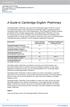 Cambridge English: Preliminary, also known as the Preliminary English Test (PET), is part of a comprehensive range of exams developed by Cambridge English Language Assessment. Cambridge English exams have
CHAPTER 2 THEORITICAL FRAMEWORK. related literature when using Bingo games as a strategy in teaching vocabulary.
 CHAPTER 2 THEORITICAL FRAMEWORK This chapter will discuss theoretical points: review of previous research and review of related literature when using Bingo games as a strategy in teaching vocabulary. 2.1
ENGLISH AS AN ADDITIONAL LANGUAGE (EAL) COMPANION TO AusVELS
 ENGLISH AS AN ADDITIONAL LANGUAGE (EAL) COMPANION TO AusVELS For implementation in 2013 Contents English as an Additional Language... 3 Introduction... 3 Structure of the EAL Companion... 4 A Stages Lower
Developmental Verbal Dyspraxia Nuffield Approach
 Developmental Verbal Dyspraxia Nuffield Approach Pam Williams, Consultant Speech & Language Therapist Nuffield Hearing & Speech Centre RNTNE Hospital, London, Uk Outline of session Speech & language difficulties
A Study of Restaurant Management Department Students Difficulties in Learning English Conversation and Their Solutions
 A Study of Restaurant Management Department Students Difficulties in Learning English Conversation and Their Solutions Chia-Ying-Mao Postgraduate Student, Department of Foreign Language & Literature, Asia
CHARTES D'ANGLAIS SOMMAIRE. CHARTE NIVEAU A1 Pages 2-4. CHARTE NIVEAU A2 Pages 5-7. CHARTE NIVEAU B1 Pages 8-10. CHARTE NIVEAU B2 Pages 11-14
 CHARTES D'ANGLAIS SOMMAIRE CHARTE NIVEAU A1 Pages 2-4 CHARTE NIVEAU A2 Pages 5-7 CHARTE NIVEAU B1 Pages 8-10 CHARTE NIVEAU B2 Pages 11-14 CHARTE NIVEAU C1 Pages 15-17 MAJ, le 11 juin 2014 A1 Skills-based
An Investigation of the Effectiveness of Teaching Pronunciation to Malaysian TESL Students
 An Investigation of the Effectiveness of Teaching Pronunciation to Malaysian TESL Students By Joanne Rajadurai (Malaysia) Pronunciation has often been viewed as a skill in second language learning that
The. Languages Ladder. Steps to Success. The
 The Languages Ladder Steps to Success The What is it? The development of a national recognition scheme for languages the Languages Ladder is one of three overarching aims of the National Languages Strategy.
Discourse Markers in English Writing
 Discourse Markers in English Writing Li FENG Abstract Many devices, such as reference, substitution, ellipsis, and discourse marker, contribute to a discourse s cohesion and coherence. This paper focuses
GESE Initial steps. Guide for teachers, Grades 1 3. GESE Grade 1 Introduction
 GESE Initial steps Guide for teachers, Grades 1 3 GESE Grade 1 Introduction cover photos: left and right Martin Dalton, middle Speak! Learning Centre Contents Contents What is Trinity College London?...3
Tips for Working With ELL Students
 Session One: Increasing Comprehensibility One goal for every teacher working with ELL students is to increase comprehensibility. In other words, to increase understanding or make course content more intelligible.
LiteracyPlanet & the Australian Curriculum: Pre-School
 LiteracyPlanet & the Australian Curriculum: Pre-School We look at learning differently. LiteracyPlanet & the Australian Curriculum Welcome to LiteracyPlanet & the Australian Curriculum. LiteracyPlanet
Office Phone/E-mail: 963-1598 / [email protected] Office Hours: MW 3:50-4:50, TR 12:00-12:30
 ENG 432/532: Phonetics and Phonology (Fall 2010) Course credits: Four (4) Time/classroom: MW2:00-3:40 p.m./ LL243 Instructor: Charles X. Li, Ph.D. Office location: LL403H Office Phone/E-mail: 963-1598
M. Luz Celaya Universidad de Barcelona [email protected]
 María del Pilar García Mayo and María Luisa García Lecumberri, eds. 2003: Age and the Acquisition of English as a Foreign Language. Clevedon: Multilingual Matters. M. Luz Celaya Universidad de Barcelona
Supporting Children Learning English as a Second Language in the Early Years (birth to six years) November 2009
 Supporting Children Learning English as a Second Language in the Early Years (birth to six years) November 2009 Dr Priscilla Clarke OAM, Early Childhood Consultant This Discussion Paper was commissioned
My Family FREE SAMPLE. This unit focuses on sequencing. These extension
 Unit 5 This unit focuses on sequencing. These extension Unit Objectives activities give the children practice with sequencing beginning, middle, and end. As the learn to name family members and rooms children
Ohio Early Learning and Development Standards Domain: Language and Literacy Development
 Ohio Early Learning and Development Standards Domain: Language and Literacy Development Strand: Listening and Speaking Topic: Receptive Language and Comprehension Infants Young Toddlers (Birth - 8 months)
Italian Language & Culture Courses for Foreigners. ITALY Language Training
 Italian Language & Culture Courses for Foreigners ITALY 1 Good Practice Executive Summary Founded in the early 1920's with the aim of teaching Italian civilisation and artistic heritage to foreigners,
Contents. A Word About This Guide... 3. Why Is It Important for My Child to Read?... 4. How Will My Child Learn to Read?... 4
 Contents A Word About This Guide............................... 3 Why Is It Important for My Child to Read?................ 4 How Will My Child Learn to Read?....................... 4 How Can I Help My
Teaching pronunciation Glasgow June 15th
 Teaching pronunciation Glasgow June 15th Consider the following questions What do you understand by comfortable intelligibility? What is your approach to teaching pronunciation? What aspects of pronunciation
One Stop Shop For Educators
 Modern Languages Level II Course Description One Stop Shop For Educators The Level II language course focuses on the continued development of communicative competence in the target language and understanding
Buy The Complete Version of This Book at Booklocker.com:
 Practical, comprehensible ESL workshops centered on the adult ELL learner. The ESL Teachers Workshop Modules Buy The Complete Version of This Book at Booklocker.com: http://www.booklocker.com/p/books/4783.html?s=pdf
How To Teach English To Other People
 TESOL / NCATE Program Standards STANDARDS FOR THE ACCREDIATION OF INITIAL PROGRAMS IN P 12 ESL TEACHER EDUCATION Prepared and Developed by the TESOL Task Force on ESL Standards for P 12 Teacher Education
Functional Auditory Performance Indicators (FAPI)
 Functional Performance Indicators (FAPI) An Integrated Approach to Skill FAPI Overview The Functional (FAPI) assesses the functional auditory skills of children with hearing loss. It can be used by parents,
Some Basic Concepts Marla Yoshida
 Some Basic Concepts Marla Yoshida Why do we need to teach pronunciation? There are many things that English teachers need to fit into their limited class time grammar and vocabulary, speaking, listening,
Modifying Curriculum and Instruction
 Modifying Curriculum and Instruction Purpose of Modification: The purpose of modification is to enable an individual to compensate for intellectual, behavioral, or physical disabi1ities. Modifications
The Role of Listening in Language Acquisition; the Challenges & Strategies in Teaching Listening
 International Journal of Education and Information Studies. ISSN 2277-3169 Volume 4, Number 1 (2014), pp. 59-63 Research India Publications http://www.ripublication.com The Role of Listening in Language
THEORIES OF ESL LITERACY INSTRUCTION
 THEORIES OF ESL LITERACY INSTRUCTION There are a number of theories about ESL acquisition and ESL literacy acquisition. These theories focus on different ideas of how people best learn literacy in an additional
What Is Linguistics? December 1992 Center for Applied Linguistics
 What Is Linguistics? December 1992 Center for Applied Linguistics Linguistics is the study of language. Knowledge of linguistics, however, is different from knowledge of a language. Just as a person is
CELTA. Syllabus and Assessment Guidelines. Fourth Edition. Certificate in Teaching English to Speakers of Other Languages
 CELTA Certificate in Teaching English to Speakers of Other Languages Syllabus and Assessment Guidelines Fourth Edition CELTA (Certificate in Teaching English to Speakers of Other Languages) is regulated
Teaching Framework. Framework components
 Teaching Framework Framework components CE/3007b/4Y09 UCLES 2014 Framework components Each category and sub-category of the framework is made up of components. The explanations below set out what is meant
What Can Help Improve Social Interaction and Development?
 What Can Help Improve Social Interaction and Development? Supporting social interaction is an important piece of the student s educational plan, as increasing social interaction and competency are vital
Dr. Wei Wei Royal Melbourne Institute of Technology, Vietnam Campus January 2013
 Research Summary: Can integrated skills tasks change students use of learning strategies and materials? A case study using PTE Academic integrated skills items Dr. Wei Wei Royal Melbourne Institute of
St.Dennis CP School. Modern Foreign Languages (MFL) Policy February 2013
 St.Dennis CP School Modern Foreign Languages (MFL) Policy February 2013 Policy confirmed by the Governing Body of St Dennis CP School on: Date: Signature: To be reviewed on: 1 Rationale for Teaching Languages
PROBLEMATICS OF TEACHING & LEARNING COMMUNICATION SKILLS IN PROFESSIONAL COLLEGES
 International Journal of Advance Research In Science And Engineering http://www.ijarse.com PROBLEMATICS OF TEACHING & LEARNING COMMUNICATION SKILLS IN PROFESSIONAL COLLEGES Mohit Kumar Assistant Professor,
USING SONGS IN THE ESL CLASSROOM: A REFLEXION AND A PROPOSAL GRADO EN EDUCACIÓN RIMARIA, MENCIÓN INGLÉS TRABAJO DE FIN DE GRADO
 USING SONGS IN THE ESL CLASSROOM: A REFLEXION AND A PROPOSAL GRADO EN EDUCACIÓN RIMARIA, MENCIÓN INGLÉS TRABAJO DE FIN DE GRADO AUTHOR: MARTA MATEOS NEILA TUTOR: ANA ISABEL DÍEZ GONZÁLEZ JULY 2013 ABSTRACT
A Report on my Foreign Language Learning Experience BA English Language and Communication
 Focus A Report on my Foreign Language Learning Experience BA English Language and Communication 1 I aim to discuss and evaluate my acquisition of the grammatical systems of foreign languages; focusing
INTRODUCTION TO COACHING TEACHING SKILLS TEACHING/LEARNING. September 2007 Page 1
 TEACHING SKILLS September 2007 Page 1 TEACHING SKILLS Being a teacher is one of the main roles a coach fulfils for their players. The ability to teach effectively, especially the technical skills of ice
Domain and goal Activities Dancing game Singing/Vocalizing game Date What did your child do?
 AUDITION Sways, dances or vocalizes to music and singing CD, MP3, radio Voice Bombardment of /p/ Speech Sounds p.5 6 An important aspect of learning to listen is learning that music and singing is different
Growing Up With Epilepsy
 Teaching Students with Epilepsy: Children with epilepsy often experience learning issues as a result of their seizures. These may include ongoing problems with motor skills or cognitive functions, as well
Modern Foreign Languages (MFL) Policy 2013
 Modern Foreign Languages (MFL) Policy 2013 Revised by: Head, staff & governors: Date: Dec 2013 Next Review: December 2016 or sooner if regulations / circumstances change 1 Rationale for Teaching Languages
BA Primary Education (QTS) Professional Training and Development Handbook Years 2 & 3 Teaching Phonics
 The University for World-Class Professionals BA Primary Education (QTS) Professional Training and Development Handbook Years 2 & 3 Teaching Phonics Faculty of Education mmu.ac.uk/education MMU 2015 Faculty
CAMBRIDGE FIRST CERTIFICATE Listening and Speaking NEW EDITION. Sue O Connell with Louise Hashemi
 CAMBRIDGE FIRST CERTIFICATE SKILLS Series Editor: Sue O Connell CAMBRIDGE FIRST CERTIFICATE Listening and Speaking NEW EDITION Sue O Connell with Louise Hashemi PUBLISHED BY THE PRESS SYNDICATE OF THE
Thai Pronunciation and Phonetic Symbols Prawet Jantharat Ed.D.
 Thai Pronunciation and Phonetic Symbols Prawet Jantharat Ed.D. This guideline contains a number of things concerning the pronunciation of Thai. Thai writing system is a non-roman alphabet system. This
MA in English language teaching Pázmány Péter Catholic University *** List of courses and course descriptions ***
 MA in English language teaching Pázmány Péter Catholic University *** List of courses and course descriptions *** Code Course title Contact hours per term Number of credits BMNAT10100 Applied linguistics
Adopted by the Board of Directors: November 12, 2002
 Dyslexia is a specific learning disability that is neurological in origin. It is characterized by difficulties with accurate and/or fluent word recognition and by poor spelling and decoding abilities.
COMPETENT COMMUNICATION MANUAL (NEW)
 Project #1: THE ICE BREAKER Executive Summary: For your first speech project, you will introduce yourself to your fellow club members and give them some information about your background, interests and
MFL Policy 2014. Policy confirmed by the Governing Body of Our Lady Immaculate Roman Catholic Primary School on: Date: 23.9.14
 MFL Policy 2014 Policy confirmed by the Governing Body of Our Lady Immaculate Roman Catholic Primary School on: Date: 23.9.14 Signature: (Chair of Governors) To be reviewed on: Rationale for Teaching Languages
Tibiscus University of Timişoara, România. 1. Aspects of the Computer Assisted English Language Learning
 The Effectiveness of Computer Assisted Classes for English as a Second Language Ioana Iacob Tibiscus University of Timişoara, România ABSTRACT. The present study aims to evaluate the efficiency of the
GESE Elementary steps. Guide for teachers, Grades 4 6
 GESE Elementary steps Guide for teachers, Grades 4 6 What is Trinity College London? Trinity College London is an independent international exams board, fully accredited in England as an awarding body.
Teaching English as a Foreign Language (TEFL) Certificate Programs
 Teaching English as a Foreign Language (TEFL) Certificate Programs Our TEFL offerings include one 27-unit professional certificate program and four shorter 12-unit certificates: TEFL Professional Certificate
Ribby with Wrea Endowed C.E. Primary School. Modern Foreign Languages Policy
 Ribby with Wrea Endowed C.E. Primary School Modern Foreign Languages Policy Gill Metherell Updated: January 2011 Review Date: January 2012 Introduction Our teaching of a Modern Foreign Language (MFL) is
Unit 3. Effective Communication in Health and Social Care. Learning aims
 Unit 3 Effective Communication in Health and Social Care Learning aims In this unit you will: investigate different forms of communication. investigate barriers to communication in health and social care.