
Brocade Data Center Fabric Architectures
|
|
|
- Harvey Reeves
- 9 years ago
- Views:
Transcription
1 WHITE PAPER Brocade Data Center Fabric Architectures Building the foundation for a cloud-optimized data center TABLE OF CONTENTS Evolution of Data Center Architectures... 1 Data Center Networks: Building Blocks...3 Building Data Center Sites with Brocade VCS Fabric Technology...11 Building Data Center Sites with Brocade IP Fabric...15 Building Data Center Sites with Layer 2 and Layer 3 Fabrics...21 Based on the principles of the New IP, Brocade is building on the proven success of the Brocade VDX platform by expanding the Brocade cloudoptimized network and network virtualization architectures and delivering new automation innovations to meet customer demand for higher levels of scale, agility, and operational efficiency. The scalable and highly automated Brocade data center fabric architectures described in this white paper make it easy for infrastructure planners to architect, automate, and integrate with current and future data center technologies while they transition to their own cloud-optimized data center on their own time and terms. Scaling a Data Center Site with a Data Center Core...21 Control Plane and Hardware Scale Considerations...22 Choosing an Architecture for Your Data Center Network Virtualization Options DCI Fabrics for Multisite Data Center Deployments...37 Turnkey and Programmable Automation About Brocade...47 This paper helps network architects, virtualization architects, and network engineers to make informed design, architecture, and deployment decisions that best meet their technical and business objectives. The following topics are covered in detail: Network architecture options for scaling from tens to hundreds of thousands of servers Network virtualization solutions that include integration with leading controller-based and controller-less industry solutions Data Center Interconnect (DCI) options Server-based, open, and programmable turnkey automation tools for rapid provisioning and customization with minimal effort Evolution of Data Center Architectures Data center networking architectures have evolved with the changing requirements of the modern data center and cloud environments. Traditional data center networks were a derivative of the 3-tier architecture, prevalent in enterprise campus environments. (See Figure 1.) The tiers are defined as Access, Aggregation, and Core. The 3-tier topology was architected with the requirements of an enterprise campus in mind. A typical network access layer requirement of an enterprise campus is to provide connectivity to workstations. These enterprise workstations exchange traffic with either an enterprise data center for business application access or with
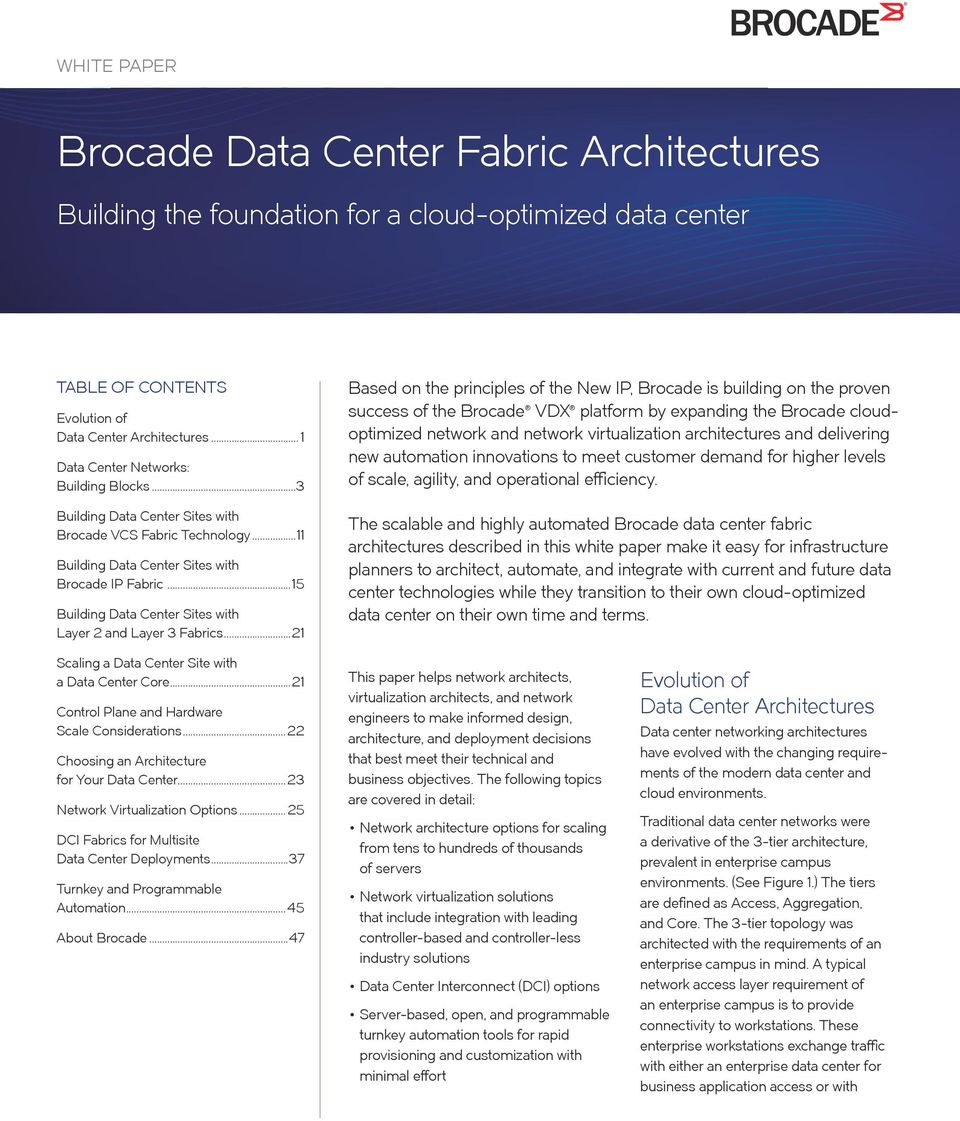
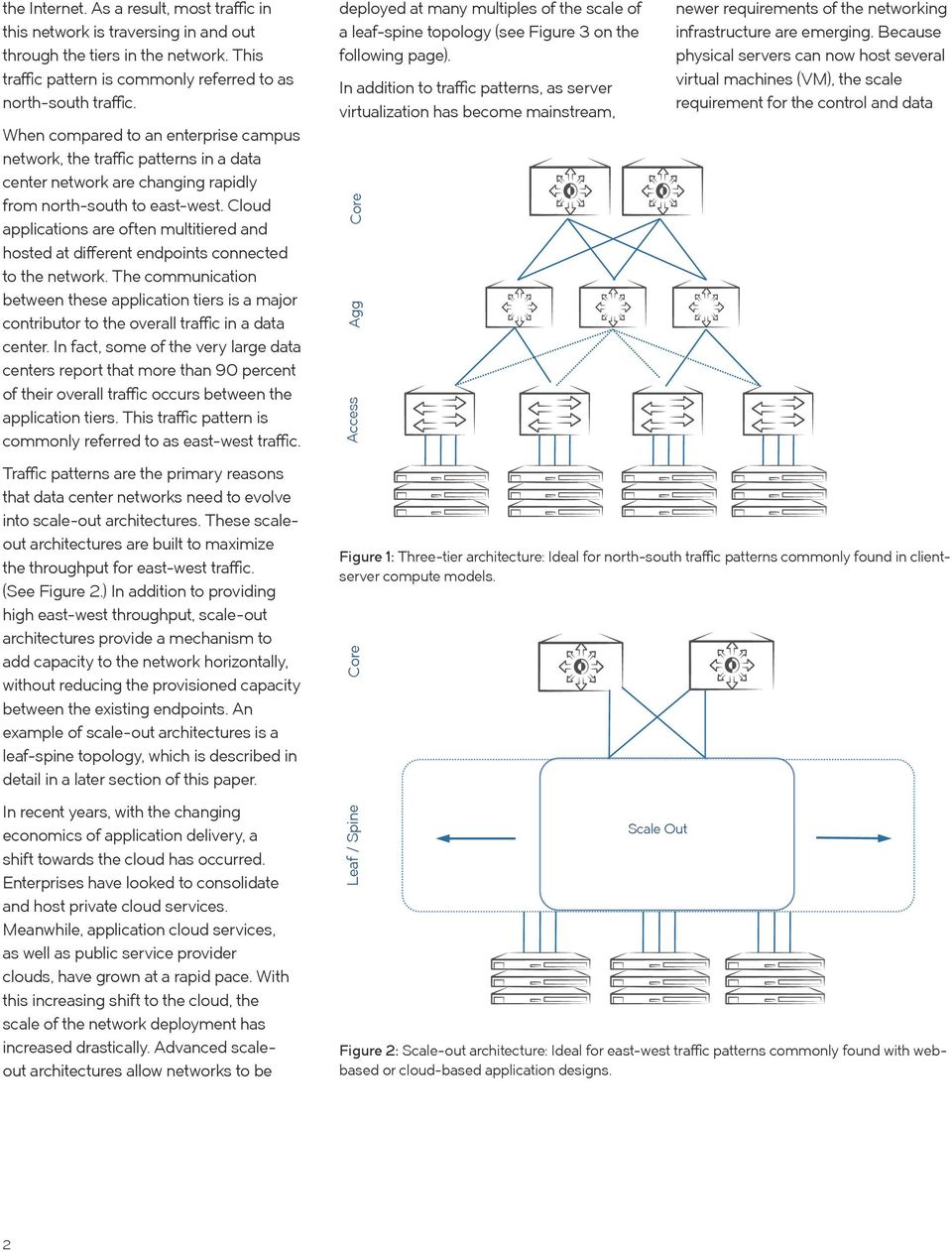
2 the Internet. As a result, most traffic in this network is traversing in and out through the tiers in the network. This traffic pattern is commonly referred to as north-south traffic. When compared to an enterprise campus network, the traffic patterns in a data center network are changing rapidly from north-south to east-west. Cloud applications are often multitiered and hosted at different endpoints connected to the network. The communication between these application tiers is a major contributor to the overall traffic in a data center. In fact, some of the very large data centers report that more than 90 percent of their overall traffic occurs between the application tiers. This traffic pattern is commonly referred to as east-west traffic. deployed at many multiples of the scale of a leaf-spine topology (see Figure 3 on the following page). In addition to traffic patterns, as server virtualization has become mainstream, Core Agg Access newer requirements of the networking infrastructure are emerging. Because physical servers can now host several virtual machines (VM), the scale requirement for the control and data Traffic patterns are the primary reasons that data center networks need to evolve into scale-out architectures. These scaleout architectures are built to maximize the throughput for east-west traffic. (See Figure 2.) In addition to providing high east-west throughput, scale-out architectures provide a mechanism to add capacity to the network horizontally, without reducing the provisioned capacity between the existing endpoints. An example of scale-out architectures is a leaf-spine topology, which is described in detail in a later section of this paper. In recent years, with the changing economics of application delivery, a shift towards the cloud has occurred. Enterprises have looked to consolidate and host private cloud services. Meanwhile, application cloud services, as well as public service provider clouds, have grown at a rapid pace. With this increasing shift to the cloud, the scale of the network deployment has increased drastically. Advanced scaleout architectures allow networks to be Figure 1: Three-tier architecture: Ideal for north-south traffic patterns commonly found in clientserver compute models. Core / Scale Out Figure 2: Scale-out architecture: Ideal for east-west traffic patterns commonly found with webbased or cloud-based application designs. 2
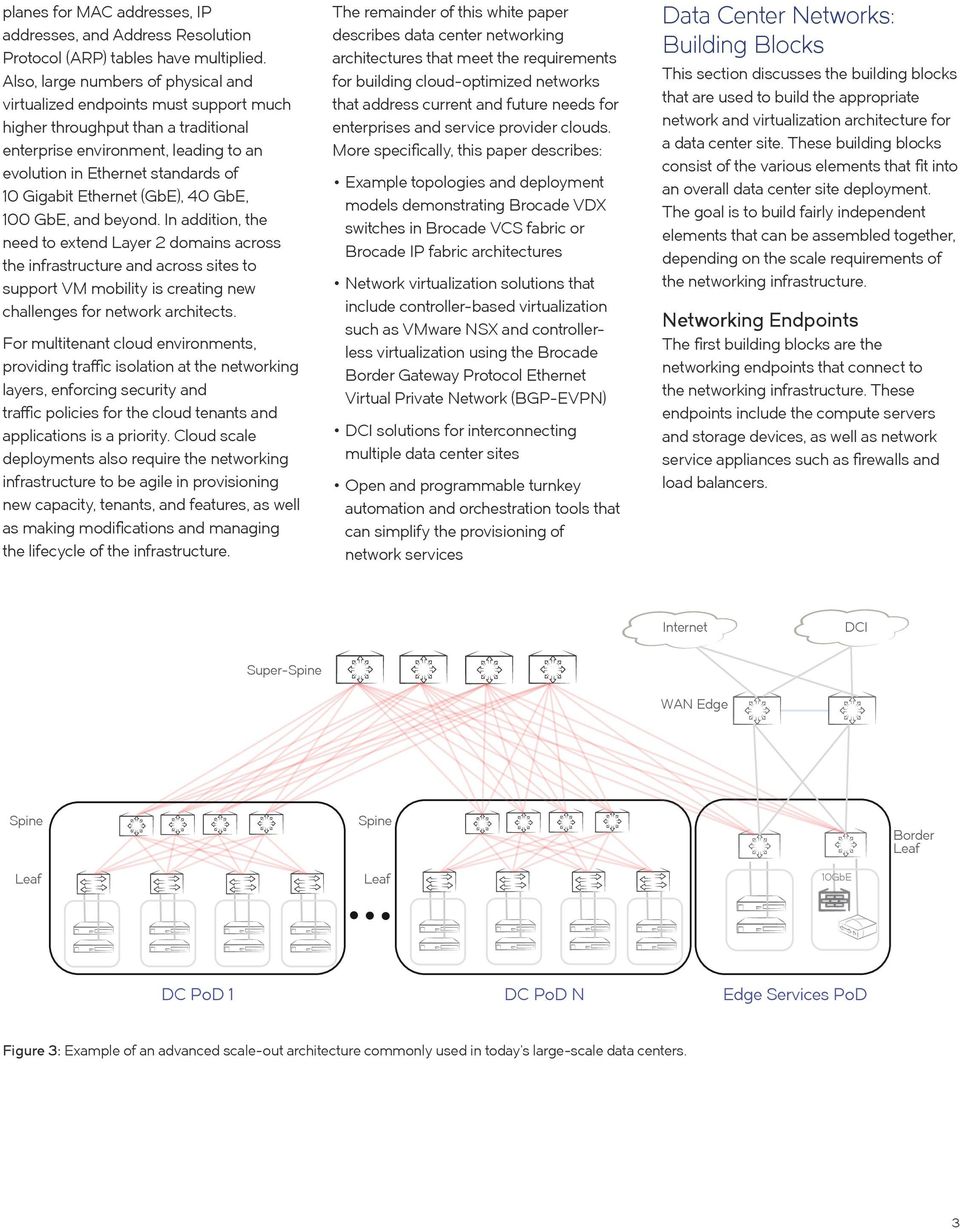
3 planes for MAC addresses, IP addresses, and Address Resolution Protocol (ARP) tables have multiplied. Also, large numbers of physical and virtualized endpoints must support much higher throughput than a traditional enterprise environment, leading to an evolution in Ethernet standards of 10 Gigabit Ethernet (GbE), 40 GbE, 100 GbE, and beyond. In addition, the need to extend Layer 2 domains across the infrastructure and across sites to support VM mobility is creating new challenges for network architects. For multitenant cloud environments, providing traffic isolation at the networking layers, enforcing security and traffic policies for the cloud tenants and applications is a priority. Cloud scale deployments also require the networking infrastructure to be agile in provisioning new capacity, tenants, and features, as well as making modifications and managing the lifecycle of the infrastructure. The remainder of this white paper describes data center networking architectures that meet the requirements for building cloud-optimized networks that address current and future needs for enterprises and service provider clouds. More specifically, this paper describes: Example topologies and deployment models demonstrating Brocade VDX switches in Brocade VCS fabric or Brocade IP fabric architectures Network virtualization solutions that include controller-based virtualization such as VMware NSX and controllerless virtualization using the Brocade Border Gateway Protocol Ethernet Virtual Private Network (BGP-EVPN) DCI solutions for interconnecting multiple data center sites Open and programmable turnkey automation and orchestration tools that can simplify the provisioning of network services Data Center Networks: Building Blocks This section discusses the building blocks that are used to build the appropriate network and virtualization architecture for a data center site. These building blocks consist of the various elements that fit into an overall data center site deployment. The goal is to build fairly independent elements that can be assembled together, depending on the scale requirements of the networking infrastructure. Networking Endpoints The first building blocks are the networking endpoints that connect to the networking infrastructure. These endpoints include the compute servers and storage devices, as well as network service appliances such as firewalls and load balancers. Internet DCI Super- WAN Edge Border 10GbE DC PoD 1 DC PoD N Figure 3: Example of an advanced scale-out architecture commonly used in today s large-scale data centers. 3
4 Figure 4 shows the different types of racks used in a data center infrastructure as described below: Infrastructure and Management Racks: These racks host the management infrastructure, which includes any management appliances or software used to manage the infrastructure. Examples of this are server virtualization management software like VMware vcenter or Microsoft SCVMM, orchestration software like OpenStack or VMware vrealize Automation, network controllers like the Brocade SDN Controller or VMware NSX, and network management and automation tools like Brocade Network Advisor. Examples of infrastructure racks are IP physical or virtual storage appliances. Compute racks: Compute racks host the workloads for the data centers. These workloads can be physical servers, or they can be virtualized servers when the workload is made up of Virtual Machines (VMs). The compute endpoints can be single or can be multihomed to the network. Edge racks: The network services connected to the network are consolidated in edge racks. The role of the edge racks is to host the edge services, which can be physical appliances or VMs. in Figure 5. The single-tier switches are shown as a virtual Link Aggregation Group (vlag) pair. The topology in Figure 5 shows the management/infrastructure, compute racks, and edge racks connected to a pair of switches participating in multiswitch port channeling. This pair of switches is called a vlag pair. The single-tier topology scales the least among all the topologies described in this paper, but it provides the best choice for smaller deployments, as it reduces the Capital Expenditure (CapEx) costs for the network in terms of the size of the Servers/Blades vlag Pair IP Storage infrastructure deployed. It also reduces the optics and cabling costs for the networking infrastructure. Design Considerations for a Single-Tier Topology The design considerations for deploying a single-tier topology are summarized in this section. Oversubscription Ratios It is important for network architects to understand the expected traffic patterns in the network. To this effect, the oversubscription ratios at the vlag pair should be well understood and planned for. Servers/Blades Management/Infrastructure Racks Compute Racks Figure 4: Networking endpoints and racks. These definitions of infrastructure/ management, compute racks, and edge racks are used throughout this white paper. Single-Tier Topology The second building block is a singletier network topology to connect endpoints to the network. Because of the existence of only one tier, all endpoints connect to this tier of the network. An example of a single-tier topology is shown Servers/Blades IP Storage Servers/Blades Management/Infrastructure Racks Compute Racks Figure 5: Ports on demand with a single networking tier. 4
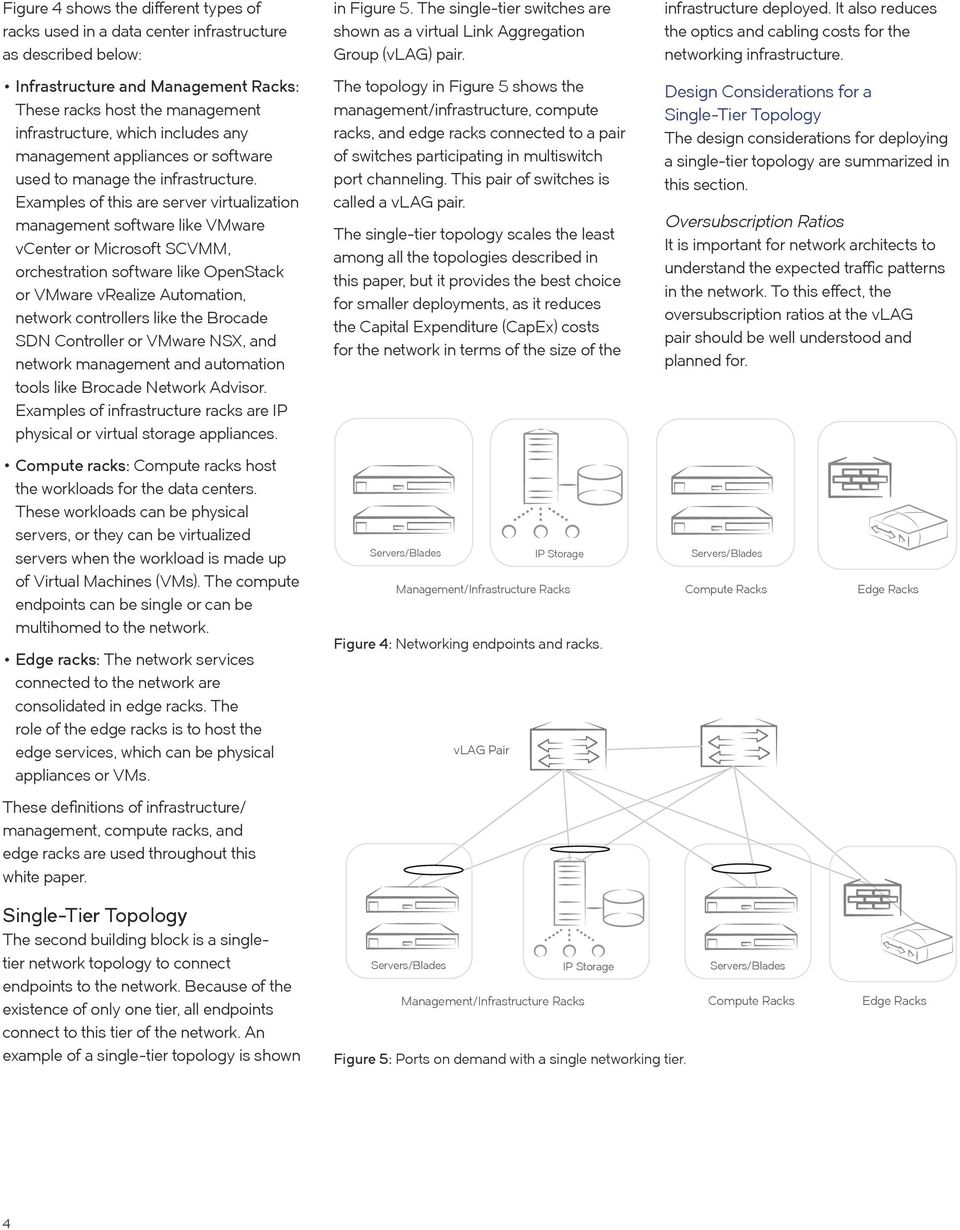
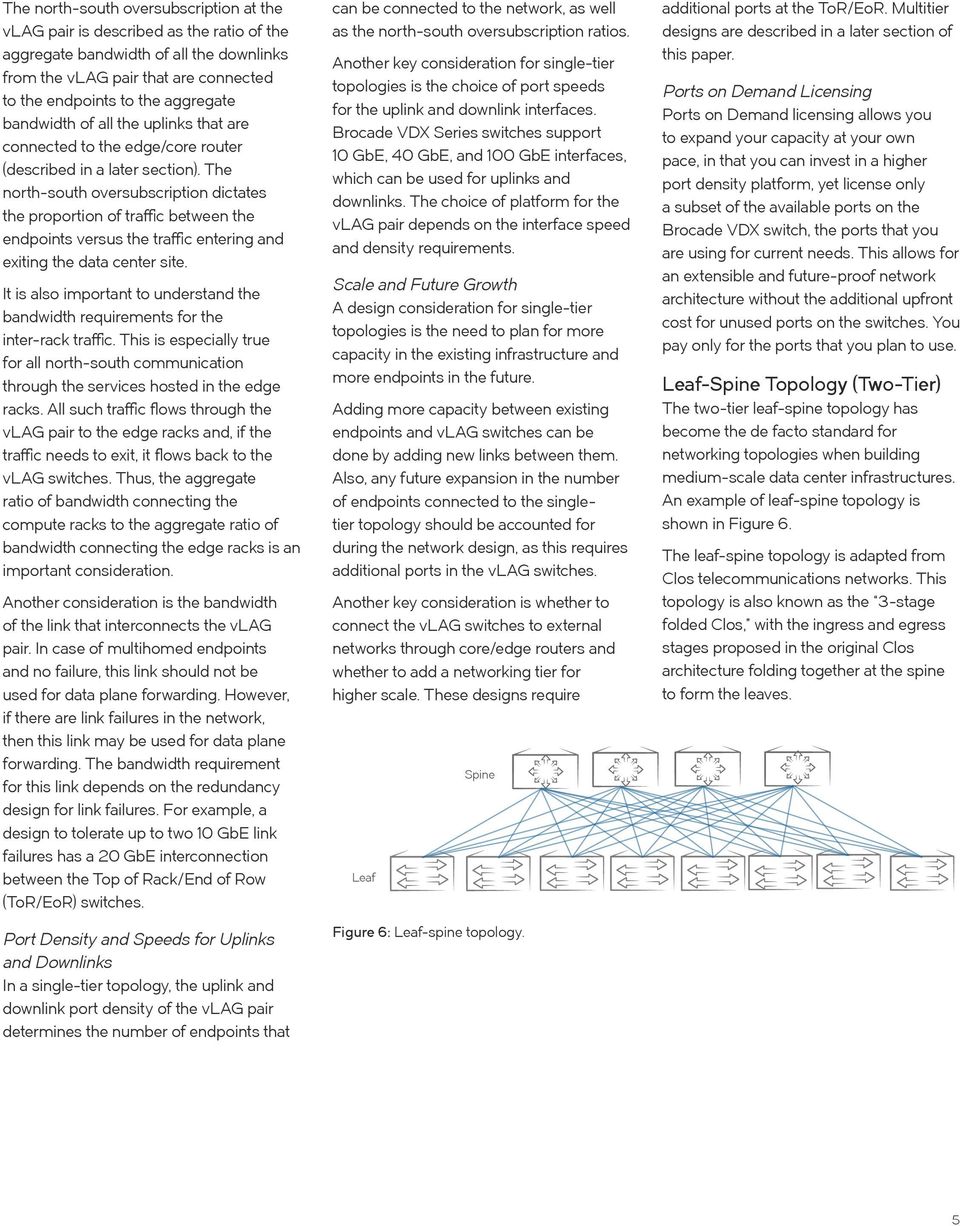
5 The north-south oversubscription at the vlag pair is described as the ratio of the aggregate bandwidth of all the downlinks from the vlag pair that are connected to the endpoints to the aggregate bandwidth of all the uplinks that are connected to the edge/core router (described in a later section). The north-south oversubscription dictates the proportion of traffic between the endpoints versus the traffic entering and exiting the data center site. It is also important to understand the bandwidth requirements for the inter-rack traffic. This is especially true for all north-south communication through the services hosted in the edge racks. All such traffic flows through the vlag pair to the edge racks and, if the traffic needs to exit, it flows back to the vlag switches. Thus, the aggregate ratio of bandwidth connecting the compute racks to the aggregate ratio of bandwidth connecting the edge racks is an important consideration. Another consideration is the bandwidth of the link that interconnects the vlag pair. In case of multihomed endpoints and no failure, this link should not be used for data plane forwarding. However, if there are link failures in the network, then this link may be used for data plane forwarding. The bandwidth requirement for this link depends on the redundancy design for link failures. For example, a design to tolerate up to two link failures has a 20 GbE interconnection between the Top of Rack/End of Row (ToR/EoR) switches. Port Density and Speeds for Uplinks and Downlinks In a single-tier topology, the uplink and downlink port density of the vlag pair determines the number of endpoints that can be connected to the network, as well as the north-south oversubscription ratios. Another key consideration for single-tier topologies is the choice of port speeds for the uplink and downlink interfaces. Brocade VDX Series switches support, 40 GbE, and 100 GbE interfaces, which can be used for uplinks and downlinks. The choice of platform for the vlag pair depends on the interface speed and density requirements. Scale and Future Growth A design consideration for single-tier topologies is the need to plan for more capacity in the existing infrastructure and more endpoints in the future. Adding more capacity between existing endpoints and vlag switches can be done by adding new links between them. Also, any future expansion in the number of endpoints connected to the singletier topology should be accounted for during the network design, as this requires additional ports in the vlag switches. Another key consideration is whether to connect the vlag switches to external networks through core/edge routers and whether to add a networking tier for higher scale. These designs require Figure 6: -spine topology. additional ports at the ToR/EoR. Multitier designs are described in a later section of this paper. Ports on Demand Licensing Ports on Demand licensing allows you to expand your capacity at your own pace, in that you can invest in a higher port density platform, yet license only a subset of the available ports on the Brocade VDX switch, the ports that you are using for current needs. This allows for an extensible and future-proof network architecture without the additional upfront cost for unused ports on the switches. You pay only for the ports that you plan to use. - Topology (Two-Tier) The two-tier leaf-spine topology has become the de facto standard for networking topologies when building medium-scale data center infrastructures. An example of leaf-spine topology is shown in Figure 6. The leaf-spine topology is adapted from Clos telecommunications networks. This topology is also known as the 3-stage folded Clos, with the ingress and egress stages proposed in the original Clos architecture folding together at the spine to form the leaves. 5
6 The role of the leaf is to provide connectivity to the endpoints in the network. These endpoints include compute servers and storage devices, as well as other networking devices like routers and switches, load balancers, firewalls, or any other networking endpoint physical or virtual. As all endpoints connect only to the leaves, policy enforcement including security, traffic path selection, Quality of Service (QoS) markings, traffic scheduling, policing, shaping, and traffic redirection are implemented at the leaves. The role of the spine is to provide interconnectivity between the leaves. Network endpoints do not connect to the spines. As most policy implementation is performed at the leaves, the major role of the spine is to participate in the control plane and data plane operations for traffic forwarding between the leaves. As a design principle, the following requirements apply to the leaf-spine topology: Each leaf connects to all the spines in the network. The spines are not interconnected with each other. The leaves are not interconnected with each other for data plane purposes. (The leaves may be interconnected for control plane operations such as forming a server-facing vlag.) These are some of the key benefits of a leaf-spine topology: Because each leaf is connected to every spine, there are multiple redundant paths available for traffic between any pair of leaves. Link failures cause other paths in the network to be used. Because of the existence of multiple paths, Equal-Cost Multipathing (ECMP) can be leveraged for flows traversing between pairs of leaves. With ECMP, each leaf has equal-cost routes, to reach destinations in other leaves, equal to the number of spines in the network. The leaf-spine topology provides a basis for a scale-out architecture. New leaves can be added to the network without affecting the provisioned east-west capacity for the existing infrastructure. The role of each tier in the network is well defined (as discussed previously), providing modularity in the networking functions and reducing architectural and deployment complexities. The leaf-spine topology provides granular control over subscription ratios for traffic flowing within a rack, traffic flowing between racks, and traffic flowing outside the leaf-spine topology. Design Considerations for a - Topology There are several design considerations for deploying a leaf-spine topology. This section summarizes the key considerations. Oversubscription Ratios It is important for network architects to understand the expected traffic patterns in the network. To this effect, the oversubscription ratios at each layer should be well understood and planned for. For a leaf switch, the ports connecting to the endpoints are defined as downlink ports, and the ports connecting to the spines are defined as uplink ports. The oversubscription ratio at the leaves is the ratio of the aggregate bandwidth for the downlink ports and the aggregate bandwidth for the uplink ports. For a spine switch in a leaf-spine topology, the east-west oversubscription ratio is defined per pair of leaf switches connecting to the spine switch. For a given pair of leaf switches connecting to the spine switch, the oversubscription ratio is the ratio of aggregate bandwidth of the links connecting to each leaf switch. In a majority of deployments, this ratio is 1:1, making the east-west oversubscription ratio at the spine nonblocking. Exceptions to the nonblocking eastwest oversubscriptions should be well understood and depend on the traffic patterns of the endpoints that are connected to the respective leaves. The oversubscription ratios described here govern the ratio of traffic bandwidth between endpoints connected to the same leaf switch and the traffic bandwidth between endpoints connected to different leaf switches. As an example, if the oversubscription ratio is 3:1 at the leaf and 1:1 at the spine, then the bandwidth of traffic between endpoints connected to the same leaf switch should be three times the bandwidth between endpoints connected to different leaves. From a network endpoint perspective, the network oversubscriptions should be planned so that the endpoints connected to the network have the required bandwidth for communications. Specifically, endpoints that are expected to use higher bandwidth should be localized to the same leaf switch (or same leaf switch pair when endpoints are multihomed). The ratio of the aggregate bandwidth of all the spine downlinks connected to the leaves to the aggregate bandwidth of all the downlinks connected to the border leaves (described in the edge services and border switch section) defines the north-south oversubscription at the spine. The north-south oversubscription dictates the traffic destined to the services that are connected to the border leaf switches and that exit the data center site. and Scale Because the endpoints in the network connect only to the leaf switches, the number of leaf switches in the network 6
7 depends on the number of interfaces required to connect all the endpoints. The port count requirement should also account for multihomed endpoints. Because each leaf switch connects to all the spines, the port density on the spine switch determines the maximum number of leaf switches in the topology. A higher oversubscription ratio at the leaves reduces the leaf scale requirements, as well. The number of spine switches in the network is governed by a combination of the throughput required between the leaf switches, the number of redundant/ ECMP paths between the leaves, and the port density in the spine switches. Higher throughput in the uplinks from the leaf switches to the spine switches can be achieved by increasing the number of spine switches or bundling the uplinks together in port channel interfaces between the leaves and the spines. Port Speeds for Uplinks and Downlinks Another consideration for leaf-spine topologies is the choice of port speeds for the uplink and downlink interfaces. Brocade VDX switches support, 40 GbE, and 100 GbE interfaces, which can be used for uplinks and downlinks. The choice of platform for the leaf and spine depends on the interface speed and density requirements. Scale and Future Growth Another design consideration for leafspine topologies is the need to plan for more capacity in the existing infrastructure and to plan for more endpoints in the future. Adding more capacity between existing leaf and spine switches can be done by adding spine switches or adding new interfaces between existing leaf and spine switches. In either case, the port density requirements for the leaf and the spine switches should be accounted for during the network design process. If new leaf switches need to be added to accommodate new endpoints in the network, then ports at the spine switches are required to connect the new leaf switches. In addition, you must decide whether to connect the leaf-spine topology to external networks through border leaf switches and also whether to add an additional networking tier for higher scale. Such designs require additional ports at the spine. These designs are described in another section of this paper. Ports on Demand Licensing Remember that Ports on Demand licensing allows you to expand your capacity at your own pace in that you can invest in a higher port density platform, yet license only the ports on the Brocade VDX switch that you are using for current needs. This allows for an extensible and future-proof network architecture without additional cost. Deployment Model The links between the leaf and spine can be either Layer 2 or Layer 3 links. If the links between the leaf and spine are Layer 2 links, the deployment is known as a Layer 2 (L2) leaf-spine deployment or a Layer 2 Clos deployment. You can deploy Brocade VDX switches in a Layer 2 deployment by using Brocade VCS Fabric technology. With Brocade VCS Fabric technology, the switches in the leaf-spine topology cluster together and form a fabric that provides a single point for management, distributed control plane, embedded automation, and multipathing capabilities from Layers 1 to 3. The benefits of deploying a VCS fabric are described later in this paper. If the links between the leaf and spine are Layer 3 links, the deployment is known as a Layer 3 (L3) leaf-spine deployment or a Layer 3 Clos deployment. You can deploy Brocade VDX switches in a Layer 3 deployment by using Brocade IP fabrics. Brocade IP fabrics provide a highly scalable, programmable, standardsbased, and interoperable networking infrastructure. The benefits of Brocade IP fabrics are described later in this paper. Data Center Points of Delivery Figure 7 on the following page shows a building block for a data center site. This building block is called a data center point of delivery (PoD). The data center PoD consists of the networking infrastructure in a leaf-spine topology along with the endpoints grouped together in management/infrastructure and compute racks. The idea of a PoD is to create a simple, repeatable, and scalable unit for building a data center site at scale. Optimized 5-Stage Folded Clos Topology (Three Tiers) Multiple leaf-spine topologies can be aggregated together for higher scale in an optimized 5-stage folded Clos topology. This topology adds a new tier to the network, known as the superspine. The role of the super-spine is to provide connectivity between the spine switches across multiple data center PoDs. Figure 8 on the following page on the following page shows four super-spine switches connecting the spine switches across multiple data center PoDs. The connection between the spines and the super-spines follow the Clos principles: Each spine connects to all the superspines in the network. Neither the spines nor the super-spines are interconnected with each other. Similarly, all the benefits of a leaf-spine topology namely, multiple redundant paths, ECMP, scale-out architecture and control over traffic patterns are realized in the optimized 5-stage folded Clos topology as well. 7

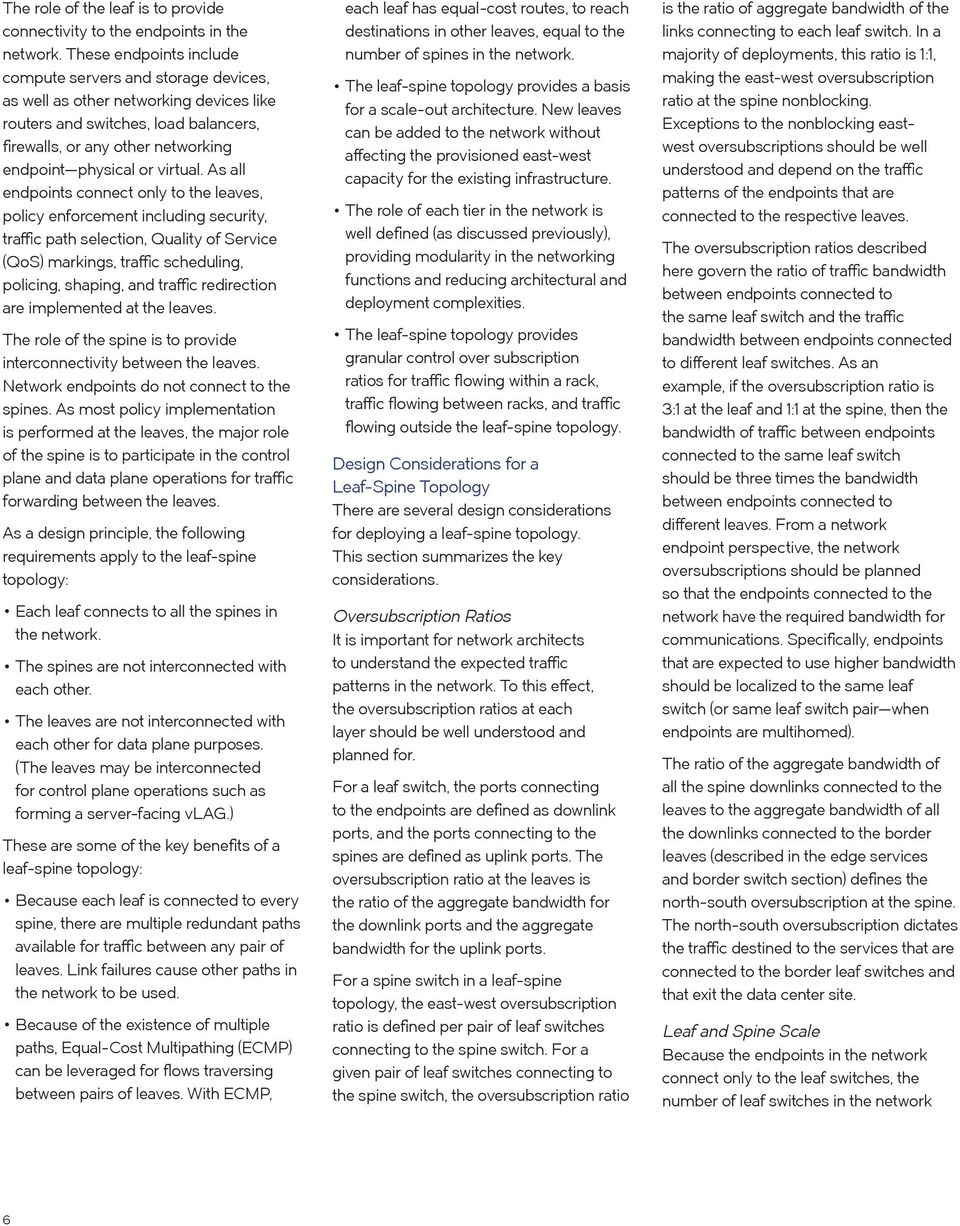
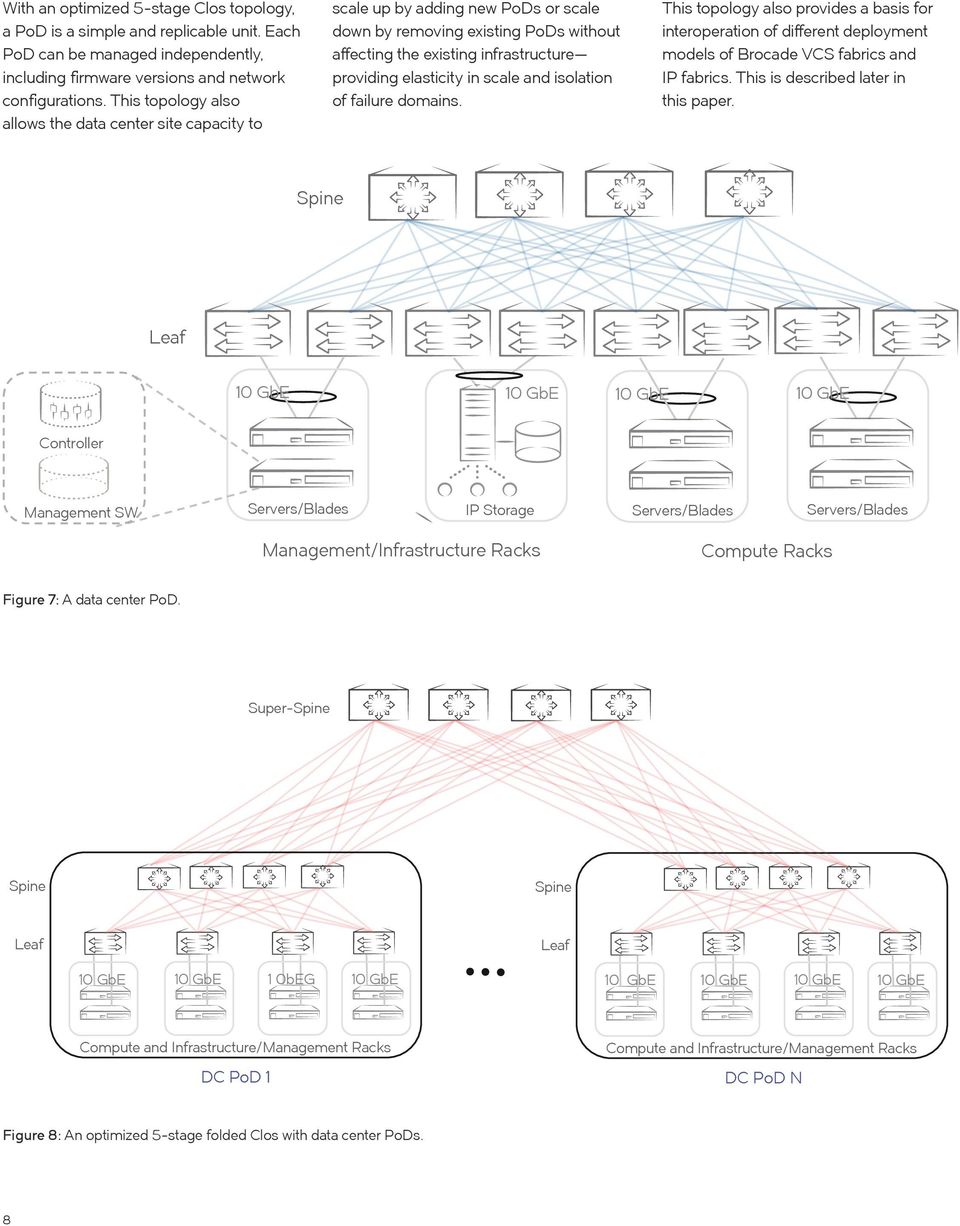
8 With an optimized 5-stage Clos topology, a PoD is a simple and replicable unit. Each PoD can be managed independently, including firmware versions and network configurations. This topology also allows the data center site capacity to scale up by adding new PoDs or scale down by removing existing PoDs without affecting the existing infrastructure providing elasticity in scale and isolation of failure domains. This topology also provides a basis for interoperation of different deployment models of Brocade VCS fabrics and IP fabrics. This is described later in this paper. Controller Management SW Servers/Blades IP Storage Servers/Blades Servers/Blades Management/Infrastructure Racks Compute Racks Figure 7: A data center PoD. Super- 1 0bEG DC PoD 1 DC PoD N Figure 8: An optimized 5-stage folded Clos with data center PoDs. 8
9 Design Considerations for Optimized 5-Stage Clos Topology The design considerations of oversubscription ratios, port speeds and density, spine and super-spine scale, planning for future growth, and Brocade Ports on Demand licensing, which were described for the leaf-spine topology, apply to the optimized 5-stage folded Clos topology as well. Some key considerations are highlighted below. Oversubscription Ratios Because the spine switches now have uplinks connecting to the superspine switches, the north-south oversubscription ratios for the spine switches dictate the ratio of aggregate bandwidth of traffic switched east-west within a data center PoD to the aggregate bandwidth of traffic exiting the data center PoD. This is a key consideration from the perspective of network infrastructure and services placement, application tiers, and (in the case of service providers) tenant placement. In cases of north-south oversubscription at the spines, endpoints should be placed to optimize traffic within a data center PoD. At the super-spine switch, the east-west oversubscription defines the ratio of bandwidth of the downlink connections for a pair of data center PoDs. In most cases, this ratio is 1:1. The ratio of the aggregate bandwidth of all the super-spine downlinks connected to the spines to the aggregate bandwidth of all the downlinks connected to the border leaves (described in the section of this paper on edge services and border switches) defines the north-south oversubscription at the super-spine. The north-south oversubscription dictates the traffic destined to the services connected to the border leaf switches and exiting the data center site. Deployment Model Because of the existence of the Layer 3 boundary either at the leaf or at the spine (depending on the Layer 2 or Layer 3 deployment model in the leaf-spine topology of the data center PoD), the links between the spines and super-spines are Layer 3 links. The routing and overlay protocols are described later in this paper. Layer 2 connections between the spines and super-spines is an option for smaller scale deployments, due to the inherent scale limitations of Layer 2 networks. These Layer 2 connections would be IEEE 802.1q based optionally over Link Aggregation Control Protocol (LACP) aggregated links. However, this design is not discussed in this paper. Edge Services and Border Switches For two-tier and three-tier data center topologies, the role of the border switches in the network is to provide external connectivity to the data center site. In addition, as all traffic enters and exits the data center through the border leaf switches, they present the ideal location in the network to connect network services like firewalls, load-balancers, and edge VPN routers. The topology for interconnecting the border switches depends on the number of network services that need to be attached, as well as the oversubscription ratio at the border switches. Figure 9 Border Firewall SW Firewall Servers/Blades Load Balancer SW VPN SW Router Figure 9: Edge services PoD. 9
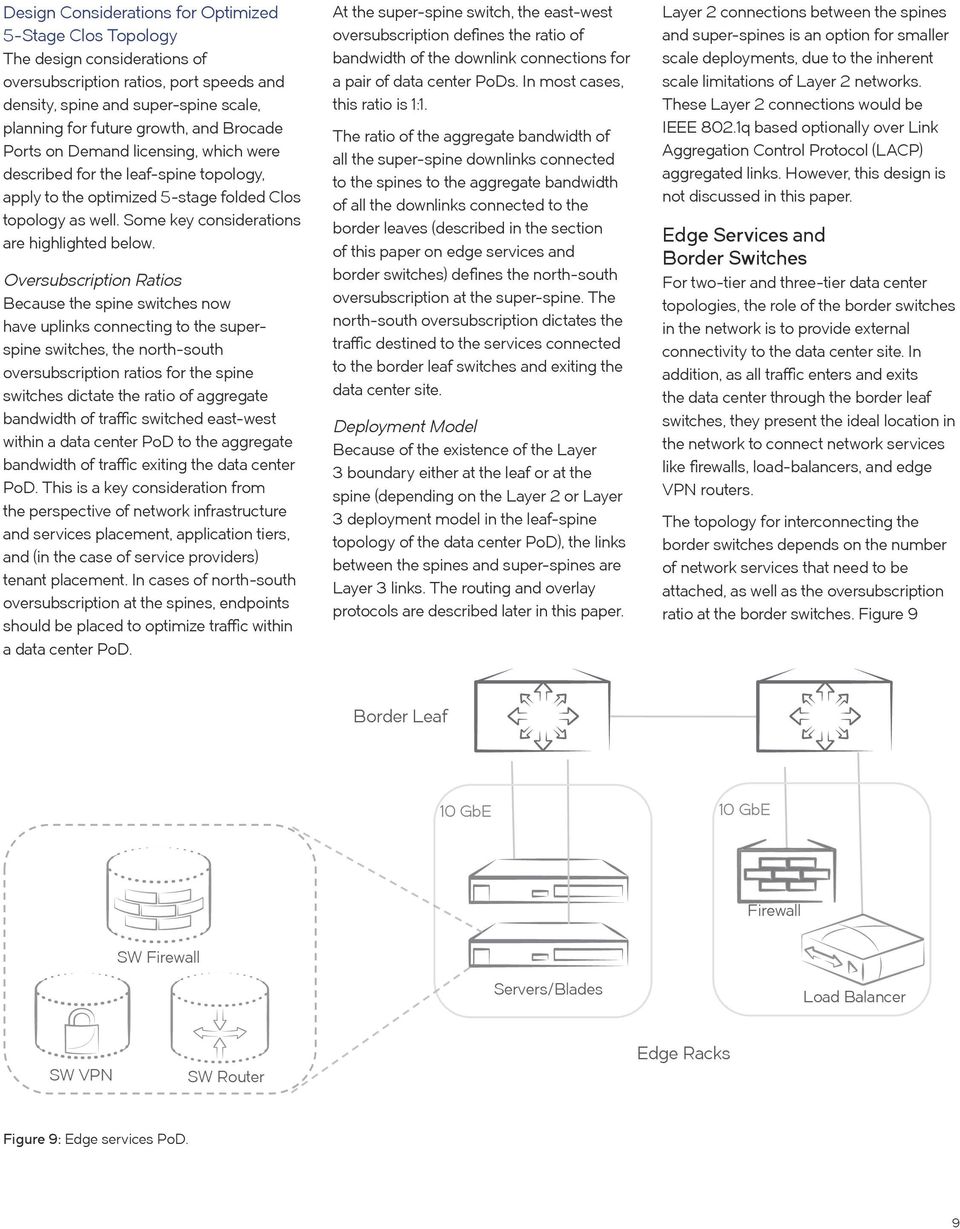
10 shows a simple topology for border switches, where the service endpoints connect directly to the border switches. Border switches in this simple topology are referred to as border leaf switches because the service endpoints connect to them directly. More scalable border switch topologies are possible, if a greater number of service endpoints need to be connected. These topologies include a leaf-spine topology for the border switches with border spines and border leaves. This white paper demonstrates only the border leaf variant for the border switch topologies, but this is easily expanded to a leafspine topology for the border switches. The border switches with the edge racks together form the edge services PoD. Design Considerations for Border Switches The following section describes the design considerations for border switches. Oversubscription Ratios The border leaf switches have uplink connections to spines in the leaf-spine topology and to super-spines in the 3-tier topology. They also have uplink connections to the data center core/wide- Area Network (WAN) edge routers as described in the next section. These data center site topologies are discussed in detail later in this paper. The ratio of the aggregate bandwidth of the uplinks connecting to the spines/ super-spines to the aggregate bandwidth of the uplink connecting to the core/edge routers determines the oversubscription ratio for traffic exiting the data center site. The north-south oversubscription ratios for the services connected to the border leaves is another consideration. Because many of the services connected to the border leaves may have public interfaces facing external entities like core/edge routers and internal interfaces facing the internal network, the northsouth oversubscription for each of these connections is an important design consideration. Data Center Core/WAN Edge Handoff The uplinks to the data center core/wan edge routers from the border leaves carry the traffic entering and exiting the data center site. The data center core/wan edge handoff can be Layer 2 and/or Layer 3 in combination with overlay protocols. The handoff between the border leaves and the data center core/wan edge may provide domain isolation for the control and data plane protocols running in the internal network and built using onetier, two-tier, or three-tier topologies. This helps in providing independent administrative, fault isolation, and control plane domains for isolation, scale, and security between the different domains of a data center site. The handoff between the data center core/wan edge and border leaves is explored in brief elsewhere in this paper. Data Center Core and WAN Edge Routers The border leaf switches connect to the data center core/wan edge devices in the network to provide external connectivity to the data center site. Figure 10 shows Internet DCI Data Center Core / WAN Edge Border Border Border Figure 10: Collapsed data center core and WAN edge routers connecting Internet and DCI fabric to the border leaf in the data center site. 10
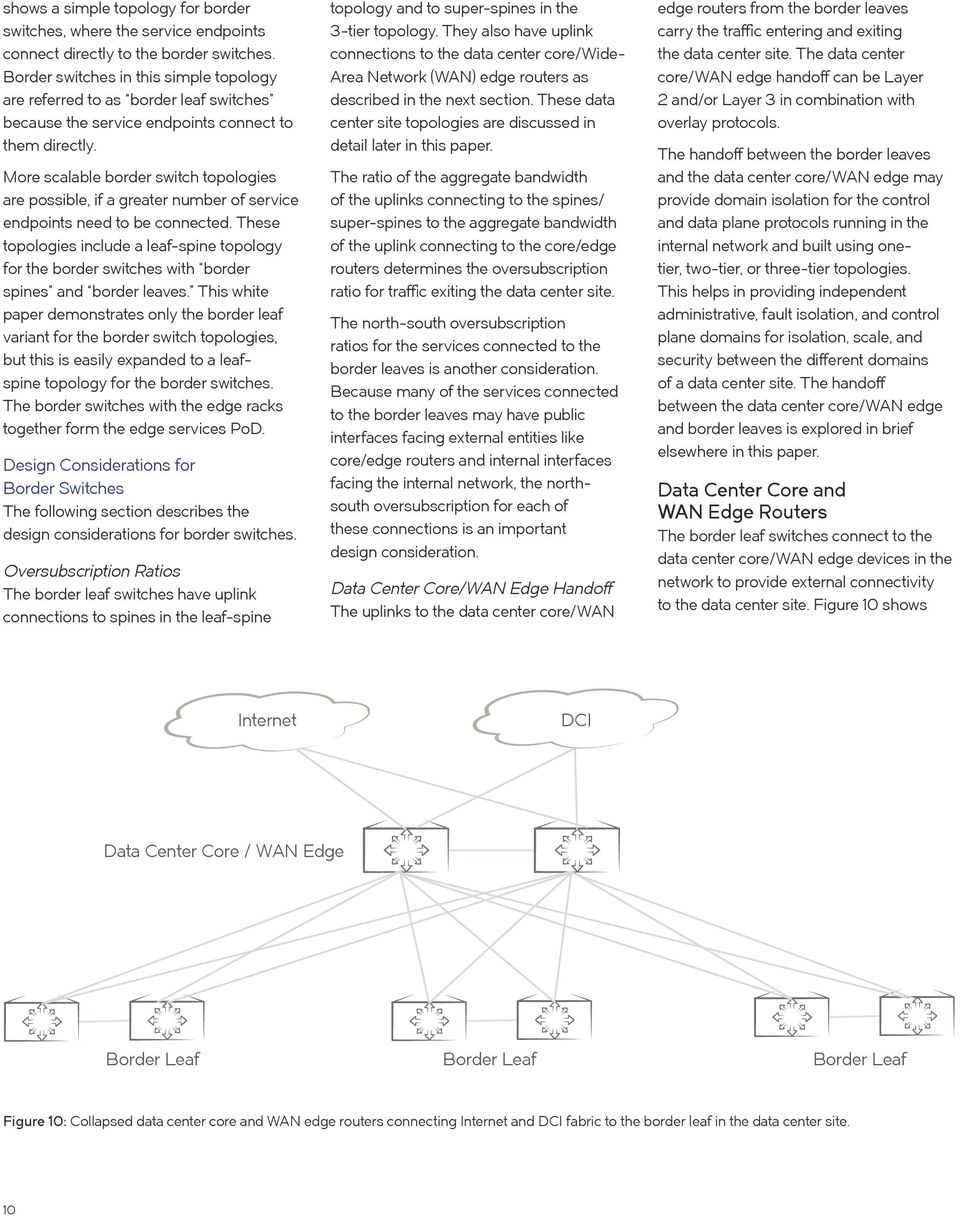
11 an example of the connectivity between border leaves, a collapsed data center core/wan edge tier, and external networks for Internet and DCI options. The data center core routers might provide the interconnection between data center PoDs built as single-tier, leaf-spine, or optimized 5-stage Clos deployments within a data center site. For enterprises, the core router might also provide connections to the enterprise campus networks through campus core routers. The data center core might also connect to WAN edge devices for WAN and interconnect connections. Note that border leaves connecting to the data center core provide the Layer 2 or Layer 3 handoff, along with any overlay control and data planes. The WAN edge devices provide the interfaces to the Internet and DCI solutions. Specifically for DCI, these devices function as the Provider Edge (PE) routers, enabling connections to other data center sites through WAN technologies like Multiprotocol Label Switching (MPLS) VPN, Virtual Private LAN Services (VPLS), Provider Backbone Bridges (PBB), Dense Wavelength Division Multiplexing (DWDM), and so forth. These DCI solutions are described in a later section. Building Data Center Sites with Brocade VCS Fabric Technology Brocade VCS fabrics are Ethernet fabrics built for modern data center infrastructure needs. With Brocade VCS Fabric technology, up to 48 Brocade VDX switches can participate in a VCS fabric. The data plane of the VCS fabric is based on the Transparent Interconnection of Lots of Links (TRILL) standard, supported by Layer 2 routing protocols that propagate topology information within the fabrics. This ensures that there are no loops in the fabrics, and there is no need to run Spanning Tree Protocol (STP). Also, none of the links are blocked. Brocade VCS Fabric technology provides a compelling solution for deploying a Layer 2 Clos topology. Brocade VCS Fabric technology provides these benefits: Single point of management: With all the switches in a VCS fabric participating in a logical chassis, the entire topology can be managed as a single switch chassis. This drastically reduces the management complexity of the solution. Distributed control plane: Control plane and data plane state information is shared across devices in the VCS fabric, which enables fabric-wide MAC address learning, multiswitch port channels (vlag), Distributed Spanning Tree (DiST), and gateway redundancy protocols like Virtual Router Redundancy Protocol Extended (VRRP-E) and Fabric Virtual Gateway (FVG), among others. These enable the VCS fabric to function like a single switch to interface with other entities in the infrastructure. TRILL-based Ethernet fabric: Brocade VCS Fabric technology, which is based on the TRILL standard, ensures that no links are blocked in the Layer 2 network. Because of the existence of a Layer 2 routing protocol, STP is not required. Multipathing from Layers 1 to 3: Brocade VCS Fabric technology provides efficiency and resiliency through the use of multipathing from Layers 1 to 3: --At Layer 1, Brocade trunking (BTRUNK) enables frame-based load balancing between a pair of switches that are part of the VCS fabric. This ensures that thick, or elephant flows do not congest an Inter-Switch Link (ISL). --Because of the existence of a Layer 2 routing protocol, Layer 2 ECMP is performed between multiple next hops. This is critical in a Clos topology, where all the spines are ECMP next hops for a leaf that sends traffic to an endpoint connected to another leaf. The same applies for ECMP traffic from the spines that have the superspines as the next hops. --Layer 3 ECMP using Layer 3 routing protocols ensures that traffic is load balanced between Layer 3 next hops. Embedded automation: Brocade VCS Fabric technology provides embedded turnkey automation built into Brocade Network OS. These automation features enable zero-touch provisioning of new switches into an existing fabric. Brocade VDX switches also provide multiple management methods, including the Command Line Interface (CLI), Simple Network Management Protocol (SNMP), REST, and Network Configuration Protocol (NETCONF) interfaces. Multitenancy at Layers 2 and 3: With Brocade VCS Fabric technology, multitenancy features at Layers 2 and 3 enable traffic isolation and segmentation across the fabric. Brocade VCS Fabric technology allows an extended range of up to 8000 Layer 2 domains within the fabric, while isolating overlapping IEEE 802.1q-based tenant networks into separate Layer 2 domains. Layer 3 multitenancy using Virtual Routing and Forwarding (VRF) protocols, multi-vrf routing protocols, as well as BGP-EVPN, enables largescale Layer 3 multitenancy. Ecosystem integration and virtualization features: Brocade VCS Fabric technology integrates with leading industry solutions and products 11
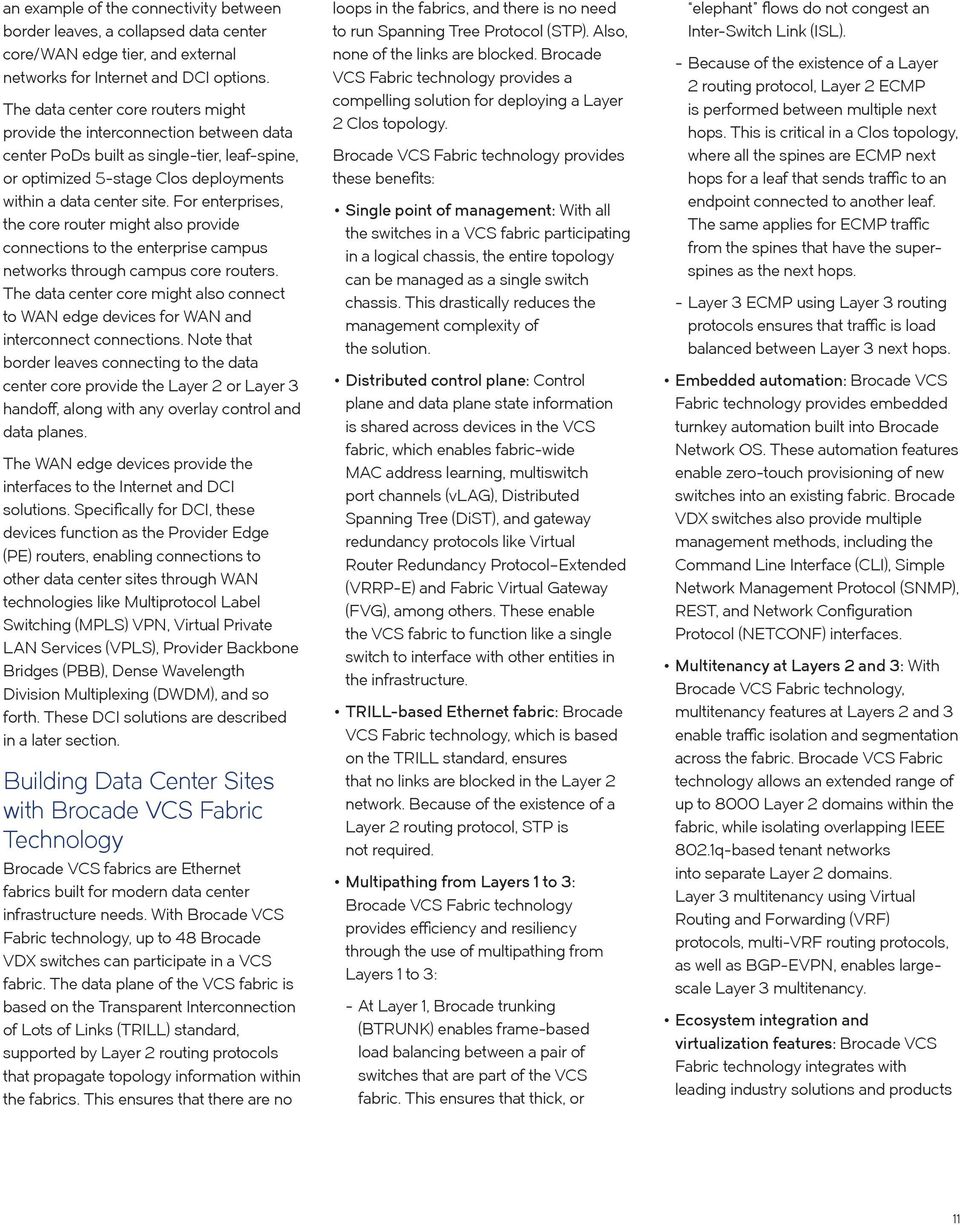
12 like OpenStack, VMware products like vsphere, NSX, and vrealize, common infrastructure programming tools like Python, and Brocade tools like Brocade Network Advisor. Brocade VCS Fabric technology is virtualization-aware and helps dramatically reduce administrative tasks and enable seamless VM migration with features like Automatic Migration of Port Profiles (AMPP), which automatically adjusts port profile information as a VM moves from one server to another. Advanced storage features: Brocade VDX switches provide rich storage protocols and features like Fibre Channel over Ethernet (FCoE), Data Center Bridging (DCB), Monitoring and Alerting Policy Suite (MAPS), and AutoNAS (Network Attached Storage), among others, to enable advanced storage networking. The benefits and features listed simplify Layer 2 Clos deployment by using Brocade VDX switches and Brocade VCS Fabric technology. The next section describes data center site designs that use Layer 2 Clos built with Brocade VCS Fabric technology. Data Center Site with - Topology Figure 11 shows a data center site built using a leaf-spine topology deployed using Brocade VCS Fabric technology. The data center PoD shown here was built using a VCS fabric, and the border leaves in the edge services PoD was built using a separate VCS fabric. The border leaves are connected to the spine switches in the data center PoD and also to the data center core/wan edge routers. These links can be either Layer 2 or Layer 3 links, depending on the requirements of the deployment and the handoff required to the data center core/wan edge routers. There can be more than one edge services PoD in the network, depending on the service needs and the bandwidth requirement for connecting to the data center core/wan edge routers. As an alternative to the topology shown in Figure 11, the border leaf switches in the edge services PoD and the data center PoD can be part of the same VCS fabric, to extend the fabric benefits to the entire data center site. Scale Table 1 on the following page provides sample scale numbers for ports with key combinations of Brocade VDX platforms at the leaf and spine Places in the Network (PINs) in a Brocade VCS fabric. L2 Links Internet DCI Data Center Core/ WAN Edge Border DC PoD Figure 11: Data center site built with a leaf-spine topology and Brocade VCS Fabric technology. 12
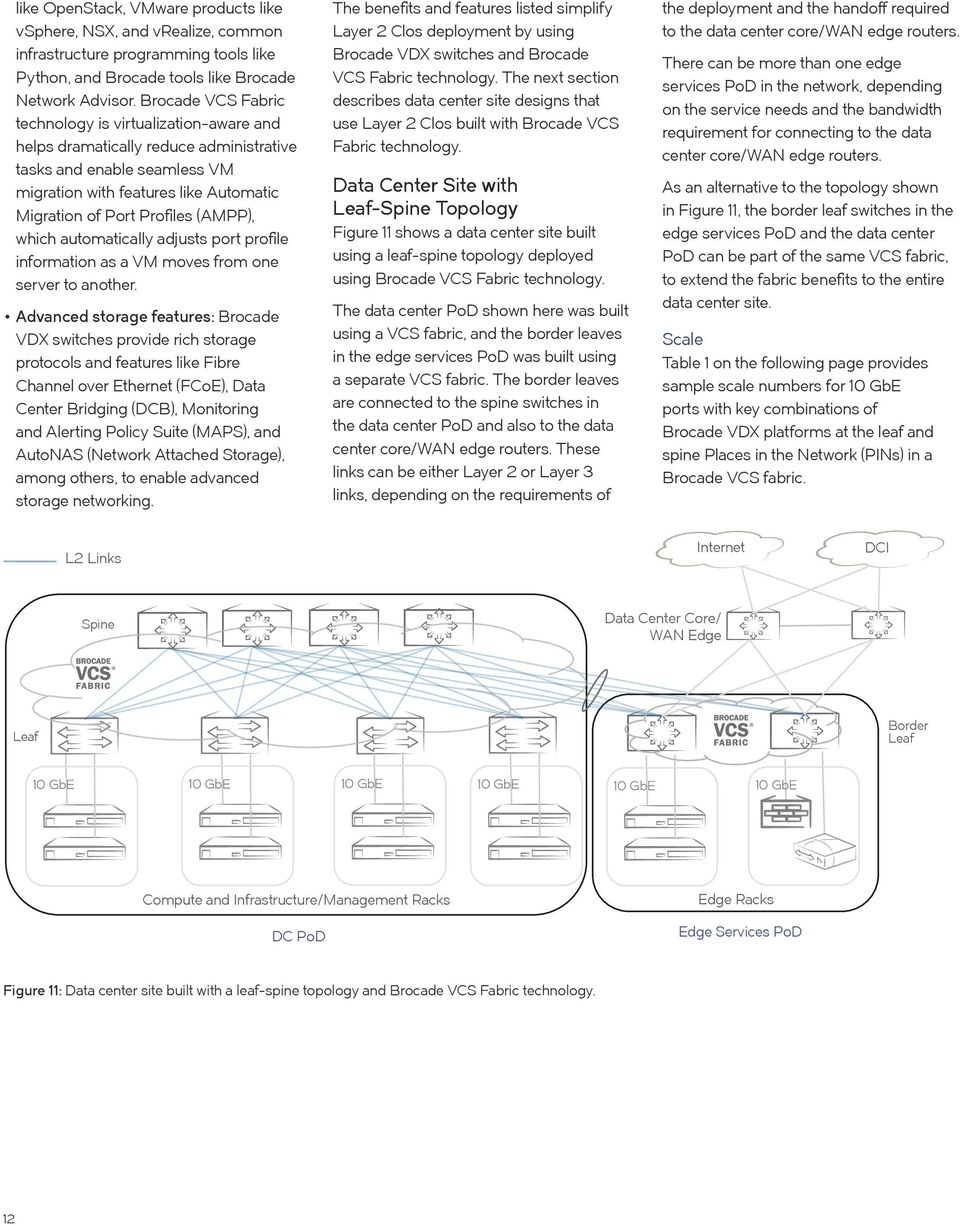
13 The following assumptions are made: Links between the leaves and the spines are 40 GbE. The Brocade VDX 6740 Switch platforms use 4 40 GbE uplinks. The Brocade VDX 6740 platform family includes the Brocade VDX 6740 Switch, the Brocade VDX 6740T Switch, and the Brocade VDX 6740T-1G Switch. (The Brocade VDX 6740T-1G requires a Capacity on Demand license to upgrade to 10GBase-T ports.) The Brocade VDX S platforms use GbE uplinks. The Brocade VDX Switch uses GbE line cards with 40 GbE interfaces. Scaling the Data Center Site with an Optimized 5-Stage Folded Clos If multiple VCS fabrics are needed at a data center site, then the optimized 5-stage Clos topology is used to increase scale by interconnecting the data center PoDs built using leaf-spine topology with Brocade VCS Fabric technology. This deployment architecture is referred to as a multifabric topology using VCS fabrics. An example topology is shown in Figure 12. In a multifabric topology using VCS fabrics, individual data center PoDs resemble a leaf-spine topology deployed using Brocade VCS Fabric technology. Table 1: Scale numbers for a data center site with a leaf-spine topology implemented with Brocade VCS Fabric technology. Switch Switch Oversubscription Ratio Count Count VCS Fabric Size (Number of Switches) Port Count 6740, 6740T, 6740T-1G 6740, 6740T, 6740T-1G Q 3: : S Q 2: S : Internet DCI L2 Links L3 Links Super- Data Center Core/ WAN Edge Border DC PoD 1 DC PoD N Figure 12: Data center site built with an optimized 5-stage folded Clos topology and Brocade VCS Fabric technology. 13
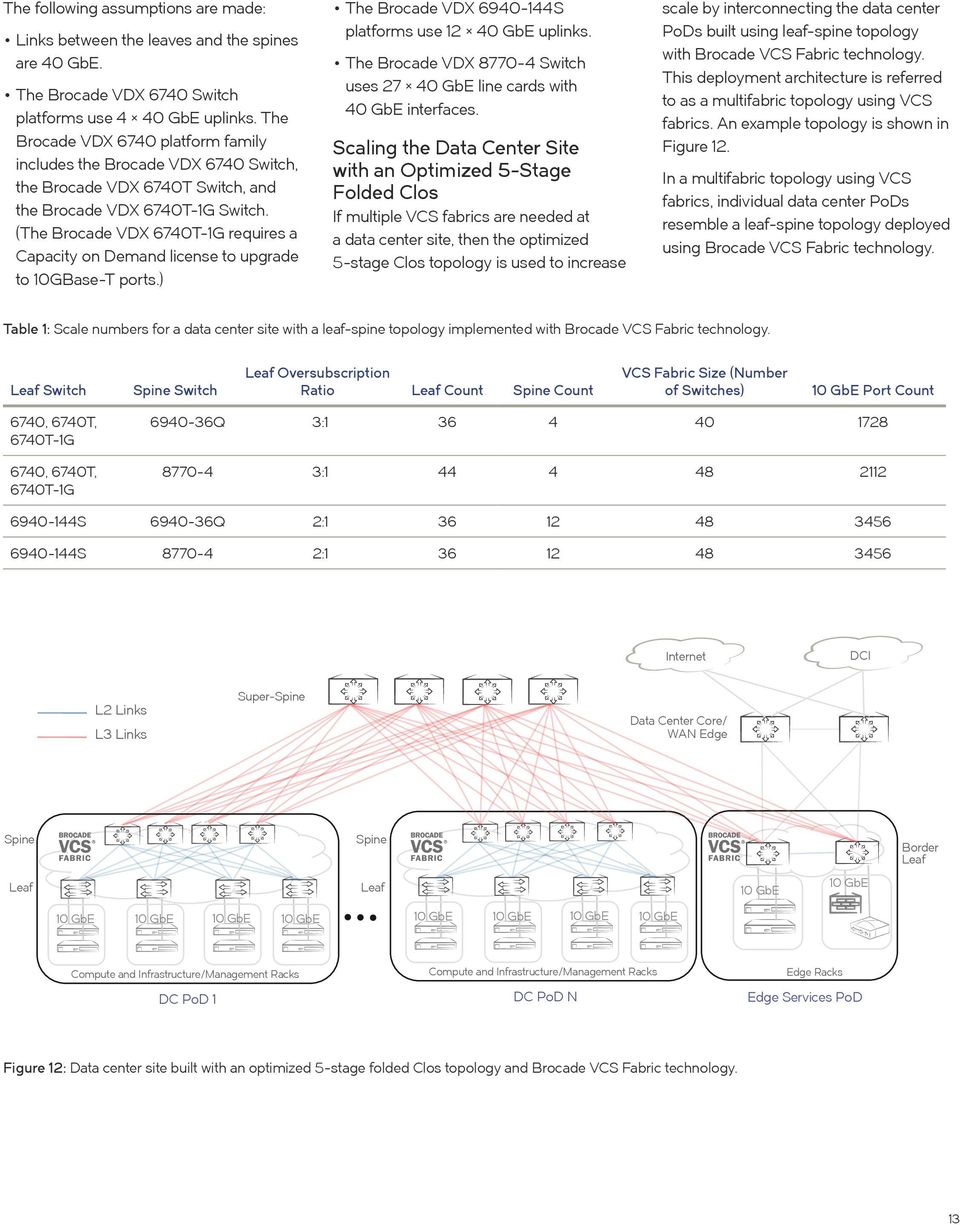
14 However, the new super-spine tier is used to interconnect the spine switches in the data center PoD. In addition, the border leaf switches are also connected to the super-spine switches. Note that the superspines do not participate in a VCS fabric, and the links between the super-spines, spine, and border leaves are Layer 3 links. Figure 12 shows only one edge services PoD, but there can be multiple such PoDs depending on the edge service endpoint requirements, the oversubscription for traffic that is exchanged with the data center core/wan edge, and the related handoff mechanisms. Scale Table 2 provides sample scale numbers for ports with key combinations of Brocade VDX platforms at the leaf, spine, and super-spine PINs for an optimized 5-stage Clos built with Brocade VCS fabrics. The following assumptions are made: Links between the leaves and the spines are 40 GbE. Links between the spines and super-spines are also 40 GbE. The Brocade VDX 6740 platforms use 4 40 GbE uplinks. The Brocade VDX 6740 platform family includes the Brocade VDX 6740, Brocade VDX 6740T, and Brocade VDX 6740T-1G. (The Brocade VDX 6740T-1G requires a Capacity on Demand license to upgrade to 10GBase-T ports.) Four spines are used for connecting the uplinks. The Brocade S platforms use GbE uplinks. Twelve spines are used for connecting the uplinks. North-south oversubscription ratio at the spines is 1:1. In other words, the bandwidth of uplink ports is equal to the bandwidth of downlink ports at spines. A larger port scale can be realized with Table 2: Scale numbers for a data center site built as a multifabric topology using Brocade VCS Fabric technology. Switch Switch Super- Switch Oversubscription Ratio Count per Data Center PoD Count per Data Center PoD Number of Super- s Number of Data Center PoDs Port Count 6740, 6740T, 6740T-1G Q Q 3: S Q Q 2: , 6740T, 6740T-1G Q 3: S Q 2: , 6740T, 6740T-1G Q : S Q : , 6740T, 6740T-1G : S : , 6740T, 6740T-1G Q : S Q : , 6740T, 6740T-1G : S :
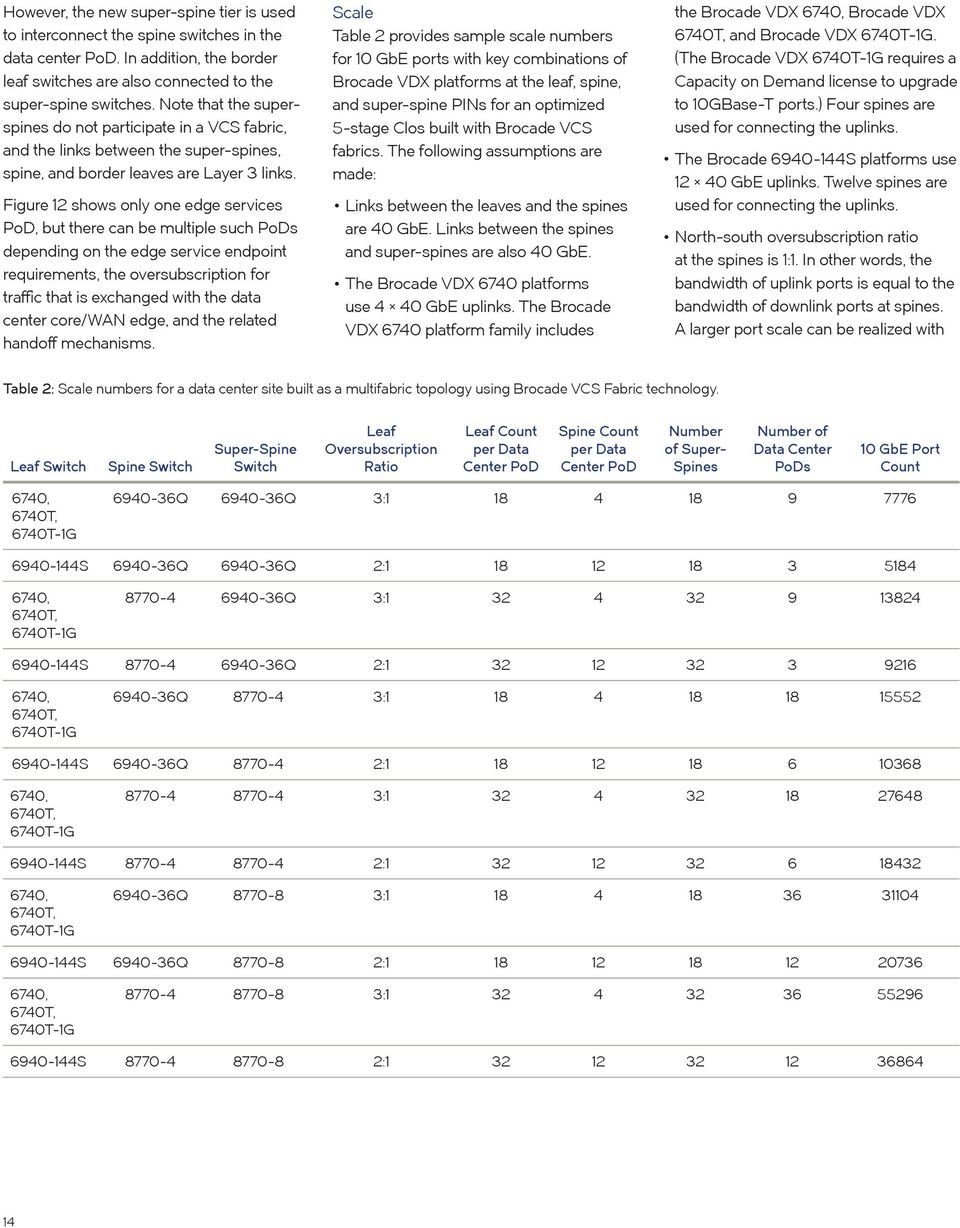
15 a higher oversubscription ratio at the spines. However, a 1:1 oversubscription ratio is used here and is also recommended. One spine plane is used for the scale calculations. This means that all spine switches in each data center PoD connect to all the super-spine switches in the topology. This topology is consistent with the optimized 5-stage Clos topology. Brocade VDX 8770 platforms use GbE line cards in performance mode (use GbE) for connections between spines and super-spines. The Brocade VDX supports GbE ports in performance mode. The Brocade VDX supports GbE ports in performance mode. 32-way Layer 3 ECMP is utilized for spine to super-spine connections with a Brocade VDX 8770 at the spine. This gives a maximum of 32 super-spines for the multifabric topology using Brocade VCS Fabric technology. Note: For a larger port scale for the multifabric topology using Brocade VCS Fabric technology, multiple spine planes are used. Multiple spine planes are described in the section about scale for Brocade IP fabrics. Building Data Center Sites with Brocade IP Fabric The Brocade IP fabric provides a Layer 3 Clos deployment architecture for data center sites. With Brocade IP fabric, all the links in the Clos topology are Layer 3 links. The Brocade IP fabric includes the networking architecture, the protocols used to build the network, turnkey automation features used to provision, manage, and monitor the networking infrastructure and the hardware differentiation with Brocade VDX switches. The following sections describe these aspects of building data center sites with Brocade IP fabrics. Because the infrastructure is built on IP, advantages like loop-free communication using industry-standard routing protocols, ECMP, very high solution scale, and standards-based interoperablility are leveraged. These are some of the key benefits of deploying a data center site with Brocade IP fabrics: Highly scalable infrastructure: Because the Clos topology is built using IP protocols, the scale of the infrastructure is very high. These port and rack scales are documented with descriptions of the Brocade IP fabric deployment topologies. Standards-based and interoperable protocols: The Brocade IP fabric is built using industry-standard protocols like the Border Gateway Protocol (BGP) and Open Shortest Path First (OSPF). These protocols are well understood and provide a solid foundation for a highly scalable solution. In addition, industrystandard overlay control and data plane protocols like BGP-EVPN and Virtual Extensible Local Area Network (VXLAN) are used to extend Layer 2 domain and extend tenancy domains by enabling Layer 2 communications and VM mobility. Active-active vlag pairs: By supporting vlag pairs on leaf switches, dual-homing of the networking endpoints are supported. This provides higher redundancy. Also, because the links are active-active, vlag pairs provide higher throughput to the endpoints. vlag pairs are supported for all, 40 GbE, and 100 GbE interface speeds, and up to 32 links can participate in a vlag. Layer 2 extensions: In order to enable Layer 2 domain extension across the Layer 3 infrastructure, VXLAN protocol is leveraged. The use of VXLAN provides a very large number of Layer 2 domains to support large-scale multitenancy over the infrastructure. In addition, Brocade BGP-EVPN network virtualization provides the control plane for the VXLAN, providing enhancements to the VXLAN standard by reducing the Broadcast, Unknown unicast, Multicast (BUM) traffic in the network through mechanisms like MAC address reachability information and ARP suppression. Multitenancy at Layers 2 and 3: Brocade IP fabric provides multitenancy at Layers 2 and 3, enabling traffic isolation and segmentation across the fabric. Layer 2 multitenancy allows an extended range of up to 8000 Layer 2 domains to exist at each ToR switch, while isolating overlapping 802.1q tenant networks into separate Layer 2 domains. Layer 3 multitenancy using VRFs, multi- VRF routing protocols, and BGP-EVPN allows large-scale Layer 3 multitenancy. Specifically, Brocade BGP-EVPN Network Virtualization leverages BGP-EVPN to provide a control plane for MAC address learning and VRF routing for tenant prefixes and host routes, which reduces BUM traffic and optimizes the traffic patterns in the network. Support for unnumbered interfaces: Using Brocade Network OS support for IP unnumbered interfaces, only one IP address per switch is required to configure the routing protocol peering. This significantly reduces the planning and use of IP addresses and simplifies operations. 15
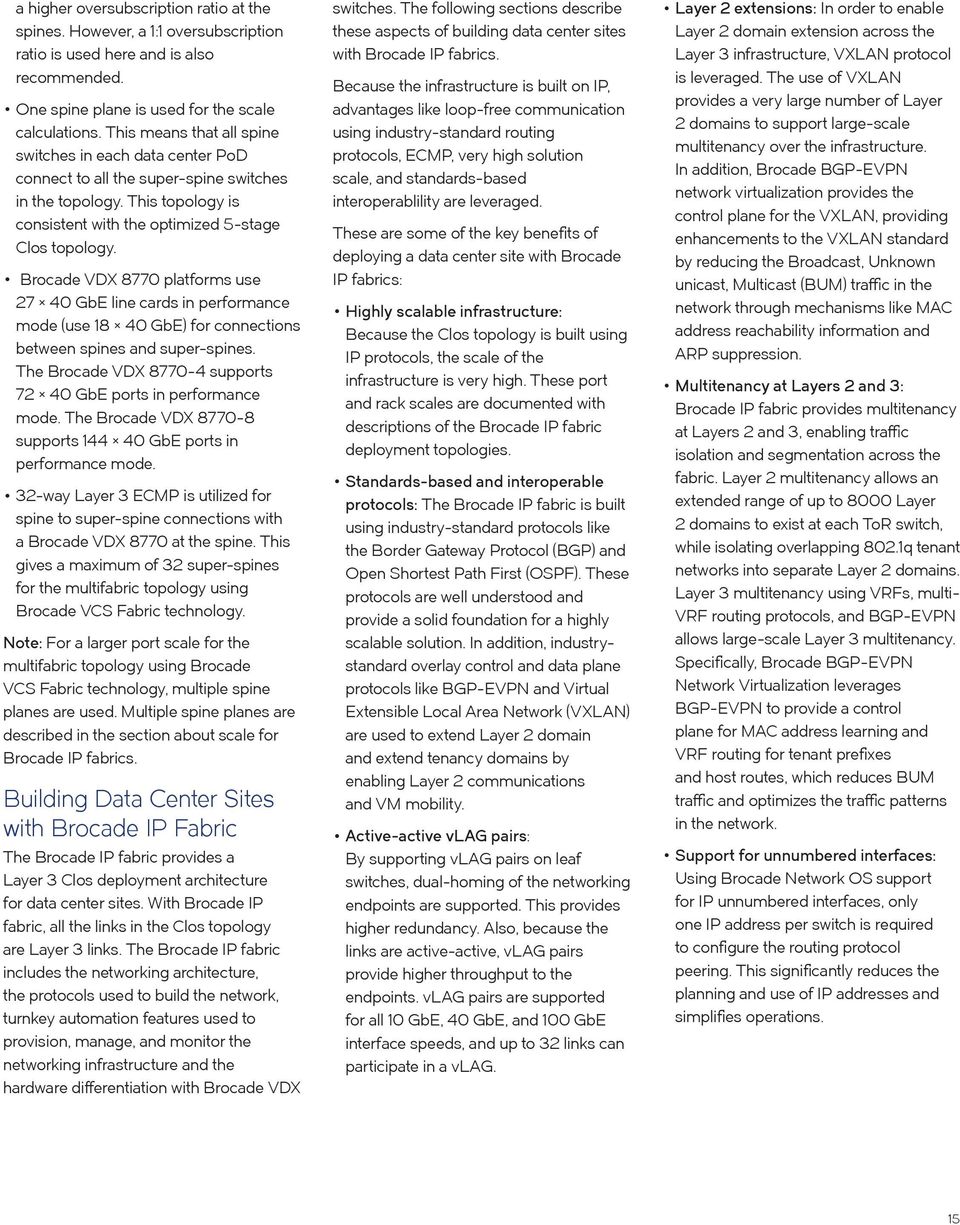
16 Turnkey automation: Brocade automated provisioning dramatically reduces the deployment time of network devices and network virtualization. Prepackaged, server-based automation scripts provision Brocade IP fabric devices for service with minimal effort. Programmable automation: Brocade server-based automation provides support for common industry automation tools such as Python Ansible, Puppet, and YANG modelbased REST and NETCONF APIs. Prepackaged PyNOS scripting library and editable automation scripts execute predefined provisioning tasks, while allowing customization for addressing unique requirements to meet technical or business objectives when the enterprise is ready. Ecosystem integration: The Brocade IP fabric integrates with leading industry solutions and products like VMware vsphere, NSX, and vrealize. Cloud orchestration and control are provided through OpenStack and OpenDaylightbased Brocade SDN Controller support. Data Center Site with - Topology A data center PoD built with IP fabrics supports dual-homing of network endpoints using multiswitch port channel interfaces formed between a pair of switches participating in a vlag. This pair of leaf switches is called a vlag pair. (See Figure 13.). The switches in a vlag pair have a link between them for control plane purposes, to create and manage the multiswitch port channel interfaces. These links also carry switched traffic in case of downlink failures. In most cases these links are not configured to carry any routed traffic upstream, however, the vlag pairs can peer using a routing protocol if upstream traffic needs to be carried over the link, in cases of uplink failures on a vlag switch. Oversubscription of the vlag link is an important consideration for failure scenarios. Figure 14 on the following page shows a data center site deployed using a leaf-spine topology and IP fabric. Here the network endpoints are illustrated as single-homed, but dual homing is enabled through vlag pairs where required. The links between the leaves, spines, and border leaves are all Layer 3 links. The border leaves are connected to the spine switches in the data center PoD and also to the data center core/wan edge routers. The uplinks from the border leaf to the data center core/wan edge can be either Layer 2 or Layer 3, depending on the requirements of the deployment and the handoff required to the data center core/ WAN edge routers. There can be more than one edge services PoD in the network, depending on service needs and the bandwidth requirement for connecting to the data center core/wan edge routers. L3 Links Controller Management SW Servers/Blades IP Storage Servers/Blades Servers/Blades Management/Infrastructure Racks Compute Racks Figure 13: An IP fabric data center PoD built with leaf-spine topology and a vlag pair for dual-homed network endpoints. 16
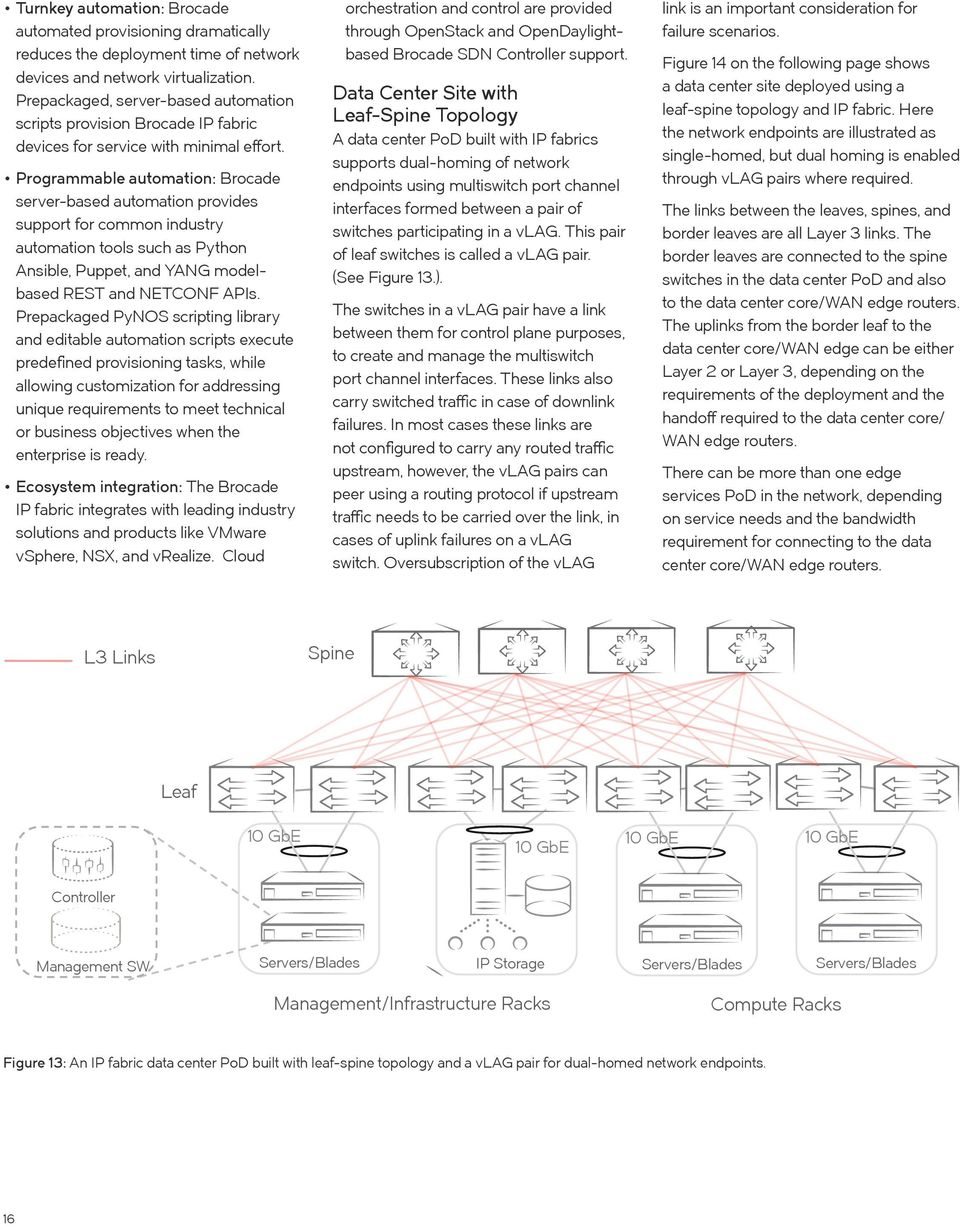
17 L3 Links Internet DCI Data Center Core/ WAN Edge Border DC PoD Figure 14: Data center site built with leaf-spine topology and an IP fabric PoD. Scale Table 3 provides sample scale numbers for ports with key combinations of Brocade VDX platforms at the leaf and spine PINs in a Brocade IP fabric. The following assumptions are made: Links between the leaves and the spines are 40 GbE. The Brocade VDX 6740 platforms use 4 40 GbE uplinks. The Brocade VDX 6740 platform family includes the Brocade VDX 6740, Brocade VDX 6740T, and Brocade VDX 6740T-1G. (The Brocade VDX 6740T-1G requires a Capacity on Demand license to upgrade to 10GBase-T ports.) The Brocade VDX S platforms use GbE uplinks. The Brocade VDX 8770 platforms use GbE line cards in performance mode (use GbE) for connections between leaves and spines. The Brocade VDX supports GbE ports in performance mode. The Brocade VDX supports GbE ports in performance mode. Note: For a larger port scale in Brocade IP fabrics in a 3-stage folded Clos, the Brocade VDX or can be used as a leaf switch. Table 3. Scale numbers for a leaf-spine topology with Brocade IP fabrics in a data center site. Switch Switch Oversubscription Ratio Count Count VCS Fabric Size (Number of Switches) Port Count 6740, 6740T, 6740T-1G 6740, 6740T, 6740T-1G 6740, 6740T, 6740T-1G Q 3: : : S Q 2: S : S :

18 Scaling the Data Center Site with an Optimized 5-Stage Folded Clos If a higher scale is required, then the optimized 5-stage Clos topology is used to interconnect the data center PoDs built using Layer 3 leaf-spine topology. An example topology is shown in Figure 15. Figure 15 shows only one edge services PoD, but there can be multiple such PoDs, depending on the edge service endpoint requirements, the amount of oversubscription for traffic exchanged with the data center core/wan edge, and the related handoff mechanisms. Scale Figure 16 shows a variation of the optimized 5-stage Clos. This variation includes multiple super-spine planes. Each spine in a data center PoD connects to a separate super-spine plane. The number of super-spine planes is equal to the number of spines in the data center PoDs. The number of uplink ports on the spine switch is equal to the number of switches in a super-spine plane. Also, the number of data center PoDs is equal to the port density of the super-spine switches. Introducing super-spine planes to the optimized 5-stage Clos topology Internet DCI Super- L3 Links WAN Edge SPINE Border LEAF DC PoD 1 DC PoD N Figure 15: Data center site built with an optimized 5-stage Clos topology and IP fabric PoDs. Super- Plane 1 Super- Plane 2 Super- Plane 3 Super- Plane 4 L3 Links 10 Gbe 10 Gbe 10 Gbe 10 Gbe 10 Gbe 10 Gbe 10 Gbe 10 Gbe DC PoD 1 DC PoD N Figure 16: Optimized 5-stage Clos with multiple super-spine planes. 18

19 greatly increases the number of data center PoDs that can be supported. For the purposes of port scale calculations of the Brocade IP fabric in this section, the optimized 5-stage Clos with multiple super-spine plane topology is considered. Table 4 provides sample scale numbers for ports with key combinations of Brocade VDX platforms at the leaf, spine, and super-spine PINs for an optimized 5-stage Clos with multiple super-spine planes built with Brocade IP fabric. The following assumptions are made: Links between the leaves and the spines are 40 GbE. Links between spines and super-spines are also 40 GbE. The Brocade VDX 6740 platforms use 4 40 GbE uplinks. The Brocade VDX 6740 platform family includes the Brocade VDX 6740, the Brocade VDX 6740T, and the Brocade VDX 6740T-1G. (The Brocade VDX 6740T-1G requires a Capacity on Demand license to upgrade to 10GBase-T ports.) Four spines are used for connecting the uplinks. The Brocade VDX S platforms use GbE uplinks. Twelve spines are used for connecting the uplinks. The north-south oversubscription ratio at the spines is 1:1. In other words, the bandwidth of uplink ports is equal to the bandwidth of downlink ports at spines. The number of physical ports utilized from spine towards super-spine and spine towards leaf is equal to the number of ECMP paths supported. A larger port scale can be realized with a higher oversubscription ratio or by ensuring route import policies to meet 32-way ECMP scale at the spines. However, a 1:1 subscription ratio is used here and is also recommended. The Brocade VDX 8770 platforms use GbE line cards in performance mode (use GbE) for connections between spines and super-spines. The Brocade VDX supports Table 4: Scale numbers for an optimized 5-Stage folded Clos topology with multiple super-spine planes built with Brocade IP fabric. Switch Switch Super- Switch Oversubscription Ratio Count per Data Center PoD Count per Data Center PoD Number of Super- s Number of Super- s in Each Super- Plane Number of Data Center PoDs Port Count 6740, 6740T, 6740T-1G Q Q 3: S Q Q 2: , 6740T, 6740T-1G Q : S Q : , 6740T, 6740T-1G Q : S Q : , 6740T, 6740T-1G : S : , 6740T, 6740T-1G : S : , 6740T, 6740T-1G : S :

20 72 40 GbE ports in performance mode. The Brocade VDX supports GbE ports in performance mode. 32-way Layer 3 ECMP is utilized for spine to super-spine connections when a Brocade VDX 8770 is used at the spine. This gives a maximum of 32 super-spines in each super-spine plane for the optimized 5-stage Clos built using Brocade IP fabric. Further higher scale can be achieved by physically connecting all available ports on the switching platform and using BGP policies to enforce a maximum of 32-way ECMP. This provides higher port scale for the topology, while still ensuring that maximum 32-way ECMP is used. It should be noted that this arrangement provides nonblocking 1:1 north-south subscription at the spine in most scenarios. In Table 5 below, 72 ports are used as uplinks from each spine to the super-spine plane. Using BGP policy enforcement for any given BGP learned route, a maximum 32 of the 72 uplinks are used as next hops. However, all uplink ports are used and load balanced across the entire set of BGP learned routes. The calculations in Table 4 and Table 5 show networks with no oversubscription at the spine. Table 6 provides sample scale numbers for ports for a few key Table 5: Scale numbers for an optimized 5-Stage folded Clos topology with multiple super-spine planes and BGP policy-enforced 32-way ECMP. Switch Switch Super- Switch Oversubscription Ratio Count per Data Center PoD Count per Data Center PoD Number of Super- Planes Number of Super- s in Each Super- Plane Number of Data Center PoDs Port Count 6740, 6740T, 6740T-1G : Table 6: Scale numbers for an optimized 5-stage folded Clos topology with multiple super-spine planes built with Brocade IP fabric and north-south oversubscription at the spine. Switch Switch Super- Switch Oversubscription Ratio Count per Data Center PoD Count per Data Center PoD North-South Oversubscription at Number of Super- Planes Number of Super-s in each Super- Plane Number of Data Center PoDs Port Count 6740, 6740T, 6740T-1G Q Q 3: : S Q Q 2: : , 6740T, 6740T-1G Q : : S Q : : , 6740T, 6740T-1G Q : : S Q : : , 6740T, 6740T-1G : : S : : , 6740T, 6740T-1G : : S : : , 6740T, 6740T-1G : : S : :

21 combinations of Brocade VDX platforms at the leaf, spine, and super-spine PINs for an optimized 5-stage Clos with multiple super-spine planes built with Brocade IP fabric. In this case, the north-south oversubscription ratio at the spine is also noted. Building Data Center Sites with Layer 2 and Layer 3 Fabrics A data center site can be built using Layer 2 and Layer 3 Clos that uses Brocade VCS fabrics and Brocade IP fabrics simultaneously in the same topology. This topology is applicable when a particular deployment is more suited for a given application or use case. Figure 17 shows a deployment with both Brocade VCS based data center PoDs based on VCS fabrics and data center PoDs based on IP fabrics, interconnected in an optimized 5-stage Clos topology. In this topology, the links between the spines, super-spines, and border leaves are Layer 3. This provides a consistent interface between the data center PoDs and enables full communication between endpoints in any PoD. Scaling a Data Center Site with a Data Center Core A very large data center site can use multiple different deployment topologies. Figure 18 on the following page shows a data center site with multiple 5-stage Clos deployments that are interconnected with each other by using a data center core. The role of the data center core is to provide the interface between the different Clos deployments. Note that the border leaves or leaf switches from each of the Clos deployments connect into the data center core routers. The handoff from the border leaves/leaves to the data center core router can be Layer 2 and/or Layer 3, with overlay protocols like VXLAN and BGP-EVPN, depending on the requirements. The number of Clos topologies that can be connected to the data center core depends on the port density and throughput of the data center core devices. Each deployment connecting into the data center core can be a singletier, leaf-spine, or optimized 5-stage Clos design deployed using an IP fabric architecture or a multifabric topology using VCS fabrics. Also shown in Figure 18 on the next page is a centralized edge services PoD that provides network services for the entire site. There can be one or more of the edge services PoDs with the border leaves in the edge services PoD, providing the handoff to the data center core. The WAN edge routers also connect to the edge services PoDs and provide connectivity to the external network. Internet DCI Super- L2 Links L3 Links Data Center Core/ WAN Edge DC PoD 1 DC PoD N Figure 17: Data center site built using VCS fabric and IP fabric PoDs. 21
22 Super- Internet DCI WAN Edge DC PoD 1 DC PoD 2 DC PoD N Super- Data Center Core DC PoD 1 DC PoD 2 DC PoD N Figure 18: Data center site built with optimized 5-stage Clos topologies interconnected with a data center core. Control Plane and Hardware Scale Considerations The maximum size of the network deployment depends on the scale of the control plane protocols, as well as the scale of hardware Application-Specific Integrated Circuit (ASIC) tables. The control plane for a VCS fabric includes these: A Layer 2 routing protocol called Fabric Shortest Path First (FSPF) VCS fabric messaging services for protocol messaging and state exchange Ethernet Name Server (ENS) for MAC address learning Protocols for VCS formation: --Brocade Link Discovery Protocol (BLDP) --Join and Merge Protocol (JMP) State maintenance and distributed protocols: --Distributed Spanning Tree Protocol (dstp) The maximum scale of the VCS fabric deployment is a function of the number of nodes, topology of the nodes, link reliability, distance between the nodes, features deployed in the fabric, and the scale of the deployed features. A maximum of 48 nodes are supported in a VCS fabric. In a Brocade IP fabric, the control plane is based on routing protocols like BGP and OSPF. In addition, a control plane is provided for formation of vlag pairs. In the case of virtualization with VXLAN overlays, BGP-EVPN provides the control plane. The maximum scale of the topology depends on the scalability of these protocols. For both Brocade VCS fabrics and IP fabrics, it is important to understand the hardware table scale and the related control plane scales. These tables include: MAC address table Host route tables/address Resolution Protocol/Neighbor Discovery (ARP/ND) tables Longest Prefix Match (LPM) tables for IP prefix matching Tertiary Content Addressable Memory (TCAM) tables for packet matching These tables are programmed into the switching ASICs based on the information learned through configuration, the data plane, or the control plane protocols. This also means that it is important to consider the control plane scale for carrying information for these tables when determining the maximum size of the network deployment. 22
23 Choosing an Architecture for Your Data Center Because of the ongoing and rapidly evolving transition towards the cloud and the need across IT to quickly improve operational agility and efficiency, the best choice is an architecture based on Brocade data center fabrics. However, the process of choosing an architecture that best meets your needs today while leaving you flexibility to change can be paralyzing. Brocade recognizes how difficult it is for customers to make long-term technology and infrastructure investments, knowing they will have to live for years with those choices. For this reason, Brocade provides solutions that help you build cloud-optimized networks with confidence, knowing that your investments have value today and will continue to have value well into the future. High-Level Comparison Table Table 7 provides information about which Brocade data center fabric best meets your needs. The IP fabric columns represent all deployment topologies for IP fabric, including the leaf-spine and optimized 5-stage Clos topologies. Deployment Scale Considerations The scalability of a solution is an important consideration for deployment. Depending on whether the topology is a leaf-spine or optimized 5-stage Clos topology, deployments based on Brocade VCS Fabric technology and Brocade IP fabrics scale differently. The port scales for each of these deployments are documented in previous sections of this white paper. In addition, the deployment scale also depends on the control plane as well as on the hardware tables of the platform. Table 7: Data Center Fabric Support Comparison Table. Customer Requirement VCS Fabric Multifabric VCS with VXLAN IP Fabric IP Fabric with BGP- EVPN-Based VXLAN Virtual LAN (VLAN) extension Yes Yes Yes VM mobility across racks Yes Yes Yes Embedded turnkey provisioning and automation Yes Yes, in each data center PoD Embedded centralized fabric management Yes Yes, in each data center PoD Data center PoDs optimized for Layer 2 scale-out Yes Yes vlag support Yes, up to 8 devices Yes, up to 8 devices Yes, up to 2 devices Yes, up to 2 devices Gateway redundancy Yes, VRRP/VRRP-E/FVG Yes, VRRP/VRRP-E/FVG Yes, VRRP-E Yes, Static Anycast Gateway Controller-based network virtualization (for example, VMware NSX) Yes Yes Yes Yes DevOps tool-based automation Yes Yes Yes Yes Multipathing and ECMP Yes Yes Yes Yes Layer 3 scale-out between PoDs Yes Yes Yes Turnkey off-box provisioning and automation Planned Yes Yes Data center PoDs optimized for Layer 3 scale-out Yes Yes Controller-less network virtualization (Brocade BGP-EVPN network virtualization) Planned Yes 23
24 Table 8 provides an example of the scale considerations for parameters in a leafspine topology with Brocade VCS fabric and IP fabric deployments. The table illustrates how scale requirements for the parameters vary between a VCS fabric and an IP fabric for the same environment. The following assumptions are made: There are 20 compute racks in the leafspine topology. 4 spines and 20 leaves are deployed. Physical servers are single-homed. The Layer 3 boundary is at the spine of the VCS fabric deployment and at the leaf in IP fabric deployment. Each peering between leaves and spines uses a separate subnet. Brocade IP fabric with BGP-EVPN extends all VLANs across all 20 racks Rack Unit (RU) servers per rack (a standard rack has 42 RUs). 2 CPU sockets per physical server 1 Quad-core CPU per socket = 8 CPU cores per physical server. 5 VMs per CPU core 8 CPU cores per physical server = 40 VMs per physical server. There is a single virtual Network Interface Card (vnic) for each VM. There are 40 VLANs per rack. Table 8: Scale Considerations for Brocade VCS Fabric and IP Fabric Deployments. Brocade VCS Fabric Brocade IP Fabric Brocade IP Fabric with BGP-EVPN Based VXLAN MAC Adresses 40 VMs/server 40 servers/rack 20 racks = 32,000 MAC addresses 40 VMs/server 40 servers/rack 20 racks = 32,000 MAC addresses 40 VMs/server 40 servers/rack = 1600 MAC addresses Small number of MAC addresses needed for peering 40 VMs/server 40 servers/rack 20 racks = 32,000 MAC addresses Small number of MAC addresses needed for peering VLANs 40 VLANs/rack 20 racks = 800 VLANs 40 VLANs/rack 20 racks = 800 VLANs 40 VLANs No VLANs at spine 40 VLANs/rack extended to all 20 racks = 800 VLANs No VLANs at spine ARP Entries/ Host Routes None 40 VMs/server 40 servers/rack 20 racks = 32,000 ARP entries 40 VMs/server 40 servers/rack = 1600 ARP entries Small number of ARP entries for peers 40 VMs/server X 40 servers/rack X 20 racks + 20 VTEP loopback IP addresses = 32,020 host routes/arp entries Small number of ARP entries for peers L3 Routes (Longest Prefix Match) None Default gateway for 800 VLANs = 800 L3 routes 40 default gateways + 40 remote subnets 19 racks + 80 peering subnets = 880 L3 routes 40 subnets 20 racks + 80 peering subnets = 880 L3 routes 80 peering subnets + 40 subnets X 20 racks = 880 L3 routes Small number of L3 routes for peering Layer 3 Default Gateways None 40 VLANs/rack 20 racks = 800 default gateways 40 VLANs/ rack = 40 default gateways None 40 VLANs/rack 20 racks = 800 default gateways None 24
25 Fabric Architecture Another way to determine which Brocade data center fabric provides the best solution for your needs is to compare the architectures side-by-side. Figure 19 provides a side-by-side comparison of the two Brocade data center fabric architectures. The blue text shows how each Brocade data center fabric is implemented. For example, a VCS fabric is topology-agnostic and uses TRILL as its transport mechanism, whereas the topology for an IP fabric is a Clos that uses IP for transport. It is important to note that the same Brocade VDX switch platform, Brocade Network OS software, and licenses are used for either deployment. So, when you are making long-term infrastructure purchase decisions, be reassured to know that you need only one switching platform. Recommendations Of course, each organization s choices are based on its own unique requirements, culture, and business and technical objectives. Yet by and large, the scalability and seamless server mobility of a Layer 2 scale-out VCS fabric provides the ideal starting point for most enterprise and cloud providers. Like IP fabrics, VCS fabrics provide open interfaces and software extensibility, if you decide to extend the already capable and proven embedded automation of Brocade VCS Fabric technology. For organizations looking for a Layer 3 optimized scale-out approach, Brocade IP fabrics is the best architecture to deploy. And if controller-less network virtualization using Internet-proven technologies such as BGP-EVPN is the goal, Brocade IP fabric is the best underlay. Brocade architectures also provide the flexibility of combining both of these deployment topologies in an optimized 5-stage Clos architecture, as illustrated in Figure 19. This provides flexibility of choice in choosing a different deployment model per data center PoD. Most importantly, if you find your infrastructure technology investment decisions challenging, you can be confident that an investment in the Brocade VDX switch platform will continue to prove its value over time. With the versatility of the Brocade VDX platform and its support for both Brocade data center fabric architectures, your infrastructure needs will be fully met today and into the future. Network Virtualization Options Network virtualization is the process of creating virtual, logical networks on physical infrastructures. With network virtualization, multiple physical networks can be consolidated together to form a logical network. Conversely, a physical network can be segregated to form multiple virtual networks. Virtual networks are created through a combination of hardware and software elements spanning the networking, Topology: Clos Transport: IP Provisioning: Componentized Scale: 100s of Switches L2 ISL Layer 3 Boundary L3 ECMP Layer 3 Boundary Topology: Agnostic Transport: TRILL Provisioning: Embedded Scale: 48 Switches Figure 19: Data center fabric architecture comparison. 25
26 storage, and computing infrastructure. Network virtualization solutions leverage the benefits of software in terms of agility, programmability, along with the performance acceleration and scale of application-specific hardware. Different network virtualization solutions leverage these benefits uniquely. Network Functions Virtualization (NFV) is also a network virtualization construct where traditional networking hardware appliances like routers, switches, and firewalls are emulated in software. The Brocade vrouters and Brocade vadc are examples of NFV. However, the Brocade NFV portfolio of products are not discussed further in this white paper. Network virtualization offers several key benefits that apply generally to network virtualization: Efficient use of infrastructure: Through network virtualization techniques like VLANs, traffic for multiple Layer 2 domains are carried over the same physical link. Technologies such as IEEE 802.1q are used, eliminating the need to carry different Layer 2 domains over separate physical links. Advanced virtualization technologies like TRILL, which are used in Brocade VCS Fabric technology, avoid the need to run STP and avoid blocked interfaces as well, ensuring efficient utilization of all links. Simplicity: Many network virtualization solutions simplify traditional networking deployments by substituting old technologies with advanced protocols. Ethernet fabrics with Brocade VCS Fabric technology leveraging TRILL provide a much simpler deployment compared to traditional networks, where multiple protocols are required between the switches for example, protocols like STP and variants like Per- VLAN STP (PVST), trunk interfaces with IEEE 802.1q, LACP port channeling, and so forth. Also, as infrastructure is used more efficiently, less infrastructure must be deployed, simplifying management and reducing cost. Infrastructure consolidation: With network virtualization, virtual networks can span across disparate networking infrastructures and work as a single logical network. This capability is leveraged to span a virtual network domain across physical domains in a data center environment. An example of this is the use of Layer 2 extension mechanisms between data center PoDs to extend VLAN domains across them. These use cases are discussed in a later section of this paper. Another example is the use of VRF to extend the virtual routing domains across the data center PoDs, creating virtual routed networks that span different data center PoDs. Multitenancy: With network virtualization technologies, multiple virtual Layer 2 and Layer 3 networks can be created over the physical infrastructure, and multitenancy is achieved through traffic isolation. Examples of Layer 2 technologies for multitenancy include VLAN, virtual fabrics, and VXLAN. Examples of Layer 3 multitenancy technologies include VRF, along with the control plane routing protocols for the VRF route exchange. Agility and automation: Network virtualization combines software and hardware elements to provide agility in network configuration and management. NFV allows networking entities like vswitches, vrouters, vfirewalls, and vload Balancers to be instantly spun up or down, depending on the service requirements. Similarly, Brocade switches provide a rich set of APIs using REST and NETCONF, enabling agility and automation in deployment, monitoring, and management of the infrastructure. Brocade network virtualization solutions are categorized as follows: Controller-less network virtualization: Controller-less network virtualization leverages the embedded virtualization capabilities of Brocade Network OS to realize the benefits of network virtualization. The control plane for virtualization solution is distributed across the Brocade data center fabric. The management of the infrastructure is realized through turnkey automation solutions, which are described in a later section of this paper. Controller-based network virtualization: Controller-based network virtualization decouples the control plane for the network from the data plane into a centralized entity known as a controller. The controller holds the network state information of all the entities and programs the data plane forwarding tables in the infrastructure. Brocade Network OS provides several interfaces that communicate with network controllers, including OpenFlow, Open vswitch Database Management Protocol (OVSDB), REST, and NETCONF. The network virtualization solution with VMware NSX is a example of controller-based network virtualization and is briefly described in this white paper. Layer 2 Extension with VXLAN- Based Network Virtualization Virtual Extensible LAN (VXLAN) is an overlay technology that provides Layer 2 connectivity for workloads 26
27 residing across the data center network. VXLAN creates a logical network overlay on top of physical networks, extending Layer 2 domains across Layer 3 boundaries. VXLAN provides decoupling of the virtual topology provided by the VXLAN tunnels from the physical topology of the network. It leverages Layer 3 benefits in the underlay, such as load balancing on redundant links, which leads to higher network utilization. In addition, VXLAN provides a large number of logical network segments, allowing for large-scale multitenancy in the network. The Brocade VDX platform provides native support for the VXLAN protocol. Layer 2 domain extension across Layer 3 boundaries is an important use case in a data center environment where VM mobility requires a consistent Layer 2 network environment between the source and the destination. Figure 20 illustrates a leaf-spine deployment based on Brocade IP fabrics. The Layer 3 boundary for an IP fabric is at the leaf. The Layer 2 domains from a leaf or a vlag pair are extended across the infrastructure using VXLAN between the leaf switches. VXLAN can be used to extend Layer 2 domains between leaf switches in an optimized 5-stage Clos IP fabric topology, as well. In a VCS fabric, the Layer 2 domains are extended by default within a deployment. This is because Brocade VCS Fabric technology uses the Layer 2 network virtualization overlay technology of TRILL to carry the standard VLANs, as well as the extended virtual fabric VLANs, across the fabric. For a multifabric topology using VCS fabrics, the Layer 3 boundary is at the spine of a data center PoD that is implemented with a VCS fabric. Virtual Fabric Extension (VF Extension) technology in Brocade VDX Series switches provides Layer 2 extension between data center PoDs for standard VLANs, as well as virtual fabric VLANs. Figure 21 on the following page shows an example of a Virtual Fabric Extension tunnel between data center PoDs. In conclusion, Brocade VCS Fabric technology provides TRILL-based implementation for extending Layer 2 within a VCS fabric. The implementation of VXLAN by Brocade provides extension mechanisms for a Layer 2 over VXLAN L3 Links Internet DCI Data Center Core/ WAN EDGE Border DC PoD Figure 20: VXLAN-based Layer 2 domain extension in a leaf-spine IP fabric. 27
28 Layer 3 infrastructure, so that Layer 2 multitenancy is realized across the entire infrastructure. VRF-Based Layer 3 Virtualization VF-Extension support in Brocade VDX switches provides traffic isolation at Layer 3. Figure 22 illustrates an example of a leafspine deployment with Brocade IP fabrics. Here the Layer 3 boundary is at the leaf switch. The VLANs are associated with a VRF at the default gateway at the leaf. The VRF instances are routed over the leafspine Brocade VDX infrastructure using multi-vrf internal BGP (ibgp), external BGP (ebgp), or OSPF protocols. The VRF instances can be handed over from the border leaf switches to the data center core/wan edge to extend the VRFs across sites. VXLAN Internet DCI L2 Links Super- L3 Links Data Center Core/ WAN Edge VXLAN SPINE Border LEAF 10GbE DC PoD 1 DC PoD N Figure 21: Virtual fabric extension-based Layer 2 domain extension in a multifabric topology using VCS fabrics. L3 Links Tenant VRFs Internet DCI SPINE Datacenter Core/ WAN Edge Multi-VRF ibgp, ebgp or OSPF) L3 L2 L3 Tenant VRFs Tenant VRFs Tenant VRFs Tenant VRFs Tenant VRFs Tenant VRFs L2 Border DC PoD Figure 22: Multi-VRF deployment in a leaf-spine IP fabric. 28
29 Similarly, Figure 23 illustrates VRFs and VRF routing protocols in a multifabric topology using VCS fabrics. To realize Layer 2 and Layer 3 multitenancy across the data center site, VXLAN-based extension mechanisms can be used along with VRF routing. This is illustrated in Figure 24. The handoff between the border leaves and the data center core/wan edge devices is a combination of Layer 2 for extending the VLANs across sites and/or Layer 3 for extending the VRF instances across sites. Brocade BGP-EVPN network virtualization provides a simpler, efficient, resilient, and highly scalable alternative for ISL Links Tenant VRFs Internet DCI L3 Links Super- Multi-VRF ibgp, ebgp or OSPF Data Center Core/ WAN Edge Tenant VRFs L3 L2 Tenant VRFs L3 L2 40G Tenant VRFs L3 L2 Border 10 GbE DC PoD 1 DC PoD 4 Figure 23: Multi-VRF deployment in a multifabric topology using VCS fabrics. VXLAN L3 Links Tenant VRFs Internet DCI Datacenter Core/ WAN Edge L3 L2 L3 Tenant VRFs Tenant VRFs Tenant VRFs Tenant VRFs Tenant VRFs Tenant VRFs L2 Border DC PoD Figure 24: Multi-VRF deployment with Layer 2 extension in an IP fabric deployment. 29
30 network virtualization, as described in the next section. Brocade BGP-EVPN Network Virtualization Layer 2 extension mechanisms using VXLAN rely on flood and learn mechanisms. These mechanisms are very inefficient, making MAC address convergence longer and resulting in unnecessary flooding. Also, in a data center environment with VXLAN-based Layer 2 extension mechanisms, a Layer 2 domain and an associated subnet might exist across multiple racks and even across all racks in a data center site. With traditional underlay routing mechanisms, routed traffic destined to a VM or a host belonging to the subnet follows an inefficient path in the network, because the network infrastructure is aware only of the existence of the distributed Layer 3 subnet, but not aware of the exact location of the hosts behind a leaf switch. With Brocade BGP-EVPN network virtualization, network virtualization is achieved through creation of a VXLANbased overlay network. Brocade BGP- EVPN network virtualization leverages BGP-EVPN to provide a control plane for the virtual overlay network. BGP- EVPN enables control-plane learning for end hosts behind remote VXLAN tunnel endpoints (VTEPs). This learning includes reachability for Layer 2 MAC addresses and Layer 3 host routes. With BGP-EVPN deployed in a data center site, the leaf switches participate in the BGP-EVPN control and data plane operations. These are shown as BGP- EVPN Instance (EVI) in Figure 25. The spine switches participate only in the BGP-EVPN control plane. Figure 24 shows BGP-EVPN deployed with ebgp. Not all the spine routers need to participate in the BGP-EVPN control plane. Figure 24 shows two spines participating in BGP-EVPN. BGP-EVPN is also supported with ibgp. BGP-EVPN deployment with ibgp as the underlay protocols is shown in Figure 26 on the next page. As with ebgp deployment, only two spines are participating in the BGP-EVPN route reflection. BGP-EVPN Control Plane Signaling Figure 27 on the next page summarizes the operations of BGP-EVPN. The operational steps are summarized as follows: 1. VTEP-1 learns the MAC address and IP address of the connected host through data plane inspection. Host IP addresses are learned through ARP learning. 2. Based on the learned information, the BGP tables are populated with the MAC-IP information. 3. VTEP-1 advertises the MAC-IP route to the spine peers, along BGP-EVPN Data Center Core/ WAN Edge Mac/ IP Mac/ IP EVI EVI EVI EVI EVI EVI Border Border ebgp Underlay Severs/Blades Severs/Blades Severs/Blades Severs/Blades BGP EVPN Figure 25: Brocade BGP-EVPN network virtualization in a leaf-spine topology with ebgp. 30
31 with the Route Distinguisher (RD) and Route Target (RT) that are associated with the MAC-VRF for the associated host. VTEP-1 also advertises the BGP next-hop attributes as its VTEP address and a VNI for Layer 2 extension. 4. The spine switch advertises the L2VPN EVPN route to all the other leaf switches, and VTEP-3 also receives the BGP update. 5. When VTEP-3 receives the BGP update, it uses the information to populate its forwarding tables. The host route is imported in the IP VRF table, and the MAC address is imported in the MAC address table, with reachability as VTEP-1. All data plane forwarding for switched or routed traffic between the leaves is over ASN 65XXX R R Mac/ IP R R R R R R Mac/ IP Core Static Anycast Gateway EVI EVI EVI EVI Border Border Severs/Blades Severs/Blades Severs/Blades Severs/Blades ebgp Underlay ibgp Underlay L2 ibgp Overlay R R Overlay Route Reflector MP-BGP NLRI Figure 26: Brocade BGP-EVPN network virtualization in a leaf-spine topology with ibgp. Figure 27: Brocade BGP-EVPN network virtualization in a leaf-spine topology with ibgp. 31
32 VXLAN. The spine switches see only VXLAN-encapsulated traffic between the leaves and are responsible for forwarding the Layer 3 packets. Brocade BGP-EVPN Network Virtualization Key Features and Benefits Some key features and benefits of Brocade BGP-EVPN network virtualization are summarized as follows: Active-active vlag pairs: vlag pairs for multiswitch port channel for dual homing of network endpoints are supported at the leaf. Both the switches in the vlag pair participate in the BGP- EVPN operations and are capable of actively forwarding traffic. Static anycast gateway: With static anycast gateway technology, each leaf is assigned the same default gateway IP and MAC addresses for all the connected subnets. This ensures that local traffic is terminated and routed at Layer 3 at the leaf. This also eliminates any suboptimal inefficiencies found with centralized gateways. All leaves are simultaneously active forwarders for all default traffic for which they are enabled. Also, because the static anycast gateway does not rely on any control plane protocol, it can scale to large deployments. Efficient VXLAN routing: With the existence of active-active vlag pairs and the static anycast gateway, all traffic is routed and switched at the leaf. Routed traffic from the network endpoints is terminated in the leaf and is then encapsulated in VXLAN header to be sent to the remote site. Similarly, traffic from the remote leaf node is VXLAN-encapsulated and needs to be decapsulated and routed to the destination. This VXLAN routing operation into and out of the tunnel on the leaf switches is enabled in the Brocade VDX 6740 and 6940 platform ASICs. VXLAN routing performed in a single pass is more efficient than competitive ASICs. Data plane IP and MAC learning: With IP host routes and MAC addresses learned from the data plane and advertised with BGP-EVPN, the leaf switches are aware of the reachability information for the hosts in the network. Any traffic destined to the hosts takes the most efficient route in the network. Layer 2 and Layer 3 multitenancy: BGP-EVPN provides control plane for VRF routing as well as for Layer 2 VXLAN extension. BGP-EVPN enables a multitenant infrastructure and extends it across the data center site to enable traffic isolation between the Layer 2 and Layer 3 domains, while providing efficient routing and switching between the tenant endpoints. Dynamic tunnel discovery: With BGP-EVPN, the remote VTEPs are automatically discovered. The resulting VXLAN tunnels are also automatically created. This significantly reduces Operational Expense (OpEx) and eliminates errors in configuration. ARP/ND suppression: As the BGP-EVPN EVI leaves discover remote IP and MAC addresses, they use this information to populate their local ARP tables. Using these entries, the leaf switches respond to any local ARP queries. This eliminates the need for flooding ARP requests in the network infrastructure. Conversational ARP/ND learning: Conversational ARP/ND reduces the number of cached ARP/ND entries by programming only active flows into the forwarding plane. This helps to optimize utilization of hardware resources. In many scenarios, there are software requirements for ARP and ND entries beyond the hardware capacity. Conversational ARP/ND limits storage-in-hardware to active ARP/ND entries; aged-out entries are deleted automatically. VM mobility support: If a VM moves behind a leaf switch, with data plane learning, the leaf switch discovers the VM and learns its addressing information. It advertises the reachability to its peers, and when the peers receive the updated information for the reachability of the VM, they update their forwarding tables accordingly. BGP- EVPN-assisted VM mobility leads to faster convergence in the network. Simpler deployment: With multi-vrf routing protocols, one routing protocols session is required per VRF. With BGP- EVPN, VRF routing and MAC address reachability information is propagated over the same BGP sessions as the underlay, with the addition of the L2VPN EVPN address family. This significantly reduces OpEx and eliminates errors in configuration. Open standards and interoperability: BGP-EVPN is based on the open standard protocol and is interoperable with implementations from other vendors. This allows the BGP-EVPNbased solution to fit seamlessly in a multivendor environment. 32
33 Brocade BGP-EVPN is also supported in an optimized 5-stage Clos with Brocade IP fabrics with both ebgp and ibgp. Figure 28 illustrates the ebgp underlay and overlay peering for the optimized 5-stage Clos. In future releases, Brocade BGP-EVPN network virtualization is planned with a multifabric topology using VCS fabrics between the spine and the super-spine. Standards Conformance and RFC Support for BGP-EVPN Table 9 shows the standards conformance and RFC support for BGP-EVPN. Network Virtualization with VMware NSX VMware NSX is a network virtualization platform that orchestrates the provisioning of logical overlay networks over physical networks. VMware NSX-based network virtualization leverages VXLAN technology to create logical networks, extending Layer 2 domains over underlay networks. Brocade data center architectures integrated with VMware NSX provide a controller-based network virtualization architecture for a data center network. Internet DCI ebgp Underlay Super- BGP EVPN Core/WAN Edge Border DC PoD 1 DC PoD N Figure 28: Brocade BGP-EVPN network virtualization in an optimized 5-stage Clos topology. Table 9: Standards conformance for the BGP-EVPN implementation. Applicable Standard Reference URL Description of Standard RFC 7432: BGP MPLS-Based Ethernet VPN A Network Virtualization Overlay Solution Using EVPN Integrated Routing and Bridging in EVPN BGP-EVPN implementation is based on the IETF standard RFC Describes how EVPN can be used as a Network Virtualization Overlay (NVO) solution and explores the various tunnel encapsulation options over IP and their impact on the EVPN control plane and procedures. Describes an extensible and flexible multihoming VPN solution for intrasubnet connectivity among hosts and VMs over an MPLS/IP network. 33
34 VMware NSX provides several networking functions in software. The functions are summarized in Figure 29. The NSX architecture has built-in separation of data, control, and management layers. The NSX components that map to each layer and each layer s architectural properties are shown in Figure 30. VMware NSX Controller is a key part of the NSX control plane. NSX Controller is logically separated from all data plane traffic. In addition to the controller, the NSX Logical Router Control VM provides the routing control plane to enable dynamic routing between the NSX vswitches and the NSX Edge routers for north-south traffic.the control plane elements of the NSX environment store the control plane states for the entire environment. The control plane uses southbound Software Defined Networking (SDN) protocols like OpenFlow and OVSDB to program the data plane components. The NSX data plane exists in the vsphere Distributed Switch (VDS) in the ESXi hypervisor. The data plane in the distributed switch performs functions like logical switching, logical routing, and firewalling. The data plane also exists in the NSX Edge, which performs edge functions like logical load balancing, Layer 2/Layer 3 VPN services, edge firewalling, and Dynamic Host Configuration Protocol/Network Address Translation (DHCP/NAT). In addition, Brocade VDX switches also participate in the data plane of the NSXbased Software-Defined Data Center (SDDC) network. As a hardware VTEP, the Brocade VDX switches perform the bridging between the physical and the virtual domains. The gateway solution connects Ethernet VLAN-based physical devices with the VXLAN-based virtual infrastructure, providing data center operators a unified network operations model for traditional, multitier, and emerging applications. Switching Routing Firewalling VPN Load Balancing Figure 29: Networking services offered by VMware NSX. Figure 30: Networking layers and VMware NSX components. 34
35 Brocade Data Center Fabrics and VMware NSX in a Data Center Site Brocade data center fabric architectures provide the most robust, resilient, efficient, and scalable physical networks for the VMware SDDC. Brocade provides choices for the underlay architecture and deployment models. The VMware SDDC can be deployed using a leaf-spine topology based either on Brocade VCS Fabric technology or Brocade IP fabrics. If a higher scale is required, an optimized 5-stage Clos topology with Brocade IP fabrics or a multifabric topology using VCS fabrics provides an architecture that is scalable to a very large number of servers. Figure 31 illustrates VMware NSX components deployed in a data center PoD. For a VMware NSX deployment within a data center PoD, the management rack hosts the NSX software infrastructure components like vcenter Server, NSX Manager, and NSX Controller, as well as cloud management platforms like OpenStack or vrealize Automation. The compute racks in a VMware NSX environment host virtualized workloads. The servers are virtualized using the VMware ESXi hypervisor, which includes the vsphere Distributed Switch (VDS). The VDS hosts the NSX vswitch functionality of logical switching, distributed routing, and firewalling. In addition, VXLAN encapsulation and decapsulation is performed at the NSX vswitch. Figure 32 shows the NSX components in the edge services PoD. The edge racks host the NSX Edge Services Gateway, NSX vswitch Servers/Blades IP Storage Servers/Blades Management Rack Infrastructure Rack Compute Racks Figure 31: VMware NSX components in a data center PoD. Border Firewall Servers/Blades Load Balancer Figure 32: VMware NSX components in an edge services PoD. 35
36 which performs functions like edge firewalling, edge routing, Layer 2/Layer 3 VPN, and load balancing. It also performs software-based physical-to-virtual translation. The edge racks also host the Logical Router Control VM, which provides the routing control plane. Figure 33 illustrates VMware NSX components in an optimized 5-stage Clos IP fabric deployment. Brocade IP Fabric and VCS Fabric Gateways for VMware NSX In an SDDC network, nonvirtualized physical devices are integrated with virtualized endpoints using physical-tovirtual translation. This function can be performed at the edge cluster with NSX software VTEP components, or it can be hardware-accelerated through the use of Brocade data center fabric gateways. Brocade IP fabric and VCS fabric gateways for VMware NSX provide hardware-accelerated virtual-to-physical translation between the VXLAN-based virtual network and VLAN-based physical devices. In addition to providing performance improvements, hardwarebased VTEPs for NSX are architecturally deployed close to the workloads where the translation is required. This avoids any inefficiencies in the traffic patterns for the translation. The Brocade IP fabric and VCS fabric gateways for VMware NSX participate in the logical switching network as a hardware VTEP. These Brocade data center fabric gateways subsequently create VXLAN tunnels with each of the other entities in the logical switch domain, to exchange VXLAN-encapsulated Layer 2 traffic. The Brocade data center fabric gateways provide bridging between VXLAN-based traffic and VLAN-based traffic. Figure 34 on the next page shows an example of the Brocade IP fabric gateway for VMware NSX. In Figure 34, the physical servers in the compute rack are connected to a vlag pair. The switches in the vlag pair also host a logical VTEP for the VMware NSX environment. The Brocade IP fabric gateway for VMware NSX here is deployed as a ToR device. It uses VXLAN to participate in the logical networks with the vswitches in the virtualized servers and uses VLAN to communicate with the physical servers. It performs bridging between the virtual and physical domains, to enable Layer 2 communication between the domains. NSX Controller programs the Brocade fabric gateways with bridging and reachability information using the OVSDB protocol. This information includes remote VTEP reachability, VNI-to-VLAN mapping, and MAC address reachability behind the remote VTEPs. The Brocade VCS fabric gateway for VMware NSX can also be deployed at the spine, as an appliance connected to DCI Internet Super- Data Center Core/ WAN Edge Border 10G 10G 10G Firewall Load Balancer Compute Rack Infrastructure Rack Compute Racks Infrastructure Racks Compute Racks DC PoD 1 DC PoD N Figure 33: VMware NSX components in an optimized 5-stage Clos data center deployment. 36
37 L3 Links Brocade IP Fabric Gateway for NSX vlag Pair at TOR Servers/Blades Infrastructure Rack Virtualized Compute Racks Physical Compute Racks Figure 34: Brocade IP fabric gateway for VMware NSX. the spine or as a one-arm appliance in a separate fabric connected to the spine. The Brocade IP fabric and Brocade VCS fabric gateways for VMware NSX offer these benefits: Unify virtual and physical networks, allowing virtualized workloads to access resources on physical networks. Provide a highly resilient VXLAN gateway architecture, enabling multiple switches to act as VXLAN gateways and eliminating a single point of failure. Simplify operations through a single point of integration and provisioning with VMware NSX. Provide high-performance through line-rate VXLAN bridging capability in each switch and aggregate performance through logical VTEPs. Enable single VTEP configuration and uniform VNI-to-VLAN mapping for the fabric. For more information about the Brocade IP fabric and VCS fabric gateways for VMware NSX, see the Brocade IP and VCS Fabric Gateways for VMware NSX partner brief. DCI Fabrics for Multisite Data Center Deployments Many data center deployments are required to span multiple geographically separated sites. This requirement stems from the need to provide data center site-level backup and redundancy, in order to increase application and service reliability, increase capacity by operating multiple active data center sites, increase application performance through geographical distribution, and ensure efficient operations. The requirement of the data center network to span multiple sites may include extending the Layer 3 (and, in many cases, Layer 2) reachability between sites. Layer 2 extension between data center sites is an important requirement for VM mobility, because VMs require consistent Layer 2 and Layer 3 environments when moved. Also, many applications require Layer 2 connectivity between the tiers. This section presents the DCI options for connecting multiple data center sites. Depending on the requirements of the DCI, solutions providing Layer 2 extension only, Layer 3 extension only, and both types of extension are implemented. Brocade Metro VCS Fabric Brocade Metro VCS fabric is a DCI fabric that is based on Brocade VCS fabric technology. The Metro VCS fabric allows data center sites to be connected using VCS fabric built over long distances. Depending on the distances between the sites, long-range (LR), extended-range (ER), or 10GBase-ZR optics are used for the interconnections. The use of WAN technologies like DWDM is also supported. 37
38 A Metro VCS fabric can be built using standard ISLs or long distance ISLs. With the use of long distance ISLs, the Metro VCS fabric can be extended over links for distances of up to 30 kilometers (km). Links up to 10 km are lossless, which means that traffic requiring lossless network treatment (like storage traffic) can be carried up to 10 km. Long-distance ISLs are supported in the Brocade VDX 6740, Brocade VDX 6940, and Brocade VDX 8770 switch platforms. With standard-distance ISLs, the Metro VCS fabric can be extended for up to three sites with a maximum distance of 80 KM between the sites. Distances of up to 40 KM are supported with 40 GbE links. However, lossless traffic is not supported with standarddistance ISLs. Figure 35 illustrates an example of Metro VCS fabric providing interconnection between two data center sites. Data Center Site 1 is a leaf-spine data center site based on IP fabrics, and Data Center Site 2 is a leaf-spine data center site based on VCS fabrics. The data center sites can be built using any of the architectures described previously, including network virtualization mechanisms. In the case of Data Center Site 1, the VLANs may be extended between the leaf switches and border leaf switches using VXLAN based on BGP-EVPN. The border leaf switches in the data center sites connect to a pair of Brocade VDX switches that form the DCI tier. The Brocade VDX switches in the DCI tier form a vlag pair. The connection between the border leaves and the DCI tier is formed using a vlag, and it carries the VLANs that need to be extended between the sites. The vlag allows multiple links to be bundled together in a port channel and managed as a single entity. At the same time, vlags provide flow-based load balancing for the traffic between the border leaves and the DCI tier switches. The DCI tiers in the sites participate in the Metro VCS fabric, providing the Layer 2 extension between the sites. The interconnection between the DCI tiers is dark fiber, or it can consist of Layer 1 WAN technologies like DWDM. Because the interconnection is based on Brocade VCS Fabric technology, there are no loops when interconnecting multiple sites together. TRILL encapsulation is used to carry the traffic packets between the data center sites. Data Center Site 1 Metro Edge Switches Metro VCS Border Dark Fiber/DWDM DC PoD Data Center Site 2 Metro Edge Switches L2 Links L3 Links Border DC PoD Figure 35: Metro VCS fabric providing interconnection between two sites. 38
39 Also, many of the benefits of Brocade VCS Fabric technology are realized in conjunction with Brocade Metro VCS fabric. These include: Single point of management Multipathing from Layers 1 to 3 Embedded automation The Metro VCS fabric DCI solution also limits Broadcast, Unknown unicast, and Multicast (BUM) traffic between the sites. The DCI tier at each site learns local MAC addresses and advertises them to the remote site, using the ENS service that is available with Brocade VCS Fabric technology. This limits broadcasting over the WAN that is related to unknown unicast frames. The Metro VCS fabric in the previous example provides Layer 2 extension between the sites. Layer 3 extension can be achieved by using routing protocols to peer over the extended Layer 2 VLANs. The switches in the DCI tier can participate in the routing domain, as well. MPLS VPN, VPLS, and VLL MPLS VPN, VPLS and Virtual Leased Line (VLL) provide standardsbased, interoperable, and mature DCI technologies for Layer 2 and Layer 3 extension between data center sites. MPLS VPN leverages Multiprotocol BGP (MP-BGP) to extend Layer 3 VRF instances between data center sites. Figure 36 on the following page shows two data center sites interconnected using MPLS VPN, enabling Layer 3 VRF routing between the sites. Data Center Site 1 is built using leaf-spine IP fabric, and Data Center Site 2 is built using leaf-spine VCS fabric. VRFs provide Layer 3 multitenancy at each site. VRF routing within a site is achieved using Multi-VRF routing protocols or BGP- EVPN, with the VRF domain extended up to the border leaves. The border leaves at each site peer to the WAN edge devices using back-to-back VRF peering. The VRF domains are extended between the sites using MPLS VPN from the WAN edge devices, which participate in MP-BGP and MPLS. The interconnect fabric between the WAN edges is based on IP/MPLS for WAN-edge-to-WANedge connectivity. Data Center Site 1 WAN Edge Multi-VRF ibgp, ebgp or OSPF Border MPLS Interconnect Fabric DC PoD Data Center Site 2 L2 Links L3 Links Multi-VRF ibgp, ebgp or OSPF WAN Edge Border DC PoD Figure 36: MPLS VPN-based DCI between two data center sites. 39
40 With MPLS VPN, the Layer 3 VRF instances can be extended between multiple data center sites. The WAN Edge devices at each site participate in MP-BGP and MPLS domains to provide the control and data planes for MPLS VPN. MPLS L3 VPN technology is available on Brocade MLX Series Routers and Brocade NetIron CER 2000 Series Routers. Once L3 VRF instances are extended between the sites, Layer 2 extension can be achieved through the use of VXLAN over the Layer 3 domain. Figure 37 shows Brocade VPLS-based DCI. VPLS provides Layer 2 extension between the data center sites. In this case, the WAN edge routers participate in the VPLS domain. The handoff from the border leaves to the WAN edge is a vlag interface. The vlag carries the VLANs, which need to be extended between the sites. Like MPLS VPN, VPLS requires IP/MPLS-based interconnection between the WAN edge devices. The Layer 2 domains can be extended between multiple sites using VPLS without the need to run Layer 2 loop prevention protocols like STP. VPLS is available on Brocade MLX Series Routers and Brocade NetIron CER 2000 Series Routers. Similarly, Brocade VLL can be used to extend Layer 2 between a pair of data center sites. VLL is a point-to-point Ethernet VPN service that emulates the behavior of a leased line between two points. In the industry, the technology is also referred to as Virtual Private Wire Service (VPWS) or EoMPLS (Ethernet over MPLS). VLL uses the pseudo-wire encapsulation for transporting Ethernet traffic over an MPLS tunnel across an IP/ MPLS backbone. Data Center Site 1 WAN Edge Border MPLS Interconnect Fabric DC PoD Data Center Site 2 L2 Links L3 Links WAN Edge Border DC PoD Figure 37: VPLS-based DCI between two data center sites. 40
41 VXLAN-Based DCI VXLAN provides Layer 2 extension between data center sites over existing Layer 3 networks. The VXLAN capability supported in the Brocade VDX 6740 and Brocade VDX 6940 platforms provide a standards-based data plane for carrying Layer 2 traffic over Layer 3 interconnections. Figure 38 shows Layer 2 extension between three data center sites using VXLAN technology. Data Center Site 1 is a Brocade IP fabric based on an optimized 5-stage Clos topology. Data Center Site 2 is a Brocade IP fabric based on a leaf-spine topology. Data Center Site 3 is a Brocade VCS fabric based on a leaf-spine topology. Each of these sites has network virtualization to extend Layer 2 VLANs up to the border leaf switches. Specifically, Brocade IP fabrics use VXLAN or BGP- EVPN-based VXLAN extension between the leaves and border leaves to extend Layer 2. Brocade VCS fabrics use TRILL technology to extend Layer 2 within a VCS fabric. In the Brocade VCS fabric at Data Center Site 3, a vlag is used to extend VLANs between the leaf-spine data center PoD and the border leaf switches in the edge services PoD. In the Brocade IP fabrics at Data Center Sites 1 and 2, the border leaf switches in the Brocade IP fabrics participate in a vlag pair and connect to the DCI tier using a vlag, which in turn participates in vlag pairing. This vlag carries the VLANs that need to be extended between the sites. The vlag pair in the DCI tier also participates in the creation of a logical VTEP. VXLAN encapsulation and decapsulation operations are performed at the logical VTEP in the DCI tier. The handoff from the DCI tier to the WAN edge devices (not shown in the figure) is Layer 3. The WAN edge, in turn, has a Layer 3 connection to the IP interconnect network. The devices in the logical VTEP share the same IP address for their VTEP operations. This single IP address provides ECMP routes between the DCI tier devices, leading to efficient use of the IP interconnect network links. As both the Data Center Site 1 Layer 3 DCI Tier (VDX) WAN Edge (MLX) L2 Links SUPER SPINE IP Fabric with overlay (VXLAN, BGP-EVPN) Logical VTEPs vlag L3 Links VXLAN Tunnels BORDER LEAF IP/MPLS Network VXLAN Tunnel (L2 Extension) DC PoD 1 DC PoD 2 DC PoD N Data Center Site 2 DCI Tier (VDX) WAN Edge (MLX) Layer 3 Data Center Site 3 IP Fabric with overlay (VXLAN, BGP-EVPN) Logical VTEPs vlag Border LEAF SPINE VCS Fabric vlag Layer 3 VCS Logical VTEPs Fabric WAN Edge (MLX) Border DC PoD DC PoD Figure 38: VXLAN-based DCI with three data center sites. 41
42 switches in the DCI tier are active VTEPs, redundancy and higher DCI throughput is achieved. For the Brocade VCS fabric in Data Center Site 3, the border leaf switches participate in the logical VTEP. The logical VTEP in Brocade VDX switches provide Head-End Replication (HER) for BUM replication. This means that BUM traffic that is received at the switches participating in the logical VTEP is replicated to the remote logical VTEPs. This prevents the need to support IP multicast in the IP interconnect network between the DCI tiers. Layer 2 loops are prevented in this environment through the use of split horizon, where BUM traffic that is received from a VXLAN tunnel is never replicated to another tunnel. With Brocade VXLAN-based DCI, multiple sites can be connected by using an IP network, and Layer 2 can be extended between them by using a full mesh of VXLAN tunnels. In addition, the Brocade VDX 6740 and Brocade VDX 6940 platforms provide efficient VXLAN encapsulation and decapsulation in a single ASIC pass. This provides efficiency and reduced latency in the VXLAN data plane operations. Figure 39 shows an alternate topology where Layer 2 extension is required between a set of leaf switches in different data center sites. Both Data Center Site 1 and Data Center Site 2 are built using Brocade IP fabric in leaf-spine topology. Here the logical VTEP exists at the leaf switches or the leaf vlag pairs. The VXLAN tunnel exists between the leaf switches, where the Layer 2 extension is required. In this case, the border leaves connect directly to the WAN edge without an intermediate DCI tier. The handoff between the border leaf switches and the WAN edge is Layer 3. Similarly, the handoff from the WAN edge device to the MPLS/IP interconnect network is Layer 3. Data Center Site 1 WAN Edge Logical VTEPs Border VXLAN Tunnel MPLS/IP Interconnect DC PoD Data Center Site 2 WAN Edge L3 Links VXLAN Tunnels Logical VTEPs Border DC PoD Figure 39: VXLAN-based leaf-to-leaf DCI with two data center sites. 42
43 The Brocade BGP-EVPN DCI Solution Brocade BGP-EVPN provides a VXLANbased DCI fabric. The BGP-EVPN DCI solution leverages MP-BGP to provide a control plane for VXLAN, thus providing an enhancement to the VXLAN-based interconnection described in the previous section. Figure 40 shows an example of a BGP- EVPN-based DCI solution with two data center sites. The border leaf switches in each of the data center sites peer with each other using multihop BGP with the L2VPN EVPN address family. The handoff between the border leaf switches and the WAN edges is Layer 3 only. The WAN edges, in turn, have Layer 3 connectivity between them. The BGP-EVPN domain extends between the sites participating in the BGP-EVPN based DCI, as shown in Figure 40. As a best practice, multihop BGP peering for the L2VPN EVPN address family is established between the border leaf switches of each site in a full mesh, to enable the extension of the BGP-EVPN domain and efficient traffic patterns across the IP interconnect network. With BGP-EVPN across data center sites, the VXLAN tunnels are created dynamically for Layer 2 extension between the EVI at the leaf switches. In addition, the BGP-EVPN DCI solution leverages all the benefits of BGP-EVPN, including the following: Layer 2 extension and Layer 3 VRF routing Dynamic VXLAN tunnel discovery and establishment BUM flooding reduction with MAC address reachability exchange and ARP/ ND suppression Conversational ARP/ND VM mobility support VXLAN Head End Replication and single-pass efficient VXLAN routing Open standards and interoperability Data Center Site 1 WAN Edge Border BGP EVPN (Multi-hop) L3 Links BGP EVPN VXLAN Tunnel MPLS/IP DC PoD Data Center Site 2 WAN Edge Border DC PoD Figure 40: BGP-EVPN-based DCI solution. 43
44 Figure 41 illustrates an alternate topology with Brocade BGP-EVPN DCI. Here the BGP-EVPN provides the control plane for the VXLAN tunnel between the two data center sites. This deployment is similar to the VXLAN deployment described in the previous section. The border leaf switches provide a Layer 2 handoff using vlag to the DCI tier. VXLAN tunnels are established between the DCI Tier switches using Multi-hop BGP-EVPN between them. The IP network interconnection between the DCI tiers enables the BGP and VXLAN communication between the sites. This deployment provides Layer 2 extension between the sites with several benefits over the VXLAN-based DCI solution described in the previous section. These benefits include: Layer 2 extension Dynamic VXLAN tunnel discovery and establishment BUM flooding reduction with MAC address reachability exchange and A RP/ND suppression VXLAN Head End Replication and single-pass efficient VXLAN routing Open standards and interoperability Compared to the BGP-EVPN extension displayed in Figure 40, this approach terminates the BGP-EVPN domains within the data center sites, providing control plane isolation between the sites. Consequently, the BGP-EVPN-based VXLAN tunnels are not extended across the sites. Also, there is no requirement for the sites to support BGP-EVPN for extension. Interconnection between sites that are built using Brocade VCS fabrics or Brocade IP fabrics is supported. Data Center Site 1 SPINE LEAF Logical VTEPs DCI Tier (VDX) Logical VTEP vlag Logical VTEP Layer 3 BORDER LEAF WAN Edge (MLX) BGP EVPN (Multi-hop) L2 Links L3 Links BGP EVPN VXLAN Tunnels IP/MPLS Network DC PoD Data Center Site 2 LEAF SPINE VCS Fabric vlag Logical VTEP VCS Fabric Layer 3 WAN Edge (MLX) DCI Tier (VDX) BORDER LEAF DC PoD Figure 41: BGP-EVPN-based Layer 2 extension between sites. 44
45 VMware NSX-based Data Center Interconnection In addition to the controller-less DCI options described in the previous sections, Brocade also provides an interconnection between data center sites with VMware NSX. With VMware NSX 6.2, multiple VMware vcenter deployments are supported with NSX. This enables the deployment of VMware NSX across multiple data center sites. The logical elements of universal logical switches and universal logical routers extend across the sites, enabling Layer 2 switching and Layer 3 routing between the sites. Because all the traffic between the sites is carried over VXLAN, the only interconnection required between the sites is MPLS/IP. Figure 42 shows a logical diagram with two data center sites. The east-west traffic between the VMs on each site is carried using VXLAN between the hypervisors. The north-south traffic is routed out of a data center site locally through NSX Edge and the physical routers shown in Figure 42. The physical routers are the WAN edge devices that the NSX Edges peer with. The interconnection between the WAN edge routers is MPLS/ IP, to carry the VXLAN traffic between the sites. Turnkey and Programmable Automation As the IT industry looks for ways to further optimize service delivery and increase agility, automation is playing an increasingly vital role. To enable enterprises and cloud providers of all sizes and skill levels to improve operational agility and efficiency through automation, automation solutions must be easy to use, open, and programmable. Easy to Use Very few organizations possess the skills and programming resources of a major cloud provider such as Google or Facebook. For organizations without such skills or resources, turnkey automation is invaluable. Turnkey automation is automation that runs with little or no involvement by the user. With turnkey automation, network administrators can execute commonly performed tasks quickly and with minimal effort or skills. Open and Programmable Turnkey automation is great for quickly and easily executing common, preprogrammed tasks. However, turnkey automation cannot address the unique settings and policies of each organization s environment. In order for automation to deliver real value for each organization, it must be programmable. Through programming, automation can be fine-tuned to address the unique challenges of each environment. Yet, it can do even more. Very few data centers contain technology from a single vendor. For automation to improve operational efficiency and organizational agility, an organization must be able to automate multiple disparate technologies across its data center. To accomplish that, these technologies must be open and must support a common set of languages, protocols, or APIs. Figure 42: Cross vcenter NSX deployment. 45
46 Brocade Automation Approach Brocade has been a pioneer in network automation since Brocade was the first to deploy Ethernet fabrics using the embedded automaton of Brocade VCS Fabric technology. This turnkey infrastructure provisioning automation enables administrators to deploy infrastructure quickly and easily. Additionally, the automation of Brocade VCS Fabric technology automatically configures a VCS fabric, configures links, and sets port profile settings any time a new VMware VM is created or moved. Brocade IP fabrics build on the strengths and experience of VCS fabric automation, providing automation in a centralized, server-based way that addresses the commonly sought requirements of infrastructure programming engineers. Turnkey automation is still provided to provision IP fabrics or BGP-EVPN services quickly. Prepackaged, open automation scripts are provided and configured to run upon boot-up. These scripts are executed in a way that enables networking devices to configure themselves based on policies set by the administrator. Once configured, the devices are ready to bring into service. When an organization is ready to customize its automation to meet its unique requirements, it finds that all Brocade automation components are open and programmable, with commonly used infrastructure programming tools and APIs. Through these tools and APIs, organizations can develop finegrained control over their automation, as well as integrate their networking infrastructure with other technologies. For more information on the open and programmable automation capabilities offered by Brocade, see the Brocade Workflow Composer user guide. Commonly Used Infrastructure Programming Tools Brocade provides support for commonly used automation tools and open interfaces. Through this framework of tools, libraries, and interfaces, network administrators and infrastructure automation programmers can customize automation to better meet business and technical objectives. Python/PyNOS Library: Python, a general purpose programming language, is becoming increasingly popular with system and network administrators. Brocade Network OS v6.0.1 provides a Python interpreter and PyNOS library for executing commands manually or automatically based on switch events. Python scripts can also be used to retrieve unstructured output. Samples of PyNOS functionality are: --Accessing and configuring Brocade VDX devices --Configuring Brocade VDX components such as: BGP, SNMP, VLANs, IP fabrics, or IP addresses --Polling for switch status and statistics Figure 43: Brocade Puppet components. Ansible: Ansible is a free software platform that works with Python for configuring and managing computers and Brocade VDX network devices. Brocade has added its support because Ansible is the simplest way to automate apps and IT infrastructure. Brocade prepackaged scripts provide support for common networking functions such as interface, IP address, BGP peering, and EVPN configuration. Puppet: Puppet, a commonly used automation tool from Puppet Labs, manages the lifecycle of servers, storage, and network devices. (See Figure 43.) Puppet allows you to: --Manage a data center s resources and infrastructure lifecycle, from provisioning and configuration to orchestration and reporting --Automate repetitive tasks, quickly deploy critical configurations, and proactively manage change --Scale to thousands of servers, either on location or in the cloud Brocade VDX switches are able to integrate with Puppet using the REST or 46
47 NETCONF interfaces. Puppet agents do not run on Brocade VDX switches. Using the Brocade Provider and administrator-defined Puppet Manifests, Puppet developers are able to: --Access Brocade VDX device configurations --Access L2 interface configurations --Access VLAN configurations and VLAN-to-interface assignments For more information on using Puppet, please see the Brocade Network OS Puppet User Guide. NETCONF: Brocade VDX switches support the NETCONF protocol and the YANG data modeling language. Using Extensible Markup Language (XML) constructs, the NETCONF protocol provides the ability to manipulate configuration data and view state data modeled in YANG. NETCONF uses a client/server architecture in which Remote Procedure Calls (RPCs) manipulate the modeled data across a secure transport, such as Secure Shell version 2 (SSHv2). NETCONF provides mechanisms through which you can perform the following operations: --Manage network devices --Retrieve configuration data and operational state data --Upload and manipulate configurations For more information on using NETCONF with the Brocade VDX platform, see the Brocade Network OS NETCONF User Guide. REST API: REST web service is the northbound interface to the Brocade Network OS platform. It supports all Create, Read, Update, and Delete (CRUD) operations on configuration data and supports the YANG-RPC commands. REST service-based manageability is supported in the following two modes: --Fabric cluster --Logical chassis cluster REST web service leverages HTTP and uses its standard methods to perform the operations on the resources. The Apache web server embedded in Brocade VDX switches is used to serve the REST API to the clients. For more information on using REST with Brocade VDX, see the Brocade Network OS REST API Guide. Data center fabrics with turnkey, open, and programmable software-enabled automation are critical components of a cloud-optimized network. Brocade turnkey automation and support for open and programmable tools and interfaces enable infrastructure programmers and network engineers to optimize their networks for the cloud quickly, easily, and at their own pace. (See Figure 44.) Figure 44: Brocade Network OS REST API architecture. About Brocade Brocade networking solutions help organizations transition smoothly to a world where applications and information reside anywhere. Innovative Ethernet and storage networking solutions for data center, campus, and service provider networks help reduce complexity and cost while enabling virtualization and cloud computing to increase business agility. Learn more at 47
48 Corporate Headquarters San Jose, CA USA T: European Headquarters Geneva, Switzerland T: Asia Pacific Headquarters Singapore T: Brocade Communications Systems, Inc. All Rights Reserved. 03/16 GA-WP Brocade, Brocade Assurance, the B-wing symbol, ClearLink, DCX, Fabric OS, HyperEdge, ICX, MLX, MyBrocade, OpenScript, VCS, VDX, Vplane, and Vyatta are registered trademarks, and Fabric Vision is a trademark of Brocade Communications Systems, Inc., in the United States and/or in other countries. Other brands, products, or service names mentioned may be trademarks of others. Notice: This document is for informational purposes only and does not set forth any warranty, expressed or implied, concerning any equipment, equipment feature, or service offered or to be offered by Brocade. Brocade reserves the right to make changes to this document at any time, without notice, and assumes no responsibility for its use. This informational document describes features that may not be currently available. Contact a Brocade sales office for information on feature and product availability. Export of technical data contained in this document may require an export license from the United States government.
Brocade Data Center Fabric Architectures
 WHITE PAPER Brocade Data Center Fabric Architectures Building the foundation for a cloud-optimized data center. TABLE OF CONTENTS Evolution of Data Center Architectures... 1 Data Center Networks: Building
Scalable Approaches for Multitenant Cloud Data Centers
 WHITE PAPER www.brocade.com DATA CENTER Scalable Approaches for Multitenant Cloud Data Centers Brocade VCS Fabric technology is the ideal Ethernet infrastructure for cloud computing. It is manageable,
Ethernet Fabrics: An Architecture for Cloud Networking
 WHITE PAPER www.brocade.com Data Center Ethernet Fabrics: An Architecture for Cloud Networking As data centers evolve to a world where information and applications can move anywhere in the cloud, classic
Simplify Your Data Center Network to Improve Performance and Decrease Costs
 Simplify Your Data Center Network to Improve Performance and Decrease Costs Summary Traditional data center networks are struggling to keep up with new computing requirements. Network architects should
VMDC 3.0 Design Overview
 CHAPTER 2 The Virtual Multiservice Data Center architecture is based on foundation principles of design in modularity, high availability, differentiated service support, secure multi-tenancy, and automated
Data Center Networking Designing Today s Data Center
 Data Center Networking Designing Today s Data Center There is nothing more important than our customers. Data Center Networking Designing Today s Data Center Executive Summary Demand for application availability
OVERLAYING VIRTUALIZED LAYER 2 NETWORKS OVER LAYER 3 NETWORKS
 OVERLAYING VIRTUALIZED LAYER 2 NETWORKS OVER LAYER 3 NETWORKS Matt Eclavea ([email protected]) Senior Solutions Architect, Brocade Communications Inc. Jim Allen ([email protected]) Senior Architect, Limelight
Multitenancy Options in Brocade VCS Fabrics
 WHITE PAPER DATA CENTER Multitenancy Options in Brocade VCS Fabrics As cloud environments reach mainstream adoption, achieving scalable network segmentation takes on new urgency to support multitenancy.
VMware and Brocade Network Virtualization Reference Whitepaper
 VMware and Brocade Network Virtualization Reference Whitepaper Table of Contents EXECUTIVE SUMMARY VMWARE NSX WITH BROCADE VCS: SEAMLESS TRANSITION TO SDDC VMWARE'S NSX NETWORK VIRTUALIZATION PLATFORM
Migrate from Cisco Catalyst 6500 Series Switches to Cisco Nexus 9000 Series Switches
 Migration Guide Migrate from Cisco Catalyst 6500 Series Switches to Cisco Nexus 9000 Series Switches Migration Guide November 2013 2013 Cisco and/or its affiliates. All rights reserved. This document is
全 新 企 業 網 路 儲 存 應 用 THE STORAGE NETWORK MATTERS FOR EMC IP STORAGE PLATFORMS
 全 新 企 業 網 路 儲 存 應 用 THE STORAGE NETWORK MATTERS FOR EMC IP STORAGE PLATFORMS Enterprise External Storage Array Capacity Growth IDC s Storage Capacity Forecast = ~40% CAGR (2014/2017) Keep Driving Growth!
Brocade One Data Center Cloud-Optimized Networks
 POSITION PAPER Brocade One Data Center Cloud-Optimized Networks Brocade s vision, captured in the Brocade One strategy, is a smooth transition to a world where information and applications reside anywhere
Transform Your Business and Protect Your Cisco Nexus Investment While Adopting Cisco Application Centric Infrastructure
 White Paper Transform Your Business and Protect Your Cisco Nexus Investment While Adopting Cisco Application Centric Infrastructure What You Will Learn The new Cisco Application Centric Infrastructure
Deploying Brocade VDX 6720 Data Center Switches with Brocade VCS in Enterprise Data Centers
 WHITE PAPER www.brocade.com Data Center Deploying Brocade VDX 6720 Data Center Switches with Brocade VCS in Enterprise Data Centers At the heart of Brocade VDX 6720 switches is Brocade Virtual Cluster
Core and Pod Data Center Design
 Overview The Core and Pod data center design used by most hyperscale data centers is a dramatically more modern approach than traditional data center network design, and is starting to be understood by
Virtualizing the SAN with Software Defined Storage Networks
 Software Defined Storage Networks Virtualizing the SAN with Software Defined Storage Networks Introduction Data Center architects continue to face many challenges as they respond to increasing demands
Data Center Use Cases and Trends
 Data Center Use Cases and Trends Amod Dani Managing Director, India Engineering & Operations http://www.arista.com Open 2014 Open Networking Networking Foundation India Symposium, January 31 February 1,
Data Center Infrastructure of the future. Alexei Agueev, Systems Engineer
 Data Center Infrastructure of the future Alexei Agueev, Systems Engineer Traditional DC Architecture Limitations Legacy 3 Tier DC Model Layer 2 Layer 2 Domain Layer 2 Layer 2 Domain Oversubscription Ports
The Impact of Virtualization on Cloud Networking Arista Networks Whitepaper
 Virtualization takes IT by storm The Impact of Virtualization on Cloud Networking The adoption of virtualization in data centers creates the need for a new class of networking designed to support elastic
Extreme Networks: Building Cloud-Scale Networks Using Open Fabric Architectures A SOLUTION WHITE PAPER
 Extreme Networks: Building Cloud-Scale Networks Using Open Fabric Architectures A SOLUTION WHITE PAPER WHITE PAPER Building Cloud- Scale Networks Abstract TABLE OF CONTENTS Introduction 2 Open Fabric-Based
Simplifying Virtual Infrastructures: Ethernet Fabrics & IP Storage
 Simplifying Virtual Infrastructures: Ethernet Fabrics & IP Storage David Schmeichel Global Solutions Architect May 2 nd, 2013 Legal Disclaimer All or some of the products detailed in this presentation
An Introduction to Brocade VCS Fabric Technology
 WHITE PAPER www.brocade.com DATA CENTER An Introduction to Brocade VCS Fabric Technology Brocade VCS Fabric technology, which provides advanced Ethernet fabric capabilities, enables you to transition gracefully
Brocade SDN 2015 NFV
 Brocade 2015 SDN NFV BROCADE IP Ethernet SDN! SDN illustration 2015 BROCADE COMMUNICATIONS SYSTEMS, INC. INTERNAL USE ONLY 2015 BROCADE COMMUNICATIONS SYSTEMS, INC. INTERNAL USE ONLY Brocade ICX (campus)
CLOUD NETWORKING FOR ENTERPRISE CAMPUS APPLICATION NOTE
 CLOUD NETWORKING FOR ENTERPRISE CAMPUS APPLICATION NOTE EXECUTIVE SUMMARY This application note proposes Virtual Extensible LAN (VXLAN) as a solution technology to deliver departmental segmentation, business
Virtual PortChannels: Building Networks without Spanning Tree Protocol
 . White Paper Virtual PortChannels: Building Networks without Spanning Tree Protocol What You Will Learn This document provides an in-depth look at Cisco's virtual PortChannel (vpc) technology, as developed
STATE OF THE ART OF DATA CENTRE NETWORK TECHNOLOGIES CASE: COMPARISON BETWEEN ETHERNET FABRIC SOLUTIONS
 STATE OF THE ART OF DATA CENTRE NETWORK TECHNOLOGIES CASE: COMPARISON BETWEEN ETHERNET FABRIC SOLUTIONS Supervisor: Prof. Jukka Manner Instructor: Lic.Sc. (Tech) Markus Peuhkuri Francesco Maestrelli 17
Enterasys Data Center Fabric
 TECHNOLOGY STRATEGY BRIEF Enterasys Data Center Fabric There is nothing more important than our customers. Enterasys Data Center Fabric Executive Summary Demand for application availability has changed
An Introduction to Brocade VCS Fabric Technology
 WHITE PAPER www.brocade.com DATA CENTER An Introduction to Brocade VCS Fabric Technology Brocade VCS Fabric technology, which provides advanced Ethernet fabric capabilities, enables you to transition gracefully
Simplify the Data Center with Junos Fusion
 Simplify the Data Center with Junos Fusion Juniper Networks Fabric Technology 1 Table of Contents Executive Summary... 3 Introduction: Network Challenges in the Data Center... 3 Introducing Juniper Networks
Juniper Networks QFabric: Scaling for the Modern Data Center
 Juniper Networks QFabric: Scaling for the Modern Data Center Executive Summary The modern data center has undergone a series of changes that have significantly impacted business operations. Applications
Non-blocking Switching in the Cloud Computing Era
 Non-blocking Switching in the Cloud Computing Era Contents 1 Foreword... 3 2 Networks Must Go With the Flow in the Cloud Computing Era... 3 3 Fat-tree Architecture Achieves a Non-blocking Data Center Network...
Avaya VENA Fabric Connect
 Avaya VENA Fabric Connect Executive Summary The Avaya VENA Fabric Connect solution is based on the IEEE 802.1aq Shortest Path Bridging (SPB) protocol in conjunction with Avaya extensions that add Layer
TRILL Large Layer 2 Network Solution
 TRILL Large Layer 2 Network Solution Contents 1 Network Architecture Requirements of Data Centers in the Cloud Computing Era... 3 2 TRILL Characteristics... 5 3 Huawei TRILL-based Large Layer 2 Network
Building Tomorrow s Data Center Network Today
 WHITE PAPER www.brocade.com IP Network Building Tomorrow s Data Center Network Today offers data center network solutions that provide open choice and high efficiency at a low total cost of ownership,
Software-Defined Networks Powered by VellOS
 WHITE PAPER Software-Defined Networks Powered by VellOS Agile, Flexible Networking for Distributed Applications Vello s SDN enables a low-latency, programmable solution resulting in a faster and more flexible
VMware. NSX Network Virtualization Design Guide
 VMware NSX Network Virtualization Design Guide Table of Contents Intended Audience... 3 Overview... 3 Components of the VMware Network Virtualization Solution... 4 Data Plane... 4 Control Plane... 5 Management
TRILL for Service Provider Data Center and IXP. Francois Tallet, Cisco Systems
 for Service Provider Data Center and IXP Francois Tallet, Cisco Systems 1 : Transparent Interconnection of Lots of Links overview How works designs Conclusion 2 IETF standard for Layer 2 multipathing Driven
Chapter 1 Reading Organizer
 Chapter 1 Reading Organizer After completion of this chapter, you should be able to: Describe convergence of data, voice and video in the context of switched networks Describe a switched network in a small
BUILDING A NEXT-GENERATION DATA CENTER
 BUILDING A NEXT-GENERATION DATA CENTER Data center networking has changed significantly during the last few years with the introduction of 10 Gigabit Ethernet (10GE), unified fabrics, highspeed non-blocking
Fabrics that Fit Matching the Network to Today s Data Center Traffic Conditions
 Sponsored by Fabrics that Fit Matching the Network to Today s Data Center Traffic Conditions In This Paper Traditional network infrastructures are often costly and hard to administer Today s workloads
Technology Overview for Ethernet Switching Fabric
 G00249268 Technology Overview for Ethernet Switching Fabric Published: 16 May 2013 Analyst(s): Caio Misticone, Evan Zeng The term "fabric" has been used in the networking industry for a few years, but
智 慧 應 用 服 務 的 資 料 中 心 與 底 層 網 路 架 構
 智 慧 應 用 服 務 的 資 料 中 心 與 底 層 網 路 架 構 3 rd Platform for IT Innovation 2015 Brocade Communications Systems, Inc. Company Proprietary Information 8/3/2015 2 M2M - new range of businesses Third Platform Transforms
Connecting Physical and Virtual Networks with VMware NSX and Juniper Platforms. Technical Whitepaper. Whitepaper/ 1
 Connecting Physical and Virtual Networks with VMware NSX and Juniper Platforms Technical Whitepaper Whitepaper/ 1 Revisions Date Description Authors 08/21/14 Version 1 First publication Reviewed jointly
Simplify Virtual Machine Management and Migration with Ethernet Fabrics in the Datacenter
 Simplify Virtual Machine Management and Migration with Ethernet Fabrics in the Datacenter Enabling automatic migration of port profiles under Microsoft Hyper-V with Brocade Virtual Cluster Switching technology
Network Virtualization for Large-Scale Data Centers
 Network Virtualization for Large-Scale Data Centers Tatsuhiro Ando Osamu Shimokuni Katsuhito Asano The growing use of cloud technology by large enterprises to support their business continuity planning
Testing Network Virtualization For Data Center and Cloud VERYX TECHNOLOGIES
 Testing Network Virtualization For Data Center and Cloud VERYX TECHNOLOGIES Table of Contents Introduction... 1 Network Virtualization Overview... 1 Network Virtualization Key Requirements to be validated...
How the Port Density of a Data Center LAN Switch Impacts Scalability and Total Cost of Ownership
 How the Port Density of a Data Center LAN Switch Impacts Scalability and Total Cost of Ownership June 4, 2012 Introduction As data centers are forced to accommodate rapidly growing volumes of information,
Network Virtualization and Data Center Networks 263-3825-00 Data Center Virtualization - Basics. Qin Yin Fall Semester 2013
 Network Virtualization and Data Center Networks 263-3825-00 Data Center Virtualization - Basics Qin Yin Fall Semester 2013 1 Walmart s Data Center 2 Amadeus Data Center 3 Google s Data Center 4 Data Center
Impact of Virtualization on Cloud Networking Arista Networks Whitepaper
 Overview: Virtualization takes IT by storm The adoption of virtualization in datacenters creates the need for a new class of networks designed to support elasticity of resource allocation, increasingly
Stretched Active- Active Application Centric Infrastructure (ACI) Fabric
 Stretched Active- Active Application Centric Infrastructure (ACI) Fabric May 12, 2015 Abstract This white paper illustrates how the Cisco Application Centric Infrastructure (ACI) can be implemented as
Cloud Fabric. Huawei Cloud Fabric-Cloud Connect Data Center Solution HUAWEI TECHNOLOGIES CO.,LTD.
 Cloud Fabric Huawei Cloud Fabric-Cloud Connect Data Center Solution HUAWEI TECHNOLOGIES CO.,LTD. Huawei Cloud Fabric - Cloud Connect Data Center Solution Enable Data Center Networks to Be More Agile for
DEDICATED NETWORKS FOR IP STORAGE
 DEDICATED NETWORKS FOR IP STORAGE ABSTRACT This white paper examines EMC and VMware best practices for deploying dedicated IP storage networks in medium to large-scale data centers. In addition, it explores
VXLAN: Scaling Data Center Capacity. White Paper
 VXLAN: Scaling Data Center Capacity White Paper Virtual Extensible LAN (VXLAN) Overview This document provides an overview of how VXLAN works. It also provides criteria to help determine when and where
SummitStack in the Data Center
 SummitStack in the Data Center Abstract: This white paper describes the challenges in the virtualized server environment and the solution that Extreme Networks offers a highly virtualized, centrally manageable
NSX TM for vsphere with Arista CloudVision
 ARISTA DESIGN GUIDE NSX TM for vsphere with Arista CloudVision Version 1.0 August 2015 ARISTA DESIGN GUIDE NSX FOR VSPHERE WITH ARISTA CLOUDVISION Table of Contents 1 Executive Summary... 4 2 Extending
VMware Virtual SAN 6.2 Network Design Guide
 VMware Virtual SAN 6.2 Network Design Guide TECHNICAL WHITE PAPER APRIL 2016 Contents Intended Audience... 2 Overview... 2 Virtual SAN Network... 2 Physical network infrastructure... 3 Data center network...
ALCATEL-LUCENT ENTERPRISE DATA CENTER SWITCHING SOLUTION Automation for the next-generation data center
 ALCATEL-LUCENT ENTERPRISE DATA CENTER SWITCHING SOLUTION Automation for the next-generation data center A NEW NETWORK PARADIGM What do the following trends have in common? Virtualization Real-time applications
Brocade Solution for EMC VSPEX Server Virtualization
 Reference Architecture Brocade Solution Blueprint Brocade Solution for EMC VSPEX Server Virtualization Microsoft Hyper-V for 50 & 100 Virtual Machines Enabled by Microsoft Hyper-V, Brocade ICX series switch,
WHITE PAPER Ethernet Fabric for the Cloud: Setting the Stage for the Next-Generation Datacenter
 WHITE PAPER Ethernet Fabric for the Cloud: Setting the Stage for the Next-Generation Datacenter Sponsored by: Brocade Communications Systems Inc. Lucinda Borovick March 2011 Global Headquarters: 5 Speen
The Future of Cloud Networking. Idris T. Vasi
 The Future of Cloud Networking Idris T. Vasi Cloud Computing and Cloud Networking What is Cloud Computing? An emerging computing paradigm where data and services reside in massively scalable data centers
WHITE PAPER. Network Virtualization: A Data Plane Perspective
 WHITE PAPER Network Virtualization: A Data Plane Perspective David Melman Uri Safrai Switching Architecture Marvell May 2015 Abstract Virtualization is the leading technology to provide agile and scalable
TRILL for Data Center Networks
 24.05.13 TRILL for Data Center Networks www.huawei.com enterprise.huawei.com Davis Wu Deputy Director of Switzerland Enterprise Group E-mail: [email protected] Tel: 0041-798658759 Agenda 1 TRILL Overview
Architecting Data Center Networks in the era of Big Data and Cloud
 Architecting Data Center Networks in the era of Big Data and Cloud Spring Interop May 2012 Two approaches to DC Networking THE SAME OLD Centralized, Scale-up Layer 2 networks Monstrous chassis es TRILL
Software Defined Cloud Networking
 Introduction Ethernet networks have evolved significantly since their inception back in the 1980s, with many generational changes to where we are today. Networks are orders of magnitude faster with 10Gbps
Virtualization, SDN and NFV
 Virtualization, SDN and NFV HOW DO THEY FIT TOGETHER? Traditional networks lack the flexibility to keep pace with dynamic computing and storage needs of today s data centers. In order to implement changes,
Solving Scale and Mobility in the Data Center A New Simplified Approach
 Solving Scale and Mobility in the Data Center A New Simplified Approach Table of Contents Best Practice Data Center Design... 2 Traffic Flows, multi-tenancy and provisioning... 3 Edge device auto-attachment.4
SOFTWARE DEFINED NETWORKING: INDUSTRY INVOLVEMENT
 BROCADE SOFTWARE DEFINED NETWORKING: INDUSTRY INVOLVEMENT Rajesh Dhople Brocade Communications Systems, Inc. [email protected] 2012 Brocade Communications Systems, Inc. 1 Why can t you do these things
Data Center Fabrics What Really Matters. Ivan Pepelnjak ([email protected]) NIL Data Communications
 Data Center Fabrics What Really Matters Ivan Pepelnjak ([email protected]) NIL Data Communications Who is Ivan Pepelnjak (@ioshints) Networking engineer since 1985 Technical director, later Chief Technology
SDN and Data Center Networks
 SDN and Data Center Networks 10/9/2013 1 The Rise of SDN The Current Internet and Ethernet Network Technology is based on Autonomous Principle to form a Robust and Fault Tolerant Global Network (Distributed)
Data Center Convergence. Ahmad Zamer, Brocade
 Ahmad Zamer, Brocade SNIA Legal Notice The material contained in this tutorial is copyrighted by the SNIA unless otherwise noted. Member companies and individual members may use this material in presentations
Brocade VCS Fabrics: The Foundation for Software-Defined Networks
 WHITE PAPER DATA CENTER Brocade VCS Fabrics: The Foundation for Software-Defined Networks Software-Defined Networking (SDN) offers significant new opportunities to centralize management and implement network
VMware EVO SDDC. General. Q. Is VMware selling and supporting hardware for EVO SDDC?
 FREQUENTLY ASKED QUESTIONS VMware EVO SDDC General Q. What is VMware A. VMware EVO SDDC is the easiest way to build and run an SDDC private cloud on an integrated system. Based on an elastic, highly scalable,
Introducing Brocade VCS Technology
 WHITE PAPER www.brocade.com Data Center Introducing Brocade VCS Technology Brocade VCS technology is designed to revolutionize the way data center networks are architected and how they function. Not that
The Road to Cloud Computing How to Evolve Your Data Center LAN to Support Virtualization and Cloud
 The Road to Cloud Computing How to Evolve Your Data Center LAN to Support Virtualization and Cloud Introduction Cloud computing is one of the most important topics in IT. The reason for that importance
VXLAN Overlay Networks: Enabling Network Scalability for a Cloud Infrastructure
 W h i t e p a p e r VXLAN Overlay Networks: Enabling Network Scalability for a Cloud Infrastructure Table of Contents Executive Summary.... 3 Cloud Computing Growth.... 3 Cloud Computing Infrastructure
EVOLVED DATA CENTER ARCHITECTURE
 EVOLVED DATA CENTER ARCHITECTURE A SIMPLE, OPEN, AND SMART NETWORK FOR THE DATA CENTER DAVID NOGUER BAU HEAD OF SP SOLUTIONS MARKETING JUNIPER NETWORKS @dnoguer @JuniperNetworks 1 Copyright 2014 Juniper
A 10 GbE Network is the Backbone of the Virtual Data Center
 A 10 GbE Network is the Backbone of the Virtual Data Center Contents... Introduction: The Network is at the Epicenter of the Data Center. 1 Section II: The Need for 10 GbE in the Data Center 2 Section
Increase Simplicity and Improve Reliability with VPLS on the MX Series Routers
 SOLUTION BRIEF Enterprise Data Center Interconnectivity Increase Simplicity and Improve Reliability with VPLS on the Routers Challenge As enterprises improve business continuity by enabling resource allocation
PROPRIETARY CISCO. Cisco Cloud Essentials for EngineersV1.0. LESSON 1 Cloud Architectures. TOPIC 1 Cisco Data Center Virtualization and Consolidation
 Cisco Cloud Essentials for EngineersV1.0 LESSON 1 Cloud Architectures TOPIC 1 Cisco Data Center Virtualization and Consolidation 2010 Cisco and/or its affiliates. All rights reserved. Cisco Confidential
Panel: Cloud/SDN/NFV 黃 仁 竑 教 授 國 立 中 正 大 學 資 工 系 2015/12/26
 Panel: Cloud/SDN/NFV 黃 仁 竑 教 授 國 立 中 正 大 學 資 工 系 2015/12/26 1 Outline Cloud data center (CDC) Software Defined Network (SDN) Network Function Virtualization (NFV) Conclusion 2 Cloud Computing Cloud computing
Testing Software Defined Network (SDN) For Data Center and Cloud VERYX TECHNOLOGIES
 Testing Software Defined Network (SDN) For Data Center and Cloud VERYX TECHNOLOGIES Table of Contents Introduction... 1 SDN - An Overview... 2 SDN: Solution Layers and its Key Requirements to be validated...
Expert Reference Series of White Papers. Planning for the Redeployment of Technical Personnel in the Modern Data Center
 Expert Reference Series of White Papers Planning for the Redeployment of Technical Personnel in the Modern Data Center [email protected] www.globalknowledge.net Planning for the Redeployment of
NETWORKING FOR DATA CENTER CONVERGENCE, VIRTUALIZATION & CLOUD. Debbie Montano, Chief Architect [email protected]
 NETWORKING FOR DATA CENTER CONVERGENCE, VIRTUALIZATION & CLOUD Debbie Montano, Chief Architect [email protected] DISCLAIMER This statement of direction sets forth Juniper Networks current intention
Simplifying the Data Center Network to Reduce Complexity and Improve Performance
 SOLUTION BRIEF Juniper Networks 3-2-1 Data Center Network Simplifying the Data Center Network to Reduce Complexity and Improve Performance Challenge Escalating traffic levels, increasing numbers of applications,
Towards an Open Data Center with an Interoperable Network (ODIN) Volume 1: Transforming the Data Center Network Last update: May 2012
 Towards an Open Data Center with an Interoperable Network (ODIN) Volume 1: Transforming the Data Center Network Last update: May 2012 The ODIN reference architecture describes best practices for creating
A Whitepaper on. Building Data Centers with Dell MXL Blade Switch
 A Whitepaper on Building Data Centers with Dell MXL Blade Switch Product Management Dell Networking October 2012 THIS WHITE PAPER IS FOR INFORMATIONAL PURPOSES ONLY, AND MAY CONTAIN TYPOGRAPHICAL ERRORS
Building Scalable Multi-Tenant Cloud Networks with OpenFlow and OpenStack
 Building Scalable Multi-Tenant Cloud Networks with OpenFlow and OpenStack Dave Tucker Hewlett-Packard April 2013 1 About Me Dave Tucker WW Technical Marketing HP Networking [email protected] Twitter:
Optimizing Data Center Networks for Cloud Computing
 PRAMAK 1 Optimizing Data Center Networks for Cloud Computing Data Center networks have evolved over time as the nature of computing changed. They evolved to handle the computing models based on main-frames,
Extreme Networks: Public, Hybrid and Private Virtualized Multi-Tenant Cloud Data Center A SOLUTION WHITE PAPER
 Extreme Networks: Public, Hybrid and Private Virtualized Multi-Tenant Cloud Data Center A SOLUTION WHITE PAPER WHITE PAPER Public, Hybrid and Private Virtualized Multi-Tenant Cloud Data Center Abstract
SOLUTIONS FOR DEPLOYING SERVER VIRTUALIZATION IN DATA CENTER NETWORKS
 WHITE PAPER SOLUTIONS FOR DEPLOYING SERVER VIRTUALIZATION IN DATA CENTER NETWORKS Copyright 2010, Juniper Networks, Inc. 1 Table of Contents Executive Summary........................................................................................................
JUNIPER. One network for all demands MICHAEL FRITZ CEE PARTNER MANAGER. 1 Copyright 2010 Juniper Networks, Inc. www.juniper.net
 JUNIPER One network for all demands MICHAEL FRITZ CEE PARTNER MANAGER 1 Copyright 2010 Juniper Networks, Inc. www.juniper.net 2-3-7: JUNIPER S BUSINESS STRATEGY 2 Customer Segments 3 Businesses Service
The Hitchhiker s Guide to the New Data Center Network
 The Hitchhiker s Guide to the New Data Center Network by Zeus Kerravala November 2010 I. The Virtual Data Center Requires a New Network The enterprise data center has undergone several major transformations
Arista 7060X and 7260X series: Q&A
 Arista 7060X and 7260X series: Q&A Product Overview What are the 7060X & 7260X series? The Arista 7060X and 7260X series are purpose-built 40GbE and 100GbE data center switches in compact and energy efficient
SummitStack in the Data Center
 SummitStack in the Data Center Abstract: This white paper describes the challenges in the virtualized server environment and the solution Extreme Networks offers a highly virtualized, centrally manageable
Data Center Interconnects. Tony Sue HP Storage SA David LeDrew - HPN
 Data Center Interconnects Tony Sue HP Storage SA David LeDrew - HPN Gartner Data Center Networking Magic Quadrant 2014 HP continues to lead the established networking vendors with respect to SDN with its
Disaster Recovery Design Ehab Ashary University of Colorado at Colorado Springs
 Disaster Recovery Design Ehab Ashary University of Colorado at Colorado Springs As a head of the campus network department in the Deanship of Information Technology at King Abdulaziz University for more
Reference Design: Deploying NSX for vsphere with Cisco UCS and Nexus 9000 Switch Infrastructure TECHNICAL WHITE PAPER
 Reference Design: Deploying NSX for vsphere with Cisco UCS and Nexus 9000 Switch Infrastructure TECHNICAL WHITE PAPER Table of Contents 1 Executive Summary....3 2 Scope and Design Goals....3 2.1 NSX VMkernel