
Acquired Brain Injury & Substance Misuse
|
|
|
- David Manning
- 9 years ago
- Views:
Transcription
1 Acquired Brain Injury & Substance Misuse A Need for a Paradigm Shift? Dr Oliver Aldridge MBBCh, DRCOG, MRCGP Certificant of the International Society of Addiction Medicine
2 Challenges Integration of services Sustainable Recovery Shift of focus from end stage disease treatment to prevention The problem of ABI in Addiction Medicine illustrates all of these issues
3 UN Single Convention on Narcotic Drugs 1961 Paragraph 1, Section 38 The Parties shall give special attention to and take all practicable measures for the prevention of abuse of drugs and for the early identification, treatment, education, after-care, rehabilitation and social reintegration of the persons involved and shall coordinate their efforts to these ends
4 Integrated Care Holistic approach incorporating all elements of health People with substance misuse problems may have cooccurring problems Challenge which may define our field for the foreseeable future (Wilson Compton MD: NIDA)

5 Sustainable Recovery Not enough to talk about recovery Treatment must be about more than just "admit, treat, discharge" Need a holistic, integrated approach recognising that recovery is about more than just abstinence.
6 Continuum of use

7 Prodromal States Continuum/spectrum disorders Memory complaint through to Alzheimer's Prodromal syndrome well known in psychosis Sub-syndromal depression linked with increased risk of major depression Can addiction medicine evolve to treat prodromal states?
8 Pyramid of Substance Use SUD DSM IV Harmful Use Low Risk Use/Abstinence
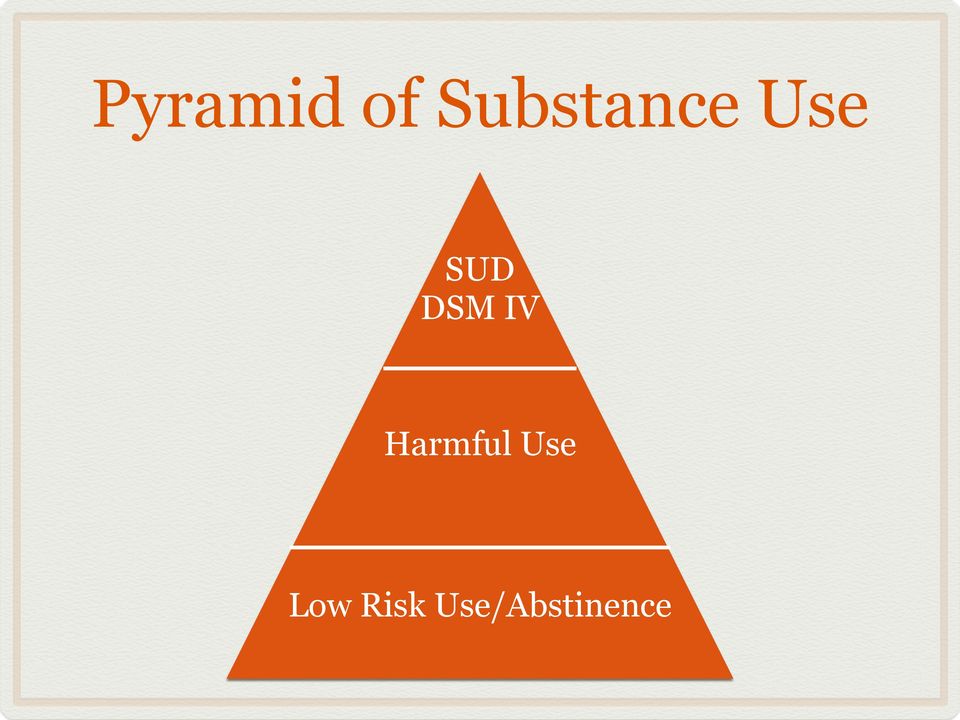
9 Harmful Use Usually present to general medical services Screening not often done because: don't know what to do, think there is no effective treatment, lack of time, don't think it is a medical problem Screening, Brief Intervention & Treatment: shown to be effective Single question screening tools e.g. NIDAMED

10 Acquired Brain Injury (ABI)


11

12 ABI: Common Causes Traumatic Brain Injury (TBI) Infection, Stroke Substance Misuse (eg Alcohol)


13 "Pyramid of ABI" Severe Moderate Subclinical/None

14 "Repairing Shattered Lives" There is growing evidence of links between incurring a TBI and subsequent offending. This indicates a need to reduce injuries and to manage consequences of injury to enable rehabilitation to be at its most effective There is compelling evidence of a very high prevalence rate of TBI in offenders in custody relative to the general population. Moreover, such injury may be linked to earlier and more frequent custodial sentences, and to more violent offending TBI in childhood and young adulthood may be particularly associated with offending behaviour. Earlier and more effective means to assess and manage the consequences of TBI in the offender population, and those at risk of offending, may lead to improved outcomes for affected individuals and for society

15 Incidence of TBI 8.5% of General Population 71% of DTTO audit had experienced at least one episode of traumatic loss of consciousness Majority as teenagers (age range 5-31). Mostly as a result of fighting or assault As a group had had very little, if any, follow up

16 Predisposing factors for TBI Contact sports Domestic violence Adolescent males who drink Falls Fights
17 Consequences of TBI Memory loss Loss of concentration Decreased awareness of own emotions Decreased awareness of others' emotions Poor social judgement Conduct disorder Attention problems Heightened aggression Impulse control disorders

18 Overlap Enormous overlap between traumatic brain injury and substance misuse Difficult to work out direction of causality Possibly expressions of the same underlying issues?
19 ABI in Drug/Alcohol Treatment Services

20 ABI as Barrier to Recovery Cognitive, behavioural, motor deficits may hamper recovery Need to raise awareness amongst staff to ask about history suggestive of TBI Close links with neuro-rehabilitation services needed to discuss possible referrals and treatment pathways/ care plans

21 Incidence/Screening Significant TBI may be fairly common May not be necessary to definitively distinguish between non trauma related ABI and TBI for clinical purposes Simple questions around history of head injuries may be useful Difficult to carry out screening using a standardised instrument due to concomitant drug use/treatment and mental health issues Often generates useful insights independent of TBI issues.
22 Exposure to Trauma Screening may aid recognition of the levels of trauma experienced by people attending drug/alcohol treatment services May impact significantly on recovery independently of direct neurological damage sustained May expose ongoing risk factors
23 Case Study 1 Male in his 30's with poor educational attainment, difficulty in managing his day to day affairs Poly drug use including Heroin, Benzodiazepines. Long offending history. >10 episodes of traumatic loss of consciousness as a child, starting in primary school, resulting from physical abuse Schooling affected - chronic headaches, difficulty coping with academic tasks Mental health affected - scared, disenfranchised
24 Case Study 2 Male in late 20's on DTTO. Long history of poly drug use and offending Survived a near fatal overdose involving prolonged intensive care unit treatment Resultant neurological deficits Had lost contact with neuro-rehabilitation services due to ongoing drug use Care plan has involved a mix of drug treatment and neurorehabilitation
25 General Medical Services Raising Awareness
26 Cause - Effect TBI may be an underlying cause for offending behaviour and for substance misuse Substance misuse may be an underlying cause for TBI Both mechanisms may exist in the same person Both may be a reflection of another factor - deprivation, risk taking etc
27 Raising Awareness Of TBI and its possible sequelae to improve recognition, monitoring and follow up Of harmful drug/alcohol use and of effectiveness of interventions such as Screening, Brief Intervention & Referral to Treatment (SBIRT), rapid screening tools
28 Conclusions
29 Paradigm Shift Away from viewing addiction purely as end stage disease management, towards prevention Away from quick fix recovery to sustainable recovery Away from mental health dominated views of addiction to a more holistic approach
30 Awareness Raising Of ABI in Alcohol/Drug Treatment services Of ABI and harmful Drug/Alcohol use in general services Of interventions that work e.g. SBIRT
31 References Repairing Shattered Lives: Brain Injury and its Implications for Criminal Justice - Prof Huw Williams NIDAMED Screening: nidamed-medical-health-professionals TBI Screening: downloads/pdfs/tbi-screening_v2.pdf
Co-Occurring Substance Use and Mental Health Disorders. Joy Chudzynski, PsyD UCLA Integrated Substance Abuse Programs
 Co-Occurring Substance Use and Mental Health Disorders Joy Chudzynski, PsyD UCLA Integrated Substance Abuse Programs Introduction Overview of the evolving field of Co-Occurring Disorders Addiction and
Assessing families and treating trauma in substance abusing families
 Children, Trauma and the impact of Substance abuse Day One Outpatient (874-1045) Amy Stevenson LCPC CCS ([email protected]) Don Burke LCPC CCS ([email protected]) Assessing families and treating trauma in
Free Additional Resources
 Free Additional Resources Substance Abuse and Mental Health Services Administration Treatment Improvement Protocols The Substance Abuse and Mental Health Services Administration (SAMHSA) offers free Treatment
VENTURA COUNTY ALCOHOL & DRUG PROGRAMS
 VENTURA COUNTY ALCOHOL & DRUG PROGRAMS women s services Helping women recover (805) 981-9200 1911 Williams Drive, Oxnard, CA 93036 www.venturacountylimits.org recovery VCBH ALCOHOL & DRUG PROGRAMS WOMEN
2) Recurrent emotional abuse. 3) Contact sexual abuse. 4) An alcohol and/or drug abuser in the household. 5) An incarcerated household member
 Co Occurring Disorders and the on Children: Effectively Working with Families Affected by Substance Abuse and Mental Illness Definition (Co-Occurring also called Dual Dx) A professional diagnosis of addictive/substance
Workforce Development Online Workshop Descriptions
 Workforce Development Online Workshop Descriptions Behavioral Health Service Delivery Workshops: The Effects of Violence Exposure on Children (1.5 hours) Regretfully, violence against children and youth
Youth Residential Treatment- One Step in the Continuum of Care. Dave Sprenger, MD
 Youth Residential Treatment- One Step in the Continuum of Care Dave Sprenger, MD Outline Nature of substance abuse disorders Continuum of care philosophy Need for prevention and aftercare Cost-effectiveness
Alcohol and Drug Use Following Traumatic Brain Injury. Patient Information Booklet. Talis Consulting Limited
 Alcohol and Drug Use Following Traumatic Brain Injury Patient Information Booklet Talis Consulting Limited Why does Alcohol and Drug Use Matter after a Head Injury? Alcohol and drugs affect our behaviour,
Karla Ramirez, LCSW Director, Outpatient Services Laurel Ridge Treatment Center
 Karla Ramirez, LCSW Director, Outpatient Services Laurel Ridge Treatment Center 1 in 4 Americans will have an alcohol or drug problems at some point in their lives. The number of alcohol abusers and addicts
OAHP Key Adolescent Health Issue. Behavioral Health. (Mental Health & Substance Abuse)
 OAHP Key Adolescent Health Issue Area 1 Behavioral Health (Mental Health & Substance Abuse) Introduction In Ohio, the promotion of positive mental health and the prevention of substance abuse and mental
Traumatic Brain Injury and Incarceration. Objectives. Traumatic Brain Injury. Which came first, the injury or the behavior?
 Traumatic Brain Injury and Incarceration Which came first, the injury or the behavior? Barbara Burchell Curtis RN, MSN Objectives Upon completion of discussion, participants should be able to Describe
IMPROVING YOUR EXPERIENCE
 Comments trom the Aberdeen City Joint Futures Brain Injury Group The Aberdeen City Joint Futures Brain Injury Group is made up of representatives from health (acute services, rehabilitation and community),
Dual Diagnosis and Integrated Treatment of Mental Illness and Substance Abuse Disorder
 Dual Diagnosis and Integrated Treatment of Mental Illness and Substance Abuse Disorder What are dual diagnosis services? Dual diagnosis services are treatments for people who suffer from co-occurring disorders
Statistics on Women in the Justice System. January, 2014
 Statistics on Women in the Justice System January, 2014 All material is available though the web site of the Bureau of Justice Statistics (BJS): http://www.bjs.gov/ unless otherwise cited. Note that correctional
ADOLESCENT CO-OCCURRING DISORDERS: TREATMENT TRENDS AND GUIDELINES AMANDA ALKEMA, LCSW BECKY KING, LCSW ERIC TADEHARA, LCSW
 ADOLESCENT CO-OCCURRING DISORDERS: TREATMENT TRENDS AND GUIDELINES AMANDA ALKEMA, LCSW BECKY KING, LCSW ERIC TADEHARA, LCSW INTRODUCTION OBJECTIVES National and Utah Statistics Best Practice Guidelines
THE CAUSES OF DRUG ADDICTION
 1 Statistical facts associated with addiction and substance abuse are concerning, but many men and women choose to ignore the dangers. By understanding the main causes of addiction to drugs, it is possible
Phoenix Futures Prison Treatment programmes
 Phoenix Futures Prison Treatment programmes Karen Biggs Chief Executive, Phoenix Futures Overview of Presentation Political and Strategic context in England Overview of some of our programmes. Outcomes
DRUGS? NO THANKS! What are some of the leading factors that cause you to. become interested in experimenting with illegal drugs?
 DRUGS? NO THANKS! What are some of the leading factors that cause you to become interested in experimenting with illegal drugs? It is easily available: During adolescence, you are trying to figure out
If we had no winter, the spring would not be so pleasant; if we did not sometimes taste of adversity, prosperity would not be so welcome.
 CHAPTER VII CO-OCCURRING DISORDERS If we had no winter, the spring would not be so pleasant; if we did not sometimes taste of adversity, prosperity would not be so welcome. ANNE BRADSTREET TAY Resource
acbis Chapter 1: Overview of Brain Injury
 acbis Academy for the Certification of Brain Injury Specialists Certification Exam Preparation Course Chapter 1: Overview of Brain Injury Module Objectives Describe the incidence, prevalence and epidemiology
Substance Abuse and Sexual Violence:
 Substance Abuse and Sexual Violence: The Need for Integration When Treating Survivors Kelli Hood, M.A. Objective To understand the necessity for therapeutic strategies in clients with cooccurring Substance
Impact of drugs and alcohol on individuals and the community
 Impact of drugs and alcohol on individuals and the community Introduction and overview Lynn Wilson Consultant in Public Health Overview and purpose Alcohol: The Problem Alcohol and Drug Service Review
Mental Health Needs Assessment Personality Disorder Prevalence and models of care
 Mental Health Needs Assessment Personality Disorder Prevalence and models of care Introduction and definitions Personality disorders are a complex group of conditions identified through how an individual
California Society of Addiction Medicine (CSAM) Consumer Q&As
 C o n s u m e r Q & A 1 California Society of Addiction Medicine (CSAM) Consumer Q&As Q: Is addiction a disease? A: Addiction is a chronic disorder, like heart disease or diabetes. A chronic disorder is
BINSA Information on Brain Injury
 Acquired Brain Injury (ABI) There are a number of ways an individual can suffer an acquired brain injury (ABI) Figure one - ABI causes Significant causes of ABI Traumatic Brain Injury (TBI) Traumatic Brain
Fairfax-Falls Church Community Services Board
 LOB #267: ADULT RESIDENTIAL TREATMENT SERVICES Purpose Adult Residential Treatment Services provides residential treatment programs for adults with severe substance use disorders and/or co occurring mental
Treatment Approaches for Drug Addiction
 Treatment Approaches for Drug Addiction [NOTE: This is a fact sheet covering research findings on effective treatment approaches for drug abuse and addiction. If you are seeking treatment, please call
Policy Perspective Treatment and Recovery for Individuals and Families Experiencing Addiction January 11, 2016
 Policy Perspective Treatment and Recovery for Individuals and Families Experiencing Addiction January 11, 2016 Addiction and Recovery in the 2016 political arena The issue of addiction has been addressed
ADVANCED BEHAVIORAL HEALTH, INC. Clinical Level of Care Guidelines - 2015
 The Clinical Level of Care Guidelines contained on the following pages have been developed as a guide to assist care managers, physicians and providers in making medical necessity decisions about the least
ALCOHOLISM, ALCOHOL DEPENDENCE AND THE EFFECTS ON YOUR HEALTH.
 ALCOHOLISM, ALCOHOL DEPENDENCE AND THE EFFECTS ON YOUR HEALTH. Alcoholism also known as alcohol dependence is a disabling ADDICTIVE DISORDER. It is characterized by compulsive and uncontrolled consumption
Out of Mind, Out of Sight: People with an Acquired Brain Injury and the Criminal Justice System
 AUSTRALASIAN INSTITUTE OF JUDICIAL ADMINISTRATION Criminal Justice in Australia and New Zealand Issues and Challenges for Judicial Administration Out of Mind, Out of Sight: People with an Acquired Brain
How To Improve Care For People With Complex Needs In Nsw
 Supporting Drug & Alcohol Services to Work with Clients with Complex Needs Project VAADA Conference 2013 Ciara Donaghy and Heidi Becker, NADA About NADA Peak body for NGO D&A sector in NSW Approx. 110
TBI TRAUMATIC BRAIN INJURY WITHIN THE MILITARY/VETERAN POPULATION
 TBI TRAUMATIC BRAIN INJURY WITHIN THE MILITARY/VETERAN POPULATION What is TBI? An external force that disrupts the normal function of the brain. Not all blows or jolts to the head result in a TBI. The
Queensland Corrective Services Drug and Alcohol Policy
 Queensland Corrective Services Drug and Alcohol Policy 2727QCS Commissioner s Foreword Drug and alcohol abuse is a significant issue confronting not only Queensland Corrective Services (QCS), but the entire
opiates alcohol 27 opiates and alcohol 30 April 2016 drug addiction signs 42 Ranked #1 123 Drug Rehab Centers in New Jersey 100 Top 10 380
 opiates alcohol 27 opiates and alcohol 30 April 2016 drug addiction signs 42 ed #1 123 Drug Rehab Centers in New Jersey 100 Top 10 380 effects of alcohol in the brain 100 Top 30 698 heroin addiction 100
Essential Trauma Informed Practices in Schools. Shannon Cronn, N.C.S.P. Barb Iversen, M.C.
 Essential Trauma Informed Practices in Schools Shannon Cronn, N.C.S.P. Barb Iversen, M.C. Objectives: Participants attending this session will be able to: Define trauma Explain how trauma may impact child/teen
Addiction is a Brain Disease
 Addiction is a Brain Disease By ALAN I. LESHNER, MD A core concept evolving with scientific advances over the past decade is that drug addiction is a brain disease that develops over time as a result of
Treatment Approaches for Drug Addiction
 Treatment Approaches for Drug Addiction NOTE: This is a fact sheet covering research findings on effective treatment approaches for drug abuse and addiction. If you are seeking treatment, please call 1-800-662-HELP(4357)
Alcoholism and Substance Abuse
 State of Illinois Department of Human Services Division of Alcoholism and Substance Abuse OVERVIEW The Illinois Department of Human Services, Division of Alcoholism and Substance Abuse (IDHS/DASA) is the
Early Response Concussion Recovery
 Early Response Concussion Recovery KRISTA MAILEY, BSW RSW, CONCUSSION RECOVERY CONSULTANT CAREY MINTZ, PH.D., C. PSYCH., PRACTICE IN CLINICAL NEUROPSYCHOLOGY FOR REFERRAL: Contact Krista Mailey at (204)
Frequently Asked Questions (FAQs) of Drug Abuse Treatment for Criminal Justice Populations
 Frequently Asked Questions (FAQs) of Drug Abuse Treatment for Criminal Justice Populations From The National Institute on Drug Abuse (NIDA) 2. Why should drug abuse treatment be provided to offenders?
Traumatic Stress. and Substance Use Problems
 Traumatic Stress and Substance Use Problems The relation between substance use and trauma Research demonstrates a strong link between exposure to traumatic events and substance use problems. Many people
Substance Use and Abuse and Brain Injury Where to Start? Carolyn Lemsky, Ph.D., C.Psych.
 Substance Use and Abuse and Brain Injury Where to Start? Carolyn Lemsky, Ph.D., C.Psych. 2009-2013 Substance use and Acquired Brain injury Research to Practice Network Where to get started? Provide an
Alcohol and Re-offending Who Cares?
 January 2004 Alcohol and Re-offending Who Cares? This briefing paper focuses on the high level of alcohol misuse and dependence within the prison population. In recent years a great deal of time and money
Lone Star College-Tomball Community Library 30555 Tomball Parkway Tomball, TX 77375 http://www.lonestar.edu/library.
 Lone Star College-Tomball Community Library 30555 Tomball Parkway Tomball, TX 77375 http://www.lonestar.edu/library.htm 832-559-4211 PSYCHOLOGY Scholarly ELECTRONIC Electronic JOURNAL Journals LIST The
3.5 Guidelines, Monitoring and Surveillance of At Risk Groups
 3.5 Guidelines, Monitoring and Surveillance of At Risk Groups 3.5.6 Children of Parents who are Affected by Drug and Alcohol Misuse Background There is overwhelming evidence that the misuse of drugs and
SOMERSET DUAL DIAGNOSIS PROTOCOL OCTOBER 2011
 SOMERSET DUAL DIAGNOSIS PROTOCOL OCTOBER 2011 This document is intended to be used with the Somerset Dual Diagnosis Operational Working guide. This document provides principles governing joint working
Pragmatic Evidence Based Review Substance Abuse in moderate to severe TBI
 Pragmatic Evidence Based Review Substance Abuse in moderate to severe TBI Reviewer Emma Scheib Date Report Completed November 2011 Important Note: This report is not intended to replace clinical judgement,
Alcohol and drugs prevention, treatment and recovery: why invest?
 Alcohol and drugs prevention, treatment and recovery: why invest? 1 Alcohol problems are widespread 9 million adults drink at levels that increase the risk of harm to their health 1.6 million adults show
Protection of the Rights of Children and Women Suffering from Drug Addiction in the Family and Society - Shelter Don Bosco, Mumbai, India -
 Protection of the Rights of Children and Women Suffering from Drug Addiction in the Family and Society - Shelter Don Bosco, Mumbai, India - Article 24 of the Convention on the Rights of the Child recognizes
Responding to the Needs of Justice-Involved Veterans. Mark Mayhew, LCSW VA Justice Outreach Coordinator
 Responding to the Needs of Justice-Involved Veterans Mark Mayhew, LCSW VA Justice Outreach Coordinator There is inherent sympathy for those who sustain damage in defense of country, whether that damage
2011 ASAT Operations Manual EXCERPTS FROM ALCOHOL AND SUBSTANCE ABUSE TREATMENT (ASAT)
 EXCERPTS FROM ALCOHOL AND SUBSTANCE ABUSE TREATMENT (ASAT) NEW YORK STATE DEPARTMENT OF CORRECTIONS AND COMMUNITY SUPERVISION 2011 ASAT Operations Manual ASAT Staffing ASAT staff are responsible for providing
EARLY INTERVENTION AND PREVENTION STRATEGY 2012-15 Summary
 EARLY INTERVENTION AND PREVENTION STRATEGY 2012-15 Summary Plymouth Children, Young People and Families Partnership INTRODUCTION Why do we need early intervention in Plymouth? We know that effective early
Presentation to Senate Health and Human Services Committee: Prescription Drug Abuse in Texas
 Presentation to Senate Health and Human Services Committee: Prescription Drug Abuse in Texas David Lakey, MD Commissioner, Department of State Health Services Lauren Lacefield Lewis Assistant Commissioner,
Treatment System 101
 Treatment System 101 A brief overview for courtroom decision-makers and people working in criminal justice sectors March 11, 2015 West Toronto Human Services & Justice Coordinating Cttee. Agenda Introduction
No.1 Why reducing drug-related crime is important, and why the new government needs to act
 RAPt RESEARCH AND POLICY BRIEFING SERIES No.1 Why reducing drug-related crime is important, and why the new government needs to act 12th May 2015 FOREWORD This series of RAPt Research and Policy Briefings
Interventions for Substance Exposed Children PROGRAMS FOR SUCCESS
 Interventions for Substance Exposed Children PROGRAMS FOR SUCCESS Presenter Kay M. Doughty, MA, CAP, CPP VP, Family and Community Services Workshop Content Overview Development of a Logic Model Comprehensive
seeking the certification education requirements as an Addiction Counselor through either the
 180-Hour Training Series: Addiction Counselor Program The Addiction Certification Program is designed to provide the coursework necessary for those Evidence-Based & Best Practices seeking the certification
Addiction: Disease or Choice?
 Addiction: Disease or Choice? Presented by Michael Coughlin RN October 18, 2012 Introduced by Melanie Willows B.Sc. M.D. C.C.F.P. C.A.S.A.M. C.C.S.A.M. Assistant Professor University Of Ottawa Clinical
Substance Abuse Prevention
 Prescription Drug Abuse Prevention & -Early Intervention (SBIRT) Barry R. Donovan, Ph.D. NYS OASAS Bureau of Prevention Services Research Application Unit Substance Abuse Prevention What do Heroin, Rx
Prescription Drug Abuse Prevention & -Early Intervention (SBIRT)
 Prescription Drug Abuse Prevention & -Early Intervention (SBIRT) Barry R. Donovan, Ph.D. NYS OASAS Bureau of Prevention Services Research Application Unit Substance Abuse Prevention What do Heroin, Rx
Further Discussion of Comprehensive Theory of Substance Abuse Prevention March, 2011
 Further Discussion of Comprehensive Theory of Substance Abuse Prevention March, 2011 The prime dichotomy between profoundly challenged children and socially influenced teens may be similar to some other
Course Description. SEMESTER I Fundamental Concepts of Substance Abuse MODULE OBJECTIVES
 Course Description SEMESTER I Fundamental Concepts of Substance Abuse MODULE OBJECTIVES At the end of this course participants will be able to: Define and distinguish between substance use, abuse and dependence
FACT SHEET. What is Trauma? TRAUMA-INFORMED CARE FOR WORKING WITH HOMELESS VETERANS
 FACT SHEET TRAUMA-INFORMED CARE FOR WORKING WITH HOMELESS VETERANS According to SAMHSA 1, trauma-informed care includes having a basic understanding of how trauma affects the life of individuals seeking
People with mental health disorders and cognitive impairment in the criminal justice system Cost-benefit analysis of early support and diversion*
 People with mental health disorders and cognitive impairment in the criminal justice system Cost-benefit analysis of early support and diversion* AUGUST 2013 Ruth McCausland Eileen Baldry University of
DrugFacts: Treatment Approaches for Drug Addiction
 DrugFacts: Treatment Approaches for Drug Addiction NOTE: This is a fact sheet covering research findings on effective treatment approaches for drug abuse and addiction. If you are seeking treatment, please
UNM Pain Center: Addressing New Mexico s Public Health Crises of Pain, Addiction, and Unintentional Opioid Overdose Deaths
 UNM Pain Center: Addressing New Mexico s Public Health Crises of Pain, Addiction, and Unintentional Opioid Overdose Deaths Joanna G Katzman, M.D., M.S.P.H Director, UNM Pain Center Associate Professor,
Learning Objectives Review and discuss current research on the basic brain physiology of addiction
 Emerging Trends in Addiction Treatment 1.0 CE NBCC, NAADAC, FCB Dr. Doug Davies, MD, ASAM Medical Director The Refuge A Healing Place, Ocklawaha, FL 14835 SE 85 th Street Ocklawaha, FL 32179 www.therefuge
Manifesto for Acquired Brain Injury Rehabilitation
 Manifesto for Acquired Brain Injury Rehabilitation For further information please contact: Chloë Hayward UKABIF Executive Director PO Box 355 Plymouth PL3 4WD Tel: 01752 601318 Email: [email protected]
Conduct Disorder: Treatment Recommendations. For Vermont Youth. From the. State Interagency Team
 Conduct Disorder: Treatment Recommendations For Vermont Youth From the State Interagency Team By Bill McMains, Medical Director, Vermont DDMHS Alice Maynard, Mental Health Quality Management Chief, Vermont
REFERRAL FORM FOR ADMISSION TO HOMEWOOD HEALTH CENTRE
 Date of Referral: REFERRAL FORM FOR ADMISSION TO HOMEWOOD HEALTH CENTRE PATIENT INFORMATION Patient Name: Date of Birth (YYYY-MM-DD): E-mail Business/Mobile Phone: Gender: Health Card #: Version Code:
Alcohol use after traumatic brain injury (TBI)
 Alcohol use after traumatic brain injury (TBI) A resource for individuals with traumatic brain injury and their supporters This presentation is based on TBI Model Systems research and was developed with
Programs and Services. Central Texas Council on Alcoholism and Drug Abuse
 Programs and Services Central Texas Council on Alcoholism and Drug Abuse CTCADA Goals To reduce the harm caused by substance abuse in our communities To mobilize communities to implement prevention and
The Recovery Pathway Service forms a key component of the Sunderland Integrated Substance Misuse Service, as illustrated below:
 SERVICE SPECIFICATION LOT 1 RECOVERY PATHWAY 1.0 SERVICE MODEL The Recovery Pathway Service forms a key component of the Sunderland Integrated Substance Misuse Service, as illustrated below: Recovery Outcomes
Assessment of depression in adults in primary care
 Assessment of depression in adults in primary care Adapted from: Identification of Common Mental Disorders and Management of Depression in Primary care. New Zealand Guidelines Group 1 The questions and
Integrating Dual Diagnosis Treatment: Achieving Positive Public Safety and Public Health Outcomes for Offenders with Co- Occurring Disorders
 Integrating Dual Diagnosis Treatment: Achieving Positive Public Safety and Public Health Outcomes for Offenders with Co- Occurring Disorders Fred Osher, M.D. Director, Health Systems and Services Policy
CHAPTER 5. Rules and Regulations for Substance Abuse Standards. Special Populations for Substance Abuse Services
 CHAPTER 5 Rules and Regulations for Substance Abuse Standards Special Populations for Substance Abuse Services Section 1. Authority. These rules are promulgated by the Wyoming Department of Health pursuant
National Offender Management Service NOMS Reducing Re-offending: Drug and Alcohol Treatment Strategy
 National Offender Management Service NOMS Reducing Re-offending: Drug and Alcohol Treatment Strategy Danny Clark, Head of Substance Misuse interventions Reducing Re-offending Policy Group Directorate of
information for service providers Schizophrenia & Substance Use
 information for service providers Schizophrenia & Substance Use Schizophrenia and Substance Use Index 2 2 3 5 6 7 8 9 How prevalent are substance use disorders among people with schizophrenia? How prevalent
Key trends nationally and locally in relation to alcohol consumption and alcohol-related harm
 Key trends nationally and locally in relation to alcohol consumption and alcohol-related harm November 2013 1 Executive Summary... 3 National trends in alcohol consumption and alcohol-related harm... 5
Focus Area 6: Mental Health, Alcohol, and Substance Abuse
 Focus Area : Mental Health and Mental Disorders Alcohol Abuse Substance Abuse Autism Spectrum Disorders Exposure to Trauma 119 WORK GROUP ON MENTAL HEALTH, ALCOHOL, AND SUBSTANCE ABUSE Co-Chairs Barbara
Screening Patients for Substance Use in Your Practice Setting
 Screening Patients for Substance Use in Your Practice Setting Learning Objectives By the end of this session, participants will Understand the rationale for universal screening. Identify potential health
Substance Use and Traumatic Brain Injury
 Substance Use and Traumatic Brain Injury From: http://www.msktc.org/lib/docs/alcohol_and_tbi_istock_000015394252xsmall.jpg Marc A Gramatges, Psy.D. December 18, 2013 2013 Bancroft All rights reserved Learning
Treatment Approaches for Drug Addiction
 Treatment Approaches for Drug Addiction NOTE: This is a fact sheet covering research findings on effective treatment approaches for drug abuse and addiction. If you are seeking treatment, please call the
Behavioral Health Provider Implementation of Whole Health Integrative Treatment Services
 Behavioral Health Provider Implementation of Whole Health Integrative Treatment Services Maryland Integrative Learning Community Lynn H Albizo, Director of Public Affairs Maryland Addictions Directors
Community Based Treatment and Care for Drug Use and Dependence
 CBTx Community Based Treatment and Care for Drug Use and Dependence Information Brief for Southeast Asia Community Based Treatment refers to a specific integrated model of treatment for people affected
Chapter I: Introduction. Substance abuse is an enormous social problem in South Africa. The World Health
 Chapter I: Introduction 1.1 Background of Co-Occurring Disorders (CODs) Substance abuse is an enormous social problem in South Africa. The World Health Organisation (World Health Organisation (WHO), 2004)
Adolescent Substance Abuse: Evidence-Based Programs
 Adolescent Substance Abuse: Evidence-Based Programs Sara McEwen, MD, MPH Governor s Institute on Substance Abuse Janice Petersen, Ph.D., Director Office of Prevention/DMHDDSAS DHHS December 7, 2010 Objectives
Substance misuse and behavioural addictions
 Substance misuse and behavioural addictions Information about our services for primary healthcare professionals PROVIDING QUALITY INSPIRING INNOVATION DELIVERING VALUE Our substance misuse and behavioural
ADULT HEALTH AND WELLBEING LONG-TERM NEUROLOGICAL CONDITIONS
 ADULT HEALTH AND WELLBEING LONG-TERM NEUROLOGICAL CONDITIONS i. Summary The National Service Framework for long-term neurological conditions categorises neurological conditions as: Sudden-onset conditions
Teen Misuse and Abuse of Alcohol and Prescription Drugs. Information for Parents
 Teen Misuse and Abuse of Alcohol and Prescription Drugs Information for Parents Terminology Misuse: Using a drug in a way in which it was not intended Example: Using a higher dose of medication than was
Alcohol and Brain Damage
 Alcohol and Brain Damage By: James L. Holly, MD O God, that men should put an enemy in their mouths to steal away their brains! That we should, with joy, pleasance, revel, and applause, transform ourselves
Presentation to the Boston HIV Planning Council. Lydie Ultimo, MSW Director Bureau of Substance Abuse Services
 Presentation to the Boston HIV Planning Council Lydie Ultimo, MSW Director Bureau of Substance Abuse Services Responsibilities of the Bureau of Substance Abuse Services License addiction treatment programs
REVISED SUBSTANCE ABUSE GRANTMAKING STRATEGY. The New York Community Trust April 2003
 REVISED SUBSTANCE ABUSE GRANTMAKING STRATEGY The New York Community Trust April 2003 1 I. INTRODUCTION Substance Abuse is defined as the excessive use of addictive substances, especially narcotic drugs,
Topic Area - Dual Diagnosis
 Topic Area - Dual Diagnosis Dual Diagnosis is a challenging problem for both mental health and substance misuse services. People with mental health problems, who also suffer from substance misuse are at