
MATH CHEAT SHEET. Basic Math and Pre-Algebra Cheat Sheet
|
|
|
- Harriet Freeman
- 9 years ago
- Views:
Transcription
1 1 MATH CHEAT SHEET Basic Math and Pre-Algebra Cheat Sheet Groups of Numbers Natural or counting numbers: 1, 2, 3, 4, Whole numbers: 0, 1, 2, 3, Integers: -3, -2, -1, 0, 1, 2, 3, Rational numbers: Integers and fractions. Irrational numbers: Cannot be written as fractions: 3 or π. Prime numbers: Divisible only by 1 and itself: 2, 3, 5, 7, 11, 13, (0 and 1 are not prime or composite.) Composite numbers: Divisible by more than just 1: 4, 6, 8, 9, 10, 12, Properties of Addition and Multiplication Closure: All answers fall into original set. Commutative: Order does not make any difference: a + b = b + a, ab = ba. Associative: Grouping does not make any difference: (a + b) + c = a + (b + c), (ab)c = a(bc). Identity: 0 for addition, 1 for multiplication. Inverse: Negative for addition, reciprocal for multiplication. Order of Operations 1. Work within parentheses ( ), brackets [ ], and braces { } from innermost and work outward. 2. Simplify exponents and roots working from left to right. 3. Do multiplication and division, whichever comes first left to right. 4. Do addition and subtraction, whichever comes first left to right. Rounding Off 1. Underline the place value to which you're rounding off. 2. Look to the immediate right (one place) of your underlined place value. 3. Identify the number (the one to the right). If it is 5 or higher, round your underlined place value up 1 and change all the other numbers to its right to zeros. If less than 5, leave your underlined place value as it is and change all the other numbers to the right to zeros. Decimals To add or subtract decimals, simply line up the decimal points and then add or subtract as usual.

2 2 To multiply decimals, just multiply as usual and then count the total number of digits above the line that are to the right of all decimal points. Place the decimal point in your answer so that there are the same number of digits to the right of the decimal point as there are above the line. To divide decimals, if the number you're dividing by has a decimal, move the decimal to the right as many places as possible and then move it under the division sign just as many places (add zeros if necessary). Move the decimal up to your answer. Fractions To add or subtract fractions, you must have a common denominator. If two fractions have a common denominator (these are called like fractions), you simply add or subtract the numerator and keep the same denominator. (For example, 1/5 + 2/5 = 3/5.) If two fractions do not have a common denominator (unlike fractions), find a lowest common denominator (LCD), change each of the fractions to equivalent fractions with the new denominator, and then add or subtract the numerators and keep the same denominator. (For example, 1/2 + 1/3 = 3/6 + 2/6 = 5/6) When subtracting mixed numbers, you may have to "borrow" from the whole number. When you borrow 1 from the whole number, the 1 must be changed to a fraction. To multiply fractions, simply multiply the numerators and then multiply the denominators. (For example, 2/3 1/5 = 2/15.) Reduce to lowest terms if necessary. To divide fractions, invert the second fraction and then multiply. (For example, 1/5 1/4 = 1/5 4/1 = 4/5.) A additive inverse: The opposite (negative) of a number. Any number plus its additive inverse equals 0. associative property: Grouping of elements makes no difference in the outcome. This is only true for multiplication and addition. B braces: Grouping symbols used after the use of brackets; signs { } used to represent a set. brackets: Grouping symbols [ ], used after the use of parentheses. C canceling: In multiplication of fractions, dividing the same number into both a numerator and a denominator. circumference: The distance around a circle; equals 2 π the radius or π the diameter (C = 2πr or πd). closure property: When all answers fall into the original set.

3 3 combinations: The total number of independent possible choices. common denominator: A number that can be divided evenly by all denominators in the problem. common factors: Factors that are the same for two or more numbers. common multiples: Multiples that are the same for two or more numbers. commutative property: The order of elements does not make any difference in the outcome. This is only true for multiplication and addition. complex fraction: A fraction having a fraction or fractions in the numerator and/or denominator. composite number: A number divisible by more than just 1 and itself. cube: The result when a number is multiplied by itself twice. cube root: A number that when multiplied by itself twice gives you the original number; its symbol is 3. D decimal fraction: Fraction with a denominator 10, 100, 1,000, and so on, written using a decimal point; for example,.3 and.275. decimal point: A point used to distinguish decimal fractions from whole numbers. denominator: The bottom symbol or number of a fraction. dependent events: When the outcome of one event has a bearing or effect on the outcome of another event. difference: The result of subtraction. distributive property: The process of distributing a number on the outside of the parentheses to each number on the inside; a(b + c) = ab + ac. E even number: An integer (positive whole numbers, zero, and negative whole numbers) divisible by 2 (with no remainder). expanded notation: Pointing out the place value of a digit by writing a number as the digit its place value. For example, 342 = ( ) + ( ) + (2 10). exponent: A small number placed above and to the right of a number; expresses the power to which the quantity is to be raised or lowered. F

4 4 factor (noun): A number or symbol that divides evenly into a larger number. For example, 6 is a factor of 24. factor (verb): To find two or more quantities whose product equals the original quantity. fraction: symbol that expresses part of a whole and consists of a numerator and a denominator; for example, 3/5. G greatest common factor: The largest factor common to two or more numbers. I identity element for addition 0: Any number added to 0 gives the original number. identity element for multiplication 1: Any number multiplied by 1 gives the original number. improper fraction: A fraction in which the numerator is greater than the denominator; for example, 3/2. independent events: When the outcome of one event has no bearing or effect on the outcome of another event. integer: A whole number, either positive, negative, or zero. invert: Turn upside down, as in "invert 2/3 = 3/2." irrational number: A number that is not rational (cannot be written as a fraction x/y, with x a natural number and y an integer); for example, 3 or π. L least common multiple: The smallest multiple that is common to two or more numbers. lowest common denominator: The smallest number that can be divided evenly by all denominators in the problem. M mean (arithmetic): The average of a number of items in a group (the total items divided by the number of items). median: The middle item in an ordered group. If the group has an even number of items, the median is the average of the two middle terms. mixed number: A number containing both a whole number and a fraction; for example, 5½. mode: The number appearing most frequently in a group.

5 5 multiples: Numbers found by multiplying a number by 2, by 3, by 4, and so on. multiplicative inverse: The reciprocal of a number. Any number multiplied by its multiplicative inverse equals 1. N natural number: A counting number; 1, 2, 3, 4, and so on. negative number: A number less than 0. number series: A sequence of numbers with some pattern. One number follows another in some defined manner. numerator: The top symbol or number of a fraction. O odd number: An integer not divisible by 2. operation: Multiplication, addition, subtraction, or division. order of operations: The priority given to an operation relative to other operations. For example, multiplication is performed before addition. P parentheses: Grouping symbols ( ). percent or percentage: A common fraction with 100 as its denominator. For example, 37% is 37/100. permutations: The total number of dependent choices. place value: The value given a digit by the position of a digit in the number. positive number: A number greater than zero. power: A product of equal factors = 4 3, reads "four to the third power" or "the third power of four." Power and exponent are some used interchangeably. prime number: A number that can be divided by only itself and one. probability: The numerical measure of the chance of an outcome or event occurring. product: The result of multiplication. proper fraction: A fraction in which the numerator is less than the denominator; for example, 2/3. proportion: Written as two equal ratios. For example, 5 is to 4 as 10 is to 8, or 5/4 = 10/8.

6 6 Q quotient: The result of division. R range: The difference between the largest and the smallest number in a set of numbers. ratio: A comparison between two numbers or symbols; may be written x:y, x/y, or x is to y. rational number: An integer or fraction such as 7/8 or 9/4 or 5/1. Any number that can be written as a fraction x/y with x a natural number and y an integer. real number: Any rational or irrational number. reciprocal: The multiplicative inverse of a number. For example, 2/3 is the reciprocal of 3/2. reducing: Changing a fraction into its lowest terms. For example, 2/4 is reduced to 1/2. rounding off: Changing a number to the nearest place value as specified; a method of approximating. S scientific notation: A number between 1 and 10 and multiplied by a power of 10, used for writing very large or very small numbers; for example, square: The result when a number is multiplied by itself. square root: A number that when multiplied by itself gives you the original number; its symbol is. For example, 5 is the square root of 25; 25 = 5. sum: The result of addition. T tenth: The first decimal place to the right of the decimal point. For example,.7 is seventenths. W weighted mean: The mean of a set of numbers that have been weighted (multiplied by their relative importance or of occurrence). whole number: 0, 1, 2, 3, and so on. Algebra I Cheat Sheet Axioms of Equality

7 7 Reflexive axiom: a = a Symmetric axiom: If a = b, then b = a Transitive axiom: If a = b and b = c, then a = c Additive axiom: If a = b and c = d, then a + c = b + d Multiplicative axiom: If a = b and c = d, then ac = bd Solving Equations 1. Simplify if necessary. 2. Get the variable on one side of the equal sign and numbers on the other. 3. Divide by the number in front of the variable. Solving Systems of Equations Addition/Subtraction Method: Combine equations to eliminate one variable. The equations may need to be multiplied by a common multiple first. Substitution Method: Solve one equation for one variable and substitute that variable into other equations. Graphing Method: Graph each equation on the same graph. The coordinates of the intersection are the solution. Monomials A monomial is an algebraic expression that consists of only one term. Add or subtract monomials with like terms only: 3xy + 2xy = 5xy. To multiply monomials, add the exponents of the same bases: x 4 (x 3 ) = x 7. To divide monomials, subtract the exponent of the divisor from the exponent of the dividend of the same base: x 8 /x 3 = x 5. Polynomials A polynomial is an algebraic expression of two or more terms, such as x + y. Binomials consist of exactly two terms. Trinomials consist of exactly three terms. To add or subtract polynomials, add or subtract like terms only. To multiply two polynomials, multiply each term in one polynomial by each term in the other polynomial. The F.O.I.L. method (first, outer, inner, last) is often used when multiplying binomials. To divide a polynomial by a monomial, divide each term by the monomial. To divide a polynomial by another polynomial, make sure both are in descending order, then use long division (divide by first term, multiply, subtract, bring down). Solving Inequalities Solve exactly like equations, except if you multiply or divide both sides by a negative number, you must reverse the direction of the inequality sign.

8 8 Factoring A common factor 1. Find the largest common monomial and factor of each term. 2. Divide the original polynomial to obtain the second factor. Difference of two squares 1. Find the square root of the first term and the second term. 2. Express your answer as the product of the sum and difference of those quantities. Example: x 2-9 = (x + 3)(x - 3) Trinomials 1. Check to see if you can monomial factor. 2. Use double parentheses and factor the first term and place the factors in the left side of the parenthesis. 3. Factor the last term and place the factors in the right sides of the parentheses. 4. Deciding the signs of the numbers, and the numbers themselves, may take trial and error. Multiply the means and extremes; their sum must equal the middle term. Example: x 2 + 3x + 2 = (x + 2)(x + 1) Axioms of Inequality Trichotomy axiom: a > b, a = b, or a < b. Transitive axiom: If a > b and b > c, then a > c. Additive axiom: If a > b, then a + c > b + c. Positive multiplication axiom: If c > 0, then a > b if, and only if, ac > bc. Negative multiplication axiom: If c < 0, then a > b if, and only if, ac < bc. Solving Quadratic Equations By factoring: Put all terms on one side of the equal sign and factor. Set each factor to zero and solve. By using the quadratic formula: Plug into the formula By completing the square: Put the equation in the form of ax 2 + bx = -c (make a -1 by dividing if necessary). Add (b/2) 2 to both sides of the equation to form a perfect square on the left side of the equation. Find the square root of both sides of the equation. Solve the resulting equation. Algebra II Cheat Sheet Geometry Formulas

9 9 Perimeter Area of a triangle Area of a rectangle Area of a parallelogram Area of a trapezoid P = sum of sides A = ½bh A = lw A = bh A = ½ (b 1 + b 2 ) h Area of a circle A = πr 2 Word Problem Formulas Distance Interest Distance = rate X time Interest = principal X rate X time Compound Interest Work accomplished work accomplished = (rate of work) X (time worked) Graphing Formulas Distance (for graphs) Midpoint Slope Slope-Intercept Form y = mx + b Quadratic Equations Standard Form ax 2 + bx + c = 0 Difference of squares x 2 - b 2 = (x + b)(x - b) Quadratic formula Conic Sections Circle Centered at (h, k) with a radius of r: (x - h) 2 + (y - k) 2 = r 2

10 10 Ellipse Centered at (h, k) with its major axis parallel to the x-axis: Centered at (h, k) with its major axis parallel to the y-axis: Parabola If parabola opens vertically: y = a(x - h) 2 + k If parabola opens horizontally: x = a(y - k) 2 + h Hyperbola If transverse axis is horizontal: If transverse axis is vertical: Sequences and Series Arithmetic Sequence a n = a 1 + (n - 1)d Geometric Sequence a n = a 1 r n-1 Arithmetic Series Geometric Series Geometry Cheat Sheet, s Angle, angles m AB Measure of angle AB Arc AB Measure of arc AB Circle, circles Congruent Not congruent Degree

11 11 = Equal Not equal > Greater than < Less than AB Length of line segment AB AB Line AB Line segment AB Ray AB Parallel Not parallel Parallelogram Perpendicular Similar Triangle (x,y) Ordered pair in plane a b = c d Proportion a: b or a b Ratio Famous Abbreviations AA Angle-angle, for proving triangles similar AAS Angle-angle-side, for proving triangles congruent ASA Angle-side-angle, for proving triangles congruent cos Cosine cot Cotangent CPCTC Congruent parts of congruent triangles are congruent csc Cosecant CSSTP Corresponding sides of similar triangles are proportional SAS Side-angle-side, for proving triangles congruent sin Sine tan Tangent Commonly Used Variables a Apothem a, b, c Lengths of the sides of a triangle A Area of a polygon B Area of the base of a solid C Circumference of a circle h Height of an altitude α Alpha (name of an angle)

12 12 β X1 x θ π l or l L m M n P P or P' r s S T V w or w Formulae Area Beta (name of an angle) Unknown value Theta (name of an angle) Pi Slant length of a side of a solid Length of a rectangle Lateral area of a solid Slope of a line Midpoint of a line segment Number of sides of a polygon Perimeter of a polygon Plane Radius Length of the side of an equilateral polygon Surface area of a solid Total area Volume Width of a rectangle (A) of a triangle A = ½bh where b measures the base and h the altitude Perimeter (P) of a triangle P = a + b + c where a, b, and c are the lengths of the sides Area (A) of a rectangle A = lw where l measures the length and w the width Perimeter (P) of a rectangle P = 2b + 2h where b measures the width and h the height Area Area (A) of a circle A = πr 2 where r measures the radius Circumference (C) of a circle C = 2πr or C = πd where r measures the radius and d the diameter Geometry Glossary A B C D E H I L M N O P Q R S T V A acute angle: an angle whose measure is less than 90. acute triangle: a triangle containing all acute angles. adjacent angles: angles that share a common side and a common vertex. angle: formed by two rays with a common endpoint.

13 13 arc: the set of points on a circle that lie in the interior of a central angle. area: the space within a shape; measured in square units. B bisects: divides into two equal parts. C central angle: an angle whose vertex is the center of the circle. The measure of a central angle is equal to the measure of its arc. chord: a line segment joining any two points on a circle. circle: in a plane, the set of points all equidistant from a given point. circumference: the distance around a circle; equals 2 x π x radius or π x diameter (C = 2πr or πd.). complementary angles: two angles the sum of whose measures is 90. concave polygon: a polygon which contains at least one diagonal outside the figure. concentric circles: circles with the same center. congruent: exactly alike. Identical in shape and size. consecutive: next to each other convex polygon: a polygon in which all diagonals lie within the figure. corresponding: in the same position. Coinciding. cube: a six-sided solid. All sides are equal squares and all edges are equal. D decagon: a plane closed figure with ten sides and ten angles. degree: a unit of measurement of an angle. diagonal of a polygon: a line segment connecting one vertex to another vertex, and not a side of the polygon. diameter: a line segment that contains the center and has its endpoints on the circle. Also, the length of this segment. (A chord through the center of the circle.) E

14 14 equilateral triangle: a triangle in which all three angles are equal in measure and all three sides have the same length. exterior angle: an angle formed outside the polygon by extending one side. In a triangle, the measure of an exterior angle equals the sum of the measures of the two remote interior angles. H height: altitude. From the highest point, a perpendicular drawn to the base. heptagon: a plane closed figure with seven sides and seven angles. hexagon: a plane closed figure with six sides and six angles. hypotenuse: in a right triangle, the side opposite the 90 angle. I inscribed angle: in a circle, an angle formed by two chords. Its vertex is on the circle. The measure of an inscribed angle equals one-half the measure of its arc. interior angles: angles formed inside the shape or within two parallel lines. intersecting lines: lines that meet at a point. isosceles right triangle: a triangle having two equal sides, two equal angles, and one 90 angle. Its sides are always in the ratio 1, 1, 2. isosceles triangle: a triangle having two equal sides (and thus two equal angles across from those sides). L legs: in a right triangle, the two sides forming the 90 angle. In a trapezoid, the nonparallel sides. line segment: a part of a line; has two endpoints M median: in a triangle, a line segment drawn from a vertex to the midpoint of the opposite side. median: in a trapezoid, a line segment parallel to the bases and bisecting the legs. midpoint: the halfway point of a line segment, equidistant from each endpoint. minute: a subdivision of an angle, one-sixtieth of a degree.

15 15 N nonagon: a plane closed figure with nine sides and nine angles O obtuse angle: an angle greater than 90 but less than 180 obtuse triangle: a triangle containing an obtuse angle octagon: a plane closed figure with eight sides and eight angles P parallel lines: two or more lines, always the same distance apart. Parallel lines never meet. parallelogram: a four-sided plane closed figure having opposite sides equal and parallel. (Opposite angles are equal, and consecutive angles are supplementary.) pentagon: a five-sided plane closed figure. The sum of its five angles is 540. perimeter: the total distance around the outside of any polygon. The total length of all the sides. perpendicular lines: two lines that intersect at right angles. pi (π): a constant used in determining a circle's area or circumference. Equals approximately 3.14 or 22/7 plane: often described as a flat surface. plane figure: shape having only length and width (two dimensional). plane geometry: the study of shapes and figures in two dimensions. point: a basic element of geometry, a location. If two lines intersect, they do so at a point. polygon: many-sided plane closed figure. Triangle, quadrilateral, pentagon, and so on. prism: a three-dimensional shape bounded by congruent parallel faces and a set of parallelograms formed by joining the corresponding vertices of the bases. Pythagorean theorem: a theorem that applies to right triangles. The sum of the squares of a right triangle's two legs equals the square of the hypotenuse (a 2 + b 2 = c 2 ). Q quadrilateral: a four-sided plane closed figure. The sum of its four angles equals 360. R

16 16 radii: plural of radius. radius: a line segment whose endpoints lie one at the center of a circle and one on the circle. Also, the length of this segment. ray: a half-line. Continues forever in one direction. Has one endpoint. rectangle: a four-sided plane closed figure having opposite sides equal and parallel and four right angles. regular polygon: a polygon in which sides and angles are all equal. For example, a regular pentagon has five equal angles and five equal sides. rhombus: a parallelogram with four equal sides. right angle: an angle whose measure is equal to 90. right circular cylinder: a solid shaped like a can. Base meets side at a right angle. right triangle: a triangle containing a 90 angle. S scalene triangle: a triangle having none of its sides equal (or angles equal). similar: having the same shape but not the same size, in proportion. solid geometry: the study of shapes and figures in three dimensions: length, width, and thickness. square: a four-sided plane closed figure having equal sides and four right angles. Its opposite sides are parallel. straight angle: an angle equal to 180. Often called a line. straight line: often described as the shortest distance between two points. Continues forever in both directions. (Line means straight line.) supplementary angles: two angles the sum of which measures 180. surface area: the total surface of all sides of a solid, or the total area of faces. T tangent to a circle: a line, line segment, or ray that touches a circle at one point (cannot go within the circle). transversal: a line crossing two or more parallel or nonparallel lines in a plane. trapezoid: a four-sided plane closed figure with only one pair of parallel sides, called bases.

17 17 triangle: a three-sided plane closed figure. Contains three angles the sum of whose measures is 180. V vertex: the point at which two rays meet and form an angle, or the point at which two sides meet in a polygon. vertical angles: the opposite angles formed by the intersection of two lines. Vertical angles are equal in measure. vertices: plural of vertex. volume: capacity to hold, measured in cubic units. Volume of rectangular prism = length x width x height. Trigonometry Glossary A B C D E G H I L M N O P Q R S T U V Z A AAS: reference to solving a triangle given the measure of two angles and the length of a nonincluded side. absolute value of a complex number: square root of the sum of the squares of its real and imaginary coefficients. algebraic vector: an ordered pair of numbers representing the terminal point of a standard vector. amplitude of a complex number: same as the argument of a complex number. amplitude: the vertical stretch of a function. angle: a measure of rotation. angle of depression: an angle measured below the horizontal. angle of elevation: an angle measured above the horizontal. angular velocity: defined in terms of angle of rotation and time. argument of a complex number: angle formed between the positive x-axis and a line segment between the origin and the number. ASA: reference to solving a triangle given the measure of two angles and the length of the included side. ASTC: an acronym representing which trigonometric functions are positive in the I, II, III, and IV quadrants respectively.

18 18 asymptotes: lines representing undefined values for trigonometric functions. B bearing: an angle measured clockwise from due north to a vector. C circular functions: functions whose domains are angles measured in radians and whose ranges are values that correspond to analogous trigonometric functions. cofunction identities: fundamental identities that involve the basic trig functions of complementary angles. cofunctions: pairs of trigonometric functions of complimentary angles whose trigonometric ratios are equal. complex plane: a coordinate system for complex numbers. component vectors: the horizontal and vertical component vectors of a given vector. components of an algebraic vector: the ordered pair of numbers representing the vector. components: the individual vectors that are combined to yield the resultant vector. conditional equation: an equation that is valid for a limited number of values of the variable. conditional trigonometric equations: true for only a limited number of replacement values. conjugate of a complex number: same as original except for the sign of the imaginary component. cosecant: the reciprocal of the sine function. cosine: a trigonometric ratio equal to the adjacent side divided by the hypotenuse. cotangent: the reciprocal of the tangent function. coterminal: two angles in standard position that share a terminal side. D De Moivre's theorem: a theorem involving powers of complex numbers. degree: a unit of angle measurement equal to 1/360 of a revolution. difference identities for tangent: identities involving the tangents of differences of angles. difference identity for cosine: one of the trigonometric addition identities.

19 19 difference identity for sine: one of the trigonometric addition identities. directed line segment: a line segment of a given length and a given direction. dot product: a process of combining two vectors yielding a single number. double-angle identities for tangent: useful in writing trig functions involving double angles as functions of single numbers. double-angle identities: useful in writing trig functions involving double angles as trig functions of single angles. E equivalent vectors: two vectors that have the same magnitude and direction. even function: a function is even if f(-x) = f(x). G general solution: solutions defined over entire domain. geometric vector: a quantity that can be represented by a directional line segment. H half-angle identities for tangent: useful in writing trig functions involving half angles as functions of single angles. half-angle identities: useful in writing trig functions involving half angles as trig functions of single angles. Heron's formula: a formula for finding the area of a triangle given the lengths of the three sides. I identities for negatives: fundamental identities that involve the basic trig functions of negative angles. identity: an equation made up of trigonometric functions of an angle that is valid for all values of the angle Also called trigonometric identity. imaginary axis: an axis in the complex plane. initial point: the beginning point of a vector. initial side: side of angle where angle measurement begins. inverse cosecant function: defined in terms of the restricted sine function.

20 20 inverse cosine function: inverse of the restricted cosine function. inverse cotangent function: defined in terms of the restricted tangent function. inverse notation: notation used to express an angle in terms of the value of trigonometric functions. inverse secant function: defined in terms of the restricted cosine function. inverse sine function: inverse of the restricted sine function. inverse tangent function: inverse of the restricted tangent function. L law of cosines: a relationship between the lengths of the three sides of a triangle and the cosine of one of the angles. law of sines: a relationship between the ratios of the sines of angles of a triangle and the side opposite those angles. linear interpolation: a method of approximating values in a table using adjacent table values. linear velocity: defined in terms of arc length and time. M magnitude of a vector: the length of the directional line segment. mathematical induction: a method of mathematical proof. maximum value: largest value of a function in a given interval. minimum value: smallest value of a function in a given interval. minute: an angle measurement equal to 1/60 of a degree. modulus of a complex number: same as absolute value of a complex number. N negative angle: results from clockwise rotation. norm: another name for the magnitude of a vector. nth root theorem: an extension of De Moivre's theorem involving roots of complex numbers. O

21 21 odd function: a function is odd of f(-x) = -f(x). odd-even identities: fundamental identities that involve the basic trig functions of negative angles. Also called identities for negatives. one-to-one: a characteristic of functions where each element in the domain is pairs with one and only one element in the range and vice versa. orthogonal: perpendicular. P parallelogram rule: a process used to add together two nonparallel vectors. period: the smallest value of q such that f(x) = f(x+q) where f(x) is a periodic function. periodic functions: trigonometric functions whose values repeat once each period. phase shift: the horizontal displacement of a function to the right or left of the vertical axis. polar axis: a ray extending from the pole in a polar coordinate system. polar coordinate system: a coordinate system using distance and angle for position. polar coordinates: an ordered pair consisting of a radius and an angle. pole: the fixed center of the polar coordinate system. position vector: another name for a standard vector. positive angle: results from counterclockwise rotation. primary solutions: solutions defined over a limited domain. principal nth root: the unary root of a complex number. product-sum identities: useful in writing the product of trig functions as the sum and difference of trig functions. projections: another name for component vectors, the horizontal and vertical component vectors of a given vector. proving the identity: showing the validity of one identity by using previously known facts. Pythagorean identities: fundamental identities that relate the sine and cosine functions and the Pythagorean Theorem. Q quadrantal angle: an angle in standard position with its terminal side on a coordinate axis. quotient identities: fundamental identities that involve the quotient of basic trig functions.
22 22 R radian: the measure on an angle with vertex at the center of a circle that subtends an arc equal to the radius of the circle. radius vector: another name for a standard vector, a vector in standard position. real axis: an axis in the complex plane. reciprocal identities: fundamental identities that involve the reciprocals of basic trig functions. reduction formulas for cosine: useful in rewriting cosines of angles greater than 90 as functions of acute angles. reduction formulas for sine: useful in rewriting sines of angles greater than 90 as functions of acute angles. reduction formulas for tangent: useful in rewriting tangents greater than 90 as functions of acute angles. reference angle: an acute angle whose trigonometric ratios are the same (except for sign) as the given angle. resultant vector: the result obtained after vector manipulation. S SAS: reference to solving a triangle given the lengths of two sides and the measure of the included angle. scalar multiplication: changing the magnitude of a vector without changing its direction. scalar multiplication of algebraic vectors: a processes of multiplying vector components. scalar quantity: the value of a dot product of two vectors. secant: the reciprocal of the cosine function. second: an angle measurement equal to 1/60 of a minute. sector: a portion of a circle enclosed by a central angle and its subtended arc. semiperimeter: one-half the perimeter of a triangle. similar triangles: two triangles whose angle measurements are the same. simple harmonic motion: a component of uniform circular motion. sine: a trigonometric ratio equal to the opposite side divided by the hypotenuse. solving the triangle: a process for finding the values of sides and angles of a triangle given
23 23 the values of the remaining sides and angles. SSA: reference to solving a triangle given the lengths of two sides and the measure of a nonincluded angle. SSS: reference to solving a triangle given the lengths of the three sides. standard position (angle): an angle with its initial side on the positive x-axis and vertex at the origin. standard position (vector): a vector that has been translated so that its initial point is at the origin. standard vector: a vector in standard position. static equilibrium: the sum of all the force vectors add up to zero. sum identities for tangent: identities involving the tangents of sums of angles. sum identity for cosine: one of the trigonometric addition identities. sum identity for sine: one of the trigonometric addition identities. sum-product identities: useful in writing the sum and difference of trig functions as the product of trig functions. T tangent: a trigonometric ratio equal to the opposite side divided by the adjacent side. terminal point: the ending point of a vector. terminal side: side of angle where angle measurement ends. tip-tail rule: a process for doing vector addition. trigonometric addition identities: identities involving the trig functions of sums and differences of angles. trigonometric identity: an equation made up of trigonometric functions of an angle that is valid for all values of the angle. trigonometric ratios: the ratios of the length of two side of a right triangle. U uniform circular motion: circular motion about a point at a uniform linear and angular velocity. unit circle: a circle with a radius of one unit.
24 24 V vector addition: process of combining two vectors. vector quantity: a quantity that has both size and direction. velocity vector: a vector representing the speed and direction of a moving object. vertical shift: the vertical displacement of a function above or below the horizontal axis. Z zero algebraic vector: an algebraic vector whose components are both zero. zero vector: a vector with a magnitude of zero and any direction. Calculus Cheat Sheet Geometry Table
25 25
26 26 Trigonometry Table
27 27 Derivative Table
28 28 Product Rule: Quotient Rule:
29 Integral Table
30 Statistics Glossary A B C D E F G H I J L M N O P Q R S T U V Z A addition rule: for mutually exclusive random events, the chance of at least one of them occurring is the sum of their individual probabilities. alternative hypothesis: a research hypothesis; the hypothesis that is supported if the null hypothesis is rejected. B bar chart: a graphic that displays how data fall into different categories or groups. bell-shaped curve: symmetrical, single-peaked frequency distribution. Also called the normal curve or gaussian curve. bias: the consistent underestimation or overestimation of a true value, because of preconceived notion of the person sampling the population. bimodal: curve with two equal scores of highest frequency. binomial: event with only two possible outcomes. binomial probability distribution: for binomial events, the frequency of the number of favorable outcomes. For a large number of trials, the binomial distribution approaches the normal distribution.
31 31 bivariate: involving two variables, especially, when attempting to show a correlation between two variables, the analysis is said to be bivariate. box plot (box-and-whiskers): a graphic display of data indicating symmetry and central tendency. C Central Limit Theorem: a rule that states that the sampling distribution of means from any population will be normal for large sample n. chi-square: a probability distribution used to test the independence of two nominal variables. class frequency: the number of observations that fall into each class interval. class intervals: categories or groups contained in frequency graphics. coefficient of determination: a measure of the proportion of each other's variability that two variables share. confidence interval: the range of values that a population parameter could take at a given level of significance. confidence level: the probability of obtaining a given result by chance. continuous variable: a variable that can be measured with whole numbers and fractional (or decimal) parts thereof. correlated: two (or more) quantities that change together in a consistent manner. Thus, if the value of one variable is known, the other can be immediately determined from their relationship. correlation coefficient: a measure of the degree to which two variables are linearly related. critical value: the value of a computed statistic used as a threshold to decide whether the null hypothesis will be rejected. D data: numerical information about variables; the measurements or observations to be analyzed with statistical methods. degrees of freedom: a parameter used to help select the critical value in some probability distributions. dependent events: events such that the outcome of one has an effect on the probability of the outcome of the other. dependent variable: a variable that is caused or influenced by another. descriptive statistics: numerical data that describe phenomena.
32 32 deviation: the distance of a value in a population (or sample) from the mean value of the population (or sample). directional test: a test of the prediction that one value is higher than another; also called a one-tailed test. discrete variable: a variable that can be measured only by means of whole numbers; or one which assumes only a certain set of definite values, and no others. disjoint occurrence: both outcomes unable to happen at the same time. distribution: a collection of measurements; how scores tend to be dispersed about a measurement scale. dot plot: a graphic that displays the variability in a small set of measures. double counting: a mistake encountered in calculating the probability of at least one of several events occurring, when the events are not mutually exclusive. In this case, the addition rule does not apply. E empirical rule: a rule that is founded on observation, without a theoretical basis. Or a "rule of thumb." F frequency distribution: the frequency of occurrence of the values of a variable. For each possible value of the variable, there is an associated frequency with which the variable assumes that value. frequency histogram: a graphic that displays how many measures fall into different classes, giving the frequency at which each category is seen observed. frequency polygon: a graphic presentation of frequency of a phenomenon that typically uses straight lines and points. G grouped data: data that has been sorted into categories, usually in order to construct a frequency histogram. grouped measures: a set of values that belong to the same class. H histogram: a graphic presentation of frequency of a phenomenon. I
33 33 independent events: events such that the outcome of one has no effect on the probability of the outcome of the other. independent variable: a variable that causes, or influences, another variable. inference: conclusion about a population parameter based upon analysis of a sample statistic. Inferences are always stated with a confidence level. intercept: the value of y at which a line crosses the vertical axis. interquartile range: set of measures lying between the lower quartile (25th percentile) and the upper quartile (75th percentile), inclusive. interval: a scale using numbers to rank order; its intervals are equal but with an arbitrary 0 point. J joint occurrence: both outcomes happening simultaneously; P(AB). L least squares: any line- or curve-fitting model that minimizes the squared distance of data points to the line. lower quartile: (Q1), the 25th percentile of a set of measures. M mean: the sum of the measures in a distribution divided by the number of measures; the average. measures of central tendency: descriptive measures that indicate the center of a set of values, for example, mean, median, and mode. measures of variation: descriptive measures that indicate the dispersion of a set of values, for example, variance, standard deviation, and standard error of the mean. median: the middle measure in an ordered distribution. middle quartile: (Q2), the 50th percentile of a set of measures; the median. mode: most frequent measure in a distribution; the high point on a frequency distribution. mound-shaped curve: symmetrical, single-peaked frequency distribution. Also called the normal curve or gaussian curve. Also called a bell-shaped curve. multiplication rule: the probability of two or more independent (hence, not mutually exclusive) events all occurring is the product of their individual probabilities. mutually exclusive: events such that the occurrence of one precludes the occurrence of the other.
34 34 N negative relationship: a relationship between two variables such that when one increases, the other decreases. negatively skewed curve: a probability or frequency distribution that is not normal, but rather is shifted such that the mean is less than the mode. nominal: a scale using numbers, symbols, or names to designate different subclasses. non-directional test: a test of the prediction that two values are equal or a test that they are not equal; a two-tailed test. non-parametric test: statistical test used when assumptions about normal distribution in the population cannot be met, or when the level of measurement is ordinal or less. For example, the c-square test. normal distribution: smooth bell-shaped curve symmetrical about the mean such that its shape and area obey the empirical rule. null hypothesis: the reverse of the research hypothesis. The null hypothesis is directly tested by statistical analysis so that it is either rejected or not rejected, with a confidence level. If the null hypothesis is rejected, the alternative hypothesis is supported. numerical statistics: statistical parameters presented as numbers (as opposed to pictorial statistics). O ogive: a graphic that displays a running total. one-tailed test: a test of the prediction that one value is higher than another. ordinal: a scale using numbers or symbols to rank order; its intervals are unspecified. outlier: a data point that falls far from most other points; a score extremely divergent from the other measures of a set. P parameter: a characteristic of a population. The goal of statistical analysis is usually to estimate population parameters, using statistics from a sample of the population. Pearson's product moment coefficient: identical to the correlation coefficient. percentile: the value in an ordered set of measurements such that P% of the measures lie below that value. pictorial statistics: statistical parameters that are presented as graphs or charts (as opposed to simply as numbers). pie chart: a graphic that displays parts of the whole, in the form of a circle with its area
35 35 divided appropriately. point estimate: a number computed from a sample to represent a population parameter. population: a group of phenomena that have something in common. The population is the larger group, whose properties (parameters) are estimated by taking a smaller sample from within the population, and applying statistical analysis to the sample. positive relationship: a relationship between two variables such that when one increases, the other increases, or when one decreases, the other decreases. positively skewed curve: a probability or frequency distribution that is not normal, but rather is shifted such that the mean is greater than the mode. power: the probability that a test will reject the null hypothesis when it is, in fact, false. probability: a quantitative measure of the chances for a particular outcome or outcomes. probability distribution: a smooth curve indicating the frequency distribution for a continuous random variable. proportion: for a binomial random event, the probability of a successful (or favorable) outcome in a single trial. Q qualitative variable: phenomenon measured in kind, that is, non-numerical units. For example, color is a qualitative variable, because it cannot be expressed simply as a number. quantitative variable: phenomenon measured in amounts, that is, numerical units. For example, length is a quantitative variable. R random: an event for which there is no way to know, before it occurs, what the outcome will be. Instead, only the probabilities of each possible outcome can be stated. random error: error that occurs as a result of sampling variability, through no direct fault of the sampler. It is a reflection of the fact that the sample is smaller than the population; for larger samples, the random error is smaller. range: difference between the largest and smallest measures of a set. ratio: a scale using numbers to rank order; its intervals are equal, and the scale has an absolute 0 point. region of acceptance: the area of a probability curve in which a computed test statistic will lead to acceptance of the null hypothesis. region of rejection: the area of a probability curve in which a computed test statistic will lead to rejection of the null hypothesis.
36 36 regression: a statistical procedure used to estimate the linear dependence of one or more independent variables on a dependent variable. relative frequency: the ratio of class frequency to total number of measures. relative frequency principle of probability: if a random event is repeated a large number of times, then the proportion of times that a particular outcome occurs is the probability of that outcome occurring in a single event. research hypothesis: a prediction or expectation to be tested. If the null hypothesis is rejected, then the research hypothesis (also called alternative hypothesis) is supported. residual: the vertical distance between a predicted value y and its actual value. S sample: a group of members of a population selected to represent that population. A sample to which statistical analysis is applied should be randomly drawn from the population, to avoid bias. sampling distribution: the distribution obtained by computing a statistic for a large number of samples drawn from the same population. sampling variability: the tendency of the same statistic computed from a number of random samples drawn from the same population to differ. scatter plot: a graphic display used to illustrate degree of correlation between two variables. skewed: a distribution displaced at one end of the scale and a tail strung out at the other end. slope: a measure of a line's slant. standard deviation: a measure of data variation; the square root of the variance. standard error: a measure of the random variability of a statistic, such as the mean (i.e., standard error of the mean). The standard error of the mean is equal to the standard deviation divided by the square root of the sample size (n). standardize: to convert to a z-score. statistic: a characteristic of a sample. A statistic is an estimate of a population parameter. For larger samples, the statistic is a better estimate of the parameter. statistical significance: the probability of obtaining a given result by chance. High statistical significance does not necessarily imply importance. statistics: a branch of mathematics that describes and reasons from numerical observations; or descriptive measures of a sample. stem-and-leaf graphic: display that shows actual scores as well as distribution of classes. symmetry: a shape such that one side is the exact mirror image of the other.
37 37 symmetric distribution: a probability or frequency distribution that has the property in which the mean, median, and mode are all the same value. systematic error: the consistent underestimation or overestimation of a true value, due to poor sampling technique. T t-distribution: a probability distribution often used when the population standard deviation is not known or when the sample size is small. tabled value: the value of a computed statistic used as a threshold to decide whether the null hypothesis will be rejected. test statistic: a computed quantity used to decide hypothesis tests. two-tailed test: a test of the prediction that two values are equal, or a test that they are not equal. Type I error: rejecting a null hypothesis that is, in fact, true. Type II error: failing to reject a null hypothesis that is, in fact, false. U upper quartile: (Q3), the 75th percentile of a set of measures. V value: a measurement or classification of a variable. variable: an observable characteristic of a phenomenon that can be measured or classified. variance: a measure of data variation; the mean of the squared deviation scores about the means of a distribution. Z z-score: a unit of measurement obtained by subtracting the mean and dividing by the standard deviation. Courtesy: Cliff Notes.
of surface, 569-571, 576-577, 578-581 of triangle, 548 Associative Property of addition, 12, 331 of multiplication, 18, 433
 Absolute Value and arithmetic, 730-733 defined, 730 Acute angle, 477 Acute triangle, 497 Addend, 12 Addition associative property of, (see Commutative Property) carrying in, 11, 92 commutative property
Higher Education Math Placement
 Higher Education Math Placement Placement Assessment Problem Types 1. Whole Numbers, Fractions, and Decimals 1.1 Operations with Whole Numbers Addition with carry Subtraction with borrowing Multiplication
Thnkwell s Homeschool Precalculus Course Lesson Plan: 36 weeks
 Thnkwell s Homeschool Precalculus Course Lesson Plan: 36 weeks Welcome to Thinkwell s Homeschool Precalculus! We re thrilled that you ve decided to make us part of your homeschool curriculum. This lesson
Biggar High School Mathematics Department. National 5 Learning Intentions & Success Criteria: Assessing My Progress
 Biggar High School Mathematics Department National 5 Learning Intentions & Success Criteria: Assessing My Progress Expressions & Formulae Topic Learning Intention Success Criteria I understand this Approximation
Math 0980 Chapter Objectives. Chapter 1: Introduction to Algebra: The Integers.
 Math 0980 Chapter Objectives Chapter 1: Introduction to Algebra: The Integers. 1. Identify the place value of a digit. 2. Write a number in words or digits. 3. Write positive and negative numbers used
Algebra and Geometry Review (61 topics, no due date)
 Course Name: Math 112 Credit Exam LA Tech University Course Code: ALEKS Course: Trigonometry Instructor: Course Dates: Course Content: 159 topics Algebra and Geometry Review (61 topics, no due date) Properties
Expression. Variable Equation Polynomial Monomial Add. Area. Volume Surface Space Length Width. Probability. Chance Random Likely Possibility Odds
 Isosceles Triangle Congruent Leg Side Expression Equation Polynomial Monomial Radical Square Root Check Times Itself Function Relation One Domain Range Area Volume Surface Space Length Width Quantitative
Algebra I Vocabulary Cards
 Algebra I Vocabulary Cards Table of Contents Expressions and Operations Natural Numbers Whole Numbers Integers Rational Numbers Irrational Numbers Real Numbers Absolute Value Order of Operations Expression
South Carolina College- and Career-Ready (SCCCR) Pre-Calculus
 South Carolina College- and Career-Ready (SCCCR) Pre-Calculus Key Concepts Arithmetic with Polynomials and Rational Expressions PC.AAPR.2 PC.AAPR.3 PC.AAPR.4 PC.AAPR.5 PC.AAPR.6 PC.AAPR.7 Standards Know
Algebra 1 2008. Academic Content Standards Grade Eight and Grade Nine Ohio. Grade Eight. Number, Number Sense and Operations Standard
 Academic Content Standards Grade Eight and Grade Nine Ohio Algebra 1 2008 Grade Eight STANDARDS Number, Number Sense and Operations Standard Number and Number Systems 1. Use scientific notation to express
SAT Subject Math Level 2 Facts & Formulas
 Numbers, Sequences, Factors Integers:..., -3, -2, -1, 0, 1, 2, 3,... Reals: integers plus fractions, decimals, and irrationals ( 2, 3, π, etc.) Order Of Operations: Arithmetic Sequences: PEMDAS (Parentheses
GEOMETRY CONCEPT MAP. Suggested Sequence:
 CONCEPT MAP GEOMETRY August 2011 Suggested Sequence: 1. Tools of Geometry 2. Reasoning and Proof 3. Parallel and Perpendicular Lines 4. Congruent Triangles 5. Relationships Within Triangles 6. Polygons
Definitions, Postulates and Theorems
 Definitions, s and s Name: Definitions Complementary Angles Two angles whose measures have a sum of 90 o Supplementary Angles Two angles whose measures have a sum of 180 o A statement that can be proven
Algebra 2 Chapter 1 Vocabulary. identity - A statement that equates two equivalent expressions.
 Chapter 1 Vocabulary identity - A statement that equates two equivalent expressions. verbal model- A word equation that represents a real-life problem. algebraic expression - An expression with variables.
CAMI Education linked to CAPS: Mathematics
 - 1 - TOPIC 1.1 Whole numbers _CAPS curriculum TERM 1 CONTENT Mental calculations Revise: Multiplication of whole numbers to at least 12 12 Ordering and comparing whole numbers Revise prime numbers to
MATHS LEVEL DESCRIPTORS
 MATHS LEVEL DESCRIPTORS Number Level 3 Understand the place value of numbers up to thousands. Order numbers up to 9999. Round numbers to the nearest 10 or 100. Understand the number line below zero, and
Chapter 8 Geometry We will discuss following concepts in this chapter.
 Mat College Mathematics Updated on Nov 5, 009 Chapter 8 Geometry We will discuss following concepts in this chapter. Two Dimensional Geometry: Straight lines (parallel and perpendicular), Rays, Angles
MATH 095, College Prep Mathematics: Unit Coverage Pre-algebra topics (arithmetic skills) offered through BSE (Basic Skills Education)
 MATH 095, College Prep Mathematics: Unit Coverage Pre-algebra topics (arithmetic skills) offered through BSE (Basic Skills Education) Accurately add, subtract, multiply, and divide whole numbers, integers,
Angles that are between parallel lines, but on opposite sides of a transversal.
 GLOSSARY Appendix A Appendix A: Glossary Acute Angle An angle that measures less than 90. Acute Triangle Alternate Angles A triangle that has three acute angles. Angles that are between parallel lines,
What are the place values to the left of the decimal point and their associated powers of ten?
 The verbal answers to all of the following questions should be memorized before completion of algebra. Answers that are not memorized will hinder your ability to succeed in geometry and algebra. (Everything
Common Core Unit Summary Grades 6 to 8
 Common Core Unit Summary Grades 6 to 8 Grade 8: Unit 1: Congruence and Similarity- 8G1-8G5 rotations reflections and translations,( RRT=congruence) understand congruence of 2 d figures after RRT Dilations
Quick Reference ebook
 This file is distributed FREE OF CHARGE by the publisher Quick Reference Handbooks and the author. Quick Reference ebook Click on Contents or Index in the left panel to locate a topic. The math facts listed
Algebra Geometry Glossary. 90 angle
 lgebra Geometry Glossary 1) acute angle an angle less than 90 acute angle 90 angle 2) acute triangle a triangle where all angles are less than 90 3) adjacent angles angles that share a common leg Example:
56 questions (multiple choice, check all that apply, and fill in the blank) The exam is worth 224 points.
 6.1.1 Review: Semester Review Study Sheet Geometry Core Sem 2 (S2495808) Semester Exam Preparation Look back at the unit quizzes and diagnostics. Use the unit quizzes and diagnostics to determine which
Conjectures for Geometry for Math 70 By I. L. Tse
 Conjectures for Geometry for Math 70 By I. L. Tse Chapter Conjectures 1. Linear Pair Conjecture: If two angles form a linear pair, then the measure of the angles add up to 180. Vertical Angle Conjecture:
Estimated Pre Calculus Pacing Timeline
 Estimated Pre Calculus Pacing Timeline 2010-2011 School Year The timeframes listed on this calendar are estimates based on a fifty-minute class period. You may need to adjust some of them from time to
Scope and Sequence KA KB 1A 1B 2A 2B 3A 3B 4A 4B 5A 5B 6A 6B
 Scope and Sequence Earlybird Kindergarten, Standards Edition Primary Mathematics, Standards Edition Copyright 2008 [SingaporeMath.com Inc.] The check mark indicates where the topic is first introduced
HIGH SCHOOL: GEOMETRY (Page 1 of 4)
 HIGH SCHOOL: GEOMETRY (Page 1 of 4) Geometry is a complete college preparatory course of plane and solid geometry. It is recommended that there be a strand of algebra review woven throughout the course
Math 1. Month Essential Questions Concepts/Skills/Standards Content Assessment Areas of Interaction
 Binghamton High School Rev.9/21/05 Math 1 September What is the unknown? Model relationships by using Fundamental skills of 2005 variables as a shorthand way Algebra Why do we use variables? What is a
Conjectures. Chapter 2. Chapter 3
 Conjectures Chapter 2 C-1 Linear Pair Conjecture If two angles form a linear pair, then the measures of the angles add up to 180. (Lesson 2.5) C-2 Vertical Angles Conjecture If two angles are vertical
MATH BOOK OF PROBLEMS SERIES. New from Pearson Custom Publishing!
 MATH BOOK OF PROBLEMS SERIES New from Pearson Custom Publishing! The Math Book of Problems Series is a database of math problems for the following courses: Pre-algebra Algebra Pre-calculus Calculus Statistics
NEW YORK STATE TEACHER CERTIFICATION EXAMINATIONS
 NEW YORK STATE TEACHER CERTIFICATION EXAMINATIONS TEST DESIGN AND FRAMEWORK September 2014 Authorized for Distribution by the New York State Education Department This test design and framework document
The Australian Curriculum Mathematics
 The Australian Curriculum Mathematics Mathematics ACARA The Australian Curriculum Number Algebra Number place value Fractions decimals Real numbers Foundation Year Year 1 Year 2 Year 3 Year 4 Year 5 Year
KEANSBURG SCHOOL DISTRICT KEANSBURG HIGH SCHOOL Mathematics Department. HSPA 10 Curriculum. September 2007
 KEANSBURG HIGH SCHOOL Mathematics Department HSPA 10 Curriculum September 2007 Written by: Karen Egan Mathematics Supervisor: Ann Gagliardi 7 days Sample and Display Data (Chapter 1 pp. 4-47) Surveys and
Curriculum Map by Block Geometry Mapping for Math Block Testing 2007-2008. August 20 to August 24 Review concepts from previous grades.
 Curriculum Map by Geometry Mapping for Math Testing 2007-2008 Pre- s 1 August 20 to August 24 Review concepts from previous grades. August 27 to September 28 (Assessment to be completed by September 28)
Vocabulary Words and Definitions for Algebra
 Name: Period: Vocabulary Words and s for Algebra Absolute Value Additive Inverse Algebraic Expression Ascending Order Associative Property Axis of Symmetry Base Binomial Coefficient Combine Like Terms
ACT Math Vocabulary. Altitude The height of a triangle that makes a 90-degree angle with the base of the triangle. Altitude
 ACT Math Vocabular Acute When referring to an angle acute means less than 90 degrees. When referring to a triangle, acute means that all angles are less than 90 degrees. For eample: Altitude The height
In mathematics, there are four attainment targets: using and applying mathematics; number and algebra; shape, space and measures, and handling data.
 MATHEMATICS: THE LEVEL DESCRIPTIONS In mathematics, there are four attainment targets: using and applying mathematics; number and algebra; shape, space and measures, and handling data. Attainment target
NEW MEXICO Grade 6 MATHEMATICS STANDARDS
 PROCESS STANDARDS To help New Mexico students achieve the Content Standards enumerated below, teachers are encouraged to base instruction on the following Process Standards: Problem Solving Build new mathematical
New York State Student Learning Objective: Regents Geometry
 New York State Student Learning Objective: Regents Geometry All SLOs MUST include the following basic components: Population These are the students assigned to the course section(s) in this SLO all students
Algebra 1 Course Title
 Algebra 1 Course Title Course- wide 1. What patterns and methods are being used? Course- wide 1. Students will be adept at solving and graphing linear and quadratic equations 2. Students will be adept
Geometry. Higher Mathematics Courses 69. Geometry
 The fundamental purpose of the course is to formalize and extend students geometric experiences from the middle grades. This course includes standards from the conceptual categories of and Statistics and
Florida Math for College Readiness
 Core Florida Math for College Readiness Florida Math for College Readiness provides a fourth-year math curriculum focused on developing the mastery of skills identified as critical to postsecondary readiness
CRLS Mathematics Department Algebra I Curriculum Map/Pacing Guide
 Curriculum Map/Pacing Guide page 1 of 14 Quarter I start (CP & HN) 170 96 Unit 1: Number Sense and Operations 24 11 Totals Always Include 2 blocks for Review & Test Operating with Real Numbers: How are
absolute value function A function containing the absolute function of a variable.
 NYS Mathematics Glossary* Integrated Algebra (*This glossary has been amended from the full SED Commencement Level Glossary of Mathematical Terms (available at http://www.emsc.nysed.gov/ciai/mst/math/glossary/home.html)
Prentice Hall Algebra 2 2011 Correlated to: Colorado P-12 Academic Standards for High School Mathematics, Adopted 12/2009
 Content Area: Mathematics Grade Level Expectations: High School Standard: Number Sense, Properties, and Operations Understand the structure and properties of our number system. At their most basic level
Tennessee Mathematics Standards 2009-2010 Implementation. Grade Six Mathematics. Standard 1 Mathematical Processes
 Tennessee Mathematics Standards 2009-2010 Implementation Grade Six Mathematics Standard 1 Mathematical Processes GLE 0606.1.1 Use mathematical language, symbols, and definitions while developing mathematical
Number Sense and Operations
 Number Sense and Operations representing as they: 6.N.1 6.N.2 6.N.3 6.N.4 6.N.5 6.N.6 6.N.7 6.N.8 6.N.9 6.N.10 6.N.11 6.N.12 6.N.13. 6.N.14 6.N.15 Demonstrate an understanding of positive integer exponents
Geometry Enduring Understandings Students will understand 1. that all circles are similar.
 High School - Circles Essential Questions: 1. Why are geometry and geometric figures relevant and important? 2. How can geometric ideas be communicated using a variety of representations? ******(i.e maps,
numerical place value additional topics rounding off numbers power of numbers negative numbers addition with materials fundamentals
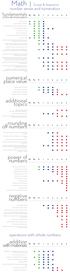 Math Scope & Sequence fundamentals number sense and numeration of the decimal system Count to 10 by units Associate number to numeral (1-10) KN 1 KN 1 KN 2 KN 2 Identify odd and even numbers/numerals and
PRE-CALCULUS GRADE 12
 PRE-CALCULUS GRADE 12 [C] Communication Trigonometry General Outcome: Develop trigonometric reasoning. A1. Demonstrate an understanding of angles in standard position, expressed in degrees and radians.
Section 1: How will you be tested? This section will give you information about the different types of examination papers that are available.
 REVISION CHECKLIST for IGCSE Mathematics 0580 A guide for students How to use this guide This guide describes what topics and skills you need to know for your IGCSE Mathematics examination. It will help
Angles and Quadrants. Angle Relationships and Degree Measurement. Chapter 7: Trigonometry
 Chapter 7: Trigonometry Trigonometry is the study of angles and how they can be used as a means of indirect measurement, that is, the measurement of a distance where it is not practical or even possible
Additional Topics in Math
 Chapter Additional Topics in Math In addition to the questions in Heart of Algebra, Problem Solving and Data Analysis, and Passport to Advanced Math, the SAT Math Test includes several questions that are
ModuMath Basic Math Basic Math 1.1 - Naming Whole Numbers Basic Math 1.2 - The Number Line Basic Math 1.3 - Addition of Whole Numbers, Part I
 ModuMath Basic Math Basic Math 1.1 - Naming Whole Numbers 1) Read whole numbers. 2) Write whole numbers in words. 3) Change whole numbers stated in words into decimal numeral form. 4) Write numerals in
Pre-Algebra 2008. Academic Content Standards Grade Eight Ohio. Number, Number Sense and Operations Standard. Number and Number Systems
 Academic Content Standards Grade Eight Ohio Pre-Algebra 2008 STANDARDS Number, Number Sense and Operations Standard Number and Number Systems 1. Use scientific notation to express large numbers and small
Geometry Course Summary Department: Math. Semester 1
 Geometry Course Summary Department: Math Semester 1 Learning Objective #1 Geometry Basics Targets to Meet Learning Objective #1 Use inductive reasoning to make conclusions about mathematical patterns Give
Math Review. for the Quantitative Reasoning Measure of the GRE revised General Test
 Math Review for the Quantitative Reasoning Measure of the GRE revised General Test www.ets.org Overview This Math Review will familiarize you with the mathematical skills and concepts that are important
MATH 0110 Developmental Math Skills Review, 1 Credit, 3 hours lab
 MATH 0110 Developmental Math Skills Review, 1 Credit, 3 hours lab MATH 0110 is established to accommodate students desiring non-course based remediation in developmental mathematics. This structure will
GRADES 7, 8, AND 9 BIG IDEAS
 Table 1: Strand A: BIG IDEAS: MATH: NUMBER Introduce perfect squares, square roots, and all applications Introduce rational numbers (positive and negative) Introduce the meaning of negative exponents for
Mathematics Georgia Performance Standards
 Mathematics Georgia Performance Standards K-12 Mathematics Introduction The Georgia Mathematics Curriculum focuses on actively engaging the students in the development of mathematical understanding by
Prentice Hall Mathematics Courses 1-3 Common Core Edition 2013
 A Correlation of Prentice Hall Mathematics Courses 1-3 Common Core Edition 2013 to the Topics & Lessons of Pearson A Correlation of Courses 1, 2 and 3, Common Core Introduction This document demonstrates
Geometry and Measurement
 The student will be able to: Geometry and Measurement 1. Demonstrate an understanding of the principles of geometry and measurement and operations using measurements Use the US system of measurement for
Algebra 1 Course Information
 Course Information Course Description: Students will study patterns, relations, and functions, and focus on the use of mathematical models to understand and analyze quantitative relationships. Through
Mathematics. GCSE subject content and assessment objectives
 Mathematics GCSE subject content and assessment objectives June 2013 Contents Introduction 3 Subject content 4 Assessment objectives 11 Appendix: Mathematical formulae 12 2 Introduction GCSE subject criteria
GEOMETRY COMMON CORE STANDARDS
 1st Nine Weeks Experiment with transformations in the plane G-CO.1 Know precise definitions of angle, circle, perpendicular line, parallel line, and line segment, based on the undefined notions of point,
How do you compare numbers? On a number line, larger numbers are to the right and smaller numbers are to the left.
 The verbal answers to all of the following questions should be memorized before completion of pre-algebra. Answers that are not memorized will hinder your ability to succeed in algebra 1. Number Basics
Copy in your notebook: Add an example of each term with the symbols used in algebra 2 if there are any.
 Algebra 2 - Chapter Prerequisites Vocabulary Copy in your notebook: Add an example of each term with the symbols used in algebra 2 if there are any. P1 p. 1 1. counting(natural) numbers - {1,2,3,4,...}
Glencoe. correlated to SOUTH CAROLINA MATH CURRICULUM STANDARDS GRADE 6 3-3, 5-8 8-4, 8-7 1-6, 4-9
 Glencoe correlated to SOUTH CAROLINA MATH CURRICULUM STANDARDS GRADE 6 STANDARDS 6-8 Number and Operations (NO) Standard I. Understand numbers, ways of representing numbers, relationships among numbers,
SAT Subject Math Level 1 Facts & Formulas
 Numbers, Sequences, Factors Integers:..., -3, -2, -1, 0, 1, 2, 3,... Reals: integers plus fractions, decimals, and irrationals ( 2, 3, π, etc.) Order Of Operations: Aritmetic Sequences: PEMDAS (Parenteses
MATH 21. College Algebra 1 Lecture Notes
 MATH 21 College Algebra 1 Lecture Notes MATH 21 3.6 Factoring Review College Algebra 1 Factoring and Foiling 1. (a + b) 2 = a 2 + 2ab + b 2. 2. (a b) 2 = a 2 2ab + b 2. 3. (a + b)(a b) = a 2 b 2. 4. (a
Illinois State Standards Alignments Grades Three through Eleven
 Illinois State Standards Alignments Grades Three through Eleven Trademark of Renaissance Learning, Inc., and its subsidiaries, registered, common law, or pending registration in the United States and other
Standards and progression point examples
 Mathematics Progressing towards Foundation Progression Point 0.5 At 0.5, a student progressing towards the standard at Foundation may, for example: connect number names and numerals with sets of up to
Parallel and Perpendicular. We show a small box in one of the angles to show that the lines are perpendicular.
 CONDENSED L E S S O N. Parallel and Perpendicular In this lesson you will learn the meaning of parallel and perpendicular discover how the slopes of parallel and perpendicular lines are related use slopes
11.1. Objectives. Component Form of a Vector. Component Form of a Vector. Component Form of a Vector. Vectors and the Geometry of Space
 11 Vectors and the Geometry of Space 11.1 Vectors in the Plane Copyright Cengage Learning. All rights reserved. Copyright Cengage Learning. All rights reserved. 2 Objectives! Write the component form of
McDougal Littell California:
 McDougal Littell California: Pre-Algebra Algebra 1 correlated to the California Math Content s Grades 7 8 McDougal Littell California Pre-Algebra Components: Pupil Edition (PE), Teacher s Edition (TE),
A Second Course in Mathematics Concepts for Elementary Teachers: Theory, Problems, and Solutions
 A Second Course in Mathematics Concepts for Elementary Teachers: Theory, Problems, and Solutions Marcel B. Finan Arkansas Tech University c All Rights Reserved First Draft February 8, 2006 1 Contents 25
13. Write the decimal approximation of 9,000,001 9,000,000, rounded to three significant
 æ If 3 + 4 = x, then x = 2 gold bar is a rectangular solid measuring 2 3 4 It is melted down, and three equal cubes are constructed from this gold What is the length of a side of each cube? 3 What is the
Factoring Polynomials
 UNIT 11 Factoring Polynomials You can use polynomials to describe framing for art. 396 Unit 11 factoring polynomials A polynomial is an expression that has variables that represent numbers. A number can
Conjunction is true when both parts of the statement are true. (p is true, q is true. p^q is true)
 Mathematical Sentence - a sentence that states a fact or complete idea Open sentence contains a variable Closed sentence can be judged either true or false Truth value true/false Negation not (~) * Statement
Prentice Hall Mathematics: Algebra 2 2007 Correlated to: Utah Core Curriculum for Math, Intermediate Algebra (Secondary)
 Core Standards of the Course Standard 1 Students will acquire number sense and perform operations with real and complex numbers. Objective 1.1 Compute fluently and make reasonable estimates. 1. Simplify
North Carolina Math 2
 Standards for Mathematical Practice 1. Make sense of problems and persevere in solving them. 2. Reason abstractly and quantitatively 3. Construct viable arguments and critique the reasoning of others 4.
Current Standard: Mathematical Concepts and Applications Shape, Space, and Measurement- Primary
 Shape, Space, and Measurement- Primary A student shall apply concepts of shape, space, and measurement to solve problems involving two- and three-dimensional shapes by demonstrating an understanding of:
Week 1 Chapter 1: Fundamentals of Geometry. Week 2 Chapter 1: Fundamentals of Geometry. Week 3 Chapter 1: Fundamentals of Geometry Chapter 1 Test
 Thinkwell s Homeschool Geometry Course Lesson Plan: 34 weeks Welcome to Thinkwell s Homeschool Geometry! We re thrilled that you ve decided to make us part of your homeschool curriculum. This lesson plan
FOREWORD. Executive Secretary
 FOREWORD The Botswana Examinations Council is pleased to authorise the publication of the revised assessment procedures for the Junior Certificate Examination programme. According to the Revised National
Big Ideas in Mathematics
 Big Ideas in Mathematics which are important to all mathematics learning. (Adapted from the NCTM Curriculum Focal Points, 2006) The Mathematics Big Ideas are organized using the PA Mathematics Standards
Mathematics Placement
 Mathematics Placement The ACT COMPASS math test is a self-adaptive test, which potentially tests students within four different levels of math including pre-algebra, algebra, college algebra, and trigonometry.
Assessment Anchors and Eligible Content
 M07.A-N The Number System M07.A-N.1 M07.A-N.1.1 DESCRIPTOR Assessment Anchors and Eligible Content Aligned to the Grade 7 Pennsylvania Core Standards Reporting Category Apply and extend previous understandings
Review of Intermediate Algebra Content
 Review of Intermediate Algebra Content Table of Contents Page Factoring GCF and Trinomials of the Form + b + c... Factoring Trinomials of the Form a + b + c... Factoring Perfect Square Trinomials... 6
alternate interior angles
 alternate interior angles two non-adjacent angles that lie on the opposite sides of a transversal between two lines that the transversal intersects (a description of the location of the angles); alternate
MATH 60 NOTEBOOK CERTIFICATIONS
 MATH 60 NOTEBOOK CERTIFICATIONS Chapter #1: Integers and Real Numbers 1.1a 1.1b 1.2 1.3 1.4 1.8 Chapter #2: Algebraic Expressions, Linear Equations, and Applications 2.1a 2.1b 2.1c 2.2 2.3a 2.3b 2.4 2.5
Functional Math II. Information CourseTitle. Types of Instruction
 Functional Math II Course Outcome Summary Riverdale School District Information CourseTitle Functional Math II Credits 0 Contact Hours 135 Instructional Area Middle School Instructional Level 8th Grade
Chapter 111. Texas Essential Knowledge and Skills for Mathematics. Subchapter B. Middle School
 Middle School 111.B. Chapter 111. Texas Essential Knowledge and Skills for Mathematics Subchapter B. Middle School Statutory Authority: The provisions of this Subchapter B issued under the Texas Education
Common Core State Standards for Mathematics Accelerated 7th Grade
 A Correlation of 2013 To the to the Introduction This document demonstrates how Mathematics Accelerated Grade 7, 2013, meets the. Correlation references are to the pages within the Student Edition. Meeting
Understanding Basic Calculus
 Understanding Basic Calculus S.K. Chung Dedicated to all the people who have helped me in my life. i Preface This book is a revised and expanded version of the lecture notes for Basic Calculus and other
CORRELATED TO THE SOUTH CAROLINA COLLEGE AND CAREER-READY FOUNDATIONS IN ALGEBRA
 We Can Early Learning Curriculum PreK Grades 8 12 INSIDE ALGEBRA, GRADES 8 12 CORRELATED TO THE SOUTH CAROLINA COLLEGE AND CAREER-READY FOUNDATIONS IN ALGEBRA April 2016 www.voyagersopris.com Mathematical
Selected practice exam solutions (part 5, item 2) (MAT 360)
 Selected practice exam solutions (part 5, item ) (MAT 360) Harder 8,91,9,94(smaller should be replaced by greater )95,103,109,140,160,(178,179,180,181 this is really one problem),188,193,194,195 8. On
Florida Math 0028. Correlation of the ALEKS course Florida Math 0028 to the Florida Mathematics Competencies - Upper
 Florida Math 0028 Correlation of the ALEKS course Florida Math 0028 to the Florida Mathematics Competencies - Upper Exponents & Polynomials MDECU1: Applies the order of operations to evaluate algebraic
Charlesworth School Year Group Maths Targets
 Charlesworth School Year Group Maths Targets Year One Maths Target Sheet Key Statement KS1 Maths Targets (Expected) These skills must be secure to move beyond expected. I can compare, describe and solve
EVERY DAY COUNTS CALENDAR MATH 2005 correlated to
 EVERY DAY COUNTS CALENDAR MATH 2005 correlated to Illinois Mathematics Assessment Framework Grades 3-5 E D U C A T I O N G R O U P A Houghton Mifflin Company YOUR ILLINOIS GREAT SOURCE REPRESENTATIVES: