
Examples of Math Applications in Forensic Investigations Anthony and Patricia Nolan Bertino Bertino Forensics
|
|
|
- Franklin Johnston
- 9 years ago
- Views:
Transcription
1 Examples of Math Applications in Forensic Investigations Anthony and Patricia Nolan Bertino Bertino Forensics One of the many benefits of teaching forensics to high school students is that they walk through the door eager to learn how to solve crimes. Students find that much of the information investigated in a course in forensics is new information. What many of the students don t realize is that anyone employed in the field of forensics would greatly benefit with a strong background in math, science, technology and writing. We have found that students in a forensics course are more attentive and more willing to apply math, science and technology if it helps them solve the crime. When a lab report is required in a biology or chemistry class, many students groan. However, if they are writing an expert witness testimony to the jury regarding some type of evidence, the same students seem to be able to write the report with far less difficulty. A great example of getting students to easily apply math to a crime scene is in their analysis of blood spatter. Students use calipers to measure the length and width of a blood drop. They determine the angle of impact of the blood drop using the law of sine and later calculate the height of the source of blood using the law of tangents. We would like to provide you with a few examples of how students apply math to their study of forensics. 1. Hair is it animal or human? Calculate the ratio of the diameter of the medulla (middle, pigmented section of the hair) to the diameter of the entire hair. Animal hair exhibits a ratio of.5 or higher. A ratio less than.5 would be considered to be a human hair. Animal Hair Human Hair

2 2. Microscopic Measurement of Pollen Several different methods can be utilized to measure the size of an individual pollen grain. If your school has a digital microscope, you would be able to take the measurement while viewing the pollen. However, if you do not have a digital microscope, it is still possible to estimate the size each individual pollen grain. 1. Place a clear plastic mm ruler under the 100X field of view. While looking through the ocular lens, estimate the measurement of the diameter of the field of view under 100X. Estimate this measurement to the nearest 1/10 mm. Record your answer. (Most microscopes have a field of view is usually between (1.2) (1.4) mm Clear Plastic mm ruler Diameter of Field of view under 100X is 1.4 mm 2. To determine the size of the field of view under 400X, take ¼ of the diameter of your field of view under 100X. 100X = diameter of field of view under 100X 400X diameter of field of view under 400X ¼ (diameter of field of view under 100X) = Diameter of field of view under 400X ¼ of 1.4mm ~.4 mm diameter under 400X 3. Record your answer to the nearest 1/10 mm. 4.To determine the size of one pollen grain, align one pollen grain along the diameter of the field of view under 400X. Estimate how many pollen grains could fit across the diameter of your field of view under 400X. Diameter of Field of view under 400X Is.4 mm One pollen grain

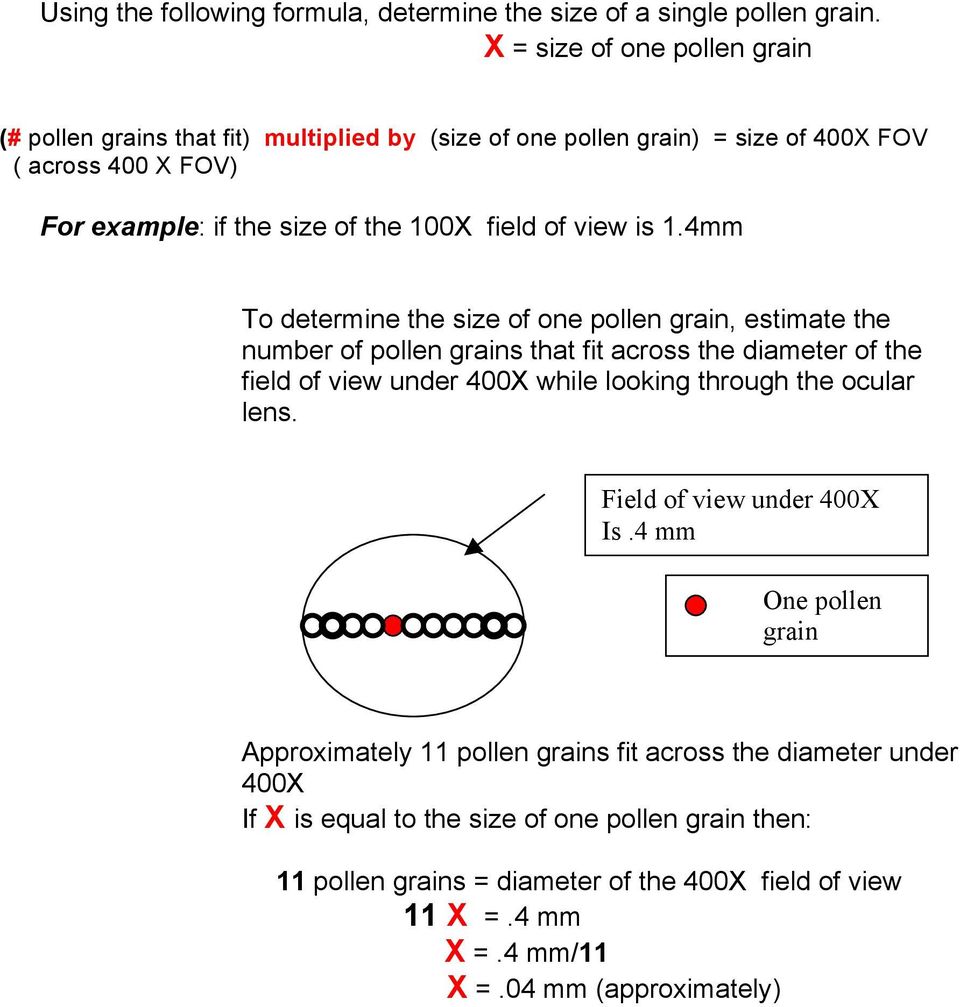
3 Using the following formula, determine the size of a single pollen grain. X = size of one pollen grain (# pollen grains that fit) multiplied by (size of one pollen grain) = size of 400X FOV ( across 400 X FOV) For example: if the size of the 100X field of view is 1.4mm To determine the size of one pollen grain, estimate the number of pollen grains that fit across the diameter of the field of view under 400X while looking through the ocular lens. Field of view under 400X Is.4 mm One pollen grain Approximately 11 pollen grains fit across the diameter under 400X If X is equal to the size of one pollen grain then: 11 pollen grains = diameter of the 400X field of view 11 X =.4 mm X =.4 mm/11 X =.04 mm (approximately)
4 3. Blood Spatter analysis a. Determine impact angles for each drop of blood by: i. Measuring the length and width of each droplet of blood ii. Determining the R value (R= width/length) for each drop. R= width/ length of each blood drop Once you determine the R value, use the sine table or your calculator to determine impact angle Angle impact= arc sine of width/length b. Determine the area of convergence by drawing lines of convergence Area of convergence c. Once you have point of origin, measure the distance from the area of origin to an individual blood spatter stain. This indicates D the distance Between area of origin and blood stain.

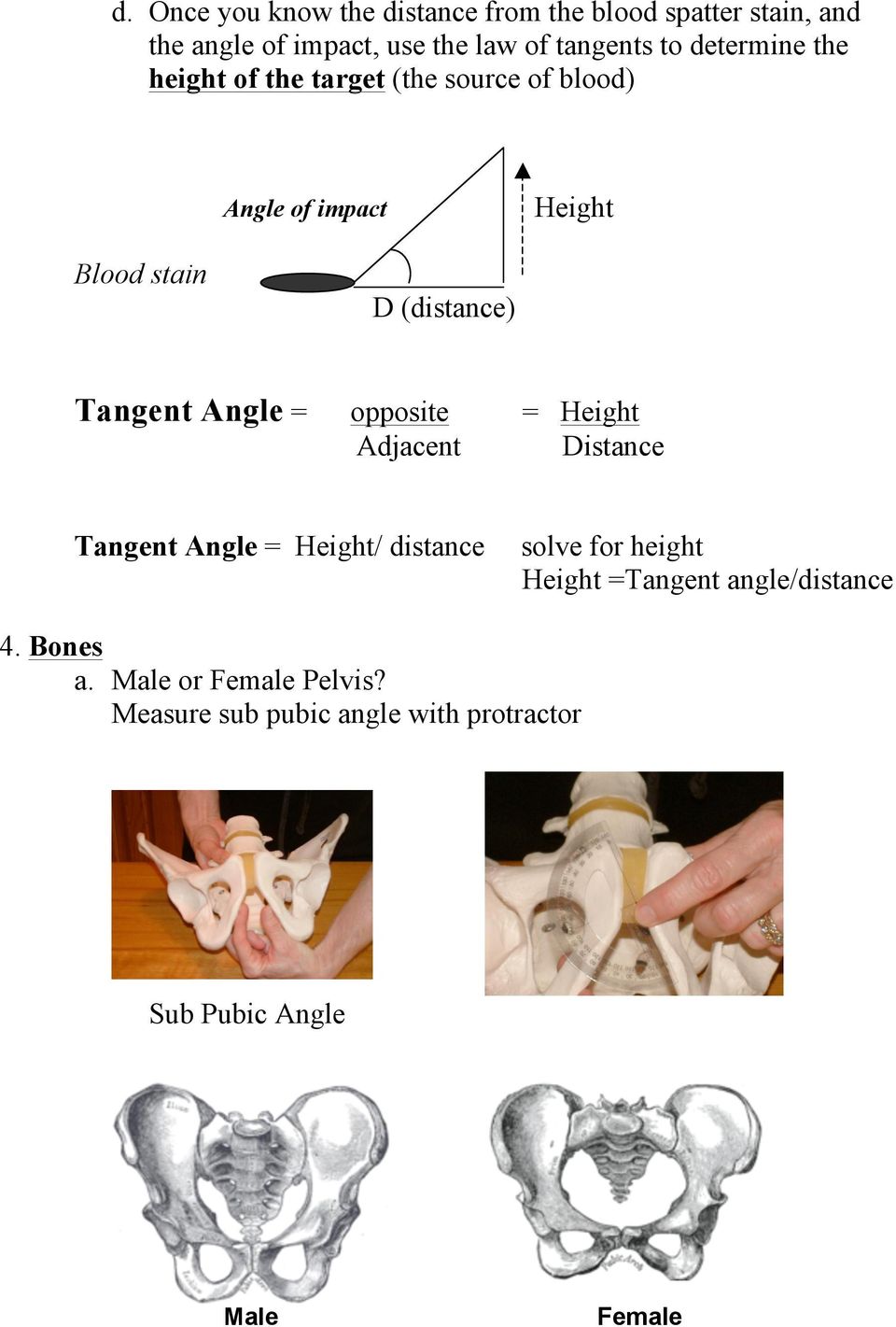
5 d. Once you know the distance from the blood spatter stain, and the angle of impact, use the law of tangents to determine the height of the target (the source of blood) Angle of impact Height Blood stain D (distance) Tangent Angle = opposite Adjacent Tangent Angle = Height/ distance = Height Distance solve for height Height =Tangent angle/distance 4. Bones a. Male or Female Pelvis? Measure sub pubic angle with protractor Sub Pubic Angle Male Female
6 b. Race measure nasal index Use calipers measure width/length of nasal opening. Causasian Mongoloid c. Calculate the height of a person based on the size of one bone Given a bone, it is possible to estimate the height of the person by Referring to reference tables that provide formulas for the determination of height from a bone. 5. Time of Death Estimation Using Rigor, Livor and Algor Mortis, it is possible to estimate time of death Ex. Rigor mortis starts within 2 hours of death Rigor is peak at 12 hours Most rigor fades by 36 hours Affected by ambient conditions Ex. Livor Mortis starts within 2 hours of death Between 2-8 continues to develop Coloration permanent after 8 hours Ex. Algor mortis Body temperature drops at a rate of 1.4 degrees F/hour for the first 12 hours. After 12 hours, the rate of heat loss is calculated at.7 degrees F/ hour. Altered by different ambient conditions

7 6. Insects and time of death Estimates of time of death can be made by the presence of different insects found on the body. Many insects undergo developmental stages of egg, larva stages, pupa and adult. Blowflies are usually the first insects to arrive in a series of insects. Since they lay their eggs on warm bodies, their arrival indicate the estimated time of death. What is frequently used to determine time of death involving forensic entomology is a method known as ADH, or Accumulated degree hours. ADH is the amount of thermal energy (heat) required for an insect to progress from one developmental stage to the next in its life cycle. To calculate the ADH, multiply the ambient temperature by the number of hours at that temperature. To obtain data for a specific insect, experiments are conducted under a constant temperature. The number of hours it took for an insect to progress from one stage to another was recorded. The ADH required for completion of one stage was calculated by multiplying the temperature times the number of hours it took to reach the next stage. The following Information for Green Bottle Fly raised at a constant temperature of 70 degree F was obtained from the National Library of Medicine at NIH. ADH of the Green Bottle Fly From To Temperature (Degrees F) Hours ADH (Accumulated degree hour) Egg First instar X 23= 1610 ADH First Instar Second X 27 =1890 ADH instar Second Third instar X 22=1540 ADH instar Third instar Pupae X 130=9100 ADH Pupae Adult X 143= ADH Total hours = 24,150 ADH When a body is discovered, insects are collected and identified. Using the temperature records and the ADH, it can be determined when eggs were laid and thus determine the time of death.

8 7. Chromatography Chromatography a method used to separate a mixture of liquids or gases. It can be used in the analysis of ink, paints, chemicals. Ink is spotted on a piece of filter paper and then placed in a solvent. As the solvent moves up the paper and dissolves the mixture of colors, a chromatogram is formed showing a variety of colors. Students can perform a simple chromatography experiment that separates black ink into a variety of colors. An unknown substance can be identified with a known substance if its chromatogram and R f values are the same Calculating R f distance (mm) a component color in ink moves from origin* R f = distance (mm) the liquid (front) has moved from the origin* * the origin is the original location of the ink spot before being placed in the chromatographic solution (measure from the pencil line to the edge of the liquid. See example below. Measure all distances in millimeters. All R f distances are a decimal less than one. Black spot of unknown D S Distance solvent has moved D S D G Distance green has moved D G D R Distance red has moved D R Rf Green = D G = D S Rf Red = D R = D S

Separation of Dyes by Paper Chromatography
 Cautions: The FD&C food dyes used are concentrated and may stain clothing and skin. Do not ingest any of the food dyes or food samples used in this lab. Purpose: The purpose of this experiment is to determine
Forensic Science. The student will demonstrate the ability to explain the history and philosophy of forensic science.
 Forensic Science UNIT I: Introduction to Forensic Science and Human Body The student will demonstrate the ability to explain the history and philosophy of forensic science. a. Define forensic science or
Explain the role of blood and bloodstain patterns in forensics science. Analyze and identify bloodstain patterns by performing bloodstain analysis
 Lab 4 Blood Learning Objectives Explain the role of blood and bloodstain patterns in forensics science Analyze and identify bloodstain patterns by performing bloodstain analysis Introduction Blood, a
Paper Chromatography: Separation and Identification of Five Metal Cations
 Paper Chromatography: Separation and Identification of Five Metal Cations Objectives Known and unknown solutions of the metal ions Ag +, Fe 3+, Co 2+, Cu 2+ and Hg 2+ will be analyzed using paper chromatography.
RECITATION NOTES FOR EXPERIMENT # 5 A&B THIN LAYER CHROMATOGRAPHY
 RECITATION NOTES FOR EXPERIMENT # 5 A&B THIN LAYER CHROMATOGRAPHY Have your lab textbook available for quick reference to specific pages, indicated in red. BASIC PRINCIPLES OF CHROMATOGRAPHY Chromatography
PAPER CHROMATOGRAPHY
 PAPER CHROMATOGRAPHY INTRODUCTION Chromatography is a technique that is used to separate and to identify components of a mixture. This analytical technique has a wide range of applications in the real
Forensic Science Final Review Guide. Name Date Period HW# Chapters: 1, 2, 3, 4, 6, 7, 8,part of 11, 13, 15
 Forensic Science Final Review Guide Name Date Period HW# Chapters: 1, 2, 3, 4, 6, 7, 8,part of 11, 13, 15 Review the vocabulary found on the first page of each chapter. Chapter 1 1. Define forensic science:
Grading Scale: As stated in the Student Handbook, letter grades are determined based on the following scale:
 Instructor: Dr. Sara Fenske Course: Forensic Science Course Philosophy: This course is an introduction to Forensic Science,which emphasizes the process of science and includes topics in physics, chemistry
INTRODUCTION TO CRIME SCENES:
 INTRODUCTION TO CRIME SCENES: Physical Evidence As automobiles run on gasoline, crime laboratories "runt' on physical evidence. physical evidence encompasses any and all objects that can establish that
THE CRIME SCENE. Chapter 2 2-1. 2011, 2008 Pearson Education, Inc. Upper Saddle River, NJ 07458
 Chapter 2 THE CRIME SCENE 2-1 Physical Evidence As automobiles run on gasoline, crime laboratories run on physical evidence. Physical evidence encompasses any and all objects that can establish that a
Crime Scene Evidence
 Crime Scene Evidence Two general types of evidence: Testimonial or Direct Evidence 2. Physical or Indirect Evidence 1. Type of Evidence Testimonial evidence is a statement made under oath; also known as
Separation of Amino Acids by Paper Chromatography
 Separation of Amino Acids by Paper Chromatography Chromatography is a common technique for separating chemical substances. The prefix chroma, which suggests color, comes from the fact that some of the
POST MORTEM INTERVAL. (TIME OF DEATH) http://library.thinkquest.org/04oct/00206/text_index.htm (The Autopsy)
 POST MORTEM INTERVAL (TIME OF DEATH) http://library.thinkquest.org/04oct/00206/text_index.htm (The Autopsy) Chemical change in the muscles after death, causing the limbs of the corpse to become stiff
FORENSIC SCIENCE COURSE DESCRIPTION
 FORENSIC SCIENCE COURSE DESCRIPTION This course is an overview of how science is applied to solving crimes. Topics include history of forensic sciences, collecting of evidence, analyzing results and hands-on
Forensic Science Final Exam Review
 Forensic Science Final Exam Review Human Identity (Fingerprints, Forensic Anthropology, DNA) 1.Who developed the system known as anthropometry? Bertillion 2.Who postulated the exchange of evidence principle?
Properties of blood. Teacher Background Information. FSB05 blo o d spatte r
 Teacher Background Information Blood is considered to be a fluid. A fluid is a substance with no fixed shape and is subject to external pressure. A fluid can be either a liquid or a gas. A liquid is a
Supported by. A seven part series exploring the fantastic world of science.
 Supported by A seven part series exploring the fantastic world of science. Find out what techniques are used by forensic scientists and why they are so useful. Forensic science is the term given to the
ACTIVITY 8-1 A PRESUMPTIVE TEST FOR BLOOD
 ACTIVITY 8-1 A PRESUMPTIVE TEST FOR BLOOD Objective: By the end of this activity, you will be able to: Use the Kastle-Meyer Presumptive Blood Test to determine if a given stain contains blood. Scenario:
Warning: Some material in this presentation and related videos may be too graphic for some people. Forensic Science Lab Activity
 Warning: Some material in this presentation and related videos may be too graphic for some people. Forensic Science Lab Activity What does the abbreviation BPA represent? Bloodstain Pattern Analysis What
Forensic Science TEKS/LINKS Student Objectives One Credit
 First Six Weeks Intro/Observation FS 4(A) The student will distinguish between forensic science and criminalistics in law, public safety, corrections, and security. FS 5(D) The student will apply knowledge
Lab 6: Paper Chromatography. Pages145-154 Pre-lab page 151 No Post lab Chromatogram must be turned in attached to lab report
 Lab 6: Paper Chromatography Pages145-154 Pre-lab page 151 No Post lab Chromatogram must be turned in attached to lab report Chromatography Chromatography is an analytical technique used to separate the
This curriculum is part of the Educational Program of Studies of the Rahway Public Schools. ACKNOWLEDGMENTS
 CURRICULUM FOR FORENSIC SCIENCE CYCLE GRADE 7 This curriculum is part of the Educational Program of Studies of the Rahway Public Schools. ACKNOWLEDGMENTS Kevin Robinson, Program Supervisor of STEM The
CURRICULUM GUIDE. When this Forensics course has been completed successfully, students should be able to:
 CURRICULUM GUIDE NAME OF COURSE: FORENSICS COURSE NUMBER: SCI 40 WRITTEN / REVISED: SEPTEMBER, 2011 LEVEL OF COURSE: REPLACMENT NUMBER OF CREDITS: SIX (6) PREREQUISITES: BIOLOGY GRADE LEVELS OFFERED TO:
Middle Township Public Schools Cape May Court House, NJ 08210 Curriculum Guide Discipline: Forensics Grade Level: 11-12
 s Observation Skills What are observations how are they used in forensics? What makes a person a good observer how reliable are eyewitnesses? 5 Start by emptying a bag on the front table for 2 minutes
FORENSIC ANTHROPOLOGY NOTES
 FORENSIC ANTHROPOLOGY NOTES Forensic Anthropology = the examinations of human skeletal remains for law enforcement agencies to determine the identity of unidentified bones. Questions asked: 1. Are the
PROFICIENCY QUIZ. Print B. 3. Explain the difference between Class Evidence and Individual Evidence. Give an an example of each.
 PROFICIENCY QUIZ 1. You are at a crime scene investigating a robbery. You dust the area and find two good prints. One is a Radial Loop and the other is a Tented Arch. A rookie officer at the crime scene
Forensic Science II: Course Syllabus Forensic Science II: More Secrets of the Dead
 Forensic Science II: Course Syllabus Forensic Science II: More Secrets of the Dead COURSE DESCRIPTION: Although the crime scene represents the first step in solving crimes through forensic science, the
Blood Pattern Analysis at Crime Scenes
 Blood Pattern Analysis at Crime Scenes By Through a variety of schools, classes, and seminars homicide detectives and crime scene technicians or criminalists are garnering a level of expertise that has
Mendelian Genetics in Drosophila
 Mendelian Genetics in Drosophila Lab objectives: 1) To familiarize you with an important research model organism,! Drosophila melanogaster. 2) Introduce you to normal "wild type" and various mutant phenotypes.
CRIME SCENE EVALUATION LAB
 FORENSIC SCIENCE INTRODUCTION ACTIVITY #12 NAME DATE HR CRIME SCENE EVALUATION LAB Objective You will draw rough and final sketches of a crime scene. Introduction Once the photographer has completed his
How To Understand Forensics
 FORENSIC SCIENCE ELECTIVE CORE The Forensic Science Elective Core focuses on the analysis of evidence collection, the decomposition process, crime scenes, skeletal remains, toxicology, and document validity.
Chapter 2 The Crime Scene
 Chapter 2 The Crime Scene Processing the Crime Scene Forensic Science begins at the crime scene Investigators must recognize physical evidence, collect the evidence, and properly store and preserve the
Thin Lenses Drawing Ray Diagrams
 Drawing Ray Diagrams Fig. 1a Fig. 1b In this activity we explore how light refracts as it passes through a thin lens. Eyeglasses have been in use since the 13 th century. In 1610 Galileo used two lenses
SUN PRAIRIE AREA SCHOOL DISTRICT COURSE POWER STANDARDS. Curriculum Area: Science Course Length: Semester
 SUN PRAIRIE AREA SCHOOL DISTRICT COURSE POWER STANDARDS Course Title: Forensic Science Curriculum Area: Science Course Length: Semester Credit Status: ½ Physical Science Credit Date submitted: 7/09 Expected
Fractional Distillation and Gas Chromatography
 Fractional Distillation and Gas Chromatography Background Distillation The previous lab used distillation to separate a mixture of hexane and toluene based on a difference in boiling points. Hexane boils
Impact angle analysis of bloodstains using a simple image processing technique
 Songklanakarin J. Sci. Technol. 32 (2), 169-173, Mar. - Apr. 2010 Original Article Impact angle analysis of bloodstains using a simple image processing technique Kittipat Boonkhong 1, Montri Karnjanadecha
Forensic Science Curriculum
 Forensic Science Curriculum The Georgia Performance Standards are designed to provide students with the knowledge and skills for proficiency in science. The Project 2061 s Benchmarks for Science Literacy
How Bloodstain Pattern Analysis Works
 How Bloodstain Pattern Analysis Works http://science.howstuffworks.com/bloodstain-pattern-analysis.htm Andy Crawford/Dorling Kindersley/Getty Images Introduction to How Bloodstain Pattern Analysis Works
Forensics of Blood. The criminalist must be prepared to answer the following questions when examining dried blood:
 FORENSIC SEROLOGY Forensics of Blood The criminalist must be prepared to answer the following questions when examining dried blood: (1) Is it blood? (2) From what species did the blood originate? (3) If
How do we build and refine models that describe and explain the natural and designed world?
 Strand: A. Understand Scientific Explanations : Students understand core concepts and principles of science and use measurement and observation tools to assist in categorizing, representing, and interpreting
An Overview of Forensic Taphonomy
 An Overview of Forensic Taphonomy David O. Carter, PhD Assistant Professor of Forensic Science Department of Entomology University of Nebraska-Lincoln, USA What is forensic taphos = grave, burial. taphonomy?
Imperial Length Measurements
 Unit I Measuring Length 1 Section 2.1 Imperial Length Measurements Goals Reading Fractions Reading Halves on a Measuring Tape Reading Quarters on a Measuring Tape Reading Eights on a Measuring Tape Reading
SNEAK PEAK inside ACTIVITY. ADVANCE PREPARATION see next page for more details Cut strips of paper, if necessary Label markers, etc.
 Dye Detective Learning Objectives: Students learn chemicals can be separated when they have different chemical properties. GRADE LEVEL K 8 SCIENCE TOPICS Physical Properties Atoms and Molecules Solutions
Ink Analysis 2005, 2004, 2002, 1993 by David A. Katz. All rights reserved.
 Ink Analysis 2005, 2004, 2002, 1993 by David A. Katz. All rights reserved. Ink from most ball-point pens and markers can be developed by paper chromatography using 70% isopropyl rubbing alcohol as the
Examining the Evidence Syllabus
 Examining the Evidence Syllabus **RESIDENTIAL SITE Textbook: Forensic Science: Fundamentals and Investigations by Anthony J. Bertino Day 1: Introduction to Forensic Science 1. Students will be able to
Forensic detectives. magnifying glass Foot prints. brain training. Badge
 32 Forensic detectives magnifying glass Foot prints brain training Badge Forensic detectives 33 Suitable for: 11 16 years Curriculum and learning links: Separating mixtures, analytical and forensic techniques,
FOR EVALUATION ONLY. Unit 13 Investigating a Crime Scene: Contents. Overview. Setting up a crime scene. Lesson Plans
 Unit 13 Investigating a Crime Scene: Contents Overview Setting up a crime scene Lesson Plans 1 Introduction 2 Recording a crime scene I 3 Recording a crime scene II 4 Recording a crime scene III 5 Recording
CRIME SCENE FORENSICS
 CRIME SCENE FORENSICS Description Crime Scene Forensics, which is a laboratory-based course, will promote and cultivate the development of student s scientific inquiry and scientific method skills, which
Directional Analysis of Blood Spatter at Crime and Accident Scenes for the Private Investigator
 Directional Analysis of Blood Spatter at Crime and Accident Scenes for the Private Investigator By Louis L. Akin, LPI Blood spatter analysis is an important part of contemporary crime scene investigation
Case Study -Forensic Science for Transition Year Students at Waterford IT
 Case Study -Forensic Science for Transition Year Students at Waterford IT Context of the school This initiative was developed by CALMAST at Waterford IT, a third level college in south east Ireland. It
(A) demonstrate safe practices during laboratory and field investigations
 (1) The student, for at least 40% of instructional time, conducts laboratory and field investigations using safe, environmentally appropriate, and ethical practices. (A) demonstrate safe practices during
Blood Spatter BY ANGELA CHILDRESS
 Blood Spatter BY ANGELA CHILDRESS Forensic blood spatter analysis is a commonly used technique at crime scenes around the world. It combines biology, chemistry, mathematics, and physics. It all begins
Hair. *credit to Anthony and Patti Bertino for image. Dec 2 8:10 PM
 Hair *credit to Anthony and Patti Bertino for image Dec 2 8:10 PM 1 Essential Question: How can hair be used to solve a crime? Dec 2 8:12 PM 2 History of hair evidence criminal evidence in 1800's 1883
RUTHERFORD HIGH SCHOOL Rutherford, New Jersey COURSE OUTLINE FORENSIC SCIENCE
 RUTHERFORD HIGH SCHOOL Rutherford, New Jersey COURSE OUTLINE FORENSIC SCIENCE I. INTRODUCTION Forensic Science focuses on the analysis of evidence collection, the decomposition process, crime scenes, skeletal
COMMUNITY UNIT SCHOOL DISTRICT 200. Course Description
 Forensic Science High School Elective Course Description Forensic Science is a one semester high school level course that satisfies a CUSD200 graduation requirement in the area of science. Successful completion
Garfield Public Schools Forensic Science Curriculum Forensics
 Garfield Public Schools Forensic Science Curriculum Forensics Revision Committee: Mr. Patrick McCrone Final Revision Date: August 31, 2011 Garfield Board of Education Dr. Kenneth Conte- President Mr. Tony
1. Bloodspatter. 3. On the drop of blood below, label: parent drop, spines, satellite spatters
 1. Bloodspatter 1. What can analysis of blood spatter tell an investigator? 2. There are several types of chemical reagents that can be used to detect blood. Research and list one of these reagents, and
Blood Stain Analysis Part One
 Hughes Undergraduate Biological Science Education Initiative HHMI Blood Stain Analysis Part One Investigators often find blood stains during their examination of a crime scene. They also find stains that
Warm-Up 9/9. 1. Define the term matter. 2. Name something in this room that is not matter.
 Warm-Up 9/9 1. Define the term matter. 2. Name something in this room that is not matter. Warm-Up 9/16 1. List the three most important rules of lab safety. 2. Would you classify jello as a solid or a
Visible Proofs: Forensic Views of the Body. Erika Mills [email protected]
 Visible Proofs: Forensic Views of the Body Erika Mills [email protected] Objectives To increase familiarity with current forensic science techniques and their historical precursors To put past and modern
Unit 1:Crime Scene Basics
 Unit 1:Crime Scene Basics 1904 Edmond Locard The Locard Exchange Principle: Whenever two objects come into contact with one another, a traceable exchange is made. Evidence Physical Evidence: Any object
Case File 10. Dropped at the Scene: Blood spatter analysis
 Case File 10 Dropped at the Scene: Blood spatter analysis Analyze blood spatter evidence and help identify Jessica Barnes killer. Re: Police Detective Status: Barnes Murder py Museum curator Jessica Barnes
GAS CHROMATOGRAPHY. DETERMINING THE PERCENT COMPOSITION OF A MIXTURE OF VOLATILE LIQUIDS USING A GAS CHROMATOGRAPH. (Revised: 1-12-93)
 DETERMINING THE PERCENT COMPOSITION OF A MIXTURE OF VOLATILE LIQUIDS USING A GAS CHROMATOGRAPH. (Revised: 1-12-93) INTRODUCTION Gas chromatography is a technique used to analyze mixtures. The instrument
The Genetics of Drosophila melanogaster
 The Genetics of Drosophila melanogaster Thomas Hunt Morgan, a geneticist who worked in the early part of the twentieth century, pioneered the use of the common fruit fly as a model organism for genetic
Sample Liver Enzyme Lab
 Sample Liver Enzyme Lab Design Aspect 1: Research Question This lab will be driven by the research question, Do changes in temperature have an effect on the activity of the enzyme catalase? Pearson Baccalaureate:
Blood. Is it Blood? Blood. Blood Evidence. Is it Human Blood? Blood Spatters 2/19/2008. Obvious
 Blood Blood Is it Blood? Obvious Not always an easy determination Not Obvious Stains on clothes, carpet, etc Presumptive Tests Blood indicated on Confirmatory Tests Blood identified on Stains not visible
Forensic Science : Course Syllabus Forensic Science : Secrets of the Dead
 Forensic Science : Course Syllabus Forensic Science : Secrets of the Dead COURSE DESCRIPTION: Fingerprints. Blood spatter. DNA analysis. The world of law enforcement is increasingly making use of the techniques
Forensic Science Studies 35-3
 LOCALLY DEVELOPED COURSE OUTLINE Forensic Science Studies 35-3 Submitted By: Rocky View School Division No. 41 Submitted On: Aug. 20, 2014 Rocky View School Division No. 41 All Rights Reserved Page 1 of
Warning: Some material in this presentation and related videos may be too graphic for some people. Forensic Science Lab Activity
 Warning: Some material in this presentation and related videos may be too graphic for some people. Forensic Science Lab Activity Blood Spatter Analysis Blood drops form different shapes and sizes Blood
Identification of Arson Accelerants by Gas Chromatography
 Identification of Arson Accelerants by Gas Chromatography Purpose Arson is an insidious crime that annually claims the lives of hundreds of Americans and costs billions of dollars. 1 Scientists and criminal
3.1 Cells and cell function
 BTEC s own resources 3.1 Cells and cell function In this section: P1 How you are made Key terms Tissue a group of similar cells acting together to perform a particular function. Epithelial cells one of
How To Become A Forensic Scientist
 A c a r e e r i n By Hall Dillon Blood spatters, spent shell casings, and forged signatures are the nuts and bolts of forensic science. Studying the messy details of crime, forensic scientists help identify
Who is at the Scene. The CSI unit documents the crime scene in detail and collects any physical evidence.
 At the Crime Scene Who is at the Scene Police officers are typically the first to arrive at a crime scene. They arrest the perpetrator is he's still there and call for an ambulance if necessary. They are
EFFECT OF SALT ON CELL MEMBRANES
 EFFECT OF SALT ON CELL MEMBRANES LAB CELL 2 INTRODUCTION A eukaryotic cell, a cell with a nucleus, not only has a plasma membrane as its external boundary, but it also has a variety of membranes that divide
Somers Public Schools Somers, Connecticut 06071 Science Curriculum
 Survey in Forensics Grades 11 and 12 F.1 Teamwork and deductive reasoning play an important role in forensic science. Core Theme: Understanding forensic science. What is forensic science and why are teamwork
Introduction to Crime Scene Dynamics
 Chapter 1 Introduction to Crime Scene Dynamics OVERVIEW The development of the field of forensics has been a process steeped in science and research. On the other hand, the practice of crime scene investigation
Primary School FSP01. Program overview. Activity 1 Introduction to forensic science. Activity 2 Practicing observational skills
 The program is designed to enable students to participate in a range of activities that require them to make observations, collect, analyse and interpret data and then try to form a conclusion. A scenario
MICROSCOPY. To demonstrate skill in the proper utilization of a light microscope.
 MICROSCOPY I. OBJECTIVES To demonstrate skill in the proper utilization of a light microscope. To demonstrate skill in the use of ocular and stage micrometers for measurements of cell size. To recognize
Forensic Science. Students will define and distinguish forensic science and criminalistics.
 St. Forensic Science Content Skills Assessment Big Ideas Core Tasks Students will apply the major concepts in biology, chemistry, and physics as the basis for solving crimes Students will recognize and
Circumference of a Circle
 Circumference of a Circle A circle is a shape with all points the same distance from the center. It is named by the center. The circle to the left is called circle A since the center is at point A. If
Wednesday 15 January 2014 Morning Time: 2 hours
 Write your name here Surname Other names Pearson Edexcel Certificate Pearson Edexcel International GCSE Mathematics A Paper 4H Centre Number Wednesday 15 January 2014 Morning Time: 2 hours Candidate Number
Practice Questions 1: Scientific Method
 Practice Questions 1: Scientific Method 1. A student divided some insect larvae into four equal groups, each having the same amount of food. Each group was kept at a different temperature, and the average
LAB 11 Drosophila Genetics
 LAB 11 Drosophila Genetics Introduction: Drosophila melanogaster, the fruit fly, is an excellent organism for genetics studies because it has simple food requirements, occupies little space, is hardy,
A Matter of Spatter Post-Exhibit Field Trip: Grades 6-8
 A Matter of Spatter Post-Exhibit Field Trip: Grades 6-8 In this math-based activity, students will experiment to find how height and angle affect spatter and then use this knowledge to solve a crime. LEARNING
FORENSICS AND DIRT PREPARE YOURSELF. 2. Dry each sample of soil in the oven for an hour at 212ºF (or 100ºC). MATERIALS
 QUICK PEEK FORENSICS AND DIRT In this lesson, students become forensic geologists as they perform various tests to analyze soil samples and determine which suspect was at the Crime Scene. SUGGESTED GRADE
Using the Quadrant. Protractor. Eye Piece. You can measure angles of incline from 0º ( horizontal ) to 90º (vertical ). Ignore measurements >90º.
 Using the Quadrant Eye Piece Protractor Handle You can measure angles of incline from 0º ( horizontal ) to 90º (vertical ). Ignore measurements 90º. Plumb Bob ø
Goal to recognize, document and collect evidence at a crime scene
 Crime Scene Investigation and Evidence Collection Lecture Credits: Anthony (Bud) Bertino Goal to recognize, document and collect evidence at a crime scene Sherlock Holmes» Sir Arthur Conan Doyle in the
Wor k Ne t P i n ella s, I n c. d. b. a. explaining our world SCIENCE TO GO
 Wor k Ne t P i n ella s, I n c. d. b. a. explaining our world SCIENCE TO GO WELCOME TO THE SCIENCE CENTER EDUCATIONAL OVERLAY PROGRAMS. Our programs focus on students in grades 4th through 8th and range
^ 1. Forensic specialists figure it out! BY CAROLE MOORE
 ^ 1 Forensic specialists figure it out! BY CAROLE MOORE ^H hen Leo Waters of New Bern, N.C., ^^ I H B stepped outside prison gates in 2003, H I it was the first time he had been free ^H ^H in 21 years.
Interpretation of Blood Spatter for Licensed Professional Investigators
 Interpretation of Blood Spatter for Licensed Professional Investigators By Louis L. Akin, LPI Licensed Professional Investigator, Crime Scene Reconstructionist Blood spatter interpretation may be defined
Version 03 Sections 1 3 7540005508. Forensics. Science and Technology 11
 Version 03 Sections 1 3 7540005508 Science and Technology 11 Table of Contents Science and Technology 11 Course Overview 1 Section 1 An Introduction to 11 Lesson A: Forensic Specialties 13 Lesson B: Crime
Unit 1 and 2: History of Forensic Science/Crime Scene Searches
 Unit 1 and 2: History of Forensic Science/Crime Scene Searches A forensic scientist is considered to be an expert witness because: A. he/she has knowledge relevant to the trial that is not expected of
Bloodstain Pattern Simulations: A Physical Analysis Tim Morrison, Parkway South High School, Manchester, MO
 Bloodstain Pattern Simulations: A Physical Analysis Tim Morrison, Parkway South High School, Manchester, MO INTRODUCTION To close the yellow note, click once to select it and then click the box in the
Chapter 5, Lesson 3 Why Does Water Dissolve Salt?
 Chapter 5, Lesson 3 Why Does Water Dissolve Salt? Key Concepts The polarity of water molecules enables water to dissolve many ionically bonded substances. Salt (sodium chloride) is made from positive sodium
2 nd Grade Science Unit B: Life Sciences Chapter 3: Plants and Animals in Their Environment Lesson 1: How are plants and animals like their parents?
 2 nd Grade Science Unit B: Life Sciences Chapter 3: Plants and Animals in Their Environment Lesson 1: How are plants and animals like their parents? offspring Offspring are young plants and animals. Offspring
Chem 100 Lab Experiment #9 - ACID/BASE INDICATORS
 Lab #9 Chem 100 Lab Experiment #9 - ACID/BASE INDICATORS Name: Purpose: In this laboratory we will investigate how indicators can be used to test for the presence of acids or bases in a number of common
CRIME SCENE PROCEDURES II.
 CRIME SCENE PROCEDURES II. Contact at the Scene... 2 Preliminary Survey or Crime Scene Walk-Through... 3 Scene Search for Trace Evidence... 3 Scene Search for Biological Evidence... 4 Crime Scene Photography...
Chemical Bonding: Polarity of Slime and Silly Putty
 Lab 12 Chemical Bonding: Polarity of Slime and Silly Putty TN Standard 3.1: Investigate chemical bonding. Students will distinguish between polar and non-polar molecules. Have you ever read the newspaper