
CGEA SAMPLE ASSESSMENT TOOLS
|
|
|
- Theresa Lane
- 9 years ago
- Views:
Transcription
1 CGEA SAMPLE ASSESSMENT TOOLS 21771VIC Certificate I in General Education for Adults (Introductory) 21772VIC Certificate I in General Education for Adults 21773VIC Certificate II in General Education for Adults

2 ACKNOWLEDGMENTS This resource has been developed as part of the CGEA Professional Development project via the Curriculum Maintenance Manager (CMM) General Studies and Further Education. The project has been funded by the Adult, Community and Further Education Board. Published by the Department of Planning and Community Development State of Victoria 2010 This work is copyright. It may be reproduced in whole or in part for study or training purposes, subject to the inclusion of an acknowledgement of the source. Apart from any use permitted under the Copyright Act 1968, it is not to be used for commercial use or sale. Requests for other use should be addressed to Department of Planning and Community Development, General Manager, Adult, Community and Further Education PO Box 2392, Melbourne, VIC This document is available under a Preserved Integrity licence for educational purposes see
3 Contents 1 Introduction... 5 Introduction to assessment... 5 Incorporating Principles of Assessment... 5 Formative and Summative Assessment... 6 What is an Assessment Tool? Developing assessment tools... 8 Validation and Moderation Sample Assessment Tools Sample assessment tool Assessor Guidelines Instructions For The Learner Learner Planning Sheet Sample Questions Peer Assessment Sheet Summary Of Evidence Validate Assessment Tools Checklist Competency Mapping Sample assessment tool Assessor Guidelines Instructions For The Learner Learner Planning Sheet Observation Of Presentation Sample Questions Peer Assessment Sheet Teacher Observation Checklist Summary Of Evidence Validate Assessment Tools Competency Mapping Sample Assessment tool Assessor Guidelines Instructions For The Learner Learner Planning Sheet (Water-saving) Sample Questions Sample assessment tools 3

4 Peer Assessment Sheet Report-Writing Self-Assessment Checklist Summary Of Evidence Validate Assessment Tools Competency Mapping Appendix 1: Assessment Tool Competency Mapping Appendix 2: Validate Assessment Tools Sample assessment tools 4
5 1 1 Introduction The following resource contains sample assessment tools developed as a result of practitioner participation in an ACFE funded CGEA Assessment day conducted by the Curriculum Maintenance Manager (CMM) General Studies and Further Education in September 2009.The resource offers examples of assessment tools for units from the following qualifications: Example 1: 21771VIC Certificate I in General Education for Adults (Introductory) Example 2: 21772VIC Certificate I in General Education for Adults Example 3: 21773VIC Certificate II in General Education for Adults These qualifications are combined in one document which is available to download from Search Curriculum using any of the course codes, for example 21771VIC. The sample assessment tools are designed to assist teachers/assessors in assessing competence and recording results. The resource also describes the process for the development of a range of tools. This will enable practitioners to adapt or create new tools for specific learner groups and teaching contexts. INTRODUCTION TO ASSESSMENT Incorporating Principles of Assessment In creating assessment tools you must ensure that the principles of assessment are met. This ensures good practice but also meets AQTF requirements. The principles of assessment require that assessment is valid, reliable, flexible and fair. Valid the assessment outcome needs to be supported by the evidence gathered 3 Sample assessment tools 5

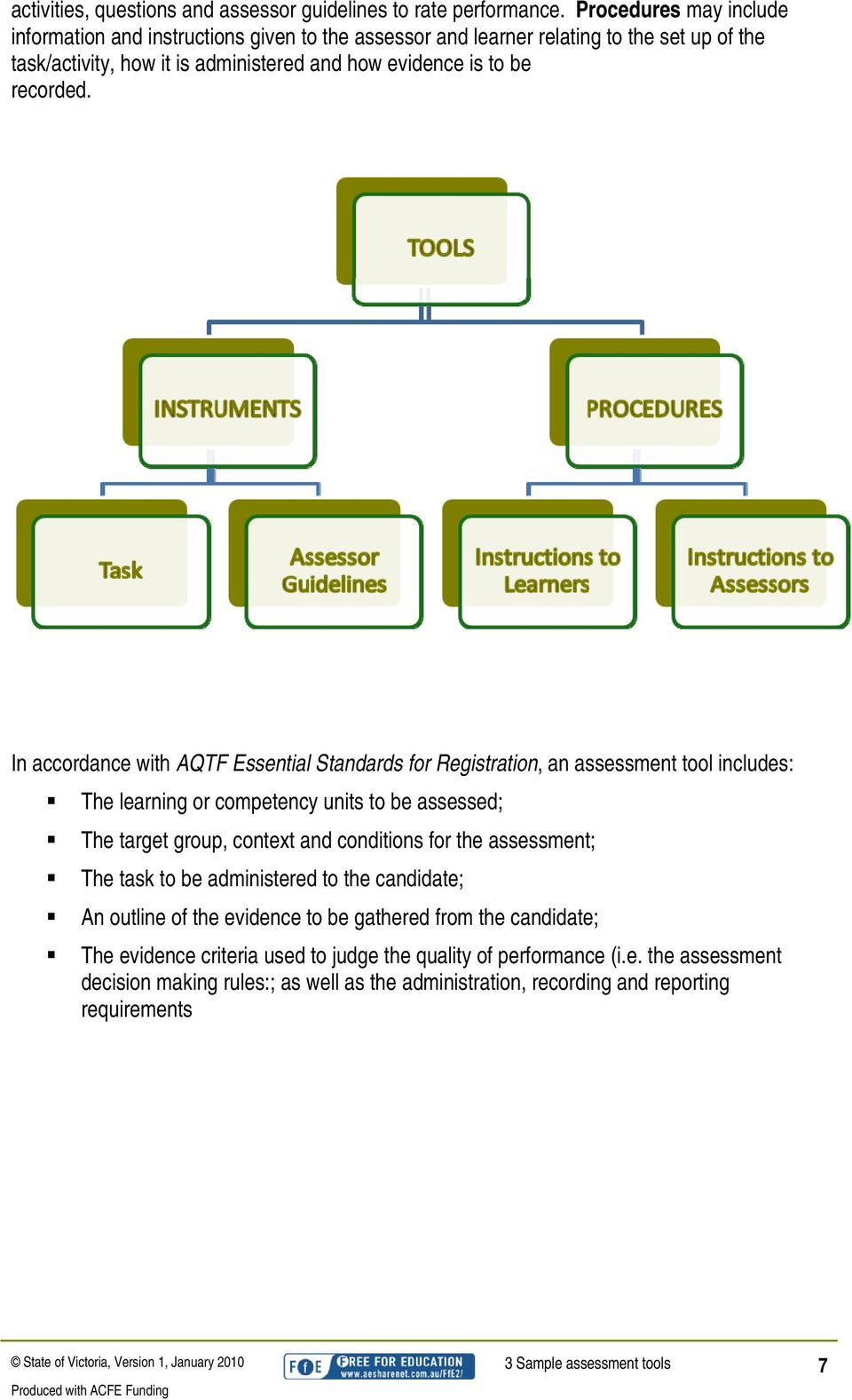
6 Reliable that assessment is consistent and accurate, regardless of the assessor conducting the assessment Flexible the assessment procedure enables reasonable adjustments to be made (for example, timing) Fair that assessment is equitable for all candidates You must also ensure that the assessment meets the rules of evidence. To meet these rules, evidence must be: Valid, for example, assessing the elements to the standard identified in the performance criteria, reflecting the skills and knowledge described in the unit of competency, showing application in the context described in the range statement - Current, for example, demonstrate the candidate s current skills and knowledge - Sufficient, for example, demonstrate competence over a period of time, demonstrate repeatable competence - Authentic, for example, be the work of the learner, be corroborated/verified For further discussion of these terms and how they apply in a CGEA context please refer to Section B: Course Information of the curriculum document (pages 45-46). Formative and Summative Assessment Assessment can be very broadly divided into two categories, according to the nature and purpose of the assessment formative and summative assessment. Formative assessment has the primary concern of teaching and learning. This type of assessment occurs throughout the course of study and is often informal in nature. It includes activities such as talking to learners about their work or monitoring and providing feedback on practice tasks. Formative assessments are used to provide the student with feedback on their performance so the learner can improve their skills, and to provide teachers with information so they can tailor their future instruction to student needs. Formative assessment may or may not contribute towards the final assessment; where it does, the student should be informed. Summative assessment, on the other hand, is about providing outcomes showing student competency. Summative assessment occurs at the end of the teaching and learning phase and is used for recording results. In a CGEA context, formative assessment has a critical role to play in a student s skill development. Students need sufficient opportunities to practise what they are learning, to reflect on teacher feedback and also have occasion for peer and self-reflection. Summative assessment should only occur after this process, and learners need to be aware when the task/activity they are undertaking is intended for final assessment and reporting of their learning. What is an Assessment Tool? The term Assessment Tool is used to describe the instruments and procedures for gathering, recording and evaluating evidence of learner performance. Instruments may include the 3 Sample assessment tools 6

7 activities, questions and assessor guidelines to rate performance. Procedures may include information and instructions given to the assessor and learner relating to the set up of the task/activity, how it is administered and how evidence is to be recorded. In accordance with AQTF Essential Standards for Registration, an assessment tool includes: The learning or competency units to be assessed; The target group, context and conditions for the assessment; The task to be administered to the candidate; An outline of the evidence to be gathered from the candidate; The evidence criteria used to judge the quality of performance (i.e. the assessment decision making rules:; as well as the administration, recording and reporting requirements 3 Sample assessment tools 7
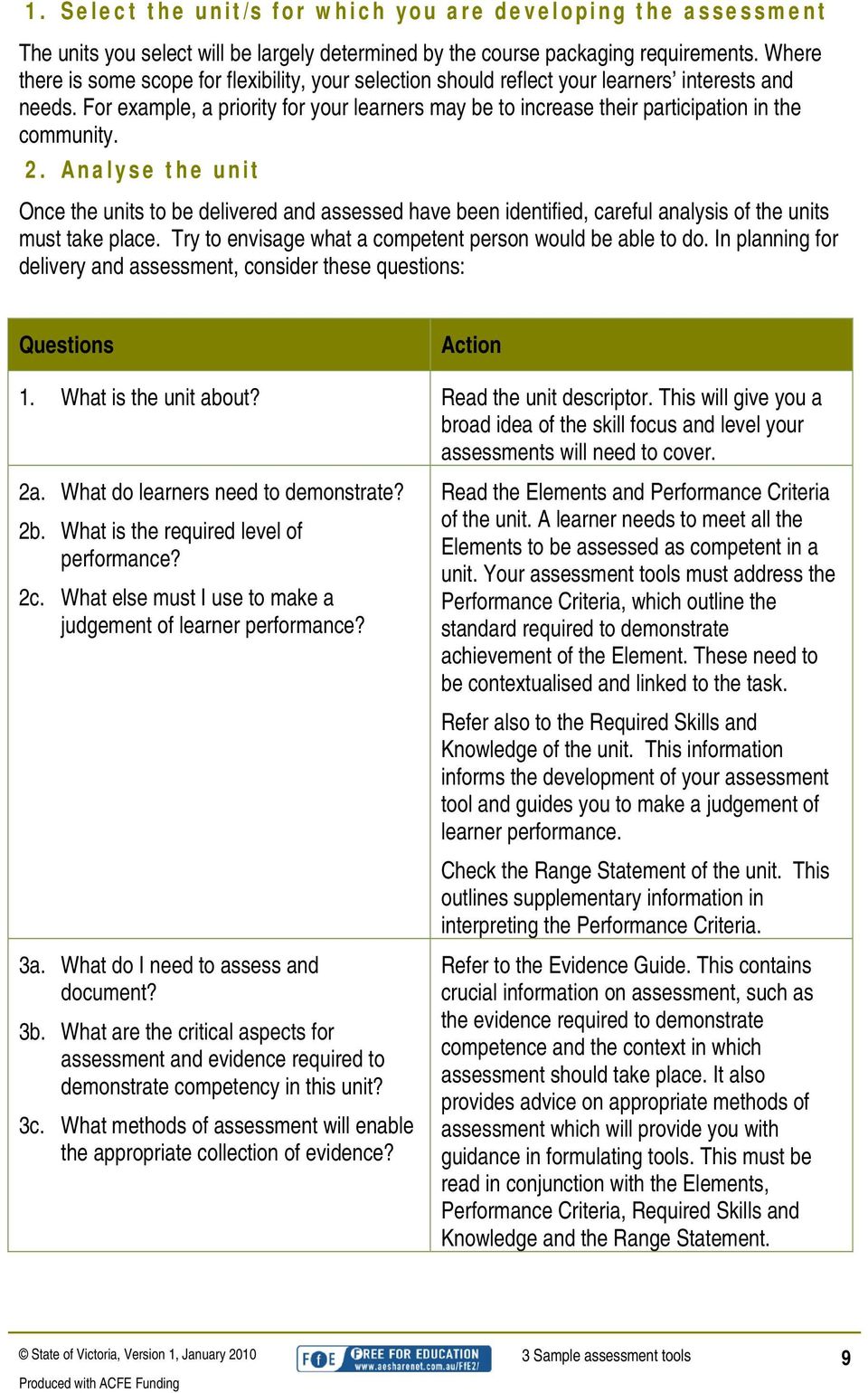
8 2 2 Developing assessment tools Teachers/assessors need a comprehensive suite of assessment tools in order to assess, record and validate their learner s performance according to the requirements of the curriculum. In developing effective assessment tools, a practitioner needs to have a thorough understanding of the unit/s they are assessing and the target learner group. This section of the guide outlines a suggested process to assist you to develop assessment tools. The process involves a number of steps: 3 Sample assessment tools 8

9 1. Select the unit/s for which you are developing the assessment The units you select will be largely determined by the course packaging requirements. Where there is some scope for flexibility, your selection should reflect your learners interests and needs. For example, a priority for your learners may be to increase their participation in the community. 2. Analyse the unit Once the units to be delivered and assessed have been identified, careful analysis of the units must take place. Try to envisage what a competent person would be able to do. In planning for delivery and assessment, consider these questions: Questions Action 1. What is the unit about? Read the unit descriptor. This will give you a broad idea of the skill focus and level your assessments will need to cover. 2a. What do learners need to demonstrate? 2b. What is the required level of performance? 2c. What else must I use to make a judgement of learner performance? 3a. What do I need to assess and document? 3b. What are the critical aspects for assessment and evidence required to demonstrate competency in this unit? 3c. What methods of assessment will enable the appropriate collection of evidence? Read the Elements and Performance Criteria of the unit. A learner needs to meet all the Elements to be assessed as competent in a unit. Your assessment tools must address the Performance Criteria, which outline the standard required to demonstrate achievement of the Element. These need to be contextualised and linked to the task. Refer also to the Required Skills and Knowledge of the unit. This information informs the development of your assessment tool and guides you to make a judgement of learner performance. Check the Range Statement of the unit. This outlines supplementary information in interpreting the Performance Criteria. Refer to the Evidence Guide. This contains crucial information on assessment, such as the evidence required to demonstrate competence and the context in which assessment should take place. It also provides advice on appropriate methods of assessment which will provide you with guidance in formulating tools. This must be read in conjunction with the Elements, Performance Criteria, Required Skills and Knowledge and the Range Statement. 3 Sample assessment tools 9
10 3. Select resources / activities 4. Select methods of assessment Steps 3 and 4 include making decisions about the activities and tasks to be undertaken, resources to be used in the assessment and methods of assessment to be used to collect the evidence required. 5. Develop the assessment tools The following components should be included: The context Information to be provided to the candidate: instructions, and information on what participants will be assessed on. These need to be explicitly explained so learners understand how and under what conditions they will be assessed. Consider these points: - students must be informed as to the context, purpose and conditions of the assessment - a variety of assessment methods should be used to cater for various learning styles, for example, observation and self-assessment - ensure the assessment is not introducing anything new Evidence to be collected - Instructions to assessor on how to make a judgement - Materials/resources required - Recording requirements Developing the recording tools this includes the evidence-gathering documentation In developing resources for recording assessment a teacher/assessor must ensure the following are included: - assessment date - student name - units/elements being assessed - list of knowledge/skills to be assessed - assessment methods used - evidence gathered - feedback provided result of assessment - achieved or not yet competent, for example - teacher/assessor name 6. Validate the tools Validation of assessment tools is a quality review process. It involves checking that the assessment tools will produce the required evidence and that the requirements of the unit have been met. 3 Sample assessment tools 10
11 The Competency Mapping Tool in Appendix 1 assists assessors with mapping the key components in their task to the unit/s of competency to demonstrate content validity. Use the checklist in Appendix 2 Validate Assessment Tools to review the assessment. Validation and Moderation Assessment validation is defined as: a process for ensuring that the way a unit of competency or group of units is assessed, and the evidence collected through these assessments, is consistent with the requirements of the unit or group of units of competency and of industry. It includes validating the assessment process, the assessment tools and instruments, the evidence collected using tools and instruments, and the interpretation of that evidence to make a judgement of competence in relation to the same unit(s) of competency. Validation may be undertaken before, during and after the actual assessment activity occurs and may include both formative and summative assessment. The latter includes assessment for the purpose of granting RPL. (Source: AQTF 2007 Users Guide to the Essential Standards for Registration, p.51) Assessment validation includes, but goes beyond, assessment moderation which is defined as: a process which involves assessors in discussing and reaching agreement about assessment processes and outcomes in a particular industry or industry sector. It enables assessors to develop a shared understanding of the requirements of specific Training Packages, including the relevant competency standards and assessment guidelines, the nature of evidence, how evidence is collected and the basis on which assessment decisions are made. (Source: TAA04 Training and Assessment Training Package Glossary of Terms) Moderation is the process of bringing assessment judgements and standards into alignment. It is a process that ensures that the same standards are applied to all assessment results within the same units/s of competency. (Source National Quality Council 2009 Implementation Guide: Validation and Moderation) 3 Sample assessment tools 11
12 3 3 Sample Assessment Tools SAMPLE ASSESSMENT TOOL VIC Certificate I in General Education for Adults (Introductory) Context The following sample assessment tool is part of a program consisting of a topic: waste and the environment. The selection of this topic was based on, learners needs, interests and the issues they were experiencing in their neighbourhood. The broader topic focused on a number of areas including council waste collection services and schedules in learners own local areas. To ensure that learners were given every opportunity to access and engage with a broad range of texts to meet their immediate needs it was decided to select the units VBQU122 Engage with simple texts to participate in the community and VBQU129 Work with simple numerical and statistical information as the basis of learning and assessment. The requirements of these units also means that learners can access community texts containing a range of features, structures and numerical information related to their immediate needs. Formative assessment tasks using other community text types based on this topic can be used to build up a portfolio for assessment of these units. For example similar texts from different councils can be compared. Supporting activities could focus on using and interpreting calendars and cross referencing information by using keys and symbols. This assessment tool provides an example of how assessment can be undertaken. The approach can be customised using community texts at a similar level with minor adjustments to questions in the assessment tool to reflect specific features of language texts. Learners should access and present their own texts relevant to the topic with guidance from their teacher. (See 3 Sample assessment tools 12

13 Step 3: What text? What real life activity and resources? for key considerations to guide the teacher in the selection of appropriate texts). Step 1: Select the units The following assessment tool is based on the units: VBQU122 Engage with simple texts to participate in the community VBQU129 Work with simple numerical and statistical information It is recommended that these units be delivered and assessed using an integrated approach. This approach reflects real life situations which require engaging with texts which comprise literacy and numeracy components. Integrated assessment tools have been designed to collect evidence for both units, rather than designing one assessment activity for individual units or individual elements. Step 2: Analyse the units Once the units to be delivered and assessed have been identified, careful analysis of the units must take place to identify what needs to be assessed and the levels of performance required. Key requirements from the curriculum have been highlighted below. Questions Description 1. What are the unit/s about? (unit descriptor) engaging with simple and familiar texts to participate in the community. locating and using simple everyday numerical information in familiar texts, tables and graphs 2a. What do learners need to do? (elements and performance criteria) 2b. What is the required level of performance? (skills and knowledge) 2c. What else must I use to make a judgement of learner performance? locate information in simple relevant community texts, and read and interpret short, explicit texts to participate in the community: recognise features of text, identify source, predict purpose, identify main message, comment on effectiveness work with simple numerical information in familiar texts. and work with simple, familiar tables and graphs: whole numbers, simple fractions and percentages, one-step calculations. features of graphs and tables - range of reading strategies: sight vocab and de-coding - make connection with real world - punctuation 3 Sample assessment tools 13
14 numeracy - read familiar/ get the gist unfamiliar - identify audience and purpose - simple addition and subtraction - informal and formal language of number - relating signs / prints/ symbols tables /graphs to real life purposes 3a. What do I need to assess and document? (evidence guide) 3b. What are the critical aspects for assessment and evidence required to demonstrate competency in this unit? (evidence guide) 3c. What methods of assessment will enable the appropriate collection of evidence? (evidence guide) 4. What texts/resources are suitable for the task? Learner can locate personally relevant information related to participation in the community short, explicit, personally relevant, familiar two occasions; 2 different text-types for VBQU122 real texts in context. Simulation permitted for VBQU129 appropriate support: teacher, personal dictionary, calculators, computers Methods of assessment verbal questioning observation Community based information such as brochures, notices, information sheets, community newsletters Step 3: What text? What real life activity and resources? After analysing the unit/s and identifying required text features and structures, check the texts selected for suitability. Below are some key considerations which informed the selection of these texts. Topic: Waste collection in the local area Texts selected: Waste Collection Calendar 2. Moreland Waste collection areas leaflet 3 Sample assessment tools 14
15 Key considerations in text selection Is the text community related? Is it at an appropriate level? Is it relevant to learners? Does it include visual cues? Does it contain appropriate text features? Does it include simple numerical information? Does it include simple tables and graphs? Comments Text 1 Council community calendar about collection dates Text contains features and structures required at this level such as information in a formatted table and sentences linked by simple cohesive devices and whole numbers Learners have expressed interest in learning more about Council services, and environmental issues. Yes: visual representations of types of waste, logo, colour coding Clear structure Text supported by diagrams Vocabulary related to local environment Numbers and symbols to distinguish type of collection Yes: calendar Comments Text 2 Council community information leaflet identifying collection zones Text contains navigation features such as a colour coded key, sentences with simple verb tenses, vocabulary linked to community environment such as green waste The information provided impacts directly on learners everyday lives Yes: colour coding, icons, logo and map Sentences of one or two clauses Colour coded map of local area Time related information Contact telephone numbers and address Yes; simple map with codes Is it real? Published council calendar. Published council leaflet 3 Sample assessment tools 15

16 Text 1 Source: :retrieved 25/08/ Sample assessment tools 16

17 Text 2 Source: Retrieved 12/08/ Sample assessment tools 17

18 Step 4: Select methods of assessment Varying assessment methods should be used to assess learner competence using real and simulated contexts. The methods of assessment selected must generate the range of evidence required by the unit. Evidence of competence for these units should be gathered on a number of occasions over a period of time. In this example, the assessment methods used to collect different types of evidence are: observation of a verbal presentation verbal questioning to establish understanding of information and key features in selected texts peer assessment Units of competency Method 1: Method 2: Method 3: VBQU122 Verbal presentation Verbal questioning Peer assessment VBQU129 Step 5: Develop assessment tools Assessment Tool Components This assessment tool is made up of the following components: Assessor Guidelines These should include: instructions on what the assessor needs to do to set up and conduct the assessment. For example, ensuring the learner has access to resources which are essential to participation in the assessment such as access to real community texts or personal dictionaries. It may also include instructions about the level of support which can be provided to the learner recording sheets for the assessor which include responses to verbal questions, guidance as to what the assessor needs to consider to make a judgement and a summary of evidence collected. This is based on the Elements, Performance Criteria Required Knowledge and Skills, and Evidence Guide of the units Competency Mapping - this demonstrates the content validity of the assessment tool by indicating how the unit requirements have been met in the required activities. Employability Skills Advice Assessors should consider the Employability Skills which are developed through the completion of the task. These are built into the task and not separated out. Teachers should discuss employability skills with their learners throughout the program and provide examples. For example in completing this task the learner may develop the following Employability Skills: 3 Sample assessment tools 18

19 Communication locating relevant community information in familiar texts reading and interpreting simple community texts, familiar signs and symbols in a familiar environment sharing community related information using mathematical information embedded in a text using formal and informal mathematical language interpreting data presented in simple visual form such as a table or map Problem solving locating relevant community information using a range of reading strategies to make and convey meaning Self management completing the activity within a specific time frame Planning and organising planning simple verbal presentation Instructions for the learner This includes information on what the learner needs to do (task) and how they will be assessed. This example requires learners to: Read council community information about waste collection Complete a learner planning sheet to help them plan their presentation Present the information to the class Respond verbally to questions about the council texts Use a peer review sheet to provide feedback to other learners Step 6: Validate assessment tools Validation Checklist Use this to ensure that the assessment tools and instruments, the evidence collected using the tools and instruments and the interpretation of that evidence to make a judgement of competence in relation to the identified unit(s) of competency is consistent with the principles of assessment. Use the comments column to note any improvements that need to be made to the assessment tool. A sample completed Validation checklist is included at the end of this section. A blank Validation Checklist is included in Appendix 2. Competency Mapping This tool assists assessors with mapping the key components within their task/s to the Unit(s) of Competency to demonstrate content validity. See the example at the end of this assessment tool. A blank competency Mapping proforma is included in Appendix 1. 3 Sample assessment tools 19
20 Assessor Guidelines Course: 21771VIC Certificate I in General Education for Adults (Introductory) Learners will be assessed on the following units: VBQU122 Engage with simple texts to participate in the community VBQU129 Work with simple numerical and statistical information Setting up the assessment task Find a range of examples of council publications/texts related to community themes, for example, information about council facilities and services. Tell the learners that they will be reading texts about waste collection services in the local area. Prepare the learners by discussing what happens about waste collection in their area, both weekly and fortnightly collections, as well as annual collections of hard waste. Check that learners are familiar with calendar layouts and purposes. Note the extent of requirements in the units. Does the task allow learners to meet part or all of the outcomes? Note that this tool meets some, but not all, of the requirements. Additional assessment would be required to assess the breadth of numeracy in VBQU129 Work with simple numerical and statistical information. Prepare assessment tool Instructions to learners about the assessment task Planning sheet for learners Questions to assess engagement with text Peer assessment checklist Assessor Guidelines Conducting the assessment 1. Emphasise what is being assessed. The assessment will be of: your understanding of what the text is about and who it is for your understanding of why the information is important to you your opinion about the things in the text that helped you to understand it clearly using numbers to read and interpret information 2. Tell learners what support is available to them. This can be asking the assessor to clarify instructions, using a personal dictionary, calculators or computer. 3. Show the following texts to the student and ask them to read them to themselves (2009 Waste Collection Calendar and Moreland Waste collection areas leaflet) 4. Allow a reasonable time for the student to read and re-read the texts 5. Tell them that they will need to prepare a short presentation on the texts 6. Tell them you will also ask them some questions about the texts 3 Sample assessment tools 20

21 7. Ask the student to use the planning sheet to plan their presentation 8. Observe the student presentation using the recording sheet to note evidence 9. Ask questions making notes of individual responses. 10. Use the recording sheet to record evidence. Use the Evidence required column to guide judgement. This is based on the Elements and Performance Criteria of the unit, the Required Skills & Knowledge and other requirements of the unit. 11. Note whether the evidence is satisfactory or whether additional evidence is required 12. Provide verbal feedback to the student on their performance and keep the response sheet on file. Note: It is appropriate to seek agreement on Peer Assessment as an assessment method and participating students should be thoroughly prepared on Peer Assessment protocols. 3 Sample assessment tools 21
22 Instructions For The Learner 21771VIC Certificate I in General Education for Adults (Introductory) This task is part of your assessment for the units VBQU122 Engage with simple texts to participate in the community VBQU129 Work with simple numerical and statistical information For this assessment, you will need to read about waste collection in the local area, and be prepared to answer some questions. You have 3 tasks: 1. Read 2 texts collected by you or your teacher (texts will be similar to those you have talked about in class). 2. Present information about your texts to your class. Use the planning sheet to help you to plan your presentation 3. Your teacher will also ask you some questions about the texts. Your presentation must include the following information: Who are the texts for? What are the texts about? What does the information mean for people who live in your area? Are the texts easy for people to understand? Why/Why not? How could they be improved? How will you be assessed? You will be assessed on the following: your understanding of what the texts are about and who they are for your understanding of why the information is important to people your opinion about the things in the texts that helped you to understand them clearly 3 Sample assessment tools 22
23 Learner Planning Sheet 21771VIC Certificate I in General Education for Adults (Introductory) This task is part of your assessment for the units VBQU122 Engage with simple texts to participate in the community VBQU129 Work with simple numerical and statistical information To help you to plan your presentation, make some notes on this planning sheet and include it in your portfolio of evidence. Show it to your teacher. Employability Skills Think about some of the Employability Skills you are developing and give some examples as part of your planning. What Employability skills do you think you used or developed to do this planning sheet: Communication Example:... Problem Solving Example:... Planning and organisation Example:... Self management Example:... 3 Sample assessment tools 23
24 Learner Planning Sheet Name: Date: Planning Sheet Questions Who wrote these texts? Notes Text 1: Waste collection calendar Notes Text 2: Waste collection areas Who are the texts for? How is the information organised? Are there: headings different size fonts (words) and colours pictures / symbols / diagrams? other What is the text about? Can you think of 3 ways you might use the information? What made the text easy for you to understand? 3 Sample assessment tools 24
25 Were there any sections you found difficult to read? What did you do to work out the meaning of them? Do these texts tell you what you need to know to use the waste collection in your local area? Are there any ways they could be improved? 3 Sample assessment tools 25
26 Sample Questions TEXT 1 - Waste collection calendar The following tool may be used to collect evidence from the student presentation and the sample questions may be used to collect evidence not generated through the presentation or to supplement evidence already collected VIC Certificate I in General Education for Adults (Introductory) Units: VBQU122 Engage with simple texts to participate in the community VBQU129 Work with simple numerical and statistical information Student name: Date of assessment: Sample Question Evidence required Evidence/Student response Evidence Satisfactory/ additional evidence required Which organization wrote this and why? (Source and purpose) What is the information about? (main message) Identifies it as a council document that gives the community information about waste collection. Identifies as information about collection dates and when different types of waste are collected 3 Sample assessment tools 26
27 Sample Question Evidence required Evidence/Student response Evidence Satisfactory/ additional evidence required Who might use this information? (audience) Can you tell me 3 things you might use this information for? (purpose) What are the main features of the information? How is it organised? (features of the text) What waste is collected each week? What waste is collected every two weeks? How did you find this information? (reading strategies) Identifies themselves, family members or neighbours. Identifies; When to put out waste What to put out What to do if they have a question about their service Identifies as a calendar Identifies months and abbreviations for weekdays Identifies symbols in key Identifies visuals Gives examples such as weekly garbage and recycled rubbish such as bottles and cans. May mention drawing on nonlinguistic support such as visuals and drawing on a bank of known words eg weekly, fortnightly 3 Sample assessment tools 27
28 Sample Question Evidence required Evidence/Student response Evidence Satisfactory/ additional evidence required What days in November will the green rubbish be collected? How do you know this? (reading strategies) How many garbage collections are there during the year? (one step calculation) How many recycling collections are there in March?(one step calculation) What % of these are green waste collections?(simple fractions and percentages) What things in the leaflet help you to understand it? Show me some of the features that helped.(features of the text) What did you find difficult to understand in the calendar? How did you work out the meaning?(reading strategies) Was the calendar clear and easy to follow? How can it be improved? (evaluation of text) Identifies days, refers to the key and cross references with calendar 52:uses + operation 4: uses + operation ½ or 50%: Refers to visuals, symbols such as crosses and ticks, headings in big print etc Could refer to specific vocabulary, sentences or layout of the text May indicate they had to reread text Draw on familiar words Offers an opinion about the text. May draw on experience with similar 3 Sample assessment tools 28
29 Sample Question Evidence required Evidence/Student response Evidence Why do the words in the title of the calendar start with capital letters? Why is NO written in capital letters, for example, NO plastic bags.(impact of punctuation on meaning) texts. Makes suggestions of how the text could be improved Identifies the importance of punctuation in showing important information and helping us to read the text and get the message. Satisfactory/ additional evidence required 3 Sample assessment tools 29
30 SAMPLE QUESTIONS TEXT 2 - Moreland waste collection areas 21771VIC Certificate I in General Education for Adults (Introductory) The following tool may be used to collect evidence from the student presentation and the sample questions may be used to collect evidence not generated through the presentation or to supplement evidence already collected. VBQU122 Engage with simple texts to participate in the community VBQU129 Work with simple numerical and statistical information Learner name: Date: Sample Question Evidence required Student response Evidence Satisfactory/additional evidence required What is the purpose of this information? (purpose) Indicates that provides information about green waste collection Who might use it?(audience) Can you tell me what they might use this information for? (purpose) What are the main features of the text? How is it organised? (features of text) How often is the green waste collected in Moreland? Each week or each second Identifies themselves, family members or neighbours. Indicates that they would use it to find out when green waste is collected in their area Identifies as a map with street names Colour coded key to identify areas Identifies the word fortnightly 3 Sample assessment tools 30
31 week?(reading strategies) Which day of the week do people living in the areas coloured yellow have their green waste collected? (reading strategies) Can you find a street which has the green waste collected on Tuesdays? (reading strategies) Can you find 2 ways to contact the council if you need further information? (reading strategies) What things in the leaflet help you to understand it? Show me some of the features that helped.(text features) Did you find anything difficult to read? How did you work out the meaning? (evaluation of text) Answers Monday : links the key to the map Eg Gaffney street: links the key to the map Provides various council contact details: draws on familiar information such as telephone numbers and addresses May indicate the map with colour coding Could refer to specific vocabulary, sentences or layout of the text May indicate they had to re-read text Draw on familiar words such as days of the week 3 Sample assessment tools 31
32 Peer Assessment Sheet 21771VIC Certificate I in General Education for Adults (Introductory) VBQU122 Engage with simple texts to participate in the community VBQU129 Work with simple numerical and statistical information Name of presenter:.date:.. Feedback sheet completed by: Name of text:... Instructions Use this sheet to keep a record of what you notice about the text presentation made by another member of your group. Help their learning by giving constructive ideas in the space at the end of the checklist. Description You are clear about the purpose of the text You are clear about who the text is for (audience) You explain why you chose this text and how it affects you You give some examples of features in the text that helped you to understand it You answer questions about the text clearly You interpret numbers given in the texts You use mathematical language (numbers) / Comments: 3 Sample assessment tools 32
33 Summary Of Evidence 21771VIC Certificate I in General Education for Adults (Introductory) Use the tool below to record all evidence collected and to confirm that sufficient evidence has been collected. VBQU122 Engage with simple texts to participate in the community VBQU129 Work with simple numerical and statistical information Learner name: Date: Assessor Guidelines how to make a judgement Y/N Evidence provided Comments Integration of Employability Skills and Facets Comments Date Identifies features of the text such as headings, logos, photos, dates and times, and numbers, and uses these to read and interpret the text Presentation Responses to questions Peer assessment Identifies type of information likely to be covered in text Presentation Responses to questions Peer assessment 3 Sample assessment tools 33
34 Assessor Guidelines how to make a judgement Y/N Evidence provided Comments Integration of Employability Skills and Facets Comments Date Identifies source of text Presentation Responses to questions Peer assessment Identifies purpose and audience of text Presentation Responses to questions Peer assessment Identifies the main message in the text by using a range of reading strategies Presentation Responses to questions Peer assessment Demonstrates knowledge of simple punctuation Presentation Responses to questions Peer assessment Comments on whether the text gets the message across Presentation Responses to questions Peer assessment 3 Sample assessment tools 34
35 Assessor Guidelines how to make a judgement Uses informal and some formal mathematical language of number and data Interprets numerical information embedded in text Y/N Evidence provided Comments Integration of Employability Skills and Facets Presentation Responses to questions Peer assessment Presentation Responses to questions Peer assessment Comments Performs one-step calculations Presentation Responses to questions Peer assessment Feedback (make a note of verbal feedback given): Competent Additional evidence required Recommendations for future training or assessment: Assessor/Teacher name: Assessor signature: Date 3 Sample assessment tools 35
36 Validate Assessment Tools Checklist Review the assessment tool (s) against the following: Yes No Comments Does the assessment address the Elements and Performance Criteria? Yes the tool addresses the Elements and Performance Criteria for both units identified Does the assessment obtain evidence to meet the requirements of the Evidence Guide (Critical Aspects)? Does the assessment allow the student to demonstrate the Required Skills and Knowledge required for the units? Is it clear which Elements / Performance Criteria are being assessed? NB: if a task does not cover all Elements / Performance Criteria, it needs to indicate which Elements / Performance Criteria are being assessed Yes learners need to read and interpret 2 different types of text. Additional assessment would be required to assess the breadth of numeracy in VBQU129 Work with simple numerical and statistical information, eg text with simple graphs Yes the tool enables the learner to use a range of reading strategies, basic analysis skills and use signs and symbols to make meaning Yes, task components have been mapped against Elements and Performance Criteria Is the assessment designed to produce valid evidence? (Is it asking for more than required? Can every aspect of the task be related back to the unit? Yes, every aspect of the task can be linked back to the appropriate unit 3 Sample assessment tools 36
37 Does the assessment task produce sufficient evidence? Although, the tool generates a range of evidence to address assessment requirements eg learner responses, presentation, peer assessment there is a need for further evidence to satisfy the requirements of the unit specifically for the numeracy component. Can evidence be gathered over a period of time? Yes, the tool has been designed to gather evidence over a period of time Can the evidence presented for assessment be authenticated? (e.g. group assessment) Yes, the teacher can observe the learner over a period of time Does the assessment comply with the principles of fairness? Is there enough guidance for the assessor on making a judgement? Are the assessment instructions and conditions clear and accessible to the learner? Is the level of support required provided? Is the material used in the task culturally appropriate? Yes, assessor guidelines provide advice on levels of support and access to resources such as dictionaries Yes the sample questions to assess engagement with text provides the assessor with guidance on the evidence required Yes, the task requirements, what is being assessed and how is explicit to learners. Level of support is detailed in Assessor Guidelines eg allowing reasonable time for student to read and re-read text Yes the texts are culturally appropriate. They are neutral and contain general community information 3 Sample assessment tools 37
38 Are all sign off requirements included: Date Unit details Signatures, assessor and trainee Yes 3 Sample assessment tools 38
39 Competency Mapping Component of Task Presentation and Questioning Elements/Performance Criteria VBQU122 Element 1 (PC 1.1, 1.2, 1.3) Element 2 (PC 2.1, 2.2, 2.3, 2.4, 2.5) Component of Unit(s) of Competency Required Skill and Knowledge Range Statements Evidence Guide can read texts which have predictable structure and familiar vocabulary; can get the gist or locate specific information in texts which have more unfamiliar elements uses a range of reading strategies including ability to draw on bank of sight vocabulary of personally relevant words/ phrases and use of word attack skills can identify purpose and audience of a text can make connections between own knowledge and experience and the purpose of texts beginning ability to analyse texts communication skills to undertake assessment informative texts such as brochures, community newsletters with explicit navigation features, eg, headings information formatted into a table sentences containing adjectives, pronouns and prepositions familiar place-related information numbers (for example, dates and times, phone numbers relevant to local community) meaning-making strategies, for example: - drawing on non-linguistic support such as illustrations, diagrams, photos, symbols, colours, layout - making connections between own knowledge and experience and the purpose of texts - drawing on a bank of known words and phrases including learners will be able to locate personally relevant information related to participation in the community in simple and familiar texts learners will be able to read and interpret short, explicit and personally relevant texts evidence that texts have been accessed on at least two occasions. Each occasion must address a different text type access to real texts in context At this level the learner may: depend heavily on visual cues to understand meaning need time to read, reread and decode text depend on a personal dictionary depend on the teacher and need frequent support to interpret meaning 3 Sample assessment tools 39
40 Component of Task Elements/Performance Criteria Component of Unit(s) of Competency Required Skill and Knowledge Range Statements Evidence Guide those related to the immediate environment VBQU129 Element 1 (PC 1.1, 1.2, ) Element 2 (PC 2.1, 2.2, 2.3) knowledge that signs / prints/ symbols tables /graphs represent meaning communication skills to undertake learning and assessment informal and some formal language of number and data simple addition and subtraction numbers should be relevant and appropriate to the learner recognise equivalence of 50% one step calculations, subtraction, addition small tables learners will be able to work with simple numerical information in familiar texts. learners will be able to work with simple, familiar tables and graphs. access to real/authentic or simulated tasks, materials and texts in appropriate and relevant contexts At this level, the learner may: use oral descriptions with common, everyday, informal language and gestures depend on teacher/support person or advice/modelling use in the head methods, pen and paper methods and calculators. Activity VBQU122 PC 1.2 PC 2.2 VBQU129 PC 1.2 knowledge of how basic punctuation impacts on meaning informal and some formal language of number and data sentences with simple verb tenses and routine word order patterns numbers should be relevant and appropriate to the learner most, least, first learners will be able to read and interpret short, explicit and personally relevant texts learners will be able to work with simple numerical information in familiar texts. 3 Sample assessment tools 40
41 SAMPLE ASSESSMENT TOOL VIC Certificate I in General Education for Adults Context The following sample assessment tool is part of a program consisting of a topic: waste and the environment. The selection of this topic was based on, learners needs, interests and issues they were experiencing in their neighbourhood. The broader topic, focused on a number of areas including waste collection in learners own local areas and the dumping of waste in local communities. To ensure that learners were given every opportunity to access and engage with a broad range of texts about these issues, it was decided to select the units VBQU135 Engage with texts of limited complexity to participate in the community and VBQU140 Work with measurement and design in familiar situations (see below) as the basis of learning and assessment. The requirements of these units also meant that learners could access community texts containing a range of features, structures and measurement and calculation functions. This assessment tool provides an example of how assessment can be undertaken. The approach can be customised using community texts at a similar level with minor adjustments to questions in the assessment tool to reflect specific features of texts. Learners should access and present their own texts relevant to the topic with guidance from their teacher. (see Step 3: What text? What real life activity and resources? for key considerations to guide the teacher in the selection of appropriate texts). It should be noted that this sample assessment tool meets only part of the requirements for these units. Formative assessment tasks using other community text types based on this topic can be used to build up a portfolio for assessment of these units. Step 1: Select the units The following assessment tool is based on the units: VBQU135 Engage with texts of limited complexity to participate in the community VBQU140 Work with measurement and design in familiar situations It is recommended that these units be delivered and assessed using an integrated, or team teaching, approach, reflecting real life situations which require engaging with texts which comprise literacy and numeracy components. Assessment tasks have been designed to collect evidence for each of the units separately, appropriate for integrated or team teaching delivery approaches. STATE OF VICTORIA, VERSION 1, JANUARY Sample assessment tools 41 PRODUCED WITH ACFE FUNDING
42 Step 2: Analyse the units Once the units to be delivered and assessed have been identified, careful analysis of the units must take place to identify what needs to be assessed and the levels of performance required. Key requirements from the curriculum have been highlighted below. Questions Description 1. What are the units about? (unit descriptor) engaging with everyday texts and less familiar text types, of limited complexity, to participate in the community interpreting plans, drawing and assembling shapes, and estimating, measuring and calculating everyday quantities. 2a. What do learners need to do? (elements and performance criteria) 2b. What is the required level of performance? (skills and knowledge) 2c. What else must I use to make a judgement of learner performance? locate routine and familiar information for community purposes in everyday texts of limited complexity, and read, interpret and evaluate a range of everyday texts of limited complexity to participate in the community: describe features of texts, identify source, predict purpose, use a range of strategies to comprehend and analyse text, identify main message and supporting information, comment on effectiveness of text interpret plans and draw and assemble shapes, and estimate, measure and calculate everyday quantities using appropriate instruments: common 2 and 3 dimensional shapes. Use language of shape, and measurement; assemble models;, interpret diagrams, convert measures of length, mass and capacity within the metric system Knowledge and skills literacy use a range of reading strategies: decoding and meaning-making interpret basic structural conventions of text understands a range of audiences and STATE OF VICTORIA, VERSION 1, JANUARY Sample assessment tools 42 PRODUCED WITH ACFE FUNDING
43 purposes for texts read familiar/ get the gist unfamiliar identify main idea and supporting information numeracy ability to interpret plans and draw and assemble shapes ability to estimate, measure and calculate everyday quantities relating signs / prints/ symbols tables /graphs to real life purposes communication skills to undertake learning and assessment 3a. What do I need to assess and document? (Evidence guide) 3b. What are the critical aspects for assessment and evidence required to demonstrate competency in this unit? (Evidence guide) 3c. What methods of assessment will enable the appropriate collection of evidence? (Evidence guide) 4. What texts/resources are suitable for the task? locate personally relevant information in familiar texts three occasions; 3 different text-types; one or two linked paragraphs real texts in context; simulation of tasks, texts and materials is permitted appropriate support: teacher for advice/ modelling, personal dictionary, calculators, computers, internet verbal questioning observation peer assessment use a combination of oral and written mathematical and general language, symbols, abbreviations and diagrams use a blend of in the head methods, pen and paper methods and calculators Community-based information such as brochures, notices, information sheets, community newsletters STATE OF VICTORIA, VERSION 1, JANUARY Sample assessment tools 43 PRODUCED WITH ACFE FUNDING
44 Step 3: What text? What real life activity and resources? After analysing the unit/s and identifying required text features and structures, check the texts selected for suitability. Below are some key considerations which informed the selection of this text. Topic: Hard waste collection in the local area Text selected: Annual Hard Waste Collection leaflet Key considerations Comments Is it community related? Council community information about hard waste collection Is it at an appropriate level? Text contains features and structures required at this level eg place and time related information Is it relevant to learners? Learners have expressed interest in learning more about Council services, and environmental issues. Text is local and current. Does it include visual cues? Yes eg. symbols, visuals of types of waste Does it contain appropriate text features? Signposting/series of sequential steps Clear structure Text supported by diagrams Vocabulary related to local environment Does it include simple numerical information? Numbers, mathematical symbols, volume Does it include simple shapes? Yes Is it real? Published council leaflet. STATE OF VICTORIA, VERSION 1, JANUARY Sample assessment tools 44 PRODUCED WITH ACFE FUNDING
45 3 Sample assessment tools 45
46 Source: Retrieved:12/08/ Sample assessment tools 46
47 Step 4: Select methods of assessment Varying assessment methods should be used to assess learner competence using real and simulated contexts. The methods of assessment selected must generate the range of evidence required by the unit. Evidence of competence for these units should be gathered on a number of occasions over a period of time. In this example, the assessment methods used to collect different types of evidence are: Units of competency Method 1: Method 2: Method 3: Method 4 VBQU135 Observation of Verbal presentation Verbal questioning to establish understanding of information and key features in text Peer observation and assessment of presentation Portfolio of evidence which may comprise completed worksheets, notes, planning sheets, photos, other presentation materials VBQU140 Teacher observation of problem solving activities Verbal questioning to check understanding of key concepts Portfolio of evidence which may comprise photographs, calculations, diagrams. Step 5: Develop assessment tools Assessment Tool Components This assessment tool is made up of the following components: Guidelines for the Assessor These should include: instructions on what the assessor needs to do to set up and conduct the assessment for example ensuring the learner has access to resources which are essential to participation in the assessment such as access to texts or equipment to conduct a presentation. It may also include instructions about the level of support which can be provided to the learner recording sheets which include responses to verbal questions, guidance as to what the assessor needs to consider to make a judgement including employability skills developed through this assessment. This is based on the Elements, Performance Criteria Required Knowledge and Skills, and Evidence Guide of the units competency mapping to demonstrate the content validity of the assessment tool by indicating how the unit requirements have been met in the required activities 3 Sample assessment tools 47
48 Employability Skills Advice Assessors should consider the Employability Skills which are developed through the completion of the task. These are built into the task and not separated out. Teachers should discuss employability skills with their learners throughout the program and provide examples which link their learning to the development of Employability Skills. For example in completing this task the learner may develop the following Employability Skills: Communication responding to and asking questions about the text sharing information with others Problem solving locating relevant community information selecting appropriate objects to fit a given shape Self management completing the activity within a specific time frame Planning and organising planning the presentation according to requirements Instructions for the learner This includes information on what the learner needs to do (task) and how they will be assessed. This example requires the learner to: read council information about waste collection complete a learner planning sheet to assist in planning their presentation present the information to the class respond verbally to questions about the council text use a peer review sheet to provide feedback to another learner Step 6: Validate assessment tools Validation Checklist Use this to ensure that the assessment tools and instruments, the evidence collected using the tools and instruments and the interpretation of that evidence to make a judgement of competence in relation to the identified unit(s) of competency is consistent with the principles of assessment. Use the comments column to note any improvements that need to be made to the assessment tool. A sample is included at the end of this section. A Validation Checklist proforma is included in Appendix 2. Competency Mapping See the example at the end of this assessment tool. A Competency Mapping proforma is included in Appendix 1. 3 Sample assessment tools 48
49 Assessor Guidelines 21772VIC Certificate I in General Education for Adults Learners will be assessed on the following units: VBQU135 Engage with texts of limited complexity to participate in the community VBQU140 Work with measurement and design in familiar situations Setting up the assessment task Literacy component: Locate a range of examples of council publications/texts related to community themes, for example, information about council facilities and services. Tell the learners that they will be reading a text about hard waste collection services in the local area, talking to the class about what they have read. Their teacher will also ask some questions about the text. Prepare the learners by discussing what happens with hard waste collection in their area. The learners will also be completing a numeracy task which will involve them working out the size of 1 metre cubed in relation to waste collection requirements specified by council. Numeracy component: Collect a range of objects of various sizes. Discuss shapes including terms such as faces, parallel and cylinder. Include a flat packed box with instructions Provide a range of measuring instruments including scales, measuring jugs, rulers and tape measures. Read the brochure with learners and complete activity Discuss how accurate their estimates were. Discuss whether they chose shapes that fitted into the metre cubed and if they could have added more or needed to leave some shapes out. Note the extent of requirements in the units. Does the task allow learners to meet part or all of the outcomes? Note that this tool meets some, but not all, of the requirements of both units. Additional assessment would also be required to assess the breadth of numeracy in VBQU140 Work with measurement and design in familiar situations. Prepare assessment tools Instructions to learners about the assessment task Planning sheet for learners Questions to assess engagement with texts Peer assessment checklist 3 Sample assessment tools 49
50 Assessor guidelines Conducting the assessment 1. Emphasise what is being assessed and what is not being assessed. Ensure learners are informed about what will be assessed. You will be assessed on the following: Your understanding of what the text is about and who it is for Your understanding of why the information is important to you Your opinion about the things in the text that helped you to understand it clearly Your ability to follow instructions in making the box Your ability to use measuring equipment Your ability to draw the shapes Your understanding of the names of shapes and parts of shapes 2. Tell learners what support is available to them: access to teacher/support person or advice/modelling; calculator; computer, digital camera for photographing evidence 3. Show the following text to the student and ask them to read it to themselves (2009 Moreland Council Hard waste collection leaflet) 4. Allow a reasonable time for learners to read and re-read text 5. Tell learners they will need to prepare a short presentation on the text 6. Ask learners to use the planning sheet to prepare their presentation 7. Tell learners you will ask them some questions about the text 8. Ask questions and note responses 9. Observe the learners undertaking problem-solving and measurement tasks 10. Use the recording sheet to record evidence. Use the Evidence required column to guide judgement. 11. Note whether the evidence is satisfactory or whether additional evidence is required 12. Provide verbal feedback to the learner on their performance and keep the response sheet on file. Note: It is appropriate to seek agreement on Peer Assessment as an assessment method and participating students should be thoroughly prepared on Peer Assessment protocols. 3 Sample assessment tools 50
51 Instructions For The Learner 21772VIC Certificate I in General Education for Adults VBQU135 Engage with texts of limited complexity to participate in the community VBQU140 Work with measurement and design in familiar situations Note: There are 2 parts to this assessment. Part One This task is part of your assessment for the unit VBQU135 Engage with texts of limited complexity to participate in the community 1. For this assessment you will need to read texts collected by your teacher (texts will be similar to those you have talked about in class). 2. Present information about your texts to your class. Use the planning sheet to help you plan your presentation 3. Your teacher will also ask you some questions about the text. Your presentation must include the following: Who is the text for? What is the text about? What does the information mean for people who live in your local area? Are the texts easy for people to understand? Why/ why not? How could they be improved? How will you be assessed? You will be assessed on the following: Your understanding of what the text is about and who it is for Your understanding of why the information is important to you Your opinion about the things in the text that helped you to understand it clearly Part Two This task is part of your assessment for the unit VBQU140 Work with measurement and design in familiar situations. It assesses your knowledge and skills about shapes and measurement in relation to the Hard Waste leaflet. You will be asked to follow these instructions: Mark out one metre square on a flat surface Make up the box using instructions given Select and place a number of objects of different shapes and sizes onto the flat surface. 3 Sample assessment tools 51
52 Count, compare and describe the shapes that make up the objects (ie square, rectangle, face, parallel etc) Sort according to the instructions in the brochure Estimate dimensions of objects Measure the objects using appropriate equipment Draw a diagram of how the objects will fit into 1 metre cubed Record the stages of your activity for your portfolio (photo). How will you be assessed? Your ability to follow instructions in making the box Your ability to use measuring equipment Your ability to draw the shapes Your understanding of the names of shapes and parts of shapes What support is available? Ask your teacher for advice or to show you what to do, if you need to You can use a calculator or computer 3 Sample assessment tools 52
53 Learner Planning Sheet 21772VIC Certificate I in General Education for Adults This task is part of your assessment for units VBQU135 Engage with texts of limited complexity to participate in the community VBQU140 Work with measurement and design in familiar situations To help you to plan your presentation make some notes on this planning sheet and include it in your portfolio of evidence. Show it to your teacher and include any feedback. Employability Skills Think about some of the Employability Skills you are developing and give some examples as part of your planning. What Employability skills do you think you used or developed to do this planning: Communication Example:... Problem Solving Example:... Planning and organisation Example:... Self management Example:... 3 Sample assessment tools 53
54 Learner Planning Sheet Name: Date: Planning Sheet Questions Notes Who wrote this text? Who is the text for? What are some of the features of the texts? (Lay-out, visuals, headings, numbers?) What is the text about? Can you think of 3 ways you might use the information? What made the text easy for you to understand? Were there any sections you found difficult to read? What strategies did you use to work out the meaning of them? 3 Sample assessment tools 54
55 Planning Sheet Questions Notes Do you think the text is clearly designed and written? Are there ways it could be improved? Assemble objects of different shapes, ruler Mark out 1metre square Place objects onto flat surface, and count up Follow instructions to construct a 1 metre cube with the objects Draw a diagram illustrating how objects would fit into 1 metre cubed. 3 Sample assessment tools 55
56 Planning Sheet Questions Notes Take photos of stages of the activity for the portfolio Feedback from teacher: 3 Sample assessment tools 56
57 Observation Of Presentation 21772VIC Certificate I in General Education for Adults VBQU135 Engage with texts of limited complexity to participate in the community VBQU140 Work with measurement and design in familiar situations Use the tool below to document evidence from the presentation. Include a note of the Employability Skills the learner developed in planning and giving the presentation. Name:...Date:... Activity Evidence Comments Employability skills integration Source of information Audience Purpose Learner clearly identifies source of text as a council text eg reference to council logo Learner clearly identifies audience eg self, neighbours Learner clearly identifies that the text informs the community about hard waste collection and that is different from weekly rubbish collections 3 Sample assessment tools 57
58 Name:...Date:... Activity Evidence Comments Employability skills integration Main ideas Text features that aid comprehension Relevance of information to own needs Strategies to comprehend text Identifies text as information about annual waste collection ie types of waste allowed, where to leave it, how to organise it Identifies headings visual cues, Steps 1-3, symbols such as ticks and crosses, lists of items with photos Identifies ways in which they might use the information eg sort their waste, contact council about problems, suggest a neighbour who does not understand the information can access language link Identifies difficulties with the text eg vocabulary (such as Scavengers), phrases, instructions and identifies strategies used to address these 3 Sample assessment tools 58
59 Name:...Date:... Activity Evidence Comments Employability skills integration Evaluation of text Offers an opinion about whether the text gives them the information they need or if they are happy with the council s hard waste service. Feedback 3 Sample assessment tools 59
60 Sample Questions (Hard waste collection) These questions can be asked to elicit additional evidence which was not provided through the presentation VIC Certificate I in General Education for Adults VBQU135 Engage with texts of limited complexity to participate in the community VBQU140 Work with measurement and design in familiar situations Student name: Date of assessment: Sample question Evidence required Student response Satisfactory / additional evidence required Who might read this text and why? Identifies people who live in local area, themselves, neighbours Who wrote the text? Identifies it as a Council leaflet What is the text about? What things in the text help you to understand it? Show me some of the features How much hard waste can you put out? Identifies as information about annual waste collection ie types of waste allowed, where to leave it Identifies visual cues, Steps 1-3, symbols such as ticks and crosses, lists of items Identifies 1 metre cubed 3 Sample assessment tools 60
61 21772VIC Certificate I in General Education for Adults VBQU135 Engage with texts of limited complexity to participate in the community VBQU140 Work with measurement and design in familiar situations Student name: Date of assessment: Sample question Evidence required Student response Satisfactory / additional evidence required Can you give examples of waste that you can and can t put out? Find the words TOO MUCH in the text. Why are they in capital letters? What did you find difficult to understand in the text? How did you work out the meaning? Was the text clear and easy to follow? What things can be improved? Does the council make it easy to get rid of your rubbish? Is it a fair system? Selects appropriately from lists with ticks and crosses Identifies it is a way of drawing attention to this point Possibly specific items of vocabulary eg scavenging has a reasonably accurate interpretation Provides and supports an opinion about the clarity of the text and makes suggestions for improvement May comment on phone numbers to help those from non-english speaking background or on council contact details. May offer an opinion on the types of hard waste that is allowed 3 Sample assessment tools 61
62 Feedback (make a note of verbal feedback given): Competent Additional evidence required Recommendations for future training or assessment: Assessor/Teacher name: Assessor signature: 3 Sample assessment tools 62
63 Peer Assessment Sheet 21772VIC Certificate I in General Education for Adults Unit to be assessed: VBQU135 Engage with texts of limited complexity to participate in the community Name of presenter:. Date:.. Feedback sheet completed by: Instructions Use this sheet to keep a record of what you notice about the text presentation made by another member of your group. Help their learning by giving constructive ideas in the feedback column. Description / Feedback You are clear about the purpose of the text You are clear about who the text is for (audience) You explain why you chose this text and how it affects you You give some examples of features in the text that helped you to understand it You answered questions about the text clearly 3 Sample assessment tools 63
64 Teacher Observation Checklist 21772VIC Certificate I in General Education for Adults Use this tool to note the evidence for Part 2 of the learner task (numeracy) This task is part of the assessment for VBQU140 Work with measurement and design in familiar situations. Learner name: Date: Assessor signature: Component of the task Required skills and knowledge Evidence required Satisfactory / Additional evidence required Can identify and describe 2D shapes using appropriate language Can identify and describe 3D shapes using appropriate language Can follow instructions to assemble 3D shapes knowledge that signs / prints/ symbols represent meaning communication skills to undertake learning and assessment Can interpret plans and draw and assemble shapes Ability to estimate, measure and calculate everyday quantities Can interpret plans and draw and assemble shapes Counts, compares and describes the shapes that make up the objects (ie square, rectangle, face, parallel etc Counts, compares and describes the shapes that make up the objects (ie cube, cylinder etc) Makes up the box using instructions given 3 Sample assessment tools 64
65 Component of the task Required skills and knowledge Evidence required Satisfactory / Additional evidence required Can estimate measurements Performs measures correctly using appropriate instruments Interprets concepts and units of measurement Converts measurements of length, mass and capacity within the metric system Checks reasonableness of results Ability to estimate, measure and calculate everyday quantities Ability to estimate, measure and calculate everyday quantities Ability to estimate, measure and calculate everyday quantities Ability to estimate, measure and calculate everyday quantities Ability to estimate, measure and calculate everyday quantities Selects and places a number of objects of different shapes and sizes onto the flat surface. Sorts according to the instructions in the brochure Estimates dimensions of objects Marks out one metre square on a flat surface Measures the objects using appropriate equipment Draws a diagram illustrating how objects would fit into 1 metre cubed Measures the objects using appropriate equipment Marks out one metre square on a flat surface Discusses how accurate their estimates were. 3 Sample assessment tools 65
66 Component of the task Required skills and knowledge Evidence required Satisfactory / Additional evidence required Interprets results in terms of original purpose Ability to estimate, measure and calculate everyday quantities Discusses whether they chose shapes that fitted into the metre cubed and if they could have added more or needed to leave some shapes out 3 Sample assessment tools 66
67 Summary Of Evidence 21772VIC Certificate II in General Education for Adults VBQU135 Engage with texts of limited complexity to participate in the community VBQU140 Work with Measurement and Design in familiar situations Use the tool below to record all evidence collected and to confirm that sufficient evidence has been collected. Learner name: Date: Assessor Guidelines Y/N Evidence provided Comments Employability Skills and Facets Comments Date how to make a judgement Describes features of text Presentation of text Responses to verbal questions about text Identifies audience and purpose of text Uses a range of reading strategies Identifies main ideas and supporting information Presentation of text Responses to verbal questions about text Presentation of text Responses to verbal questions about text Presentation of text Responses to verbal questions about text 3 Sample assessment tools 67
68 Assessor Guidelines how to make a judgement Comments on the effectiveness of the text Identifies common two and three dimensional shapes Y/N Evidence provided Comments Employability Skills and Facets Comments Date Presentation of text Responses to verbal questions about text Responses to verbal questions about text Represents shapes in a diagram Assembles model from given instructions Gives an initial measurement and measures correctly using appropriate instrument Uses concepts and units of measure Observation of part 2 of task Teacher observation checklist Observation of part 2 of task Teacher observation checklist Observation of part 2 of task Teacher observation checklist Observation of part 2 of task Teacher observation checklist 3 Sample assessment tools 68
69 Assessor Guidelines how to make a judgement Reasonableness of results is checked and results are interpreted in terms of original purpose Y/N Evidence provided Comments Employability Skills and Facets Comments Date Observation of part 2 of task Teacher observation checklist Feedback (make a note of verbal feedback given): Recommendations for future training or assessment: Competent Additional evidence required Learner has been informed of outcome Assessor name: Signature: Student name: Signature: 3 Sample assessment tools 69
70 Validate Assessment Tools Review the assessment tool (s) against the following: Yes No Comments Does the assessment address the Elements and Performance Criteria? Yes the tool addresses the Elements and Performance Criteria for both units identified Does the assessment obtain evidence to meet the requirements of the Evidence Guide (Critical Aspects)? Does the assessment allow the student to demonstrate the Required Skills and Knowledge required for the unit? Is it clear which Elements / Performance Criteria are being assessed? NB: if a task does not cover all Elements / Performance Criteria, it needs to indicate which Elements / Performance Criteria are being assessed Learners would also need to demonstrate reading and engaging with another two types of text. Additional assessment would also be required to assess the breadth of numeracy in VBQU140 Work with Measurement and Design in familiar situations Yes the tool enables the learner to use a range of reading strategies, draw on a range of meaning making strategies, draw and assemble shapes and measure and calculate everyday quantities Yes, task components have been mapped against Elements and Performance Criteria Is the assessment designed to produce valid evidence? (Is it asking for more than required? Can every aspect of the task be related back to the unit? ) Yes, every aspect of the task can be linked back to the appropriate unit Does the assessment task produce sufficient evidence? Although, the tool generates a range of evidence to address assessment requirements eg learner responses, presentation, peer assessment there is a need for further evidence to satisfy the requirements of the unit. 3 Sample assessment tools 70
71 Can evidence be gathered over a period of time? Yes, the tool has been designed to gather evidence over a period of time Can the evidence presented for assessment be authenticated? (e.g. group assessment) Yes, the teacher can observe the learner over a period of time Does the assessment comply with the principles of fairness? Yes, assessor guidelines provide advice on levels of support and access to resources such as dictionaries Is there enough guidance for the assessor on making a judgement? Are the assessment instructions and conditions clear and accessible to the learner? Is the level of support required provided? Yes the sample questions to assess engagement with text provides the assessor with guidance on the evidence required Yes, task requirements, what is being assessed and how are clearly presented and are explicit to learners. Level of support is detailed in Assessor Guidelines eg access to teacher/support person or advice/modelling Is the material used in the task culturally appropriate? Yes the texts are culturally appropriate. The material is neutral and contain community information Are all sign off requirements included: Date Unit details Signatures, assessor and trainee Yes 3 Sample assessment tools 71
72 Competency Mapping 21772VIC Certificate I in General Education for Adults Units to be assessed VBQU135 Engage with texts of limited complexity to participate in the community VBQU140 Work with measurement and design in familiar situations Component of Unit(s) of Competency Component of Task Elements/Performance Criteria Required Skill and Knowledge Range Statements Evidence Guide Presentation and Questioning VBQU135 Element 1 (PC 1.1, 1.2, 1.3) Element 2 (PC 2.1, 2.2, 2.3, 2.4, 2.5) Element 3 (PC 3.3, 3.2) can identify the main idea and key information and supporting information in a text understanding of a range of audiences and a range of purposes for texts can draw on a range of de-coding and meaningmaking strategies informative texts such as brochures, community newsletters procedural texts, e.g., series of sequential steps required to achieve goals; icons; text supported by diagrams explicit navigation features, eg, heading Numbers (for example: measures using common measuring instruments) learners will be able to locate personally relevant information related to participation in the community in texts of limited complexity, and read, interpret and evaluate familiar texts. evidence that texts have been accessed on at least three occasions. Each occasion must address a different text type the effectiveness of 3 Sample assessment tools 72
73 Component of Unit(s) of Competency Component of Task Elements/Performance Criteria Required Skill and Knowledge Range Statements Evidence Guide the text is evaluated in terms of meeting its purpose, meeting the needs of the audience, own knowledge and experience Estimation and measuring task VBQU140 Element 1 (PC 1.1, 1.2, 1.3) Element 2 (PC 2.1, 2.2, 2.3, 2.4) ability to interpret plans and draw and assemble shapes ability to estimate, measure and calculate everyday quantities knowledge that signs / prints/ symbols represent meaning communication skills to undertake learning and assessment 2D and 3D shapes visible in our environment models made from various materials and assembled following written instructions a rough estimate of volume concepts and units of measurement, eg length, height, mass, capacity learners will be able to interpret plans and draw and assemble shapes. learners will be able to estimate, measure and calculate everyday quantities access to real/authentic or simulated tasks, materials and texts convert within the metric system 3 Sample assessment tools 73
74 SAMPLE ASSESSMENT TOOL VIC Certificate II in General Education for Adults Context The following sample assessment tool is part of a program consisting of the topic: Environmental issues and water saving. The selection of this topic was based on learners needs, interests and issues they wanted to explore in the current water saving environment. To ensure that learners were given every opportunity to access and engage with a broad range of texts about these issues, it was decided to select the units VBQU147 Engage with a range of texts of some complexity to participate in the community and VBQU151 Create a range of texts of some complexity to participate in the community (see below) as the basis of learning and assessment. The requirements of these units also meant that learners could access and engage with community texts containing a range of features and structures. Formative assessment tasks using other community text types based on this topic can be used to build up a portfolio for assessment of these units. This assessment tool provides an example of how assessment can be undertaken. The approach can be customised using different texts at a similar level with adjustments to the assessment tool (e.g. questions) to reflect specific features of texts. Step 1: Select the units The following assessment tool is based on the units: VBQU147 Engage with a range of texts of some complexity to participate in the community VBQU151 Create a range of texts of some complexity to participate in the community It is recommended that these units be delivered and assessed using an integrated approach reflecting real life situations which require engaging with and creating texts which comprise a range of literacy components. Assessment tasks have been designed to collect evidence for each of the units separately, appropriate for integrated or team teaching delivery approaches. Note: Although the following assessment tool does not explicitly assess numeracy and mathematics, there is scope to assess components of VBQU153 Investigate, interpret and produce numerical and statistical information. This can be built into text selection on water saving as well as the survey task. 3 Sample assessment tools 74
75 Step 2: Analyse the units Once the units to be delivered and assessed have been identified, careful analysis of the units must take place to identify what needs to be assessed and the levels of performance required. Key requirements from the curriculum have been highlighted. Questions Description 1. What are the unit/s about? (unit descriptor) engaging with a range of structurally intricate texts which are relevant to participation in the community creating a range of texts of some complexity which are relevant to the participation in the community. 2a. What do learners need to do? (elements and performance criteria) 2b. What is the required level of performance? (skills and knowledge) 2c. What else must I use to make a judgement of learner performance? locate, analyse, and critically evaluate content in a range of structurally intricate texts relevant to participation in the community for a range of purposes: define features of texts, identify sources, summarise main ideas, and evaluate supporting material. research a range of text types useful for community access for a range of purposes and audiences, and prepare and produce a portfolio of community texts Skills and knowledge Engaging: range of reading strategies, including broad sight vocab and de-coding skills, to interpret and analyse a series of connected paragraphs understanding that a text is a construct which represents author s culture, world view, values and experiences critical analysis skills register features of texts Creating: ability to gather information knowledge of a range of styles of 3 Sample assessment tools 75
76 writing and presenting information to different audiences broad vocabulary; ability to use range of grammatical structures ability to structure and write a series of connected paragraphs, different text-types ability to communicate complex relationships between ideas proof-reading and revising an awareness of register 3a. What do I need to assess and document? (evidence guide) 3b. What are the critical aspects for assessment and evidence required to demonstrate competency in this unit? (evidence guide) 3c. What methods of assessment will enable the appropriate collection of evidence? (evidence guide) structurally intricate, number of linked paragraphs range of features within texts three occasions; 3 different text-types real texts in context; on-line or screen-based appropriate support verbal questioning observation peer assessment portfolio containing a range of samples 4. What texts/resources are suitable for the task? Community based informative texts such as brochures, notices, information sheets, community newsletters, government pamphlets about community issues 3 Sample assessment tools 76
77 Step 3: What text? What real life activity and resources? After analysing the unit/s and identifying required text features and structures, check the texts selected for suitability. Below are some key considerations which informed the selection of these texts Topic: Water saving Texts selected: On-line texts from web-sites Key considerations Are the texts community related? Are they at an appropriate level? Are they relevant to learners? Do they include visual cues? Do they contain appropriate text features? Do they include numerical information? Are they real? Comments Located on government organization web-sites to provide information to the community on water-savings Texts contain structurally intricate features and structures required at this level. Eg. transparent structure, headings and menu bars, Learners have expressed interest in learning about water-saving Yes: photos, diagrams, graphs Yes, features of informative texts, e.g., uses impersonal tone, author s views are expressed as facts; a number of linked paragraphs; vocabulary related to community environment Yes, they contains %, fractions, numbers, comparison of data Yes 3 Sample assessment tools 77
78 Step 4: Select methods of assessment Varying assessment methods should be used to assess learner competence using real and simulated contexts. The methods of assessment selected must generate the range of evidence required by the unit. Evidence of competence for these units should be gathered over a period of time. In this example, the assessment methods used to collect different types of evidence are: Units of competency VBQU147 Method 1: Method 2: Method 3: Method 4 Observation of verbal presentation Verbal questioning to establish understanding of information and key features in selected texts Peer assessment Self assessment of presentation VBQU151 Review of Presentation outline and Portfolio, including report notes form research Presentation outline Verbal questioning about writing Self assessment of writing task Step 5: Develop assessment tools Assessment Tool Components This assessment tool is made up of the following components: Guidelines for the Assessor These should include: instructions on what the assessor needs to do to set up and conduct the assessment for example ensuring the learner has access to resources which are essential to participation in the assessment such as access to real texts or computer equipment and the internet to access online information. It may also include instructions about the level of support which can be provided to the learner and the type of environment in which the assessment should take place. recording sheets for the assessor which include responses to verbal questions, guidance as to what the assessor needs to consider to make a judgement including Employability Skills developed through this assessment and a summary of the evidence collected. This is based on the Elements, Performance Criteria Required Knowledge and Skills, and Evidence Guide of the units competency mapping to demonstrate the content validity of the assessment tool by indicating how the unit requirements have been met in the required activities. 3 Sample assessment tools 78
79 Employability Skills Advice Assessors should consider the Employability Skills which are developed through the completion of the task. These are built into the task and not separated out. Teachers should discuss employability skills with their learners throughout the program and provide examples of how they can be developed through their learning. For example in completing this task the learner may develop the following Employability Skills: Communication responding to and asking questions about the text sharing information with others locating, interpreting and evaluating relevant community information writing texts of some complexity relevant to purpose and audience Problem solving locating relevant community information using a range of strategies to make and convey meaning Self management completing the activity within a specific time frame Planning and organising planning the presentation according to requirements planning stages of writing processes Technology using a range of learning / communication technology to access information from websites Instructions for the learner This information includes what the learner needs to do (task) and how they will be assessed. This example requires learners to: Read information from 3 web-sites about water conservation Develop and conduct a survey on water saving Use a learner planning sheet to help them plan a presentation Present the information to the class Respond verbally to questions about the texts Use a peer review sheet to provide feedback to other learners Write a report suitable for a community newsletter to support water-saving 3 Sample assessment tools 79
80 Step 6: Validate assessment tools Validation Checklist Use this to ensure that the assessment tools and instruments, the evidence collected using the tools and instruments and the interpretation of that evidence to make a judgement of competence in relation to the identified unit(s) of competency is consistent with the principles of assessment. Use the comments column to note any improvements that need to be made to the assessment tool. A sample is included at the end of this assessment tool. A Validation Checklist proforma is also included in Appendix 2. Assessment tool: competency mapping This tool assists assessors with mapping the key components within their task/s to the Unit(s) of Competency to demonstrate content validity. See the example at the end of this assessment tool. A Competency Mapping proforma is also included in Appendix 1. 3 Sample assessment tools 80
81 Assessor Guidelines 21773VIC Certificate II in General Education for Adults Learners will be assessed on the following units: VBQU147 Engage with a range of texts of some complexity to participate in the community VBQU151 Create a range of texts of some complexity to participate in the community Setting up the assessment task Find a range of examples of web-sites related to community themes, for example, information about water-saving. You will need to direct learners to 3 different texttypes. Provide the learners with opportunities to research topics using the internet. Discuss the importance of water and water conservation in the Australian context. Provide learners with opportunities to prepare and present to the group. Model and practise the writing process i.e. first draft, feedback, revision, and final draft processes when learners are creating texts. Provide examples or models of simple reports, demonstrating body of report and supporting information. Note the extent of requirements in the units. Does the task allow learners to meet part or all of the outcomes? Note that this tool meets the requirements of both units. Prepare assessment tool components Instructions to learners about the assessment task Planning sheet for learners Questions to assess engagement with text Self assessment checklist Peer assessment checklist Assessor Guidelines Conducting the assessment Tell learners that this will be a major assessment with 5 stages, and will be completed over a number of classes: Stage One: Research using the internet Stage Two: Research using a survey Stage Three: Presentation on the research to the class Stage Four: A written report Stage Five: Portfolio 3 Sample assessment tools 81
82 Emphasise what is being assessed. The following will be assessed: Stage One and Two: Research your understanding of the research into water conservation your understanding of why the information is important to members of your community your opinion about the things in the texts that helped you to understand the information clearly Stage Three: Presentation structure introduction, body and conclusion appropriate use of notes or script for presentation visual supports integration of feedback on draft outline answering of questions Stage Four: A report written for a class or community newsletter structure introduction, body and conclusion inter-connected paragraphs with topic sentences use of research appropriate for audience and purpose use of feedback in final draft Stage Five: Portfolio includes all relevant documents Table of Contents to organise document structure Tell learners what support is available to them. This can be dictionaries, asking the teacher to clarify instructions, and using a computer. Note: It is appropriate to seek agreement on Peer Assessment as an assessment method and participating students should be thoroughly prepared on Peer Assessment protocols. Procedure for the assessment activities: Stage One: Research Ask students to access the following web-sites: Allow a reasonable time for the student to read and re-read the texts and take notes using the questions for the texts as a guide. Stage Two: Survey pair work Tell learners they will work with a member of the class to develop a survey to ask 5 others about how they are saving water. They will need to draw up 5 questions they could ask about how others are trying to save water, 3 Sample assessment tools 82
83 They will then make a summary of that information. Stage Three: Presentation in pairs Tell them that they will need to prepare a short presentation on the texts and what their survey found. Ask the students to use the planning sheet to plan their presentation, and to prepare an outline to submit to the teacher before their presentation. Tell students you will ask them some questions about their research after they do their presentation Prepare all participants for peer assessment. Set some protocols about how comments should be made. Allow time for each presentation to be made and peer assessments to be conducted Ask the questions making notes of responses. Stage Four: Written Report Tell the learners they will then need to prepare a report for a class or community newsletter Stage Five: Portfolio preparation The students will then need to gather materials they have produced into a portfolio. It will need to have a Table of Contents. Teacher Recording Sheets Use the recording sheets to record evidence. Use the Evidence required column to guide judgement. This is based on the Elements and Performance Criteria of the unit, the Required Skills & Knowledge and other requirements of the unit. Note whether the evidence is satisfactory or whether additional evidence is required. Provide verbal feedback to the student on their performance and keep the response sheet on file. 3 Sample assessment tools 83
84 Instructions For The Learner 21773VIC Certificate II in General Education for Adults This task will be a major part of your assessment for the units: VBQU147 Engage with a range of texts of some complexity to participate in the community, and VBQU151 Create a range of texts of some complexity to participate in the community There are 5 tasks: 1. Researching Water saving- You will research water-saving in Australia (texts will be on-line and similar to those you have talked about in class). 2. Survey in pairs - You will also ask your friends and class mates about how they are saving water. 3. Presentation Then you will present the information you have researched to your class. Your teacher will also ask you some questions. 4. Writing a report - You will prepare a report for the class or a community newsletter on the need for Australians to save water, and how they are trying to do it. 5. Portfolio - Finally, you will gather all of your research together and present a portfolio to your teacher. The portfolio will have a Table of Contents and will include the following: - Report written for a class or community newsletter - Notes you have taken on the web-sites you have visited - Survey questions and responses, and your summary of the responses - Outline of your presentation to the class - Planning sheets - Peer assessment sheets 3 Sample assessment tools 84
85 How will you be assessed? You will be assessed on the following: Research: websites and survey your understanding of what the research is about your understanding of why the information is important to members of your community your opinion about the things in the texts that helped you to understand them clearly Presentation: a brief 10 minute presentation on your research. You will be assessed on: structure introduction, body and conclusion appropriate use of notes visual supports answering of questions how you have used feedback from your teacher Report: You will be assessed on: structure introduction, body and conclusion inter-connected paragraphs with topic sentences use of research appropriateness for audience and purpose how you have used feedback in your final draft Portfolio: You will be assessed on: whether it includes all relevant documents how you have structured the portfolio using a Table of Contents 3 Sample assessment tools 85
86 Task One: Researching water saving Text 1 You will need to access the internet for this research Go to Read the article Australia: big and dry, on the home page, then take notes on the questions below Here is a down-loaded version of this article: Australia: big and dry We often hear that Australia is the driest inhabited continent and most Australians will have faced water restrictions at some point. Exactly how dry is our country? In Australia, the average is just 472mm per year. With such a low and variable rainfall, 70% of the country is classified as being desert or semi-desert. Climate change is also causing rainfall to decline even more in southern Australia, while it is increasing in tropical Australia. Despite the relative scarcity of water, we don t rank well as water savers. On a per capita basis, Australia's water use is the third highest among OECD countries, after the USA and Canada. While the majority of our national water usage is for agricultural irrigation, we cannot discount the amount of water used (and wasted) in the home. Every city and town gets its water from a different source and this has a direct effect on the local river system, lake or aquifer. Find out where your home's water supply comes from; the water you can save at home could directly benefit that river or catchment. For more background on water issues in Australia, check out ACF's Rivers and Water section With drought and water restrictions becoming regular events, it's time to permanently change our water consumption habits. There are easy things everyone can do to reduce their household's water consumption. Accessed 19 December 2009 Notes Why is saving water so important for Australia? Who owns this website? Why is this information so important for your community? Who do you think would use this information? 3 Sample assessment tools 86
87 Text 2 When you are in the website click on the Consumption Atlas in the left-hand menu Step I Step 2 Step 3 Enter your post code Choose the indicator for Water Use Click on View consumption Make some notes on these questions: 1 What is the water usage of your area per person per year? 2 Is that more or less than the State average? 3 Is that more or less than the national average? 4 Does the web-site suggest any reasons why this might be the case? 5 Did you find this web-site easy to use? Can you think of any way it might be improved? 6 Who owns this web-site? 7 Who do you think might use this web-site? 3 Sample assessment tools 87
88 Text 3 Go to and click on home or garden button in Right hand menu Make a note of 5 suggestions for saving water that you think you could do Comment on this web-site: 1 Did you find this web-site easy to use? Can you think of any way it might be improved? 2 Who owns this web-site? 3 Who do you think might use this web-site? 3 Sample assessment tools 88
89 Task Two: Develop and conduct a survey Work with another learner to develop a survey to find ways of saving water. You will need to include background information to explain why it is important to save water in Australia and in your local community (2 paragraphs based on research). The survey should have 5 questions about ways people are trying to save water. Before you give the survey to friends and class-mates, test it out with someone in the class. Give the survey to 5 people. You will need to keep a record of questions and answers: Answer Person 1 Answer Person 2 Answer Person 3 Answer Person 4 Answer Person 5 Question 1 Question 2 3 Sample assessment tools 89
90 Question 3 Question 4 Question 5 3 Sample assessment tools 90
91 Task Three: Presentation Prepare a brief 10 minute presentation of your findings to the class. Give an outline of your presentation to your teacher before the presentation and incorporate any feedback. Your presentation should include: - Structure: include a beginning (what you are going to talk about and why it is important), a middle (what your research has found) and an end (suggestions about future water savings). - Evaluation of the texts: do the texts provide information which is important to people who live in your community? Is it easy for people to understand this information as it is presented? Why/Why not? - How might people use that information? - Survey. What are the most-used and least-used methods of saving water? Present this as a table. Methods of saving water Numbers who recommend this - An evaluation of the survey, and any lessons learned. - Be prepared to answer questions from your teacher and class-mates. 3 Sample assessment tools 91
92 Task Four: Report Report suitable for a class or community newsletter, summarising research into water-saving suggestions you would like to make about how households could save water in Australia. Remember to structure your report with an introduction, research, and a conclusion. Use the first draft, feedback, revision and final draft processes when developing your report. Complete the Report Self-assessment checklist and add to your portfolio. Task Five: Portfolio Prepare a portfolio, comprising the following: table of contents report Include as supporting documents: learner planning sheet notes from research survey questions and responses survey results summary outline of presentation self-assessment writing checklist 3 Sample assessment tools 92
93 Learner Planning Sheet (Water-saving) 21773VIC Certificate II in General Education for Adults This task is part of your assessment for units: VBQU147 Engage with a range of texts of some complexity to participate in the community VBQU151 Create a range of texts of some complexity to participate in the community To help you to plan your presentation, make some notes on this planning sheet and include it in your portfolio of evidence. Show this outline to your teacher and use any feedback to improve your presentation. Employability Skills Think about some of the Employability Skills you are developing and give some examples as part of your planning. What Employability skills do you think you used or developed to do this planning: Communication Example:... Problem Solving Example:... Planning and organisation Example:... Self management Example:... 3 Sample assessment tools 93
94 Learner Planning Sheet Name: Date: Questions Notes Tasks 1 & 2 Text1 Text 2 Text 3 What is your interest in this topic? Which texts did you access? What are some of the features of these texts? How might someone use these texts? (Find at least 3 different sorts of information) 3 Sample assessment tools 94
95 Questions Notes What makes the texts easy to understand? What makes the texts difficult to understand? Can you think of any ways the texts could be improved? Survey What questions will you ask people in the survey? Why did you choose these? How will you present your results? 3 Sample assessment tools 95
96 Questions Notes Task 3 Outline for your presentation: Who is the audience? Have you researched your topic thoroughly? Have you summarised your research into your own words? Have you structured your presentation with a clear introduction, body and conclusion? Have you organised appropriate support materials (e.g. PowerPoint presentation, handouts)? What is the main idea? What is the supporting information? What is the conclusion? Task 4 Report: Who is the audience? What is the main idea? What is the evidence? What is the conclusion? 3 Sample assessment tools 96
97 Questions Notes Task 5 Portfolio: What supporting documents do you need to include? What is the best way to organise the material? Include a Table of Contents. Teacher Feedback: 3 Sample assessment tools 97
98 Sample Questions The following tool may be used to collect evidence from the student presentation (3 texts and survey). The sample questions may also be used to collect evidence not generated through the presentation or to supplement evidence already collected. Name:..Date:. Sample question Evidence required Student Response Evidence Satisfactory / additional evidence required Which organizations wrote these texts, and for what purpose? (Source and purpose) Who might use this information?(audience) Why do we need to know about water-saving?(main ideas) Do you agree with the writers of the web-sites that Australians need to do more to save water?(critical evaluation) Can you tell me 3 things the community might use the information for? (purpose) What are some ways you can use to save water?(main ideas) Identifies web-sites as government or official web-sites Identifies as information for the community, themselves, neighbours Identifies Australia as a dry/desert climate, climate change impacts. Identifies Australians not good water-savers. Comments on evidence presented, compares texts, identifies the effect of language on effectiveness of the text eg driest, desert, semidesert Identifies info about why Aust needs to save water, how water is being used, ways to save water Expect 4 or 5 suggestions drawn from web-sites or survey. 3 Sample assessment tools 98
99 Sample question Evidence required Student Response Evidence Satisfactory / additional evidence required What are some of the features of online texts( text features). Was the information on the websites clear and easy to follow?(critical evaluation) Did you have any difficulty in understanding anything? How did you work out the meaning?(reading strategies) Do the writers make it easy for everyone to know how to save water? How could the web-sites be improved?(evaluation of text) What writing style did you have in mind when you were writing the survey? Did people find it easy to understand or did you need to change it? (format and language) Feedback: Identifies structure, headings, menus, links Expresses own view, look for an example eg may refer to navigational features such as headings, diagrams and symbols or icons Expresses own view, look for an example eg may indicate re-reading or relating the texts to own knowledge and experiences with water saving Expresses own view, look for an example. Eg may refer to text structure used, language used etc. Provides some suggestions on how the websites could be improved Identifies need to provide information in an introduction. May identify clearly structured questions, and question types (Closed / inviting yes / no or simple answers), commonly-used words and expressions specific to water saving. 3 Sample assessment tools 99
100 Peer Assessment Sheet 21773VIC Certificate II in General Education for Adults This task is part of your assessment for units: VBQU147 Engage with a range of texts of some complexity to participate in the community VBQU151 Create a range of texts of some complexity to participate in the community Name of presenter:. Date:.. Feedback sheet completed by: Instructions Use this sheet to keep a record of what you notice about the presentation made by another member of your group. Help their learning by giving constructive ideas in the feedback column. Description / Feedback You are clear about the purpose of the texts and who they are for (audience) You explain why you chose these texts and how they affect you You give some examples of features in the texts that helped you to understand them You structured your presentation with a clear introduction, body and conclusion You summarised your research (including survey results) clearly and in your own words. You answered questions about the texts and survey clearly 3 Sample assessment tools 100
101 Report-Writing Self-Assessment Checklist 21773VIC Certificate II in General Education for Adults Use this self assessment to check progress on your report. Make sure to include it in your portfolio. VBQU151 Create a range of texts of some complexity to participate in the community Learner name: Date: Title of writing: The format is appropriate for the audience and purpose The tone is appropriate for my purpose/audience I have used features appropriate to the text type I have made my main message clear in the introduction and conclusion Each paragraph relates to the main message There is a topic sentence in each paragraph which links to main idea Each sentence is clear and complete in itself Sentences are linked with appropriate connectors The language used is appropriate to the audience and purpose I have used words which convey the message I want to send I have checked the spelling of all words I have checked the punctuation I have used supporting material which adds to the main message Yes Needs changes Answer the following questions: Who has read your draft? What advice or feedback did they give you regarding your writing? 3 Sample assessment tools 101
102 3 Sample assessment tools 102
103 List some improvements you need to make for your future writing: What are some strategies to help you achieve those improvements? 3 Sample assessment tools 103
104 Summary Of Evidence 21773VIC Certificate II in General Education for Adults VBQU147 Engage with a range of texts of some complexity to participate in the community VBQU151 Create a range of texts of some complexity to participate in the community Use the tool below to record all evidence collected and to confirm that sufficient evidence has been collected. Learner name: Assessor Guidelines how to Y/N Evidence provided Comments Employability Skills and Facets Comments Date make a judgement Identifies source of text Presentation Planning notes/script Sample questions Identifies purpose and audience of text Sample questions Presentation Planning notes/script 3 Sample assessment tools 104
105 Assessor Guidelines how to make a judgement Identifies features of the text such as headings and subheadings, symbols, photos, dates, times, place and uses these to read and interpret the text Y/N Evidence provided Comments Employability Skills and Facets Comments Date Sample questions Presentation Planning notes/script Summarises and evaluates the main ideas and supporting information in a text by using a range of reading strategies Responds to questions about effectiveness of the text Responds to questions about content and structure Sample questions Presentation/script Notes from research included in portfolio Sample questions Peer assessment Response to sample questions Peer assessment Plans texts comprising use of complex sentences Learner planning sheet Report-writing selfassessment Researches content for text Notes from research included in portfolio 3 Sample assessment tools 105
106 Assessor Guidelines how to make a judgement Structures text to meet requirements of audience and purpose: -appropriate format -appropriate register/tone -sequenced explanation, conclusion/recommendations Y/N Evidence provided Comments Employability Skills and Facets Comments Date Learner planning sheet Report-writing selfassessment Draft 1 of text Final draft of text Drafts text Report-writing selfassessment Draft 1 of text Responds to feedback by reviewing and editing text Final draft of texts in portfolio Feedback (make a note of verbal feedback given): Competent Additional evidence required Recommendations for future training or assessment: Learner has been informed of outcome Assessor name: Date: Student name: Date: 3 Sample assessment tools 106
107 Validate Assessment Tools Review the assessment tool (s) against the following: Yes No Comments Does the assessment address the Elements and Performance Criteria? Yes the tool addresses the Elements and Performance Criteria for both units identified Does the assessment obtain evidence to meet the requirements of the Evidence Guide (Critical Aspects)? Yes the tool enables the student to read, interpret and evaluate different text types: informative, electronic, visual and to create 3 different text types: script for presentation, survey and report Does the assessment allow the student to demonstrate the Required Skills and Knowledge required for the unit? Yes the tool enables the learner to demonstrate reading strategies, critical analysis skills for a range of texts and to gather information to construct texts with opinions, facts and arguments Is it clear which Elements / Performance Criteria are being assessed? NB: if a task does not cover all Elements / Performance Criteria, it needs to indicate which Elements / Performance Criteria are being assessed Is the assessment designed to produce valid evidence? (Is it asking for more than required? Can every aspect of the task be related back to the unit? ) Yes, task components have been mapped against Elements and Performance Criteria Yes, every aspect of the task can be linked back to the appropriate unit 3 Sample assessment tools 107
108 Review the assessment tool (s) against the following: Yes No Comments Does the assessment task produce sufficient evidence? Yes, the tool generates a range of evidence to address assessment requirements eg learner responses, planning sheets, self assessment Can evidence be gathered over a period of time? Yes, the tool has been designed to gather evidence over a period of time Can the evidence presented for assessment be authenticated? (e.g. group assessment) Yes, the can teacher can observe the learner over a period of time Does the assessment comply with the principles of fairness? Yes, assessor guidelines provide advice on levels of support and access to resources Is there enough guidance for the assessor on making a judgement? Are the assessment instructions and conditions clear and accessible to the learner? Is the level of support required provided? Is the level of support required provided? Yes the sample questions to assess engagement with text provides the assessor with guidance on the evidence required Yes, task requirements, what is being assessed and how are clearly presented and explicit to learners. Level of support is detailed in assessor guidelines eg examples or models of simple reports Is the material used in the task culturally appropriate? Yes the texts are culturally appropriate Are all sign off requirements included: Date Unit details Signatures, assessor and trainee Yes 3 Sample assessment tools 108
109 Competency Mapping Units to be assessed: VBQU147 Engage with a range of texts of some complexity to participate in the community VBQU151 Create a range of texts of some complexity to participate in the community Component of Unit(s) of Competency Component of Task Elements/Performance Criteria 1 Research VBQU147 Element 1 (PC 1.1,1.2,1.3, 1.4) Element 2 (PC 2.1, 2.2, 2.3) Element 3 (PC3 3.1,3.2, 3.3) VBQU151 Element 1 (PC 1.1, 1.2, 1 Required Skill and Knowledge Range Statements Evidence Guide a repertoire of reading strategies, including the ability to interpret and analyse a series of connected paragraphs critical analysis skills a broad knowledge of vocabulary to support comprehension verbal skills to discuss features of texts awareness of register understanding that a text reflects an author s culture, experiences and value system an ability to gather information a number of linked paragraphs explicit navigation features Numbers whole numbers for counting meaning-making strategies, for example: relating separate pieces of information within a text learners will be able to locate personally relevant information in structurally intricate texts, and read, interpret and critically evaluate texts evidence that texts have been accessed on at least three occasions. 3 Sample assessment tools 109
110 learners will be able to create a range texts related to participation in the community 3 Presentation 4 Report VBQU151 VBQU151 Element 2 (PC 2.1, 2.2, 2.3) Element 3 (PC3 3.1,3.2, 3.3, 3.4, 3.5) Element 1 (PC 1.1, 1.2, 1.3) Element 2 (PC 2.1, 2.2, 2.3) Element 3 (PC3 3.1, 3.2, 3.3, 3.4, 3.5) ability to communicate complex relationships between ideas an awareness of register ability to write a series of connected paragraphs which include a number of examples, opinions, facts, or arguments with supporting evidence in a prose text knowledge of how to structure a range of texts understanding of the need to proof read and revise drafts a broad vocabulary ability to use a range of grammatical structures accurately script for a short talk which may include presentation of visual or other information use of vocabulary specific to topic discussion about the effectiveness of writing, e.g. whether it meets its purpose, including inferred purpose whether it meets the needs of the audience how it relates to own knowledge and experience a number of linked paragraphs learners will be able to create a range texts related to participation in the community texts have been created on at least three occasions. Each occasion must address a different text type Prose texts at this level typically contain a number of linked paragraphs 3 Sample assessment tools 110
111 Component of Unit(s) of Competency Component of Task Elements/Performance Criteria 1 Research VBQU147 Element 1 (PC 1.1,1.2,1.3, 1.4) Element 2 (PC 2.1, 2.2, 2.3) Element 3 (PC3 3.1,3.2, 3.3) VBQU151 Element 1 (PC 1.1, 1.2, 1 Required Skill and Knowledge Range Statements Evidence Guide a repertoire of reading strategies, including the ability to interpret and analyse a series of connected paragraphs critical analysis skills a broad knowledge of vocabulary to support comprehension verbal skills to discuss features of texts awareness of register understanding that a text reflects an author s culture, experiences and value system an ability to gather information a number of linked paragraphs explicit navigation features Numbers whole numbers for counting meaning-making strategies, for example: relating separate pieces of information within a text 5 Portfolio VBQU151 Element 2(PC 2.1, 2.2, 2.3) Element 3 (PC3.1, 3.5) an ability to gather information knowledge of a range of styles of writing and presenting information to a range of audiences knowledge of how to structure a range of texts clearly structured text using a range of structural conventions informative texts, e.g. transparent organisation, such as sequentially ordered dot points, numbered instructions, alphabetical, numerical listings, spacing, headings; general statement, factual description or logically sequenced explanation, conclusion learners will be able to create a range of texts related to participation in the community. 3 Sample assessment tools 111
112
113 APPENDIX 1: ASSESSMENT TOOL COMPETENCY MAPPING This tool is to be completed by the assessor to demonstrate the content validity of his/her assessment tool. This should be attached to the assessment tool for validation purposes. Note that multiple copies may be needed for each task within an assessment tool. Component of unit(s) of Competency Step Component of Task Elements/Performance Criteria Required Skills and Knowledge Range Statements Evidence Guide Source: National Quality Council Guide for Developing Assessment Tools 2009 Commonwealth of Australia Appendix 1 113
114 APPENDIX 2: VALIDATE ASSESSMENT TOOLS Review the assessment tool (s) against the following: Yes No Comments Does the assessment address the Elements and Performance Criteria? Does the assessment obtain evidence to meet the requirements of the Evidence Guide (Critical Aspects)? Does the assessment allow the student to demonstrate the Required Skills and Knowledge required for the unit? Is it clear which Elements / Performance Criteria are being assessed? NB: if a task does not cover all Elements / Performance Criteria, it needs to indicate which Elements / Performance Criteria are being assessed Is the assessment designed to produce valid evidence? (Is it asking for more than required? Can every aspect of the task be related back to the unit? ) Does the assessment task produce sufficient evidence? Can evidence be gathered over a period of time? Can the evidence presented for assessment be authenticated? (e.g. group assessment) Does the assessment comply with the principles of fairness? Is there enough guidance for the assessor on making a judgement? Are the assessment instructions and conditions clear and accessible to the learner? Is the level of support required provided? Is the material used in the task culturally appropriate? STATE OF VICTORIA, VERSION 1, JANUARY 2010 PRODUCED WITH ACFE FUNDING Appendix 2 114
115 Review the assessment tool (s) against the following: Yes No Comments Are all sign off requirements included: Date Unit details Signatures, assessor and trainee STATE OF VICTORIA, VERSION 1, JANUARY 2010 PRODUCED WITH ACFE FUNDING Appendix 2 115
Training Package Implementation Project. Assessment models to support the implementation of:
 Training Package Implementation Project Assessment models to support the implementation of: 21938VIC Course in ESL 21936VIC Certificate I in ESL (Access) 21945VIC Certificate II in ESL (Employment) 21939VIC
4 STEPS TO TAKING THE LEAD PROFESSIONAL DEVELOPMENT FOR TRAINERS AND ASSESSORS 2014
 PROFESSIONAL DEVELOPMENT FOR TRAINERS AND ASSESSORS 2014 Level 10, 171 Clarence Street, Sydney NSW 2000 Australia GPO Box 4194, Sydney NSW 2001 Australia P +61 2 8243 1200 F +61 2 8243 1299 E [email protected]
SAMPLE. Assessment field. TAAASS403B Develop assessment tools Learner Guide. Supporting the TAA04 Training and Assessment Training Package Version 2.
 TAAASS403B Develop assessment tools Learner Guide Assessment field Supporting the TAA04 Training and Assessment Training Package Version 2.1 Shea Business Consulting Copyright 2009 Shea Business Consulting
Dr Ruby Training College
 Dr Ruby Training College We focus on those, who are from non-english, Asian background Certificate IV in Training and Assessment RTO: 32382 www.drrubytraining.com.au 01.2014 1 Introduction of Certificate
Facilitator Guide. Supporting the TAE10 Learner Guides. Version 2.0. supporting the TAE10 Training and Education Training Package
 Supporting the TAE10 Learner Guides Shea Business Consulting supporting the TAE10 Training and Education Training Package Version 2.0 stockcode: SHEA78 Complementing the Shea Series Learner Guides Why
Case study 1. Security operations. Step 1: Identify core skills required for work. Step 2: Identify learner s core skill levels
 Model for LLN skills analysis Case study 1 Joe Smith (fictitious character) is about to commence training as a security guard in the CPP20207 Certificate II in Security Operations qualification. He is
Training Package assessment materials kit
 Training Package assessment materials kit The Training Package Assessment Materials Project is an initiative of the Australian National Training Authority with funding provided by the Department of Employment,
The Workplace Supervisor, Coach and Mentor
 WESTERN AUSTRALIA The Workplace Supervisor, Coach and Mentor A resource for Disability Service supervisors and coordinators to support staff involved in accredited training. Acknowledgements This guide
Contents. Before you begin
 Contents Contents Before you begin Learning outcomes for TAELLN401A Address adult language, literacy and numeracy skills Understanding the competency standard Developing and recording employability skills
Level 2 NVQ in Warehousing and Storage (1009)
 Level 2 NVQ in Warehousing and Storage (1009) Candidate logbook QCA number - 500/4022/4 www.cityandguilds.com June 2008 Version 1.0 About City & Guilds City & Guilds is the UK s leading provider of vocational
CELTA. Syllabus and Assessment Guidelines. Fourth Edition. Certificate in Teaching English to Speakers of Other Languages
 CELTA Certificate in Teaching English to Speakers of Other Languages Syllabus and Assessment Guidelines Fourth Edition CELTA (Certificate in Teaching English to Speakers of Other Languages) is regulated
TEFL Cert. Teaching English as a Foreign Language Certificate EFL MONITORING BOARD MALTA. January 2014
 TEFL Cert. Teaching English as a Foreign Language Certificate EFL MONITORING BOARD MALTA January 2014 2014 EFL Monitoring Board 2 Table of Contents 1 The TEFL Certificate Course 3 2 Rationale 3 3 Target
Modules for Essential Skills for the Trades
 Literacy Link Eastern Ontario (LLEO) has reviewed and endeavoured to identify all relative OALCF competencies for each of the activities within the Essential Skills for the Trades curriculum. For each
CSI: Exploring Forensic Science Level 2
 Short Course for June 2014 Contents Page 3 Short courses and Learning Programmes Page 4 Introduction to junior cycle Page 5 Rationale Page 6 Aim Page 7 Links Page 10 Expectations for students 11 Strand
Contents. Before you begin
 Contents Contents Before you begin Learning outcomes for TAEASS401A Plan assessment activities and processes Understanding the competency standard Developing and recording employability skills What is
Guidelines for assessing competence in VET
 Guidelines for assessing competence in VET 5th Edition 2013 First published 2005 2 nd edition 2008 3 rd edition 2010 4 th edition 2012 5 th edition 2013 DISCLAIMER as at March 2014: A number of changes
Assessment field. learner guide. TAEASS403A Participate in assessment validation. Learner Guide
 TAEASS403A Participate in assessment validation Learner Guide Assessment field Shea Business Consulting learner guide supporting the TAE10 Training and Education Training Package stockcode: SHEA62 Learner
A guide to the evidence-based process for full registration SUPPORTING PROVISIONALLY REGISTERED TEACHERS
 A guide to the evidence-based process for full registration SUPPORTING PROVISIONALLY REGISTERED TEACHERS Updated 0 SUPPORTING PROVISIONALLY REGISTERED TEACHERS ONLINE Teachers with provisional registration
Quality assurance guide for assessment
 Quality assurance guide for assessment The Training Package Assessment Materials Project is an initiative of the Australian National Training Authority with funding provided by the Department of Employment,
Annotated work sample portfolios are provided to support implementation of the Foundation Year 10 Australian Curriculum.
 Work sample portfolio summary WORK SAMPLE PORTFOLIO Annotated work sample portfolios are provided to support implementation of the Foundation Year 10 Australian Curriculum. Each portfolio is an example
AUSTRALIAN PROFESSIONAL STANDARDS FOR TEACHERS I L C O U N C
 AUSTRALIAN PROFESSIONAL STANDARDS FOR TEACHERS QUALITY TEACHING I L C O U N C Contents Introduction 2 Organisation of the Australian Professional Standards for Teachers 4 Professional Knowledge 8 Professional
Assessment Strategy, Version 1. VRQ Qualification. Level 4 Certificate in Waste and Resource Management. Assessment Strategy. Version 2, June 2014 1
 Assessment Strategy, Version 1 VRQ Qualification Level 4 Certificate in Waste and Resource Management Assessment Strategy Version 2, June 2014 1 Contents 1. Guidance and Assessment Strategy... 3 2. People
Administration Training Package BSA97. (Enhanced)
 Administration Training Package BSA97 (Enhanced) Australian National Training Authority 2000 This work has been produced initially with the assistance of funding provided by the Commonwealth Government
Plumber, Gasfitter or Drainlayer
 www.workbase.org.nz Literacy profile: Plumber, Gasfitter or Drainlayer Reading Writing Speaking and listening Numeracy Critical thinking Technology Reading tasks Read implies that the person reads and
TAE40110 Certificate IV in Training and Assessment
 TAE40110 Certificate IV in Training and Assessment Course information and vocational outcomes This is a nationally accredited qualification that reflects the roles of individuals delivering training and
Level 5 NVQ in Occupational Health and Safety Practice (3644) Candidate logbook
 Level 5 NVQ in Occupational Health and Safety Practice (3644) Candidate logbook Publications and enquiries The publications listed below are available free of charge from Publications Sales City & Guilds
Assessment Strategy for. Audit Practice, Tax Practice, Management Consulting Practice and Business Accounting Practice.
 Assessment Strategy for Audit Practice, Tax Practice, Management Consulting Practice and Business Accounting Practice December 2013 Introduction This Assessment Strategy has been designed to apply to qualifications
Visa Guide. Foundation Skills. Quality Guidelines Required by TAFE SA. [email protected] Version 2014.04
 Visa Guide 2016 Foundation Skills Quality Guidelines Required by TAFE SA [email protected] Version 2014.04 Contents Introduction... 2 How to go about setting up a VET in Schools Agreement... 2 Teacher
Registered Secondary teachers RPL APPLICATION TAE40110 CERTIFICATE IV IN TRAINING AND ASSESSMENT: ONLINE
 Registered Secondary teachers RPL APPLICATION TAE40110 CERTIFICATE IV IN TRAINING AND ASSESSMENT: ONLINE Name of applicant: Postal address: Phone: Fax: Email: Declaration I declare that the information
Information Technology Curriculum Framework
 Information Technology Curriculum Framework Stage 6 Syllabus Part A for implementation from 2000 Information Technology (120 indicative hours) Information Technology (180 indicative hours) Information
How To Write The English Language Learner Can Do Booklet
 WORLD-CLASS INSTRUCTIONAL DESIGN AND ASSESSMENT The English Language Learner CAN DO Booklet Grades 9-12 Includes: Performance Definitions CAN DO Descriptors For use in conjunction with the WIDA English
Training and Assessment Strategy (TAS)
 Training and Assessment Strategy (TAS) RTO Name: Baker Ebert Pty Ltd RTO Code: 40958 Qualification: Learner Group: Use hygienic practices for food safety Public Date Implemented: 1 January 2016 The Training
TAE40110 Certificate IV in Training and Assessment... 1. Press Crtl + Click to go to link... 1. Table of Contents... 1. Employment opportunities...
 TAE40110 Certificate IV in Training and Assessment Press Crtl + Click to go to link Table of Contents TAE40110 Certificate IV in Training and Assessment... 1 Press Crtl + Click to go to link... 1 Table
Professional Standards for Teachers
 Professional Standards for Teachers Guidelines for Professional Practice July 2005 Queensland the Smart State The State of Queensland (Department of Education) 2005 Copyright protects this publication.
Recognition (RPL) Guide
 Recognition (RPL) Guide RPL Guide Version 3 January 2012 & Industry Queensland TABLE OF CONTENTS RECOGNITION OF PRIOR LEARNING (RPL) GUIDE... 2 Introduction... 2 What is Recognition?... 2 What Recognition
TAE40110 - Certificate IV in Training and Assessment
 TAE40110 - Certificate IV in Training and Assessment www.uq.edu.au/gatton/gvec The University of Queensland Gatton Vocational Education Centre (UQ-GVEC) is offering training in 10 subjects for students
National Unit specification. General information. Unit title: Web Apps: Presentations (SCQF level 6) Unit code: HA6J 46. Unit purpose.
 National Unit specification General information Unit code: HA6J 46 Superclass: CE Publication date: May 2016 Source: Scottish Qualifications Authority Version: 02 Unit purpose This Unit is designed to
Audio Transcription. Level 6 N33001. www.fetac.ie. Module Descriptor
 The Further Education and Training Awards Council (FETAC) was set up as a statutory body on 11 June 2001 by the Minister for Education and Science. Under the Qualifications (Education & Training) Act,
ENGLISH AS AN ADDITIONAL LANGUAGE (EAL) COMPANION TO AusVELS
 ENGLISH AS AN ADDITIONAL LANGUAGE (EAL) COMPANION TO AusVELS For implementation in 2013 Contents English as an Additional Language... 3 Introduction... 3 Structure of the EAL Companion... 4 A Stages Lower
Annotated work sample portfolios are provided to support implementation of the Foundation Year 10 Australian Curriculum.
 Work sample portfolio summary WORK SAMPLE PORTFOLIO Annotated work sample portfolios are provided to support implementation of the Foundation Year 10 Australian Curriculum. Each portfolio is an example
TRAINER S & ASSESSOR S GUIDE
 TRAINER S & ASSESSOR S GUIDE WELL RESOURCE FOR CPCCOHS1001A WORK SAFELY IN THE CONSTRUCTION INDUSTRY OHS Commonwealth of Australia 2007 1 Commonwealth of of Australia 2007 Commonwealth Government 2007
IAM Level 2. NVQ Certificate in Business and Administration. Qualification handbook. 2012 edition
 IAM Level 2 NVQ Certificate in Business and Administration Qualification handbook 2012 edition Published by the IAM IAM 2012 Registered charity number 254807 Published 2012 All rights reserved. This publication
Grade 1. Ontario Provincial Curriculum-based Expectations Guideline Walking with Miskwaadesi and Walking with A`nó:wara By Subject/Strand
 Grade 1 Ontario Provincial Curriculum-based Expectations Guideline Walking with Miskwaadesi and Walking with A`nó:wara By Subject/Strand Turtle Island Conservation Ontario Teacher Resource Bundle 1 The
Australian Professional Standards for Teachers
 AITSL is funded by the Australian Government Australian Professional Standards for Teachers February 2011 Formerly the National Professional Standards for Teachers Work on the (the Standards) commenced
BA (Hons) Contemporary Textiles (top up) BA (Hons) Contemporary Fashion (top up) BA (Hons) Contemporary Design for Interiors (top up)
 BA (Hons) Contemporary Textiles (top up) BA (Hons) Contemporary Fashion (top up) BA (Hons) Contemporary Design for Interiors (top up) Abbreviated Programme Specification Containing Both Core + Supplementary
TRAINING & ASSESSMENT POLICY
 The purpose of the Training and Assessment Policy is to; Inform the Fluid Maintenance Australia (FMA) Skills College Training and Assessment Procedure guide the Training Management Team Ensure consistent,
MAPPING OF THE SIMILARITIES BETWEEN THE AQTF 2010 AND THE STANDARDS FOR RTOS 2015 Attachment B
 Overview MAPPING OF THE SIMILARITIES BETWEEN THE AQTF 2010 AND THE STANDARDS FOR RTOS 2015 Attachment B This document has been developed to provide RTOs regulated by the Training Accreditation Council
QCF. Residential childcare. Centre Handbook
 QCF Residential childcare Centre Handbook OCR Level 3 Diploma for Residential Childcare (England) Entry code 10405 OCR Level 5 Diploma in Leadership and Management for Residential Childcare (England) Entry
National Assessment Program ICT Literacy Years 6 & 10
 National Assessment Program ICT Literacy Years 6 & 10 Assessment Framework 2014 Australian Curriculum, Assessment and Reporting Authority 2015 This work is copyright. You may download, display, print and
Assessment field. learner guide. TAEASS502B Design and develop assessment tools. Learner Guide. Version 2.0
 TAEASS502B Design and develop assessment tools Learner Guide Assessment field learner guide Shea Business Consulting supporting the TAE10 Training and Education Training Package Version 2.0 stockcode:
Mapping Document. BSBOHS201A Participate in OHS Processes. Version: 1.0 Issue Date: 1/02/2010. Updated to Version: 3.0 Issue Date: 28/07/2013
 Mapping Document Version: 1.0 Issue Date: 1/02/2010 Updated to Version: 3.0 Issue Date: 28/07/2013 Copyright Peter Alderson 2013 Mapping Document Unit Descriptor This unit describes the performance outcomes,
AITSL is funded by the Australian Government. Guide to the Certification of Highly Accomplished and Lead Teachers in Australia
 AITSL is funded by the Australian Government Guide to the Certification of Highly Accomplished and Lead Teachers in Australia The Australian Institute for Teaching and School Leadership (AITSL) has been
developing an action plan Implementing change: Implementing change: developing an action plan
 Implementing change: developing an action plan Implementing change: developing an action plan Implementing change: developing an action plan Implementing change overview The change process through which
Diploma of Management BSB51107. Phase A. Assessment Workbook. Includes the following units of competency:
 Diploma of Management BSB51107 Phase A Assessment Workbook Includes the following units of competency: Code BSBWOR502A BSBWOR401A BSBWOR501A BSBOHS509A Competency Ensure team effectiveness Establish effective
IQ Functional Skills Qualification in Mathematics at. Entry Level 1 Entry Level 2 Entry Level 3 Level 1 Level 2. Qualification Guide
 IQ Functional Skills Qualification in Mathematics at Entry Level 1 Entry Level 2 Entry Level 3 Level 1 Level 2 Qualification Guide Version 2.0 Contents Gateway Qualifications and Industry Qualifications...
Qualification details
 Qualification details Title New Zealand Diploma in Information Systems (Level 5) Version 1 Qualification type Diploma Level 5 Credits 120 NZSCED 020399 Information Technology > Information Systems > Information
PERFORMANCE AND DEVELOPMENT FRAMEWORK FOR PRINCIPALS, EXECUTIVES AND TEACHERS IN NSW PUBLIC SCHOOLS
 PERFORMANCE AND DEVELOPMENT FRAMEWORK FOR PRINCIPALS, EXECUTIVES AND TEACHERS IN NSW PUBLIC SCHOOLS Introduction and Context The NSW Department of Education and Communities is committed to attracting,
ESL I English as a Second Language I Curriculum
 ESL I English as a Second Language I Curriculum ESL Curriculum alignment with NJ English Language Proficiency Standards (Incorporating NJCCCS and WIDA Standards) Revised November, 2011 The ESL program
Unit Support Notes Employment Skills: Marketing and Events (National 2)
 Unit Support Notes Employment Skills: Marketing and Events (National 2) Valid from August 2015 This edition: July 2015 (version 1.0) This document may be reproduced in whole or in part for educational
Minnesota K-12 Academic Standards in Language Arts Curriculum and Assessment Alignment Form Rewards Intermediate Grades 4-6
 Minnesota K-12 Academic Standards in Language Arts Curriculum and Assessment Alignment Form Rewards Intermediate Grades 4-6 4 I. READING AND LITERATURE A. Word Recognition, Analysis, and Fluency The student
Annotated work sample portfolios are provided to support implementation of the Foundation Year 10 Australian Curriculum.
 Work sample portfolio summary WORK SAMPLE PORTFOLIO Annotated work sample portfolios are provided to support implementation of the Foundation Year 10 Australian Curriculum. Each portfolio is an example
QUALIFICATION HANDBOOK
 QUALIFICATION HANDBOOK Level 2 Extended Certificate in Health Informatics (7450-12) February 2012 Version 1.0 Qualification at a glance Subject area City & Guilds number 7450 Health Informatics Age group
Assessment and feedback principles - draft for consultation
 Assessment and feedback principles - draft for consultation 1 Purpose The purpose of the attached discussion paper is to invite members of Faculty Teaching and Learning Committee to consider whether the
Textiles Technology Years 7 10. Advice on Programming and Assessment
 Textiles Technology Years 7 10 Advice on Programming and Assessment 2003 Copyright Board of Studies NSW for and on behalf of the Crown in right of the State of New South Wales. This document contains Material
The English Language Learner CAN DO Booklet
 WORLD-CLASS INSTRUCTIONAL DESIGN AND ASSESSMENT The English Language Learner CAN DO Booklet Grades 1-2 Includes: Performance Definitions CAN DO Descriptors For use in conjunction with the WIDA English
Web Authoring. www.fetac.ie. Module Descriptor
 The Further Education and Training Awards Council (FETAC) was set up as a statutory body on 11 June 2001 by the Minister for Education and Science. Under the Qualifications (Education & Training) Act,
QSA Self-Assessment Tool for TAA40104 Certificate IV in Training and Assessment
 QSA Self-Assessment Tool for TAA40104 Certificate IV in Training and Assessment This self-assessment tool has been developed to assist Queensland school teachers to demonstrate equivalence to TAA40104
Lead a team to improve customer service
 Lead a team to improve customer service H/601/1568 Learner name: Learner number: VTCT is the specialist awarding body for the Hairdressing, Beauty Therapy, Complementary Therapy, Hospitality and Catering
CPP30411 Certificate III Security Operations Recognition of Prior Learning & Current Competency Kit. Evidence Matrix and Collation Report
 CPP30411 Certificate III Security Operations Recognition of Prior Learning & Current Competency Kit Evidence Matrix and Collation Report Applicant Name Date of Application Personal &Organisational details
Contents Page. Introduction 1. About Core Skills 1 Recent changes 1. The new workplace-assessed Core Skills Units for 2008 2
 Contents Page Introduction 1 About Core Skills 1 Recent changes 1 The new workplace-assessed Core Skills Units for 2008 2 Levels 3 Communication 4 Numeracy 5 Information and Communication Technology 6
Annotated work sample portfolios are provided to support implementation of the Foundation Year 10 Australian Curriculum.
 Work sample portfolio summary WORK SAMPLE PORTFOLIO Annotated work sample portfolios are provided to support implementation of the Foundation Year 10 Australian Curriculum. Each portfolio is an example
Employability Skills in Financial Services
 Employability Skills in Financial Services Effective from 2012 Date published 14 October 2011 2011 Copyright Board of Studies NSW for and on behalf of the Crown in right of the State of New South Wales.
Supporting Teaching and Learning in Schools
 QCF Supporting Teaching and Learning in Schools OCR Level 3 Certificate in Supporting Teaching and Learning in Schools Scheme code 04468 Scheme code 04469 Scheme code 04470 Centre Handbook OCR Level 3
Grade 5. Ontario Provincial Curriculum-based Expectations Guideline Walking with Miskwaadesi and Walking with A`nó:wara By Subject/Strand
 Ontario Provincial Curriculum-based Expectations Guideline Walking with Miskwaadesi and Walking with A`nó:wara By Subject/Strand Turtle Island Conservation Ontario Teachers Resource Bundle 1 The Arts 1.1
Appendix 1: Detailed evidence examples
 Appendix 1: Detailed examples These examples are not an exhaustive list and serve only as an illustration. They should not be viewed as a checklist. Please note: one quality item can provide for a range
SCQF CREDIT RATING CRITERIA EXPLAINED: Learning Outcomes, Notional Learning Hours and Assessment
 SCQF CREDIT RATING CRITERIA EXPLAINED: Learning Outcomes, Notional Learning Hours and Assessment INTRODUCTION The Scottish Credit and Qualifications Framework (SCQF) is Scotland s Lifelong Learning Framework
Release: 1. CPPDSM5032A Market the agency
 Release: 1 CPPDSM5032A Market the agency CPPDSM5032A Market the agency Modification History Not Applicable Unit Descriptor Unit descriptor This unit of competency specifies the outcomes required to develop
Learning Goals & Success Criteria
 Learning Goals & Success Criteria Assessment for Learning Video Series VIEWING GUIDE A resource to support the implementation of GROWING SUCCESS: Assessment, Evaluation, and Reporting in Ontario Schools.
Australian Professional Standards for Teachers
 Australian Professional Standards for Teachers This version of the Australian Professional Standards for Teachers was adopted by the Queensland College of Teachers (QCT) with permission from the Australian
PRESERVICE. PROFESSIONAL STANDARDS FOR QUEENSLAND TEACHERS (graduate level): A guide for use with preservice teachers QUEENSLAND COLLEGE OF TEACHERS
 PRESERVICE PROFESSIONAL STANDARDS FOR TEACHERS (graduate level): March 2009 INTRODUCTION The Professional Standards for Queensland Teachers underpin all stages of teachers professional learning throughout
PRE LEVEL 1 SUPPLEMENT
 AUSTRALIAN CORE SKILLS FRAMEWORK PRE LEVEL 1 SUPPLEMENT 5 LEVELS OF PERFORMANCE 3 DOMAINS OF COMMUNICATION 5 CORE SKILLS LEARNING READING WRITING ORAL COMMUNICATION NUMERACY > How the ACSF Works Pre Level
Training and Assessment Strategy(Certificate iv)
 Training and Assessment Strategy(Certificate iv) This document has been developed to address the requirements of Std.1.1 The purpose of this Training and Assessment Strategy (TAS) is to provide guidance
SCQF LEVEL DESCRIPTORS ////////////////////////////////////////////////////////////////////////////////////////////
 SCQF LEVEL DESCRIPTORS //////////////////////////////////////////////////////////////////////////////////////////// CONTENTS FOREWORD 01 LEVEL DESCRIPTORS INTRODUCTION 02-03 GLOSSARY 04-07 BY CHARACTERISTIC
Advice for Class Teachers. Moderating pupils reading at P 4 NC Level 1
 Advice for Class Teachers Moderating pupils reading at P 4 NC Level 1 Exemplars of writing at P Scales and into National Curriculum levels. The purpose of this document is to provide guidance for class
Virginia English Standards of Learning Grade 8
 A Correlation of Prentice Hall Writing Coach 2012 To the Virginia English Standards of Learning A Correlation of, 2012, Introduction This document demonstrates how, 2012, meets the objectives of the. Correlation
Unit title: Web Apps: Word Processing (SCQF level 4)
 National Unit specification General information Unit code: HA6M 44 Superclass: CD Publication date: May 2016 Source: Scottish Qualifications Authority Version: 02 Unit purpose This Unit is designed for
Standards for Accredited Courses
 Standards for Accredited Courses Commonwealth of Australia October 2007 This work is copyright. It may be reproduced in whole or in part for study or training purposes, subject to the inclusion of an acknowledgement
CALIFORNIA S TEACHING PERFORMANCE EXPECTATIONS (TPE)
 CALIFORNIA S TEACHING PERFORMANCE EXPECTATIONS (TPE) The Teaching Performance Expectations describe the set of knowledge, skills, and abilities that California expects of each candidate for a Multiple
Forms and Templates. Recognition of Prior Learning Initiative CHC50113
 Recognition of Prior Learning Initiative Forms and Templates RPL Assessment Toolkit for CHC50113 Diploma of Early Childhood Education and Care CHC50113 DIPLOMA Effective July 2013 Commonwealth of Australia
Changes ahead for VET trainers and assessors
 Changes ahead for VET trainers and assessors For further information about any other work being undertaken by Innovation and Business Skills Australia (IBSA), please visit www.ibsa.org.au Innovation &
VCE Food and Technology: Administrative information for Schoolbased Assessment in 2016
 VCE Food and Technology: Administrative information for Schoolbased Assessment in 2016 Units 3 and 4 School-assessed Task The School-assessed Task contributes 40 per cent to the study score and is commenced
No Evidence. 8.9 f X
 Section I. Correlation with the 2010 English Standards of Learning and Curriculum Framework- Grade 8 Writing Summary Adequate Rating Limited No Evidence Section I. Correlation with the 2010 English Standards
Assessor Guide. Recognition of Prior Learning Initiative CHC50113. RPL Assessment Toolkit for CHC50113 Diploma of Early Childhood Education and Care
 Recognition of Prior Learning Initiative Assessor Guide RPL Assessment Toolkit for CHC50113 Diploma of Early Childhood Education and Care CHC50113 DIPLOMA Effective July 2013 Commonwealth of Australia
Delivery and Assessment Strategy Templates to support quality training and assessment for process manufacturing industry employees
 Delivery and Assessment Strategy Templates to support quality training and assessment for process manufacturing industry employees December 2005 State of Victoria 2006 Copyright State of Victoria 2005
THREE-YEAR COURSES VISUAL & MULTIMEDIA DESIGN
 THREE-YEAR COURSES VISUAL & MULTIMEDIA DESIGN undergraduate programmes three-year course visual & multimedia design 02 Brief descriptive summary Over the past 80 years Istituto Marangoni has grown and
Annotated work sample portfolios are provided to support implementation of the Foundation Year 10 Australian Curriculum.
 Work sample portfolio summary WORK SAMPLE PORTFOLIO Annotated work sample portfolios are provided to support implementation of the Foundation Year 10 Australian Curriculum. Each portfolio is an example