
AGRICULTURE PROPERTY MANAGEMENT REGULATIONS CHAPTER MOTOR VEHICLE MANAGEMENT SUPPLEMENTING
|
|
|
- Kimberly Rich
- 9 years ago
- Views:
Transcription
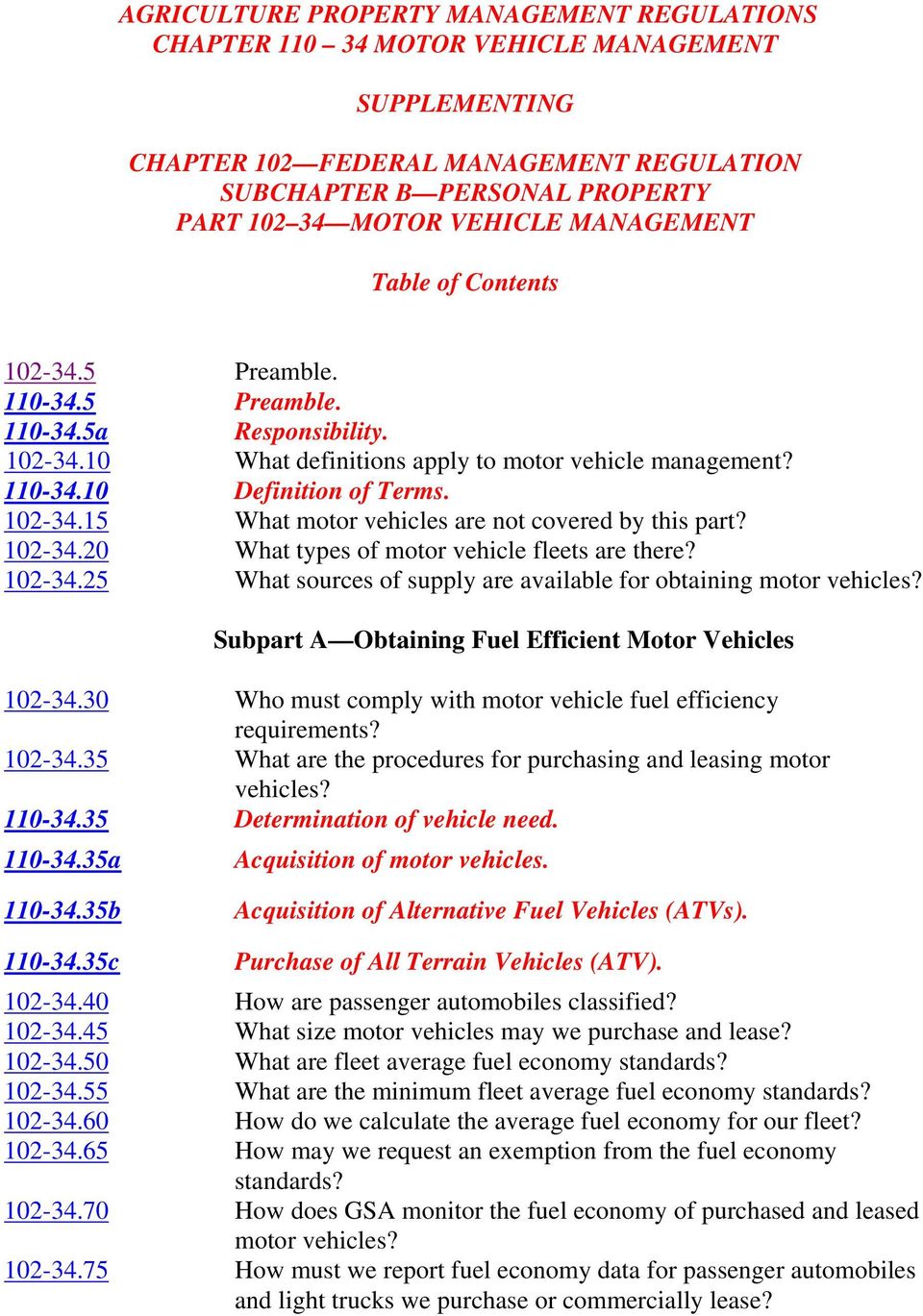
1 AGRICULTURE PROPERTY MANAGEMENT REGULATIONS CHAPTER MOTOR VEHICLE MANAGEMENT SUPPLEMENTING CHAPTER 102 FEDERAL MANAGEMENT REGULATION SUBCHAPTER B PERSONAL PROPERTY PART MOTOR VEHICLE MANAGEMENT Table of Contents Preamble Preamble a Responsibility What definitions apply to motor vehicle management? Definition of Terms What motor vehicles are not covered by this part? What types of motor vehicle fleets are there? What sources of supply are available for obtaining motor vehicles? Subpart A Obtaining Fuel Efficient Motor Vehicles Who must comply with motor vehicle fuel efficiency requirements? What are the procedures for purchasing and leasing motor vehicles? Determination of vehicle need a Acquisition of motor vehicles b Acquisition of Alternative Fuel Vehicles (ATVs) c Purchase of All Terrain Vehicles (ATV) How are passenger automobiles classified? What size motor vehicles may we purchase and lease? What are fleet average fuel economy standards? What are the minimum fleet average fuel economy standards? How do we calculate the average fuel economy for our fleet? How may we request an exemption from the fuel economy standards? How does GSA monitor the fuel economy of purchased and leased motor vehicles? How must we report fuel economy data for passenger automobiles and light trucks we purchase or commercially lease?
2 Do we report fuel economy data for passenger automobiles and light trucks purchased for our agency by the GSA Automotive Division? Do we have to submit a negative report if we don t purchase or lease any motor vehicles in a fiscal year? All negative reports must be submitted to OPPM, PMD Are any motor vehicles exempted from these reporting requirements? Does fleet average fuel economy reporting affect our acquisition plan? Where may we obtain help with our motor vehicle acquisition plan? Subpart B Identifying and Registering Motor Vehicles Motor Vehicle Identification What motor vehicles require motor vehicle identification? What motor vehicle identification must we put on motor vehicles we purchase or lease? Agency identification a Display of unauthorized use decals What motor vehicle identification must the Department of Defense (DOD) put on motor vehicles it purchases or leases? Where is motor vehicle identification placed on purchased and leased motor vehicles? Before we sell a motor vehicle, what motor vehicle identification or markings must we remove? Removal of U.S. Government tags. License Plates Must our motor vehicles use Government license plates? Do we need to register motor vehicles owned or leased by the Government? See Where may we obtain U.S. Government license plates? Registration outside the District of Columbia How do we display license plates on motor vehicles? What do we do about a lost or stolen license plate? Lost or stolen tags What records do we need to keep on U.S. Government license plates? Records.

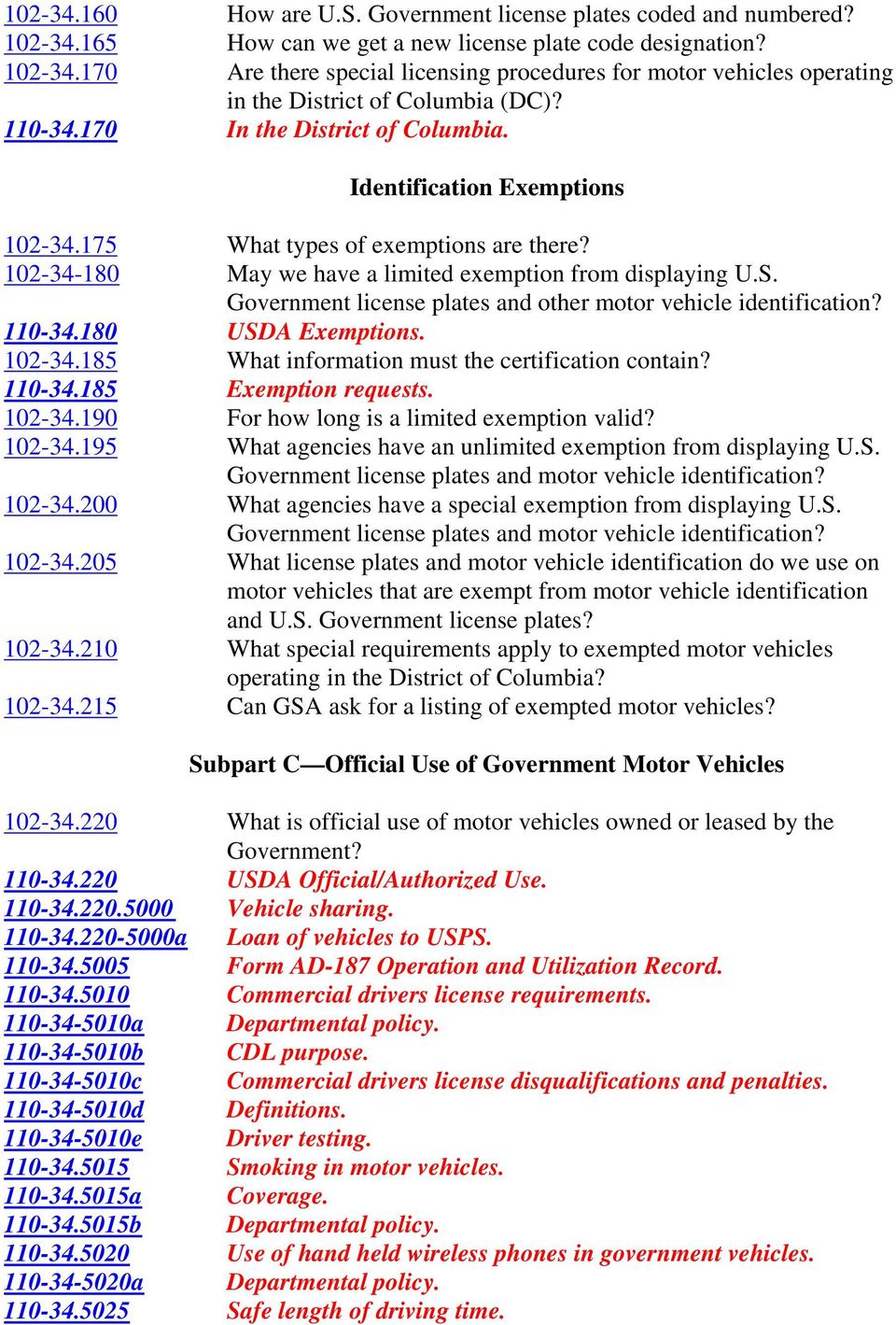
3 How are U.S. Government license plates coded and numbered? How can we get a new license plate code designation? Are there special licensing procedures for motor vehicles operating in the District of Columbia (DC)? In the District of Columbia. Identification Exemptions What types of exemptions are there? May we have a limited exemption from displaying U.S. Government license plates and other motor vehicle identification? USDA Exemptions What information must the certification contain? Exemption requests For how long is a limited exemption valid? What agencies have an unlimited exemption from displaying U.S. Government license plates and motor vehicle identification? What agencies have a special exemption from displaying U.S. Government license plates and motor vehicle identification? What license plates and motor vehicle identification do we use on motor vehicles that are exempt from motor vehicle identification and U.S. Government license plates? What special requirements apply to exempted motor vehicles operating in the District of Columbia? Can GSA ask for a listing of exempted motor vehicles? Subpart C Official Use of Government Motor Vehicles What is official use of motor vehicles owned or leased by the Government? USDA Official/Authorized Use Vehicle sharing a Loan of vehicles to USPS Form AD-187 Operation and Utilization Record Commercial drivers license requirements a Departmental policy b CDL purpose c Commercial drivers license disqualifications and penalties d Definitions e Driver testing Smoking in motor vehicles a Coverage b Departmental policy Use of hand held wireless phones in government vehicles a Departmental policy Safe length of driving time.
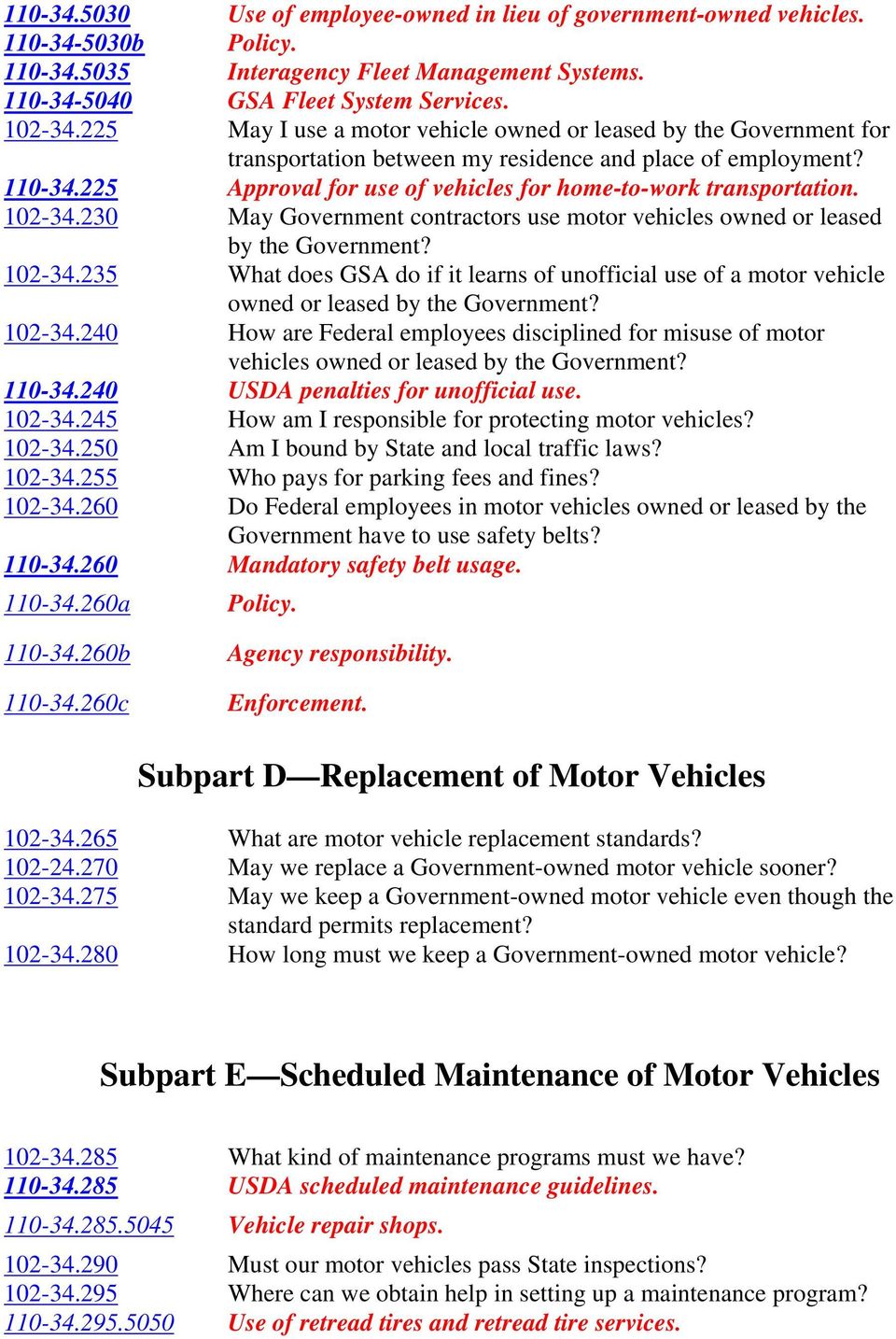
4 Use of employee-owned in lieu of government-owned vehicles b Policy Interagency Fleet Management Systems GSA Fleet System Services May I use a motor vehicle owned or leased by the Government for transportation between my residence and place of employment? Approval for use of vehicles for home-to-work transportation May Government contractors use motor vehicles owned or leased by the Government? What does GSA do if it learns of unofficial use of a motor vehicle owned or leased by the Government? How are Federal employees disciplined for misuse of motor vehicles owned or leased by the Government? USDA penalties for unofficial use How am I responsible for protecting motor vehicles? Am I bound by State and local traffic laws? Who pays for parking fees and fines? Do Federal employees in motor vehicles owned or leased by the Government have to use safety belts? Mandatory safety belt usage a Policy b c Agency responsibility. Enforcement. Subpart D Replacement of Motor Vehicles What are motor vehicle replacement standards? May we replace a Government-owned motor vehicle sooner? May we keep a Government-owned motor vehicle even though the standard permits replacement? How long must we keep a Government-owned motor vehicle? Subpart E Scheduled Maintenance of Motor Vehicles What kind of maintenance programs must we have? USDA scheduled maintenance guidelines Vehicle repair shops Must our motor vehicles pass State inspections? Where can we obtain help in setting up a maintenance program? Use of retread tires and retread tire services.
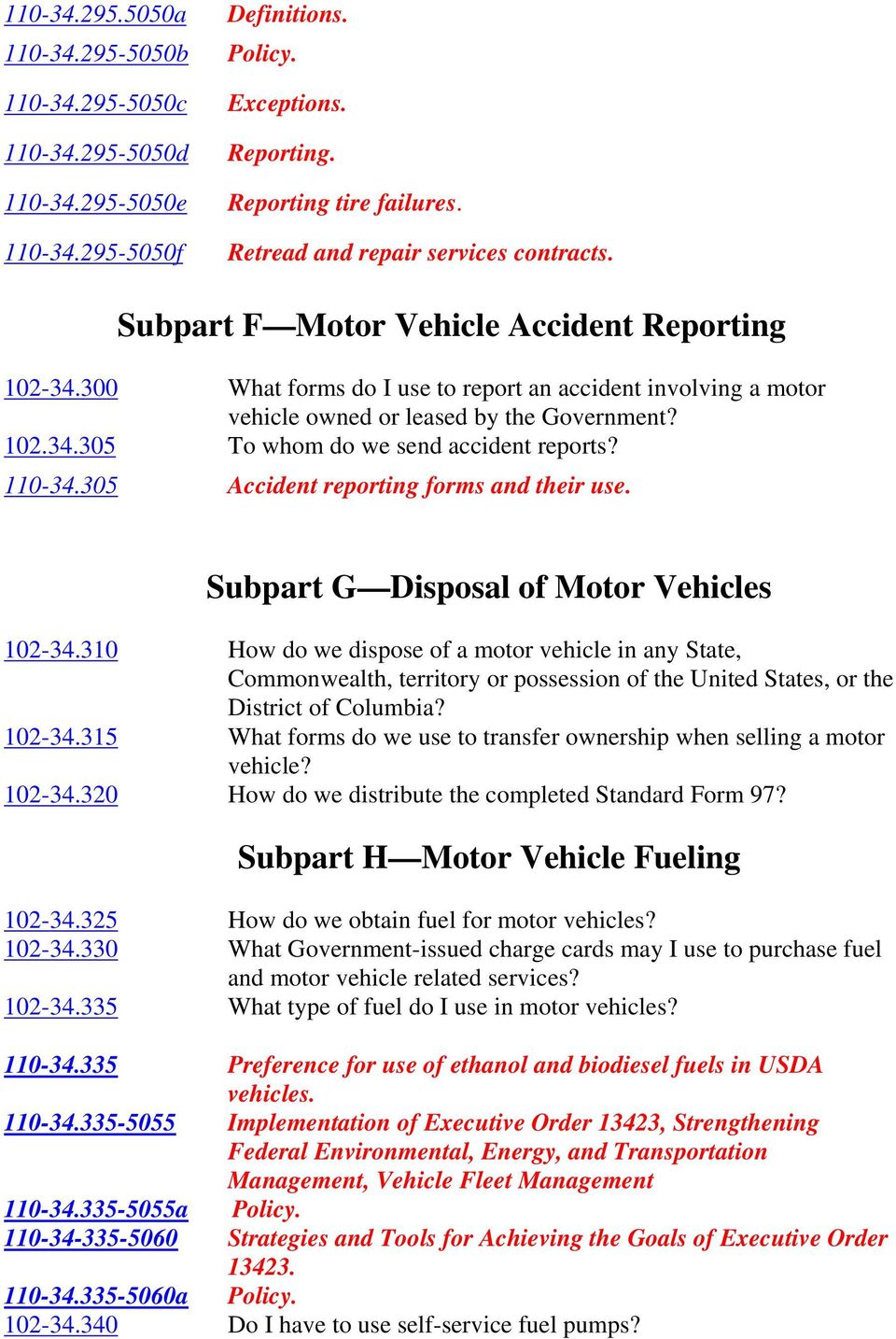
5 a b c d e f Definitions. Policy. Exceptions. Reporting. Reporting tire failures. Retread and repair services contracts. Subpart F Motor Vehicle Accident Reporting What forms do I use to report an accident involving a motor vehicle owned or leased by the Government? To whom do we send accident reports? Accident reporting forms and their use. Subpart G Disposal of Motor Vehicles How do we dispose of a motor vehicle in any State, Commonwealth, territory or possession of the United States, or the District of Columbia? What forms do we use to transfer ownership when selling a motor vehicle? How do we distribute the completed Standard Form 97? Subpart H Motor Vehicle Fueling How do we obtain fuel for motor vehicles? What Government-issued charge cards may I use to purchase fuel and motor vehicle related services? What type of fuel do I use in motor vehicles? Preference for use of ethanol and biodiesel fuels in USDA vehicles Implementation of Executive Order 13423, Strengthening Federal Environmental, Energy, and Transportation Management, Vehicle Fleet Management a Policy Strategies and Tools for Achieving the Goals of Executive Order a Policy Do I have to use self-service fuel pumps?
6 Fuel-Dispensing Facility a Policy. Subpart I Federal Motor Vehicle Fleet Report What is the Federal Motor Vehicle Fleet Report? What records do we need to keep? Records When and how do we report motor vehicle data? Reporting data. Subpart J Forms How do we obtain the forms prescribed in this part?
7 Combined Motor Vehicle Preamble. (a) This part governs the economical and efficient management and control of motor vehicles that the Government owns or leases. Agencies will incorporate appropriate provisions of this part into contracts offering Government-furnished equipment in order to ensure adequate control over the use of motor vehicles. (b) The questions and associated answers in this part are regulatory in effect. Thus compliance with the written text of this part is required by all executive agencies. (c) The terms "we," "I," "our," "you," and "your," when used in this part, mean you as an executive agency, as your agency s fleet manager, or as a motor vehicle user or operator, as appropriate Preamble This part supplements and implements the Federal Management Regulations (FMR) which provide Government-wide policy on motor vehicles as well as Executive Orders, published laws, Secretary Memoranda, Announcements, and Directives affecting the management and operation of the Department's motor vehicle fleet a Responsibility. This part states responsibilities of the Director, Office of Procurement and Property Management (OPPM), and provides general guidelines for the procurement, use and disposal of motorized vehicle equipment. The Director, OPPM, is responsible for establishing and operating a central monitoring system for, and providing oversight of, the motor vehicle operations of USDA, related activities, and reporting requirements. This includes consolidating and issuing Department-wide reports; conducting analyses and forecasts of Departmental motor vehicle requirements; and issuing Departmental policy on all areas regarding motor vehicles. All requests for exemptions to the FMR, which are referred to herein, and the Agriculture Property Management Regulations (AGPMR) must be submitted in writing to the Director, OPPM. The Agency Heads are responsible for managing and directing their motor vehicle fleets in accordance with laws, implementing regulations and the supplemental guidance described herein.

8 What definitions apply to motor vehicle management? The following definitions apply to this part: Commercial design motor vehicle means a motor vehicle procurable from regular production lines and designed for use by the general public. Domestic fleet (see section (a)) Foreign fleet (see section (b)) GSA Fleet lease (see section (d)) Large fleet (see section (d)) Law enforcement motor vehicle means a passenger automobile or light truck that is specifically approved in an agency s appropriation act for use in apprehension, surveillance, police or other law enforcement work or specifically designed for use in law enforcement. If not identified in an agency s appropriation language, a motor vehicle qualifies as a law enforcement motor vehicle only in the following cases: (1) A passenger automobile having heavy duty components for electrical, cooling and suspension systems and at least the next higher cubic inch displacement or more powerful engine than is standard for the automobile concerned. (2) A light truck having emergency warning lights and identified with markings such as "police." (3) An unmarked motor vehicle certified by the agency head as essential for the safe and efficient performance of intelligence, counterintelligence, protective, or other law enforcement duties. (4) A motor vehicle seized by a Federal agency that is subsequently used for the purpose of performing law enforcement activities. Light duty motor vehicle means any motor vehicle with a gross motor vehicle weight rating (GVWR) of 8,500 pounds or less. Light truck means a motor vehicle on a truck chassis with a gross motor vehicle weight rating (GVWR) of 8,500 pounds or less. Military design motor vehicle means a motor vehicle (excluding general-purpose motor vehicles) designed according to military specifications to support directly combat or tactical operations or training for such operations. Motor vehicle means any vehicle, self propelled or drawn by mechanical power, designed and operated principally for highway transportation of property or passengers, but does
9 not include a military design motor vehicle or vehicles not covered by this part (see section ). Motor vehicle identification (also referred to as "motor vehicle markings") means the legends "For Official Use Only" and "U.S. Government" placed on a motor vehicle plus other legends showing the full name of the department, agency, establishment, corporation, or service by which the motor vehicle is used. This identification is usually a decal placed in the rear window or on the side of the motor vehicle. Motor vehicle lease (see section (b)) Motor vehicle markings (see "Motor vehicle identification" in this section) Motor vehicle purchase (see section (a)) Motor vehicle rental (see section (c)) Motor vehicles transferred from excess (see section (e)) Owning agency means the executive agency that holds the vehicle title, manufacturer s Certificate of Origin, or is the lessee of a motor vehicle lease. This term does not apply to agencies that lease motor vehicles from the GSA Fleet. Passenger automobile means a sedan or station wagon designed primarily to transport people. Reportable motor vehicles are vehicles which are reported to GSA as outlined in Subpart I of this part: (1) Included are sedans, station wagons, buses, ambulances, vans, utility motor vehicles, trucks and truck tractors, regardless of fuel type. (2) Excluded are fire trucks, motorcycles, military-design motor vehicles, semi-trailers, trailers and other trailing equipment such as pole trailers, dollies, cable reels, trailer coaches and bogies, and trucks with permanently mounted equipment such as generators and air compressors. Small fleet (see section (c)) Using agency means a Federal agency that obtains motor vehicles from the GSA Fleet, commercial firms or another Federal agency and does not hold the vehicle title or manufacturer s Certificate of Origin. However, this does not include a Federal agency that obtains a motor vehicle by motor vehicle rental Definition of Terms

10 Property Management Information System (PMIS). PMIS is an information system having reporting interface capability with the Foundation Financial Information System. The system is mandated by Public Law and Secretary's Memorandum Number 1987 for all Agencies who own, lease, and operate motor vehicles. This system captures inventory and cost data and is designed to provide a comprehensive equipment management tool by standardization of various reporting systems among USDA agencies. For PMIS purposes, motor vehicles include all leased or owned standard motor vehicles used on and off-road, aircraft, and special equipment. Instructions for the use of this system are contained in Title VI - Systems Access Manual, Chapter 9, Property Management Information System, Subchapter 2, Personal Property System. All USDA agencies are required to participate in PMIS and to enter data for owned, GSA and commercially leased vehicles and special purpose equipment. Vehicle sharing/pooling. Vehicle sharing means the shared utilization of vehicles within and between Departmental agencies, or with other Federal, State, and county government agencies and activities for official purposes only. Vehicle pooling means the consolidation of Agencies' transportation needs to the maximum extent possible for the purpose of maximizing use of vehicular assets. Qualified mechanic. A qualified mechanic is determined to be one whose principle occupation is in the field of automotive mechanics. Fuel-dispensing facility. A permanent facility constructed to perform the function of dispensing fuel for use in motor vehicles, farm equipment, and other machinery or equipment, including the installation of underground and/or above ground tanks What motor vehicles are not covered by this part? Motor vehicles not covered are: (a) Designed or used for military field training, combat, or tactical purposes; (b) Used principally within the confines of a regularly established military post, camp, or depot; or (c) Used by an agency in the performance of investigative, law enforcement, or intelligence duties if the head of such agency determines that exclusive control of such vehicle is essential to the effective performance of such duties, although such vehicles are subject to subpart C and subpart I of this part What types of motor vehicle fleets are there? The types of motor vehicle fleets are:
11 (a) Domestic fleet means all reportable agency-owned motor vehicles operated in any State, Commonwealth, territory or possession of the United States, and the District of Columbia. (b) Foreign fleet means all reportable agency-owned motor vehicles operated in areas outside any State, Commonwealth, territory or possession of the United States, and the District of Columbia. (c) Small fleet means a fleet of fewer than 2,000 reportable agency-owned motor vehicles, worldwide. (d) Large fleet means a fleet of 2,000 or more reportable agency-owned motor vehicles, worldwide What sources of supply are available for obtaining motor vehicles? The following sources of supply are available: (a) Motor vehicle purchase means buying a motor vehicle from a commercial source, usually a motor vehicle manufacturer or a motor vehicle manufacturer s dealership. (b) Motor vehicle lease means obtaining a motor vehicle by contract or other arrangement from a commercial source for 60 continuous days or more. (c) Motor vehicle rental means obtaining a motor vehicle by contract or other arrangement from a commercial source for less then 60 continuous days. (d) GSA Fleet lease means obtaining a motor vehicle from the General Services Administration (GSA Fleet). Where "lease" is used alone within this part, it refers to "motor vehicle lease" in paragraph (b) of this section and not GSA Fleet lease. (e) Motor vehicles transferred from excess means obtaining a motor vehicle reported as excess and transferred with or without cost. Subpart A Obtaining Fuel Efficient Motor Vehicles Who must comply with motor vehicle fuel efficiency requirements? Executive agencies located in any State, Commonwealth, territory or possession of the United States, and the District of Columbia which operate motor vehicles owned or leased by the Government in the conduct of official business. This subpart does not apply to motor vehicles exempted by law or other regulations, such as law enforcement and motor vehicles in foreign areas. Other Federal agencies are encouraged to comply so that maximum energy conservation benefits may be realized in obtaining, operating, and managing motor vehicles owned or leased by the Government.

12 What are the procedures for purchasing and leasing motor vehicles? Procedures for purchasing and leasing motor vehicles can be found in subpart of this title Determination of vehicle need. Public Law , Consolidated Omnibus Reconciliation Act, Subtitle C - Federal Motor Vehicle Expenditure Control requires agencies to conduct cost comparisons to determine what is the most economical way of providing vehicle needs before a vehicle is acquired. Agencies are required to compare the cost of ownership to leasing from GSA and commercially leasing to determine which method is most cost effective. Once this is determined, the agency should acquire the vehicle in the most economical way with available funds. For example, if the cost comparison shows that ownership is the least costly and funds are not available to procure a vehicle, the agency would have to acquire the vehicle from the next most economical source. Agencies should determine that the vehicle acquired achieves maximum fuel efficiency and is limited to the minimum body size, engine size, and optional equipment necessary to meet agency requirements. When a determination is made that GSA is the source, agencies should contact the Fleet Management System (FMS) to see if a GSA vehicle is available for assignment. Agencies are reminded that GSA provides vehicles to agencies that are fully participating as defined. An agency is fully participating when: (a) All agency owned motor vehicles have been consolidated into the GSA Fleet Program. (b) The agency owns no vehicles to consolidate, but leases all vehicles from GSA Fleet Program. (c) The agency would otherwise qualify under one of the above paragraphs, but has been authorized by GSA to purchase or commercially lease motor vehicles because GSA was unable to meet the requirements. In the agency's request to GSA for a vehicle, the following information should be provided: (1) A certification that the request for the vehicle has not been denied by Congress, the Office of Management and Budget (OMB) or agency headquarters and that public or private means of transportation are not suitable or available and funds are available. (2) The number and type of vehicle required.

13 (3) The location where the vehicle is needed and the dates required including the earliest and latest acceptable dates. (4) The anticipated length of assignment and projected utilization in miles a Acquisition of motor vehicles. Passenger automobiles and light trucks acquired by the agencies must meet the statutory fleet average fuel economy standards prescribed in FMR Requests for waiver exemptions to the fleet average fuel economy standards must be submitted in writing to OPPM, Property Management Division (PMD), detailing the number and vehicle types to which this waiver request applies. All exemptions will be granted by GSA b Acquisition of Alternative Fuel Vehicles (AFVs). Agency Alternative Fuel Vehicle (AFV) acquisitions shall adhere to guidance issued in the Energy Policy Act of 1992 (EPAct) and Executive Order (E.O.) 13149, Greening the Government through Federal Fleet and Transportation Efficiency, dated April 21, Requirements for the acquisition of AFVs are as follows: Each agency will develop, document, and implement aggressive plans to fulfill the AFV acquisition requirements established by EPAct. In accordance with EPAct requirements, 75 percent of all light duty vehicle acquisitions in metropolitan statistical areas (MSAs) with populations of 250,000 or more shall be AFVs. Agencies may acquire AFVs through buying and/or leasing from the GSA, commercially leasing, or through a combination of these methods. Agency AFV acquisition requirement plans must be based on existing and requested funds, but shall not be exempt from the requirements of EPAct or E.O due to limited appropriations c Purchase of All Terrain Vehicles (ATVs). Procurement of ATVs shall be restricted to four-wheel types or larger. Agency Heads are expected to ensure that the employees operating the ATVs are trained or instructed on the proper use and safe operation of all types of ATVs. The Consumer Product Safety Commission has recommended ATV training through the Specialty Vehicle Institute of America (SVIA), Costa Mesa, California. USDA, Forest Service (FS), has developed a two-day training seminar on the proper use of all ATVs. Information may be obtained by contacting any area, district or regional office of the FS.

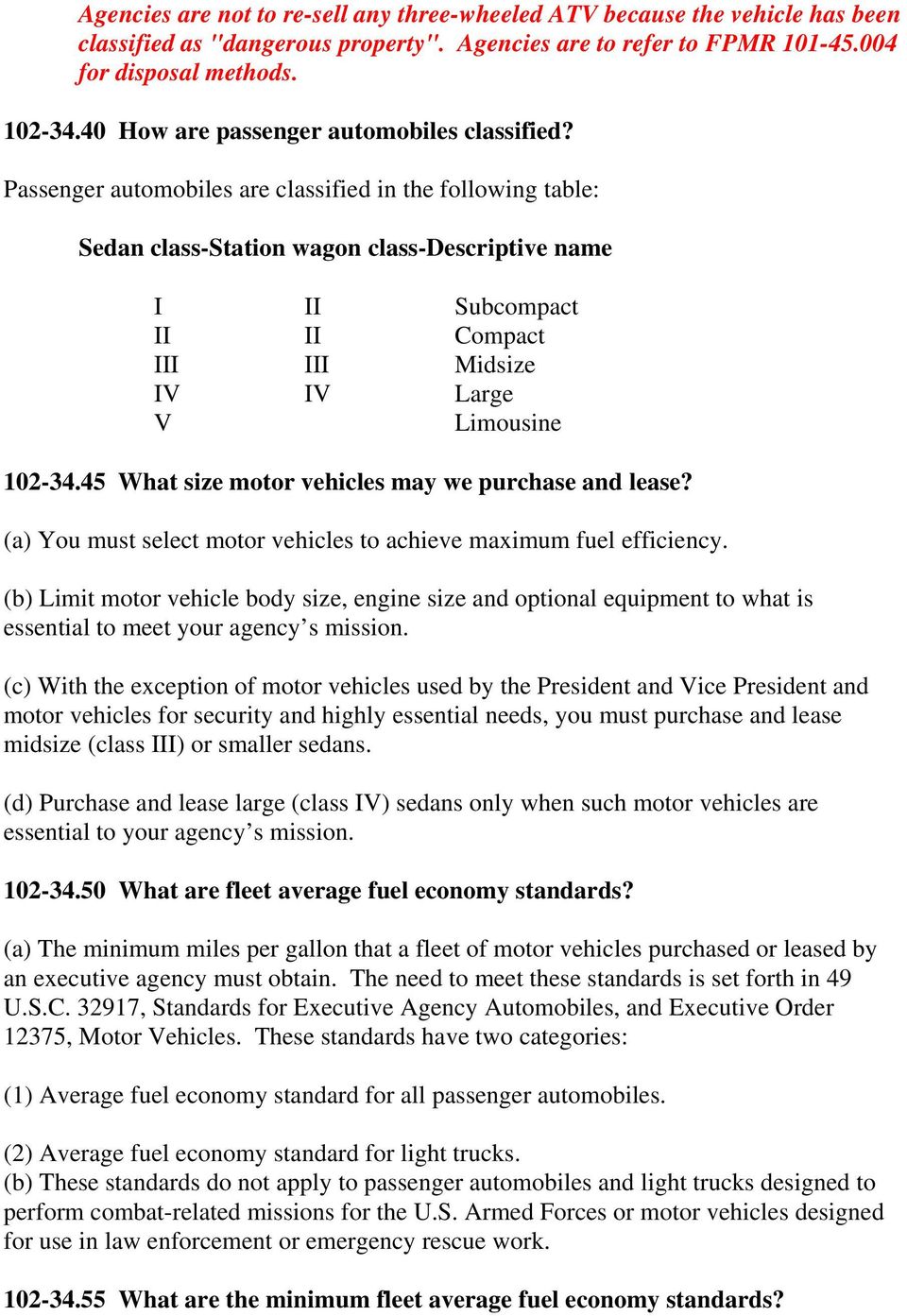
14 Agencies are not to re-sell any three-wheeled ATV because the vehicle has been classified as "dangerous property". Agencies are to refer to FPMR for disposal methods How are passenger automobiles classified? Passenger automobiles are classified in the following table: Sedan class-station wagon class-descriptive name I II Subcompact II II Compact III III Midsize IV IV Large V Limousine What size motor vehicles may we purchase and lease? (a) You must select motor vehicles to achieve maximum fuel efficiency. (b) Limit motor vehicle body size, engine size and optional equipment to what is essential to meet your agency s mission. (c) With the exception of motor vehicles used by the President and Vice President and motor vehicles for security and highly essential needs, you must purchase and lease midsize (class III) or smaller sedans. (d) Purchase and lease large (class IV) sedans only when such motor vehicles are essential to your agency s mission What are fleet average fuel economy standards? (a) The minimum miles per gallon that a fleet of motor vehicles purchased or leased by an executive agency must obtain. The need to meet these standards is set forth in 49 U.S.C , Standards for Executive Agency Automobiles, and Executive Order 12375, Motor Vehicles. These standards have two categories: (1) Average fuel economy standard for all passenger automobiles. (2) Average fuel economy standard for light trucks. (b) These standards do not apply to passenger automobiles and light trucks designed to perform combat-related missions for the U.S. Armed Forces or motor vehicles designed for use in law enforcement or emergency rescue work What are the minimum fleet average fuel economy standards?
15 The minimum fleet average fuel economy standards appear in the following table: Fleet Average Fuel Economy Standards: FISCAL YEAR PASSENGERi iii & beyond These figures represent miles/gallon LIGHT TRUCKS ii 1 Established by section 49 U.S.C and the Secretary of Transportation. 2 Fleet average fuel economy standard set by the Secretary of Transportation and mandated by Executive Order beginning in fiscal year Fleet average fuel economy for light trucks is the combined fleet average fuel economy for all 4 x 2 and 4 x 4 light trucks. 4 Requirements not yet set by the Secretary of Transportation How do we calculate the average fuel economy for our fleet? (a) Due to the variety of motor vehicle configurations, you must take an average of all motor vehicles, by category (passenger automobiles or light truck) purchased and leased by your agency during the fiscal year. This calculation is the sum of passenger automobiles or light trucks that your executive agency purchases or leases from commercial sources divided by the sum of the fractions representing the number of motor vehicles of each category by model divided by the unadjusted city/highway mile-pergallon ratings for that model, developed by the Environmental Protection Agency (EPA) for each fiscal year. The EPA mile-per-gallon rating for each motor vehicle make, model, and model year may be obtained from the: General Services Administration, ATTN: FFA, Washington, DC (b) An example follows: Light trucks : i 600 light trucks acquired in a specific year. These are broken down into: A. 200 Six cylinder automatic transmission pick-up trucks, EPA rating: 24.3 mpg, plus
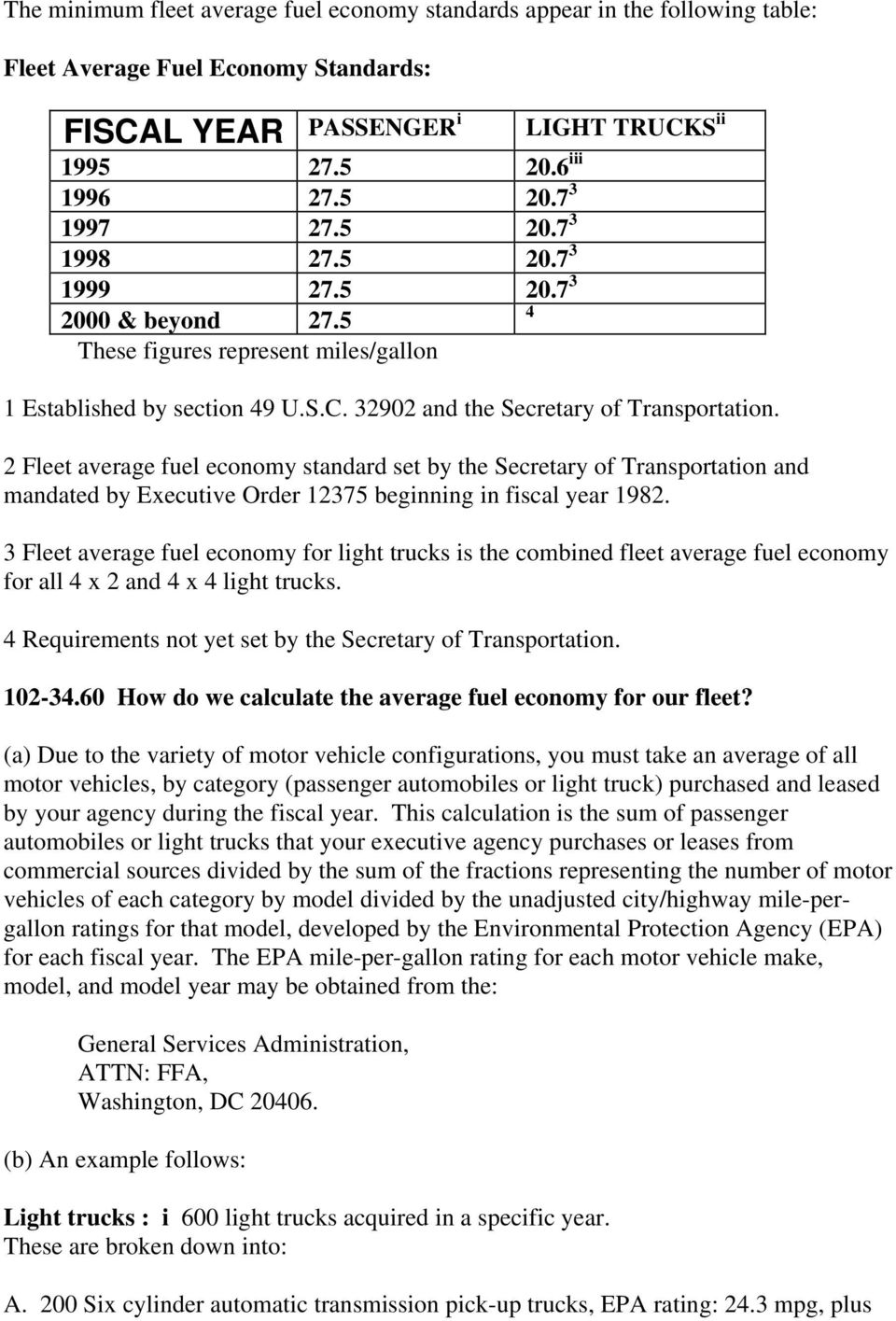
16 B. 150 Six cylinder automatic transmission mini-vans, EPA rating 24.8 mpg, plus C. 150 Eight cylinder automatic transmission pick-up trucks, EPA rating: 20.4 mpg, plus D. 100 Eight cylinder automatic transmission cargo vans, EPA rating: 22.2 mpg. = = = = (Rounded to nearest 0.1 mpg.) ii. Fleet average fuel economy for light trucks in this case is 23.0 mpg How may we request an exemption from the fuel economy standards? (a) You must submit your reasons for the exemption in a written request to the: Administrator of General Services, ATTN: MTV, Washington, DC (b) GSA will review the request and advise you of the determination within 30 days of receipt. Passenger automobiles and light trucks exempted under the provisions of this section must not be included in calculating your fleet average fuel economy How does GSA monitor the fuel economy of purchased and leased motor vehicles? (a) Executive agencies report to GSA their leases and purchases of passenger automobiles and light trucks. GSA keeps a master record of the miles per gallon for passenger automobiles and light trucks acquired by each agency during the fiscal year. GSA verifies that each agency s passenger automobile and light truck leases and purchases achieve the fleet average fuel economy for the applicable fiscal year, as required by Executive Order (b) The GSA Federal Vehicle Policy Division (MTV) issues information about the EPA miles-per-gallon ratings to executive agencies at the beginning of each fiscal year to help agencies with their acquisition plans How must we report fuel economy data for passenger automobiles and light trucks we purchase or commercially lease?

17 (a) You must send copies or synopses of motor vehicle leases and purchases to GSA. Use the unadjusted combined city/highway mile-per-gallon ratings for passenger automobiles and light trucks developed each fiscal year by the Environmental Protection Agency (EPA). All submissions for a fiscal year must reach GSA by December 1 of the next fiscal year. Submit the information as soon as possible after the purchase or effective date of each lease to the: General Services Administration, ATTN: MTV, Washington, DC (b) Include in your submission to GSA motor vehicles purchased or leased by your agency for use in any State, Commonwealth, territory or possession of the United States, and the District of Columbia. (c) Your submission to GSA must include: (1) Number of passenger automobiles and light trucks, by category. (2) Year. (3) Make. (4) Model. (5) Transmission type (if manual, number of forward speeds). (6) Cubic inch displacement of engine. (7) Fuel type (i.e., gasoline, diesel, or type of alternative fuel). (8) Monthly lease cost, if applicable. Note to section : Do not include passenger automobile and light truck lease renewal options as new acquisition motor vehicle leases. Do not report passenger automobiles and light trucks exempted from fleet average fuel economy standards (see section (b) and section ) Do we report fuel economy data for passenger automobiles and light trucks purchased for our agency by the GSA Automotive Division? No. The GSA Automotive Division provides information for passenger automobiles and light trucks it purchases for agencies Do we have to submit a negative report if we don t purchase or lease any motor vehicles in a fiscal year?
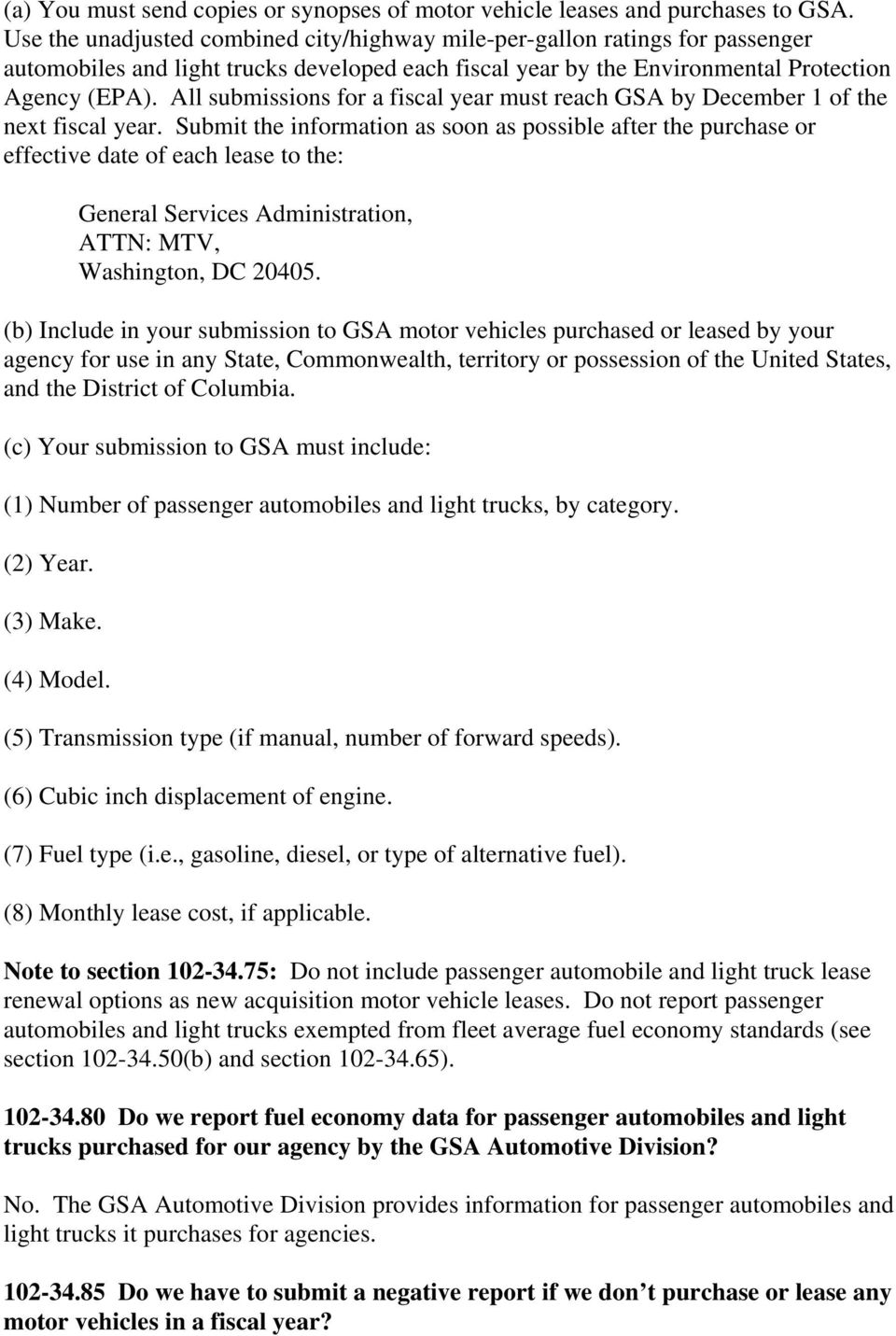
18 Yes. You must submit a negative report if you don t purchase or lease any motor vehicles in a fiscal year All negative reports must be submitted to OPPM, Property Management Division (PMD) Are any motor vehicles exempted from these reporting requirements? Yes. You do not need to report passenger automobiles and light trucks that are: (a) Purchased or leased for use outside any State, Commonwealth, territory or possession of the United States, or the District of Columbia. (b) Designed to perform combat-related missions for the U.S. Armed Forces. (c) Designed for use in law enforcement or emergency rescue work Does fleet average fuel economy reporting affect our acquisition plan? It may. If previous motor vehicle purchases and leases have caused your fleet to fail to meet the required fuel economy by the end of the fiscal year, GSA may encourage you to adjust future requests to meet fuel economy requirements Where may we obtain help with our motor vehicle acquisition plans? For help with your motor vehicle acquisition plans, contact the: General Services Administration, ATTN: MTV, Washington, DC Subpart B Identifying and Registering Motor Vehicles Motor Vehicle Identification What motor vehicles require motor vehicle identification? All motor vehicles owned or leased by the Government must display motor vehicle identification unless exempted under section , section , or section What motor vehicle identification must we put on motor vehicles we purchase or lease?
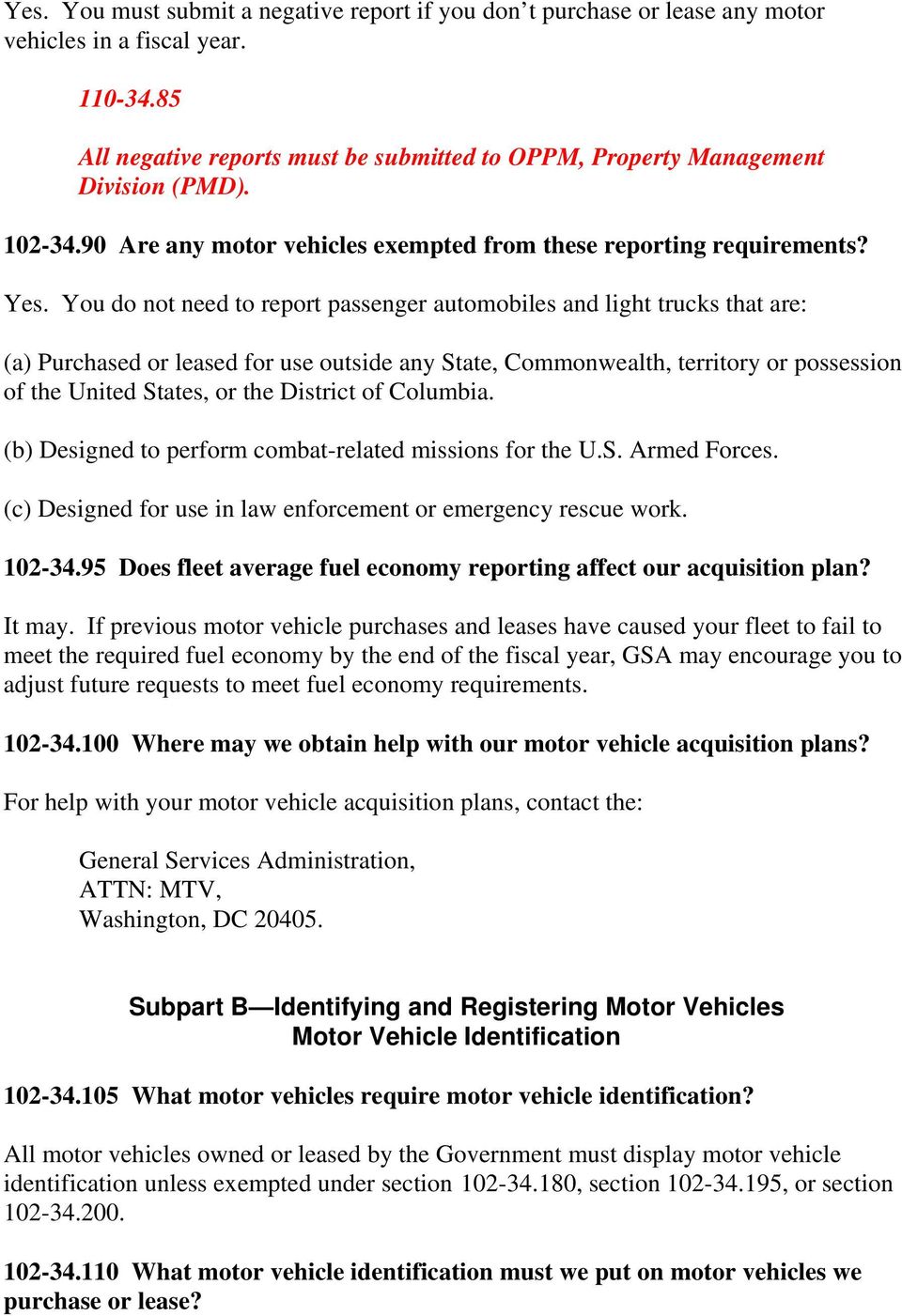
19 (a) For motor vehicles with rear windows, display: (1) "For Official Use Only," in letters ½ to ¾ inch high. (2) "U.S. Government" in letters ¾ to 1 inch high; and (3) The full name of the department, agency, establishment, corporation, or service owning or leasing the motor vehicle (in letters 1 to 1 ½ inch high), or in the alternative, a title that describes the activity in which it is operated (if the title readily identifies the department, agency, establishment, corporation, or service concerned). (b) For other than motor vehicle rear windows, display the motor vehicle identification in paragraphs (a)(1) through (3) of this section, but: (1) Use letters 1 to 1 ½ inches high in colors contrasting to the motor vehicle. (2) If you use subsidiary words or titles of subordinate units, use letters ½ inch to ¾ inch high. (c) The preferred material is a decal of elastomeric pigmented film type for ease of application and removal. Note to section : Each agency or activity is responsible for acquiring its own decals. Replace this motor vehicle identification when necessary due to damage or wear Agency identification. All vehicles acquired or leased by the USDA shall be marked "U.S. Department of Agriculture" without reference to a particular departmental agency, unless agency identification is required as an integral part of the motor vehicle mission or for safety reasons. Similarly, motor vehicles will not be repainted for the sole purpose of changing the factory delivered color, unless such repainting is required for mission purposes, or is essential to safety. The omission of individual agency identification and elimination of repainting are expected to enhance motor vehicle sharing. Justification and approval of the need for agency identification or painting must be documented at agency headquarters and kept in a central location for audit purposes. When approved for use, individual agency identification decals shall be obtained through the agency forms acquisition procedures a Display of unauthorized use decals. A decal (Form AD-185) stating the penalty for unauthorized use shall be conspicuously displayed on the instrument panel of each motor vehicle displaying the "For Official Use Only" legend. The display of the legend on
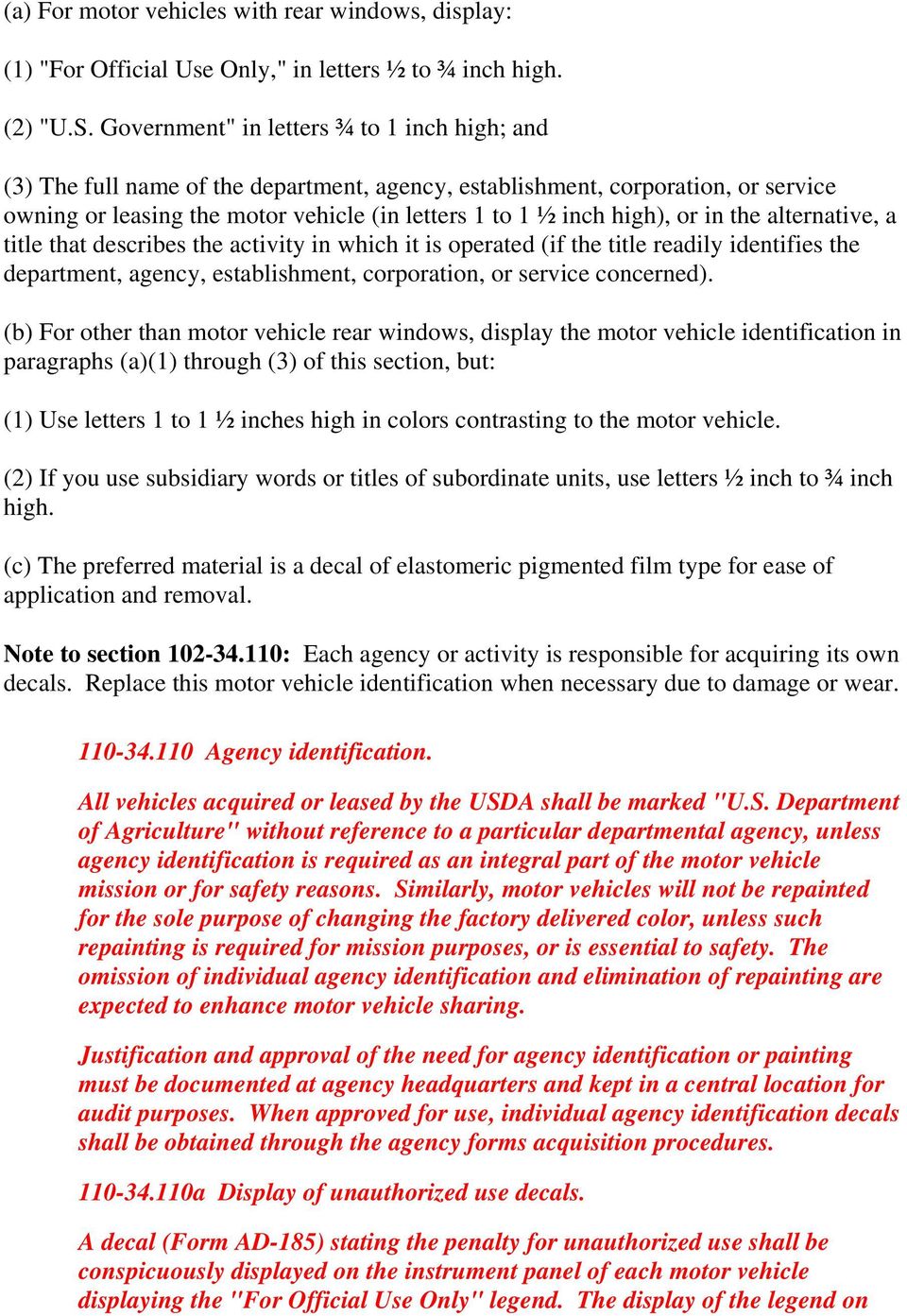
20 motor vehicles assigned motorcycle tags is not required where not practical because of the configuration of the vehicle. *****Note: Decals are not necessary if the vehicle uses the new USDA license plates produced by UNICOR because it has the USDA logo on it What motor vehicle identification must the Department of Defense (DOD) put on motor vehicles it purchases or leases? The following must appear on DOD purchased or leased motor vehicles: (a) "For Official Use Only;" (b) An appropriate title for the DOD component; and (c) The DOD code and registration number assigned by the DOD component accountable for the motor vehicle Where is motor vehicle identification placed on purchased and leased motor vehicles? (a) On most motor vehicles. On the left side of the rear window, 1 ½ inches or less from the bottom of the window. (b) On motor vehicles without rear windows or where identification on the rear window would not be easily seen. Centered on both front doors or in any appropriate position on each side of the motor vehicle. (c) On trailers. Centered on both sides of the front quarter of the trailer in a conspicuous location Before we sell a motor vehicle, what motor vehicle identification or markings must we remove? You must remove all motor vehicle identification before you transfer the title or deliver the motor vehicle Removal of U.S. Government tags. Whenever a motor vehicle is removed from Government service or transferred to another Department or Government activity outside of the USDA, the official U.S. Government tags shall be removed, destroyed and records appropriately annotated. A replacement vehicle should be issued new official U.S. Government tags.
21 *****Note: A new fleet credit card should also be issued for the new vehicle. License Plates Must our motor vehicles use Government license plates? Yes, you must use Government license plates, with the exception of motor vehicles exempted under section , section , and section Do we need to register motor vehicles owned or leased by the Government? For a motor vehicle owned or leased by the Government that is regularly based or operated outside the District of Columbia and displaying U.S. Government license plates and motor vehicle identification, you need not register it in a State, Commonwealth, territory or possession of the United States. Motor vehicles exempted under section , section , or section must be registered and inspected in accordance with the laws of the State, Commonwealth, territory or possession of the United States where the motor vehicle is regularly operated. See Where may we obtain U.S. Government license plates? For detailed instructions and an ordering form to obtain U.S. Government license plates, contact the: Superintendent of Industries, District of Columbia, Department of Corrections, Lorton, VA Note to section :You may, but are not required to obtain license plates from the District of Columbia, Department of Corrections Registration outside the District of Columbia All official USDA tags for vehicles shall be requisitioned through the Office of Operations (OO), Beltsville Service Center (BSC), 6351 Ammendale Road, Beltsville, MD 20705, (301) , fax The form to use is CFPDC-1. Questions concerning license plates, should be forwarded to OPPM, PMD, Personal Property Branch Chief on (202) Agencies should not go directly to UNICOR for tags because they are centrally stocked at the BSC.
22 How do we display license plates on motor vehicles? (a) Display official U.S. Government license plates on the front and rear of all motor vehicles owned or leased by the Government. The exception is two-wheeled motor vehicles, which require rear license plates only. (b) You must display U.S. Government license plates on the motor vehicle to which the license plates were assigned. (c) Display the U.S. Government license plates until the motor vehicle is removed from Government service or is transferred, or until the plates are damaged and require replacement. (d) For motor vehicles owned or leased by DOD, follow DOD regulations What do we do about a lost or stolen license plate? You should report the loss or theft of license plates as follows: (a) U.S. Government license plates. Tell your local security office (or equivalent) and local police. (b) District of Columbia or State license plates. Tell your local security office (or equivalent) and either the District of Columbia, Department of Transportation, or the State agency, as appropriate Lost or stolen tags. The tag number of all U.S. Government tags, lost or stolen, shall be reported to the responsible agency official maintaining current records of all tags, the issuing authority and to local, state, and federal police. The Property Officer should report the tag number as lost or stolen to PMD What records do we need to keep on U.S. Government license plates? You must keep a central record of all U.S. Government license plates for your agency s motor vehicle purchases and motor vehicle leases. The GSA Fleet must keep such a record for GSA Fleet vehicles. The record must identify: (a) The motor vehicle to which each set of plates is assigned. (b) The complete history of any reassigned plates. (c) A list of destroyed or voided license plate numbers Records.
23 The BSC shall maintain a record of all tags issued to the USDA agencies. Each agency shall maintain current use and disposal records of all tags issued to it. These records shall include the description and location of each motor vehicle to which a tag is attached so that a particular motor vehicle can be promptly identified in case of accident, theft, etc., when only a tag number is available. Tags from motor vehicles transferred or disposed of and tags rendered unserviceable shall be reported to the responsible agency official. These U.S. Government tags must be destroyed, and all records appropriately annotated. Agencies are responsible for updating PMIS. *****Note: When vehicles are replaced, the old license plates should be destroyed and new license plates issued. A new fleet credit card should also be issued for the new vehicle How are U.S. Government license plates coded and numbered? U.S. Government license plates, except those issued by the District of Columbia, Department of Transportation, under section , will be numbered serially for each executive agency, beginning with 101, and preceded by a letter code that designates the owning agency for the motor vehicle as follows: Agriculture, Department of A Air Force, Department of the AF Army, Department of the W Commerce, Department of C Consumer Product Safety Commission CPSC Corps of Engineers, Civil Works CE Defense, Department of D Defense Commissary Agency DECA Defense Contract Audit Agency DA Defense Logistics Agency DLA District of Columbia Redevelopment Land Agency LA Energy, Department of E Enrichment Corporation, U.S EC Environmental Protection Agency EPA Executive Office of the President EO Council of Economic Advisers, National Security Council, Office of Management and Budget. Federal Communications Commission FC Federal Deposit Insurance Corporation FD Federal Emergency Management Agency FE Federal Mediation and Conciliation Service FM General Services Administration GS
24 Government Printing Office GP GSA Fleet G Health and Human Services, Department of HHS Interior, Department of the I Judicial Branch of the Government JB Justice, Department of J Labor, Department of L Legislative Branch LB Marine Corps MC National Aeronautics and Space Administration NA National Capital Planning Commission NP National Guard Bureau NG National Labor Relations Board NL National Science Foundation NS Navy, Department of the N Nuclear Regulatory Commission NRC Office of Personnel Management OPM Panama Canal Commission PC Railroad Retirement Board RR Selective Service System SS Small Business Administration SB Smithsonian Institution SI National Gallery of Art Soldiers and Airmen s Home, U.S SH State, Department of S Tennessee Valley Authority TV Transportation, Department of DOT Treasury, Department of the T United States Information Agency IA United States Postal Service P Veterans Affairs, Department of VA How can we get a new license plate code designation? To get a new license plate code designation, write to the: General Services Administration, ATTN: MTV, Washington, DC Are there special licensing procedures for motor vehicles operating in the District of Columbia (DC)?
25 Yes. DC Code, section (d)(2), requires the issuance of license plates, without charge, for all motor vehicles owned or leased by the Government at the time the motor vehicle is registered or reregistered. (a) You must register motor vehicles that are regularly based or operated in DC with the DC Department of Transportation. Your application to register must include a manufacturer s Certificate of Origin, bill of sale, or other document attesting Government ownership. Forms for registering motor vehicles are available from the District of Columbia, Department of Transportation. (b) Motor vehicles owned or leased by the Government and licensed in the District of Columbia may have the letter code designation prescribed in section stenciled in the blank space beside the embossed numbers. If you add a letter code designation, stencil it on the license plate so that the letters resemble the embossed numbers in size and color. License plates issued by the District of Columbia without an agency letter code designation will usually have the letter code designation "US". (c) Transfer of U.S. Government license plates issued by the District of Columbia between your agency s own motor vehicles requires prior approval from the District of Columbia, Department of Transportation. (d) You must have each registered motor vehicle inspected annually according to section of the District of Columbia Code and applicable regulations. The District of Columbia issues an inspection verification sticker for each motor vehicle that passes inspection. Inspections and stickers are free. (e) Return damaged or mutilated license plates to the District of Columbia, Department of Transportation, for cancellation. Also return license plates when you transfer a motor vehicle regularly based or operated in the District of Columbia to operation in a field area, another agency, or remove the motor vehicle from Government service In the District of Columbia. Section (b)(2) of the District of Columbia Code has been eliminated. USDA agencies owning or leasing motor vehicles for 60 continuous days or more in the District of Columbia must now use USDA license tags beginning with the letter A. Identification Exemptions What types of exemptions are there? (a) Limited exemption. (b) Unlimited exemption.
26 (c) Special exemption May we have a limited exemption from displaying U.S. Government license plates and other motor vehicle identification? Yes. The head of your agency or designee may authorize a limited exemption to the display of U.S. Government license plates and motor vehicle identification upon written certification. (See section ) For motor vehicles leased from the GSA Fleet, send an information copy of this certification to the: General Services Administration, ATTN: FFF, Washington, DC Note to section : Not eligible for exemption are motor vehicles regularly used for common administrative purposes and not directly connected to investigative, law enforcement or intelligence duties involving security activities USDA Exemptions. Requests for all exemptions must be submitted in writing by an appropriate certifying agency official to OPPM, PMD What information must the certification contain? The certification must state either: (a) That the motor vehicle is used primarily for investigative, law enforcement or intelligence duties involving security activities and that identifying the motor vehicle would interfere with those duties; or (b) That identifying the motor vehicle would endanger the security of the vehicle occupants Exemption Requests: Exemption requests shall include: (a) A description of the duties which warrant the use of an unidentified motor vehicle threat or endangerment to personnel; reasons why the use of unidentified motor vehicles is essential; location and number of vehicles; and, whether the motor vehicles are Department-owned, commercially-leased or leased from GSA s Fleet.
27 (b) In emergency situations, if U.S. Government tags or other required identification serve to heighten threats to employees or U.S. Government property, the Agency Head may grant interim motor vehicle identification exemptions. Emergency exemption requests will be forwarded within five working days to OPPM, PMD, Personal Property Branch with the data required in (a) above, for approval For how long is a limited exemption valid? An exemption granted in accordance with section and section may last from one day up to one year. If the requirement for exemption still exists at the end of the year, your agency must re-certify the continued exemption. For a motor vehicle leased from the GSA Fleet, send a copy of the re-certification to the: General Services Administration, ATTN: FFF, Washington, DC What agencies have an unlimited exemption from displaying U.S. Government license plates and motor vehicle identification? The following Federal agencies, or activities within agencies, listed below are granted an unlimited exemption based on ongoing mission requirements and do not need to certify: (a) Administrative Office of the United States Courts. All motor vehicles used by United States probation offices and pretrial services agencies of the judicial branch of the U.S. Government. (b) Department of Agriculture. Motor vehicles used for investigative or law enforcement activities by the Agricultural Marketing Service, Animal and Plant Health Inspection Service, Food Safety and Inspection Service, Forest Service, Grain Inspection, Packers and Stockyard Administration, Packers and Stockyard Program, Food and Consumers Service, and Office of the Inspector General. (c) Department of Commerce. Motor vehicles used for surveillance and other law enforcement activities by the Office of Export Enforcement, International Trade Administration, the National Marine Fisheries Service, and the National Oceanic and Atmospheric Administration. (d) Department of Defense. Motor vehicles used for intelligence, investigative, or security activities by the U.S. Army Intelligence Agency and the Criminal Investigation Command of the Department of the Army; Office of Naval Intelligence of the Department of the Navy; Office of Special Investigations of the Department of the Air Force; the Defense Criminal Investigation Service, Office of the Inspector General; and the Defense Logistics Agency.
28 (e) District of Columbia. Motor vehicles used by St. Elizabeth s Hospital in outpatient work, where identifying the motor vehicles would be prejudicial to patients. (f) Department of Education. Motor vehicles used for investigative and law enforcement activities by the Office of the Inspector General. (g) Department of Energy. Motor vehicles used for investigative or security activities. (h) Environmental Protection Agency. Motor vehicles used for investigative and law enforcement activities by the Office of Inspector General and the Office of Enforcement and Compliance Assurance. (i) Federal Communications Commission. Motor vehicles used for investigative activities by the Field Operations Bureau. (j) General Services Administration. Motor vehicles used for investigative, surveillance, and security activities by special agents of the Federal Protective Service, and Office of the Inspector General. (k) Department of Health and Human Services. Motor vehicles used for undercover law enforcement and similar investigative work by the Food and Drug Administration; motor vehicles used to transport mentally disturbed children by the National Institutes of Health; and motor vehicles used for law enforcement and investigative purposes by the Office of Investigations and the Office of the Inspector General. (l) Department of Housing and Urban Development. Motor vehicles used for law enforcement or investigative purposes by the Office of the Inspector General. (m) Department of the Interior. Motor vehicles used to enforce game laws by the U.S. Fish and Wildlife Service; motor vehicles assigned to special agents of the Bureau of Land Management who investigate crimes against public lands; motor vehicles assigned to special officers of the Bureau of Indian Affairs; motor vehicles used for investigating crimes against public lands by the National Park Service and assigned to the U.S. Park Police; and motor vehicles assigned to the special agents of the Office of the Inspector General who investigate possible crimes of fraud and abuse by departmental employees, contractors, and grantees. (n) Department of Justice. All motor vehicles used for undercover law enforcement activities or investigative work by the Department. (o) Department of Labor. All motor vehicles used for investigative, law enforcement, and compliance activities by the Employment and Training Administration, Occupational Safety and Health Administration, Employment Standards Administration, and the Mine Safety and Health Administration.
29 (p) National Aeronautics and Space Administration. Motor vehicles used for investigative or law enforcement activities. (q) National Labor Relations Board. Motor vehicles used for investigative activities by field offices. (r) National Security Council. Motor vehicles used by the Central Intelligence Agency. (s) Nuclear Regulatory Commission. Motor vehicles used for the conduct of security operations or in the enforcement of security regulations. (t) Office of Personnel Management. Motor vehicles used for the investigative program of the Office of Personnel Investigations and regional investigation activities. (u) United States Postal Service. Motor vehicles that the Postal Inspection Service use for investigative and law enforcement activities. (v) Department of State. Motor vehicles used for protecting domestic and foreign dignitaries and investigating passport and visa fraud. (w) Department of Transportation. Motor vehicles used for intelligence, investigative, or security activities by the Office of the Inspector General, the OST Office of Security, the Investigations and Security Division and field counterparts in the U.S. Coast Guard, the Office of Civil Aviation Security and field counterparts in the Federal Aviation Administration, and the Idaho Division Office of Motor Carriers in the Federal Highway Administration. (x) Department of Treasury. Motor vehicles used by the U.S. Secret Service; the Criminal Investigation Division and the Internal Security Division of the Internal Revenue Service; motor vehicles used for investigative activities by the Collection Division of the Internal Revenue Service; motor vehicles used by the Office of Enforcement and the Office of Inspection at the Bureau of Alcohol, Tobacco, and Firearms; and motor vehicles used by the Office of Enforcement, Office of Compliance Operations, and the Office of Internal Affairs at the U.S. Customs Service. (y) Department of Veterans Affairs. Motor vehicles used for investigative activities by the Office of the Inspector General and regional Field Examiners and Property Management Inspectors What agencies have a special exemption from displaying U.S. Government license plates and motor vehicle identification? Motor vehicles assigned for the use of the President and the heads of executive departments specified in 5 U.S.C. 101 are exempt from the requirement to display motor vehicle identification. All motor vehicles, other than those assigned for the personal use of the President, will display official U.S. Government license plates.
30 What license plates and motor vehicle identification do we use on motor vehicles that are exempt from motor vehicle identification and U.S. Government license plates? Display the regular license plates of the State, Commonwealth, territory or possession of the United States, or the District of Columbia, where the motor vehicle is principally operated What special requirements apply to exempted motor vehicles operating in the District of Columbia? If your agency wants to use regular District of Columbia license plates for motor vehicles exempt from displaying U.S. government license plates and motor vehicle identification, your agency head must designate an official to authorize them. Provide the name and facsimile signature of that official to the District of Columbia, Department of Transportation, annually Can GSA ask for a listing of exempted motor vehicles? Yes. If asked, the head of each executive agency must submit a report concerning motor vehicles exempted under this subpart. This report, which has been assigned interagency report control number 1537-GSA-AR, should be submitted to the: General Services Administration, ATTN: MTV, Washington, DC Subpart C Official Use of Government Motor Vehicles What is official use of motor vehicles owned or leased by the Government? Use of a motor vehicle to perform your agency s mission(s), as authorized by your agency USDA Official/Authorized Use. Refer to Departmental Regulation (DR) and Federal Travel Regulations for specific instructions on travel between the residence and place of employment and personnel in a travel status. (a) Employee responsibility. Employees assigned the use of Government owned or leased motor vehicles are responsible for assuring that vehicles are used only for official purposes. Employees shall exercise discretion to avoid, wherever
31 possible, any situation which may tend to convey an impression to the public that the assigned motor vehicle is being used for unofficial purposes. Non- Federal employees should not be transported in U.S. Government vehicles unless for official purposes and written approval has been obtained from the Agency Head or his/her designee in advance. (b) Supervisory responsibility. Supervisory control over employees assigned the use of Government owned or leased motor vehicles shall include: (1) Advising employees of the requirements of these regulations. (2) Establishing prior approval procedures for use of motor vehicles at irregular hours, or under circumstances where motor vehicle use may create an unfavorable public reaction. (3) Maintaining motor vehicles dispatch records that will provide reasonable assurance of compliance with these regulations. (4) Ensuring that the type of vehicle assigned is suitable for its intended use and consistent with the achievement of maximum economy. (5) Ensuring that employees are qualified and properly licensed to operate such motor vehicles as appropriate. Issuance of an Identification Card (Standard Form 46 or Optional Form 346) is optional. However, agencies must have procedures to identify employees who are authorized to operate Government owned or leased motor vehicles and assure that the other requirements of this subpart and the FMR are met. (6) Appropriate training should be provided to all employees who operate special purpose vehicles and equipment as defined in f. Such training should be sufficient to ensure safe handling of the vehicles and equipment Vehicle sharing. Agencies will implement a vehicle sharing program with collocated, and closely situated agencies and activities in the field. The objectives of this program are maximizing vehicle utilization and the associated cost savings, without infringing upon the holding agencies' management autonomy. (a) To insure the objectives of this program are accomplished, holding agencies shall enter into formal (written) agreements with using agencies and activities. The level at which intermittent use agreements are consummated shall be at the discretion of the agencies concerned. (b) At a minimum, these agreements should include the following terms and conditions:
32 (1) Operation and Utilization Record, Form AD-187, will be properly maintained so as to accurately reflect operations and maintenance costs in accordance with the holding agency's policy for the collection of this data. (2) Procedures for performance of maintenance and repair. (3) Accident report forms completion and submission in the event of an accident. (4) Reimbursement to the holding agency for accident damage caused by using agency employees. (5) Responsibility for all Tort Claims resulting from accidents while the vehicle is under the control of the using agency employee. (6) Vehicle usage guidelines to reduce or avoid travel over terrain with features that exceed vehicle capabilities. (7) Accounting for miles driven by using agency employees, for inclusion in holding agency's reports. (8) Procedures for using agency reimbursements to holding agency for intermittent vehicle use, and holding agency method of billing. (9) Holding agency's responsibility for publication of a schedule of vehicle availability for use by the using agency. (10) Holding agency's responsibility for instructing using agency's personnel on routine and special record keeping requirements. (11) Using agency's responsibility for safeguarding fleet credit cards a Loan of vehicles to USPS. (a) U.S. Postal Service (USPS) may request the loan of vehicles from Departmental agencies during periods of heavy mail volume. Agencies may loan vehicles when they can be made available without adversely affecting operations. (b) Reimbursement for the vehicles by the USPS is required by Executive Order The USPS is to be billed on the basis of current mileage rate per mile during the loan period. Billing will not be made unless the per vehicle cost exceeds $100 in any calendar quarter. (c) USPS Form PS-4577, Hire and Borrowed Vehicle Condition Report, provided by the USPS, is to be used to determine the condition of the vehicle at the time of loan and return. It should be completed and signed by both parties as concurring in the condition of the vehicle at the time of the loan. The vehicle condition is to be checked against the condition shown in the form when returned. USDA fleet credit card shall be removed from the vehicle before turning it over to the USPS. The
33 Operation and Utilization Record, AD-187, will remain in the vehicle and be maintained by the USPS. (d) Mileage accumulated by vehicles in a loan status will not be included in quarterly energy reports. Such mileage will be reported by the USPS. (e) The USPS is to pay all operating costs and return the vehicle in a clean and safe operable condition. A signed Form AD-732 must be secured from the individual receiving the vehicle for the USPS and retained on file until the vehicle is returned. (f) The USPS will permit the use of the vehicle only by its employees while on USPS business. (g) The USPS will be responsible to USDA for any damage to the vehicle, normal wear and tear excepted. The USPS will hold and save harmless USDA from any and all actions, causes of actions, claims and demands for, upon, or property which may be sustained in consequences of the use of the vehicle by USPS employee. (h) Operation and maintenance costs will be paid by the USPS. Operation and maintenance costs include but are not limited to gasoline, oil, repairs, tires, and parts to maintain the vehicle in a clean and safe operating condition. *****Note: Agencies, upon request, may loan their motor vehicles to other Federal Government agencies, State, and county governments in emergencies. Emergencies as used in this part include national disasters and, defense of our nation Form AD-187 Operation and Utilization Record. This record, in booklet form, is available through agency forms supply channels for recording motor vehicle data. The booklet is designed to facilitate the preparation of the Annual Motor Vehicle Report and contains the following forms: Monthly Operation Record (AD-187) Maintenance and Inspection Record (Back Cover of AD-187) General instructions on completing these forms are contained in the booklet. Agencies are to issue specific instructions on completing and routing these forms, and for such management reviews as are necessary to assure efficient utilization of all motor vehicles Commerical Drivers License Requirements. This section contains requirements for motor vehicle operators as specified in the Office of Personnel Management (OPM), Federal Personnel Manual
34 (FPM) Chapter 930 and requirements mandated under the Commercial Motor Vehicle Safety Act of 1986, otherwise referred to as the Commercial Drivers License (CDL) Program. All persons operating Government owned or leased motor vehicles shall have a valid State drivers license in his/her possession at all times. Special equipment operators shall likewise have a valid State drivers license for the particular equipment type as required by each State. The license fee represents a personal expense (incurred incident to qualifying for a position) and may not be reimbursed by an agency without specific statutory authorization. Physical standards and safety of personnel authorized to operate Government owned or leased motor vehicles are published under the provisions of 5 CFR a Departmental policy. All persons operating Government owned or leased motor vehicles, shall possess a valid State drivers license for the particular type of vehicle(s) operated. All personnel operating Government owned or leased motor vehicles, must also be authorized to do so by personnel having authority to approve the use of such vehicles. The supervisor is responsible for ensuring the employee possesses a valid State drivers license, including a CDL when applicable. Application for and obtaining the CDL is the responsibility of the employee b CDL Purpose. The purpose of this program is to help reduce or prevent truck and bus related accidents, fatalities, and injuries by requiring motor vehicle operators to have a single commercial motor vehicle drivers license and by disqualifying motor vehicle operators who operate commercial motor vehicles in an unsafe manner c Commercial Drivers License disqualifications and penalties. As specified in 49 CFR Part , a motor vehicle operator who is disqualified shall not operate a commercial vehicle. A supervisor shall not knowingly allow, require, permit, or authorize a motor vehicle operator who is disqualified to drive such a vehicle. The following are disqualifying offenses: (a) driving a commercial vehicle while under the influence of alcohol or a controlled substance; (b) leaving the scene of an accident involving a commercial vehicle; or (c) committing a felony involving the use of a commercial vehicle (except for controlled substance felonies).
35 First time offenders for the above offenses are disqualified for a period of one year, provided the vehicle was not transporting hazardous materials required to be placarded. If the vehicle was transporting such hazardous materials, the period of disqualification is three years. First time offenders of controlled substance felonies are disqualified for life. A controlled substance felony is defined as the use of a commercial motor vehicle involving the manufacturing, distribution, or dispensing of a controlled substance as defined under Section 102(6) of the Controlled Substances Act (21 U.S.C. 802(6)), including all substances listed in Schedules I through V of 21 CFR Part There are also disqualifications for serious traffic violations during any 3-year period ranging from 60 to 120 days d Definitions. (a) Bus. A bus is any motor vehicle designed, constructed, and or used for the transportation of 16 or more passengers, including the driver or as defined by the State, District of Columbia, Commonwealth of Puerto Rico, or U.S. possessions where it is primarily operated. (b) Special equipment operator. A special equipment operator is an employee who operates: (1) Buses (2) Commercial Motor Vehicle (CMV): CMV is a motor vehicle or combination of motor vehicles used in commerce to transport passengers or property if the motor vehicle: (i) has a gross combination weight rating of 11,794 kilograms or more (26,001 pounds or more) inclusive of a towed unit with a gross vehicle weight rating of more than 4,536 kilograms (10,000 pounds); or (ii) has a gross vehicle weight rating of 11,794 or more kilograms (26,001 pounds or more); or operates the following types and/or sizes of motorized equipment. (iii) is designed to transport 16 or more passengers, including the driver; or (iv) is of any size and is used in the transportation of materials found to be hazardous for the purposes of the Hazardous Materials Transportation Act and which require the motor vehicle to be placarded under the Hazardous Materials Regulations (49 CFR part 172, subpart F). (3) Emergency vehicles. (4) Law enforcement vehicles.
36 (5) Highway vehicles greater than 16,000 pounds GVWR. (6) Construction, industrial, and agricultural equipment (e.g., motor graders, crawler tractors, wheeled tractors, wheeled loaders, log skidders, fork lifts, etc.). (7) Other equipment such as snowmobiles, trail bikes, motorcycles, all-terrain vehicles, motor boats, etc e Driver testing. Agencies should avoid duplication of State test/licensing programs, and rely upon State, the Commonwealth of Puerto Rico, or U.S. possessions' licensing procedures to the maximum extent practical. Each agency needs to determine whether a State's testing program is to be used or a comparable agency operating test. Departmental operating tests are not required for motor vehicle operators of both 2- and 4-wheeled vehicles up to 16,000 pounds GVWR. However, agencies are responsible for ensuring that special equipment operators are qualified to operate equipment assigned in compliance with applicable State or jurisdiction qualifications or licensing requirements or make the necessary arrangements for specialized testing. Operators of vehicles must be tested by the State in which the employee resides and must meet all necessary requirements to obtain a CDL. For commercial motor vehicles that require a CDL, agencies may provide a representative type vehicle to currently employed personnel taking the skills (driving) test to obtain or renew the CDL Smoking in Motor Vehicles a Coverage. The requirements contained in this section shall apply to all employees that operate USDA owned or leased motor vehicles. This is in accordance with FMR (d), which prohibits smoking in all GSA Fleet vehicles b Departmental Policy. Smoking is prohibited in USDA owned or leased vehicles (lease agreements for 60 continuous days or longer). This prohibition applies to all tobacco products. Each agency/office is responsible for enforcing this policy Use of Hand Held Wireless Phones in Government Vehicles See GSA Bulletin (FMR B-2), which shall apply to all employees that operate Government owned or leased motor vehicles a Departmental Policy.
37 Use of hand-held wireless phones while driving motor vehicles owned or leased by the Federal Government is discouraged. A portable hands-free accessory and/or a hands free car kit for government owned wireless phones are recommended. Drivers are required to follow all state and local laws while driving a Government vehicle on official business. New York State has already enacted a ban on the use of hand-held wireless phones by drivers Safe Length of Driving Time USDA employees are to always use caution and expertise while operating a motor vehicle owned or leased by the Federal government. When it is necessary to operate a motor vehicle for extended periods of time, drivers are strongly encouraged to take at least a 15 minute break after each three hours of driving time, or more often, if the driver feels it will enhance his or her safe operation of the vehicle Use of Employee-Owned in Lieu of Government-Owned Vehicles This subpart requires agencies to evaluate and determine when the use of employee-owned motor vehicles is advantageous to the Government before authorizing reimbursement for such use b Policy. The use of Government owned motor vehicles for official transportation is generally advantageous to the Government. Normally, Government owned motor vehicles can be made available on a planned basis. In some cases, however, it is more advantageous to the Government for employees to use their own motor vehicle, in lieu of Government owned motor vehicles. Guidance for determining the travel circumstances and authorized reimbursements related to use of employee-owned motor vehicles is contained in Departmental Manual , Travel Regulations Interagency Fleet Management Systems Upon receipt of notice by the Department of the intent of a study to develop data and justification as to the advisability of establishing a motor pool in a specific area, the agencies concerned will be notified in writing. On receipt of such notice, each agency will designate an agency field official as its representative for the study area, with whom Departmental and GSA representatives may consult and who will furnish needed information and assistance, including reasonable opportunities to observe motor vehicle operations and facilities and to examine pertinent cost and other records. The Director, OPPM, with the concurrence of the head of the agency concerned, will designate, for each study area, an agency official to serve as Departmental Representative for the purpose of coordinating the study from the Departmental standpoint. Usually, the representative will be an official of the agency that has the predominant motor vehicle interest in the area under study.
38 GSA Fleet System Services. Problems with service and/or costs which cannot be resolved at the local GSA fleet office or the GSA regional level shall be submitted, with pertinent information to OPPM, PMD, for resolution May I use a motor vehicle owned or leased by the Government for transportation between my residence and place of employment? No, you may not use a Government motor vehicle for transportation between your residence and place of employment unless your agency authorizes such use after making the necessary determination under 31 U.S.C and subpart of this title. Your agency must keep a copy of the written authorization within the agency and monitor the use of these motor vehicles Approval for use of vehicles for home-to-work transportation. See Departmental Regulation (DR) May Government contractors use motor vehicles owned or leased by the Government? Yes. Government contractors may use Government motor vehicles when authorized under applicable procedures and the following conditions: (a) Motor vehicles are used for official purposes only and solely in the performance of the contract. (b) Motor vehicles cannot be used for transportation between residence and place of employment, unless authorized in accordance with 31 U.S.C and subpart of this title. (c) Contractors must: (1) Establish and enforce suitable penalties against employees who use, or authorize the use of, such motor vehicles for unofficial purposes or for other than in the performance of the contract; and (2) Pay any expenses or cost, without Government reimbursement, for using such motor vehicles other than in the performance of the contract What does GSA do if it learns of unofficial use of a motor vehicle owned or leased by the Government? GSA reports the matter to the head of the agency employing the motor vehicle operator. The employing agency investigates and may, if appropriate, take disciplinary action
39 under 31 U.S.C or may report the violation to the Attorney General for prosecution under 18 U.S.C How are Federal employees disciplined for misuse of motor vehicles owned or leased by the Government? If an employee willfully uses, or authorizes the use of, a motor vehicle for other than official purposes, the employee is subject to suspension of at least one month or, up to and including, removal by the head of the agency (31 U.S.C. 1349) USDA Penalties for unofficial use. In addition to employee penalties stated above in FMR , any indiscreet use of a Government owned or leased vehicle shall subject the employee responsible for authorizing such use to disciplinary action in accordance with Chapter 751 of the Departmental Personnel Manual How am I responsible for protecting motor vehicles? When a Government-owned or -leased motor vehicle is under your control, you must: (a) Park or store the vehicle in a manner that reasonably protects it from theft or damage. (b) Lock the unattended motor vehicle. (The only exception to this requirement is when fire regulations or other directives prohibit locking motor vehicles in closed buildings or enclosures.) Am I bound by State and local traffic laws? Yes. You must obey all motor vehicle traffic laws of the State and local jurisdiction, except when the duties of your position require otherwise. You are personally responsible if you violate State or local traffic laws. If you are fined or otherwise penalized for an offense you commit while performing your official duties, but which was not required as part of your official duties, payment is your personal responsibility Who pays for parking fees and fines? You must pay parking fees while operating a motor vehicle owned or leased by the Government. However, you can expect to be reimbursed for parking fees incurred while performing official duties. Conversely, if you are fined for a parking violation while operating a motor vehicle owned or leased by the Government, payment is your personal responsibility and you will not be reimbursed Do Federal employees in motor vehicles owned or leased by the government have to use safety belts?
40 Yes. Federal employees must use safety belts, when there is a safety belt Mandatory Safety Belt Usage a Policy. It shall be mandatory for all occupants of motor vehicles owned or leased by the Government, equipped with safety belt restraints, to use them at all times. The only exception is a medical condition that would prevent use of safety belts b. Agency Responsibility. Each agency having jurisdiction over property containing public roadways, such as the Forest Service and the Agricultural Research Service, shall revise its agency regulations to incorporate this safety belt policy. It is the agency's responsibility to implement this policy by providing the necessary signs, incorporating this policy in the text of brochures, and other incidental public contact c. Enforcement. Enforcement may be by agency enforcement officials only as a secondary offense. This means that a vehicle cannot be stopped for the sole purpose of looking for safety belt violations. The vehicle must be stopped for some other traffic violation, such as reckless driving. The penalty for a violation of this policy can be a fine of not more than $500 or imprisonment for not more than six months or both (7 U.S.C. 1011(f)). Enforcement of State safety belt laws while on USDA public lands may also be enforced by State or local law enforcement officials where applicable. Penalties will be according to State law. Subpart D Replacement of Motor Vehicles What are motor vehicle replacement standards? Motor vehicle replacement standards specify the minimum number of years in use or miles traveled at which an executive agency may replace a Government-owned motor vehicle (see section ) May we replace a Government-owned motor vehicle sooner? Yes. You may replace a Government-owned motor vehicle if it needs body or mechanical repairs that exceed the fair market value of the motor vehicle. Determine the fair market value by adding the current market value of the motor vehicle plus any capitalized motor vehicle additions (such as a utility body or liftgate) or repairs. Your agency head or designee must review the replacement in advance.
41 May we keep a Government-owned motor vehicle even though the standard permits replacement? Yes. The replacement standard is a minimum only, and therefore, you may keep a Government-owned motor vehicle longer than shown in section if the motor vehicle can be operated without excessive maintenance costs or substantial reduction in resale value How long must we keep a Government-owned motor vehicle? You must keep a motor vehicle owned or leased by the Government for at least the years or miles shown in the following table: Table of Minimum Replacement Standards Motor Vehicle Type Years a* or Miles a* Sedans/Station Wagons 3 60,000 Ambulances 7 60,000 Buses: Intercity n/a 280,000 City n/a 150,000 School n/a 80,000 Trucks Less than 12,500 pounds GVWR 6 50,000 12,500-23,999 pounds GVWR 7 60,000 24,000 pounds GVWR and over 9 80, or 6-wheel drive motor vehicles 6 40,000 a Minimum standards are stated in both years and miles; use whichever occurs first. Subpart E Scheduled Maintenance of Motor Vehicles What kind of maintenance programs must we have? You must have a scheduled maintenance program for each motor vehicle you own or lease. This requirement applies to motor vehicles operated in any State, Commonwealth, territory or possession of the United States, and the District of Columbia. The GSA Fleet will develop maintenance programs for GSA Fleet vehicles. The scheduled maintenance program must: (a) Meet Federal, State, and local emission standards; (b) Meet manufacturer warranty requirements; (c) Ensure the safe and economical operating condition of the motor vehicle throughout its life; and
42 (d) Ensure that inspections and servicing occur as recommended by the manufacturer or more often if local operating conditions require USDA Scheduled Maintenance Guidelines In addition to the requirements contained above, agencies shall maintain their motor vehicles as described below: (a) Tires will be checked at least weekly to insure that the correct air pressure recommended by the vehicle manufacturer is maintained. The air pressure prescribed by the manufacturer shown in the owner's manual and on the driver's door will be maintained at all times, unless conditions dictate otherwise. The maintenance of proper tire pressure will reduce fuel consumption and tire wear. (b) Owned and commercially leased motor vehicles should have mechanical inspections performed by a qualified licensed mechanic in accordance with State and local requirements or manufacturer recommended schedules. Visual safety inspections do not have to be performed by a qualified licensed mechanic. However, these inspections should be conducted annually by anyone the agency designates, except the driver of the vehicle. Visual inspections should include, at a minimum, such items as checking safety belts, parking brakes, head and parking lights, tail and back up lights, tag lights, hazard lights, brake lights, turn signals, horns, windshield wipers/washers, rear and side view mirrors, tire pressure, and tire tread wear. An operator may request an inspection at any time he or she believes an unsafe condition exists. (c) The Form AD-187, Operation and Utilization Record contains the Maintenance and Inspection Record. The Maintenance and Inspection Record checklist is the pull out page attached to the back of the Operation and Utilization Record book. These forms will be completed annually for each inspection for those agencies that use these forms. Agencies not utilizing these forms may develop their own inspection checklist, with the inspection items contained in the back of the Maintenance and Inspection Record book as a minimum requirement for items to be inspected. These vehicle checklists should be kept with vehicle records for audit purposes. (d) Government operated maintenance shops shall be used when feasible in lieu of more expensive alternatives. As appropriate, agencies shall negotiate support agreements with other Federal Departments to obtain maintenance support at the lowest overall cost. (e) In those areas where GSA maintenance support is inadequate, due to problems involving policy matters, agencies should document the problems encountered and submit them to OPPM, PMD, for submission to GSA headquarters for corrective action Vehicle Repair Shops
43 (a) Policy - It is the policy of the Department to rely upon commercial sources to the extent practicable and economical. An agency of the Department will not own or operate motor vehicle repair shops, unless that agency can justify a need and cost effectiveness for managing such a facility in accordance with criteria below. (b)test Criteria Agencies are required to apply the following test criteria when establishing or continuing operation of motor vehicle repair shops. These criteria are to be applied in lieu of an A-76 review to all existing and future repair shop facilities: 1. If the motor vehicles or the agency owned shop are located within 30 miles or more from two or more commercial shops, the agency shop shall be closed or not established. 2. If the motor vehicles or agency owned shop is located 30 miles or more from two or more commercial shops, a value analysis, approved by the Agency Head, must show a minimum cost savings of 20 percent over use of commercial facilities, or the agency owned shop shall be closed or not established Must our motor vehicles pass State inspections? Yes, your motor vehicles must pass State inspections, where mandated. (a) Each motor vehicle owned or leased by the Government must pass Federallymandated emission inspections in the jurisdictions in which they operate when required by State motor vehicle administrations or State environmental departments. You must reimburse State activities for the cost of these inspections if the fee is not waived. GSA will pay the cost of these inspections for motor vehicles leased from the GSA Fleet. (b) Motor vehicles owned or leased by the Government that are exempted from the display of U.S. Government license plates and motor vehicle identification must comply with emission and mechanical inspection programs of the State, Commonwealth, territory or possession of the United States or the District of Columbia in which they are regularly operated. Your agency must pay for these inspections, unless the fee is waived. Payment for these inspections for motor vehicles leased from the GSA Fleet are the responsibility of the using agency Where can we obtain help in setting up a maintenance program? For help in setting up a maintenance program, contact the: General Services Administration, ATTN: MTV,
44 Washington, DC Use of retread tires and retread tire services. (a) This establishes the Department's policy and procedures for the use of retread tires and tire retreading services, as required by the Environmental Protection Agency's (EPA) Comprehensive Procurement Guideline (CPG) (40 CFR Part 247), which implements section 6002 of the Solid Waste Disposal Act, as amended by the Resources Conservation and Recovery Act (RCRA), as amended, 42 U.S.C (b) RCRA Section 6002 requires EPA to designate items that are or can be made with recovered materials and to issue guidelines to assist procuring agencies in meeting the requirements concerning purchase and use of these designated items. In accordance with RCRA Section 6002, EPA has designated retread tires (excluding airplane tires) and tire retreading services as items which Federal agencies must purchase to the maximum extent feasible. (c) Executive Order 12873, "Federal Acquisition, Recycling, and Waste Prevention", October 20, 1993, Section 506, specifically requires Federal agencies to comply with and implement the EPA procurement guidelines for retread tires and re-refined lubricating oil. (d) The Federal Acquisition Regulation (FAR) provides procurement policies and procedures concerning these EPA designated items. These policies are supplemented in USDA's procurement regulations (AGAR) Subpart Use of Recovered Materials a Definitions. (a) Agency. Federal agency or agency in RCRA and the EPA CPG in this section refers to the U.S. Department of Agriculture (USDA) as a whole. (b) Feasible. Feasible means the product can be purchased at a reasonable price, is available within a reasonable period of time, meets reasonable performance standards for the specific application, and an adequate level of competition exists. (c) Retread tire. Retread tire means a previously used automobile, truck, or other motor vehicle tire whose tread has been replaced. (d) Tire. Tire means the following types of tires: passenger car tires, light-, and heavy-duty truck tires, bus tires, and special service tires (including military, agricultural, off-road, and pneumatic industrial) b Policy.
45 As part of USDA's monitoring program, both USDA employees and those cooperators using USDA owned or leased motor vehicles are to procure retread services (retread existing tires in the system) or retread tires (replacement tires) to the maximum extent feasible c Exceptions. Exceptions to the use of retread tires or retreading services are: (a) Unavailable within a reasonable period of time; (b) Unable to meet the required performance specifications; (c) Unavailable at a reasonable price; or (d) 49 CFR, Chapter II, Subpart G, Section (d) prohibits the use of regrooved, recapped or retreaded tires on the front wheels of buses d Reporting. Annual review and monitoring of the effectiveness of the affirmative procurement program for EPA designated items is required. Each agency shall maintain logs or other records necessary to provide reporting data. These logs or records must be available upon request, and should contain, at a minimum, the following information: (a) Total dollar amount of new tires (excluding aircraft tires) purchased by an agency during the fiscal year. (b) Total dollar amount of retread tires (excluding aircraft tires) purchased by an agency during the fiscal year e Reporting tire failures. All tire failures are to be reported and deficiencies noted on a Standard Form 368, Quality Deficiency Report, irrespective of satisfactory corrective action taken by the manufacturer's authorized dealer, vendor, or contractor. Please submit a copy of the SF-368 to OPPM, PMD. EPA has a Recycled Products Information Hotline for questions regarding the Guideline which covers Retread Tires and other items of interest to property and fleet managers. The number is or in Washington, DC, (703) or TDD (703) f Retread and repair service contracts. The previously established retread and repair service contracts established by GSA regional zone offices have been canceled. The Automotive Commodity Center is currently in the process of developing a National Retread Services Contract.
46 Subpart F Motor Vehicle Accident Reporting What forms do I use to report an accident involving a motor vehicle owned or leased by the Government? GSA recommends the following forms for use to report an accident in any State, Commonwealth, territory or possession of the United States and the District of Columbia. The forms should be carried in any motor vehicle owned or leased by the Government. (a) Standard Form 91, Motor Vehicle Accident Report. The motor vehicle operator should complete this form at the time and scene of the accident if possible, even if damage to the motor vehicle is not noticeable. (b) Standard Form 94, Statement of Witness. This form should be completed by any witness to the accident To whom do we send accident reports? Send accident reports as follows: (a) If the motor vehicle is owned or leased by your agency, follow your internal agency directives. (b) If the motor vehicle is managed by the GSA Fleet, report the accident to GSA in accordance with subpart of this title Accident reporting forms and their use. See internal Agency reporting requirements and AGPMR, Subchapter N, Subpart G Disposal of Motor Vehicles How do we dispose of a motor vehicle in any State, Commonwealth, territory or possession of the United States, or the District of Columbia? After meeting the replacement standards under subpart D of this part, you may dispose of a Government-owned motor vehicle by transferring the motor vehicle title, or manufacturer s Certificate of Origin, to the new owner. Detailed instructions on the disposal process are in parts and of this title What forms do we use to transfer ownership when selling a motor vehicle?
47 Use the following forms to transfer ownership: (a) Standard Form 97, The United States Government Certificate to Obtain Title to a Motor Vehicle, if both of the following apply: (1) The motor vehicle will be retitled by a State, Commonwealth, territory or possession of the United States or the District of Columbia; and (2) The purchaser intends to operate the motor vehicle on highways. Note to section (a)(2): Do not use Standard Form 97 if the Governmentowned motor vehicle is either not designed or not legal for operation on highways. Examples are construction equipment, farm machinery, and certain military-design motor vehicles. Instead, use an appropriate bill of sale or award document. Examples are Optional Form 16, Sales Slip-Sale of Government Personal Property, and Standard Form 114, Sale of Government Property Bid and Award. (b) Standard Form 97 is optional in foreign countries because foreign governments may require the use of other forms. Note to section : The original Standard Form 97 is printed on secure paper to identify readily any attempt to alter the form. The form is also pre-numbered to prevent duplicates. State motor vehicle agencies may reject certificates showing erasures or strikeovers How do we distribute the completed Standard Form 97? Standard Form 97 is a 4-part set printed on continuous-feed paper. Distribute the form as follows: (a) Original SF 97 to the purchaser or donee. (b) One copy to the owning agency. (c) One copy to the contracting officer making the sale or transfer of the motor vehicle. (d) One copy under owning-agency directives. Subpart H Motor Vehicle Fueling How do we obtain fuel for motor vehicles? You may obtain fuel for any motor vehicle owned or leased by the Government by using: (a) A Government-issued charge card; (b) A Government agency fueling facility; or
48 (c) Personal funds and obtaining reimbursement from your agency What Government-issued charge cards may I use to purchase fuel and motor vehicle related services? (a) You may use a fleet charge card specifically issued for this purpose. These cards are designed to collect motor vehicle data at the time of purchase. Where appropriate, State sales and motor fuel taxes are deducted from fuel purchases by the fleet charge card services contractor before your agency is billed. The GSA contractor issued fleet charge card is the only Government-issued charge card that may be used for GSA Fleet motor vehicles. For further information on acquiring these fleet charge cards and their use, contact the: General Services Administration, ATTN: FCX, Washington, DC (b)you may use a Government purchase card if you do not have a fleet charge card or if the use of such a government purchase card is required by your agency mission. However, the Government purchase card does not collect motor vehicle data nor does it deduct State sales and motor fuel taxes. NOTE: See Departmental Regulation for further information on USDA purchase card policy What type of fuel do I use in motor vehicles? (a) Use the grade (octane rating) of fuel recommended by the motor vehicle manufacturer when fueling motor vehicles owned or leased by the Government. (b) Do not use premium grade gasoline in any motor vehicle owned or leased by the Government unless the motor vehicle specifically requires premium grade gasoline. (c) Use unleaded gasoline in all Government owned or leased motor vehicles designed to operate on gasoline and used overseas unless: (1) Such use would be in conflict with country-to-country or multi-national logistics agreements; or (2) Such gasoline is not available locally Preference for Use of Ethanol and Biodiesel Fuels in USDA Vehicles.
49 USDA has established a preference policy for the use of fuels such as ethanol and biodiesel which are made from renewable agricultural products. Each USDA agency shall adhere to the following policy: USDA agencies that maintain diesel fuel tanks for their fleet vehicles, off-road vehicles, marine vessels, and other motorized diesel equipment will buy and use blends of 20 percent (B20) or higher biodiesel fuel where practicable and reasonable in cost. USDA agencies that do not maintain diesel fuel tanks will seek out opportunities to fuel at nearby federal or commercial fueling facilities that offer B20 biodiesel at reasonable cost. USDA agencies that maintain gasoline fueling facilities will buy and use ethanol-blended fuels containing at least 10% domestically produced ethanol or other alcohol to the extent practicable where the fuel is readily available and reasonably priced compared with unleaded gasoline. USDA agencies that use commercial fueling stations will buy these fuels when they are readily available and at reasonable cost. Where flex-fuel vehicles operate in geographic areas that offer E-85 fueling sites, USDA agencies shall strive to fuel the vehicles routinely with E-85. Consistent with mission requirements, USDA agencies will also purchase or lease alternative fuel vehicles, including E-85 flex-fuel vehicles, for placement in geographic areas that offer alternative fueling stations as part of overall compliance with alternative fuel acquisition requirements of EPAct. The Assistant Secretary for Administration shall carry out these policy preferences Implementation of Executive Order 13423, Strengthening Federal Environmental, Energy, and Transportation Management. Vehicle Fleet Management a. Policy. In accordance with the Council on Environmental Quality Executive 0rder implementing instructions and Secretary Memorandum, Implementing Executive Order 13423, dated September 17, 2007, USDA agencies shall carryout the following mandates: USDA agencies will make annual increases in alternative fuel use by 10 percent measured against the prior year s alternative fuel usage level. If an agency fails to attain the 10 percent increase in any year, in the following year it shall attain both the percentage missed and the 10 percent increase due for that following year. USDA agencies will reduce covered petroleum use by 2 percent annually measured relative to the baseline year 2005 petroleum usage levels. In planning
50 for petroleum use reductions, agencies shall assess their petroleum needs across their sub-organizations, taking into account mission needs, and make adjustments where necessary to attain the 2 percent goal on average for the entire agency. If an agency fails to meet the 2 percent petroleum reduction goal in any year, in the following year it shall reduce both the percentage it missed and the percent reduction due for that following year. Law enforcement and emergency vehicles, including those vehicles that are used in an emergency capacity, by the agency, greater than 75 percent of the year is exempt from the alternative fuel increase and petroleum reduction decrease goals. (DOE will determine if vehicles have been properly exempted by auditing the data agencies provide in the Federal Automotive Statistical Tool (FAST)) Strategies and Tools for Achieving the Goals of Executive Order a Policy Each USDA agency shall strive to reduce vehicle miles traveled through such methods as trip consolidation practices, increased use of videoconferencing and web conferencing, and the use of mass transportation/agency shuttles. Each USDA agency shall increase overall fleet fuel economy through acquisition of higher fuel economy vehicles (e.g., smaller sized vehicles, hybridelectric vehicles, and other advanced technology vehicles). Each USDA agency shall right-size its fleet, employing the most fuel efficient vehicle for the required task and having the appropriate number of vehicles relative to need. Each USDA agency will implement practices and procedures to ensure AFVs maximize alternative fuel use. Each USDA agency shall assess locations for highest demand of alternative refueling stations and: Identify optimal locations for placing AFVs Identify and address other critical issues that inhibit the use of alternative fuels Each agency shall employ efficiency strategies such as low rolling resistant tire, synthetic oil, and other technologies. GSA shall issue a fleet order for Plug-In Hybrid Electric Vehicles (PHEVs) in all vehicle categories when PHEVs become commercially available at a cost reasonably comparable, on the basis of life-cycle cost, to non-phevs must meet the alternative fuel definitions of EPA Act of 1992, as amended by EPA Act of 2005; to do so, PHEVs will have to meet the minimum driving range as specified
51 by the U.S. Department of Transportation and use electricity generated from a non-petroleum source or from the grid Do I have to use self-service fuel pumps? Yes. You must use self-service fuel pumps to the fullest extent possible Fuel-Dispensing Facility a Policy. It is the departmental policy to rely upon commercial sources to the extent practicable and economical. An agency of the Department will not own or operate fuel-dispensing facilities, unless that agency can justify a need and cost effectiveness for owning such a facility. Current EPA and State regulations governing operation of underground storage tanks and their removal must be followed. Subpart I Federal Motor Vehicle Fleet Report What is the Federal Motor Vehicle Fleet Report? The Federal Motor Vehicle Fleet Report is compiled by GSA annually from information submitted by Federal agencies on motor vehicle inventory, cost, and use data. GSA supplies copies of the report to the Congress, Federal agencies, and other organizations upon request. Recipients of this report use it to evaluate and analyze operations and management of the Federal motor vehicle fleet What records do we need to keep? For owned motor vehicles, you are responsible for developing adequate accounting and reporting procedures to ensure accurate reporting of inventory, cost, and operational data needed to manage and control motor vehicles Records. PMIS (PROP and EMIS) is the Department's mandatory personal property system. All agencies must enter inventory, cost and operating data on all motor vehicles into PMIS When and how do we report motor vehicle data?
52 (a) Within 75 calendar days after the end of the fiscal year, use Standard Form 82, Agency Report of Motor Vehicle Data, to report motor vehicle inventory, cost, and operating information. Send the Standard Form 82 to the: General Services Administration, ATTN: MTV, Washington, DC (b) Use separate forms to report data for domestic and foreign fleets. (1) For motor vehicles lent to another agency during the reporting period, the owning agency reports all data. (2) For motor vehicles transferred from one owning agency to another, each agency reports data for the time it retained accountability. (c) Detailed instructions are included as part of the form. You can also complete the Standard Form 82 electronically using a computerized input medium. For further information, contact the: General Services Administration, ATTN: MTV Washington, DC USDA Reporting Data Policy The Federal Automotive Statistical Tool (FAST) is a web-based system developed to measure the compliance of Federal agencies with the Department of Energy s Energy Policy Act (EPA Act) of 1992 (as amended in 2005), the Energy Conservation Reauthorization Act of 1998, and E.O FAST is a web-based system that generates the annual SF-82 Federal Motor Vehicle Report federal agencies are required to submit to the General Services Administration and the Alternative Fuel Vehicle (AFV) and AFV Waiver Requests that are required by the Department of Energy. USDA agencies are required to populate the FAST database annually for each of these reports using PCMS (to be replaced by the new fleet credit card system), GSA Reports Carryout, and all other systems and budget data that detail motor vehicle related information. The data will be populated through the web interface at Upon completion of the agency FAST report the FAST Administrator will review the reports for accuracy prior to final submission. USDA agencies will adhere to the following instructions in preparation for FAST reporting:
53 Federal Motor Vehicle Report Each USDA agency will collect from their field offices information pertaining to vehicle inventory, acquisition, disposal, fuel and other related motor vehicle data. The information will be collected using the FAST upload template (OPPM will provide instructions.) Each agency will forward the template to there field offices no later than October 1 st of each year and receive the information from field offices no later than November 1 st of each year. Each agency will input this information in FAST no later than November 15 th of each year. EPACT Section 701 Waiver Request Each USDA agency will provide their field offices with the FAST uploading template for AFV waiver requests (OPPM will provide instructions) Each agency shall collect and provide information pertaining to the AFV model, model year, fuel type, average miles per gallon, garaged zip code and address of the AFV. Agencies must also state the reason for the waiver; not reasonably available because the alternative fuel that cannot be obtained within a 15-minute drive or within five miles (one way) or the alternative fuel is unreasonably expensive costing at least 15 percent more than gasoline on a gasoline gallon equivalent (GGE) basis. Waiver requests that do not meet these criteria will not be considered. Each USDA agency will provide the waiver request data no later than April 15 th annually. OMB Circular A-11 AMVFR Each USDA agency will ensure that the OMB Circular A-11 AMVFR) data is populated electronically in the FAST system and submitted to the agency budget representative no later than the August closing date specified in FAST. The USDA Fleet Manager and the Office of Budget and Program Analysis representative will submit the report to OMB. Subpart J Forms How do we obtain the forms prescribed in this part? See section of this chapter for how to obtain forms prescribed in this part.
54
Chapter 7 Fleet Vehicles and Characteristics
 7 1 Chapter 7 Fleet Vehicles and Characteristics Summary Statistics from Tables in this Chapter Source Figure 7.1 Fleet cars, 2014 4,443,236 Figure 7.1 Fleet trucks 19,500 lbs. GVW, 2014 4,322,797 Table
Vehicle Management Plan 2008 07 22 revision
 Vehicle Management Plan March 18, 2008 University of Florida Physical Plant Division Preamble... 3 Purpose... 5 Vehicle Management... 7 Composition... 7 Cost Savings from Vehicle Reduction... 7 Grant Funded
Department of the Treasury. VAM Fleet Management Plan
 Department of the Treasury VAM Fleet Management Plan FY 2012 Table of Contents I. Agency Policy II. III. IV. Agency Strategy Explanation of Secretary s Exemptions and Delegation Authority Fleet Management
NRCS New Mexico Vehicle Fleet Management Guide
 NRCS New Mexico Vehicle Fleet Management Guide TABLE OF CONTENTS PURPOSE REVIEW POLICY/PROCEDURE 1. Definitions 2. Roles and Responsibilities 3. Vehicle Acquisition and Replacement 4. Vehicle Assignments
UNIVERSITY of HOUSTON MANUAL OF ADMINISTRATIVE POLICIES AND PROCEDURES
 UNIVERSITY of HOUSTON MANUAL OF ADMINISTRATIVE POLICIES AND PROCEDURES SECTION: Administrative Operations Number: 03.01.04 AREA: General SUBJECT: Fleet Management Plan I. PURPOSE AND SCOPE This document
GENERAL SERVICES ADMINISTRATION Washington, DC 20417 August 22, 2011 GSA BULLETIN FMR B-30 MOTOR VEHICLE MANAGEMENT
 GENERAL SERVICES ADMINISTRATION Washington, DC 20417 August 22, 2011 TO: Heads of Executive agencies GSA BULLETIN FMR B-30 MOTOR VEHICLE MANAGEMENT SUBJECT: Vehicle Allocation Methodology for Agency Fleets
U.S. DEPARTMENT OF TRANSPORTATION 4600.27B
 U.S. DEPARTMENT OF TRANSPORTATION 4600.27B CHANGE FEDERAL AVIATION ADMINISTRATION CHG1 Effective Date: National Policy 05/01/13 SUB J: Personal Property Management 1. Purpose. The purpose of this change
This policy applies to the Department of Administration, and covers vehicles operated and owned/leased/rented by the Department of Administration.
 State of Minnesota Department of Administration Fleet Management Policy I. Definitions A. Addition to the Fleet the acquisition of a vehicle that will increase the fleet size B. Automobile passenger car
BUSINESS COLLEGE MOTOR VEHICLE POLICY CHAPTER # 2 Board of Trustees Approval: 08/14/2013 POLICY # 14.01 Page 1 of 1
 BUSINESS CHAPTER # 2 Board of Trustees Approval: 08/14/2013 POLICY # 14.01 Page 1 of 1 I. POLICY Motor vehicles at Salt Lake Community College shall be purchased, operated, maintained and sold in accordance
FEDERAL VEHICLE FLEETS. Adopting Leading Practices Could Improve Management
 United States Government Accountability Office Report to the Ranking Member, Committee on the Budget, United States Senate July 2013 FEDERAL VEHICLE FLEETS Adopting Leading Practices Could Improve Management
Enhanced Oversight Needed for Nontactical Vehicle Fleets in the National Capital Region
 Report No. DODIG-2013-117 August 15, 2013 Enhanced Oversight Needed for Nontactical Vehicle Fleets in the National Capital Region Additional Copies To obtain additional copies of this report, visit the
TREASURY INSPECTOR GENERAL FOR TAX ADMINISTRATION
 TREASURY INSPECTOR GENERAL FOR TAX ADMINISTRATION Management Oversight of the Small Business/Self-Employed Division s Fuel Compliance Fleet Card Program Should Be Strengthened September 27, 2011 Reference
Title 34 GOVERNMENT CONTRACTS, PROCUREMENT AND PROPERTY CONTROL Part XI. Fleet Management
 Title 34 GOVERNMENT CONTRACTS, PROCUREMENT AND PROPERTY CONTROL Part XI. Fleet Management Chapter 1. General Provisions 101. Program Definition A. Current Legal Authority. The Fleet Management Program
The Library of Congress Office of the Inspector General. Integrated Support Services
 Office of the Inspector General Integrated Support Services Increased Management Attention to Transportation Services Can Result in Savings March 2006 UNITED STATES GOVERNMENT Memorandum LIBRARY OF CONGRESS
Chief, Property Management Division. Mandatory Training and Certification for USDA Fleet Card
 United States Department of Agriculture Office of the Assistant Secretary For Administration Office of Procurement and Property Management 300 7 th Street Southwest Room 377 Reporters Building Washington,
OFFICE OF MANAGEMENT AND ENTERPRISE SERVICES
 OFFICE OF MANAGEMENT AND ENTERPRISE SERVICES FLEET MANAGEMENT DEPARTMENT ADMINISTRATIVE RULES OAC 260:75 Including revisions effective Sep 12, 2014 Notice: The rules found on this Web site are unofficial.
20, 1994. Service on Feb. 20, 1994.
 DEPARTMENT OF AGRICULTURE Agricultural Cooperative Service Agricultural Marketing Service Agricultural Research Service Agricultural Stabilization & Conservation Service Animal & Plant Health Inspection
U.S. Health and Human Services. Fleet Management Plan. February 17 2012
 U.S. Health and Human Services Fleet Management Plan February 17 2012 U.S. Health and Human Services 5600 Fishers Lane Rockville, MD 20857 1.0 INTRODUCTION The Department of Health and Human Services (HHS)
Yuba County Administrative Policy & Procedures Manual
 Yuba County Administrative Policy & Procedures Manual Subject: Policy Number: Page Number: D-3 Page 1 of 5 AUTOMOTIVE TRANSPORTATION Date Approved: Revised Date: 02/19/08 12/16/14 POLICY: It is County
U.S. Department of Justice 2013 Fleet Management Plan
 U.S. Department of Justice 213 Fleet Management Plan U.S. Department of Justice Washington, DC 253 TABLE OF CONTENTS I. Introduction...3 II. Security and Privacy Statement...3 III. Purpose, Scope, Definitions,
Appendix -- Homeland Security Mission Funding by Agency and Budget Account (budget authority in millions of dollars)
 Department of Agriculture 508.8-528.6-603.6 Agricultural Research Service/ Buildings and Facilities/005-18-1401 - - 45.0-113.7 Protecting Critical Infrastructure and Key Assets - - 45.0-113.7 Agricultural
NRCS Fleet Charge Card Program Card User Certification Course
 NRCS Fleet Charge Card Program Card User Certification Course NRCS Fleet Charge Card Program Card User Certification Course 1 Navigating the Course Outline: Allows you to quickly find pages by topic/title.
Fleet Management 101 Training Part 1: Introduction. Presenters Gary Hatfield, Mercury Associates William Gookin, Mercury Associates
 Fleet Management 101 Training Part 1: Introduction Presenters Gary Hatfield, Mercury Associates William Gookin, Mercury Associates Selected DoD Fleet Facts Overall NTV Fleet Size (2011*): 195,468 Army
FLORIDA DEPARTMENT OF JUVENILE JUSTICE PROCEDURE
 PROCEDURE Title: Vehicle Operations Procedures Related Policy: FDJJ 1306 I. DEFINITIONS Accident An incident that occurs with a state owned vehicle operated by an authorized operator that results in damage
August 23, 2010. Dr. Eugene Trinh Director, NASA Management Office, Jet Propulsion Laboratory
 National Aeronautics and Space Administration Office of Inspector General Washington, DC 20546-0001 August 23, 2010 TO: Dr. Eugene Trinh Director, NASA Management Office, Jet Propulsion Laboratory FROM:
GENERAL ASSEMBLY OF NORTH CAROLINA SESSION 2015 SESSION LAW 2015-232 SENATE BILL 446
 GENERAL ASSEMBLY OF NORTH CAROLINA SESSION 2015 SESSION LAW 2015-232 SENATE BILL 446 AN ACT TO PROVIDE FOR THE UNIFORM TREATMENT OF FRANCHISED DEALER LOANER VEHICLES; TO CLARIFY THAT AGENTS OR AGENCIES
COUNTY OF GREENVILLE EQUIPMENT MANAGEMENT SYSTEM
 COUNTY OF GREENVILLE EQUIPMENT MANAGEMENT SYSTEM I POLICY The equipment management system provides detail and management information about replacement and operation costs for the County s rolling equipment.
1004 VEHICLE AND FLEET SERVICE POLICY. I. Legislative Authority:
 1004 VEHICLE AND FLEET SERVICE POLICY I. Legislative Authority: This policy is written in accordance with legislation passed by the Arkansas General Assembly, (Arkansas Code: 19-4-902, 19-4-905, 19-4-907,
11 NYCRR 67.0. Text is current through February 15, 2002, and annotations are current through August 1, 2001.
 11 NYCRR 67.0 OFFICIAL COMPILATION OF CODES, RULES AND REGULATIONS OF THE STATE OF NEW YORK TITLE 11. INSURANCE DEPARTMENT CHAPTER III. POLICY AND CERTIFICATE PROVISIONS [FN1] SUBCHAPTER B. PROPERTY AND
Subject: UNIVERSITY VEHICLES AND RELATED VEHICLE EXPENDITURES
 Policies on Specific Commodities/Services Number: 5.08 Subject: UNIVERSITY VEHICLES AND RELATED VEHICLE EXPENDITURES ENCOMPASSING Vehicle Acquisition, Vehicle Disposal, Fuel Purchases, Repair and Maintenance,
National Aeronautics and Space Administration (NASA) Fleet Management Plan
 National Aeronautics and Space Administration (NASA) Fleet Management Plan FY 2013 Submitted by: Timothy A. Currie NASA Agency Transportation Manager Logistic Management Division NASA Headquarters 300
Motor Vehicle Fleet Operations. Smithsonian Needs to Update and Implement Vehicle-Related Policies and Procedures
 Motor Vehicle Fleet Operations Smithsonian Needs to Update and Implement Vehicle-Related Policies and Procedures Office of the Inspector General Report Number A-13-06 March 27, 2014 Smithsonian Institution
Department of Veterans Affairs VA HANDBOOK 4090 GOVERNMENT FLEET CARD PROCEDURES
 Department of Veterans Affairs VA HANDBOOK 4090 Washington, DC 20420 Transmittal Sheet January 12, 2010 GOVERNMENT FLEET CARD PROCEDURES 1. REASON FOR ISSUE: This handbook prescribes procedures for use
Department of Defense INSTRUCTION
 Department of Defense INSTRUCTION NUMBER 4165.71 January 6, 2005 USD(AT&L) SUBJECT: Real Property Acquisition References: (a) DoD Directive 4165.6, Real Property, October 13, 2004 (b) DoD Directive 4275.5,
COMPLIANCE WITH THIS PUBLICATION IS MANDATORY
 BY ORDER OF THE SECRETARY OF THE AIR FORCE AIR FORCE POLICY DIRECTIVE 24-3 9 OCTOBER 2013 Transportation MANAGEMENT, OPERATION AND USE OF TRANSPORTATION VEHICLES COMPLIANCE WITH THIS PUBLICATION IS MANDATORY
SUMMARY OF STATE MOTOR-VEHICLE REGISTRATION FEE SCHEDULES 1/
 BASED ON REPORTS OF STATE AUTHORITIES 2/ STATUS AS OF JANUARY 1, 1998 1. AUTOMOBILES 2. SINGLE-UNIT TRUCKS APPROXIMATE FEE FOR APPROXIMATE FEE FOR TYPICAL HEAVY STATE FEE BASIS RANGE 3/ TYPICAL FEE BASIS
State of Minnesota Department of Transportation. Fleet Management Policy
 11/12/03 State of Minnesota Department of Transportation Fleet Management Policy General Policy Statement: The Minnesota Department of Transportation has a significant investment in its mobile equipment
PURPOSE REVIEW POLICY/PROCEDURE. 1. Definitions. a. CCG Texas Council on Competitive Government.
 PURPOSE The purpose of the University of Texas at Austin s Vehicle Fleet Management Plan (Plan) is to implement provisions of House Bill 3125, Acts 76 th Legislature, which mandate the Office of Vehicle
Salvage Dealer and Motor Vehicle Information
 Salvage Dealer and Motor Vehicle Information TxDMV July 2011 We welcome your feedback! Send your comments to the following e-mail address: VTR_Title&[email protected] In the e-mail subject
REGULATION ON TARIFF IMPLEMENTATION PRINCIPLES FOR MOTOR VEHICLES COMPULSORY THIRD PARTY LIABILITY INSURANCE
 REGULATION ON TARIFF IMPLEMENTATION PRINCIPLES FOR MOTOR VEHICLES COMPULSORY THIRD PARTY LIABILITY INSURANCE Official Gazette of Publication: 14.07.2007-26852 Issued by: Undersecretariat of Treasury (Prime
Garfield County FLEET MANAGEMENT PLAN
 Garfield County FLEET MANAGEMENT PLAN 1 Table of Contents Topic Page I. Executive Summary 3 II. Definitions 4 III. Fleet Management Policies 5 a) Fleet Management Responsibility b) General Use of County
FLEET MANAGEMENT PLAN AND BUDGET NARRATIVE FY 2013 FLEET MANAGEMENT PLAN AND BUDGET NARRATIVE FOR U.S. DEPARTMENT OF AGRICULTURE
 FLEET MANAGEMENT PLAN AND BUDGET NARRATIVE FY 2013 FLEET MANAGEMENT PLAN AND BUDGET NARRATIVE FOR U.S. DEPARTMENT OF AGRICULTURE U.S. Department of Agriculture (USDA) provides leadership on food, agriculture,
VEHICLE ACQUISITION, OPERATION AND DISPOSAL POLICY
 VEHICLE ACQUISITION, OPERATION AND DISPOSAL POLICY Last Revision: March 10, 2009 Policy Statement Columbia University places the utmost importance on the safety of drivers and occupants of University vehicles.
FLEET MANAGEMENT POLICY / PROCEDURE
 Department of Environmental Services City Hall Room 300B, 30 Church Street Rochester, New York 14614-1290 www.cityofrochester.gov Paul Holahan Commissioner NUMBER 9.1 FLEET MANAGEMENT POLICY / PROCEDURE
Military Transactions
 8 Military Transactions In this section: Coverage and definitions Estimation methods overview U.S. receipts Transfers under U.S. military agency sales contracts U.S. payments Direct defense expenditures
Department of Defense DIRECTIVE
 Department of Defense DIRECTIVE NUMBER 5105.77 October 30, 2015 DCMO SUBJECT: National Guard Bureau (NGB) References: See Enclosure 1 1. PURPOSE. Pursuant to the authority vested in the Secretary of Defense
VEHICLE MANAGEMENT AND USAGE PROCEDURES
 VEHICLE MANAGEMENT AND USAGE PROCEDURES Section Contact Campus Facilities Regional Registrar Facilities Management - Manawatu Last Review February 2008 Next Review February 2009 Approval n/a Purpose: To
The Florida Department of Highway Safety and Motor Vehicles Statement of Agency Organization and Operation
 This statement of agency organization and operation has been prepared in accordance with the requirements of Section 28 101.001, Florida Administrative Code and is available to any person upon request.
BLM Fleet Management. Instructor: Martin Cobb OC-653 303-236-6659 [email protected]. National Operations Center
 BLM Fleet Management Instructor: Martin Cobb OC-653 303-236-6659 [email protected] 1 National Operations Center FLEET MANAGEMENT 2 Training Objectives Vehicle Ordering and Receiving Management Issues Vehicle
Department of Defense DIRECTIVE
 Department of Defense DIRECTIVE NUMBER 5118.05 April 20, 2012 DA&M SUBJECT: Defense Finance and Accounting Service (DFAS) References: See Enclosure 1 1. PURPOSE. Pursuant to the authority vested in the
STORAGE NAME: h0035.tr DATE: January 6, 2000 HOUSE OF REPRESENTATIVES COMMITTEE ON TRANSPORTATION ANALYSIS. BILL #: House Bill 35
 HOUSE OF REPRESENTATIVES COMMITTEE ON TRANSPORTATION ANALYSIS BILL #: House Bill 35 RELATING TO: SPONSOR(S): TIED BILL(S): Motor Vehicle Licenses/Decals Rep. Heyman and others None ORIGINATING COMMITTEE(S)/COMMITTEE(S)
MANDATORY UNDERWRITING INSPECTION REQUIREMENTS FOR PRIVATE PASSENGER AUTOMOBILES. PART 67: (Regulation 79)
 New York State MANDATORY UNDERWRITING INSPECTION REQUIREMENTS FOR PRIVATE PASSENGER AUTOMOBILES PART 67: (Regulation 79) (Statutory authority: Insurance Law, 21, 63, 167.d, 201, 301, 3411, 5303) Section
Fleet Management Policy Table of Contents
 Fleet Management Policy Table of Contents Article I. Purpose and Policy... 1 Article II. Adoption, Amendment, Repeal... 1 Article III. Definitions... 1 Article V. General... 2 Article V. Authorized Drivers...
CERTIFICATION OF MOTOR VEHICLE OPERATORS
 CERTIFICATION OF MOTOR VEHICLE OPERATORS I. PURPOSE: This document establishes uniform bureau procedures for employees and managers in certifying the driving status of employees authorized to operate government
Commercial Automobile Insurance Manual
 (RULE 112) AMBULANCE SERVICES 1. Ambulance (Class Code 79130) Multiply the fleet or non-fleet Trucks, Tractors and Trailers base premium by 3.00. by the following rating factors:.87 1.23 2. Ambulance Type
MOTOR VEHICLE DEALER SALESPERSON STUDY GUIDE MATERIALS
 MOTOR VEHICLE DEALER SALESPERSON STUDY GUIDE MATERIALS 2201 West Broad Street, Suite 104 Richmond, Virginia 23220 804-367-1100 www.mvdb.virginia.gov MVDB 35 REVISED 07/01/15 INTRODUCTION This study guide
TOP MANAGEMENT CHALLENGES MOST FREQUENTLY IDENTIFIED December 2000
 TOP MANAGEMENT CHALLENGES MOST FREQUENTLY IDENTIFIED December 2000 Agency Information Technology Management & Security GPRA Compliance, Implementation & Accountability Financial Management & CFO Statements
A BILL FOR AN ACT ENTITLED: "AN ACT GENERALLY REVISING MOTOR VEHICLE LAWS RELATED TO
 SB0.0 SENATE BILL NO. INTRODUCED BY SONJU, ARNTZEN, HOLLENBAUGH, LAVIN A BILL FOR AN ACT ENTITLED: "AN ACT GENERALLY REVISING MOTOR VEHICLE LAWS RELATED TO THE USE OF AUTHORIZED AGENTS IN THE PROCESSING
General Information and Requirements for Application for a Motor Vehicle Dealer License
 Title and Registration Bureau General Information and Requirements for Application for a Motor Vehicle Dealer License 1003 Buckskin Drive, Deer Lodge, MT 59722-2375 Phone (406) 846-6000 Fax (406) 846-6039
NATIONAL ARCHIVES AND RECORDS ADMINISTRATION. Records Schedules; Availability and Request for Comments
 BILLING CODE: 7515-01U This document is scheduled to be published in the Federal Register on 12/23/2015 and available online at http://federalregister.gov/a/2015-32303, and on FDsys.gov NATIONAL ARCHIVES
University Fleet Procedures
 University Fleet Procedures Category: Human Resources Facilities 1. LEGISLATION/ENTERPRISE AGREEMENTS/POLICY SUPPORTED Remuneration and Benefits Policy 2. IMPLEMENTATION PRINCIPLES 2.1. The University
UNITED STATES POSTAL SERVICE. postal agreement with the department of defense
 UNITED STATES POSTAL SERVICE postal agreement with the department of defense PUBLICATION 38 February 1980 FOREWORD Postal service for all branches of the Armed Forces is provided jointly by the U.S. Postal
MS 522 VEHICLE USE TABLE OF CONTENTS
 MS 522 VEHICLE USE Date: January 19, 2001; Partial revision 10/16/2006 Responsible Office: Office of the Chief of Staff Supersedes: 07/26/96; 1/12/84; 9/24/82 Table of Contents Attachments Issuance Memo
Vehicle Buying Overview. GSA Automotive www.gsa.gov/automotive
 Vehicle Buying Overview GSA Automotive www.gsa.gov/automotive GSA Automotive GSA is a mandatory source under FPMR 101-26.501 that purchases new non-tactical vehicles for DOD, federal executive agencies
New Fleet Management Software System
 New Fleet Management Software System The Fleet Services staff received training in October 2003, and early 2004, in preparation for the installation of a new fleet management software system. Training
Florida Department of Highway Safety and Motor Vehicles Division of Motorist Services
 PROCEDURE Florida Department of Highway Safety and Motor Vehicles DESCRIPTION AND USE: THIS PROCEDURE PROVIDES INFORMATION AND INSTRUCTIONS TO ASSIST TAX COLLECTOR EMPLOYEES, LICENSE PLATE AGENCY EMPLOYEES,
State Of Texas Vehicle Fleet Management
 Finance & Operations Policy FO-45 Vehicle Fleet Management 1. Introduction Texas Government Code Sections 2171.104 and 2171.105, mandate that the State Office of Vehicle Fleet Management (OVFM), as directed
MOTOR VEHICLE FLEET MANAGEMENT POLICY FOR ADMINISTRATIVE DIVISION VEHICLES SECTION 01-03 ASSIGNMENT OF COUNTY MOTOR VEHICLES
 Washington County Board of Supervisors PERSONNEL POLICIES AND PROCEDURES MANUAL FOR ADMINISTRATIVE DIVISION EMPLOYEES ATTACHMENTS ATTACHMENT C Effective Date: January 1, 1998 PART 01. GENERAL SECTION 01-01
Company Vehicle Policies and Procedures
 Company Vehicle Policies and Procedures Eligibility to Drive a Company Vehicle Employees eligible for assignment of a company vehicle are selected at the discretion of the company s Chief Executive Officer
Green Fleet Policy PURPOSE
 PURPOSE The purpose of this policy is to document the process for purchasing and managing the City s diverse vehicle fleet, which include both vehicles and heavy equipment, in a manner that minimizes greenhouse
Central Fleet Management
 RENTAL VEHICLE GUIDE Central Fleet Management CFM-044 Revised 06/2012 Index A. Introduction B. Personal Use and Commuting Prohibited C. Vehicle Assignments D. Making Reservations E. Cancellations F. Vehicles
KENTUCKY FINANCE AND ADMINISTRATION CABINET. Agency Guide for the Commonwealth s Vehicles
 KENTUCKY FINANCE AND ADMINISTRATION CABINET Agency Guide for the Commonwealth s Vehicles Agency Guide for the Commonwealth s Vehicles Table of Contents APPLICABILITY... 4 Agency Fleet Contact... 5 MILEAGE
DEPARTMENTAL REGULATION
 U.S. DEPARTMENT OF AGRICULTURE WASHINGTON, D.C. 20250 DEPARTMENTAL REGULATION Number: 5400-007 SUBJECT: Text Messaging While Driving DATE: September 7, 2010 OPI: Office of Procurement and Property Management,
Federal Office of Small and Disadvantaged Business Utilization (OSDBU) Directors Interagency Council. CHARTER
 Federal Office of Small and Disadvantaged Business Utilization (OSDBU) Directors Interagency Council. CHARTER MISSION: The mission of the Federal Office of Small and Disadvantaged Business Utilization
California State University, Chico SUPPLEMENT to CSU Use of University and Private Vehicles Policy Guidelines
 California State University, Chico SUPPLEMENT to CSU Use of University and Private Vehicles Policy Guidelines September 2005 INTRODUCTION The California State University, in conjunction with the state
N.J.A.C. 6A:27, STUDENT TRANSPORTATION TABLE OF CONTENTS
 N.J.A.C. 6A:27, STUDENT TRANSPORTATION TABLE OF CONTENTS SUBCHAPTER 1. GENERAL PROVISIONS 6A:27-1.1 Scope 6A:27-1.2 Purpose 6A:27-1.3 Authority 6A:27-1.4 Students who shall be transported 6A:27-1.5 Students
AUTOMOBILE PHYSICAL DAMAGE INSURANCE INSPECTION PROCEDURES SUBCHAPTER 36.
 NEW JERSEY 11:3-36.2 AUTOMOBILE PHYSICAL DAMAGE INSURANCE INSPECTION PROCEDURES SUBCHAPTER 36. Authority N.J.S.A. 17:33B-33. Source and Effective Date R.1991, d.95, effective January 25, 1991 (original
Auto Service and Repair Insurance Application
 Auto Service and Repair Insurance Application Section I General Information Policy Period Desired From to 1. d Insured Type of Entity: Corp Partnership Individual LLC Other 2. For inspection purposes:
2. APPLICABILITY. This AC provides information for any person who engages in public aircraft operations (PAO) as defined by the statute.
 U.S. Department of Transportation Federal Aviation Administration Advisory Circular Subject: Public Aircraft Operations Date: 2/12/14 Initiated by: AFS-800 AC No: 00-1.1A Change: 1. PURPOSE. This advisory
https://www.usajobs.gov/getjob/viewdetails/391530800
 Page 1 of 6 Home Search Jobs My Account Resource Center SIGN IN OR CREATE AN ACCOUNT Keyword: Keywords, Job Title, Control #, Agency Location: City, State, ZIP Code, or Country Search Advanced Search >
NORTH CAROLINA REINSURANCE FACILITY COMMERCIAL AUTOMOBILE MANUAL
 CHECKING SLIP IMPORTANT NORTH CAROLINA REINSURANCE FACILITY NC 2012 Revision 001 NEW PAGES ENCLOSED 3 4, 21 26, R-3 R-14, (a) (b) SUPERSEDED REMOVE All previous Manual Checking Slips Pages 3 4, 21 26,