
Enhanced Oversight Needed for Nontactical Vehicle Fleets in the National Capital Region
|
|
|
- Laurence McDowell
- 10 years ago
- Views:
Transcription
1 Report No. DODIG August 15, 2013 Enhanced Oversight Needed for Nontactical Vehicle Fleets in the National Capital Region
2 Additional Copies To obtain additional copies of this report, visit the Department of Defense Inspector General website at or contact the Secondary Reports Distribution Unit at Suggestions for Audits To suggest or request audits, contact the Office of the Deputy Inspector General for Auditing at or by mail: Department of Defense Office of Inspector General Office of the Deputy Inspector General for Auditing ATTN: Audit Suggestions/13F Mark Center Drive Alexandria, VA Acronyms and Abbreviations DLA DoD FMR GPC GSA MWR NAVFAC NCIS NCR NEXCOM NRL PFPA WHS Defense Logistics Agency DoD Financial Management Regulation Government Purchase Card General Services Administration Navy Morale, Welfare, and Recreation Naval Facilities Engineering Command Naval Criminal Investigative Service National Capital Region Navy Exchange Service Command Naval Research Laboratory Pentagon Force Protection Agency Washington Headquarters Services

3 INSPECTOR GENERAL DEPARTMENT OF DEFENSE 4800 MARK CENTER DRIVE ALEXANDRIA, VIRGINIA August 15, 2013 MEMORANDUM FOR DIRECTOR, DEFENSE LOGISTICS AGENCY DIRECTOR, PENTAGON FORCE PROTECTION AGENCY DIRECTOR, WASHINGTON HEADQUARTERS SERVICES NAVAL INSPECTOR GENERAL DIRECTOR, PURCHASE CARD POLICY OFFICE, DEFENSE PROCUREMENT AND ACQUISITION POLICY SUBJECT: Enhanced Oversight Needed for Nontactical Vehicle Fleets in the National Capital Region (Report No. DODIG ) We are providing this final report for review and comment. The Navy, Defense Logistics Agency, Pentagon Force Protection Agency, and Washington Headquarters Services had 511 excess nontactical vehicles, with annual base lease costs of $1.2 million, because they did not assess their requirements for nontactical fleet vehicles in the National Capital Region. Eliminating the excess vehicles in their fleet would save $7.2 million over the next 6 years. We considered management comments on a draft of this report when preparing the final report. DoD Directive requires that recommendations be resolved promptly. Comments were generally responsive. However, we request that the Navy, Defense Logistics Agency, and Washington Headquarters Services provide additional comments as noted in the recommendations table and on the potential monetary benefits identified in Finding A of the report by September 16, If possible, send a Microsoft Word (.doc) file and portable document format (.pdf) file containing your comments to [email protected]. Copies of your comments must have the actual signature of the authorizing official for your organization. We are unable to accept the /Signed/ symbol in place of the actual signature. If you arrange to send classified comments electronically, you must send them over the SECRET Internet Protocol Router Network (SIPRNET). We appreciate the courtesies extended to the staff. Please direct questions to me at (703) (DSN ). Lorin T. Venable, CPA Assistant Inspector General Financial Management and Reporting

4

5 Report No. DODIG (Project No. D2012-D000FE ) August 15, 2013 Results in Brief: Enhanced Oversight Needed for Nontactical Vehicle Fleets in the National Capital Region Naval Criminal Investigative Service (NCIS) and PFPA did not establish guidelines on the use of 335 law enforcement vehicles. What We Did We determined whether the Navy, Defense Logistics Agency (DLA), Pentagon Force Protection Agency (PFPA), and Washington Headquarters Services (WHS) had controls in place to accurately assess their requirements for nontactical vehicles in the National Capital Region (NCR) and whether vehicles met the DoD annual mileage standard. We classified vehicles that used less than half of the mileage standard as excess. DLA s Ft. Belvoir fleet manager used the mailroom manager s Government purchase card (GPC) to pay $57,000 for the DLA director s leased vehicle, rental cars, and taxis without valid contracts in place. This occurred because personnel did not follow procedures on the use and required oversight of the GPC. As a result, unauthorized commitments of funds occurred and DLA might not have received the best value for rental cars. What We Found Navy, DLA, PFPA, and WHS did not have controls in place to accurately assess their requirements for 774 nontactical vehicles, costing $2 million in 2011, in their NCR vehicle fleets. Specifically: Navy, DLA, PFPA, and WHS fleet managers did not perform annual mileage reviews of staff vehicles; Navy, DLA, and WHS fleet managers did not maintain adequate daily mileage logs; and DLA and WHS did not centrally manage their NCR vehicle fleets. This occurred because fleet managers had staffing shortages and staff turnover; were unaware of or lacked the authority to enforce the requirements to conduct annual reviews and maintain daily mileage logs; and did not prioritize the task to identify excess vehicles. As a result, the Components had 511 excess nontactical vehicles, including 89 vehicles driven less than 1,000 miles, with annual base lease costs of about $1.2 million. Eliminating these unneeded vehicles would save about $7.2 million over the next 6 years. Further, What We Recommend Among other recommendations, the Commanders of Naval Facilities Engineering Command, Naval Research Laboratory, and Navy Installation Command; Chief Executive Officer, Navy Exchange Service Command; and the Directors of DLA and WHS should eliminate or justify excess vehicles, perform annual mileage reviews of vehicles, and establish daily usage logs. The Directors of NCIS and PFPA should establish usage guidelines for law enforcement vehicles. The Director, DLA needs to initiate action to review unauthorized commitments and begin ratification actions in accordance with the Federal Acquisition Regulation and Defense Logistics Agency Directive. Management Comments and Our Response Management comments from the Vice Director, DLA; Director, PFPA; Director, WHS; Inspector General, Navy Installation Command; i
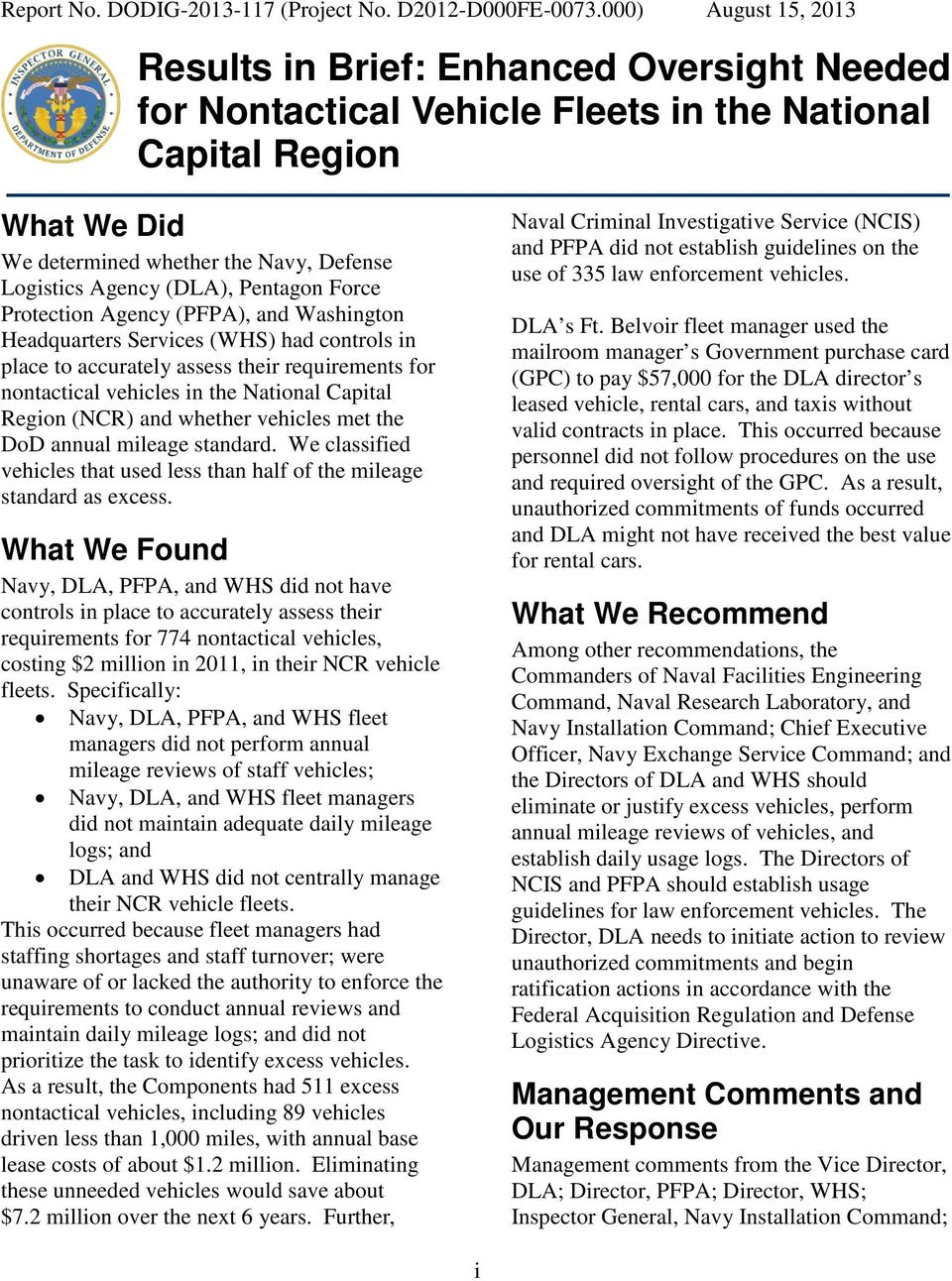
6 Report No. DODIG (Project No. D2012-D000FE ) Commanding Officer, Naval Research Laboratory; and the Director, Defense Procurement and Acquisition Policy were generally responsive. Management comments from the Acting Director, NCIS were partially responsive. Management comments from the Commander, Naval Supply Systems Command and Inspector General, Naval Facilities Engineering Command were generally not responsive. We request that the Navy, DLA, and WHS provide additional comments as noted in the table on the next page. ii August 15, 2013
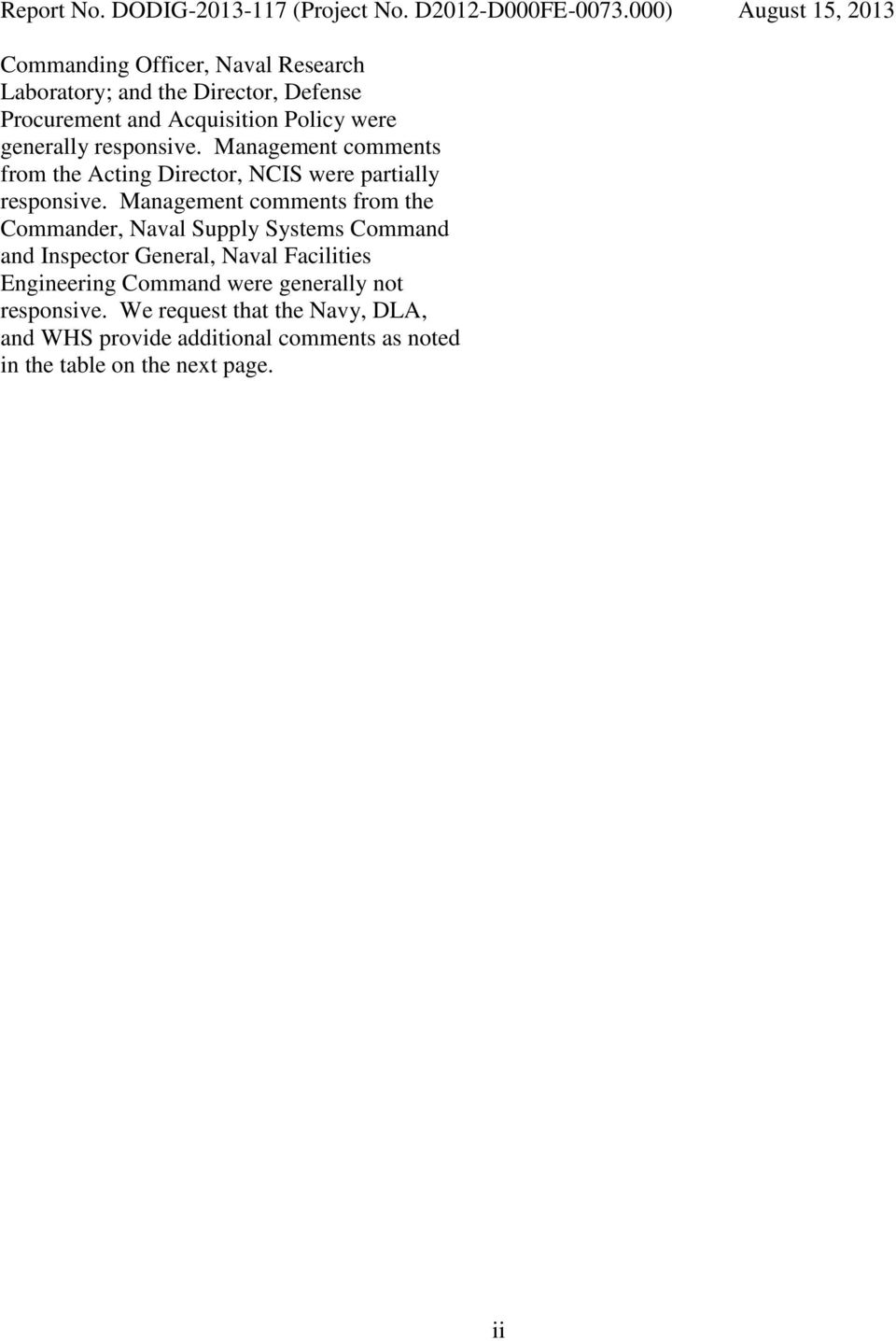
7 Report No. DODIG (Project No. D2012-D000FE ) August 15, 2013 Recommendations Table Management Recommendations Requiring Comments Director, Defense Logistics Agency A.6.e Director, Naval Criminal Investigative Service A.5.a, A.5.b Director, Pentagon Force Protection Agency No additional Comments Required A.6.a, A.6.b, A.6.c, A.6.d, A.6.f, B.2.a, B.2.b A.7.a, A.7.b Director, Washington Headquarters Services A.8.e Chief Executive Officer, Navy Exchange Service Command Commander, Naval Facilities Engineering Command Commander, Navy Installations Command A.3.a, A.3.b, A.3.c A.8.a, A.8.b, A.8.c, A.8.d, A.8.f A.1.a, A.1.b, A.1.c, A.4.a, A.4.b Commanding Officer, Naval Research Laboratory Director, Purchase Card Policy Office, Defense Procurement and Acquisition Policy Director, Contracting Services Office, Defense Logistics Agency Please provide comments by September 16, iii A.4.c A.2 B.3 B.1
8

9 Table of Contents Introduction Objectives Background Review of Internal Controls Finding A. Improved Controls Needed to Assess Requirements for Vehicles Vehicle Fleet Regulations and Excess Determination Reviews of Vehicle Annual Mileage Usage Needed Daily Mileage Logs Needed for Effective Management Central Management for Vehicle Fleet Operations No Guidelines for the Nonmileage Use of NCIS and PFPA Law Enforcement Vehicles Short-Term Leasing and Rental Options Conclusion Recommendations, Management Comments, and Our Response Finding B. Vehicle Leases and Taxi Services Were Not Appropriately Acquired at the Defense Logistics Agency 31 Transportation Services Acquired Incorrectly Contract Not in Place to Lease the Director s Vehicle Contract Not in Place to Lease Rental Cars Contract Not in Place to Obtain Taxi Services Actions Taken to End Car Rental Lease and Contract for Taxi Services Review of GPC Usage Recommendations, Management Comments, and Our Response Appendixes A. Scope and Methodology Use of Computer-Processed Data B. Prior Coverage C. Additional Background on the Audited Components D. Summary of Potential Monetary Benefits Management Comments Defense Logistics Agency Naval Criminal Investigative Service 43 47

10 Pentagon Force Protection Agency Washington Headquarters Services Naval Supply Systems Command Naval Facilities Engineering Command Navy Installations Command Naval Research Laboratory Defense Procurement and Acquisition Policy

11 Introduction Objectives Our objective was to determine whether DoD agencies and the Military Services had controls in place to accurately assess their requirements for nontactical vehicles in their National Capital Region (NCR) vehicle fleets. Specifically, we determined whether adequate controls were in place to monitor the usage, quantity, and type of vehicles owned and leased. See Appendix A for a discussion of the scope and methodology and Appendix B for prior audit coverage of DoD vehicle fleets. Background Presidential Memorandum Federal Fleet Performance, May 24, 2011, emphasizes as a priority that Government vehicle motor pools be reduced to a level that will ensure agencies can meet their mission in the most efficient way possible. Each agency is responsible for its fleet management process, which includes determining the vehicle needs of the organization; acquiring vehicles; using these vehicles; and implementing appropriate controls to ensure effective fleet management and disposition of vehicles after use. DoD requires its Components to manage their fleet operations in accordance with DoD Regulation R, Management, Acquisition, and Use of Motor Vehicles, March 16, This regulation establishes policies to ensure that vehicle fleets are in compliance with laws and regulations and are being fully used. It requires Components to lease or purchase vehicles from the General Services Administration (GSA). DoD Components may commercially lease or purchase vehicles outside GSA when it is more cost effective or GSA is unable to provide the needed vehicle. Using GSA to acquire vehicles is encouraged because it provides low-cost leasing options that include vehicle maintenance services. We selected four DoD Components for our audit. Specifically, we reviewed Navy, Defense Logistics Agency (DLA), Pentagon Force Protection Agency (PFPA), and Washington Headquarters Services (WHS) vehicle fleet management. For the Navy, we reviewed five subcomponents, including the Naval Facilities Engineering Command (NAVFAC), Naval Criminal Investigative Service (NCIS), Naval Research Laboratory (NRL), Navy Morale, Welfare, and Recreation (MWR), and the Navy Exchange Service Command (NEXCOM). See Appendix C for additional background on these subcomponents. For this audit, we classified the Components vehicles into three categories: staff vehicles, law enforcement vehicles, and specialty vehicles. Staff vehicles are passenger and cargo vehicles used for administrative and maintenance purposes. Law enforcement vehicles are vehicles used in apprehension, surveillance, and police or other law enforcement work. Specialty vehicles are vehicles that are not law enforcement or staff 1
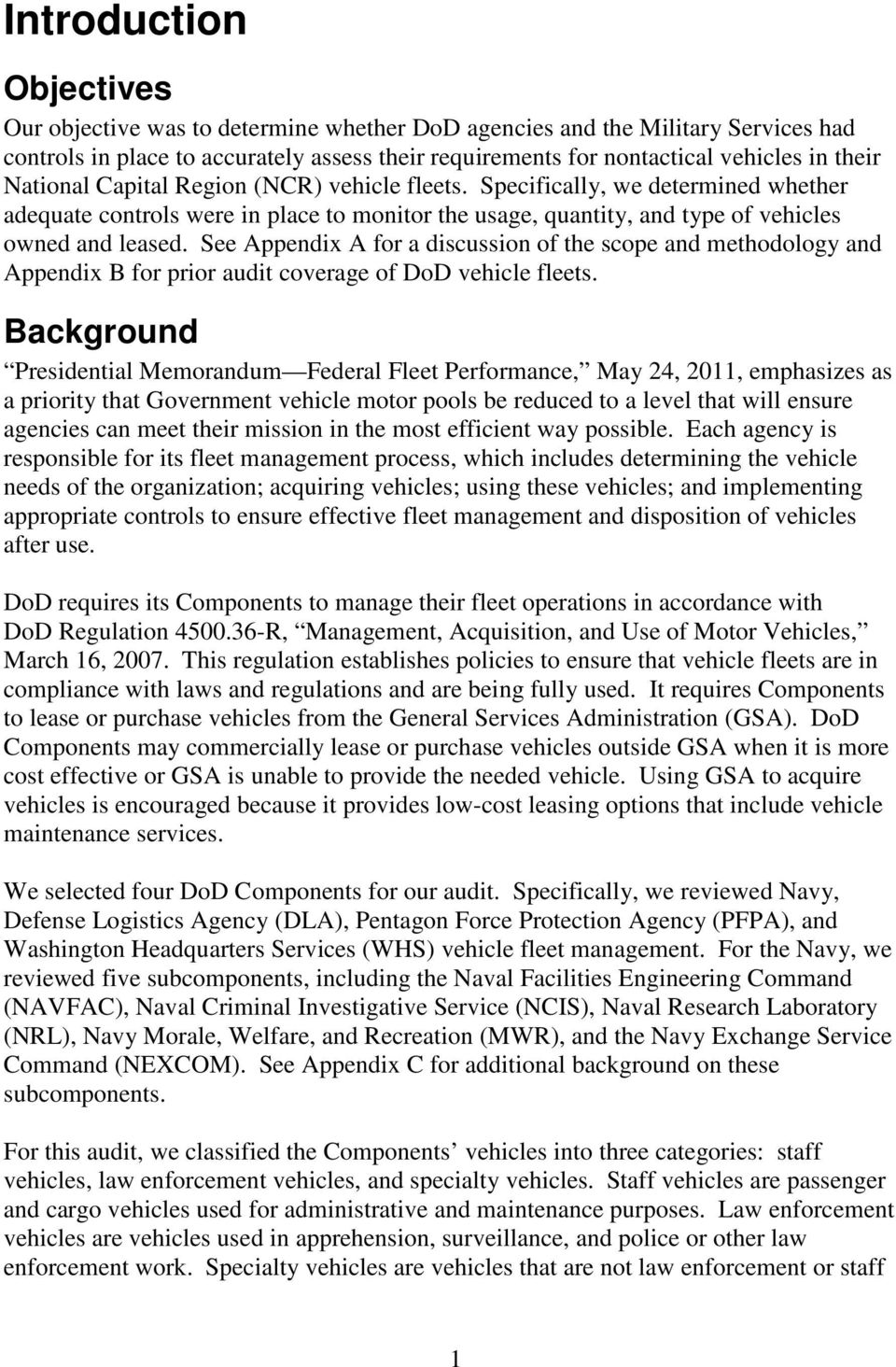
12 vehicles. Examples of specialty vehicles include, but are not limited to, fire trucks and trailers. We did not audit specialty vehicles. Additionally, the term excess in this audit refers to vehicles that were not driven at half of the DoD annual mileage standards. The DoD annual mileage standard is 12,000 miles for sedans and, 10,000 miles for light trucks. We classified sedans driven less than 6,000 miles and light trucks driven less than 5,000 miles in 2011 as excess. To estimate a cost associated with these excess vehicles, we added the monthly lease cost for each leased excess vehicle. We multiplied the total monthly lease costs by 12 to calculate the annual lease expense. Review of Internal Controls DoD Instruction , Managers Internal Control Program (MICP) Procedures, July 29, 2010, requires DoD organizations to implement a comprehensive system of internal controls that provides reasonable assurance that programs are operating as intended and to evaluate the effectiveness of the controls. Navy, DLA, PFPA, and WHS had internal control weaknesses because they did not assess their requirements for nontactical fleet vehicles in the NCR. This occurred for reasons such as staffing shortages and staff turnover. Further, fleet managers were unaware of or lacked the authority to enforce the requirements to conduct annual reviews and maintain daily mileage logs, they lacked clear guidance from management, or they determined vehicle usage in 2011 would not be indicative of 2012 vehicle fleet needs due to ongoing organization realignments. In addition, DLA personnel inappropriately obtained transportation services to supplement DLA s vehicle fleet because personnel incorrectly used a Government purchase card. We will provide a copy of the report to the senior official responsible for internal controls in the Navy, DLA, PFPA, and WHS. 2

13 Finding A. Improved Controls Needed to Assess Requirements for Vehicles The Navy, DLA, PFPA, and WHS did not have effective controls to accurately assess their requirements for 774 staff vehicles, costing $2 million, in their respective NCR vehicle fleets in Specifically: Navy, DLA, PFPA, and WHS fleet managers did not perform annual mileage reviews of staff vehicles; Navy, DLA, and WHS fleet managers did not maintain adequate daily mileage logs; and DLA and WHS fleet managers did not centrally manage their NCR vehicle fleets. This occurred because fleet managers experienced staffing shortages and staff turnover, and they were unaware of or lacked the authority to enforce the requirements to conduct annual reviews and maintain daily mileage logs. In addition, fleet managers lacked clear guidance from management and did not prioritize the task to identify excess vehicles. As a result, 511 staff vehicles were excess in 2011, including 89 that were driven under 1,000 miles, with annual base lease costs of about $1.2 million. Eliminating these excess vehicles would save about $7.2 million over the next 6 years. During the audit, PFPA initiated corrective action and eliminated 15 excess vehicles with base annual lease costs of $49,000. See Appendix D for a listing of potential monetary benefits by account. In addition, NCIS and PFPA directors did not demonstrate that they were effectively managing 335 law enforcement vehicles because they did not establish required nonmileage guidelines. As a result, NCIS and PFPA fleet managers could be acquiring more vehicles than they need. Vehicle Fleet Regulations and Excess Determination DoD Regulation R provides standards for the use of nontactical vehicles. Specifically, it establishes minimum mileage standards for different classes of vehicles. For example, the regulation requires sedans to be driven a minimum of 12,000 miles a year. We classified vehicles that fell below half of this standard as excess a sedan with less than 6,000 miles of use in 2011 would be considered excess. Table 1 specifies the minimum mileage standards for each vehicle type outlined in the DoD regulation and our threshold for the determination of which vehicles were excess. 3

14 Vehicle Type Sedan Light Truck Heavy Truck Bus Table 1. Annual Vehicle Mileage Standards Annual Mileage Vehicles Considered Excess if Driven Standard Less Than This Amount of Miles in ,000 6,000 10,000 5,000 7,500 3,750 9,000 4,500 The DoD regulation requires vehicles that do not meet the minimum mileage standards be reviewed annually for possible reassignment or elimination. The DoD regulation also requires the Components to maintain records that provide a detailed history of each vehicle s daily use. This record should include the name of the driver, the date of each trip, type of vehicle used, number of miles driven, and a description of the purpose or destination of the trip. Additionally, the DoD regulation requires the Components to establish nonmileage-based annual guidelines on vehicle use if mileage is not an accurate measurement to justify the need of a particular vehicle. Finally, the pooling of vehicles and establishment of a central collection point for the collection of auditable operating data are required where geographically feasible. Reviews of Vehicle Annual Mileage Usage Needed Navy, DLA, PFPA, and WHS fleet managers did not perform annual mileage reviews of 774 staff vehicles costing $2 million. Specifically, the Navy fleet managers at 4 commands did not perform annual mileage reviews Fleet managers did not for 584 staff vehicles costing $1.4 million annually, perform annual mileage and DLA did not perform annual mileage reviews for reviews of 774 staff vehicles 34 staff vehicles costing $105,000 annually. In costing $2 million. addition, PFPA did not perform annual mileage reviews for 65 staff vehicles costing $201,000, and WHS did not perform annual mileage reviews for 91 staff vehicles costing $342,000 annually. As a result, Navy, DLA, PFPA, and WHS did not effectively manage their vehicle fleets and had 511 excess staff vehicles costing $1.2 million annually. Navy Components The fleet managers at NAVFAC Washington, NRL, NEXCOM, and MWR did not perform annual mileage reviews for 584 staff vehicles, costing $1.4 million annually, as required by NAVFAC P-300, Management of Civil Engineering Support Equipment, September NAVFAC P-300 is the primary vehicle fleet guidance for Navy fleet managers and is issued by the Commander, NAVFAC. NAVFAC P-300 requires annual mileage reviews of vehicle fleets to identify excess vehicles. The Navy fleet managers did not perform annual mileage reviews for a variety of reasons, including staffing shortages, staff turnover, and unawareness of the requirement. As a result, 359 of 584 staff vehicles in the NCR were excess vehicles with annual base lease costs of $742,000. 4
15 Additionally, NAVFAC P-300 only requires the tracking of daily usage for centrally pooled vehicles. For the NCR, NAVFAC s Navy Fleet Manager/Base Support Vehicles and Equipment product line leader sets policy and guidance for fleet managers at NAVFAC Washington, NRL, NEXCOM, MWR, and NCIS. Naval Facilities Engineering Command The NAVFAC Washington fleet manager did not effectively manage 546 staff vehicles costing $1.3 million annually. Examination of the mileage showed that 331 of 546 staff vehicles, costing $718,000 annually, were driven less than half of the DoD regulation mileage standard and were excess. Of the One 2008 Ford F-150 pickup 206 sedans, 137 were driven less than truck, leased for $2,448 annually, 6,000 miles annually, including 7 sedans that was driven only 712 miles. were driven less than 1,000 miles annually. For example, a 2008 Chevrolet Uplander was leased for $2,412 annually and was driven only 258 miles. Of the 96 light trucks, 66 were driven less than 5,000 miles annually, including 5 trucks that were driven less than 1,000 miles. For example, a 2008 Ford F-150 pickup truck, leased for $2,448 annually, was driven only 712 miles. For 220 heavy trucks, 123 were driven less than 3,750 miles annually, including 34 trucks that were driven less than 1,000 miles. For example, a 2002 Ford F-550 Super Duty pickup truck, leased for $3,876 annually, was driven only 243 miles. Of the 24 buses, 5 were driven less than 4,500 miles annually, including one bus that was driven less than 1,000 miles. Figure 1 details the number of vehicles at NAVFAC Washington that met mileage standards, were excess, or were driven less than 1,000 miles in

16 Figure 1. NAVFAC Washington 2011 Staff Vehicle Usage Green (top bar) = Driven more than or equal to half of mileage standard Yellow (middle bar) = Driven less than half of mileage standard but more than 1,000 miles Red (bottom bar) = Driven less than 1,000 miles Only 15 sedans exceeded the minimum DoD annual mileage standard of 12,000 miles. The fleet manager did not conduct the annual reviews of vehicles required by DoD and Navy regulations because, as she stated, staffing It was a waste of DoD funds to shortages prevented her from doing so. She lease or own 47 vehicles that were cited retirements, rotations, and various excused driven less than 1,000 miles in absences of NAVFAC Washington employees as circumstances that prevented the team from completing the reviews. It was a waste of DoD funds to lease or own 47 vehicles that were driven less than 1,000 miles in The Commander, NAVFAC must improve oversight of the vehicle fleet. The Commander, NAVFAC needs to establish and implement procedures to track the completion of comprehensive annual reviews of underperforming vehicles to identify vehicles that could be eliminated from the fleet. Additionally, the Commander, NAVFAC needs to eliminate or justify the need for 331 vehicles considered excess. Naval Research Laboratory The NRL fleet manager did not effectively manage eight owned staff vehicles. Examination of the mileage showed that four of the vehicles were driven less than half the DoD regulation mileage standard and were One of two buses was driven excess. Three of six sedans were driven less than only 639 miles in ,000 miles in One of two buses was driven only 639 miles in Figure 2 details the number of vehicles at NRL that met standards, were excess, or were driven less than 1,000 miles in

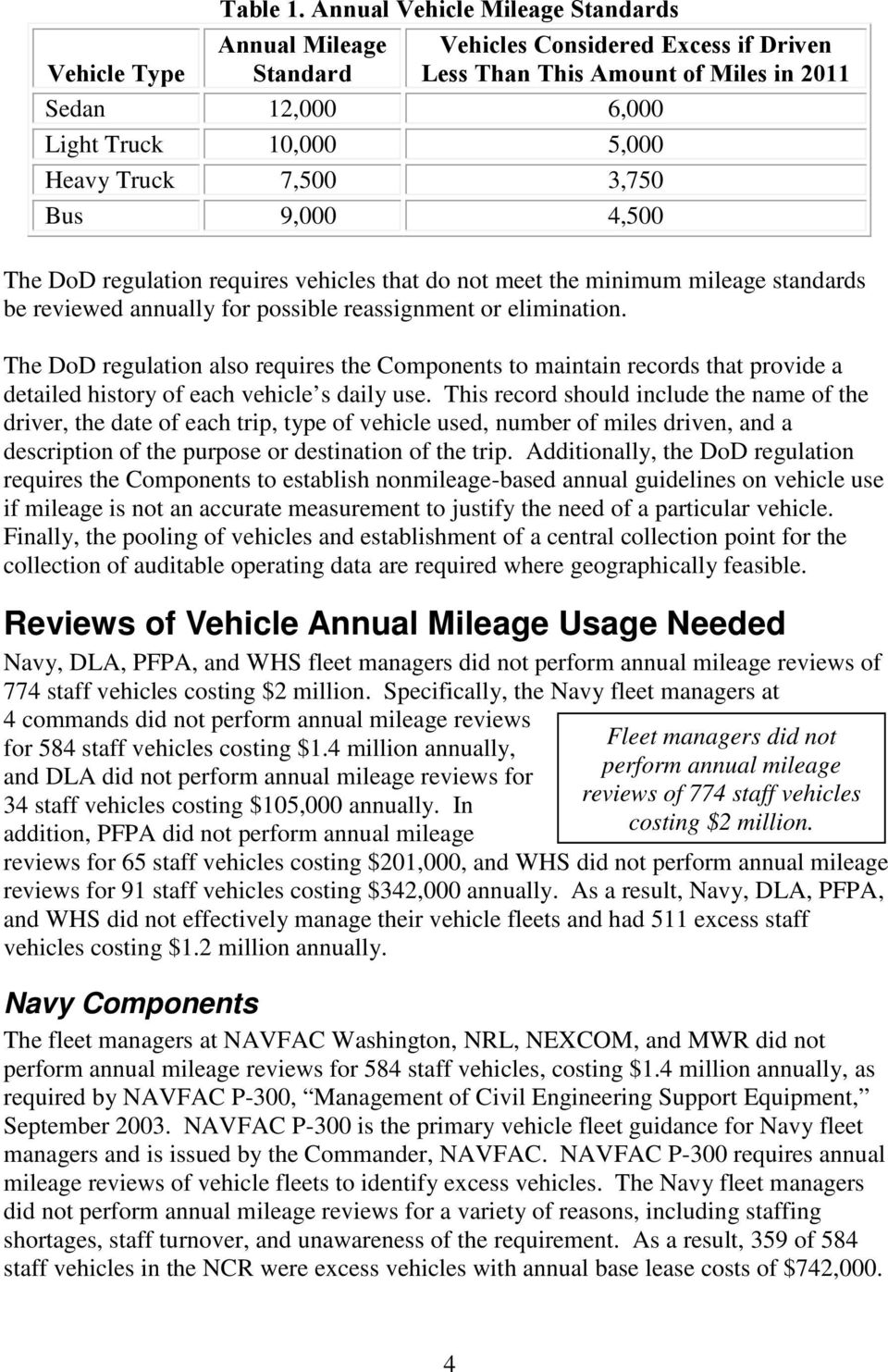
17 Figure 2. NRL 2011 Staff Vehicle Usage Green (top bar) = Driven more than or equal to half of mileage standard Yellow (Sedans bottom bar) = Driven less than half of mileage standard but more than 1,000 miles Red (Buses bottom bar) = Driven less than 1,000 miles No sedans met the minimum DoD annual mileage standard of 12,000 miles. The NRL fleet manager did not conduct the annual reviews of vehicles required by the DoD and Navy regulations because of staff turnover. He was recently assigned to the position and was unable to determine whether his predecessor had completed an annual review. The Commanding Officer, NRL must improve oversight of the vehicle fleet by eliminating or justifying the need for four vehicles considered excess. Navy Exchange Service Command The NEXCOM fleet manager did not effectively manage 13 leased staff vehicles costing $41,000 annually. Examination of the mileage showed that eight staff vehicles, costing $25,000 annually, were driven less than half of the DoD regulation mileage standard and were excess. Three of four sedans were driven less than 6,000 miles annually, including a sedan that was driven less than 1,000 miles A 2009 Dodge Caravan was annually. For example, a 2009 Dodge Caravan was leased for $2,616 annually and leased for $2,616 annually and was driven only was driven only 713 miles. 713 miles. Five of nine light trucks were driven less than 5,000 miles annually, including a truck that was driven less than 1,000 miles. Figure 3 details the number of vehicles at NEXCOM that met standards, were excess, or were driven less than 1,000 miles in
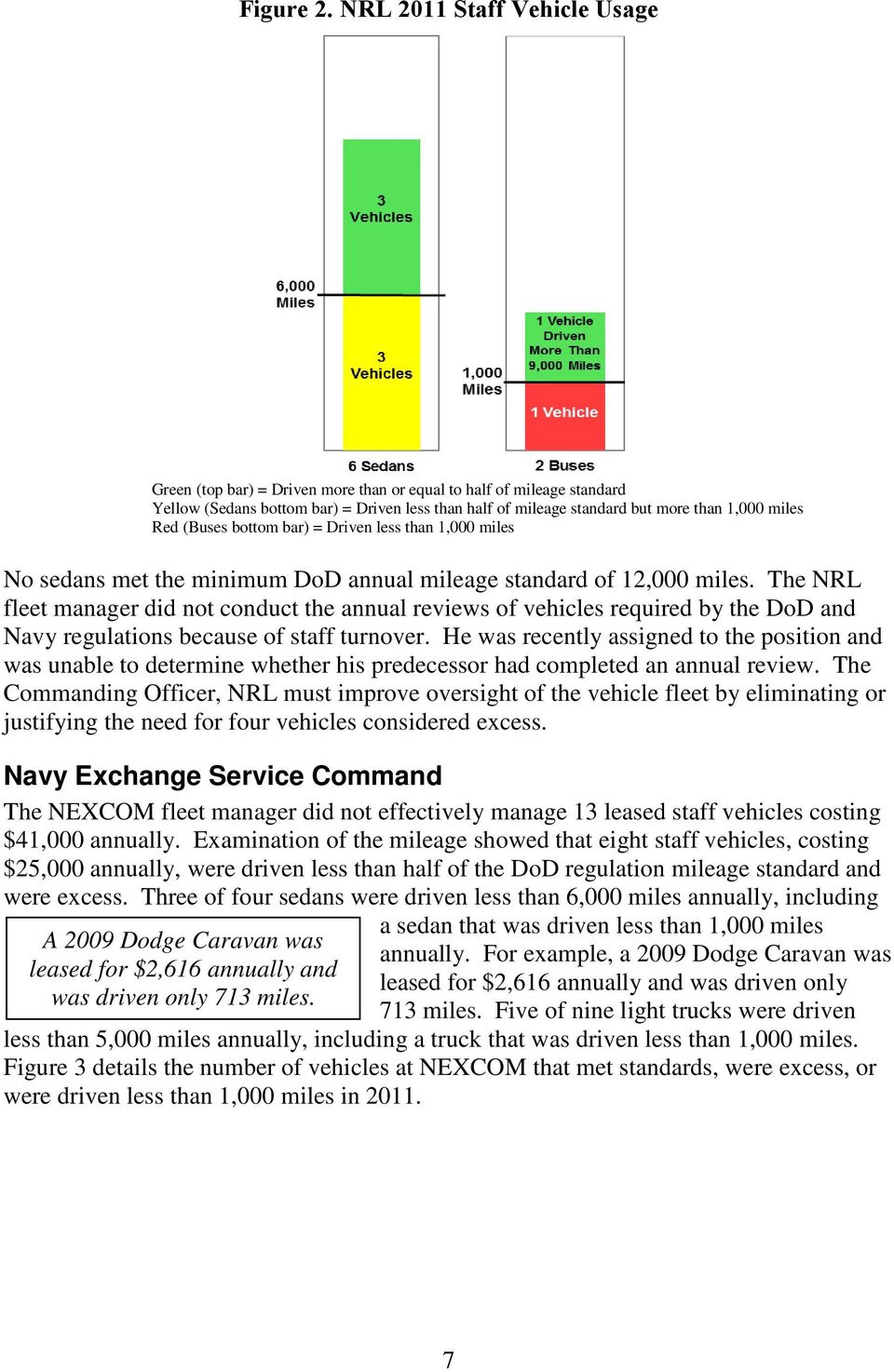
18 Figure 3. NEXCOM 2011 Staff Vehicle Usage Green (top bar) = Driven more than or equal to half of mileage standard Yellow (middle bar) = Driven less than half of mileage standard but more than 1,000 miles Red (bottom bar) = Driven less than 1,000 miles No sedans met the minimum DoD annual mileage standard of 12,000 miles. The fleet manager did not conduct the annual reviews of vehicles required by DoD and Navy regulations because he was unaware of the requirement. It was a waste of DoD funds to lease two vehicles that were driven less than 1,000 miles in The Chief Executive Officer, NEXCOM must improve oversight of the vehicle fleet by eliminating or justifying the need for eight vehicles considered excess; perform a review of the failure to meet standards required for the leasing of vehicles that were driven less than half of the mileage standards; and as appropriate, initiate corrective measures and actions to hold personnel accountable. Additionally, he needs to provide vehicle fleet management training to the NEXCOM fleet manager to ensure personnel are aware of the requirements in DoD Regulation R. Navy Morale, Welfare, and Recreation The MWR fleet manager did not effectively manage 17 owned staff vehicles. Examination of the mileage showed that 16 of the 17 staff vehicles were driven less than half the DoD annual mileage standard and were A 2003 Chevrolet 3500 truck was classified as excess. All 6 sedans were driven driven only 554 miles. less than 6,000 miles. All 6 trucks were driven less than 5,000 miles annually, including 2 trucks that were driven less than 1,000 miles. For example, a 1997 Chevrolet Astro van was driven only 123 miles. Both of MWR s heavy trucks were driven less than 3,750 miles annually, including a truck that was driven less than 1,000 miles. For example, a 2003 Chevrolet 3500 truck was driven only 554 miles. Two of three buses were driven less than 4,500 miles annually, including a bus that was driven less than 1,000 miles. For example, one bus was driven only 694 miles. Figure 4 details the number of vehicles at MWR that met mileage standards, were excess, or were driven less than 1,000 miles in

19 Figure 4. MWR 2011 Staff Vehicle Usage Green (Buses top bar) = Driven more than or equal to half of mileage standard Yellow (Sedans only bar, Light Trucks and Heavy Trucks top bar, and Buses middle bar) = Driven less than half of mileage standard but more than 1,000 miles Red (Light Trucks, Heavy Trucks, and Buses bottom bar) = Driven less than 1,000 miles No sedans met the minimum DoD annual mileage standard. The fleet manager stated he did not conduct annual reviews because he was unaware of the requirement. The Commander, Navy Installations Command must improve oversight of the vehicle fleet by eliminating or justifying the need for 16 excess vehicles; perform a review of the failure to meet standards required for the leasing of vehicles that were driven less than half of the mileage standards; and as appropriate, initiate corrective measures and actions to hold personnel accountable. He also needs to provide vehicle fleet management training to MWR fleet managers to ensure they are aware of the requirements in DoD Regulation R. Defense Logistics Agency The DLA Installation Support, Ft. Belvoir, fleet manager did not effectively manage 34 staff vehicles, costing $105,000 annually. Examination of the mileage showed that 23 staff vehicles, costing $73,000 annually, were driven less than half of the DoD mileage standard and were classified as excess. Of the 26 sedans, 16 were driven less than 6,000 miles annually, including 3 sedans A 2006 Chevrolet Silverado truck, that were driven less than 1,000 miles leased for $3,756 annually was annually. Six of seven light trucks were driven driven only 875 miles in less than 5,000 miles annually, including a 2006 Chevrolet Silverado, leased for $3,756 annually that was driven only 875 miles in DLA s only heavy truck was driven less than 3,750 miles in Figure 5 details the number of vehicles at DLA that met standards, were excess, or were driven less than 1,000 miles in

20 Figure 5. DLA 2011 Staff Vehicle Usage Green (Sedans and Light Trucks top bar) = Driven more than or equal to half of mileage standard Yellow (Sedans and Light Trucks middle bar and Heavy Trucks bar) = Driven less than half of mileage standard but more than 1,000 miles Red (bottom bar) = Driven less than 1,000 miles Only 4 sedans exceeded the minimum DoD annual mileage standard of 12,000 miles. The Ft. Belvoir fleet manager did not conduct the annual reviews of vehicles required by the DoD regulation because, as he stated, he was unaware of the requirement. Further, DLA s implementing guidance for vehicle fleet management, DLA Instruction 4214, Support Equipment Management, September 22, 2009, did not require annual mileage reviews. It was a waste of DoD funds to lease 4 vehicles that were driven less than 1,000 miles in The Director, DLA must improve oversight of the vehicle fleet by revising DLA Instruction 4214 to require fleet managers to conduct comprehensive annual reviews of underperforming vehicles to identify vehicles that could be eliminated from the fleet. Additionally, the Director, DLA needs to provide vehicle fleet management training to fleet managers to ensure they are aware of the requirements in DoD Regulation R. The Director, DLA also needs to eliminate or justify the need for 23 vehicles considered excess; perform a review of the failure to meet standards required for the leasing of vehicles that were driven less than half of the mileage standards; and as appropriate, initiate corrective measures and actions to hold personnel accountable. 10

21 Pentagon Force Protection Agency The PFPA fleet manager did not effectively manage 65 staff vehicles costing $201,000 annually. Examination of the mileage showed that 58 staff vehicles, costing $177,000 annually, were driven less than half of the DoD regulation mileage standard and were classified as excess. Of the 44 sedans, 39 were driven less than 6,000 miles annually, including 7 sedans that were driven less than 1,000 miles annually. For example, a 2010 Chevrolet CG3300 passenger van, leased for A 2010 Chevrolet CG3300 $3,168 annually, was driven only 583 miles. Of passenger van, leased for the 21 light trucks, 19 were driven less than $3,168 annually, was driven 5,000 miles annually, including 12 trucks that were only 583 miles. driven less than 1,000 miles. Figure 6 details the number of vehicles at PFPA that met mileage standards, were excess, or were driven less than 1,000 miles in Figure 6. PFPA 2011 Staff Vehicle Usage Green (top bar) = Driven more than or equal to half of mileage standard Yellow (middle bar) = Driven less than half of mileage standard but more than 1,000 miles Red (bottom bar) = Driven less than 1,000 miles No sedans met the minimum annual mileage standard of 12,000 miles. The fleet manager did not conduct the annual reviews of vehicles required by the DoD regulation. PFPA s Assistant Director of Mission Integration stated that because of PFPA s 2011 realignment, vehicle usage in 2011 would not be indicative of its 2012 vehicle fleet needs. We found the guidance for vehicle fleet management, PFPA Regulation No. 0008, Management and Operation of PFPA Vehicles, June 17, 2011, did not require annual mileage reviews. It was a waste of DoD funds to lease 19 vehicles that were driven less than 1,000 miles in
22 The Director, PFPA initiated corrective actions during the audit. On January 18, 2013, the director revised PFPA Regulation No to require PFPA fleet managers to conduct comprehensive annual reviews of underperforming vehicles to identify vehicles that could be eliminated from the fleet. On January 31, 2013, the director removed 15 excess vehicles from its fleet and in December 2012, reassigned 15 excess vehicles to PFPA s central motor pool. In addition, PFPA officials justified the remaining vehicles that did not meet standards by conducting a review of their agency s vehicle fleet in September The Director, PFPA needs to perform a review of the failure to meet standards required for the leasing of vehicles that were driven less than half of the mileage standards and, as appropriate, initiate corrective measures and actions to hold personnel accountable. Washington Headquarters Services The WHS fleet manager did not effectively manage 91 staff vehicles costing $342,000 annually. Examination of the mileage showed that 71 staff vehicles, costing $252,000 annually, were driven less than half of the DoD regulation mileage standard and were excess. For 46 sedans, 39 were driven less than 6,000 miles annually, including 6 sedans that were driven less than 1,000 miles annually. For example, a 2007 Chevrolet Uplander was leased for $2,616 annually and was driven only 659 miles. Of the 32 light trucks, 24 were driven less than 5,000 miles annually, including 4 trucks that were driven less than 1,000 miles. For example, one 2007 Dodge Ram 2500, leased for $3,360 annually, was driven only 552 miles. Four of five heavy trucks were driven less than 3,750 miles annually, including two that were driven less than 1,000 miles. For example, a 2007 Ford F-750, leased for $4,620 A 2007 Ford F-750, leased annually, was driven only 37 miles. Four of eight for $4,620 annually, was buses were driven less than 4,500 miles annually. driven only 37 miles. Figure 7 details the number of vehicles at WHS that met mileage standards, were excess, or were driven less than 1,000 miles in
23 Figure 7. WHS 2011 Staff Vehicle Usage Green (top bar) = Driven more than or equal to half of mileage standard Yellow (Sedans, Light Trucks, and Heavy Trucks middle bar and Buses bottom bar) = Driven less than half of mileage standard but more than 1,000 miles Red (Sedans, Light Trucks, and Heavy Trucks bottom bar) = Driven less than 1,000 miles Only 2 sedans exceeded the minimum DoD annual mileage standard of 12,000 miles. The fleet manager did not conduct the annual reviews of vehicles required by the DoD regulation because, as he stated, he was unaware of the requirement. Further, the Director, WHS did not develop guidance for vehicle fleet management. It was a waste of DoD funds to lease 12 vehicles that were driven less than 1,000 miles in The Director, WHS must improve oversight of the vehicle fleet by establishing procedures requiring WHS fleet managers to conduct comprehensive annual reviews of underperforming vehicles to identify vehicles that could be eliminated from the fleet. Additionally, the director needs to provide vehicle fleet management training to fleet managers to ensure they are aware of the requirements in DoD Regulation R. The director also needs to eliminate or justify the need for 71 vehicles considered excess; perform a review of the failure to meet standards required for the leasing of vehicles that were driven less than half of the mileage standards; and as appropriate, initiate corrective measures and actions to hold personnel accountable. Daily Mileage Logs Needed for Effective Management Navy, DLA, and WHS fleet managers did not maintain adequate daily mileage logs as required by the DoD regulation. The regulation requires that daily mileage logs include the name of the driver, the date of each trip, type of vehicle used, number of miles driven, and a description of the purpose or destination of the trip. Of the 244 mileage logs reviewed for the Navy, DLA, and WHS, 200 did not include the required information. 13
24 Navy Components Of the 119 Navy vehicles tested, 111 did not have adequate daily mileage logs. Specifically, 68 of 70 NAVFAC Washington, 5 of 8 NRL, 13 of 14 NEXCOM, and 25 of 27 MWR staff vehicles did not have adequate daily mileage logs. This occurred because NAVFAC P-300, Management of Civil Engineering Support Equipment, September 2003, requires only the tracking of Of the 119 Navy vehicles tested, daily usage for centrally pooled vehicles. 111 did not have adequate daily However, only 96 of 633 NAVFAC mileage logs. Washington staff and law enforcement vehicles were centrally pooled. In addition, NRL managers cited procedural errors in maintaining daily mileage logs, while NEXCOM managers stated that they were unaware of the DoD requirement to track daily vehicle usage. For MWR fleet managers, organizational changes and a lack of clear guidance contributed to their inability to maintain adequate daily mileage logs. As a result, the Navy fleet managers could not accurately assess adherence to the requirements for nontactical vehicles in the NCR. The Commander, NAVFAC needs to revise NAVFAC P-300, Management of Civil Engineering Support Equipment, September 2003, to require the maintenance of daily mileage logs for all vehicles. Table 2 lists the number of inadequate daily mileage logs identified at each Navy subcomponent audited. Table 2. Inadequate Daily Mileage Logs Inadequate Subcomponent Vehicles Tested Logs NAVFAC NRL 8 5 NEXCOM MWR Total Defense Logistics Agency At DLA, all 34 staff vehicles tested did not have adequate daily mileage logs. The lack of adequate daily logs occurred because the Ft. Belvoir fleet manager did not direct drivers to keep daily mileage logs. As a result, DLA fleet managers could not accurately assess adherence to requirements for nontactical vehicles in the NCR. The Director, DLA needs to require all DLA vehicle users to maintain adequate daily mileage logs. Washington Headquarters Services At WHS, 55 of 91 staff vehicles did not have adequate daily mileage logs. The lack of adequate daily mileage logs occurred because the fleet manager lacked the authority due to WHS s organizational structure to require drivers to maintain adequate logs. As a result, WHS fleet managers could not accurately assess adherence to the requirements for nontactical vehicles in the NCR. The WHS fleet manager stated that management 14
25 reorganization 1 in May 2011 gave him the authority to require daily mileage logs. At the time of our site visit, the WHS fleet manager had not exercised this authority to require the completion of daily mileage logs. The Director, WHS needs to require all drivers to maintain adequate daily mileage logs. Central Management for Vehicle Fleet Operations DLA and WHS fleet managers did not centrally manage their NCR vehicle fleets. The DoD regulation requires the pooling of vehicles and a central point for the collection of auditable operating data, such as daily mileage and DLA and WHS fleet managers maintenance logs, where geographically feasible. did not centrally manage their At DLA, 34 of 40 vehicles were assigned to the NCR vehicle fleets. McNamara Complex at Fort Belvoir and 6 were assigned to other locations within NCR. Of the 34 vehicles at the McNamara Complex, 27 were staff vehicles. Of the 27 staff vehicles, 8 were in a central motor pool and 19 were assigned to individual components within DLA. This occurred because the DLA fleet managers did not have the organizational structure and oversight in place to direct and require the central management of vehicles. As a result of not centrally managing these vehicles, components within DLA were less likely to share vehicles that were not frequently used, leading to more vehicles not meeting the annual DoD mileage standards. The location of these vehicles made it geographically feasible and more efficient for the Director, DLA to centrally manage DLA s vehicle fleet in the NCR. WHS had a similar situation. Of the 91 staff vehicles, 55 were located at the Pentagon and the remaining vehicles were at other various NCR locations. All of the 55 vehicles at the Pentagon were assigned to components within WHS and could have been maintained in a central motor pool. As a result of not centrally managing these vehicles, the components within WHS were less likely to share vehicles that were not frequently used, leading to more vehicles not meeting annual DoD mileage standards. The location of these vehicles made it geographically feasible and more efficient for the Director, WHS to centrally manage the WHS vehicle fleet in the NCR. The WHS fleet manager stated that, in the past, WHS lacked the authority to compel components to centralize the vehicles. In May 2011, WHS reorganized its management structure to provide sufficient authority to require centralized fleets. The Director, WHS needs to centrally manage its vehicle fleet. No Guidelines for the Nonmileage Use of NCIS and PFPA Law Enforcement Vehicles NCIS and PFPA did not effectively manage law enforcement vehicles because they did not establish guidelines for nonmileage annual use of law enforcement vehicles. The DoD regulation requires an agency to establish other annual guidelines if mileage is not an appropriate measure for use. NCIS fleet managers did not create a performance-based 1 The reorganization moved WHS s vehicle fleet management to the newly created Enterprise Management Directorate. 15
26 metric to determine the number of vehicles to assign to each field office. Instead, NCIS set a goal of assigning one vehicle to each special agent in its February 8, 2006, memorandum Calculation of NCIS Field Office Vehicle Allowance. This occurred because NCIS did not believe that a performance-based metric was an appropriate method for determining its vehicle fleet needs. NCIS s Vehicle Fleet NCIS agents primarily used law enforcement vehicles to perform investigations, surveillance, and protective duties. NCIS s vehicle fleet was composed primarily of commercially leased sedans, which were assigned to special agents. NCIS s nontactical vehicle fleet in the NCR consisted of 125 law enforcement vehicles, 91 of which did not meet DoD mileage use standards. This would imply that most of the nontactical vehicles were not used very often. For example, a 2009 Dodge A 2009 Dodge Avenger Avenger was driven only 354 miles in However, was driven only 354 because of how NCIS used the cars, mileage might not be miles in the most appropriate way to measure vehicle use. By not assessing the usage and need of the vehicles they already had, NCIS fleet managers could be acquiring more vehicles than needed. The Director, NCIS should establish nonmileage-based guidelines for annual use for its law enforcement vehicles to ensure efficient use of resources and a more accurate assessment of vehicle needs. Additionally, all 13 NCIS law enforcement vehicles tested did not maintain daily mileage logs. NCIS fleet managers did not maintain daily mileage logs because drivers did not see it as a priority and NCIS-1, Chapter 32, Vehicle Management Program, December 2007, did not require the maintenance of daily mileage logs. As a result, NCIS fleet managers could not accurately assess adherence to the requirements for law enforcement vehicles in the NCR. The Director, NCIS needs to revise NCIS-1, Chapter 32, to require the maintenance of daily mileage logs for all vehicles. PFPA s Vehicle Fleet PFPA s NCR nontactical vehicle fleet included 210 law enforcement vehicles with an annual base lease cost of $834,000. PFPA used law enforcement vehicles for a variety of purposes, including stationary security vehicles on the Pentagon Reservation. Many of PFPA s law enforcement vehicles were frequently in use, but stationary because of PFPA s mission needs. As a result, mileage was not an appropriate way to measure the use of these vehicles. Nonetheless, the DoD regulation requires that PFPA establish other guidelines for annual use. PFPA did not consider other nonmileage performance metrics, such as hours used, because its primary focus was on the quantity of vehicles needed to meet mission needs and PFPA Regulation No. 0008, Management and Operation of PFPA Vehicles, June 17, 2011, did not require PFPA to establish other nonmileage performance metrics. By not assessing the usage and need of the vehicles it already had, PFPA fleet managers could be acquiring more vehicles than needed. The Director, PFPA should establish nonmileage-based guidelines for annual use of PFPA law enforcement vehicles to ensure efficient use of resources and a more accurate assessment of PFPA s vehicle needs. 16
27 Short-Term Leasing and Rental Options The Components reviewed generally did not use short-term leasing and rental options to satisfy their vehicle needs. The DoD regulation requires the Components to use short-term leasing, borrow vehicles from other Government agencies, or use privately owned vehicles on a reimbursable basis to meet peak load requirements. The Navy, DLA, PFPA, and WHS could meet their short-term vehicle needs more economically by making fewer purchases and increasing the use of short-term leasing. The Navy, DLA, PFPA, and WHS fleet managers need to research alternatives to traditional vehicle leasing and purchasing to meet their vehicle fleet needs. Conclusion Navy, DLA, PFPA, and WHS had 511 more vehicles than they needed in their NCR vehicle fleets. Taking corrective actions could save DoD $7.2 million in lease costs over the next 6 years. This resulted from the Navy, DLA, PFPA, and WHS not establishing effective controls to accurately assess their requirements for nontactical vehicles. In this respect, the Navy, DLA, PFPA, and WHS need to conduct annual mileage reviews, maintain adequate daily mileage logs, centrally manage their vehicle fleets, and establish nonmileage performance metrics to efficiently manage their vehicle fleet operations. Mileage is not the only measure of the need for a vehicle, which is why we are recommending the elimination of, or justification for, excess vehicles. Geographic isolation or specific mission requirements may keep some vehicles from meeting mileage standards. Recommendations, Management Comments, and Our Response A.1. We recommend that the Commander, Naval Facilities Engineering Command: a. Eliminate 331 excess vehicles or justify the need for these vehicles. Justifications for vehicles that cannot be eliminated must include an explanation of why short-term leases or other alternatives to leasing or purchasing cannot be used. Commander, Naval Facilities Engineering Command Comments The Inspector General, Naval Facilities Engineering Command partially agreed with the recommendation. The Inspector General stated that while a portion of the 331 vehicles identified at Naval Facilities Engineering Command Washington may be able to be returned to the General Services Administration or disposed of, a thorough review of the justifications provided during the last Transportation Review of Inventory Objectives (an internal review of transportation support) is required. The Inspector General further stated that mileage is not the only factor used to determine a vehicle requirement and gave examples of other metrics to measure utilization such as days of use or the number of trips in a given time frame. In addition, due to budget cuts, Naval Facilities 17
28 Engineering Command Washington is reviewing vehicle assignments to determine where vehicle reductions will have the least impact on supporting mission requirements. Our Response Comments from the Inspector General, Naval Facilities Engineering Command were partially responsive. The Inspector General did not specify when the Naval Facilities Engineering Command would review justifications provided in the Transportation Review of Inventory Objectives. We request the Commander provide additional comments, stating when the planned review will be completed, the number of vehicles eliminated, and whether short-term leases or other alternatives to leasing or purchasing can be used. We also request comment on the potential monetary benefits identified in Finding A and Appendix D of the report. b. Revise NAVFAC P-300, Management of Civil Engineering Support Equipment, September 2003, to require the maintenance of daily mileage logs for all vehicles in accordance with DoD Regulation R, Management, Acquisition, and Use of Motor Vehicles, March 16, Commander, Naval Facilities Engineering Command Comments The Inspector General, Naval Facilities Engineering Command did not agree with the recommendation. The Inspector General stated that NAVFAC P-300 is currently under revision; however the DoD R does not require daily mileage logs for all vehicles. DoD Regulation R was referenced which states that components can establish an automated or paper copy of motor vehicle utilization data which collect the minimum data elements for an automated trip report. Naval Facilities Engineering Command has established MAXIMO as the automated system to collect this data and dispatch vehicles. Class B (permanently assigned) vehicle mileage data is collected several ways: through automated fuel transactions, maintenance records, and/or a monthly mileage report which is provided to the Base Support Vehicles and Equipment Manager for input into MAXIMO and used for billing purposes. Class C (short-term rental) vehicles are also dispatched through MAXIMO and the required information is collected at the time of dispatch. In addition, Naval Facilities Engineering Command Washington is implementing Global Positioning System (GPS) tracking on select vehicles to collect this data. Our Response Comments from the Inspector General, Naval Facilities Engineering Command were not responsive. DoD Regulation R requires components to keep daily mileage logs, specifically it states that components can establish an automated or paper copy of motor vehicle utilization data which collects the data elements as shown at Table C3.1, Minimum Data Elements for Automated Trip Report. While the regulation does allow components to keep daily mileage logs in a paper or electronic format, this should not be interpreted that daily mileage logs are optional. The Naval Facilities Engineering 18
29 Command s practice of recording vehicle mileage for Class B vehicles does not meet the requirement for daily trip reporting in DoD Regulation R because it collects mileage infrequently when fuel is purchased for vehicles, when maintenance is performed, or in a monthly mileage report. Relying on mileage reported when fuel is purchased, maintenance is performed, or in a monthly mileage report does not give Naval Facilities Engineering Command management the visibility to identify low-mileage vehicles that are used frequently. The Naval Facilities Engineering Command may be able to collect this information through alternatives to traditional paper mileage reports such as GPS tracking. We request the Commander provide additional comments explaining how it plans to implement the recommendation including identifying which vehicles Naval Facilities Engineering Command is using GPS to collect data for. c. Establish and implement procedures to verify that fleet managers at Naval Facilities Engineering Command Washington, Naval Research Laboratory, Navy Exchange Service Command, and Morale, Welfare, and Recreation are aware of existing guidance and track the completion of comprehensive annual reviews to identify underperforming vehicles for possible elimination from their fleets. Commander, Naval Facilities Engineering Command Comments The Inspector General, Naval Facilities Engineering Command partially agreed with the recommendation. The Inspector General stated that the Navy holds a 1-day annual training class in conjunction with the General Services Administration sponsored FedForum, but cancelled this year due to sequestration. During the training, Naval Facilities Engineering Command s Base Support Vehicles and Equipment division provides updated guidance on inventory management, vehicle requirements generation, purchasing/leasing, procedures for reviewing and validating vehicle requirements. The fleet managers for NEXCOM and MWR attend these training sessions and are responsible for disseminating information to their subordinate commands. Naval Facilities Engineering Command Atlantic is responsible for ensuring Naval Facilities Engineering Command Washington and Naval Research Laboratory are maintaining proper vehicle records and provides oversight over the fleet management program in their area of responsibility. The Naval Facilities Engineering Command is in the process of implementing a policy to establish utilization criteria for every vehicle, the process for review, validation and approval, reporting requirements in accordance with the Presidential Memorandum Federal Fleet Performance of May Our Response Comments from the Inspector General, Naval Facilities Engineering Command were partially responsive. We request the Commander provide additional comments explaining the implementation of the policy to establish utilization criteria for every vehicle, the process for review, validation and approval, reporting requirements, and specify when the revisions to NAVFAC P-300 will occur. 19
30 A.2. We recommend that the Commanding Officer, Naval Research Laboratory, eliminate four excess vehicles or justify the need for these vehicles. Justifications for vehicles that cannot be eliminated must include an explanation of why short-term leases or other alternatives to leasing or purchasing cannot be used. Commanding Officer, Naval Research Laboratory Comments The Commanding Officer, Naval Research Laboratory partially agreed with the recommendation and justified why short-term leases or other alternatives to leasing or purchasing cannot be used to replace the four excess vehicles. The Commanding Officer noted increased usage of the Naval Research Laboratory s bus identified in the report and stated that short-term lease costs are greater than current operation and maintenance costs for Naval Research Laboratory buses. The Commanding Officer cited non-predictive transportation requirements, the simultaneous use of vehicles, and emergent mission tasking (for example, no-notice briefings) in his justification of underperforming sedans. Our Response Comments from the Commanding Officer, Naval Research Laboratory were responsive. No further comments are required. A.3. We recommend that the Chief Executive Officer, Navy Exchange Service Command: a. Eliminate eight excess vehicles or justify the need for these vehicles. Justifications for vehicles that cannot be eliminated should include an explanation of why short-term leases or other alternatives to leasing or purchasing cannot be used. Commander, Naval Supply Systems Command Comments The Commander, Naval Supply Systems Command provided comments to the report on behalf of the Chief Executive Officer, Navy Exchange Service Command. The Commander did not agree with the recommendation. The Commander stated that mileage as the primary criteria to determine if a vehicle is required in a non-appropriated funded, bottom-line driven, profit-oriented business, such as Navy Exchange Service Command is impractical. The Commander also stated that a lack of flexibility and inappropriate usage standards will result in lost sales and profits. Our Response Comments from the Commander, Naval Supply Systems Command were not responsive. DoD Regulation R specifically states that it is applicable to Military Exchanges and non-appropriated fund activities. DoD Regulation R also states that other annual utilization guidelines should be established if mileage is not an accurate measurement of the need for a particular vehicle. Navy Exchange Service Command has not implemented a regulation governing vehicle fleet management or identified an 20
31 alternative metric for measuring utilization of vehicles. The Commander s comments mention a profit oriented business but did not explain why a profit-oriented business would lease a van and a truck and use them less than 1,000 miles annually. We request that the Chief Executive Officer, Navy Exchange Service Command provide additional comments explaining the plan to eliminate or justify the excess vehicles. We also request comments on the potential monetary benefits identified in Finding A and Appendix D of the report. b. Perform a review of the failure to meet standards required for the leasing of vehicles that were driven less than half of the mileage allowed by DoD Regulation R, Management, Acquisition, and Use of Motorized Vehicles, March 16, 2007, and as appropriate, initiate corrective measures and actions to hold personnel accountable. Commander, Naval Supply Systems Command Comments The Commander, Naval Supply Systems Command did not agree with this recommendation. The Commander stated that mileage as the primary criteria to determine if a vehicle is required in a non-appropriated funded, bottom-line driven, profit-oriented business, such as Navy Exchange Service Command is impractical. Our Response Comments from the Commander, Naval Supply Systems Command were not responsive. DoD Regulation R specifically states that it is applicable to Military Exchanges and non-appropriated fund activities. DoD Regulation R also states that other annual utilization guidelines should be established if mileage is not an accurate measurement of the need for a particular vehicle. Navy Exchange Service Command has not implemented a regulation governing vehicle fleet management or identified an alternative metric for measuring utilization of vehicles. We request that the Chief Executive Officer, Navy Exchange Service Command provide additional comments explaining how the organization will perform the accountability review cited in the recommendation. c. Provide training to the Navy Exchange Service Command fleet managers to ensure they are aware of the vehicle fleet management requirements in DoD Regulation R, Management, Acquisition, and Use of Motor Vehicles, March 16, Commander, Naval Supply Systems Command Comments The Commander, Naval Supply Systems Command did not agree with this recommendation. The Commander stated that DoD Regulation R is not practical nor in alignment with a $3 billion retail and services non-appropriated fund enterprise. The Commander also stated that the fleet manager for the Navy Exchange 21
32 Service Command Enterprise annually attends the Federal Fleet Week and Navy Fleet training sessions. Our Response Comments from the Commander, Naval Supply Systems Command were not responsive. The Commander does not explain why a DoD regulation applicable to all of DoD is not applicable to the Navy Exchange Service. The Navy Exchange Service Command's Bethesda fleet manager was unaware of the requirement to perform formal documented reviews and maintain mileage logs in accordance with DoD Regulation R. The regulation specifically states that it is applicable to Military Exchanges and non-appropriated fund activities. Because the Navy Exchange Service Command fleet managers were unaware of the requirements in the regulation, the Navy Exchange Service Command had 8 excess staff vehicles with annual based lease costs of $24,516 and the staff failed to maintain daily mileage logs for 13 of the 14 vehicles audited. We request that the Chief Executive Officer, Navy Exchange Service Command provide additional comments on the recommendation to provide management training to the Navy Exchange Service Command fleet managers on vehicle fleet management requirements. Commander, Naval Supply Systems Command Comments The Commander, Naval Supply Systems Command provided additional comments to the report. The Commander stated that the DoD IG did not include Naval Supply Systems Command in entrance or exit conferences for this audit. Also, the Commander stated that the DoD IG did not afford Naval Supply Systems Command the opportunity to review and comment on the preliminary draft report in early The Commander requested that in the future, Naval Supply Systems Command Headquarters be notified of any audits involving the Naval Supply Systems Command Enterprise. The Commander went on to state that had Naval Supply Systems Command been provided the opportunity, it would have allowed the Commander to track audit findings and address audit concerns as they developed. Our Response It is unfortunate that the Commander was not informed of the extensive communication during the audit between the DoD OIG Audit Team and his command. The DoD OIG team coordinated throughout the audit with the command and site-level Navy Exchange Service Command points of contact provided. The DoD OIG team provided the discussion draft report to the points of contact it was given at the Navy Exchange Service Command on December 21, 2012 and received comments on the discussion draft report from those contacts on January 24, The DoD OIG team met twice with Navy Exchange Service Command and Naval Supply Systems Command staff after the draft report was issued on March 25, The DoD OIG also granted the Navy Exchange Service Command a one week extension to prepare their responses to the draft report. 22
33 A.4. We recommend that the Commander, Navy Installations Command: a. Eliminate 16 excess vehicles or justify the need for these vehicles. Justifications for vehicles that cannot be eliminated should include an explanation of why short-term leases or other alternatives to leasing or purchasing cannot be used. Commander, Navy Installations Command Comments The Inspector General, Navy Installations Command agreed with the recommendation. The Inspector General stated that the Navy Region, Naval District Washington will reduce command assigned vehicles by over 70 units by the end of June The Inspector General also stated that a thorough analysis of all vehicles is in progress to determine the need to retain all or some of them. The analysis will be completed by September 30, Our Response Comments from the Inspector General, Navy Installations Command were responsive. In response to the final report, we request the Commander identify the total number of vehicles eliminated and the costs saved from eliminating the 70 vehicles. b. Perform a review of the failure to meet standards required for the retention of vehicles that were driven less than half of the mileage allowed by DoD Regulation R, Management, Acquisition, and Use of Motorized Vehicles, March 16, 2007, and as appropriate, initiate corrective measures and actions to hold personnel accountable. Commander, Navy Installations Command Comments The Inspector General, Navy Installations Command agreed with the recommendation. The Inspector General stated that the Naval District Washington is reviewing all vehicle usage as part of FY 2013 sequestration budget reductions. Some low-mileage vehicles are justified due to remote location or one of a kind mission application for the vehicle. Naval District Washington's review will be complete by the end of FY Our Response Comments from the Inspector General, Navy Installations Command were generally responsive. Although the Inspector General agreed, the response did not address whether an accountability review occurred as cited in the recommendation. In response to the final report, we request the Commander, Navy Installations Command state whether any personnel were identified and held accountable for not identifying underutilized vehicles. c. Provide training to Morale, Welfare, and Recreation fleet managers to ensure they are aware of the vehicle fleet management requirements in DoD Regulation R, Management, Acquisition, and Use of Motor Vehicles, March 16,
34 Commander, Navy Installations Command Comments The Inspector General, Navy Installations Command agreed with the recommendation. The Inspector General stated that fleet management training will be provided to all Morale, Welfare, and Recreation fleet managers to ensure awareness of requirements from DoD Regulation R in addition to the NAVFAC P-300 by the end of FY Our Response Comments from the Inspector General, Navy Installations Command were responsive. No further comments are required. A.5. We recommend that the Director, Naval Criminal Investigative Service: a. Establish nonmileage-based usage guidelines for law enforcement vehicles and annually track their usage. Director, Naval Criminal Investigative Service Comments The Acting Director, Naval Criminal Investigative Service agreed with the recommendation. The Acting Director stated that the Naval Criminal Investigative Service developed a Vehicle Allocation Methodology program governing Fiscal Year s in which the methodology would include a comprehensive fleet management system for vehicles that include changes in behavior, leasing, and operations and allocates vehicles based on the investigative and operational activity at each field office. As a result, the Naval Criminal Investigative Service reduced its compliment of SUVs from 40 percent to 10 percent. Our Response Comments from the Acting Director, Naval Criminal Investigative Service were partially responsive. The Acting Director did not provide information explaining how this methodology will allocate vehicles to field offices. In response to the final report, we request the Acting Director, Naval Criminal Investigative Service state how this methodology will establish nonmileage-based usage guidelines for law enforcement vehicles and annually track their usage. b. Revise Naval Criminal Investigative Service-1, Chapter 32, Vehicle Management Program, to require that drivers maintain daily mileage logs in accordance with DoD Regulation R, Management, Acquisition, and Use of Motor Vehicles, March 16, Director, Naval Criminal Investigative Service Comments The Acting Director, Naval Criminal Investigative Service did not agree with the recommendation. The Acting Director stated that as officials of a law enforcement and counterintelligence organization, it is imperative that special agents be able to travel in a 24
35 manner that provides optimal operational security and that any record that provides mileage, destination or travel times poses unnecessary risk to both agent safety and operations. The Acting Director also stated that the Naval Criminal Investigative Service intends to pursue a waiver to the current requirement to maintain daily mileage. Our Response Comments from the Acting Director, Naval Criminal Investigative Service were partially responsive. DoD Regulation R, Management, Acquisition, and Use of Motor Vehicles March 16, 2007 requires that drivers maintain daily mileage logs. The Naval Criminal Investigative Service should consider alternatives to maintaining daily mileage logs in vehicles such as electronic logs or maintaining mileage logs in safes at Naval Criminal Investigative Service field offices. In response to the final report, we request the Acting Director, Naval Criminal Investigative Service provide additional comments on how it plans to monitor vehicle usage and whether a waiver was requested and approved to the current requirement to maintain daily mileage logs. A.6. We recommend that the Director, Defense Logistics Agency: a. Revise Defense Logistics Agency Instruction 4214, Support Equipment Management, modified September 22, 2009, to require fleet managers to conduct comprehensive annual reviews of underperforming vehicles to identify vehicles that could be eliminated from the fleet. Director, Defense Logistics Agency Comments The Vice Director, Defense Logistics Agency agreed with the recommendation. The Vice Director stated that DLA Instruction 4214 is undergoing a major rewrite which is expected to be completed by September 30, The recommended requirement will be added to the updated document. Our Response Comments from the Vice Director, DLA were responsive. No further comments are required. b. Provide training to fleet managers to ensure they are aware of the vehicle fleet management requirements in DoD Regulation R, Management, Acquisition, and Use of Motor Vehicles, March 16, Director, Defense Logistics Agency Comments The Vice Director, Defense Logistics Agency agreed with the recommendation. DLA Installation Support (DS) Fort Belvoir appointed a new interim fleet manager and team leader to assist in fleet optimization, acquisition and outreach efforts. The newly appointed fleet manager attended the GSA FedFleet 2012 conference and training in late June 2012, which included sessions on managing fleet vehicles. 25
36 Our Response Comments from the Vice Director, Defense Logistics Agency were responsive. No further comments are required. c. Instruct all drivers to follow Defense Logistics Agency Instruction 4214, Support Equipment Management, modified September 22, 2009, and complete daily mileage logs. Director, Defense Logistics Agency Comments The Vice Director, Defense Logistics Agency agreed with the recommendation. DS Fort Belvoir instructed all of its GSA fleet vehicle drivers to complete daily trip logs including all information required by DLA Instruction Our Response Comments from the Vice Director, Defense Logistics Agency were responsive. No further comments are required. d. Pool vehicles where geographically feasible and establish a central point for the collection of auditable operating data. Director, Defense Logistics Agency Comments The Vice Director, Defense Logistics Agency agreed with the recommendation. DS Fort Belvoir implemented a centralized motor pool of 15 vehicles in the National Capital Region for GSA vehicles that do not have a unique high priority or special mission. In addition, DS Fort Belvoir implemented a rotation plan for underutilized vehicles not included in the motor pool to include some of the special purpose vehicles to increase mileage and utilization. Our Response Comments from the Vice Director, Defense Logistics Agency were responsive. No further comments are required. e. Eliminate 23 excess vehicles or justify the need for these vehicles. Justifications for vehicles that cannot be eliminated should include an explanation of why short-term leases or other alternatives to leasing or purchasing cannot be used. Director, Defense Logistics Agency Comments The Vice Director, Defense Logistics Agency agreed with the recommendation. To address the 23 excess vehicles, DS Fort Belvoir has restructured its vehicle fleet. It has created a Class C motor pool by reallocating 15 underutilized vehicles and has eliminated 2 GSA vehicles to date with another 3 vehicles in the queue for turn in. Justification was made to retain three underutilized vehicles in support of a critical contingency mission. 26
37 Our Response Comments from the Vice Director, Defense Logistics Agency were generally responsive. The Vice Director did not provide comments on the potential monetary benefits identified in Finding A and Appendix D of the report. We request the Director, Defense Logistics Agency provide comments on the potential monetary benefits identified in the report. f. Perform a review of the failure to meet standards required for the leasing of vehicles that were driven less than half of the mileage allowed by DoD Regulation R, Management, Acquisition, and Use of Motorized Vehicles, March 16, 2007, and as appropriate, initiate corrective measures and actions to hold personnel accountable. Director, Defense Logistics Agency Comments The Vice Director, Defense Logistics Agency agreed with the recommendation. The DS Fort Belvoir site director conducts a monthly review of the GSA fleet and meets with senior leaders to determine the right sizing of its motor pool fleet. Due to the results in the report, the fleet manager was replaced and a new fleet manager was appointed and a functional motor pool operation was established. Appropriate corrective measures were taken to hold personnel accountable for their actions. Our Response Comments from the Vice Director, Defense Logistics Agency were responsive. No further comments are required. A.7. We recommend that the Director, Pentagon Force Protection Agency: a. Perform a review of the failure to meet standards required for the leasing of vehicles that were driven less than half of the mileage allowed by DoD Regulation R, Management, Acquisition, and Use of Motorized Vehicles, March 16, 2007, and as appropriate, initiate corrective measures and actions to hold personnel accountable. Director, Pentagon Force Protection Agency Comments The Director, Pentagon Force Protection Agency agreed with the recommendation. The Director stated that PFPA s 2011 review of vehicle mileage was an inaccurate predictor of 2012 vehicle needs for PFPA and that PFPA reduced its fleet after a 2012 review. The 15 vehicles eliminated reduced vehicle leasing costs by $47,000 annually. Our Response Comments from the Director, Pentagon Force Protection Agency were responsive. No further comments are required. b. Establish nonmileage-based usage guidelines for use of law enforcement vehicles. 27
38 Director, Pentagon Force Protection Agency Comments The Director, Pentagon Force Protection Agency agreed with the recommendation. The Director stated that the Pentagon Force Protection Agency is in the process of leasing vehicle monitoring devices through the General Services Administration which will facilitate in the establishment and measurement of non-mileage utilization criteria for law enforcement vehicles. He stated that the Pentagon Force Protection Agency began installing these devices in April 2013; will define non-mileage based utilization requirements by the end of calendar year 2013; and will begin measuring law enforcement vehicles against these new criteria in the first quarter of calendar year Our Response Comments from the Director, Pentagon Force Protection Agency were responsive. No further comments are required. A.8. We recommend that the Director, Washington Headquarters Services: a. Establish internal guidance requiring WHS fleet managers to conduct comprehensive annual reviews of underperforming vehicles to identify vehicles that could be eliminated from the fleet. Director, Washington Headquarters Services Comments The Director, Washington Headquarters Services agreed with the recommendation. The Director stated that Washington Headquarters Services has developed draft guidance that includes a comprehensive annual review of the Washington Headquarters Services fleet that identifies any underutilized performing vehicles. The Washington Headquarters Services internal guidance will be finalized by the end of FY Our Response Comments from the Director, Washington Headquarters Services were responsive. No further comments are required. b. Provide training to the WHS fleet managers to ensure they are aware of the vehicle fleet management requirements in DoD Regulation R, Management, Acquisition, and Use of Motorized Vehicles, March 16, Director, Washington Headquarters Services Comments The Director, Washington Headquarters Services agreed with the recommendation. The Director stated that the Washington Headquarters Services fleet manager attended the AT&L sponsored Fleet Management Conference on April 10, The Washington Headquarters Services fleet manager will assure that applicable training is given to those overseeing the use of vehicles within the fleet. 28
39 Our Response Comments from the Director, Washington Headquarters Services were responsive. No further comments are required. c. Require drivers to maintain daily mileage logs. Director, Washington Headquarters Services Comments The Director, Washington Headquarters Services agreed with the recommendation. The Director stated that all WHS fleet vehicles have been entered into the Defense Property Accountability System. The Director stated that Washington Headquarters Services internal guidance requires the fleet manager, sub-custodians and drivers to immediately use the maintenance and utilization module of the Defense Property Accountability System to track mileage for all Washington Headquarters Services fleet vehicles. Our Response Comments from the Director, Washington Headquarters Services were responsive. No further comments are required. d. Pool vehicles where geographically feasible and establish a central point for the collection of auditable operating data. Director, Washington Headquarters Services Comments The Director, Washington Headquarters Services agreed with the recommendation. The Director stated that the Washington Headquarters Services fleet manager has established a pooling system that assigns vehicles by geographic location using the Defense Property Accountability System maintenance and utilization module. In addition, the maintenance and utilization module provides a central point for the collection of auditable fleet vehicle operating data. Our Response Comments from the Director, Washington Headquarters Services were responsive. No further comments are required. e. Eliminate 71 excess vehicles or justify the need for these vehicles. Justifications for vehicles that cannot be eliminated should include an explanation of why short-term leases or other alternatives to leasing or purchasing cannot be used. Director, Washington Headquarters Services Comments The Director, Washington Headquarters Services agreed with the recommendation. The Director stated that Washington Headquarters Services has identified five General Services Administration leased vehicles for elimination. Washington Headquarters Services is continuing to review the totality of its fleet vehicles to determine if additional 29
40 vehicle reductions can be realized. The outcome of the full review will be provided by the end of calendar year Our Response Comments from the Director, Washington Headquarters Services were partially responsive. In response to the final report, we request the Director provide an update to the results of the vehicle review when it is completed and provide comments on the potential monetary benefits identified in Finding A and Appendix D of the report. f. Perform a review of the failure to meet standards required for the leasing of vehicles that were driven less than half of the mileage allowed by DoD Regulation R, Management, Acquisition, and Use of Motorized Vehicles, March 16, 2007, and as appropriate, initiate corrective measures and actions to hold personnel accountable. Director, Washington Headquarters Services Comments The Director, Washington Headquarters Services agreed with the recommendation. The Director stated that the Washington Headquarters Services fleet manager is conducting a review of all lease agreements, vehicle utilization/survey specifics, and any mission requirements. Washington Headquarters Services is taking corrective measures and accountability actions as required. The outcome of the review will be provided by the end of calendar year Our Response Comments from the Director, Washington Headquarters Services were responsive. We request the Director provide the results of this review when it is completed. 30
41 Finding B. Vehicle Leases and Taxi Services Were Not Appropriately Acquired at the Defense Logistics Agency The DLA Installation Support, Ft. Belvoir, fleet manager did not properly obtain transportation services through the appropriate contracting process. Specifically, the Ft. Belvoir fleet manager inappropriately used the mailroom manager s Government purchase card (GPC) to pay: $5,400 in lease payments for the director s Chevrolet Tahoe there was not a valid lease contract for this vehicle in 2011; $20,200 for rental cars for employees in temporary duty status there was not a valid contract for these rental cars from August 2011 to December 2011; and $31,300 to a taxi cab company for employees use of taxis there was not a valid contract for taxi services in The Ft. Belvoir fleet manager allowed contracts to lapse but continued payments with a GPC, and the GPC agency program coordinator and component program manager did not perform required oversight of the use of the GPC. As a result, unauthorized commitments of DoD funds occurred and DLA might not have received the best value for rental cars. Transportation Services Acquired Incorrectly The Ft. Belvoir fleet manager incorrectly acquired transportation services to supplement DLA s vehicle fleet. The director s vehicle lease expired in 2010, the contract to acquire rental cars ended in 2011, and the contract for taxi cab services ended in After the lease and contracts expired, the Ft. Belvoir fleet manager made payments using a GPC without the involvement of the contracting officers. This resulted in unauthorized commitments. Federal Acquisition Regulation , Ratification of Unauthorized Commitments, and DLA Directive , Revision 5, Ratification of Unauthorized Commitments and Quantum Meruit 2 Actions, require that DLA take ratification action on the unauthorized commitments. In addition, the Agency program coordinator did not complete an annual review of all GPC billing official accounts, and the component program manager did not verify that the agency program coordinator performed annual audits of selected GPC transactions. 2 Latin phrase meaning as much as deserved. 31
42 Contract Not in Place to Lease the Director s Vehicle The Ft. Belvoir fleet manager inappropriately used the mailroom manager s GPC to make lease payments of $5,400 for a Chevrolet Tahoe that did not have a valid lease contract. In 2008, DLA issued a contract to Acme Auto Leasing, LLC (contract SP P-0005), to The Ft. Belvoir fleet manager lease a Chevrolet Tahoe for the director s use. The inappropriately used the initial contract was for lease payments totaling mailroom manager s GPC to $45,900, with $29,700 paid in the base year. The make lease payments. Ft. Belvoir fleet manager violated DoD Regulation R, DoD Financial Management Regulation (DoD FMR), volume 10, chapter 8, when he failed to have the contracting officer exercise options on the contract after the base year expired, but continued to make payments for the lease on a GPC. This resulted in an unauthorized commitment. Figure 8 shows a picture of the director s vehicle taken on February 7, Figure 8. DLA Director s Vehicle Contract Not in Place to Lease Rental Cars The Ft. Belvoir fleet manager also inappropriately used the mailroom manager s GPC to make payments totaling $20,200 in The contracting officer issued a contract in 2008 to Enterprise Rent-A-Car (contract GS-33F-0015S) to rent cars on an as-needed basis for employees. The Ft. Belvoir fleet manager violated DoD FMR, volume 10, chapter 8, when he failed to have the contracting officer exercise additional contract options after the second option year ended on July 30, 2011, but continued to make payments for the rental cars on the GPC. This resulted in an unauthorized commitment. From August 2011 to December 2011, the Ft. Belvoir fleet manager made $20,200 in payments to Enterprise Rent-A-Car with no contract in place. In addition, the Ft. Belvoir fleet manager did not comply with the Joint Travel Regulation, Volume 2, Chapter 2, Official Travel, requirement that travelers use an available commercial travel office for all official transportation requirements. Because the Ft. Belvoir fleet manager did not use the commercial travel office, he did not ensure that DLA received the best value for rental cars. 32
43 Contract Not in Place to Obtain Taxi Services The Ft. Belvoir fleet manager inappropriately used the mailroom manager s GPC to make payments for taxi fares totaling $31,300 in The contracting officer issued a contract in 2009 to Alexandria White Top Cab (contract SP P-0027) to provide cabs for local travel, specifically to shuttle DLA employees on an as-needed basis. The Ft. Belvoir fleet manager violated DoD FMR, volume 10, chapter 8, when he failed to have the contracting officer renew the contract after it ended, but continued to make payments for the taxi fares on the GPC. This resulted in an unauthorized commitment. The Director, DLA needs to require the head of contracting to initiate action to review the Enterprise Rent-A-Car and Alexandria White Top Cab contracts and begin ratification actions on the unauthorized commitments that were made in accordance with Federal Acquisition Regulation and DLA Directive , Revision 5. Actions Taken to End Car Rental Lease and Contract for Taxi Services On March 12, 2012, we met to discuss these issues with DLA management. In this meeting, DLA s Ft. Belvoir chief of site operations stated that DLA returned the Chevrolet Tahoe and ended the lease with Acme Auto Leasing, LLC. He also stated that DLA stopped renting vehicles from Enterprise Rent-A-Car. He stated that following the meeting, DLA began requiring employees to use the Defense Travel System for local travel and no longer allowed them to obtain services from Alexandria White Top Cab. Additionally, on January 7, 2013, DLA s head of contracting ratified the unauthorized commitments made in leasing the director s vehicle. Review of GPC Usage DLA did not have a time-phased plan to ensure that personnel conducted audits of all GPC accounts annually. The DoD Government Charge Card Guidebook for Establishing and Maintaining Purchase, Travel, and Fuel Card Programs, December 21, 2011, requires annual audits of all billing accounts and associated cards. Additionally, DLA Instruction 2106, Government Purchase Card, March 4, 2008, requires periodic reviews of billing official and cardholder accounts for adherence to procedures and governing policy. The agency program coordinator, who began working at DLA in September 2011, stated that she did not perform annual audits of GPC use because she did not have the resources to audit all of the billing officials and associated accounts assigned to her. The component program manager, who also began working at DLA in September 2011, has taken steps to ensure that audits are conducted. However, the Director, DLA needs to establish a time-phased plan to ensure that the agency program coordinators perform annual audits of all GPC accounts. The repeated use of a GPC to inappropriately acquire transportation services in violation of the DoD FMR and the weak oversight that did not identify the problem support the need for a review of the actions of the individuals involved. The Director, DLA should perform a review of the Ft. Belvoir fleet manager s and mailroom manager s 33
44 inappropriate use of a GPC to acquire transportation services and, as appropriate, initiate corrective measures and actions to hold personnel accountable. The Director, Purchase Card Policy Office, Defense Procurement and Acquisition Policy, is responsible for overseeing DLA s GPC Program. We discussed these issues with the Defense Agency GPC Level 2 Agency/Organization Program Coordinator at the Purchase Card Policy Office on November 20, She stated that the Purchase Card Policy Office was working with DLA to improve its oversight of GPCs. In our opinion, the Director, Purchase Card Policy Office should provide additional oversight of the DLA GPC Program. This oversight should include a time-phased plan with metrics and benchmarks to monitor DLA s oversight of its GPC program. The Director, Purchase Card Policy Office should establish a time-phased plan with metrics and benchmarks to monitor improvements in DLA s oversight of its GPC Program. Recommendations, Management Comments, and Our Response B.1. We recommend that the Director, Defense Logistics Agency, Contracting Services begin ratification actions concerning the unauthorized commitments of $20,200 for rental cars and $31,300 for taxi cab services in accordance with Federal Acquisition Regulation , Ratification of Unauthorized Commitments, and Defense Logistics Agency Directive , Revision 5, Ratification of Unauthorized Commitments and Quantum Meruit Actions. Director, Defense Logistics Agency Comments The Vice Director, Defense Logistics Agency agreed with the recommendation. The Vice Director stated that the Director, DLA Acquisition ratified the two unauthorized commitments on April 23, Our Response Comments from the Vice Director, Defense Logistics Agency were responsive. No further comments are required. B.2. We recommend that the Director, Defense Logistics Agency: a. Establish a time-phased plan to ensure that the agency program coordinators perform annual audits of all Government purchase cards. Director, Defense Logistics Agency Comments The Vice Director, Defense Logistics Agency agreed with the recommendation. The Vice Director stated that the DLA Instruction 2106, "Government Purchase Card," July 18, 2012, requires the Agency/Organization Program Coordinators perform a semiannual audit and provide their report to the DLA Component Manager by January 20 and July 29 each year. Per the DLA Instruction 2106, the agency/organization program coordinators have performed the first semiannual audit. 34
45 Our Response Comments from the Vice Director, Defense Logistics Agency were responsive. No further comments are required. b. Perform a review of the Defense Logistics Agency, Installation Support, Ft. Belvoir, fleet manager s and mailroom manager s inappropriate use of a Government purchase card to acquire transportation services and, as appropriate, initiate corrective measures and actions to hold personnel accountable. Director, Defense Logistics Agency Comments The Vice Director, Defense Logistics Agency agreed with the recommendation. Appropriate corrective measures have been taken to hold personnel accountable for their actions. DS Fort Belvoir replaced the billing official, alternate billing official, and government purchase card holder who were involved in the inappropriate use of the Government Purchase Card. DS Fort Belvoir has assigned and trained new personnel to these positions and has developed internal management controls to ensure Government Purchase Card and contract acquisitions are fiscally sound and are consistent with all relevant regulations. Our Response Comments from the Vice Director, Defense Logistics Agency were responsive. No further comments are required. B.3. We recommend that the Director, Purchase Card Policy Office, Defense Procurement and Acquisition Policy initiate a time-phased plan with metrics and benchmarks to monitor improvements in the Defense Logistics Agency s oversight of its Government Purchase Card Program. Director, Defense Procurement and Acquisition Policy Comments The Director, Defense Procurement and Acquisition Policy agreed with the recommendation. The Director stated that DLA s deployment of the DoD Purchase Card On-Line System provides DLA with additional tools, including a set of Department-wide Government Purchase Card program metrics and benchmarks, to monitor and manage their Government Purchase Card program on an on-going basis. Having completed the deployment of the DoD Purchase Card On-Line System, DLA now has access to five applications that meet distinct government purchase card program management and oversight needs addressed in the report s findings and recommendations. Our Response Comments from the Director, Defense Procurement and Acquisition Policy were responsive. No further comments are required. 35
46 Appendix A. Scope and Methodology We conducted this performance audit from December 2011 to March 2013 in accordance with generally accepted government auditing standards. Those standards require that we plan and perform the audit to obtain sufficient, appropriate evidence to provide a reasonable basis for our findings and conclusions based on our audit objectives. We believe that the evidence obtained provides a reasonable basis for our findings and conclusions based on our audit objectives. We visited Navy, DLA, PFPA, and WHS motor pool sites from February 2012 through April We continued to gather data and perform analysis and met with key individuals through December We restricted our audit work to Navy, DLA, PFPA, and WHS vehicles garaged in the NCR, as defined by title 10, United States Code, section We did not include the Army in our scope because the Army Audit Agency completed a series of audit reports on the Army s nontactical vehicle fleet (see Appendix B for a list of prior audit coverage). We excluded the Air Force from our scope because the Government Accountability Office was conducting an audit that included the Air Force s nontactical vehicle fleet. We conducted existence testing at the Navy, DLA, PFPA, and WHS. We tested 240 vehicles for existence and found that inventory records were generally accurate for the vehicles tested. We gathered 2011 mileage information from each site and measured it against the criteria in DoD Regulation R, Management, Acquisition, and Use of Motor Vehicles, March 16, 2007 to determine whether the vehicles were meeting mileage usage requirements. When available, we used GSA invoices to calculate mileage. When GSA invoices were not available, we relied on the mileage records from each Component. We subtracted 2011 beginning mileage from 2011 ending mileage to find the number of miles driven in When vehicles were acquired during 2011, we estimated 2011 mileage by dividing the actual 2011 mileage by the number of months the vehicle was driven and then multiplying that monthly average by 12 to estimate 2011 mileage. We classified each staff vehicle as a sedan, light truck, heavy truck, or bus for our mileage analysis. In accordance with DoD Regulation R, we classified passenger vans and sport utility vehicles as sedans for mileage analysis purposes. If the vehicle description included cargo, we classified it as a light or heavy truck. We relied on each Component s description of its vehicles to make this classification. DoD Regulation R sets an annual mileage standard of 12,000 miles for sedans, 10,000 miles for light trucks, 7,500 miles for heavy trucks, and 9,000 miles for buses. We classified vehicles that fell below half of this standard as excess; for example, a sedan with less than 6,000 miles of use in 2011 would be classified as excess. In some cases, DoD Regulation R permits executives (such as Under Secretaries of Defense and agency directors) to have vehicles assigned to them. We excluded these vehicles from our mileage analysis because of their unique mission requirements. We 36
47 also excluded newly acquired vehicles with less than 4 months of usage and vehicles with no mileage records. We excluded law enforcement and specialty vehicles from our mileage analysis. During our fieldwork, we found that mileage was not always the best measure of vehicle use. For example, NRL had specialty vehicles used for experimental purposes, while PFPA had law enforcement vehicles used for security, which were frequently in use but had stationary assignments. In determining whether daily mileage logs were adequate, we required the log to include the name of the driver, the date of each trip, type of vehicle used, number of miles driven, and a description of the purpose or destination of the trip. Use of Computer-Processed Data We used mileage data obtained from the invoices produced monthly by the GSA Get Odometer Readings at the Pump reporting tool and from several other systems in our evaluation of each Component s use of its vehicles. These systems reported mileage based on the odometer readings the drivers recorded when purchasing fuel or the daily trip tickets the agencies recorded. We used the computer-processed data to determine how many miles were driven. To assess the reliability of computer-processed data, we compared our observed odometer readings on selected vehicles to the most recent system-produced mileage data available. Where possible, we included up to 1 year of mileage data to lessen the effect of short-term fluctuations in mileage or user error in reporting mileage. We did not find errors that would preclude the use of computer-processed data to meet audit objectives or that would change the conclusions in the report. 37
48 Appendix B. Prior Coverage During the last 5 years, the Government Accountability Office (GAO), Department of Defense Inspector General (DoD IG), Army Audit Agency, Naval Audit Service, and Air Force Audit Agency have issued 12 reports discussing vehicle fleets. Unrestricted GAO reports can be accessed over the Internet at Unrestricted DoD IG reports can be accessed at Unrestricted Army reports can be accessed from.mil and gao.gov domains over the Internet at Naval Audit Service reports are not available over the Internet. Air Force Audit Agency reports can be accessed from.mil domains over the Internet at by those with common access cards. GAO Report No. GAO , Federal Fleets, Overall Increase in Number of Vehicles Masks That Some Agencies Decreased Their Fleets, August 2, 2012 DoD IG Report No. D , Management of Nontactical Vehicles in Support of Operation Iraqi Freedom, November 20, 2009 Naval Audit Service Report No. N , Naval Facilities Engineering Command Base Support Vehicles Management Information Systems, May 21, 2009 Army Audit Agency Report No. A IEO, Installation Facilities and Operations Support, January 20, 2012 Report No. A IEO, Installation Facilities and Operations Support Fort Riley, August 4, 2011 Report No. A IEO, Installation Facilities and Operations Support Fort Benning, August 4, 2011 Report No. A IEO, Installation Facilities and Operations Support Fort Belvoir, April 21, 2011 Report No. A IEO, Installation Facilities and Operations Support Fort Meade, February 8, 2011 Report No. A ALR, U.S Army Vehicle Registration Sierra Army Depot, September 26,
49 Report No. A ALE, Management of Nontactical Vehicles in Europe, August 25, 2008 Report No. A ALR, U.S Army Vehicle Registration Business Rules, June 25, 2008 Air Force Audit Agency Report No. F FC4000, Alternative Fueled Vehicles, July 2,
50 Appendix C. Additional Background on the Audited Components Department of the Navy The mission of the Navy is to maintain, train, and equip combat-ready Naval forces capable of winning wars, deterring aggression, and maintaining freedom of the seas. The Navy s NCR vehicle fleet is composed of 914 vehicles at annual lease costs of $1.9 million. Our audit work included five components of the Navy s NCR vehicle fleet: NAVFAC Washington, NCIS, NRL, MWR, and NEXCOM. Naval Facilities Engineering Command NAVFAC is the systems command that delivers and maintains quality, sustainable facilities and acquires and manages capabilities for the Navy s expeditionary combat forces. NAVFAC Washington s vehicle fleet is composed primarily of GSA leased and owned passenger and maintenance vehicles. NAVFAC Washington s NCR nontactical vehicle fleet consisted of 633 vehicles, 467 of which were leased at an annual cost of $1.5 million. Naval Criminal Investigative Service NCIS is the Federal law enforcement agency charged with conducting investigations and operations aimed at identifying and neutralizing threats to the Navy. NCIS s vehicle fleet is composed primarily of commercially leased sedans, which are assigned to special agents. NCIS s NCR nontactical vehicle fleet consisted of 130 vehicles, 127 of which were leased. Naval Research Laboratory NRL is the Navy's full-spectrum corporate laboratory, conducting a broadly based multidisciplinary program of scientific research and advanced technological development directed toward maritime applications of new and improved materials, techniques, equipment, and systems and ocean, atmospheric, and space sciences and related technologies. NRL s vehicle fleet is composed of Navy-owned passenger, maintenance, and specialty vehicles. NRL s NCR nontactical vehicle fleet consisted of 110 vehicles. There were no leasing costs associated with these vehicles. Navy Morale, Welfare, and Recreation MWR administers a varied program of recreation, social, and community support activities at U.S. Navy facilities worldwide. MWR s vehicle fleet is composed of owned passenger and maintenance vehicles. Navy MWR s NCR nontactical vehicle fleet consisted of 27 vehicles. There were no leasing costs associated with these vehicles. Navy Exchange Service Command NEXCOM provides quality merchandise at a savings and supports Navy quality of life programs. NEXCOM s vehicle fleet is composed of leased passenger and maintenance 40
51 vehicles. NEXCOM s NCR nontactical vehicle fleet consisted of 14 leased vehicles at an annual cost of $43,000. Defense Logistics Agency DLA provides nearly 100 percent of the consumable items that the Military Services need to operate, from food, fuel, and energy, to uniforms, medical supplies, and construction and barrier equipment. DLA also manages the reuse of military equipment, provides catalogs and other logistics information products, and offers document automation and production services. DLA s vehicle fleet is composed primarily of GSA leased passenger and maintenance vehicles. DLA s NCR nontactical vehicle fleet consisted of 40 vehicles, with annual lease cost of $132,000. Pentagon Force Protection Agency PFPA is a civilian agency within DoD charged with protecting and safeguarding the occupants, visitors, and infrastructure of the Pentagon and other assigned Pentagon facilities. PFPA is headquartered at the Pentagon and operates 275 vehicles in its NCR fleet, with annual lease cost of $1 million. Washington Headquarters Services WHS is a DoD field activity that manages DoD-wide programs and operations for the Pentagon Reservation and DoD leased NCR facilities. WHS also provides support to the Secretary of Defense, senior DoD leaders, and their staff to fulfill the mission of the Department. WHS s vehicle fleet is composed primarily of GSA leased passenger and maintenance vehicles. WHS is headquartered at the Pentagon and has 103 vehicles within its NCR fleet, with annual lease cost of $347,
52 Appendix D. Summary of Potential Monetary Benefits Recommendation Type of Benefit Amount of Benefit Accounts A.1.a. Economy and Efficiency. Reduces costs by identifying and eliminating excess vehicles. NAVFAC Washington could put $718,000 of funds to better use annually by eliminating leasing costs for excess vehicles. Defense Working Capital Fund, Navy A.3.a Economy and Efficiency. Reduces costs by identifying and eliminating excess vehicles. Economy and Efficiency. Reduces costs by identifying and eliminating excess vehicles. NEXCOM could put $25,000 of funds to better use annually by eliminating leasing costs for excess vehicles. DLA could put $73,000 of funds to better use annually by eliminating leasing costs for excess vehicles. NEXCOM does not use appropriated funds No Recommendation Economy and Efficiency. Reduces costs by identifying and eliminating excess vehicles. PFPA could put $177,000 of funds to better use annually by eliminating leasing costs for excess vehicles. A.8.e. Economy and Efficiency. Reduces costs by identifying and eliminating excess vehicles. WHS could put $252,000 of funds to better use annually by eliminating leasing costs for excess vehicles. Pentagon Reservation Maintenance Revolving Fund 97X4950 and the Building Maintenance Fund, Operation and Maintenance, Defense-Wide, Defense 97X0100 A.6.e. 42 Defense Working Capital Fund, Defense Agencies 97X4930
53 Defense Logistics Agency Comments Final Report Reference The Vice Director, Defense Logistics Agency provided additional material documenting actions the Defense Logistics Agency has taken. This material is not included in this report due to its length. 43
54 44
55 45
56 46
57 Naval Criminal Investigative Service Comments Final Report Reference The Acting Director, Naval Criminal Investigative Service provided additional material documenting actions the Naval Criminal Investigative Service has taken. This material is not included in this report due to its length. 47
58 Pentagon Force Protection Agency Comments 48
59 49
60 Washington Headquarters Services Comments 50
61 51
62 Naval Supply Systems Command 52
63 53
64 54
65 55
66 Naval Facilities Engineering Command Comments 56
67 57
68 58
69 Navy Installations Command Comments Final Report Reference The Inspector General, Navy Installation Command provided additional material documenting actions the Navy Installation Command has taken. This material is not included in this report due to its length. 59
70 60
71 61
72 Naval Research Laboratory Comments 62
73 63
74 Defense Procurement and Acquisition Policy Comments 64
75 65
76
77
78
BRIEFING ON DOD-IG AND GAO AUDIT REPORTS FOR THE DOD FLEET MANAGEMENT WORKSHOP
 BRIEFING ON DOD-IG AND GAO AUDIT REPORTS FOR THE DOD FLEET MANAGEMENT WORKSHOP Mercury Associates Gary R Hatfield 941-685-6907 [email protected] 2 DoD-IG Project No. D2012-D000FE-0073.000 (Draft
DODIG-2013-105 July 18, 2013. Navy Did Not Develop Processes in the Navy Enterprise Resource Planning System to Account for Military Equipment Assets
 DODIG-2013-105 July 18, 2013 Navy Did Not Develop Processes in the Navy Enterprise Resource Planning System to Account for Military Equipment Assets Additional Copies To obtain additional copies of this
August 23, 2010. Dr. Eugene Trinh Director, NASA Management Office, Jet Propulsion Laboratory
 National Aeronautics and Space Administration Office of Inspector General Washington, DC 20546-0001 August 23, 2010 TO: Dr. Eugene Trinh Director, NASA Management Office, Jet Propulsion Laboratory FROM:
DoD Cloud Computing Strategy Needs Implementation Plan and Detailed Waiver Process
 Inspector General U.S. Department of Defense Report No. DODIG-2015-045 DECEMBER 4, 2014 DoD Cloud Computing Strategy Needs Implementation Plan and Detailed Waiver Process INTEGRITY EFFICIENCY ACCOUNTABILITY
Navy s Contract/Vendor Pay Process Was Not Auditable
 Inspector General U.S. Department of Defense Report No. DODIG-2015-142 JULY 1, 2015 Navy s Contract/Vendor Pay Process Was Not Auditable INTEGRITY EFFICIENCY ACCOUNTABILITY EXCELLENCE INTEGRITY EFFICIENCY
The Library of Congress Office of the Inspector General. Integrated Support Services
 Office of the Inspector General Integrated Support Services Increased Management Attention to Transportation Services Can Result in Savings March 2006 UNITED STATES GOVERNMENT Memorandum LIBRARY OF CONGRESS
DoD Needs an Effective Process to Identify Cloud Computing Service Contracts
 Inspector General U.S. Department of Defense Report No. DODIG-2016-038 DECEMBER 28, 2015 DoD Needs an Effective Process to Identify Cloud Computing Service Contracts INTEGRITY EFFICIENCY ACCOUNTABILITY
Improvements Needed for Triannual Review Process at Norfolk Ship Support Activity
 Report No. DODIG-2014-070 I nspec tor Ge ne ral U.S. Department of Defense M AY 6, 2 0 1 4 Improvements Needed for Triannual Review Process at Norfolk Ship Support Activity I N T E G R I T Y E F F I C
Navy and Marine Corps Have Weak Procurement Processes for Cost reimbursement Contract Issuance and Management
 Inspector General U.S. Department of Defense Report No. DODIG-2014-092 JULY 11, 2014 Navy and Marine Corps Have Weak Procurement Processes for Cost reimbursement Contract Issuance and Management INTEGRITY
Department of the Treasury. VAM Fleet Management Plan
 Department of the Treasury VAM Fleet Management Plan FY 2012 Table of Contents I. Agency Policy II. III. IV. Agency Strategy Explanation of Secretary s Exemptions and Delegation Authority Fleet Management
U.S. Army Contracting Command Rock Island Needs to Improve Contracting Officer s Representative Training and Appointment for Contingency Contracts
 Inspector General U.S. Department of Defense Report No. DODIG-2015-147 JULY 10, 2015 U.S. Army Contracting Command Rock Island Needs to Improve Contracting Officer s Representative Training and Appointment
Enterprise Resource Planning Systems Schedule Delays and Reengineering Weaknesses Increase Risks to DoD's Auditability Goals
 Report No. DODIG-2012-111 July 13, 2012 Enterprise Resource Planning Systems Schedule Delays and Reengineering Weaknesses Increase Risks to DoD's Auditability Goals Additional Copies To obtain additional
DoD s Efforts to Consolidate Data Centers Need Improvement
 Inspector General U.S. Department of Defense Report No. DODIG-2016-068 MARCH 29, 2016 DoD s Efforts to Consolidate Data Centers Need Improvement INTEGRITY EFFICIENCY ACCOUNTABILITY EXCELLENCE INTEGRITY
National Aeronautics and Space Administration (NASA) Fleet Management Plan
 National Aeronautics and Space Administration (NASA) Fleet Management Plan FY 2013 Submitted by: Timothy A. Currie NASA Agency Transportation Manager Logistic Management Division NASA Headquarters 300
Air Force Officials Did Not Consistently Comply With Requirements for Assessing Contractor Performance
 Inspector General U.S. Department of Defense Report No. DODIG-2016-043 JANUARY 29, 2016 Air Force Officials Did Not Consistently Comply With Requirements for Assessing Contractor Performance INTEGRITY
Motor Vehicle Fleet Operations. Smithsonian Needs to Update and Implement Vehicle-Related Policies and Procedures
 Motor Vehicle Fleet Operations Smithsonian Needs to Update and Implement Vehicle-Related Policies and Procedures Office of the Inspector General Report Number A-13-06 March 27, 2014 Smithsonian Institution
Navy Enterprise Resource Planning System Does Not Comply With the Standard Financial Information Structure and U.S. Government Standard General Ledger
 DODIG-2012-051 February 13, 2012 Navy Enterprise Resource Planning System Does Not Comply With the Standard Financial Information Structure and U.S. Government Standard General Ledger Additional Copies
Financial Management
 January 6, 2006 Financial Management Report on Army Management of the Army Game Project Funding (D-2006-043) Department of Defense Office of Inspector General Constitution of the United States A Regular
The Army s Information Technology Contracts Awarded Without Competition Were Generally Justified
 Inspector General U.S. Department of Defense Report No. DODIG 2015 096 MARCH 25, 2015 The Army s Information Technology Contracts Awarded Without Competition Were Generally Justified INTEGRITY EFFICIENCY
Information Technology
 May 7, 2002 Information Technology Defense Hotline Allegations on the Procurement of a Facilities Maintenance Management System (D-2002-086) Department of Defense Office of the Inspector General Quality
DoD Methodologies to Identify Improper Payments in the Military Health Benefits and Commercial Pay Programs Need Improvement
 Report No. DODIG-2015-068 I nspec tor Ge ne ral U.S. Department of Defense JA N UA RY 1 4, 2 0 1 5 DoD Methodologies to Identify Improper Payments in the Military Health Benefits and Commercial Pay Programs
DoD Needs to Improve the Billing System for Health Care Provided to Contractors at Medical Treatment Facilities in Southwest Asia
 Report No. DODIG-2012-106 June 27, 2012 DoD Needs to Improve the Billing System for Health Care Provided to Contractors at Medical Treatment Facilities in Southwest Asia Additional Copies To obtain additional
Defense Logistics Agency Effectively Managed Continental U.S. Mission-Critical Batteries
 Report No. DoDIG-2014-032 I nspec tor Ge ne ral U.S. Department of Defense JA N UA RY 2 7, 2 0 1 4 Defense Logistics Agency Effectively Managed Continental U.S. Mission-Critical Batteries I N T E G R I
U.S. Army Corps of Engineers Transatlantic District-North Needs To Improve Oversight of Construction Contractors in Afghanistan
 Report No. DODIG-2014-010 I nspec tor Ge ne ral U.S. Department of Defense NOVEMBER 22, 2013 U.S. Army Corps of Engineers Transatlantic District-North Needs To Improve Oversight of Construction Contractors
Report No. D-2009-089 June 18, 2009. Internal Controls Over Government Property in the Possession of Contractors at Two Army Locations
 Report No. D-2009-089 June 18, 2009 Internal Controls Over Government Property in the Possession of Contractors at Two Army Locations Additional Information and Copies To obtain additional copies of this
Evaluation of Defense Contract Management Agency Actions on Reported DoD Contractor Business System Deficiencies
 Inspector General U.S. Department of Defense Report No. DODIG-2016-001 OCTOBER 1, 2015 Evaluation of Defense Contract Management Agency Actions on Reported DoD Contractor Business System Deficiencies INTEGRITY
Hotline Complaint Regarding the Defense Contract Audit Agency Examination of a Contractor s Subcontract Costs
 Inspector General U.S. Department of Defense Report No. DODIG-2015-061 DECEMBER 23, 2014 Hotline Complaint Regarding the Defense Contract Audit Agency Examination of a Contractor s Subcontract Costs INTEGRITY
Information Technology
 September 11, 2002 Information Technology The Defense Advanced Research Projects Agency s Transition of Advanced Information Technology Programs (D-2002-146) Department of Defense Office of the Inspector
U.S. Health and Human Services. Fleet Management Plan. February 17 2012
 U.S. Health and Human Services Fleet Management Plan February 17 2012 U.S. Health and Human Services 5600 Fishers Lane Rockville, MD 20857 1.0 INTRODUCTION The Department of Health and Human Services (HHS)
DEPARTMENT OF CENTRAL MANAGEMENT SERVICES OPERATION OF THE STATE VEHICLE FLEET
 STATE OF ILLINOIS OFFICE OF THE AUDITOR GENERAL PERFORMANCE AUDIT OF THE DEPARTMENT OF CENTRAL MANAGEMENT SERVICES OPERATION OF THE STATE VEHICLE FLEET NOVEMBER 2011 WILLIAM G. HOLLAND AUDITOR GENERAL
The FPS Vehicle Fleet Is Not Managed Effectively
 The FPS Vehicle Fleet Is Not Managed Effectively October 21, 2015 OIG-16-02 DHS OIG HIGHLIGHTS The FPS Vehicle Fleet Is Not Managed Effectively October 21, 2015 Why We Did This Audit In fiscal year 2014,
Status of Enterprise Resource Planning Systems Cost, Schedule, and Management Actions Taken to Address Prior Recommendations
 Report No. DODIG-2013-111 I nspec tor Ge ne ral Department of Defense AUGUST 1, 2013 Status of Enterprise Resource Planning Systems Cost, Schedule, and Management Actions Taken to Address Prior s I N T
TREASURY INSPECTOR GENERAL FOR TAX ADMINISTRATION
 TREASURY INSPECTOR GENERAL FOR TAX ADMINISTRATION Management Oversight of the Small Business/Self-Employed Division s Fuel Compliance Fleet Card Program Should Be Strengthened September 27, 2011 Reference
Report No. D-2009-116 September 29, 2009. Financial Management of International Military Education and Training Funds
 Report No. D-2009-116 September 29, 2009 Financial Management of International Military Education and Training Funds Additional Information and Copies To obtain additional copies of this report, visit
Improvements Needed With Host-Based Intrusion Detection Systems
 Report No. DODIG-2012-050 February 3, 2012 Improvements Needed With Host-Based Intrusion Detection Systems Warning This report is a product of the Inspector General of the Department of Defense. Its contents
Army Commercial Vendor Services Offices in Iraq Noncompliant with Internal Revenue Service Reporting Requirements
 Report No. D-2011-059 April 8, 2011 Army Commercial Vendor Services Offices in Iraq Noncompliant with Internal Revenue Service Reporting Requirements Additional Information and Copies To obtain additional
VA Office of Inspector General
 VA Office of Inspector General OFFICE OF AUDITS AND EVALUATIONS Veterans Health Administration Review of the Management of Travel, Duty Stations, Salaries and Funds in the Procurement and Logistics Office
Acquisition. Army Claims Service Military Interdepartmental Purchase Requests (D-2002-109) June 19, 2002
 June 19, 2002 Acquisition Army Claims Service Military Interdepartmental Purchase Requests (D-2002-109) Department of Defense Office of the Inspector General Quality Integrity Accountability Additional
GENERAL SERVICES ADMINISTRATION Washington, DC 20417 August 22, 2011 GSA BULLETIN FMR B-30 MOTOR VEHICLE MANAGEMENT
 GENERAL SERVICES ADMINISTRATION Washington, DC 20417 August 22, 2011 TO: Heads of Executive agencies GSA BULLETIN FMR B-30 MOTOR VEHICLE MANAGEMENT SUBJECT: Vehicle Allocation Methodology for Agency Fleets
Distribution of Funds and Mentoring of Finance Officers for the Afghanistan National Army Payroll Need Improvement
 Report No. DODIG-2012-058 February 29, 2012 Distribution of Funds and Mentoring of Finance Officers for the Afghanistan National Army Payroll Need Improvement Additional Copies To obtain additional copies
Small Business Contracting at Marine Corps Systems Command Needs Improvement
 Inspector General U.S. Department of Defense Report No. DODIG-2016-019 NOVEMBER 10, 2015 Small Business Contracting at Marine Corps Systems Command Needs Improvement INTEGRITY EFFICIENCY ACCOUNTABILITY
Defense Information Systems Agency and Defense Logistics Agency Information Technology Contracts Awarded Without Competition Were Generally Justified
 Inspector General U.S. Department of Defense Report No. DODIG 2015 152 JULY 29, 2015 Defense Information Systems Agency and Defense Logistics Agency Information Technology Contracts Awarded Without Competition
Office of the Inspector General Department of Defense
 INDEPENDENT REVIEW OF THE DEFENSE FINANCE AND ACCOUNTING SERVICE COST COMPARISON STUDY OF CIVILIAN PAY FUNCTION Report No. D-2001-173 August 14, 2001 Office of the Inspector General Department of Defense
NAVY FLEET MANAGEMENT PLAN
 NAVY FLEET MANAGEMENT PLAN INTRODUCTION On May 24, 2011, the President issued Presidential Memorandum-Federal Fleet Performance. It requires that all federal agencies conducting an annual Vehicle Allocation
Department of Defense
 OFFICE OF THE INSPECTOR GENERAL PERSONNEL SUPPORT FOR TIIE CORPORATE INFORMATION MANAGEMENT INITIATIVE Report No. 95-233 June 12, 1995 Department of Defense Additional Information and Copies This report
Allegations of the Defense Contract Management Agency s Performance in Administrating Selected Weapon Systems Contracts (D-2004-054)
 February 23, 2004 Acquisition Allegations of the Defense Contract Management Agency s Performance in Administrating Selected Weapon Systems Contracts (D-2004-054) This special version of the report has
ADMINISTRATIVE INSTRUCTION
 Deputy Chief Management Officer of the Department of Defense ADMINISTRATIVE INSTRUCTION NUMBER 0118 September 11, 2015 FSD, WHS SUBJECT: Civilian Employees Occupational Health and Medical Services Program
Acquisition. Controls for the DoD Aviation Into-Plane Reimbursement Card (D-2003-003) October 3, 2002
 October 3, 2002 Acquisition Controls for the DoD Aviation Into-Plane Reimbursement Card (D-2003-003) Department of Defense Office of the Inspector General Quality Integrity Accountability Report Documentation
Program Management Office Provided Adequate Oversight of Two Contracts Supporting the Defense Enterprise Accounting and Management System
 Report No. DODIG-2014-006 I nspec tor Ge ne ral U.S. Department of Defense OCTOBER 25, 2013 Program Management Office Provided Adequate Oversight of Two Contracts Supporting the Defense Enterprise Accounting
Improvements Needed for Awarding Service Contracts at Naval Special Warfare Command
 Inspector General U.S. Department of Defense Report No. DODIG-2015-124 MAY 15, 2015 Improvements Needed for Awarding Service Contracts at Naval Special Warfare Command INTEGRITY EFFICIENCY ACCOUNTABILITY
Audit Report OFFICE OF INSPECTOR GENERAL. Farm Credit Administration s Purchase Card Program A-14-02. Auditor-in-Charge Sonya Cerne.
 OFFICE OF INSPECTOR GENERAL Audit Report Farm Credit Administration s Purchase Card Program A-14-02 Auditor-in-Charge Sonya Cerne Issued September 5, 2014 FARM CREDIT ADMINISTRATION Farm Credit Administration
UNIVERSITY of HOUSTON MANUAL OF ADMINISTRATIVE POLICIES AND PROCEDURES
 UNIVERSITY of HOUSTON MANUAL OF ADMINISTRATIVE POLICIES AND PROCEDURES SECTION: Administrative Operations Number: 03.01.04 AREA: General SUBJECT: Fleet Management Plan I. PURPOSE AND SCOPE This document
Funding Invoices to Expedite the Closure of Contracts Before Transitioning to a New DoD Payment System (D-2002-076)
 March 29, 2002 Financial Management Funding Invoices to Expedite the Closure of Contracts Before Transitioning to a New DoD Payment System (D-2002-076) Department of Defense Office of the Inspector General
Enhanced Army Global Logistics Enterprise Basic Ordering Agreements and Task Orders Were Properly Executed and Awarded
 Report No. DODIG-2014-095 I nspec tor Ge ne ral U.S. Department of Defense J U LY 2 5, 2 0 1 4 Enhanced Army Global Logistics Enterprise Basic Ordering Agreements and Task Orders Were Properly Executed
U.S. Army Corps of Engineers, New York District Monitoring of a Hurricane Sandy Contract Needs Improvement
 Inspector General U.S. Department of Defense Report No. DODIG-2016-028 DECEMBER 3, 2015 U.S. Army Corps of Engineers, New York District Monitoring of a Hurricane Sandy Contract Needs Improvement INTEGRITY
OFFICE OF THE INSPECTOR GENERAL WHITE HOUSE COMMUNICATIONS AGENCY PHASE II. Department of Defense
 OFFICE OF THE INSPECTOR GENERAL WHITE HOUSE COMMUNICATIONS AGENCY PHASE II Department of Defense Additional Copies To obtain additional copies of this audit report, contact the Secondary Reports Distribution
Improvement Needed for Inventory Management Practices on the T700 Technical, Engineering, and Logistical Services and Supplies Contract
 Inspector General U.S. Department of Defense Report No. DODIG-2015-050 DECEMBER 10, 2014 Improvement Needed for Inventory Management Practices on the T700 Technical, Engineering, and Logistical Services
MICHIGAN AUDIT REPORT OFFICE OF THE AUDITOR GENERAL THOMAS H. MCTAVISH, C.P.A. AUDITOR GENERAL
 MICHIGAN OFFICE OF THE AUDITOR GENERAL AUDIT REPORT THOMAS H. MCTAVISH, C.P.A. AUDITOR GENERAL The auditor general shall conduct post audits of financial transactions and accounts of the state and of all
Department of Defense INSTRUCTION
 Department of Defense INSTRUCTION NUMBER 4165.71 January 6, 2005 USD(AT&L) SUBJECT: Real Property Acquisition References: (a) DoD Directive 4165.6, Real Property, October 13, 2004 (b) DoD Directive 4275.5,
SAFETY AND SECURITY: Opportunities to Improve Controls Over Police Department Workforce Planning
 SAFETY AND SECURITY: Opportunities to Improve Controls Over Police Department Audit Report OIG-A-2015-006 February 12, 2015 2 OPPORTUNITIES EXIST TO IMPROVE WORKFORCE PLANNING PRACTICES AND RELATED SAFETY
AUDIT REPORT VEHICLE USE AT LAWRENCE LIVERMORE NATIONAL LABORATORY WR-B-00-07 SEPTEMBER 2000
 WR-B-00-07 AUDIT REPORT VEHICLE USE AT LAWRENCE LIVERMORE NATIONAL LABORATORY SEPTEMBER 2000 U.S. DEPARTMENT OF ENERGY OFFICE OF INSPECTOR GENERAL OFFICE OF AUDIT SERVICES September 20, 2000 MEMORANDUM
The Navy Needs to Improve the Management of Parts Required to Sustain the AN/SPY 1 Phased Array Radar System
 Inspector General U.S. Department of Defense Report No. DODIG-2016-011 NOVEMBER 6, 2015 The Navy Needs to Improve the Management of Parts Required to Sustain the AN/SPY 1 Phased Array Radar System INTEGRITY
Department of Veterans Affairs VA HANDBOOK 4090 GOVERNMENT FLEET CARD PROCEDURES
 Department of Veterans Affairs VA HANDBOOK 4090 Washington, DC 20420 Transmittal Sheet January 12, 2010 GOVERNMENT FLEET CARD PROCEDURES 1. REASON FOR ISSUE: This handbook prescribes procedures for use
Report No. DoDIG-2012-081 April 27, 2012. Navy Organic Airborne and Surface Influence Sweep Program Needs Defense Contract Management Agency Support
 Report No. DoDIG-2012-081 April 27, 2012 Navy Organic Airborne and Surface Influence Sweep Program Needs Defense Contract Management Agency Support Additional Copies To obtain additional copies of this
Report No. DODIG-2015-010. U.S. Department of Defense OCTOBER 28, 2014
 Inspector General U.S. Department of Defense Report No. DODIG-2015-010 OCTOBER 28, 2014 Defense Logistics Agency Did Not Fully Implement the Business Enterprise Architecture Procure to Pay Business Process
KENTUCKY FINANCE AND ADMINISTRATION CABINET. Agency Guide for the Commonwealth s Vehicles
 KENTUCKY FINANCE AND ADMINISTRATION CABINET Agency Guide for the Commonwealth s Vehicles Agency Guide for the Commonwealth s Vehicles Table of Contents APPLICABILITY... 4 Agency Fleet Contact... 5 MILEAGE
Department of Defense INSTRUCTION
 Department of Defense INSTRUCTION NUMBER 7750.07 October 10, 2014 DoD CIO SUBJECT: DoD Forms Management Program References: See Enclosure 1 1. PURPOSE. This instruction: a. Reissues DoD Instruction (DoDI)
ort Office of the Inspector General Department of Defense YEAR 2000 COMPLIANCE OF THE STANDARD ARMY MAINTENANCE SYSTEM-REHOST Report Number 99-165
 it ort YEAR 2000 COMPLIANCE OF THE STANDARD ARMY MAINTENANCE SYSTEM-REHOST Report Number 99-165 May 24, 1999 Office of the Inspector General Department of Defense Additional Copies To obtain additional
Report No. D-2010-058 May 14, 2010. Selected Controls for Information Assurance at the Defense Threat Reduction Agency
 Report No. D-2010-058 May 14, 2010 Selected Controls for Information Assurance at the Defense Threat Reduction Agency Additional Copies To obtain additional copies of this report, visit the Web site of
Department of Defense INSTRUCTION
 Department of Defense INSTRUCTION NUMBER 1400.25, Volume 336 January 22, 2015 USD(P&R) SUBJECT: DoD Civilian Personnel Management System: Civilian Firefighters and Law Enforcement Officers References:
Supply Inventory Management
 December 6, 2002 Supply Inventory Management Accountability and Control of Materiel at the Naval Air Depot, North Island (D-2003-033) Department of Defense Office of the Inspector General Quality Integrity
CITY OF MINNEAPOLIS GREEN FLEET POLICY
 CITY OF MINNEAPOLIS GREEN FLEET POLICY TABLE OF CONTENTS I. Introduction Purpose & Objectives Oversight: The Green Fleet Team II. Establishing a Baseline for Inventory III. Implementation Strategies Optimize
The Navy s Management of Software Licenses Needs Improvement
 Report No. DODIG-2013-115 I nspec tor Ge ne ral Department of Defense AUGUST 7, 2013 The Navy s Management of Software Licenses Needs Improvement I N T E G R I T Y E F F I C I E N C Y A C C O U N TA B
FEDERAL VEHICLE FLEETS. Adopting Leading Practices Could Improve Management
 United States Government Accountability Office Report to the Ranking Member, Committee on the Budget, United States Senate July 2013 FEDERAL VEHICLE FLEETS Adopting Leading Practices Could Improve Management
OFFICE OF THE INSPECTOR GENERAL DOD INTERIM FEDERAL ACQUISITION COMPUTER NETWORK CERTIFICATIONS. Department of Defense
 OFFICE OF THE INSPECTOR GENERAL DOD INTERIM FEDERAL ACQUISITION COMPUTER NETWORK CERTIFICATIONS Department of Defense Additional Copies To obtain additional copies of this audit report, contact the Secondary
OFFICE OF INSPECTOR GENERAL
 NATIONAL CREDIT UNION ADMINISTRATION OFFICE OF INSPECTOR GENERAL REVIEW OF NATIONAL CREDIT UNION ADMINISTRATION S PURCHASE AND TRAVEL CARD PROGRAMS Report #OIG-15-07 March 31, 2015 James W. Hagen Inspector