
CHAPTER 17. CHAPTER OUTLINE Introduction to Phlebotomy. Perform a venipuncture using the vacuum tube
|
|
|
- Allen Arnold
- 9 years ago
- Views:
Transcription
1 CHR 17 LEARNING OBJECTIVES Venipuncture 1. List and des cribe th e general guidelines that should be followed when performing a venipuncture. 2. Explain how each of the following blood specimens is obtained: Clotted blood Serum Whole bl ood Plasma 3. List the layers the blood separates into whe n an antic oagulant is added to the specimen. 4. List the layers the bl ood separates into when an anticoagulant is not added d to the specimen. 5. List the OSHA safety precautions that must be followed during venipuncture and when separating serum or plasma from whole blood. 6. State the additive content of each of the following vacuum tubes, and list the types of blood specimens that can be obtained from each: red, lavender, gray, light blue, green, royal blue. 7. Identify and explain the order of draw for the vacuum tube and butterfly methods of venipuncture. 8. List and describe the guidelines for use of evacuated tubes. 9. Identify possible problems during a venipuncture. 10. List four ways to prevent a blood specimen from becoming hemolyzed. 11. Explain how the serum separator tube functions in the collection of a serum specimen. Skin Puncture 12. Explain when a skin puncture would be preferred over a venipuncture. 13. Describe each of the following skin puncture devices: disposable semiautomatic lancet and reusable semiautomatic lancet. 14. List and describe the guidelines for performing a finger puncture. PROCEDURES Perform a venipuncture using the vacuum tube method. Perform a venipuncture using the butterfly method. Separa rate serum from a blood specimen. Obtain a capillary blood specimen using a disposable semiautomatic lancet. Obtain a capillary blood specimen using a reusable semiautomatic lancet. CHR OUTLINE Introduction to Phlemy Venipuncture General Guidelines for Venipuncture Patient Preparation for Venipuncture Review Collection and Handling Requirements Identification of the Patient Assemble the Equipment and Supplies Reassuring the Patient Patient Position for Venipuncture 657 Application of the Tourniquet Site Selection for Venipuncture Alternative Venipuncture Sites Types of Blood Specimens OSHA Safety Precautions Vacuum Tube Method of Venipuncture Needle Safety-Engineered Venipuncture Devices Plastic Holder continued next page

2 658 CHAP TER 17 Phle lebo CHR OUTLINE cont d Evacuated Tubes Order of Draw for Multiple Tubes Evacuated Tube Guidelines Butterfly Method of Venipuncture Guidelines for the Butterfly Method Problems Encountered With Venipuncture Failure to Obtain Blood Inappropriate Puncture Sites Scarred and Sclerosed Veins Rolling Veins Collapsing Veins Premature Needle Withdrawal Hematoma Hemolysis Fainting Obtaining a Serum Specimen Serum Tube Selection Preparation of the Specimen Removal of Serum Serum Separator Tubes Obtaining a Plasma Specimen Plasma Tube Selection Preparation and Removal of the Specimen Skin Puncture Puncture Sites Skin Puncture Devices Disposable Semiautomatic Lancet Reusable Semiautomatic Lancet Microcollection Devices Capillary Tubes Microcollection Tubes Guidelines for Performing a Finger Puncture KEY TERMS antecubital space (an-tih-kyoo-bih-tul SPAYS) anticoagulant (an-tih-koe-ag-yoo-lent) buffy coat evacuated tube hematoma (hee-mah-toe-mah) hemoconcentration (hee-moe-kon-sen-tray-shun) hemolysis (hee-mol-ih-sis) osteochondritis (OS-tee-oh-kon-DRY-tis) osteomyelitis (OS-tee-oh-mie-LIE-tis) phlemist (fleh-bot-oe-mist) phlemy (fleh-bot-oe-mee) plasma serum venipuncture (VEN-ih-punk-chur) venous reflux (VEEN-us-REE-fluks) venous stasis (VEEN-us-STAE-sis) Introduction to Phlemy The purpose of phlemy is to collect a blood specimen for laboratory analysis. The word phlemy is derived from the Greek words for vein (phlebos) and incision (o) and literally means making an incision into a vein. As used in the clinical laboratory sciences, phlemy is defined generally as the collection of blood. An individual who collects a blood sample is a phlemist. Some blood specimens are tested in the medical office, and others are picked up and taken to an outside laboratory for testing. The latter specimens need to be placed in a biohazard specimen bag along with a laboratory request (Figure 17-1), so that laboratory personnel know what type of test the physician desires. The medical assistant may be responsible for completing the laboratory request form either on the computer or manually. The request form includes the physician s name and address; the patient s name, address, age, and gender; the date and time of collection of the specimen; the International Classification of Diseases (ICD)-10 code of the clinical diagnosis; and a mark next to the type of test or tests to be performed. Phlemy encompasses three major areas of blood collection: Arterial puncture Venipuncture Skin puncture An arterial puncture is typically performed in a hospital to assess the oxygen level, carbon dioxide level, and acidbase balance of arterial blood; medical assistants do not perform arterial punctures. In the medical office, medical assistants perform venipunctures and skin punctures. This chapter focuses on these two ways to obtain blood. VENIPUNCTURE Venipuncture means the puncturing of a vein for the removal of a venous blood sample. In the medical office, a venipuncture is performed when a large blood specimen is needed for testing. Venipuncture is usually performed in the medical office using the following methods: Vacuum tube method Butterfly method The vacuum tube method is the fastest and most convenient method and is used most often. This method relies on the use of an evacuated tube, which is a closed glass or plastic tube that contains a vacuum. The butterfly method is used for difficult draws, such as when a vein is small or sclerosed (hardened). This chapter presents the theory and procedure for both of these methods.

3 CHAP R 17 Phle 65 9 carefully review the preparation requirements with the patient. Review Collection and Handling Requirements Figure Specimen in a biohazard specimen bag along with the laboratory request form. General Guidelines for Venipuncture General guidelines that are common to all three methods of venipuncture include any advance preparation, reviewing specimen collection and handling requirements, identification of the patient, reassuring the patient, assembling equipment and supplies, positioning the patient, applying the tourniquet, selecting a site for the venipuncture, obtaining the type of blood specimen required, and following the Occupational Safety and Health Administration (OSHA) Bloodborne Pathogens Standard. Patient Preparation for Venipuncture The patient should be given instructions an appropriate number of days before the specimen collection on any advance preparation that is required. Although most tests require no preparation, some tests require fasting or the avoidance of certain medications. Fasting involves abstain- ing from food or fluids (except water) for a specified amount of time before the collection of a specimen. If the medical assistant is unsure whether a laboratory test requires advance patient preparation, an appropriate reference source should be consulted. If the specimen is being tested at an outside laboratory, references consist of a laboratory directory and the laboratory s technical support staff. If the specimen is being tested at the medical office, references include the manufacturer s operating manual and/or product inserts included with blood analyzers and testing kits. When a laboratory test requires advance preparation, before performing the venipuncture, verify that the patient has prepared properly. If the patient has not properly prepared, do not collect the specimen unless directed otherwise by the physician. If the venipuncture is to be rescheduled, The medical assistant must review the requirements for collecting and handling the blood specimen. These include the collection supplies necessary, the type of specimen to be collected (e.g., serum, plasma, whole blood, clotted blood), the amount necessary for laboratory analysis, the techniques to follow to collect the specimen, and the proper handling and storage of the specimen. The medical assistant must refer to the appropriate reference source to determine the collection and handling requirements for each test ordered by the physician. If the specimen is transported to an outside laboratory, this information is indicated in the laboratory directory. Figure 17-2 shows an example of the collection and handling requirements for a complete blood count (CBC) as it is presented in a laboratory directory. The collection and handling requirements necessary for specimens tested in the medical office are listed in the manufacturer s instructions that accompany the test system. Identification of the Patient It cannot be emphasized enough how important it is to identify the patient using two forms of identification (e.g., name and date of birth) before performing a venipuncture. Proper patient identification is essential to avoid collecting a specimen on the wrong patient by mistake. After greeting the patient, the medical assistant should ask the patient to state his or her full name and date of birth. This information should be compared with the demographic data indicated in the patient s medical record. The patient should not be asked whether he or she is a certain patient. For example, the patient should not be asked: Are you Brad Thompson? The patient may not hear the medical assistant correctly or may not be paying attention and may answer in the affirmative even if he is not that patient. If the patient is not properly identified, this, in turn, could lead to incorrect labeling of the specimen. A specimen that is not identified correctly could lead to an inaccurate patient diagnosis and the wrong treatment. Assemble the Equipment and Supplies Use only the appropriate blood tubes as specified by the laboratory directory or manufacturer s instructions accompanying a test system. Substituting blood tubes may not yield the proper type of specimen required or may affect the test results, as shown by the following examples. If serum is required and a tube containing an anticoagulant is used (instead of a tube without an anticoagulant), the blood separates into plasma and cells, rather than serum and cells, and the wrong type of blood specimen is obtained, which necessitates obtaining another specimen from the patient. The medical assistant should check each blood tube before use to ensure that it is not broken, chipped, cracked,

4 660 CHAP TER 17 Phle lebo CBC (with differential and platelet count) CPT Code: Tests included: WBC, RBC, hemoglobin, hematocrit, platelet count, differential, and red blood cell indices (MCV, MCH, MCHC, and RDW). If abnormal cells are observed on a manual differential or if the automated differential results meet specific flagging criteria, a full manual differential will be performed. Type of specimen: Whole blood Amount: 7 ml Collection supplies: 7-mL lavender (EDTA) stoppered tube Collection techniques: Red-stoppered and SST tubes should be collected before the lavender-stoppered tube. Completely fill tube to the exhaustion of the vacuum to ensure a proper blood to anticoagulant ratio. Gently invert tube 8-10 times immediately after drawing to mix the anticoagulant with the blood. Patient preparation: None Handling and storage: Store at room temperature for up to 24 hours following collection. Store in refrigerator for up to 48 hours following collection. Causes for rejection: Hemolyzed or clotted specimen, under-filled tube, improper labeling of tube. Specimen collected in any tube other than an EDTA (lavender-stoppered) tube or a specimen that is more than 48 hours old. Reference range: Values given with report Use: The CBC is used as a screening test to assess the overall health of an individual and to detect a wide range of hematologic conditions such as anemia, leukemia, and inflammatory processes. The CBC is also used to assist in managing medication and chemotherapeutic decisions. Limitations: A manual differential can identify cells that may be misidentified by an automated analyzer Red blood cell indices are not a substitute for the direct examination of a blood smear Methodology: Automated cell counter and microscopy Figure Collection and handling requirements for a complete blood count (CBC) from a laboratory directory. or otherwise damaged. Damaged blood tubes are unsuitable for specimen collection and should be discarded. Blood tubes have an expiration date (Figure 17-3). The medical assistant should make sure to check the expiration date on the tube to avoid using an outdated blood tube. The medical assistant must be sure to label each blood tube. An unlabeled specimen is a cause for rejection of the specimen by an outside laboratory. Two unique identifiers should be used to label the specimen. A unique identifier is information that clearly identifies a specific patient, such as the patient s name and date of birth. A specimen can be labeled by attaching a computerized bar code label to the specimen (Figure 17-4, A). The bar code label includes (at least) two unique patient identifiers. A specimen can also be labeled by hand writing the information on the label, which should include the patient s name and date of birth (two unique identifiers), the date and time of collection, the medical assistant s initials, and any other information required by the laboratory (Figure 17-4, B). The informa- tion should be printed legibly, and the medical assistant should be certain that the information is accurate to avoid a mix-up of specimens. The medical assistant must also complete a laboratory request form to accompany the blood specimen. (Note: The medical assistant should follow the medical office policy as to when the tubes should be labeled. Some offices prefer the tubes to be labeled beforee the

5 CHAP R 17 Phle 66 1 Expira ratio tion date Figure Blood tube showing expiration date. Figure Patient position for obtaining a blood specimen from the antecubital veins. helps to alleviate the patient s fears, which relaxes the patient s veins. Relaxed veins make venipuncture easier to perform and result in less pain for the patient. Instruct the patient to remain still during the procedure. Explain to the patient that a small amount of pain is associated with a venipuncture, but it is brief. Never tell the patient that the venipuncture will not hurt. Just before inserting the needle, tell the patient that he or she will feel a small stick. This prevents startling the patient, which could cause the patient to move. Movement causes pain for the patient, and it may damage the venipuncture site. A B Figure A, Computerized bar code label. B, Hand-labeled blood tube. specimen is drawn; other offices want the tubes to be labeled right after the specimen is obtained.) Reassuring the Patient Venipuncture is often a frightening experience for the patient. For many patients, the anticipation of the procedure is worse than the actual drawing of the blood. The medical assistant should take time to explain the procedure to the patient in an unhurried and confident manner. This Patient Position for Venipuncture The patient position for venipuncture is especially important to the successful collection of a blood specimen. Proper positioning allows easy access to the vein and is more comfortable for the patient. The patient position depends on the vein to be used. The most common site for venipuncture is the antecubital space, and the information presented next refers to this site. The patient should be seated comfortably in a chair. The arm should be extended downward to form a straight line from the shoulder to the wrist with the palm facing up; the arm should not bend at the elbow. The arm should be well supported on the armrest by a rolled towel or by having the patient place the fist of the other hand under the elbow (Figure 17-5). A venipuncture should never be performed with the patient sitting on a stool or standing. The patient may faint and injure himself or herself. If the patient appears nervous or has fainted in the past from a venipuncture, it is best to place the patient in a semireclining position (semi-fowler s position) on the examining table. A pillow or a cushion should be placed under the patient s arm to support the arm in a straight line from the shoulder to the wrist. Although unusual, it is possible for blood to flow from the evacuated tube back into the patient s vein during the procedure. This condition is known as venous reflux. Venous reflux could cause the patient to have an adverse reaction to a tube additive, particularly if the additive in the

6 662 CHAP TER 17 Phle lebo tube is ethylenediaminetetraacetic acid (EDTA). Venous reflux can occur only if the contents of the evacuated tube are in contact with the tube stopper while the specimen is being drawn. Venous reflux is prevented by keeping the patient s arm in a downward position so that the evacuated tube remains below the venipuncture site and fills from the bottom up. Application of the Tourniquet An important step in the venipuncture procedure is the application of the tourniquet. The tourniquet makes the patient s veins stand out so that they are easier to palpate. The tourniquet acts as a dam, which causes the venous blood to slow down and pool in the veins in front of the tourniquet. This pooling of blood makes the veins more prominent so that they are more visible and can be palpated. When applying a tourniquet, it is important to obtain the correct tourniquet tension. The tourniquet should be applied with enough tension to slow the venous flow without affecting the arterial flow. A tourniquet that is too tight obstructs both venous blood flow and arterial flow, which may result in a specimen that produces inaccurate test results. A tourniquet that is too loose fails to cause the veins to stand out enough to be palpated. A correctly applied tourniquet should fit snugly and not pinch the patient s skin. Guidelines for Applying the Tourniquet The following guidelines help to ensure successful application of the tourniquet: 1. Do not apply the tourniquet over sores or burned skin. 2. Place the tourniquet 3 to 4 inches above the bend in the elbow. This allows adequate room for cleansing the site and performing the venipuncture without the tourniquet getting in the way. 3. Apply the tourniquet so that it is snug, but not so tight that it pinches the patient s skin or is otherwise painful to the patient. 4. When applying the tourniquet, ask the patient to clench his or her fist. This pushes blood from the lower arm into the veins and makes them easier to palpate. You can ask the patient to clench and unclench the fist a few times; however, vigorous pumping should be avoided because it could lead to hemoconcentration, which could produce inaccurate test results. 5. Never leave the tourniquet on for longer than 1 minute because this would be uncomfortable for the patient. In addition, prolonged application of the tourniquet causes the venous blood to stagnate, or pool in one place too long a condition known as venous stasis. When venous stasis occurs, the plasma portion of the blood filters into the tissues, causing hemoconcentration. Hemoconcentration is an increase in the concentration of nonfilterable blood components in the blood vessels, such as red blood cells, enzymes, iron, and calcium, as a result of a decrease in the fluid content of the blood. This Putting It All into Practice My Name is Dori Glover, and I work in a very busy, fast-paced family practice office for two physicians. I love my job. The physicians are great, with very different styles; the pace is fast; and the time flies by. I am constantly challenged, learning new things, meeting and helping people, and being a part of a team that works well together. While performing a venipuncture for a routine blood chemistry profile (a procedure I have performed many times), I accidentally stuck myself after collecting the specimen. I could see the blood inside my glove, and I could see the patient s blood clinging to the point of the needle my heart sank. I activated the safety shield and placed the needle and holder in the sharps container and tried to keep my cool and not alarm the patient. I mentally assessed the patient. He was an older man from a rural community, but I know you cannot always judge a book by its cover. I excused myself and immediately proceeded to wash my hands thoroughly with soap and water and rinse, rinse, rinse! I then notified the physician. The physician questioned the patient regarding operations he had had in the previous year. He had undergone bypass surgery and had received 2 units of blood. Although blood is effectively screened, I thought about that onein-a-zillion chance that it could have been contaminated. Thankfully, I had received the hepatitis B immunization series, but there was still concern regarding hepatitis C and, of course, HIV. The patient was gracious and complied with our request to be tested for hepatitis and HIV. The physician and I discussed the situation, and we determined the risk to be low, but he nonetheless offered me the option of getting the HIV postexposure prophylactic treatment. This treatment is very toxic and is not something you want to receive needlessly. I declined and proceeded to wait in agony for the patient s test results. The word relief hardly describes how I felt when the patient s laboratory results came back negative! This incident confirmed the importance of getting the hepatitis B immunization and paying attention to good technique when performing procedures involving blood. can result in inaccurate results for a variety of laboratory tests. 6. Ideally, you should remove the tourniquet as soon as a good blood flow is established; however, this may not be practical when you are first learning the venipuncture procedure. Removing the tourniquet may cause the needle to move such that no more blood can be obtained, and the blood has to be redrawn. When you are learning the venipuncture procedure, it is better to wait until just before the needle is removed to remove the tourniquet. 7. Always remove the tourniquet before removing the needle from the patient s arm. If the needle is removed first, the pressure of the tourniquet causes blood to be forced out of the puncture site and into the surrounding tissue, resulting in a hematoma. A hematoma a is defined as a swelling or mass of coagulated blood caused by a break in a blood vessel.

7 CHAP R 17 Phle After use, wipe a tourniquet thoroughly with a disinfectant such as alcohol. Disposable tourniquets are available that are thrown away after one use. Types of Tourniquets The most common tourniquets are the rubber r tourniquet and the Velcro-closure e tourniquet. The type of tourniquet used is a matter of individual preference. Rubber Tourniquet The rubber tourniquet consists of a flat, soft band of rubber approximately 1 inch (2.5 cm) wide and 15 to 18 inches (38 to 45 cm) long. Rubber tourniquets are commercially available in latex or non-latex rubber. They offer the advantage of being easily removable with one hand. The technique for applying a rubber tourniquet is described next and is illustrated in Figure Procedure: Rubber Tourniquet 1. Hold each end of the tourniquet with one hand. Position the tourniquet 3 to 4 inches (7.5 to 10 cm) above the bend in the elbow, making sure that the tourniquet lies flat against the patient s skin. Pull the ends away from each other to create tension (see Figure 17-6, A). 2. Bring the ends of the tourniquet toward each other and cross one over the other at the point of your grasp, with enough tension so that the tourniquet is snug but is not pinching the patient s skin (see Figure 17-6, B). 3. Tuck a portion of the top length into the bottom length, forming a loop between the tourniquet and the patient s arm. This allows for a one-handed release of the tourniquet when pulled on one end. Make sure the flaps are directed upward so that they do not dangle into the working area (see Figure 17-6, C). Velcro-Closure Tourniquet The Velcro-closure tourniquet consists of a band of rubber or elastic material with Velcro attached at the ends. This type of tourniquet is easier to apply and is more comfortable for the patient than the rubber tourniquet. The disadvantage of the Velcro-closure tourniquet is that it is more dif- ficult to remove with one hand than the rubber tourniquet. In addition, this type of tourniquet may not fit around the arms of extremely obese patients. The technique for applying a Velcro-closure tourniquet is described next and is illustrated in Figure Figure Application of a Velcro-closure tourniquet. A B C Figure Application of a rubber tourniquet. A, Create tension by pulling the ends of the tourniquet away from each other. B, With tension, cross one flap over the other at the point of your grasp. C, Form a loop by tucking a portion of the top length into the bottom length.

8 664 CHAP TER 17 Phle lebo Procedure: Velcro-Closure Tourniquet 1. Hold each end of the tourniquet with one hand. Position the tourniquet 3 to 4 inches (7.5 to 10 cm) above the bend in the elbow. 2. Wrap the tourniquet around the arm, and secure it with the Velcro fastener. The tourniquet should be applied with enough tension so that it is snug but is not pinching the patient s skin. Site Selection for Venipuncture For most patients, the best site to use is the veins in the antecubital space (Figure 17-8). If the patient has large, visible antecubital veins, drawing blood is easy. If the patient has small veins or veins that cannot be palpated, obtaining a blood specimen can be quite a challenge, even for the most experienced medical assistant. The antecubital space is the surface of the arm in front of the elbow. The antecubital veins generally have a wide lumen and are close to the surface of the skin, which makes them easily accessible. In addition, these veins typically have thick walls, making them less likely to collapse. Using the antecubital space spares the patient unnecessary pain because the skin is less sensitive there than at other sites, such as the back of the hand. The medical assistant should not be misled by the presence in some patients of many small, very blue spidery veins that lie close to the surface of the skin. These veins are not suitable for performing a venipuncture. The antecubital veins lie beneath these veins. Cephalic vein Median cubital vein Supplementary cephalic vein Figure Antecubital veins. Basilic vein Median basilic vein Median antebrachial vein The best vein to use in the antecubital space is the median cubital. The median cubital is a prominent vein in the middle of the antecubital space and does not roll (see Figure 17-8). At times, however, the median cubital vein cannot be used, for example, when it lies deep in the tissues and cannot be palpated or is scarred from repeated venipunctures. The cephalicc and basilic veins are located on opposite sides of the antecubital space and provide an alternative site when the median cubital vein is unavailable. The cephalic vein is located on the thumb side of the antecubital space, and the basilic vein is located on the little finger side of the antecubital space. The disadvantage of these side veins is that they tend to roll or move away from the needle, escaping puncture. To prevent rolling, firm pressure should be applied below and to the side of the vein to stabilize it as the needle is inserted. The brachial artery also is located in the antecubital space, but it lies deeper in the tissues. This is the artery that is used to measure blood pressure. Before performing a venipuncture, palpate for the presence of this artery. In contrast to a vein, an artery pulsates, is more elastic, and has a thicker wall than a vein. If the brachial artery is inadvertently punctured, the patient feels more than the usual amount of pain, and the blood is bright red and comes out in pulsing movements. If this situation occurs, the tourniquet should be removed and then the needle. Pressure with a gauze pad should be applied for 4 to 5 minutes. Guidelines for Site Selection Specific guidelines should be followed to facilitate the selection of a good vein: 1. Ensure that the lighting is adequate. Good lighting facilitates inspection of the veins. 2. Ensure that the veins stand out as much as possible. Before locating a venipuncture site, always apply the tourniquet, and have the patient make a fist. This combination makes the veins more prominent. 3. Examine the antecubital veins of both arms. The best site to perform a venipuncture varies with each individual. The patient may have larger veins in one arm than in the other. It is advisable to ask the patient whether he or she has had a venipuncture before. Most adults have had previous venipunctures and know which of their veins are best to use and which should be avoided. Listen to and evaluate information offered by the patient. 4. Use inspection and particularly palpation to select a vein. A vein does not have to be seen to be a good selection. If you cannot see a vein, palpation alone can be used to locate it. A vein feels like an elastic tube that gives under the pressure of the fingertips. 5. Always palpate for the median cubital vein (middle vein) first. It usually is bigger, is anchored better, bruises less, and poses the smallest risk of injuring underlying structures (e.g., nerves and arteries) than the other veins. Because of this, if the patient s median cubital vein cannot be seen but still can be palpated, it should

9 CHAP R 17 Phle 66 5 be used as the first choice when selecting a vein. If the median cubital vein is good in both arms, select the one that appears the fullest. The cephalic vein located on the thumb side is the next best vein choice because it does not roll and bruise as easily as the basilic vein. The basilic vein, located on the little finger side of the antecubital space, is the least desirable venipuncture site in the antecubital space. Branches of the median nerve may lie close to this vein in some individuals. In addition, the basilic vein lies in close proximity to the brachial artery. Both of these conditions pose a risk of injury to underlying structures when blood is drawn from the basilic vein. 6. Thoroughly assess the patient s veins. To assess a vein as a possible site for venipuncture, place one or two fingertips (index and middle fingers) over it and press lightly, then release pressure. Do not use your thumb to palpate the vein because it is not as sensitive as the index finger. To be suitable for a venipuncture, the vein should feel round, firm, elastic, and engorged. When you depress and release an engorged vein, it should spring back in a rounded, filled state. 7. Determine the size, depth, and direction of the vein. When a suitable vein has been located, it should be palpated thoroughly and carefully to determine the direction of the vein and to estimate the size and depth of the vein. Palpate and trace the path of the vein several times by rolling your index finger back and forth over the vein to determine its size. Inspect and palpate the vein for problems. Some veins that appear suitable at first sight feel small, hard, bumpy, or flat when palpated. 8. Map the location of the site. After locating an acceptable vein, mentally map the location of the puncture site on the patient s arm with skin marks. This technique is particularly helpful if the vein cannot be seen, but only palpated. The puncture site may be located on or next to a skin mark, such as a freckle, a small wrinkle, or a pigmented area. 9. Do not leave the tourniquet on for longer than 1 minute. When first learning the venipuncture procedure, you may need to perform numerous assessments of the patient s arms to locate the best vein. After each assessment, remove the tourniquet for approximately 2 minutes to allow normal circulation of the blood to occur. This prevents patient discomfort and hemoconcentration, which can lead to inaccurate results for a variety of laboratory tests. 10. If a good vein cannot be found, the following techniques can be employed to make the veins more prominent: Remove the tourniquet, and have the patient dangle the arm over the side of the chair for 1 to 2 minutes. Tap the vein site sharply a few times with your index finger and second finger. Gently massage the arm from the wrist to the elbow. Apply a warm, moist washcloth to the area for 5 minutes. Alternative Venipuncture Sites If it is impossible to locate a suitable vein in the antecubital space, alternative sites are available, including the inner forearm, the wrist area above the thumb, and the back of the hand (Figure 17-9). These alternative veins are smaller and have thinner walls than the antecubital veins and should be used for venipuncture only when all possibilities for obtaining the blood specimen at the antecubital site have been considered. If the medical assistant is able to palpate a small vein in the antecubital space, it may be possible to obtain blood there using the butterfly method of venipuncture. The hand veins, in particular, should be used only as a last resort. The veins of the hand have a tendency to roll because they are not supported by much tissue and are close to the surface of the skin. This makes them more difficult to stick. In addition, an abundant supply of nerves is present in the hands, which makes this procedure more uncomfortable for the patient. Hand veins tend to have thin walls, which makes them more susceptible to collapsing, bruising, and phlebitis. In some patients, however, especially the obese and the elderly, the hand veins may be the only accessible site. Types of Blood Specimens The type of blood specimen required depends on the type of test to be performed. Serum is required for most blood chemistry studies, whereas whole blood is required for a complete blood count. The various types of blood specimens that the medical assistant would be required to obtain through the venipuncture procedure are as follows: 1. Clotted blood. Clotted blood is obtained from a tube that does not contain an anticoagulant. A tube without an anticoagulant causes the blood cells to clot. 2. Serum. Serum is obtained from clotted blood by allowing the specimen to stand and then centrifuging it. Centrifuging a blood specimen that does not contain an anticoagulant causes the blood to separate into the following layers (Figure 17-10, A): Top layer serum Bottom layer clotted blood cells 3. Whole blood. Whole blood is obtained by using a tube that contains an anticoagulant. An anticoagulant is a substance that inhibits blood clotting. It is important to mix the anticoagulant with the blood by gently inverting the tube back and forth 8 to 10 times after collection. 4. Plasma. Plasma is obtained from whole blood that has been centrifuged. Centrifuging a blood specimen that contains an anticoagulant causes the blood to separate into the following layers (Figure 17-10, B): Top layer plasma Middle layer buffy coat (contains white blood cells and platelets) Bottom layer red blood cells

10 666 CHAP TER 17 Phle lebo Cephalic vein Basilic vein Supplementary cephalic vein WRIST AREA INNER FOREARM Median antecubital vein BACK OF HAND Basilic vein Cephalic vein Figure Alternative venipuncture sites: the inner forearm, the wrist area above the thumb, and the back of the hand. OSHA Safety Precautions Serum Cells (clot) A Plasma Buffy coat Cells No anticoagulant Anticoagulant Figure Layers into which the blood separates when there is no anticoagulant (A) and when an anticoagulant is present (B). B The OSHA Bloodborne Pathogens Standard presented in Chapter 2 must be carefully followed during the venipuncture procedure to avoid exposure to bloodborne pathogens. The following OSHA requirements apply specifically to the venipuncture procedure and to separation of serum or plasma from whole blood (see later): 1. Wear gloves when it is reasonably anticipated that you will have hand contact with blood. 2. Avoid hand-to-mouth contact, such as eating, drinking, or applying makeup, while working with blood specimens. 3. Wear a face shield or mask in combination with an eye protection device whenever splashes, spray, splatter, or droplets of blood may be generated. 4. Perform all procedures involving blood in a manner so as to minimize splashing, spraying, splattering, and generating droplets of blood. 5. Bandage cuts and other lesions on the hands before gloving. 6. Sanitize hands as soon as possible after removing gloves. 7. If your hands or other skin surfaces come in contact with blood, wash the area as soon as possible with soap and water. 8. If your mucous membranes (e.g., eyes, nose, mouth) come in contact with blood, flush them with water as soon as possible.

11 CHAP R 17 Phle Do not bend, break, or shear contaminated venipuncture needles. 10. Do not recap a contaminated venipuncture needle. 11. Locate the sharps container as close as possible to the area of use. Immediately after use, place the contaminated venipuncture needle (and plastic holder) in the biohazard sharps container. 12. Place blood specimens in containers that prevent leakage during collection, handling, processing, storage, transport, and shipping. 13. Handle all laboratory equipment and supplies properly and with care as indicated by the manufacturer. For example, wait until the centrifuge comes to a complete stop before opening it. 14. Do not store food in refrigerators where testing supplies or specimens are stored. 15. If you are exposed to blood, report the incident immediately to your physician-employer. What Would You Do? What Would You Not Do? Case Study 1 Angela Castillo is 21 years old and comes to the office at 9:00 am to have her blood drawn for a CBC and a thyroid profile. She has brought a friend along with her. Angela seems nervous, and her voice is shaking. She says this is the first venipuncture she has ever had. Angela asks whether her friend could stay with her to give her moral support while her blood is being drawn. Angela says that the blood has to be taken out of her left arm. She says she is right-handed and has a softball game this evening. When the veins of Angela s left arm are examined, a suitable vein cannot be located; however, she has a good median cubital vein in her right arm. Angela then wants to know whether the blood could be drawn from her left hand like they do on hospital television shows. Vacuum Tube Method of Venipuncture The vacuum tube method is frequently used to collect venous blood specimens. This method is considered ideal for collecting blood from normal healthy antecubital veins that are adequate in size to withstand the pressure of the vacuum in the evacuated tube. Procedure 17-1 outlines the venipuncture vacuum tube method. The vacuum tube system consists of a collection needle, a plastic holder, and an evacuated tube (Figure 17-11). One commercially available vacuum tube system is the Vacutainer System (Becton Dickinson, Franklin Lakes, NJ). Needle The needle used with the vacuum tube method consists of a double-pointed stainless steel needle with a threaded hub near its center (Figure 17-12). The needle is coated with silicon, enabling it to penetrate the skin smoothly. The threaded hub of the needle screws into the plastic holder. Vacuum tube needles are packaged in sealed twist-apart Needle gauge and size Plastic colorcoded needle guard Evacuated tube Rubber stopper Plastic holder Flange Posterior needle Figure Vacuum tube system. Anterior needle Anterior needle Threaded hub Posterior needle covered by the rubber sleeve Figure Vacuum tube needle in its container showing the gauge and size of the needle. The gauge of this needle is 21 G, and the size is 1 inch. plastic containers. The needle gauge and length are printed on the paper seal on the container (see Figure 17-12). A needle should not be used if the seal has been broken. The double-pointed needle consists of an anterior needle and a posterior needle. The anterior needle e is longer and has a beveled point designed to facilitate entry into the skin and the vein. The posterior needlee is shorter, and its purpose is to pierce the rubber stopper of the evacuated tube. The posterior needle has a rubber sleeve that functions as a valve. Pushing the tube stopper of an evacuated tube onto the posterior needle compresses this rubber sleeve and exposes the opening of the needle, allowing blood to enter the tube. When a tube is removed, the sleeve slides back over the needle opening and stops the flow of blood.

12 668 CHAP TER 17 Phle lebo Vacuum tube needles are available in sizes 20 G to 22 G, with 21 G needles used most often for a routine venipuncture. A 22 G needle is recommended for children and adults with smaller veins, and a 20 G needle is sometimes used when a large-volume tube is used to collect a blood specimen. Manufacturers often color-code the needle guard and hub of venipuncture needles by gauge for easier identification, for example, Becton Dickinson uses the following color-coding system: yellow for 20 G needles, green for 21 G needles (see Figure 17-12), and black for 22 G needles. Vacuum tube needles come in two lengths: 1 inch and inches. The length used is based on individual preference; most medical assistants prefer the 1-inch needle for routine venipunctures. A 1-inch needle is less intimidating to the patient and tends to offer greater control because it allows the medical assistant to rest the fourth and fifth fingers on the patient s arm for stability. A inch needle allows more room for stabilizing the vein. Safety-Engineered Venipuncture Devices OSHA stipulates requirements to reduce needlestick and other sharps injuries among health care workers. As discussed in Chapter 2, employers are required to evaluate and implement commercially available safer medical devices that reduce occupational exposure to the lowest extent feasible. Safer medical devices include safety-engineered venipuncture devices. These devices incorporate a built-in safety feature to reduce the risk of a needlestick injury. Figure illustrates a safety-engineered venipuncture device and the method for using it. A B Figure Safety-engineered venipuncture device. A, Perform the venipuncture with the shield in a downward position. B, After performing the venipuncture, push the shield forward. C, Continue pushing until the needle tip is fully covered by the shield. Discard the needle and holder in a biohazard sharps container. C

13 CHAP R 17 Phle 66 9 Red : No antico agu lant Lavend er: EDTA Light blu ue: Sod ium ci tra te Green: en: Hep ari n Gra ay: Dar kb blue e: Sodium fl uor ide / Spe cially pot ass ium ref ined glas lass oxalat at e Figure Vacutainer evacuated tubes. The stoppers of the evacuated tubes are color-coded for ease in identifying the additive content. The lavender-, light blue, green-, gray-, and royal blue stoppered tubes contain an anticoagulant and are used to obtain whole blood or plasma. The red-stoppered tube contains no additive and is used to obtain clotted blood or serum. Plastic Holder The plastic holder consists of a plastic cylinder with two openings. The small opening is used to secure the doublepointed needle, and the large opening is used to hold the evacuated tube. The large opening has a plastic extension known as the flange. The flange assists in the insertion and removal of evacuated tubes and prevents the plastic holder from rolling when it is placed on a flat surface. The plastic holder has an indentation about 1 2 inch from the hub of the needle. This marks the point at which the posterior needle starts to enter the rubber stopper of the tube. If a tube stopper is inserted past this point before the vein is entered, the tube fills with air, which prevents blood from entering the tube. Evacuated Tubes Evacuated tubes consist of a glass or plastic tube with either a rubber stopper or a Hemogard closure stopper. The tube contains a premeasured vacuum that creates suction to pull the blood specimen into the tube. Evacuated tubes use a color-coded stopper system for ease in identifying the additive (or no additive) content of the tube. The additive content of evacuated tubes is described in the box Additive Content of Evacuated Tubes and is illustrated in Figures and A tube additive must not alter the blood components or affect the laboratory test to be performed. The color of the tube stopper used depends on the type of test to be performed. The medical assistant must determine the correct stopper color to use for each collection. The color-coded stoppered tubes must not be substituted for one another because inaccurate test results could occur. If a CBC has been ordered by the physician, a lavenderstoppered tube must be used and a different color stoppered tube cannot be substituted for it. Red: Laven end er: No EDTA ant ntico icoagu lan t Gra y: Sod ium flu uori ride/ pot ass ium oxalat a e Figure Hemogard tubes. Gol d: Ser um separa tor tube Evacuated tubes are available in varying capacities that range between 2 milliliters and 10 milliliters (see Figure 17-14). The capacity of the tube used depends on the amount of the specimen required for the test. If the medical assistant is working with an outside laboratory, information on the amount of specimen required for a laboratory test and the stopper color of the tube required is indicated in the laboratory directory. If the test is being performed in the medical office, this information is indicated in the instructions accompanying the blood analyzer or testing kit. Information regarding additive content, expiration date, and tube capacity is on the label of each package of

14 670 CHAP TER 17 Phle lebo Figure Evacuated tube package label. evacuated tubes (Figure 17-16). In addition, evacuated tubes have a label affixed to them indicating the additive content, expiration date, and tube capacity, as well as a fill indicator to indicate when the vacuum has been exhausted and the tube is full. A Hemogard closure stopper consists of a special rubber stopper and a plastic closure that overhangs the outside of the tube. Together, these components act as a single unit to reduce the likelihood of coming in contact with the contents of the tube. After collecting a blood specimen, the medical assistant may need to gain access to the blood in the tube for testing it or for further processing, such as in separating serum from whole blood. A conventional rubber stopper evacuated tube pops as the top is removed, which may result in splattering of blood. The design of the Hemogard stopper works to prevent splattering of blood when the top is removed. The color coding of Hemogard closure stoppers is similar to that of rubber-stoppered tubes (see Figure 17-15). Additive Content of Evacuated Tubes Evacuated tubes use a color-coded system for ease in identifying the additive content of each type of tube. The most frequently used evacuated tubes in the medical office are classified here according to the color of the stopper and the additive content: 1. Red. Red-stoppered tubes do not contain an anticoagulant and are used to obtain clotted blood or serum. Serum is required for serologic tests and most blood chemistries. 2. Red/gray-speckled tube (often called a tiger top tube). The tube has a gold stopper if Hemogard tubes are used. These tubes are used to obtain serum. These tubes do not contain an anticoagulant; however, they do contain an additive known as a clot activator. A clot activator consists of a substance that makes the red blood cells in the tube clot more quickly to yield serum. Red/ gray and gold stoppered tubes also contain a gel that separates the cells from the serum when the tube is centrifuged. A tube with a clot activator must be inverted 5 times after it is drawn to mix the clot activator with the blood specimen. 3. Lavender. Lavender-stoppered tubes contain the anticoagulant ethylenediaminetetraacetic acid (EDTA) and are used to obtain whole blood or plasma. The most common use is to collect a blood specimen for a complete blood count (CBC). 4. Light blue. Light blue stoppered tubes contain the anticoagulant sodium citrate and are used to obtain whole blood or plasma; the most common use is for coagulation tests, such as prothrombin time. 5. Green. Green-stoppered tubes contain the anticoagulant heparin and are commonly used to collect blood specimens to perform blood gas determinations and ph assays. 6. Gray. Gray-stoppered tubes contain sodium fluoride (a preservative) and potassium oxalate (an anticoagulant) and are used to obtain whole blood or plasma; the most common use is to collect blood specimens to perform blood alcohol and drug tests or an oral glucose tolerance test (OGTT). 7. Royal blue. Royal blue stoppered tubes contain either EDTA or no additive at all. These tubes are made of a specially refined glass and rubber stopper and are used for the detection of trace elements, such as lead, zinc, arsenic, and copper, which are contracted through occupational or environmental exposure. Order of Draw for Multiple Tubes When the vacuum tube system is used, and when multiple tubes of blood are to be drawn, the following order of draw (Table 17-1) is recommended by the Clinical Laboratory Standards Institute (CLSI): 1. Blood culture tube: Yellow-stoppered glass tube that contains the anticoagulant sodium polyanethol sulfonate (SPS), which is used for blood cultures and other tests that require sterile specimens. Rationale: To prevent contamination of the specimen by other tubes, which may lead to inaccurate test results. 2. Coagulation tube: Light blue stoppered tube for coagulation tests. Rationale: To prevent additives from other tubes from getting into the tube. Note: The tubing of the butterfly setup contains 0.3 to 0.5 ml of air. If a light blue stoppered tube is the first or only tube to be drawn, a 5-mL red-stoppered tube must be drawn first and discarded. This is because some of the tube s vacuum is exhausted by the air in the tubing (rather than blood), resulting in underfilling of the tube. If the light blue stoppered tube is filled first, the underfilled tube results in an incorrect anticoagulant-to-blood ratio. An incorrect ratio when performing a coagulation test leads to inaccurate coagulation test results. It is also important to completely fill coagulation tubes to the exhaustion of the vacuum; failure to do so leads to erroneous coagulation test results.

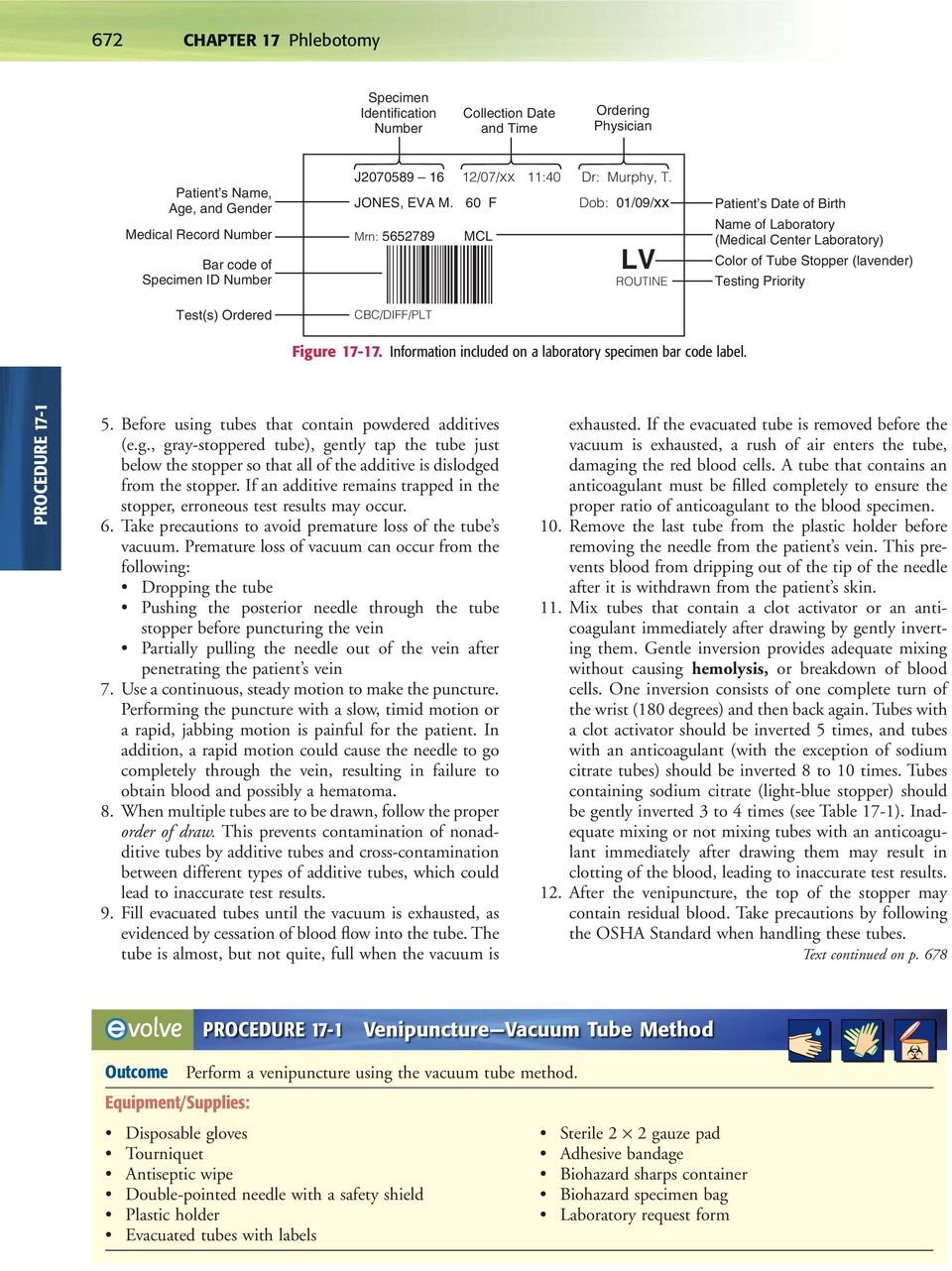
15 CHAP R 17 Phle 67 1 Table 17-1 Order of Draw for Collection of Multiple Evacuated Tubes Yellow Order of Draw by Color of Stopper Additive or Anticoagulant Sterile blood culture tube that contains SPS (sodium polyanethol sulfonate) Number of Inversions after Collection 8 to 10 inversions Light blue Sodium citrate 3 to 4 inversions Red Red/Gray Glass: no additive Plastic: clot activator Serum separator gel and clot activator No inversions 5 inversions 5 inversions Gold Green Heparin Light green/gray ray Plasma separator gel and lithium 8 to 10 inversions Light green Lavender heparin EDTA 8 to 10 inversions Royal blue EDTA No additive 8 to 10 inversions No inversions Gray Sodium fluoride/potassium 8 to 10 inversions oxalate EDTA, Ethylenediaminetetraacetic acid; SPS, sodium polyanethol sulfonate. 3. Serum tubes: Tubes with or without a clot activator, and tubes with or without a gel barrier (e.g., red-stoppered tube; red/gray- or gold-stoppered tubes) Rationale: To prevent contamination of serum tubes by tubes with an anticoagulant. 4. Anticoagulant tubes in this order of stopper color: green, lavender, royal blue (that contains EDTA), and gray Rationale: To prevent cross-contamination between different types of anticoagulants, which may lead to inaccurate test results. What Would You Do? What Would You Not Do? Case Study 2 Buzz Braydon had a heart attack 4 weeks ago and is taking the anticoagulant warfarin (Coumadin). He is at the office for a checkup and to have his prothrombin time tested. Blood is collected from a small vein in Buzz s left arm using the butterfly method. After the specimen is collected, Buzz wants to know why a red-stoppered tube was used to draw blood from him and then thrown away. Buzz says that he is going on vacation in North Carolina for 2 weeks. He says that they explained to him at the hospital why he should have his blood tested every week, but he s not sure where to go to get his blood tested while he s on vacation. Buzz wants to know if, as long as he takes his medication exactly as he should, it would be all right to skip his weekly prothrombin test during that time. Evacuated Tube Guidelines Certain guidelines should be followed when using evacuated tubes, as follows: 1. Select the proper evacuated tubes according to the tests to be performed and the amount of specimen required. 2. Check to ensure that the tube is not cracked. A cracked tube no longer has a vacuum. 3. Check the expiration date on each tube. Outdated tubes may no longer contain a vacuum, and, as a result, they would not be able to draw blood into the tube. 4. Make sure each tube is properly labeled. Proper labeling avoids mixing up specimens. Advances in specimen identification include the use of computer bar codes to identify specimens. Laboratory instruments that do the testing are able to read the bar codes and automatically record results onto the laboratory report form for a particular patient using the identification number supplied by the bar code. Along with the bar code, additional printed information is included on a bar code label (Figure 17-17). It is important to attach the correct bar code label to the blood tube. Inspect the label for printed information indicating the colorstopper tube (e.g., LV for lavender) or type of tube (e.g., SST for serum separator tube) to which the label must be attached. For example, the bar code label illustrated in Figure must be placed on a lavender (LV) tube that is being collected to perform a CBC.

16 672 CHAP TER 17 Ph lebo Specimen Identification Number Collection Date and Time Ordering Physician Patient s Name, Age, and Gender Medical Record Number Bar code of Specimen ID Number Test(s) Ordered J /07/xx 11:40 Dr: Murphy, T. JONES, EVA M. 60 F Dob: 01/09/xx Mrn: CBC/DIFF/PLT MCL LV ROUTINE Patient s Date of Birth Name of Laboratory (Medical Center Laboratory) Color of Tube Stopper (lavender) Testing Priority Figure Information included on a laboratory specimen bar code label. PROCEDURE Before using tubes that contain powdered additives (e.g., gray-stoppered tube), gently tap the tube just below the stopper so that all of the additive is dislodged from the stopper. If an additive remains trapped in the stopper, erroneous test results may occur. 6. Take precautions to avoid premature loss of the tube s vacuum. Premature loss of vacuum can occur from the following: Dropping the tube Pushing the posterior needle through the tube stopper before puncturing the vein Partially pulling the needle out of the vein after penetrating the patient s vein 7. Use a continuous, steady motion to make the puncture. Performing the puncture with a slow, timid motion or a rapid, jabbing motion is painful for the patient. In addition, a rapid motion could cause the needle to go completely through the vein, resulting in failure to obtain blood and possibly a hematoma. 8. When multiple tubes are to be drawn, follow the proper order of draw. This prevents contamination of nonadditive tubes by additive tubes and cross-contamination between different types of additive tubes, which could lead to inaccurate test results. 9. Fill evacuated tubes until the vacuum is exhausted, as evidenced by cessation of blood flow into the tube. The tube is almost, but not quite, full when the vacuum is exhausted. If the evacuated tube is removed before the vacuum is exhausted, a rush of air enters the tube, damaging the red blood cells. A tube that contains an anticoagulant must be filled completely to ensure the proper ratio of anticoagulant to the blood specimen. 10. Remove the last tube from the plastic holder before removing the needle from the patient s vein. This prevents blood from dripping out of the tip of the needle after it is withdrawn from the patient s skin. 11. Mix tubes that contain a clot activator or an anticoagulant immediately after drawing by gently inverting them. Gentle inversion provides adequate mixing without causing hemolysis, or breakdown of blood cells. One inversion consists of one complete turn of the wrist (180 degrees) and then back again. Tubes with a clot activator should be inverted 5 times, and tubes with an anticoagulant (with the exception of sodium citrate tubes) should be inverted 8 to 10 times. Tubes containing sodium citrate (light-blue stopper) should be gently inverted 3 to 4 times (see Table 17-1). Inadequate mixing or not mixing tubes with an anticoagulant immediately after drawing them may result in clotting of the blood, leading to inaccurate test results. 12. After the venipuncture, the top of the stopper may contain residual blood. Take precautions by following the OSHA Standard when handling these tubes. Text continued on p. 678 PROCEDURE 17-1 Venipuncture Vacuum Tube Method Outcome Perform a venipuncture using the vacuum tube method. Equipment/Supplies: Disposable gloves Tourniquet Antiseptic wipe Double-pointed needle with a safety shield Plastic holder Evacuated tubes with labels Sterile 2 2 gauze pad Adhesive bandage Biohazard sharps container Biohazard specimen bag Laboratory request form
17 CHAP R 17 Phle 67 3 PROCEDURE 17-1 Venipuncture Vacuum Tube Method cont d 1. Procedural Step. Review the requirements for collecting and handling the blood specimen as ordered by the physician. Sanitize your hands. 2. Procedural Step. Greet the patient and introduce yourself. Identify the patient by asking the patient to state his or her full name and date of birth. Compare this information with the demographic data in the patient s medical record. If the patient was required to prepare for the test (e.g., fasting, medication restriction), determine whether he or she has prepared properly. If the patient has not followed the patient preparation requirements, notify the physician for instructions on handling this situation. Principle. It is important to confirm that you have the correct patient to avoid collecting a specimen on the wrong patient. The patient must prepare properly to obtain a quality specimen that would lead to accurate test results. 3. Procedural Step. Assemble the equipment. Select the proper evacuated tubes for the tests to be performed. Check the expiration date on the tubes. Label each tube using one of the following methods: (a) attaching a computer bar code label to each tube to be drawn and labeling it with your initials, or (b) manually labeling each tube with the patient s name and date of birth, the date, and your initials. If the specimen is to be tested at an outside laboratory, complete a laboratory request form. (Note: Follow the medical office policy as to when the tubes should be labeled. Some offices prefer that tubes be labeled beforee the specimen is drawn; other offices want the tubes to be labeled right after the specimen is drawn.) Principle. Outdated tubes may no longer contain a vacuum, and, as a result, they may not be able to draw blood into the tube. Proper labeling of blood specimens avoids a mix-up of specimens. 4. Procedural Step. Prepare the vacuum tube system. Remove the cap from the posterior needle using a twisting and pulling motion. Insert the posterior needle into the small opening on the plastic holder. Screw the plastic holder onto the Luer adapter, and tighten it securely. Principle. An unsecured needle can fall out of its plastic holder. 4 Insert the posterior needle into the plastic holder. PROCEDURE Assemble the equipment. 5. Procedural Step. Open the sterile gauze packet, and lay it flat to allow the gauze pad to rest on the inside of its wrapper. Position the evacuated tubes in the correct order of draw. If the evacuated tube contains a powdered additive, tap the tube just below the stopper to release any additive adhering to the stopper. Principle. If an additive remains trapped in the stopper, erroneous test results may occur. 6. Procedural Step. Place the first tube loosely in the plastic holder. 7. Procedural Step. Explain the procedure to the patient, and reassure the patient. Perform a preliminary assessment of both arms to determine the best vein to use. It also is helpful to ask the patient which arm has been used in the past to obtain blood. Principle. Venipuncture is often a frightening experience for the patient, and reassurance should be offered to reduce apprehension. Continued

18 674 CHAP TER 17 Ph lebo PROCEDURE 17-1 Venipuncture Vacuum Tube Method cont d 8. Procedural Step. Apply the tourniquet. Position the tourniquet 3 to 4 inches above the bend in the elbow. The tourniquet should be snug but not tight. Ask the patient to clench the fist of the arm to which the tourniquet has been applied. Principle. The combined effect of the pressure of the tourniquet and the clenched fist should cause the antecubital veins to stand out so that accurate selection of a puncture site can be made. Principle. Leaving the tourniquet on for longer than 1 minute is uncomfortable for the patient and may alter the test results PROCEDURE 17-1 Palpate the vein. Apply the tourniquet. 9. Procedural Step. With a tourniquet in place, thoroughly assess the veins of first one arm and then the other to determine the best vein to use. 10. Procedural Step. Position the patient s arm. The arm with the vein selected for the venipuncture should be extended and placed in a straight line from the shoulder to the wrist with the antecubital veins facing anteriorly. The arm should be supported on the armrest by a rolled towel or by having the patient place the fist of the other hand under the elbow. Principle. This position allows easy access to the antecubital veins. 11. Procedural Step. Thoroughly palpate the selected vein. Gently palpate the vein with the fingertips to determine the direction of the vein and to estimate its size and depth. Never leave the tourniquet on an arm for longer than 1 minute at a time. (Note: If you need to perform several assessments to locate the best vein, the tourniquet must be removed and reapplied after a 2-minute waiting period.) 12. Procedural Step. Remove the tourniquet and cleanse the site with an antiseptic wipe. Cleansing should be done in a circular motion, starting from the inside and moving away from the puncture site. Allow the site to air-dry; after cleansing, do not touch the area, wipe the area with gauze, or fan the area with your hand. Place the remaining supplies within comfortable reach of your nondominant hand. Principle. Using a circular motion helps carry foreign particles away from the puncture site. The site must be allowed to air-dry to allow the alcohol enough time to destroy microorganisms on the patient s skin. Residual alcohol entering the blood specimen can cause hemolysis, leading to inaccurate test results. In addition, residual alcohol causes the patient to experience a stinging sensation when the puncture is made. Touching or fanning the area causes contamination of the puncture site, and the cleansing process must be repeated. Items used during the procedure should be positioned so that you do not have to reach over the patient and possibly move the needle, resulting in pain, injury, or both. 13. Procedural Step. Reapply the tourniquet. Apply gloves. Rotate the needle s safety shield backward toward the holder (refer to Figure 17-13, A). Remove the cap from the needle using a twisting and pulling

19 CHAP R 17 Phle 67 5 PROCEDURE 17-1 Venipuncture Vacuum Tube Method cont d 13 motion. Hold the vacuum tube system by placing the thumb of the dominant hand on top of the plastic holder and the pads of the first three fingers underneath the holder and evacuated tube. The needle should be positioned with the bevel facing up. Position the evacuated tube so that the label is facing down. Principle. Gloves provide a barrier against bloodborne pathogens. Positioning the needle with the bevel up allows easier entry into the skin and the vein, resulting in less pain for the patient. With the label facing down, you would be able to observe the blood as it fills the tube, which allows you to know when the tube is full. 15 Position the needle. 16. Procedural Step. Tell the patient that he or she will feel a small stick, and with one continuous steady motion, enter the skin and then the vein. You will feel a sensation of resistance followed by a release as the vein is entered. When the release is felt, you have entered the vein and should not advance the needle any farther. Principle. Using one continuous steady motion helps to prevent tissue damage. PROCEDURE Rotate the safety shield backward. 14. Procedural Step. Anchor the vein. Grasp the patient s arm with the nondominant hand. Your thumb should be placed 1 to 2 inches below and to the side of the puncture site. Using your thumb, draw the skin taut over the vein in the direction of the patient s hand. Principle. The thumb helps hold the skin taut for easier entry and helps stabilize the vein to be punctured. Placing the thumb to the side keeps it out of the way of the vacuum tube setup, so that you can maintain a 15-degree angle when entering the vein. 15. Procedural Step. Position the needle at a 15-degree angle to the arm. Rest the backs of the fingers on the patient s forearm. Ensure that the needle points in the same direction as the vein to be entered. The needle should be positioned so that it enters the vein approximately 1 8 inch below the place where the vein is to be entered. Principle. An angle of less than 15 degrees may cause the needle to enter above the vein, preventing puncture. An angle of more than 15 degrees may cause the needle to go through the vein by puncturing the posterior wall. This could result in a hematoma. Make the puncture. 17. Procedural Step. Stabilize the vacuum tube setup by firmly grasping the holder between the thumb and the underlying fingers to prevent the needle from moving. Do not change hands during the procedure. Principle. Stabilizing the holder helps prevent the needle from moving when a tube is inserted or removed. Changing hands may cause the needle to move, which is painful for the patient. 18. Procedural Step. With the nondominant hand, place the first two fingers on the underside of the flange on the plastic holder, and with the thumb, slowly push the tube forward to the end of the holder. This Continued

20 676 CHAP TER 17 Ph lebo PROCEDURE 17-1 Venipuncture Vacuum Tube Method cont d PROCEDURE 17-1 allows the posterior needle to puncture the rubber stopper. Blood begins flowing into the tube if the (anterior) needle is in a vein. Principle. Not using the flange may cause the needle to advance forward and go completely through the vein, resulting in failure to obtain blood; internal bleeding also may occur, resulting in a hematoma. 19. Procedural Step. Allow the evacuated tube to fill to the exhaustion of the vacuum, as indicated by cessation of the blood flow into the tube. The suction of the evacuated tube automatically draws the blood into the tube. Principle. If the evacuated tube is removed before the vacuum is exhausted, a rush of air enters the tube, damaging the red blood cells. Also, a tube containing an additive, such as an anticoagulant, must be filled completely to ensure accurate test results. 20. Procedural Step. Remove the tube from the holder by grasping the tube with the fingers, placing the thumb or index finger against the flange, and pulling the tube off the posterior needle. Do not change the position of the needle in the vein. If the tube contains a clot activator, gently invert the tube back and forth 5 times before laying it down. If the tube contains an anticoagulant, gently invert the tube 8 to 10 times. Principle. The rubber sheath covers the point of the needle, stopping the flow of blood until the next tube is inserted. Not using the flange to remove the tube can cause the needle to come out of the vein prematurely, resulting in blood being forced out of the puncture site. A tube containing an anticoagulant must be inverted immediately to prevent the blood from clotting. Careful mixing of the blood with a clot activator or an anticoagulant prevents hemolysis. 20 Remove the tube from the holder. 21. Procedural Step. Using the flange, carefully insert the next tube into the holder. Continue in this manner until the last tube has been filled. 22. Procedural Step. Remove the tension from the tourniquet by pulling upward on one of the flaps of the tourniquet. Ask the patient to unclench the fist. Principle. The tourniquet tension must be removed before the needle. Otherwise, the pressure on the vein from the tourniquet could cause internal and external bleeding around the puncture site. 23. Procedural Step. Remove the last tube from the holder. Immediately invert the tube back and forth 5 times if it contains a clot activator and 8 to 10 times if it contains an anticoagulant. Principle. Removing the last tube prevents blood from dripping out of the tip of the needle after it is removed from the patient s arm. 23 Invert the tube 8 to 10 times. 24. Procedural Step. Place a sterile gauze pad slightly above the puncture site, and carefully withdraw the needle at the same angle as for penetration. Immediately move the gauze over the puncture site, and apply firm pressure. (Do not apply any pressure to the puncture site until the needle is completely removed.) Push the safety shield forward with your thumb until you hear an audible click, which indicates the shield has locked into place. Do not push the shield forward by pressing it against a hard surface. (See Figure 17-13, B, C.) Principle. Placing the gauze pad above the puncture helps prevent tissue movement as the needle is withdrawn and reduces patient discomfort. Careful withdrawal prevents further tissue damage. 25. Procedural Step. Immediately discard the plastic holder and attached needle in a biohazard sharps container. Do not remove the needle from the holder; the holder must be discarded and not reused. Principle. Immediate disposal of the needle and holder unit is required by the OSHA Standard to prevent a needlestick injury; even though the safety shield encases the anterior needle, a needlestick injury

21 CHAP R 17 Phle 67 7 PROCEDURE 17-1 Venipuncture Vacuum Tube Method cont d 24 Principle. Lifting a heavy object causes pressure on the puncture site, which could result in bleeding. 28. Procedural Step. Place the tubes in an upright position in a test tube rack. Remove the gloves, and sanitize your hands. 29. Procedural Step. Chart the procedure in the patient s medical record. a. Paper-Based Medical Record: Record the date and time, which arm and vein were used, unusual patient reaction, and your initials (refer to the PPR charting example). PPR CHARTING EXAMPLE Date 4/5/XX 9:00 a.m. Venous blood specimen colle ct ed from L arm. Picked up by Medical Center Laboratory on 4/5/. D. Glover, CMA (AAMA) PROCEDURE 17-1 Withdraw the needle. can still occur from the posterior needle, which is only covered with a rubber sleeve. Plastic holders are often contaminated with blood and must not be reused. 26. Procedural Step. Continue to apply pressure with the gauze pad. Cooperative patients can be asked to assist by applying pressure with the gauze pad for 1 to 2 minutes. The arm can be elevated to facilitate clot formation. Do not allow the patient to bend the arm at the elbow because this increases blood loss from the puncture site. Principle. Applying pressure reduces the leakage of blood from the puncture site externally or internally. Internal leakage of blood into the tissues could result in a hematoma. 27. Procedural Step. Stay with the patient until the bleeding has stopped. Remove the gauze, and inspect the puncture site to ensure that the opening is sealed with a clot. Apply an adhesive bandage to the puncture site. As an alternative, the gauze pad can be folded into quarters and taped on the puncture site to be used as a pressure bandage. Instruct the patient not to pick up anything heavy for about an hour. (Note: If swelling or discoloration occurs, apply an ice pack to the site after bandaging it.) b. Electronic Medical Record: Enter the appropriate data into the computer. 30. Procedural Step. If needed, process the specimen (e.g., centrifuging the specimen to separate serum from the cells). Test the specimen or prepare the specimen for transport to an outside laboratory for testing according to the medical office policy. If the specimen is to be transported to an outside laboratory, do the following: a. Place the specimen tube in a biohazard specimen bag. b. Place the laboratory request in the outside pocket of the specimen bag. c. Properly handle and store the specimen while awaiting pickup by a laboratory courier. d. Chart the date the specimen was transported to the laboratory in the patient s medical record. Principle. The biohazard bag protects the laboratory courier from the possibility of an exposure incident. The outside laboratory must have the completed request form to know which laboratory tests have been ordered by the physician. The specimen must be handled and stored properly to maintain the in vivo characteristics of the specimen.
22 678 CHAP TER 17 Phle lebo Luer adapter A Green wings (21 G needle) B Light blue wings (23 G needle) Hub adapter Figure Winged infusion set. A, Luer adapter with evacuated tube. B, Hub adapter with syringe. Butterfly Method of Venipuncture The butterfly method of venipuncture is also called the winged infusion method. This is because a winged infusion set is used to perform the procedure. The term butterfly is derived from the plastic wings located between the needle and the tubing of the winged infusion set (Figure 17-18). The butterfly method is used to collect blood from patients who are difficult to stick by conventional methods because it provides better control when making the puncture, and less pressure is exerted on the vein wall from the evacuated tube. The butterfly method is recommended for adults with small antecubital veins and children, who typically have small antecubital veins. The butterfly method also is used when the antecubital veins are unavailable and veins in the forearm, wrist area, or back of the hand are used, as may occur with elderly and obese patients. These alternative veins are usually smaller and sometimes have a thin wall (e.g., hand veins), making them more likely to collapse when using the vacuum tube method of venipuncture. With the vacuum tube method, the sucking action exerted on the vein when the pressure in the vacuum is released causes the vein to collapse, blocking the flow of blood into the tube. The butterfly method results in less pressure on the vein wall because the pressure exerted by the evacuated tube must travel through a length of tubing before reaching the vein. Because the pressure against the vein wall is minimized, the vein is less likely to collapse with the butterfly method. Procedure 17-2 describes the venipuncture procedure using the butterfly method. The gauge of the winged infusion needle used to collect a blood specimen ranges from 21 G to 23 G, and the length of the needle ranges from 1 2 to 3 4 inch. The needle is short and sharp, making it easier to stick difficult veins. For extremely small veins, a 23 G needle should be used to prevent rupture of the vein by a larger needle. In this case, it is preferable to use smaller-volume tubes (e.g., 2-mL evacuated tubes) because large evacuated tubes may put too much vacuum pressure on the vein, causing it to collapse. Manufacturers often color-code the wings of the infusion setup by gauge for easier identification; for example, Becton Dickinson uses the following color coding system: green for 21 G needles and light blue for 23 G needles (see Figure 17-18). The winged infusion needle is attached to a 7- or 12-inch length of tubing and a Luer adapter, which is attached to a (posterior) needle with a rubber sleeve. A plastic holder is screwed onto the Luer adapter, which allows it to be used with evacuated tubes (see Figure 17-18, A). Winged infusion sets also are available with a hub adapter that allows them to be used with a syringe (see Figure 17-18, B). Safety needles are available with a shield that covers the contaminated needle after it is withdrawn from the patient s vein (Figure 17-19). Guidelines for the Butterfly Method Certain guidelines should be followed when performing the butterfly method of venipuncture, as follows: 1. Position the patient according to the site selected for the venipuncture as follows: Antecubital, wrist and forearm veins. Position the arm in a straight line from the shoulder to the wrist as described in the vacuum tube method of venipuncture. Hand veins. Position the patient s hand on the armrest, and ask the patient to make a loose fist or to grasp a rolled towel. This combination causes the hand veins to stand out so that accurate selection of a puncture site can be made. Locate a suitable vein between the knuckles and the wrist bones. Hand veins are usually visible and easy to locate. 2. Position the tourniquet according to the venipuncture site as follows: If the veins of the forearm or wrist are used, apply the tourniquet to the forearm, approximately
23 CHAP R 17 Phle 67 9 A B Figure Butterfly safety needle. The safety needle has a shield that covers the contaminated needle after it is withdrawn from the patient s vein. A, The medical assistant has covered one half of the needle with the shield. B, The needle is completely covered with the shield. A B C Forearm site Wrist site Hand Figure Application of the tourniquet for alternative venipuncture sites. 3 inches above the puncture site. For hand veins, position the tourniquet on the arm just above the wrist bone (Figure 17-20). 3. Grasp the needle by compressing the plastic wings together. Insert the needle with the bevel facing up at a 15-degree angle to the skin. When the vein has been entered, decrease the angle to 5 degrees. 4. After decreasing the needle angle to 5 degrees, slowly thread the needle inside the vein an additional 1 4 inch. This anchors or seats the needle in the center of the vein and allows the medical assistant to use both hands to change tubes. 5. To prevent venous reflux, keep the evacuated tube and holder in a downward position as in the vacuum tube venipuncture procedure. This technique ensures that the blood fills from the bottom up and not near the rubber stopper. 6. When multiple tubes are to be drawn, follow the proper order of draw. The order of draw for the butterfly method is identical to that for the vacuum tube method (previously presented). Following this order of draw prevents contamination of nonadditive tubes and crosscontamination of additive tubes. Text continued on p. 685
24 680 CHAP TER 17 Ph lebo PROCEDURE 17-2 Venipuncture Butterfly Method Outcome Perform a venipuncture using the butterfly method. Equipment/Supplies: Disposable gloves Tourniquet Antiseptic wipe Winged infusion set with a Luer adapter and safety shield Plastic holder Evacuated tubes with labels Sterile 2 2 gauze pad Adhesive bandage Biohazard sharps container Biohazard specimen bag Laboratory request form PROCEDURE Procedural Step. Review the requirements for collecting and handling the blood specimen as ordered by the physician. Sanitize your hands. 2. Procedural Step. Greet the patient and introduce yourself. Identify the patient by asking the patient to state his or her full name and date of birth. Compare this information with the demographic data in the patient s medical record. If the patient was required to prepare for the test (e.g., fasting, medication restriction), determine whether he or she has prepared properly. If the patient has not followed the patient preparation requirements, notify the physician for instructions on handling this situation. Principle. It is important to confirm that you have the correct patient to avoid collecting a specimen on the wrong patient. The patient must prepare properly to obtain a quality specimen that would lead to accurate test results. 3. Procedural Step. Assemble the equipment. Select the proper evacuated tubes for the tests to be performed. Check the expiration date on the tubes. Label each tube using one of the following methods: (a) attaching a computer bar code label to each tube and labeling it with your initials, or (b) manually labeling each tube with the patient s name and date of birth, the date, and your initials. If the specimen is to be tested at an outside laboratory, complete a laboratory request form. (Note: Follow the medical office policy as to when the tubes should be labeled. Some offices prefer that tubes be labeled beforee the specimen is drawn; other offices want the tubes to be labeled right after the specimen is drawn.) Principle. Outdated tubes may no longer contain a vacuum, and, as a result, they may not be able to draw blood into the tube. Proper labeling of blood specimens avoids the mix-up of specimens. 4. Procedural Step. Prepare the winged infusion set. Remove the winged infusion set from its package. Extend the tubing to its full length, and stretch it slightly to prevent it from recoiling. Insert the posterior needle into the small opening on the plastic holder. Screw the plastic holder onto the Luer adapter, and tighten it securely. 3 4 Assemble the equipment. Principle. Extending the tubing straightens it to permit a free flow of blood in the tubing. An unsecured needle can fall out of its plastic holder. Screw the plastic holder onto the Luer adapter. 5. Procedural Step. Open the sterile gauze packet, and lay it flat to allow the gauze pad to rest on the inside of its wrapper. Position the evacuated tubes in the correct order of draw. If the evacuated tube contains a powdered additive, tap the tube just below the stopper to release any additive adhering to the stopper.
25 CHAP R 17 Phle 68 1 PROCEDURE 17-2 Venipuncture Butterfly Method cont d Principle. If an additive remains trapped in the stopper, erroneous test results may occur. 6. Procedural Step. Place the first tube loosely in the plastic holder with the label facing down. Principle. With the label facing down, you can observe the blood as it fills the tube, which allows you to know when the tube is full. 7. Procedural Step. Explain the procedure to the patient, and reassure the patient. Perform a preliminary assessment of both arms to determine the best vein to use. It also is helpful to ask the patient which arm has been used in the past to obtain blood. Principle. Venipuncture is often a frightening experience for the patient, and reassurance should be offered to reduce apprehension. 8. Procedural Step. Apply the tourniquet. Position the tourniquet 3 to 4 inches above the bend in the elbow. The tourniquet should be snug but not tight. Ask the patient to clench the fist of the arm to which the tourniquet has been applied. Principle. The combined effect of the pressure of the tourniquet and the clenched fist should cause the antecubital veins to stand out so that accurate selection of a puncture site can be made. 9. Procedural Step. With a tourniquet in place, thoroughly assess the veins of first one arm and then the other to determine the best vein to use. 10. Procedural Step. Position the patient s arm. The arm with the vein selected for the venipuncture should be extended and placed in a straight line from the shoulder to the wrist with the antecubital veins facing anteriorly. The arm should be supported on the armrest by a rolled towel or by having the patient place the fist of the other hand under the elbow. Principle. This position allows easy access to the antecubital veins. 11. Procedural Step. Thoroughly palpate the selected vein. Gently palpate the vein with the fingertips to determine the direction of the vein and to estimate its size and depth. Never leave the tourniquet on an arm for longer than 1 minute at a time. (Note: If you need to perform several assessments to locate the best vein, the tourniquet must be removed and reapplied after a 2-minute waiting period.) Principle. Leaving the tourniquet on for longer than 1 minute is uncomfortable for the patient and may alter the test results. 12. Procedural Step. Remove the tourniquet and cleanse the site with an antiseptic. Cleansing should be done in a circular motion, starting from the inside and moving away from the puncture site. Allow the site to air-dry, and after cleansing, do not touch the area, wipe the area with gauze, or fan the area with your hand. Place your remaining supplies within comfortable reach. Principle. Using a circular motion helps carry foreign particles away from the puncture site. The site must be allowed to air-dry to allow the alcohol enough time to destroy microorganisms on the patient s skin. Residual alcohol entering the blood specimen can cause hemolysis, leading to inaccurate test results. In addition, residual alcohol causes the patient to experience a stinging sensation when the puncture is made. Touching or fanning the area causes contamination of the puncture site, and the cleansing process must be repeated. Items used during the procedure should be positioned so that you do not have to reach over the patient and possibly move the needle, resulting in patient pain, injury, or both. 13. Procedural Step. Reapply the tourniquet. Apply gloves. With the dominant hand, grasp the winged infusion set by pressing the butterfly tips together. Remove the protective sheath from the needle of the infusion set. The needle should be positioned with the bevel facing up. Principle. Gloves provide a barrier against bloodborne pathogens. Positioning the needle with the bevel up allows easier entry into the skin and the vein, resulting in less pain for the patient. 13 Remove the protective shield from the needle. 14. Procedural Step. Anchor the vein. Grasp the patient s arm with the nondominant hand. The thumb should be placed 1 to 2 inches below and to the side of the puncture site. Using the thumb, draw the skin taut over the vein in the direction of the patient s hand. Principle. The thumb helps hold the skin taut for easier entry and helps stabilize the vein to be punctured. Placing the thumb to the side keeps it out of the way of the winged infusion setup so that you can maintain a 15-degree angle when entering the vein. PROCEDURE 17-2 Continued
26 682 CHAP TER 17 Ph lebo PROCEDURE 17-2 Venipuncture Butterfly Method cont d PROCEDURE Procedural Step. Position the needle at a 15-degree angle to the arm. Rest the backs of the fingertips on the patient s skin. Make sure the needle points in the same direction as the vein to be entered. The needle should be positioned so that it enters the vein approximately 1 8 inch below the place where the vein is to be entered. Principle. An angle of less than 15 degrees may cause the needle to enter above the vein, preventing puncture. An angle of more than 15 degrees may cause the needle to go through the vein by puncturing the posterior wall. This could result in a hematoma. 16. Procedural Step. Tell the patient that he or she will feel a small stick, and with one continuous steady motion, enter the skin and then the vein. You will feel a sensation of resistance followed by a release as the vein is entered. After penetrating the vein, decrease the angle of the needle to 5 degrees. If the needle is in the vein, a flash of blood appears at the top of the tubing. Principle. Using one continuous motion reduces tissue damage Rest the butterfly wings flat against the patient s skin. Blood begins to flow into the tube. Allow the evacuated tube to fill to the exhaustion of the vacuum, as indicated by cessation of the blood flow into the tube. The suction of the evacuated tube automatically draws the blood into the tube. Principle. The tube must fill from the bottom up to prevent venous reflux. If the evacuated tube is removed before the vacuum is exhausted, a rush of air enters the tube, damaging the red blood cells. Also, a tube containing an anticoagulant must be filled completely to ensure accurate test results. 18 Make the puncture. 17. Procedural Step. Seat the needle by threading it forward an additional 1 4 inch inside the center of the vein so that it does not twist out of the vein, even if you let go of it. Open the butterfly wings and securely rest the wings flat against the skin. Ensure that the needle does not move. Principle. Seating the needle anchors the needle in the center of the vein and allows the use of both hands for changing tubes. Moving the needle is painful for the patient. 18. Procedural Step. Keep the tube and holder in a downward position so that the tube fills from the bottom up and not near the rubber stopper. Slowly push the tube forward to the end of the holder. This allows the needle to puncture the rubber stopper. Fill the tubes in a downward position. 19. Procedural Step. Remove the tube from the plastic holder. If the tube contains a clot activator, gently invert the tube back and forth 5 times before laying
27 CHAP R 17 Phle 68 3 PROCEDURE 17-2 Venipuncture Butterfly Method cont d it down. If the tube contains an anticoagulant, gently invert the tube 8 to 10 times. Principle. The rubber sheath covers the point of the needle, stopping the flow of blood until the next tube is inserted. A tube containing an anticoagulant must be inverted before laying it down to prevent the blood from clotting. Careful mixing of the blood with a clot activator or an anticoagulant prevents hemolysis. 19 angle as for penetration. Immediately move the gauze over the puncture site, and apply firm pressure. (Note: Do not apply pressure to the puncture site until the needle is completely removed.) Cooperative patients can be asked to assist by applying pressure with the gauze pad. Grasp the base of the needle s safety shield with the thumb and index fingers of one hand and, with the other hand, grasp either wing. Slide the wing back into the rear slot of the safety shield until you hear an audible click, which indicates the shield has locked into place (see Figure 17-18, A, B). Principle. Placing the gauze pad above the puncture site helps prevent tissue movement as the needle is withdrawn and reduces patient discomfort. Careful withdrawal prevents further tissue damage. 23 PROCEDURE 17-2 Remove the tube from the holder. 20. Procedural Step. Using the flange, carefully insert the next tube into the holder. Continue in this manner until the last tube has been filled. 21. Procedural Step. Remove the tension from the tourniquet by pulling upward on one of the flaps of the tourniquet. Ask the patient to unclench the fist. Principle. The tourniquet tension must be removed before the needle. Otherwise, pressure on the vein from the tourniquet could cause internal and external bleeding around the puncture. 22. Procedural Step. Remove the last tube from the holder. Immediately invert the tube back and forth 5 times if it contains a clot activator and 8 to 10 times if it contains an anticoagulant. Principle. Removing the last tube from the holder prevents blood from dripping out of the tip of the needle after it is removed from the patient s arm. 23. Procedural Step. Place a sterile gauze pad slightly above the puncture site. Grasp the setup just below the wings, and slowly withdraw the needle at the same Release the tourniquet and remove the needle. 24. Procedural Step. Immediately discard the winged infusion set and attached plastic holder. Holding onto the plastic holder, first drop the needle into a biohazard sharps container followed by the tubing and holder. Do not remove the plastic holder from the setup; the plastic holder must be discarded and not reused. Principle. Proper disposal is required by the OSHA Standard to prevent a needlestick injury; even though the safety shield has been activated to encase the butterfly needle, a needlestick injury can still result from the posterior needle, which is covered with only a rubber sleeve. Plastic holders are often contaminated with blood and must not be reused. Continued
28 684 CHAP TER 17 Ph lebo PROCEDURE 17-2 Venipuncture Butterfly Method cont d PROCEDURE Procedural Step. Continue to apply pressure with the gauze pad. The arm can be elevated to facilitate clot formation. Do not allow the patient to bend the arm at the elbow because this increases blood loss from the puncture site. Principle. Applying pressure reduces the leakage of blood from the puncture site externally or internally. Internal leakage into the tissues could result in a hematoma. 26. Procedural Step. Stay with the patient until the bleeding has stopped. Remove pressure, and inspect the puncture site to ensure that the opening is sealed with a clot. Apply an adhesive bandage to the puncture site. As an alternative, the gauze pad can be folded into quarters and taped onto the puncture site to be used as a pressure bandage. Instruct the patient not to pick up anything heavy for about an hour. (Note: If swelling or discoloration occurs, apply an ice pack to the site after bandaging it.) Principle. Lifting a heavy object causes pressure on the puncture site, which could result in bleeding. 27. Procedural Step. Place the tubes in an upright position in a test tube rack. Remove the gloves, and sanitize your hands. 28. Procedural Step. Chart the procedure in the patient s medical record. a. Paper-Based Medical Record: Record the date and time, which arm and vein were used, unusual patient reactions, and your initials (refer to the PPR charting example). b. Electronic Medical Record: Enter the appropriate data into the computer. PPR CHARTING EXAMPLE Date 4/10/XX from L arm. Picked up by Medical Center Laboratory on 4/10/. D. Glover, CMA (AAMA) A) 29. Procedural Step. If needed, process the specimen (e.g., centrifuging the specimen to separate serum from the cells). Test the specimen or prepare the specimen for transport to an outside laboratory for testing according to the medical office policy. If the specimen is to be transported to an outside laboratory, do the following: a. Place the specimen tube in a biohazard specimen bag. b. Place the laboratory request in the outside pocket of the specimen bag. c. Properly handle and store the specimen while awaiting pickup by a laboratory courier. d. Chart the date the specimen was transported to the laboratory in the patient s medical record. Principle. The biohazard bag protects the laboratory courier from the possibility of an exposure incident. The outside laboratory must have the completed request form to know which laboratory tests have been ordered by the physician. The specimen must be handled and stored properly to maintain the in vivo characteristics of the specimen. Memories of Practicum Dori Glover: One of the most terrifying things for me as a student was learning venipuncture. Even though I would practice during classroom laboratory hours and felt comfortable with it, it still scared me to know I would have to draw on a real person one day. When the day arrived to draw on my laboratory partner, I became sick to my stomach. In the end, we both got through it just fine and walked away without hurting each other. I spent days trying to prepare myself for that first experience, but after it was over, I felt more confident and relaxed that I could do this. At my practicum site, I was able to perform several venipunctures a day, which raised my confidence level. Today venipuncture is my favorite responsibility of all. I would draw blood all day if I could. I know I could even draw with my eyes closed, but never would, of course! What Would You Do? What Would You Not Do? Case Study 3 Maud Gabriel is at the office complaining of persistent headaches and abdominal pain over the past 3 months. The physician gives Mrs. Gabriel a laboratory requisition to have her blood drawn and tested at an outside laboratory. Mrs. Gabriel says that her daughter who lives with her works as a phlemist at the local hospital. Mrs. Gabriel wants to know whether her daughter can draw her blood at home and then drop it off at the laboratory. She says that the last time she had her blood drawn, they had to stick her 2 times and then she got a big bruise on her arm afterward. She says the laboratory technician kept digging around in her arm to find the vein and that it was quite painful.
29 CHAP R 17 Phle 68 5 Problems Encountered With Venipuncture Sometimes the medical assistant encounters problems when attempting to draw blood from a patient. The appropriate response depends on the type of problem. Failure to Obtain Blood Periodically, even individuals highly skilled at performing venipuncture have difficulty obtaining blood. Although large and prominent veins make it easier to collect the blood specimen, conditions often exist that make the procedure more difficult. It is often difficult to draw blood from obese patients who have small, superficial veins and whose veins suitable for venipuncture are buried in adipose tissue. Elderly patients with arteriosclerosis may have veins that are thick and hard, making them difficult to puncture. Other patients have veins that are small or have a thin wall, making the veins likely to collapse. After two unsuccessful attempts at venipuncture, the medical assistant should seek assistance in obtaining the blood specimen. Factors that result in failure to obtain blood after the needle has been inserted include not inserting the needle far enough, preventing it from entering the vein (Figure 17-21); insertion of the needle too far, causing it to go through the vein; and the bevel opening becoming lodged against the wall of the vein. In these instances, most authorities recommend removal of the needle, rather than trying to probe the vein. Probing is often uncomfortable for the patient and can affect the integrity of the blood specimen, leading to inaccurate test results. Occasionally, an evacuated tube loses its vacuum because of a manufacturing defect or through improper handling of the tube. If suspected, this problem can be corrected by removing the defective tube and inserting another vacuum tube. A. Correct insertion of the needle into the vein. B. Improper angle of insertion (<15 ), causing the needle to enter above the vein. C. Improper angle of insertion (>15 ), causing the needle to go through the vein. D. Collapsed vein (most likely to occur in persons with small veins). E. The beveled opening is partially within and partially outside of the vein, causing a hematoma. Figure Problems encountered with venipuncture.
30 686 CHAP TER 17 Phle lebo Inappropriate Puncture Sites If a patient complains of pain or soreness in a potential venipuncture site, this area should be avoided. In addition, any skin areas that are scarred, bruised, burned, or adjacent to areas of infection should not be used. A venipuncture should not be performed on an arm with edema or an arm on the same side as a mastec. Swelling makes is more difficult to locate a vein and results in a longer time for healing of the puncture site to occur. Other sites to avoid include an arm that has a cast applied to it and an arm on the same side as a radical mastec. Scarred and Sclerosed Veins An individual who has had many venipunctures over a period of years often develops scar tissue in the wall of the vein. Elderly patients may have veins that have become thickened from arteriosclerosis. In both cases, the veins feel stiff and hard when palpated. A scarred or sclerosed vein is difficult to stick, and the blood return may be poor owing to a narrowed lumen; it is recommended that another vein be used for the venipuncture. If this is impossible, the needle should be inserted with careful pressure to avoid going completely through the vein. Rolling Veins The median cubital vein, located in the center of the antecubital space, is considered the best vein for a venipuncture. Sometimes it is impossible to use this vein, however, such as when it lies deep in the tissues and cannot be palpated or is scarred from repeated venipunctures. The veins on either side of the median cubital (cephalic or basilic) can be used, but they have a tendency to roll, or move away from the needle, escaping puncture. To prevent rolling, firm pressure should be applied below and to the side of the vein to stabilize it as the needle is inserted. Collapsing Veins Veins are most likely to collapse in individuals who have small veins or veins with thin walls. This is particularly true when the vacuum tube method is used. The sucking action exerted on the vein when the pressure in the vacuum is released causes the vein to collapse, blocking the flow of blood into the tube (see Figure 17-21). The typical result observed is that a small amount of blood enters the tube and then blood flow stops. Because better control and less pressure on the vein is possible, the butterfly method of venipuncture is recommended to obtain the specimen in patients with small veins. Premature Needle Withdrawal Patient movement or improper venipuncture technique can cause the needle to come out of the vein prematurely. Because of the pressure exerted by the tourniquet, blood may be forced out of the puncture site, and immediate action is required to prevent a hematoma. The tourniquet should be removed at once, a gauze pad placed on the puncture site, and pressure applied until the bleeding has stopped. Hematoma A hematoma is caused by blood leaking from the puncture site of the vein and into the surrounding tissues, resulting in a bruise. A hematoma is caused by a needle that is inserted too far and goes through the vein, a bevel opening that is partially in the vein and partially out of the vein (see Figure 17-21), and insufficient pressure applied to the puncture site after removing the needle. The first sign of a hematoma is a sudden swelling around the puncture site. If this occurs when the needle is in the patient s vein, first the tourniquet and then the needle should be removed immediately, and pressure should be applied to the puncture site until the bleeding stops. Hemolysis The blood specimen should be handled carefully at all times. Blood cells are fragile, and rough handling may cause hemolysis, or breakdown of the blood cells. Hemolyzed blood specimens produce inaccurate test results. To prevent hemolysis, these guidelines should be followed: 1. Store the vacuum tubes at room temperature because chilled tubes can result in hemolysis. 2. Allow the alcohol to air-dry completely before performing the venipuncture. Alcohol entering a blood specimen can cause hemolysis. 3. Use an appropriate-gauge needle to collect the specimen. Using a small-gauge needle (e.g., 25 G) can cause the blood cells to rupture as they pass through the lumen of the needle. 4. Practice good technique in collecting the specimen; excessive trauma to the blood vessel can result in hemolysis. 5. Always handle the blood tube carefully; do not shake it or handle it roughly. Fainting Occasionally, a patient experiences dizziness or fainting during or after a venipuncture. Should this occur, the most immediate concern is to protect the patient from injury, for example, by preventing the patient from falling. The patient should be placed in a position that promotes blood flow to the brain, and the physician should be notified for further treatment; see the box Highlight on Vasovagal Syncope (Fainting). Obtaining a Serum Specimen Serum Serum is plasma from which the clotting factor fibrinogen has been removed. A brief discussion of serum is presented
31 CHAP R 17 Phle 68 7 Highlight on Vasovagal Syncope (Fainting) Most people experience no change in their sense of well-being when they have blood taken. A very small percentage of individuals experience a type of fainting, however, known as vasovagal syncope. Cause and Symptoms Vasovagal syncope is caused by unpleasant physical or emotional stimuli, such as pain, fright, and the sight of blood. A sudden pooling of blood occurs, which results in a sudden decrease in blood pressure. This momentarily deprives the brain of blood, causing a temporary loss of consciousness, usually lasting only 1 to 2 minutes. Vasovagal syncope usually occurs when an individual is in an upright position, as in standing or sitting. Before fainting, the patient usually experiences some warning signals, such as sudden light-headedness, nausea, weakness, yawning, paleness, blurred vision, a feeling of warmth, and sweating followed by drooping eyelids; a weak, rapid pulse; and finally unconsciousness. Treatment A person who is about to faint should be placed in a position that facilitates blood flow to the brain and told to breathe deeply. The preferred position is lying down (supine) with the legs elevated and the collar and clothing loosened. This position may not always be possible, such as when a patient is seated and the venipuncture needle has already been inserted. In this case, the tourniquet and then the needle should be removed, and the patient s head should be lowered between the legs. An individual who has fainted should be protected from injury by falling and should be placed in a position that facilitates blood flow to the brain, as just described. Prevention Fainting during or after venipuncture is more likely in the following individuals: patients having a venipuncture for the first time, young patients, thin patients, patients with a low diastolic or high systolic blood pressure, patients with a history of fainting, nervous and apprehensive patients, and patients who are very quiet or very talkative. Fainting often can be prevented by identifying and closely observing individuals who are more likely to faint (as described). Talking to the patient often helps relax the patient and divert attention from the venipuncture procedure. If a patient has a history of fainting, he or she should be in a semi-fowler s position for the venipuncture procedure because people rarely faint in this position. Other factors that contribute to fainting and that should be avoided include fatigue, lack of sleep, hunger, and environmental factors, such as a noisy, crowded, or overheated room. here, and a thorough discussion of plasma is presented later in this chapter. Serum is normally clear in appearance and light yellow to yellow in color. Serum contains many dissolved substances, such as glucose, cholesterol, sodium, potassium, chloride, antibodies, hormones, and enzymes. As a result, many laboratory tests require a serum specimen to determine whether these substances are within normal limits and to detect substances that should not normally be in the serum, and that, if present, indicate a pathologic condition. Serum Fibrin clot Tube Selection A tube without an anticoagulant (e.g., red-stoppered or SST) must be used to collect the blood specimen, to allow the specimen to separate into serum and clotted blood cells. Because the amount of serum recovered is only a portion of the specimen, a blood specimen must be drawn that is 2.5 times the amount required for the test. If 2 ml of serum is required, a 5-mL tube of blood must be collected; if 3 ml of serum is required, an 8-mL tube is collected, and if 4 ml of serum is required, a 10-mL tube is collected. Preparation of the Specimen After the blood specimen has been collected, the redstoppered tube or SST must be allowed to stand upright at room temperature for 30 to 45 minutes before being centrifuged. This allows clot formation of the blood cells, which yields more serum from the specimen. If the Figure A fibrin clot may interfere with adequate collection of serum. specimen is centrifuged too soon after collection of the blood specimen, the clotting factors do not have an opportunity to settle down into the cell layer to form a whole blood clot. The result of this is the formation of a fibrin clot in the serum layer. A fibrin clot is a spongy substance that occupies space, interfering with adequate serum collection (Figure 17-22). The blood specimen should not be allowed
32 688 CHAP TER 17 Ph lebo to stand for longer than 1 hour, however, because leaching of substances from the cell layer into the serum may occur. This leaching of substances changes the integrity of the serum, leading to inaccurate test results. Removal of Serum PROCEDURE 17-3 After the blood cells have clotted by allowing the specimen to stand, the specimen is centrifuged for 10 minutes. If a red-stoppered tube has been used to collect the specimen, the serum is removed from the clot using a pipet and is placed in a separate transfer tube. It is important that proper technique be employed in removing the serum, to avoid disturbing the cell layer of the clot and drawing red blood cells into the serum layer. If cells do enter the serum, the entire specimen must be recentrifuged. When the serum has been removed from the blood specimen, the medical assistant should hold the specimen in the transfer tube up to good light. The serum specimen should be inspected for the presence of intact red blood cells or hemolyzed blood; in both cases, the specimen has a reddish appearance. A specimen that has a reddish appearance must be recentrifuged. If the specimen contains intact red blood cells, they settle to the bottom of the tube, and the serum can be removed. If the blood is hemolyzed, recentrifugation will not make the red color disappear because the red blood cells have ruptured and released hemoglobin into the serum. Hemolyzed serum is unsuitable for laboratory tests because the results would be inaccurate; another blood specimen must be collected. Procedure 17-3 presents the method for separating serum from whole blood using a conventional red-stoppered evacuated tube. Serum Separator Tubes A serum separator tube (SST), which is also known as a gel barrier tube, is an evacuated tube specially designed to facilitate the collection of a serum specimen. The SST tube is identified by a red/gray stopper (or gold stopper if using Hemogard tubes) and is used for collection and separation of blood. The serum separator tube contains a thixotropic gel, which is in a solid state at the bottom of the unused tube (Figure 17-23, A). The blood specimen is collected and processed following the appropriate venipuncture method. The specimen must Gel A Figure Serum separator tubes. A, An unused tube that contains the thixotropic gel in the bottom of the tube. B, A tube that has been used to collect a blood specimen. During centrifugation, the gel temporarily becomes fluid and moves to the dividing point between the serum and blood cells in a fibrin clot. be allowed to stand in an upright position for 30 to 45 minutes for proper clot formation of the blood cells and centrifuged as previously described. During centrifugation, the gel temporarily becomes fluid and moves to the dividing point between the serum and clotted cells, where it re-forms into a solid gel, serving as a physical and chemical barrier between the serum and the clot (Figure 17-23, B). It is important to centrifuge the specimen for the proper length of time (i.e., 10 minutes). Centrifuging the specimen for less than 10 minutes can result in an incomplete gel barrier between the serum and the clot. The serum can be transported or stored in the separator tube; the medical assistant must inspect the tube carefully to ensure that the gel barrier is firmly attached to the glass wall. If a complete barrier has not formed, the serum specimen must be removed and placed in a properly labeled transfer tube to prevent leaching of substances from the cell layer into the serum, affecting the accuracy of the test results. B Serum Gel Cells (clot) PROCEDURE 17-3 Separating Serum From a Blood Specimen Outcome Separate serum from a blood specimen. Equipment/Supplies: Red evacuated tube setup Test tube rack Disposable pipet Transfer tube and label Disposable gloves Face shield or mask and an eye protection device Centrifuge Biohazard sharps container
33 CHAP R 17 Phle 68 9 PROCEDURE 17-3 Separating Serum From a Blood Specimen cont d 1. Procedural Step. Collect the blood specimen by following the venipuncture procedure. Use a tube containing no anticoagulants (red-stoppered) to collect the specimen. The tube selected should have a capacity of times the amount of serum required. Label the red-stoppered tube and the transfer tube with the patient s name and date of birth, the date, and your initials. In addition, the transfer tube should bear the word serum. Allow the tube to fill until the vacuum is exhausted. Principle. To obtain serum, a tube containing no additives must be used. The tube must be allowed to fill completely to obtain the proper amount of serum. Several types of specimen, such as serum, plasma, and urine, are straw-colored; the transfer tube containing serum must be labeled as such to avoid confusion and mix-up among these specimens. 1 2 Allow the specimen to stand for 30 to 45 minutes. PROCEDURE 17-3 Principle. Centrifuging packs the cells and causes them to settle at the bottom of the tube, yielding more serum. If the centrifuge is not balanced, it may vibrate and move across the table top. An unbalanced centrifuge also can cause specimen tubes to break. Centrifuging the specimen for longer than 10 minutes can result in hemolysis of blood cells. 3 Label the tubes. 2. Procedural Step. Place the blood specimen tube in an upright position in a test tube rack for 30 to 45 minutes at room temperature. To prevent evaporation of the serum sample, do not remove the tube s stopper. Principle. Specimens must be placed in an upright position and allowed to stand to permit clot formation of the blood cells and avoid the formation of a fibrin clot in the serum, which yields more serum from the specimen. Evaporation of the sample leads to falsely elevated test results. 3. Procedural Step. Place the specimen in the centrifuge, stopper end up. Balance the specimen with the same type and weight of tube or another specimen tube. Make sure the tube is stoppered to prevent evaporation of the sample during centrifugation. Centrifuge the specimen for 10 minutes. Allow the centrifuge to come to a complete stop after the timer goes off. Do not open the lid or try to stop the centrifuge with your hand. Centrifuge the specimen. Continued
34 690 CHAP TER 17 Ph lebo PROCEDURE 17-3 Separating Serum From a Blood Specimen cont d PROCEDURE Procedural Step. Put on a face shield or a mask and an eye protection device such as goggles or glasses with solid side shields. Apply gloves. Carefully remove the tube from the centrifuge without disturbing the contents. Principle. The OSHA Standard requires the use of personal protective equipment whenever spraying or splashing of blood might be generated. Disturbing the contents may cause the cells to enter the serum, and the specimen will need to be recentrifuged. 5. Procedural Step. Using a twisting and pulling motion, carefully remove the stopper from the tube, pointing the stopper away from you. Squeeze the bulb of the pipet to push the air out, then insert it into the serum. Place the tip of the pipet against the side of the tube approximately 1 4 inch above the cell layer. Release the bulb to suction serum into the pipet. Do not allow the tip of the pipet to touch the cell layer. Principle. Pointing the stopper away prevents accidental spraying or splashing of the specimen onto the medical assistant. The air should be removed from the bulb before inserting the pipet into the serum to prevent disturbance of the cell layer. If the cell layer is disturbed, red blood cells would enter the serum, and the specimen would need to be recentrifuged. 6. Procedural Step. Transfer the serum in the pipet to the transfer tube. Continue pipetting until as much serum as possible is removed without disturbing the cell layer. Tightly cap the transfer tube to prevent sample evaporation. 7. Procedural Step. Hold the serum specimen up to the light, and examine it for the presence of hemolysis. Ensure that the proper amount of serum has been obtained. Principle. Hemolyzed serum is unsuitable for laboratory testing. 7 Examine the serum. 5 Pipet the serum. 8. Procedural Step. Properly dispose of equipment. Following the OSHA Standard, the evacuated tube (containing the blood specimen) and the disposable pipet must be discarded in a biohazard sharps container. 9. Procedural Step. Remove the gloves, and sanitize your hands. 10. Procedural Step. Test the specimen, or prepare the specimen for transport to an outside laboratory for testing according to the medical office policy. If the specimen is to be transported to an outside laboratory, do the following: a. Place the specimen tube in a biohazard specimen bag. b. Place the laboratory request in the outside pocket of the biohazard bag. c. Properly store the specimen while awaiting pickup by a laboratory courier. d. Chart the date the specimen was transported to the laboratory in the patient s medical record.
35 CHAP R 17 Phle 69 1 Obtaining a Plasma Specimen Plasma Plasma a is the liquid portion of the blood and has the same appearance (clear) and color (light yellow to yellow) as serum. It serves as a transportation medium in which various substances are dissolved and blood cells are suspended for circulation through the body. Approximately 92% of plasma consists of water; the remaining 8% is dissolved solid substances (solutes) that are carried by the blood to and from the tissues. The solutes present in greatest amounts are the plasma proteins, which include serum albumin, globulins, fibrinogen, and prothrombin. Serum albumin is synthesized in the liver and regulates the volume of plasma in the blood vessels. Globulins play an important role in the immunity mechanism of the body, and fibrinogen and prothrombin are essential for proper blood clotting. Various electrolytes are carried by the plasma and are needed for normal cell functioning and maintenance of the normal fluid and acid-base balance of the body. Some of these electrolytes are sodium, chloride, potassium, calcium, phosphate, bicarbonate, and magnesium. Nutrients derived from the breakdown of food substances are carried by the plasma to nourish the tissues of the body and include glucose, amino acids, and lipids. Waste products formed as the by-products of metabolism are carried by the plasma to be excreted and include urea, uric acid, lactic acid, and creatinine. Respiratory gases s are dissolved in and carried by the plasma and include carbon dioxide and a small amount of oxygen. Substances in the plasma that help regulate and control body functions include hormones, antibodies, enzymes, and vitamins. Tube Selection Sometimes a plasma specimen is required for a laboratory test. The procedure for separating plasma from whole blood is essentially the same as that for separating serum from whole blood, with minor variances, which are described here. A tube containing an anticoagulant must be used to obtain plasma. The medical assistant should check the laboratory directory or the medical office laboratory procedures manual to determine the type of anticoagulant to be used, which is specified by the color of the tube stopper. The tube used to collect the specimen and the transfer tube should be properly labeled with a bar code label or manually labeled with the patient s name and date of birth, the date, and the medical assistant s initials. In addition, the transfer tube should bear the word plasma. Preparation and Removal of the Specimen As with serum, a blood specimen must be collected that is 2.5 times the amount required for the test. Before collecting the specimen, evacuated tubes containing a powdered additive (e.g., gray-stoppered tube) should be tapped just below the stopper to release any of the anticoagulant that may have adhered to the stopper. It is important to allow the specimen to fill to the exhaustion of the vacuum to ensure the proper ratio of anticoagulant to blood, which ensures accurate test results. Immediately after the specimen is drawn, the tube should be gently inverted back and forth 8 to 10 times to mix the anticoagulant with the blood specimen. The specimen is placed in a centrifuge with the stopper on for 10 minutes. (The specimen does not need to stand before it is centrifuged.) Centrifuging the specimen packs the blood cells and causes the blood to separate into three layers: a top layer of plasma, a middle layer (the buffy coat), and a bottom layer of red blood cells. The plasma is separated from the blood specimen using the same procedure as that outlined for the separation of serum from whole blood. Plasma Separator Tube A plasma separator tube (PST) containing the anticoagulant lithium heparin and a gel barrier may be required by the outside laboratory for the collection of plasma. When using conventional rubber stopper tubes, the color of the stopper is light green/gray, and when using a Hemogard closure tube, the color of the stopper is light green. The PST tube used to collect the specimen should be properly labeled with a bar code label or manually labeled with the patient s name and date of birth, the date, and the medical assistant s initials. Immediately after the specimen is drawn, the PST tube should be gently inverted back and forth 8 to 10 times to mix the anticoagulant with the blood specimen. The specimen is placed in a centrifuge with the stopper on for 10 minutes. (The specimen does not need to stand before it is centrifuged.) During centrifugation, the gel temporarily becomes fluid and moves to the dividing point between the plasma and cells, where it re-forms into a solid gel, serving as a physical and chemical barrier between the plasma and the cells. The plasma must be removed and placed in a properly labeled transfer tube within 2 hours of collection. SKIN PUNCTURE A skin puncture is used to obtain a capillary blood specimen and is also called a capillary puncture. Laboratory testing of a capillary blood specimen is usually performed at the medical office. Examples of such tests are hemoglobin, hematocrit, blood glucose, mononucleosis, and prothrombin time. A skin puncture is performed when a test requires only a small blood specimen. Skin puncture is the method preferred for obtaining blood from infants and young children. Collecting blood in this age group by venipuncture is often difficult and may damage veins and surrounding tissues. In addition, infants and young children have such a small blood volume that removing large quantities of blood may cause anemia. A skin puncture also might be performed as
36 692 CHAP TER 17 Phle lebo a last resort on an adult when a blood specimen is needed and there are no acceptable veins. Before collecting a capillary blood specimen, the medical assistant must (1) select a puncture site, (2) select the skin puncture device, and (3) obtain the proper microcollection device to collect the specimen. Puncture Sites The puncture site varies depending on the age of the patient. The fingertip of the third or fourth finger is the preferred site for a skin puncture on an adult. In the past, the earlobe also was recommended as a skin puncture site for an adult. This is no longer true. Blood obtained by puncturing the earlobe has been found to contain a higher concentration of hemoglobin than fingertip blood. In addition, the earlobe produces a slower flow of blood, making it more difficult to obtain a blood specimen. In an infant (birth to 1 year old), the skin puncture should be performed on the plantar surface of the heel. A finger puncture should never be performed on infants. The amount of tissue between skin surface and bone is so small that an injury to the bone is likely. After a child is walking, the skin puncture can be performed on the fingertip. Skin Puncture Devices According to OSHA, a skin puncture should be performed in the medical office using either a disposable or a reusable semiautomatic retractable lancet device. The device used to perform the skin puncture is a matter of personal preference, and the technique for performing the puncture depends on the device that is used. A description of skin puncture devices is presented next, and procedures for using them are presented at the end of this section. Regardless of the skin puncture device, the puncture must not penetrate deeper than 3.1 mm on adults and 2.0 mm on infants (plantar surface of the heel) and children. If the puncture is deeper than this, the bone may be penetrated, which could result in the painful and serious conditions of osteochondritis or osteomyelitis. Osteochondritis is inflammation of bone and cartilage, and osteomy- elitis is inflammation of the bone or bone marrow caused by bacterial infection. To avoid these complications, skin puncture devices with a spring-loaded blade (available in different lengths) are used to control the depth of puncture. The blade length used to perform a skin puncture is based on the sizes of the patient s fingers and the amount of blood specimen required. Adults with thin fingers and children require a shorter blade to avoid penetrating the bone. A longer blade must be used to obtain enough blood to fill a microcollection device, whereas a shorter blade can be used if only a drop of blood is needed. OSHA does not recommend the use of lancets that are not retractable. A lancet that is not retractable increases the possibility that the medical assistant will stick himself or herself accidentally, resulting in an exposure incident. A disadvantage of a lancet that is spring-loaded and does not retract automatically is that some patients may become apprehensive and flinch when they see the point of the lancet. Children might pull their hands out of the medical assistant s grasp. Disposable Semiautomatic Lancet A disposable semiautomatic retractable lancet consists of a spring-loaded plastic holder with a metal blade inside the holder. Disposable lancets are available in different lengths of blades to control the depth of the puncture. The plastic holder may be color-coded by the manufacturer for ease in identifying the blade length of the lancet device, such as Surgilance Safety Lancets (Surgilance, Inc., Norcross, Ga) (Figure 17-24, A). The plastic holder conceals the blade so the patient cannot see it during the puncture, as with the CoaguChek Lancet (Roche Diagnostics, Branchburg, NJ) (Figure 17-24, B). Another example is the Quikheel Infant Lancet (Becton Dickinson), which is used for heel punctures on infants. To perform the skin puncture, the lancet device is placed on the patient s skin, and the device is activated. Depending on the brand, this is accomplished by one of the following methods: Depressing an activation button located on the top of the lancet until an audible click is heard (e.g., Coagu- Chek Lancet) Pushing the lancet firmly onto the puncture site until an audible click is heard (e.g., Surgilance Safety Lancet) When the device is activated, the spring forces the blade into the skin and retracts the blade into the holder. The concealed blade and automatic puncture tend to result in less patient apprehension. After the puncture, the entire lancet device is discarded in a biohazard sharps container. Procedure 17-4 describes the skin puncture procedure using a disposable semiautomatic lancet. Reusable Semiautomatic Lancet A wide variety of reusable semiautomatic lancets are commercially available; however, not all are appropriate for use in the medical office. Some of these devices are suitable for use only by an individual patient to perform home blood glucose monitoring. When used by more than one patient in the medical office, they have been associated with the transmission of hepatitis B. The safest reusable device is one in which the part that becomes contaminated is retractable and can be disposed of easily. This type of device reduces the risk of a sharps injury and infection from a contaminated sharp. An example of a reusable lancet that is safe to use in the medical office is the Glucolet II (Bayer Corporation, Morristown, NJ). The Glucolet II consists of a plastic spring-loaded lancet holder and a retractable lancet/endcap (Figure 17-24, C). The lancet holder is reusable, whereas the lancet/endcap is retractable and disposable and is meant for only one use.
37 CHAP R 17 Phle mm 19 G 2.2 mm 22 G 2.3 mm 18 G 2.8 mm 21 G A B C Figure A, Surgilance color-coded lancet devices. B, CoaguChek Lancet device. C, Glucolet 2. To perform the puncture, the lancet/endcap is placed on the patient s skin, and a release button is depressed. The spring forces the blade into the skin and retracts the blade into the endcap. After the procedure, the lancet/ endcap is discarded in a biohazard sharps container (Procedure 17-5). Microcollection Devices After the skin has been punctured, a capillary blood specimen must be collected. The blood specimen can be collected directly onto a reagent strip, such as occurs with blood glucose monitors. It also can be collected in a small container known as a microcollection device. The device depends on the laboratory equipment running the test. Common microcollection devices are capillary tubes and microcollection tubes. A B Microcollection tubes Capillary tubes Figure Microcollection devices. Capillary Tubes A capillary tube consists of a disposable glass or plastic tube (Figure 17-25). Depending on the size of the tube, it can hold 5 to 75 μl of blood. In the medical office, a capillary tube is used to collect a blood specimen for a hematocrit determination. This procedure is presented in Chapter 18. Microcollection Tubes A microcollection tube consists of a small plastic tube with a removable blood collector tip. The tip is designed to collect capillary blood from a skin puncture, which results in a relatively large blood specimen. After the specimen has been collected, the collector tip is removed,
38 694 CHAP TER 17 Phle lebo discarded, and replaced by a plastic plug. Microcollection tubes are available with or without anticoagulants. The plugs are color-coded and correspond to the color-coded evacuated tube system used in venipuncture. One such device is the Microtainer (Becton Dickinson) (see Figure 17-25). Guidelines for Performing a Finger Puncture 1. If a laboratory test requires advance preparation, before you perform the finger puncture, verify that the patient has prepared properly. If this is not the case, do not collect the specimen unless directed otherwise by the physician. If the finger puncture is to be rescheduled, carefully review the preparation requirements with the patient. 2. The patient should be seated comfortably in a chair. The arm should be firmly supported and extended with the palmar surface of the hand facing up. Never perform a skin puncture with the patient sitting on a stool or standing. The patient may faint and injure himself or herself. 3. Instruct the patient to remain still during the procedure. Explain to the patient that the procedure should be relatively quick and only slightly uncomfortable. Just before making the puncture, tell the patient that he or she will feel a small stick. This prevents startling the patient, which could cause the patient to move. 4. Use the lateral part of the tip of the third or fourth finger (middle or ring finger) of the nondominant hand for the puncture site. The capillary beds in these fingers are large, and the skin is easy to penetrate. The puncture site should be free of lesions, scars, bruises, and edema. The index finger is not recommended as a puncture site. The index finger is more calloused, which makes it harder to penetrate than the other fingers. Also, the patient uses that finger more and would notice the pain longer. The little finger also should not be used as a puncture site. The amount of tissue between the skin surface and the bone is so small that using this finger as a puncture site could result in injury to the bone. 5. After selecting the puncture site, warm the site to increase the blood flow to the capillary bed. Warming the site can be accomplished by gently massaging the finger 5 or 6 times from base to tip, or by placing the hand in warm water for a few minutes (105 F [40 C]). Warming the site promotes bleeding after an effective puncture. 6. Cleanse the site with an antiseptic wipe, and allow it to dry thoroughly. The site must be dry to allow a round drop of blood to form on the finger. Otherwise, the drop would leach out onto the skin of the patient s finger and be difficult to collect. In addition, alcohol entering the capillary specimen contaminates it, leading to inaccurate test results. Alcohol also causes the patient to experience a stinging sensation when the puncture is made. Middle finger Figure Recommended sites for a finger puncture. 7. Firmly grasp the finger in front of the most distal knuckle joint. Apply enough pressure to cause the fingertip to become hard and red so that adequate penetration and depth of puncture will occur. 8. Make the puncture in the fleshy portion of the fingertip, slightly to the side of center. To prevent injury to the bone, do not puncture the side or very tip of the finger. The blade of the lancet should be positioned so that the puncture is perpendicular to the lines of the fingerprint rather than parallel to the fingerprint (Figure 17-26). This facilitates the formation of a well-formed drop of blood that is easy to collect. A puncture that is not perpendicular causes the blood flow to follow the lines of the fingerprint and run down the finger, making it difficult to collect. 9. Firmly press the lancet device against the puncture site, and activate the spring-loaded puncturing device. If a good puncture has been made, the blood flows freely. When learning this procedure, many individuals do not apply enough pressure to obtain a puncture that is deep enough. If this occurs, a poor blood flow results, and the patient has to be punctured again. A deep puncture hurts no more than a superficial one and provides a much better blood flow. 10. Wipe away the first drop of blood with a gauze pad. The first drop of blood is diluted with alcohol and tissue fluid and is not a suitable specimen for testing. Using the first drop of blood may lead to inaccurate test results. 11. Allow a large drop of blood to form by applying continual gentle pressure near the puncture site. Collect the blood specimen using a reagent strip or the appropriate microcollection device. If the required amount of blood is not obtained, you can gently massage the tissue surrounding the puncture site to promote blood flow. Do not squeeze or massage excessively because doing so causes dilution of the blood specimen with tissue fluids, which can affect the accuracy of the test results. 12. Check the puncture site to make sure the bleeding has stopped. Apply an adhesive bandage, if needed. A bandage is not recommended for children younger than 2 years old. The bandage may irritate the skin of a young child, and the child might put the bandage in his or her mouth, aspirate it, and choke.
39 CHAP R 17 Phle 69 5 PROCEDURE 17-4 Skin Puncture Disposable Semiautomatic Lancet Device Outcome Obtain a capillary blood specimen. Equipment/Supplies: Disposable gloves Antiseptic wipe CoaguChek lancet Sterile 2 2 gauze pad Adhesive bandage Biohazard sharps container 1. Procedural Step. Sanitize your hands. 2. Procedural Step. Greet the patient and introduce yourself. Identify the patient by asking the patient to state his or her full name and date of birth. Compare this information with the demographic data in the patient s medical record. If the patient was required to prepare for the test (e.g., fasting, medication restriction), determine whether he or she has prepared properly. If the patient has not followed the patient preparation requirements, notify the physician for instructions on handling this situation. 3. Procedural Step. Assemble the equipment. Open the sterile gauze packet and lay it flat to allow the gauze pad to rest on the inside of its wrapper. 3 Assemble the equipment. 4. Procedural Step. Explain the procedure to the patient, and reassure the patient. Principle. Reassurance should be offered to reduce apprehension. 5. Procedural Step. Seat the patient comfortably in a chair. The patient s arm should be firmly supported and extended with the palmar surface of the hand facing up. 6. Procedural Step. Select an appropriate puncture site. Use the lateral part of the tip of the third or fourth finger of the nondominant hand to make the puncture. If the patient s finger is cold, you can warm it by gently massaging the finger 5 or 6 times from base to tip, or by placing the hand in warm water for a few minutes. Principle. Warming the site increases the blood flow to the area and promotes bleeding from the puncture site. 7. Procedural Step. Cleanse the site with an antiseptic wipe. Allow the site to air-dry, and after cleansing it, do not touch the area, wipe the area with gauze, or fan the area with your hand. Principle. The site must be allowed to air-dry to allow enough time for the alcohol to destroy microorganisms on the patient s skin. If the site is dry, a round drop of blood forms on the finger, making it easy to collect the specimen. If the site is not dry, the blood leaches out and runs down the finger, making it difficult to collect. Residual alcohol entering the blood specimen can cause hemolysis, leading to inaccurate test results. In addition, residual alcohol causes the patient to experience a stinging sensation when the puncture is made. Touching or fanning the area causes contamination, and the cleansing process has to be repeated. 8. Procedural Step. Apply gloves. Using a twisting motion, remove the plastic post from the lancet. Principle. Gloves provide a barrier precaution against bloodborne pathogens. 9. Procedural Step. Without touching the puncture site, firmly grasp the patient s finger in front of the most distal knuckle joint. Apply enough pressure to cause the fingertip to become hard and red. Position the blade of the lancet perpendicular to the lines of the fingerprint on the fleshy portion of the fingertip, slightly to the side of center. Principle. The site must be grasped with enough pressure so that adequate penetration and depth of puncture can occur. Punctures that are not perpendicular cause the blood to run down the finger, making it difficult to collect. Puncturing the side or tip of the finger may cause the lancet to penetrate the bone. 10. Procedural Step. Firmly depress the activation button, without moving the lancet or finger, until an audible click is heard. Pressing the activation button causes the lancet to puncture the skin and then retract into its plastic casing. A well-made puncture results in a free-flowing wound that needs only slight pressure to make it bleed. PROCEDURE 17-4 Continued
40 696 CHAP TER 17 Ph lebo PROCEDURE 17-4 Skin Puncture Disposable Semiautomatic Lancet Device cont d 9 12 PROCEDURE 17-4 Make the puncture. Principle. Moving the lancet or finger before the process is complete can result in an inadequate puncture and poor blood flow. 11. Procedural Step. Immediately dispose of the lancet device in a biohazard sharps container. Principle. Proper disposal of contaminated sharps is required by the OSHA Standard to prevent exposure to bloodborne pathogens. 11 Wipe away the first drop of blood. 13. Procedural Step. Use the second drop of blood for the test. Allow a large well-rounded drop of blood to form by holding the hand in a downward position and applying gentle continuous pressure without squeezing the finger. You can massage the tissue surrounding the puncture firmly but gently to encourage blood flow. Principle. Squeezing or massaging the site excessively causes dilution of the blood sample with tissue fluid, leading to inaccurate test results. 13 Discard the lancet. 12. Procedural Step. Wait a few seconds to allow blood flow to begin. Wipe away the first drop of blood with a gauze pad. Principle. The first drop of blood is diluted with alcohol and tissue fluid and is not a suitable specimen. Collect the specimen.
41 CHAP R 17 Phle 69 7 PROCEDURE 17-4 Skin Puncture Disposable Semiautomatic Lancet Device cont d 14. Procedural Step. Collect the blood specimen on a test strip or in the appropriate microcollection device. 15. Procedural Step. Have the patient hold a gauze pad over the puncture and apply pressure until the bleeding stops. As a safety precaution, remain with the patient until the bleeding stops. If needed, apply an adhesive bandage. 16. Procedural Step. Test the blood specimen by following the manufacturer s instructions that accompany the blood analyzer or testing kit. 17. Procedural Step. Remove the gloves, and sanitize your hands. PROCEDURE 17-5 Skin Puncture Reusable Semiautomatic Lancet Device Outcome Obtain a capillary blood specimen. Equipment/Supplies: Disposable gloves Antiseptic wipe Glucolet II lancet device Disposable retractable lancet/endcap Sterile 2 2 gauze pad Adhesive bandage Biohazard sharps container PROCEDURE Procedural Step. Sanitize your hands. 2. Procedural Step. Greet the patient and introduce yourself. Identify the patient by asking the patient to state his or her full name and date of birth. Compare this information with the demographic data in the patient s medical record. If the patient was required to prepare for the test (e.g., fasting, medication restriction), determine whether he or she has prepared properly. If the patient has not followed the patient preparation requirements, notify the physician for instructions on handling this situation. 3. Procedural Step. Assemble the equipment. Push the transparent barrel of the lancet device toward the release button until it clicks into place. 3 3 Assemble the equipment. Push the barrel until it clicks into place. 4. Procedural Step. Insert the retractable lancet/endcap onto the lancet device. Open the sterile gauze packet and lay it flat to allow the gauze pad to rest on the inside of its wrapper. 5. Procedural Step. Explain the procedure to the patient, and reassure the patient. Principle. Reassurance should be offered to reduce apprehension. 6. Procedural Step. Seat the patient comfortably in a chair. The patient s arm should be firmly supported and extended with the palmar surface of the hand facing up. 7. Procedural Step. Select an appropriate puncture site. Use the lateral part of the tip of the third or fourth Continued
42 698 CHAP TER 17 Ph lebo PROCEDURE 17-5 Skin Puncture Reusable Semiautomatic Lancet Device cont d 4 9 PROCEDURE 17-5 Insert the retractable lancet onto the device. finger of the nondominant hand to make the puncture. If the patient s finger is cold, you can warm it by gently massaging the finger 5 or 6 times from base to tip, or by placing the hand in warm water for a few minutes. Principle. Warming the site increases the blood flow to the area and promotes bleeding from the puncture site. 8. Procedural Step. Cleanse the site with an antiseptic wipe. Allow the site to air-dry, and after cleansing it, do not touch the area or fan the area with your hand. Principle. The site must be allowed to air-dry to allow enough time for the alcohol to destroy microorganisms on the patient s skin. If the site is dry, a round drop of blood forms on the finger, making it easy to collect the specimen. If the site is not dry, the blood leaches out and runs down the finger, making it difficult to collect. Residual alcohol entering the blood specimen can cause hemolysis, leading to inaccurate test results. In addition, residual alcohol causes the patient to experience a stinging sensation when the puncture is made. Touching or fanning the area causes contamination, and the cleansing process has to be repeated. 9. Procedural Step. Apply gloves. Using a twisting motion, remove the plastic post from the lancet/ endcap. Principle. Gloves provide a barrier against bloodborne pathogens. 10. Procedural Step. Without touching the puncture site, firmly grasp the patient s finger in front of the most distal knuckle joint. Apply enough pressure to cause the fingertip to become hard and red. Position the blade of the lancet perpendicular to the lines of the fingerprint on the fleshy portion of the fingertip slightly to the side of center. Remove the plastic post. Principle. The site must be grasped with enough pressure so that adequate penetration and depth of puncture can occur. Punctures that are not perpendicular cause the blood to run down the finger, making it difficult to collect. Puncturing the side or tip of the finger may cause the lancet to penetrate the bone. 11. Procedural Step. Firmly press the activation button without moving the Glucolet or finger. Pressing the activation button causes the lancet to puncture the skin and then retract into the endcap. A well-made puncture results in a free-flowing wound that needs only slight pressure to make it bleed. Principle. Moving the lancet or finger before the process is complete can result in an inadequate puncture and poor blood flow. 11 Make the puncture.
43 CHAP R 17 Phle 69 9 PROCEDURE 17-5 Skin Puncture Reusable Semiautomatic Lancet Device cont d 12. Procedural Step. Wait a few seconds to allow blood flow to begin. Wipe away the first drop of blood with a gauze pad. Principle. The first drop of blood is diluted with alcohol and tissue fluid and is not a suitable specimen. 13. Procedural Step. Use the second drop of blood for the test. Allow a large well-rounded drop of blood to form by holding the hand in a downward position and applying gentle continuous pressure without squeezing the finger. The tissue surrounding the puncture site can be massaged firmly but gently to encourage blood flow. Principle. Squeezing or massaging the site excessively causes dilution of the blood sample with tissue fluid, leading to inaccurate test results. 14. Procedural Step. Collect the blood specimen on a test strip or in the appropriate microcollection device as required by the test being performed. 15. Procedural Step. Have the patient hold a gauze pad over the puncture site, and apply pressure until the bleeding stops. As a safety precaution, remain with the patient until the bleeding stops. If needed, apply an adhesive bandage. 16. Procedural Step. Remove the endcap from the lancet device, and discard it in a biohazard sharps container. 17. Procedural Step. Test the blood specimen by following the manufacturer s instructions that accompany the blood analyzer or testing kit. 14 Collect the specimen. 18. Procedural Step. Remove the gloves, and sanitize your hands. 19. Procedural Step. Sanitize and disinfect the Glucolet II according to the manufacturer s instructions. Store the Glucolet II in its resting position. PROCEDURE 17-5 Check out the Evolve site to access interactive activities, procedure videos, and other helpful study resources. MEDICAL PRACTICE and the LAW Phlemy is an invasive procedure that can harm the patient if performed incorrectly. Sharps and medical waste contaminated with blood must be disposed of according to federal regulations. Laboratory tests involving blood must be performed correctly for accurate results. Incorrect results can lead to inaccurate diagnosis and treatment. Never give out laboratory results without checking with the physician. Medical assistants are usually given permission by the physician to relay negative laboratory test results; however, abnormal laboratory results should be relayed by the physician. The medical assistant does not have the medical knowledge to answer the questions the patient may have when the results are abnormal. Never speculate to the patient or coworkers about the results of any test. All test results must remain confidential. Use appropriate personal protective equipment to prevent the transmission of bloodborne pathogens to protect yourself, your coworkers, and your patients.
44 700 CHAP TER 17 Phle lebo What Would You Do? What Would You Not Do? RESPONSES Case Study 1 Page 667 What Did Dori Do? Told Angela that it was fine to have her friend there while she gets her blood drawn. Told Angela that she could not have the blood drawn out of her left arm because a good vein could not be located in that arm. Told Angela that using the hand veins is always the last choice when drawing blood. Explained that there are a lot of nerve endings in the hand, which makes it hurt more. Explained to Angela that there will just be a small stick and that it will heal quickly, and there should be no reason it would affect her softball game this evening. Tried to relax and reassure Angela before the venipuncture. Carefully explained the procedure to her because it was her first one. Because Angela was nervous, took precautions to prevent her from fainting by placing her in a semi-fowler s position on the examining table. Had Angela s friend stand near the head of the table to help calm her down. What Did Dori Not Do? Did not try to draw Angela s blood from her left arm or hand. Did not ignore the fact that Angela was nervous about the venipuncture. What Would You Do?/What Would You Not Do? Review Dori s response and place a checkmark next to the information you included in your response. List additional information you included in your response. Case Study 2 Page 671 What Did Dori Do? Told Buzz that when a butterfly setup is used, the air in the tubing alters the test results. Explained that the red tube is used to get rid of the air, and because it is not needed for testing, it is thrown away. Stressed to Buzz how important it is to have his blood tested every week to ensure there is not too much or too little of the Coumadin in his body. Explained to him again what might occur if his Coumadin were at the wrong level. Told Buzz that the office would help him locate a medical laboratory where he will be vacationing, so he can have his test done. Made sure that Buzz had a laboratory requisition so that he could have his test done while he was on vacation. What Did Dori Not Do? Did not tell Buzz that it would be all right to skip his prothrombin test during his vacation. What Would You Do?/What Would You Not Do? Review Dori s response and place a checkmark next to the information you included in your response. List additional information you included in your response. Case Study 3 Page 684 What Did Dori Do? Told Mrs. Gabriel that the laboratory can accept only specimens drawn at the laboratory or at the medical office. Told Mrs. Gabriel that if it would make her feel more comfortable, the laboratory could drop off the blood-drawing supplies at the office, and her blood could be drawn tomorrow at the office. Informed the physician about Mrs. Gabriel s experience at the laboratory. What Did Dori Not Do? Did not tell Mrs. Gabriel that probing a vein could cause the test results to be inaccurate. What Would You Do?/What Would You Not Do? Review Dori s response and place a checkmark next to the information you included in your response. List additional information you included in your response.
45 CHAP R 17 Phle 70 1 CERTIFICATION REVIEW Phlemy is the collection of blood, and the individual collecting the blood sample is known as a phlemist. Venipuncture e means the puncturing of a vein for removal of a venous blood sample. Venipuncture can be performed by the following methods: vacuum tube and butterfly. The antecubital space is generally used as the site for drawing blood. The antecubital veins typically have a wide lumen and are close to the surface of the skin, which makes them easily accessible. The best vein to use in the antecubital space is the median cubital. This vein is usually bigger, is anchored better, bruises less, and poses the smallest risk of injury to underlying structures compared with other veins. The cephalic and basilic veins are located on either side of the antecubital space and are considered an alternative when the median cubital vein is unavailable. The cephalic vein is located on the thumb side of the antecubital space, and the basilic vein is located on the little finger side of the antecubital space. The various types of blood specimens that the medical assistant would be required to obtain through the venipuncture procedure include clotted blood, serum, whole blood, and plasma. The blood specimen should be handled carefully at all times. Blood cells are fragile, and rough handling may cause hemolysis. Hemolyzed blood specimens produce inaccurate test results. The vacuum tube method is frequently used to collect venous blood specimens. Vacuum tube needles are available in sizes 20 G to 22 G and come in two lengths: 1 inch and inch. Evacuated tubes consist of a glass tube with a rubber stopper and a vacuum to pull the blood specimen into the tube. Evacuated tubes use a color-coded system to identify their additive content. The butterfly method of venipuncture is also called the winged infusion method. It is used to collect blood from patients who are difficult to stick by conventional methods, such as adult patients with small antecubital veins and children. Plasma a is the straw-colored liquid portion of the blood. It serves as a transportation medium in which various substances are dissolved and in which blood cells are suspended for circulation through the body. Approximately 92% of plasma consists of water; the remaining 8% is dissolved solid substances that are carried by the blood to and from the tissues. A skin puncture is used to obtain a capillary blood specimen. A skin puncture is performed when a test requires only a small blood specimen. Also, skin puncture is the method preferred for obtaining blood from infants and young children. The fingertip is the preferred site for a skin puncture on an adult. When the skin has been punctured, a capillary blood specimen must be collected. The blood specimen can be collected directly onto a reagent strip, or it can be collected in a microcollection device. Examples of microcollection devices are capillary tubes and microcollection tubes. Medical Term Word Parts Definition Antecubital space ante-: before The surface of the arm in front of the elbow. Anticoagulant anti-: against A substance that inhibits blood clotting. Buffy coat A thin, light-colored layer of white blood cells and platelets that lies between a top layer of plasma and a bottom layer of red blood cells when an anticoagulant has been added to a blood specimen. Evacuated tube A closed glass or plastic tube that contains a premeasured vacuum. A swelling or mass of coagulated blood caused by a break in a blood vessel. Hematoma hemat/o-: blood -oma: tumor or swelling Hemoconcentration hem/o-: blood An increase in the concentration of the nonfilterable blood components in the blood vessels, such as red blood cells, enzymes, iron, and calcium, as a result of a decrease in the fluid content of the blood. Hemolysis TERMINOLOGY REVIEW hem/o-: blood -lysis: breakdown The breakdown of blood cells. Continued
46 702 CHAP TER 17 Phle lebo Medical Term Word Parts Definition Osteochondritis oste/o-: bone Inflammation of bone and cartilage. myel/o-: bone marrow -itis: inflammation Osteomyelitis oste/o-: bone myel/o-: bone marrow Inflammation of the bone or bone marrow as a result of bacterial infection. -itis: inflammation Phlemist phleb/o-: vein A health care professional trained in the collection of blood Phlemy Plasma Serum TERMINOLOGY REVIEW cont d tomist: specialist phleb/o-: vein -o: incision specimens. Incision of a vein for the removal of blood; the collection of blood. The liquid part of the blood consisting of a clear, straw-colored fluid that comprises approximately 55% of the blood volume. Plasma from which the clotting factor fibrinogen has been removed. Venipuncture ven/o-: vein Puncturing of a vein. Venous reflux ven/o-: vein -ous: pertaining to The backflow of blood (from an evacuated tube) into the patient s vein. Venous stasis ven/o-: vein stasis: control, stop The temporary cessation or slowing of the venous blood flow. ON THE WEB For Information on Phlemy: Clinical Laboratory Standards Institute: Lab Explorer: American Society for Clinical Laboratory Science (ASCLS): American Society for Clinical Pathology (ASCP): American Society of Phlemy Technicians (ASPT): Becton Dickinson: National Phlemy Association (NPA): The Safety Lady: My Blood Draw: Phlemy Pages: Center for Phlemy Education:
VENOUS BLOOD COLLECTION
 Venous Blood Collection p. 1 of 5 Johns Hopkins Medical Laboratories Department of Pathology Core Lab Clinical Services Zd7: Word: JHH Venous Blood Collection Procedure Signature Date Signature Date Written
The Golden Rule of Specimen Collection: The Patient Test Result is Only as Good as the Sample We Get
 The Golden Rule of Specimen Collection: The Patient Test Result is Only as Good as the Sample We Get Jan Frerichs, MLS (ASCP) The University of Iowa [email protected] Importance of Phlebotomist
STEP-BY-STEP INSTRUCTIONS FOR INVESTIGATIONAL USE. Rapid HCV Antibody Test FOR ORAQUICK RAPID HCV ANTIBODY TEST
 Before performing testing, all operators MUST read and become familiar with Universal Precautions for Prevention of Transmission of Human Immunodeficiency Virus, Hepatitis B Virus, and other Blood-borne
How to safely collect blood samples from persons suspected to be infected with highly infectious blood-borne pathogens (e.g.
 How to safely collect blood samples from persons suspected to be infected with highly infectious blood-borne pathogens (e.g. Ebola) Step 1: Before entering patient room, assemble all equipment (1 st part)
FLORENCE TOWNSHIP BOARD OF EDUCATION FILE CODE: 4112.4/4212.4 Florence, New Jersey
 FLORENCE TOWNSHIP BOARD OF EDUCATION FILE CODE: 4112.4/4212.4 Florence, New Jersey Regulation Exposure Control Administration BLOODBORNE PATHOGENS A. The district safety and health program officer, district
NIH Clinical Center Patient Education Materials Giving a subcutaneous injection
 NIH Clinical Center Patient Education Materials What is a subcutaenous injection? A subcutaneous injection is given in the fatty layer of tissue just under the skin. A subcutaneous injection into the fatty
9.Pediatric Procedures
 9.Pediatric Procedures A. Introduction 1. Pediatric blood collection may be by skin puncture or venipuncture. 2. Skill in pediatric phlebotomy is gained by knowledge of special collection equipment, observation
VENEPUNCTURE. Eileen Whitehead 2010 East Lancashire HC NHS Trust
 Eileen Whitehead 2010 East Lancashire HC NHS Trust 1 Definition The term venepuncture describes the procedure of inserting a needle into a vein, usually for the purpose of withdrawing blood for haematological,
INTERDISCIPLINARY CLINICAL MANUAL Policy and Procedure
 INTERDISCIPLINARY CLINICAL MANUAL Policy and Procedure TITLE: Venipuncture for Blood Specimen NUMBER: Collection Effective Date : October 2013 Page 1 of 10 Applies To: Holders of Interdisciplinary Clinical
Collection Guidelines for Routine & Special Coagulation Testing
 Revised May 2010 Collection Guidelines for Routine & Special Coagulation Testing Best samples come from peripheral stick with evacuated tube system 19 to 22 gauge needle (smaller or bigger could cause
BLOODBORNE PATHOGENS EXPOSURE CONTROL PROGRAM
 BLOODBORNE PATHOGENS EXPOSURE CONTROL PROGRAM Purpose: The purpose of this program is to eliminate or minimize employee and student exposure to blood and other potentially infectious materials. This exposure
Attachment D Infection Control Policy METHODS OF IMPLEMENTATION AND CONTROL
 Attachment D Infection Control Policy METHODS OF IMPLEMENTATION AND CONTROL OSHA requires that the ECP include a schedule and method of implementation for the various requirements of the standard. The
MANITOBA PATIENT SERVICE CENTRE STANDARDS
 MANITOBA PATIENT SERVICE CENTRE STANDARDS February 2015 INTRODUCTION These Standards are derived from Z316.7-12 and are approved by the Council of the College of Physicians and Surgeons of Manitoba. These
Bloodborne Pathogens Program Revised July, 5 2012
 Bloodborne Pathogens Program Revised July, 5 2012 Page 1 of 16 Table of Contents 1.0 INTRODUCTION...3 1.1 Purpose...3 1.2 Policy.3 2.0 EXPOSURE CONTROL METHODS 4 2.1 Universal Precautions.4 2.2 Engineering
I-140 Venipuncture for Blood Specimen Collection
 I-140 Venipuncture for Blood Specimen Collection Purpose Obtain a blood specimen by venipuncture for laboratory analysis using aseptic technique. Applies To Registered Nurses Licensed Practical/Vocational
EXPOSURE CONTROL PLAN (sample) 1 Child Care Directors and Employers
 EXPOSURE CONTROL PLAN (sample) 1 Child Care Directors and Employers The Model Exposure Control Plan is intended to serve as an employer guide to the OSHA Bloodborne Pathogens standard. A central component
Mercyhurst University Athletic Training Program Bloodborne Pathogens Exposure Control Plan
 Mercyhurst University Athletic Training Program Bloodborne Pathogens Exposure Control Plan In accordance with the Occupational Safety Health Administration (OSHA) Bloodborne Pathogens Standard, 29 CFR
(800) 786-7235 Cryo-Cell.com
 HEALTHCARE PROVIDER Instructions Keep these instructions in the kit [ When handling blood products, use personal protective measures, maintain aseptic techniques and adequate room for collection processes.
Abstract... i. Committee Membership... iii. Foreword... vii. 1 Scope... 1. 2 Introduction... 1. 3 Standard Precautions... 1. 4 Definitions...
 Vol. 27 No. 26 Replaces H3-A5 Vol. 23 No. 32 Procedures for the Collection of Diagnostic Blood Specimens by Venipuncture; Approved Standard Sixth Edition This document provides procedures for the collection
Central Line Blood Draw
 Central Line Blood Draw Welcome to the Central Line dressing blood draw refresher. Please use the navigation below to advance to the next page. The Central Line blood draw module is also available as a
OCCUPATIONAL SAFETY AND HEALTH ADMINISTRATION (OSHA)
 OCCUPATIONAL SAFETY AND HEALTH ADMINISTRATION (OSHA) The OSHA/VOSH 1910.1030 Blood borne Pathogens Standard was issued to reduce the occupational transmission of infections caused by microorganisms sometimes
Management Plan For Control of Blood-borne Pathogens, Infectious Wastes and Other Potentially Hazardous Biological Agents
 Management Plan For Control of Blood-borne Pathogens, Infectious Wastes and Other Potentially Hazardous Biological Agents 1.0 Executive Summary 1.1 The Bloodborne Pathogen standard, initiated by OSHA,
INFECTION CONTROL POLICY MANUAL
 Page 1 of 7 POLICY MANUAL Key Words: personal protective equipment, PPE, safety equipment, infection control, standard precautions Policy Applies to: All staff employed by Mercy Hospital. Credentialed
Standard Operating Procedure (SOP) Work Package 8. Sample Collection and Storage
 Standard Operating Procedure (SOP) Work Package 8 Sample Collection and Storage May 2008 SOP WP 8 - Sample collection Table of Contents 1 SAMPLE COLLECTION... 3 1.1 Sample collection -summary... 3 1.2
THE IMPORTANCE OF PRE-ANALYTICAL PHASE IN LABORATORY TESTING AND DIAGNOSIS. Tg Jiu, September, 2010
 THE IMPORTANCE OF PRE-ANALYTICAL PHASE IN LABORATORY TESTING AND DIAGNOSIS Tg Jiu, September, 2010 Cristina Florescu Moraid MD MSc EurClinChem Country Manager Synevo Central Lab Romania-Medicover Holding
Blood Tubes and Lancets 1-800-962-9888
 Blood Tubes and Lancets 1-800-962-9888 1-800-962-9888. Table of Contents BLOOD COLLECTION MONOJECT Blood Collection Products Safety Lancet... 4 Lancet... 4 Corvac Integrated Serum Separator Tubes Red/Grey
Bloodborne Pathogens. Updated 1.21.13
 Bloodborne Pathogens Updated 1.21.13 Purpose OSHA s Blood-borne Pathogens Standard protects anyone with a job-related risk of contracting a blood-borne borne disease The standard outlines preventative
Medications or therapeutic solutions may be injected directly into the bloodstream
 Intravenous Therapy Medications or therapeutic solutions may be injected directly into the bloodstream for immediate circulation and use by the body. State practice acts designate which health care professionals
Care for your child s Central Venous Catheter (CVC)
 Care for your child s Central Venous Catheter (CVC) This booklet is intended for general informational purposes only. You should consult your doctor for medical advice. Please call the clinic or your home
Pediatric Blood Draws HELEN MAXWELL
 Pediatric Blood Draws HELEN MAXWELL Special Considerations for Doing Pediatric Blood Draws Communication is a Must Positive Body Language..(Relaxed/Cheerful) Soft Voice Tone Special Considerations for
Appendix J IBC Biohazard Spill Management Plan
 OVERVIEW Prevention is the most important part of any spill management plan. Be sure to read and understand standard operating procedures (SOP s) and protocols for safe manipulation of biohazards before
LESSON ASSIGNMENT. Collection of Blood and Preparation of Blood Smears. After completing this lesson, you should be able to:
 LESSON ASSIGNMENT LESSON 3 Collection of Blood and Preparation of Blood Smears. TEXT ASSIGNMENT Paragraphs 3-1 through 3-8. LESSON OBJECTIVES After completing this lesson, you should be able to: 3-1. Select
SPECIMEN COLLECTION 1
 SPECIMEN COLLECTION 1 BLOOD 2 BLOOD SPECIMEN COLLECTION, PREPARATION AND HANDLING I. SPECIMEN COLLECTION A. Introduction As members of the health care team, phlebotomist must recognize that their primary
Leader s Guide E4017. Bloodborne Pathogens: Always Protect Yourself
 E4017 Bloodborne Pathogens: Always Protect Yourself 1 Table of Contents Introduction 3 Video Overview.3 Video Outline.4 Preparing for and Conducting a Presentation. 7 Discussion Ideas..8 Quiz..9 Quiz Answers...11
Objectives At the completion of this module, unlicensed assistive personnel (UAP) should be able to:
 Objectives At the completion of this module, unlicensed assistive personnel (UAP) should be able to: 1. administer medications by subcutaneous injections. 2. document medication administration in the client
Phlebotomy General Guidelines for Venipuncture Specimen Collection
 Inpatient Policy Phlebotomy General Guidelines for Venipuncture Specimen Collection After documented competence, RNs, LPNs, and ASTs may perform this procedure. In EMTC, paramedics (EMT-P) and EMTs also
Sheep@Purdue. Blood Sampling in Sheep AS-557-W
 Sheep@Purdue AS-557-W Blood Sampling in Sheep Becky Mitchell, Animal Sciences Student Mike Neary, Extension Sheep Specialist Gerald Kelly, Manager of Sheep Teaching and Research Flock Purdue University
Recommendations for the Safe Use of Handling of Cytotoxic Drugs
 Recommendations for the Safe Use of Handling of Cytotoxic Drugs Introduction Cytotoxic drugs are toxic compounds and are known to have carcinogenic, mutagenic and/or teratogenic potential. With direct
X-Plain Subclavian Inserted Central Catheter (SICC Line) Reference Summary
 X-Plain Subclavian Inserted Central Catheter (SICC Line) Reference Summary Introduction A Subclavian Inserted Central Catheter, or subclavian line, is a long thin hollow tube inserted in a vein under the
BLOODBORNE PATHOGENS EXPOSURE CONTROL PLAN
 BLOODBORNE PATHOGENS EXPOSURE CONTROL PLAN Facility Name: University of Arkansas at Little Rock Date of Preparation: 01-17-06 In accordance with the OSHA Bloodborne Pathogens Standard, 1910.1030, the following
Ancillary Staff Training
 Ancillary Staff Training Goals of Infection Prevention Protect the patients Protect the staff Prevent spread of diseases How Does The Virus Spread Between People? Direct contact through broken skin, mouth,
Learning to Self Inject Methotrexate at Home Developed by Andy Thompson MD FRCPC and Marie J Craig-Chambers B.Sc.Phm
 Learning to Self Inject Methotrexate at Home Developed by Andy Thompson MD FRCPC and Marie J Craig-Chambers B.Sc.Phm Why might my Doctor ask me to inject Methotrexate? Methotrexate comes in two forms:
INSTITUTIONAL POLICY AND PROCEDURE (IPP) Department: Manual: Section:
 HOSPITAL NAME INSTITUTIONAL POLICY AND PROCEDURE (IPP) Department: Manual: Section: TITLE/DESCRIPTION POLICY NUMBER HANDLING OF H AZARDOUS DRUGS EFFECTIVE DATE REVIEW DUE REPLACES NUMBER NO. OF PAGES APPROVED
DO YOU WORK AROUND BLOOD OR BODY FLUIDS? Cal/OSHA s New Rules
 DO YOU WORK AROUND BLOOD OR BODY FLUIDS? Cal/OSHA s New Rules Labor Occupational Health Program University of California, Berkeley 1994 ACKNOWLEDGMENTS This booklet is a publication of the Labor Occupational
Blood Plasma Sample Collection and Handling for Proteomics Analysis - A guide to obtain optimal plasma samples -
 Blood Plasma Sample Collection and Handling for Proteomics Analysis - A guide to obtain optimal plasma samples - 1 Introduction Blood can be regarded as a complex liquid tissue that comprises cells and
Within the Scope of Practice/Role of APRN RN _ X_LPN CNA
 Wyoming State Board of Nursing 130 Hobbs Avenue, Suite B Cheyenne, WY 82002 Phone (307) 777-7601 Fax (307) 777-3519 E-Mail: [email protected] Home Page: https://nursing-online.state.wy.us/ OPINION:
INSULIN INJECTION KNOW-HOW
 0-0- INSULIN INJECTION KNOW-HOW Learning how to Congratulations for making the move to insulin therapy. It won t be long before you start enjoying better blood sugar control, more energy, and a host of
Parent & Healthcare Professional Instructions for the collection of Maternal & Umbilical Cord Blood
 Parent & Healthcare Professional Instructions for the collection of Maternal & Umbilical Cord Blood 1 2 3 Contents List of Umbilical Cord Blood Collection Kit Thermally insulated transportation box - do
X-Plain Foley Catheter Male Reference Summary
 X-Plain Foley Catheter Male Reference Summary Introduction A Foley catheter is a tube that is put through the urinary opening and into your bladder to drain urine. Your doctor may have placed or may ask
To maintain a port of entry to venous flow when all available peripheral ports have failed.
 I. Purpose: To maintain a port of entry to venous flow when all available peripheral ports have failed. II. General Comments: Since its development, these catheters have been used with increasing frequency
VENIPUNCTURE: PART 3 VEIN ASSESSMENT AND SELECTION
 VENIPUNCTURE: PART 3 VEIN ASSESSMENT AND SELECTION Version date January 2008 AUTHOR: Judy C. Arbique BHSc, ART (CSMLS), MLT (CSMLS), CLS (NCA) Halifax, NS Arbique-Rendell Onsite Training & Consulting 23
PRODUCT CATALOGUE RESULTS OF THE SCIENTIFIC PROCESS
 PRODUCT CATALOGUE RESULTS OF THE SCIENTIFIC PROCESS 2 disera RESULTS OF THE SCIENTIFIC PROCESS INDEX About Us 4 Production and Quality Certificates 5 VACUSERA Blood Collection Systems 6 VACUSERA Blood
PATIENT GUIDE. Care and Maintenance Drainage Frequency: Max. Drainage Volume: Dressing Option: Clinician s Signature: Every drainage Weekly
 PATIENT GUIDE Care and Maintenance Drainage Frequency: Max. Drainage Volume: Dressing Option: Every drainage Weekly Clinician s Signature: ACCESS SYSTEMS Pleural Space Insertion Site Cuff Exit Site Catheter
Medical Necessity and Advanced Beneficiary Notice (ABN) Policy and Form
 Medical Necessity and Advanced Beneficiary Notice (ABN) Policy and Form Billings Clinic Laboratory believes all health-care providers should order only appropriate tests for the diagnosis and treatment
Flushing and Dressing a Peripherally Inserted Central Catheter (PICC Line): a Guide for Nurses
 Flushing and Dressing a Peripherally Inserted Central Catheter (PICC Line): a Guide for Nurses Information for Nurses Introduction This information is for community nursing staffs who have been asked to
How To Recover From A Surgical Wound From A Cast
 Care of Your Wounds After Amputation Surgery by Paddy Rossbach, RN Depending on the reason for your amputation and the state of your limb at the time of surgery, definitive closure of the wound may take
ClikSTAR - Important facts about your new insulin delivery device.
 ClikSTAR - Important facts about your new insulin delivery device. Instruction for Use ClikSTAR Insulin delivery device Before you start: Read these instructions and follow them completely each time you
Gravity Bag Cord Blood Collection Method Training Manual
 Gravity Bag Cord Blood Collection Method Training Manual CordBank Ltd. Training Manual Page 1 of 13 Table of Contents Chapter Page Introduction 3 Requirements for Collection of Cord Blood 3 Collector s
POLICY & PROCEDURE: SAFE HANDLING OF SHARPS & NEEDLE STICKS
 POLICY & PROCEDURE: SAFE HANDLING OF SHARPS & NEEDLE STICKS File Name: SAFESHARPSPP2013 Revision: 2 Date of Issue: Person Responsible: Edel Niland 1.0 POLICY Dublin Institute of Technology (DIT) endeavours
OSHA s Bloodborne Pathogens Standard 1910.1030
 OSHA s Bloodborne Pathogens Standard 1910.1030 Jens Nissen & Kennan Arp Iowa OSHA Enforcement 515-281-3122 [email protected] or [email protected] Bloodborne Pathogens Standard Federal Law 29 CFR 1910.1030
Bloodborne Pathogens (BBPs) Louisiana Delta Community College
 Bloodborne Pathogens (BBPs) Louisiana Delta Community College 1 Bloodborne Pathogens Rules & Regulations Office of Risk Management (ORM) requires development of a bloodborne pathogens plan low risk employees
VACUETTE RNAgard Blood Tubes BioMaxi Blood RNA Purification Kit. For the collection, preservation and purification of RNA from whole blood
 RNAgard Blood System VACUETTE RNAgard Blood Tubes BioMaxi Blood RNA Purification Kit For the collection, preservation and purification of RNA from whole blood Instructions For Use Protocol blood collection,
Collect and label sample according to standard protocols. Gently invert tube 8-10 times immediately after draw. DO NOT SHAKE. Do not centrifuge.
 Complete Blood Count CPT Code: CBC with Differential: 85025 CBC without Differential: 85027 Order Code: CBC with Differential: C915 Includes: White blood cell, Red blood cell, Hematocrit, Hemoglobin, MCV,
1-800-862-2731 Administration of Meropenem For Child
 1 Drug Name: _Meropenem 1-800-862-2731 Administration of Meropenem For Child Dosage: milligrams every hours over 5 minutes Key Points: FLUSHING: Meropenem Heparin flush 1. Always wash your hands with an
Introduction A JP Drain is a soft tube and container used to drain fluids that build up under the skin after surgery.
 JP Drain Introduction A JP Drain is a soft tube and container used to drain fluids that build up under the skin after surgery. This reference summary explains what a JP Drain is and discusses how to take
6.0 Infectious Diseases Policy: Student Exposure Control Plan
 6.0 Infectious Diseases Policy: Student Exposure Control Plan 6.1 PURPOSE & SCOPE This exposure control plan has been established to define the infection control program for students of Pacific University.
The methods of implementation of these elements of the standard are discussed in the subsequent pages of this ECP.
 Exposure Control Plan (ECP) for Bloodborne Pathogens Updated 9/15/2009 Purpose Our Company is committed to providing a safe and healthful work environment for our entire staff. In pursuit of this endeavor,
INSULIN INJECTION KNOW-HOW
 0-0- 0 INSULIN INJECTION KNOW-HOW pro tips (and tricks) for easier and better Insulin Injections ABDOMEN THIGHS BUTTOCKS ARMS recommended injection sites WHERE IS THE BEST PLACE TO GIVE INJECTIONS? 0-
Preparation of Blood Films
 Preparation of Blood Films Principle: Blood film enables us to evaluate WBC, RBC, and PLT morphology, also, allows us to perform differential WBC count, furthermore estimation of WBC and platelets counts
Use and Disposal of Sharps
 From Infection Prevention: A Reference Booklet for Health Care Providers 2001 EngenderHealth Use and Disposal of Sharps In health care settings, injuries from needles and other sharp items are the number-one
Vaxcel PICCs Valved and Non-Valved. A Patient s Guide
 Vaxcel PICCs Valved and Non-Valved A Patient s Guide Information about your Vaxcel PICC is available by calling the Navilyst Medical Vascular Access Information Line 800.513.6876 Vaxcel Peripherally Inserted
Training on Standard Operating Procedures for Health Care Waste Management Swaziland 12 May, 2011
 Training on Standard Operating Procedures for Health Care Waste Management Swaziland 12 May, 2011 Safe Infectious Waste Handling and Transport Objective Waste Overview Roles and Responsibilities of Waste
Section 6: Your Hemodialysis Catheter
 Section 6: Your Hemodialysis Catheter What you should know about your dialysis catheter How to change your catheter TEGO connectors Starting dialysis using a catheter End of dialysis using a catheter Changing
INSTRUCTIONS FOR USE. Read this information before you start. Important things to know about your SmartJect autoinjector. Important things to remember
 INSTRUCTIONS FOR USE SIMPONI (SIM-po-nee) (golimumab) SmartJect autoinjector If your doctor decides that you or a caregiver may be able to give your injections of SIMPONI at home, you should receive training
Functional rehab after breast reconstruction surgery
 Functional rehab after breast reconstruction surgery UHN A guide for women who had DIEP, latissimus dorsi with a tissue expander or implant, or two-stage implant based breast reconstruction surgery Read
Peripherally Inserted Central Catheter (PICC) for Outpatient
 Peripherally Inserted Central Catheter (PICC) for Outpatient Introduction A Peripherally Inserted Central Catheter, or PICC line, is a thin, long, soft plastic tube inserted into a vein of the arm. It
1) Giving patient access and control over their health information
 he HIPAA Challenge: How to protect patient privacy while providing necessary information to individuals and entities involved in the patient s care that need patient information to perform necessary services.
HED\ED:NS-BL 037-3rd
 HED\ED:NS-BL 037-3rd Insulin Insulin is produced by the beta cells in the islets of Langerhans in the pancreas. When glucose enters our blood, the pancreas should automatically excrete the right amount
Taking Out a Tooth. Before You Begin: Ask Questions! CHAPTER11
 159 CHAPTER11 Taking Out a Tooth Not every painful tooth needs to come out. You must decide how serious the problem is, and then decide if you can treat and save the tooth. Some problems such as root canal
UW MEDICINE PATIENT EDUCATION. Using Insulin. Basic facts about insulin and self-injection. What is insulin? How does diabetes affect the body?
 UW MEDICINE PATIENT EDUCATION Using Insulin Basic facts about insulin and self-injection This handout explains what insulin is, the different types of insulin, how to store it, how to give an injection
BLOOD COLLECTION. How much blood is donated each year and how much is used?
 BLOOD COLLECTION How much blood is donated each year and how much is used? Each unit of blood consists of a volume of 450-500 milliliters or about one pint. Because of the constant demand for blood, about
PERIPHERALLY INSERTED CENTRAL CATHETERS (PICC) Fong So Kwan APN, Haematology unit Medical Department, QMH
 PERIPHERALLY INSERTED CENTRAL CATHETERS (PICC) Fong So Kwan APN, Haematology unit Medical Department, QMH 1 What is a PICC catheter? Primary vascular access device since their introduction in the mid-1970s,
MANUAL PLATELET COUNT
 MANUAL PLATELET COUNT Principle Whole blood is diluted with a 1% ammonium oxalate solution. The isotonic balance of the diluent is such that all erythrocytes are lysed while the leukocytes, platelets,
EXERCISE 3: SKIN PUNCTURE ON INFANTS
 EXERCISE 3: SKIN PUNCTURE ON INFANTS Textbook: Skills: Chapter 12 Pediatric Procedures Dry Lab Objectives: 1. State the composition of skin puncture blood 2. List five (5) tests that cannot be preformed
INJECTION TECHNIQUE. IVF NURSING OFFICE: (301) 400-2151 Darshana (301) 400-2146 Nicole
 IVF NURSING OFFICE: (301) 400-2151 Darshana (301) 400-2146 Nicole PLEASE NOTE: If you do not have medications for the next day s dose, you MUST go to the clinic that morning at 6:30 AM for more medications.
Bloodborne Pathogens. Scott Anderson CCEMTP. Materials used with permission from the Oklahoma State University
 Bloodborne Pathogens Scott Anderson CCEMTP Materials used with permission from the Oklahoma State University What is a Bloodborne Pathogen? Microorganisms that are carried in the blood that can cause disease
What You Need to Know About Collecting QuantiFERON (QFT) TB Gold In-Tube Samples
 What You Need to Know About Collecting QuantiFERON (QFT) TB Gold In-Tube Samples I. What is QuantiFERON (QFT) TB Gold In-Tube? II. III. QFT is an interferon-gamma release assay (IGRA). QFT is a blood test.
Biosafety Level 2 (BSL-2) Safety Guidelines
 BLS-4 Biosafety Level 2 (BSL-2) Safety Guidelines BSL-3 BSL-2 BSL-1 BSL-2 builds upon BSL-1. If you work in a lab that is designated a BSL-2, the microbes used pose moderate hazards to laboratory staff
PATIENT GUIDE. Understand and care for your peripherally inserted central venous catheter (PICC). MEDICAL
 PATIENT GUIDE Understand and care for your peripherally inserted central venous catheter (PICC). MEDICAL Introduction The following information is presented as a guideline for your reference. The best
POLICY 08:18:00 BLOODBORNE PATHOGENS CONTROL PLAN
 POLICY 08:18:00 BLOODBORNE PATHOGENS CONTROL PLAN I. Purpose and Scope The purpose of this plan is to establish guidelines and precautions for the handling of materials which are likely to contain infectious
What You Will Learn in This Module: Testing for Pullorum-Typhoid Disease
 Module 5-B: Testing Poultry for Pullorum-Typhoid Disease This module applies only to individuals who have attended and successfully completed an Indiana State Poultry Association NPIP Blood Testing School
DIRECTED UMBILICAL CORD BLOOD AND TISSUE COLLECTION IN THEATRE (CELLCARE)
 WOMEN AND NEWBORN HEALTH SERVICE King Edward Memorial Hospital CLINICAL GUIDELINES PERIOPERATIVE GUIDELINES DIRECTED CORD CELL COLLECTION IN THEATRE DIRECTED UMBILICAL CORD BLOOD AND TISSUE COLLECTION
All About Your Peripherally Inserted Central Catheter (PICC)
 All About Your Peripherally Inserted Central Catheter (PICC) General Information Intravenous (IV) therapy is the delivery of fluid directly into a vein. An intravenous catheter is a hollow tube that is
PICC & Midline Catheters Patient Information Guide
 PICC & Midline Catheters Patient Information Guide medcompnet.com 1 table of contents Introduction 4 What is a PICC or Midline Catheter? 4 How is the PICC or Midline Catheter Inserted? 6 Catheter Care
Caring for Your PleurX Pleural Catheter
 Caring for Your PleurX Pleural Catheter A PleurX Pleural Catheter has been placed in your chest through a small incision in your skin into the pleural space (see picture below). This allows you to drain
An introduction to the principles and practice of safe and effective administration of injections
 An introduction to the principles and practice of safe and effective administration of injections Introduction Giving an injection safely is considered to be a routine nursing activity. However it requires
MEASURING AND RECORDING BLOOD PRESSURE
 MEASURING AND RECORDING BLOOD PRESSURE INTRODUCTION The blood pressure, along with the body temperature, pulse, and respirations, is one of the vital signs. These measurements are used to quickly, easily,
Content Sheet 5-1: Overview of Sample Management
 Content Sheet 5-1: Overview of Management Role in quality management system management is a part of process control, one of the essentials of a quality management system. The quality of the work a laboratory