
REVISTA INVESTIGACIÓN OPERACIONAL Vol. 30, No.2,
|
|
|
- Arabella Black
- 9 years ago
- Views:
Transcription
1 REVISTA INVESTIGACIÓN OPERACIONAL Vol. 30, No.2, STATISTICAL AND COMPARATIVE ANALYSIS OF EDUCATION IN MELILLA (SPAIN) Juan Antonio Marmolejo Martín 1, Miguel Ángel Montero Alonso 2 Department of Statistics and Operational Research, University of Granada, Spain ABSTRACT We describe the main results obtained in a statistical study carried out at the request of the Economy, Employment and Tourism Council of Melilla (Spain). These results were used in drawing up the first phase of the Strategic Plan: Diagnosis and Analysis of the Situation of Melilla. The data analyzed were obtained from the National al Council, the Ministry of and Science and the Spanish National Institute of Statistics (INE), and the conclusions reached are set out in the present article. For purposes of comparison, we also made a comprehensive analysis of the real situation of the population in the education sector, including a comparative study of Ceuta (Spain). These two Spanish enclaves in the north of Africa in general present similar characteristics. KEY WORDS::, Strategic Planning. MSC: 97U60; 97U70 RESUMEN En este trabajo, presentamos los principales resultados obtenidos en el estudio estadístico realizado a petición de la Consejería de Economía, Empleo y Turismo de la Ciudad Autónoma de Melilla (España). Estos resultados se utilizaron para diseñar la primera fase del Plan Estratégico: Diagnostico y Análisis de Situación de Melilla. Los datos analizados fueron obtenidos del Consejo Escolar del Estado, del Ministerio de Educación y Ciencia y del Instituto Nacional de Estadística de España (INE) y las conclusiones obtenidas se presentan en este artículo. Para ello, realizamos un exhaustivo análisis de la situación real de la población en el sector educativo, incluyendo un estudio comparativo con la Ciudad Autónoma de Ceuta (España). Estas dos ciudades españolas del Norte de África, en general, presentan características similares. 1. INTRODUCTION In February 2007, the Autonomous City of Melilla 3 presented the first phase of its Strategic Plan: Analysis and Diagnosis, authored by Marmolejo et al. [5]. This study was focused on six broad areas: social structure; education, culture and heritage; economy; trade and tourism; territorial management and town planning; the environment. The results presented in this paper are those corresponding to the education sector. The data employed for this purpose were compiled from diverse sources, including the municipal register of inhabitants, the National al Council, the Ministry of and Science and the Spanish National Institute of Statistics (INE), and refer to the period from 2003 until (in some cases) Diverse benefits are to be expected from a plan of these characteristics. It is intended to produce a strategy to design a city that meets everyone s requirements, for which purpose mechanisms should be established to ensure the participation of local agents; it creates a framework regulating decision-making and the actions undertaken by local authorities; it improves coordination among public and private initiatives; and it defines a strategy to promote the most promising sectors, incorporating new technologies into this process. In summary, it offers a long-term model to create the best possible future for the city. 1 [email protected] 2 [email protected] 3 Under the Spanish Constitution, administrative and political power is devolved among 17 Autonomous Communities, each composed of one or more provinces. The two enclaves in North Africa, which do not form part of any province, are termed Autonomous Cities in reference to their comparable level of political autonomy. 149

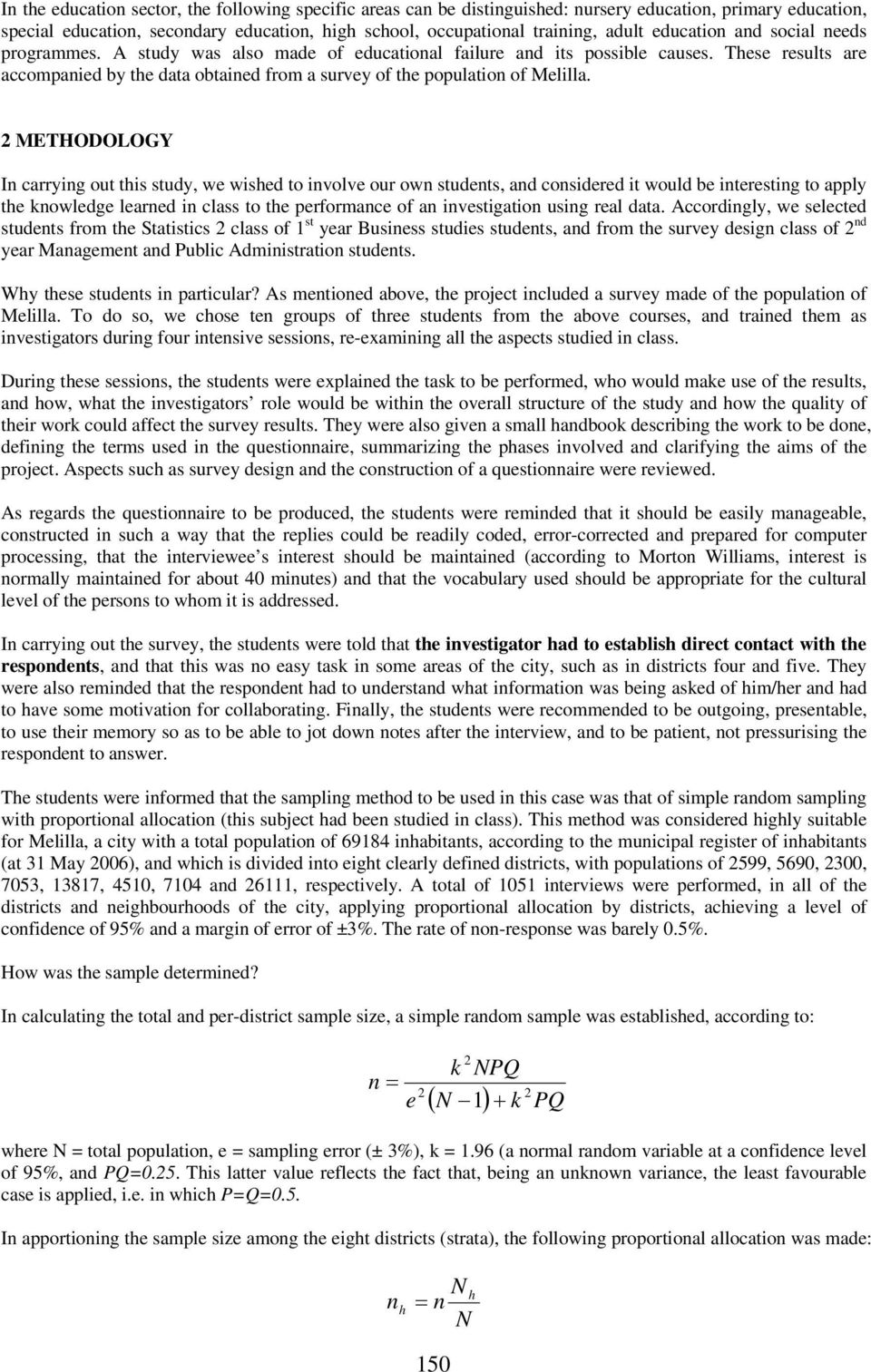
2 In the education sector, the following specific areas can be distinguished: nursery education, primary education, special education, secondary education, high school, occupational training, adult education and social needs programmes. A study was also made of educational failure and its possible causes. These results are accompanied by the data obtained from a survey of the population of Melilla. 2 METHODOLOGY In carrying out this study, we wished to involve our own students, and considered it would be interesting to apply the knowledge learned in class to the performance of an investigation using real data. Accordingly, we selected students from the Statistics 2 class of 1 st year Business studies students, and from the survey design class of 2 nd year Management and Public Administration students. Why these students in particular? As mentioned above, the project included a survey made of the population of Melilla. To do so, we chose ten groups of three students from the above courses, and trained them as investigators during four intensive sessions, re-examining all the aspects studied in class. During these sessions, the students were explained the task to be performed, who would make use of the results, and how, what the investigators role would be within the overall structure of the study and how the quality of their work could affect the survey results. They were also given a small handbook describing the work to be done, defining the terms used in the questionnaire, summarizing the phases involved and clarifying the aims of the project. Aspects such as survey design and the construction of a questionnaire were reviewed. As regards the questionnaire to be produced, the students were reminded that it should be easily manageable, constructed in such a way that the replies could be readily coded, error-corrected and prepared for computer processing, that the interviewee s interest should be maintained (according to Morton Williams, interest is normally maintained for about 40 minutes) and that the vocabulary used should be appropriate for the cultural level of the persons to whom it is addressed. In carrying out the survey, the students were told that the investigator had to establish direct contact with the respondents, and that this was no easy task in some areas of the city, such as in districts four and five. They were also reminded that the respondent had to understand what information was being asked of him/her and had to have some motivation for collaborating. Finally, the students were recommended to be outgoing, presentable, to use their memory so as to be able to jot down notes after the interview, and to be patient, not pressurising the respondent to answer. The students were informed that the sampling method to be used in this case was that of simple random sampling with proportional allocation (this subject had been studied in class). This method was considered highly suitable for Melilla, a city with a total population of inhabitants, according to the municipal register of inhabitants (at 31 May 2006), and which is divided into eight clearly defined districts, with populations of 2599, 5690, 2300, 7053, 13817, 4510, 7104 and 26111, respectively. A total of 1051 interviews were performed, in all of the districts and neighbourhoods of the city, applying proportional allocation by districts, achieving a level of confidence of 95% and a margin of error of ±3%. The rate of non-response was barely 0.5%. How was the sample determined? In calculating the total and per-district sample size, a simple random sample was established, according to: = e ( N 1 ) + k PQ 150 k NPQ n 2 2 where N = total population, e = sampling error (± 3%), k = 1.96 (a normal random variable at a confidence level of 95%, and PQ=0.25. This latter value reflects the fact that, being an unknown variance, the least favourable case is applied, i.e. in which P=Q=0.5. In apportioning the sample size among the eight districts (strata), the following proportional allocation was made: n h = 2 N n N h
3 The aim of this survey was to compare the diagnostic reports made with public opinions held regarding all aspects of the city, and regarding the problems encountered, and to include these results in the final reports. Having performed the above calculations, the questionnaire was re-examined to detect possible errors. Finally it was reduced to 29 questions, some open and others semi-open (the latter type, in some cases with possible responses of strongly disagree, disagree, normal, agree, strongly agree; in other cases, yes or no). The interviews, always at the respondent s home, were carried out by the students, who selected at random the households to be addressed, from the 2006 municipal register of inhabitants. When the questionnaire responses had been obtained, the students interpreted the data using SPSS statistical software. We also participated in this second phase, checking how the real data were entered and how conclusions were subsequently drawn. In our opinion, the experience was a complete success, making our students aware of the importance of statistics and of just how the finally published results are obtained. 3. RESULTS In this section, we present the most significant results obtained in the study for the Department. In some cases, the results are those deduced from the survey, while others are real data (from the Municipal Register of Inhabitants, the Ministry of and Science and the Spanish National Institute of Statistics), obtained with the participation of the students. Table 1 shows the data for educational failure, district by district, as follows: District 1: Melilla la Vieja, General Larrea (Mantelete) and Ataque Seco. District 2: Héroes de España, General Gómez Jordana and Príncipe. District 3: Polígono, calle Margallo, El Carmen. Districts 4 and 5: Monte María Cristina, Barrio Hebreo, Polígono de la Paz, Tiro Nacional, Cañada de Hidúm, Los Cuernos, Cabrerizas, Cristóbal Colón, Batería Jota, Hernán Cortés, Reina Regente, Las Palmeras. District 6: Concepción Arenal, Isaac Peral. District 7: El Real. District 8: Paseo Marítimo, Minas del Rif, Carretera Alfonso XIII, Carretera de Farhana, El Industrial, General Sanjurjo (Hipódromo), General Primo de Rivera, La Libertad, La Victoria. Table 1: Level of studies achieved, by districts D1 D2 D3 D4 D5 D6 D7 D8 A B C E F G H I J K

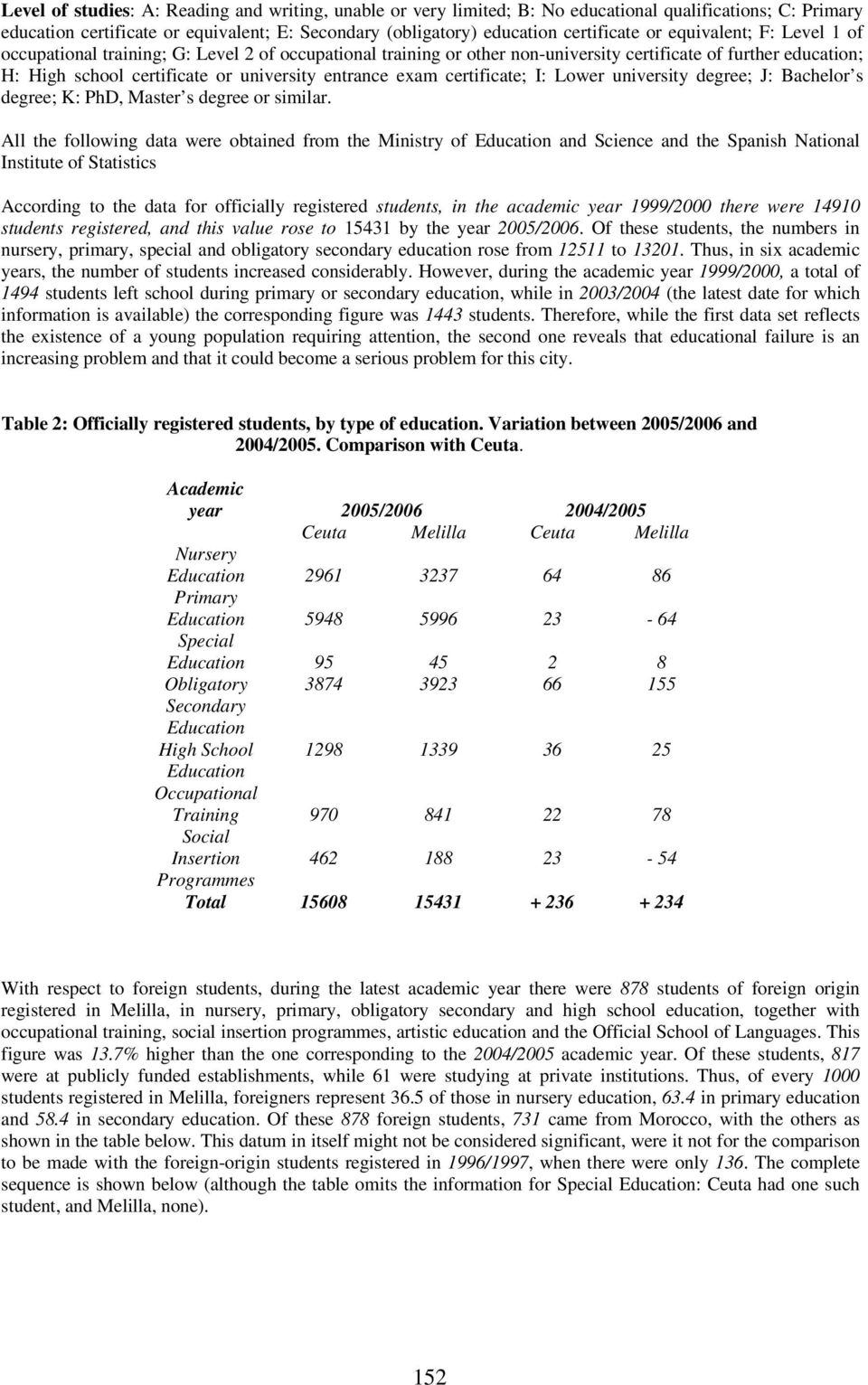
4 Level of studies: A: Reading and writing, unable or very limited; B: No educational qualifications; C: Primary education certificate or equivalent; E: Secondary (obligatory) education certificate or equivalent; F: Level 1 of occupational training; G: Level 2 of occupational training or other non-university certificate of further education; H: High school certificate or university entrance exam certificate; I: Lower university degree; J: Bachelor s degree; K: PhD, Master s degree or similar. All the following data were obtained from the Ministry of and Science and the Spanish National Institute of Statistics According to the data for officially registered students, in the academic year 1999/2000 there were students registered, and this value rose to by the year 2005/2006. Of these students, the numbers in nursery, primary, special and obligatory secondary education rose from to Thus, in six academic years, the number of students increased considerably. However, during the academic year 1999/2000, a total of 1494 students left school during primary or secondary education, while in 2003/2004 (the latest date for which information is available) the corresponding figure was 1443 students. Therefore, while the first data set reflects the existence of a young population requiring attention, the second one reveals that educational failure is an increasing problem and that it could become a serious problem for this city. Table 2: Officially registered students, by type of education. Variation between 2005/2006 and 2004/2005. Comparison with Ceuta. Academic year 2005/ /2005 Ceuta Melilla Ceuta Melilla Primary Special Obligatory Secondary High School Occupational Training Social Insertion Programmes Total With respect to foreign students, during the latest academic year there were 878 students of foreign origin registered in Melilla, in nursery, primary, obligatory secondary and high school education, together with occupational training, social insertion programmes, artistic education and the Official School of Languages. This figure was 13.7% higher than the one corresponding to the 2004/2005 academic year. Of these students, 817 were at publicly funded establishments, while 61 were studying at private institutions. Thus, of every 1000 students registered in Melilla, foreigners represent 36.5 of those in nursery education, 63.4 in primary education and 58.4 in secondary education. Of these 878 foreign students, 731 came from Morocco, with the others as shown in the table below. This datum in itself might not be considered significant, were it not for the comparison to be made with the foreign-origin students registered in 1996/1997, when there were only 136. The complete sequence is shown below (although the table omits the information for Special : Ceuta had one such student, and Melilla, none). 152
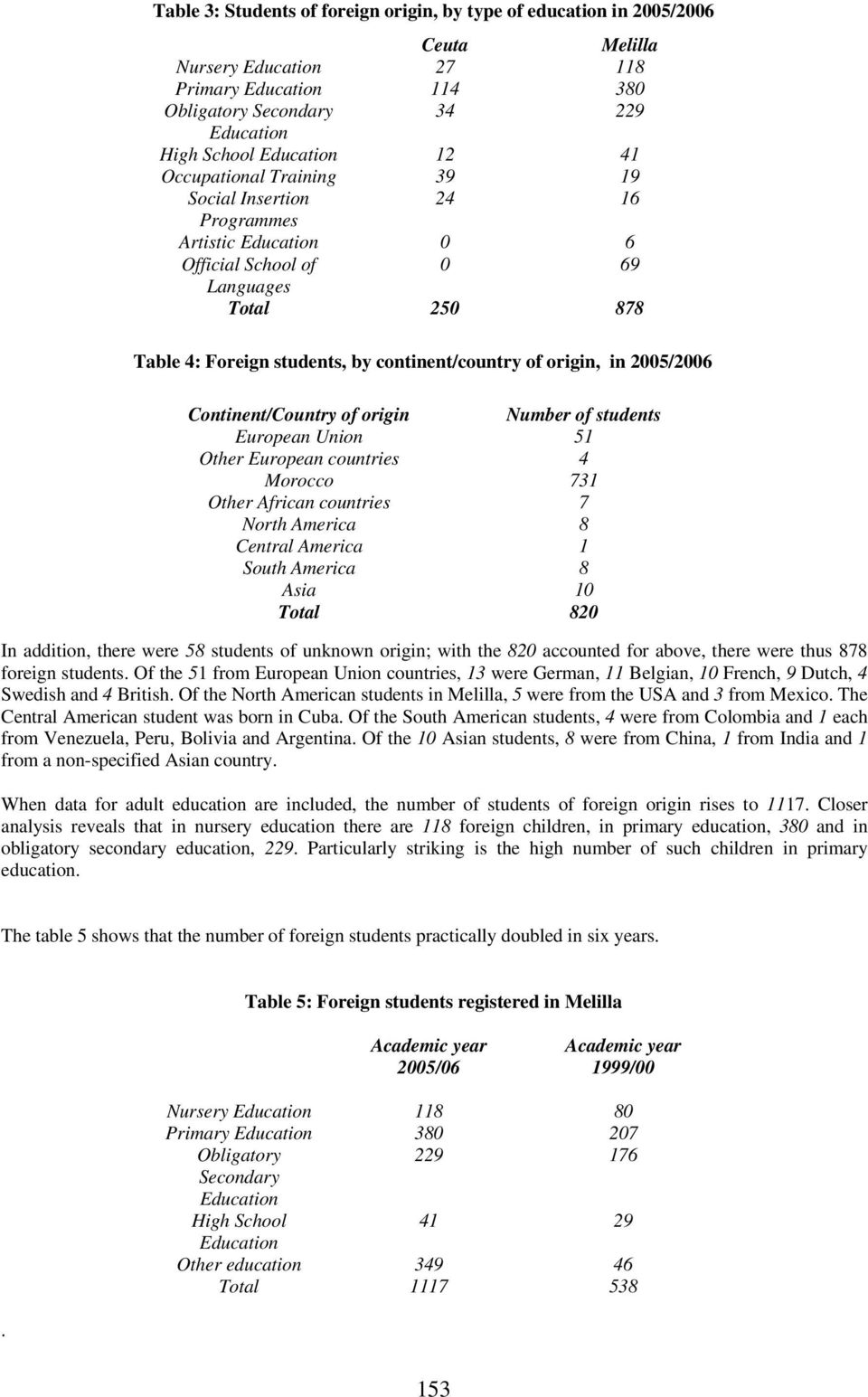
5 Table 3: Students of foreign origin, by type of education in 2005/2006 Ceuta Melilla Primary Obligatory Secondary High School Occupational Training Social Insertion Programmes Artistic 0 6 Official School of 0 69 Languages Total Table 4: Foreign students, by continent/country of origin, in 2005/2006 Continent/Country of origin Number of students European Union 51 Other European countries 4 Morocco 731 Other African countries 7 North America 8 Central America 1 South America 8 Asia 10 Total 820 In addition, there were 58 students of unknown origin; with the 820 accounted for above, there were thus 878 foreign students. Of the 51 from European Union countries, 13 were German, 11 Belgian, 10 French, 9 Dutch, 4 Swedish and 4 British. Of the North American students in Melilla, 5 were from the USA and 3 from Mexico. The Central American student was born in Cuba. Of the South American students, 4 were from Colombia and 1 each from Venezuela, Peru, Bolivia and Argentina. Of the 10 Asian students, 8 were from China, 1 from India and 1 from a non-specified Asian country. When data for adult education are included, the number of students of foreign origin rises to Closer analysis reveals that in nursery education there are 118 foreign children, in primary education, 380 and in obligatory secondary education, 229. Particularly striking is the high number of such children in primary education. The table 5 shows that the number of foreign students practically doubled in six years. Table 5: Foreign students registered in Melilla Academic year 2005/06 Academic year 1999/ Primary Obligatory Secondary High School Other education Total
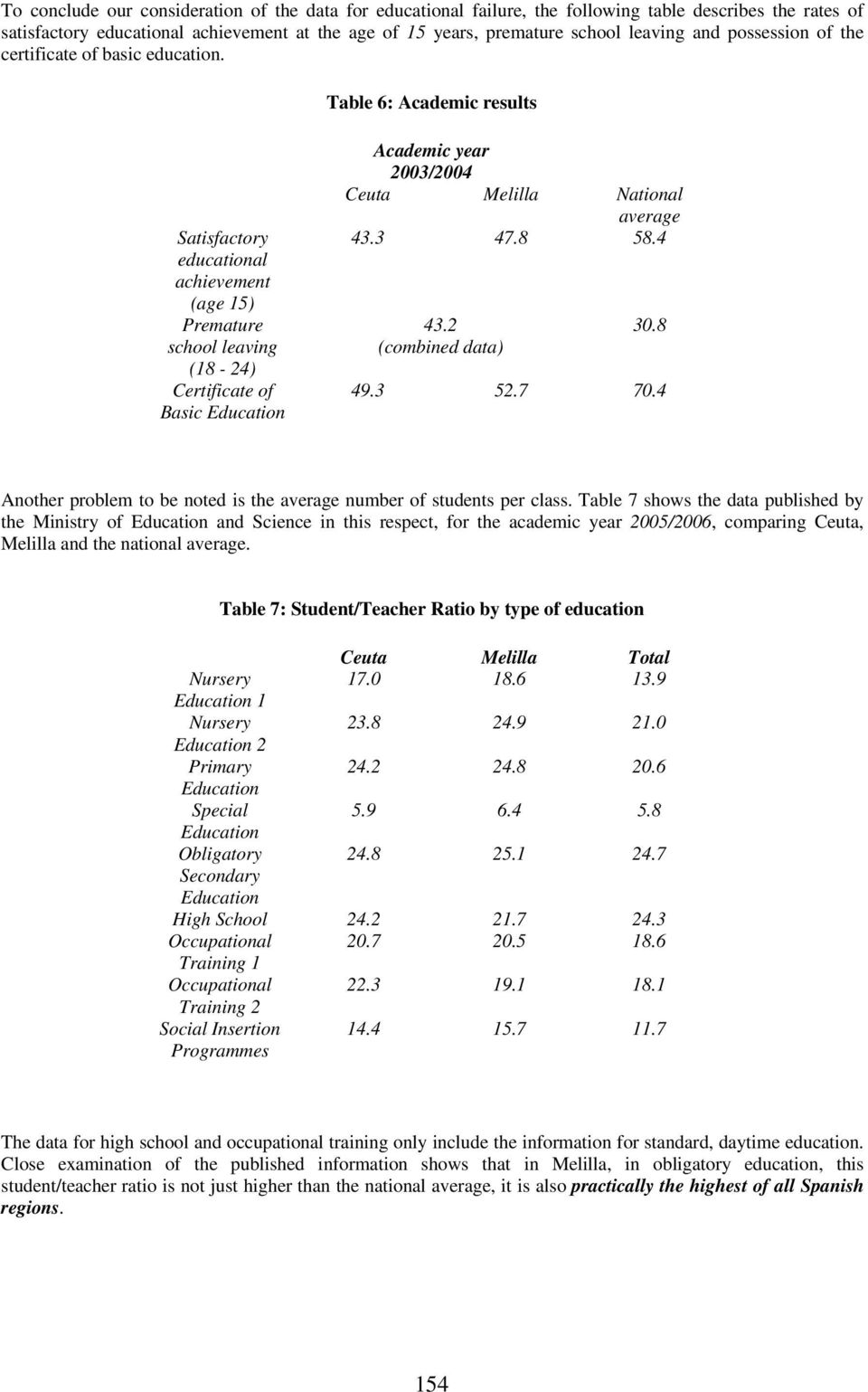
6 To conclude our consideration of the data for educational failure, the following table describes the rates of satisfactory educational achievement at the age of 15 years, premature school leaving and possession of the certificate of basic education. Table 6: Academic results Satisfactory educational achievement (age 15) Premature school leaving (18-24) Certificate of Basic Academic year 2003/2004 Ceuta Melilla National average (combined data) Another problem to be noted is the average number of students per class. Table 7 shows the data published by the Ministry of and Science in this respect, for the academic year 2005/2006, comparing Ceuta, Melilla and the national average. Table 7: Student/Teacher Ratio by type of education Ceuta Melilla Total Primary Special Obligatory Secondary High School Occupational Training 1 Occupational Training 2 Social Insertion Programmes The data for high school and occupational training only include the information for standard, daytime education. Close examination of the published information shows that in Melilla, in obligatory education, this student/teacher ratio is not just higher than the national average, it is also practically the highest of all Spanish regions. 154
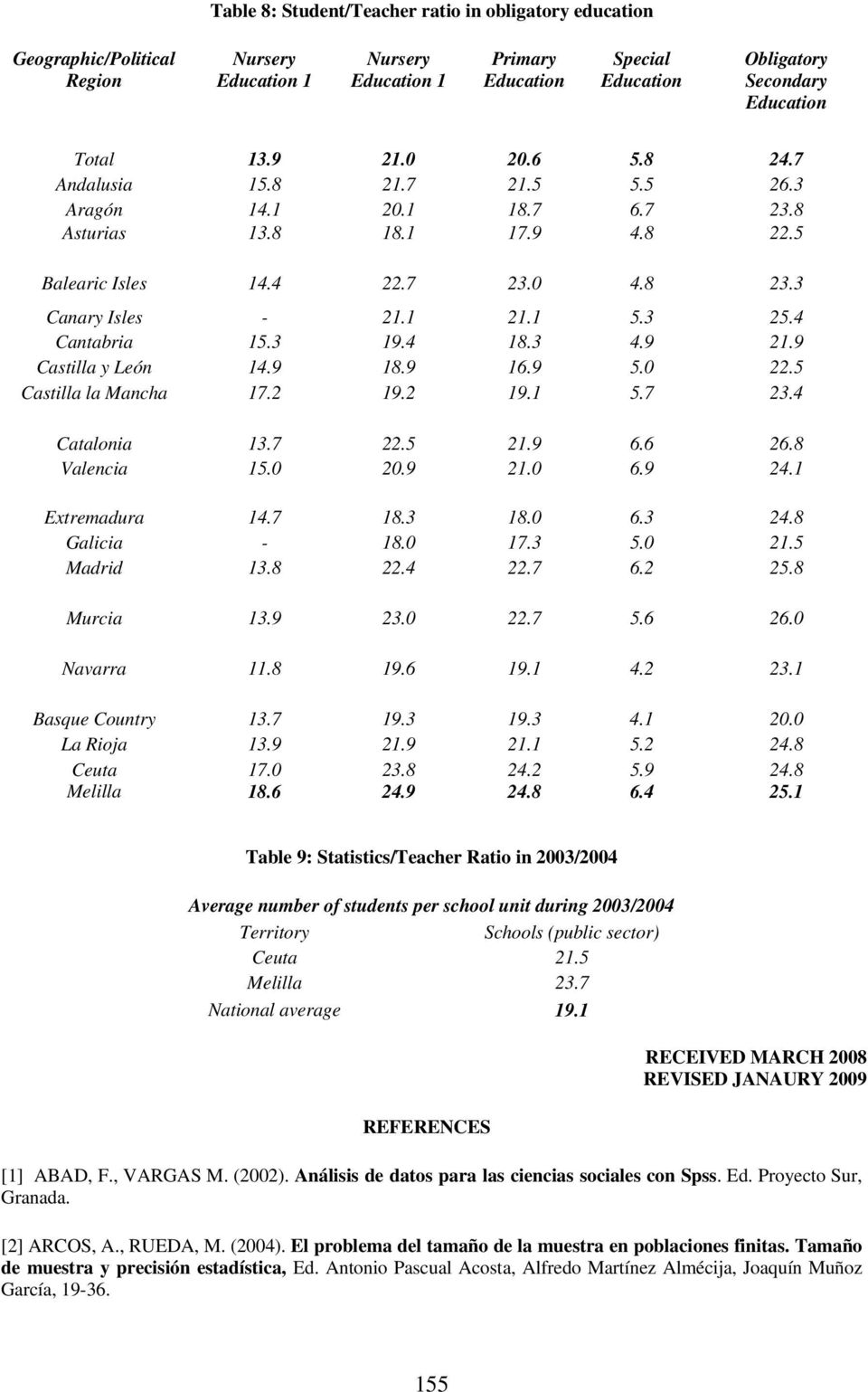
7 Table 8: Student/Teacher ratio in obligatory education Geographic/Political Region 1 1 Primary Special Obligatory Secondary Total Andalusia Aragón Asturias Balearic Isles Canary Isles Cantabria Castilla y León Castilla la Mancha Catalonia Valencia Extremadura Galicia Madrid Murcia Navarra Basque Country La Rioja Ceuta Melilla Table 9: Statistics/Teacher Ratio in 2003/2004 Average number of students per school unit during 2003/2004 Territory Schools (public sector) Ceuta 21.5 Melilla 23.7 National average 19.1 REFERENCES RECEIVED MARCH 2008 REVISED JANAURY 2009 [1] ABAD, F., VARGAS M. (2002). Análisis de datos para las ciencias sociales con Spss. Ed. Proyecto Sur, Granada. [2] ARCOS, A., RUEDA, M. (2004). El problema del tamaño de la muestra en poblaciones finitas. Tamaño de muestra y precisión estadística, Ed. Antonio Pascual Acosta, Alfredo Martínez Almécija, Joaquín Muñoz García,
8 [3] AZORÍN, F. Y SÁNCHEZ-CRESPO, J. L. (1986). Métodos y aplicaciones del muestro. Alianza Universidad Textos. [4] FERNÁNDEZ GÜELL, J. M. (2000). Planificación estratégica de ciudades. Gustavo Gili. S.A. [5] LLAMAS, R., MARMOLEJO, J., SERRANO, S. Y GONZÁLEZ, V. (2007). Plan Estratégico de Melilla. Proyecto Melilla S.A [6] MAYORAL DEL AMO, J. F. (2005). El mosaico de Melilla. Universidad de Granada, Sindicato Autónomo de Trabajadores de la Enseñanza, [6] RUEDA GARCÍA, M Y ARCOS CEBRIÁN, A. (1998). Problemas de Muestreo en Poblaciones Finitas. Grupo Editorial Universitario. [7] WEBSITES CONSULTED (2008).: Ciudad Autónoma de Melilla: Consejo Escolar del Estado: Instituto Nacional de Estadística: Ministerio de Educación y Ciencia: Proyecto Melilla S. A.: 156
![Universidad de Granada, Sindicato Autónomo de Trabajadores de la Enseñanza, 23-40 [6] RUEDA GARCÍA, M Y ARCOS CEBRIÁN, A. (1998). Problemas de Muestreo en Poblaciones Finitas.](/docs-images/49/16226552/images/page_8.jpg "Grupo Editorial Universitario. [7] WEBSITES CONSULTED (2008).: Ciudad Autónoma de Melilla: http://www.melilla.es, Consejo Escolar del Estado: http://www.mepsyd.es/cesces/inicio.")
The population registered in the Continuous Municipal Register decreased by 404,619 persons, standing at 46.7 million persons in the last year
 22 April 2014 Preview of the Continuous Municipal Register Statistics at 1 January 2014 Provisional data The population registered in the Continuous Municipal Register decreased by 404,619 persons, standing
Population Figures at 1 January 2014 Migration Statistics 2013 Provisional data
 30 June 2014 Population Figures at 1 January 2014 Migration Statistics 2013 Provisional data Main results The population of Spain decreases by 220,130 persons in 2013, standing at 46,507,760 inhabitants
The INE presents the new statistical operation Household Projection 2014-2029
 28 October 2014 Household Projection 2014 2029 The INE presents the new statistical operation Household Projection 2014-2029 If the current trends are maintained, the number of households would stand at
PUBLIC EMPLOYMENT IN SPAIN
 SECRETARIAT OF STATE FOR THE CIVIL SERVICE GENERAL DIRECTORATE OF CIVIL SERVICE PUBLIC EMPLOYMENT IN SPAIN THE REGIONAL STATE NSI 1-1-2010 SPAIN 505,990 km 2 47,021,031 Inhab. Andalusia 87,599 km 2 8,370,975
Current demographic trends are to lead Spain to lose one tenth of its population in the coming 40 years
 19 November 2012 Population Projections for 2012 Current demographic trends are to lead Spain to lose one tenth of its population in the coming 40 years From 2018 onwards, there will be more deaths than
Average household water consumption stood at 130 litres per inhabitant per day, that is, 3.7% less than in 2012
 1 October 2015 Survey on Water Supply and Sewerage Year 2013 Average household water consumption stood at 130 litres per inhabitant per day, that is, 3.7% less than in 2012 The unit value of water increases
Tourism survey for Spanish residents (ETR/FAMILITUR) Q2 2015
 28 September 2015 Tourism survey for Spanish residents (ETR/FAMILITUR) Q2 2015 In the second quarter of 2015 Spanish residents made 46.8 million trips. 50.8% were for leisure, 34.6% to visit family or
Average household water consumption stood at 137 litres per inhabitant per day, that is, 3.5% less than in 2011
 5 November 2013 Survey on Water Supply and Sewerage Year 2012 Average household water consumption stood at 137 litres per inhabitant per day, that is, 3.5% less than in 2011 The greatest unit costs of
Spanish Regional Accounts. Base 2010. Regional Gross Domestic Product. Year 2014 Income accounts of the household sector.
 27 March 2015 Spanish Regional Accounts. Base 2010 Regional Gross Domestic Product. Year 2014 Income accounts of the household sector. 2010-2012 series Main results Regional Gross Domestic Product. Year
In Spain, 56,030 titles were published in 2014, that is, 0.7% less than in the previous year
 26 March 2015 Book Publishing Activity Year 2014 In Spain, 56,030 titles were published in 2014, that is, 0.7% less than in the previous year The majority of the titles published correspond to the subjects
The value of unpaid bills of exchange decreases 21.6% in April, as compared with the same month of 2014
 11 June 2015 Unpaid Bills of Exchange Statistics (UBE) April 2015. Provisional data The value of unpaid bills of exchange decreases 21.6% in April, as compared with the same month of 2014 1.8% of the total
Services and Rates Guide 2015
 Services and Rates Guide 2015 Publication for pet businesses The printed magazine EspeciesPRO is a free-distribution informative journal aimed at Spanish pet businesses and other professionals linked to
Overnight stays in hotel establishments registered an increase of 5.1% in October, as compared to the same month of 2013
 24 November 214 Hotel Tourism Short-Term Trends (HOS/HPI/IPHS) October 214. Provisional data Overnight stays in hotel establishments registered an increase of 5.1% in October, as compared to the same month
Susana Sanduvete-Chaves, Salvador Chacón-Moscoso, Milagrosa Sánchez- Martín y José Antonio Pérez-Gil ( )
 ACCIÓN PSICOLÓGICA, junio 2014, vol. 10, n. o 2, 3-20. ISSN: 1578-908X 19 THE REVISED OSTERLIND INDEX. A COMPARATIVE ANALYSIS IN CONTENT VALIDITY STUDIES 1 EL ÍNDICE DE OSTERLIND REVISADO. UN ANÁLISIS
Presentation of the Quality Office of the UdL. Universitat de Lleida September 2014 Oficina de Qualitat Vicerectorat de Qualitat i Planificació
 Presentation of the Quality Office of the UdL Universitat de Lleida September 2014 Oficina de Qualitat Vicerectorat de Qualitat i Planificació Preliminary information: Spanish university system 17 Autonomous
Hospital Morbidity Survey Year 2011. The number of inpatient admissions to hospital in Spain decreases 1.1% in 2011
 26 December 2012 Hospital Morbidity Survey Year 2011 The number of inpatient admissions to hospital in Spain decreases 1.1% in 2011 the circulatory and tumours cause the largest number of hospital stays
Overnight stays in hotel establishments register an increase of 4.3% in February, as compared to the same month of 2014
 23 March 215 Updated at 1:3pm Hotel Tourism Short-Term Trends (HOS/HPI/IPHS) February 215. Provisional data Overnight stays in hotel establishments register an increase of 4.3% in February, as compared
EUROPARC-Spain and the Spanish system of Protected Areas
 EUROPARC-Spain and the Spanish system of Protected Areas Ideas in action in Spain: the Action Plan for Parks Idee in azione in Spagna: il piano di azione Dr. José V. De Lucio Director EUROPARC-Spain EUROPARC-Spain
Overnight stays in hotel establishments registered an increase of 2.7% in August, as compared to the same month of 2013
 23 September 214 Hotel Tourism Short-Term Trends (HOS/HPI/IPHS) August 214. Provisional data Overnight stays in hotel establishments registered an increase of 2.7% in August, as compared to the same month
EMPLOYMENT INTEGRATION: The role of associations of people with mental illness and their families
 Mental Health and Well-being in the Workplace 17th March 2009, Berlin EMPLOYMENT INTEGRATION: The role of associations of people with mental illness and their families Maria Jesús San Pío Programs and
Organization of the Health Care System in Spain
 Organization of the Health Care System in Spain Patricia Santa Olalla Peralta Dirección General de Salud Pública Ministerio de Sanidad y Consumo Viral Hepatitis Prevention Board Meeting Madrid, November
Overnight stays in hotel establishments increase 1.9% in 2013
 24 January 214 (updated 27 January 214) Hotel Tourism Short-Term Trends (HOS/HPI/IPHS) Year 213. Overnight stays in hotel establishments increase 1.9% in 213 Hotels earn 41.2 euros per available room and
Basic Data of the Spanish University System. Academic year 2010/2011
 Basic Data of the Spanish University System. Academic year 2010/2011 The Spanish University System. 4 Geographical distribution 6 Aggregation projects. International Campus of Excellence 7 Students. 8
Plant health care in Spain
 Plant health care in Spain GALICIA ASTURIAS CANTABRIAP.VASCO NAVARRA LA RIOJA CASTILLA Y LEON ARAGON CATALUNYA MADRID EXTREMADURA CASTILLA- LA MANCHA VALENCIA BALEARES ANDALUCIA MURCI A CEUTA Y MELILLA
Survey on ICT and Electronic Commerce Use in Companies 2011/12
 25 June 2012 Survey on ICT and Electronic Commerce Use in Companies 2011/12 Main results - 97.5% of Spanish companies with 10 or more employees have Internet access, in. And seven out of 10 have websites.
Dialnet. Author Identification. Eduardo Bergasa [email protected]
 Dialnet Author Identification Eduardo Bergasa [email protected] Fundación Dialnet! Public non-profit foundation! Spin-off of University of La Rioja! Constitution: 2009! In charge of Dialnet portal
CaixaBank - Covered Bond Investor presentation
 CaixaBank - Covered Bond Investor presentation Data as of 30 th June 2015 Mortgage Covered Bond Programme CaixaBank Programmes - Main figures Jun '15 MORTGAGE COVER POOL 30/06/2015 MORTGAGE COVERED BONDS
The Spanish Electricity System Summary
 (Time) The Spanish Electricity System Summary 2 14 48, 44, (MW) 4, 36, 32, 28, 24, 2, 1 2 3 4 5 6 7 8 9 1 11 12 13 14 15 16 17 18 19 2 21 22 23 24 Electrical Energy Balance (1) Comunidad Castilla- Castilla
Minimum income protection in Spain: characteristics and poverty effects
 Minimum income protection in Spain: characteristics and poverty effects Rafael Granell & Amadeo Fuenmayor Department of Applied Economics. University of Valencia Workshop: Minimum income protection in
The Spatial Data Infrastructure of Spain as an example of success in Europe *
 UNITED NATIONS E/CONF.99/IP.16 ECONOMIC AND SOCIAL COUNCIL Ninth United Nations Regional Cartographic Conference for the Americas New York, 10-14 August 2009 Item 7(b) of the provisional agenda Best Practices
OVERCOMING SCHOOL FAILURE: POLICIES THAT WORK SPANISH NATIONAL REPORT
 OVERCOMING SCHOOL FAILURE: POLICIES THAT WORK SPANISH NATIONAL REPORT Mayo 2011 Report prepared by: Direction: Eduardo Coba Arango, Director del Instituto de Formación del Profesorado, Investigación e
ICT in the National Health System
 ICT in the National Health System The Healthcare Online programme Progress update January 2010 01. Introduction 02. The National Health System: basic data 03. Healthcare centres connectivity 04. Electronic
Quality of life in the Spanish workplace
 Quality of life in the Spanish workplace Introduction Satisfaction in the workplace Work environment Work organisation Training and career development Job mobility Work-life balance Trends over the period
in Spain 2005 Current Status
 R E N E W A B L E E N E R G Y Wind Energy Wind Energy in Spain 2005 Current Status and Prospects ospects Madera, 8. E-28004 Madrid Tel.: +34 91 456 49 00. Fax: +34 91 523 04 14 e-mail: [email protected]
57.4% of Spanish households have a broadband Internet connection, 11.6% more than in 2009
 1 October 2010 Survey on Information and Communication Technologies Equipment and Use in Households. Year 2010 57.4% of Spanish households have a broadband Internet connection, 11.6% more than in 2009
Mexico 2000: Survey Information
 Mexico 2000: Survey Information Summary table Generic information Name of survey Household Income and Expenditure Survey (Encuesta Nacional de Ingresos y Gastos de los Hogares - ENIGH) Institution responsible
TOURISM RESEARCH IN SPAIN: THE STATE OF THE ART
 TOURISM RESEARCH IN SPAIN: THE STATE OF THE ART Alfonso Vargas-Sánchez University of Huelva (Spain) [email protected] ABSTRACT This paper analyses the evolution that Tourism Research has undergone in Spain
69.8% of Spanish households have a broadband Internet connection, three points more than in 2012
 25 October 2013 Survey on Equipment and Use of Information and Communication Technologies (ICT) in Households Year 2013 69.8% of Spanish households have a broadband Internet connection, three points more
Level 2 Spanish, 2012
 91148 911480 2SUPERVISOR S Level 2 Spanish, 2012 91148 Demonstrate understanding of a variety of spoken Spanish texts on familiar matters 2.00 pm Tuesday 20 November 2012 Credits: Five Achievement Achievement
The monthly variation of turnover 1 for the market Services Sector is 0.6% after adjusting for seasonal and calendar effects
 14 August 2015 Services Sector Activity Indicators (SSAI). Base 2010 June 2015. Provisional data The monthly variation of turnover 1 for the market Services Sector is 0.6% after adjusting for seasonal
Spain is my country. Spain is where I live.
 Spain is my country Spain is my country. Spain is where I live. Location Spain is located in the south west of Europe. Spain Limits Spain is bordered to the south and east by the Mediterranean Sea, to
Use of ITC infrastructures by company size. Percentage of enterprises
 26 June 2015 Survey on ICT and Electronic Commerce Use in Enterprises Year 2014 First quarter 2015 Main results - 98.4% of Spanish enterprises with 10 or more employees have Internet access in the first
CURRICULUM VITAE. LEOPOLDO LABORDA CASTILLO [email protected] Phone: +34 697259827 or +34 91 8820399
 CURRICULUM VITAE LEOPOLDO LABORDA CASTILLO [email protected] Phone: +34 697259827 or +34 91 8820399 Education: Finalized: Ph.D. in Economic and Business Sciences. University of Alcalá, UA (Spain).
Overnight stays in non-hotel tourist accommodation increase 6.9% in November as compared to the same month of 2014
 29 December 2015 Non-Hotel Tourist Accommodation Occupancy Survey November 2015. Overnight stays in non-hotel tourist accommodation increase 6.9% in November as compared to the same month of 2014 Overnight
A Preliminary Analysis of the Scientific Production of Latin American Computer Science Research Groups
 A Preliminary Analysis of the Scientific Production of Latin American Computer Science Research Groups Juan F. Delgado-Garcia, Alberto H.F. Laender and Wagner Meira Jr. Computer Science Department, Federal
OCU's experience in adapting to the Spanish CV standard format (CVN)
 OCU's experience in adapting to the Spanish CV standard format (CVN) Bolonia, 26 th May 2011 Roberto Moreno, Product Manager Manuel Rivera, Clients Manager [email protected] +34 91.382.21.40 Index About OCU
THE DEVELOPMENT OF SOCIAL WORK EDUCATION IN SPAIN. Dr. Francisco Gómez Gómez Dr. Félix Herrador Buendía Universidad Complutense de Madrid
 THE DEVELOPMENT OF SOCIAL WORK EDUCATION IN SPAIN Dr. Francisco Gómez Gómez Dr. Félix Herrador Buendía Universidad Complutense de Madrid ABSTRACT This research note presents briefly the development of
LA HOMOLOGACIÓN DE ESTUDIOS EN LA COMUNIDAD EUROPEA: PERSPECTIVAS DESDE EL PUNTO DE VISTA DEL TRABAJO SOCIAL
 THE HISTORY OF SOCIAL WORK EDUCATION IN SPAIN: DOES HARMONISATION MAKE SENSE? LA HOMOLOGACIÓN DE ESTUDIOS EN LA COMUNIDAD EUROPEA: PERSPECTIVAS DESDE EL PUNTO DE VISTA DEL TRABAJO SOCIAL PAZ MÉNDEZ-BONITO
Guia Inmigrante Ingles.qxp 14/03/2007 13:44 Página 15
 Guia Inmigrante Ingles.qxp 14/03/2007 13:44 Página 15 GUIDE FOR IMMIGRANTS [ 15 ] General Information General Information Junta de Castilla y León: 012 Emergencies: 112 (Includes Health Services, National
How to enable students to become more independent essay writers
 How to enable students to become more independent essay writers Ilene Ann Smalec Malloy UEM Lab - Universidad Europea de Madrid Abstract This paper has resulted after examining the poor results of academic
NEW APPROACHES IN TOURISM MANAGEMENT: THE INNOVATIVE BUSINESS GROUP PROGRAMME IN SPAIN
 Boletín de la New Asociación approaches de Geógrafos in tourism Españoles management: N.º 66 the - 2014, innovative págs. business 521-527 group programme in Spain I.S.S.N.: 0212-9426 NEW APPROACHES IN
Overnight stays in non-hotel tourist accommodation increase 12.3% in October as compared to the same month of 2014
 27 November 2015 Non-Hotel Tourist Accommodation Occupancy Survey October 2015. Overnight stays in non-hotel tourist accommodation increase 12.3% in October as compared to the same month of 2014 Overnight
ELCANO GLOBAL PRESENCE REPORT
 ELCANO GLOBAL PRESENCE REPORT 015 2015 Real Instituto Elcano C/ Príncipe de Vergara, 51 28006 Madrid www.realinstitutoelcano.org ISSN: 2255-5293 Depósito Legal: M-36047-2013 (Coords.) 1 1 ELCANO GLOBAL
Dulce Manzano. Complutense University of Madrid Rector Royo Villanova s/n Ciudad Universitaria 28040 MADRID e-mail: [email protected].
 Dulce Manzano Rector Royo Villanova s/n Ciudad Universitaria 28040 MADRID e-mail: [email protected] Academic Employment (Spain), Department of Sociology VI, Assistant Professor, 2009-present Juan
Housing Conditions of Roma and Travellers
 Spain RAXEN National Focal Point Thematic Study Housing Conditions of Roma and Travellers March 2009 DISCLAIMER: This study has been commissioned as background material for a comparative report on housing
Cambridge IGCSE. www.cie.org.uk
 Cambridge IGCSE About University of Cambridge International Examinations (CIE) Acerca de la Universidad de Cambridge Exámenes Internacionales. CIE examinations are taken in over 150 different countries
Fecha: 04/12/2010. New standard treatment for breast cancer at early stages established
 New standard treatment for breast cancer at early stages established London December 04, 2010 12:01:13 AM IST Spanish Oncology has established a new standard treatment for breast cancer at early stages,
In-service teacher training Center in Tomelloso EDUCATION IN SPAIN. LMML Education in Spain Grundtvig 2 Visit to Spain.
 EDUCATION IN SPAIN LMML Education in Spain Grundtvig 2 Visit to Spain. October, 2004 1 The Education System in Spain This brief description of Spain s education system is divided into four sections: Principles,