
Basic Data of the Spanish University System. Academic year 2010/2011
|
|
|
- Anne Bradford
- 10 years ago
- Views:
Transcription
1

2

3 Basic Data of the Spanish University System. Academic year 2010/2011 The Spanish University System. 4 Geographical distribution 6 Aggregation projects. International Campus of Excellence 7 Students. 8 University entrance examinations.. 15 European Higher Education Area.. 16 Student characteristics. 23 Gender.. 27 Age 28 Disabilities. 29 Internal student mobility. 30 Foreign students. 32 Erasmus students 34 Séneca. 37 Student grants and aid.. 38 Regulated tuition fees.. 45 Career entry and labour market.. 49 University staff. 53 Teaching and research staff.. 58 Research bonuses (sexenios) Staff mobility schemes. 62 Administrative and service staff 65 Other research staff 67 Research, development and innovation 68 Doctoral theses 69 National Plan 71 Human Resources Training. 76 Mobility 78 Recruitment.. 80 Research and development project R&D expenditure and staff 87 Research and development results 90 Technological innovation indicators International perspective.. 96 Directory International Campus of Excellence Public universities 111 Private universities Distance-learning universities 116 Special universities. 116

4 MINISTRY OF EDUCATION Secretariat General for Universities Published by: Tecnical office Sub-Directorate General of Documentation and Publications Catalogue of publications of the Ministry: educacion.es General catalogue of official publications: publicacionesoficiales.boe.es Issue date: 2010 NIPO: Legal deposit: M Printed by: Solana e Hijos A.G., S.A.

5 Introduction This annual report, Facts and Figures of the Spanish University System, provides information about university education in Spain and the role of institutions of higher learning in research and innovation. The report uses a range of indicators to place the university system in its domestic and international contexts. The Spanish University System is undergoing a process of modernization and seeking to achieve excellence. Academic year will accordingly pose a range of important challenges: all university qualifications have been brought fully into line with the European Higher Education Area, and the regulatory implementation of the Universities Act 2007 (Ley Orgánica 4/2007, de 12 de abril, por la que se modifica la Ley Orgánica 6/2001, de 21 de diciembre, de Universidades, LOMLOU ) is virtually complete. A University Student Charter has been enacted that makes provision for the creation of a National Council of University Students (Consejo de Estudiantes Universitarios del Estado). This academic year will also see the coming into operation of the Integrated System of University Information, which will offer standard, comparable indicators for the Spanish University System as a whole. In a determined bid for transparency and accountability, this year a new cost accounting model will be implemented at public universities. Moreover, a Royal Decree has been enacted to create the University Observatory of Student Grants, Aid and Academic Performance (Observatorio Universitario de Becas, Ayudas al Estudio y Rendimiento Académico); the Plenum of the Observatory has now been formed, and its committees will shortly start work towards their intended goals. Decisive progress has been made in Estrategia Universidad 2015, the flagship project to modernize the Spanish University System; all the committees formed under the auspices of the strategy are now in operation. The second annual staging of the International Campus of Excellence initiative was conducted with great success. Today, 10 International Campus of Excellence projects are in motion, alongside 14 International Campuses of Excellence at the European region level. We stand at a crossroads of vital changes. Major difficulties remain to be faced, but it is reassuring that we are working actively towards a modern Spanish University System capable of achieving excellence and of rising to the challenges of the modern age. 3

6 The Spanish University System The strategic process of improvement and modernization of Spain's universities has its legal base in the Universities Act 2007, a statute that lays special emphasis on the Spanish University System s adaptation to the European Higher Education Area (EHEA) and the incorporation of Spanish academic research to the European Research Area. The Knowledge Triangle is shaped by several factors: education, research and innovation. Universities stand at a crossroads of modernization, at which they are called upon to perform three key missions: teaching; research and development; and the third mission, embracing knowledge and technology transfer and university social responsibility. Universities and their campuses The Spanish University System comprises 78 universities, 50 of which are public, while 28 are under private ownership, making for proportions of 64.1% and 35.9%, respectively. In academic year , the Spanish University System (Spanish SUE ) catered to a student body of 1,556,377 people. Of that student population, 1,382,701, or 88.9%, were enrolled at public universities, while 173,676, or 11.1%, were enrolled with private universities. By educational level, private universities accounted for 11.7% of bachelor s students, 13.3% of master s students, and only 5.1% of doctoral students. The autonomous community of Madrid hosts the most universities 15, of which 6 are public. All the autonomous communities, except six (Galicia, Asturias, Cantabria, Castilla La Mancha, Extremadura and Andalucía) have university systems in which public institutions coexist with private. Andalucía operates the most public universities 10 in total. Five universities (the publicly owned UNED and four private institutions) are distance learning based. All the distance learning universities together account for 12.9% of Spain s total university student body; 75% of distance learning students are enrolled with UNED, whose share of the student body of the Spanish University System stands at 9.7%. The configuration of the Spanish University System is completed by two special universities: the Universidad Internacional Menéndez Pelayo and the Universidad Internacional de Andalucía marked the start of the process of decentralization of university education; the relevant powers and duties were gradually devolved to the autonomous communities. The number of universities has risen considerably since that time: whereas in 1975 there were 28 universities in Spain, ten years later there were 35, and 35 years on the number of universities had doubled (78 by 2010). The number of private and/or Catholic church sponsored universities has likewise grown strongly. In 1952, there were four private churchsponsored universities: Deusto, Pontificia de Comillas, Pontificia de Salamanca and Navarra. No new private university was created in the following 40 years except Ramón Llull in From then on, the founding of private universities gathered pace, with a particularly substantial increase in the past few years. 4

7 The Spanish University System In 2010, there are 236 university campuses and sites, of which 154 are operated by public universities, 69 belong to private universities, and 13 are controlled by UIMP (Universidad Internacional Menéndez Pelayo) and UNED (a distance learning institution). One of the cornerstones of Estrategia Universidad 2015 is the International Campus of Excellence (CEI) initiative. The CEI scheme is directed to create strategic aggregations of universities, other Knowledge Triangle institutions and business enterprises so that, operating within a single milieu or campus, they can seek to enhance their infuence on regional development and gain a foothold on the international scene. Our hope is that by 2015, the programme horizon, strategic aggregation parties will have aligned individual interests with a common strategy, leveraged their key strengths and grasped opportunities in their specific fields of action so as to achieve excellence on an international scale. The first competitive selection process was run in 2009, backed by the Ministry of Education in the amount of 153 million and the Ministry of Science and Innovation to a value of 15 million. Once the assessment stage was complete, winning projects were funded via the autonomous communities, which were given a loan of 150 million to enable the selected universities to put their projects into practice. The remaining 53 million in the budget were awarded to universities directly as non repayable subsidies. In the first selection round, the Technical Committee picked 18 of the 51 projects competing. At the second stage, a Commission of internationally reputable experts proposed 9 awards: five in the International Campus of Excellence (Spanish CEI) category, defined as projects capable of raising the campus to a standard of excellence that enables it to become an international benchmark; and four projects in the International Campus of Excellence, regional level (CEIR) projects capable of placing the campus at a level of excellence that enables it to become a benchmark within the European region. A further 9 projects earned promising status quality projects seen to be on the right track for gaining a CEI rating in future. All selected projects were set in motion in The Ministry of Education is monitoring their progress and results. The 2010 awards process was funded in the amount of 90.5 million million of that budget comprises subsidies from the Ministry of Education: 2 million were allocated to the Excellence Sub Programme and 13.5 million to the Strengthening Sub Programme. 48 projects were submitted for this second year of the initiative. 14 of them earned awards 8 CEI and 6 CEIR and so joined the 9 existing CEIs of the 2009 selection process. Finally, the awards made in 2009 and 2010 combined encompass 13 CEIs and 10 CEIRs. 5

8 Geographical distribution Number of universities and campuses (1)(2)(3) U: 3 (3) C: 7 (7) U: 1 (1) C: 7 (7) U: 8 (4) C: 19 (13) U: 1 (1) C: 2 (2) U: 3 (1) C: 14 (3) U: 2 (1) C: 7 (3) U: 2 (1) C: 2 (1) U: 2 (1) C: 5 (3) U: 12 (7) C: 44 (28) U: 15 (6) C: 33 (17) U: 1 (1) C: 4 (4) U: 1 (1) C: 4 (4) U: 8 (5) C: 21 (3) U: 1 (1) C: 1 (1) U: 3 (2) C: 6 (5) U: 10 (10) C: 30 (34) Campus: Distance-learning universities: U: 3 (2) C: 10 (9) UDIMA: 1 UNED: 2 UNIR: 1 UOC: 1 VIU: 1 Special universities: UNIA: 4 UIMP: 11 Total universities: 78 Total campuses: 236 (1) Map excludes universities dependent on the Ministry of Education (2) Counting campuses located in different municipalities (3) In brackets, the number of public universities and the number of public university campuses. 6

9 Aggregation projects. International Campus of Excellence International Campus of Excellence. Geographical distribution (1) EUSKAMPUS Campus do Mar "Knowledge in Depth" Ad Futurum Cantabria Campus Internacional CAMPUS IBERUS UAB CEI CAMPUS ENERGÍA Campus Vida BKC Studii Salamantini Campus UPF Campus Moncloa HUBc UAM+CSIC Catalunya Sud CEI Montegancedo I2Tech Campus de Excelencia Agroalimentaria (Cei A3) CEI Canarias Campus Carlos III Campus BioTic Granada VLC/Campus Valencia Campus Mare Nostrum 37/38 Andalucía Tech (1) Situation as at November Note: International Campuses of Excellence (CEI) marked in red International Campuses of Excellence, European Regional Ambit (CEIR) marked in blue 7

10 Students In academic year , Spanish universities administered different educational structures simultaneously: pre EHEA first and second cycle studies (pre Bologna model), bachelor degrees (grado), officially recognized master s degrees (másteres oficiales) and doctoral programmes (doctorado, including those under Royal Decree 778/1998, which are now in the process of being discontinued, and under Royal Decrees 56/2005 and 1393/2007). In academic year , student numbers at all levels of the Spanish University System (bachelor, master and doctoral) increased by 3.5% to 1,556, ,352 are bachelor s students 11 times more than in the previous academic year 1,200,763 are undertaking pre EHEA first and second cycle studies (this has been the second year of the process of discontinuation, such that the former model saw an 11.6% reduction in student numbers with respect to the previous year), 81,840 were master s students (64.3% more than in ) and 70,422 were doctoral students. With the entry into force of Royal Decree 56/2005, followed by Royal Decree 1393/2007, students must typically complete an officially recognized master s degree as a requisite of access to doctoral studies. This element of training in some sense supersedes the teaching/research training module (Spanish DEA) which under the former scheme was undertaken as an introduction to doctoral study, since it used to be the case that there were no officially recognized master s degrees. This explains why students formerly computed directly within doctoral studies even if still at the preliminary training stage are now apportioned across master s courses (former second cycle ) and the research phase of doctoral studies (third cycle). The net rate of university registration among people aged 18 to 24, including only bachelor s students and pre EHEA first and second cycle students, rose from 23.8% in to 24.5% in This major change arises from two distinct causes: an increase in the number of university students (2%) and a 3.14% decrease in the overall population in the age range is the first year of fully fledged adaptation of all university qualifications to the guidelines laid down by the European Higher Education Area (EHEA). This honours the timeframe set forth in the intergovernmental agreement among signatory states of the Bologna Declaration to adopt a common curricular structure for university studies (bachelor, master and doctoral). The academic year began with 2,338 bachelor s courses, 2,429 master s courses and 1,624 doctoral courses on record. In , new registrations are expected to rise by 10%, meaning that 385,000 new students will be entering the Spanish University System, taking its population to an historic high. It is anticipated that the student body will reach 1,600,000 across the system, pushing up past the historic ceiling achieved in the late 1990s. 8

11 Students In , first cycle students (former pre EHEA first and second cycle, and EHEA compliant bachelor s students) are forecast to rise to 1,441,100. Since , which saw an historic high of students at this level (1,589,473), to the present, student numbers have declined by an average of 1.7% a year, making for a cumulative loss over the past decade of 11.7%. However, this trend was reversed in , when for the first time in 10 years the number of students on the first rung of university training rose 2% year on year. The cumulative decline largely reflects two factors: first, an average 2.3% annual decline in the population aged 18 to 24, making for a reduction of 20.7% over the past decade; secondly, a prolonged and powerful economic boom. Population change does not suffice to explain the drop in student numbers. The clearest proof of this is offered by the past academic year, in which the population aged 18 to 24 continued to decrease, but the number of university students rose. In , the field of education accounting for the largest volume of students was Social Sciences, Business and Law, with 50.3% of the total. In second place but displaying only half the size of the most populous field of education was Engineering, Manufacturing and Construction, with 23.8%, followed by Health at 10.8%, Humanities and Arts at 9.1%, and Science at 6%. The graph shows that the structure of the student population by field of education has changed relatively little over the past decade. Health was the only field enjoying a sustained rise in student numbers: 49.3% in the past 20 years, 31.3% over the past decade, and 19.3% in the past year 1. The Humanities and Arts field has steadily lost student adherence, experiencing a 15.8% decline over the past 20 years, with a particularly sharp drop in the past decade ( 21%). However, the latest year on year change is positive, with a 2.8% increase. The Science field is worst placed, having lost 36.5% of student numbers over the past decade, and seeing a 3.4% decline this past academic year. These results reveal a severe imbalance that merits special attention, given that this field of education is directly related to industry, enhanced productivity and scientific and technological development. The number of students graduating with first and second cycle degrees and bachelor s degrees in may come to 194,364, or 1.2% more than last year. Over the past 20 years, the number of university graduates has grown 72.4%. A particularly noteworthy increase (281%) of graduates has been seen in technical disciplines (equivalent to the former Architecture and Engineering branch); as against this, the number of Humanities and Arts graduates has declined sharply ( 29.4%). In other domains, graduate numbers have followed a rising trend over the past twenty years. Over the past decade graduate numbers have decreased, though to a lesser extent than enrolment ( 5.4% and 11.7% respectively). As from academic year , pre EHEA first and second cycle graduates have stabilized at around 187,000. In , however, the number of university graduates as a whole rose 2% year on year. 1 This figure may reflect classificatory changes. For instance, the former Licenciatura (five year degree) in Psychology was ascribed to the Social Sciences, Business and Law branch, whereas bachelor s degrees in Psychology may in some cases, depending on course features, be classified to the Health field. 9

12 Students In 2009, the number of students registering for and passing university entrance tests was appreciably higher than the previous year, having risen by 5.6% to 230,316, and 5.3% to 189,098 students, respectively. 82.1% of students sitting entrance examinations passed. Officially recognized master s degrees were introduced in academic year , and admitted an intake of 16,636 students. Over the past four academic years, that number has multiplied fivefold, such that by it stood at 81,840, or 64.3% more than the previous year. The number of graduates of officially recognized master s degrees has increased by a factor of almost 3.5, so reaching in year the figure of 17,913 new master s graduates. Programmes at the doctoral level are governed by a variety of Royal Decrees, and thus involve different teaching structures. Even today, most doctoral students are enrrolled on programmes governed by Royal Decree 778/1998 these programmes are now in the process of being discontinued. Pre EHEA doctorates comprised a training stage and a research stage (writing and defence of a doctoral thesis). As pointed out earlier, with the entry into force of Royal Decree 56/2005 and Royal Decree 1393/2007, students generally undertake an officially recognized master s degree as a requirement of admission to doctoral study, and so count as master s students. This explains why the students who were formerly classified as doctoral, even if still at the training stage of their programmes, are now apportioned across master s degree courses (second cycle) and the research stage of doctorates (third cycle). Due account being taken of the effect of this change of structure in the Spanish University System, in the total number of doctoral students was 82,964. From that academic year onwards, after the entry into force of the new Royal Decrees on university education mentioned above, the number of students enrolled in doctoral programmes decreased to 70,422 by % of doctoral students are enrolled at public universities. 10

13 Students Students registered with the Spanish University System, by autonomous community. Academic year (1) Net university registration rate (2) Bachelor degrees 1 st and 2 nd cycle Master s degrees Doctorate Population aged 18 to 24 (3)(4) TOTAL 24, Physical universities Andalucía 22, Aragón 24, Asturias (Principado de) 25, Balears (Illes) 9, Canarias 15, Cantabria 18, Castilla y León 31, Castilla-La Mancha 11, Catalunya 24, Comunitat Valenciana 24, Extremadura 17, Galicia 23, Madrid (Comunidad de) 36, Murcia (Región de) 22, Navarra (Comunidad Foral de) 31, País Vasco 29, Rioja (La) 13, Distance-learning universities A Distancia de Madrid (UDIMA) Nacional de Educación a Distancia (UNED) Internacional de la Rioja (UNIR) Oberta de Catalunya (UOC) Special universities Internacional de Andalucía (UNIA) Internacional Menendez Pelayo (UIMP) (1) Provisional data (2) Net university registration rate for the age range: Number of students aged undertaking 1 st and 2nd cycle and bachelor degrees/population aged (3) Population of Ceuta and Melilla included in Andalucía (4) Source: Estimated present population as at 1 January INE 11

14 Student 1 st and 2 nd cycle and bachelor's Students enrolled in 1 st and 2nd cycle and bachelor's forecast Total Public univ % Private univ % Total ,3% ,7% Field of Education (1) Social Sciences Business and Law ,1% ,9% Engineering, M. and Constr ,5% ,5% Humanities and Arts ,4% ,6% Health ,0% ,0% Science ,6% ,4% Distribution of students enrolled in bachelor's courses, by field of education. Academic years and (2) Total 43,8% 44,8% Social Sc., Business and Law 25,5% Health 21,5% ,0% 13,5% 12,3% 14,2% 4,4% Engineering, M. and Constr. Humanities and Arts Science 5,9% 100% 75% 50% 25% 0% Evolution of students enrolled in 1 st and 2nd cycle and bachelor degrees, by field of education. Academic years and (2) 50,0% 50,3% ,2% 23,8% 10,2% 9,1% 10,8% 7,3% 8,4% 6,0% Social Sc., Business and Law Engineering, M. and Constr. Humanities and Arts Health Science Evolution of students enrolled in 1 st and 2nd cycle and bachelor degrees, by field of education Academic year (2) (2) Annual Rate of change / / Total ,0% -11,7% 28,5% Field of Education (1) Social Sciences Business and Law ,8% -11,2% 27,4% Engineering, Manuf. and Constr ,1% -13,1% 67,0% Humanities and Arts ,8% -21,0% -15,8% Health ,3% 31,3% 49,3% Science ,4% -36,5% 0,1% (1) Pre-EHEA 1 st and 2nd cycle courses have been adapted to EHEA-compliant bachelor's courses (2) Provisional data 12

15 Student 1 st and 2 nd cycle and bachelor's Students graduating from 1 st and 2 nd cycle and bachelor's forecast Total Public univ % Private univ % Total ,5% ,5% Field of Education (1) Social Sciences Business and Law ,4% ,6% Engineering, M. and Constr ,9% ,1% Humanities and Arts ,1% 671 4,9% Health ,2% ,8% Science ,5% 765 6,5% Evolution in students graduating from 1 st and 2 nd cycle and bachelor degrees and ,1% ,3% 7,2% 12,1% 1% 6,3% Social Sc., Business and Law Engineering, M. and Constr. Humanities and Arts Health Science Evolution of students graduating from 1 st and 2 nd cycle and bachelor degrees, by field of education Academic year (2) Annual Rate of change / / Total ,0% -5,4% 72,4% Field of Education (1) Social Sciences Business and Law ,7% -8,7% 76,0% Engineering, M. and Constr ,0% 13,4% 281,0% Humanities and Arts ,3% -14,2% -29,4% Health ,7% 13,2% 46,7% Science ,5% -36,3% 53,4% (1) Pre-EHEA 1 st and 2nd cycle courses have been adapted to EHEA-compliant bachelor's courses (2) Provisional data 13

16 Student 1 st and 2 nd cycle and bachelor's Percent change in students enrolling in 1 st and 2 nd cycle and bachelor degrees, by autonomous community and (1) Balears (Illes) Comunitat Valenciana Murcia (R. de) Madrid (Com. de) Canarias Cataluña Spain Andalucía Castilla-La Mancha University Extremadura Rioja (La) Navarra (C. Foral de) Cantabria Aragón Castilla y León País Vasco Galicia Asturias (Ppdo. de) -41,2% -26,7% -27,8% -28,2% -28,6% -31,6% -34,7% -18,2% -19,0% -19,2% -15,1% -10,1% -10,4% -11,7% -1,7% -4,3% -6,2% 3,4% UNED UOC 3,7% 322,4% -50,0% -40,0% -30,0% -20,0% -10,0% 0,0% 10,0% Percent change in students graduating from 1 st and 2 nd cycle and bachelor degrees, by autonomous community and (1) (2) Balears (Illes) Comunitat Valenciana Rioja (La) Castilla-La Mancha University Canarias Andalucía Cantabria Spain Madrid (Comunidad de) Extremadura Cataluña Murcia (Región de) Castilla y León Galicia Aragón País Vasco Navarra (Comunidad Foral de) Asturias (Principado de) -3,3% -5,4% -6,7% -9,6% -10,0% -11,2% -15,7% -18,2% -21,6% -24,2% -29,5% -35,3% 13,7% 7,4% 4,8% 0,9% 0,1% 35,3% UNED 56,9% -50% -40% -30% -20% -10% 0% 10% 20% 30% 40% 50% 60% (1) Provisional data (2) UOC not included because academic year was the first in which the institution had graduates; the percent change is accordingly not comparable to the rest. 14

17 University entrance examinations Change in students registering for and passing university entrance examinations. Years Students registering Students passing Distribution by sex of students registering for and passing university entrance examinations. Year (9,7%) 56,4% Men passing (46,7%) (35,4%) 43,6% Men failing Women passing Women failing (8,2%) Distribution by sex of students registering for and passing university entrance examinations by field of education area at the upper secondary level (1). Year 2009 Registered Passing % students achieving a pass out of total entrants Total (2) Women (3) % women (4) Total (2) Women (3) % women (4) Total Women Total 100,0% 100,0% 57,5% 100,0% 100,0% 57,7% 85,5% 85,8% Social Sciences 33,1% 36,2% 62,9% 32,6% 35,6% 62,9% 84,4% 84,3% Science/Technology 21,8% 11,2% 29,5% 22,0% 11,5% 30,1% 86,7% 88,6% Humanities 11,8% 14,8% 72,2% 11,9% 15,0% 72,5% 86,5% 86,9% Health 26,0% 30,1% 66,5% 26,8% 30,8% 66,3% 88,2% 88,0% Arts 2,5% 3,0% 69,5% 2,6% 3,2% 69,6% 89,2% 89,3% Combined 4,9% 4,8% 55,9% 4,0% 4,0% 57,7% 69,3% 71,5% (1) Excluding examinations for over-25s. (2) Distribution of all students across fields of education. (3) Distribution of women across fields of education. (4) Proportion of women in each field of education. Source: University entrance examination statistics. INE (Spain s National Statistical Institute) 15

18 European Higher Education Area Bachelor s degrees started to be taught in , with 163 bachelor s courses on record. Academic year saw the completion of adaptation to the EHEA; hence all students newly admitted to the Spanish University System were now enrrolled on one of the EHEA compliant bachelor s degree courses. In this academic year, 2,338 bachelor s degree courses were on offer; according to the available provisional data, the public universities alone offered 243,300 university places. In , places on bachelor s degree courses numbered 105,066, and only 8198 in This data underscores the major efforts undertaken by universities and connected institutions so as to make implementation of the EHEA a reality today. If the total number of bachelor s degree courses now on offer is compared to pre EHEA first and secondcycle qualifications on offer in the last year prior to the introduction of new bachelor s courses in one finds that 87.6% of qualifications have been adapted. In other words, the total range of pre EHEA first and second cycle 2 university qualifications numbered 2,669 courses, while the number of EHEA compliant bachelor s courses stands at 2,338. It is still early to judge whether the adaptation process has been sufficient and successful, or a wider diversity of degree courses ought to have been developed so as to break up the uniformity by which the Spanish University System was afflicted under the previous catalogue of qualifications. The most far reaching changes have been made at public universities. The process has not been the same in all fields of education, however. In Health Sciences, the number of bachelor s qualifications has increased with respect to the courses on offer under the previous regulations. 322 bachelor s degrees are now available, as against 209 pre EHEA first and second cycle courses; an adaptation of 154.1% has been achieved, therefore. This necessary change answers to the surplus demand consistently arising from year to year for Health qualifications. In the Humanities and Arts, an adaptation of 100.8% has been completed. 375 bachelor s courses are on offer, versus 372 pre EHEA first and secondcycle courses. In other fields of education, the range of pre EHEA first and second cycle courses was wider than the present range of bachelor s qualifications. In the coming academic years we shall be able to ascertain whether the minor decrease in the number of degree courses has been sufficient to rectify the imbalance between supply and demand or whether further adjustments need to be made. If to the range of bachelor s courses we add the offering of officially recognized master s degrees, both phases being prerequisites for entry to doctoral programmes, we find that the overall range of university qualifications has increased considerably in recent years, reaching 2,338 bachelor s courses and 2,429 master s courses in academic year Each degree course taught at a university is counted only once, regardless of whether or not the qualification is obtainable from one or more divisions of the same university. 16

19 European Higher Education Area The distribution of the EHEA compliant bachelor s courses by field of education differs somewhat from the preceding structure of university qualifications. Specifically, Social Sciences, Business and Law qualifications now account for 34%, Engineering, Manufacturing and Construction for 26.9%, Humanities and Arts for 16%, Health for 13.8 % and Science for 9.3 %. Hence the number of qualifications has risen in Health and, to a slight extent, in Humanities and Arts, but has decreased by four points in Social Sciences, Business and Law and by three points in Engineering, Manufacturing and Construction. Out of all bachelor s courses offered in , 47.7% have fewer than 75 students enrolled, and 28.7% have fewer than 50 students enrolled. Only 35.2% of courses have over 100 students enrolled 3. Humanities and Arts is the field of education having the greatest number of courses that attract fewer than 75 students (65.9%), and only 24.4% of degree courses in this area attract more than 100 enrolled students. 2,429 officially recognized master s degrees have been placed on record so far. This figure demonstrates the ongoing growth in the supply of university based master s degrees, which have increased from 829 in to 2429 in At present, a greater number is on record for master s degrees than for bachelor s degrees; however, the number of undergraduate freshmen for this academic year is expected to be close to 385,000, whereas master s students will total around 100,000. The total number of joint master s degrees i.e., master s degree courses taught as a combined effort by more than one university, is 217, or 8.9% of all master s courses. Through to September 2010, 1,624 doctoral programmes have been placed on record under Royal Decree 1393/2007; of this total, only 5.5% (90 doctorates) are taught jointly by more than one university. Distancelearning universities offer 47 doctoral programmes, 3 of which are taught jointly. 3 It is to be borne in mind that this data refers to the number of students enrolled on each degree course, not to the number of students attending lectures. 17

20 Adaptation to EHEA Supply of 1 st and 2 nd cycle and bachelor degrees, by field of education by university type and field of education (1). Academic years and Total Physical universities Distance-learning universities Public universities Private universities Public universities Private universities 1 st and 2 nd cycle bachelor degrees 1 st and 2 nd cycle bachelor degrees 1 st and 2 nd cycle bachelor degrees 1 st and 2 nd cycle bachelor degrees 1 st and 2 nd cycle bachelor degrees Total Field of Education (2) Social Sc., Business and Law Engineering, M. and Constr Humanities and Arts Health Science Total supply of 1 st and 2 nd cycle and bachelor degrees and percent adaptation to EHEA (1). Academic years and ,1% 160% 140% 120% ,6% 100,8% 100% ,1% 78,2% 81,6% 80% % 40% 20% 0 Total Social Sc., Business and Law Engineering, M. and Constr. Humanities and Arts Health Science 0% Supply of 1st and 2nd cycle Supply of bachelor degrees % adaptation to EHEA Total supply of 1 st and 2 nd cycle and bachelor degrees (1). Academic years and ,2% 34,0% 30,1% 26,9% 13,9% 16,0% 13,8% 7,8% 10,0% 9,3% Social Sc., Business and Law Engineering, M. and Constr. Humanities and Arts Health Science (1) To measure the percentage of adaptation to the European Higher Education Area, the number of qualifications offered in is compared to courses taught in (the last year prior to the start of the adaptation process). To ensure that the data is comparable across these two academic years, each degree course taught at a university is counted only once, regardless of whether or not the qualification is obtainable from one or more divisions of the same university. (2) Pre-EHEA 1 st and 2nd cycle courses have been adapted to EHEA-compliant bachelor's courses 18

21 Supply of places and new-entrant registrations by university type and field of education. Academic year Adaptation to EHEA Physical public universities Physical private universities Distance-learning universities Enrolment 1 st and 2 nd cycle Bachelor degrees Enrolment Public Private Supply Enrolment Supply Enrolment 1 st and 2 nd cycle Bachelor degrees 1 st and 2 nd cycle Bachelor degrees 1 st and 2 nd cycle Bachelor degrees Total Field of Education (1) Social Sc., Business and Law Engineering, M. and Constr Humanities and Arts Health Science Increase in supply of places on bachelor degree courses at physical public universities (thousands) 243, (2) 105,1 113,0 53,4 56,2 8,2 4,7 33,3 24,7 17,7 11,2 13,0 9,8 1,0 1,0 0,9 0,6 16,1 Total Social Sc., Business and Law Engineering, M. and Constr. Humanities and Arts Health Science Distribution of bachelor degree courses by number of new entrants at physical public universities (3). Academic year Number of students Total 1 to to to to to to 100 Over 100 Total Field of Education Social Sciences, Business and Law Engineering, M. and Constr Humanities and Arts Health Science (1) Pre-EHEA 1 st and 2nd cycle courses have been adapted to EHEA-compliant bachelor's courses (2) Provisional data (3) Table interpretation: At physical public universities there is a total of 20 courses having 10 or fewer new entrants, 46 courses having 11 to 20 new entrants, etc. 19
22 Adaptation to EHEA Number of bachelor courses taught and total students enrolled on bachelor degree courses, by field of education. Academic year (1) Total Public universities Private universities No. of bachelor degree courses Students No. of bachelor degree courses Students % No. of bachelor degree courses Students % Total , ,8 Field of Education Social Sc., Business and Law , ,8 Engineering, M. and Constr , ,2 Humanities and Arts , ,4 Health , ,5 Science , ,6 Number of EHEA-compliant bachelor degrees (2)(3) TOTAL: Distance learning universities: UDIMA 9 UNIR 7 UNED 26 UOC 15 VIU Over to to to 50 1 to 25 (1) Provisional data (2) Data current as at 21 September
23 Adaptation to EHEA Change in number of students enrolled and graduating with officially recognized master's degrees, by university type No. of master's degrees Total Public universities Private universities Students No. of master's degrees Students No. of master's degrees Students Enrolled (1) (1) Graduates (1) Number of EHEA-compliant master degrees (2)(3) 166 (13) 41 (8) 24 (6) 124 (10) 49 (6) TOTAL: Joint master's degrees: 217 (8,9%) 125 (6) 8 (4) 49 (9) 486 (13) Distance learning universities: UDIMA 5 (1) UNIR 8 (0) UNED 53 (2) UOC 11 (0) Special universities: UIMP 11 (2) UNIA 4 (4) VIU 2 (0) 27 (2) 287 (5) 495 (19) 18 (6) 263 (13) 101 (5) 30 (8) 42 (2) Over to to 50 1 to 25 (1) Provisional data (2) Data current as at 21 September 2010 (3) In brackets, officially recognized master's degrees involving a university in the given autonomous commnunity but not counted within the total for that Region owing to their being managed by a university in another Region. These programmes are counted only at the autonomous community where the managing university is located. 21
24 Adaptation to EHEA Evolution in students enrolled in doctoral programmes by university type (1) Total Public universities Private universities Total doctoral students Doctorate under RD 778/ Doctorate under RDs 56/2005 and 1393/ EHEA-compliant doctoral programmes (2)(3) TOTAL: Joint doctoral programmes: 90 (5,54%) 124 (9) 34 (6) 94 (3) 15 (6) 70 (4) 42 (5) 15 (1) 45 (3) 260 (7) 309 (9) Distance learning universities: UNED 38 (2) UOC 1 (0) 35 (2) 15 (6) 175 (5) 24 (6) Special universities: UIMP 8 (1) 72 (4) TOTAL 47 (3) 224 (7) 24 (3) Over to to to 50 1 to 25 (1) Provisional data (2) Data current as at 21 September 2010 (3) In brackets, officially recognized doctoral programmes involving a university in the given autonomous community but not counted within the total for that Region owing to their being managed by a university in another community. These programmes are counted only at the autonomous community where the managing university is located. 22
25 Student characteristics Gender This academic year is the centenary of the Real Orden enactment that first allowed women to access university education under conditions of equality. Today, women are in the majority, accounting for 54.2% of the total student body. What is more, their presence is predominant at all levels of university education: 54.3% of pre EHEA first and second cycle and bachelor s students; 54.1% of officially recognized master s course students; and 51% of doctoral students. The proportion of women is still higher among university graduates, rising to 59.7% on average. 60.6% of successful pre EHEA first and second cycle and bachelor s students are women, as are 56.3% of students completing a master s degree and 52.9% of students completing a doctorate (whether via taught credits or via thesis defence). Women are the majority in all disciplinary areas except the technical degrees. Women account for 72.1% of Health students, 62% of students in Social Sciences, Business and Law, 61.4% of the student body in Humanities and Arts, and 56.8% of students in Science. In Engineering, Manufacturing and Construction, however, the proportion of women is 26.8%. If distribution by field of education is analyzed for men and women separately, one finds that 57.4% of women are undertaking study in Social Sciences, Business and Law; this field of education accounts for 41.9% of men. The second largest field of education by demand among women is Health, which accounts for 14.3% of women (6.6% of men). For men, the second largest field of education is Engineering, Manufacturing and Construction, with a 38.1% share of the male student body. Age Over the past 10 years, the age structure of first and second cycle students has undergone a considerable shift. The presence of over 30s has practically doubled: whereas in they accounted for 8.5% of the student body, by , they represented 16.9%. Students aged under 25 years, however, have declined by more than 10 points (79.1% in versus 67.7% in ). As a result of the shift in the average age of university enrolment and perhaps because of changes in overall time spent at university, the number of graduates aged 30 and above has increased over the past 10 years from 6.9% to 15.4%. 33% of students undertaking officially recognized master s degree courses are aged 30 or above. The largest age group is that of individuals falling within the age range and undertaking officially recognized master s degree courses as a continuation of their bachelor s degrees. Almost three quarters of doctoral students are aged 25 to 40: only 4.1% are under 25; 39.5% are aged 25 to 30; 34% are aged 31 to 40; and 22.4% are over 40 years of age. 42.4% of doctoral graduates in Spain successfully defended their doctoral theses within the age range 25 to 30 years; 36.1% between ages 31 and 40; and 20.7% at age 41 or above. The data highlights that thesis defence typically takes place at a late stage this factor may stand in the way of career entry for this highly qualified population sector. 23
26 Student characteristics Disabilities The data presented in this section is drawn from the INE (Spain s national statistical institute) Survey on Disabilities, Personal Autonomy and Situations of Dependence (Encuesta de Discapacidad, Autonomía Personal y Situaciones de Dependencia) for The survey reveals that 455,100 people have disabilities in the 25 to 44 age range, of whom 47,600 (10.5%) attain university education or an equivalent level of qualification. Among the population aged 45 to 64, 951,900 people have disabilities, of whom 74,100, or 7.8%, are university graduates. Women still account for the majority of people with disabilities who have attained university education: 59.2% among the population aged 25 to 44, and 54.5% among people aged over 44 years. Hence university graduates make up a higher proportion of the younger population (aged 25 to 44), and, furthermore, the presence of women university graduates is higher among the younger population. The population of people with disabilities currently undertaking university study stands at 7,300 women and 7,700 men. Internal student mobility The following student mobility graphs provide an analysis of the autonomous communities attracting the most students (student intake graph) and the autonomous communities that send the most students to undertake university study in other autonomous communities. For both graphs, the basis of territorial classification of each student is the location of the university site. For example, a student of the Universidad Complutense studying at a campus in Castilla La Mancha is counted as a Castilla La Mancha student, not a Madrid student. For example, a student of the complete hassle university studying at a campus in Castile La Mancha is counted as a Castile La Mancha student, not a Madrid student. The autonomous communities sending the most students to other autonomous communities for the purpose of university study are: Red wine, 51.1%, Castile La Mancha, with 48.2% (31.6% undertake study in Madrid) and Extremadura, 35.2% (12.3% go to Castile Leon, while 11% go to Andalusia), and finally Navarre, 34.3% of whose students leave the autonomous community, with 12.6% choosing to undertake study in the Basque country. The autonomous communities sending the fewest students to undertake study outside their home autonomous community are Cataluña (2.2%), and Madrid (3.4%) the largest autonomous communities, enjoying broader and deeper academic supply. Navarra is the autonomous community having the highest proportion of students who are not permanent residents of the autonomous community 35.6%. Most of these are students at the private Universidad de Navarra. Navarra is followed in this respect by La Rioja 4, with 36.3% non resident students. In third place in terms of non resident students are Madrid (26.1%) and Castilla y León (23.4%). Cataluña and Andalucía, though both having large student populations, prove to have a low capacity to attract students from other autonomous communities: 7.1% non residents in the case of Cataluña, 6.7% in the case of Andalucía. 4 The high proportion of non resident students in La Rioja is accounted for by two online second-cycle qualifications that are taught there: Musical History and Science, and Labour Sciences. 24
27 Student characteristics Foreign students In , the number of foreign students undertaking university study in Spain was 76,205, as against 65,581 in and 56,630 in Foreign students at Spanish universities are increasing strongly, with a rise of 16.2% in the past academic year and 15.8% in the year before that, making for a growth of 34.6% over the past three academic years. Part of this growth is attributable to the rise in the immigrant population. The total proportion of foreign students in was 4.9% (4.1% in bachelor s degrees, 18.4% in master s degrees, and 22.8% in doctoral programmes). However, despite recent strong progress, the Spanish University System continues to lag behind its peers as regards attraction of foreign students. 45.6% of foreign students are nationals of Latin American and Caribbean countries; 30.7% are EU(27) nationals; 7.4% are nationals of North African countries; and 6.4% are nationals of countries of the rest of Europe (20.8% of whom are Russian nationals); 5.5% are nationals of Asian and Australasian countries (39.8% being Chinese nationals); 2.8% are nationals of other African countries; and only 1.6% are nationals of the United States or Canada. The autonomous communities having the highest numbers of foreign students are: Cataluña, with 8%, Madrid, with 6.4%, and Illes Balears, with 6.2%. The former two are among the autonomous communities with the largest student populations; this is not the case of Illes Balears, which, though having a modestly sized student population nonetheless attracts a significant proportion of foreign students. Andalucía, one of the autonomous communities with the largest student populations, falls below the Spanish average as to the proportion of foreign students. The autonomous communities showing the lowest ability to attract foreign students are: Asturias (1.7%), Castilla La Mancha (1.9%) and Extremadura (2%). By educational level, most European and African students enter the Spanish University System to undertake pre EHEA first and second cycle degrees and EHEA compliant bachelor degrees. Students from Latin America and the Caribbean, the United States and Canada, and Asia and Australasia typically enter the system in search of more specialized education, directed towards master s and doctoral qualifications. These figures correlate with foreign student age ranges. 38.7% of foreign students are under 25, 28.6% are aged 25 to 30, 21.3% are aged 31 to 40, and 11.4% are 41 and above. Upon placing age in relation to country of origin, one finds that, as might be expected, the younger students are those undertaking bachelor degrees, specifically, European and North African students. There follows an analysis of the study destinations of foreign students from Spain s neighbouring countries. Of the French nationals undertaking university study in Spain, 24.4% enrol with universities in the autonomous community of Madrid, 20.8% enrol with UNED, and 18.5% enrol at universities located in Cataluña. Of Portuguese nationals undertaking study in Spain, 31.5% study in Galicia, 17.1% go to Cataluña, and 12.1% enrol at universities in Madrid. Andalucía and Extremadura, although directly neighbouring Portugal, account for only 8.5% and 7.3% of the intake, respectively. As to Moroccan nationals, 49.7% enrol in Andalucía and 13.9% enrol in universities in the Region of Valencia. In this case, Cataluña and Madrid play only a secondary role, accounting for only 10.6% and 7.4%, respectively, of Moroccan students. 25
28 Student characteristics The distribution of foreign students by field of education and sex closely resembles that of Spanish students; the only significant difference is that of the proportion of male foreign students studying Health (12.2%, versus 6.6% among Spanish male students). Erasmus The largest international temporary mobility programme operated in Spain is Erasmus. The number of Spanish university students taking part in the Erasmus programme has multiplied by a factor of 13 in the past 20 years, rising from 2,168 in academic year to 29,219 in the past academic year. Over the past academic year alone, Spanish Erasmus students increased by 15.4%. The countries hosting the most Spanish Erasmus students are Italy (23.8%), France (13.6%), the United Kingdom (11.4%), and Germany (10.9%). The leading senders of foreign Erasmus students hosted in Spain are: Italy, with 36.4%, Portugal, with 25.9%, and Belgium, with 25.7%. Involvement with Erasmus differs between men and women in correlation with age. Women take part in the Erasmus programme at an earlier age, on average, than men: 52% of women participating in the Erasmus programme are under 21, as opposed to only 32.1% among men. Spanish students involved in the Erasmus programme at the bachelor s level represent 2.1% of Spain s university student population at that level. Above average involvement is to be found in the autonomous communities of Andalucía and Aragón, with 2.8%, followed by Cantabria, with 2.7%. Illes Balears, with 1.1%, and La Rioja, with 1.3%, fall below the average. Seneca is another major mobility programme, but purely internal in scope: students move only within Spain. The number of university students taking part in the Seneca programme has grown considerably over the past decade, from 1,379 students in to 2,212 students in , making for a 60.4% increase over the period as a whole. Seneca participation increased 6.7% over the past academic year alone. 60.5% of Seneca participants are women, and 88% are under 25 years of age. Seneca students main origins and study destinations are the larger autonomous communities, i.e., Andalucía, Madrid and Cataluña. 26
29 Student characteristics. Gender Students enrolled with and graduating from the Spanish University System, by sex. Academic year (1) Total students 1 st and 2 nd cycle students Bachelor's students Master s students Doctoral students Enrolled Graduates (2) Total % women Total % women ,2% ,7% ,8% ,6% ,2% ,7% ,1% ,3% ,9% ,8% Distribution of 1 st and 2 nd (1) (3) cycle and bachelor degree students, by field of education and sex. Academic year Men Women Social Sciences, Business and Law 38,0% 62,0% Engineering, Manufacturing and Construction 73,2% 26,8% Humanities and Arts 38,6% 61,4% Health 27,9% 72,1% Science 43,2% 56,8% Mode of university access by 1 st and 2 nd cycle and bachelor's students. Academic year (1) Distribution of 1 st and 2 nd cycle and bachelor degree students, by field of education. Academic year (1) (3) 2,8% 7,7% 86,6% University entrance examinations Upper secondary Vocational training Over 25s Foreign students 2,8% 0,1% 5,7% 6,3% Science 7,7% 10,3% Humanities and Arts 11,7% 38,1% 14,3% Engineering, Manufacturing and Construction Health 6,6% 41,9% 57,4% Social Sciences, Business and Law (1) Provisional data (2) Students graduating in (3) Pre-EHEA 1 st and 2 nd cycle courses have been adapted to EHEA-compliant bachelor's courses 27
30 Student characteristics. Age Evolution of students enrolled in 1 st and 2 nd cycle and bachelor degrees, by age range. Academic years and (1) 50% 40% 30% 20% 10% 43,5% 35,6% 12,4% 8,5% 36,2% 31,5% 15,3% 16,9% 0% Aged 18 to 21 Aged 22 to 25 Aged 26 to 30 Over 30s Evolution of students graduating from 1 st and 2 nd cycle and bachelor degrees, by age range. Academic years and (1) 60% 50% 40% 30% 20% 10% 0% 54,6% 46,5% 39,1% 38,1% 5,6%, 1,3% 10,8% 4,6% Under-25s Aged 25 to 30 Aged 31 to 40 Over 40s Distribution of students enrolled in master's academic year, age range. Academic year (1) by Distribution of students graduating with master's academic year, by age range. Academic year (1) 42,0% 24,7% 23,8% 50,2% 17,8% 22,0% 9,5% Under-25s Aged 25 to 30 Aged 31 to 40 Over 40s 10,0% Evolution in number of students enrolled in and successfully completing doctoral programmes, by age range. Academic year (1) Registered 4,1% 39,5% 34,0% 22,4% Graduates 0,9% 42,4% 36,1% 20,7% Under-25s Aged 25 to 30 Aged 31 to 40 Over 40s (1) Provisional data 28
31 Disabilities People with disabilities or limitations, by level of educational attainment and age range (thousands) to to 64 Total % Women Total % Women Total 455,1 45,5% 951,9 57,0% Unable to read or write 39,2 37,0% 51,4 67,3% Incomplete primary education 52,2 45,4% 197,1 61,4% Primary education or an equivalent 105,8 42,2% 335,7 56,7% Lower secondary education 87,1 44,4% 131,8 57,4% Upper secondary education 52,7 43,6% 92,3 49,3% Secondary-level vocational training 44,1 48,1% 41,9 53,2% Tertiary-level vocational training 25,6 49,6% 25,3 47,8% University education or an equivalent 47,6 59,2% 74,1 54,5% No data 0,8 62,5% 2,3 39,1% People with disabilities aged 16 and above and undertaking officially recognized study, by study type and sex (thousands) University education 7,3 7,7 Specific tertiary level vocational training and equivalents 1,4 1,7 Women Men Upper secondary 1,7 1,6 Specific secondary level vocational training and equivalents 3,1 4,3 Social guarantee programme 0,5 1,2 Lower secondary education 2,4 4,7 Special education 2,9 2, Source: 2008 INE Survey on Disabilities, Personal Autonomy and Situations of Dependence 29
32 Internal student mobility Mobility of 1 st and 2 nd cycle and bachelor degree students. Outbound. Academic year (1)(2)(3) 10,9% 5.5% 18,7% 35,1% 13,8% 6.3% 11.7% 6.1% 12.6% 34,3% 51,1% 19,1% 20,0% 11.6% 5.4% 2,2% 3.4% 12,3% 35,2% 31.6% 48,2% 6.9% 20.8% 33,2% 11,0% 7.0% 3.7% 16,3% 6,2% 14,9% 7,7% 54,7% (Ceuta and Melilla) 43,5% (1) Provisional data (2) Data relates to university location (3) Graph interpretation: - (In red) n.n% is the percentage of students permanently residing in the autonomous community who undertake study in another autonomous community in (In orange) n.n% is the percentage of students permanently residing in the autonomous community who in undertake study in the autonomous community indicated by the arrow. 30
33 Internal student mobility Mobility of 1 st and 2 nd cycle and bachelor degree students. Inbound. Academic year (1)(2)(3) 3,9% 7,5% 13,7% 8,5% 35,6% 23,4% 36,3% 13,7% 7,1% 26,1% 5,8% 12,9% 8,1% 1,9% 9,7% 6,7% 1,8% 29,2% Ceuta and Melilla (1) Provisional data (2) Data relates to university location (3) Graph interpretation: Area represents the number of students at universities in each autonomous community with respect to total students at physical universities. Area represents the number of students at universities in each autonomous community whose usual residence is in another autonomous community. 31
34 Foreign students Foreign students registered with and graduating from the Spanish University System. Academic year (1) Enrolled Graduates (2) Total Foreign students Total Foreign students Total % total EU-27 Total % total EU-27 Total students ,9% ,2% st and 2nd cycle students ,1% ,6% Bachelor's students ,1% ,4% - Master s students ,4% ,0% 872 Doctoral students ,8% ,5% Distribution of foreign students enrolled in the Spanish University System, by sex and region of origin. Academic year (1) 60% 50% 45,6% Men 40% 30% 20% 46,6% 44,9% 30,7% 27,6% 33,1% Women Total 10% 0% -10% Latin America and the Caribbean 7,4% 6,4% 5,5% 2,8% 8,9% 6,3% 5,1% 7,3% 6,3% 4,8% 3,9% 1,6% 2,0% 1,6% 1,6% EU-27 North Africa Rest of Europe Asia and Australasia Rest of Africa United States and Canada Distribution of foreign students enrolled in the Spanish University System, by host autonomous community. Academic year (1) (3) 8,0% 6,4% 6,2% 5,8% 5,1% 4,9% 4,8% 3,8% 3,7% 3,5% 3,3% 3,2% 3,1% 2,8% 2,5% 2,0% 1,9% 1,7% (1) Provisional data (2) Students graduating in (3) Only physical universities are considered. 32
35 Foreign students Distribution of foreign students by region of origin and level of educational attainment. Academic year (1) 100% 90% 80% 70% 60% 50% 40% 30% 20% 10% 0% 16,1% 15,6% 68,3% 7,7% 13,4% 78,9% 17,2% 35,3% 29,2% 23,9% 47,4% 46,8% EU-27 Rest of Europe United States and Latin America and Canada the Caribbean 8,3% 8,1% 83,6% 15,8% 15,1% 13,3% 70,9% 30,8% 54,1% North Africa Rest of Africa Asia and Australasia Pre-EHEA 1st and 2nd cycle and bachelor s Master s degrees Doctorate Distribution of foreign students enrolled in the Spanish University System, by age range and region of origin. Academic year (1) Total foreign students 38,7% 28,6% 21,3% 11,4% EU-27 48,7% 26,1% 17,2% 8,0% Rest of Europe 57,9% 23,3% 13,9% 4,9% United States and Canada 17,3% 22,3% 32,2% 28,2% Latin America and the Caribbean 28,1% 30,5% 26,3% 15,1% North Africa 50,0% 33,1% 12,3% 4,6% Rest of Africa 32,8% 25,7% 25,2% 16,3% Asia and Australasia 49,0% 32,7% 14,1% 4,2% Under-25s 25 to to 40 Over 40s Distribution of foreign students enrolled in 1 st and 2nd cycle and bachelor degrees, by field of education. Academic year (1) 8,5% 12,2% 4,2% Men 38,6% 17,3% Women 4,0% 13,6% 54,6% 36,5% 10,5% Social Sciences Business and Law Humanities and Arts Science Engineering, Manuf. and Constr. Health (1) Provisional data 33
36 Erasmus students Change in Spanish university students in the Erasmus programme Change in student mobility in the Erasmus programme outbound inbound Distribution of Erasmus students by country of origin and destination (percentage) (2). Academic year Italy France United Kingdom Germany Portugal Belgium Netherlands Sweden Ireland Poland Finland Denmark Czech Republic Austria Norway Greece Hungary Romania Slovenia Lithuania Turkey Slovakia Malta Bulgaria Latvia Cyprus Estonia Iceland Luxembourg Liechtenstein 2,9 2,7 1,9 1,8 1,3 1,2 0,8 0,5 0,5 0,5 0,3 0,3 0,2 0,2 0,2 0,1 0,1 0,1 0,0 0,0 5,3 5,1 4,4 3,6 3,2 3,1 4,0 13,6 11,4 10,9 7,5 8,2 9,6 13,7 7,1 3,8 9,1 23,8 18,1 11,5 17,2 13,3 15,7 13,2 9,5 15,1 12,2 15,9 7,8 11,3 6,6 7,0 8,9 17,8 22,1 22,0 20,3 25,9 25,7 36,4 Spanish Erasmus students by country of destination Erasmus students in Spain by country of origin (3) Spanish Erasmus students by age range. Academic year Men Women 4,3% 0,7% 8,0% 1,1% 32,1% 43,0% 52,0% 58,8% Age 18 to to to 30 Over 30s (1) Provisional data Number of mobility grants (based on interim report submitted by institutions in April 2010) (2) Figure showing countries of destination of Spanish Erasmus students in descending order (3) Percentage of total Erasmus students in that country 34
37 Erasmus students Evolution of Erasmus student numbers by autonomous community. Academic years and Erasmus students Academic year Academic year (1) 1 st and 2 nd cycle studests % Erasmus students Erasmus students 1 st and 2 nd cycle studests % Erasmus students Total (2) ,0% ,1% Physical universities ,1% ,4% Andalucía ,8% ,8% Aragón ,8% ,8% Asturias (Principado de) ,9% ,6% Balears (Illes) ,8% ,1% Canarias ,9% ,0% Cantabria ,1% ,7% Castilla y León ,2% ,6% Castilla-La Mancha ,4% ,2% Catalunya ,4% ,0% Comunitat Valenciana ,7% ,5% Extremadura ,4% ,1% Galicia ,5% ,3% Madrid (Comunidad de) ,2% ,4% Murcia (Región de) ,8% ,0% Navarra (Comunidad Foral de) ,6% ,9% País Vasco ,5% ,3% Rioja (La) ,7% ,3% Distance-learning universities ,0% ,0% A Distancia de Madrid (UDIMA) Nacional de Educación a Distancia (UNED) ,0% ,0% Internacional de la Rioja (UNIR) Oberta de Catalunya (UOC) Special universities Internacional de Andalucía (UNIA) Internacional Menéndez Pelayo (UIMP) Rate of change in Spanish Erasmus student numbers by autonomous community (1) Provisional data (2) Including consortia (groupings of higher education institutions (HEIs) and other organizations working together to provide work placements to HEI students) Note: The Erasmus programme is open to students enrolled at HEIs that have been awarded an Erasmus University Charter. The applicant must be enrolled at a HEI for the purpose of undertaking a programme of study culminating in the award of a recognized higher qualification, up to and including a doctorate. 35
38 Erasmus students Spanish Erasmus students by country of destination. Academic year IS 33 SE 979 FI 792 NO 365 EE 34 IE 874 UK DK 731 LT 124 LV 45 NL BE DE PL 860 LUX 6 CZ 532 SK 78 FR AT 493 HU 206 IT SI 124 RO 142 PT LI 3 BG 48 TR 91 GR 325 MT 59 CY 36 1 to to to to to 2000 Over
39 Seneca students Evolution of number of students in receipt of Seneca grants (1) Seneca students by sex and age range. Academic year ,1% 1,9% 873 (39,5%) (60,5%) 54,7% 33,3% Men Women Age 18 to 21 Age 18 to 25 Age 26 to 30 Over 30s Seneca students by autonomous community of origin and destination. Academic year Autonomous community of origin Autonomous community of destination (1) Initial award of aid 37
40 Student grants and aid Central Government awards a wide range of grants and financial support in the area of higher education. The bulk of aid is allocated to grants and general study support. This budgetary caption embraces grants and aid awarded under general calls for applications and calls for mobility applications, tuition fee waivers for students from large families (familias numerosas), and calls for applications for grants in support of officially recognized master s degrees for the unemployed, this having been a short term measure introduced in response to the economic downturn. A new form of grant is now being introduced, the beca salario or traineeship allowance for bachelor s students, and, for the first time in academic year , for higher vocational training students. Traineeship allowances are designed to compensate the recipient for the opportunity cost of full time study. In , 9,538 bachelor s students have been awarded traineeship allowances, for a combined amount of 26.6 million. The total number of higher education students in receipt of grants and general financial support in was 391,081, attracting an aggregate amount of million, as compared to 354,638 beneficiaries the previous academic year, who were in receipt of a total million (10.3% more beneficiaries and 11% more expenditure this year). A significant portion of this increase is attributable to investment in higher vocational training; with respect to the previous academic year, beneficiaries in this category have risen 32.2%, and the amount awarded to them rose 22.9% in the aggregate. The general call for applications aimed at bachelor s students, pre EHEA first and second cycle students, master s students, higher vocational training and university equivalent students led to the award of 269,611 grants and support packages for a combined amount of million. The call for mobility applications led to awards being made to 28,145 beneficiaries in an aggregate amount of million, as compared to the previous year s figures of 23,464 beneficiaries and million expenditure (19.9% more beneficiaries and 24.4% more expenditure this year). Tuition fee waivers worth 32.7 million in the aggregate were granted to 86,711 beneficiaries on grounds of their membership of large families. The second largest budgetary item consists of temporary mobility grants, covering both domestic mobility (Seneca) and international mobility (Erasmus). 32,300 Erasmus grants were awarded, of which 29,719 went to university students (with 29,219 being finally paid out: see Erasmus section) and 2,581 were granted to non university tertiary education students. The total amount of the Central Government supplemental share of these grants was million. This academic year saw the award of 2,212 Seneca grants upon first decision, making for a total 9.99 million. Another type of grant awarded in the final years of degree courses involves collaboration in a university department, such as assistantships, awarded last year to 3,305 students, making for a total value of 8.9 million, or work placements with businesses, such as FARO grants, having 705 beneficiaries last year, for a total value of 7.5 million. 38
41 Student grants and aid Central Government also awards subsidies for postgraduate study: chiefly temporary mobility grants for doctoral or master's students. A total of 1,459 beneficiaries have been in receipt of 4.8 million. In , the Central Government created and allocated budgetary credits to a new type of grant, aimed at unemployed graduates undertaking officially recognized master s degree courses. The grants cover the cost of master s programme fees. The measure benefited 6,625 students, and represented an outlay of 12.2 million. This grant type is a short term measure to help the graduate unemployed to acquire additional training; it has a planned duration of two academic years. In addition to grants and support, in the academic year there was set in motion a programme of support specific to university based master s students: income loans. These facilities are available to all university students not in receipt of grants or other forms of financial support by reason of their having means tested above the applicable income ceiling. In the academic year , 5,189 beneficiaries were given million in income loans. Master s students have available a wide range of grants and financial support: first, grants and support under the general call for applications and the call for mobility applications; secondly, a new source of funding has been introduced this academic year for master s students facing unemployment; thirdly, master s students means testing above the income ceiling for grant and support eligibility are entitled to fund their studies using income loans; finally, special calls for applications are available for master s student mobility. The aggregate of all aid awarded by Central Government to tertiary education in response to applications accepted in made for a social dimension investment of 1,011.4 million, versus million in The past year thus saw an increase in Central Government grants and financial support for tertiary education of 10.7%. Looking further back, it becomes clear that a major effort has been made in recent years in terms of grants and financial support for higher education. From to six academic years and seven Central Government budgets the number of beneficiaries of general Central Government grants and aid to university students 5 rose by 21.1%, while the total amount awarded within this grant class grew 40.2% in the period, such that the figure of 195,099 grant recipients in had by risen to 236,243, while total expenditure had grown from 489,822,073 to 686,882,966. This major increase ran parallel to a legislative change in 2005, whereby grants in support of officially recognized study became a student right, such that from then onwards all students satisfying the prescribed requirements could apply for and receive such grants and aid as of right; grants were henceforth excluded from the general regime on competitive award of subsidies. 5 What is more, these figures leave out non university tertiary education students (higher vocational training): beneficiaries in in this regard increased 32.2% year on year, with grants investment rising 22.9%. 39
42 Student grants and aid Growth in Erasmus grants has also been considerable. From to , the number of Erasmus grant beneficiaries has grown by almost 9,000, reaching 29,719 in this past academic year. Central Government expenditure in this respect has risen more than twelvefold, increasing from 5 million in to 62 million in In addition, as mentioned earlier, since master s and doctoral students have been eligible for a line of loans the repayment of which is subject to graduates future income. In its first year, this loans programme was endowed with a budget of 15 million. In , expenditure totalled 74.9 million. Out of all income loan beneficiaries, 4,983 used the funds to undertake master s degrees, 116 undertook doctoral programmes, and 90 are doctoral students who this year are undertaking the training section of their doctorate via enrolment in an officially recognized master s degree course. The percentage of women applying for this type of funding has risen in the three years of existence of this programme, standing at 50.9% in the past academic year, while women s presence in master s programmes is 54.1%. Regulated tuition fees The Universities Act 2007, article 81(3)(b), governing tuition fees, provides that, tuition fees and charges for studies leading to an officially recognized qualification having effect throughout national territory shall be fixed by the autonomous community, within the bounds stipulated by the University Coordination Council (Consejo de Coordinación Universitaria) At present, these duties are in the charge of the General Conference for University Policy (Conferencia General de Política Universitaria). This body stipulates a range within which the autonomous communities are to bring up to date the tuition fees for the officially recognized degree courses taught by public universities falling within their respective remits. The lower bound of the range is the inter annual change in the consumer price index, while the upper bound is set at a given number of points above this: specifically, in recent years the range has been four points. Each autonomous community decides where within that range it is to set its tuition fees, and so determines the concomitant increase in fees for officially recognized degree courses. The following discussion of tuition fees is to be read in the light of a number of considerations that explain the differences between autonomous communities: first, each autonomous community became vested in education powers at a different time and under different terms; 6 secondly, the Regions enjoy full autonomy to stipulate how far tuition fees are to be increased within the pre established range with reference to their own needs and interests. As a result, tuition fees have increased at different rates in different autonomous communities. The average rise in the average fee over the past 10 years was 44.7%; the rise over the past five years was 17.9%, and over the past year 2.5%. Finally, another key divergence among the Regions is that university courses differ in their experimental content. Each autonomous community classifies its qualifications on the basis of experimental content, and stipulates a distinct fee in respect of each class. However, degree courses are classified as to experimental content in different ways across autonomous communities; the range of experimental courses likewise differs, as do the fees assigned to each. 6 In 1985, Cataluña and País Vasco were the first autonomous communities to be given devolved powers in the sphere of education. They were followed by Andalucía and Valencia in 1986, Islas Canarias and Galicia in 1988, and Navarra in Education powers were devolved to Extremadura and Madrid in 1995, to Aragón, Asturias, Cantabria, Castilla y León, Castilla La Mancha, Murcia and La Rioja in 1996, and, finally, to Illes Balears in
43 Student grants and aid For instance, Andalucía sets a single experimental content fee component for all its bachelor s qualifications, whereas Madrid sets seven distinct experimental content fee components. It is accordingly difficult to establish comparisons across the fees set by the various autonomous communities. In , the average price per first time enrolled credit in the lowest content pre EHEA experimental course was 10.26, while the figure for the highest content experimental course was For EHEAcompliant bachelor s courses, the average price of the lowest content experimental course was per credit, rising to 17.9 per credit for the highest content experimental course. However, although the price per credit for EHEA compliant bachelor s degrees is higher than that for pre EHEA first and second cycle qualifications, running a simulation of the cost of a full degree reveals that EHEA compliant bachelor s courses are cheaper than pre EHEA first and second cycle qualifications. Therefore, for a notional generic degree course, if all credits are enrolled for the first time only, a full bachelor s degree would cost 3,512, whereas a pre EHEA first and second cycle qualification would cost 3,879. If 20% of credits are enrolled for a second time and 80% the first time only, a bachelor s degree would cost 4,465 versus 4921 for a pre EHEA first and second cycle qualification. If 20% of credits are enrolled for a third time and 50% the first time only, a bachelor s degree would cost 7,166 versus 7,880 for a pre EHEA first and second cycle qualification. The average tuition fees for the highest content EHEA compliant experimental master s degree is per credit, and per credit for the lowest content experimental course 7. The average rise in fees for EHEAcompliant officially recognized master s degree courses since they were first set in motion has been 11.8%. Royal Decree 778/1998 on doctoral programmes introduced a requirement that a doctoral candidate was to complete 32 training/research credits before he or she was eligible defend his or her thesis. All the Devolved Regions accordingly set tuition fees for the training and research credits relating to doctoral programmes. However, under Royal Decree 1393/2007, EHEA compliant master s degrees came to qualify as the training section of the doctorate; therefore most of the Devolved Regions ceased to set tuition fees for training credits. Article 20(3) of Royal Decree 1393/2007 requires that a student admitted to the research phase of a doctoral programme enrol every year with respect to academic tuition, use of resources and doctoral students rights and entitlements conferred under regulations. 7 This comparison only considers non differentiated tuition fees. Some autonomous communities offer officially recognized master s degree courses at differentiated prices, i.e., prices representing up to 30% of the total cost of the master s programme. 41
44 Student grants and aid National-level higher education grants and aid. Academic year (1) Number of beneficiaries Total amount ( ) TOTAL (2) ,18 General student grants and aid ,98 General awards process ,67 Pre-EHEA 1st and 2nd cycle and bachelor s ,08 Master s degrees ,00 University-equivalent education ,00 Tertiary-level training cycles ,00 Tuition fee waiver only in general awards process ,59 Mobility awards process ,01 Pre-EHEA 1st and 2nd cycle and bachelor s ,50 Master s degrees ,00 University-equivalent education ,00 Tuition fee waiver only in mobility awards process ,51 Tuition fee waiver for large families ,75 Master's courses for the unemployed: awards process ,55 Grants and aid for final years ,00 Cooperation grants ,00 FARO grants ,00 Seneca grants (3) ,00 Erasmus grants (national-level supplement) (3) ,20 University students ,25 Non-university tertiary education students ,95 ARGO, INTEGRANTS university graduate grants ,00 Postgraduate support ,00 Temporary mobility grants for doctoral students ,00 Temporary mobility grants for master's students ,00 Other mobility grants and support ,00 Income loans ,00 (4) (5) Distribution of beneficiaries of general grants at physical universities. Academic year % 30% 25% 20% 15% 10% 5% 0% % beneficiaries in that autonomous community Ratio of beneficiaries to total enrolment in the autonomous community (1) Provisional data (2) A student can be in receipt of one or more grants and/or aid packages in the same academic year (3) Initial award of aid (4) Students enrolled in 1 st and 2nd cycle degrees, bachelor degrees, and master degrees (5) Excludes beneficiaries of tuition fee waivers for large families 42
45 Student grants and aid Evolution of national-level grants and aid for university and equivalent education General grants (1) Cooperation grants No. of beneficiaries Total amount ( ) No. of beneficiaries Total amount ( ) Evolution of Erasmus and Seneca grants and aid for university education (2) Erasmus programme Seneca programme No. of beneficiaries Total amount ( ) No. of beneficiaries Total amount ( ) Expenditure on public grants and aid for higher education in relation to GDP (3) (2007) Denmark Norway Austria Finland Germany Belgium United States Sweden Ireland OECD average Italy Portugal Netherlands United Kingdom Spain, 2009/10 Spain France Canada Poland Grants Loans 0 0,1 0,2 0,3 0,4 0,5 0,6 0,7 0,8 0,9 1 (1) Excludes tuition fee waiver for large families (2) Initial award of aid (3) Source: Education at a Glance OECD 43
46 Lendings it rents Distribution of income loan beneficiaries, by sex. Academic year Master s Doctorate Combined master's and doctorates (1) Total % Women 51,1% 43,1% 37,8% Distribution of income loan beneficiaries, by age range. Academic year ,2% Total 40,3% 40,3% 18,2% Master's and doctorate 28,1% 33,7% 38,2% Doctorate 27,8% 42,6% 29,6% 1,3% Master s 40,8% 40,4% 17,5% Age 18 to 21 Age 22 to 25 Age 26 to 30 Over 30s Evolution of income loan beneficiaries i i and students t enrolled on officially i recognized master's programmes Beneficiaries Enrolled Total % Women Total % Women ,3% ,0% ,8% ,3% (2) ,9% ,1% Percentage of income loan beneficiaries in relation to total master's students, by autonomous community (2). Academic year (1) Doctoral students enrolled in master's degree courses in lieu of the training phase of pre-ehea doctorates (2) Income loan beneficiaries in master's awards processes and combined master's/doctorate awards processes 44
47 Regulated Tuition Fees Tuition fees per credit on first-time enrolment, bachelor's level ( /credit). Academic year Andalucía ,70 Aragón ,14 +2, , ,03 +0,52 Asturias Balears (Illes) Canarias Cantabria Castilla La Mancha Castilla y León(2) Cataluña C. Valenciana Extremadura ,53 +4,91 +4, ,79 +2,14 +2,16 +2,14 +2, ,33 +2,15 +1, ,60 +1,39 +2,23 +0, ,57 +1,92 +2,39 +0, ,53 +2,41 +2,26 +2, ,09 +5,85 +2, ,26 +1,17 +3,14 +0, ,53 +1,88 +3,11 +1,55 Galicia n/d 9,51 n/d +3,94 Madrid (Com. de)(3) Murcia (Reg. de) Navarra (C. Foral de) País Vasco Rioja (La) ,38 +1,75 +2, , , ,52 +6, , , , , , ,13 0 2,5 5 7, , , ,5 25 (1) Graph interpretation: The first section of the bar indicates the lowest price per credit on first-time enrolment; the remaining sections indicate price increments in step with increasing experimental content. The number above each section indicates the number of degree courses offered at that price. (2) This year Castilla y Leon has altered the structure of its tuition fees; the figures shown here are average fees. (3) This autonomous community of Madrid has set distinct fees for the courses taught at the Universidad Complutense (given the same level of experimental content as the rest of universities, the fees would be: 17.53, 17.02, 16.49; 14.58, 13.11, 12.25, 11.24) 45
48 Regulated Tuition Fees Tuition fees per credit on first-time enrollment, by level of experimental content. Academic year st and 2 nd cycle Bachelor degrees Lowest exp. Highest exp. Lowest exp. Highest exp. Average fees 10,26 Andalucía 11,70 Aragón 10,87 Asturias (Principado de) 10,83 Balears (Illes) 10,55 Canarias 8,33 Cantabria 9,60 Castilla y León (1) 10,01 Castilla-La Mancha 9,57 Catalunya 10,97 Comunitat Valenciana 9,01 Extremadura 9,27 Galicia 9,51 Madrid (Comunidad de) (2) 11,03 Murcia (Región de) 9,72 Navarra (Comunidad Foral de) 12,36 País Vasco 9,96 Rioja (La) 10,55 UNED 10,89 15,44 11,58 17,90 11,70 11,70 11,70 16,97 12,14 22,77 17,19 11,53 20,98 16,46 10,79 19,38 12,97 8,33 12,97 15,02 15,75 9,60 13,40 15,02 21,85 14,84 9,57 14,84 15,94 14,09 22,04 13,75 11,26 17,19 14,73 9,53 17,12 13,45 9,51 13,45 17,23 13,38 20,89 14,97 12,00 14,00 17,50 14,52 20,56 15,45 12,95 18,26 16,76 13,17 21,89 17,30 10,89 17,30 Evolution of average tuition fees per credit on first-time enrollment in 1 st and 2 nd cycle courses, by autonomous community. Average fees Annual change Average fees Five-year change ( / ) Average fees Ten-year change ( / ) Average fees 12,54 2,5% 10,90 17,9% 8,88 44,7% Δ CPI (Base 2006) 1,9% 12,5% 32,6% Andalucía 11,50 1,7% 9,96 17,5% 8,43 38,8% Aragón 13,65 2,0% 11,53 20,7% 9,39 48,3% Asturias (Principado de) 13,29 5,5% 11,08 26,5% 9,06 54,6% Balears (Illes) 13,11 3,0% 11,35 19,0% 9,09 48,6% Canarias 10,50 1,5% 9,09 17,2% 6,80 56,5% Cantabria 12,13 1,5% 10,83 13,7% 9,11 35,1% Castilla y León 12,57 2,5% 10,91 18,1% 9,04 42,4% Castilla-La Mancha 12,03 1,5% 10,85 12,5% 9,14 33,6% Catalunya 13,13 2,5% 11,32 18,9% 9,04 48,9% Comunitat Valenciana 10,95 4,0% 9,32 22,1% 7,72 47,4% Extremadura 11,82 1,5% 10,67 12,5% 9,04 32,8% Galicia 11,31 1,5% 9,94 15,5% 8,17 40,5% Madrid (Comunidad de) 13,59 4,0% 11,71 20,7% 9,38 50,7% Murcia (Región de) 12,17 1,5% 10,86 13,7% 9,19 34,3% Navarra (Comunidad Foral de) 14,50 3,0% 12,83 16,4% 10,00 49,3% País Vasco 12,52 1,5% 10,66 19,2% 8,50 49,4% Rioja (La) 13,45 1,5% 11,71 16,6% 9,41 45,2% Nacional de Educación a Distancia (UNED) 13,55 4,0% 11,58 21,8% 9,37 50,4% (1) This year Castilla y León has altered the structure of its tuition fees; the figures shown here are average fees. (2) The autonomous commnunity of Madrid has set distinct fees for courses taught at the Universidad Complutense (given the same level of experimental content as the rest of universities, the fees would be: 17,53; 17,02; 16,49; 14,58; 13,11; 12,25; 11,24) 46
49 Regulated Tuition Fees Simulation of the cost of a full degree course at a public university (1). Academic year Average course fees ( ) Course credits Assuming all credits are enrolled for the first time only 20% of credits are enrolled a second time and 80% the first time only. 20% of credits are enrolled a third time, 30% a second time, and 50% the first time only. Generic qualification Bachelor degree st and 2 nd cycle Business administration Architecture Philology Medicine Chemistry Bachelor degree st and 2 nd cycle Bachelor degree st and 2 nd cycle Bachelor degree st and 2 nd cycle Bachelor degree st and 2 nd cycle Bachelor degree st and 2 nd cycle Simulation of the cost of a qualification at a public university (1). Academic year Average qualification cost ( ) Total required credits for qualification Assuming all credits are enrolled for the first time only 20% of credits are enrolled a second time and 80% the first time only. 20% of credits are enrolled a third time, 30% a second time, and 50% the first time only. Generic qualification Bachelor degree st and 2 nd cycle Business administration Architecture Philology Medicine Chemistry Bachelor degree st and 2 nd cycle Bachelor degree st and 2 nd cycle Bachelor degree st and 2 nd cycle Bachelor degree st and 2 nd cycle Bachelor degree st and 2 nd cycle (1) Excludes UNED, because no itemized data is available on price per credit classified by qualifications. 47
50 Regulated Tuition Fees Evolution of tuition fees per enrolled credit on officially recognized master's programmes Academic year Lowest exp. ( ) Highest exp. ( ) Average rate of change in fees Annual / / Average fees 20,89 28,89 1,8% 12,8% Andalucía 27,10 27,60 1,8% 10,4% Aragón 17,55 30,32 1,5% 10,0% Asturias (Principado de) (1) 18,36 30,29 1,5% 18,3% Balears (Illes) 22,40 28,55 1,5% 14,0% Canarias (2) 23,31 28,81 1,5% n/r Cantabria 14,77 26,47 1,5% - Castilla y León 26,58 31,80 2,5% 13,5% Castilla-La Mancha 15,10 23,75 1,5% 10,4% Catalunya (1)(2) 18,00 30,33 n/r n/r Comunitat Valenciana (1)(2) 13,87 30,32 n/r n/r Extremadura (2) 13,86 25,38 n/r n/r Galicia 19,26 28,77 1,5% 10,0% Madrid (Comunidad de) (1) 24,62 31,79 1,5% 13,6% Murcia (Región de) (1) 21,88 29,61 1,5% 17,8% Navarra (Comunidad Foral de) 24,54 25,28 3,0% 9,9% País Vasco (1)(2) 22,46 31,77 n/r n/r Rioja (La) (2) 17,00 28,42 n/r - (2) Nacional de Educación a distancia (UNED) (2) 13,87 30,72 n/r n/r Fees for academic supervision of doctoral study and thesis examination. Academic year ,00 137,96 135,13 136,39 141,69 117,93 152,38 131,21 118,88 107,68 115,86 133,66 117,09 152,94 136,21 131,74 119,64 130,63 56,00 102,33 94,90 60,00 76,23 36,24 110,51 94,83 107,68 35,24 92,63 117,09 101,17 74,09 72,95 31,40 92,00 103,52 Academic supervision Thesis examination (1) These autonomous community set distinct fees for certain officially recognized master's degree courses. (2) These autonomous community have altered their master's degree fees structure since last year. This significantly affects the rates of change of average fees, which are not comparable to the previous year. (3) For students on EHEA-compliant doctoral programmes, the average fee is 400. n/r: not representative 48
51 Career entry and labour markek This issue is vital at a time like the present. According to INE data, in 2009 the unemployment figure reached 4,149,000. Among the jobless population, 21.3% had completed primary education alone, 37.1% had completed lower secondary education, 22.4% had completed upper secondary education, and 10% were university graduates. This structure has changed substantially in the past five years. In 2005, 15.2% of jobless were university graduates, five points above the figure for Hence, whereas the absolute number of jobless graduates has increased in step with the increase in overall unemployment, in proportional terms graduates nonetheless represent a smaller share of total jobless; as against this, the presence of those attaining only primary education has risen by three points, while the proportion of those completing only lower or upper secondary education has risen by four points. This data reveals that graduates are better able to adapt to the labour market, and are more readily taken up by employers than the rest of the population. Moreover, a comparison of INE data for the employed population from 2005 to 2009 shows that over this timeframe the number of people in employment declined by 0.4%, dropping from 18,973,200 to 18,888,000. However, the number of employed graduates rose from 4,089,100 in 2005 to 4,405,600 in 2009, a 7.7% increase. An examination of this data series discovers that employment figures have sharply deteriorated in the past two years: in 2007, there were 20,356,000 people employed, but only 18,888,000 were in work by However, the number of employed graduates has held virtually constant between these two years: 4,408,500 in 2007 and 4,405,600 in Employment rates in Spain s population of graduates are very similar to those prevailing across the OECD (88% for men and 81.3% for women in Spain, as against 89.8% for men and 79.9% for women across the OECD). Over the decade , unemployment decreased considerably in Spain. People having a level of educational attainment falling short of upper secondary school saw jobless figures decrease from 18.9% to 9% by Over this same period, the OECD average decreased from 10.1% to 9.1%. Persons completing upper secondary education and post secondary non tertiary education saw their unemployment rate decrease from 16.8% to 6.8%. For the OECD as a whole, the rate dropped from 6.7% to 4.9%. Unemployment among persons completing tertiary education decreased from 13.7% to 4.8%, as compared to the OECD average decrease of 4.1% to 3.4%. So, within a decade, Spain managed to reduce its unemployment rate to a level approaching the OECD average. Unemployment is consistently lower among graduates than among the rest of the population. The same phenomenon is present in all OECD countries. In 2008, however, Spain s unemployment rates shot up; the differential with the OECD average increased. Unemployment among persons having a level of educational attainment falling short of upper secondary school rose 4.2 points, such as to stand at 13.2% in 2008; persons having upper secondary education or nontertiary post secondary education saw their unemployment rate rise by 2.5 points to 9.3%; while unemployment among graduates rose only 1.0 point, to 5.8%. Unemployment among graduates grew at a lesser rate than among the rest of the population. In the OECD as a whole, however, 2008 unemployment figures were better than in 2007: 0.4 points better at the primary level of education, holding constant at the secondary level, and dropping 0.2 points among graduates. 49
52 Career entry and labour These results suggest that the rise in graduate unemployment is not a consequence of causes internal to this level of education and training but of the labour market s difficulties in reallocating labour and absorbing any excess, all the more so at the primary and secondary levels of educational attainment. Special attention is due to differences in earnings across different levels of educational attainment and between the sexes. In Spain, graduates earn only 38% more than non graduates, whereas the average differential across the OECD is 53%. The internal return on higher education in Spain is thus far smaller than in the rest of OECD countries, and particularly so in relation to our peers. OECD data reveals that the earnings gap between men and women is in evidence at all levels of educational attainment. In Spain, women graduates annual earnings are 18% lower than those of male graduates. The average differential for the OECD, however, is 28.4%. Spain is thus the OECD country having the narrowest earnings gap between men and women in the graduate population. What is more, in Spain, the earnings gap between the sexes narrows in step with rising level of educational attainment. Women whose educational attainment falls short of upper secondary school earn 27.1% less than men at that same level; the differential decreases to 21.7% for women who have completed upper secondary education, and to 18% for women graduates. 50
53 Career entry and labour market Evolution of jobless population aged 16 by level of educational attainment (1) Primary education Lower secondary education Upper secondary education University education Doctorate Population (thousands) ,57 9,0 6,86 5,41 0, ,35 9,2 7,17 5,51 0, ,39 9,3 7,40 5,70 0, ,35 9,5 7,54 5,82 0, ,18 9,6 7,60 5,93 0,17 Jobless (%/total jobless) ,30 34,4 21,5 15,2 0, ,60 35,1 22,1 14,4 0, ,80 34,9 23,1 12,9 0, ,50 35,7 22,0 10,9 0, ,30 37,1 22,4 10,0 0,1 Evolution of jobless rates by age range and level of educational attainment 25% 20% 15% 15,1% 10% 5% 10,8% 9,5% 7,5% 5,5% 5,2% 4,7% 9,8% 5,8% 9,0% 0% Age 25 to 29 Graduates aged 25 to 29 Age 30 to 44 Graduates aged 30 to 44 Age 45 to 54 Graduates aged 45 to 54 Women's annual earnings as a percentage of men's annual earnings by level of educational attainment (population aged 25-64). Year 2008 Below upper secondary education Non-tertiary post-secondary Tertiary education Austria Belgium* France* Germany Greece* Italy* Netherlands* Portugal* Spain** Sweden* United Kingdom United States OECD average 75,1 77,2 70,9 70,3 75,9 77,8 71,9 79,8 73,3 71,7 80,9 72,9 53,9 71,0 72,8 74,1 72,3 54,5 75,9 78,4 71,2 64,9 72,5 70,9 72,9 78,3 82,0 84,0 78,9 76,3 76,2 70,3 77,4 68,5 71,5 64,7 73,0 76,4 71,6 *2006 data **2007 data (1) Not including the population with no education Source: Labour Force Survey. INE Source: Education at a Glance OECD 51
54 Career entry and labour market Employment and unemployment rates by sex and level of educational attainment. Year 2008 (%) All educational levels University Non-university tertiary Men Women Men Women Men Women Spain Employed 80,2 59,2 88,0 81,3 88,0 74,1 Unemployed 8,6 11,5 4,5 6,2 5,1 9,3 OECD Employed 83,0 65,1 89,8 79,9 88,1 79,9 Unemployed 4,5 5,4 2,9 3,6 3,4 4,1 EU-19 Employed 81,1 65,8 89,7 82,1 86,5 79,5 Unemployed 4,9 6,2 2,9 3,6 3,4 4,3 Evolution of unemployment rates among higher education graduates ( ) ,7 13,1 11,1 9,5 4,7 4,4 4,1 7,3 7,7 7,7 6,1 6,9 5,5 3,8 3,5 3,8 4,1 4,3 4,2 3,7 3,5 5,8 4,8 4,1 4,0 3,8 3,5 3,3 3,7 4,0 4,1 3,8 3,5 3,4 3, ,2 Spain OECD average EU-19 Employees' relative income index by level of educational attainment (upper secondary education = 100). Year % *2006 data **2007 data 2007 Below upper secondary education Non-tertiary post-secondary Tertiary education Source: Education at a Glance OECD 52
55 University staff Teaching and research staff Teaching and research staff (Spanish PDI ) employed at universities in totalled 107,930 people, 2.8% more than the previous academic year, pointing to sustained growth over the past few years. Of that total, 98,622 were employed at public universities and 9,308 worked at private or church sponsored universities. Among academic staff at public universities, 51,054 are civil servants (0.5% fewer than in the previous academic year) and 47,568 are contract staff (5.2% more than in the previous academic year). Recent academic years have seen the effects of the Universities Act 2007 [LOMLOU] on the various classes of civil servant: university professors are on the increase (6.7%), as are university senior lecturers (7.1%). Senior lecturers at the faculty level have decreased by 19.2%, and professors at the faculty level decreased 24.4%. Again this year, the proportion of women in academic staff rose slightly, reaching 36.6%, two tenths of a point more than in the previous academic year. There are fewer women academics at public universities than at private universities, the proportions being 36.2% and 40.6%, respectively. At public universities, the proportion of women academics differs between civil servants (33.8%) and contract staff (38.8%). Among civil servants, women make up only a minority of professors (15.3%), although signs of modest growth have been seen in recent years. Among men, 23.2% are university professors, whereas the comparable figure for women is only 8.2%. However, 65% of women are university senior lecturers, as against 55.8% of men. The structure of academic staff by age also differs in each category. 83.1% of university professors are aged 51 years or above; 36.1% are aged 61 years or above. Young academics have a greater presence among university level senior lecturers: 11.3% are under 40 and 56.5% are under 50. Academics under age 30 make up a negligible proportion of teaching and research staff of civil servant status, but 5.8% of contract staff. Contract academic staff are younger than civil servant academic staff, with under 50s accounting for 74.3% and 46.7%, respectively. Full time equivalent staff accounted for 67.3% of academic staff. The proportions are 69.3% at public universities, 53.1% at church sponsored private universities, and 44.4% at other private universities, i.e., less than half of academic staff are full time equivalent. Across the Spanish University System as a whole, 61.1% of academic staff hold doctorates, of whom 35.6% are women and 64.4% are men. However, the breakdown by university type reveals significant differences: at public universities, 62.9% of academics hold doctorates; the proportions are 52.4% at church sponsored private universities and 38% at other private universities. Research bonuses (sexenios) University level professors, despite being the smallest group of academic civil servants (18.1%), attract the highest number of research bonuses out of the possible total, i.e., they achieve entitlement to 70% of total possible bonuses. The figures are 40% for university level senior lecturers, 20% among faculty level professors, and only 2% among faculty level senior lecturers, despite the fact that this staff grade accounts for 18.7% of total academic staff. 53
56 University staff 79.8% of faculty level senior lecturers did not apply for assessment; this was also the situation of 26.9% of faculty level professors, 11.8% of university level senior lecturers, and only 2.4% of university level professors. 68.2% of university level professors are entitled to three or more research bonuses, while 6.4% have as many as six research bonuses. 55.9% of university level senior lecturers are entitled to one or two research bonuses. Only 6.9% of faculty level professors are entitled to three or more research bonuses, and none at all has six research bonuses. As regards the gender distribution of the number of research bonus entitlements 27.6% of women and 23.1% of men have only one research bonus. Entitlement to two research bonuses has been achieved by 24.1% of women and 22.8% of men, and to three research bonuses by 13.7% of women and 14.8% of men. 9.6% of women and 16.6% of men are entitled to more than three research bonuses. In addition, 14.3% of women and 12.8% of men have no research bonus entitlement at all, and for both sexes around 10% of academics have not applied for assessment. The disciplinary areas attracting the largest number of research bonuses per academic are: Cellular and Molecular Biology, where each academic (university level professor, university level senior lecturer, and faculty level professor) is entitled to an average 2.97 research bonuses, followed by Chemistry, with The areas attracting the lowest numbers of research bonuses per academic are Economic and Business Sciences, where each academic averages 0.98 research bonuses, and Architecture and Civil Engineering, with 0.84 research bonuses per academic. Mobility schemes The Central Government provides support for academic mobility in the form of various different grant modalities: a) master s and doctoral academics; b) involvement in doctoral thesis committees enjoying European Mention status; c) the Spain Brazil Convention. The 2009 round of grant awards drew 4,123 applications for visiting academics on master s programmes and 824 for doctoral programmes. 3,235 grants were awarded in respect of master s programmes (2,646 in 2008) and 753 were granted at the doctoral level (1,285 the previous year). These figures reflect the new structure of doctoral studies in so far as the pre EHEA training segment now takes the form of an officially recognized master s degree. Awarded grants made for a total of 8.1 million. The autonomous communities displaying the highest academic mobility were those operating the largest university systems: Andalucía, Cataluña and Madrid. European academics including Spanish nationals form the majority on these programmes: 41.5% of programme participants are EU(27) citizens at the master s level, and 39.6% at the doctoral level. Other autonomous communities had a lesser presence. 54
57 University staff The field of education showing the highest academic mobility was Social Sciences and Humanities (47.5% at the master s level and 32.2% at the doctoral level); this was also the field attracting the highest combined total of grant awards. It was followed at some distance by Engineering and Technology (18% at the master s level and 21.5% at the doctoral level). Women are in the minority in mobility programmes: 25% among master s degree teaching staff and 25.6% among doctoral programme staff. The programme of involvement in thesis committees in 2009 attracted 463 awards for a combined total of 0.5 million. Women s involvement in this programme was very low, at 26.6%. The countries sending the largest numbers of academics were the United Kingdom (17.9%), France and Portugal (14.7% each). The autonomous communities attracting the largest shares of this type of mobility grant were: Cataluña, which accounted for 37% of total aid, Madrid, with 18%, and Galicia with 15.4%. The Spain Brazil Convention in 2009 involved 44 academics, and the combined total of the year s award awards was 0.2 million. The aid focused particularly on fundamental Science (45.5% of awards). Administrative and service staff In , administrative and service staff numbered 57,162, 2.5% more than in the previous academic year. Of this total, 52,061 were employed at public universities and 5,101 staffed church sponsored and other private universities. At the public universities, civil servants accounted for 58.2% of all administrative and service staff. Women form the majority of administrative and service staff, at 59.6%. At public universities, the distribution of women in administrative and service staff differs between contract employees (45.5%) and civil servants (68.8%). Gender specific features are also seen in the composition of academic staff, but pointing in the opposite direction, i.e., there are fewer women civil servants than women contract staff. In the most highly specialized group of administrative and service staff level A the presence of women was broadly equal to that of men (58.9% women). From that level down, women formed a majority in university administrative units. Looking at administrative and service staff for the Spanish University System as a whole, age distribution is very similar for both sexes. In the administrative and service staff category, there are more young people (aged under 30) among contract staff than among civil servants: 9.9% and 2.8%, respectively. The distribution of administrative and service staff aged under 50 is similar for both civil servants (74.1%) and contract staff (75.2%). However, administrative and service officers aged 40 to 50 were 10 percentage points fewer among contract staff. 55
58 University staff Other research staff Finally, mention is due to the category of other research staff employed at Spanish universities. This category includes: trainee researchers, whether funded by a grant or an employment contract, contract researchers engaged under public calls for applications, and research staff employed for specific research projects or cooperation agreements. The category does not include academics, research support staff, or research auxiliaries (all these categories are, however, included in the statistics on research and development compiled by INE, the Spanish national statistical institute). In , the other research staff category comprised 17,045 people, of whom 16,168 (94.9%) were employed at public universities, while 877 worked at church sponsored and other private universities. 98.9% of all researchers work at physical university institutions. 18% of researchers are doctors, 18.6% being employed at public universities, 2.8% at private universities and 21.5% at church sponsored private universities. Most researchers are young: 61.5% are aged under 29, and 32.5% are aged 30 to % of researchers are in training, while 18.5% are engaged under contract. By origin of research programme or project, 40.2% of researchers are involved in national initiatives, 37.6% work on projects internal to universities, 20% on autonomous communities projects, and 2.5% on international research programmes. 56
59 University staff Geographic distribution of university staff. Academic year PDI: PAS:2.668 PDI: PAS: 923 PDI: PAS: PDI: PDI: PAS: 575 PAS: PDI: PAS: 1238 PDI: 486 PAS: 284 PDI: PAS: PDI: PAS: PDI: PAS: PDI: PAS: 836 PDI: PAS: PDI: PAS: PDI: PAS: 564 PDI: PAS: PDI: PAS: PDI: PAS: PDI PAS Distance-learning universities: UDIMA: UNED: UOC: Special universities: UNIA: 134 UIMP: 173 Total PDI Teachinf and research staff Total PAS Administrative and service staff
60 Teaching and research staff Evolution of university teaching and research staff (Spanish "PDI") Total % women Total % women Total % women ALL UNIVERSITIES ,1% ,4% ,6% Public universities ,5% ,0% ,2% Civil servants ,7% ,9% ,8% University professors (CU) ,3% ,0% ,3% University senior lecturers (TU) ,6% ,1% ,3% Faculty professors (CEU) ,0% ,8% ,6% Faculty senior lecturers (TEU) ,4% ,4% ,3% Other ,3% ,9% ,4% Contract staff ,7% ,3% ,8% Private and church-sponsored universities ,5% ,2% ,6% Distribution of civil-servant academic staff by sex. Academic year Men Women 0,8% 0,8% 8,2% 3,6% 16,6% 55,8% 23,2% 3,1% 22,9% 65,0% CU TU CEU TEU Other Full-time equivalent teaching and research staff (%) Total 67,3 Public Church-sponsored Private 44,4 69,3 Physical universities Distance learning Public Church-sponsored Church-sponsored 53,1 69,0 Private Public 87,9 93,0 58
61 Teaching and research staff Teaching and research staff by age range and employment category. Academic year ,4% CU 16,5% 47,0% 36,1% 2,3% CEU 26,1% 43,9% 27,8% TU 11,2% 45,2% 31,3% 12,2% TEU 0,2% 12,9% 37,4% 34,8% 14,6% Contract staff 5,8% 36,4% 32,1% 18,6% 7,2% 0% 25% 50% 75% 100% Under-30s Age 30 to 39 Age 40 to 49 Age 50 to 59 Age 60 and above Teaching and research staff holding doctorate, by sex and age range. Academic year ,0% 28,5% 38,9% 61,1% 64,4 % Men Women 19,7% 14,0% Non-PhD PhD 35,6 % 0,8% Under-30s Age 30 to 39 Age 40 to 49 Age 50 to and above Teaching and research staff holding doctorate, by university type. Academic year Public Private Church-sponsored private 37,1% 62,9% 62,0% 38,0% 47,6% 52,4% Non-PhD PhD 59
62 Teaching and research staff. Research bonuses (sexenios) Distribution of academics by number of sexenio research bonuses awarded, by academic rank (% total of each rank) Teachers (%) 90% 80% 70% 60% 50% 40% 30% 20% 10% 0% 2,4% 11,8% 26,9% 79,8% 4,8% 15,1% 27,4% 12,6% 7,8% 30,1% 23,6% 6,1% University professors (CU) University senior lecturers (TU) Faculty professors (CEU) Faculty senior lecturers (TEU) 16,9% 25,8% 15,3% 1,1% 22,6% 12,3% 5,7% 0,4% 22,6% 3,8% 1,0% 0,1% 16,6% 1,0% 0,2% 0,0% 6,4% 0,1% 0,0% 0,0% No request Number of bonuses awarded Bonuses awarded as a % of bonuses available 80% 60% 40% 20% 0% CEU TEU CU TU Distribution of academics by number of sexenio research bonuses awarded, by sex (1) Women Men 6,3% 2,7% 0,6% 10,8% 13,7% 14,3% 24,1% 27,6% 5,6% 2,0% 9,0% 10,1% 14,8% 22,8% 12,8% 23,1% No assessment requested 0 bonuses 1 bonus 2 bonuses 3 bonuses 4 bonuses 5 bonuses 6 bonuses (1) Distribution by sex only considers academics holding the ranks of university professor, university senior lecturer and faculty professor. Faculty senior lecturers are excluded to avoid distortion. Source: CNEAI report 60
63 Teaching and research staff. Research bonuses (sexenios) Number of research bonuses awarded per academic, by CNEAI disciplinary area (1). Year 2009 Cellular and Molecular Biology 2,97 Chemistry 2,82 Physics 2,56 Nature Sciences 2,23 History 2,07 Philosophy, Philology and Linguistics 1,92 Biomedical Sc 1,83 Law and Jurisprudence 1,73 Mechanical and Production Technologies 1,61 Mathematics 1,60 Communication, Computing and Electronic Engineering 1,58 Geography 1,42 Social, Educational and Behavioural Sciences 1,34 Economics and Business Sciences 0,98 Architecture and Civ Eng 0,84 0 0,5 1 1,5 2 2,5 3 3,5 (1) Distribution by sex only considers academics holding the ranks of university professor, university senior lecturer and faculty professor. Faculty senior lecturers are excluded to avoid distortion. Source: CNEAI report 61
64 Staff mobility schemes awards process Mobility programmes for master's level and doctorate teaching staff Aid applied for Aid awarded Amount Total % Women Total % Women ( thousands) Master's programmes ,9% ,0% 6.581,1 Doctoral programmes ,0% ,6% 1.600,4 Distribution of mobility grant amounts for master's level and doctorate teaching staff by autonomous community of destination 35,8% Doctoral programmes Master's programmes 0,0% 2,3% 0,0% 1,9% 1,3% 0,7% 1,5% 0,8% 0,7% 0,6% 6,5% 5,0% 1,8% 1,6% 7,7% 10,4% 0,0% 0,3% 1,7% 6,9% 2,8% 1,5% 2,1% 1,6% 2,4% 4,6% 0,1% 0,0% 17,7% 20,5% 17,9% 15,2% 26,2% Distribution of mobility grants for master's level and doctorate teaching staff by beneficiary's nationality 39,8% 41,5% Doctoral programmes Master's programmes 8,8% 6,6% 1,2% 1,8% 0,3% 30,0% 39,6% 14,7% 9,0% 4,2% 2,3% 0,1% Source: Information extracted in October 2010 from the dynamic databases of the Sub Directorate General of Academic Training and Mobility. Directorate General of University Policy. Ministry of Education 62
65 Staff mobility schemes awards process Mobility programmes for master's level and doctorate teaching staff, by sex and disciplinary area Master's programmes Doctoral programmes Disciplinary area Total % women Total % women Social Sciences and Humanities ,9% ,5% Engineering and Technology ,5% ,5% Life Sciences ,5% ,3% Fundamental Sciences ,8% ,2% No designated area ,3% 57 50,0% Total ,0% ,6% Distribution of mobility grant amounts for master's level and doctorate teaching staff by disciplinary area Master's programmes 48,0% 18,1% 15,5% 13,8% 4,6% Doctoral programmes 44,3% 33,5% 14,6% 7,2% 0,4% Social Sciences and Humanities Fundamental Sciences No designated area Engineering and Technology Life Sciences Aid to academics under the Spain-Brazil Convention, by sex and disciplinary area. Spain-Brazil Convention Disciplinary area Total % women Life Sciences 9 33,3% Engineering and Technology 10 0,0% Fundamental Sciences 20 20,0% Social Sciences and Humanities 5 60,0% Total 44 22,7% Amount ( thousands) 40,6 50,9 92,2 57,9 241,6 Distribution of mobility grant numbers and amounts under the Spain-Brazil Convention, by disciplinary area. 45,5% 38,1% No. of awards Amount 20,5% 16,8% 22,7% 21,1% 11,4% 24,0% Life Sciences Engineering and Technology Fundamental Sciences Social Sciences and Humanities Source: Information extracted in October 2010 from the dynamic databases of the Sub Directorate General of Academic Training and Mobility. Directorate General of University Policy. Ministry of Education 63
66 Staff mobility schemes awards process Academic mobility programme for participation in doctoral thesis examination committees (1) Thesis committee grants Awarded Amount Total % Women ( thousands) ,6% 510,6 76 Fundamental Sciences Distribution by area 95 Life Sciences Social Sciences Engineering and and Humanities Technology Distribution of academic mobility grants for thesis committees by beneficiary's nationality 17,9% 14,7% 14,7% 12,5% 9,9% 7,3% 12,1% 4,1% 3,5% 3,2% United Kingdom France Portugal Italy Germany Netherlands Belgium Sweden Greece Rest of EU- 27 Distribution of mobility grant amounts for thesis committees by autonomous community of destination (1) Catalunya 37,0% Madrid Galicia Andalucía Castilla y León Aragón Navarra Valencia País Vasco La Rioja Castilla-La Mancha Murcia Cantabria Canarias 3,8% 3,8% 3,4% 3,2% 3,0% 1,2% 1,2% 0,5% 0,2% 0,2% 9,1% 15,4% 18,0% (1) Academic mobility programme for participation in European Mention doctoral thesis examination committees (2) Autonomous communities not included here have not attracted grants of this type in the 2009 awards process. Source: Information extracted in October 2010 from the dynamic databases of the Sub Directorate General of Academic Training and Mobility. Directorate General of University Policy. Ministry of Education 64
67 Administrative and service staff Evolution of university administrative and services staff (Spanish "PAS") Total % women Total % women Total % women ALL UNIVERSITIES ,6% ,9% ,6% Public universities ,4% ,5% ,2% Civil servants (1) ,5% ,3% ,8% Group A ,3% ,1% ,9% Sub-group A ,8% ,6% ,9% Sub-group A ,6% ,3% ,7% Group C ,3% ,1% ,6% Sub-group C ,9% ,6% ,1% Sub-group C ,4% ,5% ,8% Other grades not requiring qualifications ,1% ,7% ,7% Other 29 51,7% 25 48,0% - - Contract staff (2) ,4% ,3% ,5% Contract type by required qualification Pre-EHEA licenciatura, architecture or engineering degree, or equivalent ,9% ,9% ,5% Pre-EHEA diplomatura, technical architecture or technical engineering degree, or equivalent ,8% ,5% ,2% Compulsory secondary education, upper secondary education, tertiary vocational training, equivalent work experience ,8% ,7% ,0% Elementary secondary education, elementary education or equivalent, secondary vocational training, equivalent work experience ,7% ,8% ,9% No qualification requirement ,0% ,1% ,5% Other (senior management, functional position, etc.) ,8% ,3% 97 58,8% Public special universities ,3% ,5% ,8% Private and church-sponsored universities ,4% ,7% ,5% (1) Occupational groups as defined by the Public Employee Act 2007 (Ley 7/2007) (2) Employment classification based on qualification requirement. 65
68 Administrative and service staff Distribution of PAS at public universities by sex and category. Academic year ,8% Men Women 50,9% 49,1% 46,9% 44,2% 31,2% 31,6% 11,9% 5,6% 18,5% 14,1% 21,0% 4,3% 1,8% Contract staff Civil servants Sub-group A1 Sub-group A2 Sub-group C1 Sub-group C2 Other grades not requiring qualifications Distribution of PAS at public universities by age range. Academic year Civil servants Contract staff 4,2% 2,8% 5,2% 9,9% 21,7% 46,3% 25,0% 19,6% 36,5% 28,8% Under-30s Age 30 to 39 Age 40 to 49 Age 50 to 59 Age 60 and above PAS distribution by sex and age range. Academic year Men Women Women 19,9% 4,9% 6,4% 21,3% 4,5% 5,9% 41,6% 27,2% 41,9% 26,4% Under-30s Age 30 to 39 Age 40 to 49 Age 50 to 59 Age 60 and above 66
69 Other research staff Other university research staff (1)(2). Academic year Research staff (%) Total PhD Women Total research staff ,0 48,8 Public universities ,6 48,6 Private universities 877 6,2 51,5 Private universities 719 2,8 54,4 Church-sponsored ,5 38,6 Physical unis ,1 48,8 Physical public universities ,7 48,7 Physical private universities 832 6,5 50,8 Private universities 674 3,0 53,7 Church-sponsored ,5 38,6 Distance-learning universities 185 3,8 47,6 Public universities 140 5,0 42,1 Private universities 45-64,4 Researchers by age range Researchers by programme type at public universities 61,5% 32,5% 2,5% 16,3% 0,2% 18,5% 62,4% 5,0% 0,9% 0,2% Up to age 29 Age 30 to 39 Age 40 to 49 Age 50 to 59 Age 60 and above Training p. Recruitment p. Mobility p. International p. Other p. Researchers by sex and programme/research project origin ,6% 52,4% ,6% 48,4% ,0% 51,0% Women Men ,8% 60,2% National Autonomous community Internal to university International (1) Public university data relate to own sites only. (2) Includes the following research staff: trainee researchers, whether funded by a grant or an employment contract, contract researchers engaged under public calls for applications, and research staff employed for specific research projects or cooperation agreements. Category excludes academics, research support staff, or research auxiliaries. 67
70 Research, development and innovation Doctoral theses In 2009, doctoral candidates defended 8187 theses. The total number of students enrolled on doctoral programmes in was 77,249; the figure dropped to 70,422 in academic year % of theses are defended by women. This datum is significant in the light of the fact that women account for 54.2% of the student body at the entry levels of university education and for 50.9% of doctoral students. 21.6% of theses are defended by students aged under 29 (24.1% among women and 19.2% among men). Of all women defending theses, 62.8% are under 40, as against 55.7% among men. 17.3% of men defended their doctoral thesis aged 45 and above, as against 12% among women. This data supports two inferences: first, a higher proportion of women leave doctoral study without completing their thesis; secondly, women who do complete their thesis do so at a younger age than their male counterparts. The time factor therefore has different effects among men and women, as also seen with regard to mobility programmes. Most theses in Science disciplines are defended by young candidates aged under 30, while Social Sciences, Business and Law and Humanities and Arts see a majority presence of doctoral candidates aged 45 and above. Doctoral theses are grouped by field of education. Some theses are not classifiable to a single area, so three conglomerates have been constructed: Social Sciences, Business and Law/Humanities and Arts, Engineering, Manufacturing and Construction/Science, and Health/Science. Most doctoral theses defended are in the field of Science: 25.9% fall wholly within the realm of Science, while 40.2% include Science as one of two fields of knowledge touched upon. This field of education is followed by Social Sciences, Business and Law, with 17.8%, which accounts for 22% if adjacent subject areas are also considered. It is to be noted that only 5.9% of students at the bachelor s level read a degree in Science, as against 44.8% reading degrees in the Social Sciences, Business and Law. By autonomous community, Madrid and Cataluña saw the largest numbers of theses, with 1,588 and 1,586, respectively. Andalucía ranked third in terms of number of theses, with 1, % of theses are defended by foreign students. 69% of foreign students are nationals of Latin American and Caribbean countries, while 21.2% are nationals of the EU(27) 8. 8 Some autonomous communities exhibit a strikingly high proportion of doctors in the rest of foreigners category, as in Illes Balears and Navarra. However, the number of theses defended by foreign students in these autonomous communities is in fact very low, so that the distribution by geographic area is unrepresentative (e.g., two theses in Illes Balears, six in Navarra). 68
71 Doctoral theses Evolution in students enrolled in doctoral programmes Evolution of theses defended, by sex Enrolled (1) Theses defended Total % women Total % women ,8% ,7% ,0% ,5% ,9% 2009 (1) ,0% Distribution of theses defended by sex and age range. Year 2009 (1) Total 21,6% 37,5% 15,3% 10,9% 14,7% Women 24,1% 38,7% 15,5% 9,7% 12,0% Men 19,2% 36,5% 15,0% 12,0% 17,3% Age 25 to 29 Age 30 to 34 Age 35 to 39 Age 40 to 45 Over 45s Distribution of theses defended by field of education and age range. Year 2009 (1)(2) 50% 45% 40% 35% 30% 25% 20% 15% 10% 5% 0% 17,8% 9,3% 13,1% 8,8% 25,9% Soc Sci/ Law Arch/Eng Arts/Hum Health Sci Science SoSc/L/A&H Eng&Arch/Sci Health Sci/Science 4,2% 9,8% 4,5% Age 25 to 29 Age 30 to 34 Age 35 to 39 Age 40 to 45 Over 45s Total (1) Provisional data (2) 6.6% of defended theses lay within combinations of field of education not shown in this graph. Source: Theseus 69
72 Doctoral theses Defended theses by autonomous community and region of origin. Year 2008 Foreign students Total Total EU-27 Latin America and the Caribbean Rest of foreigners Total ,2% 69,0% 9,8% Physical unis ,3% 68,8% 9,9% Andalucía ,2% 68,2% 10,6% Aragón ,6% 83,3% 11,1% Asturias (Principado de) ,1% 81,8% 9,1% Balears (Illes) ,0% 50,0% 25,0% Canarias ,8% 81,3% - Cantabria ,0% 75,0% - Castilla y León ,1% 73,5% 7,4% Castilla-La Mancha ,2% 77,8% - Catalunya ,2% 62,4% 9,4% Comunitat Valenciana ,8% 86,3% 4,9% Extremadura ,9% 21,1% - Galicia ,6% 55,1% 4,3% Madrid (Comunidad de) ,7% 70,6% 13,7% Murcia (Región de) ,0% - Navarra (Comunidad Foral de) ,8% 76,9% 19,2% País Vasco ,6% 80,0% 11,4% Rioja (La) Distance-learning unis ,5% 84,2% 5,3% Nacional de Educación a Distancia (UNED) ,5% 84,2% 5,3% Oberta de Catalunya (UOC) Distribution of theses defended by foreign students, by region of origin. Year ,4% 1,9% 1,9% 1,5% 1,1% 21,2% 69,0% Latin America and the Caribbean EU-27 Asia and Australasia United States and Canada North Africa Rest of Europe Rest of Africa Source: Theseus 70
73 National Research and Development Plan Instrumental Line of Action on Human Resources National Programme of Human Resources Training This document contains data on grants and aid awarded under the National Research and Development Plan only to the extent that universities are eligible as potential beneficiaries. The Human Resources Training Programme includes aid for the training of research staff (FPI) and university academics (FPU). INIA FPI grants are not included here because they are not aimed at universities. The FPU grant data is provisional, because at the time of writing of this document the year s grant award process was still open. In 2009, 1,028 FPI grants were awarded for a combined value of 80.6 million, and 949 FPU grants were awarded worth 68.7 million. In absolute terms, universities attracted 693 FPI grants, 6.6% less than in the previous year, making for a combined amount of 54.3 million, and 822 FPU grants (2.2% more than the previous year) of a total value of 59.5 million. 67.4% of FPI grants and 86.6% of FPU grants were awarded to universities. Only 0.1% of the grants went to university foundations. 32.9% of FPI grants awarded to universities were allocated to the production technologies and communications area; 27.4% went to environment and natural resources; 20% went to life sciences and agrifood; and 19.2% were awarded to the humanities and social sciences. 38.2% of FPU grants awarded to universities related to the social sciences and humanities. Grants were apportioned in a similar way in the rest of fields education. Women in receipt of FPI grants as a whole accounted for 50.7% of beneficiaries; however, the presence of women was somewhat lower (47%) among beneficiaries of grants awarded to universities. The results were slightly higher for FPU grants: 53.7% for total awards and 52.4% for awards to universities. Women formed the majority in life sciences and agri food (61.2% for FPI grants and 63.9% for FPU grants), but they were a minority in production technologies and communications (32.5% FPI and 36.3% FPU). 82.1% of FPI grant beneficiaries were Spanish nationals, 7.5% were nationals of Latin American and Caribbean countries, and 7.1% were non Spanish citizens of the EU(27). A similar distribution was seen for FPU grants. National Human Resources Mobility Programme In 2009, grants under the National Human Resources Mobility Plan were classified into four distinct groups: 1) Senior academics and researchers stays in foreign universities In total, 381 grants were awarded worth 6.9 million. 335 went to universities (29.8% more than the previous academic year), totalling 6.1 million; 71
74 National Research and Development Plan ) Stays in foreign universities for young doctoral graduates under the José Castillejo programme. 305 grants were awarded, worth a total 5.1 million, of which 265 went to universities, for a combined value of 4.3 million; 3) Postdoctoral researchers at foreign institutions 350 credits for a value of 20 million were awarded, all of which went to universities. 4) Foreign academics and researchers at Spanish institutions 2009 saw the award of 218 grants (none were awarded in 2008), making for a total 4.8 million. Universities attracted 133 of these grants, for a value of 2.8 million. There was a greater presence of women in programmes aimed at young people, i.e.: José Castillejo and postdoctoral researchers at foreign institutions, in proportions of 45.7% and 46% of aid aimed at universities. However, under the other two programmes senior academics and researchers and foreign academics at Spanish institutions women were in the minority, accounting for 26.6% and 23.3% respectively. The distribution of aid by field of education differed from programme to programme. Among senior academics and researchers and José Castillejo doctoral graduates, the most popular area was social sciences and humanities, representing 49.9% and 45.7% respectively. Postdoctoral researchers were a majority in life sciences (41.7%), while foreigners at Spanish institutions were most heavily represented in fundamental science (44.3%). The destination most in demand among senior academics, postdoctoral researchers and placeholder researchers was the EU(27), followed by the United States and Canada: 48.5%, 52.3% and 60.2% respectively for the EU(27), and 41.5%, 40.1% and 28.5%, respectively, for the United States and Canada. National Programme of Human Resources Recruitment This programme embraces Ramón y Cajal and Juan de la Cierva grant holders and support technicians (Técnicos de Apoyo). INIA programmes are not considered here because they are not aimed at universities. Universities attracted 54% of funds awarded by Central Government under the National Programme for Human Resources Recruitment. In the 2009 round of grant awards, 248 new grants were awarded under the Ramón y Cajal sub programme (10 more than in the previous year), for a total value of 47.7 million versus 45.8 million the previous year. 53.2% of those grants were aimed at universities (62.2% the previous year), for a combined value of 25.4 million. Under the Juan de la Cierva sub programme, 350 grants were awarded (13.6% more than the previous year) for a combined amount of 35.3 million. 52.4% of the grants were aimed at universities (187 researchers and a total value of 18.8 million). 72
75 National Research and Development Plan Under the sub programme for the recruitment of support technicians 311 grants were awarded, for a total amount of 17 million. 56.3% were attracted by universities (175 beneficiaries, for a combined grant value of 9.7 million). Of total aid under the national programme of human resources recruitment aimed at universities, 26.7% came under the Ramón y Cajal sub programme, 37.9% under the Juan de la Cierva sub programme and 35.4% under the support technicians sub programme. Ramón y Cajal grants awarded to universities were distributed in a similar way across all disciplinary domains. Women beneficiaries were in the minority: 29.5% on average, and 18.9% in fundamental science. Juan de la Cierva grants were also distributed uniformly across the various areas. Women had a somewhat greater presence (39%), but remained in the minority in engineering and technology (26.8%). The support technicians sub programme saw a more varied gender distribution by area. 34.2% of awards went to the life sciences area, where 60% of recipients were women. 72.6% of Ramón y Cajal grant holders were Spanish nationals, as were 75.7% of Juan de la Cierva scholars and 90.4% of support technicians. In almost all cases the majority of foreign grant holders were EU(27) citizens, representing 19% of Ramón y Cajal beneficiaries, 14.3% of Juan de la Cierva beneficiaries, and 3.5% of support technicians. Instrumental Line of Action for Research and Development Projects National Programme of Fundamental Research Projects In the 2009 grants process, aid was awarded to 3731 non oriented fundamental research projects (10.7% more than in the previous year) for a combined value of million (2.5% more than the previous year). Almost three quarters of these projects (2763) went to universities, which attracted a total million, i.e., 62.9% of the total outlay. Barely 0.5% of awards went to university foundations. This year, grants were awarded for 1443 supplemental actions, of which 68.1% (983) were attracted by universities, in a total amount of 14.1 million. Under the CONSOLIDER scheme, 13 grants were awarded, five (38.5%) of which went to universities, for a value of 40.9 million (32.4% of the total). The proportion of women among principal investigators leading research projects and supplemental actions was notably low, and particularly at universities, where women accounted for only 24.4% of principal investigators in research projects attracting funds, and 28.1% of principal investigators for supplemental actions. 73
76 National Research and Development Plan The fields of education attracting the largest number of grants for research projects were the humanities and social sciences, which drew 35.6% of total available awards, followed by production technologies and communications, with 26.3%. The former succeeded in winning grant awards in 89.6% of cases, the latter in 78% of cases. The field of education at universities winning the least number of awards was life sciences and agri food (462), with 52.7% of submitted projects attracting awards. Universities had a lesser presence in awards made by the INIA: of the 153 awards made by the Institute in 2009, only 17.6% went to universities. 13 out of the 36 supplemental actions were allocated to universities, i.e., 36.1%. The proportion of women was above 45% in all programmes. 74
77 National R&D&i Plan. Human Resources. Training Programme Call Geographical distribution of grants under the national programme of human resources training awarded to universities FPI: 28 FPU: 54 FPI: 11 FPU: 23 FPI: 16 FPU: 6 FPI: 9 FPU: 10 FPI: 2 FPU: 2 FPI: 23 FPU: 40 FPI: 9 FPU: 5 FPI: 175 FPU: 163 FPI: 26 FPU: 26 FPI: 155 FPU: 150 FPI: 7 FPU: 19 FPI: 9 FPU: 9 FPI: 81 FPU: 82 FPI: 7 FPU: 6 FPI: 16 FPU: 28 FPI: 107 FPU: 183 FPI: 8 FPU: 16 TOTAL universities 2009 awards process FPI: Research staff training 693 FPU: Teaching staff training
78 National R&D&i Plan. Human Resources. Training Programme Call Central Government grants under the national programme of human resources training TOTAL No. awarded Amount awarded ( thousands) , ,6 Universities No. awarded Amount awarded ( thousands) , ,5 University foundations CSIC Other No. awarded 1 3 Amount awarded ( thousands) 78,4 151,6 No. awarded Amount awarded ( thousands) , ,4 No. awarded Amount awarded ( thousands) 9.641, ,1 FPI FPU Distribution of grants under the national training programme awarded to universities Distribution of grant amounts under the national training programme awarded to universities 54,3% FPI 52,3% 45,7% FPU 47,7% Distribution of grants under the national training programme by institution type and programme Women researchers in training programmes 56,3% 12,1% 20,5% 6,2% 7,2% 50,9% 50,7% 53,7% 52,4% 47,0% 86,6% 67,4% FPI FPU FPI FPU Women as % of total applications Women as % of total awards Women as % of total awards at university (1) Includes university foundations Sources: FPI: Information extracted in September 2010 from the dynamic databases of the Sub Directorate General of Researcher Training and Recruitment. Directorate General of Research and Management of the National Research and Development Plan Ministry of Science and Innovation FPU: Information extracted in October 2010 from the dynamic databases of the Sub Directorate General of Academic Training and Mobility. Directorate General of University Policy. Ministry of Education 76
79 National R&D&i Plan. Human Resources. Training Programme Call Research staff training (FPI) grants awarded to universities, by disciplinary area FPI Disciplinary area Total % women ( thousands) Life Sciences and Agri-food ,2% ,7 Environment and Natural Resources ,8% ,3 Production and Communication Technologies ,5% ,0 Social Sciences and Humanities ,6% ,3 Instituto de la Mujer (Women's Institute) Project 1 100,0% 78,4 Sport Sciences research and development project 2 50,0% 156,8 Total ,0% ,5 Teaching staff training (FPU) grants awarded to universities, by disciplinary area FPU Disciplinary area Total % women ( thousands) Fundamental Sciences ,5% ,2 Life Sciences ,9% ,6 Engineering and Technology ,3% ,9 Social Sciences and Humanities ,6% ,8 Total ,4% ,5 Distribution of grants under the national training programme by beneficiary's country of origin. 89,3 FPI FPU 82,1% 3,4% 3,3% 0,1% 0,1% 0,8% 0,0% 7,5% 7,1% 1,5% 0,9% 0,8% 0,2% SPAIN Latin America and the Caribbean EU-27 Africa Rest of Europe Asia and Australasia United States and Canada Sources: FPI: Information extracted in September 2010 from the dynamic databases of the Sub Directorate General of Researcher Training and Recruitment. Directorate General of Research and Management of the National Research and Development Plan Ministry of Science and Innovation FPU: Information extracted in October 2010 from the dynamic databases of the Sub Directorate General of Academic Training and Mobility. Directorate General of University Policy. Ministry of Education 77
80 National R&D&i Plan. Human Resources. Mobility Programme Call Central Government grants under the national programme of human resources mobility TOTAL Senior academics and researchers stays at foreign universities José Castillejo grantholders stays at foreign universities Post doctoral researchers at foreign institutions Foreign academics and researchers at Spanish institutions No. awarded Amount ( thousands) 6.993, , , ,1 University Other No. awarded Amount ( thousands) 6.089, , , ,8 No. awarded Amount ( thousands) 904,1 714, ,6 Distribution of grants under the national mobility programme awarded to universities Distribution of grant amounts under the national mobility programme awarded to universities 12,3% 8,4% 32,3% 30,9% 18,3% 60,3% 13,0% 24,5% University staff and senior researchers Post-doctoral researchers José Castillejo Foreign researchers at Spanish institutions Distribution of grants under the national mobility programme by institution type and programme Women researchers in mobility programmes 44,4% 45,7% 46,0% 46,0% 12,1% 13,1% 39,0% 28,6% 26,6% 27,1% 23,3% 87,9% 86,9% 100,0% 61,0% Senior university academics José Castillejo Post-doctoral researchers Foreign researchers in Spain Senior university academics José Castillejo Post-doctoral researchers Women as % of total awards Foreign researchers in Spain Universities Other institutions Women as % of total awards at university Source: Information extracted in October 2010 from the dynamic databases of the Sub Directorate General of Academic Training and Mobility. Directorate General of University Policy. Ministry of Education 78
81 National R&D&i Plan. Human Resources. Mobility Programme Call Human resources mobility grants awarded to universities, by disciplinary area Senior academics and researchers stays at foreign universities Foreign stays by young PhD's José Castillejo Post-doctoral researchers at foreign institutions Foreign academics and researchers at Spanish institutions Disciplinary areas Total % women Total % women Total % women Total % women Fundamental Sciences 56 16,1% 33 45,5% 74 40,5% 59 16,9% Life Sciences 50 34,0% 38 55,3% ,4% 26 23,1% Engineering and Technology 62 19,4% 73 28,2% 51 31,4% 25 8,0% Social Sciences and Humanities ,5% ,4% 79 50,6% 23 56,5% Total ,6% ,7% ,0% ,3% Distribution of national HR mobility grant amounts awarded to universities, by disciplinary area Senior university academics 17,5% 16,6% 45,1% 20,9% José Castillejo 12,5% 14,7% 46,1% 26,6% Post-doctoral t researchers 21,0% 44,0% 22,0% 13,0% Foreign academics in Spain 42,2% 21,3% 20,4% 16,2% Fundamental Sciences Life Sciences Social Sciences and Humanities Engineering and Technology Distribution of national mobility grants by country of destination. Post-doctoral researchers José Castillejo Senior university academics 60,3% 48,5% 41,5% 2,2% 3,8% 4,1% 0,0% 52,3% 40,1% 28,5% 1,3% 5,2% 4,6% 0,0% 3,6% 2,9% 0,7% 0,4% EU-27 United States and Canada Rest of Europe Asia and Australasia Latin America and the Caribbean Rest of Africa Source: Information extracted in October 2010 from the dynamic databases of the Sub Directorate General of Academic Training and Mobility. Directorate General of University Policy. Ministry of Education 79
82 National R&D&i Plan. Human Resources Recruitment Call Geographical distribution of grants under the national programme of human resources recruitment awarded to universities R y C: 5 J de C: 7 TA: 4 R y C: 4 J de C: 5 TA: 6 J de C: 2 TA: 6 R y C: 2 J de C: 6 TA: 3 J de C: 2 TA: 1 R y C: 5 J de C: 4 TA: 10 R y C: 4 J de C: 4 TA: 10 R y C: 37 J de C: 46 TA: 26 R y C: 36 J de C: 43 TA: 36 R y C: 1 J de C: 1 TA: 2 J de C: 2 TA: 1 R y C: 7 J de C: 24 TA: 26 R y C: 3 TA: 2 R y C: 20 J de C: 34 TA: 32 R y C: 5 J de C: 6 TA: 6 R y C: 3 J de C: 1 TA: 4 Universities total: 2009 Call R y C: Ramón y Cajal 132 J de C: Juan de la Cierva 187 TA: Support Technicians 175 Source: Information extracted in September 2010 from the dynamic databases of the Sub Directorate General of Researcher Training and Recruitment. Directorate General of Research and Management of the National Research and Development Plan Ministry of Science and Innovation 80
83 National R&D&i Plan. Human Resources Recruitment Call Central Government grants under the national programme of human resources recruitment (1) TOTAL Ramón y Cajal Juan de la Cierva Support Technicians No. awarded Amount ( thousands) , , ,0 Universities No. awarded Amount ( thousands) , , ,1 University foundations CSIC Other No. awarded Amount ( thousands) - 101,0 94,5 No. awarded Amount ( thousands) , , ,0 No. awarded Amount ( thousands) , , ,4 Distribution of grants under the national recruitment programme awarded to universities Distribution of grant amounts under the national recruitment programme awarded to universities 35,4% 26,7% 18,0% 47,0% 37,9% 35,0% Ramón y Cajal Juan de la Cierva Support Technicians Distribution of grants under the national recruitment programme by institution type and programme Women researchers in recruitment programmes 24,6% 20,3% 28,3% 22,2% 26,3% 15,4% 39,9% 32,7% 29,5% 49,3% 43,7% 39,0% 57,7% 52,4% 44,6% 53,2% 53,4% 56,3% Ramón y Cajal Juan de la Cierva Support Technicians Ramón y Cajal Juan de la Cierva Support Technicians Universities CSIC Other institutions (2) Women as % of total applications Women as % of total awards Women as % of total awards at university (1) Only includes national human resources recruitment grants awarded to universities in (2) Includes university foundations Source: Information extracted in September 2010 from the dynamic databases of the Sub Directorate General of Researcher Training and Recruitment. Directorate General of Research and Management of the National Research and Development Plan Ministry of Science and Innovation 81
84 National R&D&i Plan. Human Resources Recruitment Call National human resources recruitment grants awarded to universities, by fiedl of education (1) Ramón y Cajal Juan de la Cierva Support Technicians Field of education Total % women Total % women Total % women Fundamental Sciences 37 18, , ,4 Life Sciences 32 31, , ,0 Engineering and Technology 29 34, , ,6 Social Sciences and Humanities 34 35, , ,9 Transverse areas (2) ,6 Total , , ,6 Distribution of national HR recruitment grant amounts awarded to universities, by field of education. Ramón y Cajal 28,0% 24,2% 22,0% 25,8% Juan de la Cierva 25,7% 26,2% 21,9% 26,2% Support Technicians 18,9% 34,3% 28,0% 8,0% 10,9% Fundamental Sciences Life Sciences Engineering and Technology Social Sciences and Humanities Transverse areas Distribution of grants under the national HR recruitment programme by beneficiary's country of origin 75,7% 90,4% 72,6% Ramón y Cajal Juan de la Cierva Support Technicians 19,0% 1,6% 0,8% 4,8% 0,4% 0,8% 14,3% 3,5% 0,3% 1,4% 3,7% 4,6% 0,0% 0,6% 0,3% 4,8% 0,0% 0,3% (1) Only includes national human resources recruitment grants awarded to universities in (2) Transfer specialists and support technicians for technology-based enterprise creation. Source: Information extracted in September 2010 from the dynamic databases of the Sub Directorate General of Researcher Training and Recruitment. Directorate General of Research and Management of the National Research and Development Plan Ministry of Science and Innovation 82
85 National R&D&i Plan. Research and development proyecj Call Geographical distribution of grants under the national programme of non-oriented fundamental research and supplemental actions awarded to universities Nº P.: 169 Nº Acc.: 79 Nº P.: 61 Nº Acc.: 15 Nº P.: 37 Nº Acc.: 20 Nº P.: 158 Nº Acc.: 39 Nº P.: 114 Nº Acc.: 28 Nº P.: 30 Nº Acc.: 12 Nº P.: 9 Nº Acc.: 6 Nº P.: 89 Nº Acc.: 28 Nº P.: 606 Nº Acc.: 281 Nº P.: 577 Nº Acc.: 170 Nº P.: 27 Nº Acc.: 8 Nº P.: 48 Nº Acc.: 21 Nº P.: 293 Nº Acc.: 111 Nº P.: 38 Nº Acc.: 12 Nº P.: 66 Nº Acc.: 14 Nº P.: 388 Nº Acc.: 126 Nº P.: 53 Nº Acc.: 13 Universities total: 2009 Call Nº P: Nº Research projects Nº Acc: Nº Complementary actions
86 National R&D&i Plan. Research and development Proyects Call Central Government grants under the national programme of fundamental research TOTAL Non-oriented fundamental research projects Supplemental actions Consolider No. awarded Amount awarded ( thousands) , , ,0 Universities No. awarded Amount awarded ( thousands) , , ,0 University foundations CSIC Other No. awarded Amount awarded ( thousands) 1.247,2 77,3 0,0 No. awarded Amount awarded ( thousands) , , ,0 No. awarded Amount awarded ( thousands) , , ,0 Distribution of national fundamental research grant amounts by institution type Non-oriented fundamental research projects 63,9% 21,4% 14,7% Supplemental actions 59,5% 21,4% 19,1% CONSOLIDER 32,4% 48,3% 19,3% Universities CSIC Other institutions (1) Distribution by sex and institution type of principal investigators in receipt of national fundamental research grants Other institutions 30,2% Women 69,8% Men RESEARCH PROJECTS CSIC University foundations 36,3% 35,0% 63,7% 65,0% Universities 24,4% 75,6% SUPPLEMENTAL ACTIONS Other institutions CSIC University foundations Universities 23,0% 27,4% 25,0% 28,1% 77,0% 72,6% 75,0% 71,9% 0% 10% 20% 30% 40% 50% 60% 70% 80% 90% 100% (1) Includes university foundations Source: Information extracted in September 2010 from the dynamic databases of the Sub Directorate General of Research Projects. Directorate General of Research and Management of the National Research and Development Plan Ministry of Science and Innovation 84
87 National R&D&i Plan. Research and development Proyects Call Central Government grants under the national programme of fundamental research by management area Management areas Non-oriented fundamental research projects Supplemental actions Awarded universities Awarded universities Social Sciences and Humanities Life Sciences and Agri-food Production and Communication Technologies Environment and Natural Resources Total Distribution of national fundamental research grant amounts awarded to universities, by management area Non-oriented fundamental research projects Supplemental actions 24,1% 33,1% 18,4% 24,5% 38,5% 15,2% 40,4% 5,8% Social Sciences and Humanities Life Sciences and Agri-food Production and Communication Technologies Environment and dnatural Resources Distribution by sex of principal investigators in receipt of national fundamental research grant amounts awarded to universities, by management area Women Men Supplemental actions Research projects Social Sciences and Humanities Life Sciences and Agri-food Production and Communication Technologies Environment and Natural Resources Social Sciences and Humanities Life Sciences and Agri-food Production and Communication Technologies 30,2% 29,2% 14,7% 22,9% 36,9% 30,8% 17,3% 69,8% 70,8% 85,3% 77,1% 63,1% 69,2% 82,7% Environment and Natural Resources 17,7% 82,3% Source: Information extracted in September 2010 from the dynamic databases of the Sub Directorate General of Research Projects. Directorate General of Research and Management of the National Research and Development Plan Ministry of Science and Innovation 85
88 National R&D&i Plan. Research and development Proyects Call Central Government (INIA) grants under the national programme of fundamental research oriented to agricultural resources and technologies in partnership with the autonomous community, and supplemental actions TOTAL No. awarded Amount awarded ( thousands) Universities No. awarded Amount awarded ( thousands) Non-profits No. awarded Amount awarded ( thousands) CSIC No. awarded Amount awarded ( thousands) Other No. awarded Amount awarded ( thousands) Research projects Supplemental actions ,4 270, ,7 91, ,0 25, ,3 13, ,4 141,2 Distribution of INIA national oriented fundamental research grant amounts by institution type Research projects 84,6% 12,2% 3,2% Supplemental actions 52,2% 33,8% 4,8% 9,2% Other institutions Universities CSIC Non-profits INIA national oriented fundamental research grants by programme type Research projects Supplemental actions Awards process Awarded universities Awarded universities Agricultural Resources and Technologies Genetic Resource Conservation Total Distribution by sex and program type of principal investigators in receipt of INIA national oriented fundamental research grants Agricultural Resources and Technologies 46,0% 54,0% Genetic Resource Conservation 55,0% 45,0% Women Men Source: Sub Directorate General of Program Planning and Coordination. Directorate General of the INIA. Ministry of Science and Innovation 86
89 R&D expenditure and staff In 2009, total domestic expenditure on research and development came to 14,581.7 million (0.8% less than the previous year), or 1.38% of GDP. The main sources of funding are: public authorities, with 6,868,628 thousand million (2.5% more than in the previous year), or 47.1% as against 45.6% the previous year; the private sector with 6,322,578 million (4.3% less than the previous year), or 43.3% of total funding, as against 45% the previous year. Public funding increased while private funding was in retreat. As to execution percentages, the enterprise sector executed 51.9%, or 7,567,596 million; the higher education sector executed 37.8%, or 4,058,359 million, 91.9% of which was accounted for by public universities, 5.7% by private universities, and 2.4% by other institutions; and public authorities executed 20.1%, or 2,926,733 million. From 2001 to 2009, total domestic expenditure on research and development grew from 0.95% to 1.38% of GDP. Madrid and País Vasco were the autonomous communities having the highest expenditure as a proportion of GDP, at 2.06% in both Regions. However, in comparison with 2001, we see that whereas the figure for Madrid grew by only 0.39 points (at a lesser rate than the national average), in País Vasco it grew by 0.7 points. In Cataluña, research and government expenditure stood at 1.68% of GDP as against 1.1% in The autonomous communities experiencing the largest increase in total domestic expenditure on research and development with respect to GDP was Navarra, which saw a rise of 0.97 points. In 2009, people employed in research and development in FTE terms stood at 220,777 (2.4% more than the previous year), of whom 39.9% were women, almost eight tenths of a point more than in In higher education, staff dedicated to research and development (in FTE terms) was 81,203 (2% more than the previous year), of whom 91.8% were employed at public universities, 6.1% at private universities and 2% at other institutions. The number of dedicated researchers in FTE terms was 62,175, of whom 91.6% were at public universities, 6.6% at private universities and 1.9% at other institutions. In the higher education sector, the autonomous community having the most staff dedicated to research and development in FTE terms was Cataluña, with 14,634.1 people, followed by Madrid, with 14,366.4, and Andalucía, with 11,679.1; these are the autonomous communities with the largest university systems by volume. 87
90 R&D expenditure. Year 2009 Aggregate domestic R&D expenditure by sector of execution and source of funds ( thousands) Execution sector Source of funds Total Government Higher Business Non-profits Foreign Total d i Business Higher education Government Non-profits Evolution of domestic R&D expenditure by sector of execution ( thousands) , , , , , , , , , , , , , , , , , , , , , , , , , , , , , ,7 843,3 904,8 989, , , , , , , , , , , ,7 50,4 51,3 51,9 17,4 15,9 11,7 13,9 21,1 21,0 23,2 29, (1) Total Government Higher education Business Non-profits Distribution of aggregate domestic R&D expenditure in relation to regional GDP by field of education (%) 2001 and (1) 2009 (early estimate) 0 0,95 0,6 1,1 0,69 1,14 2,06 2,13 0,69 0,99 0,23 0,38 0,54 0,58 0,57 1,11 0,82 1,12 0,34 0,68 1,1 0,74 1,1 0,59 0,88 0,72 0,96 0,62 0,89 1,16 0,62 1,09 1,38 1,36 1,68 1,67 0,21 2,06 (1) The timeseries breaks off in 2001 due to a methodological change (includes continuing and occasional R&D). Source: Statistics on R&D activities in Final results. INE (Spain's National Statistical Institute) 88
91 Staff in R&D. Year 2009 FTE staff employed in R&D (1) by execution sector, occupation and sex Total Researchers Total Women Total Women Total Government Higher education Business Non-profits Total R&D staff in higher education by autonomous community (FTE) Catalunya Madrid (Com. de) Andalucía C. Valenciana Castilla y León Galicia Murcia (Reg. de) País Vasco Aragón Canarias Navarra (C. Foral de) Asturias (Ppdo. de) Extremadura Castilla-La Mancha Balears (Illes) Cantabria Rioja (La) Ceuta and Melilla 5.033, , , , , , , , , ,0 953,3 919,9 394,5 29, , , , ,4 Main R&D variables in higher education Total Public universities Private universities Other institutions R&D units R&D staff (FTE) Women engaging in R&D (FTE) Total R&D researchers (FTE) Women researchers engaging in R&D (FTE) Domestic R&D expenditure ( thousands) (1) FTE: Full-Time Equivalent Source: Statistics on R&D activities in Final results. INE (Spain's National Statistical Institute) 89
92 Research and development results Over the period , scientific output doubled, i.e., an increase was achieved from 25,560 publications in 1998 to 52,596 publications in The percentage of publications involving international cooperation also rose over recent years, and by 2008 stood at 41.59% of all papers. Spanish scientific output has also acquired an increasing share of total output at the Western European and worldwide levels, reaching 9.77% and 2.73% respectively by Broken down by field of education, we find that Spain s scientific output is strongest in Health; the most highly represented field is medicine, with 21.2%. Universities scientific output totalled 30,263 publications in 2009 as compared to 15,451 publications in 2000, i.e., 95.9% more. 96.5% of publications in 2009 were produced by public universities, versus 3.5% by private universities. The number of patents processed by the Spanish patents and trademarks office (Oficina Española de Patentes y Marcas) in response to applications filed by universities has grown strongly. From 2004 to 2009, the figure has more than doubled, increasing from 379 to 771. However, looking at patent applications filed with the European Patent Office by the higher education sector, we find that Spain s position is very modest 0.18 per million population whereas Belgium scores 6.5 patent applications filed by universities per million population and Denmark scores The number of innovative enterprises has grown in recent years, experiencing an increase of 30.5% from 2002 to However, over this past year there has been a 10% decline with respect to In percentage terms, the proportion of innovative enterprises in Spain has returned to the level of 2002 (20.81%). Nevertheless, total expenditure on innovation increased in 2008 year on year by 10.1% (having grown 79.6% since 2002). A further key datum is the intensity of innovation, which increased again this year to reach The number of innovative enterprises undertaking research and development, despite the drop in the number of innovative enterprises as a whole, rose in 2008 to 12,997, 4.9% more than in the previous year and more than double the figure in Despite these favourable signs, the trade balance in high technology continues to worsen; the Spanish economy is increasingly dependent on other countries for high technology products. 90
93 R&D Results: Scientific output Scientific output ( ) , ,78 28, , , , , , , , , ,0 40,0 35,0 30,0 25,0 20,0 15,0 10,0 5, ,0 Number of scientific publications (1) % Publications involving international co-authorship Scientific output with respect to Western European and world output ,19 7,47 7,36 7,54 7,9 8,32 8,53 8,74 9,22 9,49 9, ,24 2,36 2,26 2,13 2,22 2,47 2,4 2,42 2,58 2,62 2, Publications as a % of Western European output Publications as a % of world output (1) Number of papers produced at Spanish institutions where at least one author is a member of the host institution Source: SJR - SCImago Journal&Country Rank. SCImago (extracted 11 November 2010) 91
94 R&D Results: Scientific output Publications by area. Year 2008 Agricultural and Biological Sciences 9,3% Arts and Humanities 0,6% Biochemistry, Genetics and Molecular 8,9% Computer Science 5,2% Decision Sciences Social Sciences 0,7% 1,8% Materials Sciences 3,9% Economics, Econometrics and Finance Energy Nursing Pharmacology, Toxicology and 1,0% 0,6% 0,7% 1,6% Physics and Astronomy Engineering 5,9% 6,8% Chemical Engineering Immunology and Microbiology 2,6% 3,2% Mathematics 5,4% Medicine 21,3% Environmental Science 3,9% Multidisciplinary Business, Management and Accounting Neuroscience Dentistry Health Professions Psychology 0,4% 0,9% 1,4% 0,4% 0,4% 1,1% Chemistry 7,3% Earth and Planetary Sciences 4,0% Veterinary 0,8% Source: SJR - SCImago Journal & Country Rank SCImago (extracted 11 November 2010) 92
95 R&D Results: Patents Evolution of universities' patent applications to the Spanish patents and trademarks office (1) ( ) NATIONAL ROUTE PCT Patent applications to the European Patent Office filed by the higher education sector, per million population 2007 (2) Belgium 6,50 Denmark 4,56 Ireland 2,16 Austria 1,76 Germany Netherlands 1,16 1,34 EU-27 Italy France Norway Portugal Spain United Kingdom Greece Finland United States 0,68 0,44 0,42 0,36 0,35 0,18 0,14 0,14 0,11 0,07 (1) Source: Oficina Española de Patentes y Marcas (Spanish patents and trademarks office) (2) Source: Eurostat 93
96 R&D Results: Scientific output and patents in the university Scientific output by university type Year 2000 Year ,2% 96,5% 2,8% 3,5% Publications at public universities Publications at private universities Scientific publications at universities Publications at public universities Publications at private universities Patents granted at public universities Source: IUNE Observatory Alianza 4U 94
97 Key indicators of technological innovation in Spanish business (1) Technological innovation indicators Total innovative enterprises % innovative enterprises Total expenditure on innovation ( illi ) Innovation intensity (2) Innovative % innovative enterprises enterprises undertaking R+D undertaking R+D % turnover in new and improved d t , ,50 0, ,98 8, , ,50 0, ,76 7, , ,80 0, ,56 11, , ,90 0, ,72 15, , ,40 0, ,59 13, , ,60 0, ,19 13, , ,95 0, ,92 12,69 FTE business employees engaging in R&D high-technology industries 2008 R+D staff , ,8 Researchers , ,8 High-technology industries Rest of sectors Foreign trade in high-technology products ( ) Euro millions , , , , , , , , , , , , , , , , , , , , , , , ,7 Exports ( millions) Imports ( millions) Trade balance ( millions) , , , , , , , , ,90 (1) Crop and livestock farming, hunting, silviculture and fishing included from 2006 onwards. (2) Innovation expenditure as a proportion of turnover Source: INE survey of technological innovation at enterprises Source: High-technology indicators (based on data provided by AEAT, the Spanish national tax authority) INE 95
98 International perspective These graphs show Spain s situation with respect to its peers in terms of key variables for the Spanish University System. Spain's two major weaknesses are seen to be that university unemployment is far above that of other countries, while the percentage of publications per capita is below the average for the EU and other countries. Join segment's here? Spain is also far behind in terms of knowledge intensive employees. The level of educational attainment among the adult population aged 25 to 64 has risen over the period The proportion of the population that had completed basic education alone dropped from 67% to 49%; the population that had completed secondary and post secondary non tertiary education rose from 13% to 22%; and the population that had progressed to tertiary education grew from 20% to 29%. When compared to the rest of OECD countries Spain is seen to have a far greater proportion of people who have completed basic education only (49% in Spain compared to 29% in the OECD), while the population completing tertiary education is very slightly higher than the average (29% in Spain versus 28% in the OECD as a whole). However, the proportion of the population completing secondary and non tertiary postsecondary education is far below the OECD average (Spain 52%, OECD 44%). The education and training structure of the Spanish population clearly differs from that prevailing in other countries; though well placed as to the population completing tertiary education, Spain suffers a gap at the boundary between basic and secondary education. Public expenditure on higher education institutions as a proportion of GDP is below the OECD average Spain spends 1.1% of GDP, whereas the OECD average is 1.5%. Expenditure per student in relation to GDP per capita in 2007 was on a par with the OECD average: 39.9 in Spain as against 40 across the OECD. Spain has strongly improved this indicator over the past few years. Expenditure per student at higher education institutions, for all services, rose 37% in the period , whereas the OECD average grew only 14% and the EU(19) average rose 17%. The latest available data 2007 shows that annual expenditure per student on institutions of higher education in Spain comes to US$12,548, as against US$12,907 across the OECD and US$12,084 in the EU(19), placing Spain in a similar position to that of its neighboring countries, and even somewhat above the EU(19) average. In 2008, expenditure on research and development as a proportion of GDP by sector in Spain was below the EU(27) average 1.4% versus 1.9%, respectively. Expenditure by enterprises in Spain stands at 0.7% of GDP (the EU(27) average is 1.2%), whereas expenditure by institutions of higher education is 0.4% (equal to the EU(27) average), and expenditure by government is 0.2%, one tenth of a point more than the EU(27) average. Spain s position in terms of research and development employees per thousand employed population is also modest. Here, enterprises have 4.7 employees per thousand employed, whereas the higher education sector has 3.9 employees and government has 2 employees per thousand employed. These results fall far below the average for the rest of countries. 96
99 International perspective State of the university system in Spain as compared to various EU countries Index value of 100 reflects EU average Graduate earnings Expenditure per university student University graduation numbers Graduate unemployment Graduate population Germany France Spain United Kingdom EU average State of research in Spain as compared to various EU countries Index value of 100 reflects EU average Knowledge-intensive employees Expenditure per university student Publications per capita Higher education R & D expenditure as % GDP GDP per capita Germany France Spain United Kingdom EU average (1) Graduate earnings: Earnings of graduates aged in relation to earnings of persons aged completing non-tertiary post-secondary education (= 100) (2) Knowledge-intensive employees: Highly qualified jobs in the service sector (by Eurostat definition) % of total employees Sources: Eurostat, OECD, SCIma 97
100 International perspective. Human capital stock indicators Evolution of educational level of population aged 25 to 64 in Spain 100% 80% 60% % 20% 0% Pre-primary, primary and lower secondary education Upper secondary and non-tertiary post-secondary education Tertiary education Evolution of proportion of the population completing higher education Population aged 24 to 64 Population aged 24 to Germany Canada Spain United States Finland France Greece Ireland Portugal United Kingdom OECD average Educational level of population aged 25 to 64 by country % 80% % 40% 20% 0% Pre-primary, primary and lower secondary education Upper secondary and non-tertiary post-secondary education Tertiary education Source: Education at a Glance OECD 98
101 International perspective. Expenditure indicators Public expenditure on HEIs in relation to GDP and expenditure per student in relation to GDP per capita. Year ,9 28,0 28,5 1,3 1,2 1,3 0,9 58,2 49,9 44,2 45,3 45,9 3,1 37,7 38,4 38,9 39,3 39,9 39,9 40,0 40,3 40,8 1,6 1,3 1,4 1,5 1,5 1,6 1,6 1,3 1,1 1,1 1,3 1,7 3,5 3,0 2,5 2,0 1,5 1,0 0,5 0,0 Pub sp. on HEIs per student in relation to GDP per capita Pub sp. on HEIs in relation to GDP Change in expenditure on HEIs per student for all services (GDP deflator 2000=100, constant prices for 2007) Variation index Germany Austria Belgium Denmark SPAIN United States Finland France Ireland Italy Norway Netherlands Portugal United Kingdom Sweden EU OECD Tertiary education SPAIN OECD EU Annual expenditure on HEIs per student for all services. Year Source: Education at a Glance OECD 99
102 International perspective. R&D Expenditure on R&D in relation to GDP by field of action. Year ,8 3,7 0,2 0,3 0,8 0,6 2,8 2,8 2,8 2,7 2,7 0,1 2,6 0,1 0,3 0,4 0,4 0,7 0,6 0,4 2,0 1,9 1,9 1,8 2,0 1,9 1,9 1,9 0,2 0,2 0,2 0,2 0,4 0,4 0,4 0,5 1,3 1,3 1,2 1,3 Government Higher education Businesses and nonprofits 1,6 1,6 1,5 0,2 0,2 1,4 0,1 1,4 0,1 1,2 0,5 0,5 0,5 0,3 0,4 0,2 0,4 0,4 0,9 0,9 0,9 0,9 0,7 0,6 R&D employees per thousand employed population, by sector. Year 2008 Finland 13,3 6,3 2,8 Sweden 12,9 3,4 0,6 Denmark 11,3 4,9 0,6 France(1) 8,5 4 2,0 Austria 9,8 3,5 0,7 Germany 8,4 2,8 2,1 Belgium 7,7 4,5 0,9 EU ,5 United Kingdom 5,9 5,7 0,6 EU 27 5,9 3,7 1,5 Spain 4,7 3,9 2,0 Netherlands 5,7 3,3 1,4 Italy 4,7 3,9 1,5 Portugal 3,8 4,6 0,9 Greece(1) 2,6 4,3 1, Businesses and nonprofits Higher education Government Source: Education at a Glance OECD 100
103 International perspective. R&D R&D researchers per thousand employed population, by sector. Year 2008 Finland 9,6 4,7 1,8 Denmark 7 3,5 0,4 Sweden 7,3 2,8 0,4 United Kingdom 3,3 5,3 0,3 France (1) 4,7 2,6 1,0 Austria 5,3 2,7 0,4 Belgium 4,1 3,5 0,6 Portugal 2,8 4,3 0,6 Germany 4,6 2 1,1 EU 15 3,7 2,9 0,8 EU 27 3,2 2,7 0,9 Spain 2,3 3 1,1 Netherlands 3,1 2 0,8 Greece (1) 1,4 2,7 0,5 Italy 1,7 1,7 0, Businesses and nonprofits Higher education Government Distribution of R&D staff in the higher education sector. Year 2008 Portugal 93,3% 6,7% United 93,3% 6,7% Ireland 83,2% 16,8% Sweden 82,7% 17,3% SPAIN 78,3% 21,7% Belgium 77,4% 22,6% Austria 75,8% 24,2% EU-27 75,2% 24,8% EU-15 73,8% 26,2% Germany 71,3% 28,7% Denmark 70,2% 29,8% France (1) 65,7% 34,3% Netherlands 62,5% 37,5% Italy 43,7% 56,3% Researchers Technicians and other support staff (1) 2007 data Source: Eurostat 101
104
105 International Campus of Excellence 105
106
107 International Campus of Excellence International Campus of Excellence (CEI) 2009 and 2010 awards processes Andalucía TECH Participating institutions: Universidad de Sevilla Universidad de Málaga Campus ENERGÍA UPC: Energía para La Excelencia Participating institutions: Universidad Politécnica de Cataluña CIEMAT IREC CEI MONTEGANCEDO I2Tech Participating institutions: Universidad Politécnica de Madrid EUSKAMPUS. Una Universidad, un País, un Campus Participating institutions: Universidad Del País Vasco TECNALIA Fundación Donostia International Physics Center (DIPC) Campus ÍBERUS: Campus de Excelencia Internacional Del Valle Del Ebro Participating institutions: Universidad de Zaragoza Universidad Pública de Navarra Universidad de La Rioja Universidad de Lleida CSIC Campus UPF- Icària Internacional Participating institutions: Universidad Pompeu Fabra Universitat Oberta de Catalunya HEALTH UNIVERSITAT DE BARCELONA CAMPUS (HUBc) Participating institutions: Universidad de Barcelona CSIC Hospital CLÍNIC Hospital de Bellvitge VLC/Campus-Valencia, Campus de Excelencia Internacional Participating institutions: Universidad de Valencia Universidad Politécnica de Valencia CSIC 105
108 International Campus of Excellence Barcelona Knowledge Campus (BKC) Participating institutions: Universidad de Barcelona Universidad Politécnica de Cataluña Campus Moncloa: La energía de la diversidad Participating institutions: Universidad Complutense de Madrid Universidad Politécnica de Madrid Campus Carlos III Participating institutions: Universidad Carlos III de Madrid UAB CEI: Apuesta por el Conocimiento y la Innovación Participating institutions: Universidad Autónoma de Barcelona Campus de Excelencia Internacional UAM-CSIC Participating institutions: Universidad Autónoma de Madrid CSIC 106
109 International Campus of Excellence International Campus of Excellence, European Regional Ambit (CEIR) 2009 and 2010 awards processes CAMPUS BioTic Granada Participating institutions: Universidad de Granada Parque Tecnológico de Ciencias de la Salud CSIC Campus de Excelencia Internacional Catalunya Sud Participating institutions: Universidad Rovira i Virgili CAMPUS DO MAR Knowledge in depth Participating institutions: Universidad de Vigo Universidad de Santiago de Compostela Universidad de A Coruña Studii Salmantinii Participating institutions: Universidad de Salamanca Campus de Excelencia Agroalimentario (CeiA3) Participating institutions: Universidad de Córdoba Universidad de Almería Universidad de Cádiz Universidad de Huelva Universidad de Jaén Cantabria Campus Internacional Participating institutions: Universidad de Cantabria Universidad Internacional Menéndez Pelayo CAMPUS MARE NOSTRUM 37/38 Participating institutions: Universidad de Murcia Universidad Politécnica de Cartagena CEI CANARIAS: Campus Atlántico Tricontinental Participating institutions: Campus Vida Participating institutions: Universidad de Santiago de Compostela AD FUTURUM Participating institutions: Universidad de Oviedo Universidad de las Palmas de Gran Canaria Universidad de la Laguna 107
110
111 Directory 105
112
113 Directory of public universities Public universities Universidad de A Coruña Rúa da Maestranza, s/n A Coruña Teléfono: Fax: Universidad de Alcalá Plaza de San Diego, s/n Alcalá de Henares (Madrid) Teléfono: Fax: Universidad de Alicante Carretera de San Vicente del Raspeig, s/n San Vicente del Raspeig (Alicante) Teléfono: Fax: Universidad de Almería Carretera Sacramento, s/n La Cañada de San Urbano (Almería) Teléfono: Fax: Universitat Autónoma de Barcelona Plaça Cívica. Campus de Bellaterra Cerdanyola del Vallès (Barcelona) Teléfono: Fax: Universidad Autónoma de Madrid Carretera de Colmenar, Km Cantoblanco (Madrid) Teléfono: Fax: Universitat de Barcelona Gran Vía de Les Corts Catalanes, Barcelona Teléfono: Fax: Universidad de Burgos Hospital del Rey, s/n Burgos Teléfono: Fax: Universidad de Cádiz Calle Ancha, Cádiz Teléfono: Fax: Universidad de Cantabria Avenida los Castros, s/n Santander (Cantabria) Teléfono: Fax: Universidad Carlos III de Madrid Calle Madrid, Getafe (Madrid) Teléfono: Fax: Universidad de Castilla-La Mancha Calle Altagracia, Ciudad Real Teléfono: Fax: Universidad Complutense de Madrid Avenida de Séneca, Madrid Teléfono: Fax: Universidad de Córdoba Avda. Medina Azahara, Córdoba Teléfono: Fax: Universidad de Extremadura Campus Universitario. Avenida de Elvas, s/n Badajoz Teléfono: Fax: Universitat de Girona Plaça Sant Domènec, 3 Edif.. Les Áligues Girona Teléfono: Fax:
114 Directory of public universities Universidad de Granada Cuesta del Hospicio, s/n. Hospital Real Granada Teléfono: Fax: Universidad de Huelva Calle Doctor Cantero Cuadrado, Huelva Teléfono: Fax: Universitat de les Illes Balears Edifici Son Lledó. Campus Universitari. Ctra. de Valldemossa, Km. 7, Palma de Mallorca (Illes Balears) Teléfono: Fax: Universidad de Jaén Campus las Lagunillas, s/n Jaén Teléfono: Fax: Universidad Jaume I de Castellón Campus del Riu Sec. Avenida de Vicent Sos Baynat, s/n Castelló de La Plana (Castellón) Teléfono: Fax: Universidad de La Laguna Calle Molinos de Agua, s/n La Laguna (Santa Cruz de Tenerife) Teléfono: Fax: Universidad de La Rioja Edificio del Rectorado. Avenida de La Paz, Logroño (La Rioja) Teléfono: Fax: Universidad de Las Palmas de Gran Canaria Calle Juan de Quesada, Las Palmas de Gran Canaria (Las Palmas) Teléfono: Fax: Universidad de León Avenida de la Facultad, León Teléfono: Fax: Universitat de Lleida Plaça de Víctor Siurana, Lleida Teléfono: Fax: Universidad de Málaga Avenida de Cervantes, Málaga Teléfono: Fax: Universidad Miguel Hernández de Elche Avenida de La Universidad, s/n Elche (Alicante) Teléfono: Fax: Universidad de Murcia Avenida Teniente Flomesta, Murcia Teléfono: Fax: Universidad de Oviedo Calle San Francisco, Oviedo (Asturias) Teléfono: Fax: Universidad Pablo de Olavide Carretera de Utrera, Km Sevilla Teléfono: Fax: Universidad del País Vasco/Euskal Herriko Unibertsitatea Barrio Sarriena, s/n Leioa (Vizcaya) Teléfono: Fax:
115 Directory of public universities Universidad Politécnica de Cartagena Plaza del Cronista Isidoro Valverde. Edificio La Milagrosa Cartagena (Murcia) Teléfono: Fax: Universitat Politécnica de Catalunya Calle Jordi Girona, Barcelona Teléfono: Fax: Universidad Politécnica de Madrid Avenida Ramiro de Maeztu, Madrid Teléfono: Fax: Universidad Politécnica de Valencia Edificio 3H - Camí de Vera, s/n Valencia Teléfono: Fax: Universitat Pompeu Fabra Plaça de la Mercè, Barcelona Teléfono: Fax: Universidad Pública de Navarra Campus de Arrosadía Pamplona (Navarra) Teléfono: Fax: Universidad Rey Juan Carlos Calle Tulipán, s/n Móstoles (Madrid) Teléfono: Fax: Universidad de Salamanca Patio de las Escuelas Mayores, Salamanca Teléfono: Fax: Universidad de Santiago de Compostela Colexio de San Xerome. Praza do Obradoiro, s/n Santiago de Compostela (A Coruña) Teléfono: Fax: Universidad de Sevilla San Fernando, Sevilla Teléfono: Fax: Universitat de València (Estudi General) Avenida Blanco Ibáñez, 13. Nivel Valencia Teléfono: Fax: Universidad de Valladolid Plaza de Santa Cruz, 8. (Palacio de Santa Cruz) Valladolid Teléfono: Fax: Universidad de Vigo Campus Universitario. Lagoas Marcosende, s/n Vigo (Pontevedra) Teléfono: Fax: Universidad de Zaragoza Calle Pedro Cerbuna, Zaragoza Teléfono: Fax: Universitat Rovira i Virgili Carrer de L'Escorxador, s/n Tarragona Teléfono: Fax:
116 Directory of private universities Private and Catholic Church-sponsored universities Universitat Abat Oliba CEU Calle Bellesguard, Barcelona Teléfono: Fax: Universidad Alfonso X El Sabio Avenida de La Universidad, Villanueva de La Cañada (Madrid) Teléfono: Fax: Universidad Antonio de Nebrija Campus de La Berzosa. Calle Hostal, s/n Hoyo de Manzanares (Madrid) Teléfono: Fax: Universidad Camilo José Cela Calle Castillo de Alarcón, 49 Urb. Villafranca del Castillo Villanueva de la Cañada (Madrid) Teléfono: Fax: Universidad Cardenal Herrera-CEU Edificio Seminario, s/n Moncada (Valencia) Teléfono: Fax: Universidad Católica de Ávila Calle Los Canteros, s/n Ávila Teléfono: Fax: Universidad Católica de Valencia San Vicente Mártir Calle Guillem de Castro, Valencia Teléfono: Fax: Universidad Católica San Antonio Campus de Los Jerónimos, s/n Guadalupe (Murcia) Teléfono: Fax: Universidad de Deusto Avenida de las Universidades, Bilbao (Vizcaya) Teléfono: Fax: Universidad Europea de Madrid Calle Tajo, s/n. Urbanización El Bosque Villaviciosa de Odón (Madrid) Teléfono: Fax: Universidad Europea de Canarias pendiente dirección de la Sede Valle de la Orotava (Tenerife) Universidad Europea Miguel de Cervantes Calle Padre Julio Chevalier, Valladolid Teléfono: Fax: Universidad Francisco de Vitoria Ctra. M-515, Pozuelo-Majadahonda, Km Pozuelo de Alarcón (Madrid) Teléfono: Fax: IE. Universidad Campus Santa Cruz La Real. Calle Cardenal Zúñiga, Segovia Teléfono: Fax: Universitat Internacional de Catalunya Calle Inmaculada, Barcelona Teléfono: Fax: Universidad Mondragón Unibertsitatea Calle Loramendi, Arrasate/Mondragón (Guipúzcoa) Teléfono: Fax:
117 Directory of private universities Universidad de Navarra Edificio Central. Campus Universitario Pamplona (Navarra) Teléfono: Fax: Universidad Pontificia Comillas Calle Alberto Aguilera, Madrid Teléfono: Fax: Universidad Pontificia de Salamanca Calle Compañía, Salamanca Teléfono: Fax: Universitat Ramón Llull Calle Claravall, Barcelona Teléfono: Fax: Universidad San Jorge Autov. A-23 Zaragoza-Huesca Km Villanueva de Gállego (Zaragoza) Teléfono: Fax: Universidad San Pablo-CEU Julián Romea, Madrid Teléfono: Fax: Universidad Tecnología y Empresa Carretera Toledo-Villaverde, km Madrid Teléfono: Fax: Universitat de Vic Carrer de La Sagrada Familia, Vic (Barcelona) Teléfono: Fax:
118 Dirrecttorry off speciall and disttance--l learrni ing univerrsi itti ies Distance-learning universities A Distancia de Madrid (UDIMA) Camino de la Fonda, Collado Villalba (Madrid) Teléfono: Fax.: Nacional de Educación a Distancia Calle Bravo Murillo, Madrid Teléfono: Fax: Universidad Internacional de la Rioja Gran Vía Rey Juan Carlos I, Logroño (La Rioja) Teléfono: Fax: Universitat Internacional Valenciana (VIU) Plaza del Carmen, 4 Ed. Palau de Pineda Valencia Teléfono: Fax: Universitat Oberta de Catalunya Avenida Tibidabo, Barcelona Teléfono: Fax: Special universities Universidad Internacional de Andalucía Monasterio Sta. María de Las Cuevas. Calle Américo Vespucio, 2. Isla de La Cartuja Sevilla Teléfono: Fax: Universidad Internacional Menéndez Pelayo Calle Isaac Peral, Madrid Teléfono: Fax:
The population registered in the Continuous Municipal Register decreased by 404,619 persons, standing at 46.7 million persons in the last year
 22 April 2014 Preview of the Continuous Municipal Register Statistics at 1 January 2014 Provisional data The population registered in the Continuous Municipal Register decreased by 404,619 persons, standing
The INE presents the new statistical operation Household Projection 2014-2029
 28 October 2014 Household Projection 2014 2029 The INE presents the new statistical operation Household Projection 2014-2029 If the current trends are maintained, the number of households would stand at
Current demographic trends are to lead Spain to lose one tenth of its population in the coming 40 years
 19 November 2012 Population Projections for 2012 Current demographic trends are to lead Spain to lose one tenth of its population in the coming 40 years From 2018 onwards, there will be more deaths than
In Spain, 56,030 titles were published in 2014, that is, 0.7% less than in the previous year
 26 March 2015 Book Publishing Activity Year 2014 In Spain, 56,030 titles were published in 2014, that is, 0.7% less than in the previous year The majority of the titles published correspond to the subjects
The value of unpaid bills of exchange decreases 21.6% in April, as compared with the same month of 2014
 11 June 2015 Unpaid Bills of Exchange Statistics (UBE) April 2015. Provisional data The value of unpaid bills of exchange decreases 21.6% in April, as compared with the same month of 2014 1.8% of the total
Average household water consumption stood at 130 litres per inhabitant per day, that is, 3.7% less than in 2012
 1 October 2015 Survey on Water Supply and Sewerage Year 2013 Average household water consumption stood at 130 litres per inhabitant per day, that is, 3.7% less than in 2012 The unit value of water increases
Average household water consumption stood at 137 litres per inhabitant per day, that is, 3.5% less than in 2011
 5 November 2013 Survey on Water Supply and Sewerage Year 2012 Average household water consumption stood at 137 litres per inhabitant per day, that is, 3.5% less than in 2011 The greatest unit costs of
Tourism survey for Spanish residents (ETR/FAMILITUR) Q2 2015
 28 September 2015 Tourism survey for Spanish residents (ETR/FAMILITUR) Q2 2015 In the second quarter of 2015 Spanish residents made 46.8 million trips. 50.8% were for leisure, 34.6% to visit family or
The monthly variation of turnover 1 for the market Services Sector is 0.6% after adjusting for seasonal and calendar effects
 14 August 2015 Services Sector Activity Indicators (SSAI). Base 2010 June 2015. Provisional data The monthly variation of turnover 1 for the market Services Sector is 0.6% after adjusting for seasonal
Hospital Morbidity Survey Year 2011. The number of inpatient admissions to hospital in Spain decreases 1.1% in 2011
 26 December 2012 Hospital Morbidity Survey Year 2011 The number of inpatient admissions to hospital in Spain decreases 1.1% in 2011 the circulatory and tumours cause the largest number of hospital stays
Population Figures at 1 January 2014 Migration Statistics 2013 Provisional data
 30 June 2014 Population Figures at 1 January 2014 Migration Statistics 2013 Provisional data Main results The population of Spain decreases by 220,130 persons in 2013, standing at 46,507,760 inhabitants
Overnight stays in hotel establishments registered an increase of 5.1% in October, as compared to the same month of 2013
 24 November 214 Hotel Tourism Short-Term Trends (HOS/HPI/IPHS) October 214. Provisional data Overnight stays in hotel establishments registered an increase of 5.1% in October, as compared to the same month
PUBLIC EMPLOYMENT IN SPAIN
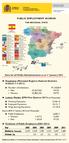 SECRETARIAT OF STATE FOR THE CIVIL SERVICE GENERAL DIRECTORATE OF CIVIL SERVICE PUBLIC EMPLOYMENT IN SPAIN THE REGIONAL STATE NSI 1-1-2010 SPAIN 505,990 km 2 47,021,031 Inhab. Andalusia 87,599 km 2 8,370,975
Survey on ICT and Electronic Commerce Use in Companies 2011/12
 25 June 2012 Survey on ICT and Electronic Commerce Use in Companies 2011/12 Main results - 97.5% of Spanish companies with 10 or more employees have Internet access, in. And seven out of 10 have websites.
Use of ITC infrastructures by company size. Percentage of enterprises
 26 June 2015 Survey on ICT and Electronic Commerce Use in Enterprises Year 2014 First quarter 2015 Main results - 98.4% of Spanish enterprises with 10 or more employees have Internet access in the first
Overnight stays in hotel establishments increase 1.9% in 2013
 24 January 214 (updated 27 January 214) Hotel Tourism Short-Term Trends (HOS/HPI/IPHS) Year 213. Overnight stays in hotel establishments increase 1.9% in 213 Hotels earn 41.2 euros per available room and
Overnight stays in hotel establishments register an increase of 4.3% in February, as compared to the same month of 2014
 23 March 215 Updated at 1:3pm Hotel Tourism Short-Term Trends (HOS/HPI/IPHS) February 215. Provisional data Overnight stays in hotel establishments register an increase of 4.3% in February, as compared
Presentation of the Quality Office of the UdL. Universitat de Lleida September 2014 Oficina de Qualitat Vicerectorat de Qualitat i Planificació
 Presentation of the Quality Office of the UdL Universitat de Lleida September 2014 Oficina de Qualitat Vicerectorat de Qualitat i Planificació Preliminary information: Spanish university system 17 Autonomous
Spanish Regional Accounts. Base 2010. Regional Gross Domestic Product. Year 2014 Income accounts of the household sector.
 27 March 2015 Spanish Regional Accounts. Base 2010 Regional Gross Domestic Product. Year 2014 Income accounts of the household sector. 2010-2012 series Main results Regional Gross Domestic Product. Year
Plant health care in Spain
 Plant health care in Spain GALICIA ASTURIAS CANTABRIAP.VASCO NAVARRA LA RIOJA CASTILLA Y LEON ARAGON CATALUNYA MADRID EXTREMADURA CASTILLA- LA MANCHA VALENCIA BALEARES ANDALUCIA MURCI A CEUTA Y MELILLA
Fiscal Policy Strategy
 Fiscal Policy Strategy 22th Dec 2015 Employment (thousands. Q4 and 15Q3) Structural features of the Spanish economy Direct investment position abroad (as % GDP) Source: INE 2011 2012 2013 2014 2015T3 GDP
Overnight stays in hotel establishments registered an increase of 2.7% in August, as compared to the same month of 2013
 23 September 214 Hotel Tourism Short-Term Trends (HOS/HPI/IPHS) August 214. Provisional data Overnight stays in hotel establishments registered an increase of 2.7% in August, as compared to the same month
Overnight stays in non-hotel tourist accommodation increase 6.9% in November as compared to the same month of 2014
 29 December 2015 Non-Hotel Tourist Accommodation Occupancy Survey November 2015. Overnight stays in non-hotel tourist accommodation increase 6.9% in November as compared to the same month of 2014 Overnight
ANECA SELF-EVALUATION REPORT ACCORDING TO THE STANDARDS AND GUIDELINES FOR QUALITY ASSURANCE IN THE EUROPEAN HIGHER EDUCATION AREA
 ANECA SELF-EVALUATION REPORT ACCORDING TO THE STANDARDS AND GUIDELINES FOR QUALITY ASSURANCE IN THE EUROPEAN HIGHER EDUCATION AREA 2007 Index 1. INTRODUCTION... 1.1. BACKGROUND... 1.2. AIM OF THE EXTERNAL
Overnight stays in non-hotel tourist accommodation increase 12.3% in October as compared to the same month of 2014
 27 November 2015 Non-Hotel Tourist Accommodation Occupancy Survey October 2015. Overnight stays in non-hotel tourist accommodation increase 12.3% in October as compared to the same month of 2014 Overnight
57.4% of Spanish households have a broadband Internet connection, 11.6% more than in 2009
 1 October 2010 Survey on Information and Communication Technologies Equipment and Use in Households. Year 2010 57.4% of Spanish households have a broadband Internet connection, 11.6% more than in 2009
The Decline in Student Applications to Computer Science and IT Degree Courses in UK Universities. Anna Round University of Newcastle
 The Decline in Student Applications to Computer Science and IT Degree Courses in UK Universities Introduction Anna Round University of Newcastle The research described in this report was undertaken for
SYMPOSIUM the status of women in spanish political science
 SYMPOSIUM the status of women in spanish political science arantxa elizondo Department of Political Science, University of the Basque Country, B Sarriena, Leioa, E-48940, Spain E-mail: [email protected]
69.8% of Spanish households have a broadband Internet connection, three points more than in 2012
 25 October 2013 Survey on Equipment and Use of Information and Communication Technologies (ICT) in Households Year 2013 69.8% of Spanish households have a broadband Internet connection, three points more
Non-Hotel Tourist Accommodation Occupancy Survey Year 2012. Provisional data
 13 February 213 Non-Hotel Tourist Accommodation Occupancy Survey Year 212. Provisional data Main results In 212, it was registered 11.9 million of overnight stays in non-hotel tourist accommodation (holiday
EMPLOYMENT INTEGRATION: The role of associations of people with mental illness and their families
 Mental Health and Well-being in the Workplace 17th March 2009, Berlin EMPLOYMENT INTEGRATION: The role of associations of people with mental illness and their families Maria Jesús San Pío Programs and
The Spanish Electricity System Summary
 (Time) The Spanish Electricity System Summary 2 14 48, 44, (MW) 4, 36, 32, 28, 24, 2, 1 2 3 4 5 6 7 8 9 1 11 12 13 14 15 16 17 18 19 2 21 22 23 24 Electrical Energy Balance (1) Comunidad Castilla- Castilla
EUROPARC-Spain and the Spanish system of Protected Areas
 EUROPARC-Spain and the Spanish system of Protected Areas Ideas in action in Spain: the Action Plan for Parks Idee in azione in Spagna: il piano di azione Dr. José V. De Lucio Director EUROPARC-Spain EUROPARC-Spain
7% fewer Basque youths began drug addiction treatments between 2009 and 2010
 7% fewer Basque youths began drug addiction treatments between 29 and 21 In 21, two in every thousand young people aged 15 to 29 started drug dependence treatments and, for the first time, the number of
Quality of life in the Spanish workplace
 Quality of life in the Spanish workplace Introduction Satisfaction in the workplace Work environment Work organisation Training and career development Job mobility Work-life balance Trends over the period
Organization of the Health Care System in Spain
 Organization of the Health Care System in Spain Patricia Santa Olalla Peralta Dirección General de Salud Pública Ministerio de Sanidad y Consumo Viral Hepatitis Prevention Board Meeting Madrid, November
Chapter 2. Education and Human Resource Development for Science and Technology
 Chapter 2 Education and Human Resource Development for Science and Technology 2.1 Evironment for Basic Human Resource Development... 53 2.1.1 Science education in primary and secondary schools... 53 2.1.2
NATIONAL REPORT. European Conference of Ministers of Higher Education. Berlin, September 2003 GENERAL DIRECTORATE OF UNIVERSITIES
 NATIONAL REPORT European Conference of Ministers of Higher Education Berlin, September 2003 GENERAL DIRECTORATE OF UNIVERSITIES Madrid, July 2003 CONTENTS 1.- Introduction... page 3 2.- Degree recognition
1 November 2008. BOLOGNA PROCESS TEMPLATE FOR NATIONAL REPORTS: 2007-2009
 Completed National Reports and National Strategies for the Social Dimension should be sent to the Bologna Secretariat by email ([email protected]) no later than 1 November 2008. PART I Notes:
CaixaBank - Covered Bond Investor presentation
 CaixaBank - Covered Bond Investor presentation Data as of 30 th June 2015 Mortgage Covered Bond Programme CaixaBank Programmes - Main figures Jun '15 MORTGAGE COVER POOL 30/06/2015 MORTGAGE COVERED BONDS
Dialnet. Author Identification. Eduardo Bergasa [email protected]
 Dialnet Author Identification Eduardo Bergasa [email protected] Fundación Dialnet! Public non-profit foundation! Spin-off of University of La Rioja! Constitution: 2009! In charge of Dialnet portal
INTRODUCTION. I. Assessment of Teaching Staff II. Assessment of Degrees III. Assessment of Research IV. Further Initiatives for Enhancing Quality
 ACTION PLAN 2014 INTRODUCTION Law 12/2010, dated 28 October, sets out that ACSUCYL is the external assessment body for the higher education system in Castilla y León, as a result of which it focuses its
The Spatial Data Infrastructure of Spain as an example of success in Europe *
 UNITED NATIONS E/CONF.99/IP.16 ECONOMIC AND SOCIAL COUNCIL Ninth United Nations Regional Cartographic Conference for the Americas New York, 10-14 August 2009 Item 7(b) of the provisional agenda Best Practices
Public Corporate Entity..es domain statistics December 2014
 Public Corporate Entity.es domain statistics January 2015 Index 1 Introduction... 3 2 Domains... 4 This section summarises statistical data referring to the composition of domains in the national market,
METIE. Theory and International. Master in Economic. Economics. Official University. Postgraduate. Program. Degree. Madrid.
 Postgraduate Program Official University Degree Master/60 ECTS Executive Program Madrid METIE Master in Economic Theory and International Economics Summary METIE Program Objectives / 2 Structure / 2 Courses
Study of the Macroeconomic Impact of Renewable Energies in Spain
 Study of the Macroeconomic Impact of Renewable Energies in Spain Study of the Macroeconomic Impact of Renewable Energies in Spain Main sponsor Sponsors Study of the Macroeconomic Impact of Renewable Energies
Spain School of Diplomacy p 1 de 11
 Spain School of Diplomacy p 1 de 11 Escuela Diplomática Spain School of Diplomacy (SSD) Established in 1942 as a department of the Ministry of Foreign Affairs and Cooperation (MAEC), the SSD depends directly
Quality Assurance in University of Alicante
 Quality Assurance in University of Alicante Sergio Luján Mora Department of Software and Computing Systems University of Alicante Content Europe Background Spanish Model ANECA University of Alicante: Quality
OCU's experience in adapting to the Spanish CV standard format (CVN)
 OCU's experience in adapting to the Spanish CV standard format (CVN) Bolonia, 26 th May 2011 Roberto Moreno, Product Manager Manuel Rivera, Clients Manager [email protected] +34 91.382.21.40 Index About OCU
Overview of indicators and data-elements, by dimension
 Final U Map Overview of indicators and data-elements, by dimension 31 March 2011 Page 1 of 27 teaching and learning profile Degree level focus The number of degrees awarded in the reference year, by level
EUROPEAN. Geographic Trend Report for GMAT Examinees
 2011 EUROPEAN Geographic Trend Report for GMAT Examinees EUROPEAN Geographic Trend Report for GMAT Examinees The European Geographic Trend Report for GMAT Examinees identifies mobility trends among GMAT
Undergraduate Degree Completion by Age 25 to 29 for Those Who Enter College 1947 to 2002
 Undergraduate Degree Completion by Age 25 to 29 for Those Who Enter College 1947 to 2002 About half of those who start higher education have completed a bachelor's degree by the ages of 25 to 29 years.
INDEX Executive summary... 2 1. Summary introduction to higher education and its quality assurance in Spain... 3
 Verification of Compatibility of MECES (the Spanish Qualifications Framework for Higher Education) with the Framework for Qualifications of the European Higher Education Area (FQ-EHEA) Report 3.11.14 INDEX
The Bologna Process Conference on Master-level Degrees Helsinki, Finland March 14-15, 2003. Conclusions and Recommendations of the Conference
 The Bologna Process Conference on Master-level Degrees Helsinki, Finland March 14-15, 2003 Final Conclusions and Recommendations of the Conference Different dimensions of master degrees (In this document
Università Commerciale Luigi Bocconi
 Università Commerciale Luigi Bocconi PhD Programs Academic Rules and Regulations Pursuant to MIUR decree no.45, art. 5, 8th February 2013 1 Art. 1 Sphere of Implementation 1.1 The Rules and Regulations
Evolution of informal employment in the Dominican Republic
 NOTES O N FORMALIZATION Evolution of informal employment in the Dominican Republic According to official estimates, between 2005 and 2010, informal employment fell from 58,6% to 47,9% as a proportion of
How To Make A Long Term Care Law Work In Spain
 September 2014 Analysis of the Care Home for the Elderly Market in Spain, France, Germany, UK and Sweden: Outlook for the Spanish Market Report 1 Index 01 Objectives... 6 02 Methodology... 8 03 Spanish
SELF REPORT FOR RENEWAL OF ACCREDITATION OF OFFICIAL BACHELOR S AND MASTER'S DEGREES
 SELF REPORT FOR RENEWAL OF ACCREDITATION OF OFFICIAL BACHELOR S AND MASTER'S DEGREES The present proposal has been drawn up to provide help when writing the self report, following the criteria and sub
A Guide to Learning Outcomes, Degree Level Expectations and the Quality Assurance Process in Ontario
 A Guide to Learning Outcomes, Degree Level Expectations and the Quality Assurance Process in Ontario A Guide to Learning Outcomes, Degree Level Expectations and the Quality Assurance Process in Ontario
Careers Advisory Service
 Careers Advisory Service Annual Report 2012/13 First Destination Statistics Careers Advisory Service 2 nd Floor, 7-9 South Leinster Street The University of Dublin, Trinity College Dublin 2 Tel: 01-8961721/1705
OVERCOMING SCHOOL FAILURE: POLICIES THAT WORK SPANISH NATIONAL REPORT
 OVERCOMING SCHOOL FAILURE: POLICIES THAT WORK SPANISH NATIONAL REPORT Mayo 2011 Report prepared by: Direction: Eduardo Coba Arango, Director del Instituto de Formación del Profesorado, Investigación e
 UPC International Relations Plan 2003-2006 Servei de Comunicació Institucional de la UPC, 2003 (7077) Contents Introduction Teaching Subsection 1: The European Higher Education Area Subsection 2: The internationalisation