
HEALTH INFORMATION STANDARDS COMMITTEE FOR ALBERTA MENTAL HEALTH REPORTING REQUIREMENTS INPATIENT INTERVAL REPORTING DATA SET
|
|
|
- Theodore Lamb
- 9 years ago
- Views:
Transcription
1 Health Information Data Standard HEALTH INFORMATION STANDARDS COMMITTEE FOR ALBERTA MENTAL HEALTH REPORTING REQUIREMENTS INPATIENT INTERVAL REPORTING DATA SET Status: Accepted in Draft Amendment Version 0.1 Status Date: January 20, 2009
2 Revision History Version Revision Date Summary of Changes 0.2 February 11, 2010 Application as built data elements 2010 Government of Alberta 2 of 103
3 Table of Contents Revision History...2 Table of Contents...3 EXECUTIVE SUMMARY...5 INTRODUCTION...6 BACKGROUND...6 BUSINESS CASE FOR THE HEALTH SYSTEM...6 IMPACT ON PRIVACY, CONFIDENTIALITY AND SECURITY...7 RELATIONSHIP TO EXISTING STANDARDS AND/OR LEGISLATION...7 SUMMARY OF CONSENSUS TO DATE...8 RESULTS OF LITERATURE REVIEW...8 Conceptual Data Model...9 Data Standards Stakeholder...12 Unique Lifetime Identifier (ULI)...13 Aboriginal Status...14 Stakeholder Health Care Number...15 Health Care Number (HCN)...16 Province/Territory Issuing Health Care Number...17 Stakeholder Gender...18 Gender...19 Stakeholder Date of Birth...20 Birth Date...21 Birth Date...22 Service Episode...23 Episode Start...24 Chart Number...25 Admission Date...26 Admission via Ambulance...27 Accompanied By at Admission...28 Patient Referred By...29 Date of Referral...31 Address...32 Province of Patient's Residence...33 Postal Code of Patient's Current Residence...34 Postal Code of Patient's Current Residence Known Flag...35 Homeless Flag...36 Other Country Flag...37 Service Episode Program...38 Service Program Start Date...39 Mental Health Program...40 Mental Health Program...41 Inpatient Status...42 Psychiatric Status...43 Public Guardian Code...45 Responsibility for Payment...46 Forensic Legal Status...47 Health Diagnosis...48 Diagnosis...49 DSM-IV-TR Description Code...50 DSM-IV-TR AXIS Code...51 ICD-10-CA Code...53 ICD-10-CA Prefix Code...54 DSM-IV-TR GAF Score...55 Service Episode Responsible Provider Government of Alberta 3 of 103

4 Most Responsible Provider ID...58 Most Responsible Provider Expertise...59 Stakeholder Service Event...60 Service Event Identifier...61 Service Event Start Date...62 Group Service Event Flag...63 Number of Participants in Group...64 Service Event Duration...65 Intervention Code...66 Intervention Attribute Status...67 Intervention Attribute Mode of Delivery...68 Intervention Attribute Extent...69 Service Provider...71 Service Provider ID...72 Service Provider Role...73 Service Provider Role...74 Inpatient Discharge Waitlist...75 Date Placed on Discharge Waitlist...76 Reason Placed on Discharge Waitlist...77 Date Taken off Discharge Waitlist...79 Episode Close...80 Discharge Date...81 Discharge Disposition...82 of Residence Discharged To...84 Facility Number of Institution Transferred To...85 Facility...86 Delivery Site/Institution Number...87 Permissible Values...88 DSM-IV-TR Description Code Table Government of Alberta 4 of 103
5 EXECUTIVE SUMMARY With the shift of responsibility for mental health services from the Alberta Mental Health Board (AMHB) to the Regional Health Authorities (RHAs) in 2004, the Mental Health Reporting Initiative (Initiative) was undertaken to ensure the continuity of available information for (AHW) and the AMHB to perform their business functions. It is anticipated that the information resulting from the Initiative will also meet most RHAs mental health information requirements. In order to meet the identified information needs new reporting requirements have been developed for collection at the five provincial mental health facilities. The reported data will be used to provide information for surveillance on mental health disorders and related services, measure mental health services develop a funding model and costing methodology for mental health services and assess utilization and quality improvement activities. The collected data will be submitted to AHW through a new application which will validate the received data, allow authorized users to review the file-processing results and provide pre-defined reports on aggregate provincial data. The improved mental health data will be available in a repository environment Government of Alberta 5 of 103
6 INTRODUCTION The Alberta Mental Health Board (AMHB) was formed in 1994 with the mandate to deliver mental health services across the province. In May of 2004, the AMHB unveiled the Provincial Mental Health Plan. Under this plan the roles and responsibilities of the various organizations involved in mental health were redefined. (AHW) was given overall responsibility for maintaining the provincial policy framework for mental health by entering into performance agreements with health authorities, monitoring results, and determining policy and funding requirements. These changes transferred the primary responsibility of collecting data and providing information related to mental health services from the AMHB to AHW. To facilitate this transfer, a review of the existing systems and processes for collecting and submitting data was performed. It revealed some gaps in terms of the quality of the data collected in its accuracy, completeness and timeliness. Currently there is no well defined standard for the data to be collected and submitted and this negatively impacts the quality of the data and information available. Some service providers do not report any data on mental health services provided and some facilities do not report data on all of the mental health services they provide. Data related to inpatient services provided at mental health facilities and acute care hospitals is only provided in summary form and at time of discharge. As well, the existing processes for data submission and correction are inefficient, arduous, error prone and not well documented or universally understood. Due to a lack of standards and a uniform automated mechanism for submitting data, a significant amount of work is required to request, receive and correct the data. The gaps of the data being collected and the issues with the related existing processes represent an opportunity for the Initiative to clarify reporting requirements and improve the submission process by creating new applications and modifying existing systems. This, in turn, will improve the information available for all stakeholders to assist them in achieving their mandates. To support the changes introduced by the Provincial Mental Health Plan and capitalize on the opportunities it presented, AHW commenced the Initiative which comprises several projects and phases. The first Project defined under this Initiative consists of two phases: A Requirements Analysis and Architecture phase (Phase 1); and a Detailed Design phase (Phase 2). Phase 1 completed in March Phase 2 completed in December Phase 3, the Construction and Implementation phase, will be completed by March 2009 with data collection commencing with the 2009/2010 fiscal year. The Inpatient Interval Reporting Requirements will be collected by the five provincial mental health facilities including Alberta Hospital Edmonton, Claresholm Centre for Mental Health and Addictions, Raymond Care Centre, Southern Alberta Forensic Psychiatric Centre and The Centennial Centre for Mental Health and Brain Injury. The facilities will report the data to AHW on a quarterly basis resulting in timely data being available on service recipients who remain inpatients for extended periods. The new reporting requirements compliment the current reporting required upon patient discharge for submission to the Canadian Institute for Health Information (CIHI) and do not replace it. BACKGROUND BUSINESS CASE FOR THE HEALTH SYSTEM Mental Health Inpatient Interval reporting will provide AHW with the information necessary to meet its legislative and program management requirements. As well the new reporting will aid AHW in achieving the Business Plan Strategy 3.2 which states Support the community-based implementation of the Provincial Mental Health Plan and new patient activity reporting requirements in partnership with the Alberta Mental Health Board, regional health authorities and other stakeholders. The AMHB has been assigned an important advisory role for mental health in the province and is responsible for specific provincial leadership collaboration, coordination and support activities in areas such as Aboriginal mental health, forensic services, mental health research planning and coordination, performance standards and measures, and province-wide prevention and promotion initiatives. These roles and responsibilities can only be successfully achieved through the availability of quality mental health data. The RHAs are the primary organizations responsible for delivering mental health services. They are solely accountable to the Minister, through their Boards, for fulfilling their respective roles and responsibilities as 2010 Government of Alberta 6 of 103
7 detailed in legislation and in their performance agreements. Each RHA needs data to develop appropriate performance agreements, as well as information to measure their performance and to compare their mental health service delivery to provincial standards. Mental health data needs to be collected and available for analysis at a provincial level to support the needs of the stakeholders including AHW, AMHB, the RHAs and individual Albertans in need of mental health services. The benefits to the stakeholders as a result of this Initiative include: AHW will receive the necessary mental health information to support the Ministry mandate of health surveillance, performance measures, funding and assessment of mental health services; The AMHB will receive the information it requires for use in developing and monitoring provincial mental health programs and policy, conducting mental health needs assessment, and assessing the overall performance of the mental health system; RHAs will receive appropriate funding for the mental health care services required in their regions as well as the data required to measure their performance and compare it with provincial standards; External agencies and research organizations, will receive the information they require on mental health services; All stakeholders will receive more accurate, complete and timely information; and Albertans will have necessary mental health services available to them in a cost effective and efficient manner. In addition to the opportunities at hand, there are risks associated with delaying or not proceeding with the Initiative. Until standards for the data required are finalized and communicated to all service providers and a mechanism for the submission of this data is available, some service providers will continue to not supply data or not supply all of the required data. This represents a risk in terms of a loss of data continuity that translates into negative impacts for all stakeholders requiring the data to meet their information needs. Furthermore, many of the RHAs are currently involved in initiatives to replace their existing systems used to collect and submit data on services provided. Delays in the Initiative could jeopardize the ability of these new systems to satisfy mental health reporting requirements. IMPACT ON PRIVACY, CONFIDENTIALITY AND SECURITY is initiating a Privacy Impact Assessment (PIA) in parallel with this HISCA submission regarding their requirement to receive detailed mental health data in accordance with this proposed standard. The PIA process has been initiated and will progress to completion during Phase 2 of the Project. RELATIONSHIP TO EXISTING STANDARDS AND/OR LEGISLATION The Inpatient Interval Reporting Requirements were aligned with standards already approved or accepted in draft format by HISCA. These standards include: Stakeholder Demographic Data Standard v2.2 Stakeholder Client Data Standard v1.0 Stakeholder Provider Data Standard (upcoming NEW version) Where no HISCA standards exist, similar data elements were aligned with the Canadian Institute for Health Information s (CIHI) Discharge Abstract Database (DAD) abstracting manual Government of Alberta 7 of 103
8 SUMMARY OF CONSENSUS TO DATE The requirements for Inpatient Interval Reporting were vetted through three primary entities to establish consensus including the AMHB, RHAs and AHW. The vetting process included a review of the data elements collected historically and assessed these elements for their current accuracy and utility. Additional data elements required to meet new information needs were also introduced and reviewed by representatives of the three organizations. AHW HISCA team members were consulted on standards application throughout the first two Project phases. The Inpatient Interval Reporting Requirements were accepted for implementation by the Project Working Group and Project Steering Committee which included representatives from the AMHB, RHAs and AHW. RESULTS OF LITERATURE REVIEW Early in the development of the Inpatient Interval reporting requirements, a comprehensive review of the Ontario Mental Health Reporting System (OMHRS) Minimum Data Set User s Manual (version 2005) was completed. A comparison between that data set and the data historically collected for the AMHB was completed. The analyses showed that the data required for OMHRS was significantly more detailed, particularly in the area of service recipient assessment. On providing the comparison results to the Project Steering Committee, the decision was made not to proceed with further investigation of OMHRS for Alberta implementation at this time due to the resource intensiveness of data collection as well as the infancy of the reporting system with no proven value. Additional literature review was not completed Government of Alberta 8 of 103
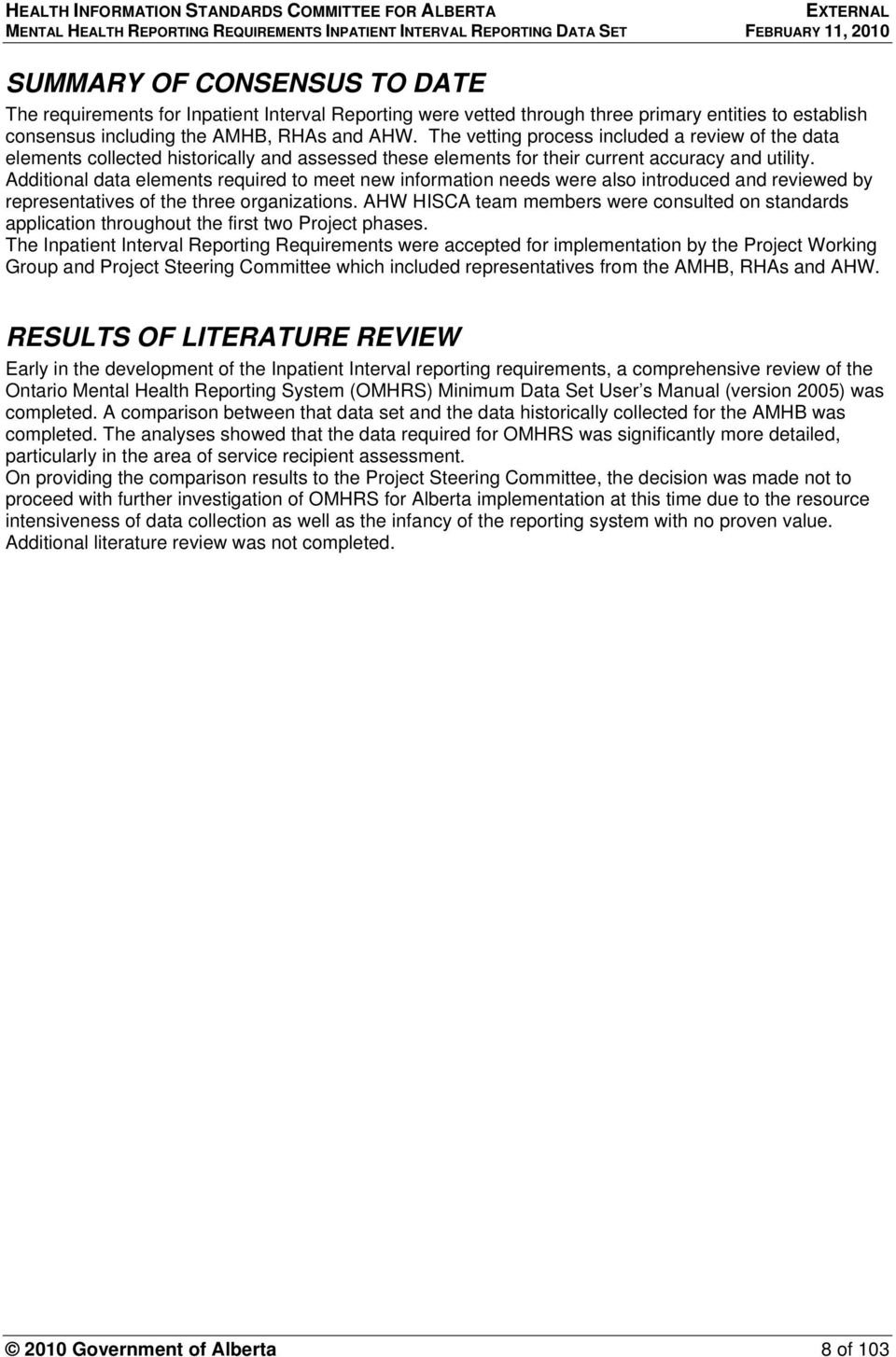
9 Conceptual Data Model Event Linkage links/ Is linked by Event delivers/ Is delivered as Governance Program Mental Health Program offers/ is offered in Service offered by/ offers Delivery Site Facility Service Event Mental Health Event Admission Discharge Stakeholder Service Event initiates/ initiated by closes/ terminated by happens within/ includes Service Episode happens within/ Is location of occurs at/ Is location of Communication Event Resource Event Referral Discharge Waitlist participates in/ has as a participant participates in/ has as a participant Stakeholder in a Role Provider Health Service Professional Worker Recipient has/ Is for Communication Access Address possesses/ is possessed by Provider Expertise establishes/ is established by establishes/ is established by is in/ is a Stakeholder Person Group Organization has a characteristic of/ Is a characteristic of Health Status references/ is referenced by Explanation of Symbols Entity defines a collection of stored data Relationship describes how two Entities relate to one another Entity maintained outside of Mental Health Reporting Mental Health Reporting AHEAD-aligned Conceptual Data Model Health Diagnosis 2010 Government of Alberta 9 of 103
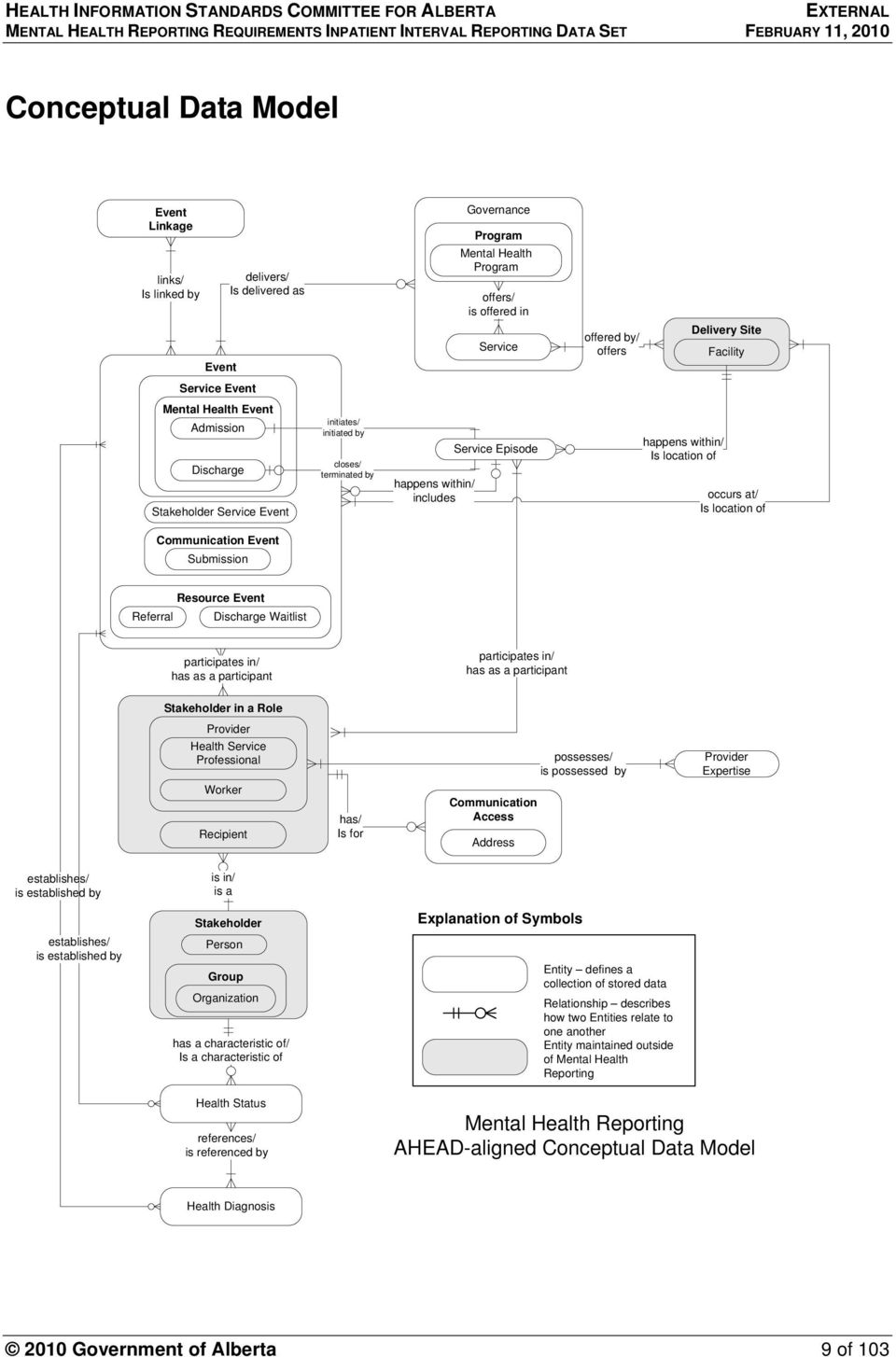
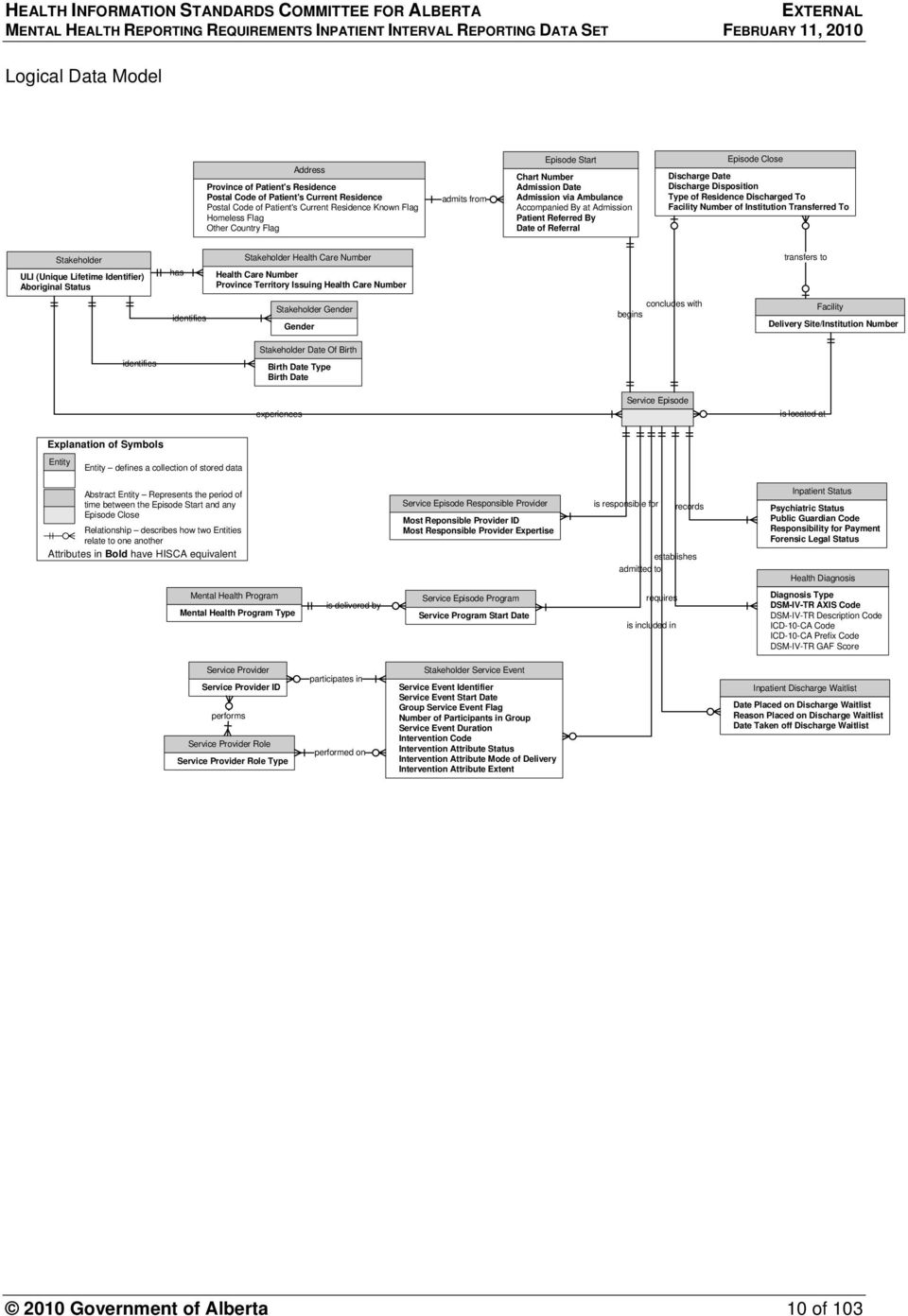
10 Logical Data Model Address Province of Patient's Residence Postal Code of Patient's Current Residence Postal Code of Patient's Current Residence Known Flag Homeless Flag Other Country Flag admits from Episode Start Chart Number Admission Date Admission via Ambulance Accompanied By at Admission Patient Referred By Date of Referral Episode Close Discharge Date Discharge Disposition of Residence Discharged To Facility Number of Institution Transferred To Stakeholder ULI (Unique Lifetime Identifier) Aboriginal Status has Stakeholder Health Care Number Health Care Number Province Territory Issuing Health Care Number transfers to identifies Stakeholder Gender Gender concludes with begins Facility Delivery Site/Institution Number Stakeholder Date Of Birth identifies Birth Date Birth Date Service Episode experiences is located at Explanation of Symbols Entity Entity defines a collection of stored data Abstract Entity Represents the period of time between the Episode Start and any Episode Close Relationship describes how two Entities relate to one another Attributes in Bold have HISCA equivalent Service Episode Responsible Provider Most Reponsible Provider ID Most Responsible Provider Expertise is responsible for records establishes admitted to Inpatient Status Psychiatric Status Public Guardian Code Responsibility for Payment Forensic Legal Status Health Diagnosis Mental Health Program Mental Health Program is delivered by Service Episode Program Service Program Start Date requires is included in Diagnosis DSM-IV-TR AXIS Code DSM-IV-TR Description Code ICD-10-CA Code ICD-10-CA Prefix Code DSM-IV-TR GAF Score Service Provider Service Provider ID performs Service Provider Role Service Provider Role participates in performed on Stakeholder Service Event Service Event Identifier Service Event Start Date Group Service Event Flag Number of Participants in Group Service Event Duration Intervention Code Intervention Attribute Status Intervention Attribute Mode of Delivery Intervention Attribute Extent Inpatient Discharge Waitlist Date Placed on Discharge Waitlist Reason Placed on Discharge Waitlist Date Taken off Discharge Waitlist 2010 Government of Alberta 10 of 103
11 Data Standards Parent Component Name Stakeholder Service Episode Cardinality Business Rule/Coding Guideline 2010 Government of Alberta 11 of 103
12 Parent Stakeholder Component Name Cardinality For MHR, a person who receives mental health services. A Stakeholder is the target of one or more Mental Health Inpatient Service Episodes and receives the performance of one or more Mental Health Service Events while admitted into a Facility and registered in a Mental Health Program. Business Rule/Coding Guideline 2010 Government of Alberta 12 of 103

13 Data Element Name Unique Lifetime Identifier (ULI) Stakeholder Stakeholder Demographic Version 2.2 ULI is a distinct and permanent number assigned to all patients who receive health services in Alberta. ULIs are assigned to all Alberta residents, residents of other provinces/territories and other countries. Numeric Information Exchange Length 9 Mask NNNNNNNNN Mandatory Cardinality 1:1 Business Rule / Coding Guideline All people encountering the health care system in Alberta should be assigned a ULI. If a ULI does not exist at the time of admission, one can be assigned by authorized users of the Alberta Health and Wellness Person Directory (PD). The health care insurance number of the patient's home province or territory should be collected and recorded in PD to help identify and support medical and hospital reciprocal billing. The eligibility of a patient claiming coverage under the Alberta Health Care Insurance Plan (AHCIP) can be verified using PD. Implementation Consideration Permissible Data Element Value HISCA Alias Valid Alberta ULI - Numeric ULI 2010 Government of Alberta 13 of 103

14 Data Element Name Aboriginal Status Stakeholder Aboriginal Status identifies the indigenous background of the patient. Character Information Exchange Length 2 Mask AA Optional Cardinality 0:1 Business Rule / Coding Guideline This data element is optionally reported if the Aboriginal Status of the patient is known. Implementation Consideration Permissible Data Element Value HISCA Alias NS - First Nations - Non Status ST - First Nations - Status IT - Inuit MT - Métis OT - Other NA - Not Applicable Aboriginal Code 2010 Government of Alberta 14 of 103

15 Parent Component Name Stakeholder Health Care Number Stakeholder Information Health Care Number (HCN) Province/Territory Issuing Health Care Number Cardinality The value of the Inpatient Identifier (Health Care Number). Business Rule/Coding Guideline 2010 Government of Alberta 15 of 103

16 Data Element Name Health Care Number (HCN) Stakeholder Health Care Number Stakeholder Demographic Version 2.2 HCN is the patient's medical (insurance) number assigned by the provincial/territorial government of the patient's home residence. For Alberta residents, the Unique Lifetime Identifier (ULI) and the HCN are the same number. When the resident is insured under the Alberta Health Care Insurance Plan (AHCIP) the Alberta ULI is also considered the HCN. Character Information Exchange Length 12 Mask AAAAAAAAAAAA Mandatory Cardinality 1:1 Business Rule / Coding Guideline For Alberta, valid Health Care Numbers (HCNs) are ULIs that have been assigned to people upon registration in the Alberta Health and Wellness Stakeholder Registry. A complete set of HCNs for other provinces/territories is not available. The Alberta Person Directory may be a source of HCNs for out-of-province patients receiving health services in Alberta. Implementation Consideration Permissible Data Element Value HISCA Alias Up to twelve (12) characters; patient's Health Care Number as assigned by the province/territory of residence. 0 - Insured resident of Alberta, but Health Care Number not available 1 - Not Applicable. Includes: Out of Province Resident with unavailable Health Care Number. Out of country, federal government coverage (e.g. RCMP, penitentiary inmate, veteran) or no health insurance coverage from province of residence. PHN (Provincial Health Number) 2010 Government of Alberta 16 of 103

17 Data Element Name Province/Territory Issuing Health Care Number Stakeholder Health Care Number Province/Territory Issuing Health Care Number is a code that identifies the jurisdiction that issued/assigned the Provincial Health Care Number to the patient. Character Information Exchange Length 2 Mask AA Conditional Cardinality 0:1 Business Rule / Coding Guideline Assign the code that identifies the province or territory responsible for issuing the Health Care Number (HCN). This field is left blank if the HCN is reported as "1" in instances where the patient is out of province with an unavailable HCN. The field is also left blank when the patient is from another country, there is federal government coverage (e.g. RCMP, penitentiary, inmate, veteran) or no health insurance coverage from the province of residence. Implementation Consideration Permissible Data Element Value HISCA Alias AB - Alberta BC - British Columbia MB - Manitoba NB - New Brunswick NL - Newfoundland & Labrador NS - Nova Scotia NT - Northwest Territories NU - Nunavut ON - Ontario PE - Prince Edward Island QC - Quebec SK - Saskatchewan YT - Yukon Territory ID Assigning Authority 2010 Government of Alberta 17 of 103
18 Parent Component Name Stakeholder Gender Stakeholder Gender Cardinality A coded value that describes the sex of the patient. Business Rule/Coding Guideline 2010 Government of Alberta 18 of 103
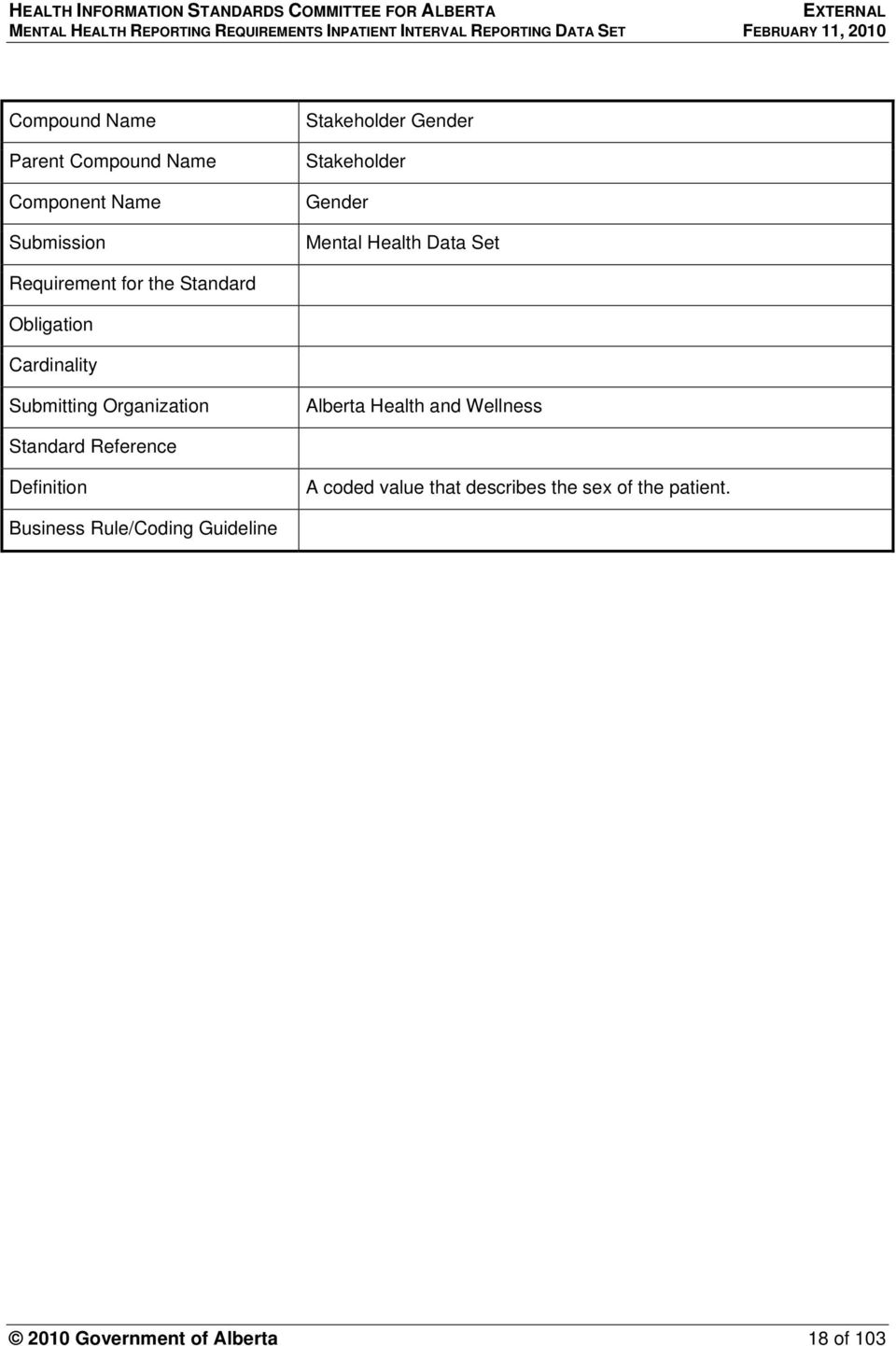
19 Data Element Name Gender Stakeholder Gender Client Registry - Enterprise Management Person Identifier Gender is a coded value that describes the sex of the patient. Character Information Exchange Length 1 Mask A Mandatory Cardinality 1:1 Business Rule / Coding Guideline The value of "Unknown" is used to indicate that the gender is unknown because the patient was not asked or did not provide the information. Implementation Consideration Permissible Data Element Value HISCA Alias F Female M Male U Unknown O - Other (transsexual, hermaphrodite) Administrative Gender 2010 Government of Alberta 19 of 103

20 Parent Component Name Stakeholder Date of Birth Stakeholder Birth Date Birth Date Cardinality At a point in time the whole or partial data of birth declared by a Mental Health Inpatient Business Rule/Coding Guideline 2010 Government of Alberta 20 of 103

21 Data Element Name Birth Date Stakeholder Date of Birth Client Registry - Enterprise Management Person Identifier Birth Date is the portion of the date of birth that is known and reported. Character Information Exchange Length 1 Mask A Mandatory Cardinality 1:1 Business Rule / Coding Guideline Report the code that identifies the components of the birth date (i.e. year/month/day) that are known at the conclusion of the current reporting interval. If the complete birth date is known, report "5" - YYYYMMDD - Full Date of Birth Provided. Partial birth dates are allowed. If Birth Date reported is "3" - YYYY - Year only, "4" - YYYYMM - Year and Month only, or "5" - YYYYMMDD - Full Date of Birth Provided, then a corresponding birth date value must be reported. If documentation from a recognized jurisdictional authority verifies that an individual has no known birth date, "Birth Date" can be blank with a 1" - None reported in the Birth Date. If the "Birth Date" is not collected because it was not asked for or provided, report 2" - Not Collected in the Birth Date and leave "Birth Date" blank. Implementation Consideration Permissible Data Element Value HISCA Alias 1 - None - individual without a recorded date of birth and supported by documentation from a recognized jurisdictional authority 2 - Not Collected - Birth Date not provided 3 - YYYY - Year only 4 - YYYYMM - Year and Month Only 5 - YYYYMMDD - Full Date of Birth Provided Birth Date Component Part 2010 Government of Alberta 21 of 103
22 Data Element Name Birth Date Stakeholder Date of Birth Client Registry - Enterprise Management Person Identifier The Birth Date identifies the year, month and day when the patient was born. Date Information Exchange Length 8 Mask YYYY YYYYMM YYYYMMDD Conditional Cardinality 0:1 Business Rule / Coding Guideline Report the birth date information that is known. Partial birth dates may be reported. The birth date information that is reported must match the code reported for the data element "Birth Date." This data element is left blank if no part of the Birth Date is known. Implementation Consideration Permissible Data Element Value HISCA Alias YYYY YYYYMM YYYYMMDD Blank Birth Date Value 2010 Government of Alberta 22 of 103
23 Parent Component Name Service Episode Episode Start Service Episode Program Inpatient Status Health Diagnosis Service Episode Responsible Provider Stakeholder Service Event Inpatient Discharge Waitlist Episode Close Cardinality The delivery of a Mental Health Service to a single Stakeholder who is enrolled as a Mental Health Inpatient at a Facility Business Rule/Coding Guideline 2010 Government of Alberta 23 of 103
24 Parent Component Name Episode Start Service Episode Chart Number Admission Date Admission via Ambulance Accompanied By at Admission Patient Referred By Date of Referral Address Cardinality The event that initiates the enrolment of Stakeholder at a Facility under a Mental Health Program as Mental Health Inpatient and so begins an Inpatient Service Episode. A possible long running event initiated by a Mental Health Inpatient Admission that registers a Stakeholder as an Inpatient at a Facility to receive services under a Mental Health Program Business Rule/Coding Guideline 2010 Government of Alberta 24 of 103
25 Data Element Name Chart Number Episode Start Chart Number refers to the patient record number assigned by the reporting facility. Character Information Exchange Length 12 Mask AAAAAAAAAAAA Optional Cardinality 0:1 Business Rule / Coding Guideline Report the Chart Number assigned to the patient record by the facility. Implementation Consideration Permissible Data Element Value HISCA Alias Number assigned by the service provider organization. The number may be a combination of alpha and numeric characters. Patient Internal File Identifier 2010 Government of Alberta 25 of 103
26 Data Element Name Admission Date Episode Start Admission Date is the calendar date that the patient was officially registered as an inpatient at the facility. Date Information Exchange Length 8 Mask YYYYMMDD Mandatory Cardinality 1:1 Business Rule / Coding Guideline The Admission Date must be a valid date and be reported in the YYYYMMDD format. Implementation Consideration Permissible Data Element Value HISCA Alias Valid Date (YYYYMMDD) Service Episode Start Date 2010 Government of Alberta 26 of 103
27 Data Element Name Admission via Ambulance Episode Start Admission via Ambulance identifies whether or not the patient arrives at the facility in an ambulance. Character Information Exchange Length 1 Mask A Mandatory Cardinality 1:1 Business Rule / Coding Guideline Report the applicable type of ambulance. Report "N" - No Ambulance if the patient did not arrive at the facility in an ambulance. Patient record documentation must support reporting that the patient arrived by ambulance. Implementation Consideration Permissible Data Element Value HISCA Alias A - Air Ambulance G - Ground Ambulance C - Combination of Ground and Air N - No Ambulance Transportation Mode Code 2010 Government of Alberta 27 of 103
28 Data Element Name Accompanied By at Admission Episode Start Accompanied By at Admission identifies who the patient was accompanied by at the time of admission. Character Information Exchange Length 2 Mask AA Conditional Cardinality 0:1 Business Rule / Coding Guideline This data element must be reported if the patient did not arrive at the facility by ambulance. Implementation Consideration Permissible Data Element Value 01 - Central Assessment & Placement Services 02 - Community Nurse 03 - Crisis Team 04 - Friend(s) 05 - Military Police 06 - Police 07 - Relative 08 - Self 09 - Social Worker 10 - Therapist 94 - Other 99 - Unknown HISCA Alias 2010 Government of Alberta 28 of 103
29 Data Element Name Patient Referred By Episode Start Patient Referred By identifies the type of person or agency that referred the patient for treatment at the facility. Character Information Exchange Length 2 Mask AA Mandatory Cardinality 1:1 Business Rule / Coding Guideline In the event that multiple referral sources apply, report the value that describes the most current referral source. The exception to this is in the situation when the patient is admitted to a mental health facility from an acute care facility after being brought in by the police under a Form 8. In this situation report 12 Legal System. Implementation Consideration Permissible Data Element Value 00 - No referral documented 01 - Acute care facility including tertiary care and community health care facilities 02 - Continuing care facility including extended care and nursing home facilities 03 - Other health care service providers (funded by regional resources) 04 - Home Care 05 - Services funded by non-regional resources (e.g. federal government, WCB) 06 - Physician (only used when referred by a physician in private practice) 07 - Public Health 08 - Other individual/ agency (e.g. private organizations) 09 - Significant other (Individuals who are acting on behalf, or in the interest of the patient such as a parent, spouse/partner, child, legal guardian or substitute decision maker. Excluded in this definition are 2010 Government of Alberta 29 of 103
30 nurses, Aides, ministers, teachers or health service personnel.) 10 - Educational Institution 11 Self (Patient approached the mental health facility without any encouragement from another person/agency) 12 - Legal System (e.g. corrections, court, police) 13 - Government funded alcohol and drug treatment agency (e.g. AADAC) 14 - Crisis Services 15 - Community mental health 16 - Psychiatric Facility (Alberta Hospital Edmonton, The Centennial Centre for Mental Health and Brain Injury, Claresholm Centre for Mental Health and Addictions, Southern Alberta Forensic Psychiatric Centre, or Raymond Psychiatric Centre) 17 - Child welfare services (e.g. Child and Family Services) 99 - Unknown HISCA Alias Referral Source Code 2010 Government of Alberta 30 of 103
31 Data Element Name Date of Referral Episode Start Date of Referral is the calendar date that the service provider is notified that the patient is being referred for services. Date Information Exchange Length 8 Mask YYYYMMDD Optional (Changed from Conditional to Optional to facilitate reporting data element for 2009/2010) Cardinality 0:1 Business Rule / Coding Guideline If the data element "Patient Referred By" is reported as a value other than "00" - No referral documented or "99" - Unknown, the Date of Referral must also be reported. If a referral occurs before the patient is admitted, report the date the referral was made. NOTE: For 2009/2010 this conditional reporting rule will not be enforced. Reporting of this data element is optional. Implementation Consideration Permissible Data Element Value HISCA Alias Valid Date (YYYYMMDD) Referral Source Date 2010 Government of Alberta 31 of 103
32 Parent Component Name Address Episode Start Province of Patient's Residence Postal Code of Patient's Current Residence Known Flag Homeless Flag Other Country Flag Cardinality At the time of Mental Health Inpatient Admission the residence information identified for a Stakeholder. Business Rule/Coding Guideline 2010 Government of Alberta 32 of 103
33 Data Element Name Province of Patient's Residence Address Stakeholder Demographic Version 2.2 Province of Patient's Residence indicates the jurisdiction that the patient normally resides in. Character Information Exchange Length 2 Mask AA Conditional Cardinality 0:1 Business Rule / Coding Guideline Report the code that indicates the province/territory that the patient normally resides in. This field is left blank if the patient usually resides outside of Canada. In these instances the data element "Other Country Flag" would be reported as "Yes." If the province of the patient s residence is unknown or unavailable, report AB. Implementation Consideration Permissible Data Element Value HISCA Alias AB - Alberta BC - British Columbia MB - Manitoba NB - New Brunswick NL - Newfoundland & Labrador NS - Nova Scotia NT - Northwest Territories NU - Nunavut ON - Ontario PE - Prince Edward Island QC - Quebec SK - Saskatchewan YT - Yukon Territory Province Code 2010 Government of Alberta 33 of 103
34 Data Element Name Postal Code of Patient's Current Residence Address Stakeholder Demographic Version 2.2 Postal Code of Patient's Current Residence is a six character letter/number combination assigned by Canada Post that identifies the patient's place of residence prior to admission. Character Information Exchange Length 6 Mask ANANAN Conditional Cardinality 0:1 Business Rule / Coding Guideline The format of the postal code is ANANAN, where "A" is an allowable character (D, F, I, O, Q, U, W and Z are not used) and "N" is a digit. The first character indicates a province, territory, or a major geographic region contained entirely within a province's boundaries. Report Canada Postal Codes only. The postal code would be reported if the following conditions exist: Other Country Flag is coded "N" - No; Homeless Flag is coded "N" - No; and Postal Code Known Flag is coded "Y" - Yes. If Other Country Flag or Homeless flag is coded "Y" - Yes a postal code would not need to be reported. Implementation Consideration Permissible Data Element Value HISCA Alias Approved Canada postal code from Canada Post Postal Code 2010 Government of Alberta 34 of 103
35 Data Element Name Postal Code of Patient's Current Residence Known Flag Address Postal Code of Patient's Current Residence Known Flag indicates if the postal code of the patient's usual residence is available. Character Information Exchange Length 1 Mask A Mandatory Cardinality 1:1 Business Rule / Coding Guideline Report "N" - No if the patient's postal code is unknown and cannot be reported. Implementation Consideration Permissible Data Element Value Y - Yes N - No HISCA Alias 2010 Government of Alberta 35 of 103
36 Data Element Name Homeless Flag Address Homeless Flag is an indicator noting that the patient has no permanent or temporary residence at the time of admission. A shelter would not be considered a residence. Character Information Exchange Length 1 Mask A Mandatory Cardinality 1:1 Business Rule / Coding Guideline In the event that the patient provides the address for a shelter, drop in centre, or next of kin when they re not residing with them, Y - Yes would be reported. Implementation Consideration Permissible Data Element Value Y - Yes N - No HISCA Alias 2010 Government of Alberta 36 of 103
37 Data Element Name Other Country Flag Address Stakeholder Demographic Version 2.2 Other Country Flag indicates that the patient's usual residence is a country other than Canada. Character Information Exchange Length 1 Mask A Mandatory Cardinality 1:1 Business Rule / Coding Guideline People who are visiting on a work or student visa would be considered a resident of Canada if it is known that they have a permanent address and would be reported as No. Implementation Consideration Permissible Data Element Value Y- Yes N - No HISCA Alias 2010 Government of Alberta 37 of 103
38 Parent Component Name Service Episode Program Service Episode Service Program Start Date Mental Health Program Cardinality The date when the Program is associated with the Service Episode. Business Rule/Coding Guideline 2010 Government of Alberta 38 of 103
39 Data Element Name Service Program Start Date Service Episode Program Service Program Start Date is the date that the patient began treatment in a mental health program within the facility. Date Information Exchange Length 8 Mask YYYYMMDD Conditional Cardinality 0:1 Business Rule / Coding Guideline This data element is reported in conjunction with the data element "Mental Health Program." Report the Service Program Start Date as the date that the patient began treatment in a mental health program. Report a Service Program Start Date for each program the patient is treated in during a reporting period. Implementation Consideration Permissible Data Element Value HISCA Alias Valid Date (YYYYMMDD) Service Program Unit Start Date 2010 Government of Alberta 39 of 103
40 Parent Component Name Mental Health Program Service Episode Program Mental Health Program Cardinality Within a Mental Health Inpatient Service Episode the identification of a Mental Health Program under which services will be provided. One Mental Health INpatient Service Episode will be associated with a minimum of one Mental Health Program identified at time of admission Business Rule/Coding Guideline 2010 Government of Alberta 40 of 103
41 Data Element Name Mental Health Program Mental Health Program Mental Health Program is the category of integrated services provided to the patient. Character Information Exchange Length 2 Mask AA Mandatory Cardinality 1:1 Business Rule / Coding Guideline Report all mental health programs that the patient receives treatment in during a reporting period. Report young offenders as 03 - Forensic Psychiatry. Implementation Consideration Permissible Data Element Value HISCA Alias 01 - Brain Injury Rehabilitation 02 - Adult Psychiatry 03 - Forensic Psychiatry 04 - Geriatric Psychiatry Program Code 2010 Government of Alberta 41 of 103
42 Parent Component Name Inpatient Status Service Episode Psychiatric Status Public Guardian Code Responsibility for Payment Forensic Legal Status Cardinality At a point in time for a Stakeholder admitted as Mental Health Inpatient to a Facility identification. Business Rule/Coding Guideline 2010 Government of Alberta 42 of 103
43 Data Element Name Psychiatric Status Inpatient Status Psychiatric Status identifies if the patient is voluntary (non-certified) or involuntary (certified under the Mental Health Act). Character Information Exchange Length 2 Mask AA Mandatory Cardinality 1:1 Business Rule / Coding Guideline The following certificates are considered 24-hour hold certificates and are used to convey a person to a facility for examination: Form 1 - Admission Certificate (A Form 1 Admission Certificate once issued in the community authorizes conveyance of up to 72 hrs. Once at the facility, this certificate permits detention up to 24 hrs following arrival). Form 3 Order to Return a Formal Patient to a Facility (if the formal patient leaves the facility without permission AWOL a Form 3 is issued for a peace officer to return the patient to a designated facility. If the existing certificates have expired during the leave of absence, the person is deemed to be a person in respect of whom one admission certificate has been issued and they may be detained up to 24 hours upon return to a designated facility. Form 4 - Certificate of Transfer Into Alberta (Form issued by the Minister or Designate), authorizes a peace officer to apprehend the person and convey them to a facility for examination and detention at a facility for examination up to 24 hours. Form 8 Mental Health Warrant or Form 9 Extension of Warrant (A warrant is valid up to 7 days and may be extended for another 7 days and provides authority for any peace officer to apprehend that individual for conveyance to a designated facility for examination). The Mental Health Warrants expire 24 hours from the time the person arrives at the facility. Form 10 - Statement of Peace Officer on Apprehension authorizes 2010 Government of Alberta 43 of 103
44 conveyance to a designated facility for examination. Form 10 expires 24 hours from the time the person arrives at the facility. Formal status: 2 Admission certificates are required in order for a patient to become formal. A patient may be detained under one Admission Certificate but is not a formal patient until both are completed. Issuance of two Admission Certificates (Form 1). The second certificate must be issued within 24 hours of the issuance date and time of the first certificate; or Two Renewal Certificates (Form 2). The Renewal Certificates do not need to be issued within 24 hours of each other but both must be issued prior to the expiry date and time of the previous set of certificates. Note: Certificates should be completed in accordance with the Mental Health Act. Implementation Consideration Permissible Data Element Value 01 - Issuance of one 24-hour hold certificate which could include conveyance to a facility Formal status: 2 Admission certificates are required in order for a patient to become formal. A patient is involuntary under one Admission Certificate but not formal until both are completed. *Issuance of two Admission Certificates (Form 1). The second certificate must be issued within 24 hours of the issuance date and time of the first certificate; or *Two Renewal Certificates (Form 2). The Renewal Certificates do not need to be issued within 24 hours of each other but both must be issued Prior to the expiry date and time of the previous set of certificates Issuance of one 24-hour hold (see number 1 for types of certificates) plus the issuance of two Admission Certificates or two Renewal Certificates Voluntary HISCA Alias Psychiatric Status Code 2010 Government of Alberta 44 of 103
45 Data Element Name Public Guardian Code Inpatient Status Public Guardian Code Identifies if there is a public guardian appointed for the patient. Character Information Exchange Length 1 Mask A Mandatory Cardinality 1:1 Business Rule / Coding Guideline The Public Guardian Code must be reported in the reporting period in which it is assigned. Implementation Consideration Permissible Data Element Value HISCA Alias Y - Yes, for public guardian appointed N - No, for no public guardian U - Unknown, not asked or not available (collected) at source. Public Guardian Code 2010 Government of Alberta 45 of 103
46 Data Element Name Responsibility for Payment Inpatient Status Responsibility for Payment code identifies the primary source responsible for payment of health service(s) rendered. Character Information Exchange Length 2 Mask AA Mandatory Cardinality 1:1 Business Rule / Coding Guideline In the event that multiple sources are responsible for payment of the health services provided, report the code that identifies the primary payment source. If the source of payment for a homeless patient is unknown, report "01" - Alberta Government. Implementation Consideration Permissible Data Element Value HISCA Alias 01 - Alberta Government 02 - Worker s Compensation Board (WCB) 03 - Other Provincial or Territorial Government (resident of Canada) 04 - Federal Government - Veteran Affairs Canada (VAC) 05 Federal Government - First Nations and Inuit Health Branch (FNIHB) 06 - Federal Government - Other (RCMP, Department of National Defence, Penitentiary Inmates, Immigration) 07 - Canadian resident Self pay 08 Other Country Resident, Self-pay 99 - Responsibility for payment unknown/unavailable Responsibility for Payment Code 2010 Government of Alberta 46 of 103
47 Data Element Name Forensic Legal Status Inpatient Status Forensic Legal Status identifies the status of the patient according to the Criminal Code. Character Information Exchange Length 1 Mask A Mandatory Cardinality 1:1 Business Rule / Coding Guideline The listed values fall under the Criminal Code of Canada. Patients may, however, be admitted simultaneously under Form 1 or Form 6 of the Mental Health Act but the Criminal Code of Canada value takes precedence. Implementation Consideration Permissible Data Element Value 1 - Not Criminally Responsible 2 - Not Fit To Stand Trial 3 - Remand 4 - Serving Prisoner 5 - Treatment Order (Judicial) 9 - Not Applicable HISCA Alias Forensic Legal Status Code 2010 Government of Alberta 47 of 103
48 Parent Component Name Health Diagnosis Service Episode Diagnosis DSM-IV-TR Description Code DSM-IV-TR AXIS Code ICD-10-CA Code ICD-10-CA Prefix Code DSM-IV-TR GAF Score Cardinality For a Mental Health Inpatient an assessment of the Stakeholder's well being expressed against known classification schemes An initial assessment is made when the Stakeholder is admitted to the Facility. Additional assessments may be made at any time while the Stakeholder is a Mental Health Inpatient Business Rule/Coding Guideline 2010 Government of Alberta 48 of 103
49 Data Element Name Diagnosis Health Diagnosis CIHI DAD Abstracting Manual Diagnosis describes the significance of a reported diagnosis and, in some instances, provides information on when the diagnosis was established (e.g. before admission or after admission) Character Information Exchange Length 1 Mask A Optional (Changed from Conditional to Optional to facilitate reporting data element for 2009/2010) Cardinality 0:1 Business Rule / Coding Guideline This data element must be assigned to each reported diagnosis for DSM-IV-TR Axis Codes 1 through 4. Refer to the Canadian Institute for Health Information (CIHI) Discharge Abstract Database reporting manual and Canadian Coding Standards for ICD-10-CA and CCI for further information on assigning Diagnosis s. Note: For 2009/2010 this Conditional reporting rule will not be enforced. Reporting of this data element is optional. Implementation Consideration Permissible Data Element Value HISCA Alias M - Most Responsible Diagnosis (MRDx) 1 - Pre-admit Comorbidity 2 - Post-admit Comorbidity 3 - Secondary Diagnosis 6 - A condition that is the manifestation of another condition and is responsible for the greatest length of stay and/or resources used during a hospitalization 9 - External Cause of Injury Diagnosis Code 2010 Government of Alberta 49 of 103
50 Data Element Name DSM-IV-TR Description Code Health Diagnosis Diagnostic and Statistical Manual of Mental Disorders, Fourth Edition, Text Revision (DSM-IV-TR) Description Code identifies the textual description explaining the associated DSM-IV-TR code assigned to the patient. Character Information Exchange Length 5 Mask AAAAA Optional (Changed from Conditional to Optional to facilitate reporting data element for 2009/2010) Cardinality 0:1 Business Rule / Coding Guideline This data element must be assigned to each reported diagnosis for DSM-IV-TR Axis Codes 1 and 2. NOTE: For 2009/2010 this conditional reporting rule will not be enforced. Reporting of this data element is optional. Implementation Consideration Permissible Data Element Value HISCA Alias Valid values are found on the worksheet tab labelled "Permissible Values." DSM IV-TR Description Code 2010 Government of Alberta 50 of 103
51 Data Element Name DSM-IV-TR AXIS Code Health Diagnosis DSM-IV-TR AXIS Code is the categorization of mental health disorders based on the type of diagnosis. Psychiatric diagnoses are organized into five levels (axes) relating to different aspects of a disorder or disability. The axes include: Axis I: clinical disorders, including major mental disorders as well as developmental and learning disorders. Axis II: underlying pervasive or personality conditions as well as mental retardation. Axis III: acute medical conditions and physical disorders. Axis IV: psychosocial and environmental factors contributing to the disorder. Axis V: Global Assessment of Functioning or Children's Global Assessment Scale for children under the age of 18. See GAF Score data element for reporting Axis V. Character Information Exchange Length 1 Mask A Optional (Changed from Mandatory to Optional to facilitate reporting data element for 2009/2010) Cardinality 1:1 Business Rule / Coding Guideline A DSM-IV-TR AXIS Code must be assigned for each diagnosis that has been identified during the current reporting period. At this time, reporting of DSM-IV-TR-AXIS Code 5 (and GAF Score) is optional. A diagnosis reported in a previous reporting period does not need to be reported again in a subsequent reporting period. Note: For 2009/2010 this reporting requirement will not be enforced. Reporting of this data element is optional Government of Alberta 51 of 103
52 Implementation Consideration Permissible Data Element Value 1 - AXIS AXIS II 3 - AXIS III 4 - AXIS IV 5 - AXIS V HISCA Alias 2010 Government of Alberta 52 of 103
53 Data Element Name ICD-10-CA Code Health Diagnosis ICD-10-CA - CIHI International Statistical Classification of Diseases and Related Health Problems, Tenth Revision, (ICD-10) with Canadian (CA) enhancements, is a classification scheme that contains codes for diseases, health problems, drugs and external causes of injury. Like conditions are grouped into a limited number of mutually exclusive statistical categories to facilitate easy data retrieval. Character Information Exchange Length 7 Mask AAAAAAA Conditional Cardinality 0:1 Business Rule / Coding Guideline Note: For 2009/2010 the following Conditional reporting rule will not be enforced. A code must be assigned for each Diagnosis that has been identified for DSM-IV-TR Axis Codes 1 through 4. A diagnosis reported in a previous reporting period does not need to be reported again in a subsequent reporting period. Note: Periods within ICD-10-CA codes are not reported. For example, the code F20.9 is reported as F209. Refer to CIHI Canadian Coding Standards for ICD-10-CA and CCI for further information on code selection and assignment. Consult with regional coding specialists for further information on Canadian coding standards. Note: For 2009/2010 the following Conditional reporting rule will be enforced. ICD-10-CA Code diagnosis must be reported if the Axis is not 5 or blank. Implementation Consideration Permissible Data Element Value HISCA Alias Valid ICD-10-CA Code ICD-10-CA Code 2010 Government of Alberta 53 of 103
54 Data Element Name ICD-10-CA Prefix Code Health Diagnosis CIHI DAD Abstracting Manual ICD-10-CA Prefix Code identifies a suspected or questionable disease. Character Information Exchange Length 1 Mask A Optional (Changed from Conditional to Optional to facilitate reporting data element for 2009/2010) Cardinality 0:1 Business Rule / Coding Guideline A code may be assigned for each Diagnosis that has been identified for DSM-IV-TR Axis Codes 1 through 4. Assign the prefix code "Q" if a diagnosis is suspected, questionable, rule out, possible, probable or queried. Otherwise, this data element is not reported. Note: For 2009/2010 this Conditional reporting rule regarding the Axis Code will not be enforced. Reporting of this data element is optional. Implementation Consideration Permissible Data Element Value HISCA Alias Q - Questionable or query diagnosis ICD-10-CA Prefix Code 2010 Government of Alberta 54 of 103
55 Data Element Name DSM-IV-TR GAF Score Health Diagnosis Global Assessment of Functioning (GAF) is a numeric scale (0 through 100) used by mental health clinicians and doctors to rate the social, occupational and psychological functioning of adults. The score is allocated by starting at the top level and moving down until the patient's level of functioning is reached. A score of 0 indicates that the assessor considers that insufficient information is available to make a meaningful assessment. Children and adolescents under the age of 18 are evaluated on the Children s Global Assessment Scale, or C-GAS. The GAF Score is included in DSM-IV-TR as the Axis V assessment. The GAF score can be grouped as noted here: 0 = Insufficient Information Superior functioning in a wide range of activities, life s problems never seem to get out of hand, is sought out by others because of his or her many positive Qualities. No symptoms Absent or minimal symptoms, good functioning in all areas, interested and involved in a wide range of activities, socially effective, generally satisfied with Life, no more than everyday problems or concerns If symptoms are present they are transient and expectable reactions to psychosocial stressors; no more than slight impairment in social, Occupational or school functioning Some mild symptoms OR some difficulty in social, occupational, or school functioning, but generally functioning pretty well, has some meaningful Interpersonal relationships Moderate symptoms OR moderate difficulty in social, occupational, or school 2010 Government of Alberta 55 of 103
56 Functioning in social, occupational, or school functioning Serious symptoms OR any serious impairment in social, occupational, or School functioning Some impairment in reality testing or communication OR major impairment in Several areas, such as work or school, family relations, judgment, thinking, or mood Behaviour is considerably influenced by delusions or hallucinations OR serious impairment in communication or judgment OR inability to function in almost all Areas Some danger of hurting self or others OR occasionally fails to maintain minimal person hygiene OR Gross impairment in communication Persistent danger of severely hurting self or others OR persistent inability to maintain minimal personal hygiene OR serious suicidal act with clear expectation of death. Numeric Information Exchange Length 3 Mask NNN Conditional Cardinality 0:1 Business Rule / Coding Guideline If DSM-IV-TR Axis Code is reported as a value of 5, the GAF Score must be reported. The GAF (AXIS V) should be recorded at the time treatment commences (admission or enrolment to a program) and again at treatment cessation (discharge, closure...) and any other time diagnosis is updated (for long term clients/patients, an "interim" GAF can be recorded- for example- a client in hospital beyond 1 year). Implementation Consideration Permissible Data Element Value HISCA Alias 2010 Government of Alberta 56 of 103
57 Parent Component Name Service Episode Responsible Provider Service Episode Most Responsible Provider ID Most Responsible Provider Expertise Cardinality At a point in time for a Mental Health Inpatient Service Episode identification of the Provider, physician (?), and the role they are assigned, who is ultimately responsible for the well being of the Stakeholder during their enrolment at a Facility. A responsible provider must be identifier at the time of the Mental Health Inpatient Admission. The provider may change over time but a Mental Health Inpatient Service Episode must always be assigned to a Provider Business Rule/Coding Guideline 2010 Government of Alberta 57 of 103
58 Data Element Name Most Responsible Provider ID Service Episode Responsible Provider Most Responsible Provider ID is a regionally assigned identifier for the physician that reflects the physician chiefly responsible for the care of the patient. NOTE: The Most Responsible Provider IDs are not available in ABPD at the time of implementation, so facility assigned identifiers will be used to populate this data element. Numeric Information Exchange Length 15 Mask NNNNNNNNNNNNNNN Mandatory Cardinality 1:1 Business Rule / Coding Guideline At this time, the Most Responsible Physician ID is facility/health region assigned. The source of the Most Responsible Physician ID will be the Alberta Provider Directory (ABPD) in the future. Implementation Consideration Permissible Data Element Value HISCA Alias Regionally assigned value Provider ID 2010 Government of Alberta 58 of 103
59 Data Element Name Most Responsible Provider Expertise Service Episode Responsible Provider Alberta Provider Directory Most Responsible Provider Expertise is a classification of the pursuit, skill or knowledge of the physician chiefly responsible for the care of the patient. Character Information Exchange Length 5 Mask AAAAA Mandatory Cardinality 1:1 Business Rule / Coding Guideline If the Most Responsible Provider has multiple valid Provider Expertise codes, report the Provider Expertise code applicable to the treatment provided. Implementation Consideration Permissible Data Element Value HISCA Alias Valid codes are taken from Alberta Provider Directory (ABPD). Values applicable to mental health reporting are found on the worksheet tab labelled "Permissible Values." Commonly used values are highlighted. Provider Expertise 2010 Government of Alberta 59 of 103
60 Parent Component Name Stakeholder Service Event Service Episode Service Event Identifier Service Event Start Date Group Service Event Flag Number of Participants in Group Service Event Duration Intervention Code Intervention Attribute Status Intervention Attribute Mode of Delivery Intervention Attribute Extent Service Provider Cardinality The delivery of a Mental Health Service to a single Stakeholder who is enrolled as a Mental Health Inpatient at a Facility Business Rule/Coding Guideline 2010 Government of Alberta 60 of 103
61 Data Element Name Service Event Identifier Stakeholder Service Event Service Event Service Event Identifier is a unique number that is used to identify a service event. A service event is a service provided by a service provider to a service recipient at a delivery site during a period of time. Character Information Exchange Length 8 Mask AAAAAAAA Mandatory Cardinality 1:1 Business Rule / Coding Guideline This data element is generated by the facility or health region. If a group service event is being reported, then the Service Event Identifier must be the same for all patients participating in the service event. Implementation Consideration Permissible Data Element Value HISCA Alias 8 characters Service Event Identifier 2010 Government of Alberta 61 of 103
62 Data Element Name Service Event Start Date Stakeholder Service Event Service Event Service Event Start Date is the date that the service provided to the patient commenced. A service event is a service provided by a service provider to a service recipient at a delivery site during a period of time. Date Information Exchange Length 8 Mask YYYYMMDD Mandatory Cardinality 1:1 Business Rule / Coding Guideline The date reported must be within the reporting period and indicate the date the service was initiated. Implementation Consideration Permissible Data Element Value HISCA Alias Valid Date (YYYYMMDD) Service Event Start Date 2010 Government of Alberta 62 of 103
63 Data Element Name Group Service Event Flag Stakeholder Service Event Service Event Group Service Event Flag identifies if the service event is provided to multiple patients at one time. A service event is a service provided by a service provider to a service recipient at a delivery site during a period of time. This includes but is not limited to group therapy and group participation in recreational trips. Character Information Exchange Length 1 Mask A Mandatory Cardinality 1:1 Business Rule / Coding Guideline If the service event is attended by more than one patient, report "Y" - Yes. If the service event was only attended by one patient report "N" - No. Implementation Consideration Permissible Data Element Value Y - Yes N - No HISCA Alias 2010 Government of Alberta 63 of 103
64 Data Element Name Number of Participants in Group Stakeholder Service Event Service Event Number of Participants in Group identifies the number of patients participating in a group event. Numeric Information Exchange Length 4 Mask NNNN Conditional Cardinality 0:1 Business Rule / Coding Guideline If Group Service Event Flag is coded "Y" - Yes, report the number of patients participating in the group service event. If the Group Service Event Flag is coded "N" - No then the number of participants is deemed to be one (1) and the data element is left blank. Implementation Consideration Permissible Data Element Value HISCA Alias 2010 Government of Alberta 64 of 103
65 Data Element Name Service Event Duration Stakeholder Service Event Service Event Duration is the length of time, in minutes, that the patient attended a service event. A service event is a service provided by a service provider to a service recipient at a delivery site during a period of time. Numeric Information Exchange Length 4 Mask NNNN Mandatory Cardinality 1:1 Business Rule / Coding Guideline Report the time that the patient attended the service event. Implementation Consideration Permissible Data Element Value Time in minutes, Value HISCA Alias Patient Event Duration 2010 Government of Alberta 65 of 103
66 Data Element Name Intervention Code Stakeholder Service Event CCI - CIHI Intervention Code is the Canadian Classification of Health Interventions (CCI) code that describes the service provided to the patient during the current admission. Character Information Exchange Length 10 Mask AAAAAAAAAA Mandatory Cardinality 1:1 Business Rule / Coding Guideline At this time, services provided by professional service providers, other than nurses, are mandatory to report. Services provided by nurses are optional to report. The CCI codes indentified as valid values must be reported if applicable. Other valid CCI Intervention Codes may also be reported. Implementation Consideration Permissible Data Element Value HISCA Alias Valid CCI Intervention Code. Intervention Code 2010 Government of Alberta 66 of 103
67 Data Element Name Intervention Attribute Status Stakeholder Service Event CCI - CIHI Intervention Attribute Status is an entity designed to allow users to identify additional circumstances or conditions which may impact on the resources required to perform the intervention or the outcome expected. The attribute provides additional information about the related CCI code. Not all CCI codes have associated attribute codes. Examples of Attribute Status codes include the following: TL Long term TS Short term Which may be assigned, optionally, to accompany CCI Intervention Code 6AA10CT Counselling, mental health for trauma NEC. Character Information Exchange Length 2 Mask AA Optional Cardinality 0:1 Business Rule / Coding Guideline At this time, reporting Attribute Status codes is optional. However, their assignment is encouraged if the resulting data provides useful information to the health region. Do not report the Alberta developed attributes that are used for ambulatory care reporting. Implementation Consideration Permissible Data Element Value HISCA Alias Valid CCI Intervention Attribute Status code Intervention Attribute Status Code 2010 Government of Alberta 67 of 103
68 Data Element Name Intervention Attribute Mode of Delivery Stakeholder Service Event CCI - CIHI Intervention Attribute Mode of Delivery is an entity designed to allow users to identify additional circumstances or conditions which may impact on the resources required to perform the intervention or the outcome expected. The attribute provides additional information about the related CCI code. These attribute are applied in the same field as the Location attribute when they describe interventions that are not connected to a particular anatomy site. Not all CCI codes have associated attribute codes. Examples of Attribute Mode of Delivery codes include the following: DI Direct (service delivered) IN Indirect (service delivered at a distance e.g. telephone, telemedicine with health care provider not physically present with client) SD Self directed (e.g. using tapes, video, books, interactive computer) with or without supervision or coaching from a health care provider Which may be assigned, optionally, to accompany CCI Intervention Code 6AA30ZZZZ Therapy, mental health psyche NEC (psychotherapy, psycho-analysis) technique NEC. Character Information Exchange Length 2 Mask AA Optional Cardinality 0:1 Business Rule / Coding Guideline At this time, reporting Attribute Mode of Delivery codes is optional. However, their assignment is encouraged if the resulting data provides useful information to the health region. Do not report the Alberta developed attributes that are used for ambulatory care reporting. Implementation Consideration Permissible Data Element Value HISCA Alias Valid CCI Intervention Attribute Mode of Delivery code Intervention Attribute Mode of Delivery code 2010 Government of Alberta 68 of 103
69 Data Element Name Intervention Attribute Extent Stakeholder Service Event CCI - CIHI Intervention Attribute Extent is an entity designed to allow users to identify additional circumstances or conditions which may impact on the resources required to perform the intervention or the outcome expected. The attribute provides additional information about the related CCI code. Not all CCI codes have associated attribute codes. Examples of Attribute Extent codes include the following: GR Group of clients with one health care provider, session length not specified GS Group of clients with multiple health care providers, session length not specified IM Individual client with multiple health care providers, session length not specified IN Individual client with one health care provider, session length not specified MB Individual client with multiple health care providers, brief session MI Individual client with multiple health care providers, intermediate session MX Individual client with multiple health care providers, extensive session NB Individual client with one health care provider, brief session NI - Individual client with one health care provider, intermediate session NX - Individual client with one health care provider, extensive session RB Group of clients with one health care provider, brief session RI Group of clients with one health care provider, intermediate session RX Group of clients with one health care provider, extensive session SB Group of clients with multiple health care providers, brief session SI Group of clients with multiple health care providers, intermediate session SX Group of clients with multiple health care provider Which may be assigned, optionally, to accompany CCI Intervention Code 6AA30ZZZZ Therapy, mental health psyche NEC (psycho Government of Alberta 69 of 103
70 therapy, psycho-analysis) technique NEC. Character Information Exchange Length 2 Mask AA Optional Cardinality 0:1 Business Rule / Coding Guideline At this time, reporting Attribute Extent codes is optional. However, their assignment is encouraged if the resulting data provides useful information to the health region. Do not report the Alberta developed attributes that are used for ambulatory care reporting. Implementation Consideration Permissible Data Element Value HISCA Alias Valid CCI Intervention Attribute Extent code Intervention Attribute Extent Code 2010 Government of Alberta 70 of 103
71 Parent Component Name Service Provider Stakeholder Service Event Service Provider ID Service Provider Role Cardinality For a Mental Health Inpatient Service Event identification of a participating Provider, and the role they are assigned. Business Rule/Coding Guideline 2010 Government of Alberta 71 of 103
72 Data Element Name Service Provider ID Service Provider Service Provider ID is a one or multiple character regionally assigned identifier that identifies a Provider. NOTE: The Service Provider IDs are not available in ABPD at the time of implementation, so facility assigned identifiers will be used to populate this data element. Numeric Information Exchange Length 15 Mask NNNNNNNNNNNNNNN Optional Cardinality 0:1 Business Rule / Coding Guideline At this time, the Service Provider ID is facility/health region assigned. This data element may be left blank if no identification number has been assigned. The source of the Service Provider ID will be the Alberta Provider Directory (ABPD) in the future. Implementation Consideration Permissible Data Element Value HISCA Alias Regionally assigned value Provider ID 2010 Government of Alberta 72 of 103
73 Parent Component Name Service Provider Role Service Provider Service Provider Role Cardinality For a Mental Health Inpatient Service Event identification of a participating Provider, and the role they are assigned. Business Rule/Coding Guideline 2010 Government of Alberta 73 of 103
74 Data Element Name Service Provider Role Service Provider Role Alberta Provider Directory Service Provider Role is the code that identifies the specific function, healthcare provider, and expertise or credential role. Character Information Exchange Length 15 Mask AAAAAAAAAAAAAAA Mandatory Cardinality 1:1 Business Rule / Coding Guideline Only the values indicated on the Permissible Values tab may be reported as a Provider Role. The source of these codes is Alberta Provider Directory (ABPD). Implementation Consideration Permissible Data Element Value HISCA Alias Valid codes are taken from Alberta Provider Directory (ABPD). Values applicable to mental health reporting are found on the worksheet tab labelled "Permissible Values." Provider Role 2010 Government of Alberta 74 of 103
75 Parent Component Name Inpatient Discharge Waitlist Service Episode Date Placed on Discharge Waitlist Reason Placed on Discharge Waitlist Date Taken off Discharge Waitlist Cardinality Indication that a Stakeholder may be ready to be discharged from the Facility but may not be able to leave the Facility as appropriate resources are not available Business Rule/Coding Guideline 2010 Government of Alberta 75 of 103
76 Data Element Name Date Placed on Discharge Waitlist Inpatient Discharge Waitlist Date Placed on Discharge Waitlist is the date when the patient was ready to be discharged but could not leave the facility because required community placement/services were unavailable. Date Information Exchange Length 8 Mask YYYYMMDD Optional Cardinality 0:1 Business Rule / Coding Guideline Report Date Placed on Discharge Waitlist as provided by the physician. Implementation Consideration Permissible Data Element Value HISCA Alias Valid Date (YYYYMMDD) Discharge Waitlist Start Date 2010 Government of Alberta 76 of 103
77 Data Element Name Reason Placed on Discharge Waitlist Inpatient Discharge Waitlist Reason Placed on Discharge Waitlist is the explanation of why the patient had to remain at the facility after being considered ready for discharge. Character Information Exchange Length 2 Mask AA Conditional Cardinality 0:1 Business Rule / Coding Guideline If the data element "Date Placed on Discharge Waitlist" is reported then "Reason Placed on Discharge Waitlist" must be reported. A patient can only be reported as being on one waitlist at a time. If the patient is on multiple waitlists then report the reason having the highest priority. If the Reason Placed on Discharge Waitlist was previously reported and changes, then a Date Taken off Discharge Waitlist must be reported before the new "Date Placed on Discharge Waitlist" and "Reason Placed on Discharge Waitlist" can be reported. Implementation Consideration Permissible Data Element Value 01- Financial Processing: The Psychiatrist/Treatment Team determines that the patient is ready for discharge and has initiated an application for AISH or other funding and the application is in process and/ or is not complete Housing Application: The Psychiatrist/Treatment Team determines that the patient is ready for discharge and has initiated an application for residence at a group home or other type of appropriate residence (assisted living, continuing care, supervised housing, supported living) and the residence is not able to accept the patient at the time, or no appropriate housing arrangement is available for the patient with "forensic" status Legal Difficulties: The Psychiatrist/Treatment Team determines that the patient is ready for discharge but the patient is involved with the legal system (e.g. no Alberta Review Board privileges for living in the community, outstanding criminal issues) that requires in-hospital 2010 Government of Alberta 77 of 103
78 supervision Vocational/Work: The Psychiatrist/Treatment Team determines that the patient is ready for discharge and is being assisted in job placement. The patient must remain in hospital until work placement is secure and the patient has means to support him/ herself Geriatric Patient - Business Process: The Psychiatrist/Treatment Team determines that the patient is ready for discharge and the patient is assessed by Central Agency and Placement Services (CAPS). If CAPS approves the patient, the patient is then placed onto the discharge waitlist and is waiting for a bed. The discharge waitlist would apply to the following receiving agencies: continuing care centres, designated assisted living, designated assisted living - secure, assisted living, and supportive living Other HISCA Alias Discharge Waitlist Reason Code 2010 Government of Alberta 78 of 103
79 Data Element Name Date Taken off Discharge Waitlist Inpatient Discharge Waitlist Date Taken off Discharge Waitlist is the calendar date that the patient is removed from the Discharge Waitlist but not actually discharged from the reporting facility to the intended community placement/services. Date Information Exchange Length 8 Mask YYYYMMDD Optional Cardinality 0:1 Business Rule / Coding Guideline If known, Date Taken off Discharge Waitlist should be populated even when a patient has been placed on a Discharge Waitlist but is removed prior to being discharged because of a change in the patient's condition or other reason. This data element does not need to be reported if the patient is discharged from the facility to the intended community placement location/service. In that event, the reported Discharge Date will be considered the date that the patient is removed from the Discharge Waitlist. Implementation Consideration Permissible Data Element Value Valid Date (YYYYMMDD) HISCA Alias 2010 Government of Alberta 79 of 103
80 Parent Component Name Episode Close Service Episode Discharge Date Discharge Disposition of Residence Discharged To Facility Number of Institution Transferred To Facility Delivery Site/Institution Number Cardinality The event that terminates the enrolment of Stakeholder at a Facility under a Mental Health Program as Mental Health Inpatient Business Rule/Coding Guideline 2010 Government of Alberta 80 of 103
81 Data Element Name Discharge Date Episode Close Discharge Date is the calendar date that the patient was formally discharged from the facility. Date Information Exchange Length 8 Mask YYYYMMDD Mandatory Cardinality 1:1 Business Rule / Coding Guideline If the patient is absent without leave (AWOL), the Discharge Date is reported according to the following: The date the physician reports the patient as discharged AWOL. The date of the nursing notes plus the hold bed for xx hours to calculate the Discharge Date. The date the physician was notified directly (does not include voic messages) of the patient s AWOL if there is no further documentation of the date discharged. Implementation Consideration Permissible Data Element Value HISCA Alias Valid Date (YYYYMMDD) Service Episode End Date 2010 Government of Alberta 81 of 103
82 Data Element Name Discharge Disposition Episode Close Discharge Disposition identifies the location (using codes 01-05, 49) where the patient was discharged or the status of the patient on discharge (using codes 06, 07). Character Information Exchange Length 2 Mask AA Mandatory Cardinality 1:1 Business Rule / Coding Guideline Example of 04 - Discharged to home or a home setting with nonmental health support services: A patient is discharged home with the support of home care responsible providing daily dressing changes and wound care. Example of 05 - Discharged home (no support service required): A facility where supervisory care is not required on a continuing basis. A patient is discharged and is able to function independently within a group setting. Community services, such as support groups, would be utilized when necessary. Example of 49 - Discharged home or to a home setting with mental health support services: A patient is discharged, but requires mental health support services such as those offered through the Claresholm Community Health Services day program. Implementation Consideration Permissible Data Element Value 01 - Transferred to an acute care inpatient institution: Includes other acute, sub-acute, acute psychiatric, acute rehabilitation, acute cancer centre, acute paediatric centre etc Transferred to continuing care: A facility that provides continuing supervisory care by medical and allied medical staff Transferred to other: Includes ambulatory care centre, ambulatory care facility within an acute care institution, palliative care facility/hospice, and non-acute care inpatient addiction treatment centre such as an AADAC facility, jails, infants and children discharged/detained by social services Discharged to home or a home setting with non-mental health 2010 Government of Alberta 82 of 103
83 support services: senior s lodge, attendant care, home care, meals on wheels, homemaking, supportive housing etc Discharged home (no support service required) 06 - Left against medical advice (with or without sign-out, AWOL) 07 - Died 49 - Discharged home or to a home setting with mental health support services: group home, approved home, supervised apartment, support housing, etc. HISCA Alias Discharge Disposition Code 2010 Government of Alberta 83 of 103
84 Data Element Name of Residence Discharged To Episode Close of Residence Discharged To identify where the patient is being discharged to, based on the level of assistance the patient will receive. Character Information Exchange Length 2 Mask AA Optional (Changed from Conditional to Optional to facilitate reporting data element for 2009/2010) Cardinality 0:1 Business Rule / Coding Guideline Report this data element if the Discharge Disposition is: 04 - Discharged to home or a home setting with non-mental health support services; or 49 - Discharged to home or home setting with mental health support services. Note: For 2009/2010 this Conditional reporting rule will not be enforced. Reporting of this data element is optional. Implementation Consideration Permissible Data Element Value HISCA Alias 01 - Supervised Facility 02 - Supervised Housing 03 - Supported Living 04 - Transitional Housing 94 - Other Discharge to Residence Code 2010 Government of Alberta 84 of 103
85 Data Element Name Facility Number of Institution Transferred To Episode Close Facility Number of Institution Transferred To is the number of the health care facility or another level of care within the facility where the patient was transferred to for further care upon discharge. Numeric Information Exchange Length 5 Mask NNNNN Optional (Changed from Conditional to Optional to facilitate reporting data element for 2009/2010) Cardinality 0:1 Business Rule / Coding Guideline Report this data element if the Discharge Disposition is: 01 - Transferred to an acute care inpatient institution 02 - Transferred to continuing care 03 - Transferred to other - Ambulatory Care only NOTE: For 2009/2010 this conditional reporting rule will not be enforced. Reporting of this data element is optional. Implementation Consideration Permissible Data Element Value The five MH facilities will report the five-digit institution numbers. These numbers are entered in DSR as alternate identifiers. When records are submitted to AHW, the five-digit alternate IDs will be matched to the 15-digit IDs in DSR. Both the five-digit and the 15-digit identifiers will be stored and shown on the Erwin data models. The HISCA data model will only show the five-digit ID. Valid codes are taken from Delivery Site Registry (DSR). Values applicable to mental health reporting are found on the worksheet tab labelled "Permissible Values." HISCA Alias 2010 Government of Alberta 85 of 103
86 Parent Facility Episode Close Component Name Cardinality A subtype of Delivery Site this is essentially an external table that implements the recognized domain of Facility. Business Rule/Coding Guideline 2010 Government of Alberta 86 of 103
87 Data Element Name Delivery Site/Institution Number Episode Close Delivery Site/Institution Number identifies the delivery organization that is responsible for the provision of services to the patient and is identified by a five-digit, provincially assigned institution number. Numeric Information Exchange Length 5 Mask NNNNN Mandatory Cardinality 1:1 Business Rule / Coding Guideline Report the five-digit number assigned to the reporting facility by. Implementation Consideration Permissible Data Element Value The five MH facilities will report the five-digit institution numbers. These numbers are entered in DSR as alternate identifiers. When records are submitted to AHW, the five-digit alternate IDs will be matched to the 15-digit IDs in DSR. Both the five-digit and the 15-digit identifiers will be stored and shown on the Erwin data models. The HISCA data model will only show the five-digit ID Claresholm Centre for Mental Health and Addictions Alberta Hospital Edmonton The Centennial Centre for Mental Health and Brain Injury Southern Alberta Forensic Psychiatry Centre Raymond Care Centre HISCA Alias 2010 Government of Alberta 87 of 103
88 Permissible Values DSM-IV-TR Description Code Table Code Description Long Description Depressive Disorder NOS Psychological Factors Affecting Medical Condition Mild mental retardation Mental Retardation, Severity Unspecified Narcolepsy Alcohol Intoxication Delirium Alcohol Withdrawal Delirium Alcohol-Induced Persisting Amnestic Disorder Alcohol-Induced Persisting Dementia Alcohol-Induced Psychotic Disorder With Hallucinations Alcohol-Induced Psychotic Disorder With Delusions Alcohol-Related Disorder NOS Amphetamine Withdrawal Cocaine Withdrawal Nicotine Withdrawal Opioid Withdrawal Other (or Unknown) Substance Withdrawal Sedative, Hypnotic, or Anxiolytic Withdrawal Amphetamine-Related Disorder NOS Caffeine-Related Disorder NOS Cannabis-Related Disorder NOS Cocaine-Related Disorder NOS Hallucinogen-Related Disorder NOS Inhalant-Related Disorder NOS Nicotine-Related Disorder NOS Opioid-Related Disorder NOS Other (or Unknown) Substance-Related Disorder NOS 2010 Government of Alberta 88 of 103
89 Code Description Long Description Phencyclidine-Related Disorder NOS Sedative, Hypnotic, or Anxiolytic-Related Disorder NOS Delirium Due to General Medical Condition Mental Disorder NOS due to General Medical Condition Amnestic Disorder Due to General Medical Condition Amnestic Disorder NOS Dementia NOS Cognitive Disorder NOS Bipolar I Disorder Most recent episode Unspecified Delusional Disorder Shared Psychotic Disorder Brief Psychotic Disorder Psychotic Disorder NOS Obsessive-Compulsive Disorder Dysthymic Disorder Depersonalization Disorder Body Dysmorphic Disorder Hypochondriasis Unspecified Mental Disorder (nonpsychotic) Paranoid Personality Disorder Obsessive-Compulsive Personality Disorder Dependent Personality Disorder Antisocial Personality Disorder Personality Disorder NOS Pedophilia Transvestic Fetishism Exhibitionism Gender Identity Disorder in Children Gender Identity Disorder NOS 2010 Government of Alberta 89 of 103
90 Code Description Long Description Paraphilia NOS Sexual Disorder NOS Stuttering Anorexia Nervosa Stereotypic Movement Disorder Enuresis (Not Due to a General Medical Condition) Encopresis without Constipation and Overflow Incontinence Communication Disorder NOS Acute Stress Disorder Adjustment Disorder With Depressed Mood Adjustment Disorder With Disturbance of Conduct Adjustment Disorder With Mixed Disturbance of Emotions and Conduct Adjustment Disorder Unspecified Personality Disorder Due to General Medical Condition Disruptive Behavior Disorder NOS Disorder of Infancy, Childhood, or Adolescence NOS Attention-Deficit/Hyperactivity Disorder NOS Mathematics Disorder Disorder of Written Expression Developmental Coordination Disorder Learning Disorder NOS Moderate Mental Retardation Severe Mental Retardation Profound Mental Retardation Neuroleptic-Induced Parkinsonism Medication-Induced Postural Tremor Neuroleptic-Induced Acute Dystonia Female Dyspareunia Due to General Medical Condition 2010 Government of Alberta 90 of 103
91 Code Description Long Description Female Hypoactive Sexual Desire Disorder Due to General Medical Condition Other Female Sexual Dysfunction Due to General Medical Condition Age-Related Cognitive Decline Encopresis With Constipation and Overflow Incontinence Diagnosis Deferred on Axis II Diagnosis or Condition Deferred on Axis I Adverse Effects of Medication NOS Vascular Dementia Uncomplicated Vascular Dementia With delirium Vascular Dementia With delusions Vascular Dementia With depressed mood Alcohol Withdrawal Alcohol-Induced Anxiety Disorder Alcohol-Induced Mood Disorder Alcohol-Induced Sexual Dysfunction Alcohol-Induced Sleep Disorder Amphetamine-Induced Psychotic Disorder, With Delusions Cannabis-Induced Psychotic Disorder, With Delusions Cocaine-Induced Psychotic Disorder, With Delusions Hallucinogen-Induced Psychotic Disorder, With Delusions Inhalant-Induced Psychotic Disorder, With Delusions Opioid-Induced Psychotic Disorder, With Delusions Other (or Unknown) Substance-Induced Psychotic Disorder, With Delusions Phencyclidine-Induced Psychotic Disorder, With Delusions Sedative, Hypnotic, or Anxiolytic-Induced Psychotic Disorder, With Delusions Amphetamine-Induced Psychotic Disorder, With Hallucinations Cannabis-Induced Psychotic Disorder, With Hallucinations 2010 Government of Alberta 91 of 103
92 Code Description Long Description Cocaine-Induced Psychotic Disorder, With Hallucinations Hallucinogen-Induced Psychotic Disorder, With Hallucinations Inhalant-Induced Psychotic Disorder, With Hallucinations Opioid-Induced Psychotic Disorder, With Hallucinations Other (or Unknown) Substance-Induced Psychotic Disorder, With Hallucinations Phencyclidine-Induced Psychotic Disorder, With Hallucinations Sedative, Hypnotic, or Anxiolytic-Induced Psychotic Disorder, With Hallucinations Amphetamine Intoxication Delirium Cannabis Intoxication Delirium Cocaine Intoxication Delirium Hallucinogen Intoxication Delirium Inhalant Intoxication Delirium Opioid Intoxication Delirium Other (or Unknown) Substance Induced Delirium Phencyclidine Intoxication Delirium Sedative, Hypnotic, or Anxiolytic Intoxication Delirium Sedative, Hypnotic, or Anxiolytic Withdrawal Delirium Inhalant-Induced Persisting Dementia Other (or Unknown) Substance-Induced Persisting Dementia Sedative, Hypnotic, or Anxiolytic-Induced Persisting Dementia Other (or Unknown) Substance-Induced Persisting Amnestic Disorder Sedative, Hypnotic, or Anxiolytic-Induced Persisting Amnestic Disorder Amphetamine-Induced Mood Disorder Cocaine-Induced Mood Disorder Hallucinogen-Induced Mood Disorder 2010 Government of Alberta 92 of 103
93 Code Description Long Description Inhalant-Induced Mood Disorder Opioid-Induced Mood Disorder Other (or Unknown) Substance-Induced Mood Disorder Phencyclidine-Induced Mood Disorder Sedative, Hypnotic, Or Anxiolytic-Induced Mood Disorder Amphetamine Intoxication Amphetamine-Induced Anxiety Disorder Amphetamine-Induced Sexual Dysfunction Amphetamine-Induced Sleep Disorder Caffeine-Induced Anxiety Disorder Caffeine-Induced Sleep Disorder Cannabis Intoxication Cannabis-Induced Anxiety Disorder Cocaine Intoxication Cocaine-Induced Anxiety Disorder Cocaine-Induced Sexual Dysfunction Cocaine-Induced Sleep Disorder Hallucinogen Intoxication Hallucinogen Persisting Perception Disorder Hallucinogen-Induced Anxiety Disorder Inhalant Intoxication Inhalant-Induced Anxiety Disorder Opioid Intoxication Opioid-Induced Sexual Dysfunction Opioid-Induced Sleep Disorder Other (or Unknown) Substance Intoxication Other (or Unknown) Substance-Induced Anxiety Disorder Other (or Unknown) Substance-Induced Sexual Dysfunction Other (or Unknown) Substance-Induced Sleep Disorder 2010 Government of Alberta 93 of 103
94 Code Description Long Description Phencyclidine Intoxication Phencyclidine-Induced Anxiety Disorder Sedative, Hypnotic, or Anxiolytic Intoxication Sedative, Hypnotic, Or Anxiolytic-Induced Anxiety Disorder Sedative, Hypnotic, or Anxiolytic-Induced Sexual Dysfunction Sedative, Hypnotic, or Anxiolytic-Induced Sleep Disorder Psychotic Disorder Due to General Medical Condition With Delusions Psychotic Disorder Due to General Medical Condition With Hallucinations Mood Disorder Due to General Medical Condition Anxiety Disorder Due to General Medical Condition Catatonic Disorder Due to General Medical Condition Dementia due to Creutzfeldt-Jakob disease, Without behavioral disturbance Dementia Due to General Medical Condition, Without Behavioral Disturbance Dementia due to Head trauma, Without behavioral disturbance Dementia due to HIV disease, Without behavioral disturbance Dementia due to Huntington's disease, Without behavioral disturbance Dementia due to Multiple etiologies, Without behavioral disturbance Dementia due to Parkinson's disease, Without behavioral disturbance Dementia due to Pick's disease, Without behavioral disturbance Dementia of the Alzheimer's type with early onset Without Behavioral Disturbance Dementia of the Alzheimer's type with Late onset Without Behavioral Disturbance Dementia due to Creutzfeldt-Jakob disease, With behavioral disturbance 2010 Government of Alberta 94 of 103
95 Code Description Long Description Dementia Due to General Medical Condition, With Behavioral Disturbance Dementia due to Head trauma, With behavioral disturbance Dementia due to HIV disease, With behavioral disturbance Dementia due to Huntington's disease, With behavioral disturbance Dementia due to Multiple etiologies, With behavioral disturbance Dementia due to Parkinson's disease, With behavioral disturbance Dementia due to Pick's disease, With behavioral disturbance Dementia of the Alzheimer's type with Early Onset With Behavioral Disturbance Dementia of the Alzheimer's type with Late Onset With Behavioral Disturbance Schizophrenia Disorganized Schizophrenia Catatonic Schizophrenia Paranoid Schizophreniform Disorder Schizophrenia Residual Schizoaffective disorder, Bipolar Schizoaffective disorder, Depressive type Schizophrenia Undifferentiated Bipolar I Disorder Single Manic Episode Unspecified Bipolar I Disorder Single Manic Episode Mild Bipolar I Disorder Single Manic Episode Moderate Bipolar I Disorder Single Manic Episode Severe without psychotic features Bipolar I Disorder Single Manic Episode Severe with psychotic features Bipolar I Disorder Single Manic Episode In partial remission 2010 Government of Alberta 95 of 103
96 Code Description Long Description Bipolar I Disorder Single Manic Episode In full remission Major Depressive Disorder Single Episode Unspecified Major Depressive Disorder Single Episode Mild Major Depressive Disorder Single Episode Moderate Major Depressive Disorder Single Episode Severe without psychotic features Major Depressive Disorder Single Episode Severe with psychotic features Major Depressive Disorder Single Episode In partial remission Major Depressive Disorder Single Episode In full remission Major Depressive Disorder Recurrent Unspecified Major Depressive Disorder Recurrent Mild Major Depressive Disorder Recurrent Moderate Major Depressive Disorder Recurrent Severe without psychotic features Major Depressive Disorder Recurrent Severe with psychotic features Major Depressive Disorder Recurrent In partial remission Major Depressive Disorder Recurrent In full remission Bipolar I Disorder Most Recent Episode Hypomanic Bipolar I Disorder, Most Recent Episode, Manic, Unspecified Bipolar I Disorder Most Recent Episode Manic Mild Bipolar I Disorder Most Recent Episode Manic Moderate Bipolar I Disorder Most Recent Episode Manic Severe without psychotic features Bipolar I Disorder Most Recent Episode Manic Severe with psychotic features Bipolar I Disorder Most Recent Episode Manic In partial remission Bipolar I Disorder Most Recent Episode Manic In full remission Bipolar I Disorder Most Recent Episode Depressed 2010 Government of Alberta 96 of 103
97 Code Description Long Description Unspecified Bipolar I Disorder Most Recent Episode Depressed Mild Bipolar I Disorder Most Recent Episode Depressed Moderate Bipolar I Disorder Most Recent Episode Depressed Severe without psychotic features Bipolar I Disorder Most Recent Episode Depressed Severe with psychotic features Bipolar I Disorder Most Recent Episode Depressed In partial remission Bipolar I Disorder Most Recent Episode Depressed In full remission Bipolar I Disorder Most Recent Episode Mixed Unspecified Bipolar I Disorder Most Recent Episode Mixed Mild Bipolar I Disorder Most Recent Episode Mixed Moderate Bipolar I Disorder Most Recent Episode Mixed Severe without psychotic features Bipolar I Disorder Most Recent Episode Mixed Severe with psychotic features Bipolar I Disorder Most Recent Episode Mixed In partial remission Bipolar I Disorder Most Recent Episode Mixed In full remission Bipolar Disorder NOS Bipolar II Disorder Mood Disorder NOS Autistic Disorder Childhood Disintegrative Disorder Asperger's Disorder Pervasive Developmental Disorder NOS Rett's Disorder Anxiety Disorder NOS Panic Disorder Without Agoraphobia 2010 Government of Alberta 97 of 103
98 Code Description Long Description Generalized Anxiety Disorder Conversion disorder (no specifier) Conversion disorder, with mixed presentation Conversion Disorder, with motor symptom or deficit Conversion disorder, with seizures or convulsions Conversion disorder, with sensory symptom or deficit Dissociative Amnesia Dissociative Fugue Dissociative Identity Disorder Dissociative Disorder NOS Factitious Disorder with Predominantly Psychological Signs and Symptoms Factitious Disorder NOS Factitious Disorder With Combined Psychological and Physical Signs and Symptoms Factitious Disorder With Predominantly Physical Signs and Symptoms Panic Disorder With Agoraphobia Agoraphobia Without History of Panic Disorder Social Phobia Specific Phobia Somatization Disorder Somatoform Disorder NOS Undifferentiated Somatoform Disorder Cyclothymic Disorder Schizoid Personality Disorder Schizotypal Personality Disorder Histrionic Personality Disorder Narcissistic Personality Disorder Avoidant Personality Disorder Borderline Personality Disorder 2010 Government of Alberta 98 of 103
99 Code Description Long Description Sexual Dysfunction NOS Hypoactive Sexual Desire Disorder Female Sexual Arousal Disorder Male Erectile Disorder Female Orgasmic Disorder Male Orgasmic Disorder Premature Ejaculation Dyspareunia (Not Due to a General Medical Condition) Sexual Aversion Disorder Fetishism Voyeurism Sexual Masochism Sexual Sadism Gender Identity Disorder in Adolescents or Adults Frotteurism Alcohol Intoxication Alcohol Dependence Opioid Dependence Sedative, Hypnotic, or Anxiolytic Dependence Cocaine Dependence Cannabis Dependence Amphetamine Dependence Hallucinogen Dependence Inhalant Dependence Phencyclidine Dependence Polysubstance Dependence Other (or Unknown) Substance Dependence Alcohol Abuse Nicotine Dependence 2010 Government of Alberta 99 of 103
100 Code Description Long Description Cannabis Abuse Hallucinogen Abuse Sedative, Hypnotic, or Anxiolytic Abuse Opioid Abuse Cocaine Abuse Amphetamine Abuse Caffeine Intoxication Inhalant Abuse Other (or Unknown) Substance Abuse Phencyclidine Abuse Vaginismus (Not Due to a General Medical Condition) Tic Disorder NOS Transient Tic Disorder Chronic Motor or Vocal Tic Disorder Tourette's Disorder Insomnia Related to (Indicate the Axis I & Axis II Disorder) Primary Insomnia Hypersomnia Related to (Indicate the Axis I & Axis II Disorder) Primary Hypersomnia Circadian Rhythm Sleep Disorder Sleep Terror Disorder Sleepwalking Disorder Dyssomnia NOS Nightmare Disorder Parasomnia NOS Eating Disorder NOS Bulimia Nervosa Pica 2010 Government of Alberta 100 of 103
101 Code Description Long Description Rumination Disorder Feeding Disorder of Infancy or Early Childhood Pain Disorder associated with psychological factors Pain disorder associated with psychological factors and a general medical condition Separation Anxiety Disorder Adjustment Disorder With Anxiety Adjustment Disorder With Mixed Anxiety and Depressed Mood Posttraumatic Stress Disorder Impulse-Control Disorder NOS Pathological Gambling Kleptomania Pyromania Intermittent Explosive Disorder Trichotillomania Conduct Disorder Childhood-Onset type Conduct disorder Adolescent-onset type Conduct disorder unspecified onset Selective Mutism Oppositional Defiant Disorder Identity Problem Identity Problem Reactive Attachment Disorder of Infancy or Early Childhood Attention-Deficit/Hyperactivity Disorder Predominantly Inattentive Attention-Deficit/Hyperactivity Disorder Combined Attention-Deficit/Hyperactivity Disorder Predominantly hyperactive-impulsive Reading Disorder Expressive Language Disorder 2010 Government of Alberta 101 of 103
102 Code Description Long Description Mixed Receptive-Expressive Language Disorder Phonological Disorder Neuroleptic-Induced Tardive Dyskinesia Medication-Induced Movement Disorder NOS Neuroleptic Malignant Syndrome Neuroleptic-Induced Acute Akathisia Male Erectile Disorder Due to General Medical Condition Male Dyspareunia due to General Medical Condition Male Hypoactive Sexual Desire Disorder Due to General Medical Condition Other Male Sexual Dysfunction Due to General Medical Condition Delirium NOS Sleep Disorder Due to General Medical Condition, Insomnia Sleep Disorder Due to General Medical Condition, Hypersomnia Breathing-Related Sleep Disorder Sleep Disorder Due to General Medical Condition, Mixed Sleep Disorder Due to General Medical Condition, Parasomnia Neglect of Child (if focus of attention is on victim) Sexual abuse of child (if focus of attention is on victim) Physical abuse of child (if focus of attention is on victim) Physical abuse of adult (if focus of attention is on victim) Sexual abuse of adult (if focus of attention is on victim) Noncompliance With Treatment Partner Relational Problem Physical Abuse of Adult (if focus of attention is on perpetrator and abuse is by partner) Sexual Abuse of Adult (if focus of attention is on perpetrator and abuse is by partner) 2010 Government of Alberta 102 of 103
103 Code Description Long Description Parent-Child Relational Problem Neglect of Child (if focus of attention is on perpetrator) Physical Abuse of Child (if focus of attention is on perpetrator) Sexual Abuse of Child (if focus of attention is on perpetrator) Sibling Relational Problem Relational Problem Related to a Mental Disorder or General Medical Condition Occupational Problem Academic Problem Acculturation Problem Relational Problem NOS Bereavement Physical Abuse of Adult (if focus of attention is on perpetrator and abuse is by person other than partner) Sexual Abuse of Adult (if focus of attention is on perpetrator and abuse is by person other than partner) Borderline Intellectual Functioning Phase of Life Problem Religious or Spiritual Problem Malingering Adult Antisocial Behavior Child or Adolescent Antisocial Behavior No Diagnosis or Condition on Axis I or Axis II 2010 Government of Alberta 103 of 103
4.0 Health Expenditure in the Provinces and Territories
 4.0 Health Expenditure in the Provinces and Territories Health expenditure per capita varies among provinces/territories because of different age distributions. xii Population density and geography also
Data Quality Documentation, Hospital Morbidity Database Multi-Year Information
 pic pic pic Data Quality Documentation, Hospital Morbidity Database Multi-Year Information Types of Care Our Vision Better data. Better decisions. Healthier Canadians. Our Mandate To lead the development
Canadian Provincial and Territorial Early Hearing Detection and Intervention. (EHDI) Programs: PROGRESS REPORT
 Canadian Provincial and Territorial Early Hearing Detection and Intervention (EHDI) Programs: PROGRESS REPORT www.sac-oac.ca www.canadianaudiology.ca 1 EHDI PROGRESS REPORT This progress report represents
Nursing Education in Canada, Consolidated Statistics for Entry-to-Practice Certificate, Diploma and Baccalaureate Programs: 2006-2007
 STATISTICS Nursing Education in Canada, Consolidated Statistics for Entry-to-Practice Certificate, Diploma and Baccalaureate Programs: 2006-2007 The Canadian Association of Registered Psychiatric Nurse
Organization of the health care system and the recent/evolving human resource agenda in Canada
 Organization of the health care system and the recent/evolving human resource agenda in Canada 1. Organization - the structural provision of health care. Canada has a predominantly publicly financed health
Alberta Health Care Insurance Plan Essential Information for Albertans
 Essential Information for Albertans The Alberta Health Care provides eligible residents of Alberta and their dependants with: coverage for insured services provided by physicians in Alberta and in other
The Regulation and Supply of Nurse Practitioners in Canada: Health Expenditure Estimates
 The Regulation and Supply of Nurse Practitioners in Canada: Preliminary Technical Provincial Appendix and Territorial Government Health Expenditure Estimates 1974 1975 to 2004 2005 The Regulation and
BLUEPRINT FOR THE FEDERATION OF IDENTITY MANAGEMENT
 BLUEPRINT FOR THE FEDERATION OF IDENTITY MANAGEMENT Identity Policy and Programs (IPP) June 7, 2010 - Draft Page 1 of 29 TABLE OF CONTENTS BLUEPRINT FOR THE...4 Executive Summary...4 FEDERATION OF IDENTITY
Occupational Therapists in Canada, 2010 National and Jurisdictional Highlights and Profiles
 Occupational Therapists in Canada, 2010 National and Jurisdictional Highlights and Profiles October 2011 Spending and Health Workforce Who We Are Established in 1994, CIHI is an independent, not-for-profit
Instructions NDEB Equivalency Process
 NDEB Equivalency Process Table of Contents Submitting an online application... 3 Website... 3 Online registration portal... 5 Submitting required documents... 10 Application Instructions-Final.docx 2 /
Child Care Services (CCS) Certification Information Booklet. Table of Contests
 1 Table of Contests Introduction 02 Child Care Services Certification NL 02 The Levels of Certification 03 The Classifications of Certification 03 The Child Care Services Certification Advisory Committee
DISCHARGE ABSTRACTS DATABASE (HOSPITAL SEPARATIONS) DATA DICTIONARY
 DISCHARGE ABSTRACTS DATABASE (HOSPITAL SEPARATIONS) DATA DICTIONARY Includes discharges, transfers and deaths of in-patients from acute care hospitals in BC, including day surgeries. Fields are available
Alberta Health Care Insurance Plan Essential Information for Albertans
 Essential Information for Albertans The Alberta Health Care provides eligible residents of Alberta and their dependants with: coverage for insured services provided by physicians in Alberta and in other
Internet Connectivity Among Aboriginal Communities in Canada
 Internet Connectivity Among Aboriginal Communities in Canada Since its inception the Internet has been the fastest growing and most convenient means to access timely information on just about everything.
PROVINCIAL/TERRITORIAL COMPASSIONATE LEAVE LEGISLATION Provinces/Territories with Compassionate Care Leave Legislation
 PROVINCIAL/TERRITORIAL COMPASSIONATE LEAVE LEGISLATION Provinces/Territories with Compassionate Care Leave Legislation Almost all of the provinces and territories either had existing labour legislation
Engineers Canada 2012 Membership Survey
 Engineers Canada 2012 Membership Survey June 3, 2013 Contents List of Tables... i List of Figures... ii Descriptions of Membership Categories... iii 1 Introduction... 1 2 Membership Composition... 1 2.1
Analytical Bulletin Certified and Non-Certified Specialists: Understanding the Numbers
 Analytical Bulletin Certified and Non-Certified Specialists: Understanding the Numbers CIHI Physician Databases 2004:2 Introduction Physician count information is available from a number of Canadian data
National Rehabilitation Reporting System, Data Quality Documentation, 2011 2012
 pic pic National Rehabilitation Reporting System, Data Quality Documentation, 2011 2012 Standards and Data Submission Our Vision Better data. Better decisions. Healthier Canadians. Our Mandate To lead
Proposed Amendments to the Fatal Accidents Act Discussion Paper. Prepared by the Department of Justice
 Proposed Amendments to the Fatal Accidents Act Discussion Paper Prepared by the Department of Justice Contents About the proposed Amendments to the Fatal Accident Act... 3 Background and Purpose... 4 Proposed
KEY ELEMENTS PSYCHOLOGIST REGULATIONS
 Objective: PSYCHOLOGIST REGULATIONS The is seeking feedback from professionals and the public on the proposed key elements that will comprise the new Regulations. All feedback is welcome and may be submitted
Workers' Compensation
 Suite How to Use GrandMaster Suite Workers' Compensation This page intentionally left blank Workers' Compensation 3 Table of Contents: HOW TO USE GRANDMASTER SUITE - WORKERS' COMPENSATION...4 OVERVIEW...4
PLEASE NOTE. For more information concerning the history of this Act, please see the Table of Public Acts.
 PLEASE NOTE This document, prepared by the Legislative Counsel Office, is an office consolidation of this Act, current to December 6, 2013. It is intended for information and reference purposes only. This
NEPAB. Nursing Education Program Approval Board
 NEPAB Nursing Education Program Approval Board Standards for Alberta Nursing Education Programs Leading to Initial Entry to Practice as a Nurse Practitioner January 2011 Ratified by the College and Association
MULTILATERAL INSTRUMENT 33-107 PROFICIENCY REQUIREMENTS FOR REGISTRANTS HOLDING THEMSELVES OUT AS PROVIDING FINANCIAL PLANNING AND SIMILAR ADVICE
 MULTILATERAL INSTRUMENT 33-107 PROFICIENCY REQUIREMENTS FOR REGISTRANTS HOLDING THEMSELVES OUT AS PROVIDING FINANCIAL PLANNING AND SIMILAR ADVICE PART 1 PROFICIENCY REQUIREMENTS 1.1 Proficiency Requirements
Nurse Practitioners in Canada
 Nurse Practitioners in Canada Prepared for the Health Care Co-operative Federation of Canada Biju Mathai, BSc Policy and Research Intern Canadian Co-operative Association March 20, 2012 Nurse Practitioners
taxation Current to June 20, 2013 What s Inside www.bdo.ca
 www.bdo.ca taxation Tax Facts 2013 Current to June 20, 2013 Tax Facts 2013 provides you with a summary of 2013 personal income tax rates and amounts, as well as corporate tax rates (as at July 1, 2013),
IMMIGRATION Canada. Study Permit. Lima Visa Office Instructions. Table of Contents IMM 5833 E (05-2016)
 IMMIGRATION Canada Table of Contents Document Checklist Study Permit Study Permit Lima Visa Office Instructions This application is made available free by Immigration, Refugees and Citizenship Canada and
Review of Section 38 (Benefits), Workers Compensation Act
 Legislative Review of Workers Compensation Review of Section 38 (Benefits), Workers Compensation Act Discussion Paper May 2015 Discussion Paper May 2015 Published by: Province of New Brunswick P.O. Box
Canadian Patient Experiences Survey Inpatient Care: Frequently Asked Questions
 September 2014 Canadian Patient Experiences Survey Inpatient Care: Frequently Asked Questions Background... 3 1. What is the Canadian Patient Experiences Survey Inpatient Care?... 3 2. What factors were
Internationally Educated Nurse 2016
 Internationally Educated Nurse 2016 Application Package Internationally Educated Applicant Instructions Internationally Educated Nurse Application Form Criminal Record Checks for Registration Internationally
HEALTH INFORMATION ACT (HIA) BILL QUESTIONS AND ANSWERS
 HEALTH INFORMATION ACT (HIA) BILL QUESTIONS AND ANSWERS KEY HIA CONCEPTS AND PROVISIONS Q. What is the purpose of the legislation? To protect clients personal health information. To set rules on the collection,
Dear Reader: Presented herewith is the Annual Gaming Report pursuant to Section 56 of the Gaming Control Act for the year ending March 31, 2013.
 Dear Reader: Presented herewith is the Annual Gaming Report pursuant to Section 56 of the Gaming Control Act for the year ending March 31, 2013. The Annual Gaming Report covers the activities of the Alcohol
National Physician Database. Data Submission Specifications Manual. Version 4.0
 National Physician Database Data Submission Specifications Manual Version 4.0 Revised September 2009 Printed in Canada 2009. Contents of this publication may be reproduced in whole or in part provided
Data Quality Documentation, Continuing Care Reporting System, 2010 2011
 pic Data Quality Documentation, Continuing Care Reporting System, 2010 2011 Standards and Data Submission Our Vision Better data. Better decisions. Healthier Canadians. Our Mandate To lead the development
Alberta Health. Alberta Health Care Insurance Plan Statistical Supplement
 Alberta Health Alberta Health Care Insurance Plan Statistical Supplement 2012 2013 Contact Information For inquiries concerning material in this publication contact: Alberta Health Health Benefits and
Regulations of the Teacher Qualification Service
 Regulations of the Teacher Qualification Service A Joint Project of the BC Teacher's Federation and the BC School Trustees Association Teacher Qualification Service #106-1525 West 8th Avenue VANCOUVER,
The Dietitian Workforce in Canada
 The Dietitian Workforce in Canada Meta-Analysis Report MARCH 2011 www.dietitians.ca www.dietetistes.ca Dietitians of Canada 2011. All rights reserved. DIETITIANS OF CANADA 1 Executive Summary The purpose
BMO Tax Payment & Filing Service. User Guide
 BMO Tax Payment & Filing Service User Guide BMO Tax Payment & Filing Service User Guide This service provides a facility to initiate payroll source deductions, corporate income tax, GST, PST, and Harmonized
PSYCHIATRY PROFILE. GENERAL INFORMATION (Sources: Pathway Evaluation Program, the Canadian Medical Residency Guide, and the Royal College)
 PSYCHIATRY PROFILE GENERAL INFORMATION (Sources: Pathway Evaluation Program, the Canadian Medical Residency Guide, and the Royal College) Psychiatry is the medical specialty that deals with the diseases
Applicant s Guide to. Financing Your Education
 Applicant s Guide to Financing Your Education This is a comprehensive guide to help you look into ways to financially meet your educational goals. Using the information in this booklet, you and a Financial
The Regulation and Supply of Nurse Practitioners in Canada. Preliminary Provincial and Territorial Government. Health Expenditure Estimates
 The Regulation and Supply of Nurse Practitioners in Canada Preliminary Provincial and Territorial Government Health Expenditure Estimates 1974 1975 to 2004 2005 All rights reserved. Contents of this publication
CORRELATES AND COSTS
 ANOTHER LOOK AT MENTAL ILLNESS AND CRIMINAL JUSTICE INVOLVEMENT IN TEXAS: CORRELATES AND COSTS Decision Support Unit Mental Health and Substance Abuse Services Another Look at Mental Illness and Criminal
Alberta Health. Alberta Health Care Insurance Plan Statistical Supplement
 Alberta Health Alberta Health Care Insurance Plan Statistical Supplement 2013 / 2014 Contact Information For inquiries concerning material in this publication contact: Alberta Health Health System Accountability
Health: Electronic Health Records
 Performance Audits 2 Electronic Health Records Summary Nova Scotia is working towards the development of a provincial electronic health record system known as SHARE. The province is participating in and
Want to know. more. about. midwives? Promoting social change through policy-based research in women s health
 Want to know more midwives? about Promoting social change through policy-based research in women s health What is a midwife? A midwife is a health care professional who provides care to women throughout
POLICE RECORD CHECKS IN EMPLOYMENT AND VOLUNTEERING
 POLICE RECORD CHECKS IN EMPLOYMENT AND VOLUNTEERING Know your rights A wide range of organizations are requiring employees and volunteers to provide police record checks. Privacy, human rights and employment
Occupational Injuries and Diseases in Canada, 1996 2008
 Fair, Safe and Productive Workplaces Labour Occupational Injuries and Diseases in Canada, 1996 2008 Injury Rates and Cost to the Economy Jaclyn Gilks and Ron Logan Research and Analysis, Occupational Health
Atlantic Provinces 71 COMMUNITIES
 NATIONAL STUDY OF AUTOMOBILE INSURANCE RATES Third Release Atlantic Provinces 71 COMMUNITIES vs. British Columbia, Alberta Saskatchewan, Manitoba & Ontario 3,985,162 Auto Insurance Rates Compared October
Report of the CMEC Quality Assurance Subcommittee
 Report of the CMEC Quality Assurance Subcommittee 2007 2007 CMEC Jurisdictional Update on Activities Related to Quality Assurance Introduction In February 2007, ministers responsible for advanced education
Entering Driver and Vehicle Information
 The Oil Well Service Vehicle Cycle Exemption Permit, Water Well Drilling Rig Exemption Permit, and the Municipal Firefighting Vehicle Permit require driver and/or vehicle information as part of the application
A Snapshot of Resource Websites per Province
 A Snapshot of Resource Websites per Province Alberta Alberta students can access resources in the form of scholarships, student loans and grants/bursaries through the Government of Alberta. http://alis.alberta.ca/ec/fo/studentsfinance/students-finance.html
SCOTIA DEALER ADVANTAGE RETAIL FINANCING PROGRAM DEALER AGREEMENT
 SCOTIA DEALER ADVANTAGE RETAIL FINANCING PROGRAM DEALER AGREEMENT This Agreement executed on by Scotia Dealer Advantage Inc ( SDA ) and (the Dealer ). (Dealership Legal Name) WHEREAS the Dealer carries
Your Health System: Insight Privacy Impact Assessment (October 2015)
 Your Health System: Insight Privacy Impact Assessment (October 2015) Table of contents 10 quick facts about Your Health System: Insight... 6 Definitions... 7 1 Introduction... 8 2 Background... 8 3 Description
CIBC Guaranteed Acceptance Life Insurance Policy
 CIBC Guaranteed Acceptance Life Insurance Policy 30-DAY REVIEW PERIOD As the Owner You can cancel this Policy at any time by contacting us at the number below or writing to the address below. If You cancel
Table 1. A description of Canada s public dental health care system
 Table 1. A description of Canada s public dental health care system Public delivery Types of care Direct Indirect Preventive Clinical Federal Government finance care for: - Military personnel - Those with
Sprott Flow-Through Limited Partnerships. Sprott Tax-Assisted Investments
 Sprott Flow-Through Limited Partnerships Sprott Tax-Assisted Investments sprott asset management lp Natural resources an essential element of a well-structured investment portfolio Adding natural resource
National Nursing Assessment Service (NNAS)
 National Nursing Assessment Service (NNAS) Applicant Handbook NNAS Application Information NNAS Website: http://www.nnas.ca/ NNAS Customer Care: +1-855-977-1898 (If toll free is not available): +1-215-349-9370
30-DAY REVIEW PERIOD
 CIBC ACCIDENT PROTECTION PLAN INSURANCE POLICY The Policy contains a provision removing or restricting the right of the insured to designate persons to whom or for whose benefit insurance money is to be
The Burden of Out-of-Pocket Costs for Canadians with Diabetes
 The Burden of Out-of-Pocket Costs for Canadians with Diabetes The Issue: Government coverage of diabetes medications, devices and supplies varies across jurisdictions, leaving some costs for these supports
Internationally Educated Medical Radiation Technologists APPLICATION for ASSESSMENT
 Internationally Educated Medical Radiation Technologists APPLICATION for ASSESSMENT Discipline for which you are applying: Radiological Technology Magnetic Resonance Nuclear Medicine Technology Radiation
Please note that this paper is a legislative review only and does not account for interpretations of the law by the courts.
 Powers of Attorney Across the Country Prepared for the Ontario Bar Association Cross Country Expedition: Probate and Incapacity Planning and Administration Across Provincial Boundaries Nimali D. Gamage
Alcohol: A conversation. A comprehensive approach for schools. Social Studies Lesson 3 The intersection between personal and public decision-making
 Social Studies Lesson 3 The intersection between personal and public decision-making Description This lesson seeks to guide students to think critically about an issue that may concern them in the near
Medical Laboratory Technologist Database Reference Guide, Version 1.0
 Medical Laboratory Technologist Database Reference Guide, Version 1.0 Standards and Data Submission Who We Are Established in 1994, CIHI is an independent, not-for-profit corporation that provides essential
CERTIFICATE OF INSURANCE Issued by Canadian Premier Life Insurance Company 5000 Yonge Street Toronto, Ontario M2N 7J8
 CERTIFICATE OF INSURANCE Issued by Canadian Premier Life Insurance Company 5000 Yonge Street Toronto, Ontario M2N 7J8 For questions, service or to make a claim, call: XXX-XXX-XXXX SCHEDULE OF INSURANCE:
FREQUENTLY ASKED QUESTIONS MOBILITY
 FREQUENTLY ASKED QUESTIONS MOBILITY These FAQs are intended to provide you with an overview to the provisions respecting mobility. The questions and answers are intended as a guide, only. Lawyers seeking
MEDICAL SERVICES COMMISSION OUT OF PROVINCE AND OUT OF COUNTRY MEDICAL CARE GUIDELINES
 MEDICAL SERVICES COMMISSION OUT OF PROVINCE AND OUT OF COUNTRY MEDICAL CARE GUIDELINES A. PREAMBLE The primary purpose of the Medicare Protection Act is "to preserve a publicly managed and fiscally sustainable
CCO DataBook 2009-2010
 CCO DataBook 2009-2010 Symptom Management Published for Cancer Care Ontario s Partner Organizations THIS DOCUMENT CONTAINS PROPRIETARY INFORMATION Table of Contents Symptom Management > Introduction...
ALBERTA S JUSTICE SYSTEM AND YOU
 ALBERTA S JUSTICE SYSTEM AND YOU This brochure will give you the facts about your justice system the major participants and the important roles that each plays. In addition, it will help you better understand
5.0 Provincial and Territorial Government Health Expenditure by Age and Sex
 5.0 Provincial and Territorial Government Health Expenditure by Age and Sex CIHI has been collecting actual utilization data since 1996 from national and provincial/territorial administrative databases
APPROVAL PROCESS FOR NURSE PRACTITIONER EDUCATION PROGRAMS
 APPROVAL PROCESS FOR NURSE PRACTITIONER EDUCATION PROGRAMS 2015 This Regulatory Document was approved by ARNNL Council in 2015. Approval Process for Nurse Practitioner Education Programs Table of Contents
Nurses and Environmental Health: Survey Results
 Nurses and Environmental Health: Survey Results BACKGROUND As part of its centennial project on environmental health, the Canadian Nurses Association (CNA) applied for and received funding from Health
National Instrument 62-103 The Early Warning System and Related Take-Over Bid and Insider Reporting Issues. Table of Contents
 National Instrument 62-103 The Early Warning System and Related Take-Over Bid and Insider Reporting Issues Table of Contents PART PART 1 PART 2 PART 3 PART 4 PART 5 PART 6 TITLE DEFINITIONS AND INTERPRETATION
Draft Pan-Canadian Primary Health Care Electronic Medical Record Content Standard, Version 2.0 (PHC EMR CS) Frequently Asked Questions
 December 2011 Draft Pan-Canadian Primary Health Care Electronic Medical Record Content Standard, Version 2.0 (PHC EMR CS) Frequently Asked Questions Background and History What is primary health care?
Access to Basic Banking Services
 Access to Basic Banking Services Opening a personal deposit account and cashing Government of Canada cheques or other instruments In order to improve access to basic banking services, legislation requires
Application deadline: march 31 Apply for a $2,000 bursary!
 VIVRE À FOND LA FRANCOPHONIE CANADIENNE THREE-WEEK PROGRAM for Grades 8 and 9 Application deadline: march 31 Apply for a $2,000 bursary! Follow us! #destinationclic www.fb.com/destination.clic @OLP-PLO
Welcome. Online Renewal Application Postgraduate Education
 1 Welcome Online Renewal Application Postgraduate Education To complete your renewal application, you must: 1. Answer all questions in this online application form 2. Pay online (or by alternate method)
How the practice of medicine is regulated in Canada
 Regulatory Bodies The federal government s authority over health care is limited to issues concerning spending, criminal law, patent regulation, aboriginal health services, and matters relating to the
POLICY #1571.00 SUBJECT: INPATIENT CERTIFICATION AND AUTHORIZATION
 Effective Date: 9/13/2007; 7/13/2005 Revised Date: 11/7/07 Review Date: North Sound Mental Health Administration Section 1500 Clinical: Inpatient Certification and Authorization Authorizing Source: WAC
Canadian MIS Database Hospital Financial Performance Indicators, 2006 2007 to 2010 2011
 Canadian MIS Database Hospital Financial Performance Indicators, 2006 2007 to 2010 2011 Methodological Notes Spending and Health Workforce Our Vision Better data. Better decisions. Healthier Canadians.
ALBERTA S HEALTH SYSTEM PERFORMANCE MEASURES
 ALBERTA S HEALTH SYSTEM PERFORMANCE MEASURES 1.0 Quality of Health Services: Access to Surgery Priorities for Action Acute Care Access to Surgery Reduce the wait time for surgical procedures. 1.1 Wait
SCHEDULE "C" to the MEMORANDUM OF UNDERSTANDING BETWEEN ALBERTA HEALTH SERVICES AND THE ALBERTA MEDICAL ASSOCIATION (CMA ALBERTA DIVISION)
 SCHEDULE "C" to the MEMORANDUM OF UNDERSTANDING BETWEEN ALBERTA HEALTH SERVICES AND THE ALBERTA MEDICAL ASSOCIATION (CMA ALBERTA DIVISION) ELECTRONIC MEDICAL RECORD INFORMATION EXCHANGE PROTOCOL (AHS AND
Alberta Health Physician s Resource Guide
 Alberta Health Physician s Resource Guide For use by physicians and their office staff as a guide for handling fee-for-service claims to the Alberta Health Care Insurance Plan June 2014 The Physician s
COMMERCIAL LIABILITY STATISTICAL PLAN MANUAL
 COMMERCIAL LIABILITY STATISTICAL PLAN MANUAL General Insurance Statistical Agency/ Agence statistique d assurance generale 17 th floor 5160 Yonge Street Toronto, Ontario M2N 6L9 www.gisa asag.ca REVISION
Government of Nunavut Department of Health. 2012/2013 Annual Report on the Operation of the Medical Care Plan. From the Director of Medical Insurance
 Government of Nunavut Department of Health 2012/2013 Annual Report on the Operation of the Medical Care Plan From the Director of Medical Insurance Page 1 of 6 Legislative Authority Legislation governing
CANADA SUMMER JOBS 2016. Creating Jobs, Strengthening Communities. Applicant Guide
 CANADA SUMMER JOBS 2016 Creating Jobs, Strengthening Communities Applicant Guide Table of Contents 1.0 Purpose... 3 2.0 Introduction... 3 2.1 Objectives... 3 2.2 Assessment Criteria... 3 2.3 Application
Guide to Canadian benefits Legislation
 Guide to Canadian benefits Legislation 2014 PROVINCIAL ROADMAP PROVINCIAL ROADMAP to the Canadian Benefits Legislation Landscape BC-ALBERTA-SASK - 1 The federal government, ten provinces, and three territories
EMERGENCY HEALTH SERVICES PATIENT CARE REPORTING MINIMUM DATA SET
 Health Information Data Standard HEALTH INFORMATION STANDARDS COMMITTEE FOR ALBERTA EMERGENCY HEALTH SERVICES PATIENT CARE REPORTING MINIMUM DATA SET Status: Approved - Amendment Version 1.2 Status Date:
Day-to-Day Banking. Opening a Personal Deposit Account or Cashing a Federal Government Cheque at Scotiabank. Cheque Holding Policy
 Day-to-Day Banking Opening a Personal Deposit Account or Cashing a Federal Government Cheque at Scotiabank Cheque Holding Policy Opening A Personal Deposit Account We make it easy to open a personal deposit