
Medical Laboratory Technologist Database Reference Guide, Version 1.0
|
|
|
- Oswin French
- 10 years ago
- Views:
Transcription
1 Medical Laboratory Technologist Database Reference Guide, Version 1.0 Standards and Data Submission

2 Who We Are Established in 1994, CIHI is an independent, not-for-profit corporation that provides essential information on Canada s health system and the health of Canadians. Funded by federal, provincial and territorial governments, we are guided by a Board of Directors made up of health leaders across the country. Our Vision To help improve Canada s health system and the well-being of Canadians by being a leading source of unbiased, credible and comparable information that will enable health leaders to make better-informed decisions.

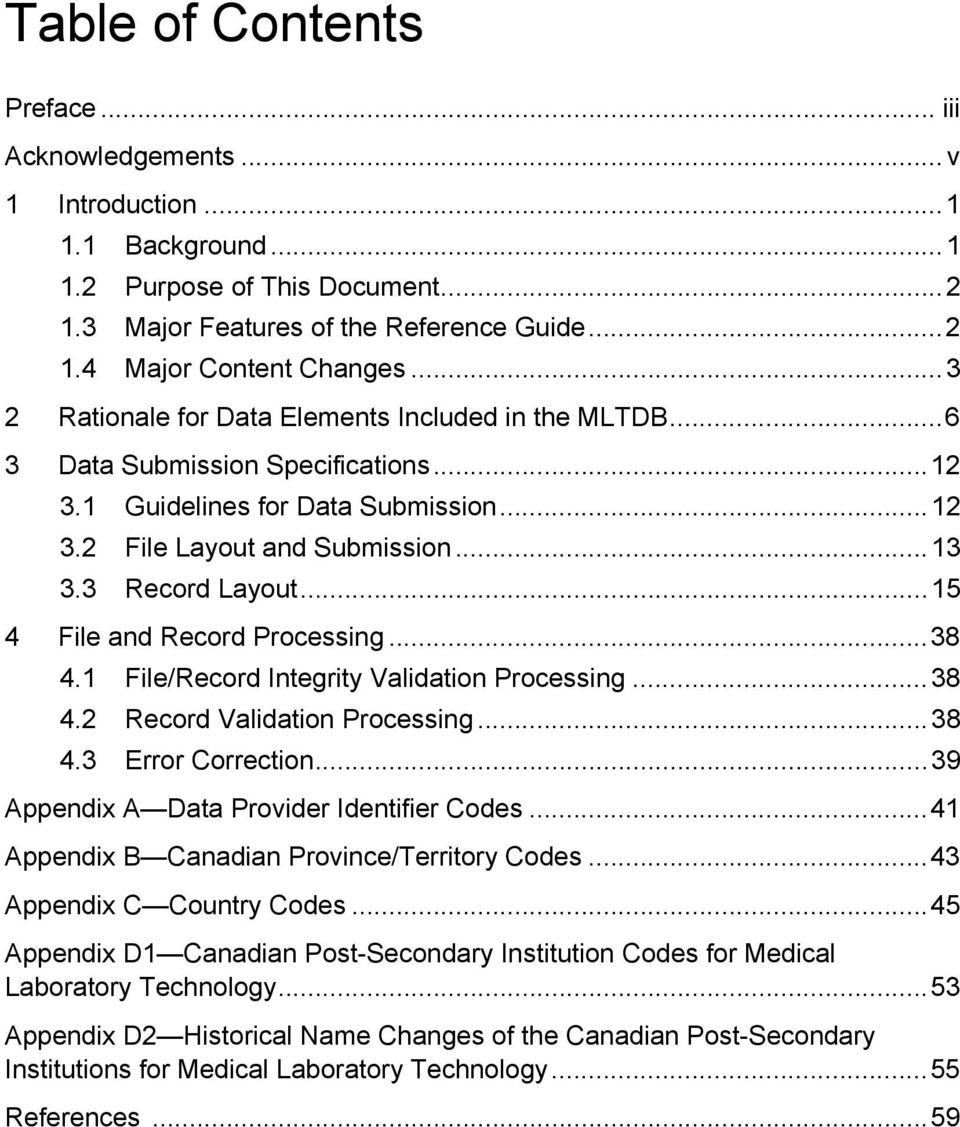
3 Table of Contents Preface... iii Acknowledgements... v 1 Introduction Background Purpose of This Document Major Features of the Reference Guide Major Content Changes Rationale for Data Elements Included in the MLTDB Data Submission Specifications Guidelines for Data Submission File Layout and Submission Record Layout File and Record Processing File/Record Integrity Validation Processing Record Validation Processing Error Correction Appendix A Data Provider Identifier Codes Appendix B Canadian Province/Territory Codes Appendix C Country Codes Appendix D1 Canadian Post-Secondary Institution Codes for Medical Laboratory Technology Appendix D2 Historical Name Changes of the Canadian Post-Secondary Institutions for Medical Laboratory Technology References... 59
4

5 Preface The Canadian Institute for Health Information (CIHI) is an independent, pan- Canadian, not-for-profit organization working to improve the health of Canadians and the health care system by providing quality health information. CIHI s mandate, as established by Canada s health ministers, is to coordinate the development and maintenance of a common approach to health information for Canada. To this end, CIHI is responsible for providing accurate and timely information that is needed to establish sound health policies, manage the Canadian health system effectively and create public awareness of factors affecting good health. To meet this mandate, CIHI carries out core functions, including the coordination and promotion of national health information standards and health indicators, the development and management of health databases and registries, the funding and facilitation of population health research and analysis, the coordination and development of education sessions and conferences, and the production and dissemination of health information research and analysis. The Medical Laboratory Technologist Database (MLTDB) is one example of a health database maintained by CIHI. Any questions regarding the MLTDB should be directed to the following: Program Lead, Medical Laboratory Technologist Database Canadian Institute for Health Information 495 Richmond Road, Suite 600 Ottawa, Ontario K2A 4H6 Phone: [email protected] iii
6

7 Acknowledgements CIHI wishes to acknowledge and thank the staff from the following organizations who generously contributed time and input into the consultation process leading to the development and update of the Data Dictionary or Reference Guide for the Medical Laboratory Technologist Database (MLTDB): Newfoundland and Labrador Society for Medical Laboratory Science Prince Edward Island Society of Medical Laboratory Technologists Nova Scotia College of Medical Laboratory Technologists New Brunswick Society of Medical Laboratory Technologists Ordre professionnel des technologistes médicaux du Québec College of Medical Laboratory Technologists of Ontario College of Medical Laboratory Technologists of Manitoba Saskatchewan Society of Medical Laboratory Technologists Alberta College of Medical Laboratory Technologists British Columbia Society of Laboratory Science Canadian Society for Medical Laboratory Science v

8

9 1 Introduction 1.1 Background Before 2004, ministers and deputy ministers of health, the former Federal/ Provincial/Territorial Advisory Committee on Health Human Resources and Health, and a number of key stakeholder groups identified significant information gaps for a variety of health professionals. These information gaps were particularly apparent for occupational therapists, pharmacists, physiotherapists, medical laboratory technologists and medical radiation technologists. Within these health professions, data collection standards did not exist, and there were data gaps in areas such as demographic and geographic characteristics, education and employment practice. The Framework for Collaborative Pan-Canadian Health Human Resource Planning, 1 developed under the direction of the Conference of Deputy Ministers of Health (and designed to facilitate pan-canadian health human resource planning), also reinforced the need to develop supply-based, profession-specific databases on the aforementioned five professions. In , with funding from Health Canada, the Canadian Institute for Health Information (CIHI) initiated the Health Human Resources Database Development Project (HHR-DDP) to develop five databases for the above-mentioned professions. CIHI finished the project in and now maintains and operates the five databases. These databases aim to provide standardized, comparative data on demographic, geographic, educational and employment factors for each of the five professions in Canada. Data from these databases may be used for statistical reporting and research purposes, such as annual statistical reports, analytical tools and studies, and ad hoc data/information requests pertaining to the supply and distribution of health professionals across the country. The Medical Laboratory Technologist Database (MLTDB) is one of the five databases. As part of the HHR-DDP project, the first version of the data dictionary and data submission specification manual were developed through consultations between CIHI and the representatives of provincial regulatory bodies, provincial professional societies and the Canadian Society for Medical Laboratory Science (CSMLS). All partners collaboratively identified data elements, values and associated definitions to be included in the MLTDB, which resulted in the release of the Medical Laboratory Technologist Database Data Dictionary 1.0. Later, CIHI developed the Medical Laboratory Technologist Database Data Submission Specification Manual 1.1, based on the Data Dictionary 1.0, to build the database. The two documents have served as a reference guide for database development and for data submission activities since 2008, when first-year data was collected for the MLTDB. 1

10 As of early 2011, the MLTDB has gone through three complete data collection cycles. While most of the content within the two documents has functioned well, the need for fine-tuning and minor changes has emerged. This document, Medical Laboratory Technologist Database (MLTDB) Reference Guide 1.0, has been created to guide future database maintenance and data submission activities. 1.2 Purpose of This Document The purpose of this document is to Explain the rationale for collecting specific data elements; Define data elements and their values to be collected for the MLTDB; Provide technical specifications for data submission to the MLTDB; and Provide technical specifications for the maintenance of the MLTDB at CIHI. 1.3 Major Features of the Reference Guide The MLTDB Reference Guide 1.0 is based on the Medical Laboratory Technologist Database Data Dictionary 1.0 and the Medical Laboratory Technologist Database Data Submission Specifications Manual 1.1. Its major features include the following. This version of the reference guide outlines the data elements (previously referred to as the minimum data set ), the rationale for collection, definitions of the data elements and their values, and submission specifications. This change reflects evolving needs and the change in the focus of activities from information needs assessment and database development to data submission and database maintenance. This new reference guide also reflects CIHI s efforts to make the document more accessible and user friendly. Definitions of the data elements and their values are included in the specification table, which will help users obtain more comprehensive information from one location. Redundant content is being reduced through a pointer reference method. For example, all values for secondary employment data elements are the same as those for primary employment; hence, they are referred to as primary employment values, where applicable. Notes that explain definitions or the relationship between data elements have been included, where applicable. These notes will help data providers choose the correct values for data submission and will help reduce the effort required to validate data. They will also improve data quality. 2

11 A new appendix (Appendix D2) listing historical name changes of Canadian post-secondary institutions that provide education in medical laboratory technology has been added. It reflects recent research on the subject by CIHI s MLTDB team. While the research may not be exhaustive, this information has been included to help data providers choose identifiable institution codes as opposed to unknown or other institution for educational institution data elements. All major changes in content are summarized in Section Major Content Changes # Content Change Where Type From To 1 Document name Label MLTDB Data Dictionary 1.0 and MLTDB Data Submission Specification Manual File name; control record 3 Employmentrelated description 4 Field 10 Basic Education/ Code Field 31 Certification Area 1 Label Label Value label Definition Data year/current data year Worked hours/hours worked : Non- Canadian Location of Graduation Subject of Canadian Society for Medical Laboratory Science (CSMLS) Certification 1 6 Label Certification Area 1 7 Field 32 Certification Level 1 Definition At the time of registration or renewal, the level of CSMLS certification obtained in medical laboratory technology 8 Label Certification Level 1 MLTDB Reference Guide 1.0 Data Collection Year Hours of Work : Non- Canadian Institution of Graduation Subject of the first certification in medical laboratory technology obtained from the CSMLS Initial Certification Discipline The level of the first certification in medical laboratory technology obtained from the CSMLS Initial Certification Rationale See Reference Guide, sections 1.1 to 1.3 To make the label reflect definition For consistency To make the label reflect the definition For collecting and reporting comparable data To make the label reflect the definition For collecting and reporting comparable data To make the label reflect the definition 3

12 # Content Change Where Type From To 9 Field 33 Certification Year 1 Definition The year in which CSMLS certification was obtained 10 Label Certification Year 1 11 Field 34 Certification Area 2 Definition Subject of CSMLS Certification 2 12 Label Certification Area 2 13 Field 35 Certification Level 2 Definition At the time of registration or renewal, the level of CSMLS certification obtained in medical laboratory technology 14 Label Certification Level 2 The year in which the first certification in medical laboratory technology was obtained from the CSMLS Initial Certification Year Subject of the most recent (except the initial) certification in medical laboratory technology obtained from the CSMLS; applies only to registrants with more than one certification Most Recent Post-Initial Certification Discipline The level of the most recent (except the initial) certification in medical laboratory technology obtained from the CSMLS; applies only to registrants with more than one certification Most Recent Post-Initial Certification Rationale For collecting and reporting comparable data To make the label reflect the definition For collecting and reporting comparable data For collecting and reporting comparable data 4

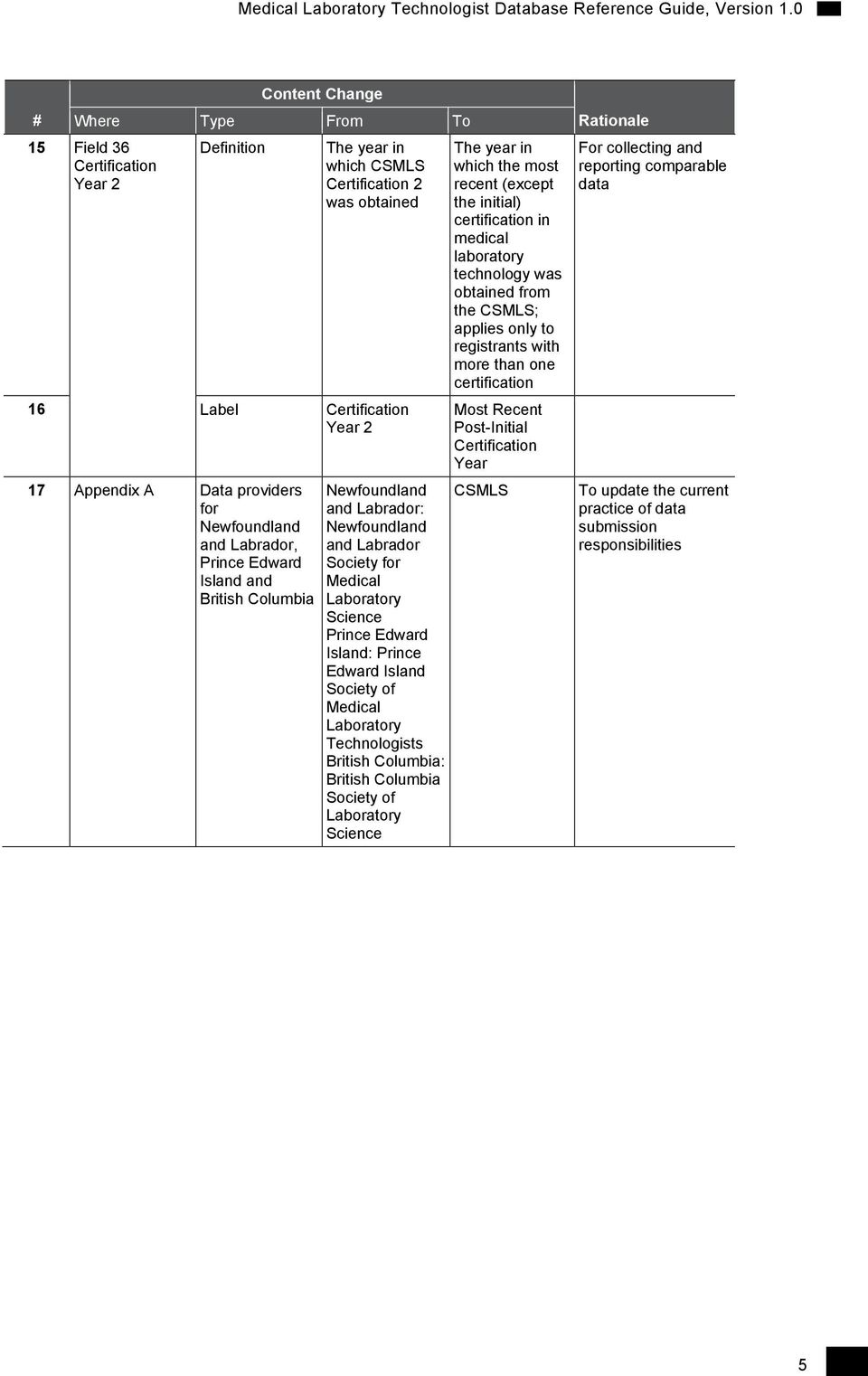
13 Content Change # Where Type From To 15 Field 36 Definition The year in The year in Certification which CSMLS which the most Year 2 Certification 2 recent (except was obtained the initial) certification in medical laboratory technology was obtained from the CSMLS; applies only to registrants with more than one certification 16 Label Certification Year 2 17 Appendix A Data providers for Newfoundland and Labrador, Prince Edward Island and British Columbia Newfoundland and Labrador: Newfoundland and Labrador Society for Medical Laboratory Science Prince Edward Island: Prince Edward Island Society of Medical Laboratory Technologists British Columbia: British Columbia Society of Laboratory Science Most Recent Post-Initial Certification Year CSMLS Rationale For collecting and reporting comparable data To update the current practice of data submission responsibilities 5
14 2 Rationale for Data Elements Included in the MLTDB The MLTDB aims to provide standardized comparative data and reports on demographic, geographic, educational and employment factors for medical laboratory technologists in Canada. The data elements that comprise the national minimum data set for the profession of medical laboratory technologist are identified below, along with the rationale for their inclusion in the MLTDB. Field # Data Element Rationale Identifiers and Demographic Information The number and demographic characteristics of health personnel who are registered or licensed, or who otherwise are part of the available health workforce, can be important information. For example, the statistics permit an examination of how age and sex can influence workforce participation. 1 Provincial/Territorial Unique Identification/Registration Number This number is needed to uniquely identify a professional within a particular jurisdiction and to follow changes specific to that individual over time (within the jurisdiction submitting data). 2 Gender This information is necessary to calculate gender-related workforce indicators (for example, the proportion of the workforce that is female). 3 Year of Birth This information is necessary to calculate age-related workforce indicators (for example, the average age of the workforce). Geography and Related Geography is an important consideration in understanding the distribution of health personnel in Canada (for example, rural or urban choice of practice/employment setting). How this distribution relates to geography is important to workforce planning and policy development. Please note that the full six-character postal code of employment is identified for collection under Employment Current Specific. 4 Province/Territory of Residence This information is necessary to analyze the geographic 5 Country of Residence distribution of the workforce. Information on a registrant s province/territory of residence is used (in combination with other elements) to reduce the double-counting of registrants registered in more than one Canadian jurisdiction. 6 Province/Territory of Registration This information is necessary to analyze the geographic distribution of the workforce. Information on a registrant s province/territory of registration is used (in combination with other elements) to reduce the double-counting of registrants registered in more than one Canadian jurisdiction. 7 Year of Initial Registration With Submitting Jurisdiction This information provides a baseline indication of the year of initial registration within the submitting jurisdiction. 6
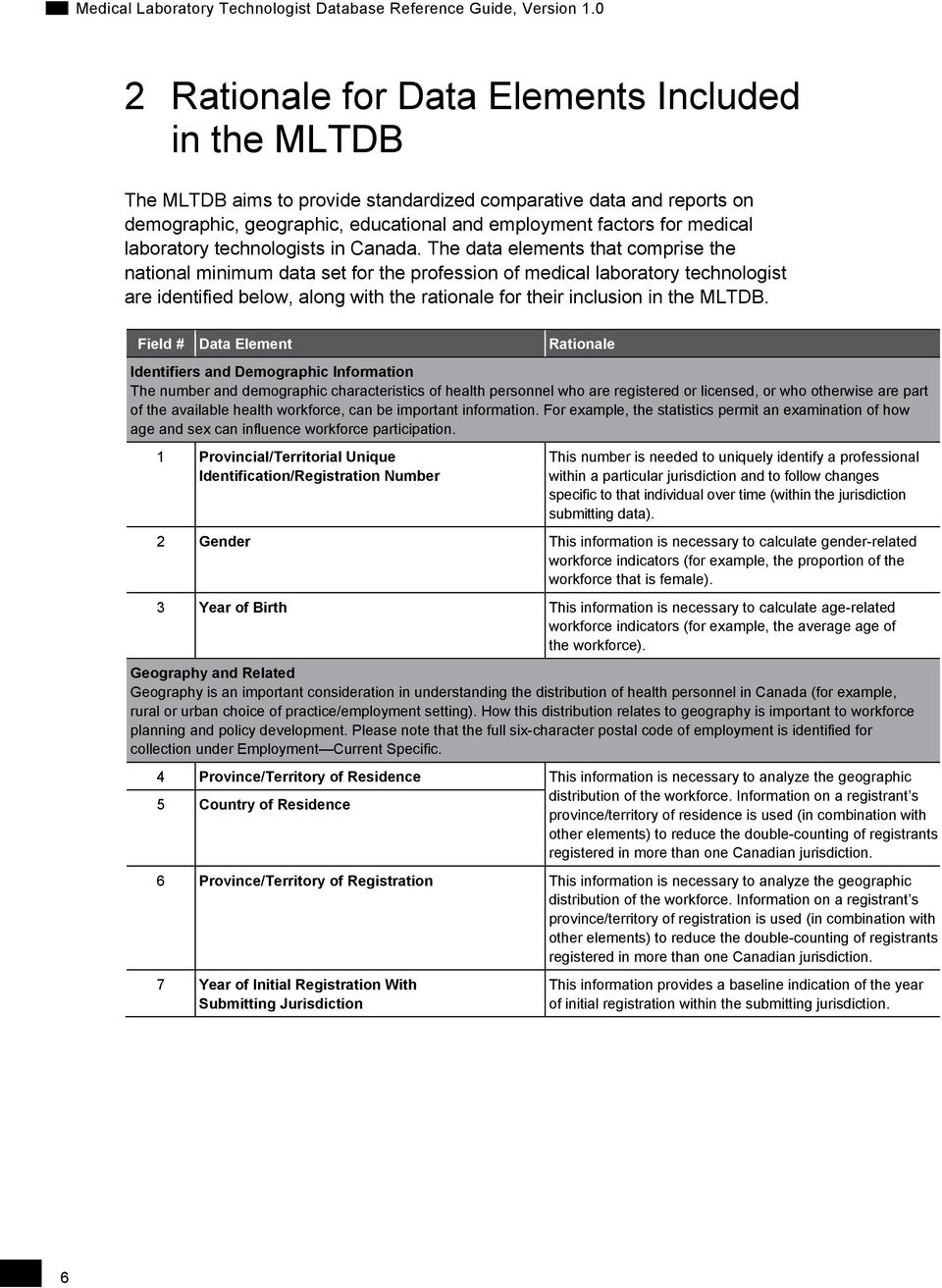
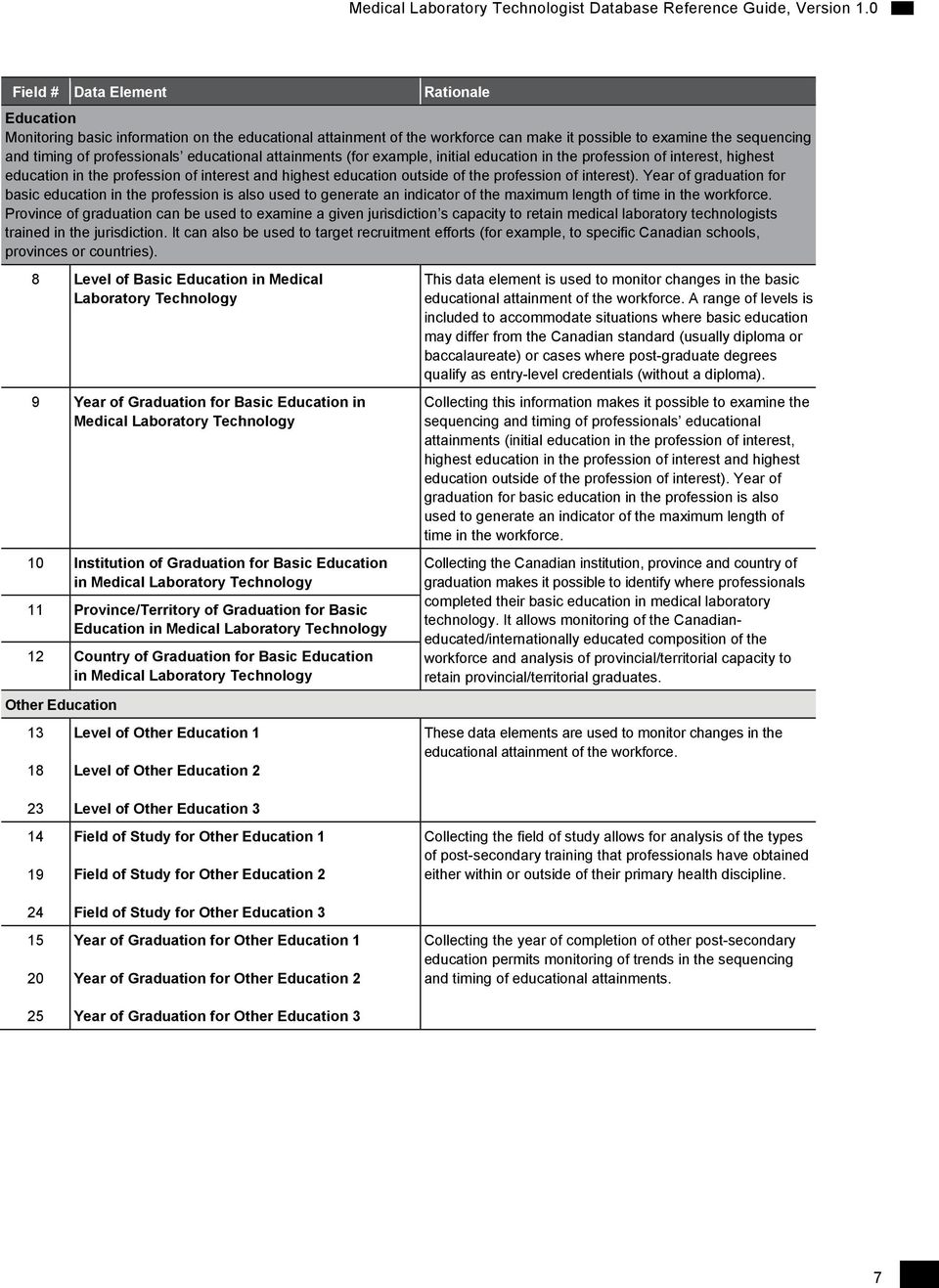
15 Field # Data Element Rationale Education Monitoring basic information on the educational attainment of the workforce can make it possible to examine the sequencing and timing of professionals educational attainments (for example, initial education in the profession of interest, highest education in the profession of interest and highest education outside of the profession of interest). Year of graduation for basic education in the profession is also used to generate an indicator of the maximum length of time in the workforce. Province of graduation can be used to examine a given jurisdiction s capacity to retain medical laboratory technologists trained in the jurisdiction. It can also be used to target recruitment efforts (for example, to specific Canadian schools, provinces or countries). 8 Level of Basic Education in Medical Laboratory Technology 9 Year of Graduation for Basic Education in Medical Laboratory Technology 10 Institution of Graduation for Basic Education in Medical Laboratory Technology 11 Province/Territory of Graduation for Basic Education in Medical Laboratory Technology 12 Country of Graduation for Basic Education in Medical Laboratory Technology Other Education Level of Other Education 1 Level of Other Education 2 This data element is used to monitor changes in the basic educational attainment of the workforce. A range of levels is included to accommodate situations where basic education may differ from the Canadian standard (usually diploma or baccalaureate) or cases where post-graduate degrees qualify as entry-level credentials (without a diploma). Collecting this information makes it possible to examine the sequencing and timing of professionals educational attainments (initial education in the profession of interest, highest education in the profession of interest and highest education outside of the profession of interest). Year of graduation for basic education in the profession is also used to generate an indicator of the maximum length of time in the workforce. Collecting the Canadian institution, province and country of graduation makes it possible to identify where professionals completed their basic education in medical laboratory technology. It allows monitoring of the Canadianeducated/internationally educated composition of the workforce and analysis of provincial/territorial capacity to retain provincial/territorial graduates. These data elements are used to monitor changes in the educational attainment of the workforce Level of Other Education 3 Field of Study for Other Education 1 Field of Study for Other Education 2 Field of Study for Other Education 3 Year of Graduation for Other Education 1 Year of Graduation for Other Education 2 Year of Graduation for Other Education 3 Collecting the field of study allows for analysis of the types of post-secondary training that professionals have obtained either within or outside of their primary health discipline. Collecting the year of completion of other post-secondary education permits monitoring of trends in the sequencing and timing of educational attainments. 7
16 Field # Data Element Province/Territory of Graduation for Other Education 1 Province/Territory of Graduation for Other Education 2 Province/Territory of Graduation for Other Education 3 Country of Graduation for Other Education 1 Rationale Collecting the country of graduation permits the identification of the location where post-secondary education was completed. It also allows monitoring of the Canadian-educated/internationally educated composition of the workforce and analysis of provincial/territorial capacity to retain provincial/territorial graduates (for provinces and territories with education programs) Country of Graduation for Other Education 2 Country of Graduation for Other Education 3 28 Bridging/Re-Entry Education These elements provide an indication of the number of medical laboratory technologists in the workforce who have 29 Year of Completion of Bridging/ completed bridging/re-entry education. The elements Re-Entry Education Province/Territory of Graduation for Basic Education in 30 Province/Territory of Completion of Bridging/ Re-Entry Education Medical Laboratory Technologist and Country of Graduation for Basic Education in Medical Laboratory Technologist, in combination with the Bridging/Re-Entry Education element, would distinguish internationally educated graduates who have completed bridging education to facilitate their entry into the profession from Canadian graduates who have completed education to refresh their skills to prepare for re-entry into the profession Initial Certification Discipline Most Recent Post-Initial Certification Discipline Initial Certification Level These data elements are required to identify in which area(s) and level(s) the professional can practise and in which year(s) the professional receives the certification(s) Most Recent Post-Initial Certification Level Initial Certification Year 36 Most Recent Post-Initial Certification Year Employment An understanding of employment and practice characteristics, as well as the nature of labour force participation of health personnel (for example, whether personnel are working full time or part time) can help inform policy decisions. These decisions could affect levels from the national/provincial/territorial level (for example, more educational seats to produce more health personnel could be funded) to the site of employment (for example, more full-time positions could be made available). Employment Historical and Current General 37 Initial Province/Territory of Canadian Employment in Medical Laboratory Technology 38 Year of Initial Canadian Employment in Medical Laboratory Technology These data elements provide a baseline indication of professionals initial entry into the Canadian medical laboratory technology workforce. Year of initial employment can be used to generate a proxy indicator for length of time in the workforce (for example, years since initial employment as a medical laboratory technologist) and, in combination with other data elements on education, can be used to examine transitions into and out of the work lifecycle. 8

17 Field # Data Element Rationale 39 Employment Status Collection of Employment Status permits the identification of registrants (either employees or self-employed 40 Activity Status if Not Employed in professionals) who are employed and working; employed the Occupation and not working because they are on leave; employed in areas other than medical laboratory technology; retired; or unemployed. Activity status reflects the career plans of registrants who are not employed in medical laboratory technology. Capturing these data elements makes it possible to estimate the available registered workforce in different ways. When these elements are assessed in combination with other data elements, the capacity of the available workforce can be estimated. 41 Total Usual Weekly Hours of Work Hours of work can be a measure of capacity (available supply of personnel) and can be used to estimate the number of full-time equivalents in relation to comparable head count data. The collection of this element is especially important in situations of casual or self-employed work arrangements, where the hours of work are not prescribed by an employer/employment contract. Employment Current Specific (Primary Employment and Secondary Employment) Primary Employment: The employment, with an employer or in a self-employment arrangement, that is associated with the highest number of usual weekly hours of work. Secondary Employment: The employment, with an employer or in a self-employment arrangement, that is associated with the second-highest number of usual weekly hours of work Employment Category (for Primary Employment) Employment Category (for Secondary Employment) Full-Time/Part-Time Status (for Primary Employment) Full-Time/Part-Time Status (for Secondary Employment) The employment category permits the differentiation of those in an employee employer work relationship from the self-employed. For registrants in an employee employer work relationship, the distinction between permanent, temporary and casual employment (in combination with other data elements, such as Employment Status and Hours of Work) indicates changes in the conditions of employment for a profession (for example, an increase in temporary work arrangements with employers). When these elements are assessed in combination with other data elements, the capacity of the available workforce can be estimated. For those in an employee employer relationship or those who are self-employed, these elements permit identification of some basic conditions of employment. When these elements are assessed in combination with other data elements, the potential capacity of the available workforce can be estimated (for example, the number of professionals working part time who could move to full-time employment) Province/Territory of Primary Employment Province/Territory of Secondary Employment Country of Primary Employment Country of Secondary Employment This information is necessary to analyze the geographic distribution of the workforce. Information on a registrant s location of employment is used (in combination with other elements) to reduce the double-counting of registrants registered in more than one Canadian jurisdiction. Collecting a location for up to two employments (primary and secondary) indicates the proportion of the workforce registered or living in Canada who conduct most of their employment activity outside of Canada. 9

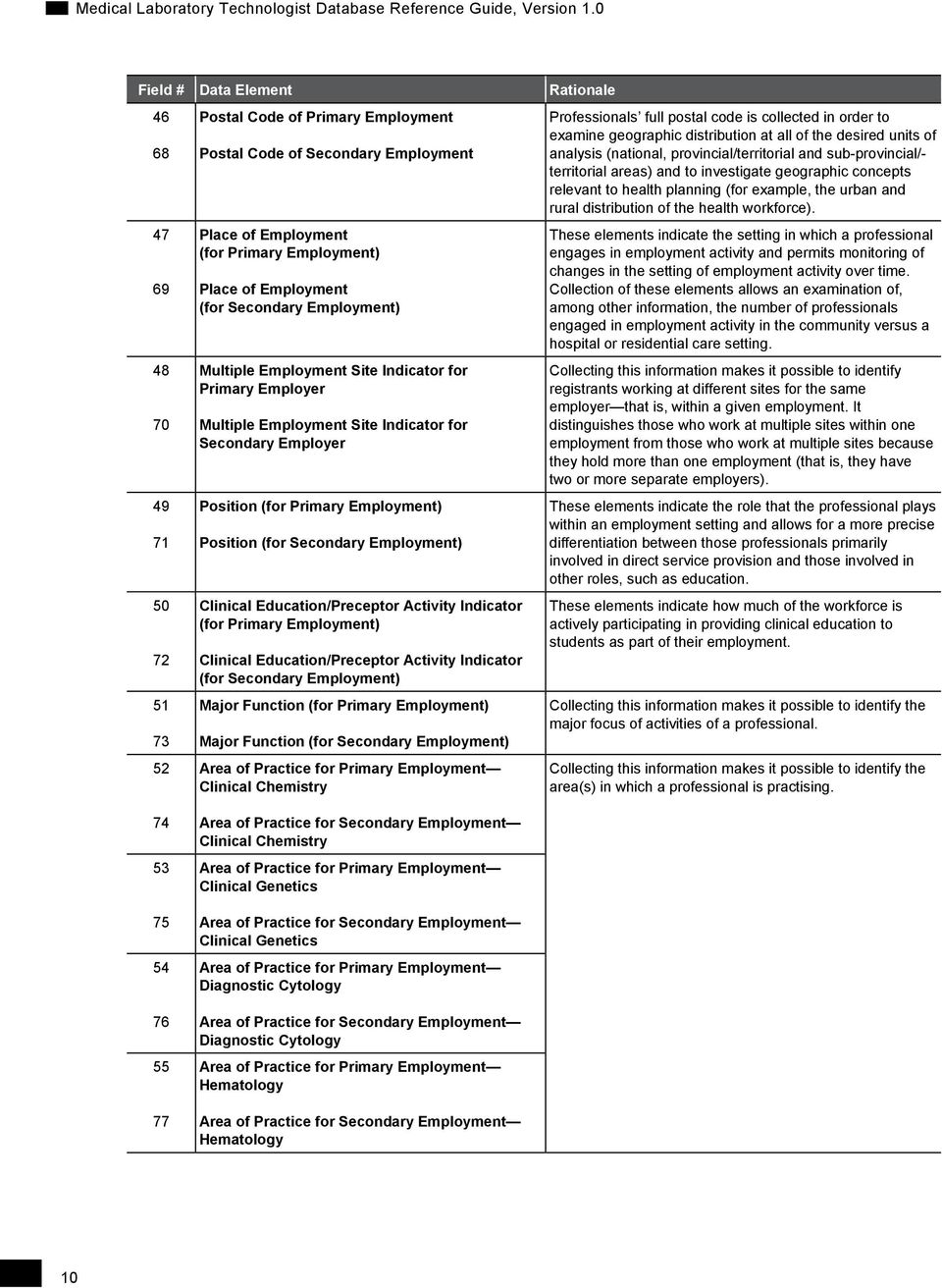
18 Field # Data Element Postal Code of Primary Employment Postal Code of Secondary Employment Place of Employment (for Primary Employment) Place of Employment (for Secondary Employment) Multiple Employment Site Indicator for Primary Employer Multiple Employment Site Indicator for Secondary Employer Position (for Primary Employment) Position (for Secondary Employment) Clinical Education/Preceptor Activity Indicator (for Primary Employment) Clinical Education/Preceptor Activity Indicator (for Secondary Employment) Major Function (for Primary Employment) Major Function (for Secondary Employment) Area of Practice for Primary Employment Clinical Chemistry Rationale Professionals full postal code is collected in order to examine geographic distribution at all of the desired units of analysis (national, provincial/territorial and sub-provincial/- territorial areas) and to investigate geographic concepts relevant to health planning (for example, the urban and rural distribution of the health workforce). These elements indicate the setting in which a professional engages in employment activity and permits monitoring of changes in the setting of employment activity over time. Collection of these elements allows an examination of, among other information, the number of professionals engaged in employment activity in the community versus a hospital or residential care setting. Collecting this information makes it possible to identify registrants working at different sites for the same employer that is, within a given employment. It distinguishes those who work at multiple sites within one employment from those who work at multiple sites because they hold more than one employment (that is, they have two or more separate employers). These elements indicate the role that the professional plays within an employment setting and allows for a more precise differentiation between those professionals primarily involved in direct service provision and those involved in other roles, such as education. These elements indicate how much of the workforce is actively participating in providing clinical education to students as part of their employment. Collecting this information makes it possible to identify the major focus of activities of a professional. Collecting this information makes it possible to identify the area(s) in which a professional is practising Area of Practice for Secondary Employment Clinical Chemistry Area of Practice for Primary Employment Clinical Genetics Area of Practice for Secondary Employment Clinical Genetics Area of Practice for Primary Employment Diagnostic Cytology Area of Practice for Secondary Employment Diagnostic Cytology Area of Practice for Primary Employment Hematology Area of Practice for Secondary Employment Hematology 10
19 Field # Data Element 56 Area of Practice for Primary Employment Histology Rationale Collecting this information makes it possible to identify the area(s) in which a professional is practising Area of Practice for Secondary Employment Histology Area of Practice for Primary Employment Immunology Area of Practice for Secondary Employment Immunology Area of Practice for Primary Employment Microbiology Area of Practice for Secondary Employment Microbiology Area of Practice for Primary Employment Specimen Procurement, Receipt and Dispatch Area of Practice for Secondary Employment Specimen Procurement, Receipt and Dispatch Area of Practice for Primary Employment Transfusion Medicine/Science Area of Practice for Secondary Employment Transfusion Medicine/Science Area of Practice for Primary Employment Pointof-Care Testing Area of Practice for Secondary Employment Point-of-Care Testing Area of Practice for Primary Employment Other Area of Practice for Secondary Employment Other Main Area of Practice for Primary Employment These elements identify the main area of practice in which services are provided. 85 Other Main Area of Practice for Secondary Employment 86 Registration Type This information is necessary to ensure that the appropriate reference population is submitted to CIHI. Collection makes it possible to separate the short-term licence component of the workforce where required for analysis. It also makes it possible to monitor professionals transitions from active to inactive members of the workforce, and to more accurately report attrition (for example, the collection of data about inactive professionals makes it possible to identify registrants moving from active to inactive status). 11

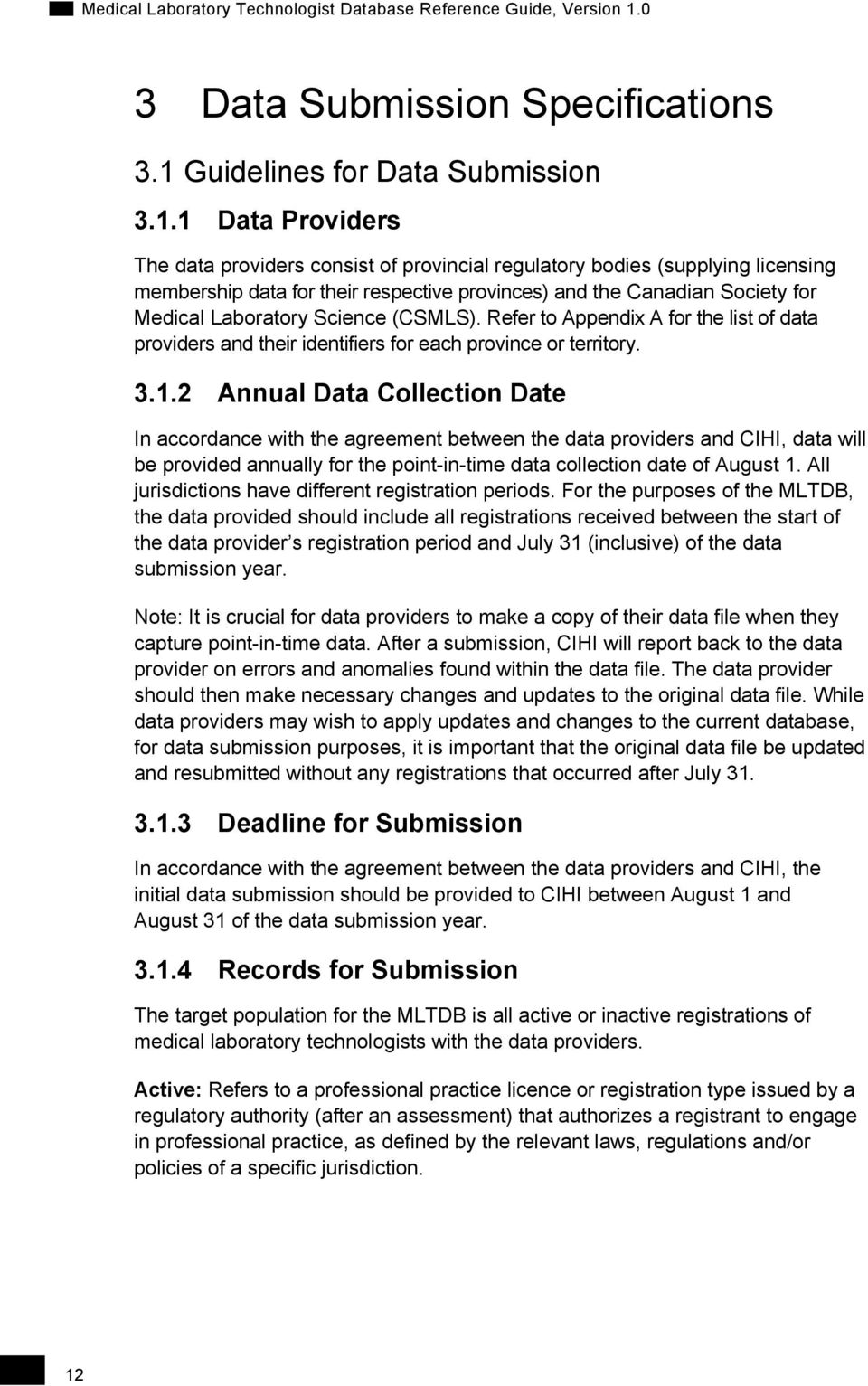
20 3 Data Submission Specifications 3.1 Guidelines for Data Submission Data Providers The data providers consist of provincial regulatory bodies (supplying licensing membership data for their respective provinces) and the Canadian Society for Medical Laboratory Science (CSMLS). Refer to Appendix A for the list of data providers and their identifiers for each province or territory Annual Data Collection Date In accordance with the agreement between the data providers and CIHI, data will be provided annually for the point-in-time data collection date of August 1. All jurisdictions have different registration periods. For the purposes of the MLTDB, the data provided should include all registrations received between the start of the data provider s registration period and July 31 (inclusive) of the data submission year. Note: It is crucial for data providers to make a copy of their data file when they capture point-in-time data. After a submission, CIHI will report back to the data provider on errors and anomalies found within the data file. The data provider should then make necessary changes and updates to the original data file. While data providers may wish to apply updates and changes to the current database, for data submission purposes, it is important that the original data file be updated and resubmitted without any registrations that occurred after July Deadline for Submission In accordance with the agreement between the data providers and CIHI, the initial data submission should be provided to CIHI between August 1 and August 31 of the data submission year Records for Submission The target population for the MLTDB is all active or inactive registrations of medical laboratory technologists with the data providers. Active: Refers to a professional practice licence or registration type issued by a regulatory authority (after an assessment) that authorizes a registrant to engage in professional practice, as defined by the relevant laws, regulations and/or policies of a specific jurisdiction. 12
21 Inactive: Refers to a type of registration that does not permit a registrant to engage in professional practice without further consideration and/or licensing by the regulatory authority within a particular jurisdiction, as defined by the relevant laws, regulations and/or policies of that jurisdiction. The MLTDB accepts both valid active and inactive registrations defined and submitted by data providers Data Acceptance Rules A submission file can contain only registration data for the period between the start of the data provider s registration period and July 31 (inclusive) of the data submission year. Data providers should edit data at source and submit only error-free data that conforms to the requirements and submission specifications in this document. Data must be submitted in a file of fixed record length. All data records submitted to CIHI will be validated against the validation rules implemented in the MLTDB. A control record should be present at the start of the data file. Once individual records are validated, accepted records will be integrated into CIHI s data holdings; rejected records will not be integrated into CIHI s data holdings. Errors within the rejected records will be documented. Data providers will be informed of errors and anomalies detected in their submitted files via a set of reports. The data provider must supply corrected records by resubmitting the entire data file (a file that contains both corrected records and all of the original records without errors). Although uppercase is preferred, characters in a data file are not case sensitive when values are validated through the MLTDB system. 3.2 File Layout and Submission File Characteristics A data file to be submitted to CIHI must consist of the following. Control record: This record describes the contents of the file. It must be the first record in the file and 213 characters in length. Individual records: These records must be 213 characters in length. Each record describes the demographic, geographic, educational, certification and employment characteristics of a single medical laboratory technologist. Each record must start on a new line. A line must be terminated with a line feed character \n for UNIX systems or by a carriage return immediately followed by a line feed \r\n for DOS/Windows systems. 13
22 The file to be created is a plain (ASCII) text file without delimiters (such as tabs or commas). The file extension.txt must be used. Files submitted through the electronic Data Submission Services (edss) must be zipped with a.zip file extension (see Section for more information on the edss). Detailed information on the layout for the control record and the individual records is provided in Section File Naming Convention File names are standardized to facilitate the receipt and processing of medical laboratory technologist data. The file name indicates the profession, data collection year, submitting data provider and file version. The file name layout is as follows. Field Occupation Identification Code Value and/or Valid Format MLT Description This code is MLT for the Medical Laboratory Technologist Database. Data Collection Year YYYY (format) This is the year for which the data is collected by CIHI. Data Provider Identifier AA001 (format) See Appendix A for values This is a five-character code ending with 001 assigned by CIHI to the data provider. File Version Number NN (format) This number indicates which version of the file is being submitted. The first file submitted for a given data collection year should have the File Version Number 01. Subsequent iterations of the file would have a version number increased by one each time the file is submitted; that is, 02, 03, etc. File name extension.txt The file name extension must be.txt, which indicates a text file. Here is an example of a file name: MLT2011AB00102.txt This file name indicates that it is a file containing medical laboratory technologist data for the year 2011 from the data provider AB001 (the Alberta College of Medical Laboratory Technologists) and that it is the second iteration of the file to be submitted by the data provider. If this data file is submitted in 2012, the Data Collection Year should remain 2011 as opposed to 2012, since this information reflects the year (2011) in which the data is supposed to be collected rather than the year in which it is submitted to CIHI. 14
23 3.2.3 Data Submission and Transmission To comply with CIHI s rigorous privacy policy and satisfy national and provincial privacy legislation, CIHI requests that all data files be submitted using the electronic Data Submission Services (edss) facility. The edss permits online transmission of electronic files to CIHI via a secure encrypted session. For further information, please the Program Lead, Medical Laboratory Technologist Database, at [email protected]. If you experience difficulties using the edss, access CIHI s Help Desk by phone at or by at [email protected]. 3.3 Record Layout Control Record Format A control record is required at the start of each file. It summarizes the file contents and functions as a reference for verification of individual records in future steps. All the components of the control record are in character type, even if they appear to be a number or a date. If any component of the control record is incorrect, the submitted data file will be rejected with no further validation. The type and format of information in the control record is outlined in the table below. Start Field # Data Element Byte Length Values and/or Format 1 Occupation Abbreviation 1 3 MLT 2 Data Provider Identifier 4 5 Format is AA001. See Appendix A for values. 3 Data Collection Year 9 4 Format is YYYY. This is the year for which the data was collected for CIHI. 4 Number of Records 13 6 Format is NNNNNN, with zeroes filling in any places not occupied by the actual number. So, for instance, if there are 823 records in the file, the Number of Records is This is the total number of records in the file (not including the control record). 5 File Creation Date 19 8 Format is YYYYMMDD. This is the date the file was created. 6 Provincial/Territorial Unique Identification/Registration Number Type 27 1 R (Registration Number) or S (Substitute Number) 7 Filler Xs are added to the end of the record so that the control record is the same length as the detail records. Total length of a record
24 Here is an example of a control record: MLTAB Rxxxxxxxxxxxxxxxxxxxxx... Occupation Abbreviation Data Provider Identifier Data Collection Year Number of Records File Creation Date (YYYYMMDD) Provincial Unique Identification/ Registration Number Type ((R) Registration or (S) Substitute) MLT AB R Xs Filler This control record indicates the following: MLT the profession is medical laboratory technologist AB001 the record was submitted by data provider AB the data collection year is there are 750 records in the file (not including the control record) the file was created on August 24, 2011 R the registration numbers are actual registration numbers Xs the record is padded with a filler of 186 characters Notes 1. Provincial/Territorial Unique Identification/Registration Number Type The Provincial/Territorial Unique Identification/Registration Number for medical laboratory technologists may be included in one of two ways: as the actual registration number or as a substitute (dummy) number. The jurisdiction can choose to supply either actual or substitute (dummy) numbers. However, regardless of which type of number is provided, the number for each registrant must be the same each year. If dummy numbers are supplied, they must remain consistent year after year for each registrant. In other words, a registrant should receive a unique lifetime ID. This requirement enables CIHI to conduct longitudinal analysis on the data. 2. Data Collection Year Versus File Creation Date The value for the Data Collection Year and for the year component of the File Creation Date can be the same or different. For example, if a file for 2011 data is created on August 24, 2011, the year value for both the Data Collection Year and the File Creation Date should be 2011; if the file is created on January 22, 2012, the year value for the Data Collection Year is 2011 and for the year value for the File Creation Date is Number of Records If the actual number of records submitted looks the same as the number documented in the control record but the file is rejected due to the mismatch of this component, check whether there are blank lines under the last record. These blank lines need to be removed because they are counted when the system validates the control record for the number of records. 16
25 3.3.2 Data Definition and Record Layout The following table provides the detailed information required to create records in a sequential file suitable for processing by CIHI. Notes 1. Due to the nature of text file format, all values are character type. 2. The following terms are used consistently throughout the table below: Not collected The primary data collector i does not collect this data element or does not submit it to CIHI (if this is true, this term should be applied to all the records related to this element in a data file). Not applicable This data element is collected but does not apply. Unknown The primary data collector is unable to obtain the required information for a specific data element. Field # Data Element Definition Identifiers and Demographic Information 1 Provincial/Territorial Unique Identification/Registration Number* A lifetime registration number, or suitable alternative, that uniquely identifies a medical laboratory technologist within a particular jurisdiction. This number is a lifetime unique identifier assigned by the submitting jurisdiction for administrative purposes. * That is, the number assigned to a returning registrant should be the same as the previous number the registrant received. When a registrant no longer registers with the province, the number assigned to this individual must not be recycled for another registrant. 2 Gender The reported sexual category of a registrant, at the time of registration or renewal, used for administrative purposes. Start Byte Length Values and/or Format Definition 1 16 Provincial/Territorial Registration Number or Suitable Alternative The number may vary in length between data providers. For numbers shorter than the maximum length (16 characters), the unique identification number must be left justified with the remainder of the field filled with spaces (that is, blanks) to the maximum of 16 characters. Other acceptable options for fillers include leading or trailing zeroes; however, once a format is selected, it must be unchanged from year to year, or the system will acknowledge the same number with different formats as different registrants F: Female M: Male 7: Not collected 9: Unknown i. Primary data collectors are the provincial regulatory bodies and the Canadian Society for Medical Laboratory Science (CSMLS), which collect data from their members and submit it to CIHI. 17
26 Field # Data Element Definition 3 Year of Birth Year of birth of the registrant. Geography and Related 4 Province/Territory of Residence The Canadian province/ territory of residence at the time of registration or renewal. Start Byte Length Values and/or Format Definition 18 4 Format is YYYY. 9997: Not collected 9999: Unknown 22 2 Canadian Province/Territory Codes (see Appendix B) 97: Not collected 98: Not applicable* 99: Unknown * Includes registrants who reside outside of Canada. 5 Country of Residence The country of residence at the time of registration or renewal. 6 Province/Territory of Registration The Canadian province/ territory submitting medical laboratory technologist data. 7 Year of Initial Registration With Submitting Jurisdiction The first year in which a registrant registered with the submitting jurisdiction. Education 8 Level of Basic Education in Medical Laboratory Technology Initial post-secondary education program used to prepare a medical laboratory technologist for practice. This refers to the initial education in medical laboratory technology considered, in whole or in part, when an individual requests licensure (through a regulatory authority) or registration (through a voluntary membership association) as a medical laboratory technologist in Canada Country Codes (see Appendix C) 997: Not collected 999: Unknown 27 2 Canadian Province/Territory Codes (see Appendix B) 29 4 Format is YYYY. 9997: Not collected 9999: Unknown : Diploma* Diploma or equivalent, below the level of a baccalaureate, conferred by a college, university or comparable institution. For medical laboratory technologists, this refers to direct-entry diplomas for programs completed at a Canadian community college, collège d enseignement général et professionnel (CEGEP), hospital or equivalent. 20: Baccalaureate An undergraduate degree conferred by a university or comparable institution. This refers to direct-entry degrees in medical laboratory technology. 30: Master s A graduate-level professional university degree. This refers to direct-entry degrees in medical laboratory technology. 40: Doctorate A post-graduate professional university degree. This refers to direct-entry degrees in medical laboratory technology. 97: Not collected 99: Unknown 18
27 Field # Data Element Definition Start Byte Length Values and/or Format Definition * This code also applies to professionals who do not have a diploma but are grandfathered. If a registrant received a diploma, then a medical laboratory technologist certification and then a baccalaureate degree, enter 10 (diploma) for Level of Basic Education, 20 (baccalaureate) for Level of Other Education 1 and 998 (not applicable) for all Fields of Study for Other Education (2 and 3). 9 Year of Graduation for Basic Education in Medical Laboratory Technology Year of completion of the basic education program used to prepare a medical laboratory technologist for entry into practice. 10 Institution of Graduation for Basic Education in Medical Laboratory Technology Name of the Canadian college or university where the registrant completed the initial education program used to prepare a medical laboratory technologist for practice. 11 Province/Territory of Graduation for Basic Education in Medical Laboratory Technology 12 Country of Graduation for Basic Education in Medical Laboratory Technology 35 4 Format is YYYY. 9997: Not collected 9999: Unknown 39 8 Canadian Post-Secondary Institution Codes for MLT (see Appendix D1) Canadian Post-Secondary Institution Historical Names Changes for MLT (see Appendix D2) : Other Canadian institution : Non-Canadian institution of graduation The institution of graduation was outside of Canada : Not collected : Unknown 47 2 Canadian Province/Territory Codes (see Appendix B) 26: Non-Canadian location of graduation The location of graduation was outside of Canada. 97: Not collected 99: Unknown 49 3 Country Codes (see Appendix C) 997: Not collected 999: Unknown 19
28 Field # Data Element Definition Start Byte Length Values and/or Format Definition Other Education Notes If a registrant has only basic education, enter the relevant code for not applicable in all fields related to Other Education (1, 2 and 3). If a registrant has more than one Other Education, data for Other Education 1, 2 and 3 should be provided chronologically (that is, Other Education 1 is the earliest, Other Education 2 is the next and Other Education 3 is the latest). 13 Level of Other Education 1 Additional post-secondary education achieved within or outside of medical laboratory technology. The education may have been acquired before or after entrance into the medical laboratory technology profession. 14 Field of Study for Other Education 1 2 Field of study for Other Education 1. This field reflects education attained either within or outside of medical laboratory technology education. 15 Year of Graduation for Other Education 1 Year of completion of Other Education : Diploma Diploma or equivalent, below the level of a baccalaureate, conferred by a college, university or comparable institution. 16: Post-secondary certificate Non-diploma/degree certificate or equivalent conferred by a college or university (or comparable institution). 20: Baccalaureate An undergraduate degree conferred by a university or comparable institution. 30: Master s A graduate-level university degree. 40: Doctorate A post-graduate university degree. 97: Not collected 98: Not applicable 99: Unknown : Medical laboratory science 020: Health administration/ management 030: Public administration 040: Public health 070: Psychology 080: Health professions and related clinical sciences 090: Biological, biomedical sciences and physical sciences 096: Mathematics, computer and information sciences 100: Social sciences, arts and humanities 110: Education 120: Law 130: Business, management, marketing and related 140: Other field of study Other field of study that is not otherwise specified. 997: Not collected 998: Not applicable 999: Unknown 57 4 Format is YYYY. 9997: Not collected 9998: Not applicable 9999: Unknown 20
29 Field # Data Element Definition 16 Province/Territory of Graduation for Other Education 1 17 Country of Graduation for Other Education 1 Name of country of completion of Other Education 1. Start Byte Length Values and/or Format Definition 61 2 Canadian Province/Territory Codes (see Appendix B) 26: Non-Canadian location of graduation Location of graduation was outside of Canada. 97: Not collected 98: Not applicable 99: Unknown 63 3 Country Codes (see Appendix C) 997: Not collected 998: Not applicable 999: Unknown 18 Level of Other Education Refer to field Field of Study for Other Education 2 20 Year of Graduation for Other Education 2 21 Province/Territory of Graduation for Other Education 2 22 Country of Graduation for Other Education Refer to field Refer to field Refer to field Refer to field Level of Other Education Refer to field Field of Study for Other Education 3 25 Year of Graduation for Other Education 3 26 Province/Territory of Graduation for Other Education 3 27 Country of Graduation for Other Education 3 28 Bridging/Re-Entry Education 3 A data element that specifies whether a registrant completed bridging or re-entry upgrade education in Canada Refer to field Refer to field Refer to field Refer to field : Bridging education* Education completed to address gaps in existing medical laboratory professional practice skills and/or knowledge, in order to complete certification/re-certification and/or licensure to practise in Canada. 76: Re-entry education* Mandatory courses completed to obtain a practice permit for the purposes of re-entry into the Canadian workforce. 97: Not collected 98: Not applicable 99: Unknown * If a registrant has completed both bridging and re-entry education, enter 66 for Bridging Education. 21
30 Field # Data Element Definition 29 Year of Completion of Bridging/Re-Entry Education The year in which bridging/reentry education was completed. 30 Province/Territory of Completion of Bridging/ Re-Entry Education Canadian province/territory in which bridging/re-entry education was completed. Start Byte Length Values and/or Format Definition 96 4 Format is YYYY. 9997: Not collected 9998: Not applicable 9999: Unknown Canadian Province/Territory Codes (see Appendix B) 97: Not collected 98: Not applicable 99: Unknown Certification Notes If a registrant has only one certification, data should be provided for the Initial Certification fields and values for all Post-Initial Certification fields must be the relevant code for not applicable. If a registrant has more than one certification, data on the first one should be provided for the Initial Certification fields and data for the most recent certification received after the first one should be provided for the most recent Post-Initial Certification fields. 31 Initial Certification Discipline Subject of the first certification in medical laboratory technology obtained from the CSMLS : General 026: Clinical genetics 036: Diagnostic cytology 046: Clinical chemistry 056: Hematology 066: Histology 076: Microbiology 086: Transfusion medicine/science 096: Other* Certification area not otherwise specified. 997: Not collected 998: Not applicable 999: Unknown * Enter this code if the discipline is not on the list or if the registrant was certified by CSMLS with combined disciplines in early years. Enter this code if a registrant is grandfathered, or if a registrant was internationally educated and received a medical laboratory technologist certification abroad that was considered an equivalent qualification for working in Canada in early years. 32 Initial Certification The level of the first certification in medical laboratory technology obtained from the CSMLS : Medical laboratory technologist (MLT)* Certification issued by the CSMLS upon successful completion of the CSMLS certification exam. 26: Advanced registered technologist (ART) Certification issued by the CSMLS to certified medical laboratory technologists upon successful completion of ART program requirements. 22
31 Field # Data Element Definition Start Byte Length Values and/or Format Definition 36: Distinguished fellowship (FCSMLS(D)) Highest level of recognition issued by the CSMLS to medical laboratory technologists who have made significant and sustained contributions to the field of medical laboratory science at the national or international level in one of three areas: scientific achievement, education and management/administration/quality management. 46: Not CSMLS certified Registrant has not received certification from the CSMLS. 97: Not collected 98: Not applicable 99: Unknown * Includes both the certifications currently issued and the subject certifications issued in the early years by the CSMLS. Enter this code if a registrant is grandfathered, or if a registrant was internationally educated and received a medical laboratory technologist certification abroad that was considered an equivalent qualification for working in Canada in early years. Do not use this code, as all scenarios are covered by other codes. 33 Initial Certification Year The year in which the first certification in medical laboratory technology was obtained from the CSMLS. 34 Most Recent Post-Initial Certification Discipline Subject of the most recent (except the initial) certification in medical laboratory technology obtained from the CSMLS. This applies only to registrants with more than one certification Format is YYYY. 9997: Not collected 9998: Not applicable* 9999: Unknown Refer to field 31 * Enter this code if a registrant is grandfathered, or if a registrant was internationally educated and received a medical laboratory technologist certification abroad that was considered an equivalent qualification for working in Canada in early years. Note: Enter 998 if a registrant has only one certification. 23
32 Field # Data Element Definition 35 Most Recent Post-Initial Certification The level of the most recent (except the initial) certification in medical laboratory technology obtained from the CSMLS. This applies only to registrants with more than one certification. 36 Most Recent Post-Initial Certification Year The year in which the most recent (except the initial) certification in medical laboratory technology was obtained from the CSMLS. This applies only to registrants with more than one certification. Employment Employment Historical 37 Initial Province/Territory of Canadian Employment in Medical Laboratory Technology The first Canadian province/territory in which a registrant began working as a medical laboratory technologist in Canada. 38 Year of Initial Canadian Employment in Medical Laboratory Technology The year in which a registrant began working as a medical laboratory technologist in Canada for the first time. Employment Current General 39 Employment Status At the time of registration or renewal, a registrant s work status. Start Byte Length Values and/or Format Definition Refer to field Refer to field 33 Note: Enter 98 if a registrant has only one certification. Note: Enter 9998 if a registrant has only one certification Canadian Province/Territory Codes (see Appendix B) 97: Not collected 98: Not applicable 99: Unknown Format is YYYY. 9997: Not collected 9998: Not applicable 9999: Unknown : Employed in medical laboratory technology* Employed in an occupation directly related to medical laboratory technologist practice. This category includes retired members who return to work in the occupation. 26: Employed in medical laboratory technology, on leave* Employed in an occupation directly related to medical laboratory technologist practice but not working as a result of an official leave (such as a maternity/paternity leave or a leave of absence). 24
33 Field # Data Element Definition Start Byte Length Values and/or Format Definition 36: Employed outside of medical laboratory technology* Employed in an occupation unrelated to medical laboratory technologist practice. 56: Retired Withdrawn from the occupation. This code applies whether the person is receiving a retirement pension or not. 66: Unemployed Not employed. 97: Not collected 99: Unknown * The definition of occupation directly related to medical laboratory technologist practice is determined by the individual licensing/membership organizations that serve as data providers to CIHI. 40 Activity Status if Not Employed in the Occupation At the time of registration or renewal, the activity status of a registrant not currently employed in the occupation or not employed. If Employment Status is 56 (retired) or 66 (unemployed), enter the relevant code for not applicable for all specific employment fields (42 to 85) : Seeking employment only in medical laboratory technology Currently unemployed or employed in a non-medical laboratory technology occupation and seeking employment in medical laboratory technology as a medical laboratory technologist or in a medical laboratory technology-related field. 26: Seeking employment only in occupations other than medical laboratory technology Currently unemployed or not employed in medical laboratory technology as a medical laboratory technologist or in a medical laboratory technology related field, and seeking employment in a non medical laboratory technology occupation or a non medical laboratory technology related field. 36: Seeking employment in any occupation Currently unemployed and seeking employment in medical laboratory technology as a medical laboratory technologist, in a medical laboratory technology related field or in an occupation other than medical laboratory technology or a medical laboratory technology related field. 25
34 Field # Data Element Definition Start Byte Length Values and/or Format Definition 46: Not seeking employment Currently unemployed and not seeking employment. 97: Not collected 98: Not applicable* 99: Unknown * Enter 98 (not applicable) if Employment Status (field 39) is 16 (employed in medical laboratory technology). 41 Total Usual Weekly Hours of Work At the time of registration or renewal, the total usual (that is, typical or average) weekly hours of work in all medical laboratory technology employment(s) related to practice. For registrants in an employee employer employment category, these hours include all practice hours but should not exceed the hours (including overtime) for which a registrant is scheduled/approved and recognized. For self-employed registrants, these hours include all practice hours (for example, travel time, preparation and service provision hours) Format is 99.9.* 9997: Not collected 9999: Unknown * Format examples: If the number of hours is 0, regardless of the reason (for example, on leave, retired, unemployed), the value is If the number of hours is 9, the value is If the number of hours is 29, the value is If the number of hours is 99.9, the value is If the number of hours is unknown, the value is If the data element is not collected, the value is If Employment Status (field 39) is 66 (unemployed) or 56 (retired), enter Employment Current Specific Primary Employment: The employment, with an employer or in a self-employed arrangement, that is associated with the highest number of usual weekly hours of work. 42 Employment Category for Primary Employment Employment category at the time of registration or renewal, for the given employment : Permanent employee Status with the employer is permanent with an indeterminate duration (no specified end date) of employment, and guaranteed or fixed hours of work per week. 20: Temporary employee Status with the employer is temporary with a fixed duration of employment, based on a defined start and end date, and guaranteed or fixed hours of work per week. 30: Casual employee Status with the employer is on an as-needed basis, with employment that is typically not characterized by a guaranteed or fixed number of hours of work per week. 26
35 Field # Data Element Definition 43 Full-Time/Part-Time Status for Primary Employment 4 At the time of registration or renewal, for the given employment, the official status with an employer or, if the official status is unknown, the classification of status based on usual hours of work. 44 Province/Territory of Primary Employment The Canadian province/ territory of the given employment at the time of registration or renewal. 45 Country of Primary Employment The country of the given employment at the time of registration or renewal. Start Byte Length Values and/or Format Definition 40: Self-employed A person who engages independently in the profession, operating his or her own economic enterprise. The individual may be the working owner of an incorporated or unincorporated business or professional practice, or an individual in a business relationship characterized by a verbal or written agreement in which the selfemployed individual agrees to perform specific work for a payer in return for payment. 97: Not collected 98: Not applicable 99: Unknown : Full time 5, 6, 7 Official status with the employer is full time or equivalent, or usual hours of work are equal to or greater than 30 hours per week. 20: Part time Official status with the employer is part time, or usual hours of work are less than 30 hours per week. 97: Not collected 98: Not applicable 99: Unknown Canadian Province/Territory Codes (see Appendix B) 26: Non-Canadian location of employment Registrant is employed outside of a Canadian province/territory. 97: Not collected 98: Not applicable 99: Unknown Country Codes (see Appendix C) 997: Not collected 998: Not applicable 999: Unknown 27
36 Field # Data Element Definition 46 Postal Code of Primary Employment At the time of registration or renewal, the postal code assigned by Canada Post for the given employment. The postal code reflects the service delivery level worksite, when available, with the employer s or business office s postal code provided as an alternate (for example, if the employer or business office location differs from the service delivery level worksite, and only the employer s or business office s postal code is available). The service delivery level worksite is the location where the registrant is directly engaged in his or her medical laboratory technology area of practice. 47 Place of Employment for Primary Employment The workplace of the given employment, whether an individual is an employee or selfemployed, at the time of registration or renewal. Start Byte Length Values and/or Format Definition Six-character postal code assigned by Canada Post : Not collected : Not applicable : Unknown : General hospital A health care facility that offers a range of inpatient and outpatient health care services (such as medical, surgical and psychiatric services) available to the target population. It includes specialty hospitals not otherwise classified. 040: Residential care facility A licensed or regulated health care facility that provides 24-hour skilled or immediate nursing care (that is, qualified nurses are on site and available to respond immediately, if required). It includes long-term care facilities, nursing homes, special care homes and homes for the aged. 056: Physician s office/other professional practice office A professional practice office (such as a physician s office) organized around the delivery of health services by a health professional or group of health professionals, primarily on site. Clients typically come to the professionals location to receive services. Although other support staff may also be involved, the health professionals are the focus of service provision. Laboratory services are offered but are not the focus of practice. 28
37 Field # Data Element Definition Start Byte Length Values and/or Format Definition 060: Community health centre A community-based organization that may be the first point of contact for clients and that offers a range of primary health, social and/or other non-institutional-based services, including medical laboratory services. 076: Public health laboratory/ department/unit A laboratory facility, government department or unit that administers programs and/or provides laboratory services focusing on the five primary functions of public health: population health assessment; health surveillance; health promotion; disease and injury prevention; and health protection. 077: Centralized diagnostic laboratory facility A laboratory facility that serves as the centralized focus of specialized or broadly based human healthrelated diagnostic laboratory services, as part of a distributed system that includes collection, transportation, testing and results reporting. It does not include public health or blood transfusion service laboratories. 086: Freestanding diagnostic laboratory A stand-alone laboratory providing specialized or broadly based human healthrelated diagnostic laboratory services, including collection, testing and results reporting. It does not include public health or blood transfusion service laboratories. 087: Specimen collection centre A site providing human health related testing and/or specimen procurement. It does not include public health or blood transfusion service procurement sites (for example, specimen collection stations, patient service centres or any laboratory focused on specimen procurement only). 29
38 Field # Data Element Definition 48 Multiple Employment Sites for Primary Employer An indicator that specifies whether a registrant works at more than one site of practice for a single employer within a given employment. Start Byte Length Values and/or Format Definition 096: Blood transfusion centre A facility that collects, screens, tests, processes, stores and/or supplies blood, blood products or their alternatives for the purposes of transfusion. 097: Other laboratory facility Other laboratory not otherwise identified. 100: Post-secondary educational institution A post-secondary institution a university, college or equivalent institution with a primary focus on the delivery of education. 120: Association/government/ para-governmental An organization or government that deals with regulation, advocacy, policy development, program development, research and/or the protection of the public, at a national, provincial/territorial, regional or municipal level. 130: Industry, manufacturing and commercial A business or industry whose focus of activity is not on the direct delivery of health care services but rather on the health of workers, health-related product development or commercial activity entirely outside of the health care system. 140: Other Place of employment not otherwise identified. 997: Not collected 998: Not applicable 999: Unknown : Yes 0: No 7: Not collected 8: Not applicable 9: Unknown Notes: The following scenarios show how to select codes for fields 48 and 70 (Multiple Employment Sites for Primary and Secondary Employer, respectively). Scenario A: If a registrant has primary employment only and works at one location, enter 0 (no) for field 48 and 8 (not applicable) for field
39 Field # Data Element Definition Start Byte Length Values and/or Format Definition Scenario B: If a registrant has both primary and secondary employments and works on one site per employment, enter 0 (no) for both field 48 and field 70. Scenario C: If a registrant works on more than one site with the same employer, enter 1 (yes) for that employment. This applies to either field 48 or field 70. Scenario D: If a registrant is unemployed or retired, enter 8 (not applicable) for both field 48 and field 70. Scenario E: If the information is not available for either field 48 or field 70, enter 9 (unknown) accordingly. 49 Position for Primary Employment At the time of registration or renewal, the main role within the given employment (for registrants with multiple roles within the given employment, reflects the role associated with the most hours of work) : Manager* Major role is in management. This role may involve managing a particular program, as in a first-level management position. This definition covers all management roles, up to the senior most management positions. 17: Supervisor Major role is to supervise staff. 26: Staff medical laboratory technologist Major role is to provide direct laboratory services. This definition includes relief staff. 27: Technical specialist Provides specialized technical expertise and guidance in the laboratory, a task that includes supervising and performing specialized diagnostic procedures, ensuring the proper performance of laboratory procedures and reporting of test results, and/or implementing and monitoring quality assurance and control measures. 36: Laboratory information system specialist* Major role is the design, development, testing and/or maintenance of laboratory information system applications and databases. 37: Consultant* Major role is to provide advice on medical laboratory technology and services. 31
40 Field # Data Element Definition Start Byte Length Values and/or Format Definition 40: Educator* Major role is to serve as an educator for a particular target group. 50: Researcher* Major role is to develop knowledge and disseminate research. 57: Sales* Major role is to sell and/or service laboratory equipment. 60: Other Position that is not otherwise identified. 97: Not collected 98: Not applicable 99: Unknown * Although this is a subjective decision, CIHI does not consider people in these positions to be direct care service providers. However, each jurisdiction should determine this definition based on common practice. 50 Clinical Education/Preceptor Activity Indicator for Primary Employment An indicator that specifies whether a medical laboratory technologist provides clinical education at his or her place of employment (as all or part of his or her position) to medical laboratory technologists or other health professionals participating in a practicum or residency training as part of an accredited post-secondary education program. 51 Major Function for Primary Employment At the time of registration or renewal, the major focus of activities in the given employment : Yes 0: No 7: Not collected 8: Not applicable 9: Unknown : Diagnostic and therapeutic laboratory services Focus of activity is on direct involvement in the completion of medical laboratory tests, experiments and analyses to assist in the diagnosis, treatment and prevention of disease (for example, bench work). 110: Administration Focus of activity is on managing services, managing staff or developing policy and/or programs. 116: Quality management Focus of activity is on assuring the operational integrity of a laboratory, based on its compliance with staffing, technical and organizational requirements. 32
41 Field # Data Element Definition Start Byte Length Values and/or Format Definition 146: Teaching, medical laboratory technology related Focus of activity is on providing postsecondary teaching in medical laboratory technology. 150: Research Focus of activity is on developing knowledge and disseminating research. 166: Other major function Major function not otherwise described. 997: Not collected 998: Not applicable 999: Unknown Area of Practice of Primary Employment Whether particular skills and knowledge related to medical laboratory technology are applied within the primary employment. Note: Enter 8 (not applicable) for fields 52 to 63 if the entry for field 49 (Position) is a non direct care position. 52 Area of Practice for Primary Employment Clinical Chemistry Includes specimen preparation, analysis and reporting of results of tests performed on blood and body fluids to detect chemicals, hormones and/or drugs. It is also referred to as biochemistry, clinical biochemistry and chemical pathology. 53 Area of Practice for Primary Employment Clinical Genetics Includes specimen preparation, analysis and reporting of results of tests performed on chromosomes, DNA and RNA from cells of body fluids and tissues to detect genetic disease. This area of practice includes cytogenetics and biochemical genetics. 54 Area of Practice for Primary Employment Diagnostic Cytology Includes specimen preparation, analysis and reporting of results of tests performed on cells taken from the body to detect cancer and other diseases at the cellular level. It is also referred to as cytotechnology and cytopathology : Yes 0: No 7: Not collected 8: Not applicable 9: Unknown : Yes 0: No 7: Not collected 8: Not applicable 9: Unknown : Yes 0: No 7: Not collected 8: Not applicable 9: Unknown 33
42 Field # Data Element Definition 55 Area of Practice for Primary Employment Hematology Includes specimen preparation, analysis and reporting of results of tests performed on blood and blood-forming tissues to detect diseases and disorders of the blood, as well as the conduct of blood counts. It is also referred to as hematopathology, hemostasis and coagulation. 56 Area of Practice for Primary Employment Histology Includes specimen preparation, analysis and reporting of results of tests performed on body tissue and organs to detect disease. It is also referred to as histotechnology and histopathology. 57 Area of Practice for Primary Employment Immunology Includes specimen preparation, analysis and reporting of results of tests performed on blood, body fluids and tissues to detect disorders of the immune system. 58 Area of Practice for Primary Employment Microbiology Includes specimen preparation, analysis and reporting of results of tests performed on blood, body fluids, diagnostic specimens and tissue samples to detect bacteria, fungi, viruses and/or parasites. This area of practice includes the subspecialties bacteriology, mycobacteriology, mycology, virology and parasitology. 59 Area of Practice for Primary Employment Specimen Procurement, Receipt and Dispatch Includes the procurement of laboratory specimens from inpatients, clients and residents; the receipt and handling of all specimens; and the preparation of appropriate samples for dispatch to outside laboratories. This area of practice includes phlebotomy. Start Byte Length Values and/or Format Definition : Yes 0: No 7: Not collected 8: Not applicable 9: Unknown : Yes 0: No 7: Not collected 8: Not applicable 9: Unknown : Yes 0: No 7: Not collected 8: Not applicable 9: Unknown : Yes 0: No 7: Not collected 8: Not applicable 9: Unknown : Yes 0: No 7: Not collected 8: Not applicable 9: Unknown 34
43 Field # Data Element Definition 60 Area of Practice for Primary Employment Transfusion Medicine/Science Includes specimen preparation, analysis and reporting of results of tests performed on blood and blood components or products to determine blood types, blood compatibility and cross-matching for transfusion. It is also referred to as immunohematology and blood banking. 61 Area of Practice for Primary Employment Point-of-Care Testing Includes the implementation, coordination and/or performance of analytical testing that occurs outside of the physical space of a laboratory (for example, at a patient s bedside). 62 Area of Practice for Primary Employment Other Area of clinical focus not otherwise described. 63 Main Area of Practice for Primary Employment* At the time of registration or renewal, the area of practice, within primary employment, that is associated with the greatest number of hours of work. * If registrants have more than one area of practice, choose the area in which they work for the most hours. If they work in more than one area for equal amounts of time, choose 176 (cannot identify one main area of practice). If one or more individual area(s) of practice are marked, 997 (not collected) or 998 (not applicable) cannot be chosen, or the record will be rejected. Start Byte Length Values and/or Format Definition : Yes 0: No 7: Not collected 8: Not applicable 9: Unknown : Yes 0: No 7: Not collected 8: Not applicable 9: Unknown : Yes 0: No 7: Not collected 8: Not applicable 9: Unknown : Clinical chemistry 026: Clinical genetics 036: Diagnostic cytology 046: Hematology 056: Histology 066: Immunology 076: Microbiology 086: Specimen procurement, receipt and dispatch 096: Transfusion medicine/science 106: Point-of-care testing 166: Other area of practice 176: Cannot identify one main area of practice 997: Not collected 998: Not applicable 999: Unknown This data element is derived from all individual Area of Practice data elements. Therefore, whether a jurisdiction collects this data element or not, entering 997 (not collected) is not recommended; enter one of the other codes according to the individual Area of Practice from fields 52 to
44 Field # Data Element Definition Start Byte Length Values and/or Format Definition Employment Current Specific Secondary Employment: The employment, with an employer or in a self-employed arrangement, that is associated with the second-highest number of usual weekly hours of work. 64 Employment Category for Secondary Employment 65 Full-Time/Part-Time Status for Secondary Employment 66 Province/Territory of Secondary Employment 67 Country of Secondary Employment 68 Postal Code of Secondary Employment 69 Place of Employment for Secondary Employment 70 Multiple Employment Sites for Secondary Employer 71 Position for Secondary Employment 72 Clinical Education/Preceptor Activity Indicator for Secondary Employment 73 Major Function for Secondary Employment Refer to field Refer to field Refer to field Refer to field Refer to field Refer to field Refer to field Refer to field Refer to field Refer to field 51 Area of Practice for Secondary Employment Use these fields to note whether particular skills and knowledge related to medical laboratory technology are applied within secondary employment. Note: Enter 8 (not applicable) for fields 74 to 85 if the entry for field 71 (Position) is for a non direct care position. 74 Area of Practice for Secondary Employment Clinical Chemistry 75 Area of Practice for Secondary Employment Clinical Genetics 76 Area of Practice for Secondary Employment Diagnostic Cytology 77 Area of Practice for Secondary Employment Hematology 78 Area of Practice for Secondary Employment Histology 79 Area of Practice for Secondary Employment Immunology 80 Area of Practice for Secondary Employment Microbiology 81 Area of Practice for Secondary Employment Specimen Procurement, Receipt and Dispatch Refer to field Refer to field Refer to field Refer to field Refer to field Refer to field Refer to field Refer to field 59 36
45 Field # Data Element Definition 82 Area of Practice for Secondary Employment Transfusion Medicine/Science 83 Area of Practice for Secondary Employment Point-of-Care Testing 84 Area of Practice for Secondary Employment Other 85 Main Area of Practice for Secondary Employment Other Start Byte Length Values and/or Format Definition Refer to field Refer to field Refer to field Refer to field Registration Type : Active, full A general professional practice licence or registration type with no limitations, restrictions or conditions. It includes professional practice licences that authorize a registrant, based on the assessment and issuance of a licence by a regulatory authority, to engage in professional practice, as defined by the relevant laws, regulations and/or policies associated with a specific jurisdiction. 24: Active, other Professional practice licences or membership types with special conditions not otherwise specified (for example, provisional and restricted licence types). It includes professional practice licences that authorize a registrant, based on the assessment and issuance of a licence by a regulatory authority, to engage in professional practice, as defined by the relevant laws, regulations and/or policies associated with a specific jurisdiction. 34: Inactive A type of registration that does not permit a registrant to engage in professional practice without further consideration and/or licensure by a regulatory authority, within a particular jurisdiction, as defined by the relevant laws, regulations and/or policies associated with that jurisdiction. 37
46 4 File and Record Processing Once CIHI receives the data files, it processes all records before including them in the MLTDB. That processing occurs in the following sequence. 4.1 File/Record Integrity Validation Processing File/record integrity validation processing checks the physical characteristics of the data file and associated records. These checks are designed to detect corruption and integrity violations of both the file and record structures. The MLTDB will reject an entire file that fails a file integrity check. If a file contains a record that fails a record integrity check, the MLTDB will reject only the erroneous record and will continue to check the remaining records in the file. Reports outlining the errors will be produced. File integrity checks verify a number of factors, including the following: The file s readability File name and extension Control record validity Record integrity checks verify a number of factors, including the following: Data record length Absence of duplicate records Absence of blank registration IDs 4.2 Record Validation Processing Record validation processing validates the data elements in each record for format, content and internal consistency. This step includes the validation of code fields. For example, the only possible choices for code values for Gender are M (male), F (female), 7 (not collected) and 9 (unknown). The logical relationships between specific fields are also tested. For example, an error is identified if a Year of Graduation is earlier than a registrant s Year of Birth. Should the submitted codes not match the standardized CIHI codes, or if a logical relationship between fields is incorrect, reports will be generated to document the error and the record will not be included in the MLTDB. If logical inconsistencies between the fields in a particular record are interesting but not serious, the issue will be flagged as an anomaly in a report and the record will be included in the MLTDB while awaiting further investigation. 38
47 4.3 Error Correction Reports that identify errors and/or anomalies will be shared with the respective data providers. CIHI and the data providers will review errors and anomalies jointly, and the data provider will correct them. This iterative process requires ongoing consultation between CIHI and the data provider in the weeks after file submission. The data providers are expected to correct the source data and to resubmit the entire file containing the original clean records plus the corrected records. 39
48
49 Appendix A Data Provider Identifier Codes Code Corresponding Province/ Territory of Data Submission Data Provider NL001 Newfoundland and Labrador Canadian Society for Medical Laboratory Science PE001 Prince Edward Island NS001 Nova Scotia Nova Scotia College of Medical Laboratory Technologists NB001 New Brunswick New Brunswick Society of Medical Laboratory Technologists QC001 Quebec Ordre professionnel des technologistes médicaux du Québec ON001 Ontario College of Medical Laboratory Technologists of Ontario MB001 Manitoba College of Medical Laboratory Technologists of Manitoba SK001 Saskatchewan Saskatchewan Society of Medical Laboratory Technologists AB001 Alberta Alberta College of Medical Laboratory Technologists BC001 British Columbia Canadian Society for Medical Laboratory Science NT001 YT001 NU001 Northwest Territories Yukon Nunavut Source Canadian Institute for Health Information. 41
50
51 Appendix B Canadian Province/Territory Codes Code NL PE NS NB QC ON MB SK AB BC YT NT NU Canadian Province/Territory Newfoundland and Labrador Prince Edward Island Nova Scotia New Brunswick Quebec Ontario Manitoba Saskatchewan Alberta British Columbia Yukon Territory Northwest Territories Nunavut Sources Canada Post Corporation, Addressing Guidelines < tools/pg/manual/pgaddress-e.asp# >. ISO : Codes for the Representation of Names of Countries and Their Subdivisions Part 2: Country Subdivision Code. 43
52
53 Appendix C Country Codes If you have any difficulty in locating the appropriate code for a country, please contact the program lead at [email protected]. The table below is sorted by country. Country Afghanistan Åland Islands Albania Algeria American Samoa Andorra Angola Anguilla Antarctica Antigua and Barbuda Argentina Armenia Aruba Australia Austria Azerbaijan Bahamas Bahrain Bangladesh Barbados Belarus Belgium Belize Benin Bermuda Bhutan Bolivia, Plurinational State of Bonaire, Saint Eustatius and Saba Bosnia and Herzegovina Botswana Bouvet Island Brazil Code AFG ALA ALB DZA ASM AND AGO AIA ATA ATG ARG ARM ABW AUS AUT AZE BHS BHR BGD BRB BLR BEL BLZ BEN BMU BTN BOL BES BIH BWA BVT BRA 45
54 Country British Indian Ocean Territory British Virgin Islands Brunei Darussalam Bulgaria Burkina Faso Burundi Cambodia Cameroon Canada Cape Verde Cayman Islands Central African Republic Chad Chile China Christmas Island Cocos (Keeling) Islands Colombia Comoros Congo Congo, The Democratic Republic of the Congo Cook Islands Costa Rica Côte d Ivoire Croatia Cuba Curaçao Cyprus Czech Republic Denmark Djibouti Dominica Dominican Republic Ecuador Egypt El Salvador Equatorial Guinea Eritrea Code IOT VGB BRN BGR BFA BDI KHM CMR CAN CPV CYM CAF TCD CHL CHN CXR CCK COL COM COG COD COK CRI CIV HRV CUB CUW CYP CZE DNK DJI DMA DOM ECU EGY SLV GNQ ERI 46
55 Country Estonia Ethiopia Faeroe Islands Falkland Islands (Malvinas) Fiji Finland France French Guiana French Polynesia French Southern Territories Gabon Gambia Georgia Germany Ghana Gibraltar Greece Greenland Grenada Guadeloupe Guam Guatemala Guernsey Guinea Guinea-Bissau Guyana Haiti Heard Island and McDonald Islands Holy See (Vatican City State) Honduras Hong Kong Hungary Iceland India Indonesia Iran, Islamic Republic of Iraq Ireland Code EST ETH FRO FLK FJI FIN FRA GUF PYF ATF GAB GMB GEO DEU GHA GIB GRC GRL GRD GLP GUM GTM GGY GIN GNB GUY HTI HMD VAT HND HKG HUN ISL IND IDN IRN IRQ IRL 47
56 Country Isle of Man Israel Italy Jamaica Japan Jersey Jordan Kazakhstan Kenya Kiribati Korea, Democratic People s Republic Korea, Republic of Kuwait Kyrgyzstan Lao People s Democratic Republic Latvia Lebanon Lesotho Liberia Libyan Arab Jamahiriya Liechtenstein Lithuania Luxembourg Macau, Special Administrative Region Macedonia, The Former Yugoslav Republic of Madagascar Malawi Malaysia Maldives Mali Malta Marshall Islands Martinique Mauritania Mauritius Mayotte Mexico Micronesia, Federated States of Code IMN ISR ITA JAM JPN JEY JOR KAZ KEN KIR PRK KOR KWT KGZ LAO LVA LBN LSO LBR LBY LIE LTU LUX MAC MKD MDG MWI MYS MDV MLI MLT MHL MTQ MRT MUS MYT MEX FSM 48
57 Country Monaco Mongolia Montenegro Montserrat Morocco Mozambique Myanmar Namibia Nauru Nepal Netherlands New Caledonia New Zealand Nicaragua Niger Nigeria Niue Norfolk Island Northern Mariana Islands Norway Occupied Palestinian Territory Oman Pakistan Palau Panama Papua New Guinea Paraguay Peru Philippines Pitcairn Island Poland Portugal Puerto Rico Qatar Republic of Moldova Réunion Romania Russian Federation Code MCO MNG MNE MSR MAR MOZ MMR NAM NRU NPL NLD NCL NZL NIC NER NGA NIU NFK MNP NOR PSE OMN PAK PLW PAN PNG PRY PER PHL PCN POL PRT PRI QAT MDA REU ROU RUS 49
58 Country Rwanda Saint Barthélemy Saint Helena, Ascension and Tristan da Cunha Saint Kitts and Nevis Saint Lucia Saint Martin Saint Pierre and Miquelon Saint Vincent and the Grenadines Samoa San Marino Sao Tome and Principe Saudi Arabia Senegal Serbia Seychelles Sierra Leone Singapore Sint Maarten (Dutch Part) Slovakia Slovenia Solomon Islands Somalia South Africa South Georgia and the South Sandwich Islands Spain Sri Lanka Sudan Suriname Svalbard and Jan Mayen Islands Swaziland Sweden Switzerland Syrian Arab Republic Taiwan, Province of China Tajikistan Tanzania, United Republic of Thailand Timor-Leste Code RWA BLM SHN KNA LCA MAF SPM VCT WSM SMR STP SAU SEN SRB SYC SLE SGP SXM SVK SVN SLB SOM ZAF SGS ESP LKA SDN SUR SJM SWZ SWE CHE SYR TWN TJK TZA THA TLS 50
59 Country Togo Tokelau Tonga Trinidad and Tobago Tunisia Turkey Turkmenistan Turks and Caicos Islands Tuvalu Uganda Ukraine United Arab Emirates United Kingdom of Great Britain and Northern Ireland United States Minor Outlying Islands United States of America United States Virgin Islands Uruguay Uzbekistan Vanuatu Venezuela (Bolivarian Republic of) Viet Nam Wallis and Futuna Islands Western Sahara Yemen Zambia Zimbabwe Code TGO TKL TON TTO TUN TUR TKM TCA TUV UGA UKR ARE GBR UMI USA VIR URY UZB VUT VEN VNM WLF ESH YEM ZMB ZWE Source ISO 3166 December alpha variable representation. 51
60
61 Appendix D1 Canadian Post- Secondary Institution Codes for Medical Laboratory Technology If you have any difficulty in locating the appropriate code for an institution, please contact the program lead at Code Post-Secondary Institution Location of Institution College of the North Atlantic Parent Institution Newfoundland and Labrador Nova Scotia Community College (NSCC) Parent Institution Nova Scotia Queen Elizabeth II/Health Sciences Centre Parent Institution Nova Scotia New Brunswick Community College (NBCC) Parent Institution New Brunswick Collège d enseignement général et professionnel (CÉGEP) de Chicoutimi Parent Institution Quebec Dawson College Quebec Collège d enseignement général et professionnel (CÉGEP) de Rimouski Collège d enseignement général et professionnel (CÉGEP) de Rosemont Collège d enseignement général et professionnel (CÉGEP) de Sainte-Foy Collège d enseignement général et professionnel (CÉGEP) de Saint-Hyacinthe Collège d enseignement général et professionnel (CÉGEP) de Saint-Jean-sur-Richelieu Collège d enseignement général et professionnel (CÉGEP) de Saint-Jérôme Collège d enseignement général et professionnel (CÉGEP) de Shawinigan Collège d enseignement général et professionnel (CÉGEP) de Sherbrooke Quebec Quebec Quebec Quebec Quebec Quebec Quebec Quebec University of Windsor Parent Institution Ontario Cambrian College of Applied Arts and Technology Ontario St. Clair College of Applied Arts and Technology Ontario St. Lawrence College of Applied Arts and Technology Parent Institution Ontario The Michener Institute, Applied Health Sciences Ontario University of Ontario Institute of Technology (UOIT) Ontario Red River College Parent Institution Manitoba 53
62 Code Post-Secondary Institution Location of Institution Health Sciences Centre Parent Institution Manitoba Saskatchewan Institute of Applied Science and Technology (SIAST) Parent Institution Saskatchewan University of Alberta Parent Institution Alberta Northern Alberta Institute of Technology (NAIT) Parent Institution Alberta Southern Alberta Institute of Technology (SAIT) Alberta British Columbia Institute of Technology (BCIT) British Columbia College of New Caledonia British Columbia Cancer Control Agency of British Columbia/British Columbia Cancer Agency British Columbia Sources Statistics Canada: The above list has been derived from the Post-Secondary Institution Code Set used by Statistics Canada as part of the Post-Secondary Student Information System (PSIS). The PSIS is the national survey that enables Statistics Canada to publish information on enrolments and graduates of Canadian postsecondary educational institutions. Further information can be obtained from the following website: < Canadian Society for Medical Laboratory Science (CSMLS): The above list was also created after communicating with the CSMLS about its list of Canadian Medical Association accredited Canadian programs offered in each discipline, including general medical laboratory technology, diagnostic cytology and clinical genetics. Further information can be obtained from the following website: < 54
63 Appendix D2 Historical Name Changes of the Canadian Post- Secondary Institutions for Medical Laboratory Technology Code Current Name Previous Names College of the North Atlantic Source: District Vocational Schools (DVS) Adult Upgrading Centre Bay St. George Community College Cabot Institute, Fisher Technical College, Avalon Community College, Eastern Community College, Central Newfoundland Community College, Labrador Community College, Western Community College 1991 Fisher Technical College renamed Fisher Institute of Applied Arts and Technology, Western Community College renamed Western College of Applied Arts and Technology Cabot College, Eastern College, Central Newfoundland Community College, Westviking College, Labrador College 1997 present College of the North Atlantic Queen Elizabeth II/ Health Sciences Centre Source: =SubPage¢erContent.Id.0=7705&category. Categories.1= New Brunswick Community College (NBCC) Source: mmunitycollegecorporationsofficiallyautonomou s.aspx The Michener Institute, Applied Health Sciences Source: =7&sub=1&sub2= University of Ontario Institute of Technology (UOIT) Source: history.html 1996 Formed by the merger of Victoria General Hospital, Halifax Infirmary, Abbie J. Lane Memorial, Camp Hill Veterans Memorial, the Nova Scotia Rehabilitation Centre and the Nova Scotia Cancer Centre 2010 Collège communautaire du Nouveau- Brunswick (CCNB) and NBCC officially became two autonomous institutions, managing separate English and French institutions Founded under the name Toronto Institute of Medical Technology 1966 present The Michener Institute, Applied Health Sciences 1996 Durham University Centre was created on the campus that the university now shares with Durham College 2002 UOIT officially opened 55
64 Code Current Name Previous Names Red River College Source: Health Sciences Centre Source: Saskatchewan Institute of Applied Science and Technology (SIAST) Sources: institute_of_applied_science_and_technology_ siast.html Southern Alberta Institute of Technology (SAIT)/SAIT Polytechnic Source: index.shtml#timeline Manitoba Technical Institute Manitoba Institute of Technology Red River Community College (RRCC) 1998 present Red River College The Diagnostic Services of Manitoba/School of Diagnostic Cytology falls under the parent institution of Red River College Established 2000 The Health Sciences Centre was amalgamated with the Winnipeg Regional Health Authority (WRHA) 1941 Canadian Vocational Training School was the forerunner of SIAST Kelsey Campus 1963 Named the Central Saskatchewan Technical Institute 1967 Renamed the Saskatchewan Technical Institute of Saskatoon 1973 Renamed the Wascana Institute of Applied Arts and Sciences (WIAAS) 2000 Wascana campus programs were consolidated in a single building, formerly the Regina Plains Health Centre 1958 SIAST Palliser Campus started under the name Saskatchewan Technical Institute (STI) and, after undergoing several name changes, it returned to that name from 1968 until SIAST established with the merging of the province s existing technical institutes and urban colleges (Saskatchewan Technical Institute and Coteau Range Community College in Moose Jaw; Wascana Institute of Applied Arts and Sciences and Regina Plains Community College in Regina; Kelsey Institute of Applied Arts and Sciences, Advanced Technology Training Centre, and Saskatoon Region Community College in Saskatoon; and Northern Institute of Technology, Prince Albert Regional Community College, and Meadow Lake Vocational Centre) 1916 Provincial Institute of Technology and Art (PITA) 1960 Southern Alberta Institute of Technology (SAIT) 2004 Rebranded as SAIT Polytechnic 56
65 Code Current Name Previous Names British Columbia Institute of Technology (BCIT) Source: B.C. Vocational School opens at Willingdon and Canada Way in Burnaby 1986 BCIT merges with Pacific Vocational Institute 1994 The Pacific Marine Training Institute amalgamates with BCIT College of New Caledonia Sources: shared/assets/historical _Highlights1144.pdf Cancer Control Agency of British Columbia/ British Columbia Cancer Agency Source: 1C2F CF8-82EC- 0294BB2D492B/19827/BCCA_Strategic_Plan_ Updated_Oct06.pdf 1964 B.C. Vocational School is set up in Prince George 1969 College of New Caledonia is officially established 1938 The B.C. Cancer Institute (BCCI) is formally opened The Cancer Control Agency of B.C. (CCABC) is established through the amalgamation of the cancer treatment operations of BCCI, the Victoria Cancer Clinic and consultative clinics 57
66
67 References 1. Health Canada, A Framework for Collaborative Pan-Canadian Health Human Resources Planning (Ottawa, Ont.: Health Canada, 2007), accessed from < 2. Statistics Canada, Classification of Instructional Programs (CIP), Canada, 2000, last modified July 18, 2005, cited August 12, 2005, from < subjects-sujets/standard-norme/instruction/cip-cpe-intro2000-eng.htm>. 3. Health Human Resources Forecasting and Modeling Unit, Health Human Resources Policy Branch, Ontario Ministry of Health and Long-Term Care, Ontario Ministry of Health and Long-Term Care Design and Development of a Database System For Allied Health Professionals Proposed Minimum Data Set (Document Number ) (Toronto, Ont. MOHLTC, 2006), p Statistics Canada, The Canadian Labour Market at a Glance, 2003, last modified November 18, 2004, cited August 12, 2005, from < 5. Canadian Society for Medical Laboratory Science, Professional Services Agreement (Hamilton, Ont.: CSMLS). 6. Statistics Canada, The Canadian Labour Market at a Glance, 2003, last modified November 16, 2008, cited June 16, 2011, from < 7. Revenue Canada, Employee or Self-Employed? (RC4110 (E), Rev. 10), last modified December 13, 2010, cited June 16, 2011, from < 59
68
69 All rights reserved. The contents of this publication may be reproduced unaltered, in whole or in part and by any means, solely for non-commercial purposes, provided that the Canadian Institute for Health Information is properly and fully acknowledged as the copyright owner. Any reproduction or use of this publication or its contents for any commercial purpose requires the prior written authorization of the Canadian Institute for Health Information. Reproduction or use that suggests endorsement by, or affiliation with, the Canadian Institute for Health Information is prohibited. For permission or information, please contact CIHI: Canadian Institute for Health Information 495 Richmond Road, Suite 600 Ottawa, Ontario K2A 4H6 Phone: Fax: Canadian Institute for Health Information
70 Talk to Us CIHI Ottawa 495 Richmond Road, Suite 600 Ottawa, Ontario K2A 4H6 Phone: CIHI Toronto 4110 Yonge Street, Suite 300 Toronto, Ontario M2P 2B7 Phone: CIHI Montréal 1010 Sherbrooke Street West, Suite 300 Montréal, Quebec H3A 2R7 Phone: CIHI St. John s 140 Water Street, Suite 701 St. John s, Newfoundland and Labrador A1C 6H6 Phone: CIHI Victoria 880 Douglas Street, Suite 600 Victoria, British Columbia V8W 2B7 Phone:
Occupational Therapists in Canada, 2010 National and Jurisdictional Highlights and Profiles
 Occupational Therapists in Canada, 2010 National and Jurisdictional Highlights and Profiles October 2011 Spending and Health Workforce Who We Are Established in 1994, CIHI is an independent, not-for-profit
Medical Laboratory Technologists in Canada, 2010
 Medical Laboratory Technologists in Canada, 2010 Spending and Health Workforce Who We Are Established in 1994, CIHI is an independent, not-for-profit corporation that provides essential information on
National Physician Database. Data Submission Specifications Manual. Version 4.0
 National Physician Database Data Submission Specifications Manual Version 4.0 Revised September 2009 Printed in Canada 2009. Contents of this publication may be reproduced in whole or in part provided
Pharmacist Workforce, 2012 Provincial/Territorial Highlights
 pic pic Pharmacist Workforce, 2012 Provincial/Territorial Highlights Spending and Health Workforce Our Vision Better data. Better decisions. Healthier Canadians. Our Mandate To lead the development and
Regulated Nurses, 2013
 Report July 2014 Spending and Health Workforce Our Vision Better data. Better decisions. Healthier Canadians. Our Mandate To lead the development and maintenance of comprehensive and integrated health
Engineers Canada 2012 Membership Survey
 Engineers Canada 2012 Membership Survey June 3, 2013 Contents List of Tables... i List of Figures... ii Descriptions of Membership Categories... iii 1 Introduction... 1 2 Membership Composition... 1 2.1
AGREEMENT IN PRINCIPLE Labour Mobility Chapter of the Agreement on Internal Trade/Teaching Profession 1999 09 29
 AGREEMENT IN PRINCIPLE Labour Mobility Chapter of the Agreement on Internal Trade/Teaching Profession 1999 09 29 This agreement in principle is developed in conformity with the provisions of Chapter 7
The Regulation and Supply of Nurse Practitioners in Canada. Preliminary Provincial and Territorial Government. Health Expenditure Estimates
 The Regulation and Supply of Nurse Practitioners in Canada Preliminary Provincial and Territorial Government Health Expenditure Estimates 1974 1975 to 2004 2005 All rights reserved. Contents of this publication
Internationally Educated Medical Radiation Technologists APPLICATION for ASSESSMENT
 Internationally Educated Medical Radiation Technologists APPLICATION for ASSESSMENT Discipline for which you are applying: Radiological Technology Magnetic Resonance Nuclear Medicine Technology Radiation
Issues in Canadian Universities and Impact on Business Schools
 Issues in Canadian Universities and Impact on Business Schools November 14, 2012 Carleton University, Ottawa, Ontario By Christine Tausig Ford, Vice-President and Chief Operating Officer, AUCC Summary
Analytical Bulletin Certified and Non-Certified Specialists: Understanding the Numbers
 Analytical Bulletin Certified and Non-Certified Specialists: Understanding the Numbers CIHI Physician Databases 2004:2 Introduction Physician count information is available from a number of Canadian data
Report of the CMEC Quality Assurance Subcommittee
 Report of the CMEC Quality Assurance Subcommittee 2007 2007 CMEC Jurisdictional Update on Activities Related to Quality Assurance Introduction In February 2007, ministers responsible for advanced education
National Association of Pharmacy Regulatory Authority s Privacy Policy for Pharmacists' Gateway Canada
 Introduction National Association of Pharmacy Regulatory Authority s Privacy Policy for Pharmacists' Gateway Canada This Privacy Policy describes the manner in which the National Association of Pharmacy
Child Care Services (CCS) Certification Information Booklet. Table of Contests
 1 Table of Contests Introduction 02 Child Care Services Certification NL 02 The Levels of Certification 03 The Classifications of Certification 03 The Child Care Services Certification Advisory Committee
Organization of the health care system and the recent/evolving human resource agenda in Canada
 Organization of the health care system and the recent/evolving human resource agenda in Canada 1. Organization - the structural provision of health care. Canada has a predominantly publicly financed health
Electronic Health Records
 Electronic Health Records AN OVERVIEW OF FEDERAL AND PROVINCIAL AUDIT REPORTS APRIL 2010 Office of the Auditor General of Canada Bureau du vérificateur général du Canada PARTICIPATING LEGISLATIVE AUDIT
College of Nurses of Ontario. Membership Statistics Highlights 2014
 College of Nurses of Ontario Membership Statistics Highlights 2014 Revised February 25, 2015 VISION Leading in regulatory excellence MISSION Regulating nursing in the public interest Membership Statistics
The Regulation and Supply of Nurse Practitioners in Canada: Health Expenditure Estimates
 The Regulation and Supply of Nurse Practitioners in Canada: Preliminary Technical Provincial Appendix and Territorial Government Health Expenditure Estimates 1974 1975 to 2004 2005 The Regulation and
KEY ELEMENTS PSYCHOLOGIST REGULATIONS
 Objective: PSYCHOLOGIST REGULATIONS The is seeking feedback from professionals and the public on the proposed key elements that will comprise the new Regulations. All feedback is welcome and may be submitted
NEPAB. Nursing Education Program Approval Board
 NEPAB Nursing Education Program Approval Board Standards for Alberta Nursing Education Programs Leading to Initial Entry to Practice as a Nurse Practitioner January 2011 Ratified by the College and Association
HealthForceOntario Ontario s Health Human Resources Strategy
 HealthForceOntario Ontario s Health Human Resources Strategy Recruit and Retain Conference Thunder Bay, Ontario January, 16, 2014 Jeff Goodyear, Health Workforce Planning Branch Ministry of Health and
NCLEX-RN 2015: Canadian Results. Published by the Canadian Council of Registered Nurse Regulators (CCRNR)
 NCLEX-RN 2015: Canadian Results Published by the Canadian Council of Registered Nurse Regulators (CCRNR) March 31, 2016 Contents Message from the president 3 Background on the NCLEX-RN 4 The role of Canada
Credentialling Application Process Guide
 CANADIAN ALLIANCE OF PHYSIOTHERAPY REGULATORS Credentialling Application Process Guide January 1, 2015 Revised: September 23, 2015 P a g e 2 Contents Practicing Physiotherapy in Canada... 3 Before Applying...
Title Draft Pan-Canadian Primary Health Care Electronic Medical Record Content Standard, Version 2.0 Data Extract Specifi cation Business View
 pic Title Draft Pan-Canadian Primary Health Care Electronic Medical Record Content Standard, Version 2.0 Data Extract Specifi cation Business View Primary Health Care Who We Are Established in 1994, CIHI
4.0 Health Expenditure in the Provinces and Territories
 4.0 Health Expenditure in the Provinces and Territories Health expenditure per capita varies among provinces/territories because of different age distributions. xii Population density and geography also
Professional Standards For Dietitians In Canada
 Professional Standards For Dietitians In Canada Developed by: Dietitians of Canada College of Dietitians of Ontario in collaboration and with financial support from: British Columbia Dietitians' and Nutritionists'
Health Human Resources Action Plan
 December 2005 Message from the Minister and Deputy Minister of Health Angus MacIsaac, Minister Cheryl Doiron, Deputy Minister In Nova Scotia, we are fortunate to have more than 30,000 dedicated and talented
Distribution and Internal Migration of Canada s Respiratory Therapist, Clinical Perfusionist and Cardiopulmonary Technologist Workforce
 Distribution and Internal Migration of Canada s Respiratory Therapist, Clinical Perfusionist and Cardiopulmonary Technologist Workforce H e a l t h H u m a n R e s o u r c e s Distribution and Internal
Public Accounting Rights for Certified General Accountants in Canada. Issue Brief
 Public Accounting Rights for Certified General Accountants in Canada Issue Brief IMPORTANT NOTE: Some information regarding Ontario is out of date pursuant to the adoption of the Public Accounting Act,
BLUEPRINT FOR THE FEDERATION OF IDENTITY MANAGEMENT
 BLUEPRINT FOR THE FEDERATION OF IDENTITY MANAGEMENT Identity Policy and Programs (IPP) June 7, 2010 - Draft Page 1 of 29 TABLE OF CONTENTS BLUEPRINT FOR THE...4 Executive Summary...4 FEDERATION OF IDENTITY
Data Quality Documentation, Hospital Morbidity Database Multi-Year Information
 pic pic pic Data Quality Documentation, Hospital Morbidity Database Multi-Year Information Types of Care Our Vision Better data. Better decisions. Healthier Canadians. Our Mandate To lead the development
How the practice of medicine is regulated in Canada
 Regulatory Bodies The federal government s authority over health care is limited to issues concerning spending, criminal law, patent regulation, aboriginal health services, and matters relating to the
CONTENTS. Executive Summary... 3 BC Labour Market. Credentials. Employment Outcomes
 CONTENTS Executive Summary... 3 BC Labour Market Skills Deficit 2016 to 2020. 5 Labour Market Outlook 2010 to 2020. 6 Employment by Sector..... 7 Job Openings 2010 to 2020..... 8 Regional Job Openings
Canadian Provincial and Territorial Early Hearing Detection and Intervention. (EHDI) Programs: PROGRESS REPORT
 Canadian Provincial and Territorial Early Hearing Detection and Intervention (EHDI) Programs: PROGRESS REPORT www.sac-oac.ca www.canadianaudiology.ca 1 EHDI PROGRESS REPORT This progress report represents
University tuition fees, 2014/2015 Released at 8:30 a.m. Eastern time in The Daily, Thursday, September 11, 2014
 University tuition fees, 2014/2015 Released at 8:30 a.m. Eastern time in The Daily, Thursday, September 11, 2014 Canadian full-time students in undergraduate programs paid 3.3% more on average in tuition
Regulated Nurses, 2012 Summary Report
 Spending and Health Workforce Our Vision Better data. Better decisions. Healthier Canadians. Our Mandate To lead the development and maintenance of comprehensive and integrated health information that
Nurse Practitioners in Canada
 Nurse Practitioners in Canada Prepared for the Health Care Co-operative Federation of Canada Biju Mathai, BSc Policy and Research Intern Canadian Co-operative Association March 20, 2012 Nurse Practitioners
How To Get A Job In Canada
 APPLICATION FOR EVALUATION OF FOREIGN SOCIAL WORK CREDENTIALS For persons located in, or immigrating to, the province of Alberta, Saskatchewan, Manitoba, Ontario, New Brunswick, Newfoundland, Nova Scotia,
National Nursing Assessment Service (NNAS)
 National Nursing Assessment Service (NNAS) Applicant Handbook NNAS Application Information NNAS Website: http://www.nnas.ca/ NNAS Customer Care: +1-855-977-1898 (If toll free is not available): +1-215-349-9370
CANADA SUMMER JOBS 2016. Creating Jobs, Strengthening Communities. Applicant Guide
 CANADA SUMMER JOBS 2016 Creating Jobs, Strengthening Communities Applicant Guide Table of Contents 1.0 Purpose... 3 2.0 Introduction... 3 2.1 Objectives... 3 2.2 Assessment Criteria... 3 2.3 Application
Pathways to Early Childhood Education Credentialing in Canada
 Pathways to Early Childhood Education Credentialing in Canada Child Care Human Resources Sector Council Prepared for the Child Care Human Resources Sector Council 151 Slater St, Suite 505 Ottawa, ON K1P
If you have experience and academic. The Applied Science and Engineering Technology Professions in Canada ELECTRICAL TECHNOLOGY
 The Applied Science and Engineering Technology Professions in Canada If you have experience and academic credentials in applied science or engineering, a career as a certified technician or technologist
CMHC Mortgage Loan Insurance Overview
 CMHC Mortgage Loan Insurance view Mortgage loan insurance is typically required when homebuyers make a down payment of less than 2% of the purchase price. Mortgage loan insurance helps protect lenders
Labour Mobility Act QUESTIONS AND ANSWERS
 Labour Mobility Act QUESTIONS AND ANSWERS Background: Agreement on Internal Trade... 1 Background: Labour Mobility Act... 3 Economic Impacts... 5 Role of Professional and Occupational Associations... 5
If you have experience and academic. The Applied Science and Engineering Technology Professions in Canada MECHANICAL TECHNOLOGY
 The Applied Science and Engineering Technology Professions in Canada MECHANICAL TECHNOLOGY If you have experience and academic credentials in applied science or engineering, a career as a certified technician
The Dietitian Workforce in Canada
 The Dietitian Workforce in Canada Meta-Analysis Report MARCH 2011 www.dietitians.ca www.dietetistes.ca Dietitians of Canada 2011. All rights reserved. DIETITIANS OF CANADA 1 Executive Summary The purpose
Canada s Health Care Providers, 2000 to 2009 A Reference Guide
 Canada s Health Care Providers, 2000 to 2009 A Reference Guide Spending and Health Workforce Who We Are Established in 1994, CIHI is an independent, not-for-profit corporation that provides essential information
College of Registered Nurses of Nova Scotia
 College of Registered Nurses of Nova Scotia FRPA Review Report Province of Nova Scotia Table of Contents Background of the Regulatory Body... 1 The Role of the Registered Nurse and Nurse Practitioner...
pic Home Care Reporting System Privacy Impact Assessment
 pic Home Care Reporting System Privacy Impact Assessment Who We Are Established in 1994, CIHI is an independent, not-for-profit corporation that provides essential information on Canada s health system
Regulation of Paramedics and Emergency Medical Attendants: A Jurisdictional Review
 Regulation of Paramedics and Emergency Medical Attendants: A Jurisdictional Review Health Professions Regulatory Advisory Council (HPRAC) Regulation of Paramedics and Emergency Medical Attendants: A Jurisdictional
Workers' Compensation
 Suite How to Use GrandMaster Suite Workers' Compensation This page intentionally left blank Workers' Compensation 3 Table of Contents: HOW TO USE GRANDMASTER SUITE - WORKERS' COMPENSATION...4 OVERVIEW...4
Canada s Health Care Providers, 1997 to 2011 A Reference Guide
 Canada s Health Care Providers, 1997 to 2011 A Reference Guide Overview and Methodological Notes Spending and Health Workforce Our Vision Better data. Better decisions. Healthier Canadians. Our Mandate
Regulations of the Teacher Qualification Service
 Regulations of the Teacher Qualification Service A Joint Project of the BC Teacher's Federation and the BC School Trustees Association Teacher Qualification Service #106-1525 West 8th Avenue VANCOUVER,
Pan-Canadian Primary Health Care Electronic Medical Record Content Standard, Version 3.0
 pic Pan-Canadian Primary Health Care Electronic Medical Record Content Standard, Version 3.0 Technical Guide Types of Care Our Vision Better data. Better decisions. Healthier Canadians. Our Mandate To
Canadian Patient Experiences Survey Inpatient Care: Frequently Asked Questions
 September 2014 Canadian Patient Experiences Survey Inpatient Care: Frequently Asked Questions Background... 3 1. What is the Canadian Patient Experiences Survey Inpatient Care?... 3 2. What factors were
Selected Annotated Bibliography Personal Health Information, Privacy and Access
 A. National Personal Information Protection and Electronic Documents Act, S.C. 2000, c. 5 canlii.org/en/ca/laws/stat/sc-2000-c-5/latest/sc-2000-c-5.html Privacy Act, R.S.C. 1985, c. P-21 canlii.org/en/ca/laws/stat/rsc-1985-c-p-21/latest/rsc-1985-c-p-21.html
1.1.3 Professional Conduct and Ethics
 1.1 The Architectural Profession 1.1.3 Professional Conduct and Ethics 1.1.3 Canadian Handbook of Practice for Architects Introduction The Role of the Provincial and Territorial Associations of Architects
Health Professions Database Minimum Data Set (Formerly Known as the Allied Health Human Resources Database Minimum Data Set)
 1 of 57 Health Professions Database Minimum Data Set (Formerly Known as the Allied Health Human Resources Database Minimum Data Set) Version 2.0 May 2010 Strategy Forecasting and Modelling Unit Health
Instructions NDEB Equivalency Process
 NDEB Equivalency Process Table of Contents Submitting an online application... 3 Website... 3 Online registration portal... 5 Submitting required documents... 10 Application Instructions-Final.docx 2 /
Spending on Postsecondary. of Education, Fact Sheet. Education Indicators in Canada. June 2011
 Catalogue no. 81-599-X Issue no. 007 ISSN: 1709-8653 ISBN: 978-1-100-18860-7 Education Indicators in Canada Spending on Postsecondary Education June 2011 Tourism and the Centre for Education Statistics
Access to Basic Banking Services
 Access to Basic Banking Services Opening a personal deposit account and cashing Government of Canada cheques or other instruments In order to improve access to basic banking services, legislation requires
Nurses and Environmental Health: Survey Results
 Nurses and Environmental Health: Survey Results BACKGROUND As part of its centennial project on environmental health, the Canadian Nurses Association (CNA) applied for and received funding from Health
Additional Tables, Youth Smoking Survey 2008-09
 Additional Tables, Youth Smoking Survey 2008-09 Table 1. cigar use in last 30 days, cigarillo/little cigar/cigar use in last 30 days, cigarette use in the last 30 days, self defining as a smoker, Canada,
PROVINCIAL/TERRITORIAL COMPASSIONATE LEAVE LEGISLATION Provinces/Territories with Compassionate Care Leave Legislation
 PROVINCIAL/TERRITORIAL COMPASSIONATE LEAVE LEGISLATION Provinces/Territories with Compassionate Care Leave Legislation Almost all of the provinces and territories either had existing labour legislation
Article. Gambling 2011. by Katherine Marshall. Component of Statistics Canada Catalogue no. 75-001-X Perspectives on Labour and Income
 Component of Statistics Canada Catalogue no. 75-001-X Perspectives on Labour and Income Article Gambling 2011 by Katherine Marshall September 23, 2011 Statistics Canada Statistique Canada Standard symbols
Sage 50 Accounting (Release 2015.1)
 Sage 50 Accounting (Release 2015.1) December 2014 Contents Sage 50 Accounting Canadian Edition (Release 2015.1) 1 Sage 50 Accounting Release 2015.1 1 What's new and product improvements 1 Support for employer
A Guide for Self-Employed Registered Nurses
 A Guide for Self-Employed Registered Nurses 2014 (new format inserted) First printing (1997) Revisions (2003, 2014) 2014, Suite 4005 7071 Bayers Road, Halifax, NS B3L 2C2 [email protected] www.crnns.ca All
How is poverty measured in Canada?
 How is poverty measured in Canada? Unlike the United States and some other countries, Canada has no official, governmentmandated poverty line. It is generally agreed that poverty refers to the intersection
How To Ensure Health Information Is Protected
 pic pic CIHI Submission: 2011 Prescribed Entity Review October 2011 Who We Are Established in 1994, CIHI is an independent, not-for-profit corporation that provides essential information on Canada s health
SPECIAL EDITION MARCH 2015 SPECIAL EDITION PHARMACY TECHNICIANS
 SPECIAL EDITION MARCH 2015 SPECIAL EDITION PHARMACY TECHNICIANS Contents Bill 151 1 The Regulation of Pharmacy Technicians 2 Professional Competencies for Canadian Pharmacy Technicians at Entry to Practice
GENERAL/CLINICAL PATHOLOGY PROFILE. GENERAL INFORMATION (Sources: Pathway Evaluation Program, the Canadian Medical Residency Guide, Royal College)
 GENERAL/CLINICAL PATHOLOGY PROFILE GENERAL INFORMATION (Sources: Pathway Evaluation Program, the Canadian Medical Residency Guide, Royal College) General pathology is a specialty concerned with all aspects
MULTILATERAL INSTRUMENT 33-107 PROFICIENCY REQUIREMENTS FOR REGISTRANTS HOLDING THEMSELVES OUT AS PROVIDING FINANCIAL PLANNING AND SIMILAR ADVICE
 MULTILATERAL INSTRUMENT 33-107 PROFICIENCY REQUIREMENTS FOR REGISTRANTS HOLDING THEMSELVES OUT AS PROVIDING FINANCIAL PLANNING AND SIMILAR ADVICE PART 1 PROFICIENCY REQUIREMENTS 1.1 Proficiency Requirements
Nursing Education in Canada, Consolidated Statistics for Entry-to-Practice Certificate, Diploma and Baccalaureate Programs: 2006-2007
 STATISTICS Nursing Education in Canada, Consolidated Statistics for Entry-to-Practice Certificate, Diploma and Baccalaureate Programs: 2006-2007 The Canadian Association of Registered Psychiatric Nurse
Presented by: Dr. John Haggie, MB ChB, MD, FRCS President. May 9, 2012. Check against delivery
 A Doctor for Every Canadian Better Planning for Canada s Health Human Resources The Canadian Medical Association s brief to the House of Commons Standing Committee on Human Resources, Skills and Social
Professional Competencies for Canadian Pharmacists at Entry to Practice
 Professional Competencies for Canadian Pharmacists at Entry to Practice Second revision March 2007 National Association of Pharmacy Regulatory Authorities, 2007. All rights reserved. No part of this document
FREQUENTLY ASKED QUESTIONS MOBILITY
 FREQUENTLY ASKED QUESTIONS MOBILITY These FAQs are intended to provide you with an overview to the provisions respecting mobility. The questions and answers are intended as a guide, only. Lawyers seeking
Funds for Fleets. A guide to government funding opportunities for employers in Canada s trucking industry
 Funds for Fleets A guide to government funding opportunities for employers in Canada s trucking industry Funds for Fleets Government funding opportunities for employers in Canada s trucking industry 1.
Application for Registered Social Worker Full Registration
 Application for Registered Social Worker Full Registration Licensure Exam Requirement: In addition to completing the Application Package, new applicants will be required to complete a competency based
The Chair Academy Training for Organizational Leaders Jacksonville, Florida March 7-10, 2007
 The Chair Academy Training for Organizational Leaders Jacksonville, Florida March 7-10, 2007 Reducing the Learning Recognition Gap for Internationally Educated Nurses (IENs): Leading Change through Prior
An Update. Pharmacy. Technician Regulation in Canada
 C o n t i n u i n g E d u c a t i o n tech talkce the national continuing education program for pharmacy technicians 1.0 CEU Answer online for instant results www.pharmacygateway.ca JUNE/JULY 2008 Approved
A Profile of Community and Social Service Workers. National Occupational Classification (NOC 4212)
 A Profile of Community and Social Service Workers National Occupational Classification (NOC 4212) January 2013 The HR Council takes action on nonprofit labour force issues. As a catalyst, the HR Council
Health and Safety - Are you in danger? Health and Safety Awareness. Why is health and safety awareness important?
 Health and Safety - Are you in danger? This summer, thousands of students across Canada will become employed in small and medium businesses, and in institutions such as hospitals and schools. Some will