
Occupational.Therapy Physician.Assistant History Integrated.Science.and.Technology Kinesiology
|
|
|
- Beverley McKenzie
- 10 years ago
- Views:
Transcription
1 Table of Contents Graduate Programs... 2 Graduate Calendar... 3 Introduction... 7 Accreditation... 8 Admission to Graduate Programs Outreach Programs General Regulations Fees and Expenses Financial Assistance University Services Campus Map Accounting Master of Science in Accounting Art and Art History Master of Fine Arts Master of Arts in Art History Master of Arts in Art Education Master of Arts in Studio Art Biology Research/Thesis Concentration Teaching/Non-Thesis Concentration Business Administration Master of Business Administration Communication Sciences and Disorders Doctor of Philosophy in Communication Sciences and Disorders Doctor of Audiology Master of Science in Speech-Language Pathology Master of Science in Communication Sciences and Disorders Computer Science Information Security Concentration Secure Software Engineering Concentration Certificate Programs Early, Elementary and Reading Education Master of Arts in Teaching/Concentration in Early Childhood Education Master of Education/Concentration in Early Childhood Education.. 84 Elementary Education (PreK-6) Reading Education English Master of Arts in English Exceptional Education Master of Arts in Teaching in Special Education Master of Education in Special Education Non-Teaching Concentration Teaching English as a Second Language Gifted Education Health Sciences Dietetics Interdisciplinary Program in Nutrition and Physical Activity Master of Business Administration/Health Services Administration Concentration Occupational Therapy Physician Assistant History Master of Arts in History Integrated Science and Technology Master of Science in Integrated Science and Technology Kinesiology Master of Science Concentration in Exercise Science Master of Science Concentration in Sport and Recreation Leadership Learning, Technology and Leadership Adult Education/Human Research Development Educational Leadership Educational Technology Mathematics Master of Education in Mathematics Middle, Secondary and Mathematics Education Middle School Education Secondary Education Mathematics Music Master of Music Doctor of Musical Arts Nursing Master of Science in Nursing Post-Master s Certificate Programs Political Science European Union Concentration Psychology Psychological Sciences School Psychology Community Counseling School Counseling College Student Personnel Administration Assessment and Measurement Doctoral Program Combined-Integrated (C-I) Doctoral Program in Clinical and School Psychology Public Administration Master of Public Administration Five Year Degree Program Certificate in the Management of International Non-Governmental Organizations Technical and Scientific Communication Master of Arts in Technical and Scientific Communication Master of Science in Technical and Scientific Communication Non-Major Graduate Courses Administrative Organizations Graduate Faculty Faculty Emeriti Index Table of Contents 1

2 Graduate Programs Accounting (M.S.) Adult Education/Human Resource Development (M.S.Ed.) Assessment and Measurement (Ph.D.) Biology (M.S.) Business Administration (M.B.A.) College Student Personnel Administration (M.Ed.) Combined Integrated Clinical and School Psychology (Psy.D.) Clinical Audiology (Clinical Audiology) (Au.D.) Communication Sciences and Disorders (M.S., Au.D., Ph.D. ) Community Counseling (M.A./Ed.S.) Computer Science (M.S.) Education (M.A.T.) Early Childhood Education Education Fifth Year Format (M.A.T.) Elementary Education (PK-6) Middle School Education (6-8) Secondary Education (6-12) Education (M.Ed.) Educational Leadership Educational Technology Reading Education English (M.A.) Health Sciences (M.S.) History (M.A.) Integrated Science and Technology (M.S.) Kinesiology Fifth Year Format (M.A.T.) Kinesiology (M.S.) Mathematics (M.Ed.) Music (M.M.) Music Performance, Pedagogy and Literature (D.M.A.) Nursing (M.S.N.) Occupational Therapy (M.O.T.) Political Science (M.A.) European Union Physician Assistant Studies (M.P.A.S.) Psychological Sciences (M.A.) Public Administration (M.P.A.) Public Administration Fifth Year Format (M.P.A.) School Counseling (M.Ed./Ed.S.) School Psychology (M.A., Ed.S.) Special Education (M.A.T., M.Ed.) Special Education Fifth Year Format (M.Ed.) Speech Pathology (M.S.) Studio Art (M.F.A., M.A.) Technical and Scientific Communication (M.A., M.S.) 2 James Madison University Graduate Catalog

3 Graduate Calendar August 27, Monday Classes meet as scheduled. September 13, Thursday Graduate Council meeting September 14, Friday Last day to withdraw from the university with cancellation of tuition charges and refund. September 18, Tuesday Thesis/Dissertation Committee Approval form due to the College of Graduate and Outreach Programs. October Graduate Education Month October 5, Friday Last day to submit an application for a master s, Ed.S. or doctoral degree if graduation requirements are to be met in December October 11, Thursday Graduate Council meeting October 12, Friday First block courses end. October 15, Monday Second block courses begin. October 18, Thursday Mid-semester grades due in the Office of the Registrar. October 19, Friday First semester holiday. Classes do not meet. October 27, Saturday Homecoming October 29, Monday Registration begins for 2008 spring semester. October 30, Tuesday First block course grades due in the Office of the Registrar. November 8, Thursday Graduate Council meeting November 20, Tuesday Dining Services closes 6:30 p.m. November 21, Wednesday Thanksgiving vacation begins and residence halls close 8 a.m. November 25, Sunday Residence halls open noon. Dining Services opens at 5 p.m. November 26, Monday Classes resume. Last day for students to submit work to faculty for 2007 spring semester and 2007 summer session incomplete grades. August S M T W T F S September S M T W T F S October S M T W T F S Calendar 3
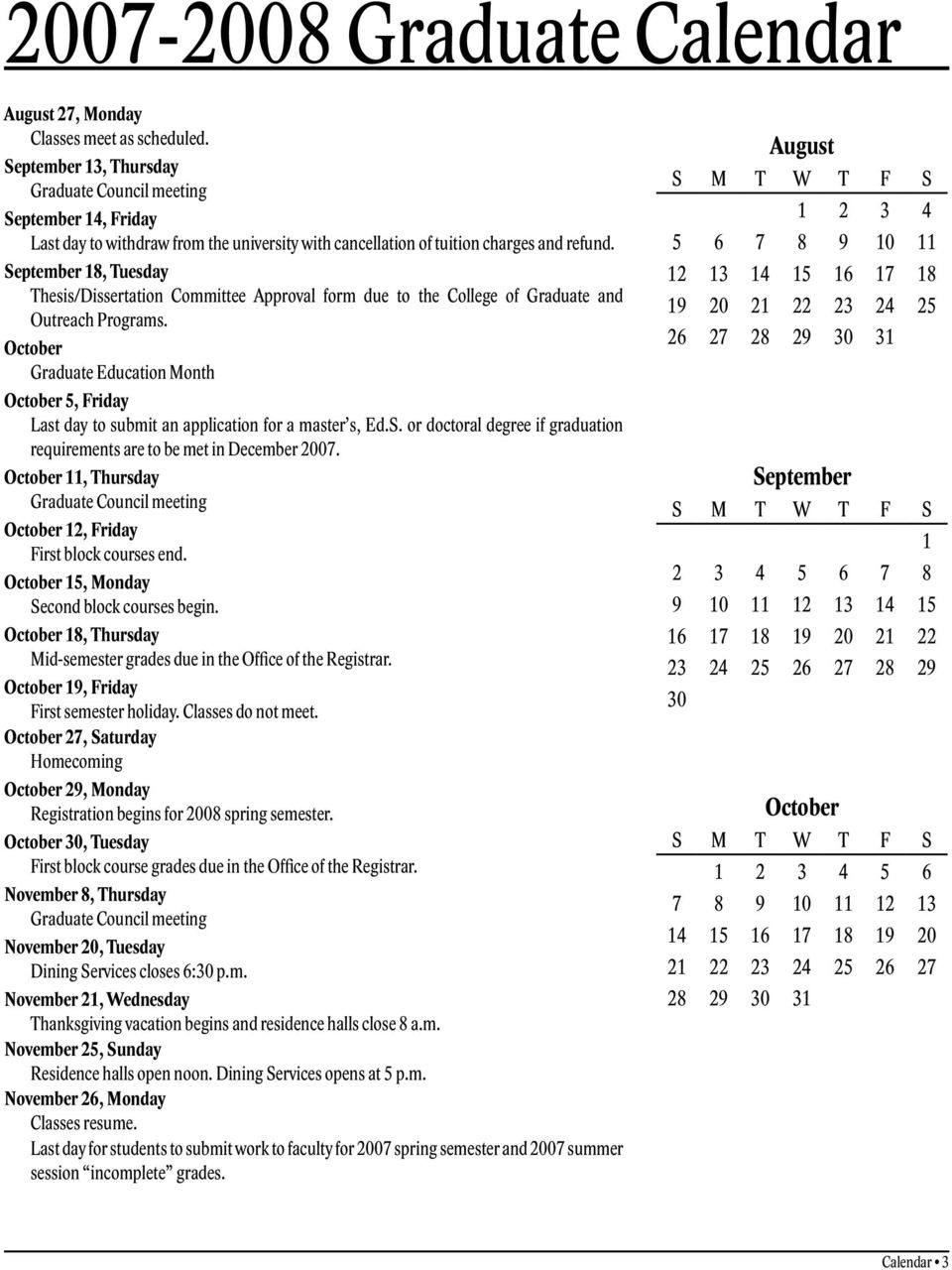
4 November S M T W T F S December S M T W T F S January S M T W T F S November 30, Friday Comprehensive assessment results due to the College of Graduate and Outreach Programs. Thesis/Research Project/Dissertation due to the College of Graduate and Outreach Programs. December 7, Friday Last day of classes Last day for faculty to turn in removal of incomplete grades for 2007 spring semester and 2007 summer session to the Office of the Registrar. December 10-14, Monday-Friday Final examinations December 13, Thursday Graduate Council meeting December 14, Friday Residence halls close 5 p.m. Dining Services closes and fall meal plans end 7 p.m. Deadline for completion of course work for December graduates. December 15, Saturday Graduation. Commencement exercises 10 a.m., Convocation Center. Residence halls close 3 p.m. for graduates. Dining Services closes and fall meal plans end 10 a.m. for graduates. Spring Semester 2008 January 7, Monday Classes meet as scheduled. January 10, Thursday Graduate Council meeting January 21, Monday Martin Luther King Jr. Day. Classes do not meet. January 25, Friday Last day to withdraw from the university with cancellation of tuition charges and refund. Last day to submit an application for a master s, Ed.S. or doctoral degree if graduation requirements are to be met in December February 12, Tuesday Student Assessment/Faculty Assistance (no classes 8 a.m.-4 p.m.) Evening classes (those beginning 4 p.m. or later) meet as scheduled. February 14, Thursday Graduate Council meeting February 26, Tuesday Third block courses end. February 29, Friday Dining Services closes 2 p.m. Residence halls close at 5 p.m. March 3-7, Monday-Friday Spring Break Classes do not meet. March 9, Sunday Residence halls open noon. Dining Services opens at 5 p.m. March 10, Monday Classes resume. Fourth block courses begin. March 12, Wednesday Third block course grades due in the Office of the Registrar. 4 James Madison University Graduate Catalog

5 March 13, Thursday Graduate Council meeting March 14, Friday James Madison Day March 24, Monday Registration begins for 2008 summer session. April 1, Tuesday Registration begins for 2008 fall semester. April 10, Thursday Graduate Council meeting April 11, Friday Last day for students to submit work to faculty for 2007 fall semester incomplete grades. April 16, Wednesday Thesis/Research Project/Dissertation due to the College of Graduate and Outreach Programs. Comprehensive assessment results due to the College of Graduate and Outreach Programs. April 25, Friday Last day of classes Last day for faculty to turn in removal of incomplete grades for 2007 fall semester to the Office of the Registrar. April 28 - May 2, Monday - Friday Final examinations May 2, Friday Dining Services closes 7 p.m. and spring meal plans end. Deadline for completion of course work for May graduates. May 3, Saturday Graduation Commencement exercises May 16, Friday Graduate Council retreat Important Dates for All 2008 Summer Sessions June 5, Thursday Last day to submit an application for a master s, Ed.S. or doctoral degree if graduation requirements are to be met in summer July 10, Thursday Thesis/Research Project/Dissertation due to the College of Graduate and Outreach Programs. Comprehensive assessment results due to the College of Graduate and Outreach Programs. August 1, Friday Deadline for completion of course work for summer graduates. Graduate 2008 Summer Session Twelve-Week Graduate Term May 12, Monday Registration and fee payment. Classes meet as scheduled. May 26, Monday Holiday. Classes do not meet. February S M T W T F S March S M T W T F S April S M T W T F S Calendar 5

6 May S M T W T F S June S M T W T F S July S M T W T F S July 4, Friday Holiday. Classes do not meet. August 1, Friday Final examinations for twelve-week graduate term. Deadline for completion of course work for summer graduates. Eight-Week Graduate Term June 9, Monday Registration and fee payment. Classes meet as scheduled. July 4, Friday Holiday. Classes do not meet. August 1, Friday Final examinations for eight-week graduate term. Deadline for completion of course work for summer graduates. First Six-Week Graduate Term May 12, Monday Course changes and registration. Classes meet as scheduled. May 26, Monday Holiday. Classes do not meet. June 5, Thursday Last day to submit an application for a Masters, Ed.S. or Doctoral degree if graduation requirements are to be met in summer June 20, Friday Final examinations for first six-week graduate term. Second Six-Week Graduate Term June 23, Monday Course changes and registration. Classes meet as scheduled. July 4, Friday Holiday. Classes do not meet. August 1, Friday Final examinations for second six-week graduate term. Deadline for completion of course work for summer graduates. Four-Week Graduate Term May 12, Monday Registration and fee payment. Classes meet as scheduled. May 26, Monday Holiday. Classes do not meet. June 5, Thursday Last day to submit an application for a Masters, Ed.S. or Doctoral degree if graduation requirements are to be met in Summer June 6, Friday Final examinations for first four-week graduate term. Second Four-Week Graduate Term June 9, Monday Course changes and registration. Classes meet as scheduled. July 3, Thursday Final examinations for second four-week graduate term. July 4, Friday Holiday. Classes do not meet. 6 James Madison University Graduate Catalog
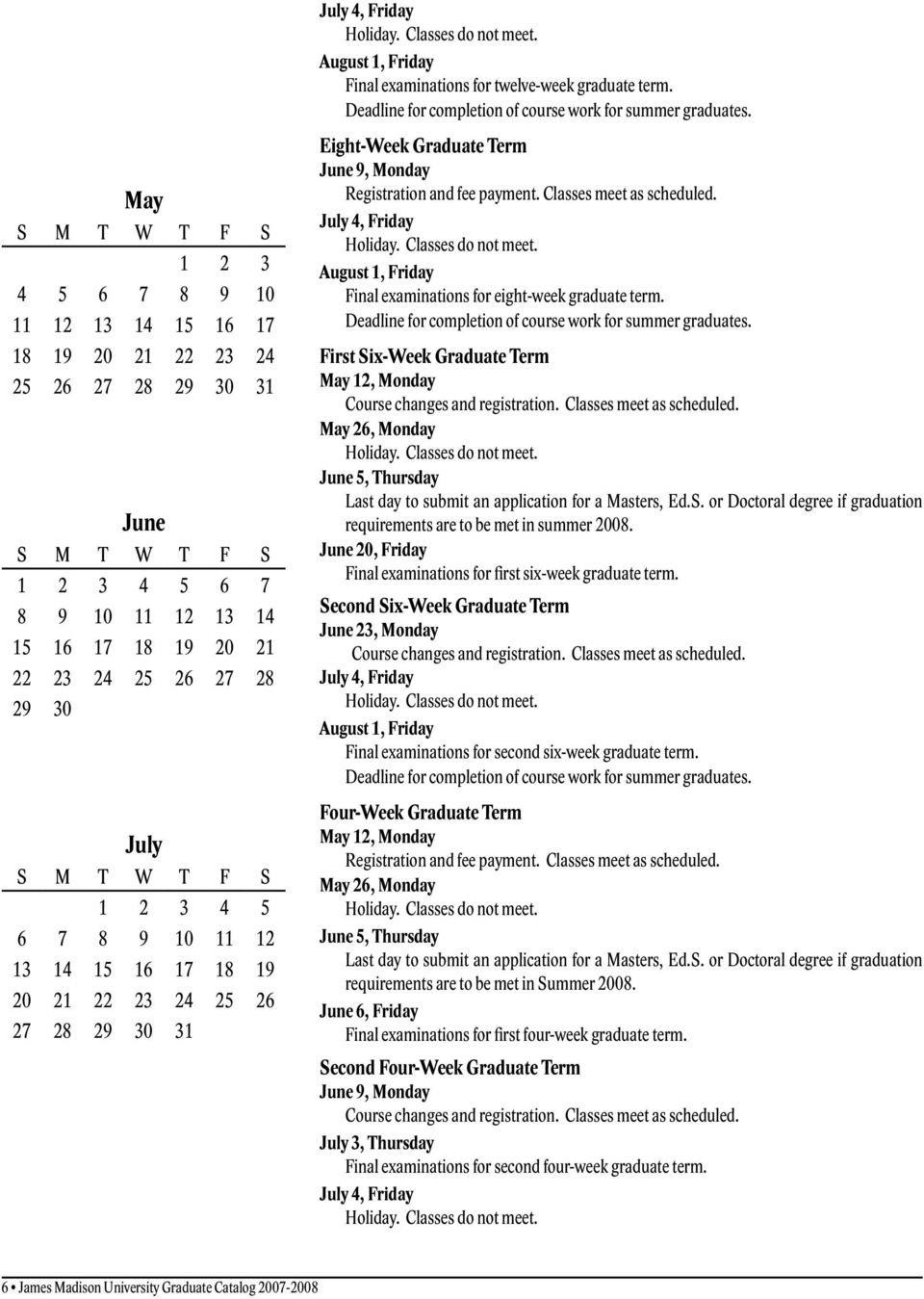
7 Introduction Founded in 1908 and located in the center of Virginia s famous Shenandoah Valley, James Madison University is a public, comprehensive university. The university offers programs at the bachelor s, master s, educational specialist and doctoral levels. The total enrollment for fall 2006 session was 16,970. This total included 15,653 undergraduate students, 1,030 graduate students, 106 non-degree seeking graduate students and 181 non-degree seeking undergraduate students. JMU has 101 major campus buildings, including a 31-acre, off-campus farm. JMU offers students a full program of extracurricular and social programs, as well as a diversified program of intercollegiate and intramural athletics. Location JMU is located in Harrisonburg, Va., a progressive city of over 40,000. The area is flanked by the Blue Ridge Mountains on the east and the Allegheny Mountains on the west. The JMU campus is located just off Interstate 81 and is a two-hour drive from Washington, D.C., and Richmond, Va., and one hour from Charlottesville, Va. The College of Graduate and Outreach Programs is located in the Grace Street House at 17 West Grace Street. History In its 99-year history, JMU has grown from a state normal and industrial school for women to today s coeducational comprehensive university. In 1914, the name of the university was changed to the State Normal School for Women at Harrisonburg. The university became the State Teachers College at Harrisonburg in 1924 and continued under that name until 1938, when it was named Madison College in honor of the fourth president of the United States. In 1977, the name was changed to James Madison University. The College of Graduate and Outreach Programs The JMU Graduate School was established in 1954, when the State Board of Education authorized the university to offer programs leading to the Master of Science in Education degree. In October 2001, the Graduate School and the Office of Continuing Education joined to form the College of Graduate and Professional Programs. Continuing Education became Outreach Programs in 2006, and the college was renamed the College of Graduate and Outreach Programs that year. The College of Graduate and Outreach Programs is authorized to offer graduate programs leading to master s degrees, Educational Specialist degrees, Doctor of Audiology degrees, Doctor of Philosophy degrees, Doctor of Psychology and Doctor of Musical Arts degrees. Mission It is the mission of the College of Graduate and Outreach Programs to support, facilitate and promote excellence in lifelong education through graduate programs of distinction, innovative outreach programs and a diverse student body. The mission of the College of Graduate and Outreach Programs is in concert with the overall mission of the university, which states: We are a community committed to preparing students to be educated and enlightened citizens who lead productive and meaningful lives. Timeline of the James Madison University College of Graduate and Outreach Programs 1954 The State Board of Education authorized the university to offer programs leading to the Master of Science in Education The Virginia Board of Education authorized the university to offer programs leading to the Master of Science degree with a major in biology Master of Arts in Teaching and the Master of Education degrees were authorized Master of Science in Health Sciences was authorized Master of Fine Arts degree was authorized Master of Music degrees, Master of Public Administration degrees and Educational Specialist degrees in school psychology were authorized Master of Science in Computer Science was authorized Doctor of Psychology degree was authorized State Council of Higher Education of Virginia authorized the first Doctor of Philosophy degree State Council of Higher Education of Virginia authorized the first Doctor of Audiology State Council of Higher Education of Virginia authorized the first Doctor of Musical Arts. Introduction 7
8 Administration of the College of Graduate and Outreach Programs The office of the dean of the College of Graduate and Outreach Programs has academic responsibility for all issues of graduate education at JMU. In addition, the college oversees all continuing outreach development programming. Significant in the organization and administration of the College of Graduate and Outreach Programs are the university s Graduate Council and the graduate faculty body. The Graduate Council The Graduate Council is the chief policy-forming and advisory body for the College of Graduate and Outreach Programs. Its duties are to formulate, review, and approve or recommend for approval policies and other items concerning the conduct of graduate study at James Madison University and to provide leadership in advocating for graduate education and scholarship of the highest caliber. The Graduate Council actions are reported to the graduate faculty, to college deans and to appropriate administrators of the university. The primary aim of including the Graduate Council in the organization of JMU is to facilitate graduate program faculty participation in the establishment of university policies and procedures. Responsibilities of the Graduate Council The Graduate Council is specifically charged with Communicating policy on issues affecting graduate education. Monitoring and advocating excellence in graduate education. Setting the broad framework for all graduate study. Making recommendations on all policies with regard to graduate degrees and any changes or additions to such policies. Making recommendations on procedures for student appeals for waivers of any graduate regulations, excluding grade and admission appeals, after appropriate appeals have been made according to the procedures of the respective graduate programs. Setting the requirements for membership to the Graduate Faculty and for the approval of faculty it deems to have met those requirements. Graduate Faculty The graduate faculty hold a position of honor at JMU. Through the Graduate Council, the graduate faculty members assist the dean in developing general policies and administrative procedures for graduate programs. The office of the dean of the College of Graduate and Outreach Programs, assisted by the Graduate Council and the graduate faculty, has responsibility for final approval of graduate degrees to be awarded. Accreditation JMU is accredited by the Commission on Colleges of the Southern Association of Colleges and Schools (1866 Southern Lane, Decatur, Georgia : Telephone Number ) to award the bachelor s, master s, Educational Specialist, Doctor of Audiology, Doctor of Philosophy and Doctor of Psychology degrees. Additional Accreditation Accreditation Board for Engineering and Technology Accreditation Commission for Programs in Hospitality Administration American Assembly for Collegiate Schools of Business American Chemical Society Accreditation Council for Occupational Therapy Education American Psychological Association Association for Advancement of Health Education Association for Information Technology Professionals Association of University Health Programs in Health Administration Accreditation Review Commission on Education for Physician Assistants, Inc. Center for Credentialing Nursing Education Commission on Accreditation for Dietetics Education, the accrediting agency for The American Dietetic Association Commission on Accreditation of Athletic Training Education Council for Interior Design Accreditation Council on Academic Accreditation in Audiology and Speech Language Pathology of the American Speech-Language and Hearing Association Council for Accreditation of Counseling and Related Educational Programs Council on Social Work (baccalaureate level) Education Commission on Accreditation on Social Work Educational Standards Board of the American Speech-Language-Hearing Association International Association of Counseling Services National Association of School Psychologists National Association of Schools of Art and Design National Association of Schools of Dance National Association of Schools of Music National Association of Schools of Theatre National Council for Accreditation of Teacher Education National League of Nursing Review Commission on Education for the Physician Assistant Society for Public Health Education Virginia Board of Nursing Virginia State Board of Education Membership American Association of Colleges for Teacher Education American Association of State Colleges and Universities American Council on Education Association of American Colleges and Universities Association of Virginia Colleges and Universities College and University Personnel Association Council of Graduate Schools in the United States Council of Southern Graduate Schools National Association of College and University Business Officers National Association of Student Personnel Administrators Southeastern Universities Research Association Institutional and Educational Membership Association of Computing Machinery Corporate Membership American Association of University Women 8 James Madison University Graduate Catalog
9 JMU Libraries Carrier Library Carrier Library Circulation Phone: (540) Web site: Carrier Library Reference Desk Phone: (540) Music Library Phone: (540) Web site: CISAT Library Services Phone: (540) Web site: JMU Libraries, consisting of Carrier Library, the Music Library and CISAT Library Services, support research, study and instruction in the use of information resources at JMU. The Libraries house more than 700,000 volumes, including books, periodicals, and audiovisual materials, and over a million microform pieces. Carrier Library is also an authorized U.S. Government Document Depository, with access to thousands of selected online and print documents through LEO, the library catalog. In addition to subscriptions to more than 11,000 journals, access to over 1,500 online journals is provided through JMU Libraries membership in VIVA, the Virtual Library of Virginia. Items not available within the Libraries or through online resources can be retrieved through Interlibrary Loan with virtually any academic library in the country. The library Web site, is an online gateway to the services and collections of the JMU Libraries. Through the Web site, users can search LEO, connect to over 300 electronic databases, and find research guides highlighting the most important print and electronic sources in numerous subject areas. Services such as reference and Interlibrary Loan request forms are also available via the library Web site. More than 100 personal computers are located in the Libraries public areas. Almost all of the online resources on the library Web site can be accessed from any computer on campus, and those with current JMU electronic IDs can configure their browsers to access library resources from any remote location. One of the Libraries principal goals is to educate users, especially students, by providing them with lifelong learning skills that will enable them to find, use and evaluate information in all formats. Selfinstruction modules, entitled Go for the Gold, are available on the library Web site and complement instruction sessions offered in library classrooms. Reference librarians are available on a walk-up basis or by appointment to answer questions and assist students with research. The liaison program links a librarian to each academic unit. Liaison librarians provide a variety of services, including library instruction for course-related activities, collection development and consultation with individual faculty members and students. The Music Library serves the students and faculty members of the School of Music, as well as offering its specialized resources to the greater university community. CISAT Library Services serves the needs of students and faculty on the east campus primarily through electronic resources, reference service and document delivery. Media Resources Phone: (540) Web site: Media Resources in Carrier Library acquires and houses commercial educational media in video, audio and computer software formats for instruction and study by faculty, staff and students. Faculty and staff can use the center s media reference and rental service to locate items not already in the collections. The center facilitates scheduling and taping of satellite programming, and it distributes selected campus-wide software such as Microsoft Office, SPSS and other applications in coordination with IT Computing Support. Media Resources also provides teaching and learning support to faculty, staff and students through instructional hardware and software available to users of classrooms and other learning facilities. Technical services staff coordinate the development, installation and maintenance of technology systems in general classrooms and many special facilities on campus. Media Resources provides portable equipment for loan and use in locations without technology, and its staff offers training support for users of all installed and portable equipment, as well as repair services for non-computer media technology owned by the campus. Center for Instructional Technology Phone: (540) Web site: The Center for Instructional Technology (CIT) is a central resource for the development and exploration of instructional technologies. CIT staff and student associates are available to serve faculty and staff on a walk-in basis or by scheduling an appointment for focused assistance. CIT staff work with faculty on instructional planning, design of instructional materials, production of instructional materials and coordination of resources for project implementation. In the walk-in production facility, faculty, staff and students can check out digital cameras, master a CD-ROM, scan flat art and 35mm slides, and create color prints, transparencies, digital graphics, publications, classroom presentations and Web pages. In addition, a technology teaching station is available to practice professional and classroom presentations. The center is also available for JMU students. Students assisting faculty members with the development of materials may use the center during open hours after the requesting faculty member has signed an authorization form. Students working on class projects may use the center during evening hours. The center offers a variety of faculty development opportunities including hands-on workshops, in-depth technology concentrations, informal discussions and scheduled project support sessions. The center s instructional technology grants program, mgrants, encourages faculty to develop and implement creative methods of instruction. These grants provide faculty with consulting services, support services and funding to design and develop course materials, experiment with new teaching models and promote active learning. JMU Libraries 9
10 Distributed and Distance Learning Services Phone: (540) Web site: Distributed and Distance Learning Services (DDLS) is a support facility for online learning activities at JMU. This support unit works with faculty and other stakeholders in the provision of distributed and distance learning courses, academic programs offerings and online certification opportunities. DDLS supports faculty members with a variety of services, including training, online resources and consulting. DDLS collaborates with other university divisions to provide a one-stop gateway to services for the university s distance learning students. DDLS hosts the university s online learning site, JMUOnline. Computing Support Web site: The university offers many computing services for students, faculty and staff. In addition to several computing systems for administrative purposes, the university also operates two central computing systems for general use: a VMS system and an HP/Unix system. These systems have access to electronic mail, bulletin boards, the Internet and the campus-wide information system. They also serve personal Web pages. A dozen computing labs with a total of more than 300 Windows and Macintosh computers are scattered throughout campus. They have a variety of word processing, spreadsheet, graphics, database and statistical software. All lab computers are connected to the campus network and have access to central computing systems, the Campus Wide Information System and the Internet. JMU s Campus Wide Information System integrates a collection of online information relevant to JMU and its community. Academic, administrative, event and directory information is found in the CWIS. Campus Network Web site: The university s campus network connects most buildings on campus for high-speed data communications. About 25 file servers and lab computers for faculty and staff members provide extended disk space, shared software and data files, and shared hardware, such as printers. Any computer connected to the campus network is also connected to the Internet. The HelpDesk Phone: (540) Web site: The HelpDesk is a troubleshooting hotline and information desk. HelpDesk consultants respond to questions and problems from the JMU community on a wide range of computing topics. The HelpDesk is located in Frye Hall. It can be reached by phone at (540) , by at [email protected] and through the Campus Wide Information System home page. Many guides and handouts are available online and some are also available in print from the HelpDesk. The Center for Assessment and Research Studies (CARS) Dr. Donna L. Sundre, Executive Director MSC 6806, JMU, Harrisonburg, VA Phone: (540) Web site: Center for Assessment and Research Studies Faculty Dr. Robin Anderson, faculty Dr. Christine DeMars, faculty Dr. T. Dary Erwin, Associate Vice President Dr. Sara Finney, faculty Dr. J. Christine Harmes, faculty Dr. J. Patrick Meyer, faculty Dr. Dena Pastor, faculty Dr. Donna L. Sundre, Executive Director Dr. Steve Wise, faculty Mr. David Yang, Information Security Analyst Mission The mission of the Center for Assessment and Research Studies (CARS) at James Madison University is to provide quality assessment service to the university, to provide applied graduate training in both assessment and measurement, to increase the use of innovative technology in assessment practice, to increase the rigor of measurement and statistical techniques used in assessment practice, and to produce quality scholarship in assessment and measurement. The vision of the center is to be internationally recognized as a standard of excellence for practice, programs and scholarship in assessment and measurement. Originating in 1986, The Center for Assessment and Research Studies (CARS) at James Madison University is one of the largest campusbased agencies devoted to outcome assessment in the United States. Ten faculty and three staff perform a variety of assessment activities in general education, the major and student affairs. In conjunction with JMU s Office of Information Technology, the Assessment Center operates a computer-based testing lab where a variety of computerbased tests are administered on an ongoing basis to students on the JMU campus and beyond. CARS also administers a Ph.D. program in assessment and measurement established in 1998 designed to meet the expanding accountability, quality assurance, and outcome assessment needs of education, government and industry. 10 James Madison University Graduate Catalog
11 Admission to Graduate Programs Admission Requirements All applicants to individual graduate programs at JMU must first satisfy the general application requirements of the College of Graduate and Outreach Programs. These are Graduation from a regionally accredited college or university. Satisfactory grade point average. Satisfactory test scores from a recognized standardized test, such as the Graduate Record Examination (GRE), Graduate Management Admission Test (GMAT) or Miller Analogy Test (MAT). Consult the individual programs for specific entry test requirements. Official transcripts from all colleges or universities attended. NOTE: Students may not substitute experiential learning for required academic credit. Once these requirements are met, each student s application materials are then sent to the individual graduate program. An application is not considered complete until all required credentials and supporting documents have been received by the College of Graduate and Outreach Programs. Prospective students must submit their applications online. Applications that are not completed within 90 days of initial receipt will not be processed. Additional application materials may be required by individual graduate programs. In accordance with the Southern Association of Colleges and Schools guidelines, graduate programs must establish both qualitative and quantitative requirements that result in the admission of students whose educational preparation indicates the potential for a high level of performance. Admission procedures include the requirement that an applicant submit, as part of the formal application process, evaluations by professionals in the field as to the readiness of an applicant for graduate work and, if appropriate, credential evaluations. Standardized test admission criteria for each graduate program are established by the faculty responsible for instruction in that program. Contact the program directly or see the Web site for specific requirements. General Application Procedures Prospective students must submit their applications online through the College of Graduate and Outreach Programs Web site at http: // Students who need a paper format due to a disability should contact the Office of Disability Services to determine their eligibility for accommodations in the application process. JMU does not allow students to apply to more than one graduate program per application form. Information regarding financial aid may be accessed online at or Class schedules are available online at The current graduate catalog may be purchased from the JMU Bookstore or accessed online through the College of Graduate and Outreach Programs Web site at gradcatalog/07. The following information must be submitted online: Official graduate application form $55 nonrefundable fee 1 1 Paper applications require a $65 fee. Graduate applications will not be processed without application fees. Application fees cannot be waived, except for McNair Scholars. Payment must be made online. The following information should be mailed to the College of Graduate and Outreach Programs: Official transcripts sent directly from all previously attended institutions. The official standardized tests scores (GRE, GMAT, etc.), sent directly from the testing center. All program-specific application materials should be mailed in a separate envelope directly to the graduate program to which application is being made. The envelope containing these additional materials should be clearly marked Graduate Application Materials. Many graduate programs have specific deadlines for application review: Consult the specific academic program. Application Deadlines The College of Graduate and Outreach Programs has a rolling admission policy. However, individual graduate programs may have different deadlines. Refer to specific academic programs for details. If no deadlines are given by academic units, applications should be submitted by the following dates for the best opportunity of admission: Summer session February 1 Spring semester September 1 Fall semester May 1 Admission to Graduate Programs 11

12 International Student Applications JMU encourages applications for graduate study from qualified international students. To assure that the university qualifies with the U.S. government as an educational institution serving international students, certain criteria must be met. Initial inquiries for international admissions must be directed to the College of Graduate and Outreach Programs. Correspondence with particular departments or program coordinators is strongly discouraged. Applicants residing outside the United States are encouraged to allow 12 months between application for admission and the requested enrollment semester. In addition to the general application requirements of the College of Graduate and Outreach Programs, all international students applying for admission to a graduate program must: Have the necessary ability and educational background to benefit from experiences in this institution. Demonstrate proficiency in English sufficient to carry a full program of graduate study through submission of a satisfactory score on the Test of English as a Foreign Language (TOEFL). Examples of acceptable scores include 570 on the paper-based version and 230 on the computer-based version. For more information, visit Have all funds necessary for expenses during the entire period of the student s stay without resorting to employment while in the United States. The Financial Declaration form is accessible at The university has no financial assistance reserved exclusively for international students. International students are permitted to compete for assistantships with other graduate students. Have official transcripts sent directly to the College of Graduate and Outreach Programs from the accredited institution granting the baccalaureate degree. A credential evaluation of the academic record must be submitted to ensure that it is comparable to a U.S. baccalaureate degree. External evaluators are listed online at Submit an online application and $55 nonrefundable application fee (in U.S. dollars) six months to one year in advance of the intended term of entry if transferring from another college or university in the United States or after completing a baccalaureate degree in a U.S. institution. If in the United States attending or having completed a degree from a U.S. college or university, an International Student Adviser form must be completed by that institution and submitted with the application. Enter the United States on a valid student or other visa. For further information regarding international student applications, contact: International Graduate Admissions College of Graduate and Outreach Programs, MSC 6702 James Madison University Harrisonburg, VA (540) Requests for information concerning federal regulations, visa and health insurance should be directed to: Director, Office of International Student and Scholar Services, James Madison University MSC 5731 Harrisonburg, VA Offer of Admission to the College of Graduate and Outreach Programs The College of Graduate and Outreach Programs will send official written offers of admission to applicants who have been accepted. This letter specifies the effective date of admission (which normally coincides with the semester requested on the application), the classification of admission being offered (unconditional, conditional or provisional). After being accepted into a graduate program, students can defer enrollment only with the written approval of the graduate coordinator of their academic program and the College of Graduate and Outreach Programs. In no circumstances may the deferral be for more than one calendar year. The applicant must notify the College of Graduate and Outreach Programs regarding accepting or declining the admissions offer at least two weeks prior to the start date of the seemester in which he or she has been admitted. This allows the specific program to invite other candidates. A student who enrolls at another institution is considered to have declined the university s offer of admission. An applicant who has received an offer of admission but who has not responded by the deadline is considered to have declined the university s offer of admission and must submit a new application and fee to be reconsidered for admission at a later date. Admissions Classifications Applicants may be admitted to the College of Graduate and Outreach Programs under three classifications: unconditional, conditional or provisional admission. Unconditional Admission Unconditional admission indicates that an applicant has met all the entry criteria of the College of Graduate and Outreach Programs and the specific graduate program. Conditional Admission Conditional admission indicates that the graduate program has identified specific conditions that must be met before the applicant attains unconditional admission status. Individual graduate programs determine the provisions of a conditional acceptance and decide when the provisions can be modified or removed. It is the student s responsibility to notify his or her adviser when the conditions of acceptance have been met. The adviser or graduate coordinator then contacts the College of Graduate and Outreach Programs indicating the change of status. 12 James Madison University Graduate Catalog

13 While applicants are encouraged to attain unconditional acceptance as soon as possible, some graduate programs provisions often cannot be completed until just before graduation, e.g., teacher licensure or competency in a foreign language(s). Master s and Educational Specialist students have a maximum of six years and doctoral students have a maximum of eight years to complete their graduate programs. All students must attain unconditional status prior to program completion. Provisional Admission Provisional admission indicates a probationary status; applicants who have not met all of the requirements of the graduate program to which they are applying may be granted admission under a provisional status as prospective candidates for a degree. Such students must have the removal of provisional conditions as a primary objective. An applicant may be admitted to a graduate program under provisional status if the previous academic record is weak, prerequisite course work is insufficient, or the applicant has majored in another field and has not yet clearly demonstrated abilities in the proposed new field. The requirements for advancement to unconditional status are specified in each applicant s provisional admission letter. It is the student s responsibility to notify his or her adviser when the conditions of acceptance have been met. The adviser or graduate coordinator then contacts the College of Graduate and Outreach Programs indicating the change of status. The College of Graduate and Outreach Programs determines if graduate credit earned while enrolled in a provisional status is acceptable based on the recommendation of the academic unit head. A student is limited to nine hours of graduate credit in this status. Regulations concerning unsatisfactory progress apply to this classification. (See Unsatisfactory Progress, Page 24.) Appeal of Admission Decision Although the official letter indicating an applicant s admission classification or denial of admission into a program emanates from the College of Graduate and Outreach Programs, all admission decisions, including the denial of admission to a program, are made by the faculty of the program to which the student applies. As such, any appeal of an admission decision, including denial of admission, must be directed to the individual graduate program. Change of Program Admission to CGOP and a graduate program does not entitle a student to transfer to a program in another academic unit, as defined by the College of Graduate and Outreach Programs. Any student wishing to change graduate programs must submit a new application for admission, application fee and any updated standardized test scores to the College of Graduate and Outreach Programs. The student is responsible for meeting all academic unit requirements for the desired program. Criminal Background Check Programs may require a criminal history check as part of the final admissions process. The applicant should consult the program to which he or she is applying for more detailed information. Continuous Enrollment All students enrolled in graduate degree programs must enroll each regular semester for a minimum of one graduate credit hour. This registration must continue with no breaks from enrollment in the first graduate program course to graduation. This policy does not include summer sessions. Students should enroll in courses relevant to their graduate program to facilitate timely completion. If it is not possible to do so, however, the College of Graduate and Outreach Programs has established a one-credit Continuous Enrollment course, GRAD 597. The tuition for this course is $ No grade will be assigned for this course. For more information, refer to Page 18. Time Limitations Master s and Educational Specialist Students Master s and educational specialist students must complete all degree requirements within six years. Academic credit, including transfer credits taken before enrollment in the graduate program, completed more than six years before the date at which the master s or educational specialist degree is awarded may not be used to satisfy the degree requirements. Students may submit a written petition through their adviser, graduate program coordinatorand academic unit head to the College of Graduate and Outreach Programs to receive extensions of time in the event of extenuating circumstances. Such requests must be received at least one month prior to the end of the student s original six-year time limit. A student whose status is deactivated, but later is reactivated through reapplication to the College of Graduate and Outreach Programs, may not count the six-year time limit as beginning on the date of reactivation. Doctoral Students Doctoral students must complete all degree requirements within eight years. Academic work, including transfer credits taken before enrollment in the graduate program, that was completed more than eight years before the date at which the doctoral degree is awarded may not be used to satisfy the degree requirements. Students may submit a written petition through their adviser, graduate program coordinator and academic unit head to the College of Graduate and Outreach Programs to receive extensions of time in the event of extenuating circumstances. Such requests must be received at least one month prior to the end of the student s original eight-year time limit. A student whose status is deactivated but later is reactivated through reapplication to the College of Graduate and Outreach Programs may not count the eight-year time limit as beginning on the date of reactivation. Admission to Graduate Programs 13

14 University Residency Graduate students must register a local address with the College of Graduate and Outreach Programs office prior to initial registration for classes. All changes in local address must be registered with the Office of the Registrar. This can be done through e-campus, online at Admission of Veterans The College of Graduate and Outreach Programs encourages veterans to apply for admission as full- or part-time students. For information, contact: Veterans Coordinator Office of the Registrar, MSC 3528 James Madison University Harrisonburg, VA (540) Foreign Language Passing a third year foreign language course, a reading knowledge of a foreign language or successful completion of a foreign language exam is required in those academic units which so specify. Consult the degree requirements of the academic programs for individual requirements. 14 James Madison University Graduate Catalog

15 Outreach Programs Phone: (540) Fax: (540) Web site: Outreach Programs, formerly Professional and Continuing Education Programs, are part of the College of Graduate and Outreach Programs. Outreach Programs offers credit and noncredit programs as well as targeted one-time courses, certificate programs and complete degree programs at a distance. The mission of Outreach Programs is to extend the resources of JMU beyond our campus by providing access to quality education experiences through innovative approaches to those seeking to further their personal and professional development. Outreach Programs works with faculty, academic units, students, and community organizations to design, market, and deliver a wide array of courses. Outreach Programs also oversee the enrollment of nondegree seeking students. Non-degree seeking students are individuals who enroll in offered credit courses but do not seek a degree. Certificate Program Admission Individuals who wish to pursue a certificate must apply to the program and be approved before registering for classes. Individuals must complete the Non-degree Seeking Student Application, select Certificate and select the program to which they are applying. Virginia residents must also complete the Application for Virginia In-State Tuition Rates. A non-refundable $45 processing fee must accompany the application. Although certificate program students are considered non-degree seeking students, applicants for certificate programs need only complete the Non-degree Seeking Student Application once for the semester in which they wish to begin the program. Applications for certificate programs are forwarded to the appropriate academic unit for review, and applicants should check with the academic unit for additional application materials that may be required. A list of available certificate programs can be found at under Certificate Programs. Non-degree Seeking Student Admission The non-degree seeking student classification includes adult non-degree students, high school non-degree students and teacher licensure students. Individuals seeking enrollment as a non-degree seeking student must complete the Non-degree Seeking Student Application. Virginia residents must also complete the Application for Virginia In-state Tuition Rates. A non-refundable $15 processing fee must accompany the application. Non-degree seeking students must submit the application and processing fee each semester they enroll in a course. At the 600 level and above, courses require approval by the appropriate department head. Non-degree seeking students can complete the non-degree student application and the in-state form by going to outreach and clicking Apply Online Now or Outreach Forms. Students should register online during the dates identified for non-degree seeking students following the instructions at and clicking For Students then Registration Information Dates and Deadlines. Walk-in registration and course adjustments are also permitted for non-degree seeking students. The courses taken in the non-degree seeking student category carry university credit, and they may be transferred into a graduate program, once admitted, at the discretion of the program. Taking courses as a non-degree seeking student does not constitute admission to a program or imply later applicability of these courses toward a degree. An individual who has been academically dismissed from another institution or denied regular admission to JMU shall be required to wait for at least one calendar year for admission as a nondegree seeking student. Outreach Programs 15

16 Non-degree Seeking Student Classifications High School Non-degree Students High school students who have completed their junior year may enroll at JMU as non-degree students. They may register for classes in the summer term preceding their senior year and/or during their senior year. While recent high school graduates may register for summer classes as non-degree students, this does not constitute admission to subsequent semesters. Students in this program may enroll for no more than two courses during the summer term and for one course each term while taking high school classes. High school students seeking to register at JMU under this program must submit the Non-degree Seeking Student Application, a recommendation from the high school principal or guidance counselor, and a transcript of high school grades. Registration must be approved by the head of the academic unit(s) in which the student desires to take a course(s). Should the student enroll as a full-time student at JMU following high school graduation, credits earned, where appropriate, will apply toward degree requirements following the completion of one term. Transfer of these credits to other colleges will be at the discretion of the institution concerned. Non-credit Courses JMU coordinates all non-credit instructional programs through the College of Graduate and Outreach Programs. These programs are available for supplementing and updating knowledge, skills and abilities. Some non-credit courses and workshops award continuing education units as a uniform measure of professional development and to signify the student has completed the course or workshop. Information on CEUs is available online at cgop/faculty by clicking CEU Information. Information on non-credit course offerings and registration is available at by clicking Noncredit Courses or Online Noncredit Courses. Additional information about Outreach Programs as well as other registration information can be accessed on the College of Graduate and Outreach Programs Web site at http: // 16 James Madison University Graduate Catalog

17 General Regulations Current regulations and policies are updated annually and published in the CGOP Policy and Procedures Manual. Upon enrollment, graduate students accept responsibility to remain current on policies and regulations set forth by their programs of study and the College of Graduate and Outreach Programs. Further explanations and clarification are available from the College of Graduate and Outreach Programs Web site at Advising Faculty Advisers All students admitted into the College of Graduate and Outreach Programs are assigned faculty advisers. Graduate program coordinators/directors or designated members of the graduate faculty serve as faculty advisers. After admission, students must meet with their advisers to select initial course work and plan their programs of study. Programs of study should be developed prior to initial registration. Catalog of Record Students are generally subject to the curricular and graduation requirements contained in the graduate catalog in effect upon or subsequent to their enrollment at JMU, with approval of the students program and the Office of the Registrar. At the discretion of their academic unit heads, students who leave and re-enter the university after an absence of a semester or more will be subject to the catalog in effect at the time of their re-entry or the catalog used by the majority of students with whom they will graduate. Aging Credit With the exception of undergraduates enrolled in adult degree programs, students are expected to complete all program and degree requirements within seven years of their original entry date to JMU or previous higher educational institution(s). If required by the academic unit, academic work completed more than seven years prior to the students anticipated graduation date might be subject to review by the academic units and the College of Graduate and Outreach Programs for applicability to the graduate degree program. Additional standards may apply in programs leading to licensure or certification. Changes in Requirements James Madison University is a progressive educational institution, and its offerings and requirements in the graduate catalog are under continual examination and revision. Revisions often affect currently enrolled students. Although the university attempts to alert students to these revisions through the academic advising process, individual reports of academic progress and various campus publications, responsibility for meeting all curricular and other graduation requirements rests with the students, who are encouraged to consult regularly with their program advisers. Changes to Policies and Programs of the College of Graduate and Outreach Programs It is the responsibility of each student to become and remain aware of all applicable requirements and provisions that may apply to the student. It is the prerogative of each academic unit to make changes in programs at any time prior to graduation. Students typically complete the program requirements as described in the catalog of the year in which they entered their program. Students who do not conform to their catalog must complete a program of study, which is developed and approved by their advisers. Exceptions to Regulations Exceptions to any of the published rules and regulations cited within the Graduate Catalog must be requested by petition to the College of Graduate and Outreach Programs. Such petitions must be submitted in writing by the student s adviser or graduate coordinator and must detail the regulation and justify completely the exception being requested. Comprehensive Assessment Procedure A formal assessment of mastery designed to appraise the student s competence is required of each JMU student in order to complete his or her program of graduate study. Although the formal assessment typically takes the form of a comprehensive exam, other formal assessment formats may be acceptable as determined by the graduate program. General Regulations 17

18 The format and timing of this assessment is at the discretion of the graduate program, provided it fairly and adequately documents the knowledge and skills the student has acquired. The nature of the comprehensive assessment should accurately reflect the content of the student s academic program. The assessment should require the integration and synthesis of what has been learned by the student. The student must demonstrate a breadth of knowledge in the discipline and depth in specific content areas to be determined by the graduate program faculty. Comprehensive Assessment Committees Each graduate program must have a comprehensive assessment committee for the program and/or for the individual student. Individual student comprehensive committees are selected by the student in consultation with and subsequently approved by the graduate program coordinator and/or program adviser. Each comprehensive assessment committee must consist of at least three JMU graduate faculty members with the background and interest necessary to evaluate the mastery of the student. At least two members must be from the student s graduate program. Non-graduate faculty members of the comprehensive assessment committee, which may include persons external to the university, must be approved by the College of Graduate and Outreach Programs. Such members shall make up no more than one-third of the total committee membership. Graduate instructors may also be appointed to committees with the approval of the College of Graduate and Outreach Programs when their expertise clearly qualifies them; however, their appointment must be in addition to the required number of graduate faculty members. Graduate students may not serve on the comprehensive assessment committees. Only a graduate faculty member from the student s graduate program may chair a comprehensive assessment committee. Comprehensive Assessment Procedure Failure In the event a student fails the comprehensive evaluation, the student may request a re-examination. Unless there are extenuating circumstances, the re-examination must occur within six months of the date of failure. Only one re-examination will be allowed. Cases involving extenuating circumstances must be raised or supported by the graduate program faculty and presented in writing to the dean of the relevant college and the dean of the College of Graduate and Outreach Programs for approval. If a student fails the second comprehensive assessment, his or her graduate program will be terminated. Comprehensive Assessment Procedure Continuance Students completing all degree requirements except the comprehensive assessment are required to enroll each semester until they have passed the comprehensive assessment. Students must register for comprehensive continuance credit hours during those semesters in which they are engaged in preparation for the comprehensive assessment. NOTE: The continuous enrollment course GRAD 597 cannot be used as a comprehensive continuance course. Credit hours for comprehensive continuance do not count toward graduate program requirements. Continuous Enrollment All students enrolled in graduate degree programs must enroll each regular semester for a minimum of one graduate credit hour. This registration must continue with no breaks from enrollment in the first graduate program course to graduation. This policy does not include summer sessions. It is preferable that students enroll in courses relevant to their graduate program to facilitate timely completion. If it is not possible to do so, however, the College of Graduate and Outreach Programs has established a one-credit continuous enrollment course, GRAD 597. The tuition for this course is $ No grade will be assigned for this course. GRAD 597. Continuance. 1 credit. To remain in good standing in their program, all graduate students must maintain continuous enrollment each semester in their program from entry until graduation. This course allows those students who are not intending to register for any other courses during the current semester to continue in their program in good standing. Course may be repeated as needed. It is possible to receive an exemption from the Continuous Enrollment requirement. There are two possible types of exemption from the continuous enrollment requirement: Leave of Absence: Continuous Enrollment is granted in individual cases when the student demonstrates sufficient cause (e.g., illness, or other personal circumstances). A request for this type of leave must be submitted by the student in writing (electronic mail is sufficient), indicating the reason(s). The student s request must be approved by the graduate coordinator of the student s program and the dean of the College of Graduate and Outreach Programs. Leave of Absence: Continuous Enrollment is granted for a specified time period that may not exceed three semesters total, excluding summer session. In no case may on-leave status exceed this maximum throughout the student s entire degree program. When a student on leave plans to resume graduate study, he or she must inform the program coordinator and CGOP at least 30 days prior to the first class day of the return semester. Planned Leave of Absence is granted to students for whom the unique design of their graduate program (not the manner in which they choose to complete their program) is such that the offering of courses is not on a continuous semester-to-semester basis. Planned Leave of Absence for students in a program is requested by the program faculty and must be approved by the dean of the College of Graduate and Outreach Programs. Examples of programs suited for Planned Leave of Absence includes summer-only programs, programs using a distance learning format and executive programs. It is assumed that these programs will not require the continuous enrollment exemption for the entire length of the program. Thus, students whose graduate programs are pre-approved for Planned Leave of Absence must submit a Request for Planned Leave of Absence indicating each term for which leave is requested. It is also assumed that these students will complete all degree requirements within the time limits established in the Graduate Catalog. 18 James Madison University Graduate Catalog

19 Both leaves must be approved by the dean of the College of Graduate and Outreach Programs. A graduate student who takes an unapproved break in registration by failing to maintain continuous enrollment or by failing to obtain a Leave of Absence: Continuous Enrollment will relinquish his or her graduate standing in the university. Students who wish to be reinstated will be required to file an Application for Graduate Admission and pay the application fee. The following are circumstances for which GRAD 597 is not appropriate: During the graduation semester. A student cannot use GRAD 597 as the enrollment requirement during the semester he or she is scheduled to graduate. All graduate students must be enrolled in a course in their program, such as thesis or dissertation continuance, during the semester they are scheduled to graduate. While completing a dissertation or thesis. If a student s graduation must be delayed a semester while he or she is completing a dissertation or thesis, he or she should register for thesis or dissertation continuance. GRAD 597 is not an option since the student will continue to receive feedback from the adviser and committee members while the thesis or dissertation is being completed. When an I is received in a course during the anticipated graduation semester. If a student is scheduled to graduate but receives an I in a course, the student will not officially graduate until the course is completed. Because all course work must be completed by the final date of the student s graduation semester, a student failing to meet the deadline will not officially graduate until the following semester. The solution existing in the first example applies. Students must register for at least one hour of thesis or dissertation continuance, comprehensive continuance, reading and research, or other course option appropriate to their program of study. Except for extenuating circumstances requiring approval from the dean of the College of Graduate and Outreach Programs, time spent in on-leave status will be included in all time limits pertaining to the student s degree program. Students in on-leave status may not use any university facilities, make demands upon faculty time, or receive a fellowship or financial aid. Course Completion Deadlines All course work must be completed by the final date of the student s final semester. Students failing to meet the deadline will have their names removed from the current graduation list and their degrees dated the following semester. Consult the calendar online at http: // or this catalog for exact dates. Course Credits Classification/Academic Loads Status Credit Hours Full time 9 or more Three-quarter time 6 Half time 5 Less than half time 4 or less The classification of students, i.e., full time, etc. in graduate programs is often considered in determining payment deferment on undergraduate student loans, eligibility for insurance benefits, etc. To be eligible to receive an assistantship, each student must be conditionally or unconditionally accepted into a graduate program at JMU. A student who is provisionally accepted will not be eligible for a graduate assistantship until he or she achieves unconditional acceptance into a graduate program. Note: Graduate programs have the right to impose additional criteria as they see fit. The following academic load guidelines apply to all categories of graduate assistants. Graduate assistants must Carry nine hours of graduate course work each semester. Note: Underload approval is required if a graduate assistant is not registered for nine graduate hours each semester. Underloads for fewer than six graduate credits are not approved. Only one underload may be granted during a graduate assistant s program of study. Maintain at least a 3.0 graduate GPA in order to retain or reapply for the assistantship. Assistantships can be awarded for a maximum of four semesters (fall and spring) or two academic years, except for Doctoral Assistants, students in the Master of Fine Arts program or students seeking the Education Specialist degree. For their courses to be covered by their assistantship, all Graduate Assistants must enroll each semester during the regular registration period(s) and prior to the tuition refund date as outlined online at http: // Students who register for any additional courses after this time period will be held responsible for additional tuition and fees. Students who drop courses after the tuition refund date will be responsible for fees and will receive a grade of W for the course. Exceptions may be made only for documented extenuating circumstances and will be handled on a case-by-case basis by the dean of the College of Graduate and Outreach Programs. Students must contact the JMU Office of Student Withdrawal if all courses are dropped to withdraw from the university. For more information on withdrawal, see Page 25. Transfer Credit Students who wish to receive graduate credit for courses taken prior to entering a JMU graduate program must submit requests to their adviser during the first semester of enrollment. The Approval of Transfer Credit form is available online at CGOP/forms.shtml. General Regulations 19

20 A grade of B or better must be earned in courses requested for transfer credit. Courses taken for pass/fail or satisfactory/ unsatisfactory grades will not be accepted for transfer graduate credit. An official transcript showing the credits approved for transfer must be forwarded to the College of Graduate and Outreach Programs. Under no circumstances will more than one-half of the total graduate credits required for completion of a program be considered for transfer/inclusion in the student s program of study. This includes any hours taken at JMU prior to acceptance. In the case of variable credit programs, the one-half maximum transfer hours allowed will be calculated based on the minimum number of hours required for the degree. Students may not transfer in more than nine credit hours from institutions other than JMU. Transfer credit applications must be approved by the student s adviser, academic unit head and the dean of the College of Graduate and Outreach Programs. Exceptions to the policy may be considered on a case-by-case basis. It is the student s responsibility to furnish evidence that any course presented for transfer of credit is applicable to a comparable degree at the accredited institution where the course was taken. If the necessary information is not on the official transcript, it must be obtained in writing from the appropriate dean of the institution where the course work was earned. In all cases, courses considered for transfer of credit must be applicable to a comparable degree at JMU. Courses that are not intended by the institution offering them to be part of a degree program, such as extension and in-service courses, are not acceptable for transfer to JMU. Credits earned to complete a previous graduate degree may not be applied to a second graduate program at JMU at the same degree level. However, previously earned graduate credit earned as a part of a master s degree program from an accredited institution may be counted toward the degree requirements of a higher level degree, such as the Master of Fine Arts, Educational Specialist and doctoral degrees. Academic work, including transfer credit, taken more than six years before the master s degree award date or eight years before the doctoral degree award date may not be used to satisfy the degree requirements. No transfer credit will be approved while a student is in provisional status. Students must familiarize themselves with their specific program requirements as discussed in the academic sections of this catalog. Individual programs will have detailed information relative to the acceptance of credit hours toward their degrees. Course Levels Course Numbering System Courses numbered 500 through 900 are graduate courses and may be applied to a graduate program. Non-degree seeking students who have at least a bachelor s degree may enroll in graduate-level courses with prior written approval from the instructor. Some programs use dual-numbered courses that allow both graduate and undergraduate students. For example, such courses may offer content concurrently on the 400 and 500 levels. In such instances, higher quality and/or additional work is required of the students enrolled at the graduate level in these courses. The additional demands required of graduate students in these dual-numbered courses is evident in the course syllabus and catalog description. Course Level Requirements All credits contained in the student s program leading to an advanced degree at JMU must be in courses designated for graduate students. Students should refer to their academic program for specific requirements. Only six hours of 501 workshop courses may be applied to a graduate degree program. Dissertation and Thesis Research A dissertation is required of all candidates for the Doctor of Audiology, Doctor of Psychology and Doctor of Philosophy degrees. A Doctor of Musical Arts Lecture Recital and Doctor of Musical Arts Document are required of all candidates for the Doctor of Musical Arts degree. A thesis is required in several master s and Ed.S. programs. In other master s degree programs, a research project and the writing of a thesis is an option which may be elected by the student in consultation with and subsequently approved by his or her adviser. Graduate students are required to register for the minimum hours of thesis or dissertation credit required in their programs. Students must register for thesis or dissertation credit hours during those semesters in which they are engaged in the research or in the writing of the thesis or dissertation. NOTE: The continuous enrollment course GRAD 597 cannot be used as a thesis or dissertation continuance course. Dissertation and Thesis Requirements The general requirements for the preparation of a thesis or dissertation pertain primarily to formatting. These requirements provide a degree of uniformity and ensure that each thesis or dissertation is in a form suitable for binding, is fully legible and can be preserved. Students who submit a thesis or dissertation in partial fulfillment of the requirement for a graduate degree at JMU should consult the JMU College of Graduate and Outreach Programs Thesis and Dissertation Manual for detailed guidelines to submission. A general overview includes the following steps. Students should Consult their program requirements for guidelines on registering for their thesis and dissertation. Select a graduate faculty member as committee chair. Identify the remaining members of the committee with guidance from the committee chair. Submit the Committee Approval form to the College of Graduate and Outreach Programs. Begin the project using the style guide recommended by their program. Schedule an appointment with CGOP to review the format of their project. Make necessary formatting changes. Obtain approval signatures. 20 James Madison University Graduate Catalog
21 Turn in final copies of their work and approval sheets to CGOP. Deliver boxed copies to the library and their program coordinator. Titles of dissertations will be printed in the graduation program if the information is received by the appropriate deadline. In addition, a copy of each student s thesis or dissertation will be cataloged in Carrier Library. Dissertation and Thesis Committees Students pursuing degrees requiring completion of a thesis or dissertation must have a thesis or dissertation committee to oversee progress toward the degree. Students should select a graduate faculty member from their graduate program to act as the chair of the committee and select the remaining committee members with the guidance of their committee chair. The following govern the selection of committee members: Each committee must consist of at least three approved members of the JMU graduate faculty. At least two of the three committee members must be from the students graduate program. The dean of CGOP must approve non-graduate faculty members for thesis, research project or dissertation committees. Non-graduate faculty members may include persons external to the university. Non-graduate faculty members shall make up no more than one-third of the total committee membership. In addition to the three required committee members, a graduate instructor, when his or her expertise clearly qualifies him or her, may be appointed to a committee with the approval of the dean of CGOP. The Committee Approval form must be completed and submitted to the College of Graduate and Outreach Programs no later than the second week of the semester in which the students register for dissertation or thesis. Dissertation and Thesis Continuance Graduate students are required to register for the minimum number of credit hours of thesis or dissertation required by their graduate program. Students must register for thesis or dissertation in the appropriate increments of credit hours (determined by their program) during those semesters in which they are engaged in the research or in the writing of the thesis or dissertation. If students have completed the maximum number of hours allowed by their program for thesis, dissertation or research project courses but courses but still have not completed the final document, they must register for at least one hour of Thesis Continuance, Dissertation Continuance or Research Project Continuance each semester while they are completing their research or writing. NOTE: The continuous enrollment course GRAD 597 cannot be used as a thesis, dissertation or research project continuance course. Dissertation and Thesis Grading An IP (in progress) grade will be automatically posted for a thesis, dissertation or research project until the thesis, dissertation or research project has been completed and approved by the thesis/ dissertation committee. Faculty and students may view this grade on e-campus. A grade of NC (no credit) will be automatically entered for Thesis, Dissertation or Research Project Continuance hours. After the thesis, dissertation or research paper is completed and delivered to the College of Graduate and Outreach Programs for final processing, the Registrar s Office will be notified to enter a final grade of satisfactory or unsatisfactory. Permission to Take a Course at Another University After Enrollment Students enrolled in a graduate program may take graduate courses at another accredited institution. While prior approval is not required, students should secure permission from their adviser, academic unit head, graduate coordinator and the College of Graduate and Outreach Programs to ensure that the course will transfer to JMU. It is the student s responsibility to request transfer credit for such courses upon completion and to have official transcripts submitted to the College of Graduate and Outreach Programs office. Transfer credit forms are available at the College of Graduate and Outreach Programs office or online at Students who take their last courses to fulfill their programs of study at institutions other than JMU cannot graduate during that semester. Students must be enrolled at JMU during the semester they graduate. Doctoral Candidacy Request Doctoral students are admitted into candidacy for their graduate degree once they have completed all required course work, passed their comprehensive examination and completed all conditions of the original admission into the individual s degree program. Once students have reached this point, the program coordinator informs the dean of the College of Graduate and Outreach Programs electronically or by letter. This confirmation of successful completion of the comprehensive examination is placed in the student s file, and he or she is considered a candidate for the doctoral degree. The student is then permitted to advance to completion of his or her dissertation and graduation. General Review Process Evaluation of a graduate student s progress is primarily dependent on the judgments of appropriate faculty members of the student s graduate program. The university, through the College of Graduate and Outreach Programs, can define minimal entrance standards and can prescribe general rules governing eligibility for continuation. However, the crucial agency in graduate student evaluation is the graduate program in which the student s work is focused. Principal evaluators must be faculty members of the student s graduate program. It is assumed that disputes over unsatisfactory progress will be informally discussed and reconciled at the program or academic unit level. Discussions of this type will commonly occur among the student, major professor and other faculty members in the graduate program. General Regulations 21
22 Grade Review Procedures Evaluation of student work and assignment of grades on the basis of academic criteria are the responsibilities and prerogative of the faculty. The university and its faculty members also recognize that grading can be a subjective process and students may feel their grade has been inappropriately assigned. If such disagreements occur, students have a right to be fairly heard. There are two types of appeal procedures related to grading. Grade Change Review Procedure The only basis for a grade change appeal is an error in grade assignment or calculation. If a student believes that a grade was assigned in error because of a mistake in calculation or an error in recording, to resolve the discrepancy, the student should consult the professor(s) involved before the Friday of the second full week of classes in the regular semester following the semester of the contested grade. Requests for review of spring semester or summer session grades must be initiated no later than the Monday of the third full week of classes in the subsequent fall semester. If the professor agrees that a change should be made, the professor should submit a Grade Change form and forward it to the academic unit head or graduate coordinator for signature. A copy will be forwarded to the dean of the College of Graduate and Outreach Programs. Grade Review Procedure If a student disputes a grade for any other reason than error in grade assignment or calculation, the student can initiate a formal grade review process. To activate the grade review process, the student must follow these steps. 1. The student submits a Grade Review Form to the appropriate professor by Monday of the third full week of classes in the regular semester that follows the semester for which the contested grade was given. The student must attach a written explanation of reasons for the appeal, including any documentation relating to the disputed grade. Requests for review of spring semester or summer session grades must be initiated no later than the Monday of the third full week of classes in the subsequent fall semester. 2. The student meets with the course instructor by Friday of the third full week of classes to attempt to resolve the concern. If the student and the course instructor reach an agreement that the grade should be changed, the course instructor changes the grade by submitting a Grade Change form to the appropriate academic unit head or graduate coordinator for that individual s signature. A copy of this signed Grade Change form will be forwarded the College of Graduate and Outreach Programs. For graduate students whose grade of C, U or F is to be changed, notice of the grade change must be sent to the College of Graduate and Outreach Programs before that change occurs. If no resolution is reached, the instructor signs the Grade Review form and records a written response on the reverse side of the form. The instructor returns the original copy of this form to the student, retains a copy of the form for his or her personal records and forwards a copy to the relevant academic unit head or graduate coordinator by Friday of the fourth full week of classes. 3. The student must contact the relevant academic unit head or graduate coordinator by the Friday of the fifth full week of classes in order to request review of statement and response. 4. The academic unit head or graduate coordinator meets with the student and confers with the relevant course instructor. The academic unit head or graduate coordinator signs the Grade Review form and records a written response on the reverse side of the form by Friday of the seventh full week of classes. The student receives the original copy of this form. The relevant course instructor receives a copy of the form and the sender retains a copy of the form. If all involved parties agree that the grade should be changed, the course instructor submits a Grade Change form to the academic unit head or graduate coordinator and the appropriate individual signs the form. A copy of the form will be forwarded to the College of Graduate and Outreach Programs. Notice of the grade change must also be sent to the College of Graduate and Outreach Programs before the grade change occurs for graduate students who have a grade of C, U or F changed to some other grade. After the review process outlined above has been completed, a student can also request that the form, documentation and responses be reviewed by the dean of the college in which the course was taught. The college dean s responsibility is only to ascertain whether all parties have had an opportunity to present all relevant facts and have received a fair and impartial hearing at each level. To enter this phase of the process, a student must follow this procedure. 1. The student contacts the dean by Friday of the eighth full week of classes and requests that the dean review the overall process. 2. The dean of the relevant college reviews the process to be sure the student and the faculty member have had a fair hearing. If the relevant college dean believes that due process was not followed during the review process, he or she consults with the relevant professor and academic unit head or graduate coordinator to resolve the dispute. 3. The dean sends a written response to all involved parties by Friday of the 10th full week of classes. This written response is appended to the Grade Review form. The dean returns the original copy to the student, retains a copy and sends a copy to the relevant academic unit head or graduate coordinator and the relevant instructor. If it is agreed that the student s grade should be changed, the relevant course instructor submits a Grade Change form to the academic unit head or graduate coordinator. The recipient then signs the form and forwards a copy to the dean. Notice of the grade change must also be sent to the College of Graduate and Outreach Programs before the grade change occurs for graduate students who have a grade of C, U or F changed to some other grade. There is no further review beyond the dean of the relevant college. The entire process will not extend past the end of the semester following the contested grade with the exception of grades given for summer session courses. 22 James Madison University Graduate Catalog
23 Grading System * Letter Numerical Grade Description Value A Excellent 4.0 A- 3.7 B+ Very Good 3.3 B Good 3.0 B- 2.7 C Poor 2.0 F Failure 0.0 I Incomplete IP In Progress W Withdrawal WP Withdrawal while Passing WF Withdrawal while Failing S/U Satisfactory/Unsatisfactory (Thesis/dissertation and selected other courses. See course descriptions.) NP Not processed NC No Credit * The +/- grading scale is optional for faculty; the course grading system must be stated in the course syllabus. A grade point average is calculated by dividing the accumulated number of grade points earned by the accumulated number of credit hours attempted. All graduate credits attempted and all graduate grades earned, whether passing or failing, will be used to calculate a student s grade point average. The student s grade point average appears on his or her transcript. Students must take all courses on a letter grade ( A-F ) or satisfactory/unsatisfactory (S/U) basis, based on how the particular course was approved. Students do not have flexibility in choosing a grading option. A grade of W will be assigned to students who withdraw from a course after the add/drop deadline but before the end of the course adjustment deadline. A grade of WP or WF (according to the status of the student at the time of withdrawal) will be assigned to students who withdraw after the course adjustment deadline at the discretion of the instructor. The WP or WF will be recorded and remain on the student s transcript. Only the instructor can assign a WP or WF. A grade of IP (in progress) will be posted automatically for dissertation, thesis or research project courses until the dissertation, thesis or research project is complete. Faculty and students may view this grade on e-campus. After the thesis, dissertation or research project is completed and delivered to the College of Graduate and Outreach Programs for final processing, the final grade of satisfactory or unsatisfactory will be entered by the Registrar s Office. If students have completed the maximum number of hours allowed by their program for thesis, dissertation or research project courses but have not completed the work, they will register for thesis, dissertation or research project continuance each semester while completing their research or writing. A grade of NC (no credit) will be automatically entered for continuance hours. Students should keep in mind that earning a B- grade may bring the GPA below 3.0 and prevent students from graduating. In order to graduate, students must satisfy grade requirements specified by their individual academic program. Auditing Graduate Courses Graduate students may enroll in graduate courses using the audit option for elective courses only. These courses will not count as part of the student s program of study. Students must initially register for the course using the audit option. Under no circumstances may a course credit option be changed from audit to credit or credit to audit. Students are required to pay for courses taken as audit. Audit courses cannot be paid for using any university sources of funding, e.g., assistantship funding. Credit By Examination Credit by examination is an option that programs can include in their policies. Each program will use its own discretion in developing the form of the examination and in determining the procedure to be followed. A maximum of nine credit hours can be earned through credit by examination or transferred from institutions other than JMU, with no more than nine credit hours earned by a combination of exam or transfer. Permission to take an examination for credit must be obtained from the head of an academic unit in which credit is sought. The cost for the exam will be $50 per credit hour attempted. Successfully earning credit by examination will result in a grade of CR, with credit given, on the transcript. Incomplete Grades The grade of I is used to indicate incomplete work in a course. Courses in which a student received a grade of I must be completed by the end of the next regular semester or the grade is reported permanently as an F. Students should consult academic unit guidelines regarding such courses. It is the responsibility of the student to ensure grade changes are reported to the Office of the Registrar by the deadline. See the university calendar at the front of this catalog for the date by which grade changes must be submitted. All course work must be completed by the final date of the student s final semester. Students failing to meet the deadline will not graduate and will have their degrees dated the following semester. Consult the university calendar in the Registration and Student Record Services Handbook, online at or in the front of this catalog for dates. General Regulations 23
24 Unsatisfactory Progress If, at any time, a graduate student fails to make satisfactory progress toward the degree, the student may be denied permission to continue in the program. Such a decision may be reached by the student s adviser, academic unit head, or graduate program coordinator and will be referred to the College of Graduate and Outreach Programs for final action. Students who receive two C grades or a GPA of below 3.0 will be placed on academic warning and will receive written notification. A student will be dismissed from the degree program if the student receives an F or U in any graduate course or a total of three C grades in his or her graduate program. A student dismissed from the degree program may not enroll in any graduate-level courses for a period of one year. Students who want to return to the university must re-apply and be re-accepted in the usual manner. A graduate student will receive a notice of academic warning upon receiving a grade of C in any two graduate courses or if the student s grade point average falls below 3.0. This academic warning will be noted on the student s transcript. All credits attempted and all grades earned, whether passing or failing, will be used to calculate a student s grade point average. In some cases, graduate students may take undergraduate courses as part of their program of graduate study. The GPA includes undergraduate courses taken during graduate study. However, if an undergraduate course places a student s GPA below 3.0, it will not place the student on probationary status or prevent the student from graduating. Graduation The office of the dean of the College of Graduate and Outreach Programs, assisted by the graduate faculty, have responsibility for final approval of graduate degrees to be awarded. It is the responsibility of each student to ensure that courses selected are acceptable to the program being pursued. A student cannot graduate with a GPA below 3.0. Students should keep in mind that earning a B- grade may bring the GPA below 3.0 and prevent the student from graduating. Graduate Degree Completion Requirements The College of Graduate and Outreach Programs mandates the following general degree completion requirements in order for students to receive their graduate degrees. Each graduate student must: Complete a written graduate plan of study by the end of the student s first semester and submit it to the College of Graduate and Outreach Programs. NOTE: At least one-half of the courses in the student s required plan of study must be at the 600 level or above. Be continuously enrolled in the graduate program from admission to graduation (unless specifically exempt). Have satisfied any conditions of his or her admission, such as provisional or conditional admission. Complete the graduate program with an appropriate GPA. The standard for graduation is a 3.0 or higher GPA. 24 James Madison University Graduate Catalog Be enrolled in a course other than GRAD 597 during the semester in which he or she plans to graduate. Complete all requirements of the graduate program and College of Graduate and Outreach Programs within six calendar years (master s and education specialist degrees) or eight years (doctoral degrees). Successfully achieve doctoral candidacy (doctoral students only). Successfully complete a comprehensive assessment or equivalent as determined by the individual graduate program. NOTE: The graduate program must notify the College of Graduate and Outreach Programs that the student has successfully completed the comprehensive assessment procedure. Submit a thesis, dissertation or research project, if required by the academic program, to the College of Graduate and Outreach Programs that meets the format requirements set forth in the College of Graduate and Outreach Programs Thesis and Dissertation Manual. Complete the minimum period of residency established by his or her program. NOTE: While the traditional period of required residency is optimal, the technological revolution that facilitates distance learning of all varieties may not allow for the traditional approach to residency. Accordingly, all enrolled students are strongly encouraged to take advantage of all available avenues of learning, including accessing the JMU faculty, staff and other students, as well as our library, laboratories and other facilities that nurture the academic experience. In addition to meeting the general completion requirements set forth by the College of Graduate and Outreach Programs, each student must meet the graduation requirements of the individual graduate program. Application for a Graduate Degree Students are responsible for notifying both their major academic unit and the College of Graduate and Outreach Programs when they plan to graduate. In order to graduate, students must complete the Application for Graduate Degree form available online at http: // or from the College of Graduate and Outreach Programs. Students are also responsible for consulting their advisers or the College of Graduate and Outreach Programs office regarding deadlines for graduation. The Application for Graduate Degree form must be approved by the student s adviser and the academic unit head or graduate program coordinator. Students are responsible for obtaining all necessary signatures to complete the Application for Graduate Degree form. Students must complete all requirements of their catalog of record (see Page 17) or complete a program of study. NOTE: Students must complete all the conditions of the original admission in their degree program, e.g., conditional admission, at least one semester before they are scheduled to graduate before they can be permitted to graduate. Only six credit hours of 501 workshop courses approved for inclusion in a graduate program may be applied toward a degree. If students plan to use transfer credits to fulfill degree requirements, these credits, along with official transcripts showing the credits and the transfer of credit form, must appear on the Application for a Graduate Degree form and be forwarded to the College of Graduate and Outreach Programs.
25 Requirements for Graduation Semester Registration All graduate students are required to be enrolled during the semester they receive their degree. If students are not enrolled in regular course work, they must enroll for either comprehensive, thesis or dissertation continuance, or directed research, whichever is appropriate. NOTE: The continuous enrollment course GRAD 597 cannot be used during the graduation semester. Attendance at Commencement Students are expected to attend graduation exercises. A student unable to be present for the graduation exercises must notify the College of Graduate and Outreach Programs no later than 15 working days before commencement. Honor System The academic program at JMU operates under an Honor System that dates back to the academic session. Students adopted the present Honor System in order to uphold individual and community integrity. Each student is expected to observe complete honesty in all academic matters and to report instances where another student has violated the Honor System. A student Honor Council administers the Honor System, and every student who matriculates at the university, whether graduate or undergraduate, becomes a member of the Honor System. The university expects the cooperation of faculty members and administrators in upholding this Honor System. The Student Handbook provides full information on the Honor System, and the Honor Council office provides students with assistance in understanding Honor System policy. All incoming JMU students are required to complete an online Honor System Tutorial and test during their first semester. The Honor Council encourages all members of the JMU community to familiarize themselves with the Honor Code and Honor System procedures. The Honor Council office is located in Chandler Hall Rooms 133 and 133A, and the Web site is Withdrawal Withdrawal from Courses A student may terminate enrollment in a course by withdrawing from the course after the drop deadline. A student who withdraws from a course will receive a grade of W for the course, and this grade will be recorded (and remain) on the student s transcript regardless of the status of the student in the course at the time of the withdrawal. In extraordinary situations, a student who becomes unable to complete some course requirements after the course adjustment deadline has passed may request a grade of WP or WF from the instructor. The form (e.g., verbal, written) and timing of such requests are determined by individual instructors; the student is responsible for ensuring that the request is made in an appropriate manner and at an appropriate time. In response to such a request, the instructor may choose to record a grade of WP or WF but is not obligated to do so (and may record any grade other than W ). The course instructor may also suggest that the student contact the JMU Office of Student Withdrawal about withdrawing from the university. Withdrawing from a course will not result in a tuition reduction. Students considering withdrawing from a course should be aware that graduate and professional schools and future employers might hold differing opinions on a student s withdrawal from a course. For this reason, a student should withdraw from a course only after serious consideration. Withdrawal from a Graduate Program Students withdraw from the university when their enrollment is terminated before these students have completed the semester for which they registered. Students who decide to withdraw during the first three weeks of the semester must complete the Cancellation/Non- Returning/Leave of Absence Notice available at registrar/forms.shtml and submit it to the Office of the Registrar. Students desiring to withdraw after the third week of the semester must contact the Office of Student Withdrawal at (540) The Office of Student Withdrawal must approve such withdrawal requests, set the official withdrawal date and notify other university offices of the withdrawal. Strict compliance with this requirement is mandatory. Students who withdraw without receiving official approval will receive a grade of F for all courses in which they are enrolled. A student who voluntarily withdraws from his or her graduate program without receiving official approval will receive a grade of F for all courses in which he or she is enrolled. A student voluntarily withdrawing with official approval will receive a grade of W, WP or WF in all courses. A grade of W will be assigned to students who withdraw from a course after the add/drop deadline but before the end of the course adjustment deadline. A grade of WP or WF (according to the status of the student at the time of withdrawal) will be assigned to students who withdraw after the course adjustment deadline at the discretion of the instructor. It may also be necessary for a graduate student to withdraw due to extenuating circumstances. Withdrawal for extenuating circumstances must be approved by the student s graduate coordinator and the dean of the College of Graduate and Outreach Programs. A student who withdraws because of extenuating circumstances will also receive a grade of W, WP or WF in all courses. Students who withdraw from their graduate program will be responsible for tuition as determined by the Office of the Registrar and may be subject to a change in their financial aid status. Information on tuition refunds may be found on Page 29. Nondegree-seeking students enrolled in an on- or off-campus course must also withdraw from the university by securing a Withdrawal Application form from the Office of Student Withdrawal. This form must be completed and returned to the Office of Student Withdrawal, which will process the official withdrawal. Any adjustment in charges will be calculated from the last date of attendance. No adjustment in charges will be made unless the withdrawal form is received by the Office of Student Withdrawal within 30 days after the student leaves the campus or does not attend classes. General Regulations 25
26 Withdrawal from the University Students withdraw from the university when their enrollment is terminated before these students have completed the semester for which they registered. Students who decide to withdraw during the first three weeks of the semester must complete the Cancellation/ Non-Returning Notice available at forms.shtml and submit it to the Office of the Registrar. Students desiring to withdraw after the third week of the semester must contact the Office of Student Withdrawal at (540) Confidentiality of Educational Records The Family Educational Rights and Privacy Act of 1974 James Madison University adheres to and annually informs students of the Family Educational Rights and Privacy Act of 1974, as amended. This act, with which the institution intends to fully comply, was designated to protect the privacy of educational records. Under the Family Educational Rights and Privacy Act (FERPA) students have certain rights with respect to their education records. These rights include: The right to inspect and review the student s education records within 45 days of the day the University receives a request for access. Students should submit to the registrar, dean, head of the academic department or other appropriate official written requests that identify the record(s) they wish to inspect. The university official will make arrangements for access and notify the student of the time and place where the records may be inspected. If the records are not maintained by the university official to whom the request was submitted, that official shall advise the student of the correct official to whom the request should be addressed. The right to request the amendment of the student s education records that the student believes are inaccurate or misleading. Students may ask the university to amend a record that they believe is inaccurate or misleading. They should write the university official responsible for the record, clearly identify the part of the record they want changed, and specify why it is inaccurate or misleading. If the university decides not to amend the record as requested by the student, the university will notify the student of the decision and advise the student of his or her right to a hearing regarding the request for amendment. Additional information regarding the hearing procedures will be provided to the student when notified of the right to a hearing. The right to consent to disclosures of personally identifiable information contained in the student s education records, except to the extent that FERPA authorizes disclosure without consent. One exception which permits disclosure without consent is disclosure to school officials with legitimate educational interests. A school official is a person employed by the university in an administrative, supervisory, academic or research, or support staff position (including law enforcement unit personnel and health staff); a person or company with whom the university has contracted (such as an attorney, auditor, or collection agent); a person serving on the Board of Trustees; or a student serving on an official committee, such as a disciplinary or grievance committee, or assisting another school official in performing his or her tasks. A school official has a legitimate educational interest if the official needs to review an education record in order to fulfill his or her professional responsibility. Upon request, the university may disclose education records without consent to officials of another school in which a student seeks or intends to enroll. The following is considered Directory Information at James Madison University and may be made available to the general public unless the student notifies the Office of the Registrar in person or in writing within five days after the first day of class registration: Student s name, telephone numbers, addresses, date and place of birth, major and minor fields of study, college of major and year (first year student, sophomore, etc.), enrollment status (full-time/parttime) including credit hours, dates of attendance, degree sought and time, degrees conferred, awards and honors conferred, participation in officially recognized activities and sports, weight and height of members of athletic teams, the most recent previous educational agency or institution attended by the student, fraternity and/or sorority and educational societies. The right to file a complaint with the U.S. Department of Education concerning alleged failures by James Madison University to comply with the requirements of FERPA. The name and address of the office that administers FERPA is: Family Policy Compliance Office, U.S. Department of Education, 400 Maryland Avenue, SW, Washington, DC For more detailed information concerning JMU s records policy see James Madison University, Policies and Procedures, Policy 3102, The Family Educational Rights and Privacy Act. 26 James Madison University Graduate Catalog
27 Fees and Expenses University Business Office 302 Warren Hall Phone: (540) Web site: Tuition and fee charges for the sessions are available on the University Business Office Web site. The tuition and fees listed contribute to general maintenance and operation, instruction, and other university service costs, including recreational and health service facility costs. The fees also support student activities such as the Student Government Association, University Program Board and student publications. The amounts listed do not include the cost of books or supplies. The university reserves the right to adjust tuition and fee charges because of rising costs or other conditions upon approval of the JMU Board of Visitors. Refer to the Registration and Student Record Services Handbook or the University Business Office Web site for a full description of the tuition and fee rates. Billing and Registration Registration for the fall semester is conducted in April for returning students and in November for the spring semester. Students will be notified of the amounts due through their electronic billing statement in early August for the fall semester and mid-december for the spring semester. The billing statement can be accessed through the Current Statement link in QuikBILL. Between billing statements, all financial activity, i.e. new charges, payments, and adjustments, will appear in the Account Status section of QuikBILL. Students and any authorized payers will be ed when the initial semester billing statement is ready to be viewed and paid. If additional billing statements during the semester are processed, an notification will be sent. Students are encouraged to review their financial account for amounts due after any registration or course adjustment activity. Students may access their financial account by using the student information e-campus link on the Registrar s Web site at registrar or through the Web link provided in the billing . Students are responsible for payment of their student account by the first week of classes to avoid a late fee and/or hold. Continuous Enrollment All graduate students enrolled in graduate degree programs must register each regular semester for a minimum of one graduate credit hour from enrollment to graduation. This policy excludes summer sessions. Students wishing to be excused from the requirements of this policy because of extenuating circumstances must solicit exemption from of the College of the Graduate and Outreach Programs through the Leave of Absence: Continuous Enrollment option. See Page 18 for more information. A graduate student who takes an unauthorized break in registration by failing to maintain continuous enrollment will relinquish his or her graduate standing in the university. Students who wish to be reinstated will be required to file an Application for Graduate Admission, pay the admission fee and register for one graduate credit for each term of unauthorized break in registration. Tuition and Fees Payment Payment may be made by the following means: Remitting payment by check or cash to the University Business Office, Warren Hall, Room 302. Mailing a check to JMU, University Business Office, MSC 3516, Harrisonburg, VA Remitting an electronic check payment or credit card payment online through the electronic bill presentment, through a link on e-campus or through the University Business Office Web site at The service is provided by an outside vendor. Students may pay by a combination of personal check, cash, money order, cashiers check, electronic check and credit cards. The University Business Office accepts credit card payments by MasterCard, American Express and Discover and a 2.75% service fee is charged. There is no service fee charged on electronic check payments. Payments drawn on foreign banks must be converted to U.S. dollars prior to transmittal to the university. The student s campus ID number should be included on all payments to ensure its application to the proper account. Fees and Expenses 27
28 Debts owed to the university are governed by the following policies: No credit for university work may be given to any student for a diploma, teacher s license or transfer purposes until all debts to the university have been settled. Until a student s account is paid in full, he or she will be ineligible for readmission or any registration activity. Upon recommendation of the director of the University Business Office and with the approval of the Assistant Vice President for Finance, students in debt to the university may be withdrawn from their classes. Audit Fees A student registering to audit a course will pay the same tuition and fees as one who registers for credit. Specialized Class Fees Certain courses which use off-campus facilities have additional charges which will be determined at the time the course is offered. Examination for Credit Fee Arrangements for attempting credit by departmental examination may be made by paying a nonrefundable $50 per credit hour attempted fee to the University Business Office and presenting the receipt to the Office of the Registrar. See Page 23 for more information. Delinquent Accounts Service Indicators (Holds) Only service indicators placed by University Business Office can be cleared by this office. Normally, paying the student account balance with the University Business Office will resolve these holds. Other departments that place service indicators include the Health Center, Parking, Telecom, Perkins Loans, Registrar, College of Graduate and Professional Programs, Campus Card Center and Financial Aid. Those departments place and release their own service indicators. Late Fees A late fee of up to ten percent of the past due balance can be assessed to the student s account if payment is not received by the due date. Course Cancellation and Returned Check Fee A $25 per check fee is assessed for checks returned to the university by the issuing bank as unpaid due to a stop payment order or nonsufficient funds. If a check is returned, the director of the University Business Office will notify the student by . If the student does not make appropriate alternative payment as specified, the student s class registration will be canceled and the student may be withdrawn from the university. The university will also hold the student s records, future registration, transcripts, teaching license and diploma until the check is redeemed. Collection Fees In the event an account becomes delinquent, the student is responsible for all administrative costs and collection fees incurred in the collection of funds owed to the university. Additional collection information is available at collections.shtml. Eligibility for In-state Tuition Eligibility for in-state tuition charges is based on the provisions of Section of the Code of Virginia in effect on the first day of classes for each term. A link to the Code of Virginia guidelines can be found on the University Business Office Web site. This statute limits in-state tuition to those with Virginia domiciliary status. Domicile is defined as the present, fixed home to which you return following temporary absences and at which you intend to stay indefinitely. If there is any question of the right to classification as a domicile of Virginia, it is the student s obligation, prior to the first day of classes for the semester, to raise the question with the University Business Office. To qualify for in-state tuition, a graduate student shall establish by clear and convincing evidence that for a period of at least one year immediately prior to the date of the alleged entitlement, he or she was domiciled in Virginia and had abandoned any previous domicile, if such existed and that he or she initially came to Virginia for reasons other than education. Domiciliary status shall not ordinarily be conferred by the performance of acts which are auxiliary to fulfilling educational objectives or are required or routinely performed by temporary residents of the commonwealth. Mere physical presence or residence primarily for educational purposes shall not confer domiciliary status. A matriculating student who has entered an institution and is classified as an out-of-state student shall be required to rebut by clear and convincing evidence the presumption that he or she is in the commonwealth for the purpose of attending school and not as a bona fide domiciliary. Initial determinations of eligibility are made by the College of Graduate and Outreach Programs (graduate students and continuing education and non-degree students). Decisions on re-entry students are also made by these respective offices. To establish eligibility, an applicant must complete the uniform domiciliary status questions included in the applications for admission to the university. For information on special provisions of Section covering military families and persons living out-of-state but employed full-time in Virginia, contact the College of Graduate and Outreach Programs. Once a student receives an initial determination of eligibility, he or she may appeal for a review of the application by contacting the head of the office that made the determination (director of the Admissions Office or dean of the College of Graduate and Outreach Programs). Appeal for a final administrative review of the decision to deny instate tuition may be made to the university s Residency Appeals Committee chaired by the associate vice president for institutional effectiveness. If there is any question of the right to classification as a domicile of Virginia, it is the student s obligation, prior to or at the time of registration, to raise the question with the administrative officials of James Madison University. Any party aggrieved by a final administrative decision shall have the right to petition within 30 days for a review by the Circuit Court of Rockingham County. 28 James Madison University Graduate Catalog
29 Returning students may apply for reclassification from out-of-state to in-state status through the University Business Office. Denial of a request for such reclassification may be appealed within 30 days to the assistant vice president for finance with a final appeal within 30 days to the Residency Appeals Committee. Petition for review of this final appeal must be made within 30 days to the Circuit Court of Rockingham County. A change to in-state status may be made for a semester only when the completed application for reclassification form is received in the University Business Office prior to the first day of classes for that semester. Students are responsible for paying out-of-state tuition rates until in-state status has been approved. Refer to the University Business Office Web site at and specifically the section Residency Requirements for the reclassification form and links to the Code of Virginia. Online Courses Distance-learning courses are offered only by specific programs. Students enrolled in these courses will be charged a higher tuition rate than students taking traditional courses at the university. Refer to the University Business Office Web site for current tuition and fees. Room and Board Part-time students cannot purchase a housing contract without prior approval of the Office of Residence Life. Residents of universitysponsored apartments are only charged for the room portion of their housing contract. These students and commuter students may purchase one of several meal plans through Card Services, Warren Hall, Room 302. If students arrive late by 10 or fewer days, their boarding fee will not decrease. The only exception, however, is lateness because of hospital confinement. If students are late because of seven-day or longer stays in the hospital, the university will consider adjusting the board fee. Contact Card Services, Warren Hall, Room 302; (540) for additional information. Refunds Any overpayment of a student account can be either refunded or posted to a future semester as a payment. All overpayments are refunded to the student except for PLUS loans, which are owned by the parent. Direct deposit to the student s or parent s bank account is strongly encouraged. Direct deposit forms can be acquired at the University Business Office at Warren Hall, Room 302, through the University Business Office Web site at or the Office of Financial Aid Web site at If no direct deposit form is on record, then a check will be processed within 10 banking days and mailed to the student s/parent s home address of record. Withdrawal Refunds Students who officially withdraw from the university by the deadline for the semester will be refunded all tuition and fee payments. Students who officially withdraw from the university after the deadline for the semester will be responsible for full tuition and fee charges, unless their withdrawal is due to an illness certified by a physician or for unavoidable emergency or extenuating circumstances. Tuition reduction must be approved and recommended by the Office of Student Withdrawal. All meal plan charges will be pro-rated, and campus housing charges will be based on the refund schedule listed in the housing contract. Students who are withdrawn by the university due to disciplinary action or enforced withdrawal will not receive a pro rata charge for tuition and fees. For further information on withdrawal from the university, see Page 25 or refer to the Registrar s Web site at Fees and Expenses 29
30 Financial Assistance Assistantships College of Graduate and Professional Programs 17 West Grace Street, MSC 6702 Phone: (540) Web site: Scholarships, Grants, Student Employment and Loans Office of Financial Aid and Scholarships Warren Hall, MSC 3519 Phone: (540) Web site: Assistantships Each year, James Madison University makes funds available through the graduate assistantship program. Although limited in number, assistantships contribute significantly to academic and non-academic areas of the university. Assistantships provide financial assistance to qualified students who otherwise might be unable to pursue graduate degrees. They also offer opportunities for students to gain worthwhile teaching and other experiences relevant to their chosen disciplines. Students will be awarded assistantships for a maximum of four academic semesters (exclusive of summer session) in most master s and educational specialist degree programs and a maximum of three years in the Master of Fine Arts and doctoral programs. Assistantships are limited to nine paid graduate hours of tuition each fall and spring semester, although contracts are usually written for an academic year. Students must pay for any additional hours each semester at the tuition rate based on residency status. Tuition will be covered at the on-campus rate for the hours stated on the contract. Any additional charges for Web-based courses will be the responsibility of the student. Under no circumstances will payment from assistantship funds be used for audited course work or undergraduate hours. Assistantships do not cover the student s room and board expenses. No tuition or stipend is paid through the assistantship program for summer hours. Classification of Assistantships Doctoral Assistant A Doctoral Assistant is assigned to an academic department to assist faculty members in their responsibilities of teaching and/or research. Students in doctoral programs may also serve as Teaching Assistants. Doctoral Assistants must be enrolled in a doctoral program at JMU. 30 James Madison University Graduate Catalog Some Doctoral Assistantships may cover more than the regular amount of tuition, may pay a higher stipend and may remain in effect through all or part of the summer term. Graduate Assistant A Graduate Assistant is assigned to an academic department, support program or administrative office to assist faculty members in preparing for instruction, leading discussion groups, grading papers, conducting research, preparing laboratories, performing departmental administrative tasks, etc. Specific duties will vary according to the needs of the department. Teaching Assistant A limited number of Teaching Assistantships are available in departments offering major programs of graduate study. A Teaching Assistant is assigned to an academic department and is required to instruct one course or three credit hours of course work each semester or an equivalent of three credit hours of laboratory work each semester. Students may also be awarded a teaching assistantship to assist other professors within the department with instructor related duties. Teaching Assistants must have completed a minimum of eighteen (18) hours of appropriate graduate course work. A Teaching Assistant must be directly supervised by a graduate faculty member. Assistantship Hours In accordance with university policy guidelines, Graduate Assistants will provide an average of 20 hours of assistance each week. Graduate Assistants cannot be asked to perform more than an average of 20 hours per week unless special permission is granted from the College of Graduate and Outreach Programs. Visa requirements stipulate that international students may not in any circumstances work more than 20 hours per week. Students may not begin their assignment prior to completion and submission of all required forms.
31 Additional JMU Employment for Graduate Assistants Graduate students receiving stipends from Virginia state funds are occasionally permitted to accept JMU employment in addition to the 20 assistantship hours. Permission for such employment must come from the College of Graduate and Outreach Programs, in response to a request by the student s graduate coordinator or adviser. The student and the coordinator or adviser should carefully consider the overall effect of additional employment on the student s academic performance. Application for Assistantships Application Process A student interested in a graduate assistantship should inform the graduate program to which he or she is applying of his or her interest in an assistantship. If there is not an assistantship available, the student may want to apply for a posted assistantship through another department. To apply for an assistantship in another area: Go to Click Login as applicant. Click Search job openings. On the position type drop down menu, click Graduate assistantship. Click Search. Complete and submit the application for the appropriate position. Assistantship departments contact applicants directly to set up interviews. After selecting a Graduate Assistant, the department will create the contract materials and forward them to CGOP. The graduate assistant will sign the contract, complete the tax forms and return them immediately to the assistantship department so information can be entered into the payroll system. Questions concerning assistantships should be made directly to the graduate program or department offering the assistantship. Academic Load The following academic load guidelines apply to all Graduate Assistants. Graduate Assistants must: Carry nine credit hours each semester. Receive prior approval from the graduate program coordinator when planning to register for more than nine credit hours. Pay for any additional credit hours above the nine paid for by their assistantships. Pay for the additional cost of any Web-based courses. Not take fewer than nine credit hours without prior written approval from the College of Graduate and Outreach Programs. This underload of classes to no fewer than six credit hours is allowed only once during a graduate career. Criteria To be eligible for assistantship consideration, students must: Be conditionally or unconditionally accepted into a specific graduation program (provisionally accepted students are not eligible for assistantships). Have official transcripts on file in the College of Graduate and Outreach Programs indicating completion of the baccalaureate degree from a regionally accredited institution. Carry a full course load of nine credit hours during the period of the assistantship. Deadlines Some academic units may require specific deadlines for assistantship applications. Consult the appropriate academic unit for their application deadline. Tuition For tuition to be covered by the assistantship, all Graduate Assistants must register each semester for all courses during the regular registration period(s) and prior to the tuition refund date as outlined in the Registration and Student Record Services Handbook. Students who register for any additional courses after this time will be held personally responsible for additional tuition and fees. Students who drop courses after the add/drop deadline but before the end of the course adjustment deadline will be held responsible for fees and will receive a grade of W for the course. A grade of WP or WF (according to the status of the student at the time of withdrawal) will be assigned at the discretion of the instructor to the students who withdraw after the course adjustment deadline. The WP or WF will be recorded and remain on the student s transcript. Exceptions will be made only for documented extenuating circumstances and will be handled on a case-by-case basis. Conditions of Continuation in Assistantship Graduate Assistants are required to make progress toward their degrees, which means they must: Carry nine hours of graduate course work each semester. Underload approval is required if a Graduate Assistant is not registered for nine graduate hours each semester. Underloads are not approved for less than six graduate credits. Only one underload may be granted during a Graduate Assistant s program of study. Maintain at least a 3.0 graduate GPA in order to retain or reapply for the assistantship. Forfeiture of Assistantship Students who leave the university, fail to perform the duties under their assistantships, lose their eligibility for the assistantship, or violate a university policy or state or federal law will forfeit their graduate assistantships. In such case, the university may withdraw tuition payment and will have no further obligation to continue to pay a stipend. Financial Assistance 31
32 Federal Financial Assistance Programs The Office of Financial Aid and Scholarships helps qualified students secure a financial aid package designed to meet their financial needs. In most cases, students who have earned a bachelor s degree are no longer eligible to receive federal and state grants, with the exception of the tuition portion of the assistantships mentioned in the prior sections, which may use state dollars to fund the waiver. Therefore, the award package for graduate students generally consists of loans and work-study. Students interested in information on financial assistance programs should visit the financial aid Web site, contact the Office of Financial Aid and Scholarships at the above address or send to [email protected]. Information about financial aid and scholarships at JMU can also be found through a variety of links at finaid. A general overview of the aid process and basic consumer information can be found by reading the JMU Terms and Conditions for Financial Aid document at the same Web site. Application Procedures and Deadlines All financial aid applicants must undergo a standardized federal needs analysis by completing the Free Application for Federal Student Aid (FAFSA). To facilitate timely processing of financial aid, it is essential that applicants ensure their FAFSA has reached the federal government by March 1 prior to the academic year for which they are seeking financial assistance. Failure to apply by the priority filing date may cause delays in receiving aid. A student must complete a FAFSA before financial aid eligibility can be determined for the following sources of aid: Federal Subsidized Stafford Loan Federal Unsubsidized Stafford Loan Federal Perkins Loan Federal Work-Study Program Need-based Foundation Scholarships Federal Grad PLUS Loan When a student files the FAFSA, the federal processor calculates his or her Expected Family Contribution (EFC). The EFC is an estimate of the family s ability to contribute to the student s overall educational expenses for one year. The student s financial aid need is JMU s computation of educational expenses (Cost of Attendance described later) minus the EFC. Financial aid recipients must complete the FAFSA each school year. Amounts and types of assistance may vary from year to year. If funds are available, the Office of Financial Aid and Scholarships continues to assist students who meet the following conditions: Complete the FAFSA, with precedence given to those who apply by the priority filing date of March 1 prior to the academic year for which they are seeking financial assistance. Meet the general eligibility requirements for aid as defined by the FAFSA. Maintain Satisfactory Academic Progress (described later). Students offered financial assistance by JMU will receive notification regarding their financial aid eligibility. For returning students, the financial aid office will send a notice to the JMU account, which directs them to e-campus, where they may view and interact with their financial aid package. New first year students and new transfers beginning their first semester in the fall and who are eligible to be awarded in the summer preceding the fall semester will receive a paper award notice that describes the source(s) and amount(s) of assistance. All students receiving financial assistance can view and interact with their aid package through e-campus. Once the fall semester begins, all award notices will be sent to the student via to the student s JMU account. The aid notice has important information, so the recipient should follow all instructions to ensure the completion of required forms. Students can find consumer information regarding the financial aid process, including pertinent rules and regulations, through the financial aid section of their e-campus account. If any of the information included in the financial aid package or award notification is incorrect, the student should immediately notify the Office of Financial Aid and Scholarships. Financial aid is awarded based on FAFSA information, as well as the student s status at JMU (e.g., academic level, enrollment status and residency). Federal and state regulations also require the Office of Financial Aid and Scholarships to consider any outside sources of assistance when awarding financial aid. These outside sources can be JMU scholarships, private scholarships, veteran s benefits, tuition waivers, etc. The student s financial aid package may fluctuate throughout the year based on changes in FAFSA information, JMU status or the receipt of additional aid. Financial aid notices are usually sent to returning students in early summer. New students may receive aid notices in the spring prior to enrollment. Cost of Attendance An important part of determining a student s eligibility for financial aid is calculating a Cost of Attendance. In accordance with federal regulations, JMU has developed a Cost of Attendance (i.e., budget) for anticipated expenses a student may incur during the current school year. These expenses include tuition, room, board, books and supplies, travel expenses, and personal expenses. Room and board can refer to either residence hall or off-campus living expenses, depending upon a student s response on the FAFSA. Expenses are also considered for students who live at home with parents or relatives, but the Cost of Attendance is lower than for those living elsewhere. Travel expenses include items such as gasoline, vehicle maintenance and insurance. Personal expenses include laundry, clothing and entertainment. Many of the elements in the Cost of Attendance are estimates, so it is possible for a student to spend more or less than anticipated during any given year. Employment The College of Graduate and Outreach Programs recognizes that many graduate students depend upon part-time or full-time employment to meet expenses. Though there is no limit to the maximum number of credit hours employed students may take, students and advisers should realize that a course schedule should take into consideration the demands of employment. 32 James Madison University Graduate Catalog
33 Equal Opportunity Employment James Madison University is committed to selecting faculty and staff without discrimination against individuals on the basis of race, color, sex, sexual orientation, religion, creed, national origin, age, veteran status, political affiliation or disability. Inquiries or requests for reasonable accommodation may be directed to the activity coordinator, the appropriate university office, or the Office of Equal Opportunity, MSC 5802, 1017 Harrison Street, Harrisonburg, Virginia, 22807, phone (540) , fax (540) , TDD (540) More information is available through the Office of Equal Opportunity Web site at Satisfactory Academic Progress To be academically eligible to receive financial assistance, students must be making satisfactory progress toward graduation as defined by the College of Graduate and Outreach Programs and the Office of Financial Aid and Scholarships. Financial aid standards are available at Student Loans Federal Perkins Loan Perkins is a need-based federal loan. The interest rate is fixed at five percent and the student does not begin repaying the loan until nine months after he or she graduates or drops below half-time status. Awards may be made as long as funds are available. Federal Stafford Loan Program Web site: The Stafford Loan (subsidized and unsubsidized) is a long-term, lowinterest loan, for which undergraduate, graduate and professional students may apply. The interest rate is fixed at 6.8 percent. For a subsidized loan, the government will pay the interest while the student is in school. For an unsubsidized loan, the student can either pay the interest while in school or have it capitalized (i.e., added to the principle). Payments on the principle amount do not begin until six months after the student graduates or drops below half-time status. Graduate students may borrow no more than $20,500 per year, or no more than the established Cost of Attendance, whichever is lower. Graduate students may borrow no more than $138,500 during their graduate career. Applications for the Federal Stafford Loan are available on our Web site, but students should not submit a Stafford Loan application until they have received a financial aid award notice explaining their eligibility. Federal Grad PLUS Loans Refer to for information regarding this new federal loan program for graduate students. Alternative Loans Many banks are now offering credit-based alternative loans to students who either do not qualify for the Stafford or PLUS loans or cannot receive enough money through these loan programs to cover their educational expenses. Terms of these private loans vary, but interest rates are normally higher than for the Stafford loan or PLUS. The financial aid office strongly encourages students to exhaust other sources of aid before pursuing an alternative loan. Interested individuals may obtain more Information about alternative loan options from the financial aid Web site. JMU Scholarships Web site: Many scholarships for students are established through the JMU Foundation and individual university departments. Scholarships are awarded either through the Office of Financial Aid and Scholarships or by the appropriate college or division according to established criteria. Scholarships are awarded based upon merit and/or need. To be considered for need-based scholarships, students must complete the FAFSA. For information on specific scholarships, students should visit the scholarships Web site. Private Off-campus Scholarships Private off-campus scholarships include those awarded to students by outside (non-jmu) organizations. These scholarships are credited to the student s account upon receipt of the funds. If this type of scholarship is to be used to pay tuition and fees, the funds must be received prior to the payment due date for that semester. Mail all offcampus scholarship checks to: James Madison University University Business Office MSC 3516 Harrisonburg, VA The student is responsible for compliance with the provisions of the scholarship (i.e., grade reporting, verification of attendance, etc.). Ronald E. McNair Post-Baccalaureate Achievement Program This program is named in honor of Dr. Ronald E. McNair, the laser physicist and Challenger space shuttle astronaut. Funded through a grant from the United States Department of Education, the objective of the McNair Programs are to increase the numbers of low-income, first-generation and underrepresented minority undergraduates who pursue doctoral degrees, specifically the Ph.D., and go on to careers in research and teaching at the university level. Application fees to the College of Graduate and Outreach Programs will be waived for McNair applicants. For more information on the McNair Programs, refer to the Web site at Student Employment Web site: JMU employs both graduate and undergraduate students in academic, administrative or service oriented areas. Students must be degree seeking and enrolled on at least a half time basis during the academic year to be employed in these positions. They receive payment for their services via direct deposit twice a month. There are three work programs at JMU. Financial Assistance 33
34 Federal Work-Study Program Federal Work-Study (FWS) jobs can be part of the financial aid package for students who demonstrate financial need as determined by their FAFSA. This is an opportunity for students to have a meaningful work experience; however, employment is not guaranteed. The student will still need to apply and interview with employers to secure a position. These jobs provide a student with the opportunity to earn a paycheck throughout the year. The money earned through this program is not counted as income when the student applies for financial aid next year, if the student reports FWS earned on worksheet C of the FAFSA. Institutional Employment Institutional Employment positions are on campus positions available to degree seeking JMU students regardless of financial need. To obtain additional information concerning available on campus positions, refer to the job announcements at stuemploy. There are approximately 2,000 Institutional Employment positions available on campus each year. Students may not work more than 20 hours per week in any on campus position during the fall and spring semesters. Job Location & Development The Job Location & Development Program is designed to assist students in securing off-campus, part-time employment regardless of their financial aid eligibility. The program s coordinator works with local employers to promote hiring JMU students and to assist with advertising their opportunities. Additionally, the program is centered on creating real-world experiences for students that will not only increase self-knowledge but also develop marketable skills that will provide a solid foundation for securing career options beyond graduation. University Withdrawal If students withdraw from the university, the University Business Office may adjust their charges based upon their withdrawal date and the JMU Refund Policy. For the university refund policy, refer to the University Business Office Web site at Regardless of any adjustment to a student s charges, if he or she withdraws from the university, financial aid may be adjusted based on the percentage of the semester completed before withdrawal. In some cases, Federal Return of Title IV Funds regulations may require that aid be returned to the federal government for students who withdraw from JMU before 60 percent of a term has been completed. Financial aid is awarded for the entire term, which is generally a 15- week period. If a student does not complete the entire 15 weeks, then the Return of Title IV Fund rules will determine how much financial aid has been earned. The student can keep the earned amount for the term, but the unearned portion must be immediately returned to the federal government. In some situations, this will leave the student with a balance owed to the university. Funds are returned to the federal government in the following order: Unsubsidized Stafford, Subsidized Stafford, Perkins and Grad PLUS. See the JMU Terms and Conditions for Financial Aid document in the Forms section at for a sample calculation. 34 James Madison University Graduate Catalog
35 University Services Assistantships 17 West Grace Street, MSC 6702 Phone: (540) Web site: Scholarships, Grants and Loans Warren Hall, MSC 3519 Phone: (540) Web site: Academic Affairs Mission Statement Phone: (540) Web site: Our mission is to provide an exceptional educational experience, designed to meet the changing needs of our students in society and dedicated to achieving the highest level of excellence within our academic programs. We strive to focus on the student both as an individual and as a member of the global community. Our faculty are dedicated mentors who are scholars, innovative teachers, and models of responsibility and accountability. Our staff are creative and talented colleagues who are committed to providing a supportive environment that facilitates learning and development. Administration and Finance Mission Statement Web site: The Division of Administration and Finance is committed to the preparation of students to be educated and enlightened citizens who will lead productive and meaningful lives. The division supports the university s commitment to excellence by empowering our staff to communicate effectively with the university community and provide proactive approaches to satisfy customer expectations. Student Affairs and University Planning Mission Statement Phone: (540) Fax: (540) Web site: We are committed to preparing students to be educated and enlightened citizens who will lead productive and meaningful lives. Business Services Bookstore 211 Bluestone Drive, MSC 2902 Phone: (540) Web site: The JMU Bookstore stocks all textbooks used by the academic schools and departments, as well as a large selection of general and technical books. The store also sells school, office and computer supplies, software, clothing, gifts, magazines and greeting cards. For students convenience, the bookstore provides the following services: Special orders for books Textbook buy back Gift certificates Film processing Bus tickets Computer services Card Services Warren Hall, Third Floor, MSC 3532 Phone: (540) Fax: (540) Web site: Card Services issues the JMU access card, which is the official identification card for all members of the university community. The JAC allows access to various campus facilities and services. It is also used for meal plans, dining dollar declining balance accounts and FLEX declining balance accounts, all of which are administered by Card Services. FLEX declining balance accounts are honored for purchases or services in the following areas: bookstore, on-campus copy centers and copy machines, game room, library fines, Mister Chips convenience store, postal services, University Health Center, University Recreation Center, Printing Labs located across campus, Masterpiece Theatre, Parking Services, UPB movies, on-campus vending machines, Warren Hall Ticket Office and all dining services locations as well as many off-campus locations. For more information on JAC, declining balance accounts and meal plans, including prices, restrictions and guidelines, contact Card Services. University Services 35
36 Copy Center Medical Arts Suite 31, MSC 5722 Phone: (540) Fax: (540) HHS, Room 1002, MSC 4311 Phone: (540) Fax: (540) The University Copy Centers are owned and operated by the university as a service to the campus community. There are two locations conveniently operating extended hours and providing a full range of photocopying services. Academic coursepack service, copyright permission service, full color copying, digital copying and digital file storage, network printing, binding, laminating and express photocopying service is available. Hours of operation vary according to location. All centers are closed for university holidays. Dining Services Gibbons Hall, Entrance 7, MSC 0901 Phone: (540) Fax: (540) Web site: Nutrition is important throughout life, and the college years are no exception. JMU Dining Services is one of the largest departments at the university, supporting the academic life of the entire community seven days per week with convenient, tasty meals and refreshments. The department serves the entire campus in 14 different venues across campus, ranging from espresso bars to cheeseburgers. Students need Dining Services in varying amounts and ways. Those who live on campus rely heavily on the department for both sustenance and an enhanced quality of life. Full-time and part-time students residing off campus usually need fewer on-campus meals, but Dining Services provides a haven for between classes. In addition to being a source of good, nutritious meals, the various dining facilities offer a way to join in campus life and make friends. To meet the varied needs of individual students, Dining Services provides different meal plans. All on-campus residents may choose from among three meal plans, which come with the Student Housing and Food Contract. They are the 19-Meal Plan, the 14- Meal Plan and Any-11-Premier Meal Plan. All of these plans provide the student with more good food at less cost per meal than any other means available. Commuters, who do not automatically have meal plans, may purchase any of the on-campus plans and have the additional options of a ten, five and three meal plan. The department also offers declining balance accounts that operate similar to a debit card. Students using this plan, called Dining Dollars, get a five-percent discount and pay no sales tax on anything they buy. Cash sales are also welcome at all Dining Services locations. For information, questions or to purchase meal plans, call Card Services or stop by Warren Hall, Third Floor. Brochures and information may be obtained from the Dining Services Administration Office located in Gibbons Hall, Entrance 7. Parking Services Parking Deck, 381 Bluestone Drive, MSC 1301 Phone: (540) Web site: All vehicles parked on property owned, operated or leased by James Madison University are required to display a valid JMU parking permit. For information regarding the university s parking regulations refer to the Parking and Traffic Regulations Handbook. A copy of the handbook may be obtained free of charge upon request at the Parking Services office. Updated information can be obtained throughout the academic year by accessing our Web site. For additional questions and concerns contact Parking Services between 7:00 a.m. and 4:30 p.m. Monday through Friday. Community Service-Learning Wilson Hall, Room 201, MSC 1011 Voice: (540) Fax: (540) Web site: Community-service programs allow students to learn and develop through active participation in thoughtfully organized community service. Students, faculty, staff and community agencies partner to help prepare students for lifelong community service and civic engagement. Alternative break programs are student led and developed service trips to locations in the United States and abroad. Most trips occur spring break week, but trips may be offered during any academic break. America Reads and Community Work Study, part of the Federal Work Study financial aid program, place students in elementary schools to tutor in reading and in community service agencies that address a variety of community needs. Counseling & Student Development Center (CSDC) Varner House, Room 101, MSC 0801 Phone: (540) Fax: (540) Web site: The CSDC provides free, confidential personal counseling services to all full-time JMU students. Appointments can be made in person or over the phone ( ). After-hours crisis services may be accessed by contacting the Office of Public Safety ( ). Counseling at the CSDC frequently involves issues such as relationship problems, self-esteem, depression, anxiety/stress, eating and body image concerns, and difficulty adjusting to college life. Services include Personal Counseling: Individual counseling provides students with the opportunity to freely explore any personal problems or concerns which have a negative impact on the quality of their lives. Students are limited to 10 sessions per academic year. Students who request or require longer-term treatment are referred to community resources. Group Counseling: Each semester, students may participate in small group experiences on issues related to their needs (e.g., depression, eating disorders, anxiety, grief, etc.). 36 James Madison University Graduate Catalog
37 Substance Abuse Counseling: Screening, assessment, referral, education, individual counseling and group counseling are available to students struggling with alcohol or other drug issues. Psychiatric Services: A limited number of psychiatric hours are available to students engaged in ongoing counseling at the CSDC. Consultation: In person or over the phone, the CSDC provides consultation to students, faculty, staff and others who are concerned about the unusual, problematic or potentially harmful behavior of others. Outreach Programming: Workshops on a wide variety of mental health topics may be requested by visiting the CSDC online at Peer Mentor Program: This Program is designed to help first year and transfer multicultural and international students make a successful transition from high school to the university. Certificate Programs: The Interpersonal Skills Certificate Program helps students to develop the abilities and confidence necessary to effectively deal with a variety of social, emotional, and academic situations. The Anger Management Certificate Program gives students the opportunity to examine their personal responses to anger and to learn more productive ways to deal with this emotion. Disability Services Wilson Hall, Room 107 Voice/TDD: (540) Fax: (540) Web site: The Office of Disability Services ensures that the university complies with Section 504 of the Rehabilitation Act of 1973 and the Americans with Disabilities Act (ADA). Section 504 and the ADA guarantee the rights of all students with documented disabilities equal access to an education, which is limited only by personal ability and not by their disability. Our mission is to assist the university in creating an accessible community where students with disabilities have an equal opportunity to fully participate in their educational experience at JMU. We cooperate through partnerships with students, faculty and staff to provide reasonable accommodations, services and programs that enable equal access and encourage and assist students in the development of independence, responsibility and effective self-advocacy. Individuals eligible for services include, but are not limited to, those with the following: Learning disabilities Attention Deficit/Hyperactivity Disorder Mobility/Orthopedic impairments Deaf and hard of hearing Blindness and low vision Traumatic brain Injuries Chronic illnesses such as diabetes, cystic fibrosis, epilepsy, etc. Psychiatric disorders Depending on an individual s special needs, the following services may be available to JMU students with documented disabilities: Assessment of disability-related needs Specialized academic advising Consultation/Liaison with faculty and other university departments Academic support services Learning strategies Instruction Alternative testing accommodations Special housing requests Books on tape Paratransit campus transportation services for students with mobility impairments To provide effective and reasonable accommodations, documentation of a disability is required. All documentation must: Demonstrate comprehensive assessment Give a current profile of functioning and needs Clearly state the functional impact of the disability upon a major life function Be documented by appropriately credentialed specialists Meet all guideline requirements for the specific disability Disabilities involving learning (such as learning disabilities, ADD or ADHD, and traumatic brain injuries, must also: Be assessed on an adult scale Include a full psychoeducational test battery For complete and detailed guidelines refer to disabilityser/documentation.shtml. Contact Disability Services for more information on how to secure accommodations for students with disabilities or information about policies, procedures and resources regarding services for students with disabilities. Multicultural Student Services Warren Hall, Room 245, MSC 3504 Phone: (540) Fax: (540) Web site: Multicultural Student Services celebrates the diversity of our students by fostering student growth and development, heightening awareness, and educating our constituents regarding ethnic and cultural diversity. Our purpose is To assist the university in its goal of recruitment of multicultural students, faculty and staff. To increase the retention of multicultural students through a host of program services designed to assist these students in achieving their academic and career aspirations. To encourage the development of a climate in which the accomplishments of multicultural students are appreciated. To create an environment through which multicultural students can continue to be an active part of the mainstream of campus life. University Services 37
38 The office works diligently to provide the following services: Recruitment and Retention Site visits and recruitment fairs Mentor program Educational skills development Pre-collegiate programs: Male Academy and Female Institute Cultural Programming and Awareness Campus wide events featuring our multicultural education series, special programs and performances Educational activities including diversity workshops Social activities such as homecoming step show, dances and receptions Student Support Monthly newsletter Semester cultural calendar Resources and referrals to our library, scholarship and internship information Student organization advising Assessment and evaluation Leadership Development Organizational Roundtable Leadership Training Programs Assistance or sponsorship for multicultural student leadership conferences Office of Equal Opportunity 1017 Harrison St., Harrisonburg, VA 22807, MSC 5802 Voice/TDD: (540) Fax: (540) Web site: The Office of Equal Opportunity promotes the practice of and adherence to the equal opportunity policies of James Madison University. Bringing diversity to JMU, the program assists in the identification and recruitment of qualified individuals who normally have been underrepresented in the university. It also sponsors workshops on various subjects such as sexual harassment, disabilities, affirmative action, etc. The Office of Equal Opportunity also provides a place where individuals who feel that they have been subjected to harassment or discrimination due to race, color, national origin, religion, gender, age, veteran status, political affiliation or disability can file a complaint for an impartial resolution. Inquires may directed to the Office of Equal Opportunity. Office of Judicial Affairs Fredrickson C101, MSC 2901 Phone: (540) Fax: (540) Web site: The Office of Judicial Affairs is committed to promoting student learning, civic responsibility and, in partnership with others, developing the environment necessary for the university to best achieve its educational mission. For further information about the Office of Judicial Affairs, call or visit the Web site. Ombudsperson Huffman Hall, Room A101, MSC 2401 Voice: (540) Fax: (540) The president of the university has empowered a member of the student affairs staff to serve as ombudsperson. The Ombudsperson is committed to providing students with impartial, independent and confidential support regarding university policy, procedure and regulations. Through collaboration with the student, the Ombudsperson Facilitates the resolution of student issues and concerns. Provides direction to students on procedure and regulations. Provides confidential, impartial facilitation of communication. Public Safety Shenandoah Hall, MSC 6302 Phone: (540) Fax : (540) Web site: The Office of Public Safety consists of law enforcement and safety services. The office supports and advances the educational purposes of the university through the provision of a safe and secure environment for learning, working and personal development. Police The university police are commissioned officers with comprehensive law enforcement powers. University police continually patrol JMU s campus and facilities, providing full-service protection to the JMU campus community. The Campus Police Cadet Program carefully screens and trains students to aid the university police. Cadets are on duty from 7 p.m. until 2 a.m. each weeknight and until 3 a.m. on weekends. Cadets are responsible for patrolling the campus and securing academic and administrative buildings each evening. In addition, they provide escort services to students walking across campus. When cadets are off duty, university police officers escort students as needed. Safety The university safety engineer is responsible for conducting safety surveys and inspections; investigating fires, hazardous material spills and other dangerous conditions and providing environmental and workplace safety and health awareness training. 38 James Madison University Graduate Catalog
39 Residence Life Huffman Hall, MSC 2401 Phone: (540) Fax : (540) Web site: The Office of Residence Life oversees multiple functions related to living and learning at James Madison University. Offices and programs within the department focus on student learning, student development, and successful transitions throughout the university experience. This department includes the First-Year Involvement Center (FYI), Residential Learning Programs, Housing Operations and Business Operations. Graduate Student Housing The university sponsors a limited number of efficiency apartments for upper-class and graduate students. Students interested in more information regarding university housing may contact the Office of Residence Life. Student Government Association Taylor Hall, Room 203, JMU Box 3523 Phone: (540) Fax: (540) Web site: Students, faculty and administration share the responsibility for governing JMU. They are represented on the University Council, on its commissions and on standing and special committees reporting to these bodies. The Student Government Association collectively represents the university student population. SGA promotes the welfare of students by providing the medium through which students can actively voice their concerns and by serving as a liaison between the students, faculty and administration at JMU. Student Handbook Web site: The student handbook contains a wealth of information about university policies and regulations, university facilities and student organizations. The student handbook can be accessed online at judicial/handbook.shtml. University Health Center University Health Center, MSC 7901 Phone: (540) Fax: (540) Web site: The University Health Center is committed to providing quality medical care and health education focused on helping students learn more about their personal health and wellness and treating acute illnesses and concerns. The center is staffed by the following personnel: Physicians, nurse practitioners and registered nurses who administer health care in a confidential and professional manner The Office of Sexual Assault Prevention and the Women s Resource Center offers consultation, crisis intervention, programming and referral services. This office is located in Warren Campus Center, Room 404 or can be reached by calling (540) Health and wellness educators and a registered dietician who provide resources and information on health concerns, wellness issues and conduct programs of interest in the residence halls and for student organizations. They also administer the REACH (Reality Educators Advocating Campus Health) Peer Education Program. Topics include substance abuse, sexual health, general health, eating disorders and nutrition. Clinical staff that participate in a multidisciplinary team for abnormal eating and exercise behaviors To be eligible for treatment, students must have a current, completed heath record on file at the University Health Center. Furthermore, the Code of Virginia requires that all full-time students provide documentation of their immunizations. University Recreation University Recreation Center, MSC 3901 Phone: (540) Fax: (540) Web site: University Recreation promotes and advances healthy lifestyles through participation opportunities, educational experiences and supportive services. Our qualified staff is committed to excellence and attentive to the developmental needs of our participants. All University Recreation programs are administratively housed in the University Recreation Center (UREC) located near the JMU Convocation Center. A valid JMU Access Card (JAC) is needed to enter the building. Program areas include Adventure, Aquatics and Safety, Fitness and Nutrition, Group Fitness and Wellness, Intramural and Informal, and Sport Clubs and Youth Programs. Registration is available on-line for Group Fitness Classes and for Intramural Sports. All other programs can be registered for in person at the UREC Welcome Center. The University Recreation Center houses a multi-level fitness and wellness center with 140,000 square feet of activity space. Building highlights include a 33-foot climbing wall, seven racquetball courts, four basketball/volleyball courts, indoor track, cardio theater, indoor pool/sauna/spa area, locker rooms, outdoor courtyard with sand volleyball, outdoor turf field, outdoor low ropes course and group fitness/multipurpose studios. UREC also houses an Equipment Center where sports and camping/outdoor equipment can be checked out or rented. University Services 39
40 University Unions Taylor Hall, Room 205 B, MSC 3501 Phone: (540) Fax: (540) Web site: The University Unions department responds to the needs of the entire JMU community, through facilities, services, programs and resources. The Unions provide experiential learning opportunities, which support the university s mission of student learning and development. The University Unions department reflects a broad range of programs and services, which represent all members of the university community. The University Unions facilities are the gathering places for the campus, with meeting rooms, assembly spaces, lounges and support services available. They are places where ideas come to life, learning is put into practice and the various constituencies of the campus find common ground. The University Unions department is comprised of the following units: Events & Conferences Taylor Hall, Room 233, MSC 3501 Phone: (540) Fax: (540) Web site: Events & Conferences provides a comprehensive approach to the coordination of services necessary for campus events as well as coordination of scheduled meetings and conferences throughout the year. Facilities Services Warren Hall Taylor Hall Grafton/Stovall, MSC 3501 Phone: (540) Festival Conference and Student Center, MSC 4201 Phone: (540) Four buildings house the programs and services which the University Unions provide for the JMU community. They are Grafton-Stovall Theatre, Warren Hall, Taylor Hall, and Festival Conference & Student Center. In addition, the University Information Welcome Center is located in Sonner Hall. The Facilities Services areas address physical building and operations concerns in these spaces. Student Organization Services Taylor Hall, Room 205 A, MSC 3501 Phone: (540) Fax: (540) Web site: Student Organization Services houses Clubs & Organizations, Fraternity/Sorority Life, and the University Program Board and is located in Taylor Hall. SOS provides a wide range of educational, social and cultural events, as well as support services for all JMU student clubs and organizations. Student Organization Night at the beginning of each semester offers an opportunity for all students to meet members of clubs, learn about organizations and discover how to become involved with them. Clubs and Organizations Taylor Hall, Room 205A, MSC 3501 Phone: (540) Fax: (540) Web site: Clubs and Organizations provides services to the more than 280 recognized student organizations at JMU and provides information about recognized student organizations to the JMU community. Programs provide members, officers and advisers of student organizations with opportunities to educate themselves and improve their organizations. Students are invited to stop by and learn more about involvement opportunities at JMU. Student organizations offer students a leadership laboratory in which to apply their knowledge and skills. Fraternity/Sorority Life Taylor Hall, Room 205A, MSC 3501 Phone: (540) Fax: (540) Web site: The University Unions work with fraternities and sororities to foster cooperation and communication among the chapters, the university and the community. The staff advises the Inter-Fraternity and Panhellenic Councils and also works with the individual chapters in promoting leadership, involvement and service. The University Unions are committed to the development and growth of the fraternity and sorority community by implementing programs and workshops to facilitate the many aspects of Fraternity/Sorority Life. University Program Board Taylor Hall, Room 234, MSC 3501 Phone: (540) Fax: (540) Web site: Campus entertainment is scheduled through the University Program Board, a student organization advised through the University Unions. Concerts, films, speakers, trips and numerous other activities designed to complement the educational mission of JMU are arranged by the UPB. The board also solicits collaborative programs with other student organizations, university departments and schools. Committees for which students may volunteer include film, club, musical events, global awareness and contemporary issues, tickets, technical services, publicity, public relations, financial management, internal student development and communications. Taylor Down Under Taylor Hall, Room 102, MSC 3511 Phone: (540) Web site: Taylor Down Under, located on the ground floor of Taylor Hall, includes the Off-Campus Life, TDU Services, the Corner Pocket Game Room and Coffee Bar. The TDU lounge area was developed with the commuter student in mind but has become a popular hang out for all students. This area offers computers for student use, daily newspapers, television, evening entertainment on the TDU Stage, 40 James Madison University Graduate Catalog
41 comfortable futons and tables and a University Information site. University Information at Taylor, operated by student employees is one of four sites across campus for front line information about JMU and the Harrisonburg community. Off Campus Life is concerned with the needs and education of our commuter students who are preparing to live off campus. OCL offers regular office hours, a Web site, updated housing listings, educational programs and conflict resolution service. The award-winning UDAP program (Utility Deposit Assistance Program) is coordinated through TDU. University Information Web site: University Information is a network of information sites located on campus to provide assistance with academics, on and off campus events, directions, area tourist sites and travel information, as well as general questions about daily life at JMU; such as who-to-go-to-forwhat and what kiosks are available to check , surf the Web, and register for classes. Locations and phone numbers are below. Welcome Center: Lobby of Sonner Hall xuinfo; [email protected] UI at Warren: Warren Hall, 2nd floor x87853 UI at Festival: Festival Conference & Student Center, 2nd floor x82592 UI at UREC: Lobby of University Recreation x88700 Withdrawal from the University Wilson Hall, Room 113 Voice: (540) Fax: (540) The Office of Student Withdrawal assists students who are considering withdrawing from the university after the first three weeks of the semester. The student and staff member discuss personal, financial and academic implications of withdrawal. The staff member can provide the student with the proper withdrawal request forms and assist in their completion. Page 25 contains detailed information about the withdrawal process. Your Right To Know Your personal safety and the security of the campus community are of vital concern to James Madison University. A copy of the university s annual Harrisonburg (main US) campus, Washington (DC) Internship Semesters plus London (UK) and Antwerp (Belgium) branch campus security reports are available upon request. This report includes statistics for the most recent three-year period concerning reported crimes that occurred on campus, in certain off-campus buildings or property owned or controlled by James Madison University or affiliates, and on public property within, or immediately adjacent to and accessible from the campus. The report also includes information regarding the law enforcement authority of the university police; policies concerning campus security, such as crime prevention, alcohol and drug use, sexual assault, state sex offender registry, missing person investigation procedures and the reporting of any crimes that may occur on the campus. You can obtain a copy of any or all of these reports by contacting the Office of Public Safety, Crime Prevention Unit, MSC 6302, James Madison University, Harrisonburg, VA or you can request that a copy be mailed to you by calling (540) /6769. This information is also available by clicking on the Your Right to Know links for the Harrisonburg campus, Washington Semesters, Antwerp and London branch campus at index.shtml. University Services 41
42 Campus Map Location JMU is located in Harrisonburg, a progressive city of 42,000 inhabitants. Located in the heart of Virginia s historic Shenandoah Valley, the area is flanked by the Blue Ridge Mountains on the east and the Alleghenies on the west. Harrisonburg is located at the intersection of three major highways: Interstate 81, U.S. 33 and U.S. 11. The campus entrance is located just off Interstate 81 and is within a two-hour drive from Richmond, Roanoke and Washington, D.C. Campus The JMU campus contains a total of acres, including 31 acres at the University Farm located about nine miles from the campus. The original campus faces Harrisonburg s Main Street and extends in an eastward direction past Interstate 81. One of the university s newest acquisitions is Memorial Hall, once Harrisonburg High School, home to Outreach Programs and the College of Education. Most buildings on the western portion of the campus are constructed of blue limestone. Stone for the university s original buildings was taken from the campus itself. The new buildings on the eastern portion of the campus have been constructed since the mid-1960s. 42 James Madison University Graduate Catalog
43 Campus Map 43
44 Accounting Dr. Paul Copley, Director, School of Accounting Dr. Nancy Nichols, Director, M.S. in Accounting Phone: (540) Web site: Professors C. Baril, P. Copley, D. Fordham, A. Gabbin, D. Riordan, M. Riordan, T. Louwers Associate Professors N. Nichols, R. Richardson Assistant Professors J. Briggs, W. Vandenberg Admission Criteria and Degree Requirements Admission is open to individuals with a baccalaureate degree in accounting, business or any non-business discipline. Either the Graduate Management Admissions Test or successful completion of all four parts of the CPA exam is required for admission to the M.S. program. Prerequisites are based on the background and previous training of the student. More information on general admission requirements is available from the College of Graduate and Outreach Programs Web site at Prerequisites All students must be proficient with a spreadsheet program and have the following courses (or their equivalent) prior to starting M.S. course work. Accounting Courses Auditing Cost Accounting Federal Income Tax Accounting Intermediate Accounting I Intermediate Accounting II Business Courses Business Law Macro Economics Managerial Finance Micro Economics Organizational Behavior Principles of Management Statistics 44 James Madison University Graduate Catalog For students without business undergraduate courses, the completion of five courses offered by JMU over the Internet will fulfill the business course prerequisite. Each course is the equivalent of three credit hours. MBA 501. Management and Organization Behavior MBA 502. Statistics and Management Science MBA 504. Managerial Finance MBA 505. Foundations of Economics MBA 506. Legal Environment of Business Each course is offered three times a year and is 100 percent self-paced. Mission The mission of the School of Accounting s Master of Science program is to provide a strong regional presence for advanced professional education that prepares students for success in the accounting profession by strengthening the students technical expertise, enhancing their understanding of professional responsibility, and improving their business skills necessary to compete in today s complex and ever changing business environment. The Graduate Accounting program leads to the Master of Science in Accounting (M.S.) degree. The primary goal of the M.S. program is to prepare business and non-business majors for entry into the public accounting profession. It serves as the fifth year in preparing students for the 150 hours of postsecondary education required for AICPA membership and required (or scheduled to be required) to become a certified public accountant in most jurisdictions. M.S. in Accounting Program James Madison University offers an on-campus program tailored for individuals who prefer a traditional full-time program of study. The on-campus program is also available on a part-time basis.
45 Master of Science Degree in Accounting The course work for the M.S. program consists of a common core and electives with a thesis option. Thirty credit hours must be taken at the 600 level. M.S. in Accounting Minimum Core Requirements 1 Credits ACTG 675. Accounting Theory 3 or ACTG 625. Tax Research 2 Any 600-level finance course (approved by director) 3 Accounting electives (600 level) 15 Electives (500 or 600 level) Electives are chosen with the approval of the program director. Prerequisites must be met before taking 600-level courses. 2 This course is considered the capstone in the program. Successful completion of one of the two courses with a B or better is required. 3 Two elective must be outside of accounting. Concentrations The Accounting program offers two specialty concentrations, the Accounting Informations Systems (AIS) concentration and the Taxation concentration. Accounting Information Systems The AIS concentration requires the student to select computer or technology-related courses from the accounting and other elective courses indicated below. These courses offer the student the opportunity to gain more expertise and proficiency in areas such as network design and construction, telecommunications, systems development and programming, advanced database design, expert systems, and information security. Students completing the AIS concentration are in very high demand by employers. AIS Concentration Required Courses Credit Hours ACTG 640. Accounting Information Technology 3 ACTG 691. Advanced Accounting Systems 3 MBA 652. Technology Enhanced Decision Making 3 9 Taxation The tax concentration is a challenging curriculum that prepares students for tax careers in public accounting and private industry. In addition to technical skills, students learn how to find answers to tax issues using Web-based research services and how to communicate their research findings in writing and in oral presentations. The tax concentration requires a minimum of 12 hours, with two required courses and two electives. Taxation Concentration Required Courses Credit Hours ACTG 625. Tax Research and Strategy 3 ACTG 627. Advanced Taxation of Business Entities I 3 Electives chosen from the list below or approved by the MSA director 6 ACTG 628. Advanced Taxation of Business Entities II (3) ACTG 629. Selected Topics in Taxation (3) 12 Course Offerings Accounting ACTG 625. Tax Research and Strategy. 3 credits. Provides the student with a working knowledge of tax research methodology and the technology utilized by tax professionals. Casebased to provide experience in dealing with unstructured situations encountered in professional tax practice. Both problem identification and resolution are emphasized. Because this is a capstone course, a grade of B or better is required in this course for successful completion of the M.S.A. program with a tax concentration. Prerequisite: Master of Science student or permission of the instructor. ACTG 627. Advanced Taxation of Business Entities I. 3 credits. Considers federal tax consequences across business entities, including sole proprietorships, partnerships, corporations electing S status and corporations. Prerequisite: Master of Science student or permission of instructor. ACTG 628. Advanced Taxation of Business Entities II. 3 credits. Continuation of ACTG 627 dealing with more in-depth tax issues involving partnerships, corporations and S corporations. Potential topics include distributions, liquidations, reorganizations and affiliations. Emphasizes problem identification, tax treatment and tax planning strategies. Prerequisite: ACTG 627. ACTG 629. Selected Topics in Taxation. 1-3 credits. Seminar on tax topics of current interest in specialized areas. Topics may include international taxation, deferred compensation, problems of closely-held businesses, estate planning and taxation of trusts, and new developments. May be repeated to a maximum of six credit hours for different topic areas. Prerequisite: Master of Science student or permission of the instructor. ACTG 630. Seminar in International Accounting. 1-3 credits. Designed to develop a fundamental knowledge of the assumptions, environmental considerations and techniques underlying the collection and reporting of financial information by entities in other countries. Prerequisite: Master of Science student or permission of instructor. ACTG 640. Accounting Information Technology. 3 credits. In-depth coverage of modern technology used in the accumulation, reporting and analysis of accounting data. This course covers modern computing hardware, telecommunications, networking and intermediate systems design concepts. Also provides an introduction to information security. Prerequisite: Master of Science student or permission of instructor. ACTG 645. Advanced Accounting and Reporting. 1-3 credits. Focuses on the development and use of financial information as it relates to business combinations, intercompany transactions and statements denominated in foreign currencies. Prerequisite: Master of Science student or permission of instructor. Accounting 45
46 ACTG 651. Fraud Detection and Prevention. 1-3 credits. Covers the principles and methodology of fraud detection and prevention. Specifically addresses consumer fraud, management fraud and employee fraud. Emphasizes prevention through internal controls as well as evidence gathering techniques. Prerequisite: Master of Science student or permission of instructor. ACTG 652. Operational Audit. 1-3 credits. A study of the basic principles and techniques of operational auditing. Covers organizing and conducting operational audit engagements. Also addresses regulatory compliance issues. Prerequisite: Master of Science student or permission of instructor. ACTG 594. Business Practicum for Accountants. 3 credits. Through the Accounting Internship Program, students engage in a supervised work experience in public accounting, industry, not-forprofit organizations or government. During this time, students gain insight into the real world that will enhance their understanding in subsequent accounting course work. It is the expectation that students taking 594 will have significant accounting classes to complete when they return to JMU from the internship. Prerequisite: Permission of internship director. ACTG 671/MBA 653. Business Law. 3 credits. A study of the principles of the law of contracts, agency, sales, commercial paper and business organizations. This course emphasizes the effect of such laws on business operations. ACTG 675. Accounting Theory. 3 credits. Study of selected areas in accounting theory, practice, and methodology, requiring integration and synthesis of student s accounting knowledge. Because this is the capstone course, a grade of B or better is required for this course for successful completion of the MSA program. Prerequisite: Master of Science student or permission of instructor. ACTG 676. Seminar in Cost Accounting. 3 credits. This course teaches students to apply analytic reasoning and formal models to selected cost problems. Prerequisite: Master of Science student or permission of instructor. ACTG 677. Advanced Assurance Theory and Practice. 3 credits. Study of auditing and assurance topics from both a professional and research perspective. Students will have opportunities to develop various ideas and skills necessary to become leaders in the auditing and assurance services arena. Contemporary professional standards will be reviewed as well as the theories behind these standards. Prerequisite: Master of Science student or permission of instructor. ACTG 678. Governmental Accounting and Reporting. 1-3 credits. Study of the current theory and practice of budgeting, accounting, reporting, and auditing of governmental and not-for-profit organizations. Prerequisite: Master of Science student or permission of instructor. ACTG 680. Directed Readings. 3 credits. Opportunity for directed readings in areas of special interest. Prerequisites: Permission of instructor and Master of Science program director. ACTG 681. Directed Research. 3 credits. Opportunity for directed research in areas of special interest. Prerequisites: Permission of instructor and Master of Science program director. ACTG 691. Advanced Accounting Systems. 3 credits. An applications-oriented course covering the analysis of integrated accounting information systems with special emphasis on identifying and evaluating system features and characteristics appropriate for various business settings. The course culminates in a special project requiring application of systems knowledge to solve a complex accounting case problem. Prerequisite: Master of Science student or permission of instructor. ACTG 693. Applied Theory and Corporate Reporting. 3 credits. Study and evaluation of selected areas of financial accounting theory and practice. This course emphasizes financial reporting and disclosure. Prerequisite: Master of Science student or permission of instructor. ACTG 695. Seminar in Accounting. 3 credits. Study of selected areas in accounting theory, practice and methodology. Prerequisite: Master of Science student or permission of instructor. ACTG 696. Tax Compliance. 1-3 credits. Involves preparation of federal and state income tax returns and other compliance related issues. The course may involve preparation of individual returns as part of the Voluntary Income Tax Assistance program. The program provides tax compliance services primarily for individuals who cannot afford professional tax services. Students who have completed ACTG 492 may not take this course. Prerequisite: Master of Science student or permission of the instructor. ACTG 698. Comprehensive Continuance. 1 credit. Continued preparation in anticipation of the comprehensive examination. Course may be repeated as needed. ACTG 699. Thesis Continuance. 2 credits. Continued study, research and writing in the area of thesis concentration. Course may be repeated as needed. ACTG 700. Thesis. 6 credits. This course is graded on a satisfactory/unsatisfactory (S/U) basis. Prerequisite: Permission of Master of Science program director. 46 James Madison University Graduate Catalog
47 Art & Art History Leslie Bellavance, Director Corinne Diop, Graduate Coordinator Phone: (540) Web site: Professors K. Arthur, C. Diop, L. Halpern, B. Lewis, K. Szmagaj, C. Welter Associate Professors D. Banks, D. Ehrenpreis, K. Schwartz, W. Wightman Assistant Professors C. Curtis, K. Monger, J. Ott, G. M. Rooker, R. Silberman, G. Stewart, L. Tubach, S. Zurbrigg Instructor S. Downs Application and Portfolio Deadlines Fall Semester and Summer Session: February 15 Spring Semester: October 15 Portfolios for summer session and fall semester will be returned after April 15. Portfolios for spring semester will be returned after December 15. Applications received after these dates, or applications which are incomplete as of these dates, may not receive full consideration. Degrees and Concentrations The School of Art and Art History offers the Master of Fine Arts degree in studio art and the Master of Arts in art history, art education or studio art. Students pursuing the Master of Education degree may minor in art. Master of Fine Arts Mission The mission for the Master of Fine Arts Program is to challenge and support independently motivated artists in their intellectual, philosophical and artistic development. The graduate program encourages life long learning, career success and community involvement. Goals and Objectives To provide an environment allowing for further development of the candidate s creative endeavor. To help the candidate to develop artistic skills to a level which will lead to successful performance in the world beyond the university. To promote the candidate s ability to develop philosophical, aesthetic and conceptual modes of individual inquiry. To develop a candidate s deepened knowledge in their chosen areas of artistic pursuit. To develop candidates who demonstrate a professional studio competence as exemplified by the production of a significant body of work and supported by a written monograph. Program Requirements The Master of Fine Arts degree is considered the professional and terminal degree in studio art. The degree requires a minimum of 60 credit hours. In addition to the general admission requirements, the prospective graduate student in the Master of Fine Arts program must have an undergraduate degree with a minimum of 33 credit hours in studio art and nine credit hours in art history. The art history hours must include six hours surveying the history of Western art and three hours in upper-level art history. Three letters of recommendation and a portfolio of the applicant s artwork must be submitted as an indication of preparation for graduate study. The portfolio must consist of 20 examples of the applicant s work: photographs, slides or digital images. A selection of 15 to 20 examples should be presented. The applicant for the Master of Fine Arts program must have at least half of the artwork in the portfolio in the intended area of emphasis. Art and Art History 47
48 This portfolio must be submitted to the School of Art and Art History for examination before action on an application for graduate admission takes place. The Master of Fine Arts degree in studio art is awarded for a high level of professional competence, so the student will select an emphasis in a studio area. Those now available are ceramics, metal and jewelry, painting and drawing, printmaking, photography, and sculpture. The minimum requirement for the Master of Fine Arts degree in studio art is 60 hours of graduate credit including 39 credit hours of studio art, 21 of which must be in the area of emphasis; 12 credit hours in art history, with a minimum of three in pre-20th century; and three credit hours in art criticism. Six credit hours of electives may be taken in or out of the field of art. A Master of Fine Arts candidacy review will be held after 18 credit hours have been completed to determine whether the student s growth and potential merit continuation in the Master of Fine Arts program. Each semester, graduate faculty will conduct group critiques of the students work. Near the end of the program of study, the Master of Fine Arts candidate must produce an exhibition of his/her personal graduate artwork, a slide portfolio of the exhibition (to be retained by the university) and a written statement clarifying the student s work, its development, and its cultural and historical references. An oral comprehensive examination, generally in conjunction with the exhibition and closely related to the written statement, will also be held. Up to 30 hours of graduate credit from other accredited institutions may be accepted toward the Master of Fine Arts degree if a) the credits were earned within the last six years, b) the student received a grade of B or better, c) the transfer credit is from an institution offering a comparable degree, and d) the student submits this request with the application to the College of Graduate and Outreach Programs and the application is supported by slides, transcripts and artwork from the courses taken at other institutions. No more than nine hours of transfer credit will be accepted in the student s area of concentration. Master of Fine Arts Requirements Minimum Requirements Credit Hours Studio (21 credit-hour minimum within a concentration) 39 Art history 12 Criticism 3 Electives (art or non-art) 6 60 Master of Arts Degrees The Master of Arts in art history, art education or studio art requires a minimum of 30 credit hours. In addition to the general admission requirements, each area of study has further requirements. Master of Arts in Art History Not accepting students Mission The M.A. in art history is designed for those who wish to prepare for a doctoral program of study or seek entry level positions in museums, galleries, arts organizations, art-related government agencies and businesses. It also provides advanced art historical study for Virginia teachers, or those who are intending to teach in public schools or other educational institutions. Goals To provide training in critical thinking and methodologies. To encourage in-depth study of a particular cultural/ historical area. To provide students with research and writing skills for advanced graduate study. To promote general scholarly inquiry in art history and an appreciation of the interaction of culture and art. Program Requirements The candidate must have an undergraduate degree with a minimum of 12 hours of art history, including the six hours of the survey of Western art. Three letters of recommendation and a research paper of the student s choice must be submitted with the graduate application. The program includes 18 hours of art history, six hours of electives and six hours of internships or directed study. At least half of these credits must be in courses designated exclusively for graduate students. Students must also successfully complete a language exam demonstrating reading proficiency in either German or French. Students may petition to be examined in another language if it is directly relevant to their course of study. Check with the department office for the availability of this program. Master of Arts in Art History Requirements Minimum Requirements Credit Hours Art history 18 Internship or directed study 6 Electives James Madison University Graduate Catalog
49 Master of Arts in Art Education Mission The Master of Arts in Art Education at JMU is a graduate program for certified art educators dedicated to excellence in teaching and directing comprehensive art education programs in schools, museums, art organizations or the private sector. The program includes in-depth analysis of the methods and techniques for teaching studio art, art history, art criticism and aesthetics, and visual culture. The program promotes graduates who are 1) dedicated art education professionals; 2) articulate art education advocates; and 3) charismatic leaders who demonstrate art education as a vital component of general education. Goals To provide students with the structure, skills core concepts and methods of inquiry for teaching and directing comprehensive art education programs, including: aesthetics, art criticism, art history and studio production, and visual culture. To provide students with opportunities to create and evaluate art instructional opportunities that are adapted to diverse learners. To provide opportunities for students to demonstrate an extensive range of strategies for teaching and evaluating art instruction, including the use of technology. To foster active inquiry, collaboration and supportive interaction among students for developing thesis papers and projects. To deepen a student s knowledge in a specific area of art education scholarly interest. To provide students with access to the latest research on how children learn and develop and how culture influences human development and creative artistic expression. To provide students with access to the latest research on how children learn to understand, appreciate, create and judge works of art. To provide students with opportunities to apply research to art lessons that support intellectual, social and personal development. Program Requirements The candidate must have an undergraduate degree with a minimum of 33 credit hours in studio art and nine credit hours in art history. The art history hours must include six hours surveying the history of Western art and three hours in upper-level art history. The candidate must have an art-teaching license and submit three letters of recommendation and a personal statement as an indication of preparation for graduate study. The program of study includes nine hours in art education, six hours in art history, three hours in criticism, six hours in education and/or art education electives (Directed Study), and six hours of thesis. Check with the department office for the availability of this program. Master of Arts in Art Education Requirements Minimum Requirements Credit Hours Art Education 9 Art history 6 Criticism 3 Thesis 6 Education/Art Education Electives 6 30 Master of Arts in Studio Art Mission The mission for the Master of Arts Program in Studio Art is to support artistic growth beyond the level of the baccalaureate. Although the goals for the M.A. reflect those of the M.F.A., the M.A. degree is viewed as an option for studio study, which does not result in a terminal degree in the visual arts. Goals To develop and improve artistic skills in two- and threedimensional art. To promote the candidate s ability to develop ways of individual inquiry. Program Requirements Candidates must meet the same admission requirements as candidates for the Master of Fine Arts degree. The program of study includes 15 hours of studio in the applicant s area of interest, six hours of art history, three hours of criticism and six hours of elective credit. Near the end of the program of study, the candidate must produce an exhibition of his/her graduate artwork, a slide portfolio of the exhibition (to be retained by the university) and a written statement clarifying the student s work, its development and its cultural and historical references. An oral comprehensive examination, generally in conjunction with the exhibition and closely related to the written statement, will also be held. A program of study for the Master of Arts degree must be approved by the student s adviser and art school director before final acceptance. Up to nine hours of graduate transfer credit may be accepted toward the Master of Arts degree and must meet the same criteria as those accepted for the Master of Fine Arts degree. No more than six hours of transfer credit will be accepted in the candidate s area of interest. Master of Arts in Studio Art Requirements Minimum Requirements Credit Hours Studio 15 Art history 6 Criticism 3 Electives 6 30 Art and Art History 49
50 Minor in Art Students planning a program leading to the Master of Education degree may minor in art with 12 credit hours of graduate credit in art, including ART 683, Criticism of Art. Applicants for a graduate minor in art must submit a portfolio of their work to the graduate faculty of the art school, meeting standards of quality appropriate to graduate study in art. Applicants should contact the appropriate area in the College of Education. Art Education Courses ART 518. Contemporary Issues in Art Education ART 610. Studio Experiences in the Schools ART 682. Curriculum and Research Art History and Criticism Courses ARTH 510. African Art: The Sahara and Northern Sahel ARTH 512. African Art: Sub-Saharan ARTH 516. Arts of Oceania ARTH 519. Topics in African Art ARTH 520. Ancient Art ARTH 524. Arts of Ancient Egypt ARTH 530. Far Eastern Art ARTH 540. Early Medieval Art ARTH 542. Art of Later Middle Ages ARTH 544. Gothic and Gothic Revival Architecture ARTH 546. Italian Renaissance Art ARTH 548. Studies in Leonardo and Michelangelo ARTH 549. Topics in Renaissance Art ARTH 550. Baroque Art ARTH 552. Eighteenth Century Art ARTH 560. Nineteenth Century Art ARTH 569. Topics in Nineteenth Century Art ARTH 570. Modern Art from ARTH 572. Modern Art Since 1945 ARTH 574. New Media and Contemporary Art ARTH 576. Modern Architecture ARTH 579. Topics in Modern Art ARTH 580. American Art to 1870 ARTH 582. American Art from 1870 ARTH 584. Art of the Americas ARTH 586. Monticello ARTH 589. Topics in American Art ART/ARTH 590. Topics in Art and Art History ART/ARTH 594. Introduction to Museum Work ARTH 620. Seminar in Non-Western Art ARTH 640. Seminar in Italian Renaissance Art ARTH 660. Seminar in Nineteenth Century Art ARTH 670. Modern and Contemporary Critical Theory ARTH 678. Seminar in American Art ART/ARTH 683. Criticism of Art Studio Art Courses ART 501. Workshops in Art ART 621. Weaving and Other Fiber Arts ART 622. Jewelry and Metalwork ART 625. Ceramics ART 635. Sculpture ART 653. Printmaking ART 655. Photography ART 660. Painting and Drawing Directed Study Courses ART/ARTH 595. Internship in Art or Art History ART/ARTH 680. Reading and Research ART/ARTH 698. Comprehensive Continuance ART/ARTH 700. Thesis 50 James Madison University Graduate Catalog
51 Course Offerings Art and Art History ART 501. Workshop in Art. 1-3 credits. (May be repeated to 6 credits.) Workshops, accompanied by lecture and discussion periods, selected from such areas as painting, sculpture, printmaking, ceramics, art education, photography and crafts. In studio workshops, 30 contact hours will be required for each credit hour. ARTH 510. African Art: North and East Africa. 3 credits. An advanced survey of the arts and cultures of northern and eastern Africa. Coverage will include prehistoric rock arts, ancient Egypt and Sudan, ancient North Africa, Greco-Roman Egypt and North Africa, Christian Egypt and northeastern Africa, and Islamic north and east Africa. ARTH 512. African Art: West, Central and Southern Africa.. 3 credits. An advanced survey of the arts and cultures of sub-saharan Africa. The diverse, rich heritage of Africa s arts will be explored by focusing on the major style areas of west, central and southern Africa. ARTH 516. Arts of Oceania. 3 credits. Advanced study of the visual arts and cultures of Oceania (the South Pacific). The major style areas of Polynesia, Melanesia and Micronesia will be explored. ART 518. Contemporary Issues in Art Education. 3 credits. An investigation of contemporary issues and trends in education and art education and their impact on our schools, including state mandates, arts education associations on the state and national level, funding agencies and technology. ARTH 519. Topics in African Art. 3 credits. Advanced topics in African Art will deal with current thematic or methodological issues such as contemporary African arts and artists, arts of the African diaspora, a particular media (such as architecture or the textile arts), portraiture and identity, the royal arts of Africa, African film and performance, or gender in the arts of Africa. Prerequisite: GARTH 205, GARTH 206, ARTH 210 or permission of the instructor. ARTH 520. Ancient Art. 3 credits. An advanced study of major works selected from the Egyptian, Mesopotamian, Greek, Etruscan and Roman cultures that incorporates primary sources. Considers themes such as the development of sacred places, royal art and architecture, and artistic conventions in early civilizations. ARTH 524. Arts of Ancient Egypt. 3 credits. An advanced study of the arts of Ancient Egypt (c B.C. to c. 300 B.C.). This course will use primary sources to focus on the art and architecture of the Old and New Kingdoms and also examine the enduring fascination with this unique artistic heritage from the excavations of Napoleon to the present. ARTH 530. Far Eastern Art. 3 credits. An advanced survey of East Asian art from prehistoric times to 19thcentury colonialism. Emphasis is placed on China and Japan, but India and Korea are also explored. Painting, sculpture, architecture and pottery are studied in the context of such philosophies as Buddhism, Confucianism, Shinto and Taoism. Exams, a research paper and outside readings are required. ARTH 540. Early Medieval Art. 3 credits. Advanced study of Early Christian, Hiberno-Saxon and Byzantine art Examines painting, mosaics, manuscript illumination and the development of church design in Italy and the Byzantine World. Uses primary sources to consider cross-fertilization of Pagan, Christian, Islamic and Barbarian arts in Western Europe in the Early Middle Ages. ARTH 542. Art of the Later Middle Ages. 3 credits. Advanced study of Western European arts and architecture in the later Middle Ages with concentration on Romanesque and Gothic styles ( ). Examines church construction and allied arts around the millennium. In-depth analysis using primary sources of the development of Gothic architecture, sculpture and painting in France, Italy and England. ARTH 544. Gothic and Gothic Revival Architecture. 3 credits. Advanced survey of Gothic architecture in France, England and Italy, , and its influence in England and America, Uses primary sources to examine the design of major cathedrals and regional European Gothic styles. Explores their influence upon Walpole, Pugin, Ruskin and other champions of Gothic Revival. ARTH 546. Italian Renaissance Art. 3 credits. Advanced study of the development of Italian Renaissance art and architecture Uses primary sources and focuses on themes such as the revival of classical art, the influence of humanism and Neo-Platonism, the invention of perspective and the formation of the Early and High Renaissance styles. ARTH 548. Studies in Leonardo and Michelangelo. 3 credits. Advanced seminar examining the artworks of Leonardo da Vinci and Michelangelo Buonarroti. Discusses issues such as the artist s creative process, the development of the artist s style, the patron s role in the artwork, and inter-relationships between the artist s visual and literary works. Requires critical readings in primary sources. ARTH 549. Topics in Renaissance Art. 3 credits. Advanced topics in Renaissance art may include studies of major Italian or Northern Renaissance artists, the development of linear perspective, great monuments of fresco painting, the decoration of the Renaissance tomb chapel or early modern women artists. Requires critical readings in primary sources. ARTH 550. Baroque Art. 3 credits. Advanced study in European art and architecture of the 17th century. This course will focus on Baroque art and its cultural context in Italy, France, Britain and Holland. Emphasis on analysis of primary and secondary sources. Art and Art History 51
52 ARTH 552. Eighteenth Century Art. 3 credits. Advanced study of the major European artistic movements of the 18th century. This course will focus on the development of Rococo and Neoclassical styles in architecture, sculpture and painting. Emphasis is on analysis of primary and secondary sources. ARTH 559. Topics in Seventeenth and Eighteenth Century Art.. 3 credits. Topics in 17th- and 18th-century art may include studies of particular artists such as Rembrandt, Caravaggio or Watteau, studies of particular styles such as the Rococo, or thematic studies such as the history of garden design or the development of art theory. Emphasis is on analysis of primary and secondary sources. ARTH 560. Nineteenth Century Art. 3 credits. Advanced study of European art ( ) concentrating on Neoclassicism, Romanticism, Realism, Impressionism and Symbolism. Major topics include nationalism, historicism and the advent of new modes of representation and will include a study of pertinent primary sources. ARTH 569. Topics in Nineteenth Century Art. 3 credits. Topics in Nineteenth Century Art may include studies of major artists such as Caspar David Friedrich or Edouard Manet, specific artists groups like the Pre-Raphaelite brotherhood, or thematic issues such as the relationship between art and nationalism. ARTH 570. Modern Art from credits. Advanced study of principal trends in European and American art-painting, sculpture, photography, film and architecture during the first decades of the century. Central themes include art and nationalism, modernity and industry/technology, impact of popular culture, and art theory and criticism. ARTH 572. Modern Art Since credits. Advanced study of the many developments and trends in American and European art since This course will focus on such movements as abstract expressionism, pop, conceptual art, installation art, video, film and computer art with an understanding of the theoretical basis of those movements and the development of the art market during this period. Students will focus on significant primary reading in the field. ARTH 574. The New Media and Contemporary Art. 3 credits. Advanced graduate seminar that addresses impact of cultural politics and technology on how we make, evaluate and speak about art. Focus on a variety of media including video, multi-media installations, conceptual art, computer generated imagery, virtual reality, contemporary film and digital photography. Students will engage in research with primary source materials. ARTH 576. Modern Architecture. 3 credits. Advanced study of architecture from 1851 to the present day. Uses primary sources to conduct thematic investigations that address regional, philosophical and technical developments in architectural space. Architects may include Labrouste, Berlage, Wagner and Richardson, through Wright, Mies, Le Corbusier, to the avant-garde Murcutt, Siza, Nouvel and Mockbee. ARTH 579. Topics in Twentieth Century Art. 3 credits. This advanced graduate seminar may include studies of modern and contemporary painters (i.e., Gerhard Richter), sculptors (i.e., Kiki Smith), performance and video artist (i.e., Bill Viola), or thematic issues such as the relationships between art, technology and gender/ racial politics. Students are expected to do original research with primary sources. ARTH 580. American Art to credits. Advanced study of American painting, sculpture, architecture and decorative arts from the Colonial period through Topics will include Colonial portraiture, art training, markets and patronage, African American aesthetics, the definition of folk art, nationalism and landscape painting, and gender and representation. Course work centers on a substantial research paper based on primary source material. Prerequisite: GARTH 206. ARTH 582. American Art from credits. Advanced study of American painting, sculpture, architecture and decorative arts from Topics include the American Renaissance, art criticism, exhibitions, and museums, modernism and modernity, the Harlem Renaissance, and gender, sexuality and representation. Course work centers are substantial research paper based on primary source material. Prerequisite: GARTH 206. ARTH 584. Art of the Americas. 3 credits. Advanced study of the art of indigenous peoples in the Americas (Meso, Central, South and/or North America) before European contact. This course will examine domestic and state architecture, painting, textiles, ceramics, metalwork and earthworks within the context of geographic, state, religious and social issues. It also addresses western stereotypes, museum display, repatriation, forgery and the art market. Course work centers on a substantial research paper based on primary source material. Prerequisite: GARTH 206. ARTH 586. Monticello. 3 credits. The seminar first surveys the architecture, interior design, decorative arts, material culture, gardens, landscape architecture and slave communities and culture of Thomas Jefferson s Monticello. It then examines how and why strategies for the site s preservation and interpretation change, including the problems and controversies presented by issues of race and slavery. Course work centers on a substantial research paper based on primary source material. Required field trips. Prerequisite: Permission of the instructor. ARTH 589. Topics in American Art History. 3 credits. Topics in American art may include studies of major artists such as Thomas Eakins, artistic and cultural movements such as the Harlem Renaissance, or thematic issues such as the history of museums, monuments and public art, gender and representation, or the visual culture of the American South. Course work centers on a substantial research paper based on primary source material. Prerequisite: GARTH 206. ART/ARTH 590. Topics in Art and Art History. 3 credits. Study of selected topics in art and art history. May be repeated when course content changes. See e-campus for current topics. 52 James Madison University Graduate Catalog
53 ART/ARTH 594. Introduction to Museum Work. 3 credits. (Crosslisted as HIST 594.) A study of museology (museum philosophy) and museography (practices and techniques of museum work). The student will acquire the knowledge, basic skills and resources necessary to identify an individual area of interest within the field and to pursue employment in the museum field. ART/ARTH 595. Internship in Art or Art History. 1-8 credits. Individual internship programs may be pursued in a variety of artrelated areas which would parallel the education and career needs of each student. Each internship will be a full-time work/study program which will expose the student to the agency s organization and operation. Prerequisite: ART 494 or ART 594 is a prerequisite for internships in museum and galleries. ARTH 620. Seminar in Non-Western Art. 3 credits. A seminar addressing the representation of others in scholarship and museum exhibition strategies. Issues of identity, of the construction of knowledge, of audience participation and of differing ways of seeing and knowing will be explored. ARTH 640. Seminar in Italian Renaissance Art. 3 credits. This course will focus on various topics in Italian art from , including interdisciplinary themes such as art in the age of Dante or in-depth contextual studies of Italian Renaissance sculpture or painting. ARTH 660. Seminar in Nineteenth Century Art. 3 credits. This course will focus on various topics in Nineteenth century art from , including interdisciplinary themes such as art in an age of Revolution, or in-depth contextual studies of specific movements such as Romanticism. ARTH 670. Contemporary Visual Culture and Critical Theory.. 3 credits. This course will focus on the variety of critical methodologies used to analyze contemporary visual culture. We will, for example, investigate deconstruction, feminist criticism, semiotics, Foucault s structures of power, all within the context of contemporary European and American cultural politics. ARTH 678. Seminar in American Art. 3 credits. An intensive reading colloquium focused on selected topics, interpretations, historiography or methods in American art scholarship from the Colonial period to Issues and readings will change each semester that the course is offered. Prerequisites: GARTH 206 and permission of instructor. ART 610. Studio Experiences in the Schools. 3 credits. A course designed for the art teacher to explore, investigate and produce artwork in media or approaches unfamiliar to the teacher. Emphasis will be placed on acquiring skills and knowledge with respect to materials and processes of specific media, as well as their direct application to students in a school setting. ART 621 A, B, C. Weaving and Other Fiber Arts. 3 credits each. (May be repeated or taken concurrently.) Individual studio problems and research in fiber arts which may include tapestry, weaving, paper and surface design. Emphasis will be placed on creative development of techniques and individual expression. Prerequisite: Nine hours undergraduate weaving or permission of instructor. ART 622 A, B, C. Jewelry and Metalwork. 3 credits each. (May by repeated or taken concurrently.) Studio work in metal with an emphasis on individual artistic development, craftsmanship and metalworking techniques. Prerequisite: Nine hours undergraduate metal and jewelry or permission of instructor. ART 625 A, B, C. Ceramics. 3 credits each. (May be repeated or taken concurrently.) Studio projects in the techniques and processes of ceramic design, with emphasis on quality as evidenced by technical and formal consideration. Prerequisite: Nine hours undergraduate ceramics or permission of instructor. ART 635 A, B, C. Sculpture. 3 credits each. (May be repeated or taken concurrently.) Advanced sculptural projects with choices from a wide range of materials and techniques including welding, casting, carving, construction and others. Emphasis is on process development and personal creative growth. Prerequisite: Nine hours undergraduate sculpture or permission of instructor. ART 653 A, B, C. Printmaking. 3 credits each. (May be repeated or taken concurrently.) Independent research under faculty supervision which may include work in lithography, intaglio, screenprint, relief and related photographic processes. Emphasis will be placed on creative development and technical expertise. Prerequisite: Nine hours undergraduate printmaking or permission of instructor. ART 655 A, B, C. Photography. 3 credits each. (May be repeated or taken concurrently.) Individual projects in the photographic arts. A series of progressive problems will be selected by the student in consultation with the instructor. Prerequisite: Nine hours undergraduate photography or permission of instructor. ART 660 A, B, C. Painting and Drawing. 3 credits each. (May be repeated or taken concurrently.) Studio projects aimed toward the development of the individual s expressive means. The student may choose from a wide variety of media. Prerequisite: Nine hours undergraduate drawing and painting or permission of instructor. Art and Art History 53
54 ART/ARTH 680. Reading and Research. 1-3 credits. Directed reading and research in art areas of special concern to the student. Usually the topics will deal with art history, art theory or philosophical aesthetics. Prerequisites: Two graduate-level art history courses and the approval of the art history instructor who will direct the research, or permission of the director of the art school. ART 682. Curriculum and Research. 3 credits. A review of curriculum development and research in art education. The class will include assignments, readings and discussions of practical applications by art teachers. Curriculum models and sample research proposals will be developed by the students. ART/ARTH 683. Criticism of Art. 3 credits. An overview of major art theories, both as philosophy and style analysis, for the purpose of investigating the functions and practice of art criticism. ART/ARTH 698. Comprehensive Continuance. 1 credit. Continued preparation in anticipation of the comprehensive examination. Course may be repeated as needed. ART/ARTH 699. Thesis Continuance. 2 credits. Continued study, research and writing in the area of thesis concentration. Course may be repeated as needed. ART/ARTH 700. Thesis. 6 credits. This course is graded on a satisfactory/unsatisfactory (S/U) basis. 54 James Madison University Graduate Catalog
55 Biology Dr. Louise Temple, Department Head Dr. Jon Kastendiek, Interim Graduate Director Phone: (540) Web site: Professors J. Dendinger, R. Harris, J. Monroe, M. Renfroe, L. Temple, B. Wiggins, G. Wyngaard Associate Professors S. Babcock, C. Cleland, W. Cocking, M. Gabriele, S. Halsell, J. Herrick, C. Hurney, D. Jaynes, J. Kastendiek, S. Keffer, C. Lantz, C. McMullen, K. Murphy, C. Rose, K. Slekar, R. Wunderlich Assistant Professors M. Bechtel, T. Bloss, J. Brown, J. Daniel, K. Gobetz, H. Griscom, T. Rife, K. Seifert Adjunct Graduate Instructors E. Doyle, M. Hudy, E. Kancler Admission Criteria Prospective graduate students for the Master of Science degree should have completed an undergraduate major consisting of a minimum of 20 credit hours in biology, including courses covering the areas of organsimal biology, cell and molecular biology, ecology, evolution, and genetics. A student may be admitted with deficiencies in one or more of these areas but should be aware that the Graduate Advisory Committee may require the student to make up deficiencies with no credit toward the master s degree. The applicant should have completed a minimum of a year (two semesters) of general chemistry and one semester of organic chemistry. A course in general physics is strongly recommended, especially for those students interested in physiology. Certain areas of study may require additional background in biochemistry, statistics, calculus or computer programming. Students are required to submit with their application the Graduate Record Examination General Test scores, three letters of recommendation from individuals who know the student s scientific potential, and a statement of professional goals and interests. Students typically matriculate only in the fall semester. Application Deadline: February 15 Mission The Department of Biology Master of Science program is committed to providing a strong and unique training plan for advanced students of the discipline that will prepare them superbly for their future career goals. The program takes advantage of the current strengths of the department: basic scientific research and excellent biology pedagogy. Students will develop their intellectual potential by pursuing advanced course work in biology and pedagogy, by participating in mentored teaching experiences and preparing a teaching portfolio and/or by successfully completing a research thesis. The biology program offers two concentrations in the pursuit of a Master of Science: a thesis concentration based on research and a non-thesis concentration for students whose primary focus is teaching. Both concentrations require a minimum of 30 hours of graduate credit in biology. Research Thesis Concentration The thesis/research concentration is for students who wish to continue the study of biology as a scholarly pursuit and who later continue work toward the Ph.D. or work for industry or government. The primary objective of the thesis/research concentration is to enrich the student s subject knowledge and give the student a rigorous experience in research and thesis-writing. Thesis concentration students can also acquire training and experience in teaching. Training in teaching is provided through courses, offered by the biology department, and the mentored teaching of biology laboratories. Biology 55
56 Thus, students in the thesis concentration not only gain research experience, they also learn to be effective teachers and communicators. Currently, the biology department has research strengths in the following areas. Cell Biology and Genetics Comparative and Functional Morphology Developmental Biology Ecology, Evolution, Behavior and Systematics Microbiology Neurobiology Plant Biology More information regarding faculty research can be found at the following Web site: Concentration Requirements Minimum Requirements 1,2 Credit Hours BIO 700. Thesis 6 Electives Students who wish to receive training and mentoring in teaching and who wish to teach biology laboratories are also required to take BIO 600, Effective Teaching I (2 credit) and BIO 601, Mentored Teaching (1 credit). 2 BIO 500, Effective Scientific Communication (2 credits), is strongly recommended for all students. Exemptions require approval of the student s advisory committee. 3 Students must take a total of 15 hours credit hours of 600- and 700- level courses, including BIO 700. Teaching Non-thesis Concentration The non-thesis/teaching concentration is for students who wish to teach, particularly in two year community colleges. The program has two foci: subject training and teacher training. Currently, subject training is concentrated in areas much in demand by community colleges, i.e., anatomy and physiology, microbiology, and general biology. Students are trained in teaching through courses, all taught within the biology department, and through mentored teaching of laboratories and lectures. In addition, each student will prepare a professional teaching portfolio. Concentration Requirements Minimum Requirements 1 Credit Hours BIO 600. Effective Teaching I 2 BIO 601. Mentored Teaching 2 BIO 701. Effective Teaching II: Teaching Portfolio 3 Electives BIO 500, Effective Scientific Communication (2 credits), is strongly recommended for all students. Exemptions require approval of the student s advisory committee. 2 Students must take a total of 15 hours credit hours of 600- and 700- level courses, including BIO 600, 601 and 701. All students electing to major or minor in biology must have their individual program of study approved by the student s Graduate Advisory Committee and the head of the department. Graduate students planning a program of study leading to the Master of Education degree, offered by the College of Education, may minor in biology with 12 hours of graduate credit in biology if they satisfy the minimum entrance requirements for the Master of Science degree program in biology. Up to nine hours of graduate credit from accredited institutions may be accepted toward the Master of Science degree, subject to the general regulations and procedures of the College of Graduate and Outreach Programs regarding transfer credit. Full-time biology graduate students are required to attend and participate in departmental seminars while in residence. Course Offerings Biology For a student to enroll in any biology graduate course (except BIO 501), the department assumes the student meets minimal course requirements for entrance into the Master of Science degree program in biology. Permission of the instructor is required if this is not the case. BIO 500. Effective Scientific Communication. 2 credits. Students will develop skills in effective oral and written communications in the biological sciences. Emphasis will be placed on how to prepare an effective lecture or research seminar, effective use of presentation technologies and effective scientific writing. BIO 501. Workshops in Biology. 1-3 credits. Concentrated study in particular areas of biology. No credit is allowed toward the Master of Science degree requirements and no more than one workshop may be applied toward a minor in biology. BIO 504. Evolution. 3 credits. Population change as brought about by mechanisms of organic evolution. Molecular biology is integrated with evolutionary biology and concepts of phylogenetic relationships resulting from the process of speciation are stressed. A seminar/research project is required. Credit may not be earned in both BIO 404 and BIO 504. BIO 513. Human Gross Anatomy with Clinical Applications. (4, 8) 6 credits. An advanced study of human anatomy with cadaver dissection. Emphasis is given to a clinical perspective and the evolution and development of human structure within a comparative context. Prerequisite: A rigorous undergraduate course in anatomy. Credit may not be earned in both BIO 413 and BIO 513. BIO 514. Clinical Anatomy for Occupational Therapists. 4 credits. This course offers an in-depth study of the structure of the musculoskeletal and peripheral nervous system of the human body. Specific structural and neural pathologies will be examined in regards to impact on occupational performance. Laboratory experiences involving cadaver dissection, skeletal material, models and audiovisual technology will be utilized. Prerequisite: Admission to the occupational therapy program. BIO 516. Pathophysiology for Physician Assistants I. 4 credits. An advanced clinically-oriented study of human physiology and the alterations in body functions that underlie diseases in humans. It serves as a foundation for courses in clinical medicine. Prerequisite: Admission to the physician assistant concentration. BIO 517. Pathophysiology for Physician Assistants II. 3 credits. An advanced clinically-oriented study of human physiology and the alterations in body functions that underlie diseases in humans. It serves as a foundation for courses in clinical medicine. Prerequisite: Successful completion of all previous courses in the physician assistant concentration or permission of the program director. BIO 526. Graduate Topics in Biology. 3-4 credits. Studies in special areas of biology. May be repeated with change in topic or change in subject matter within a topic. 56 James Madison University Graduate Catalog
57 BIO 540. Functional Neuroscience for Occupational Therapists. 3 credits. This course will examine the functional performance of all aspects of the human nervous system. Specific nervous system conditions will be introduced and their impact on occupational performance, performance components and environmental contexts discussed. Prerequisites: Admittance to the occupational therapy program and satisfactory completion of previous concentration work. Credit may not be applied to the biology major or minor. BIO 542. Immunology. 3 credits. A study of the fundamental concepts of immune responses, the properties of antigens and immunoglobins, immunological specificity, and the development and regulation of cellular and humoral immunity. Prerequisite: A course in microbiology or cell biology or the equivalent. Credit may not be earned in both BIO 442 and BIO 542. BIO 544. Virology. 3 credits. A lecture seminar course considering the fundamental principles of basic and medical virology and an analysis of the structure, chemistry and replication of representative RNA and DNA animal viruses at the molecular level. Prerequisite: A course in microbiology or genetics or consent of the instructor. Credit may not be earned in both BIO 444 and BIO 544. BIO 548. Medical Microbiology. 3 credits. This class focuses on microorganisms of medical importance, mainly bacteria and viruses. Lecture follows an organism-byorganism approach. Key topics for each organism include general cell structure, unique structures/functions, epidemiology of the disease that the organism causes, mechanisms of pathogenesis, isolation and identification of the organism, and treatment options. Prerequisite: Undergraduate general microbiology course or permission of instructor. Bio 549. Contemporary Developmental Biology. 3 credits. Discussion-based course on topical issues in developmental biology and how they impact animal evolution, bioethics, human identity and environmental science. A research paper and class presentation is required. Credit may not be earned in both BIO 550 and 549. BIO 550. Neurobiology. (3,3) 4 credits. Molecular, cellular and network mechanisms underlying behavior will be studied using problem-solving, discussion, lecture and reading of primary literature. Similarities and differences between nervous systems and computers will be explored. Laboratories will utilize contemporary electrophysiology and computer simulation to examine the neurobiology of simple animal model systems. Independent project required. Credit may not be earned in both BIO 450 and BIO 550. BIO 551. Ecosystem Dynamics. (2,4) 4 credits. Structure and functional dynamics of ecosystems. Basic ecological units, which are comprised of communities interacting with their environment and are themselves components of landscape, are quantitatively examined. Prerequisite: General ecology. Credit may not be earned in both BIO 451 and BIO 551. BIO 552. Population Biology. (2,4) 4 credits. Theoretical and applied aspects of distribution and abundance, population regulation, interactions between populations, and conservation will be studied in selected organisms, including humans. An independent research project will be required. Credit may not be earned in both BIO 452 and BIO 552. BIO 553. Microbial Ecology. (2,4) 4 credits. The ecology of microorganisms will be covered, emphasizing the study of microbial growth and activity in natural environments. An independent laboratory project is required. Prerequisites: Introductory ecology and microbiology. Credit may not be earned in both BIO 453 and BIO 553. BIO 554. Biometrics. 4 credits. The design of biological experiments and applications of statistical techniques in ecology, cell biology, physiology, behavior, systematics, genetics and evolution. Experiments and data from the biological literatures will be emphasized. Statistical software packages will be used. A seminar/research project involving advanced applications is required. Prerequisite: MATH 220 or equivalent. Credit may not be earned in both BIO 454 and BIO 554. BIO 555. Plant Physiology. (3,3) 4 credits. The physiology of plant cells and organisms emphasizing biophysical and biochemical aspects of plant function including water relations, mineral nutrition, transport phenomena and metabolism. Prerequisites: General botany and organic chemistry. Credit may not be earned in both BIO 455 and BIO 555. BIO 559. Aquatic Ecology. (2,4) 4 credits. Functional relationships and productivity of freshwater communities are examined as they are affected by their physical, chemical and biotic environment. Organisms inhabiting lakes, ponds, rivers, streams and estuaries are studied at the population, community and ecosystem levels. Preparation of seminar topic papers required. Credit may not be earned in both BIO 459 and BIO 559. BIO 560. Plant Cell and Tissue Culture. (2,4) 4 credits. Theory and practice of growing isolated plant cells, tissues and organs. Independent research project and class seminar expected. Prerequisites: General Botany and Chemistry. Credit may not be earned in both BIO 460 and BIO 560. BIO 565. Environmental Toxicology. 3 credits. The study of the types, sources and biological effects of environmental pollutants. Class activities will include discussions of foundation material covering a broad range of pollutants, analysis of published environmental data, and the use of simulation models, geographic information systems, and other software currently used in environmental toxicology. An independent project involving advanced applications is required. Credit may not be earned in both BIO 465 and BIO 565. Prerequisite: BIO 224 or equivalent. BIO 566. Ecotoxicology Seminar. 3 credits. Readings and discussions of the ecological effects of environmental pollutants, with a focus on how events at the molecular and cellular level can have consequences at the community and ecosystem level. An independent literature research project is required. Credit may not be earned in both BIO 466 and BIO 566. Prerequiste: BIO 224 or equivalent. Biology 57
58 BIO 580. Advanced Molecular Biology. (2,4) 4 credits. Cellular constituents and cellular genetics are emphasized at the molecular level. An exhaustive literature review and research proposal is required. Prerequisite or corequisite: CHEM 342 or equivalent, or permission of instructor. Credit may not be earned in both BIO 480 and BIO 580. BIO 582. Human Histology. (3, 3) 4 credits. This course presents the microscopic structure of cells, tissues and organs to explain normal physiological function and provides a basis for understanding disease mechanisms and altered cellular states. A special research project is required. Prerequisite: BIO 270 or BIO 290, or equivalent. BIO 584. Comparative Endocrinology. 3 credits. This course will study the hormonal regulation of physiological activity in different animals, from the cellular to the whole-organism level. Special emphasis will be paid to recent advances in cellular and molecular endocrinology as well as human endocrine disorders. A special research project is required. Prerequisite: BIO 270 or BIO 370, or equivalent. BIO 586. Systematics of Vascular Plants. (2,4) 4 credits. Study of systematic theory and an overview of the classification and evolution of higher plants with particular attention to flowering plant families. Techniques for plant identification and collection and for construction of phylogenies will be taught in lab. An independent project and presentation will be required. Prerequisites: General botany and cell biology or equivalents. Credit may not be earned in both BIO 486 and BIO 586. BIO 590. Biomechanics. (3,3) 4 credits. A study of the interactions of organisms with their physical environment. Concepts from fluid and solid mechanics are applied to biological form and function. Independent research is required. Prerequisite: BIO 220 or permission of the instructor. Credit may not be earned in both BIO 490 and BIO 590. BIO 595. Topics in Integrative Biology. 1-3 credits. This course will examine the interrelationships of various biological topics with related scientific and mathematical disciplines that are not offered by the biology department. A seminar/research project involving advanced applications is required. Course may be repeated as topics change. Prerequisite: Permission of the instructor. BIO 600. Effective Teaching I. 2 credits. Students will explore effective teaching strategies in the biological sciences. Emphasis will be placed on how to prepare and teach laboratory and lecture courses, including effective instructional technologies and exam preparation. Discussions of teaching experiences and mentor and peer evaluations of the students teaching skills will be included. Corequisite: BIO 601. BIO 601. Mentored Teaching. 1 credit. Students continue their exploration of effective teaching strategies in the biological sciences as they enter into their first teaching assignment in the department. Students will work under a faculty teaching mentor who will guide the students through their first teaching experience in the Department of Biology. Emphasis will be placed on mentor and peer evaluations of the students teaching skills. May be repeated for up to two credits for different teaching assignments. Corequisite: BIO 600. BIO 603. Scientific Presentations. 1 credit. A forum for students to present their research and/or teaching materials to their peers and receive constructive feedback on their progress. Presentations may take the form of informal chalk talks, journal club presentations and/or formal presentations. This course is graded on a satisfactory/unsatisfactory (S/U) basis. May be repeated for up to two credits. BIO 615. Managing Anatomy and Physiology Laboratories.. 2 credits. This course will teach students how to manage an anatomy and physiology laboratory. Course topics will include lab safety, course budgets, the acquisition of supplies, facility layout and design, cadaver maintenance, and the use and maintenance of equipment and inventory control. BIO 630. Advanced Graduate Topics in Biology. 3-4 credits. Studies in advanced special areas of biology. May be repeated with change in topic or change in subject matter within a topic. BIO 660. Graduate Seminar. 1-3 credits. Seminar in special areas of biology. May be repeated up to a total of 12 hours with change of subject. BIO 670. Developmental Anatomy of Seed Plants. 4 credits. A study of the origin, growth, differentiation and maturation of cells, tissues, and organs, and their interrelationships. Emphasis is placed on economically important structures of crop, ornamental and forest plants. BIO 697. Biological Research. 1-6 credits. Laboratory and/or field research will be conducted under the direction of the Graduate Advisory Committee. The course will emphasize the development of research techniques and data collection. Can be repeated for credit. This course is graded on the satisfactory/unsatisfactory (S/U) basis. Hours do not apply toward 30 hours required for graduation. BIO 698. Comprehensive Continuance. 1 credit. Continued preparation in anticipation of the comprehensive examination. Course may be repeated as needed. BIO 699. Thesis Continuance. 2 credits. Continued study, research and writing in the area of thesis concentration. Course may be repeated as needed. BIO 700. Thesis. 6 credits. Thesis research to be directed by the Graduate Advisory Committee. This course is graded on a satisfactory/unsatisfactory (S/U) basis. Prerequisites: Unconditional admission status in the graduate program and completion of an approved thesis research proposal. BIO 701. Effective Teaching II: Teaching Portfolio. 3 credits. Students will document their teaching background in preparation for the job application process. 58 James Madison University Graduate Catalog
59 Business Administration Dr. Kenneth D. Bahn, Graduate Director and Coordinator Phone: (540) Web site: Accounting Program Professors C. Baril, P. Copley, D. Fordham, A. Gabbin, D. Riordan, M. Riordan, T. Louwers Associate Professors N. Nichols, R. Richardson Assistant Professors E. Cole, W. Vandenberg Economics Program Professors E. Ahmed, R. Horn, W. Wood Associate Professors J. Doyle, S. Milliman Finance and Business Law Program Professors J. Albert, F. Damanpour, A. Francfort, H. Hobson, S. B. Marshall Computer Information Systems and Management Science Program Professors S. Palocsay, F. Teer, T. Dillon, I. Markham, S. Stevens Associate Professors M. Busing, S. Kruck, H. Reif Management Program Professors P. Bierly, D. Gallagher Associate Professors P. Daly, S. Gallagher, M. White, E. Stark Marketing Program Professors K. Bahn, C. Bolfing, I. Clarke, T. Flaherty, R. Reid, K. Williamson Faculty members from the College of Business support the Master of Business Administration program. The accounting, economics, finance and business law, computer information systems and management science, international business, management, and marketing programs in the College of Business also support the Master of Business Administration degree program. The College of Business also offers graduate courses designed to supplement and broaden knowledge in business and economics for master s degree candidates in other fields. Admission Criteria The Master of Business Administration program is offered in Harrisonburg on the JMU campus. Admissions criteria and degree requirements for this program are the same for full- and part-time students. Full-time students may expect to complete a degree in 16 months. Part-time students can expect to finish in 30 to 48 months. The GMAT is required of all applicants. This instrument measures aptitudes important to the study of business and must be taken prior to admission. Applicants are required to have at least two years of postbaccalaureate work experience prior to pursuing an M.B.A. degree. Applicants must complete the application materials and must submit a resume supported by two letters of recommendation elaborating on their qualifications for graduate work. Mission The M.B.A. program within the College of Business at James Madison University emphasizes excellence and continuous improvement in graduate learning by stressing knowledge and technical, interpersonal and experiential skills in the development of managerial decision-making. M.B.A. Program Outcomes Based Learning Objectives When students complete the M.B.A. program they should be able to: critically evaluate theoretical and applied research across a broad range of business disciplines. make ethical decisions. think critically and apply sound business concepts to decisionmaking. interpret statistical findings and choose the most appropriate quantitative methods for solving business problems. function effectively as a team member and as a team leader. Business Administration 59
60 make managerial decisions using the knowledge gained in advanced courses. derive best case solutions to business problems by integrating material across business and related disciplines. create, store, access, analyze and synthesize information from a technology-based perspective. analyze financial statements to identify the strengths and weaknesses of company s operations and managerial and financial structure. Business Administration JMU s Master of Business Administration program has been designed to provide students with the knowledge and skills necessary to succeed in today s rapidly changing global business environment. The curriculum emphasizes teamwork, critical analysis, managerial decision-making and leadership skills. The program is primarily intended for working professionals holding full-time positions in the Shenandoah Valley of Virginia. All classes are offered during the evenings in Harrisonburg. The Master of Business Administration program is fully accredited by the AACSB and received reaffirmation in the spring of While applications are accepted all year, students may begin the program only during the fall semester. To remain on schedule, it is recommended that students take four courses per calendar year. Classes meet one evening per week during the fall and spring semesters and two evenings per week during each six-week summer session. The university encourages applicants with degrees in all major fields of study from accredited institutions. No specific undergraduate courses are required; however, students with non-business baccalaureates are required to complete the following 500-level foundation courses in the functional areas of business. Non Business Baccalaureate Prerequisites Credit Hours MBA 501. Management and Organizational Behavior 3 MBA 502. Statistics and Management Science 3 MBA 503. Financial Accounting 3 MBA 504. Managerial Finance 3 MBA 505. Foundations of Economics 3 MBA 506. Legal Environment of Business 3 18 Each of the six prerequisites is offered as a self-paced, seven-week, online course. Each course is offered three times per year. All prerequisite courses must be completed prior to beginning 600- level courses. The core M.B.A. program consists of 12 courses (36 credit hours) of advanced work at the graduate level. All candidates for the Master of Business Administration degree are required to take a common core of 10 courses and two additional courses selected from electives in each of the functional areas. For those admitted conditionally because of required prerequisites, the Master of Business Administration program has determined that the following time limit will apply for completing the required prerequisite courses: Three years from beginning the first course. The summer terms will be considered when determining this time limit. All 600-level course work must be completed within six years of beginning the first 600-level course. Returning students are strongly encouraged to register for courses for the next semester during the preregistration period. Courses with low enrollments tend to be cancelled. Students must notify the M.B.A. program office upon completion of each prerequisite course and have official transcripts submitted to the College of Graduate and Outreach Programs directly from the institution where the course was completed. Students are encouraged to begin with four sequenced courses: MBA 600, Organizational Behavior; MBA 610, Quantitative Methods for Management; MBA 620, Accounting for Decision Making and Control; and MBA 630, Financial Management. After completion of these four courses, students can then move through other required courses and electives. As an alternative, MBA 640, Management Information Systems, and MBA 641, Economics, can be taken during the first year. M.B.A. Requirements Required Courses Credit Hours MBA 600. Organizational Behavior 3 MBA 610. Quantitative Methods for Management 3 MBA 620. Accounting for Decision Making and Control 3 MBA 630. Financial Management 3 MBA 640. Managerial Information Systems 3 MBA 641. The Microeconomics of Business Decision Making 3 MBA 642. Operations Management 3 MBA 643. Adv. Topics & Cases in Financial Management 3 MBA 644. Foundations of Marketing Management 3 MBA 690. Strategic Management 3 Electives (two courses) 6 36 Students with an undergraduate major in accounting or who have a C.P.A. or C.M.A. certification should take a graduate-level accounting elective instead of MBA 620, Accounting for Decision Making and Control. MBA 690, Strategic Management, is considered the capstone course in the M.B.A. program and replaces the comprehensive examination requirement. A grade of B or better must be attained to pass MBA 690. Because MBA 690 meets the formal assessment requirement for the College of Graduate and Outreach Programs, it must be the last course taken. Information Security Concentration Fundamental business practices are changing rapidly because of new information technologies. The future of business depends upon the security and integrity of these technologies. The Master of Business Administration program offers a Master of Business Administration with a concentration in information security. The information security concentration is offered in an online remotelearning format. Each course is eight weeks long. Each course meets for four hours at the beginning and at the end of the session. 60 James Madison University Graduate Catalog
61 Instruction for the eight weeks between the face-to-face meetings is online. Assignments, faculty interaction, group discussions and examinations are Web delivered. This program is designed to create a new decision-maker who understands the business implications of information security. The Master of Business Administration with a concentration in information security courses and credit hour requirements are listed below. Enrollment in 600-level courses offered by the College of Business is restricted to fully admitted graduate students. This program employs the cohort model. Information Security Concentration Requirements Minimum Requirements Credit Hours MBA 600. Organizational Behavior 3 MBA 640. Management Information Systems 3 MBA 680. Introduction to Information Security 3 MBA 610. Quantitative Methods for Management 3 MBA 620. Accounting for Decision Making and Control 3 MBA 630. Financial Management 3 MBA 681. Managing System Networks 3 MBA 641. The Microeconomics of Business Decision-Making 3 MBA 642. Operations Management 3 MBA 643. Adv. Topics & Cases in Financial Management 3 MBA 644. Foundations of Marketing Management 3 MBA 682. Managerial Computer Forensics 3 MBA 685. Information Security Ethics and Policy 3 MBA 690. Strategic Management 3 42 Health Services Administration Concentration The Master of Business Administration program in conjunction with the Department of Health Sciences offers a Master of Business Administration with a concentration in health administration. This program has evening classes to permit professionals currently working in the health field to further their education. Applicants to this program should have experience in the health industry. An internship is required for those applicants who do not meet this experience requirement. The Master of Business Administration with a concentration in health administration courses and credit hour requirements are listed below. Enrollment in 600-level courses offered by the College of Business is restricted to fully admitted graduate students. Health Services Administration Concentration Requirements Minimum Requirements Credit Hours MBA 600. Organizational Behavior 3 MBA 610. Quantitative Methods for Management 3 MBA 620. Accounting for Decision Making and Control 3 MBA 630. Financial Management 3 MBA 640. Management Information Systems 3 HTH 659. Health Care Environment 3 HTH 660. Health Economics 3 HTH 661. Financial Management of Health Services Orgs. 3 HTH 669. Health Care Administration 3 MBA 642. Operations Management 3 MBA 644. Foundations of Marketing Management 3 MBA 690. Strategic Management 3 Elective (choose one of the following): 3 MBA 641. The Microeconomics of Business Decision-Making MBA 643. Advanced Topics and Cases in Financial Management MBA 650. Managing Human Resources 39 Business Administration 61
62 Course Offerings Accounting MBA 620. Accounting for Decision Making and Control. 3 credits. Designed to present use of accounting in business decision-making. Covers concepts and theories pertinent to the management function. Prerequisite: One year of introductory accounting. Not available for graduate credit for Master of Science program studies. MBA 670. Directed Research. 1-3 credits. Opportunity for directed research in areas of special interest. Prerequisites: Permission of instructor and Master of Business Administration program director. Business Law MBA 653. Business Law. 3 credits. A study of the principles of the law of contracts, agency, sales, commercial paper and business organizations; emphasizes the effect of such laws on business operations. MBA 676. Directed Research. 1-3 credits. Opportunity for directed research in areas of special interest. Prerequisites: Permission of instructor and Master of Business Administration program director. Economics MBA 641. The Microeconomics of Business Decision-Making.. 3 credits. This course is designed to provide graduate business students with the basic analytical tools needed to understand the decisions made by profit-maximizing firms and the causal linkages between these decisions and market structures. The course uses case study approach to examine market demand, the costs and organization of production, and the structures of the markets in which firms operate. MBA/PUAD 651. Economics of the International Non-Profit Sector. 3 credits. Introduces the non-economics graduate student to an economic perspective on non-profit organizations with regard to diverse international systemic environments. The conjunction of economics with political, institutional, ethical and sociological elements will provide the student with a comprehensive understanding of the central nature of economics to development. Prerequisite: Permission of instructor. MBA 660. International Finance. 3 credits. Analysis of problems involving international business finance. Description of international payments system and financial institutions, and application of analytical techniques and procedures for financing investments and business activities abroad. Prerequisite: MBA 630. MBA 662. Macro Economic Theory and Economic Policy.. 3 credits. A study of macroeconomic theory and policy as they relate to unemployment, inflation and the rate of economic growth. MBA 673. Directed Research. 1-3 credits. Opportunity for directed research in areas of special interest. Prerequisites: Permission of instructor and Master of Business Administration program director. Finance MBA 630. Financial Management. 3 credits. An in-depth examination of financial topics vital to the financial manager including financial and cash flow analysis, pro forma statement analysis, working capital, capital budgeting, valuation of financial assets, cost of capital, and risk analysis. The course emphasizes quantitative problem solving with extensive use of actual case situations. MBA 620 should be taken either at the same time or prior to MBA 630. MBA 643. Advanced Topics and Cases in Financial Management. 3 credits. An in-depth examination of financial topics including financial and market efficiency, obtaining funds using debt or equity, leasing, capital structure, dividend policy, warrants, options and other derivative securities, international finance, hedging risks, mergers and acquisitions, financial distress and firm valuation. The course makes extensive use of actual case situations. Prerequisite: MBA 630. MBA 654. Investment Analysis. 3 credits. Investment theory, development and application of analytical tools in the appraisal and selection of investments. MBA 660. International Finance. 3 credits. Analysis of problems involving international business finance. Description of international payments system and financial institutions, and application of analytical techniques and procedures for financing investments and business activities abroad. Prerequisite: MBA 630. MBA 661. Financial Management of Real Estate Investments.. 3 credits. An in-depth examination of real estate investment and finance from an individual and institutional approach. Topics include the investment calculus, risk analysis, cost of long- and short-term capital and construction, and development financing. MBA 671. Directed Research. 1-3 credits. Opportunity for directed research in areas of special interest. Prerequisites: Permission of instructor and Master of Business Administration program director. International Business MBA 663. International Business Development. 3 credits. An in-depth study of a special topic or theme in international business and/or a collection of currently breaking opportunities in the global business environment. Prerequisite: Permission of instructor. Computer Information Systems and Management Science MBA 610. Quantitative Methods for Management. 3 credits. This course develops topics in management science and then applies these tools to analyze and solve problems arising in business situations. Topics include forecasting, simulation, queuing theory, linear programming, integer programming, sensitivity analysis and decision analysis. Prerequisite: MBA 502 or the equivalent. 62 James Madison University Graduate Catalog
63 MBA 640. Management Information Systems. 3 credits. An overview of information systems theory and technology. Primary emphasis is on management s role in planning, designing, developing and using computer-based information systems in business organizations. Other topics include systems theory, computer technology, information systems for decision making and behavioral implications of management information systems. MBA 642. Operations Management. 3 credits. An introduction to the managerial and technical elements of operations management in service and manufacturing organizations. Topics covered include system design, resource planning and management, and quality management. MBA 652. Technology Enhanced Decision Making. 3 credits. This course provides an introduction to techniques for structuring and analyzing managerial decision problems involving major uncertainties. Topics include decision tree and influence diagrams, probability assessment, risk analysis, risk attitudes and sensitivity analysis. Group decision making and groupware technologies will also be discussed. Emphasis is placed on the use of computer software for decision analysis. MBA 672. Directed Research. 1-3 credits. Opportunity for directed research in areas of special interest. Prerequisites: Permission of instructor and Master of Business Administration program director. Management MBA 600. Organizational Behavior. 3 credits. Through the use of experimental exercises and case studies, the student will gain greater depth of knowledge in the study of organizational behavior, including leadership, management of conflict, change strategies, and group and individual behavior. MBA 650. Managing Human Resources. 3 credits. Emphasis is placed on selection interviewing, worker-managerial crisis interviewing, Equal Employment Opportunity Commission, placement procedures and assessing manager effectiveness. MBA 664. Negotiations and Conflict Management. 3 credits. This course focuses on the identification and development of effective negotiation skills that can be utilized in business and interpersonal relationships. Applications of bargaining principles are also discussed in the context of the resolution of disputes between both organizations and individuals. MBA 674. Directed Research. 1-3 credits. Opportunity for directed research in areas of special interest. Prerequisites: Permission of instructor and Master of Business Administration program director. MBA 690. Strategic Management. 3 credits. The required capstone course for all graduate business students. Emphasizes corporate governance and complex, top management level strategic thinking and decision making. Integrates all the functional areas of business while emphasizing the external environment and ethical context of management. Prerequisite: Must be the last required course taken of the Master of Business Administration program. Marketing MBA 644. Foundations of Marketing Management. 3 credits. The course focuses on marketing planning, strategy and policy. In addition, application of analytical tools to contemporary marketing problems is a central focus. MBA 655. Market Research for Decision-Making. 3 credits. The course provides MBA students with the tools to evaluate primary market research. Students will study the market research process including: defining the problem, conceptualization, research design, sources of data, questionnaire development, sampling, data collection methods, univariate and multivariate statistical analyses, and the development of a management oriented report. Students will apply the components of the market research process and conduct their own research project. MBA 656. Relationship Marketing. 3 credits. Course focuses on the fundamentals of targeting, modeling and segmentation to build customer relationships. Students will learn theory and economics of database-driven direct marketing, sources of data and database software, and technology behind database marketing. MBA 665. Internet Marketing. 3 credits. Studies the culture and demographics of the Internet, online business strategies, and the hardware and software tools necessary for online marketing practice. Students learn to identify relevant target segments, develop product opportunities, pricing structures and distribution channels over the Internet, and to execute marketing strategy in computer mediated environments. MBA 675. Directed Research. 1-3 credits. Opportunity for directed research in areas of special interest. Prerequisites: Permission of instructor and Master of Business Administration program director. Information Security Concentration MBA 680. Introduction to Information Security. 3 credits. Overview of information security exploring basic concepts and developing knowledge and skills of protecting valuable information assets and systems. MBA 681. Managing System Networks. 3 credits. Development of understanding and skills for managing effective security in enterprises that depend upon information infrastructures and engage in e-commerce. MBA 682. Managerial Computer Forensics. 3 credits. To educate current and future managers in the roles, responsibilities, nature, structure, content, parties, networks, tools and processes involved in computer (digital) forensics. MBA 685. Information Security Ethics and Policy. 3 credits. Explores social, philosophical, ethical and policy implications of information security by covering issues that will be faced both as members of a technological society as well as business professionals. Business Administration 63
64 Hospitality and Tourism Management MBA 677. Directed Research. 3 credits. Opportunity for directed research in areas of specialized interest. Prerequisites: Permission of instructor and Master of Business Administration program director. Online 500-level Prerequisites MBA 501. Management and Organizational Behavior. 3 credits. This course is designed to meet the entry level MBA requirements in organizational behavior and in management. Course content is drawn from both of these fields, including the structure of organizations, leadership, motivation, organization, culture and work in groups. MBA 502. Statistics and Management Science. 3 credits. This course provides MBA students with a foundation in the central ideas and tools of statistical and quantitative analysis. It is intended as a prerequisite for MBA 690 (currently IDS 695: Quantitative Methods for Management). Topics include measures of central tendency and dispersion, point and interval estimates, hypothesis testing, linear regression, mathematical modeling, and basic probability. MBA 502 is offered as a self-paced, online course and is accessible via an Internet browser such as Internet Explorer. Prerequisite: MATH 205 (Business Calculus) or the equivalent. MBA 503. Financial Accounting. 3 credits. The role of financial data in contemporary society; the problems of measuring and reporting income, assets, liabilities and equities; interpretation of financial statements. MBA 504. Managerial Finance. 3 credits. Study of theoretical concepts and analytical techniques to aid management decision-making. Topics include: financial statement analysis and forecasting, time value of money concepts, working capital management and capital budgeting. MBA 505. Foundation of Economics. 3 credits. Foundation of Economics is designed to equip the student with the fundamentals of economic analysis so that he or she will be able to apply these principles to appropriate cases. The course is designed to develop a facility of using the tools of economic analysis, including standard models of the micro and macro economies and an appreciation for the conditions under which the various models can effectively be applied. The course also develops an appreciation for the limitations of the models and an understanding of the relationship between economics and other disciplines. MBA 506. Legal Environment of Business. 3 credits. An introduction to the American legal system, the public law regulating business and the private law of business relationships. The law is examined as an evolving process in which current rules have developed and new rules with evolve in the ethical and moral context of American society. MBA Courses Prerequisite Courses MBA 501. Management and Organizational Behavior MBA 502. Statistics and Management Science MBA 503. Financial Accounting MBA 504. Managerial Finance MBA 505. Foundation of Economics MBA 506. Legal Environment of Business Required MBA 600. Organizational Behavior MBA 610. Quantitative Methods for Management MBA 620. Accounting for Decision Making and Control MBA 630. Financial Management MBA 640. Management Information Systems MBA 641. The Microeconomics of Business Decision-Making MBA 642. Operations Management MBA 643. Advanced Topics and Cases in Financial Management MBA 644. Foundations of Marketing Management MBA 690. Strategic Management Electives MBA 650. Managing Human Resources MBA 652. Technology-Enhanced Decision-Making MBA 653. Business Law MBA 654. Investment Analysis MBA 655. Marketing Research for Decision Making MBA 656. Relationship Marketing MBA 659. Financial Markets MBA 660. International Finance MBA 661. Financial Management of Real Estate Investments MBA 662. Macro Economic Theory and Economic Policy MBA 663. International Business Development MBA 664. Negotiations and Conflict Management MBA 665. Internet Marketing MBA 670. Directed Research-Accounting MBA 671. Directed Research-Finance MBA 672. Directed Research-CIS/OM MBA 673. Directed Research-Economics MBA 674. Directed Research-Management MBA 675. Directed Research-Marketing MBA 676. Directed Research-Business Law MBA 677. Directed Research-HTM 64 James Madison University Graduate Catalog
65 Communication Sciences and Disorders Dr. Vicki A. Reed, Department Head Dr. Charles Runyan, Graduate Coordinator Phone: (540) Web site: Professors L. Gray, V. Reed, C. Runyan, R. Ruth, B. Ryals, B. Seal Associate Professors R. DePaolis, D. Halling, J. Marler, C. O Donoghue, J. Spindel, C. Watts Assistant Professors C. Dudding, A. Rout Adjunct Faculty M. Alexiou, J. Burns, B. Ehren, J. Hollis, J. Jacobson, C. Ludlow, G. Mills, D. Neal, J. Rassi, N. Webb, L. Wynn-Dancy Emeritus Faculty N. Bankson, C. Bennett, M. Filter, R. Hinkle, R. Morris, N. O Hare, S.E. Runyan Clinical Instructors S. Ingram, C. Jacobson Admission To be considered for unconditional admission into any of the graduate programs, a prospective student must have a 3.25 grade point average in the undergraduate major, successfully completed the undergraduate prerequisite courses, and completed the Graduate Record Examination. Applicants to the Master of Science in Speech-Language Pathology must submit two letters of recommendation and those applying to the Master of Science in Communication Sciences and Disorders or the doctoral programs must submit three letters of recommendation and a letter of intent and schedule a personal interview. Applications may be submitted at any time. However, for full consideration, it is recommended that all materials be received by February 1 for fall semester admission. After that time, applications will be reviewed in accordance with slots that may be available. Using the submitted material, the department admissions committee will rank eligible candidates for a limited number of admissions. Students who have not met the undergraduate prerequisite course work for the clinical preparation programs in audiology and speech-language pathology may apply to the clinical graduate programs (Master of Sciences in Speech-Language Pathology or Doctor of Audiology) as a provisional student. Once the prerequisite course work has been completed at a satisfactory level, the student is shifted from provisional to either conditional or unconditional status. Students applying for admission to either the M.S. program in Speech-Language Pathology or the Au.D. program should be aware that some of the clinical placement sites in which students are required to complete clinical practica in order to graduate will require the student to produce a current criminal records check. It is the student s responsibility to arrange for the check, to keep it current in order to comply with the requirements of the various clinical sites, and to advise the university and department if the status of the student s criminal record changes at any time during the student s program Mission The Department of Communication Sciences and Disorders is committed to providing comprehensive, state-of-the-art undergraduate preprofessional course work and observation, plus graduate-level course work and practicum experiences for those interested in entering professional practice in either speech-language pathology or audiology, university teaching and research positions, or management/administrative positions in service delivery settings. The department is also committed to advancing the state of knowledge in both basic and applied aspects of communication sciences and disorders through its master s and doctoral research degrees and the research activities of its faculty and students, and to providing service to professional and client communities at the local, state, national and international levels. The missions of the graduate degree programs in speech-language pathology and audiology are: Communication Sciences and Disorders 65
66 to prepare individuals for clinical certification/licensure in either speech-language pathology or audiology. to prepare individuals for university teaching and research careers, as well as leadership positions in service delivery settings focused on speech-language pathology or audiology. The graduate audiology and speech-language pathology programs in the Department of Communication Sciences and Disorders are accredited by the Council on Academic Accreditation of the American Speech-Language-Hearing Association. Speech-Language-Hearing Applied Laboratory The JMU Applied Laboratory, operated by the Department of Communication Sciences and Disorders, provides evaluation and clinical intervention services for individuals with speech, language and hearing problems. The priority for services offered through this clinical teaching laboratory is determined by the needs of practicum students. Appointments for a consultation or evaluation may be made by any member of the general public or university community. Professional services are provided by expert certified speech-language pathologists and audiologists who supervise the practicum of students. Doctor of Philosophy (Ph.D.) in Communication Sciences and Disorders A nationwide shortage of individuals with Ph.D.s in the communication sciences and disorders means that graduates are in high demand for employment in leadership positions in health facilities, universities and research centers. In addition to advanced course work related to communication disorders, students complete requirements in statistics, research design, hearing or speech sciences, a teaching\supervising internship, and dissertation. The Ph.D. program is individualized to the specific interests of the student while assuring a rigorous educational experience appropriate to the research-training and advanced knowledge characteristics of the degree. Students may be admitted to the Ph.D. program at various stages, including 1) post-masters, 2) post-baccalaureate, and 3) post- Au.D., depending upon the individual s career goals. Some students may wish to pursue clinical qualifications in either audiology or speechlanguage pathology while concurrently undertaking their Ph.D. studies. All admitted students will undertake an individually-designed program emphasizing research tools, research activities and in-depth exposure to a major area of interest supported by study in a minor area. Requirements The Ph.D. program affords a time for students to acquire the depth of knowledge, skills and experiences to empower them to create new knowledge in the field and to become expert researchers, leaders, teachers and/or supervisors. Each student s course of study is individually tailored to meet the student s interests and represents an agreement between the student and the student s advising committee. All students must pursue an advanced course of study that will include the following components: Core course work (8 credits) speech and hearing science (CSD 867, Experimental Phonetics, 3 credits) methods of measurement in CSD (CSD 805, Methods of Measurement in CSD, 3 credits) professional issues and development (CSD 806, 807, Ph.D. Professional Development Seminar I; Ph.D. Professional Development Seminar II, 1 credit each) Course work within the student s major area of emphasis (minimum: 14 credit hours 1 ) Course work outside, but related to, the student s major area of emphasis (minimum: 6 credit hours 1 ) Course work in statistical methods and research design (minimum: 12 credit hours 1 ) Directed research experience (minimum: 6 credit hours 1 ) Teaching and/or supervision experience (minimum: 2 credit hours 1 ) Dissertation credit (minimum: 9 credit hours 1 ) 1 These requirements may be partially met for students holding a doctoral degree or concurrently completing another JMU doctoral program. Sample Curriculum for post-masters Credit Hours Core course work 8 Major concentration course work 14 Outside, related course work 6 Research tools 12 Directed research 6 Teaching/Supervision 2 Dissertation - minimum of 9 Total Hours 57 Sample Curriculum for post-bachelors Credit Hours Post-Bachelors course work (individually determined) Core course work 8 Major concentration course work 14 Outside, related course work 6 Research tools 12 Directed research 6 Teaching/Supervision 2 Dissertation - minimum of 9 Total Hours Sample Curriculum for Dual Au.D./Ph.D. Credit Hours Doctor of Audiology requirements 103 (includes 6 credits of dissertation) Core course work 8 Major concentration course work 3 Outside, related course work 6 Research tools 3 Directed research 3 Teaching/Supervision 2 Dissertation - minimum of 5 Total Hours James Madison University Graduate Catalog
67 Sample Curriculum for post Au.D Credit Hours Core course work 8 Major concentration course work 3 Outside, related course work 6 Research tools 3 Directed research 3 Teaching/Supervision 2 Dissertation - minimum of 5 (assumes 6 dissertation credits in Au.D.) Total Hours 30 Doctor of Audiology (Au.D.) This graduate clinical audiology program is a four-year postbaccalaureate program of study that culminates in eligibility for certification in audiology granted by the American-Speech- Language-Hearing Association and for licensure in audiology as awarded by the Virginia Board of Audiology and Speech Pathology. Students admitted to this program are matriculated into a focused curriculum developed to prepare doctoral-level practitioners. Students admitted to the Doctor of Audiology program who already hold a master s degree in audiology will complete an individualized program of study composed of a minimum of 57 semester credit hours. No students will be allowed to matriculate with the intention of earning a master s degree as the terminal degree. Au.D. Requirements Required Courses Credit Hours CSD 511. Instrumentation in Audiology 3 CSD 512. Anatomy and Physiology of the Auditory and 3 Vestibular Systems CSD 513. Anatomy and Physiology of the Central 2 Auditory Pathway CSD 514. Audiologic Assessment 3 CSD 515. Human Communication and Aural Rehabilitation 3 CSD 523. Psychoacoustics 3 CSD 531. Industrial Audiology 2 CSD 532. Counseling in Audiology 2 CSD 533. Business Applications 3 CSD 600. Research in Audiology 3 CSD 611. Neurophysiologic Measures I 5 CSD 612. Introduction to Hearing Aids 3 CSD 621. Neurophysiologic Measures II 5 CSD 622. Advanced Hearing Aids 4 CSD 631. Neurophysiologic Measures III 3 CSD 633. Auditory Pathophysiology 3 CSD 711. Pediatric Audiology 3 CSD 731. Medical Audiology 2 CSD 920. Dissertation 9-12 Seminars CSD 510. Seminar in Audiology (Clinical Methods I) 1 CSD 525. Seminar in Audiology (Clinical Methods II) 1 CSD 610. Seminar in Audiology (Tinnitus) 2 CSD 620. Seminar in Audiology (Research Proposal) 3 CSD 710. Seminar in Audiology (Geriatric Audiology) 2 CSD 720. Seminar in Audiology (Cochlear Implants) 2 CSD 810. Professional Seminar in Audiology 1 CSD 820. Professional Seminar in Audiology 1 Clinical Practicum CSD 519. Audiology Clinical Practicum A 3 CSD 539. Audiology Clinical Practicum B 2 CSD 619. Audiology Clinical Practicum C 3 CSD 629. Audiology Clinical Practicum D 3 CSD 639. Audiology Clinical Rotation A 3 CSD 719. Audiology Clinical Rotation B 3 CSD 729. Audiology Clinical Rotation C 3 CSD 819. Audiology Externship A 1-6 CSD 829. Audiology Externship B 1-6 CSD 839. Audiology Externship C 1-6 PSYC 605. Research and Inferential Statistics 3 Total Hours (minimum) 103 Master of Science (M.S.) The Department of Communication Sciences and Disorders offers two concentrations in the Master of Science program. One is the Master of Science in Speech-Language Pathology. This is a clinical concentration designed to prepare individuals to practice as speech-language pathologists. The second is the Master of Science in Communication Sciences and Disorders. It is a non-clinical concentration designed for individuals who seek concentrated study in one or more areas of human communication sciences and/or communication disorders without clinical preparation as audiologists or speech-language pathologists. Because this concentration provides the opportunity for more indepth study in selected concentrations and involves students in active participation in research, it is designed to lay a solid foundation in communication sciences and disorders research, particularly for those individuals wanting to pursue further study at the Ph.D. level. M.S. in Speech-Language Pathology The master s degree program in speech-language pathology is designed to provide a broad spectrum of academic and practicum experiences necessary for the education of specialists who deal with disorders of human communication and swallowing. Clinical practical experiences are available in a wide range of professional settings including the JMU Applied Laboratory, various hospital and rehabilitation programs, and the public schools. The academic and clinical components of the program are consistent with the requirements for certification in speech-language pathology of the American Speech- Language-Hearing Association and for health and education licensures in speech-language pathology by the state of Virginia. Applicants should have completed prerequisite undergraduate course work in speech pathology and/or related areas of study. Students may be admitted to the on-campus program with deficiencies but should be aware that appropriate undergraduate prerequisites must be completed. Most students will be admitted as traditional on-campus students. However, the department also participates in a statewide collaborative online masters program, Distance Learning in Virginia Educating Speech-Language Pathologists (DLVE-SLP), funded by a grant from the Virginia Department of Education. A few students who meet Communication Sciences and Disorders 67
68 DLVE-SLP candidacy, including all prerequisite course work, may be admitted to the JMU master s program to undertake their master s degree in the primarily online program. These students will complete the program listed below for DLVE-SLP students. Although many of the requirements are completed in an online mode, interested individuals should be aware that there will be some on-campus requirements. These are typically scheduled for the summer period. Students interested in the DLVE-SLP program should consult for more detailed information and the name of a contact person. M.S. in Speech-Language Pathology Requirements. (on-campus) Required Courses Credit Hours CSD 500. Introduction to Research in 2 Communication Sciences and Disorders CSD 522. Communication Disorders of the Traumatically 2 Brain Injured CSD 527. Ageing and Communication 1 CSD 528. Autism 1 CSD 529. Augmentative Communication 1 CSD 530. Early Intervention 1 CSD 544. Evaluation and Treatment of Swallowing Disorders 2 CSD 560. Neuromotor Speech Disorders 2 CSD 604. Neuroanatomy and Neurophysiology of 3 Speech and Language CSD 605. Physiological and Acoustical Phonetics 3 CSD 623. Advanced Study of Phonological Disorders 3 CSD 625. Pediatric Dysphagia 1 CSD 632. Processes and Disorders of Speech Fluency 2 CSD 640. Advanced Children s Language Disorders 3 CSD 641. Language Disorders in Adults 2 CSD 651. Disorders of Speech Resonance 2 CSD 656. Voice Disorders 3 Clinical Practicum 1 10 CSD 581. Intern Speech Practicum - required 2 CSD 582. Intern Speech Practicum - required 2 CSD 583. Summer Intern Speech Practicum 2 CSD 584. Intern Speech Practicum 2 CSD 585. Intern Speech Practicum 2 CSD 586. Intern Speech Practicum 2 CSD 681. Hearing for SLP 1 CSD 682. Extern Speech Practicum 1 CSD 683. Extern Speech Practicum 1 CSD 684. Extern Speech Practicum 1 CSD 685. Extern Speech Practicum 1 CSD 686. Extern Speech Practicum 1 CSD 687. Extern Speech Practicum 1 CSD 688. Extern Speech Practicum 1 Electives CSD 515. Human Communication and Aural Rehabilitation 3 CSD 520. Advanced Sign Language 3 CSD 680. Reading and Research 1-3 CSD 700. Thesis 6 (minimum) 44 M.S. in Speech-Language Pathology Requirements. (DLVE-SLP) Students interested in the DLVE-SLP program should consult for more detailed information and the name of a contact person. Required Courses Credit Hours CSD 500. Introduction to Research in 2 Communication Sciences and Disorders CSD 522. Communication Disorders of the Traumatically 2 Brain Injured CSD 527. Aging and Communication 1 CSD 528. Autism 1 CSD 529. Augmentative Communication 1 CSD 530. Early Intervention 1 CSD 544. Evaluation and Treatment of Swallowing Disorders 2 CSD 560. Neuromotor Speech Disorders 2 CSD 604. Neuroanatomy and Neurophysiology of 3 Speech and Language CSD 605. Physiological and Acoustical Phonetics 3 CSD 623. Advanced Study of Phonological Disorders 3 CSD 625 Pediatric Dysphagia 1 CSD 632. Processes and Disorders of Speech Fluency 2 CSD 640. Advanced Children s Language Disorders 3 CSD 641. Language Disorders in Adults 2 CSD 651. Disorders of Speech Resonance 2 CSD 656. Voice Disorders 3 Clinical Practicum 1 10 CSD 581. Intern Speech Practicum- required 2 CSD 582. Intern Speech Practicum - required 2 CSD 583. Summer Intern Speech Practicum 2 CSD 584Intern Speech Practicum 2 CSD 585. Intern Speech Practicum 2 CSD 586. Intern Speech Practicum 2 CSD 681. Hearing for SLP 1 CSD 682. Extern Speech Practicum 1 CSD 683D. Extern Speech Practicum 1 CSD 684. Extern Speech Practicum 1 CSD 685 Extern Speech Practicum 1 CSD 686. Extern Speech Practicum 1 CSD 687. Extern Speech Practicum 1 CSD 688. Extern Speech Practicum 1 Electives CSD 515. Human Communication and Aural Rehabilitation 3 CSD 520. Advanced Sign Language 3 CSD 680. Reading and Research 1-3 CSD 700. Thesis 6 (minimum) 44 1 For teacher licensure, 100 practicum hours must be in an educational setting. 68 James Madison University Graduate Catalog
69 M.S. in Communication Sciences and Disorders The master s degree program in communication sciences and disorders is a non-clinical concentration that combines concentrated study in selected areas of human communication sciences and/or communication disorders and active research participation and research training. For individuals who wish to pursue further study at the Ph.D. level, the program offers a solid foundation in communication sciences and disorders research. Students select one area (Category C course work) from among four possible areas and complete the course work in that area in addition to the course work in the three other categories (A, B and D), as indicated below, for a total of a minimum of 36 credit hours. Completion of a thesis and participation in directed research experiences are essential parts of the program. M.S. in Communication Sciences and Disorders Requirements Required Courses..Credit Hours Category A: Research Design and Statistics Min. 9 CSD 500. Introduction to Research in Communication Sciences 2-3 and Disorders, or CSD 600. Research in Audiology Choose, in conjunction with major adviser, 6 at least 6 credits from the following: PSYC 600. Introduction to Measurement and Statistics PSYC 604. Computer Assisted Data Management PSYC 605. Research and Inferential Statistics PSYC 608. Multivariate Statistical Methods PSYC 609. Applied Research Methods PSYC 840. Qualitative Research Design and Analysis HTH 655. Research Techniques Or other courses as approved Category B: Speech/Hearing Sciences Min. 6 and Instrumentation Choose, in conjunction with major adviser, 6 at least 6 credits from the following: CSD 511. Instrumentation in Audiology CSD 512. Anatomy and Physiology of the Auditory and Vestibular Systems 2 CSD 513. Anatomy and Physiology of the Central Auditory Pathway 2 CSD 523. Psychoacoustics 2 CSD 604. Neuroanatomy and Neurophysiology of Speech and Language 2 CSD 605. Physiological and Acoustical Phonetics 2 Areas of Concentration: Complete one area Min. 9 Area 1. Adult Neurogenic Communication Impairment CSD 718. Independent Study 3 Choose at least 6 credits, as approved by major adviser, 6 from the following: CSD 515. Human Communication and Aural Rehabilitation CSD 522. Communication Disorders of the Traumatically Brain Injured CSD 527. Aging and Communication CSD 532. Counseling in Audiology CSD 544. Evaluation and Treatment of Swallowing Disorders CSD 560. Neurometer Speech Disorders CSD 641. Language Disorders in Adults CSD 710. Seminar in Audiology (Geriatric Audiology) Area 2. Pediatric Communication Impairment CSD 718. Independent Study 3 Choose at least 6 credits, as approved by major adviser, 6 from the following: CSD 515. Human Communication and Aural Rehabilitation CSD 528. Autism CSD 529. Augmentative Communication CSD 530. Early Intervention CSD 623. Advanced Study of Phonological Disorders CSD 625. Pediatric Dysphagia CSD 640. Advanced Children s Language Disorders Area 3. Speech Production Disorders CSD 718. Independent Study 3 Complete at least 6 credits, as approved by major adviser, 6 from the following: CSD 560. Neuromotor Speech Disorders CSD 604. Neuroanatomy and Neurophysiology of Speech and Language 2 CSD 605. Physiological and Acoustical Phonetics 2 CSD 651. Disorders of Speech Resonance CSD 656. Voice Disorders Area 4. Hearing and Hearing Disorders CSD 718. Independent Study 3 Complete at least 6 credits, as approved by major adviser, 6 from the following: CSD 512. Anatomy and Physiology of the Auditory and Vestibular Systems 2 CSD 513. Anatomy and Physiology of the Central Auditory Pathway 2 CSD 523. Psychoacoustics 2 CSD 611. Neurophysiologic Measures I CSD 621. Neurophysiologic Measures II CSD 631. Neurophysiologic Measures III CSD 633. Auditory Pathophysiology Category D: Research and Thesis Min. 12 CSD 717, 791, 792, 793, or 817, 917. Directed Research 6 CSD 700. Thesis 6 (minimum) 36 2 These courses cannot be used to complete requirements in more than one category of study. Financial Aid Graduate assistantships are available on a competitive basis to graduate students. In addition, fellowships funded by the Scottish Rite Foundation of Virginia are available to graduate students admitted to the graduate program with the concentration in speechlanguage pathology. Scottish Rite Fellowships are restricted to Virginia residents who intend to pursue positions with languageimpaired children in Virginia. Contact the graduate coordinator in the department for information. Communication Sciences and Disorders 69
70 Course Offerings Communication Sciences and Disorders. CSD 500. Research in Communication Sciences and Disorders. 2 credits. Focuses on both basic and applied research interpretation. CSD 501. Workshops in Speech-Language Pathology and Audiology. 3 credits. Designed to provide a detailed study of a particular topic of interest in speech pathology and/or audiology. Prerequisite: Permission of department head. CSD 510. Seminar in Audiology (Clinical Methods). 1-3 credits. This course addresses selected topics, issues and other content designed to prepare students for clinical practice in audiology. Content is treated on an introductory level with emphasis upon problem solving and integration of information across didactic and practical knowledge toward clinical skill development. CSD 511. Instrumentation in Audiology. 3 credits. A study of topics and procedures of instrumentation fundamental to clinical practice including electricity and electronics, filters, calibration, acoustical impedance, analog and digital signals, and acoustics. CSD 512. Anatomy and Physiology of the Auditory and Vestibular Systems. 3 credits. Advanced study of the anatomy and physiology of the auditory and vestibular systems to include cochlear and neural mechanisms of sound coding. CSD 513. Anatomy and Physiology of the Central Auditory Pathway. 2 credits. Advanced study of the anatomy and physiology of the central auditory pathway from the cochlear nucleus to the auditory cortex. Neural bases for encoding cues for intensity, frequency and localization will be discussed. Normal mechanisms will be discussed in light of diagnosis and treatment of pathological processes. CSD 514. Audiologic Assessment. 3 credits. A study of auditory disorders and the measurement of hearing including an overview of behavioral and physiologic measures. Emphasis is placed on the behavioral evaluation of the peripheral system, tests of cochlear and retrocochlear differentiation, and immittance measures. CSD 515. Human Communication and Aural Rehabilitation.. 3 credits. This course focuses on the impact of hearing loss on human communication across the lifespan. Aural habilitation and rehabilitation procedures common to the 20th century are compared with today s trends and with projected advances expected for the 21st century. CSD 519. Audiology Clinical Practicum A. 3 credits. Supervised clinical practicum at the Communication Sciences and Disorders Applied Laboratory and a variety of other settings. Lab fee required. Prerequisite: CSD 510. CSD 520. Advanced Sign Language. 3 credits. Advanced sign language will enhance the communication skills of the student whose core vocabulary and knowledge of application of sign language are basic. The course arranges opportunities for building fluency and reception, as well as expanding knowledge of sign systems and the appropriateness in a given situation. Prerequisite: CSD 420 or permission of instructor. CSD 522. Communication Disorders of the Traumatically Brain Injured. 2 credits. An overview of the role of speech-language pathology in the interdisciplinary management of cognitive-communicative deficits associated with traumatic brain injury. CSD 523. Psychoacoustics. 3 credits. A study of the relationship between a sound stimulus and the behavioral response it produces in a listener. CSD 524. Audiologic Assessment II. 3 credits. A study of various measures of auditory function including an overview of common physiologic techniques of hearing and balance, tests of pseudohypacusis, and central auditory dysfunction. Consideration is provided to variation in technique for different age populations and the difficult-to-test. CSD 525. Seminar in Audiology (Clinical Methods II). 1-3 credits. This course addresses selected topics, issues and other content designed to prepare students for clinical practice in audiology. Content is treated on an introductory level with emphasis upon problem solving, integration of information across didactic and practical knowledge toward clinical skill development. CSD 526. Supervision in Speech Language Pathology and Audiology. 1 credit. The American Speech-Language-Hearing Association guidelines for clinical supervision form the basis for the study of the supervisory process. Problems in supervision and current research will offer students models and techniques to apply as a supervisee or supervisor. CSD 527. Aging and Communication. 1 credit. A study of the processes underlying normal aging and the potential effects of senescence on communication abilities. Emphasis is placed on the speech, language, and cognitive therapeutic interventions relative to geriatric care. Prerequisite: CSD 641. Language Disorders in Adults (recommended). CSD 528. Autism. 1 credit. Focus on demographics of autism spectrum disorders, historical and contemporary diagnostic and treatment procedures, and the role of the speech-language pathologist in interdisciplinary programs. CSD 529. Augmentative Communication. 1 credit. Assessment and intervention strategies for the speechless population will be presented. Students will participate in demonstrations of alternative communication systems. An interdisciplinary team approach to (re)habilitation will be studied. 70 James Madison University Graduate Catalog
71 CSD 530. Early Intervention. 1 credit. Introduction to early intervention programs and approaches for infants and toddlers with emphasis on the role of the speech-language pathologist in team intervention. CSD 531. Industrial Audiology. 2 credits. A study of the effects of noise upon humans and topics relevant to hearing conservation, such as noise assessment and risk factors, hearing protectors, audiometric testing, employee training, and record keeping. CSD 532. Counseling in Audiology. 2 credits. This course introduces graduate students to counseling within the discipline of audiology, particularly treating special needs of individuals and the families/caregivers of individuals with hearing loss. Indicators that suggest counseling as an additional service are also covered. CSD 533. Business Applications in Audiology. 3 credits. This course focuses on the various professional and business practices and regulations that impact audiology. Topics include licensure, certification, ethical and professional standards of practice, as well as practice management and business methods common to the practice of audiology. CSD 539. Audiology Clinical Practicum B. 2 credits. Supervised clinical practicum at the Communication Sciences and Disorders Applied Laboratory and a variety of other settings. Lab fee required. Prerequisites: CSD 519 and CSD 525. CSD 540. Language Development and Disorders in Children for School Personnel. 3 credits. A comprehensive study of the language development of children, the various characterizations of language impairment in children and intervention issues and strategies with a particular focus on academic and educational implications and interdisciplinary management in daycare, preschool and school environments. CSD 544. Evaluation and Treatment of Swallowing Disorders. 2 credits. Current research and clinical management will be presented of individuals showing difficulties in feeding orally and aspirating. Normal physiology of deglutition and the multidisciplinary approach toward the management of dysphagia will be emphasized. CSD 560. Neuromotor Speech Disorders. 2 credits. The objective of this course is to familiarize students with the theoretical and clinical aspects in the areas of dysarthria and apraxia. Similarities and differences of the speech impairments in these disorders will be demonstrated and applied to diagnosis and treatment. CSD 561. AR for Audiology. 1 credit. Clinical practicum in aural rehabilitation. CSD 563. SLP for Audiology. 1 credit. Speech-language pathology practicum for the audiology major. CSD 581. Intern Speech Practicum. 2 credits. Speech-language pathology practicum. This particular practicum course must be completed as part of the total 10 credits in practicum courses. CSD 582. Intern Speech Practicum. 2 credits. Speech-language pathology practicum. This practicum course must be completed as part of the total 10 credits in practicum courses. Satisfactory completion of the course requires participation in professional development activities as outlined in the course syllabus, in addition to clinical practicum. Prerequisites: CSD 581, CSD 623 and CSD 640. CSD 583. Summer Intern Speech Practicum. 2 credits. Speech-language pathology practicum. Prerequisites: CSD 581, CSD 623 and CSD 640. CSD 584. Intern Speech Practicum. 2 credits. Speech-language pathology practicum. Prerequisites: CSD 581, CSD 623 and CSD 640. CSD 585. Intern Speech Practicum. 2 credits. Speech-language pathology practicum. Prerequisites: CSD 581, CSD 623 and CSD 640. CSD 586. Intern Speech Practicum. 2 credits. Speech-language pathology practicum. Prerequisites: CSD 581, CSD 623 and CSD 640. CSD 600. Research in Audiology. 3 credits. Evaluations of research designs and methods in audiology, critique of published articles and student involvement in designing experiments on assigned topics. CSD 604. Neuroanatomy and Neurophysiology of Speech and Language. 3 credits. Neuroanatomy and neurophysiology with an emphasis on speech and language behavior. Comprehensive examination of the neuroanatomic and neurophysiologic substrate for cognition and communication. CSD 605. Physiological and Acoustical Phonetics. 3 credits. Respiratory, phonatory, resonatory and articulatory components of speech output are considered. Theoretical models of speech production and reception are discussed. CSD 610. Seminar in Audiology (Tinnitus). 1-3 credits. This course addresses selected topics, issues and other content designed to prepare students for clinical practice in audiology. Content is treated on an intermediate level with emphasis upon problem solving and integration of information across didactic and practical knowledge toward clinical skill development. CSD 611. Neurophysiologic Measures I. 5 credits. Study of the neurophysiological and electrophysiological properties of the human peripheral and central auditory pathways. CSD 612. Introduction to Hearing Aids. 3 credits. A study of hearing handicap and its management in adults, including amplification technologies, electroacoustic analyses, and prescription and verification procedures. Emphasis is on the foundations of clinical management. CSD 619. Audiology Clinical Practicum C. 3 credits. Supervised clinical practicum at the Communication Sciences and Disorders Applied Laboratory and a variety of other settings. Prerequisite: CSD 539 or permission of instructor. Communication Sciences and Disorders 71
72 CSD 620. Seminar in Audiology (Research Proposal). 1-3 credits. This course provides students the opportunity to explore research questions in various areas of audiology, to develop hypotheses and design appropriate research methodology. The expectation at the conclusion of the course is that students will have designed a research proposal that can provide a foundation for dissertation research. CSD 621. Neurophysiologic Measures II. 5 credits. Advanced study of the neurophysiological and electrophysiological properties of the human auditory and related sensory and motor systems. CSD 622. Advanced Hearing Aids. 4 credits. An advanced study of hearing handicap and its prosthetic management. Various technologies, prescription methods and verification procedures are critically reviewed. CSD 623. Advanced Study of Phonological Disorders. 3 credits. Articulatory phonetics, phonological processes and co-articulation are considered. Emphasis is given to analysis of phonological delays/ disorders and specific procedures of remediation. CSD 625. Pediatric Dysphagia. 1 credit. The study of feeding and swallowing disorders in children. Instrumental and neuro developmental evaluation will be presented. Management techniques for feeding and swallowing difficulties will be advanced. CSD 629. Audiology Clinical Practicum D. 3 credits. Supervised clinical practicum at the Communication Sciences and Disorders Applied Laboratory and a variety of other settings. Prerequisite: CSD 619 or permission of instructor. CSD 631. Neurophysiologic Measures III. 3 credits. Advanced study of the anatomy and physiology of the oculomotor and vestibular systems. Detailed study of basic and advanced concepts in clinical testing, treatment and mechanisms of rehabilitation of disorders of the vestibular and balance system. CSD 632. Processes and Disorders of Speech Fluency. 2 credits. Advanced diagnostic and therapeutic aspects of stuttering for children and adults are studied. Particular emphasis is placed on differentiating incipient stuttering from normal disfluencies. CSD 633. Auditory Pathophysiology. 3 credits. A study of the various disorders of the external, middle and inner ears; the retrocochlear and central auditory systems; and the vestibular and balance system. CSD 639. Audiology Clinical Rotation A. 3 credits. Supervised clinical practicum at clinical settings external to the Communication Sciences and Disorders Applied Laboratory. Prerequisites: CSD 629, permission of instructor and head of department. CSD 640. Advanced Children s Language Disorders. 3 credits. Comprehensive study of children s pragmatic, semantic and syntactic impairments. Emphasis is placed upon etiologies, evaluation and habilitation procedures. CSD 641. Language Disorders in Adults. 2 credits. Theoretical comparative aspects and clinical management of aphasia in adults are emphasized. Communication disorders associated with right hemisphere brain damage are also considered. 72 James Madison University Graduate Catalog CSD 649. Selected Clinical Topics in Audiology. 4 credits. Discussion of advanced topics relevant to audiology, emphasizing the synthesis of theory with clinical practice. CSD 651. Disorders of Speech Resonance. 2 credits. The study of cleft palate and other orofacial abnormalities and their associated speech disorders. Advanced study in the diagnosis and management of cleft palate speech will be provided. CSD 656. Voice Disorders. 3 credits. The study of laryngeal functions and disorders. In-depth study of acoustic and physiologic parameters of the vocal mechanism. Emphasis is given to the diagnosis and management of vocal pathologies. CSD 659. Reading and Research in Audiology. 1-3 credits. This course will review recent professional literature of interest with emphasis on content and research design. For students not electing the thesis option, a study of empirical nature will be required. CSD 680. Reading and Research. 1-3 credits. Designed to allow graduate students to pursue independent study and/or research in the area of speech, language and hearing disorders under appropriate faculty supervision. May be repeated for credit. Prerequisite: Permission of department head. CSD 681. Hearing for SLP. 1 credit. Supervised speech-language pathology practicum. Length and frequency of clinical experience determined by CAC and the director of clinical education in accordance with student s clinical needs. CSD 682. Extern Speech Practicum. 1 credit. Supervised speech-language pathology practicum. Length and frequency of clinical experience determined by CAC and the director of clinical education in accordance with student s clinical needs. Prerequisites: CSD 582, CSD 583, CSD 584, CSD 585, or CSD 586 and, if in an adult setting off-campus, CSD 544. CSD 683. Extern Speech Practicum. 1 credit. Supervised speech-language pathology practicum. Length and frequency of clinical experience determined by CAC and the director of clinical education in accordance with student s clinical needs. Prerequisites: CSD 682, permission of head of department and, if in an adult setting, CSD 544. CSD 684. Extern Speech Practicum. 1 credit. Supervised speech-language pathology practicum. Length and frequency of clinical experience determined by CAC and the director of clinical education in accordance with student s clinical needs. Prerequisites: CSD 682, permission of head of department and, if in an adult setting, CSD 544. CSD 685. Extern Speech Practicum. 1 credit. Supervised speech-language pathology practicum. Length and frequency of clinical experience determined by CAC and the director of clinical education in accordance with student s clinical needs. Prerequisites: CSD 644, CSD 682 and permission of department head. CSD 686. Extern Speech Practicum. 1 credit. Supervised speech-language pathology practicum. Length and frequency of clinical experience determined by CAC and the director of clinical education in accordance with student s clinical needs. Prerequisites: CSD 644, CSD 682 and permission of department head.
73 CSD 687. Extern Speech Practicum. 1 credit. Supervised speech-language pathology practicum. Length and frequency of clinical experience determined by CAC and the director of clinical education in accordance with student s clinical needs. Prerequisites: CSD 644, CSD 682 and permission of head of department. CSD 688. Extern Speech Practicum. 1 credit. Supervised speech-language pathology practicum. Length and frequency of clinical experience determined by CAC and the director of clinical education in accordance with student s clinical needs. Prerequisites: CSD 644, CSD 682 and permission of department head. CSD 690. Advanced Seminar in Speech Pathology and Audiology. 1-3 credits. This course will cover advanced considerations relative to the diagnosis and management of individuals with speech, language and hearing disorders. Prerequisite: Permission of department head. CSD 691. Professional Seminar in Audiology. 1-3 credits. A review of professional training emphasizing case management using a grand rounds approach. This course will serve as a capstone experience integrating theory and practice; it will be offered in conjunction with the full-time externship experience. CSD 698. Comprehensive Continuance. 1 credit. Continued preparation in anticipation of the comprehensive examination. Course may be repeated. CSD 699. Thesis Continuance. 2 credits. Continued study, research and writing in the area of thesis concentration. Course may be repeated as needed will not be required to complete the written comprehensive examination. Students should talk with their advisers prior to selecting this option. CSD 700. Thesis. 1-6 credits. The thesis option generally requires three to four semesters to complete. Students choosing the thesis option will not be required to complete the written comprehensive examination. Students should talk with their adviser prior to this option. CSD 710. Seminar in Audiology (Geriatric Audiology) credits. This course addresses selected topics, issues and other content designed to prepare students for clinical practice in audiology. Content is treated on an advanced level with emphasis upon problem solving and integration of information across didactic and practical knowledge toward clinical skill development. CSD 711. Pediatric Audiology. 3 credits. Normal and pathological development of the auditory system; pediatric audiometric assessment; auditory and communication aspects in the habilitation of hearing-impaired children. CSD 717, 817, 917. Directed Research. 1-3 credits. This course sequence provides opportunity for research in an area of special interest as directed by a faculty mentor. Emphasis on developing a question and hypothesis, selecting subjects and variables to investigate, collecting and analyzing data, and reporting results should provide the student with a meaningful research experience. CSD 718, 818, 918. Independent Study. 1-3 credits. This course sequence provides opportunities for in-depth study in an area of special interest as directed by a faculty member. CSD 719. Audiology Clinical Rotation B. 3 credits. Supervised clinical practicum at clinical settings external to the Communication Sciences and Disorders Applied Laboratory. Prerequisites: CSD 639 and permission of head of department. CSD 720. Seminar in Audiology (Cochlear Implants). 1 credit. This course addresses selected topics, issues and other content designed to prepare students for clinical practice in audiology. Content is treated on an advanced level with emphasis upon problem solving and integration of information across didactic and practical knowledge toward clinical skill development. CSD 721. Hearing Aids and Signal Processing. 3 credits. Study of advanced concepts in signal processing as applied to real-world applications in digital speech processing, active noise reduction, and applications in advanced hearing device designs and telecommunications. CSD 729. Audiology Clinical Rotation C. 3 credits. Supervised clinical practicum at clinical settings external to the Communication Sciences and Disorders Applied Laboratory. Prerequisites: CSD 719 and permission of head of department. CSD 731. Medical Audiology. 2 credits. Advanced study of the diagnosis and evaluation of hearing and balance disorders. CSD 791. Directed Research. 1 credit. This course provides the opportunity for research in an area of special interest as directed by a faculty mentor. Students are required to participate in gathering data and observing the process of developing new knowledge through research. Emphasis is placed on the student becoming an expert consumer of research, as well as gaining an appreciation for research methodology. CSD 792. Directed Research. 1 credit. This course provides the opportunity for research in an area of special interest as directed by a faculty mentor. Students are required to participate in gathering data and observing the process of developing new knowledge through research. Emphasis is placed on the student becoming an expert consumer of research, as well as gaining an appreciation for research methodology. CSD 793. Directed Research. 1 credit. This course provides the opportunity for research in an area of special interest as directed by a faculty mentor. Students are required to participate in gathering data and observing the process of developing new knowledge through research. Emphasis is placed on the student becoming an expert consumer of research, as well as gaining an appreciation for research methodology. CSD 805. Methods of Measurement in CSD. 3 credits. Principles for applying instruments, technologies and measurement tools to research in a wide variety of investigations and clinical applications in communication sciences and disorders. A survey and in-depth review of the principal equipment and instrumentation that is available and predicted to be available to researchers and clinicians in the communication sciences and disorders. Communication Sciences and Disorders 73
74 CSD 806. Ph.D. Professional Development Seminar I. 1 credit. Discusses issues related to success in Ph.D. programs and development of skills as a researcher, leader, expert clinician and academician, such as characteristics of successful Ph.D. students; approaches to integrating course work; research learning; preparing review papers and research proposals; ethics in Ph.D. education and research; issues related to IRBs; intellectual property; collaborations; scholarly networks; authorships; and the funding of research. Topics are selected and designed to meet the individual needs of specific cohorts of CSD Ph.D. students early in their programs. CSD 807. Ph.D. Professional Development Seminar II. 1 credit. Discusses issues related to preparing for the dissertation experience and life beyond a Ph.D. program. Topics may include strategies for writing up scientific results; differences between dissertations and research articles; getting into print; strategies for presenting research and strategic selection of venues; and planning and developing an academic/research career, such as the first job and post docs, choosing the employer, the application and selection process, establishing oneself as a researcher, scholar, and academic, surviving the first university position, facts and fiction of tenure and promotion, and thinking beyond the first job (career planning). Specific topics are selected and designed to meet the individual needs of specific cohorts of CSD Ph.D. students that apply later in their programs. CSD 810. Professional Seminar in Audiology. 1-3 credits. This course addresses selected topics, issues and other content designed to prepare students for clinical practice in audiology. Content is treated on an expert level with emphasis upon problem solving and integration of information across didactic and practical knowledge toward clinical skill development. CSD 819. Audiology Externship A. 1-6 credits. Full-time clinical practicum with limited supervision at clinical settings external to the Communication Sciences and Disorders Applied Laboratory. Prerequisites: CSD 729, permission of instructor and head of department. CSD 820. Professional Seminar in Audiology. 1-3 credits. This course addresses selected topics, issues and other content designed to prepare students for clinical practice in audiology. Content is treated on an expert level with emphasis upon problem solving and integration of information across didactic and practical knowledge toward clinical skill development. CSD 829. Audiology Externship B. 1-6 credits. Full-time clinical practicum with limited supervision at clinical settings external to the Communication Sciences and Disorders Applied Laboratory. Prerequisites: CSD 819, permission of instructor and head of department. CSD 830. Professional Seminar in Audiology. 1-3 credits. This course addresses selected topics, issues and other content designed to prepare students for clinical practice in audiology. Content is treated on an expert level with emphasis upon problem solving and integration of information across didactic and practical knowledge toward clinical skill development. CSD 839. Audiology Externship C. 1-6 credits. Full-time clinical practicum with limited supervision at clinical settings external to the Communication Sciences and Disorders Applied Laboratory. This course may be repeated, with permission of the instructor, for up to 6 credits. Prerequisites: CSD 829, permission of instructor and department head. CSD 841. Teaching Experience in CSD. 2 credits. With a faculty member, the student will engage in team-teaching of selected undergraduate/graduate course(s). In preparing for the teaching experience, students will examine scholarly literature related to the development of course objectives and learning activities, theories of student s learning at the college level, and method of assessment at the college level. CSD 842. Supervision Experience in CSD. 2 credits. Students enrolled in the course may be supervised in a clinical assignment or, if ASHA certification has been awarded, as a supervisor. Students and supervisors will be equipped for participation in the clinical teaching process. The tasks and skills of clinical teaching is a specialty area of practice as it relates to the interaction between a clinician and client. Clinical teaching will be examined through observation, conferences, review of records and communication skills. Competencies for the student clinician and for the clinical teacher will be examined in the literature and incorporated into presentation of research in supervision and current trends in work settings. CSD 850. Advanced Seminar in CSD: Adult Language Disorders. 2-3 credits. This seminar focuses on the current views of etiology, assessment and treatment procedures of adult language disorders. CSD 851. Advanced Seminar in CSD: Child Language Disorders. 2-3 credits. This seminar focuses on the current views of etiology, assessment and treatment procedures of child language disorders. CSD 852. Advanced Seminar in CSD: Communication Enhancement. 2-3 credits. This seminar focuses on the current views of assessment and treatment procedures of communication enhancement. CSD 853. Advanced Seminar in CSD: Aerodigestive Concerns. 2-3 credits. This seminar focuses on the current views of etiology, assessment and treatment procedures of aerodigestive disorders. CSD 854. Advanced Seminar in CSD: Early Intervention credits. This seminar focuses on the current views of assessment and treatment procedures of early intervention. CSD 855. Advanced Seminar in CSD: Fluency Disorders credits. This seminar focuses on the current views of etiology, assessment and treatment procedures of fluency disorders. CSD 856. Advanced Seminar in CSD: Normal Communication Development. 2-3 credits. This seminar focuses on the current views of human communication development over the life span. 74 James Madison University Graduate Catalog
75 CSD 857. Advanced Seminar in CSD: Motor Speech Disorders. 2-3 credits. This seminar focuses on the current views of etiology, assessment and treatment procedures of motor speech disorders. CSD 858. Advanced Seminar in CSD: Neurolinguistics. 2-3 credits. This seminar would be devoted to study and discussion of one or more topics current in neurolinguistic investigation. Possible topics include PET and fmri studies of language processing; event-related potentials; connectionist models of speech errors and paraphasias; morphosyntactic disorders in language disorders; role of prosody in language processing and neurological disorders; pragmatic studies of populations with brain damage. CSD 859. Advanced Seminar in CSD: Clinical Phonology Disorders. 2-3 credits. This seminar focuses on the current views of etiology, assessment and treatment procedures of phonological disorders. CSD 860. Advanced Seminar in CSD: Disorders of Resonance. 2-3 credits. This seminar focuses on the current views of etiology, assessment and treatment procedures of disorders of resonance. CSD 861. Advanced Seminar in CSD: Voice Disorders credits. This seminar focuses on the current views of etiology, assessment and treatment procedures of voice disorders. CSD 862. Advanced Seminar in CSD: Selected Topics I credits. This seminar focuses on advanced study of selected topics of interest in communication sciences and disorders. May be repeated for credit. CSD 865. Advanced Seminar in CSD: Infant Language and Speech Perception. 2-3 credits. Topics include infant speech perception, production and the link between production and perception, infant language development in the larger cognitive context highlighting the links between language, memory, motor skills, vision, innate ability and consciousness, the impact of developmental disorders on early language development, and how ontogeny can inform phylogeny. Transcription of infant speech, identification of words and play activities, and analysis of speech perception data are included. CSD 866. Advanced Seminar in CSD: Genetic Bases of Communication Disorders. 2-3 credits. This seminar will examine current knowledge with regard the genetic bases of a range of hearing, speech and language impairments. Implications for clinical intervention and future research directions will be explored. CSD 867. Experimental Phonetics. 3 credits. Advanced and in-depth study of speech perception and production, including acoustics, intelligibility, current technologies and instrumentations, and theoretical models guiding research approaches. CSD 920. Doctoral Dissertation in CSD credits. Culminating research project. Enrollment beyond second semester is contingent upon dissertation committee approval. CSD 921. Dissertation Continuance. 1 credit. Required continuance for dissertation after 12 credits earned for CSD 920. Communication Sciences and Disorders 75
76 76 James Madison University Graduate Catalog
77 Computer Science Dr. Malcolm G. Lane, Department Head Drs. Ralph Grove and M. Hossain Heydari, Graduate Coordinators Phone: (540) Web site: Professors D. Bernstein, C. Fox, S. Frysinger, J. A. Harris, M. H. Heydari, B. Kraimeche, M. Lane, J. Marchal, R. Mata-Toledo Associate Professors C. Abzug, E. Adams, P. Cushman, R. Grove, M. Norton, R. Prieto-Diaz, S. Redwine, B. Tjaden Assistant Professors M. Aboutabl, F. Buchholz, X. Wang Instructor T. Daughtrey Mission The graduate program in Computer Science prepares highly skilled professionals with advanced expertise in creating and maintaining secure and reliable computing systems. Two different concentrations are available: Information Security and Secure Software Engineering. Both concentrations lead to the M.S. degree in Computer Science and include courses in core areas of Computer Science. Information Security We are committed to providing a premier information security education that equips graduates with the knowledge and skills necessary to design, implement, and maintain secure modern information infrastructures and systems. InfoSec is a distance-education offering, completely Internet-based. Students can expect to complete their studies in two to two and one half years. Secure Software Engineering The Secure Software Engineering concentration prepares professionals with advanced expertise that allows them to participate successfully in real-world efforts to produce, evaluate, and maintain secure and reliable software. SSE is offered as a traditional two-year graduate curriculum or as a five-year curriculum in combination with an undergraduate degree. Full-time on-campus graduate students can expect to complete their course work in two years. The first year of graduate studies is combined with the senior year for students in the five-year concentration. Parttime students are welcome and may pursue their academic objectives at a pace consistent with their professional and personal obligations. Admission Criteria Admission to the program is competitive. Preference is given to students with undergraduate preparation in computer science or professional experience in computing. Strong students from other disciplines are also encouraged to apply. Students judged able to complete the program but lacking background in computing can be admitted with a conditional requirement to complete a preparatory course sequence in computer science. Computer Science 77
78 Concentrations Concentration in Information Security Dr. M. Hossain Heydari, Concentration Coordinator This concentration is offered in a remote, electronic distance-learning format that, while satisfying all requirements for the Master of Science program, is especially appropriate for people with professional interests in information security. Further information can be obtained from the InfoSec Web site at The distance-learning courses are available only to students in the information security concentration, who will pay a different tuition rate than students taking traditional courses at the university. Information Security Concentration Requirements Minimum Requirements Credit Hours CS 523. Ethics, Law and Policy in Cyberspace 3 CS 550. Operating Systems 3 CS 555. Secure Software Engineering 3 CS 560. Networks and Network Security 3 CS 621. Software Assurance 3 CS 625. Secure Operations 3 CS 627. Cryptography: Algorithms and Applications 3 CS 652. Formal Methods for Information Security 3 CS 660. Advanced Network Security 3 27 Thesis Route CS 700. Thesis 6 33 Non-Thesis Route CS 633. Computer Forensics 3 CS 675. Distributed Computing and Security, or CS 685. Selected Topics 3 33 Preparatory Courses Depending on undergraduate background and work experience, students may be required to take one or more of the following preparatory courses. These courses do not satisfy degree requirements for the Information Security concentration. Credit Hours CS 510. Object Oriented Programming 3 CS 511. Computer Organization 3 CS 512. Data Structures 3 CS 515. Foundations of Computer Science 3 Certificate Courses Eligible students may take certificate courses CS CS 506 to receive specific security certificates. Concentration in Secure Software Engineering Dr. Ralph Grove, Concentration Coordinator The secure software engineering concentration integrates studies in software engineering with information security. This concentration includes core computer science courses, courses in secure software engineering, courses in security and networking, and electives. Students with exceptional undergraduate preparation may choose electives in place of selected required courses with prior approval of the concentration coordinator. For electives, students may also choose independent studies, reading and research courses, a thesis, or special courses offered by faculty on topics of interest. This concentration is available on campus only. Additional information can be found at Secure Software Engineering Concentration Requirements Requirements Credit Hours CS 530. Programming Languages 3 CS 550. Operating Systems 3 CS 555. Secure Software Engineering 3 CS 557. Information Security 3 CS 574. Database Systems 3 CS 610. Networking and Security 3 CS 635. Secure Network Operations 3 CS 664. Secure Software Requirements and Architecture 3 CS 665. Secure Software Design and Construction 3 CS 666. Secure Software Testing and Maintenance 3 Approved Electives in Computer Science 6 36 Five-Year Concentration in Secure Software Engineering Dr. Ralph Grove, Concentration Coordinator This concentration allows students to complete both a bachelor s degree and a master s degree in computer science in five years by combining the first year of graduate studies with the senior year of undergraduate studies. The curriculum requires 30 credit hours of graduate courses, of which 24 hours are required courses and six hours are electives or thesis credit. Substitutions for required courses may be made with permission of the concentration coordinator. Additional information can be found at Admission requirements include nine undergraduate CS courses that are normally taken by CS undergraduate majors and that may also be taken by JMU undergraduates who minor in CS, as an extension of regular minor requirements. Applicants must also be on track to have completed at least 99 hours of credit by the end of the junior year. Course selection for the junior-senior years should be done in consultation with the concentration coordinator. In comparison to the traditional concentration in secure software engineering, this concentration requires the same 600-level courses, and all but three of the same 500-level courses (completion of undergraduate versions of these three courses are required as a condition of admission). 78 James Madison University Graduate Catalog
79 Five-Year Secure Software Engineering Concentration Requirements Minimum Requirements Credit Hours CS 555. Secure Software Engineering 3 CS 557. Information Security 3 CS 610. Networking and Security 3 CS 635. Secure Network Operations 3 CS 664. Secure Software Requirements and Architecture 3 CS 665. Secure Software Design and Construction 3 CS 666. Secure Software Testing and Maintenance 3 Approved electives in Computer Science 9 30 These undergraduate courses are required for admission to this concentration: CS 227/228. Discrete Structures I and II CS 239. Advanced Computer Programming CS 240. Algorithms and Data Structures CS 345. Software Engineering CS 350. Computer Organization CS 430. Programming Languages CS 450. Operating Systems CS 474. Database Design and Application This undergraduate course should NOT be taken by undergraduates intending to apply for this concentration: CS 457. Information Security Certificate Programs The MS/Computer Science program offers several certificate programs, which provide working professionals and students from other disciplines a chance to learn in-depth about a specific topic without completing the entire MS curriculum. These programs are available to all JMU graduate students and to the public in general through JMU s Outreach Programs office. Course credit earned through these certificate programs can also be used towards earning an MS degree later. Prerequisites for the certificate programs generally include a baccalaureate degree and working knowledge of computer systems. See the specific program listings for details. Though multiple certificates may be earned, no more than one course may be used toward multiple certificates. Certificate in Network/Information Security This certificate will provide a practical understanding of computer security and techniques for defending computer networks. Required Courses CS 550. Operating Systems CS 557. Information Security CS 610. Network Security Prerequisites Baccalaureate degree Two years of programming education or experience Working knowledge of Java or C++ Certificate in Secure Computer and Database Systems This certificate will provide an understanding of computer system and database operations and related security problems and solutions. Required Courses CS 550. Operating Systems CS 557. Information Security CS 574. Database Systems Prerequisites Baccalaureate degree Two years of programming education or experience Working knowledge of Java or C++ Certificate in Software Security, Level I This certificate will provide an understanding of common security problems and methods for producing highly secure software. Required Courses CS 550. Operating Systems CS 555. Secure Software Engineering CS 557. Information Security Prerequisites Baccalaureate degree Two years of programming education or experience Working knowledge of Java or C++ Certificate in Software Security, Level II This certificate will provide an in-depth practical understanding of secure software development. Required Courses CS 664. Secure Software Requirements and Architecture CS 665. Secure Software Design and Construction CS 666. Secure Software Testing and Maintenance Prerequisites Certificate in Software Security, Level I Course Offerings Computer Science CS 501. Workshop in Computer Science. 1-3 credits. Designed to provide workshop experience in a variety of computing areas. Does not satisfy graduation requirements for the Master of Science degree in computer science. Prerequisite: Permission of the concentration coordinator. CS 502. Introduction to Information System Security. 3 credits. This course provides an introduction to the design and management of operating systems and networks, focusing on those aspects that affect information security. It provides students with the skill or ability to design, execute and evaluation information system security procedures and practices. This course does not satisfy any requirements for the Master of Science degree in computer science. Prerequisite: Approval of instructor. Computer Science 79
80 CS 503. Information Systems Security Management. 1 credit. An advanced study of the basic material needed to manage an information system. Topics covered include granting final approval to operate, accreditation of the system, and verifying compliance with stated policies and procedures. This course does not satisfy any requirements for the Master of Science degree in computer science. Prerequisite: CS 502, CS 560 or CS 610. CS 504. Information System Security Administration. 1 credit. An advanced course to prepare a student to ensure information systems and networks are used securely; to identify and report security incidents; to maintain configuration control of systems and software; and to identify anomalies or integrity loopholes. This course does not satisfy any requirements for the Master of Science degree in computer science. Prerequisite: CS 502, CS 560 or CS 610. CS 505. Information System Security Operations. 1 credit. This course covers the basic knowledge needed by information system security officers to protect their information systems. Topics covered include certification, accreditation, site security policy, security policy enforcement and security reporting. This course does not satisfy any requirements for the Master of Science degree in computer science. Prerequisite: CS 502, CS 560 or CS 610. CS 506. Assessment of Secure Information Systems. 1 credit. This course considers the assessment of the technical and nontechnical security features of an information system in an operational configuration. Upon completion of the course, students should be able to identify the assurance levels achieved in meeting all applicable security policies, standards and requirements. This course does not satisfy any requirements for the Master of Science degree in computer science. Prerequisite: CS 502, CS 560 or CS 610. CS 510. Object Oriented Programming. 3 credits. Fundamental programming techniques, including basic data types, control structures, algorithm development, procedures, arrays, and the definition of abstract data types. Does not satisfy graduation requirements for the Master of Science degree in computer science. CS 511. Computer Organization. 3 credits. The study of the organization of computer systems, including a brief study of number systems and digital circuits. Also covers basic components of computer systems such as main memory, CPU, I/O and their interconnection mechanisms. Does not satisfy graduation requirements for the Master of Science degree in computer science. CS 512. Data Structures. 3 credits. This course covers commonly used data structures including stacks, queues and lists using both static and dynamic memory allocations and including elementary performance analysis of these data structures. Does not satisfy graduation requirements for the Master of Science degree in computer science. Prerequisite: CS 510 or equivalent. CS 515. Foundations of Computer Science. 3 credits. Survey of fundamental computer science concepts such as iteration, recursion, induction, analysis of algorithms, combinations and probability, data structures, automata theory and regular expressions, context-free grammars and parsing, and propositional and predicate logic. This course does not satisfy graduation requirements for the program. 80 James Madison University Graduate Catalog CS 523. Ethics, Law and Policy in Cyberspace. 3 credits. Study of ethical issues, legal resources and recourses, and policy implications inherent in our evolving online society. Provides an overview of the ethical challenges faced by individuals and organizations in the information age. Introduces the complex and dynamic state of the law as it applies to behavior in cyberspace. Prerequisite: CS 550. CS 530. Programming Languages. 3 credits. Study of the fundamental principles of programming language design and their realization in actual programming languages. Examines programming languages from the procedural, object-oriented, and functional and declarative paradigms. Introduces basic concepts of grammars and parsing. Prerequisites: CS 240 and CS 350, or CS 511 and CS 512, or equivalent. CS 547. Interaction Design. 3 credits. Processes, principles, tools, models, and techniques for designing interactions between humans and digital products and systems. Students will learn through directed reading, design exercises, heuristic design evaluations, and empirical studies of designs. CS 550. Operating Systems. 3 credits. Concepts and principles of multiple-user operating systems. Memory, CPU, I/O device allocation, scheduling and security. Memory hierarchies, performance evaluation, analytic models, simulation, concurrent programming and parallel processors. Completion of a student project is a significant part of the course. Prerequisite: CS 350, CS 511 or equivalent. CS 552. Applied Complexity Theory. 3 credits. Algorithms (sorting and searching, graph theory, arithmetic) with space and time complexity and analyses; formal models of computation; theoretical aspects of computational complexity, including complexity measures and hierarchies, intractable problems, and the P=NP question. Other topics in theoretical computer science with applications. Prerequisite: CS 240, CS 512 or equivalent. CS 555. Secure Software Engineering. 3 credits. An overview of methodologies, tools and techniques for producing secure software systems. Students will cooperatively develop a secure software product. The course will also provide an introduction to professional resources and ethical issues for software developers. Prerequisite: CS 240, CS 512 or equivalent. CS 557. Information Security. 3 credits. Fundamental concepts of information security including identification and authentication, access control, security models, security kernels, and Windows and Unix security. Discussions will cover the historical development of information security, cryptology, PKI key management, application-level security issues and security evaluation. Prerequisite: CS 550. CS 560. Networks and Network Security. 3 credits. Fundamental concepts, principles, and practical networking and internetworking issues relevant to the design, analysis and implementation of enterprise-level trusted networked information systems. Topics include networking and security architectures, techniques and protocols at the various layers of the Internet model. Prerequisite: CS 550.
81 CS 574. Database Systems. 3 credits. Types of physical storage and access methods; data models; relational algebra and calculus, data definition and query languages; dependencies, decomposition and normalization; database design; recovery; consistency and concurrency; distributed databases. Examples from commercial databases. Prerequisite: CS 350, CS 511 or equivalent. CS 585. Selected Topics I. 3 credits. Study of selected topics not otherwise covered in the regular offerings of the department. May be repeated for credit when course content changes. CS 588. Introduction to Computer Graphics. 3 credits. Problems, objectives and study of computer graphics to include hardware, software and applications. Graphics, data structures and languages. Vectors, curves and character generation. Interactive display devices. Construction of hierarchical image lists. Surface representations. Discussion of problems of current interest. Prerequisites: CS 510 and knowledge of calculus. CS 610. Networking and Security. 3 credits. Fundamental concepts, principles, and practical networking and internetworking issues relevant to the design, analysis and implementation of enterprise-level trusted networked information systems. Topics include networking and security architectures, techniques and protocols at the various layers of the Internet model. Prerequisite: CS 550. CS 620. Introduction to Information Security. 3 credits. Provides the manager with a broad overview of the threats to the security of information systems, the responsibilities and basic tools for information security and for the areas of training and emphasis needed in organizations to reach and maintain a state of acceptable security. The course provides an introduction to the language of information security and provides an overview of hardware, software and firmware components of an information security system, as well as their integration into an organization s information system operations for policy makers. The object of this course is to enable managers to make more informed policy and procedural evaluations in the information security area. CS 621. Software Assurance. 3 credits. This course investigates the engineering of robust security solutions. We study security problem definition and modeling, policy-to-code modeling, security factoring of software source code, model-based vulnerability analysis, and how security solutions are related to security problems through an assurance argument. Prerequisite: CS 555 and CS 652. CS 625. Secure Operations. 3 credits. This course covers the principles of secure composition of heterogeneous security components such as servers, firewalls, workstations and intrusion detection systems. It also covers principles and practice related to secure operation of existing distributed systems. Principles of penetration testing for assessment of system security are also addressed. Prerequisite: CS 627 and CS 660. CS 627. Cryptography: Algorithms and Applications. 3 credits. Cryptographic techniques to achieve confidentiality, integrity, authentication and non-repudiation are examined. The underlying mathematical concepts are introduced. Topics to be covered include symmetric and public key encryption, hashing, digital signatures, cryptographic protocols and other recent developments in the field. Prerequisite: CS 252, MATH 227 or CS 515. CS 633. Computer Forensics. 3 credits. This course teaches how to perform computer crime investigations. The course covers the recovery and analysis of digital evidence, addressing legal and technical issues. Forensic examination of Windows and Unix systems are used to illustrate typical investigative processes. Prerequisites: CS 560, CS 610 or equivalent. CS 634. Natural Language Processing. 3 credits. Implementation of computer-based, natural language understanding systems; natural language syntax and processing knowledge representation, natural languages generation. Prerequisite: CS 555. CS 635. Secure Network Operations. 3 credits. Standard network security techniques for monitoring and maintaining an organization s internal and external networks. Students will learn how to detect network-based attacks, diagnose an attacker s intent, and respond to and recover from intrusions. Prerequisite: CS 610. CS 644. Artificial Intelligence. 3 credits. Application of heuristics to problem solving; perception and pattern recognition; search methods, production systems and knowledge representation; applications to expert systems, automatic programming and natural language processing. Prerequisite: CS 555. CS 649. Operating Systems II. 3 credits. A study of various topics in operating systems such as distributed file systems, security, architectural support for operating systems, performance measurement, recovery management and real-time systems. Prerequisite: CS 550. CS 650. Computer Networks. 3 credits. The Open Systems Interface reference model. Network hardware, topologies and routing algorithms, reliability and security, application programs. Examples of various networks and protocols such as Ethernet, TCP/IP, NFS and USENET. Prerequisite: CS 550. CS 652. Formal Methods for Information Security. 3 credits. A formal specification language is presented with case studies, proofs and the formal specification of software components. Additional topics may include formal security policy modeling, seminal formal systems, first-order logic, set theory, relations, functions, sequences, bags, free types, formal and rigorous proof, immanent reasoning, reification, decomposition, and Floyd-Hoare logic. CS 655. Programming Languages II. 3 credits. A study of various topics in programming languages such as proof techniques, formal specification of syntax and semantics, operational, denotational and axiomatic semantics. Prerequisite: CS 555. Computer Science 81
82 CS 660. Advanced Network Security. 3 credits. This is a project-based course. Students will learn advanced network security concepts, conduct information security research and apply what they have learned throughout the information security master s program to better secure critical information infrastructure. CS 664. Secure Software Requirements and Architecture.. 3 credits. In-depth study of the design of secure products, including needs elicitation, requirement specification and design evaluation. Processes, tools, techniques and practices for designing and assuring software architectures. Prerequisite: CS 555. CS 665. Secure Software Design and Construction. 3 credits. In-depth study of processes, tools, techniques, patterns and practices for detailed design and implementation of secure software products. Prerequisite: CS 664. CS 666. Secure Software Testing and Maintenance. 3 credits. In-depth study of software quality and assurance within the context of secure software development and software maintenance. Topics include testing, verification, validation and evaluation. Prerequisite: CS 665. CS 674. Database Systems II. 3 credits. Continuation of CS 574. Prerequisite: CS 574. CS 675. Distributed Computing and Security. 3 credits. Covers theoretical and applied aspects of security and privacy needed for middleware and service-ware to offer reasonable assurance for modern distributed systems. Topics include distributed systems architectures, technologies and management; distributed system design, security and privacy issues; and applications such as Web services and mobile commerce. Prerequisite: CS 560. CS 676. Distributed Databases. 3 credits. Distributed databases and networks, levels of distribution, transparency, fragments and their allocation, distributed queries, optimization, and concurrency. Prerequisite: CS 574. CS 680. Reading and Research. 3 credits. Opportunity for supervised reading and research in areas of special interest to the student. Reading and research may be done only in the major field of study. CS 685. Selected Topics II. 3 credits. An in-depth study of selected topics not otherwise covered in the regular offerings of the department. May be repeated for credit when course content changes. CS 690. Practicum. 3 credits. Provides a variety of supervised project, laboratory, leadership and instructional experiences. This course is graded on a satisfactory/ unsatisfactory (S/U) basis. May be repeated for credit, but no more than six hours can be counted toward a degree program. Prerequisites: Consent of instructor and program coordinator. CS 698. Comprehensive Continuance. 1 credit. Continued preparation in anticipation of the comprehensive examination. Course may be repeated as needed. CS 699. Thesis Continuance. 1 credit. Continued study, research and writing in the area of thesis concentration. Course may be repeated as needed. CS 700. Thesis. 2-3 credits. This course is graded on a satisfactory/unsatisfactory (S/U) basis. 82 James Madison University Graduate Catalog
83 Early, Elementary and Reading Education Dr. Martha Ross, Department Head Phone: (540) Web site: Professors T. Harris, D. Martin, M. Ross Associate Professors D. Carrington, G. Font, G. Ivey, J. Kindig Assistant Professors M. Baker, N. Brubaker, M. Hughes, P. Maslin, J.D. Ohn, A. Papero, H. Pence, Instructors S. Barnes, S. Hutchinson Mission The mission of the James Madison University professional education unit is to prepare caring, knowledgeable, skilled and reflective educators who believe that all students can learn and succeed. Our candidates and faculty are committed to lifelong learning and aspire to meet educational needs in a changing, pluralistic and democratic society. The personal and professional development of candidates is accomplished by emphasizing excellence and continuous innovation in quality undergraduate, graduate and professional programs. James Madison University s College of Education is distinguished through faculty and candidate achievements, academic rigor, excellence in teaching, candidate and faculty interactions and relationships, technological innovations, and national recognitions. The college maintains relevance through active and growing interactions with other colleges within the university and with local, state, regional, national and international communities. The college is committed to providing: graduate programs that emphasize advanced knowledge in a specialty area and the development of effective leadership and professional skills for addressing the needs of a changing society. continuing professional development and service programs in cooperation with public and private schools and agencies, other colleges, institutions, and businesses. The undergraduate and graduate teacher education programs are accredited by the National Council for Accreditation of Teacher Education and approved by the Virginia State Board of Education. The basic philosophy of the college is reflected in the following goals: To educate men and women for the multiple professions included in the college at both the undergraduate and graduate levels, not merely by transmitting skills and knowledge but by stimulating creativity, developing cognitive abilities, and encouraging the testing of hypotheses and reinterpretation of the human experience. To encourage a balanced faculty orientation toward teaching, research, scholarship, community service and professionalism that recognizes individual strengths and preferences of the college s faculty. To create an environment that fosters an atmosphere of open communication among candidates, faculty members and community. To anticipate societal needs and provide necessary resources for implementing effective on- and off-campus programs now and in the future. The department offers four programs of study. The ECED Master of Arts in Teaching (M.A.T.) is designed for individuals who hold a bachelor s degree and are interested in initial licensure to teach young children in preschool and grades K-3. The Master of Arts (M.A.T.) in elementary education is a continuation of the undergraduate program in elementary education. Early, Elementary and Reading Education 83
84 The Master of Education (M.Ed.) with a concentration in early childhood education is an advanced program of study for teachers working in preschool through third grade classrooms who want to extend professional competence as classroom teachers. The Master of Education (M.Ed.) with a concentration in reading education is designed for licensed teachers who are preparing to fill the role of reading specialist. Master of Arts in Teaching with a Concentration in Early Childhood Education Early Childhood Education (PreK-3) Admission Criteria All criteria are considered when reviewing the candidates for admission to the early childhood graduate programs; however, no one criterion will be the sole reason for lack of admission to the program. GRE or Miller s Analogy Test scores at the 25th percentile or higher for both verbal and quantitative sections Undergraduate grade point average of 2.75 or higher Baccalaureate degree from a regionally accredited college/ university Content background. Based on a transcript review conducted by the program coordinator, candidates may be required to complete prerequisite competencies that are required by the Commonwealth of Virginia for licensure. A two- to three-page written statement describing the applicant s rationale for entering the teaching profession. Faculty interview session Admission into teacher education Passing scores on both Praxis I and Praxis II (Elementary) Program Mission and Outcomes The mission of the ECED M.A.T. is to prepare professional teachers for early childhood settings who provide developmentally appropriate programming for children in educational settings. Candidates are prepared to: make effective decisions about curriculum and instructional methods based on an understanding of the whole child, child development theory and research on best practices; interact and communicate effectively with young children; assess children s growth and development using multiple data sources; communicate effectively and work cooperatively with parents/ families, school personnel and the broader community; and engage other professionals, colleagues and administrators in support of children as members of a learning community. Candidates in the program are expected to demonstrate commitment to their own professional growth and development; to follow standards of ethical professional behavior and practice; to advocate on behalf of all children, their families and early childhood education; and to become educational leaders. Program Description The early childhood M.A.T. program includes GPSYC 160, EDUC 360, and 45 graduate credit hours of early childhood course work. Applicants transcripts are reviewed to identify any prerequisite course work and to verify content knowledge requirements. Early Childhood M.A.T. Program Degree Requirements Requirements Credit Hours GPSYC 160. Lifespan Human Development 3 EDUC 360. Foundations of American Education 3 READ 566. Literacy Acquisition and Development of the 3 Young Reader READ 636. Primary Grades Literacy Learning 3 ECED 508. Observation and Study of Young Children 3 ECED 510. Creativity and the Arts in ECED 3 ECED 511. ECED Practicum with Attention to Diversity 3 ECED 512. Facilitating Children s Natural and Social 3 Science Constructions ECED 541. Schools and Families in ECED 3 ECED 544. Children and Mathematics in Grades PreK-3 3 ECED 609. Constructivist Curriculum Design and Evaluation 3 ECED 611. ECED Practicum with Attention to Special Education 3 ELED 632. Inquiry in Elementary Education 3 ELED 633. Seminar in Education Inquiry 2 ECED 690. Student Teaching Internship in ECED 10 All candidates must pass a comprehensive examination and key assessments before completing the program. The comprehensive examination is designed to assess attainment of some of the desired instructional outcomes of the concentration. The key assessments reflect candidate development and performance throughout the program. The concentration is fully aligned with the standards of National Association for the Education of Young Children. Master of Education with a Concentration in Early Childhood Education The Master of Education (M.Ed.) program in early childhood education is being revised. Some courses and electives are available during the year and will count toward the redesigned program. Contact Dr. Doris Martin ([email protected]) for more information. 84 James Madison University Graduate Catalog
85 Elementary Education (PreK-6) This program is a continuation of the undergraduate program. This five-year program prepares candidates to teach students in grades Pre K-6. Drawn from research and theories in child development, teaching and learning, the course work and field experiences prepare teacher candidates to employ an interdisciplinary approach to instruction that reflects an understanding of the diverse nature of learners and their families. Admission Criteria To be fully admitted to the Elementary Education M.A.T. degree program, candidates must have: Satisfied all requirements for admission to teacher education, and Satisfied all requirements for admission to the College of Graduate and Outreach Programs, including requirements for a baccalaureate degree in IDLS from JMU, an undergraduate GPA of 2.75, a passing score on Praxis II: Elementary Education, a two-page essay on long-term professional goals and issues you would like to address in the graduate portion, and an interview with the Elementary Education faculty. Program Mission and Outcomes The Master of Arts in Elementary Education (PreK-6) initial licensure program seeks to foster in its candidates: an emphatic understanding of the ways that children are affected by social contexts and by the children s own abilities/ disabilities; and the knowledge and pedagogical skills to support each child s success. These school professionals will: critically challenge conventional wisdom and common practices to identify hidden assumptions and activities that constrain or privilege some at the expense of others; openly consider and explore a range of teaching philosophies and practices and their relevance in particular contexts; ask questions and develop an inquiring approach; reflect deeply on relationships with their own families, peers, and university and school mentors and their students; express knowledge, skills and attitudes in ways that communicate the creative and academic expression of the profession and the self; develop an appreciation for the global connection of all humanity and out interdependence on the finite, natural resources of the earth; experience life among people whose social contexts are unlike their own to broaden and deepen their respect of and sensitivity to various cultures and social contexts; and appreciate the complexity of human development from conception throughout the period of childhood/preadolescence. Program Description The Master of Arts in Teaching program prepares candidates to teach students in grades Pre K-6. Drawn from research and theories in child development, teaching and learning, the course work and field experiences prepare teacher candidates to employ an interdisciplinary approach to instruction that reflects an understanding of the diverse nature of learners and their families. Course Requirements Credit Hours ELED 510. Creativity and the Arts in Elementary Education 3 ELED 533. Children and Mathematics II: Data, Chance and Space 3 ELED 621. Practicum in Teachers and Learners as Inquirers 3 ELED 632. Inquiry in Elementary Education 3 READ 590. Reading Across the Curriculum 3 EXED 520. Differentiation of Instruction 3 Elective 3 ELED 641. Families, Schools and Communities 3 ELED 690. Internship in Teaching 9 33 Reading Education The Master of Education (M.Ed.) program in reading education is being revised. Some courses and electives are available during the year and will count toward the redesigned program. Contact Dr. Gay Ivey ([email protected]) for more information. Program Mission and Outcomes The purpose of the graduate program in reading education is to prepare educators who can function as classroom reading teachers and in specialist roles in the public schools. Goals for candidates completing the reading program include to develop expertise in reading instruction for all students, with a special emphasis on struggling readers; to become experts at assessment, including literacy assessments of individual students and assessments of the literacy program; and to become leaders in professional development and in collaborations involving literacy instruction with teachers, paraprofessionals, administrators, families and communities. In preparation for these professional roles, candidates in the reading program will develop: Knowledge of the foundations of reading and writing processes and instruction An understanding of a wide range of instructional practices, approaches, methods, and curriculum materials to support reading and writing instruction Knowledge of a variety of assessment tools and practices to plan and evaluative effective reading instruction Knowledge of how to create a literate environment that fosters reading and writing A view of professional development as a career-long effort Early, Elementary and Reading Education 85
86 Course Offerings Early Childhood Education ECED 501. Workshop in Early Childhood Education. 1-3 credits. Designed to provide students with workshop experiences related to current needs evident in early childhood programs. Topics selected will be determined by interest and demand. No more than six credit hours earned in workshops in education can be applied to a major program. ECED 508. Observation and Study of the Young Child. 3 credits. Skills for observing, recording and interpreting the behavior of the young child as a basis for adult intervention and guidance are developed. Laboratory experience is required. Prerequisite: GPSYC 160. ECED 510. The Creative Arts in Early Childhood Education.. 3 credits. This course introduces theory and writing about creativity, and requires critical analysis of theory in terms of application in the early childhood classroom. Students plan, implement and evaluate activities in music, literature and the visual arts that are consistent with creativity theory. ECED 511. Early Childhood Practicum with Attention to Diversity. 3 credits. This practicum provides a setting for observations and experiences in ECED classrooms and in the guiding and teaching of young children including those whose cultures or languages represent diverse family contexts. The accompanying seminar provides opportunities for activities and discussion related to PreK-3 classrooms and accompanying texts. Corequisite: READ 566. ECED 512. Facilitating Children s Natural and Social Science Constructions. 3 credits. Study of the history, content, processes, teaching methods, and materials for teaching natural and social sciences in PreK-3. Focus is on constructivist learning theory, levels of inquiry, and national and state standards as applied to the selection of content, method and learning environment. ECED 540. Education for Parenthood. 3 credits. Study of the role and responsibility of parents in the development of the child. The ability to apply child development principles to day-to-day child rearing practices is emphasized. Resources for parents are considered. ECED 541. Working with Parents of Young Children. 3 credits. Study of the role of the teacher in relating to and working with parents. Methods of involving parents and providing for effective communication and parent education are emphasized. Resources for supporting parents in their roles are considered. ECED 542. Child Development Programs. 3 credits. Study of programs in child development centers and nursery schools. Emphasis is placed on meeting the needs of young children in groups. Consideration is given to facilities, equipment and materials, program development, staff training and community resources. 86 James Madison University Graduate Catalog ECED 544. Children and Mathematics in Grades PreK credits. This course provides students with the knowledge, skills, and understandings to design and implement effective mathematics programs in PreK-3 grades. Focus is on appropriate mathematics content, teaching strategies and curriculum materials from a developmental perspective. ECED 609. Constructivist Curriculum Design and Evaluation.. 3 credits. Theories and practices in the design, implementation, and evaluation of curriculum for nursery and kindergarten through third-grade children are examined with an emphasis on development through play. ECED 611. Early Childhood Practicum with Attention to Special Education. 3 credits. This practicum provides a setting for observations and experiences in ECED classrooms and in the guiding and teaching of young children including those with special needs. The accompanying seminar provides opportunities for activities and discussion related to PreK-3 classrooms including those whose abilities require accommodations and adaptations. Prerequisite: ECED 511. Corequisite: READ 636. ECED 613. Professionalism and Advocacy in Early Childhood Education. (Fall only.) 3 credits. An in-depth study of selected early childhood issues related to professionalism, advocacy, leadership and working with families in a diverse community. ECED 614. Advanced Theories in Child Development. 3 credits. In-depth study of selected child development theories and direct observation as a foundation for purposeful and consistent instructional decision making. Emphasizes articulating a personally meaningful theory and gathering assessment data through direct observation for theory support. Prerequisites: Core of M.Ed. and ECED 613. Corequisite: ECED 616. ECED 615. Administration and Supervision in Early Childhood Education. 3 credits. Study of the role of the administrator in facility planning, budgeting, staff development and personnel supervision in programs for young children. The role of the administrator as a change agent is examined. Prerequisite: Permission of instructor. ECED 616. Advances in Early Childhood Practices. 3 credits. This field-based course provides opportunity for the student to synthesize and apply child development and curriculum theory. As educational decision-makers, students plan, implement and evaluate learning experiences for a multiage group of children. Prerequisites: Master of Education core courses and ECED 613. Corequisite: ECED 614. ECED 619. Seminar in Early Childhood Education. 3 credits. Seminar experience providing in-depth consideration of the impact of research related to early childhood. Provides for integration and consolidation of knowledge acquired in graduate study and its application through inquiry experiences as the basis for instructional decisions. Prerequisites: Master of Education core courses and ECED 613 or permission of the instructor.
87 ECED 680. Reading and Research. 3 credits. Directed reading and research in areas of student interest. Reading and research may be done only in the major field of study. A plan of study must be submitted in prescribed form and approved prior to registration for the course. Prerequisites: EDUC 630 or equivalent and written permission of the adviser and department head. ECED 690. Student Teaching Internship in Early Childhood Education. 10 credits. Student teaching provides a context in which to demonstrate and integrate the skills, knowledge and dispositions that are essential for success as a classroom teacher. Under the guidance of a university supervisor students are expected to reflect on the teaching role as they assume the full responsibilities typical of teachers in grades PreK-3. Prerequisites: ECED 508, 510, 511, 512, 541, 544, 609 and 611; READ 566 and 636; ELED 632. Corequisite: ELED 633. Education EDUC 501. Workshop in Education. 1-3 credits. Workshop experience relative to the current needs evident in elementary and secondary school programs. No more than six credit hours earned in workshops in education may be applied to a major program in education or no more than three hours may be applied to a minor program in education. EDUC 505. Technology Skills for Educational Inquiry. 1 credit. This course is designed to prepare students for the effective use of the technology applications needed to conduct educational inquiry. EDUC 520. Clinical Supervision Seminar. 3 credits. Designed to help teachers and other school personnel develop skills for guiding, supervising and evaluating persons receiving clinical experiences in the school setting. Emphasis will be on cooperative supervision of clinical experiences, exploring various clinical models and reacting to simulated situations involving students receiving clinical and field experiences. Prerequisite: Full-time teaching experience. EDUC 522. Concepts in Second Language Acquisition Research and Application. 3 credits. This course will help students gain familiarity with second language acquisition research and practice, characteristics of second language learners, assessment and teaching strategies for second language acquisition. EDUC 525. Cross Cultural Education. 3 credits. The course provides students with knowledge of the effects of sociocultural variables in an instructional setting. EDUC 528. Assessment and Curriculum Development in English as a Second Language. 3 credits. The course provides students with a variety of assessment practices for profiling non-native students abilities and for developing appropriate curriculum. EDUC 540. Educational Technology. 3 credits. Develops concepts and skills related to educational technology including selecting, producing, evaluating and using traditional forms of media and newer information technologies, including computers and videodiscs, to enhance delivery of instruction. EDUC 620. Changing Contexts of American Schools. 3 credits. This course focuses on the nature of educational change in American schooling. Emphasis will be placed upon contemporary issues facing education, their historical and philosophical roots and the implementation of educational change. EDUC 625. Evaluation in Education. 3 credits. The course is designed to help practicing educators improve their development and use of assessment tools and techniques. Attention will also be given to analyzing and interpreting assessment results and investigating newer developments in the evaluation of learning and instructional programs. Prerequisite: An instructional methods course. EDUC 630. Inquiry in Education. 3 credits. Develop skills, insights and understandings which will enable the student to become an intelligent and critical consumer of educational inquiry, and a productive participant in the inquiry process. Prerequisites: Appropriate technology skills or EDUC 505. EDUC 631. Seminar in Educational Inquiry. 1 credit. Studies of topics related to educational inquiry. Emphasis on inquiry designs and skills specific to students areas of inquiry interests. Prerequisite: EDUC 630. This course is graded on an S/U basis. EDUC 641. Learning Theories and Instructional Models. 3 credits. The study of curriculum theories and issues that lead to a comprehensive understanding of the purposes and functions of schools in a democratic society. EDUC 642. Curriculum Theory and Issues. 3 credits. This course focuses on the diverse nature of learners, the processes of learning and development, the role of the teacher, the design and delivery of instruction and the processes and strategies of teaching. EDUC 670, 671, 673 are now AHRD 670, 671, 673 EDUC 675M. Internship in Middle School Foreign Language Instruction. 4 credits. Participants will experience the full range of conditions and tasks expected of a teacher for students in grades 6-8 during an eight-week internship. They will be expected to develop and demonstrate competencies in teaching with the supervision and support of experienced teachers. Students must register for both EDUC 675m and EDUC 675s during the same semester for a total of eight credits. Prerequisites: Admission to Teacher Education, admission to the MAT program and completion of all other MAT program course work including EDUC 570 Methods of Language Teaching. Corequisite: MSSE 650 Internship Seminar. EDUC 675S. Internship in Secondary School Foreign Language Instruction. 4 credits. Participants will experience the full range of conditions and tasks expected of a teacher for students in grades 9-12 during an eight-week internship. They will be expected to develop and demonstrate competencies in teaching with supervision and support of experienced teachers. Students must register for both EDUC 675m and EDUC 675s during the same semester for a total of eight credits. Prerequisites: Admission to Teacher Education, admission to the MAT program, and completion of all other MAT program course work including EDUC 570 Methods of Language Teaching. Corequisite: MSSE 650 Internship Seminar. Early, Elementary and Reading Education 87
88 EDUC 680. Reading and Research. 3 credits. Opportunities for directed reading and research in areas of special interest. Reading and research may be done only in the major field of study. Prerequisites: EDUC 630 or equivalent, and written permission of the adviser and program coordinator. EDUC 698. Comprehensive Continuance. 1 credit. Continued preparation in anticipation of the comprehensive examination. Course may be repeated as needed. EDUC 699. Thesis Continuance. 2 credits. Continued study, research and writing in the area of thesis concentration. Course may be repeated as needed. EDUC 700. Thesis. 6 credits. This course is graded on an S/U basis. Elementary Education ELED 510. Creativity and the Arts in Elementary Education. 3 credits. This course examines theories related to the development of creativity and their application to classroom instruction. In addition students will study and practice ways to integrate a wide variety of expressive arts (music, poetry, painting, drama, dance, etc.) into the elementary education curriculum. ELED 521. Practicum in Preadolescent Development. 1 credit. Supervised practicum in upper elementary grades focusing on individual differences and developmental characteristics of the age group. Corequisite: ELED 522 A&B and ELED 524. ELED 524. Differentiated Instruction: Abilities, Culture and Language. 3 credits. Focus on the variation that is inherent in working with school-age children, particularly the variation that occurs as a result of ability, environment and experience, and how instructional strategies and the curriculum must be designed to build on the strengths each child brings to the learning experiences. Corequisites: ELED 521 and 522 A&B. ELED 533. Children and Mathematics II: Data, Chance, and Space. 3 credits. The second of two courses that provide students with knowledge, skills, and understanding to design and implement effective, developmentally appropriate mathematics instruction for grades PreK-6. Emphasis is on children s mathematical learning about geometry, measurement, data analysis, and probability. Prerequisites: MATH 207, ELED 411 and admission to CGOP. ELED 570. Developmentally Appropriate Methods and Technology. 3 credits. This course prepares pre-services teachers to be familiar with the state and national curriculum standards; to teach lessons which are multi-sensory, concrete, and involve cooperative learning; to develop teacher questions and activities which go beyond mere student memorization; and to promote critical thinking and problem solving. Corequisites: ELED 571, EXED 520, READ 590. ELED 571. Practicum I. 2 credits. The course provides elementary education (licensure 4-6) graduate students with a field-based opportunity to observe and gather data and information and work with older children and teachers in an upper elementary classroom. Corequisites: ELED 570, EXED 520, READ 590. ELED 580. Teaching Mathematics in Grades credits. ELED 580 is a mathematics methods course for prospective middle grades teacher (4-6). The general goal of the course is to learn to teach mathematics in such a way that students will develop the ability to conjecture, reason logically, solve non-routine problems, and communicate about mathematics. Corequisites: ELED 582, ELED 583, ELED 584. ELED 582. Teaching Science in Grades credits. The course, Science Methodology in Grades 406, is an integral element in the M.A.T. sequence of the elementary education course work. Consistent with the elementary knowledge base, students must understand the methodology and strategies for teaching science. Corequisites: ELED 580, ELED 583, ELED 584. ELED 583. Integrating Humanities/Social Science. 3 credits. This course is designed to prepare students to become education decision-makers who can plan and implement appropriate social science and humanities curriculum within the grades 4-6 setting. The focus is on preparing the learning environment; gaining knowledge in the social sciences; planning activities that address content, processes, and attitudes; and selecting appropriate instructional materials. Corequisites: ELED 580, ELED 582, ELED 584. ELED 584. Integrating Field Experiences. 3 credits. This course provides grades 4-5 teacher candidates with a field-based opportunity to observe and gather data and information, and work with older children and teachers in an elementary school classroom. The required performances and dispositions associated with the practicum reflect many of the competencies referenced in the James Madison University College of Education Conceptual Framework. Corequisites: ELED 580, ELED 582, ELED 583. ELED 613. Issues in Elementary/Middle Education. 3 credits. An in-depth study of selected elementary and middle grades issues related to professionalism, advocacy, leadership, and working with families in a diverse community. Corequisites: ELED 680, ELED 632, ELED 633. ELED 621. Practicum with a Focus on Inquiry. 3 credits. This field experience encourages candidates construction of knowledge through the design and implementation of formal inquiry regarding practices in elementary education. The implementation and refinement of teaching practices essential for creative, childcentered, content-rich and culturally sensitive teaching will be examined throughout the practicum and accompanying seminar. ELED 632. Inquiry in Elementary Education. 3 credits. Focus on inquiry as the basis for learning, philosophical foundations of qualitative and naturalistic methodology and instruction in the use of qualitative methods in the study of education and to inform practice. For M.A.T. ECED: Prerequisites: ECED 508 and ECED 511, READ 566, ECED 512 or ECED James Madison University Graduate Catalog
89 ELED 633. Seminar in Education Inquiry. 2 credits. Focus on the application of education inquiry and its application to teaching. Prerequisite: ELED 632. For M.A.T. ECED: Corequisite ECED 690. ELED 641. Families, Schools and Communities. 3 credits. Study of the role of the teacher in relating to and working with families, school personnel and communities. Methods of involving stakeholders and providing effective communication groups are emphasized. Resources for supporting parents and engaging community stakeholders are examined. Prerequisite: ELED 411 and admission to CGOP. ELED 680. Student Teaching. 4 credits Participants will experience the full range of conditions and tasks expected of a teacher for students in grades 4-6. They will be expected to develop and demonstrate competencies in teaching with the supervision and support of experienced teachers. Prerequisite: Completion of the previous two semesters of course work. ELED 690. Internship in Teaching. 9 credits. This internship provides a context in which to demonstrate and integrate the skills, knowledge and dispositions that are essential for success as an elementary classroom teacher. Under the guidance of a university supervisor students are expected to reflect on the teaching role as they assume the full responsibilities of teacher in grades PreK- 6. Prerequisites: ECED 621, ELED 510 and 533, READ 590, EXED 520. Corequisite: ELED 641. Reading Education READ 501. Workshop in Reading. 3 credits. Designed to provide students with workshop experiences related to current needs in reading. The topics considered will be determined by interest and demand. No more than six credit hours earned in workshops in education can be applied to a major program. READ 566. Literacy Acquisition and Development of the Young Reader. 3 credits. This course will provide pre-service teachers with an understanding of the foundations of early literacy development and instructional strategies and assessment techniques, which support the acquisition of literacy. Corequisite: ECED 511. READ 582. Foundations of Early and Elementary Literacy.. 3 credits. This course emphasizes the traditions, theories, and practices in early and elementary literacy that have emanated from a long history of research and practice. Through this course, participants will examine how particular theories of literacy impact the practices of teaching reading and writing in the pre K-5 classrooms. READ 584. Foundations of Middle Grades and Secondary Literacy. 3 credits. This course emphasizes the traditions, theories and practices in middle grades and secondary literacy that have emanated from a long history of research and practice in the schools. Through this course, participants will examine how particular theories of literacy impact the practices of teaching reading and writing in the middle grades and secondary classrooms. READ 586. Children s and Adolescent Literature. 3 credits. This course is designed to acquaint participants with the nature, scope, and uses of children s and young adult literature for instructional, informational, and recreational purposes. The implications of current theory, significant research and issues in literature study will be investigated and examined as they relate to the PreK-12 learner. READ 588. Writing Instruction. 3 credits. This course focuses on the current theories and practices that pertain to writing instruction in K-12 school settings. Through this course, participants will examine historical and developmental perspectives, instructional contexts, assessment, and the uses of technology in writing instruction. READ 590. Reading Across the Curriculum. 3 credits. This course explores reading in the K-12 curriculum and the interdisciplinary nature of reading. READ 600. Research and Research Methods in Literacy. 3 credits This course is designed to help students evaluate and conduct research in literacy development and instruction. Students will examine a wide range of methodological frameworks used in literacy research and apply them to K-12 classroom-based inquiry projects. READ 602. Word Knowledge: Phonics, Spelling, and Vocabulary. 3 credits. Course content examines theoretical and practical contexts for language development and word knowledge instruction for K-12 classrooms. This includes an examination of the principles of word analysis by sound, pattern, and meaning through the study of phonemic awareness, phonics, spelling, vocabulary and word identification. READ 636. Primary Grades Literacy Learning. 3 credits. This course will provide pre-service teachers with an understanding of developmentally appropriate instructional strategies and assessment techniques to help all students in elementary grades become literate using reading, writing, listening and speaking in strategic and authentic ways. Prerequisites: ECED 511, READ 566. Corequisite: ECED 611. READ 658. Principles, Practices and Applications of Reading Assessment. 3 credits. The course emphasizes the principals, practices and applications of a variety of reading assessments for students with different learning abilities and needs. Early, Elementary and Reading Education 89
90 READ 660. Practicum in Principles, Practices and Applications of Reading Assessment. 3 credits. This practicum is designed to give students practice in the application of a variety of reading assessments with pupils with individual differences. Prerequisites: READ 582 READ 584, READ 586, READ 588, READ 590, READ 658 or permission of instructor. READ 665. Organization and Supervision of Reading Programs. 3 credits. This course emphasizes the organization and supervision of elementary, middle and secondary reading programs. The roles of the reading specialist, special reading teacher, administrator and supervisor are explored in relationship to the reading program. Prerequisites: READ 660 or permission of instructor. READ 670. Internship in Reading Supervision. 3 credits. This internship allows reading specialist candidates to work with a reading/language arts or curriculum supervisor in a local school division in individual and collaborative projects. Prerequisite: READ 665 or permission of the instructor. READ 680. Reading and Research. 3 credits. Directed reading and research in areas of special student interest. Reading and research may be done only in the major field of study. The plan for the study must be submitted in prescribed form and approved prior to registration for the course. Prerequisite: EDUC 630 and written permission of the adviser and coordinator. READ 698. Comprehensive Continuance. 1 credit. Continued preparation in anticipation of the comprehensive examination. Course may be repeated as needed. 90 James Madison University Graduate Catalog
91 English Dr. Robert Hoskins, Department Head Dr. Dabney Bankert, Graduate Coordinator Phone: (540) Web site: Professors J. Cash, M. Facknitz, A. Federico, J. Frederick, J. Gabbin, D. Jeffrey, B. Johnson, L. Kutchins, K. Sproles Associate Professors D. Bankert, S. Cote, M. Favila, L. Henigman, R. Osotsi Assistant Professors M. Canivell, K. Castellano, P. Fulton, I. Majors, D. Mookerjea-Leonard, M. Rebhorn, M. Smith-Bermiss, M. Thompson Admission Incomplete applications will not be considered; applicants are responsible for assuring that all materials have been received. To Apply Prospective applicants should visit the Web site of the College of Graduate and Outreach Programs for information about the application process, for the online application form, and for application instructions: index.html. Applicants must send transcripts and GRE scores to the College of Graduate and Outreach Programs as directed on the College s website (see link above). All additional materials letters of recommendation, statement, writing sample, resume, etc. should be sent to the English Department: Dr. Dabney A. Bankert Coordinator of Graduate Studies Department of English 206 Keezell Hall, MSC 1801 James Madison University Harrisonburg, VA Letters of recommendation may be sent directly to the above address or placed in a sealed envelope, signed by the recommender across the flap, and included with the balance of the application materials. Prospective applicants are welcome to communicate directly with the Graduate Coordinator of the Department of English. In certain cases, an interview with the Graduate Coordinator and/or the Graduate Studies Committee may also be requested. Required Materials Transcripts from all undergraduate and graduate programs. Graduate Record Examination General Test (GRE). We do not require the GRE subject examination in English. At least two letters of recommendation from faculty familiar with the applicant s academic performance and potential for graduate work. Additional letters may be sent if relevant to a candidate s application. If an applicant has been out of school for some time, he or she should contact the Graduate Coordinator for advice about appropriate recommenders. A substantial academic writing sample of at least 6 pages, with 10 pages preferred, showing the applicant s best work. A statement of approximately 500 words articulating the applicant s goals for graduate study, research interests, and career aspirations, as well as the applicant s reasons for applying to the JMU Department of English graduate program. Recommended Materials A resume is strongly recommended. Any additional materials that offer the committee information about an applicant s suitability and preparation for graduate study. Evaluation Measures The Graduate Studies Committee considers the overall strength of an application rather than focusing on fixed requirements. We consider all available material to help us judge whether a student is prepared for and capable of successful work on the graduate level. English 91
92 In addition to satisfying all admission requirements of the JMU College of Graduate and Outreach Programs, applicants must meet the requirements of the English Department, which include the following: a minimum overall GPA of 3.0 and a minimum GPA of 3.5 in English courses is recommended satisfactory scores on the general portion of the Graduate Record Examination General Test (GRE) at least 15 credit hours in upper-division English courses showing some breadth of study are recommended. The Committee may favorably acknowledge more diverse backgrounds (such as a concentration in creative writing, an English minor, or another major in the humanities), but may specify provisions for admittance (such as additional prerequisite undergraduate courses), to assure that the student is adequately prepared for graduate seminars. a writing sample that demonstrates excellent research, interpretive, and writing skills a personal statement that clearly identifies that an applicant s academic interests and goals make him or her a good match for JMU s Graduate Program in English. Application Deadlines Admission is offered for fall semester only, however, students may discuss with the Graduate Coordinator the possibility of taking a seminar in the spring semester as a non-degree candidate. Students may transfer such seminars into the graduate program if they receive a grade of B or better in the seminar and are admitted into the program. Complete applications must be received by February 1 to be given full consideration. The Graduate Committee begins its review of all complete applications after February 10. If applicants wish to be considered for a Graduate Assistantship, these applications must be submitted by February 10 as well. Please see the College of Graduate and Outreach Programs for information about Graduate Assistantships and the English Department graduate web pages under Financial Support for a link to the application form. Note: Students must achieve unconditional status before applying for admission to candidacy. See the Graduate Catalog for all matters relating to a change of status. Mission The English department emphasizes preparation for Ph.D. work and advanced training both for secondary education teachers and those for whom an M.A. in English would enhance career options. We welcome students who, for whatever reasons, are eager to read literature on an advanced level, who enjoy research and writing, and who appreciate the responsibilities and pleasures of pursuing one s intellectual goals within an academic community. Goals To excite and maintain in students a permanent desire for an expanded knowledge and understanding of the world through the study of diverse authors and genres. To help students to discover and appreciate the English language, and to learn how richly language clothes our responses to the world. To actively promote, through formal study, both the selfexamination and the imaginative understanding that are among the central values of advanced study in the humanities. To encourage in post-baccalaureate students a broader, more formal inquiry into specific authors and movements in both western and non-western literatures, and to teach them by example the professional practices of reading and interpretation. To cultivate the practical talents gained by the study of literature: the ability to recognize the functions of analysis and synthesis in one s professional life, to construct an argument, to think critically, to write efficiently, clearly, and gracefully, to develop confidence in the validity of one s judgments about many kinds of writing, and to learn to see the interstices as well as the architectural whole in widely different encounters with the written word. To stimulate the kind of intellectual self-scrutiny and the passion for reading that will lead to successful work on the doctoral level, and to help students gain admittance into excellent Ph.D. programs throughout the country. To provide an opportunity for qualified students who are considering teaching as a career to work with faculty in large sections of sophomore literature classes or to teach their own first-year composition class through the awarding of graduate and teaching assistantships. To foster in those who are interested in pursuing careers in writing and editing, politics, business, nonprofit work or other less obviously English-related fields the kinds of attention and analysis that are concomitant with the formal study of vastly different kinds of writing fiction, poetry and drama, argumentation and analysis, opinion, review essays, and creative nonfiction. To both broaden and deepen the needed practical knowledge of the fields of writing, literature and literary history for future English teachers in high schools, business schools and community colleges. To offer career teachers of English a place to improve their knowledge of these fields and rejuvenate their commitment to the study and teaching of literature. To enhance the professional opportunities of career teachers of English through advanced study. The JMU graduate faculty in English is committed to the belief that encountering and interacting with literature, thinking critically about texts, learning the skills of scholarly research and writing about one s ideas effectively provide the kind of education from which the world continues to benefit. To fulfill these beliefs, we offer students a superior faculty who are recognized for their scholarship, their excellence in teaching and their supportive relationships with graduate students. Most classes are small seminars. 92 James Madison University Graduate Catalog
93 The Department of English offers the Master of Arts degree. Degree Requirements The minimum requirement for the Master of Arts degree is 33 hours of graduate credit in English. All students must take ENG 599, Bibliography and Methods of Research, in their first semester. Before beginning a teaching assistantship students must take ENG 501, Professional Seminar in College Composition. Completion of the third year of a college foreign language course or passing a reading examination in a foreign language is required for all students of the Master of Arts degree. Toward the end of their course work, students must pass a formal examination which is based on a portfolio of their academic writing. Please note that while creative writing seminars may be offered occasionally, a creative writing concentration is no longer available. All students must plan a program of study with the coordinator of graduate studies in English before registering for graduate courses in English. In addition, each student is required to meet with the Graduate Coordinator for a mid-semester progress conference during the student s first semester; after the first semester progress conferences are strongly encouraged. Course Offerings English ENG 501. Professional Seminar in College Composition.. 3 credits. Practical examination of the content and methodology of freshman English (GWRIT 101, 102) for the training of beginning teaching assistants. (Required for all beginning teaching assistants; open informally on a noncredit basis for new part-time faculty in the department.) ENG 503. Old English. 3 credits. Advanced readings and research in Old English poetry and prose. ENG 505. Middle English. 3 credits. Middle English language and representative literary works. ENG 508. History of Literary Criticism. 3 credits. Advanced readings in the nature, function and development of literary criticism, from the classics to postmodernism. ENG 509. Contemporary Critical Practices. 3 credits. Advanced study of major debates in current critical discourse, covering such topics as formalism, structuralism, deconstruction, feminism, hermeneutics, reader response criticism, Marxism and new historicism. ENG 510. Special Authors Seminar. 3 credits. Advanced, in-depth study of one major author or selected group of authors from Anglo-American or alternative cannons. Major research project. (May be repeated for credit when course content changes.) ENG 512. Special Topics Seminar. 3 credits. Advanced, in-depth study in a literary school, movement, genre, or other literary or linguistic topic. Major research project. (May be repeated for credit when course content changes.) ENG 581. Poetics. 3 credits. Advanced study of poetic forms for writers with emphasis on theory and current practices. ENG 582. Narrative Form. 3 credits. Narrative theory and current practices for writers. ENG 583. Poetry Workshop. 3 credits. Poetry writing for those with demonstrated skill, with emphasis on perfecting voice and poetic form. ENG 584. Fiction Workshop. 3 credits. Fiction writing for those with demonstrated skill, with emphasis on perfecting narrative form and personal style. ENG 595A. Careers in English. 1 credit. The graduate-level component of ENG 293. Graduate students will act as assistants to the instructor by leading small group discussions, conducting workshops in resume writing and other job-related skills, reading and evaluating student portfolios, and tutoring. Graduate students will also identify prospective employers and assemble credentials that emphasize writing and research skills. Prerequisite: Graduate student status. ENG 595B. Graduate Internship in English. 1-3 credits. English graduate student internships. Graduate students identify a prospective employer and work as an intern during the summer, fall or spring semester. Academic work may include reflective essays, bibliographies, resume writing, and meetings or presentations with graduate advisers. Prerequisite: Graduate student status. ENG 599. Bibliography and Methods of Research. 3 credits. Advanced training in the use of scholarly materials, procedures and techniques, including scholarly writing and computer-based library and research technology, for graduate-level work. (Required for all Master of Arts students in their first semester.) ENG 602. Growth and Structure of the English Language.. 3 credits. History of the English language with attention to the changing forms of speech in phonology, morphology, syntax and semantics. ENG 604. Contemporary Approaches to English Linguistics.. 3 credits. Survey of English linguistics and its current applications. ENG 615. Chaucer. 3 credits. Major works, with attention to their medieval context as well as traditional and contemporary critical approaches. ENG 618. Medieval Drama. 3 credits. Drama from its liturgical foundations through the morality play, with emphasis on historical context and modern critical approaches. ENG 620. Shakespeare. 3 credits. Selected plays by Shakespeare. ENG 625. Studies in 16th-Century Literature. 3 credits. Major British nondramatic works of the early Renaissance. ENG 628. Elizabethan and Jacobean Drama. 3 credits. Drama from the morality plays to English 93
94 ENG 630. Studies in 17th-Century Literature. 3 credits. Authors and movements in the literature of the 17th century. ENG 634. Studies in Early American Literature. 3 credits. Authors from the seventeenth and eighteenth centuries. ENG 635. Milton. 3 credits. Milton s poetry and prose (along with selected works by contemporary writers), with attention to the political, religious and cultural milieu in which Milton and his contemporaries worked. ENG 640. Studies in Restoration and 18th-Century Literature.. 3 credits. Authors of the era studied in the context of the cultural and intellectual currents of the time. ENG 645. Studies in 19th-Century British Literature. 3 credits. Authors and movements in the literature of the 19th century. ENG 651. Studies in American Romanticism. 3 credits. Works by authors such as Poe, Hawthorne, Emerson, Thoreau, Melville and Whitman. ENG 656. Studies in American Realism. 3 credits. Works by authors such as Mark Twain, William Dean Howells, Stephen Crane, Henry James or others. ENG 658. Studies in Southern Literature. 3 credits. Major works in southern literature; content may be limited either to works before 1945 or to contemporary works. (May be repeated for credit when content changes.) ENG 661. Studies in 20th-Century British Literature. 3 credits. Works in selected genres. ENG 662. Studies in 20th-Century Literature of the United States. 3 credits. Works in selected genres. ENG 664. Modernist Drama. 3 credits. Plays from Ibsen through Pinter. ENG 666. Post-Modernist Drama. 3 credits. Plays since Pinter. ENG 671. Studies in World Literature. 3 credits. Non-U.S., non-british literature in English or in translation. Content may be limited by period or by geographical, cultural, political or thematic parameters. (May be repeated for credit when content differs.) ENG 672. Studies in African-American Literature. 3 credits. African-American authors of the 20th century in the context of the cultural and intellectual currents of their time. ENG 673. Studies in Caribbean Literature. 3 credits. Advanced study of the literary achievement of novelists, poets and dramatists of the Caribbean, with emphasis on diverse theoretical and historical approaches. ENG 674. Studies in Women s Literature. 3 credits. Works by, about and relating to women with attention to feminist criticism. ENG 675. Reading and Research. 3 credits. Supervised reading and research in the literature of the student s major field. (Admission by permission of the director of graduate studies; may not be repeated.) ENG 683. Advanced Poetry Writing. 3 credits. Individualized projects and workshops for second-year students. (May be repeated once; may be used once for preparation and development of a thesis.) Prerequisite: ENG 583. ENG 684. Advanced Fiction Writing. 3 credits. Individualized projects and workshops for second-year students. (May be repeated once; may be used once for preparation and development of a thesis.) Prerequisite: ENG 584. ENG 685. Advanced Independent Work in Creative Writing.. 3 credits. Individualized projects in genres other than poetry or prose fiction for second-year students. (Admission by permission of the instructor; may be repeated once; may be used once for preparation and development of a thesis.) ENG 698. Comprehensive Continuance. 1 credit. Continued preparation for the comprehensive examinations. (May be repeated as needed.) ENG 699. Thesis Continuance. 2 credits. Continued study, research and writing for the thesis. (May be repeated as needed.) ENG 700. Thesis. 6 credits. This course is graded on a satisfactory/unsatisfactory (S/U) basis. 94 James Madison University Graduate Catalog
95 Exceptional Education Dr. Maggie Kyger, Department Head Phone: (540) Web site: Professors C. Beverly, D. Herr, R. Linn, K. Santos, M. Slade Associate Professors L. Deportes, M. Kyger, S. Lopes-Murphy Assistant Professors S. Blatz, R. Evans, M. Manning, B. Quinn Instructors B. Fogus, S. Chappel, D. Yancey Mission The mission of the James Madison University professional education unit is to prepare caring, knowledgeable, skilled and reflective educators who believe that all students can learn and succeed. Our candidates and faculty are committed to lifelong learning and aspire to meet educational needs in a changing, pluralistic and democratic society. The personal and professional development of candidates is accomplished by emphasizing excellence and continuous innovation in quality undergraduate, graduate and professional programs. James Madison University s College of Education is distinguished through faculty and candidate achievements, academic rigor, excellence in teaching, candidate and faculty interactions and relationships, technological innovations, and national recognitions. The college maintains relevance through active and growing interactions with other colleges within the university and with local, state, regional, national and international communities. The college is committed to providing: graduate programs that emphasize advanced knowledge in a specialty area and the development of effective leadership and professional skills for addressing the needs of a changing society. continuing professional development and service programs in cooperation with public and private schools and agencies, other colleges, institutions, and businesses. The undergraduate and graduate teacher education programs are accredited by the National Council for Accreditation of Teacher Education and approved by the Virginia State Board of Education. The basic philosophy of the college is reflected in the following goals: To educate men and women for the multiple professions included in the college at both the undergraduate and graduate levels, not merely by transmitting skills and knowledge but by stimulating creativity, developing cognitive abilities, and encouraging the testing of hypotheses and reinterpretation of the human experience. To encourage a balanced faculty orientation toward teaching, research, scholarship, community service and professionalism that recognizes individual strengths and preferences of the college s faculty. To create an environment that fosters an atmosphere of open communication among candidates, faculty members and community. To anticipate societal needs and provide necessary resources for implementing effective on- and off-campus programs now and in the future. Admission Criteria In addition to the College of Graduate and Outreach Programs qualifications for admissions, potential candidates must meet the following requirements. Admission criteria and the application process vary with the type of program or an individual s status. Requirements may include: GRE scores at the 25th percentile or higher for all sections or acceptable Praxis scores for applicants seeking licensure via the graduate degree program. Undergraduate grade point average of 2.75 or higher Exceptional Education 95
96 Baccalaureate degree from a regionally accredited college/ university Professional resume Two letters of references A two- to three-page written statement (double spaced) describing the applicant s professional background, the educational issues that the applicant would like to address in the master s program and the applicant s long-term professional goals Completion of the teacher education application packet. Contact the James Madison University Education Support Center (http: //coe.jmu.edu/esc/index.shtml) for specific requirements The special education program offers Master of Arts (M.A.T.) and Master of Education (M.Ed.) degree programs leading to professional licensure and area endorsement in Virginia. The licensure programs are designed to prepare resilient teachers who are advocates for children and youth with disabilities, are qualified for the complexity of their professional roles, and are reflective problemsolvers. The department also offers a non-teaching concentration in the Master of Education degree. Additionally, two graduate level add-on endorsement programs, one in Gifted Education and one in Teaching English as Second Language are offered. Candidates working toward the completion of either the M.A.T. or the M.Ed. degree programs, or either of the add-on endorsements programs must obtain at least a letter grade of B in all graduate level required or elective courses. Candidates who receive a letter grade lower than B must repeat the course. Should a candidate receive a letter grade of B- or C in a required or elective course external to the special education program, the B- or C may be offset by a letter grade of A as stipulated in the College of Graduate and Outreach Programs grading policy; however, the three C dismissal policy still applies. Exceptions to all program requirements must be approved in writing by the graduate program coordinator, the Exceptional Education department head and by the dean of the College of Graduate and Outreach Programs. When exceptions relate to licensure, the approval of the dean of the College of Education is also required. Department Mission and Outcomes The Exceptional Education Department at James Madison University is committed to excellence in teaching, scholarship and service that will influence policy and practice related to the education of individuals with exceptionalities. Our mission is to prepare exemplary professionals to generate, use and disseminate knowledge about teaching, learning and human development to solve critical educational and human service problems in a diverse global community. To that end, graduates of the program will be able to: Demonstrate knowledge of characteristics and issues surrounding those areas of exceptionality identified for services through federal and state legislative mandates. Demonstrate knowledge of historical, current and emerging perspectives on theory and practice. Demonstrate understanding of social, cultural and linguistic influences on children, youth and adults who are exceptional learners. Demonstrate an understanding of principles of learning and theoretical approaches for cognitive, physical and behavioral intervention. Demonstrate a level of skill competence sufficient to assure positive growth and development in those individuals served. Serve as reflective, resilient teachers or professional service providers who are advocates for individuals with exceptionalities. Program Descriptions M.A.T. in Special Education The Master of Arts in Teaching degree program is designed to lead to initial licensure in special education with specific concentrations in either teaching school-age (K-12) students with emotional disturbance, learning disabilities and mental retardation, or early childhood special education (ECSE) children birth to age five. Candidates completing the program are prepared to serve as teachers of individuals with disabilities in a variety of educational placements. Candidates admitted to the program will have earned a bachelor s degree from a regionally accredited college or university. Candidates are required to provide transcript evidence that they have completed liberal studies and specified subject matter courses deemed necessary for pursuing licensure in special education. Those candidates not having such course work will be required to complete undergraduatelevel general education and/or subject matter content courses under the terms of provisional admission to graduate study as a degreeseeking candidate. Candidates must meet all admission requirements including satisfactory scores on the Praxis 1 or GRE examinations. Teacher candidates must also apply for, and be admitted to, teacher education at JMU. The M.A.T. program includes a minimum of 33 credit hours of professional education course work on the graduate level for the K-12 concentration (18 additional credit hours of prerequisite supporting courses if needed) and a minimum of 30 credit hours of professional education course work on the graduate level for the ECSE concentration. (15 additional credit hours of prerequisite supporting courses if needed). At least half of a candidate s program of study must be taken at the 600 level. Depending on a candidate s prior academic preparation, other prerequisite course work may be needed for unconditional admission to this graduate program and to meet teacher licensure requirements. A comprehensive examination, written and/or oral, will be completed during the candidate s final semester. K-12 M.A.T. Program Requirements Minimum Requirements 1 Credit Hours EXED 503. Application of Ed Tech for Students with Disabilities 1 EXED 512. Behavior Management in the Classroom 3 EXED 520. Differentiation of Instruction and Collaboration 3 in Special Education EXED 607. Curriculum and Methods in Special Education 3 EXED 610. Practicum in Special Education Methods 2 96 James Madison University Graduate Catalog
97 EXED 612. Psychoeducational Assessment of Learning 3 and Behavior Problems EXED 613. Teaching Individuals with Learning and 3 Behavior Problems EXED 615. Transition Services for Students with Mild Disabilities 3 EXED 501. Nature: Issues of Mild Disabilities 3 EXED 510. Individual Behavioral Interventions 3 EXED 501. Individualized Reading Intervention 3 EXED 650. Student Teaching in Special Education 6 EXED 650. Student Teaching in Special Education 2 6 Electives (by advisement only) CSD 540. Language Disorders PSYC 614. Advanced Developmental Psychology EDUC 620. Changing Contexts of American School MIED 530. Teaching Mathematics in the Elementary and Middle Grades An approved reading course 1 Other courses as determined by the individual needs of the candidate and upon approval of the adviser. 2 K-12 program requires two student teaching experiences at upper and lower grade levels across multiple areas of disability for candidates who have completed other JMU licensure programs, one student teaching experience ay be sufficient. ECSE M.A.T. Program Requirements Minimum Requirements 1 Credit Hours EXED 503. Application of Ed Tech for Students with Disabilities 1 CSD 540. Language Disorders 3 EXED 505. Service Delivery in Early Childhood Special Education 3 EXED 621. Nature and Issues of Early Childhood 3 Special Education EXED 622. Assessment in Early Childhood Special Education 3 EXED 623. Programming in Early Childhood Special Education 3 EXED 625. Medical and Technological Aspects of ECSE 3 EXED 626. Practicum: Infants and Toddlers with Disabilities 3 EXED 627. Practicum: Early Childhood Special Education 3 EXED 650. Student Teaching in Special Education 6 Electives (by advisement only) 3 EXED 512. Systematic Behavioral Health EDUC 620. Changing Contexts of American School An approved reading course 1 Other courses as determined by the individual needs of the candidate and upon approval of the adviser. M.Ed. in Special Education The M.Ed. in special education offers a teaching or non-teaching concentration or program of study. The teaching concentration is for candidates completing the JMU undergraduate, preprofessional special education program. The Master of Education degree in special education is offered during the fifth year with licensure endorsement tracks in either K-12 or early childhood special education. The undergraduate, pre-professional program complements this professionally oriented master s degree program by providing the requisite course offerings and experiences that form the foundation for admission to the fifth year Master of Education (M.Ed.) degree program. The non-teaching concentration is offered for individuals who already hold a professional teaching license in special education or those wishing to work with individuals with exceptionalities in areas other than teaching. Candidates who pursue the non-teaching M.Ed. program typically do so to advance their knowledge of particular exceptionalities and further develop specific areas of interest. Graduates of this program who are not interested in becoming a teacher often find employment in administrative or consultative roles, vocational programs, residential programs or other alternative service settings. Fifth Year K-12 Program Completion of the K-12 concentration is required for K-12 licensure in special education with endorsements in emotional disturbance, learning disabilities and mental retardation. This concentration is offered in conjunction with the undergraduate pre-professional program in special education. Candidates completing the professional licensure program must meet a set of content and endorsement-specific criteria that have been established by the Commonwealth of Virginia. In order to meet these requirements, candidates at the undergraduate level will have completed the Interdisciplinary Liberal Studies (IDLS) major or an approved alternative major concurrently with the pre-professional program. It is important for candidates to understand that they must meet the requirements for a baccalaureate degree and successfully complete all undergraduate pre-professional courses and experiences prior to being fully admitted to this M.Ed. licensure-oriented program. Additionally, candidates must be fully admitted into the Teacher Education Unit (including passing scores on PRAXIS I) and demonstrate satisfactory performance at each program evaluation point. Fifth Year K-12 Program Requirements Minimum Requirements 1 Credit Hours MSSE 630. Inquiry in Education 3 EXED 520. Differentiation of Instruction 3 and Collaboration in Special Education EXED 600. Instructional Methods in Special Education 3 EXED 610. Practicum in Special Education 2 Instructional Methods EXED 615. Transition Services for Students 3 with Disabilities EXED 650. Student Teaching in Special Education 6 EXED 650. Student Teaching in Special Education 6 EXED 670. Professional Practice Seminar Completion of an additional student teaching (EXED 650) is required for endorsements in emotional disturbance, learning disabilities and mental retardation; a total of 40 credit hours. Fifth Year ECSE Program Completion of the early childhood special education concentration is required for licensure and endorsement in early childhood special education. This concentration is also offered in conjunction with the undergraduate pre-professional program in special education. As with the K-12 concentration, candidates completing this program must meet a set of content and endorsement-specific criteria that have been established by the Commonwealth of Virginia. In order to meet these requirements, candidates at the undergraduate level will have completed the IDLS major or an approved alternative major concurrently with the pre-professional program. Exceptional Education 97
98 It is important that candidates understand that they must meet the requirements for a baccalaureate degree and successfully complete all undergraduate pre-professional courses and experiences prior to being fully admitted to the M.Ed. program. Additionally, candidates must be fully admitted into the Teacher Education Unit (including passing scores on PRAXIS I) and demonstrate satisfactory performance at each program evaluation point. Fifth Year ECSE Program Requirements Minimum Requirements 98 James Madison University Graduate Catalog Credit Hours MSSE 630. Inquiry in Education 3 EXED 505. Service Delivery in Early Childhood Special Education 3 EXED 622. Assessment in Early Childhood Special Education 3 EXED 623. Programming in Early Childhood Special Education 3 EXED 625. Medical and Technological Aspects of Early 3 Childhood Special Education EXED 626. Practicum: Infants and Toddlers with Disabilities 3 EXED 627. Practicum: Early Childhood Special Education 3 EXED 650. Student Teaching in Special Education 6 EXED 670. Professional Practice Seminar 4 31 Non-Teaching Concentration The graduate exceptional education non-teaching concentration is a 30-hour program with a minimum of 18 hours in exceptional education and related graduate courses. The remaining 12 hours include courses that meet specific individual needs and career objectives. The program is not designed to meet Virginia requirements for teacher licensure or endorsement, but one s program of study can include courses that may qualify the graduate for endorsements in gifted education and/or ESL provided the individual already holds a Virginia teaching license. This program is primarily for those individuals currently working in an area that requires knowledge and some related skills for working with individuals with exceptionalities, but not necessarily in a pedagogical role, or those individuals who already hold special education licensure. Included in the 18-hour concentration is an internship that may occur as a formal placement by the university or as a result of supervised employment. Certificate programs may be completed in various areas, e.g., autism, gifted and behavior management. Candidates may select course work from existing Exceptional Education courses and from various interdepartmental graduate courses. Each candidate will be required, using the direct guidance of his or her adviser, to design a program of study that will meet individual needs and career objectives. Non-Teaching Concentration Requirements Minimum Requirements 1 Credit Hours Choose 18 credit hours from the following (with adviser s approval): EDUC 525. Cross Cultural Education 3 EXED 512. Behavior Management in the Classroom 3 EXED 560. The Nature and Needs of the Gifted Learner 3 EXED 520. Differentiation 3 EXED 501. Workshop in Special Education 3 when topic is Nature: Issues of Mild Disabilities EXED 601. Collaboration and Supervision to Support 3 Exceptional Learners EXED 653. Internship in Special Education: Non-teaching 6 EXED 501. Workshop in Special Education 3 EXED 615. Transition Services for Students with Disabilities 3 EXED 621. Nature and Issues of Early Childhood 3 Special Education EXED 625. Medical and Technological Aspects of ECSE 3 Selected courses from the autism, ESL and/or gifted programs Additional electives (by advisement only) Electives may also be chosen from the areas of communication sciences and disorders, human resource development, psychology, secondary education, early childhood and middle education, and exceptional education. Acceptable courses are determined by the individual needs of the candidate and upon approval of the adviser. Graduation All requirements for the degree must be completed by the date the degree is conferred to receive a diploma dated the day of graduation. Applications for graduation should be completed early in the term in which the candidate plans to graduate. Candidates who will satisfy all degree requirements in the summer may participate in the spring commencement ceremony if they have completed an Application for Graduation form signed by their adviser and program coordinator, and they must be pre-registered for summer classes prior to the May commencement ceremony. Candidates must be enrolled during the semester in which the degree is to be conferred. It should be noted that applicants actually graduate and receive their degrees only when all requirements are satisfied. Candidates who do not satisfy all requirements for graduation will be notified of deficiencies and may reactivate their applications for a later graduation date. Graduate Add-on Endorsement Programs Teaching English as a Second Language (TESL) The Teaching English as a Second Language (TESL) graduate program is designed to enable students to add the TESL teaching area to another area in which they are licensed to teach. Although the focus of the program is on satisfying the requirements for teaching English as a Second Language, candidates who are interested in second language acquisition may complete the TESL program without completing all of the teacher endorsement requirements. Candidates must complete requirements beyond those courses listed in the program in order to be recommended for TESL licensure. Candidates interested in teacher endorsement should consult with the program adviser. The mission of the Teaching English as a Second Language program is preparation of ESL teachers for the public schools of Virginia. The teachers will have knowledge and experiences designed to help them serve in educational settings as resource personnel to help accommodate the linguistic and social needs of ESL students; assess the quality of curricular and teaching practices for non-native students in regular classrooms; and contribute to the development and improvement of ESL and content-based education to students of other languages. They will also serve to develop knowledge of cross-cultural education. The TESL program draws heavily upon theories of linguistics, research on social and cultural variables that influence second language acquisition, and the knowledge required to facilitate second language learning.
99 The ESL teacher preparation program is based upon three major assumptions: ESL teachers need to develop theories of teaching and learning, understand the nature of teacher decision-making in working with non-native language speakers, and develop their personal strategies for self-awareness and self-evaluation. ESL teachers should be exposed to the learning of at least one language other than English at the intermediate level and possess a broad range of knowledge that provides the cultural context for teaching students from differing cultural backgrounds. ESL teachers must be reflective decision- makers based upon professional preparation that develops critical thinking and problem-solving skills. Required Courses Credit Hours EDUC 522. Concepts in Second Language Acquisition 3 EDUC 525. Cross-Cultural Education 3 EDUC 528. Assessment for Curriculum 3 Development in English as a Second Language EDUC 501. Special Topics in Education 3 When topic is Linguistics for Language Teachers EDUC 501. Special Topics in Education 3 When topic is Literacy Instruction for English Language Learners EDUC 570. Methods of Language Teaching 3 Additional courses required for endorsement include: A Modern Foreign Language 6 24 Gifted Education The Gifted Education program is designed to enable students to add the K-12 Gifted Education Endorsement to an existing approved initial license in education. The mission of the Gifted Education program is to prepare educators who skillfully contribute to the common good of society through competence in teaching and educational leadership in gifted education. All children are entitled to educators who are knowledgeable, enlightened, and competent, including our advanced and gifted learners. Only competent and knowledgeable educators can provide the necessary environment for the realization of the unique potentials of prek-12 gifted students in all areas of academic, artistic, creative, and intellectual endeavors. Without educational leaders, counselors, teachers, specialists, and all other support personnel gifted learners do not reach their full potentials nor does the greater global society. Gifted Education Program Requirements Required Courses Credit Hours EXED 560. The Nature & Needs of Gifted Learners 3 EXED 565. Instructional Methods in Gifted Education 3 EXED 660. Curriculum Design in Gifted Education 3 EXED 665. Trends and Issues in Gifted Education 3 EXED 570. Practicum in Gifted Education 3 15 Course Offerings Exceptional Education EXED 501. Workshop in Special Education. 3 credits. Designed to provide an intensive study of a particular topic in Special Education. Prerequisite: EXED 200 or permission of instructor. EXED 503. Application of Educational Technology for Students with Disabilities. 1 credit. An introduction to instructional technology for persons with disabilities. The role of assistive technology in the educational process is investigated. Federal and state guidelines, interdisciplinary team functioning, and program as well as equipment selection are addressed. Prerequisite: EXED 200 or permission of the instructor. EXED 505. Service Delivery Systems in Special Education. 3 credits. This course offers the student detailed experience in the numerous ways in which educational services are made available to children with disabilities, ages 0 to 5. Particular emphasis is placed on working cooperatively with parents in the development of the IEP and IFSP. Prerequisite: Permission of instructor. EXED 506. Overview and Assessment of Autism Disorders.. 3 credits. This course is designed to provide an overview of the current issues involved in working with children who have been identified as having a disability on the autism spectrum. Areas addressed will include learning characteristics, current research and factors involved in causation, assessment and diagnosis. We will briefly discuss positive behavioral supports; social skills development; sensory processing, motor planning and sensory integration; and communication and language development as these will be covered in-dept in subsequent courses. A range of instructional methodologies and techniques will be emphasized throughout the course. EXED 510. Systematic Behavioral Interventions. 3 credits. An application of various systematic behavioral interventions to the management of behavior and learning of individuals with disabilities. Approaches to teach social skills are also addressed. EXED 512. Behavior Management in the Classroom. 3 credits. An application of behavior modification techniques to the control of discipline problems in the classroom. The use of these principles as an aid in learning is also stressed. EXED 520. Differentiation of Instruction and Collaboration in Special Education. 3 credits. Understanding students with disabilities and making accommodations in the general education classroom is paramount for student success. This course will address collaboration as related to teacher roles, the interface between general and special education, and the creation of instructional opportunities that are differentiated for diverse learners. Exceptional Education 99
100 EXED 560. The Nature and Needs of Gifted Learners. 3 credits. The course emphasizes the developmental nature of gifted learners and their related learning characteristics and needs. The origins and nature of varying conceptions of giftedness are explored in relationship to appropriate educational services via the differentiated education for gifted learners. This course introduces the historical and theoretical foundations of gifted education. EXED 565. Instructional Methods in Gifted Education. 3 credits. This course content includes an understanding of both the theoretical and practical implementation of the appropriate instructional approaches for gifted learners. Adaptations and modifications to general methods and strategies will be included. Emphasis will be placed on the specific instructional strategies that promote appropriate academic rigor and learner independence. Prerequisite: EXED 560. EXED 570. Practicum in Gifted Education. 3 credits. The practicum experience is designed to provide direct experiences with gifted education programming through participation in related services. A planned and coordinated field experience will consist of a minimum of 45 instructional hours of successful teaching experiences with gifted students in a heterogeneously groped (mixed ability) classroom or a homogeneously grouped (single ability) classroom. Prerequisites: EXED 560, EXED 565, EXED 660 and EXED 665. EXED 600. Instructional Methods in Special Education.. 3 credits. A detailed study of specialized methods for teaching academic skills to individuals with disabilities. The course emphasizes special education instructional approaches, such as task analysis, direct instruction, diagnostic/prescriptive teaching and strategy training. Focus is on specific remedial methods for reading, math and writing. Prerequisite: EXED 475; Corequisite: EXED 610. EXED 601. Collaboration and Supervision to Support Exceptional Learners. 3 credits. Students in this course will gain knowledge and practice skills in consultation, case management, and collaboration with individuals, families, educators, related service providers and other human service professionals. Service coordination, interagency coordination, models for integration with peers representing diverse skills and abilities, transportation facilitation, and training, managing, and monitoring paraprofessionals will be studied. Prerequisite: EXED 200 or equivalent. EXED 602. Communication, Language and Sensory Issues of Autism. 3 credits. This course is designed to provide an in-depth study of the current issues involved in working with children who have been identified as having an autism spectrum disorder. We will review learning characteristics, current research and factors involved with causation, assessment and diagnosis, and positive behavioral supports to set the stage. The bulk of our time will be spent exploring social skills development; sensory processing, motor planning and sensory integration; and communication and language development. We will consider a range of instructional methodologies and techniques for providing instruction, support and generalization of skills in these areas. Prerequisite is the first course in the autism certificate program. Prerequisite: EXED 506. EXED 603. Challenging Behaviors, Positive Behavioral Supports, Functional Behavior Assessment and Behavioral Intervention Plans. 3 credits. This course is designed to provide an in-depth look at the behavioral challenges those with a disability in the autism spectrum might have and display. Areas addressed will include behavioral characteristics, current research and factors related to behavioral challenges in this population, positive behavioral supports, Functional Behavioral Assessment and Behavior Intervention Plan Development, implementation and monitoring. We will cover data collection in relation to assessment and monitoring behaviors. We will review only briefly social skills development; sensory processing, motor planning and sensory integration; and communication and language development as these will be covered in much greater depth in other courses. A range of instructional methodologies and techniques will be emphasized throughout the course. Prerequisites include the first two courses in the autism certificate program. Prerequisites: EXED 506 and EXED 602. EXED 604. Practical Experience in Autism. 2 credits. This course is designed to provide in-depth practical application of the knowledge and skills acquired during the preceding course work in autism. Students will apply skills in assessment, planning, implementation, and the review and revision of programming specifically developed to address the needs of student learners or clients with a disability along the autism spectrum. Areas addressed can include learning needs, self-care issues, communication and social skills needs, sensory planning, behavioral challenges, positive behavioral supports, Functional Behavioral Assessment and Behavior Intervention Plan Development, and overall program implementation and monitoring. Students will collect data, develop lessons and behavioral or self-care plans and work with team members to implement, monitor and revise plans. A range of instructional methodologies and techniques will be emphasized throughout the course. Prerequisites include the three courses in the autism certificate program. Prerequisites: EXED 506, EXED 602 and EXED James Madison University Graduate Catalog
101 EXED 607. Curriculum and Methods in Special Education.. 3 credits. A study of modifications needed in the school curriculum to fit the unique needs of the learners with disabilities. Procedures involved in individualized educational plans, and methods and materials for academic and school-related problems of individuals with disabilities are examined. Prerequisites: EXED 200 or EXED 612. EXED 610. Practicum in Special Education Methods. 2 credits. This course provides field experience opportunities to practice the skills in differentiating instruction in general education settings developed in EXED 520 and the special education instructional methods developed in EXED 600. Corequisite: EXED 600. EXED 612. Psychoeducational Assessment of Learning and Behavior Problems. 3 credits. A detailed study of psychoeducational assessment procedures and instruments used in determining eligibility, and planning and evaluating instruction for students with mental retardation, specific learning disabilities and emotional disturbance. The course emphasizes administration of formal and informal instruments, interpretation of results, and formulation of individual educational plans based on assessment findings. Prerequisite: EXED 200 or permission of instructor. EXED 613. Teaching Individuals with Learning and Behavior Problems. 3 credits. A detailed study of curriculum and methods for teaching individuals with learning and behavior problems. The course emphasizes a task analysis approach to developing academic, personal/social and functional life skills. Prerequisite: EXED 607. EXED 615. Transition Services for Students with Disabilities.. 3 credits. A detailed study of elementary, secondary and post-secondary transition services needed for students with disabilities to achieve successful adult outcomes. Prerequisites: EXED 200. EXED 621. Issues and Trends in Early Childhood Special Education. 3 credits. This course is designed to provide the student with an introduction to educational programming for children with disabilities, ages 0 to 5. Particular attention is given to federal legislation, state procedures and practice, and the status of children served in early childhood special education and early intervention programs. Prerequisite: Permission of instructor. EXED 622. Assessment in Early Childhood Special Education. (Cross-listed as PSYC 822.) 3 credits. This course provides a student with exposure to screening, assessment, and diagnostic procedures used in the identification of children with disabilities, ages 0 to 5. A case study approach to diagnosis is emphasized. Family assessment is also an integral part of the course. Prerequisites: Permission of instructor and EXED 200. EXED 623. Programming in Early Childhood Special Education. 3 credits. This course is designed to acquaint students with curriculum, methods and materials related to establishing and maintaining programs for children with disabilities, ages 0 to 5. Attention is directed to designing developmentally appropriate environments in a variety of settings. Prerequisites: Permission of instructor or EXED 622. EXED 625. Medical and Technological Aspects of Early Childhood Special Education. 3 credits. This course is designed to give the early childhood special educator exposure to working with children with medical disabilities, ages 0 to 5, who may have significant medical complications. The role and function of early childhood special educators as team members are addressed. The role of technology will receive extensive attention as will issues of etiology and remediation. Prerequisites: EXED 200 and permission of instructor. EXED 626. Practicum: Infants and Toddlers with Disabilities.. 3 credits. This is the introductory field experience with infants and toddlers with disabilities. Settings include medical centers, rehabilitation facilities and community-based programs. Students are expected to demonstrate competencies which have been developed in early childhood special education courses. Prerequisites: Permission of instructor and EXED 623. EXED 627. Practicum: Early Childhood Special Education.. 3 credits. This is the introductory field experience with children with disabilities, ages 2 to 5. Settings include medical centers, rehabilitation facilities and community-based programs. Students are expected to demonstrate competencies which have been developed in early childhood special education courses. Prerequisites: Permission of instructor and EXED 623. EXED 650. Student Teaching in Special Education credits. Advanced, supervised teaching experiences in the areas of learning and behavior disorders enabling the student to develop and apply the knowledge, management, instructional skills, and professional dispositions acquired in previous course work and relevant field experiences. Students will receive developmental and evaluative feedback. Course graded on an S/U basis and may be repeated for credit. Prerequisite: Permission of instructor. EXED 653. Internship in Special Education: Non-teaching credits. A supervised non-teaching experience in a setting related to populations with disabilities in order to provide the student the opportunity to demonstrate competencies developed in previous course work. Prerequisite: Permission of instructor. Exceptional Education 101
102 EXED 660. Curriculum Design in Gifted Education. 3 credits. The course content includes the design and development of differentiated curriculum for gifted learners. The emphasis of the course is the adaptation and modification of existing curricula, as well as how to design new curricular materials for gifted learners. Content includes making decisions about the suitability of curricular materials for gifted learners. Prerequisite: EXED 560. EXED 665. Trends and Issues in Gifted Education. 3 credits. The course content focuses on the seminal and current issues related to the recognition and education of giftedness in individuals from birth through the life span. Participants will examine the critical issues facing the field of gifted education as well as future directions. Specific topics include: collaboration between gifted and general education; the psycho-social adjustment and guidance of gifted learners; the plight of underserved populations of gifted learners; educational programming models for gifted education; and the approaches used to measure and assess giftedness. Prerequisite: EXED 560. EXED 670. Professional Practice Seminar. 4 credits. A seminar designed to accompany the student teaching experience. Student teachers will have the opportunity to reflect on their skills, problem-solve school and classroom experiences, increase awareness of the need to continue career-long learning, and conduct individualized classroom-based inquiry project as a capstone activity in the M.Ed. program. Corequisite: EXED 650. EXED 680. Reading and Research. 1-6 credits. Provides the opportunity for directed reading and research in a student s area of concentration. This activity must be done in the major field of study. May be repeated for credit. Prerequisite: Permission of adviser and program coordinator. EXED 698. Comprehensive Continuance. 1 credit. Continued preparation in anticipation of the comprehensive examination. Course may be repeated as needed. 102 James Madison University Graduate Catalog
103 Health Sciences Dr. Robert Koslow, Academic Unit Head Dr. Tammy Wagner, Ph.D., R.D., Graduate Coordinator Dietetics and Nutrition and Physical Activity Mr. James Hammond, P.A.-C, Graduate Coordinator Physician Assistant Studies Dr. Jeff Loveland, O.T.R./L, Graduate Coordinator Master of Occupational Therapy Program Phone: (540) Web site: Professors A. Bopp, P. Brevard, J. Hammond, R. Koslow, J. Thompson, D. Wenos, M. Wessel Associate Professors D. Cockley, J. Gloeckner, J. Loveland, D. Sutton, D. Torisky, T. Wagner Assistant Professors P. Bailey, C. Cadieux, K. Lewis, S. Maiewski, C. Peterson, J. Wenos, A. Russell Yun Overview The Department of Health Sciences is home to three graduate programs: M.S. in Health Sciences with a concentration in either Dietetics or Nutrition and Physical Activity; M.O.T. in Occupational Therapy; M.P.A.S. in Physician Assistant Studies. The Department also offers a Health Services Administration track in the M.B.A. program. Admission Requirements Admission requirements for programs in the Department of Health Sciences vary by program. Refer to the specific program for admission criteria and deadlines. Mission The graduate programs in health sciences are dedicated to preparing students to become evidence-based critical thinkers in the health sciences. Specifically, these programs build upon the undergraduate health sciences programs by providing a more detailed knowledge base that is fortified by self-directed learning experiences and the development of practical, clinical and/or research skills. Goals The specific goals of the graduate programs in health sciences are designed to help students develop their critical thinking abilities while expanding their knowledge in the rapidly changing health-related environments. Specifically, students will be able to: critically evaluate the current research in the ever-broadening field of health. access current literature in the health fields. interpret current health-related research. develop basic research skills. describe and evaluate various health education models. critically evaluate past and present health care administration strategies. The mission and goals are based, in part, on the Standards for the Preparation of Graduate-Level Health Educators. In the Master of Science programs, courses must be selected with the approval of the major adviser in accordance with the purposes of the student. Students electing a major in the health sciences department are expected to have adequate undergraduate preparation in the chosen area of graduate study and satisfactory Graduate Record Examination scores. Students entering the Dietetics and Nutrition and Physical Activity concentrations of the health sciences graduate program who do not possess entry-level dietetics competencies will be required to obtain these competencies with course work and assignments determined to meet the need as prerequisites of the program. Some undergraduate courses may be taken concurrently with graduate work. Health Sciences 103
104 Master of Science Concentrations Health Sciences: Dietetics Concentration Dr. Tammy Wagner, Graduate Concentration Coordinator Phone: (540) A Master of Science degree in Health Sciences may be pursued with a concentration in dietetics. The program includes course work in advanced nutritional biochemistry, applied nutrition and research methods. Students must plan, conduct and publish a research project. Students who want to study in the area of nutrition, but have a limited background, will need to fulfill prerequisite requirements in nutrition, organic chemistry, biochemistry and statistics prior to full admission to the program. Health Sciences: Combined Master of Science/ Dietetic Internship Program (MS/DI) The mission of the Dietetic Internship at James Madison University is to provide a six-month supervised dietetic experience to qualified students in the Master of Science program in health sciences: dietetics in order for them to achieve the competence of entry-level dietitians and the ability to apply current research findings to dietetics practice. This program includes graduate education as outlined above and supervised practice experience to provide the skills necessary for professional practice in dietetics. Students will acquire new knowledge through course work and research and will apply that advanced knowledge to dietetic practice in a supervised setting. An advanced, in-depth education in nutrition enhanced by developing research and problem-solving skills will enable graduates to enter the profession at a higher level of function. Students with a Bachelor of Science degree in nutrition or a related field who meet American Dietetic Association (ADA) Didactic Program in Dietetics (DPD) requirements are eligible for admission to the combined MS/DI program. Students with a B.S. in a related field may have appropriate background for graduate study in nutrition. However, it is necessary to complete all requirements of a DPD prior to application to the DI. The department has a CADE-accredited undergraduate program to facilitate completion of DPD requirements. Certain courses may be taken at the graduate level to meet these requirements. The MS/DI at James Madison University is accredited by the Commission on Accreditation for Dietetics Education (CADE) of the American Dietetic Association. The James Madison University Dietetic Internship participates in a preselection process in addition to the computer matching process. In the preselection process, the program can select three current graduate students per year who have met the internship admission requirements. The remaining number of positions will be filled through the computer matching process. For those who plan to participate in the preselection process, January 13 is the postmark deadline for applications. The applicant will be notified on or before February 1 confirming their acceptance status through the preselection process. By February 1, the Program Director will provide D&D Digital Systems Inc. the name and social security numbers of all preselected applicants to ensure that these individuals do not participate in the computer match. 104 James Madison University Graduate Catalog If the applicant is not selected through the preselect process, they may reapply to the James Madison University DI or any other DI through the computer matching process. The deadline for submission of applications to DI programs and submission of the computer matching mark/sense cards and fee to D&D Digital Systems Inc. for the April computer match is February 15. Questions about accreditation can be directed to: CADE 216 W. Jackson Blvd. Chicago, IL (312) The MS/DI program is designed so that students take a full credit load (9 hours) of classes during the first year on the JMU campus prior to the dietetic internship rotations. All M.S. degree requirements, including prerequisite courses, research and the comprehensive exam, must be successfully completed prior to the start of the internship rotations. The dietetic internship involves six months of supervised practice in clinical nutrition, community nutrition and food service management. Rotations are completed at one of four practice sites which are at varying distances from the James Madison University campus. Upon completion of the supervised practice competencies and all requirements for the M.S. degree, graduates will receive a signed Verification Statement and may apply for eligibility to take the Registration Examination for Dietitians. Application Procedure Students will apply to the Dietetic Internship and the Master of Science program in health sciences (concentration in dietetics) at the same time. All required materials must be submitted by the deadline. Incomplete applications will not be considered. To be considered for the combined MS/DI program, complete applications (both parts) must be received by February 15. Graduate Applications Students should apply to the College of Graduate and Outreach programs online at Sealed transcripts of all previous college and university work should be sent directly to the College of Graduate and Outreach Programs. Application materials for graduate admission must be sent to: College of Graduate and Outreach Programs MSC 6702, James Madison University Harrisonburg, VA A complete graduate application includes: JMU College of Graduate and Outreach Programs application (to be completed online). An official transcript in sealed envelope from EVERY college or university attended. Official results of the Graduate Record Examination (GRE) sent directly from the testing agency. Three letters of recommendation addressing the ability to successfully complete a graduate program. Letters must be in a sealed envelope with the signature of the author across the back flap.
105 The Dietetic Internship application packet must be postmarked by February 15 and sent to: Dr. Cynthia Cadieux Department of Health Sciences, MSC 4301 James Madison University Harrisonburg, VA Applications are also available at the department Web site. A complete DI application packet must contain the following items: Completed dietetic internship application. Signed DPD Verification Statement or Intent to Complete form. A typewritten statement of educational objectives and professional goals (two double-spaced pages maximum). Three letters of recommendation which include the ADA standard recommendation form AND a separate statement of the applicant s suitability for graduate study. Letters must be in a sealed envelope with the signature of the author across the back flap. An official transcript in sealed envelope from EVERY college or university attended. A photocopy of official GRE scores (official results of the GRE must be sent directly to the JMU College of Graduate and Outreach Programs). A $30.00 check made payable to James Madison University. Incomplete applications will not be considered. All applicants must participate in computer matching through D&D Digital Systems. Applicants should obtain instructions and a mark/ sense card to prioritize their internship preferences from their DPD Director or D&D Digital. This request should be made far enough in advance to allow turn around time for submitting by the February 15 postmark deadline. D&D Digital charges a fee for computer matching that is due with the applicant s prioritized ranking. Address requests to: D&D Digital Systems 304 Main Street, Suite 301 Ames, IA Minimum requirements for admission to the M.S./Dietetic Internship program are a 2.8 overall GPA, a 3.0 GPA in major courses, plus a combined minimum score of 800 with a 3.5 in analytical writing on the GRE. Information about the GRE may be obtained from: Educational Testing Service Box 1025 Berkeley, CA or Box 592 Princeton, NJ Dietetics Concentration Degree Requirements Minimum Requirements Credit Hours NUTR 660. Research Techniques/Research Methods 3 in Dietetics 1 MATH 522. Statistics for Researchers 2 3 NUTR 655. Integrated Nutrition 1 3 NUTR 654. Current Topics in Foods 2 3 Choose one of the following options: 6-7 Nonthesis option: NUTR 681. Directed Research in Dietetics I (two credits) NUTR 682. Directed Research in Dietetics II (two credits) NUTR 695. Seminar/Research Interpretation in Dietetics (one credit, twice) Thesis option: HTH 700. Thesis (six credits) NUTR 695. Seminar/Research Interpretation in Dietetics (one credit) Choose one of the following options: 12 Noninternship option (choose four of the following): NUTR 545. Exercise and Nutrition 2 NUTR 555. Theories and Practices of Weight Management 2 NUTR 650. Nutrition Education/Counseling 3,4 NUTR 652. Nutrition Assessment 1,4 Elective (adviser approval required) Internship option: NUTR 650. Nutrition Education/Counseling 3 NUTR 651. Medical Dietetics Practicum NUTR 652. Nutrition Assessment 1 NUTR 656. Food Systems Management Practicum Elective to be selected by all students in program 3 (adviser approval required) Fall only. 2 Spring only. 3 Summer only. 4 Registered dietitians may petition to waive taking NUTR 650 and/or NUTR 652 and select one or two additional elective courses as replacements. Health Sciences: Interdisciplinary Program in Nutrition and Physical Activity This 33 credit hour master s program permits students to major in health sciences or kinesiology with a concentration in nutrition and physical activity. Students must declare a major in either health sciences or kinesiology with a concentration in nutrition and physical activity. This graduate program has been planned for registered dietitians or persons with an undergraduate degree in dietetics, kinesiology or a related area. This program is designed for the student who has an interest in nutrition and its role in physical activity. An undergraduate degree with a major in dietetics, kinesiology or a related field is required. Courses in nutrition, exercise physiology, anatomy and physiology are prerequisites for admission to the program. Students should also check the prerequisites listed in the catalog for each course required. Thirty-three hours are required for the degree program, including a thesis or directed research on a selected topic in nutrition and physical activity. The degree program can be completed in as few as two academic years, with a maximum of six academic years. This program does not lead to the RD status recognized by the American Dietetic Association; however, students are encouraged to obtain the RD status by completing the Didactic Program in Dietetics requirements, completing NUTR 650. Nutrition Education and Counseling, and competing for entry into the dietetic internship (NUTR 651 and NUTR 656), an additional nine credits. A list of DPD requirements is available from the undergraduate coordinator of the dietetics program. Health Sciences 105
106 Interdisciplinary Program in Nutrition and Physical Activity Concentration Degree Requirements Minimum Requirements Credit Hours NUTR/KIN 555. Theories and Practices of Weight Management 2 3 KIN 644. Metabolic and Cardiorespiratory Aspects of Exercise 3 KIN 645. Muscular, Hormonal and Environmental 3 Aspects of Exercise 1 KIN 650. Exercise Testing, Prescription and Evaluation 2 3 NUTR 660/KIN 655. Research Techniques 1 3 MATH 522. Statistics 2 3 NUTR 545. Nutrition and Exercise 2 3 NUTR 652. Nutrition Assessment 1 3 Choose one of the following: 3 NUTR 582. Nutrition and Metabolism 1 NUTR 655. Integrated Nutrition 1 Choose one of the following: 6 HTH/KIN 700. Thesis NUTR 681, 682, 695. Directed Research in Dietetics I-II and Seminar and Research in Dietetics 33 1 Fall only. 2 Spring only. Master of Business Administration: Health Services Administration Concentration The Department of Health Sciences cooperates with the College of Business Master of Business Administration program to offer a health services administration concentration within the Master of Business Administration program. This program is intended to provide practicing health professionals with the business skills and health systems knowledge necessary for promotion or to take advantage of new opportunities. This track includes the following four courses: HTH 659. Health Care Environment (3 credits) HTH 660. Health Economics (3 credits) HTH 661. Financial Management of Health Services Organizations (3 credits) HTH 669. Health Care Administration (3 credits) Three of these courses are used to meet Master of Business Administration elective requirements. Students in the health services administration concentration take HTH 661, Financial Management of Health Services Organizations, instead of FIN 655, Advanced Topics in Financial Management. Students who have not had at least two years of work experience in a health services organization will be required to complete a threemonth internship. Application for admission must be made to the College of Business Master of Business Administration program. Applicants must meet the Master of Business Administration prerequisite requirements. Refer to the Master of Business Administration Web site ( for specific requirements for this concentration. 106 James Madison University Graduate Catalog Course Offerings Health Sciences HTH 501. Workshop in Health and Nutrition. 1-3 credits. An intensive investigation of a major current health problem such as sex education, drug abuse or environmental health. HTH 510. Human Sexuality. 3 credits. Components of human sexuality as they relate to the physical, social and emotional health of children, adolescents and adults. Such topics as physical and sexual changes during adolescence, abortions and contraceptives are discussed. HTH 549. Contemporary Health Issues. 3 credits. An investigation of concerns in the area of health promotion, including cardiovascular health, fitness, the personal role of health education, drugs and drug abuse, and other selected topics. HTH 552. Health Behavior: Theory, Research and Practice. 3 credits. An in-depth analysis of health education strategies employed in altering individual and community health behavior. HTH 558. Health Planning. 3 credits. An intensive exploration of resources and techniques employed in planning and evaluating health programs designed to meet the specific health needs of communities and groups. HTH 645. Practicum in Health Sciences. 1-3 credits. Selected practicum experiences for students in the various health sciences graduate programs. HTH 655. Research Techniques. 3 credits. This course examines: the focus of research, literature review, research design, choices of method of analysis, data collection techniques and the various ways to conclude a research effort. The logic of statistical analysis is used to develop research designs. Prerequisite: One statistics course. HTH 657. Chronic Diseases. 3 credits. Survey of common chronic diseases of humanity with emphasis on prevention and early diagnosis. Topics include such diseases as cardiovascular, endocrine, ophthalmic, respiratory and neurological disorders. HTH 659. Health Care Environment. 3 credits. This is a survey course examining the U.S. health care system, federal and state health policy, and public and private providers. Comparisons of the U.S. system will be made with other systems in the industrialized world. HTH 660. Health Economics. 3 credits. Course explores economic dimensions of the health care delivery system: demand, demand-related human behaviors, competitive markets, economic models for care delivery, regulation and medical insurance. Delivery models of other industrialized nations are considered, as is how the U.S. system may be improved. Prerequisite: Undergraduate microeconomics. HTH 661. Financial Management of Health Services Organizations. 3 credits. This course emphasizes financial management in a variety of health care organizations. Activities include the study of patient accounting, third party reimbursement and cost reporting. There will be extensive use of microcomputer spreadsheet methods. Prerequisites: Required: HTH 659; recommended: FIN 645. HTH 669. Modern Health Care Administration. 3 credits. Study of health organizations internal operations through examination of activities in various health agency settings.
107 HTH 671. School Health Practice. 3 credits. Analysis of two areas of the school health program (health services and health instruction) with emphasis on planning, implementing and evaluating health services and instruction. HTH 680. Reading and Research. 3 credits. Directed reading in designated areas of specialized interest. Investigating, researching and reporting. Course may be repeated for credit, with permission of the department head, when content changes. HTH 685. Field Work in Health. 3-6 credits. Practical experience in applying health theory to problems encountered in a professional setting. Specific assignments will be determined by the needs of the student. (Amount of credit will be based on amount of experience acquired. No more than six hours can be counted toward a degree program.) HTH 695. Directed Research. 3 credits. This is for research designed to complete the Directed Research Option. The course must be taken twice. Prerequisite: Permission of graduate coordinator. HTH 698. Comprehensive Continuance. 1 credit. Continued preparation in anticipation of the comprehensive examination. Course may be repeated as needed. HTH 699. Thesis Continuance. 2 credits. Continued study, research and writing in the area of thesis concentration. Course may be repeated as needed. HTH 700. Thesis. 6 credits. This course is graded on a satisfactory/unsatisfactory (S/U) basis. Prerequisite: HTH 655 or equivalent. Dietetics NUTR 545. Nutrition and Exercise. 3 credits. Addresses the relationship of nutrition and exercise and the effect of dietary intake. Techniques of nutritional assessment and counseling through dietary plans will be investigated. This course is designed especially for professionals who may be employed in physical fitness programs. Prerequisite: NUTR 280 or equivalent. NUTR/KIN 555. Theories and Practices of Weight Management. 3 credits. An examination of the physiological, psychological and environmental theories of obesity. Current trends in obesity research are examined. A case study and laboratories are utilized to provide students with practical experience in conducting a weight loss program. Prerequisites: BIO 270, BIO 290, NUTR 280 or permission of instructor. NUTR 582. Nutrition and Metabolism. 3 credits. A study of the nutrients, their roles in intermediary metabolism, the effects of genetic errors in metabolism, nutritional deficiencies and means of assessing nutritional status. Agencies and programs concerned with nutrition and health and current trends in nutrition research are emphasized. The development of an individual nutrition research project, collection and reporting of data is required. Prerequisites: NUTR 280, physiology, biochemistry and statistics. NUTR 650. Nutrition Education and Counseling. 3 credits. Review of philosophy and provisions of major nutrition education of current research in the field of dietetics. Techniques of planning, implementing and evaluating programs. Theories and techniques of nutrition counseling. Nutrition education and counseling experience will be provided in a variety of settings. Prerequisite: NUTR 384 or equivalent. NUTR 651. Medical Dietetics Practicum. 3 credits. The application of nutritional care to a variety of medical situations in a health-care setting. This is a six-month off-campus practicum in a clinical setting taken simultaneously with NUTR 656. Course will be graded on an S/U basis. Prerequisite: Admittance into the dietetic internship. NUTR 652. Nutrition Assessment. 3 credits. Methods of assessing nutritional status of people in clinical and experimental settings. Prerequisite: NUTR 384 or equivalent. NUTR 654. Current Topics in Foods. 3 credits. In-depth study of a variety of current topics related to the United States and global food supply, food processing, food regulation, food marketing, and the relationship between foods and disease. Prerequisite: NUTR 446 or equivalent. NUTR 655. Integrated Nutrition. 3 credits. The biochemical and physiological processes involved in nourishing the body in health and in disease. Prerequisite: NUTR 482 or NUTR 582. NUTR 656. Food Systems Management Practicum. 3 credits. Food systems management in menu development, equipment and food procurement, cost control, food production and service, and personnel management. A six-month off-campus practicum in a clinical setting taken simultaneously with NUTR 651. Course will be graded on an S/U basis. Prerequisite: Admittance into the dietetic internship. NUTR 660. Research Methods in Dietetics. 3 credits. This course emphasizes skills in the initiation, conduct and interpretation of research, particularly that involving social science techniques applied to dietetics and health sciences. Emphasis is given to measurement issues, design, questionnaire development, survey techniques, field research, evaluation, quantitative (using SPSS) and qualitative analysis, and ethical issues. Prerequisite: Undergraduate or graduate-level statistics course. NUTR 681. Directed Research in Dietetics I. 2 credits. Advanced research in dietetics directed by a graduate advisory committee. Course will be graded on an S/U basis. Prerequisites: Unconditional admission status in the graduate program and HTH 655. NUTR 682. Directed Research in Dietetics II. 2 credits. Advanced research in dietetics research directed by a graduate advisory committee. Course will be graded on an S/U basis. Prerequisites: NUTR 681. NUTR 695. Seminar and Research Interpretation in Dietetics.. 1 credit. Critical evaluation and interpretation of current research in the field of dietetics. Professional oral and graphic presentation of results obtained from research completed in NUTR 682 or HTH 700 required during the final semester in which the course is taken. May be repeated up to a total of two credits. Prerequisite: Undergraduate statistics. NUTR 697. Directed Research Continuance. 1 credit. Continued study, research and writing in the area of directed research project. Course may be repeated as needed, but does not count toward degree requirements. Course will be graded on an S/U basis. Health Sciences 107
108 Occupational Therapy Dr. Jeff Loveland, O.T.R./L, Graduate Coordinator Phone: (540) /8170 Web site: Admission Requirements The Masters of Occupational Therapy (M.O.T.) is a professional master s degree designed for entry-level generalist preparation of the occupational therapist. The design of the program is a 2.5 year model with two routes of entry: JMU undergraduate students can apply during their third year of undergraduate work. Undergraduate students must have completed all prerequisites and 84 hours of undergraduate credit in order to start the program after their third year. These students must apply to the College of Graduate and Outreach Programs during their senior year. If accepted, an additional 1.5 years of course work will be required. Students possessing a bachelor s degree may apply to the College of Graduate and Outreach Programs and the Health Sciences M.O.T. graduate program as graduate students. These students will be required to complete 2.5 years of course work. Application Deadlines One cohort of students is admitted each year. Classes begin in June. For deadlines for application to the College of Graduate and Outreach Programs, see Admission to the College of Graduate and Outreach Programs. For deadlines for application to the OT Program see the program s Web site. Applications submitted by the due date are reviewed first and given earliest consideration for admission into the program. Applications received after the deadline will be considered as enrollment permits. Undergraduates must apply for admission to the Occupational Studies program during their junior year and the College of Graduate and Outreach Programs during their senior year. Students possessing a bachelor s degree must apply to the College of Graduate and Outreach Programs prior to their admission to the M.O.T. program. For application packets, call (540) Mission The mission of the occupational therapy program is to provide a wellrounded educational experience to students that will prepare them to effectively practice in a variety of service areas within today s health and human service arena. Each graduate will: possess a thorough understanding of occupation. be able to articulate and demonstrate the theoretical and practical application of occupational therapy. 108 James Madison University Graduate Catalog be comfortable and competent working with individuals in a variety of practice settings. be committed to continuous professional growth and the evolution and validation of the profession as human needs change. be able to systematically locate and evaluate available evidencebased literature to formulate assessment and intervention decisions to guide professional practice. Faculty participating in the program will contribute through service and education to professional circles and the local community; and will maintain high standards of professional knowledge while offering quality education to students. Occupational therapists work with individuals whose ability to participate in the occupations of life is disrupted or unable to develop due to injury, disease, developmental difficulties or environmental factors. Occupational therapy is a health and human service profession whose name is reflective of the time that it was formally founded (1917) when the term occupation collectively referred to activities people engage in throughout their day. Based on the centuries-old belief that there is health in doing, active client-centered participation is both the focus of the professional and its main avenue of intervention. Occupational therapists work in hospitals (inpatient and outpatient programs), rehabilitation centers, early intervention programs, schools, mental health programs, home health care agencies, industrial medicine/rehabilitation programs, skilled nursing facilities, private practices, correctional facilities, shelters, community-based programs, or at colleges or universities as faculty. For employment characteristics for occupational therapists, a listing of where JMU OT graduates work, average salary by graduating class, graduate performance on the NBCOT Exam and employer satisfaction of JMU graduates see occupational_therapy/employment.html. Accreditation The occupational therapy program is accredited by the Accreditation Council for Occupational Therapy Education (ACOTE) of the American Occupational Therapy Association (AOTA), located at 4720 Montgomery Lane, Bethesda, MD AOTA s phone number is (301) 652-AOTA (Web site is Graduation from an ACOTE accredited program is a requirement for eligibility to take the National Board for Certification in Occupational Therapy (NBCOT) exam. NBCOT ( can be contacted at 800 South Frederick Avenue, Suite 200, Gaithersburg, MD or (301) Successful completion of this
109 examination forms the basis for the regulation of practice. A prior felony conviction may affect a graduate s ability to take the NBCOT certification examination and/or attain state licensure. The licensing authority for occupational therapists in the Commonwealth of Virginia is the Department of Health Professions of the Virginia Board of Medicine, 6606 West Broad Street, 4th Floor, Richmond, VA Telephone: (804) Refer to the AOTA Web site for licensing information for other states. Admission Requirements Admission is limited and competitive. Students applying to the program with a baccalaureate degree will enter the program as graduate students. Successful completion of 80 graduate credits will result in earning the M.O.T. degree. Students admitted as seniors will complete 36 undergraduate credits. After acceptance into the College of Graduate and Outreach Programs and graduate level occupational therapy program, they will complete 44 graduate credits for the M.O.T. degree. Admission into the occupational therapy program as an undergraduate does not ensure admission to the College of Graduate and Professional Programs or the graduate level occupational therapy program. Admission Requirements for Undergraduates To be considered for admission to the M.O.T. program, prospective students must: be admitted to JMU as an undergraduate student majoring in health studies. NOTE: Refer to the JMU Undergraduate Catalog for specific course work to fulfill degree requirements. submit Graduate Record Examination (GRE) scores in verbal, quantitative and writing. Undergraduate applicants should take the GRE in the fall semester of their junior year before applying to the M.O.T. program. apply and be admitted to the College of Graduate and Outreach Programs during the senior year. complete at least 84 hours of undergraduate course work by the time of enrollment. have a minimum cumulative grade point average of 2.8 or better and meet all prerequisite course requirements with a grade of C (2.0) in the following courses: BIO 270. Human Physiology BIO 290. Human Anatomy GANTH 195. Cultural Anthropology GSOCI 240. Individual in Society or GSOCI 210. Social Issues in a Global Context HTH 441. Rehabilitative Biomechanics or comparable physics or kinesiology course MATH 220. Elementary Statistics PSYC 160. Life Span Human Development PSYC 250. Intro to Abnormal Psychology CHEM 120/120L. Concepts of Chemistry with lab NUTR 280. Nutrition for Wellness HTH 151. Foundations of Health Sciences GHTH 100. Personal Wellness or GKIN 100. Lifetime Fitness and Wellness HTH 354. US Health Care Systems HTH 320. Health Statistics NOTE: These are JMU courses and numbers. Students not attending JMU as undergraduates may request that courses with similar content be substituted for the specific courses listed. Transcripts and syllabi of the courses should be supplied for the review of content. The admissions committee of the occupational therapy program will determine if the courses meet the prerequisite requirements. Submit documentation of a minimum 40 hours of observation of occupational therapy services (form in application packet). Submit three reference forms: one from an employer or non-relative and one or more from an instructor (form in application packet). Submit an autobiographical statement of 1,500 words or less. Meet all ISST requirements and requirements in computer competency as required by the university and stated in the general education requirements in the JMU Undergraduate Catalog. Provide evidence of at least one instructional experience in the arts or media (high school or community college course, private instruction, Community Arts certificate, etc.). Admission as a Graduate Student To be considered for admission to the M.O.T. program, prospective students must: submit Graduate Record Examination (GRE) scores in verbal, quantitative and writing. be admitted to the College of Graduate and Outreach Programs. have a minimum cumulative grade point average of 2.8 or better and meet all prerequisite course requirements with a grade of C (2.0) in the following courses: NOTE: These are JMU courses and numbers. Students not attending JMU as undergraduates may request that courses with similar content be substituted for the specific courses listed. Transcripts and syllabi of the courses should be supplied for the review of content. The admissions committee of the occupational therapy program will determine if the courses meet the prerequisite requirements. BIO 270. Human Physiology BIO 290. Human Anatomy GANTH 195. Cultural Anthropology GSOCI 240. Individual in Society or GSOCI 210. Social Issues in a Global Context HTH 441. Rehabilitative Biomechanics or comparable physics or kinesiology course MATH 220. Elementary Statistics PSYC 160. Life Span Human Development PSYC 250. Intro to Abnormal Psychology Submit documentation of competency in computer technology and information seeking skills Submit documentation of a minimum forty hours of observation of occupational therapy services (form in application packet). Health Sciences: Occupational Therapy 109
110 Submit three reference forms: one from an employer or non-relative and one or more from an instructor (form in application packet). Submit an autobiographical statement of 1,000 words or less. Provide evidence of at least one instructional experience in the arts or media (high school or community college course, private instruction, Community Arts certificate, etc.) Application Evaluation Criteria Candidates are evaluated through review of their written application. The following characteristics, skills and accomplishments are assessed. Academic preparation (overall GPA, prerequisite GPA) Autobiographical statement Written communication skills Volunteer/health and human services experience (Volunteer Form) References (Reference Form) Thoroughness and timeliness of application submission (date and status of application material when received) Curriculum All of the following courses are required and must be taken in the sequence specified. Students must be enrolled full-time. Exceptions to this requirement are rare and are only granted by the program coordinator. Students must receive a grade of B or better in all courses at the 500 level or above. A grade of C or better must be received in all courses at the 400 level once admitted into the OT program. NOTE: Level II Fieldwork must be completed within 24 months of completion of didactic course work. Occupational Therapy Degree Requirements Summer: Year One (12 weeks) Credit Hours HTH 438/OT 538. Administrative Functions for OTs 3 BIO 414/514. Functional Anatomy for Occupational Therapists 4 7 Fall: Year One HTH 409/OT 510. Therapeutic Interaction 3 HTH 424/OT 520. Occupational Development through the Lifespan 3 HTH 431/OT 530. Human Occupational and the Foundations 3 of the Profession BIO 440/540. Functional Neuroscience 3 HTH 445/OT 540. The Occupational Therapy Process 3 HTH 491/OT 591. Occupational Therapy Tutorial Group I 1 16 Spring: Year One HTH 435/OT 555. Level I Fieldwork One 1 HTH 460/OT 560. Sensorimotor Foundations of Occupational 2 Engagement HTH 461/OT 570. Assistive Technology and Therapeutic Media 3 HTH 478/OT 580. Occupational Dysfunction: Cause and Impact 3 HTH 479/OT 590. Foundations of Research in Occupational Therapy 3 Elective 2 HTH 492/OT 592. Occupational Therapy Tutorial Group II 1 15 Students enrolled in the program at the undergraduate level would receive a Bachelor of Science degree in health sciences at this time. These students would have the option of earning a minor in gerontology, substance abuse or special education (non-teaching) if appropriate course work is completed. Fall: Year Two Credit Hours OT 600. Occupational Therapy Intervention in Mental Health 3 OT 610. Occupational Therapy Intervention in Pediatrics 3 OT 620. School Based Practice 2 OT 630. Evidence Based Practice 3 OT 645. Level I Fieldwork Two 1 OT 691. Occupational Therapy Tutorial Group III 1 13 Spring: Year Two OT 640. Occupational Therapy Intervention with Adults 3 OT 650. Occupational Therapy Intervention in Geriatrics 2 OT 651. Community-Based Practice Seminar 3 OT 652. Innovative Practice in Human Services 3 OT 655. Level I Fieldwork Three 1 OT 692. Occupational Therapy Tutorial Group IV 1 13 Summer: Year Two Credit Hours OT 663. Policy Analysis and Systems of Service Provision 3 OT 665. Level II Fieldwork One (12 week placement) 6 9 Fall: Year Three Credit Hours OT 675. Level II Fieldwork Two (12 week placement) 6 OT 680. Independent Study 3 9 Students would receive a master s of occupational therapy degree at December commencement once they conclude all academic and clinical course work. 110 James Madison University Graduate Catalog
111 Course Offerings Occupational Therapy OT 510. Therapeutic Interaction. 3 credits. This course focuses on the therapeutic process, small group dynamics, professional interactions, cultural sensitivity, and clientpractitioner relationships. Topics include professional socialization, communication skills, and exploration of self within the context of personal and professional attitudes, values, and beliefs. Prerequisite: Admission to the occupational therapy program and successful completion of all previous courses in the curriculum, or by permission of the program coordinator. OT 520. Occupational Development Through the Lifespan.. 3 credits. Occupational development from infancy to old age comprises the content. The specific interactions of the human and the environment in fostering physical, social, emotional, cognitive, moral and psychological growth are covered. The acquisition of values, roles, habits, temporal adaptations and interests during each stage of life are explored. Prerequisite: Admission to the occupational therapy program and successful completion of all previous courses in the curriculum, or by permission of the program coordinator. OT 530. Human Occupation and the Foundations of the Profession. 3 credits. Occupation as a fundamental human behavior is explored. The conceptual basis of occupational engagement including time, tool use, environmental press, activity analysis, grading, approaches to change and other foundation concepts are linked to occupational science. How these coalesce into a professional focus and a profession completes the content. Prerequisite: Admission to the occupational therapy program and successful completion of all previous courses in the curriculum, or by permission of the program coordinator. OT 538. Administrative Functions for OTs. 3 credits. This course provides an introduction to the management functions, tasks, roles and responsibilities as they are carried out in health and human service organizations. Discussion of emerging issues impacting health care practitioners is provided. Supervisory issues specific to the occupational therapist will be explored. Prerequisite: Admission to the occupational therapy program and successful completion of all previous courses in the curriculum, or by permission of the program coordinator. OT 540. The Occupational Therapy Process. 3 credits. The occupational therapy process is taught. Types, purposes and methods of assessment are taught as the initial and defining stop in the therapeutic process. Problem setting, client centered goal development, intervention and appropriate termination of services are covered. Documentation of the process is also included. Prerequisite: Admission to the occupational therapy program and successful completion of all previous courses in the curriculum, or by permission of the program coordinator. OT 555. Level I Fieldwork One. 1 credit. This course provides an opportunity for the student to gain clinical experience serving pediatric and adolescent clients in the areas of education, health or human services. This clinical experience is designed to enrich didactic course work through directed observation and participation in selected aspects of the occupational therapy process. Prerequisites: Admission to the occupational therapy program and successful completion of all previous courses in the curriculum, or permission of the program coordinator. OT 560. Sensorimotor Foundations of Occupational Engagement. 2 credits. The foundations of sensory processing and motor response allow the human to engage in purposeful and meaningful occupations. The important components of movement and behavior provide the underlying construct for much of occupational engagement. Normal and abnormal sensorimotor processing is presented with particular emphasis on how dysfunctions in these areas impact occupational engagement. Prerequisites: Admission to the occupational therapy program and successful completion of all previous courses in the curriculum, or permission of the program coordinator. OT 570. Assistive Technology and Therapeutic Media. 3 credits. The focus of this course is to provide an overview of therapeutic applications of craft media, assistive devices and assistive technology utilized in practice. Introduction to occupational activity analysis and compensatory strategies relative to performance areas, performance components and performance contexts. Prerequisites: Admission to the occupational therapy program and successful completion of all previous courses in the curriculum, or permission of the program coordinator. OT 580. Occupational Dysfunction-Cause and Impact. 3 credits. Reasons for occupational dysfunction in the areas of development, trauma, disease, degenerative and environmental conditions are examined in relation to their specific pathology and their effect on human occupational performance. Treatment approaches, assessment and intervention strategies specific to each condition will be developed. Prerequisites: Admission to the occupational therapy program and successful completion of all previous courses in the curriculum, or permission of the program coordinator. OT 590. Foundations of Research in Occupational Therapy.. 3 credits. The core research course introduces the student to the reasons, types and processes of research. Exposure to critical review of published research, specific emphasis on evidence based practice and the use of research in clinical decision-making is emphasized. Prerequisites: Admission to the occupational therapy program and successful completion of all previous courses in the curriculum or permission of the program coordinator. Health Sciences: Occupational Therapy 111
112 OT 591. Occupational Therapy Tutorial Group I. 1 credit. Tutorial I is a small group case-based discussion seminar, facilitated by a clinical tutor who is an occupational therapist. Students research and discuss clinical cases related to content that is integrated from all courses that semester in the occupational studies concentration. Prerequisites: Admission to the occupational therapy program and successful completion of all previous courses in the curriculum or permission of the program coordinator. OT 592. Occupational Therapy Tutorial Group II. 1 credit. This tutorial course is a continuance of the small group case-based discussion seminar process facilitated by a clinical tutor who is an occupational therapist. Students research and discuss clinical cases related to content that is integrated form all courses that semester in the occupational studies concentration. Prerequisites: Admission to the occupational therapy program and successful completion of all previous courses in the curriculum or permission of the program coordinator. OT 600. Occupational Therapy Intervention in Mental Health.. 3 credits. Review of abnormal psychiatric conditions across the lifespan and their impact on individual occupational performance. Evaluation, and individual and group treatment will be applied. Signs, symptoms, and psychopharmacological treatment will be addressed. Historical overview of occupational therapy in behavioral health service provision will be covered including current continuum of care. Prerequisites: Admission to the occupational therapy program and successful completion of all previous courses in the curriculum, or permission of the program coordinator. OT 610. Occupational Therapy Intervention in Pediatrics.. 3 credits. Designed to provide an overview of occupational therapy in pediatrics, this course emphasizes the child and their family in context of environment and culture. The effect of disability on occupational development and performance frames the clinical reasoning used in decision making. Assessment, intervention planning and implementation, including intervention techniques, from a variety of theoretical perspective will be explored. Prerequisites: Admission to the occupational therapy program and successful completion of all previous courses in the curriculum, or permission of the program coordinator. OT 620. School Based Practice. 2 credits. An overview of occupational services provided under the individuals with Disabilities Education Act frames the content of this course. Understanding the school as an institution with a mission and culture, working in teams and supporting educational objectives and achievement is stressed. The early intervention programs as designed under IDEA are included. Prerequisites: Admission to the occupational therapy program and successful completion of all previous courses in the program or permission of the program coordinator. OT 630. Evidence Based Practice. 3 credits. Evidence based practice is considered to be the foundation and standard regarding clinical performance in the health and medical fields. This course introduces the student to the methodology of evidence-based research and its applicability to occupational therapy. The content of this course builds on knowledge gained in the introductory research course (OT 590). Prerequisites: Admission to the occupational therapy program and successful completion of all previous courses in the curriculum or permission of the program coordinator. OT 640. Occupational Therapy Intervention with Adults.. 3 credits. This course provides an in-depth examination of the occupational therapy process that occurs when deficits in occupational performance, performance components and performance contexts occur with adults. Special emphasis will be given to orthopedic and neurological conditions. Traditional and contemporary treatment approaches will be reviewed. Prerequisites: Admission to the occupational therapy program and successful completion of all previous courses in the curriculum, or permission of the program coordinator. OT 645. Level I Fieldwork Two. 1 credit. This course provides an opportunity for the student to gain clinical experience serving clients with psychosocial conditions in the areas of education, health or human services. This clinical experience is designed to enrich didactic course work through directed observation and participation in selected aspects of the occupational therapy process. Prerequisites: Admission to the occupational therapy program and successful completion of all previous courses in the curriculum, or permission of the program coordinator. OT 650. Occupational Therapy Intervention in Geriatrics.. 2 credits. This course provides analysis of the role of the occupational therapist with the elderly client. Development and age related changes that occur in all body systems will occur as pertinent theoretical approaches, assessments and interventions are examined. The continuum of service programs available to the older client will be explored. Prerequisites: Admission to the occupational therapy program and successful completion of all previous courses in the curriculum, or permission of the program coordinator. OT 651. Community-Based Practice Seminar. 3 credits. Students conduct a needs assessment, explore community resources, consider alternative funding sources and develop an occupational therapy program to provide services for individuals who are experiencing occupational dysfunction in various community settings. This course exposes students to community-based models and provides interaction with local agencies. Prerequisites: Admission to the occupational therapy program and successful completion of all previous courses in the curriculum, or permission of the program coordinator. 112 James Madison University Graduate Catalog
113 OT 652. Innovative Practice in Human Services. 3 credits. This course will prepare the student to develop an innovative practice concept in contemporary areas of human service. Identifying a business idea, developing a mission statement/goals and objectives for the product/service to be delivered will lead to performing a needs assessment through establishing a marketing and practice plan. Prerequisites: Admission to the occupational therapy program and successful completion of all previous courses in the curriculum, or permission of the program coordinator. OT 655. Level I Fieldwork Three. 1 credit. This course provides an opportunity for the students to gain clinical experience serving clients with orthopedic or neurological conditions in the areas of education, health or human services. This clinical experience is designed to enrich didactic course work through directed observation in selected aspects of the occupational therapy process. Prerequisites: Admission to the occupational therapy program and successful completion of all previous courses in the curriculum, or permission of the program coordinator. OT 663. Policy Analysis and Systems of Service Provision.. 3 credits. Federal, state, and local laws and regulations related to health and human services are identified and their impact on occupational therapy practice is examined. Particular emphasis is placed on access to services, systems of services and payment for services. The role of advocacy in change is emphasized. Prerequisites: Admission to the occupational therapy program and successful completion of all previous courses in the curriculum or permission of the program coordinator. OT 665. Level II Fieldwork One. 6 credits. This supervised 12-week fieldwork external affiliation provides indepth experience in delivering occupational therapy services on-site at a hospital, community agency or human service setting. Students demonstrate an ability to evaluate, treat, document and discharge clients. Professionalism, clinical reasoning skills and communication with clients, significant others and professional colleagues are enhanced. Prerequisites: Admission to the occupational therapy program and successful completion of all previous courses in the curriculum, or permission of the program coordinator. OT 675. Level II Fieldwork Two. 6 credits. Students participate in a second 12-week in-depth supervised fieldwork affiliation in a different practice setting such as a hospital, community agency or human service settings. Students demonstrate increased independence in evaluating, treating, documenting and discharging clients. Professionalism, clinical reasoning and communication skills are further enhanced. Prerequisites: Admission to the occupational therapy program and successful completion of all previous courses in the curriculum, or permission of the program coordinator. OT 680. Independent Study in Occupational Therapy. 3 credits. This course provides an opportunity for the student to explore theoretical, clinical and evidence based practice concepts related to experience gained from both didactic and fieldwork education in greater breadth and depth. Exploration and dissemination of current health and human services professional literature will be emphasized as students examine the efficacy of traditional and contemporary practice approaches. Prerequisites: Admission to the occupational therapy program and successful completion of all previous courses in the curriculum. OT 691. Occupational Therapy Tutorial III. 1 credit. This tutorial course is a continuance of the small group case-based discussion seminar process facilitated by a clinical tutor who is an occupational therapist. Students research and discuss clinical cases related to content that is integrated from all courses that semester in the occupational therapy program. Prerequisite: Satisfactory completion of all previous program course work. OT 692. Occupational Therapy Tutorial IV. 1 credit. This tutorial course is a continuance of the small group case-based discussion seminar process facilitated by a clinical tutor who is an occupational therapist. Students research and discuss clinical cases related to content that is integrated from all courses that semester in the occupational therapy program. Prerequisite: Satisfactory completion of all previous program course work. Health Sciences: Occupational Therapy 113
114 Physician Assistant Mr. James Hammond, P.A.-C., Graduate Coordinator Phone: (540) Web site: Admission Requirements To be considered for admission to the Master in Physician Assistant Studies (M.P.A.S) a prospective student must: Students must be admitted to the College of Graduate and Outreach Programs and to the PA master s degree program via separate application processes. submit scores from the Graduate Record Examination have earned a bachelor degree from a regionally accredited college or university. successfully complete the following specific undergraduate prerequisite course work at the C, 2.0 level or better prior to beginning the PA curriculum. Within the last seven years: Human Physiology one semester Human Anatomy one semester Biochemistry one semester Genetics one semester Within any number of years: Medical Terminology A minimum of 1,000 hours of direct, patient-contact, health care experience is required. These hours may come from one experience or a combination of experiences and may be voluntary or paid work. Examples of health care professions that require direct, patient contact include nurse, EMT or paramedic, corpsman, patient care technician, nurse s aide, surgical assistant, clinic/medical assistant, respiratory technologist, radiology technologist, medical technologist, mental health worker or clinical research assistant. Other professions and experiences not listed may also qualify as direct, patient care. Health care related professions that do not include handson patient contact are not considered toward meeting the health care experience requirement. These typically include transporter, CPR or ACLS instructor, lifeguard, non-clinical research assistant, candy striper, unit clerk and others. Although desirable for other reasons, PA shadowing does not count toward the required 1,000 hours of patient care experience. Contact the PA program if you have any questions regarding your healthcare experience. Submit an application to the JMU PA program through the Centralized Application Service for Physician Assistants (CASPA). Information and application can be obtained online at Application Deadlines One cadre of students is admitted each year. Classes begin in May. Note that beginning in 2008 classes will begin in fall semester, not during the May/summer session. For deadlines for application to the College of Graduate and Outreach Programs, see Admission to the College of Graduate and Outreach Programs. For deadlines for application to the PA Program see either or Specific dates each year are available on the above-mentioned Web sites or by contacting the PA Program. Application Evaluation Criteria Candidates are evaluated through review of their written application. Superior candidates are invited to on-campus interviews. The following characteristics, skills and accomplishments are assessed. Academic preparation (Overall GPA, science GPA, non-science GPA, prerequisite and recent course work) Communication skills (Written application, personal essay, speaking and listening skills at interview) Career plans/concept of the PA profession (Written application and interview) Health care experience (Written application and interview) Professionalism maturity of insight, judgment, problemsolving (Interview) Self-awareness, self-confidence, motivation (Application and interview) Service to society (Written application and interview) Mission The Master of Physician Assistant Studies program prepares students for clinical positions as primary care physician assistants. The course of study requires 24 consecutive months of work for students who have met the prerequisite requirements and been admitted to the program. Note that beginning with the class admitted in 2008, the course of study will be lengthened to 28 consecutive months. Admission is limited and competitive. Students must be admitted to the College of Graduate and Outreach Programs and to the PA master s degree program via separate application processes. Physician assistants are highly skilled medical professionals who have for over 35 years functioned as members of a team delivering quality healthcare. Working with physicians, PAs provide medical services traditionally performed by physicians. These services include taking medical histories, performing physical examinations, ordering 114 James Madison University Graduate Catalog
115 and interpreting tests, diagnosing and treating medical conditions, educating and counseling patients, performing minor medical/surgical procedures, and, in most states, prescribing medications. The PA s duties are determined by physician supervision as defined by law. PAs practice in the same settings as physicians, i.e., outpatient facilities, private and public clinics, managed care and other systems, and in rural and urban areas. The focus of the JMU program is primary care medicine. Accreditation The PA program is accredited by the Accreditation Review Commission on Education for the Physician Assistant, Inc. Accreditation provides graduates eligibility to take the Physician Assistant National Certifying Examination (PANCE). Successful completion of the PANCE is required for graduates to be licensed to practice. Program Policies Academic Standards: The PA Program defines satisfactory academic progress as achieving at least a B or 3.0 grade in each course. The PA Academic Review Committee reviews all performance that falls below this standard. In accord with each circumstance, the committee recommends a course of action to the department head. Students do not progress to clinical rotations until the committee is satisfied that they have achieved minimal mastery of the didactic course work of the first year. The policies of the College of Graduate and Outreach Programs regarding unsatisfactory progress also apply. Advanced standing: Students are required to take all the courses in the curriculum at JMU. No advanced standing is given for experience, transfer credit or credit by exam. Scheduling: The PA program is a full-time curriculum. Students are required to take courses in the sequence and during the semesters they are scheduled. There is no part-time or extended time option. Clinical rotations: Second year clinical rotations are done at sites distant from the university. Students must have transportation and must pay for secondary housing and transportation costs. The program assigns students to multiple clinical sites during the second year. Students do not choose the sites of their clinical rotations. Curriculum All courses are required and must be taken in sequence. Students must be full-time and must take the curriculum in a consecutive 24 month period. Exceptions are rare and are granted only by the program director. Beginning with the class admitted in 2008, the didactic component of the curriculum will be lengthened to 16 months or four semesters. The courses will remain the same. The clinical year will continue to be 12 months in length. Physician Assistant Degree Requirements Summer Session Year 1 (12 weeks) Credit Hours BIO 513. Human Gross Anatomy with Clinical Applications 6 BIO 516. Pathophysiology I 4 PA 510. Physical Diagnosis I 3 PA 540. The Physician Assistant Profession 1 14 Fall Semester Year 1 Credit Hours BIO 517. Pathophysiology II 3 PA 630. Clinical Laboratory Medicine I 2 PA 511. Physical Diagnosis II 2 PA 532. Pharmacology for PAs I 3 PA 520. Clinical Medicine I 5 PA 551. Managing Medical Information I: Clinical Biostatistics 3 18 Spring Semester Year 1 Credit Hours PA 652. Managing Medical Information II: Clinical 3 Problem Solving PA 631. Clinical Laboratory Medicine II 2 PA 633. Pharmacology for PAs II 3 PA 622. Women s Medicine 2 PA 623. Pediatric Medicine 2 PA 624. Behavioral Medicine 2 PA 621. Clinical Medicine II 5 PA 653. Managing Medical Information III: Research Design 1 and Implementation 20 Summer Session Year 2 Credit Hours HTH 659. Health Care Environment 3 PA 671. Family Medicine Clinical Rotation I 2 PA 672. Family Medicine Clinical Rotation II 2 PA 673. Internal Medicine Clinical Rotation I 2 9 Fall Semester Year 2 Credit Hours PA 625. Health Promotion and Disease Prevention 1 PA 643. Values in Primary Care 3 PA 674. Internal Medicine Clinical Rotation II 2 PA 675. Pediatrics Clinical Rotation 2 PA 676. Obstetrics and Gynecology Clinical Rotation 2 PA 677. General Surgery Clinical Rotation 2 12 Spring Semester Year 2 Credit Hours PA 642. Transition to Practice 1 PA 678. Emergency Medicine Clinical Rotation 2 PA 679. Behavioral Medicine Clinical Rotation 2 PA 670. Elective Clinical Rotation 2 PA 654. Managing Medical Information IV: Directed Project 2 9 Total degree credits 82 Health Sciences: Physican Assistant 115
116 Course Offerings Physician Assistant PA 510. Physical Diagnosis I. 3 credits. This is the first in a two-course series that presents fundamental concepts in the physician assistant/patient relationship, skills needed to conduct complete medical histories and physical examinations of patients of all ages, and methodologies commonly used to communicate medical information. Prerequisites: Admission to physician assistant program, or permission of program director. PA 511. Physical Diagnosis II. 2 credits. This is the second in a two-course series that presents fundamental concepts in the physician assistant/patient relationship, skills needed to conduct complete medical histories and physical examinations of patients of all ages, and methodologies commonly used to communicate medical information. Prerequisites: Admission to the physician assistant program and successful completion of all previous courses in the curriculum, or permission of the program director. PA 520. Clinical Medicine I. 5 credits... This is the first of a two-course series that examines the etiology, presentation, diagnosis and treatment of diseases and disorders common to adults seen in primary care physician assistant practice. This series serves as preparation for the clinical rotations in internal medicine, family medicine, emergency medicine and surgery. Prerequisites: Admission to the physician assistant program and successful completion of all previous courses in the curriculum, or permission of the program director. PA 532. Pharmacology for Physician Assistants I. 3 credits. This is the first of two courses that provide the base of information necessary for clinical prescribing of medications. It includes pharmacokinetics, pharmocodynamics and pharmacotherapeutics. Within each class of therapeutic drugs, the course examines drug actions, interactions, reactions, and contraindications. The course also includes principles of prescribing and patient compliance. Prerequisites: Admission to the physician assistant program and successful completion of all previous courses in the curriculum, or permission of the program director. PA 540. The Physician Assistant Profession. 1 credit. This course explores the principles of the PA profession, its history and place in the spectrum of health care professions. Economic, legal and societal factors influencing the profession are also discussed. Prerequisites: Admission to physician assistant program, or permission of program director. PA 551. Managing Medical Information I: Clinical Biostatistics.. 3 credits. This is the first in a four-course series designed to provide the physician assistant student with skills to understand research design, analyze research information and apply it to clinical practice. Emphasis in this course will be placed on basic biostatistical concepts, literature searches and analysis. Prerequisites: Admission to the physician assistant program and successful completion of all previous courses in the curriculum, or permission of the program director. PA 621. Clinical Medicine II. 5 credits. This is the second of a two-course series that examines the etiology, presentation, diagnosis and treatment of diseases and disorders common to adults seen in primary care physician assistant practice. This course focuses on the primary aspects of diseases and disorders seen in the fields of emergency medicine, dermatology and surgery. Prerequisites: Admission to the physician assistant program and successful completion of all previous courses in the curriculum, or permission of the program director. PA 622. Women s Medicine. 2 credits. This course provides an introductory knowledge base in women s medicine. Through a series of presentations it prepares students for obstetric and gynecologic conditions encountered during clinical rotations. Prerequisites: Admission to the physician assistant program and successful completion of all previous courses in the curriculum, or permission of the program director. PA 623. Pediatric Medicine. 2 credits... This course provides an introductory knowledge base in pediatric medicine. Through a series of presentations it prepares students for pediatric medical conditions encountered during clinical rotations. Prerequisites: Admission to the physician assistant program and successful completion of all previous courses in the curriculum, or permission of the program director. PA 624. Behavioral Medicine. 2 credits. This course provides an introductory knowledge base in behavioral medicine. Through a series of presentations it prepares students for behavioral medicine conditions encountered during clinical rotations. Prerequisites: Admission to the physician assistant program and successful completion of all previous courses in the curriculum, or permission of the program director. PA 625. Health Promotion and Disease Prevention. 1 credit. The course presents strategies that physician assistants employ in promoting health and well being among the people they serve. It also examines public health strategies focused on early discovery of disease, prevention of disease and stopping the spread of disease. Prerequisites: Admission to the physician assistant program and successful completion of all previous courses in the curriculum, or permission of the program director. PA 630. Clinical Laboratory Medicine I. 2 credits. This is the first of a two-course series that presents the clinical laboratory tests used to detect and monitor common diseases and disorders. It focuses on selecting and interpreting the appropriate tests for each body system as well as performing selected tests. Prerequisites: Admission to the physician assistant program and successful completion of all previous courses in the curriculum, or permission of the program director. PA 631. Clinical Laboratory Medicine II. 2 credits. This is the second course in a two-course series that presents the clinical laboratory tests used to detect and monitor common diseases and disorders. It focuses on selecting and interpreting the appropriate tests for each body system as well as performing selected tests. Prerequisites: Admission to the physician assistant program and successful completion of all previous courses in the curriculum, or permission of the program director. 116 James Madison University Graduate Catalog
117 PA 633. Pharmacology for Physician Assistants II. 3 credits. This is the second of two courses that provide the base of information necessary for clinical prescribing of medications. It includes pharmacokinetics, pharmocodynamics and pharmacotherapeutics. Within each class of therapeutic drugs, the course examines drug actions, interactions, reactions, and contraindications. The course also includes principles of prescribing and patient compliance. Prerequisites: Admission to the physician assistant program and successful completion of all previous courses in the curriculum, or permission of the program director. PA 642. Transition to Physician Assistant Practice. 1 credit. This course examines issues related to the shift from the role of a PA student to that of a practicing PA. Topics include medical liability and risk management, business aspects of clinical practice, credentialing processes and career development. Prerequisites: Admission to the physician assistant program and successful completion of all previous courses in the curriculum, or permission of the program director. PA 643. Values in Primary Care. 3 credits. This course provides an overview of professional ethics as they apply to primary care practice for physician assistants. The focus is on major principles and methodologies that guide clinicians in ethical decision-making as they encounter situations common to primary care practice. Prerequisites: Admission to the physician assistant program and successful completion of all previous courses in the curriculum, or permission of the program director. PA 652. Managing Medical Information II: Clinical Problem Solving. 3 credits... This is the second in a four-course series designed to provide the physician assistant student with skills to understand research design, analyze research information and apply it to clinical practice. The emphasis in this course is placed on the use of evidence-based medicine in clinical decision-making. Prerequisites: Admission to the physician assistant program and successful completion of all previous courses in the curriculum, or permission of the program director. PA 653. Managing Medical Information III: Research Design and Implementation. 1 credit. This is the third in a four-course series designed to provide the physician assistant student with skills to understand research design, analyze research information and apply it to clinical practice. In this course students design an individual senior project that will be implemented and presented in PA 654. Prerequisites Admission to the physician assistant program and successful completion of all previous courses in the curriculum, or permission of the program director. PA 654. Managing Medical Information IV: Directed Project.. 2 credits. This is the fourth in a four-course series designed to provide the physician assistant student with skills to understand research design, analyze research information and apply it to clinical practice. Utilizing a study question or research protocol generated in PA 653 students will collect and synthesize information culminating in a class presentation and paper suitable for publication. Prerequisites: Admission to the physician assistant program and successful completion of all previous courses in the curriculum, or permission of the program director. PA 670. Elective Clinical Rotation. 2 credits. This four-week clinical rotation is devoted to an area of study of the student s choosing and the faculty s approval. It might be additional time in a specialty already introduced through another rotation, a different medical specialty of interest or a non-clinical area associated with the PA profession such as education, professional practice issues, etc. Prerequisites: Admission to the physician assistant program and successful completion of all previous courses in the curriculum, or permission of the program director. PA 671. Family Medicine Clinical Rotation I. 2 credits. This is the first of two four-week clinical rotations in family medicine. The student gains knowledge, experience and skill in interviewing and examining patients of all ages, diagnosing and treating disorders and educating and counseling patients and families through participation in these activities while under the supervision of an experienced clinician practicing family medicine. The course also includes assigned reading and exercises. Prerequisites: Admission to the physician assistant program and successful completion of all previous courses in the curriculum, or permission of the program director. PA 672. Family Medicine Clinical Rotation II. 2 credits. This is the second of two four-week clinical rotations in family medicine. The student gains knowledge, experience and skill in interviewing and examining patients of all ages, diagnosing and treating disorders, and educating and counseling patients and families through participation in these activities while under the supervision of an experienced clinician practicing family medicine. The course also includes assigned reading and exercises. Prerequisites: Admission to the physician assistant program and successful completion of all previous courses in the curriculum, or permission of the program director. PA 673. Internal Medicine Clinical Rotation I. 2 credits. This is the first of two four-week clinical rotations in internal medicine. The student gains knowledge, experience and skill in interviewing and examining adults, diagnosing and treating disorders, and educating and counseling patients through participation in these activities while under the supervision of an experienced clinician practicing internal medicine. This course also includes assigned readings and exercises. Prerequisites: Admission to the physician assistant program and successful completion of all previous courses in the curriculum, or permission of the program director. PA 674. Internal Medicine Clinical Rotation II. 2 credits. This is the second of two four-week clinical rotations in internal medicine. The student gains knowledge, experience and skill in interviewing and examining adults, diagnosing and treating disorders, and educating and counseling patients through participation in these activities while under the supervision of an experienced clinician practicing internal medicine. This course also includes assigned readings and exercises. Prerequisites: Admission to the physician assistant program and successful completion of all previous courses in the curriculum, or permission of the program director. Health Sciences: Physican Assistant 117
118 PA 675. Pediatrics Clinical Rotation. 2 credits. During this four-week clinical rotation the student gains knowledge, experience and skill in interviewing and examining children, diagnosing and treating disorders, and educating and counseling children and parents through participation in these activities while under the supervision of an experienced clinician practicing pediatric medicine. The course also includes assigned readings and exercises. Prerequisites: Admission to the physician assistant program and successful completion of all previous courses in the curriculum, or permission of the program director. PA 676. Obstetrics and Gynecology Clinical Rotation. 2 credits. During this four-week clinical rotation the student gains knowledge, experience and skill in interviewing and examining women, diagnosing and treating disorders, and educating and counseling women through participation in these activities while under the supervision of an experienced clinician practicing obstetric and gynecologic medicine. The course also includes assigned readings and exercises. Prerequisites: Admission to the physician assistant program and successful completion of all previous courses in the curriculum, or permission of the program director. PA 677. General Surgery Clinical Rotation. 2 credits. During this four-week clinical rotation the student gains knowledge, experience and skill in interviewing and examining patients, diagnosing and treating disorders, and educating and counseling patients with surgical problems through participation in these activities while under the supervision of an experienced clinician practicing surgery. The course also includes assigned readings and exercises. Prerequisites: Admission to the physician assistant program and successful completion of all previous courses in the curriculum, or permission of the program director. PA 678. Emergency Medicine Clinical Rotation. 2 credits. During this four-week clinical rotation the student gains knowledge, experience and skill in interviewing and examining patients, diagnosing and treating disorders, and educating and counseling patients with emergent problems through participation in these activities while under the supervision of an experienced clinician practicing emergency medicine. The course also includes assigned readings and exercises. Prerequisites: Admission to the physician assistant program and successful completion of all previous courses in the curriculum, or permission of the program director. PA 679. Behavioral Medicine Clinical Rotation. 2 credits. During this four-week clinical rotation the student gains knowledge, experience and skill in interviewing and examining patients, diagnosing and treating disorders, and educating and counseling patients and family members through participation in these activities while under the supervision of an experienced clinician practicing behavioral medicine. The course also includes assigned readings and exercises. Prerequisites: Admission to the physician assistant program and successful completion of all previous courses in the curriculum, or permission of the program director. 118 James Madison University Graduate Catalog
119 History Dr. Michael J. Galgano, Department Head Dr. Steven A. Reich, Graduate Coordinator Phone: (540) Web site: Professors J.C. Arndt, S. Bland, D. Boyd-Bragg, J. Butt, M. Galgano, S. Guerrier, R. Hyser, M. L. Loe, H. Myers, D. Owusu-Ansah, J. Walker Associate Professors K. Borg, P. D. Dillard, K. Hardwick, L. King, G. Lanier, R. Meixsel, M. Mulrooney, S. Reich, M. Seth Assistant Professors L.S. Chappell, J. Connerley, J. Davidson, M. Gayne, H. Gelfand, M. Gubser, S. Hanifi, D. Kerr, K. McCleary, A. Sandman, A. Schweber, W. Van Norman Adjunct Professors C. Hallman, R. Jacobs, D. Nash Admission In addition to the College of Graduate and Outreach Programs qualifications for admissions, potential candidates must meet the requirements of the Department of History. Admission requirements include completion of at least 24 undergraduate credit hours in history, or their equivalent, with approximately a B average or higher, and submission of satisfactory scores on the Graduate Record Examination General Test (GRE). All applicants must also submit: two letters of recommendation, one of which is from a professor in the history major. a brief essay (approximately 500 words) identifying your area of intended specialization and long-range career aspirations. Prerequisites for enrolling in graduate courses in history are GHIST 225, U.S. History, or equivalent, for courses in U.S.; and general education history, or equivalent, for courses in European, African or Asian history. Students seeking admission to the Master of Arts with teaching licensure must contact the School of Education. The Department of History offers the Master of Arts degree with a major in history. Mission The graduate program in history at James Madison University offers concentrations in European, American or local/regional/public history. It permits students to deepen their understanding, acquire knowledge and develop critical skills necessary for advanced research and writing in history. Through a blend of courses and internships, the program enhances levels of professional competence that demand mastery of the techniques of research, critical thinking, and careful oral and written communication. Graduates of the program are able to demonstrate an ability to understand and perform scholarly research with crossdisciplinary perspectives. We see this as essential since it provides important skills designed to meet the changing needs of our students in society. To ensure that our mission is kept in focus, we require graduates to demonstrate an advanced knowledge in their specific areas of study. These often interrelated goals are achieved through coherent, orderly programs of study encompassing investigation and/or supervised practical experience. As part of a comprehensive university supported by public funds, the graduate program in history is committed to serving the needs of the Commonwealth of Virginia and the region. The Department of History s graduate program encourages students to develop strengths in critical and creative thinking, communication and applied skills. A balanced combination of theoretical and practical studies prepares the successful graduate for advancement in the workplace, future educational opportunities, informed participation in today s increasingly more complicated society and leadership in community affairs. History 119
120 The graduate program in history serves multiple audiences. Since historians today practice their discipline in a variety of careers, we have expanded the more traditional concentrations in American and European to include a concentration in local/regional/public history. The concentration exposes students to the broad range of skills and issues associated with public history while providing them with a solid advanced background in history. Students also augment their academic training through internships in a range of public history settings including museums, archives, government agencies, libraries, historic preservation organizations, businesses, contract history firms, cultural resource management firms and historic sites. The Department of History s graduate program actively supports all university and college goals and objectives. The program offers an opportunity for concentration in three fields of history: European history United States history Local/regional/public history Minimum departmental requirements for the Master of Arts degree with a major in history are as follows. Thirty graduate credit hours in history Thesis Option: Students must complete a thesis for three credit hours Non-Thesis Option: Students must complete 30 credit hours with at least six credit hours of course work outside the field of concentration (three credit hours must be in a non-western area) Completion of the second year of a college course in a modern foreign language with a grade of C or above, or successful completion of a reading examination approved by the history department in a modern foreign language Successful completion of a comprehensive examination in one of the three fields of concentration At least six credit hours of course work outside the field of concentration of which three credit hours must be in a nonwestern area The minor in history in the Master of Education degree requires 12 credit hours of graduate courses in history. Prerequisites for enrolling in graduate courses in history are GHIST 225, U.S. History, or equivalent, for courses in U.S.; and general education history, or equivalent, for courses in European, African or Asian history. Program Guide All Master of Arts students are required to complete the following courses. First Year, Fall Semester HIST 671. Seminar in Historical Research Methods HIST 672. Historiography First Year, Spring Semester HIST 673. Graduate Research and Writing Seminar In addition to the semester-specific courses, students must complete one of the non-western history courses (Africa, Asia or the Middle East). 120 James Madison University Graduate Catalog Course Offerings History HIST 600. Seminar in U.S. History: Early Period. 3 credits. A topical approach to the study of early U.S. history. Topics might include Colonial America, the American Revolution, the Market Revolution, Civil War and Reconstruction, American Intellectual History, or any pertinent topic falling within the pre-1877 period. Topic and professor offering the course will change with each offering. This course may be repeated when content is different. See e-campus for topic and professor. HIST 601. Workshop in History. 1-3 credits. Intensive study of topics of current interest and demand. Primarily designed for history and social studies teachers. Topic and professor offering the course will change with each offering. This course may be repeated when content is different. See e-campus for topic and professor. HIST 602. Workshop in Colonial American Life. 3 credits. This workshop is a study of life in colonial Virginia. Through the use of primary and secondary sources, the students research and aspect of Virginia culture and society. A week of the course is in Williamsburg, Virginia. Graduate students are expected to lead research groups and demonstrate knowledge of secondary literature of the period. HIST 603. Workshop in Civil War Virginia. 3 credits. This workshop examines the impact of the Civil War upon Virginia and her citizens. It explores the secession crisis, tactical and technological developments, and the evolution into hard war. A four-day battlefield tour will reinforce ideas discussed in the classroom. Students must demonstrate command of the historiography and key primary sources. HIST 605. Seminar in U.S. History: Recent Period. 3 credits. A topical approach to the study of recent U.S. history. Topics might include American science and technology, industrialism, 20thcentury diplomacy, black nationalist thought, 20th-century American military history, or any pertinent topic falling within the post-1865 period. Topic and professor offering the course will change with each offering. This course may be repeated when content is different. See e-campus for topic and professor. HIST 610. Seminar in European History: Early Period. 3 credits. A topical approach to the study of early European history. Topics might include ancient history, medieval Europe, Tudor-Stuart England, renaissance and reformation, the era of the French revolution, or any pertinent topic falling within the pre-1815 period. Topic and professor offering the course will change with each offering. This course may be repeated when content is different. See e-campus for topic and professor. HIST 611. Colonial America. 3 credits. An interpretative survey of England s mainland colonies from , with special attention to the evolution of the first British empire, historiography and important primary sources. HIST 613. The Anglo-American Constitutional Tradition. 3 credits. Surveys Anglo-American political and constitutional traditions. Emphasizes the evolution of 17th- and 18th-century British constitutionalism, its transferal to the British North American colonies and the development of the first national and state constitutions in the United States. Emphasis on historiography and study from primary sources.
121 HIST 615. Seminar in European History: Recent Period. 3 credits. A topical approach to the study of recent European history. Topics might include Europe in the 19th century, Europe between the World Wars, Europe during the Cold War, Russia or any pertinent topic falling within the post-1789 period. Topic and professor offering the course will change with each offering. This course may be repeated when content is different. See e-campus for topic and professor. HIST 620. U.S. History, credits. An interpretive study of the political, economic, social and cultural history of the United States from the French and Indian War through the Federalist period. Particular emphasis is placed upon historiography and analysis of primary sources as reflected through class discussion, oral presentations and writing assignments. HIST 622. U.S. History credits. An interpretative study of the political, economic, social, intellectual and cultural history of the United States from the ratification of the Constitution through the Mexican-American War. Particular emphasis placed upon historiography and analysis of primary sources as reflected through class discussion, oral presentations and writing assignments. HIST 625. Civil War and Reconstruction. 3 credits. A study of the background, development, personalities and aftermath of the Civil War. Special attention is given to the coming of the war and different explanations of its causes and to the policies and significance of Reconstruction. Students must demonstrate command of the historiography and key primary sources. HIST 628. American Workers in the Industrial Age, credits. This course undertakes a critical examination of the impact of industrialization, race and gender, consumerism, the New Deal, and two world wars on the lives of American workers and their unions. Students will learn the major historiographical problems in American labor history and develop a mastery of the secondary literature. HIST 630. The Gilded Age. 3 credits. An interpretative study of U.S. history from the conclusion of the Civil War until the assassination of William McKinley, with special emphasis on industrialization, urbanization, western and overseas expansion, early reform movements and politics. Students will address historiography and examine primary sources. HIST 631. Reform, World War and Prosperity. 3 credits. An interpretative study of U.S. history from the rise of Theodore Roosevelt through the 1920s, with a focus on the progressive reform movement and the problems and issues generated by the Nation s emergence as a world power and an industrial urban society. Emphasis is placed on command of historiography and analysis of primary source material. HIST 632. Depression, War and Cold War: U.S. History, credits. An interpretive study of U.S. history from the onset of the Great Depression in 1929, through the inauguration of John F. Kennedy in The analysis of historical texts, historiography of major figures and seminal events, and interpretation of major debates and historiographical trends will be emphasized in this seminar. HIST 633. Reform, Upheaval and Reaction. 3 credits. An interpretive study of U.S. history from the inauguration of John F. Kennedy in 1961 through the present. The analysis of historical texts, historiography of major figures and seminal events, and interpretation of major debates and historiographical tends will be emphasized in this seminar. HIST 637. Practicum: Selected Topics in Local and Regional History. 3 credits. Selected historical topics relating to the Shenandoah Valley and surrounding region are studied in depth. Students will undertake primary research and collaborate on final project. Topic and professor offering the course will change with each offering. This course may be repeated when content is different. See e-campus for topic and professor. HIST 640. Graduate Internship in History. 3 credits. Provides students with practical experience in using historical skills in a public or private agency. Periodic student reports and seminars are required. This course may be repeated for credit. Prerequisite: Permission of department head. HIST 650. Seminar in World History. 3 credits. A topical approach to the study of history in areas aside from Europe and the United States. Topics might include Latin America, modern Japan, modern China, modern Africa, Islamic world or any pertinent topic falling within parameters of concentration. Topic and professor offering the course will change with each offering. This course may be repeated when content is different. See e-campus for topic and professor. HIST 653. Patterns of World History. 3 credits. This course provides an introduction to the historiography and research methods of world history. Emphasis is on integrating local and regional studies into a larger framework of world/global history utilizing the themes and methodological approaches that have been developed by the major contributors to this subfield of history. HIST 655. Global Political and Social Thought to Early Modern Times. 3 credits. Seminar in examining and analyzing political and social theory from different cultures though the 18th century with emphasis on historiographical interpretation. HIST 656. The Global Economy and Nationalism. 3 credits. The course examines the growth of the global economy since the 14th century. Concentrating on world systems/dependency theory approaches, it investigates the emergence of capitalism, its relationship to modern nationalism, and the role that the concept of development has played in the contemporary organization of nation-states. HIST 660. Modern Japan. 3 credits. A study of Japanese history from around the mid-19th century to the present. Major topics include the Tokugawa Shogunate, the Meiji Restoration, the rise of militarism, the Pacific War, the occupation of Japan and the new Japan. In depth analysis of the above topics through historiographical approach. Additional assignments. History 121
122 HIST 661. Advanced Seminar in Marxist-Leninist Theory in Modern Global History. 3 credits. Advanced examination and analysis of Marxist-Leninist theory and its impact; analytical study of the main Marxist texts and historiography. HIST 662. The Rise and Fall of Nazi-Germany, credits. An advanced study of the period of Nazi domination in Germany covering the Weimar Republic, the rise of the NSDAP, the Third Reich and World War II. The nature of totalitarianism, the character of Adolf Hitler and the general Weltanschaaung of Germany under the Third Reich are emphasized. HIST 663. Tudor-Stuart England. 3 credits. A study of the economic, intellectual, political and religious development of the English people from , with particular focus on the constitutional struggles of the period. The analysis of historical texts, historiography of major figures and events, and interpretation of major debates and historiographical trends will be emphasized. HIST 664. Renaissance and Reformation. 3 credits. A study of high medieval civilization as an introduction to the history of modern Europe. Attention is given to the Italian and northern renaissance, the fragmentation of western christendom, the intellectual impact of Luther and Calvin on western thought, and the structure of Tudor despotism in England. Students must demonstrate command of the historiography. HIST 666. The Family, credits. Detailed analysis of the bibliography, methods, substance and interpretations of family history in Europe and America. Emphasis will be on sources, structure, patterns of change and continuity, and stages of family life to the Industrial Revolution. HIST 670. Modern Africa. 3 credits. Africa in the 20th century, with emphasis on Senegal, Ivory Coast, Ghana and Zaire. Special attention is given to the legacy of the slave trade and the effects of colonization on independent Africa. Prerequisite: HIST 395. Instructor s permission required to waive HIST 395 for non-history majors. HIST 671. Seminar in Historical Research Methods. 3 credits. Systematic presentation of the theories and approaches to historical research, including detailed analysis of historiography past and present. Required of all first year graduate students. HIST 672. Historiography. 3 credits. An intensive reading colloquium focused on selected historiographical issues, topics, concepts, methodologies and interpretations of European history from the Renaissance to the end of the 20th century. Readings in American titles will cover issues and topics from the Colonial period to the end of the 20th century. Issues and readings will change with each offering. Required of all first year graduate students. HIST 673. Graduate Research and Writing Seminar. 3 credits. An intensive research and writing seminar focused on the process of conceptualizing, researching, writing and refining historical research papers grounded in primary sources. Emphasis will be on evaluation of sources, interpretation of evidence, refinement of presentation and development of professional standards of criticism. Required of all first year graduate students. HIST 675. Soviet Russia. 3 credits. The seminar covers the period from the Russian Revolution in 1917 to the present. Topics include pre-revolutionary Russia, the revolutions of 1917, civil war, the 1920s Stalinism, World War II, the Cold War, the disintegration, the current situation in the former Soviet states, and the historiographical literature. HIST 677. Medieval Europe. 3 credits. Attention is focused on Europe in the middle ages, with a concentration on social and intellectual aspects and on the development of parliamentary institutions. Students must demonstrate command of the historiographical sources. HIST 678. Europe since credits. An advanced study of the lands between Germany and Russia, from the Baltic to the Balkans. Emphasis is on the Hapsburg monarchy and its successor states, the origins of the World Wars, the post-world War II communist governments, and the cultural and intellectual contributions of the Eastern European peoples. HIST 680. Modern China. 3 credits. An in-depth study of Chinese history since 1840, with particular emphasis on China s response to the West, the demise of imperial China, abortive experiments in republicanism, the origin and evolution of Chinese Communism under Mao and after Mao s death. The historiography of seminal figures and events will be emphasized. HIST 681. Early Modern Europe: The New Worlds of Exploration and Science. 3 credits. A study of the major changes in world view brought on by exploration and science in the 15th, 16th and 17th centuries in Europe. Attention is given to the causes of each movement as well as the individuals and the technology involved. Students must demonstrate command of the historiographical sources. HIST 683. Baroque and Revolutionary Europe, credits. This course examines the old regime, its institutions, the causes of popular revolts, the enlightenment, the beginnings of industrialism and the impact of the French Revolution upon Europe. Analysis of texts, the historiography of major figures and seminal events, and the interpretation of major debates and historiographical trends will be emphasized. 122 James Madison University Graduate Catalog
123 HIST th-Century European Civilization, credits. An interpretive study of European history (and the historiography devoted to the period) from the Congress of Vienna to the outbreak of World War I. Particular attention is given to the intellectual climate of the period, with emphasis on liberalism, nationalism, socialism and nihilism. HIST 685. The Arab Middle East, 1945 to Present. 3 credits. A survey of the special problems which have beset the Arab Middle East since World War II. Special emphasis will be given to Palestinian nationalism and to the PLO, to the origins of civil conflict in Lebanon, to Iraqi and Syrian Baathism, and to the revival of Islamic fundamentalism. HIST 686. Europe Since credits. An interpretive study of European history (and the major interpreters of that history) from World War I to the Cold War, with special emphasis on the revolutions of , the rise of totalitarianism, the origins of the World War II, the Cold War and its aftermath, and the continuing crisis of values. HIST 687. World War II. 3 credits. This course examines World War II in Europe and in Asia. The major military campaigns are discussed, as are collaboration, resistance and the war crimes trials. Analysis of texts, the historiography of major figures and seminal events, and the interpretation of major debates and historiographical trends will be emphasized. HIST 690. Special Topics in History. 3 credits. Selected topics are studied in depth. Topic and professor offering the course will change with each offering. This course may be repeated when content is different. See e-campus for topic and professor. Prerequisite: Permission of department head. HIST 691. Editing Historical Documents. 3 credits. A seminar in the techniques of analyzing manuscript collections in order to create an edition of historical documents. Both the theory and methodology of documentary editing will be emphasized, including collection, selection, transcription, annotation, proofing, illustration, indexing and publication. Software tools and issues will be considered. HIST 692. American Material Culture. 3 credits. Focused readings on material culture studies. Readings explore approaches, theories and methods of various disciplines that utilize material culture as evidence. Emphasis is on persistent themes in material culture studies including regional variation and cultural transfer, identity formation and class issues, consumerism, and ethnicity and acculturation. HIST 693. Historic Preservation. 3 credits. An introduction to the philosophy and technique of historic preservation. Course examines the Secretary of the Interior s guidelines for restoration, state and national register forms and procedures, historic architecture, structural analysis, restoration techniques as well as the business aspects of historic preservation projects. Students undertake leadership assignments for architectural field assessments and national register nominations. HIST 694. Introduction to Museum Work. 3 credits. (Cross-listed as ART/ARTH 594.) A study of the philosophy and practice of museum work. Emphasis on museum administration, conservation, exhibition and education. Provides background for internships and employment in the field. Students undertake a focused research project as well as leadership assignments for class projects. HIST 696. Introduction to Public History. 3 credits. An introduction to the varied and interdisciplinary field of public history such as community/local history, historic preservation, archives, historical archaeology, museum studies, business and policy history, documentary editing and publishing, and documentary films through readings, class discussions, occasional guest speakers, occasional field trips and an extended public history research project. HIST 697. Genealogical Research and Family History. 3 credits. A seminar on the theory and methodology of genealogical research, including the critical evaluation of sources, incisive documentation, online resources and the critical analysis of research findings. The course will require extensive utilization of local and state repositories and engagement with local research topics as well as with personal data. Personal genealogical information should be collected and secured at home before the state of the semesters. HIST 698. Comprehensive Continuance. 1 credit. Continued preparation in anticipation of the comprehensive examination. Course may be repeated as needed. HIST 699. Thesis Continuance. 2 credits. Continued study, research and writing in the area of thesis concentration. Course may be repeated as needed. HIST 700. Thesis. 3 credits. This course is graded on a satisfactory/unsatisfactory (S/U) basis. History 123
124 124 James Madison University Graduate Catalog
125 Integrated Science and Technology Dr. Ronald G. Kander, Department Head Dr. Barbra Gabriel, Graduate Director Phone: (540) Web site: Professors K. Altaii, J. Barnes, M. Deaton, G. Egekwu, S. Frysinger, B. Gabriel, J. Gentile, A. Henriksen, R. Kander, C. Klevickis, R. Kolvoord, H. Kraenzle, B. Kraimeche, J. Marchal, R. McKown, J. Miles, M. Papadakis, M. Zarrugh Associate Professors G. Baker, T. Benzing, J. Blandino, P. Cushman, M. Handley, M. Ivory, J. Kushner, D. McGraw, J. Noftsinger, J. Spindel, W. Teel, G. Tucker Assistant Professors C. Bachmann, C. Brodrick, J. Walker Instructor W. Cook Admission The program is targeted for a broad audience. The admission process will seek a diverse student body with grounding in basic science and experience in business, industry, government or education. An entrance expectation is that the applicant will have completed a minimum of 15 semester credit hours in the natural sciences and mathematics at the undergraduate level. Hence, admission to the program may be granted to students with a variety of undergraduate majors in areas such as the physical sciences, computer science, selected areas of education, engineering, operations research, and information and decision sciences. Admission decisions will be collectively based on the following considerations: Graduation from a regionally accredited college or university. Undergraduate grade point average. Test scores from Graduate Record Exam (GRE), Graduate Management Admissions Test (GMAT), Medical College Admission Test (MCAT) or Miller Analogy Test (MAT). Official transcripts from all colleges or universities attended. Industrial, business, government or educational experience as indicated by current vita. Applicants are requested to submit a letter of intent to the graduate director as a supplement to the application. Letters of recommendation (3) are required. Admission in the fall term is strongly encouraged. Mission The mission of the Department of Integrated Science and Technology s Master s program is to provide diverse and experienced professionals with an educational experience that facilitates in-depth knowledge and skills across a variety of integrated scientific and technological disciplines utilizing a systems approach. Major components of the program are: the curriculum and teaching methods are in constant touch with the realities of the world of work. the curriculum is aimed at developing a graduate with strong collaborative and communicative skills. the curriculum develops skills in information technology and knowledge management that are applicable to a broad range of professional careers. the curriculum is flexible and amenable to change in order to remain current with the nation s developing critical technologies and with the imperatives of a changing national economy. the graduate will be educated to think in terms of solving technologically based problems from a systems perspective, including non-technological elements such as politics, economics and ethics. Integrated Science and Technology 125
126 The integrated science and technology program offers a program of study that leads to the Master of Science degree in integrated science and technology. The program offers a solid foundation in applied science and technology with a distinct theme in systems. Students acquire quantitative tools for applied systems analysis and design and for the management of technological issues encountered in contemporary professional practice. The curriculum stresses the use of computers for modeling and simulation, for the management of information and technology and for research methodology. The curriculum is unique in its incorporation of social, legal and political aspects of science and technology. Students focus on selected areas of science and technology with practical, in-depth exposure to the size and complexity of contemporary problems. Depth will be provided through thesis or project study in one of several strategic technology areas distilled from the national critical technologies. These areas include biotechnology, information technology, manufacturing, energy and the environment. Such a class of graduates is unique in having: breadth of knowledge and skills across a variety of scientific and technological disciplines; formal training in collaborative and leadership methods, problem solving techniques from many disciplines and use of the computer as a problem solving tool; and the ability to integrate scientific and technological factors with political, social, economic and ethical considerations in problem solving. By developing a systems approach to problem solving, the graduate will be skilled in identifying and capitalizing on the fact that most problems encountered in business or government are inherently systems problems. Characteristics of such systems involve complex interplay of technical, social, political, regulatory, and business issues; multiple, interdependent groups, units, or organizations working in coordination with sometimes conflicting needs; rapid flow of information between individuals and groups; multi-step processes for making products or decisions with ample opportunity for feedback and bottlenecks; and numerous local random events and disturbances that profoundly affect the performance of the overall system. Integrated Science and Technology The 30-credit hour curriculum consists of 15 credit hours of common core courses followed by 15 credit hours of elective courses tailored to the individual course of study. The core component reinforces the student s foundation in science, explores methods of research and analysis in a multidisciplinary environment, and imparts sensitivity to the social context of applying science and technology. As part of the curriculum, students will be required to complete a six-credit thesis or capstone project. This project/thesis will require students to conduct research, evaluate potential solutions, and implement the selected solution. Entrance, Continuation and Exit Requirements Enrolled students will be provided with the ISAT Graduate Student Handbook. This document provides background information about the university, the college, ISAT and the ISAT master s curriculum. It is intended to facilitate progress through the program by identifying the skills all entering students should have, and as a guideline for progress. All full-time students must attend an orientation held the working day prior to the start of term. Part-time students are strongly encouraged to attend the orientation. The purpose of this workshop is to define the guidelines that will facilitate successful completion of the degree. ISAT faculty and masters candidates will discuss strategies for success, group dynamics and provide tutorials in selected skill areas. Graduation requires successful completion of 30 graduate credit hours in a sequence approved by the student s graduate adviser with a GPA of 3.0 or better and with no more than six credit hours of Cs. Time limitations for completion of the program will follow guidelines from the College of Graduate and Outreach Programs. Curriculum Components and Details The 30 credit-hour curriculum for the master s degree in integrated science and technology includes a credit core program consisting of four to five courses in integrated science and technology; 12 graduate elective credits approved by the adviser; and six credits of capstone project or thesis research. The minimum requirements for the program and program course descriptions follow. Master of Science in Integrated Science and Technology Degree Requirements Minimum Requirements Credit Hours ISAT 510. Foundations in Integrated Science and Technology 1 3 ISAT 610. Social Context of Science and Technology 3 ISAT 620. Research Methods in a Multidisciplinary Environment 3 ISAT 630. Computer Modeling and Simulation 3 ISAT 640. Information and Technology Management 3 Approved electives 12 ISAT 690/700. Capstone Project/Thesis The first core course, ISAT 510, is intended for students requiring additional preparation in science, its methods and multidisciplinary problem solving. As part of the strategic area, the student will be required to complete a six-credit thesis or capstone project. This project/thesis will involve research, investigation and development undertaken by students individually and/or as part of project teams. To complete the program in one year, students must accomplish two, 12-hour semesters which represents a course overload. A student is encouraged to complete two core courses and two electives per semester. Six hours of thesis, ISAT 700, will be completed in the summer following the second semester. 126 James Madison University Graduate Catalog
127 Course Offerings Integrated Science and Technology ISAT 501. Workshop in Technology. 1-3 credits. Intensive study of special topics in technology of relevant interest. May be repeated for credit when content is different. ISAT 503. Workshop in Geospatial Technology. 1-3 credits. Intensive study of special topics in geospatial technologies of relevant interest. May be repeated for credit when content is different. ISAT 510. Foundations in Integrated Science and Technology.. 3 credits. This course introduces the student to the fundamental concepts of science and the methodologies required for using an integrated problemsolving approach in the technical area. ISAT graduates are ineligible. ISAT 515. Energy Systems. 3 credits. This course will present an overview of energy generation and distribution technologies that are in use or under development. Selected technologies will be covered in detail including the underlying scientific principles. In addition, students will study tools and techniques used to measure, control and analyze energy consumption. ISAT 525. Environmental Systems. 3 credits. This course covers the basics of environmental pollution, processes, and control technologies. Three major areas of environmental concern (air, water and waste) are addressed. Environmental risk and decision making are discussed. Topics are presented in an integrated manner in the context of the regulatory programs. Participation in environmental projects such as impact assessment, site remediation, water quality management, air quality monitoring are required. ISAT 530. Manufacturing Systems. 3 credits. This course covers systematic and analytical treatment of manufacturing systems to identify opportunities for improving existing systems, to design more effective systems and to improve decision-making processes in manufacturing. Topics include manufacturing systems; tools for automation and integration in manufacturing; automated process planning; technology change and strategies for implementing new technologies; and others. ISAT 540. Information and Technology Management Systems.. 3 credits. This course focuses on the representation, manipulation, storage, and retrieval of data, information and knowledge from both a historical and contemporary perspective. Students will be introduced both to programming skills and also to introductory concepts in database design and development. The course will stress aspects of data quality, privacy, and security ISAT 550. Biotechnology Systems. 3 credits. This course is an intensive survey of the scientific foundations of biotechnology. Specific topics include the history, theory, and applications of recombinant DNA technology, genetic engineering, transgenic organisms, and the role of biotechnology in society. ISAT 551. Bioinformatics. 3 credits. The amount of DNA sequence data being collected today is increasing rapidly. The student will learn, through lectures and hands-on laboratory exercises, a compendium of algorithms that can search for sequence similarities, create alignments for finding consensus sequences, model three-dimensional structures and more. Prerequisites: ISAT 351, ISAT 454 and ISAT 340 (or their equivalents), or permission of the instructor (requires knowledge of Molecular Biology and database technology). ISAT 560. Complex Systems and How They Fail. 3 credits. This course provides an interdisciplinary study of complex system operation and failure focusing on real-world critical infrastructure (e.g., energy, telecommunications, health) systems functionality and problems. Based on known threats and hazards, cascading failures that can result in unexpected catastrophes are analyzed. Risk concepts and management strategies are examined. ISAT 570. Telecommunication Systems. 3 credits. This course covers the science, technologies and regulation of established as well as emerging telecommunications systems. Included are network design and planning, as well as information and infrastructure security. Student course work will include laboratory experience. ISAT 571. Interaction Design. 3 credits. Processes, principles, tools, models, and techniques for designing interactions between humans and digital products and systems. Students will learn through directed reading, design exercises, heuristic design evaluations and empirical studies of designs ISAT 580. Readings and Research. 1-3 credits. This course will allow graduate and advanced undergraduate students to undertake intensive study of selected topics that are of special interest. May be repeated when content changes. Prerequisite: Permission of instructor. ISAT 610. Social Context of Science and Technology. 3 credits. Critical perspectives on the economic and political systems as they affect scientific research and technological activity in the U.S. and the world. Case studies of major public policy debates involving science and technology. Identifying institutional players and their value commitments, describing political relationships among players, and designing dynamic solutions to social context dilemmas. ISAT 620. Research Methods in a Multidisciplinary Environment. 3 credits. An introduction of applied systems analysis approach to problem solving in a multidisciplinary context. Applications taken from biotechnology, energy, environment, health, information management and manufacturing. Topics include introduction to systems analysis and its application to social systems, technological systems, and systems in nature; systems characterization and optimization; advanced project management. ISAT 630. Computer Modeling and Simulation. 3 credits. Use of simulation tools to understand and optimize commonly occurring systems in the concentration areas. Development of simulation models, validation of models, and use of models to aid decision making. Topics include: applicability and limitations of simulation models; the model-building process; discrete-event models; dynamic models; deterministic and stochastic models; system optimization and validation. Integrated Science and Technology 127
128 ISAT 640. Information and Technology Management. 3 credits. This course focuses on the acquisition, representation, storage, retrieval, and distribution of data, information and knowledge from both a historical and contemporary perspective. It places special emphasis on IKM technology in science and technology and the information economy, the management of data, information, and knowledge as critical enterprise assets. Students will study computer systems as tools for information and knowledge management and examine ethical, legal, and social issues in the management of data, information, and knowledge, including intellectual property, privacy, and security. ISAT 650. Advanced Integrated Science and Technology.. 3 credits. This course focuses on applied science and technology applications for K-12 teachers and industry trainers. Students will develop and assess sources of information on applied science and technology and develop inquiry-based activities to incorporate new issues in applied science and technology into existing curricula. ISAT 652. Regulatory Issues. 3 credits. The course will introduce the policy process affecting regulation and deregulation of various industries. Study of the theory behind and the institutional forms of regulation will be supplemented by case studies of specific industries. The course will also look at international politics and trade as they affect regulatory regimes globally. Prerequisite: ISAT 610. ISAT 653. Quantitative Systems Analysis. 3 credits. Focuses on the life-cycle model of systems design and development. Includes concepts related to data modeling, economic evaluation, optimization methods, human factors, queuing theory, system test and evaluation, and design validation techniques. Object-oriented analysis and design considerations emphasized. Prerequisite: ISAT 630. ISAT 654. Advanced Technology Management. 3 credits. This course will introduce students to methods, tools, and techniques for effective management of technology development and application including management of technology within a company; R&D management; Test and Evaluation procedures and metrics; investment strategies; intellectual property issues; fostering entrepreneurialism; managing innovation; and technology transfer. The course will also address managing technology as a tool, e.g., equipment modernization. Prerequisite: ISAT 640. ISAT 655. Technology Assessment. 3 credits. This course will introduce students to the theory and methods of technology assessment and transfer. Students will apply techniques such as risk analysis, cost-benefit analysis, forecasting, trend impact analysis, and technology sequence analysis to assess the impacts of new technologies on society. In addition, students will study the process of technology innovation, diffusion, and transfer in the context of both developed and developing nations. Prerequisite: ISAT 620. ISAT 657. Management Information Systems. 3 credits. This course examines the organizational and technological foundations of information systems in a production operations setting. Topics include selecting and implementing tools and systems, database management, information integration, production planning and execution systems, supply chain integration and management, and managing system security. Prerequisite: ISAT 640 or permission of instructor. ISAT 658. International Contexts of Science and Technology. 3 credits. This course will make students aware of the global nature of scientific and technological decision-making and sensitive to the impact of culture on science and technology issues. Research and development system of the United States is placed in a global context. A comparative study of the R&D systems around the world is done. International technical issues, where solutions transcend political boundaries, are covered. ISAT 680. Reading and Research. 1-3 credits. Opportunity for supervised reading and research in areas of special interest to the student. Reading and research may be done only in the major field of study. ISAT 690. The Capstone Project. 6 credits. The required capstone project for all non-thesis graduate students. Emphasis will be in the student s designated strategic area, but integrated with at least one other area. The project/thesis will report the results of a project, investigation or development undertaken by the student individually or as part of a project team. ISAT 697. Thesis Preparation. 1 or 3 credits. This course will prepare the student for successful completion of the masters thesis and assist in career development. Course objectives include defining a thesis; writing a thesis proposal, annotated bibliography, and thesis outline; selecting a thesis committee; editing, peer review, and constructive criticism; defense preparation; career planning and resume preparation. Preparation of a professional publication is required for three credit hours. Prerequisite: ISAT 620 or instructor approval. ISAT 698. Comprehensive Continuance. 1 credit. Continued preparation in anticipation of the comprehensive examination. Course may be repeated as necessary. ISAT 699. The Capstone Project/Thesis Continuance. 2 credits. Students completing registration for the maximum number of hours of project credit are required to register for continuance each semester, including summer, until they have received their degree. Continuance credits carry no credit hour production and do not count toward graduate program requirements ISAT 700. Thesis. 6 credits. A research thesis with an emphasis in the student s designated strategic area, but integrated with at least one other area. The thesis will report the results of original research undertaken individually by the student. 128 James Madison University Graduate Catalog
129 Kinesiology Dr. Michael Goldberger, Department Head Dr. M. Kent Todd, Graduate Coordinator, Exercise Science Dr. Larry Ham, Graduate Coordinator, Sport and Recreation Leadership For information, call (540) Web site: Professors J. Flohr, M. Goldberger, J. Williams Associate Professor L. Ham, P. Kellers, M. Saunders, K. Todd, J. Wallace-Carr, C. Womack Assistant Professors B. Carr, R. Lifka, S. Nye, D. Shonk, M. Slattery Admission In addition to the College of Graduate and Outreach Programs qualifications for admissions, potential candidates must meet the requirements of the Department of Kinesiology. Contact the department for more information. Mission The Department of Kinesiology is dedicated to the development of future leaders in professions that maximize the potential of individuals and society through exercise, sport and leisure activities. Concentrations in the department include exercise science and sport and recreation leadership. Program goals are to help students: Identify and describe important issues relevant to exercise science, sport, recreation and physical education. Educate others about the relevance of exercise, sport and leisure to individuals and to society. Develop and administrate safe, effective and scientifically based physical activity, sport and leisure programs that address individual, community and societal needs. Enable students to evaluate the quality of information germane to the disciplines of physical activity, sport and leisure. Develop the skills needed to conduct quality research. Conceive a cognate area of study within the professional field in which they intend to work. The Department of Kinesiology offers a Master of Science degree with concentrations in exercise science and sport and recreation leadership. Nutrition and physical activity is a thesis-only track; other tracks offer either thesis or non-thesis options. The department also offers a five-year program leading to a Master of Arts in Teaching (M.A.T.) designed for initial licensure to teach physical and health education. In all programs, courses must be selected with the approval of the major and minor advisers in accordance with the professional goals of the student. Students electing a major or minor in kinesiology are expected to have satisfactory Graduate Record Examination scores and adequate undergraduate preparation including at least one course in a cognate area of the discipline. Some undergraduate courses may be taken concurrently with graduate work. Kinesiology 129
130 Master of Science Concentration in Exercise Science Clinical Exercise Physiology Track This 36-credit hour program leads to a Master of Science degree with a major in kinesiology and a concentration in clinical exercise physiology. The program is designed to prepare students to work with clients with a variety of pathological or clinical disorders. Clients may include those with cardiovascular, pulmonary, metabolic, immunological, inflammatory, orthopedic, and neuromuscular disorders. Other clients may include persons from geriatric, pediatric or obstetric populations. Graduates of this program will be prepared to work in hospital-based and community wellness programs, as well as other clinical settings. Program goals were developed in conjunction with the knowledge, skills and abilities identified by the American College of Sports Medicine (ACSM) as essential for preparation as a Registered Clinical Exercise Physiologist. Clinical Exercise Physiology Requirements Minimum Requirements Credit Hours KIN 540. Clinical Exercise Physiology I 3 KIN 640. Clinical Exercise Physiology II 3 KIN 542. Exercise Programs for Special Populations 3 KIN 644. Metabolic and Cardiorespiratory Aspects of Exercise 3 KIN 645. Muscular, Hormonal and Environmental 3 Aspects of Exercise KIN 655. Research Techniques 3 KIN 681. Internship in Exercise Science 6-9 Electives (Selected under advisement) Example Electives KIN/NUTR 555. Theories and Practices of Weight Management 3 KIN 650. Exercise Testing and Prescription 3 KIN 670. Program Development for Wellness Centers 3 KIN 697. Directed Research in Kinesiology 3 KIN 700. Thesis 6 HTH 552. Strategies for Health Change 3 NUTR 545. Nutrition and Exercise 3 HUTR 582. Nutrition and Metabolism 3 NUTR 655. Integrated Nutrition 3 PYSC 515. Basic Counseling Skills 3 SCOM 680. Special Topics in Health Communication 3 Exercise Physiology Track This 33-credit hour exercise science program leads to a Master of Science degree with a major in kinesiology and a concentration in the area of exercise physiology. Students in this program receive background preparation necessary for doctoral work in exercise physiology as well as expertise in physiological testing, exercise prescription and research. Graduates of this program have been successful in pursuing advanced degrees in exercise physiology and/or have been placed as exercise physiologists in the fitness/ wellness industry including cardiac rehabilitation settings. Program goals were developed in conjunction with the knowledge, skills and abilities identified by the American College of Sports 130 James Madison University Graduate Catalog Medicine as essential for successful professional preparation. All students are required to do directed research; however, students may select either a thesis or non-thesis option. Exercise Physiology Requirements Minimum Requirements Credit Hours KIN 542. Exercise Programs for Special Populations 3 KIN 547. Principles and Strategies of Athletic Development 3 KIN 644. Metabolic and Cardiorespiratory Aspects of Exercise 3 KIN 645. Muscular, Hormonal and Environmental 3 Aspects of Exercise KIN 650. Exercise Testing, Evaluation and Prescription 3 KIN 655. Research Techniques 3 MATH 522. Statistics for Research 3 Choose one of the following: 3-6 KIN 697. Directed Research in Kinesiology KIN 700. Thesis Approved electives Nutrition and Physical Activity Track This interdisciplinary program has been planned for persons with an undergraduate degree in kinesiology, dietetics, including registered dietitians, or an approved area, and is designed for individuals interested in nutrition in exercise performance settings. Courses in nutrition, exercise physiology, human anatomy and physiology are prerequisites for admission. Students enrolled in this 33-credit hour program must declare a major in either health sciences/dietetics or kinesiology with a concentration in nutrition and physical activity, and will be assigned an adviser in both departments. A thesis or directed research on a selected topic in nutrition and exercise is required. Although this program does not lead to the RD status by the American Dietetic Association, students may obtain this status by completing additional requirements. A listing of these requirements is available from the undergraduate coordinator of the dietetics program (also see Dietetics). Nutrition and Physical Activity Requirements Minimum Requirements Credit Hours KIN/NUTR 555. Theories and Practices of Weight Management 3 KIN 644. Metabolic and Cardiorespiratory Aspects of Exercise 3 KIN 645. Muscular, Hormonal and Environmental 3 Aspects of Exercise KIN 650. Exercise Testing, Prescription and Evaluation 3 KIN/HTH 655. Research Techniques 3 MATH 522. Statistics 3 NUTR 545. Nutrition and Exercise 3 NUTR 652. Nutrition Assessment 3 Choose one of the following: 3 NUTR 582. Nutrition and Metabolism NUTR 655. Integrated Nutrition Choose one of the following: 6 KIN/HTH 700. Thesis NUTR 681, 682, 695. Directed Research in Dietetics I-II and Seminar and Research in Dietetics 33
131 Master of Science Concentration in Sport and Recreation Leadership Sport Leadership Track The 33-credit hour Sport Leadership track is designed for students who wish to pursue a career in athletic administration or sport leadership in private, public, or non-profit agencies. Students who complete the Sport Leadership requirements are prepared to work at all levels of sport leadership including athletic administration. Graduates of this Sport Leadership track may find employment in positions in areas such as high school and college coaches, athletic directors, professional and amateur sport associations, public, private, and non-profit agency administrators and youth sports programs. An internship is required in this program. Sport Leadership Requirements Minimum Requirements..Credit Hours KIN 570. Administration in Sport & Recreation Leadership 3 KIN 678. Theories and Issues of Coaching 3 KIN 625. Social Issues in Sport and Recreation Leadership 3 KIN 631. Philosophy of Sport and Recreation Leadership 3 KIN 655. Research Techniques 3 KIN 675. Legal Aspects of Sport and Recreation Leadership 3 KIN 685. Internship in Sport and Recreation Leadership 3 Approved electives or KIN 700 (Thesis) 6 Athletic Administration option: KIN 572. Facilities in Sport and Recreation Leadership 3 Approved elective 3 Coaching option: KIN 547. Principles and Strategies of Athletic Development 3 Choose one of the following: 3 KIN 510. Principles of Motor Learning KIN 506. Advanced Biomechanics KIN 622 Motivation and Achievement in Sport 33 Recreation Leadership Track The 33-credit hour Recreation Leadership track is designed for students who wish to pursue a career in Recreation management or leadership in private, public, or non-profit agencies. Students who complete the Recreation Leadership requirements are prepared to work at all levels of recreation leadership. Graduates of this Recreation Leadership track may find employment in positions in areas such as public, private, and non-profit agencies, commercial recreation, professional and amateur sport associations, theme parks, hospitality management, facility management, and youth sports programs. An internship is required in this program. Recreation Leadership Requirements Minimum Requirements..Credit Hours KIN 570. Administration in Sport and Recreation Leadership 3 KIN 572. Facilities in Sport and Recreation Leadership 3 KIN 625. Social Issues in Sport and Recreation Leadership 3 KIN 631. Philosophy of Sport and Recreation Leadership 3 KIN 655. Research Techniques 3 KIN 673. Fiscal Management of Sport and Recreation Leadership 3 KIN 675. Legal Aspects of Sport and Recreation Leadership 3 KIN 685. Internship in Sport & Recreation Leadership 3-6 Choose one of the following: Approved electives 6-9 KIN 700. Thesis (6 credits) and one approved elective (3 credits) 33 Campus Recreation Track The 33-credit hour Campus Recreation track is designed for students who wish to pursue a career in campus recreation. Students who complete the Campus Recreation requirements are prepared to work at all levels of campus recreation as well as national governing bodies such as NIRSA, event management, programming, and facility management. An internship is required in this program. Campus Recreation Requirements Minimum Requirements..Credit Hours KIN 572. Facilities in Sport & Recreation Leadership 3 KIN 580. Human Resource Management and Development in 3 Campus Recreation KIN 581. Leadership in Recreation Professions 3 KIN 582. Programming and Operations in Campus Recreation 3 KIN 655. Research Techniques 3 KIN 673. Fiscal Management of Sport & Recreation Leadership 3 KIN 675. Legal Aspects of Sport & Recreation Leadership 3 KIN 685. Internship in Sport & Recreation Leadership 3 PSYC 646. The American College Student 3 Choose one of the following: 6 Six hours of approved electives KIN 700. Thesis (6 credits) 33 Master of Arts in Teaching The Master of Arts in Teaching leads to an initial Virginia licensure to teach physical and health education PK-12. This graduate program is offered as a fifth-year for students who have completed prerequisite courses and experiences at the undergraduate level. A listing of the undergraduate courses may be found in the current JMU Undergraduate Catalog. Post-baccalaureate degree students who are interested in the M.A.T. program should consult with the PHETE coordinator, Dr. Jacqueline Williams, to determine their prerequisite status. To be fully admitted to the fifth-year M.A.T. program, students must have completed the following requirements. Satisfy all requirements for admission to the teacher education program. Complete the undergraduate curriculum with a cumulative GPA of 2.5 or better. JMU graduates must have a 3.0 in their last four semesters. Successful completion of alternative criteria to the GRE. Kinesiology 131
132 Satisfy all requirements for admission to the College of Graduate and Outreach Programs. Fifth-Year M.A.T. Program Requirements Minimum Requirements..Credit Hours KIN 511. Technology in Health and Physical Education 3 KIN 512. Instructional Methods in Middle and Secondary 3 Physical Education KIN 513. Professional Issues for Prospective Physical and 3 Health Educators KIN 514. Methods in School Health for PHETE 3 KIN 610. Curriculum Design and Development in 3 Health and Physical Education KIN 611. Teaching Diverse Populations in Health and 3 Physical Education KIN 612. Analysis of Teaching and Learning 3 KIN 683. Secondary Internship in Health and 6 Physical Education Choose one of the following: 3 KIN 655. Research Techniques HTH 655. Research Techniques EDUC 630. Inquiry in Education Approved elective 3 33 Minor in Kinesiology A student working toward the Master of Education degree may minor in kinesiology. A minimum of 12 credit hours in kinesiology is required. All courses must be approved by the minor adviser. Course Offerings Kinesiology KIN 501. Workshop in Kinesiology. 1-3 credits. An intensive study of one aspect of kinesiology that is of current concern to physical educators in the field. KIN 506. Applied Biomechanics. 3 credits. A study of biomechanical concepts and applications as they relate to sport and physical activity. Specific attention will be given to the application of biomechanical concepts and principles in the analysis of movement skills. Prerequisites: KIN 306 or permission of instructor. KIN 510. Principles of Motor Learning. 3 credits. Principles and theories of learning motor skills and their applications in teaching and coaching physical education activities. KIN 511. Technology in Health and Physical Education. 3 credits. Addresses technological issues related to education and explores a variety of educational technologies available to enhance the instruction of physical and health education. An action plan for the utilization of educational technologies will be developed. KIN 512. Instructional Methods in Middle and Secondary Physical Education. 3 credits. A detailed study that builds upon the undergraduate instructional methods in physical education with developmentally appropriate teaching and management techniques for middle and secondary physical education. An in-depth review of the theoretical framework of the teaching styles and application of such in a practical setting are vital components. KIN 513. Professional Issues for Prospective Physical and Health Educators. 3 credits. An in-depth examination of current issues and research on teaching and teachers in physical and health education KIN 514. Methods in School Health for PHETE. 3 credits. An overview and application of methods for teaching health in the schools grades Teacher candidates will develop skills in planning, instructional methods, classroom management and reflective teaching. To provide for the application of theory a teaching practicum is incorporated within the course. KIN 540. Clinical Exercise Physiology I. 3 credits. A study of the benefits, risks and strategies for exercise testing and programming for persons with cardiovascular and metabolic disorders. Prevalence, economic ramifications, pathophysiology, clinical manifestations, assessment, pharmacology, potential benefits and risk of exercise, strategies for exercise programming, and other relevant topics are emphasized. KIN 542. Exercise Programming for Special Populations.. 3 credits. This course will include an in-depth study of the recommended procedures for exercise testing and prescription for non-diseased special populations, children and youth, elderly, women and pregnant women. KIN 547. Principles and Strategies of Athletic Development.. 3 credits. A study of the physiological aspects of strength and flexibility development. Topics include muscle fiber and connective tissue characteristics, neural control, and training adaptations related to both general fitness and sport-specific training programs. Prerequisite: an undergraduate course in exercise physiology or permission of the instructor. KIN 555. Theories and Practices of Weight Management. 3 credits. An examination of the physiological, psychological and environmental theories of obesity. Current trends in obesity research are emphasized. Case studies and laboratories are utilized to provide students with practical experience in constructing a weight loss program. KIN 570. Administration in Sport and Recreation Leadership.. 3 credits. Specific problems and new developments in the administration of sport and exercise programs, including business procedures, 132 James Madison University Graduate Catalog
133 equipment, facilities, conduct of athletic events, school law and liability, staff and public relations. KIN 572. Facilities in Sport and Recreation Leadership. 3 credits. The planning, construction, maintenance and utilization of sport, exercise and recreation facilities. KIN 575. Gender Issues in Sport and Recreation Leadership.. 3 credits. A study of the institutional, political and societal perpetuation of gender identity and its relationship to sport participation. KIN 580. Human Resource Management and Development in Campus Recreation. 3 credits. An overview of human resource management and human resource development in campus recreation programs. The course will provide an introduction to administrative practices, organizational development and management theory and apply these concepts into the day to day practices and skills required of an administrator of a campus recreation program. Skill development will include areas such as hiring, developing position descriptions, evaluation, training, career development, and supervision of student and professional staff members. KIN 581. Leadership in Recreation Professions. 3 credits. This course will introduce students to the concept of leadership, explore leadership theory, provide opportunities to develop leadership skills, relate leadership to ethics and values, and assist students in applying good leadership practice into their current and future roles and responsibilities. KIN 582. Programming and Operations in Campus Recreation. 3 credits. An in-depth analysis of programming and operations in a campus recreation center. Skill development in outcome-based program development and assessment; use of wellness models, health behavior theory, and student development theory in planning; and marketing and programming for diverse populations and skill levels. The course will also cover operational issues such as reservations, space prioritization, equipment and facility maintenance issues, and revenue generation. KIN 610. Curriculum Design and Development in Health and Physical Education. 3 credits. An advanced study that builds upon the undergraduate elementary curriculum course by focusing on the middle and secondary student, curriculum models, and the development of effective and futuristic physical education units and programs that meet the needs of the populations. KIN 611. Teaching Diverse Populations in Health and Physical Education. 3 credits. The diversity of student populations in schools relates to differences in ability, socioeconomic status, cultural background, race, religious beliefs, sexual orientation and gender. This is an in-depth study of appropriate teaching methods that celebrate diversity and inclusion. Experiences will serve to diminish fears and the perpetuation of stereotypes, and to allow opportunities to plan and implement activities in which all students are challenged and successful. KIN 612. Analysis of Teaching and Learning. 3 credits. An in-depth look at assessing and improving teaching. A systematic approach to improving teaching techniques and assessments of student learning will be discussed and implemented in a practical setting. KIN 622. Motivation and Achievement in Sport Leadership.. 3 credits. The study of sport performance including achievement motivation, individual aggression, attribution theory and goal setting. Application of theoretical concepts to teaching and coaching for optimal performance. KIN 625. Social Issues in Sport and Recreation Leadership.. 3 credits. Current research and literature in the sociology of sport. Emphasis is on sport in American culture; issues in international sport are considered. KIN 631. Philosophy of Sport and Recreation Leadership.. 3 credits. A critical review of literature concerning the nature and significance of sport from a philosophic perspective, including current modes of inquiry. Implications for sport in education are also discussed. KIN 640. Clinical Exercise Physiology II. 3 credits. A study of the benefits, risks, strategies for exercise testing and programming for persons with respiratory, neuromuscular, skeletal and immunological diseases, as well as psychological disorders. Prevalence, economic ramifications, pathophysiology, clinical manifestations, assessment, pharmacology, potential benefits and risk of exercise and exercise programming strategies. KIN 644. Metabolic and Cardiorespiratory Aspects of Exercise. 3 credits. An advanced course in exercise physiology that examines the acute responses and chronic adaptations of the metabolic, cardiovascular, and respiratory systems. Prerequisite: An undergraduate course in exercise physiology or permission of the instructor. KIN 645. Muscular, Hormonal, and Environmental Aspects of Exercise. 3 credits. An advanced course in exercise physiology that examines the acute responses and chronic adaptations of the neuromuscular system, and hormonal and environmental factors that influence the body s response to exercise. Prerequisite: An undergraduate course in exercise physiology or permission of the instructor. KIN 649 A, B, C. Practicum in Fitness Programs. 1 credit each. A practicum designed to allow students in the adult fitness program to gain experience as an exercise leader, an exercise-testing technician, and in procedures used to prescribe exercise in healthy subjects and patients with chronic disease. Prerequisite: Permission of the instructor. KIN 650. Exercise Testing, Evaluation and Prescription. 3 credits. An in-depth analysis of preventive and rehabilitative exercise Kinesiology 133
134 program design, exercise testing, electrocardiography and exercise prescription. Prerequisite: KIN 644 or permission of instructor. KIN 655. Research Techniques. 3 credits. Skill in the initiation, conduct and interpretation of research. Laboratory procedures in physical education, recreation, exercise science, and athletics are included as well as historical, philosophical and descriptive methods. Special emphasis is given to laboratory, experimental, field and action research. KIN 670. Program Development for Wellness Centers. 3 credits. A study of the development, implementation and administration of wellness/fitness programs that emphasize the adult population. KIN 673. Fiscal Management in Sport and Recreation Leadership. 3 credits. An overview of fiscal resources and financial administration of sport and recreation programs and facilities. The course will focus on the financial administration of public agencies, private organizations and commercial enterprises. Management areas relating to financial principles and policies, sources of revenue, types of expenditures, budget preparation, and preparation of grant proposals will be discussed. KIN 675. Legal Aspects of Sport and Recreation Leadership.. 3 credits. A study of legal issues related to the administration of sport and recreation facilities, programs, and services. An in-depth analysis of the legal foundations and responsibilities of sport and recreation agencies including tort and constitutional law, liability and risk management, contractual law, human resource management, and the legislative and judicial processes. KIN 678. Theories and Issues of Coaching. 3 credits. Both theoretical and practical aspects of coaching in secondary schools and higher education. KIN 680. Reading and Research. 3 credits. Directed reading in designated areas and specialized interests. Investigating, researching and reporting. Course may not be repeated. Prerequisite: Permission of the instructor. KIN 681. Internship in Exercise Science. 3-9 credits. Provides students a practical experience in exercise testing and prescription, program administration and other professional responsibilities in wellness/fitness or clinical exercise physiology. Specific assignment is based on student need. Taken in the final semester of program. Prerequisite: Permission of the instructor. KIN 683. Secondary Internship in Health and Physical Education. 6 credits. An advanced supervised teaching experience at the middle or high school level in both health and physical education settings. Enables the teacher candidate an opportunity to apply effective teaching techniques and innovative forms of instruction and organization at the secondary level. KIN 684. Group and Team Development: Theory, Research and Facilitation. 3 credits. An introduction to theory, research and the practical considerations of group and team development. Skill development in leading groups and teams, facilitation and processing. KIN 685. Internship in Sport and Recreation Leadership. 3-6 credits. Practical experience in applying administrative theory to problems encountered in a professional setting. Specific assignments will be determined by the needs of the student. (Amount of credit will be determined by the amount of experience acquired; no more than six hours can be counted toward a degree program.) Prerequisite: Permission of the instructor. KIN 697. Directed Research in Kinesiology and Recreation Studies. 3 credits. Advanced research in kinesiology and/or recreation under the direction of a graduate advisor. Course will be graded on an S/U basis. Course may not be repeated. Prerequisites: KIN 655 and permission of the instructor. KIN 698. Comprehensive Continuance. 1 credit. Continued preparation in anticipation of the comprehensive examination. Course may be repeated as needed. Prerequisite: Permission of the instructor. KIN 699. Thesis Continuance. 2 credits. Continued study, research and writing in the area of thesis concentration. Course may be repeated as needed. Prerequisite: Permission of the instructor. KIN 700. Thesis. 3-6 credits. Prerequisites: KIN 655 or equivalent, and permission of the instructor. 134 James Madison University Graduate Catalog
135 Learning, Technology and Leadership Dr. Diane Foucar-Szocki, Department Head Phone: (540) / Web site: Professor D. Foucar-Szocki, O. Griffin Associate Professors R. Kolvord, J. Noftsinger, S. Purcell Assistant Professors D. Wilcox, I. Macgillivray, D. Perritt, T. Thomas Instructors J. Hollenbeck, L. Huffman, R. Snow, N. Swayne Mission The mission of the James Madison University professional education unit is to prepare caring, knowledgeable, skilled and reflective educators who believe that all students can learn and succeed. Our candidates and faculty are committed to lifelong learning and aspire to meet educational needs in a changing, pluralistic and democratic society. The personal and professional development of candidates is accomplished by emphasizing excellence and continuous innovation in quality undergraduate, graduate and professional programs. James Madison University s College of Education is distinguished through faculty and candidate achievements, academic rigor, excellence in teaching, candidate and faculty interactions and relationships, technological innovations, and national recognitions. The college maintains relevance through active and growing interactions with other colleges within the university and with local, state, regional, national and international communities. The college is committed to providing: graduate programs that emphasize advanced knowledge in a specialty area and the development of effective leadership and professional skills for addressing the needs of a changing society. continuing professional development and service programs in cooperation with public and private schools and agencies, other colleges, institutions, and businesses. The undergraduate and graduate teacher education programs are accredited by the National Council for Accreditation of Teacher Education and approved by the Virginia State Board of Education. The basic philosophy of the college is reflected in the following goals: To educate men and women for the multiple professions included in the college at both the undergraduate and graduate levels, not merely by transmitting skills and knowledge but by stimulating creativity, developing cognitive abilities, and encouraging the testing of hypotheses and reinterpretation of the human experience. To encourage a balanced faculty orientation toward teaching, research, scholarship, community service and professionalism that recognizes individual strengths and preferences of the college s faculty. To create an environment that fosters an atmosphere of open communication among candidates, faculty members and community. To anticipate societal needs and provide necessary resources for implementing effective on- and off-campus programs now and in the future. Adult Education/Human Resource Development Admission Criteria Prospective students in AHRD submit some application materials to the College of Graduate and Outreach Programs, and some materials the AHRD Graduate Program Office in the College of Education. The College of Graduate and Outreach Programs will receive: An online application submitted at: prospective Learning, Technology and Leadership 135
136 Official transcripts reflecting all post-secondary education, with a cumulative grade point average of 2.75 or higher. An official record of scores on the general test of the Graduate Record Examination (scores must be less than five years old) Transcripts and GRE scores should be mailed to: College of Graduate and Outreach Programs MSC 6702 James Madison University Harrisonburg, VA The AHRD Program Office will receive: A two to three page personal statement explaining why the applicant is interested in pursuing a Masters in AHRD. Two letters of recommendation from employers or educators who can attest to the applicant s potential for graduate-level course work. A copy of the applicant s current resume. These documents should be mailed to: Graduate Assistant, Adult Education/Human Resource Development School of Education, MSC 6913 James Madison University Harrisonburg, VA The Master of Science in Education degree with a major in adult education/human resource development is designed for persons entering or advancing in positions associated with learning in education, business, industry, government, and other public and private sector organizations. The program is targeted to college graduates pursuing a career in the AHRD field, experienced AHRD professionals who want to expand their skills and enhance their career potential, and working managers and professionals in leadership roles where skills in developing and leading people have become critical to their organizations success. A major strength of the program is that it allows individuals to tailor their programs to individual career needs and objectives. Program Mission and Outcomes The mission of the AHRD program is to prepare professionals to lead, design, implement and evaluate learning programs within education, business, industry, government, military, health care, and other public and private sector organizations. In addition to delivering effective instruction, AHRD professionals design ways to improve human performance, facilitate change and enhance creativity. By completing our program, graduates will be able to: 1. Understand and apply systems theory, analytic systems, principles of adult development, learning theory, and leadership theory. 2. Understand business, industry, educational and other organizational settings. 3. Identify, understand and build effective organizational relationships that support teaching, learning and continuous human performance improvement appropriate to the context. 4. Organize, manage and evaluate teaching, learning, and continuous human performance improvement efforts. 5. Analyze, design, develop, implement and evaluate targeted curriculum in appropriate modes (including distance, action, self-directed, transformative, informal learning, etc.) for individual, team, and organizational applications with a focus on continuous human performance improvement. 6. Facilitate and lead team-based learning activities appropriate to the context. 7. Apply appropriate technologies in the creation of learning programs. 8. Recognize and respond responsibly to issues of diversity and ethics. 9. Demonstrate the ability to articulate and forecast the vision and role for teaching, learning and continuous human performance improvement appropriate to a context. 10. Interpret and conduct research. Learners majoring in adult education/human resource development must follow several fundamental guidelines: Consult major and concentration advisers for advice and approval regarding the program. Plan to count no more than six credit hours of workshop credit in any degree program. To be accepted, workshop courses must be approved for credit in the program. The program will not accept workshop courses offered by departments outside the College of Education for elective credit. Adhere to the College of Graduate and Outreach Programs policy that at least half of the courses in any major of concentration be at the 600 level. Secure the required approval of major and concentration advisers for any course credits to be transferred into a JMU degree program. Degree Requirements The major consists of a minimum of 36 credit hours of course work. These credits include core program courses, electives, and either a research project or a thesis. Students electing the thesis option will take one fewer elective course as thesis credits total 6 hours. Master of Science in Education in Adult Education/Human Resource Development Degree Requirements Credit Hours Program courses Research Paper or Thesis Core Courses The core requirements consist of foundational courses that are the basis for the understanding of adult education/human resource development. These core courses encourage learners to investigate adult education/human resource development and to appreciate all facets of this dynamic field. 136 James Madison University Graduate Catalog
137 Minimum Requirements Credit Hours AHRD 520. Foundations of Adult Education/Human Resource 3 Development AHRD 540: Leadership and Facilitation 3 AHRD 580. Learning in Adulthood 3 AHRD 590. Technology in AHRD 3 AHRD 600. Performance Analysis and Needs Assessment in 3 Adult Education/Human Resource Development AHRD 610. Instructional Design in Adult Education/Human 3 Resource Development AHRD 630. Research Methods and Inquiry in Adult Education/ 3 Human Resource Development AHRD 640. Program Evaluation and Measurement in 3 Adult Education/Human Resource Development 24 Elective Courses for Concentrations In addition to the core courses, students will choose electives appropriate to their interests. These electives when combined with the core courses may form a concentration. These additional courses may be taken in the AHRD program or in another area related to the students interests. These additional courses should complement the learner s studies in adult education/human resource development and support his/her professional goals. Concentration areas for adult education/human resource development include the following defined areas of study: leadership and facilitation, instructional design, human resource management, and AHRD program evaluation and measurement. Details for each defined concentration are listed below. A learner, in conjunction with his or her adviser, can also define a concentration in another area of study such as public administration, counseling psychology, secondary education or any content area that is complementary with the learner s professional objectives. Concentrations should be decided in conjunction with the learner s adviser. Concentration in Leadership and Facilitation This concentration is designed for learners who wish to combine leadership, facilitation and creativity with an approved adult education/human resource development program. Minimum Requirements Select a minimum of six hours from the electives listed below. AHRD 501. Workshop in Adult Education/Human Resource Development AHRD 550. Human Resource Work Experience MBA 600. Organizational Behavior MGT 633. Leadership and Human Relations AHRD 560. Facilitating in Adult Education/Human Resource Development AHRD 620. Consulting in AHRD AHRD 660. Facilitating Experiential and Action Learning ADSU 632. Leadership for School Community Relations AHRD 690. Special Studies in Adult Education/Human Resource Development Concentration in Instructional Design This concentration is designed to equip learners with skills to design and implement learning strategies using principles of adult learning and instructional design together with technology applications in adult education/human resource development settings. Minimum Requirements Select a minimum of six hours from the electives listed below. AHRD 501. Workshop in Adult Education/Human Resource Development AHRD 550. Human Resource Work Experience AHRD 620. Consulting in AHRD AHRD 650. Instructional Design for E-Learning AHRD 690. Special Studies in Adult Education/Human Resource Development EDUC 540. Educational Technology Concentration in Human Resource Management This concentration is designed to acquaint learners with business and industry and practices related to the management of human resources. Minimum Requirements Select a minimum of six hours from the electives listed below. AHRD 501. Workshop in Adult Education/Human Resource Development AHRD 550. Human Resource Work Experience AHRD 620. Consulting in AHRD AHRD 635. Organization and Administration of Adult Education Human Resource Development AHRD 690. Special Studies in Adult Education/Human Resource Development MBA 600. Organizational Behavior MBA 650. Managing Human Resources/Personnel Administration MBA 651. Labor Relations Concentration in AHRD Program Evaluation and Measurement This concentration is designed to provide learners with in-depth exposure to and practice of effective evaluation and measurement methods and practices related to various AHRD programs in organizations. Minimum Requirements Select a minimum of six hours from the electives listed below: AHRD 501. Workshop in Adult Education/Human Resource Development AHRD 550. Human Resource Work Experience AHRD 620. Consulting AHRD AHRD 690. Special Studies in Adult Education/Human Resource Development EDUC 630. Inquiry in Education ISAT 620. Research Methods in a Multidisciplinary Environment PSYC 600. Introduction to Measurement and Statistics PSYC 605. Research and Inferential Statistics PSYC 606. Advanced Measurement Theory PSYC 608. Multivariate Statistical Methods in Psychology Learning, Technology and Leadership 137
138 Concentration in Higher Education For minimum requirements suggested in the higher education concentration, see the minor. Oral Comprehensive Examination During the final semester in which the learner is enrolled in this program, he/she will participate in an oral and written comprehensive examination to be conducted by the learner s advisory committee. This examination will cover key concepts, principles, theories, and practices covered in the core courses. The comprehensive examination committee consists of at least two full-time AHRD faculty members and/or faculty of courses taken by the student. Minor in Higher Education The minor in higher education is a nine credit-hour program that is offered for learners majoring in an academic area and planning to enter college teaching at the undergraduate level. Learners pursuing the Master of Science in education degree (in adult education/human resource development or health sciences) and learners pursuing Master of Arts degrees may enroll in the minor in higher education. The minor is designed to prepare learners who have experience and/or in-depth preparation in an academic area to provide instruction for undergraduate learners and adapt to other aspects of the undergraduate teaching environment in institutions of higher education. Minor in Higher Education Requirements Minimum Requirements Credit Hours AHRD 670. American Higher Education 3 AHRD 671. Teaching and Learning Processes in Higher Education 3 Elective (choose one) 3 EDUC 630. Inquiry in Education ADSU 642. Leadership for School-Community Relations AHRD 635. Organization and Administration of Adult Education/Human Resource Development AHRD 673. The Community College PSYC 669. Career Development PSYC 645. Student Personnel Services PSYC 646. The American College Student Educational Leadership Admission Criteria All criteria are considered when reviewing the candidates for admission to this Master of Education degree program. However, no one criterion will be the sole reason for lack of admission to the program. Criteria include: GRE scores at the 25th percentile or higher for both verbal and quantitative sections (candidates for the Certificate Program who already possess a master s degree in a related field from an accredited institution are exempt from the GRE requirement). Undergraduate grade point average of 2.75 or higher. Baccalaureate degree from a regionally accredited college/ university. Professional résumé. Hold or have held a valid teaching license or provide documentation of professional employment in the field. A two- to three-page written statement (double spaced) describing the applicant s professional background, the educational issues the applicant would like to address in the master s program and the applicant s long-term professional goals. Three years of full-time teaching (or equivalent) experience in a school setting. Recommendations from school personnel (administrative and instructional) familiar with the candidate s teaching performance and leadership potential. Faculty interview session results (to assess conceptual and oral performance). Writing samples provided by the candidate in response to questions administered by program faculty (to assess organizational and writing performance). Candidates may be required to complete several other tasks and activities which are designed to assess leadership ability and other skills and competencies as a part of the admissions, retention and program completion processes. The Masters Degree and Certificate Programs in educational leadership are designed for practicing school personnel who aspire to be educational leaders. Program Mission and Outcomes The master s degree in education with a concentration in educational leadership is designed to prepare candidates to assume leadership positions in both schools and district offices. The organizing theme for the program is the school/district administrator s central role as the interpreter, facilitator and initiator of educational change leading to effective schools for all children. The program focuses upon the principal within the context of the school community of students, parents, teachers, support staff, and administration and, the district supervisor within the community of schools. It recognizes the constant state of mutual influence, which exists among schools and the organizations and culture of broader society. The educational leader must understand and interpret changes within this context that affect the mission and operation of schools. For example, as an interpreter of change, the administrator must be able to discern the meaning of modifications in financial support, school law, governmental policy and educational research, and communicate these changes to the staff and community. In the role of facilitator, the administrator must be able to effectively implement programs mandated by the school board, as well as nurture and support positive changes suggested by students, staff or parents. Finally, as the initiator of change, the administrator must provide leadership for the process of continuous school improvement. The program is accredited by NCATE and the Commonwealth of Virginia and is national recognized by the Educational Leadership Constituent Consortium (ELCC). 138 James Madison University Graduate Catalog
139 Candidates who complete the program are educational leaders who have the knowledge and ability to promote the success of all students by developing, articulating, implementing, stewarding and promoting community involvement in a vision of learning for a school and school district (ELCC ), communicating effectively orally and in writing (1.2), promoting a positive school culture ( ), providing an effective instructional program based upon best practices (2.2-3), designing comprehensive professional growth plans (2.4), managing the organization and its operations and resources to promote a safe, efficient and effective learning environment ( ), using the available technologies for providing and managing instruction and resources (2.2, ), collaborating with families and other community members, responding to diverse community interests and needs, and mobilizing community resources ( ), acting with integrity, fairly, and in an ethical manner ( ), understanding, responding to and influencing the larger political, social, economic, legal and cultural context ( ). Candidates should have substantial, sustained, standards-based internship experiences in real settings, which are planned and guided cooperatively by the institution and the school district ( ). Completion Requirements All candidates must pass a comprehensive examination and submit a portfolio before completing the concentration. The comprehensive examination is designed to assess attainment of the desired instructional outcomes of the concentration. Some offerings require prerequisites for enrollment. These requirements enable a systematic and developmental approach to preparing school administrators. The concentration is fully aligned with the standards of the Educational Leadership Constituent Consortium. Candidates who already possess a master s degree in a related field may enter the certificate program. The certificate program requirements are identical to those for the master s degree; however, educational leadership course requirements already completed in the previous master s may count toward fulfilling certificate requirements. For example, a candidate with a master s degree may already have completed the professional core (14 credits), and thus would need only to complete the leadership concentration, practica and internship and all relevant assessments). A minimum of 21 credits is required (most endorsement candidates complete 30+) and a second master s degree is not conferred. Program Description The program includes graduate credit hours and is divided into three interlocking components: professional core courses, a set of key leadership courses, and a practicum or internship experience. Master s Degree in Education with a Concentration in Educational Leadership Degree Requirements Requirements Credits Professional Core 15 EDUC 620. Changing Contexts in American Schools 3 EDUC 625. Evaluation in Education 3 EDUC 630. Inquiry in Education 3 EDUC 641. Curriculum Theory and Issues 3 EDUC 642. Learning Theory and Instructional Models 3 Leadership Concentration ADSU 540. Technology for Administrators 1 3 ADSU 640. Foundations of School Administration 3 ADSU 641. School Law 3 ADSU 642. Leadership for School-Community Relations 3 ADSU 643. The Principalship 3 ADSU 644. Supervision and Development of School Personnel 3 ADSU 652. School Business Management and Finance 3 Practicum and Internship Experiences 3 ADSU 668. Internship in the Principalship or 3 ADSU 678. Full-time Internship in the School Administrators Successful completion of the Administrative Technology Portfolio may be substituted for ADSU 540. Licensure Requirements A candidate who has the appropriate teaching license, who completes the aforementioned program and who achieves a passing score on the School Leader s Licensure Examination is eligible for endorsement in PreK-12 administration and supervision in the Commonwealth of Virginia. Educational Technology Admission Criteria All criteria are considered when reviewing the candidates for admission to the Master of Education degree program. However, no one criterion will be the sole reason for lack of admission to the program. Students must meet the following criteria to be considered for admission: GRE scores at the 25th percentile or higher for both verbal and quantitative sections. Undergraduate grade point average of 2.75 or higher. Baccalaureate degree from a regionally accredited college/ university. Professional resume. Hold or have held a valid teaching license or provide documentation of professional employment in the field. A two- to three-page written statement (double spaced) describing the applicant s professional background, the educational issues that the applicant would like to address in the master s program and the applicant s long-term professional goals. Interview with one of the educational technology faculty members to ensure the applicant understands the goals and requirements of the educational technology program. Learning, Technology and Leadership 139
140 The master s degree in educational technology provides candidates with opportunities to explore and research emerging technologies for learning. Candidates in the program will discover effective way to integrate these technologies in their chosen professional settings. Program Mission and Outcomes The Master of Education degree with a concentration in educational technology is designed for teachers, administrators and professionals in the field of staff development and training. Candidates completing the program will have developed a broad and deep framework for identifying, implementing and assessing educational technology in the teaching and learning process. Candidates will have an opportunity to explore future trends in educational technology, allowing them to continue to expand their skills at the completion of the program. Candidates will complete course work in two concentration areas, giving them extensive experience in designing, developing and assessing different educational technology applications. Candidates complete the program with a practicum experience to apply their skills and knowledge in a school or workplace setting. Graduates in the program will be able to: Demonstrate knowledge of characteristics and issues surrounding the integration of technology for learning. Design, develop and implement instructional activities utilizing emerging technologies for effective instruction. Demonstrate an understanding of the principles of learning and how these apply to effective implementation of appropriate technologies with diverse learners. Demonstrate knowledge of current trends and research in educational technology. Demonstrate a level of competence with educational technologies to assure positive growth with effective technology integration among learners and colleagues in their professional setting. Demonstrate competence in oral and written professional communication. Demonstrate integrity and ethical professional behavior when designing, developing and implementing educational technologies. Program Description To complete a Master of Education degree with a concentration in educational technology, the candidate will complete a minimum of 33 hours of course work organized as follows: professional core, 12 hours; educational technology core courses, nine hours; two specialty areas of concentration, six hours each. In addition, candidates must complete a qualifying examination, present an electronic portfolio midway in their program of studies and take a comprehensive examination at the conclusion of the degree. Candidates who do not desire a master s degree may enter the certificate program. Certificates are available in any of the educational technology specialty areas and are awarded following the completion of six graduate credits in one of the three specialty areas: multimedia development, technology management and data visualization. Master of Education with a Concentration in Educational Technology Degree Requirements Degree Requirements Credit Hours Professional Core 12 EDUC 620. Changing Context of American Schools 3 EDUC 630. Inquiry in Education 3 EDUC 641. Curriculum Theory and Issues 3 EDUC 642 Learning Theory and Instructional Models 3 Educational Technology Core 9 EDTC 510. Seminar in Educational Technology 3 EDTC 520. Principles of Instructional Design 3 EDTC 670. Practicum in Educational Technology 3 Educational Technology Specialty Areas (choose two areas) 12 Multimedia Development EDTC 611. Multimedia and User Interface Design 3 EDTC 612. Design and Development of Digital Media 3 Technology Management EDTC 621. Technology Planning 3 EDTC 622. Staff Development in Educational Technology 3 Data Visualization EDTC 631. Imagery and Data Display 3 EDTC 632. Simulation and Modeling 3 Course Offerings Adult Education/Human Resource Development AHRD 501. Workshop in Adult Education/Human Resource Development. 1-3 credits. Designed to provide workshop experience in a variety of areas involving adult education/human resource development. Workshop content will be determined by demand, interest and input from local, regional and state clientele. May be repeated up to six hours. AHRD 520. Foundations of Adult Education/Human Resource Development. 3 credits. Historical beginnings of adult education and human resource development programs are examined in order to understand current practices. Current issues and trends, research, legislation and publications will be incorporated into the course. AHRD 540. Leadership and Facilitation. 3 credits. This course examines the multi-faceted concept of leadership and facilitation, focusing on facilitative leadership approaches and how these contribute to organizational and individual performance. Traditional and emergent paradigms will be explored. Emphasis will be placed on knowledge, attitudes and skills that enable a facilitator to work effectively with diverse work groups, enhance creativity and draw from organizational and community resources. AHRD 550. Human Resource Work Experience. 1-3 credits. Designed to provide learners with a workplace learning experience that reinforces concepts learned in class. Provides students with the opportunity to apply AHRD theories and practices in a work setting. This course increases the likelihood of successful transition to the position of human resource development professional since students develop specific on-the-job skills, 140 James Madison University Graduate Catalog
141 AHRD 560. Facilitating in Adult Education/Human Resource Development. 3 credits. This course equips students to participate in and facilitate groups in organizational settings. Students examine theories and tools for developing and supporting effective learning groups and will practice facilitation skills. The course will address group dynamics, clarification of group task/agenda, meeting goals and use of the self as a facilitating instrument. AHRD 570. Diversity and Ethics in AHRD. 3 credits. This course focuses on two of the critical areas, diversity and ethics, in AHRD. It examines and explores theories and techniques for dealing with institutional isms (e.g., multiculturalism, sexism, ageism and professionalism, etc.), as they relate to managing training, conflict resolution, career development, mentoring, performance improvement, team building and peer rating methods. Prerequisite: AHRD 520. AHRD 580. Learning in Adulthood. 3 credits. This course provides a comprehensive overview of learning in adulthood. Emphasis is placed on learning contexts, what and why adults learn, the nature of learning, learning theories, adult development and the development of adult learning theory. Ways and means to enhance learning opportunities in the lives of adults at work, school, worship, in leisure and for better health are explored. AHRD 590. Technology in Adult Education/Human Resource Development. 3 credits. Participants will develop competence in instructional technologies in adult education and human resource settings. Emphasis is placed on software applications to create modules for designing and implementing training. The use of digital cameras, camcorders, scanners, audio, editing and videoconferencing technologies is included. Prerequisites: Students should discuss with the instructor their prior experience in technology before registering. AHRD 600. Performance Analysis and Needs Assessment in Adult Education/Human Resource Development. 3 credits. Focuses on knowledge and skills basic to organization, process, and task analyses, including approaches and steps in identifying root causes of performance problems. Current performance analysis practices in AHRD will be discussed. Methods and techniques in developing specific instruments for performance improvement data collection and data analysis will also be covered. Prerequisites: AHRD 520. AHRD 610. Instructional Design in Adult Education/Human Resource Development. 3 credits. Course focuses on teaching strategies, techniques, and methods suitable for adult learners that are supported by research and tested in practice. Course examines adult education and training and development programs to determine appropriate learning strategies for differing learners. AHRD 620. Consulting in AHRD. 3 credits. This course focuses on models, techniques and practices of consulting skills in developing programs for learners as individuals, groups and organizations. Emphasis is placed on performance analysis, needs assessment, instructional design processes, approaches and practices, implementation procedures and evaluation approaches to various learning settings and clients. Prerequisites: AHRD 520, AHRD 560, AHRD 580, AHRD 600, ARHD 610, or equivalent or permission of the instructor. AHRD 630. Research and Inquiry in Adult Education/Human Resource Development. 3 credits. This course provides students with knowledge and skills in research and inquiry. This course will focus on different qualitative and quantitative research methods, research designs, approaches to doing literature reviews and analyses, and determining the size and scope of research projects. Data collection instruments and analyses approaches will also be covered. Prerequisite: AHRD 520 or students in the stage of conducting R&R projects. AHRD 635. Organization and Administration of Adult Education/ Human Resource Development Programs. 3 credits. This course examines current and proposed legislation, program development and organizational structures found in adult education and human resource development. Emphasis is placed on changing existing structures to lifelong learner-driven structures. AHRD 640: Program Evaluation and Measurement in Adult Education/Human Resource Development. 3 credits. Focuses on theories and practices in evaluation and measurement of AHRD programs from the perspective of impact on organizations, work processes, and individuals, as well as follow-up decisions. Methods and processes in developing specific instruments for program evaluation data collection and data analysis will also be discussed. Prerequisites: AHRD 520. AHRD 650. Instructional Design for E-Learning. 3 credits. This course focuses on applications of instructional design theories and principles to e-learning. Built on students learning in AHRD 580 and AHRD 610, this course provides opportunities for students to apply theories and develop skills for real-world e-learning design and development. Design planning, storyboarding, online authoring and other critical e-learning design skills will be addressed. Prerequisites: AHRD 580 Learning in Adulthood and AHRD 610 Instructional Design in 610. Students who have not met the prerequisites but still wish to take the course can meet with the instructor for an assessment prior to registration. AHRD 660. Facilitating Experiential and Action Learning. 3 credits. This course examines the historical roots of action learning, organizational learning, various experiential and action methodologies; and a thorough description of action learning including what it is, key elements, when it works, organizational applications, and how it benefits the organization. Prerequisites: AHRD 540 or permission of the instructor. AHRD 670. American Higher Education. 3 credits. The objective and organization of prevalent types of institutions are studied. Current issues and problems in American higher education are explored. Learning, Technology and Leadership 141
142 AHRD 671. Teaching and Learning Processes in Higher Education. 3 credits. Instructional practices and themes are studied in relationship to programs in higher education. AHRD 673. The Community College. 3 credits. The history, functions and personnel of the comprehensive community college in the American system of higher education are studied. Current issues facing the community college are explored. AHRD 680. Reading and Research. 3-6 credits. Designed to provide the opportunity for supervised reading and research in a special interest area of adult education/human resource development. Prerequisite: Approval from major adviser and completion of a basic research course. AHRD 690. Special Studies in Adult Education/Human Resource Development. 3 credits. Designed to provide learners the opportunity to explore topics of special interest that are more limited than the traditional three credit course. Prerequisite: Approval of major adviser. AHRD 695. Portfolio. The portfolio is a non-credit capstone course to demonstrate individual learning processes throughout the AHRD program. Students will construct their portfolios based on their professional and academic goals and experiences, from work completed in graduate courses. The portfolio will assist students, as professionals or advanced students, prove their expertise and academic preparation in the job market or in academia, and contribute to their comprehensive exam experience, allowing for reflection on the program and individual learning. Prerequisites: All core courses and/or concurrent with Reading and Research or Thesis. AHRD 698. Comprehensive Continuance. 1 credit. Continued preparation in anticipation of the comprehensive examination. Course may be repeated as needed. AHRD 699. Thesis Continuance. 2 credits. Continued study, research and writing in the areas of thesis concentration. Course may be repeated as needed. AHRD 700. Thesis. 6 credits. Continued study, research and writing in the areas of thesis concentration. Course may be repeated as needed. Prerequisite: EDUC 630 and approval of graduate adviser. Education EDUC 620 Changing Contexts of American Schools. 3 credits. This course focuses on the nature of educational change in American schooling. Emphasis will be placed upon contemporary issues facing education, their historical and philosophical roots and the implementation of educational change. EDUC 625. Evaluation in Education. 3 credits. The course is designed to help practicing educators improve their development and use of assessment tools and techniques. Attention will also be given to analyzing and interpreting assessment results and investigating newer developments in the evaluation of learning and instructional programs. Prerequisite: An instructional methods course. 142 James Madison University Graduate Catalog EDUC 630 Inquiry in Education. 3 credits Develop skills, insights and understandings which will enable the student to become an intelligent and critical consumer of educational inquiry and a productive participant in the inquiry process. Prerequisites: Appropriate technology skills or EDUC 505. EDUC 641. Learning Theory and Instructional Models. 3 credits. This course focuses on the diverse nature of learners, the processes of learning and development, the role of the teacher, the design and delivery of instruction and the processes and strategies of teaching. EDUC 642. Curriculum Theory and Issues. 3 credits. The study of curriculum theories and issues that lead to a comprehensive understanding of the purposes and functions of schools in a democratic society. (For a full listing of EDUC courses, see Page 87). School Administration ADSU 640. The Fundamentals of Educational Administration.. 3 credits. Examines the fundamental principles and concepts of organizational theory, structure and climate. There is an emphasis on the administrative processes and professional ethics of leadership, motivation, decision making, communication, organizational change and strategic planning. The course offers opportunities to apply theory to professional practice through the use of case studies. ADSU 641. School Law. 3 credits. Acquaints teachers and prospective school administrators with the laws governing public education and the legal responsibilities and powers of state and local governing bodies and individuals. Emphasis is given to federal and Virginia statutes and case law affecting due process, liability, equal protection, and the rights of teachers and students. ADSU 642. Leadership for School-Community Relations. 3 credits. The influence of the social and political structures and conditions on school leadership, personnel, programs and activities is explored. Strategies for interacting and cooperating with parents, community leaders, businesses and organizations for support in the effective attainment of school objectives and the educational goals of the community are emphasized. ADSU 643. The Principalship. 3 credits. Emphasis will be on instructional leadership and effective school management that promote positive student achievement, a safe and secure environment, and the efficient use of resources. Curriculum planning, scheduling, school improvement planning, assessment of student progress, school change, and program evaluation will be key topics covered by this course. ADSU 644. Supervision and Development of School Personnel. 3 credits. Concepts and approaches for planning and implementing activities for effective human resource management are explored. Theories and practices related to recruitment, development and appraisal of personnel are covered. Evaluation of personnel for the purpose of meeting school objectives and for professional development receives emphasis.
143 ADSU 652. School Finance and Business Management. 3 credits. This course emphasizes the history and principles of public school financing and the roles of federal, state and local governments and agencies in financing public education. Taxation for school purposes, the economics of education, equity and disparity issues, budgetary concerns, strategic planning, and procedures for school-site management are included. ADSU 658. Practicum in School Administration. 3 credits. The practicum provides administrative field experience in a school setting. Students spend a minimum of 75 hours during the semester working under the guidance of a practicing school administrator and university supervisor. Other course requirements include seminars and the completion of an administrative project. Course graded on an S/U basis. Prerequisites: Completion of a minimum of 15 credits and permission of instructor. ADSU 668. Internship for Principals. 3 credits. Students spend a minimum of 200 hours over six months working under the supervision of a practicing school administrator and a university professor. The student should experience the full range of duties, problems and issues encountered by a school administrator, and receive developmental and evaluative feedback. Course graded on an S/U basis. Prerequisite: Completion of 30 credits in the Educational Leadership Program or permission of adviser. ADSU 678. Full-time Internship for School Administrators.. 3 credits. Candidates spend a minimum 90 full-time days working under the working under the supervision of a practicing school administrator and a university professor. The candidate should experience the full range of duties, problems and issues encountered by an administrator and receive developmental and evaluative feedback. Course graded on an S/U basis. Prerequisite: Attainment of a full-time administrative position and permission of adviser. ADSU 680. Readings and Research. 1-3 credits. This course provides opportunities for directed readings and research in areas of special interest. Reading and research may be done only in the major field of study. Prerequisites: Written permission of the adviser and program coordinator. Educational Technology EDTC 510. Seminar in Educational Technology. 3 credits. A survey in educational technology laying a framework for the effective selection, utilization, and assessment of emerging technologies for learning. Provides the foundation for research in educational technology and development of the required electronic portfolio at the conclusion of the educational technology Master s degree. EDTC 520. Principles of Instructional Design. 3 credits. Examines the overarching process of instructional design as it relates to the design, development and implementation of technology-based instruction. Instructional design models will be compared and contrasted, and students will be challenged to develop their own model that reflects the relationships between learners, teachers and technology. Includes discussions on design methodologies, principles, and instructional strategies. EDTC 611. Multimedia and Use-interface Design. 3 credits. Design and evaluation of effective user interfaces, beginning with principles for product design. Considers the process for user interface development as a separate process from software design and development including such topics as life cycle development, usability, prototyping, and formative user-based evaluation. EDTC 612. Design and Development of Digital Media. 3 credits. The course introduces the processes for the design, development, and distribution of digital media elements. Topics will include the creation and modification of digital images and digital video for instructional settings. Effective utilization or these media elements will be explored based on specific deployment strategies. EDTC 621. Technology Planning. 3 credits. This course introduces the process of building a technology plan for a school district or other unit. It explores the roles of the different stakeholders in the process and focuses on issues of funding, implementation and assessment. Prerequisite: EDTC 510 recommended. EDTC 622. Staff Development in Educational Technology. 3 credits. This course will focus on instructional models, strategies and assessment of professional development activities among adult leaders of K-12 educational settings. Course will focus on research supported instructional strategies and techniques to meet educational technology learned society s guidelines for instructional personnel. EDTC 631. Imagery and Data Display. 3 credits. Detailed study of different data visualization tools, including image processing and geographic information systems. Clear and concise displays of data are emphasized, along with the research base supporting the use of these tools in inquiry-based learning. Prerequisite: EDTC 510 recommended. EDTC 632. Simulation and Modeling. 3 credits. Exploration of simulation and modeling tools and their application to science and mathematics learning. Software addressing a variety of grade levels and content areas will be explored and assessed for its value in inquiry-based learning. Emphasis will be given to curricular design and implementation. Prerequisite: EDTC 631. EDTC 670. Instructional Technology Practicum. 3 credits. Presents various topics that provide students with opportunities to integrate and apply instructional technology theories, practices, and skills in a variety of authentic client-designer settings. This course represents a clinical approach to project development in which students will become part of design teams assigned to work with real-world clients in an effort to produce real-world instructional and training solutions. Learning, Technology and Leadership 143
144 144 James Madison University Graduate Catalog
145 Mathematics Dr. Laurie Cavey, Program Coordinator Phone: (540) Web site: Professor D. Carothers Associate Professor J. Fitzgerald Assistant Professors E. Arnold, L. Cavey, J. Kidd, L. Lovin, J. Rosenhouse Admission Criteria Prerequisites Students should have completed undergraduate mathematics (15 credits or more) including a calculus sequence and linear algebra. An undergraduate major in mathematics or additional mathematics courses beyond linear algebra will be helpful but not necessary. Students should be eligible for admission to the JMU College of Graduate and Outreach Programs should consult the graduate college Web page for additional information. Please contact those listed at the top of this page if you have questions about entrance requirements. To Apply Prospective students should visit the Web page of the College of Graduate and Outreach Programs at JMU, where students will find links with information about the application process, as well as an online application. From this page, students will be able to create a username and password for their account. Proceed to the Directions and Information link, where there is further information and a Go to Application link (Click on Application for Admission on the next page). Students do not need to complete the online application in one session, as the information will be saved. In the admission section (following the personal data section), click College and Major Search and select Mathematics. After completing and submitting an application, contact Laurie Cavey, Judy Kidd or David Carothers to expedite the application/ admission process. The Master of Education in mathematics prepares high school teachers for positions of instructional leadership as master teachers of mathematics. The program extends the professional competence of high school mathematics teachers through an in-depth study of mathematics and mathematics teaching and learning. Program participants will demonstrate their knowledge through individual and collaborative projects and presentations, field-based curriculum implementation and evaluation, and the use of reflective classroom inquiry. The program, which is a collaborative effort of the College of Education and the Department of Mathematics and Statistics, is designed to provide opportunities for mathematics teachers to deepen their understanding of mathematics by learning advanced mathematical topics in relation to the mathematics they actually teach. The program will also help prepare teachers to teach advanced secondary mathematics courses, such as Advanced Placement Calculus or Statistics. The proposed mathematics education courses will provide opportunities for teachers to learn math-specific technologies for learning, how to implement appropriate mathematics curriculum and how to continue to develop as professional educator. In addition, the program is designed to develop teachers understanding of and ability to apply education research within their own practice. As a culminating project, teachers will conduct research in their own classrooms, where they analyze how aspects of their own practice impacted their own as well as their students learning. The program content is consistent with the recommendations of the Mathematical Education of Teachers report of the Conference Board of the Mathematical Sciences. Mathematics 145
146 Plan of Study The Master of Education in mathematics includes a minimum of 34 credit hours of course work organized as follows: educational inquiry, four hours; mathematics education, nine hours; mathematics, 21 hours. The student must also complete a comprehensive examination. Master of Education in Mathematics Degree Requirements Course Requirements Credit Hours EDUC 630. Inquiry in Education 3 EDUC 631. Seminar in Educational Inquiry 1 MAED 600. Seminar in Mathematics Education 3 MAED 610. Curricular Trends in Mathematics 3 Teaching and Learning MAED 620. Teaching Mathematics with Technology 3 MATH 510. Analysis and Applications for Teachers 3 MATH 512. Discrete Mathematics and Applications for Teachers 3 MATH 514. Algebra for Teachers 3 MATH 517. Probability and Statistics for Teachers I 3 MATH 520. Geometry for Teachers 3 MATH 615. History of Mathematics 3 MATH 618. Probability and Statistics for Teachers II 3 34 Course Offerings Mathematics Education MAED 600. Seminar in Mathematics Education. 3 credits. This survey course is designed to familiarize teachers with current research topics related to mathematics teaching and learning. Research topics include teacher professional development, mathematical reasoning (e.g., algebraic, geometric, multiplicative, proportional, arithmetical); implementation of standards-based curriculum, assessment of student learning, the role of representations, teaching for problem solving and theories that frame research. MAED 610. Curricular Trends in Mathematics Teaching and Learning. 3 credits. This course offers opportunities for teachers to explore curricular goals and implementations for various mathematical topics addressed in middle and secondary mathematics classrooms. Teachers will consider different curricula and how those curricula might be implemented to effectively support student learning. Mathematics topics addressed include algebra, proportional reasoning, geometry and advanced mathematics. MAED 620. Teaching Mathematics with Technology. 3 credits. This course offers opportunities for teachers to explore researchbased applications of technology tools in secondary and middle school mathematics. Teachers will engage in advanced use of various technology tools for learning and teaching mathematics, including designing technology environments, appropriate investigation tasks, and professional developmental activities. Mathematics MATH 510. Analysis for Teachers. 3 credits. A course to update and broaden secondary teachers capability and point-of-view with respect to topics in analysis. Applications of concepts such as limits, continuity, differentiation and integration. May be taken for graduate credit and for certificate renewal by secondary school teachers. Prerequisites: Undergraduate analysis or permission of instructor. MATH 512. Discrete Mathematics for Teachers. 3 credits. A course to update and broaden secondary teachers capability and point-of-view with respect to topics in discrete mathematics. May be taken for graduate credit for certificate renewal by secondary school teachers. Prerequisite: Undergraduate mathematics through linear algebra. MATH 514. Algebra for Teachers. 3 credits. From an advanced viewpoint, an investigation of topics in algebra from high school curriculum. Theory of equations, polynomial rings, rational functions and elementary number theory. Course may be taken for graduate credit and for certificate renewal by secondary school teachers. Prerequisite: Undergraduate algebra or permission of instructor. MATH 520. Geometry for Teachers. 3 credits. Topics in geometry of concern to secondary teachers in their work and provision for background and enrichment. Various approaches to study of geometry, including vector geometry, transformational geometry and axiomatics. Course may be taken for graduate credit and for certificate renewal by secondary teachers. Prerequisite: Undergraduate mathematics through linear algebra or undergraduate geometry. MATH 615. History of Mathematics. 3 credits. Topics in the history of mathematics of particular concern to secondary teachers in their work and provision for background and enrichment. Selected topics spanning ancient times to the present. Course may be taken for graduate credit and for certificate renewal by secondary teachers. MATH 618. Probability and Statistics for Teachers II. 3 credits. A course to update and broaden secondary teacher s capability and point-of-view with respect to selected topics in statistics and to prepare teachers to teach AP statistics. Course may be taken for graduate credit and for certificate renewal by secondary school teachers. Prerequisite: MATH 517. MATH 685. Selected Topics II. 3 credits. An in-depth study of selected topics not otherwise covered in the regular offerings of the department. May be repeated for credit when course content changes. 146 James Madison University Graduate Catalog
147 Middle, Secondary and Mathematics Education Dr. LouAnn Lovin, Department Head Phone: (540) Web site: Professor H. Frazier Associate Professors L. Lovin, B. Stern Assistant Professors M. Cancienne-Acgtblu, L. Cavey, M. Cude, K. Doubet, D. Slykhuis, G. Tarazi Instructors H. Almarode, D. Lane, E. Sargent-Beasley Mission The mission of the James Madison University professional education unit is to prepare caring, knowledgeable, skilled and reflective educators who believe that all students can learn and succeed. Our candidates and faculty are committed to lifelong learning and aspire to meet educational needs in a changing, pluralistic and democratic society. The personal and professional development of candidates is accomplished by emphasizing excellence and continuous innovation in quality undergraduate, graduate and professional programs. James Madison University s College of Education is distinguished through faculty and candidate achievements, academic rigor, excellence in teaching, candidate and faculty interactions and relationships, technological innovations, and national recognitions. The college maintains relevance through active and growing interactions with other colleges within the university and with local, state, regional, national and international communities. The college is committed to providing: graduate programs that emphasize advanced knowledge in a specialty area and the development of effective leadership and professional skills for addressing the needs of a changing society. continuing professional development and service programs in cooperation with public and private schools and agencies, other colleges, institutions, and businesses. The undergraduate and graduate teacher education programs are accredited by the National Council for Accreditation of Teacher Education and approved by the Virginia State Board of Education. The basic philosophy of the college is reflected in the following goals: To educate men and women for the multiple professions included in the college at both the undergraduate and graduate levels, not merely by developing skills and knowledge but by stimulating creativity, developing cognitive abilities, and encouraging the testing of hypotheses and reinterpretation of the human experience. To encourage a balanced faculty orientation toward teaching, research, scholarship, community service and professionalism that recognizes individual strengths and preferences of the college s faculty. To create an environment that fosters an atmosphere of open communication among candidates, faculty members and community. To anticipate societal needs and provide necessary resources for implementing effective on- and off-campus programs now and in the future. Middle, Secondary and Mathematics Education 147
148 Middle School Education The faculty in middle education offers two separate masters degree programs. The Master of Art in Teaching (M.A.T) with a concentration in middle school education is a fifth-year continuation initial licensure program. The Master of Education (M.Ed.) with a concentration in middle school education is an advanced program designed for candidates who already possess a teaching license. The M.Ed. program in middle education is not accepting new students at this time. Master of Arts in Teaching with a Concentration in Middle School Education (6-8) Admission Criteria To be fully admitted to the M.A.T. degree program, candidates must have: Satisfied all requirements for admission to teacher education, including passing Praxis I scores Satisfied all requirements for admission to the College of Graduate and Outreach Programs, including: completion of a baccalaureate degree in IDLS from JMU or the equivalent an undergraduate GPA of 2.5 passed all gateway products in the Middle Education undergraduate minor Taken the Graduate Record Examination and scored at the 25th percentile or above. Exception: Candidates completing their undergraduate degree and the appropriate teacher education pre-professional programs (majors and minors) at JMU are not required to take the Graduate Record Exam. All candidates in the middle school education M.A.T. program must have an undergraduate major or the equivalent in interdisciplinary liberal studies (IDLS) from JMU. The IDLS program, with its expanded approach to the general education core, and its dual concentrations in English, social sciences, the natural sciences or mathematics, meets the licensure requirements for a two-subject endorsement for teachers licensed in middle school education. Program Mission and Outcomes The mission of the M.A.T. program in middle school education is to prepare highly qualified professionals for educational roles in middle schools through advanced course work and field experiences. These school professionals will: design and deliver curricula that effectively impact student learning. integrate technology in learning settings. value diversity of faculty and students in the school. collaborate with colleagues, parents and others. be reflective practitioners who continually evaluate their actions. value lifelong learning, engage in professional development and conduct educational research. The Master of Arts in Teaching in middle school education is designed to lead to initial teacher licensure with endorsements in two content areas. Two program formats exist for completing a M.A.T. degree. One format (the Fifth-Year Format) forms the last phase of five-year teacher licensure programs. This format is designed to serve candidates who have completed the appropriate prerequisite requirements in an undergraduate education program at JMU. The second M.A.T. program format (the Post-Baccalaureate Format) provides an option for individuals who have completed an undergraduate degree and wish to complete requirements for a teaching license. Master of Arts in Teaching with a Concentration in Middle School Education (6-8) Degree Requirements Second Year..Credit Hours GPSYC 160. Life Span Human Development 3 EDUC 360. Foundations of American Education 3 Third Year.. EDUC 310. Teaching in a Diverse Society 3 MIED 311. Field Experience in Middle Education 2 READ 312. Reading and Writing across the Curriculum in the 3 Middle Grades (EDUC 310, MIED 311, and READ 312 are corequisites for middle education minors) MSSE 370. General Instructional Methods for Grades MSSE 371. Clinical Experience in Adolescent Education 1 READ 472. Literacy, Assessment, and Instruction in 3 Content Areas for the Middle Grades (MSSE 370, MSSE 371, and READ 472 are corequisites for middle education minors) Fourth Year.. Students complete two of the courses below (3 credits each): 6 MSSE 470E. Methods in English/Language Arts for the Middle School MSSE 470H. Methods in Social Studies for the Middle School MSSE 470S. Methods in Science for the Middle School MSSE 470M. Methods in Mathematics for the Middle School MSSE 471. Field Experience in Middle Education 6 Students complete this course twice in appropriate content areas (3 credits each) EXED 460. Differentiation of Instruction 3 36 Graduate Course Requirements Credit Hours EDUC 540. Educational Technology 3 MSSE 630. Inquiry the Classroom 3 MIED 610. Collaborative Leadership in Schools 3 MIED 620. Applied Research in Middle Education 3 MIED 656. Seminar in Middle Education 3 EXED 512. Behavior Management in the Classroom 3 Approved Elective 3 MSSE 690. Internship 8 MSSE 650. Internship Seminar 2 MSSE 631 Inquiry Seminar James Madison University Graduate Catalog
149 As an undergraduate, the candidate must first complete the 36 education credits along with the IDLS major. Then the candidate must apply and be admitted to the graduate school for the 6-8 M.A.T. Finally, the candidate must complete the 32 hours of graduate course work which includes student teaching and a final research project. Master of Education with a Concentration in Middle School Education (4-8) The M.Ed. program in middle education is not accepting students at this time. Admission Criteria All criteria are considered when reviewing the candidates for admission to this Master of Education degree program. No one criterion will be the sole reason for lack of admission to the program. Criteria include: GRE scores at the 25th percentile or higher for both verbal and quantitative sections. Undergraduate grade point average of 2.75 or higher. Baccalaureate degree from a regionally accredited college/ university. Professional resume. A valid teaching license. A two- to three-page written statement (double spaced) describing the applicant s professional background, the educational issues that the applicant would like to address in the master s program and the applicant s long-term professional goals. An interview with one or more faculty in middle education to ensure the applicant understands the particular perspectives, goals and requirements of the middle education concentration. The Master of Education degree with a concentration in middle education is designed as advanced preparation for teachers working with fourth- through eighth-grade students. All applicants must have an initial teacher s license. This program helps candidates create an intellectual framework as the basis for implementing new curricular programs as well as evaluating current curricular programs in middle education. Through examination and analysis of current theory and research, as well as completing school-based research projects, candidates become equipped to better manage educational changes, actively collaborate with professional peers and perform in a manner based on current research and standards of expert professional practice. Program Mission and Outcomes The mission of the Master of Education degree with a middle education concentration is to prepare master teachers for roles in grades 4-8 school settings. These school professionals will possess the knowledge, skills and dispositions to: design and deliver curricula for diverse learners, create and maintain learning climates, use assessment strategies, be reflective practitioners who continually evaluate their actions, collaborate with colleagues, parents and others, engage in professional development, and perform field-based research. Master of Education with a Concentration in Middle School Education (4-8) Degree Requirements Credit Hours EDUC 620. Changing Contexts of American Schools 3 EDUC 630. Inquiry in Education 3 EDUC 631. Seminar in Educational Inquiry 1 1 EDUC 640. Teaching, Learning and Curriculum 5 MIED 610. Collaborative Leadership in Schools 3 MIED 620. Applied Research in Middle Education 3 MIED 656. Seminar in Middle Education 3 Approved electives Courses included as electives must be selected to develop the professional needs and interests of the candidate. Electives must be approved by the major adviser and selected from the graduate offerings of the university. This program is designed to engage candidates in a sequence of courses that build upon theoretical bases in the areas of cognition, learning, development, teaching, assessment, collaboration and leadership. For the final project, consistent with prevailing literature and inquiry methods, the candidate conducts and presents the results of a field based research project directed toward a specific schoolrelated issue. Secondary Education Admission Criteria To be fully admitted to the secondary education M.A.T. degree program, candidates must have: Satisfied all requirements for admission to teacher education. Satisfied all requirements for admission to the College of Graduate and Outreach Programs, including: Completed requirements for a baccalaureate degree from an accredited college/university, and Taken the Graduate Record Examination and scored at the 25th percentile or above. Exception: Candidates completing their undergraduate degree and the appropriate teacher education pre-professional programs (majors and minors) at JMU are not required to take the Graduate Record Exam. Secondary Education Graduate Programs The Secondary Education program offers two different graduate degrees: The Master of Arts in Teaching with a concentration in secondary education degree is designed to allow candidates to meet requirements for a license to teach students of grades 6-12 in the public schools of Virginia. Candidates who are admitted to these programs must have completed prerequisite courses and experiences in education at the undergraduate level. The Master of Education with a concentration in secondary education degree is an advanced preparation program designed to provide advanced preparation for teachers and other school personnel who are already eligible for or hold initial teaching licenses. The M.Ed. program in secondary education is not accepting new students at this time. Middle, Secondary and Mathematics Education 149
150 Program Mission and Outcomes The mission of the secondary education programs is to prepare teachers who are reflective decision makers. Teachers who are reflective decision makers are able to choose from among known educational alternatives to maximize student learning in a variety of instructional situations. These school professionals will: design and deliver curricula that effectively impact student learning, integrate technology in learning settings, value diversity of faculty and students in the school, collaborate with colleagues, parents and others, be reflective practitioners who continually evaluate their actions, and value lifelong learning and engage in professional development. Master of Arts in Teaching with a concentration in Secondary Education, 5th Year Format (Grades 6-12) This program is intended for JMU candidates continuing from the undergraduate pre-professional secondary education program. Program Mission The secondary education Master of Arts in Teaching degree emphasizes the preparation of effective and reflective teachers who are knowledgeable in the content they are preparing to teach and cognizant of the characteristics of adolescents, The licensure areas for which individuals are prepared include English, foreign language (PreK-12), mathematics, natural sciences (biology, chemistry, earth and space science, physics), and social studies (includes licensure to teach history, economics, geography and political science). Undergraduate candidates and post-baccalaureate candidates planning to teach at the secondary level (grades 6-12) should consult with a secondary education adviser to ensure completion of the required prerequisites. Candidates should come to the departmental office in 3200 Memorial Hall to be assigned a secondary education adviser. A specific arts and sciences major or equivalent course work and experiences may be required for admission to some programs of the M.A.T. and for licensure to teach in certain disciplines and grade levels. Because the fifth-year M.A.T. program format is new at JMU, minor changes may be made over the next few years, in the offerings and requirements listed. Therefore, candidates should check with their adviser frequently to be apprised of changes that may affect them. The fifth-year licensure programs build on the extensive foundational course work and experiences candidates have completed in their undergraduate programs. Candidates will have completed the prescribed course work to develop the knowledge, skills, attitudes and behaviors needed for successful completion of the M.A.T. Candidates interested in the requirements for the M.A.T. program in physical and health education (PreK-12) should refer to the description for that program in the Department of Kinesiology. The secondary education Master of Arts in Teaching prepares individuals for initial licensure to teach students of grades 6 through 12, in all the fields listed below except foreign language. Foreign language licensure is grades PreK-12. Program Description The secondary education Master of Arts in Teaching degree is designed to enable candidates to develop a strong professional education on a foundation of undergraduate preparation in General Education, an appropriate major and introductory professional education experiences. Although individual candidate s programs of study will vary depending upon major and licensure area, the following represents the breakdown of the required credits in a typical program of study. The program of study for secondary education is as follows: Secondary Education Master of Arts in Teaching Undergraduate Program of Study Undergraduate Prerequisites Credit Hours General Education Major Field of Study Undergraduate Pre-professional Studies Undergraduate Requirements Undergraduate candidates minoring in secondary education must complete an arts and sciences major or the equivalent in a specific discipline related to the teacher licensure area of intent. Majors related to approved licensure areas at JMU include biology, chemistry, English, foreign languages, geology, interdisciplinary social sciences, mathematics and physics. Students must receive grades of C- or better in all academic major content courses and secondary education minor course work unless the major is Interdisciplinary Social Sciences, in which students must receive grades of C or better in all academic major content courses. Secondary Education Master of Arts in Teaching Degree Requirements Undergraduate Prerequisites Second Year Credit Hours GPSYC 160. Life Span Human Development 3 MSSE 101 Introduction to the Profession (optional) 1 EDUC 360. Foundations of American Education Third and Fourth Years.. EDUC 310. Teaching in a Diverse Society 3 MSSE 370. General Instructional Methods for Grades MSSE 371. Clinical Experience in Adolescent Education 1 (EDUC 310, MSSE 370, and MSSE 371 are corequisites for secondary education minors) MSSE 470. Content Methods for the Middle School 3 MSSE 471. Field Experience in the Middle School 3 READ 440. Literacy in the Content Area 3 (MSSE 470, MSSE 471 and READ 440 are corequisites) James Madison University Graduate Catalog
151 Graduate Course Requirements Credit Hours MSSE 607. Middle and Secondary School Curriculum 3 and Co-curriculum MSSE 625. Learning and Assessment in Middle and 3 Secondary Education EDUC 540. Educational Technology 3 EXED 512. Behavior Management in the Classroom 3 (It is preferred that the four courses above be completed prior to taking the following courses.) MSSE 630. Educational Inquiry 3 EXED 520. Differentiation of Instruction and Academic Collaboration 3 MSSE 570. Content Methods Course for High School1 3 MSSE 571. Content Area Field Experience in High School 2 (MSSE 570 is a corequisite) 3 MSSE 675. Internship in Middle and Secondary Education1 8 MSSE 650. Internship Seminar 2 MSSE 631 Inquiry Seminar 1 (MSSE 675 and MSSE 650 are corequisites) 37 1 Candidates pursuing a Foreign Language teaching license take MSSE 570F. 2 Candidates pursuing a Foreign Language teaching license take MSSE 571F. 3 Candidates pursuing a Foreign Language teaching license take EDUC 675. The Post-Baccalaureate Entry Option This program is for candidates who hold a bachelor s and/or master s degree in an appropriate academic content area and wish to be licensed to teach in that area. Candidates must complete the M.A.T. degree unless they already have a master s degree. Additional Admission Criteria Candidates admitted to this program of study are expected to have completed an arts and sciences undergraduate major from an accredited college or university with a 2.5 grade-point average or above (on a 4.0 scale). Candidates are required to provide transcript evidence that they have completed liberal studies and specialty area courses comparable in content and total hours to those expected of an undergraduate major. Those applicants not having such course work will be required to complete any specifically required undergraduate-level general education and/or subject matter content courses under terms of provisional admission to graduate study as a degree-seeking candidate. Candidates must also apply for and be admitted to teacher education at JMU. Candidates must initiate their application by contacting the Education Support Center. Criteria for admission are described in the Undergraduate Catalog, available online at catalog/. Candidates must also take the GREs and meet all requirements of admission to graduate school. Master of Education with a Concentration in Secondary Education (6-12) This program is for candidates who hold a bachelor s degree in an approved academic subject area, are licensed to teach and wish to pursue advanced study in secondary education. This is not a licensure program. You must already hold or meet eligibility requirements for a teacher license to pursue this degree. The M.Ed. program in secondary education is not accepting new students at this time. Master of Education in Mathematics Degree For information on the Master of Education in mathematics, see Page 145. Graduation All requirements for the degree must be completed by the date the degree is conferred to receive a diploma dated the day of graduation. Applications for graduation should be completed early in the term in which the candidate plans to graduate. Candidates who will satisfy all degree requirements in the summer may participate in the spring commencement ceremony if they have completed an Application for Graduation form signed by their adviser and program coordinator, and they must be pre-registered for summer classes prior to the May commencement ceremony. Candidates must be enrolled during the semester in which the degree is to be conferred. It should be noted that applicants actually graduate and receive their degrees only when all requirements are satisfied. Candidates who do not satisfy all requirements for graduation will be notified of deficiencies and may reactivate their applications for a later graduation date. Middle, Secondary and Mathematics Education 151
152 Course Offerings Middle Education MIED 501. Workshop in Middle Education. 1-3 credits. Designed to provide students with workshop experiences related to current needs evident in middle education. The topics considered will be determined by interest and demand. No more than six credit hours earned in workshops in education can be applied to a major program. MIED 530. Teaching Mathematics in the Elementary and Middle Grades. 3 credits. Individual and group study of content, methodology and instructional materials necessary to the design and implementation of instructional programs in modern mathematics. Attention is given to differentiation of instruction in terms of learning ability. MIED 610. Collaborative Leadership in Schools. 3 credits. Designed to provide students with research, theories and practices regarding teacher leadership and collaboration in school contexts and methods for addressing school-based improvement efforts and processes. Specific attention is given to collaboration and leadership toward community involvement and communication in middle schools. MIED 620. Applied Research In Middle Education. 3 credits. Provides students with resources, skills and knowledge required to successfully carry out a school-based, problem-centered research activity. Scholarly presentation of the research activity is required for completion of the program. Prerequisites: MSSE 630. MIED 656. Seminar in Middle Education. 3 credits. An intensive study of selected problems in middle education. Research findings are reviewed and educational theory is explored. MIED 680. Reading and Research. 3 credits. Directed reading and research in areas of student interest. Reading and research may be done only in the major field of study. A plan for study must be submitted in prescribed form and approved prior to registration for the course. Prerequisites: Written permission of adviser and program coordinator. Middle and Secondary Education MSSE 570 (E, H, M, or S) Content Methods Course for High School. 3 credits. Research findings about teaching in the content area will be used to identify the most effective instructional strategies for teaching that content to students in grades Emphasis will be on developing plans for employing the strategies and making appropriate instructional decisions based on instructional goals, the learner and available resources. Prerequisites: MSSE 470, MSSE 471, READ 440, admission to teacher education, and admission to the M.A.T. program. Corequisite: MSSE 571. E. English Teaching Methods, Grades credits. H. Social Studies Teaching Methods, Grades credits. M. Mathematics Teaching Methods, Grades credits. S. Natural Sciences Teaching Methods, Grades credits. MSSE 570F. Methods of Language Teaching. 3 credits. Research findings about language teaching will be used to identify the most effective instructional strategies for teaching languages to students in grades prek-12. Emphasis will be on developing plans for employing the strategies and making appropriate instructional decisions based on instructional goals, the learner, and available resources. Prerequisites: MSSE 370, admission to Teacher Education and admission to the M.A.T. program for Fifth year M.A.T. foreign language students; ESL minors should have completed EDUC 422, EDUC 425 and EDUC 428. Corequisite: MSSE 571F for Fifth year M.A.T. foreign language students. MSSE 571 (E, H, M, S). Content Area Field Experience in High School. 3 credits. Provides practical classroom experience for teacher education candidates in the secondary education programs under the supervision of an in-service teacher and a clinical professor. Students engage in classroom activities that provide an opportunity for them to practice the strategies and concepts learned in the methods courses. Prerequisites: MSSE 470, MSSE 471, READ 440, Corequisite: MSSE 570F. E. Field experience in High School English, Practicum III.. 3 credits. H. Field Experience in High School Social Studies, Practicum III. 3 credits. M. Field Experience in High School Mathematics, Practicum III. 3 credits. S. Field Experience in High School Natural Science, Practicum III. 3 credits. MSSE 571F. Field Experience in Foreign Language, Practicum III. 3 credits. Provides practical classroom experience in elementary, middle and high school settings to middle and secondary foreign language students under the supervision of an in-service teacher and a clinical professor. Students engage in classroom activities that provide an opportunity for them to practice the strategies and concepts learned in the methods courses. MSSE 607. Middle and Secondary Curriculum and Co- Curriculum. 3 credits. The course is designed to help prospective teachers develop the knowledge, skills and dispositions necessary for their role in curriculum development and delivery in a diverse school and classroom environment. Prerequisites: MSSE 370, admission to teacher education, and admission to the M.A.T. program. MSSE 625. Learning and Assessment in Middle and Secondary Education. 3 credits. The course is designed to help prospective teachers develop competencies for designing and utilizing effective assessment strategies for determining student performance and progress in a variety of instructional situations and for making a range of instructional decisions. Prerequisite: MSSE 370, admission to teacher education and admission to the M.A.T. program. 152 James Madison University Graduate Catalog
153 MSSE 630. Inquiry in the Classroom. 3 credits. Skills, methods, insights and understandings which will enable the beginning teacher to become an intelligent and critical consumer of educational inquiry and a productive participant in the process of classroom-based inquiry. Prerequisites: Admission to teacher education and the M.A.T. program. MSSE 631. Inquiry Seminar. 1 credit. The course is designed to provide technical support and feedback for prospective teachers to successfully complete a classroom based inquiry project during their student teaching experience. Students will be graded on an S/U basis. Prerequisites: MSSE 630, admission to the M.A.T. program, and admission to student teaching. MSSE 650. Internship Seminar. 2 credits. A seminar designed to promote reflective decision making among students during their internship experience. During seminar sessions students will engage in case analysis and portfolio development. Corequisite: MSSE 690 for middle education students or MSSE 675 for secondary education students. MSSE 675. Internship in Middle and Secondary Education.. 4 credits. Participants will experience the full range of conditions and tasks expected of a teacher for students in grades They will be expected to develop and demonstrate competencies in teaching with the supervision and support of experienced teachers. Students must register for two eight-week blocks during the same semester for a total of eight credits. Students must register for two eight-week blocks during the same semester for a total of eight credits. Students will receive a grade of S for satisfactory performance or U for unsatisfactory performance. Corequisite: MSSE 650 and MSSE 631. MSSE 680. Applied Research in Middle and Secondary Education. 3 credits. Provides students with the resources, skills, and knowledge required to conduct an individualized classroom-based inquiry project as a capstone activity in the M.A. T. program. Prerequisite: MSSE 630. MSSE 690. Internship in Middle Education. 4 credits. Participants will experience the full range of conditions and tasks expected of a teacher for students in grades 6-8. They will be expected to develop and demonstrate competencies in teaching with the supervision and support of experienced teachers. Students must register for two eight-week blocks during the same semester for a total of eight credits. Students will receive a grade of S for satisfactory performance or U for unsatisfactory performance. Intended for middle education minors. Corequisites: MSSE 650 and MSSE 631. Secondary Education SEED 600. Secondary Education in America: Past, Present and Future. 3 credits. The changing face of the American secondary school will be studied and attention will be given to many of the philosophical, social, cultural, demographic and other factors impacting those changes. Emphasis will be placed on problems, current trends and future perspectives. Prerequisite: EDUC 620. SEED 660. Instructional Development in the Secondary School. 3 credits. Effective teaching techniques and innovative forms of organization and instruction in secondary education will be studied. Emphasis will be on teaching strategies and behaviors and materials selection for serving secondary school students. Prerequisite: An instructional methods course. SEED 680. Reading and Research. 1-3 credits. Opportunities for directed reading and research in secondary English, foreign language, mathematics, science and/or social studies. Prerequisites: EDUC 630 or equivalent and written permission of the adviser and program coordinator. Middle, Secondary and Mathematics Education 153
154 154 James Madison University Graduate Catalog
155 Music Dr. Jeffrey Showell, Director Dr. Mary Jean Speare, Graduate Coordinator Phone: (540) Web site: Professors P. Brady, I. Choi, S. Cross, J. Hiatt, J. Hilliard, J. Klusener, J. Little, R. McCashin, C. W. Rice, E. Ruple, J. Showell. K. Stees Associate Professors S. Barber, B. Chandler, B. Cockburn, D. Cottrell, G. Dobner, C. Donakowski, C. Dotas, J. Haney, W. Huang, M. Kirkdorffer, A. Lankford, J. Minor, A. Pack, D. Pope, G. Ritcher, M.J. Speare, C. Stevens Assistant Professors A. Connell, W. Dabback, J. Gibson, A. Hummings, D. Maddison, L. Maynard, L. Piitz, D. Rierson, J. Taylor, P. Walders Instructor S. Rikkers Master of Music Admission Criteria and Degree Requirements A student entering a graduate degree program in music is expected to have completed an undergraduate degree with a major in music or its equivalent and have a grade point average of 3.0 or better in music studies. In addition to College of Graduate and Outreach Programs requirements (including successful completion of the GRE General Exam), the School of Music administers its own diagnostic examinations in written theory, ear training and music literature prior to the student s first semester. The school also requires successful completion of any deficiencies by the time 18 credit hours of study have been completed. In addition to these general requirements, conducting majors must pass examinations in conducting, and those in choral conducting must pass tests in sight singing, keyboard skills and language diction, while possible a valuable interchange among students and faculty. The faculty/student ratio also allows for a close relationship and provides the opportunity for individualized instruction in many areas. The School of Music offers a Master of Music degree with concentration options in conducting, music education, performance and theory/composition. The program seeks to provide an opportunity for the highest level of musical development and professional training for each student, appropriate for careers in teaching, performance and composition of music. Conducting majors will undertake a comprehensive study of the literature of their medium, develop advanced insights into the musical ideas and structure of the major works, and refine their conducting and rehearsal skills. Performance majors will specialize in activities that develop the technical mastery and musical maturity essential to the art of making music involving their chosen instrument or voice. Student composers will immerse themselves in the techniques and aesthetics of musical creation and will become aware, through intensive examination, of the music and musical thought of all style periods, especially that of the present and immediate past. Music education students will examine the foundations and principles underlying the practices of their profession and will develop both scholarly and technical abilities essential to a continuing development as effective teachers and leaders. All concentrations in the Master of Music degree program must complete a minimum requirement of 32 hours of graduate credit. In addition to opportunities to broaden and improve skills through music electives, music education majors have the option to pursue courses selected from programs in elementary, secondary or higher education. Graduate students who major in non-music programs may elect the graduate music minor, earning a minimum of 12 hours of graduate credit in courses approved by the music school s coordinator of graduate studies. As per JMU College of Graduate and Outreach Programs requirements, successful completion of the Master of Music degree includes an oral comprehensive examination to be arranged at a date convenient for the master s candidate, adviser and comprehensive committee. Music 155
156 Students electing to minor in music are expected to have completed an undergraduate minor in music or must demonstrate acceptable competencies or skills appropriate to an undergraduate minor at JMU. Post-baccalaureate, post-master s and other qualified students may enroll in certain courses on a limited basis. For details concerning requirements and deadlines, contact the coordinator of graduate studies for the School of Music. The School of Music is a full member of the National Association of Schools of Music. Assistantships Teaching and non-teaching graduate assistantships in music are awarded each year on a competitive basis. Specific assignments in applied music, ensembles, music education, theory and literature, accompanying, and administration are based on students qualifications and the School of Music s needs. In addition to an attractive stipend, all assistantships include tuition scholarship for nine graduate credit hours during each fall and spring semester. For more detailed information, procedures for application and deadlines, contact the coordinator of graduate studies for the School of Music. Master of Music Curriculum The courses in each Master of Music degree concentration are to be distributed among courses in the major area, cognate courses in music, approved electives and a significant major project. Concentration projects are Conducting a lecture recital Music education a thesis, document or research project in MUED 691 Performance a recital or lecture recital Theory/composition a composition project, or a thesis or document in theory All entering students who apply for admission to the Master of Music degree program are required to complete a core curriculum comprised of credits which will serve as a basis for designing their programs of study. The core curriculum is composed of the following: MUS 600, Introduction to Graduate Study in Music (three credits); specified literature courses (six credits for conducting students, three for all others choice to be governed in part by placement examination); a theory course designated for the particular concentration (two-three credits); and MUAP, applied study or ensembles (two credits minimum). All students are expected to complete the core curriculum at the earliest opportunity, in a sequence approved by their adviser. Prior to the end of the first semester, or after completion of nine hours of credit in the Master of Music program, students will submit a program of study form to the graduate coordinator upon approval by their adviser. At least one-third of the required credits in a program must be earned in the area of concentration. At least one-half (15-16 credits) of the required total credits must include courses from the 600 level and above. No more than six credits in workshops (501) may be used to meet minimum requirements for the degree. Concentrations Conducting Concentration Requirements Minimum Requirements Credit Hours MUS 760. Research Methods 3 MUS 562, 563, 578 or 579. Graduate Seminar 3 MUS 605. Analytical Studies in Music Literature 3 Music Literature 9 Choral track 1 MUS 556 and 557. Choral Literature Wind track 2 MUS 564. Symphonic Literature MUS 548. History and Literature of Wind Performance Orchestral track 2 MUS 562, 563, 578 or 579. Graduate Seminars (additional) MUS 564. Symphonic Literature MUAP 610. Applied Conducting 3 6 (three credits each term) A minimum of six credits are to be earned in one of the courses below; any of the other courses may be taken as electives: MUAP 610A. Choral Conducting MUAP 610B. Orchestral Conducting MUAP 610C. Wind Conducting MUAP 696. Lecture Recital 2 Approved electives, level Admission to the choral conducting concentration requires, in addition to the School of Music requirements in ear training, written theory and music history, successful completion of entrance examinations in conducting, keyboard skills, sightsinging, and French, Latin, German and Italian diction. Undergraduate or graduate credit in a course in vocal pedagogy must be presented for graduation. 2 Admission to the instrumental concentration requires, in addition to the School of Music requirements in ear training, written theory and music history, successful completion of entrance examinations in conducting, keyboard skills and orchestration. 3 Lab in ensemble will be required each semester of enrollment in applied conducting. Music Education Concentration Requirements Minimum Requirements..Credit Hours MUS 548, 556, 557, 562, 563, 564, 578 or 579. Music Literature 3 Choose one of the following: 3 MUS 600. Introduction to Graduate Study in Music MUS 760. Research Methods MUED 670. Principles and Practices in Music Education 3 MUED 671. Research in Music Education 2 Choose one of the following: 6 MUED 680 (three credits) and Music education elective courses (three credits) 1 MUED 700. Thesis (six credits) Music courses (MUS) Theory, Arranging, Counterpoint, 2-3 Analytical Studies in Music Literature or Music Theory Practices Applied music study (MUAP) 4 (may include two credit ensembles) Approved electives 1, MUED 660 and 661 are strongly recommended as electives for students pursing the degree during the summer. 2 A student may choose an option in elementary, secondary or higher education (eight credits) or may select approved courses in music, music education or applied music, and/or courses from the respective education minors. 156 James Madison University Graduate Catalog
157 Performance Concentration Requirements 1 Minimum Requirements Credit Hours MUS 760. Research Methods 3 MUS 605. Analytical Studies in Music Literature 3 MUS 562, 563, 578 or 579. Graduate Seminar 6 MUAP 500 level. Ensembles MUAP 600 level. Applied major MUAP 695 or 696. Recital or Lecture Recital Music electives in theory, literature and pedagogy 3 Approved electives, level Voice majors must exhibit competence in French, German and Italian diction. Eight credits each of two languages (equivalent to the level at JMU) are expected. Voice majors are also required to have completed at least one course in vocal pedagogy for graduation; courses taken at the undergraduate level may meet this requirement. 2 Minimum of 11 credits in the applied major, ensemble and recital credits. Theory/Composition Concentration Requirements Minimum Requirements Credit Hours MUS 760. Research Methods 3 MUS 605. Analytical Studies in Music Literature 3 MUS 551, 552, 651 or 652. Music Composition MUS 562, 563, 578 or 579. Graduate Seminar 6 MUAP courses. Applied Studies and/or Ensemble 2 MUS 700. Thesis in Theory or 3-6 MUS 697 or MUS 680 Electives in music literature, performance, pedagogy and 6-9 additional composition Composition majors are required to take the six-hour option. 2 Theory-composition majors are required to have completed two courses in counterpoint and one course in electronic music for graduation. Courses taken at the undergraduate level may satisfy this requirement. Music Minor Minimum Requirements Credit Hours MUS courses 3 MUED 600-level Music Education courses 3 Electives 6 Music (MUS), Music Education (MUED) and Applied Music (MUAP) courses Workshop courses, 501 and independent studies 680, 690 and 691 not to exceed a total of three credit hours applicable to the minor. Applied Music (MUAP) courses, lessons and/or ensembles, not to exceed three credits. 12 Doctor of Musical Arts The joint Doctor of Musical Arts/Master of Music (D.M.A./M.M.) degree program is the most advanced course of study offered in the School of Music at James Madison University. The program has been designed to make graduates more marketable in higher education by emphasizing pedagogy and literature along with advanced performance or conducting skills. The program seeks candidates who have the potential to pursue the highest level of achievement in conducting/performance and teaching. The proposed degree will require completion of a minimum of ninety (90) credit hours, including 24 hours of Applied Instruction; 22 hours of Literature, Analysis, and Topical Seminars; 18 hours of Recitals, Documents, and Research Methods; 6 hours of Pedagogy and 20 hours of area-specific courses. During the degree program, exceptionally qualified students may earn up to 30 credit hours by examination and/or transfer. After completion of all course work and three recitals, D.M.A. students must pass comprehensive written and oral examinations. Doctor of Musical Arts Admissions Requirements D.M.A. Program Application, available online at music/admissions/dma.html. College of Graduate and Outreach Programs Application, available online at Official transcripts of all undergraduate and graduate course work GRE test scores Written statement of future goals (professional and educational) Curriculum vita (C.V.) Three current letters of recommendation from professors, employers, and other professionals qualified to judge the applicant s ability to complete doctoral studies A live audition (or a high-quality audio/video recording for conditional admission) Additional Requirements for International Applicants TOEFL of at least 550* (written test) A financial statement prior to application See the Web site of the Office of International Programs for other requirements and information for international students. Assistantships Financial Aid is administered by the Office of Financial Aid and Scholarships in Warren Hall. The chief source of aid for graduate study is through assistantships awarded by the school. Teaching assistantships are awarded each year on a competitive basis. In keeping with the pedagogical nature of the D.M.A. degree at James Madison University, all doctoral assistantships will include a variety of supervised teaching experiences; assisting professors in classes and/or being responsible for teaching a class, teaching applied lessons (for performers), and conducting ensembles (for conductors). In addition to a stipend, assistantships include a tuition award. Approximately seven doctoral teaching assistantships per year will be offered on a competitive basis. Entrance Examinations Prior to the first week of classes, all applicants must take JMU School of Music diagnostic examinations in music history, written theory and ear training. The results are used for placement and advising. Applicants for assistantships in areas related directly to these examinations may be required to take them before assistantships are granted. Music 157
158 Curriculum Minimum Requirements Credit Hours MUAP. Applied Instruction 24 MUS 760. Research Methods 3 MUPED 704. Music Pedagogy in Higher Education I 3 MUPED 705. Music Pedagogy in Higher Education II 3 MUS 750. Seminar I 3 MUS 751. Literature Lab I 1 MUS 752. Seminar II 3 MUS 753. Literature Lab II 1 MUS 754. Seminar III 3 MUS 755. Literature Lab III 1 MUS 756. Seminar IV 3 MUS 757. Literature Lab IV 1 MUS 701. Analytical Techniques I 3 MUS 702. Analytical Techniques II 3 MUS 761. Three Recitals 9 MUS 762. Lecture Recital 3 MUS 763. Doctor of Musical Arts Document 3 Additional requirements, such as qualifying exams, will be in the graduate handbook of the School of Music. Concentrations Concentrations require an additional 20 hours of course work. Vocal Area Requirements Credit Hours MUPED 777, 778. Vocal Pedagogy 6 MUS 703A. Seminar in Solo Vocal Literature 4 MUS 703B. Opera Literature 3 Ensembles For students entering with a Masters degree 2 1 semester choir, 1 semester opera For students entering without a Masters degree 4 1 semester choir, 1 semester opera, 2 semesters chosen with the adviser. Approved Electives 3-5 To include MUPED 779, MUS 740, MUAP 714 Language Requirement: Students will be required to show competency in three languages: French, Italian, German. In two of the three languages they will be required to test into a competency of a 300-level language course at JMU and in the third language they will be required to test into a 231- level language course at JMU. String Area Requirements Credit Hours MUPED 725, 726. String Pedagogy 4 MUS 703 D, 703G. String Literature 6 MUAP 650. String Chamber Music Performance 2 MUAP 731. String Orchestral Excerpts 2 Approved Electives 6 To include MUPED 727, MUAP 699, additional MUAP 731 Piano Area Requirements Credit Hours MUPED 770, 771. Piano Pedagogy 3 MUS 703F. Seminar in Piano Literature 9 MUS 740. The German Lied for Pianists and Singers 4 MUAP 712. Graduate Piano Seminar 1 Approved Electives 3 Woodwind Area: Performance on a Solo Instrument Track Requirements Credit Hours MUPED 772, 773. Woodwind Pedagogy 4 Approved Large Ensembles 8 MUAP 651. Woodwind Ensemble 4 Approved Electives 4 Residency Qualifying Recital: At the end of the first year, the student will play in a thirty minute recital for the woodwind faculty. Woodwind Area: Multiple Woodwind Track Requirements Credit Hours Applied instruction on a third instrument beyond the core applied instruction 1 8 MUPED 772. Woodwind Pedagogy Primary Instrument 2 MUPED 672. Woodwind Pedagogy Secondary Instruments 2 Approved Large Ensembles 8 Residency Qualifying Recital: At the end of the first year, the student will play in a thirty minute recital for the woodwind faculty. 1 This track requires 16 credits of the applied instruction in the core requirements to be on a primary instrument, and 8 credits on a secondary instrument. Eight additional credits will be used in the 20 credit hours for a third instrument. It also requires two of the required recitals in the core to be on the primary instrument and the third recital to be divided between the second and third instruments (50 % each). Percussion Area Requirements Credit Hours MUPED 750. Applied Percussion Pedagogy 3 MUS 703P. Solo Percussion Literature 3 MUAP 654. Percussion Ensemble 1 Approved Large Ensembles 7 Approved Electives 6 Conducting Area Requirements Credit Hours Approved Electives 20 Brass Area Requirements Credit Hours Approved Electives James Madison University Graduate Catalog
159 Course Offerings Music MUS 520. Piano Technology. 1-2 credits. The acoustical and mechanical design and history of the piano theory of tuning and temperaments; advanced procedures and techniques of regulating and voicing pianos. Additional hour of credit for tuning lab. MUS 540. Jazz Improvisation Laboratory II. 1 credit. Presents intermediate to advanced improvisation skills in the jazz idiom alone for graduate music majors. Emphasis is on the theoretical analysis of chord progression as well as creative musical application. A research paper dealing with advanced musical improvisation concepts is required. Prerequisite: Permission of instructor. MUS 541. Vocal Arranging. 2 credits. Students explore the art of arranging songs for solo and choral groups with or without accompaniment. Multiple styles and choral ensemble types are included. Those enrolled in 541 are responsible for rehearsing and leading performances sung by the class and university ensembles. MUS 542. Instrumental Arranging. 2 credits. Arranging for various instrumental ensembles, including techniques of orchestration. Class projects include orchestrating excerpts for brass, woodwind and string ensembles, and a complete arrangement for full wind ensemble or symphony orchestra. MUS Counterpoint. 2 credits each semester. Modal and tonal counterpoint. Two, three and four voice forms, florid counterpoint. Study of imitative techniques and form analysis. Prerequisite: MUS 242 or equivalent. MUS 548. History and Literature of Wind Performance.. 3 credits. A survey of the history of literature for wind and percussion ensembles from pre-renaissance to the present. Emphasis on 20thcentury literature including works of Husa, Holst, Vaughan Williams, Grainger, Hindemith and Schwantner. MUS Music Composition. 2-3 credits each semester. Composition in 20th-century styles and techniques. Individualized instruction for theory-composition majors. Prerequisite: Permission of instructor. Three credit hours for theory-composition majors only. MUS 556. Choral Literature I. 3 credits. An advanced survey of choral literature from the pre-renaissance through the Classical period including a cappella and accompanied works. A thorough examination will be undertaken of the parallel trends in keyboard and instrumental music through the mature works of Beethoven. MUS 557. Choral Literature II. 3 credits. An advanced survey of choral literature from the Romantic period through the present, including small and large form repertoire and a cappella and accompanied works. A thorough examination will be undertaken of the parallel trends in keyboard and instrumental music. MUS 560. Piano Literature I. 2 credits. An advanced study of Baroque and Classical literature for the piano encompassing solo and concerto repertoire from literature for clavichord, harpsichord and pianoforte through the mature works of Beethoven. MUS 562/754. Graduate Seminar III. 3 credits. An advanced topical seminar in music from the late Romantic era to the present. Topic and professor may change with each offering. Prerequisite for MUS 562: MUS 600 or MUS 760 or permission of the instructor. Prerequisite for MUS 754: Placement by diagnostic examination and MUS 760 or permission of the instructor. MUS 563/756. Graduate Seminar IV. 3 credits. An advanced topical seminar in Ethnomusicology, Popular Music and Jazz. Topic and professor may change with each offering. Prerequisite for MUS 563: MUS 600 or MUS 760 or permission of the instructor. Prerequisite for MUS 756: Placement by diagnostic examination and MUS 760 or permission of the instructor. MUS 564. Symphonic Literature. 3 credits. An advanced study of symphonic literature concentrating primarily on major composers and compositions from the Baroque Era to the present. MUS 565. Opera History and Literature. 3 credits. An advanced study of the history of opera ca through the 20th century. MUS 567. Solo Vocal Literature. 3 credits. An advanced survey of specific areas of vocal literature to include the early English air, classic Italian art songs, the German lied, the French art song and contemporary art song. MUS 568. Organ Literature. 2 credits. A survey of organ literature from 1600 to present. Emphasis will be placed on style characteristics of each historical era with some demonstration at the organ where appropriate. MUS 569. Church Music. 2 credits. A course for organists designed to develop the practical skills required of a church musician. Study and performance of hymns, solo and anthem accompaniments, liturgies of major religious denominations and selected church music for the church year. Prerequisite: Level five organ proficiency. MUS 570. Piano Literature II. 2 credits. An advanced study of Romantic, Impressionistic and 20th-century literature for the piano, including solo and concerto repertoire, with an emphasis on stylistic trends of the 20th century. MUS 573. Projects in Private Piano Pedagogy. 2 credits. Topics of special interest to the private piano teacher: overview of current methods, materials and repertoire for teaching beginning, intermediate and advanced students; teaching techniques and strategies; preparing students for college level piano study; business procedures for maintaining a private studio; electronic and computer aids in the piano studio. Music 159
160 MUS 576. Music Theory Practices. 3 credits. Common-practice music theory with an introduction to 20th-century analysis. Current theory texts are examined. MUS 577. Vocal Pedagogy. 2 credits. An advanced survey of scientific and empirical approaches to vocal pedagogy. MUS 578/MUS 750. Graduate Seminar I. 3 credits. An advanced topical seminar in Early Music (to c. 1750). Topic and professor may change with each offering. Prerequisite for MUS 578: MUS 600 or MUS 760 or permission of the instructor. Prerequisite for MUS 750: Placement by diagnostic examination and MUS 760 or permission of the instructor. MUS 579/752. Graduate Seminar II. 3 credits. An advanced topical seminar in Classical and early Romantic music. Topic and professor may change with each offering. Prerequisite for MUS 579: MUS 600 or MUS 760 or permission of the instructor. Prerequisite for MUS 752: Placement by diagnostic examination and MUS 760 or permission of the instructor. MUS 598. Selected Topics in Music. 1-4 credits. Courses in music which are of a topical nature. May be repeated. MUS 600. Introduction to Graduate Study in Music. 3 credits. Research as a discipline; current trends and types of research in music. Overview of bibliographical and other resources for music study. Research in bibliography and techniques culminating in a research paper in area of concentration. MUS 603P/703P. Solo Percussion Literature. 3 credits. An in-depth study of solo percussion literature. The course will cover history, style, performance traditions and other pertinent issues related to the music and composers. MUS 605/701. Analytical Studies in Music. 3 credits. Analysis of representative works from selected periods. Consideration will be given to melody and rhythm, harmony, texture, and overall form. Prerequisite for MUS 605: MUS 576 or permission of instructor. Prerequisite for MUS 701: Placement by diagnostic examination or permission of instructor. MUS Music Composition. 2-3 credits each semester. Advanced original composition utilizing various 20th-century styles and techniques. Prerequisite: Music Three credit hours for theory-composition majors only. MUS 680. Document in Music Theory. 3 credits. Final research project for theory/composition majors specializing in theory, who choose three credits of course work and a smaller document rather than the thesis. Follows thesis procedures. MUS 690. Special Studies in Music. 1-3 credits. Opportunity for supervised independent study in areas of special interest to the student. May be repeated for credit. MUS 697. Composition Final Project and Recital. 3 credits. Project shall be a work for large ensemble. Instrumentation and scope to be determined in consultation with the composition instructor. In addition, students will present a recital of their original works, the majority of which must have been composed during the student s graduate course of study in the School of Music. 160 James Madison University Graduate Catalog MUS 698. Comprehensive Continuance. 1 credit. Continued preparation in anticipation of the comprehensive examination. Course may be repeated as needed. MUS 699. Thesis Continuance. 2 credits. Continued study, research and writing in the area of thesis concentration. Course may be repeated as needed. MUS 700. Thesis. 1-6 credits. This course is graded on a satisfactory/unsatisfactory (S/U) basis. MUS 701/605. Analytical Techniques I. 3 credits. Analysis of representative works from the nineteenth and twentieth centuries. Consideration will be given to melody, rhythm, harmony, texture, and form. Prerequisite for MUS 605: MUS 576 or permission of instructor. Prerequisite for MUS 701: Placement by diagnostic examination or permission of instructor. MUS 702. Analytical Techniques II. 3 credits. Schenker, set theory, and other contemporary analytical systems. Prerequisite MUS 701 or permission of the instructor. MUS 703A. Seminar in Vocal Literature. 2 credits. In-depth study of selected topics related to the standard solo vocal literature. Requires research papers, bibliographies and class presentations. Topics presented on a rotating basis per semester will include German Lied, French Mélodie, Anglo-American Song and other National Schools of Singing. May be repeated for credit when the topic changes. Doctoral students are required to take two semesters. Prerequisite: Undergraduate course or equivalency examination in MUS 467. MUS 703B. Opera History and Literature. 3 credits. Opera History and Literature is a study of Western European operatic genres from the seventeenth century to the present. It will include such genres as Masque, Opera Seria, Opera Buffa, Singspiel, French Vaudeville, Ballad Opera, Grand Opera, Zarzuela and Operetta. Prerequisite: Permission of the instructor. MUS 703D. Orchestral Literature. 3 credits. A survey of performance-related orchestral works, concentrating on the primary orchestral music from the early classical though the present. To the extent possible, this course will coordinate with String Orchestral Excerpts (MUAP 731). The course will include listening, seminar style discussions, some score review and a final paper on a work or works of a specific genre. Works studied may vary from semester to semester. MUS 703F. Seminar in Piano Literature. 3 credits. This seminar will be dedicated to the intensive study of a single topic related to the literature written for the piano. The topics would change each semester, and could focus on the piano literature associated with a particular country, composer or period, or could trace the development of a specific genre, such as the sonata, concerto, suite or variation set. The seminar could also focus on a detailed study of selected masterworks of the piano repertoire. May be repeated for credit when course content changes. MUS 703G. String Chamber Music Literature. 3 credits. Study of string chamber music literature from its origins to the present.
161 MUS 703P/603P. Solo Percussion Literature. 3 credits. An in-depth study of solo percussion literature. The course will cover history, style, performance traditions and other pertinent issues related to the music and composers. MUS 740. The German Lied for Pianists and Singers. 2 credits. A seminar devoted to the study and performance of the German Lied. Topics will change each time the course is offered. Enrollment limited to graduate pianists and vocalists. MUS 750/MUS 578. Graduate Seminar I. 3 credits. An advanced topical seminar in Early Music (to c. 1750). Topic and professor may change with each offering. Prerequisite for MUS 750: Placement by diagnostic examination and MUS 760 or permission of the instructor. MUS 751. Literature Lab I. 1 credit. Survey of Early Music Repertoire (to 1750). Normally taken in the same semester with Graduate Seminar I. MUS 752/579. Graduate Seminar II. 3 credits. An advanced topical seminar in Classical and early Romantic music. Topic and professor may change with each offering. Prerequisite for MUS 579: MUS 600 or MUS 760 or permission of the instructor. Prerequisite for MUS 752: Placement by diagnostic examination and MUS 760 or permission of the instructor. MUS 753. Literature Lab II. 1 credit. Survey of Classical and Early Romantic Repertoire. Normally taken in the same semester with Graduate Seminar II. MUS 754/MUS 562. Graduate Seminar III. 3 credits. An advanced topical seminar in music from the late Romantic era to the present. Topic and professor may change with each offering. Prerequisite for MUS 562: MUS 600 or MUS 760 or permission of the instructor. Prerequisite for MUS 754: Placement by diagnostic examination and MUS 760 or permission of the instructor. MUS 755. Literature Lab II. 1 credit. Survey of repertoire from the late romantic era to the present. Normally taken in the same semester with Graduate Seminar III. MUS 756/563. Graduate Seminar IV. 3 credits. An advanced topical seminar in Ethnomusicology, Popular Music and Jazz. Topic and professor may change with each offering. Prerequisite for MUS 563: MUS 600 or MUS 760 or permission of the instructor. Prerequisite for MUS 756: Placement by diagnostic examination and MUS 760 or permission of the instructor. MUS 757. Literature Lab IV. 1 credit. Survey of jazz and popular repertoire as well as selected world music. Normally taken in the same semester with Graduate Seminar IV. MUS 760. Research Methods. 3 credits. Introduction to graduate research and writing techniques. Normally taken in the first year of study for the D.M.A. MUS 761. Doctoral Recital. 3 credits. A public performance of doctoral level repertoire. Will be repeated for credit. Prerequisite: Instructor consent required. MUS 762. Doctor of Musical Arts Lecture Recital. 3 credits. A public lecture recital in which the candidate reports the results of graduate-level research in lecture format and performs music from the topic of research. Topics might be analytical, historical or pedagogical in nature. One semester prior to the lecture recital semester, the student must submit a proposal stating the nature of the research to be approved by the students advisory committee. Prerequisite: MUS 760. MUS 763. Doctor of Musical Arts Document. 1-3 credits. May be repeated until 3 credits are completed. A thesis that is an expansion of the lecture-recital research (MUS 762). Graded on a satisfactory/unsatisfactory (S/U) basis. Prerequisite: MUS 760. Applied Music Applied music instruction is offered in conducting, piano, voice, organ, harpsichord or an orchestral instrument. Permission to register for applied music must be granted by the appropriate applied division. Students in a performance concentration are expected to continue major study each semester enrolled. MUAP 500-level. Applied Music. 1-2 credits. (Minor area and non-degree students.) One or two 30-minute lessons per week. Two credits available only by permission of the graduate studies coordinator. MUAP 510. Applied Conducting. 1-2 credits. (Minor study and elective.) Applied study, with limited ensemble assignment. May be required of conducting applicants not meeting all requirements for major study. Prerequisite: Permission of instructor. MUAP 510A. Choral Conducting. See course description for MUAP 510. MUAP 510B. Orchestral Conducting. See course description for MUAP 510. MUAP 510C. Wind Conducting. See course description for MUAP 510. MUAP 514. Ensembles. 0 credits. Any of the MUAP 500-level ensembles may be taken under this number for 0 credits if needed and with the adviser s recommendation. Most ensembles require an audition. May be repeated. MUAP 538. Concert Band. 1 credit. Ensembles are required in performance tracks and recommended as electives in other programs. In consultation with the adviser, students may elect this ensemble, which requires an audition. May be repeated. MUAP 564. Camerata Strings. 1 credit. Camerata Strings is a selected instrumental string ensemble that performs a broad range of string ensemble literature from the 1600s to the present. The ensemble is open to any student of the university through competitive auditions held at the start of each spring semester. Music 161
162 MUAP 600-level. Applied Music. 1-3 credits. (Major area for Master of Music students.) MUAP 610. Applied Conducting. (Major study.) 3 credits. Limited to advanced conductors. Applied study, with assignment to one or more ensembles. MUAP 610A. Choral Conducting. See course description for MUAP 610. Entrance based on demonstration of advanced competence in conducting and meeting entrance requirements in sight-singing, keyboard skills, and French, Latin, Italian and German diction. MUAP 610B. Orchestral Conducting. See course description for MUAP 610. Entrance to major instrumental study based on demonstration of advanced competence in conducting and meeting the entrance requirements in keyboard score reading skills and orchestration. MUAP 610C. Wind Conducting. See course description for MUAP 610. Entrance to major instrumental study based on demonstration of advanced competence in conducting and meeting the entrance requirements in keyboard score reading skills and orchestration. MUAP 650. String Chamber Music Performance. 2 credits. Preparation and performance of string chamber music. MUAP 695. Graduate Recital. 1 credit. A public performance including advanced repertoire in a variety of styles. MUAP 695 or MUAP 696 is required of all students with a major in performance in the Master of Music degree program. Prerequisite: Permission of major applied division. MUAP 696. Graduate Lecture Recital. 2 credits. A public lecture/performance demonstrating knowledge of advance repertoire in a variety of styles. Recital must be accompanied by a formal document. MUAP 695 or MUAP 696 is required of all students with a major in performance in the Master of Music degree program. MUAP 696 is required of all majors in conducting. Prerequisite: Permission of major applied division. MUAP 699. Applied Lessons on Secondary String Instrument.. 1 credit. Applied lessons on a secondary string instrument. This allows string players to take applied lessons on another instrument in their category (upper or lower). MUAP 700. Applied Music. 1-4 credits. Major area for Doctor of Musical Arts students. May be repeated for credit. Prerequisite: Permission of instructor. MUAP Secondary Applied Woodwind Lessons credits. One hour private lesson per week on secondary instrument. Lessons are arranged on an individual basis. May be repeated. Prerequisite: Permission of instructor. MUAP 701. Doctoral Secondary Applied Flute MUAP 702. Doctoral Secondary Applied Oboe MUAP 703. Doctoral Secondary Applied Clarinet MUAP 704. Doctoral Secondary Applied Bassoon MUAP 705. Doctoral Secondary Applied Saxophone 162 James Madison University Graduate Catalog MUAP 709. Graduate Piano Seminar. 0-1 credits. This course is intended for all graduate piano majors. MUAP 709 will serve as a seminar for any topic related to performance, performance issues, career guidance, guest appearances, practice teaching, and preparation for public speaking and performing. Specific topics covered in MUAP 709 will change each semester, and the class is a requirement for all graduate piano majors in each semester of residence. May be taken for zero or one credit. Prerequisite: Graduate Piano Performance major or permission of the instructor. MUAP 711. Applied Voice. 2-4 credits. One hour private applied voice lesson per week. Emphasis on vocal technique through repertoire. Student is expected to practice independently outside of the lessons. Higher credit option equates to increased practice expectation accompanied by larger completion of repertoire. Prerequisite: Permission of instructor. MUAP Doctoral Applied Lessons. 1-4 credits. One hour private lesson per week on primary instrument. Lessons are arranged on an individual basis. May be repeated. Prerequisite: Permission of instructor. MUAP 712. Doctoral Applied Piano MUAP 715. Doctoral Applied Violin MUAP 716. Doctoral Applied Viola MUAP 717. Doctoral Applied Violoncello MUAP 718. Doctoral Applied String Bass MUAP 720. Doctoral Applied Flute MUAP 721. Doctoral Applied Oboe MUAP 722. Doctoral Applied Clarinet MUAP 723. Doctoral Applied Bassoon MUAP 724. Doctoral Applied Saxophone MUAP 725. Doctoral Applied Trumpet MUAP 726. Doctoral Applied Horn MUAP 727. Doctoral Applied Trombone MUAP 728. Doctoral Applied Euphonium MUAP 729. Doctoral Applied Tuba MUAP 730. Doctoral Applied Percussion Music Ensembles MUAP 500-level Ensembles. 1 credit. Ensembles are required in performance tracks and recommended as electives in other programs. In consultation with the adviser, students may elect the following ensembles, most of which require an audition. May be repeated. MUAP 535. Chorus MUAP 537. Marching Band MUAP 540. Chorale MUAP 541. Madison Singers MUAP 543. Opera Theater (1-2 credits) MUAP 544. Chamber Orchestra MUAP 545. Symphony Orchestra MUAP 546. Wind Symphony MUAP 547. Jazz Ensemble MUAP 548. Jazz Band MUAP 550. String Ensemble
163 MUAP 551. Woodwind Ensemble MUAP 552. Brass Band. MUAP 553. Guitar Ensemble MUAP 554. Percussion Ensemble MUAP 556. Flute Choir MUAP 557. Piano Accompanying and Ensemble MUAP 559. Keyboard Performance Practicum Organ MUAP 515. Ensembles. 0 credits. Any of the MUAP 500-level ensembles may be taken under this number for 0 credits if needed and with the adviser s recommendation. Most ensembles require an audition. May be repeated. MUAP 538. Concert Band. 1 credit. Ensembles are required in performance tracks and recommended as electives in other programs. In consultation with the adviser, students may elect this ensemble, which requires an audition. May be repeated. MUAP 564 Camerata Strings. 1 credit. Camerata Strings is a selected instrumental string ensemble that performs a broad range of string ensemble literature from the 1600s to the present. The ensemble is open to any student of the university through competitive auditions held at the start of each spring semester. MUAP 600-level Ensembles. 0-1 credits. In consultation with the adviser, students may elect the following ensembles, most of which require an audition. May be repeated. Any of the MUAP 600-level ensembles may be taken for 0 credits if needed and with the adviser s recommendation. MUAP 635. Chorus MUAP 637. Marching Band MUAP 638. Concert Band MUAP 640. Chorale MUAP 641. Madison Singers MUAP 643. Opera Theater MUAP 644. Chamber Orchestra MUAP 645. Symphony Orchestra MUAP 646. Wind Symphony MUAP 647. Jazz Ensemble MUAP 648. Jazz Band. MUAP 651. Woodwind Ensemble MUAP 652. Brass Band MUAP 654. Percussion Ensemble MUAP 656. Flute Choir MUAP 657. Piano Accompanying and Ensemble MUAP 664. Camerata Strings Music Education MUED 501. Workshops in Music Education. 1-3 credits. Designed to provide a variety of workshop experiences; many workshops are particularly appropriate for teachers in elementary and secondary schools. The content of each will be determined by interest and demand. MUED 570. Marching Band Procedures. 2 credits. Skills and knowledge needed to organize, administer, plan and teach marching band shows including shows for various competitions, parades, football, basketball and festival events; techniques for developing both marching and playing style through a functional method of fundamental drills. MUED 571. Jazz and Show Choir Procedures. 2 credits. Skills and concepts needed to organize, administer, plan, teach and perform in jazz or show choirs will be taught. Techniques of commercial vocal style and choreography for the show choir will be covered. MUED 598. Selected Topics in Music Education. 1-4 credits. Courses in music education which are of a topical nature. May be repeated. MUED 660. Introduction to Graduate Study in Music Education. 1 credit. This course provides an overview of the goals and guiding principles for the Master of Music with a concentration in music education. The required portfolio project will be begun in this course. MUED 661. The Professional Portfolio. 1 credit. This course provides the opportunity to draw together the strands of the Master of Music with a concentration in music education in the form of a professional portfolio and in preparation for the comprehensive exam and the thesis/document. MUED 670. Principles and Practices in Music Education. 3 credits. The foundations underlying music education programs and practices found in the history of music education, philosophy with special emphasis on aesthetics, sociology, social psychology and psychology. Practices in music education are examined from the perspective of these foundation studies. MUED 671. Research in Music Education. 2 credits. Understanding the principles and techniques of historical, descriptive, experimental and conceptual research. Planning original research. A thesis proposal is the final class requirement. MUED 680. Document in Music Education. 3 credits. Final research project for music education majors who choose three credits of course work and a smaller document, rather than the thesis. Follows thesis procedure. MUED 690. Special Studies in Music Education. 1-3 credits. Opportunity for supervised independent study in areas of special interest to the student. May be repeated for credit. MUED 698. Comprehensive Continuance. 1 credit. Continued preparation in anticipation of the comprehensive examination. Course may be repeated as needed. MUED 699. Thesis Continuance. 2 credits. Continued study, research and writing in the area of thesis concentration. Course may be repeated as needed. MUED 700. Thesis. 1-6 credits. Music 163
164 Music Pedagogy MUPED 672. Secondary Woodwind Instrumental Pedagogy.. 1 credit. Secondary Woodwind Instrumental Pedagogy will examine selected woodwind instruments and related pedagogical materials in the Multiple Woodwind Doctor of Musical Arts concentration. Topics will include historical development, solo and instructional literature, private instructional approaches and techniques, and career development. The course may be repeated for credit. MUPED 704. Music Pedagogy in Higher Education I. 3 credits. Presents research related to learning theory, developmental characteristics of students in higher education, and instructional and motivational strategies for both classroom and individual applied instruction in music. Covers planning, assessment, professional behavior and instructional technology available at JMU. Normally taken in the first semester of study for the D.M.A. MUPED 705. Music Pedagogy in Higher Education II. 3 credits. Students apply the knowledge gained in MUS 704 and become acquainted with specific techniques and teaching resources in three areas: music theory, music history and general education. Team taught by music education faculty and specialists from each of the three areas listed. Normally taken in the first year of study for the D.M.A. Prerequisite: MUPED 704. MUPED 725. String Pedagogy for Major Instrument I. 2 credits. Teaching of the applied major instrument from the beginning level to intermediate level. Includes an overview of repertoire at each level and various schools of teaching. Detailed investigation into bow and left hand technique, technique rehabilitation, stylistic interpretation, hands-on opportunities for teaching students from beginning to intermediate levels. MUPED 726. String Pedagogy for Major Instrument II. 2 credits. Teaching the applied major instrument from the college to advanced levels. Includes an overview of repertoire at each level and various schools of teaching. Detailed investigation into bow and left hand technique, technique rehabilitation, stylistic interpretation, hands-on opportunities for teaching students from beginning to intermediate levels. Prerequisite: MUPED 725. MUPED 727. Pedagogy and Materials for Secondary String Instruments. 1 credit. Provides pedagogy and literature materials for a secondary string instrument within the student s own instrument category (upper or lower strings). MUPED 750. Applied Percussion Pedagogy. 3 credits. Teaching applied percussion from college to advanced levels. Includes an overview of repertoire at each level and various schools of technique. Detailed investigation into hand and body techniques in performing on snare drum, timpani and keyboard percussion instruments. Hands-on opportunities for teaching students of various levels. MUPED 770. Group Piano Pedagogy Seminar. 1 credit. Teaching strategies, materials and techniques for teaching class piano. Topics include testing and evaluation of skills, pacing, motivation and solving problems commonly encountered teaching keyboard skills in the group setting. Required for all class piano teaching assistants. Open to any graduate music major with permission of instructor. Prerequisite: Permission of instructor. MUPED 771. Graduate Applied Piano Pedagogy. 2 credits. Piano teaching at the college level. Includes an overview of goals and expectations for the college level piano student; pedagogical considerations in teaching undergraduate repertoire; learning theory and application to teaching. Provides opportunities for investigating specific topics pertaining to technique, musicianship, repertoire, stylistic interpretation, practice strategies, performing. Prerequisite: MUS 371 or equivalent course or experience. MUPED 772. Applied Woodwind Pedagogy. 2 credits. Presentations of instrumental methods, solo and ensemble literature related to the woodwind performer s own major area. Private instruction approaches and techniques, student management, and chamber music coaching are also considered, with particular reference to the college-level student. MUPED 773. Woodwind Pedagogy Practicum. 2 credits. Includes supervision of applied teaching at the college level, with emphasis on solidifying pedagogical concepts, individual lesson planning, masterclass presentation concepts and curriculum/course of study development. Addresses developing an applied studio/ program at the college level, for a wide variety of higher education contexts. Prepares student for job search in higher education, including development of application materials and audition/ interview preparation. Prerequisite: MUPED 772. MUPED 777. Vocal Pedagogy I. 3 credits. Detailed review of anatomical and physiological components of vocal production. Comparative study of various approaches to vocal pedagogy from 1700 to the present. Studio observation is a required component of this course. Prerequisite: MUS 477 or equivalent. MUPED 778. Vocal Pedagogy II. 3 credits. A comprehensive study of vocal development and disorders in children, adult and aging voices as it relates to singing. Traditional and non-traditional approaches to training and working with varying vocal conditions which arise during the life cycle will be covered. An attempt will be made to include modern technological approaches to vocal diagnosis and training. Prerequisite: MUPED 777 or equivalent. MUPED 779. Vocal Pedagogy Practicum. 1-2 credits. This practicum provides experience in individual and group applied voice lessons under the supervision of a faculty instructor. May be repeated once for a maximum of three credits. Prerequisite or corequisite: MUPED 777 or permission of instructor. 164 James Madison University Graduate Catalog
165 Nursing Dr. Merle Mast, Department Head Dr. Patty Hale, Graduate Program Coordinator Phone: (540) Web site: Professors P. Hale, M. Mast, J. Rocchiccioli Associate Professors M. Eaton, L. Hulton, V. Martin, L. Sobel Assistant Professor S. Strang Instructors S. Conaty-Buck, D. Gochenour Admission To be considered for admission to the program prospective students must: Be admitted to the College of Graduate and Outreach Programs Complete the Nursing Graduate Program Supplemental Application form supplemental_application.pdf. Hold a Bachelor of Science in Nursing (B.S.N.) or a baccalaureate degree in another field with a cumulative GPA of 2.8. Hold a current Registered Nurse license. Provide GRE Scores (Contact program coordinator for more information). Have the equivalent of 12 full-time months of clinical nursing experience within the past three years. Have taken undergraduate courses in statistics and health assessment with a grade of C or higher (Contact program coordinator for more information). Meet the department s disability accommodation standards. Foreign school graduates: Pass CGFNS Text, R.N. License, TOEFL (550). Additional documentation will be required upon admission. Application Deadline Applications are processed on a rolling admission basis until the class fills. Applicants who apply prior to April 1 will be given first consideration. Full and part-time students will enter the program in the fall or spring semester of each year. Application Evaluation Criteria Evaluation criteria will include previous academic and scholarly work, professional experience, personal and professional goals and their relationship to the mission of the Department of Nursing. References will be reviewed and an interview may be required. Mission The primary mission of the nursing department is to provide quality, professional undergraduate and graduate nursing education that prepares nursing leaders to influence a changing profession, society, health care system and global health needs. Purposes In order to support and accomplish this mission the nursing faculty has identified the following purposes: Prepare nursing professionals who provide culturally competent, holistic, evidence-based nursing care to individuals, families, aggregates and communities in a wide variety of settings. Nursing 165
166 Promote a community of learning that models professional values and lifelong professional development for both faculty and students. Promote service-learning activities that include collaborative, interdisciplinary initiatives and partnerships between nursing education and the practice arena to meet the future health needs of consumers. Conduct research and creative scholarship to generate nursing knowledge and disseminate that knowledge through collaboration, publication and presentations. Accreditation The Masters of Science in Nursing Program is fully accredited by the Commission on Collegiate Nursing Education (CCNE). Program of Study The James Madison University Department of Nursing offers a Master of Science in Nursing degree with role options of adult or geriatric nurse practitioner or of nurse educator in collegiate, acute and community health care settings. The program is 42 (Educator) or 48 (NP) credit hours and emphasizes care coordination and rural health care. Students are admitted for full-time or part-time study. Full-time students can complete the program in four full-time academic semesters. NP students can complete an optional threecredit practicum to qualify for dual adult and geriatric certification. Students choose to complete either a two-credit directed study or a five-credit thesis. The adult and geriatric nurse practitioner programs meet the competencies outlined by the National Organization of Nurse Practitioners (NONPF). Students complete a total of 540 contact practicum hours required for certification in their specialty areas by the American Nurses Credentialing Center (ANCC). The nurse educator program meets the Nurse Education Competencies as outlined by the Southern Regional Education Board and the National League for Nursing (NLN). Nurse educator students complete 180 contact hours of educational residency. Master of Science in Nursing Curriculum Components Graduate Core: Courses and content essential to any master s degree in nursing. Select courses are cross-disciplinary. Advanced Practice Core: Courses and content essential to care delivery and care coordination in an advanced practice nurse role. Role Specialty Courses: Classroom and practicum courses or educator residencies that are unique to the role specialties of advanced practice or nursing education. Scholarly Project: Students complete either a directed study (2 credits) or a thesis (5 credits). Master of Science in Nursing Requirements Graduate Core Credit Hours NSG 524. Health Care Environment 3 NSG 511. Advanced Principles of Epidemiology 3 NSG 611. Research for the Advanced Health Professional 3 NSG 615. Theoretical Foundations of Advance Practice Nursing 2 Choose one: 1 NSG 634. Role of the Advanced Practice Nurse NSG 644. Role of the Nurse Educator 12 Advanced Practice Core Credit Hours NSG 510. Health Informatics for the Advanced Health Professional 2 NSG 520. Advanced Health Assessment 3 NSG 521. Advanced Concepts in Pathophysiology 3 NSG 522. Advanced Clinical Pharmacotherapeutics 3 NSG 523. Concepts in Aging 3 14 Role Specialty Courses Credit Hours Adult/Older Adult NP NSG 630. Care Delivery and Coordination I 4 NSG 631. Care Delivery and Coordination II 4 NSG 632. Coordinated Care of the Elderly 3 NSG 671. Practicum I 2 NSG 672. Practicum II 3 NSG 673. Practicum III 4 NSG 696. Dual Certification Practicum (optional) Role Specialty Courses Credit Hours Nurse Educator NSG 640. Curriculum Development in Nursing 3 NSG 641. Curriculum Evaluation 3 NSG 643 Technology in Nursing Education 3 NSG 674. Education Residency I 2 NSG 675. Education Residency II 3 14 Scholarly Project Choose one: NSG 697. Directed Study 2 NSG 700. Thesis Post-Master s Certificate Programs Admission To be considered for admission to the program prospective students must have: Master of Science in Nursing degree GPA of 3.0 on 4.0 scale for master s level course work Current R.N. license Evidence of personal and professional qualifications in the form of two professional recommendations Personal interview upon request 166 James Madison University Graduate Catalog
167 Post-Master s Certificate Program in Nursing Education The Post-Master s Certificate Program in Nursing Education totals 15 credit hours and can be completed in three to four semesters. Students complete seven credits of educational residency. Post-Master s Certificate Program in Nursing Education Requirements Sequence of Courses Semester One Credit Hours NSG 640. Curriculum Development in Nursing 3 NSG 644. Role of the Nurse Educator 1 NSG 643. Technology in Nursing Education 3 7 Semester Two Credit Hours NSG 641. Curriculum Evaluation 3 NSG 674. Education Residency I 2 5 Semester Three Credit Hours NSG 675. Education Residency II 3 3 Post-Master s Nurse Practitioner Certificate Program The Post-Master s Nurse Practitioner Certificate program totals credit hours, depending on courses previously taken. Students complete nine credits of practicum. Post-Master s Nurse Practitioner Certificate Requirements Sequence of Courses Semester One Credit Hours NSG 520. Advanced Health Assessment 3 NSG 521. Advanced Concepts in Pathophysiology 3 NSG 634. Role of the Advanced Practice Nurse 1 7 Semester Two Credit Hours NSG 522. Advanced Clinical Pharmacotherapeutics 3 NSG 630. Care Delivery and Coordination I 4 NSG 671. Practicum I 2 9 Semester Three Credit Hours NSG 523. Concepts in Aging 3 NSG 631. Care Delivery and Coordination II 4 NSG 672. Practicum II 3 10 Semester Four Credit Hours NSG 632. Coordinated Care of the Elderly 3 NSG 673. Practicum III 4 7 Course Offerings Nursing Department NSG 510. Health Informatics for the Advanced Health Professional. 2 credits. This course focuses on the nature and functions of present and future applications of health care informatics. Emphasis is on preparing advanced practice professionals to plan, design and utilize informatics for effective health care delivery, health organizational management and improved client outcomes. NSG 511. Advanced Principles of Epidemiology. 3 credits. This course provides an introduction to epidemiology as a body of knowledge and a method for analyzing community health problems. Emphasis is on measuring and describing the health of populations, the natural history of diseases in population groups, standardization of rates, sources of data, study designs, measurements of risk and evaluation of screening tests. NSG 520. Advanced Health Assessment. 3 credits. This course provides advanced knowledge and health assessment skills. Emphasis is placed on interviewing, history taking, physical assessment and diagnosis based on clinical findings. Normal and abnormal health assessment findings are emphasized. Characteristics of clients from diverse ethnic and cultural backgrounds and age groups are considered. Considerations for the aging client are emphasized. Classroom activities focus primarily on assessments that require history-taking skills and utilize organizing theory and frameworks. Labs focus on the knowledge and skills for historytaking and physical examination. NSG 521. Advanced Concepts in Pathophysiology. 3 credits. An advanced, clinically-oriented study of human physiology and the alterations in body functions that underlie diseases in humans. Prerequisite: Admission to the Graduate Nursing program. NSG 522. Advanced Clinical Pharmacotherapeutics. 3 credits. Building upon the knowledge of pharmacology learned at the undergraduate level, this course examines concepts in pharmacotherapeutics necessary for advanced nursing practice. Emphasis will be placed on pharmacokinetics and pharmacodynamics of important classes of drugs. Considerations for the aging client will be highlighted. Case studies will provide an opportunity for critical thinking, clinical application and care coordination. NSG 523. Concepts in Aging. 3 credits. This Web-enhanced course is divided into eight modules and examines the physiological, psychosocial, cognitive, legal and ethical aspects of aging within a care coordination context. A focus area is on the issues that surround the concepts of aging and how the ethical aspects of care relate to the utilization of resources. A service-learning project is required. Nursing 167
168 NSG 524/HTH 659. Health Care Environments. 3 credits. Health care environments provides a conceptual model of the American health care system and an overview of the component parts of that system. The course will focus particularly on the context of health care management and delivery and emphasize available services for adult and elder Americans. This includes a theoretical framework for the current system as well as a delineation of the functions and roles of the major sectors of the U.S. health care system. NSG 611. Research for the Advanced Health Professional.. 3 credits. This course will focus on study of research methods that generate quantitative and qualitative data. Students will examine the components of the research process and the interrelation among these components in the study of nursing. Emphasis will be placed on student critique of research literature and student participation in the research process. NSG 615. Theoretical Foundations of Advanced Practice Nursing. 2 credits. This course provides students with an opportunity to analyze and utilize nursing models and theories to predict and explain advanced nursing practice. Students will explore advanced practice nursing (APN) and knowledge basic to determining the adequacy of selected models and theories. NSG 630. Care Delivery and Coordination I. 4 credits. This course focuses on the evaluation, management and care coordination for clients with common acute health deviations across the adult lifespan within a variety of contexts. The course builds on knowledge and skills from health systems management, advanced health assessment, pathophysiology and pharmacology. Emphasis is placed on formulating diagnoses and plans of care that encompass client, family and coordinated systems of care. Prerequisites: NSG 520, NSG 521. Corequisite: NSG 522. NSG 631. Care Delivery and Coordination II. 4 credits. This course focuses on the evaluation, management and coordination of care for adolescent and adult clients with common chronic health deviations within a variety of contexts. The course builds on knowledge and skills from advanced health assessment, pathophysiology, and pharmacology and ethics. Emphasis is placed on formulating diagnoses and developing plans of care that encompass clients, families and community resources. Prerequisites: NSG 630. NSG 632. Coordinated Care of the Elderly. 3 credits. This course focuses on the health issues and needs of older adults and principles for evaluating, managing, and coordinating their care. Students will differentiate normal changes and symptoms of aging from disease-related symptoms, focusing on the achievement of optimal health and function for older adults. Emphasis is on the collaborative role of advanced practice nurses in assisting older adults and family caregivers from diverse ethnic and cultural backgrounds to negotiate health care delivery systems. Prerequisites or corequisites: NSG 631. NSG 634. Role of the Advanced Practice Nurse. 1 credit. This course will focus on historical and developmental aspects and competencies of advance practice nursing (APN), and the continuing evolution of the APN role. Students will explore the varied roles that APNs assume in the health care system and the legal and ethical considerations for advanced practice. NSG 640. Curriculum Development in Nursing. 3 credits. This course investigates models, techniques and instructional strategies for constructing curricula and developing programs in health care settings, the community, continuing education and in collegiate settings. Instructional design processes, procedures, implementation and evaluation are emphasized. NSG 641. Curriculum Evaluation. 3 credits. This course focuses on the theory and practical application of the evaluation process for nursing education programs and health care systems. Test construction and measurement are featured and an emphasis is placed on evaluation of program goals, outcomes and evidence-based practice. Methods and processes in developing specific instruments for program evaluation data collection and data analysis will be discussed. Prerequisite: NSG 640. NSG 643. Technology in Nursing Education. 3 credits. This course provides students an opportunity to acquire knowledge and skills for using a variety of computer technologies to support the teaching-learning process in nursing. The course will discuss principles of distance learning, use of the Internet for teachinglearning, and how to integrate computer technologies into nursing curriculum. Emphasis will be given to theoretical frameworks that guide the selection, use and integration of technology into nursing education programs. NSG 644. Role of the Nurse Educator. 1 credit. Educational concepts, theories, issues, and strategies central to the role of nurse educator in academic, staff development, or client centered settings are examined. NSG 671. Practicum I. 2 credits. Emphasizes advanced practice role development, complex and holistic client/family care, health promotion/maintenance and care coordination. Practicum is individualized and will highlight the advanced practice roles of clinician, manager, consultant, educator and researcher. Clinical competencies will be emphasized to prepare the student for adult and geriatric nurse practitioner certification. Prerequisites: NSG 520, NSG 521 and NSG 522. Corequisites: NSG 630 and NSG 634. NSG 672. Practicum II. 3 credits. Emphasis will be placed upon the application of clinical skills, theories, concepts, issues and research findings to the clinical care of adolescents, adults and older adults. Care coordination issues will be addressed as they specifically impact diverse populations in all care settings. Clinical competencies will be emphasized to prepare the student for adult and gerontological nurse practitioner certification. This course will use clinical preceptors as well as faculty. Prerequisites: NSG 630 and NSG James Madison University Graduate Catalog
169 NSG 673. Practicum III. 4 credits. Continues emphasis on the application of clinical skills, theories, concepts, issues and research findings to the clinical care of adolescents, adults/older adults. Care coordination issues will be addressed as they specifically impact the adult population in all care settings. Clinical competencies required for adult and gerontological nursing will be emphasized. This course will use clinical preceptors as well as faculty. Prerequisites: NSG 631 and NSG 672. NSG 674. Education Residency I. 2 credits. Students apply theories of education to the development of teaching objectives, courses and syllabi under faculty and preceptor guidance. A variety of assigned teaching practice settings afford the opportunity for students to develop competence with different teaching methods. Prerequisites or corequisites: NSG 520, NSG 521, NSG 522, NSG 640 and NSG 644. NSG 675. Education Residency II. 3 credits. Students demonstrate successful integration of theory with practice and synthesis of knowledge and skills in a selected teaching practice setting under faculty and preceptor guidance. Students practice and develop competence with a variety of advanced teaching methods. Students will engage in various forms of educational evaluation. Prerequisite: NSG 674. NSG 680. Independent Study in Nursing. 1-3 credits. This course provides the opportunity for independent study in a specialized area of concentration. It is conducted under the supervision of a faculty member. Prerequisite: Approval of graduate program coordinator and department head. NSG 696. Dual Certification Practicum. 3 credits. Continues emphasis on the application of skills, theories, concepts, issues and research findings to the clinical care of adults or older adults in age ranges appropriate for the selected track the student has chosen for dual certification. Care coordination issues will be addressed. Clinical competencies required for adult and/or gerontological nursing will be emphasized. This course will use clinical preceptors as well as faculty. Prerequisites: NSG 673. Corequisite: 632. NSG 697. Directed Study. 2 credits. This course is designed to provide opportunities for professional role development and growth through the completion of a research or scholarly project relevant to advanced practice nursing or education. The project will focus on the specific professional goals of each student. Topic approval must be granted by study adviser. Prerequisite: NSG 611. NSG 700. Thesis. 5 credits. The thesis project is an empirical research project that makes a scholarly contribution to the current body of nursing knowledge. The final thesis is a written interpretation of facts and opinions gained through critical reading and independent research. The thesis project spans at least two program semesters. Prerequisite: NSG 611. Nursing 169
170 170 James Madison University Graduate Catalog
171 Political Science Admission Criteria and Degree Requirements The JMU College of Graduate and Outreach programs requires that prospective students submit official transcripts of all undergraduate and graduate course work and GRE test scores. International students must achieve a TOEFL score of at least 550. The Department of Political Science requires that students submit a written statement of educational and professional goals, GRE writing examination scores, curriculum vita or resume, and two current letters of recommendation from professors, employers and other professionals qualified to judge the applicant s ability to complete graduate studies. Once admitted to the program, to remain in good academic standing students must comply with the requirements of the JMU College of Graduate and Outreach Programs and those imposed by the Political Science program. Students must complete the EU Policy Studies concentration in a consecutive 11-month period. Students withdrawing from the EU concentration may be permitted to re-enter the program at the same point in subsequent years. Students must meet the JMU CGOP requirement of a 3.0 GPA or higher to qualify for graduation. Mission The Master of Arts in Political Science program focuses on comparative and international politics. This program is designed to directly engage students in comparative and international politics via studies abroad and practical experience. Learning Objectives When students complete the Master of Arts in Political Science program, they should have: Comprehensive knowledge of the relevant subfields of political science that pertain to their area of concentration in the program. Comprehensive knowledge of the processes that shape politics and policies and the complex interrelationships of political, economic, cultural and ideological interests that influence them in their concentration area. Expertise in contemporary policy issues in political science in their concentration area including international security, immigration, human rights, environmental protection, welfare provision, health and human services, and information technology and their underlying political philosophies. Analytic and language skills, the ability to express themselves in written and verbal form, the ability to formulate and execute a final in-depth project or apply their learning and skills in a practical situation, and broad intercultural competence. European Union Policy Studies Concentration This concentration involves an intellectually rigorous program with a theoretical and practical orientation. It provides students with a comprehensive understanding of the Political Science literature on the European Union in general (its historical development, current institutions, and practices and future prospects). The European Union concentration also places particular emphasis on public policy in three domains: economic policy, justice and social policy, and science and technology policy. Students will focus their studies on one of these policy areas. The concentration is designed as a one-year residential program based in Florence, Italy. This concentration is intended: to improve understanding of the European Union as a system of governance and as a multinational actor; to promote awareness and understanding of the growing importance and expanding scope of the transatlantic partnership between the European Union and the United States; and to train students to be effective future participants in this partnership. Political Science 171
172 European Union Policy Studies Concentration Requirements 1 Credits POSC 601. Theories of European Integration 3 POSC 602. The Politics of European Culture and Identity 3 POSC 603. Political Institutions and Policy-Making in the European Union 3 POSC 620. The EU: Contemporary Issues and Controversies 3 POSC 640. Seminar in EU Policy Analysis 6 POSC 641. Topics in Economic Policy 1 3 POSC 642. Topics in Justice and Social Policy 1 3 POSC 643. Topics in Science and Technology Policy 1 3 POSC 690. Tutorial in EU Policy Studies 6 POSC 692. EU Seminar In their area of policy specialization, students will take one course twice (with different topics) for a total of six credits. Typical Curriculum for European Union Studies Fall Semester 1 Credits POSC 601. Theories of European Integration 3 POSC 602. The Politics of European Culture and Identity 3 POSC 603. Political Institutions and Policy-Making in the European Union 3 POSC 620. The EU: Contemporary Issues and Controversies 3 12 Spring Semester Credits POSC 640. Seminar in EU Policy Analysis 6 POSC 641. Topics in Economic Policy POSC 642. Topics in Justice and Social Policy POSC 643. Topics in Science and Technology Policy In their area of policy specialization, students will take one course twice (with different topics) for a total of six credits. Summer Semester Credits POSC 690. Tutorial in EU Policy Studies 6 POSC 692. EU Seminar James Madison University Graduate Catalog
173 Course Offerings POSC 601. Theories of European Integration. 3 credits. This course is a comprehensive introduction to normative and empirical theories of European integration. It covers the European visions of historical figures and the history of European integration since World War II. The course requires intensive analysis of twentieth and twenty-first century empirical theories of integration, including neofunctionalism, intergovernmentalism, historical institutionalism, multi-level governance, constructivism and Europeanization. POSC 602. The Politics of European Culture and Identity. 3 credits. This course examines the dynamics of cultural identity in Europe. It canvasses alternative theoretical approaches to identity (primordialism, instrumentalism, constructivism) and addresses the interplay among sub-national, national, and supranational identities in various European states. The course also considers the ways that political actors express and modify identities in an enlarging and increasing multi-cultural Europe. POSC 603. Political Institutions and Policy-Making in the European Union. 3 credits. This course is a comprehensive consideration of the EU s institutions and policy-making processes. It analyzes the various roles of the EU s institutions and advisory bodies. It examines the ways that groups outside of the EU s institutions including interest groups, media outlets, non-eu states and international institutions like the Council of Europe and the World Trade Organization affect decision making in the Union. It explains and traces the implications of the diversity of policy-making processes that characterize EU decisionmaking. Finally, the course engages debates about the democratic deficit in Europe and considers whether meaningful action can be taken to decrease the democratic deficit. POSC 620. The EU: Contemporary Issues and Controversies.. 3 credits. This course offers a deep look into contemporary issues and debates in EU politics. The particular subject matter changes from semester to semester; contemporary issues include the EU Constitutional Treaty, enlargement to eastern Europe, relations with Turkey and EU foreign policy. Regardless of its specific focus, this course considers the historical background of the debate, the positions of different member-states and policy players, and the likely future of the issue. The course involves guest lectures from involved policy players and requires active engagement with contemporary media coverage and scholarly literature. POSC 640. Seminar in EU Policy Analysis. 6 credits. This course offers an intensive immersion into the methods and concepts of EU policy analysis. It introduces students to policyanalysis techniques, requires students to apply those techniques in case-based projects, and allows students to present and defend policy analyses to public audiences. POSC 641. Topics in Economic Policy. 3 credits. In-depth exploration of specialized topics in EU economic policy. The course involves direct contact with involved policy players. The topics for each semester will vary and may include the EU budget, taxation, industrial or competition policy, trade policy, and economic and monetary union. POSC 642. Topics in Justice and Social Policy. 3 credits. In-depth exploration of specialized topics in EU justice and social policy. The course involves direct contact with involved policy players. The topics for each semester will vary and may include immigration policy, asylum policy, efforts against organized crime, anti-terrorism policy, efforts against human trafficking, drugs policy, agricultural policy, regional development policy, consumer protection policy and gender equity policy. POSC 643. Topics in Science and Technology Policy. 3 credits. In-depth exploration of specialized topics in EU science and technology policy. The course involves direct contact with policy players. The topics for each semester will vary and may include environmental policy, biotechnology policy, health policy, energy policy, transportation policy, space policy and policies regarding the privacy of personal data. POSC 690. Tutorial in EU Policy Studies. 6 credits. A tutorial requiring students to pursue one of the following: a service learning project, a practicum or internship, or in-depth original research. Students integrate prior coursework and knowledge as they serve in government, NGO or business settings or develop a thesis in their policy specialization area. They are further exposed to and directly maneuver within specific EU policies and procedures. POSC 692. EU Seminar. 3 credits. This is the capstone seminar for the program designed to address students professional development. The course will integrate individual students experiences and give further consideration to topical issues in the European Union. It seeks to build students professional networks and to aid their transition into the professional realm. Course work includes speakers, roundtable discussions, research colloquia and study tours. Political Science 173
174 174 James Madison University Graduate Catalog
175 Psychology Dr. Sheena Rogers, Department Head Phone: (540) Web site: Dr. Lennis G. Echterling, Program Director Community Counseling Program, School Counseling Program Dr. James McConnel, Program Co-Director Ms. Donna Harper, Program Co-Director College Student Personnel Administration Program Dr. Gregg R. Henriques, Program Director Combined-Integrated (C-I) Doctoral Program in Clinical and School Psychology Department of Graduate Psychology Professors A. J. Benson, J. Brewster, D. Brown, H. Cobb, L. Echterling, D. Erwin, S. Evans, T. Gonzalez, W.O. Hall (Emeritus), J. E. McKee, J. Presbury, C. Shealy, A. Stewart, S. Rogers, D. Sundre, A. Trice, N. W. Walker (Emeritus), P. Warner, R. West, S. Wise Associate Professors M. Kielty Briggs, E. Cowan, C. DeMars, S. Finney, T. Gilligan, G. Henriques, S. Lovell, T. Schulte, R. Staton Assistant Professors R. Anderson, W. Ernst, C. Harmes, J. McConnel, A. Menard, P. Meyer, D. Pastor Instructors M. DuPre, T. Haase Department of Psychology Professors C.E. Abrahamson, P. Gibson, A. Kahn, M. Stoloff Associate Professors J. Andre, K. Barron, W. Evans, M. Hall, S. Lovell, A. Nasim, M. Reis-Bergan, S. Serdikoff Assistant Professors J. Irons, N. Lawrence, B. Saville, Z. Serpell, T. Zinn Dr. Elizabeth N. Jones, Program Director Doctoral Program in Assessment and Measurement Dr. Sherry L. Serdikoff, Program Director Psychological Sciences Program Dr. Patricia J. Warner, Program Director School Psychology Program Application Dates Refer to individual programs for application requirements. Programs may require a criminal history check as part of the final admissions process. Assessment and Measurement Fall Semester: February 1 All application forms and support materials are due at this time for applicants seeking assistantship funding. College Student Personnel Administration Fall Semester: March 1 All application forms and supporting materials are due at this time. The program begins reviewing applications February 1 and will give preference to applications received by that date. Combined-Integrated Clinical and School Psychology Fall Semester: February 1 Psychological Sciences Fall Semester: February 1 All application forms and supporting materials are due at this time. The program begins reviewing completed applications in February. School Counseling and Community Counseling Fall Semester: February 1 The program will give preference to applications received by that date. The committee conducts screening interviews in late February and early March. School Psychology Fall Semester: February 15 The program will give preference to applications received by that date. The committee conducts screening interviews during March. Psychology 175
176 Mission Our mission is to transform students into outstanding practitioners and scholars of psychology. We work to create a community that celebrates diversity and creativity, and that values learning, scholarship and service to others. Overview James Madison University offers seven graduate programs designed for individuals who want to pursue advanced training in psychology and counseling. These programs share the goals of academic enrichment, refinement of research skills, development of applied skills, and personal and professional growth. Psychological Sciences Psychological Sciences (M.A.) 36 credits Counseling Community Counseling (M.A./Ed.S.) 60 credits School Counseling (M.Ed./Ed.S.) 60 credits School Psychology School Psychology (M.A. and Ed.S.), 78 credits Assessment and Measurement Assessment and Measurement (Ph.D.) Student Personnel College Student Personnel Administration (M.Ed.) 36 credits Combined-Integrated Doctoral Program Clinical and School Psychology (Psy.D.) Psychological Sciences Program Dr. Sherry L. Serdikoff, Program Director Admission Requirements Completion of a baccalaureate degree with a satisfactory grade point average Undergraduate course work in psychology, including at least one statistics and one psychological research methods course Satisfactory scores on the general GRE; subject area GRE desirable (official score reports required) Three letters of recommendation from faculty members familiar with previous academic performance and potential for graduate work Transcripts from all undergraduate and graduate programs attended Completed application forms, including a statement of research interests, goals for graduate study and beyond, and how the Psychological Sciences program will help achieve these goals. Mission The mission of our program is to provide students advanced training in empirical research in the psychological sciences. Description The psychological sciences program at James Madison University fosters the development of students interested in becoming research scientists by providing rigorous training to produce graduates who are well versed in substantive content areas in psychological science and who are highly trained to independently conduct, critique, and report psychological research. Students who complete our program earn a Master of Arts degree in psychology and are prepared for further training at the doctoral level or for immediate employment in research settings. At the core of the program is course work in multiple content areas within psychology; course work in statistics, measurement, and research design; a research apprenticeship; and a thesis. Students develop expertise in a specialty area through selected course work and closely mentored research experiences with a faculty adviser. Faculty advisers provide regular support and consultation regarding progress in the program and preparation for applying to doctoral programs. Master of Arts Degree Requirements Minimum Requirements 1 Credit Hours Methodology and Research Core 15 PSYC 605. Intermediate Inferential Statistics (3 credits) PSYC 606. Measurement Theory (3 credits) PSYC 608. Multivariate Statistical Methods in Psychology (3 credits) PSYC 700. Thesis (6 credits) Content Courses (choose three of the following): 9 PSYC 610. Principles of Behavior Analysis (3 credits) PSYC 613. Cognitive Science (3 credits) PSYC 616. Social Psychology (3 credits) PSYC 624. Neuroscience (3 credits) Concentration and elective courses (adviser approval required) Before the Department of Graduate Psychology recommends students for graduation, they must have a successful review by the Master of Arts in Psychological Sciences Program Committee. In addition to course work, all students in the psychological sciences program are required to complete a Research Apprenticeship during the first two semesters, attend the weekly Research Roundtable series all four semesters and present their thesis work at the Department of Graduate Psychology Student Symposium in Research and Practice (or approved substitute). The Research Apprenticeship, Research Roundtable and presentation requirements do not carry course credit but expose students to a range of research topics and methodologies in psychological science and expose students to activities that are an integral part of being a productive member of a scientific community early in their graduate training, which facilitates successful development and completion of the thesis. Throughout their tenure in the psychological sciences program, students are strongly encouraged to both present their research at conferences and submit manuscripts for publication. Only six credit hours of PSYC 700 may be used to satisfy the program s credit hour requirements. In addition to a written thesis, students are required to pass a comprehensive examination consisting of an oral presentation and defense of the thesis research. Once accepted into the program the student must continue to enroll in at least one credit hour each semester until the comprehensive examination has been passed and the thesis has been accepted by the student s faculty committee and the College of Graduate and Outreach Programs. 176 James Madison University Graduate Catalog
177 Behavior Analysis Concentration Purpose. The concentration in behavior analysis is for students interested in pursuing a doctoral degree in behavior analysis or related disciplines (e.g., behavioral pharmacology, behavioral neuroscience). Although not a focus of this concentration, the course work may be able to be arranged to meet the requirements necessary to sit for the Board Certified Behavior Analysis (BCBA ) national certification examination. Overview. In this concentration, students will complete course work and conduct research designed to facilitate mastery of major concepts, principles, practices and theories in the experimental analysis of behavior, applied behavior analysis and the philosophy of radical behaviorism. Students in this concentration are required to complete their research apprenticeship and thesis requirements through collaborative research activities with faculty who approach the scientific study of behavior from a behavior analytic conceptual and theoretical framework. Methodology and Research Core (15 credits) PSYC 605. Intermediate Inferential Statistics (3 credits) PSYC 606. Measurement Theory (3 credits) PSYC 608. Multivariate Statistical Methods in Psychology (3 credits) PSCY 700. Thesis 1 (6 credits) Content Courses (9 credits) PSYC 610. Principles of Behavior Analysis (3 credits) PSYC 624. Neuroscience (3 credits) PSYC 613. Cognitive Science (3 credits) or PSYC 616. Social Psychology (3 credits) Concentration Courses (6 credits) PSYC 501. Applied Behavior Analysis (3 credits) PSYC 601. Small-n Experimental Research (3 credits) Concentration Electives (6 credits; approved by adviser) Other Experiences. In addition to course work and other requirements of the psychological sciences program (e.g., Apprenticeship, Research Roundtable), students participate in a monthly concentration meeting where faculty and students discuss published research and professional issues related to behavior analysis. Additionally, students in the behavior analysis concentration are required to participate in the activities of various local, regional, national, and international agencies, groups, and professional organizations that advance the scientific study of behavior and its humane application to solve practical problems. Concentration Faculty Dr. Jessica Irons Dr. Monica Reis-Bergan Dr. Bryan K. Saville Dr. Sherry L. Serdikoff (Concentration Coordinator) Dr. Tracy E. Zinn Clinical Psychology Concentration Purpose. The concentration in clinical psychology is designed for students interested in pursuing a doctoral degree in clinical or school psychology. Overview. Students working on this concentration will learn a scientist-practitioner orientation to the field of behavioral health. Empirical approaches to treatment are emphasized and methods of studying treatment outcome and other clinical research are taught. Students work throughout their two years on research focusing on clinical issues and many work directly with clinical populations. Methodology and Research Core (15 credits) PSYC 605. Intermediate Inferential Statistics (3 credits) PSYC 606. Measurement Theory (3 credits) PSYC 608. Multivariate Statistical Methods in Psychology (3 credits) PSYC 700. Thesis (6 credits) Content Courses (9 credits chosen from the following) PSYC 610. Principles of Behavior Analysis (3 credits) PSYC 613. Cognitive Science (3 credits) PSYC 616. Social Psychology (3 credits) PSYC 624. Neuroscience (3 credits) Concentration Courses (9 credits) PSYC 661. Counseling Techniques (3 credits) PSYC 695. Practicum: Clinical (3 credits) PSYC 830. Structural Equation Modeling (3 credits) or PSYC 834. Hierarchical Linear Modeling (3 credits) Concentration Electives (3 credits; approved by adviser) Other Experiences. In addition to course work and other requirements of the psychological sciences program (e.g., Apprenticeship, Research Roundtable), students participate in a monthly concentration meeting where faculty and students discuss published research and professional issues related to clinical psychology, covering such topics as prescription privileges, mediators and moderators of treatment outcome, treatment manuals, and managed care. Many students in the clinical psychology concentration receive graduate assistantships to work on funded research projects and students graduating from this concentration have an excellent record of being accepted into clinical Ph.D. programs. Concentration Faculty Dr. JoAnne Brewster Dr. Steven Evans (Concentration Coordinator) Dr. Gregg Henriques Dr. Aashir Nasim Dr. Zewelanji Serpell Dr. Anne Stewart Psychology 177
178 Cognitive Science Concentration Purpose. The concentration in cognitive science is designed for students interested in pursuing a Ph.D. in cognitive science or one of the disciplines that it encompasses (e.g., cognitive psychology, sensation and perception, experimental psychology, neuroscience, etc.). Overview. Cognitive Science is an interdisciplinary field that studies the nature of thinking and the mind. It encompasses the efforts of researchers from several disciplines, including Psychology, Neuroscience, Computer Science, Philosophy, Linguistics, Biology and a variety of social sciences. Cognitive science seeks to identify and understand the structures and processes that underlie cognition and examines topics such as sensation, perception, vision, attention, consciousness, learning, memory, language, problem solving, reasoning and decision making. Students will work throughout their two years of course work, scholarly studies and research in the cognitive science area. Methodology and Research Core (15 credits) PSYC 605. Intermediate Inferential Statistics (3 credits) PSYC 606. Measurement Theory (3 credits) PSYC 608. Multivariate Statistical Methods in Psychology (3 credits) PSYC 700. Thesis (6 credits) Content Courses (9 credits) PSYC 613. Cognitive Science (3 credits) PSYC 624. Neuroscience (3 credits) PSYC 610. Principles of Behavior Analysis (3 credits) or PSYC 616. Social Psychology (3 credits) Concentration Electives (12 credits; approved by adviser) Other Experiences. In addition to course work and other requirements of the psychological sciences program (e.g., Apprenticeship, Research Roundtable), students participate in a monthly concentration meeting where faculty and students discuss published research and professional issues related to cognitive science. Concentration Faculty Dr. Jeffrey Andre Dr. Michael Hall Dr. Sheena Rogers Dr. Michael Stoloff Dr. Richard West (Concentration Coordinator) Quantitative Psychology Concentration Purpose. The quantitative methods concentration within the psychological sciences M.A. program has two basic purposes. First, the concentration will prepare students for a number of master s-level careers involving applied measurement, applied statistics, program evaluation and assessment within a variety of settings (e.g., colleges and universities, corporations, testing companies, state departments of education and school districts). Second, completion of this concentration will prepare students for doctoral study in quantitative methods (e.g., assessment, measurement, statistics, program evaluation). Overview. In this concentration, students will expand their study of quantitative methods (statistics, measurement and assessment) while extending their understanding of psychological theories and principles. Students in this concentration are required to complete their research apprenticeship and thesis requirements through collaborative research activities with faculty who are studying or using sophisticated methodology. Methodology and Research Core (15 credits) PSYC 605. Intermediate Inferential Statistics (3 credits) PSYC 606. Measurement Theory (3 credits) PSYC 608. Multivariate Statistical Methods in Psychology (3 credits) PSYC 700. Thesis 2 (6 credits) Content Courses (9 credits chosen from the following) PSYC 610. Principles of Behavior Analysis (3 credits) PSYC 613. Cognitive Science (3 credits) PSYC 616. Social Psychology (3 credits) PSYC 624. Neuroscience (3 credits) Concentration Courses (6 credits) PSYC 695. Practicum: Quantitative (3 credits) PSYC 812. Assessment Methods and Instrument Design (3 credits) Concentration Electives (6 credits; approved by adviser) 2 For students in this concentration, the thesis must be an empirical study that either (2) focuses on an assessment, measurement, or statistical issue or (b) demonstrates the application of sophisticated statistics or measurement techniques. Other Experiences. In addition to course work and other requirements of the psychological sciences program (e.g., Apprenticeship, Research Roundtable), students participate in a monthly concentration meeting where faculty and students discuss published research and professional issues related to quantitative methods in psychology. Additionally, students in the quantitative methods concentration will become acquainted with and involved in the activities of the Center for Assessment and Research Studies (CARS). Many students in the quantitative methods concentration receive graduate assistantships to work at CARS, and students graduating from this concentration have an excellent record of being accepted into Ph.D. programs in quantitative psychology and in assessment & measurement. Concentration Faculty Dr. Kenneth E. Barron Dr. Sara J. Finney (Concentration Coordinator) Dr. J. Patrick Meyer Dr. Dena A. Pastor Dr. Donna L. Sundre Dr. Steven L. Wise 178 James Madison University Graduate Catalog
179 School Psychology Program Dr. Patricia J. Warner, Program Director Admission Requirements The minimum admission requirements for the school psychology program include: Completion of a baccalaureate degree with a satisfactory grade point average 18 hours of undergraduate psychology Satisfactory scores on the general portion of the GRE A personal interview with faculty and students A personal statement Three letters of recommendation from professionals familiar with the applicant s potential for graduate education including at least two from their academic institution Transcripts from all undergraduate and graduate programs attended. Minimum admission requirements for the educational specialist degree in school psychology include a 3.5 grade point average and satisfactory review by the School Psychology Program Committee. Students applying to the program with a related master s degree from another institution will be required to provide three references and to participate in the interview process. Mission The school psychology program at James Madison University, housed within the Department of Graduate Psychology, resides within the College of Integrated Science and Technology (CISAT) and is fully accredited by the National Association of School Psychologists (NASP). The program emphasizes the role of the culturally competent school psychologist as that of a facilitator of an individual s overall well-being and potential. Within an integrated theoretical framework, students are prepared to be culturally competent, interpersonally skilled, data-oriented problem solvers. Central to the program focus is the understanding of children within a systems context, including the family, the school and the socio-cultural environment. Students are prepared in assessment for intervention, prevention, counseling, educational and mental health consultation, behavior management, and applied research. They are prepared to be applied child and adolescent psychologists in diverse educational and mental health settings. The program expects students to have a commitment to academic excellence, personal growth, professional responsibility, sensitivity to and understanding of human diversity, and effective interpersonal relationships. School Psychology Educational Specialist Degree Requirements - Level I Minimum Requirements 1 Credit Hours PSYC 525. Role and Function of the School Psychologist 3 PSYC 527. Psychological Foundations of Education 3 PSYC 605. Intermediate Inferential Statistics 3 PSYC 606. Measurement Theory 3 PSYC 618. Social and Emotional Development 3 PSYC 626. Advanced Developmental Psychopathology 3 PSYC 661. Counseling Techniques 3 PSYC 674. Assessment I. 3 PSYC 695. Practicum in School Psychology 3 PSYC 749. Multicultural Perspectives of Intervention 3 PSYC 777. Assessment II School Psychology Educational Specialist Degree Requirements Level II Minimum Requirements Credit Hours PSYC 609. Applied Research Methods 3 PSYC 750. Consultation and Intervention Techniques 3 PSYC 751. Psychotherapy with Children and Adolescents 3 PSYC 755. Cognitive and Behavioral Interventions 3 PSYC 778. Advanced Practicum in School Psychology 6 PSYC 779. Assessment III 3 PSYC 790. Internship in School Psychology 9 PSYC 800. Educational Specialist Research Project 1 6 PSYC 880. Introduction to Child and Adolescent Neuropsychology 3 EXED 512. Behavior Management in the Classroom 3 READ 658. Principles, Practices and Applications of Reading 3 Assessment 45 Students must complete all program requirements to be recommended for certification or licensure. Certain courses may be waived or substituted with adviser approval. 1 Only six credit hours of PSYC 800 may be used to satisfy program requirements for the educational specialist degree. If the research project is not completed by the end of the internship year, then the student must continuously enroll (each semester including summers) until the project is completed. Psychology 179
180 Community Counseling Program Dr. Lennis G. Echterling, Program Director Admission Requirements Minimum admissions requirements for entry to the community counseling program include the following: Completion of a baccalaureate degree with a satisfactory grade point average Satisfactory scores on the general portion of the Graduate Record Examination A personal statement Three completed reference forms from individuals familiar with the student s potential for graduate education A minimum of 18 credit hours of undergraduate preparation in psychology or related behavioral sciences A personal interview and a screening session with the program committee As a part of the final admissions process, applicants must complete a criminal history check. Mission As members of the community counseling program of James Madison University, we have formed our own special community of faculty, staff and students. We vary in abilities, age, class, gender, ethnicity, race, religion, sexual orientation and place of birth, but we share a common vision of achieving a vitally important mission transforming students into successful community counselors. Our community counseling alumni are dedicated to providing competent, caring and ethical services to diverse clients in public agencies, community programs and private practices. Putting our principles into practice, we strive to create a caring community in which we can thrive personally and grow professionally. While many of our graduates work in rural communities in Virginia s Shenandoah Valley or among the mountains of West Virginia, many more have moved on to serve in other communities throughout the mid-atlantic region and across the nation. We invite our students to embark on a life-long journey of exploring new possibilities, refining their skills and staying fresh throughout their careers. We encourage them to support one another in the formidable task of facilitating the change process in individuals, couples, families, groups, and communities as licensed professional counselors. Finally, we challenge our graduates to advance the community counseling profession through service, research, innovation, advocacy and training. The program requires the completion of a minimum of 60 credit hours. The Master of Arts degree in psychology is awarded only after completion of all educational specialist degree requirements. This program provides the academic and applied training necessary for individuals seeking employment as counselors in community agencies, psychiatric facilities or private practice. The community counseling program is approved by the Council for the Accreditation of Counseling and Related Educational Programs, an affiliate of the American Counseling Association. The JMU transcript endorses students as graduates of an accredited program and as being eligible to take the National Board for Certified Counselors examination leading to recognition as a National Certified Counselor. Students also take all courses required for licensure as professional counselors in the Commonwealth of Virginia. A comprehensive examination including oral, written and applied components is required prior to internship. Community Counseling Educational Specialist Degree Requirements Minimum Requirements. Credit Hours PSYC 600. Measurement and Statistics 3 PSYC 607. Assessment Procedures in Counseling 3 PSYC 614. Advanced Developmental Psychology 3 PSYC 630. Community Counseling 3 PSYC 660. Counseling Theories 3 PSYC 661. Counseling Techniques 3 PSYC 663. Substance Abuse Counseling 3 PSYC 664. Counseling Process 3 PSYC 665. Group Counseling 3 PSYC 668. Couple and Family Systems 3 PSYC 669. Career Development 3 PSYC 685. Psychopathology: Diagnosis and Intervention Planning 3 PSYC 695. Practicum in Counseling 3 PSYC 710. Counseling Strategies: Special Topics 3 PSYC 749. Multicultural Perspectives of Intervention 3 PSYC 760. Consultation and Supervision for Counselors 3 PSYC 790. Internship in Community Counseling 6 Research Project/Thesis 3 Chooses one of the following: PSYC 800. Educational Specialist Project1 PSYC 700. Thesis (Note: Thesis option requires an additional 3 credit hours) Elective course (adviser approval required) Only three credit hours of PSYC 800 may be used to satisfy program requirements for the educational specialist degree. If the research project is not completed after three credit hours, then the student must continuously enroll (each semester including summer) in PSYC 799 until the project is completed. 180 James Madison University Graduate Catalog
181 School Counseling Program Dr. Lennis G. Echterling, Program Director Admission Requirements Minimum admission requirements for entry to the school counseling program include the following: Completion of a baccalaureate degree with a satisfactory grade point average Satisfactory scores on the general portion of the Graduate Record Examination A personal statement Three completed reference forms from individuals familiar with the student s potential for graduate education A minimum of 18 credit hours of undergraduate preparation in education, psychology or related behavioral sciences A personal interview and a screening session with the program committee As a part of the final admissions process, applicants must complete a criminal history check. Mission The school counseling program of James Madison University is a learning community of faculty, staff and students who vary in abilities, age, class, gender, ethnicity, race, religion and sexual orientation. Coming together from a variety of geographic areas, we share a common vision of achieving a vitally important mission training students to become successful school counselors. Our alumni are dedicated to providing competent, caring and ethical services to diverse students in public and private schools. Putting our principles of school counseling into practice, we strive to create an academic community in which our students can thrive personally and grow professionally. While many of our graduates play vital roles in schools along Virginia s Shenandoah Valley or among the mountains of West Virginia, many more have moved on to serve in rural, suburban and urban schools throughout the mid-atlantic region and across the nation. We invite our students to embark on a life-long journey of exploring new possibilities, refining their skills and staying fresh throughout their careers. We encourage them to support one another in the formidable task of making a difference in students lives by meeting their emotional, social, educational and career development needs as licensed or certified school counselors. Finally, we challenge our graduates to advance the school counseling profession through service, research, innovation, advocacy and training. The school counseling program prepares students to be school counselors in elementary, middle or secondary school settings. Program graduates enter the field with the knowledge and competencies essential to provide quality developmental school counseling services. The educational specialist degree in school counseling is in compliance with the 2001 Virginia State Board of Education licensure regulations for school counselors. The school counseling program is accredited by the Council for the Accreditation of Counseling and Related Educational Programs, an affiliate of the American Counseling Association. The program requires the completion of a minimum of 60 credit hours. The Master of Education degree is awarded only after completion of all educational specialist degree requirements. A comprehensive examination including oral, written and applied components is required prior to internship. School Counseling Educational Specialist Degree Requirements Minimum Requirements Credit Hours PSYC 600. Measurement and Statistics 3 PSYC 607. Assessment Procedures in Counseling 3 PSYC 614. Advanced Developmental Psychology 3 PSYC 626. Advanced Developmental Psychopathology 3 PSYC 640. School Counseling 3 PSYC 643. Advanced School Counseling 3 PSYC 660. Counseling Theories 3 PSYC 661. Counseling Techniques 3 PSYC 663. Substance Abuse Counseling 3 PSYC 664. Counseling Process 3 PSYC 665. Group Counseling 3 PSYC 669. Career Development 3 PSYC 695. Practicum in Counseling 3 PSYC 710. Counseling Strategies: Special Topics 3 PSYC 749. Multicultural Perspectives of Intervention 3 PSYC 760. Consultation and Supervision for Counselors 3 PSYC 790. Internship in School Counseling 6 Research Project/Thesis: Choose one of the following: PSYC 800. Educational Specialist Research Project 1 3 PSYC 700. Thesis (Note: Thesis option requires an additional 3 credit hours.) Elective courses (adviser approval required) Only three credit hours of PSYC 800 may be used to satisfy program requirements for the educational specialist degree. If the research project is not completed after three credit hours, then the student must continuously enroll (each semester including summer) in PSYC 799 until the project is completed. Psychology 181
182 College Student Personnel Administration Program Dr. James McConnel, Program Co-Director Ms. Donna Harper, Program Co-Director Admission Requirements Minimum admissions requirements for entry to the college student personnel administration program include the following: Completion of a baccalaureate degree with a satisfactory grade point average Satisfactory scores on the general portion of the Graduate Record Examination A personal statement and resume Three completed reference forms from individuals familiar with the student s potential for graduate education A minimum of 18 credit hours of undergraduate preparation in behavioral sciences A personal interview and a screening session with the program committee Mission The mission of the college student personnel administration program is to prepare students to be educated and enlightened professionals who will lead productive and meaningful careers and to advance the profession of student personnel administration. The Master of Education degree in college student personnel administration is designed to provide professional preparation for college, university and community college administrative positions. Preparation for college student personnel careers involves participation in learning experiences designed to provide an understanding of the college student, counseling theories, various collegiate subcultures and the nature of higher education as an institution in the United States. The program s link with counseling psychology provides opportunities for personal growth and the development of interpersonal relationship skills. College Student Personnel Administration Master of Education Degree Requirements Minimum Requirements. Credit Hours AHRD 670. American Higher Education 3 PSYC 600. Introduction to Measurement and Statistics 3 PSYC 645. Student Personnel Services 3 PSYC 646. American College Student 3 PSYC 649. Multiculturalism, Diversity and Difference: Theory 3 Research and Practice in Student Affairs PSYC 650. Organization and Administration of Student Services 3 PSYC 651. Supervision and Consultation Processes in 3 Student Personnel PSYC 660. Counseling Theories 3 PSYC 661. Counseling Techniques 3 PSYC 665. Group Counseling 3 PSYC 695. Field Practicum in Student Personnel Administration 3 PSYC 669. Career Development 3 36 College Student Personnel Certificate Program The certificate program accepts students who have earned a master s degree in a discipline other than higher education/student personnel services. Students admitted to the program are required to complete four courses. Upon completion of four higher education/student personnel courses (chosen in concert with an adviser), a student will receive a certificate of completion. Students must complete four courses (12 credit hours) from the list of existing courses: PSYC 645. Student Personnel Services PSYC 646. American College Student PSYC 649. Multiculturalism, Diversity and Difference: Theory, Research and Practice in Student Affairs PSYC 650. Organization and Administration of Student Services PSYC 661. Counseling Techniques AHRD 670. American Higher Education 1 For students in this concentration, the thesis must be an empirical study in either the experimental analysis of behavior or applied behavior analysis. 2 For students in this concentration, the thesis must be an empirical study that either (a) focuses on an assessment, measurement or statistical issue or (b) demonstrates the application of sophisticated statistics or measurement techniques. 182 James Madison University Graduate Catalog
183 Assessment and Measurement Doctoral Program Dr. Elizabeth N. Jones, Program Director Admission Requirements Completion of an advanced degree (M.A./M.S. or Ed.S.) in psychology, education, statistics or a related field General GRE scores (verbal, quantitative and analytic writing) Statement of interest in the program and professional goals Three letters of recommendation from professionals familiar with the applicant s academic work and relevant professional experiences Transcripts from all undergraduate and graduate programs attended A current professional vita or resume Representative samples of professional writing Personal interview Mission The vision of the Doctor of Philosophy program in assessment and measurement at JMU is to establish and maintain a national reputation as a valuable resource in educational outcomes assessment and applied measurement. As such, the program will help meet the growing demand for quality assurance and program accountability. To attain this vision, the mission of the doctoral program is to: Provide training for its graduate students that combines rigorous, theory-based course work in assessment and measurement with extensive real-world assessment experiences. This training will prepare students to address the increasing external pressures for assessment data as well as the need for formative feedback for program development. Conduct high-quality scholarship that will significantly advance knowledge in the fields of assessment and applied measurement and promote more effective assessment methods. Provide, both for JMU and outside constituencies, valuable service activities that promote effective assessment practice and contribute to the professional well being of the fields of assessment and measurement. The focus of the assessment training in the Ph.D. program is on the design of program assessment strategies, identification of appropriate existing and/or construction of new assessment measures/methods, empirical analysis of aggregate data, appropriate use of assessment results, and effective communication of assessment to a variety of audiences. Moreover, with the extensive background in measurement theory provided, the graduates of this Ph.D. program are trained as experts in assessment, enabling them to enter the field equipped with a knowledge base that extends far beyond the pragmatic aspects of implementing assessment strategies. Although the program focuses on applications of assessment and measurement in higher education, students can apply many of the skills and knowledge gained in the program to assessment and measurement in K-12 education as well as to the health care and business sectors. Students are not trained to perform psychological assessment of individuals for clinical diagnostic or therapeutic purposes, as training in this concentration revolves around the design and improvement of methods to measure program effectiveness. The Ph.D. program in assessment and measurement adheres to a practitioner-scientist, applied model of graduate training, built on a solid theoretical base in scientific psychology. The program integrates selected, major pedagogical foundations of psychology, assessment and applied experience. The training model is further designed to capitalize on the previous educational and professional experiences and training of incoming students to expand, strengthen and supplement these skills. Curriculum The program for a given student will consist of the 57 required hours plus any additional course work that the program faculty deems is needed to fulfill the foundational course work expectations. Assessment and Measurement Doctoral Program Degree Requirements Foundational Graduate course work in Psychology Research and Inferential Statistics Measurement Theory Course work in at least two of the following areas: social psychology, cognitive psychology or student development Required Courses Credit Hours PSYC 604. Computer-Assisted Data Management 3 PSYC 608. Multivariate Statistics 3 PSYC 770. Assessment and Public Policy 3 PSYC 812. Assessment Methods and Instrument Design 3 PSYC 814. Performance Assessment 3 PSYC 816. Classical Test Theory and Generalizability Theory 3 PSYC 825. Doctoral Seminar 3 (3 occasions; 1 credit hour per offering) PSYC 855. Assessment and Consultation Practice 3 Two of the following four courses: 6 PSYC 830. Structural Equation Modeling PSYC 832. Item Response Theory PSYC 834. Computers and Testing PSYC 836. Hierarchical Linear Modeling Approved Electives 9 Required Research Experiences PSYC 879. Doctoral Assessment Practicum 3 PSYC 891. Doctoral Assessment Internship 6 PSYC 900. Doctoral Dissertation 9 57 Psychology: Assessment and Measurement 183
184 Combined-Integrated (C-I) Doctoral Program in Clinical and School Psychology Dr. Gregg R. Henriques, Program Director Admission Requirements Admission to the combined doctoral program requires that applicants: have completed an advanced degree (M.A./M.S. or Ed.S.) in clinical, school, or counseling psychology or a related field. provide general GRE scores (verbal, quantitative and analytic) and advanced Psychology GRE scores (previous GRE scores may be accepted). submit a typed statement of professional goals. submit three letters of recommendation from professionals familiar with their academic work and any relevant professional experiences. submit transcripts from all undergraduate and graduate programs attended. submit representative work samples of current skills (e.g., test reports, counseling summaries, etc.). The program is typically initiated at a post-masters degree level. However, in some cases students may be admitted without a master s degree. Any exceptions to these admission requirements must be approved by the core faculty of the combined-integrated program. Five to seven full-time students are admitted each year. Priority will be given to application materials received by February 1 in anticipation of fall admission. Group and individual interviews with both faculty and current students to assess abilities, characteristics and readiness for the program are scheduled in February and March. All applicants are notified of admission decisions no later than March 15. Students offered admission are expected to reply no later than April 1. Mission The mission of the JMU combined-integrated doctoral program in clinical and school psychology is to produce generalist psychological practitioners who are broadly trained, actively self-reflective, committed to an ethic of social responsibility and optimally prepared to work in a wide variety of settings with diverse clientele. In addition, the specific focus of the program is the development of those competencies that will prepare graduates to serve as leaders and advocates in the delivery of mental health services in the context of a diverse society. Combined-Integrated training is an innovative concept that merges the traditional professional areas of clinical, counseling and school psychology into a generalist approach that provides students with a broad foundation from which to operate. A generalist orientation opens up pathways to draw from each of the three practice areas in a manner that is complementary and synergistic. The rationale for C-I training stems from the fact that there is a) tremendous overlap in the basic training of the three specialty areas of clinical, counseling and school psychology; b) there is a need to define the core competencies of professional psychologists; and c) there are emerging trends for greater unity within the field. In regards to training objectives, we work to graduate C-I psychologists to serve as general practitioners, primary care providers and health service psychologists who can: 1) understand and integrate contributions and perspectives from three major areas of applied activity in our larger field (i.e., clinical, counseling and school psychology); 2) develop conceptualizations of human behavior that integrate biological, psychological and social dimensions of analysis; 3) integrate various theoretical perspectives into a coherent whole; and 4) work effectively in an interprofessional context. Required Courses Credit PSYC 668. Couple and Family Systems 3 PSYC 864. Processes of Psychotherapy 3 PSYC 826. Advanced Seminar in Developmental Psychopathology 3 PSYC 852. Advanced Consultation and Supervision 3 PSYC 878. Integrative Doctoral Practicum 16 One course in psychological assessment 3 Two courses in psychotherapeutic interventions 6 PSYC 825. Seminar in C-I Psychology 4 PSYC 895. Practicum in College Teaching 2 PSYC 881. Issues and Techniques in Research and Evaluation 3 PSYC 900. Doctoral Dissertation 6 PSYC 890. Predoctoral Internship 3 55 A limited number of full-time students are admitted each year. All students receive a full-time teaching or graduate assistantship that includes tuition. 184 James Madison University Graduate Catalog
185 The C-I program exhibits strong commitment to diversity in the following ways: A required course specific to multicultural issues Multicultural/gender issues covered in course work throughout the curriculum Practical experiences with clients from a variety of cultures and backgrounds Faculty with interests in international issues Curriculum An individualized doctoral plan of study is developed for each student consisting of courses in psychological foundations as well as courses and field experiences in the required core curriculum. Academic progress is monitored throughout the program and feedback is provided to each student periodically. Previous graduate course work may be accepted to meet the psychological foundations courses. A minimum of 59 credit hours of doctoral core courses, however, must be taken at JMU. All students must complete a 12-month internship and a scholarly dissertation. Internships must be approved by the American Psychological Association or meet the standards set forth by APA. In addition, students completing the doctoral dissertation will be required to pay an additional fee (approximately $55.00) for the electronic presentation of their research. Psychology: Clinical and School Psychology 185
186 Course Offerings Psychology PSYC 501. Workshop in Psychology. 1-3 credits. Designed to provide a study of a particular topic of interest in psychology. Prerequisite: Permission of department head. PSYC 515. Basic Counseling Skills. 3 credits. A basic counseling skills course designed for human services and mental health professionals without graduate training in counseling and for students from related disciplines who wish to acquire counseling skills. PSYC 525. Role and Function of the School Psychologist.. 3 credits. Provides an understanding of the organization and operation of public schools and the educational and mental health practice settings as well as legal and ethical issues and responsibilities with which a school psychologist must deal. PSYC 527. Psychological Foundations of Education. 3 credits. Psychological theories and research applied to classroom and school settings. PSYC 530. The Psychology of Child Abuse and Neglect. 3 credits. Review of current psychological literature on child abuse and neglect including identification, etiology, treatment, prevention and legal aspects. Family violence issues are also discussed. PSYC 600. Introduction to Measurement and Statistics. 3 credits. An introduction to measurement and statistical tools used in conducting research. Specific topics include: reliability and validity; research methods and statistical analysis; quantitative and qualitative methods; needs assessment and program evaluation; use of technology; and legal and ethical issues of research. PSYC 601. Special Topics in Psychology. 1-3 credits. In-depth study of current topics in the field of psychology. Content varies depending on the topic and instructor. May be repeated for different Special Topics. Prerequisite: Permission of instructor. PSYC 604. Computer Assisted Data Management and Analysis. 3 credits. Provides an introduction to the management and analysis of data using statistical software packages. Emphasis is placed on planning data files, performing basic data transformations and statistical analyses, and transferring data across software programs. Prerequisite: Completion of an undergraduate or graduate introductory statistics course and permission of instructor. PSYC 605. Intermediate Inferential Statistics. 3 credits. Provides an understanding of types of research, inferential statistics, and research report development. Special emphasis on experimental designs, power analysis, analysis of variance, multiple comparisons, and effect sizes. Prerequisite: Permission of instructor. PSYC 606. Measurement Theory. 3 credits. Measurement applications of classical test score theory, generalizability measurement theory, scale construction concepts, test bias, standard setting techniques and item response theory. Prerequisite: PSYC James Madison University Graduate Catalog PSYC 607. Assessment Procedures in Counseling. 3 credits. A study of individual and group approaches to assessment and evaluation. Activities include administering, scoring, and interpreting tests of ability, interest, personality, and achievement for both children and adults. Students also assess case studies, perform a self-analysis, and review selected assessment procedures. Computerassisted assessment and ethical issues are addressed. Prerequisite: PSYC 600 or permission of instructor. PSYC 608. Multivariate Statistical Methods in Psychology.. 3 credits. Continuation of PSYC 605, with emphasis on multivariate analyses, including multiple regression, discriminant analysis and MANOVA. Prerequisite: PSYC 605. PSYC 609. Applied Research Methods. 3 credits. Provides an understanding of applied research methods, including Qualitative Research, Quasi-Experimental designs, and program evaluation: Prerequisite: PSYC 605. PSYC 610. Principles of Behavior Analysis. 3 credits. This course covers fundamental behavioral principles that can be used to explain the development, maintenance, and modification of behavior of individuals from diverse populations. Students learn research methodologies used in basic studies of classical and operant conditioning and are required to analyze critically research findings from studies in those areas. Prerequisite: Permission of instructor. PSYC 611. Comparative Psychology. 3 credits. Introduces graduate students to basic concepts, methods and theories in the study of animal behavior. Topics covered include the evolution of behavior, communication, sensory processes, reproductive behavior, parental behavior, sociality, aggression, territoriality and feeding behavior. PSYC 612. Personality Theories. 3 credits. Major theories of personality, including historical and philosophical assumptions underlying them, with a consideration of research stimulated by these theories. PSYC 613. Cognitive Science. 3 credits. Examines a wide range of human cognitive processes including pattern recognition, attention, memory, language and decision making. The course emphasizes research methods, empirical findings and applications in selected areas. PSYC 614. Advanced Developmental Psychology. 3 credits. An overview of the theories, research, and applications relevant to the development of behavior and mental processes throughout the life span. PSYC 616. Social Psychology. 3 credits. An advanced study of the research and theory of the way an individual s social behavior is influenced by the behavior and attitudes of other individuals. PSYC 617. History of Psychology. 3 credits. The history of psychology as depicted through the development of American psychology. Consideration of the history of schools of psychology as well as the historical development of areas such as clinical, physiological, developmental, industrial, cognitive and social psychology.
187 PSYC 618. Social and Emotional Development. 3 credits. An examination of how developmental psychologists collect and interpret data; how theory guides research and practice. Topics include: early determinants of behavior; identity development; prosocial and antisocial behavior; family, peers, and schools. Exemplars, such as attachment, are used to show how research, theory, culture, and clinical practice shape a topical area. Prerequisite: Permission of the instructor. PSYC 619. Cognitive Development. 3 credits. This course examines the characteristics of and processes through which thinking changes with development. Important research paradigms and theoretical perspectives, as well as various practical implications of related research will be explored. Topics include perception, memory, language, reasoning, individual differences, academic skills and selected applied topics. PSYC 622. Abnormal Psychology. 3 credits. A critical review of the issues, research and etiological aspects of the mental disorders, as well as the general concepts used in the area of psychopathology. Topics include models of pathology and wellness, mind and body problems, and interprofessional relationships. PSYC 624. Neuroscience. 3 credits. An analysis of brain/behavior relationships with an emphasis on neurological and biochemical mechanisms. Neuropsychological theory and psychopharmacology will be emphasized. PSYC 626. Advanced Developmental Psychopathology. 3 credits. An overview of child and adolescent behavior disorders and psychopathology with an emphasis on diagnostic and treatment issues. PSYC 630. Community Counseling. 3 credits. An introduction to the history, profession, and practice of community counseling. Specific topics include: intervening with individuals, groups, families and communities; developing and evaluating programs; consulting with other professional helpers; promoting personal and systemic well-being; dealing with diverse clients; and addressing legal, ethical, and professional identity issues. PSYC 640. School Counseling. 3 credits. An introduction to the history, theory, philosophy, principles, organization, and personnel practices of school counseling. Specific topics include: developing and evaluating programs; intervening with individuals, groups, parents and schools; dealing with diverse students; and addressing legal, ethical and professional identity issues. PSYC 643. Advanced School Counseling. 3 credits. A study of the role of the counselor in elementary, middle, and secondary schools with an emphasis on the function of counseling, consultation and coordination. Techniques and materials used with children, teachers and parents will also be examined. Prerequisite: PSYC 640 or permission of instructor. PSYC 645. Student Personnel Services. 3 credits. A detailed study of student services offered in colleges and universities. Legal, ethical and professional identity issues are also examined. PSYC 646. The American College Student. 3 credits. An examination of developmental theory and review of the literature and research related to the American college student. PSYC 649. Multiculturalism, Diversity and Difference: Theory, Research and Practice in Student Affairs. 3 credits. An environment for students to cognitively and experientially explore issues of multiculturalism, diversity and differences as it relates to work in student affairs, student services and higher education through assignments, exercises, discussions, readings and reflection. PSYC 650. Organization and Administration of Student Services. 3 credits. A study of organizational and management theory/practice in higher education. Upon completion of the course, students will have an understanding of the college/university as an organization and the role that student service programs play in the mission of the institution. Prerequisite: PSYC 645. PSYC 651. Supervision and Consultation Processes in Student Personnel. 3 credits. This course will focus on the processes of supervision and consultation as they apply to student personnel management. Opportunities will be provided to make practical application of management knowledge and organization theories to personnel issues. Prerequisite: PSYC 650. PSYC 660. Counseling Theories. 3 credits. A study of the philosophy and principles of various schools of counseling, and the techniques employed in the counseling process by practitioners in each of these schools. PSYC 661. Counseling Techniques. 3 credits. An opportunity to learn fundamental counseling skills that form the foundations of successful counseling practice. Students develop these skills through experiential learning activities, directed reading assignments, discussions and lectures, practice in small groups, and participation in critiques of videotaped microcounseling sessions. Prerequisite: Permission of instructor. PSYC 663. Substance Abuse Counseling. 3 credits. A study of substance abuse to include related personal, social and physiological factors, and methods of rehabilitation and counseling for the chemically dependent. Prerequisite: PSYC 515 or equivalent. PSYC 664. Counseling Process. 3 credits. An experiential study of the relationship between counselor and client. Explores the phases of relationship from initiation to termination, including predictable crises and issues which normally arise. Analysis of resistance, transference and counter-transference, dependency, and termination issues will be discussed. Attention will also be given to gender and diversity issues. Prerequisite: PSYC 660, PSYC 661 or permission of instructor. PSYC 665. Group Counseling. 3 credits. A study of the theories, techniques, dynamics, process and practice of group counseling. Students become members of a laboratory group and also conduct research into issues of group counseling. Each student pairs with a partner, creates an intervention plan, and facilitates the group process. Prerequisites: PSYC 660 and 661 or permission of instructor. Psychology 187
188 PSYC 668. Couple and Family Systems. 3 credits. A study of the dynamics of couple and family living, focusing on social change, social stratification, mate selection, marriage, divorce, child rearing, sexuality and individual behavior, and its effect on the family structure. Prerequisite: Permission of instructor. PSYC 669. Career Development. 3 credits. The impact of career choice throughout the life span is explored. Vocational theories and a variety of approaches to career decisionmaking will be introduced. Several career-related assessment instruments will be used to help students develop skills in administration and interpretation. PSYC 674. Assessment I. 3 credits. Students develop proficiency with administration, interpretation and reporting results of current cognitive ability measures and the issues in nondiscriminatory multicultural assessment. Prerequisite: Permission of instructor. PSYC 680. Independent Study. 1-3 credits. An opportunity for independent study or research in an area of special interest. Prerequisite: A written plan must be submitted and approved by a faculty supervisor, the student s program director and the department head prior to registration. PSYC 685. Psychopathology: Diagnosis and Intervention Planning. 3 credits. Training and practice in the following: making reliable and valid diagnoses of mental disorders; appropriately addressing the ethical and cultural issues involved; performing collaborative diagnostic interviews; participating in effective case conferences; and planning interventions to achieve therapeutic goals. Prerequisite: PSYC 600, PSYC 661 or permission of instructor. PSYC 695. Practicum. 1-6 credits. Provides a variety of supervised field, laboratory or school experiences. Course will be graded on an S/U basis. Prerequisite: Permission of instructor. PSYC 698. Comprehensive Continuance. 1 credit. Continued preparation in anticipation of the comprehensive examination. Course may be repeated as needed. PSYC 699. Thesis Continuance. 1-2 credits. Continued study, research and writing in the area of thesis concentration. (This course does not count towards fulfilling the required hours for the degree; it may be repeated as needed. Students who have registered for six hours of thesis credit but have not finished the thesis must be enrolled in this course each semester until they complete the thesis.) PSYC 700. Thesis. 3-6 credits. This course is graded on a satisfactory/unsatisfactory (S/U) basis. PSYC 710. Counseling Strategies: Special Topics. 1 credit. Training and practice in the use of a specific counseling method. Prerequisite: PSYC 660, PSYC 661 or permission of instructor. PSYC 710A. Counseling Strategies. Crisis Intervention. 1 credit. Training and practice in crisis intervention with individuals, groups, and communities. Specific techniques include suicide prevention, telephone intervention, psychiatric emergency work, outreach strategies, traumatic stress counseling, and disaster intervention. Prerequisite: PSYC 660, PSYC 661 or permission of instructor. PSYC 710B. Counseling Strategies: Brief Counseling. 1 credit. An introduction to time-limited counseling. Solution-focused, narrative, and constructivist approaches to counseling are discussed. Students practice the micro-skills involved in goal-directed, efficient counseling strategies. Prerequisite: PSYC 660, PSYC 661 or permission of instructor. PSYC 710C. Counseling Strategies: Theory and Techniques of Play Therapy. 1 credit. Overview of the principles of play therapy. Training and practice in basic play therapy techniques. Prerequisite: PSYC 660, PSYC 661 or permission of instructor. PSYC 710D. Counseling Strategies: Relaxation and Hypnotic Techniques. 1 credit. Training and practice in the use of relaxation and hypnotic techniques to reduce anxiety, manage pain, envision goals, enhance personal efficacy, and facilitate behavioral change. Specific topics include mind/body interaction, indications and counter-indications, and ethical issues. Prerequisite: PSYC 660, PSYC 661 or permission of instructor. PSYC 727. Instructional Interventions: Science and Practice.. 3 credits. Principles and research relevant to teaching and learning in schools. Emphasis will be placed on the culture/organization of the schools, curriculum and interprofessional collaborations. The psychology of reading will be highlighted, including assessment, interventions, and work with English Language Learners. Prerequisite: Permission of instructor. PSYC 748. Gender Issues in Counseling. 3 credits. An exploration of gender issues as they relate to counseling theories and techniques. The social construction of gender roles as well as the gendered nature of society are discussed. Implications for working with women, men, gay/lesbian/bisexual, and transgendered individuals are addressed. Prerequisite: PSYC 660, PSYC 661 or permission of instructor. PSYC 749. Multicultural Perspectives of Intervention. 3 credits. Offers a cognitive and experiential study of sociological and psychological variables, such as race, gender and socioeconomic status, that influence the professional helping relationship. Culturally relevant models of counseling theory and practice are presented. Prerequisite: Permission of instructor. PSYC 750. Consultation and Intervention Techniques. 3 credits. Provides the knowledge and skills necessary to engage in consultation and systems level intervention within educational and mental health settings. Prerequisite: Permission of the instructor. 188 James Madison University Graduate Catalog
189 PSYC 751. Psychotherapy with Children and Adolescents.. 3 credits. Theoretical and cognitive bases for understanding frequently used therapeutic strategies and techniques. Specific sections will focus on general practices and procedures in psychotherapy, and on therapeutic strategies for children, adolescents and families. PSYC 752. Theory and Practice of Play Therapy. 3 credits. An introduction to the historical and contemporary context of play therapy including an overview of play therapy theories and methods. Examination of cultural influences, ethical issues, and outcome research in play therapy. Prerequisite: PSYC 660, PSYC 661 or permission of instructor. PSYC 755. Cognitive and Behavioral Interventions. 3 credits. An overview of the theoretical and applied aspects of operant behavior modification and cognitive behavior therapy. The course focuses on applications with children, adolescents, and their families in educational and mental health settings. PSYC 760. Consultation and Supervision for Counselors.. 3 credits. Provides students with the knowledge and skills necessary to engage in consultation, negotiation/mediation, and systems-level intervention in mental health and education settings. The course includes an introduction to concepts, processes, and styles of supervision. It offers students the opportunity to gain experience in providing supervision to other counselors in training. Prerequisite: PSYC 660, PSYC 661, PSYC 664 or permission of instructor. PSYC 768. Couple and Family Counseling. 3 credits. A study of the various approaches to couple and family counseling, focusing on theory, techniques and research that relate to the counseling process. Prerequisites: PSYC 668 and 661, or permission of instructor. PSYC 770. Assessment and Public Policy. 3 credits. Delineates and compares the history and role of assessment, accountability, and quality assurance to the governance, funding, and purposes of higher education; describes an implementation process of assessment for educational programs and services. Prerequisite: PSYC 600. PSYC 777. Assessment II. 3 credits. An advanced laboratory course for students in school psychology. Covers comprehensive evaluation of domains and abilities which relate to academic success. Enrollment is limited to allow individual instruction and supervision. Prerequisites: PSYC 674 or permission of instructor. PSYC 778. Advanced Practicum. 1-6 credits. Provides a variety of supervised field experiences in schools and other settings. The student may re-enroll in this course for different types of practicum experiences. Course is graded on an S/U basis. Prerequisites: Permission of instructor. PSYC 779. Assessment III. 3 credits. Advanced students achieve basic understanding and competency in the administration and interpretation of personality assessment procedures most frequently used in school settings with children and adolescents. Enrollment is limited to allow individualized instruction and supervision. Prerequisites: PSYC 606, 674, and 777 or permission of instructor. PSYC 790. Internship. 3-6 credits. Provides a student with a supervised field experience. Students should contact their program director for specifics concerning the internship experience. Course will be graded on an S/U basis. Prerequisite: Permission of program director. PSYC 799. Educational Specialist Research Project Continuance. 1-2 credits. Continued study, research and writing in the area of Educational Specialist research project. Course may be repeated as needed but does not count toward fulfilling the required hours for the degree. (Students who have registered for the maximum hours of PSYC 800, Educational Specialist Research Project, but have not finished the project must be enrolled in this course each semester until they complete the research project.) PSYC 800. Educational Specialist Research Project. 1-3 credits. Opportunity for advanced applied research in an area of special interest to a school psychology or community counseling student in an Educational Specialist program. Specific course requirements are listed in the separate research project guidelines for school psychology and community counseling students. Course is graded on an S/U basis. Successful completion of the research project fulfills the comprehensive examination requirement for the School of Psychology educational specialist degree. Prerequisite: Permission of program director. PSYC 812. Assessment Methods and Instrument Design.. 3 credits. This course covers reliability and validity issues associated with instrument and methodology design. Delineation of goals and objectives, assessment purposes, test and task specification, item/ task development, pilot, review, and maintenance procedures will be applied. Consideration of multifaceted validity and validation issues will be stressed throughout the process. Prerequisite: PSYC 605, PSYC 606 or permission of instructor. PSYC 814. Performance Assessment. 3 credits. The optimal use of tools that assess products and processes is explored within a variety of assessment contexts. This course focuses on the design, development and implementation of performancebased assessment. Task analysis and design, scoring rubric development and use, and assessment deployment are covered through critique and practice. Potential benefits offered by computerbased administration of performance assessments are introduced. Particular emphasis is given to validity issues throughout the course. Prerequisite: PSYC 606. Psychology 189
190 PSYC 816. Classical Test Theory and Generalizability Theory.. 3 credits. This course examines classical test theory and generalizability theory and their application to the practice of assessment. As a foundational level, model assumptions are explored and used to understand the development of different notions of reliability and dependability. At a practical level, statistical techniques developed from these two theories will be applied to develop and/or improve assessment practices. Prerequisite: PSYC 606. PSYC 822. Assessment in Early Childhood Special Education.. 3 credits. (Cross-listed as EXED 622.) This course provides the student with exposure to screening assessment and diagnostic procedures utilized in the identification of handicapped students ages 0-5. A case study approach to diagnostics is emphasized. Family assessment is also an integral part of the course. Prerequisite: Permission of the instructor and EXED 621 or equivalent. PSYC 825. Doctoral Seminar in Professional Psychology credits. This course covers issues and content designed to foster the development of the student s identity as a doctoral-level professional psychologist. Course is graded on S/U basis. PSYC 826. Advanced Seminar in Developmental Psychopathology. 3 credits. This course reviews at the doctoral level current research and theory regarding childhood disorders, their origins, their consequences for life span development, and the factors that mitigate against them. Specific topics include theories of development and psychopathology; taxonomy and diagnosis; longitudinal studies of continuity and change; development of depression, aggression, and anxiety; and resilience. PSYC 830. Structural Equation Modeling. 3 credits. Exploratory and confirmatory factor analysis, path analysis and relevant aspects of measurement theory are introduced. In this context, several mathematical and technical issues about model fitting are presented: the statistical requirements for a model, estimators and estimation, model evaluation, model modification, software use, and pertinent troubleshooting strategies. Prerequisites: PSYC 606 and 608. PSYC 832. Item Response Theory. 3 credits. This examines the use of Item Response Theory models for test construction and ability estimation. Models for tests with dichotomous and polytomous items will be covered. Other topics for discussion include advantages and disadvantages of IRT relative to Classical Test Theory, the detection of differential item functioning (or item bias), and the role of IRT in Computer Adaptive Testing. Prerequisite: PSYC 606. PSYC 834. Computers and Testing. 3 credits. This course focuses on the computer as a medium for the administration and scoring of achievement tests. Strengths and limitations of current computerized testing methods are addressed, as well as future issues and challenges. Topics to be discussed include linear and adaptive tests, problem simulations, performance assessment, and expert systems. Prerequisites: PSYC 606 and PSYC 832. PSYC 836. Hierarchical Linear Models. 3 credits. This course will illustrate how to use Hierarchical Linear Models (HLMs) to answer research questions in education and the social sciences. Students will learn HLM through applied experiences with a variety of different hierarchical data structures (e.g., students within schools, patients within clinics), including longitudinal and met-analytic data. Prerequisite: PSYC 608. PSYC 840. Qualitative Research Design and Analysis. 3 credits. This course is designed to give students an introduction to the philosophical, conceptual, and practical basis of qualitative research. Provides an introduction to all phases of qualitative research design, developing research questions, doing data collection and analysis and writing a qualitative research proposal. Prerequisite: Permission of instructor. PSYC 850. Special Topics in Assessment and Measurement.. 3 credits. In-depth study of current topics in the field of assessment and measurement. Content will vary depending on the topic and instructor. May be repeated for different special topics. Prerequisite: Permission of instructor. PSYC 852. Advanced Consultation and Supervision. 3 credits. An advanced course in models of consultation; supervision and leadership/management. Prerequisite: Permission of instructor. PSYC 855. Assessment Consultation and Practice. 3 credits. This course provides guided opportunities for supervised application of sets of assessment skills and competencies with the development of professional self as an assessment practitioner. Students join with center faculty members to engage in ongoing assessment projects concerning at-risk students, alumni surveys, academic undergraduate and graduate degree programs, general education, academic program reviews, and distance education programs. Ethics will be emphasized, spanning the continua of assessment practice from establishing consultation relationships, assessment design, data collection, analysis, maintenance and archiving of data, and report writing to presentation of findings. PSYC 864. Advanced Individual Psychotherapy. 3 credits. This class is a laboratory experience which explores the phases of the therapeutic relationship between therapist and client. The framework for conceptualizing psychotherapy will be the integration of the interpersonal approach with a multi-model, systems orientation. Topics such as diversity, resistance, transference and countertransference will be discussed. 190 James Madison University Graduate Catalog
191 PSYC 874. Cognitive Assessment. 3 credits. Students achieve basic understanding and competency in the administration and interpretation of intellectual and academic assessment procedures for children, adolescents and adults across a variety of settings and clinical areas. Issues of nondiscriminatory multicultural assessment will also be addressed. Students are also enrolled in a lab (PSYC 878) as part of this course. Prerequisite: Permission of instructor. PSYC 876. Personality Assessment. 3 credits. Students achieve a basic understanding and competency in the administration and interpretation of personality assessment procedures for children, adolescents and adults across a variety of settings. Issues of nondiscriminatory multicultural assessment will also be addressed. Prerequisite: Permission of Instructor. PSYC 877. Advanced Seminar In Child and Family Assessment. 3 credits. This doctoral-level course reviews advanced methods for the assessment of children and families, and focuses on the development of a case formulation that integrates test findings and informs intervention efforts. PSYC 878. Doctoral Practicum. 1-6 credits. Provides a variety of supervised field experiences for advanced, applied psychology doctoral students. Students may enroll for several types of practicum experiences (e.g., clinic, school, HDC). Course is graded on an S/U basis. Prerequisite: Permission of instructor. PSYC 879. Doctoral Assessment Practicum. 3 credits. This course provides guided opportunities for supervised application of sets of assessment skills and competencies with the development of professional self as an assessment practitioner. Students join with center faculty members to engage in ongoing assessment projects concerning at-risk students, alumni surveys, academic undergraduate and graduate degree programs, general education, academic program reviews, and distance education programs. Ethics will be emphasized, spanning the continua of assessment practice from establishing consultation relationships, assessment design, data collection and analysis, maintenance and archiving of data, and report writing to presentation of findings. Course will be graded on an S/U basis. PSYC 880. Introduction to Child and Adolescent Neuropsychology. 3 credits. This course will include a review of central nervous system (CNS) anatomy and physiology as it pertains to brain/behavior relationships and neuropsychological assessment. Emphasis is on providing a foundation for more intensive further evaluation and remediation within the school setting of children and adolescents surviving traumatic brain injury. Prerequisite: Permission of the instructor. PSYC 881. Issues and Techniques in Research and Evaluation. 1-3 credits. Opportunity for applied research and/or program evaluation in areas of special interest. Students will participate as full members of a research team and assist with the design of a study. This course will serve as a basis for preparing students to develop the proposal for their doctoral research project. Course is graded on an S/U basis. Prerequisites: PSYC 605 and PSYC 608 or equivalent, or permission of the instructor. PSYC 889. Advanced Personality Assessment. 3 credits. Critical review of theory, practice and research with regard to personality assessment techniques. Emphasis will be placed on teaching the Rorschach and MMPI, and using these and other assessment procedures to answer specific diagnostic questions (e.g., depression, psychosis, personality disorders, etc.). Prerequisite: PSYC 779 or equivalent. PSYC 890. Doctoral Internship. 6 credits. Supervised internship in a school and/or community agency approved by the Program Coordinator. Designed to meet APA internship guidelines. Course is graded on an S/U basis. Prerequisite: Completion of all course work and permission of program committee. PSYC 891. Doctoral Assessment Internship. 3 credits (can be taken for a second semester). Supervised assessment internship in a higher education, kindergarten through 12th-grade, business or health care setting that has been approved by the program coordinator. Typically involves the design and implementation of assessment strategies to meet the needs of the institution or agency. Course will be graded on an S/U basis. Prerequisites: Completion of all doctoral program course work, PSYC 878 and permission of the program committee. PSYC 895. Doctoral Practicum in College Teaching. 1-3 credits. This practicum course provides instruction, modeling, and supervision in teaching college or professional level learners. Students will teach undergraduate courses in psychology and/or make professional presentations, receiving feedback and supervision from the instructor. Prerequisites: Master s degree and permission of instructor. PSYC 899. Dissertation Continuance. 1-2 credits. Continued study, research and writing in the area of dissertation concentration. (This course does not count toward fulfilling the required hours for the degree; it may be repeated as needed. Students who have registered for six hours of dissertation credit but have not finished the dissertation must be enrolled in this course each semester, including summer, until they complete the dissertation.) PSYC 900. Doctoral Dissertation credits. Provides advanced research required of all doctoral candidates. Course is graded on an S/U basis. Prerequisites: completion of all course work and permission of program coordinator. Psychology 191
192 192 James Madison University Graduate Catalog
193 Public Administration Dr. Kay Knickrehm, Department Head Dr. B. Douglas Skelley, Graduate Coordinator Phone: (540) Web site: Professors C. Blake, R. Roberts, D. Skelley Assistant Professors C. Koski, G. Kirk, P. Pham, Admission The Graduate Record Examination or the Graduate Management Admission Test is required of all applicants for the Master of Public Administration program as well as strong undergraduate grades. Applicants should consult with the M.P.A. coordinator concerning admission standards. Mission Through research, skill development and advanced study of public organizations, politics and the law, the Master of Public Administration program strives to enhance the effectiveness of public employees and aspiring public employees for work in government, non-profit and private, government-contracting organizations. Goals Through offering the Master of Public Administration, the recognized professional degree in public administration, the program strives to: strengthen and enhance the managerial competencies of inservice students. build the managerial knowledge base of pre-service students. enhance the practical knowledge of pre-service students. assist students in expanding their understanding of specialized areas of public management. heighten students sensitivity to issues of ethics in the public sector. strengthen students capacity to analyze political behavior, managerial behavior, public policy, and program performance. enhance students understanding of organizations and organizational behavior. give students a working knowledge of the law that guides and governs public organizations. Master of Public Administration The Master of Public Administration degree requires 36 credit hours of course work and six credits of internship. The internship is not required of in-service students, those presently employed or recently employed in a substantive position in the public sector. Applicants with strong undergraduate preparation that complements or duplicates elements of the program may be exempted from certain courses or have some of the required credits waived. In no case, however, may a student take less than 30 credit hours of academic course work, exclusive of the internship. After careful review of the student s record, the program coordinator will determine if courses or credits will be waived. The curriculum consists of a common component and a concentration. The common curriculum enables students to function effectively in the public and non-profit sectors. Students will learn concepts of organization, public management, human resource administration, program and policy evaluation, budgeting, and relevant law. There are two defined concentrations: health administration and public sector communication. In addition, students, in consultation with the coordinator, may design an individualized concentration. The individualized concentration may draw upon courses in other graduate programs at JMU and graduate courses offered by other accredited institutions, including online courses. Students should be aware, however, that the College of Graduate and Outreach Programs policy allows no more than nine credit hours of transferred course work to count toward a student s graduate degree. Any transfer courses require the approval of the public administration coordinator. Public Administration 193
194 In addition to a concentration, students who do not have a significant professional work background in administration/management are expected to complete a supervised internship with a public or nonprofit agency. The internship will support the student s concentration. Successful performance on a comprehensive examination is required of all candidates for the M.P.A. degree. Information concerning the comprehensive examination can be obtained from the coordinator of the M.P.A. program. A student admitted to the program must seek advice from the program coordinator before registering for classes. The coordinator will also assist the student in planning the degree program, taking into account the nature of the student s undergraduate preparation and professional experience, if any. Students in the Master of Education program may minor in political science by completing 12 hours of political science or public administration courses. Master of Public Administration Degree Requirements Core Curriculum Credit Hours PUAD 505. Research Design for Policy Evaluation 3 PUAD 512. Seminar in Intergovernmental Relations 3 PUAD 515. Legal Environment of Public Administration 3 PUAD 606. Program Evaluation in Public Administration 3 PUAD 620. Seminar in the Politics of the Administrative Process 3 PUAD 625. Seminar in Public Management Issues 3 PUAD 641. Public Budgeting 3 MBA 650. Managing Human Resources 3 PUAD 696. Internship in Public Administration 6 30 Concentrations (choose one) Health Care Administration Concentration Credit Hours HTH 659. Health Care Environment 3 HTH 660. Health Economics 3 HTH 661. Financial Administration of 3 Health Service Organizations HTH 669. Modern Health Care Administration 3 12 Public Sector Communication Concentration Credit Hours Choose one of two: 3 TSC 510. Seminar in Technical and Scientific Communication TSC 520. Technical and Scientific Communication for Nonnative Speakers of English TSC 530. Research Methods in Technical 3 and Scientific Communication TSC 540. Technical and Scientific Editing 3 Choose one of three: 3 TSC 625. Government Writing TSC 640. Proposal and Grant Writing TSC 650. Electronic and Online Publication 12 Individualized Concentration Credit Hours Four graduate courses selected in consultation 12 with the M.P.A. coordinator 12 Total Credits 42 Five-Year Degree Program The five-year plan offers a program for the JMU undergraduate that, if the student performs satisfactorily, leads to the M.P.A. in five years four undergraduate years and one graduate year of study. The five-year M.P.A. requires 30 graduate credits in academic course work. A student interested in the five-year M.P.A. should meet with the M.P.A. coordinator early in the sophomore year and complete a Five-Year Degree Application. At this time, the student and the M.P.A. coordinator will adopt a plan of study for the next three years. The plan will include a schedule of public administration courses and the choice of a concentration. The concentration should be tailored to support the student s career goals. The plan is tentative and may be modified by the student with the permission of the M.P.A. coordinator. The student should meet with the M.P.A. coordinator periodically to review the plan and modify it as appropriate. Students entering the five-year M.P.A. program are not required to major in public administration as undergraduates; they may major in any field. However, they are required to complete the public administration courses listed below while undergraduates and will be required to complete six to nine hours of graduate credit while still undergraduates. Students wishing to continue in the program must earn a 3.0 ( B ) grade point average or better in those courses. In addition, the student must take one or more courses in the student s chosen area of concentration, earning a 3.0 grade point average or better. The student should do sufficient work in the area of concentration to qualify for graduate courses in that chosen area. Graduate work done in the area of concentration may include 500- level courses subject to the constraint that at least half of the student s total course load should be numbered 600 or higher. The student must formally apply for acceptance into the graduate M.P.A. program during the spring of his or her junior year. A five-year program student must begin the program in the fall semester. The student must submit a transcript of all courses taken at James Madison University and other colleges and universities. The student must also submit Graduate Record Examination or Graduate Management Admission Test scores for review. The student may also submit recommendations from two James Madison University faculty members. The M.P.A. admissions committee will not act on an application until the committee receives a completed application. The completed application includes grades of B or above for all undergraduate courses required for acceptance into the five-year program. Acceptance into the five-year program is conditional. The student must receive acceptable GRE or GMAT scores and earn a B or higher on the three reserve graduate courses taken during the student s fourth year of undergraduate study. 194 James Madison University Graduate Catalog
195 Five-Year Recommended Schedule Undergraduate Curriculum Credit Hours First or Sophomore Year GPOSC 225. U.S. Government 4 PUAD 265. Public Administration 3 Sophomore Year POSC 295. Research Methods 4 Sophomore or Junior Year POSC 302. State and Local Government 3 PUAD 381. Public Budgeting 3 Junior Year MGT 365. Human Resource Management 3 Junior or Senior Year PUAD 412. Seminar in Intergovernmental Relations 3 PUAD 415. Legal Environment of Public Administration 3 26 Concentration 3 or more The student should do sufficient work in the area of concentration to qualify for graduate courses in that chosen area (see individual concentration listings for specific credit information). Total Undergraduate Credits 29 or more Taking Graduate Courses as an Undergraduate Undergraduate students nearing completion of their undergraduate degrees may take up to nine hours of graduate course work during their senior year after being fully accepted to the College of Graduate and Outreach Programs in the usual manner. The student will need to complete three graduate courses in the senior year. The graduate credits do not count toward the undergraduate degree or toward any undergraduate major or minor: they are held in reserve for the graduate M.P.A. Thus, the student must meet all requirements for the undergraduate degree without counting these courses.* Written permission to take graduate courses must be obtained from the M.P.A. coordinator and the dean of the College of Graduate and Outreach Programs prior to enrollment. The student should apply for permission during the junior year. The student should complete the following three courses. * A Transfer of Credit form will need to be completed by the student and his or her M.P.A. coordinator after courses are taken. The form must be submitted to CGOP in order to transfer graduate credits to the student s graduate transcript. Graduate Credit Requirements Fourth Year Graduate Credit Credit Hours Fall of Senior Year PUAD 620. Seminar in the Politics of the Administrative Process 3 Spring of Senior Year PUAD 641. Public Budgeting 3 PUAD 625. Seminar in Public Management Issues 3 Total Reserve Graduate Credits 9 Fifth Year Graduate Credit Credit Hours Fall of Fifth Year PUAD 505. Research Design for Policy Evaluation 3 MBA 650. Managing Human Resources 3 Two graduate courses in the student s concentration 6 Spring of Fifth Year PUAD 606. Program Evaluation in Public Administration 3 Two graduate courses in the student s concentration 6 Take M.P.A. comprehensive examination 21 Total Graduate Credits 30 Internship Summer of Fifth Year Credit Hours PUAD 696. Internship in Public Administration 6 Total Graduate Credit 36 Certificate in the Management of International Non-Governmental Organizations Globalization has prompted a rapid expansion in the number of international non-governmental organizations (NGOs) committed to economic development, relief, environmental issues, human rights and the advocacy of a variety of political and social causes. This growth creates employment opportunities for students trained in a variety of fields including social work, health sciences, business, political science, international affairs, education and applied technologies. Those attracted to employment in international NGOs have seldom had exposure to their distinctive work environments or training in the management of such organizations. In particular, students tend to be trained in job-specific and transferable skills in courses that assume work is conducted within the United States. The Certificate in the Management of International Non-Governmental Organizations, an innovative and intensive course of study, offers students the opportunity to examine how international NGOs are affected by changes in the operating context. Over the course of this program, students will become more familiar with the distinctive features of these organizations, their managerial challenges, their social and political environments, their economic dynamics, and the values they seek to realize. An intensive summer curriculum involves students in a case-based pedagogy requiring them to apply various principles in scenarios central to international non-governmental management. This focused program of 40 weekly contact hours delivers 12 credit hours of instruction in four weeks during JMUs first four-week summer session (mid-may to mid-june). This course work will be followed by a six-credit internship with an international non-governmental organization, thus generating an 18-credit certificate delivered entirely over the summer. Public Administration 195
196 Internships are conducted from mid-june through mid-august and require 300 hours of work. Prior to the summer, the programs internship coordinator assists students with identifying internship opportunities and approves proposed internships. Because internships will not be available in Harrisonburg, students must be prepared to move to cities elsewhere in the U.S. and abroad to do the internship. Approved internships may be paid or unpaid. The NGO internship combines experiential learning with directed readings and research in which students explore issues from the earlier four courses in more detail and in a manner relevant to the nature of the internship. The internship is not required of students presently employed or recently employed by an international NGO in a substantive position. Requirements Credit Hours PUAD 650. Management in International 3 Nongovernmental Organizations MBA/PUAD 651. The International Non-Profit Sector 3 PUAD 652. The Politics of International NGO Management 3 PUAD 653. Ethics and International NGOs 3 PUAD 697. Internship in NGO Management 6 18 Financial Assistance A limited number of graduate assistantships are available on a competitive basis. Assistantships are limited to nine paid graduate hours of tuition each fall and spring semester. Students must pay for any additional hours each semester at the tuition rate based on residency status. All relevant regulations in the undergraduate and graduate catalogs are applicable. Further Information Please contact: Dr. Douglas Skelley, M.P.A. Coordinator [email protected] Dr. Charles H. Blake, INGO Management Certificate Coordinator [email protected] Dr. Kay Knickrehm, Chair, Political Science Department [email protected] Political Science Department, MSC 1101 James Madison University Harrisonburg, VA (540) or (540) James Madison University Graduate Catalog
197 Course Offerings Public Administration PUAD 505. Research Design for Policy Evaluation. 3 credits. Application of social science methodology to program and policy evaluation. Research design and data collection, as well as planning techniques, are covered. PUAD 512. Seminar in Intergovernmental Relations. 3 credits. Intensive examination of the dynamics of the federal system including the political, administrative and fiscal relationships among the various American governments. Grant writing will be addressed. PUAD 515. Legal Environment of Public Administration. 3 credits. Study of the constraints imposed on public administrators by law and judicial oversight. The course will address federal and state constitutions, judicial review, organizational and personal legal accountability, personnel law, and procurement law. PUAD 583. Emerging Issues in Public Administration. 3 credits. A detailed, research-oriented study of an emerging issue in public administration. The course will examine new or emerging topics in the public administration profession with extensive readings and research focused on the contemporary academic and professional literatures. The course may be repeated for credit with a change in subject matter. Prerequisite: Permission of instructor. PUAD 606. Program Evaluation in Public Administration.. 3 credits. Application of systematic analysis to program and policy evaluation. Students will complete a computer-assisted research project. Prerequisite: PUAD 505 or permission of instructor. PUAD 620. Seminar in the Politics of the Administrative Process. 3 credits. A study of public administration as part of the political process. Includes administration and politics, organizational structure and behavior, and patterns of management and decision making. Serves as the introductory course to the Master of Public Administration program. PUAD 625. Seminar in Public Management Issues. 3 credits. A study of contemporary issues and problems facing the public manager. Contemporary management systems, techniques and devices will be discussed and case studies will be extensively used. PUAD 641. Public Budgeting. 3 credits. Public budgeting practices and skills with an emphasis on the federal budget process. Topics include politics of the budget process, budget types and analytic techniques for budgeting. PUAD 650. Management of International Nongovernmental Organizations. 3 credits. Study of management of non-governmental (NGO) organizations in international settings. Through readings, case studies and exercises, the course explores NGO governance, acquisition and management of resources, program management, performance measurement and accountability. Prerequisite: Permission of instructor. PUAD/MBA 651. The International Non-Profit Sector. 3 credits. Introduces the non-economics graduate student to an economic perspective on non-profit organizations with regard to diverse international systemic environments. The conjunction of economics with political, institutional, ethical and sociological elements will provide the student with a comprehensive understanding of the central nature of economics to development. Prerequisite: Permission of instructor. PUAD 652. Politics of International NGOs. 3 credits. An examination of how changes in the political context provide distinctive challenges to international non-governmental organizations. The emphasis is on improving the ability of managers and service providers to adjust their organizations decisions and operations in response to differences in national and subnational political dynamics. Prerequisite: Permission of instructor. PUAD 653. Ethics and International NGOs. 3 credits. This course studies the ethical issues posed by international nongovernmental organizations (NGOs) in both theory and practice. Emphasis will be placed on the contemporary humanitarian enterprise, on the ethical considerations it raises, and on analytical and normative tools for addressing these concerns. Prerequisite: Permission of instructor. PUAD 697. Internship in NGO Management. 3 credits. A supervised professional administrative experience with a nongovernmental organization. Requires 300 hours of work. Assigned readings, reports and a research paper are also required. Prerequisite: Permission of instructor. PUAD 680. Reading and Research. 3 credits. Under faculty supervision, independent study of a specialized area of public administration. Prerequisite: Permission of instructor. PUAD 683. Special Topics in Public Administration. 3 credits. A detailed study of a selected area in public administration. May be repeated with a change in subject matter. Prerequisite: Permission of instructor. PUAD 696. Internship in Public Administration. 3-6 credits. Supervised professional administrative experience with a public or non-profit agency. Credit for 200 or 400 hours of work is three or six credits. Assigned readings, reports and a research paper are required. Prerequisite: Permission of instructor. PUAD 698. Comprehensive Continuance. 1 credit. Continued preparation in anticipation of the comprehensive examination. Course may be repeated as needed. Political Science POSC 561/HIST 561. Seminar in Marxist-Leninist Theory.. 3 credits. A study of the most significant ideas concerning politics, society, economics and philosophy which have shaped Communism and Marxist varieties of socialism. POSC 680. Reading and Research. 3 credits. This course offers the individual student the opportunity for reading and research under faculty supervision in the areas of public and nonprofit administration that are of special interest to the student. Public Administration 197
198 198 James Madison University Graduate Catalog
199 Technical and Scientific Communication Dr. Alice I. Philbin, Director and Graduate Coordinator Phone: (540) Web site: Professors M. Hawthorne, A. Philbin Associate Professor E. Pass Assistant Professor L. Bednar Admission In addition to satisfying all admission requirements of the JMU College of Graduate and Outreach Programs, applicants must submit to the director of the TSC institute an application dossier that includes the following documents: A background and goals statement that explains how the Master of Arts or Master of Science program relates to the applicant s prior experience and how it fits into his or her long-range professional goals. Three letters of recommendation from people who can comment on the applicant s academic preparation and professional experience pages of writing samples from academia or the professions. Nonnative speakers of English must take the Test of English as a Foreign Language and receive a score of at least 550. Applicants may use the letters of recommendation and writing samples to support an application for financial aid. Admission may begin the fall semester. To receive full consideration for admission into the programs as well as for financial aid, students should submit their application packages to the College of Graduate and Outreach Programs by May 31 for fall semester. Students may apply online to the College of Graduate and Outreach Programs at and apply for assistantships through JMU Joblink at humanresources/joblink.shtml. Mission The Institute of Technical and Scientific Communication offers programs that combine training and education to prepare students for information management. The central mission of the TSC programs is to enable graduates to grow as professionals and, ultimately, to contribute to the developing field of technical and scientific communication. Through a blend of course offerings and internship programs, the Master of Arts and Master of Science programs in technical and scientific communication seek to provide students with communication skills and training that will enable them to build productive careers in industry or academia. They also introduce students to the most current communication technologies used to produce documents of professional quality not only during their studies at James Madison University but also throughout their careers. Finally, students learn the kinds of communication, analytical and reasoning skills that will allow them to become leaders in their fields. Technical and Scientific Communication 199
200 The specific goals of the Master of Arts and Master of Science degrees are to help students to define what effective communication means in technical and scientific environments. enhance their understanding of how and why communication works. learn how to identify and eliminate barriers to effective communication. improve the efficiency and effectiveness of their communication management. develop research skills. create for themselves a cognate area of study within the scientific or technical field in which they intend to work as professional technical communicators. To achieve these goals, the programs combine work in theory, writing, text design, and analysis of communication systems and contexts to help students to acquire the knowledge and skills needed to begin careers in technical or scientific communication. The programs emphasize scholarly, humanistic and social scientific perspectives on the function and application of technical and scientific communication. Consequently, the programs provide students with not only the knowledge and skills required for careers in industry, business or government but also the research skills and communication theory that will prepare them for doctoral study in communication and rhetoric. The long-range goal of the Master of Arts and Master of Science degrees, then, is to enable program graduates to grow as professionals and, ultimately, to contribute to the developing field of technical and scientific communication. While studies in both programs provide students with a sound foundation in writing, editing and document production, the Master of Arts degree typically attracts students with undergraduate work centered in the humanities. Although these students often supplement their TSC degree plan with courses in the sciences, they are primarily interested in gaining extensive knowledge and practice in writing and editing skills that are not tied to a single technical or scientific field but, rather, are applicable to multiple technical or scientific areas. Conversely, the Master of Science degree plan of study typically proves attractive to students who want to complement their undergraduate degrees in the sciences with advanced training in communication within their fields. Such complementary training in technical and scientific communication enables Master of Science graduates not only to perform more effectively as technicians or scientists but also to move laterally into writing, editing or production positions or vertically into management positions. Degree candidates must successfully complete a minimum of 36 credit hours of graduate course work, which includes a minimum of two semesters of course work completed at JMU. Students work with department advisers to design a program that fits their unique educational needs and career aspirations. Depending on their backgrounds and options they might choose to pursue while in the degree program, students may decide to take course work beyond the required 36 hours to obtain additional knowledge or skills in specialized areas. For example, students may choose to take extra course work to enhance their skills in communication technologies or to deepen their academic training in the technical or scientific content areas in which they intend to work as professional writers or editors. Language Requirement The Master of Arts and Master of Science programs require that the candidate demonstrate graduate-level proficiency in foreign language, statistics or computer programming in one of following ways: Completing the second year of a college course in a modern foreign language with a grade of C or above, or completion of the foreign language placement exam administered by the Department of Foreign Languages, Literatures and Cultures with a placement into the junior level of the language. Completing an approved graduate statistics or computer programming course (or equivalent) with a grade of B or better. Receiving a waiver from the department of its foreign language examination or the required statistics or computing course work based on the student s extensive language background in one of those areas. A student should state in his or her plan of study the means by which he or she has already satisfied or plans to satisfy the language requirement. A degree candidate must complete the language requirement before taking the comprehensive exams. Degree Requirements Students in the Master of Arts program must successfully complete three core courses (nine credit hours), a technical communication internship (three credit hours), two courses of thesis hours (six credit hours), and six courses of TSC electives (18 credit hours). Students in the Master of Science program must successfully complete three core courses (nine credit hours), a technical communication internship (three credit hours), two courses of thesis hours (six credit hours), three courses in an approved technical or scientific cognate discipline (nine credit hours), and three courses of TSC electives (nine credit hours). At least half of the student s elective credit hours must come from course work at the 600 level. Up to six of those hours may be TSC 700, Thesis or TSC 701, Practicum. Students may take courses at the 700 level to satisfy the remainder of their electives requirement. Students who have obtained substantial work-world experience in designing, writing or producing documentation in technical or scientific fields may request credit for and waiver of course work, the internship or thesis. 200 James Madison University Graduate Catalog
201 Cognate Disciplines To be competitive in many of today s scientific or technical disciplines, technical communicators must possess substantial knowledge of the scientific or technical field in which they are working. Through the TSC Master of Science program, students have the opportunity to gain that scientific or technical background while refining their skills as technical communicators. Master of Science candidates must successfully complete at least nine credit hours of course work at the graduate level in an approved technical or scientific cognate discipline: biology, chemistry, communication sciences and disorders, computer science, dietetics, geography, geology, health sciences, integrated science and technology, kinesiology, mathematics, medical technology, nursing, physics, or psychology. Master of Arts candidates are also encouraged to gain competence in a technical or scientific area before entering the professions. The advanced proficiency gained by the student in the selected cognate area will complement the student s education in TSC course work. For approval to begin study in a chosen cognate discipline, Master of Science students should already possess a Bachelor of Science or comparable work-world experience in the proposed technical or scientific field and seek approval to enroll in cognate course work from the cognate discipline department and the director of the TSC institute. Students who want to take course work in a cognate discipline that does not currently offer graduate studies may do so through independent studies with graduate faculty in the chosen field, distance learning with graduate programs at other accredited colleges or universities or graduate courses available through the College of Integrated Science and Technology. Independent studies with faculty in a cognate discipline department must be approved by the head of that department and by the TSC director. When transferring credit from other universities or receiving studies through distance learning, students should remember that the College of Graduate and Outreach Programs allows up to nine credit hours of transferred course work to count toward a student s graduate degree at JMU. Thesis/Practicum Degree candidates have two options for satisfying the thesis requirement for the Master of Arts or Master of Science degree: Complete a traditional research-based master s thesis on a technical communication topic. Complete a practicum that results in a work-world document (e.g., an online or bound computer tutorial, a user manual or a procedures manual). It is important that the student understand that he/she is solely responsible for the success of the thesis/practicum. The student needs to be in charge of completing all paperwork for ITSC, CGOP, registrar, etc., and for meeting all deadlines to matriculate successfully. The student will need to contact these offices well ahead of the semester in which he/she plans to graduate to ensure that all deadlines can and will be met. Master of Arts Degree Requirements Course Requirements Credit Hours Choose one of the following: 3 TSC 510. Seminar in Technical and Scientific Communication TSC 520. Technical and Scientific Communication for Nonnative Speakers of English TSC 530. Research Methods in Technical and Scientific 3 Communication TSC 540. Technical and Scientific Editing 3 TSC 695. Internship in Technical and Scientific Communication 3 Thesis or Practicum 6 TSC 700. Thesis TSC 701. Practicum Choose at least six of the following: 18 TSC 545. Ethical and Legal Issues in Technical and Scientific Communication TSC 550. Organizational Communication TSC 555. Managerial Communication TSC 560. Scientific Rhetoric TSC 570. Rhetorical Theory: Classical Through Renaissance TSC 580. Rhetorical Theory: Enlightenment through Contemporary TSC 590. Intercultural Technical Communication TSC 610. Publication Management TSC 615. Document Design TSC 620. Science Writing TSC 625. Government Writing TSC 630. Legal Writing TSC 635. Medical Writing TSC 640. Proposal and Grant Writing TSC 645. Documentation of Computer Technologies TSC 650. Electronic and Online Publication TSC 655. Electronic Graphic Design TSC 670. Teaching Technical and Scientific Communication TSC 680. Readings in Technical and Scientific Communication TSC 690. Special Issues in Technical and Scientific Communication 36 Technical and Scientific Communication 201
202 Master of Science Degree Requirements Course Requirements Credit Hours Choose one of the following: 3 TSC 510. Seminar in Technical and Scientific Communication TSC 520. Technical and Scientific Communication for Nonnative Speakers of English TSC 530. Research Methods in Technical and Scientific 3 Professional Communication TSC 540. Technical and Scientific Editing 3 TSC 695. Internship in Technical and Scientific Communication 3 Thesis or Practicum 6 TSC 700. Thesis TSC 701. Practicum Cognate discipline courses 1 9 Choose at least three of the following: 9 TSC 545. Ethical and Legal Issues in Technical and Scientific Communication TSC 550. Organizational Communication TSC 555. Managerial Communication TSC 560. Scientific Rhetoric TSC 570. Rhetorical Theory: Classical Through Renaissance TSC 580. Rhetorical Theory: Enlightenment through Contemporary TSC 590. Intercultural Technical Communication TSC 610. Publication Management TSC 615. Document Design TSC 620. Science Writing TSC 625. Government Writing TSC 630. Legal Writing TSC 635. Medical Writing TSC 640. Proposal and Grant Writing TSC 645. Documentation of Computer Technologies TSC 650. Electronic and Online Publication TSC 655. Electronic Graphic Design TSC 670. Teaching Technical and Scientific Communication TSC 680. Readings in Technical and Scientific Communication TSC 690. Special Issues in Technical and Scientific Communication 36 1 Master of Science candidates must choose a cognate discipline from the following: biology, chemistry, communication sciences and disorders, computer science, dietetics, geography, geology, health sciences, integrated science and technology, kinesiology, mathematics, medical technology, nursing, physics, or psychology. Course Offerings Technical and Scientific Communication TSC 510. Seminar in Technical and Scientific Communication. 3 credits. A foundations course. The study of the theories and history of technical and scientific communication and its major figures and issues. Introduces students to foundational texts in the field. TSC 520. Technical and Scientific Communication for Nonnative Speakers of English. 3 credits. Study of theory, history and research in the field as well as extensive practice in designing, writing, revising and producing documents central to technical communication, including technical summaries, definitions, mechanism descriptions, process or procedure descriptions, proposals, reports and manuals. Emphasizes common problems confronted by technical communicators who are not native speakers of English, including organization, style, paragraphing, grammar, usage, punctuation and idiomatic language. TSC 530. Research Methods in Technical and Scientific Communication. 3 credits. Advanced study of research methodology used in technical and scientific communication, covering techniques for collecting information or data through primary and secondary research. Emphasizes extended bibliographic research through projects that employ conventional bound texts as well as electronic texts, including CD-ROM and the Internet. Prerequisite: TSC 510 (or TSC 520), or TSC 510 and TSC 530 may be taken concurrently. TSC 540. Technical and Scientific Editing. 3 credits. Advanced study of and practice in the central editorial duties of managing a document through the editorial process, including establishing the need, purpose and scope of a document; developing levels of edit; copyediting; substantive editing; determining document design; editing graphic aids; collaborating with authors; and proofreading. Prerequisite: TSC 530 or permission of instructor. TSC 545. Ethical and Legal Issues in Technical and Scientific Communication. 3 credits. Advanced study of the ethical and legal issues confronted by technical communicators in a range of fields. Examines the role of ethics in the field, the nexus of ethics and the law, ethical theories and critical thinking in moral reasoning, falsification of information or data in written or graphic form, ownership of information, confidentiality, copyright and trademark laws, conflicts of interest, and causes of unethical behavior. Prerequisite: TSC 530 or permission of instructor. TSC 550. Organizational Communication. 3 credits. Advanced study of the structure of communication in organizations by exploring formal and informal communication systems in government, industry and business. Examines the role of communication in the social construction of organizations with hierarchical and nontraditional structures. Prerequisite: TSC 530 or permission of instructor. 202 James Madison University Graduate Catalog
203 TSC 555. Managerial Communication. 3 credits. Advanced study of how managers communicate in organizations by examining the various forms, contexts and functions of managerial written and verbal communication. Emphasizes the role of communication in management and the rhetorical guidelines followed by effective managers to design, write, revise and produce clear, concise and persuasive documents. Prerequisite: TSC 530 or permission of instructor. TSC 560. Scientific Rhetoric. 3 credits. Study of how writers and editors in technical and scientific communication structure language in communicating scientific knowledge and in presenting and defending a position. Examines theoretical approaches to the uses of language in science and technology within specialized disciplines, industrial organizations, and social and cultural settings as well as critical approaches to the works of figures such as Isaac Newton, Charles Darwin, James D. Watson, Francis Crick and Stephen Jay Gould. Prerequisite: TSC 530 or permission of instructor. TSC 570. Rhetorical Theory: Classical Through Renaissance. 3 credits. Study of classical rhetoric with an emphasis on the use of language as a means of winning the assent sympathy or cooperation of an audience. Examines the rhetorical theories of figures such as Gorgias, Isocrates, Plato, Aristotle, Cicero, Quintilian and Saint Augustine. Prerequisite: TSC 530 or permission of instructor. TSC 580. Rhetorical Theory: Enlightenment Through Contemporary. 3 credits. Study of modern rhetoric with an emphasis on the use of language as a means of generating knowledge and of understanding, establishing and maintaining human communities. The course examines the rhetorical theories of figures such as Francis Bacon, George Campbell, Richard Whately, Kenneth Burke, C. Perelman, L. Olbrechts-Tyteca and Michel Foucault. Prerequisite: TSC 530 or permission of instructor. TSC 590. Intercultural Technical and Scientific Communication. 3 credits. Study of technical and scientific communication in a variety of cultural and international settings and contexts. Emphasizes strategies for understanding and developing analytical skills needed to collaborate with or communicate to people with varied racial, ethnic or cultural backgrounds in both domestic and international settings. Prerequisite: TSC 530 or permission of instructor. TSC 610. Publication Management. 3 credits. Advanced study of the management and editorial policy of academic and professional publications. Examines such managerial and editorial responsibilities as defining editorial policy, choosing a management hierarchy, defining management roles, reviewing and editing submissions for publication, and collaborating with authors. Prerequisites: TSC 530 and TSC 540, or permission of instructor. TSC 615. Document Design. 3 credits. Advanced study of the document production process, including such design and production processes as creating publication designs, determining publication format and layout for a range of documents (e.g., brochures, newsletters, journals, and books), manipulating text and graphics using desktop publishing software, proofreading galley and page proofs, and submitting final drafts through electronic prepress to printer. Prerequisites: TSC 530 and TSC 540, or permission of instructor. TSC 620. Science Writing. 3 credits. Advanced writing course that examines the writing, editing and producing of scientific documents including manuals, research reports, conference papers and journal articles. Emphasizes the process of submitting manuscripts for publication to professional and academic science journals, magazines and newspapers and also reviews methods for creating finished, publishable articles about new research, theories, projects, trends and personalities in science and technology. Prerequisites: TSC 530 and TSC 540, or permission of instructor. TSC 625. Government Writing. 3 credits. Advanced study of writing genres from a variety of fields within government. Examines the purposes, audiences and formats unique to government publications. Directs students in writing original and editing existing government documents. Prerequisites: TSC 530 and TSC 540, or permission of instructor. TSC 630. Legal Writing. 3 credits. Advanced study of central components of legal writing such as legal analysis, representation of facts and evidence, reasoning, logic, and argumentation. Addresses such key rhetorical elements of legal documents as clarity and conciseness of style, level of diction, jargon, passive voice and errors in person. Prerequisites: TSC 530 and TSC 540, or permission of instructor. TSC 635. Medical Writing. 3 credits. Advanced study of the theory and practice of writing in medical/ health-related fields. Examines the kinds of documentation written about medical practices for nontechnical audiences (patients and their families). Emphasizes communication between medical professionals and patients. Prerequisites: TSC 530 and TSC 540, or permission of instructor. TSC 640. Proposal and Grant Writing. 3 credits. Advanced study of the planning and writing of proposals and grants with emphasis on research proposals and grants seeking funding from industry and government. Covers key proposal components including the executive summary, purpose and scope, problem definition, need, methodology, project feasibility, facility requirements, personnel qualifications, cost, and proposal presentation. Prerequisites: TSC 530 and TSC 540, or permission of instructor. Technical and Scientific Communication 203
204 TSC 645. Documentation of Computer Technologies. 3 credits. Advanced study of theory and practice in designing, writing and producing computer documentation for end users. Emphasizes documentation design and production, online documentation, usability testing, and writing of user s guide for computer hardware and software. Prerequisites: TSC 530 and TSC 540, or permission of instructor. TSC 650. Electronic and Online Publication. 3 credits. Advanced study of electronic and online publications, including World Wide Web pages, electronic newsletters and magazines, and online help. Emphasizes principles in designing, writing and producing publications using such current authoring tools as the hypertext mark-up language, HTML. Prerequisites: TSC 530 and TSC 540, or permission of instructor. TSC 655. Electronic Graphic Design. 3 credits. Advanced study of the theoretical and practical use of computer graphics as a form of visual communication in scientific or technical documents. Examines topics such as visual perception, design theory, formatted text and graphics, color and design concepts, animation, and video. Emphasizes the development of technical skills in manipulating electronically generated text and graphics. Prerequisites: TSC 530 and TSC 540, or permission of instructor. TSC 670. Teaching Technical and Scientific Communication. 3 credits. Preparation of TSC teaching assistants in rhetorical theory and teaching methodologies. Emphasizes pedagogical strategies central to teaching effective written and oral communication in the field and provides practice in course development and assessment under the guidance of a faculty mentor in actual course situations. Required of all teaching assistants before their first semester teaching. Prerequisites: TSC 530, TSC 540 and permission of instructor. TSC 680. Readings in Technical and Scientific Communication. 3 credits. Faculty-supervised reading, research and writing on advanced technical and scientific communication projects not covered in regularly scheduled courses. Prerequisites: TSC 530, TSC 540, permission of instructor, and completion of 18 or more credit hours in the major. May be repeated with different content and permission of director. TSC 690. Special Issues in Technical and Scientific Communication. 3 credits. Advanced writing and research in a variety of technical communication genres, including government writing, medical writing, legal writing, and proposal and grant writing. Examines special and timely issues currently being explored in technical and scientific communication not addressed in sufficient depth in regularly scheduled TSC courses. Prerequisites: TSC 530 and TSC 540. May be repeated with different course content and permission of director. TSC 695. Internship in Technical and Scientific Communication. 3 credits. Work-world experience within business, industry, government or academia in technical and scientific communication. Designed to allow students to incorporate field experience with TSC course work and to observe communication processes and apply effective written, interpersonal and public communication skills. Prerequisites: TSC 530, TSC 540 and permission of internship coordinator. May not be repeated. TSC 699. Thesis Continuance. 2 credits. Individual reading, research and writing associated with completion of major s practicum portfolio. Directed by the chair of the student s thesis committee and required for graduation. Prerequisites: TSC 530, TSC 540 and permission of thesis committee director. Students who have registered for six hours of thesis credit but have not finished the thesis must be enrolled in this course each semester, including summers, until the thesis is completed. This course is graded on a satisfactory/unsatisfactory (S/U) basis. TSC 700. Thesis. 6 credits. Individual reading, research and writing associated with completion of major s thesis. Supervised by the director of the student s thesis committee. Student must complete six hours of thesis research to graduate. Prerequisites: TSC 530, TSC 540 and permission of thesis committee director. Credit hours may be taken over one or two semesters. TSC 701. Practicum. 6 credits. Individual reading, research and writing associated with completion of major s practicum. Supervised by the director of the student s practicum committee. Student must complete six hours of practicum research to graduate. Prerequisites: TSC 530, TSC 540 and permission of practicum committee director. Credit hours may be taken over one or two semesters. 204 James Madison University Graduate Catalog
205 Nonmajor Graduate Courses The following academic units do not offer graduate major programs. However, they offer graduate courses which are designed to broaden a student s knowledge and are appropriate for use as electives for those pursuing the Master of Education degree in a specific discipline. Interested students should consult directly with the academic unit involved. Course Offerings Center for Geographic Information Science Dr. Steven Frysinger, Director GEOG 501. Topics in Geography. 1-3 credits. A course providing study of specific topics in geography or workshop experiences relating to recent developments in the teaching of geography. May be repeated for credit as course content changes. Center for Economic Education Dr. William C. Wood, Director ECON 501. Workshop in Economics. 3 credits. Provides detailed study of economics topics. Designed primarily for elementary and secondary teachers. Prerequisite: Permission of instructor. May be repeated for credit when content is different. (Normally offered in summer session. See e-campus.) Communication Studies Dr. Eva M. McMahan, Director SCOM 680. Reading and Research. 3 credits. Opportunity for directed reading and research in areas of professional interest and goals. Must be done in a declared field of study. Investigation research and reporting. Prerequisite: Permission of director. Continued Enrollment and Continuing Education College of Graduate and Outreach Programs GRAD 597. Continuance. 1 credit. To remain in good standing in their program, all graduate students must maintain continuous enrollment each semester in their program from entry until graduation. This course allows those students who are not intending to register for any other courses during the current semester to continue in their program in good standing. Course may be repeated as needed. CE 850. Professional Internship. 1-5 credits. Doctoral level part-time or full-time internship (as indicated through variable credit option) with primary supervision provided by clinical faculty/employers in the field. Institute for Innovation in Health and Human Services Emily Akerson, Associate Director HHS 590. Special Topics in Health and Human Services credits. This course involves topics of special interest in the area of health and human services but is open to all students. The focus of specific courses is identified for specific offerings. Courses are offered based on faculty and student interests. Mathematics Dr. David Carothers, Head MATH 501. Workshop in Mathematics. 1-3 credits. Topics in modern elementary mathematics which are of interest primarily to intermediate and secondary mathematics teachers. May not be used to satisfy minor requirements in mathematics. May be repeated for credit when course content changes. MATH 522. Statistics for Researchers. 3 credits. Introduction to statistics and statistical methods, including descriptive techniques, normal distribution, tests of hypotheses, confidence intervals, regression and analysis of variance. Does not satisfy requirements for the minor in mathematics of the Master of Education degree. MATH 585. Selected Topics I. 3 credits. Study of selected topics not otherwise covered in the regular offerings of the department. May be repeated for credit when course content changes. Nonmajor Graduate Courses 205
206 Physics Dr. C. Steven Whisnant, Head PHYS 501. Workshop in Physics. 1-3 credits. Concentrated study in particular areas of physics. PHYS 510. Topics in Theoretical Physics. 3 credits. Study at an advanced level of a specific area of theoretical physics (such as advanced mechanics, electrodynamics, quantum mechanics or mathematical physics). Topics will be selected according to student needs and interests, and staff availability. May be repeated for up to nine credits. PHYS 515. Topics in Experimental Physics. 3 credits. Study at an advanced level of a specific area of experimental physics (such as optics, electronics or nuclear physics). Topics will be selected according to student needs and interests and staff availability. May be repeated for up to nine credits. Science SCI 501. Workshop in the Teaching of Science. 3 credits. A course providing workshop experiences relating to recent developments in the teaching of science in the schools. Course title will vary with discipline. Course may be repeated when content changes and may only be used by departments which do not have graduate-level science offerings. This course may not be used as transfer credit. Sociology and Anthropology Dr. H.B. Cavalcanti, Department Head ANTH 500. Anthropological Research. 3 credits. This course studies techniques and procedures of anthropological field research and data interpretation. Each student participates in research in progress under direct professional supervision. ANTH 544. Graduate Work in Field Archaeology. 3-8 credits. This course is directed at providing graduate level students with the opportunity to apply advanced procedures of archaeology in a field situation. Efforts will be on the development and implementation of archaeological research designs. Historic and prehistoric interests are accommodated. ANTH 550. Archaeological Site Science. 4 credits. This course is a survey of the factors affecting the preservation of archaeological sites and artifacts before, during and after excavation. Field and laboratory situations will offer students immediate practical experience. SOCI 680. Reading and Research. 3 credits. Opportunity is offered for reading and research in the areas of sociology which are of special interest to the student. Prerequisite: Approval of department head. Theatre William J. Buck, Director THEA 501. Teachers Workshop in Theatre. 3 credits. (Summer.) An intensive study of the teaching and practice of theatre, specifically in intermediate and secondary schools. Opportunities for practical work within summer productions offered in the school. THEA 540. Seminar in Theatre. 3 credits. Studies of topics in academic and professional theatre. Emphasis on research methods unique to theatre studies. Consideration of topics in both theoretical and practical aspects of theatre. THEA 585. American Theatre History. 3 credits. Study and analysis of the American theatre experience as presented in the dramatic literature of the country. Emphasis on basic American themes. Consideration of playwrights and performers significant to the development of American theatre. THEA 588. Experimental Theatre. 3 credits. Study of avant-garde theatre. Emphasis on motivating and guiding advanced students to a higher degree of aesthetic appreciation. Consideration of the relationship of experimental theatre to the traditional theatre. Prerequisite: Permission of instructor. 206 James Madison University Graduate Catalog
207 Administrative Organizations Board of Visitors Joseph F. Damico (Rector), Libertyville, IL Dr. Meredith Strohm Gunter (Vice Rector), Charlottesville Mark T. Bowles, Goochland James Scott Bridgeforth, Winchester Ronald C. Devine, Burke Lois J. Forbes, Harrisonburg Charles H. Foster, Richmond John Grover, Richmond James E. Hartman, Harrisonburg Stephen R. Leeolou, Charlotte, N.C. E. Ray Murphy, Keswick Wharton B. Rivers Jr., McLean Larry M. Rogers, Harrisonburg Judith Strickler, Harrisonburg Linda Zecher, Keswick Stacy Fuller (Student Member), JMU/Bloomington, MN Donna L. Harper (Secretary), JMU/Harrisonburg Chief Administrative Officers President Linwood H. Rose, Ed.D. Division Heads Douglas T. Brown, Ph.D., Provost and Vice President for Academic Affairs Charles W. King Jr., M.A.,. Senior Vice President for Administration and Finance Joanne Carr, Ph.D., Senior Vice President for University Advancement Mark Warner, Ed.D., Senior Vice President for Student Affairs and University Planning Deans Ralph Alberico, M.L.S.,. Dean of Libraries A. Jerry Benson, Ph.D.,. Dean, College of Integrated Science & Technology David F. Brakke, Ph.D., Dean, College of Science and Mathematics Linda Cabe Halpern, Ph.D.,. Dean, University Studies David K. Jeffrey, Ph.D., Dean, College of Arts and Letters Marilou M. Johnson, Ph.D.,. Interim Dean, College of Visual and Performing Arts Robert D. Reid, Ph.D.,. Dean, College of Business Reid J. Linn, Ph.D., Dean, College of Graduate and Outreach Programs Phillip M. Wishon, Ph.D., Dean, College of Education Graduate Council Reid Linn, Ph.D., Chair Dean of the College of Graduate and Outreach Programs Katherine B. Thompson, M.P.A., Assistant Dean of the College of Graduate and Outreach Programs Jessica Adolino, Ph.D., Political Science Ken Bahn, Ph.D., Business Administration Dabney Bankert, Ph.D., English Lynette Bible, College of Graduate and Outreach Programs Christine DeMars, Ph.D., Assessment and Measurement Corinne Diop, M.F.A., Art & Art History Lennis Echterling, Ph.D., Community Counseling Barbra Gabriel, Ph.D., Integrated Science and Technology Teresa Gonzalez, Ph.D., Academic Affairs Ralph Grove, Ph.D., Computer Science Patty Hale, Ph.D., Nursing Dan Halling, Ph.D., Communication Sciences and Disorders Jim Hammond, M.A., P.A.-C., Physicians Assistant Studies Gregg Henriques, Ph.D., Clinical and School Psychology Dave Herr, Ed.D., Special Education Hossain Heydari, Ph.D., Computer Science John Hollenbeck, Ph.D., Adult Education and Human Resources Jon Kastendiek, Ph.D., Biology Reba Leiding, M.L.S., Carrier Library Jeff Loveland, M.S., O.T.R., Health Sciences Sharon Lovell, Ph.D., College of Integrated Science and Technology Tim Madden, Graduate Student Representative Corrine Makarewich, Graduate Student Representative Doris Martin, Ph.D., Education Jim McConnel, Ph.D., College Student Personnel Administration Nancy Nichols, Ph.D., Accounting Alice Philbin, Ph.D., Technical and Scientific Communication Steven Reich, Ph.D., History Sheena Rogers, Ph.D., Graduate Psychology Chuck Runyan, Ph.D., Communication Sciences and Disorders Sherry Serdikoff, Ph.D., Psychological Sciences Kristi Shackelford, M.A., Academic Affairs Craig Shealy, Ph.D., Clinical and School Psychology Doug Skelley, Ph.D., Public Administration Mary Jean Speare, Ph.D., Music Kent Todd, Ph.D., Kinesiology Tammy Wagner, Ph.D., Health Sciences Patti Warner, Ph.D., School Psychology Terry Wessel, Ed.D., Health Sciences Administrative Organizations 207
208 Graduate Faculty Linwood H. Rose, President, Associate Professor. B.A., Virginia Polytechnic Institute and State University; M.S., University of Tennessee; Ed.D., University of Virginia. Ronald E. Carrier, President Emeritus, Professor. B.S., East Tennessee State University; M.S., Ph.D., University of Illinois. Mohamed S. Aboutabl, Assistant Professor of Computer Science. B.S., M.S., University of Alexandria (Egypt); M.S. Ph.D., University of Maryland. Craig Abrahamson, Professor of Psychology. B.A., Western Washington University; M.S.W., Arizona State University; Ph.D., The Union Institute. Charles Abzug, Associate Professor of Computer Science. M.S., New York Medical College; M.S., Johns Hopkins University; Ph.D., New York Medical College. Elizabeth Adams, Associate Professor of Computer Science. B.A. Syracuse University; M.S. Yeshiva University GSE; M.S. American University; D.Sc., George Washington University. Jessica R. Adolino, Professor of Political Science. B.A., Fairfield University; Ph.D., The Ohio State University. Ehsan Ahmed, Department Head, Economics; Director, Office of Economic Services; Professor of Economics. B.A., Punjab University, Lahore; M.A., Government College, Lahore; M.A., Roosevelt University; Ph.D., Michigan State University. Ralph A. Alberico, Dean of Libraries and Educational Technologies. B.A., SUNY at Buffalo; M.L.S., University of Alabama. Joseph D. Albert, Professor of Finance. B.A., University of South Florida, Tampa; Ph.D., Georgia State University. Carolyn Albright, Assistant Professor of Kinesiology. B.S., James Madison University; M.A., University of Maryland; Ph.D., University of Tennessee. Melissa Wood Aleman, Associate Professor of Communication Studies. B.S., New York University; M.A., Ph.D., University of Iowa. Shelley Aley, Interim Director of Writing and Rhetoric Studies; Associate Professor of Writing. B.S.Ed., M.A., Southwest Missouri State University; Ph.D., Texas Christian University. Cynthia J. Allen, Instructor of Technical and Scientific Communication. B.A., University of North Carolina Pembroke; M.A., James Madison University. Karim Altaii, Professor of Integrated Science and Technology. B.S., University of Baghdad; M.E., M.Phil., Ph.D., The City College of the City University of New York. Donna S. Amenta, Head, Department of Chemistry; Professor of Chemistry. A.B., Wheaton College (Mass.); M.A., Ph.D., Bryn Mawr College. Jeffrey T. Andre, Associate Professor of Psychology. B.A., Muhlenberg College; M.S., Ph.D., Penn State University. Kevin J. Apple, Assistant Department Head of Psychology; Associate Professor of Psychology. B.A., M.S., Ph.D., Ohio University. J. Chris Arndt, Professor of History. B.A., Gettysburg College; M.A., Auburn University; Ph.D., Florida State University. Kathleen Giles Arthur, Professor of Art and Art History. B.A., Skidmore College; M.A., Ph.D., New York University. Sharon K. Babcock, Coordinator of Pre-professional Health Programs; Associate Professor of Biology. B.S., University of Oklahoma; Ph.D., Duke University. Christopher Bachmann, Assistant Professor of Integrated Science and Technology. B.S., Rutgers College of Engineering; M.S., Pennsylvania State University; Ph.D., University of Virginia. Kenneth D. Bahn, Director, M.B.A. Program; Professor of Marketing. B.S., M.S., California State University Long Beach; Ph.D., University of Utah. Pamela D. Bailey, Assistant Professor of Health Sciences. B.S., Howard University; B.H.S., M.H.S., Duke University. Marianne I. Baker, Assistant Professor of Reading Education. B.A., Lynchburg College; M.Ed., Ph.D., University of Virginia. Dabney Bankert, Associate Professor of English. B.A., Michigan State; M.A., Western Washington University; Ph.D., University of Illinois. Diane Banks, Associate Professor of Art and Art History. B.F.A., M.F.A., Syracuse University. Charles P. Baril, Professor of Accounting. A.B., M.B.A., College of William and Mary; Ph.D., University of Florida. James L. Barnes, Professor of Integrated Science and Technology. M.Ed., Virginia State University; M.S., Ed.D. Virginia Polytechnic Institute and State University. Marta Bechtel, Assistant Professor of Biology. B.S., California State University Long Beach; Ph.D., University of Southern California. Lucy Bednar, Assistant Professor of Technical and Scientific Communication. B.A., Moravian College; M.A., Ph.D., Lehigh University. Leslie Bellavance, Director, School of Art and Art History; Professor of Art and Art History. B.F.A., Tyler School of Art of Temple University; M.F.A., University of Chicago. A. Jerry Benson, Dean, College of Integrated Science and Technology. B.A., Concord College; M.A., Ph.D., George Peabody College for Teachers. Thomas R. Benzing, Professor of Integrated Science and Technology. B.A., Franklin and Marshall College; M.S., University of Pittsburgh; Ph.D., Michigan State University. David Bernstein, Professor of Computer Science. B.A., State University of New York at Binghamton; M.P.A., Princeton University; Ph.D., University of Pennsylvania. Cheryl L. Beverly, Professor of Special Education. B.A., University of South Florida; M.Ed., University of Georgia; Ph.D., University of Florida. Paul Emerson Bierly III, Professor of Management. B.A.S., B.S., University of Pennsylvania; M.B.A., Ph.D., Rutgers University. Sidney R. Bland, Professor of History. B.A., Furman University; M.A., University of Maryland; Ph.D., George Washington University. Joseph R. Blandino, Professor of Integrated Science and Technology. B.S., University of Lowell; M.S., Ph. D., University of Virginia. Sharon Blatz, Assistant Professor of Special Education. B.A., M.Ed., Florida Atlantic University; Ph.D., University of Florida. Tim Bloss, Assistant Professor of Biology. B.A., Carleton College; Ph.D., University of Wisconsin. Anthony E. Bopp, Professor of Health Sciences. B.A., M.A., Ph.D., University of Missouri Columbia. Kevin L. Borg, Associate Professor of History. B.A., University of California, Riverside; M.A., Ph.D., University of Delaware. Dorothy A. Boyd-Bragg, Professor of History. A.B., Ed.M., Ph.D., Temple University; M.A., The Ohio State University. David F. Brakke, Dean, College of Science and Mathematics; Professor of Biology, Geology and Environmental Science. B.A., College of St. Thomas; M.S., University of North Dakota; Ph. D., Indiana University. 208 James Madison University Graduate Catalog
209 Patricia Lynn Brady, Professor of Music. B.A., B.M., Rhodes College; M.M., University of Memphis; D.M., Indiana University. Patricia B. Brevard, Professor of Health Sciences. B.S., B.A., Western Carolina University; M.S., Ph.D., University of North Carolina Greensboro. JoAnne Brewster, Professor Psychology. B.A., State University of New York Buffalo; Ph.D., McMaster University. John W. Briggs, Assistant Professor of Accounting. B.S., College of William and Mary; M.Acc., Ph.D., Virginia Polytechnic Institute and State University; C.M.A. Michele Kielty Briggs, Assistant Professor of Psychology. B.A., James Madison University; M.A. Ed., Wake Forest University; Ph.D., University of North Carolina-Greensboro. Christie-Joy Brodrick, Assistant Professor of Integrated Science and Technology. B.S., California Polytechnic State University; M.S., Ph.D., University of California Davis. Douglas T. Brown, Provost and Vice President for Academic Affairs; Professor of Psychology. B.A., Monmouth College; M.A., George Peabody College; Ph.D., Indiana University. Justin Brown, Assistant Professor of Biology. B.S., Eastern Menonite University; Ph.D., East Carolina University. Florian Buchholz, Assistant Professor of Computer Science. Diplom Informatik, Technische Universität Braunschweig (Germany); M.S., Ph.D., Purdue University. Michael E. Busing, Associate Professor of Computer Information Systems and Management Science. B.S., Purdue University; M.S., Ball State University; Ph.D., Clemson University. John J. Butt, Professor of History. A.B., Rutgers University; B.Phil., University of St. Andrews (Scotland); Ph.D., Rutgers University. Cynthia P. Cadieux, Assistant Professor of Health Sciences. B.S., M.S., James Madison University; Ph.D., Old Dominion University. Maria Odette Canivell, Assistant Professor of English. B.A., Universidad Ragael Landivar; M.A. (General Psychology), Universidad Marriouquin; M.A. (Spanish), Ph.D. (Comparative Studies), Florida Atlantic University; Ph.D. (Philosophy), Universidad Rafael Landifvar. David C. Carothers, Head, Department of Mathematics; Professor of Mathematics. B.S., Westminster College; M.S., Ph.D., Purdue University. Jean W. Cash, Professor of English. B.A., M.A., Madison College; Ph.D., University of Mississippi. Arlene Casiple, Instructor of Statistics. B.S., University of the Phillippines; M.S.T., University of Florida. Katey Castellano, Assistant Professor of English. B.A., Lebanon Valley College; M.A., Bucknell University; Ph.D., Duke University. Laurie O. Cavey, Assistant Professor of Secondary Education. B.S., M.S., Ph.D., North Carolina State University. Beth E. Chandler, Associate Professor of Music. B.M., Baylor University; Fulbright Scholar, United Kingdom; M.M., New England Conservatory of Music; D.M.A., University of Cincinnati College Conservatory of Music. In Dal Choi, Professor of Music. B.A., Yunsei University (Seoul, Korea); M.M., Manhattan School of Music; D.M.A., Indiana University; P.G.D., Juilliard School of Music. Irvine Clarke III, Head, Department of Marketing; Professor of Marketing. B.S., B.A., University of Richmond; M.B.A., Ph.D., Old Dominion University. Corey L. Cleland, Associate Professor of Biology. B.A., Amherst College; Ph.D., Northwestern University. Harriet C. Cobb, Professor of Psychology. B.S., M.S., Indiana University; Ed.D., University of Virginia. Brian A. Cockburn, Music Librarian; Associate Professor of Libraries and Educational Technology. B.M., Texas A&M University; M.L.S., M.M., University of Arizona Tucson. Dean Cocking, Associate Professor of Biology. B.A., Pomona College; M.S., Cornell University; Ph.D., Rutgers University. David E. Cockley, Associate Professor of Health Sciences. B.S., Juniata College; M.S., Penn State University; Dr.P.H., University of North Carolina Chapel Hill. Susan Conaty-Buck, MSN, RN, FNP-C, Instructor of Nursing. B.S.N., James Madison University; M.S.N., F.N.P., University of Virginia. Andrew M. Connell, Assistant Professor of Music. B.M., San Jose State University; M.A., M.M., The University of Michigan; Ph.D., University of California Los Angeles. Jennifer L. Connerley, Assistant Professor of History. B.A., Centre College of Kentucky; M.A., Ph.D., University of North Carolina Chapel Hill. Paul A. Copley, Director, School of Accounting; Professor of Accounting. B.B.A., College of William and Mary; M.A., Ph.D., University of Alabama; C.P.A. Sharon A. Cote, Associate Professor of English. B.A., State University of New York at Binghamton; M.A., New York University, Ph.D., University of Pennsylvania. Eric W. Cowan, Associate Professor of Psychology. B.S., James Madison University; Ph.D., California School of Professional Psychology. Samuel G. Cross, Professor of Music. B.M., M.M., University of Texas. Michelle D. Cude, Assistant Professor of Secondary Education. B.A., University of California, Berkeley; M.A., College of William and Mary; Ph.D., University of Virginia. Chad D. Curtis, Assistant Professor of Art and Art History. B.F.A., Minnesota State University; M.F.A., Alfred University. Pauline K. Cushman, Professor of Integrated Science and Technology and Computer Science. B.A., Davis and Elkins College; M.A., West Virginia University; M.S., University of West Virginia College of Graduate Studies; Ph.D., University of Louisville. Faramarz Damanpour, Professor of Finance. B.S., Pahlavi University (Iran); M.A., State University of New York Albany; Ph.D., University of Texas Austin. Janet C. Daniel, Assistant Professor of Biology. B.S., Cornell University; Ph.D., University of Chicago. Hugh T. Daughtrey, Jr., Lecturer of Computer Science. B.S., University of Virginia; M.Ed., University of Virginia. Jessica B. Davidson, Assistant Professor of History. B.A., Trinity College; Ph.D., Brandeis University. Michael L. Deaton, Professor of Integrated Science and Technology. B.S., David Lipscomb University; M.S., Memphis State University; Ph.D., Virginia Polytechnic Institute and State University. Christine DeMars, Assistant Assessment Specialist. B.A., Wichita State University; M.Ed., Arizona State University; Ph.D., Michigan State University. James E. Dendinger, Professor of Biology. B.S., M.S., California State University Long Beach; Ph.D., University of Massachusetts. Rory A. DePaolis, Associate Professor of Communication Sciences and Disorders. B.S., Northeastern University; M.S., Ph.D., The Pennsylvania State University. Laura Desportes, Associate Professor of Exceptional Education. B.A., Mary Baldwin College; M.Ed., James Madison University; Ph.D., University of Virginia. Philip D. Dillard, Associate Professor of History. B.A., M.A., University of Georgia; Ph.D., Rice University. Thomas W. Dillon, Professor of Computer Information Systems and Management Science. B.S.Ed., M.Ed., Shippensburg University; M.S., Ph.D., University of Maryland Baltimore County. Corinne J. Diop, Professor of Art and Art History. B.S., James Madison University; M.F.A., University of Washington. Carol C. Dudding, Assistant Professor of Communication Sciences and Disorders. B.S. University of Virginia, MS University of Massachusetts, PhD. University of Virginia Graduate Faculty 209
210 Melody Eaton, Associate Professor of Nursing. B.S.N., James Madison University; M.B.A., George Washington University, Ph.D., George Mason University. Lennis G. Echterling, Professor of Psychology. B.A., Rockhurst College; M.S., Ph.D., Purdue University. Geoffrey Egekwu, Professor of Integrated Science and Technology. B.S., M.B.A., M.S., Ph.D., University of Nebraska. David H. Ehrenpreis, Associate Professor of Art and Art History. B.A., Hamilton College; M.A., Ph.D., Boston University. William J. Ernst, Assistant Professor of Psychology. B.A., M.A., The College of New Jersey; Psy.D., James Madison University. T. Dary Erwin, Associate Vice President of Academic Affairs for Assessment and Program Evaluation. B.S., M.S., University of Tennessee; Ph.D., University of Iowa. Richard Evans, Assistant Professor of Special Education. B.S., M.Ed., Angelo State University; Ph.D., Texas A&M University. Steven W. Evans, Director, Alvin V. Baird Learning Disabilities Center; Professor of Psychology. B.S., Bowling Green State University; M.A., Ball State University; Ph.D., Case Western Reserve University. William F. Evans, Associate Professor Psychology. B.A., Wofford College; M.Div., Duke University; Ed.S., Ph.D., University of South Carolina Columbia. Mark Facknitz, Professor of English. B.A., Lawrence University; M.F.A., University of Iowa; Ph.D., University of New Mexico. Marina C. Favila, Associate Professor of English. B.A., University of Maryland; M.L.A., Johns Hopkins University; Ph.D., University of Massachusetts. Annette R. Federico, Professor of English. B.A., Honors Tutorial College, Ohio University; M.A., Ph.D., Case Western Reserve University. Sara J. Finney, Assistant Assessment Specialist. B.A., University of Wisconsin Eau Claire; M.A., Ph.D., University of Nebraska Lincoln. Theresa B. Flaherty, Professor of Marketing. B.S., University of Louisville; M.S., California University of Pennsylvania; Ph.D. University of Kentucky. Judith A. Flohr, Professor of Kinesiology. B.S., M.A., University of California Davis; Ph.D., University of Tennessee. Kathryn L. Floyd, Instructor of Nursing. B.S.N., Radford University; M.S.N., F.N.P., University of Virginia. Brenda Fogus, Instructor of Special Education. B.A., M.A.T., University of Virginia. George Font, Associate Professor of Early, Elementary and Reading Education. B.S., M.Ed., University of Central Florida; Ph.D., University of Georgia. David R. Fordham, PBGH Faculty Fellow; Professor of Accounting. B.S., Jones College; M.B.A., University of North Florida; Ph.D., Florida State University; C.P.A., C.M.A. Diane L. Foucar-Szocki, Department Head, Learning, Technology and Leadership; Professor of Adult Education/Human Resource Development. B.A., San Diego State University; M.S., State University of New York Buffalo; Ed.D., Syracuse University. Christopher J. Fox, Professor of Computer Science. B.A., M.A., Michigan State University; M.S., Ph.D., Syracuse University. Alfred J. Francfort, Professor of Finance. B.S., Monmouth College; M.A., Ph.D., University of Pittsburgh. Steven P. Frysinger, Professor of Integrated Science and Technology and Computer Science. B.A., William Paterson College; M.S., Stevens Institute of Technology; Ph.D., Rutgers University. Peter M. Fulton, Assistant Professor of English. B.A., Swathmore College; M.A., Oxford University; Ph.D., Duke University. Alexander L. Gabbin, KPMG LLP Professor; Professor of Accounting. B.A., Howard University; M.B.A., University of Chicago; Ph.D., Temple University Graduate School of Business. 210 James Madison University Graduate Catalog Joanne V. Gabbin, Director, Furious Flower Poetry Center; Director Emeritus, Honors Program; Professor of English. B.A., Morgan State College; M.A., Ph.D., University of Chicago. Barbra L. Gabriel, Professor of Integrated Science and Technology. B.S., Elmhurst College; Ph.D., University of Chicago. Mark L. Gabriele, Associate Professor of Biology. B.S., James Madison University; Ph.D. Wake Forest University School of Medicine. Michael J. Galgano, Head, Department of History; Professor of History. B.A., M.A., University of Virginia; Ph.D., Vanderbilt University. Daniel G. Gallagher, Professor of Management. B.A., University of Massachusetts Boston; M.A., Ph.D., University of Illinois at Urbana-Champaign. Scott R. Gallagher, Associate Professor of International Business and Management. B.B.A., University of Texas, M.P.P., Harvard University; Ph.D., Rutgers University. Christopher L. Gatesman, Instructor of Psychology. B.S., The University of Scranton; M.Ed., James Madison University. Howard M. Gelfand, Assistant Professor of History. A.B., M.A., University of Georgia Athens; M.A., University of Kentucky; Ph.D., University of Arizona Tucson. John R. Gentile, Professor of Integrated Science and Technology. B.A., Edinboro State College; M.S., Ph.D., Oregon State University. Jonathan B. Gibson, Assistant Professor of Music. B.M., University of Richmond; A.M., Ph.D., Duke University. Pamela R. Gibson, Professor of Psychology. B.A., M.A., Cleveland State University; Ph.D., University of Rhode Island. Dona Gilliam, Professor of Media Arts and Design and Music. B.M., Louisiana State University; M.M., J.D., University of Kentucky. Tammy D. Gilligan, Associate Professor of Psychology. B.A., Clemson University; M.A., Ph.D., University of South Carolina. Janet W. Gloeckner, Associate Professor of Health Sciences. B.S., The Ohio State University; M.S., Colorado State University; Ph.D., University of Illinois. Katrina E. Gobetz, Assistant Professor of Biology. B.A., Cognate University; M.S., Indiana University; Ph.D., University of Kansas. Denise Gochenour, Instructor of Nursing. B.S.N., James Madison University; M.S.N., F.N.P., Old Dominion University. Michael S. Goldberger, Head, Department of Kinesiology; Professor of Kinesiology. B.S., State University of New York Cortland; M.Ed., Ph.D., University of Pittsburgh. Teresa A. Gonzalez, Vice Provost; Professor of Psychology. B.A., Molloy College; M.Ed., Ph.D., Ohio University. Lincoln C. Gray, Professor of Communication Sciences and Disorders. B.A., Carleton College; Ph.D., Michigan State University. Joann Hess Grayson, Professor of Psychology. B.A., Gettysburg College; Ph.D., Washington University. Oris T. Griffin, Professor of Learning, Technology and Leadership. B.A., Winston-Salem State University; M.A., Ed.D., Western Michigan University. Heather P. Griscom, Assistant Professor of Biology. B.A., Smith College; M.S., Ph.D., Yale University. Ralph Grove, Associate Professor of Computer Science. B.S., Purdue University; M.S., Ph.D., University of Louisville. Michael D. Gubser, Assistant Professor of History. B.A., College of William and Mary; M.A., University of South Carolina; Ph.D., University of California Berkeley. Steven W. Guerrier, Professor of History. B.A., Wayne State University; M.A., Ph.D., University of Michigan. Teresa J. Haase, Instructor of Psychology. B.A., Ed.S., James Madison University. Patty J. Hale, Professor of Nursing. B.S.N., University of Wisconsin Milwaukee; M.S.N., University of Virginia; Ph.D., University of Maryland.
211 Michael D. Hall, Associate Professor of Psychology. B.S., University of New Mexico; M.A., Ph.D., State University of New York Binghamton. Dan C. Halling, Associate Professor of Communication Sciences and Disorders. B.S., Utah State University; M.A., University of Northern Colorado; Ph.D., Indiana University. Linda Cabe Halpern, Dean, University Studies; Professor of Art and Art History. B.A., University of North Carolina Chapel Hill; M.A., Ph.D., Yale University. Susan R. Halsell, Associate Professor of Biology. B.A., M.A., University of Texas Austin; Ph.D., California Institute of Technology. Lawrence L. Ham, Associate Professor of Kinesiology. B.S., Central Washington University; M.Ed., Ed.D., Temple University. James B. Hammond, Professor of Health Sciences. B.A., St. Francis Seminary; B.S.M., M.A., Western Michigan University. Scott J. Hammond, Professor of Political Science. B.A., University of Colorado Boulder; M.A., Ph.D., Claremont Graduate School. Mary K. Handley, Associate Professor of Integrated Science and Technology. B.S., M.S., Cornell University; Ph.D., University of California. Jason Haney, Associate Professor of Music. B.A., Austin College; M.M., D.M., Indiana University School of Music. Shah M. Hanifi, Assistant Professor of History. B.A., University of Wisconsin Madison; Ph.D., The University of Michigan. Kevin R. Hardwick, Associate Professor of History. B.A., Swarthmore College; M.A., Ph.D., University of Maryland. Christine J. Harmes, Assistant Professor of Psychology. Ph.D., University of South Florida. Donna L. Harper, Executive Assistant to the President; Instructor. B.S., M.Ed., Ed.S., James Madison University. J. Archer Harris, Professor of Computer Science. B.S., Denison University; M.S., Ph.D., State University of New York Stony Brook. Reid N. Harris, Professor of Biology. B.S., Ph.D., Duke University; M.S., University of Maryland. Teresa T. Harris, Professor of Early Childhood Education. B.A., University of North Carolina Greensboro; M.S., Radford University; Ph.D., Virginia Polytechnic Institute and State University. Marcus W. Hastings, Assistant Professor of Psychology. Ph.D., University of Maine. Mark D. Hawthorne, Professor of Technical and Scientific Communication. B.A., Wake Forest College; M.A., Ph.D., University of Florida. Laura Henigman, Associate Professor of English. B.A., Princeton University; M.A., M.Phil., Ph.D., Columbia University. Anne D. Henriksen, Professor of Integrated Science and Technology. B.A., University of North Carolina Charlotte; M.B.A., University of New Mexico; Ph.D., University of Virginia. Gregg Henriques, Assistant Professor of Psychology. B.S., James Madison University; M.A., University of North Carolina Charlotte; Ph.D., University of Vermont. David E. Herr, Professor of Special Education. B.A., Bowling Green State University; M.A., Eastern Michigan University; Ed.D., University of Virginia. James B. Herrick, Associate Professor of Biology. B.S., M.S., Brigham Young University; Ph.D., Cornell University. M. Hossain Heydari, Professor of Computer Science. B.S., Karaj School of Mathematics and Economic Management; M.S., Jackson State University; Ph.D., University of Texas Dallas. James S. Hiatt, Professor of Music. B.A., Trinity College; M.M., Ph.D., Indiana University. John S. Hilliard, Professor of Music. B.M., Ouachita University; M.M., Virginia Commonwealth University; D.M.A., Cornell University Ithaca; Post-Doctoral Studies, Southern Methodist University, Senior Fulbright Scholar. Jane Hilton, Clinical Instructor of Communication Sciences and Disorders. M.S., Ph.D., James Madison University. Hugh A. Hobson, Professor of Finance. B.S., West Georgia College; M.B.A., Ph.D., University of Georgia; J.D., Loyola University. John Hollenbeck, Instructor of Learning, Technology and Leadership. B.A., M.A., California State University, Long Beach; Ph.D., University of Wisconsin. Wanchi Huang, Associate Professor of Music. B.M., The Curtis Institute of Music; M.M., The Juilliard School; D.M., Indiana University/Bloomington School of Music. Michelle A. Hughes, Assistant Professor of Early Childhood Education. B.A., State University of NY; M.S., Nazareth College; Ph.D., University of Virginia. Linda J. Hulton, Associate Professor of Nursing. B.S.N., Roberts Wesleyan College; M.S.N., Ph.D., University of Virginia. Carol A. Hurney, Associate Professor of Biology. B.A., University of Rochester; Ph.D., University of Virginia. Raymond M. Hyser Jr., Professor of History. B.S.Ed., M.A., Georgia Southern College; Ph.D., Florida State University. Susan Ingram, Instructor of Communication Sciences and Disorders. M.S., James Madison University; CCC-SLP. M. Gay Ivey, Associate Professor of Reading Education. B.A., College of William and Mary; M.Ed., University of Virginia; Ph.D., University of Georgia. Ming Ivory, Professor of Integrated Science and Technology. B.S., Tufts University; M.A., University of Pennsylvania; Ph.D., Massachusetts Institute of Technology. Claire Jacobson, Clinical Instructor of Communication Sciences and Disorders. B.S., University of Utah; M.Ed., Dalhousie University; M.S., University of Mississippi; Au.D., University of Arizona School of Health Sciences and Osteopathic Medicine. C. David Jaynes, Associate Professor of Biology. B.S., M.S., Appalachian State University; Ph.D., Wake Forest University. David K. Jeffrey, Dean, College of Arts and Letters; Professor of English. B.A., Hobart College; M.A., University of Virginia; Ph.D., University of North Carolina. Robert T. Jerome Jr., Associate Professor of Economics. B.A., Texas Christian University; Ph.D., University of Virginia. Bruce A. Johnson, Professor of English. B.A., Greenville College; M.A., Indiana University; Ph.D., University of Illinois. Marilou M. Johnson, Interim Dean, College of Visual and Performing Arts; Professor of Media Arts and Design. B.S., James Madison University; M.S.M.C., Arkansas State University; Ph.D., University of Tennessee Knoxville. Arnold S. Kahn, Professor of Psychology. B.A., University of Missouri Kansas City; M.A., Ph.D., Southern Illinois University. Ronald G. Kander, Head, Integrated Science and Technology; Professor of Integrated Science and Technology. B.S., Carnegie Mellon University; Ph.D., University of Delaware. Jon Kastendiek, Associate Professor of Biology. A.A., Santa Monica City College; B.A., Ph.D., University of California Los Angeles. Steven L. Keffer, Associate Professor of Biology. B.A., Bennington College; M.A., State University of New York Buffalo; Ph.D., Southern Illinois University. Peggy Kellers, Associate Professor of Kinesiology. B.S., Southern Connecticut State University; M.S., University of Bridgeport; Ed.D., University of Virginia. Alden R. Kent, Assistant Professor of Health Sciences. B.A., Randolph-Macon College; M.S.W., University of Connecticut. Daniel R. Kerr, Assistant Professor of History. B.A., Carleton College; M.A., Ph.D., Case Western Reserve University. Graduate Faculty 211
212 Lamont D. King, Associate Professor of History. B.A., The Pennsylvania State University; M.A., Ph.D., Temple University. Gary R. Kirk, Assistant Professor of Political Science. B.A., New College of Florida; M.A., Ph.D., Virginia Polytechnic Institute and State University. Michele B. Kirkdorffer, Associate Professor of Music. B.M., M.M., University of Northern Iowa; D.M.A., University of Cincinnati College, Conservatory of Music. Cynthia A. Klevickis, Professor of Integrated Science and Technology. B.S., M.S., University of Wisconsin Madison; Ph.D., University of Virginia. James F. Kluesner, Professor of Music. B.M., University of Iowa; M.M., Northwestern University. Ivor T. Knight, Professor of Biology. B.S., West Virginia University; Ph.D., University of Maryland. David S. Knitter, Associate Professor of Health Sciences. B.S., Washington and Lee University; M.D., University of Virginia. Peter D. Kohn, Professor of Mathematics. B.S., Antioch College; M.A., San Francisco State University; Ph.D., The University of Texas Austin. Robert A. Kolvoord, Professor of Integrated Science and Technology and Learning, Technology and Leadership. B.A., M.S., University of Virginia; Ph.D., Cornell University. Robert E. Koslow, Head, Department of Health Sciences; Professor of Health Sciences. B.A., William Paterson University; M.S., P.E.D., Indiana University. Helmut Kraenzle, Professor of Integrated Science and Technology. Diploma in Geography, Ph.D., University of Munich. Belka Kraimeche, Professor of Integrated Science and Technology. M.S., Pratt Institute; M.S., Ph.D., Columbia University. Barbara Kreutzer, Assistant Professor of Integrated Science and Technology. B.A., University of Virginia; M.S., Virginia Polytechnic Institute and State University; Ph.D., Ohio University. Susan E. Kruck, Associate Professor of Computer Information Systems and Management Science. B.B.A., M.B.A., James Madison University; Ph.D., Virginia Polytechnic Institute and State University. Jeffrey A. Kushner, Associate Professor of Integrated Science and Technology. B.S., M.S., SUNY Buffalo; M.S., University of Lowell; Ph.D., Kent State University. Laurie L. Kutchins, Professor of English. B.A., Carleton College; M.F.A., University of Massachusetts Amherst. Margaret M. Kyger, Department Head, Exceptional Education; Associate Professor of Special Education. B.A., Bridgewater College; M.Ed., James Madison University; Ph.D., University of Virginia. Malcolm G. Lane, Head, Department of Computer Science; Professor of Computer Science. B.S., Davidson College; M.A., Ph.D., Duke University. Gabrielle M. Lanier, Associate Professor of History. B.A., University of Pennsylvania; M.A., Ph.D., University of Delaware. Andrew B. Lankford, Associate Professor of Music. B.M., D.M.A., University of North Carolina Greensboro; M.M., University of Kansas. Chris S. Lantz, Associate Professor of Biology. B.S., James Madison University; Ph.D., Medical College of Virginia. Barbara J. Lewis, Professor of Art and Art History. B.A.E., M.F.A., University of Kansas. Kristi L. Lewis, Assistant Professor of Health Sciences. B.S., Ph.D., Virginia Commonwealth University; M.P.H., Medical College of Virginia. Laura A. Lewis, Professor of Anthropology. B.A., State University of New York Stony Brook; M.A., Ph.D., University of Chicago. George F. Linder, Associate Professor of Anthropology. B.A., University of North Carolina Asheville; M.A., Ph.D., University of North Carolina Chapel Hill. Reid J. Linn, Dean, College of Graduate and Outreach Programs; Professor of Special Education. B.S., East Carolina University; M.Ed., University of Virginia; Ph.D., University of Florida. John Little, Professor of Music. B.S., State University of New York Fredonia; M.M., Southern Illinois University; D.M.A., University of Illinois. Mary Louise Loe, Professor of History. B.A., University of Wisconsin; M.A., Ph.D., Columbia University. Solange A. Lopes-Murphy, Associate Professor of Secondary Education. B.A., Faculdade Ibero-Americana de Letras e Ciencias Humanas; M.S., Radford University; Ph.D., Virginia Polytechnic Institute and State University. Timothy J. Louwers, Professor of Accounting. B.S., B.A., M.B.A., The Citadel; Ph.D., Florida State University. Jeffrey D. Loveland, Associate Professor of Health Sciences. B.S., M.S., Wayne State University; O.T.D., University of St. Augustine. Sharon E. Lovell, Associate Dean, College of Integrated Science and Technology; Associate Professor of Psychology. B.S., James Madison University; M.A., Ph.D., Bowling Green State University. LouAnn Lovin, Department Head, Middle, Secondary and Mathematics Education; Associate Professor of Middle Education. B.S., North Carolina State University; M.S., Western Carolina University; Ph.D., University of Georgia. Ian K. Macgillivray, Assistant Professor of Learning, Technology and Leadership. B.A., University of Northern Colorado; M.A., Ph.D., University of Colorado. Dorothy E. Maddison, Assistant Professor of Music. B.M., St. Olaf College; Postgraduate Studies, Guildhall School of Music and Drama (London); M.M., D.M.A., Arizona State University. Sharon F. Maiewski, Assistant Professor of Health Sciences. B.S., College of Charleston; B.S., The George Washington University; M.S., Nova Southeastern University. Robert Inman Majors, Assistant Professor of English. B.A., Vanderbilt University; M.F.A., University of Alabama. Maria Manning, Assistant Professor of Exceptional Education. B.A., Angelo State University; M.Ed., Ph.D., University of North Texas. Joseph H. Marchal, Professor of Integrated Science and Technology and Computer Science. B.A., M.A., Michigan State University; M.S., University of Missouri Rolla; Ph.D., Washington University. Ina S. Markham, Professor of Computer Information Systems and Management Science. B.A., M.A., Calcutta University; M.B.A., Ph.D., Virginia Polytechnic Institute and State University. Jeffrey A. Marler, Associate Professor of Communication Sciences and Disorders. B.M., Southern Methodist University; M.A., Ph.D., University of Texas Austin. Doris Martin, Professor of Early Childhood Education. B.S., Millersville University; M.Ed., University of North Carolina Greensboro; Ph.D., Virginia Polytechnic Institute and State University. Jeanne Martino-McAllister, Professor of Health Sciences. B.S., Slippery Rock University of Pennsylvania; M.A., Indiana University of Pennsylvania; Ph.D., University of Virginia. Merle Mast, Department Head, Nursing; Professor of Nursing. B.A., B.S., Eastern Mennonite College; M.S., University of Rochester; Ph.D., University of Virginia. Ramon A. Mata-Toledo, Professor of Computer Science. B.S., Instituto Pedagogico de Caracas; M.S., M.B.A., Florida Institute of Technology; Ph.D., Kansas State University. Lisa Maynard, Assistant Professor of Music. B.M., University of Queenland; M.M., Ph.D., The University of Texas Austin. Robert D. McCashin, Professor of Music. B.M., M.M., Louisiana State University; D.M.A., University of Arizona. Kristen L. McCleary, Assistant Professor of History. B.A., University of California San Diego, M.A., M.A., Ph.D., University of California Los Angeles. 212 James Madison University Graduate Catalog
213 James W. McConnel, Senior Director of Residence Life. B.A., M.A., University of South Florida; Ed.D., University of Virginia. David K. McGraw, Professor of Integrated Science and Technology. B.A., Toccoa Falls College; M.S., University of Pittsburgh; M.B.A., Southeastern Oklahoma State University; J.D., Georgetown University Law Center. John E. McKee, Professor of Psychology. B.S.E., M.S., Kansas State Teachers College; Ed.D., Indiana University. Robert L. McKown, Professor of Integrated Science and Technology. B.S., Ph.D., University of California Irvine. Eva M. McMahan, Director, School of Communication Studies; Professor of Communication Studies. B.S., M.A., University of Texas Austin; Ph.D., University of Illinois at Urbana-Champaign. Conley K. McMullen, Associate Professor of Biology. B.S., Eastern Mennonite University; M.S., James Madison University; Ph.D., University of Maryland College Park. Richard B. Meixsel, Associate Professor of History. B.A., Kansas State University; M.A., University of Georgia; Ph.D., The Ohio State University. Alfred J. Menard, Associate Vice President for Institutional Effectiveness. B.S., M.Ed., University of Massachusetts; Ed.D., University of Arizona. Patrick Meyer, Assistant Professor of Psychology. B.A., University of Georgia; M.S., Augusta State University; Ph.D., University of South Carolina. Maged S. A. Mikhail, Assistant Professor of History. B.A., California State Polytechnic University; M.A., Ph.D., University of California Los Angeles. Jonathan J. Miles, Professor of Integrated Science and Technology. B.A., Clark University; Ph.D., University of Massachusetts. Scott R. Milliman, Associate Professor of Economics. B.A., University of California Santa Cruz; M.A., Ph.D., University of Wisconsin Madison. Janice L. Minor, Associate Professor of Music. B.F.A., State University of New York Purchase College; M.M., Northwestern University; A.D., Depaul University; D.M.A., University of Cincinnati College Conservatory of Music. Randy L. Mitchell, Associate Vice President for Student Affairs. B.A., University of Northern Colorado; M.Ed., Colorado State University; Ed.D., Nova Southeastern University. Kathryn Monger, Assistant Professor of Art and Art History. B.S., M.A., James Madison University; Ph.D., Virginia Commonwealth University. Jonathan D. Monroe, Professor of Biology. B.S., University of Michigan; Ph.D., Cornell University. Debali Mookerjea-Leonard, Assistant Professor of English. B.A., M.A. (Comparative Literature), Jadavpur University; M.A. (Cultural Studies and Comparative Literature), University of Minnesota; M.A. (South Asian Languages and Civilizations), Ph.D., University of Chicago. Margaret M. Mulrooney, Cluster Two Coordinator; Associate Professor of History. B.A., University of Delaware; M.A., Ph.D., College of William and Mary. Christopher G. Murphy, Cluster Three Coordinator; Associate Professor of Biology. A.S., Lewis and Clark Community College; B.S., University of Illinois at Urbana-Champaign; Ph.D., Cornell University. Henry A. Myers, Professor of History. B.A., Swarthmore College; M.A., Boston University; Ph.D., Brandeis University. Aashir Nasim, Associate Professor of Psychology. B.A., Augusta State University; M.S., Ph.D., Howard University. Nancy B. Nichols, Director, Master of Science in Accounting Program; Associate Professor of Accounting. B.A., University of South Florida; M.S., Ph.D., University of North Texas; C.P.A. John B. Noftsinger Jr., Associate Vice President for Academic Affairs; Associate Professor of Integrated Science and Technology and Learning, Technology and Leadership. B.S., James Madison University; M.A., The Ohio State University; Ed.D., University of Virginia. Michael L. Norton, Associate Professor of Computer Science. B.M.Ed., M.S., James Madison University; M.A., Ph.D., The Ohio State University. Susan B. Nye, Assistant Professor of Kinesiology. B.S., Roanoke College; M.A., Ph.D., The Ohio State University. Cynthia R. O Donoghue, Associate Professor of Communication Studies and Disorders. B.A., Clemson University; M.Ed., Ph.D., University of Virginia. Ramenga M. Osotsi, Associate Professor of English. B.A., M.A., University of Nairobi; Ph.D., Indiana University. John Ott, Assistant Professor of Art History. B.A., Stanford University; M.A., Ph.D., University of California Los Angeles. David Owusu-Ansah, Professor of History. B.A., University of Cape Coast (Ghana); M.A., McGill University; Ph.D., Northwestern University. Susan W. Palocsay, Professor of Computer Information Systems and Management Science. B.S., James Madison University; M.S., D.Sc., George Washington University. Maria Papadakis, Professor of Integrated Science and Technology. B.A., Virginia Polytechnic Institute and State University; M.A., Ph.D., Indiana University. Anna L. Papero, Assistant Professor of Education. B.A., Grinnell College; Ph.D., Virginia Tech. Elizabeth Pass, Associate Professor of Technical and Scientific Communication. B.A., Texas A&M University; M.A., Ph.D., Texas Tech University. Dena A. Pastor, Assistant Assessment Specialist; Assistant Professor of Psychology. B.A., Ph.D., University of Texas Austin. Holly Pence, Assistant Professor of Early and Elementary Education. B.S., M.Ed., James Madison University; Ph.D., University of Virginia. D.A. Perritt, Assistant Professor of Learning, Technology and Leadership. B.A., Emory and Henry College; M.Ed., University of Richmond; Ph.D., College of William and Mary. Connie I. Peterson, Assistant Professor of Health Sciences. B.S., Indiana University; M.S., Ithaca College; Ph.D., University of Georgia. Alice I. Philbin, Director, Institute of Technical and Scientific Communication; Professor of Technical and Scientific Communication. B.A., LeMoyne College; M.A., Ph.D., Southern Illinois University Carbondale. Lori E. Piitz, Assistant Professor of Music. B.M., University of Ottawa, Canada; M.M., D.M., Indiana University. Jack H. Presbury, Professor of Psychology. B.S.Ed., Central Missouri State University; M.Ed., Ph.D., University of Pittsburgh. Ruben Prieto-Diaz, Associate Professor of Computer Science. B.S., Parks College of St. Louis University; M.S., University of Colorado; Ph.D., University of California. Steven L. Purcell, Associate Professor of Learning, Technology and Leadership. B.S., M.S., Ph.D., Virginia Polytechnic Institute and State University. Brianna S. Quinn, Assistant Professor of Exceptional Education. B.S., M.A.T., James Madison University. Ronald W. Raab, Professor of Integrated Science and Technology. B.A., M.A., University of California Santa Barbara; Ph.D., Texas A&M University. M. Anthony Ratcliffe, Lecturer of Computer Information Systems and Management Science. B.B.A., M.B.A., James Madison University. Matthew E. Rebhorn, Assistant Professor of English. B.A. (Hons.), University of Chicago; M.A., University of Virginia; M.Phil., Ph.D., Columbia University. Graduate Faculty 213
214 Samuel Redwine, Associate Professor of Computer Science. B.S., S.M., Massachusetts Institute of Technology. Vicki A. Reed, Head, Department of Communication Sciences and Disorders; Professor of Communication Sciences and Disorders. B.S., Northwestern University; M.A., University of Denver; Ed.D., University of Northern Colorado. Steven A. Reich, Associate Professor of History. B.A., Lawrence University; Ph.D., Northwestern University. Robert D. Reid, Dean, College of Business; Professor of Marketing and Hospitality and Tourism Management. B.S., M.S., University of Wisconsin Stout; Ed.D., Virginia Polytechnic Institute and State University. Harry L. Reif, Associate Professor of Computer Information Systems and Management Science. B.S., M.B.A., Michigan State University; Ph.D., Virginia Commonwealth University. Monica Reis-Bergan, Associate Professor of Psychology. B.S., M.S., Ph.D., Iowa State University. Michael H. Renfroe, Professor of Biology. B.S., North Carolina State University; M.S., The Ohio State University; M.Phil., Ph.D., Yale University. C. William Rice, Professor of Music. B.M., Central Michigan University; M.A., Western Illinois University. Robert C. Richardson, Associate Professor of Accounting. B.A., Clemson University; M.S., Ph.D., Virginia Polytechnic Institute and State University. Don Rierson, Assistant Professor of Music. B.A., University of North Carolina Chapel Hill; M.S., Radford University; M.M., Ph.D., Florida State University. Terrie K. Rife, Assistant Professor of Biology. B.S., Michigan State University; Ph.D., The Ohio State University. Diane A. Riordan, Professor of Accounting. B.S., University of Rhode Island; M.Acct., Ph.D., Virginia Polytechnic Institute and State University; C.M.A. Michael P. Riordan, Professor of Accounting. B.S., American International College; M.S., University of Rhode Island; Ph.D., Virginia Polytechnic Institute and State University. Gary K. Ritcher, Professor of Music. B.S., Ed.D, University of Illinois at Urbana-Champaign; M.A., The Ohio State University. Robert N. Roberts, Professor of Political Science. B.A., M.P.A., J.D., Ph.D., Syracuse University. Judith Rocchiccioli, Professor of Nursing. B.S.N., M.S.N., Ph.D., Virginia Commonwealth University. Sheena J. Rogers, Head, Graduate Psychology; Professor of Psychology. B.Sc. (Hons), University of Southampton (U.K.); Ph.D., Royal College of Art (London, UK). Mark D. Rooker, Associate Professor of Art and Art History. B.F.A., M.F.A., University of Illinois at Urbana-Champaign. Christopher S. Rose, Associate Professor of Biology. B.S., McMaster University; M.S., University of Victoria; A.M., Ph.D., Harvard University. Martha K. Ross, Department Head, Early, Elementary and Reading Education; Professor of Early Childhood Education. B.A., M.S., Ph.D., Florida State University. Marina V. Rosser, Professor of Economics. M.Economics, Ph.D., Moscow State University. Ayaskanta Rout, Assistant Professor of Communication Sciences and Disorders. B.S., University of Bombay; M.A., All India Institute of Speech and Hearing; Ph.D., Purdue University. Charles Runyan, Professor of Communication Sciences and Disorders. A.B., Grove City College; M.A., University of Kentucky; Ph.D., Purdue University. Eric K. Ruple, Professor of Music. B.M., M.M., Arizona State University; D.M.A., University of Michigan; Artist Diploma, University of Cincinnati. Brenda M. Ryals, Professor of Communication Sciences and Disorders. B.S., East Carolina University; M.A., University of Tennessee; Ph.D., University of Virginia. Alison D. Sandman, Assistant Professor of History. B.A., Harvard University; M.A., Ph.D., University of Wisconsin Madison. Karen E. Santos, Professor of Special Education. B.S., Northwestern University; M.Ed., Ph.D., University of Virginia. Emily Sargent-Beasley, Assistant Professor of Middle Education. B.A., George Mason University; M.A., James Madison University. Michael J. Saunders, Associate Professor of Kinesiology. B.S., M.A., East Tennessee State University; Ph.D., University of Georgia. Bryan K. Saville, Assistant Professor of Psychology. B.A., University of Minnesota; M.S., Saint Cloud State University; Ph.D., Auburn University. Shawn E. Schooley, Assistant Professor of Political Science. M.P.A., University of West Florida. Timothy J. Schulte, Assistant Professor of Psychology. B.A., Psy.D., James Madison University. Katherine A. Schwartz, Associate Professor of Art and Art Education. B.S., Radford University; M.S., Florida State University; Ph.D., University of Arizona. Abigail Schweber, Assistant Professor of History. B.Sc.E., University of Pennsylvania; M.A., Ph.D., Harvard University. Brenda Seal, Professor of Communication Sciences and Disorders. B.S., M.A., Appalachian State University; Ph.D., University of Virginia. Kyle Seifert, Assistant Professor of Biology. B.A., Augustana College; Ph.D., University of Florida. Sherry L. Serdikoff, Associate Professor of Psychology. B.A., Temple University; M.A., Ph.D., West Virginia University. Zewelanji N. Serpell, Assistant Professor of Psychology. B.A., Clark University; M.S., Ph.D., Howard University. Michael J. Seth, Associate Professor of History. A.A., Mohawk Valley Community College; B.A., M.A., State University of New York Binghamton; Ph.D., University of Hawaii Manoa. Kristi Shackelford, Instructor of Technical and Scientific Communication. B.A., M.A., James Madison University. James Shaeffer, Associate Dean, College of Graduate and Outreach Programs. B.S., Iowa State University; M.Ed., Kansas State University, Ph.D., Northwestern University. Margaret B. Shaeffer, Associate Dean, College of Education. B.S., M.S., Ph.D., University of North Dakota. Maureen Shanahan, Director, Honors Program; Assistant Professor of Art and Art History. B.A., Duke University; M.A., Ph.D., University of Michigan; J.D., Loyola Law School. Craig Shealy, Professor of Psychology. B.S., Southwest Missouri State University; M.A., Hollins College; Ph.D., Auburn University. Jeffrey Showell, Director, School of Music; Professor of Music. B.M., M.M., Eastman School of Music; M.M.A., D.M.A., Yale University. Rebecca Silberman, Assistant Professor of Art and Art History. B.F.A., Longwood University; M.F.A., Bowling Green State University. Douglas Skelley, Professor of Political Science. A.B., University of South Carolina; M.A., American University; Ph.D., University of Georgia. Mary Slade, Professor of Gifted Education. B.S., Longwood College; M.Ed., Ph.D., University of Virginia. Margaret M. Slattery, Assistant Professor of Kinesiology. B.S., The College of New Jersey; M.Ed., West Chester University; M.Ed., Ed.D., Temple University. Kimberly H. Slekar, Associate Professor of Biology. B.S., The Pennsylvania State University; Ph.D., Carnegie Mellon University. David A. Slykhuis, Assistant Professor of Education. B.A., University of Northern Iowa; MS.Ed., Eastern Illinois University; Ph.D., North Carolina State University. 214 James Madison University Graduate Catalog
215 Michelle A. Smith-Bermiss, Assistant Professor of English. B.A., Queens College; M.A., Ph.D., University of Virginia. Randall Snow, Instructor of Learning, Technology and Leadership Education. B.A., Eastern Mennonite College; M.S.Ed., James Madison University. Linda L. Sobel, Associate Professor of Nursing. B.S.N., M.S.N., Ph.D., Virginia Commonwealth University. James S. Sochacki, Professor of Mathematics. B.S., University of Michigan; M.S., Ph.D., University of Wyoming. Mary Jean Speare, Associate Professor of Music. B.M., Eastern New Mexico University; M.M., Southern Methodist University; Ph.D., Washington University. Karyn Z. Sproles, Associate Dean, University Studies; Professor of English. B.A., The American University; M.A., Ph.D., State University of New York Buffalo. Eric M. Stark, Associate Professor of Management. B.B.A., Ohio University; M.B.A., Wright State University; Ph.D., University of Arkansas. Barbara S. Stern, Associate Professor of Secondary Education. B.S., University of Rhode Island; M.A., University of Louisville; Ed.D., University of Central Florida. Lee Sternberger, Assistant Vice President and Executive Director, Office of International Programs; Associate Professor of Psychology. B.A., University of Missouri Honors College; M.S., Ph.D., Washington State University. Carrie L. Stevens, Associate Professor of Music. B.M., University of Wisconsin Madison; M.M., Boston University; D.M.A., University of Minnesota Minneapolis. Scott P. Stevens, Professor Computer Information Systems and Management Science. B.S., Ph.D., Pennsylvania State University. Anne L. Stewart, Professor of Psychology. B.A., Purdue University; M.A.T., DePauw University; Ph.D., University of Virginia. Greg Stewart, Assistant Professor of Art. B.F.A., State University of New York Brockport; M.F.A., Ohio University. Michael L. Stoloff, Head, Department of Psychology; Professor of Psychology. B.A., State University of New York Binghamton; M.A., Ph.D., Johns Hopkins University. Sharon L. Strang, Assistant Professor of Nursing. B.S.N., Duquesne University; M.S.N., Edinboro University of Pennsylvania; F.N.P., Old Dominion University. Donna Sundre, Executive Director, Center for Assessment and Research Studies. B.A., M.A., California State University Chico; Ed.D., University of North Carolina Greensboro. Debra L. Sutton, Associate Professor of Health Sciences. B.S., M.A., Ball State University; Ph.D., Pennsylvania State University. Kenneth Allen Szmagaj, Professor of Art and Art History. B.F.A., Wayne State University; M.A., M.F.A., University of Iowa. Jeffrey D. Tang, Assistant Professor of Integrated Science and Technology. B.A., Northwestern University; M.Phil, University of Oxford; M.A., Ph.D., University of Pennsylvania. G. J. Tarazi, Assistant Professor of Middle Education. B.A., The King s College; M.A., Western Connecticut State University; Ph.D., VPI & SU. Wayne S. Teel, Associate Professor of Integrated Science and Technology. B.Sc., Seattle Pacific University; Ph.D., Cornell University. Louise M. Temple, Head, Department of Biology; Professor of Biology. B.S., Mississippi College; M.S., Louisiana Tech University; Ph.D., Medical College of Virginia. Timothy Thomas, Assistant Professor of Learning, Technology and Leadership Education. B.A., University of North Carolina Chapel Hill; Ph.D., University of Virginia. Jon M. Thompson, Professor of Health Sciences. B.A., M.S.P., Florida State University; Ph.D., Medical College of Virginia. Katherine B. Thompson, Assistant Dean, College of Graduate and Outreach Programs. B.S., M.P.A., James Madison University. Mary Thompson, Assistant Professor of English. B.A., M.A., University of Vermont; Ph.D., Bowling Green State University. Brett C. Tjaden, Associate Professor of Computer Science. B.S., Haverford College; Ph.D., University of Virginia. M. Kent Todd, Associate Professor of Kinesiology. A.A., Brevard College; B.S., M.S., James Madison University; Ph.D., University of North Carolina Greensboro. Danielle M. Torisky, Associate Professor of Health Sciences. B.S., Seton Hill College; M.S., Ph.D., Virginia Polytechnic Institute and State University. Ashton D. Trice, Professor of Psychology. B.A., Davidson College; B.A., Mary Baldwin College; M.A., Hollins College; Ed.D., West Virginia University. Lisa Tubach, Assistant Professor of Art. B.A., Macalester College, M.F.A. Michigan State University. W. Gene Tucker, Professor of Integrated Science and Technology. B.S., Rensselaer Polytechnic Institute; M.S., University of Kansas; Ph.D., University of Washington. Mark L. Usry, Associate Professor of Business Law. B.S., Oklahoma State University; M.I.M., American Graduate School of International Management; J.D., University of Oklahoma. William M. VanDenburgh, Assistant Professor of Accounting. B.B.A., M.S., Millsaps College; M.B.A., Loyola University; M.S.A., University of New Orleans; Ph.D., Louisiana State University. William C. Van Norman, Assistant Professor of History. B.A., Arizona State University; M.A., Ph.D., University of North Carolina Chapel Hill. Tammy L. Wagner, Associate Professor of Health Sciences. B.S., M.S., Indiana University of Pennsylvania; Ph.D., Ohio State University. Patrick M. Walders, Assistant Professor of Music. B.M., State University of New York Fredonia; M.M., Westminster Choir College; D.M.A., University of Maryland College Park. Jacqueline B. Walker, Professor of History. B.A., Douglass College; M.A., Ph.D., Duke University. Xunhua Steve Wang, Assistant Professor of Computer Science. B.S., M.E., University of Science and Technology of China; Ph.D., George Mason University. Mark J. Warner, Senior Vice President for Student Affairs, University Planning; Professor of Health Sciences. B.A., M.A., Ed.S., James Madison University; Ed.D., University of Virginia. Patricia J. Warner, Professor of Psychology. B.A., University of Tennessee; M.S., Ph.D., Texas A & M University. Christopher R. Watts, Associate Professor of Communication Sciences and Disorders. B.S., Ph.D., University of South Alabama. Cole H. Welter, Professor of Art and Art History. B.F.A., M.F.A., University of Texas Austin; Ph.D., Texas Tech University. David L. Wenos, Professor of Health Sciences. B.S., Utah State University; M.S., Ph.D., Indiana University. Maria Theresa Wessel, Professor of Health Sciences. B.S., M.S.Ed., James Madison University; Ed.D., University of Virginia. Richard F. West, Professor of Psychology. B.A., University of California; M.A., Ph.D., University of Michigan. Marion M. White, Director, International Business Program; Associate Professor of Management. B.A., Ealing Technical College; M.B.A., Marshall University; Ph.D., University of Houston. Bruce A. Wiggins, Professor of Biology. B.S., Pennsylvania State University; M.S., Ph.D., Cornell University. William H. K. Wightman, Associate Professor of Art and Art Education. B.F.A., Virginia Wesleyan College; M.F.A., Radford University; Ph.D., The Ohio State University. Graduate Faculty 215
216 Diane M. Wilcox, Assistant Professor of Learning, Technology and Leadership Education. B.B.A., College of William and Mary; M.A., Ph.D., University of North Carolina Chapel Hill. Jacqueline A. Williams, Professor of Kinesiology. B.S., M.S., State University of New York Cortland; Ed.D., University of Massachusetts. Kenneth C. Williamson, B.B.A. Core Director; Professor of Marketing. B.S.I.M., University of Tennessee; M.S., University of Southern California; D.B.A., University of Tennessee. Steven L. Wise, Senior Assessment Specialist. B.A., M.A., University of Maryland Baltimore County; Ph.D., University of Illinois at Urbana-Champaign. Phillip M. Wishon, Dean, College of Education. B.A., University of Connecticut; M.A., Ph.D., University of Rochester. Christopher J. Womack, Associate Professor of Kinesiology. B.S., James Madison University; M.Ed., Ph.D., University of Virginia. William C. Wood, Director, Center for Economic Education; Professor of Economics. B.A., Auburn University; Ph.D., University of Virginia. Roshna E. Wunderlich, Associate Professor of Biology. B.A., University of Virginia; M.A., Ph.D., State University of New York Stony Brook. Grace A. Wyngaard, Professor of Biology. B.S., University of Rhode Island; M.S., University of South Florida; Ph.D., University of Maryland. Amy Russell Yun, Assistant Professor of Health Sciences. B.A., Clark University; M.S., Springfield College; O.T.D., Nova Southeastern University. Steve A. Zapton, Professor of Art. B.D. (Design), University of Michigan; M.F.A., Pratt Institute. Mohamed Y. Zarrugh, Professor of Integrated Science and Technology. B.S., M.S., Ph.D., University of California Berkeley. Pavel Zemliansky, Associate Professor of Writing. B.A., Kharkor State University; M.A., Appalachian State; Ph.D. Florida State University. Tracy E. Zinn, Assistant Professor of Psychology. B.A., West Virginia University; M.S., Ph.D., Auburn University. Susan D. Zurbigg, Associate Professor of Art and Art History. B.A., Bard College; M.F.A., Indiana University. 216 James Madison University Graduate Catalog
217 Faculty Emeriti Virginia Aliotti, B.S., M.A. Assistant Professor Emerita of French. Violet L. Allain, B.A., M.A., Ph.D. Associate Dean Emerita, General Education; Professor Emerita of Secondary Education. Virginia Andreoli-Mathie, B.A., B. Math., M.A., Ph.D. Professor Emerita of Psychology. Charles G. Arnold, B.S., M.S. Assistant Professor Emeritus of Physical Education. Thomas H. Arthur, B.S., M.A., Ph.D. Professor Emeritus of Theatre. Robert C. Atkins, S.B., Ph.D. Professor Emeritus of Chemistry. Nicholas Bankson, B.S., M.A., Ph.D. Professor Emeritus of Speech Pathology. Fernando Barroso. Professor Emeritus of Foreign Language and Literature. Kenneth Beer Jr., B.A., M.A. Associate Professor Emeritus of Art and Art History. James O. Benedict, B.A., M.S., Ph.D. Professor Emeritus of Psychology. Ralph L. Benke Jr., B.S., M.B.A., D.B.A., C.M.A. Professor Emeritus of Accounting. Clinton W. Bennett, B.S., M.S., Ph.D. Professor Emeritus of Speech Pathology. Devin C. Bent, B.A., Ph.D. Director Emeritus, James Madison Center; Professor Emeritus of Political Science. Vicki Lynn Berneking, B.M., M.A. Professor Emerita of Music. Robert D. Bersson, B.A., M.S.Ed, Ph.D. Professor Emeritus of Art and Art History. Charles P. Bilbrey, B.A., M.B.A., Ph.D. Professor Emeritus of Information Technology. John J. Bilon, B.S., M.S. Director Emeritus, Hotel and Restaurant Management Program; Professor Emeritus of Management and Marketing. Ashton C. Bishop, B.S., M.S, Ph.D. Professor Emeritus of Accounting. Charles W. Blair, B.A., M.A. in Ed., Ed.D. Head Emeritus, Department of Early and Middle Education; Professor Emeritus of Education. Norlyn L. Bodkin, A.B., M.S., Ph.D. Professor Emeritus of Biology. Christina E. Bolgiano, B.A., M.L.S. Special Collections Librarian Emerita; Adjunct Professor Emerita. Henry C. Bowers III, B.A., M.Ed., Ed.D. Associate Professor Emeritus of Education. Catherine E. Boyd, B.A., M.A., Ph.D. Professor Emerita of History. William P. Boyer Jr., B.A., M.A., Ph.D. Associate Professor Emeritus of Anthropology. Cecil D. Bradfield, B.A., M.A., M.Div., Ph.D. Professor Emeritus of Sociology. Linda M. Bradley, B.A., M.A., Ed.D. Associate Professor Emerita of Education. Patricia J. Bruce, A.B., M.Ed., P.E.D. Professor Emerita of Physical Education and Health Science. Bruce C. Busching, B.A., Ph.D. Professor Emeritus of Sociology. Martha B. Caldwell, B.A., M.A., M.A., Ph.D. Professor Emerita of Art and Art History. F. Howard Campbell III, B.A., M.S. Assistant Professor Emeritus of Geology. Frances C. Cavanaugh, A.B., M.A., Ph.D. Professor Emerita of English. Marjorie Christiansen, B.S., M.A., Ph.D. Professor Emerita of Home Economics. Paul C. Cline, A.B., M.A., J.D., Ph.D. Professor Emeritus of Political Science and Law. Howard R. Cohen, B.A., M.A., Ph.D. Professor Emeritus of Spanish. Ralph Alan Cohen, A.B., M.S., Ph.D. Professor Emeritus of English. Lee W. Congdon, B.A., M.A., Ph.D. Professor Emeritus of History. James N. Conis, B.S., M.A., Ph.D. Professor Emeritus of Spanish. James V. Couch, B.A., M.S., Ph.D. Professor Emeritus of Psychology. Jerry L. Coulter, B.A., M.F.A. Professor Emeritus of Art and Art History. James H. Crable, B.S., M.F.A., H.D.A. Professor Emeritus of Art and Art History. Gary P. Crowther, B.A., Ph.D. Professor Emeritus of Chemistry. John M. Cryder, B.M., M.A., D.M.A. Professor Emeritus of Music. Sandra F. Cryder, B.M., M.A. Professor Emerita of Music. Charles W. Curry, B.S., Ed.D., M.S. Director Emeritus, Adult Degree Program, Associate Professor Emeritus of Adult Education and Human Resource Development. Marcia A. Dake, B.S., M.A., Ed.D. Dean Emerita, College of Nursing; Professor Emerita of Nursing. N. Jean Dalton, B.S., M.S., Ed.D. Professor Emerita of Kinesiology. Jane Kruger D Arcy, B.S., M.S. in Ed. Associate Professor Emerita of Physical Education. Garney L. Darrin, B.S., M.Ed., M.A., Ed.D. Professor Emeritus of Education. John Edward Davis Jr., B.A., M.A., Ph.D. Professor Emeritus of Biology. Benjamin A. DeGraff Jr., B.A., M.S., Ph.D. Professor Emeritus of Chemistry. Albert J. DeLuca, B.A., M.S. Assistant Professor Emeritus of Media Arts and Design. John W. Dickens, B.S., M.S.Ed., Ph.D. Associate Professor Emeritus of Human Resource Development. Mildred Dickerson, B.S., M.S. Professor Emerita of Education. Z. S. Dickerson Jr., B.S., M.A. in Ed., Ed.D. Professor Emeritus of Business Education. John David Diller, B.F.A., M.F.A., Ph.D. Professor Emeritus of Art. C. B. Dix Jr., B.S., M.Ed., Ed.D. Associate Professor Emeritus of Trade and Industrial Education. Jacqueline D. Driver, Ph.D., M.A., M.Ed. Associate Professor Emerita of Psychology. Charles W. Dubenezic, B.A., M.A., Ed.D. Associate Professor Emeritus of Library Science and Educational Media. O. Dean Ehlers, B.S., M.Ed. Emeritus Athletic Director; Assistant Professor Emeritus of Kinesiology. Philip S. Emmert III, B.A., M.A., Ph.D. Professor Emeritus of Communication Studies. Victoria J. Emmert, B.A., M.A. Instructor Emeritus of Communication Studies. Joseph D. Enedy, B.S., M.S., Ph.D. Professor Emeritus of Geographic Science. Wayne E. Engel, B.A., M.A., Ph.D. Professor Emeritus of Psychology. Faculty Emeriti 217
218 Joseph J. Estock, B.M.E., M.M.E., Ph.D. Professor Emeritus of Music. John R. Fairfield, Ph.D. Professor Emeritus of Computer Science. Steven H. Fairchild, B.S., M.S., Ph.D. Associate Dean Emeritus, College of Education; Professor Emeritus of Education. Maynard D. Filter, B.S., M.A., Ph.D. Professor Emeritus of Speech Pathology. Dawn S. Fisher, B.A., M.S. Ph.D. Associate Professor Emerita of Mathematics. Gordon M. Fisher, B.A., Ph.D. Professor Emeritus of Mathematics and Computer Science. J. Elwood Fisher, B.S., M.S., Ph.D. Professor Emeritus of Biology. Lawrence M. Foley, B.S., M.A., Ph.D. Professor Emeritus of English. Karen A. Forcht, B.S., M.S., Ed.D. Professor Emerita of Computer Information Systems. Mae M. Frantz, B.A., M.A., Ph.D. Professor Emerita of Speech Communication. Rex M. Fuller, B.S., M.A., Ph.D. Professor Emeritus of Communication Studies. J. Diane Fuqua, B.A., M.A., Ph.D. Associate Professor Emerita of Early Childhood Education. Anne S. Gabbard-Alley, B.A., M.A., Ph.D. Professor Emerita of Communication Studies. Robert F. Geary Jr., B.A., M.A., Ph.D. Professor Emeritus of English Frank A. Gerome, B.A., M.A., Ph.D. Professor Emeritus of History. J. Robert Gordon, B.S., M.Ed., M.S. Head Emeritus, Department of Physics; Professor Emeritus of Physics. Dinah H. Gottschalk, B.S., M.B.A. Assistant Professor Emeritus of Accounting. P. Tony Graham, A.B., M.A., Ed.D. Professor Emeritus of Secondary Education. Robert A. Graves, B.S. in Ed., M.S. Assistant Professor Emeritus of Biology. Phillip S. Grayson, B.A., M.A., M.F.A. Professor Emeritus of Theater. Gerald W. Green, B.A., M.Ed., Ed.D. Associate Professor Emeritus of Middle Education. James K. Grimm, B.S., M.S., Ph.D. Professor Emeritus of Biology. Glen C. Gustafson, B.A., M.Sc., Ph.D. Professor Emeritus of Integrated Science and Technology. Mary F. Haban, B.A., M.L.S., M.S., Ph.D. Professor Emerita of Library Science and Educational Media. William O. Hall Jr., B.S.C., M.A., Ed.D. Professor Emeritus of Education; Adjunct Professor Emeritus of Psychology. Clive R. Hallman Jr., A.B., M.A., Ph.D. Associate Professor Emeritus of History. Sherrill P. Hood, A.B., M.P.A. University Registrar Emerita. Mario Hamlet-Metz, Professor de Estado, Ph.D. Professor Emeritus of French. David P. Hanson, A.B., M.Ed., D.Ed. Professor Emeritus of Psychology. John B. Haynes, A.B., M.A., Ph.D. Professor Emeritus of Kinesiology. Robert R. Hinkle, B.S., M.Ed., Ph.D. Professor Emeritus of Audiology. Joseph E. Hollis, B.S., M.A., Ed.D., C.P.A. Professor Emeritus of Accounting. Judith K. Holt, B.S.N., M.S. Associate Professor Emerita of Nursing. Sandra K. Hopper, M.S.N. Associate Director Emerita, BR AHEC & Outreach; Adjunct Assistant Professor Emerita of Nursing. Margaret F. Horn, B.A., M.S. in Ed. Assistant Professor Emerita of Physical Education. Rebecca H. Humphrey-Myers, B.F.A., M.F.A. Professor Emerita of Art and Art History. 218 James Madison University Graduate Catalog W. Thomas Hurt, B.S.Ed., M.P.H., Ed.D. Professor Emeritus of Health Sciences. Elizabeth L. Ihle, A.B., M.A., Ed.D. Professor Emerita of Secondary Education. Philip James, B.S., M.A., Ed.D. Professor Emeritus of Art and Art History. Lillian P. Jennings, B.S.Ed., M.Ed., Ph.D. Associate Dean Emerita, College of Education and Human Services. Ross H. Johnson, B.S., M.S., M.B.A., Ph.D. Professor Emeritus of Management. Jay D. Kain, Ph.D. Professor Emeritus of Art. Margaret B. Kempton, B.S. in Ed., M.S. Assistant Professor Emerita of Mathematics. James E. Kidd Jr., A.B., M.A., Ed.D. Associate Professor Emeritus of Special Education. Thomas L. King, A.B., M.A., Ph.D. Professor Emeritus of Theatre. Paul Kipps, B.S., M.S., Ph.D. Associate Dean Emeritus, College of Business; Professor Emeritus of Economics. James W. Kuhns, A.B., M.Ed., Ed.D. Professor Emeritus of Psychology. S. James Kurtz, B.A., M.A., Ph.D. Professor Emeritus of Music. James L. Laffey, B.S. in Ed., M.S. in Ed., Ph.D. Professor Emeritus of Education. Sally M. Lance, B.M.Ed., M.M. Professor Emerita of Music. Betty J. Wilson Landis, B.S., M.S.Ed., Ed.D. Associate Professor Emerita of Special Education. Marilyn C. Lazorack, B.S., M.S. in Ed., M.A. Assistant Professor Emerita of Mathematics. Harold D. Lehman, B.S., M.Ed., Ed.D. Professor Emeritus of Secondary Education and School Administration. Robert L. Lembright, B.A., M.A., Ph.D. Professor Emeritus of History. Stinson H. Lenkerd. Libraries and Educational Technologies. Ann Marie Leonard, B.S., M.S., Ph.D. Professor Emerita of Early Childhood Education. Terry A. LePera, B.A., M.S. Associate Professor Emeritus of Mathematics. David A. Ley, B.A., M.B.A., Ph.D. Associate Professor Emeritus of Hospitality and Tourism Management. Jesse S. Liles, A.B., M.Ed., Ed.D. Professor Emeritus of Secondary Education. Robert Lisle, A.B., A.M., Ph.D. Professor Emeritus of Classics. Virginia L. Livingston, B.S.N, M.S.N. Associate Professor Emerita of Nursing. Pauline C. Long, B.S., M.A. in Ed. Registrar Emerita. Frank W. Luth Jr., A.B., M.Ed., Ph.D. Professor Emeritus of Special Education. John T. Lyon Jr., B.S., M.A., Ph.D. Professor Emeritus of Music. George W. Marrah, B.S., M.S., Ph.D. Associate Professor Emeritus of Mathematics. Caroline T. Marshall, B.A., M.A., Ph.D. Professor Emerita of History. Phillip H. Maxwell, B.S., M.S., D.B.A. Associate Professor Emeritus of Finance. Paul A. McEnderfer, B.M., M.M. Associate Professor Emeritus of Music. Anne S. McFarland, B.A., M.A. Catalog Librarian Emerita; Assistant Professor Emerita. Challace Joe McMillin, B.S., M.A., Ed.D. Professor Emeritus of Kinesiology. William J. McMurray, B.A., M.A., Ph.D. Professor Emeritus of English. Robin M. McNallie, B.A., M.A. Associate Professor Emeritus of English. Richard E. McPherson, B.Mus., M.Mus., A.Mus.D. Professor Emeritus of Music.
219 Shirley B. Merlin, B.A., M.A., Ed.D. Professor Emerita of Education. Barbara S. Miller, B.S., M.L.S. Director Emerita of Libraries; Associate Professor Emerita. Earlyn J. Miller, B.S., M.F.A., Ed.D. Professor Emerita of Dance. Gordon W. Miller, B.A., M.L.S., M.A. Professor Emeritus of Information Services. Kevin G. Miller, B.S., M.S., C.P.A. Associate Professor Emeritus of Accounting. Esther H. Minskoff, B.S., M.S., Ph.D. Professor Emerita of Special Education. J. Gerald Minskoff, B.A., M.S., Ed.D. Professor Emeritus of Special Education. Albert R. Mitchell, B.S., M.B.A., Ph.D., C.P.A. Professor Emeritus of Accounting. H. Kent Moore, B.S., Ed.M., M.S., Ph.D. Head Emeritus, Department of Physics; Professor Emeritus of Physics and Education. Helen B. Moore, B.A., M.A., Ed.D. Professor Emerita of Psychology. Robert C. Morris Sr., B.S., M.Ed. Assistant Professor Emeritus of Audiology. L. Leotus Morrison, B.S. in Ed., M.A., P.E.D. Associate Director Emerita of Athletics; Professor Emerita of Physical Education and Health Science. James L. Mullenex, B.S., M.A., Ed.D. Professor Emeritus of Mathematics. Charles R. Neatrour, B.S., M.S. in Ed., M.A., Ed.D. Professor Emeritus of Education. Alan Neckowitz, B.A., M.A. Professor Emeritus of Media Arts and Design Eileen Nelson, A.B., M.A., Ed.D. Professor Emeritus of Psychology. William R. Nelson, J.D., LL.M., M.A., Ph.D. Head Emeritus, Department of Political Science; Professor Emeritus of Political Science and Law. Cameron C. Nickels, B.A., M.A., Ph.D. Professor Emeritus of English. Mary J. Noblitt, B.S., M.S., Ed.D. Associate Professor Emeritus of Business and Marketing Education. Carol K. Noe, B.M.Ed., M.M. Professor Emerita of Music. Jeanne R. Nostrandt, B.A., M.Ed., Ph.D. Professor Emerita of English. Nancy K. O Hare, B.A., M.Ed., Ph.D. Professor Emerita of Speech Pathology. Romeo A. Olivas, B.A., M.A., Ph.D. Associate Professor Emeritus of Psychology. Forrest C. Palmer, B.A., B.S. in L.S., M.S. in L.S. Documents Librarian Emeritus; Professor Emeritus of Library Science. W. Dennis Patzig, B.B.A., M.S., Ph.D. Associate Professor Emeritus of Management. Joanne M. Pearson, B.S., M.S., Ph.D. Associate Professor Emerita of Health Sciences. Milton Perlman, B.A., M.A.T. Assistant Professor Emeritus of French and Latin. Dany B. Perramond, Ph.D. Professor Emeritus of Foreign Languages and Literatures. Mary M. Perramond, Ph.D. Professor Emerita of Foreign Languages and Literatures. Anna Ruth Perry, A.B., M.A., M.S.L.S. Catalog Librarian Emerita; Associate Professor Emerita. Alvin M. Pettus, B.A., M.Ed., Ed.D. Associate Dean Emeritus, College of Education; Professor Emeritus of Secondary Education. Joan K. Pierson, B.S., M.S., Ed.D. Professor Emerita of Information and Decision Sciences. Helen M. Poindexter, B.S., M.A. in Ed., Ph.D. Professor Emerita of English. Dorothy E. Pomraning, B.S., M.A., D.Ed. Associate Professor Emerita of Family and Gerontology. William L. Powell, B.S., M.Ed., Ph.D. Professor Emeritus of Marketing Education. Raymond C. Ramquist, M.S.Ed., Ed.D. Director Emeritus of Education and Media Laboratory; Associate Professor Emeritus of Library Science and Education Media. Inez L. Ramsey, B.A., M.L.S., Ed.D. Professor Emerita of Library Science and Educational Media. Jackson E. Ramsey, B.S., M.B.A., Ph.D., P.E. Dean Emeritus, College of Integrated Science and Technology; Professor Emeritus of Integrated Science and Technology. Patricia S. Reeder, B.S.N., M.S.N. Assistant Professor Emerita of Nursing. Michael D. Rettig, B.S., M.S., Ph.D. Professor Emeritus of Educational Leadership. Fay J. Reubush, B.A., M.Ed., Ed.D. Associate Vice President Emerita for Academic Affairs; Professor Emerita of Psychology. Don-Rice Richards, B.S., M.B.A., Ph.D. Associate Professor Emeritus of Accounting. Philip F. Riley, B.A., A.M., Ph.D. Professor Emeritus of History. Richard M. Roberds, A.B., M.A., Ph.D. Professor Emeritus of Integrated Science and Technology. Gene D. Robinson Jr., B.A., M.S., Ph.D. Professor Emeritus of Geology and Environmental Science. Dennis E. Robison, B.S., M.A., M.S. Dean Emeritus, Integrated Learning Resources; Professor Emeritus. Lawrence W. Roller, B.S., M.Ed., Ed.D. Associate Professor Emeritus of Secondary Education and School Administration. J. Patrick Rooney, B.M.E., M.M.E., D.M.A. Professor Emeritus of Music. Dorothy M. Rowe, B.S., M.S., Ph.D. Head Emerita, Department of Living Sciences; Professor Emerita of Living Sciences. James L. Ruff, B.A., M.A., Ph.D. Professor Emeritus of English. Sara E. Runyan, B.S., M.A. Associate Professor Emerita of Communication Sciences and Disorders. Bijan Saadatmand, B.S., M.S., Ph.D. Professor Emeritus of Psychology. John E. Sander, B.S., M.S., Ph.D. Associate Professor Emeritus of Geology. William M. Sanders, B.S., M.A., Ph.D. Professor Emeritus of Mathematics. Vernon C. Seguin, B.Ch.E., M.B.A., D.B.A. Associate Professor Emeritus of Marketing. Cletus M. Sellers Jr., B.A., M.S., Ph.D. Director Emeritus, Center for Prehealth Resources; Professor Emeritus of Health Sciences. Raymond A. Serway, A.A.S., B.A., M.S., Ph.D. Professor Emeritus of Physics. Beverly P. Silver, B.S., M.S., Ph.D. Associate Professor Emerita of Biology. William D. Smith, B.S., M.A.T., Ph.D. Professor Emeritus of Secondary Education. Ray V. Sonner, B.A., M.Ed., Ed.D. Senior Vice President Emeritus; Professor Emeritus of Education. Diane M. Spresser, B.S., M.A., Ph.D. Professor Emerita of Mathematics. Jon A. Staib, B.S., M.S., Ph.D. Professor Emeritus of Physics. Paul H. Steagall Jr., B.S., M.Ed., Ph.D. Professor Emeritus of Business Education and Administrative Services. John G. Stewart, B.A., M.A. Associate Professor Emeritus of German, Latin and Education. Stephen Stewart, B.H.S., M.P.H., Dr.P.H. Director Emeritus, Strategic Alliances and Special Projects for CISAT; Professor Emeritus of Health Sciences. Allan D. Stuhlmiller, Lt. Col., B.S., M.S. Head Emeritus, Department of Military Science; Professor Emeritus of Military Science. Carl David Swanson, B.S., J.D., M.A., Ed.D. Professor Emeritus of Psychology. John W. Sweigart, A.B., Ph.D. Professor Emeritus of Philosophy. Gerald R. Taylor Jr., B.S., M.S., Ph.D. Director Emeritus, Center for Materials Science; Professor Emeritus of Physics and Integrated Science and Technology. Faculty Emeriti 219
220 Jack A. Taylor, B.S., M.A., Ph.D. Associate Professor Emeritus of Integrated Science and Technology. Timothy N. Taylor, B.S., M.S., M.A. Assistant Professor Emeritus of Mathematics. Harold B. Teer, Jr., B.S., M.B.A., D.B.A. Professor Emeritus of Marketing. Crystal Theodore, A.B., A.M., Ed.D. Professor Emerita of Art. William W. Thomas, B.A., B.D., Ph.D. Professor Emeritus of Philosophy and Religion. Richard H. Thompson, B.A., A.M. Ph.D. Professor Emeritus of Anthropology. H. Richard Travis, B.A., M.S., Ph.D. Professor Emeritus of Health Sciences. Gilbert S. Trelawny, B.S., M.S., Ph.D. Professor Emeritus of Biology. Francis E. Turner, B.M. in Ed., M.Ed. Director Emeritus of Admissions and Continuing Education. Larry T. Tynes, B.A., M.A. Associate Professor Emeritus of Music. Robert W. Vanderwarker Jr., B.A., M.S. Assistant Professor Emeritus of Kinesiology. Arvid W. VanDyke, B.A., M.A., Ed.D. Associate Professor Emeritus of Integrated Science and Technology. K. Thomas Varghese, B.A., B.Comm., M.A., M.B.A., Ph.D. Professor Emeritus of Economics. Joel Vedelli, B.S., M.A., Ed.S. Professor Emeritus of Kinesiology. Gregory R. Versen, B.A., M.S.S.W. Associate Professor Emeritus of Social Work. William H. Voige, B.S., Ph.D. Professor Emeritus of Chemistry. N. William Walker, B.A., Ed.M., Ed.D. Dean Emeritus, College of Graduate and Professional Programs. David A. Watkins, B.M., B.S., M.A. Associate Professor Emeritus of Music. M. Evelyn Watkins, A.B., A.M. Assistant Professor Emerita of Education. George A. Wead, B.A., M.A., Ph.D. Professor Emeritus of Media Arts and Design. Carl G. K. Weaver, B.S., M.S., D.B.A. Professor Emeritus of Finance. George A. West, B.M., M.M., Ph.D. Professor Emeritus of Music. Howard M. Wilhelm, B.A., M.A. in Ed., Ed.D. Head Emeritus, Department of Economics; Professor Emeritus of Economics. Mervyn Wingfield, A.B., M.S., Ph.D., C.P.A. Professor Emeritus of Accounting. Janet Winstead, B.S., M.S., Ph.D. Associate Professor Emerita of Biology. Maurice L. Wolla, B.S.E.E., Ph.D. Professor Emeritus of Integrated Science and Technology. John E. Wood, B.A., M.A., Ph.D. Professor Emeritus of History. Joyce S. Wszalek, B.A., M.A. Associate Professor Emeritus of English. Ronald J. Wyanko, B.F.A., M.A., M.F.A. Professor Emeritus of Art. Mary Lou Wylie, B.A., M.A., Ph.D. Head Emerita, Department of Anthropology and Sociology; Coordinator Emerita, Women s Studies Program; Professor Emerita of Sociology. George W. Wynn, B.S., M.B.A., Ph.D. Associate Professor Emeritus of Marketing. Chong-kun Yoon, B.A., M.A., Ph.D. Professor Emeritus of History. Masako Miyata Zapton, B.F.A., M.F.A. Professor Emeritus of Art and Art History. Steven A. Zapton, B.D., M.F.A. Professor Emeritus of Art and Art History. Charles W. S. Ziegenfus, B.S., M.A. Professor Emeritus of Mathematics. David P. Zimmerman, B.A., M.S., Ed.D. Associate Professor Emeritus of Library Science and Educational Media. D. Kent Zimmerman, B.S., M.B.A., Ph.D. Associate Professor Emeritus of Management. 220 James Madison University Graduate Catalog
221 Index A Academic Affairs...35 Academic Load...19, 31 Accounting...44 Accreditation...8 Additional JMU Employment for Graduate Assistants...31 Administration and Finance...35 Administrative Organizations Admissions Classifications...12 Admission Criteria and Degree Requirements...44 Of Veterans...14 Requirements...11 To Graduate Programs...11 Adult Education/Human Resource Development Advising...17 Aging Credit...17 Alternative Loans...33 Americans with Disabilities Act...37 Anthropology Appeal of Admission Decision...13 Application Deadlines...11, 32 For Assistantships...31 For Financial Aid...32 For a Graduate Degree...24 For Virginia In-State Tuition Rates...15 Procedures...11 Approval of Transfer Credit...19 Art & Art History...47 Assessment, Formal...17 Assessment and Measurement Doctoral Program Assistantships... 19, 30, 31 Attendance at Commencement...25 Auditing Graduate Courses...23 Audit Fees...28 B Background Check...13 Billing...27 Biology...55 Board of Visitors Bookstore...35 Business Administration...59 Business Office...27 C CADE Cadet Program...38 Campus Map...42 Campus Network...10 Cancellation/Non-Returning/Leave of Absence Notice...25, 26 Card Services...35, 36 Carrier Library...9 CARS...10 Catalog of Record...17 Center for Economic Education Center for Assessment and Research Studies...10 Center for Geographic Information Science Center for Instructional Technology...9 Certificate Programs...15 In Computer Science...79 In Nursing In Public Administration CGOP Policy and Procedures Manual...17 Changes in Requirements...17 Changes to Policies and Programs...17 Change of Program...13 Chief Administrative Officers CISAT Library Services...9 Classification Academic Load...19 Assistantships...30 Non-degree Seeking Student...16 Clubs and Organizations...40 Collection Fees...28 College Student Personnel Certificate Program Combined-Integrated Doctoral Program in Clinical and School Psychology Commencement...25 Communication Sciences and Disorders...65 Communication Studies Community Service-Learning...36 Commuter Students...29 Comprehensive Assessment...17, 24 Committees...18 Procedure...17 Procedure Continuance...18 Procedure Failure...18 Comprehensive Exam...17 Computer Literacy...10 Computer Science...77 Computing Support...10 Conditional Admission...12 Confidentiality of Educational Records...26 Continuance Comprehensive...18 Dissertation...21 GRAD Thesis...21 Continuation in Assistantship...31 Continued Enrollment Continuing Education...15, 205 Continuing Education Units...16 Continuous Enrollment... 13, 18, 27 Copy Center...36 Cost of Attendance...32 Counseling & Student Development Center...36 Course Cancellation...28 Completion Deadlines...19 Credits...19 Levels...20 Numbering System...20 Credit By Examination...23 Hours...19 Transfer...19, 20 Criminal Background Check...13 CSDC...36 D Deadlines Application for Admission...11 Application for Assistantships...31 Calendar...3 Course Completion...19 Defer Enrollment...12 Degree Completion Requirements...24 Delinquent Accounts...28 Dining Services...36 Disability Services...37 Dissertation Committees...21 Continuance...21 Grading...21 Requirements...20 Research...20 Distance-learning courses...29 Distributed and Distance Learning Services...10 DLVE-SLP...68 Doctoral Assistant...30 Doctoral Candidacy...21, 24 Doctor of Musical Arts Dual-numbered Courses...20 E Early, Elementary and Reading Education...83 Early Childhood Education...84 Educational Leadership Educational Technology Elementary Education (PreK-6)...85 Eligibility for In-state Tuition...28 Employment... 32, 33, 34 English...91 Equal Opportunity...38 Equal Opportunity Employment...33 European Union concentration Events & Conferences...40 Examination for Credit Fee...28 Exceptional Education...95 Exceptions to Regulations...17 Expenses...27 F Faculty Advisers...17 Emeriti Graduate FAFSA...32, 34 Family Educational Rights and Privacy Act of Federal Financial Assistance Programs...32 Federal Grad PLUS Loans...33 Federal Perkins Loan...33 Federal Stafford Loan Program...33 Federal Work-Study Program...34 Fees... Application...11 Audit...28 Course Cancellation and Returned Check...28 Collection...28 Credit by Examination...23, 28 Late...28 Specialized Class...28 Tuition and...27 FERPA...26 Financial Assistance...30, 32 Foreign Language...14 Forfeiture of Assistantship...31 Formal Assessment...17 Fraternity/Sorority Life...40 Full time...19 Index 221
222 G General Appeal Process...21 General Application Procedures...11 General Regulations...17 General Review Process...21 Gifted Education...99 GMAT...11 Grade Appeal Procedures...22 Change Review Procedure...22 Point Average...23 Review Form...22 Review Procedures...22 Grading System...23 Graduate Add-on Endorsement Programs...98 Graduate Assistantships... 19, 30, 31 Graduate Council...8, 207 Graduate Degree Completion Requirements...24 Graduate Faculty...8, 208 Graduate Management Admission Test...11 Graduate Record Examination...11 Graduate Student Housing...39 Graduation...24, 25 GRAD , 18, 19, 20, 21, 24, 25, 205 Grad PLUS Loans...33 GRE...11 H Half time...19 Health Center...39 Health Sciences HelpDesk...10 High School Non-degree Students...16 History History, University...7 Holds...28 Honor Council...25 Honor System...25 I In-state Status...29 Tuition...28 Incomplete Grades...23 Institute for Innovation in Health and Human Services Institutional Employment...34 Integrated Science and Technology International Admissions...12 Student Applications...12 J JMU College of Graduate and Outreach Programs Thesis and Dissertation Manual...20 JMU Scholarships...33 Job Location & Development...34 Judicial Affairs...38 K Kinesiology L Late Fees...28 Learning, Technology and Leadership Leave of Absence: Continuous Enrollment...18, 27 LEO...9 Letter Grades...23 Loans...33 Local Address...14 Location, University...42 M Management of International Non-Governmental Organizations Certificate Map James Madison University Graduate Catalog MAT...11 Mathematics...145, 205 McNair Scholars...11, 33 Media Resources...9 Middle, Secondary and Mathematics Education Miller Analogy Test...11 Mission, University...7 Multicultural Student Services...37 Music, School of Music Library...9 Musical Arts N Network/Information Security Certificate...79 Non-credit Courses...16 Instructional Programs...16 Non-degree Seeking Students... 15, 20, 25 Admission...15 Application...15, 16 Classifications...16 Noncredit programs...15 Nonmajor Graduate Courses Numbering System...20 Nursing Nursing Education, Post-Master s Certificate Program O Offer of Admission...12 Office of Disability Services...11, 37 Office of Equal Opportunity...38 Office of Student Withdrawal... 19, 25, 26, 29, 41 Official Withdrawal Date...25 Ombudsperson...38 On-leave status...19 Online Courses...29 Out-of-state...29 Outreach Programs...15 P Parking Services...36 Payment...27 Permission to Take a Course at Another University After Enrollment...21 Physics Planned Leave of Absence...18 Plan of Study...24 PLUS loans...29 Police...38 Political Science Portfolio Deadlines...47 Post-Master s Certificate Programs, Nursing Private Off-campus Scholarships...33 Professional and Continuing Education Programs...15 Program-specific Application Materials...11 Provisional Admission...13 Psychology Public Administration Public Safety...38 Q QuikBILL...27 R Reading Education...85 Recreation...39 Refunds...19, 29 Registration...27, 28 Rehabilitation Act of Request for Planned Leave of Absence...18 Residence Life...39 Residency... 14, 24, 28 Returned Check Fee...28 Review Process...21 Room and Board...29 S Safety...38 Satisfactory Academic Progress...32, 33 Satisfactory progress...24 Scholarships...33 Science Secure Computer and Database Systems Certificate...79 Service Indicators...28 Sociology and Anthropology Software Security, Level II Certificate...79 Software Security, Level I Certificate...79 Sorority Life...40 Specialized Class Fees...28 Speech-Language-Hearing Applied Laboratory...66 Stafford Loan Program...33 Student Affairs and University Planning...35 Student Employment...33 Government Association...39 Handbook...39 Housing...39 Loans...33 Student Organization Services...40 T Taylor Down Under...40 Teaching Assistant...30 Teaching English as a Second Language...98 Technical and Scientific Communication Test of English as a Foreign Language...12 Theatre Thesis Committees...21 Continuance...21 Grading...21 Requirements...20 Research...20 Three-quarter time...19 Time Limitations...13 TOEFL...12 Transfer Credit... 19, 20, 21 Tuition...31, 27 U Unconditional Admission...12 Underload...31 University Business Office...27 University Health Center...39 University Information...41 University Program Board...40 University Recreation...39 University Residency...14 University Services...35 University Unions...40 University Withdrawal... 25, 26, 34, 41 Unsatisfactory Progress...24 UREC...39 Utility Deposit Assistance Program...41 V Veterans Coordinator...14 Virginia domiciliary status...28 Visa...12, 30 W Withdrawal... 25, 29, 34, 41 Application form...25 From a Graduate Program...25 From Courses...25 From the University... 25, 26, 34, 41 Refunds...29 Y Your Right To Know...41
223
224
Fall Semester 2014. October S M T W T F S 1 2 3 4 5 6 7 8 9 10 11 12 13 14 15 16 17 18 19 20 21 22 23 24 25 26 27 28 29 30 31
 August 1 2 3 4 5 6 7 8 9 10 11 12 13 14 15 16 17 18 19 20 21 22 23 24 25 26 27 28 29 30 31 September 1 2 3 4 5 6 7 8 9 10 11 12 13 14 15 16 17 18 19 20 21 22 23 24 25 26 27 28 29 30 October 1 2 3 4 5 6
BALL STATE UNIVERSITY GRADUATE CATALOG
 BALL STATE UNIVERSITY GRADUATE CATALOG 2005 2007 BALL STATE UNIVERSITY BULLETIN (USPS 040-660) Volume LXXX, Number 2 Spring 2005 Ball State University Bulletin published four times a year by Ball State
Graduate School. Admission to Graduate School Doctoral Program. Arriving at the Admission Score. Steps for Admission
 Dr. Angela Spaulding, interim dean Killgore Research Center, Room 102 WTAMU Box 60215 (806)651-2730 Fax (806)651-2733 www.wtamu.edu/graduateschool [email protected] Admission to Graduate School
Graduate Programs Manual Shawnee State University
 Graduate Programs Manual Shawnee State University INTRODUCTION The following is a guide to graduate programs at Shawnee State University (SSU). SSU retains the right to change its course offerings, academic
College of Graduate Studies
 College of Graduate Studies 365 College of Graduate Studies Oney Fitzpatrick, Ph.D., Interim Dean of Graduate Studies The Graduate College 219 Wimberly Bldg. Phone 880-8229 The Dean of the College of Graduate
2004 Fall Semester. 2004-2005 University Calendar
 4 University Calendar Check the Schedule of Classes for any calendar changes that may have been approved after the publication of this Bulletin. February 1 - Sunday Deadline for International, Health Sciences,
GRADUATE SCHOOL OF EDUCATION AND HUMAN DEVELOPMENT
 GRADUATE SCHOOL OF EDUCATION AND HUMAN DEVELOPMENT Dean M.J. Feuer Senior Associate Dean C.A. Kochhar-Bryant Associate Dean for Research and External Relations M.B. Freund Administrative Dean and Chief
Instructions for Completing Online Application DOCTOR OF PHYSICAL THERAPY CLASS ENTERING MAY 2015
 1 Instructions for Completing Online Application DOCTOR OF PHYSICAL THERAPY CLASS ENTERING MAY 2015 These instructions are posted on the Physical Therapy website at http://www.umc.edu/shrp/. Click on Physical
UNDERGRADUATE PROGRAM UNDERGRADUATE PROGRAM. Undergraduate Admission Traditional Programs
 UNDERGRADUATE PROGRAM Undergraduate Admission Traditional Programs 800.422.4101 Institutional Codes 574.807.7600 ACT 1178 574.807.7650 (fax) SAT 1079 [email protected] TOEFL 1079 Bethel College
Florida Gulf Coast University General Graduate Academic Policies
 I. Graduate Admission Policies Florida Gulf Coast University General Graduate Academic Policies A. Graduate Admission Requirements Applicants to graduate degree programs or post-baccalaureate professional
Please refer to www.ubalt.edu/gradadmission for the current address to which all application supporting materials should be mailed.
 ADMISSION Office of Graduate Admission Academic Center, Room 117 Tel: 410.837.6565, 1.877.ApplyUB (toll free) Fax: 410.837.4793 Email: [email protected] Web: www.ubalt.edu/gradadmission Office of
Master s in Educational Administration K-12 / Tier I Credential Application Checklist
 Master s in Educational Administration K-12 / Tier I Credential Application Checklist Students applying for admission to the dual Master of Arts Degree/Preliminary Administrative Credential Program need
Read all instructions carefully before completing the application form. Please PRINT the information requested in English.
 Undergraduate & Graduate International Application for Admission Instructions Read all instructions carefully before completing the application form. Please PRINT the information requested in English.
ADMISSION REQUIREMENTS BY PROGRAM
 ADMISSION REQUIREMENTS BY PROGRAM MASTER OF ARTS IN COUNSELING Candidates for admission to the Master of Arts in Counseling program must meet the following criteria: 1. Have earned an undergraduate degree
Admission to the College of Graduate Studies
 30 Admission to the College of Graduate Studies Admission to the College of Graduate Studies The University welcomes applications from individuals qualified for graduate study. Admission to graduate studies
ACADEMIC REGULATIONS FOR MASTER'S DEGREE PROGRAMS
 Additional Requirements 1. At least six hours of electives must be completed to present a minimum total of 120 semester hours. 2. A cumulative grade point average of 2.0, including a minimum of 2.0 in
2015-2016 GRADUATE SCHOOL ACADEMIC CALENDAR
 2015-2016 GRADUATE SCHOOL ACADEMIC CALENDAR SCHOOL OF GRADUATE STUDIES & RESEARCH THE GRADUATE SCHOOL TENNESSEE STATE UNIVERSITY The Graduate School welcomes you to Tennessee State University for the 2015-2016
Graduate Studies promotes the professional competency of persons in schools, industry, and business, and prepares individuals to pursue
 Graduate Studies INITIAL STATEMENT OF PURPOSE Graduate Studies promotes the professional competency of persons in schools, industry, and business, and prepares individuals to pursue further graduate education.
Master of Business Administration
 Master of Business Administration Designed to meet the needs of working professionals and full time students in the Gulf South region Southern Miss MBA Hattiesburg A full-time program delivered in traditional,
How To Get Into Lancaster College
 P r i o r i t y A d m i s s i o n s A P P l i c A t i o n Lynchburg College UNDERGRADUATE ADMISSION PROCEDURES Application Instructions Freshman Early Decision Applicants The Early Decision option is strongly
Graduate Admission Application
 Graduate Admission Application Office of Graduate Admissions and Enrollment Services William Paterson University Wayne, New Jersey www.wpunj.edu APPLICATION INFORMATION AND INSTRUCTIONS DEADLINES: Some
DOCTORAL DEGREES ADMISSION REQUIREMENTS
 DOCTORAL DEGREES Ball State University offers programs leading to the doctor of philosophy degree (PhD), the doctor of education degree (EdD), the doctor of arts degree (DA), and the doctor of audiology
graduate academic policies and procedures
 graduate academic policies and procedures These pages contain information on policies, procedures, and regulations that are specific to graduate study at Columbia College Chicago. Students should check
LL.M. Admissions (Non-U.S. law school graduates)
 GRADUATE PROGRAMS OFFICE International Students Division LL.M. Admissions (Non-U.S. law school graduates) Frequently Asked Questions (FAQ) 1. INTRODUCTION TO THE LAW SCHOOL 1.1. I did not receive the information
P.C. Rossin College of Engineering and Applied Science Graduate Programs
 11-03-2011 P.C. Rossin College of Engineering and Applied Science Graduate Programs Listed below are the degree programs offered through the P.C. Rossin College of Engineering and Applied Science at Lehigh
Graduate Admission Application
 For applicants seeking Master s / Specialist Degree, or Post-Baccalaureate / Post-Master s Certificate Graduate Admission Application Office of Admissions, Box 1047, Edwardsville, Illinois 62026-1047,
Admission Information and Requirements
 Admission Information and Requirements Admission Contacting the Office of Admission Office of Admission Butler University 4600 Sunset Ave. Indianapolis, IN 46208-3485 Local: (317) 940-8100 Fax: (317) 940-8150
*Offered in collaboration with the Orlean Bullard Beeson School of Education and Professional Studies.
 1 Graduate Programs This manual is a guide for applicants, candidates, and faculty members in matters related to graduate studies in music. As such, it complements the university catalog. The catalog and
HANDBOOK. Educational Specialist Students. fv{ééä Éy Xwâvtà ÉÇ. for. TÇwÜxãá hç äxüá àç UxÜÜ xç fñü Çzá? ` v{ ztç
 HANDBOOK for Educational Specialist Students fv{ééä Éy Xwâvtà ÉÇ TÇwÜxãá hç äxüá àç UxÜÜ xç fñü Çzá? ` v{ ztç SPECIALIST CANDIDATE HANDBOOK INTRODUCTION This Handbook has been published to help students
Graduate Studies in. Civic Leadership. Linda Peek Schacht Executive Director, Nelson and Sue Andrews Institute for Civic Leadership
 Graduate Studies in Civic Leadership Linda Peek Schacht Executive Director, Nelson and Sue Andrews Institute for Civic Leadership Graduate Studies in Civic Leadership Master of Arts Linda Peek Schacht,
A p p l i c a t i o n f o r A d m i s s i o n
 Miami UniveRsity Graduate School A p p l i c a t i o n f o r A d m i s s i o n You ll find links to all of our graduate programs at: www.muohio.edu/graduate-studies For more information, please contact:
Graduate Studies in. Civic Leadership. Linda Peek Schacht Executive Director, Nelson and Sue Andrews Institute for Civic Leadership
 Graduate Studies in Civic Leadership Linda Peek Schacht Executive Director, Nelson and Sue Andrews Institute for Civic Leadership Graduate Studies in Civic Leadership Master of Arts Linda Peek Schacht,
Master of Business Administration
 Master of Business Administration Designed to meet the needs of working professionals and full time students in the Gulf South region Southern Miss MBA Hattiesburg A full-time program delivered in traditional,
Graduate Student Handbook
 Graduate Student Handbook Department of Chemistry and Biochemistry Auburn University Revised Apr. 2008 I. INTRODUCTION General regulations for graduate students at Auburn University are covered in the
GUIDELINES FOR CERTIFICATE PROGRAMS
 GUIDELINES FOR CERTIFICATE PROGRAMS These guidelines are intended to increase uniformity at GW in the use of the terms for certificate programs and related non-degree programs and to set guidelines for
The Graduate School promotes the professional competency of persons in schools, industry, and
 Graduate School A. JERALD AINSWORTH., Dean INITIAL STATEMENT OF PURPOSE The Graduate School promotes the professional competency of persons in schools, industry, and business, and prepares individuals
Glossary of College Terms
 Glossary of College Terms Academic Advisor: Member of student services who helps and advises students on what classes to take, what major to pursue, etc. He or she also assists students during the registration
College of Education. Undergraduate Program Information. Teacher Education Majors. Admission to the College. Accreditation and Approvals
 Table of Contents College of Education... 2 Counselor Education and Counseling Psychology - MEd, MS, PhD... 7 Curriculum and Teaching - MEd, MS, EdS, PhD... 9 Educational Foundations, Leadership and Technology
UNDERGRADUATE APPLICATION AND REQUIREMENTS
 www.nku.edu E-Mail: [email protected] Office of Admissions, Lucas Administrative Center 400 Nunn Drive, Highland Heights, KY 41099 UNDERGRADUATE APPLICATION AND REQUIREMENTS Northern Kentucky University
International Students, 68 admission of, 75 tuition rate schedule for 47 Intramural and Recreational Activities, 66
 Academic Records, release of, 92 Standing, 85 Accommodations, Living, for students, 66 Accounting and Information Systems Division of, 122 Accounting, course descriptions, 123 Master of Professional Accounting
Coastal Carolina University Catalog 2004/2005 ADMISSIONS
 ADMISSIONS 25 ADMISSION INFORMATION The Office of Admissions is committed to marketing the University and attracting students who seek to attend a comprehensive liberal arts institution. As a team, we
Payment-in-full due for Fall 2012 (ALL Students) LATE REGISTRATION for all students. Consortium Registration
 2012-2013 UNIVERSITY CALENDAR (EXCEPT DENTISTRY, LAW, AND MEDICINE) *Date Policy: Deadlines are listed according to the calendar date on which they fall, even if that date falls on a weekend or is a legal
PENN STATE ONLINE. worldcampus.psu.edu. Master of Education in Higher Education
 PENN STATE ONLINE worldcampus.psu.edu Master of Education in TA B L E O F C O N T E N T S Master of Education in Higher Education...3 Career Opportunities for Graduates...4 Graduate Certificate in Institutional
IMPORTANT CONTACT INFORMATION. Office: 803-536-7064 Fax: 803-536-8812
 SOUTH CAROLINA STATE UNIVERSITY COLLEGE OF GRADUATE & Professional STUDIES POST OFFICE BOX 7098 300 COLLEGE STREET, NORTHEAST ORANGEBURG, SOUTH CAROLINA 29117-0001 IMPORTANT CONTACT INFORMATION Office:
Regulation of Florida A&M University
 Regulation of Florida A&M University 2.015 Admissions. (1) General Policies. (a) Florida A&M University (FAMU) uses the common application form for undergraduate admission to any one of the state universities.
f the top after the booklet is made. f this side and a half inch of The InTernaTIonal Trim 1-1/2 inches of STudenT experience
 The International Student Experience Chatham University welcomes International Students! Students from all over the world find their home at Chatham University. Cultural diversity is welcomed and celebrated
Graduate Academic Catalog
 www.nwmissouri.edu Graduate Academic Catalog 2007-2009 2007-2009 ACADEMIC GRADUATE CATALOG Northwest Missouri State University 2007-2009 Graduate Catalog The information in this publication endeavors
MASTER of SCIENCE in Kinesiology (MSc) A handbook for students and supervisors
 MASTER of SCIENCE in Kinesiology (MSc) A handbook for students and supervisors Revised November 2008 2 Preface This handbook is intended as an information guide to the Master of Science in Kinesiology
Tuition and Fees 2014-2015. Academic and Registration Info
 Tuition and Fees 2014-2015 Academic and Registration Info North Idaho College 31 2014-2015 REGISTRATION Registration is the official process of enrolling in classes. NIC is on a 16-week Fall/Spring Semester,
Requirements for Programs of Study and Degrees Offered Spring 2016 and Fall 2016
 Requirements for Programs of Study and Degrees Offered Spring 2016 and Fall 2016 All programs require an official transcript from all colleges and universities attended (except if you attended West Chester
Department of Computer Science Academic Policies
 Department of Computer Science Academic Policies January 2012 This manual describes the academic policies for the Master of Science Degree in Computer Science, Master of Science Degree in Computer Information
How To Get A Ph.D. In Sport Management At Trotson University
 Addendum 2014-2015 Graduate Catalog DOCTOR OF PHILOSOPHY (PH.D.) IN SPORT MANAGEMENT NOTE: All applicants to the inaugural class of August 2015 must meet the program requirements listed in the Addendum
Admissions. Campus Visits and Admission Application
 Admissions Campus Visits and Admission Application Several opportunities are available for prospective students to gain a personal view of life on the Hannibal-LaGrange University campus. Tours, entertainment,
Admission to Keystone College
 Admission to Keystone College Keystone College accepts applicants on a rolling admissions basis; however, priority is given to applications received by May 1 for fall semester applications and December
Academic Calendars. Term I (20081) Term II (20082) Term III (20083) Weekend College. International Student Admission Deadlines
 Academic Calendars Term I (20081) Term II (20082) Academic Calendars Term III (20083) Weekend College International Student Admission Deadlines Final Examination Schedule Broward Community College Catalog
COLLEGE OF HEALTH & HUMAN SERVICES
 COLLEGE OF HEALTH AND HUMAN SERVICES 195 COLLEGE OF HEALTH & HUMAN SERVICES The College of Health and Human Services provides quality education for professional practice in a variety of areas associated
Admissions. Admissions Application Procedures. Visiting Campus. English Language Competency Requirement for All Applicants
 University of Illinois at Chicago 1 Admissions Mailing Address: Office of Undergraduate Admissions (MC 018) University of Illinois at Chicago Suite 1100 Student Services Building 1200 West Harrison Street
Holidays Faculty Deadlines Financial Aid Fall 2014: Classes Begin: August 25, 2014 August 25 - December 13, 2014
 Holidays Faculty Deadlines Financial Aid Fall 2014: Classes Begin: August 25, 2014 August 25 - December 13, 2014 Final Week of the Semester: December 8-13, 2014 March 17 Monday students for Summer 2014
Financial Aid. Financial Aid. Course Descriptions
 Monmouth University believes that financing a student s education should be a cooperative effort between the student and the institution. To that end, the staff of the Financial Aid Office is available
Graduate Programs in Education and Human Development
 Graduate Programs in Education and Human Development Department of Curriculum and Instruction Two master s degree options and a doctorate degree are offered in Curriculum and Instruction. The Master of
Summer Semester, First Year SOPSY 660, Contemporary Social Psychology, is frequently offered during the summer.
 Sequence of Academic Activities Social Psychology* * Students completing a Double Major in Counseling and Social Psychology should also consult the Resources for Counseling Students Fall Semester, First
Table of Contents. Academic Calendar 2015 2016... 2 Index... 11
 Table of Contents Academic Calendar 2015 2016... 2 Index... 11 i ACADEMIC CALENDAR 2015 2016 Fall 2015 NOTE: Classes for FALL LONG SESSION run the full term beginning in the first week and ending in the
Southeastern Oklahoma State University. Graduate Studies Handbook. for. Master of Education Degree in Reading Specialist
 Southeastern Oklahoma State University Graduate Studies Handbook for Master of Education Degree in Reading Specialist Revised: April, 2009 Reading Specialist Program Handbook Department of Educational
Graduate Studies in Physics
 Graduate Studies in Physics Application Requirements and Procedures Application for Admission to Graduate Standing 1. Complete the on-line UNR Graduate School application for admission. Information and
COLLEGE OF HEALTH & HUMAN SERVICES
 COLLEGE OF HEALTH AND HUMAN SERVICES 159 COLLEGE OF HEALTH & HUMAN SERVICES Degree Program Dothan Campus Montgomery Campus The College of Health and Human Services provides quality education for professional
LSU SCHOOL OF EDUCATION
 LSU SCHOOL OF EDUCATION GRADUATE PROGRAMS IN GIFTED EDUCATION Thank you for your interest in LSU s graduate programs in Gifted Education. We are proud to offer mentorship and coursework that is based upon
TARLETON UNIVERSITY SYSTEM CENTER CENTRAL TEXAS
 TARLETON UNIVERSITY SYSTEM CENTER CENTRAL TEXAS Killeen, Texas Dr. Garry Ross, Executive Director Room 101, Tarleton University System Center Central Texas (254) 519-5447 Tarleton University System Center
This program is offered entirely ONLINE throughout the United States and in approved international locations.
 West Virginia University 1 Special Education Degrees Offered Master of Arts in Special Education Doctor of Education with a major in Special Education MASTER OF ARTS IN SPECIAL EDUCATION OVERVIEW The graduate
Dr. Don Geddes Director, Graduate Studies in Information Security. Graduate Studies in. Information Security
 Dr. Don Geddes Director, Graduate Studies in Information Security Graduate Studies in Information Security Graduate Studies in Information Security Master of Science Dr. Don Geddes, Program Director The
Department of Teaching & Learning
 Department of Teaching & Learning 757-68-28, 757 68-284 KaaVonia Hinton-Johnson, Chair The Department of Teaching and Learning offers programs leading to the Master of Science in Education Degree with
Curriculum, Instruction, and Special Education
 Curriculum, Instruction, and Special Education Dr. Susie Burroughs, Interim Department Head Dr. Kent Coffey, Graduate Coordinator 310 Allen Hall PO Box 9705 Mississippi State, MS 39762 Telephone: 662-325-3703
GRADUATE AND DOCTORAL PROGRAM ADMISSION
 A P P L I C A T I O N GRADUATE AND DOCTORAL PROGRAM ADMISSION UNIVERSITY OF THE INCARNATE WORD Office of Admissions 4301 Broadway San Antonio, Texas 78209 210-829-6005 1-800-749-9673 Fax: 210-829-3921
MASTERS DEGREES. Master's Degree Programs at Missouri S&T. Master of Science Degree With Thesis. Time Limits for Earning a Master s Degree
 Missouri University of Science and Technology 1 MASTERS DEGREES Master's Programs at Missouri S&T Missouri S&T offers three programs leading to master of science degrees: the master of science with thesis
Table of Contents. Summer 2015 Calendar
 Table of Contents Important Dates: Summer 2015 Semester.......................... 2 Advising and Registration Information............................. 3 Adding and Dropping Courses...................................
IMPORTANT DATES FOR STUDENTS 2015-2016
 Fall 2015 August 4, Tuesday August 26, Wednesday IMPORTANT DATES FOR STUDENTS 2015-2016 Fall 2015 payment due. New transfer student check-in and orientation. Opening day for new students. New student check-in
Requirements for Master s Degrees
 To receive the master s degree at San Diego State University, the candidate must complete the following general requirements as well as the more specific requirements listed in the appropriate sections
FINANCIAL INFORMATION
 FINANCIAL INFORMATION Section Five A. FEES AND COSTS All fees are payable before the beginning of each semester, and registration is not complete until these fees have been paid. Payment must be made by
General Advisement Guide and Policies and Procedures Manual The Master of Arts in Teaching (M.A.T.) Degree Program http://www.ed.sc.edu/sa/matgen.
 General Advisement Guide and Policies and Procedures Manual The Master of Arts in Teaching (M.A.T.) Degree Program http://www.ed.sc.edu/sa/matgen.pdf I. Description of the Program The Master of Arts in
All University units Graduate Students. Office of the Provost. Graduate College. This policy describes requirements for Doctoral degrees.
 3341-3-6 Doctoral Requirements- Graduate. Applicability All University units Graduate Students Responsible Unit Policy Administrator Office of the Provost Graduate College (A) Policy Statement and Purpose
Please review current Graduate College policies and procedures.
 Ph.D. Degree Requirements and Procedures Summary of Procedures for Ph.D. Students Complete every deficiency course with a grade of B or higher within the first two terms File an approved tentative program
GRADUATE and DOCTORAL PROGRAM ADMISSION
 A P P L I C A T I O N GRADUATE and DOCTORAL PROGRAM ADMISSION University of the Incarnate Word Office of Admissions 4301 Broadway San Antonio, Texas 78209 210-829-6005 1-800-749-9673 Fax: 210-829-3921
Department of Computer Science Academic Policies
 Department of Computer Science Academic Policies Version 4 August 2008 This manual describes the academic policies for the Master of Science Degree in Computer Science, Master of Science Degree in Computer
SCHOOL of GRADUATE STUDIES HANDBOOK. Central Connecticut State University 2012-2013
 SCHOOL of GRADUATE STUDIES HANDBOOK Central Connecticut State University 2012-2013 Developed by the Office of the Associate Vice President for Academic Affairs/ Dean, School of Graduate Studies Henry Barnard
onlyone GORILL AN ATION Pittsburg State University A GUIDE FOR TRANSFER STUDENTS
 onlyone GORILL AN ATION Pittsburg State University A GUIDE FOR TRANSFER STUDENTS ADMISSION REQUIREMENTS Are You a Transfer Student? For admission purposes, you are considered a transfer student if you
Masters Program in Political Science:
 Masters Program in Political Science: Frequently Asked Questions Division of Political Science Mark O. Hatfield School of Government www.pdx.edu/hatfieldschool/political- science (Updated, September 2011)
BSN Information Session. Traditional Pathway 7/20/15
 BSN Information Session Traditional Pathway 7/20/15 Today s Program Presentation (30 40 minutes) Application process Eligibility guidelines Program information Q&A Meet with an advisor (transcript review)