
POSITOUCH LABOR SCHEDULER
|
|
|
- Dulcie Wade
- 9 years ago
- Views:
Transcription
1 POSITOUCH LABOR SCHEDULER Labor Scheduler 2/29/2008 1
2 POSITOUCH LABOR SCHEDULER FEATURES... 5 INSTALLING THE POSITOUCH LABOR SCHEDULER:... 8 SINGLE BACK OFFICE COMPUTER...8 MULTIPLE BACK OFFICE COMPUTERS...11 USING THE LABOR SCHEDULER CREATING A SCHEDULE...16 Time Bar...16 Scheduled Hours vs. Department Hours...16 Copy a Time Bar...17 Paste a Time Bar...18 ADD Selected Time Bar...18 Clear Employee s Schedule...20 Clear All Schedules...20 EDIT Selected Time Bar...22 View Employee s Schedule...22 Edit Selected Time Bar...24 Job Shift Codes...24 Add New Time Bar...28 Delete a Time Bar...31 Copy Schedules...32 Clear Employee Schedule...34 BREAKS, PAID & UNPAID...35 THRESHOLDS...39 SECURITY THE LABOR SCHEDULER MENUS AND TOOLBAR PRINTING REPORTS PRINT ( BAR GRAPHS )...60 STANDARD LABOR REPORT...62 REPORT BY DEPARTMENT / JOB...66 REPORT BY DEPARTMENT / JOB EXCLUDING HOUR TOTALS...68 DAILY REPORT BY DEPARTMENT & TIME...69 EMPLOYEE AVAILABILTY AVAILABILITY EXCEPTION LIST...72 FRONT OF THE HOUSE REQUESTS...72 UTILITIES > EDIT FORECASTING GROUPS...74 UTILITIES > EDIT GUIDES...74 APPLY FORECAST...75 SETUP FORECAST GROUPS...76 ADDITIONAL FORECAST GROUP SETUP INFORMATION...77 APPLYING FORECASTS...78 FORECAST SETUP OPTIONS DEFAULT FORECAST GROUP...82 EXPORT FUNCTIONS Restaurant Data Concepts, Inc.

3 LABOR GUIDES PRODUCTIVITY SCREEN...85 LABOR SCHEDULER MENU BAR TEMPLATES AND THE LABOR SCHEDULER FIXED LABOR FORECASTING IN POSITOUCH USING HRSLSAVG.EXE THE COMMUNICATION PROCESS BETWEEN TIME & ATTENDANCE AND LABOR SCHEDULER PROGRAM & DATA FILES IMPORT AND EXPORT IMPORT LABOR SCHEDULER FEATURES TAW EXPORT TIME & ATTENDANCE FILES DATA FILES APPLICATION FILES BOSETTINGS.INI NITEPROC.BAT / TIME & ATTENDANCE AND LABOR SCHEDULER LABOR SCHEDULER EXPORT FILES DEPARTMENT FORECAST OUTPUT FILES FORECAST GROUPS EXPORT FILES FORECAST UNITS & DEPARTMENT FORECAST UNITS EXPORTS GUIDES EXPORT HEADER FILE ( [FORECAST_GROUP].GHDR ) GUIDES EXPORT DETAIL FILE ( [INTERNAL_CODE].GDTL ) MISC. NOTES Labor Scheduler 2/29/2008 3

4 SPECIAL NOTE : There have been important changes to the location of data files in current verions of the Labor Scheduler. Please note the following: 1. TAW_DBFS.MDB and TemplateInfo97.MDB will always reside on the POS driver. 2. JobSched.exe and Templates.exe will always read the INI file on the POS Driver. 3. In single user mode, the DBF files are maintained on the Backoffice computer. In multi user mode, the DBF files are maintained on the POS driver. Please see the Communication Process on pages Restaurant Data Concepts, Inc.
5 POSitouch Labor Scheduler Features The Labor Scheduler is a plug-in replacement for the labor scheduler in POSitouch Time & Attendance. Schedules can be viewed through Time & Attendance when using the Labor Scheduler but cannot be changed. Learning the Labor Scheduler after using the Time and Attendance Job Scheduler is a very small jump. Even managers that have never used any scheduler, can build a labor schedule in minutes! The Scheduler allows you to schedule against a forecast. The system automatically builds 7 day rolling average forecast files containing sales, customer count, covers, and transaction counts for the entire house and each cost center. These files or data sets can be linked to Forecast Groups. For example, one Forecast Group could be Dining Room Sales, which would include the Dining Room Sales forecast file and the Upstairs Dining Room Sales forecast file summed. Labor can be grouped into Departments or Workgroups. A Department is simply a labor department as setup in Time and Attendance and includes all jobs in that department. A Workgroup is a custom grouping of jobs and can include a subset of jobs in a Department or possibly a couple of jobs from a couple of departments. For example, a Workgroup called Dining Room Waitstaff might include Dining Room Waitstaff and Upstairs Dining Room Waitstaff jobs. Labor Guides are set up for Departments and Workgroups. A Labor Guide is a table that maps quantities from a Forecast Group into labor hours in a Department or Workgroup. For example, we may know that if we do between $1 and $200 sales per hour we want 3 Waitstaff for the Dining Room. If we do $201 to $339, we want 4 Waitstaff etc. Each Labor Guide has a Forecast Group attached to it. At the beginning of each week, one looks at the projected sales for the week as 7 daily numbers generated from a rolling 10 week average. If sales are expected to be up or down on particular days, the projections can be adjusted in percentage terms. These data sets are linked to Forecast Groups. Next, the selected data set (sales, customer counts, covers or transaction counts) contained in the Forecast Groups is passed through the Labor Guides to which they are attached. This generates a planned number of labor hours for the entire week and for each hour segment during the week. The graph of labor hours in the plan tracks closely the graph of the underlying forecast but the forecast s units (dollars or whatever) have been converted to labor hours. Labor Scheduler 2/29/2008 5

6 Upon loading a schedule for a Department or a Workgroup, a grid on the screen shows the Planned hours and Scheduled hours for the Department or Workgroup. A week total for each is shown with a difference figure. In principle, if the percentage difference is small, then the schedule is close to target. Unless there are offsetting big differences such as one day of the week that is significantly overscheduled and another part of the week that is underscheduled, the schedule is set. If there is a big difference or offsetting problem areas, the schedule can be adjusted dynamically until these issues are resolved. Some of the Key principles of the Labor Scheduler are as follows: Scheduling should be done with a set of Departments and/or Workgroups whose jobs do not overlap, that is all jobs to be scheduled are represented only once. There is no protection from including the same job in multiple workgroups or skipping a job. The program HRSLSAVG.exe builds a rolling 7 day forecast of sales, cover counts, customer counts and item sales for the entire house and each individual cost center by the hour based on the last 10 weeks. HRSLSAVG runs during nightly processing. If other measures are preferred for forecasting, the customer may construct custom DBF files in the same format as the standard files and attach these files to a Forecast Group. Keeping the difference between Planned and Scheduled small and watching for offsetting imbalances in the schedule are the main functions the manager needs to perform to keep labor cost in line. Both Time & Attendance and the Labor Scheduler share schedule data. This data flows from one program to the other each time the program is exited. Therefore, keeping both programs open at once and toggling between them in Windows is not allowed and would produce unpredictable and dangerous results. Similarly, using one program on the POS terminal and the other program on a Backoffice computer is also not allowed. 6 Restaurant Data Concepts, Inc.
7 Some of the key features of the scheduling portion of the scheduler include: Scheduling via mouse and the ability to drag schedule bars and change their length via a mouse. Ability to select predefined shift codes for quick scheduling. Shift codes can have names that include section assignments. For example Server Section 1 can be a shift code that represents the Server job from 11:00am to 4:00pm. Ability to store employee availability information to prevent scheduling when they are not available. Four schedules, Regular, Next Week, This Week and Last Week that cycle to each other at each week rollover (Regular->Next->This->Last). Seamless integration with existing POSitouch Time and Attendance. Labor Scheduler 2/29/2008 7

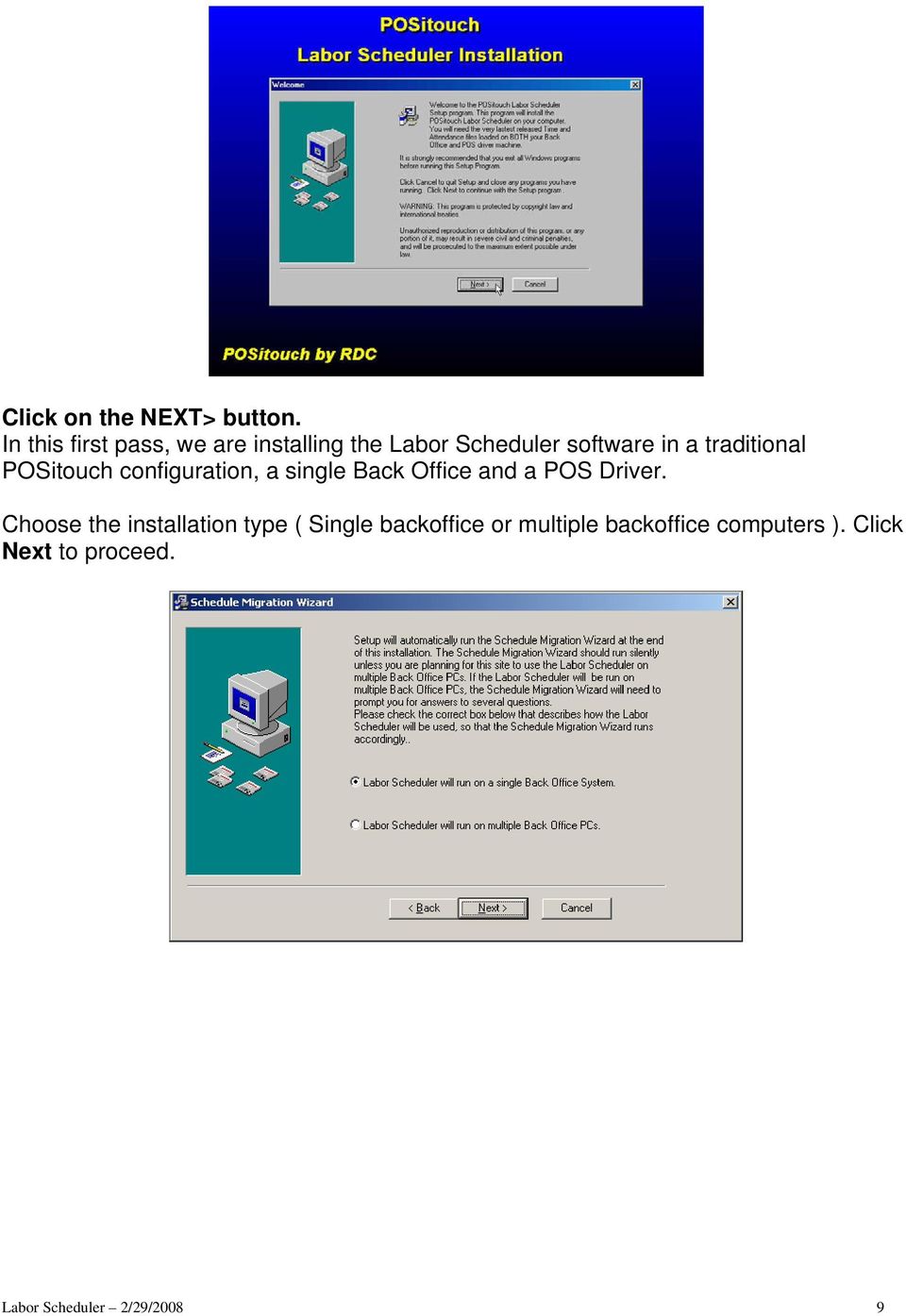
8 Installing the POSitouch Labor Scheduler: Single Back Office Computer The POSitouch Labor Scheduler is installed with the program LS_SETUP.EXE. The program is usually loaded on your computer from an installation CD. After inserting the CD into the CD-ROM drive, you will see the window below loading automatically. The assumption in this initial install guide is that you are installing the software on your Back Office system. There are two basic questions that the install addresses: Where are the Labor Scheduler executables going to be located (usually the C:\SC directory of the Back Office)? Where are the Time and Attendance data files with respect to the Back Office (usually L:\SC directory of the POSdrvr)? The documentation below initially deals with a single install on the Back Office. After you have a comfort level with the simplest form of the install, we review a multiple Back Office install. In a few seconds after you insert the CD in your drive, you will see the Welcome screen above for the POSitouch Labor Scheduler installation. Remember to CLOSE ALL WINDOWS PROGRAMS before beginning the Labor Scheduler Installation. 8 Restaurant Data Concepts, Inc.
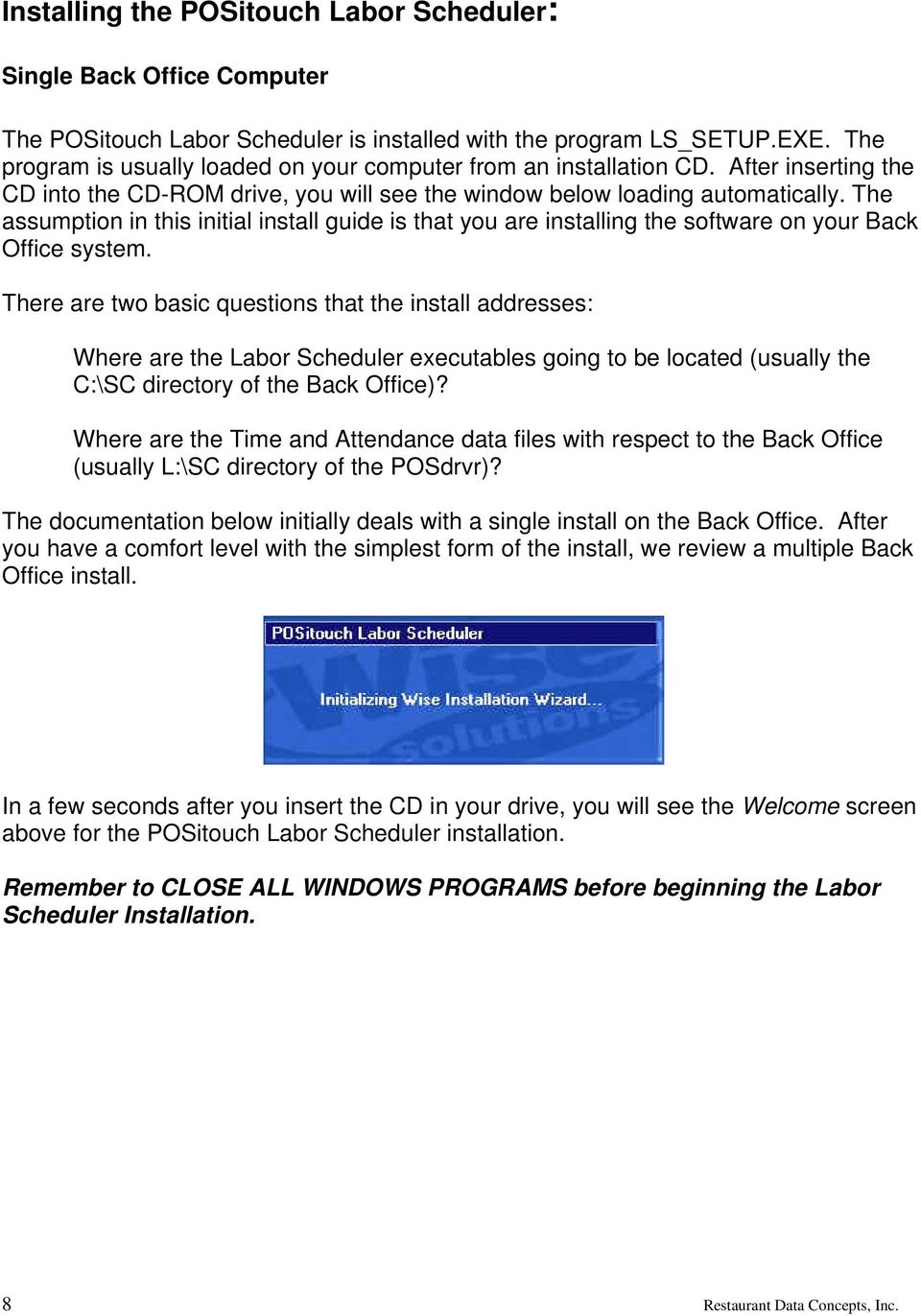
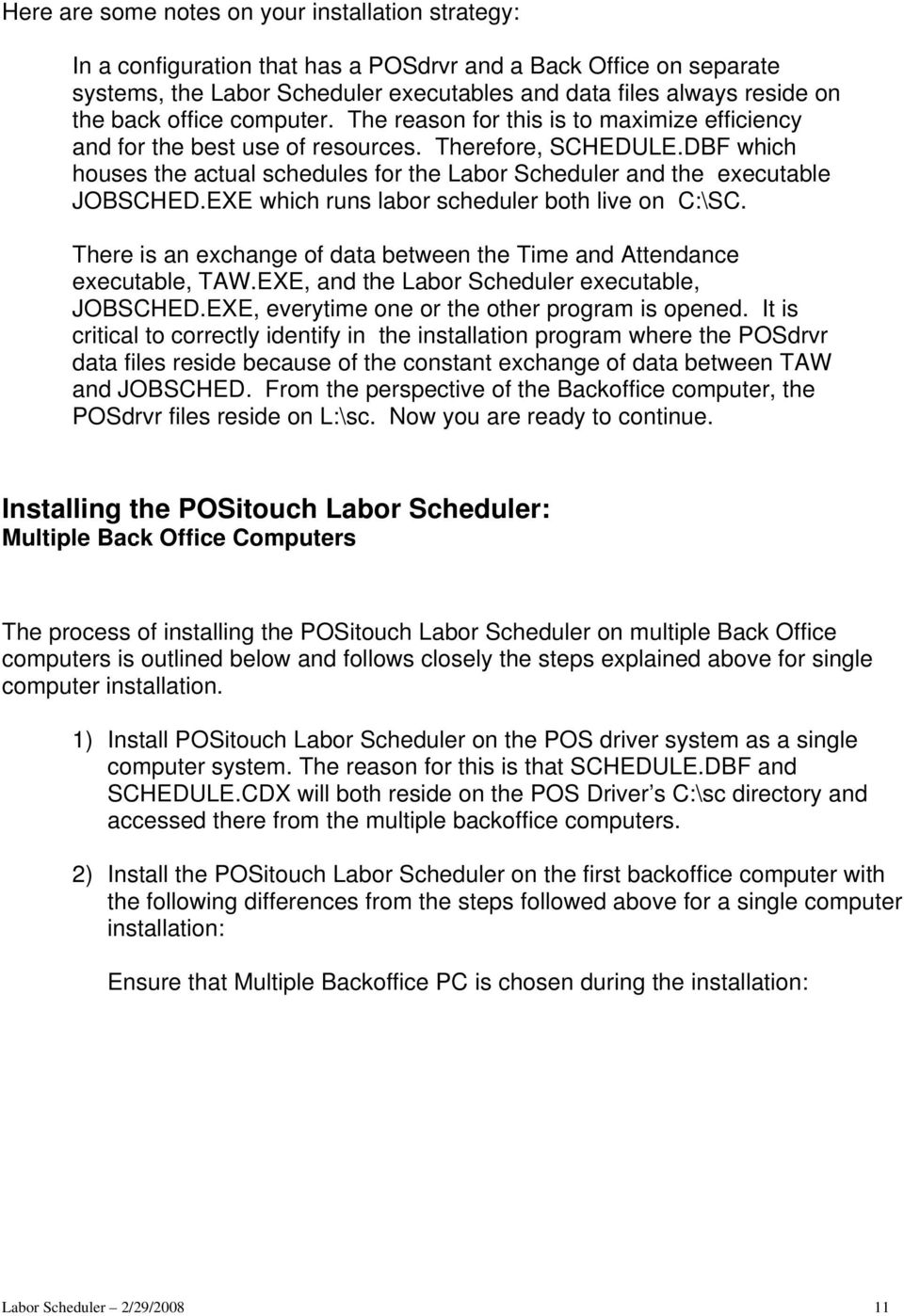
9 Click on the NEXT> button. In this first pass, we are installing the Labor Scheduler software in a traditional POSitouch configuration, a single Back Office and a POS Driver. Choose the installation type ( Single backoffice or multiple backoffice computers ). Click Next to proceed. Labor Scheduler 2/29/2008 9
10 Choose the Backoffice directory to install to. Typically this would be C:\SC Choose the location of the POS driver 10 Restaurant Data Concepts, Inc.

11 Here are some notes on your installation strategy: In a configuration that has a POSdrvr and a Back Office on separate systems, the Labor Scheduler executables and data files always reside on the back office computer. The reason for this is to maximize efficiency and for the best use of resources. Therefore, SCHEDULE.DBF which houses the actual schedules for the Labor Scheduler and the executable JOBSCHED.EXE which runs labor scheduler both live on C:\SC. There is an exchange of data between the Time and Attendance executable, TAW.EXE, and the Labor Scheduler executable, JOBSCHED.EXE, everytime one or the other program is opened. It is critical to correctly identify in the installation program where the POSdrvr data files reside because of the constant exchange of data between TAW and JOBSCHED. From the perspective of the Backoffice computer, the POSdrvr files reside on L:\sc. Now you are ready to continue. Installing the POSitouch Labor Scheduler: Multiple Back Office Computers The process of installing the POSitouch Labor Scheduler on multiple Back Office computers is outlined below and follows closely the steps explained above for single computer installation. 1) Install POSitouch Labor Scheduler on the POS driver system as a single computer system. The reason for this is that SCHEDULE.DBF and SCHEDULE.CDX will both reside on the POS Driver s C:\sc directory and accessed there from the multiple backoffice computers. 2) Install the POSitouch Labor Scheduler on the first backoffice computer with the following differences from the steps followed above for a single computer installation: Ensure that Multiple Backoffice PC is chosen during the installation: Labor Scheduler 2/29/
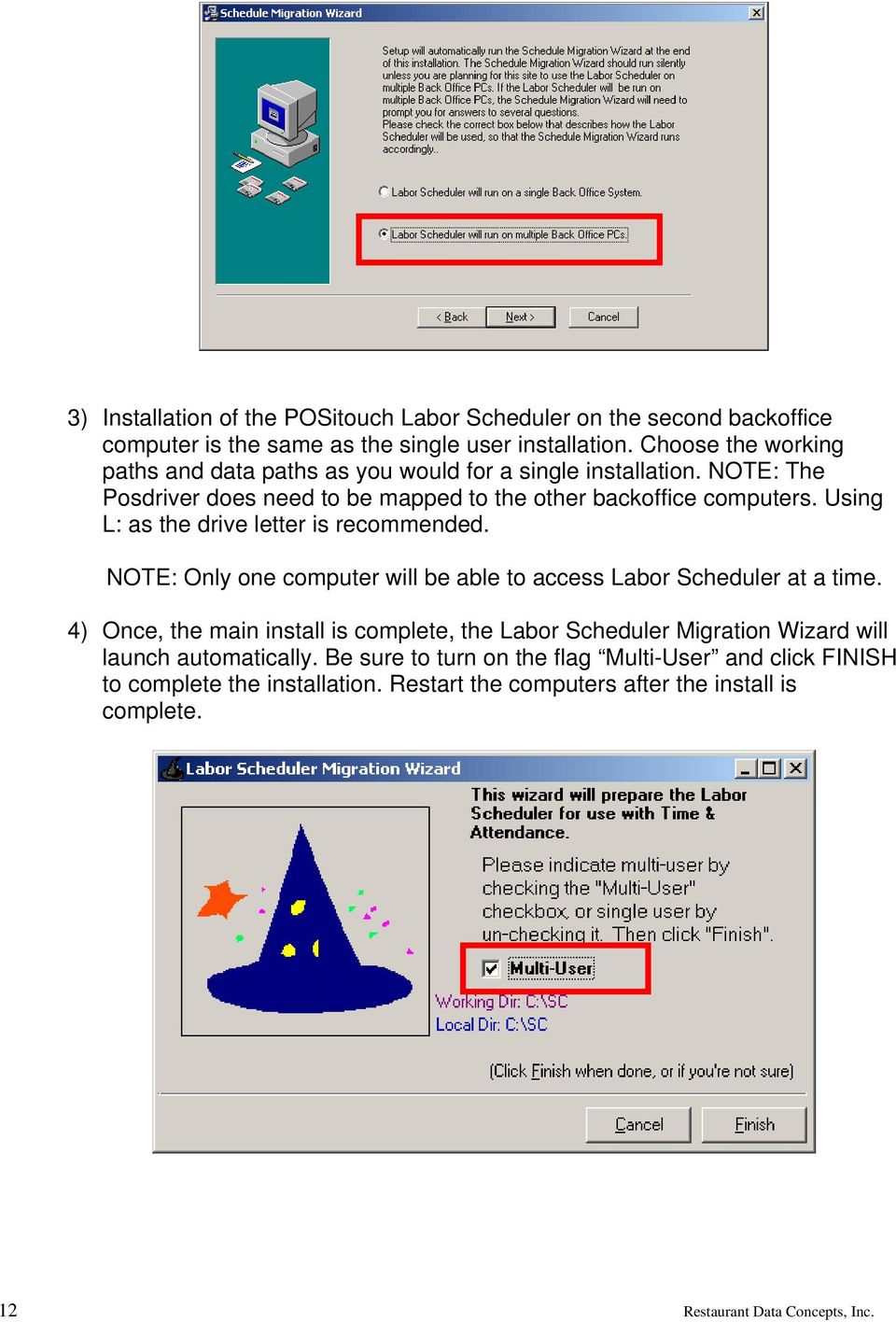
12 3) Installation of the POSitouch Labor Scheduler on the second backoffice computer is the same as the single user installation. Choose the working paths and data paths as you would for a single installation. NOTE: The Posdriver does need to be mapped to the other backoffice computers. Using L: as the drive letter is recommended. NOTE: Only one computer will be able to access Labor Scheduler at a time. 4) Once, the main install is complete, the Labor Scheduler Migration Wizard will launch automatically. Be sure to turn on the flag Multi-User and click FINISH to complete the installation. Restart the computers after the install is complete. 12 Restaurant Data Concepts, Inc.
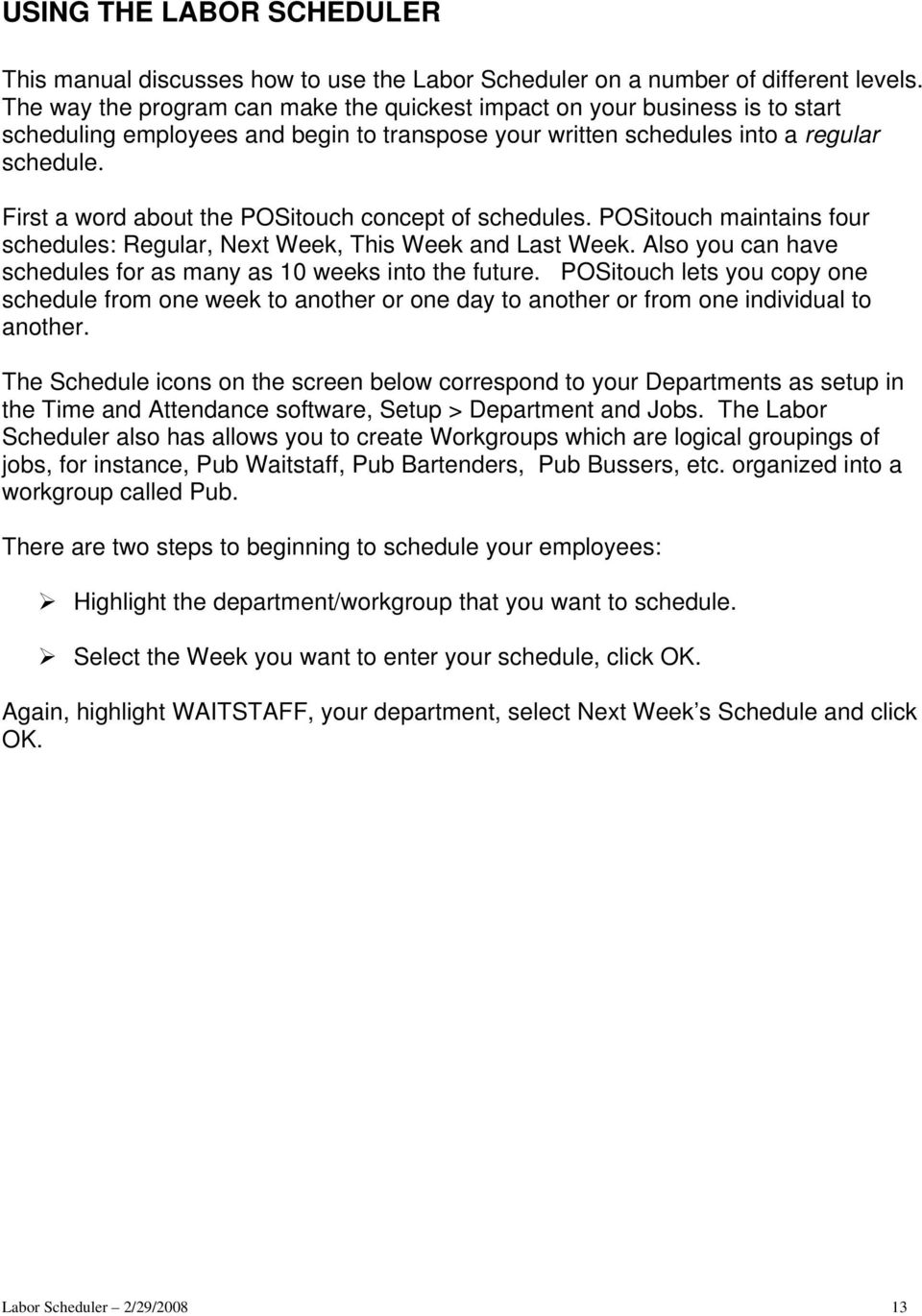
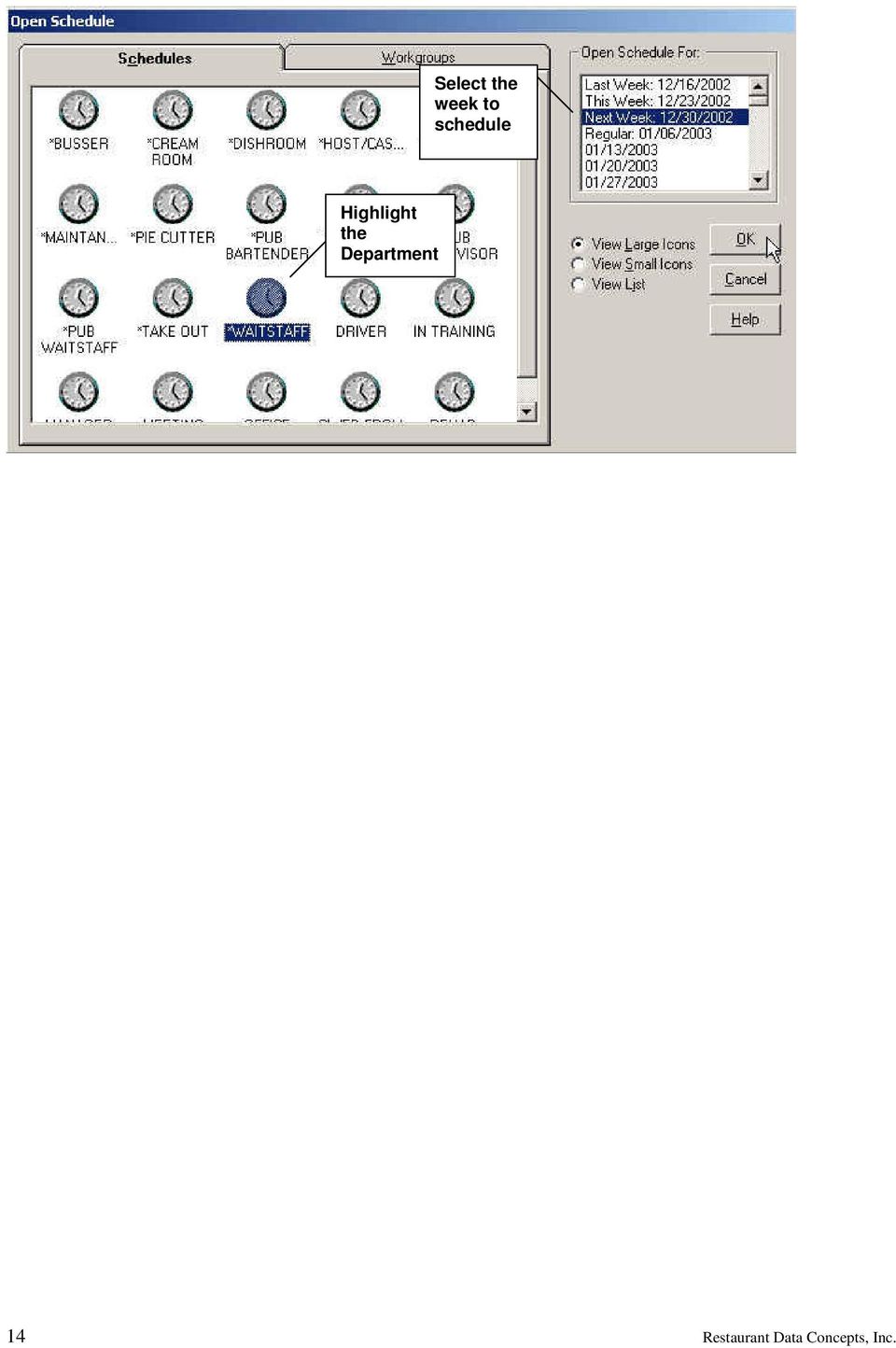
13 USING THE LABOR SCHEDULER This manual discusses how to use the Labor Scheduler on a number of different levels. The way the program can make the quickest impact on your business is to start scheduling employees and begin to transpose your written schedules into a regular schedule. First a word about the POSitouch concept of schedules. POSitouch maintains four schedules: Regular, Next Week, This Week and Last Week. Also you can have schedules for as many as 10 weeks into the future. POSitouch lets you copy one schedule from one week to another or one day to another or from one individual to another. The Schedule icons on the screen below correspond to your Departments as setup in the Time and Attendance software, Setup > Department and Jobs. The Labor Scheduler also has allows you to create Workgroups which are logical groupings of jobs, for instance, Pub Waitstaff, Pub Bartenders, Pub Bussers, etc. organized into a workgroup called Pub. There are two steps to beginning to schedule your employees: Highlight the department/workgroup that you want to schedule. Select the Week you want to enter your schedule, click OK. Again, highlight WAITSTAFF, your department, select Next Week s Schedule and click OK. Labor Scheduler 2/29/
14 Select the week to schedule Highlight the Department 14 Restaurant Data Concepts, Inc.
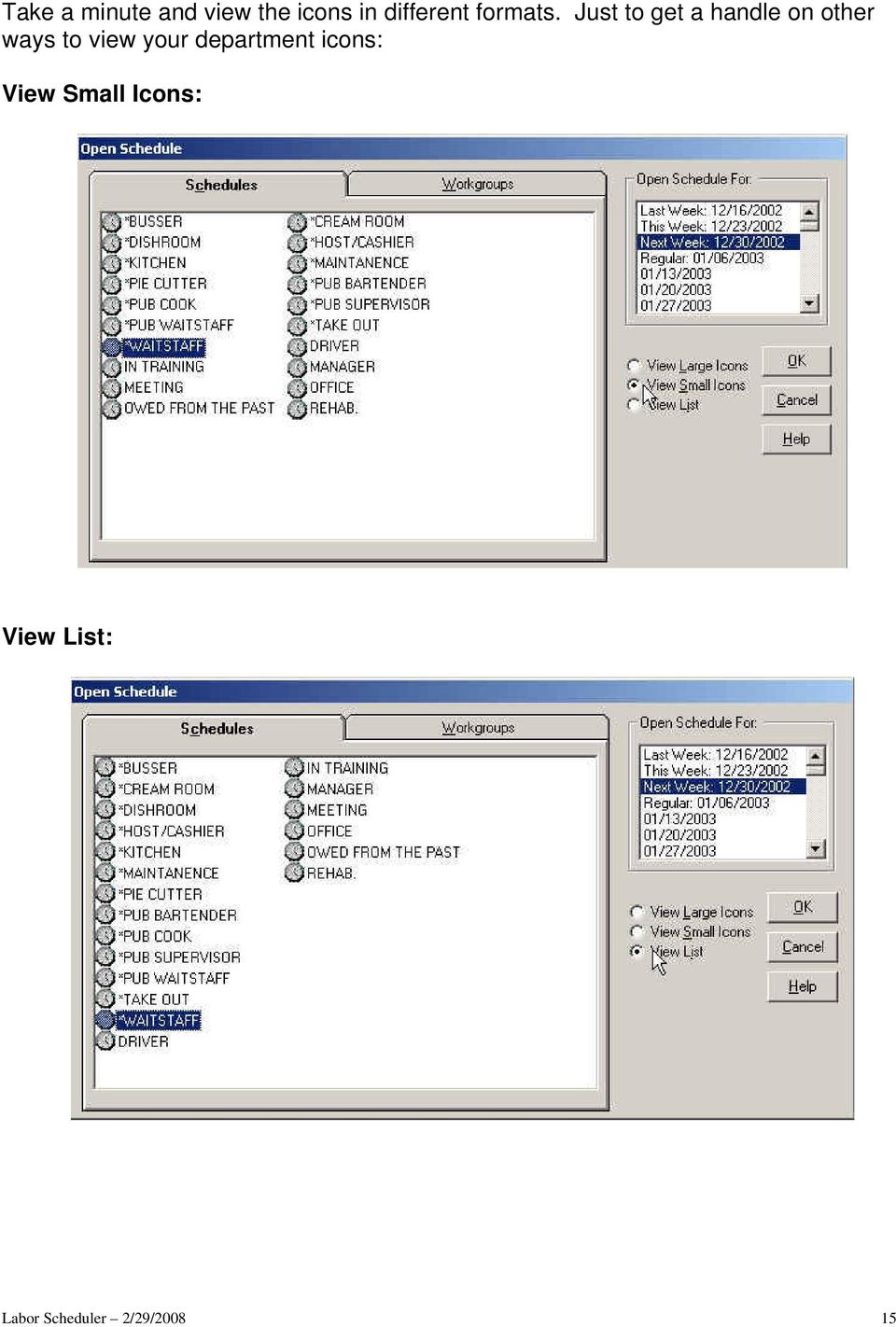
15 Take a minute and view the icons in different formats. Just to get a handle on other ways to view your department icons: View Small Icons: View List: Labor Scheduler 2/29/
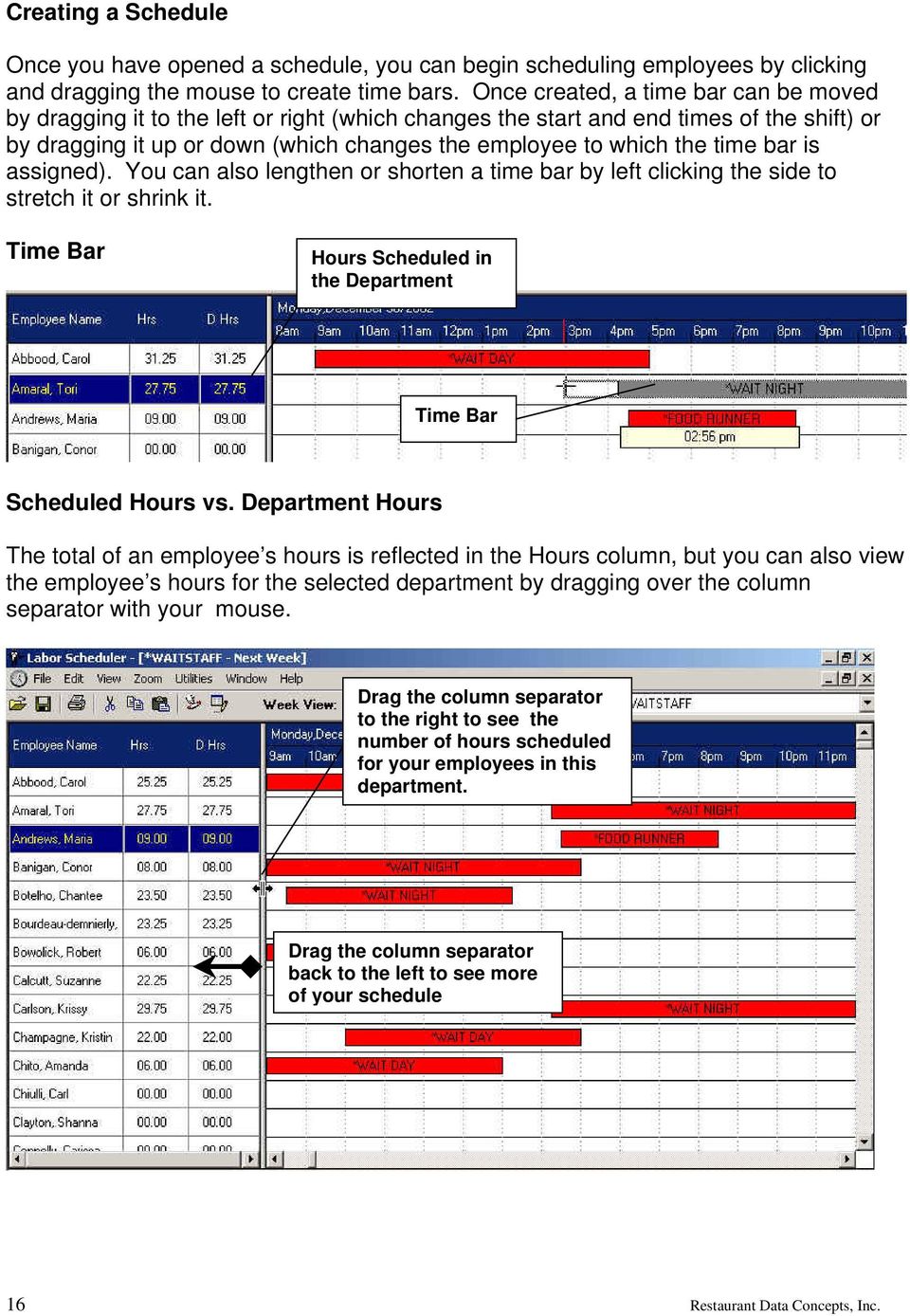
16 Creating a Schedule Once you have opened a schedule, you can begin scheduling employees by clicking and dragging the mouse to create time bars. Once created, a time bar can be moved by dragging it to the left or right (which changes the start and end times of the shift) or by dragging it up or down (which changes the employee to which the time bar is assigned). You can also lengthen or shorten a time bar by left clicking the side to stretch it or shrink it. Time Bar Hours Scheduled in the Department Time Bar Scheduled Hours vs. Department Hours The total of an employee s hours is reflected in the Hours column, but you can also view the employee s hours for the selected department by dragging over the column separator with your mouse. Drag the column separator to the right to see the number of hours scheduled for your employees in this department. Drag the column separator back to the left to see more of your schedule 16 Restaurant Data Concepts, Inc.
17 Copy a Time Bar Copy a schedule bar the way you would copy anything in windows. Highlight the schedule bar, then: Total Hours Highlighted Time Bar o Right Click on it, select COPY or o Select EDIT > Copy from the Job Scheduler menu or o Select a Time Bar then CTRL+C Labor Scheduler 2/29/

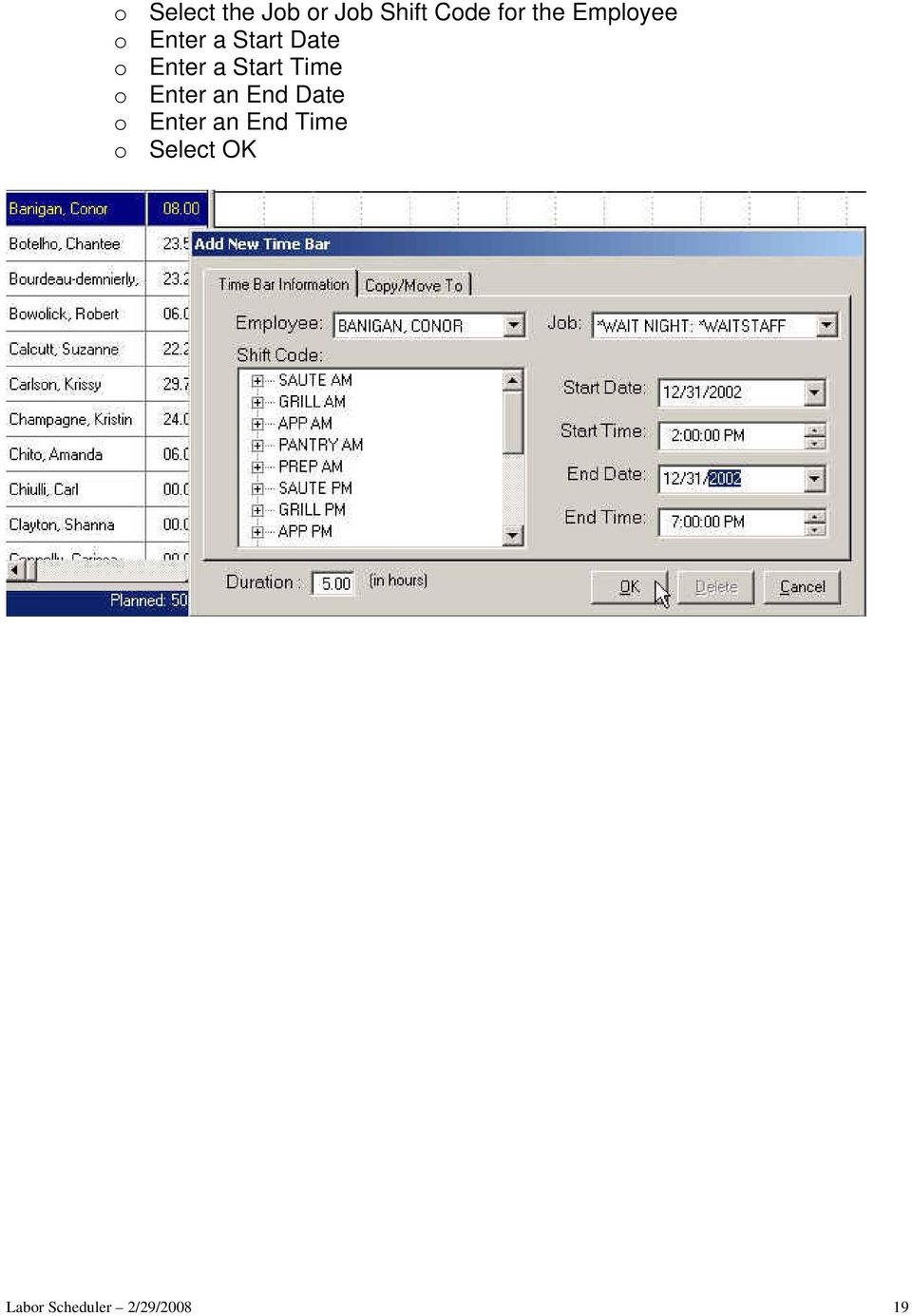
18 Paste a Time Bar Select the person to receive the copied schedule: then paste in any of these ways: o Select EDIT > Paste from the Job Scheduler menu or o Select an employee to receive the schedule, then CTRL+V ADD Selected Time Bar Highlight the Employee for whom you wish to Add a Time Bar. o Select EDIT > Add New Time Bar 18 Restaurant Data Concepts, Inc.

19 o Select the Job or Job Shift Code for the Employee o Enter a Start Date o Enter a Start Time o Enter an End Date o Enter an End Time o Select OK Labor Scheduler 2/29/
20 Clear Employee s Schedule Highlight the Employee whose schedule you wish to clear. o Select EDIT > Clear Employee Schedule Select YES, if you are sure you wish to remove the selected employee s schedule. Clear All Schedules Highlight an Employee in the department whose schedules you wish to clear. o Select EDIT > Clear All Schedules 20 Restaurant Data Concepts, Inc.
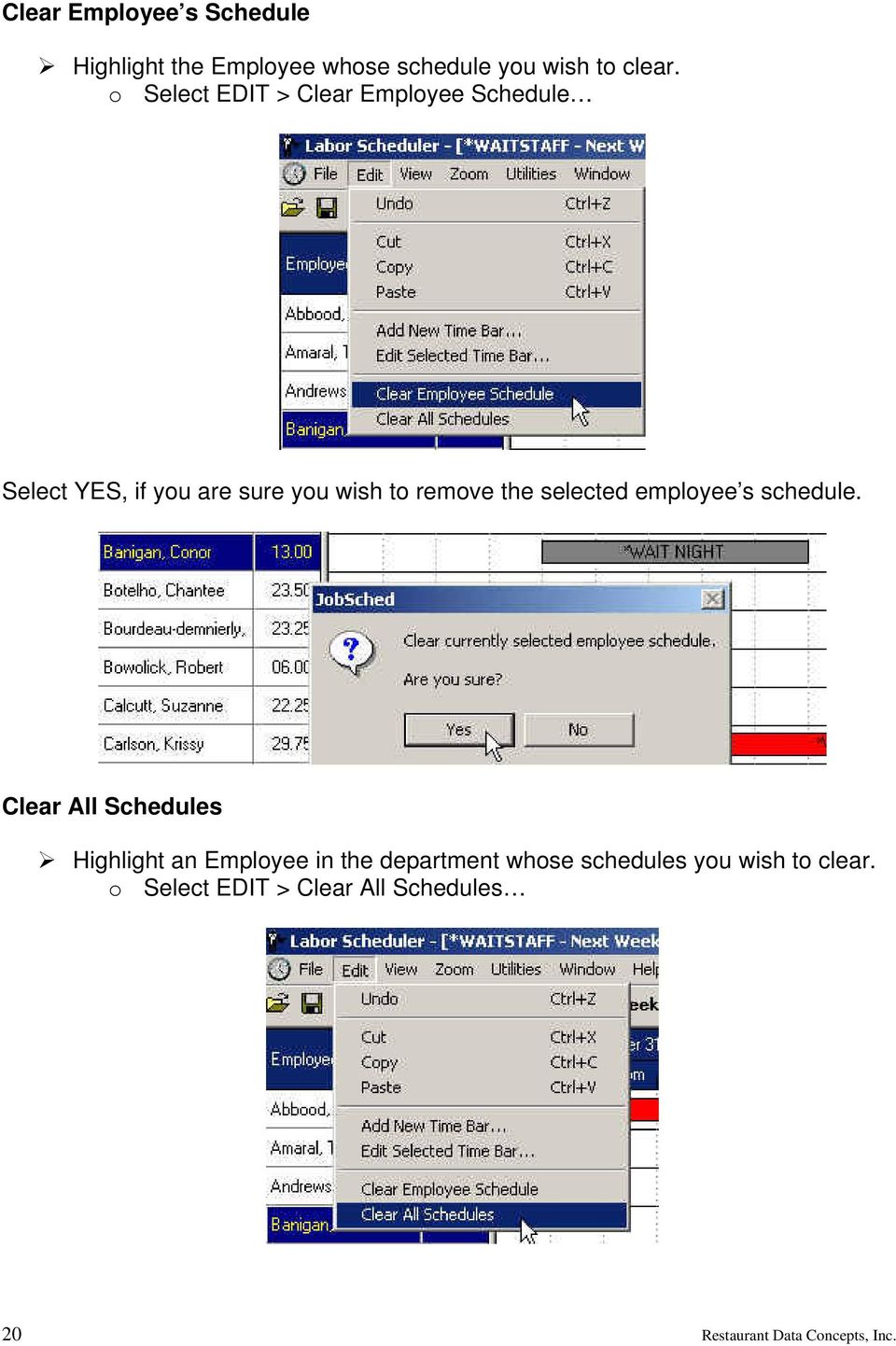
21 o Select YES, if you are sure you wish to remove all the Department s schedules. Labor Scheduler 2/29/
22 EDIT Selected Time Bar Highlight the Time Bar you wish to edit. o Select EDIT > Edit Selected Time Bar View Employee s Schedule You can view a single employee s schedule listing for the current week that you are scheduling by right clicking on the employee s name. A window like the one below displays all hours scheduled for the employee. That s it, you can now build your own schedule. What follows are variations on the theme or other ways to create, copy and edit your schedule. Equally as easy, but it shows you how to perform the same chores in a variety of different ways. With the EDIT, ADD NEW or DELETE options you can change and simply add new schedules 22 Restaurant Data Concepts, Inc.
23 to your scheduler database. To delete an employee s schedule, highlight the schedule you want to delete, then hit the DELETE button. Labor Scheduler 2/29/
24 Edit Selected Time Bar You can edit a time bar by double clicking on it or simply RIGHT CLICK and then LEFT CLICK on Edit Selected Time Bar. 2 Clicks on the Time Bar You can also select EDIT from the Job Scheduler menu, then click on Edit Selected Time Bar. Job Shift Codes are Job and Time Slots. Setup in T&A The pull down menus allow you to change Employee, Job, Start Date, Start Time, End Date, and End Time. Job Shift Codes Job Shift Codes are setup in the Time and Attendance module. They are simply efficient ways to link jobs and hours for scheduling purposes. An Grill AM job code means that the Grill Job is linked to 11:00 a.m. 4:30 p.m. time slot. Assigning a person to the Grill AM job code on a given day schedules them to the Grill Job for the hours associated with the job code. You cannot schedule a job code to someone who is not assigned to the job. 24 Restaurant Data Concepts, Inc.
25 Job Shift Codes are defined in BO Setup > Time and Attendence > Backoffice Time and Attendance Setup. o Click on the Job Shift Codes selection o Highlight the Department and Job, then click SELECT Labor Scheduler 2/29/
26 o SELECT ADD to add a Job Shift Code to the Department/Job selected. o ENTER a description name for the Job Shift Code you are adding. o ENTER an IN TIME and an OUT TIME for the Job Shift Code. o SELECT SAVE when you are satisfied with the results. 26 Restaurant Data Concepts, Inc.
27 o SELECT EDIT if you wish to change a Description, Time In or Time Out for a Job Shift Code. o SELECT DELETE if you wish to remove a Job Shift Code. Labor Scheduler 2/29/
28 Add New Time Bar You can use the pull down menu in the Labor Scheduler to add a new Time Bar by selecting the employee that for whom you want to add a new time bar, then EDIT > Add New Time Bar. With just the above information you can build your schedule and begin to take advantage of the benefits of keeping a close eye on your labor costs. 28 Restaurant Data Concepts, Inc.
29 Labor Scheduler 2/29/
30 Drag and Drop or Cut and Paste Time Bar You can click on a Time Bar and drag it to where you want to move the Time Bar. Just pick up a Time Bar and move it to another employees schedule, then drop it, that is, let go of your mouse button. The range of hours that you are moving are identified by the yellow paste it note. When you click on the time bar, the mouse arrow turns into cross hairs and you now can position the time bar with its range of 8 hours onto another employee schedule. Post it note tells you the number of hours in the Time Bar. Note, the Wait Day time bar is being dragged to the employee s schedule below. Position the time bar with its 6 hours when you want the employee to start his schedule that day. Drag & Drop 30 Restaurant Data Concepts, Inc.
31 Stretching a Time Bar A time bar can be stretched as well as dragged. Click on the time bar, then stretch it to the right or to the left. You will see the time in the post it note change as you stretch the time bar to the right or the left, try it. Grab an end and stretch. A time bar can be stretched as well as dragged. Click on the time bar, then stretch it to the right or to the left. You will see the time in the post it note change as you stretch the time bar to the right or the left, try it. Grab an end and stretch. Delete a Time Bar Deleting a time bar is as easy as highlighting it, then hitting the DEL key on your keyboard. The message that comes up asks you to confirm that you in fact want to delete the selected time bar. Labor Scheduler 2/29/
32 Also within the Edit Time Bar window is the Copy/Move To tab where you can copy or move the time bar to other days and/or other employees. Copy Schedules There is also a copy function for ease in copying schedules from week to week, day to day for people and departments. Go under Utilities>Copy Schedules to access this function. You must first close all open schedules before using this function. To close a schedule, choose File>Close. 32 Restaurant Data Concepts, Inc.
33 Labor Scheduler 2/29/
34 Clear Employee Schedule The Edit menu allows you to highlight a individual employee and by selecting the option Clear Employee Schedule remove all his schedules. A message will appear for you to verify that you in fact want to delete the schedule for the selected employee. 34 Restaurant Data Concepts, Inc.
35 Breaks, Paid & Unpaid Users can setup breaks within the Scheduler. These breaks can be set to automatically apply to a user s schedule after reaching a predetermined number of hours. For instance, if the policy of the company or state law, is that employees receive a 15 minute break after four hours of work, the Scheduler will apply a 15 minute break for a four hour shift. Users may then move this scheduled break to the estimated time that an employee will be on break. Additionally, these breaks can be set as paid or unpaid breaks. The break setting is global that is, you cannot set the Kitchen department to have paid breaks and the Waitstaff has unpaid breaks. By choosing View > Options, users can access the Break feature. The Breaks section allows users to choose Paid or Unpaid breaks, the number of hours to work before a break is automatically applied, and the default amount of time for each break. Labor Scheduler 2/29/
36 Paid / Unpaid Breaks report differently on scheduling reports. If breaks are Paid breaks, then on Schedule reports, users will be listed as working a full shift. In contrast, if breaks are Unpaid, employees are listed with a break in the hours they are scheduled for. Below are excerpts from a report showing an employee scheduled with a paid break for 4 hours of work, and a report showing what unpaid breaks look like. Reflects a shift with an unpaid break from 5:30 to 5:45 am. When Add breaks to timebars is on, a break is shown on the timebar as users drag a time bar across the schedule. In the example, below, as time bars are drawn, the 15 minute breaks are applied ( in green ). The breaks can be moved and resized to denote various times and lengths. 36 Restaurant Data Concepts, Inc.
37 In the example above, the green, break bars will appear for both Paid and Unpaid breaks. When using breaks, the Scheduled Hours at the bottom of the Scheduler will reflect the actual hours scheduled for that labor hour. That is, in the example below, Johnson, Courtney, a server, is scheduled from 5 pm. to 10 pm, with a ½ hour break from 8:00 pm to 8:30 pm. ( Note A below ) The Scheduled hours at the bottom of the screen denote one labor hour scheduled for each hour from 5 pm. to 10 pm ( Note B below ). However, from 8pm. to 9 pm., only.5 labor hours are scheduled for that time frame, since the server will be on break for 30 minutes of that hour. (Note C below ) A B C If our goal is to always have three servers scheduled from 5 pm. to 10pm., and ensure that each server recieves a 30 minute break during their shift, we can use the Labor Scheduler 2/29/
38 Scheduled hours to assure proper staffing for each hour. Below we schedule four servers, ensuring that there are always at least three servers during the time period of 5pm. to 10 pm. In the above example, we have one server that comes in late, and one that leaves early. Two work the entire 5 pm. to 10 pm. shift. Each server receives a 30 minute break, and we maintain the three labor hours per hour between 5 pm. and 10 pm. The Scheduled hours reflect that there are three people scheduled for each hour. In the above example, breaks are shown in green and can be moved and resized if needed. 38 Restaurant Data Concepts, Inc.
39 Thresholds Thresholds are a feature that allows users to customize the background of an employee in the scheduler when the hours they are scheduled for have met a specified value. This feature is accessible in Utilities > Options > Thresholds Labor Scheduler 2/29/
40 Users can set up thresholds based on the number of : Scheduled hours per day Scheduled days per week Scheduled hours per week, using up to three different colors. For instance, one color for employees over 30 hours, another color for over 35 hours and finally another color for over 40 hours. Once a flag is turned on and the hours are entered, users can choose the Color button and choose the color wanted. In the example below, we use the simple Red, Yellow, Green scheme. Red employees are scheduled too much, yellow are employees that should be watched for scheduling issues, and green are employees that are OK, but may be close to being oversheduled. 40 Restaurant Data Concepts, Inc.
41 Once, completed, choose OK. Below are a variety of employees that meet the criteria above and how the Scheduler would look in the various situations. Note that some employees backgrounds have changed, based on the hours scheduled. Special Note: Avoid using deep red as a background color for notifications. ( We use light red here ) Employee names automatically turn red when they are scheduled for overtime, and the name of the employee will not show on a deep red background. Overtime hours are defined in Backoffice Setup > Time & Attendance > Backoffice Setup > Payroll & Overtime Options. Labor Scheduler 2/29/
42 Security Security can be set manually in the bosettings.ini file (the only aspect in the INI where manual settings are necessary). Also, a file named security.cfg can be dropped in the sc directory containing the same settings shown below. When the Labor Scheduler is launched, and the Scheduler finds a security.cfg, it will import the settings, then delete security.cfg. This allows a central office to control the security settings for LS. The following lines can be added to the BOSETTINGS.INI file. Special Notes : When using a security.cfg file, DO NOT include the [Security] text. Replace [SECURITY] with [CENTRAL]. The settings will be imported into BOSETTINGS.INI, into a [SECURITY] section of the file. Password the password must contain at least one letter. Password are NOT case sensitive. [Security] Password=2abcd SecureForecast=[TRUE FALSE] secure forecast adjustments. When a user clicks on Utilities > Apply Forecasts, and attempts to edit the forecast percentages, they will be notified that the values may not be changed. SecureSetup=[TRUE FALSE] secure LS configuration dialog boxes. The following items will require a password when chosen : Utilities > Edit Guides, Utilities > Edit Workgroups, and Utilities > Edit Forecast groups. ForceUserGroups=[TRUE FALSE] When users start the jobsched.exe, they are forced to choose a workgroup, rather than allowing the user to choose the Workgroups tab or Schedules > Department tab. SecureForecast=TRUE 42 Restaurant Data Concepts, Inc.
43 SecureSetup=TRUE ForceUserGroups=TRUE Labor Scheduler 2/29/
44 The Labor Scheduler Menus and Toolbar We will now take a look at the different menus and the toolbar of the Labor Scheduler. Toolbar Tools The View menu allows you to select a number of different looks at your data. The tool bar has quick and accessible icons to select. These icons serve as shortcuts to commonly used functions. o SELECT TOOLBAR from the VIEW pull down menu. Note the appearance of the tool bar icons after you select View > Toolbar. If you do not wish to see the toolbar icons, simply select View > Toolbar again and they will be hidden. They toggle in and out of view by selecting the toolbar option. 44 Restaurant Data Concepts, Inc.
45 Labor Scheduler Toolbar The Labor Scheduler toolbar allows you to access several commonly used functions with a single click of the mouse. On the left side of the toolbar, you can Open, Save, Print, Cut, Copy, Paste, Add New Time Bar, and Edit Existing Time Bars using the toolbar icons. Open Save Print Cut Copy Paste Add New Time Bar Edit Time Bar On the right side of the toolbar, you can switch to a different week or a different department/group without having to exit back out to the main startup screen. OPEN Clicking the OPEN icon tool from the tool bar allows you to open a different schedule or workgroup. The Open Schedule screen below appears after clicking the OPEN icon tool from the tool bar. Select the Department or Schedule you wish to open. Labor Scheduler 2/29/
46 SAVE Clicking the SAVE icon tool from the tool bar lets you quickly save the work you have completed in the current session on your labor scheduler. PRINT Clicking the PRINT icon tool from the tool bar brings up the screen below which allows you to customize your job scheduler output. o Enter starting and ending date o Select a Bard Code Labeling choice. o Select the information columns you want printed. o Enter Report titles with a Main and Minor Heading. 46 Restaurant Data Concepts, Inc.
47 CUT Highlight a time bar and click the CUT icon tool from the tool bar to DELETE or Cut a time bar. If you wish to PASTE the time bar into someone else s schedule, simply highlight the person you want to add the schedule and the select the PASTE tool bar icon. COPY Highlight a time bar and click the COPY icon tool from the tool bar to COPY a time bar. To PASTE this time bar into someone else s schedule, simply highlight the person you want to add the schedule and the select the PASTE tool bar icon. Labor Scheduler 2/29/
48 PASTE After CUTTING, DELETING or COPYING someone s hours, you can move or copy those hours into someone else s schedule by highlighting the employee you wish to receive the CUT or COPIED time bar, then click the PASTE icon from the tool bar. ADD NEW TIME BAR Highlight the employee for whom you want to add a new time bar. Then click on the ADD NEW TIME BAR tool bar icon. The employee s name will be filled in, now just select a job from the drop down list. Or, select a Job Shift Code, which will fill in a job, start and end time, you still will need to fill in the date. 48 Restaurant Data Concepts, Inc.
49 EDIT, MOVE, COPY, or DELETE TIME BAR Select or highlight the time bar you want to edit, move, copy or delete, then click on Edit Time Bar icon. The employee s name, job, start/end time and date will be filled in. Make changes as appropriate in order to edit the time bar. Click on the COPY/MOVE TO tab to copy or move schedules to another employee and another day. Copy/Move Totab allows you to copy or move the schedule information you just entered on the Time Bar Information page to specific days for the employees checked on the form below. To move scheduled information from the Time Bar page to another day select the Move to radio button, then select the employees to receive the schedule. Labor Scheduler 2/29/
50 Jump to Day of the Week By clicking on a letter at the top of the screen, users can jump to that day of the week in the Scheduler without having to scroll left or right. 50 Restaurant Data Concepts, Inc.
51 Status Bar The Status Bar gives you quick information about totals of scheduled and planned hours. Also when you move your mouse over an employee s time bar, the Job, Date, time and number of hours scheduled in the time bar appears in the center position of the status bar Status Bar Provides Scheduled Hours Total: Status Bar Provides Planned Hours Total: Status Bar Provides Time Bar Information as you move your mouse over a time Labor Scheduler 2/29/
52 Status Grid The Stat Grid provides information that compares scheduled hours against planned hours. Built into the Labor Scheduler is the ability to schedule according to a plan based on sales dollars, covers, customer count or transactions. The plan looks at average over a 10 week period of any one of the four categories. The selected data set is then run against a guide which sets rations of units (of one of the four categories) to staff, that is, one staff person for $100 of sales. The result is a plan with number 52 Restaurant Data Concepts, Inc.
53 Edit Workgroups Workgroups are logical groupings of your employees within or across departments. In other words, it allows you to create a grouping of employees for the purpose of scheduling inclusive of staff in other departments, i.e., Busboys, Bartenders, Kitchen staff and Waitstaff. For example, you might want a workgroup called Dining Room Schedule, which consists of Servers, Bartenders, Busboys and Kitchen staff, that is, all employees that work in the dining room. To setup a workgroup select UTILITIES from the Menu Bar, then select EDIT WORKGROUPS Scheduling is done with a set of Departments and/or Workgroups that do not overlap and should include all jobs to be scheduled, but only once. There is no internal protection from including the same job in multiple workgroups or skipping a job. The Schedule Workgroup Setup window appears and you are ready to add a Workgroup, select Add Workgroup. In our simple example we are creating a workgroup for Pub Bartenders inclusive of the Bar Day and Bar Night jobs. Labor Scheduler 2/29/
54 The Schedule Workgroup Setup window appears and you are ready to add a Workgroup, select Add Workgroup. We are entering a workgroup name: PUB BARTENDERS. You can opt to assign the workgroup to a Department or leave it unassigned. From the available jobs on the Workgroup Detail listing on the left, highlight the job you want to move to the Job Assigned to Workgroup listing on the right and hit the plus sign. To remove a job from the Workgroup listing on the right, highlight the job on the right and then hit the minus sign to move it back to the left. 54 Restaurant Data Concepts, Inc.
55 To remove a Current Workgroup, find it in the pull down menu Current Workgroups, then hit the Delete Workgroup button. The Schedule Workgroup Setup window below illustrates how the process of highlighting jobs in the Workgroup Detail and then hitting the plus key moves them to the Job Assigned to Workgroup window. Labor Scheduler 2/29/
56 Once you have successfully populated the jobs that you want in the Workgroup, apply your changes and select OK. You access the workgroup for scheduling purposes by opening the schedule, then selecting the Workgroups tab, see below. 56 Restaurant Data Concepts, Inc.
57 Select the week you wish to build your schedule, then open the Pub Bartenders Workgroup. Labor Scheduler 2/29/
58 As you can see below, you are ready to schedule the employees whose jobs you have selected for the workgroup. 58 Restaurant Data Concepts, Inc.
59 Printing Reports Labor Scheduler allows a variety of reports. Below are four various reports that can be produced. Labor Scheduler 2/29/
60 Print ( Bar Graphs ) Choosing File > Print, prints a report showing employee time bars. Choosing PRINT on this screen will print the report in similar format. 60 Restaurant Data Concepts, Inc.
61 The printed report Labor Scheduler 2/29/
62 Standard Labor Report Choose a department to print 62 Restaurant Data Concepts, Inc.
63 Enter the week start date to print. The discrete value will be the week start date. Labor Scheduler 2/29/
64 Below is an example of a Schedule Report that was printed from the Labor Scheduler. The Schedule Report can also be printed without the employee number listed on the report. To facilitate this, users would go to Backoffice Setup > Time & Attendance > Backoffice Setup > Setup Reports > Schedule Report > Print Employee Number. The following items are required for this feature : - TAW.EXE dated 3/21/05 or later - Report4a.rpt dated 3/21/05 or later No Numbers 64 Restaurant Data Concepts, Inc.
65 You also have the option of printing a similar report, also called Schedule Report, through POSitouch Time & Attendance. The format is basically the same except the total hours scheduled for the week also appear on the POSitouch Time & Attendance Schedule Report in addition to the scheduled hours. An example of the T&A Schedule Report is below. This is accessed through Time & Attendance > Reports > Schedule Report. Labor Scheduler 2/29/
66 Report by Department / Job RPT by Dept/ Job allows users to reorder the Schedule Report as they want. Choose File > Print Weekly Report By Dept/ Job Choose a week to view and click Sort Order 66 Restaurant Data Concepts, Inc.
67 Highlight a department and click the Up/ Down arrow to reorder the report The Driver department is moved from printing last on the report, to first. The Department/ Job report prints departments and the scheduled employees in that department. At the end of the report, is a summary of hours by department, by day and finally a total of labor by department and by day. Labor Scheduler 2/29/
68 Report by Department / Job Excluding Hour Totals Users may wish to eliminate the total hours by employee and the department hours summary on the Report by Department/Job. Turn on the flag, Do not print hour totals for a report that eliminates the hour totals. Below are two examples of the same report. One with this option OFF and one with this option ON. Option OFF : Option On : * Report5a.rpt and Report5ab.rpt required 68 Restaurant Data Concepts, Inc.
69 Daily Report By Department & Time This report allows users to print a report showing one day, with employees sorted by department and time scheduled. Enter a date Users may also sort the report by Department by choosing Sort Order. Labor Scheduler 2/29/
70 Sample Report 70 Restaurant Data Concepts, Inc.
71 Employee Availabilty One important feature of the Labor Scheduler is that you can block out periods of time when employees are not available to work. These time blocks can be established for recurring requests (Andrew is not available on Mondays before noon) or for single occurrences (Sally is on vacation the week of 10/30). Permanent Requests can be as detailed as every week, every other week, every third week etc. Special Requests can be attributed to reasons such as Vacation or Medical Leave. To access this feature, go under Utilities>Edit Employee Availability. Times that an employee can t work can be filled in and they will get blocked off on their schedule as Not Available as shown below. It is not possible to schedule an employee during this time. Labor Scheduler 2/29/
72 Availability Exception List Although it is not possible to schedule an employee for a shift during a time that has been flagged as unavailable, it is possible to make an employee unavailable AFTER you have already scheduled the week. To look for any such scheduling conflicts you should view or print a listing of availability exceptions by going to Utilities>View Availability Exception List. This list shows you any employees who have been scheduled during a period of time in which they are not available. Once in the Availability Exception List screen, select the week in question and click on Get Results. Any hours where an employee is scheduled during an unavailable time appears in pink on the schedule, indicating a scheduling conflict. To correct this problem, right click on the employee to view all hours scheduled for the week. Highlight the shift that conflicts with their time off and delete the shift. The unavailability time bar remains pink even after you have deleted the offending shift until you close the schedule and reopen it. Front of the House Requests Users may enter schedule requests in the front of the house terminals through the TIME CLOCK option. Users enter the date and time of their requests. The requests are imported into the Labor Scheduler and are shown in yellow. See ACII2.DOC for SCHEDREQ.DAT file details. 72 Restaurant Data Concepts, Inc.
73 Forecast Setup The POSitouch Labor Scheduler allows you to schedule against a forecast. Forecasting is achieved by averaging data for a particular period and setting up a guide to apply the forecast. The system automatically builds 7 day rolling average forecast files containing sales, customer count, covers, and transaction counts for the entire house and each cost center by 15-minute intervals. This process happens during nightly processing at the store and defaults to averaging data for a 10-week period. The forecast files created can be attached to Forecast Groups that can be a sum of the numbers in one or more of these files. Once a forecast group is applied to a given week and department or work group, then the plan of hours is filled in. The plan serves and as a guide for scheduling. Before you can effectively use the Labor Scheduler to schedule against a forecast, you must first set up the labor guides and forecast groups. Forecast groups can be based upon sales, customer count, covers, or transaction counts. Auto-Adjusting Forecasts Adjustments can be sent to a store in a file called, forecastadjust.cfg. The file is an ACII delimited file that has the following layout: DepartmentName, WeekStart, Adjust1, Adjust2, Adjust3, Adjust4, Adjust5, Adjust6, Adjust7 Sample Record: Kitchen, 11/6/2006,.8,1,1,.92,1,1,1.3 Upon Labor Scheduler starting, if a forecastadjust.cfg exists on the POS driver, it will load the file and make the appropriate adjustments to the specified departments. The file is then deleted. Adjustment amounts are based on a scale of 0 to 1. A (.8 ) adjustment represents 80% of the projected forecast. Labor Scheduler 2/29/
74 The diagram below illustrates the flow of data and procedures from selecting the appropriate data set to creating a Guide to actually applying the forecast. We just outline the steps required for creating a plan, each step is explained in detail on the succeeding pages. Utilities > Edit Forecasting Groups Select Dataset: Covers, Sales, Transactions, or Customers link it to a Forecast Group. Utilities > Edit Guides Create a relationship between dataset units: Covers, Sales, Transactions, or Customers) and scheduled staff per hour. Then link to department or workgroup. 74 Restaurant Data Concepts, Inc.
75 Apply Forecast Select: Week to Apply Forecast, Forecast Group, Department or Workgroup Change: Units or Percentage Labor Scheduler 2/29/
76 Setup Forecast Groups In the Labor Scheduler, go to Utilities>Edit Forecasting Groups to enter the setup for the forecast groups. To add a new forecast group, click on Add Group, type in a name for the new group, and then click OK. Next, click on the three dots next to File to add to group. On the screen that appears, select the DBF file called HRSLSAVG.DBF and then click Open. This dbf contains an average cover count for every 15-minute interval for all 7 days of the week based upon the last 10 weeks. 76 Restaurant Data Concepts, Inc.
77 Finally, click on Add File to List and then click OK to save this forecast group. Additional Forecast Group Setup Information If you wish to create additional forecast groups based upon other available information, such as sales, customer counts, or transaction counts, you can do so by choosing a different DBF file in Setup Part 2 above. Other DBF s that can be used for forecasting are listed below. For each group, the first DBF contains data for the Entire House, while the numbered DBF files pertain to data by cost center. HRSLSAVG.DBF HRTRNAVG.DBF HRCSTAVG.DBF HRCOVAVG.DBF HRSLS01.DBF HRTRN01.DBF HRCST01.DBF HRCOV01.DBF HRSLS02.DBF HRTRN02.DBF HRCST02.DBF HRCOV02.Dbf HRSLS03.DBF HRTRN03.DBF HRCST03.DBF HRCOV03.DBF HRSLS04.DBF HRTRN04.DBF HRCST04.DBF HRCOV04.DBF HRSLS05.DBF HRTRN05.DBF HRCST05.DBF HRCOV05.DBF HRSLS06.DBF HRTRN06.DBF HRCST06.DBF HRCOV06.DBF HRSLS07.DBF HRTRN07.DBF HRCST07.DBF HRCOV07.DBF HRSLS08.DBF HRTRN08.DBF HRCST08.DBF HRCOV08.DBF HRSLS09.DBF HRTRN09.DBF SALES BY CC 1-9 TRANS BY CC 1-9 HRCST09.DBF HRCOV09.DBF CUSTOMER BY CC 1-9 COVER BY CC 1-9 Labor Scheduler 2/29/
78 Applying Forecasts To generate planned hours from a forecast, go to Utilities>Apply Forecast. A screen similar to the following will appear. A B C This screen defaults to all forecast groups and shows your sales from Hrslsavg.dbf (average sales by the hour of the last ten weeks). Note that units here represent sales dollars. To update a forecast, first choose what week(s) to apply the forecast to [A]. Then, select a forecast group that you created earlier [B]. Then select the departments or workgroups in the far right box that you want to apply to that forecast group [C]. After you have selected a forecast group, the unit information on the screen changes to whatever units are applicable to the forecast group that you selected. In this example, the forecast group selected is Waitstaff Forecast Group, which uses hourly sales, as the unit values in the Units row in the forecast chart. Depending on which DBF file you chose when you set up the forecast group, the Units row represents sales, cover counts, customer counts, or items sales. 78 Restaurant Data Concepts, Inc.
79 The unit filled in here depends on which dbf files you added to the forecast group. To determine your forecast for the week you need to decide what percentage of the average sales you will do on each day of the week. Some days may be higher than 100% and some may be lower. If you prefer to plug in the projected unit amount for the day, you can do this and the system will figure out the percentage for you. You need to look at each day individually and take into consideration anything you know about that day that could affect sales in one way or another. Some such factors are local events, holidays, weather forecasts or even construction in the area. Once your forecast is determined, apply it to your departments and workgroups that have guides set up for them by clicking on Apply. You can then click on View Forecast to see the Total Planned Hours generated by applying the forecast. If this is the first time you are viewing this screen or if you updated a forecast that is not This Week, you may get a message that indicates that there is no forecast generated for the selected week. By default, the week viewed on the View Forecast screen is This Week. If you applied the forecast to Next Week, click the option on the screen to switch to Next Week. Labor Scheduler 2/29/
80 Once you have applied a forecast, you are ready to schedule your employees for that week. Exit the Apply Forecast screen and look at the Planned Hours versus the Scheduled Hours on the bottom of the scheduler window. When you have underscheduled an hour, the Difference bar will appear in aqua. Overscheduling an hour causes the Difference bar to appear in red. Your goal is to have the difference between Planned and Scheduled hours to be minimal when you are finished scheduling. 80 Restaurant Data Concepts, Inc.
81 Below is an example of one scheduled day. As you can see, applying the forecast to the guide gives you your planned hours to schedule against. From this, you can see hour to hour if you are scheduling over, under, or right on target. The key steps in maintaining guides and using the forecast are as follows: Create guides for any and all departments you want to schedule via a forecast At the beginning of each week or any other time you want to, go into Utilities>Apply Forecast and apply the forecast to the guide(s) for any departments with guides. This generates the planned hours for each department. Bring up schedules by department or workgroup. Be certain to pay attention to the relationship of planned and scheduled hours. By selecting a closer scheduler view (using Zoom), one can see which days or segments of a day; the schedule is most out of line with the plan. Labor Scheduler 2/29/
82 Forecast Setup Options In Utilities > Options > Forecasting, users can determine what files are created for exporting data, as well as the Default Forecast Group and Productivity Function. Default Forecast Group Sets the optional Forecast Group that will appear by default in the Apply Forecast option. Export Functions Determines those files to create when exiting the job scheduler. See Export Files at the end of this document for details. 82 Restaurant Data Concepts, Inc.
83 Labor Guides To set up Labor Guides, go under Utilities>Edit Guides. A guide can be set up for each department or workgroup. Guides allow you to specify how many employees are needed based on a certain dollar amount, customer count or cover count per hour. You then specify which forecast group this department or workgroup will apply to. Departments or workgroups can have different guides yet still be applied to the same forecast group. First, assign the Forecast Group that you just created to this guide by selecting it from a list. Next, fill in the chart on the left to define how many people you will need based upon a range of units. Since we are basing our forecast on sales the Units in the column heading actually means Sales Dollars. However, if we were basing our forecast on covers instead of sales, the Units in the column heading would mean covers, though the label on the screen will not change to covers. The screen below is for demonstration purposes only. Think carefully about a guide that makes sense for you. Finally, type in a value for Offset (in Hours). This offset allows you to specify how much time in hours the employees should be scheduled for before the actual sales occur. This offset is used when applying a forecast to a schedule. Labor Scheduler 2/29/
84 84 Restaurant Data Concepts, Inc.
85 Productivity Function When viewing the productivity of the site, should the productivity number be determine by Labor Hours divided by the Units ( i.e. covers, dollars as defined in Setting up Forecasting Groups in the previous section ) or should units be divided by Labor Hours? Productivity Screen Adjust % - from the Apply Forecast screen, reflecting any increase or decrease in the percentage Plan Labor The labor hours proposed based on the forecast and labor guides. Plan Productivity Based on the Productivity Method Schedule Labor The number of hours scheduled by the user. Schedule Productivity Same as the Plan Productivity, except schedule hours ( by the user ) is used for computations. Labor Scheduler 2/29/
86 Labor Scheduler Menu Bar Through the File menu you can Open, Close, Save, and Print schedules. You can also Exit the Labor Scheduler here or you can Print a Schedule Report. Below is an example of a Schedule Report that was printed from the Labor Scheduler. You also have the option of printing a similar report, also called Schedule Report, through POSitouch Time & Attendance. The format is basically the same except the total hours scheduled for the week also appear on the POSitouch Time & Attendance Schedule Report in addition to the scheduled hours. An example of the T&A Schedule Report is below. 86 Restaurant Data Concepts, Inc.
87 Under the Edit menu, you can delete a highlighted time bar using Cut, copy a highlighted time bar using Copy, or Paste a cut/copied time bar using Paste. The Undo feature is not yet implemented. Also under Edit, you can Add a new time bar, Edit a highlighted time bar, clear the entire schedule for a selected employee, or clear all schedules for the week you are working in. Labor Scheduler 2/29/
88 Under the View menu, you can decide how you want to see different material displayed. Do you want to see the toolbar, the status bar and the statistics grid on the screen? You can sort the employees by first name, last name, primary job, by assignment or by number of hours scheduled. When sorting by number of hours scheduled, people with the most hours are listed last. You can also refresh the screen, which will bring you back to the default display. 88 Restaurant Data Concepts, Inc.
89 The Zoom menu allows you to take a closer or more distant look at the schedule. The Utilities menu is where you would go to View an Availability Exception List, Copy Schedules, Apply Forecasts, set up Employee Availability, and Edit Guides, Forecasting Groups and Workgroups. These functions were described in detail earlier in this document. Also under the Utilities menu is an Options button. The Options button brings you to a screen that lets you choose how many minutes the time bar should snap to. This indicates that the time bars would round to the closest fifteen minute interval. Labor Scheduler 2/29/
90 Templates and The Labor Scheduler NEW : Labor scheduler has the ability to now re-create Templates if the schedule.dbf and schedule.cdx are missing. This new feature checks for missing schedule.dbf or.cdx upon starting Labor Scheduler. There is a flag in Labor Scheduler>Utilities>Options>Use Templates: Templates are used in the Labor Scheduler in place of forecasts and guides. 90 Restaurant Data Concepts, Inc.
91 There is also an area to set a value for how many extended weeks a schedule can be created for beyond next week. By default, users may not modify past weeks schedules. To allow editing past weeks information, choose Options > General > and activate the Allow to modify past schedules. Labor Scheduler 2/29/
92 There is a new module called Template Editor that allows building a spreadsheet of job assignments and the shift times for these assignments for the 7 days of the week. It is a matrix of all of the work periods for a week that need to be assigned to people. Once in Labor Templates you can open existing templates, create new templates or copy a template. Templates can be created for different types of weeks to be scheduled based dollar volumes, Holiday s etc. This is a one time setup of the starting hour of your AM and PM shifts. In the Labor Scheduler Template Utility there is a place to set up Job Groups. This is a higher level grouping of Job assignments. By right clicking in the Job Group column, a menu pops up that allows the ability to insert, delete or edit a Job Group. 92 Restaurant Data Concepts, Inc.
93 This is where the job groups get entered. By right clicking in the assignment column, a menu pops up that allows the ability to insert, delete or edit an Assignment. This is the name of the Template editor row. Job Assignment names appear only in the Template Editor and the Job Scheduler they do not appear on Time & Attendance reports. Each Job Assignment must be tied back to a Time & Attendance Job or Shift Code. The names of the Job or Shift Codes will be used to tell a person where to report to work. Labor Scheduler 2/29/
94 By right clicking on a row a menu pops up that allows you to copy and paste row times. The right most column of the spreadsheet shows scheduled hours for each row with sub totals for each Job Group. The bottom row of each Job Group shows the AM and PM totals for that day. 94 Restaurant Data Concepts, Inc.
95 The Snap function allows forcing the template to match the corresponding work periods already setup in the Labor Scheduler for one of it s weeks. One possible scenario for using the snapping of a template to schedule would be: Copy This Week s Schedule to Next Week s Schedule. Select the correct Template or use the Template editor to adjust a Template based on Next Week s expected sales. Click on Snap and select Next Week. The work periods in the Labor Scheduler that Correspond to the Job Assignments in the Template are now snapped to the in and out times found in the Template. Labor Scheduler 2/29/
96 Within the Labor Scheduler, the Template Window can be brought up by selecting the View-Template Window. At the right in the Template Window are bars based on the shifts that were set up in the Template Utility. Blue bars represent a job assignment that needs to be given to someone. Once the job is assigned the bar turns gray and cannot be assigned again. To assign a bar you simply drag and drop the bar on a person in the schedule. Employees can be sorted by Job Assignment to make this task easier. By right clicking on an available shift, a box of eligible employees pops up and you can click on their name and then click on assign. The bar will then be assigned to that employee. 96 Restaurant Data Concepts, Inc.
97 Fixed Labor POSitouch has the ability to add fixed labor to the schedule guides. This allows a site to schedule employees independent of sales. For instance, the labor required for setup each day prior to the opening for business. Sites may require servers to arrive 30 minutes before service and cooks two hours prior to service in order to prepare for the day. To setup this feature : Choose : Labor Scheduler>Utilities>Edit Guides>Fixed Labor: This is where you set up fixed labor for the Labor Scheduler. o Choose Edit Guides: Labor Scheduler 2/29/
98 There is a drop down to choose departments: o Choose Fixed Labor: 98 Restaurant Data Concepts, Inc.
99 o Choose : Add New o Fixed labor Settings: Labor Scheduler 2/29/
100 Forecasting in POSitouch using HRSLSAVG.EXE The POSitouch Labor Scheduler allows you to schedule against a forecast. Forecasting in the POSitouch Labor Scheduler is achieved by averaging data for a particular period and setting up a guide to apply the forecast to. The system automatically builds 7 day rolling average forecast files containing sales, customer count, covers, and transaction counts for the entire house and each cost center.. The program HRSLSAVG.exe builds a rolling 7-day forecast of sales; cover counts, customer counts and item sales for the entire house and each individual cost center by 15 minute increments. This program runs as part of nightly processing, and defaults to averaging data for a 10-week period. Option 2 If 10 weeks is not considered reasonable you can alter this default setting by adding a command line parameter (which is simply the number of weeks you want to average). For example, running Hrslsavg to get a 4-week average would look like this: Hrslsavg 4 Hrslsavg has a default setting to include any negative items or over-rings in the averages. You have the ability to change this through an ini file if you want your forecasting data to ignore negative items and/or overrings. Below is a sample Hrslsavg.ini file that tells Hrslsavg to ignore negative items and ignore any over-rings when calculating averages. It is important to note that hrslsavg can run without the command line parameter and without the ini file. It will then default to a 10 week rolling average that will include any negative items and/or overrings. Option 3 Another option for HRSLSAVG.exe is to run the program with specific weeks to process. The week ending dates are used as part of the parameters with an optional output directory specified. The command line is HRSLSAVG MM/DD/YY[, MM/DD/YY] output_folder Week ending dates are separated by a comma, and users can specify one or more weeks. The output directory is written with the drive letter included. Note that a space is required between the last date and the output directory. Example for a single week : HRSLSAVG 09/01/07 C:\My_Forecast Example for multiple weeks : HRSLSAVG 08/01/07, 08/08/07, 08/15/07 C:\My_Forecast 100 Restaurant Data Concepts, Inc.
101 Once Hrslsavg has run, it creates dbf files in the Forecast directory on the POS Machine. There are four groups of HR*.DBF files: HRSLS*.DBF - has sales info. HRCOV*.DBF - has covers info. HRCST*.DBF - has customer data. HRTRN*.DBF - has transaction data (checks). The next page will explain all the dbf files that are created based on a 10-week average. Labor Scheduler 2/29/
102 At the top of each column you will notice an HR AVG.DBF. This file contains the entire House Total. The HR 01.DBF contains the data for cost center 1, HR 02 contains data for cost center 2, and so on DBF s created by Hrslsavg.exe HRSLSAVG.DBF HRTRNAVG.DBF HRCSTAVG.DBF HRCOVAVG.DBF HRSLS01.DBF HRTRNO1.DBF HRCST01.DBF HRCOV01.DBF HRSLS02.DBF HRTRNO2.DBF HRCST02.DBF HRCOV02.DBF HRSLS03.DBF HRTRNO3.DBF HRCST03.DBF HRCOV03.DBF HRSLS04.DBF HRTRNO4.DBF HRCST04.DBF HRCOV04.DBF HRSLS05.DBF HRTRNO5.DBF HRCST05.DBF HRCOV05.DBF HRSLS06.DBF HRTRNO6.DBF HRCST06.DBF HRCOV06.DBF HRSLS07.DBF HRTRNO7.DBF HRCST07.DBF HRCOV07.DBF HRSLS08.DBF HRTRNO8.DBF HRCST08.DBF HRCOV08.DBF HRSLS09.DBF HRTRNO9.DBF HRCST09.DBF HRCOV09.DBF Sales by CC 1-9 Trans by CC 1-9 Customer by CC 1-9 Cover by CC 1-9 Below is a view of one of the dbf files created by Hrslsavg. Most fields are self-explanatory. The Day_of_wk field is based on Sunday being day 1 and subsequently Saturday is day 7. The amount field would show sales dollars, covers, or whatever target data the dbf was created for. All info is business day related. Any hours that are before the restaurant opens belong to the next calendar day, but the same business day. 102 Restaurant Data Concepts, Inc.
103 The Communication Process Between Time & Attendance and Labor Scheduler The Labor Scheduler allows access from multiple backoffice computers, or Multi-user mode. Users can also use the Labor Scheduler in Single-user mode, which uses a single backoffice computer and the Posdriver. The setup of the location determines the file locations. Below are the various layouts. In Single User Mode ( One backoffice computer and a Posdriver ) Jobsched.exe Start: Calls TAW Export Places the following files on the Backoffice ( C:\sc\ ) : Deptfile.dbf Deptlist.dbf Empfile.dbf Jobfile.dbf Schovr.dbf Schsetup.dbf Schshift.dbf &.cdx Schedule.dbf* &.cdx* End: Calls TAW Import Imports data from Schedule.dbf into Taemploy.dbf Time & Attendance Start: Does TAW Import Imports data from schedule.dbf into Taemploy.dbf End: Does TAW Export Places the following files on the backoffice ( C:\sc ) Deptfile.dbf Deptlist.dbf Empfile.dbf Jobfile.dbf Schovr.dbf Schsetup.dbf Schshift.dbf &.cdx Schedule.dbf* &.cdx* * TAW Export does not re-create schedule.dbf and schedule.cdx, however it will create the files if they do not already exist. Bosettings.ini in L:\sc ( the POS driver ) contains the location path for all data files for the Labor Scheduler. [General] BOLocationPath=c:\sc\ BOWorkingPath=L:\sc [LaborScheduler] GuideGridFlag=2 SchedulerDBPath=L:\sc\taw_dbfs.mdb ExtendedWeeks=99 DBFPath=c:\sc MultiUse=FALSE ExportForecastInfo=False [LaborTemplates] TemplateDBPath=L:\sc\labor templates\templateinfo97.mdb Labor Scheduler 2/29/
104 Program & Data Files Single user Mode Multi user Mode POSdriver L:\SC Backoffice Computer C:\SC Additional Workstations Program Files Taw.exe Tarw.exe Taredo.exe Tareset.exe Program Files Taw.exe Tarw.exe Taredo.exe Tareset.exe Jobsched.exe Program Files Taw.exe Tarw.exe Taredo.exe Tareset.exe Jobsched.exe T&A Data Files Punch2.dat Tamaster.dat Taemploy.dbf Taempl_1.idx Taempl_2.idx Taempl_3.idx Time.sys User.sys NO Is Multi- User Mode? YES Scheduler Files TAW_DBFS.MDB TemplateInfo97.mdb Bosettings.ini Scheduler Data Files on C:\SC ( Backoffice ) Scheduler Data Files on L:\SC ( PosDriver ) Scheduler Data Files Deptfile.dbf,.cdx Deptlist.dbf,.cdx Empfile.dbf,.cdx Jobfile.dbf,.cdx Joblist.dbf,.cdx Schovr.dbf Schsetup.dbf Schshift.dbf,.cdx Schdeule.dbf,.cdx Database files are normally located on the POSdriver, and include TAW_DBFS.MDB and TemplateInfo97.mdb. Labor Scheduler Data files are located on the Backoffice computer ( For Single-user mode, or on the Posdriver when in Multi-user mode ). The Time & Attendance Data Files are located on the POSdriver and archived into a Back?.zip file every night. 104 Restaurant Data Concepts, Inc.
105 Import and Export Import Labor Scheduler Features It is possible to import particular features for the Labor Scheduler. The settings that can be imported include : Forecast Groups Fixed Labor Labor Guides See each item s respective section in this document for a full explanation of the feature. To import these features from another database : 1. Copy a TAW_DBFS.MDB file with the desired features set to lscopysource.mdb 2. Install the lscopysource.mdb into the directory where taw_dbfs.mdb exists 3. Open Labor Scheduler. The features listed above will be imported. Fixed Labor numbers will be applied when the user chooses Apply Forecast in the Labor Scheduler. 4. The lscopysource.mdb file is deleted upon importing. Labor Scheduler 2/29/
106 TAW Import When Taw.exe starts and Labor Scheduler ends, Taw imports schedules for last week, this week, next week and the following week from Schedule.dbf to Taemploy.dbf. Excludes inactive employees. TAW ImportAll When Taw.exe starts and Labor Scheduler ends, Taw imports schedules for last week, this week, next week and the following week from Schedule.dbf to Taemploy.dbf. Includes inactive employees. TAW EXPORT When Taw.exe ends and Labor Scheduler starts, Taw exports data from Taemploy.dbf, Tamaster.dat and Tashift.dat to the following files: DEPTFILE.DBF, CDX DEPTLIST.DBF, CDX EMPFILE.DBF, CDX JOBFILE.DBF, CDX SCHOVR.DBF SCHSETUP.DBF SCHSHIFT.DBF, CDX SCHEDULE.DBF, CDX Schedule.dbf and Schedule.cdx files get generated only if they don t already exist. 106 Restaurant Data Concepts, Inc.
107 Time & Attendance Files Data Files PUNCH2.DAT: This file is an ASCII data file located in the C:\sc directory of the POSdriver. It contains all punches and adjustments from the order entry system. Each line begins with a punch serial number of the transaction. The serial number of the last punch should always equal the number in the upper left corner of the Time & Attendance Main Menu. Every time the Time & Attendance program is accessed all punches through the current week are read into the database. TAEMPLOY.DBF: This is a data file that contains employee records, hours and schedules. This is the file that the transactions from Punch2.dat get read into. This file contains this week and last week s data. TAEMP2.DBF: TAW makes a copy of TAEMPLOY.DBF each time it exits called TAEMP2.DBF. The POS uses this copy of the file if it exists when it loads. TAMASTER.DAT: This data file contains the options flagged in setup as well as department and job names. TIME.SYS: This data file contains the BackOffice setup flags and options needed for the POS System. USER.SYS: This data file contains all POS user information. TAEMPL_1.IDX: Index of names created by taredo.exe. TAEMPL_2.IDX: Index of employee numbers created by taredo.exe. TAEMPL_3.IDX: Index of department and jobs created by taredo.exe. The above data files are archived nightly in Back1.zip Back20.zip. 1 is the most recent and 20, is 20 days ago. TXE0101.DBF = Copy of taemploy.dbf. TXM0101.DAT = Copy of tamaster.dat. TX10101.IDX = Copy of taempl1.idx. TX20101.IDX = Copy of taempl2.idx. TX30101.IDX = Copy of taempl3.idx. These TX files are created during the process of advancing the weekly schedule. The 0101 in the files name signifies, the first week of These TX files are historical files that are archived into the tahist01.zip. This file holds 5 TX files for each week of the year. Labor Scheduler 2/29/
108 TAW_DBFS.MDB This is the database that the Labor Scheduler uses to link itself to the DBF files. TEMPLATEINFO97.MDB This is the Database used for Templates by the Labor Scheduler. SCHEDULE.DBF This file contains all Schedule information. Taemploy.dbf holds four weeks of schedule information. The Labor Scheduler allows the ability to schedule multiple weeks into the future and these schedules are stored in this file. Application Files TAW.EXE: This program file does everything in the Time & Attendance module with the exception of reports. TARW.EXE: This program file is called by TAW.EXE when accessing reports. It handles all labor, payroll and management reporting functions. TAREDO.EXE: This is a program that builds the following index files for quick access to information. TAEMPL_1.IDX: Index of names. TAEMPL_2.IDX: Index of Employee Number. TAEMPL_3.IDX: Index of Department and Job. SCHEDMI.EXE: This is the program for the Migration Wizard, which is used to get the schedule and job information from POSitouch Time & Attendance into the Labor Scheduler. The path for TAW_DBFS.MDB to link to the DBF files will also be identified through this process. When the Labor Scheduler is first installed Schedmi.exe calls TAW EXPORT and generates the Schedule.dbf and Schedule.cdx files. 108 Restaurant Data Concepts, Inc.
109 BOSETTINGS.INI This INI file contains Labor Scheduler and Template information and paths. Bosettings.ini is located in the component directory off of the BackOffice c:\sc. It should be noted that all settings are controlled from within the Labor Scheduler program. With the exception of the security settings listed below, users can edit these settings from within the program. [General] BOLocationPath: obsolete BOWorkingPath: obsolete [LaborScheduler] SchedulerDBPath: obsolete ExtendedWeeks= number of weeks beyond next week can user create schedules for. DBFPath= obsolete GuideGridFlag= is 2 if using templates and template data is to be displayed in the summary grid (grid at bottom of scheduling window); any other value defaults to using forecast data in the grid MultiUse= True if scheduler is being used from multiple PCs; otherwise it is in singe-use mode by default ExportForecastInfo= If True, exports.fcst for every department when forecasts are applied ExportForecastUnits= If TRUE, exports units generated by applying forecast for each department into LSForecast.mdb ExportGuides= If True, will export every guide into a separate delimited.ghdr (forecastgroupname.ghdr) file; also will export every forecast group s dbf file list into a separate. fgexp file (Forcasetgroupname.fgexp); This all happens anytime a forecast is modified or created. [LaborTemplates] TemplateDBPath= obsolete AMStart= used by the template utility program to indicate which hour (0-23) starts am work hours PMStart= used by the template utility program to indicate which hour (0-23) starts pm work hours [LaborBreaks] UnpaidBreaks= if true, LS is in Unpaid Breaks mode (vs Paid breaks) AutoBreaks= If true, a break will automatically be added to a time bar when a employee is scheduled DefaultBreakDuration= defines how long a break by default will be (in minutes) MinSchedHours= if AutoBreaks is TRUE, indicates how long a timebar must be before automatically adding a break to it (in hours) [Productivity] Function= if 0, productivity is computed by using (Labor/Units); if 1, productivity is computed by using (Units/Labor) DefaultForecast= name of forecast group used for productivity by default All settings below hold adjustments made to forecasted hourly data for each day of given week (ArbWeeks represent weeks beyond next week) LastWeekAdjust = ThisWeekAdjust = NextWeekAdjust = OtherWeekAdjust = ArbWeekAdjust1 = ArbWeekAdjust2 = ArbWeekAdjust2 = ArbWeekAdjust2 = Labor Scheduler 2/29/
110 Security can be set manually in the bosettings.ini file (the only aspect in the INI where manual settings are necessary). Also, a file named security.cfg can be dropped in the sc directory containing the same settings shown below. When the Labor Scheduler is launched, and the Scheduler finds a security.cfg, it will import the settings, then delete security.cfg. This allows a central office to control the security settings for LS. The following lines can be added to the BOSETTINGS.INI file. Special Notes : When using a security.cfg file, DO NOT include the [Security] text. Replace [SECURITY] with [CENTRAL]. The settings will be imported into BOSETTINGS.INI, into a [SECURITY] section of the file. Password the password must contain at least one letter. Password are NOT case sensitive. [Security] Password=abcd1234 SecureForecast=[TRUE FALSE] secure forecast adjustments. When a user clicks on Utilities > Apply Forecasts, and attempts to edit the forecast percentages, they will be notified that the values may not be changed. SecureSetup=[TRUE FALSE] secure LS configuration dialog boxes. The following items will require a password when chosen : Utilities > Edit Guides, Utilities > Edit Workgroups, and Utilities > Edit Forecast groups. ForceUserGroups=[TRUE FALSE] When users start the jobsched.exe, they are forced to choose a workgroup, rather than allowing the user to choose the Workgroups tab or Schedules > Department tab. Thresholds are handled through the threshold configuration dialog in LS. Up to 5 thresholds can be defined [Thresholds] ThreshType0= 1 = Hours per day, 2 = Days per week, 3 = Hours per week ThreshValue0= depends on type and holds the threshold value of that type (above) ThreshColor0= color to display if threshold is breached ThreshActive0= TRUE if threshold is active. Settings above apply to the rest of thresholds defined below ThreshType1=0 ThreshValue1=0 ThreshColor1=23484 ThreshActive1=FALSE ThreshType2=0 ThreshValue2=0 ThreshColor2=23484 ThreshActive2=FALSE ThreshType3=0 ThreshValue3=0 ThreshColor3=23484 ThreshActive3=FALSE ThreshType4=0 ThreshValue4=0 ThreshColor4=23484 ThreshActive4=FALSE INI FILE AS IT APPEARS WITH ALL SETTINGS INCLUDED: [General] BOLocationPath=C:\SC\ BOWorkingPath=C:\SC\ [LaborScheduler] SchedulerDBPath=C:\SC\TAW_DBFs.mdb ExtendedWeeks=0 DBFPath=C:\SC\ GuideGridFlag=2 MultiUse=FALSE ExportForecastInfo = FALSE 110 Restaurant Data Concepts, Inc.
111 ExportForecastUnits = FaLSE ExportGuides = FALSE [LaborTemplates] TemplateDBPath=C:\SC\TemplateInfo97.mdb AMStart=0 PMStart=0 [LaborBreaks] UnpaidBreaks = FALSE AutoBreaks = FALSE DefaultBreakDuration = 15 MinSchedHours = 4 [Productivity] Function = 1 DefaultForecast = ForecastName LastWeekAdjust = ThisWeekAdjust = NextWeekAdjust = OtherWeekAdjust = ArbWeekAdjust1 = ArbWeekAdjust2 = ArbWeekAdjust2 = ArbWeekAdjust2 = [Security] Password=dietcoke SecureForecast=TRUE SecureSetup=TRUE ForceUserGroups=TRUE [Thresholds] ThreshType0=0 ThreshValue0=0 ThreshColor0=23484 ThreshActive0=FALSE ThreshType1=0 ThreshValue1=0 ThreshColor1=23484 ThreshActive1=FALSE ThreshType2=0 ThreshValue2=0 ThreshColor2=23484 ThreshActive2=FALSE ThreshType3=0 ThreshValue3=0 ThreshColor3=23484 ThreshActive3=FALSE ThreshType4=0 ThreshValue4=0 ThreshColor4=23484 ThreshActive4=FALSE Labor Scheduler 2/29/
112 NITEPROC.BAT / Time & Attendance and Labor Scheduler ***=Notes REM * WELCOME TO NIGHTLY PROCESSING! REM * HERE WE WILL WRAP UP THE CURRENT DAY'S DATA, REM * ARCHIVE IT, AND SET UP THE SYSTEM FOR A NEW DAY. REM * THIS PROCESS WILL RUN ON DOS OR WINDOWS REM * SYSTEMS, 32 BIT OR 16 BIT, WITH OR WITHOUT TIME REM * AND ATTENDANCE (OR LABOR SCHEDULER) AND WILL REM * RUN THE APPRORIATE COMMANDS FOR HOWEVER REM * YOUR SYSTEM IS CONFIGURED. WE WILL LOG ALL REM * PROCESSES (AND THEIR START TIMES) IN A FILE REM * NAMED NITELOG*.LOG. THIS LOGFILE EXISTS FOR REM * 9 DAYS IN THE EVENT WE NEED TO TRACK THEM. REM REM ******************************************* REM * NITEPROC.BAT FEB / 32BIT REM ******************************************* REM ******************************************* REM * START LOGGING OPERATIONS HERE REM ******************************************* REM---WE KEEP 9 DAYS WORTH OF NITELOGS ************************************************************** ***Archiving today s Schedule Data. ECHO >>NITELOG1.LOG STARTED RIPPLING LABOR SCHEDULER BACKUP ARCHIVES DATE >>NITELOG1.LOG <CRLF.TXT TIME >>NITELOG1.LOG <CRLF.TXT ECHO >>NITELOG1.LOG ****************************** rename LSback19.zip LSback20.zip rename LSback18.zip LSback19.zip rename LSback17.zip LSback18.zip rename LSback16.zip LSback17.zip rename LSback15.zip LSback16.zip rename LSback14.zip LSback15.zip rename LSback13.zip LSback14.zip rename LSback12.zip LSback13.zip rename LSback11.zip LSback12.zip rename LSback10.zip LSback11.zip rename LSback9.zip LSback10.zip rename LSback8.zip LSback9.zip rename LSback7.zip LSback8.zip rename LSback6.zip LSback7.zip rename LSback5.zip LSback6.zip rename LSback4.zip LSback5.zip 112 Restaurant Data Concepts, Inc.
113 rename LSback3.zip LSback4.zip rename LSback2.zip LSback3.zip rename LSback1.zip LSback2.zip erase LSback1.zip REM * HERE WE LOOK FOR LABOR SCHEDULER FILES ON THE BACKOFFICE REM * AND THEN ZIP THEM UP TO GIVE US AN ABILITY TO RESTORE REM * SCHEDULE DATA IF NECCESARY. REM * YOU MAY HAVE TO EDIT THE UNC PATHS BELOW TO MATCH THE REM * THE NAME OF YOUR BACKOFFICE MACHINE AND HOW THE C DRIVE REM * IS SHARED. FOR BEST RESULTS ENSURE THAT THE C DRIVE ON REM * THE BACKOFFICE IS SHARED AS "C" WITH FULL ACCESS. ECHO >>NITELOG1.LOG CREATING LABOR BACKUP ARCHIVE NUMBER 1 DATE >>NITELOG1.LOG <CRLF.TXT TIME >>NITELOG1.LOG <CRLF.TXT ECHO >>NITELOG1.LOG ****************************** if exist \\backoffice\c\sc\schedule.dbf zip lsback1 \\backoffice\c\sc\schedule.dbf if exist \\backoffice\c\sc\schedule.cdx zip lsback1 \\backoffice\c\sc\schedule.cdx if exist \\backoffice\c\sc\taw_dbfs.mdb zip lsback1 \\backoffice\c\sc\taw_dbfs.mdb if exist \\backoffice\c\sc\labort~1\templa~1.mdb zip lsback1 \\backoffice\c\sc\labort~1\templa~1.mdb zip lsback1 taemploy.dbf tamaster.dat taempl_?*.idx REM ******************************************* REM * RIPPLE BACKUP ARCHIVES - DELETE THE 20TH BACK ZIP REM * AND RENAME THE REST TO ONE MORE THAN THEY WERE. REM * BACK1 BECOMES BACK2 ETC... REM * THESE BACK FILES ARE KEY FILES TO TROUBLE SHOOTING A REM * PROBLEM OR RESTORING DATA FROM A PREVIOUS DAY. REM ******************************************* ECHO >>NITELOG1.LOG STARTED RIPPLING BACKUP ARCHIVES DATE >>NITELOG1.LOG <CRLF.TXT TIME >>NITELOG1.LOG <CRLF.TXT ECHO >>NITELOG1.LOG ****************************** ************************************************************ erase back1.zip REM ******************************************** REM * CREATE NEW BACK 1 - ARCHIVE TODAYS DATA. THIS GIVES REM * US A CLEAR PICTURE OF THE SYSTEM AS IT WAS CONFIGURED REM * TODAY, AND ALLOWS US TO USE THIS DATA IF NEEDED. REM ******************************************** ECHO >>NITELOG1.LOG STARTING NEW BACKUP ARCHIVE NUMBER 1 DATE >>NITELOG1.LOG <CRLF.TXT TIME >>NITELOG1.LOG <CRLF.TXT ECHO >>NITELOG1.LOG ****************************** Labor Scheduler 2/29/
114 zip back1 cctrans.ccc zip back1 ct*.dat cl*.dat ct*.dax cl*.dax zip back1 *.sys screens.dat indata*.* inmaster.dat invendor.* wksheet.dat zip back1 acct.dbf zip back1 newclub.dat inwksh.dat gift*.dat zip back1 critic*.dbf ingrdcat.dbf inmaster.dbf prodmix*.dbf trn*.dbf vendor*.dbf zip back1 vendor*.cdx trn*.cdx po*.cdx inversn.sys zip back1 taemploy.dbf tamaster.dat tas*.dat ta*.idx punch2.dat ****Time and Attendance files getting backed up into back1.zip. zip back1 *.log zip back1 *.mdb zip back1 *.bat zip back1 *.ini REM **************************************************** REM * WE WILL NOW PURGE OUTDATED DATA FROM THE DBF REM * FILES. FOR EXAMPLE, IF YOU ARE HOLDING DATA FOR REM * 30 DAYS, POSIDBFW.EXE OR POSIDBF.EXE WILL NOW PURGE REM * ANY DATA THAT IS OLDER THAN 30 DAYS. REM ***************************************************** ECHO >>NITELOG1.LOG STARTED POSIDBF PURGE DATE >>NITELOG1.LOG <CRLF.TXT TIME >>NITELOG1.LOG <CRLF.TXT ECHO >>NITELOG1.LOG ****************************** posidbf /purge :endpurge if not exist posidbfw.exe goto daily16 ECHO >>NITELOG1.LOG STARTED POSIDBFW DAILY DATE >>NITELOG1.LOG <CRLF.TXT TIME >>NITELOG1.LOG <CRLF.TXT ECHO >>NITELOG1.LOG ****************************** REM ********************************************** REM * TADBF.EXE OR TADBFW32.EXE WILL NOW UPDATE THE REM * TIME AND ATTAENDANCE DATA FILES. REM *********************************************** if not exist tadbfw32.exe goto tadbf16 ECHO >>NITELOG1.LOG STARTED TADBFW32 DAILY DATE >>NITELOG1.LOG <CRLF.TXT TIME >>NITELOG1.LOG <CRLF.TXT ECHO >>NITELOG1.LOG ****************************** tadbfw32 /daily 114 Restaurant Data Concepts, Inc.
115 goto endtadbf :tadbf16 ECHO >>NITELOG1.LOG STARTED TADBF DAILY DATE >>NITELOG1.LOG <CRLF.TXT TIME >>NITELOG1.LOG <CRLF.TXT ECHO >>NITELOG1.LOG ****************************** tadbf /daily ***Updating Time and Attendance Data Files. :endtadbf ECHO >>NITELOG1.LOG STARTED TAPURGE DATE >>NITELOG1.LOG <CRLF.TXT TIME >>NITELOG1.LOG <CRLF.TXT ECHO >>NITELOG1.LOG ****************************** REM ****************************************************** REM * TAPURGE.EXE WILL NOW PURGE OUTDATED DATA FROM THE REM * TIME AND ATTENDANCE DATA FILES. REM ****************************************************** tapurge ***Purging outdated information in the Time and Attendance Data Files. **************************************************************** REM ************************************************ REM * IF THE SITE IS USING THE POSITOUCH LABOR SCHEDULER REM * THIS SECTION WILL RUN HRSLSAVG.EXE. HRSLSAVG.EXE REM * READS DATA FROM UP TO 10 WEEKS WORTH OF CHECKFILES REM * AND CREATES FORECASTING DBF FILES CONTAINING SALES REM * AVERAGES OF EACH DAY. THESE DBF FILES CAN BE FOUND REM * IN C:\FORECAST ON THE BACKOFFICE MACHINE. REM ************************************************ if not exist \forecast\*.* goto noscheduler ECHO >>NITELOG1.LOG STARTED HRSLSAVG.EXE DATE >>NITELOG1.LOG <CRLF.TXT TIME >>NITELOG1.LOG <CRLF.TXT ECHO >>NITELOG1.LOG ****************************** HRSLSAVG.EXE ECHO >>NITELOG1.LOG MOVING HRSLSAVG.DBF TO \DBF DATE >>NITELOG1.LOG <CRLF.TXT TIME >>NITELOG1.LOG <CRLF.TXT ECHO >>NITELOG1.LOG ****************************** Labor Scheduler 2/29/
116 COPY C:\FORECAST\HRSLSAVG.DBF C:\DBF ***Creating forecast information for scheduling without Templates. :noscheduler ************************************************************* REM Official end of nightly operations erase DO_PROC.$$$ ERASE DO_PROC.$$$ REM *************************************************** REM * Signal BOWNITE.EXE that batch processing finished REM *************************************************** echo >\sc\oldnite.$$$ Im Done ECHO >>NITELOG1.LOG FINISHED NITEPROC.BAT ECHO >>NITELOG1.LOG ****************************** exit 116 Restaurant Data Concepts, Inc.
117 Labor Scheduler Export Files The following file types are explained on the following pages : Forecast Exports Forecast Group Exports Forecast Units & Department Forecast Units Exports Guides Exports Labor Scheduler 2/29/
118 Department Forecast Output Files The Labor Scheduler has the ability to export files for the forecast within the scheduler. To export these files, set the flag ( Utilities > Options > Other > Export Forecast, to ON ). The file formats are as listed below. Each hour of the day ( 0 23 ) contains one record, listing each quarter hour s total employees required for that quarter hour, and finally, the adjusted percentage. Each file contains an entire department, for the entire week. If the export option is enabled, the output file is created on the POS driver whenever a forecast is adjusted. This includes when a forecast is auto-adjusted ( see Auto-Forecast Adjust below ) File Formats Filename = WeekStartDate + DepartmentName +.fcst Record = Date, HourOfDay,Offset,Qtr1,Qtr2,Qtr3,Qtr4,AdjustedPercentage Sample Partial File: File name : DELIVERY.fcst 11/6/2006,20,1,8,8,0,0,0 11/6/2006,21,1,4,4,0,0,0 11/6/2006,22,1,4,0,0,0,0 11/6/2006,23,1,0,0,0,0,0 11/7/2006,0,1.1,0,0,0,0,0 11/7/2006,1,1.1,0,0,0,0,0 11/7/2006,2,1.1,0,0,0,0,0 11/7/2006,3,1.1,0,0,0,0,0 11/7/2006,4,1.1,0,0,0,0,0 Field Definitions : Data is ordered by Calendar date and then by hour within the file. Date: holds the actual date for which a line applies. HourOfDay: ( 0-23 ) holds hour of the day. 0 represents midnight. Offset: Holds a positive or negative number specifying how much sooner (negative) or later (positive) people need to be scheduled according to the hourly data upon which the forecast is based. QTR1 QTR4: represents how many people should be scheduled for every quarter of the current hour Adjustment: adjustment to the hourly information that was applied to the entire current calendar day. Auto-Adjusting Forecasts : Adjustments can be sent to a store in a file called, forecastadjust.cfg. The file is an ACII delimited file that has the following layout: DepartmentName, WeekStart, Adjust1, Adjust2, Adjust3, Adjust4, Adjust5, Adjust6, Adjust7 Sample Record: Kitchen, 11/6/2006,.8,1,1,.92,1,1,1.3 Upon Labor Scheduler starting, if a forecastadjust.cfg exists on the POS driver, it will load the file and make the appropriate adjustments to the specified departments. The file is then deleted. Adjustment amounts are based on a scale of 0 to 1. A (.8 ) adjustment represents 80% of the projected forecast. 118 Restaurant Data Concepts, Inc.
119 How to Produce : To export these files, set the flag ( Utilities > Options > Other > Export Forecast, to ON ). Setting this option, writes to BOSETTINGS.INI the following entry in the [Labor Schedule] section : ExportForecastInfo = TRUE Labor Scheduler 2/29/
120 Forecast Groups Export Files The forecast groups export file contains the forecast group name, and the DBF files associated with that forecast group. Each forecast group can have up to nine ( 9 ) DBF files associated with the group used to produce the forecast. The full file path is listed in the export file for each of the files associated with a forecast group. Each export file contains only ONE record. File Formats Filename = [Forecast Group Name] +.fgexp Record = GroupName, filepath1 [text], filepath2 [text], filepath3 [text], filepath4 [text], filepath5 [text], filepath6 [text], filepath7 [text], filepath8 [text], filepath9 [text] Sample Partial File: File name : Kitchen.fgexp "Kitchen","C:\FORECAST\HRCOV04.DBF","","","","","","","","" Field Definitions : Forecast Group Name : Name of the group Filepath1 filepath9 : A forecast group can have up to nine hr*.dbf files associated with it. Currently, the entire POSdriver path is also store with the file name. Fields are blank when there are no more files associated with the group. How to Produce : In Labor Scheduler > Utilities > Options > Forecasting > Export Guides When They are Created or Modified should be ON. Additionally, this setting writes to the BOSETTINGS.INI file, in the [Labor Schedule] section, Export Guides=TRUE. The export files are created upon exiting the Labor Scheduler. 120 Restaurant Data Concepts, Inc.
121 Forecast Units & Department Forecast Units Exports Labor Scheduler can produce a MDB file ( LSForecast.mdb ) containing two tables, ExpForecast and ExpDeptForecast. ExpForecast contains data for each Forecast Group, while ExpDeptForecast contains information for each department. The file format is Access 97. The MDB file will be produced on the POS driver machine. When this option is active, tables are regenerated whenever a forecast is adjusted, including when an Auto Adjustment is performed ( see Auto-Adjusting below ). The table, expdeptforecast is updated each time a schedule is modified, thus updating the Scheduled field. Tables : Table 1 : ExpForecst Field Name WeekStart Store CalDate Hour ForecastGroup Units People Data Type date/time text date/time number (integer) text number (single) number (single) Table 2 : ExpDeptForecast Field Name WeekStart Store CalDate Hour ForecastGroup Units People Department DepartmentName Scheduled Data Type date/time text date/time number (integer) text number (single) number (single) number (integer) text number (single) ( Continued on next page ) Labor Scheduler 2/29/
122 Field Definitions : Data is indexed by : Weekstart, CalDate, Hour and ForecastGroup. Additionally, ExpDeptForecast is also indexed by Department. ExpForecast & ExpDeptForecast Tables : Field Data Definition WeekStart holds the date of the first start day of the week Store holds store number (if applicable) CalDate holds the calendar date of the current work day Hour holds hour within current calendar date ForecastGroup the name of the forecast group used to generate the forecast data Units units related to hourly dbf file(s) associated with the current forecast group used to generate forecast ( should include the adjusted numbers ) People forecasted number of staff members need to work the current hour generated by the guide associated with the current forecast group. Additional ExpDeptForecast fields Department DepartmentName Scheduled be department number to which the record belongs associated department name the actual scheduled people for the current hour that can contrasted with the forecasted People field. Auto-Adjusting Forecasts : Adjustments can be sent to a store in a file called, forecastadjust.cfg. The file is an ACII delimited file that has the following layout: DepartmentName, WeekStart, Adjust1, Adjust2, Adjust3, Adjust4, Adjust5, Adjust6, Adjust7 Sample Record: Kitchen, 11/6/2006,.8,1,1,.92,1,1,1.3 Upon Labor Scheduler starting, if a forecastadjust.cfg exists on the POS driver, it will load the file and make the appropriate adjustments to the specified departments. The file is then deleted. Adjustment amounts are based on a scale of 0 to 1. A (.8 ) adjustment represents 80% of the projected forecast. How to Produce : To produce the MDB file, in Labor Scheduler, choose Utilities > Options > Forecasting > Export Units Related to Each Forecast group into LSFORECAST.MDB Whenever a Forecast is Created or Modified should be ON. Additionally, the following line will be added to the BOSETTINGS.INI file when the option is active. In the [Labor Schedule] section, ExportForecastUnits = TRUE 122 Restaurant Data Concepts, Inc.
123 Guides Export Header File ( [Forecast_Group].GHDR ) When exporting guides, two files are created. One file is the header file and the other file is the data file for a guide. Header File Format The header file, will be named [Forecast_Group].GDTL, where the Forecast_Group is the forecast group used in the guide as defined in Utilities > Edit Guides. File Formats Filename = [Forecast Group Name] +.ghdr Record = Internal group code, date created, Increment ( not used), Time Offset in minutes, Unit_Field, filepath1 [text], filepath2 [text], filepath3 [text], filepath4 [text], filepath5 [text], filepath6 [text], filepath7 [text], filepath8 [text], filepath9 [text], Forecast group name. Sample File: File name : FOH2.ghdr "2","01/30/2007","0","","1","HRCOVAVG.DBF","","","","","","","","", "FOH2" Field Definitions : Internal Group Code set by Labor Scheduler. Used to identify the corresponding detail file. Date Created date the file was created/updated Increment not currently used Time Offset The current amount of scheduling offset in hours Unit Field Unused Filepath1 filepath9 : A forecast group can have up to nine hr*.dbf files associated with it. Fields are blank when there are no more files associated with the group. Forecast Group Name As defined in Options > Edit Forecasting Groups How to produce: (a) from LS menu bar go to Utilities\Options (b) go to the Forecasting tab (c) check Export guides when they are created or modified INI setting: BOSettings.INI; section [Labor Schedule]; ExportGuides = TRUE/FALSE Output type: ASCII Comma delimited Labor Scheduler 2/29/
124 Guides Export Detail File ( [Internal_Code].GDTL ) When exporting guides, two files are created. One file is the header file and the other file is the data file for a guide. Detail File Format The detail file is named according to the internal code for a forecast group. The internal code number can be found in the first field of the guide header file ( previous page ). The name of the file will be [Internal_Code].GDTL File Formats Filename = [Internal Group Code] +.gdtl Record = Internal group code, Number of people required, Low unit number, high unit number Sample File: File name : 2.gdtl "2","3","1","2" "2","4","3","5" "2","5","6","8" "2","10","9","12" "2","12","13","17" Field Definitions : Internal Group Code set by Labor Scheduler. Used to identify the guide. Number of people required the number of people required when sales are between the low unit number and the high unit number Low Unit Number The minimum number of units ( as defined in Utilities > Setup Guides ) sold the triggers the number of people required. High Unit Number The maximum units sold for the specified number of people specified in number of people required How to produce: (d) from LS menu bar go to Utilities\Options (e) go to the Forecasting tab (f) check Export guides when they are created or modified INI setting: BOSettings.INI; section [Labor Schedule]; ExportGuides = TRUE/FALSE Output type: ASCII Comma delimited 124 Restaurant Data Concepts, Inc.
125 Misc. Notes Question: Having the need to create Templates, if I have a system mapped as L:\sc, where should LaborTemplates.exe be run from, C: or L:? Answer: Make sure that the Template icon on the backoffice has the properties to START IN L:\sc. Also, users should ensure that they are running the latest Migration Wizard, which links the mdb to the proper dbf files. Labor templates looks in "SC\Labor Templates\TemplateInfo97.mdb" first, but will use "\SC\TemplateInfo97.mdb", if not found in first location. Labor templates look in the current directory for the mdb. This means that if you create a shortcut to "c:\sc\labortemplates.exe" with "start in" set to L:\sc, then labortemplates.exe will look in "L:\SC\Labor Templates\TemplateInfo97.mdb" and if not found, "L:\SC\TemplateInfo97.mdb". Labor Scheduler 2/29/
Appointment Scheduler
 EZClaim Appointment Scheduler User Guide Last Update: 11/19/2008 Copyright 2008 EZClaim This page intentionally left blank Contents Contents... iii Getting Started... 5 System Requirements... 5 Installing
Microsoft Outlook 2010. Reference Guide for Lotus Notes Users
 Microsoft Outlook 2010 Reference Guide for Lotus Notes Users ContentsWelcome to Office Outlook 2010... 2 Mail... 3 Viewing Messages... 4 Working with Messages... 7 Responding to Messages... 11 Organizing
Module SYSTEM INTRODUCTION & BASIC NAVIGATION. Astra Schedule Training Guide
 Module 1 SYSTEM INTRODUCTION & BASIC NAVIGATION Astra Schedule Training Guide Table of Contents Introduction... 1 Lesson Audience... 1 Lesson Objectives... 1 Configuration Requirements... 1 Common Practices...
Ohio University Computer Services Center August, 2002 Crystal Reports Introduction Quick Reference Guide
 Open Crystal Reports From the Windows Start menu choose Programs and then Crystal Reports. Creating a Blank Report Ohio University Computer Services Center August, 2002 Crystal Reports Introduction Quick
Creating Acrobat Forms Acrobat 9 Professional
 Creating Acrobat Forms Acrobat 9 Professional Acrobat forms typically have an origin from another program, like Word, Illustrator, Publisher etc. Doesn t matter. You design the form in another application
EXCEL PIVOT TABLE David Geffen School of Medicine, UCLA Dean s Office Oct 2002
 EXCEL PIVOT TABLE David Geffen School of Medicine, UCLA Dean s Office Oct 2002 Table of Contents Part I Creating a Pivot Table Excel Database......3 What is a Pivot Table...... 3 Creating Pivot Tables
Module One: Getting Started... 6. Opening Outlook... 6. Setting Up Outlook for the First Time... 7. Understanding the Interface...
 2 CONTENTS Module One: Getting Started... 6 Opening Outlook... 6 Setting Up Outlook for the First Time... 7 Understanding the Interface...12 Using Backstage View...14 Viewing Your Inbox...15 Closing Outlook...17
Appointments: Calendar Window
 Appointments Appointments: Calendar Window Purpose The Appointment Calendar window is the automated equivalent of a paper appointment book. You can make appointments, confirm appointments, and view appointments
Document Management User Guide
 Document Management User Guide For the attention of SystmOne users: This document explains how to use the Document Management functionality once the setup has been completed. Contents Beginning to Scan...
How To Create A Powerpoint Intelligence Report In A Pivot Table In A Powerpoints.Com
 Sage 500 ERP Intelligence Reporting Getting Started Guide 27.11.2012 Table of Contents 1.0 Getting started 3 2.0 Managing your reports 10 3.0 Defining report properties 18 4.0 Creating a simple PivotTable
Scanned image. If multiple scanner installed in the computer then click here to select desired scanner. Select Resolution, Color, and Scan Type.
 Objectives & Goals Scanning & Document Management Opening & Understanding Multi Scan/Select Scanning & Drag/Drop Documents Set Document Details Set Reminders, Actions and Links Create New Document From
MICROSOFT OUTLOOK 2010 WORK WITH CONTACTS
 MICROSOFT OUTLOOK 2010 WORK WITH CONTACTS Last Edited: 2012-07-09 1 Access to Outlook contacts area... 4 Manage Outlook contacts view... 5 Change the view of Contacts area... 5 Business Cards view... 6
for Sage 100 ERP Business Insights Overview Document
 for Sage 100 ERP Business Insights Document 2012 Sage Software, Inc. All rights reserved. Sage Software, Sage Software logos, and the Sage Software product and service names mentioned herein are registered
Adobe Dreamweaver CC 14 Tutorial
 Adobe Dreamweaver CC 14 Tutorial GETTING STARTED This tutorial focuses on the basic steps involved in creating an attractive, functional website. In using this tutorial you will learn to design a site
DataPA OpenAnalytics End User Training
 DataPA OpenAnalytics End User Training DataPA End User Training Lesson 1 Course Overview DataPA Chapter 1 Course Overview Introduction This course covers the skills required to use DataPA OpenAnalytics
MICROSOFT OFFICE ACCESS 2007 - NEW FEATURES
 MICROSOFT OFFICE 2007 MICROSOFT OFFICE ACCESS 2007 - NEW FEATURES Exploring Access Creating and Working with Tables Finding and Filtering Data Working with Queries and Recordsets Working with Forms Working
Time & Attendance Supervisor Basics for ADP Workforce Now. Automatic Data Processing, LLC ES Canada
 Time & Attendance Supervisor Basics for ADP Workforce Now Automatic Data Processing, LLC ES Canada ADP s Trademarks The ADP Logo, ADP, ADP Workforce Now and IN THE BUSINESS OF YOUR SUCCESS are registered
Microsoft Access 2010 handout
 Microsoft Access 2010 handout Access 2010 is a relational database program you can use to create and manage large quantities of data. You can use Access to manage anything from a home inventory to a giant
Outlook Email. User Guide IS TRAINING CENTER. 833 Chestnut St, Suite 600. Philadelphia, PA 19107 215-503-7500
 Outlook Email User Guide IS TRAINING CENTER 833 Chestnut St, Suite 600 Philadelphia, PA 19107 215-503-7500 This page intentionally left blank. TABLE OF CONTENTS Getting Started... 3 Opening Outlook...
Quick Start Guide. Microinvest Warehouse Pro Light Restaurant
 Quick Start Guide Warehouse Pro Light Restaurant 2013 I. Application Installation During the initial installation of the product, the application gets to know the computer system, on which it shall work
Outlook. Getting Started Outlook vs. Outlook Express Setting up a profile Outlook Today screen Navigation Pane
 Outlook Getting Started Outlook vs. Outlook Express Setting up a profile Outlook Today screen Navigation Pane Composing & Sending Email Reading & Sending Mail Messages Set message options Organizing Items
Enterprise Interface User Guide
 Enterprise Interface User Guide http://www.scientia.com Email: [email protected] Ref: 3094 ISO 9001:2000 / TickIT certified Copyright Scientia Ltd 2010 This document is the exclusive property of Scientia
SA-9600 Surface Area Software Manual
 SA-9600 Surface Area Software Manual Version 4.0 Introduction The operation and data Presentation of the SA-9600 Surface Area analyzer is performed using a Microsoft Windows based software package. The
How To Sync Between Quickbooks And Act
 QSalesData User Guide Note: In addition to this User Guide, we have an extensive Online Video Library that you can access from our website: www.qsalesdata.com/onlinevideos Updated: 11/14/2014 Installing
Introduction to Microsoft Access 2003
 Introduction to Microsoft Access 2003 Zhi Liu School of Information Fall/2006 Introduction and Objectives Microsoft Access 2003 is a powerful, yet easy to learn, relational database application for Microsoft
PopupProtect User Guide
 Having the power to block or allow popup and popunder advertising www.contentwatch.com 2004 All rights reserved. 2369 West Orton Circle, Salt Lake City, UT 84119 Table of Contents Welcome and Installation
Snap 9 Professional s Scanning Module
 Miami s Quick Start Guide for Using Snap 9 Professional s Scanning Module to Create a Scannable Paper Survey Miami s Survey Solutions Snap 9 Professional Scanning Module Overview The Snap Scanning Module
Software Application Tutorial
 Software Application Tutorial Copyright 2005, Software Application Training Unit, West Chester University. No Portion of this document may be reproduced without the written permission of the authors. For
MERLIN. The Quick Start Guide to professional project management. 2013 ProjectWizards GmbH, Melle, Germany. All rights reserved.
 MERLIN The Quick Start Guide to professional project management 2013 ProjectWizards GmbH, Melle, Germany. All rights reserved. INTRODUCTION Welcome to the quick start guide to Merlin! Thank you for choosing
13 Managing Devices. Your computer is an assembly of many components from different manufacturers. LESSON OBJECTIVES
 LESSON 13 Managing Devices OBJECTIVES After completing this lesson, you will be able to: 1. Open System Properties. 2. Use Device Manager. 3. Understand hardware profiles. 4. Set performance options. Estimated
Module A2 Item Activities, Gantt Chart and Utilization Sheet
 Module A2 Item Activities, Gantt Chart and Utilization Sheet A2.1 Project item activities A2.2 Gantt chart A2.3 Utilization sheet 1 Module 1. Project item activities, Gantt Chart & Utilization Sheet Contents...
TIME and ATTENDANCE User Manual
 TIME and ATTENDANCE User Manual Labor Scheduler, Management & Payroll Reports EDITION V Table of Contents GENERAL DESCRIPTION... 1 Time Clock - Overview... 1 The Schedulers: Employee and Job... 3 Hours
Business Objects Version 5 : Introduction
 Business Objects Version 5 : Introduction Page 1 TABLE OF CONTENTS Introduction About Business Objects Changing Your Password Retrieving Pre-Defined Reports Formatting Your Report Using the Slice and Dice
Microsoft Outlook 2010
 Microsoft Outlook 2010 Prepared by Computing Services at the Eastman School of Music July 2010 Contents Microsoft Office Interface... 4 File Ribbon Tab... 5 Microsoft Office Quick Access Toolbar... 6 Appearance
WebSphere Business Monitor V7.0 Business space dashboards
 Copyright IBM Corporation 2010 All rights reserved IBM WEBSPHERE BUSINESS MONITOR 7.0 LAB EXERCISE WebSphere Business Monitor V7.0 What this exercise is about... 2 Lab requirements... 2 What you should
Strategic Asset Tracking System User Guide
 Strategic Asset Tracking System User Guide Contents 1 Overview 2 Web Application 2.1 Logging In 2.2 Navigation 2.3 Assets 2.3.1 Favorites 2.3.3 Purchasing 2.3.4 User Fields 2.3.5 History 2.3.6 Import Data
Scheduling Software User s Guide
 Scheduling Software User s Guide Revision 1.12 Copyright notice VisualTime is a trademark of Visualtime Corporation. Microsoft Outlook, Active Directory, SQL Server and Exchange are trademarks of Microsoft
Employee Scheduling. Support Guide for Scheduling Employees
 Aspect Software, Inc. Back-office software for restaurateurs Employee Scheduling Support Guide for Scheduling Employees Phone: 800.454.3280 or 405.721.4420 Fax: 405.721.4419 www.aspect-software.net [email protected]
Database Studio is the new tool to administrate SAP MaxDB database instances as of version 7.5.
 1 2 3 4 Database Studio is the new tool to administrate SAP MaxDB database instances as of version 7.5. It replaces the previous tools Database Manager GUI and SQL Studio from SAP MaxDB version 7.7 onwards
Outlook 2007 Email and Calendaring
 Outlook 2007 Email and Calendaring The Outlook Calendar Environment... 2 The Different Calendar Views... 3 Creating Appointments/Events/Meetings in Your Calendar... 4 Creating an Appointment the Speedy
User Guide. Customer Appointment Manager. Standard & Pro Versions. Overview. New in this Version
 Customer Appointment Manager User Guide Standard & Pro Versions Thank you for choosing Customer Appointment Manager. Everything you ll need to promptly serve your customers is right at your fingertips
Monthly Payroll to Finance Reconciliation Report: Access and Instructions
 Monthly Payroll to Finance Reconciliation Report: Access and Instructions VCU Reporting Center... 2 Log in... 2 Open Folder... 3 Other Useful Information: Copying Sheets... 5 Creating Subtotals... 5 Outlining
Lotus Notes Client Version 8.5 Reference Guide
 Lotus Notes Client Version 8.5 Reference Guide rev. 11/19/2009 1 Lotus Notes Client Version 8.5 Reference Guide Accessing the Lotus Notes Client From your desktop, double click the Lotus Notes icon. Logging
CATIA Basic Concepts TABLE OF CONTENTS
 TABLE OF CONTENTS Introduction...1 Manual Format...2 Log on/off procedures for Windows...3 To log on...3 To logoff...7 Assembly Design Screen...8 Part Design Screen...9 Pull-down Menus...10 Start...10
1-Step Appraisals Jewelry Appraisal Software
 User Guide for 1-Step Appraisals Jewelry Appraisal Software Version 5.02 Page Table of Contents Installing 1-Step Appraisals... Page 3 Getting Started... Page 4 Upgrading from a Previous Version... Page
Access I 2010. Tables, Queries, Forms, Reports. Lourdes Day, Technology Specialist, FDLRS Sunrise
 Access I 2010 Tables, Queries, Forms, Reports Lourdes Day, Technology Specialist, FDLRS Sunrise Objectives Participants will 1. create and edit a table 2. create queries with criteria 3. create and edit
Retail User Training. IT Retail, Inc. 2010. Inventory Training Retail 7
 Retail User Training IT Retail, Inc. 2010 Inventory Training Retail 7 RETAIL 7 User Training: Inventory Using RETAIL 7 ITRetail, Inc. RETAIL User Training TABLE OF CONTENTS Inventory MANAGE INVENTORY...
Dayforce HCM Manager Timesheet Guide
 Dayforce HCM Manager Timesheet Guide Contents The Timesheet Management Process... 2 Timesheets and Pay Approval... 2 Timesheet Overview... 3 Load the Timesheet.3 Timesheet Display Options.4 Grid View Options.4
IFAS Reports. Participant s Manual. Version 1.0
 IFAS Reports Participant s Manual Version 1.0 December, 2010 Table of Contents General Overview... 3 Reports... 4 CDD Reports... 5 Running the CDD Report... 9 Printing CDD Reports... 14 Exporting CDD Reports
Results CRM 2012 User Manual
 Results CRM 2012 User Manual A Guide to Using Results CRM Standard, Results CRM Plus, & Results CRM Business Suite Table of Contents Installation Instructions... 1 Single User & Evaluation Installation
NDA-30141 ISSUE 1 STOCK # 200893. CallCenterWorX-Enterprise IMX MAT Quick Reference Guide MAY, 2000. NEC America, Inc.
 NDA-30141 ISSUE 1 STOCK # 200893 CallCenterWorX-Enterprise IMX MAT Quick Reference Guide MAY, 2000 NEC America, Inc. LIABILITY DISCLAIMER NEC America, Inc. reserves the right to change the specifications,
Welcome to MaxMobile. Introduction. System Requirements. MaxMobile 10.5 for Windows Mobile Pocket PC
 MaxMobile 10.5 for Windows Mobile Pocket PC Welcome to MaxMobile Introduction MaxMobile 10.5 for Windows Mobile Pocket PC provides you with a way to take your customer information on the road. You can
Legal Notes. Regarding Trademarks. 2012 KYOCERA Document Solutions Inc.
 Legal Notes Unauthorized reproduction of all or part of this guide is prohibited. The information in this guide is subject to change without notice. We cannot be held liable for any problems arising from
WebSphere Business Monitor V6.2 KPI history and prediction lab
 Copyright IBM Corporation 2009 All rights reserved IBM WEBSPHERE BUSINESS MONITOR 6.2 LAB EXERCISE WebSphere Business Monitor V6.2 KPI history and prediction lab What this exercise is about... 1 Lab requirements...
Getting Started Guide. Trimble Accubid Enterprise Software
 Getting Started Guide Trimble Accubid Enterprise Software Revision A August 2013 F Toronto Office Trimble Canada Ltd. 7725 Jane Street Concord, Ontario L4K 1X4 Copyright and Trademarks 2005-2013 Trimble
Personal Portfolios on Blackboard
 Personal Portfolios on Blackboard This handout has four parts: 1. Creating Personal Portfolios p. 2-11 2. Creating Personal Artifacts p. 12-17 3. Sharing Personal Portfolios p. 18-22 4. Downloading Personal
SAP Business Intelligence (BI) Reporting Training for MM. General Navigation. Rick Heckman PASSHE 1/31/2012
 2012 SAP Business Intelligence (BI) Reporting Training for MM General Navigation Rick Heckman PASSHE 1/31/2012 Page 1 Contents Types of MM BI Reports... 4 Portal Access... 5 Variable Entry Screen... 5
Manager. User. Guide
 Meeting Manager Room7 User Guide Copyright 2008, NetSimplicity Software 8 th Edition, MRM 7.8 User Guide June 2008 Written for Meeting Room Manager 7.8 Written by Barry Shanko ActiveX, Internet Explorer,
Welcome to PowerClaim Net Services!
 Welcome to PowerClaim Net Services! PowerClaim Net Services provides a convenient means to manage your claims over the internet and provides detailed reporting services. You can access PowerClaim Net Services
Avaya Network Configuration Manager User Guide
 Avaya Network Configuration Manager User Guide May 2004 Avaya Network Configuration Manager User Guide Copyright Avaya Inc. 2004 ALL RIGHTS RESERVED The products, specifications, and other technical information
Microsoft Office Access 2007 Basics
 Access(ing) A Database Project PRESENTED BY THE TECHNOLOGY TRAINERS OF THE MONROE COUNTY LIBRARY SYSTEM EMAIL: [email protected] MONROE COUNTY LIBRARY SYSTEM 734-241-5770 1 840 SOUTH ROESSLER
Project Management within ManagePro
 Project Management within ManagePro This document describes how to do the following common project management functions with ManagePro: set-up projects, define scope/requirements, assign resources, estimate
Metatrader 4 Tutorial
 Metatrader 4 Tutorial Thank you for your interest in Best Metatrader Broker! This tutorial goes in detail about how to install and trade with your new Metatrader Forex trading platform. With Best Metatrader
Table of Contents. 1. Overview... 3. 1.1 Materials Required. 3 1.2 System Requirements. 3 1.3 User Mode 3. 2. Installation Instructions..
 Table of Contents 1. Overview..... 3 1.1 Materials Required. 3 1.2 System Requirements. 3 1.3 User Mode 3 2. Installation Instructions.. 4 2.1 Installing the On Call Diabetes Management Software. 4 2.2
Outlook 2010 Essentials
 Outlook 2010 Essentials Training Manual SD35 Langley Page 1 TABLE OF CONTENTS Module One: Opening and Logging in to Outlook...1 Opening Outlook... 1 Understanding the Interface... 2 Using Backstage View...
Creating a New Project
 Creating a New Project Microsoft Project is a project management software program designed to assist project managers in developing plans, assigning resources to tasks, tracking progress, managing budgets,
Windows XP Pro: Basics 1
 NORTHWEST MISSOURI STATE UNIVERSITY ONLINE USER S GUIDE 2004 Windows XP Pro: Basics 1 Getting on the Northwest Network Getting on the Northwest network is easy with a university-provided PC, which has
Using an Access Database
 A Few Terms Using an Access Database These words are used often in Access so you will want to become familiar with them before using the program and this tutorial. A database is a collection of related
Asset Track Getting Started Guide. An Introduction to Asset Track
 Asset Track Getting Started Guide An Introduction to Asset Track Contents Introducing Asset Track... 3 Overview... 3 A Quick Start... 6 Quick Start Option 1... 6 Getting to Configuration... 7 Changing
How to Install Microsoft Windows Server 2008 R2 in VMware ESXi
 How to Install Microsoft Windows Server 2008 R2 in VMware ESXi I am not responsible for your actions or their outcomes, in any way, while reading and/or implementing this tutorial. I will not provide support
HRS 750: UDW+ Ad Hoc Reports Training 2015 Version 1.1
 HRS 750: UDW+ Ad Hoc Reports Training 2015 Version 1.1 Program Services Office & Decision Support Group Table of Contents Create New Analysis... 4 Criteria Tab... 5 Key Fact (Measurement) and Dimension
Core Essentials. Outlook 2010. Module 1. Diocese of St. Petersburg Office of Training [email protected]
 Core Essentials Outlook 2010 Module 1 Diocese of St. Petersburg Office of Training [email protected] TABLE OF CONTENTS Topic One: Getting Started... 1 Workshop Objectives... 2 Topic Two: Opening and Closing
YWCA. ADP ezlabormanager. User s Manual
 YWCA ADP ezlabormanager User s Manual Table of Contents Page Section 1 Introduction 2 Section 1: System Requirements 3 Section 2: Logging on to ezlabor 6 Section 3: Supervisor Setup 7 Section 4: Verify
Microsoft Access 2010: Basics & Database Fundamentals
 Microsoft Access 2010: Basics & Database Fundamentals This workshop assumes you are comfortable with a computer and have some knowledge of other Microsoft Office programs. Topics include database concepts,
Operating Systems. and Windows
 Operating Systems and Windows What is an Operating System? The most important program that runs on your computer. It manages all other programs on the machine. Every PC has to have one to run other applications
Pro Surveillance System 4.0. Quick Start Reference Guide
 Pro Surveillance System 4.0 Quick Start Reference Guide 1 Table of Contents 1) Overview 3 2) Initial Setup Adding a Connection..4 3) Viewing Live Cameras...6 4) Single or Multi Channel Playback..8 5) Predetermined
User Manual Web DataLink for Sage Line 50. Version 1.0.1
 User Manual Web DataLink for Sage Line 50 Version 1.0.1 Table of Contents About this manual...3 Customer support...3 Purpose of the software...3 Installation...6 Settings and Configuration...7 Sage Details...7
Event Record Monitoring and Analysis Software. Software Rev. 3.0 and Up. User s Guide
 Event Record Monitoring and Analysis Software Software Rev. 3.0 and Up User s Guide 2 Contents Contents Chapter 1: About ERMAWin 4 Chapter 2: Overview 5 About this Manual 5 System Requirements 5 Installing
User Manual for Web. Help Desk Authority 9.0
 User Manual for Web Help Desk Authority 9.0 2011ScriptLogic Corporation ALL RIGHTS RESERVED. ScriptLogic, the ScriptLogic logo and Point,Click,Done! are trademarks and registered trademarks of ScriptLogic
TimeClock Plus User s Guide
 TimeClock Plus User s Guide Publication No. EL1016-02 Publication Date: November 2007 This manual contains reference information about software products from Activant Solutions Inc. The software described
Almyta Control System Advanced Reference Contents
 Almyta Control System Advanced Reference Contents Almyta Control System Advanced Reference... 1 Software Maintenance... 2 Sharing Your Local Company with Other Users. Networked Installation.... 5 Connecting
Microsoft Excel Basics
 COMMUNITY TECHNICAL SUPPORT Microsoft Excel Basics Introduction to Excel Click on the program icon in Launcher or the Microsoft Office Shortcut Bar. A worksheet is a grid, made up of columns, which are
Virtual Communities Operations Manual
 Virtual Communities Operations Manual The Chapter Virtual Communities (VC) have been developed to improve communication among chapter leaders and members, to facilitate networking and communication among
ADOBE ACROBAT 7.0 CREATING FORMS
 ADOBE ACROBAT 7.0 CREATING FORMS ADOBE ACROBAT 7.0: CREATING FORMS ADOBE ACROBAT 7.0: CREATING FORMS...2 Getting Started...2 Creating the Adobe Form...3 To insert a Text Field...3 To insert a Check Box/Radio
Welcome to MaxMobile. Introduction. System Requirements
 MaxMobile 10.5 for Windows Mobile Smartphone Welcome to MaxMobile Introduction MaxMobile 10.5 for Windows Mobile Smartphone provides you with a way to take your customer information on the road. You can
Hosted Call Recorder Guide. Rev A (21/11/14)
 Hosted Call Recorder Guide Rev A (21/11/14) Replay Interface The Replay area of the Quantify interface is used to retrieve and replay calls from your Red Box Recorder. Below is an example of the interface
Personal Call Manager User Guide. BCM Business Communications Manager
 Personal Call Manager User Guide BCM Business Communications Manager Document Status: Standard Document Version: 04.01 Document Number: NN40010-104 Date: August 2008 Copyright Nortel Networks 2005 2008
Configuration Manager
 After you have installed Unified Intelligent Contact Management (Unified ICM) and have it running, use the to view and update the configuration information in the Unified ICM database. The configuration
Intellect Platform - The Workflow Engine Basic HelpDesk Troubleticket System - A102
 Intellect Platform - The Workflow Engine Basic HelpDesk Troubleticket System - A102 Interneer, Inc. Updated on 2/22/2012 Created by Erika Keresztyen Fahey 2 Workflow - A102 - Basic HelpDesk Ticketing System
Outlook XP Email Only
 Outlook XP Email Only Table of Contents OUTLOOK XP EMAIL 5 HOW EMAIL WORKS: 5 POP AND SMTP: 5 TO SET UP THE POP AND SMTP ADDRESSES: 6 TO SET THE DELIVERY PROPERTY: 8 STARTING OUTLOOK: 10 THE OUTLOOK BAR:
Installing Lync. Configuring and Signing into Lync
 Microsoft Lync 2013 Contents Installing Lync... 1 Configuring and Signing into Lync... 1 Changing your Picture... 2 Adding and Managing Contacts... 2 Create and Manage Contact Groups... 3 Start an Instant
Project Creation and Gantt Chart Design Using Microsoft Project. R. Baker. The University of Tampa
 Project Creation and Gantt Chart Design Using Microsoft Project R. Baker The University of Tampa What is Microsoft Project? Microsoft Project is a software package designed help managers manage a variety
FrontDesk Installation And Configuration
 Chapter 2 FrontDesk Installation And Configuration FrontDesk v4.1.25 FrontDesk Software Install Online Software Activation Installing State Related Databases Setting up a Workstation Internet Transfer