
ALACHUA COUNTY COMPREHENSIVE PLAN
|
|
|
- Abigayle Griselda Mason
- 9 years ago
- Views:
Transcription

1 ALACHUA COUNTY COMPREHENSIVE PLAN Adopted April 5, 2011 (Ordinance 11-01, Effective July 22, 2011; Housing Element effective August 23, 2011) Updated through January 21, 2016 Alachua County Growth Management Department 10 SW 2 nd Avenue Gainesville, FL, Phone: (352)
2
3 ALACHUA COUNTY COMPREHENSIVE PLAN Last Major Update Based on Evaluation and Appraisal Report Adopted April 5, 2011 by Ordinance (Effective July 22, 2011; Housing Element Effective August 23, 2011) Updated through January 21, 2016 Amended by: Ordinance Number CPA Number Adoption Date Effective Date /27/11 11/10/ /27/11 11/10/ /27/11 11/10/ /27/11 11/10/ /27/11 11/10/ /23/12 12/8/ /23/12 12/8/ /23/12 12/8/ /23/12 12/8/12 Amendment Description Future Land Use Map Amendment to change designation from Rural/Agriculture to Preservation for 36.3 acres owned by Alachua County (Mill Creek Preserve Addition). Future Land Use Map Amendment to change designation from Rural/Agriculture to Preservation for acres owned by Alachua County (Odum Preserve). Future Land Use Map Amendment to change designation from Rural/Agriculture to Preservation for 242 acres owned by Alachua County (NE Flatwoods Preserve). Future Land Use Map Amendment to change designation from Rural/Agriculture to Preservation for acres owned by Alachua County (Lake Alto Preserve). Future Land Use Map Amendment to change designation from Rural/Agriculture to Preservation for acres owned by Alachua County (Watermelon Pond Preserve). Future Land Use Map Amendment to change the designation from Rural/Agriculture to Preservation for acres owned by Alachua County (Barr Hammock Preserve, Perry Addition). Future Land Use Map Amendment to change the designation from Rural/Agriculture to Preservation for acres owned by Alachua County (Phifer Flatwoods Preserve Addition). Text amendment to Policy FLUE to eliminate the twice per year limitation on consideration of large-scale Comprehensive Plan Amendments. Intergovernmental Coordination Element Map amendment to update the map of Annexation Reserve Areas consistent with changes to the Gainesville Reserve Area adopted pursuant to the Alachua County Boundary Adjustment Act /12/13 3/28/13 Text amendment to Future Land Use Element Objective 6.3 and subsequent policies to expand the types of allowable land uses in Rural Employment Centers and to recognize the existing Brownfield designation within the Hague Rural Employment Center /12/13 3/28/13 Future Land Use Map Amendment changing the designation of approximately 79 acres located southeast of Gainesville Regional Airport from Heavy Industrial to Low Density Residential (21 acres) and Estate Residential (58 acres). Amended Pages 8 and 153 (FLU Map) 8 and 153 (FLU Map) 8 and 153 (FLU Map) 8 and 153 (FLU Map) 8 and 153 (FLU Map) 8 and 153 (FLU Map) 8 and 153 (FLU Map) and 153 (FLU Map) Effective July 22, 2011 (Updated through January 21, 2016)
4 Amended by (continued from previous page): Ordinance Number CPA Number Adoption Date Effective Date /9/13 8/23/ /27/13 10/10/ /27/15 11/23/ /8/15 1/21/16 Amendment Description Amendment to Future Land Use Element, Section 7, Implementation, to establish the Agricultural Enclave Future Land Use category and related criteria; and a Future Land Use Map amendment to change the designation from Rural/Agriculture to Agricultural Enclave for approx. 136 acres generally located southeast of the intersection of SW Archer Rd. and SW 107th St., off of SW 84th Blvd. Amendment to the Public School Facilities Element and Capital Improvements Element relating to public school concurrency review process, level of service standards, proportionate share mitigation, and clarification of terminology. Amendment to Future Land Use Element Policies and 6.2 to permit wood-based industrial uses in the Rural/Agriculture land use designation. Amendment to Future Land Use Element Objective 6.4 and Policies through 6.4.6, , and to streamline procedural requirements for delineation of Rural Cluster boundaries and clarify various policies relating to Rural Clusters and requirements for special area plans. Amended Page(s) 8 and 153 (FLU Map); and , 352; and , , and 128 Effective July 22, 2011 (Updated through January 21, 2016)
5 ALACHUA COUNTY COMPREHENSIVE PLAN TABLE OF CONTENTS Page Number List of Adopted Maps... 3 Future Land Use Element... 5 Transportation Mobility Element Housing Element Potable Water and Sanitary Sewer Element Solid Waste Element Stormwater Element Conservation and Open Space Element Recreation Element Intergovernmental Coordination Element Capital Improvements Element Economic Element Historic Preservation Element Public School Facilities Element Community Health Element Energy Element Effective July 22, 2011 (Updated through January 21, 2016) 2
6 LIST OF ADOPTED MAPS Future Land Use Element Map Series Map A. Future Land Use Map Map B. Urban Cluster Transportation Mobility Districts Map C. Express Transit Corridors Map D. Rapid Transit Corridors Map E. Wetlands and Floodplains Map F.1. Archer Road/SW 34 th Street Activity Center and Special Area Study Map F.2. Idylwild/Serenola Special Area Study; Williston/I-75 and Williston/SW 13 th St. Activity Centers Map F.2a. Idylwild Serenola Special Area Study, Environmental Resources Map F.3. Tower Road/24 th Avenue Activity Center Map F.4. Archer Road/Tower Road Activity Center Map F.5. Jonesville Activity Center Map F.6. Millhopper Activity Center Map F.7. North Main Street/NE 53 rd Avenue Activity Center Map F.8. Eastgate Activity Center Map F.9. Oaks Mall Activity Center Map F.10. Santa Fe Community College Activity Center Map F.11. Springhills Activity Center Map F.12. East Side Activity Center Map F.12a. Eastside Activity Center Community Facilities Map F.13. Waldo Special Area Study Map Map F.13. Waldo Special Area Study Map Map F.14. North Main Street Special Area Study Map F.15. Cross Creek Special Area Study Map F.16. Plan East Gainesville Figure A : Recommended Master Plan (Special Area Plan) Effective July 22, 2011 (Updated through January 21, 2016) 3
7 LIST OF ADOPTED MAPS (continued) Transportation Mobility Element Map Series Map 1. Future Transportation Functional Classifications (2015) Map 2. Future Transportation Functional Classifications (2030) Map 3. Future Transportation Circulation (Number of Traffic Lanes 2015) Map 4. Future Transportation Circulation (Number of Traffic Lanes 2030) Map 5. Express Transit Corridors Map 6. Rapid Transit Corridors Map 7. Alachua County/City of Gainesville RTS Routes Map 8. Existing and Future Bicycle and Pedestrian Network Map 9. Existing and Projected Major Trip Generators and Attractors Map 10. Future Traffic Circulation Corridors Map Map 11. Urban Cluster Transportation Mobility Districts Map 12. Air Facilities Locator Map Map 13. Existing Land Uses within LDN Contour Lines Map 14. Clear Zones Gainesville Regional Airport Map 15. Gainesville Regional Airport Ingress/Egress Map 16. Future Land Uses and LDN Contour Lines Map 17. Flying Ten Airport Conservation and Open Space Element Map Series Map 1. Murphree Wellfield Management Zones Map 2. Floridan Aquifer High Recharge Area Map 3. USDA Soils Map (adopted by reference) Map 4. Strategic Ecosystems Map 5. Critical Ecological Corridors Intergovernmental Coordination Element Map Series Map 1. Alachua County Reserve Areas and Extra-Territorial Areas Effective July 22, 2011 (Updated through January 21, 2016) 4

8 FUTURE LAND USE ELEMENT FUTURE LAND USE ELEMENT ALACHUA COUNTY COMPREHENSIVE PLAN Bottom left image from Conservation Design for Subdivisions, Randall G. Arendt
9 GOAL ENCOURAGE THE ORDERLY, HARMONIOUS, AND JUDICIOUS USE OF LAND, CONSISTENT WITH THE FOLLOWING GUIDING PRINCIPLES. PRINCIPLE 1 PROMOTE SUSTAINABLE LAND DEVELOPMENT THAT PROVIDES FOR A BALANCE OF ECONOMIC OPPORTUNITY, SOCIAL EQUITY INCLUDING ENVIRONMENTAL JUSTICE, AND PROTECTION OF THE NATURAL ENVIRONMENT. PRINCIPLE 2 BASE NEW DEVELOPMENT UPON THE PROVISION OF NECESSARY SERVICES AND INFRASTRUCTURE. FOCUS URBAN DEVELOPMENT IN A CLEARLY DEFINED AREA AND STRENGTHEN THE SEPARATION OF RURAL AND URBAN USES. PRINCIPLE 3 RECOGNIZE RESIDENTIAL NEIGHBORHOODS AS A COLLECTIVE ASSET FOR ALL RESIDENTS OF THE COUNTY. PRINCIPLE 4 CREATE AND PROMOTE COHESIVE COMMUNITIES THAT PROVIDE FOR A FULL RANGE AND MIX OF LAND USES. General Strategies to implement these Principles include: GENERAL STRATEGY 1 Minimize the conversion of land from rural to urban uses by maximizing the efficient use of available urban infrastructure, while preserving environmentally sensitive areas, according to the following: Designate and maintain on the Future Land Use Map an urban cluster that sets a boundary for urban growth. Provide incentives for higher average densities for residential development and mixed uses in the urban cluster, including density bonuses and transfer of development rights. Provide a range of urban residential densities with the highest densities located in or near urban activity centers, and lower densities located in outlying rural areas or areas of the County which have physical limitations to development. Utilize mechanisms such as land acquisition, conservation easements, variable lot sizes, and conservation subdivisions. Preserve ecosystems of a given area and incorporate hazard-resilient land planning. Time development approval in conjunction with the economic and efficient provision of supporting community facilities, urban services, and infrastructure, such as streets, utilities, police and fire protection service, emergency medical service, mass transit, public schools, recreation and open space, in coordination with policies in the Capital Improvements Element. Future Land Use Element Effective July 22, 2011 (Updated through January 21, 2016) 6
10 GENERAL STRATEGY 2 Promote land development that maximizes the use of public investments in facilities and services, ensures a proper level of public services for all new development, and preserves existing amenities. Land use decisions shall be made consistent with public facility improvements which shall be provided in accordance with the following priorities: in areas where the lack of public facilities threatens the health and safety of the community; in urban areas that are lacking adequate public facilities to meet the needs of existing development and to encourage infill development, and mixed-use redevelopment; in new areas which are part of a planned expansion of public services to encourage growth; and to extend individual services to meet the demands created by a specific development. GENERAL STRATEGY 3 Promote the spatial organization of neighborhoods, districts, and corridors through urban design codes, incorporating graphics that serve as predictable guides for community development. Implementation shall be through a combination of standard requirements and incentives, creating a planning framework that includes provisions to: Create neighborhoods that are compact, connected to adjacent development, have limited mixed uses at centers, and have interconnected, mixed modal streets with pedestrian, bicycle, and transit friendly areas. Integrate civic, institutional, and commercial activity in neighborhoods and districts, not isolated in remote, single-use complexes. Avoid large areas of single-use, similar densities, and similar types of units. A diverse mix of land uses, housing types and costs and densities shall be promoted. Identify locations or districts where special or single use activities shall be allowed or restricted (e.g., large scale retail or industrial areas). Link corridors that are regional connectors of neighborhoods and districts, ranging from parkways and transit lines to watersheds and greenways. Provide for infill where appropriate. Future Land Use Element Effective July 22, 2011 (Updated through January 21, 2016) 7
11 1.0 Urba n Re sidentia l Policie s 1.0 URBAN RESIDENTIAL POLICIES OBJECTIVE 1.1 GENERAL Encourage development of residential land in a manner which promotes social and economic diversity, provides for phased and orderly growth consistent with available public facilities, and provides for access to existing or planned public services such as schools, parks, and cultural facilities. Policy Adequate locations shall be available in the urban cluster for all types of housing including the placement of manufactured homes, and manufactured home parks and subdivisions. Policy Urban Residential development situated adjacent to Interstate 75 shall be adequately buffered to attenuate traffic noise. Policy Urban Residential development shall be consistent with the Conservation policies of Alachua County. Policy Higher urban densities than designated on the Future Land Use Map may be allowed for housing as established by policies in the Housing Element of the Comprehensive Plan. Policy Developments within Urban Residential designations per Policy that are: 150 or more units and are contiguous to a Rapid Transit or Express Transit Corridor shall be either a Traditional Neighborhood Development, Transit Oriented Development or located within an Activity Center. (b) 300 or more units shall be either a Traditional Neighborhood Development or located within an Activity Center. (c) Development within the Urban Service Area shall be consistent with Future Land Use Element Objective 8.6 and its policies. Policy Master planning of all contiguous land under common ownership or control is strongly encouraged. OBJECTIVE LOCATION, MIX OF USES, AND IMPLEMENTATION CONSISTENT WITH MARKET DEMAND Provide for adequate future urban residential development that includes a full range of housing types and densities to serve different segments of the housing market, designed to be integrated and connected with surrounding neighborhoods and the community, with opportunities for recreation and other mixed uses within walking or bicycling distance. Future Land Use Element Effective July 22, 2011 (Updated through January 21, 2016) 8
12 Policy Residential areas shall allow mixed uses in traditional neighborhood developments free from the influence and encroachment of incompatible land uses, such as heavy industrial, and inappropriately scaled or designed developments, such as large-scale retail. In mixed use traditional neighborhood developments, appropriately scaled and designed non-residential land uses are compatible with single family or multi-family residential development. Mixed use traditional neighborhood developments shall be allowed in residential zoning districts and through the planned development process. Policy Residential areas shall be designed to provide for an interconnected system of internal circulation, including the provision of streets dedicated to the public connecting the residential area to the major street system. New development shall not preclude public access to the development. Residential areas shall also be designed to provide for substantial interconnectivity between adjacent developments and within developments, except where such connectivity is precluded by constraints resulting from physical layout of existing development or environmental features. The land development regulations shall detail the requirements for public access and substantial interconnectivity based on standards such as a connectivity index, maximum separations between connections to adjacent developments, and rules relative to hours, operations, and public safety considerations for any restriction of access through use of gates. Policy Landscapes, buffers, natural areas or transitional development practices shall be utilized in site planning to lessen impacts and integrate development along the edges of different land use categories, screen undesirable views, preserve tree canopy and vegetation in accordance with the Conservation and Open Space Element, and facilitate the safe movement of traffic and pedestrians in vehicle use areas. Such practices may take the form of any combination of the following: Policy Policy (b) (c) (d) undisturbed natural areas of non-invasive trees and plants; landscaped open spaces with canopy trees and under-story trees and plants; physical elements that do not impede the interconnectivity of pedestrian, bicycle, and automobile facilities, such as landscaped screens, walls, or fences; or development practices to use massing, scale of structures, design, and transitions of intensity of uses to provide for building types, building sizes, and activities that are similar to or compatible with the character of the surrounding neighborhood and community. In order to preclude detrimental noise impact on residential areas and to protect the public's investment in the Gainesville Regional Airport, residential development should be allowed only under certain conditions within the Noise Contour (Ldn) lines adopted on a map in the Transportation Mobility Element. In accordance with policies in the Transportation Mobility Element, compatibility will be ensured based upon the Gainesville Regional Airport FAR, Part 150 Study. Residential care facilities shall be allowed in residential areas and shall be designed and located to maintain compatibility with the existing residential character of neighborhoods, and shall be sufficiently dispersed to afford clients the opportunity for community integration and to avoid the concentration of residential care facilities. Future Land Use Element Effective July 22, 2011 (Updated through January 21, 2016) 9
13 Policy All new residential development in the urban cluster shall: (b) OBJECTIVE 1.3 DENSITY be economically and efficiently served by supporting community facilities, and services such as streets, utilities, public educational facilities, and public protection. connect to centralized potable water supply and sanitary sewer systems in accordance with Policy of the Potable Water and Sanitary Sewer Element. Gross residential densities shall be established to serve as a guideline for evaluating development in Alachua County. Policy Policy Gross residential densities shall be used for the following reasons: (b) (c) (d) (e) In order to plan for public facilities and services such as schools, sewers, fire protection, parks, roads, and storm water management, the total number of persons living in an area must be known; while, the density of specific development sites is less significant. For any given area with the same gross residential density, the total number of dwelling units - which relates to population - would remain the same regardless of the type of development or the distribution of land uses in that area. Thus, gross residential density allows greater flexibility of housing types in each area. The concept of gross density encourages developers to allocate land for public facilities, such as schools, fire stations, roads, storm water management and parks, without being penalized for reduction in total dwelling units. Gross residential density provides the developer with incentives to reduce overall site and housing costs, as well as to provide for more innovative design than is possible under conventional (net density) development. Gross density encourages the protection of undevelopable conservation areas through the transfer of dwelling units on the property. However, there may be instances where the resulting net density will be inappropriate for a given site. These proposals shall be reviewed on an individual case basis. The following classification of gross residential densities shall serve as a standard for evaluating development in Alachua County, unless specific provisions are otherwise provided in the Plan (DU/Acre = Dwelling Units per Acre), such as for Transit Oriented Developments and Traditional Neighborhood Developments. Policy Urban Residential Densities - Areas designated on the Future Land Use Map for gross residential densities of one unit per acre or greater shall be considered as urban in character. There shall be four gross residential density ranges as follows: (b) (c) (d) Low Density: One to Four dwelling units per acre Medium Density: Greater than Four to less than or equal to Eight dwelling units per acre Medium-High Density: Greater than Eight to less than or equal to 14 dwelling units per acre High Density: Greater than 14 to less than or equal to 24 dwelling units per acre Future Land Use Element Effective July 22, 2011 (Updated through January 21, 2016) 10
14 Policy Estate Residential - The Estate Residential designation, with a maximum density of one dwelling unit per two acres, shall only be located in the urban cluster on properties adjacent or near Preservation areas, as identified on the Future Land Use Map, as a transitional land use to higher intensity or density urban development. Policy Policy Policy A range in urban residential densities should be provided with the highest densities located in or near urban activity centers and transit oriented developments, and lower densities located in outlying areas or areas of the County which have physical limitations to development. Residential densities above the standard density ranges may be permitted within Traditional Neighborhood Developments and Transit Oriented Developments within Urban Residential areas. The gross residential densities of new subdivisions and multi-family developments shall not be less than the urban residential density range for the assigned future land use category except where necessary to protect natural resource conservation areas as identified in Objective 3.1 of the Conservation and Open Space Element. With regard to land designated Low Density Residential (1-4 DU/acre) on the Future Land Use Map, an exception may be made for subdivisions with gross densities of one dwelling unit per two acres with lots as small as one dwelling unit per acre, if it is determined that severe environmental site constraints, infrastructure constraints, or parcels of limited scale preclude achieving a gross density of one unit per acre. However, nothing in this policy shall be interpreted to preclude single-family residential construction on one or two new parcels, each not exceeding 5 acres, where such parcels are divided from a parcel of record (as of October 2, 1991) when such division is not subject to subdivision regulations. Within areas designated Low Density Residential (1-4 DU/acre) on the Future Land Use Map, the Agriculture zoning district may be maintained pursuant to the following requirements: (b) (c) ACCESSORY DWELLING UNITS Policy The parcel contains a minimum of 40 acres; The property has a bonafide agricultural use which is evidenced by maintenance of an agricultural exemption for ad valorem tax purposes. Two new parcels of 5 acres or less may be created from such Agricultural parcels. Any further division shall be subject to rezoning to an Urban Residential zoning classification, compliance with minimum density requirements, and compliance with applicable subdivision regulations. To provide for a greater range of choices of housing types in single family residential areas, affordable housing, and the promotion of infill to new and existing neighborhoods while maintaining single family character, one accessory dwelling unit shall be allowed on single family residential lots in the Estate, Low, and Medium Density residential areas without being EXAMPLE OF ACCESSORY DWELLING UNIT included in gross residential density calculations. Performance criteria shall be detailed in the land development regulations and include elements such as size, site design, landscaping, access, and parking requirements. Future Land Use Element Effective July 22, 2011 (Updated through January 21, 2016) 11
15 Policy Prior to the issuance of a building permit for the construction of an accessory dwelling unit in an existing residential area, the applicant shall provide proof of homestead exemption status establishing ownership and principal residence of the lot. Prior to the issuance of a building permit for the construction of an accessory dwelling unit(s) in a new residential development, the applicant shall provide proof of deed restrictions or covenants requiring that an accessory unit may not be inhabited unless homestead status is maintained on the lot. Permanent occupancy by the owner of either the primary or accessory dwelling unit shall be required for all accessory dwelling units. Policy All accessory dwelling units shall be required to connect to the municipal potable water and sewer system of the primary residence and shall not have separate services. Where central water and sewer service is not available, the accessory dwelling unit shall be required to connect to the septic system and well of the primary residence in accordance with all applicable requirements of the Florida Department of Health. The septic system shall meet the residential lot requirements for well and septic provided in the land development regulations. URBAN RESIDENTIAL DENSITIES Policy Low Density Residential land use category shall provide for a gross density of one to four dwelling units per acre except as provided for in Transit Oriented Development (TOD) and Traditional Neighborhood Development (TND) meeting the requirements of this Element. Policy Low Density residential land use category shall provide for single residential detached and attached dwellings. In addition, traditional neighborhood developments (TND), transit oriented developments (TOD) and planned developments may include mixed housing types and mixed uses. Policy The Low Density residential land use category shall provide for various housing types, such as conventional site-built single family homes, accessory living units, attached structures including townhouses, multi-family developments in planned developments, dwellings with zero lot line orientation, factory-built modular units, manufactured homes, or mobile homes. Policy The County s Land Development Regulations shall allow Low or Medium density residential land use to include flexible and mixed minimum lot sizes, relying on design standards and gross density. Such provisions shall address the need for affordable housing, compatibility with transit alternatives, and open space preservation including greenway corridors. Policy Medium Density Residential land use category shall provide for a gross density of four to eight dwelling units per acre except as provided for in Transit Oriented Development (TOD) and Traditional Neighborhood Development (TND) meeting the requirements of this Element. Policy Medium Density residential development shall provide for small lot single family residential detached and attached dwellings, and multi-family residential dwellings. In addition, traditional neighborhood developments (TND), transit oriented developments (TOD) may include mixed housing types and mixed uses. Policy Multi-family development outside a TND or TOD in the Medium Density Residential land use category shall: Future Land Use Element Effective July 22, 2011 (Updated through January 21, 2016) 12
16 (b) (c) (d) have direct access to an arterial or collector, or alternate access if the access meets the following requirements and is approved by the Board of County Commissioners: (1) The character of the primary access street should not be single family residential in nature and use of the street for multi-family development shall not create an adverse impact on surrounding properties. (2) The access street shall generally meet the criteria for an arterial or collector street in an Urban Activity Center including the design elements found in the Alachua County Corridor Design Manual. provide natural and landscaped open spaces, or transitional development and design practices, to adequately integrate the development along the edges of different land use categories. provide common open space as part of pervious open space requirements established in the Conservation and Open Space Element. provide adequate developed recreation at the scale of the development, according to criteria in the land development regulations. Policy The Medium Density residential land use category shall provide for various housing types, such as conventional, site-built single family dwellings, accessory living units, attached structures including townhouses, dwellings with zero lot line orientation, factory-built modular units, manufactured homes, mobile homes, or multi-family dwellings. Policy Medium density residential areas shall be located in the urban cluster. Policy Medium High Density Residential land use category shall provide for a gross density of eight to 14 dwelling units per acre, except as provided for in Transit Oriented Development (TOD) and Traditional Neighborhood Development (TND) meeting the requirements of this Element. Policy The Medium-High Density residential land use category shall provide for small lot single family residential detached and attached dwellings, and multiple family residential dwellings. In addition, traditional neighborhood developments (TND) and transit oriented developments (TOD) may include mixed housing types and mixed uses. Policy Multi-family development outside a TND or TOD in the Medium-High Density Residential, land use category shall: Have direct access to an arterial or collector, or alternate access if the access meets the following requirements and is approved by the Board of County Commissioners: (1) The character of the access street should not be single family residential in nature and use of the street for multi-family development shall not create an adverse impact on surrounding properties. (2) The access street shall generally meet the criteria for an arterial or collector street in an Urban Activity Center including the design elements found in the Alachua County Corridor Design Manual. (3) The land development regulations have been updated with specific criteria to be met for approval of an alternate access road. Future Land Use Element Effective July 22, 2011 (Updated through January 21, 2016) 13
17 (b) (c) (d) Provide natural and landscaped open spaces, or transitional development and design practices, to adequately integrate the development along the edges of different land use categories. Provide common open space as part of pervious open space requirements established in the Conservation and Open Space Element. Provide adequate developed recreation at the scale of the development, according to criteria in the land development regulations Policy High Density Residential shall provide for a gross density of 14 to 24 dwelling units per acre. Policy High Density Residential development should occur within transit oriented developments in activity centers and immediately adjacent to Santa Fe Community College to reduce the length and number of automobile trips. High density residential areas shall be located in the urban cluster. Policy The High Density Residential land use category shall provide for small lot single family residential detached and attached dwellings, and multiple family residential dwellings. In addition, transit oriented developments (TOD) may include mixed housing types and mixed uses. Policy High Density Residential outside of a TOD development shall: (b) (c) (d) (e) Have access to an arterial or collector. Provide natural and landscaped open spaces, or transitional development and design practices, to adequately integrate the development along the edges of different land use categories. Provide common open space as part of pervious open space requirements established in the Conservation and Open Space Element. Provide adequate developed recreation at the scale of the development, according to criteria in the land development regulations. Provide transit facilities, if warranted based on existing or planned transit service determined through consultation with the appropriate transit provider, and connect pedestrian facilities into the nearest pedestrian network and available or planned mass transit facility. Policy Densities higher than DU/Acre may be considered in activity centers and within developments that meet the standards for Transit Oriented Development as provided in Objective 1.7 and subsequent policies. A comprehensive plan amendment will be required to establish additional policies to ensure compatibility with surrounding land uses and identify areas appropriate for these higher densities. Additional policies relating to Urban Residential densities apply within Traditional Neighborhood Developments, Transit Oriented Developments, and development within the Urban Service Area. OBJECTIVE 1.4 NEIGHBORHOOD DESIGN AND SITE STANDARDS Encourage the use of innovative concepts for residential development to allow for appropriate mixes of housing types and mixed-use development within Traditional Neighborhood and Transit Oriented Development, adequately served by necessary supporting facilities, in an efficient, environmentally sensitive, and attractive manner. Future Land Use Element Effective July 22, 2011 (Updated through January 21, 2016) 14
18 Policy The use of proven, innovative concepts for residential development such as TND and TOD are strongly encouraged. Policy Appropriate mixes of housing types within planned developments, traditional neighborhood developments and transit oriented developments shall be allowed where such mixes may be integrated with the character of the surrounding residential area. Policy Existing or planned supporting facilities and utilities shall be adequate to serve proposed densities. Policy Planned developments, subdivisions, traditional neighborhood developments and transit oriented developments designed for phasing shall embody proper access, circulation, drainage, open space and utilities for each phase to ensure viability at all stages of development. Policy Urban development shall incorporate design techniques to promote integration with adjacent neighborhoods and enhance the quality of the living environment. Such design techniques shall include: Policy (b) (c) Quality design practices, transitional intensity (types of uses), stepped density, buffering, boundaries, landscaping, and natural open space. Pervious open space shall be designed as a usable part of the development as required by Conservation and Open Space Policy and Stormwater Management Element Policy Pervious open space requirements fulfilled through the use of conservation resource areas per Conservation and Open Space Element Policy shall incorporate usable open space, to the extent consistent with the character and protection of the resource. Special attention shall be provided to the design of development and neighborhood edges, which shall be designed to be integrated into the surrounding community. Residential developments of mixed housing types may be allowed through the development review process provided the development is consistent with Comprehensive Plan policies, Land Development Regulations, and provides: (b) (c) OBJECTIVE 1.5 REQUIRED FACILITIES A pedestrian and bicycle friendly environment that encourages walking and bicycling as a primary means of mobility within the development, A gridded street network that allows for multiple route choices, reduces the distance between uses to encourage walking and biking, accommodates transit service and connects with adjacent developments, On-street parking and screening of off-street surface parking. All new residential development shall meet the requirements for adequate facilities as established or referenced in this section. Policy New residential development shall meet all of the requirements for adequate facilities based on the level of service standards adopted in this Plan for roads, potable water, sanitary sewer, solid waste, stormwater, public schools, recreation and open space facilities, and mass transit and the concurrency provisions of this Plan. Future Land Use Element Effective July 22, 2011 (Updated through January 21, 2016) 15
19 Policy Policy In addition to the facilities for which level of service standards are adopted as part of the concurrency management system of this Plan, other facilities that should be adequate to serve new urban residential development include: (b) (c) (d) local streets; police, fire and emergency medical service protection; pedestrian and bicycle network; and primary and secondary schools. New residential developments shall provide for the provision of high speed internet access as specified in the land development regulations. OBJECTIVE 1.6 TRADITIONAL NEIGHBORHOOD DEVELOPMENTS To provide for interconnected, mixed-use development through specific site and design standards that create pedestrian and bicycle friendly communities, reduce per capita greenhouse gas emissions and vehicular trips on external roadways and provide development patterns that are transit supportive. Policy Traditional Neighborhood Developments shall be: (b) (c) Allowed in areas designated on the Future Land Use map for Urban Residential Densities (Policy ) and Activity Centers within the Urban Cluster, At least 15 acres in size, Allowed through the development plan review process consistent with the Comprehensive Plan and Land Development Regulations. Planned Developments consistent with these Comprehensive Plan policies shall be required until amended Land Development Regulations for Traditional Neighborhood Developments are adopted. Policy Public Participation. A public involvement process shall be used for establishing Traditional Neighborhood Developments. The process shall include a neighborhood workshop or other similar forum to inform surrounding neighborhoods of the scope, scale, and character of services and impacts from the proposed village center, and to inform the developer of neighborhood concerns. The workshop will help to identify common interests as well as concerns and differences. Policy Traditional Neighborhood Developments shall provide: (b) (c) (d) (e) A village center, as provided in Policy and subsequent policies, Compact, mixed-use development to allow for the internal capture of pedestrian, bicycle and vehicular trips, A pedestrian and bicycle friendly environment that encourages walking and bicycling as a primary means of mobility within the development and between adjacent developments, A gridded street networks that emanates from the village center that allows for multiple route choices, reduces the distance between uses to encourage walking and biking, accommodates transit and connects with adjacent developments, On-street parking and screening of off-street surface parking. Future Land Use Element Effective July 22, 2011 (Updated through January 21, 2016) 16
20 Policy Village Centers. Traditional Neighborhood Developments shall be required to have compact, definable mixed use, pedestrian and bicycle friendly village centers that offer multiple destinations and reasons for pedestrians and bicyclist to frequent the area. VILLAGE CENTER CONCEPT Policy The village center shall offer a mixture of uses and community gathering spaces to attract pedestrians and bicyclists and serve as the focal point of the development. The highest density, intensity and mixture of uses shall be located within the village center and emanate from the village center along a gradient suitable to the site and surrounding land uses. Policy Plazas, squares, and open spaces that function as community gathering places shall be located within the village center and interspersed throughout the development. Plazas, squares and open space within the village center should be appropriately sized to maintain urban character, pedestrian scale, and compatibility with the typical block lengths provided in the village center. Policy A central point located in a plaza, square, open space or denoted by an architecturally significant feature, shall be established as part of the development. The central point shall be the location from which policies related to the measurements of village centers and transit supportive areas are derived. Policy The maximum extent of the village center shall generally be a 1/8 mile radius in size utilizing a block or radial pattern, measured from the central point of the village center. The maximum extent of the transit supportive area, inclusive of the village center, shall generally be a 1/4 mile radius in size utilizing a block or radial pattern measured from the central point of the village center. The village center and transit supportive area boundaries may be limited in size due to environmental, topographical or physical constraints and shall not extend beyond the developments property boundary. Some flexibility may be provided within the Land Development Regulations (LDRs) for the standards regulated by these designations to allow for irregular shaped parcels, environmental, topographical or physical constraints and appropriate transition zones, provided the result is consistent with the general requirement to provide a walkable and bikeable environment that supports transit. Future Land Use Element Effective July 22, 2011 (Updated through January 21, 2016) 17
21 DESIGN CONCEPT FOR TRADITIONAL NEIGHBORHOOD DEVELOPMENT AND TRANSIT ORIENTED DEVELOPMENT Policy The primary orientation for a village center is internal to the development. Any portion of the village center oriented to major external roadways shall provide for an enhanced pedestrian environment including additional planting area between the village center and external collector and arterial roadway, pedestrian facilities, protection from the elements for pedestrians, on-street parking and vehicular access. Policy Village centers shall generally be located at least ½ mile from adjacent village centers and activity centers to optimize transit station spacing and reduce the potential for strip non-residential development patterns. Exceptions shall be established in the Land Development Regulations (LDR s) for projects that can demonstrate through site design layout and building design that spacing less than ½ mile will not result in strip development patterns. Policy A transit station shall be provided within the village center for projects contiguous to a Rapid Transit or Express Transit Corridor; projects not located along a Transit Corridor shall provide right-of-way or an easement. EXAMPLE OF TRANSIT STATION The transit station shall be of sufficient size to accommodate the persons expected to live, work and shop within the development. Transit stations and access shall be safe, comfortable and convenient for its intended users. The transit station shall be integrated into the village center, in close proximity retail uses. Regional Transit System (RTS) shall be a reviewing entity along with the County and FDOT along State Roadways. Policy Density & Mixed Uses: A balanced mixture of uses shall be provided to create vibrant activity throughout the day and allow individuals to live, work and play in the same Future Land Use Element Effective July 22, 2011 (Updated through January 21, 2016) 18
22 community without having to rely solely on a motor vehicle for mobility, thereby reducing per capita greenhouse gas emissions. Policy The density for Traditional Neighborhood Developments shall be as follows: (b) (c) (d) Within the transit supportive area, a minimum of four (4) units per acre, or the minimum density of the underlying land use category, whichever is greater, The density for areas outside the transit supportive area shall be consistent with the underlying land use category, For TNDs that are not contiguous with a planned Rapid Transit or Express Transit Corridor, an additional four (4) units per acre within the transit supportive area are allowed, For TNDs contiguous with a Rapid Transit or Express Transit Corridor, an additional eight (8) units per acre within the village center and six (6) units per acre within the transit supportive area outside of the Village Center are allowed. Policy To ensure a mixture of uses, the following non-residential (heated and cooled) square footage is required: (b) (c) (d) (e) (f) (g) Provide at least 10,000 square feet of non-residential uses, plus A minimum of 50 square feet of non-residential uses for every 1 residential unit. A maximum of 200 square feet of non-residential uses for every 1 residential unit is allowed. For projects within the Urban Service Area a maximum of 250 square feet of non-residential use for every 1 residential unit is allowed. For projects that provide 100% of the allowable underlying land use density, an additional 10,000 square feet square feet of non-residential development is allowed with an additional 10,000 square feet of non-residential development allowed for each one (1) unit per acre above 100% of the underlying land use. For projects contiguous with a Rapid Transit or Express Transit Corridor an additional 25,000 square feet of non-residential development is allowed. To encourage infill and redevelopment, the square footage of existing non-residential uses may either be utilized to meet the requirements above or be in addition to the above requirements. Policy To ensure goods and services are provided in a compact area that encourages pedestrian and bicycle mobility, a minimum of fifty (50) percent of non-residential square footage shall be located in the village center. Maximum percentages shall be established in the Land Development Regulations (LDR s) for the amount of allowable non-residential square footage outside the transit supportive area. Policy A mixture of residential, commercial, office, financial, institutional, lodging, medical, research and development, clean / green technology, religious and civic uses are allowed throughout the development. Policy A range of housing options provides opportunities for a variety of residents of various ages and income levels to reside within the same community. Single-family detached, single-family attached, multi-family, assisted and independent living facilities are all allowable residential uses. The number of rooms for student oriented housing and lodging uses may be counted as residential units for the purposes of calculating non-residential square footage allowances. Future Land Use Element Effective July 22, 2011 (Updated through January 21, 2016) 19
23 Policy Mixed uses, both horizontal and vertical, shall be allowed and are encouraged within all buildings. Policy The square footage of civic uses such as places of worship, libraries, schools and live-work studios may be excluded from the calculation of the maximum non-residential requirement provided that these uses are functionally integrated into the development, are located within the transit supportive area, and allow for shared parking during hours of non use. Policy To provide for the internal capture of trips and a mixture of non-residential uses, thresholds shall be established in the Land Development Regulations (LDR s) to ensure that a minimum percentage of non-residential uses are required to be commercial and that a minimum percentage of non-residential uses are required to be uses other than commercial. Policy Minimum thresholds shall be established in the Land Development Regulations (LDRs) for the percentage of non-residential square footage required to provide a vertical mixture of uses. Policy To provide for a mixture of non-residential uses at a pedestrian friendly scale, maximum thresholds percentages shall be established in the Land Development Regulations (LDRs) for the square footage of a single non-residential uses in relation to the overall allowable non-residential square footage. Policy Single occupant retail uses 50,000 square feet or greater in addition to all policies contained in this Element shall provide: (b) (c) (d) (e) Separate liner buildings oriented towards a street on at least three (3) sides of the use with the rear of the building either fronting parking or lined by buildings, or Contain a vertical mixture of uses with at least one (1) story above the ground floor, or Multiple floors with a maximum of 50,000 square feet per floor, or Provide parking on top of the building, or Policy 1.6.8(h) Policy Non-residential uses shall be phased with the residential component of the development. Thresholds shall be established in the Land Development Regulations (LDRs) to ensure that the difference between non-residential square footage and residential units does not exceed a minimum percentage of the total allowable for each. Policy A restaurant or dry cleaner with drive-thru lanes shall only be allowed as part of a multi-tenant building. A bank or pharmacy shall be allowed to have drive-thru lanes. Drive-thru lanes and drive aisles shall be located at the rear of buildings and either architecturally integrated with the building or screened from the street. Green building standards to help off-set greenhouse gas emissions shall be established in the Land Development Regulations (LDRs) for uses with drive-thru lanes. Policy Non-residential uses for fueling, quick service or cleaning of motor vehicles shall locate stalls, pumps, cleaning and servicing facilities to the rear of the building and either architecturally integrated with the building or screened from the street. Non-residential uses for fueling shall be designed to allow for the addition of electric charging station and alternative fuels. The non-residential uses for fueling, cleaning Future Land Use Element Effective July 22, 2011 (Updated through January 21, 2016) 20
24 Policy and servicing vehicles shall be located within multi-tenant buildings and located in close proximity to a park and ride facility, if provided within the development. Green building standards to help offset greenhouse gas emissions shall be established in the Land Development Regulations (LDRs) for uses with fueling, quick service or cleaning of motor vehicles. Site and Building Design: Site and building design and scale shall be oriented towards creating a pedestrian, bicycle and transit friendly environment. Architectural and site design techniques shall be used to promote walkable and bikeable communities. Policy The site layout and orientation of buildings shall create a development that is designed around the pedestrian and bicyclist and creates an environment that promotes walking and bicycling as a primary means of mobility. The following are the primary components of creating a pedestrian and bicycle friendly environment: (b) (c) (d) (e) An interconnected network of pedestrian and bicycle facilities, Shade and protection from the elements, Limited distances between attractors and generators, Mixture of uses, and Visual interest through site and building design and orientation. Policy Building design and placement shall be at a pedestrian scale with primary entrances located at the front of the building oriented towards a public space such as a street, park, plaza or square. Shade shall be provided for pedestrians through means such as covered walkways, terraces, balconies, awnings and street trees. Limited exceptions may be allowed for residential and lodging uses that have a portion of units fronting a parking area located interior to a block. PEDESTRIAN SCALE DESIGN WITH BUILDINGS DEFINING THE STREET EDGE AND ENTRANCES ORIENTED TOWARD THE STREET Policy To enhance the pedestrian environment, buildings shall be oriented to visually define the street edge. Landscaping and street trees shall be utilized to define the street edge along open spaces. Policy Non-residential uses shall have minimal setbacks from a street right-of-way, so long as adequate space is provided for pedestrian facilities, amenities and street trees. Setbacks may be wider if a courtyard, plaza, public space or seating is provided between the building and the sidewalk. Outdoor seating is encouraged and allowed for non-residential uses. Setbacks and build-to lines shall be established for residential uses. Policy All single-family attached, multi-family and non-residential uses shall require architectural design review established in the Land Development Regulations (LDR s) including: Future Land Use Element Effective July 22, 2011 (Updated through January 21, 2016) 21
25 (b) Flexibility in design shall allow for choice and variety in architectural style. Building facades shall provide variation in materials, roof lines, window patterns and reliefs. Objective, measurable criteria including size, scale, proportion, and materials shall be established. Large expanses of solid wall fronting a street are prohibited. Minimum percentages of transparent glass on the façade of buildings shall be established. All buildings shall articulate the line between the ground floor and upper levels. Policy Stormwater facilities shall be master planned. The location of surface stormwater facilities within the village center is discouraged. Surface stormwater facilities located in the village center should be designed in a park like manner serving as an amenity to the development. The use of Low Impact Development (LID) techniques are allowed and encouraged. Policy Open Space provisions shall comply with all applicable Comprehensive Plan policies and land development regulations. Policy The preferred location of above ground utilities, except for life safety, is to the rear and side of buildings. Above ground utility access, transfer and conveyance points such as panels, boxes, meters, and valves shall be screened from the street and sidewalks through architectural features and/or landscaping. Underground utilities are encouraged to be compressed to minimize ROW width, allow adequate space for street trees and provide for the visual definition of the street. Policy All recycling and trash collection for non-residential, multi-family and single family attached uses shall be located to the rear of buildings or within parking facilities. Recycling and trash collection facilities shall be screened. Policy Transportation Network: The transportation network shall be designed as a continuous interconnected network of narrow streets, including a pedestrian and bicycle circulation system, designed to calm traffic speeds and encourage walking and bicycling throughout the development, provide connectivity, and functionally and physically integrate the various uses within and beyond the neighborhood to reduce the distances of travel between uses and promote the internal capture of trips, reduce impact on external roadways, and promote transit use. Policy The interconnected street network design shall be organic, block or radial. Policy The street network shall be designed to utilize smaller block lengths: (b) (c) (d) Perimeter block lengths shall not exceed 1,300 linear feet within the village center, 1,600 linear feet within the transit supportive area outside of the village center, and 2,000 linear feet outside the transit supportive area. Perimeter blocks lengths with parking provided in the interior of the block shall not exceed 2,000 linear feet in the village center, 2,300 linear feet within the transit supportive area outside of the village center, and 2,700 linear feet outside the transit supportive area. Perimeter block lengths may be extended an additional 700 linear feet so long as parking is provided interior to the block, and a safe, convenient, landscaped pedestrian and bicycle path consistent with block lengths in (b) above is provided. In limited instances, for projects greater than 100 acres, perimeter block lengths may be extended up to 3,000 linear feet where a multi-level parking structure or Future Land Use Element Effective July 22, 2011 (Updated through January 21, 2016) 22
26 (e) single occupant retail use greater than 25,000 square feet are located, so long as parking is provided interior to the block, and a safe, convenient, landscaped pedestrian and bicycle path consistent with block lengths in (b) above is provided. The length of environmental, physical, topographic and property boundary constraints are allowed to be used to meet perimeter block length requirements. Policy Interconnectivity for vehicles, pedestrians and bicyclists shall be provided between uses. Access may be limited for independent / assisted living facilities in order to provide for the safety and security of residents. Policy Street design standards shall address narrow pavement and right-of-way widths, turning radii, on-street parking, and other design criteria for roads, alleys and lanes. Standards shall promote walking and biking, ensure pedestrian and bicyclists safety, and allow for emergency and transit access. Urban green streets and Low Impact Development (LID) techniques are allowed and encouraged. Policy Cross-access for vehicles, pedestrians and bicyclists shall be provided to adjacent developed and undeveloped land. Exceptions may be made for environmental, topographical, or physical constraints. Policy The street network shall include a pedestrian and bicycle circulation system that interconnects all uses, including parks, plaza, squares and open spaces. Policy The streetscape within village centers shall require street furniture, planters, location maps, signage, trash receptacles and lighting along streets. The streetscape shall be compatible with regards to sidewalk materials, streetlights, cross-walks, signage, benches, and pedestrian amenities. Policy Pedestrian facilities shall be provided on both sides of all streets within the right-of-way. The width of pedestrian facilities shall increase as densities and intensities increase. The widest pedestrian facilities shall be provided adjacent to non-residential and mixed-use buildings. Streets providing access to single-family detached units shall have the option of providing a multi-use path parallel to the streets in-lieu of sidewalks consistent with provisions in the Transportation Mobility Element. Policy One-way streets are allowed throughout the development as a means to reduce crossing distances and conflicts, impervious surfaces, and right-of way widths, thus allowing for further definition of the street edge and a sense of enclosure for pedestrians. Policy Street trees with adequate planting areas shall be provided along all streets. Policy For projects contiguous with a Rapid Transit Corridor, dedicated transit lane(s) for use by transit vehicles or fixed guide-way rail lines for streetcars or light rail shall be provided within or adjacent to the development consistent with the Rapid Transit Corridor Map. Multi-lane roadways in-lieu of dedicated lanes may be provided within the transit supportive area for developments that can demonstrate future transit headways of 10 minutes can be maintained and feature either block lengths that average 300 feet or less or include fixed guide-way rail lines. Regional Transit System (RTS) shall be a reviewing entity along with the County and FDOT along State roadways. Future Land Use Element Effective July 22, 2011 (Updated through January 21, 2016) 23
27 Policy Projects contiguous with the portion of the Express Transit Corridor along Tower Road shall provide either site related turn out facilities (bus bays) or dedicated lane(s). Regional Transit System (RTS) shall be a reviewing entity along with the County and FDOT along State Roadways. Policy For projects contiguous with a Rapid Transit Corridor, a park and ride facility shall be provided within or adjacent to the development in close proximity to the transit station consistent with the Rapid Transit Corridor Map. Park and ride facilities shall be designed for shared evening and weekend use by the development. Park and rides shall be designed in accordance with block, street tree and pedestrian EXAMPLE OF BUS BAY facility requirements of this Element and are encouraged to be screened by liner buildings. Regional Transit System (RTS) shall be a reviewing entity along with the County and FDOT along State roadways. Policy Parking: To promote a walkable, urban scale environment, off-street parking shall be significantly limited and designed in such a manner as to minimize visibility from the street. Parking areas shall be designed to minimize intrusiveness through the following techniques: (b) (c) (d) Innovative solutions to reduce parking requirements, decoupling parking from residential uses, provision of shared parking to serve multiple uses and alternative paving materials are allowed. Parking maximums and innovative solutions to address parking shall be established in the Land Development Regulations. Reduced landscaped requirements may be allowed for off-street parking provided interior to blocks. On-street parking is allowed throughout the development. On-street parking is required on the majority of streets within the transit supportive area. Angled on-street parking shall be accessed via a drive aisle separated from through traffic by a landscaped median on roadways with a projected AADT greater than 5,000 trips. Off-street parking, except for ingress and egress, shall be located to the rear of buildings and shall be screened from streets and sidewalks, via liner buildings. Densely landscaped, pedestrian friendly squares and plazas may be allowed between liner buildings. A dense landscaped buffer with a multi-use pedestrian and bicycle facility may be utilized along one side of the off-street parking. Off-street parking adjacent to open space or an environmental, topographical, physical or property boundary constraint may be lined by either buildings or a dense landscaped buffer with a multi-use pedestrian and bicycle facility. Off-street parking shall clearly delineate routes for pedestrians and bicycles through parking areas to accommodate safe and convenient pedestrian and bicycle circulation between uses and create a park-once environment. Future Land Use Element Effective July 22, 2011 (Updated through January 21, 2016) 24
28 (e) (f) (g) (h) Vehicular use areas, other than off-street parking, shall be located along the side and rear of a building. Limited exceptions may be allowed for loading areas within drive aisles provided as part of on-street parking separated from through traffic by a median. Single-family garages shall be located at the rear or side of the building. Exceptions shall be allowed to address environmental, topographical, physical or property boundary constraints. A single transitionary off-street parking area may be allowed. The perimeter block length shall not exceed the perimeter block length requirements in Policy Sidewalks and street trees shall be provided along the entire perimeter block length. Plans shall be submitted demonstrating the liner buildings to be provided at a future date along with justification why the additional parking is needed and why it cannot be provided elsewhere. Single occupant retail uses greater than 25,000 square feet per floor may have parking in front of buildings so long as all surface parking and the side and rear of the building are screened from adjacent streets by liner buildings. The rear of the building for single occupant retail uses between 25,000 and 50,000 square feet per floor may front a street so long as a functional entrance is provided and the architecture of the building provides a pedestrian friendly environment and complies with all design requirements for buildings fronting a street. OBJECTIVE TRANSIT ORIENTED DEVELOPMENT To provide for compact, mixed-use, pedestrian and bicycle friendly communities designed with the densities and intensities needed to support transit service, reduced per capita greenhouse gas emissions and enable an individual to live, work, play and shop in a community without the need to rely on a motor vehicle for mobility. Policy Policy Policy Transit Oriented Developments shall be: (b) (c) Allowed in areas designated on the Future Land Use map for Urban Residential Densities (Policy ) and Activity Centers within the Urban Cluster, At least 15 acres in size, Served by Express Transit Service and be contiguous to a Rapid Transit or Express Transit Corridor consistent with the Transportation Mobility Element. (d) Allowed through Development plan approval consistent with the Comprehensive Plan and Land Development Regulations. Planned Developments consistent with these Comprehensive Plan policies shall be required until amended Land Development Regulations for Transit Oriented Development are adopted. Public Participation. Public Participation shall be consistent with standards in Policy Transit Oriented Developments shall provide: (b) (c) A village center with a transit station contiguous with a Rapid Transit or Express Transit corridor, The necessary densities to support transit service, Compact, mixed-use development to allow for the internal capture of pedestrian, bicycle and vehicular trips, Future Land Use Element Effective July 22, 2011 (Updated through January 21, 2016) 25
29 Policy Policy (d) (e) (f) (g) A pedestrian and bicycle friendly environment that encourages walking and bicycling as a primary means of mobility within the development, A gridded street network that emanates from the village center that allows for multiple route choices, reduces the distance between uses to encourage walking and biking, and connects with adjacent developments, Funding for express transit service consistent with the frequency and span of service specified within the Transportation Mobility Element, On-street parking and screening of off-street surface parking. Village Center: Transit Oriented Developments shall be required to have a compact, definable mixed use, pedestrian and bicycle friendly village center that is served by transit and offers multiple destinations and reasons for pedestrians and bicyclist to frequent the area. The Village Center shall be consistent with the Policies through of this element. Density & Mixed Uses: A balanced mixture of uses shall be provided to create activity throughout the day and allow individuals to live, work and play in the same community without having to rely solely on a motor vehicle for mobility, thereby allowing a reduction in per capita greenhouse gas emissions. For additional policies relating to greenhouse gas reduction strategies, see Energy Element. Policy To ensure the density needed to support transit service is provided within a walkable distance from transit, the following minimum residential densities shall be provided: (b) (c) (d) Ten (10) units per acre within the village center Seven (7) units per acre within the transit supportive area outside of the village center Three (3) units per acre outside the transit supportive area Development less than 20 acres shall provide a minimum of at least 200 units Policy The maximum allowable density within the transit supportive area is twenty-four (24) units per acre, except as provided for in Policy of this element. Within the Urban Service Area, the maximum allowable density within the Village Center is forty-eight (48) units per acre. The maximum allowable density outside the transit supportive area is the maximum allowable under the underlying land use. Policy To ensure a mixture of uses, the following non-residential square footage (heated and cooled) his required: (b) (c) (d) Provide at least 10,000 square feet of non-residential uses, plus A minimum of 100 square feet of non-residential uses for every 1 residential unit. A maximum of 400 square feet of non-residential uses for every 1 residential unit shall be allowed. For projects within the Urban Service Area a maximum of 500 square feet of non-residential use for every 1 residential unit is allowed. Future Land Use Element Effective July 22, 2011 (Updated through January 21, 2016) 26
30 (e) To encourage infill and redevelopment, the square footage of existing non-residential may either be utilized to meet the requirements above or be in addition to the above requirements. Policy For developments that are at least 100 acres in size, mini storage facilities principally designed to serve the project is allowed so long as specific design criteria are established to mask the facility, integrate the use with the surrounding development and comply with all required Transit Oriented Design criteria. The facility is not allowed within the village center and the square footage of the facility shall be excluded from the non-residential square footage in policy Policy Allowable uses, mixed use provisions and percentages and phasing shall be consistent with policies through of this element. Policy Policy Policy Site and Building Design: Site and building design and scale shall be oriented towards creating a pedestrian, bicycle and transit friendly environment. Architectural and site design techniques shall be used to promote walkable, vibrant communities. Site and building design shall be consistent with policies through of this element. Transportation Network: The transportation network shall be designed as a continuous interconnected network of narrow streets, including a pedestrian and bicycle circulation system, designed to calm traffic speeds and encourage walking and bicycling throughout the development, provide connectivity, and functionally and physically integrate the various uses within and beyond the neighborhood to reduce the distances of travel between uses and promote the internal capture of trips, reduce impact on external roadways, and promote transit use. Transportation network design shall be consistent with policies through of this element. Parking: To promote a walkable urban scale environment, off-street parking shall be significantly limited and designed in such a manner as to minimize visibility from the street. Parking design shall be consistent with Policy of this element and the following: Policy For projects with more than 2,000 cumulative peak hour trips, 50% of all required parking shall be provided via parking structures and on-street parking. Policy Non-residential uses shall be provided on the exterior of the 1 st floor of any parking structure fronting a street, except for parking structures surrounded by liner buildings. Criteria shall be established for the exterior portions of parking structures not surrounded by liner buildings. Policy Express Transit Service shall be provided from the development to the University of Florida consistent with Express Transit Corridors Map. The frequency and span of service required shall be consistent with the requirements of the Transportation Mobility Element. The Express Transit Service shall be funded for a fifteen (15) year period. Standards shall be established in the Land Development Regulations (LDRs) to ensure the level of funding is provided on a proportional basis. The employees, employers and residents of the development that contribute towards the Express Transit Service shall be provided with a mechanism that ensures they ride fare free so long as the development funds transit. The funding mechanism, details, and cost to provide Express Transit Service shall be memorialized in an enforceable developer agreement between the developer and the County in consultation with the Regional Transit System. Annexation into a municipality shall not absolve the developments requirement to fund express transit service. Future Land Use Element Effective July 22, 2011 (Updated through January 21, 2016) 27
31 Policy Dedicated transit lane(s), transit turnouts (bus bays) and park and ride facilities shall be provided consistent with policies through of this element. 2.0 Urban Activity Center Policies 2.0 URBAN ACTIVITY CENTER POLICIES OBJECTIVE 2.1 GENERAL Promote efficient use of land through designation of Activity Centers within the Urban Cluster which provide for nodes of higher density and intensity mixed uses that are interconnected with other commercial, employment, light industrial, and institutional centers within Alachua County through a system of multimodal corridors and a public transit system. Urban design standards for Activity Centers will provide for compact, mixed use, and pedestrian-friendly development, which is functionally integrated with surrounding land uses. Policy Policy Policy Policy Activity Centers are identified and designated on the Future Land Use Map. Activity Centers shall be designated based on two classifications depending on the size, location and function of the Activity Center: (b) (c) High intensity activity centers are intended for commercial, employment, institutional, light industrial, and visitor-related uses of a scale and type that typically serve a regional or larger market. High activity centers shall also contain higher density residential uses which are phased and interconnected with the non-residential uses in the Activity Center. High intensity activity centers attract commercial customers or employees from within Alachua County and surrounding cities or counties; are generally greater than 200 total acres in area; are located proximate to major interstate transportation corridors; have access to at least two arterial roadways; and are near existing or planned rapid transit corridors. Low intensity activity centers are intended for commercial, employment, institutional, and light industrial uses of a scale and type that typically serve a community or group of neighborhoods. Low activity centers shall also contain residential uses which are phased and interconnected with the non-residential uses in the Activity Center. Low intensity activity centers attract commercial customers or employees primarily from within Alachua County; are generally less than 200 total acres in area; have access to at least one arterial and one collector roadway, and are near existing or planned bus, express transit, or rapid transit routes. Detailed standards shall be included in the Land Development Code which distinguish between Low intensity and High intensity activity centers in terms of the type and scale of allowable land uses, requirements for mixed uses, and development design requirements. New development and redevelopment within Activity Centers shall be consistent with the design standards of Policies through A mixture of residential and non-residential land uses shall be provided in Activity Centers to reduce travel distances between different types of land uses and support pedestrian, bicycle and transit opportunities. Future Land Use Element Effective July 22, 2011 (Updated through January 21, 2016) 28
32 (b) Mixed use development plans, including vertical and horizontal mixed uses, shall be allowable in all areas within Activity Centers. In order to increase the variety of housing opportunities within walking distance of existing or future commercial and employment areas, residential uses shall be allowable as part of mixed use development in non-residential Future Land Use designations, in accordance with the following: EXAMPLE OF MIXED USE DEVELOPMENT WITH RESIDENTIAL UNITS LOCATED ABOVE NON-RESIDENTIAL SPACE (TOWN OF TIOGA) (1) Ratios of residential dwelling units to non-residential floor area shall be specified in the Land Development Code for mixed use development in accordance with this policy. The mixed use ratios will allow for existing commercial, office, or institutional uses within one-quarter mile of proposed residential development to be used in calculating the allowable number of residential units. (2) Residential uses in mixed use development in accordance with this policy shall be physically and functionally integrated with existing or proposed non-residential uses. Policy (c) (d) Within residential Future Land Use designations in Activity Centers, commercial, office, or institutional uses shall be allowable as part of mixed use developments, provided they are located within the same building as the residential uses, and do not exceed one-third of the usable floor area of the building. Development projects which exceed minimum size thresholds shall be required to provide a mix of residential and non-residential uses. Minimum thresholds for acreage and non-residential floor area shall be established in the Land Development Code. Development within Activity Centers shall be designed to produce compact, pedestrian-oriented, mixed use development which is integrated within the surrounding community. Architectural and site design techniques shall be used to define pedestrian and public space and to provide human scale with the Activity Center. At a minimum, Activity Center sites and buildings shall achieve the following: (b) Land uses shall be organized around centralized public civic spaces, with pedestrian and bicycle routes connecting civic spaces to development within and surrounding the Activity Center. Development shall be organized along a density and intensity gradient that takes into account surrounding land uses and existing and planned multimodal transportation corridors. The highest density and intensity development shall be located within walking distance of public civic spaces and existing or planned transit facilities. Future Land Use Element Effective July 22, 2011 (Updated through January 21, 2016) 29
33 Policy (c) (d) (e) (f) (g) (h) (i) (j) Activity Centers shall be organized into an interconnected network of streets and blocks which minimizes walking distance between buildings and land uses. A range of average block perimeters shall be specified in the Land Development Code which take into account the level of the Activity Center, proposed land uses, and the availability of existing or planned transit service. Average block perimeters shall generally be smaller in areas located within walking distance of existing or planned transit service. Larger blocks shall be required to provide mid-block pedestrian connections. Primary public entrances to buildings shall front adjacent public streets with sidewalks or a civic space; primary public entrances to buildings shall also be connected with the surrounding public sidewalk network. Buildings shall be oriented to define the street edge in developed areas. Landscaping and street trees shall be used to define the street edge in open space areas. Vistas created by street terminations within the Activity Center shall incorporate significant buildings or places to the maximum extent possible. Shaded areas and protection from the elements for pedestrians shall be provided as part of the streetscape within developed areas. Building facades shall provide variation in materials, roof lines, window patterns and reliefs. Multiple-story buildings shall articulate the division between the ground floor and upper floors. Minimum percentages of transparent glass on the facade of buildings shall be established in the Land Development Code. A series of smaller, well defined customer entrances shall be used to break up long facades and provide pedestrian scale and variety. This may be achieved through the use of liner buildings. Maximum building setbacks or build-to lines shall be established in the Land Development Code which allow sufficient space for pedestrian facilities and amenities, street trees, and utilities. Setbacks may be wider where a courtyard, plaza, public space or seating is provided as part of the streetscape in developed areas. Activity Centers shall include a multimodal street network which provides interconnectivity of land uses within and surrounding the Activity Center. (b) (c) (d) Activity Centers shall be organized into an interconnected network of streets and blocks in accordance with Policy c. The internal street network shall include a pedestrian and bicycle circulation system that interconnects all land uses, including residential, non-residential, parks, plazas, squares, and open spaces. Primary pedestrian and bicycle paths shall avoid routes through parking, loading, and delivery areas. Points of individual driveway ingress to and egress from the Activity Center to the arterial and collector roads system shall be minimized. Common access driveways and shared use public streets shall be utilized to the greatest extent feasible. The street system shall provide multiple automobile, bicycle, and pedestrian linkages from the Activity Center to surrounding development as an alternative to arterial and collector roads system, except where such connections are Future Land Use Element Effective July 22, 2011 (Updated through January 21, 2016) 30
34 Policy (e) (f) (g) (h) (i) (j) (k) precluded by the physical layout of existing development or environmental features. Automobile-oriented uses shall have a limited number of driveways, and drive-in or drive-up windows shall be located to minimize conflict with pedestrian and bicycle traffic. Pedestrian facilities shall be provided on both sides of all streets within the right-of-way. Streets providing access to single-family detached units may provide a multi-use path parallel to the street as an alternative to sidewalks, consistent with the Transportation Mobility Element. Street furniture, planters, trash receptacles and lighting shall be provided as part of the streetscape in non-residential and mixed use areas. One-way streets shall be allowable as a means to reduce crossing distances and conflicts, impervious surfaces, and right-of way widths. Developments contiguous to an Express Transit Corridor as provided on the Express Transit Corridors Map shall provide either site related turn out facilities (bus bays) consistent with stop spacing standards, or dedicated lane(s) as part of the development plan. Developments contiguous to a Rapid Transit Corridor as provided on the Rapid Transit Corridors Map shall dedicate the necessary right-of-way proportionate to the impacts of the development. Transit Oriented Developments and Traditional Neighborhood Developments shall provide dedicated facilities consistent with Future Land Use Element Policy Street design standards shall be provided in the Land Development Code and shall address narrow pavement and right-of-way widths, turning radii, on-street parking, other design criteria for roads, alleys and lanes, and Low Impact Development (LID) techniques for urban green streets. Standards shall promote walking and biking, ensure pedestrian and bicyclist safety, and allow for emergency and transit access. Parking areas shall be designed to minimize intrusiveness and impacts on pedestrian circulation and accessibility to development through the following techniques: (b) On-street parking shall be included in developments in order to provide traffic calming and produce a comfortable and safe pedestrian environment. Structured parking shall be encouraged in all Activity Centers in order to promote the efficient use of land and a compact development pattern. ON-STREET PARKING AND TRAFFIC CALMING CAN BE USED TO CREATE A A COMFORTABLE PEDESTRIAN ENVIRONMENT (TOWN OF TIOGA) Future Land Use Element Effective July 22, 2011 (Updated through January 21, 2016) 31
35 Policy Policy (c) (d) (e) (f) Large expanses of contiguous off-street parking areas which discourage pedestrian access to development shall be prohibited. Where off-street surface parking lots are included in a development, the preferred location shall be interior to blocks or to the rear of buildings, with a limited number of access points from the adjacent street. Off-street surface parking lots may be located on the interior side of buildings, subject to limitations and design criteria to be specified in the Land Development Code. Off-street surface parking lots shall generally not be located between buildings and adjacent pedestrian areas such as storefront streets and public squares. Off-street surface parking lots shall be screened from streets, sidewalks, and open spaces. Parking lots or structures shall be designed with safe and convenient pedestrian connections to business and residential entrances and public space to create a park-once environment. Parking standards for Activity Centers shall be established in the Land Development Code, and shall address: parking maximums, shared parking to serve multiple uses with different peak usage times, and allowance for the use of semi-permeable paving materials; and limits on the amount of individual contiguous surface area allowed for paved parking. Stormwater management facilities shall be sufficient to serve the functional purpose, and shall be designed as a public amenity that provides usable open space or an aesthetic feature that resembles natural areas. The use of shared stormwater facilities shall be evaluated as part of the development plan process, and utilized to the extent feasible. Low Impact Development (LID) techniques for stormwater management shall be encouraged. Development standards for Activity Centers shall be adopted into the Land Development Code to implement Activity Center Policies through The development standards shall include provisions related to: permitted uses, mixed use ratios and phasing, transportation interconnectivity, block sizes, pedestrian-oriented design features, civic space standards, parking quantity and design, and dimensional standards such as build-to lines, building orientation, lot coverage, building heights, and building footprints. The Land Development Code shall also include alternatives to certain generally required development standards, where appropriate, consistent with Objective 2.1 and the purpose and intent of Policies through 2.1.8, but provide alternative standards where needed to address unique environmental, topographic, or property boundary features or characteristics that preclude strict adherence to the generally required development standards. Development plans which are consistent with Comprehensive Plan Objective 2.1 and Policies through 2.1.8, and are consistent with other provisions of the Comprehensive Plan, and the Land Development Code standards for Activity Centers described in this policy, shall be allowable through the development plan review process, notwithstanding conflicting provisions in the specific activity center plans contained in Policies through of this Element. Policy The County shall initiate master plans for Activity Centers where necessary to promote redevelopment in accordance with Objective 2.1 and Policies through An Activity Center master plan shall include a generalized site plan for the entire Activity Center with related policies and standards to address allowable land uses, site and Future Land Use Element Effective July 22, 2011 (Updated through January 21, 2016) 32
36 building design, transportation circulation and connectivity, parking, natural resource protection, public civic space, stormwater management facilities, and specific redevelopment considerations. Activity Center master plans shall include a public participation process incorporating neighborhood meetings or charrettes, notice to property owners, and other components. The County shall explore potential opportunities for public/private partnerships in developing Activity Center master plans. Master plans for Activity Centers shall include the following components: (b) (c) (d) (e) (f) A range of permitted land uses, residential densities, and non-residential intensity standards. Dimensional standards for building height, scale, and orientation relative to adjacent streets. Parking standards which establish maximum limits on parking for various land uses, and include opportunities for shared parking arrangements where adjacent land uses within a mixed use area have different peak usage hours. Identification of conservation areas to be protected in accordance with the Conservation and Open Space Element. Identification of the location and function of roads, bicycle routes, pedestrian routes, and transit facilities within the development site, and interconnections of these transportation facilities with the surrounding existing and planned transportation network. Provision of a range of housing types and sizes to provide for affordable housing. Policy Transit Oriented Developments meeting the requirements of Section 1.7 of the Future Land Use Element and Traditional Neighborhood Developments meeting the requirements of Section 1.6 of the Future Land Use Element are allowed within Activity Centers, notwithstanding any conflicting provisions in Policies through of this Element. Any Transit Oriented Development or Traditional Neighborhood Development shall be consistent with natural resource protection policies adopted as part of specific Activity Center Plans in Section 2.2 of the Future Land Use Element or in other elements of the Comprehensive Plan. Policy New activity centers and expansion of the boundaries of existing activity centers shall require a Comprehensive Plan Amendment to establish the Activity Center boundaries and level in the Comprehensive Plan. Such Comprehensive Plan Amendments shall be considered based on the following: The findings of a market study or employment study, such that: (1) The market study shall document the need for location and type of new Activity Centers or for expansion of existing Activity Centers, through analysis of factors including population projections within the relevant market or service areas, identified in Section 3.0 Commercial Policies, based on estimated build out of the future land uses. (2) The employment study shall document the need for location and type of new Activity Centers or for expansion of existing Activity Centers, through analysis of factors including employment rates, economic development needs, income levels, and jobs-housing balance within the relevant service area based on estimated build out of the future land uses. Future Land Use Element Effective July 22, 2011 (Updated through January 21, 2016) 33
37 (b) (c) (d) Location of new activity centers shall generally be near intersections of multi-modal corridors, and sites shall be adequately sized to allow development of a mix of non-residential and residential land uses, while providing for integration and interconnectivity with existing and future neighborhoods. Availability and capacity of urban services and infrastructure including multimodal transportation, recreation, potable water and sanitary sewer, public schools, solid waste disposal, stormwater management, and public safety. Primary and secondary land uses for new or expanded activity centers shall be determined based upon the needs of the community, character of the surrounding area, and market considerations identified in a market study. OBJECTIVE 2.2 ACTIVITY CENTER PLANS Development occurring within designated Activity Centers shall be consistent with the applicable policies and standards contained in this section and with Policies Policy Activity Center Plan Springhills Land Use (1) Commercial mixed uses should be limited to the areas designated on the Activity Center Plan Map and shopping center should be developed in accordance with the standards of Sections 3.5, 3.6. and 3.7. of the Future Land Use Element. Tourist and entertainment areas shown on the Plan map should be restricted to retail commercial activities associated with a transient clientele. Limited retail and service commercial uses should be permitted in warehouse and distribution areas and in office areas where such retail uses are clearly accessory to and related to the principal uses or where the retail uses are provided to serve the businesses and employees within the development. Such retail uses shall be located internal to the development with no exposure outside the development being served. Floor area ratios (FAR) for office, warehouse/distribution and commercial uses shall not exceed 1.0 except as otherwise established herein. a. The Springhills Activity Center shall be designated a High Activity Center/Retail which shall have commercial activities as its primary use and office, residential, warehouse/distribution and institutional as secondary uses providing they are compatible with primary uses. The scale of these activities may be at a regional level of 300,000-1,000,000 sq. ft. gross leasable area or more. b. No regional mall shopping center, defined as a regional center with 300,000-1,000,000 square feet or more of retail usually enclosed (but not always) with an inward orientation of the stores connected by a common walkway with parking surrounding the outside perimeters, shall be permitted within this Activity Center. Rather, equivalent concentrations of a mix of commercial, office, residential, warehouse/distribution, and institutional activities shall be permitted. Source: International Council of Shopping Centers. (2) Parcel number shall permit a medical campus including HM type uses. Development within the area (SantaFe Village) designated Mixed Use in the northeast quadrant of the Activity Center (Tax Parcel Future Land Use Element Effective July 22, 2011 (Updated through January 21, 2016) 34
38 Numbers , , ) shall be a Transit Oriented Development providing a compact, mixed-use (both horizontally and vertically), pedestrian and bicycle friendly community designed with the densities and intensities needed to support transit service, reduce per capita greenhouse gas emissions enabling individuals to live, work, play and shop without the need to rely on a motor vehicle as the only means of mobility. Development shall be allowed through Development Plan approval. Development Plan approval shall adhere to the following standards: a. General Requirements: The SantaFe Village Transit Oriented Development shall include: 1. A village center and transit supportive area with the necessary densities to support transit services; and 2. Compact, horizontal and vertical mixed-use development to allow for the internal capture of pedestrian, bicycle and vehicular trips; and 3. A pedestrian and bicycle friendly environment that encourages walking and bicycling as a primary means of mobility within the development, 4. A gridded street network that emanates from the village center that allows for multiple route choices, reduces the distance between uses to encourage walking and biking, and connects with adjacent developments, 5. Funding for express transit service as provided in the Capital Improvements Element, 6. On-street parking and screening of off-street surface parking. b. Village Center and Transit Supportive Area: The SantaFe Village Transit Oriented Development shall include: 1. One or more village centers with: i. a transit station(s) that is safe, comfortable and convenient for its intended users, in close proximity to retail uses and of sufficient size to accommodate persons expected to live, work and shop within the development; and ii. a compact, definable vertical and horizontal mixed use, pedestrian and bicycle friendly area served by transit; and iii. multiple destinations and reasons for pedestrians and bicyclist to frequent the area; and iv. community gathering spaces, such as plazas, squares and open spaces designed to attract pedestrians and bicyclists and serve as the focal point of the development, appropriately sized to maintain urban character, pedestrian scale and proportional with the typical block length within the village center; and v. one or more central point(s) located in a plaza, square, open space or denoted by an architecturally significant feature from which policies related to the measurements of the village center(s) and the transit supportive area(s) are derived; and vi. an area or areas generally limited to 1/8 mile radius in size utilizing a block or radial pattern, measured from the central point; and Future Land Use Element Effective July 22, 2011 (Updated through January 21, 2016) 35
39 vii. a primary orientation that is internal to the development; and viii. a minimum residential density of (10) units per acres; and ix. a maximum density of (24) units per acres; and x. a minimum of fifty (50) percent of the non-residential uses authorized for the entire Santa Fe Village Transit Oriented Development. 2. A transit supportive area, located outside the village center or village centers and within ¼ mile of the central point from which policies related to the measurements of village centers and transit supportive areas are derived, that: i. has a minimum of seven (7) units per acres; and ii. has a maximum density of (24) units per acres; and 3. A minimum of 10,000 square feet of non-residential use, plus a minimum of 100 square feet and maximum of 400 square feet of non-residential uses for each residential unit within the combined areas of the village center(s) and transit supportive area(s). To encourage infill and redevelopment, the square footage of existing non-residential within the site may either be utilized to meet the minimum non-residential requirement or added to the maximum allowed non-residential square footage. 4. A minimum of 20% of the non-residential use within the combined areas of the village center(s) and transit supportive area(s) shall be commercial retail. 5. A minimum of 20% of the non-residential use within the combined areas of the village center(s) and transit supportive area(s) shall be within vertically mixed structures. 6. To provide for a mixture of non-residential uses at a pedestrian friendly scale, no more than 70% of any block frontage shall be occupied by a single non-residential occupancy. 7. Non-residential uses shall be phased with the residential component of the development during the Development Plan review process requiring that not less than 50% of each such allowed uses, excluding civic uses, are constructed within each phase before subsequent phases may be approved. 8. Single occupant retail uses 50,000 square feet or greater shall provide: i. Separate liner buildings oriented towards a street on at least three (3) sides of the use with the rear of the building either fronting parking or lined by buildings, or ii. iii. iv. Contain a vertical mixture of uses with at least one (1) story above the ground floor, or Multiple floors with a maximum of 50,000 square feet per floor, or Provide parking on top of the building. c. The Santa Fe Village Transit Oriented Development may include: 1. A mixture of residential, commercial retail, office, financial, institutional, lodging, medical, research and development, Future Land Use Element Effective July 22, 2011 (Updated through January 21, 2016) 36
40 clean/green technology, religious and civic uses anywhere within the site. 2. A range of housing options to provide opportunities for a variety of residents of various ages and income levels to reside within the same community. Single-family detached, single-family attached, multi-family, assisted and independent living facilities are all allowable residential uses. The number of rooms for lodging or hotel uses may be counted as residential units for the purposes of calculating non-residential square footage allowances. Assisted and independent living facilities may be counted either toward residential or non-residential square footage allowances. 3. Mixed uses, both horizontal and vertical, shall be allowed and are encouraged within all buildings at any location within the site. 4. The square footage of civic uses such as places of worship, libraries, schools and live-work studios may be excluded from the calculation of the maximum non-residential requirement provided that these uses are functionally integrated into the development, are located within the transit supportive area, and allow for shared parking during hours of non use. d. The SantaFe Village Transit Oriented Development shall adhere to the following site design requirements: 1. Site and building design and scale shall be oriented towards creating a pedestrian, bicycle and transit friendly environment. Architectural and site design techniques shall be used to promote walkable and bikeable communities. 2. The site layout and orientation of buildings shall create a development that is designed around the pedestrian and bicyclist and creates an environment that promotes walking and bicycling as a primary means of mobility. The following are the primary components of creating a pedestrian and bicycle friendly environment: i. An interconnected network of pedestrian and bicycle facilities, ii. iii. iv. Shade and protection from the elements, Limited distances between attractors and generators, Vertical and horizontal mixture of uses, and v. Visual interest through site and building design and orientation. 3. Building design and placement shall be at a pedestrian scale with primary entrances located at the front of the building oriented towards a public space such as a street, park, plaza or square. Shade shall be provided for pedestrians through means such as covered walkways, terraces, balconies, awnings and street trees. Limited exceptions may be allowed for residential and lodging uses that have a portion of units fronting a parking area located interior to a block. 4. Buildings shall be oriented to visually define the street edge. Landscaping and street trees shall be utilized to define the street edge along open spaces. Future Land Use Element Effective July 22, 2011 (Updated through January 21, 2016) 37
41 5. Non-residential uses shall have minimal setbacks from a street right-of-way, so long as adequate space is provided for pedestrian facilities, amenities and street trees. Setbacks may be wider if a courtyard, plaza, public space or seating is provided between the building and the sidewalk. Outdoor seating is encouraged and allowed for non-residential uses. 6. All residential and non-residential uses shall require architectural design review once standards and procedures for such review are established in the Land Development Regulations (LDR s) providing for: i. Flexibility in design, allowing for choice and variety in architectural style, building facades with variation in materials, roof lines, window patterns and reliefs. ii. iii. iv. Objective, measurable criteria including size, scale, proportion, and materials. A prohibition of large expanses of solid wall fronting a street. Minimum percentages of transparent glass on the façade of buildings. v. The preferred location of above ground utilities, except for life safety, to the rear and side of buildings with above ground utility access, transfer and conveyance points such as panels, boxes, meters, and valves screened from the street and sidewalks through architectural features and/or landscaping. vi. Placement of all recycling and trash collection for non-residential, multi-family and single family attached uses, screened and placed at the rear of buildings or within parking facilities. 7. Underground utilities are encouraged to be compressed to minimize ROW width, allow adequate space for street trees and provide for the visual definition of the street. e. Transportation: The SantaFe Village Transit Oriented Development shall adhere to the following transportation design requirements: 1. The transportation network shall be designed as a continuous interconnected network of narrow streets, including a pedestrian and bicycle circulation system, designed to calm traffic speeds and encourage walking and bicycling throughout the development, provide connectivity, and functionally and physically integrate the various uses within and beyond the neighborhood to reduce the distances of travel between uses and promote the internal capture of trips, reduce impact on external roadways, and promote transit use. 2. The street network shall be designed to create smaller block lengths. 3. Perimeter block lengths shall not exceed 1,300 linear feet within the village center, 1,600 linear feet within the transit supportive area outside of the village center, and 2,000 linear feet outside the transit supportive area. Future Land Use Element Effective July 22, 2011 (Updated through January 21, 2016) 38
42 4. Perimeter blocks lengths with parking provided in the interior of the block shall not exceed 2,000 linear feet in the village center, 2,300 linear feet within the transit supportive area outside of the village center, and 2,700 linear feet outside the transit supportive area. 5. Perimeter block lengths may be extended an additional 700 linear feet so long as parking is provided interior to the block, and a safe, convenient, landscaped, mid-block pedestrian and bicycle path consistent with block lengths in subparagraph d. above is provided. 6. Perimeter block lengths may be extended up to 3,000 linear feet where a multi-level parking structure or single occupant retail use greater than 25,000 square feet are located, so long as parking is provided interior to the block, and a safe, convenient, landscaped pedestrian and bicycle path consistent with block lengths in subparagraph d. above is provided. 7. The length of environmental, physical, topographic and property boundary constraints are allowed to be used to meet perimeter block length requirements. 8. Interconnectivity for vehicles, pedestrians and bicyclists shall be provided between uses. Access may be limited for independent / assisted living facilities in order to provide for the safety and security of residents. 9. Street design standards shall address narrow pavement and right-of-way widths, turning radii, on-street parking, and other design criteria for roads, alleys and lanes. Standards shall promote walking and biking, ensure pedestrian and bicyclists safety, and allow for emergency and transit access. Urban green streets and Low Impact Development (LID) techniques are allowed and encouraged. 10. Cross-access for vehicles, pedestrians and bicyclists shall be provided to adjacent developed and undeveloped land. Exceptions may be made for environmental, topographical, or physical constraints. 11. The street network shall include a pedestrian and bicycle circulation system that interconnects all uses, including parks, plaza, squares and open spaces. 12. The streetscape within the village center shall where appropriate, require street furniture, planters, location maps, signage, trash receptacles and pedestrian level lighting along streets. The streetscape shall be compatible with regards to sidewalk materials, streetlights, cross-walks, signage, benches, and pedestrian amenities. 13. Pedestrian facilities shall be provided on both sides of all streets within the right-of-way. The width of pedestrian facilities shall increase as densities and intensities increase. The widest pedestrian facilities shall be provided adjacent to non-residential and mixed-use buildings. Streets providing access to single-family detached units shall have the option of providing a multi-use path parallel to the streets in-lieu of sidewalks consistent with provisions in the Transportation Mobility Element. Future Land Use Element Effective July 22, 2011 (Updated through January 21, 2016) 39
43 14. One-way streets are allowed with reduced right-of-way widths. 15. Street trees shall be provided along all streets. 16. The Applicant shall be responsible for the dedication of right-of-way and the design, engineering and construction of a roadway corridor and a multi-use bicycle and pedestrian path that connects the existing county right-of-way on the eastern property boundary to the western property boundary in an alignment to be determined during the Development Plan review process. 17. The Applicant shall be responsible for the dedication of right-of-way and the design, engineering and construction of dedicated transit lanes that connects the existing county right-of-way on the eastern property boundary to the western property boundary in an alignment to be determined during the Development Plan review process. The dedicated transit lanes shall be within or contiguous to the village center(s). A multi-lane roadway in-lieu of dedicated transit lanes may be provided within the transit supportive and village center area if required by the Board of County Commissioners or the developer can demonstrate that future transit headways of 10 minutes can be maintained and feature either block lengths that average 300 feet or less or include fixed guide-way rail lines. Regional Transit System (RTS) shall be a reviewing entity along with the County and FDOT along State roadways. 18. The Applicant shall provide a park and ride facility within close proximity to, or adjacent to, the transit station. Park and ride facilities shall be designed for shared evening and weekend use by the development. Park and rides shall be designed in accordance with block, street tree and pedestrian facility requirements of this Element and are encouraged to be screened by liner buildings. Regional Transit System (RTS) shall be a reviewing entity along with the County and FDOT along State roadways. 19. The following off-site transportation improvements and services are required: i. The applicant shall be responsible for the design and construction of a roadway and dedicated transit lanes that connect the existing northern terminus of NW 83rd Street at NW 39th Avenue to an appropriate connection point on the eastern property boundary of the SantaFe Village site. The applicant shall also be responsible for off-site intersection turn lanes at NW 83rd Street and NW 39th Avenue if determined during the Development Plan review process to be warranted for operational and safety reasons. This requirement shall not be interpreted to require improvements needed to maintain the applicable adopted roadway level of service standard. ii. The applicant shall also be responsible for off-site intersection turn lanes at NW 91 st Street and NW 39 th Avenue if determined during the Development Plan review process to be warranted for operational and safety reasons. This requirement shall not Future Land Use Element Effective July 22, 2011 (Updated through January 21, 2016) 40
44 iii. be interpreted to require improvements needed to maintain the applicable adopted roadway level of service standard. The applicant, as required by Alachua County, shall design, engineer and construct a local two (2) lane roadway with bike lanes and a multi-use path within County owned right-of-way that connects Millhopper Road with an internal roadway(s) along the northern portion of the SantaFe Village site. The roadway shall be designed in an environmentally friendly manner with and traffic calming and low impact development features. A round-a-bout or turn lanes and signalization shall be provided at the intersection with Millhopper Road provided the applicable warrants or justification can be met. The Applicant shall demonstrate via the internal street network that the roadway will provide for connectivity and not through vehicular movements. iv. The applicant shall design, engineer and construct a multi-use path along the eastern property boundary within or adjacent to county-owned right-of-way from NW 39 th Avenue to Millhopper Road. The multi-use path shall connect to the existing multi-use path on NW 83rd Street south of NW 39 th Avenue. v. The applicant must comply with the requirements for Projects that Promote Public Transportation contained in Transportation Mobility Element Policies In furtherance of this requirement the site must be served with public transit with 15-minute peak hour headways and 25-minute headways or frequencies during the non-peak hours with said service connecting from SantFe Village, through Santa Fe College and the Oaks Mall. The transit service with the headways identified above shall extend to the University of Florida as contributions from other developments, Santa Fe College and additional funding sources become available. vi. Dedicated transit lanes connecting NW 39 th Avenue to NW 23 rd Avenue shall be constructed by the developer of SantaFe Village, using existing county owned right-of-way, or areas within the Santa Fe College campus if allowed by the College and acceptable to the County, and said dedicated transit lanes shall connect with dedicated or shared transit lanes that are required to be constructed within Santa Fe Village. vii. Funding for capital and operating costs for the required transit route shall be assured, in part, through establishment of a Community Development District (CDD) or other appropriate funding mechanism on the parcels covered by this Policy. The CDD, or other appropriate funding mechanism, shall be established in conjunction with approval of the first Development Plan. A developer s agreement shall be entered between the County and developer of the site prior to approval of a Development Plan, addressing details of the development phasing schedule and the level of the funding commitments of Future Land Use Element Effective July 22, 2011 (Updated through January 21, 2016) 41
45 the CDD, or other appropriate funding mechanism, to the required transit. The funding for transit operations shall be assured for fifteen years. The annual contribution shall be indexed for inflation. f. Stormwater Management: The SantaFe Village Transit Oriented Development shall adhere to the following transportation design requirements: Surface stormwater management facilities shall be designed to provide physical and visual amenity value to the Activity Center. Such facilities should be designed, where practicable and appropriate to the urban context, to provide useable open space designed to resemble natural areas. Low impact development methods shall be used where feasible and appropriate recognizing that not all LID techniques are appropriate for highly urbanized areas. The Applicant shall demonstrate at Development Plan review that a responsible entity (e.g., community development district, developer and/or owner s association) will permanently provide for proper maintenance of the LID functional landscape. Hydrologic functions of storage, infiltration, and ground water recharge, plus discharge volume and frequency shall be maintained by integrated and distributed micro-scale stormwater retention and detention areas, by the reduction of impervious surfaces, and by the lengthening of flow paths and runoff time. LID strategies include, but are not limited to, the preservation/protection of environmentally sensitive site features such as uplands, wetlands, wetland buffers and flood plains. Such practices may include, but are not limited to: 1. Development that adheres to the principles of New Urbanism or Traditional Neighborhood Development. 2. Clustering of development. 3. Bioretention areas or rain gardens. 4. Vegetated swales 5. Permeable pavements 6. Redirecting rooftop runoff to functional landscape areas, rain barrels, cisterns, vaults and treatment train facilities. 7. Narrowing street widths to the minimum width required to support traffic, on-street parking where appropriate, and emergency vehicle access. 8. Elimination of curb and gutter where appropriate. 9. Minimization of impervious surfaces through use of shared driveways and parking lots, or consolidation of parking in multi-level structures. 10. Reduction in impervious driveways through reduced building setbacks. 11. Reduction in street paving by providing reduced street frontages for lots. Future Land Use Element Effective July 22, 2011 (Updated through January 21, 2016) 42
46 12. Permanent educational programs to ensure that future owners and residents of the site have an opportunity to fully understand the purpose, function, and maintenance of each LID component. 13. Limitations on the amount of turf allowed within the site and standards for implementation of best management practices for such turf, including minimum fertilizer applications. 14. Reuse of stormwater. 15. Use of Florida Friendly plant species and preferably native species for landscaping. 16. Use of low-volume irrigation technologies and soil moisture sensors if potable water supply is used for irrigation. g. Parking: The SantaFe Village Transit Oriented Development shall adhere to the following parking design requirements: 1. To promote a walkable, urban scale environment, off-street parking shall be significantly limited and designed in such a manner as to not be visible from the street. Parking areas shall be designed to minimize intrusiveness through the following techniques: i. Innovative solutions to reduce parking requirements, decoupling parking from residential uses, provision of shared parking to serve multiple uses and alternative paving materials are allowed. Reduced landscaped requirements may be allowed for off-street parking provided interior to blocks. ii. On-street parking is allowed throughout the development. On-street parking is required on the majority of streets within the transit supportive area. Angled on-street parking shall be accessed via a drive aisle separated from through traffic by a landscaped median on roadways with a projected AADT greater than 5,000 trips. iii. Off-street parking, except for ingress and egress, shall be located to the rear of buildings and shall be screened from streets and sidewalks, via liner buildings. Densely landscaped, pedestrian friendly squares and plazas may be allowed between liner buildings. A dense landscaped buffer with a multi-use pedestrian and bicycle facility may be utilized along one side of the off-street parking. Off-street parking adjacent to open space or an environmental, topographical, physical or property boundary constraint may be lined by either buildings or a dense landscaped buffer with a multi-use pedestrian and bicycle facility. iv. Off-street parking shall clearly delineate routes for pedestrians and bicycles through parking areas to accommodate safe and convenient pedestrian and bicycle circulation between uses and create a park-once environment. v. Vehicular use areas, other than off-street parking, shall be located along the side and rear of a building. Limited exceptions may be allowed for loading areas within drive aisles provided as part of on-street parking separated from through traffic by a median. Future Land Use Element Effective July 22, 2011 (Updated through January 21, 2016) 43
47 vi. vii. Single-family and townhome garages shall be located at the rear or side of the building. Exceptions shall be allowed to address environmental, topographical, physical or property boundary constraints. A single transitionary off-street parking area may be allowed. The perimeter block length shall not exceed the perimeter block length requirements of subparagraphs 5.d through f. above. Sidewalks and street trees shall be provided along the entire perimeter block length. Plans shall be submitted demonstrating the liner buildings to be provided at a future date along with justification why the additional parking is needed and why it cannot be provided elsewhere. viii. Single occupant retail uses along NW 39 th Avenue that are greater than 25,000 square feet per floor may have parking in front of buildings so long as all surface parking and the side and rear of the building are screened from adjacent streets by liner buildings. The rear of the building for single occupant retail uses between 25,000 and 50,000 square feet per floor may front a street so long as a functional entrance is provided and the architecture of the building provides a pedestrian friendly environment and complies with all design requirements for buildings fronting a street. 2. If at Development Plan review the entire SantaFe Village Transit Oriented Development is projected to produce more than 2,000 cumulative peak hour trips, 50% of all required parking within the Village Center(s) shall be provided via parking structures and on-street parking. 3. Non-residential uses shall be provided on the exterior of the 1 st floor of any parking structure fronting a street, except for parking structures surrounded by liner buildings. (3) Areas designated as warehouse/distribution shall be used for office, warehousing, distribution, and light assembly activities. No outside storage shall be permitted except in fully enclosed areas, including areas which are fenced and screened with appropriate landscaping. Warehouse and distribution uses include activities such as wholesaling, storage, distribution establishments (includes heavy usage of single unit trucks for distribution), light manufacturing, processing, food processing (not a slaughter house), packaging, fabricating, printing, lithographing, publishing, research laboratories, and experimental laboratories. (4) Buffering of land use activities shall be consistent with the activity center map and with zoning regulations. Additional buffering may be required to separate or screen different uses, or to protect areas needed for future right-of-way needed for potential transportation improvements as determined by the DRC on a site-by-site basis. (5) That area lying on the south side of N.W. 39th Avenue, between N.W. 98th Street and N.W. 97th Court and within 350' to 500' of 39th Avenue shall be designated for Tourist/Entertainment uses as described in Section It is Future Land Use Element Effective July 22, 2011 (Updated through January 21, 2016) 44
48 the intent of this policy that businesses oriented to highway travelers, including automobile-oriented uses and gasoline stations, be concentrated in this area to benefit from the exposure to 39th Avenue. The following standards shall govern development within this area: a. Setbacks of twenty-five (25) feet shall be maintained along N.W. 39th Avenue and along N.W. 98th Street. It is the intent that these setbacks be landscaped and that parking areas not be permitted to intrude into setback areas. b. All uses developed in this area shall have a maximum Floor Area Ratio (FAR) of 1. c. Notwithstanding the provisions of Section , a single entrance may be permitted along 39th Avenue to serve this area. Such entrance may be located no closer to either 97th Court or 98th Street than 330 feet, and shall be subject to review by the DRC. In reviewing any proposed entrance along 39th Avenue, the DRC shall find that the entrance, when reviewed according to good principles of traffic engineering and when considered in light of grades and traffic needs along 39th Avenue, shall not pose a problem for traffic circulation along 39th Avenue. All measurements concerning the spacing between intersections and/or entrances shall refer to the spacing between centerlines. d. In addition to any consideration of an entrance to 39th Avenue between 98th Street and 97th Court, consideration may be given to permitting a corresponding cut in any future median along 39th Avenue. Prior to making any determination of the appropriateness of allowing a median cut, a functional plan shall be prepared for 39th Avenue from 83rd Street to 1/4 mile west of 98th Street and shall be reviewed by the Board of County Commissioners. Consideration shall be given to expected traffic volumes and turning movements along 39th Avenue, and to the projected level of development expected within the Activity Center. (6) That area lying between N.W. 98th Street and N.W. 97th Court, and between 350' to 500' and 1000' south of N.W. 39th Avenue shall be designated for Neighborhood Convenience Commercial uses as described in Section 3.8, or Office uses as described in Section 3.9. It is the intent of this policy that those businesses which are oriented to the resident population be located away from 39th Avenue. Tourist/Entertainment uses, including restaurants and automobile-oriented uses such as gasoline stations and convenience stores selling gasoline, are specifically not permitted within the neighborhood convenience area. The following standards shall govern development within this area: a. Setbacks of twenty-five (25) feet shall be maintained along N.W. 98th Street. It is the intent that these setbacks be landscaped and that parking areas not be permitted to intrude into setback areas. b. All uses developed in this area shall have a maximum Floor Area Ratio (FAR) of.25 to 1. c. Notwithstanding the provisions of Section , not more than three entrances may be located along the east side of 98th Street with the Future Land Use Element Effective July 22, 2011 (Updated through January 21, 2016) 45
49 centerline of the most northerly entrance not closer than 330 feet from the centerline of 39th Avenue. Where possible, shared entrances between individual parcels shall be encouraged. (7) The area identified as institutional in the southwest quadrant shall permit institutional or residential land uses according to the policies and standards contained in the Plan. (8) The development standards for the Warehouse/Distribution area in the southwest quadrant shall be as follows: a. Lots fronting on N.W. 97th Boulevard or NW 97th Court extension shall have a front setback of 25 feet. b. All uses developed in this area shall have a maximum Floor Area Ratio of.35 to 1. (9) The following buffers shall be required: a. A buffer shall be maintained along the I-75 right-of-way, at depths to be determined on a site-by-site basis by the Board of County Commissioners and shall provide visual and acoustical separation. b. All the non-residential land lying within the Activity Center abutting residential land lying outside the Activity Center shall maintain a buffer of at least 50 feet. As it pertains to the southern 50-foot buffer of the Southwest Quadrant, between the Warehouse and Institutional land uses within the Activity Center and the residential area located outside the Activity Center, the DRC shall evaluate the need for a larger buffer between these areas at such time as the property within the Activity Center is presented for site plan review. c. The Institutional area and the Office area along Northwest 98th Street in the southwest quadrant shall have a buffer of at least 25 feet, except for ingress/egress points. (10) No parking, storage, trash receptacles, or mechanical or utility equipment may be located between any building and I-75, unless approved with appropriate screening on a site-by-site basis during development review. Only one sign identifying the property in question may be located between any building and I-75, or may be attached to any building facing I-75. More than one sign may be attached to a shopping center facing I-75 if approved on a site-by-site basis during development review. In administering these buffer standards or requiring additional buffering, the Development Review Committee and the Board of County Commissioners shall consider the need for visual and acoustical separation for residential use and noise attenuation and shall consider the effectiveness of existing vegetation. (11) Conservation areas shown on the Activity Center Land Use Plan are not to scale. These areas shall be field-located at the time of development review. (12) The conservation area separating single-family residential land use from Warehouse/Distribution uses in the northeast quadrant shall be treated as an overlay district. This property may contain environmentally sensitive areas. During site plan review, the applicant shall be required to submit plans, soil borings, and other necessary information to determine if there are any environmentally sensitive areas. If so found, these areas shall remain designated Conservation. If not, development may occur utilizing the normal buffer requirements. Future Land Use Element Effective July 22, 2011 (Updated through January 21, 2016) 46
50 (13) Development of Regional Impact (DRI) approved after the effective date of Ordinance 90-3 shall be consistent with the adopted Alachua County Comprehensive Plan. (14) The Activity Center concept is intended to incorporate a broad mixture of uses under specific design standards approved by the Board of County Commissioners. (15) The land area at the intersection of Northwest 39th Avenue and Northwest 91st Street shown as office shall be developed under the following standards: a. Setbacks feet from Northwest 39th Avenue feet from the east property line b. Maximum Floor Area Ratio of.50. c. Landscaping shall occur along all parcel road frontage. A 25' wide medium density buffer of canopy and understory trees shall be required within the 50' wide setback along the eastern property line. Additional buffering may be required to screen non-residential uses from residential uses. d. Access to this parcel shall be limited to a single entrance on either Northwest 39th Avenue or Northwest 91st Street. The DRC shall review the location of the proposed access point with respect to adopted access criteria and make recommendations at the time of site plan approval. (16) The land area located in the northwest quadrant of the project, north of NW 39th Avenue and west of NW 98th Street extension shown as office shall be developed under the following standards: a. Setback feet from the conservation area to the east feet from Northwest 39 th Avenue feet from the west property line b. Maximum Floor Area Ratio of.35, with a maximum building height of two stories. c. Landscaping shall occur along the parcel road frontage. Every effort shall be made to incorporate the mature vegetation, where possible into the overall design. A 25' wide low density buffer of canopy and understory trees shall be required within the 50' wide setback along the western property line. d. Access to this parcel shall occur primarily from inside the project via an extension of Northwest 98th Street. In addition, the parcel shall be permitted a right turn access along the Northwest 39th Avenue frontage. The DRC shall review the location of this proposal access point with respect to adopted access criteria and make recommendations at the time of site plan approval. (b) Transportation (1) The developer of any area within the Activity Center shall be responsible for the construction of the internal streets and transportation system at the time of the development of the contiguous land areas. Where improvements provide access to adjoining parcels of land not under the Future Land Use Element Effective July 22, 2011 (Updated through January 21, 2016) 47
51 same ownership, the owners and/or developers of the land shall be cooperatively responsible for internal street and transportation system improvements. The County may consider the establishment of special assessment districts where necessary in order to provide for internal streets/transportation system serving more than one property owner. (2) Access to 39th Avenue, 98th Street, and 91st Street shall be limited to the points indicated on the Activity Center Plan map. Existing development (i.e.: entrances approved as of December 1, 1984), may continue to have other access to these roads, but shall provide for alternate access in the event the property is redeveloped or the use of the property is expanded beyond that which existed on December 1, Alternative access shall include access through the internal street system or using frontage roads or service drives or other appropriate internal access. Any new development or redevelopment of parcels currently having direct access shall include provision of service drives. Any development of parcels lying between such parcels and ultimate access points shall provide for service drives or other alternative access. It is the intent of this Activity Center Plan that medians be constructed along 39th Avenue at least between 98th Street and 83rd Street and that the number of points at which median cuts are permitted be strictly limited, with consideration of projected traffic volumes and land uses within the Activity Center. (3) Direct access may be permitted to 98th Street, but shall be limited to one access point every 400 feet. Where necessary, individual parcels shall share access with adjoining parcels. (4) The frontage road located in the northeast quadrant should be closed and relocated using an internal road. As an alternative, this frontage road might be extended as a service drive with no access to N.W. 39th Avenue west of the north-south road on the east side of the Huntley Jiffy store. Existing residences and business in the northeast quadrant shall be allowed to utilize this frontage road until other road access is provided by federal and/or state or private development interest road improvements. The east/west roadway running between the frontage road and Northwest 91st Street and the north/south roadway running between Northwest 92nd Court and this east/west roadway are subject to relocation based upon field survey and development approval. (5) The state and County shall carefully monitor traffic levels as development occurs. In cases where new development may create safety or capacity problems, additional development shall be prohibited until improvements are made to mitigate the impacts. (6) Access points to the two shopping centers and the medical center shall be designed to accommodate bus movements. The design of these facilities shall include accommodations for bus loading/ unloading. (7) New construction on collectors or arterials shall include appropriate facilities for pedestrian and bicycle facilities. (8) The alignment of the NW 97th Court extension and the access roads to the Institutional area in the southwest quadrant shown on the Activity Center Future Land Use Element Effective July 22, 2011 (Updated through January 21, 2016) 48
52 (c) (d) Plan Map are tentative only; actual alignments shall be determined by the Development Review Committee and redrawn on the Activity Center Map. (9) The transportation system within the site shall be developed in an interconnected manner to the maximum extent feasible. The internal transportation system shall be stubbed out to allow access and interconnections with adjacent properties both within and outside the DRI boundary. The transportation system shall be designed so that multiple roads, bike-paths and sidewalks can continue into any adjacent development in an effort to integrate adjacent properties and limit the impacts to the arterial roadway system. The exact number and location of streets, paths and sidewalks to be stubbed out will be determined during the site plan approval process. Community Facilities (1) All development shall utilize public water and sewer. (2) Consideration should be given to this area as a possible location for the development of a County satellite service facility as the location of branch offices for the delivery of County services. (3) The County shall consider acquiring the conservation area in the northwest quadrant for a park or open space in accordance with the Recreation Element. Implementation (1) Use of the PD zoning category for each quadrant with an overall conceptual zoning master plan shall be required for the entire Springhills Development of Regional Impact (DRI) area in order to provide adequate buffer areas, sign and landscaping controls, and to ensure consistency with the intent of the Activity Center Plan. The Master Plan shall address the overall traffic circulation system, pedestrian and bicycle paths and circulation, mass transit accommodations, stormwater management, open space/recreation areas, conservation areas, and utility provisions, in a manner consistent with the Alachua County Board of County Commissioners adopted Design Standards for the DRI. (e) The requirements of this paragraph supersede paragraphs through (d) above for development within the area designated Mixed Use in the northeast, northwest and southeast quadrants of the Activity Center consisting of tax parcels , , , , , , , , , , , , , These parcels shall be developed as Transit Oriented Developments and, where appropriate, Traditional Neighborhood Developments. Development shall be allowed through Development Plan approval. Development of the site shall adhere to the following standards: (1) General Requirements: Traditional Neighborhood Developments shall adhere to Future Land Use Objective 1.6 and its subsequent policies. Transit Oriented Developments shall adhere to Future Land Use Objective 1.7 and its subsequent policies. For the purposes of meeting thresholds set out in Future Land Use Element Effective July 22, 2011 (Updated through January 21, 2016) 49
53 the TND and TOD requirements, development of the parcels shall be considered as one development with separate phases within each quadrant. There may be more than one Village Center and Transit Supportive Area within the Northeast quadrant. (2) Transportation: a. All land uses authorized when combined may not exceed an amount determined to generate 5,800 gross pm peak hour trips based on the Institute of Traffic Engineer s Trip Generation Manual in effect at the time of Preliminary Development Plan approval. b. Park and ride facilities within the northeast and northwest quadrants adjacent to or in close proximity to transit stations. Park and ride facilities shall be designed for shared evening and weekend use by the development. Park and rides shall be designed in accordance with block, street tree and pedestrian facility requirements of Objectives 1.6 and 1.7 and the subsequent policies of this Element and are encouraged to be screened by liner buildings. The Regional Transit System (RTS) shall be a reviewing entity along with the County and FDOT along State roadways. c. Prior to approval of any final development plan, the developer shall enter into an agreement with the County assuring: 1. The developer s responsibility for the design and construction of a roadway with dedicated transit lanes connecting NW 83rd Street at the eastern property boundary of the northeast quadrant (tax parcels and ) to an appropriate connection point on the western boundary of the same property; and 2. The developer shall be responsible for providing dedicated transit lanes with bicycle and pedestrian facilities connecting and continuing from the southern end of NW 83rd Street and NW 23 rd Avenue to the northern extent of tax parcel by way of an overpass across I-75. In the event that the developer is unable to secure authorization from state and federal permitting authorities for said overpass, or rights to use of tax parcels and for said dedicated lanes, the developer shall be required instead to provide a roadway, dedicated transit lanes with bicycle and pedestrian facilities connecting and continuing from the western end of NW 83 rd Street by way of an overpass across I-75 to parcel The developer s responsibility for upgrading the intersection at NW 91 st St and 39 th Avenue and upgrading NW 91 st St from NW 39 th Ave to the Santa Fe College Campus. 4. The developer s responsibility for partial funding of the capital and operating costs for its share of a Bus Rapid Transit route from the parcels covered by this paragraph 5 to the University of Florida shall be assured, in part through establishment of a Community Development District (CDD) or other appropriate funding Future Land Use Element Effective July 22, 2011 (Updated through January 21, 2016) 50
54 Policy mechanism. The CDD, or other appropriate funding mechanism, shall be established in conjunction with approval of the first implementing Planned Development if required, or approval of the first Development Plan. A developer s agreement shall be entered between the County and developer and shall address details of the development phasing schedule and the level of the funding commitments of the CDD, or other appropriate funding mechanism, to the provision of Bus Rapid Transit service from the parcels to the University of Florida. The funding for transit operations shall be assured for fifteen years. The annual contribution shall be indexed for inflation. 5. The developer s responsibility for operational and safety improvements to significantly impacted intersections. These improvements shall include the construction of necessary improvements including turn lanes, turn lane storage, installation or removal of traffic control devices, infrastructure for the coordination of traffic control devices and transit, bicycle and pedestrian facilities. d. These parcels are currently under a Development of Regional Impact development order. The Capital Improvements and Transit Service required in Policy (e)1-2 may be required to be revised via a revision to the Capital Improvements Element based on either a Development of Regional Impact Development Order or Urban Service Area/Transportation Concurrency Exception Area policies if adopted in the future. e. NW 95 th Blvd, the frontage road located in the northeast quadrant of I-75 and NW 39 th Avenue, must be provided with access to the internal roadway system in the northeastern quadrant of the development. (3) Conservation Land Use: The area designated Conservation Land Use at the north end of tax parcel shall be governed by the conservation land use policies of this comprehensive plan. The area designated Conservation Land Use is significant plant and wildlife habitat, but may not include all significant plant and wildlife habitat on this parcel. All regulated natural resources, within the properties governed by these policies, whether or not depicted on the Future Land Use Map, shall be subject to the relevant goals, objectives and policies of the Conservation and Open Space Element and implementing land development regulations in Chapter 406 of the Unified Land Development Code. Interim Development Guidelines - Millhopper Activity Center. General (1) Expansion of the boundaries of this Activity Center may be allowed based on reviewing proposed boundary and land use amendments on a case-by-case basis, enabling the determination of impacts on existing infrastructure and defining needed improvements for inclusion in development plans. (2) It is intended that these interim development guidelines will only apply until a formal development plan is adopted for the Activity Center. For Map showing boundaries of this Activity Center, see Appendix. Future Land Use Element Effective July 22, 2011 (Updated through January 21, 2016) 51
55 (b) (c) Land Use Policies (1) No new retail commercial uses should be permitted in the Activity Center except on parcels within an approved PD or where commercial development would be permitted pursuant to the provisions of Section (2) Areas with commercial zoning should be developed for office and service uses, including type "a" restaurants, but not type "b" restaurants. Higher density residential development is also encouraged within the Activity Center on land which is currently zoned to a commercial category. (3) Where property within the Activity Center abuts property outside the Activity Center, special consideration should be given to the design of the development to ensure that it is in harmony with the residential development which would occur on the outside. In addition to buffers, consideration should be given to building facades, landscaping, and the prohibition of parking areas, building mechanical equipment, storage areas, and dumpsters from areas close to the periphery of the Activity Center. (4) Commercial development, including office development should be limited to a floor area ratio (FAR) of.35 to 1, and building coverage should be limited to 80%. (5) Parcels #6158-3, , , 6162, and 6163 are designated for office uses. Development of these parcels shall be in the form of a Planned Development which shall include the requirement of buffering (a high-density combination of any of the following: canopy and understory trees, shrubs, and evergreens/conifers and earth berms) along the northern, and western, and southern boundaries of the activity center, excluding access, to protect adjacent residential uses. The extension of NW 28th Lane shall be designated by the development plans and set aside as a future roadway and shall be located along the northern property line to align with existing NW 28th Lane on the east side of NW 43rd Street. Access to Parcel shall be from NW 43rd Street with additional future access from NW 28th Lane. In lieu of a roadway connection between the office park (parcels , , 6162, and 6163) and NW 25th place, a public pedestrian connection that will connect to NW 27th Avenue may be provided. Circulation (1) Entrances onto 43rd Street should be limited as much as possible. All development on a given parcel of land should be served by a single entrance; no individual business should be served by a separate entrance if a common entrance or an entrance off a side street is available. Shared entrances between separate parcels are encouraged. (2) Entrances should be located in such a manner as to line up with existing intersections, to the maximum extent feasible. Policy Activity Center Plan - Oaks Mall Activity Center General (1) It is the intent of this Activity Center Plan to promote the area surrounding the interchange of Interstate 75 and State Road 26 as a high-intensity Future Land Use Element Effective July 22, 2011 (Updated through January 21, 2016) 52
56 (b) regional focal point. In so doing, it should be developed as a mixed use center, allowing for the general land use classifications identified on the Activity Center Plan map. Individual quadrants of the center should include a mix of complementary uses, including retail, employment, services, and, where possible, residential uses so as to reduce overall traffic impact and promote pedestrian activity. (2) These policies shall not be applicable to any parcel or development covered by an approved DRI plan, to the extent that any proposed development activity on such parcel is addressed by that approved plan. Land Use (1) Future land uses shall be governed by the land use classifications on the Activity Center map. Higher density residential uses are encouraged within the Activity Center on land designated for commercial use. (2) Land designated as conservation shall be used for purposes identified in the Conservation Element of the adopted Comprehensive Plan. (3) All other land use designations on the activity center map are consistent with the general provisions of this Future Land Use Element. (4) Buffering of land uses shall be consistent with the general provisions of the Buffer Group Matrix Table. Buffering shall be required along Interstate 75 at depths to be determined on a site-by-site basis. Buffers along Interstate 75 shall provide visual and acoustical separation. (5) Landscaping requirements shall be consistent with the standards of all pertinent County ordinances. However, it is the specific intent of these policies that parking lots be landscaped with canopy trees in landscaped islands. These islands should be so spaced that, at maturity, twenty percent (20%) of the parking area will be underneath the canopy. (6) The future activities on tax parcel number 6654 shall be limited to the following uses, subject to all County development codes: a. Conference center. b. Professional services. c. Personal services. d. Retail sales and services. e. Hotels and motels. f. Cocktail lounges and nightclubs within the principal building and as accessory to hotels and motels. g. Type A and B restaurants. h. Financial institutions. i. Commercial banks. j. Service stations (excluding major repairs, paint and body works). k. Nursing homes. l. Homes for the aged. m. Multiple-family dwellings. n. Rooming houses. o. Single-family attached dwellings. p. Fraternities and sororities. q. Dormitories. Future Land Use Element Effective July 22, 2011 (Updated through January 21, 2016) 53
57 r. Commercial recreation, including motion picture theaters, driving ranges, and bowling alleys. The maximum intensity of land use activities, in total, shall be limited to that quantity for which the estimated trips generated, at the time of permitting, results in no more than the following number of total new trips on Tower Road (new trips on Tower Road are equal to unadjusted trips less internal trips, less pass-by trips, and less non-tower Road trips): Daily Trip Generation =8810 Total a.m. Peak Hour Trips = 526 Total p.m. Peak Hour Trips = 810 Traffic analysis shall be performed in accordance with the currently accepted practices established by the Institute of Transportation Engineers and using the trip generation rates contained in "Trip Generation - An Informational Report, Institute of Transportation Engineers, Fourth Edition, 1985". This source may be supplemented by other ITE-recognized and established trip generation rates for land use activities not included within it. These activities shall be permitted on the site to the extent that standards for stormwater management and traffic circulation can be maintained. (7) The following buffers shall apply to Parcel : an undisturbed natural buffer of not less than fifty (50) feet in width shall be established on the western boundary with a permanent solid fence or wall of not less than six (6) feet in height and, during development review, this permanent solid fence or wall will be evaluated for effectiveness relative to appropriateness in location or existence. (8) Development within the acres located on the north side of Newberry Rd. just west of and adjacent to Newberry Crossing and east of Fort Clark Blvd. and incorporating parcels , and shall be in accordance with Future Land Use Element Section 1.7 (Transit Oriented Development) and all subsequent Transit Oriented Development policies and the following guidelines: a. The maximum allowable land uses on the property shall not exceed that which would produce cumulative motor vehicle traffic impacts of 13,700 gross average annual daily trips, or 9,600 net daily motor vehicle trips based on the Institute of Traffic Engineer s Trip Generation Manual in effect at the time of development plan approval. The mix of uses allowed shall conform to Future Land Use Policy b. Building setbacks that may be established in the Unified Land Development Code and otherwise made applicable to this Transit Oriented Development shall not be applicable to encroachments of porches, bay windows, stoops, and balconies with such setbacks. c. On-street parking is encouraged throughout the development. On-street spaces may each be counted against required parking as long as the space is within 300 feet of the supported use. Future Land Use Element Effective July 22, 2011 (Updated through January 21, 2016) 54
58 d. Surface stormwater management facilities shall be designed to provide physical and visual amenity value to the Activity Center. Such facilities should be designed, where practicable and appropriate to the urban context, to provide useable open space designed to resemble natural areas. Low impact development methods shall be used where feasible and stormwater management facilities should be interspersed throughout the site to minimize the impacts to the flood prone areas located within the limits of the site. The applicant and County shall determine the feasibility and advisability of working with FDOT to incorporate the existing FDOT stormwater pond at the corner of Newberry Road and Ft. Clarke Boulevard into a common stormwater master plan. e. The applicant shall be responsible for the design and construction of a roadway network that connects the existing terminus of NW 76th Blvd. to NW 15th Place. The alignment and design characteristics of the elements of this roadway network shall be determined during the development plan review process and are subject to the approval of Alachua County. The applicant shall also be responsible for intersection turn lanes and a traffic signal at Ft. Clark Blvd and NW 15 th if determined during the development plan review process to be warranted for operational and safety reasons. This requirement shall not be interpreted to require improvements needed to maintain the applicable adopted roadway level of service standard. The location and configuration of the connection to Newberry Road shall be subject to the approval of Alachua County and the Florida Department of Transportation. Access connections to Newberry Road shall not align with existing access connections on the south side of Newberry Road, except for access points that restrict left turn movements into and out of the development. f. Parks, squares or plazas shall be provided and shown on the Development Plan and such areas may be considered for inclusion in the calculation for determining compliance with the 20% open space requirement of this Comprehensive Plan. g. Development of these parcels shall provide: 1. Public transit with 15-minute peak hour frequencies and 25-minute frequencies during the non-peak hours; and 2. Public transit connecting Santa Fe Community College and the Oaks Mall (required transit route); and 3. Public transit that is coordinated with the Gainesville Regional Transit System (RTS) transit hub maintained at the Oaks Mall. 4. Transit provided in sections a-c above shall be for a period of 15 years. h. Funding shall be assured, in part, through establishment of a Community Development District (CDD) or other appropriate funding mechanism on the parcels covered by this Policy. The CDD, or other appropriate funding mechanism, shall be established in conjunction with the approval of the Development Plan. Future Land Use Element Effective July 22, 2011 (Updated through January 21, 2016) 55
59 (c) i. Funding for the phased implementation of the required transit route shall be identified in the Capital Improvements Element of this Comprehensive Plan. A developer s agreement shall be entered between the County and developer of the site prior to approval of the final Development Plan addressing details of the development phasing schedule and the level of the funding commitments of the CDD, or other appropriate funding mechanism, for the required transit. It is anticipated that the route from Santa Fe Community College and Oaks Mall will be funded from multiple sources and establishment of the required transit route may occur in increments. An initial phase of the required transit route from the parcels covered by this Policy to the Oaks Mall may serve as an interim step toward completion and full funding for the required transit route from Santa Fe Community College to the Oaks Mall. The timing, source and level of funding for each increment of the route shall be established prior to approval of the final Development Plan, developer s agreement, and revised Capital Improvements Element. The annual contribution shall be indexed for inflation. Approval of the first phase of development shall require provision of the dedicated transit lanes required by paragraph 10 below and transit service between the site and Oaks Mall. j. The Developer shall be responsible to ensure that dedicated transit lanes are constructed that connect to the planned transit corridor between Santa Fe College and the Oaks Mall. The dedicated lanes shall be constructed between Newberry Road and NW 23 rd Avenue. The design and construction of dedicated transit lanes shall be accordance with RTS and County standards. k. The applicant shall coordinate with the County and with the Florida Department of Transportation on the construction of intersection turn lanes and traffic signal modifications at the intersections of Newberry Road (SR 26) and Ft. Clark Blvd and Newberry Road (SR 26) and 76 th Blvd needed to ensure operational efficiency and safety. A monetary contribution, not to exceed $300,000, shall also be made towards the I-75 Interchange at Newberry Road (SR 26) to construct facilities to accommodate a dedicated transit lane. Transportation and Traffic Circulation It is the intent of this Activity Center Plan to permit development consistent with the plan map and policies to the extent that the supporting roadway network inside and outside the boundaries of the area can handle additional vehicles. The level of service for any given roadway link or intersection shall not be reduced below the standards established by the County's adopted Comprehensive Plan. As such, a traffic impact analysis may be required by the Board of County Commissioners and/or the Development Review Committee prior to the issuance of a development order to determine the extent of impact that any development may have on the capacity of the roadway system. (1) No new entrances shall be permitted on Newberry Road (State Road 26), except as may be required to provide access to a parcel which has no other practical means of access. All development on a given parcel of land which requires access to Newberry Road should be served by a single entrance; no individual business should be served by a separate entrance if a common Future Land Use Element Effective July 22, 2011 (Updated through January 21, 2016) 56
60 entrance or an entrance off a side street is available or can be provided. New access points to Newberry Road may be permitted only when a documented traffic circulations problem can be mitigated or eliminated through relocation of ingress and egress points or enhancements to traffic signalization. (2) Entrances should be located in such a manner as to line up with existing intersections, to the maximum extent feasible. (3) The improvement of Newberry Road from Tower Road (Southwest 75th Street) to N.W. 60th Street by the Florida Department of Transportation (FDOT) is encouraged, including the proper timing of traffic signals to maximize the capacity of the road to accommodate through traffic, and including intersection improvements at Tower Road, Northwest 62nd Boulevard, and Northwest 69th Terrace. (4) Newberry Road should be widened by FDOT to six (6) lanes within the boundaries of the Activity Center. Improvements to this road should include physical medians to limit left turns to controlled locations. Future redevelopment of parcels fronting on Newberry Road shall provide for service drives and/or internal circulation which controls ingress and egress. (5) All necessary transportation improvements, including but not limited to, right-of-way acquisition, roadway widening, traffic signalization, intersection improvements, and mass transit facilities that accrue due to the impact of a development shall be provided by the developer and in place prior to the issuance of the certificates of occupancy. This policy may be satisfied by contractual arrangements that establish the timing of improvements and the relative financial responsibilities of all parties. This policy may also be satisfied by an adopted impact fee system affecting, at a minimum, roadway facilities in this area. (6) Tower Road shall be improved between and including the intersection with Newberry Road and Southwest 8th Avenue. These improvements should include additional through-traffic lanes, left-turn storage lanes, intersection improvements, bus pull-outs, bicycle lanes, and traffic signalization. (7) Access points to Tower Road shall be permitted only at locations that maximize site distances and promote safe and orderly traffic flow. (d) Stormwater Management (1) All new development within the Activity Center shall be permitted only after engineering studies assure that storm water is adequate. The Board of County Commissioners may limit the amount of activity on any site in order to meet county or state stormwater standards. (2) The use of "turf block" and other storm water attenuation methods or materials is encouraged to meet stormwater management requirements and to promote the maximization of greenspace. Policy Activity Center Plan/Special Area Study - Archer Road and 34th Street General (1) It is the intent of this Activity Center Plan/Special Area Study that where the specific policies contained within this section conflict with general policies in Future Land Use Element Effective July 22, 2011 (Updated through January 21, 2016) 57
61 (b) the remainder of the Plan, the policies contained herein shall prevail, except that new development within Activity Centers shall be consistent with policies (2) These guidelines are applicable to all property within the Special Area Study Map. Development within the Special Study Area may occur in phases. Any development determined to be a Development of Regional Impact (DRI) shall be subject to the development orders issued pursuant to Chapter 380, Florida Statutes, and those orders shall supersede this section to the extent of any conflict. (3) Concurrency requirements for roads, storm water management, solid waste, water and sewer, and mass transit will have to be met as a condition of final development plan approval. Land Use (1) Future Land Uses shall be consistent with the Archer Road and 34th Street Special Area Study Map, incorporated herein by reference and adopted as part of this section. (2) "Tourist/entertainment commercial" land uses are appropriate infill uses between the Activity Center boundary and Interstate 75. (3) That portion of the expanded Activity Center lying west of Butler Plaza Shopping Center, east of Southwest 40th Boulevard, and north of Archer Road may include all uses consistent with the Activity Center designation including retail commercial. The scale and character of retail uses within this area shall be governed by the policies applicable to community shopping centers. (4) The southeast corner of SW 34 th Street and Old Archer Road (parcels #6780 and #6781) shall be designed in a manner that meets all conditions contained in FLUE policies Additionally, the following design criteria shall apply: a. A maximum of 155,000 square feet of commercial buildings (or a floor area ratio of.20) may be constructed. b. Use permitted for the property shall be commercial, office, or a mix of those uses at the scale of a community shopping center as defined in FLUE Objective 3.6., and shall include such uses as retail sales, professional services, business services, and personal services. c. Development of the site shall be in the form of Planned Development (PD) zoning. d. A minimum 25'-wide buffer along the east property line shall be maintained. No building or parking shall be permitted within that buffer. Fencing, walls or berms, and appropriate landscaping shall be used along the east property line to screen loading and service areas from the residential development to the east. All other buffering shall meet applicable requirements of the land development code. e. Landscaping shall meet criteria set forth in policy of the Future Land Use Element and shall consist of native, and xeriscape vegetation. The developer shall coordinate with the Florida Dept. of Transportation Future Land Use Element Effective July 22, 2011 (Updated through January 21, 2016) 58
62 (c) the redesign and landscaping of the shared stormwater management facility located on the western portion of the property along SW 34 th Street in order to integrate the facility into the landscape design as an amenity. f. To encourage bicycle and pedestrian access to the site, pedestrian and bicycle facilities shall be provided linking buildings to adjacent roadways. Bicycle parking facilities shall be provided in accordance with land development regulations, at a minimum. The property shall be developed to ensure convenient pedestrian and bicycle access from surrounding properties to the east and south. g. The development shall include an area for a Regional Transit System shelter and parking area designated for park and ride passengers. The shelter shall be provided and the parking designated at such time as RTS officials determine it is needed. h. The location and signalization of all driveway access points along SW 34 th Street shall comply with FDOT requirements. i. The developer shall pursue a shared driveway access, in coordination with the owner of adjacent property to the east. Documentation of efforts shall be submitted as part of the development review process. j. Development in flood prone areas shall conform to the criteria outlined in the County s Flood Hazard Area Ordinance. Stormwater management systems shall be designed to ensure no increase in flood stages of the pond located off-site to the south. Transportation and Traffic Circulation (1) It is the intent of this Activity Center Plan/Special Area Study to permit staged or phased development consistent with the plan map and policies to the extent that the supporting roadway network inside and outside the boundaries of the area can handle additional vehicles. (2) Arrangements for all necessary transportation improvements (including, but not limited to, right-of-way acquisition, roadway widening, traffic signalization, intersection improvements, pedestrian and bicycle facilities, and mass transit facilities) shall be made prior to the issuance of certificates of occupancy. This policy may be satisfied by: a. construction of facilities; b. contractual agreements between the County and landowners/ developers, which agreements address the specific improvements to be made, the time periods during which improvements shall be completed, and the actual contribution to be made by each party, together with the timing and form of such contributions; or c. by a County approved transportation assessment or other generally applicable cost sharing arrangement for transportation improvements. (3) Financial responsibility for providing such improvements shall be shared by all parties, including the County, generally based on their relative contribution to the overall traffic demand. Nothing in this section shall Future Land Use Element Effective July 22, 2011 (Updated through January 21, 2016) 59
63 commit the County to fund improvements for which no provision has been made in the County's adopted budget. (4) The construction of the loop road as identified on the Special Area Study map is a facility that is provided to support the increase in commercial activity in this area. This road is being provided, as development occurs, in lieu of the Southwest 34th Street and Archer Road intersection improvements. The following improvements shall be deemed to be necessary to support the development of the commercial and industrial areas lying north of Archer Road: a. The development of any individual parcel in the commercial area in the expanded Activity Center north of Archer Road and in the industrial area adjacent to Southwest 43rd Street south of its intersection with the loop road shall be permitted only when satisfactory arrangements have been made to provide for the following improvements: 1. acquisition of any applicable segment of the right-of-way for the loop road from Archer Road to Southwest 43rd Street and for Southwest 43rd Street from Southwest 40th Boulevard to the loop road; 2. contribution (including any contractual arrangements for later contribution) to the County of the applicable pro-rata share of the estimated total cost of construction of improvements, including engineering, for the loop road from Southwest 43rd Street to Archer Road and of Southwest 43rd Street from the loop road to Southwest 40th Boulevard; b. Development of any individual parcel in the industrial area along Southwest 43rd Street north of its intersection with the loop road shall be permitted only when satisfactory arrangements have been made for the following improvements: 1. acquisition of right-of-way for Southwest 43rd Street from Southwest 24th Avenue to the loop road. 2. contribution (including any contractual arrangements for later contribution) to the County of the applicable pro-rata share of the estimated total cost of construction of improvements, including engineering, for 43rd Street between Southwest 24th Avenue on the north and the loop road on the south. 3. acquisition of right-of-way, 50 feet in width, along the south side of the section line from Southwest 43rd Street on the west to the east line of parcel on the east. (5) In order to enhance the smooth flow of traffic, entrances to individual developments along Archer Road, the loop road, Southwest 40th Boulevard, and Southwest 43rd Street shall be permitted in locations approved by the Board of County Commissioners upon the recommendation of the Development Review Committee. (6) The alignments of future roadways shown on the Special Area Study Map are intended to be general. The actual identification of the specific alignment would come as new development provides portions of roadways Future Land Use Element Effective July 22, 2011 (Updated through January 21, 2016) 60
64 (d) (i.e.: through the regular development review process) or as a programmed capital improvement in the Capital Improvement Program of Alachua County. (7) It is the intent that the property in the Activity Center and Southwest 43rd Street may be developed in stages provided that the property owners/developers have complied with their respective obligations to provide adequate transportation facilities within the study area. (8) Where appropriate, the Board of County Commissioners shall consider use of governmental powers to ensure acquisition of necessary right-of-way and to provide for the relocation of private access consistent with the overall land use and transportation policies set forth in this Plan. (9) The Board of County Commissioners supports the extension of the Southwest 20th Avenue to the east to intersect with Southwest 16th Avenue at Archer Road, and encourages the MTPO to adopt a plan that includes this improvement. (10) Primary access to parcel # shall be restricted to SW 39th Boulevard. (11) Development plans shall include future roadway alignment on the northern boundary of the Triangle Properties located at the eastern edge of the activity center, specifically parcel numbers 6785, , and (12) Access to Triangle Properties shall be from SW Archer Road, until such time as SW 24th Avenue Extension is completed. After completion of SW 24th Avenue Extension, access may also occur on the northern boundary for tax parcels 6785 and of the Triangle Properties within the expanded Activity Center. (13) Joint access shall be provided to tax parcels 6785 and (14) Prior to development approval on tax parcel No , additional analysis of daily trip generation shall be submitted to the Department of Public Works and to the Office of Planning and Development to ensure the trips attributable to uses within the Activity Center do not exceed the maximum 50,000 average daily trips. Urban Design (1) Where practicable, retention areas should be designed and used as part of the greenspace/buffering system throughout the study area and should be treated as design elements and enhancements to the overall appearance of the study area. Policy Activity Center Plan/Northwest 53 rd Avenue and U.S. 441 General (1) This Activity Center Plan designates the southwest corner of the intersection of Northwest 53rd Avenue and U.S. 441 as a Low Activity Center. This Activity Center should be developed as a mixed-use center, allowing for the general land use classifications identified in the Activity Center Plan map. (2) As a Low Activity Center, development orders should be issued consistent with the policies and standards of this Activity Center Plan. Redesignation Future Land Use Element Effective July 22, 2011 (Updated through January 21, 2016) 61
65 (b) of the level of activity permitted within the Activity Center shall require an amendment to the Comprehensive Plan. (3) No development shall be permitted after the point at which total approved development reaches 20,000 average daily trips (ADT) unless an amendment to the plan changes the designation of the Activity Center to "medium" or higher. (4) The future expansion of the boundaries of this Activity Center to include similar existing non-residential uses in close proximity to this intersection, and appropriate transitional uses and/or buffer areas, may be considered prior to, or during, the consideration of the redesignation of this Activity Center to a different classification. (5) Use of Planned Development (PD) zoning is strongly encouraged for the Activity Center in order to provide adequate buffer areas, sign and landscaping controls, and to ensure consistency with the intent of the Activity Center Plan. (6) All development shall utilize public water and sewer. Land Use (1) Future land uses shall be governed by the land use classifications on the Activity Center map incorporated herein by reference and adopted as part of this section. (2) Commercial activities shall be permitted up to and including the Neighborhood Shopping Center level. Any shopping center shall be developed consistent with Section 3.0 of the Future Land Use Element. (3) Property designated "conservation" shall be used only in accordance with the policies of the Conservation and Open Space Element of the Alachua County Comprehensive Plan. (4) Property designated as institutional /office may be used for the purpose of establishing a permanent site for a "Farmer's Market". The uses allowed for a Farmer's Market shall be limited to wholesale and retail sale of farm products and hand-made craft products, warehousing and distribution of those products, and the establishment and operation of a restaurant as an accessory use. (5) All other land uses on the Activity Center map are consistent with the general provision of the Future Land Use Element. (6) Buffering of land use activities shall be consistent with the Activity Center map. Special consideration shall be given to buffering commercial, office, and other non- residential uses from designated residential areas at the time of development review. Except for ingress/egress points, all property within the Activity Center abutting residential lands shall maintain a continuous fifty (50) foot buffer (minimum) comprised of berms, natural vegetation, and supplemental plantings. This fifty-foot buffer may be reduced up to twenty-five (25) feet (minimum) within the Activity Center if deed restrictions are recorded which establish an additional, ancillary fifty-foot buffer (minimum) within the Future Land Use Element Effective July 22, 2011 (Updated through January 21, 2016) 62
66 (c) (d) (e) residential area; in effect, establishing a seventy-five (75) foot buffer (minimum) between non-residential and residential uses. Transportation and Traffic Circulation (1) It is the intent of this Activity Center Plan to permit development consistent with the plan map and policies to the extent that the supporting roadway network inside and outside the boundaries of the area can handle additional vehicles. The level of service for any given roadway link shall not be reduced below the standards established by the County's adopted Comprehensive Plan. A traffic impact analysis may be required at the time of development review, prior to the issuance of a development order, to determine the extent of impact that any development may have on the capacity of the road system. (2) All necessary transportation improvements, including, but not limited to, right-of-way acquisition, roadway widening, traffic signalization, pedestrian and bicycle facilities, and mass transit facilities that accrue due to the impact of a development, shall be provided by the developer and be in place prior to the issuance of the certificate of occupancy. This policy may be satisfied by contractual agreements that establish the timing of improvements and the relative financial responsibilities of all parties. (3) Ingress/egress to property within the Activity Center shall be provided via the local street located on the west/northwest boundary and southerly area of the Activity Center, and via two additional access points on U.S These ingress/egress facilities shall be located in conjunction with existing median cuts and roadways, where available, as indicated on the Activity Center map. Adjustments to the specific locations shown on the map may be made during development review in order to provide a safer, more efficient traffic operation. (4) All internal traffic circulation and external transportation improvements shall be designed and constructed consistent with accepted, recognized safe traffic engineering design standards. Stormwater Management (1) The amount of development within the Activity Center shall be permitted only to the extent that County and/or state stormwater requirements are met. (2) The use of special materials and/or engineering/design techniques to reduce storm water runoff are encouraged. Urban Design (1) There shall be a twenty-five (25) foot building setback from Northwest 53rd Avenue and U.S This setback area shall be landscaped and parking areas shall not be permitted to intrude into this setback. (2) There shall be a twenty-five (25) foot building setback from designated conservation areas. Parking areas and driveways shall not be permitted to intrude into this setback. (3) Landscaping requirements shall be consistent with the requirements of all pertinent County ordinances. Furthermore, parking lots shall be landscaped Future Land Use Element Effective July 22, 2011 (Updated through January 21, 2016) 63
67 Policy with canopy trees in landscaped islands. These islands shall be spaced so that, within twenty (20) years, twenty percent (20%) of the parking area will be underneath the canopy. Tree types that reach maturity in twenty years or less are encouraged. (4) Special consideration should be given during development review to reducing lighting glare from the Activity Center to adjacent designated residential areas. In addition, development review should give consideration to noise and visual impacts of air conditioning units, dumpsters, and truck loading areas, and should require that location of these facilities minimize impact on existing and future residential areas. (5) Building style and facades, color, materials, and signage should be coordinated to create a unified development appearance for all commercial and office uses within the Activity Center. Tower Road/24 th Avenue Low Activity Center Interim Guidelines This Activity Center Plan designates the southwest, southeast and northeast corner of the intersection of Tower Road and SW 24th Avenue as a Low Activity Center/Employment. The Activity Center is specified for institutional, office, commercial, and residential land uses as per subpolicies a. through f. Total gross leasable floor area for non-residential uses shall not exceed 195,000 square feet of which no more than 155,000 square feet may be located within the northeast and southeast quadrant of the Tower Road and SW 24 th Avenue intersection. For the protection of the Activity Center as a Low Activity Center / Employment, gross commercial square footage shall not exceed that of office/institutional uses. Non residential uses in the southwest quadrant shall not exceed 40,000 square feet, of which no more than 20,000 square feet shall be commercial (retail) uses. (1) Institutional uses may include only public and private educational facilities (compulsory), day care and nursery schools; cultural facilities such as libraries, museums, performing arts theaters; health care facilities (hospitals, specialized medical centers, clinics, nursing homes, retirement centers); public utilities and other infrastructure facilities; places of worship, cemeteries; community service organizations and membership lodges; government buildings and public facilities (fire protection, law enforcement, administrative offices, postal service). (2) Office uses may include only administrative and professional activities in the fields of health care, law, engineering, architecture, accounting, real estate, and other business and professional services as defined by Alachua County Zoning Regulations. (3) Residential land uses shall be utilized as transitional uses from institutional and office uses within the activity center to existing residential land uses within the Activity Center or existing or proposed residential land uses adjacent to the Activity Center. Subsequent to a PD application submitted for the entire Activity Center, a portion of the site may be developed in residential uses (subject to concurrency provisions contained in the Comprehensive Plan). Future Land Use Element Effective July 22, 2011 (Updated through January 21, 2016) 64
68 (4) In the southeast quadrant of the SW 75 th Street and SW 24 th Avenue intersection, supporting retail commercial uses shall be permitted only in conjunction with permitted office, institutional, or residential development. Retail commercial uses shall not exceed 52,000 square feet of gross leasable floor area. Such uses may include pharmacies and financial institutions (with or without drive-throughs), sale of convenience and sundry items, gift, apparel, and souvenir shops, copying services, and restaurants. No other drive-through use shall be permitted. Development within the 9.36 acres located in the southeast quadrant of the SW 75th Street and SW 24th Avenue intersection shall be in accordance with the land use designations of Mixed-Use. Vertical and horizontal mixing of uses is encouraged within the areas designated as Mixed Use. Development within the quadrant shall be in the form of a planned development and shall be governed by the Common Design Standards set forth within g, and the following guidelines: a. Garages may exist along the perimeter of a designated project site as a buffer/liner to adjacent uses. b. If parking faces SW 24 th Avenue, then a minimum four (4) foot wall shall be required. c. Uses allowed within the area designated Mixed Use shall include: Residential, retail/commercial including wine and cheese shops, eating places, office, civic, schools, day care centers, and places of religious assembly. Retail sales shall not include gas stations or liquor stores. No single story retail/commercial building, where the entire building is in a single use, may exceed eight thousand (8,000) square feet. (5) Commercial uses shall be allowed on the 4.4-acre parcel located in the northeast quadrant of the SW 75 th Street and SW 24 th Avenue intersection. The parcel shall be limited to a maximum 15,000 ft 2 stand-alone retail drug store with prescription-only, drive-through window. The store shall be located in the southwest corner of the parcel with access points to and from the sited located along the western and southern boundaries. The Planned Development zoning district shall be required to ensure that the remaining undeveloped portion of the site will be maintained as open space and that buffering will be maximized to ensure compatibility with surrounding uses. (6) Development within the acres located in the southwest quadrant of the SW 75 th Street and SW 24 th Avenue intersection shall be in accordance with the land use designations of Mixed-Use and Medium Density Residential. It is intended that the entire quadrant shall be developed in accordance with fundamental urban design principles commonly referred to as new urbanism providing ingredients presently missing and leaving the neighborhood incomplete. Vertical and horizontal mixing of uses is encouraged within the area designated as Mixed Use with a prescribed minimum square footage of residential use above non-residential uses. Development within the quadrant shall be in the form of a single mixed-use planned development and shall be governed by the Common Design Standards set forth within g and the following guidelines: Future Land Use Element Effective July 22, 2011 (Updated through January 21, 2016) 65
69 a. Most residential lots shall be served by a rear alley, with garages accessed by the alley; b. Houses on corner lots should have their front entrance facing the larger street; and c. Residential development shall be limited to no more than 60 residential units within the southwest quadrant of the activity center. Land use designations for the southwest quadrant shall be Mixed Use and Medium Density Residential as indicated on the Tower Road/24th Avenue Low Activity Center map. Land use designations for the southwest quadrant shall be Mixed Use and Medium Density Residential as indicated on the Tower Road/24th Avenue Low Activity Center map. A minimum of ten residential units above non-residential uses are required within this land use designation. Uses allowed within the area designated Medium Residential Density shall include: apartments, townhomes and detached single family dwelling types. (7) Common Design Standards for the Southwest and Southeast quadrants: a. The basic increment of planning is the transit-supportive, mixed-use patterns of neighborhood, village or town. b. The neighborhood is of a certain size defined by an easy walking distance from its edge to its center. c. A variety of housing, shops, workplaces and civic buildings may be included within the planned development. d. There shall be a variety of dwelling types taking the form of single family detached homes, townhomes, and apartments a housing stock that is inclusive, serving a range of income and age groups. e. Minimum setbacks and building height restrictions shall be established during the PD approval process. Where setbacks may be established, the setbacks shall allow encroachment of semi-public attachments, such as porches, bay windows, stoops, and balconies, mechanical and utility type equipment, stairwells, and awnings. f. Build-to lines shall be established along the streets and public square frontages. g. There shall be open space in the form of parks, squares or plazas where appropriate throughout the activity center. h. Streets shall form a network that disperses traffic and provides a variety of itineraries. Street widths shall be the minimum necessary to safely accommodate the movement of traffic through the area while ensuring traffic moves at safe speeds that do not impair pedestrian comfort. i. An interconnected network of thoroughfares shall be provided which shall be relatively narrow and shaded by rows of trees to calm traffic and encourage walking and bicycling by creating a pleasant environment. j. Building frontages shall spatially delineate the thoroughfares and mask the majority of the parking. Future Land Use Element Effective July 22, 2011 (Updated through January 21, 2016) 66
70 (b) (c) (d) k. Provision shall be made for public uses, streets, and squares that are safe, comfortable, and attractive for the pedestrian, with adjoining buildings open to the street and with parking not interfering with pedestrian, transit, automobile and truck travel modes. l. Parking and loading functions shall be located and designed to respect, and reinforce, the pedestrian orientation of the neighborhood through on-street parking on narrow streets and parking placed behind or on the side of buildings. Parking lots shall be located to the side or behind buildings, so that generally only their access is visible from the street. m. On-street parking is allowed on all streets. Off-street parking between building fronts and all internal streets is prohibited. Where parking areas may abut public streets and sidewalks on the side or at the rear of buildings, a space defining and screening edge shall be maintained along the frontage line using landscaping, screening walls or fences. All adjacent parking lots shall have internal vehicular connections or connections via an alley or lane. n. Pedestrian movement throughout the area is to be provided by a combination of sidewalks and passages. Sidewalks are to be provided along internal streets in locations and widths established in the implementing PD zoning. Mid-block pedestrian and bicycle passages may be provided where appropriate. o. Comfortable, multi-functional space shall be provided for transit riders waiting for buses. Bicycle storage shall be required with particular emphasis accorded the need for park and ride bicycle storage for transit riders. p. Uses allowed within the area designated Mixed Use shall include: q. Residential, retail/commercial, eating places, office, civic, schools, day care centers, and places of religious assembly. Retail sales shall not include gas stations or liquor stores. No single story retail/commercial building, where the entire building is in a single use, may exceed eight thousand (8,000) square feet. The Planned Development (PD) zoning mechanism shall be used for the Activity Center to ensure that vehicular, pedestrian and bicycle access, adequate buffering and landscaping, and the careful siting and reduction of parking areas are considered in order to maximize the unification and integration of the Activity Center. Provisions shall be made in the development plan for safe vehicular, pedestrian and bicycle circulation between the different uses in the development and from adjacent, existing and planned residential areas. Various design features shall be employed by each land use type within the Activity Center to convey a clear sense of entry, organization, and uniform style. These design features may include, but are not limited to signage, lighting, provision for screening of adjacent land uses from areas such as loading and service areas, clearly defined edges and entrances, and the use of walls, arches, columns, and change of paving type to signify a change in use, function or ownership. It is intended that these interim development guidelines will guide the design of a formal development plan. Architectural design of development within the Activity Center shall reflect massing, proportion, and scale consistent with surrounding residential development outside the boundaries of the Activity Center. Future Land Use Element Effective July 22, 2011 (Updated through January 21, 2016) 67
71 (e) All development shall utilize public water and sewer. Policy Archer Road/Tower Road Activity Center Plan General (1) It is the intent of this Activity Center Plan to promote the area around the intersection of Archer Road (State Road 24) and Tower Road (SW 75th Street) as a Low-Medium Activity Center/Retail intensity focal point. In so doing, it should be developed as a mixed-use center, allowing the general land use classifications identified on the Activity Center Plan map. (2) As a Low/Medium Activity Center, development orders should be issued consistent with the policies and standards of this Low-Medium Activity Center/Retail plan. (3) Development of each of the Activity Center's four quadrants shall be in the form of a Mixed-Use Planned Development. Such an application shall be approved showing a detailed land use plan as required by the Future Land Use Element, including stormwater, buffering, an internal/external traffic circulation plan (vehicular and pedestrian), and other appropriate design features. (4) The boundary lines for the four quadrants shall be determined by the intersection of Archer Road and the "New" Tower Road alignment. Land use boundaries are conceptual in nature and may be adjusted as necessary during the PD zoning and development plan review process; however, the relative acreage shall remain the same. (b) Land Use (1) Commercial activities shall be permitted up to and including the Community Shopping Center level only where commercial land use in designated on the Activity Center Plan Map. (2) The following minimum buffers shall be required, as defined in the Buffer Matrix of the Future Land Use Element: a. All commercial development within the Activity Center abutting residential land shall establish and maintain a medium-density buffer at least 50 feet in width. b. All office and institutional development within the Activity Center abutting residential land shall establish and maintain a medium-density buffer at least 25 feet in width or a low-density buffer at least 50 feet in width. c. All proposed residential development within the Activity Center that is adjacent to existing or recommended residential development outside the Activity Center shall provide for a transitional residential development that is of the same character and intensity as the adjacent residential areas outside the Activity Center. d. Any non-residential development adjacent to Kanapaha Presbyterian Church shall provide a medium-density buffer at least 25 feet in width or a low-density buffer at least 50 feet in width. (3) Two sinkholes located on the northern portion of the Activity Center site west of the new Tower Road, and any presently undetected sinkholes, are designated conservation areas. Appropriate setbacks, as determined by the Development Review Committee, shall be shown on all site plans. Such Future Land Use Element Effective July 22, 2011 (Updated through January 21, 2016) 68
72 (c) setbacks shall include a minimum 35-foot buffer, retaining the existing vegetation. (4) Uses at this site shall not involve the handling or storage of hazardous materials. Transportation and Traffic Circulation (1) It is the intent of this Activity Center plan to permit staged or phased development consistent with the plan map and policies to the extent that the supporting roadway network inside and outside the boundaries of the area can accommodate additional development within the area. A traffic circulation plan shall be submitted as part of the Commercial Planned Development application. (2) Arrangements for all necessary transportation improvements, including but not limited to right-of-way acquisition, roadway widening, traffic signalization, intersection improvements, pedestrian and bicycle facilities, and mass transit facilities that accrue due to the impact of a development shall be provided by the developer and in place prior to the issuance of the certificates of occupancy. This policy may be satisfied by: a. construction of facilities; b. contractual agreements between the County and landowners/developers, which address the specific improvements to be made, the time periods during which the improvements will be completed, and the actual contribution to be made by each party, together with the timing and form of such contributions (the terms of such development agreements must be negotiated prior to any development approvals); or, c. by a County-approved transportation assessment or other generally applicable cost-sharing arrangement for transportation improvements. (3) Financial responsibility for providing such improvements shall be shared by all parties based on their relative contribution to the overall traffic demand. (4) The location of roadways shown on the Activity Center Plan Map are conceptual in nature and may be adjusted as part of the PD submission during the development review process as necessary to accommodate safety, traffic circulation, and other design considerations. (d) Phasing (1) No development shall be permitted prior to the programming, funding, and appropriate construction of the four-laning of Archer Road from I-75 to CR SW 29, the widening and realignment (if necessary) of Tower Road (within the Activity Center), and the completion of the SW 91st Street extension to Archer Road. Future Land Use Element Effective July 22, 2011 (Updated through January 21, 2016) 69
73 (2) No commercial development shall be permitted until the population within the market area meets the threshold for the amount of square footage shown in Table A. Table A Type of Shopping Center Market Area Minimum Population Square Footage Neighborhood Market Area as shown on Map A 10,000 80,000 Community Market Area as shown on Map A 35,000 Single Center 150,000 Large Community 8 Mile Radius 150, ,000 NOTE: Allowable square footage of commercial shopping center development will be interpolated in relation to the population thresholds shown in Table A above after the minimum population of 5,000 persons for a neighborhood shopping center has been met. a. The market area shall include the general limits contained on Map A identified by black dashed lines surrounding Archer/Tower Activity Center. b. The primary market area shall not overlap other primary market areas by more than ten (10) percent. c. The standards contained in Policy 2.2.7(d). are restrictive guidelines for commercial shopping center development in the Activity Center adopted to ensure premature development will not occur. Other factors which influence the timing of commercial shopping center development, such as market penetration within primary, secondary and tertiary markets, and the appropriate scale of development based on market capture rates, travel time, population, number of households, median annual income, proportion of income spent on items available in the proposed shopping center and, other demographic characteristics, may be evaluated utilizing professionally accepted methodological and analytical techniques typically used to identify trade area structure, measurement of trade area, and market potential. The professional analysis may be submitted through the Development Review Committee process to replace the general criteria contained in b., b.(1) and b.(2). (e) Design Features (1) Where practicable, retention areas shall be designed and used as part of the landscaping/buffering system throughout the Activity Center and should be treated as design elements and enhancements to the overall appearance of the Activity Center. Stormwater management systems that are to be constructed on this site should utilize shallow basins of 2 to 3 feet in depth. Shale conveyance of stormwater shall be maximized by utilizing perimeter and internal greenspace for swales as well as landscape purposes. (2) Unified signage shall be designed to avoid unsightly intrusions into the residential character of the area. Lighting shall not illuminate adjacent properties. Future Land Use Element Effective July 22, 2011 (Updated through January 21, 2016) 70
74 (3) Fencing, berms, and appropriate landscaping shall be used to screen views of loading and service areas and to reduce noise and light infiltration into adjacent residential areas. (4) Landscaping requirements shall be consistent with the standards of all pertinent County ordinances. However, it is the specific intent of these policies that: a. Parking lots shall be landscaped with xeric, native species canopy trees and shrubs. These islands shall be spaced so that in twenty years, fifty percent (50%) of the parking area will be under the mature canopy. b. Any property having frontage on Archer Road or the new Tower Road shall provide and maintain a minimum 25-foot wide landscaped setback (excluding access points). The intent of this requirement is to successfully integrate the development by retaining the suburban residential character of the area. c. Grasses and flowers shall not be used to satisfy the minimum landscaping requirements, but may be used for additional optional site landscaping. (5) Architectural design should use massing, proportion, and scale to define space, to create harmony with adjacent buildings and open spaces and to provide human scale within the Activity Center. a. Use a series of smaller, proportional forms to create facades and features that are related to the adjacent smaller buildings if a building will be substantially larger than adjacent buildings. b. Use building massing, proportion, and scale to define the entrances to the Activity Center and the transition between different land use types. c. Various design features should be employed by each land use type within each mixed-use PD to convey a clear sense of entry, and organization and uniform style. These design features may include but are not limited to signage, lighting, screening objectionable views and service areas, clearly defined edges and entrances, and the use of walls, arches, columns, and change of paving type to signify a change in use, function, or ownership. (6) Reduction of parking areas shall be encouraged wherever practicable. Large expanses of pavement shall be discouraged. Policy North Main Street/53rd Avenue Low-Industrial Activity Center General (1) The Activity Center Plan provides for principal land use of industrial with possible secondary supporting uses of commercial, office or institutional. (2) The internal boundaries shown for different land uses are intended to be conceptual in nature (plus or minus 25 percent) and final boundaries shall be determined at site plan approval. No land use shall be developed within the rights-of-way of the North Main Street extension. Future Land Use Element Effective July 22, 2011 (Updated through January 21, 2016) 71
75 (b) (c) Land Use (1) Industrial land uses may include all uses permitted in Alachua County industrial zoning categories appropriate with the environmental limitations of the area, such as warehousing, transportation and distribution, manufacturing and fabrication. (2) Conservation areas shall be set aside of the approximate size, shape and location shown on the Activity Center Map to protect selected cypress wetlands. The actual boundaries of the conservation areas shall be determined by field survey with the Alachua County Department of Environmental Protection at site plan approval. (3) The long term sanitary waste plan shall include installation of a pumping station and sewers to collect and pump waste to the Gainesville Regional Utilities System. All septic tanks permitted for small commercial or office users approved by the Health Department shall be phased out when a pump station is constructed. No industrial use shall be permitted without the central sanitary sewer system. In addition, all uses shall be served by central water. (4) The following minimum buffers shall be required, as defined by the Buffer Matrix of the Future Land Use Element: a. All industrial development abutting institutional land use shall establish and maintain a medium density buffer of at least 30 feet in width. b. All industrial development abutting office land use shall establish and maintain a medium density buffer of at least 25 feet in width. c. All industrial development abutting commercial land use shall establish and maintain a medium density buffer of at least 20 feet in width. Transportation and Traffic Circulation (1) It is the intent of this Activity Center to permit staged or phased development consistent with the plan map and policies to the extent that the supporting roadway network inside and outside the boundaries of the area can accommodate additional development within the area. A traffic circulation plan shall be submitted as a part of any development proposal in the Activity Center. (2) Arrangements for all necessary transportation improvements, including but not limited to right-of-way acquisition, roadway widening, traffic signalizing, intersection improvements, pedestrian and bicycle facilities, and mass transit facilities that accrue due to the impact of a development shall be provided by the developer and in place prior to the issuance of the certificates of occupancy. This policy may be satisfied by: a. construction of facilities; b. contractual agreements between the County and landowners/developers, which address the specific improvements to be made, the time periods during which the improvements will be completed, and the actual distribution to be made by each party, together with the timing and form of such contributions (the terms of Future Land Use Element Effective July 22, 2011 (Updated through January 21, 2016) 72
76 (d) (e) such development agreements must be negotiated prior to any development approvals); or c. a County-approved transportation assessment or other generally applicable cost-sharing arrangement for transportation improvements. (3) Financial responsibility for providing such improvements shall be shared by all parties based on their relative contribution to the overall traffic demand. (4) Access to the planned North Main Street extension and 53rd Avenue shall be limited to as few access points as practical as determined by the Alachua County Department of Public Works during site plan review. A traffic impact analysis shall be conducted prior to any development plan approval, to determine the number and locations of access connections and the extent of roadway improvements needed to support the proposed Activity Center. Particular attention is to be provided to access control for the commercial areas located at the intersection of North Main Street and 53rd Avenue to minimize to the greatest extent possible the impact of access connections at that intersection. (5) Before a site plan is approved that will increase the total number of trips per day for the Activity Center to more than 4,000, a special traffic study shall be completed. In the meantime, to keep track of the trip generation by individual developments, before reaching 4,000 trips, individual site plan submissions shall include an assessment of trips currently generated by the Activity Center. Phasing (1) All development is subject to concurrency requirements meeting appropriate level of service for roads and other infrastructure such as central water and sewer. Environment (1) Removal of existing wetlands (as defined by the St. Johns River Water Management District and the Alachua County Office of Environmental Protection) shall be permitted only if replaced on a one for one basis with wet detention system littoral zones or man-made isolated wetlands. At least 20 percent of the replacement wetlands shall be shallow wetlands not connected to deep wetlands in a manner permitting fish to cross from deep to shallow wetlands. (2) The stormwater management systems for the Activity Center shall be similar to and compatible with the Master Drainage Plan for T. J. Hawes Trustee Watershed No. 1 as approved by the St. Johns River Water Management District on March 8, 1988 (Permit No CM). The systems generally shall include wet detention treatment systems, volume control as defined in the Hawes Plan and rate control for a 25 year storm. Compliance with rates established in the Hawes Master Plan shall also be required. The stormwater management systems shall be compatible with the adjacent properties. No development orders shall be issued unless the master drainage plan affecting the property in question has been approved. (3) All facilities within the Activity Center shall comply with hazardous materials management and Murphree Well Field Management Ordinances in effect at Future Land Use Element Effective July 22, 2011 (Updated through January 21, 2016) 73
77 (f) the time of site plan approval. As such, below-ground storage of hazardous materials shall be prohibited (except for storage of automobile fuels). Above-ground storage of hazardous materials shall be permitted only in those instances where secondary containment and hazardous materials management plans are provided. (4) Establishment of base flood elevations in conformance with the Federal Emergency Management (FEMA) standards shall be required. In addition, the criteria of the County's Flood Prone Area Ordinance shall be met where applicable. Design Features (1) Landscaping requirements shall be consistent with the standards of all pertinent County ordinances. However, it is the specific intent of these policies that: a. Parking lots shall be landscaped with xeric, native species canopy trees and shrubs. These islands shall be spaced so that in twenty years, fifty percent (50%) of the parking area for office or institutional or commercial development will be under the mature canopy. Industrial development shall provide at least one shade (canopy) tree planted per 10 parking spaces. b. Any property having frontage on 53rd Avenue or Main Street extension shall provide and maintain a minimum 25-foot wide landscaped setback, excluding access points. The intent of this requirement is to successfully integrate development within the Activity Center. c. Grasses and flowers shall not be used to satisfy the minimum landscaping requirements, but may be used for optional site landscaping. d. Use of xeric species for landscaping shall be encouraged. e. Trees suitable for wet conditions shall be planted within wet detention systems and man-made isolated wetlands. (2) If industrial uses are permitted in those areas designated for commercial or industrial or office or industrial, those sites shall either be of a character to blend with future surrounding uses or properly landscaped and fenced to provide proper buffering. An architectural committee including a representative of each property owner within the Activity Center, one professional architect, and a member of the County planning staff shall review and recommend to the DRC the specific elevations and character of the buildings as well as the site design. a. Use of building massing, proportion, and scale to define the entrances to developments within the Activity Center and the transition between different land use types. b. Use of various design features employed by each land use type within each development to convey a clear sense of entry, organization and uniform style. These design features may include but are not limited to signage, lighting, screening objectionable views and service areas, clearly defined edges and entrances, and the use of walls, arches, Future Land Use Element Effective July 22, 2011 (Updated through January 21, 2016) 74
78 Policy columns, and change of paving type to signify a change in use, function, or ownership. c. Reduction of parking area shall be encouraged wherever practicable. Large expanses of pavement shall be discouraged. Jonesville Low Activity Center/Employment (b) General (1) It is the intent of this Activity Center plan to promote the area around the intersection of Newberry Road (State Road 26) and State Road 241 as a low intensity employment oriented focal point. In so doing, it should be developed as a mixed use center (i.e., commercial, open space, office/business park, institutional, and residential), allowing for the general land use classifications identified on the Activity Center Plan Map. (2) Development of areas designated for an office/business park or shopping center shall be in the form of a Planned Development. Such an application shall show a detailed plan, including stormwater management, buffering and an internal/external traffic circulation plan, and other appropriate design features. Residential development may be clustered according to the County's zoning regulations. The PD shall be reviewed by the County Staff and the Local Planning Agency to ensure the policies contained within the Jonesville Low Activity Center/Employment are being appropriately implemented. (3) Land use boundaries are conceptual in nature and may be adjusted as necessary during the zoning and site plan review process; however, relative acreages shall remain the same. (4) All development shall conform to the Alachua County Hazardous Materials Ordinance. Land Use (1) Commercial activities shall be permitted, including a shopping center where commercial land use is designated on the Activity Center map, subject to Section d. and phasing requirements. (2) All proposed development is required to be served by central water and sewer. (3) A 150,000 square foot gross leasable area shopping center, as designated on the Activity Center map, shall be approved when the conditions of Policy are satisfied and once water and sewer services are available. (4) Consideration should be given to the location of a public school in the area. The public school shall connect to central water and sanitary sewer service. (5) The office/business park designation (set in a campus-like setting; see Design Features Section) may include such uses as administrative and professional offices (including medical clinics but excluding hospitals); corporate headquarters, including related supporting services and storage; sales and marketing offices; sales and service offices related to electronic equipment, computers and similar office equipment, including repair incidental to sales and service; data and communication centers including information processing facilities; research and development facilities; hotels Future Land Use Element Effective July 22, 2011 (Updated through January 21, 2016) 75
79 and meeting facilities; government and community administrative facilities; light assembly of products from previously manufactured materials (for example jewelry, fabricated metal products, furniture, plastic and wood); industrial engineering and analysis facilities; business services such as office supplies, copy/print centers, medical supplies, pharmacies and travel agencies, but excluding photofinishing laboratories except those that may be incidental to another primary business service; lending institutions; day care centers; technical colleges, business schools and job training centers; free-standing sit down restaurants, without drive through and having seating capacity greater than 150 seats; health clubs/recreation facilities; and their customary accessory uses. These uses shall be consistent with the policies set forth in this Activity Center, as well as any County land development regulations. a. Uses within an office/business park shall not generate noise, lighting, or any other effect that would be a nuisance to surrounding residential development. (6) All land uses shown in the Activity Center map shall be served by central water and sewer in order to develop; however, residential density of 1 dwelling unit per acre may be served by well and septic tank if water and sewer is not available. (7) The commercial area of the Marlborough Farms PD shall be permitted to develop contingent on tying in to a central water and sewer. (8) The commercial designation on the southwest corner of Newberry Road and SR 241 shall include such uses as restaurant, gift shops, specialty shops, etc. (9) The following minimum external buffers shall be required, as defined by the Buffer Matrix of the Future Land Use Element: a. All commercial development within the Activity Center abutting office, office/business park, or institutional shall establish and maintain a low-density buffer of at least 30 feet of width. b. All office/business park development abutting office development shall establish and maintain a low density buffer of at least 25 feet in width. c. All office/business park, office, or institutional designations abutting residential development shall establish and maintain a medium density buffer of at least 50 feet in width unless otherwise specified in a Planned Development. d. All residential uses of 4-8 dwelling units per acre abutting residential development of 1-4 dwelling units per acre shall establish and maintain a low density buffer of at least 30 feet in width. (c) Transportation and Traffic Circulation (1) It is the intent of this Activity Center to permit staged or phased development consistent with the plan map and policies to the extent that the supporting roadway network inside and outside the boundaries of the area can accommodate additional development within the area. A traffic circulation plan shall be submitted as a part of any development proposal in the Activity Center. Future Land Use Element Effective July 22, 2011 (Updated through January 21, 2016) 76
80 (d) (2) Arrangements for all necessary transportation improvements, including but not limited to right-of-way acquisition, roadway widening, traffic signalization, intersection improvements, pedestrian and bicycle facilities, and mass transit facilities that accrue due to the impact of a development shall be provided by the developer and in place prior to the issuance of the certificates of occupancy; i.e., the developer shall provide improvements needed by his development. This policy may be satisfied by: a. construction of facilities; or b. contractual agreements between the County and landowners/developers, which address the specific improvements to be made, the time periods during which the improvements will be completed, and the actual contribution to be made by each party, together with the timing and form of such contributions (the terms of such development agreements must be negotiated prior to any development approvals); or c. a County-approved transportation assessment or other generally applicable cost-sharing arrangement for transportation improvements. (3) Financial responsibility for providing such improvements shall be shared by all parties based on their relative contribution to the overall traffic demand, i.e., impact fees, development agreements, etc. (4) Access from Newberry Road shall be limited to the minimum number needed as determined by the Florida Department of Transportation and the Alachua County Department of Public Works. Shared access and frontage roads shall be encouraged. Phasing (1) All development is subject to concurrency requirements meeting appropriate level of service for roads and other infrastructure such as central water and sewer. (2) No commercial development shall be permitted until the population within the market area meets the threshold for the amount of square footage shown in Table A. Future Land Use Element Effective July 22, 2011 (Updated through January 21, 2016) 77

81 Table A Type of Shopping Center Market Area Minimum Population Square Footage Neighborhood Market Area as shown on Map A 10,000 80,000 Community Market Area as shown on Map A 35,000 Single Center 150,000 NOTE: Allowable square footage of commercial shopping center development will be interpolated in relation to the population thresholds shown in Table A above after the minimum population of 10,000 persons for a neighborhood shopping center has been met. a. The market area shall include the general limits contained on Map A identified by black dashed lines surrounding the Jonesville Activity Center. b. The primary market area shall not overlap other primary market areas by more than ten (10) percent. c. The standards contained in Policy 2.2.9(d)(2). are restrictive guidelines for commercial shopping center development in the Activity Center adopted to ensure premature development will not occur. Other factors which influence the timing of commercial shopping center development, such as market penetration within primary, secondary and tertiary markets, and the appropriate scale of development based on market capture rates, travel time, population, number of households, median annual income, proportion of income spent on Future Land Use Element Effective July 22, 2011 (Updated through January 21, 2016) 78
82 (e) items available in the proposed shopping center and, other demographic characteristics, may be evaluated utilizing professionally accepted methodological and analytical techniques typically used to identify trade area structure, measurement of trade area, and market potential. The professional analysis may be submitted through the Development Review Committee process to replace the general criteria contained in 2.2.9(d)(1) and 2.2.9(d)(2). Design Features (1) Where practicable, retention areas shall be designed and used as part of the landscaping/buffering system throughout the Activity Center and should be treated as design elements and enhancements to the overall appearance of the Activity Center. Stormwater management systems that are to be constructed on this site should utilize shallow basins. Swale conveyance of stormwater shall be maximized by utilizing perimeter and internal greenspace for swales as well as landscape purposes. (2) Unified signage shall be designed to avoid unsightly intrusions into the residential character of the area. Lighting shall not illuminate adjacent properties. (3) Fencing, berms, and appropriate landscaping shall be used to screen views of loading and service areas and to reduce noise and light infiltration into adjacent residential areas. (4) Landscaping requirements shall be consistent with the standards of all pertinent County ordinances. However, it is the specific intent of these policies that: a. Parking lots shall be landscaped with xeric, native species canopy trees and shrubs. These islands shall be spaced so that in twenty years, thirty-five percent (35%) of the parking area will be under the mature canopy. b. Any property having frontage on Newberry Road or Country Road 19-C shall provide and maintain a minimum 25-foot wide landscaped setback, excluding access points. The intent of this requirement is to successfully integrate the development by retaining the suburban residential character of the area. c. Grasses and flowers shall not be used to satisfy the minimum landscaping requirements, but may be used for additional optional site landscaping. d. Use of xeric species for landscaping shall be encouraged. (5) Architectural design should use massing, proportion and scale to define space, to create harmony with adjacent buildings and open spaces and to provide human scale within the Activity Center by: a. Use a series of smaller, proportional forms to create facades and features that are related to the adjacent smaller buildings if a building will be substantially larger than adjacent buildings. b. Use building massing, proportion, and scale to define the entrances to the Activity Center and the transition between different land use types. Future Land Use Element Effective July 22, 2011 (Updated through January 21, 2016) 79
83 c. Use of various design features should be employed by each land use type within each development to convey a clear sense of entry, and organization and uniform style. These design features may include but are not limited to signage, lighting, screening objectionable views and service areas, clearly defined edges and entrances, and the use of walls, arches, columns, and change of paving type to signify a change in use function or ownership. (6) Reduction of parking areas shall be encouraged wherever practicable, however such reductions shall not be beyond the minimum needed to support parking needs. Large expanses of pavement shall be discouraged. Policy Eastside Activity Center Master Plan (b) (c) General The area north of SR 20 (Hawthorne Road) generally located at the intersection of SE 43rd Street and SR 20 and extending to the north approximately ½ mile, east ½ mile, and west ¼ mile is the Mixed Use, Medium Intensity, Eastside Activity Center. The Eastside Activity Center Master Plan allows a mix of residential, office, neighborhood-oriented retail, support service commercial, institutional, and public civic uses. The Eastside Activity Center Master Plan shall guide the design of development plans within the Activity Center boundaries. Definitions (1) Business Incubator is a facility that assists in the development of new business by providing support services such as commercial space, financial assistance, management training, and shared services. Incubators may house multiple tenants. (2) Floor Area Ratio (F.A.R.) means the ratio of a building s gross floor area to the area of the lot or parcel on which the building is located. (3) Gross Floor Area is the sum of the gross horizontal areas of several floors of a building measured from the exterior faces of the exterior walls or from the centerline of walls separating two buildings. (4) Micro Enterprise is a small business requiring fewer than five full time employees (5) Mixed Use Building means a building with one floor containing allowed non-residential uses and at least one floor containing allowed residential uses. Land Use The following Future Land Use categories shall apply within the Eastside Activity Center, as shown on the Future Land Use Map. (1) Mixed Use The intent of the Mixed Use category is that these areas develop with a mix of residential and non-residential uses. The Mixed Use category supports mixed-use development with active ground-floor uses and available access to public transit, providing a compatible mix of shopping, housing, Future Land Use Element Effective July 22, 2011 (Updated through January 21, 2016) 80
84 employment, and community civic uses which will serve as a focal point for the Eastside Activity Center. a. Allowable Uses 1. The Mixed Use area is intended to contain a balanced mixture of compatible retail, office, residential, institutional, and professional services. 2. Retail uses may include those uses typically found within a Neighborhood Shopping Center as provided in the Commercial policies of the Future Land Use Element. 3. Office uses may include general business and professional offices, business and professional services, and offices for technology-based firms. 4. Residential uses may include a mixture of housing types and lots sizes including: standard or small lot single-family attached or detached dwellings, and multiple-family dwellings. 5. Institutional uses may include public and private educational facilities; business incubators; job training centers; cultural facilities such as museums or performing arts centers; public civic uses (as provided in Policy (h); libraries; and health care facilities such as hospitals, medical centers, clinics, nursing homes, and retirement centers. b. Residential Density 1. Residential density shall be within the range of 8 to 14 units per acre. 2. Residential uses are permitted in addition to the allowable non-residential development. c. Non-Residential Development Intensity 1. Non-residential development shall have a maximum Floor Area Ratio of For development in mixed use buildings, the maximum non-residential Floor Area Ratio may be up to d. Non-Residential Mix of Uses 1. Retail uses shall not exceed 60% of the total allowable non-residential floor area within a development plan, as defined in Policy (c)(1)c. e. Development Standards 1. Individual development plan applications within the Mixed Use category must contain both residential and non-residential uses, with the exception of Parcel Number , which may be redeveloped as a single use. Mixed-use development may occur in a vertical form, (e.g. housing above nonresidential), or in a horizontal form (e.g. housing adjacent to nonresidential). 2. Building height shall be limited to a maximum of 60 feet. Future Land Use Element Effective July 22, 2011 (Updated through January 21, 2016) 81
85 3. Transitional design elements must be utilized to provide a step-down in density, intensity, and building height and bulk in areas abutting existing residential uses. Required open space should be located to provide a transition between new development and existing residential uses. 4. Retail uses shall be concentrated near Hawthorne Road. 5. Enhanced buffering may be required between Mixed Use areas and existing residential uses at the development plan review stage. (2) Mixed Use Residential Mixed Use Residential includes three sub-categories based on allowable densities, as identified on the Future Land Use Map: 8 to 14 units per acre, 4 to 8 units per acre, and 1 to 4 units per acre. The Mixed Use Residential categories are intended for residential uses of all types, with an optional mix of retail, professional and personal services, and office uses within mixed use buildings. a. Allowable Uses 1. Residential uses, including standard or small lot single-family attached or detached dwellings and multiple-family dwellings. 2. Office uses, designed at a scale to be compatible with and serve the immediate neighborhood, are permitted on the ground floor within mixed use buildings in all Mixed Use Residential categories. 3. Retail uses and professional and personal services are permitted on the ground floor within mixed use buildings in the Mixed Use Residential (8 to 14 units per acre) category. 4. Public Civic Uses (as provided in Policy ) shall be allowable in all Mixed Use Residential categories. b. Residential Density The following residential densities shall apply within the Mixed Use Residential designations, as shown on the Future Land Use Map: 1. 8 to 14 units per acre 2. 4 to 8 units per acre 3. 1 to 4 units per acre c. Non-Residential Development Intensity 1. Non-residential uses, including office, retail, and professional or personal services are allowable only within mixed use buildings. Stand-alone non-residential uses are not permitted in the Mixed Use Residential categories. 2. Non residential uses within mixed use buildings are limited to a maximum of 30 percent of the usable floor area of the building. d. Development Standards 1. Transitional design elements must be utilized to provide a step-down in density, intensity, and building height and bulk in areas abutting existing residential uses. Future Land Use Element Effective July 22, 2011 (Updated through January 21, 2016) 82
86 2. Transitions between new development and existing residential uses should include provision of open space. 3. Individual retail uses within mixed use buildings shall not exceed 3,000 square feet of floor area per store front. 4. Building heights shall be limited as follows: i. Mixed Use Residential (8 to 14): 55 feet ii. iii. Mixed Use Residential (4 to 8): 45 feet Mixed Use Residential (1 to 4): 35 feet (3) Mixed Use Neighborhood Convenience Center The Mixed Use - Neighborhood Convenience Center area is intended for small-scale retail, office, and professional or personal services. Such uses may include small-scale shopping, dining, office and services oriented toward the immediate neighborhood. a. Allowable Uses Allowable uses include restaurants/cafes, coffee shops, book stores, dry cleaning, personal care, specialty retail shops, art galleries, professional and business offices, professional services, day care centers, public civic uses (as provided in Policy (h)), and limited residential uses. Drive-thru facilities are not permitted in this area. b. Non-Residential Development Intensity 1. Non-residential development shall be limited to a maximum Floor Area Ratio of For development in mixed use buildings, the maximum nonresidential Floor Area Ratio may be up to c. Residential Density 1. Residential dwellings are allowable at a maximum density of 8 dwelling units per acre. In order for this density to occur, there must be a minimum of 1,000 square feet of non-residential uses for each residential dwelling unit within a development plan. 2. At least 50% of the residential dwelling units shall be located above non-residential uses within mixed use buildings. d. Development Standards 1. The Mixed Use-Neighborhood Convenience Center area shall be designed to accommodate pedestrian and bicycle connectivity from all surrounding residential areas and from Eastside High School. 2. Building height shall be limited to a maximum of 45 feet. (4) Mixed Use Employment The Mixed Use Employment areas are intended to accommodate non-retail, employment-generating land uses, with an option for retail, professional services, or residential uses which are accessory to and serve the immediate employment areas. a. Allowable Uses Future Land Use Element Effective July 22, 2011 (Updated through January 21, 2016) 83
87 Allowable uses include professional offices; business and professional services; offices for technology-based firms and micro enterprises; research and development activities; catering operations; public and private educational facilities; business incubators; job training centers; public civic uses including libraries or recreational facilities; health care facilities including medical centers, clinics, nursing homes, and assisted living facilities; residential uses within mixed use buildings; and retail uses designed to serve the businesses, employees, and residents of the immediate area. b. Non-Residential Development Intensity 1. Non-residential development intensity is limited to a maximum Floor Area Ratio of Allowable retail uses must be located within mixed use buildings which also contain non-retail commercial uses. No more than 5% of the total floor area of any building may be used for retail commercial purposes. c. Residential Density 1. Residential dwellings are allowable at a maximum density of 2 dwelling units per acre. In order for this density to occur, there must be a minimum of 2,000 square feet of non-residential uses for each residential dwelling unit within a development plan. 2. Residential dwelling units shall be located above non-residential uses within mixed use buildings. d. Development Standards 1. Building height shall be limited to a maximum of 35 feet. 2. Transitional design elements, such as step-down in density, intensity, building height and bulk, and other protection measures in accordance with the Conservation and Open Space Element, will be utilized to protect Conservation areas and significant habitat within or adjacent to the Activity Center. 3. Required open space should be located within development to serve as a buffer to adjacent wetlands, high quality uplands and Strategic Ecosystem areas within or adjacent to the Activity Center. (5) Institutional a. The areas designated Institutional recognize existing institutional uses within the Eastside Activity Center, including Eastside High School and the Alachua County Fire Station. This designation may also be applied to future Institutional uses within the Activity Center. b. Pursuant to Sections (15), Florida Statutes, Eastside High School is consistent with the Alachua County Comprehensive Plan. c. Expansion of the existing Eastside High School site shall be coordinated with Alachua County pursuant to Section (15) to ensure that the expansion occurs in a manner that is integrated with the overall Activity Center Master Plan and is adequate with respect to environmental Future Land Use Element Effective July 22, 2011 (Updated through January 21, 2016) 84
88 (d) concerns, health, safety and welfare, and effects on adjacent property as provided in Section (13), Florida Statutes. Transportation and Traffic Circulation (1) The Master Plan Community Facilities Map identifies the locations of generalized future transportation corridors within the Eastside Activity Center. These corridors are identified as general locations for the internal traffic circulation system to serve development within the Activity Center. The corridor and multimodal facility locations shown on the map are generalized only, with the specific locations of future roadway alignments and multimodal facilities to be determined at the development plan review stage, taking into account land use and environmental conditions. New roads that are needed as part of the internal circulation system to serve development in the Activity Center shall be the responsibility of the developers of property within the Activity Center. a. Transportation corridors identified on the Community Facilities Map shall contain design elements including, on-street parking, sidewalks, bicycle lanes, pedestrian-scale lighting, bulb-outs with landscaping, gutters, shade trees, and shelters at bus stops. (2) Arrangements for all necessary transportation improvements (including, but not limited to, roadway construction, right-of-way acquisition, roadway widening, traffic signalization, intersection improvements, pedestrian and bicycle facilities, and mass transit facilities) shall be made as conditions of development plan approval. (3) Ingress/egress to property within the Activity Center shall be provided via SE 43rd Street or other local roads that may be constructed to provide access to the activity center to the maximum extent possible. Primary access via SR 20 (Hawthorne Road) shall be minimized in order to maintain and preserve traffic mobility on the roadway, which is part of the Florida Intrastate Highway System and Strategic Intermodal System. (4) All internal traffic circulation and external transportation improvements shall be designed and constructed consistent with accepted, recognized safe traffic engineering design standards. (5) All transportation improvements in the Activity Center shall be evaluated to ensure that safe transportation of children to the public schools is accomplished. (6) New roadway facilities within the Activity Center shall be designed to connect to existing roads and rights-of-way in the surrounding area to the greatest extent possible, except where such connectivity is precluded by constraints resulting from the location of existing development or environmental features. (7) Development plan applications must include an assessment of the need for transportation improvements to SE 43 rd Street resulting from the proposed development. These improvements may include, but are not limited to: intersection improvements to SE 43 rd Street at Hawthorne Road and East University Avenue; turn lanes and bicycle and pedestrian facility improvements on SE 43 rd Street; and pedestrian safety improvements, Future Land Use Element Effective July 22, 2011 (Updated through January 21, 2016) 85
89 (e) including traffic calming measures on SE 43 rd Street at its intersection with Hawthorne Road and in the area of Eastside High School. Conditions may be included on development plans to address necessary improvements to level of service and operational or safety conditions. (8) Development plan applications on properties within the Eastside Activity Center shall be coordinated with Gainesville Regional Transit System (RTS) to evaluate the potential need for intermodal transit facilities associated with the City s Bus Rapid Transit Study. If, at the time of development, the Bus Rapid Transit Study or other documentation from RTS indicates that there are needs for intermodal transit facilities in the Activity Center as part of an overall Bus Rapid Transit System, then development plans shall incorporate areas for such facilities, which shall be accessible by pedestrians from all areas of the development. Any land areas acquired, or otherwise transferred, for transit facilities may be included in the acreage used for determining allowable gross residential density or non-residential floor area within a development. (9) If the total number of daily vehicle trips (AADT) on Hawthorne Road (SR 20), E University Avenue, or SE 43 rd Street reaches 85% of the adopted Level of Service, the County shall conduct an assessment of traffic conditions, including the following: a. Evaluation of the existing amount and types of development within the Activity Center as compared to what is allowed under the adopted Eastside Activity Center Master Plan, and assess the current transportation conditions including roadway function, roadway level of service, roadway safety, and modal split. b. If, at the time of evaluation, roadway capacity or facilities are not sufficient to accommodate the remaining amount of development allowed under the Eastside Activity Center Master Plan, then the necessary roadway facility improvements to address potential level of service and operational and safety deficiencies shall be identified and considered for inclusion in the County s Capital Improvements Program as described in b. Natural Resource Protection (1) The use of special materials and/or engineering design techniques to reduce the volume and improve the treatment of storm water runoff are encouraged, including the use of Low Impact Development techniques. These techniques include, but are not limited to the following: a. Clustering of development on non-environmentally-sensitive portions of a development parcel; b. Use of bioretention areas or rain gardens ; c. Use of permeable pavements; d. Redirecting rooftop runoff to functional landscape areas, rain barrels or cisterns; e. Minimization of impervious surfaces through use of shared driveways and parking lots; Future Land Use Element Effective July 22, 2011 (Updated through January 21, 2016) 86
90 (f) f. Minimization of rooftop area by building vertically instead of horizontally, in order to reduce the total footprint area of buildings; g. Reduction in impervious driveways through minimized building setbacks; h. Use of Florida Friendly plant species and preferably native species for landscaping; and i. Enhanced stormwater treatment areas, similar to the requirements as provided in Chapter ULDC. (2) Undeveloped areas within individual developments that are set aside for the protection of the Eastside Greenway Strategic Ecosystem, in accordance with Policy of the Conservation and Open Space Element, shall be geographically and functionally connected to form a continuous corridor through the Eastside Activity Center. The primary function of the corridor shall be to preserve the ecological integrity of the Eastside Greenway Strategic Ecosystem, including providing a wildlife corridor. The corridor may also serve as a location for recreational trails. a. The corridor width and location shown on the Community Facilities Map is generalized. The actual width and location may vary depending on the location and quality of the natural resources on a particular property, as determined through ground-truthing. b. The preferred width of the corridor shall be an average of 300 feet. It may be less than 300 feet in some areas, provided that the ecological integrity of the Eastside Greenway Strategic Ecosystem is protected. c. Land areas set aside for the corridor may be included in the acreage used for determining allowable gross residential density or non-residential floor area within a development. The allowable density or non-residential floor area may be clustered in non-conservation portions of the development. Urban Design (1) Site and building design shall be consistent with the general standards for Urban Activity Centers provided in Policies through of the Future Land Use Element. (2) Both vertical and horizontal mixing of uses is encouraged. (3) Development in the Activity Center shall be in the form of streets and blocks. (4) There are no required minimum building setbacks, but such setbacks may be established through the development plan review process or through establishment of a zoning overlay for the Eastside Activity Center. Building setbacks, if any are established, shall be determined in accordance with the hierarchy of street sections in order to create a strong sense of spatial definition. Where setbacks may be established, the setbacks shall allow encroachment of semi-public attachments, such as porches, bay windows, stoops, and balconies. (5) Provision shall be made for public use areas, streets, and squares that are safe, comfortable, and attractive for the pedestrian, with adjoining buildings Future Land Use Element Effective July 22, 2011 (Updated through January 21, 2016) 87
91 (g) open to the street, and with parking not interfering with pedestrian, transit, automobile and truck travel modes. (6) The Activity Center shall contain a continuous interconnected network of narrow streets, including a pedestrian and bicycle circulation system which is designed to calm automobile traffic speeds, provide a variety of itineraries, encourage walking and bicycling throughout the activity center, provide connectivity, and functionally and physically integrate the various uses within and surrounding the Activity Center. (7) Where appropriate, development or redevelopment shall be accessible to and accommodate public transit routes that serve the Eastside Activity Center, and shall provide comfortable, multi-functional space for transit riders waiting for buses, including covered transit stops or bus shelters, which are appropriately scaled in size and number to the proposed development. Bicycle storage shall be required with particular emphasis on the need for park and ride bicycle storage for transit riders. (8) Parking and loading functions shall be located and designed to respect, and reinforce, the pedestrian orientation of the Activity Center through the provision of on-street parking on narrow streets and placement of parking and loading areas behind or on the side of buildings. Building frontages should spatially delineate public streets and mask the majority of the parking. (9) Reduction of required off-street parking areas shall be considered in order to enhance the pedestrian character of the Activity Center. Large expanses of off-street parking fronting SE 43 rd Street are discouraged. Parking structures are permitted within all development. (10) On-street parking is encouraged throughout the Activity Center. On-street spaces may each be counted toward required parking as long as the space is within 300 feet of the supported use. Each on-street parking space shall count toward only one required space except that they may be counted toward more than one required space when shared parking is approved. (11) Primary entrances to buildings shall open to the street. A series of smaller, well defined customer entrances shall be used to break up long building facades. (12) Sidewalks, signage, street trees, landscaping, street furniture, entryway features, and lighting shall enhance the pedestrian character of the Activity Center. (13) Special consideration should be given during development review to reducing lighting glare from the Activity Center to adjacent designated residential and natural areas. In addition, development review should give consideration to noise and visual impacts of air conditioning units, dumpsters, and truck loading areas, and should require that location of these facilities minimize impact on existing and future residential areas. Civic Open Space (1) The Civic Open Space area shown on the Community Facilities Map may be considered as a location for periodic temporary civic events such as farmer s markets, art and craft shows, and fund raising events. Use of the property Future Land Use Element Effective July 22, 2011 (Updated through January 21, 2016) 88
92 (h) (i) for temporary civic events must be coordinated with the School Board and Eastside High School. (2) Temporary events in the identified Civic Open Space area shall not be subject to the limitations on the allowable number of special use permits per year as provided in the Unified Land Development Code. Public Civic Uses (1) Public Civic Uses, as used in this Activity Center Plan, shall include community-oriented functions including educational, cultural, social, active recreation, community centers, and libraries. Public Civic Uses shall be allowable in all Future Land Use categories within the Eastside Activity Center, provided that the public civic uses are open to the general public. (2) Any land area used for Public Civic Uses within a development may be included in the acreage used for determining the allowable gross residential density or non-residential floor area within a development. (3) As an incentive to include public civic uses into the Eastside Activity Center, developments which provide public civic uses shall be allowed a total of 1 additional dwelling unit per 500 square feet of indoor public civic use provided in a development plan. In order to be eligible for this dwelling unit bonus, the public civic uses must be open to the general public. (4) For outdoor public civic uses, 1 additional dwelling unit shall be allowed per 5,000 square feet of outdoor public civic use provided in a development plan. In order to be eligible for this dwelling unit bonus, the public civic uses must be open to the general public. Intergovernmental and Community Partnerships (1) Development of the Activity Center shall employ mechanisms and resources to unite County and City agencies and local residents to promote economic development in and around the Activity Center and to ensure development occurs in a manner harmonious with institutional, office, residential and commercial uses, Lake Forrest Elementary and Eastside High School. (2) Public investments in the form of capital improvements to infrastructure and the location of governmental administration, public safety and various public and non-profit community support activities, should be considered for inclusion in the Capital Improvements Elements of the relevant entities. Proposed capital improvements shall be coordinated with the School Board of Alachua County to ensure infrastructure improvements in the Activity Center are accomplished while maintaining the safety of children attending public schools in the vicinity. a. Road enhancements and extensions of roads in and around the Activity Center should be considered for inclusion in the Capital Improvements Program. b. The location of community support services and job related activities such as recreation, social service, and vocational training centers, etc., in this activity center should be pursued through various means including identification of appropriate funding for inclusion in the Capital Improvements Program, and coordination with other relevant Future Land Use Element Effective July 22, 2011 (Updated through January 21, 2016) 89
93 (j) public and nonprofit entities such as Santa Fe Community College and the University of Florida to encourage investments by those organizations in this Center. c. The County shall coordinate with Gainesville Regional Utilities concerning extensions and enhancements to existing potable water and sanitary sewer facilities near and within the Activity Center in order to serve development which is consistent with the Eastside Activity Center Master Plan. Such coordination may include identification of potential funding sources for utility extensions, and programming of funds in Gainesville Regional Utilities and/or the County's Capital Improvements Programs. (3) Focus activities to strengthen private investment in the Activity Center, including: a. Encourage the linkage of job training to job creation within the Activity Center. b. Encourage the creation of a business incubator within the Activity Center. c. Encourage the coordination of community policing and neighborhood servicing efforts. Implementation Within one year of the effective date of the Eastside Activity Center Master Plan, the County shall propose updates to the Land Development Code to provide for specific development standards and a zoning overlay to implement the Master Plan. In the interim time period prior to adoption of the necessary Land Development Code and zoning amendments, Planned Development (PD) zoning may be used to implement the Eastside Activity Center Master Plan. 3.0 Commercial Policies 4.0 Industrial Policies 3.0 COMMERCIAL POLICIES OBJECTIVE GENERAL A variety of commercial land use categories shall be established to allow for a range of commercial activities within designated areas, distributed to make efficient use of infrastructure and land, and to meet market demand. Commercial development shall include such uses as retail sales, professional services, business services, and personal services and storage (mini-warehouses). Policy Policy In order to provide sufficient flexibility to meet the needs of different types of commercial activities, a range of land areas and locations shall be provided for commercial development. New commercial facilities shall be encouraged to locate within designated activity centers, Transit Oriented Developments or Traditional Neighborhood Developments in order to discourage strip commercial development and the premature establishment of new activity centers. Future Land Use Element Effective July 22, 2011 (Updated through January 21, 2016) 90
94 Policy Policy Policy Policy Policy All neighborhood level shopping centers shall locate within high, medium, or low activity centers, or within Transit Oriented Developments or Traditional Neighborhood Developments, consistent with the standards of this Element. (b) All community level shopping centers shall locate within high or medium activity centers, or within Transit Oriented Developments or Traditional Neighborhood Developments, consistent with the standards of this Element. (c) All regional level shopping centers shall locate within high activity centers, or within Transit Oriented Developments consistent with the standards of this Element. The size, location, and function of shopping centers shall be related and central to the population and market area they serve. In conformance with the Economic Element, the land development regulations shall provide for home-based businesses. Home-based businesses are defined as a business or commercial activity conducted on a residential property which is accessory to the residential use of that property. Home-based businesses shall not adversely impact adjacent residential uses, subject to performance criteria to be adopted in the land development regulations. The sale of agricultural products produced on site shall be permissible on that site. Commercial uses shall be allowed as part of a mixed use Transit Oriented Development or Traditional Neighborhood Development, subject to location, site, and design standards in the Urban Residential policies of this Element. Commercial locations and proposed uses shall be consistent with the Conservation and Open Space Element Policies and Standards. OBJECTIVE LOCATION AND COMPATIBILITY Commercial development shall be located and designed to maintain compatibility with neighboring residential uses and support pedestrian activity, taking into account scale and intensity, through implementation of the following policies. Policy Policy Policy Policy Commercial development shall be designed to eliminate or minimize the negative impacts on surrounding residential uses. Commercial development shall provide adequate buffering or transitional development and design practices, to adequately integrate the development along the edges of different land uses. Commercial landscaping and signage shall comply with standards for commercial development in the land development regulations. All Neighborhood, Community, and Regional shopping centers shall include pedestrian access, bicycle parking areas, and bus bays and bus shelters in order to encourage alternative transportation modes. Future Land Use Element Effective July 22, 2011 (Updated through January 21, 2016) 91
95 OBJECTIVE REQUIRED FACILITIES AND SERVICES New commercial development or redevelopment shall have adequate public facilities and services at the time development occurs. Policy Policy New commercial development shall meet all of the requirements for adequate facilities based on the level of service standards adopted in this plan for roads, potable water and sanitary sewer, solid waste, and stormwater facilities and the concurrency provisions of this Plan. In addition to the facilities for which level of service standards are adopted as part of the concurrency management system of this plan, other facilities that shall be adequate to serve new commercial development include: fire, police, and emergency medical protection; (b) local streets; (c) pedestrian facilities and bikeways. OBJECTIVE ROADWAY COMMERCIAL POLICIES AND STANDARDS Roadway commercial areas are located where existing commercial developments are found, and provide for limited in-fill between such uses. Roadway commercial or "strip commercial" developments are generally undesirable because of increased traffic problems and decreased visual. Policy Policy Policy Policy New development in existing Roadway Commercial areas shall be subject to the following location and compatibility standards: New Roadway Commercial developments shall only be permitted as infill of existing "strips" rather than extending or opening up new "strips". (b) Roadway commercial uses shall meet the criteria in Policy 3.4.4(b) concerning access management. (c) Roadway commercial uses are appropriate only within the designated urban clusters. (d) Office uses may be permitted to infill existing strip commercial areas when appropriate office standards are met (see ). Roadway Commercial uses shall be implemented with development regulations which address the unique needs of this land use classification. In the interim, until land development regulations consistent with these policies are adopted, the standards and criteria governing Roadway Commercial development shall be implemented through Planned Development zoning. New roadway commercial areas shall be prohibited. Commercial Enclaves are designated within the Urban Cluster on the Future Land Use Map. These sites shall be subject to the following standards: Development of Commercial Enclaves shall be required to meet all concurrency requirements. (b) Development shall be required to minimize access from arterials and collectors. Whenever possible, driveways shall use common access points to reduce potential turn movements. Future Land Use Element Effective July 22, 2011 (Updated through January 21, 2016) 92
96 (c) (d) (e) (f) A maximum of 20,000 square feet of gross leasable area shall be permitted within each enclave. Uses may include neighborhood convenience centers consistent with Objective 3.8., offices consistent with Policy , and sit down restaurants. The land development regulations for this land use category shall specify performance standards required to mitigate any adverse impact of such development on adjacent land uses and affected public facilities. Such performance standards shall include buffering and landscaping provisions, site design measures to locate such uses away from less intensive adjacent land uses, signage and parking restrictions, and intensity provisions (e.g. height and bulk restrictions). In the interim, until land development regulations consistent with these policies are adopted, the standards and criteria governing Commercial Enclaves shall be implemented through the County's Development Review Committee process. New Commercial Enclaves shall be prohibited. OBJECTIVE REGIONAL SHOPPING CENTER POLICIES AND STANDARDS Regional Shopping Centers are described by the following standards and general characteristics: Usual Minimum Site Area Gross Leasable Area (GLA) Minimum Support Required Market Area Radius Number of Stores Leading Tenant Other Tenants acres or more 300,000-1,000,000 sq. ft. or more 150,000 or more people miles or more 40 or more 1 or more full-line department stores of at least 100,000 sq. ft. GLA Stores providing such items as: General merchandise, furniture, and home furnishings. Policy Regional Shopping Centers shall only be located in areas designated for commercial development in High Activity Centers consistent with the following policies, or within Transit Oriented Developments. Regional Shopping Centers shall be located at the: (1) intersection of arterials, or (2) interchanges of arterials and interstate highways. (b) Regional Shopping Centers and any planned expansion shall be developed with an overall plan to address access management issues. (c) Regional Shopping Centers shall be served by mass transportation routes and shall be designed to accommodate mass transit, bicycles, and pedestrians. Future Land Use Element Effective July 22, 2011 (Updated through January 21, 2016) 93
97 (d) Regional Shopping Centers shall only locate where automobile, bicycle, and pedestrian access is adequate to accommodate safe and convenient access to the shopping center. OBJECTIVE COMMUNITY SHOPPING CENTER POLICIES AND STANDARDS Community Shopping Centers are described by the following standards and characteristics: Usual Minimum Site Area Gross Leasable Area (GLA) Minimum Support Required Market Area Radius 10 acres 100,000 to 300,000 sq. ft. 20,000 to 60,000 people 2 miles or more Number of Stores 15 to 40 Leading Tenant Other Tenants Variety, discount, or junior department store A supermarket and drugstore Policy Community Shopping Centers shall be only located in areas designated for commercial development in Medium or High Activity Centers, or within Transit Oriented Developments at the: intersection of arterials, or (b) intersection of collectors and arterials. (c) Community Shopping Centers shall only locate where automobile, bicycle, and pedestrian access is adequate to accommodate safe and convenient access to the shopping center. OBJECTIVE NEIGHBORHOOD SHOPPING CENTER POLICIES AND STANDARDS Neighborhood shopping centers are described by the following standards and general characteristics: Usual Minimum Site Area Gross Leasable Area (GLA) Minimum Support Required Radius of Market Area 4 acres 30,000 to 100,000 sq. feet 5,000 to 10,000 people 1-1/4 miles or more Number of Stores 5 to 20 Leading Tenant Other Tenants Supermarket Stores providing convenience goods and personal services for the day-to-day needs of the immediate neighborhoods. Future Land Use Element Effective July 22, 2011 (Updated through January 21, 2016) 94
98 Policy Neighborhood Shopping Centers shall only locate in areas designated for commercial development in Low, Medium, or High Activity Centers, or within Transit Oriented Developments, where: automobile, bicycle, and pedestrian access is adequate to accommodate safe and convenient access to the shopping center (b) local neighborhood streets do not provide principal automobile traffic access. OBJECTIVE NEIGHBORHOOD CONVENIENCE COMMERCIAL POLICIES AND STANDARDS Neighborhood Convenience Centers are represented by the following standards and characteristics: Usual Maximum Site Area Gross Leasable Area (GLA) Spacing Leading Tenant Other Tenants Transitional Land Uses (at the edge of the Neighborhood Convenience center, to be included in the four acre site 4 Acres 3,000 to 30,000 square feet At least 1 mile travelling distance on public roads from the property boundary of facilities supplying the same needs or another Neighborhood Convenience Center. convenience store, drug store, grocery store laundry, dry cleaning, eating places, day care center. civic, open space, office, residential, business, industrial. Policy Neighborhood Convenience Centers shall only be located in areas designated and mapped for commercial development, Low, Medium, or High, Activity Centers, rural employment centers, or rural clusters, consistent with the following policies: on major collector or arterial streets, with preference given to locations at the intersections of such streets. (b) New Convenience Centers shall not be located internally within existing single family neighborhoods unless integrated with the surrounding neighborhood through a neighborhood planning process and approved through a comprehensive plan amendment. (c) The County shall promote the development of commercial uses in planned commercial centers and discourage scattered, incremental and strip commercial development. (d) Neighborhood Convenience land uses are allowable within Transit Oriented Developments and Traditional Neighborhood Developments consistent with the policies under Objectives 1.6 and 1.7 of this Element. Future Land Use Element Effective July 22, 2011 (Updated through January 21, 2016) 95
99 OBJECTIVE OFFICE POLICIES AND STANDARDS An Office land use category shall be established for individual offices or office parks to provide for professional and business services, exclusive of retail trade. Office uses are unique because of the need to have accessibility to both residential and other commercial uses. Their special trade area characteristics require office uses to have additional policies and standards. Policy Office uses shall only be located in areas designated for commercial development, Low, Medium, or High Activity Centers, village centers, planned developments, Transit Oriented Developments, or traditional neighborhood developments, rural employment centers, or rural clusters. Office uses shall be grouped within compact areas to discourage disruption to residential areas. (1) Office uses should not be located between properties designated for development at low or medium density on the Future Land Use Map, except when designed as part of a Transit Oriented Development or Traditional Neighborhood Development. (2) The land development regulations shall specify appropriate buffers or transitional development and design practices, when office uses are permitted adjacent to residential development or other uses. (b) Office uses are appropriate in areas planned for high density residential use along major arterials served by public mass transportation. OBJECTIVE TOURIST/ENTERTAINMENT COMMERCIAL POLICIES AND STANDARDS Tourist/entertainment commercial uses are oriented primarily toward providing services for the short term visitor to Alachua County. These commonly include gasoline stations, restaurants, lodging, bed and breakfast, and special entertainment facilities. Policy Tourist/entertainment uses shall be located consistent with the following policies: These uses are most appropriate, but are not limited to, highway interchanges with Interstate 75. (b) Tourist/entertainment uses should have direct access from arterials with preference given to intersections. In specific instances it may be appropriate for certain uses to locate away from arterials due to the desire to locate that individual use adjacent to the natural environment or a cultural resource. (e.g., near lakes, marine business uses and campgrounds might be appropriate, or in a rural cluster, where a bed and breakfast establishment might be appropriate.) Policy Development regulations to implement the Tourist/Entertainment commercial uses shall be adopted. These shall include specific standards to govern the design and intensity of the tourist/entertainment uses that may be located adjacent to the natural or cultural resources consistent with the protection of those resources and the Conservation and Open Space Element of this plan. Future Land Use Element Effective July 22, 2011 (Updated through January 21, 2016) 96
100 OBJECTIVE RURAL COMMERCIAL USES Policy Reserved Policy Rural Commercial-Agriculture uses are shown on the Future Land Use map. The standards for Rural Commercial-Agriculture uses outside of rural clusters are as follows: (b) (c) (d) (e) (f) 4.0 INDUSTRIAL POLICIES OBJECTIVE GENERAL Development of Rural Commercial-Agriculture uses shall be required to meet all concurrency requirements. Development shall be required to minimize access from arterials and collectors. Whenever possible, driveways shall use common access points to reduce potential turn movements. Unless otherwise permitted as a Special Exception by the Board of County Commissioners, a maximum of 10,000 square feet of gross leasable area shall be permitted on each Rural Commercial-Agriculture parcel. Uses may include neighborhood convenience centers consistent with Objective 3.8., offices consistent with Policy , sit down restaurants, and agricultural services to serve the rural area. The land development regulations for this land use category shall specify performance standards required to mitigate any adverse impact of such development on adjacent land uses and affected public facilities. Such performance standards shall include buffering and landscaping provisions, site design measures to locate such uses away from less intensive adjacent land uses, signage and parking restrictions, and intensity provisions (e.g. height and bulk restrictions). In the interim, until land development regulations consistent with these policies are adopted, the standards and criteria governing Rural Commercial-Agriculture development shall be implemented by the County's Development Review Committee process. As part of an area-based Community and Neighborhood Planning program to be implemented as a follow up to the Comprehensive Plan update, the Future Land Use Map shall be reevaluated to consider reclassification of areas designated for Rural Commercial-Agriculture uses as Agriculture. (These parcels are undeveloped rural sites with commercial zoning classifications established prior to October 2, 1991.) Industrial land use categories shall be established to allow for a range of light and heavy industrial activities, subject to the policies and standards contained in this Chapter. Industrial developments are characterized by the fabrication, manufacturing, transporting, warehousing or distribution of goods as well as facilities for research, development, or experimental laboratories. In addition a fairground shall be authorized on that portion of Tax Parcels and described in the Declaration of Covenants, Conditions and Restrictions recorded in Book 3598, Page 1133 of the Official Records of Alachua County; fairground uses include agricultural, community-based or government-oriented activities, and to the extent any of these activities are commercial in nature, said activities shall not exceed a period greater than six (6) consecutive months. Future Land Use Element Effective July 22, 2011 (Updated through January 21, 2016) 97
101 Policy Industrial development shall be located in the urban cluster, with the following limited exceptions: Material-oriented industrial development that is 1) dependent on natural resources found in the rural area, or 2) based on raw agricultural products, materials, or activities at or proximate to the site, may be located only as follows: (1) The Board of County Commissioners must first make a determination that the proximity of the particular industrial use to natural resources or raw materials is so significant a factor for that industrial use that: a. its location outside of the urban cluster at or near the site of those resources or materials is appropriate, and b. its location within the urban cluster is inappropriate. (2) The determination shall be based in part on an economic analysis of the particular industrial activity. The economic analysis shall evaluate, without regard to land cost, economies associated with performing the industrial activity at or near the site of the resources or materials, compared to performing the industrial activity in an industrial area. The Board of County Commissioners shall also consider the following factors: a. the impact on public health and the environment, b. compatibility with surrounding land uses, c. cost in the provision of public services and infrastructure to the particular material-oriented industrial activity, d. effect on the economy of the area, and e. consistency with other policies in the Comprehensive Plan. (3) If consideration of all the factors in paragraph 2 leads to the conclusion that the industrial activity should be located at a particular site outside the urban cluster, then the site shall be designated on the Future Land Use Map as Industrial/Resource-based or Industrial/Agriculturally-dependent. The Industrial/Resource-based or Industrial/Agriculturally-dependent land use classification shall be applied as an overlay district, providing for the underlying land use classification to remain in effect as well. (4) Any designation of sites with such a rural industrial overlay district shall be accompanied by policies addressing standards for the specific type of industrial use, its scale and intensity, and other conditions related to matters such as environmental issues, compatibility with surrounding uses, infrastructure, and the specific form of subsequent development orders that will be required to proceed with development of the site. These policies may include requirements for any necessary additional special studies to be carried out by or for the County at the expense of the applicant. Future Land Use Element Effective July 22, 2011 (Updated through January 21, 2016) 98
102 Policy Policy Policy (b) (5) The land development regulations shall establish or identify appropriate zoning classifications and other site-specific approval processes for these types of industrial uses. Industrial uses, other than those limited uses provided for in Policy 4.1.1, located outside of the urban cluster shall locate in existing rural employment centers, and shall be designated on the Future Land Use Map with the appropriate land use classification. Standards for rural employment centers are contained in Section 6.0. A range of choice in land areas and locations for the different types of industry shall be provided to meet the anticipated expansion of industry in the County and to meet the objectives of the Economic Element of this Plan. Sufficient area for industrial land use shall be identified in appropriate locations on the Future Land Use Map in an effort to create a supply of land which has the proper zoning already in place, which is therefore immediately available for such uses. The County shall identify a number of potential locations with suitable infrastructure, including parcels with rail access, interstate access, or proximity to cargo terminals, and suitable environmental characteristics for such uses. Procedures and standards to facilitate development review shall be adopted as part of the land development regulations to implement this policy. Such standards and procedures shall be reviewed on an annual basis to determine their effectiveness in protecting public health and the environment, and facilitating permitting. Industrial locations and proposed uses shall be consistent with the Conservation and Open Space Policies of Alachua County. Industrial operations shall eliminate or, where possible, minimize the following impacts on public health and the environment: (b) (c) (d) (e) (f) (g) (h) (i) (j) erosion; noise; odor, fumes, vapors and gases; fire and explosion hazards; radioactive elements; electromagnetic interference; smoke, dust, particulate matter, and dirt; vibrations; glare; toxic wastes. OBJECTIVE LOCATION AND COMPATIBILITY Policy Policy Industrial uses shall not be located adjacent to residential or agricultural areas without adequate buffering or integrating design and business practices to eliminate or minimize adverse impacts. Land use decisions concerning location of industrial uses shall take into consideration environmental justice. Prime industrial locations, pursuant to Policy above, shall be kept free from encroachment of incompatible land uses. Future Land Use Element Effective July 22, 2011 (Updated through January 21, 2016) 99
103 Policy Policy Commercial uses within an area designated for industrial land use shall be limited to neighborhood convenience, except as provided in Objective 4.1 for that portion of Tax Parcels and described in the Declaration of Covenants, Conditions and Restrictions recorded in Book 3598, Page 1133 of the Official Records of Alachua County. Alachua County shall utilize a public planning process to evaluate alternatives to the Industrial Future Land Use designation to the southeast of the Gainesville Regional Airport. The process should include private property owners, representatives of the Gainesville Regional Airport, and other interested members of the public. The process shall evaluate the needs of existing residents of the area, as well as evaluating any new regulations related to the airport. OBJECTIVE LIGHT INDUSTRIAL The Light Industrial future land use classification is established to accommodate certain office and light industrial uses, such as research and development and experimental laboratories and similar uses or the manufacturing or fabrication of products that have minimal off-site impacts. Policy Certain office and light industrial uses, such as research, development, and experimental laboratories and similar uses, or the manufacturing or fabrication of products that have minimal off-site impacts and that do not require specialized sites may also be appropriate within Transit Oriented Developments (TODs) or Activity Centers. Stringent performance standards shall be incorporated into the land development regulations to provide buffering, signage, landscaping, and architectural standards, and other methods to limit any adverse impacts and ensure compatibility with adjacent areas. Certain warehousing, transportation and distribution uses may be appropriate if all performance standards can be achieved. OBJECTIVE HEAVY INDUSTRIAL The Heavy Industrial Future Land Use is established to accommodate traditional industrial uses that are dependent on transportation and large volumes of raw materials. Heavy Industrial uses have unique potential impacts on surrounding lands including noise, odor, smoke, vibration and other hazards. Heavy Industrial uses shall be located to provide the most efficient provision of services while minimizing potential impacts to adjacent development and environmental features. Policy Policy Heavy Industrial uses shall not be located adjacent to residential or agricultural areas without adequate buffering or integrating design and business practices to eliminate or minimize adverse impacts. Land use decisions concerning location of industrial uses shall take into consideration environmental justice. Prime heavy industrial locations, pursuant to Policy above, shall be kept free from encroachment of incompatible land uses. OBJECTIVE DESIGN AND SITE STANDARDS Policy Industrial facilities in the urban cluster shall group together in planned industrial districts on sites capable of being expanded and developed in stages. Criteria for permitting industrial development shall include but are not limited to: (b) topography and soils-land having stable, well-drained soils, free from flooding; climate--prevailing wind direction that does not impact adjacent residential areas; Future Land Use Element Effective July 22, 2011 (Updated through January 21, 2016) 100
104 (c) (d) (e) accessibility--access to arterials and highways and, where possible, rail facilities; utilities--availability of water, sewer, electricity or natural gas in adequate quantities; size--large enough for proper site design. Policy Policy Industrial sites shall be designed to provide for: (b) adequate off-street parking to meet the needs of the operation; adequate buffering along roadways and adjacent uses to minimize the effects of lighting, noise and signing. When development is located along a railway facility or a railroad-highway intersection, conflicts between the development and the adjacent highway network should be avoided. OBJECTIVE REQUIRED FACILITIES AND SERVICES Policy Policy Industrial development shall be located only in areas where adequate facilities and services exist or will be provided prior to occupancy. These facilities include, but are not limited to: (b) (c) (d) (e) (f) (g) (h) roadways. fire service. water supply. street lighting. solid waste collection and disposal. sewage collection and disposal. storm water drainage and disposal. emergency medical service. New industrial development shall meet all of the requirements for adequate facilities based on the level of service standards for those facilities and concurrency provisions of the Plan. 5.0 INSTITUTIONAL POLICIES OBJECTIVE 5.1 GENERAL An institutional land use category shall be established to provide for a range of activities related to human development and community services, subject to the policies and standards contained in this Section. Policy Policy Potential locations for major future institutional uses are identified on the Future Land Use Map. Institutional uses may be allowed in other land use categories designated on the Future Land Use Map, and implemented in accordance with the guidance and policies within this Section 5.0., and within the Comprehensive Plan as a whole. The following uses are considered institutional and governmental uses in Alachua County: Public and Private Educational Facilities (meeting State of Florida compulsory education requirements), Day Care Centers, and Nursery Schools. Future Land Use Element Effective July 22, 2011 (Updated through January 21, 2016) 101
105 (b) Community Services (e.g. civic and government facilities, fire and emergency services, law enforcement, health facilities, community service organizations, correctional facilities). (c) Public Utility, Communications or Infrastructure Services (e.g. utility transmission and distribution facilities, landfills). (d) (e) Religious Facilities; and Cemeteries. OBJECTIVE LOCATION AND COMPATIBILITY Policy Policy The following criteria shall determine the appropriateness of potential institutional locations and uses requiring special use permits shall be demonstrated prior to establishing the institutional use: (b) (c) (d) (e) (f) (g) (h) (i) Optimum service area. Optimum operating size. Access to clientele. Compatibility of the scale and intensity of the use in relationship to surrounding uses, taking into account impacts such as, noise, lighting, visual effect, traffic generation, odors. Nature of service provision. Needs of the clientele. Availability and adequacy of public infrastructure to serve the particular use. Preservation and strengthening of community and neighborhood character through design. Consistency with the goals, objectives, and policies of the Conservation and Open Space Element. Institutional facilities shall be designed and located for integration into the surrounding community. Land use decisions concerning location of institutional uses shall take into consideration environmental justice. OBJECTIVE EDUCATIONAL FACILITIES Policy The following areas shall be avoided when locating future educational facilities in Alachua County: (b) (c) (d) (e) Noise Attenuation Area or Noise Sensitive District, and other airport impact areas as prohibited by Chapter 333, Florida Statutes. Environmentally sensitive areas as determined in accordance with the conservation policies of Alachua County (see the Conservation and Open Space Element.) Areas designated for Rural/Agriculture land use. Existing or designated industrial districts (except for vocational schools). Any area where the nature of existing or proposed adjacent land uses would endanger the safety of students or decrease the effective provision of education. Future Land Use Element Effective July 22, 2011 (Updated through January 21, 2016) 102
106 Policy Policy Policy Policy Policy Policy Policy Elementary and middle schools are encouraged to locate: (b) within existing or proposed residential areas or village centers, and near existing or designated public facilities such as parks, recreational areas, libraries, and community centers to facilitate the joint use of these areas. To ensure the safety of children, elementary schools shall be located on paved roads. Direct access should be available from local or collector streets, or from arterials with an interior road to the school. To ensure accessibility, middle and senior high schools shall be located near arterial streets. To ensure safety and accessibility, all schools shall be linked with surrounding residential areas by bikeways and sidewalks. Alachua County shall collocate public facilities such as parks, recreational areas, libraries, and community centers with schools to the extent possible. (b) (c) (d) (e) (f) Public educational facilities shall be allowable uses in the following land use categories designated on the Future Land Use Map: (1) Urban Residential: Low density, Medium density, Medium-high density, and High density ranges. (2) Institutional, within the urban cluster. Public educational facilities may also be allowed as conditional uses in activity centers, institutional areas designated outside of the urban cluster, and other land use categories. Land proposed for donation for school sites shall comply with Future Land Use Element Policy Private educational facilities shall be allowable uses in Medium Density, Medium-High Density, and High Density Residential, Institutional, Office, Commercial, Light Industrial, and Industrial, within specific zoning districts subject to performance criteria in the land development regulations directed toward the specific characteristics of private schools. Private educational facilities may be allowed through the special use permit process in other land use categories. Land development regulations for public and private educational facilities shall include reasonable development standards and conditions, and shall provide for consideration of the site plan s adequacy as it relates to environmental concerns, health, safety, and general welfare, promotion of safe pedestrian and bicycle access with interconnections to related uses, and effects on adjacent property. Existing schools shall be considered consistent with the Comprehensive Plan. If the School Board of Alachua County submits an application to expand an existing school site, the County may impose reasonable development standards and conditions on the expansion only, and in a manner consistent with Florida Statutes. Standards and conditions may not be imposed which conflict with those established in the Florida Statutes or the State Uniform Building Code, unless mutually agreed. In accordance with Florida Statutes, site plan review or approval shall not be required for: Future Land Use Element Effective July 22, 2011 (Updated through January 21, 2016) 103
107 Policy (b) The placement of temporary or portable classroom facilities; or Proposed renovation or construction on existing school sites, with the exception of construction that changes the primary use of a facility, includes stadiums, or results in a greater than 5 percent increase in student capacity, or as mutually agreed. Day care centers shall be allowable uses in Medium Density, Medium-High Density, and High Density Residential, Institutional, Office, Commercial, Light Industrial, and Industrial, within specific zoning districts subject to performance criteria in the land development regulations. Day care centers may be allowed through the development review process in other land use categories as specified in the land development regulations. Policy University of Florida properties which are designated in the Campus Master Plan shall be identified on the Alachua County Future Land Use Map. Development of these properties shall be in accordance with the Campus Master Plan and Campus Development Agreement as provided in Policy of the Intergovernmental Coordination Element. OBJECTIVE COMMUNITY SERVICES Policy CIVIC AND GOVERNMENT FACILITIES: Civic and government facilities, including future branch libraries, should be located on transit routes, in activity centers, village centers, or near other community services to ensure accessibility. Policy Libraries shall not be located in the Noise Sensitive District or Noise Attenuation Area. Policy Civic and government facilities may be permitted in all land use categories designated on the Future Land Use Map through the special use permit process, subject to performance criteria regarding site size, scale, and dimensions, building coverage, parking, buffering, access, and other impacts. Policy FIRE PROTECTION:Fire stations shall be located so as to provide the most cost effective, efficient protection of life and property. Policy Fire stations may be permitted in all land use categories designated on the Future Land Use Map through the special use permit process, subject to performance criteria regarding site size, scale, and dimensions, building coverage, parking, buffering, access, and other impacts. Policy LAW ENFORCEMENT: Law enforcement facilities should be located near the center of the area to be serviced with access to major streets. Policy Law enforcement facilities may be permitted in all land use categories designated on the Future Land Use Map through the special use permit process, subject to performance criteria regarding site size, scale, and dimensions, building coverage, parking, buffering, access, and other impacts. Policy EMERGENCY MEDICAL SERVICE: Emergency Medical Service (EMS) facilities shall be located near the center of the area to be serviced with access to major streets. Policy Emergency Medical Service facilities may be permitted in all land use categories designated on the Future Land Use Map through the special use permit process, subject to performance criteria regarding site size, scale, and dimensions, building coverage, parking, buffering, access, and other impacts. Future Land Use Element Effective July 22, 2011 (Updated through January 21, 2016) 104
108 Policy HEALTH FACILITIES: Major health facilities should be accessible by mass transit. Policy Medical support facilities and services shall locate in close proximity to hospitals. Policy New major health facilities, e.g., hospitals and medical complexes, shall be located in areas designated for Institutional/Medical land uses on the Future Land Use Map. This land use category shall also provide for related facilities such as pharmacies, medical suppliers, lodging, restaurants, and accessory facilities, subject to performance standards in the land development regulations. Policy Other health facilities such as outpatient medical clinics, including emergency facilities and nursing homes, may be allowed in the urban cluster in areas designated on the Future Land Use Map for Institutional, Institutional/Medical, Commercial, Medium-High Density Residential, and High Density Residential, within specific zoning districts subject to performance criteria in the land development regulations regarding site size, scale, and dimensions, building coverage, parking, buffering, access, and other impacts. Policy Outpatient clinics, including emergency facilities, may be allowed in areas designated for Rural/Agricultural uses and Rural Clusters on the Future Land Use Map subject to performance criteria regarding site size, scale, and dimensions, building coverage, parking, buffering, access, and other impacts. Policy COMMUNITY SERVICE ORGANIZATIONS: Community Service Organizations, such as voluntary organizations and clubs engaged in civic, charitable, and related activities, shall be considered as institutional uses. Special provisions shall be made in the land development regulations to address the unique needs of those uses, including criteria regarding site size, scale, and dimensions, building coverage, parking, buffering, access, clientele, and other impacts. Some activities not typical for residential areas such as the provision of temporary residences, homeless shelters, and community residential homes not otherwise exempted by Florida Statutes may be allowed in the urban cluster through the special use permit process. New homeless shelters shall be subject to performance criteria regarding site, size, scale, and dimensions, building coverage, parking, buffering, access, and other impacts. Policy CORRECTIONS FACILITIES: New corrections facilities shall be located away from residential neighborhoods in areas designated for Institutional/Corrections land uses on the Future Land Use Map. Potential locations shall be based on factors such as adequate infrastructure, environmental concerns, and access issues. OBJECTIVE PUBLIC UTILITY, COMMUNICATION, OR INFRASTRUCTURE SERVICES Infrastructure and utility structures, such as communication towers, personal wireless service facilities, radio and television antennas, water and sewer, and energy generation and distribution facilities shall be designed and located to eliminate or minimize adverse visual impacts on the landscape. Policy Public utilities distribution facilities (electrical, gas, telephone, and cable) shall be located in common corridors where practical from an engineering and economic standpoint to reduce land costs and to minimize the impacts of exposing new land to such uses. The land development regulations shall specify the factors that would be applicable to the location of such utilities distribution facilities in common corridors to the extent such locational decisions are within the County s legal authority. Factors that shall be addressed in determining practicality include things such as compliance with federal, state and local codes, safety and maintenance requirements relating to Future Land Use Element Effective July 22, 2011 (Updated through January 21, 2016) 105
109 Policy Policy Policy horizontal and vertical separation of facilities, soil and subsurface conditions and structures, efficiency and sustainable delivery to the end user, and ability of different utility providers to secure necessary coordination with other providers in a timely manner. (b) (c) Public utilities shall be permitted in all land use categories subject to appropriate locational criteria in the land development regulations. New public utilities distribution lines within new developments shall be located underground. New public utilities distribution lines within rights-of-way shall be located underground to the maximum extent possible. The financial responsibility for the additional cost of underground facilities shall be borne directly by the developer and/or owners of the properties to be served by the underground facilities, or by the entity requiring those facilities to placed underground. The County shall coordinate with local municipalities and public utilities to implement this policy in accordance with Florida Public Service Commission statutes, rules and regulations or other processes authorized by law. The County shall coordinate with public utilities to provide for use of utility corridors as part of open space systems, including public walking trails or linkages to greenways. Sanitary landfills, solid waste transfer stations, and regional sewage treatment plants shall be adequately buffered from residential neighborhoods. A future Institutional/County solid waste management facility, known as Balu Forest, is designated on the Future Land Use Map to be held in reserve as a future solid waste management facility site. Should the need arise and should there be no other environmentally safe or economic option available Balu Forest should be considered for a solid waste management facility site. Development of the solid waste management facility shall be subject to the issuance of a site-specific special use permit by the Board of County Commissioners. Any special use permit issued shall include the provision that no construction shall begin until necessary federal, state, regional and local permits and approvals have been obtained. The County shall initiate a comprehensive plan amendment to consider the redesignation of the alternate site, known as Site Delta. Landfills and transfer systems shall be designed to have a minimal impact on the environment. OBJECTIVE RELIGIOUS FACILITIES Policy Houses of worship, churches, or places of religious assembly shall be considered to be institutional uses. Religious facilities may be permitted in all land use categories designated on the Future Land Use Map subject to performance criteria regarding minimum site size, scale, and dimensions, building coverage, parking, buffering, access, and other impacts. OBJECTIVE CEMETERIES Policy Cemeteries may be permitted in all land use categories designated on the Future Land Use Map through the special use permit process, subject to performance criteria regarding minimum site size, scale, and dimensions, building coverage, parking, buffering, access, and other impacts. Future Land Use Element Effective July 22, 2011 (Updated through January 21, 2016) 106
110 OBJECTIVE PERSONAL WIRELESS SERVICE FACILITIES Policy The County shall facilitate the deployment of personal wireless services and facilities (PWSFs) in a manner that balances needs for economic development, environmental protection, and minimization of adverse visual impacts in Alachua County. PWSFs should: (b) (c) (d) (e) (f) (g) (h) use existing structures not originally built as antenna mounts, including, but not limited to rooftops, utility poles, and church steeples. use the least obtrusive mount for deploying service, including minimizing the height and silhouette to have the minimum visual impact possible; be located, sited, and designed in a way that minimizes the adverse visual impact on the community. be located in such a way as to avoid impacting view corridors, vistas, and viewsheds. if ground-mounted, not be located in environmentally sensitive areas or passive recreation areas within Alachua County parks. not be placed or constructed on a historic structure, landmark or site that is eligible for listing in the National Register of Historic Places or is deemed of historic value by the State of Florida or Alachua County. not be located in conservation areas. not be located where the potential for bird kills is shown to exist. 6.0 Rural and Agricultural Policies 6.0 RURAL AND AGRICULTURAL POLICIES OBJECTIVE GENERAL Rural and agricultural areas shall be protected in a manner consistent with the retention of agriculture, open space, and rural character, and the preservation of environmentally sensitive areas, and efficient use of public services and facilities. Policy Policy Policy The County shall encourage the continuation of productive agricultural uses through an integrated program of strategies, including innovative land use regulations in conjunction with transfer of development rights and support for use of local, State, and Federal incentives including pursuit of funds from state and federal programs for purchase of agricultural conservation easements and purchase of development rights. The County shall initiate a stewardship program utilizing strategies from but not limited to the Rural and Family Lands Protection Act, Section (11) (d) F.S. and Section , F.S., as appropriate to Alachua County. Protection of important agricultural areas, based on factors such as the existing agricultural uses, soils, land use patterns, and economics of the county s agricultural community, shall be encouraged. The most recent, applicable best management practices for agriculture and silviculture shall be required consistent with Section 5.5, Agricultural and Silvicultural Practices, of the Conservation and Open Space Element. The County shall encourage sustainable and conservation-oriented agricultural practices for agriculture and silviculture, and shall work with landowners to facilitate participation in the County s Transfer of Development Rights program, voluntary certification programs whose standards meet or exceed best management practices, agricultural and conservation easements, and Future Land Use Element Effective July 22, 2011 (Updated through January 21, 2016) 107
111 Policy Policy federal and state cost-share programs. The land development regulations shall be reviewed for the inclusion of incentives to encourage voluntary participation in certification programs. The County shall support the development of markets and programs that promote the sale of locally produced agricultural goods, including but not limited to farmers markets, community gardens, farm to institution programs, and agritourism opportunities. The County shall partner with local community groups and organizations and other local governments to pursue funding sources for the development of a sustainable local food system. Agricultural pursuits shall be allowed in all land use classifications, provided that the health, safety and welfare of the general public and the protection of the natural environment are assured. The land development regulations shall include standards for agricultural pursuits and related uses in the Urban Cluster, including but not limited to farmers markets, community gardens, laying hens, and other small scale agricultural uses as allowable uses in appropriate areas. Policy In order to provide access to fresh, nutritious local foods in the Urban Cluster, farmers markets shall be allowed in the Cluster within mixed-use and non-residential areas as permitted uses subject to the standards provided in the land development regulations and site plan approval by the Development Review Committee. Policy Community gardens shall be allowed in the Urban Cluster in areas with an urban residential land use designation, mixed-use areas or in Activity Centers as permitted uses subject to the standards provided in the land development regulations and administrative approval by the Growth Management Department. Policy The land development regulations shall include standards for the allowance of laying hens in residential areas within the Urban Cluster, such as standards for coops/runs, setbacks, and number of hens permitted per lot. Policy The land development regulations shall include standards for the allowance of other small scale agricultural uses in residential areas within the Urban Cluster, such as aquaculture, apiculture, poultry and rabbit raising. Policy Policy Policy The land development regulations shall specify performance criteria and standards for intensive agricultural operations such as concentrated animal feeding operations and dairies to ensure protection of water quality and natural systems. Clean debris and construction and demolition debris landfills may be permitted through the special use permit process in areas identified as Rural/Agriculture, subject to performance criteria in the land development regulations, including the protection of groundwater quality. The land development regulations shall include thresholds that address the size, intensity and impacts of off-site agricultural product packaging and processing facilities and wood product processing and wood manufacturing facilities, below which such uses may be appropriately located in areas identified as Rural/Agriculture. Uses exceeding the established thresholds shall either be allowed in areas identified as Industrial on the Future Land Use Map or processed as a materials oriented industrial use in the Rural/Agriculture area subject to a Comprehensive Plan Amendment in accordance with Policy 4.1.1, Section 4.0, Industrial, of the Future Land Use Element. The land development regulations shall provide standards for wood product processing and Future Land Use Element Effective July 22, 2011 (Updated through January 21, 2016) 108
112 wood manufacturing facilities that may be allowed in Rural/Agriculture areas subject to Board of County Commissioners approval in order to ensure compatibility with surrounding uses and minimize or eliminate impacts to natural resources. Standards shall address at a minimum hours of operation, buffering and screening, hazardous materials and wood waste management, setbacks, ingress and egress, parking, sales, product storage and display, and shall require the use of best management practices to minimize or eliminate impacts to natural resources and surrounding properties such as use of reclaimed wood products, reuse of scrap materials and recycling of wood product on-site and noise, odor and air pollution controls. OBJECTIVE RURAL/AGRICULTURE Areas identified for Rural/Agriculture on the Future Land Use Map are for agricultural activities including forestry and other agricultural uses, such as cattle grazing, cultivation of field crops, vegetable crops, dairies and those commercial or other uses on a limited scale serving or ancillary to agricultural activities, such as farm equipment and supplies, sales or service, farmers markets, agritourism activities, composting, limited agricultural processing and wood product processing and wood manufacturing as provided in Policy above, and agricultural products distribution. Rural residential uses, home-based businesses, heritage tourism and ecotourism activities, resource-based recreation and outdoor activity-based recreation are also allowed. Other uses involving animals not normally associated with agricultural activities, which would be suitable in the Rural/Agricultural areas, such as animal sanctuaries, kennels, and commercial animal raising, may be approved by the County Commission. New residential uses at a maximum density of one dwelling unit per five acres shall be permitted subject to the restrictions in Policy 6.2.7, except that the total allowable dwelling units may be increased pursuant to the Planned Development-Transfer of Development Rights program in accordance with or the incentive bonuses for clustering of rural residential subdivisions in accordance with Policies Policy Road construction to support new development in the Rural/Agricultural area shall be the responsibility of the private land developer. Public funds may be allocated to roads designated as part of the State primary and County road system or those roads determined to be needed for the benefit of the general public and designated for construction by the State or Board of County Commissioners. The County shall only assume operation and maintenance responsibilities for a road that is dedicated to the County and that meets the standards of the Subdivision Regulations and the Transportation Mobility Element. Policy Safety improvements shall be appropriate in any area of the County. Policy Policy Policy Central water and sanitary sewer lines shall not be extended into the Rural/Agricultural area, unless these services are needed to correct a public or environmental health threat, or as necessary for the efficient delivery of services to the Urban Cluster, as provided in the adopted Potable Water and Sanitary Sewer element. Stormwater facilities consistent with the level of service standards for drainage shall be required as a condition of new development. The land development regulations shall insure adequate internal traffic circulation on dedicated local roads and shall minimize driveway access to rural collector and arterial roads. Future Land Use Element Effective July 22, 2011 (Updated through January 21, 2016) 109
113 Policy Parcels containing natural resource areas as identified in the Conservation and Open Space Element shall be conserved in accordance with those policies, such that the natural functions of the resource area are not significantly altered. This shall be accomplished either through clustering of new developments in accordance with Policy through below, or for developments of less than 25 lots that might not be clustered in accordance with these policies, through a development plan that assures the permanent protection of natural resources consistent with the requirements of the Conservation and Open Space Element; the land development regulations shall detail the requirements for management and permanent protection of the ecological value of natural resources in those developments that are not clustered through legally enforceable mechanisms that provide protection of those resources equivalent to the protection under Policies through Policy In order to implement COSE Policy , Planned Developments with Transfers of Development (PD-TDR) may be proposed for two or more separate parcels under the same ownership to facilitate transfers of development rights from regulated conservation areas, as defined in Conservation and Open Space Element Policy 3.1.1, to less sensitive areas designated as Rural/Agriculture on the Future Land Use Map. The PD-TDR will allow units of density to be transferred from one or more contiguous parcels (sending parcels) to one or more geographically separate parcels (receiving parcels). All parcels involved shall be rezoned as PD-TDR-S or PD-TDR-R. As a result of the transfer, receiving parcels may be developed at a gross density that exceeds that provided on the receiving parcel by the Rural/Agriculture land use category. The process and standards for PD/TDR developments shall be consistent with rural clustering policies with the following additional requirements: (b) (c) (d) The parcel (s) from which density will be transferred shall be designated PD-TDR-S on the zoning map. The parcel receiving the density shall be designated PD-TDR-R. The sending parcel shall be so designated in perpetuity unless both the sending and receiving parcels are considered for rezoning simultaneously and the overall density in the rural area is not increased. The maximum number of units that can be transferred shall be the lesser of: (1) The number of units that could be developed on the sending parcel(s) under the Rural/Agriculture maximum gross density of 1 units per 5 acres, plus bonus units consistent with Policy (d); or (2) The number of upland acres, excluding wetlands and wetland buffers, on the sending parcel(s). The sending parcel(s) must be at least 50% field-verified conservation areas, as defined in Conservation and Open Space Element Policy The sending parcels shall include all individual parcels that have been created after the adoption of this amendment to the Alachua County Comprehensive Plan or from a date 5 years prior to the application for a PD-TDR, whichever is later. Units not transferred to an initial receiving parcel(s) as part of the original PD-TDR approval shall remain with the sending parcel(s). At a subsequent time, the remaining units may only be directed to additional receiving parcels by way of a major amendment to the approved PD-TDR Master Plan. All sending and receiving parcels shall be identified on the PD-TDR Master Plan. Future Land Use Element Effective July 22, 2011 (Updated through January 21, 2016) 110
114 (e) Sending parcels shall be designated as conservation management areas on the PDTDR Master Plan. Residential densities of one dwelling unit per 40 acres to one dwelling unit per 200 acres may be retained on the sending areas where consistent with a Conservation Management Plan. Retained density must be clustered on the least sensitive portion of the property. The amount of density to be retained shall be based on what is necessary to protect the integrity of the ecological system and conservation resources. (f) Development of receiving parcels shall be consistent with COSE policies and the objectives and policies in COSE 3.6. (g) (h) (i) RURAL RESIDENTIAL SUBDIVISIONS Policy Policy An area equal to at least 50% of the combined acreage of the sending and receiving areas for a PD-TDR shall be permanently set aside as open space on the sending parcel(s). Additionally, a minimum of 20% of the receiving parcel(s) shall be designated as open space consistent with COSE Policy The maximum density allowed on the receiving parcel will be the number of units based on the Rural/Agriculture land use designation for the receiving area, plus the additional units transferred from the sending area, subject to the minimum lot size requirements for developed areas of rural clustered subdivisions specified in Policy Allowance of this maximum density shall be subject to an evaluation of factors, including: proximity to developed areas; availability and capacity of public infrastructure and services; environmental suitability; and compatibility with surrounding land uses. A finding shall be made whether or not the receiving parcel location and proposed density are appropriate based on these factors. The land development regulations shall include provisions to assure implementation of the planned development as a unified development plan. No subdivision may be created without paved public road access and all subdivisions created must have internal paved roads that meet county standards, except as provided under Policy below. Residential subdivisions of more than six lots in the Rural/Agricultural area shall be designed to provide: (b) (c) Paved, interconnected, internal, and local roads that are dedicated to a responsible maintenance entity. Limited driveways, including the use of common access driveways, on rural collector and arterial roads. Paved public road access. Subdivisions of no more than six lots may be created from any parent parcel existing as of October 2, 1991, with access to a private easement road internal to the subdivision if such internal subdivision road provides a direct connection to a public road with sufficient right of way to meet county standards. Such internal subdivision roads must meet county standards for minimum width, stabilization requirements, and maintenance. A parent parcel, existing as of October 2, 1991, shall not be divided into more than six lots without having paved roads throughout the subdivision. Future Land Use Element Effective July 22, 2011 (Updated through January 21, 2016) 111
115 Policy The Development Review Committee shall not authorize more than 150 lots smaller than eight acres in the Rural/Agricultural area in any calendar year except for lots that are clustered according to the provisions of Policy New rural residential subdivisions of parcels legally created prior to October 2, 1991, which contain more than 100 lots, including cumulative phases or continued subdivision of land in common ownership or partnership as of October 2, 1991, shall be allowed only after adoption of a comprehensive plan amendment based on a completed special area study. This study, developed through the Community Planning Policy Program, shall address factors such as transportation impacts, community services, fire protection, impacts on surrounding land uses, and environmental issues. This requirement for a comprehensive plan amendment is not applicable to a rural residential subdivision that exceeds 100 lots as a result of incentive density bonuses for clustering. Clustering The preferred design for new rural residential subdivisions is that they be clustered in order to protect the characteristics and features of rural areas through the following goals: (b) (c) (d) (e) (f) Policy Density and Intensity Protect natural and historic resources. Support continued agricultural activities by preserving viable soils and effective land masses. Minimize land use conflicts. CLUSTERED SUBDIVISION CONCEPT (FROM CONSERVATION DESIGN FOR SUBDIVISIONS, R. ARENDT) Provide recreational and habitat corridors through linked open space networks. Achieve flexibility, efficiency, and cost reduction in the provision of services and infrastructure. Reduce natural hazard risks to life and property. The overall development density shall not exceed the maximum gross density of one dwelling unit per five acres for the Rural/Agriculture land use category, except as a result of the provisions for the family homestead exception found in Policy (c), of a hardship variance or other temporary permit issued by the Growth Management Department or as a result of incentive bonuses for clustering as provided under item 4 below, subject to the resource protection standards in the Conservation and Open Space Element. These standards include the following requirements: Future Land Use Element Effective July 22, 2011 (Updated through January 21, 2016) 112
116 (b) (c) (d) Policy Design Sequence Impacts to wetlands and surface waters shall be avoided, minimized, and mitigated in accordance with Conservation and Open Space Element Policies and Density and open space requirements for new rural residential subdivisions shall be consistent with requirements for adequate protection of conservation areas in Conservation and Open Space Element Objective 3.6. Development of property that is determined to be a strategic ecosystem shall require a special area plan pursuant to Conservation and Open Space Element Objective 4.10 unless it is determined that sufficient protection can be achieved through clustering. As an incentive to cluster new residential subdivisions, if a new residential subdivision in the Rural/Agriculture area is clustered with a minimum of 50% of the development in open space, a total of 2 units in addition to the number units based on the gross density of 1 unit per 5 acres are allowed, plus 1 additional unit per every 10 acres of conservation area set aside as open space; plus 1 additional unit per every 20 acres non-conservation area set aside as open space. The design of rural residential clustered subdivisions shall be sequenced according to the following four-step process: (b) (c) (d) Identify open space area, including natural resources consistent with Conservation and Open Space Element Section 3, agricultural areas, and potential open space network connections consistent with Conservation and Open Space Element Section 6.3. Identify developed area and locate home sites. Align streets and trails. Delineate lot lines. Policy Open Space Area in Clustered Subdivisions A portion of a clustered rural residential subdivision shall be designated and maintained as undeveloped open space area. (b) Percentage of site. Clustered Rural residential subdivisions shall designate a minimum of 50% of the site as open space area. Design Principles. Open space shall be selected and designed according to the following principles, consistent with Conservation and Open Space Element policies for the identification and protection of natural resources: (1) Protect natural, historic, and paleontological resources and agricultural areas of the site identified through a site specific inventory. a. Conservation areas shall receive top priority for inclusion as part of the designated open space area, and may only be impacted in accordance with Conservation and Open Space Element policies specific to the resource. b. Agricultural areas with viable soils and effective land masses shall be included as part of the designated open space area after resource Future Land Use Element Effective July 22, 2011 (Updated through January 21, 2016) 113
117 (c) (d) (e) protection criteria are met. Agricultural uses are encouraged to be included as part of the designated open space area. c. Historic and paleontological resources shall be included as part of the designated open space area when appropriate in accordance with the Historic Preservation Element. (2) Design the open space area as a single contiguous area with logical, straightforward boundaries to eliminate or minimize fragmentation. (3) Form linked open space networks with existing or potential open space areas on adjacent properties, other developments, or greenways, consistent with Conservation and Open Space Element Section 6.3. Permitted uses. (1) Permitted uses in the open space area are natural resource conservation areas, non-intensive agriculture including community gardens, silviculture, and common open space, resource-based recreation uses which maintain the undeveloped area in a natural state, permeable stormwater facilities consistent with Stormwater Element Policy , community energy systems, and common water supply systems and common septic system drainfields. A residential unit used as a homestead just prior to the creation of the clustered subdivision can continue to be used as a homestead within the open space area and not counted toward the total number of units allowed in the rural clustered subdivision. (2) More intensive agriculture uses such as concentrated animal density generally associated with milking barns, feed lots, chicken houses, or holding pens shall not be allowed in any clustered rural residential subdivision. Permanent protection. All future development in designated open space areas is prohibited. (1) All open space shall be maintained and remain undeveloped in perpetuity using a legal instrument that runs with the land to set forth conditions and restrictions on use. (2) All open space area and lots shall be restricted from further subdivision through an instrument in a form acceptable to the county and duly recorded in the public record which assures the preservation and continued maintenance of the open space. (3) The boundaries of designated open space areas shall be clearly delineated on plans, including record plats, and marked in the field to distinguish these areas from developed areas. Ownership, maintenance, and management plan. (1) Ownership methods. Ownership and maintenance of open space shall be by one or a combination of the following: a. Original landowner b. Homeowners association c. Established land trust d. Non-profit conservation organization Future Land Use Element Effective July 22, 2011 (Updated through January 21, 2016) 114
118 Policy Developed Area e. Alachua County, with county approval f. Other public agency (e.g. Water Management District) (2) Maintenance. Unless otherwise agreed by the County, the cost and responsibility of maintaining common facilities, including but not limited to open space, private roads, shared water systems, and stormwater systems, shall be borne by the owner(s) of the open space. If the open space is not properly maintained, the County may assume responsibility of maintenance and charge the property owner or homeowners association a fee which covers maintenance and administrative costs. (3) Management plan. An open space management plan shall be required to accompany the development plan, subject to county review and approval. The management plan shall establish management objectives, outline procedures, and define the roles and responsibilities for managing the open space. Management shall include wildfire mitigation. The developed area of the clustered rural residential subdivision shall be located outside the open space area. The land development regulations shall prescribe in detail design standards for the configuration of lots and homes, the provision of water and wastewater, roads, stormwater, and buildings and structures. At a minimum, all developed areas must be designed to comply with the following principles, to the extent feasible considering the location and protection of natural resources: (b) Flexible home siting and lot sizes. Diversity and originality in home siting, lot size and design are encouraged to achieve the best possible relationship between the development and the features on the land through the following strategies: (1) Ownership lines should follow existing features, such as tree lines or contours. (2) Lots smaller than one acre may be allowed provided that well and septic System configuration, location, and operation and maintenance comply with public health and environmental quality standards, subject to the following: a. The number of lots less than one acre shall be determined and located consistent with Conservation and Open Space Element Policies and 4.5.5(f). b. Common septic systems may be utilized to serve lots less than one acre, consistent with Conservation and Open Space Element Policy 4.5.5(f), subject to performance criteria in the land development regulations specifying criteria such as system configuration, location, and management. Development impacts within developed area. Development impacts and disturbance caused by buildings or construction to topography and existing site features within the developed area shall be minimized through the following strategies: (1) Locating residences and structures adjacent to tree lines and wooded field edges and avoiding placement in open fields, consistent with Firewise principles. Future Land Use Element Effective July 22, 2011 (Updated through January 21, 2016) 115
119 (c) (d) Policy Applicability (2) Preserving the maximum amount of natural vegetation by careful siting of development. (3) Limiting the size of building envelopes and locating them in areas most suitable for development. (4) Locating roads to minimize cut and fill (follow existing features, e.g. tree lines, access roads, contours). (5) Providing buffers and setbacks from wetlands and surface waters. (6) Use of common driveways. (7) Encouraging community wells and septic systems within the most suitable soils. (8) Designing stormwater to maximize overland flow through natural drainage systems and grassed overland (roadside and lot line) swales. The use of plants and natural land forms shall be required to slow, hold, and treat runoff from development. Development impacts to open space and adjacent offsite areas. The total amount of impacts and disturbance to the site, including the open space area, and to adjacent areas offsite shall be minimized through strategies such as: (1) Providing buffers and setbacks to protect resources and natural vegetation from development impacts consistent with Conservation and Open Space Element Section 3.6. (2) Providing buffers and setbacks to protect the ability to engage in agricultural activities in neighboring areas. The width and type of buffer shall be based on the scale of the agricultural activity and other site specific factors such as topography, and shall include a minimum buffer width of two hundred feet when the developed area is adjacent to intensive agricultural uses. (3) Locating developed areas and providing buffers and setbacks to eliminate or minimize the presence of development from adjacent properties. Development impacts to adjacent public roads shall be minimized through the following strategies: (1) Providing internal paved local roads, or private easements that serve no more than six lots consistent with Future Land Use Element Policy 6.2.6, which meet County standards and minimize access to adjacent public roads. (2) Minimizing the number of driveways accessing adjacent public roads and the number of lots with direct frontage on adjacent public roads. (3) Locating developed areas and providing buffers and setbacks to minimize the presence of development from adjacent public roads. New rural residential subdivisions of parcels legally created prior to October 2, 1991, consisting of 25 or more lots shall be clustered according to the policies and requirements under this section. (b) New rural residential subdivisions meeting all requirements for cluster development may be allowed through the development review process, provided they are consistent with Comprehensive Plan policies and land development regulations. Future Land Use Element Effective July 22, 2011 (Updated through January 21, 2016) 116
120 (c) (d) Exceptions to the density and intensity standards in the Rural/Agriculture area may be granted for use of a parcel as a homestead by family members that meet the family relationship criteria under Future Land Use Element Policy as follows: (1) If the residual parcel is at least five acres, the homestead exception to density standards and the clustering requirements may be granted through an administrative process provided the resulting parcels are consistent with the Land Development Regulations. (2) If the residual parcel is less than five acres or the resulting homestead parcels are not consistent with LDRs, then the eligibility for the homestead exception shall be determined by the Board of Adjustment through the variance process. Alternatives to the requirements for Rural/Agricultural areas may be established by special area plans adopted jointly by Alachua County and a municipality pursuant to Interlocal agreements under Section 1.5 of the Alachua County Charter and Policy of the Intergovernmental Coordination Element of the County Comprehensive Plan. Such special area plans shall establish policies for land use and other relevant issues such as provision of infrastructure and services within areas delineated in such joint special area plans. In order for these alternative policies to apply, the joint special area plan with a municipality must be adopted as part of the Comprehensive Plans of the both the County and the applicable municipality. OBJECTIVE RURAL EMPLOYMENT CENTERS Rural Employment Centers are recognized as areas outside the urban cluster that can support light industrial and limited commercial uses not otherwise associated with surrounding rural/agricultural land uses. Policy Policy Policy The Future Land Use Map shall depict existing Rural Employment Center boundaries. The Planned Development (PD) zoning mechanism shall be used for the Employment Center to ensure that proposed development is consistent with the goal, objectives and policies of the Plan. The PD zoning process shall ensure that level of service standards identified in the Plan are met; that proposed development does not adversely impact surrounding properties and that environmental resources are adequately protected. Development in a rural employment center may be permitted with lot sizes of one acre or greater for development on private wells and septic tanks (or on lots as small as one-half acre with both a central water and sewer system), consistent with the Potable Water/Sanitary Sewer Element and Conservation and Open Space Element Policy 4.5.5(f). As part of a designated brownfield site, Alachua County may assist with redevelopment efforts in the Hague Rural Employment Center taking place under the Brownfield Redevelopment Act (F.S ) including expedited review of development applications. The following uses may be permitted within a rural employment center provided that the appropriate policies and standards within the Comprehensive Plan are met. Within the Hague Rural Employment Center Only: Business and professional services, retail sales and services, food service, personal services, entertainment and recreation activities and the processing, packaging, warehousing and distribution of agricultural products. Retail sales and services uses shall not exceed 10% of the existing gross square footage within the rural employment center. (b) Office uses consistent with and light industrial uses consistent with Policy (c) Conference and training facilities. Future Land Use Element Effective July 22, 2011 (Updated through January 21, 2016) 117
121 Policy Policy The following existing rural employment centers are depicted on the Future Land Use map series: (b) McGinley Industrial Park, and Hague Rural Employment Center. Joint ventures in pursuing employment activities between the County and smaller municipalities shall be encouraged within those cities. Policy The following rural community employment center is depicted on the Future Land Use map series: OBJECTIVE RURAL CLUSTERS Hawthorne Rural Community Employment Center (SR 20, west of and adjacent to Hawthorne). (1) Uses within the rural community employment center should utilize common means of ingress/egress to the maximum extent possible. Access to SR 20 (Hawthorne Road) shall be minimized in order to preserve and maintain traffic mobility on the roadway, which is part of the Florida Intrastate Highway System. (2) Light Industrial land use, research and development oriented, with accessory manufacturing of research and development related products shall be allowed on up to 42 acres in the ECO 2 Rural Community Employment Center. a. Development of the Light Industrial land uses shall be in the form of a Planned Development. b. Maximum Floor Area Ratio shall be.5. c. Minimum buffer shall be 25 feet with screening which shall consist of a combination of fencing or landscape material to ensure the height, type, location, and degree of opacity are sufficient to provide an effective visual and acoustical buffer giving consideration to the existing and proposed uses. d. Rural/Agricultural land use shall be allowed as an interim land use. Residential development on Rural/Agriculture land shall be buffered and screened in accordance with Policy (2)c. (3) Implementation of this Rural Community Employment Center shall be coordinated with the City of Hawthorne, as follow up to annexations of portions of the Rural Community Employment Center by the City of Hawthorne. Rural clusters are historic rural settlements outside of the urban cluster. These clusters serve as a focus for an existing rural community. They generally lack public services and facilities identified as necessary for more intense urban development. Policies and related development regulations for Rural Clusters shall preserve their existing rural character, ensure compatibility with the surrounding Rural/Agriculture areas, and protect the historic and natural resources which make these communities unique. The following communities are designated as Rural Clusters: Cross Creek Evinston Campville Grove Park Rochelle Windsor Lochloosa Island Grove Orange Heights Melrose Earleton Hague Santa Fe Future Land Use Element Effective July 22, 2011 (Updated through January 21, 2016) 118
122 Policy Policy Policy The County shall initiate proposed Comprehensive Plan amendments to delineate parcel-based boundaries for Rural Clusters on the Future Land Use Map based on the following guidelines in through (e). Until such time as those boundaries have been delineated, the guidelines in through (e) shall be used to determine how the Rural Cluster land use designation and related policies apply to individual properties. (b) (c) (d) (e) Rural Clusters shall generally include developed areas approximately 1/2 mile from the easily discernable focal point of the cluster. The focal point is usually the intersection of two rural roads or some other prominent feature around which the community seems to be centered. The cluster shall be construed as containing all of the developed areas and undeveloped infill areas, but not undeveloped land beyond the extent of developed areas. For the purposes of these guidelines, developed areas include areas with commercial uses, non-farm residential areas where lot sizes are generally below five acres, and usually below one acre, and other specialized uses not normally found in a rural setting. Platted, undeveloped subdivisions or other pre-existing developments where densities are higher than one unit per acre should be included, even if not developed, provided that the various lots or parcels are largely in different ownerships. The extent of non-conformity of these lots or parcels from County setback, access, and other regulations shall be considered in determining Rural Cluster boundaries. The cluster may contain open space or conservation areas if these areas can be logically included given the other standards listed above. Such areas in the cluster shall be consistent with policies in the Conservation and Open Space Element. Consideration may be given to natural features (including otherwise defined open space or conservation areas) or man-made features (such as jurisdictional boundaries, highways, railroads, or distinctive land use areas) that help form a logical boundary. Residential development within Rural Clusters may be permitted with lot sizes of one acre or greater for development on private wells and septic tanks, or on lots as small as one-half acre for development on a central water system, consistent with Potable Water/Sanitary Sewer Element Policy and Conservation and Open Space Element Policy 4.5.5(f). Commercial or institutional development may be permitted within a rural cluster, subject to the following standards: (b) Commercial uses shall be limited to rural support services, retail sales, or personal services intended to serve the immediate population (such as farm implement sales, grocery stores, veterinarian services or clinics to serve the rural and farming community, pharmacies, medical or dental offices, hospitality uses supportive of agritourism and heritage tourism activities, or co-operative or farmers markets to promote the sale of locally grown products. There shall be a maximum of up to 30,000 square feet of total commercial floor area for each Rural Cluster. The amount of commercial development appropriate for any Rural Cluster should be relative to the population being served. The size and scale of new commercial development or redevelopment Future Land Use Element Effective July 22, 2011 (Updated through January 21, 2016) 119
123 Policy Policy Policy (c) (d) (e) (f) shall be consistent with the size and scale of the existing land uses in the Rural Cluster. Any new commercial land uses shall be located at the focus or center of the Rural Cluster, near the intersection of major roadways. There shall be an interconnected, paved and internal traffic circulation system on dedicated local roads, and minimal development impacts on rural collector and arterial roads. Industrial development shall not be allowed. Institutional land uses may be permitted in accordance with Section 5.0 of the Future Land Use Element. Zoning and development standards shall be established in the Unified Land Development Code to implement the objective and policies for Rural Clusters. Such standards shall include provisions for integration of any new non-residential development with existing uses in the Rural Clusters, including site and building design measures such as provision of open space, landscaping and buffering, parking lot design, building massing and scale, and limitations on signage and lighting, to produce development that is compatible with the surrounding rural land uses. The County shall consider the development of special area plans for Rural Clusters, where necessary to address unique needs and circumstances that are not addressed through the generally applicable Comprehensive Plan policies. Any special area plans for Rural Clusters shall: (b) (c) (d) (e) (f) (g) (h) Incorporate the community s vision and goals Protect the historic rural character of the community Ensure compatibility of the Rural Cluster with the surrounding Rural/Agriculture areas Enhance the community s livability Consider the need for community amenities Protect natural resources Explore opportunities for nature-based and heritage tourism Consider opportunities to link Rural Clusters through the use of nature trails, bikeways, etc. Any new residential subdivision proposed in a Rural Cluster shall be allowed only after delineation of the Rural Cluster boundaries on the Future Land Use Map pursuant to Policy IMPLEMENTATION OBJECTIVE GENERAL To establish standards through the adopted goals, objectives and policies of the Comprehensive Plan in conjunction with the adopted maps within the Future Land Use Element and within the other elements to guide decisions affecting land use and development. To provide for implementation of the Comprehensive Plan through land development regulations and an ongoing Capital Improvements Program. To provide a process for Plan revision, Map amendments, and establishment of Special Area Plans, incorporating citizen participation. Future Land Use Element Effective July 22, 2011 (Updated through January 21, 2016) 120
124 Policy Policy Policy The Future Land Use designation within an area considered to be an enclave, as defined in the Alachua County Boundary Adjustment Act, shall consider the existing land use, infrastructure, and the Comprehensive Plan of the surrounding municipality. Proposed changes in the zoning map shall consider: (b) (c) (d) consistency with the goals, objectives, policies and adopted maps of the Comprehensive Plan the availability and capacity of public facilities required to serve the development. When considering a rezoning, this includes availability and capacity of existing public facilities and timing of future facilities based on capital plans. Specific determinations for any exceptions to the requirement to connect to a centralized potable water and sanitary sewer system will be made at the stage of development plan review, as detailed in Policy of the Potable Water and Sanitary Sewer Element. the relationship of the proposed development to existing development in the vicinity and considerations relating to environmental justice and redevelopment opportunities. those factors identified by law, including that as a general matter an applicant is not entitled to a particular density or intensity within the range of densities and intensities permitted by the Comprehensive Plan, given due consideration of legitimate public purposes relating to health, safety, and welfare As part of the periodic update of the Comprehensive Plan and any proposed amendments to the Urban Cluster, determine a sufficient and nonexcessive amount of land within the Urban Cluster to accommodate urban uses for a ten year and twenty year time frame. (b) (c) The determination (methodology is shown in Appendix A) shall be based on a comparison of: (1) a forecast need for land for urban residential and non-residential development based on projected population, average household size, a residential vacancy rate, and a market factor. The market factor for the ten year time frame shall be 2.0. The market factor for the 20 year time frame shall be 1.5 (2) land available in the Urban Cluster for urban residential and non-residential uses. Mapping of environmentally sensitive areas shall be utilized as a factor for determining land availability If the comparison shows that the land available is less than the forecast need for land, the following measures shall be considered: (1) revisions to density standards and land development regulations, or other measures, to accommodate greater population within the existing Urban Cluster (2) coordination with municipalities regarding possible reallocation of forecast need to the incorporated areas (3) phased expansion of the Urban Cluster If the forecast need for one type of land use exceeds the supply of land for that particular use, a revision to the allocation of land uses within the Urban Cluster shall be considered before the Urban Cluster is expanded. Future Land Use Element Effective July 22, 2011 (Updated through January 21, 2016) 121
125 Policy Policy Policy Policy (d) (e) If this methodology determines expansion of the Urban Cluster is warranted, the evaluation of appropriate location shall be subject to analysis including the following economic, infrastructure, transportation, and conservation and recreation criteria: (1) rural character and viable agriculture land and the potential impact of expansion of the Urban Cluster on existing agricultural uses (2) economic development considerations including affordable housing (3) relationship to existing and planned future urban services and infrastructure (4) access to the regional transportation network and multi-modal transportation systems (5) Conservation and Preservation land uses (6) planned recreation/open space or greenway systems In addition to meeting the requirements identified above, any proposed amendment to expand the Urban Cluster must include a commitment to purchase development rights at a rate equivalent to or greater than the proposed increase in density or intensity through the Transfer of Development Rights program in accordance with Section 9.0 of this Element. Urban development shall provide, as part of the development, facilities necessary to accommodate interconnections, such as sidewalks, pedestrian paths, bicycle facilities, connecting roadways, and mass transit facilities needed to accommodate transportation mode shifts. As urban development or redevelopment occurs, facilities, and sites for facilities, to connect neighborhoods and public uses, such as sidewalks, pedestrian paths, bicycle facilities, connecting roadways, and mass transit facilities needed to accommodate transportation mode shifts, shall be provided. Provision of such sites and facilities shall be based on evaluation of thresholds of development scale and impacts related to demands for use of such facilities. Standards for evaluation and provisions for contribution, dedication, purchase, or other mechanisms shall be provided in the land development regulations. Areas designated for urban residential densities are identified on the Future Land Use Map within the urban cluster shown on the map, and certain additional areas representing existing development at urban residential densities. The policies and densities applicable to the Low Density Residential category shall also apply to that portion of any lot of record existing as of October 2, 1991, which was partially within and partially outside of the urban cluster provided that the area of the lot outside of the urban cluster does not exceed five (5) acres. The development must be contiguous to the area identified for low density residential land use on the Future Land Use Map and provide the equivalent infrastructure and services. For purposes of this policy, roadway, conservation, or utility easements shall not preclude contiguity. Development must be consistent with all Comprehensive Plan policies. The development of 480 acres (Parcel # ) designated Low Density Residential by the approval of Application #CPA shall be developed subject to the following requirements: Future Land Use Element Effective July 22, 2011 (Updated through January 21, 2016) 122
126 Policy Policy (b) (c) An overall development plan shall be submitted prior to development within the 480-acre area. The development shall provide for a variety of lot sizes/densities consistent with the Alachua County Comprehensive Plan. All development shall be connected to centralized sanitary sewer and centralized potable water supply. The 480-acre parcel shall be developed at an average density of not more than two (2) dwelling units per acre. These site specific requirements may be reconsidered through a public hearing process involving notification to surrounding property owners. Buffers shall be required between two adjacent uses as generally described in the Buffer Group Matrix table. As part of the update of the land development regulations to implement the Comprehensive Plan, buffer requirements shall be further specified, including buffer height and width, amount and type of plant material, and use of walls, fences, and berms. Use of effective transitional design practices shall be recognized in the land development regulations as an alternative to or in combination with buffers, to integrate development along the edges of different land use categories and within mixed use developments. (Buffer Group Matrix on next page) Buffers may be used for resource based recreation provided that the total buffer remains intact. Policy Land proposed to be donated for school sites must be approved by the School Board of Alachua County. The following minimum size guidelines have been recommended by the School Board: Elementary School - 25 acres, Middle School - 35 acres, High School - 65 acres. These guidelines shall not preclude smaller sized sites if determined to be acceptable by the School Board. Policy All new development shall meet level of service requirements for roadways, potable water and sanitary sewer, stormwater, solid waste, mass transit, public schools, and improved recreation in accordance with LOS standards adopted in the elements addressing these facilities. Policy The concurrency management provisions of the land development regulations shall specify the period for which certification of level of service compliance shall be valid. Policy The County shall prepare and annually update a 5 year Capital Improvement Programs in accordance with the Capital Improvements Element of this Plan. Policy Development regulations implementing this Future Land Use Element shall be prepared in accordance with and consistent with the Policies and Standards contained herein and adopted within one year of the effective date of this update of this Plan. Policy The following policies shall govern existing situations which do not conform to the provisions of the Plan: The land development regulations shall provide for the vesting of Developments of Regional Impact (DRI) and developments where development has commenced and is continuing in good faith, in accordance with the provisions of Section (8), F.S; and address existing lots of record. Future Land Use Element Effective July 22, 2011 (Updated through January 21, 2016) 123
127 (b) (c) Nothing in this Comprehensive Plan shall be construed or applied to result in a temporary or permanent taking of private property without due process of law. Nothing contained herein shall be construed as affecting validly existing vested rights. It shall be the duty and responsibility of the person alleging vested rights to demonstrate affirmatively the legal requisites of vested rights. Rights shall vest based upon a determination according to the standards and procedures adopted by the Board of County Commissioners, including those standards established in Florida case law. Future Land Use Element Effective July 22, 2011 (Updated through January 21, 2016) 124
128 BUFFER GROUP MATRIX -- Adjacent Existing Use or / Future Land Use Designation Agriculture Low Density Medium Density Medium-High Density High Density Office Neighborhood Convenience Tourist/ Entertainment Roadway Commercial Activity Center Commercial Light Industry Heavy Industry Agriculture * Ag Ag Ag Ag * * * * * * * Proposed Use Low Density Ag * L M H M M M H M - H M - H H Medium Density Ag M * L M L M L - M M L M M - H H Medium-High Density. Ag H M * L L L M L - M M L M - H H High Density Ag H M L * L L - M L - M M L M M - H H Office * H M M M * L * * * - L L M Neighborhood Convenience * M - H M L - M L - M L * L * * - L L M Tourist Entertainment * M - H L - M L - M L - M * L * L * - L M M Roadway Commercial * H M M M * * L * * - L L M Activity Center Commercial 0 M - H L - M L L * - L L L L * L M Light Industry * M M M M L L M L L M * L Heavy Industry M H H H H M M M M M L * BUFFER GROUPS AG Combination of hedges and shrubs L Low density combination of canopy and understory trees. M Medium density combination of canopy and understory trees and shrubs with screening H High density combination of canopy and understory trees, shrubs, and evergreen/conifers with screening * No buffer required. Future Land Use Element Effective July 22, 2011 (Updated through January 21, 2016) 125
129 Policy The following general requirements shall be provided for in the land development regulations: (b) (c) Zoning categories shall provide a range of densities, intensities, and uses to implement the future land use categories. Mixes of different dwelling types shall occur within planned developments, Transit Oriented Developments, and Traditional Neighborhood Developments and shall be encouraged in all residential zoning categories. Clustering and other flexible design options shall be permitted through land development regulations. Gross density shall be consistent with this Plan, however, provision should be included within the land development regulations for awarding density credit based on provision for inclusionary housing, consistency with green building standards, or where provided in other Elements and Sections of the Comprehensive Plan. In the case of family homestead exceptions or hardship variances, gross density limits established in the Plan may be exceeded provided the other provisions of the implementing zoning district are followed. (d) Mixed use developments shall be encouraged. Commercial development outside of areas specifically designated in accordance with Sections 3 and 6 of this element shall only be permitted within Transit Oriented Developments or Traditional Neighborhood Developments as specified in the Urban Residential policies, including location, density, and design standards. Policy The land development regulations shall provide for evaluation of certain uses through processes by which special exceptions, special use permits, and temporary use permits may be granted. These certain uses include uses with intensities or characteristics that may create an adverse impact on surrounding neighborhoods or institutions which are evaluated on a case-by-case basis to ensure that the size, extent and character of that use is compatible with the surrounding uses. The regulations to implement this policy shall identify the general category of uses that will be subject to this process and the specific factors which will be utilized to evaluate whether or not a special exception, special use permit or temporary use permit should be granted. Policy The County shall reduce existing land uses that are inconsistent with the provisions of this Comprehensive Plan through regulations addressing non-conforming land uses. Policy The County's land development regulations shall include the following provisions for nonconforming lots, structures and uses of land or structures: (b) Nonconforming lots of record shall be recognized within any zoning district in which single family dwellings are permitted. A single family dwelling may be erected, expanded, or altered on any single lot of record, subject to other restrictions in the land development regulations. Such lots must be in separate ownership and not contiguous to other lots in the same ownership. Nonconforming uses of land shall be recognized where the lawful use of land exists which is not permitted by the land development regulations. Such use may be continued, so long as it remains otherwise lawful, subject to limitation concerning enlargement, movement, discontinuance, and structural addition. Future Land Use Element Effective July 22, 2011 (Updated through January 21, 2016) 126
130 (c) Nonconforming structures shall be recognized where a structure exists lawfully that would not be permitted to be built under the land development regulations by reason of restrictions on requirements other than use concerning the structure, such structure may be continued so long as it remains otherwise lawful, subject to limitations concerning provisions addressing enlargement or alteration, destruction, and movement. Policy The land development regulations shall provide for the use of a parcel of property solely as a homestead by an individual who is the grandparent, parent, step-parent, adopted parent, sibling, child, stepchild, adopted child, or grandchild of the person who conveyed the parcel to said individual, notwithstanding the density or intensity of use assigned to the parcel by the Future Land Use Map of the Comprehensive Plan. Such a provision shall apply only once to any individual. The regulations to implement this policy shall provide procedures for lot splits or subdivision of land for the purpose of conveying a lot or parcel to individuals meeting these requirements for the establishment of a homestead and shall provide for minimum lot size of the lots so created and the remaining lot. Lot splits or subdivisions of land permitted pursuant to this policy shall be subject to compliance with all other applicable Comprehensive Plan policies and Federal, State, Regional, and County regulations. Policy To encourage higher quality, more energy efficient development, an incentive-based development plan scoring system shall be developed in accordance with Policy of the Energy Element. Such a system may rate factors such as location, environmental protections, mobility, energy efficiency, and design quality of proposed developments according to a set of performance indicators. Policy It shall be the policy of Alachua County to establish a mechanism for consideration of large-scale Comprehensive Plan Amendments, small-scale Comprehensive Plan Amendments and Plan Amendments due to emergency, and amendments due to any proposed Development of Regional Impact, consistent with Section and , Florida Statutes. Policy All amendments shall be considered based on the applicable policies and objectives of this Element, shall be considered in light of the Basic Principles upon which the Plan is based, and shall be consistent with all Elements of the Plan. Policy Prior to amending this Element, every consideration shall first be given to alternatives to detailed map changes. Such alternatives might include clarifying text amendments and additional policy statements. Policy All amendments to the Comprehensive Plan shall meet the requirements of Chapter , Florida Statutes, and Section 9J-5.004, F.A.C. for public participation in the comprehensive planning process. Policy Land development regulations shall set forth required public participation methods for all comprehensive plan updates and amendments. Land development regulations shall also provide complementary or additional public participation methods to be used. For comprehensive plan amendments, these complementary methods shall include notification by mail or other methods to persons who own real property proximate to a proposed plan amendment as prescribed in the land development regulations, notifying them of the comprehensive plan amendment, its potential impact, opportunity for Future Land Use Element Effective July 22, 2011 (Updated through January 21, 2016) 127
131 written and oral comment to be considered at the public hearings, and the schedule of public hearings. Policy A Neighborhood Referral System will enable representative neighborhood organizations to review and comment on land use and development cases prior to planning and zoning decisions made at public hearings by expanding the notification procedures to include neighborhood organizations. Representative neighborhood organizations will also provide a link to County government for educational and service provisions. Policy A planning framework that includes geographically focused special area plans shall be implemented to promote and provide cohesive communities. These plans shall include both rural and urban areas, and utilize neighborhoods (including village centers), districts (including activity centers), and corridors as basic planning components. This planning framework shall be implemented through a Community and Neighborhood Planning program, which empowers communities and neighborhoods to develop plans that address the specific needs and circumstances of their area. The County shall provide guidance to the program to assure that county-wide comprehensive planning goals are met. These plans shall incorporate the community and neighborhood vision and goals and shall include provisions to: (b) (c) (d) (e) Enhance the community s livability Protect the character of the neighborhood Provide amenities for neighborhood residents Plan for neighborhood traffic management Protect natural resources Special Area Plans may form the basis for policies in the Comprehensive Plan focusing on a particular geographic area, Land Development Code provisions for special areas, identification of capital projects to address specific needs and circumstances, or other initiatives by the County or through public/community partnerships. Policy A Special Area Plan shall be implemented through the Community and Neighborhood Planning Program to provide for the continuation and enhancement of the traditional character, settlement patterns, and uses of the Arredondo area. Policy Annexations shall be in accordance with the Alachua County Boundary Adjustment Act as specified in Policies under Objective 4 of the Intergovernmental Coordination Element. Policy The Agricultural Enclave future land use category is established for those properties in the unincorporated area that meet all the criteria of the "agricultural enclave" definition as provided in Section (4), Florida Statutes, and for which the Board of County Commissioners approves a comprehensive plan amendment according to the procedures identified in Section (4), Florida Statutes. The allowed uses and permitted densities and/or intensities for each area that receives an Agricultural Enclave future land use designation shall be established in the Comprehensive Plan and implemented through Planned Development rezoning. All other applicable requirements of the Alachua County Comprehensive Plan and Unified Land Development Code for development of a property shall apply. Future Land Use Element Effective July 22, 2011 (Updated through January 21, 2016) 128
132 8.0 Special Area Studies Policy The 136 acre property to the southeast of the SW Archer Road (SR 24)/SW 107 Street intersection consisting of tax parcels , , , and is designated as an Agricultural Enclave on the Future Land Use Map and allows single family residential units with a maximum density of 0.8 units/acre. 8.0 SPECIAL AREA STUDIES OBJECTIVE SPECIAL AREA STUDY - NORTH MAIN STREET A Special Area Study is established at North Main Street and N.W. 53rd Avenue which shall be subject to the policies and standards contained in this section. Policy General Policy The Future Activity Center located at North Main Street and N.W. 53rd Avenue shall be removed from the Land Use Plan Map. Policy Land Use Policy No development order shall be issued unless a master stormwater management plan affecting the property in question has been approved. Stormwater management plans shall include provisions for implementation, and shall address responsibilities for funding and maintenance of system improvements. Where parcels are to be divided or sold, covenants shall be submitted and approved showing the assignment of implementation responsibilities. Policy The density or intensity of use of any parcel may be modified as necessary to accommodate limitations imposed by stormwater management and/or the approved stormwater management plan. Policy Land uses and stormwater management shall provide that improvements and water quality meet all applicable federal, state, regional, water management district and local standards. Policy Land uses shall be generally distributed as described on the North Main Street Special Area Study Map. Policy The N.E. 39th Avenue and North Main Street low activity center boundaries shall be adjusted consistent with the Special Area Study Map. OBJECTIVE SPECIAL AREA STUDY - CROSS CREEK VILLAGE A Special Area Study is established for Cross Creek Village, which shall be subject to the policies and standards contained in this section. Policy GENERAL CONCEPT: This Special Area Study establishes general policies and development guidelines for the Cross Creek Village consistent with its status as a rural cluster under the County's adopted Comprehensive Plan, with special recognition of the unique environmental, cultural, and historical conditions of the area as well as the special opportunities existing within Cross Creek. Future Land Use Element Effective July 22, 2011 (Updated through January 21, 2016) 129
133 Policy Except where specifically modified by the policies in this section, all policies of the Comprehensive Plan shall be applicable within the study area. The study area shall be considered a rural cluster under the provision of Section 6.0; however, the boundaries of the area and the policies affecting land within the study area shall be as set forth in this section. These policies have been designed for the unique land use requirements of the Cross Creek Area. Generally, two sets of policies shall apply to decisions affecting the Study Area: "Village Center Development Area" and "Village Periphery Development Area" policies; as set out in subsection below; and, (b) (c) "Resource Protection Area" policies, including: Wetlands, Exceptional Upland Habitats, Hammocks, Active Use Zone, Lake Buffer Areas, Historic Preservation Areas, Bald Eagle Nesting Areas and Water Quality Policies; as set forth in subsection below. Development regulations for the Cross Creek Special Study Area are set out in a separate Ordinance in the County's Development Regulations. To help with the identification of the various areas described above, Cross Creek Village Plan maps are attached hereto as Exhibit "A" and, by this reference, made a part hereof.* Because these maps show the general location, character, and extent of environmental and other features important for use in interpreting the policies contained in this section, actual field investigations may be necessary on a case-by-case basis to determine the exact location of features and to establish the effect of these policies and development regulations on any particular property in question. The policies and guidelines herein shall guide development decision making within the Study Area. Where these policies or specific standards in the development regulations conflict with general policies in the remainder of the Plan, or with the generally applicable development regulations, the more Future Land Use Element Effective July 22, 2011 (Updated through January 21, 2016) 130
134 Policy stringent policies and regulations apply. It is further the intent of this Special Area Study that the policies and guidelines recognize the importance of this rural agricultural community, existing land uses, building, and structures and validly existing rights of property owners. It is further the intent that future development in this area be consistent with policies recognizing the importance of resource protection areas and the importance of proper stormwater management, land, and water management associated with future development in the Study Area. DEVELOPMENT AREAS: For the purpose of this Special Area Study, two areas are defined on the Village Plan maps - the Village Center Development Area and the Village Periphery Development Area. The purpose of this section is to describe the intended character of each of these. Additional policies, set forth in later subsections are applicable within each of these areas. Policy VILLAGE CENTER DEVELOPMENT AREA: The Village Center Development Area includes the most intensely developed areas within the Cross Creek Special Study Area. The Village Center Development Area extends approximately 1/2 mile north and south of the Cross Creek Bridge, the focal point of the Cross Creek rural cluster. See map of the Village Center Development Area, Exhibit C, attached hereto and by this reference made a part hereof. (b) (c) Approximately 72 percent of all recorded parcels in the Cross Creek Study Area are located in the Village Center Development Area. This area contains all of the subdivisions in Cross Creek as well as most commercial and tourist entertainment uses. While the Village Center contains 72 percent of all parcels, it comprises only 28 percent of the total land in the study area. Village Center Development Area policies are designed to ensure that the most intense development continues to occur in the village center. The following policies shall apply to development in this area: Residential uses, including single family residences and single family mobile homes are appropriate for the Village Center. Other residential development shall be limited to group home uses and other uses consistent with the general policies in the Comprehensive Plan. Commercial and retail development should locate in close proximity to the Cross Creek Bridge, the focal point of the village. These uses shall primarily serve the market made up by the village of Cross Creek and shall be consistent with the general policies in the Comprehensive Plan. No commercial use shall be permitted in the historic preservation area of the Rawlings house in order to preserve the character of the area near the Marjorie Kinnan Rawlings Historic Site. Tourist/entertainment uses in the Village Center Development Area shall serve the transient population attracted to Cross Creek by the historic and cultural features, as well as by outdoor recreational opportunities. Generally, individual tourist and entertainment uses should be small in scale and should blend in with the character of the village. No tourist/ entertainment uses should be permitted in the historic preservation area of the Rawlings house in order to preserve the character of the area near the Marjorie Kinnan Rawlings Historic Site. Future Land Use Element Effective July 22, 2011 (Updated through January 21, 2016) 131
135 Policy VILLAGE PERIPHERY DEVELOPMENT AREA: The Village Periphery Development Area located both to the north and south of the Village Center, is a low density rural area. While the Village Periphery comprises almost 72 percent of the study area, it contains only 28 percent of the land parcels. Large lots, single family residential uses and agricultural uses are characteristic of the Village Periphery Development Area. Here the average parcel size is 23 acres compared to an average size of 3.5 acres in the Village Center. Policy (b) (c) Policies for the Village Periphery are designed to maintain this area as a low density rural community and to limit sprawl from the Village Center. Ideally, the Cross Creek Plan will result in a strengthening of the contrast between the compact style of the Village Center Development Area and the rural style of the Village Periphery Development Area, while at the same time allowing continuation of agricultural and large lot residential uses that have characterized past land use in this section of the study area. The following policies shall apply: Appropriate residential uses in the Village Periphery Development Area include single family residential and single family mobile homes. Residential development in the Village Periphery should generally be at densities of one unit per five acres or less. However, in those instances where density is to be transferred from a resource protection area, higher densities may be allowed, up to a maximum of one unit per acre. Other residential uses, including multi-family, group facilities, and institutional residential uses are inappropriate. Agriculture and forestry activities and limited accessory uses are appropriate, consistent with the character described above and with other policies in this Plan. Commercial and tourist/entertainment uses, are inappropriate in the Village Periphery Development Area. (d) Future development shall be encouraged to locate away from County Road 325, in order to reduce the visibility of development from such road. In addition, future development shall minimize the number of roadway entrances to County Road 325. (e) All forestry activities shall be in accordance with Conservation and Open Space Element Objective 5.5. RESOURCE PROTECTION POLICIES: The Cross Creek Special Study Area has been divided into four zones on the basis of a general characterization of land and vegetation type using physiographic and ecological criteria. These zones or landscape types consist of wetlands, exceptional upland habitat, other forested uplands (hammock zone), and upland areas which have been cleared for agricultural or residential uses (active use zone). In addition to the zones, three other resource areas have been identified and integrated into the special area study. These three resource areas are the Lake Buffer Area, the Historic Preservation Area, and the Bald Eagle Nesting Areas. Each zone or resource area has unique characteristics that can support various degrees of alteration and development. At the same time, each requires special protective policies dictated by its unique characteristics. This section presents policies to direct overall land use in the four zones and three resource areas. Specific standards to implement these policies Future Land Use Element Effective July 22, 2011 (Updated through January 21, 2016) 132
136 and to guide development activities in these areas are set forth in the development regulations concerning this special area study. Policy Wetlands. This zone represents wetlands and immediate shore-zone areas. A variety of interior ponds, swamps, bayheads, and flood prone pasture is also included. Wetlands cover approximately 24 per-cent of the study area. Preservation of the wetlands and adjacent shore zones of Orange Lake, Lochloosa Lake, and Cross Creek is essential to the maintenance of water quality and the exceptional wildlife of these Outstanding Florida Waters. The following policies shall apply to all development proposals for this zone: (b) Wetlands in the study area should be conserved and protected from structural and hydrologic alteration so that their natural function in the landscape is maintained and enhanced. These policies shall recognize the importance of identifying and preserving submerged lands in the wetland zone which are sovereign lands of the State. Wetlands zone policies are implemented through the County's development regulations for Cross Creek which include reference to mapped areas, a requirement that wetlands be left undisturbed but with provisions for a gross density of 1 DU/5A, density transfers to contiguous property at a rate of 1 DU/5A and allowance of accessory uses such as boat docks by special use permit. Policy Exceptional Upland Habitat. This zone supports natural communities of high ecological value which exhibit a combination of significant natural, functional, and structural characteristics. These areas include large patches of relatively undisturbed associations of native vegetation which are key features of the landscape and ecosystem of the study area. Exceptional upland habitat types identified within the study area consist of two forested communities, generally termed hammock and flatwoods. This zone serves key habitat functions by providing linkage between other riparian habitats, as well as directly meeting the habitat requirements of many species native to the area. Approximately 26 percent (822 acres) of the Study Area is comprised of Exceptional Upland Habitat. The following policies shall apply to all development proposals for this zone: (b) (c) Alachua County shall seek to preserve Exceptional Upland Habitat and natural communities in the Study Area and to ensure that the characteristics of those not preserved are conserved during the land development process. The perpetuation and enhancement of the habitat values of Exceptional Upland Natural Communities shall receive primary consideration in reviewing development requests for this zone. It shall be the policy of the County to discourage the removal of the existing indigenous vegetation of this zone. Exceptional Upland Habitats Zone policies are implemented through the County's development regulations for Cross Creek which include references to mapped areas, restrictions on development for the important animal habitat this zone provides with provision for residential densities of 1 DU/5A with a Future Land Use Element Effective July 22, 2011 (Updated through January 21, 2016) 133
137 building impact area of no more than one acre and density transfers to contiguous property at a rate of 2 DU/5A. Policy Hammocks. This Zone represents that portion of the Cross Creek area which retains a predominance of the natural hammock vegetation. These areas provide wildlife habitat of a generally lesser value than exceptional uplands or wetlands areas and act as a transitional zone between conservation areas and developed areas. Hammocks cover approximately 13 percent (419 acres) of the Study Area. See attached maps. The following policies shall apply to all development proposals in this zone. (b) Future land use in the hammock zone be managed to achieve a transition between the more highly developed active use zone and the less intensely developed wetland and exceptional upland habitats. The retention of native vegetation shall be encouraged in this zone, with emphasis on maintaining and enhancing the tree canopy. Hammock zone policies are implemented through the County's development regulations for Cross Creek which include references to mapped areas, protection of areas with a predominance of hammock vegetation but with a maximum gross residential density of 1 DU/2A in the Village Center area with building impact limited to 1/2 acre and an option to cluster, a maximum gross density of 1 DU/5A in the Village Periphery Area with maximum building impact area of 1 acre. Density transfers may be made to contiguous property at a rate of 2 DU/5A. Policy Active Use Zone. This Zone contains the land which has been most significantly altered from its natural state and is also the predominant zone in the study area, comprising over 37 percent (1154 acres) of the total area. See attached maps. Within the Village Center, this zone supports the development that is the community of Cross Creek. Within the Village Periphery, this zone supports much of the agricultural activity that gives this area its rural character. These areas have relatively little ecological value and are the areas which should be the focus of future development. The active use zone shall be the preferred location for all future development in the Special Study Area. Active Use Zone policies are implemented through the development regulations for Cross Creek. The zone allows a maximum residential density of 2 DU/A in the Village Center area with a building impact limited to 1/2 acre and a maximum 1 DU/5A in the Village Periphery with an optional cluster. Policy Lake Buffer Area. A Lake Buffer Area shall be maintained for identification and proper management of the area landward from the jurisdictional line for demarcation of the landward extent of Waters of the State. Development regulations will provide limited uses for this area. The removal of vegetation and trees from the Lake Buffer Area should be discouraged in order to prevent pollution, erosion, maintain habitat for bald eagles and other wildlife, and preserve the aesthetic values associated with the lakes. The landward extent of the Lake Buffer Area shall be determined on a case-by-case basis prior to future development approval by utilizing the criteria and methodology set forth in the development regulations. Future Land Use Element Effective July 22, 2011 (Updated through January 21, 2016) 134
138 Lake Shore buffer zone policies are implemented through the County's development regulations for Cross Creek. Buffers shall be consistent with the requirements of Conservation and Open Space Element Policy Density transfers may be made to contiguous property at a rate of 2 DU/5A. Policy Historic Preservation Area. Marjorie Kinnan Rawlings, one of Florida's most famous writers, wrote extensively about the character of Cross Creek. That character, developed by Rawlings over three decades and described in her work, still exists today and is an important resource in the Cross Creek area. It includes the people, the houses, and the natural resources. These policies shall apply to all development MARJORIE KINNAN RAWLINGS HOUSE SITE, CROSS CREEK proposals in the historic preservation area of the Rawlings House Property, a National Historic Site (See Map 15). A Historic Preservation Area shall be established in development regulations for land in the vicinity of the Rawlings House Property. The integrity of the historic and cultural resources of Cross Creek should be preserved. Policy Bald Eagle Nesting Areas. (b) (c) The land surrounding Orange, Lochloosa, and Newnan s lakes comprises one of 16 core nesting areas for bald eagles in Florida. The intent of the following policies is to ensure compliance with all federal and state bald eagle regulations, guidelines and management plans. It is the further intent of these policies to foster an environment that maintains a stable or increasing population of bald eagles within the study area. The strategy is to avoid and minimize adverse, human-related impacts on bald eagles by maintaining buffers from incompatible land uses and activities of up to 660 feet from nests, particularly during the nesting season (October 1 to May 15). The Bald Eagle Management Plan is intended to be compatible with the National Bald Eagle Management Guidelines. The County shall rely on the U.S. Fish and Wildlife Service (FWS) National Bald Eagle Management Guidelines and the Florida Fish and Wildlife Conservation Commission (FWC) Bald Eagle Management Plan for guidance in avoiding and minimizing adverse impacts to bald eagles and bald eagle habitat in and adjacent to the Special Area Study. In the event that federal and state guidelines/management plan provisions cannot be reconciled, the more restrictive provisions shall prevail. The location of new bald eagle nests in the Study Area shall not affect existing land use(s), building(s), or structure(s) of the affected landowner(s), and the location and extent of buffer zones for new nest sites may be modified on a Future Land Use Element Effective July 22, 2011 (Updated through January 21, 2016) 135
139 (d) Policy Water Quality. case-by-case basis, consistent with existing land use(s), building(s), or structure(s). For new development, expansion of existing development, and other development activities within 660 feet of active or alternate bald eagle nests: FWC Eagle Management Guidelines are standards identified in the Bald Eagle Management Plan that, when followed, are presumed not to result in adverse impacts. Adherence to those guidelines shall satisfy County requirements for eagle protection. Alternatively, if FWC Management Guidelines cannot be met, a FWC permit, or other authorization by FWC, shall be required as a condition to Development Review Committee (DRC), Building Permit, or administrative approval, as applicable, and shall also satisfy County requirements for eagle protection. Special consideration should be given to the unique condition of Orange and Lochloosa Lakes and Cross Creek, and, in particular, to the sensitivity of these waters to the effects of nutrient pollution. The County recognizes the addition of Orange Lake, Lochloosa Lake, Cross Creek, and the River Styx to the list of Outstanding Florida Waters (OFWs). The County shall rely on the rules and regulations promulgated by the Florida Department of Environmental Protection for Outstanding Florida Waters to maintain water quality in the study area. OBJECTIVE SPECIAL AREA STUDY - WALDO/301 A Special Area Study is established for the County/301 area, which shall be subject to the policies and standards contained in this Section. Policy Policy GENERAL PROVISIONS: The provisions of the adopted Plan shall prevail except where specifically modified by this Section. The boundaries of this special area study shall be as set forth on the Waldo/301 Special Area Study Map. Land Uses Policy Areas described on the attached map as "flood prone" and all areas meeting the definition of "conservation area" pursuant to the Future Land Use Element and/or the Conservation and Open Space Element shall be subject to the development limitations set forth in the Conservation and Open Space Element. Development of such areas for industrial or commercial uses is not appropriate. Development of residential uses in these areas should be limited to the densities established in the Future Land Use Element and all applicable policies of the Conservation and Open Space Element. Where the presence of conservation areas is indicated, a field investigation shall be required to determine the actual boundaries of the areas within which development is to be restricted. Where such areas appear to be as marginally environmentally sensitive as to prevent the reasonable use of land, the Board of County Commissioners may permit modifications to the boundaries of said areas. In so doing, the Board shall consider the degree to which the proposed modifications will interfere with the natural drainage systems, the ability of the natural flood storage system to operate, and any adverse impacts on significant wetland ecosystems which might result. Future Land Use Element Effective July 22, 2011 (Updated through January 21, 2016) 136
140 Policy Other property within the study area may be considered appropriate for designation as a "Rural Employment Center." Land uses should be reviewed according to the provisions of Section 6.3. The primary focus of development should be on industrial and employment uses, as well as tourist/entertainment uses (see Section 3.10 of the Future Land Use Element), except tourist/entertainment uses shall not be permitted in the approximate 29 acres of the Special Area Study designated on the Waldo/301 Special Area Study Map around the intersection of US 301, County Road 1471 (previously CR NE 11) and County Road 1469 (NE 114 th Avenue). Significant retail activities are not consistent with the Plan's intent for the study area, however minor retail commercial activities intended primarily to service industrial uses and the rural service area are appropriate. Residential development within the study area shall conform to the policies for Rural Employment Centers and Rural Clusters. Policy Any new non-residential development or any expansion of an existing non-residential development shall be subject to site plan review. Such expansion of existing non-residential development shall not exceed twenty-five (25) percent of the existing level of intensity or use. At the time of site plan approval, the Board of County Commissioners may require perimeter buffers and/or landscaping and reduction in signage (both number and area of signs) to meet County ordinances and/or Plan standards applicable to new development. Policy Transportation Policy Access to U.S. 301 shall be limited to one driveway not exceeding forty (40) feet in width every 200 feet, provided that each lot or parcel of land existing at the time of the adoption of this amendment shall be permitted at least one entrance (two if the parcel is over 500 feet in width). It is the intent of this Section that driveways be shared between adjoining parcels (particularly between parcels less than 150 feet in width), and that corner lots have their primary access from the side street. Policy At the time of site plan review for any expansion of development, the Board of County Commissioners may require a reduction in the number and/or width of driveways and the relocation of existing driveways to better meet the provisions of the previous subsection. Policy Community Facilities Policy Extension of water and sewer service to serve this Rural Employment Center is encouraged. Extensions beyond the study area are not encouraged, however, and should be reviewed according to the policies contained in the Potable Water and Sanitary Sewer Element. Policy The Waldo/301 Special Area Study shall be reevaluated. At a minimum, such reevaluation shall include consideration of a statement of the goals and intent of the special area study, success of the special area study in dealing with development issues within the study area, and the feasibility or appropriateness of expanding the concept of the study area to facilitate development of a U.S. 301 corridor study and plan through additional areas of the County. Future Land Use Element Effective July 22, 2011 (Updated through January 21, 2016) 137
141 OBJECTIVE SPECIAL AREA STUDY - IDYLWILD/SERENOLA A Special Area Study is established for the Idylwild/Serenola area which shall be subject to the policies and standards contained in this Section. Policy GENERAL: The Special Area Study is established to develop specific guidelines for the area identified as Idylwild/Serenola, generally bounded by Archer Road to the north, Gainesville City limits to the east, Paynes Prairie to the south and east, and SW 34th Street and Interstate 75 to the west. To help with identification of the area and specific areas described herein, an Idylwild/Serenola Special Study Area map, designated Map 2, is incorporated by reference in this Section. Except where specifically modified by the policies herein, all policies of the Plan shall be applicable within the study area. Where the specific policies conflict with general policies in the remainder of the plan, the policies herein shall prevail. Goal: Environmental Resources Policy It is the goal of this Special Area Study to conserve, manage, and restore or enhance the natural and cultural resources of the Idylwild/Serenola neighborhood, to ensure long-term environmental quality for the future. To help with the general identification of some of the specific areas described herein, an Environmental Resources Map, designated Map 2.a., is adopted. Objective: Significant Natural Upland Communities Policy To preserve and conserve significant uplands, policies through (c) below shall apply. Significant uplands are defined as forested upland communities (associations) of plants and animals, which, because of their great variety of species are deemed to be of exceptional quality and richness (community completeness). These habitats are typically of sufficient size to maintain normal flora and fauna have actual or potential linkages to other significant natural areas and contain sufficient diversity among species and communities. Future Land Use Element Effective July 22, 2011 (Updated through January 21, 2016) 138
142 (b) (c) Objective: Tree Canopy Areas Preservation of upland communities shall be encouraged through public/private acquisition where possible, and other appropriate methods of preservation. Appropriate conservation strategies shall be developed and utilized to permit appropriate development where preservation cannot be accomplished. These development regulations are addressed in the Conservation and Open Space Element. Criteria for the conservation of significant uplands shall be developed and included as a part of the development review process. Policy To preserve, maintains, and restore where necessary, areas containing extensive tree canopies, policies and (b) below shall apply. Tree canopy areas are major existing areas containing a significant population of trees of a size and condition to be considered a resource. (b) Objective: Active Use Residential Zones The development regulations shall require a tree survey be submitted for all development proposed within designated "Tree Canopy Areas". The survey shall be submitted at the time of development application. Development within Tree Canopy Areas shall utilize "cluster" design concepts, concentrating development within given areas to eliminate or minimize the impact of the proposed development. The development regulations shall provide for appropriate mitigation, if necessary. Policy To maintain developable or already developed lots in as much of a natural state as possible, the following policy shall apply in the active use residential zones. The active use residential zones contain the densely tree-canopied, developed areas of the Idylwild, Serenola, and Malore Gardens neighborhoods. Objective: Paynes Prairie Innovative lot designs shall be encouraged through flexibility in the development regulations to maintain the natural character of the individual lots within designated "Active Use Residential Areas". Policy To conserve, preserves, and maintains the character of Paynes Prairie, policies and (b) below shall apply. Paynes Prairie is an extensive State Preserve area of approximately 18,000 acres extending around the eastern and southern portion of the Study Area. The removal of natural vegetation and trees adjacent to Paynes Prairie shall be prohibited in an effort to prevent erosion, maintain habitat, and preserve aesthetic values of Paynes Prairie. Specific development regulations shall be adopted which provide for the appropriate buffers adjacent to the Prairie. The development regulations shall establish a minimum buffer westward and northward of Paynes Prairie State Preserve and landward from the jurisdictional line for demarcation of waters of the State. Future Land Use Element Effective July 22, 2011 (Updated through January 21, 2016) 139
143 (b) Objective: Scenic Roads Natural drainage and surface water runoff into Paynes Prairie shall not be altered where possible. Where alteration is necessary the water treatment and flood control characteristics shall be maintained or enhanced. Policy To preserve the natural, historical, and aesthetic value of scenic roads, policies through (c) below shall apply. Crown Road (56th Avenue and 17th Terrace) within the Study Area has been identified by Alachua County as a scenic road having historic or cultural significance and/or natural beauty. (b) (c) Objective: Listed Species Scenic roads shall not be altered unless the health, safety, and welfare of the community are jeopardized. Development activities occurring along scenic roads shall be consistent with the Scenic Road Ordinance of Alachua County. Development regulations shall be prepared which establish limitations on development adjacent to scenic roads. Policy To protect listed species through habitat maintenance and appropriate development regulations, policies through (c) below shall apply. (b) (c) Objective: Archeologically Significant Areas Policies within the Conservation and Open Space Element shall apply as they relate to listed species. Listed species shall be afforded the legal protective status provided by law. Land development regulations provide specific direction for protection of areas occupied by listed species and areas immediately adjacent thereto. These provisions include standards to eliminate or minimize adverse impact on those species and their habitat. Policy Individual sites and areas of archeological significance shall be preserved, protected, or acquired, and wherever possible, enhanced. Policies through (d) below shall apply to archeologically significant areas. Goal: Land Use Policy (b) (c) (d) The relocation of construction sites which coincide spatially with identified historical and archeological sites shall be encouraged. The development regulations shall establish minimum buffer areas around known archeologically significant areas. Alachua County shall develop a program of seeking all federal, state, and private funds in order to perform a systematic survey for archeological and historical sites. Alachua County shall address Archeological and Historic Preservation as part of its Comprehensive Plan. It is the goal of this Special Area Study to encourage the orderly, harmonious, and judicious use of land to preserve the natural environmental features, existing residential areas, and historic and cultural resources. Future Land Use Element Effective July 22, 2011 (Updated through January 21, 2016) 140
144 Objectives: Land Use Policy The objectives of the policies in Section are: To protect existing residential neighborhoods from encroachment of incompatible land uses. (b) (c) Policies: Land Use To promote compatible land uses on adjacent properties. To encourage the type and intensity of land uses that is consistent with and compatible with the natural characteristics of the land. Policy The policies governing land use in the special area study are as follows: (b) The Future Land Use Map, designated Map 2, indicating future densities and land uses, is incorporated herein. The natural constraints of the land shall be considered in light of any proposed development. (c) Residential properties located adjacent to single-family residential neighborhoods should be developed at not higher than a two-dwelling unit-per-acre increase in density above the density permitted on any of the adjacent zoned properties. Adjacent properties shall mean abutting properties or properties which are separated only by a private or County right-of-way or easement, but properties that are separated by an arterial road shall not be considered adjacent. Further increases may be permitted only for development shown to be sufficiently similar in character and intensity to existing uses so that compatibility is maintained. Techniques such as step-up in residential density, buffers, setbacks, screening, and low-intensity lighting between uses based on performance standards to be defined in the development regulations may be utilized to provide such compatibility. (d) (e) (f) (g) (h) Commercial development shall be required to locate within the boundaries of activity centers, except that commercial development shall be allowed within existing commercial nodes as defined by existing commercial zoned boundaries, consistent with the infill policies contained within the Comprehensive Plan. Modify existing requirements for buffering to increase the effectiveness of transitions from one type of land use to another. Identify environmentally sensitive areas as a Conservation Overlay. Specific regulations shall be adopted which provide protection for environmentally sensitive areas. Specific criteria, standards, and procedures should be identified for development requests including provisions such as appropriate setbacks, buffers, mitigation and restoration requirements and provision of natural open areas. Provide for low density/intensity uses around environmentally sensitive areas such as Paynes Prairie. Provide through the development regulations a manner to reevaluate proposed development which has not developed after a designated period of time. Future Land Use Element Effective July 22, 2011 (Updated through January 21, 2016) 141
145 Goal: Infrastructure Policy Objective: Roadway Network It is the goal of this Special Area Study to provide the necessary infrastructure to sustain and support development which maintains/enhances the quality of life within the neighborhood. Policy To provide for safe movement of traffic within and through the neighborhood, while maintaining the unique characteristic of the scenic road, policies through (d) below shall apply. (b) (c) (d) Objective: Water and Sewer Monitor average daily traffic flow and peak hour traffic movements to allow easy identification of capacity problems or safety hazards. Provide the appropriate connection of 35th Place between 34th Street and 23rd Terrace. Maintain 56th Avenue and 17th Terrace as a scenic road. Pave 35th Avenue when funding is available. Policy To provide for public water and centralized sewer system of adequate size and capacity to protect the sensitive environmental structure of the area, policies through (e) below shall apply. (b) (c) (d) (e) (f) Objective: Schools Extend existing public water lines to all existing and proposed development within the Idylwild/Serenola neighborhood, appropriately looped to enhance flow. Extend centralized sanitary sewer facilities to all existing and proposed development. Coordinate the extension of water and sewer facilities with the expansion of the GRU treatment plant. Require all development to tie into the extended water and sewer lines when capacity is available. Prohibit new development within the neighborhood unless it is connected to a public water supply and a centralized sewer facility unless: (1) the development is single family in nature; and (2) is being constructed on a lot of 3 acres or more; and (3) receives the appropriate permits for either well use and/or on-site treatment. Development regulations shall be written to address existing lots of less than three acres as provided for within the context of (e). Policy To provide adequate school facilities to meet the needs of the neighborhood, policies through (b) below shall apply Establish an ongoing dialogue with the School Board to plan for adequate school facilities based on anticipated growth within the area. Future Land Use Element Effective July 22, 2011 (Updated through January 21, 2016) 142
146 (b) Objective: Public Safety Identify areas within the study area which may be suitable for acquisition and use for either an activity or resource-based recreation facility. Policy To provide adequate public safety facilities to meet the needs of the neighborhood, policies and (b) below shall apply. (b) OBJECTIVE Plan East Gainesville Enhance the existing Police and Fire protection capability by tying unconnected streets together and paving appropriate roadways. Monitor the volume of responses and travel time of the Police, Fire and EMS facilities to determine if additional staffing or units are necessary to meet the needs of the neighborhood. Alachua County has established a special area plan, Plan East Gainesville, for the East Gainesville area. This plan was established in collaboration with the City of Gainesville and other stakeholders and requires collaboration with the City of Gainesville for part of its implementation. Alachua County is committed to implementing the general vision of the plan both long and short term, consistent with the implementation strategies outlined in the plan. The key elements of the County s implementation strategy are captured in the following policies. Policy Policy Policy Policy Policy Policy Map 16 (Figure A of Recommended Master Plan for Plan East Gainesville) adopted as part of FLUE Map Series to serve as a guiding vision for East Gainesville. The County shall promote economic opportunity through implementation of Plan East Gainesville, and sustainable development practices and design standards that support natural resources protection and energy efficiency. The Eastside Activity Center should be considered as a foundation for establishment of a Community Redevelopment Area. The County shall continue to protect vital natural resources, such as wetlands, watersheds, significant habitat, strategic ecosystems, creeks, tree canopy, and scenic vistas that make East Gainesville unique. Coordinate with the City of Gainesville and other stakeholders in the development of a strategy for the Alachua County Fairgrounds for possible conversion to a mixed-use employment center. Coordinate with the City of Gainesville to evaluate the site east of Fred Cone Park as a potential cultural or recreational center to be compatible and complementary with the existing uses at Cone Park, and support co-location of a library branch or other related community-type facilities and services. TRANSPORTATION: Coordinate with the MTPO and the City of Gainesville to strengthen economic, social and transportation linkages and establish a Bus Rapid Transit system connecting east Gainesville with centers of employment and commerce including the areas of downtown, the University of Florida, and the western urban areas of unincorporated Alachua County. Coordinate with the City of Gainesville and the MTPO to extend East 27th Street from Hawthorne Road to NE 39th Avenue. HOUSING: Diversify housing choices in the area by creating incentives for more market rate housing through the County s housing program such as State Housing Initiative Partnership (SHIP). The County shall develop strategies to expand the range of housing choices to attract and retain residents with varied income levels. Future Land Use Element Effective July 22, 2011 (Updated through January 21, 2016) 143
147 Policy Policy Policy CAPITAL IMPROVEMENT: Assign priority, in County s economic development budget, to capital improvement projects that enhance the implementation of Plan East Gainesville. The County shall seek ways to increase economic opportunities by bringing sustainable and higher paying jobs and providing services. The County shall promote and incentivize redevelopment of areas already in development or impacted by prior development. Policy The County shall continue to assist property owners and business interests within the Plan East Gainesville area in achieving a balance of sustainable development and natural resource protection, including: actions to increase outreach and education about the value and benefits of natural resources within the community; clarifying the limitations and uses of available data and maps on the web; and stressing the value of ground-truthing (inspecting) of regulated resources on a development site prior to initiating the development process. OBJECTIVE URBAN SERVICE AREA To provide for higher density and intensity infill and redevelopment within the built up portion of the Urban Cluster served by a range of public facilities and services by designating an urban service area as defined in F.S (29) to promote healthy, compact mixed-use centers served by a multimodal transportation system. Within the Urban Service Area designated on the Future Land Use Map the following policies shall apply. Policy All development and redevelopment, other than a single-family home, shall be designed in accordance with Traditional Neighborhood Development design standards under Future Land Use Element policies and sub-policies in Site and Building Design, Transportation Network and Parking. The Land Development Code shall include alternatives to specific Traditional Neighborhood Development design standards consistent with the intent of those standards as appropriate, where small size parcels have unique characteristics such as environmental, physical or topographic constraints which preclude strict adherence to the generally required standards. In addition, notwithstanding minimum parcel size requirements per Policy 1.6.1, all development shall have the option of developing as a Traditional Neighborhood Development consistent with Future Land Use Element Objective 1.6 and its policies. Policy Policy Policy All non-residential development or redevelopment on 25 developable acres or more in size and all residential developments with 150 or more units shall be developed as either a Traditional Neighborhood Development or Transit Oriented Development in accordance with all requirements of Objective 1.6 or 1.7 and their policies. Development or redevelopment contiguous with a rapid or express transit corridor that exceed 1,000 dwelling units or 350,000 sq ft of non-residential shall be developed as a Transit Oriented Development (TOD) consistent with Future Land Use Element Objective 1.7 and its policies. To encourage infill development, redevelopment and integration of existing development within a proposed development plan, buildings existing as of July 1 st, 2010, at the discretion of the developer, may be excluded from or included in the calculation of the thresholds provided in Policy of this Element and Policy of the Transportation Mobility Element. Future Land Use Element Effective July 22, 2011 (Updated through January 21, 2016) 144
148 Policy Policy All development and redevelopment shall be exempt from Transportation Concurrency consistent with Transportation Mobility Element Policies All development and redevelopment shall meet all other concurrency and affordable housing requirements of the Alachua County Comprehensive Plan. Development and redevelopment shall be exempt from the state Development of Regional Impact (DRI) process in accordance with Florida Statute (29) (c) Transfer of Development Rights 9.0 TRANSFER OF DEVELOPMENT RIGHTS OBJECTIVE TRANSFER OF DEVELOPMENT RIGHTS PROGRAM To create a tool that, in addition to other County policies and regulations, will protect the County s environmental resources and promote viable agriculture and the rural landscape while encouraging efficient use of services and infrastructure by concentrating development in more suitable areas of the County. Policy Policy Transfers of development rights may be proposed for two or more separate legally created parcels to facilitate transfers of development rights from regulated conservation and viable agriculture areas to areas within the Urban Cluster or potentially within other municipalities. Sending Areas (b) Agricultural Sending Areas shall be defined as any legally created parcel or combination of contiguous parcels that meet the following criteria: (1) property has an approved agricultural classification from the Alachua County Property Appraiser; (2) property is located outside the Urban Cluster; and (3) property is 160 acres. a. An exception to the size threshold may be permitted where the property is determined to be contiguous to another designated sending area. b. An exception to the size threshold may be permitted where the property is determined by the County to be of exceptional agricultural value. c. No agricultural sending area property may be smaller than 40 acres in size. Conservation Sending Areas shall be defined as any legally created parcel or combination of parcels that meet the following criteria: (1) property contains Strategic Ecosystems or is on the Alachua County Forever (ACF) active acquisition list; and (2) property is 160 acres. a. An exception to the size threshold may be permitted where the property is contiguous to an established Preservation area or designated sending area. Future Land Use Element Effective July 22, 2011 (Updated through January 21, 2016) 145
149 Policy (c) (d) b. An exception to the size threshold may be permitted where the property is determined by the County to be of exceptional conservation value based upon ground-truthing of the property. c. No conservation sending area property may be smaller than 40 acres. Calculating Development Rights (1) Development rights available for transfer shall be equal to the lesser of the following, minus the residual units not to be included in the transfer: a. number of residential units otherwise allowed on the sending area property; or b. number of upland acres on the sending area property. (2) As an incentive to transfer development rights away from a sending property, a total of 2 development rights in addition to the number of rights granted through the calculations identified above are allowed, plus one additional right per every 10 acres of conservation area on site and one additional right per every 20 acres of non-conservation area on site, consistent with Policy of this Element. Residual Uses (1) Agriculture Residential densities of up to one dwelling unit per 40 acres may be retained in the sending area and continuation of agricultural uses in accordance with the most recent best management practices (BMPs) adopted by the State. When mapped conservation areas are located on site, Conservation Sending Area residual guidelines apply. (2) Conservation Residential densities of up to one dwelling unit per 200 acres may be retained on the sending parcel where consistent with a Conservation Management Plan. Receiving Areas a. Higher densities of up to one dwelling unit per 40 acres may be proposed where it can be demonstrated that there is no impact on resource protection and where consistent with the Conservation Area Management Plan. b. The amount of density to be retained shall be based on what is necessary to protect the integrity of the ecological system and conservation resources. c. Continuation of agricultural uses is allowed in accordance with the most recent best management practices (BMPs) adopted by the State. d. Residual units shall be developed in a clustered pattern, when necessary, to protect the integrity of the environmental resources on and adjacent to the site. Any nonresidential or mixed use development, including Transit Oriented Development and Traditional Neighborhood Development, in the unincorporated area may become a receiving area through the purchase of development rights in order to reduce the amount of open space required on Future Land Use Element Effective July 22, 2011 (Updated through January 21, 2016) 146
150 Policy (b) (c) the development site, at a transfer rate to be established in the Land Development Regulations. Receiving areas may be located within any of the municipalities in Alachua County through the establishment of interlocal agreements. Any proposed amendment to expand the Urban Cluster must include a commitment to purchase development rights at a rate equivalent to the proposed increase in density or intensity in accordance with Policy 7.1.3(e) of this Element. Program Administration (b) The County shall create and maintain a publicly accessible database of development rights. Sending property owners shall record a conservation or agricultural easement on the sending parcel and commit to a County-sponsored rezoning of the parcel to a sending area zoning designation. Future Land Use Element Effective July 22, 2011 (Updated through January 21, 2016) 147
151 FUTURE LAND USE ELEMENT DEFINITIONS A/B street grid system: A technique for improving the pedestrian design and continuity of mixed use areas. The A streets maintain complete pedestrian continuity through requirements for spatial definition of the street and are organized in a continuous network so that the pedestrian experience is uninterrupted. The B streets group together necessary auto-oriented uses (e.g., parking lots, loading and service areas) rather than allow them to be dispersed throughout the site where they would disrupt pedestrian continuity. Accessory Dwelling Unit: An additional dwelling unit, including a separate entrance and permanent provisions for living, sleeping, eating, cooking and sanitation, attached or detached from the primary residential unit, on a single family lot. Accessory dwelling units are subordinate in size, location and appearance to the primary unit. Balanced Mixture of Uses: A variety of uses coexisting in an area which provides for the daily needs of the community, including housing, retail, services, and social opportunities. Charrette: A collaborative process emphasizing two-way communication, where input from neighbors, development professionals, and administrators is assembled as part of the conceptual design process. Principle advantages are efficiency, and opportunity for consensus building and accurate response to problems and opportunities. Civic Use: Community functions including educational, cultural, social, service, and religious activities. Cohesive Community: A complete, compact, and orderly human environment which contains opportunities for meeting everyday needs through a variety of choices. Its smallest manifestation is the Neighborhood. Connectivity: An interlinked system of transportation paths providing multiple routes, based on principles of efficient land use and transportation infrastructure, convenient access to a mix of uses, transportation options, and human-scale design. Corridors: Linear regional connectors, including transportation and natural linkages. Crime Prevention Through Environmental Design (CPTED) A crime prevention philosophy based on the theory that proper design and effective use of the built environment can lead to a reduction in the fear and incidence of crime, as well as an improvement in the quality of life. Principles include Territoriality (improving sense of ownership) and Natural Surveillance (creating opportunities for eyes on the street ). Density Gradient: A progressive, orderly transition in concentration of development over a given area. Developed Recreation Facilities designed to provide for active recreation as their primary use, including swimming pools, playing fields, paved courts and skating areas, etc. Districts: An urbanized area that consists of a specialized set of activities that cannot be incorporated into the neighborhood structure. Environmental Justice No group of people, including a racial, ethnic, or socioeconomic group, should bear a disproportionate share of the cumulative negative social or environmental consequences resulting from land use decisions. Equitably Served (Automobile and Non-Automobile Transportation) Development that provides for Future Land Use Element Effective July 22, 2011 (Updated through January 21, 2016) 148
152 safe and comfortable routes to coexist for autos, bicycles, and pedestrians, and does not advantage one transportation mode over another. Measures include automobile traffic calming, wide, shaded, and uninterrupted sidewalks, bicycle lanes, curb ramps for sidewalks at intersections, and adequate, secure bicycle parking. See also Multi-Modal Corridor. Gated Access: A physical barrier intended to deny or restrict public access. Greenway/Open Space Corridor conservation and/or recreation. A protected generally linear open space that is managed for Green Roof: A roof of a building that is partially or completely covered with vegetation and a growing medium, planted over a waterproofing membrane. It may also include additional layers such as a root barrier and drainage and irrigation systems (also see Energy Element Definitions). Infill: Development or redevelopment of property surrounded by existing development. Jobs-Housing Balance: Provision of employment choices in reasonable proximity to adequate and affordable housing to ensure efficiency of the transportation system, by bringing jobs and workers in a given context area into numerical balance, usually at somewhere between 1.3 and 1.7 jobs per household. Large Scale Nonresidential Establishment: Large commercial, institutional, or other nonresidential establishment often scaled and designed primarily for automobile convenience and access, and generally characterized by a lack of human scaled elements and detail. Also Big box. Liner Building: An architectural technique of incorporating pedestrian scale frontage buildings onto the facade of large scale retail structures in order to integrate with mixed use, multi-modal centers. Hazard Resilient Land Planning: Land use planning process that includes suitability analysis for development of land exposed to natural hazards, so the limitations of hazard prone areas are understood by citizens, potential investors, and government officials. The plan results in a linkage of land-use and emergency planning efforts. Low Impact Development (LID): An approach to land development that preserves and protects natural-resource systems using various site planning and design approaches and technologies to simultaneously conserve and protect natural resource systems while managing stormwater runoff. The approach includes using engineered small-scale hydrologic controls to replicate the pre-development hydrologic regime through infiltrating, filtering, storing, evaporating, and detaining runoff close to its source (also see Energy Element Definitions). Multi-Modal Transportation: Transportation system allowing a range of transportation options, such as automobile, pedestrian, bicycle, and public transportation, with infrastructure to carry out these options. Multi-Modal Corridor: A route designed to allow a range of transportation options. Streets designed with many different users in mind encourage non-motorist travel, bettering the health of the community and making it more livable. Multi-modal design includes connectivity requirements, the concept of shared street space, narrow street standards, mapped pedestrian and bicycle networks, lower speed limits, and corner bulb-outs. Neighborhoods: Area that meets a balanced range of human needs. The basic component of community design. Neighborhood Center: Concentrated, limited scale facilities designed as a community focal point and Future Land Use Element Effective July 22, 2011 (Updated through January 21, 2016) 149
153 accessible to dwellings, providing choices as to school, shopping and recreation. Not necessarily at the geographic center of the neighborhood. Organizing Element: A design feature that orders the physical aspect of development, including building types, transportation corridors, open space, facades, and streetscapes. Outdoor recreation: Outdoor recreation uses include public or private golf courses, tennis courts, ball courts, ball fields and similar outdoor sports and uses that are not in enclosed buildings. This shall also include any accessory uses, such as snack bars, pro shops, clubhouses, country clubs, maintenance buildings or similar uses that are designed and intended primarily for the use of patrons of the principal recreational use or for the maintenance and servicing of the facilities. This definition shall not include entertainment and recreation uses such as amusement parks, miniature golf, race car tracks or motocross facilities or similar motorized sports. Park-once Environment: Pedestrian-friendly development where it is possible, after parking, to conveniently and comfortably walk between destinations in the development, rather than drive. Pedestrian Friendly: A quality of access that includes a logical, unobstructed, comfortable path to a useful destination along frontages that are spatially defined and interesting, and safe from traffic. The destination should be generally accessible within a 5 minute walk, but may be longer if the path is divided into several short trips. Personal Wireless Services: Any personal wireless service defined in the Federal Telecommunications Act which includes Federal Communications Commission (FCC) licensed commercial wireless telecommunications services including cellular, personal communications services (PCS), specialized mobile radio (SMR), enhanced specialized mobile radio (ESMR), paging as well as unlicensed wireless services, and common carrier wireless exchange access services. Personal Wireless Service Facility (PWSF): Facility for the provision of personal wireless services, as defined by Section 704 of the Telecommunications Act of A PWSF is any facility for the transmission and/or reception of personal wireless services, which may consist of an antenna array, transmission cables, equipment shelter or building, access road, mount, and a guy system. Prime Agricultural Soils: soils delineated by the United States Department of Agriculture- Natural Resources Conservation Service (USDA- NRCS) according to the criteria established in Section of the Code of Federal Regulations (7CFR657.5). At the adoption of this plan this delineation includes the following soil types: Norfolk Map Units #33 B and C (digital map units #33 and #78), and Micanopy Map Unit #57(drained) (digital map unit #57). Public utility (electric, gas, telephone and cable): Every person, corporation, partnership, association, or other legal entity and their lessees, trustees, or receivers, whether or not owned, controlled, or operated by a public entity, supplying electricity, gas (natural, manufactured, or similar gaseous substance), telephone, or cable to or for the public. Resource-based recreation: Recreational activities that are essentially dependent upon the natural, scenic, or historic resources of the area provided the associated activities do not have significant adverse impacts on the ecological integrity or ecological or historical values of the resources in these areas. Social Equity: Principle of fairness, with attention to provision of opportunity to those portions of the community that are less well off; as applied to Comprehensive Plan, related issues include the provision of affordable housing, economic opportunity, and choice of living environments for all members of the Future Land Use Element Effective July 22, 2011 (Updated through January 21, 2016) 150
154 community without regard to sex, race, age, religion, ethnicity, national origin, etc. Subdivision: The division of land into three or more lots, parcels, tracts, tiers, blocks, sites, units, or any other division of land; and includes establishment of new streets and alleys, additions, and resubdivisions; and, when appropriate to the context, relates to the process of subdividing or to the lands or area subdivided. Sustainable Development: A strategy by which a community can use resources efficiently, create efficient infrastructure, protect and enhance quality of life, and create new businesses to strengthen its economy. Traditional Neighborhood Development (TND): A distinct type of mixed use development that meets specific standards and criteria, including mixture and scale of uses, compact design, and walkability. Transfer of Development Rights: A method for protecting rural or environmentally sensitive land by sale or conveyance of the rights to develop from one area (a sending area) to another area (a receiving area). Transit: Passenger services provided by public, private, or non-profit entities such as the following surface transit modes: commuter rail, rail rapid transit, light rail transit, light guideway transit, express bus, and local fixed route bus or passenger vans operating on a demand responsive basis and associated park and ride facilities. This definition applies where the term public transit or mass transit is used in the Plan. Urban Activity Center: Area designated on the Future Land Use Map where higher intensity and density land uses are concentrated. Urban Cluster: An area designated on the Future Land Use Map for urban development, which includes residential densities ranging from one unit per acre to 24 units per acre or greater, non-residential development, and is generally served by urban services. Usable Open Space: Walkable outdoor area designed or used for public access, outdoor living, recreation or pedestrian access. Viable soils and effective land masses: A combination of soils having favorable physical and chemical characteristics with amounts of contiguous land that enables sustained commercial cultivation, management, and yields of specific crops, including vegetables, field crops, and silviculture. Village Center: Neighborhood scale, compact, mixed use areas, integrated into residential areas within the Urban Cluster through specific site and design standards. Vista: A view to a destination created or afforded by the linear perspective of an avenue, street, or other public passage. Future Land Use Element Effective July 22, 2011 (Updated through January 21, 2016) 151
155 FUTURE LAND USE ELEMENT MAP SERIES Full size Comprehensive Plan maps are available online at: a. Future Land Use Map 2030 Alachua County b. Urban Cluster Transportation Mobility Districts c. Express Transit Corridors d. Rapid Transit Corridors e. Wetlands and Floodplains f. Activity Center/Special Area Study Maps 1.Archer Road/SW 34th Street Activity Center/Retail and Special Area Study 2.Idylwild/Serenola Special Area Study Future Land Use (Objective 8.4) Williston Road/I-75 Low Employment Low Activity Center Williston Road/SW 13th Street Low Activity Center 2a.Idylwild/Serenola Environmental Resources Special Area Map 3.Tower Road/24th Avenue Low Activity Center/Employment 4.Archer Road/Tower Road Low-Medium Activity Center/Retail 5.Jonesville Low Activity Center/Employment 6.Millhopper Medium Activity Center 7.North Main Street/NE 53rd Avenue Activity Center 8.Eastgate Low Activity Center 9.Oaks Mall High Activity Center/Retail 10.Santa Fe Community College Low Activity Center 11.Springhills High Activity Center/Retail 12.Eastside Medium Activity Center/Mixed Use 12a.Eastside Medium Activity Center Community Facilities Map 13.Waldo Special Area Study Map 1 13a.Waldo Special Area Study Map 2 14.North Main Street Special Area Study 15.Cross Creek Special Area Study 16.Plan East Gainesville Figure A : Recommended Master Plan (Special Area Plan) Future Land Use Element Effective July 22, 2011 (Updated through January 21, 2016) 152
156 Map A. Future Land Use Map 2030 Future Land Use Element Effective July 22, 2011 (Updated through January 21, 2016) 153
157 Future Land Use Element Effective July 22, 2011 (Updated through January 21, 2016) 154
158 Future Land Use Element Effective July 22, 2011 (Updated through January 21, 2016) 155
159 Map B. Urban Cluster Transportation Mobility Districts Map C. Express Transit Corridors Future Land Use Element Effective July 22, 2011 (Updated through January 21, 2016) 156
160 Map D. Rapid Transit Corridors Map E. Wetlands and Floodplains Future Land Use Element Effective July 22, 2011 (Updated through January 21, 2016) 157

161 Map F.1. Archer Road/SW 34 th Street Activity Center and Special Area Study Map F.2. Idylwild/Serenola Special Area Study; Williston/I-75 and Williston/SW 13 th St. Activity Centers Future Land Use Element Effective July 22, 2011 (Updated through January 21, 2016) 158
162 Map F.2a. Idylwild Serenola Special Area Study, Environmental Resources Future Land Use Element Effective July 22, 2011 (Updated through January 21, 2016) 159
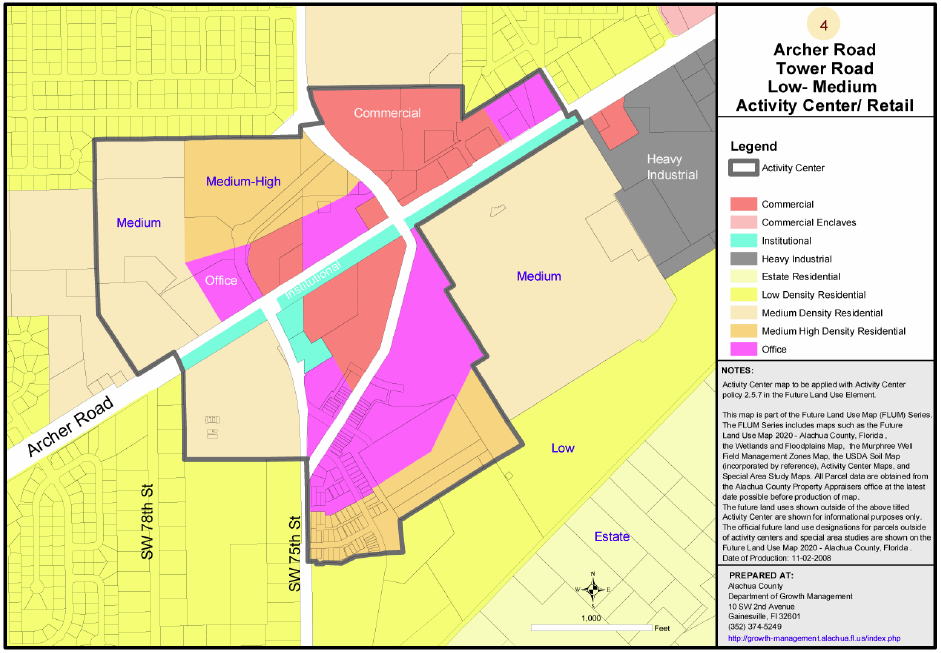
163 Map F.3. Tower Road/24 th Avenue Activity Center Map F.4. Archer Road/Tower Road Activity Center Future Land Use Element Effective July 22, 2011 (Updated through January 21, 2016) 160

164 Map F.5. Jonesville Activity Center Map F.6. Millhopper Activity Center Future Land Use Element Effective July 22, 2011 (Updated through January 21, 2016) 161

165 Map F.7. North Main Street/NE 53 rd Avenue Activity Center Map F.8. Eastgate Activity Center Future Land Use Element Effective July 22, 2011 (Updated through January 21, 2016) 162

166 Map F.9. Oaks Mall Activity Center Map F.10. Santa Fe Community College Activity Center Future Land Use Element Effective July 22, 2011 (Updated through January 21, 2016) 163

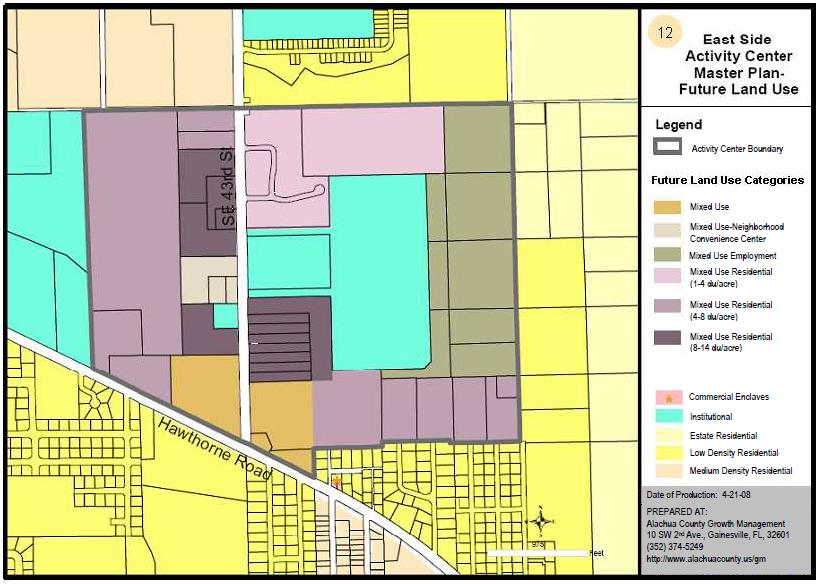
167 Map F.11. Springhills Activity Center Map F.12. East Side Activity Center Future Land Use Element Effective July 22, 2011 (Updated through January 21, 2016) 164
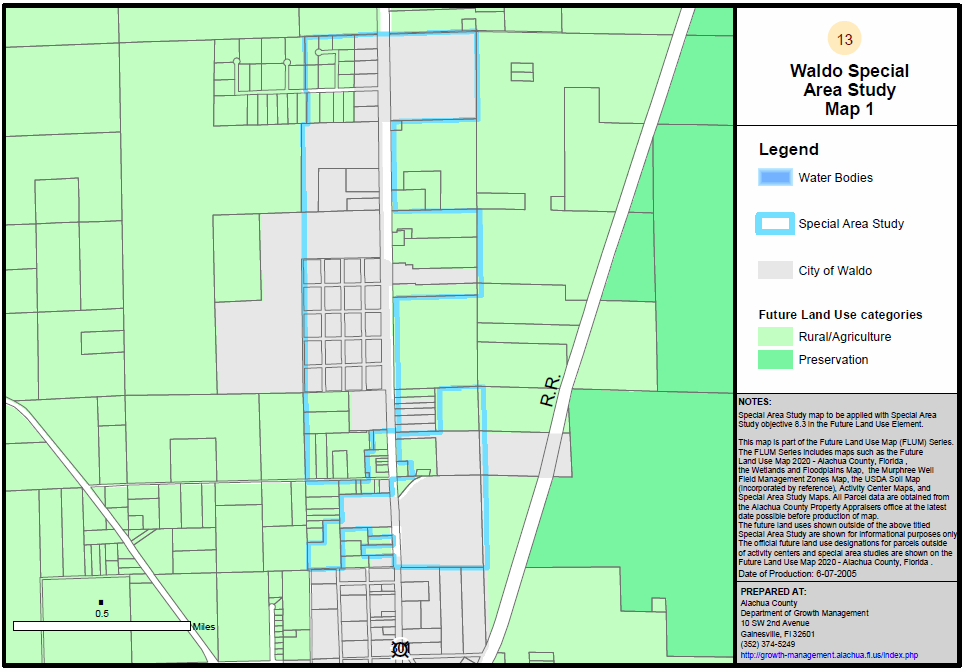
168 Map F.12a. Eastside Activity Center Community Facilities Map F.13. Waldo Special Area Study Map 1 Future Land Use Element Effective July 22, 2011 (Updated through January 21, 2016) 165

169 Map F.13. Waldo Special Area Study Map 2 Map F.14. North Main Street Special Area Study Future Land Use Element Effective July 22, 2011 (Updated through January 21, 2016) 166
170 Map F.15. Cross Creek Special Area Study Future Land Use Element Effective July 22, 2011 (Updated through January 21, 2016) 167
171 Map F.16. Plan East Gainesville Figure A : Recommended Master Plan (Special Area Plan) Future Land Use Element Effective July 22, 2011 (Updated through January 21, 2016) 168

172 TRANSPORTATION MOBILITY ELEMENT TRANSPORTATION MOBILITY ELEMENT ALACHUA COUNTY COMPREHENSIVE PLAN
173 GOAL ESTABLISH A MULTI-MODAL TRANSPORTATION SYSTEM THAT PROVIDES MOBILITY FOR PEDESTRIANS, BICYCLISTS, TRANSIT USERS, MOTORIZED-VEHICLE USERS, USERS OF RAIL AND AVIATION FACILITIES, AND IS SENSITIVE TO THE CULTURAL AND ENVIRONMENTAL AMENITIES OF ALACHUA COUNTY. AUTOMOBILE, BICYCLE AND PEDESTRIAN CIRCULATION PRINCIPLE 1 TO ESTABLISH AND MAINTAIN A SAFE, CONVENIENT, AND EFFICIENT AUTOMOBILE, TRANSIT, BICYCLE AND PEDESTRIAN TRANSPORTATION SYSTEM, CAPABLE OF MOVING PEOPLE AND GOODS THROUGHOUT THE COUNTY. PRINCIPLE 2 TO REDUCE VEHICLE MILES OF TRAVEL AND PER CAPITA GREEN HOUSE GAS EMISSIONS THROUGH THE PROVISION OF MOBILITY WITHIN COMPACT, MIXED-USE, INTERCONNECTED DEVELOPMENTS THAT PROMOTE WALKING AND BICYCLING, ALLOW FOR THE INTERNAL CAPTURE OF VEHICULAR TRIPS AND PROVIDE THE DENSITIES AND INTENSITIES NEEDED TO SUPPORT TRANSIT. PRINCIPLE 3 DISCOURAGE SPRAWL AND ENCOURAGE THE EFFICIENT USE OF THE URBAN CLUSTER BY DIRECTING NEW DEVELOPMENT AND INFRASTRUCTURE TO AREAS WHERE MOBILITY CAN BE PROVIDED VIA MULTIPLE MODES OF TRANSPORTATION. PRINCIPLE 4 PROVIDE AN ALTERNATIVE TO CONVENTIONAL TRANSPORTATION CONCURRENCY WITHIN THE URBAN CLUSTER THAT RECOGNIZES THAT CONGESTION IS ACCEPTED IN GROWING URBAN AREAS, SO LONG AS VIABLE ALTERNATIVE MODES OF TRANSPORTATION ARE PROVIDED THAT SERVE TRAVEL DEMAND ALONG CONGESTED CORRIDORS. CONGESTION ALONG SOME ROADWAYS IS THE TRADEOFF BETWEEN ADDING ROADWAY CAPACITY ON CONGESTED CORRIDORS AND DEVELOPING AN INTERCONNECTED NETWORK OF ROADWAYS, BICYCLE AND PEDESTRIAN FACILITIES AND DEDICATED TRANSIT LANES SERVED BY EFFICIENT TRANSIT SERVICE. Transportation Mobility Element Effective July 22, 2011 (Updated through January 21, 2016) 170
174 Objective 1.1 Urban Cluster Transportation Mobility Districts OBJECTIVE 1.1 Urban Cluster Transportation Mobility Districts Transportation Mobility Districts provide an alternative to conventional transportation concurrency by encouraging future land use and transportation patterns that emphasize mixed-use, interconnected developments that promote walking and biking, reduce vehicle miles of travel and per capita greenhouse gas emissions, and provide the densities and intensities needed to support transit. Policy Policy The Urban Cluster Area as identified on the Future Land Use Map of the Comprehensive Plan shall serve as the boundary for the Transportation Mobility Districts. Transportation Mobility Districts shall be established for the Northwest, Southwest and Eastern portions of the Urban Cluster. Transportation Mobility Districts are designed to support compact, mixed-use developments provided for in the Future Land Use Element by developing an interconnected multi-modal transportation system that reduces per capita greenhouse gas emissions by encouraging walking, bicycling and driving short distances between residential, retail, office, educational, civic and institutional uses and utilizing transit to commute to regional employment, educational and entertainment destinations. Policy The intent of Transportation Mobility Districts are: To provide for mobility within urban areas through the development of an interconnected network of: (1) Roadways that provide multiple route choices, alternatives to the state road system and protect the Strategic Intermodal System (SIS). (2) Rapid Transit and Express Transit Corridors that connect Transit Oriented Developments, Traditional Neighborhood Developments and Activity Centers and facilitate efficient and cost effective transit service to regional employment, educational and entertainment destinations. Transportation Mobility Element Effective July 22, 2011 (Updated through January 21, 2016) 171
175 Policy (b) (c) (d) (e) (f) (g) (3) Bicycle lanes, sidewalks, and multi-use paths that connect residential, commercial, office, educational and recreation uses and provide multi-modal access to transit. To recognize that certain roadway corridors will be congested and that congestion will be addressed by means other than solely adding capacity for motor vehicles and maintaining roadway level of service on those corridors. To utilize features of the exceptions and alternatives to transportation concurrency and multi-modal transportation districts per F.S Reduce vehicle miles of travel and per capita greenhouse gas emissions through compact, mixed-use, interconnected developments served by multiple modes of transportation consistent with requirements of F.S Reduce sprawl and encourage urban development by planning and constructing the necessary infrastructure to meet the demands for bicycle, pedestrian, transit and motor vehicle mobility. Reduce congestion within the Urban Cluster by capturing trips from surrounding rural areas, municipalities and adjacent counties through provision of park and ride facilities located within transit supportive developments in the Urban Cluster served by transit service that connects to regional employment and educational destinations. To provide for multi-modal cross-access and connectivity within and between uses to encourage walking and bicycling and reduce travel distances and impact to collector and arterial roadways. Within the Urban Cluster, the County adopts multi-modal level of service (LOS) standards for the following: Level of Service (LOS) Standard of Measure Pedestrian B Based on Presence of a pedestrian facility Bicycle B Based on Presence of a bike lanes / paved shoulders Express Transit B Based on Peak Hour Frequency of 15 minutes or less Motor Vehicle* D Professionally Accepted Traffic Analysis Motor Vehicle* - SIS** * Standard applies to Collector and Arterial Roads ** Strategic Intermodal System C Professionally Accepted Traffic Analysis in consultation with FDOT In order to achieve the level of service standard for pedestrians and bicyclists, the facility shall run the entire length of the roadway segment. A pedestrian facility shall be either a multi-use path on one (1) side of the roadway or sidewalks on both sides of the roadway. A multi-use path along a roadway shall result in a LOS B for bicyclists. The LOS for bicycle and pedestrian travel is the goal for all collector and arterial roadways within the Urban Cluster by 2030, not a standard that is intended to be achieved on an annual basis for each roadway. Transportation Mobility Element Effective July 22, 2011 (Updated through January 21, 2016) 172
176 (b) Express Transit Service shall be provided for a minimum of two (2) hours during both the AM and PM peak periods. The LOS for Express Transit Service shall be achieved starting by 2015 on each of the four (4) routes shown on the Express Transit Corridors map. The peak hour frequency for each route shall be a minimum of 30 minutes by 2015, 20 minutes by 2017 and 15 minutes by Service hours may be extended to three (3) hours and additional service added to meet demand and maintain fifteen (15) minute headways based on the capacity and productivity of the Service. The addition of Express Transit Service to serve Transit Oriented Development(s) on the Parker Road Corridor as shown on the Rapid Transit Corridor Map will require an update to the Multi-Modal Transportation Capital Improvement Program. (c) (d) Within each Transportation Mobility District, achievement of the LOS for all functionally classified County and Non SIS State Roadways shall be based on an Areawide LOS. The Areawide LOS analysis shall be divided into north-south and east-west roadways. The Areawide LOS shall be determined by dividing the sum ( ) of total traffic by the sum ( ) of the total maximum service volume at the adopted LOS standard for all functionally classified County and Non SIS State Roadways. The LOS for SIS facilities within the Urban Cluster shall be addressed through the Strategic Intermodal System (SIS) Mitigation Plan (Alachua County Growth Management Department January 26 th, 2010). The SIS Mitigation Plan identifies mitigation measures such as the construction of parallel roadways serving similar travel demand patterns, dedicated transit lane(s), access management and transit service. Mitigation projects, consistent with the SIS Mitigation Plan, shall be included in the Multi-Modal Transportation Capital Improvements Program. The SIS Mitigation Plan may be amended, in consultation with FDOT, during updates to the Capital Improvements Element. Transportation Mobility Element Effective July 22, 2011 (Updated through January 21, 2016) 173
177 Policy Policy Over the next twenty (20) years as the densities and intensities within the Urban Cluster necessary to support transit are realized, the County shall transition from providing capital infrastructure for a multi-modal transportation network to providing frequent transit service along dedicated transit corridors. The Twenty (20) year Multi-Modal Transportation Capital Improvements Program provides a schedule of the transition from development of the interconnected network to construction of dedicated transit lane(s). The Multi-Modal Infrastructure Projects in the Capital Improvements Element are identified to meet the adopted level of service standards and proactively address projected transportation needs from new development and redevelopment within the Urban Cluster by Policy The annual update of the Capital Improvements Element (CIE) shall include a roadway LOS analysis that demonstrates that the Areawide LOS for each Transportation Mobility District is being achieved. The annual update shall include a LOS analysis of SIS facilities and shall demonstrate consistency with the Strategic Intermodal System (SIS) Mitigation Plan (Alachua County Growth Management Department January 26th, 2010). The annual update shall also demonstrate that progress is being made toward achieving the identified bicycle, pedestrian and transit LOS. To measure and evaluate the effectiveness of the Transportation Mobility Districts policies, the annual update of the CIE shall also include a vehicle miles of travel (VMT) and mode share analysis for each Transportation Mobility District and the Urban Cluster. Policy Roadway capacity projects shall focus on the development of an interconnected network that provides alternatives to the State Road system, including the provision of additional lanes over Interstate 75. Policy With the exception of Interstate 75, roadways shall be limited to no more than a total of four (4) through motor vehicle lanes. All new bridges over Interstate 75 shall be four (4) lane roadways with provisions for transit, bicycle lanes, sidewalks and/or multi-use paths. Policy The time frame for construction of the projects identified in the Capital Improvements Element is intended to be flexible to address impact from development as it occurs. Should development activity increase, then the identified projects will be constructed earlier in the time period; conversely, should development activity be below normal rates, then the construction start dates will be pushed back to a later period. Policy The County intends to engage in Public/Private Partnerships to develop an interconnected roadway network in undeveloped and underdeveloped portions of the Urban Cluster to accommodate both the impact from development currently allowed in the Comprehensive Plan and traffic utilizing existing roadways. Policy Should the Areawide LOS for motor vehicles within a Transportation Mobility District fall below adopted LOS standards, then the County shall as a part of its annual update to the Capital Improvements Element either identify additional motor vehicle capacity projects or increase peak-hour transit frequencies and provide off-peak transit service with at least 30 minute headways along Express Transit Corridors. Transportation Mobility Element Effective July 22, 2011 (Updated through January 21, 2016) 174
178 Policy A network of corridors with dedicated transit lane(s) as shown on the Rapid Transit Corridors Map shall be developed to provide a sense of permanence and provide developers seeking to build Transit Oriented Development with the assurance that there is a commitment to transit. Dedicated Transit Lane(s) shall connect transit supportive development with regional employment, educational and entertainment centers. The design of dedicated transit lanes (s) shall be done in consultation with RTS and FDOT on State Roadways. Rapid Transit Corridors may deviate slightly from the alignment shown to serve a Transit Oriented Development, Traditional Neighborhood Development or Activity Center. A Comprehensive Plan amendment shall be required to modify dedicated transit lane(s) for transportation uses other than provision of transit service. Policy The County may elect, but shall not be required, to construct dedicated transit lanes on existing roadways identified on the Rapid Transit Corridors map until such time as the roadway is operating at or below the adopted LOS standard. Any changes to time frames shall require an amendment to the Capital Improvements Element. Policy Dedicated transit lane(s) shall be designed and constructed in conjunction with new roadway projects consistent with the Rapid Transit Corridors map. Policy The County shall coordinate the provision of park and ride facilities with transit supportive developments located along Rapid Transit Corridors consistent with the Capital Improvements Element and associated maps. Policy Bicycle and Pedestrian facilities shall be provided in accordance with Objective 1.6. Policy Large Scale Comprehensive Plan amendments to the Future Land Use Element or Map that result in a greater transportation impact shall require the entity requesting the amendment to demonstrate that the adopted LOS standards for the affected Transportation Mobility District and impacted Strategic Intermodal System (SIS) roadways are achieved and that additional required infrastructure, including Transportation Mobility Element Effective July 22, 2011 (Updated through January 21, 2016) 175
179 infrastructure identified in the SIS Mitigation Plan (Alachua County Growth Management Department January 26 th, 2010) is fully funded. Applicants may only include projects that are fully funded and scheduled to commence construction within one (1) year of approval of the Comprehensive Plan Amendment. Policy Requests to expand the Urban Cluster Boundary, whether by public or private entities, shall require the entity to demonstrate that the adopted LOS standards for the affected Transportation Mobility District is achieved and that additional required infrastructure is fully funded. The entity shall also be required to construct or fully fund bicycle and pedestrian facilities necessary to achieve the adopted LOS from the development to an existing facility or a logical terminus within the existing Urban Cluster Boundary. Applicants may only include projects that are fully funded and scheduled to commence construction within one (1) year of approval of the request to expand the Urban Cluster Boundary. This requirement is in addition to all other conditions of the Comprehensive Plan, including Policy of the Future Land Use Element in order amend the Comprehensive Plan to the expand the Urban Cluster. Policy For Annexations within the Urban Cluster the County shall coordinate with applicable jurisdictions to incorporate the transportation infrastructure improvements into the jurisdictions Capital Improvements Element. The County shall not expend any funds for transportation projects within annexed areas or to mitigate the impact of developments within municipalities, unless an intergovernmental agreement is established with the municipality to have developments fund their proportionate share of the cost to address the developments impact. Policy Amendments to projects in the Capital Improvements Element are permitted so long as it can be demonstrated that the LOS standards can be meet and that the amendment is in keeping with providing mobility by multiple modes of transportation within the Urban Cluster. Policy Alachua County accepts the standards and recommendations of the Tower Road Charrette for SW 75 th /Tower Road Study Area as a basis for capital improvements programming for transportation facilities in the area. Prior to programming specific projects involving the expenditure of County funds, additional analysis shall be required. Policy A multi-modal transportation fee shall be adopted to ensure that a development funds mobility and fully mitigates its impact to the transportation system. (b) Development shall satisfy its transportation concurrency obligations through payment of a multi-modal transportation fee. This provision shall not exempt Developments of Regional Impact, except those located within an Urban Service Area, from statutory requirements for proportionate share mitigation. No development shall receive a final development plan approval where the development impacts a roadway operating below the adopted LOS, except through the proportionate share ordinance or until such time as a multi-modal transportation fee is adopted that address the traffic impact of the development. Transportation Mobility Element Effective July 22, 2011 (Updated through January 21, 2016) 176
180 Policy Policy (c) (d) Modes of transportation to be addressed by the multi-modal transportation fee shall be consistent with the modes identified in Policy The multi-modal transportation fee should reflect the potential to reduce impact to the major roadway network through an increase in internal capture of trips and increase in pedestrian, bicycle and transit mode share from Transit Oriented Developments and Traditional Neighborhood Developments, including redevelopment of existing areas consistent with design requirements for such types of development. The following are internal street network requirements for all development within the Urban Cluster: Developments are required to design and construct a continuous interconnected network designed to safely calm traffic and encourage walking and bicycling throughout the development. (b) (c) (d) (e) (f) (g) Street design standards shall address narrow pavement and right-of-way widths, turning radii, on-street parking, and other design criteria for streets and alleys. Standards shall promote walking and biking, ensure safety for all users and allow for emergency access. A connectivity index standard shall be developed to ensure adequate internal connections as well as connections to adjacent and nearby uses. The connectivity standards shall address connectivity for bicycles, pedestrians, and motor vehicles. Stub-outs of the street network to adjacent parcels with development or redevelopment potential shall be provided. Provisions for future connections should be made in all directions whether streets are public or private, except where abutting land is undevelopable due to environmental or topographical constraints. To plan for future adaptive redevelopment of adjacent developed land, cross-access shall be provided even if a cross-access connection on the developed land does not currently exist. Cross-access connections shall be paved to the property boundary. All private streets shall provide full access to the general public. Internal streets shall connect to stub-outs provided by adjacent developments. Developments shall provide a pedestrian and bicycle circulation system that includes a network of multi-use paths throughout the development. The multi-use paths shall connect open space areas, adjacent developments, and existing or planned bicycle pedestrian facilities along collector and arterial roadways. A developer shall be allowed to propose a plan to provide a network of shared or separate facilities to provide mobility through low speed electric vehicles. The plan shall address safety for all modes of transportation with particular attention paid to bicycle and pedestrian interactions. The Transportation Concurrency Exception for Projects that Promote Public Transportation (TCEPPT) shall be limited to those Projects that by April 2 nd, 2009 have either been previously approved to utilize the Exception or that have filed a Comprehensive Plan Amendment as part of a Development of Regional Impact seeking Transportation Mobility Element Effective July 22, 2011 (Updated through January 21, 2016) 177
181 to utilize the Exception subject to approval by the Board of County Commissioners. Should the Board of County Commissioners not approve the Comprehensive Plan Amendment filed as part of the Development of Regional Impact, the Project would not be eligible to utilize the TCEPPT in the future. Policy Exceptions from roadway concurrency requirements may be granted to Projects That Promote Public Transportation, in accordance with F.S and F.S for qualifying projects in the Archer Road/Tower Road Activity Center, the Springhills Activity Center and the Oaks Mall Activity Center designated on the Future Land Use Map Series. A portion of a development outside one of these Activity Centers that meets the criteria for this Transportation Concurrency Exception will be eligible for this exception if that portion is part of a unified plan that is integrated with a project within one of these Activity Centers and the development as a whole meets the criteria specified below. Policy The County shall adopt land development regulations providing in greater detail the standards for Transportation Concurrency Exception for Projects that Promote Public Transportation, including connectivity index standards for the purpose of ensuring adequate internal connections as well as connections to adjacent and nearby uses. Policy In order for a project to be eligible for this TCE, the project shall meet all of the following criteria: (b) (c) (d) (e) Is located on or within 1/4 mile of an existing public transit line, or a planned public transit line, with 15 minute peak hour frequencies, or alternatives that are funded and assured to be operational within the first phase of the development. This may include things as such as express bus service or other transit that meets these requirements. The development plan includes public transit facilities and services designed to maximize use of the public transit line by persons expected to live and/or work within the proposed development; Contain a range of uses and density and intensity of uses organized along a transitional gradient suitable to the site and surrounding land uses. Provides a transit shelter or a station on the public transit line of sufficient size to accommodate the persons expected to live and or work/shop within the project boundaries. The transit shelter/station shall be safe, comfortable and convenient for its intended users. The station shall be of a size and design, to include such amenities. The station shall not be a single purpose facility, but shall instead include a mix of uses and amenities. The transit station shall be located near the center of the project. Alachua County shall adopt in the Land Development Regulations, definitions, criteria, and specifications for transit shelters and stations. The project must be designed in such a way as to provide easy access for transit to service the project. The project should be designed to allow 80% of the residents/workers walking access to the transit station. As an alternative the project may provide for 80% of the users to have walking access to a feeder-distributor service that provides for fast and easy access to the mainline Transportation Mobility Element Effective July 22, 2011 (Updated through January 21, 2016) 178
182 (f) transit shelter/station via shuttles, vans, or some other automated form of people mover (other than a single-occupant vehicle). For the purposes of this section walking access is defined as being within 1/4 mile. Safe, comfortable and pedestrian- and bicycle-friendly facilities shall be provided within the development to the transit shelters, stations and stops, including appropriate bicycle parking and lockers at the transit shelter/station. Access for pedestrians shall be by sidewalks, trails, and paths, and should provide for safety, shade, comfort and generally a pedestrian friendly atmosphere. The connectivity standards shall address connectivity for pedestrians, bicycles and vehicles. The project provides a commercial center that includes the main transit station. Policy The project meets the requirements for Traditional Neighborhood Developments as specified in the Future Land Use Element, and the commercial center must be consistent with the policies for either Neighborhood Center or Activity Centers, whichever is applicable. In addition, the project should be designed according to the following criteria: (b) (c) (d) (e) (f) Residential lots are serviced by a system of streets, alleys and sidewalks, with setback/build-to lines established to ensure that buildings front on sidewalks and are oriented to the street. Generally, garages are located on the rear portion of the property and accessed from the rear by an alley or lane. Sidewalks, street trees, landscaping, street furniture, entryway features, signage, and lighting are required and used to strengthen the identity of the neighborhood centers. A continuous interconnected network of narrow streets, including a pedestrian and bicycle circulation system, designed to calm traffic speeds and encourage walking and bicycling throughout the development, provide connectivity, and functionally and physically integrate the various uses within and beyond the neighborhood. Street design standards address pavement and right-of-way widths, turning radii, on-street parking, and other design criteria for roads, alleys and lanes. Standards should promote walkability, ensure pedestrian safety and allow for emergency access. Building frontages spatially delineating the thoroughfares and masking the majority of the parking. Parking and loading functions are located and designed to respect, and reinforce, the pedestrian orientation of the neighborhood, through on-street parking, and parking placed behind buildings. Policy The County shall incorporate into its LDRs procedures and standards for projects that promote public transportation. In the interim period between the effective date of these policies (May 2, 2005) and amendment of LDRs, projects shall meet the requirements in Policies The County may consider TCEs for Planned Development zoning proposals that meet the requirements of these policies and incorporate conditions that the County determines to be sufficient to ensure compliance with these requirements. Transportation Mobility Element Effective July 22, 2011 (Updated through January 21, 2016) 179
183 Policy The Urban Service Area shown on the Future Land Use Map shall be a Transportation Concurrency Exception Area (TCEA) consistent with F.S (5) (b) 3 c., and shall be exempt from state mandated transportation concurrency. All of the Transportation Mobility District policies of this Element shall apply within the TCEA. The Transportation Concurrency Exception Area is shown on the Transportation Mobility District Map. Policy All development within a Transportation Concurrency Exception Area shall mitigate its impact through payment of a multi-modal transportation fee consistent with Policy of the Transportation Mobility Element. Development shall mitigate its impact consistent with the proportionate share ordinance until such time as a multi-modal transportation fee is in effect that address the traffic impact of the development. Policy Roadways, dedicated transit lanes and trails identified in the Capital Improvements Element shall be constructed by the development where the facilities either run through or are contiguous with the development. Policy A development greater than 1,000 dwelling units or 350,000 sq ft of non-residential uses shall be required to either: (b) Mitigate its proportionate share cost for all significant and adverse impacts to roadways, interstates, intersections and interchanges not addressed through the multi-modal transportation fee. Significant and adverse impacts to roadways, intersections, interstates and interchanges shall include all roadways where the development generates traffic that is five (5) percent or more of the Florida Department of Transportation Generalized Tables capacity at the adopted roadway level of service standard. Adverse roadways are roadways that operate below that adopted roadway level of service standard. The Florida Department of Transportation shall be consulted on impacts to Strategic Intermodal System (SIS) facilities, or Construct and fund multi-modal improvements, to the extent permitted by law, as described below (capital projects shall be consistent with the Capital Improvements Element): (1) Construct one of the following: a. Construct an overpass over Interstate 75 that accommodates at least three of the following modes of travel: walking, biking, driving or riding transit, or b. Construct two (2) miles of an off-site roadway capacity project, or c. Construct four (4) miles of single track or two (2) miles of dual track off-site dedicated transit lanes. (2) Construct an off-site multi-use trail connecting two pedestrian generators. (3) Fund four (4) hybrid or alternative fuel buses. (4) Construct a surface park and ride lot designed to accommodate a multi-story parking structure at a future date, the multi-story parking structure may be constructed in-lieu of the surface lot. (5) All projects, regardless of proximity to Interstate 75, shall be required to fund transit for a cumulative twenty (20) year period. The funding of transit Transportation Mobility Element Effective July 22, 2011 (Updated through January 21, 2016) 180
184 shall occur in three phases and shall commence within one year upon the issuance of building permits where the following cumulative development thresholds, based on the total approved development, are exceeded: 25% for phase one, 50% for phase two and 75% for phase three. The frequency, limits and span of service for each phase are as follows: a. Phase 1: twenty (20) minute headways during the am and pm peak hours and forty (40) minute headways during off-peak hours from the Development to a centrally located transit hub on the University of Florida campus and the Eastside Activity Center for a span of service of 10 hours, with 4 of those hours occurring during peak periods. b. Phase 2: fifteen (15) minute headways during the am, afternoon and pm peak hours and thirty (30) minute headways during off-peak hours from the Development to a centrally located transit hub on the University of Florida campus and the Eastside Activity Center for a span of service of 14 hours, with 6 of those hours occurring during peak periods. c. Phase 3: ten (10) minute headways during the am, afternoon and pm peak hours, twenty (20) minute headways during daytime and early evening off-peak hours, thirty (30) minute headways during early morning and late evening off-peak hours from the Development to a centrally located transit hub on the University of Florida campus and the Eastside Activity Center for a span of service of 18 hours with 8 of those hours occurring during peak periods. Policy Developments may receive multi-modal transportation fee credit for the construction of non-site related infrastructure, purchase of buses and funding of transit required in Policy Where the cost of the required multi-modal improvements is greater than the multi-modal transportation fee, the Developer may seek reimbursement for the additional funds expended from a Community Development District (CDD), a Transportation Concurrency Backlog Authority (TCBA) or Transportation Special District (TSD) District. The Developer shall enter into a Development Agreement with the County to specify timing for the infrastructure projects and funding of transit service, multi-modal transportation fee credit, development entitlements, and funding mechanisms. Objective 1.2 Transportation Management Outside of Urban Cluster Mobility Areas OBJECTIVE Transportation Management Outside of Urban Cluster Mobility Areas To protect and support agricultural activities, preserve the character of rural communities and encourage development in areas where infrastructure can be provided in a financially feasible manner, developments outside the Urban Cluster as identified in the Comprehensive Plan shall be required to mitigate directly impacted roadways and impacts to roadways within the urban cluster. Policy Alachua County shall adopt the following minimum level of service standards based on peak hour conditions for functionally classified roadways in order to maximize the efficient use and safety of roadway facilities: Transportation Mobility Element Effective July 22, 2011 (Updated through January 21, 2016) 181
185 Policy Policy Policy Mode of Travel Level of Service (LOS) Motor Vehicle SIS* B Motor Vehicle Multi-lane** C Motor Vehicle Two lane Arterial C*** Motor Vehicle Two lane Collector C * Strategic Intermodal System, Florida Department of Transportation ** Four or more through lanes *** LOS D for: SR 24 (Archer Road) from SW 91st to Levy County SR 121 (Williston Rd) from SW 62nd to Levy County SR 26 from NE 39th (SR 222) to Putnam County CR 241 (NW 143rd) from NW 39th to City of Alachua SW 122nd (Parker Rd) from SW 24th to SR 24 (Archer Rd) Alachua County has established level of service standards for rural areas to coordinate capital improvement planning and land use to ensure that growth does not occur faster than the County s ability to provide for infrastructure in a financially feasible manner. The level of service standards shall not compel or require the County to widen or construct new roadways outside of the Urban Cluster in order to provide capacity to support new development or to address the unmitigated impact of development from adjacent municipalities and counties. Alachua County may elect to widen a roadway adjacent to the Urban Cluster where development approved within the Urban Cluster significantly impacts the adverse roadway. Adequate roadway capacity necessary to support development shall be required to be available "concurrent" with the impact of that development. The procedures for implementation of concurrency management as detailed in the Capital Improvements Element shall include a requirement for a Certificate of Level of Service Compliance as a condition of approval of a final development order, specifying intensity and density of development. "Concurrent" shall mean that all adopted LOS Standards shall be maintained or be achieved within a reasonable time frame as set out in below, consistent with 9J (2). Failure to receive a Certificate of Level of Service Compliance will preclude the establishment of vested rights for a project and will preclude the issuance of any final development order on the project or project phase, until the requirements of have been met. This policy shall be implemented through the Development Review process in accordance with the Concurrency Management Ordinance. Adopted LOS standards shall be used as the criteria to measure the available capacity of facilities that are part of the traffic circulation system. A development order will not be approved unless the adequate capacity is concurrent with the impacts of development based on the following standards: Policy The necessary facilities and services are in place at the time the development permit is issued; or Policy The development permit is issued subject to the condition that the necessary facilities and services will be in place when the impacts of development occur; or Transportation Mobility Element Effective July 22, 2011 (Updated through January 21, 2016) 182
186 Policy The necessary facilities are under construction at the time the permit is issued; or Policy The necessary facilities and services are guaranteed in an enforceable development agreement that includes provisions of subsections 1, 2, and 3 above, and that guarantees that the necessary facilities and services will be in place when the impacts of development occur; or Policy At the time the development permit is issued, the necessary facilities and services are the subject of a binding executed contract which provides for the commencement of actual construction of the required facilities or the provision of services within one year of the issuance of the development permit; or Policy The necessary facilities and services are guaranteed in an enforceable development agreement which requires commencement of construction of the facilities within one year of the issuance of the applicable development permit. Such enforceable development agreements may include, but are not limited to, development agreements pursuant to Section , Florida Statutes, or an agreement or development order issued pursuant to Chapter 380, F.S.; or Policy In areas in which the local government has committed to provide the necessary public facilities and services in accordance with its 5-year schedule of capital improvements, where actual construction is scheduled to commence in or before the third year of the adopted five year Capital Improvement Program. The Capital Improvement Program will recognize projects included in the first three years of the Florida Department of Transportation Five-Year Work Plan where actual construction is scheduled to commence in or before the third year of the five year plan. If projects in the FDOT plan are moved to later years, or otherwise amended, Alachua County shall assess the impact of such changes on level of service to determine if modification to pending development orders should be made. Projects operating under existing development orders with a valid certificate of level of service compliance approved pursuant to this policy shall be considered vested for purposes of this policy. A Plan Amendment shall be required in order to eliminate, defer or delay construction of any road listed in the 5-Year Capital Improvements Schedule which is needed to maintain the adopted level of service standard. Policy Policy Amendments to the Future Land Use Element and/or Map will be coordinated with the Transportation Mobility Element and the Capital Improvement Element through the evaluation of the impact of additional traffic projected to result from proposed land use plan amendments. This evaluation shall include assessment of the impact on the level of service of affected roads based on the roadway functional classification and number of lanes. No amendment to the Future Land Use Element shall be approved where this evaluation indicates that the level of service on affected roads would be reduced below the adopted level of service standards. Under these circumstances, any amendment to the Future Land Use Map shall be accompanied by corresponding amendments to identify roadway modifications needed to maintain adopted level of service standards, as well as the scheduling of such modifications in Alachua County's Five Year Capital Improvement Program. Objective 1.3 Transportation Mobility Element Effective July 22, 2011 (Updated through January 21, 2016) 183
187 OBJECTIVE 1.3 To coordinate land use decisions and access locations and configurations in order to maintain and improve the efficiency and safety of the transportation system. Policy Policy Policy Policy Proposed development shall be reviewed during the Development Review process for the provision of adequate and safe on-site circulation, including pedestrian and bicycle facilities, public transit facilities, access modifications, loading facilities, and parking facilities. In addition to Comprehensive Plan policies, such review shall include FDOT access management standards. Design criteria, standards, and requirements to implement this policy shall be included in the update of the land development regulations. Access to roadways shall be controlled in order to maximize the efficiency of the transportation network. The FDOT Access Management Classification System and Standards shall be incorporated and utilized for reviewing plans submitted to the DRC for review and approval. All development orders shall meet at a minimum the FDOT requirements. Alachua County will incorporate within their Land Development Regulations provisions which address the following: (b) (c) (d) (e) (f) (g) (h) (i) (j) (k) (l) (m) (n) frontage road, joint access, or cross access easement requirements, where appropriate. mandatory off-street loading and parking intersection/interchange locational restrictions for land uses, including distance requirements for access cuts near intersections and interchanges building setback requirements design standards (i.e., acceleration and deceleration lanes, turning radii, signalization, etc.) intersection spacing standards minimum maintenance responsibility requirements sight distance standards incentives to mitigate poor traffic access/hazardous situations standards to eliminate traffic conflicts with bicyclists and pedestrians highway safety for all users commercial signage/utilities restrictions within rights-of-way FDOT Access Management Classification System and Standards cross-access and stub-outs to adjacent parcels Development shall be required to address operational site related improvements and operational affects to adjacent major roadway intersections. Criteria shall be developed based on trip generation to determine the limits for major intersections to be addressed and the extent of required operational improvements to ensure safe operations for motor vehicles, pedestrians, and bicyclists. Operational improvements are considered site related requirements. The addition of through motor vehicle lanes not directly Transportation Mobility Element Effective July 22, 2011 (Updated through January 21, 2016) 184
188 Policy Policy Policy Policy related to facilitating access to the site are considered capacity projects and shall be credited accordingly. The land development regulations shall include standards, criteria, and procedures to ensure that an adequate system of roads functionally classified as local provides safe and maintainable access to new development that will use such roads. These regulations shall include design standards to ensure that the structural integrity and volume capacity of such roads are adequate based on projected trips to and from such development and shall take into account requirements for fire-fighting and other emergency vehicle access. Evaluation and approval of new development proposals shall include assessment of impact on and capacity of directly connected existing local roads. The land development regulations shall include guidelines, standards, and procedures for the identification of existing local graded roads providing access to existing development that are deficient based on findings that the condition of such roads is below or is projected to be below that required to meet minimum standards for public safety based on factors such as accidents, indications of inaccessibility to emergency vehicles, indications of inability to properly maintain, and projected traffic volumes in relation to the condition of the road. A management program for such roads identified as deficient shall be developed by the Alachua County Public Works Department for consideration as part of the annual Capital Improvements Program update. This shall include identification of the cost of required maintenance or improvements necessary to remedy identified deficiencies, identification of existing or proposed sources of funding such expenditures, and identification of areas proposed for deferral of further development pending remedy of existing local road deficiencies. Development shall be required to dedicate the necessary right-of-way proportionate to the impacts of development along property boundaries of external roadways to accommodate standard lane widths, turn lanes, bike lanes, clear recovery zones, stormwater, utilities, sidewalks and multi-use paths. Sidewalks and multi-use paths may be provided within an easement along major roadways to preserve and take advantage of proposed buffers, existing vegetation, environmentally sensitive areas, and natural features. Developments that are twenty-five (25) or more residential units in size or that generate more than 250 daily trips shall provide a minimum of two (2) functional access points. Exceptions for secondary access are permitted where infeasible due to original tract dimensions, environmental or topography constraints or existing development patterns. Objective 1.4 Future Transportation Circulation Maps (FTCM) OBJECTIVE 1.4 To establish the Future Transportation Circulation Maps (FTCM) as the guiding documents for development of an adequate network of major roadways in Alachua County for 5 and 20 years. Policy The Future Transportation Circulation Maps, and any subsequent updates, shall be developed on an interim basis through projected Areawide levels of service within Transportation Mobility Districts and the levels of service for roadway segments outside the Urban Cluster using best available data. Transportation Mobility Element Effective July 22, 2011 (Updated through January 21, 2016) 185
189 Policy The Future Transportation Functional Classification Maps for major roadways shall reflect existing functional classifications and future functional classifications consistent with the Future Transportation Circulation Maps. Policy The Future Transportation Circulation Maps shall be adopted to be used in conjunction with the Capital Improvement Element for capital improvement programming and long-range planning. The capital improvement program shall identify those projects required to provide the facilities indicated on the adopted Future Transportation Circulation Maps. Policy The Future Transportation Circulation Maps shall be used for the following: (b) (c) Review of all proposed development orders for consistency with level of service standards for facilities as identified on the adopted Future Transportation Circulation Corridor Maps. Review of all proposed capital projects proposed to widen existing, or develop new major roadways. All capital projects shall be consistent with the Future Transportation Circulation Maps. Achieving consistency of this Comprehensive Plan, where appropriate, with the long range transportation plans of all local governments within Alachua County, with the transportation plans of the Gainesville/Alachua County Metropolitan Transportation Planning Organization (MTPO), and with the Florida Department of Transportation's transportation plans. Policy The Future Transportation Circulation Maps may be amended if one or more of the following criteria are met and remain consistent with the Capital Improvement Element and the Capital Improvement Program: Objective 1.5 OBJECTIVE 1.5 (b) (c) One or more additional major roadways are proposed to be added to the Map or improved where such addition or modification can be demonstrated to improve the level of service or the safety on one or more roadways already shown of the Map, and where such roadways are projected to operate at deficient levels of service in the long-range planning time frame of this Comprehensive Plan. Additions could be proposed by public and / or private entities such as the County, Private Developers, FDOT and the MTPO. Any such amendment shall also be consistent with other Elements of this Comprehensive Plan. Update or amendment of this, or any other element results in a need to amend the FTCM. Update of the Future Transportation Functional Classification Map results in a need to amend the FTCM. Avoid, minimize, and mitigate adverse impacts upon natural and historic resources and scenic quality during the siting, design, construction, operation, and maintenance of the transportation system. Use the transportation system to enhance natural and historic resources and scenic quality where possible. Transportation Mobility Element Effective July 22, 2011 (Updated through January 21, 2016) 186
190 Policy Policy Transportation facilities shall be located, designed, constructed, and maintained to avoid, minimize and mitigate adverse impacts Conservation and Preservation areas consistent with Objective 3.6 of the Conservation and Open Space Element. Appropriate conservation, arboricultural, and horticultural standards shall be used in the design, construction, and maintenance of transportation facilities in order to promote energy conservation, enhance habitat connectivity, provide for the safe passage of wildlife, and improve scenic quality, consistent with Objectives 5.3 and 5.4 of the Conservation and Open Space Element. Objective 1.6 OBJECTIVE 1.6 Provide a system of safe, pleasant, convenient, and continuous bicycle and pedestrian network throughout the community. Policy Policy Policy Policy Policy Transportation facilities shall be designed to result in a pleasing environment enhanced by trees and landscaping that will present an attractive community appearance, calm traffic, enhance safety, reduce heat island effects, and provide shade for pedestrians, bicyclists and transit uses. Where possible, the existing natural landscape shall be retained or appropriately replicated in roadway design so as to maintain the sense of place and environmental heritage of Alachua County. The County shall strive to achieve Platinum Level Bicycle Friendly Community Status from the League of American Bicyclists. Alachua County will promote the development of a multi-modal transportation system consistent with the Capital Improvements Element. New development proposals shall be reviewed as part of the Development Review process for the provision of adequate and safe bicycle and pedestrian facilities consistent with policies in the Future Land Use Element. Standards and requirements for bicycle and pedestrian facilities (such as sidewalks, pedestrian paths, bicycle lanes, and bicycle parking) shall be detailed in the land development regulations and include elements such as amount, design, and location. Streets and roads shall be designed such that automobile and non-automobile modes of transportation are equitably served to the greatest extent possible. Design will include public and emergency vehicle access. Such designs shall include strategies to calm automobile traffic, provide a pleasant pedestrian environment, and create safe, balanced, livable streets, such as: (b) (c) (d) (e) (f) (g) (h) narrow travel lane width, minimum turning radius, bike lanes, pedestrian-friendly frontage uses and design, street trees, street furniture, and landscaping, wide sidewalks, crosswalks, and/or gridded street system of short blocks. Transportation Mobility Element Effective July 22, 2011 (Updated through January 21, 2016) 187
191 Policy Policy Policy Policy The preferred location for sidewalks and multi-use paths is the edge of the right-of-way, behind existing or proposed vegetation. The standard width for multi-use paths is eight (8) feet. In recognition of the difficulty in retrofitting existing roadways, the width of the multi-use path may be decreased to five (5) feet in specific locations to address utilities, stormwater facilities, and right-of-way constraints. Bike lanes or paved shoulders shall be provided whenever turn lanes are constructed on a rural cross-section arterial or collector roadways. Bike lanes or paved shoulders shall be provided in conjunction with the resurfacing or reconstruction of all rural cross-section arterial and collector roadways unless prohibited due to stormwater, environmental or right-of-way constraints. The County shall incorporate bikeways, trails, and scenic corridors into the greenways system as provided in Objective 6.3 of the Conservation and Open Space Element. Policy Bicycle and pedestrian access for recreation and transportation throughout the community shall be incorporated into a linked open space network, or greenways system, consistent with Objective 6.3 of the Conservation and Open Space Element. Policy The County shall design and locate recreation sites to encourage and expand bicycle and pedestrian access consistent with the Recreation Element. Policy Developments are encouraged to utilize the sidewalk mitigation fund in lieu of constructing a sidewalk along property boundaries with an external roadway. Objective 1.7 OBJECTIVE 1.7 To promote a comprehensive transportation planning process which coordinates state, regional, and local transportation plans. Policy Policy Policy In developing Alachua County's transportation plan, the following plans shall be considered: The Florida Department of Transportation's adopted Five-Year Work Program; (b) the annual Transportation Improvement Program and Long Range Transportation Plan of the Metropolitan Transportation Planning Organization; (c) (d) the transportation plans of the municipalities within Alachua County; and the transportation plans of adjacent counties. Alachua County will coordinate transportation modifications with state, local, and regional plans. Regional plans shall be coordinated through the MTPO for the urbanized area. For other areas of the County, transportation improvements shall be coordinated through mutual review of proposed modification programs on an annual basis with affected municipalities and the state. Alachua County shall consider the Long Range Transportation Plan in the development of its Transportation Improvement Program (TIP) for County maintained facilities in the municipalities. Road projects may be constructed by private development interests to provide access to properties for the purposes of development in accordance with the Future Land Use Element. These roads must be constructed to appropriate County standards for the anticipated long-range need of the road projects as determined by the Alachua County Transportation Mobility Element Effective July 22, 2011 (Updated through January 21, 2016) 188
192 Policy Policy Policy Policy Public Works Department. Projects that provide access between two existing or proposed collector or arterial roadways may be required to amend the Future Traffic Circulation Maps through the Comprehensive Plan Amendment process. In order to assess intergovernmental traffic impacts, Alachua County shall continue to coordinate with the following entities concerning the indicated facilities: (b) (c) the FDOT for state-maintained roads in the unincorporated area, municipalities in Alachua County for County-maintained roads within the municipality and municipal roads which may impact those County-maintained roads, and; adjacent counties for inter-county roads, where appropriate. The coordination shall include provisions for: (1) Periodic monitoring reports to be prepared by Alachua County for use by the FDOT in determining road modifications needs in their five-year work program. (2) Reporting of development activity from the entity approving development orders that would result in additional traffic on County roads to monitor the capacity of County-maintained facilities and for use in capital improvement programming. (3) Procedures for verification with the County of road capacity for developments whose approval by the entity would generate traffic exceeding more than five percent (5%) of the maximum capacity of the road based on the adopted minimum level of service standards. (4) Bike facilities and sidewalks. Alachua County shall continue to coordinate with the Florida Department of Transportation on development orders issued by the County with access to SIS and state-maintained roadways by requiring implementation of FDOT access control regulations and by involving the FDOT in the County's development review process. Alachua County will continue to participate in and support the efforts of the Metropolitan Transportation Planning Organization (MTPO) through provision of the County's proposed transportation modification program to the MTPO for review, exchange of information such as traffic counts, accident data necessary for planning by the MTPO, and participation in the MTPO technical advisory committee and on the MTPO. Citizen participation shall be a part of the traffic circulation planning process. This shall include, but not be limited to, citizen participation in the annual Capital Improvement Element review process, conducted in accordance with Policy of the Capital Improvement Element. Objective 1.8 OBJECTIVE 1.8 To resolve existing and potential future safety problems within the transportation network. Policy Alachua County shall, in conjunction with the FDOT and the municipalities within the County, continue to identify and maintain data on locations of current high Transportation Mobility Element Effective July 22, 2011 (Updated through January 21, 2016) 189
193 Policy concentrations of accidents. This information shall be used as part of the identification of projects for Transportation System Management programs. Alachua County shall develop a long range program in conjunction with the Capital Improvement Element to improve County-maintained roadways/intersections identified as having safety problems. Alachua County shall notify the FDOT of the need for modifications for safety problems identified on state-maintained roadways. Objective 1.9 OBJECTIVE 1.9 To provide for the acquisition and protection of existing and future rights-of-way from development, including building encroachment. Policy Policy Policy Objective 2.1 Transit OBJECTIVE 1.1 TRANSIT The Future Transportation Corridor Map incorporated herein will be used to identify right-of-way needs along given transportation corridors. Alachua County shall protect existing and future rights-of-way through its development review process. Rights-of-way necessary for County-maintained projects shall be acquired as soon as funds become available for such specific projects. The County will coordinate with the FDOT to determine right-of-way needs when proposed developments or modifications are adjacent to state-maintained roadways. The County will coordinate with the Regional Transit Service to determine right-of-way needs when proposed developments or modifications are adjacent to future transit corridors. Alachua County shall encourage the FDOT to acquire rights-of-way necessary for state-maintained projects as soon as funds become available for such specific projects. Standards for roadway construction and development will be established as part of the land development regulations providing for the protection of existing and future rights-of-way and easements. This policy shall be applied through the County's Development Review process. To assist the providers of mass transit in Alachua County in their planning efforts through coordination, informational support and participation in planning efforts. Policy Policy Policy Policy Alachua County will provide pertinent data to the City of Gainesville to enhance planning for the Regional Transit System (RTS) service area in the unincorporated portion of the County. Alachua County shall continue to promote the enhancement of transit through the Long Range Transportation Plan. Alachua County shall coordinate with the Regional Transit System (RTS) on all future transit service, express transit service, rapid transit service, and the location and design of park and ride facilities, transit stations and dedicated transit lanes. Alachua County shall continue to coordinate transit issues with its municipalities, the Regional Transit System and other transportation providers, transportation disadvantaged programs, Florida Department of Transportation and Metropolitan Transportation Planning Organization. Transportation Mobility Element Effective July 22, 2011 (Updated through January 21, 2016) 190
194 Objective 2.2 OBJECTIVE 1.2 To coordinate and assist the agencies planning and providing service delivery for the transportation disadvantaged. Policy Policy Objective 2.3 OBJECTIVE 1.3 Alachua County will assist the Metropolitan Transportation Planning Organization and the Florida Department of Transportation in planning services for the transportation disadvantaged. Alachua County will continue to provide support for the operation of paratransit services in unincorporated Alachua County in order to provide 24-hour ambulatory and wheelchair service on a demand-responsive basis within available financial resources. To promote an appropriate rail transportation system. Policy Policy Objective 3.1 Aviation OBJECTIVE 2.1 AVIATION Alachua County shall promote MTPO activities to coordinate with Federal, State, regional, and local agencies to study the feasibility of a regional light rail system. Alachua County shall encourage continued provision of existing freight and passenger railroad service in the County and promote the expansion of freight and passenger railroad service in the County and explore the possibility of intercity high speed rail. To coordinate improvements or expansions of aviation facilities with the Future Land Use Element and the Conservation and Open Space Element; and to prevent obstructions to airport operations. Policy Policy Policy Zoning and other land development regulations shall be updated based on recommendations in the Gainesville Regional Airport FAR Part 150 Study (1986) and subsequent updates, and updates of the Gainesville Regional Airport Master Plan, in order to protect designated airport lands, approach and runway protection zones, Ldn (loudness: day/night) contour lines, and existing and future development adjacent to aviation facilities. The regulations shall address specific methods for County coordination with the Airport to implement these recommendations. Maps (depicting the general location of airport facilities and expansions including runway protection zones and obstructions, adjacent land uses, and airport facility ingress and egress for surface transportation), located in the supporting data and analysis for this Element, are adopted and incorporated herein as the Future Aviation and Related Facilities Map Series. Alachua County shall protect and conserve natural resources from improvements or expansions of aviation facilities, except in accordance with state and local permitting and any approved mitigation plan, consistent with the Conservation and Open Space Element. Expansion of existing airport facilities or construction of new airport facilities in the unincorporated County shall be directed away from existing residential areas or areas planned for residential use, except as may be permitted by the Alachua County Board of County Commissioners in accordance with the Land Development Regulations. Transportation Mobility Element Effective July 22, 2011 (Updated through January 21, 2016) 191
195 Policy Alachua County will notify with the Gainesville Regional Airport Authority and the Flying Ten Airport concerning proposed changes in land use within designated runway protection zones, and any application for approval of communication towers or other structures that would be more than 500 feet above mean sea level in the unincorporated portion of Alachua County. All other (private) air facilities identified in the most recent report for the Continuing Florida Aviation System Planning Process shall be notified of any application for approval of communication towers or other structures that would be more than 500 feet above mean sea level in the unincorporated portion of Alachua County. Objective 3.2 OBJECTIVE 2.2 To coordinate improvements or expansions of aviation facilities with the Transportation Mobility Element. Policy Policy Objective 3.3 OBJECTIVE 2.3 Surface transportation access to aviation facilities shall be coordinated with the traffic circulation system shown on the traffic circulation maps. Alachua County shall coordinate its traffic planning efforts with the Gainesville-Alachua County Regional Airport Authority, the City of Gainesville, the Gainesville-Alachua County Metropolitan Transportation Planning Organization, and the Florida Department of Transportation, in order to address the impacts of planned airport expansions on transportation needs. To coordinate the capital improvement plans associated with aviation facilities of the Federal Aviation Administration, the Florida Department of Transportation, the Gainesville-Alachua County Metropolitan Transportation Planning Organization, the City of Gainesville, Alachua County, and the Multi-County Regional Airport Task Force. Policy Policy Policy Policy Fiscal impacts for improvements or expansions of aviation facilities, as well as transportation plans impacted by such improvements or expansions, shall be reflected in the applicable budgets of the Federal Aviation Administration, the Florida Department of Transportation Five-Year Transportation Plan, the Gainesville-Alachua County Metropolitan Transportation Planning Organization, and the Alachua County Capital Improvement Element. The County shall encourage and support appropriate funding applications submitted by the Airport Authority to the appropriate agencies. Improvements or the expansion of airport facilities shall be coordinated with the necessary expansion or modifications to the traffic system to support the facility. The costs and funding sources for right-of-way acquisition and road improvement projects needed to meet the impact of airport facilities on the traffic circulation plan shall be reviewed and taken into account in the annual update of the Alachua County Capital Improvement Program. Transportation Mobility Element Effective July 22, 2011 (Updated through January 21, 2016) 192
196 Transportation Mobility Element Map Series Full size Comprehensive Plan maps are available online at: 1. Future Transportation Functional Classifications (2015) 2. Future Transportation Functional Classifications (2030) 3. Future Transportation Circulation Map (Number of Traffic Lanes) (2015) 4. Future Transportation Circulation Map (Number of Traffic Lanes) (2030) 5. Express Transit Corridors 6. Rapid Transit Corridors 7. RTS Routes 8. Existing & Future Bicycle and Pedestrian Network 9. Existing and Projected Major Trip Generators and Attractors 10. Future Transportation Corridors Map 11. Urban Cluster Transportation Mobility Districts and Transportation Concurrency Exception Areas Future Aviation and Related Facilities Map Series 12. Air Facilities Locator Map, Alachua County 13. Existing Land Uses within LDN Contour Lines 14. Clear Zones Gainesville Regional Airport 15. Gainesville Regional Airport Ingress/Egress 16. Future Land Uses and LDN Contour Lines 17. Flying Ten Airport Transportation Mobility Element Effective July 22, 2011 (Updated through January 21, 2016) 193
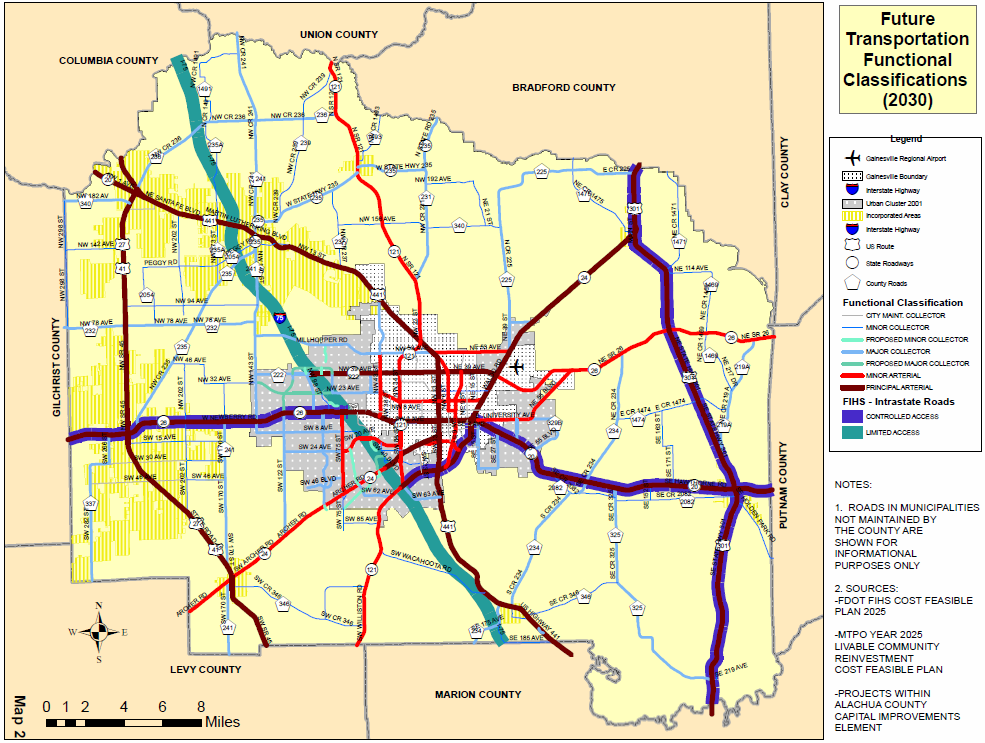
197 Map 1. Future Transportation Functional Classifications (2015) Map 2. Future Transportation Functional Classifications (2030) Transportation Mobility Element Effective July 22, 2011 (Updated through January 21, 2016) 194
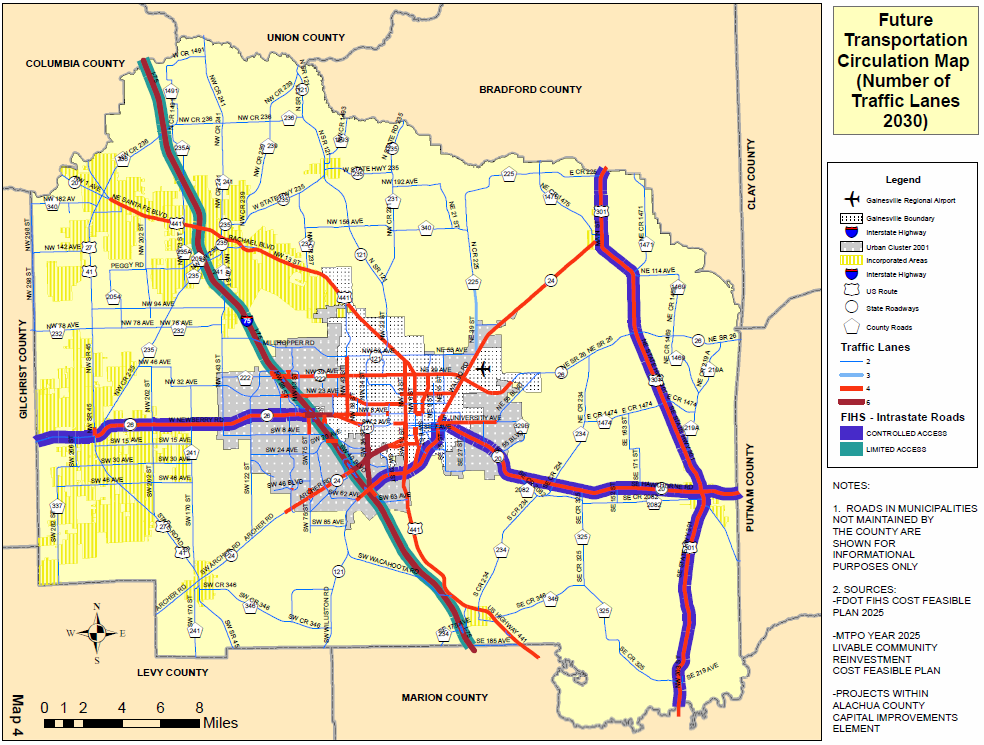
198 Map 3. Future Transportation Circulation (Number of Traffic Lanes 2015) Map 4. Future Transportation Circulation (Number of Traffic Lanes 2030) Transportation Mobility Element Effective July 22, 2011 (Updated through January 21, 2016) 195
199 Map 5. Express Transit Corridors Map 6. Rapid Transit Corridors Transportation Mobility Element Effective July 22, 2011 (Updated through January 21, 2016) 196
200 Map 7. Alachua County/City of Gainesville RTS Routes Map 8. Existing and Future Bicycle and Pedestrian Network Transportation Mobility Element Effective July 22, 2011 (Updated through January 21, 2016) 197
201 Map 9. Existing and Projected Major Trip Generators and Attractors Map 10. Future Traffic Circulation Corridors Map Transportation Mobility Element Effective July 22, 2011 (Updated through January 21, 2016) 198
202 Map 11. Urban Cluster Transportation Mobility Districts Transportation Mobility Element Effective July 22, 2011 (Updated through January 21, 2016) 199
203 Map 12. Air Facilities Locator Map Transportation Mobility Element Effective July 22, 2011 (Updated through January 21, 2016) 200
204 Map 13. Existing Land Uses within LDN Contour Lines Map 14. Clear Zones Gainesville Regional Airport Transportation Mobility Element Effective July 22, 2011 (Updated through January 21, 2016) 201
205 Map 15. Gainesville Regional Airport Ingress/Egress Map 16. Future Land Uses and LDN Contour Lines Transportation Mobility Element Effective July 22, 2011 (Updated through January 21, 2016) 202
206 Map 17. Flying Ten Airport Transportation Mobility Element Effective July 22, 2011 (Updated through January 21, 2016) 203
207 HOUSING ELEMENT ALACHUA COUNTY COMPREHENSIVE PLAN
208 GOAL 1 TO PROMOTE SAFE, SANITARY, AND AFFORDABLE HOUSING FOR ALL ALACHUA COUNTY RESIDENTS. OBJECTIVE 1.1 Alachua County shall provide for the development of affordable housing, dispersed throughout the County, through policies which focus on the following areas: Policy Policy Policy Land use and facilities Methods to promote the dispersion of affordable housing, and Manufactured housing. Alachua County shall, through the policies in the Future Land Use Element, provide areas for residential development which would be suitable for the development of affordable housing. These areas shall take into account the availability of infrastructure and land, the accessibility to employment and services, the proximity to shopping, daycare facilities, transit corridors, and the promotion of infill opportunities. Neighborhoods in the County shall be located, designed and maintained in accordance with the Future Land Use Element, other Elements of the Comprehensive Plan, and land development regulations. Alachua County shall, with participation by the Gainesville Builder s Association, the Board of Realtors, lending institutions, Habitat for Humanity, the public, and other housing providers, conduct a detailed Housing Study which includes the following elements: (b) (c) (d) (e) (f) A detailed, County-wide Needs Assessment; A Housing Production Cost Analysis, taking into account the cost of production, including any differences related to the unit s geographical location within the County; An Economic Feasibility Analysis of building affordable housing; An Inventory of substandard housing; An assessment of existing affordable housing developments; and An identification of specific areas in the County where the market and incentive programs are not producing enough affordable housing to meet the area s needs including the needs of very low, low and moderate income households. The results of this study shall form one of the bases for any future affordable housing goals, development requirements, and implementation strategies. Policy Measure: This Study shall be completed by It is and shall be the policy of the Board of County Commissioners to promote the dispersion of newly built affordable housing units within developments throughout the Housing Element Effective July 22, 2011 (Updated through January 21, 2016) 205 Housing Element effective August 23, 2011
209 Policy Policy entire County. This should include areas which are proximate to schools, shopping, employment centers, daycare facilities, and transit corridors. The Board of County Commissioners shall promote the development of affordable housing in the areas identified in the Housing Study that are deficient in market produced, or incentive based, affordable housing. This policy shall also apply to any proposed Development of Regional Impact (DRI), and shall be used as a guideline to determine future affordable housing development goals. This policy shall not limit housing programs created to assist farmers or rehabilitation assistance programs and activities which may be appropriate in rural areas. Alachua County shall support the development of new affordable housing within the areas identified in Policy through the allocation of dedicated funding sources such as CDBG or single family revenue bond programs. Alachua County shall enact an Affordable Housing Ordinance that: (b) (c) (d) (e) (f) (g) Establishes a need for new development that must be affordable within the areas that the Housing Study indicated where the market or incentive based housing programs are not producing affordable housing. The amount of new affordable housing needed shall be equivalent to a percentage of the County-wide need as determined by the Housing Study called for in Policy 1.1.3; Establishes development requirements for affordable housing, including provisions requiring a phasing schedule for affordable housing units to be constructed in conjunction with the market based housing; Establishes incentives for the creation of affordable housing; Establishes incentives for the rehabilitation of the existing housing supply to ensure its long-term affordability and re-use; Establishes mitigation options for new development unable to meet the required development percentage, provided that mitigation options a. and b. below may only be applied to areas identified in policy 1.1.3(f) that are not producing enough affordable housing to meet the area s needs. Mitigation options may include: (1) off-site development of affordable housing units; (2) fees paid in-lieu of the creation of affordable housing units to be contributed to a fund to be used for things such as; down payment assistance, the creation of affordable housing units, reduced rate financing, and the reduction of fees; (3) off-site rehabilitation of existing affordable housing units; or (4) off-site redevelopment of neighborhoods characterized by substandard and blighted housing. Allocates a portion of the annual SHIP funding to assist the development community in meeting the County requirements. Establishes a process whereby the effectiveness of the provisions of this Ordinance shall be reviewed at least every 3 years after adoption, and allows for change in priorities and requirements. Housing Element Effective July 22, 2011 (Updated through January 21, 2016) 206 Housing Element effective August 23, 2011
210 Policy Policy Policy Alachua County shall review and update the list of areas for affordable development identified in Policy every three years, to determine whether areas need to be added or removed from the list. Alachua County will review surplus land in its possession for suitability for sale or donation to organizations which propose to develop affordable housing projects. Measure: By 2001, revise the list of County owned parcels which may be suitable for affordable housing projects, and disseminate this information to developers and builders throughout the County. Facilities and Services for New Housing Development. All new housing shall be served by adequate facilities and services as defined in other elements of the Alachua County Comprehensive Plan. These facilities or services may be provided, in accordance with the policies in the Potable Water and Sanitary Sewer Element of the Comprehensive Plan, by the County, other public service entities or the developer. Policy Expansion of County services for new housing development shall be permitted in accordance with the priorities of the Alachua County Capital Improvements Element, and the procedures and criteria in the Alachua County Potable Water and Sanitary Sewer Element. Policy Manufactured homes. Alachua County recognizes manufactured homes as one source of affordable housing when constructed, placed, and maintained in a safe manner. Although recognized as a source of housing, Alachua County may be restricted in its ability to offer funding for the construction, rehabilitation, or repair of manufactured homes. Policy Manufactured/ or mobile homes shall be subject to the same density regulations as are applicable to conventional residential construction. Policy Manufactured/ or mobile homes meeting the minimum construction standards should be generally permitted for use as permanent housing in the same manner as conventional housing for the following areas of the County: (b) (c) in rural areas; in areas where the nature of surrounding development indicates that there will not be adverse impacts on existing development, or provided that any adverse impacts can be mitigated through buffers and other design strategies. Policy The development regulations shall establish rules for the temporary use of manufactured/ or mobile homes. Generally, such use should be permitted administratively pursuant to specific standards regarding need, time limits, parcel size and configuration, location, and buffering and screening. Any revisions made to the development regulations affecting temporary use of manufactured/mobile homes shall address the status of manufactured/mobile homes permitted under previous regulations and should permit phased removal of such previously approved units. Policy These policies shall not be construed as applying to the use of a manufactured/ or mobile home, trailer, or other modular or manufactured building unit for non-residential purposes subject to the applicable limitations of the law, provided that Housing Element Effective July 22, 2011 (Updated through January 21, 2016) 207 Housing Element effective August 23, 2011
211 OBJECTIVE 1.2 the use of land is consistent with the adopted Comprehensive Plan of Alachua County and with the development regulations. This section shall not be construed as applying to the transport, display, and/or sale of manufactured/mobile homes. The land development regulations shall be evaluated for their impacts on housing prices and periodically reviewed. Policy Policy Policy Policy Policy Policy OBJECTIVE 1.3 Alachua County shall provide incentives in the land development regulations for residential development at the maximum allowable density. Alachua County shall provide incentives in the land development regulations for the development and redevelopment of affordable housing. These incentives may include but are not limited to: (b) (c) (d) (e) (f) (g) relaxation of applicable impact fees; fee relief; provisions for expedited development review, approval, and permitting processes; special provisions for reservation of infrastructure capacity for concurrency; density bonuses; provisions for reduced lot sizes and modification of setback requirements; and grants and other financial incentives. The land development regulations shall be periodically reviewed to consider the inclusion of new construction techniques and promote the usage of building materials which can help reduce housing construction costs, and/or enhance public health and safety. Alachua County shall periodically review and evaluate its zoning and other regulations to ensure that requirements are reasonable and do not unduly limit opportunities for lower income groups to secure housing in desirable locations, consistent with the health, safety, and welfare of the public. Alachua County's building permit and development review processes shall include an incentive based scoring system that recognizes developers who use construction techniques which reduce future maintenance and energy costs in accordance with Policies and of the Energy Element, such as homes oriented and constructed for energy efficiency and sustainability. Alachua County shall provide flexibility for innovative housing design for non-traditional households and emerging home-based economic activities. To ensure consistency of housing activities, and to provide for the most effective methods for achieving its housing goals, Alachua County shall embark on the following policies of collaboration and implementation. Housing Element Effective July 22, 2011 (Updated through January 21, 2016) 208 Housing Element effective August 23, 2011
212 Policy Policy Policy Policy Policy Policy Alachua County shall review plans and programs of other local, regional and state agencies to ensure consistency of County efforts and to accomplish effective coordination of housing opportunity activities. Alachua County shall continue to provide funding for affordable housing to residents of local municipalities as well as the unincorporated County, through mechanisms such as partnerships, interlocal agreements and joint planning activities. Alachua County will assist any affordable housing provider in making information available to all persons concerning opportunities to obtain affordable housing in the County. Alachua County shall continue County participation in local affordable housing advocacy groups. Alachua County shall establish partnerships with for-profit and non-profit developers of affordable housing. Alachua County shall establish partnerships with lending institutions to assist with affordable housing for citizens of local municipalities as well as unincorporated Alachua County. OBJECTIVE 1.4 To ensure access to housing for all income levels of the population, Alachua County shall provide funding for affordable housing activities. Policy Policy Policy Policy Policy Alachua County shall continue to allocate public funds for the creation, rehabilitation, or purchase of affordable housing. Alachua County shall continue to dedicate a portion of its annual State Housing Initiatives Partnership (SHIP) Program allocation to the following programs: (b) (c) down payment assistance; single-family housing development (new, affordable housing construction); multi-family housing development (new, affordable, rental units) By 2002, Alachua County staff shall present a report to the Board of County Commissioners outlining additional funding sources that can be used to fund affordable housing activities within the County. Alachua County shall utilize Alachua County Housing Finance Authority bonds and approved bonds from other Issuing County Housing Finance Authorities to provide low interest rate mortgage loans to eligible homebuyers or to subsidize the creation of affordable rental housing in Alachua County. Areas identified under Policy are eligible for bond financing, in addition to areas previously defined by the U.S. Department of Housing and Urban Development (HUD). Alachua County shall apply for Federal or State housing funding, under such programs as the Community Development Block Grant (CDBG) Programs or the HOME (Home Ownership Made Easy) Programs. Housing Element Effective July 22, 2011 (Updated through January 21, 2016) 209 Housing Element effective August 23, 2011
213 Policy Policy Policy GOAL 2: Alachua County shall encourage methods of financing which will increase the opportunities for low and very low income households to obtain decent, safe, sanitary, attractive and affordable housing. Alachua County shall assist the Alachua County Housing Authority in the pursuit of increased Federal and State funding for the creation of new assisted dwelling units. By 2003, Alachua County staff shall provide a report to the Board of County Commissioners, detailing ways that local assistance can be offered to meet certain needs for which state and federal funds are not available. Approaches that are determined to be feasible and potentially effective will be incorporated as experimental projects. TO MAINTAIN AND IMPROVE THE EXISTING SUPPLY OF AFFORDABLE HOUSING, AND PROVIDE FOR THE REDEVELOPMENT OF NEIGHBORHOODS. OBJECTIVE 2.1 Alachua County shall provide a systematic approach to the identification, preservation, and redevelopment of neighborhoods and existing affordable housing across the County. Policy Alachua County shall prepare an inventory of substandard homes within the County, to identify geographic areas requiring housing conservation, rehabilitation, redevelopment, or improvement of historically significant housing in the unincorporated area. This inventory shall be updated every 3 years. Policy Based on the results of an inventory of substandard housing provided for in Policy 2.1.1, Alachua County shall develop and implement a community planning process using local participation to develop strategies, and identify funding sources for those strategies, for areas identified as requiring rehabilitation, redevelopment, or improvement of historically significant housing. Policy Policy Alachua County shall create an unincorporated area Neighborhood Redevelopment Code. Alachua County shall conserve and extend the useful life of the existing housing stock through the following methods: (b) Conservation. (Areas that are characterized by mostly sound dwelling units and structures, few land use conflicts, and generally adequate facilities.) The conservation strategy will be to maintain and enhance the area's developed character by upgrading public facilities as necessary, and careful monitoring for signs of deterioration. Transition. (Areas where a change in character from one general type of use to another is occurring or is expected to occur, and areas where a new type of predominant land use character is expected to emerge from an existing uncoordinated mix of uses.) The transition strategy shall be to confine and minimize impacts of new uses on adjacent uses and to orient facilities planning toward serving the new use types. Housing Element Effective July 22, 2011 (Updated through January 21, 2016) 210 Housing Element effective August 23, 2011
214 Policy OBJECTIVE 2.2 (c) (d) Rehabilitation. (Areas characterized by a significant number of substandard structures interspersed among sound structures and vacant land and/or are also lacking adequate streets, drainage, facilities, and/or utilities.) The rehabilitation strategy shall be to reduce blighting factors by selectively eliminating dilapidated structures while upgrading public facilities and services to create incentives for investment in improving existing structures or in new development. Redevelopment. (Areas characterized predominantly by substandard units and blighted conditions.) The redevelopment strategy shall be a comprehensive evaluation of the best future use of the area with regard to the Comprehensive Plan. Future land use and public facility planning would be consistent with the needs identified in the redevelopment strategy. The County's redevelopment and public improvement efforts shall be directed by the policies and standards set forth herein. Alachua County shall assist, as appropriate, in the rehabilitation and adaptive reuse of historically significant structures through the policies defined under the Historic Preservation Element of this Comprehensive Plan. This shall include assisting private property owners of historically significant structures in applying for and utilizing state and federal assistance programs as appropriate. Alachua County shall promote construction and rehabilitation techniques that enhance the long-term usability and affordability of housing. Policy Policy Policy Policy Policy Energy Conservation. Alachua County shall promote Energy Conservation techniques that incorporate Federal Energy Star Standards as consistent with the requirements of the State Energy Code. Alachua County shall provide developers/builders with information on how to incorporate Federal Energy Star Standards into construction. Alachua County shall seek financial resources that mitigate the cost of building to Federal Energy Star Standards in affordable housing units. Alachua County shall collaborate with local builders, developers, contractors, labor unions, and educational institutions to create a program that enhances apprenticeship opportunities for home-building related trades. Alachua County shall collaborate with the Alachua County Cooperative Extension Office, the banking community, the builders associations and other interested parties, to determine ways builders can incorporate Sustainable Building technologies in the construction of affordable housing, through the following areas: (b) Water (e.g., indoor water conservation, low-flow/low-flush fixtures, composting toilets, pervious materials, xeriscaping, reclaimed water irrigation, harvested rainwater, water budget) Energy (e.g., Energy Star ratings, traditional, local vernacular techniques of climate sensitive design, passive solar design, landscaping for energy conservation, site development and unit orientation (e.g. north/south rather Housing Element Effective July 22, 2011 (Updated through January 21, 2016) 211 Housing Element effective August 23, 2011
215 OBJECTIVE 2.3 (c) (d) than east/west windows)) that takes advantage of the natural shade and lighting available, radiant barrier and ridge and soffit venting, earth sheltered design, solar heating and cooling systems, photovoltaic systems, gas water heating systems, ductwork, fans, energy recovery ventilators, programmable thermostats, energy efficient appliances) Building materials (e.g., dimensional lumber, wood treatment, engineered structural materials, engineered siding and trim, flyash concrete, non-toxic termite control, earth materials, floor coverings, wood flooring, roofing structural wall panels, insulation, windows and doors, cabinets, finishes and adhesives, straw bale construction) Solid Waste Management (e.g., home recycling, compost systems, construction waste recycling) Provide funding for rehabilitation and redevelopment. Policy Policy Policy Policy Policy Policy Alachua County shall continue to dedicate a portion of its annual State Housing Initiatives Partnership (SHIP) Program allocation to the following programs: down payment assistance; (b) single-family housing development (emergency repair and housing rehabilitation); (c) multi-family housing development (acquisition/rehabilitation of affordable rental units). Alachua County will pursue additional dedicated funding sources that can be used to fund the rehabilitation of housing within the County. Utilize Alachua County Housing Finance Authority bonds and approved bonds from other Issuing County Housing Finance Authorities to provide low interest rate mortgage loans to eligible home buyers in Alachua County. Alachua County shall provide local funds and/or seek federal, state and local funding for the rehabilitation or demolition of dangerous residential buildings. Alachua County shall apply for federal and state funds including Community Development Block Grant (CDBG) funding sources for improving neighborhoods in the County. Private partnerships to provide redevelopment shall also be sought. The local priority for using federal and state housing funds shall be for improvement activities within residential neighborhoods. To the extent program rules and scoring criteria allow, the local criteria for setting priorities among eligible projects shall include: Condition of the Neighborhood: Target neighborhoods shall exhibit characteristics of housing costs and condition, household incomes, housing usage and population demography which meet eligible area requirements of the federal program for indicating public assistance needs. (b) Size and Scope of Project: The project size and scope should be such that the available funds will permit a substantial improvement to the neighborhood so as Housing Element Effective July 22, 2011 (Updated through January 21, 2016) 212 Housing Element effective August 23, 2011
216 Policy Policy Policy (c) to create incentives for continued investment by residents and developers in neighborhood improvements. Project Location: Project neighborhoods shall represent a viable part of the long term residential development patterns of the County. Priority will be given to projects that, by upgrading a single neighborhood, will also improve the surrounding area for uses proposed in the Future Land Use Element. This shall also include areas identified in Policy A variety of funding programs should be used in conjunction with local money, rehabilitation assistance funds and/or housing assistance funds where possible in order to achieve a comprehensive approach for improving a target neighborhood. Alachua County shall seek innovative approaches for using available funding sources to eliminate factors that contribute to neighborhood decline. Alachua County shall assist the Alachua County Housing Authority in the pursuit of increased Federal and State support for the rehabilitation of the existing housing stock. Policy The Alachua County Housing Authority shall be a responsible entity for coordinating home financing or rent subsidy assistance through federal and state programs. Rehabilitation and neighborhood revitalization assistance shall be coordinated directly through the County department administering Community Development Block Grant or other Federal and State funds. OBJECTIVE 2.4 To ensure that the County s land development regulations are consistent and conducive to cost-effective redevelopment of neighborhoods. Policy Policy Policy Policy Ensure that all Alachua County housing meets minimum standards for health and safety in order to eliminate substandard housing conditions and provide for the structural and aesthetic improvement of existing housing. Alachua County shall maintain a housing code that will set minimum standards for the condition and use of occupied dwelling units. It is the intent of the County to use the adopted housing code to determine instances where conditions exist which pose a serious threat to the health and safety of residents such that corrective actions are warranted. A continuing program of comprehensive code enforcement shall be developed for the entire County, providing a systematic application of minimum standards to all dwelling units including manufactured homes. Alachua County shall establish housing assistance programs for those eligible homeowners who are unable to meet the cost of abating code violations or who are unable to replace a substandard manufactured home. The housing code shall not require displacement of persons from substandard homes where the homeowner occupant cannot afford the necessary improvements to meet the minimum housing code, and relocation or rehabilitation resources are not available. In the case of rental units, the housing code shall not require the displacement of tenants except in cases in which the code violations are potentially life threatening. This policy does not absolve landlords or home owners of the responsibility to maintain the unit in a manner that promotes the health, safety, and welfare of the tenant. Housing Element Effective July 22, 2011 (Updated through January 21, 2016) 213 Housing Element effective August 23, 2011
217 Policy Alachua County shall provide assistance to households displaced by public programs. GOAL 3 TO ENSURE ACCESS TO HOUSING OPPORTUNITIES FOR THOSE RESIDENTS WITH SPECIALIZED HOUSING NEEDS, ALACHUA COUNTY SHALL IMPLEMENT THE FOLLOWING POLICIES: OBJECTIVE 3.1 Alachua County shall provide access to housing opportunities for groups identified as having special needs. Policy Policy Policy Policy Policy Policy OBJECTIVE 3.2 Alachua County shall encourage and promote the opportunity for each person to obtain housing of their choice, without regard to race, color, ancestry, sex, familial status, marital status, age, disability, housing status, religion, or national origin. Alachua County shall provide policies and programs which will help alleviate conditions resulting from discrimination. Chief among these shall be the continued enforcement of its Fair Housing Ordinance. Alachua County shall continually review its development regulations to ensure that farmworker housing needs are addressed. Alachua County shall continue to provide adequate sites in areas of residential character for group homes and foster care facilities licensed or funded by the Florida Department of Children and Families (DCF), Agency for Persons with Disabilities, and Agency for Health Care Administration. Alachua County shall cooperate with and assist the Florida Department of Children and Families (DCF) in its effort to deinstitutionalize and equitably distribute foster care facilities and group homes throughout the County. To promote greater accessibility to employment, facilities, and services, adult congregate living facilities and housing for the elderly are encouraged to locate inside or close to activity centers, and within Transit Oriented Developments and Traditional Neighborhood Developments as defined in the Future Land Use Element of the Comprehensive Plan. Alachua County shall continue to provide funding and assistance through the SHIP (State Housing Initiative Partnership) program to homeless shelters or transitional housing providers. Alachua County shall ensure that the land development regulations concerning the provision of housing for those with special needs comply, at a minimum, with the statutory requirements, and do not present barriers to the development of special needs housing. Policy The development regulations shall allow densities for farmworker housing which may be in excess of the maximum densities shown on the Future Land Use Map. Such farmworker housing may be permitted by a special use permit or other appropriate Housing Element Effective July 22, 2011 (Updated through January 21, 2016) 214 Housing Element effective August 23, 2011
218 Policy Policy Policy Policy mechanism to allow living accommodations of multiple farm employees and their families on one parcel without regard to duration, while performing agricultural labor. Alachua County may require farmworker housing which exceeds the density permitted on the Future Land Use Map to be provided by manufactured homes which can be removed once the need for provision of farmworker housing is no longer present. Such ordinance shall ensure that all appropriate federal, state and local regulations are met especially with regard to the provision of water and wastewater facilities. In accordance with Florida Statutes Section , the development regulations shall provide that homes falling within the statutory definition of a community residential home which has six or fewer residents shall be allowed in any single or multifamily zoning district. In accordance with Florida Statutes Section , community residential homes which have seven or more residents shall be allowed in multifamily zoning districts, and may be allowed in other districts by special exception or other appropriate mechanism. The County s development regulations with respect to community residential homes shall be consistent with Florida Statutes Section and the State s implementing regulations. Alachua County shall consider the proposed size, intensity and type of care, and prospective number of residents of community residential homes when reviewing suitable locations for new facilities. Density thresholds as set forth in the Future Land Use Element for other residential uses shall apply to community residential homes. Standards shall be developed for inclusion in the development regulations for converting the capacity of community residential homes into "equivalent residential units" for the purpose of ensuring compliance with the density thresholds. Such standards should define the comparable density as resident capacity divided by persons per household, divided by site area. OBJECTIVE 3.3 Alachua County shall provide a dedicated funding source for the provision of Special Needs housing, and form partnerships with local advocacy groups or organizations providing such housing. Policy Policy Policy Policy Alachua County shall actively seek opportunities to partner with local organizations or agencies providing housing assistance to those with special needs as defined in Goal 3. Alachua County shall dedicate a portion of its annual State Housing Initiatives Partnership (SHIP) Program allocation to assist agencies in the provision of special needs housing, including, but not limited to the construction of new housing, or the rehabilitation of existing units. Alachua County shall assist local organizations or agencies that are providing special needs housing in securing additional Federal or State funding. This assistance may be in the form of dedicated funding that can be used for leveraging, information sharing, or grant writing assistance. Alachua County shall continue to participate in local advocacy groups which provide assistance to those needing specialized housing. The Alachua County Affordable Housing Coalition and the Coalition for the Hungry and Homeless are examples of such groups. Housing Element Effective July 22, 2011 (Updated through January 21, 2016) 215 Housing Element effective August 23, 2011
219 HOUSING ELEMENT DEFINITIONS Affordable Housing: Affordable means that monthly rent or monthly mortgage payments including insurance and property taxes generally do not exceed 30 percent of that amount which represents the percentage of the median adjusted gross income for households qualifying under the definitions for low-income, moderate-income and very low-income. This does not preclude participation in federal or state programs that allow for a higher percentage of income to be devoted to rent or mortgage payments. Community residential home: A dwelling unit licensed to serve clients of the Department of Children and Family Services, which provides a living environment for 7 to 14 unrelated residents who operate as the functional equivalent of a family, including such supervision and care by supportive staff as may be necessary to meet the physical, emotional, and social needs of the residents. Low-income: Low-income means one or more natural persons or a family that has a total annual adjusted gross income for the household that does not exceed 80 percent of the median annual gross income for households, adjusted for family size, within the metropolitan statistical area. Manufactured home: means a mobile home fabricated on or after June 15, 1976, in an offsite manufacturing facility for installation or assembly at the building site, with each section bearing a seal certifying that it is built in compliance with the federal Manufactured Home Construction and Safety Standard Act. Mobile home: means any residential unit constructed to standards promulgated by the United States Department of Housing and Urban Development. Moderate-income: Moderate-income means one or more natural persons or a family that has a total annual gross income for the household that is less than 120 percent of the median annual gross income for households, adjusted for family size, within the metropolitan statistical area. Special Needs Households: Special needs households include persons who are elderly, physically disabled, homeless, at risk of being homeless, or have extremely low incomes. These special needs populations may include more specifically defined subgroups such as farm workers, ex-felons re-entering the community, youth aging out of foster care, survivors of domestic violence, persons with severe and persistent mental illness including co-occurring disorders, or persons with developmental disabilities. Very low-income: Very low-income means one or more natural persons or a family that has a total annual gross income for the household that does not exceed 50 percent of the median annual gross income for households, adjusted for family size, within the metropolitan statistical area. Housing Element Effective July 22, 2011 (Updated through January 21, 2016) 216 Housing Element effective August 23, 2011

220 POTABLE WATER AND SANITARY SEWER ELEMENT ALACHUA COUNTY COMPREHENSIVE PLAN
221 GOAL 1 TO PROVIDE AN ADEQUATE, SAFE, EFFICIENT, ECONOMICAL, RELIABLE AND ENVIRONMENTALLY SOUND SYSTEM OF POTABLE WATER SUPPLY AND SANITARY SEWER COLLECTION, TREATMENT AND DISPOSAL TO MEET THE NEEDS OF THE CURRENT AND PROJECTED ALACHUA COUNTY POPULATION. OBJECTIVE 1.1 To coordinate with the providers of centralized potable water and sanitary sewer facilities to ensure that adequate facility capacity will be available to serve development concurrent with the demands for such facilities, and that adequate water supplies shall be in place and available to serve new development no later than the issuance by the local government of a certificate of occupancy. Policy The following level of service standards for potable water and sanitary sewer service in the unincorporated portion of Alachua County are hereby adopted, and shall be used as the basis for determining the availability of facility capacity, adequate water supply, and the demand generated by a development within the appropriate service area for the providers listed below for purposes of issuing development orders or building permits. GAINESVILLE REGIONAL UTILITIES Potable Water Raw Water Supply: Treatment Capacity: Pumping and Distribution Capacity: Storage Capacity: Minimum Pressure: Fire Demand: Potable Water: Average Day (gross) Peak Day (gross) Average Daily Flow Peak Daily Flow Peak hourly flow One-half of peak day volume in gallons. This requirement may be met by a combination of storage and auxiliary power. The system shall be designed for a minimum pressure of 40 psig under forecasted peak hourly demands to assure 20 psig under extreme and unforeseen conditions. As determined using Insurance Services Organization guidelines 147 gallons per capita per day (including residential and non-residential uses) 200 gallons per capita per day (including residential and non-residential uses) Potable Water and Sanitary Sewer Element Effective July 22, 2011 (Updated through January 21, 2016) 218
222 Sanitary Sewerage Collection System: Treatment and Disposal: Sanitary Sewerage: Average Day (gross) Peak Hourly Flow 2.5 times the average daily flow Annual average daily flow which allows for anticipated peak hour flow 106 gallons per capita per day Municipal Systems ALACHUA Potable Water: Sanitary Sewer: ARCHER Potable Water: HAWTHORNE Potable Water: Sanitary Sewer: 124 gallons per capita per day 81 gallons per capita per day (Paul O Dea Plant) 60 gallons per capita per day (Turkey Creek Plant) 116 gallons per capita per day 117 gallons per capita per day 100 gallons per capita per day HIGH SPRINGS Potable Water: MICANOPY Potable Water: NEWBERRY Potable Water: Sanitary Sewer: WALDO Potable Water: Sanitary Sewer: 135 gallons per capita per day 120 gallons per capita per day 124 gallons per capita per day 120 gallons per capita per day 89 gallons per capita per day 61 gallons per capita per day Potable Water and Sanitary Sewer Element Effective July 22, 2011 (Updated through January 21, 2016) 219
223 Private Systems For private package treatment plants, community water systems, and non-community water systems, the level of service standards shall be the minimum design and operating standards as established by the authorized federal, state, regional, water management districts, and local regulatory agencies. Policy Policy The Alachua County Office of Planning and Development, in conjunction with any provider of potable water or sanitary sewer service listed in Policy 1.1.1, will monitor the system's level of service status to determine the impact of any requested development order or building permit on available potable water supply, system capacity, and/or sanitary sewer capacity. Periodic reports from the provider detailing available capacity (taking into consideration and distinguishing existing plus committed demand) shall be used in conjunction with development monitoring reports prepared by the County for this purpose. The LOS standards adopted in Policy shall be used as the criteria to measure the available supply and capacity of the potable water and/or sanitary sewer system(s), and shall, in consultation with the applicable water supplier, be used to verify that adequate water supplies are in place and available to serve new development no later than the issuance by the local government of a certificate of occupancy. A development order will not be approved unless adequate supply and capacity will be available concurrent with the impacts of development based on the following standards: Policy The necessary facilities and services are in place at the time the final development order is issued; or Policy The final development order is issued subject to the condition that the necessary facilities and services will be in place when the impacts of development occur; or Policy The necessary facilities are under construction at the time the final development order is issued; or Policy The necessary facilities and services are guaranteed in an enforceable development agreement that includes provisions of subsections 1, 2, and 3 above, and that guarantees that the necessary facilities and services will be in place when the impacts of development occur. Policy Policy Alachua County will encourage and provide relevant information to any provider of potable water and/or sanitary sewer service, in order to adequately project future development patterns and to program improvements necessary to maintain an adequate buffer of supply and/or capacity for the future. Information such as future land use, population projections, and public service improvements or expansions will be provided on an annual basis to the potable water supplier and/or sanitary sewer collector in order to enable accurate forecasting. No new public or private water or sanitary sewer system shall be permitted unless it is consistent with the policies established in all elements of the Comprehensive Plan. Potable Water and Sanitary Sewer Element Effective July 22, 2011 (Updated through January 21, 2016) 220
224 OBJECTIVE 2.1 To maximize the use of existing facilities in order to discourage urban sprawl and provide an adequate, safe, and environmentally sound system of potable water supply and sanitary sewer collection, treatment, and disposal. Policy All new development in the urban cluster shall be timed to occur when both centralized potable water and sanitary sewer systems are available for connection. The timing and availability of municipal water and sewer to a property shall be one of the factors to be considered when deciding upon proposed changes in zoning to a higher density or intensity pursuant to Future Land Use Element Policy 7.1.2(b) Any new subdivision, expansion of an existing subdivision, multi-family, or any new or expansion of a non-residential use, development or redevelopment in the urban cluster, shall be required to connect to a centralized potable water and sanitary sewer system for service by FDEP permitted potable water and wastewater treatment plants. This connection requirement and any exception thereto, based on the factors noted below, shall be implemented at the stage of development review and approval. No exceptions may be granted for new residential development, except as provided below. Exceptions to this requirement may be provided for certain non-residential uses, and for new residential development in areas designated as Estate Residential on the Future Land Use Map, for which connection is infeasible because of engineering factors that would prevent operation and maintenance of the system connection within the range of standard procedures. The land development regulations shall specify the factors that will be the bases of such determinations including: (b) (c) (d) (e) (f) The minimum flow necessary for adequate pipe velocity; and The maximum distance between the proposed development or connection point and the centralized system; and The relationship between flow and distance; or The inability to secure connection without adverse environmental effects or public health and safety; or The inability to obtain rights through adjacent properties necessary for connection. Number of units or intensity of the proposed development. The Land Development Regulations shall provide criteria and a process for consideration of exceptions based on the above factors. The LDRs shall require that any application for an exception provide an analysis of the potential to overcome engineering impediments to connection through coordination with adjacent property owners within the collection basin and the utility. If it is determined that there is no current opportunity for connection, an exception may be granted, provided there is a conceptual plan for connection when it becomes feasible, and there is assurance of future connection to a centralized system through enforceable conditions, such as provision for installation and connection to central water and sanitary sewer facilities when feasible, utility system retrofitting, and the abandonment of any on-site private Potable Water and Sanitary Sewer Element Effective July 22, 2011 (Updated through January 21, 2016) 221
225 wells and septic systems in accordance with Florida Statutes and Administrative Codes, as specified in the Unified Land Development Code. To further mitigate the effects of granting the exception to the connection requirements, the use of low-flow or ultra-low flow plumbing fixtures in the development shall be required in order to minimize the amount of effluent that must be treated. Developments that are granted an exception to the connection requirements by the DRC shall use the Water Star SM standards by the St. Johns River Water Management District as the minimum standard for water use and are encouraged to exceed the conservation measures provided by this standard. Nothing in this policy shall provide an exemption from any statutory requirement to connect to centralized potable water and sanitary sewer as established in Section , Florida Statutes. Policy Policy The use of new package wastewater treatment plants shall be considered in the Urban Cluster only in instances where the public health and/or groundwater quality is at risk from failed septic systems. The following standards, relating to private wells and septic systems, shall govern any residential development: Pre-1991: Lots of record of ½-acre or greater that were approved for well and septic may use well and septic provided they meet state standards. Pre-1991: Lots of record of less than ½-acre that cannot be combined to meet the ½-acre size minimum, may use well and septic if hardship can be demonstrated and they meet state standards. Post-1991: Existing lots of record as of May 2, 2005 of ½-acre or greater, may be developed with a single residential unit with well and septic, provided the lot is not part of a subdivision and meets state standards. Post-1991: Subdivided lots in the urban cluster of one acre or greater, that were approved for well and septic, may use well and septic provided they meet state standards. In the Rural/Agriculture areas, lots of record within a designated Rural Cluster of ½-acre or greater, may use well and septic provided they meet state standards. Policy Larger lot sizes or site specific improvements shall be required where soil and groundwater conditions do not result in proper treatment of wastewater, as determined by the County public health unit. In addition, the County public health unit shall be asked to assist in the development of the land development regulations that shall address the circumstances under which centralized (as opposed to individual) septic systems shall be required based on factors including the number of septic tanks per unit of geographic area, soil conditions, and hydrologic conditions. Potable Water and Sanitary Sewer Element Effective July 22, 2011 (Updated through January 21, 2016) 222
226 Policy Policy Policy New community water systems, other than municipal systems, shall be prohibited, except in rural clusters, rural employment centers, or in instances where the public health is at risk. New non-community water systems shall be prohibited, except in rural clusters, rural employment centers, or in instances where the public health is at risk. The use of new package wastewater treatment plants may be considered outside of the Urban Cluster in areas not served by centralized wastewater treatment plants only in instances where the public health is at risk, or where rural employment centers or specialized uses, such as institutional, tourist/entertainment, material-oriented industrial development, or resource-based recreational uses are appropriate. For purposes of this policy, new package treatment plants for residential uses are specifically prohibited, except as a last resort to remedy a public health problem associated with existing septic tanks. A special use permit shall be required for any new package treatment plant and shall be considered only if: Policy (b) (c) (d) (e) Demonstration that: (1) alternative systems of wastewater disposal are not feasible; and (2) there will be no adverse impact on water quality; and (3) there is assurance of proper long term operation and maintenance, including groundwater monitoring, by an entity that demonstrates financial and organizational capacity. Provision for monitoring and inspection by the applicable federal, state, regional, water management districts, and local agencies to be assured that the plant is in compliance with provisions of the permit. Provisions for corrective actions to be taken by the owner or operator in the event of failure including, but not limited to; changes in plant operation and maintenance, system repair or replacement, suspension or termination of a package treatment plant operation. Provisions for posting bond or similar financial guarantee to ensure payment for corrective actions. Provisions for connection to centralized wastewater service once the service becomes available. Replacing existing individual wells or septic systems by connection to existing municipal systems shall be required within municipal service areas where there has been evidence of septic system failure or well water contamination, provided no alternative technological remedy will be undertaken that provides for correction of the problem. OBJECTIVE 3.1 To provide for the coordination of public potable water and sanitary sewerage facility extensions in the unincorporated area of Alachua County with the Alachua County Future Land Use Element and capital improvement planning and programming. Potable Water and Sanitary Sewer Element Effective July 22, 2011 (Updated through January 21, 2016) 223
227 Policy Policy Policy Policy Policy Policy Alachua County shall designate an urban service area for future land uses with densities and intensities which will provide for efficient operation of central potable water and sanitary sewer service facilities, as well as the enabling of efficient line sizing by any potable water supplier or sanitary sewer collector. Alachua County shall coordinate any expansions in municipal potable water systems, municipal sanitary sewer systems, the school system, the highway systems, the drainage system, and any other relevant publicly provided facility through intergovernmental coordination mechanisms consistent with the Intergovernmental Coordination Element policies. Alachua County will establish a timing, staging, and capacity program in conjunction with the municipalities in the County for the expansion of potable water and sanitary sewer facilities into unincorporated service areas. This shall be coordinated in accordance with the Intergovernmental Coordination Element, Policy The Capital Improvement Programs/Elements of Alachua County and the municipalities shall specify such facility expansion programs. Extension of potable water or sanitary sewer lines within areas designated on the Future Land Use Map as the Urban Cluster shall be allowed by Alachua County provided there are no adverse impacts on environmentally-sensitive lands. Proposed extensions of potable water and sanitary sewer lines outside of the Urban Cluster designated by the Future Land Use Element shall be subject to approval by the Board of County Commissioners. Approval of such extensions shall be based on one or more of the following: (b) (c) (d) the Alachua County Board of County Commissioners finds that the absence of such facilities would result in a threat to the public health or safety; or the Alachua County Board of County Commissioners finds that the extension of such facilities is necessary to enhance the safe, effective, and efficient delivery of central potable water or sanitary sewer service within an existing urban service area; or the Alachua County Board of County Commissioners finds that the extension of such facilities would serve a purpose consistent with the Alachua County Comprehensive Plan, such as the retention and expansion of existing business and industry or the attraction of new business and industry in accordance with the Economic Element of this Plan, or the service of institutional or tourist/entertainment uses consistent with the Future Land Use Element; or the Alachua County Board of County Commissioners finds that the extensions of such facilities is needed as part of a comprehensive expansion of public services to encourage urban development in a new area as part of a comprehensive plan amendment. In this case, such a finding must be consistent with Policy below. Central potable water and sanitary sewer systems may be extended into new areas as part of a planned extension of urban services to that area based upon the following factors: population growth rate; Potable Water and Sanitary Sewer Element Effective July 22, 2011 (Updated through January 21, 2016) 224
228 OBJECTIVE 4.1 (b) (c) maintenance of level of service standards for the potable water or sanitary sewer system; adequacy of existing and planned supporting infrastructure; Approval of such extensions would require the following: (b) Identification, scheduling, and designated funding for capital improvements to other public facilities needed to extend urban services. Such projects shall be incorporated into the five-year capital improvement program of the Alachua County Capital Improvement Element. Adoption of necessary amendments to the Future Land Use map extending the urban cluster boundary. All public water supply systems serving Alachua County residents shall be maintained at accepted water quality standards. Policy Policy OBJECTIVE 5.1 All providers of potable water shall meet or exceed applicable federal, state, regional, water management districts, and local water quality standards. The County shall lead a coordinated effort to correct, where possible, or remove from service and properly close existing public water supply systems in Alachua County where there is a failure to consistently meet minimum primary and secondary drinking water standards or to properly maintain and operate the system. This effort shall include development and adoption of appropriate ordinances addressing issues such as availability of a centralized system and connection requirements, funding mechanisms, and intergovernmental coordination with centralized system providers to support their connection programs where consistent with the County s objectives. Funding mechanisms may include, but are not limited to, grants from water management districts, special funds from centralized service providers, economic development funds, and establishment of a special taxing district over the affected customer base. To prevent the discharge of inadequately treated wastewater. Policy Policy Policy All wastewater treatment and disposal systems shall meet or exceed applicable federal, state, regional, water management districts, and local treatment requirements. Wastewater effluent not meeting applicable water quality standards shall not be discharged. The County shall lead a coordinated effort to improve, where possible, or remove from service and properly close existing package wastewater treatment plants in Alachua County to the extent authorized by law in recognition of their inferior treatment capabilities and/or history of water quality problems. This effort shall include development and adoption of appropriate ordinances addressing issues such as availability of a centralized system and connection requirements, funding mechanisms, and intergovernmental coordination with centralized system providers to support their connection programs where consistent with the County s objectives. Funding mechanisms may include, but are not limited to, grants from water management Potable Water and Sanitary Sewer Element Effective July 22, 2011 (Updated through January 21, 2016) 225
229 OBJECTIVE 6.1 districts, special funds from centralized service providers, economic development funds, and establishment of a special taxing district over the affected customer base. The County shall encourage wastewater effluent reuse and other incentives for the maximum utilization of reclaimed water to the greatest extent possible by facilitating the approval of environmentally-sound facilities. Policy Policy Policy Spray irrigation sites shall incorporate perennial vegetation as a primary crop. Biosolids from wastewater treatment facilities shall be disposed of through means such as land application, consistent with revised Policy For purposes of this policy, biosolids are prohibited from disposal in landfills. All proposed sites for land application of biosolids shall be subject to prior approval by the Alachua County Board of County Commissioners, based on criteria in this policy section and applicable requirements contained in the unified land development code. Biosolids application sites shall include sufficient land area for direct application, buffers from adjacent land areas, and emergency sites for adverse weather conditions. Surface water runoff resulting from land application of biosolids that impacts groundwater or surface water shall not violate state water quality standards. Policy Runoff from a site shall not cause water quality violations as a result of land application of biosolids. Runoff of biosolids to on-site water bodies shall be prevented by not spreading during rainfall events or runoff periods. Policy All proposed sites for spray irrigation shall be subject to approval of a permit by the Alachua County Development Review Committee. The land development regulations shall be revised to include compliance with specified criteria. The criteria shall at a minimum address the provision of sufficient land area for direct application, the incorporation of perennial vegetation as a primary crop, buffers from adjacent land areas, and emergency sites for adverse weather conditions. Surface water runoff resulting from spray irrigation that impacts groundwater or surface water shall not violate applicable federal, state, regional, water management districts, and local water quality standards. Policy OBJECTIVE 7.1 Alachua County shall coordinate with the municipalities in development of effluent handling systems (located within the unincorporated portion of the County) such as artificial wetland disposal sites, irrigations reuse for crops, or recreation open space and industrial reuse. To protect the potable water supplies and sources. Policy Policy Alachua County shall regulate land use and development to protect the functions of natural drainage features and natural groundwater aquifer recharge as detailed in the Conservation and Open Space Element. Alachua County shall coordinate with the St. John's River Water Management District (SJRWMD) and/or the Suwannee River Water Management District (SRWMD) in determining and assessing impacts of proposed developments on the County's potable Potable Water and Sanitary Sewer Element Effective July 22, 2011 (Updated through January 21, 2016) 226
230 Policy Policy water supplies. These impacts shall be used by the County's Development Review Committee (DRC) in the evaluation of applications for site plan and development plan approval. Alachua County shall incorporate the results of any studies by the water management districts on projected demands on the sources of potable water for Alachua County, relative to potential supply, as a factor in determining the maximum population the water supply in Alachua County will be able to support. Alachua County shall coordinate future land use designations of this plan with incorporated towns and cities and surrounding counties to ensure that sufficient water quantity is available and that its quality is not degraded. In evaluating any proposed amendments to the Future Land Use Element that would provide for more intensive development adjacent to such jurisdictions, the County shall address such impacts and the capacity of such potable water facilities to implement this policy. Potable water supplies shall be protected from the operation of septic tanks and other wastewater treatment systems through control of the location of such facilities, type of treatment, method of discharge, and monitoring. Policy Septic tanks and drainfields shall be placed no closer to wells, surface water areas and conservation areas than the minimum distances provided for in applicable federal, state, regional, water management districts and local regulations. County development regulations shall provide for increased distances where soils or other environmental conditions are particularly unsuitable for on-site sewage systems. OBJECTIVE 8.1 To promote the increased conservation and reuse of water. Policy Policy Policy Policy Policy Alachua County shall promote public information programs in an effort to increase public awareness and acceptance of water conservation techniques through newsletters, public service announcements, and displays at public awareness events. Land Development Regulations shall provide for the use of cluster development and attached dwelling units and zero lot line arrangements and smaller lot sizes. Such development patterns shall be encouraged during the County's Development Review Committee (DRC), until the land development regulations include provisions to implement this policy. Development plans shall be reviewed for inclusion of native vegetation and other low water demand landscape material in order to reduce outdoor water consumption. Restrictions established by applicable water management districts or water districts shall be adhered to. These restrictions shall be enforced by the County or other government organization. Alachua County shall also encourage large scale commercial and institutional users of outdoor water to utilize early morning consumption as part of its public awareness efforts. The County will make available lists of vegetation classified by water demand for use by residents and developers as part of the public awareness efforts of the County. Potable Water and Sanitary Sewer Element Effective July 22, 2011 (Updated through January 21, 2016) 227
231 Policy Policy Low-volume plumbing devices shall continue to be required, consistent with local building codes. The County shall encourage the use of stormwater runoff for irrigation, agricultural or industrial water needs in order to conserve potable water sources. By 2002, Alachua County shall complete a study of alternative technologies for consideration in revising the land development regulations. Potable Water and Sanitary Sewer Element Effective July 22, 2011 (Updated through January 21, 2016) 228
232 POTABLE WATER AND SANITARY SEWER ELEMENT DEFINITIONS Peak Day: Public water supply system: Package Treatment Plant: Maximum volume of water processed in a day over a one year period. (Source: GRU) A system of water treatment and distribution facilities from either a community water system or a non-community water system. A Community water system serves at least 15 service connections used by year-round residents or regularly serves at least 25 year-round residents. It provides potable water to residential uses such as municipalities, residential subdivisions, and mobile home parks. A non-community water system is for provision to the public of piped water for human consumption that serves at least 25 individuals daily at least 60 days out of the year but that is not a community water system. (Source: Alachua County Code, Ch , taken from Florida Statutes) Any wastewater treatment facility having a permitted capacity of less than 100,000 gallons per day. Essentially a small treatment system consisting of a treatment plant and disposal system. (Source: Alachua County Code, Ch , taken from Florida Statutes) Potable Water and Sanitary Sewer Element Effective July 22, 2011 (Updated through January 21, 2016) 229

233 SOLID WASTE ELEMENT ALACHUA COUNTY COMPREHENSIVE PLAN
234 GOAL 1 TO PROVIDE CLEAN, EFFICIENT, ECONOMICAL, AND ENVIRONMENTALLY SOUND MANAGEMENT OF SOLID WASTE RESOURCES IN ALACHUA COUNTY. OBJECTIVE 1.1 Establish level of service standards for solid waste management in order to coordinate capital improvement planning with land use decisions to meet the requirement that adequate solid waste management facilities be available when needed for development concurrent with the impacts of development by implementing Policies through Policy Policy Policy Policy The level of service (LOS) standard for solid waste disposal, used as the basis for determining availability of disposal capacity to accommodate the demand generated by existing and new development in Alachua County, is hereby established, at a minimum, at 0.73 tons per person per year in 1997 and thereafter. Any project proposed for development in the unincorporated area of Alachua County that produces solid waste must obtain a Certificate of Level of Service Compliance (CLSC) from the County as a precondition of any Final Development Order issued by the County. The following standards must be met to satisfy the concurrency requirement and to receive a CLSC: (b) (c) (d) The necessary facilities and services are in place at the time a development permit is issued; or A development permit is issued subject to the condition that the necessary facilities will be in place when the impacts of development occur; or The necessary facilities are under construction at the time a development permit is issued and will be in place when the impacts of development occur; or The necessary facilities and services are guaranteed in an enforceable development agreement that includes the provisions of Policy An enforceable development agreement may include, but is not limited to: (1) development agreements pursuant to Section , Florida Statutes, or (2) an agreement or development order issued pursuant to Chapter 380, Florida Statutes. Any such agreement must guarantee that the necessary facilities and services will be in place when the impacts of development occur. Any proposed project that cannot obtain a CLSC shall not be issued a Final Development Order on the project or project phase, consistent with the Capital Improvements Element, until it can be demonstrated that the County solid waste management facilities can meet any of the requirements of Sections -(d) under Policy Procedures for coordination with cities and Gilchrist County with respect to concurrency and level of service standards shall be implemented in accordance with Policy in the Intergovernmental Coordination Element. Solid Waste Element Effective July 22, 2011 (Updated through January 21, 2016) 231
235 OBJECTIVE 1.2 Provide for safe operation and maintenance of publicly owned solid waste management facilities, in compliance with all stipulations and conditions of Florida Department of Environmental Protection (FDEP) permits; and other applicable local, state or federal regulations; provide for protection of water, soil and air resources, in compliance with local, state, and federal permit requirements including monitoring of groundwater at all public landfill sites. Policy Policy Policy Policy Policy Policy OBJECTIVE 1.3 Proper and efficient operation and maintenance procedures, in compliance with all local, state and federal stipulations and conditions of solid waste permits, shall be followed at County solid waste management facilities. Engineering and design of new solid waste management facilities shall be in accordance at a minimum with local, State and Federal regulations for protection of water, soil and air resources. The County shall monitor closed landfills and surrounding properties as required by Florida Department of Environmental Protection Landfill permit conditions and local, state, or federal regulations for groundwater and potable water supply contamination. Should any contamination be discovered at County landfills appropriate remediation shall be performed to remedy the situation expeditiously to minimize any potential impacts on public health or safety. Due to the toxic nature of incinerator and mass burn facilities, no such facility will be included in the County solid waste system. New solid waste management facilities shall be adequately buffered from incompatible land uses, especially residential areas. Regulate, consistent with local, state, and federal regulations, all privately-operated landfills, including C&D landfills, and solid waste management facilities to ensure proper disposal methods and protection of natural resources including groundwater. Policy Policy Each landfill operator, including C&D landfill operators, shall be required to maintain accurate daily logs of, and to report to the County, the volume or weight of materials disposed by material type. Penalties will be imposed for failure to report. The County will track landfill, including C&D landfill, disposal reporting. Solid waste disposal systems shall be designed to prevent air, water and soil pollution, and danger to public health and safety. The use of land, water or air for uncontrolled disposal of any waste shall be prohibited. Development regulations shall require use of appropriate methods for preventing leachates which violate water quality standards from entering ground and surface water at all active landfill sites. At the County's discretion additional regulatory methods may include, but not be limited to, periodic inspections and monitoring programs during the permitting, operation, closure, and after closure of landfills. The need for additional regulatory methods will be based upon site specific conditions such as hydrogeology, ecological characteristics, and neighboring land use. Additional inspections and groundwater monitoring requirements shall be at the expense of the owner. It shall be the responsibility of the permit holder and/or land owner to provide for the cost of monitoring and proper closure. Monitoring and closure Solid Waste Element Effective July 22, 2011 (Updated through January 21, 2016) 232
236 shall be reviewed by the County and/or other appropriate agencies. This policy does not preclude the proper use of manure, mulching or composting of yard waste, or regulated use of biosolids for land application. Policy Each landfill operator, including C&D landfill operators, shall be required to monitor soil and groundwater, using sufficient methods to ensure no contamination of ground and surface waters as a result of the landfill activity. Monitoring programs shall be, at a minimum, in accordance with Florida Department of Environmental Protection landfill permits. The County may require a more stringent monitoring program at specific landfill sites. A monitoring program imposed by the County that is more stringent than that called for in the FDEP permit(s) shall consider the expense of the increased requirements. Policy Policy OBJECTIVE 1.4 Land based solid waste disposal systems shall provide for the eventual closure and reuse of the site. Private landfills, including C&D landfills, disposal capacity and tipping fees shall be continually monitored by the County to determine if there is sufficient environmentally sound disposal capacity for material such as construction and demolition debris at fair market prices. Should the County have concerns about capacity or cost, it may perform a needs analysis in consideration of a publicly owned construction and demolition debris management facility. Develop and maintain a long term solid waste management system. Utilize the Leveda Brown Environmental Park as a locale for centralized solid waste management facilities with the capacity for processing various components of the solid waste stream for the next 20 years. The core of the Park is a solid waste transfer station with disposal at properly permitted facilities elsewhere. Continue to expand the capacity and function of the Park to meet changing needs for processing solid waste. Policy Policy OBJECTIVE 1.5 LEVEDA BROWN ENVIRONMENTAL PARK AND TRANSFER STATION The County will seek long term environmentally sound disposal capacity (ten years or more) via agreements with public or private disposal facility owners. Such agreements will include environmental liability protection for the County. The caliber of the disposal facility(s) management, environmental records, haul distance and disposal fees will be considered when negotiating such agreements. Balu Forest shall be held in reserve as a future solid waste management facility site. Should the need arise and there be no other environmentally safe or economic option available, Balu Forest should be considered for a solid waste management facility site. The County shall develop and implement a waste reduction strategy that includes waste prevention, source reduction, reuse, recycling and biological disposition, resulting in a reduction of solid waste disposed per capita. Solid Waste Element Effective July 22, 2011 (Updated through January 21, 2016) 233
237 Policy Policy Policy Policy Policy Policy Policy Policy Annual per capita waste tonnage disposed at the County Leveda Brown Environmental Park and transfer station, or any Class I waste disposal site as designated by Alachua County, which is classified for disposal as Class I waste, will be recorded and measured on an annual basis. The annual change in tonnage disposed will act as a measure of waste reduction, waste prevention, reuse and recycling. The change from year to year will be used to monitor the effectiveness of the waste prevention strategy. Achieve a diversion rate from disposal of 40% by December 31, 2012; 50% by December 31, 2014; 60% by December 31, 2016, 70% by December 31, 2018; and 75% by December 31, Special waste being recycled such as tires, appliances, yard trash and construction and demolition debris will be included. The calculation will be made annually by dividing the tons recycled by the sum of tons disposed plus tons recycled. In addition to changes in total waste diversion, the County shall track and report on indicators of improvements in waste diversion such as percentage of businesses in compliance with the mandatory commercial recycling ALACHUA COUNTY HAS A GOAL OF 75% RECYCLING BY 2020 program, percentage of residential users voluntarily recycling, rates of recycled vs. disposed waste collected at rural collection centers, or similar measures. The County shall maintain and improve the single family residential curbside recycling program in the Municipal Services Benefit Unit (MSBU) and offer drop-off recycling in the non-mandatory rural area by providing recycling containers at the Rural Collection Centers. The County shall explore the feasibility of a mandatory curbside recycling program throughout the County. The County shall increase enforcement of the mandatory commercial recycling program that includes apartments, multi-family complexes, businesses, institutions and manufacturers for full compliance by the year The County shall maintain recycling and waste reduction programs in all county offices. The County s purchasing policy shall foster purchase of goods made from recycled materials. The County shall provide coordination and assistance to all local municipalities, the University of Florida and Santa Fe College and the local United States Postal Service to maintain effective and efficient recycling programs. The County shall continue to promote waste prevention, source reduction, re-use, recycling, the purchase of goods made from recycled materials, composting and pollution prevention through public education programs. Such programs will be directed to schools, churches, civic organizations, service clubs, businesses, institutions and residents. The County shall pursue available Federal or State grants and funding to maintain and promote expansion of the County's recycling, resource recovery, and source reduction programs. Solid Waste Element Effective July 22, 2011 (Updated through January 21, 2016) 234
238 Policy The County shall improve the yard trash management program and shall encourage the public to increase efforts to utilize landscape and yard waste at home through backyard mulching and composting programs. Policy All white goods and other recyclable bulky wastes shall be segregated from the solid waste stream and recycled. Policy The County shall continue to investigate other methods of waste management and alternatives to landfill disposal of solid waste, including source reduction. Policy The County shall prepare and publish an annual report of solid waste management activities, programs and accomplishments.the report will include program costs, recycling rates, per capita generation rates, trends, waste reduction rates, disposal amounts and other data pertinent to evaluating the success of the waste reduction strategy. OBJECTIVE 1.6 Ensure that collection and transportation of all solid waste is handled safely, securely, and efficiently to protect human health and the environment. In addition, such collection and transportation shall be conducted in an economically feasible manner to minimize costs to the County. No new truck routes shall cross significant natural uplands without critical review of impacts on contiguous habitat characteristics. Policy Policy Policy OBJECTIVE 1.7 The County shall contract with private haulers, or otherwise provide collection service or systems, so as to utilize the most efficient and cost-effective methods for solid waste collection within the unincorporated areas of the County. The County shall investigate the equity, efficiency and administrative feasibility of alternative revenue structures for solid waste services such as variable can rates (based on volume), weight based rates and special assessments. The County shall continue to coordinate with the municipalities in the County and Gilchrist County through interlocal agreements to promote disposal of solid waste collected within their jurisdiction at County solid waste management facilities. The County will continue to provide safe and economic disposal and recycling of household hazardous waste (HHW). Policy Policy Policy All household hazardous waste storage, handling and disposal within the County shall be conducted in accordance with local, state, and federal regulations. The County shall provide containers at the rural collection centers for collection of used oil, lead-acid and dry cell batteries, fluorescent tubes, oil based paints and other specified materials determined to be of a low-hazard nature. The County shall encourage small businesses classified as small quantity conditionally exempt generators of hazardous waste to participate in the household hazardous waste program on a fee basis when common household hazardous wastes such as oil, batteries and other hazardous materials are accepted for recycling and disposal. Solid Waste Element Effective July 22, 2011 (Updated through January 21, 2016) 235
239 Policy Policy Policy The County shall implement a household hazardous waste collection program which allows citizens to deliver their household hazardous materials to the household hazardous waste collection center or other designated drop-off points for proper disposal or recycling. The County shall plan for collecting household hazardous waste as part of the County s overall storm debris management plan. Household hazardous waste will be collected from temporary storm debris disposal sites where such waste has been separated from other storm debris materials. Curbside collections may be made where an emergency exists and the homeowner cannot get to a designated drop-off site. The County shall pursue available State and Federal grants and funding for household hazardous waste collection programs. OBJECTIVE 1.8 Dumping, disposal and littering of solid waste on land, rights-of-way, wetlands, lakes, streams, ponds or any other site not permitted by the Florida Department of Environmental Protection and/or the County is prohibited. This does not prohibit the use of yard trash or other vegetative wood debris for use as compost or mulch when applied as a soil amendment for an active farming operation or landscaping. Nor does it prohibit the application of bio-solids in accordance with local, state and federal regulations. Policy Policy The County shall control illegal dumping and littering by enforcing existing regulations prohibiting such actions. The County shall utilize the Alachua County Sheriff s Office, Codes Enforcement Office, Solid Waste Management Division, Environmental Protection Department, the Florida Department of Environmental Protection and the Florida Fish and Wildlife Conservation Commission to enforce these regulations. The County shall investigate and institute additional regulations and measures to deter illegal dumping and littering such as vehicle tarp requirements. Illegal dumping and littering shall be an issue addressed by the Environmental Crimes Task Force. Solid Waste Element Effective July 22, 2011 (Updated through January 21, 2016) 236
240 SOLID WASTE ELEMENT DEFINITIONS Bulky wastes means items whose large size or weight precludes or complicates their handling by normal collection, processing, or disposal methods. Clean debris means any solid waste which is virtually inert and which is not a pollution threat to ground water or surface waters and is not a fire hazard, and which is likely to retain its physical and chemical structure under expected conditions of disposal or use. The term includes brick, glass, ceramics and uncontaminated concrete including embedded pipe or steel. Mixing of clean debris with other types of solid waste will cause it to be classified as other than clean debris. Closure means the cessation of operation of a solid waste management facility and the act of securing such a facility so that it will pose no significant threat to human health or the environment. This includes closing, long term monitoring, maintenance and financial responsibility. Composting is a form of recycling. A natural process of decomposition and recycling of organic material into a soil additive. The controlled biological decomposition of organic material in the presence of air to form a humus-like material. Construction and demolition debris means materials generally considered to be not water soluble and non-hazardous in nature, including but not limited to steel, glass, brick, concrete, asphalt roofing material, pipe, gypsum wallboard, and lumber, from the construction or demolition project or from the renovation or maintenance of a structure. The term includes rocks, soils, tree remains, trees, and other vegetative matter which normally results from land clearing or land development operations for a construction project. Mixing of construction and demolition debris with other types of solid waste, including material which is not from the actual construction or destruction of a structure, will cause it to be classified as other than construction and demolition debris. Disposal means the discharge, deposit, injection, dumping, spilling, leaking, or placing of any solid waste or hazardous waste into or upon any land or water so that such solid waste or hazardous waste or any constituent thereof may enter other lands or be emitted into the air or discharged into any waters, including groundwaters, or otherwise enter the environment. Garbage means all kitchen and table food waste, animal or vegetative waste that is attendant with or results from the storage, preparation, cooking or handling of food materials. Generation means the act or process of producing either solid waste or a marketable fuel. Household hazardous waste means those wastes resulting from products purchased by the general public for household use which, because of their quantity, concentration, or physical, chemical or infectious characteristics, may pose a substantial known or potential hazard to human health or the environment when improperly treated, disposed, or otherwise managed. Landfill or Sanitary Landfill means a disposal facility, excluding those exempted under Subsection (2), FAC, which meets the criteria of Chapter , FAC. This term shall not include: (b) (c) a land spreading site; or a surface impoundment; or an injection well defined under and subject to the provisions of Chapter 62-28, FAC. Solid Waste Element Effective July 22, 2011 (Updated through January 21, 2016) 237
241 Leachate means liquid that has passed through or emerged from solid waste and contains soluble, suspended or miscible materials. Liner means a continuous layer of low permeability natural or man-made materials, beneath or on the sides of a landfill, or landfill trench, which controls the downward or lateral escape of waste constituents, or Leachate. Monitoring wells are strategically located wells from which ground water samples are drawn for water quality analysis. Per capita waste reduction Per capita waste tonnage disposed (D) will be added to per capita tonnage recycled (R) to determine waste generation per capita (W), i.e., W = D+R. The annual change in waste generation rate ( W) is a measure of waste prevention, source reduction and reuse. The change from year to year will be used to monitor the effectiveness of the strategy. Recovered materials are metal, paper, glass, textiles, or rubber materials that have a known recycling potential, can be feasibly recycled, and have been diverted and source separated, have been removed from the solid waste stream for sale, use, or reuse as raw materials, whether or not the materials require subsequent processing or separation from each other, but does not include materials destined for any use that constitutes disposal. Recovered materials as defined herein are not solid waste. Recycling means any process by which solid waste, or materials which would otherwise become solid waste, are collected, separated, or processed and reused or returned to use in the form of raw materials or products. Resource recovery means the process by which materials, excluding those under control of the Nuclear Regulatory Commission, which still have useful physical or chemical properties after serving a specific purpose are reused or recycled, including use as an energy source. Sludge means any solid, or semi-solid, or liquid generated from any waste water treatment plant, water supply treatment plant, air pollution control facility, septic tank, grease trap, portable toilets and related operations, or any other such waste having similar characteristics or effects. Solid Waste means garbage, refuse, yard trash, clean debris, white goods, special wastes, ashes, sludge or other discarded material, including solid, semisolid, liquid or contained gaseous material from domestic, commercial, industrial, mining, agricultural or governmental operations. Solid waste management facility means any solid waste disposal area, volume reduction plant, transfer station or other facility the purpose of which is resource recovery or the disposal, recycling, processing, or storage of solid waste. Source reduction means (1) Reducing the amount and toxicity of waste actually generated. Also known as precycling, waste minimization, waste reduction or waste prevention. (2) The design, manufacture, acquisition, and reuse of materials so as to minimize the quantity and /or toxicity of waste produced. Source reduction prevents waste either by redesigning products or by otherwise changing societal patterns of consumption, use and waste generation. Special wastes means those wastes that require extraordinary management. They include but are not limited to, abandoned automobiles, white goods, used tires, waste oil, sludges, dead animals, agricultural and industrial wastes, septic tank pumpings, and infectious and hazardous wastes. White goods means inoperative and discarded refrigerators, ranges, washers, water heaters, and other similar domestic and commercial appliances. Solid Waste Element Effective July 22, 2011 (Updated through January 21, 2016) 238
242 Yard trash means vegetative matter resulting from landscaping maintenance or land clearing operations and includes materials such as trees and shrub trimmings, glass clippings, palm fronds, trees and tree stumps. Solid Waste Element Effective July 22, 2011 (Updated through January 21, 2016) 239

243 STORMWATER MANAGEMENT ELEMENT ALACHUA COUNTY COMPREHENSIVE PLAN
244 GOAL 1 PROTECT NATURAL DRAINAGE FEATURES AND THE QUALITY OF WATERS AND PROTECT NEW AND EXISTING DEVELOPMENTS IN ACCORDANCE WITH ADOPTED LEVELS OF SERVICE FOR FLOODPLAIN MANAGEMENT, WATER QUANTITY AND WATER QUALITY. OBJECTIVE 1.1 Maintain an inventory and evaluation of new and existing County and privately owned/maintained stormwater management facilities. Policy Policy Policy OBJECTIVE 2.1 The current inventory program for County owned/maintained stormwater management facilities shall be expanded to include privately owned/maintained facilities as a part of the National Pollution Discharge Elimination System (NPDES), Phase II permit that must be obtained from the United States Environmental Protection Agency (EPA). The County shall develop a rating system for the evaluation of all stormwater management facilities. The criteria shall include the information needed for the acquisition of the NPDES, Phase II permit. All existing facilities shall be completely inventoried and re-evaluated with the new rating criteria within the five-year planning period. All new facilities shall be immediately incorporated into the inventory program utilizing the new rating system. Improvements to deficient County-maintained facilities as determined by the rating system that are identified in the future will be scheduled in the Capital Improvements Program provided a funding source has been established. The County shall investigate the feasibility of establishing a Stormwater Utility for the purposes of funding improvements to the existing systems and the on-going monitoring and maintenance of all stormwater management systems. Deficient stormwater management and drainage facilities will be upgraded in accordance with Chapter F.A.C and federal, state, regional, water management districts (WMD) and local regulations in effect on the date of adoption of this Comprehensive Plan to an acceptable level of service to prevent violations of water quality standards. Policy No development order shall be issued for new development which would result in an increase in demand on deficient facilities unless one of the following criteria are met: (b) (c) The necessary facilities are under construction at the time a development permit is issued and will be completed when the impacts of development occur; or The necessary facilities are guaranteed in an enforceable development agreement that includes the provisions set forth in Policy of the Capital Improvements Element; or The development is limited to pre-development contributions to the capacity of the existing facility in cases where upgrading of existing facilities would create adverse stormwater impacts to adjacent or downstream properties. Stormwater Element Effective July 22, 2011 (Updated through January 21, 2016) 241
245 Policy Policy Policy Alachua County shall pursue the use of stormwater benefit assessments or other dedicated revenue sources for correcting localized deficiencies in stormwater management facilities and for designing, constructing and operating regional master stormwater management facilities. Priorities for correcting volume and pollution abatement deficiencies in existing County-maintained stormwater management systems shall be scheduled in the Capital Improvements Program in accordance with the criteria established in the Capital Improvements Element of this plan. The Robin Lane, Sunningdale and S.W. 34th Street Industrial Park, North Florida Regional Doctor s Park, Kanapaha Prairie, and Emerald Woods stormwater facilities shall be included in the Capital Improvements Program for improvements within the five-year planning period provided a funding source has been established (e.g. Special Assessment District, Special Tax District, Stormwater Utility, grant or general funding). The County shall pursue funding of stormwater projects through appropriate state or federal grant applications which address identified needs. OBJECTIVE 3.1 Coordinate improvements to the stormwater management system which serve new or future needs with the Future Land Use Map and level of service standards as adopted in this plan. Policy To ensure water quality and flood protection, new development shall provide facilities designed to control and treat stormwater runoff at the following levels of service: LEVELS OF SERVICE Floodplain Management All new building lots shall include adequate buildable area above the 100-year floodplain and all new habitable structures must be outside the floodplain. Existing lots of record as of May 2, 2005, without buildable area above the floodplain may only develop subject to limitations such as intensity, impervious surface ratio (ISR), clearing, limits on the use of fill material and requirement for appropriate on-site sewage disposal. No development shall adversely impact the functions of the floodplain. Silviculture and agricultural uses shall be required to follow appropriate Best Management Practices.) Facility Level of Service Residential floor elevation...1 foot above the 100 year/ criticalduration storm elevation Non-residential floor elevation...1 foot above 100 year/ critical-duration storm elevation or flood resistant construction Stormwater Element Effective July 22, 2011 (Updated through January 21, 2016) 242
246 Water Quantity Retention basins year/ critical-duration storm or applicable Water Management District standards Detention basins...25 year/critical-duration storm with 100 year/critical-duration storm routing analysis Storm sewer systems...3 year/10 minute Crossdrains... 10/25 year/24hr. storm for closed system 100 Year/24hr. for open system Sidedrains...10 year/20 minute Water Quality All new development, redevelopment, and, when expansion occurs, existing developed areas, must provide adequate stormwater treatment so as not to degrade the water quality of the receiving water body. Infill residential development within improved residential areas or subdivisions existing prior to the adoption of this Comprehensive Plan, must ensure that its post-development stormwater runoff will not contribute pollutants which will degrade the water quality of the watershed. Regardless of the area served, the stormwater treatment provided must provide a level of treatment which meets or exceeds Chapter F.A.C. and applicable federal, state, regional, WMD and local requirements in effect on the date of adoption, April 8, 2002 of this Comprehensive Plan. Policy Policy Policy Policy Stormwater management facilities for new development shall be provided concurrent with the impacts of such development as part of the County's Concurrency Management Program. The County shall promote the use of and will assist in the development and implementation of regional master stormwater management plans for Activity Centers. The County shall amend land development regulations to include the standards adopted in this Stormwater Management Element. Upon receipt of new Flood Insurance Rate Maps, the County will review and update the Future Land Use Map and adopted level of service standards. The County will provide assistance to the maximum extent practicable, in application for Letters of Map Revision or Letters of Map Amendments solicited from the Federal Emergency Management Agency. OBJECTIVE 4.1 The County shall continue to maintain and improve existing stormwater management facilities in order to maximize their capacity and lifespan and to ensure that discharges do not violate State water quality standards. Policy The Public Works Department shall have a preventive maintenance program for stormwater management facilities to maximize the efficiency of existing structures. Stormwater Element Effective July 22, 2011 (Updated through January 21, 2016) 243
247 Policy The County shall amend its development regulations to ensure periodic inspection and routine maintenance of privately owned community stormwater management facilities. The County shall coordinate inspections of privately owned stormwater management facilities with the appropriate water management district to avoid duplication of inspections. The County shall investigate and implement, if determined to be financially-feasible, appropriate design techniques and maintenance strategies to minimize mosquito propagation. OBJECTIVE 5.1 Alachua County will ensure the protection of natural drainage features, including surface water quality and groundwater aquifer quality and quantity recharge functions, from stormwater runoff. Policy Policy Policy Policy Policy Policy Policy Policy Policy All development outside a regional master plan shall control post-development runoff rates and/or volumes to not exceed pre-development runoff rates and/or volumes. Stormwater runoff from development shall not adversely impact stormwater storage capacity of adjacent lands, identified conservation areas, or downstream surface waters or groundwaters. All stormwater management facilities shall be constructed and operated in accordance with State Water Policy and shall not cause violations of State water quality standards. Stormwater runoff from development activities shall not violate State water quality standards during construction. All new development, redevelopment, and, when expansion occurs, existing developed areas with a stormwater discharge to an active sinkhole shall provide a minimum treatment of the runoff from the first two (2) inches of rainfall from the design storm. All new development, redevelopment, and, when expansion occurs, existing developed areas located within the High Aquifer Recharge Areas shall provide treatment of the stormwater before it enters the Floridan Aquifer. This shall be presumed to have been met by designing and constructing a stormwater management system to control post-development water runoff rate and/or volume and water quality to not exceed pre-development runoff rate and/or volume and water quality. New stormwater management systems which receive stormwater from areas which are a potential source of oil and grease contamination shall include a baffle, skimmer, grease trap, pre-treatment basin or other mechanism suitable for preventing oil and grease from leaving the stormwater management system in concentrations that would cause violations of water quality standards in the groundwater or receiving waters. Conserve and enhance through the use of system upgrades the use of drainageways where appropriate as habitat corridors which allow the passage of wildlife between natural areas and throughout the County, as well as providing wildlife habitat. Conserve and enhance the use of floodplains where appropriate for flood and erosion control. Policy Alachua County shall require stormwater management facilities be designed in accordance with the Stormwater Management and Landscaping Policies of the Metropolitan Transportation Planning Organization (MTPO) as outlined in the MTPO Policies Manual as an integral part of the development, as a physical or visual amenity Stormwater Element Effective July 22, 2011 (Updated through January 21, 2016) 244
248 that provides usable open space or that resembles native habitat communities by planting native vegetation in and around the facility to the maximum extent feasible. Policy Stormwater management facilities shall utilize contours of the site and minimize disturbance to existing natural features to maximum extent feasible. The county shall develop land development regulations that incentivize, encourage, and require where necessary, environmentally sensitive approaches to stormwater management, including Low Impact Development (LID) techniques and the protection of natural areas and features. Policy The proportion of the area of stormwater management facilities to the area of the site shall be limited to the maximum extent practicable through LID techniques, the reduction of impervious surfaces via vertical construction and the use of alternative parking surfaces in order to preserve the existing pre-development hydro-period from discharge to wetland systems and adequate existing vegetation on the site. OBJECTIVE 6.1 Ensure that stormwater discharges to groundwater or surface water resources that are within or affecting more than one governmental jurisdiction are effectively managed to preserve, protect, and enhance those watershed resources through continued active County coordination with adjacent governments and appropriate agencies. Policy Drainage improvements in unincorporated Alachua County shall be coordinated with the goals, objectives and policies of the Conservation and Open Space Element of this plan. Policy Policy Policy County land development regulations shall continue to ensure that standards for the treatment and discharge of BIORETENTION AREAS (PICTURED ABOVE) ARE ONE EXAMPLE OF A LOW IMPACT DEVELOPMENT (LID) TECHNIQUE stormwater runoff from developments within the watershed of surface waters that flow into adjacent governmental jurisdictions are consistent with the standards established by those jurisdictions. All appropriate state, water management district, and/or federal permits required by a development shall be obtained and submitted to the County prior to the issuance of construction permits. The County shall pursue opportunities for one-stop permitting with all appropriate agencies. The most restrictive criteria of the County or other agencies shall be utilized. The County shall solicit input and review of proposed development which has the potential of discharging stormwater runoff into surface waters of other jurisdictions in accordance with procedures established in the Intergovernmental Coordination Element of this plan. Stormwater Element Effective July 22, 2011 (Updated through January 21, 2016) 245
249 OBJECTIVE 7.1 Stormwater management in floodplain areas shall protect the public health, safety and welfare by incorporating hazard mitigation and multi-functional designs. Policy Policy Policy Policy Policy Alachua County shall continue participation in the State Local Mitigation Strategy program and emphasize public education programs for floodplain protection. Construction activities in the 100 year floodplain areas shall conform to the National Flood Insurance Program, and shall meet or exceed Chapter and all other federal, state, regional, WMD and local regulations in effect on the date of adoption this comprehensive plan. All road construction and improvement projects within the 100 year floodplain shall be designed in such a manner as to avoid any increase in floodway obstruction, any increase in the peak rate or volume of stormwater runoff and any increase in pollutant runoff to the maximum extent technically feasible. A natural regulated buffer determined on a site-specific basis shall be required on public lands within the 100 year floodplain for the purposes of visual screening, stormwater runoff, erosion control, resource-based recreation where deemed appropriate, and public safety. Alachua County shall participate in the acquisition planning process of federal, state, regional, WMD and local agencies for land and unique natural areas located within the 100 year floodplain. Stormwater Element Effective July 22, 2011 (Updated through January 21, 2016) 246
250 STORMWATER ELEMENT DEFINITIONS 10-Year Storm Event: A rainfall event having a ten-percent (10%) probability of occurrence during any given year. 25-Year Storm Event: A rainfall event having a four-percent (4%) probability of occurrence during any given year. 100-Year Storm Event: A rainfall event having a one-percent (1%) probability of occurrence during any given year. 100-Year Floodplain: Areas subject to inundation by a flood having a one-percent (1%) probability of occurrence in any given year. The 100-year flood elevation is the highest elevation of flood waters during the 100-year storm event and is calculated or estimated from the best available information. Adverse Stormwater Impacts: Runoff from heavy precipitation that can result in flooding outside of normal floodplains, erosion and loss of property or life. Closed System: An enclosed stormwater conveyance system associated with roadways constructed with curb and gutter. Critical-duration: The duration of a specific storm event (i.e., 100-year storm) which creates the largest volume or highest rate of net stormwater runoff (post-development runoff less pre-development runoff) for typical durations up through and including the 10-day duration event (1-hour, 2-hour, 4-hour, 8-hour, 24-hour, 3-day, 7-day and 10-day events). The critical duration is determined by comparing various durations of the specified storm and calculating the peak rate and volume of runoff for each. The duration resulting in the highest peak rate or largest total volume is the "critical-duration" storm. Detention: The collection and temporary storage of stormwater in such a manner as to provide for treatment through physical, chemical or biological processes with subsequent gradual release of stormwater. Development: Any man-made change to improved or unimproved real estate including, but not limited to, construction of surfacewater management systems, structures, dredging, filling, grading, paving, excavation, development of sewage disposal systems, or the substantial alternation of the topography of a tract of land. Flood Insurance Rate Map (FIRM): Insurance and floodplain management map issued by the Federal Emergency Management Agency (FEMA) that identifies, based on detailed or approximate analysis, areas of 100-year flood hazard. Flood Insurance Zone Designations: The zone designations that appear on the FIRM. Each designation indicates the magnitude of the flood hazard within a specific area. Floodplains: Lowlands adjoining the channels of rivers, streams or other watercourses, or lakes or other bodies of standing water. Includes the floodway and floodway fringe. Floodway or Regulatory Floodway: The channel of a river, stream, or other watercourse and adjacent land areas that must be reserved in order to discharge the 100-year flood without cumulatively increasing the 100-year flood elevation more than a designated height. Hydro period: Period of time in which soils, waterbodies and sites are wet. Stormwater Element Effective July 22, 2011 (Updated through January 21, 2016) 247
251 Impervious Surface: Land Surfaces which do not allow, or minimally allow, the penetration of water; included as examples are building roofs and normal concrete and asphalt pavements. Obstruction: Any fill, structure, work, appurtenant work, or surfacewater management system placed in a floodway which may impede the flow of water or otherwise result in increased water surface elevations. One-stop permitting: The ability to obtain a single permit from the County and other appropriate agencies as a result of an inter-local agreement for the permitting and construction of stormwater management facilities associated with new development or modification to existing facilities. Open System: An open stormwater conveyance system associated with roadways constructed with roadside swales. Retention: The prevention of the discharge of a given volume of stormwater runoff by complete on-site storage. Stormwater: The flow of water which results from, and which occurs immediately following a rainfall event. Stormwater Utility: An enterprise fund established to provide stable funding for stormwater operations and capital projects. Structure: Anything constructed or used for residence, business, industry, institutional or other public or private purposes or accessory thereto and including tents, lunch wagons, dining cars, trailers, mobile homes, sheds, garages, carports, animal kennels, storerooms, gasoline pumps, and similar structures, whether stationary or movable. Subdivision: The platting of real property into three or more lots, parcels, tracts, tiers, blocks, sites, units, or any other division. Subdivision includes the establishment of new streets and alleys, additions, and re-subdivisions; and, when appropriate to the context, subdivision applies to the process of subdividing or to the lands or area to be subdivided. Usable Open Space: Walkable outdoor area designed or used for public access, outdoor living, recreation or pedestrian access. Water Management District: Any flood control, resource management, or water management district operating under the authority of Chapter 373, Florida Statutes. Unless otherwise stated, water management district shall refer to either or both, the St. Johns River Water Management District or the Suwannee River Water Management District. Watershed: Land area included in a natural drainage basin for a river, stream or body of water. Watershed Resources: Natural functions or systems that affect stormwater discharge characteristics within a specific watershed. Stormwater Element Effective July 22, 2011 (Updated through January 21, 2016) 248

252 CONSERVATION AND OPEN SPACE ELEMENT ALACHUA COUNTY COMPREHENSIVE PLAN
253 GOAL TO CONSERVE, MANAGE AND RESTORE OR ENHANCE THE NATURAL AND HUMAN-RELATED RESOURCES OF ALACHUA COUNTY TO ENSURE LONG-TERM ENVIRONMENTAL QUALITY FOR THE FUTURE. 1.0 CONSERVATION OVERVIEW OBJECTIVE CONSERVATION STRATEGIES Embrace multiple, diverse strategies for the conservation of natural systems in Alachua County. Policy The County shall promote the long-term maintenance of natural systems through a comprehensive approach that involves education, public participation, regulations, incentives, acquisition, intergovernmental coordination, and other appropriate mechanisms. OBJECTIVE CONSERVATION AS PRIORITY Establish environmental conservation as a priority in all decision-making for Alachua County. Policy Policy Any decision may directly or indirectly affect the conservation, management, preservation, enhancement, and use of the natural resources of Alachua County. It is the intent of this Element that County officials, staff, and citizens constantly monitor all decisions for the effects they may have on appropriate conservation and use of resources, and that such decisions be made with consideration given to the principles and policies of the Comprehensive Plan and this Element. The County shall establish as a priority all principles and policies in this Element when making decisions concerning new or expanded public facilities. 2.0 ENVIRONMENTAL INFORMATION MANAGEMENT OBJECTIVE INFORMATION SYSTEM Establish an information system for the natural resources and human-related resources associated with the natural environment, and be proactive in providing public access to this information. Use the information system to measure environmental quality necessary to protect and maintain natural resources that provide a safe and healthy environment for all living things in Alachua County. Policy The County shall update and maintain the Conservation Element Map Series and related information system containing data relevant to protect the environmental quality of Alachua County's natural resources. The information shall include, at a minimum, an inventory and maps of: (b) (c) (d) Surface waters, wetlands and floodplains; Groundwater resources, including high aquifer recharge areas and wellfield protection areas, and groundwater quality; Strategic ecosystems; Listed species and their habitat; Conservation and Open Space Element Effective July 22, 2011 (Updated through January 21, 2016) 250
254 Policy (e) (f) (g) (h) (i) (j) Public parks, preserves and forests, including those held in fee and less than fee simple ownership, such as conservation easements and leaseholds; Significant geologic features; Scenic corridors; Hazard areas including fire and flood prone areas, and existing and potential hazardous materials storage, treatment, and disposal sites; and Alachua County soil survey and maps. Open space and greenways. Alachua County shall establish a monitoring program using performance indicators to determine the health of natural resources. The monitoring program shall be developed as part of a special work program that includes the following components: The County shall develop indicators that highlight changes in natural resources. (1) Indicators may include but are not limited to: a. Indicators of natural resource losses: 1. Loss of various types of habitat, including wetlands and uplands. 2. Increase in density or intensity of zoning, land use and development in conservation areas. 3. Increase in impervious surfaces in the unincorporated portions of the County. 4. Acres of land converted from agriculture and silviculture. 5. Habitat fragmentation. 6. Acres of forest converted to plantations. b. Indicators of natural resource gains: 1. Number of acres of preservation land owned or protected by the public or private sector. 2. Number of acres of land that is restored to more natural functioning or quality. 3. Number and acreage of farms using sustainable practices for irrigation, fertilizing, and disposal of animal wastes. 4. Number of housing developments utilizing native plant materials. 5. Acres of forest under certified sustainable management. c. Indicators whose change may show either natural resources gains or losses: 1. Tree canopy. 2. Air quality. 3. Surface water and ground water quality. 4. Results of voluntary community-based species counts such as Audubon bird counts. 5. Number of listed and/or indicator (key) species. Conservation and Open Space Element Effective July 22, 2011 (Updated through January 21, 2016) 251
255 (b) (c) (d) (e) (f) (g) Indicators shall be tracked and measured incrementally using a geographic information system as part of the land use planning and development review processes. The County shall implement a performance-based development review process based on selected indicators in conjunction with items in the natural resources checklist referenced in Policy The County annually shall compile and review data on selected indicators to determine resource losses and gains and the impacts of development on natural resources in Alachua County. These data shall be gathered from best available existing sources, including development review data, aerial photography, and mapping resources of other governmental agencies, academic institutions, and non-profit organizations. The review shall include an evaluation of the effectiveness of current policies and land development regulations, and identification of areas that need improvement to ensure the meaningful protection of natural resources. The County shall incorporate the results of the review into an annual report that presents the state of the County s natural resources. The report shall be publicized and made readily accessible to all members of the community. OBJECTIVE EDUCATION AND OUTREACH Increase public understanding of natural resources issues and provide access to the most current and reliable information so that the public may make informed decisions regarding their health, welfare, and safety. Policy Policy The County shall encourage environmental stewardship among all citizens of Alachua County by advancing conservation principles in the everyday operations of Alachua County. The County shall implement proactive, innovative, and creative educational programs concerning natural resource issues including, but not limited to: Air quality; Surface water and wetlands quality and function; Groundwater quality and vulnerability; Water conservation; Wildlife and aquatic species and habitat; Native vegetative communities; Invasive species control; Natural areas protection; Agricultural preservation; Sustainable agriculture and forestry; Soil conservation; Conservation and Open Space Element Effective July 22, 2011 (Updated through January 21, 2016) 252
256 Policy Policy Policy Policy Policy Policy Energy conservation; Flood and fire hazard mitigation; Hazardous waste; and Waste management. The County shall actively pursue interactive public involvement and functional partnerships with the School Board of Alachua County, private schools, the University of Florida and Santa Fe College, the Alachua County Extension Office, and environmental and agricultural organizations, for the purposes of developing and disseminating educational materials and programs. The County shall develop and disseminate information bulletins regarding development review regulations and criteria which can be used in the field by field technicians to promote environmentally responsible land use and development practices. Educational materials shall be made available to developers, homeowners, and other interested citizens concerning proper maintenance, management, restoration, and development in natural areas (for example, habitat creation, endangered species, management of development ponds, wetlands vegetation, xeriscape, water quality, and water conservation). The County shall recognize individuals, groups, developments and projects that exemplify concepts of environmental stewardship embodied in the Comprehensive Plan. The County shall actively pursue funding sources for environmental programs based on volunteer participation, such as the River keepers, Lake Watch, World Games, Forest Stewardship Council certification, and Environmental Justice/Environmental Ambassadors programs. Where consistent with natural resources protection, the County shall provide interactive opportunities for education and public viewing and enjoyment of wildlife at County-owned lands. OBJECTIVE RESOURCE AREAS PLANNING Manage natural resources at a scale appropriate to their protection, and facilitate consensus-building in the public participation process. Policy The County shall implement a geographic area-based approach to environmental planning programs. (b) (c) Area boundaries shall be determined based on the location of natural resources, for example, watersheds. The County shall seek residents, property owners, and business owners in the area that represent a diversity of environmental, economic, and social interests to form a task force in each area. Each task force shall work with the County to create plans for the efficient utilization and conservation of human-related and natural resources in the area. Conservation and Open Space Element Effective July 22, 2011 (Updated through January 21, 2016) 253
257 Policy A Community and Neighborhood Planning program, per Future Land Use Element Section 7 (Implementation), shall address conservation issues including provisions for regional habitat corridors, watersheds and greenways. 3.0 ENVIRONMENTAL LAND USE CATEGORIES OBJECTIVE CONSERVATION LAND USE CATEGORIES A conservation land use category shall be established to recognize and protect natural resources within privately owned lands in Alachua County utilizing appropriate regulatory, acquisition, and incentive mechanisms. Policy Policy Policy Policy Policy Conservation areas shall consist of natural resources that, because of their ecological value, uniqueness and particular sensitivity to development activities, require stringent protective measures to sustain their ecological integrity. These areas shall include: (b) (c) (d) (e) (f) Wetlands; Surface waters; 100-year floodplains; Listed species habitat; Significant geologic features; and Strategic ecosystems. In conservation areas, the following uses, if otherwise consistent with the Comprehensive Plan, generally shall be permitted to the extent that they do not significantly alter the natural functions of the conservation area: (b) (c) (d) Public and private conservation, recreation and open space uses. Public and private wildlife preserves, game management and refuge areas. Water conservation and retention/detention areas that are determined to be appropriate for stormwater management. Agricultural uses, employing latest applicable best management practices. Conservation areas shall be developed only in a manner consistent with protection of the ecological integrity of natural resources, and in accordance with standards which are outlined subsequently in this Element. All conservation areas should be avoided as potential locations for personal wireless service facilities. Certain resources such as mineral resources and high aquifer recharge areas, because of their location, nature, or extent cannot be protected to the extent of conservation areas, but have been identified for protection in this Element. Policies applicable to these resources shall be those specific policies in Section 4 which apply to development activities within or affecting such areas and policies which apply generally to natural resources. Conservation and Open Space Element Effective July 22, 2011 (Updated through January 21, 2016) 254
258 OBJECTIVE PRESERVATION LAND USE CATEGORY A preservation land use category shall be established to recognize and protect natural resources within publicly owned lands in Alachua County. Policy Policy Policy Preservation areas shall consist of publicly owned lands, including lands owned and managed by non-profit conservation organizations, which are intended for use as natural reserves or managed conservation lands for the preservation of natural resources in perpetuity. Preservation areas shall include but are not limited to: (b) (c) (d) (e) (f) (g) (h) (i) (j) (k) (l) (m) (n) (o) Austin Carey Memorial Forest; Goethe State Forest (Watermelon Pond Unit) Gum Root Swamp Conservation Area; Lake Alto Swamp; Lochloosa Wildlife Conservation Area; OLeno State Park; Orange Lake (Bird Island); Paynes Prairie Preserve State Park; Poe Springs; Prairie Creek Conservation Area; River Rise Preserve State Park; San Felasco Hammock Preserve State Park; Santa Fe Swamp Conservation Area; Warren Cave; and Property acquired in fee or less than fee simple for preservation by federal, state, and local agencies, Water Management Districts, local municipalities, or Alachua County for use as natural reserves or managed conservation lands for the preservation of natural resources in perpetuity. The identification of less-than-fee properties as preservation areas will be based on the management goals and objectives for the property. This includes properties acquired or managed under programs such as Alachua County Forever, Florida Communities Trust, Save-Our-Rivers, and Conservation and Recreation Lands. A management plan shall be developed for each preservation area by the responsible public agency, in accordance with the following: The management plan shall include but is not limited to: (1) Documents and maps that identify the location of areas and natural resources to be preserved, including any protective buffers. (2) An assessment of the existing quality and characteristics of the natural resources to be preserved and/or restored. (3) A description of the goals and objectives for each site. Conservation and Open Space Element Effective July 22, 2011 (Updated through January 21, 2016) 255
259 (b) (c) (d) (4) A description of all proposed uses, including existing and any proposed physical and access improvements. (5) A description of activities that will be performed to protect, restore, or enhance the natural resources to be preserved. (6) A set of schedules and assignments of responsibility for specific implementation activities to be performed as part of the management plan. OBJECTIVE FUTURE LAND USE MAP The management plan shall take into account the ownership interests of public and private entities and provide for protection of private ownership interests. If a preservation area is subject to a conservation easement, the agreement for the conservation easement may serve as the management plan in the absence of a management plan. The land shall be subject to the conservation policies of the Comprehensive Plan that are applicable to the resources within those areas. Identify conservation and preservation areas on the Future Land Use Map. Policy Policy Policy The adopted Future Land Use Map shall identify wetlands, surface waters, wellfield protection areas, 100-year floodplains, soils, strategic ecosystems and preservation areas. The Conservation Element Map Series data and analysis shall identify the resources listed in policy 3.3.1, as well as other conservation areas, in the form of individual, resource-specific maps consistent with policy The adopted Future Land Use Map and the Conservation and Open Space Element Map Series data and analysis are general in nature. (b) This mapping shall be based upon the best available digital data sources, including digital resources from the National Wetlands Inventory, Florida Geographical Data Library, Water Management Districts, Federal Emergency Management Agency (FEMA), and United States Department of Agriculture Natural Resources Conservation Service (USDA-NRCS). This mapping shall be used for multiple planning purposes, for example, as a first review in the land use, zoning, and development approval processes, as a tool in the identification and evaluation of potential land acquisition projects, and as a guide in identifying potential special area planning boundaries. Policy Site Specific Delineation: The parcel-specific boundaries of preservation and conservation areas shall be verified by ground surveys conducted in the course of special studies or development review. County-initiated mapping efforts shall be performed at the County s expense, except when an applicant seeks land use change, zoning change, or development approval prior to the completion of the County s mapping efforts, consistent with policies and Conservation policies shall be applied based on the resulting site specific delineation. Conservation and Open Space Element Effective July 22, 2011 (Updated through January 21, 2016) 256
260 OBJECTIVE DEVELOPMENT REVIEW PROCESS Protect natural resources during the land use planning and development review process from activities that would significantly damage the ecological integrity of these areas. The applicability of the policies and standards in this section shall be determined for all development at each stage of the land use planning, zoning, and development review and permitting process. Policy Policy Policy Policy All applications for land use change, zoning change and development approval shall be required to submit an inventory of natural resource information. (b) (c) (d) (e) The inventory shall include site specific identification, mapping, and analysis of each natural resource or natural resource characteristic present on or adjacent to the site. The inventory shall be prepared by person(s) qualified in the appropriate fields of study, and conducted according to professionally accepted standards. The County shall provide a natural resources checklist to each applicant identifying natural resources that must be analyzed. The analysis shall consist of a resources management plan that includes the following: (1) an assessment of the existing quality and characteristics of each natural resource, (2) an evaluation of the impact of the proposed land use change, zoning change, or development on the resource, with consideration of the indicators in Policy 2.1.2, (3) a discussion of the proposed measures to protect or mitigate the impacts on the resource, and (4) a maintenance and monitoring plan. In the land use and zoning context, the County shall use this information to determine whether the requested change is consistent with protection of natural resources. In the development review context, the County shall use this information to determine appropriate site designs and strategies that maintain and protect the character and amenities of the natural environment on the site during construction and after development. Where site specific analysis or verification is required to determine the presence of natural resources protected under this Element the cost of such analysis or verification shall be borne by the applicant. The County shall require landowners or developers to notify and copy the Alachua County Environmental Protection Department on permit applications, approvals, compliance and enforcement issues, and other significant contact with Water Management Districts and state and federal environmental permitting agencies. For certain developments located within greenline areas designated by the Florida Department of Environmental Protection around State parks and preserves, the County shall notify and request comments from the State Division of Recreation and Parks(DRP) concerning potential impacts that such developments could have on the State parks or preserves. The notification process shall apply to those developments meeting specified Conservation and Open Space Element Effective July 22, 2011 (Updated through January 21, 2016) 257
261 threshold requirements to be developed by the County and the State Division of Recreation and Parks. Information provided by DRP shall be considered with other comments during rezonings and the development review processes prior to making decisions regarding proposed developments. OBJECTIVE DEVELOPMENT REGULATIONS Adoption of new or revisions to existing land development regulations based on policies in this Element shall begin immediately following the adoption of this Element by the Alachua County Board of County Commissioners and shall be completed in accordance with a rigorous adoption schedule. Policy Policy Policy The County shall collaborate with affected local, state, and federal regulatory agencies and the Water Management Districts to adopt and enforce specific land development regulations (LDRs) that implement the goals, objectives, and policies of this Element and provide the fullest protection for natural resource areas and characteristics. LDRs shall provide performance standards for development in and adjacent to conservation and preservation areas to protect and enhance the natural, physical, biological, ecological, aesthetic, and recreational functions of these areas. Performance standards for the rural area shall include innovative approaches such as flexible lot sizes, clustered subdivisions, setbacks, buffers, and density transfers as provided in the policies under Objective 6.2 of the Future Land Use Element. LDRs shall provide standards for the placement of public facilities that address, at a minimum, the impacts to air, surface water and groundwater quality, wildlife, vegetation, natural systems function, noise, and waste disposal. OBJECTIVE RESOURCE PROTECTION STANDARDS Protect natural resources by requiring that all development activities be conducted in accordance with at least minimum resource protection standards. Policy Policy Policy Policy Policy All development shall conform with the environmental regulations of federal, state, and local agencies as well as the Water Management Districts. The County shall coordinate with adjacent counties and WMDs to conserve, appropriately use, or protect unique natural resources located within more than one local jurisdiction. Parcels that include or are adjacent to conservation or preservation areas shall not receive planning and zoning designations that are higher in density or intensity than the currently adopted designations unless adequate natural resources protection is ensured. The County shall prohibit subdivision of land after January 21, 1993 that would create new lots lacking sufficient buildable area, as defined by setback requirements and other development standards, outside of conservation areas. Development on land that includes conservation areas shall be sited and designed according to the following standards and consistent with policies under Objective 6.2 of the Future Land Use Element in the rural area: Conservation and Open Space Element Effective July 22, 2011 (Updated through January 21, 2016) 258
262 Policy Policy Policy (b) (c) (d) (e) The preservation of conservation areas shall be required on all development sites to the greatest extent possible, consistent with standards which are outlined subsequently in this Element. Density or intensity shall be transferred from conservation areas to non-conservation portions of the property, to adjoining property under common ownership or management and within a unified development, or to other development receivership areas, at a rate consistent with that of the underlying zoning district, but not to exceed the maximum density allowed by the land use designation. When there are no non-conservation areas to which density or intensity may be transferred, the development shall be clustered in the portion of the site that will result in least environmental impact. When connection to central sewer is not required, septic wastes shall be disposed of according to the Comprehensive Plan, land development regulations, and health department standards, and without adversely affecting ecosystem health. Existing landscape connections to other conservation areas shall be maintained so that fragmentation is avoided. Development on land that includes or is adjacent to conservation or preservation areas shall exhibit best environmental management practices with the emphasis on designing with nature, e.g. in the context of the natural features of the landscape, such as topographic and stormwater features, vegetative edges, and soil types, to avoid and minimize adverse environmental and visual impacts. The major criterion for approval shall be the continued functioning, with minimum disturbance, of the ecosystem which the development is impacting. Development shall not be allowed at the maximum densities and intensities of the underlying zoning district, if those densities would be harmful to natural resources. Development occurring along the edges of conservation and preservation areas shall be designed to protect and minimize the impact of development on conservation areas through the use of natural vegetative buffers. (b) Buffer width shall be determined on a case-by-case basis depending on what is demonstrated to be scientifically necessary to protect natural ecosystems from significant adverse impact. This determination shall be made in consideration of at least the following factors: (1) Type of development and associated potential for adverse site-specific and off-site impacts; (2) Natural community type and associated hydrologic or management requirements; (3) Buffer area characteristics and function; (4) Presence of listed species of plants and animals. Absent scientific information which demonstrates that a larger or smaller buffer width is appropriate, the following buffer widths shall apply for the resources set forth in the table below. Conservation and Open Space Element Effective July 22, 2011 (Updated through January 21, 2016) 259
263 Protected Resource Surface waters and wetlands less than or equal to 0.5 acre that do not include OFWs or listed animal species as described elsewhere in this table Surface waters and wetlands greater than 0.5 acre that do not include OFWs or listed animal species as described elsewhere in this table Areas where federally and/or state regulated vertebrate wetland/aquatic dependent animal species have been documented within 300 feet of a surface water or wetland Outstanding Florida Waters (OFWs) Buffer Distance (feet)* 50 average, 35 minimum 75 average, 50 minimum 100 average, 75 minimum 150 average, 100 minimum Policy * If the buffer precludes all economically viable use of a particular property, development may be allowed within the buffer in accordance with policy 3.6.5, and where applicable, policies and (c) Buffers shall be measured from the outer edge of the protected resource. The County shall encourage the control or elimination where feasible, of invasive vegetation within the protected area. Policy The intensity of development on land adjacent to conservation and preservation areas shall be determined based on the unique characteristics of the conservation area. Land use shall be consistent with natural resource protection. Policy Septic tanks and drainfields shall be sited in a manner to protect conservation areas from the discharge of improperly treated effluent. The use of alternative systems shall be required under appropriate circumstances to protect environmental health. Policy All public projects, such as utilities, new travel corridors, and travel corridor modifications, shall be located and designed to avoid adverse impacts to conservation and preservation areas, except where it is demonstrated that there is no prudent and feasible alternative that avoids adverse impact. The County shall use an interdepartmental team to determine whether a particular project warrants adverse impact, based on an evaluation of the environmental, economic, and social costs and benefits of the proposal and alternatives. Inconvenience alone is insufficient justification for adverse impact. Policy In the case of a public project for which there is no prudent and feasible alternative that avoids adverse impacts to conservation and preservation areas, the project shall incorporate appropriate design features that enhance habitat connectivity, provide for the safe passage of wildlife, and provide other significant environmental benefits. Mitigation shall be required as for private developments. Conservation and Open Space Element Effective July 22, 2011 (Updated through January 21, 2016) 260
264 Policy Alachua County shall require mitigation of significant adverse impacts on conservation and preservation areas within the County. Mitigation shall include funding for the acquisition and management, preservation, replacement, or restoration of significant ecological resources. Policy The County shall identify and protect green infrastructure through the development review process by protecting conservation resources and natural areas and allow and encourage proven environmentally-friendly development techniques, like low impact development that minimize impacts to natural resources and water quality and maintain existing hydrologic conditions. 4.0 NATURAL RESOURCES OBJECTIVE AIR RESOURCES Alachua County shall take appropriate steps to maintain or improve ambient air quality to ensure the protection of public health and the environment and to exceed compliance with state and national ambient air quality standards. Policy Policy Policy Policy The County shall track and maintain awareness of air quality regulatory issues and new emission sources which have the potential to impact ambient air quality in the County including the potential to increase the levels of hazardous air pollutants in the County. The County shall maintain an inventory of greenhouse gas emissions (GHG) for County operations and the local community, and shall develop and implement a plan to reduce countywide GHG emissions by 80% from 2009 baseline emissions by 2050, with an intermediate goal of a 40% reduction by 2020 and a short term goal of 5% annual reduction. Findings shall be released in an annual status report for County operations, with an estimate of community emissions reported biennially (i.e., every two years). In addition to changes in total GHG emissions, reports shall include indicators of improvements in efficiency such as reductions in emissions per person, per employee or per square foot, improvements in building performance ratings, or similar measures. The County shall maintain an air quality public education function that has the following components: (b) A general air quality website to provide the public with educational information about air quality, radon and indoor air pollution issues. A radon information education program that informs the public about the soil radon potential in different areas of Alachua County. All incineration, prescribed open burning, and yard trash burning shall be conducted in accordance with local, State and Federal regulations such that the health and safety of the public and the environment is protected. (b) Open burning of land clearing debris in the urban cluster shall be prohibited. This does not preclude burning of vegetative debris accumulated as a result of cleanup from a local emergency or severe weather event, such as a hurricane or tornado. Such burning shall only be conducted with a permit from the appropriate local or state agency(s). In lieu of burning, the following practices shall be used: Conservation and Open Space Element Effective July 22, 2011 (Updated through January 21, 2016) 261
265 Policy Policy Policy Policy Policy (c) (1) Vegetative debris may be ground and used as mulch or compost onsite; (2) Vegetative debris may be delivered to an appropriately permitted facility for processing and disposal; (3) Non-vegetative land clearing debris must be separated out of the vegetative debris and transported to an appropriately permitted facility for processing and disposal. Prescribed burning for fuel reduction or maintenance of ecosystem health shall be in accordance with a land management plan, where required, and all applicable permits. Factors contributing to the maintenance or improvement of air quality shall be identified and considered during land use planning and development review. These factors include but are not limited to: (b) (c) (d) (e) Increased use of mass transit and non-motorized modes of transportation, and the promotion of a land development pattern conducive to support of public transportation, including containment of urban development in existing urban areas or carefully planned expansions of urban areas; Increased use of green space in site planning for all types of development and along major roadways; and Increased strategic planting of trees and shrubs to shade streets and buildings, reducing energy consumption and new carbon dioxide generation caused by combustion of fossil fuels; and Control of airborne dust generated from land clearing and site preparation activities. Control may involve the use of techniques such as temporary silt fencing, immediate seeding or sodding, permanent vegetative buffering, phasing land clearing with development, or sprinkling the area with water. Promotion of industries that exceed Federal and State air quality and emission standards. The County shall pursue and support programs that reduce adverse impacts on air quality due to traffic emissions by encouraging use of public transit, multiple ridership in automobiles, and safe use of bikeways. Asbestos shall be surveyed for and removed by a licensed contractor prior to demolition or renovation of all buildings. The County shall establish a tree planting program to improve air quality in designated areas. The County shall establish an intergovernmental task force, comprised minimally of representatives from local governments and utilities, to coordinate on air quality issues such as alternative fuels and the use of hybrid fuel vehicles. OBJECTIVE SOILS AND SLOPES Reduce the rate of soil erosion and sedimentation from development activities and encourage the utilization of the soil consistent with the ability of the physical properties of the soil to support appropriate land uses. Conservation and Open Space Element Effective July 22, 2011 (Updated through January 21, 2016) 262
266 Policy Characteristics of soil suitability and capability shall be considered in determining appropriate land uses. Preliminary recommendations concerning soil suitability can be found in the Alachua County Soil Survey prepared by the United States Department of Agriculture Natural Resources Conservation Service (USDA NRCS). To insure that the soils at the development site can support the development, the County will require the developer to submit detailed information on soils which may require an independent soil analysis with detailed information on soils. Policy Land clearing. All development shall occur such that land clearing is phased with construction activity and includes measures to: Policy Policy Policy Policy Policy (b) (c) (d) Minimize soil erosion. Minimize removal of native and non-invasive trees and vegetation. Strictly limit the removal and damage of champion and designated specimen trees in accordance with policy Stabilize and revegetate the site with native vegetation after clearing. Specific criteria for achieving these standards shall be provided in the land development regulations. Land shall be developed with regard for natural topographic features. The development regulations shall provide standards to minimize adverse impacts on development in areas with extreme slopes. Such standards shall include minimizing disturbance of steep slope areas in site designs by retaining existing vegetation. Where steep slopes are found adjacent to watercourses, existing vegetation shall be substantially retained to minimize erosion consistent with Best Management Practices and surface water and wetland buffers. The slopes of constructed lakes from the top of the bank to the control water elevation (landward edge of littoral zone) shall be immediately stabilized using appropriate vegetation upon completion of the lake construction. Development shall be designed to include retention of the natural character of seepage slopes and shallow ground water tables that have been demonstrated to be essential to the hydrologic support of associated conservation areas. Specific standards to accomplish this shall be included in the development regulations. In the interim, the Development Review Committee shall require measures that execute this policy. The County shall continue to cooperate with and assist the Alachua County Soil and Water Conservation District in their efforts to implement techniques such as best management practices to reduce the rate of soil erosion. The County Agricultural Extension Office will assure that the recent applications and research results of these control techniques are made available through demonstration projects, educational seminars and information pamphlets to the public. In conjunction with the Soil and Water Conservation District, Water Management Districts, the U.S. Geological Survey, and Army Corp of Engineers, Alachua County shall seek funding to perform a comprehensive soil erosion control study to identify relative erosion potentials for the soil types found in the County, identify a standard for soil erosion reduction that can be technically achieved, and require that standard be maintained at all sites where site alteration is being done. Conservation and Open Space Element Effective July 22, 2011 (Updated through January 21, 2016) 263
267 Policy All stormwater outfall and irrigation connections, including those associated with agricultural uses shall be designed to prevent erosion and sedimentation. OBJECTIVE MINERAL RESOURCES Regulate extraction activities so that they do not adversely affect the quality of air, groundwater, surface water, land, and wildlife. Policy Policy Policy Policy Policy Policy Policy The County shall develop a comprehensive approach to mineral resources. Existing land development regulations that address mineral resources shall be reviewed, consolidated, and revised to provide for comprehensive natural resource protection. Revisions shall include the following: (b) (c) (d) Identification of a mining and excavation district, with associated policy directives. Restriction of mining and excavation in conservation and preservation areas. Provisions for avoidance, minimization, and mitigation of adverse impacts, including but not limited to impacts related to noise, lighting, traffic, habitat, listed species, air, surface water and ground water quality and quantity. Standards for reclamation and reuse that provide for restoration of the functions of natural systems. The County shall review its regulatory approach to filling activities, including landfilling, and the storage and handling of construction and demolition debris. The County shall revise its approach to ensure natural resources protection and consistency with state law. The development regulations shall address mining, land excavation, and filling activities, and shall include provisions for reclamation and reuse, and assure successful completion of approved reclamation and reuse plans. Mining, land excavation, and filling activities shall be consistent, at a minimum, with the Alachua County Excavation and Fill Ordinance and the Alachua County Surface Mining and Land Reclamation Ordinance which provide for permit requirements and standards for site location, site design, environmental protection and reclamation. The quality and quantity of ground and surface waters shall not be significantly altered through extraction operations. Potential groundwater impacts shall be evaluated by the applicant prior to commencement of mining activities as part of the permitting process. Water quality and quantity monitoring activities at extraction sites shall be reviewed by the County. Costs for providing water quality and quantity monitoring at extraction sites shall be borne by the extractor. Extraction operations shall minimize potential adverse impacts to surrounding areas and use specific mitigation criteria to minimize air, noise, and traffic impacts. Buffer zones shall be established adjacent to natural streams and watercourses and existing parks and preserves so that they will not be adversely impacted by extraction activities. Mining activities shall not be initiated in established residential areas or in designated conservation or preservation areas identified on the Future Land Use Map. New residential developments shall be restricted in the vicinity of operating mines or shall Conservation and Open Space Element Effective July 22, 2011 (Updated through January 21, 2016) 264
268 provide for adequate buffers and noise abatement. Areas containing sources of commercially valuable minerals shall be protected from the encroachment of incompatible land uses. OBJECTIVE GEOLOGICAL RESOURCES Protect and maintain significant natural geologic features such as special karst features -- springs, caves and sinkholes in their natural condition. Policy Policy Policy Policy Policy Policy Policy Significant geologic features, such as springs, caves, sinkholes, and other karst features, shall be identified and evaluated for their importance to the overall natural resource system of the County. Outstanding geologic features, such as certain springs, sinkholes, and caves, shall be considered for acquisition, provided appropriate protective management can be assured. In instances where geologic features function as habitats for listed species, special protection will be provided commensurate with the character of the habitat. Significant geological features shall be accurately identified on development proposals. The Development Review Committee shall require strategies for protecting these features during construction and after development. These strategies shall address: (b) (c) (d) (e) Inclusion of significant geologic features as part of common open space; Utilization of principles of good landscape design to incorporate features as aesthetic elements; Pretreatment of stormwater runoff, in accordance with County and water management district rules and regulations, prior to discharging to karst geology features; The identification of the appropriate level of treatment of wastewater effluent prior to discharge to any karst geology features; and Perimeter edge buffering around features to maintain natural context, edge vegetation, and structural protection. The land development regulations shall include standards and procedures consistent with this policy. The County shall cooperate with municipalities on the protection of groundwater within any watershed having the Floridan aquifer exposed in sinks or open pits to potentially harmful deposition of atmospheric and other non-point source surface pollution where citizens of the County may be affected. The County shall establish management strategies for sinkholes and sinkhole-prone areas that protect water quality, hydrologic integrity, and ecological value. Management strategies may include, among other techniques, filling and development restrictions, buffers, runoff diversion, muck and debris removal, berm and weir construction, and filtration. Conservation and Open Space Element Effective July 22, 2011 (Updated through January 21, 2016) 265
269 OBJECTIVE GROUNDWATER AND SPRINGS Protect and conserve the quality and quantity of groundwater and springs resources to ensure long-term public health and safety, potable water supplies from surficial, intermediate, and Floridan aquifers, adequate flow to springs, and the ecological integrity of natural resources. Policy Policy The County shall establish a comprehensive wellhead protection program to protect current and future public water supply needs from potential adverse effects from incompatible land uses and activities. (b) (c) (d) (e) Wellfield protection areas shall be identified surrounding each public potable water supply well or wellfield in the County. The latest scientific modeling shall be reviewed and, as necessary, updated to assist in the identification of wellfield protection areas. For each wellfield protection area, the land development regulations shall specify the size, location, and applicable restrictions of protection zones, including restrictions on activities associated with hazardous materials, septic tanks, and well construction, modification and closure. New well construction shall be regulated and inspected to ensure that wells are properly constructed and properly closed and sealed when no longer in use. The County shall assist the WMDs and the municipalities with environmental suitability analysis for expansion of existing wellfields or location of future wellfield areas. Until wellfield protection areas are established for each public water supply well, the following standards shall apply in the areas surrounding such wells: (b) (c) Each public water supply well shall be protected by a 200 foot zone of exclusion within which no new development approvals will be granted, as provided in Policy The following new uses or expansions of existing uses shall be prohibited in the vicinity of each public water supply well as specified in the Alachua County Hazardous Materials Management Code: (1) Class C or D facilities as defined by the Alachua County Hazardous Materials Management Code. The following new uses or expansions of existing uses shall be prohibited in the vicinity of public water supply wells: (1) Landfills; (2) Feedlots or other commercial animal facilities; (3) Wastewater treatment plants and percolation ponds, including wastewater reuse and discharge facilities; (4) Mines; (5) Excavation of waterways or stormwater management facilities which intersect the water table; (6) Stormwater retention and detention basins except pursuant to performance controls where configuration or topography of a lot of record precludes Conservation and Open Space Element Effective July 22, 2011 (Updated through January 21, 2016) 266
270 Policy location of a required retention or detention basin outside the Wellfield Protection Area; and (7) All uses prohibited in High Aquifer Recharge Areas by Policy 4.5.5(e), below. The County adopts the Alachua County Floridan Aquifer High Recharge Area map. This map is for information and outreach purposes and provides a generalized indication/depiction of relative aquifer recharge/vulnerability and high aquifer recharge areas as general background to be used in combination with site-specific hydrogeologic assessment for development review in the unincorporated portion of the County. Policy Policy The County shall consider an ordinance creating a high-water recharge protection tax assessment, or bluebelt, program to encourage protection of high aquifer recharge areas. This voluntary program would offer a tax reduction to property owners who agree to use their property only for bona fide high-water recharge purposes, as provided in Section , Florida Statutes. The Alachua County Floridan Aquifer High Recharge Area map delineates high-water recharge areas for use in connection with such an ordinance which shall be coordinated with Suwannee and St Johns River Water Management Districts in accordance with Section , Florida Statutes. Appropriate local planning, development design standards, and special construction practices shall be required to ensure both short and long-term mitigation of impacts on groundwater created by activities occurring in high aquifer recharge areas. The following provisions shall apply: Conservation and Open Space Element Effective July 22, 2011 (Updated through January 21, 2016) 267
271 (b) (c) (d) (e) All new development or modifications to existing development shall provide stormwater treatment consistent with the Stormwater Element of the Comprehensive Plan. All stormwater basins in high aquifer recharge areas shall be designed and constructed to provide for at least three (3) feet of unconsolidated solid materials such as sand, silts, and clays between the surface of limestone bedrock and the bottom and sides of the stormwater basin. Utility lines shall not be installed beneath stormwater basins in karst sensitive areas. Any lines for temporary irrigation of vegetation in and around stormwater management systems shall be installed to minimize excavation in karst sensitive areas. Corrective action to retrofit or upgrade existing hazardous material facilities consistent with standards applicable to new facilities shall be required by the County. New development activities which involve handling or storing of hazardous materials may be prohibited in high aquifer recharge areas, and, where permitted, shall be subject to the general requirements, siting prohibitions, storage facility standards, secondary containment requirements, and monitoring provisions of the Hazardous Materials Management Code. Where such facilities exist and are proposed to be modified, development review and permitting activities shall include careful evaluation and implementation of engineering and management controls, setbacks and buffers, and monitoring. Existing facilities shall meet the requirements of the Hazardous Materials Management Code pertaining to such facilities. The following new uses shall be prohibited in unincorporated areas of Alachua County designated as the high vulnerability zone of the Alachua County Floridan Aquifer High Recharge Area map, unless it can be demonstrated that the material, in the quantity and/or solution stored or the conditions under which it is to be stored, does not pose a hazard to human health or the environment: (1) Wholesale bulk fuel storage; (2) Chemical manufacturing; (3) Pesticide manufacturing; (4) Auto salvage or junk yard; (5) Asphalt plant; (6) Battery reclamation or manufacturing; (7) Electronics manufacturing using halogenated solvents; (8) Any hazardous waste transfer site; (9) Any site defined by the Resource Conservation and Recovery Act (RCRA) as a treatment, storage, or disposal (TSD) facility for hazardous waste; (10) Regional pesticide distribution site; (11) Underground storage tank for the storage of hazardous materials; and (12) Portland cement manufacturing. Conservation and Open Space Element Effective July 22, 2011 (Updated through January 21, 2016) 268
272 Policy (f) (g) Limitations on package treatment plants and septic systems are as follows: (1) Package treatment plants shall not be allowed in areas served by centralized wastewater treatment plants. The use of new package treatment plants is discouraged, and may be considered outside the urban cluster only in accordance with Policy of the Potable Water and Sanitary Sewer Element. (2) New development not connected to central sanitary sewer shall be limited to a minimum lot size of one (1) acre to prevent degradation of groundwater quality unless the applicant can demonstrate that smaller lot sizes and associated sanitary systems will cause no degradation of groundwater quality. The Alachua County Hazardous Materials Management Code provides the following measures towards the protection of natural resources: (1) Regulates hazardous materials to prevent discharges to the environment in the County. (2) Provides uniform standards for the proper storage, handling, and monitoring of hazardous materials on a county-wide basis. (3) Provides for early detection, containment, and recovery of discharges. (4) Establishes a cost recovery mechanism to pay for hazardous materials emergency response actions performed by the Environmental Protection Department. (5) Provides Alachua County with legal authority to establish environmental monitoring, remediation, and closure requirements for contaminated sites: and, (6) Disallows the construction of new storage tank systems within three hundred (300) feet of an existing private water supply utility well, or within one thousand (1000) feet of an existing public water supply well. Appropriate development regulations shall be established to control land uses and activities in proximity to wellfields and designated High Aquifer Recharge Areas. These controls will be based at a minimum upon: (b) (c) (d) The potential of the land use or activity to contaminate groundwater; Distance from a public wellfield; Local aquifer geology; and The capability of the activity to contain or eliminate the hazard of contamination. These regulations shall control activities involving fuel storage tanks, hazardous waste generators and hazardous material users, private wells, waste water treatment systems, landfilling operations, dairies or other uses with a high potential for ground water contamination. Interim control of activities shall be through the development review Committee process and shall be consistent, at a minimum, with the Hazardous Materials Management Code. Conservation and Open Space Element Effective July 22, 2011 (Updated through January 21, 2016) 269
273 Policy Policy Policy The land development regulations shall be reviewed and revised, if necessary, to ensure that groundwater is adequately protected. Applicants for new development or additions to existing development shall address potential groundwater quality impacts. Development applications shall be denied if they are insufficiently protective of groundwater quality. In accordance with Florida Statutes for Water Supply Planning, the County shall cooperate with the St. Johns River and Suwannee River Water Management Districts in the evaluation of updates of applicable data and analysis of current and projected water needs for at least a 10-year period; initiate Comprehensive Plan amendments to incorporate appropriate water supply projects, including conservation and reuse projects, identified in regional water supply plans; and coordinate WMD updates of the water supply plans and County comprehensive plan amendments with Gainesville Regional Utilities. Policy Withdrawals of ground water have the potential to result in adverse impacts on potable water supply and natural ecosystems. Development shall occur only when adequate water supplies are concurrently available to serve such development without adversely affecting local or regional water sources or the natural ecosystem, as determined in accordance with local and state law. (b) The County shall take an active role in providing input to the water management districts permitting process for activities that use large volumes of groundwater. The County shall support the efforts of the Alachua County Health Department to seek delegation of water well construction permitting responsibility from both the St. Johns River and Suwannee River Water Management Districts to ensure that all new wells are properly constructed, modified, sealed or abandoned. Policy The County shall encourage the development of local and regional water supplies within water management districts through the following strategies (b) (c) (d) Participating in the development of the water supply assessments, regional water supply plans, and five year work plans of the Suwannee River and St. Johns River Water Management Districts; Requesting to receive water management district notice of any consumptive use applications that involve the transfer of water, where that transfer originates within the jurisdictional boundaries of the County and advocating for water conservation and reuse, and the development of alternate supply sources (such as desalinization) by such applicants; Considering the establishment of a regional water supply authority; and Amending existing legislation regarding consumptive use permitting and exercising vigilance through the County s legislative delegation. Policy The County shall cooperate with the Suwannee River Water Management District, the St. Johns River Water Management District, and local governments to conduct current and future water conservation programs and prepare an emergency water management conservation plan. Conservation and Open Space Element Effective July 22, 2011 (Updated through January 21, 2016) 270
274 Policy A County-wide groundwater monitoring program shall be developed and funded to coordinate and expand upon existing groundwater monitoring efforts. This program shall include monitoring of springs. Policy Groundwaters shall be monitored throughout the County to provide ambient quantity and quality information. Contaminated sites shall be identified and groundwater in these areas shall be monitored by the responsible party for the purpose of providing water quality and hydrogeologic information to the County. This information shall be used by the County to determine and require the implementation of appropriate corrective or protective action. The development regulations shall specify the measures necessary to protect the groundwater and remediate contaminated groundwater. The measures to be required shall be determined by the activity's potential for groundwater contamination and the vulnerability of the area to groundwater contamination. The regulations shall, at a minimum, address: (b) (c) Method(s) of assessing contamination risk. Types of controls to abate the risk. Methods may include, but are not limited to, stringent engineering controls, limited densities, setback requirements, buffers, restricted uses, types of leak detection, operating procedures, and types of primary and secondary containment. Monitoring activities which verify the success of the controls. It shall be the responsibility of the facility or activity to pay the costs of the monitoring activities. Applicable interim standards shall be consistent, at a minimum, with federal, state, and water management regulations in effect at the time of adoption of the Comprehensive Plan. Policy Abandoned installations or facilities shall be properly deactivated, with contaminants properly disposed. Leaking underground storage tanks shall be promptly taken out of service and repaired. Abandoned underground storage tanks shall be removed, unless removal would threaten the structural integrity of a nearby building or other structure. In such cases where in-place abandonment is necessary, the tanks shall be abandoned in-place by removing all hazardous materials, cleaning the tank, and filling with an appropriate inert substance. The development regulations shall specify proper procedures for the various types of materials and installations and shall address methods of assessing and recovering the costs of the activity. Abandoned wells shall be sealed. The County shall evaluate the feasibility of locating and regulating all drainage wells in Alachua County. Interim applicable standards shall, at a minimum, be consistent with federal, state, local, and water management district regulations in effect at the time of adoption of the Comprehensive Plan. Policy Existing installations or facilities that have the potential for significant contamination of ground waters shall be retrofitted or replaced with leak detection, secondary containment, and environmental monitoring. Ground waters that may be significantly and adversely affected by new installations, facilities, or other development activities shall be protected by stringent engineering controls, limited development densities and/or use restrictions, and monitoring. The development regulations shall specify the engineering controls, setback requirements, buffers, appropriate densities, use Conservation and Open Space Element Effective July 22, 2011 (Updated through January 21, 2016) 271
275 restrictions, and monitoring to implement this policy. This policy is implemented through the provisions of the County's Hazardous Materials Management Code. Policy Approval of development or redevelopment of a contaminated site shall be withheld until the applicant demonstrates to the County s satisfaction that contamination will not be exacerbated by the activity. Policy Old garbage disposal areas, illegal dumps, other waste sites where groundwater contamination has been determined to exist, and such other sites that may potentially contain contaminants that threaten groundwater resources shall be evaluated and appropriate cleanup activities identified and implemented. When the responsible party for the site is known, such person or persons shall assume the costs of the evaluation, monitoring and cleanup measures. Policy Disposal of effluents of wastewater treatment processes shall be accomplished by environmentally sound procedures consistent with FDEP regulations which may include land application, deep well injection, and reuse or wetlands disposal. New deep well injection shall be prohibited except for the return of non-contact water from residential and commercial heat pumps, and injection of high-quality treated water and for the purpose of aquifer storage and recovery. Expansion or renewal of existing deep well injection operations shall require a special use permit through which monitoring conditions will be established. All new wastewater treatment plants in high aquifer recharge areas shall provide advanced treatment including nutrient removal prior to discharge. All existing wastewater treatment plants in high aquifer recharge areas shall be encouraged to upgrade to provide for advanced treatment. Alachua County shall emphasize the reuse of water where economically feasible. High rates of infiltration shall not be permitted in high aquifer recharge areas unless the effluent has received advanced treatment and nutrient removal and the wastewater treatment plant has been built and is being operated according to DEP Class I reliability standards. Policy The County shall encourage the redevelopment of brownfields consistent with protection of human health and natural resources. Policy The County shall continue to promote water conservation techniques and programs for current and future development (consistent with Energy Element Objective 1.1). The County shall support water conservation practices and standards, including but not limited to, Florida Water Star SM, Florida Friendly Landscaping, LID techniques, installation of water efficient fixtures, soil moisture sensors and smart irrigation systems, and landscape irrigation restrictions. (b) The County shall update its landscape code to require a reduction in irrigated areas for all new residential and commercial development. Indoor and outdoor use of water should, at a minimum, meet or exceed Florida Water Star SM criteria (goal of 40% reduction in outdoor water use and 20% reduction in indoor water use) or the equivalent intended to provide water-efficient options for homes and landscapes. The County will coordinate with potable water suppliers to develop an incentive, education and outreach program that encourages participation in water conservation programs such as Florida Water Star SM. Conservation and Open Space Element Effective July 22, 2011 (Updated through January 21, 2016) 272
276 (c) (d) (e) The County shall develop measures that promote water conservation to preserve groundwater levels that retain adequate spring discharge from the Floridan aquifer springs along the Santa Fe River with the objective of no net loss in biological, ecological, and hydrological function. The County shall lead by example in the area of water conservation by reducing indoor and outdoor water use at all County facilities with a goal of meeting Florida Water Star SM commercial criteria by The County shall encourage the public and private water suppliers in the County to implement aggressive but fair water conservation pricing rate structures. Policy The County shall establish a comprehensive springshed protection program to protect the resource from potential adverse effects from incompatible land uses and activities. (b) (c) (d) (e) (f) (g) (h) Springshed protection areas shall be identified for all springs in the County; springsheds within the County that extend from springs located outside the County shall also be identified. The latest scientific modeling shall be reviewed and, as necessary, updated to assist in the identification of springshed, springs, and Floridan aquifer high recharge areas. For these springs and groundwater protection areas, land development regulations shall specify the size, location, and applicable requirements of protection zones, including specific requirements on activities associated with domestic waste treatment including septic tanks, package plants, and regional wastewater treatment facilities and their effluent disposal practices. Fertilizer shall be regulated to ensure that excess nitrogen and phosphorus are not leached into the Floridan aquifer. The County shall provide municipalities with current modeling and protection standards for their use in protecting these resources. The following new uses or expansions of existing uses shall be prohibited in designated springsheds, springs buffers, and Floridan aquifer high recharge areas: (1) Rapid infiltration basins (RIBs) for wastewater effluent disposal. (2) New or expanded surface water discharge of treated wastewater. (3) Large scale land application of Class A or B biosolids. (4) Land application of septage. The County shall develop effluent discharge standards for new and existing wastewater treatment plants in springshed protection areas for inclusion in the Land Development Code. Reclaimed water standards in Policy item (d) shall apply. OBJECTIVE SURFACE WATER SYSTEMS Ensure the protection and improvement of the water quality, biological health, and natural functions of surface water systems in Alachua County. Conservation and Open Space Element Effective July 22, 2011 (Updated through January 21, 2016) 273
277 Policy Policy Policy Policy Policy Policy Policy Policy Policy Water quality standards for Class III surface waters shall be used as minimum criteria for maintenance of water quality in Alachua County, unless a water body is specifically exempted as a Class IV surface water. Alachua County shall promote recovery to water quality standards by identifying significant point and non-point sources of water pollution, and acting to reduce the harmful impacts of these pollutants on the natural environment. Biodiversity shall be used as a measure of the biological health of surface water systems. Alachua County shall strive to maintain the biodiversity and habitat diversity of its surface water systems. The natural hydrologic character and function of surface waters, including natural hydroperiods, flows found in floodways, flows that connect wetlands with other wetlands and surface waters, and wildlife habitat and connectivity, shall be protected. Land development regulations shall specify criteria for site design including limits on and mitigation for filling and excavation. In addition, the County shall establish an appropriate review and approval process that provides for regulation of water control structures including but not limited to indirect impacts from land development activities. All surface water systems in the County shall continue to be protected by buffer widths established in Policy The following activities may be allowed within the buffer subject to standards that regulate environmental impacts: Agricultural and silvicultural operations consistent with Objective 5.5; (b) (c) (d) (e) Water dependent facilities; Minimal impact activities; Activities that serve the overriding public interest; and Development allowed through implementation of Policy 3.6.5(c), provided that the development impact area shall not exceed the rate of one-half (1/2) acre per ten acres of conservation area, including the footprint of principal and accessory structures and parking, allowing for reasonable access. The clearing of shorelines and riparian wetlands for viewsheds, sand beaches, access, and similar purposes shall be prohibited, except when clearing constitutes a minimal impact activity. Native vegetation that occurs in natural surface waters, buffers, and natural floodways shall be retained in its natural state. Harvesting, cutting, and clearing activities shall be restricted except to remove non-native species or as part of good vegetative management, including legitimate silvicultural activities consistent with Objective 5.5, or to protect public health, safety, and welfare. Chemical control of aquatic weeds, non-native species, animal pests, insect pests, or undesirable fish shall be performed as specified under State and Federal Law, such that degradation of surface water quality will be minimized consistent with the protection of the health of the public and wildlife. The use of safe biological and mechanical controls shall be encouraged. Any such activity shall be conducted to maintain natural Conservation and Open Space Element Effective July 22, 2011 (Updated through January 21, 2016) 274
278 ecosystems and to achieve sound resource management and public health objectives consistent with all applicable regulations. Policy The County shall maintain a local surface water monitoring program dually focused on water quality and biological health. (b) (c) (d) (e) (f) (g) Monitoring shall be conducted to determine baseline water quality and biological health, as well as to establish trends. Water quality indicators to be monitored include field parameters, flow, general physical parameters, selected major ions, nutrients and bacteria. Biological health shall be determined by conducting habitat assessments and collecting macro invertebrate samples. Monitoring shall be performed by the Alachua County Environmental Protection Department, in cooperation with the Florida Department of Environmental Protection, applicable Water Management Districts and local municipalities. The County shall adjust its sampling locations, parameters, and frequency to maximize county-wide coverage while minimizing duplication of sampling efforts by other entities. Locations shall include mining pits and sinkholes. Alachua County shall continue to seek funding from the Water Management Districts, state, federal, and other appropriate entities for surface water quality and biological monitoring purposes. Subject to available funding, implement a volunteer water quality monitoring program. Policy Alachua County shall publish a reader-friendly status report that describes the following conditions of each watershed: (b) (c) (d) (e) (f) Physical habitat; Biology; Pollution sources; Water quality; Erosion and sedimentation; and Ecosystem health. Policy Alachua County shall continue to participate in multi-agency task forces and working groups established to address specific surface water quality concerns in the County. Alachua County shall continue to work towards the restoration of impaired water bodies and to meet Total Maximum Daily Loads (TMDL) in the County. Policy Alachua County shall continue to coordinate with the water management districts on activities in the Orange Creek and Santa Fe River basins. Alachua County shall continue to work with the water management districts toward meeting Minimum Flows and Levels (MFLs) as established by the districts. Policy Alachua County shall encourage and contribute to watershed management as well as creek and river cleanups. Conservation and Open Space Element Effective July 22, 2011 (Updated through January 21, 2016) 275
279 Policy There shall be no direct or indirect discharge of pollutants to surface waters, ground waters, or sinkholes in violation of federal, state, Water Management District, or local water quality standards. Policy Land uses that have the potential to pollute surface waters (are located adjacent to surface waters and that contribute significant nutrient loadings) shall be identified and regulated using the following measures to protect water quality and biological health. (b) (c) (d) (e) (f) (g) (h) Buffers to surface waters shall be increased for activities which have been associated with surface water quality and biological health problems such as landfills, composting facilities, wastewater treatment percolation ponds or rapid infiltration basins (RIBs), spray fields, golf courses, dairies, row crops, septage or biosolids land application sites, septage stabilization facilities, and onsite sewage treatment systems or septic systems. The implementation of best management practices shall be required in buffers to surface waters to control nutrient loadings, including retrofitting if needed to maintain water quality and biological health. The use of pesticides and fertilizers shall be discouraged in buffers. The use of reclaimed water shall be regulated to conform with environmentally sound practices and not allowed to adversely impact surface water or groundwater by increasing nutrient concentrations. Nutrients present in the reclaimed water shall not be discharged in a manner that will cause impairment of surface waters, cause an imbalance of flora and fauna in the aquatic ecosystem, or cause eutrophication of the receiving waters. Land development regulations shall be adopted that include setbacks to surface waters for the use of reclaimed water for irrigation that are protective of the aquatic ecosystem. All fill material used onsite shall be free of phosphatic Hawthorn Group sediments or other phosphorous rich materials that may leach phosphorus causing surface water quality degradation and lake eutrophication. Any excavation that would lead to exposure of Hawthorn Group sediments or other phosphorus rich materials that could leach and adversely impact groundwater or surface water shall be mitigated by covering, backfilling or using other techniques to reduce phosphorus leaching. Fertilizer shall be regulated in buffers to surface waters to ensure that excess nitrogen and phosphorus are not leached into surface water bodies causing water quality degradation and/or lake eutrophication. The use of performance based treatment systems may be required in highly sensitive areas, such as in proximity to Outstanding Florida Waters, impaired waters, in springsheds where karst features are prominent and conduit flow is known to exist, or where the lot sizes are small and do not allow for adequate nutrient reduction to be met at the property boundary. These systems shall be designed and permitted under a defined performance standard criterion (e.g. Secondary or Advanced Secondary treatment standards). This measurable performance standard can be adopted as a risk based mitigation strategy for site specific concerns. Conservation and Open Space Element Effective July 22, 2011 (Updated through January 21, 2016) 276
280 Policy Wastewater and stormwater discharges to surface waters and wetlands shall be allowed only if the following criteria are satisfied: (b) (c) (d) (e) The quantity, timing, and quality of the discharge maintain or improve water quality, biological health, and the function of the natural ecosystem. Downstream waters are not affected by nutrient loading. The project owner or developer prepares and implements maintenance and monitoring plan acceptable to the County. The project owner or developer corrects any failures in design or operation of the system that cause degradation of water quality, biological health, or the function of the natural ecosystem. The owner or developer posts a performance bond or similar financial guarantee to assure implementation of the maintenance and monitoring plan. Policy Wastewater treatment facilities shall be planned and constructed at a scale that is compatible with the natural hydroperiod and the assimilative and hydraulic loading capacities of receiving surface waters and associated wetlands. The use of alternative technologies that are more protective of water quality, biological health, and the function of the natural ecosystem shall be encouraged. Policy Alachua County shall prohibit the use of wastewater treatment plants and septic tanks in flood prone areas. Policy The County shall monitor emerging state-of-the-art wastewater and stormwater treatment technology and shall cooperate with Water Management Districts, state and local agencies to ensure that water quality objectives are met through the most appropriate and effective methodologies. Policy Retrofitting where practicable of substandard stormwater management systems shall be required during repair, expansion, or redevelopment activities. This policy is intended to address water quality and biological health problems resulting from the absence of stormwater management systems, as well as obsolete, inadequately designed or improperly maintained systems. Where retrofit occurs, protection of water quality, biological health, and the function of the natural ecosystem shall be required. Policy The development of stormwater management systems across or for multiple properties and for multi-purpose use shall be encouraged. Policy The County shall coordinate with the Water Management Districts and applicable local, state and federal agencies on the evaluation of existing surface water control structures, such as, but not limited to, those on Orange Creek and Prairie Creek, for their economic benefits and impact on lake and wetland ecosystems. Policy Where past modifications have been made and restoration of original natural flows would be beneficial to water management and wildlife needs, consistent with development needs and good site design practices, restoration shall be encouraged and may be required prior to development approval. The County shall include standards in the development regulations that will evaluate the feasibility of restoration on a case-by-case basis. Conservation and Open Space Element Effective July 22, 2011 (Updated through January 21, 2016) 277
281 OBJECTIVE WETLAND ECOSYSTEMS Wetland acreage and function shall be protected. Policy Policy Wetlands of all sizes shall be regulated without exception. Alachua County shall utilize the uniform statewide methodology adopted by the Florida Department of Environmental Protection and Water Management Districts to delineate wetlands, as outlined in Rule , Florida Administrative Code, as the rule exists on January 1, The County shall not be limited by the threshold or connection requirements utilized by these agencies for purposes other than delineation. Policy Wetland ecosystems shall be protected by buffer widths established in Policy Policy Policy Development activity shall not be authorized in wetlands or wetland buffers except when all of the following conditions are met: (b) (c) (d) The applicant has taken every reasonable step to avoid adverse impact to the wetland and buffer; and The applicant has taken every reasonable step to minimize adverse impact to the wetland and buffer; and The applicant has provided appropriate mitigation for adverse impact to the wetland and buffer; and The applicant shows that one of the following circumstances applies: (1) Minimal impact activity; or (2) Overriding public interest; or (3) All economically beneficial or productive use of the property is otherwise precluded. The development impact area shall not exceed the rate of one-half (½) acre per ten acres of conservation area, including the footprint of principal and accessory structures and parking, allowing for reasonable access. Notwithstanding the above, mitigated impact may be allowed to any isolated poor quality wetland that is less than 0.25 acre in size, provided the total impact area is not greater than or equal to 0.25 acre per development. Poor quality shall be defined in the land development regulations based on factors relative to ecological value. Structural and hydrologic alterations to wetlands shall be designed to ensure that natural hydroperiods and functions are maintained. Draining or filling wetlands shall not be allowed, except as permitted by the most restrictive of federal or state law, water management district rules, or Alachua County land development regulations. All forestry operations conducted in wetlands shall, be conducted in accordance with the following policies and consistent with Objective 5.5: (b) Silviculture activities shall follow the most recent applicable best management practices. The silvicultural policies and the references to best management practices in this Comprehensive Plan shall not be construed as authorizing new regulations that conflict with Section (6), Florida Statutes (Florida Right to Farm Act). The overall ecological integrity of the wetlands community shall be maintained as follows: Conservation and Open Space Element Effective July 22, 2011 (Updated through January 21, 2016) 278
282 Policy Policy (1) Viable populations of the endangered, threatened, and species of special concern found onsite can be maintained onsite; (2) Harvests are planned to provide for varying age and height diversity, supporting a variety of vegetative successional stages within the overall wetland ecosystem; (3) The natural hydrology and hydroperiod of wetlands are not significantly modified on a long-term basis and state water quality standards are not violated; and (4) There is no conversion of wetland system to upland systems. The County may provide incentives such as density bonuses to developments for restoration of previously degraded wetlands on proposed new development sites. The extent of degradation of such wetlands and necessary steps to restore them shall be evaluated during the development review process. The evaluation shall include consideration of the feasibility of restoration and reasons for current state of degradation. Restoration of degraded wetlands shall be required where such degradation has been a result of new development or agricultural activities. The development regulations shall set forth the measures to be taken when restoration is required or intended. Any development activity permitted within an onsite, or affecting an offsite, wetland or buffer shall be mitigated at the expense of the landowner. Mitigation proposals shall be submitted to the BoCC for review in the form of a mitigation and monitoring plan, according to a natural resources permit process to be articulated in the land development regulations. Final Board of County Commissioners approval of a mitigation and monitoring plan must be received prior to wetland or buffer alteration. The Land Development Regulations shall authorize that the Board of County Commissioners shall approve, deny or approve with conditions any natural resources permit. In order to be considered, the mitigation and monitoring plan must ensure the long term viability of the mitigation project, advance the County s natural resources conservation objectives and policies, and meet the following minimum guidelines: (b) (c) (d) (e) Mitigation shall include any one or a combination of: monetary compensation, or acquisition, restoration, enhancement, or preservation of wetlands, other surface waters or uplands. Preservation shall not be considered when protection of the resource proposed for preservation is already ensured by federal, state, water management district, or local regulations. Mitigation shall be determined by applying the Uniform Mitigation Assessment Method (UMAM), pursuant to Chapter , F.A.C. Mitigation shall be permitted only within the boundaries of Alachua County and, to the maximum extent practicable, within the local watershed in which the impact occurs. Alachua County shall prioritize receiving areas for mitigation within the county, and investigate the feasibility of implementing a local mitigation banking system. Conservation and Open Space Element Effective July 22, 2011 (Updated through January 21, 2016) 279
283 Policy Policy (f) (g) (h) Wetland mitigation activity conducted by a public agency may not be utilized for wetland mitigation credit by private persons unless approved by Alachua County. The landowner shall post a performance bond or similar financial guarantee to assure implementation of the mitigation and monitoring plan. No mitigation credits will be given for onsite preservation of wetlands. Development activity that occurs in violation of the County s Comprehensive Plan or land development regulations shall be required to mitigate, in addition to paying monetary penalties provided by the land development regulations. Mitigation shall include, at a minimum, onsite restoration of buffers, habitat, and hydrology of the original wetland area. The County shall support the development of a unified and coordinated wetland compensatory mitigation and restoration program by appropriate federal, state and local environmental regulatory agencies that will not weaken local regulatory authority and will ensure no net loss of wetland acreage and a measurable increase in restored wetland function and acreage. Policy Use of certain wetlands for stormwater treatment or for tertiary treatment of wastewater may be allowed only for innovative designs which demonstrate that: (b) (c) (d) (e) The continued natural functioning of the wetland system will be maintained or improved. The natural hydroperiod of the wetland will be maintained. Water quality, vegetation, and aquatic lifeforms will be maintained or improved. All substances that could adversely impact water quality, vegetation and aquatic lifeforms will be removed or treated prior to discharge to the wetland system. The wetland's ability to assimilate any nutrients in the effluent discharged to the wetland system will not be exceeded. The project shall be monitored over time at the owner s expense. Any degradation of the wetland system that occurs during the monitoring period due to project design failure shall be corrected by the project owner or operator at the owner or operator s expense. Policy The County shall require the use of native wetland plant species, where design allows, for the creation of wetland habitat and for biologically enhancing filtration and treatment of pollutants in newly constructed stormwater retention and detention ponds. Policy The development regulations shall incorporate the policies in this element for wetlands protection and provide standards for development within or near wetlands. These regulations shall address, at a minimum, the following: (b) (c) location and extent of wetlands on site plans; provisions for wetlands delineation consistent with the uniform statewide methodology outlined in Chapter , Florida Administrative Code; measures to assure normal flows and quality of water during and after development; Conservation and Open Space Element Effective July 22, 2011 (Updated through January 21, 2016) 280
284 (d) (e) (f) (g) (h) (i) requirements for review and approval of any use, development, or capital improvement resulting in the conversion of existing wetlands to a non-wetland ecosystem through filling, drainage or other measures; clustering of development away from wetland areas; provision of undisturbed natural buffers; mitigation requirements; measures to be taken when restoration is required or intended; and modification and use of wetlands. OBJECTIVE FLOOD PLAINS AND FLOODWAYS Protect and maintain the natural functions of floodplains, floodways, and all other natural areas having hydrological characteristics of the one hundred (100)-year flood elevation. Natural functions include water purification, flood hazard mitigation, water supply, and wildlife habitat and connectivity. Policy Policy Policy The County shall encourage and contribute to watershed management through a variety of programs to include education initiatives, enforcement of wetland and surface water setbacks, and interagency partnerships and workshops. The County shall encourage watershed planning and shall: (b) (c) (d) (e) (f) Define 100-year floodplains and floodways as conservation areas; Continue to maintain, and enhance where possible, the current biodiversity in floodplains of the County; Continue to cooperate with the Water Management Districts and other appropriate agencies in expanding or enhancing existing natural habitats associated with floodplains; Recognize floodplains in the land development regulations as unique resources requiring protection and conservation; Develop specific criteria for slope protection and erosion control in floodplains and along natural banks and shores; and Enforce erosion control regulations to reduce sedimentation in floodplains resulting from development activities. Development regulations shall provide specific standards for development activities (including permitted land uses and development limitations) in areas of special flood hazard. These standards shall: (b) (c) At a minimum, be consistent with General Objective 3 of the Stormwater Element, the Alachua County Flood Hazard Area Ordinance, Surface Waters and Wetlands Ordinance, Hazardous Materials Management Code, and other County regulations. Recognize that, in some instances, the character of the area of special flood hazard is inappropriate for alteration due to the existence of other natural resource constraints. Include a review process allowing for: (1) Evaluation of sites for compliance with this policy; and Conservation and Open Space Element Effective July 22, 2011 (Updated through January 21, 2016) 281
285 Policy Policy Policy Policy Policy Policy (2) The implementing of regulations on a case-by-case basis. Connectivity of floodways and habitat for wildlife and their mobility shall be accommodated by applying design criteria consistent with Stormwater Element policies. An undisturbed regulated buffer determined on a site-specific basis shall be required within the property lines of public lands within the one hundred (100) - year floodplain for the purposes of visual screening, stormwater treatment, erosion control, and public safety. The County shall participate in the acquisition planning process of federal, state, local and regional agencies for lands and unique natural areas located within the one hundred (100)-year floodplain. The County shall monitor the use of County-owned facilities on or within the one hundred (100)-year floodplain to ensure that the public use of these facilities does not threaten the facility or adjacent natural resources. Such facilities shall be maintained in order to prevent any potential adverse impacts such as erosion, release of inadequately treated stormwater or wastewater, or the accumulation of trash and debris. The County shall coordinate with the Water Management Districts during the Development Review Process for development located in the 100-year floodplain to allow them an opportunity to review and make comments on proposed development activities. Shallow wells, solid waste disposal sites, septic tank drainfields, and sewage treatment plants shall be located to prevent inundation by floodwaters. OBJECTIVE 4.9 BIODIVERSITY Maintain and enhance plant and animal species diversity and distribution within Alachua County by protecting significant plant and wildlife habitats, providing for habitat corridors, and preventing habitat fragmentation. Policy Policy A critical portion of each significant plant and wildlife habitat type in Alachua County shall be protected. Protection shall be accomplished using all available methods, including land acquisition, incentives and requirements for the provision of conservation or preservation areas, habitat corridors, greenways, and common open space. During the land use planning and development review processes, the County shall minimize the effects of development on significant plant and wildlife habitat. All developments shall protect the significant plant and wildlife habitat that occurs on site, subject to the limitation of (b) The habitat to be conserved shall be selected based on the quality and viability of the habitat. The County shall work with the landowner to select the portion of the habitat that will be included in the set aside. Conserved habitat shall be located and maintained in areas with intact canopy, understory and groundcover in functional, clustered arrangement which maximizes use by wildlife and maintains the long-term viability of native upland plant communities. Linkages to habitat corridors and greenways shall be required where available. Conservation and Open Space Element Effective July 22, 2011 (Updated through January 21, 2016) 282
286 Policy Policy Policy Policy Policy (c) (d) (e) (f) The County shall have the authority to accept alternatives to onsite conservation that provide for the long-term protection and management of significant plant and wildlife habitat of equal or greater habitat value that would not have otherwise been preserved. The land development regulations shall establish criteria for determining which projects warrant the use of alternatives to onsite conservation. Criteria may include but are not limited to: the size of the development site, habitat quality, uniqueness, connectivity, management opportunities, and adjacent uses. Off-site conservation shall not be permitted for listed species habitat that is capable of being managed or restored on-site as a high quality natural plant or animal community or communities. This requirement is not intended to limit the effect of other resource-specific protective measures in this element, such as clustering and buffers. The County shall require the development and implementation of management plans for all significant plant and wildlife habitat that is to be protected. The management plan shall be prepared at the expense of the developer by an appropriately qualified professional and provide for the following: (b) (c) (d) Removal of invasive vegetation and debris. Replanting with native vegetation as necessary. Maintenance of biodiversity, with special emphasis on protection of listed plant and animal species. Any additional measures determined to be necessary to protect and maintain the functions and values of the habitat conservation areas while ensuring protection from wildfire. The County shall consult with the Florida Fish and Wildlife Conservation Commission, United States Fish and Wildlife Service, Florida Department of Agriculture and Consumer Services or other appropriate agencies prior to authorizing development that could result in potential adverse impacts to any listed species. The County shall utilize these recommendations to provide specific requirements regarding development where these species are encountered. Conditions of approval shall ensure the maintenance and, where feasible and appropriate, increase the abundance and distribution of populations of listed species. The use of listed plant and wildlife species habitat shall be restricted to that which is compatible with the requirements of listed species. Development activities that would threaten the life or habitat of any listed species shall not be permitted. The County shall prohibit the alteration of natural shorelines or degradation of water quality where listed species feed or breed, through the establishment of buffers as set out in Policy The County shall encourage the restoration of degraded shorelines when possible. The County shall periodically review monitoring data from federal, state, regional, and local agencies to determine the status of listed species habitats in Alachua County. The County shall use this information to maintain and provide, for the convenience of the public, a table of listed species and listed species habitats in Alachua County. Conservation and Open Space Element Effective July 22, 2011 (Updated through January 21, 2016) 283
287 Policy Policy The County shall recommend specific management and recovery strategies for listed species, as they are developed by the Florida Fish and Wildlife Conservation Commission and the U.S. Fish and Wildlife Service, and shall assist in their implementation. These management techniques shall be incorporated into the land development regulations, as well as the management plans of County-owned preservation areas. Wildlife habitat enhancement and management programs in urban areas shall be promoted through such techniques as designation of bird sanctuary areas where rookeries or other significant bird populations exist and landscaping schemes for stormwater detention and retention areas that maintain native vegetation and establish littoral zones which encourage wildlife usage. Policy The County shall develop incentives designed to encourage private land owners to manage land holdings for wildlife attributes. Policy The County shall establish and preserve habitat corridors that connect significant plant and wildlife habitats throughout the County. The County shall perform an objective analysis to determine the appropriateness of habitat corridors, how extensive they should be the location of potential corridors, what fiscal resources are available for implementation, and economic incentives for property owners to voluntarily participate in formation of a habitat corridor program. Policy Upland habitat protections under Objective 4.9 shall be limited as follows: (b) (c) (d) No more than 25% of the upland portion of a property may be required to be set aside for preservation pursuant to policies under this Objective without landowner consent. Upland areas required to be protected pursuant to policies for significant geological features and wetland and surface water buffers shall be counted in calculation of the 25% limitation, however, the extent of protection of significant geological features and wetland and surface water buffers shall not be reduced by this limitation. This limitation shall not apply to 100-year floodplains and wellfield protection areas, which are addressed independently through policies under Objectives 4.8 and 4.5, respectively. This limitation shall not restrict in any way state and federal agency protections. For purposes of applying this limitation, a property shall include all contiguous land under common ownership or control. Properties may not be disaggregated, processed in piecemeal fashion, reviewed or developed in any manner that results in lesser upland protections than would otherwise be required under this Objective. OBJECTIVE STRATEGIC ECOSYSTEMS Protect, conserve, enhance, and manage the ecological integrity of strategic ecosystems in Alachua County. Policy Conserve strategic ecosystems that are determined through ground-truthing using the KBN/Golder report as a guide to maintain or enhance biodiversity based on an overall assessment of the following characteristics: Natural ecological communities that exhibit: Conservation and Open Space Element Effective July 22, 2011 (Updated through January 21, 2016) 284

288 (b) (c) (1) Native biodiversity within or across natural ecological communities. (2) Ecological integrity. (3) Rarity. (4) Functional connectedness. Plant and animal species habitat that is: (1) Documented for listed species. (2) Documented for species with large home ranges. (3) Documented as a special wildlife migration or aggregation site for activities such as breeding, roosting, colonial nesting, or over-wintering. (4) High in vegetation quality and species diversity. (5) Low in non-native invasive species. Size, shape, and landscape features that allow the ecosystem to be restored to or maintained in good condition with regular management activities, such as prescribed burning, removal of exotic vegetation, or hydrological restoration. The Alachua County 2001 digital orthophotographic series (for purposes of this policy, the date of this photography is March 1, 2001) shall presumptively establish the baseline condition of the strategic ecosystem property as of the effective date of this policy. The County shall adopt land development regulations that set forth additional guidance for the determination of whether and the extent to which strategic ecosystems exist on a property. Conservation and Open Space Element Effective July 22, 2011 (Updated through January 21, 2016) 285
289 Policy Strategies shall be implemented through the land use planning and development review processes to ensure that each strategic ecosystem is evaluated and protected based on the integrity of the ecological unit. (b) (c) The County shall create special area plans in cooperation with landowners to establish specific guidelines for strategic ecosystems prior to approval of land use change, zoning change, or development approval. The County shall devise a schedule for creating special area plans, based on current development pressures and anticipated priorities. The County shall create special area plans for each strategic ecosystem, in accordance with the schedule and with the standards under Objective 3.6. Policy If an applicant seeks development prior to the County s creation of a special area plan for a particular strategic ecosystem, the applicant has two avenues for pursuing development. A special area study may be conducted at the applicant s expense. Alternatively, if the applicant demonstrates that the ecological integrity of the strategic ecosystem will be sufficiently protected, the applicant may proceed according to the clustering provisions in policies under Objective 6.2 of the Future Land Use Element. Policy Management strategies for strategic ecosystems shall be developed with landowners in conjunction with special area plans or cluster developments and may include, but are not limited to: (b) (c) (d) (e) (f) (g) Prescribed burning. Control of invasive species. Silvicultural activities according to BMPs, with particular emphasis on maintenance and improvement of water quality, biological health, and the function of natural systems. Reduction in the intensity of site preparation activities, including bedding and herbicide application. Provision for listed species habitat needs, including restricting, at appropriate times, intrusions into sensitive feeding and breeding areas. Cooperative efforts and agreements to help promote or conduct certain management activities, such as cleanups, maintenance, public education, observation, monitoring, and reporting. Land acquisition. Policy Each strategic ecosystem shall be preserved as undeveloped area, not to exceed 50% of the upland portion of the property without landowner consent and in accordance with the following: Upland areas required to be protected pursuant to policies for significant geological features and wetland and surface water buffers shall be counted in calculation of the 50% limitation, however, the extent of protection of significant geological features and wetland and surface water buffers shall not be reduced by this limitation. Conservation and Open Space Element Effective July 22, 2011 (Updated through January 21, 2016) 286
290 (b) (c) This limitation shall not apply to 100-year floodplains and wellfield protection areas, which are addressed independently through policies under Objectives 4.8 and 4.5, respectively. This limitation shall not restrict in any way state and federal agency protections. Policy The County shall provide regulatory flexibility to facilitate planning across multiple parcels that protects the integrity of the strategic ecosystem as an ecological unit. Existing cluster and PUD ordinances shall be revised to enhance long-term protection of strategic ecosystems. Policy The County shall work with owners of agricultural and silvicultural lands to retain the ecological integrity and ecological value of strategic ecosystems through management plans and incentives. A management plan shall be required before any activity occurs in a strategic ecosystem that has not been used for agriculture or silviculture within the last 20 years, in accordance with the following: The management plan shall provide for retention of the ecological integrity and ecological value of the strategic ecosystem. (b) The management plan shall be submitted to Alachua County for review and approval by appropriately qualified technical staff. (c) (d) The management plan may be satisfied by Forest Stewardship Council certification, land acquisition, or participation in a conservation program sponsored by the USDA Natural Resources Conservation Service. Passive recreational and ecotourism activities shall be encouraged where consistent with protection of the ecological integrity of the strategic ecosystem. The County shall, through community outreach and collaboration, facilitate participation of landowners in forestry certification programs, land acquisition programs, and federal and state cost-share conservation programs, such as the Environmental Quality Incentive Program, the Conservation Reserve Program, the Wildlife Habitat Incentive Program, and the Farmland Protection Program. Policy Alachua County shall implement an ordinance that specifically addresses the preservation of strategic ecosystems, significant plant and wildlife habitat, habitat corridors, and vegetative communities. 5.0 HUMAN-RELATED RESOURCES OBJECTIVE ENERGY DEVELOPMENT AND CONSERVATION Provide for energy efficiency in human activities, land uses, and development patterns in order to reduce overall energy requirements for the County and its residents. Policy The County shall encourage the development and use of economically feasible and environmentally safe, innovative energy sources and management techniques for housing, transportation, commerce, and government offices by providing amendments to building codes, where applicable, that facilitate the use of such sources and techniques and through promotion of applicable tax incentives. Conservation and Open Space Element Effective July 22, 2011 (Updated through January 21, 2016) 287
291 Policy Policy Policy Policy Policy The development regulations shall be revised to encourage and accommodate site design techniques which provide for passive heating and cooling in construction and landscape design. A safe, practical system of walkways and/or bikeways shall be established in conjunction with County road improvement projects within and between activity centers within the Gainesville Urban Area and high density residential areas. Wide use of public transportation to activity centers shall be encouraged by expanding bus routes and locating public transit stops at urban residential areas and urban activity centers. The provisions of this policy shall be implemented consistent with the objectives and policies of the Transportation Mobility Element. Governmental agencies shall identify active energy conservation programs and major energy users and shall encourage use and expansion of such programs. Alachua County should support the efforts of private individuals and organizations in their attempt to reduce the County's dependency on conventional sources of energy. Recognizing that efficiency of transportation systems is a major factor in achieving energy conservation, the County shall utilize transportation planning and design efforts, consistent with the provisions of the Transportation Mobility Element, which improve traffic flow and reduce congestion. OBJECTIVE OPEN SPACE Preserve open space within developments to ensure public health, safety, and welfare; protect and enhance natural resources; provide public gathering spaces; promote pedestrian and bicycle connectivity; and enhance recreational opportunities. Policy Policy Policy Natural features such as steep slopes, ridges, sinkhole areas, floodplains, and other unsuitable areas for urban development shall be retained as open space areas. If appropriate, these areas shall be developed for use as trails, and where possible, used to connect other recreation and open space areas and other developments. Pervious open space shall be provided on at least 20% of the development site through a variety of features such as: (b) (c) (d) (e) (f) Open spaces dedicated primarily to public, recreation, or pedestrian use, such as community gardens, community fields, greens, plazas, and squares. Natural areas of non-invasive trees and plants. Landscaped areas, including street trees, utilizing a variety and balanced mix of canopy and understory trees, shrubs, and groundcovers, consistent with xeriscape principles and emphasizing native species. Linkages to larger open space corridors. Portions of stormwater management areas that meet conservation, recreation, or open space design criteria as specified in the Land Development Code. Portions of green roofs that meet open space design criteria to be specified in the Land Development Code. When land development involves a parcel that contains conservation areas, the County s open space requirements shall be fulfilled first with conservation areas, then Conservation and Open Space Element Effective July 22, 2011 (Updated through January 21, 2016) 288
292 Policy Policy Policy Policy with other allowable types of open space. Open space requirements are not intended to diminish other conservation requirements in this element. Development shall provide for shading of paved areas, as outlined in the land development regulations. Open space in the rural area shall be preserved in accordance with policies under Objective 6.2 of the Future Land Use Element. Nonresidential and mixed use developments, including TOD or TND, may reduce the amount of open space maintained onsite by participating in the County s Transfer of Development Rights Program and purchasing development rights in accordance with Section 9.0 of the Future Land Use Element. The purchase of development rights shall be recorded on the Final Development Plan in the manner provided in the Land Development Regulations. Within Transit Oriented Developments, Traditional Neighborhood Developments, and mixed use development within Activity Centers, a portion of public plazas or squares which combine natural areas with permeable paved surfaces may be counted toward the required amount of open space to be maintained onsite, provided that the open space requirements of this section are fulfilled first with conservation areas in accordance with Policy Design standards for plazas and squares which may qualify as open space shall be provided in the Land Development Code, and shall include: (1) minimum and maximum size thresholds and dimensions; (2) maximum area which may be applied toward the open space requirement based on development size; (3) allowance for the use of permeable paved surfaces; and (4) standards for general public accessibility and functional integration with surrounding development. OBJECTIVE SCENIC QUALITY Protect the natural resources and scenic quality of the community to preserve and cultivate a unique sense of place while maintaining economic well-being. Policy Policy Policy Policy Alachua County shall develop standards and incentives to protect, maintain, enhance, and improve the landscape and built environment. Infrastructure and utility structures, such as communication towers, personal wireless service facilities, radio and television antennas, water and sewer, and energy generation and distribution facilities shall be designed and located to minimize adverse visual impacts on the landscape and avian mortality. Public utilities shall be located underground to the maximum extent possible. The County shall coordinate with local municipalities and public utilities to implement this policy. All forms of outdoor advertising shall be designed and located to minimize adverse impacts on the visual quality of the built and natural environments. Landscaping of highways and community gateways shall incorporate native vegetation and reflect themes of local history and culture. Tree preservation and planting of low-maintenance native vegetation should be pursued along public rights-of-way throughout the County, with special focus on entranceway corridors. The County shall promote and protect the visual characteristics of canopy roads through tree planting programs and tree maintenance practices, in cooperation with other agencies and private landowners. Conservation and Open Space Element Effective July 22, 2011 (Updated through January 21, 2016) 289
293 Policy Policy Policy Policy (b) The County shall promote and protect the visual characteristics of wildflower areas through planting programs and maintenance practices, in cooperation with other agencies and private landowners. The County shall recognize and participate in voluntary programs for the beautification of public roadways, such as: (b) (c) (d) (e) I-75, through participation on the I-75 Corridor Council. FDOT Florida Scenic highways, such as the citizen-initiated designation of a portion of SR 441 and spur road system. The Transportation map series shall depict the FDOT designation of a portion of SR 441 in Alachua County and related county roads as the Scenic 441 Old Florida Heritage Highway. Alachua County shall participate in the preservation and protection of the natural and cultural resources of the Scenic 441 Old Florida Heritage Highway by supporting the concepts described in the Scenic 441 Vision Statement, and by providing appropriate resources and support to the Corridor Management Council for implementation of the Corridor Management Plan. Gateway streets in conjunction with the City of Gainesville and other participating municipalities. The County shall enhance the value and beauty of bicycle and pedestrian routes by locating them to take advantage of scenic resources while maintaining the ecological integrity of other conservation and preservation areas. The County shall require that adverse impacts of outdoor lighting be minimized in order to preserve the ambiance and quality of the nighttime sky and reduce energy consumption while allowing for public safety and security. (b) (c) (d) (e) The following conservation principles shall be required: (1) Minimize offsite lighting impacts, including glare, light trespass, and light pollution. (2) Use lighting at the appropriate intensity, direction, and times, to ensure light is not overused or impacting areas where it is not intended. (3) Maximize energy and cost efficiency. The County shall adopt land development regulations for a comprehensive set of outdoor lighting design standards based on conservation principles. Land development regulations shall address the outdoor lighting of roadways, parking lots, advertisements, commercial, industrial, residential, municipal and recreational activities. Current and planned municipal outdoor street lighting shall be evaluated and, where practicable, revised for consistency with conservation principles. The County shall seek the involvement of all of the local municipalities. Development shall avoid and minimize adverse environmental and visual impacts through innovative planning, design, and management practices in the context of the natural features of the landscape, such as topography, vegetative edges, and soil types. Built and natural features shall be harmonized to the greatest extent practicable. Conservation and Open Space Element Effective July 22, 2011 (Updated through January 21, 2016) 290
294 Policy Alachua County shall identify and protect the scenic quality of the community through special area plans and a Community and Neighborhood Planning Program. Such plans shall include: (b) (c) Identification of scenic resources, such as viewsheds and scenic corridors, which exhibit unique scenic, historic, architectural, and/or cultural qualities due to tree canopy, substantial wooded fringes, lakes, ponds, streams, wetlands, rocky outcrops, scenic vistas, wildlife populations, wildflowers and/or other appropriate features. Identification of measures to preserve and enhance the visual, cultural and environmental quality of scenic resources, including development standards and incentives that may include: (1) Requirements that site plans and planning efforts address preservation and enhancement of the scenic beauty and visual heritage of the community through measures such as: a. Locating development in consideration of significant public viewsheds, e.g. off of hilltops and visually sensitive horizon lines. b. The siting, form, scale, and profile of multi-family and non-residential buildings to blend with and preserve the character of the community and natural landscape. c. Use of materials and methods of construction that are specific to the region, exhibiting a continuity of history and culture and compatibility with the climate to encourage the development of local character and community identity. (2) Standards for scenic corridors, including: a. Setbacks, limitations on removal of existing vegetation, additional restrictions on erection of signs for development adjacent to adopted scenic corridors, and modifications to scenic corridors, so as not to disrupt the canopy vegetation or the historical or natural character of the corridor. b. Development and implementation of management plans to maintain each scenic corridor according to its unique attributes. c. Minimizing traffic impacts and the limiting driveway access to the scenic corridor. d. Prohibiting land use and zoning changes which change the character of designated scenic corridors. e. Scenic easements as a means of protecting scenic corridors in collaboration with landowners. Provisions for adoption in land development regulations of specific, objective design standards for development on lands within the scope of each special area plan. Conservation and Open Space Element Effective July 22, 2011 (Updated through January 21, 2016) 291
295 OBJECTIVE VEGETATION MANAGEMENT Require and encourage public and private land clearing and landscaping practices that conserve, appropriately use, and protect native vegetation, including forests. Policy Landscaping shall be compatible with the natural environment. Existing on-site vegetation shall be incorporated into landscape plans to the maximum extent practicable, according to the following priorities: Policy Policy Policy Policy Policy Policy Policy (b) (c) (d) First, keep and enhance existing native vegetation onsite and intact as elements of the landscape design. If priority #1 is not practicable, onsite native species shall be transplanted to another location onsite. If priority #2 is not practicable, plant native species to simulate lost native habitat. If priority #3 is not practicable, then the new landscape design shall incorporate the use of plants that have similar texture, form, and growth habits as the surrounding native vegetation. New development shall conserve existing trees and native vegetation by use of sound arboricultural and horticultural practices that provide for the protection and long-term survival of the vegetation, as part of an overall strategy to achieve landscape, habitat preservation, and open space requirements. Conservation may entail grading restrictions, vegetation clustering, protective buffers, and density and intensity limitations, consideration of alternative layouts of permitted uses, and similar techniques that provide for the long-term survival of vegetation. The County shall protect trees according to a species specific hierarchy. Trees shall receive priority for protection based on species, in conjunction with other features including size, age, condition, historic association, and uniqueness. Removal or damage of champion trees shall be prohibited, and removal or damage of designated specimen trees shall be avoided, or mitigated if removal or damage cannot be avoided. Specific protections shall be provided in the land development regulations. The County shall incorporate native vegetation into the landscaping and provide for continued maintenance of County-owned buildings and grounds. The County shall promote the conservation of native vegetation removed during land-clearing and use of this resource for transplanting and revegetation. The County shall require the use of xeriscape principles in the landscaping of new development projects to conserve water. The use of non-invasive alternatives to lawn grass as ground cover shall be encouraged. The County shall develop a program to utilize xeriscape principles in conjunction with native plants and trees in public rights-of-way and other public lands, whenever practical, thereby conserving water, improving habitat for urban wildlife, conserving North Central Florida vegetation, and improving the county s aesthetic appeal and environmental quality. Cypress mulch and mulch derived from other native wetland species shall be prohibited in County projects. The County shall discourage in private developments the use of Conservation and Open Space Element Effective July 22, 2011 (Updated through January 21, 2016) 292
296 Policy mulch derived from native wetland species (e.g. cypress), and shall identify and encourage through education and incentives the use of alternatives to such mulches. In all new private development, redevelopment, and public projects, the County shall prohibit the planting of invasive plant species. Sods shall be certified free of noxious weeds by the Florida Department of Agriculture and Consumer Services, Division of Plant Industry. Policy As part of the development review process, the County shall require new developments and redevelopments to submit and implement a plan for the removal and continued management of invasive species that have been identified within the development site. Policy The County shall develop and implement a plan for removal and continued management of invasive species on County-owned or controlled lands and shall incorporate them into the management plans of preservation areas. Policy The County shall continue to assist the Florida Department of Agriculture and Consumer Services, the Water Management Districts and the Florida Department of Environmental Protection in controlling invasive plant species. Policy The County shall accommodate the use of prescribed burning as a tool to promote ecosystem health and wildfire prevention. OBJECTIVE AGRICULTURAL AND SILVICULTURAL PRACTICES The County shall encourage the retention of agricultural and silvicultural operations that are conducted in accordance with best management practices. Policy Policy Policy Policy The most recent federal, state, and water management district BMPs shall be required, as applicable, to all agricultural and silvicultural activities, including but not limited to the following: (b) (c) (d) Silviculture Best Management Practices, published by the Florida Department of Agriculture and Consumer Services (FDACS), BMPs for Agrichemical Handling and Farm Equipment Maintenance, published by FDACS and FDEP, Water Quality BMPs for Cow/Calf Operations, published by the Florida Cattlemen s Association, Protecting Natural Wetlands: A Guide to Stormwater BMPs, published by the U.S. EPA, Where the use of BMPs is required, property owners shall identify and verify to the County the use of the most recent applicable best management practices. The County shall cooperate with agricultural and silvicultural operations, as well as the appropriate federal, state, and regional agencies, to address weaknesses in the implementation and effectiveness of BMPs related to issues such as water quality and habitat protection. The County shall participate in State Division of Forestry compliance audits and coordinate site inspections to address natural resource concerns. County policies and regulations should be reviewed for guidance with respect to agricultural and silvicultural practices. Federal, state, water management district, and county resource quality standards shall be maintained. Conservation and Open Space Element Effective July 22, 2011 (Updated through January 21, 2016) 293
297 Policy Policy Policy Policy Policy The County shall encourage and recognize those operations which receive industry certification of forest management practices, including the following: (b) (c) (d) (e) Forest Stewardship Council (FSC). American Forest and Paper Association s Sustainable Forestry Initiative (SFI). American Forest Foundation s American Tree Farm System. Green Tag Forestry. Forest Stewardship Program (FSP). The land development regulations shall be reviewed for the inclusion of incentives to encourage voluntary participation in certification programs whose standards meet or exceed best management practices. The County shall seek funds for pilot projects in agricultural and silvicultural areas that demonstrate the use of conservation practices. The County shall work with agricultural and silvicultural land owners and operators, the U.F. Agricultural Extension Office, the Florida Division of Forestry, the Florida Farm Bureau, and other appropriate entities to develop conservation management plans for lands that contain conservation areas. Agricultural and silvicultural lands which have value for historic or natural resources conservation, recreation, or open space purposes shall be identified and, based upon willing landowner participation, may be included as part of the County s land conservation program. OBJECTIVE WILDFIRE MITIGATION Protect life, property, and the economy by eliminating or minimizing the present and future vulnerability to wildfire hazards. Policy Policy Policy Policy Policy Areas of wildfire hazard within Alachua County shall be mapped and ranked using features such as plant community type and development stage, canopy cover, hydrography, soils, slope, aspect, and elevation. The initial mapping shall be based on the Fire Risk Assessment Model contracted by the Florida Division of Forestry for completion in Mapping shall be reviewed annually and, as necessary, updated in response to changing fuel conditions. The County shall educate the public, especially those at high risk from wildfires, and make them aware of proactive steps that they can take to mitigate wildfire damage. The County shall advance the directives and policies of local emergency management operational plans and the Alachua County Local Mitigation Strategy. The County shall implement a Firewise Medal Community Program that involves community fire preparation, evaluation and awards for program involvement. The County shall seek recognition of this program by the state Firewise Communities Recognition Program. Alachua County shall carefully consider all land uses in areas at risk from wildfire and restrict or prohibit certain land uses as necessary to assure public health, safety, and welfare and the protection of property. Land uses and specific development plans for which adequate wildfire mitigation cannot be provided, or that would preclude or Conservation and Open Space Element Effective July 22, 2011 (Updated through January 21, 2016) 294
298 Policy Policy Policy severely limit the use of wildfire mitigation or natural resource management options such as prescribed fire, shall not be authorized in severe wildfire hazard areas. Development in wildfire hazard areas shall comply with the following minimum standards: (b) (c) (d) All new development shall complete and implement a wildfire mitigation plan specific to that development, subject to review and approval by the Alachua County Fire Rescue Department, which shall be incorporated as part of the development plan approved for that development. (1) The mitigation plan shall include project and parcel design features, such as defensible project perimeters, interior project fuel breaks, individual site defensible space, landscaping guidelines and plant material suggestions, and the placement of structures. (2) The mitigation plan shall include provisions for periodic inspection by the County to verify construction, implementation, and maintenance of the wildfire mitigation features in accordance with the plan. The inspection period may range from once a year to once every three years depending upon the site conditions. (3) The wildfire mitigation plan requirements shall be implemented for the entire life cycle of all developments requiring plans. Structures shall be designed to minimize the potential for loss of life and property from wildfires, through requirements for outdoor sprinkler systems, fire-resistant building materials or treatments, landscaping with appropriate vegetation species, and site design practices. Water storage facilities, accessible by standard fire-fighting equipment, shall be provided, dedicated, or identified for fighting wildfires. Where public supply is available, fire hydrants of sufficient pressure shall be required. Streets, roads, driveways, bridges, culverts, and cul-de-sacs shall be designed to assure access by firefighting equipment, providing for weight class, cornering, turnaround and overhead clearance. The County shall pursue available funding for community/volunteer service programs for fuel management on lands owned or managed by Alachua County. The County shall implement a fuels management program that consists of the following: (b) (c) (d) Practices such as prescribed burning, mechanical fuel reduction, and thinning, as necessary and appropriate to reduce wildfire hazards consistent with natural resources protection. Increased public awareness of the benefits of prescribed burning and the inevitability of resulting smoke. Acknowledgment by occupants in areas where prescribed burning is appropriate that they have been informed that prescribed burning may be used to manage wildfire hazards and that smoke will be present. Special focus on the wild land-urban interface as an area exposed to wildfire hazard. Conservation and Open Space Element Effective July 22, 2011 (Updated through January 21, 2016) 295
299 OBJECTIVE HAZARDOUS MATERIALS Act to reduce the risks associated with hazardous materials and encourage the reduction of hazardous waste generation. Protect and enhance the quality and safety of the environment by requiring that disposal methods for hazardous waste and handling and storage methods for hazardous materials are properly designed, operated, and monitored. Policy Policy Policy Policy Policy Policy Policy Land use policies, engineering practices, Federal and State financial incentives, and regulatory and non-regulatory programs shall be utilized to prevent or reduce community and environmental exposure to hazardous materials. The County has enacted and shall enforce a comprehensive hazardous materials ordinance to reduce risks associated with the handling, storage, transportation, and disposal of hazardous materials. The management of hazardous materials shall be assessed by surveying hazardous material handlers, identifying abandoned dump sites, and evaluating operating procedures at solid waste systems. The County shall coordinate with adjacent local governments, and State and Federal agencies to insure adequate regulation and management of hazardous materials. Large and small quantity generators of hazardous wastes shall be encouraged to reduce wastes, where feasible, by on-site treatment, waste recycling, change in production methods, and substitution of raw materials. It is not the intent of this policy to require hazardous material facilities to become Treatment, Storage, and Disposal (TSD) facilities. As part of its overall hazardous materials management programs, the County shall conduct periodic inspections and environmental audits of commercial and industrial facilities that handle or store hazardous materials to ensure that management practices and engineering controls are compatible with environmental conditions and development regulations. The health and safety of citizens and protection of the environment are primary concerns for determining locations for hazardous materials facilities. As such, appropriate locations for commercial and industrial facilities that handle or store hazardous materials which present a significant threat to the health and safety of the public shall consider the following criteria: Access to major transportation routes and potential impact of transportation-related accidents on heavily populated areas; (b) (c) (d) (e) (f) (g) Proper staff training and equipment and response times for emergency medical and fire protective services; Safe distance from schools, hospitals, residential neighborhoods, or other sensitive existing and future land uses; Compatibility of the proposed use with respect to the nature of hazardous materials stored or utilized in adjacent land uses; Drainage patterns and basin characteristics; Location of sinkholes, potable water supply wells, and other conduits for potential migration of contaminants; Existence of wetlands and other ground water recharge areas; Conservation and Open Space Element Effective July 22, 2011 (Updated through January 21, 2016) 296
300 Policy Policy (h) (i) (j) Soil characteristics; Existence of streamcourse-related floodplains, wild-life habitats, or other unique ecological features; and Climatic conditions, including prevailing winds. Compliance standards outlining the circumstances for implementation of this policy, including extent of risk and types and quantities of hazardous materials, shall be set forth in the development regulations. Any hazardous waste treatment, storage, transfer, and collection site, as well as facilities storing or utilizing significant amounts of radioactive materials, shall be permitted only upon demonstration that the facility shall meet all applicable federal, state, and local regulations and that the facility shall not endanger public health and safety or have significant impacts on the environment. All publicly and privately operated landfills and solid waste disposal sites, including construction and demolition landfills, shall be regulated, inspected, and monitored, consistent with FDEP regulations and applicable county regulations consistent with Objective 1.4 and accompanying policies contained in the Solid Waste Element of the Alachua County Comprehensive Plan, in order to evaluate and minimize the impact of such landfills on the environment and the public health and safety, particularly in areas of the county where the Floridan Aquifer is shown as high vulnerability on the Alachua County Floridan Aquifer High Recharge Area map. The County s development regulations shall define the circumstances, if any, in which construction and demolition debris landfills will be permitted in areas where the Floridan Aquifer is shown as high vulnerability. The use of land, water or air for uncontrolled disposal of any waste shall be prohibited. This policy does not preclude the proper use of manure, mulching of yard waste, composting, or regulated use of septic sludge for land application. 6.0 LAND CONSERVATION PROGRAM OBJECTIVE PROGRAM OVERVIEW Establish and maintain a land conservation program for the purchase, preservation, and management of natural areas and open space to complement the regulatory approaches identified in other sections of this element. Policy Policy A land conservation master plan shall be developed to detail the vision, goals, and organizational framework for a county-wide system of natural areas and trails for wildlife and people. The land conservation master plan shall identify the components of the land conservation program, including but not limited to: (b) (c) (d) (e) The Alachua County Forever program. Open space and greenways programs. Coordination with other land acquisition and management programs. Private donations and dedications. Regulatory mechanisms. Conservation and Open Space Element Effective July 22, 2011 (Updated through January 21, 2016) 297
301 Policy (f) (g) Taxation policies, such as agricultural and bluebelt assessments. Purchase of agricultural conservation easements (PACE) and purchase of development rights (PDR) for agricultural areas. The County shall coordinate the efforts of various components of the land conservation program in order to maximize opportunities to acquire lands for appropriate conservation and recreation purposes. OBJECTIVE ALACHUA COUNTY FOREVER Implement the Alachua County Forever program. Policy Policy Policy Policy Policy Policy Policy The County shall establish and maintain the Alachua County Forever program to acquire and manage environmentally significant lands for the protection of water resources, wildlife habitat, and natural areas suitable for resource-based recreation. Alachua County Forever shall be funded for a minimum of 20 years, as approved by voter referendum on November 7, The emphasis of Alachua County Forever shall be to increase the acreage of environmentally significant lands managed in perpetuity for conservation purposes. Lands shall be selected for acquisition under the Alachua County Forever program based on an evaluation of environmental, social, and management criteria as adopted by the Alachua County Board of County Commissioners. During the acquisition of environmentally significant lands, the County shall give priority to acquiring the optimal acreage needed to maintain the integrity of the natural plant communities or ecological units involved. All acquisitions under the Alachua County Forever program shall be based on voluntary participation by a willing property owner. Resource-based recreation may be considered on and adjacent to land acquired through Alachua County Forever provided the associated activities do not have significant adverse impacts on the ecological integrity or ecological or historical values of the resources in these areas. OBJECTIVE LINKED OPEN SPACE NETWORK Develop a linked open space network, or greenways system, that can be managed to support the protection, enhancement and restoration of functional and connected natural systems while providing unique opportunities for recreation, multi-modal transportation, and economic development. Policy The County shall develop planning strategies for a greenways system that includes but is not limited to consideration of the following components: (b) (c) (d) (e) (f) Conservation and preservation areas Environmentally sensitive lands Open space areas Parks and recreational facilities Commercial recreation areas Surface water systems Conservation and Open Space Element Effective July 22, 2011 (Updated through January 21, 2016) 298
302 Policy (g) (h) (i) (j) (k) (l) Bikeways and trails Utility corridors Stormwater management systems Habitat corridors Historic resources Scenic corridors The County shall prioritize maintenance of ecologically functional linkages between ecological corridor core areas as shown on the Critical Ecological Corridors Map through various programs and activities, including: implementation of development review, special area planning for Strategic Ecosystems, land acquisition programs and associated management plans, and the Transfer of Development Rights program (see Future Land Use Element Section 9.0); (b) various intergovernmental coordination efforts with municipalities, adjacent counties, regional entities, state and federal agencies to promote maintenance of linkages of ecological core areas; and (c) outreach programs to promote the value of conserving linked ecosystems/corridors and support tax incentives that promote the preservation of mapped ecological core areas. Policy Where necessary to connect publicly owned recreation and conservation lands to develop the greenways system, the County shall encourage public acquisition of land and other means of voluntary landowner participation. Conservation and Open Space Element Effective July 22, 2011 (Updated through January 21, 2016) 299
303 Policy Policy Policy Policy The County shall develop a strategy for identifying and providing for publicly accessible open spaces of native flora and fauna in or near neighborhood settings. Resource-based recreation such as picnicking and hiking shall be encouraged. To protect sensitive ecosystems and habitat corridors, the County shall locate and design greenway facilities in an environmentally sensitive manner, including limiting or prohibiting public access where necessary to protect such resources. The County shall approve a master management plan for the greenways system, and specific plans for lands acquired, preserved, or otherwise included in the greenways system. The management plans shall address natural resources protection, public access, recreation, education, and opportunities for economic development that is complementary to maintaining the system. The management plans shall identify anticipated costs and departments responsible for implementation of the plans. The County shall coordinate with local municipalities in order to include appropriate incorporated properties as part of the greenways system. OBJECTIVE OTHER ACQUISITION PROGRAMS Coordinate with other programs for the acquisition and management of natural areas and open space for recreational, open space and conservation purposes. Policy Policy Policy The County shall seek to maximize the effectiveness of local revenue sources by using them to leverage funds available from federal, state, municipal, private non-profit, and Water Management District programs, such as Florida Forever, Florida Communities Trust (FCT), Conservation and Recreation Lands (CARL), and Save-Our-Rivers (SOR). The County shall provide support, in the form of information, coordination, assistance in obtaining grants, and other support activities to organizations and agencies that acquire and protect natural areas and open space for conservation, open space, and recreational purposes. The County shall pursue Florida Communities Trust funds, and support the municipalities in submitting applications, for acquisition projects that maximize environmental and social considerations, including but not limited to: (b) (c) (d) (e) Preserving natural communities or listed species habitat. Restoring or enhancing degraded natural areas. Protecting or enhancing water quality. Enhancing greenways or recreational trails. Providing appropriate access to natural areas, including water bodies. (f) Directing development to urban infill, redevelopment, or downtown revitalization areas. (g) OBJECTIVE ACQUISITION TOOLBOX Preserving historical, cultural or archaeological features. Encourage the use of multiple, diverse land acquisition strategies. Policy The County shall use and promote a variety of tools for acquiring and protecting natural areas and open space. Acquisition tools shall include, at a minimum, fee simple Conservation and Open Space Element Effective July 22, 2011 (Updated through January 21, 2016) 300
304 Policy Policy purchase, conservation easements, conservation trusts, land donations and dedications, transfer or purchase of development rights, long-term leases, and tax incentives. These tools shall be used in the most cost effective manner that ensures long-term protection of natural areas and open space. The County shall proactively seek private land donations and dedications, and shall establish guidelines for accepting them. Policy The County shall discuss with landowners the alternatives for protecting environmentally significant lands which have qualified for acquisition by federal, state, regional, or local land management agencies, in an effort to discourage more intense land uses. Policy Policy The County shall provide educational programs on the benefits of incentives available for private donation or protection of environmentally significant lands. The County shall inform the public of state and federal cost sharing available for conservation. The County shall encourage private land owners to utilize multiple-use management techniques to provide both economic (e.g., silviculture) and ecological (e.g., provision of wildlife habitat) benefits and shall develop a technical assistance manual addressing such techniques. OBJECTIVE 6.6 MANAGEMENT Improve the environmental stewardship of all preservation, conservation and recreation areas within Alachua County. Policy Policy Policy Policy Policy The County shall provide public education on the benefits of natural systems functions to decrease the effects of human intrusion into areas designated for limited public access. The County shall take an active role in the development of management plans for preservation, conservation and recreation areas in Alachua County that are not owned by the County. The County shall continue to manage natural resources in County- owned preservation areas in cooperation with the U.S. Fish and Wildlife Service, Florida Fish and Wildlife Conservation Commission, the Florida Department of Environmental Protection, the Suwannee River and St. Johns River Water Management Districts, the Florida Department of Agriculture and Consumer Services, local municipalities, and other agencies, as appropriate. Within one year of acquisition, the County shall develop site specific management plans for all preservation, conservation and recreation lands owned, leased or purchased by the County. The County shall review these plans periodically, at least every three years, to ensure compliance with conservation objectives. The County shall restore and enhance degraded natural areas on County-owned preservation, conservation and recreation lands, including removal of invasive non-native plants and animals, reforestation, re-establishment of burn regimes for fire-adapted ecosystems, and restoration of shorelines and natural hydrology, as needed. Conservation and Open Space Element Effective July 22, 2011 (Updated through January 21, 2016) 301
305 Policy Policy Policy Policy The County shall manage and maintain County-owned preservation, conservation and recreation areas to ensure the ongoing conservation of desirable plants and animals and their associated ecosystems, and to control the invasion and spread of undesirable non-native plants and animals. Management techniques such as prescribed burning and mechanical removal shall be used in County-owned preservation, conservation and recreation areas where necessary and appropriate for ecological reasons or fuel reduction. Where consistent with natural resources protection, the County may provide public access to preservation and conservation areas, including water bodies. A hierarchy will be established to determine the appropriate type of access, with special attention given to environmentally sensitive design, location and construction. Multiple use opportunities, including resource-based recreation, shall be considered in County-owned preservation and conservation areas where consistent with conservation of wildlife habitat, watershed protection, erosion control, maintenance or enhancement of water quality, and aquifer recharge protection. Policy The County shall manage, and support stewardship strategies that maximize biodiversity at the species, natural community, and landscape levels. Policy The County shall provide continued funding for ongoing operation and maintenance costs associated with County-owned lands. Conservation and Open Space Element Effective July 22, 2011 (Updated through January 21, 2016) 302
306 CONSERVATION AND OPEN SPACE ELEMENT DEFINITIONS Adverse Impact (upon a natural resource): Direct contamination, alteration, or destruction, or that which contributes to the contamination, alteration, or destruction of a natural resource, or portion thereof, to the degree that its environmental benefits are or will be eliminated, reduced or impaired. Agriculture: The use of land predominantly for the cultivation of crops and livestock including: cropland, pastureland, orchards, vineyards, nurseries, ornamental horticulture areas, groves, confined feeding operations, specialty farms, and silviculture. Ambient: Circulating or surrounding. Aquifer: A geologic formation, group of formations, or part of a formation that contains sufficient saturated permeable material to yield significant quantities of water to wells and springs. (See Floridian Aquifer System; Intermediate Aquifer System; and Surficial Aquifer System.) Aquifer Recharge: The replenishment of groundwater in an aquifer occurring primarily as result of infiltration of rainfall, and secondarily by the movement of water from adjacent aquifers or surface water bodies. Area of Special Flood Hazard: Any locality that, because of topography, soil limitations or geographic location, is subject to periodic or occasional inundation. Assimilative Capacity: The greatest amount of a pollutant loading that a water or wetland can receive without violating state water quality standards. Best Management Practices (BMPs): A series of guidelines or minimum standards adopted for area wide application, typically associated with agricultural, silvicultural, golf course, and similar operations, designed primarily to prevent soil erosion and water pollution, and to protect certain wildlife habitat values in riparian and wetland areas. Bikeway: Any road, path, or way which in some manner is specifically designated as being open to bicycle travel regardless of whether such facilities are designated for the exclusive use of bicycles or are to be shared with other transportation modes. This includes bike lanes, wide curb lanes, sidewalks, and local streets. Biodiversity (Biological diversity): The variety, distribution and abundance of living organisms in an ecosystem. Maintaining biodiversity is believed to promote stability, sustainability and resilience of ecosystems. Bioretention: Filtering stormwater runoff through a terrestrial aerobic (upland) plant/soil/microbe complex to remove pollutants through a variety of physical, chemical, and biological processes. Bona Fide Agricultural Purposes: Good faith commercial agricultural use of the land, provided the land is classified for assessment purposes by the property appraiser as agricultural to pursuant to Chapter 193, Florida Statutes. In determining whether the use of the land for agricultural purposes is bona fide, the following factors may be taken into consideration: (1) The length of time the land has been so utilized; (2) Whether the use has been continuous; (3) The purchase price paid; (4) Size, as it relates to specific agricultural use; Conservation and Open Space Element Effective July 22, 2011 (Updated through January 21, 2016) 303
307 (5) Whether an indicated effort has been made to care sufficiently and adequately for the land in accordance with accepted commercial agricultural practices, including, without limitation, fertilizing, liming, tilling, mowing, reforesting, and other accepted agricultural practices; (6) Whether such land is under lease and, if so, the effective length, terms, and conditions of the lease; and (7) Such other factors as may from time to time become applicable. Borrow Activities: See Excavation. Buffer: An area of planted or natural vegetation or open space maintained for various purposes, including reduction of erosion and siltation along surface waters and wetlands, reduction of poaching and wind erosion along roads and field edges, and provision of wildlife travel corridors and habitat. Champion Trees: Those trees that have been identified by the Florida Division of Forestry as being the largest of their species within the State of Florida or by the American Forestry Association as the largest of their species in the United States. The current list of champion trees in Gainesville and Alachua County is on file in the office of codes enforcement. This list is subject to revision and will be updated yearly. Class I Waters: Potable water supplies as classified and specified in Chapter , Florida Administrative Code. Class II Waters: Shellfish propagation or harvesting water as classified and specified in Chapter , Florida Administrative Code. Class III Waters: Waters deemed suitable for recreation, propagation and protection of fish and wildlife as classified and specified in Chapter , Florida Administrative Code. Class IV Waters: Agricultural water supplies as classified and specified in Chapter , Florida Administrative Code. Clustering: The grouping together of structures and infrastructure on a portion of a development site. Common Area: Any part of a development designed and intended to be used in common by the owners, residents or tenants of the development. Common Open Space: All open space, natural areas and recreational areas which are part of a common area. Compensating Storage: Physical replacement of natural flood water storage volumes that would be displaced in areas of special flood hazard due to development. The volume of compensating storage shall be calculated assuming normal wet season ground water levels. Cone of Depression: A description phrase relating to the events that occur in an aquifer when withdrawal of well water exceeds recharge. Confined Aquifer: An aquifer that is bounded above and below by impermeable beds or by beds of distinctly lower permeability than that of the aquifer itself. Confining Layer: A rock or soil bed that lies above or below an aquifer and that allows very little water to flow through the other layers. Connected Wetland: A vegetative community which is part of a flowing water system or a runoff system where waters flow through during times of heavy rainfall. Conservation and Open Space Element Effective July 22, 2011 (Updated through January 21, 2016) 304
308 Conservation Area/Land: In the land use category context, this term encompasses conservation areas and refers to identified natural resource areas on privately owned lands in Alachua County. Conserve /Conservation: The prudent use of natural resources commensurate with environmental functions. Creation: A type of mitigation in which persistent wetlands are created through the engineered conversion of non-wetland areas. Criteria Pollutants: Air pollutants for which National Ambient Air Quality Standards exist. The United States Environmental Protection Agency has set National Air Quality Standards for the following six air pollutants: carbon monoxide, lead, nitrogen dioxide, ozone, particulate matter, and sulfur dioxide. Critical: Of special importance, requiring high-priority treatment, usually applied to resource areas of special importance due to their usefulness, hazard, or pending impact from alteration. Critical Habitat (also called essential habitat): The specific areas that contain biological or physical features upon which a listed species depends. These include recently documented feeding, breeding, nesting, or repetitive use areas. Depression Basins: Natural depression watershed areas which have no positive outfall for surface water runoff except by infiltration as evapotranspiration. Detention: The collection and temporary storage of stormwater in such a manner as to provide for treatment through physical, chemical or biological processes with subsequent gradual release of stormwater. Development Activity: Any dredging, filling, excavation, construction of new structures, expansion of existing structures,installation of utilities, roads, personal wireless service facilities, stormwater management systems, septic tanks, bulk heading, land clearing, tree cutting, mechanized vegetation removal and the disposal of solid or liquid waste. Documented [adapted from 9J-2.041]: The existence of a scientifically credible occurrence record for a listed species, including surveys, scientific publications, or other information from a developer or landowner, local, regional, state or federal agencies. Drainage Basin: A subdivision of a watershed. Ecological Integrity: The condition of an ecosystem having the biotic communities and physical environment with structure, composition, and natural processes that is resilient, self-sustaining, and able to accommodate stress and change. Its key ecosystem processes, such as nutrient cycles, succession, water levels and flow patterns, and the dynamics of sediment erosion and deposition, are functioning properly within the natural range of variability. Ecological Value: The value of functions performed by uplands, wetlands, and other surface water3 to the abundance, diversity, and habitats of fish, wildlife, and listed species. These functions include, but are not limited to, providing cover and refuge; breeding, nesting, denning, and nursery areas; corridors for wildlife movement; food chain support; and natural water storage, natural flow attenuation, and water quality improvement, which enhances fish, wildlife, and listed species utilization. Ecosystem: A community of all plants and animals and their physical environment, functioning together as an interdependent unit. Ecosystem Management: The conservation, restoration or enhancement of, and planning for the maintenance of, parts or whole natural systems inter-related or associated with particular resources. Conservation and Open Space Element Effective July 22, 2011 (Updated through January 21, 2016) 305
309 Ecosystem management is an approach to natural resources that integrates ecological, economic, and social principles to manage biological and physical systems in a manner that safeguards the ecological sustainability, natural diversity, and productivity of the landscape. Examples of ecosystem management practices include: using fire to restore longleaf pine forests, leaving buffer zones to protect water quality, and using harvesting techniques that enhance forest productivity and provide critical wildlife habitat. Endangered species: Species in danger of extinction if the deleterious factors affecting their populations continue to operate. These are forms whose numbers have already declined to such a critically low level or whose habitats have been so seriously reduced or degraded that without active assistance, their survival in Florida is questionable. Enhancement: A type of mitigation in which there is an engineered increase in one or more values of all or a portion of an existing wetland, surface water, or upland. Environmentally Sensitive Areas: Areas where natural resource values or hazards play a primary role in land suitability and capability. These include areas with special natural resource characteristics which may be described as fragile and subject to harm with a minimal amount of alteration. Environmentally Significant Lands: Lands containing natural resources and open space that Alachua County acquires for resource protection and the provision of appropriate resource-based recreation. Environmental Quality: The character or degree of excellence or degradation in the total essential natural resources of the area as measured by the findings and standards of the physical, natural, and social sciences, the arts and technology, and the quantitative guidelines of federal, state and county governments. Environmental Stewardship: Care and supervision of natural resources common to all citizens. EPA Identified Toxic Pollutants: The 188 toxic air pollutants listed in the 1990 amendments to the Federal Clean Air Act that the United States Environmental Protection Agency is required to control. Excavation: The removal and transport of earth materials (sometimes referred to as "borrow" activities). This definition excludes commercial mining operations (such as limerock and sand mining operations), excavation associated with construction of storm water management facilities, excavation activities governed by the Alachua County Subdivision Regulations, and excavation associated with sod farming and removal activities, and tree farming activities. Extraction: The removal of soil, sand, mineral, etc. from the earth through mining or excavation (borrow) activities. Fill: Raising the surface level of the land with suitable soil material. Flatwood: Broad, nearly level, low ridges of dominantly poorly drained soils characteristically vegetated with open woods of pine and saw palmetto. Flood or Flooding: The inundation of land by the overflow of a stream basin or depression basin, the accumulation of runoff, or the rise of ground water. Flood plain: Any land area susceptible to being inundated by water from a storm of a specified frequency of occurrence. Flood plain, 100-year: Areas subject to inundation by a flood having a one-percent (1%) probability of occurrence in any given year. The 100-year flood elevation is the highest elevation of flood waters during the 100-year storm event and is calculated or estimated from the best available information. Conservation and Open Space Element Effective July 22, 2011 (Updated through January 21, 2016) 306
310 Floodway: The channel of a river, stream, or other watercourse and of the adjacent land areas that must be reserved in order to discharge the 100-year flood without cumulatively increasing the 100-year flood elevation more than a designated height. Floridan Aquifer System: The thick carbonate sequence which includes all or part of the Paleocene to early Miocene Series and functions regionally as a water-yielding hydraulic unit. Where overlaid by either the intermediate aquifer system or the intermediate confining unit, the Floridan contains water under confined conditions. Where overlaid directly by the surficial aquifer system, the Floridan may or may not contain water under confined conditions, depending on the extent of low permeability materials in the surficial aquifer system. Where the carbonate rocks crop out, the Floridan generally contains water under unconfined conditions near the top of the aquifer system; but, because of vertical variations in permeability, deeper zones may contain water under confined conditions. The Floridan aquifer system is present throughout the County in the deepest part of the active ground water flow system. The top of the aquifer system generally coincides with the absence of significant thicknesses of clastics from the section and with the top of the vertically persistent permeable carbonate section. For the most part, the top of the aquifer system coincides with the top of the Suwannee Limestone, where present, or the top of the Ocala Group. Where these are missing, the Avon Park Limestone or permeable carbonate beds of the Hawthorn Formation form the top of the aquifer system. The base of the aquifer system coincides with the appearance of the regionally persistent sequence of anhydrite beds that lie near the top of the Cedar Keys Limestone. Florida Scenic Highways Program: Grass-roots effort to heighten awareness of our State s historical and intrinsic resources - cultural, historic, archaeological, recreational, natural and scenic - which collectively, enhance the overall traveling experience. Program participation provides benefits to the community, such as resource preservation, enhancement and protection, as well as community recognition and promotion of tourism and economic development. The program is a partnership between Florida Department of Transportation, Federal Highway Administration, Florida citizen groups, businesses, and local governments. Fragmentation: The loss of connections between natural areas, or the breaking up of habitat into isolated areas. Functional Connectedness: The characteristic of a natural community that has connections to other natural areas. Wild plants and animals typically require avenues for dispersal to different feeding and breeding sites in order to survive. Geologic Features: A prominent or conspicuous characteristic of earth materials in the landscape. In Alachua County, prominent geologic features include sinkholes, caves, stream bluffs, escarpments, outcroppings, and springs. Geophysical: Of or pertaining to the physical properties of earth materials and their chemical composition and transformations. Glare: The sensation produced by a bright source within the visual field that is sufficiently brighter than the level to which the eyes are adapted to cause annoyance, discomfort, or loss in visual performance and visibility; blinding light. The magnitude of glare depends on such factors as the size, position, brightness of the source, and on the brightness level to which the eyes are adapted. Green Infrastructure: An interconnected network of green space that conserves natural ecosystem values and functions and provides associated benefits to human populations. Conservation and Open Space Element Effective July 22, 2011 (Updated through January 21, 2016) 307
311 Green Roof: A roof of a building that is partially or completely covered with vegetation and a growing medium, planted over a waterproofing membrane. It may also include additional layers such as a root barrier and drainage and irrigation systems (also see Energy Element Definitions). Greenway: A corridor of protected open space that is managed for conservation, recreation purposes. Greenways follow natural land or water features or abandoned railroad corridors or canals, and link natural reserves, parks, cultural and historic sites. Groundwater: Water occurring beneath the surface of the ground, whether or not flowing through known or definite channels. Habitat: The natural abode of a plant or animal that contains the arrangement of food, water, cover and space required to meet the biological needs of a given species. Different species have different requirements, and these requirements vary over the course of a year. Habitat Corridors: A naturally-vegetated transportation route for plants and animals that connects larger natural areas. Wild plants and animals typically require avenues for dispersal to different feeding and breeding sites in order to survive. Habitat Diversity: The variety of habitat features and types in a specific area. Habitat diversity takes many forms: the variety of plants and animals on a site; structural diversity or the vertical arrangement of vegetation from canopy to forest floor; horizontal diversity or the distribution of habitat types across the landscape; and temporal diversity or habitat changes over time. Generally, areas with substantial habitat diversity will support more wildlife species than areas with less habitat diversity. High Aquifer Recharge Areas: Areas where stream-to-sink surface water basins occur, and areas where the Floridan aquifer system is designated as high vulnerability or vulnerable on the Alachua County Floridan Aquifer High Recharge Area map. Human-related Resources: Resources or products that are associated with human interaction with the environment, including energy, open space, scenic quality, landscaping/vegetation management, agricultural and silvicultural resources, wildfire hazards, and hazardous materials. Hydro geologic: Of or pertaining to the interrelationship of earth materials and processes with water. The movement patterns and chemistry of groundwater are heavily dependent on geology of the area. Hydro period: Period of time and frequency in which soils, water bodies, and sites are wet. I-75 Corridor Council: Intergovernmental work group that provides guidance to the Florida Department of Transportation on the highway beautification and tourism promotion project established in 1996 for the portion of I-75 that extends from the Georgia state line to Florida s Turnpike in Wildwood. Impervious Surface: Land surfaces which do not allow, or minimally allow, the penetration of water; included as examples are building roofs and typical continuous concrete and asphalt pavements. Important Agricultural Areas: The important farmlands that are identified by the U.S. Natural Resources Conservation Service. These include prime and unique farmlands, and additional farmland of statewide and local importance as described in 7 Code of Federal Regulations 657. Indicator (Key) Species: An organism that occurs only in areas with specific environmental conditions. Indicators: Quantitative information, or data, tracked over time, designed to provide a comprehensive assessment of trends in community conditions (i.e. environmental quality) to support planning and management decisions affecting the County s future. Conservation and Open Space Element Effective July 22, 2011 (Updated through January 21, 2016) 308
312 Injection Well: A well into which fluids are drained, either by gravity flow or under pressure. The terms deep well and shallow well injection has no real significance relative to the actual depth of a well. Specific depths should be stated. Deep well injection does not include the return of groundwater used for heat exchange, or the injection of non-contact cooling water from residential and commercial heat pumps, to the aquifer. Intermediate Aquifer System: All rocks that lie between the overlying surficial aquifer system and the underlying Floridan aquifer system. These rocks in general consist of fine-grained clastic deposits interlayered with carbonate strata belonging to all or parts of the Miocene and younger Series. In places, poorly-water-yielding to non-water-yielding strata mainly occur; there the term "intermediate confining unit" applies. In other places, one or more low- to moderate-yielding aquifers may be interlayered with relative impermeable confining beds; there the term "intermediate aquifer system" applies. The aquifers within this system contain water under confined conditions. The top of the intermediate aquifer system or the intermediate confining unit coincides with the base of the surficial aquifer system. The base of the intermediate aquifer is the top of the vertically persistent permeable carbonate section that comprises the Floridan aquifer system, or, in other words, that place in the section where clastic layers of significant thickness are absent and permeable carbonate rocks are dominant. Where the upper layers of the persistent carbonate section are of low permeability, they are part of either the intermediate aquifer system or intermediate confining unit, as applicable to the area. Invasive Species: Imported plant species that are widespread in Florida and have the established potential to invade and disrupt native plant communities; are localized but have a rapidly expanding population or have shown a potential to invade and disrupt native vegetation in other areas or other countries with climates similar to Florida. Isolated Wetland: Any wetland without a direct hydrologic connection to a lake, stream, estuary or marine water. Karst Topography: The relief of an area underlain by limestone that dissolves in differing degrees, thus forming numerous depressions or small basins. Land Application: The act of disposing of sewage effluent and/or sludge on the earth's surface. There are three primary types of land application: (1) overland flow, which includes depository sludge in landfills, (2) rapid rate infiltration, such as in percolation ponds, and (3) slow rate infiltration such as spray irrigation. Landscape: A geographical mosaic composed of interacting ecosystems resulting from the influence of geological, topographical, soil, climatic, biotic and human interactions in a given area. Light Pollution: Any adverse effect of manmade light. Light Trespass: Light falling where it is not wanted or needed, typically across property boundaries. Listed Species: Those species of plants and animals listed as endangered, threatened, rare, or species of special concern by an official state or federal plant or wildlife agency, or the Florida Natural Areas Inventory (FNAI, includes species ranked as S1, S2, or S3). These species are targeted for protection for a number of reasons, e.g. they are in imminent danger of extinction, are rapidly declining in number or habitat, or have an inherent vulnerability to habitat modification, environmental alteration, or human disturbance which puts them at risk of extinction. Littoral Zone: In reference to stormwater management systems, that portion which is designed to contain rooted aquatic plants. Conservation and Open Space Element Effective July 22, 2011 (Updated through January 21, 2016) 309
313 Low Impact Development (LID): An approach to land development that preserves and protects natural-resource systems using various site planning and design approaches and technologies to simultaneously conserve and protect natural resource systems while managing stormwater runoff. The approach includes using engineered small-scale hydrologic controls to replicate the pre-development hydrologic regime through infiltrating, filtering, storing, evaporating, and detaining runoff close to its source. Management Plan: A plan prepared to address preservation/restoration and management of natural resources. The plan consists of a set of documents, including maps, that describes and depicts the location of areas and natural resources to be preserved, including any protective buffers. The plan identifies specific implementation activities, schedules, and assignments of responsibilities. Mineral Resource Areas: Areas of active or proposed resource extraction activity and areas containing known valuable mineral resource deposits. Minimal Impact Activities: Activities that will have no significant adverse impact on the resource. Such activities may include installation of navigational aids marked consistent with the requirements of Section , Florida Statutes; construction and maintenance of public or private nature trails not more than ten (10) feet in width; installation of docks not in excess of one thousand (1,000) square feet in size, subject to performance standards, and other similar activities. Minimum Flows and Levels or MFLs: are the minimum water levels and/or flows adopted by the water management district governing boards to prevent significant harm to the water resources or ecology of an area resulting from water withdrawals permitted by the districts. Mining: The extraction of natural deposits from the earth which are regulated by the State of Florida under Part II of Chapter 211 and Chapter 378, Florida Statutes, and by Alachua County Ordinance 68. Mitigation: An action or series of actions that offsets adverse environmental impacts. Mitigation may consist of any one or a combination of monetary compensation, or acquisition, restoration, enhancement, or preservation of wetlands, other surface waters or uplands. Mounding: Filling the area of the absorption field of a septic tank with suitable soil material to raise it above the water table to meet state and local regulations. Multiple-use Forestry: Managing a forested area to simultaneously provide more than one of the following resource objectives: fish and wildlife, wood products, recreation, aesthetics, grazing, watershed protection, and historic or scientific values. Multiple use opportunities: The coordinated management of a natural area to simultaneously provide more than one of the following resource objectives: conservation of fish and wildlife, habitat, natural communities, or other ecological values, watershed protection, sustainable agricultural and silvicultural activities, preservation of scenic quality, open space, or historic resources, provision of resource-based recreation, educational, and scientific activities, and environmental stewardship. Native Species: Plants and animals that, based on current knowledge, are known to have been present regionally before the time of documented European contact (~1500 A.D.). Natural Ecological Communities: An assemblage of native plants and animals that is: (1) repeatable in general terms under similar physical conditions over the landscape, (2) capable of self-maintenance, (3) recognizable as being distinct from adjoining communities, and (4) has not been significantly altered by previous manmade activities. A community can usually be recognized by a few key species of plants. A natural ecological community is one that is important as a reserve of biological diversity. Conservation and Open Space Element Effective July 22, 2011 (Updated through January 21, 2016) 310
314 Natural Resources: Alachua County s biological, physical, geological and hydrological components of the environment. Non-native Species: Plants and animals that are not native regionally. Non-point Source Pollution: Contamination arising from the discharge of wastes to water bodies or to the atmosphere from dispersed sources. Non-profit conservation organization: Any private organization, existing under the provisions of Section 501 (c)(3) of the Internal Revenue Code, which has among its principal goals the conservation of natural resources or protection of the environment. Onsite sewage treatment and disposal system: a system that contains a standard, subsurface, filled, or mound drainfield system; an aerobic treatment unit; a graywater system tank; a laundry wastewater system tank; a septic tank; a grease interceptor; a pump tank; a solids or effluent pump; a waterless, incinerating, or organic waste-composting toilet; or a sanitary pit privy that is installed or proposed to be installed beyond the building sewer on land of the owner or on other land to which the owner has the legal right to install a system. The term includes any item placed within, or intended to be used in conjunction with, the system. This term does not include package sewage treatment facilities and other treatment works regulated under Chapter 403, F.S. Open Space: Any natural, recreational, or common open areas, either publicly or privately owned, set aside, dedicated, designated, or reserved for the private use or enjoyment of owners or occupants of land adjoining such open space, or for the public at large. Outstanding Florida Waters (OFWs): Surface waters that have been determined to be worthy of special protection as identified in Section , Florida Administrative Code. In Alachua County, these surface waters include Lochloosa Lake (including Little Lochloosa Lake, Lochloosa Lake Right Arm, and Lochloosa Creek upstream to County Road 20A); Orange Lake up to the U.S. Highway 301 bridge, the River Styx up to Camps Canal, and Cross Creek; and the Santa Fe River System (consisting of the Santa Fe River, Lake Santa Fe, Little Lake Santa Fe, Santa Fe Swamp, Olustee Creek, and the Ichetucknee River south of S.R. 27, but excluding all other tributaries). Also included are waters within state parks and preserves, such as Devil s Millhopper State Geological Site, the Marjorie Kinnan Rawlings State Historic Site, O Leno State Park, Paynes Prairie Preserve State Park, River Rise Preserve State Park, and San Felasco Hammock Preserve State Park. Overriding Public Interest: Actions required by local, regional, state, or federal government, necessary for the promotion of public safety, health or general welfare, such as clean-up of a spill of hazardous material, removal of exotic species, or fighting wildfires. Percolation: The downward movement of water through the soil or geologic features. Performance-based treatment system: a specialized onsite sewage treatment and disposal system designed by a professional engineer with a background in wastewater engineering, licensed in the state of Florida, using appropriate application of sound engineering principles to achieve specified levels of CBOD5 (carbonaceous biochemical oxygen demand),tss (total suspended solids), TN (total nitrogen), TP (total phosphorus), and fecal coliform found in domestic sewage waste, to a specific and measurable established performance standard. This term also includes innovative systems. Permeability: The quality of the soil that enables water to move downward through the profile. Permeability is measured as the number of inches per hour that water moves downward through the saturated soil. Conservation and Open Space Element Effective July 22, 2011 (Updated through January 21, 2016) 311
315 Personal Wireless Service Facility (PWSF): Facility for the provision of personal wireless services, as defined by Section 704 of the Telecommunications Act of A PWSF is any facility for the transmission and/or reception of personal wireless services, which may consist of an antenna array, transmission cables, equipment shelter or building, access road, mount, and a guy system. Point Source Pollution: Contamination arising from direct discharge of wastes to water bodies or to the atmosphere through a pipe, ditch, channel, or other concentrated means. Pollution: The presence in the outdoor atmosphere, ground or water, of any substances, contaminants, noise or man-made or human-induced alteration of the chemical, physical, biological, or radiological integrity of air, soil, or water, in quantities or at levels that are or may be potentially harmful or injurious to human health or welfare, animal or plant life, or property, or that does or may unreasonably interfere with the enjoyment of life or property. Ponding: Standing water on soils in closed depressions. Prescribed Burn: The controlled application of fire to naturally occurring vegetative fuels, under specified environmental conditions and following appropriate precautionary measures, to achieve specific objectives, such as ecosystem restoration, brush control or reduction of fuel hazards. Preservation: In the mitigation context, this term refers to the protection of wetlands, surface waters, or uplands from adverse impacts by placing a conservation easement or other comparable land use restriction over the property or by donation of fee simple interest in the property. Preservation Area/Land: An environmental land use category that consists of publicly owned lands which are intended for use as natural reserves or managed conservation lands for the preservation of natural resources. Preservation areas include lands owned in fee simple or less-than-fee simple title. Preserve/Preservation: To maintain areas in their natural state in perpetuity; the perpetual maintenance of areas in their natural state. Productivity (soil): The capacity of a soil for producing a specified plant or sequence of plants under specified management. Public Access: The ability of the public to physically reach, enter or use recreation sites. Public Facilities: Major capital improvements owned, operated, or maintained by a governmental entity on behalf of the public, including, but not limited to, government buildings, transportation, sanitary sewer, solid waste, stormwater, potable water, educational, parks and recreational, and health systems and facilities. Public Water Supply Well: A system for the provision of piped water to the public for human consumption which serves at least fifteen (15) service connections used year-round or regularly serves at least twenty-five (25) individuals daily at least sixty (60) days out of the year. Rain garden: A planted depression that allows rainwater runoff from impervious areas like roofs, driveways, walkways, and compacted lawn areas the opportunity to be absorbed. This reduces rain runoff by allowing stormwater to soak into the ground (as opposed to flowing into storm drains and surface waters which can cause erosion, flooding, water pollution, and diminished ground water recharge Rapid Infiltration Basins (RIBs): An artificial impoundment similar to a holding pond for which the design and operation provides for fluid losses through percolation/seepage in addition to evaporative losses, and includes also called a percolation pond. Conservation and Open Space Element Effective July 22, 2011 (Updated through January 21, 2016) 312
316 Rare species: Species which, although not presently endangered or threatened as defined, are potentially at risk because they are found only within a restricted geographic area or habitat in the State, or are sparsely distributed over a wider range. Rarity: The characteristic of a natural community or organism that is imperiled at the state, regional, or local level. Reclamation: The filling, backfilling, restructuring, reshaping, and/or revegetation within and around a land excavation or filling area to a safe and aesthetic condition. Recreation Facility: A component of a recreation site used by the public such as a trail, court, athletic field, or swimming pool. Relief: The elevations of inequalities of a land surface, considered collectively. Remove or Removal: The actual physical removal of a tree or plant or the effective removal through damaging, poisoning or other direct or indirect action resulting in or likely to result in, the death or a tree or plant. Resource-based recreation: Recreational activities that are essentially dependent upon the natural, scenic, or historic resources of the area provided the associated activities do not have significant adverse impacts on the ecological integrity or ecological or historical values of the resources in these areas. Restoration: A type of mitigation in which wetlands, surface waters, or uplands are returned from a disturbed or altered condition to a previously existing natural condition to the maximum extent possible. Retention: The prevention of the discharge of a given volume of stormwater runoff by complete on-site storage. Reuse: The planned activity or activities that are intended for the land excavation or filling area and/or abutting land after the excavation or filling ceases and reclamation is completed. Runoff: The precipitation discharged into stream channels from an area. The water that flows off the surface of the land without sinking into the soil is called surface runoff. Water that enters the soil before reaching surface streams is called groundwater runoff or seepage flow from groundwater. Scenic Corridor: A visual opening along a traveled route, such as a road, waterway, bike path, or pedestrian trail, that allows either glimpses or extended views of built or natural resources having historical or cultural significance or scenic beauty. Scenic Resources: Shared images of what is special or unique about the County's landscape. Scenic Road: Any presently existing or future public roadway in the county system having historical or cultural significance or natural beauty as designated pursuant to the Alachua County Scenic Roads Ordinance. Secondary Treatment: The second step in wastewater processing whereby most of the organic material in sewage areas are broken down to simpler, inorganic molecules. The biological demands of sewage, such as the heavy use of oxygen, are reduced at this step. This kind of treatment is commonly the last step in sewage treatment plants. Seepage: The movement of water through the soil. Conservation and Open Space Element Effective July 22, 2011 (Updated through January 21, 2016) 313
317 Septic System: An onsite sewage treatment and disposal system that consists of a watertight septic tank that receives wastewater from the home plumbing system. The tank is followed by an underground drainfield consisting of a network of perforated pipe or chambers for distributing partially treated water from the septic tank to the soil for final treatment and disposal. Septic Tank: A watertight receptacle constructed to promote separation of solid and liquid components of wastewater to provide limited digestion of organic matter, to store solids, and to allow clarified liquid to discharge for further treatment and disposal in a soil absorption system. Sheet Flow: The pattern of water movement where large quantities of water move in broad-spread, shallow layers across the ground's surface. This is typical in wetlands, marshes, grasslands, pine flatwoods, and prairies such as Payne's Prairie and the Everglades. Significant Adverse Impact (upon a natural resource): Direct contamination, alteration, or destruction, or that which contributes to the contamination, alteration, or destruction of a natural resource, or portion thereof, to the degree that its environmental benefits are or will be eliminated, reduced or impaired, such that the activity will cause long term negative impacts on the natural resource. Significant Geologic Features: Geologic features such as sinkholes, springs, caves, stream bluffs, escarpments, outcroppings, and other karst features. Significant Habitat: Contiguous stands of natural upland plant communities which have been documented to support, and which have the potential to maintain, healthy and diverse populations of plants or wildlife. Silviculture: The art and science of producing and tending a forest by manipulating its establishment, composition and growth to best fulfill the objectives of the owner. This may, or may not, include timber production. Sinkhole: A funnel-shaped depression in the land surface, generally in a limestone region, caused by solution processes and often resulting in connection(s) with subterranean passages and groundwater systems. Sky Glow: The brightening of the night sky that result from the scattering of artificial visible radiation from the constituents of the atmosphere. Slough: A broad, slightly depress ional, poorly defined drainage way. Soil: A natural three-dimensional body at the earth's surface. It is capable of supporting plants and has properties resulting from the integrated effect of climate and living matter acting on earthy parent material, as conditioned by relief over periods of time. Source Separation: The separation of the components of solid waste (glass, metal, paper, chemicals, plastic, kitchen wastes, etc.) at the source of generation before disposal to allow for alternative waste management practices such as reuse, recycling, and energy recovery. Species of special concern - Species that do not clearly fit into the endangered, threatened or rare categories, yet warrant special attention. Included in this category are: (1) species that, although they are perhaps presently relatively abundant and widespread in the State, are especially vulnerable to certain types of exploitation or environmental changes and have experienced long-term population declines; and (2) species whose status in Florida has a potential impact on endangered or threatened populations in the same or other species outside the State. Conservation and Open Space Element Effective July 22, 2011 (Updated through January 21, 2016) 314
318 Specimen Tree: A tree which has been identified by the County to be of notable interest or high value because of its age, size, species, condition, historic association, or uniqueness. State Water Quality Standards: Numerical and narrative standards that limit the amount of pollutants that are allowed in waters of the state, as defined by Chapter , Florida Administrative Code. Steep Slope: Any topography having a slope of greater than or equal to 5%. Stormwater: The flow of water which results from, and which occurs immediately following a rainfall event. Strategic Ecosystem: Sites that are identified in the KBN/Golder Associates report, Alachua County Ecological Inventory Project (1996). Stream Basins: Watershed areas which drain surface water runoff via streams and channels, both natural and manmade. Stream Crossing: Transportation and utility crossings of stream basins. Stream-to-sink Aquifer Recharge Basins: A drainage basin typified by streams discharging into sinkholes and other karst features. Structure: Anything constructed or erected, the use of which requires permanent location on the ground or attachment to something having a permanent location on the ground as well as a mobile home. Surface Waters: Rivers, streams, creeks, springs, lakes, ponds, intermittent water courses and associated wetlands that hold or transport water on the ground surface. Surficial Aquifer System: The permeable hydro geologic unit contiguous with land surface that is comprised principally of unconsolidated to poorly indurate clastic deposits. It also includes well-inundated carbonate rocks, other than those of the Floridan aquifer system where the Floridan is at or near land surface. Rocks making up the surficial aquifer system belong to all or part of the upper Miocene to Holocene Series. It contains the water table and water within it is under mainly unconfined conditions; but beds of low permeability may cause semi-confined or locally confined conditions to prevail in its deeper parts. The lower limit of the surficial aquifer system coincides with the top of laterally extensive and vertically persistent beds of much lower permeability. Within the surficial aquifer system, one or more aquifers may be designated based on lateral or vertical variations in water-bearing properties. Tertiary Treatment: The third and usually most expensive in a series of processes whereby pollutants such as phosphorous or nitrogen compounds are removed from wastewater. Most sewage treatment plants are only capable of secondary treatment of wastewater. Threatened Species: Species that are likely to become endangered in the State within the foreseeable future if current trends continue. This category includes: (1) species in which most or all populations are decreasing because of overexploitation, habitat loss, or other factors; (2) species whose populations have already been heavily depleted by deleterious conditions and which, while not actually endangered, are nevertheless in a critical state; and (3) species which may still be relatively abundant, but are being subjected to serious adverse pressures throughout their range. Total Maximum Daily Load (TMDL): determined by the Florida Department of Environmental Protection and adopted by the Environmental Regulatory Commission (ERC) to establish the maximum amount of a Conservation and Open Space Element Effective July 22, 2011 (Updated through January 21, 2016) 315
319 pollutant that a water body can assimilate without causing exceedances of state water quality standards. Toxic Air Pollutants: Also known as hazardous air pollutants, toxic air pollutants are generally defined as those pollutants that are known or suspected to cause serious health problems. Unconfined Aquifer: An aquifer that has no impermeable layer between the zone of saturation and water table. Upland Communities: Those non-wetland, non-aquatic areas not subject to regular flooding. These include but are not limited to: scrub, sandhill, xeric hammock, upland pine forest, upland mixed forest, mesic hammock, slope forest, mesic flatwoods and scrubby flatwoods. For this Element, communities that do not consistently meet legal criteria for protection as a wetland have also been included. These are floodplain forest, baygall, wet flatwoods, and hydric hammocks. Vertical Drainage: The characteristic of porous soils and rocks whereby water pools only temporarily and cannot form perennial streams on the earth's surface; instead, water fl/ws straight down through soils and rock to an underlying aquifer. Viewshed: A generally recognizable, noteworthy view that is characteristic of the visual appeal of Alachua County, such as the view of Paynes Prairie. Wastewater: The combination of liquid and water-carried pollutants from residences, commercial buildings, industrial plants, and institutions together with any ground water, surface runoff or leachate that may be present. Water Dependent Facilities: Facilities such as boat ramps, parks, beaches, stream crossings, and other similar facilities which require close proximity to surface waters. Water Management District: Any flood control, resource management, or water management district operating under the authority of Chapter 373, Florida Statutes. Unless otherwise stated, water management district shall refer to either or both, the St. Johns River Water Management District or the Suwannee River Water Management District. Watershed: The land area which contributes to the flow of water into a receiving body of water. Water table: That surface in an unconfined water body at which the pressure is atmospheric. It is defined by the levels at which water stands in wells that penetrate the water body just far enough to hold standing water. Wellfield Protection Areas: Identified areas surrounding public water supply wellfields which, because of low potentiometric surface of water yielding aquifer units resulting from pumping large amounts of water from these units, are considered critical aquifer recharge areas with significant risk of contamination of public water supply from overlying land uses within the area. Wetlands: Those areas that are inundated or saturated by surface water or ground water at a frequency and duration sufficient to support, and, under normal conditions do support, a prevalence of vegetation typically adapted for life in saturated soils. Soils present in wetlands generally are classified as hydric or alluvial, or possess characteristics that are associated with reducing soil conditions. The prevalent vegetation in wetlands generally consists of facultative or obligate hydrophytic macrophytes that are typically adapted to areas having soil conditions described above. These species, due to morphological, physiological, or reproductive adaptations, have the ability to grow, reproduce or persist in aquatic environments or anaerobic soil conditions. Florida wetlands generally include swamps, Conservation and Open Space Element Effective July 22, 2011 (Updated through January 21, 2016) 316
320 marshes, bayheads, bogs, cypress domes and strands, sloughs, wet prairies, riverine swamps and marshes, hydric seepage slopes, tidal marshes, mangrove swamps and other similar areas. Florida wetlands generally do not include longleaf or slash pine flatwoods with an understory dominated by saw palmetto. Wildfire: An uncontrolled fire, burning vegetation, structures, or other improvements. Xeriscape Landscaping: Landscape methods that conserve water and protect the environment through the use of native, drought-tolerant plants and planting techniques. The St. Johns River Water Management District provides seven xeriscape principles which may be referenced at: Conservation and Open Space Element Effective July 22, 2011 (Updated through January 21, 2016) 317
321 Adopted Maps Conservation and Open Space Element Full size Comprehensive Plan maps are available online at: 1. Murphree Well Field Management Zones (part of Future Land Use Map Series) 2. Alachua County Floridan Aquifer High Recharge Area 3. USDA Soils Map (Adopted by Reference) (part of Future Land Use Map Series) 4. Strategic Ecosystems, Alachua County, Florida (part of Future Land Use Map Series) 5. Critical Ecological Corridors Conservation and Open Space Element Effective July 22, 2011 (Updated through January 21, 2016) 318
322 Map 1. Murphree Wellfield Management Zones Map 2. Floridan Aquifer High Recharge Area Conservation and Open Space Element Effective July 22, 2011 (Updated through January 21, 2016) 319
323 Map 3.USDA Soils Map (adopted by reference) Available online at: Map 4. Strategic Ecosystems Conservation and Open Space Element Effective July 22, 2011 (Updated through January 21, 2016) 320

324 Map 5. Critical Ecological Corridors Conservation and Open Space Element Effective July 22, 2011 (Updated through January 21, 2016) 321

325 RECREATION ELEMENT ALACHUA COUNTY COMPREHENSIVE PLAN
326 GOAL 1 TO PROVIDE AN INTEGRATED RECREATION AND OPEN SPACE SYSTEM FOR ALACHUA COUNTY. OBJECTIVE 1.1 Develop and maintain an enhanced system of activity-based and resource-based recreational facilities that consist of a broad range of developed and protected sites and programmed recreation that is integrated by service area throughout the County from the neighborhood to the regional scale and accessible to all residents of Alachua County. Policy Policy Policy Policy Policy Policy Policy The County shall use the Park Planning Districts identified in the Alachua County Recreation Master Plan as service areas to analyze the recreational needs of different geographic areas throughout the County. The County shall adopt and maintain, at a minimum, the following level of service standards for recreation: (1) 0.5 acres of improved activity-based recreation sites per 1000 persons in the unincorporated area of Alachua County; (2) 5.0 acres of improved resource-based recreation sites per 1000 persons in the unincorporated area of Alachua County. The level of service standards shall consider the location of the site and the population within the service areas for the park types, as set forth in Table 1 of this Element. The level of service standards shall account for changes in population due to annexation. The level of service standards shall include County funded or County developed facilities that are operated by other jurisdictions and shall include facilities provided by other entities for which Alachua County has cooperative use agreements. No project proposed for development shall be issued a Final Development Order until it is demonstrated that the level of service standard for recreation facilities shall be maintained. The criteria for the acquisition and development of recreation sites shall be determined by the Recreation Master Plan and Table 1 of this element which provides the range of park types, service areas, population served, typical size and typical facilities and site characteristics for different types of recreation sites. Park districts were established through the Master Plan process and the existing level of service for the individual districts determined. Areas with the lowest level of service, compared to the adopted level of service standard, shall be given priority for the acquisition and development of recreation facilities and programs. The County shall adopt a five year Capital Improvement Program as part of its Capital Improvement Element that shall be coordinated with the Recreation and Future Land Use Elements and based on the availability of funds to provide the necessary facility improvements to maintain, at a minimum, the level of service identified in Policy Each site design shall consider measures that provide safety, environmental health, and adequate access for emergency vehicles. Facilities, equipment and landscaping installed at each recreation site shall be energy efficient and cost-effective and shall include characteristics that provide for low- Recreation Element Effective July 22, 2011 (Updated through January 21, 2016) 323
327 Policy maintenance (e.g. native landscape plants), durability, longevity and resistance to vandalism, and will provide for multi-uses. The County shall maintain and annually update the comprehensive inventory of public and private recreation sites and facilities prepared as part of the Recreation Master Plan. OBJECTIVE 1.2 The County shall utilize recreation sites and funding mechanisms provided by the County, municipalities, State and Federal Governments, School Board of Alachua County, volunteer organizations and private groups to expand the recreational opportunities of Alachua County citizens. Policy Policy Policy Policy Policy Policy Policy Alachua County shall expand the availability of recreational opportunities by seeking agreements with recreational facility and program providers to serve multi-jurisdictional areas based on the findings of the Recreation Master Plan. These agreements shall address issues that include provision of operations and maintenance, capital improvements and capital funding, liabilities and other appropriate issues. The County shall pursue interlocal agreements with the municipalities to provide joint recreation projects that most efficiently provide recreation facilities to all County residents. The County shall pursue agreements or contracts with the School Board of Alachua County to jointly provide neighborhood recreation facilities at or adjacent to school grounds which would promote the most efficient use of public lands to meet recreation needs. Such agreements will include provisions for capital improvements, operations and maintenance and liability. The County shall provide assistance to the School Board, through the School Site Selection Committee, on the location, phasing, and design of future school sites to enhance the potential of schools as recreation sites. Per Policy of the Future Land Use Element, Alachua County shall seek to collocate public facilities, including parks, with schools to the greatest extent possible. The County shall pursue grant funding from State and Federal sources for development and/or acquisition of park lands and recreation facilities and encourage the State to provide more assistance to the community for the provision of activity-based parks that provide healthy citizen interaction, alternative activities for youth and community growth and assist in reduction of criminal activity. The County shall pursue agreements or contracts with volunteer organizations (e.g., Americorps) for the development, operation and maintenance of County recreation facilities and programs. The County shall investigate and utilize methods to increase private sector participation in provision of recreation facilities and programs including development incentives and/or regulations, e.g., density and intensity bonuses, provision of easements and land dedications. Recreation Element Effective July 22, 2011 (Updated through January 21, 2016) 324
328 OBJECTIVE 1.3 Continue to provide public access to all County-owned improved recreation sites so that recreation facilities are adequately available for public use. Policy Policy Policy Policy Policy Policy Policy The County shall design and locate recreation sites to encourage and expand access by transportation modes other than automobiles such as pedestrian, bicycle and mass transit by implementing the following measures: (b) (c) Construct facilities at recreation sites such as bus stops and shelters along bus routes, bicycle trails and racks and sidewalks for pedestrian access to local neighborhoods, schools and places of public assembly. When assessing the location of new recreation sites, accessibility by transportation modes such as pedestrian, bicycle and mass transit shall be considered a favorable factor along with the recommendations provided by the Recreation Master Plan. County shall develop minimum design standards for recreation sites. The County shall coordinate efforts with the State and the municipalities to establish a network of recreational trails and public access that would connect natural and cultural features of the County and provide educational and recreational value to Alachua County citizens. Such a network should be developed in a sustainable manner and include: (b) (c) Appropriate access to geological, archaeological, historical, environmental and recreational features. Trail linkages such as creekside boardwalks, nature trails through hammocks and along prairies, canals and canoe trails, and connections to nature centers, parks and exhibits. Rail to trails for connective access between recreational sites and activity centers. County parks shall provide safe access for children, the elderly, and individuals with physical limitations in accordance with the provisions of the Americans with Disabilities Act. Park designs shall include facilities that provide access and use by persons with disabilities. The County shall require new development to provide for pedestrian and bicycle linkages within the development to existing or planned public recreation sites if the development is located within the service area of a neighborhood or community park, as specified in Table 1. The County shall provide, at a minimum, access via publicly-maintained roads to all County-owned improved recreation facilities. The access road shall be designed to minimize the impact on the natural environment. The County shall limit or provide for public access in environmentally sensitive areas. Continue to provide appropriate public access at County-owned recreation facilities to those water bodies with public access points. Specifically, the County will continue to maintain public boat ramp access to water bodies currently served by Recreation Element Effective July 22, 2011 (Updated through January 21, 2016) 325
329 Policy Policy County-maintained boat ramps through the use of Boating Improvement Program Funds and other funding sources. The County shall develop a plan for a multi-modal transportation system that links open space and recreational areas and other recreational facilities with residential areas. The County shall participate in the development of non-automotive transportation networks by promoting the appropriate use of corridor open space for recreational trails e.g., required 75 feet setbacks on section lines and half section lines, water courses, abandoned railways including the Paynes Prairie Rail To Trail, major overhead transmission line right-of-ways, and appropriate easements for bicycle, jogging and bridle paths. OBJECTIVE 1.4 Expand the availability of recreational opportunities for Alachua County citizens by continuing to develop existing recreation sites and acquire new sites and by continuing to encourage provision of recreation sites by the private sector. Policy Policy Policy Policy Policy Policy The County shall acquire and develop resource-based recreation sites to expand the appropriate use of natural resources for recreation by Alachua County citizens. The County shall provide for public use of such sites while minimizing impacts of development and public use on natural systems, maintaining shoreline stability, and promoting safe and peaceful enjoyment of the waterways. The County shall acquire additional appropriate resource-based recreation sites adjacent to lakes, rivers and creeks to increase the availability of water resource areas for recreation purposes. The County shall expand the availability of activity-based recreation opportunities in urban areas through improvement of existing County and city recreation sites, and Alachua County schools. The County shall promote provision of activity-based and resource-based recreation facilities by the private sector that are available to the public by providing development incentives. Such incentives may include credits against impact fees for the provision of recreation facilities and adequate assurance of availability in perpetuity. Development incentives shall be offered only for publicly accessible recreational facilities not required by development regulations and that have recreation as its primary function. The County s land development regulations shall provide minimum standards addressing accessibility, design and other standards for these publicly accessible private recreation sites or facilities being considered for credits against recreation impact fees. The County shall promote efficient provision of recreation facilities by developing multi-use parks that provide a wide variety of facilities that include resource and user-oriented activities. As part of the Recreation Master Plan and in coordination with the Land Conservation Plan, the County shall establish a funded acquisition program with criteria for ranking properties for acquisition, purchase of development rights, or other cost effective means of preserving and protecting natural areas for open space and recreational uses. Recreation Element Effective July 22, 2011 (Updated through January 21, 2016) 326
330 Policy Policy Policy Access to natural resource areas with recreational value shall be sought by the County through provisions for easements, public acquisition and design of recreation projects consistent with environmental integrity, private property rights and public safety. The recreational use of natural resource areas such as lakes, rivers, creeks, forests and flood control lands such as floodplains, shall be provided for through the land development regulations to implement this Plan given that the quality of the resource is maintained. The County shall encourage appropriate accessibility by the public to privately-owned water resource-based areas in Alachua County. Policy The County shall participate in the development and expansion of canoe trails on Alachua County creeks and rivers through coordination with the Florida Department of Environmental Protection, the Florida Fish and Wildlife Conservation Commission, and any governments sharing jurisdiction over the waterways, where appropriate, with provisions to protect and maintain the environmental character, and promote the safe and peaceful enjoyment of the waterways. OBJECTIVE 1.5 Utilize current funding sources and identify new funding sources for operations and maintenance of County-owned recreation facilities and for recreation programming for County residents. Policy Policy Policy Policy OBJECTIVE 1.6 The County shall utilize current funding sources and identify, as part of the Recreation Master Plan, appropriate new funding sources (e.g., utility tax, user fees, benefit districts and special assessments) for the provision of recreation site maintenance and operations. New funding mechanisms such as user fees at County parks shall be structured so that accessibility to low-income individuals is affirmatively enhanced. The County and municipalities shall coordinate impact fee revenues to develop recreation improvement projects to meet the needs resulting from new development and to maintain, at a minimum, the adopted level of service standard for recreation. The County shall implement the most efficient and effective use of public funds to provide comprehensive recreation programs and opportunities for the public. The County shall contract with public or private organizations for such services where it has been demonstrated that they provide the most beneficial recreational programs. The County shall operate the facilities within the recreation system to implement recreational programming coordinated among various providers to efficiently meet the community s needs, and ensure that resources and programs available at different facilities are used in a complementary manner to meet needs on a system-wide basis. Continue to provide for public participation in the planning and development of new public recreation sites. Policy The Recreation and Open Space Advisory Committee (ROSCO) and County Staff shall conduct neighborhood meetings and/or workshops in areas where new Community Parks and local park projects are planned. These meetings shall be held in advance of identification and recommendations for new park projects, for inclusion as part of the Growth Management Public Meeting Process (GMPMP), outlined in the Capital Recreation Element Effective July 22, 2011 (Updated through January 21, 2016) 327
331 Policy Policy Improvements Element under Policy 1.4.1, to receive community input concerning park projects in their respective areas. Community input relative to issues such as location and facility preference shall be considered by ROSCO and County Staff when making recommendations for improvements to recreation sites. ROSCO and County Staff shall make recommendations concerning proposed park projects to be included in the GMPMP used to establish the annual budget, as described in the Capital Improvements Element under Policy The County shall promote and assist volunteer and private organizations that further the goals, objectives and policies of this Element, by providing information and funding, if available, to increase recreation opportunities to Alachua County citizens. OBJECTIVE 1.7 Alachua County shall design, develop and manage its resource-based parks and recreational facilities for the purposes of natural systems restoration, conservation and education. Policy Alachua County shall continue to design and develop resource-based park and recreational facilities with a focus on the conservation, protection, and restoration of natural resources. Policy The land development regulations to implement this Plan shall ensure that the recreational use of natural resource areas such as lakes, rivers, creeks, forests, and flood control lands such as flood plains maintains the quality of the resources, and promotes the safe and peaceful enjoyment of the waterways. Policy Policy Policy Policy Policy Alachua County shall landscape park areas with an emphasis on native vegetation and consistent with the principles of xeriscaping. Alachua County shall, through individual Park Management Plans, design and manage its parks to protect and restore, where possible, native vegetative communities and wildlife habitat. Park Management Plans shall evaluate the wildlife and habitat value of each park to determine whether there are areas within the parks requiring a greater degree of protection. Activities in the park that may negatively impact the function of these areas will be avoided. Alachua County shall support educational efforts to promote landscape management practices consistent with the protection of wildlife, habitat and native vegetation within County parks and recreational areas. The County shall provide educational materials at County parks, where practical, on the preservation of native vegetative communities and wildlife. Recreation Element Effective July 22, 2011 (Updated through January 21, 2016) 328
332 RECREATION ELEMENT DEFINITIONS Activity-Based: Resource-Based: sites that provide recreation which is user-oriented independent of location or the natural environment. recreational activities that are essentially dependent upon the natural, scenic, or historic resources of the area provided the associated activities do not have significant adverse impacts on the ecological integrity or ecological or historical values of the resources in these areas. Recreation Element Effective July 22, 2011 (Updated through January 21, 2016) 329
333 TABLE 1. RECREATION SITE CLASSIFICATION FOR ALACHUA COUNTY SITE TYPE TYPICAL LOCATION TYPICAL SIZE (ACRES) AVERAGE POPULATION SERVED AREA PER 1000 POPULATION TYPICAL FACILITIES/ CHARACTERISTICS Tot Lot Pocket Park Neighborhood Park Community Park Special Use Activity Park Special Use Resource Park Within.25 mile distance in residential setting Within.25 mile distance; usually located in high-density areas Within.25 to.5 mile distance in neighborhood area Within.5 to 3 miles distance for urban areas and up to 6 miles for rural areas; usually serves two or more neighborhoods Strategically located community-wide facilities Located contiguous to or encompassing natural resources 1 acre 2,500 maximum.5 acre Play structures, benches, picnic areas, open spaces, landscaping. Less than 5 acres Minimum of 5 acres Minimum of 20 acres Minimum of 20 acres (Varies - depends on resource) Pocket parks may either be natural or landscaped sites located within neighborhoods or urban areas. They may include walks, benches, gardens and other amenities. Generally no planned recreational programming occurs in pocket parks. 5,000 maximum 2 acres Play structures, recreation buildings, court games, hard courts, tennis courts, internal trails, shuffleboard, volleyball courts, picnic areas, open areas, landscaping. 5,000 maximum 2 acres Athletic fields, swimming pools, multi-purpose fields, recreation centers, picnic areas, open space areas. County-wide Service Area County-wide Service Area Sources: Alachua County Recreation Master Plan, Phase I, March 2002; Alachua County Recreation Master Plan, Phase II, October 2005; Florida s Statewide Comprehensive Outdoor Recreation Plan, Outdoor Recreation in Florida May include a single purpose or activity such as soccer complex, golf course, senior center, etc. Natural resources lakes, rivers or cultural resources such as museums, historical sites, etc. Include picnic areas, boating, swimming, hiking, camping and play areas. Recreation Element Effective July 22, 2011 (Updated through January 21, 2016) 330
334 INTERGOVERNMENTAL COORDINATION ELEMENT ALACHUA COUNTY COMPREHENSIVE PLAN
335 GOAL 1 COORDINATED AND COOPERATIVE COMPREHENSIVE PLANNING, LAND DEVELOPMENT REGULATION, AND SERVICE PROVISION WITH AGENCIES AND GOVERNMENTAL UNITS AFFECTING ALACHUA COUNTY. OBJECTIVE 1.1 Coordinate the Comprehensive Plan, the plans of the school board, other units of local government providing services, but not having regulatory authority over the use of land, and with the comprehensive plans of municipalities within the County, and adjacent counties. Policy Policy Policy Policy Policy In accordance with the Alachua County Boundary Adjustment Act, Alachua County shall adopt a statement for each proposed reserve area for each municipality within the County stating which comprehensive plan and set of land use regulations shall apply within the reserve area until that area is annexed. The Boundary Adjustment Act shall be used with participating municipalities as a mechanism for addressing joint planning issues, particularly for the purpose of annexation, municipal incorporation, and joint infrastructure areas. Pursuant to Section 1.5 of the Alachua County Charter, the County and any municipality may enter into an interlocal agreement to provide for joint planning in portions of the unincorporated area not designated as a reserve for annexation by another municipality or in portions of the area within the municipality. Mechanisms to supplement the Boundary Adjustment Act, such as additional joint planning agreements and joint processes for review of development proposals shall be considered for inclusion as part of the inter-local agreements to implement this element. Alachua County shall use the informal mediation process of the North Central Florida Regional Planning Council to resolve comprehensive planning issues with governmental units in the same regional planning council jurisdiction. Alachua County shall develop with the North Central Florida Regional Planning Council, the Florida Department of Transportation, the cities of Alachua, Archer, Gainesville, Hawthorne, High Springs, LaCrosse, Micanopy, Newberry, and Waldo; Bradford, Gilchrist, Levy, Marion, and Putnam Counties; Northeast Florida Regional Planning Council, and Withlacoochee Regional Planning Council coordination mechanisms to address inter-jurisdictional comprehensive planning issues. The School Board of Alachua County shall locate sites for new public schools consistent with the criteria in the Future Land Use Element for siting new public school facilities. In order to facilitate coordination between the School Board and the County: Alachua County shall continue to participate at a staff level in the School Planning Advisory Committee or other such committees of the Alachua County School Board and coordinate through the Elected Officials Group and Staff Workgroup to ensure coordination of their comprehensive development plans with the Alachua County Comprehensive Plan and to address the concept of neighborhood school districts as identified in the Countywide Visioning and Planning Committee Conceptual Plan Objectives. Determinations of the consistency of new school sites proposed by the School Board of Alachua County as required by Chapter 1013, F.S., shall be made in accordance with Intergovernmental Coordination Element Effective July 22, 2011 (Updated through January 21, 2016) 332
336 Policy Policy Policy Policy (b) (c) (d) (e) procedures identified in an inter-local agreement between the School Board and Alachua County, and as identified in the Public School Facilities Element. Alachua County shall coordinate with the School Board of Alachua County through the Recreation and Open Space Advisory Committee and other committees to explore the expanded use of public school facilities for recreation and to develop and implement a standard use agreement. Alachua County staff shall coordinate with the School Board staff on methodologies for population projections, from which public school enrollment projections are made. Alachua County staff shall also coordinate with School Board staff on the geographic distribution of enrollment projections as part of the School Board s annual Enrollment Projections & Capacity Analysis Report. Alachua County shall solicit specific comments from the School Board on public schools that could be attended by children in proposed new residential developments, including the current and projected capacity and enrollment of such schools. This information shall be included in staff reports on items before the Local Planning Agency and Development Review Committee. The County Commission and the School Board shall meet periodically to address issues of mutual concern including consideration of impact fees for schools. Alachua County shall institute meetings with appropriate County, municipal, library and other professional staff to assist in coordination of the comprehensive development plans of the Alachua County Library District with the Alachua County Comprehensive Plan. Alachua County shall to promote intergovernmental coordination through regular joint meetings of the Board of County Commissioners and the Commissions of the municipalities within Alachua County. The County shall also work with the municipalities to update the 2005 Conceptual Land Use Plan prepared by the Countywide Visioning and Planning Committee (CVPC) and implement the Conceptual Plan Objectives developed by the CVPC and updated in (b) Development of University of Florida properties designated in the Campus Master Plan and included in the Campus Development Agreement (CDA) shall be consistent with the CMP and CDA. Development of any University of Florida properties in unincorporated Alachua County, not covered by the CMP shall be consistent with the Alachua County Comprehensive Plan. The County shall implement transportation modifications, intended to mitigate the impact of development under the CMP and funded by the Board of Regents, in accordance with the Campus Development Agreement. Alachua County shall promote its Transfer of Development Rights (TDR) Program as provided in Section 9.0 of the Future Land Use Element and shall encourage the municipalities within the County to participate in a countywide TDR program through the adoption of interlocal agreements. Policy Alachua County, with other local, regional and state agencies, will prepare and implement hazard mitigation plans to reduce and minimize the exposure of Alachua County citizens and local economy to future natural or man-induced disasters or Intergovernmental Coordination Element Effective July 22, 2011 (Updated through January 21, 2016) 333
337 OBJECTIVE 2.1 hazards. This interagency process will seek grant funding for projects listed in the County s adopted Local Mitigation Strategy. Establish mechanisms to address the resolution of intergovernmental issues related to impacts of development proposed in the comprehensive plan upon municipalities within the County, adjacent counties, the region and the state. Policy Policy Policy Policy Policy Alachua County shall continue to review proposed amendments to the Comprehensive Plan for consistency with the North Central Florida Strategic Regional Policy Plan (NCFSRPP), including protection of Resources and Facilities of Regional Significance identified in that Plan, and the State Comprehensive Plan. Per F.S , Alachua County shall submit all proposed amendments to the Comprehensive Plan to the state land planning agency, North Central Florida Regional Planning Council, the appropriate water management district, the Department of Environmental Protection, and the Department of Transportation. Alachua County shall continue to notify and consult with the following entities when there is any proposed development that could have an impact on that entity before action is taken on the proposed development. Comments by these entities will be incorporated into the appropriate development reports. (b) (c) (d) (e) (f) (g) (h) (i) (j) Municipalities in Alachua County, North Central Florida Regional Planning Council, School Board of Alachua County, Gainesville/Alachua County Regional Airport Authority, State Department of Environmental Protection (local office), State Department of Transportation, St. Johns River Water Management District, Suwannee River Water Management District, University of Florida, and Local utility companies including Gainesville Regional Utilities, Clay Electric, and Progress Energy. Alachua County shall, per Chapter 163, F.S., coordinate with entities within the County on siting of facilities with County-wide significance, including locally unwanted land uses whose nature and identity are established through inter-local or other formal agreement within one year of adopting the update of this element. In the case when a proposed development has been determined to be incompatible with the comprehensive plan of another governmental unit, Alachua County and the governmental unit shall work together to resolve this conflict in the following manner: (b) Staff at all levels in all departments shall initially work with staff of the other governmental unit. If there is not a satisfactory resolution at staff level, then the Department Head shall notify the County Manager who shall notify the Board of County Commissioners. The Board may create an ad-hoc committee comprised of members of both governmental units if that process is mutually agreeable, or Intergovernmental Coordination Element Effective July 22, 2011 (Updated through January 21, 2016) 334
338 Policy Policy Policy Policy may request to use the North Central Florida Regional Planning Council s informal mediation process established pursuant to S , F.S., or any other mutually acceptable mediation process. In order to assist in the assessment of development orders and coordination of access management on state road facilities, a Florida Department of Transportation representative shall continue to be invited to serve as a non-voting member of the County's Development Review Committee. As provided for in the Transportation Mobility Element, Alachua County and the Florida Department of Transportation shall further coordinate access management per F.S Alachua County shall coordinate its Comprehensive Plan and implementing land development regulations with municipalities by using appropriate and relevant municipal land development regulations as a reference point and, to the extent possible, utilizing corresponding terminology and categories. Alachua County shall continue to coordinate with the Department of General Services and other State agencies involved with permitting State facilities through the Development Review Committee site plan approval process. OBJECTIVE 3.1 Coordinate planning activities mandated by the various elements of the comprehensive plan with other local governments, school boards, other units of local government providing services but not having regulatory authority over the use of land, the region and the state. Policy Policy Policy Policy Policy Alachua County shall coordinate the timing and location of capital improvement projects, as provided for in Objective 1.1 and implementing policies of the Capital Improvements Element. Alachua County shall coordinate with private groups, the School Board, municipalities in the County, the State and the Federal Government on the implementation of a County-wide park system as provided for in Objective 1.2 and its implementing policies and policy of the Recreation Element. Alachua County shall coordinate the implementation of aviation-related activities as provided for in the Transportation Element. In order to ensure adequate provision of utilities for proposed land uses in the Comprehensive Plan, Alachua County shall continue to include utility companies on the County's Development Review Staff Committee. Alachua County shall facilitate and encourage partnerships and strategies with municipalities to address affordable housing needs on a Countywide basis building upon the established State Housing Initiatives Partnership Program implemented through the County s Local Housing Assistance Plan. Strategies shall focus on methods to promote distribution of affordable housing opportunities throughout the County through integration of other available State and Federal housing assistance and implementation of measures such as fair share housing allocation criteria to ensure availability of a mix of housing types, including lower cost housing, with accessibility to employment and services. Intergovernmental Coordination Element Effective July 22, 2011 (Updated through January 21, 2016) 335
339 OBJECTIVE 4.1 Coordinate with all municipalities in the implementation of the Boundary Adjustment Act to set forth reserve areas and resolve annexation issues. Policy Policy OBJECTIVE 5.1 The updated reserve areas and extra-territorial areas established with each of the municipalities under the Boundary Adjustment Act are hereby adopted and incorporated into this element as Map 1. The reserve area designations are accompanied by statements reflecting agreement between the County and each municipality addressing: (b) (c) (d) (e) Whether the comprehensive plan and land use regulations of the County or the municipality for which the reserve area is designated shall apply prior to its being annexed. Whether the municipality or the County shall enforce and administer the comprehensive plan and how proceeds from fines and fees charged pursuant to such enforcement will be distributed. Which services the County shall provide and which services the municipality shall provide in the reserve area, both before and after annexation, and how these services will be financed. Any other matters related to the reserve area designation on which there is agreement. The designations and documentation shall be adopted as comprehensive plan amendments to this Element and other portions of the Comprehensive Plan to be consistent with the reserve area descriptions. Annexation may be implemented within the designated reserve areas in accordance with the Statements of Services for each reserve area and the Alachua County Boundary Adjustment Act. Every five (5) years from adoption of a reserve area, Alachua County shall review each reserve area map and statements and participate in an amendment process, should either party desire adjustment of the reserve area boundaries. Coordinate the provision of services and information. Policy Policy Policy Policy Alachua County shall continue to establish through inter-local agreement an information exchange network among governmental agencies to: (b) (c) establish common data bases. promote compatibility between geographic information systems. establish regular and ongoing provision of service, geographic and other informational maps. Alachua County shall maintain a data base of all inter-local and other formal agreements in order to provide a listing of such agreements and their expiration dates, so their renewal may be anticipated and occur on a timely basis. Once the data base is established, Alachua County shall work to develop a consistent format for its inter-local agreements. Alachua County shall maintain the use of inter-local agreements for the provision of services across jurisdictional boundaries as outlined in Policy Intergovernmental Coordination Element Effective July 22, 2011 (Updated through January 21, 2016) 336
340 Policy Policy Policy Policy Policy Alachua County shall continue to be a member of the Regional Trauma Agency staffed by the North Central Florida Health Planning Council in order to improve inter-county emergency medical services and shall encourage all its adjacent counties to also become members of the Regional Trauma Agency. Alachua County shall consider the updates of the FSUTMS model used by the Metropolitan Transportation Planning Organization for the Gainesville urbanized area upon their availability in its annual review and update of traffic improvement needs. Alachua County shall continue to pursue developing and implementing inter-local agreements with municipalities on the following issues: (b) (c) (d) (e) (f) (g) fire suppression services law enforcement emergency medical services animal control building inspection services coordination of capital plans for centralized potable water and wastewater systems. multi-modal approaches to transportation planning consistent with the Transportation Mobility Element. Alachua County shall establish procedures for regular communication with utility companies to enhance coordination in the provision of service, the extension and location of lines and the setting of transmission facilities to serve development in the County. This shall include (1) pursuit of strategies such as support and facilitation of cost-sharing arrangements among multiple property owners where needed to advance provision of municipal sanitary sewer and potable water facilities to new or existing development in the urban cluster; and (2) promoting infrastructure development in low-income areas as part of an economic development/community investment strategy to be developed in conjunction with Gainesville Regional Utilities. Alachua County shall continue to negotiate inter-local agreements with its municipalities and Gilchrist County to provide capacity for solid waste disposal. At a minimum the inter-local agreements shall: (b) (c) Provide for sufficient disposal capacity to meet adopted level of service standards. This will be secured through an interlocal agreement for procurement of long term disposal capacity in a regional landfill. Require annual monitoring reports on remaining years of disposal capacity to be prepared by Alachua County for use by the municipalities and Gilchrist County in determining that development orders issued by them meet the concurrency requirement. Establish procedures for verification of disposal capacity with the County for developments of such magnitude which, due to their projected solid waste generation, would use more than a certain percentage of existing contracted disposal capacity. Policy Alachua County shall continue to negotiate inter-local agreements with its municipalities, the University of Florida, Santa Fe College and the School Board of Alachua County to coordinate recycling efforts. Such inter-local agreements shall set Intergovernmental Coordination Element Effective July 22, 2011 (Updated through January 21, 2016) 337
341 forth methods of funding disbursement for Federal or State grants received for recycling programs. Policy In addition to the current inter-local arrangements between Alachua County and Gilchrist County, further regional approaches to Solid Waste management should continue to be assessed in terms of their potential for enhanced economies of scale and effectiveness as a means of managing solid waste in an environmentally sound manner. OBJECTIVE 6.1 Coordinate with relevant state or regional agencies, local governments, or other entities with operational and maintenance responsibility for such facilities in establishing levels of service standards and guidelines. Policy Policy Policy Policy Policy OBJECTIVE 7.1 Alachua County shall coordinate with local governments that supply potable water and sanitary sewer services to the unincorporated area to implement level of service standards and concurrency management systems, as provided for in the policies of the Potable Water/Sanitary Sewer Element. Alachua County shall pursue, through appropriate agreement, the appropriate recreational use of school facilities and utility corridors for use by Alachua County residents. Alachua County will continue to work with the North Central Florida Regional Steering Committee in the Continuing Florida Aviation System Planning Process to forecast area aviation system needs. Alachua County shall fully cooperate with both the St. Johns River and Suwannee River Water Management Districts in the development and implementation of the Surface Water Improvement and Management (SWIM) program and the Save Our Rivers (SOR) program. In accordance with the provisions of Sections (12) and , Florida Statutes, Alachua County shall coordinate with the School Board of Alachua County and the municipalities within the County to implement the Interlocal Agreement for Public School Facility Planning and the Public School Facilities Element of the Comprehensive Plan to extend concurrency requirements to public schools. Coordinate long range transportation planning and traffic circulation issues with relevant state and regional agencies and local governments. Policy Policy Coordinate transportation modifications in accordance with the Transportation Mobility Element. In establishing level of service standards for transportation facilities, Alachua County shall coordinate with the following entities for the indicated facilities: (b) (c) the Florida Department of Transportation for State roads in the unincorporated area and inter-jurisdictional segments, the Metropolitan Transportation Planning Organization for County roads in the Gainesville urbanized area, municipalities in Alachua County for County roads in the municipality, and inter-jurisdictional segments, Intergovernmental Coordination Element Effective July 22, 2011 (Updated through January 21, 2016) 338
342 Policy Policy Policy Policy (d) (e) adjacent counties for inter-county roads, and the Regional Transit System and other transit providers for transit infrastructure and operations. Alachua County shall coordinate with the applicable entities regarding the designation by municipalities and adjacent counties of constrained or backlogged roadway facilities and standards for roads within any transportation concurrency exception areas (TCEAs) or transportation concurrency management areas (TCMAs) for the following types of facilities: (b) (c) the Florida Department of Transportation for State roads in the unincorporated area and inter-jurisdictional segments, the Metropolitan Transportation Planning Organization for roads within its jurisdiction, adjacent counties for inter-county roads. Alachua County will coordinate development of the transit component of the multi-modal transportation system detailed in the Transportation Mobility Element with municipalities, the Regional Transit System and other transportation providers, the Transportation disadvantaged programs, the Florida Department of Transportation and Metropolitan Transportation Planning Organization. This shall include review of routes and land uses for potential increases in transit usage through increases in density and intensity combined with new or expanded service, increased frequency, consideration of dedicated public transit corridors, and coordination with municipalities within Alachua County and adjacent counties to develop strategies which promote mass transit services for outlying areas (e.g., provision of express transit service and park and ride facilities). Restoration and maintenance of a Regional Transit System bus route to the Gainesville Regional Airport shall be sought if feasible. Transportation facility construction shall continue to be coordinated with the Florida Department of Transportation on State roads in the unincorporated area and municipalities on County roads within municipalities to minimize adverse impacts on traffic flow and provide alternative routes and mobility options. In order to assess and address intergovernmental traffic impacts and multi-modal approaches to transportation planning, Alachua County shall coordinate with the following entities concerning the indicated facilities: (b) (c) (d) (e) the Florida Department of Transportation for State roads in the unincorporated area; municipalities in Alachua County for County roads within the municipality and municipal roads which may impact those County roads; the Regional Transit System and other transit providers for transit infrastructure and operations; adjacent counties for inter-county roads; Florida Department of Transportation, North Central Florida Regional Planning Council, Northeast Florida Regional Planning Council, and Withlacoochee Regional Planning Council to develop strategies (e.g., ride-sharing, park and ride facilities, etc.) to offset the impacts of commuter traffic on the County s transportation network; this shall include efforts to maximize the effectiveness Intergovernmental Coordination Element Effective July 22, 2011 (Updated through January 21, 2016) 339
343 (f) of the park and ride facility planned as part of FDOT s SR 20 Intrastate expansion project, and I-75 Corridor Council for I-75 from the Georgia State Line to Wildwood. Policy Policy Policy (b) (c) The coordination mechanisms shall include provisions for: Periodic monitoring reports to be prepared by Alachua County for use by the Florida Department of Transportation in determining road improvement needs in their five-year Work Program. Periodic development action reports from the entity approving development orders that would result in additional traffic on County roads to monitor the capacity of County-maintained facilities and for use in Capital Improvement programming. Procedures for verification with the County of road capacity for developments whose approval by the entity would generate traffic exceeding more than five percent (5%) of the maximum capacity of the road based on the adopted minimum level of service standard. Alachua County shall work with the Florida Department of Transportation, the Metropolitan Transportation Planning Organization, the North Central Florida Regional Planning Council and municipalities within Alachua County to develop the update of the Gainesville Urbanized Area Transportation System Long-range Plan. Alachua County will continue to work with the railroad industry and appropriate entities, including the Florida Department of Transportation, the Metropolitan Transportation Planning Organization, to coordinate road construction plans which involve relocation of rail facilities or improvements to rail crossings. Alachua County shall coordinate with the railroad industry and appropriate entities, including the Florida Department of Transportation, the Department of Environmental Protection, Alachua County School Board, and municipalities to develop re-use strategies should rail abandonments or conversions be proposed. Policy Alachua County shall work with the Florida Department of Transportation and railroad industries to address future rail plans in the County. OBJECTIVE 8.1 Coordinate the protection of the environment. Policy Alachua County shall coordinate the environmental protection of land, air, and water with the appropriate agencies and jurisdictions for the benefit of people, wildlife, and plants. (b) The County shall coordinate with the Countywide Visioning and Planning Committee or similar entity, Non-governmental organizations, State, federal municipal and adjacent counties to extend ecologically functional linkages between ecological core areas on the Critical Ecological Corridors Map in accordance with Policy of the Conservation and Open Space Element. The County shall pursue development of an interdisciplinary team to address protection of strategic ecosystems and other natural resources within each city s reserve area. Intergovernmental Coordination Element Effective July 22, 2011 (Updated through January 21, 2016) 340
344 Policy (c) The County shall encourage establishing a subcommittee of the Countywide Visioning and Planning Committee (CVPC) or similar entity to implement relevant guiding principles and action strategies in the CVPC Conceptual Plan Objectives to protect natural resources countywide. Such a subcommittee shall consider inclusion of environmental analysis and environmental protection standards/requirements in the Boundary Adjustment Act (BAA) or related interlocal agreements. For State, Federal, and other publicly-funded development and transportation projects, the County shall coordinate with appropriate agencies to ensure that all projects within the County demonstrate leadership standards by incorporating the highest environmental standards, while meeting or exceeding the County s minimum standards. Intergovernmental Coordination Element Effective July 22, 2011 (Updated through January 21, 2016) 341
345 Adopted Map Intergovernmental Coordination Element Full size Comprehensive Plan maps are available online at: 1.) Alachua County Reserve Areas and Extra-Territorial Areas Intergovernmental Coordination Element Effective July 22, 2011 (Updated through January 21, 2016) 342

346 Map 1. Alachua County Reserve Areas and Extra-Territorial Areas Intergovernmental Coordination Element Effective July 22, 2011 (Updated through January 21, 2016) 343
347 CAPITAL IMPROVEMENTS ELEMENT ALACHUA COUNTY COMPREHENSIVE PLAN
348 GOAL PROVIDE AND MAINTAIN, IN A TIMELY AND EFFICIENT MANNER, ADEQUATE PUBLIC FACILITIES FOR BOTH EXISTING AND FUTURE POPULATIONS, CONSISTENT WITH AVAILABLE FINANCIAL RESOURCES. OBJECTIVE 1.1 Coordinate the timing and location of capital improvement projects with improvement projects of other agencies and jurisdictions and ensure that the Capital Improvements Element (CIE) is consistent with other elements of the Comprehensive Plan. Policy Policy Policy Policy Policy OBJECTIVE 1.2 Alachua County shall coordinate capital improvements with the plans for, and impacts of capital improvements proposed by State agencies and the Suwannee River and St. John's River Water Management Districts. Alachua County shall coordinate the timing and location of capital improvement projects with improvement projects of the municipalities in Alachua County, the School Board of Alachua County, the Alachua County Library District, the Regional Transit System (RTS), the Florida Department of Transportation (FDOT), and surrounding counties. This shall be implemented as follows: As part of the annual update of the Capital Improvements Program (CIP), and Capital Budget, capital improvement plans of local agencies relevant to the facilities provided in Alachua County's CIE and CIP shall be identified and analyzed. This analysis may be in the form of maps identifying existing facilities, planned improvements for the upcoming fiscal year, five-year plans and the 2030 Multi-Modal Transportation Capital Improvement Program. In turn, Alachua County shall provide information concerning the timing, location, and design of proposed capital improvements by the County to these entities and shall maintain a data base on facilities affecting or affected by facilities provided by the County. The Capital Improvements Element shall be consistent with the North Central Florida Strategic Regional Policy Plan and the State Comprehensive Plan. All public facility improvements shall be consistent with the other elements of the Comprehensive Plan. This shall be implemented by including for all projects in the Capital Improvement Program, an analysis of consistency with the Comprehensive Plan. Alachua County shall annually adopt and implement a financially feasible Capital Improvements Program which identifies and coordinates the timing of capital projects needed to maintain the adopted levels of service identified in the Comprehensive Plan. Alachua County shall define types of public facilities and establish the standards or guidelines for level of service (LOS) by facility type to be used in developing and updating the five year capital improvement program and the 2030 Multi-Modal Transportation Capital Improvement Program to implement this element. Policy Public facilities are classified in the following manner: Capital Improvements Element Effective July 22, 2011 (Updated through January 21, 2016) 345
349 Policy Policy Policy (b) (c) Category "A" public facilities are arterial and collector roads, bicycle facilities, pedestrian facilities, transit facilities, storm water management systems, solid waste, and recreation facilities owned and operated by the County, and are addressed in other elements of this Comprehensive Plan; Category "B" public facilities are arterial and collector roads, bicycle facilities, pedestrian facilities, transit facilities, storm water management systems, potable water, sanitary sewer, public schools, and recreation facilities located in the unincorporated area of the County, owned and operated by other entities including Federal and State government or other jurisdictions or private providers in Alachua County. Category "C" public facilities are correctional, emergency medical services, fire services, sheriff, preservation lands, and other governmental facilities owned and operated by the County. Alachua County shall maintain adopted LOS standards for Category "A" public facilities and include the capital improvements to Category "A" public facilities in the Capital Improvements Program (CIP) or 2030 Multi-Modal Transportation Capital Improvement Program. Procedures are included in the development regulations to ensure that adequate facilities to maintain level of service standards on those facilities in the unincorporated area of the County will be available concurrent with the impacts of new development subject to approval by the County as defined in Policy (a-c). Pursuant to Section (2), Florida Statutes, no final development order or permit which contains a specific plan for development, including the densities and intensities of development, shall be approved by Alachua County without a prior determination that this concurrency requirement will be met. Alachua County shall maintain adopted LOS standards for Category "B" public facilities and shall review planned improvements to these facilities as part of the annual update of the Capital Improvements Program. Procedures shall be included in the development regulations to ensure that adequate facilities to maintain level of service standards will be available concurrent with the impacts of development as defined in Policy (a-c). Pursuant to Section (2), no final development order or permit which contains a specific plan for development, including the densities and intensities of development, shall be approved without a determination that this concurrency requirement will be met. LOS standards for Category "A" and "B" public facilities shall be as follows: Transportation Facilities Level of Service: (1) Within Urban Cluster Transportation Mobility Districts, the County adopts the following level of service standards, as further detailed in Policy of the Transportation Mobility Element and Policy (c) (3) (a-c) of the Capital Improvements Element. The level of service for pedestrian, bicycle, and express transit are long range standards. The level of service for motor vehicles is based on an Areawide analysis for each district. Capital Improvements Element Effective July 22, 2011 (Updated through January 21, 2016) 346
350 Mode of Travel Level of Service (LOS) Standard of Measure Pedestrian B Based on Presence of a pedestrian facility Bicycle B Based on Presence of a bike lanes / paved shoulders Express Transit B Based on Peak Hour Frequency of 15 minutes or less Motor Vehicle* D Professionally Accepted Traffic Analysis Motor Vehicle* - SIS** * Standard applies to Collector and Arterial Roads. ** Strategic Intermodal System C Professionally Accepted Traffic Analysis in consultation with FDOT (2) For areas outside of Urban Cluster Mobility Districts, Alachua County shall adopt the following minimum level of service standards based on peak hour conditions for functionally classified roadways in order to maximize the efficient use and safety of roadway facilities: Mode of Travel Level of Service (LOS) Motor Vehicle SIS* B Motor Vehicle Multi-lane** C Motor Vehicle Two lane Arterial C*** Motor Vehicle Two lane Collector C * Strategic Intermodal System, Florida Department of Transportation ** Four or more through lanes ***LOS D for: SR 24 (Archer Road) from SW 91st to Levy County SR 121 (Williston Rd) from SW 62nd to Levy County SR 26 from NE 39th (SR 222) to Putnam County CR 241 (NW 143rd) from NW 39th to City of Alachua SW 122nd (Parker Rd) from SW 24th to SR 24 (Archer Rd) (b) (c) (d) Recreation LOS Standards: The County shall adopt and maintain, at a minimum, the following level of service standards for recreation of: (1) 0.5 acres of improved activity-based recreation sites per 1000 persons in the unincorporated area of Alachua County; (2) 5.0 acres of improved resource-based recreation sites per 1000 persons in the unincorporated area of Alachua County. The level of service (LOS) standard for solid waste disposal, used as the basis for determining availability of disposal capacity to accommodate the demand generated by existing and new development in Alachua County, is at a minimum, at 0.73 tons per person per year. Stormwater Management LOS Standards (based on Stormwater Management Element: Policy 3.1.1) Capital Improvements Element Effective July 22, 2011 (Updated through January 21, 2016) 347
351 Facility Residential floor elevation Level of Service 1 foot above the 100 year/ critical-duration storm elevation Non-residential floor elevation 1 foot above 100 year/ critical-duration storm elev. or flood resistant construction Water Quantity Retention basins 100 year/ critical-duration storm or applicable WMD standards Detention basins Storm sewer systems 25 year/ critical-duration Storm with 100 year/ critical-duration routing analysis 3 year/10 minute storm Crossdrains Sidedrains 10/25 year/24hr. for closed system 100 year/24 hr. for open system 10 year/20 minute *"Critical-duration" means the duration of a specific storm event (i.e., 100-year storm) which creates the largest volume or highest rate of net stormwater runoff (post-development runoff less pre-development runoff) for typical durations up through and including the 10-day duration event. The critical duration is determined by comparing various durations of the specified storm and calculating the peak rate and volume of runoff for each. The duration resulting in the highest peak rate or largest total volume is the "critical-duration" storm. Water Quality Water Quality treatment criteria for new or modifications to existing facilities shall be provided in accordance with State Water Policy and the applicable local, Water Management District, state and federal requirements. (e) Potable Water and Sewer LOS Standards (based on Potable Water and Sanitary Sewer Element). The following level of service standards for potable water and sanitary sewer service in the unincorporated portion of Alachua County are hereby adopted, and shall be used as the basis for determining the availability of facility capacity, adequate water supply, and the demand generated by a development within the appropriate service area for the providers listed below for purposes of issuing development orders or building permits. Capital Improvements Element Effective July 22, 2011 (Updated through January 21, 2016) 348
352 GAINESVILLE REGIONAL UTILITIES Potable Water Raw Water Supply: Treatment Capacity: Pumping and Distribution Capacity: Storage capacity: Minimum pressure: Fire demand: Potable Water: Average Day (gross) Peak Day (gross): Average Daily Flow Daily Flow Peak hourly flow One-half of peak day volume in gallons. This requirement may be met by a combination of storage and auxiliary power. The system shall be designed for a minimum pressure of 40 psig under forecasted peak hourly demands to assure 20 psig under extreme and unforeseen conditions. As determined using Insurance Services Organization guidelines 147 gallons per capita per day (including residential and non-residential uses) 200 gallons per capita per day (including residential and non-residential uses) Sanitary Sewerage Collection System: Treatment and Disposal: Sanitary Sewerage: Average Day (gross) Peak Hourly Flow (2.5 times the average daily flow) Annual average daily flow which allows for anticipated peak hour flow 106 gallons per capita per day Municipal Systems- LOS Requirements ALACHUA Potable Water: Sanitary Sewer: ARCHER Potable Water: HAWTHORNE Potable Water: Sanitary Sewer: 124 gallons per capita per day 81 gallons per capita per day (Paul O Dea Plant) 60 gallons per capita per day (Turkey Creek Plant) 116 gallons per capita per day 117 gallons per capita per day 100 gallons per capita per day Capital Improvements Element Effective July 22, 2011 (Updated through January 21, 2016) 349
353 HIGH SPRINGS Potable Water: MICANOPY Potable Water: NEWBERRY Potable Water: Sanitary Sewer: WALDO Potable Water: Sanitary Sewer: 135 gallons per capita per day 120 gallons per capita per day 124 gallons per capita per day 120 gallons per capita per day 89 gallons per capita per day 61 gallons per capita per day For private package treatment plants, community water systems, and non-community water systems, the level of service standards shall be the minimum design and operating standards as established by the authorized local, regional, water management district, state, or federal regulatory agency. (f) Public Schools LOS Standard (based on Public School Facilities Element) The uniform, district-wide LOS standards shall be 100% of Program Capacity [see definition] for elementary, middle and high schools. This LOS standard shall apply to all concurrency service areas (CSA) as adopted in the Interlocal Agreement. These LOS standards shall be applied to School Concurrency Service Areas (SCSAs) as specified in the Public School Facilities Element. Policy Alachua County shall adopt LOS guidelines for Category "C" public facilities, and include those facilities in the CIP. These LOS guidelines are to be used for analysis and identification of Capital Improvement Project needs for these facilities to be included in the Capital Improvement Program. These level of service guidelines shall be for advisory purposes only. The LOS guidelines for Category "C" public facilities are the following: Fire LOS guidelines are as follows: (1) In the Urban Service Area, initial unit response LOS guideline is within 4 minutes for 80% of all emergency responses within a 12 month period. Fire suppression/ protection service level for all properties in the Urban Service Area shall be at the ISO (Insurance Service Office) Class Protection 4 or better. Land development regulations shall require that 100% of development shall provide water supply served by hydrants. (2) In the Urban Cluster, initial unit response LOS guideline is within 6 minutes for 80% of all emergency responses within a 12 month period. Fire suppression /protection service level for all properties in the Urban Cluster shall be at the ISO (Insurance Service Office) Class Protection 6 or better. Land development regulations shall require that 100% of development shall provide water supply served by hydrants. (3) In the rural area, initial unit response LOS guideline is within 12 minutes for 80% of all emergency responses within a 12 month period. Fire Capital Improvements Element Effective July 22, 2011 (Updated through January 21, 2016) 350
354 (b) (c) (d) (e) suppression/protection service level for all properties in the Rural Area shall be at the ISO (Insurance Service Office) Class Protection of <10. Development will provide adequate water supply for fire suppression and protection, and fire service compliant fire connections, required through land development regulations. (4) The County shall update the Fire Service Master Plan and evaluate capital and related operational needs to meet these LOS guidelines. This update shall include identification of funding sources that could be established as part of a financially feasible plan to meet these guidelines. This update and adoption of a financially feasible plan shall serve as a basis for consideration of an amendment to the Comprehensive Plan to establish level of service standards for Fire Rescue services as part of the County s concurrency management requirements. Jail space - LOS guidelines based on trends in population growth and composition, crime rate and related factors including but not limited to state and national incarceration rates. LOS guidelines for alternatives to jail such as Work Release and various forms of community supervision should increase in a proportion equal to or exceeding increases in Jail space. Government buildings and facilities - LOS guidelines based on Alachua County Master Space Plan adopted by the Board of County Commissioners on June 13, 1995, and any amendments thereto. Facilities shall incorporate and recognize urban design principles. Life cycle costs shall be considered in the design and construction of government facilities, and the analysis shall be presented to the Board for consideration. The County shall implement an Energy Conservation Plan including a program to track the use of energy and water in facilities owned by the County and reducing energy consumption as it relates to budgetary constraints. The County shall require energy efficient retrofits of existing facilities and will ensure energy efficient objectives are met in the planning and construction of any new facilities. Preservation lands - Preservation lands shall be prioritized for public acquisition consistent with Section 6 of the Conservation and Open Space Element. A level of service guideline for preservation lands shall be developed as part of the land conservation master plan addressed in Objective 6.1 of the Conservation and Open Space Element. Alachua County shall adopt guidelines for roads functionally classified as local, as indicated below: (1) The land development regulations shall include standards, criteria, and procedures to ensure that an adequate system of roads functionally classified as local provides safe and maintainable multi-modal access to new development that will use such roads. These regulations shall include design standards to ensure that the structural integrity and volume capacity of such roads are adequate based on projected trips to and from such development and shall take into account requirements for fire-fighting and other emergency and service vehicle access. Evaluation and approval of new development proposals shall include assessment of impact on and capacity of directly connected existing local roads. Capital Improvements Element Effective July 22, 2011 (Updated through January 21, 2016) 351
355 OBJECTIVE 1.3 (2) The land development regulations shall include guidelines, standards, and procedures for the identification of existing local graded roads providing access to existing development that are deficient based on findings that the condition of such roads is below or is projected to be below that required to meet minimum standards for public safety based on factors such as accidents, indications of inaccessibility to emergency and service vehicles, indications of inability to properly maintain, and projected traffic volumes in relation to the condition of the road. A management program for such roads identified as deficient shall be developed by the County Public Works Department for consideration as part of the annual Capital Improvements Program update. This shall include identification of the cost of required maintenance or modifications necessary to remedy identified deficiencies, identification of existing or proposed sources of funding such expenditures, and identification of areas proposed for deferral of further development pending remedy of existing local road deficiencies. (based on Transportation Mobility Element Policy 1.1.3(b)). Maintenance of adopted LOS standards to meet existing and future facility needs by coordinating land use decisions with a schedule of capital improvements. Policy Policy Require all public facilities constructed in unincorporated Alachua County, to be consistent with the Capital Improvements Element and the Comprehensive Plan. Require Category "A" and "B" public facilities and services needed to support development to be available concurrent with the impacts of development and require issuance of a Certificate of Level of Service Compliance (CLSC) as a condition of all final development orders. "Concurrent" shall mean that all adopted LOS S4andards shall be maintained or be achieved within a reasonable time frame as set out in (A-D) below. Failure to receive a Certificate of Level of Service Compliance will preclude the issuance of any final development order on the project or project phase, until the requirements of (A-D) have been satisfied. For potable water, sewerage, solid waste and storm water management, the following standards must be met to satisfy the concurrency requirement and to receive a Certificate of Level of Service Compliance: (1) The necessary facilities and services are in place at the time a development permit is issued; or (2) A development permit is issued subject to the condition that the necessary facilities will be in place when the impacts of development occur; or (3) The necessary facilities are under construction at the time a development permit is issued and will be in place when the impacts of development occur; or (4) The necessary facilities and services are guaranteed in an enforceable development agreement that includes the provisions of Policy 1.3.2(a-c). An enforceable development agreement may include, but is not limited to: (1) development agreements pursuant to section , Florida Statutes, or (2) an agreement or development order issued pursuant to Chapter 380, Florida Statutes. Any such agreement must guarantee that the necessary Capital Improvements Element Effective July 22, 2011 (Updated through January 21, 2016) 352
356 (b) (c) facilities and services will be in place when the impacts of development occur. For recreation, the concurrency requirement may be satisfied by: (1) Compliance with the requirements of A(1-4); or (2) At the time the development permit is issued, the necessary facilities and services are the subject of a binding executed contract which provides for the commencement of actual construction of the required facilities or the provision of services within one year of the issuance of the development permit; or (3) The necessary facilities and services are guaranteed in an enforceable development agreement which requires commencement of construction of the facilities within one year of the issuance of the applicable development permit. Such enforceable development agreements may include, but are not limited to, development agreements pursuant to Section , Florida Statutes, or an agreement or development order issued pursuant to Chapter 380, Florida Statutes. For transportation facilities, except Transportation Concurrency Exceptions for Projects that Promote Public Transportation consistent with Policy of the Transportation Mobility Element, the concurrency requirement may be satisfied by: (1) Compliance with A(1-4) and/or B(1-3); or (2) Inclusion of a County or Florida Department of Transportation road project in the five year Capital Improvements Program where actual construction is scheduled to commence in or before the third year of the five year plan and is needed to maintain the adopted level of service standards. If such projects in the County or FDOT five year plan are moved to later years, or otherwise amended, Alachua County shall assess the impact of such changes. A Plan Amendment shall be required in order to eliminate, defer or delay construction of any road project listed in the 5-Year Capital Improvements Schedule which is needed to maintain the adopted level of service standard. (3) Within Urban Cluster Transportation Mobility Districts: a. Development shall satisfy transportation concurrency obligations through payment of a multi-modal transportation fee consistent with Policy of the Transportation Mobility Element. This provision shall not exempt Developments of Regional Impact from statutory requirements for proportionate share mitigation. b. In order to achieve the level of service standard for pedestrians and bicyclists, the facility shall run the entire length of the roadway segment. A pedestrian facility shall be either a multi-use path on one (1) side of the roadway or sidewalks on both sides of the roadway. A multi-use path along a roadway shall result in a LOS B for bicyclists. The LOS for bicycle and pedestrian travel is the goal for all collector and arterial roadways within the Urban Cluster by 2030, not a standard that is intended to be achieved on an annual basis for each roadway. Capital Improvements Element Effective July 22, 2011 (Updated through January 21, 2016) 353
357 (d) c. Express Transit Service shall be provided for a minimum of two (2) hours during both the AM and PM peak periods. The LOS for Express Transit Service shall be achieved starting by 2015 on each of the four (4) routes shown on the Express Transit Corridors map. The peak hour frequency for each route shall be a minimum of 30 minutes by 2015, 20 minutes by 2017 and 15 minutes by Service hours may be extended to three (3) hours and additional service added to meet demand and maintain fifteen (15) minute headways based on the capacity and productivity of the Service. The addition of Express Transit Service to serve Transit Oriented Development(s) on the Parker Road Corridor as shown on the Rapid Transit Corridor Map will require an update to the Multi-Modal Transportation Capital Improvement Program. d. Within each Transportation Mobility District, achievement of the LOS for all functionally classified County and Non SIS State Roadways shall be based on an Areawide LOS. The Areawide LOS analysis shall be divided into north-south and east-west roadways. The Areawide LOS shall be determined by dividing the sum ( ) of total traffic by the sum ( ) of the total maximum service volume at the adopted LOS standard for all functionally classified County and Non SIS State Roadways. e. The LOS for SIS facilities within the Urban Cluster shall be addressed through the Strategic Intermodal System (SIS) Mitigation Plan (Alachua County Growth Management Department January 26 th, 2010). The SIS Mitigation Plan identifies mitigation measures such as the construction of parallel roadways serving similar travel demand patterns, dedicated transit lane(s), access management and transit service. Mitigation projects, consistent with the SIS Mitigation Plan, shall be included in the Multi-Modal Transportation Capital Improvements Program. The SIS Mitigation Plan may be amended, in consultation with FDOT, during updates to the Capital Improvements Element. For public schools, the concurrency requirement may be satisfied by: (1) Adequate school facilities will be in place or under construction within three years, as provided in the School Board 5-Year District Facilities Work Plan for School Concurrency adopted as part of this element, after the issuance of the final development order; or, (2) Adequate school facilities are available in an adjacent SCSA, and when adequate capacity at adopted LOS Standards will be in place or under construction in the adjacent SCSA within three years, as provided in the School Board 5-Year District Facilities Work Plan for School Concurrency, after the issuance of the final development order; or, (3) The developer executes a legally binding commitment to provide mitigation proportionate to the demand for public school facilities to be created by development of the property subject to the final development order as provided in the Public School Facilities Element. Capital Improvements Element Effective July 22, 2011 (Updated through January 21, 2016) 354
358 Policy The Concurrency Management System (CMS) shall include at a minimum the following components: (b) (c) Procedures for issuance of a Certificate of Level of Service Compliance (CLSC) as a condition of Final Development Orders. Use of the five-year Capital Improvements Program which shall (1) be financially feasible based on currently available revenue sources, and (2) include both necessary facilities to maintain adopted level of service standards to serve new development and the necessary facilities required to eliminate existing deficiencies which are a priority to be eliminated during the five year Capital Improvement Program planning period. Use of the 2030 Multi-Modal Transportation Capital Improvement Program. (d) Determination that the capital project funds are programmed in the CIP (see 1.6.5). OBJECTIVE 1.4 Management of the land development and capital improvements programming processes so that public facility needs do not exceed Alachua County's ability to fund and provide needed capital improvements identified in the other elements of this plan. Policy Policy Policy Alachua County shall address the Capital Improvements Program including existing deficiencies needs as part of the annual budgeting process. This shall include: Evaluation of backlog of deficiencies, current, short-range, and long range needs for infrastructure including needs to maintain adopted LOS standards for transportation, recreation and open space, solid waste, storm water management, and potable water and sanitary sewerage. (b) Update of the County s 5 year Capital Improvements Program and 2030 Multi-Modal Transportation Capital Improvement Program. (c) (d) Evaluation of, and necessary adjustment to, adopted LOS standards as part of twice a year Comprehensive Plan Amendment cycle based in part on availability of funding, and information from the development monitoring system. Identification of changes to the Capital Improvements Element regarding funding and expenditures consistent with adopted or newly adjusted LOS standards. (e) Identification of necessary amendments to other elements of the Comprehensive Plan. (f) (g) Establishment of policy direction for the final operating and capital budget affected by capital improvements. Identification of long range capital needs through a twenty year capital projects list. Maximize use of joint venture solutions to mutual capital facility needs experienced by Alachua County government, other state and local entities, and private enterprise, including solutions utilizing local governments development agreements as described in , F.S. Provide incentives and otherwise direct the land development process in a way that maximizes use of existing public facilities, particularly those facilities that have the capacity to maintain adopted LOS standards. Capital Improvements Element Effective July 22, 2011 (Updated through January 21, 2016) 355
359 Policy Within the Future Land Use Element, designate those areas within which priority will be given to provision of public facility improvement needed to address LOS deficiencies to serve new development needs, and provide for density and intensity of development within those areas consistent with this priority. OBJECTIVE 1.5 Establish priorities for capital improvement projects in a manner that achieves and maintains adopted LOS standards, addresses future growth and remedies existing deficiencies within the shortest time frame possible consistent with fiscal capacity and priorities adopted for elimination of deficiencies, while maintaining and protecting the County's investment in existing capital facilities. Policy Policy The capital improvements needed to repair, renovate, or replace obsolete or worn out facilities shall be determined by the Board of County Commissioners upon the recommendation of the County Manager. Alachua County shall set the relative priorities for improvement projects within types of public facilities as: Capital improvements to be funded with a funding source other than impact fees shall be evaluated in accordance with the criteria listed below. Projects eligible for the use of impact fees shall be evaluated consistent with Policy (1) Priority 1 - The repair, remodeling, renovation, or replacement of obsolete or worn out facilities that contribute to achieving or maintaining adopted LOS standards. (2) Priority 2 - New public facilities and improvements or modifications to existing public facilities that eliminate or mitigate public natural, societal or technological hazards, ranked according to the Project List in the approved Local Mitigation Strategy. (3) Priority 3 - New public facilities and improvements or modifications to existing public facilities that are needed to maintain health, safety, and welfare. (4) Priority 4 -New public facilities or improvements to existing public facilities that are required by contractual obligation or legal mandates. (5) Priority 5 - New and expanded facilities that reduce or eliminate deficiencies relative to LOS standards for existing demands. Projects to address deficiencies to serve existing development or approved vested development in urban service areas designated in the Future Land Use Element shall have priority within this category. (6) Priority 6 - New or expanded facilities, including land acquisition, that are needed to maintain adopted LOS for new development and redevelopment during the next five years. Projects to serve new development within urban service areas designated in the Future Land Use Element shall have priority within this category. (7) In the event that capacity of public facilities is insufficient to serve all applicants for development orders, the priorities shall be as follows: a. Capital Improvements to serve DRIs and vested (i.e., where development has commenced and is continuing in good faith) final development orders issued prior to plan adoption. Criteria to rank the Capital Improvements Element Effective July 22, 2011 (Updated through January 21, 2016) 356
360 OBJECTIVE 1.6 following shall be established in the Concurrency Ordinance: Projects subject to development agreements. Final development orders not vested. Non-final development orders. Other categories of development based on the Comprehensive Plan policies. Programming and funding of capital projects consistent with the Goals, Objectives, and Policies of the Comprehensive Plan and Future Land Use Map, to maintain adopted LOS standards, and/or meet other public facility needs not dictated by LOS standards. Policy Policy Policy Policy Policy Policy Policy Policy Policy Establish an annual Capital Improvement Review process, with appropriate citizen participation, to: (b) (c) (d) Document recent development activity in Alachua County and municipalities within the County and identify additional capital improvement needs generated by this development activity. Evaluate current levels of service for each facility type. Adjust population and employment projections to reevaluate locational needs and adjust public facility needs as necessary. Recommend major and minor modifications to the Capital Improvement Program list based on the annual review. Fund all capital improvements identified in the CIP within the time frames specified. Annually adopt a Capital Budget consistent with the Capital Improvements Program. Establish appropriate capital project funds to implement the CIP and Capital Budget. These funds shall be comprised of various funding sources from which appropriate capital funding shall be derived. Alachua County shall annually review existing funding sources and consider alternative funding sources for the Capital Project Funds. Where possible, the County shall use specialized revenue sources corresponding to the type of facility provided (i.e., gas tax for road modifications). Utilize ad valorem millage as the revenue of last resort to fund items shown for which insufficient specialized sources of revenue are available. However, ad valorem millage should be adjusted on an annual basis to obtain funding for projects where no other revenues are available to fund those projects. Adequately address financing for major public facility needs not related to maintaining an adopted level of service standard, including projects from the adopted Alachua County Local Mitigation Strategy. Those needs should be addressed annually during the update of the Capital Improvement Program. Creative methods for achieving protection of preservation lands shall be used where appropriate. Funding for the Alachua County Forever program shall be as specified in Conservation and Open Space Objective 6.2. A land conservation program for the purchase, preservation, and management of natural areas and open space shall be established according to Conservation and Open Space Element Section 6. Policy Maximum utilization of user fees, intergovernmental transfers, and other funding sources shall be utilized to limit reliance on local ad valorem revenues for funding capital improvements. Capital Improvements Element Effective July 22, 2011 (Updated through January 21, 2016) 357
361 Policy Ensure public sector's implementation of the Comprehensive Plan by the timely and efficient provision of public facilities. Policy Alachua County shall consider a Sustainability Index for use in assessing proposed capital projects. Policy Alachua County shall consider life cycle costs in decisions on capital projects. OBJECTIVE 1.7 Cautious use of long term financing to implement certain major capital projects. Policy Policy Policy Policy OBJECTIVE 1.8 When the County finances projects through the issuance of bonds, it will pay back the bonds within a period not to exceed the useful life of the project, but in no event to exceed 30 years. The County will issue long-term debt only for the purposes of constructing or acquiring capital improvements or for making major renovations to existing capital facilities. All County debt shall be subject to County budget and financial policies including requirements for financing, maturity limitations, general debt limitations, debt issuance restrictions, refunding, disclosure requirements, arbitrage reporting, investment of bond proceeds, and short-term and interim financing. The County shall establish a debt management policy. Decisions on debt issuance shall take into account factors such as: (b) (c) (d) (e) (f) (g) (h) (i) (j) Legal constraints on debt capacity and various financing alternatives. Constraints contained in currently outstanding debt documents. The urgency of the capital requirements to be met and the economic costs of delays. Willingness and financial ability of taxpayers to pay for the capital improvements. Proper balance between internal and external financing. Current interest rates and other market considerations. The financial condition of the County. The types, availability, and stability of revenues to be pledged for repayment of the debt. Type of debt to be issued. The nature of the projects to be financed and whether or not the project to be financed is self-supporting. The County shall not construct or acquire a public facility using debt financing if it is unable to adequately provide for the identifiable annual operation and maintenance costs of the facility, or the County shall disclose the limitation on the ability to meet such costs. Explore the full range of possible revenue sources to address capital improvement needs. Policy The County shall investigate potential new funding sources including user fees, impact fees, mobility fees, multi-modal transportation fees, transportation utility fees, gas Capital Improvements Element Effective July 22, 2011 (Updated through January 21, 2016) 358
362 Policy Policy Policy taxes, storm water utility fees, ad valorem tax revenues, special assessments, backlog authorities, Community Development Districts and other sources allowed by law. Alachua County may use impact fees, mobility fees, multi-modal transportation fees, transportation utility fees, backlog authorities, dedications, and exactions, among other means consistent with legal standards, to ensure that owners and developers of future development projects will provide or pay for capital improvements, for public facilities, necessary to address the impacts of the development. The County shall utilize current funding sources and identify, as part of the Recreation Master Plan, appropriate new funding sources (e.g., utility tax, user fees, benefit districts and special assessments) for the provision of recreation site maintenance and operations. New funding mechanisms such as user fees at County parks shall be structured so that accessibility to low-income individuals is affirmatively enhanced. Alachua County shall expand the availability of recreational opportunities by seeking agreements with recreational facility and program providers to serve multi-jurisdictional areas based on the findings of the Recreation Master Plan. These agreements shall address issues that include provision of operations and maintenance, capital improvements and capital funding liabilities and other appropriate issues. The County shall implement the most efficient and effective use of public funds to provide comprehensive recreation programs and opportunities for the public. The County shall contract with public or private organizations for such services where it has been demonstrated that they provide the most beneficial recreational programs. OBJECTIVE 1.9 Limit capital improvements that may directly or indirectly, through accompanying development, degrade environmentally sensitive areas or other natural resources important to health, safety, and welfare of the citizens and environment of Alachua County. These resources are identified in the Conservation and Open Space Element and include but are not limited to: preservation areas and conservation areas such as wetlands, surface waters, well field protection areas, listed species habitat, significant geological features, strategic ecosystems, flood plains, areas containing designated specimen and champion trees, County-designated scenic corridors, mineral resources, and aquifer recharge areas. Policy Policy Policy Policy The principles and policies of the Conservation and Open Space Element shall be a primary factor in decision-making concerning new or expanded public facilities, as established in Objective 1.2 of the Conservation and Open Space Element. An inventory of natural resources and analysis of potential impacts upon those resources shall be required for all projects that are proposed for inclusion in the capital improvements program. The inventory and analysis shall be conducted according to the procedures as outlined in Policy of the Conservation and Open Space Element. All capital improvement projects shall be located, designed, constructed, and maintained to avoid, minimize, and mitigate adverse impacts to preservation and conservation areas in accordance with Objective 3.6 of the Conservation and Open Space Element. Appropriate conservation, arboricultural, and horticultural standards shall be used in the design, construction, and maintenance of capital improvement projects in order to promote energy conservation, enhance habitat connectivity, provide for the safe Capital Improvements Element Effective July 22, 2011 (Updated through January 21, 2016) 359
363 OBJECTIVE 1.10 passage of wildlife, and improve scenic quality, consistent with Objectives 5.3 and 5.4 of the Conservation and Open Space Element. To establish the process for establishment of a Transportation Concurrency Backlog Authority (TCBA), consistent with Florida Statute for Urban Cluster Transportation Mobility Districts to address backlog transportation facilities and identify multi-modal mitigation consistent with the Multi-Modal Transportation Capital Improvements Program. The following policies establish the process for adoption of Transportation Concurrency Backlog Plans within the Urban Cluster Transportation Mobility Districts as part of future updates to the Capital Improvements Element. Policy A Transportation Concurrency Backlog Area (TCBA) may be established within any portion of the Urban Cluster Transportation Mobility Districts to address backlog transportation facilities. Policy A Transportation Concurrency Backlog Plan (TCBP) shall be developed for each TCBA and shall include the following elements: (b) (c) (d) (e) (f) (g) (h) (i) Designated Transportation Concurrency Backlog Area List and map of backlog roadways and if applicable interchanges Analysis of the extent roadways are over capacity Proposed multi-modal mitigation, cost of mitigation and capacity added Access and Corridor Management modifications Local roadway connectivity plan Projected development and revenue Projected tax and multi-modal transportation fee revenue generated The percentage of the tax increment to be utilized for mitigation Policy A TCBA proposed for development within a Urban Service Area, to extent permitted by law, shall be required to include in the TCBP mitigation in the form of phased frequent transit service along rapid transit corridors that connects the TCBA with a centrally located transit hub on the University of Florida campus, the Downtown transit transfer station and the Eastside Activity Center. Phased transit service shall be as follows: (b) (c) Phase 1: AM and PM peak hour headways of 20 minutes for a span of service of 4 hours and off-peak headways of 40 minutes for a span of service of 6 hours. Phase 2: AM, afternoon and PM peak hour headways of 15 minutes for a span of service of 6 hours and off-peak headways of 30 minutes for a span of service of 8 hours. Phase 3: AM, afternoon and PM peak hour headways of 10 minutes for a span of service of 8 hours, off-peak headways of 20 minutes for a span of service of 6 hours and early morning and late evening off-peak headways of 30 minutes for a span of service of 4 hours. Policy A Transportation Concurrency Backlog Plan for the Southwest District 1 Area may be adopted as part of the Capital Improvements Element of the Comprehensive Plan within 6 months of establishment of a Transportation Concurrency Backlog Authority pursuant to Section , Florida Statutes. The Southwest District 1 Transportation Capital Improvements Element Effective July 22, 2011 (Updated through January 21, 2016) 360
364 Concurrency Backlog Plan dated October 13, 2010 will serve as a framework for the TCBP to be considered for adoption in the Comprehensive Plan. Policy Any TCBP adopted by the Board of County Commissioners shall be included as part of the update of the Capital Improvements Element. OBJECTIVE 1.11 To establish the process for creation of a Transportation Special District (TSD) for Urban Cluster Transportation Mobility Districts, consistent with the County s home rule authority. Any Transportation Special District Plan (TSDP) adopted by the Board of County Commissioners shall be consistent with the Capital Improvements Element. The following policies establish the process for adoption of a Transportation Special District Plan (TSDP) within the Urban Cluster Transportation Mobility Districts as part of future updates to the Capital Improvements Element. Policy A Transportation Special District (TSD) may be established within any portion of the Urban Cluster Transportation Mobility Districts to fund multi-modal transportation. Policy A Transportation Special District Plan (TSDP) shall be developed for each TSD and shall include the following elements: (b) (c) (d) (e) (f) Designated Transportation Special District (TSD) Proposed multi-modal transportation projects, including transit service Access and Corridor Management modifications Local roadway connectivity plan Projected development and revenue Projected tax and multi-modal transportation fee revenue generated Policy A TSD proposed for development within a Transportation Concurrency Exception Area shall be required to include in the TSDP mitigation in the form of phased frequent transit service along rapid transit corridors that connects the TSD with a centrally located transit hub on the University of Florida campus, the Downtown transit transfer station and the Eastside Activity Center. Phased transit service shall be as follows: (b) (c) Phase 1: AM and PM peak hour headways of 20 minutes for a span of service of 4 hours and off-peak headways of 40 minutes for a span of service of 6 hours. Phase 2: AM, afternoon and PM peak hour headways of 15 minutes for a span of service of 6 hours and off-peak headways of 30 minutes for a span of service of 8 hours. Phase 3: AM, afternoon and PM peak hour headways of 10 minutes for a span of service of 8 hours, off-peak headways of 20 minutes for a span of service of 6 hours and early morning and late evening off-peak headways of 30 minutes for a span of service of 4 hours. Policy The TSDP shall be adopted by reference under this policy and shall include the title and date of the TSD. The following are the adopted TSD: (b) (c) (d) Reserved, Reserved, Reserved, Reserved Policy Any TSDP adopted by the Board of County Commissioners shall be included as part of the annual update of the Capital Improvements Element. Capital Improvements Element Effective July 22, 2011 (Updated through January 21, 2016) 361
365 Table 1: FY MULTIMODAL TRANSPORTATION CAPITAL IMPROVEMENTS PROGRAM Roadways and Dedicated Transit Lanes Project Name-Location Northwest Project Description Project Length Mobility District Funding Source FY FY FY Ft. Clarke Blvd from Newberry Road to NW 23rd Ave 2 Dedicated Transit Lanes 0.50 NW (5) Developer funded SW 8th Ave/62nd Ave From Tower Road to SW 24th Ave 2 lane reconstruction and extension 1.20 NW (2) & (4) $ 3,000,000 SW 8th Avenue from Tower Road to SW 122nd Reconstruct, 2 lane upgrade 3.00 NW (2) Under Construction SW 8th Avenue from SW 122nd to SW 127 th SW 8th Avenue from SW 127th to SW 136th SW 8th Avenue from SW 136th to SW 143 rd SW 143rd Street from Newberry Road (SR 26) to SW 8th Ave New construction, 2 lanes New construction, 2 lanes New construction, 2 lanes Upgrade, 2 lanes 0.30 NW (1) & (6) $1,170, NW (5) Under Construction 0.40 NW (1) & (6) $1,561, NW (1) & (2) $329,379 NW 23rd Avenue from NW 55th St to NW 59th Terrace Widen to 4 lanes 0.30 NW (1) $1,496,709 NW 23rd Avenue from NW 59th Terrace to NW 83rd Widen to 4 lanes 1.40 NW (1), (2), (3) $6,984,641 NW 23rd Avenue from NW 83rd to Ft. Clarke Widen to 4 lanes, including bridge over I-75 + Transit Pre-emption Provisions 0.50 NW (1) & (3) $ 11,914,515 NW 23rd Avenue from Ft. Clarke to NW 98th St Widen to 4 lanes 0.40 NW (1) $1,995,612 Capital Improvements Element Effective July 22, 2011 (Updated through January 21, 2016) 362
366 Project Name-Location NW 23rd Avenue Extension from NW 98th St to NW 122nd St Extension NW 23rd Avenue Extension from NW 122nd St to CR 241 (NW 143rd St) Project Description New Construction, 2 lanes New Construction, 2 lanes Project Length Mobility District Funding Source FY FY FY NW (1) & (7) $5,074, NW (1) & (7) $6,965,874 NW 83rd Street from NW 39th Ave to NW 23rd St 2 Dedicated Transit Lanes 1.00 NW (1) or (8) $ 7,754,759 NW 83rd Street from NW 39th Ave to NW 46th Avenue NW 83rd Street Ext from Millhopper Road to Santa Fe Northern Boundary NW 46th Avenue from NW 83rd St Ext to NW 91St Ext NW 46th Avenue from NW 91st St Ext to NW 98th St Ext NW 46th Avenue from NW 98th Ext to NW 115th Ext NW 91st St Extension from Terminus to NW 46th Ext NW 98th Street Extension from NW 39th to NW 46th Avenue Newberry Road (SR 26) from I-75 to NW 109th Drive Newberry Road (SR 26) from NW 109th Drive to CR 241 (NW 143rd) New roadway + 2 Dedicated Transit Lanes New 2 lane roadway New roadway + 2 Dedicated Transit Lanes New 4 lane roadway + 2 Dedicated Transit Lanes & Bridge over I-75 New Construction, 2 lanes + Dedicated Transit Lane New Construction, 4 lanes New Construction, 4 lanes Dedicated Transit Lane in median + signal upgrade Dedicated Transit Lane in median + resurface & signal upgrade 0.40 NW 0.75 NW 0.40 NW 0.90 NW (8) & (10) (1) or (8) (8) & (10) (9) & (10) Developer funded Developer funded Developer funded $2,927, NW (1) $2,786, NW 0.25 NW 2.40 NW 1.90 NW (9) & (10) (9) & (10) (1), (2), (3), (11) (1), (2), (3), (11) Developer funded Developer funded $2,867,849 $ 4,445,363 Capital Improvements Element Effective July 22, 2011 (Updated through January 21, 2016) 363
367 Project Name-Location NW 115th St from NW 39th Ave to NW 46th Ave NW 122nd St / 115th St from Newberry Road to NW 39th Ave SW 122nd St from Newberry Rd to SW 8th Ave Project Description New Construction, 2 lanes + Dedicated Transit Lane New Construction, 2 lanes + Dedicated Transit Lane Dedicated Transit Lane Project Length Mobility District Funding Source FY FY NW (1) & (7) $2,128,702 FY NW (1) & (7) $ 8,977, NW (1) & (5) $ 902,510 Total Projected Cost $27,227,556 $24,135,86 8 $21,919,673 Funding Legend: (1) Multi-Modal Transportation Fee (Impact Fee / Mobility Fee / Proportionate Share); (2) Gas Tax; (3) Future Sales Tax; (4) UF Campus Master Plan Agreement; (5) Developer Funded; (6) Potential Developer - means roadway may be constructed in conjunction with a development ; (7) Developer - means roadway constructed only in conjunction with a development; (8) Santa Fe DRI - Projected to be constructed by DRI, not currently in DRI ADA (9) Springhills DRI - Projected to be constructed by DRI, not currently in DRI ADA; (10) Major roadway internal to DRI needed to address internal circulation and potentially reduce external impact, not currently in DRI ADA, number of lanes to final traffic ; (11) State Funds - County would pursue State Funds, No funds currently allocated. The NW 83rd Extension from Santa Fe DRI to Millhopper Road is pending a more detailed model analysis; any changes will be reflected in the next Capital Improvements Element Update. Southwest SW 62 nd Ave/SW 63 rd Blvd and Archer Road SW 20th Ave I-75 Bridge from SW 62nd Ave to SW 52nd Ave SW 73rd Ave Extension from SW 80th Drive to SW 75th Street SW 91st Street / SW 73rd Ave Extension from Archer Road to SW 88th St Northbound Left Turn Lane & Intersection Widen, 4 lanes with bridge over I-75 New Construction, 2 lane road New Construction, 2 lane road 0.1 SW Develop er funded 0.50 SW (1) & (3) $8,741, SW (5) Developer funded 0.30 SW (1) & (6) $ 1,170,941 Capital Improvements Element Effective July 22, 2011 (Updated through January 21, 2016) 364
368 SW 30th Ave I-75 Bridge from SW 45th St to SW 24th Ave SW 45th St from Archer Road to I-75 New 4 lane bridge over I-75 + Dedicated Transit Lane(s) & Archer Braid Trail Crossing New Construction, 2 lanes + Dedicated Transit Lane(s) 0.30 SW (1), (3), (7) 0.75 SW (7) $12,944,284 Developer funded Williston Road from I-75 to SW 63rd Widen to 4 lanes 0.75 SW (11) $3,741,772 Archer Road from SW 75th St to SW 45th St Dedicated Transit Lane + signal upgrade 2.00 SW (1), (2), (3), (11) $ 2,173,208 SW 62nd Ave from Archer Rd to Williston Rd Reconstruct, 2 lane upgrade 1.95 SW (1) & (2) $2,337,155 Archer Road from SW 75th Terr to SW 91st St Widen, 4 lanes + Dedicated Transit Lane 1.25 SW (1), (3), (11) $9,481,720 Tower Road from SW 8th Ave to Archer Road Reconstruct, 2 lane divided 3.00 SW (1), (2), (3) TBD - 60% Design SW 47th Road from SW 63rd to Archer Road SW 57th Road from SW 75th to SW 63rd SW 63rd/ SW 67th Ave from SW 24th Ave to Archer Road SW 91st St from SW 46th to Archer Road SW 122nd St from SW 8th Ave to SW 37th Ave New Construction, 2 lanes + 2 lane upgrade of existing road New Construction, 2 lanes New Construction, 2 lanes Dedicated Transit Lane Dedicated Transit lane 1.50 SW (1) & (6) $4,177, SW (1) & (6) $5,464, SW (1) & (6) $7,415, SW (1) $902, SW (1) & (5) $1,579,393 Capital Improvements Element Effective July 22, 2011 (Updated through January 21, 2016) 365
369 Total Projected Cost $22,856,582 $17,733,85 6 $19,539,868 Funding Legend: (1) Multi-Modal Transportation Fee (Impact Fee / Mobility Fee / Proportionate Share); (2) Gas Tax; (3) Future Sales Tax; (4) UF Campus Master Plan Agreement; (5) Developer Funded; (6) Potential Developer - means roadway may be constructed in conjunction with a development ; (7) Developer - means roadway constructed only in conjunction with a development; (8) Santa Fe DRI - Projected to be constructed by DRI, not currently in DRI ADA (9) Springhills DRI - Projected to be constructed by DRI, not currently in DRI ADA; (10) Major roadway internal to DRI needed to address internal circulation and potentially reduce external impact, not currently in DRI ADA; (11) State Funds - County would pursue State Funds, No funds currently allocated. Tower Road from SW 8th Avenue to Archer Road is currently pending 60% design plan review. Final project description and cost estimate will be reflected in the next Capital Improvements Element Update. East Project Name-Location SE 43rd St from E. University Ave to Hawthorne Rd (SR 20) Hawthorne Road from SE 27th to SE 43rd NE 39th Avenue (SR 222) from Gainesville Regional Airport to NE 27th Waldo Road from Future County Fairgrounds to Gainesville Regional Airport Project Description Center Turn Lane, Signal at E. University Ave Dedicated Transit Lanes (Reconfigure existing roadway, add multi-use path) Widen to 4 lanes Dedicated Transit Lane Project Length Mobility District Funding Source FY E (1) & (6) $864, E 1.6 E (1) & (11) (1), (3), (11) FY $ 1,564,683 FY $ 12,900, E (1) $1,353,765 Total Projected Cost $864,535 $1,564,683 $ 14,253,949 Funding Legend: (1) Multi-Modal Transportation Fee (Impact Fee / Mobility Fee / Proportionate Share); (2) Gas Tax; (3) Future Sales Tax; (4) UF Campus Master Plan Agreement; (5) Developer Funded; (6) Potential Developer - means roadway may be constructed in conjunction with a development ; (7) Developer - means roadway constructed only in conjunction with a development; (8) Santa Fe DRI - Projected to be constructed by DRI, not currently in DRI ADA (9) Springhills DRI - Projected to be constructed by DRI, not currently in DRI ADA; (10) Major roadway internal to DRI needed to address internal circulation and potentially reduce external impact, not currently in DRI ADA; (11) State Funds - County would pursue State Funds, No funds currently allocated Capital Improvements Element Effective July 22, 2011 (Updated through January 21, 2016) 366
370 Bicycle and Pedestrian Projects Project Name-Location Project Description Project Length Mobility District Funding Source FY FY FY Northwest SW 8th Ave from SW 122nd St SW 91st St Multiuse off-road facility 2.0 NW (1), (2), (6) $395,000 SW 8th Ave from SW 75th Street to East Terminus Sidewalk facility 0.5 NW (1), (2), (6) $60,000 W. University Ave from SW 75th St to East Terminus Sidewalk facility 0.5 NW (1), (2), (6) $62,000 NW 98th Street from NW 23rd Ave to NW 39th Ave Multiuse off-road facility 1.0 NW (1), (2), (6) $260,000 NW 143rd St (CR 241) from Newberry Road to NW 39th Ave Multiuse off-road facility 1.5 NW (1), (2), (6) $180,000 Millhopper Greenway from Millhopper Road to NW 39th Multiuse off-road facility 1.5 NW (1), (2), (8) $180,000 CR 235A from US 441 to NW 177th Ave Multiuse off-road facility 1.0 NW (1), (2), (6) $ 88,000 SW 1st Place from NW 79th Dr to SW 77th Terr Multiuse off-road facility 0.1 NW (1), (2), (6) $12,000 NW 63rd Terr from NW 18th Ave to NW 19th Pl Multiuse off-road facility 0.1 NW (1), (2), (6) $12,000 SW 122nd St from Newberry Rd to SW 8th Ave Multiuse off-road facility 2.0 NW (1), (2), (6) $240,000 NW 39th Ave from NW 143rd St to I-75 Multiuse off-road facility 3.0 NW (1), (2), (6) $324,000 Total Projected Cost $777,000 $472,000 $564,000 Capital Improvements Element Effective July 22, 2011 (Updated through January 21, 2016) 367
371 Southwest Project Name-Location Project Description Project Length Mobility District Funding Source FY FY FY SW 24th Ave from SW 122nd St to SW 75th St Filling in gaps of existing multiuse facility 3.0 SW (1), (2), (5) $360,000 Archer Road from City of Archer to I-75 Multiuse off-road facility 9.7 SW FDOT $3,000,000 Archer Braid from Tower Road to Lake Kanapaha Multiuse off-road facility 1.0 SW (1), (2), (3), (6) $300,000 SW 122nd St from SW 40th Ave to SW 24th Ave Multiuse off-road facility 2.0 SW (5) Developer funded SW 41st Pl from Tower Road to Greenleaf Multiuse off-road facility 0.4 SW (1), (2), (6) $48,000 Archer Braid from Archer Road at 91st St to Tower Road at Veteran's Park Multiuse off-road facility 2.4 SW (1), (2), (3), (6) $650,000 SW 75th St from SW 73rd Way to 6200 Block of SW Archer Road Multiuse off-road facility 0.5 SW (1), (2), (6) $ 55,000 SW 20th/24th Ave from Tower Road to I-75 Multiuse off-road facility 1.5 SW (1), (2), (6) $180,000 Archer Braid from Lake Kanahapa to I-75 Multiuse off-road facility 0.7 SW (1), (2), (3), (6) $ 600,000 Tower Road from Archer Road to SW 8th Ave Multiuse off-road facility 3.2 SW (1), (2), (6) $384,000 SW 62nd Ave/63rd Blvd from Archer Road to Williston Road Multiuse off-road facility 1.5 SW (1), (2), (6) $300,000 SW 122nd St from SW 24th Ave to SW 8th Ave Multiuse off-road facility 1.0 SW (1), (2), (6) $120,000 SW 91st St from Archer Braid Trail to SW 8th Ave Multiuse off-road facility 0.9 SW (1), (2), (6) $504,000 Total Projected Cost $3,708,000 $1,869,000 $924,000 Capital Improvements Element Effective July 22, 2011 (Updated through January 21, 2016) 368
372 East Project Name-Location Project Description Project Length Mobility District Funding Source FY FY FY SE 15th St from SE 14th Ave to Boulware Springs/Hawthorne Trail Entrance Sweetwater Preserve Connector from Waldo Road (SR 331) to Hawthorne Trail Multiuse off-road facility Multiuse off-road facility 1.1 E 1.0 E (1), (2), (6) (1), (2), (6) $132,000 $120,000 SE 43rd Street from E. University Ave to Hawthorne Road Multiuse off-road facility 0.5 E (1), (2), (6) $60,000 NE 27th Ave from SR 222 to SR 26 Multiuse off-road facility 2.7 E (1), (2), (6) $324,000 Kincaid Loop Connector from SE 15th to Hawthorne Road Multiuse off-road facility 2.8 E (1), (2), (6) $336,000 Total Projected Cost $252,000 $384,000 $336,000 Funding Legend: (1) Multi-Modal Transportation Fee (Impact Fee / Mobility Fee / Proportionate Share); (2) Gas Tax; (3) Future Sales Tax; (4) UF Campus Master Plan Agreement; (5) Developer Funded; (6) Potential Developer - means roadway may be constructed in conjunction with a development ; (7) Developer - means roadway constructed only in conjunction with a development; (8) Santa Fe DRI - Projected to be constructed by DRI, not currently in DRI ADA; Capital Improvements Element Effective July 22, 2011 (Updated through January 21, 2016) 369
373 Express Transit and Transit Capital Project Name-Location Project Description Project Length Mobility District Funding Source FY FY FY Northwest Newberry / Jonesville Express Sante Fe / Tower Express Jonesville Activity Center Park & Ride Express Transit Service from Jonesville Activity Center to UF Express Transit Service from SpringHills Activity Center to Archer / Tower Activity Center NW 9.00 NW Park & Ride n/a NW (2), (4) thru (9) (2), (5) thru (9) (1), (4), (5), (7), (8) $1,375,000 $1,500,000 $1,750,000 $1,375,000 $1,500,000 $1,750,000 $ 360,000 NW 122nd Park & Ride Park & Ride n/a NW (7) $210,000 NW 98th Area Park & Ride Park & Ride n/a NW (7) $210,000 Ft. Clarkee / I-75 Park & Ride Park & Ride n/a NW Spring Hills Activity Center Park & Ride (1), (4), (5), (7), (8) Park & Ride n/a NW (7) Santa Fe Park & Ride Park & Ride n/a NW (7) Santa Fe College Park & Ride Park & Ride n/a NW (5) $450,000 Projected Developer Constructed Projected Developer Constructed College Funded Northwest Express Transit Vehicles Buses n/a NW (1), (3), (4), (5), (8) $3,465,000 $2,000,000 $1,700,000 Total Projected Cost $7,025,000 $5,420,000 $5,200,000 Capital Improvements Element Effective July 22, 2011 (Updated through January 21, 2016) 370
374 Funding Legend: (1) Transportation Fee (Impact Fee / Mobility Fee / Proportionate Share); (2) Gas Tax; (3) Future Sales Tax; (4) UF - Potential Contribution; (5) Santa Fe College - Potential Contribution; (6) Transit Oriented Developments (TOD) - Potential Contribution; (7) Potential Partnership with Private Developers; (8) State & Federal - Potential Funds; (9) Fare Collections Notes: Express Service Transit frequencies are 15 minutes for two (2) hours in the AM and two (2) hours in the PM. Projected cost shown is for the five year period. Cost shown for Santa Fe / Tower Express is the cost for the entire route from NW 39 th Avenue to Tower Archer Road. Southwest Project Name-Location Project Description Project Length Mobility District Funding Source FY FY FY Santa Fe / Tower Express Express Transit Service from Springhills Activity Center to Archer / Tower Activity Center 9.00 SW (2), (5) thru (9) $1,375,000 $1,500,000 $1,750,000 Haile Plantation Express Express Transit Service from Haile Plantation to UF SW (1), (2), (4), (6) thru (9) $1,375,000 $1,500,000 $1,750,000 Veterans Park, Park & Ride Park & Ride n/a SW (1) $180,000 Tower / Archer Activity Center Park & Ride Park & Ride n/a SW (1), (4), (5), (7), (8) $360,000 I-75 Park & Ride Park & Ride n/a SW (1), (4), (7), (8) $450,000 SW 62nd Area Park & Ride Park & Ride n/a SW (7) $210,000 Capital Improvements Element Effective July 22, 2011 (Updated through January 21, 2016) 371
375 Project Name-Location Project Description Project Length Mobility District Funding Source FY FY FY SW 91st Park & Ride Park & Ride n/a SW (1), (4), (7), (8) $450,000 Haile Plantation Park & Ride Park & Ride n/a SW (1) $180,000 Southwest Express Transit Vehicles Buses n/a SW (1), (3), (4), (8) $3,465,000 $2,000,000 $1,700,000 Total Projected Cost $7,835,000 $5,210,000 $5,200,000 Funding Legend: (1) Multi-Modal Transportation Fee (Impact Fee / Mobility Fee / Proportionate Share); (2) Gas Tax; (3) Future Sales Tax; (4) UF - Potential Contribution; (5) Santa Fe College - Potential Contribution; (6) Transit Oriented Developments (TOD) - Potential Contribution; (7) Potential Partnership with Private Developers; (8) State & Federal - Potential Funds; (9) Fare Collections Notes: Express Service Transit frequencies are 15 minutes for two (2) hours in the AM and two (2) hours in the PM. Projected cost shown is for the five year period. Cost shown for Santa Fe / Tower Express is the cost for the entire route from NW 39 th Avenue to Tower Archer Road. East Eastside Express Service Express Transit Service from Eastside Activity Center to UF 6.00 E (1), (2), (4), (6) thru (9) $1,375,000 $1,500,000 $1,750,000 Eastside Park Park & Ride Park & Ride n/a SW East Express Transit Vehicles Buses n/a E (1), (4), (7), (8) (1), (3), (4), (8) $360,000 $1,925,000 $800,000 $850,000 Total Projected Cost $3,660,000 $2,300,000 $2,600,000 Funding Legend: (1) Multi-Modal Transportation Fee (Impact Fee / Mobility Fee / Proportionate Share); (2) Gas Tax; (3) Future Sales Tax; (4) UF - Potential Contribution; (5) Santa Fe College - Potential Contribution; (6) Transit Oriented Developments (TOD) - Potential Contribution; (7) Potential Partnership with Private Developers; (8) State & Federal - Potential Funds; (9) Fare Collections Notes: Express Service Transit frequencies are 15 minutes for two (2) hours in the AM and two (2) hours in the PM. Projected cost shown is for the five year period. Cost shown for Santa Fe / Tower Express is the cost for the entire route from NW 39 th Avenue to Tower Archer Road. Capital Improvements Element Effective July 22, 2011 (Updated through January 21, 2016) 372
376 Table 1-a: Transportation - FY 2010/ /2018 Project 10/11 11/12 12/13 13/14 14/15 15/16 16/17 17/18 Funding Source Newberry Village 120, , , ,000 CDD** TOD Transit Operations* Newberry Village 1,608,000 1,608,000 1,608,000 CDD** Dedicated Transit Lanes from NW 23 rd Avenue to Newberry Road Modifications to 300,000 CDD** I-75 interchange to accommodate Transit * The annual contribution shall continue at the $250,000 plus cost of living adjustments through FY 28/29 ** Community Development District or other appropriate Developer funded mechanism Note: Table 1-a was identified as Table 3 in Ordinance It has been renumbered by codifier to fit document numbering system. Table 1-b: Transportation - FY 2010/ Project 10/11 11/12 12/13 13/14 14/15 15/16 16/17 17/18 Funding Source SantaFe Village 200, , , ,000* CDD** TOD Transit Operations SantaFe Village 2,700,000 2,700,000 2,700,000 CDD** Transit Lanes from NW 39 th Avenue to NW 23 rd Avenue SantaFe Village 1,000,000 1,000,000 CDD** Dedicated Transit Lanes north From NW 39 th Avenue through to NW 91 st Street SantaFe Village 180,000 CDD** Greenway to Millhopper Road SantaFe Village 2,927,352 CDD** 83 rd Street local road extension * The annual contribution shall continue at the $350,000 plus cost of living adjustments through FY28/29 ** CDD or other developer funded mechanism Note: Table 1-b was identified as Table 4 in Ordinance It has been renumbered by codifier to fit document numbering system. Capital Improvements Element Effective July 22, 2011 (Updated through January 21, 2016) 373
377 Table 1-c: Transportation - FY 2010/ Project 10/11 11/12 12/1 3 Springhills TOD Transit Operations Springhills Roadway, Trail, and Dedicated Transit Lanes specified in Policy 2.5.1(b)5 of the Future Land Use Element Springhills Dedicated Transit Lanes north From NW 91 st Street to I-75 NW 91 st Street Intersection and roadway upgrade 13/14 14/15 15/16 16/17 17/18 Funding Source 300, , , ,000* CDD** 3,750,000 3,750,000 3,750,000 CDD** 1,000,000 CDD** 500,000 CDD** * The annual contribution shall continue at the $450,000 plus cost of living adjustments through FY 28/29 ** Funding through a Community Development District or other appropriate developer funded mechanism Note: Table 1-c was identified as Table 5 in Ordinance It has been renumbered by codifier to fit document numbering system. Capital Improvements Element Effective July 22, 2011 (Updated through January 21, 2016) 374
378 Table 2. Public School Facilities Schedule of Capacity Projects Reserved for future updates of the Public School Facilities Schedule of Capacity Projects as provided in the Alachua County School District 5-Year District Facilities Work Program; there are no capacity projects listed in the Work Program for Fiscal Years Capital Improvements Element Effective July 22, 2011 (Updated through January 21, 2016) 375
379 Table 3. Recreation Facilities Schedule of Capital Improvements, FY 2011 FY 2015 Capital Improvements Element Effective July 22, 2011 (Updated through January 21, 2016) 376
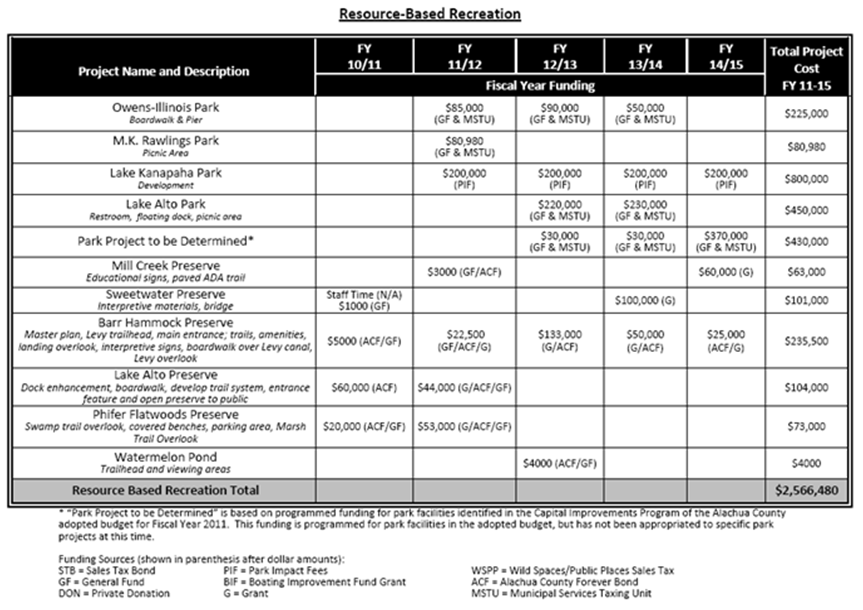
380 Table 3. (continued) Recreation Facilities Schedule of Capital Improvements, FY 2011 FY 2015 Capital Improvements Element Effective July 22, 2011 (Updated through January 21, 2016) 377
381 ECONOMIC ELEMENT ALACHUA COUNTY COMPREHENSIVE PLAN
382 GOAL 1 ENHANCE THE ECONOMIC PROSPERITY OF ALL CITIZENS OFALACHUA COUNTY AND EXPAND AND DIVERSIFY THE COUNTY'S TAX BASE. OBJECTIVE ECONOMIC DIVERSITY AND SUSTAINABILITY Diversify the County s economy. Achieve a diversified and sustainable economic base in Alachua County to minimize the vulnerability of the local economy and to provide economic opportunity for all segments of the population and attract and retain high-quality employers and employees within the workforce. Policy Policy Policy Policy Policy Policy Alachua County shall promote the recruitment and expansion of targeted industries that are either growing, high-skill, high wage areas of desired growth, or contribute to regional economic diversification. These targeted industries include, but are not limited to: logistics, and distribution; building component design and manufacturing; aviation services and products, bio-fuels and energy; healthcare services and projects business services; communication services; medical and pharmaceuticals, including biotech; technology driven manufacturing; electronics and other electrical equipment; regional or corporate headquarters; information technology; research and development; eco-tourism; multimedia productions. Alachua County shall promote economic development efforts that build on and complement existing commercial, industrial and agricultural assets in the local economic system. Alachua County shall implement the goals of the Alachua County Visitors and Convention Bureau to promote North Central Florida as a tourism destination through events, advertising and accessible recreation sites. The County shall promote tourism, including eco-tourism, agritourism, heritage tourism and tourism-related businesses which complement the County s environmental, social and economic quality. Alachua County shall promote partnerships with local arts/cultural organizations and sports organizations, and promote unique recreational tourism opportunities including agritourism, paddling trails, the African American Heritage Trail and the Old Florida Heritage Highway master plan. Alachua County shall expand its economic base by creating an environment which encourages entrepreneurship through strong partnerships with FloridaWorks, the University of Florida, Santa Fe College, the School Board of Alachua County and related organizations that provide education and training to the community. Consistent with Energy Element Objective 2.2 and Future Land Use Element Objectives 6.1 and 6.2, Alachua County shall encourage the location and development of energy conservation, alternative energy, reuse/recycling based industry and sustainable food production and processing businesses and industry clusters in order to achieve a higher level of sustainable economic development. Alachua County shall promote a Recycling Market Development Zone (RMDZ)/Resource Recovery industrial park focused on sustainable production of Economic Element Effective July 22, 2011 (Updated through January 21, 2016) 379
383 Policy Policy Policy (b) (c) goods or materials that may include recycled content or resources collected by the County curbside recycling program or otherwise removed from the County s waste stream. Consistent with Future Land Use Element Policy 6.1.4, industries and business sectors that create a market for local agricultural products shall be encouraged to locate or expand existing local business in Alachua County. Highlight local specialty foods and farmers markets as part of the County s tourism marketing efforts. Alachua County shall establish and maintain land uses and zoning regulations that will facilitate telecommuting, home based occupations, mixed-use centers and other components that are helpful to job creation and retention, including the targeted industries listed in Policy Alachua County shall encourage and allow flexibility in the development of "home-based businesses" consistent with public health and safety concerns. Home-based businesses are defined as a business or commercial activity conducted on a residential property which is accessory to the residential use of that property. The land development regulations shall include thresholds to allow for approval of small-scale rural home-based businesses through administrative review and other mechanisms appropriate to the size, intensity, and impacts of such businesses. Consistent with Energy Element Policy 3.1.4, Alachua County shall promote redevelopment and infill within the Urban Cluster. Recognizing that such redevelopment and infill is an efficient use of land, infrastructure, energy resources, and existing public services, redevelopment of existing sites and buildings shall be encouraged. The County will encourage redevelopment by establishing strategies, such as mixed-use and increased densities, in the goals, objectives, and policies of the Future Land Use Element. Policy Recognizing constraints such as location, site access, existing utility infrastructure, or other conditions that may constrain redevelopment in compliance with generally applicable standards, the County shall establish criteria for sites where it would be appropriate to facilitate redevelopment of existing properties based on alternative standards. OBJECTIVE ECONOMIC DEVELOPMENT STRATEGY Provide a comprehensive economic development strategy for Alachua County. Policy Policy Policy Alachua County shall encourage the allocation of resources for the retention, expansion and development of local business and the recruitment of businesses and industries. Priority shall be given to the retention, expansion and development of local businesses. Alachua County shall coordinate its economic development activities with its municipalities and the appropriate federal, state, regional and local agencies including Florida Works, the University of Florida, Santa Fe College, the School Board of Alachua County and economic development organizations. Alachua County shall pursue an integrated approach to economic development that includes citizen input and addresses the needs of the County. The County shall support Economic Element Effective July 22, 2011 (Updated through January 21, 2016) 380
384 Policy Policy Policy and coordinate the activities of the County s Economic Development Advisory Committee in the development and implementation and periodic update of the strategic plan for county-wide economic development. Alachua County may elect to implement all or part of this element through a contractual agreement with another agency or agencies engaged in the business of economic development. Specific responsibilities shall be set forth in such an agreement to ensure compliance with this plan. The Alachua County department or the agency contracted to implement this plan shall develop an annual program to retain, expand and develop local businesses. This program shall also explore opportunities for attracting appropriate businesses and industries. This program shall encourage the availability of economic opportunities for all segments of the community, monitor and reduce the extent of underemployment in the community, recruit businesses and industries that will utilize and train the local labor force as their employees, and retain existing talented workforce. (b) (c) (d) This program shall: Provide current informational material to prospective businesses and industries that includes but is not limited to: (1) An inventory of available commercial and industrial land and vacant buildings. (2) Analysis of labor force characteristics and needs. (3) Availability and cost of electricity, water, sewer, natural gas, and essential infrastructure (4) Analysis of community characteristics (e.g., quality of public schools and cultural amenities). (5) Provide site location and development review assistance. Advise the Local Planning Agency and the Board of County Commissioners on economic development issues that affect comprehensive planning and land development regulation activities. Participate in the review of grant proposals relating to economic development. Provide a review of barriers to employment and economic prosperity (e.g., transportation, child-care, education, employability and health-care) and ways to overcome those barriers. Alachua County shall pursue incentive programs such as Tax Increment Financing (TIF), Community Development Block Grant (CDBG), Qualified Target Industry Tax Refund program, an impact fee financing fund, a revolving capital loan fund, and land acquisition that will allow businesses and employers to invest in retaining and creating high wage job opportunities and value-added businesses. Alachua County shall study economic incentives utilized by various communities and seek to implement those incentives that are appropriate for Alachua County. In order to determine whether incentives are provided to a project, the County shall conduct a cost/benefit assessment of any financial incentives proposed to be provided by the County to support the retention, expansion or development Economic Element Effective July 22, 2011 (Updated through January 21, 2016) 381
385 Policy Policy Policy of local business or to attract new business. Such an assessment shall factor in the financial costs as well as the social equity and environmental impacts of proposed incentives. Alachua County, or the agency contracted to implement its economic development strategy, shall establish criteria for ranking future economic development proposals/initiatives and requests for funding from economic development organizations based on their contributions to sustainable economic development. Priority should be given to businesses and industries that would contribute to the flow of income into the local economy through the sale of goods and services outside of the County, or that would produce goods and services that would otherwise be imported into the County and such firms should be encouraged to locate or expand existing local business in Alachua County. Alachua County recognizes Research and Technology Parks as valuable economic assets to the community that are particularly appropriate in transit oriented developments and mixed-use activity centers. Development of such parks and other similar ventures through expansion, development and recruitment of appropriate businesses and industries shall be given high priority. Policy Alachua County recognizes the business incubators such as the Gainesville Technology Enterprise Center (GTEC) as valuable economic assets to the community and shall encourage the development of additional incubators and similar ventures through expansion, development and recruitment of appropriate businesses and industries, where consistent with the Future Land Use Element. The County shall strive to retain in the community the businesses that are established and grow from the incubators by assuring that an adequate amount of land properly designated for manufacturing and commerce activities related to the incubated enterprises is available. Policy Alachua County recognizes the value of industries related to the development of energy conservation, alternative energy, reuse/recycling based products and sustainable food production and processing and encourages the location of these businesses and industry clusters consistent with Energy Element Objective 2.1. These industries shall be given high priority. Policy Alachua County shall promote industries and businesses that support cultural, nature-based and/or eco-tourism activities. Policy Alachua County shall support the development and expansion of small and minority businesses. Policy To further support local and minority business efforts, Alachua County's purchasing policies shall provide the maximum opportunity for increased participation by local, small and minority business. Policy Alachua County shall maintain a system for registering all businesses operating in the County. Policy Alachua County shall promote methods of financing infrastructure and public services that will minimize costs to current and future taxpayers, such as bond issues when the market is favorable. Economic Element Effective July 22, 2011 (Updated through January 21, 2016) 382
386 Policy Alachua County shall initiate efforts and support the efforts of other agencies to obtain grant funding (e.g., Community Development Block Grants) and other sources of funds designed to assist local economic development projects. Policy A comprehensive annual "State of Alachua County's Economy" report shall be presented to the Board of County Commissioners. This document shall review the economic indicators of the local economy and the impact of economic development efforts on the goals and objectives outlined in this plan. This report shall be developed by the County in coordination with local economic development entities such as the Chamber of Commerce/CEO, with input from the appropriate County advisory committees such as the Economic Development Advisory Committee. This report shall include at a minimum: (b) (c) (d) (e) (f) (g) (h) A review of the annual economic development program for Alachua County as it relates to the objectives and policies set forth in this Economic Element. Recommendations concerning identified infrastructure needs to support economic development efforts; this information shall be considered as part of the annual update of the Capital Improvement Program. A report of existing business expansions and new business starts within the County. A report on businesses attracted to the County through the recruitment efforts of Alachua County. A report on vocational training opportunities, including identification of needed job skills reported by businesses during the recruitment or expansion process. The number of new jobs created. A report on the costs and benefits to the County, as well as the effectiveness, of any incentives provided by the County to support the retention or expansion of existing businesses or to develop or attract new business. A report on the effectiveness of the economic development program in improving the economic well-being of the unemployed poor, including those not covered by general unemployment statistics. OBJECTIVE ENVIRONMENTAL QUALITY AND RESOURCE CONSERVATION The County shall evaluate and ensure that the types of new or the expansion of existing businesses and industries developing and locating in Alachua County contribute to maintaining a clean environment (air, water, soil) including measures to increase energy conservation, reduce greenhouse gas production, consistent with Energy Element Objectives 2.1 and 2.2 and Conservation and Open Space Policy 4.1.2, and are located in areas with suitable infrastructure and compatible land uses. Each employer shall be a good neighbor by preventing adverse impacts on the environment with emphasis given to the Conservation and Open Space Element of the Comprehensive Plan. Policy Alachua County shall adopt objective standards for timely decisions on applications for development approval for business and industrial uses that correspond to Alachua County s Comprehensive Plan and Zoning Ordinances. Such standards and procedures shall be reviewed on an annual basis to determine their effectiveness in facilitating the Economic Element Effective July 22, 2011 (Updated through January 21, 2016) 383
387 Policy Policy permitting process and protecting the environment. The County shall develop and maintain, as a mechanism for expediting the development review process, an inventory of suitable potential business locations which would include information on the infrastructure available and the environmental conditions of the site. This inventory may be contained within or accessed from the County s Geographic Information Systems database and public applications and viewers. The County may coordinate with the municipalities to include their suitable location information within this inventory. Alachua County shall encourage the development and expansion of business and industry in appropriate locations that make efficient use of existing public services and infrastructure. Industries or businesses generating hazardous wastes shall follow procedures and guidelines for the use, storage, and disposal of such materials as set forth by ordinance and in accordance with the Solid Waste Element and Objective 5.7 of the Conservation and Open Space Element of this plan. OBJECTIVE EDUCATION AND EMPLOYMENT Coordinate educational, vocational, and technical training opportunities with the needs of new and existing employers. In collaboration with other institutions, create an environment in which all residents may become as self-sufficient as possible, through educational and employment opportunities. Policy Policy Policy Policy Alachua County shall assist in the coordination of educational, professional, technical, and vocational training of the labor force with the needs of businesses and industries. This assistance shall include, but not be limited to, disseminating information about the vocational and other programs available through Florida Works, Santa Fe College, the School Board of Alachua County, the Chamber of Commerce/CEO and the University of Florida to prospective businesses and industries and disseminating statistical data on population and employment relating to labor markets for use by potential employers and vocational programs. Alachua County shall foster collaboration among the workforce development organizations and the educational institutions, the employees and employers to ensure that the skills of the County s labor force closely match the demand for labor. Alachua County shall, as referenced in the County s Strategic Plan for Sustainable Economic Development, collaborate with local workforce development organizations and educational institutions to expand vocational skills training and provide entrepreneurial opportunities for students. This collaboration shall include goals to prepare students for post-secondary employment in such areas as special skills training, targeted industries training and vocational skills training and internships, in collaboration with Florida Works, Santa Fe College, the School Board, the University of Florida, the business community and other agencies. Assist startup companies and encourage business retention through support of incubators consistent with Policy and workforce education/training initiatives. Economic Element Effective July 22, 2011 (Updated through January 21, 2016) 384
388 OBJECTIVE EXPAND ECONOMIC OPPORTUNITIES AND REDUCE POVERTY Provide sustainable economic opportunities for all segments of Alachua County. Particular emphasis shall be given to activities which increase economic opportunities for persons at or near the poverty level and to activities which redevelop economically distressed and under-utilized areas. Alachua County shall utilize the following indicators: Policy Policy Policy Policy Policy Policy Policy Policy Policy a. per capita incomes for Alachua County. b. percentage of persons living at or below the poverty level. c. unemployment rates. Alachua County shall support existing businesses and encourage new business development in economically distressed areas of the County by coordinating with other economic development initiatives at the local, state, or regional level. The County shall make information available to the community on potential incentives such as reduced impact and/or mobility fees, streamlined permitting requirements for redevelopment within the Urban Cluster, and financial incentives available at the state and federal level for redevelopment of brownfield sites. The County shall pursue funding opportunities, including grants and other funding sources, for the extension of essential infrastructure to encourage development or redevelopment in specific economically distressed areas. Businesses and industries that meet the demands of the existing labor force by providing employment opportunities and equitable salaries shall be given a high priority in recruitment efforts and in provision of support for expansion of existing local business. Businesses and industries that are willing to participate in the training of skilled and unskilled workers through the local Workforce Investment Act (WIA) and/or other similar programs, shall be given a high priority in recruitment efforts and strongly encouraged to locate in Alachua County, and in provision of support for expansion of existing business. Alachua County shall support and encourage the development of public/private partnerships which assist small and minority businesses that may otherwise not have access to adequate start-up capital. Alachua County shall support Welfare Transition Program employment/training projects in the County. Alachua County shall collaborate with local businesses and organizations, including builders, developers, contractors and labor unions, to create or support programs that enhance apprenticeship opportunities for vocational trades. Alachua County shall support the development of micro-enterprises and small businesses by coordinating with other economic development initiatives. Policy Alachua County shall strive to compensate its employees with a combination of wages and benefits needed to cover the costs of life s basics, including shelter, food, clothing, utilities, transportation, child care and health care and is based on economic conditions of North Central Florida. Economic Element Effective July 22, 2011 (Updated through January 21, 2016) 385
389 Policy Alachua County shall promote affordable, diverse housing choices throughout the community to enhance the viability of the workforce. OBJECTIVE LIVABLE COMMUNITIES Create livable communities that are attractive to diverse populations and new economic development opportunities. Policy Policy Policy The County shall encourage expanded and new businesses to locate in well-designed, compact mixed-use communities as encouraged in the Future Land Use Element. The County shall promote reduced work to home commuting distances through encouragement of Traditional Neighborhood and Transit Oriented Developments and compact, mixed-use Activity Centers. The Land Development Regulations shall include standards to ensure that new and expanded businesses provide for the health of the community by providing access to bicycle and pedestrian transportation facilities as well as roadways. Economic Element Effective July 22, 2011 (Updated through January 21, 2016) 386
390 HISTORIC PRESERVATION ELEMENT ALACHUA COUNTY COMPREHENSIVE PLAN
391 GOAL 1 PRESERVE, PROTECT, ENHANCE AND SUPPORT HISTORIC RESOURCES AND PROPERTIES AND PALEONTOLOGICAL RESOURCES WITHIN ALACHUA COUNTY. OBJECTIVE 1.1 Consolidate County efforts aimed at protection of historic resources and properties. Policy Policy Policy Policy Policy Policy Alachua County shall establish a Historic Resources Preservation Plan that addresses comprehensively responsible stewardship of historic resources and properties. The plan shall be implemented through appropriate land development regulations. The Historic Resources Preservation Plan shall include, at a minimum: (b) (c) (d) (e) (f) (g) Identification of a lead agency to manage the plan. Mechanism for coordination of the Alachua County Historical Commission, Departments of Growth Management, Environmental Protection, and Public Works for the preservation of historic resources and properties. Consideration by Alachua County to become a Certified Local Government for Historic Preservation. Mechanism for pursuing state and federal grants and other funding. Establishment of a methodology to qualify a historic resource or property as significant based on National Register of Historic Places and/or local criteria. Maintain an inventory of historic resources and properties. Creation of a Historic Preservation Ordinance to provide regulatory protection of historic resources and properties, including prohibition and enforcement regarding vandalism, and avoidance, minimization, and mitigation of development impacts. All applications for development approval shall include a site-specific identification and analysis of historic resources and properties. The analysis shall include identification and mapping of each resource present on, or adjacent to, the development site, analysis of the impact of the proposed development on the resource(s), and discussion of proposed measures to avoid, minimize and/or mitigate impacts on the resource(s). The site analysis shall be reviewed by the County during the Development Review Process, for compliance with the Comprehensive Plan and applicable County regulations. The County shall coordinate with adjacent local governments, the State, and the Federal Government to preserve and protect historic resources and properties of local, regional and national significance. All County capital improvement projects shall be reviewed to determine what impact, if any, the project will have on historic resources and properties. Adverse impacts shall be avoided, minimized, and/or appropriately mitigated prior to construction. Alachua County shall participate with the Florida Department of Transportation and the Metropolitan Transportation Planning Organization to protect historic resources and Historic Preservation Element Effective July 22, 2011 (Updated through January 21, 2016) 388
392 OBJECTIVE 2.1 properties during right-of-way acquisition, construction, operation, and maintenance of the roadway system in Alachua County. Conserve and extend the useful life of historic resources and properties through the identification, protection and/or rehabilitation of properties significant on a national, regional, or local level consistent with preserving their historic or archaeological character and value. Strategies for preservation of historic resources and properties shall include: Policy Policy Policy Policy Policy Policy Incentives for maintenance, restoration and rehabilitation, and stabilization. Incentives for productive and adaptive reuse. Incentives for private ownership and responsible stewardship. Opportunity for acquisition/conservation by governmental entities, private interests, or not-for-profit organizations. Establishment of historic and/or archaeological districts. Alachua County shall maintain and update, on an annual basis, an inventory of historic resources and properties listed, eligible, or potentially eligible for listing in the National Register of Historic Places, or listed, eligible, or potentially eligible for listing in regional or local registers. By 2002, Alachua County shall contact owners of historic resources and properties eligible or potentially eligible for listing on the National Register of Historic Places to encourage nomination of such properties to the National Register and to offer assistance in the preparation of applications to the State Historic Preservation Officer and the Review Board for inclusion in the National Register. Historic Districts shall, where appropriate, be established by the Board of County Commissioners through a public hearing process. Land development regulations including the establishment of overlay zoning for Historic Preservation shall be established to preserve and protect these areas from the encroachment of incompatible land uses. Complimentary environmental, natural, and other features may be used as factors for determining the boundaries of potential historical or archaeological districts of national, regional or local significance. The County shall provide assistance to individuals, organizations, and other entities to preserve, restore, or establish historic landmarks. County funds may be spent for the acquisition or preservation, restoration, or establishment of landmarks where archeological, architectural or historic merit has been adequately established. The preservation, restoration, or rehabilitation of historic structures shall be encouraged. The demolition of a historic structure or a structure that is integrally related to a historic structure shall be prohibited without allowing an opportunity for the acquisition of fee or less-than-fee interest in the property by a governmental unit, an organization, or by any other entity committed to the preservation, restoration, or rehabilitation of the structure(s). Builders shall be encouraged to preserve historically significant resources or properties on a national, regional or local level for all property they develop. Mechanisms shall be Historic Preservation Element Effective July 22, 2011 (Updated through January 21, 2016) 389
393 Policy Policy included in the Development Review Process to provide incentives, when appropriate, to encourage retention and protection of such resources. Adaptive use of historic structures consistent with preservation of their historic character shall be encouraged. Where possible, variances to building codes and regulations shall be made to facilitate the rehabilitation and maintenance of historic structures. Historic structures originally built for residential use shall be maintained as residential dwellings to the greatest extent possible, but may be adapted to other uses. Alachua County shall assist, as appropriate, in the redevelopment and adaptive reuse of historically significant structures through such programs as the Ad Valorem Tax Exemption. This shall include assisting private property owners of historically significant structures in applying for and utilizing state and federal assistance programs as appropriate. OBJECTIVE 3.1 Evaluate and, where appropriate, conserve, protect, or acquire sites and areas of archaeological significance. Policy Policy Policy The County, by 2001, shall initiate a research project to identify and model areas of potential archaeological significance. Significant archaeological sites shall be protected from destruction in the absence of appropriate analysis and mitigation. The Land Development Regulations and the Development Review Committee shall provide for analysis of resources, and avoidance, minimization, and mitigation (in that order of preference) of adverse impacts when development involves properties that contain, or have reasonable potential to harbor, resources of archaeological significance. When proposed developments are located in such areas, the County or the applicant shall contact the Florida Department of State Division of Historical Resources for a recommendation on the need to conduct an assessment survey for potentially archaeological resources. When such survey is recommended, the County shall require the same. Following completion of the archaeological survey project identified in Policy the Development Review Committee may require an assessment survey and related analyses for developments proposed in identified sensitivity zones without recommendation of the Division of Historical Resources. The Development Review Committee also may require surveys and analyses outside of identified sensitivity zones, but only upon recommendation of the Division of Historical Resources. Development orders for such areas shall be conditioned, where appropriate, to accomplish the following: Historic Preservation Element Effective July 22, 2011 (Updated through January 21, 2016) 390
394 Policy (b) Insure proper archeological investigation prior to construction and where appropriate, avoidance, minimization, and mitigation of impacts; and Preserve and provide perimeter buffering around outstanding archeological sites. This may include, if necessary, alteration to the originally proposed or approved development plan to accommodate preservation of such sites. Where archaeological sites are to be preserved, incentives to encourage retention of these areas may be provided. When unmarked human remains are discovered during excavation, construction, development or any other circumstances, such discovery must be reported to the State Archaeologist or the County Medical Examiner, as appropriate. Any activities on the site that may disturb the remains shall not be resumed until authorized in writing by such offices. Such requirement is enforced under Florida Statutes, sections and OBJECTIVE 4.1 Evaluate and, where appropriate, conserve, protect or acquire sites and areas of paleontological significance. Policy Policy Policy The County, by 2001, shall contact the Florida Museum of Natural History for recommendations on areas of known or potential paleontological significance pursuant to FS Significant paleontological sites shall be protected from destruction in the absence of appropriate analysis and mitigation. The Land Development Regulations and the Development Review Committee shall provide for analysis of resources, and avoidance, minimization, and mitigation (in that order of preference) of adverse impacts when development review involves properties that contain, or have a reasonable potential to harbor, resources of paleontological significance. When proposed developments are located in such areas, the County or the applicant shall contact the Florida Museum of Natural History, as appropriate, for a recommendation on the need to conduct an assessment survey for potentially significant paleontological resources. Development orders for such areas shall be conditioned, where appropriate, to accomplish the following: (b) Insure proper paleontological investigation prior to construction and, where appropriate, avoidance, minimization, and mitigation of impacts. Preserve and provide perimeter buffering around and paleontological sites. This may include, if necessary, alteration to the proposed or originally approved development plan to accommodate preservation of such sites. Where paleontological sites are to be preserved, incentives to encourage retention of these areas may be provided. Historic Preservation Element Effective July 22, 2011 (Updated through January 21, 2016) 391
395 OBJECTIVE 5.1 Alachua County shall promote the use of historic resources for heritage tourism as part of the County s economic development efforts. Policy Agencies and organizations involved in heritage tourism shall coordinate their activities to promote heritage tourism as part of the County s economic development efforts. Historic Preservation Element Effective July 22, 2011 (Updated through January 21, 2016) 392

396 PUBLIC SCHOOL FACILITIES ELEMENT ALACHUA COUNTY COMPREHENSIVE PLAN
397 GOAL 1 THE COUNTY SHALL COLLABORATE WITH THE SCHOOL BOARD OF ALACHUA COUNTY (SBAC) TO PLAN FOR PUBLIC SCHOOL CAPACITY TO ACCOMMODATE PROJECTED ENROLLMENT DEMAND WITHIN THE FIVE YEAR, TEN YEAR, AND TWENTY YEAR PLANNING PERIODS. OBJECTIVE COORDINATE LAND USE AND SCHOOL CAPACITY. It is the objective of Alachua County to coordinate land use decisions [see definition] with school capacity planning. This objective will be accomplished recognizing the SBAC s statutory and constitutional responsibility to provide a uniform system of free and adequate public schools, and the County s authority for land use, including the authority to approve or deny petitions for future land use and rezoning for residential development that generate students and impact the Alachua County school system. Policy Policy Policy Coordinated Map Series The County, in conjunction with the SBAC and the municipalities within the County, shall annually update and maintain a public school facilities map series as supporting data and analysis. This map series including the planned general location of schools and ancillary facilities for the five-year planning period and the long-range planning period, will be coordinated with the County s Future Land Use Map or Map Series. The map series shall include at a minimum: (b) (c) A map or maps which identify existing location of public school facilities by type and existing location of ancillary plants; A future conditions map or map series which depicts the planned general location of public school facilities and ancillary plants and renovated facilities by year for the five year planning period, and for the end of the long range planning period of the County; and, A map or map series which depicts School Concurrency Service Areas (SCSAs) for high schools, middle schools and elementary schools. Coordinate School Capacity with Planning Decisions Alachua County shall coordinate land use decisions with the School Board s Long Range Facilities Plans over the 5-year, 10-year and 20-year periods by requesting School Board review of proposed comprehensive plan amendments and rezonings that would increase residential density. This shall be done as part of a planning assessment of the impact of such land use proposals on school capacity. Geographic Basis for School Capacity Planning For purposes of coordinating land use decisions with school capacity planning, the School Concurrency Service Areas (SCSAs) that are established for high, middle and elementary schools as part of the Interlocal Agreement for Public School Facility Planning ( Interlocal Agreement ) shall be used for school capacity planning. The relationship of high, middle and elementary capacity and students anticipated to be Public School Facilities Element Effective July 22, 2011 (Updated through January 21, 2016) 394
398 Policy Policy Policy Policy Policy generated as a result of land use decisions shall be assessed in terms of its impact (1) on the school system as a whole and (2) on the applicable SCSA(s). For purposes of this planning assessment, existing or planned capacity in adjacent SCSAs shall not be considered. Criteria for Evaluating Land Use Decisions In reviewing land use decisions, the SBAC may address the following issues as applicable: (b) (c) (d) (e) (f) (g) Available school capacity or planned improvements to accommodate the enrollment resulting from the land use decision; The provision of school sites and facilities within neighborhoods; The co-location of parks, recreation and neighborhood facilities with school sites; The linkage of schools, parks, libraries and other public facilities with bikeways, trails, and sidewalks for safe access; Traffic circulation in the vicinity of schools including the provision of off-site signalization, signage, access improvements, sidewalks to serve schools and the inclusion of school bus stops and turnarounds; Encouraging the private sector to identify and implement creative solutions to developing adequate school facilities in residential developments; Whether the proposed location is consistent with any local government s school design and planning policies. SBAC Report to County The SBAC shall report its findings and recommendations regarding the land use decision to the County. If the SBAC determines that capacity is insufficient to support the proposed land use decision, the SBAC shall include its recommendations to remedy the capacity deficiency including estimated cost. The SBAC shall forward the Report to all municipalities within the County. County to Consider SBAC Report The County shall consider and review the SBAC s comments and findings regarding the availability of school capacity in the evaluation of land use decisions. Capacity Enhancement Agreements Where feasible and agreeable to the County, SBAC, affected jurisdictions and the applicant, Capacity Enhancement Agreements shall be encouraged to ensure adequate capacity is available at the time the school impact is created. The SBAC s Long Range Facilities Plans over the 5-year, 10-year and 20-year periods shall be amended to incorporate capacity modification commitments established by Capacity Enhancement Agreements. Educational Facilities Benefit District Funding Option The School Board and local governments may consider establishment of Educational Facilities Benefit Districts [Section , F.S] as a funding option if needed to achieve or maintain level of service standards. Public School Facilities Element Effective July 22, 2011 (Updated through January 21, 2016) 395
399 Policy SBAC to Report to the Elected Officials Group The SBAC will annually provide a cumulative report of land use decisions and the effect of these decisions on public school capacity to the Elected Officials Group comprised of representatives of the School Board, the County and the municipalities within the County established by the Interlocal Agreement for Public School Facility Planning. GOAL 2 PROVIDE ADEQUATE PUBLIC SCHOOL CAPACITY TO ACCOMMODATE ENROLLMENT DEMAND WITHIN THE SCHOOL BOARD S FIVE-YEAR DISTRICT FACILITIES WORK PROGRAM OBJECTIVE IMPLEMENT SCHOOL CONCURRENCY The County shall coordinate with the SBAC to assure the future availability of adequate public school facility capacity through its authority to implement school concurrency. Policy Policy Interlocal Agreement The County shall maintain the Interlocal Agreement for Public School Facility Planning to implement school concurrency in concert with the SBAC and the municipalities. The Interlocal Agreement shall be consistent with the goals, objectives and policies of this Element. Ordinance Implementing School Concurrency The County shall implement the provisions for public school concurrency management through its land development regulations. OBJECTIVE LEVEL OF SERVICE STANDARDS The County shall ensure, in coordination with the SBAC, that the capacity of public schools is sufficient to support final development plans for residential developments at the adopted level of service (LOS) standards within the period covered by the 5-year schedule of capital improvements. Policy Policy Uniform Application of Level of Service (LOS) Standards The LOS standards established herein shall be applied consistently by all the local governments within Alachua County and by the SBAC on a district-wide basis to all schools of the same type. Level of Service (LOS) Standards The uniform, district-wide LOS standards shall be 100% of Program Capacity [see definition] for elementary, middle and high schools. This LOS standard shall apply to all school concurrency service areas (SCSAs) as adopted in the Interlocal Agreement. For combination schools, the School Board shall separately determine the capacity of each school to accommodate elementary, middle and high students and apply the LOS Standard prescribed above for elementary, middle and high levels respectively. Public School Facilities Element Effective July 22, 2011 (Updated through January 21, 2016) 396
400 Policy Amendment of Level of Service (LOS) Standards If there is agreement to amend the LOS standards, it shall be accomplished by the execution of an amendment to the Interlocal Agreement by all parties and the adoption of amendments to the local government comprehensive plans. The amended LOS standard shall not be effective until all plan amendments are effective and the amendment to the Interlocal Agreement for Public School Facility Planning is fully executed. Changes to LOS standards shall be supported by adequate data and analysis showing that the amended LOS standard can be reasonably met and achieved and maintained within the period covered by the applicable five years of the SBAC Five-Year Work Program. OBJECTIVE SCHOOL CONCURRENCY SERVICE AREAS The County shall, in coordination with the SBAC and municipalities within the County, establish School Concurrency Service Areas (SCSAs), as the areas within which an evaluation is made of whether adequate school capacity is available based on the adopted LOS standards. Policy Policy Policy School Concurrency Service Area (SCSA) Maps SCSAs for high, middle and elementary schools shall be as adopted in the Interlocal Agreement. SCSA boundaries shall be included as a part of the Data and Analysis supporting this Element and included in the PSFE Map Series as part of that supporting data. Criteria for School Concurrency Service Areas SCSAs shall be established to maximize available school capacity and make efficient use of new and existing public schools in accordance with the LOS standards, taking into account minimization of transportation costs, limitations on maximum student travel times, the effect of court approved desegregation plans, and recognition of the capacity commitments resulting from the development approvals by the local governments within Alachua County. SCSA boundaries shall consider the relationship of school facilities to the communities they serve including reserve area designations and extra-territorial areas established under the Alachua County Boundary Adjustment Act and the effect of changing development trends. Modifying School Concurrency Service Areas The County, in coordination with the SBAC and the municipalities within the County, shall require that prior to adopting a modification to SCSAs, the following standards will be met: (b) (c) Potential modifications to the SCSAs may be considered annually. Supporting data and analysis for modified SCSAs shall be included in the annual update to the SBAC s 5-Year Work Program. Modifications to SCSA boundaries shall be based upon the criteria as provided in Policy Any modifications to the SCSA boundaries shall be based on supporting data and analysis showing that the Level of Service standard can be reasonably met for Public School Facilities Element Effective July 22, 2011 (Updated through January 21, 2016) 397
401 (d) (e) (f) (g) the amended SCSAs within the five-year period described by the 5-Year District Facilities Work Program. Any party to the adopted Interlocal Agreement may propose a modification to the SCSA boundary maps. At such time as the SBAC determines that a SCSA boundary change is appropriate considering the above criteria, the SBAC shall transmit the proposed SCSA boundary modification with data and analysis to support the changes to the Elected Officials Group. The Elected Officials Group shall review the proposed SCSA boundary modifications and send its comments to the SBAC and the parties to the Interlocal Agreement. Modifications to a SCSA shall become effective upon final approval by the SBAC and amendment of the Interlocal Agreement for Public School Facility Planning by the parties to the agreement. OBJECTIVE SCHOOL CONCURRENCY REVIEW PROCESS In coordination with the SBAC, the County will establish a joint process for implementation of school concurrency which includes applicability, capacity determination, availability standards, and school capacity methodology. Policy Policy Development Review The issuance of final development orders for residential development shall be subject to the availability of adequate school capacity based on the Level of Service (LOS) standards adopted in this Element. Exemptions The following residential developments are exempt from the school concurrency requirements: (b) (c) (d) Single family lots of record that received final subdivision or plat approval prior to October 3, 2008, or single family subdivisions or plats actively being reviewed on or before June 28, 2008 that received preliminary development plan approvals and the development approval has not expired. Multi-family residential development that received final site plan approval prior to the effective date of the PSFE, or multi-family site plans actively being reviewed at the time of adoption of the PSFE that have received preliminary development plan approvals and the development approval has not expired. Amendments to subdivisions or plat and site plan for residential development that were approved prior to October 3, 2008 which do not increase the number of students generated by the development. Age restricted developments that prohibit permanent occupancy by persons of school age. Such restrictions must be recorded, irrevocable for a period of at least thirty (30) years and lawful under applicable state and federal housing statutes. The applicant must demonstrate that these conditions are satisfied. Public School Facilities Element Effective July 22, 2011 (Updated through January 21, 2016) 398
402 Policy Policy Policy (e) Group quarters that do not generate students in public school facilities, including residential facilities such as local jails, prisons, hospitals, bed and breakfast, motels and hotels, temporary emergency shelters for the homeless, adult halfway houses, firehouse dorms, college dorms exclusive of married student housing, and non-youth facilities. Student Generation Rates and Costs per Student Station Student generation rates used to determine the impact of a particular development application on public schools, and the costs per student station shall be determined in accordance with professionally accepted methodologies and established annually by the SBAC with the 5-Year District Facilities Work Program. School Capacity and Enrollment The SBAC shall determine the level of service or utilization rate of each school using a uniform methodology. The SBAC shall use program capacity as the methodology to determine the capacity of elementary, middle, and high school facilities. School enrollment shall be based on the enrollment of each individual school based on counts reported by the SBAC to the Department of Education. Determination of Adequate Capacity A concurrency review shall be conducted for all development plan approvals that are subject to school concurrency in accordance with procedures for coordination of such reviews by the County and the School Board established in the Interlocal Agreement. These procedures shall provide for review of individual development proposals by SBAC staff to determine whether there is adequate public school capacity to accommodate the proposed development, and issuance by the County of a concurrency determination based on SBAC staff s review and recommendation. These procedures shall also provide for the SBAC in coordination with local governments in the County to prepare an annual report based on existing and projected capacity and enrollment and student generation rates that establishes maximum thresholds for developments at or below which adequate public school capacity will be available; for developments at or below these thresholds the County may determine as part of the County s development review process that that there is adequate public school capacity without SBAC staff review of such developments. (b) Adequate school capacity means there is sufficient school capacity at the adopted LOS standards to accommodate the demand created by a proposed development for each type of school within the affected CSA. If adequate capacity does not exist, the SBAC shall identify possible mitigation options that may be applied consistent with the policies set forth within Objective 2.5. In the event that the SBAC determines that there is not adequate capacity in accordance with the concurrency availability standard in Policy , then the development application may remain active pending the conclusion of the mitigation negotiations and execution of a legally binding mitigation agreement in accordance with the policies under Objective 2.5. Public School Facilities Element Effective July 22, 2011 (Updated through January 21, 2016) 399
403 Policy Policy Concurrency Availability Standard School concurrency applies only to residential development or a phase of residential development requiring a final development order proposed or established on or after October 3 rd, The County shall include concurrency management provisions in its land development regulations to require that all new residential development be reviewed for school concurrency no later than the time of final subdivision, final plat or final site plan. The County shall not deny a final development order due to a failure to achieve and maintain the adopted LOS standards for public school capacity where: (b) (c) Adequate school facilities will be in place or under construction within three years, as provided in the SBAC 5-Year District Facilities Work Program, after the issuance of the final development order; or, Adequate school facilities are available in an adjacent SCSA, and when adequate capacity at adopted LOS Standards will be in place or under construction in the adjacent SCSA within three years, as provided in the SBAC 5-Year District Facilities Work Program, after the issuance of the final development order; or, The developer executes a legally binding commitment to provide mitigation proportionate to the demand for public school facilities to be created by development of the property subject to the final development order as provided in this element. Reservation of Capacity A determination of adequate school capacity shall indicate a temporary commitment of capacity of necessary school facilities for purposes of development review and approval for a period not to exceed one year from Preliminary Development Plan Approval or until a Final Development Order is issued, whichever occurs first, or as specified for phased projects in the County s land development regulations. (b) Once the County reserves school capacity for concurrency purposes as a part of the Final Development Order, the school capacity necessary to serve the development shall be considered reserved for a period not to exceed three (3) years or until completion of construction of development infrastructure required by the Development Order or longer if the SBAC concurs that there is sufficient capacity as specified in the County s land development regulations. These time frames shall be subject to any State-mandated extensions of development approvals. Phased projects, as provided for in the Alachua County land development regulations, may obtain approval for a longer period, provided the development order is in accordance with an agreement entered into by the School Board, Alachua County, and the developer, which may include a phasing schedule or other timing plan for development plan approvals, capacity reservation fees, capacity enhancement agreements, or other requirements as determined by the School Board. Public School Facilities Element Effective July 22, 2011 (Updated through January 21, 2016) 400
404 (c) The County shall notify shall notify the SBAC within fifteen (15) working days of the approval or expiration of a concurrency reservation for a residential development. No further determination of school capacity availability shall be required for the residential development before the expiration of the Final Certificate of Level of Service Compliance, except that any change that would increase student generation requires review. OBJECTIVE PROPORTIONATE SHARE MITIGATION Alachua County, in coordination with the SBAC, shall provide for mitigation alternatives that are determined by the SBAC to achieve and maintain the adopted LOS standard consistent with the adopted SBAC s 5-Year District Facilities Work Program. Policy Policy Policy Mitigation Options Mitigation may be allowed for those developments that cannot meet the adopted LOS Standards. Mitigation options shall include options listed below for which the SBAC assumes operational responsibility through incorporation in the adopted SBAC s Five-Year District Facilities Work Program and which will maintain adopted LOS standards. (b) (c) The payment of a proportionate share amount as calculated by the formula in Policy or the equivalent donation, construction, or funding of school facilities or sites in accordance with costs determined by the School Board; The creation of mitigation banking within designated areas based on the construction of a public school facility in exchange for the right to sell capacity credits; and, The establishment of a charter school with facilities constructed in accordance with the State Requirements for Educational Facilities (SREF). Mitigation Must Enhance Program Capacity Mitigation must be directed toward a program capacity improvement identified in the SBAC s 5-Year District Facilities Work Program, which satisfies the demands created by the proposed development consistent with the adopted LOS standards. Mitigation shall be directed to projects on the SBAC's 5-Year District Facilities Work Program that the SBAC agrees will satisfy the demand created by that development approval. Such mitigation proposals shall be reviewed by the SBAC, the County and any affected municipality. If agreed to by all parties, the mitigation shall be assured by a legally binding development agreement between the SBAC, the County, and the applicant which shall be executed prior to the County s issuance of the final development order. If the SBAC agrees to the mitigation, the SBAC must commit in the agreement to placing the improvement required for mitigation in its 5-Year District Facilities Work Program. Calculating Proportionate Share The applicant s total proportionate share obligation to resolve a capacity deficiency shall be based on the following: Public School Facilities Element Effective July 22, 2011 (Updated through January 21, 2016) 401
405 NUMBER OF STUDENT STATIONS (BY SCHOOL TYPE) = NUMBER OF DWELLING UNITS BY HOUSING TYPE X STUDENT GENERATION MULTIPLIER (BY HOUSING TYPE AND SCHOOL TYPE) PROPORTIONATE SHARE AMOUNT = NUMBER OF STUDENT STATIONS (BY SCHOOL TYPE) X COST PER STUDENT STATION FOR SCHOOL TYPE. The above formula shall be calculated for each housing type within the proposed development and for each school type (elementary, middle or high) for which a capacity deficiency has been identified. The sum of these calculations shall be the proportionate share amount for the development under review. The SBAC average cost per student station shall only include school facility construction and land costs, and costs to build schools to emergency shelter standards when applicable. The applicant s proportionate-share mitigation obligation shall be credited toward any other impact or exaction fee imposed by local ordinance for the same need, on a dollar-for-dollar basis, at fair market value. OBJECTIVE SBAC FIVE-YEAR DISTRICT FACILITIES WORK PROGRAM Each year, the County shall adopt (which adoption may be through incorporation by reference) in its Capital Improvements Element, the SBAC s annually updated 5-Year District Facilities Work Program. Policy Development, Adoption and Amendment of the SBAC 5-Year District Facilities Work Program. The SBAC shall annually update and amend the Five-Year District Facilities Work Program to reflect the (LOS) standards for schools to add a new fifth year, which continues to achieve and maintain the adopted LOS for schools. The Five-Year District Facilities Work Program ensures the level of service standards for public schools are achieved and maintained within the period covered by the 5-year schedule. The Five-Year District Facilities Work Program shall also address the correction of existing facility deficiencies and facilities needed to meet future needs. After the first 5-year schedule of capital improvements, annual updates to the schedule shall ensure levels of service standards are achieved and maintained within the subsequent 5-year schedule of capital improvements necessary to address existing deficiencies and meet future needs based upon achieving and maintaining the adopted level of service standards. The County shall have neither obligation nor responsibility for funding the Five-Year District Facilities Work Program by adopting the SBAC s Five-Year District Facilities Work Program into the Capital Improvements Element. Public School Facilities Element Effective July 22, 2011 (Updated through January 21, 2016) 402
406 GOAL 3 PROVIDE SAFE AND SECURE PUBLIC SCHOOLS SITED WITHIN WELL DESIGNED COMMUNITIES. OBJECTIVE SCHOOL LOCATION AND SITE DESIGN The County shall establish standards and criteria to guide the location of future public schools. Policy Policy Policy Coordination of Existing School Facilities and Sites Standards regarding existing and future public school facilities and sites in the unincorporated area of Alachua County shall be as provided in Section 5.3 and related sub-policies in the Future Land Use Element of the Alachua County Comprehensive Plan. This includes identification of Future Land Use categories where public educational facilities shall be allowable uses; areas where future educational facilities shall be avoided; encouraging the location of elementary and middle schools within existing or proposed residential areas or village centers, and near public facilities to facilitate joint use; providing for reasonable development standards and conditions for school site planning including promotion of safe pedestrian and bicycle access; and, linking schools with surrounding residential areas by bikeways and sidewalks. Coordination of Future School Facilities and Sites All new public schools built within the unincorporated County will be coordinated by the SBAC with the County to verify consistency between the location of public school with the County s Comprehensive Plan, ensure that the new schools are proximate and consistent with existing and proposed residential areas, serve as community focal points, are co-located with other appropriate public facilities when possible, and shall have the on-site and off-site infrastructure necessary in place to support the new school. Bus Stops The County shall, in cooperation with the SBAC, develop and adopt design standards for school bus stops and turnarounds in new developments and redevelopment projects. OBJECTIVE ENCOURAGE SCHOOLS AS FOCAL POINTS OF COMMUNITY PLANNING AND DESIGN Policy Enhance Community/Neighborhood Design The County, in conjunction with the SBAC, shall promote the neighborhood concept in new developments or redevelopment by encouraging the use of existing schools as neighborhood centers or focal points. Public School Facilities Element Effective July 22, 2011 (Updated through January 21, 2016) 403
407 OBJECTIVE CONSIDER COMPATIBILITY OF USES ADJACENT TO PUBLIC SCHOOLS Policy Compatibility of Adjacent Uses The County shall consider input from the SBAC in reviewing plan amendments and rezonings concerning compatibility of proposed uses adjacent to existing schools and known future school sites. OBJECTIVE COORDINATE WITH SBAC ON REDUCTION OF HAZARDOUS WALKING CONDITIONS Policy Safe Ways to School To reduce hazardous walking conditions consistent with Florida s safe ways to school program, Alachua County shall coordinate with the SBAC to implement the provisions of Section , Florida Statutes, including identification and correction of hazardous conditions along walking routes to schools, and identification of proposed projects to remedy such conditions for priority consideration in the annual review and update of the Capital Improvement Program. OBJECTIVE SCHOOL SITING STANDARDS The County will establish siting standards for schools. Policy Evaluation of Potential School Sites Potential school sites shall be consistent with the school siting standards provided in the Interlocal Agreement for Public School Facility Planning. OBJECTIVE SCHOOL DEVELOPMENT STANDARDS The County shall establish development standards for schools to achieve compatibility with surrounding neighborhoods and the community. Policy School Development Standards The County shall require the development of school sites to be consistent with the following standards provided these requisites are not in conflict with the State Requirements for Educational Facilities (SREF) or unless the Board of County Commissioners approves changes or modifications: (b) (c) The location, arrangement, and lighting of play fields and playgrounds shall be located and buffered as may be necessary to minimize impacts to adjacent residential property; The following minimum size guidelines have been recommended by the SBAC: Elementary School - 25 acres, Middle School - 35 acres, High School - 65 acres. These guidelines shall not preclude smaller sized sites if determined to be acceptable by the School Board. Maximum height of the school structure shall adhere to the height requirements established for the zoning district for the school site zoning district; Public School Facilities Element Effective July 22, 2011 (Updated through January 21, 2016) 404
408 (d) (e) (f) (g) (h) Building setbacks from property lines for all schools shall adhere to the minimum building setback requirements established for the zoning district for the school site zoning district; All parking areas on school sites shall adhere to the minimum setback requirements established for the zoning district; Access to school sites shall be governed by the County s and FDOT s access management regulations, including installation by the SBAC, or other party as determined by Alachua County, of all access-related improvement required by such regulations; The site shall be required to provide bicycle/pedestrian connections to sidewalks, trails, and bikeways internal or adjacent to residential neighborhoods, including the provision of safe roadway crossings; Development of the site shall be consistent with applicable policies contained within the Conservation and Open Space Element of this plan. OBJECTIVE COORDINATE SUPPORTING INFRASTRUCTURE The County shall coordinate with the SBAC plans for supporting infrastructure. Policy Coordination of Planned Improvements As part of the annual review and update of the Capital Improvements Element, the County shall consider infrastructure required to support new school facilities. GOAL 4 PROMOTE AND OPTIMIZE INTERGOVERNMENTAL COOPERATION FOR EFFECTIVE FUTURE PLANNING OF PUBLIC SCHOOL SYSTEM FACILITIES. OBJECTIVE SCHOOL BOARD REPRESENTATION Policy Policy Appointed Local Planning Agency (LPA) and Planning Commission Members As provided in the Interlocal Agreement, the County shall include a representative appointed by the School Board on the Local Planning Agency (LPA) and Planning Commission as a voting member. Development Review Representative As provided in the Interlocal Agreement, the School Board will appoint a representative to advise the Local Government review committee, or equivalent body on development and redevelopment which could have a significant impact on student enrollment or school facilities. OBJECTIVE JOINT MEETINGS The County shall participate in meetings and other actions established to promote coordination and the sharing of data and information. Public School Facilities Element Effective July 22, 2011 (Updated through January 21, 2016) 405
409 Policy Policy Staff Working Group As provided in the Interlocal Agreement, a staff working group of the County, SBAC and municipalities will meet on a semi-annual basis to identify issues and assemble and evaluate information regarding the coordination of land use and school facilities planning. A staff representative from the Regional Planning Council will also be invited to attend. A designee of the School Board shall coordinate and convene the semi-annual meeting. Annual Meeting of Elected Officials One or more representatives of the County, each City, and the School Board will meet at least annually in joint workshop sessions. A representative of the Regional Planning Council will also be invited to attend. The joint workshop sessions will be opportunities for the County Commission, the City Commissions or Councils, and the School Board to hear reports, discuss policy, set direction, and reach understandings concerning issues of mutual concern regarding coordination of land use and school facilities planning, including population and student growth, development trends, school needs, off-site improvements, and joint use opportunities. The Superintendent of Schools, or designee, shall be responsible for making meeting arrangements and providing notification to the general public of the annual meeting. OBJECTIVE COORDINATE STUDENT ENROLLMENT & POPULATION PROJECTIONS The County will coordinate with the SBAC and the municipalities within the County to maintain and update student enrollment and population projections. Policy Policy Policy Annual Revision and Distribution The County will coordinate with the SBAC and the municipalities to base school planning upon consistent projections of the amount, type, and distribution of population growth and student enrollment. Countywide 5-year population and student enrollment projections shall be reviewed and updated annually. Enrollment Projections The School Board shall use student population projections based on information produced by the demographic and education estimating conferences pursuant to Section , Florida Statutes and the Department Of Education Capital Outlay Full-Time Equivalent (COFTE). The School Board may request adjustment to the projections based on actual enrollment and development trends. In formulating such a request the SBAC will coordinate with the Cities and County regarding development trends, enrollment projections and future population projections. Planning Data on Growth and Development As provided in the Interlocal Agreement, the County will provide to the SBAC, on an annual basis, a report on growth and development trends in the unincorporated area of the County for the preceding calendar year. The County, in coordination with the municipalities, will generate data on growth and development for the School Board s consideration in allocating the projected student enrollment into school attendance zones. Public School Facilities Element Effective July 22, 2011 (Updated through January 21, 2016) 406
410 Policy Policy The School District s Five-Year District Facilities Work Program No later than October 1 st of each year, the School Board shall submit to the County the district s tentative Five Year District Facilities Work Program. The program will be consistent with the requirements of Sections and , F.S., and include projected student populations apportioned geographically, an inventory of existing school facilities, projections of facility space needs, information on relocatables, general locations of new schools for the 5, 10, 20 year time periods, and options to reduce the need for additional student stations. The County shall review the program and provide comments to the School Board within 30 days on the consistency of the program with the local comprehensive plan, including the capital improvements element and whether a comprehensive plan amendment will be necessary for any proposed educational facility. Educational Plant Survey At least one year prior to preparation of each Educational Plant Survey, the Staff Working Group established Policy will assist the School Board in an advisory capacity in preparation of the survey. The Educational Plant Survey shall be consistent with the requirements of Section , F.S., and include at least an inventory of existing educational facilities, recommendations for new and existing facilities, and the general location of each in coordination with local government comprehensive plans. The Staff Working Group will evaluate and make recommendations regarding the location and need for new schools, significant expansions of existing schools, and closures of existing facilities, and the consistency of such plans with the local government comprehensive plan. OBJECTIVE SCHOOL SITE SELECTION, EXPANSIONS AND CLOSURES The County, in conjunction with the SBAC, shall implement an effective process for identification and selection of school sites and for the review of significant expansions and closures. Policy Policy Advisory Committees The SBAC will establish a School Planning Advisory Committee (SPAC) for the purpose of reviewing potential sites for new schools, proposals for significant school expansions and potential closure of existing schools. Based on information gathered during the review, the SPAC will submit recommendations to the Superintendent of Schools. The SPAC will be a standing committee and will meet on an as needed basis. In addition to appropriate representatives of the School Board staff, the SPAC will include at least one staff member of the County, a staff representative from each of the municipalities, and a diverse group of community members. New School Sites When the need for a new school site is identified in the Five Year District Facilities Work Program, the SPAC will develop a list of potential sites in the area of need. The list of potential sites for new schools will be submitted to the County with jurisdiction for an informal assessment regarding consistency with this Element. Based on the information gathered during this review, and the evaluation criteria set forth in this Element, the SPAC will make a recommendation to the Superintendent of one or more sites in order of preference. Public School Facilities Element Effective July 22, 2011 (Updated through January 21, 2016) 407
411 Policy Policy Expansions and Closures For significant expansions and potential closures, the SPAC will make appropriate recommendations to the Superintendent. Expeditious Consistency Review At least 60 days prior to acquiring or leasing property that may be used for a new public educational facility, the SBAC shall provide written notice of its intent to the County. The County shall notify the SBAC within 45 days of receipt of this notice if the proposed new public education facility site is consistent with the local government's comprehensive plan. This notice does not constitute the local government's determination of consistency of any proposed construction pursuant to Section , Florida Statutes. GOAL 5 MONITORING AND EVALUATION OF PUBLIC SCHOOL FACILITIES ELEMENT OBJECTIVE COORDINATE THE COMPREHENSIVE PLAN WITH SCHOOL FACILITIES PLANS On an ongoing basis, Alachua County shall evaluate the comprehensive plan with the school facilities plans of the SBAC to ensure consistency. Policy Policy Policy Coordination of Plan Amendments Alachua County and the SBAC will coordinate during updates or amendments to the County's Comprehensive Plan and updates or amendments for long-range plans for School Board facilities. Amendments to the Public School Facilities Element will be initiated following the procedures of the Interlocal Agreement. Annual Meeting of the Staff Working Group Consistent with the Interlocal Agreement for Public School Facility Planning, the Staff Working Group will meet at least once per year to discuss issues related to the effectiveness of implementing the Public School Facilities Element and the Interlocal Agreement and discuss recommendations for change. Annual Meeting of the County and the SBAC On an annual basis, Alachua County and the School Board will conduct a workshop on implementing the Public School Facilities Element and Interlocal Agreement. Public School Facilities Element Effective July 22, 2011 (Updated through January 21, 2016) 408
412 PUBLIC SCHOOL FACILITIES ELEMENT DEFINITIONS The terms used in this element shall be defined as follows: Adequate school capacity - the circumstance where there is sufficient school capacity by school type, based on adopted Level of Service (LOS) standards, to accommodate the demand created by a proposed residential development. Affected Jurisdictions Local governments that are parties to the Interlocal Agreement for Public School Facilities Planning and are physically located within the same SCSA(s) as the area affected by a land use decision that may increase public school enrollment. Alachua County Boundary Adjustment Act The special act of the Florida Legislature addressing annexations and intergovernmental coordination on planning for annexations in Alachua County. [Codified at Chapter 225 of the Alachua County Code of Ordinances] Capacity - "capacity" as defined in the FISH Manual. Capacity Enhancement Agreement An agreement between the SBAC, affected jurisdictions and a private entity (land owner, developer, applicant, etc) for the mitigation of school capacity deficiencies that are anticipated to result from a land use decision. Existing school facilities - school facilities constructed and operational at the time a completed application for residential development is submitted to the County and Cities. Final Development Order The approval by the County of a specific plan for a development with residential uses that specifies the maximum number and type of residential units. This may include approval of a final subdivision, final site plan, or functional equivalent as provided in the County s land development regulations. Final Subdivision or Plat / Final Site Plan The stage in residential development where permits or development orders are approved authorizing actual construction of infrastructure, the recording of a final plat or the issuance of building permits. FISH Capacity - capacity that is provided by "buildings and facilities," as defined in the FISH Manual. FISH Manual - the document entitled "Florida Inventory of School Houses (FISH)," 2006 edition, and that is published by the Florida Department of Education, Office of Educational Facilities (hereinafter the "FISH Manual). Five Year District Facilities Work Program or Work Program - the School District s Five Year District Facilities Work Program adopted pursuant to section , F.S. Land Use Decisions future land use amendments, developments of regional impact, rezonings and other residential development approvals under the Land Development Code that precede the application of school concurrency and do not require a Certificate of School Concurrency. Planned school facilities - school facility capacity that will be in place or under actual construction within three (3) years after the issuance of final subdivision or site plan approval, pursuant to the School Board s adopted Five Year Facilities Work Program. Public School Facilities Element Effective July 22, 2011 (Updated through January 21, 2016) 409
413 Preliminary Development Plan Approval An approval, in accordance with the County s land development regulations, that precedes the final development order and includes the maximum number and type of residential units. Preliminary Subdivision or Plat / Preliminary Site Plan Any conceptual approval in residential that precedes the review of detailed engineering plans and/or the commencement of actual construction of infrastructure. Program Capacity capacity that is provided by buildings and facilities as defined in the FISH Manual and modified by the SBAC to reflect measurable programmatic changes. State Requirements for Educational Facilities (SREF) Standards established by the State of Florida for the design and construction of public educational facilities. [ Total school facilities - Existing school facilities and planned school facilities. Utilization of capacity - current enrollment at the time of a completed application for residential development. Measurable programmatic change - means a change to the operation of a school or the use of the school facility that has consistently and measurably modifies the capacity such as the use of classrooms for special education or other special purposes. School Type - Elementary Schools are grades Pre-Kindergarten Exceptional Student Education (PK- ESE) through 5; Middle Schools are grades 6 through 8; and High School are grades 9 through 12. Public School Facilities Element Effective July 22, 2011 (Updated through January 21, 2016) 410
414 COMMUNITY HEALTH ELEMENT ALACHUA COUNTY COMPREHENSIVE PLAN
415 GOAL PRESERVE THE HEALTH OF ALACHUA COUNTY RESIDENTS BY FACILITATING HEALTH CARE DELIVERY, IMPROVING THE LIVABILITY OF THE COMMUNITY, AND PROVIDING ALL ALACHUA COUNTY RESIDENTS OPPORTUNITIES FOR ACTIVE LIVING. OBJECTIVE 1.1 Promote coordination among local health systems and entities. Policy Policy Policy Policy Policy Policy Policy Policy Alachua County will promote and support community health through coordination with national, state and local health programs and the local provision of health services, including coordination with municipalities with the County Health Department, UF, School Board of Alachua County (SBAC), and other community based health care providers. Promote co-location of health programs and services, particularly in underserved areas and in Transit Oriented Development areas, thru county facilities project plans and including incentives in community funding programs. Utilize the Health Needs Assessment [HNA] and other data to identify areas in need of facilities to meet such needs as a federally qualified health center to provide outpatient medical, dental, and mental health services for low-income populations and other special populations in need; based on this analysis assist with grant efforts to obtain adequate funding. Planning for public health clinics should include provision of complementary services, such as OB/Gyn services providing Well Child medical care and related social services. Promote coordination among providers of transitional housing with health care service providers to address special health needs of homeless upon release from hospital. The Future Land Use Element shall include provisions in land use categories for mixed uses to allow co-location for nursing homes, assisted living facilities and group homes for special needs population in proximity to health services. Alachua County and community based health care providers shall pursue grant funding to ensure evidence-based health promotion and chronic disease self-management programs are carried out at the community level through schools, senior centers, nutrition programs, senior housing projects, faith-based groups, and other community based health care providers. Alachua County shall promote Public Safety for a healthy community through coordinating with the Community Traffic Safety Team and the Bicycle Pedestrian Advisory Board to pursue funding for a Pedestrian Safety Action Plan to address safety issues and to minimize traffic hazards and reduce crashes through design of complete streets. To the maximum extent feasible, Alachua County will assist community and private efforts in applying GIS-enabled pedestrian walkability audit tools to collect and quickly analyze pedestrian infrastructure characteristics so that planners, practitioners, policy makers, and community members can make more effective decisions to improve safe environments for walkability. Community Health Element Effective July 22, 2011 (Updated through January 21, 2016) 412
416 OBJECTIVE 1.2 Develop and maintain ongoing County programs and infrastructure designed to support sustainable community health. Policy Promote a healthy community by encouraging and supporting access to recreation and physical activity through a network of activity based parks and access to resource based recreation facilities. Policy Promote a healthy community by planning for and implementing a connected system of walkways and bikeways which will provide alternative modes of transportation while also encouraging recreation, physical activity and exposure to the natural environment. Policy Develop and encourage volunteer opportunities in community projects that Policy Policy OBJECTIVE 1.3 promote community health. Examples of such programs include creek and lake clean-ups, walk-to-school groups, and helpers for the elderly or disabled. Increase access to health-promoting foods and beverages in the community. Form partnerships with organizations or worksites, such as health care facilities and schools, to encourage healthy foods and beverages. Promote a healthy community by providing for Aging in Place in residential development designs by allowing a mix of housing types and housing units that take into account visitability criteria and encourage Universal Design. Promote a healthy community by providing for obesity prevention and prevention of other chronic illnesses. Policy A CONNECTED SYSTEM OF WALKWAYS AND BIKEWAYS HAS COMMUNITY HEALTH BENEFITS AND PROVIDES FOR ALTERNATIVE MODES OF TRANSPORTATION Alachua County shall promote access to healthful, affordable and nutritious food. Policy Promote food security and public health by encouraging locally-based food production, distribution, and choice in accordance with the Future Land Use Element. Policy Alachua County shall consider programs to encourage property owners to make use of vacant properties as community gardens. Policy Continue to offer support for home and community gardening through programs offered by USDA Farm to School Programs and the Alachua County Extension Office and target low-income and populations at high-risk for health disparity for programs promoting gardening, healthy food access and nutrition improvement. Community Health Element Effective July 22, 2011 (Updated through January 21, 2016) 413
417 Policy Alachua County shall discourage the sale of less healthy foods and beverages as defined by Institute of Medicine within local government facilities including recreational areas. Policy Alachua County shall partner with local organizations and develop standards to promote community food systems. Policy Standards for community agriculture shall be developed in coordination with the UF IFAS and Extension agents and local and regional agricultural organizations. Existing standards will be utilized to the greatest extent possible. Policy As provided in the Future Land Use and Energy Elements, Alachua County shall promote and develop standards for uses, including produce stands, farmers markets and food cooperatives, to facilitate location of fresh produce providers within or in close proximity to residential areas. Policy Alachua County shall utilize economic development tools including public/private partnerships, and site facilitation, to promote location of grocery stores and Farmers Markets in proximity to underserved areas. (b) Coordinate with Regional Transit System [RTS] and other public transit providers to facilitate access to food shopping for low income residents through incentives. Encourage farmers markets and other healthy food retailers to accept federal nutrition programs such as WIC and SNAP (food stamps) and encourage information distribution via county offices and website. Policy Alachua County shall work to implement the 2009 Hunger Abatement Plan and future updates, and shall provide technical assistance for community food access studies. Policy Alachua County should encourage edible landscaping (i.e., fruit trees and scrubs) for landscaping requirements through appropriate policy and standards of the ULDC. Policy Alachua County community planning efforts and the CHOICES program will encourage participation by health coalitions and networks to create environments that support enjoyable, healthy eating, physical activity and a positive self-image. Additional policies relating to local food systems are included in the Energy Element and the Rural/Agriculture Section of the Future Land Use Element. OBJECTIVE 1.4 Promote a healthy community by enhancement of school-based health promotion and activities, including for persons with special needs. Policy The County should partner with education and governmental organizations to encourage community access to health information and education. Examples include the School Board of Alachua County, UF, Santa Fe College, Alachua County Library District, the State of Florida, and the various private and public educational and health programs available to the Alachua County community. Community Health Element Effective July 22, 2011 (Updated through January 21, 2016) 414
418 Policy Policy Alachua County will assist efforts to promote Safe Routes To Schools consistent with the Transportation Mobility and Public Schools Facilities Elements. Co-location of Schools and parks shall be encouraged consistent with the Recreation Element. OBJECTIVE 1.5 Develop a reporting and monitoring system of indicators designed to assess Alachua County progress toward sustainable community health, including patient centered primary and hospital care, dental, mental and vision care. Policy To assist in planning and coordinating the delivery of countywide healthcare services, Alachua County Health Care Advisory Board, County departments and community partners shall utilize the Health Needs Assessments [HNA], the Alachua County Health and Human Services Master Plan and Alachua County Health Department DOH Strategic Plan, to provide policy-makers with findings and recommendations that help strengthen local partnerships and reduce health inequalities, and apply this information in decision making processes. Policy Develop community health indicators designed to measure the County s progress toward a sustainable, efficient and effective community partnership system for community health. These indicators should also include data to help ensure appropriate services in convenient locations to address the health needs of different segments of the County population in a culturally responsive manner. Policy Use these community health indicators to inform long-term, mid-term (strategic), and budgetary decision-making. Recognize the importance of County services to local community character and sustainability by planning for and integrating public safety and health services into both short- and long-term planning and the budgeting process. Policy Alachua County will work with County Health Department and other health agencies and non-profit health organizations to determine community design impacts on public health. Community Health Element Effective July 22, 2011 (Updated through January 21, 2016) 415
419 COMMUNITY HEALTH ELEMENT DEFINITIONS Complete Streets- Streets with safe travel facilities for all users pedestrians, bicyclists, motorists and transit riders of all ages and ability levels. Facilities on a complete street include sidewalks, bike lanes, wide shoulders, crosswalks, refuge medians, bus pullouts or special bus lanes, raised crosswalks, audible pedestrian signals, sidewalk bulb-outs or other physical design details to promote mode choice. Health Needs Assessment [HNA]- Health needs assessment (HNA) is a systematic method for reviewing the health issues facing a population, leading to agreed priorities and resource allocation that will improve health and reduce inequalities. [Update for Alachua County and sub-geographies used to determine priority of local health service needs, March 2010] Universal Design- Building design that is suitable for all ages and abilities, which includes criteria of equitable use (useful and marketable to everyone), flexible (accommodates many preferences and abilities), simple and intuitive (easy to understand), tolerance for error (minimizes hazards and accidents), and low physical effort (design maximizes efficiency and minimizes fatigue). Visitability- Although less than the ideal of a universally designed home, visitability is actually universal design practiced through community and neighborhood planning. It ensures that a basic level of accessibility will be provided in all housing, and, it opens opportunities for participation in community life. Key features of Visitability are (1) at least one zero-step entrance to homes; (2) all interior doors providing 32 passage space; and (3) at least a half bathroom on the main floor. Walkability Audits- a community-based exercise intended to highlight opportunities, identify obstacles, and evaluate how easy it is to get around a neighborhood on foot. Specifically, GIS based walkability audit tools could apply unique sets of walkability measures to different types of walking environments [urban/rural]; perhaps focus auditing activities on major streets and intersections only (e.g. do not audit neighborhood streets where possible); include subjective as well as objective measures of the streetscape; verify the accuracy of digital base maps before widespread implementation; and continuously evaluate whether the simpler technology of pen and paper would be preferable alternatives. Community Health Element Effective July 22, 2011 (Updated through January 21, 2016) 416
420 ENERGY ELEMENT ALACHUA COUNTY COMPREHENSIVE PLAN
421 GOAL REDUCE GREENHOUSE GAS EMISSIONS AND FOSSIL FUEL CONSUMPTION; MITIGATE THE EFFECTS OF RISING ENERGY COSTS; AND PROMOTE THE LONG-TERM ECONOMIC SECURITY OF ALACHUA COUNTY THROUGH ENERGY CONSERVATION, ENERGY EFFICIENCY AND RENEWABLE ENERGY PRODUCTION. STRATEGY Priority 1 Practice energy conservation. Priority 2 Maximize energy efficiency. Priority 3 Promote and invest in renewable energy production. 1.0 REDUCTION GOALS OBJECTIVE 1.1 Reduce countywide greenhouse gas (GHG) emissions by 80% from 2009 baseline emissions by 2050, with an intermediate goal of a 40% reduction by 2020 and a short term goal of 5% annual reduction. Policy Policy Policy The County shall implement a plan to reduce GHG emissions per Objective 1.1. To accurately monitor progress, the County shall measure GHG emissions for County operations and implement a method for estimating countywide emissions. Findings shall be released in an annual status report for County operations, with an estimate of community emissions reported biennially (i.e. every two years.) In addition to changes in total GHG emissions, reports shall include indicators of improvements in efficiency such as reductions in emissions per person, per employee or per square foot, improvements in building performance ratings, or similar measures. The County shall work with other local governments, groups and organizations to achieve Objective 1.1 through coordinated reduction strategies, and to encourage adoption of a common method for estimating local and regional GHG emissions. As water conservation contributes to the reduction of greenhouse gas emissions, reduce total water consumption in Alachua County by 10% from 2010 levels by 2020 through the policies of the Conservation and Open Space and Potable Water and Sanitary Sewer Elements. In addition to changes in total consumption, the County, in coordination with potable water suppliers, shall track and report on indicators of improvements in efficiency such as rates of participation in voluntary conservation programs like Florida Water Star SM, reductions in potable water use per capita, increased use of reclaimed water for irrigation purposes, or other similar measures. Energy Element Effective July 22, 2011 (Updated through January 21, 2016) 418
422 2.0 THE BUILT ENVIRONMENT OBJECTIVE COMMUNITY Encourage energy conservation and energy-efficient design in the built environment of Alachua County. Policy Policy The land development regulations shall provide, and encourage the use of, energy efficient design techniques such as passive solar design for streets and houses, sustainable landscaping, and techniques identified in Objective 5.1 of the Conservation and Open Space Element and Policy of the Housing Element. Work with the community to develop an incentive program to encourage new structures and retrofits to exceed the required minimum energy and water efficiency standards of the Florida Building Code. Policy As one incentive, the County shall develop a program where the efficiency rating of a structure, such as the Energy Performance Level (EPL) rating for residential structures or the equivalent for non-residential structures, can be used as a basis for recognition of buildings exceeding a defined threshold for efficiency. Policy Owners of recognized structures shall be encouraged to participate in a performance monitoring program to track the energy usage of the buildings over time, as an indicator of success in achieving reductions. Policy The incentive program shall be evaluated periodically to determine whether adjustments to the established threshold are warranted. Policy Alachua County shall work with other local governments and local groups and organizations to develop a community weatherization program to improve the energy efficiency of existing structures. OBJECTIVE COUNTY GOVERNMENT The County shall explore new opportunities and adopt measures to conserve energy, maximize energy efficiency and use renewable energy in County facilities. Policy Policy Policy Policy Weatherize all County buildings to the maximum extent practical. The County shall incorporate into its annual Capital Improvements budget a category for energy conservation and efficiency projects for County facilities. Construct all new County facilities to conform to a nationally recognized, high performance energy efficiency standard. The County shall work with the School Board of Alachua County and other local governments to seek funding and develop strategies to build energy efficient schools, retrofit and upgrade existing schools to be more energy efficient, and use renewable energy sources for school facilities. Energy Element Effective July 22, 2011 (Updated through January 21, 2016) 419
423 3.0 ENERGY EFFICIENT LAND USE OBJECTIVE 3.1 Promote energy-efficient land use patterns that reduce travel costs and encourage long-term carbon sequestration. Policy Policy Promote energy efficient land use patterns through the policies of the Future Land Use Element, Transportation Mobility Element and this Element, including measures such as: (b) (c) (d) (e) (f) Mix of uses; Transit supportive density; Compact growth patterns; Road connectivity and multimodal efficiency; Pedestrian and transit oriented design techniques; and Clustering techniques in the rural area. Energy efficient land use patterns are addressed in various sections of the Future Land Use Element including policies on Traditional Neighborhood Developments, Transit Oriented Developments, and Urban Activity Centers. Policy The Unified Land Development Code shall be reviewed for opportunities to promote the goals, objectives and policies of this Element, and updated as needed. Work with the community to develop an incentive program encouraging energy efficient, sustainable developments that exceed the minimum standards of the Comprehensive Plan and Unified Land Development Code. Policy As one incentive, the County shall develop a program recognizing sustainable development projects incorporating the techniques identified in Policy Policy Owners of structures within participating developments shall be encouraged to participate in a performance monitoring program to track the energy usage of the development over time, as an indicator of success in achieving reductions. Policy Policy Promote redevelopment and infill within the Urban Cluster, and within municipal boundaries consistent with Policy of the Intergovernmental Coordination Element. The County shall work with the School Board of Alachua County and coordinate through the Elected Officials Group and Staff Workgroup to evaluate the energy efficiency of the school siting standards in the Interlocal Agreement for Public School Facility Planning and Public School Facilities Element, and encourage siting of new schools in locations that promote infill and compact growth patterns, minimize vehicle miles travelled, and promote walking and bicycling opportunities for students. OBJECTIVE 3.2 The County shall encourage long-term carbon sequestration practices on both public and private land. Energy Element Effective July 22, 2011 (Updated through January 21, 2016) 420
424 Policy Policy Promote retention of sustainable agriculture and conservation land uses that serve as stable carbon sinks. The County shall protect and seek to increase tree canopy in the Urban Cluster. Policy The County shall partner with local groups and organizations to develop a community outreach program that encourages the public to plant trees and provides information on the resulting energy conservation and carbon sequestration benefits. Policy Periodic reports on tree canopy coverage in the Urban Cluster shall be provided to the County Commission. Policy Policy Promote and provide incentives for the use of Low Impact Development strategies in new developments to protect natural ecosystems in accordance with Policies 5.11 and 5.12 of the Stormwater Management Element and Policies and of the Conservation and Open Space Element. Alachua County shall develop and maintain a carbon sequestration inventory map to be used as a basis for long range planning and development of partnerships with other local governments to encourage carbon sequestration. OBJECTIVE 3.3 Identify key features within the County that help to further the energy conservation goals of the Comprehensive Plan in accordance with Florida Statutes. Policy The following maps identify energy conservation features and facilities that contribute to energy conservation, greenhouse gas reductions and carbon sequestration in Alachua County: (b) (c) (d) (e) (f) (g) (h) Urban Cluster Area on Future Land Use Map 2030, FLUE Rapid Transit Corridors, TME Express Transit Corridors, TME Existing and Future Bicycle and Pedestrian Network, TME Preservation Areas on Future Land Use Map 2030, FLUE Strategic Ecosystems, COSE Alachua County Forever Land Conservation Projects ( _1106doc.jpg) Alachua County GeoGreen Mapper ( Energy Element Effective July 22, 2011 (Updated through January 21, 2016) 421
425 4.0 ENERGY EFFICIENT TRANSPORTATION SYSTEM OBJECTIVE 4.1 Develop a diversified transportation system that reduces per capita and total fossil fuel consumption through mechanisms that reduce vehicle miles travelled, enhance walking, cycling and transit opportunities, and encourage renewable fuel vehicles. Policy Policy Policy Implement transportation mobility and capital improvements plans that promote compact, mixed use development patterns in accordance with Policies of this Element. Plans shall include funding for transportation modes that provide an alternative to single occupant automobiles. The County shall collaborate with other local governments to investigate the use of alternative fuel sources such as biofuel, methane, electric and/or solar in government fleets. Work with other local governments and agencies to promote and expand use of fixed rail transportation. OBJECTIVE 4.2 Reduce vehicle miles of travel and increase non-automobile mode share in accordance with the policies of the Transportation Mobility Element. Policy Reduce vehicle miles traveled per capita within the Urban Cluster by 10% from 2010 levels by the year Policy Increase non-automobile transportation mode share to 5% in the Urban Cluster by 2020 and 10% by Policy Policy To measure success in achieving the goals of this Objective, the County shall include analysis of vehicle miles traveled and non-automobile mode share within the Urban Cluster as part of the annual update of the Capital Improvements Element in accordance with Policy of the Transportation Mobility Element. The County shall work with the Metropolitan Transportation Planning Organization and other local governments to develop a baseline estimate of vehicle miles traveled and non-automobile mode share Countywide and adopt a long-term goal for reduction of vehicle miles traveled from the established baseline. OBJECTIVE 4.3 Encourage alternative transportation options not dependent on fossil fuels. Policy Policy Maintain and publish online a map that identifies where low speed, neighborhood electric vehicles can be legally driven. Identify areas with barriers to multimodal connectivity in the Urban Cluster and work to eliminate those barriers. Energy Element Effective July 22, 2011 (Updated through January 21, 2016) 422
426 Policy Require new development to accommodate bicycle and pedestrian modes and seek opportunities to create connections to existing facilities in accordance with the policies of the Future Land Use Element and Transportation Mobility Element. Additional policies relating to energy efficient transportation are included in the Transportation Mobility Element. 5.0 COUNTY GOVERNMENT INITIATIVES OBJECTIVE 5.1 Adopt and implement practices within Alachua County Government that contribute to the energy conservation goals of the Comprehensive Plan. Policy Policy Policy Policy Policy Policy Policy The County shall collaborate with other local government entities to share information and strategies on energy saving practices, and pursue joint funding opportunities. The County shall pursue development of a program to mitigate for greenhouse gas emissions and develop project ideas to offset carbon impacts of County operation, such as energy conservation and efficiency projects, ecosystem restoration projects or the County s Tree Planting Program. Alachua County shall develop a Utility Savings Reinvestment account using savings from conservation and efficiency enhancements to County facilities. These funds shall be reinvested in conservation enhancements through each year s capital improvements program. The County shall develop and implement a plan to reduce fossil fuel use in the County fleet by 20% from 2010 levels by the year Energy usage and costs shall be considered as part of the life cycle analysis required for capital project decisions by the County. Promote the location and expansion of energy conservation, alternative energy, waste reuse/recycling-based and sustainable food production and processing industries as part of the County s economic development efforts. Promote telecommuting and use of teleconferencing in County operations. OBJECTIVE 5.2 Increase the use of renewable energy in County government. Policy Policy Alachua County shall purchase or produce renewable energy for at least 10% of total County government (cumulative) consumption by 2015, and 20% by The County shall incorporate renewable energy production into County facilities where appropriate. Energy Element Effective July 22, 2011 (Updated through January 21, 2016) 423
427 Policy Pursue funding to develop alternative energy facilities that would be capable of producing energy from anaerobic digestion, solar energy, biodiesel or other forms of sustainable energy resources. SOLAR ARRAY AT THE ALACHUA COUNTY LEVEDA BROWN ENVIRONMENTAL PARK AND TRANSFER STATION 6.0 LOCAL FOOD PRODUCTION AND PROCESSING OBJECTIVE 6.1 Maximize local resource & energy-efficient food production and processing within the County s local foodshed. Policy Policy Policy Policy Partner with community groups and other local governments in the region to delineate and promote a local foodshed for the development of a sustainable local food system. Work with local governments, institutions and community groups within the defined foodshed area to determine processing facilities and other food-related infrastructure needed to process locally grown foods. The land development regulations shall permit and encourage dispersed, small scale agricultural production and sale direct to the public. Increase support for farmers markets through partnerships with local governments, institutions and community groups. OBJECTIVE 6.2 Increase the use of locally grown and/or processed foods in County facilities where food is provided and encourage other local government facilities to do the same. Policy Policy Work with the Alachua County Jail to develop a plan for an agricultural program to grow food onsite and teach sustainable farming methods. Alachua County shall work to facilitate partnerships between local farmers and local government organizations such as the Alachua County School Board to implement the 2009 Alachua County Hunger Abatement Plan and provide healthy, fresh foods in local schools and other institutions. OBJECTIVE 6.3 Encourage the use of community gardens, green roofs and edible landscapes by Alachua County residents. Energy Element Effective July 22, 2011 (Updated through January 21, 2016) 424
428 Policy Policy Policy Policy Policy Identify potential sites for community gardens on appropriate county-owned lands considering areas such as parks, libraries, recreation and senior centers, public easements, rights-of-way and surplus lands. In cooperation with the Alachua County Library District, explore the feasibility of a county-sponsored community garden program at District library sites. EXAMPLE OF COMMUNITY GARDEN Explore opportunities to incorporate community gardens, perennial edible landscaping and green roofs at county-owned facilities and rights-of-way. Evaluation shall include an audit of all available public spaces on County properties where such uses may be appropriately located. The land development regulations shall encourage the use of perennial edible plants in landscaped areas. The land development regulations shall address the use of open space areas for community gardens and allow portions of green roofs to count toward the open space required for new developments in accordance with Objective 5.2 of the Conservation and Open Space Element, and Policy specifically. OBJECTIVE 6.4 Support and encourage local agricultural operations in the use of sustainable agricultural practices including organic farming. Policy Policy Policy In accordance with the policies of Objective 6.1 of the Future Land Use Element, the County shall work with landowners to facilitate participation in programs that meet or exceed best management practices, cost share programs, and to assist in the pursuit of funding sources to aid in the development of a sustainable local food system. Reduce use of and dependence on fossil-fuel based synthetic fertilizers in Alachua County consistent with adopted Best Management Practices and Florida Statutes, incorporating research based information. Work with IFAS and local agricultural groups to encourage use of sustainable agricultural practices that maximize carbon sequestration, conserve energy and water, minimize soil erosion and protect ecosystems and water quality. 7.0 RENEWABLE ENERGY OBJECTIVE 7.1 Encourage renewable energy production and a countywide system of distributed residential and commercial power generation. Energy Element Effective July 22, 2011 (Updated through January 21, 2016) 425
429 Policy Policy Encourage all utilities within Alachua County to retrofit existing systems to incorporate net metering and establish net metering agreements. Alachua County shall pursue implementation of an efficiency and renewable energy financing program, such as a Property Assessed Clean Energy (PACE) program. OBJECTIVE 7.2 Increase the use of solar and other forms of renewable energy by County residents, businesses and agricultural operations. Policy Policy Encourage and provide incentives for installing solar arrays on rooftops and other impervious spaces, and remove any barriers to their installation in such areas. Provide incentives for use of open space areas within Rural Clustered Subdivisions for renewable energy production in accordance with Policy of the Future Land Use Element. 8.0 SOLID WASTE OBJECTIVE 8.1 Reduce the solid waste stream generated by Alachua County. Policy Policy To help achieve the 75% waste recycling goal mandated by the state by 2020 and reduce greenhouse gas emissions associated with the transport of municipal solid waste, promote a cluster of waste to wealth industries at the Resource Recovery Park to make useful products from recycled materials. As a component of this, work to direct municipal solid waste to the Leveda Brown Environmental Park. Achieve a diversion rate from disposal of 40% by December 31, 2012; 50% by December 31, 2014; 60% by December 31, 2016, 70% by December 31, 2018; and 75% by December 31, 2020.In addition to changes in total waste diversion, the County shall track and report on indicators of improvements in waste diversion such as percentage of businesses in compliance with the mandatory commercial recycling program, percentage of residential users voluntarily recycling, rates of recycled vs. non-recycled waste collected at rural collection centers, or similar measures. Additional policies relating to the County s solid waste recycling goals are included in the Solid Waste Element. Policy Policy The County shall explore the feasibility of a program that requires source separated organic waste collection and processing. The County shall use a portion of the waste stream, such as food waste and brush cuttings, for composting and work with other local groups to make it available for use by community gardens and local farms. Energy Element Effective July 22, 2011 (Updated through January 21, 2016) 426
430 Policy The County shall seek ways to reduce the amount of yard waste collected and transported to the Leveda Brown Environmental Park, including encouraging composting, mulching, and other onsite methods of yard waste disposal. 9.0 EDUCATION AND PUBLIC INFORMATION OBJECTIVE 9.1 Provide educational information to the public to promote and encourage energy conservation, energy-efficiency and renewable energy use. Policy Policy Policy Policy The County shall work with other local governments, groups and organizations to educate and inform the public regarding energy conservation practices, including strategies identified in Objective 2.2 of the Housing Element. Make information available to the community on potential energy conservation incentives such as county recognition of energy efficient homes and developments, credits toward transportation fees, streamlined permitting requirements for redevelopment, and financial incentives available at the state and federal level. Partner with IFAS, local farmers, and community groups to develop and implement educational strategies on the benefits of purchasing locally grown and/or processed foods. Partner with local utility providers, municipalities and the University of Florida to make information available to the public on their personal energy usage and possible conservation techniques, the benefits of using renewable energy, and the local, state and federal incentives and programs available to assist with the installation of solar and other forms of renewable energy. Energy Element Effective July 22, 2011 (Updated through January 21, 2016) 427
431 Alternative energy: see renewable energy ENERGY ELEMENT DEFINITIONS Carbon sequestration: The placement of carbon dioxide into a repository, such as geologic formations and terrestrial ecosystems, in such a way that it will remain permanently sequestered. Carbon Sink: A natural or manmade reservoir that accumulates and stores some carbon-containing chemical compound for an indefinite period. Consumptive water use: Water removed from available supplies without return to a water resources system, e.g. water used in manufacturing, agriculture, and food preparation. Diversion rate: The percentage of waste materials diverted from traditional disposal such as landfilling or incineration to be recycled, composted, or re-used. Edible landscaping: The use of food-producing plants yielding vegetables, herbs, fruits, nuts as part of landscaped areas. Energy Conservation: The implementation of practices or strategies that reduce the amount of energy consumed (e.g. turning off the lights, opening windows in moderate temperatures, weatherization, setting thermostats governing heating systems at lower levels and thermostats governing air conditioning at higher levels) Energy Efficiency: The implementation of practices, strategies and technologies that reduce the amount of energy consumed to achieve a desired effect (e.g. use of engines that provide more miles per gallon of gas, use of heating or cooling appliances that produce more BTU s per watt of electricity consumed, patterns of land use that result in lower greenhouse gas emissions per household) Foodshed: The area of agricultural land needed to meet all or a significant portion of a population center s food needs. Commonly used measures for personal foodsheds are a 100 mile radius from a person s home for necessary foodstuffs. Scope and scale of a foodshed area requires input from consumers, producers and the community at large in establishing a vision for the necessary food systems to support the targeted population. Greenhouse Gases: Gases that trap heat in the atmosphere that are emitted both through natural processes and human activities, including gases such as carbon dioxide, methane and nitrous oxide. Green roof: A roof of a building that is partially or completely covered with vegetation and a growing medium, planted over a waterproofing membrane. It may also include additional layers such as a root barrier and drainage and irrigation systems. Low Impact Development (LID): An approach to land development that preserves and protects natural-resource systems using various site planning and design approaches and technologies to simultaneously conserve and protect natural resource systems while managing stormwater runoff. The approach includes using engineered small-scale hydrologic controls to replicate the pre-development hydrologic regime through infiltrating, filtering, storing, evaporating, and detaining runoff close to its source. Net metering: A process that enables utility customers to use their own renewable energy generation to offset their consumption and sends excess energy back to the grid thus allowing their electric meters to Energy Element Effective July 22, 2011 (Updated through January 21, 2016) 428
432 turn backwards when they generate electricity in excess of the their demand. This offset means that customers receive retail prices for the excess electricity they generate. Passive solar design: A broad term used to describe non-mechanical design of a building's infrastructure that allows regulation of internal temperature. Principles include orientation of room, location of windows and thermal mass (a material s ability to store heat). Property Assessed Clean Energy (PACE) Program: A financing structure that enables local governments to raise money through the issuance of bonds or other sources of capital to fund energy efficiency and renewable energy projects. The local government establishes an assessment district and issues bonds to fund renewable energy projects. The property owners that benefit from the improvement repay the bond through property assessments, which are secured by a property lien and paid as an addition to the property tax bill. Renewable Energy (see also Alternative Energy): Systems that generate energy from non-fossil fuel resources that are locally harvested, collected or concentrated in such a way as to not deplete nor imperil the resource base from which they are derived. These systems are meant to supplant fossil fuel based energy production and are best implemented after conservation and energy efficiency opportunities have been maximized. (e.g. solar photovoltaic panels or solar thermal systems, geothermal energy for heating or cooling of structures, biomass, biodiesel, cellulosic ethanol, wind turbines, methane production via anaerobic digestion from organic materials and discarded foodstuffs) Sustainability: Development that meets the needs of the present without compromising the ability of future generations to meet their own needs, recognizing the interdependence and mutual importance of environmental, economic and social equity requirements to achieve these ends. The term sustainability is used in Alachua County to describe activities that include, but are not limited the following goals: Tend to improve social conditions for all kinds of people Increase economic opportunities Improve environmental protection or restoration efforts Will continue to have these effects for the foreseeable future Weatherization: The practice of protecting a building and its interior from the elements, particularly from sunlight, precipitation and wind, and of modifying a building to reduce energy consumption and optimize energy efficiency. Energy Element Effective July 22, 2011 (Updated through January 21, 2016) 429
Restoration. a brief look at
 Copyright 2009 Canin Associates, Inc. All rights reserved. No part of this publication may be reproduced or transmitted by any means without written permission from Canin Associates, Inc. a brief look
INTRODUCTION TO ZONING DISTRICT REGULATIONS
 INTRODUCTION TO ZONING DISTRICT REGULATIONS Classification of Zoning Districts Zoning districts in Dorchester County are categorized as Suburban Urban, Suburban Transition, or Rural. These districts are
REPORT OF THE PLANNING AND DEVELOPMENT DEPARTMENT FOR APPLICATION FOR REZONING ORDINANCE 2015-0183 TO PLANNED UNIT DEVELOPMENT APRIL 9, 2015
 AWH REPORT OF THE PLANNING AND DEVELOPMENT DEPARTMENT FOR APPLICATION FOR REZONING ORDINANCE 2015-0183 TO PLANNED UNIT DEVELOPMENT APRIL 9, 2015 The Planning and Development Department hereby forwards
TRANSPORTATION SERVICE STANDARDS ELEMENT GOALS, OBJECTIVES & POLICIES
 TRANSPORTATION SERVICE STANDARDS ELEMENT GOALS, OBJECTIVES & POLICIES Background One of the most critical public services provided by a community is the community s transportation system. An effective
FUTURE LAND USE ELEMENT
 GOALS, OBJECTIVES AND POLICIES FUTURE LAND USE ELEMENT GOAL A THE CITY OF FORT WALTON BEACH WILL PLAN FOR AND PROVIDE A HIGH QUALITY OF LIFE TO MEET THE NEEDS OF THE CURRENT AND FUTURE POPULATION, PROVIDING
28.0 Development Permit Area #2 (Neighbourhood District)
 28.0 Development Permit Area #2 (Neighbourhood District) Goals and Objectives To provide a guide for infill and new development in the Neighbourhood District. To outline the nature, form and character
Zoning Districts, Gwinnett County, Georgia
 Zoning Districts, Gwinnett County, Georgia The zoning district descriptions in this section should be used as a guide only for the unincorporated areas of Gwinnett County. Before buying or selling property,
COUNTY OF ALBEMARLE PLANNING STAFF REPORT SUMMARY. Staff: Claudette Grant
 COUNTY OF ALBEMARLE PLANNING STAFF REPORT SUMMARY Project Name: ZMA 2013-00004 Hollymead Town Center Block VI Planning Commission Public Hearing: July 29, 2014 Staff: Claudette Grant Board of Supervisors
Corridor Goals and Objectives
 Corridor Goals and Objectives This chapter presents the goals and objectives, developed by the Corridor Study Committee, that serve as the purpose and intent of the Corridor Plan. This plan covers a twenty
HARRIS TEETER AT LADY S ISLAND CITY OF BEAUFORT DRB CONCEPTUAL PROJECT NARRATIVE Submittal Date: September 2, 2015 Meeting Date: September 10, 2015
 HARRIS TEETER AT LADY S ISLAND CITY OF BEAUFORT DRB CONCEPTUAL PROJECT NARRATIVE Submittal Date: September 2, 2015 Meeting Date: September 10, 2015 PROPOSED REDEVELOPMENT The project consists of demolishing
WESTFIELD-WASHINGTON ADVISORY PLAN COMMISSION December 7, 2015 1512-SPP-24 & 1512-ODP-24
 Petition Number: Subject Site Address: Petitioner: Request: East side of Oak Road, north of 151 st Street Langston Development Co. Primary Plat and Overall Development Plan amendment review for Mapleridge
VANDERBILT COMPARISON
 Village of Vanderbilt Comparison One County, One Vision Master Plan (2000) 1 15 Improve recreation in Otsego County by assessing the availability and need to improve bike paths, county recreation facilities,
Draft Goals and Objectives Wadena Comprehensive Plan City of Wadena, Minnesota. Land Use Goals:
 Draft Goals and Objectives Wadena Comprehensive Plan City of Wadena, Minnesota Land Use Goals: 1. Growth in Wadena will be undertaken in such a manner as to create a full range of living, working, shopping,
01/31/13 ACHIEVING THE VISION FOR RESTON. Reston Master Plan Special Study Task Force
 ACHIEVING THE VISION FOR RESTON Reston Master Plan Special Study Task Force The Reston Master Plan Special Study Task Force was appointed by Hunter Mill District Supervisor Catherine Hudgins to review
2010 Salida Community Priorities Survey Summary Results
 SURVEY BACKGROUND The 2010 Salida Community Priorities Survey was distributed in September in an effort to obtain feedback about the level of support for various priorities identified in the draft Comprehensive
SACRAMENTO COUNTY SUMMARY OF ZONING CLASSIFICATIONS
 SACRAMENTO COUNTY SUMMARY OF ZONING CLASSIFICATIONS This document provides a brief overview of zoning designations only. Inaccuracies may be present. Please consult the Sacramento County Zoning Code for
Kirkland Zoning Code 113.25
 Kirkland Zoning Code 113.25 Chapter 113 COTTAGE, CARRIAGE AND TWO/THREE-UNIT HOMES Sections: 113.05 User Guide 113.10 Voluntary Provisions and Intent 113.15 Housing Types Defined 113.20 Applicable Use
City Code of ANN ARBOR, MICHIGAN Chapter 55 Zoning
 ARTICLE II. USE REGULATIONS 5:10.2. R1A, R1B, R1C, R1D single family dwelling district (1) Intent. (a) These single family residential districts are designed to provide an environment of predominantly
PROFFER STATEMENT REZONING TLZM 2013-0001 LEEGATE November 1, 2013
 PROFFER STATEMENT REZONING TLZM 2013-0001 LEEGATE November 1, 2013 Leegate LLC and Stanley Martin Companies, LLC, owner and applicant, (the Applicant ) of certain property described as Loudoun County Tax
Citizen Advisory Group Meeting #1 December 8, 2011 6:00 p.m.
 Citizen Advisory Group Meeting #1 December 8, 2011 6:00 p.m. Meeting Agenda 1. Background Information 2. Policy Framework 3. Plan Development Process 4. Public Input Results 5. Vision Statement 6. Group
Rezoning case no. RZ15-08: Adam Development Properties, LP
 PLANNING AND ZONING COMMISSION STAFF REPORT June 4, 2015 Rezoning case no. RZ15-08: Adam Development Properties, LP CASE DESCRIPTION: LOCATION: a request to amend the development plan of a previously-approved
BASSETT CREEK VALLEY MASTER PLAN OPEN HOUSE
 BASSETT CREEK VALLEY MASTER PLAN OPEN HOUSE February 23, 2006 PROJECT INTRODUCTION Project Area 230 acres $50 million estimated market value (approximately) 50 acres parkland 100 residences (estimated)
CITY OF WEST PALM BEACH ZONING BOARD OF APPEALS Meeting Date: February 6, 2014 Zoning Board of Appeals Case No. 3302
 CITY OF WEST PALM BEACH ZONING BOARD OF APPEALS Meeting Date: February 6, 2014 Zoning Board of Appeals Case No. 3302 1950 Golden Lakes Blvd. Class B Special Use Permit Location Aerial I. REQUEST Site is
d. Building permits may only be approved if consistent with the approved development plan and land division for all units with common walls.
 Section 20.920.060 Tier 2 Infill Standards. In addition to the Tier 1 standards and incentives, Tier 2 infill parcels and land divisions and the subsequent development on those Tier 2 infill parcels shall
FILE NO.: Z-6915-C. Gamble Road Short-form PCD and Land Alteration Variance Request
 FILE NO.: Z-6915-C NAME: Gamble Road Short-form PCD and Land Alteration Variance Request LOCATION: Located on the Northwest corner of Chenal Parkway and Gamble Road DEVELOPER: Davis Properties P.O. Box
Land Use Element. Introduction 2.3. A Citywide Land Use Policies 2.3. A-1 The Future Land Use Map & the Location of Zones 2.3. A-2 Uses 2.
 Seattle s Comprehensive Plan Toward a Sustainable Seattle 2.1 Land Use Element Table of Contents Introduction 2.3 A Citywide Land Use Policies 2.3 A-1 The Future Land Use Map & the Location of Zones 2.3
Opal Service District Plan
 8 The Opal Service District includes a variety of planned land uses including commercial, mixed-use, flex office, industrial, and hospitality. This Plan seeks to simplify the land use categories to allow
Chapter 12 Bay-Walton Sector Plan
 Bay-Walton Sector Plan GOAL: Vision: Section 163.3245, Florida Statutes "supports innovative and flexible planning and development strategies" through the Sector Plan process as a tool to encourage long-term
CITY OF GREEN COVE SPRINGS COMPREHENSIVE PLAN 2025
 CITY OF GREEN COVE SPRINGS COMPREHENSIVE PLAN 2025 Adopted August 2, 2011 CITY OF GREEN COVE SPRINGS COMPREHENSIVE PLAN 2025 ADOPTED 8/2/2011 TABLE OF CONTENTS Future Land Use Element... 1 Transportation
VISION, DESIGN PRINCIPLES & OVERALL PLANNING STRATEGY
 3 VISION, DESIGN PRINCIPLES & OVERALL PLANNING STRATEGY The overall planning strategy for the Bank Street CDP is to ensure that future development is undertaken in a coordinated and planned approach, supported
County of San Diego, Planning & Development Services SECOND DWELLING UNIT
 County of San Diego, Planning & Development Services ZONING DIVISION The Zoning Ordinance, Section 6156.x, allows the addition of a second dwelling unit to those properties zoned to allow the Family Residential
Statutory Changes to the Community Planning Act (Chapter 163, Part II, Florida Statutes): 1986 2015
 Contents 1986: Chapter 86 191, sections 7 12 and 18 31, Laws of Florida... 3 1987 Chapter 87 224, sections 24, 25 and 26 (Reviser s bill) and Chapter 87 338, Laws of Florida... 4 1988, 1989, and 1990 [None]...
City of Valdosta Land Development Regulations. Table of Contents
 TITLE 1 ADMINISTRATION Chapter 102 General Provisions 102-1 Title 102-2 Purpose 102-3 Authority 102-4 Jurisdiction 102-5 Application of Ordinance 102-6 Relationship to Existing Ordinances 102-7 Powers
Attachment B Policy Audit Template
 Attachment B Policy Audit Template 5 6 7 8 9 0 Provide A Variety of Transportation Choices Provide A Variety of Transportation Choices Provide A Variety of Transportation Choices Encourage transit-oriented
How To Amend A Stormwater Ordinance
 Regulatory Alternatives to Address Stormwater Management and Flooding in the Marlboro Street Study Area Alternative 1: Amend Existing Local Regulations This proposed alternative provides an incremental
Comprehensive Plan Policies that support Infill and Mixed Use
 Comprehensive Plan Policies that support Infill and Mixed Use Introduction A comprehensive plan provides a broad vision for the future growth of a community. It is often formulated using community visioning
1161.01 CONFORMITY WITH PLANS; DRAINAGE.
 CHAPTER 1161 Subdivision Requirements 1161.01 Conformity with plans; drainage 1161.07 Easements 1161.02 Trees 1161.08 Streets 1161.03 Subdivision name 1161.09 Blocks 1161.04 Street names 1161.10 Lots 1161.05
 Walkable Communities Florida Department of Transportation State Safety Office Pedestrian and Bicycle Program April 1995 www.dot.state.fl.us/safety Twelve Steps for an Effective Program Page 1 Twelve Steps
A PPENDICES C OLLIERVILLE 2040 LAND USE PLAN UPDATE
 A PPENDICES C OLLIERVILLE 2040 LAND USE PLAN UPDATE Traditional Neighborhood Character Study with a Neighborhood Center Commercial Node Aldi s is appropriate in a Neighborhood Center School Greenbelt Trail
1. Land Use. Chapter 1: Land Use 1-1 Adopted 10/2/09 Amended 3/22/11, 8/16/11
 1. Land Use Minneapolis will develop and maintain a land use pattern that strengthens the vitality, quality and urban character of its downtown core, commercial corridors, industrial areas, and neighborhoods
AREA: 2.37 acres NUMBER OF LOTS: 1 FT. NEW STREET: 0 LF. Single-family, Non-conforming machine shop
 FILE NO.: Z-8958 NAME: Rock Structure Repair Short-form PID LOCATION: Located at 8024 Stanton Road DEVELOPER: Rock Structure Repair Attn. Rudy Gutierrez 3 Kipling Court Little Rock, AR 72209 ENGINEER:
Industrial Suburban District Regulations City of St. Petersburg City Code Chapter 16, Land Development Regulations
 16.20.110 - Industrial Suburban District ( IS ) Figure REFERENCE Typical Buildings in the IS District Figure REFERENCE Site Plan of a typical development in the IS District Sections: 16.20.110.1 Composition
Department of State Development, Infrastructure and Planning. State Planning Policy state interest guideline. State transport infrastructure
 Department of State Development, Infrastructure and Planning State Planning Policy state interest guideline State transport infrastructure July 2014 Great state. Great opportunity. Preface Using this state
The Metropolitan Planning Commission. DATE: May 19, 2015
 TO: FROM: The Metropolitan Planning Commission MPC Staff DATE: May 19, 2015 SUBJECT: Petition of LLC, Owner Harold Yellin, Agent PIN: 2-0015-01-002 & 003 Lot Size:.85 Acres (approximately) Aldermanic District:
Appendix C Related Studies
 Appendix C Related Studies Intermodal Transit Village Concept Plan Appendix C Related Studies This appendix summarizes studies that are current at the time of this Plan. Intermodal Transit Village Concept
CITY COUNCIL PACKET MEMORANDUM
 CITY COUNCIL PACKET MEMORANDUM DOCUMENT: Final Plan and Final Plat SUBJECT: City Center Lenexa The Domain at City Center CONTACT PERSON: Beccy Yocham, Director of Community Development DATE: December 3,
Topic 2 11/28/2012 Blocks & Street Network
 TOPIC 2 Blocks & Street Network Implementation Note: 1. Some recommendations are summarized in the tables herein. For complete recommendation language, please see the. 2. Recommendations referenced in
Appendix N: Bicycle Parking Ordinance
 Appendix N: Bicycle Parking Ordinance ORDINANCE NO. #1-13. AN ORDINANCE AMENDING CHAPTER 40 OF THE MUNICIPAL CODE OF THE CITY OF DAVIS TO ADD ARTICLE 40.25A ESTABLISHING BICYCLE PARKING STANDARDS WHEREAS,
7.0 GOALS, OBJECTIVES & POLICIES
 7.0 GOALS, OBJECTIVES & POLICIES The following Goals, Objectives and Policies specific to Housing are organized into broad categories including: 7.1: Housing Availability 7.2: Protection of Existing Neighborhoods
City of North Liberty, Iowa Comprehensive Plan
 City of North Liberty, Iowa Approved November 2013 2013 North Liberty Acknowledgments Table of Contents Page Introduction 2 Where We re at Today ning 3 Current Land Use 3 Population Estimates 4 Significant
ELEMENT 4 - FUTURE LAND USE ELEMENT
 ELEMENT 4 - FUTURE LAND USE ELEMENT Goal 1 To create a long-range development pattern which directs growth into developable areas and away from environmentally sensitive areas, in a manner that is compatible
Goals & Objectives. Chapter 9. Transportation
 Goals & Objectives Chapter 9 Transportation Transportation MISSION STATEMENT: TO PROVIDE A TRANSPORTATION NETWORK CAPABLE OF MOVING PEOPLE AND GOODS EFFICIENTLY AND SAFELY. T he transportation system
A-2, RURAL ESTATE-AGRICULTURE DISTRICT
 CHAPTER 52 A-2, RURAL ESTATE-AGRICULTURE DISTRICT SECTION: 10-52-1: Purpose 10-52-2: Permitted Uses 10-52-3: Accessory Uses 10-52-4: Conditional Uses 10-52-5: Interim Uses 10-52-6: Lot Area, Density, and
TOWN OF CARY CONDITIONAL USE ZONING PERMIT. 412 Rutherglen Cary, NC 27511-6437. 412 Rutherglen Cary, NC 27511-6437
 TOWN OF CARY CONDITIONAL USE ZONING PERMIT PETITION: PETITIONER(S): OWNER(S): LOCATION: 01-REZ-16 204 N. Dixon Avenue, Cary, NC PARCEL IDENTIFICATION: 076418218784 REALID: 0031004 AREA: APPROVED ZONING:
St. Clair College Planning Area Introduction
 Introduction What is the Study Area? St. Clair College Planning Area is bounded by Highway 3 to the west, Cabana Road to the north, the residential community of South Windsor to the east and Cousineau
Baker County Comprehensive Plan. A Future Land Use Element Goals, Objectives, and Policies Appendices
 GOALS, OBJECTIVE, AND POLICIES Baker County A Future Land Use Element Goals, Objectives, and Policies Appendices Baker County 2020 Future Land Use Element A GOALS, OBJECTIVE, AND POLICIES This page intentionally
AREA: 0.16 acres NUMBER OF LOTS: 1 FT. NEW STREET: 0 LF
 FILE NO.: Z-9020 NAME: Hometown Tax Service Short-form PD-O LOCATION: Located at 3008 West 12 th Street DEVELOPER: Mark Green 65 Westfield Loop Little Rock, AR 72210 SURVEYOR: Kittler-Roberts Group, LLP
Smart Growth Illustrated: Developer s Guidebook. City of Bentonville Community Development Department October 2006
 Smart Growth Illustrated: Developer s Guidebook City of Bentonville Community Development Department October 2006 1 Table of Contents What is Smart Growth...3 Six Goals of Smart Growth 5 Ten Tools of Smart
KEYPORT COMMUNITY PLAN
 PLANNING COMMISSION TASKS Collect Public Comments on Draft Plan. Provide Clear Direction for: Preferred LAMIRD Boundary Lot Clustering Provision View Protection Recommendation to Board of County Commissioners.
Los Angeles Union Station, CA Sustainable Neighborhood Assessment. April 22-23, 2014
 Los Angeles Union Station, CA Sustainable Neighborhood Assessment April 22-23, 2014 Sustainable Neighborhood Assessment Through the Sustainable Neighborhood Assessment Tool developed by Global future development
City of Tampa Zoning Districts
 City of Tampa Zoning Districts The city is divided by chapter 2 into zoning districts, the boundaries and designations of which are shown in a series of maps, covering in combination the entire land and
Churches and Schools Development Standards
 Uses Code Provisions Site Development Standards RS-4 Sec.24-44 RD Sec. 24-45 RM-23 Sec. 24-48 Residential Single Family Residential Two- Family (Duplex) Residential Mid- Rise Multifamily (High Density)
Chapter 7 ZONING PLAN
 Chapter 7 ZONING PLAN Introduction This Chapter opens with a general description of a zoning plan. It is followed by a brief explanation of the relationship between this Growth Management Plan and the
Iowa Smart Planning. Legislative Guide March 2011
 Iowa Smart Planning Legislative Guide March 2011 Rebuild Iowa Office Wallace State Office Building 529 East 9 th St Des Moines, IA 50319 515-242-5004 www.rio.iowa.gov Iowa Smart Planning Legislation The
Application No.: 14.074 Steve Rush, representing Rocky Mountain Power Rocky Mountain Power Project Location: approximately 1600 N. 6800 E.
 Planning Commission Staff Report Planning and Development Services Croydon Substation Conditional Use Permit Public Meeting August 28, 2014 Application No.: 14.074 Applicant: Steve Rush, representing Rocky
Frederick. Frederick. Maryland. Smart Growth Successes. Frederick. Maryland Department of Planning
 Frederick Frederick Maryland Smart Growth Successes Frederick Maryland Department of Planning Smart, Green & Growing Martin O Malley Governor Anthony G. Brown Lt. Governor Maryland Department of Planning
Case Study: Imagine Austin Comprehensive Plan. David Rouse, AICP - Principal, WRT [email protected]
 Case Study: Imagine Austin Comprehensive Plan David Rouse, AICP - Principal, WRT [email protected] Imagine Austin Study Area City Council s Goals for the Plan Community Engagement Values-Driven Planning
Chapter 9: Transportation
 Chapter 9: Transportation What is this chapter about? The goals and policies in this chapter convey the City s intent to: Create a coordinated, efficient, and more affordable multimodal transportation
Implementing Instructions - Sustainable Locations for Federal Facilities
 Implementing Instructions - Sustainable Locations for Federal Facilities Page 1 Background On October 5, 2009, President Obama signed Executive Order (E.O.) 13514, Federal Leadership in Environmental,
AGENDA LARIMER COUNTY PLANNING COMMISSION Wednesday, April 20, 2016/6:30 P.M./Commissioners' Hearing Room
 AGENDA LARIMER COUNTY PLANNING COMMISSION Wednesday, April 20, 2016/6:30 P.M./Commissioners' Hearing Room A. CALL TO ORDER B. PLEDGE OF ALLEGIANCE C. PUBLIC COMMENT ON THE COUNTY LAND USE CODE D. PUBLIC
5 March 12, 2014 Public Hearing
 5 March 12, 2014 Public Hearing APPLICANT: MOORE FARM, L.L.L.P. PROPERTY OWNER: MOORE FARM L.L.L.P. STAFF PLANNER: Kevin Kemp REQUEST: Change of Zoning (B-1A Limited Community Business to Conditional B-2
Model Subdivision and Land Development (SALDO) Subdivision/ Land Development Presentation Overview. Why Subdivision and Land Development Regulations?
 Model Subdivision and Land Development (SALDO) Subdivision/ Land Development Presentation Overview Purpose of Subdivision/ Land Development Ordinances (SALDO) Municipalities Planning Code Process Design
PINELLAS COUNTY COMPREHENSIVE PLAN
 PINELLAS COUNTY COMPREHENSIVE PLAN Future Land Use Map (FLUM) Category Descriptions and Rules Amended March 17, 2009 (Ordinance 09-17) Amended March 16, 2010 (Ordinance 10-18) Amended October 26, 2010
TOWN OF DAVIE TOWN COUNCIL AGENDA REPORT
 TOWN OF DAVIE TOWN COUNCIL AGENDA REPORT TO: Mayor and Councilmembers FROM/PHONE: Mark Kutney, AICP, Development Services Director/(954) 797-1101 Prepared by Annie Feng, Planner II SUBJECT: Resolution
Comparison of Goals and Policies Between Draft Plan (November 28, 2012) and Final Draft Plan (March 20, 2013)
 Comparison of Goals and Policies Between Draft Plan (November 28, 2012) and Final Draft Plan (March 20, 2013) GOALS HIGHLIGHTED TEXT INDICATES THE DRAFT PLAN GOALS & POLICIES THAT HAVE CHANGED IN THE FINAL
Proposed General Plan Update Goals, Policies, and Implementation Actions
 Proposed General Plan Update Goals, Policies, and Implementation Actions The construction and maintenance of infrastructure is necessary to support existing and planned land uses and to achieve Environmental
THE APPRAISAL OF REAL ESTATE 3 RD CANADIAN EDITION BUSI 330
 THE APPRAISAL OF REAL ESTATE 3 RD CANADIAN EDITION BUSI 330 REVIEW NOTES by CHUCK DUNN CHAPTER 10 Copyright 2010 by the Real Estate Division and Chuck Dunn. All rights reserved ARE 3 rd EDITION REVIEW
Presentation to Knox County Commission Monday, February 23, 2015
 The Northwest County Sector Plan Update Presentation to Knox County Commission Monday, February 23, 2015 COMMUNITIES OF THE NORTHWEST COUNTY SECTOR Ball Camp Cedar Bluff Last NW Sector Update: 2003 Land
CITY OF NORMANDY PARK MANHATTAN VILLAGE REDEVELOPMENT AREA STRATEGY AND CONCEPTUAL MASTER PLAN
 CITY OF NORMANDY PARK MANHATTAN VILLAGE REDEVELOPMENT AREA STRATEGY AND CONCEPTUAL MASTER PLAN Project Purpose The City of Normandy Park is studying ways to help property owners in the Manhattan Village
Volume II Recommendations January 2006 City of Madison Comprehensive Plan
 2 LAND USE THE PLAN: GOALS, OBJECTIVES, POLICIES AND IMPLEMENTATION RECOMMENDATIONS Volume II Recommendations January 2006 TABLE OF CONTENTS Land Use Overview...2 1 Summary of Land Use Issues...2 2 Accommodating
SANTA BARBARA COUNTY COMPREHENSIVE PLAN LOMPOC AREA
 SANTA BARBARA COUNTY COMPREHENSIVE PLAN LOMPOC AREA A. LAND USE ELEMENT INTERPRETIVE GUIDELINES B. COMMUNITY BENEFITS C. COUNTY ACTION ITEMS Adopted by the Board of Supervisors November 9, 1999 A. Santa
PLANNING COMMISSION REPORT Regular Agenda - Public Hearing Item
 Z-15-00063 Item No. 1-1 PLANNING COMMISSION REPORT Regular Agenda - Public Hearing Item PC Staff Report 04/20/2015 ITEM NO. 1 Z-15-00063 CS TO RS5; 832 Ohio Street (BJP) Z-15-00063: Consider a request
7.0 INTRODUCTION 7.1 BACKGROUND
 Section 7: Economic Development 7.0 INTRODUCTION A community s character is a function of its residential neighborhoods, its open spaces, and its commercial districts. Commercial uses also play another
PLANNING DIVISION STAFF REPORT February 23, 2015. Summary. Background Information PREPARED FOR THE PLAN COMMISSION. Legistar File ID # 36810
 PLANNING DIVISION STAFF REPORT PREPARED FOR THE PLAN COMMISSION Project Address: Application Type: Legistar File ID # 36810 Prepared By: Summary Conditional Use Timothy M. Parks, Planning Division Report
Planning should achieve high quality urban design and architecture that: Contributes positively to local urban character and sense of place.
 15 BUILT ENVIRONMENT AND HERITAGE 15/07/2013 VC100 Planning should ensure all new land use and development appropriately responds to its landscape, valued built form and cultural context, and protect places
Staff Report General Development Plan/Master Plan Aldermanic District: 1 County Commission District: 2 MPC File No. 16-000526-PLAN February 23, 2016
 Staff Report General Development Plan/Master Plan Aldermanic District: 1 County Commission District: 2 MPC File No. 16-000526-PLAN February 23, 2016 1101 Bull Street One West Park Avenue 1107 Bull Street
CITY COUNCIL / PLANNING COMMISSION JOINT STUDY SESSION AGENDA REPORT
 CITY COUNCIL / PLANNING COMMISSION JOINT STUDY SESSION AGENDA REPORT MEETING DATE: SEPTEMBER 8, 2015 ITEM NUMBER: 1 SUBJECT: PROPOSED GENERAL PLAN LAND USE ALTERNATIVE FOR THE YEAR 2015-2025 GENERAL PLAN
Appendix J Santa Monica Travel Demand Forecasting Model Trip Generation Rates
 Appendix J Santa Monica Travel Demand Forecasting Model Trip Generation Rates SANTA MONICA TRAVEL DEMAND FORECASTING MODEL TRIP GENERATION RATES SUBMITTED BY: 201 Santa Monica Blvd., Suite 500 Santa Monica,
Land Use and Zoning. Land Use Within the Port Madison Indian Reservation
 Land Use and Zoning Land Use Within the Port Madison Indian Reservation A portion of the Suquamish Rural Village is Trust land, owned either by the Tribe or individual tribal members. The following list