
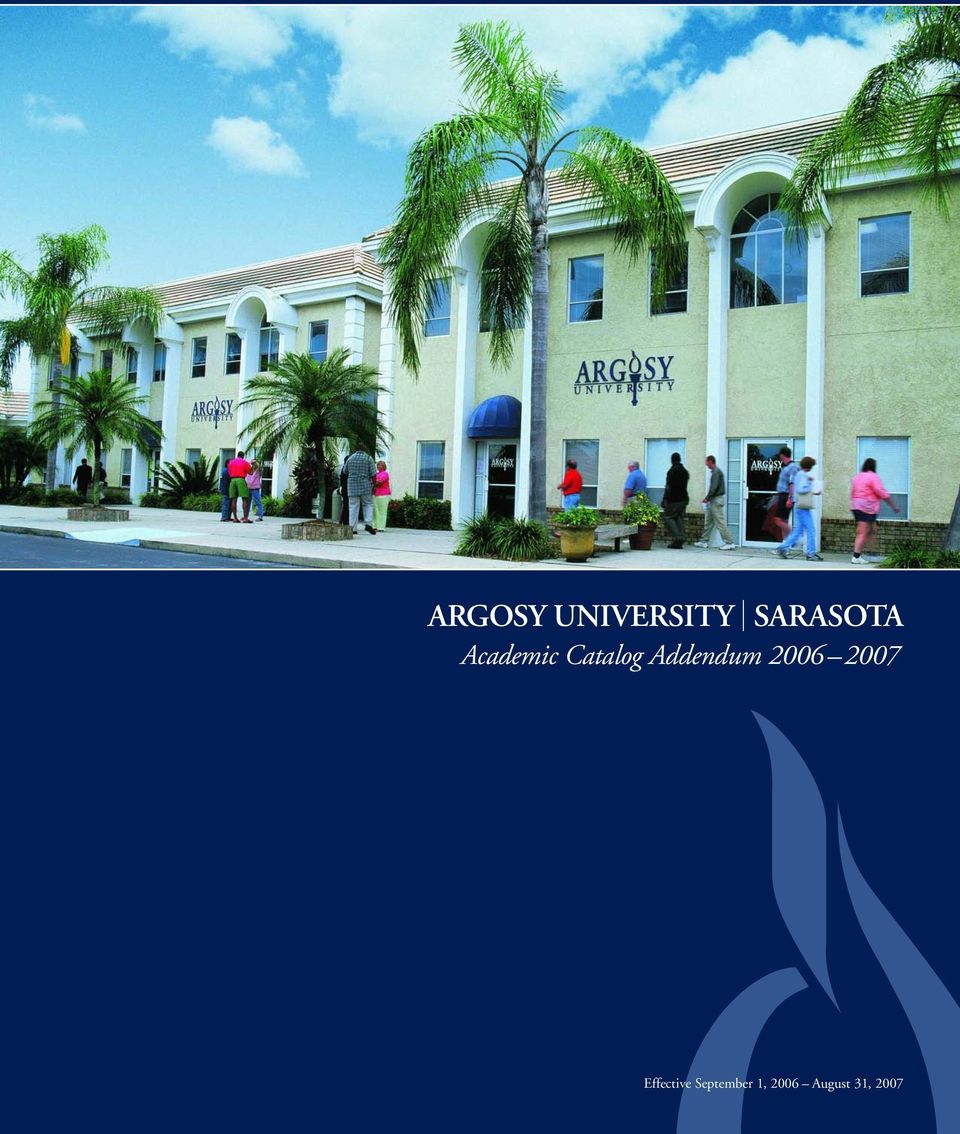
ARGOSY UNIVERSITY SARASOTA. Academic Catalog Addendum
|
|
|
- Elijah Bryan
- 9 years ago
- Views:
Transcription
1 ARGOSY UNIVERSITY SARASOTA Academic Catalog Addendum Effective September 1, 2006 August 31, 2007
2 This catalog was prepared by Argosy University, Two First National Plaza, 20 South Clark Street Chicago, Illinois The information contained herein applies to the academic years Curriculum, fees, expenses and other information described herein, while current at the time of publication, are subject to change without notice at the discretion of Argosy University. For more information, write to the above address or phone

3 Table of Contents Section One Accreditation and Programs Campus Description Institutional Accreditation State Licensing Programmatic Accreditation Argosy University/Sarasota Programs Section Two General Academic Program Requirements Comprehensive Examination Requirements Doctoral Program Dissertation Requirements Writing Style Requirements Graduate Transfer Credit Criteria Non-Academic Competence Policy The Sarasota School of Professional Psychology and Behavioral Sciences Section Three Master of Arts in School Counseling Program Program Overview Admission Requirements Enrollment Requirements Graduation Requirements Program Requirements Section Four Master of Arts in Marriage & Family Therapy Program Program Overview Admission Requirements Enrollment Requirements Graduation Requirements Program Requirements Section Five Master of Arts in Mental Health Counseling Program Program Overview Admission Requirements Enrollment Requirements Graduation Requirements Program Requirements Section Six Doctor of Education in Counseling Psychology Program Program Overview Admission Requirements Enrollment Requirements Graduation Requirements Program Requirements Section Seven Doctor of Psychology in Clinical Psychology Program Program Overview Admission Requirements Enrollment Requirements Graduation Requirements Program Requirements Course/Credit Transfer Course Registration Policy for Students Appendix I Schedule of Tuition and Fees Appendix II Faculty Descriptions Argosy University/Sarasota Academic Catalog Addendum
4 2 Argosy University/Sarasota Academic Catalog Addendum

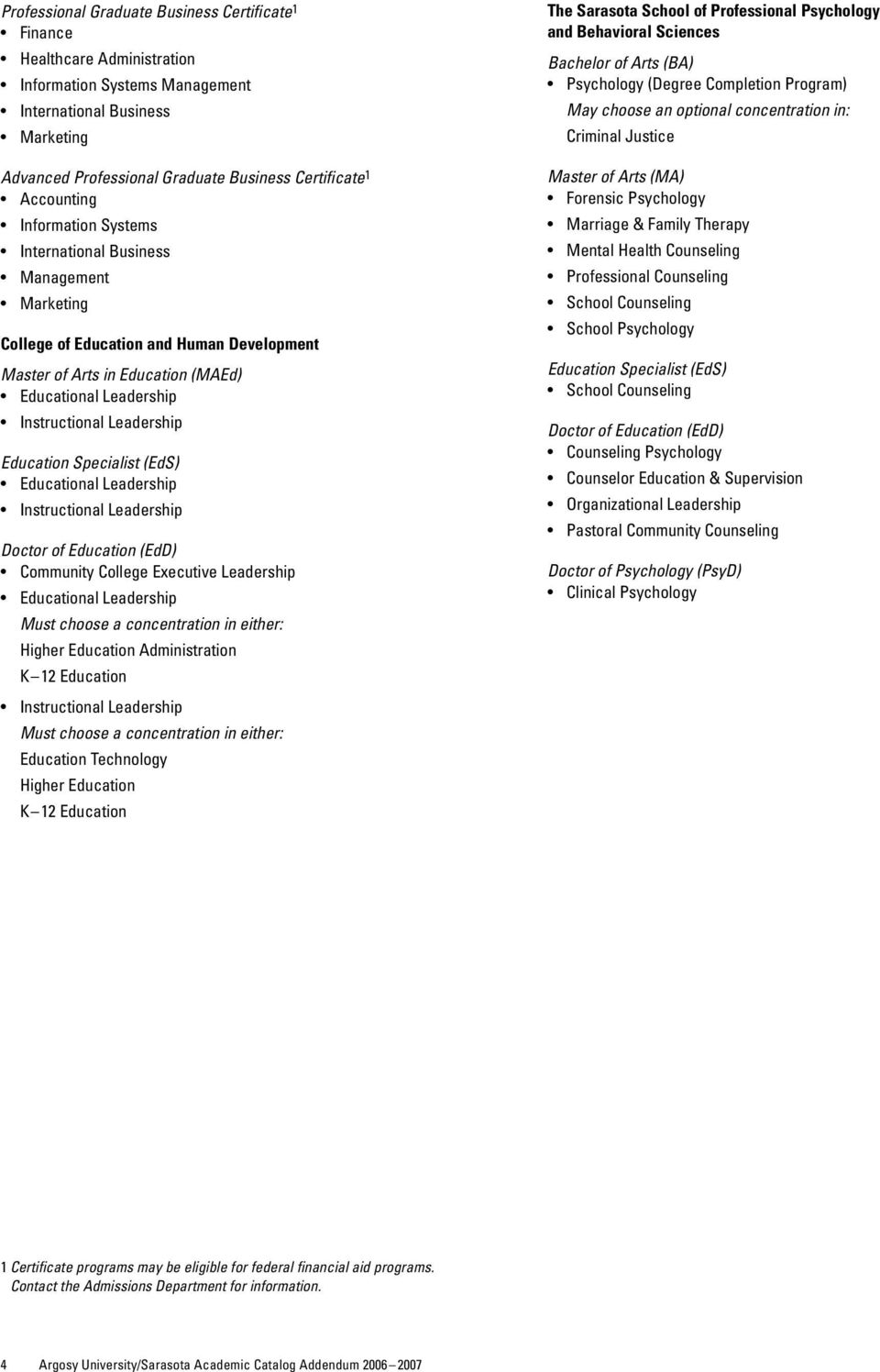
5 Section One Accreditation and Programs The information listed in this addendum applies to the Argosy University Academic Catalog To ensure that this information is applied to the proper publication please refer to the effective date, September 1, 2006 August 31, 2007 on the front cover of the Academic Catalog. If you have questions related to information this addendum, please contact your academic advisor or program chair for assistance. ARGOSY UNIVERSITY/SARASOTA th Street Sarasota, FL FAX: STATE LICENSING Argosy University/Sarasota is licensed by the Commission of Independent Education, Florida Department of Education. Additional information regarding this institution may be obtained by contacting the Commission at 325 West Gaines Street, Suite 1414, Tallahassee, FL 32399, CAMPUS DESCRIPTION The Argosy University/Sarasota campus is housed in a 33,000 square-foot facility located at 17th Street and Honore in beautiful northeastern Sarasota, Florida. The location provides easy access from Interstate 75 at Exit 210, north from Fruitville Road or exit 213, south from University Parkway, as well as from major streets in surrounding communities. The facility has been specifically designed for seminar-style instruction, and features a research library, and computer systems with extensive online research databases and data retrieval capabilities. The classrooms are organized primarily for small-group instruction, with classes normally conducted as seminars. Parking is ample, covering more than two acres. Library The Argosy University/Sarasota Library maintains a focused collection of print and electronic resources to support the studies of or students and faculty members in the fields of business, information technology, education, human development, professional psychology and behavioral sciences. The library houses specialized collections of books, journals, dissertations and online databases to provide easy access to information needed for research and study. When working on- or off-campus, students have access to electronic library resources and databases. To access the Argosy University/Sarasota databases, students need Netscape Navigator or Microsoft Internet Explorer and Adobe Acrobat Reader. Enrolled students are provided with passwords to access specialized academic online databases. Database addresses and passwords are subject to change and are posted on the library section of Embanet/First Class, Argosy University/Sarasota s electronic communication intranet service. Full-text databases, such as Ebsco s Academic Abstracts, Psychology & Behavioral Science Collections at LIRN s ABI Inform, Student Resource Center and a variety of other databases support the curriculum. In addition, students have access to full-text books via the library online catalog at INSTITUTIONAL ACCREDITATION Argosy University is accredited by the Higher Learning Commission and is a member of the North Central Association (NCA) (30 North LaSalle Street, Suite 2400, Chicago, IL 60602, , PROGRAMMATIC ACCREDITATION The Council for Accreditation of Counseling and Related Educational Programs (CACREP) has granted accreditation to the following programs at Argosy University/Sarasota: Master of Arts in Mental Health Counseling. Council for Accreditation of Counseling and Related Educational Programs, 599 Stevenson Avenue, Alexandria, VA 22304, , ARGOSY UNIVERSITY/SARASOTA PROGRAMS College of Business and Information Technology Bachelor of Science (BS) Business Administration (Degree Completion Program) May choose one of five optional concentrations: Customized Professional Concentration Finance Healthcare Management International Business Marketing Master of Business Administration (MBA) Business Administration Must choose one of seven concentrations: Customized Professional Concentration Finance Healthcare Administration Information Systems Management International Business Management Marketing Doctor of Business Administration (DBA) Must choose one of six concentrations: Accounting Customized Professional Concentration Information Systems International Business Management Marketing Argosy University/Sarasota Academic Catalog Addendum
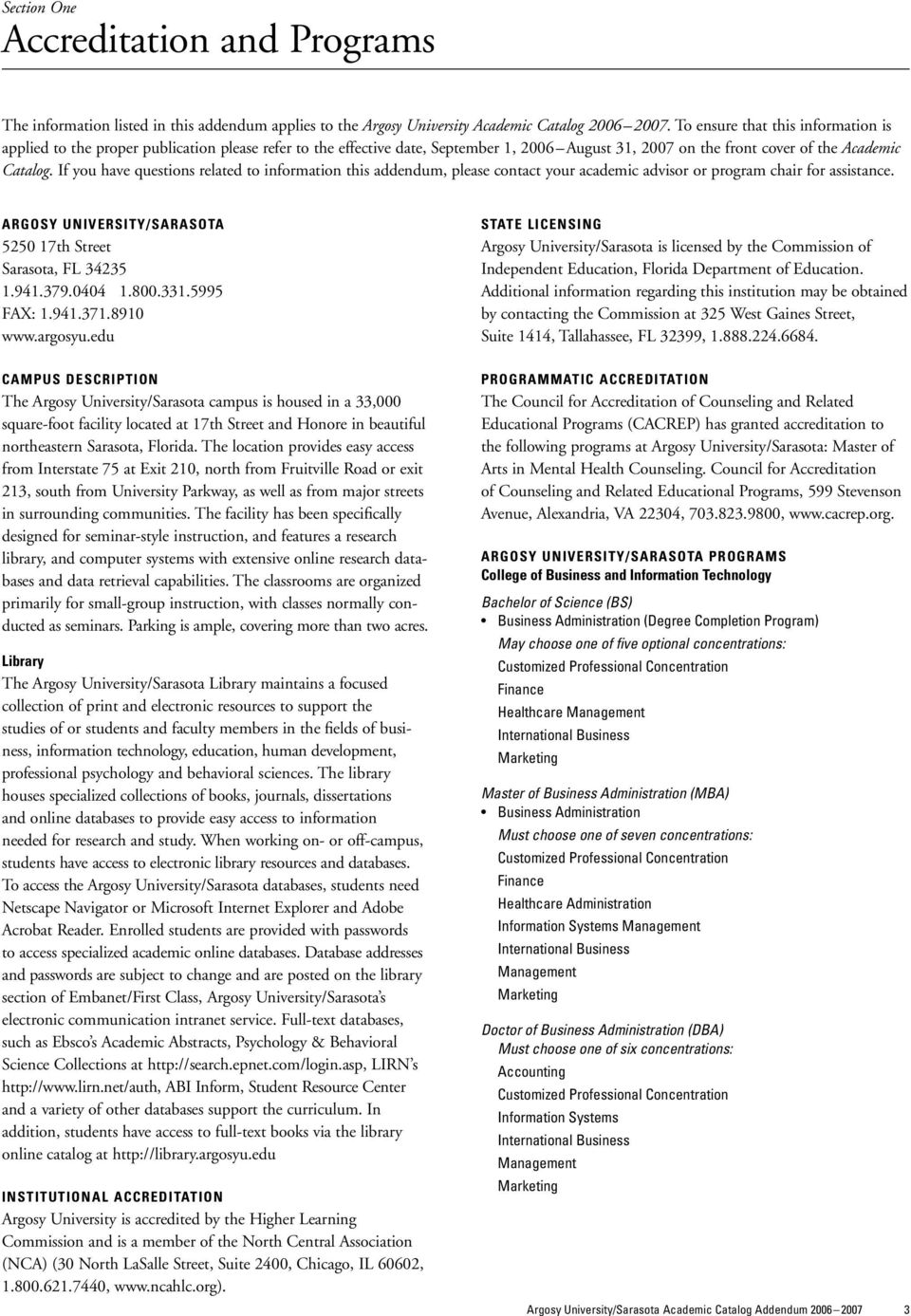
6 Professional Graduate Business Certificate 1 Finance Healthcare Administration Information Systems Management International Business Marketing Advanced Professional Graduate Business Certificate 1 Accounting Information Systems International Business Management Marketing College of Education and Human Development Master of Arts in Education (MAEd) Educational Leadership Instructional Leadership Education Specialist (EdS) Educational Leadership Instructional Leadership Doctor of Education (EdD) Community College Executive Leadership Educational Leadership Must choose a concentration in either: Higher Education Administration K 12 Education Instructional Leadership Must choose a concentration in either: Education Technology Higher Education K 12 Education The Sarasota School of Professional Psychology and Behavioral Sciences Bachelor of Arts (BA) Psychology (Degree Completion Program) May choose an optional concentration in: Criminal Justice Master of Arts (MA) Forensic Psychology Marriage & Family Therapy Mental Health Counseling Professional Counseling School Counseling School Psychology Education Specialist (EdS) School Counseling Doctor of Education (EdD) Counseling Psychology Counselor Education & Supervision Organizational Leadership Pastoral Community Counseling Doctor of Psychology (PsyD) Clinical Psychology 1 Certificate programs may be eligible for federal financial aid programs. Contact the Admissions Department for information. 4 Argosy University/Sarasota Academic Catalog Addendum
7 Section Two General Academic Program Requirements COMPREHENSIVE EXAMINATION REQUIREMENTS The Comprehensive Examination Petition After a student has successfully completed the requirements outlined in his or her degree program plan of study, and consulted with his or her advisor, he or she may petition to take the Comprehensive Examination for that degree program. Students may not complete 50 percent or more of their required program credit hours with Argosy University in an online or distance learning format. Students completing degree course requirements without meeting the in-residence format requirement will be required to complete additional in-residence courses to achieve this in-residence format percentage standard. It is the student s responsibility to ensure that his or her transcript is current and reflects all courses taken and transferred prior to submitting the Comprehensive Exam Petition. Petition Approval and Registration for the Comprehensive Examination Several levels of review and approval are necessary. Therefore, students are advised to submit the petition at least six weeks prior to a regularly scheduled examination in order to assure time for obtaining full approval prior to exam dates. Students may petition when they have completed or are enrolled in their final course requirement for taking the Comprehensive Exam in their program. Students who have final grades pending at the time of submission may be conditionally approved pending successful completion of all required courses and submission of all grades prior to sitting for the Comprehensive Exam. The Comprehensive Examination Petition Form and Transfer Credit Petition Form are available from the Student Services Department and through Embanet/ First Class. Completed Comprehensive Exam Petitions should be submitted to the Student Services Department for processing. DBA Students and Registration for the Comprehensive Examination Doctor of Business (DBA) students are required to follow the instructions posted on the Embanet/First Class for electronic submission of the Comprehensive Exam Petition. Enrollment Once the student s petition is fully approved, enrollment in ADJ COMP Comprehensive Exam will be automatically processed for the semester during which the student plans to sit for the exam. No credit hours are earned for enrollment, but it allows students to maintain a less-than-half-time active enrollment status for up to one semester while taking a Comprehensive Exam. It also creates a transcript record, reflecting enrollment for the Comprehensive Examination and the ultimate outcome of all attempts, with a final grade of CR or NC. Enrollment in ADJ COMP does not constitute enrollment for student loan deferment purposes because it carries no credit hours. Enrollment requirements for maintaining half-time and/or full-time status are outlined in the current Argosy University Academic Catalog. DOCTORAL PROGRAM DISSERTATION REQUIREMENTS Petition for Establishing Candidacy and a Dissertation Committee Students who are approaching the dissertation phase of their doctoral programs should review the Guide to Dissertation at Argosy University/Sarasota and complete a Petition for Establishing Candidacy and a Dissertation Committee (PECDC). Both publications are available through Embanet/First Class. The Guide to Dissertation contains guidelines related to forming a dissertation committee as well as detailed information regarding all dissertation requirements. Students are expected to nominate three potential individuals to serve on their committee after securing their consent for the nomination. The dean approves the final committee in consultation with the student s faculty advisor and the approved committee may be different from the individuals nominated. Questions about the selection of committee members should be addressed with the student s academic advisor. Students should consult with their academic advisor and potential committee members to discuss tentative research topics prior to submitting a PECDC. A copy of the student s dissertation prospectus must be attached to the PECDC and will be forwarded to each approved committee member with a copy of the petition. Once a student has consulted with his/her advisor and prospective committee members, a completed PECDC should be submitted to the Student Services Department for review and processing. Upon receipt of the PECDC, the Student Records Department will print the transcript and financial ledger history to be sure that the student is appropriately enrolled, all required coursework is successfully completed, the student is making satisfactory academic progress and that the student s account is current. The PECDC will then be forwarded to the dean of the student s school for approvals. Petition Approval and Dissertation Registration If a PECDC is conditionally approved or disapproved, the student should work with his or her academic advisor to remediate deficiencies. Once all deficiencies are remediated, the student should contact Student Services for release of the PECDC to school for final approval. Once a PECDC is approved, the student has completed all the requirements to be admitted to candidacy as outlined in his or her degree program, and the student in properly registered for dissertation, the student may begin dissertation research with the assigned committee. Students who are ready to begin the dissertation should contact the Student Services Department to complete a Dissertation Registration Plan Form in cooperation with a registration coordinator. Approved students may begin dissertation at the beginning or midpoint of a semester. Students should consult the program section of this addendum and the Argosy University Academic Catalog for information regarding the exact number of Argosy University/Sarasota Academic Catalog Addendum

8 credits required for dissertation. Each student will be automatically enrolled for a portion of the required credit hours (typically 3) each semester from the start of the dissertation process until passing his/her final defense. Automatic registration begins with the first semester of enrollment and commences with completion of all dissertation requirements. If the dissertation is completed in less than the normal length of time stipulated by the program, the student must still register for the required minimum number of credit hours before final dissertation will be granted. In other words, students who finish in less than the normal number of semesters will need to register for more credit hours in the last semester in order to earn the required credit hours. Students who take longer than the normal length of time to complete a dissertation will be required to register for 3 additional credit hours of dissertation each semester until passing his/her final defense. Students who take more than six semesters to complete the dissertation will need the written permission of the dean of his or her program to continue the dissertation past six semesters. At the end of each semester, the dissertation chair will issue a grade of Progressing ( PR ) indicating that the student is progressing toward completion of the dissertation or a grade of No Credit ( NC ) indicating that the student should receive no credit for dissertation that semester. All PR grades will be changed to Credit ( CR ) once the student has successfully completed all dissertation requirements. Any grade of NC will be permanent and will not count toward the credit hour requirement for completion of dissertation. Continuous enrollment in dissertation credits is required from the beginning of the dissertation process until all dissertation requirements are completed unless an official leave of absence is granted. Students must maintain current enrollment in dissertation in order to work towards completion of the dissertation. See the current Argosy University Academic Catalog and Argosy University/Sarasota Dissertation Guide for academic requirements regarding the dissertation. WRITING STYLE REQUIREMENTS In an effort to foster a spirit of honesty and integrity during the learning process, Argosy University requires that the submission of all course assignments represent the original work produced by that student. All sources must be documented through normal scholarly references/citations and all work must be submitted using the Publication Manual of the American Psychological Association: Fifth Edition (2001), American Psychological Association (APA) format. Please refer to Appendix A in the Publication Manual of the American Psychological Association: Fifth Edition for thesis and paper format. Students are encouraged to purchase this manual (required in some courses) and become familiar with its content as well as consult the Argosy University Academic Catalog for further information regarding academic dishonesty and plagiarism. Additionally, Argosy University considers resubmission of a work produced for one course in a subsequent course or the submission of work done partially or entirely by another to be academic dishonesty. It is the student s responsibility to seek clarification from the instructor regarding how much help may be received in completing an assignment, exam or project and what sources may be used. The faculty at Argosy University is dedicated to providing a learning environment that supports scholarly and ethical writing free from academic dishonesty and plagiarism. This includes the proper and appropriate referencing of all sources. Students may be asked to submit their course assignments through Turnitin, ( an online resource established to help educators develop writing/research skills and detect potential cases of academic dishonesty. Turnitin compares submitted papers to billions of pages of content and provides a comparison report to the student s instructor. This comparison detects papers that share common information and duplicative language. Argosy University s policies call for all written work to be submitted typed and in standard written English. If necessary, students may employ an editor to assist with grammar and style, but not content. The editor s name, address, and telephone number must appear on the document, and the student s original unedited work must be attached. Writing Program There is a strong emphasis placed on the ability to write professionally throughout the curricula at Argosy University/Sarasota. Students who recognize the need to strengthen their writing proficiency are encouraged to enroll in a writing skills course during their first year of enrollment. Areas for improvement may be identified by faculty members at the point of admission or during the completion of program requirements. When such issues are identified, the student will be notified in writing of the recommendation or requirement that he/she complete a writing course. GRADUATE TRANSFER CREDIT CRITERIA Graduate transfer credit criteria is outlined in the Argosy University Academic Catalog. In order to have transfer credits evaluated for transfer to a graduate-level program at Argosy University/Sarasota, students must submit a Graduate Credit Transfer Form to the Student Services Department for each transfer course requested. Requests for transfer credit are generally reviewed for transfer by a faculty content expert, and the dean or a designee. Transfer courses cannot have been used to satisfy the requirements for a prior degree, unless the program is part of the degree being sought at Argosy University/Sarasota. Credits should have been earned no more than seven years before the date of admission to the degree program to which the credit is applied. Some programs may have additional limitations regarding transfer credit limits. Approved transfer credits are generally counted as non-resident courses and do not fulfill the in-residence course format requirement. Students may not complete 50 percent or more of their required program credit hours in an online or distance learning format. 6 Argosy University/Sarasota Academic Catalog Addendum
9 NON-ACADEMIC COMPETENCE POLICY Argosy University/Sarasota psychology programs subscribe to the policy of the Student Competence Task Force of the Council of Chairs of Training. This means that the faculty, training staff, and site supervisors of Argosy University have a professional, ethical, and potentially legal obligation to: Evaluate the interpersonal competence and emotional well-being of student trainees who are under their supervision, and who provide services to clients and consumers, and Ensure insofar as possible that the trainees who complete their programs are competent to manage future relationships (e.g., client, collegial, professional, public, scholarly, supervisory, teaching) in an effective and appropriate manner. Because of this commitment, Argosy University strives not to pass along students with issues or problems (e.g., cognitive, emotional, psychological, interpersonal, technical, and ethical) that may interfere with professional competence to other programs, the profession, employers, or the public at large. Therefore, within a developmental framework and with due regard for the inherent power difference between students and faculty, students and trainees should know that their faculty, training staff, and supervisors will evaluate their competence in areas other than coursework, seminars, scholarship, comprehensive examinations, or related program requirements. These evaluative areas include, but are not limited to, demonstration of the following: Sufficient interpersonal and professional competence (e.g., the ways in which students relate to clients, peers, faculty, allied professionals, the public, and individuals from diverse backgrounds or histories) Sufficient self-awareness, self-reflection, and self-evaluation (e.g., knowledge of the content and potential impact of one s own beliefs and values on clients, peers, faculty, allied professionals, the public, and individuals from diverse backgrounds or histories) Sufficient openness to processes of supervision (e.g., the ability and willingness to explore issues that either interfere with the appropriate provision of care or impede professional development or functioning. Sufficient ability to resolve problems or issues that interfere with professional development or functioning in a satisfactory manner (e.g., by responding constructively to feedback from supervisors or program faculty; by participating in personal therapy in order to resolve problems or issues). The policy in its entirety can be found at: downloads/cctc_comprehensive_ev82aa3.pdf Argosy University/Sarasota Academic Catalog Addendum
10 8 Argosy University/Sarasota Academic Catalog Addendum

11 Argosy University/Sarasota The Sarasota School of Professional Psychology and Behavioral Sciences Argosy University/Sarasota Academic Catalog Addendum

12 10 Argosy University/Sarasota Academic Catalog Addendum

13 Section Three Master of Arts in School Counseling Program PROGRAM OVERVIEW Argosy University recognizes the need to provide human services providers with the extensive knowledge and range of skills necessary to function effectively in their profession. Programs have been developed by Argosy University faculty members to enable working professionals to pursue their personal and professional goals through completion of a master s program. Courses and curricula are designed to parallel prevailing licensure and certification requirements as closely as possible. Because of variations among states, each student should check with regional authorities to confirm such requirements. The Master of Arts (MA) in School Counseling program serves adult students throughout the world. It provides a quality program in school counseling to meet the needs of students and the community. The focus on the program is student preparation and professional development. The program remains faithful to its mission of preparing students to function of a high professional level in a rapidly changing world. The focus of the mission will continue to promote teaching, learning, and service. The MA in School Counseling program faculty have developed practitioner-oriented program and course objectives. The program objectives were reviewed by the faculty and administration of the Sarasota School of Professional Psychology and Behavioral Sciences at Argosy University/Sarasota and an advisory committee made up of students, alumni, professional, and business people through the local professional community. Students and faculty of the department are expected to behave in accord with the highest ethical and professional standards while engaged in accomplishing this mission. Program Objectives The MA in School Counseling program is designed to provide graduates with the knowledge and skills required for successful careers in the field. Specific student learning objectives include: Students will explain and interpret all ethical and legal codes for school counselors provided by professional counseling associations and will adhere to these standards at all times. Students will demonstrate sensitivity to the impact of multicultural issues on the counseling relationship and on treatment by developing and applying therapeutic approaches and techniques that respect multicultural differences and meet multicultural needs. Students will identify and apply core theories and research of the nature and needs of individuals at all developmental levels. Students will apply core career developmental theories and decision making models to increase client understanding of career and educational planning and placement. Students will use appropriate counseling techniques to engage the client in the interviewing process, to build and maintain rapport, and to begin to establish a therapeutic alliance. Students will ethically and effectively conduct group counseling and understand the principles, issues, and dynamics of group work as well as the role of a group counselor. Students will identify and employ assessment instruments that would be most helpful in evaluating specific client problems or concerns. Students will use, interpret, and apply various research methods such as qualitative, quantitative, single-case designs, action research, and outcome-based research, statistical analysis, needs assessment, and program evaluation. Eligibility for Licensure Credits and degrees earned from Argosy University/Sarasota do not automatically qualify the holder to participate in professional licensing examinations to practice regulated professions in Florida or in other states. It is the student s responsibility to determine the requirements for professional licensure in the state they wish to practice. Persons interested in practicing in a regulated profession should contact the appropriate state regulatory agency in their field of interest. Endorsement Policy Argosy University/Sarasota faculty will only endorse students who have completed all formal coursework, including all practicum/ internship requirements, for professional placement and licensure. Recommendations for job placement, both oral and written will be specific to school counseling, the employment for which the MA in School Counseling program student is prepared. ADMISSION REQUIREMENTS A bachelor s degree from a regionally accredited institution, a nationally accredited institution approved and documented by the faculty and dean of the College of Psychology and Behavioral Sciences, or an appropriately certified foreign institution. A grade point average of at least 3.0 (on a scale of 4.0) for the last 60 hours of coursework (including graduate work). A minimum written TOEFL score of 550 (paper version), 213 (computer version), or 79 (Internet version) for all applicants whose native language is not English or who have not graduated from an institution at which English is the language of instruction. Completion of an interview with a member of the program Admissions Committee. All applications for admission must be submitted to the Admissions Department. An admissions representative is available to help interested applicants complete the following required documentation: Completed Application for Admission Form Application fee (non-refundable, except in California) Argosy University/Sarasota Academic Catalog Addendum
14 Personal/professional goal statement with a self-appraisal of qualifications for the profession Current résumé (or career summary) Three completed Applicant Recommendation Forms Official transcripts from all postsecondary schools attended Exceptions to the Minimum Grade Point Average Applicants with grade point averages lower than the stated program minimums may be considered for admission with significant evidence of academic and professional potential demonstrated by the career and/or professional accomplishments indicated in the statement of academic and professional goals, the career summary, and academic or professional letters of recommendation. Exceptions must be recommended by the Admissions Committee and program chair, and approved by the college dean. Exceptions must be justified, documented, signed, placed, and retained in the student s academic file. Students accepted on an exception basis will be admitted as regular students on first semester probation. See Exceptions to Admission Requirements in section 5 of the Academic Catalog under Admission Policies. ENROLLMENT REQUIREMENTS Satisfactory Academic Progress and Degree Completion Rates Students must make satisfactory progress towards a degree as outlined here and in the Argosy University Academic Catalog. Students must complete this program within six years after matriculation. Students who take an approved leave of absence will have six years plus the length of time they were on the approved leave of absence, not to exceed one year, to complete the program. In order to remain on track for degree completion within the maximum time frame allotted, students are expected to complete credit hours according to the suggested incremental maximum time frame table below: Suggested Incremental Time Frame Completion Rates End of Year One End of Year Two End of Year Three End of Year Four End of Year Five End of Year Six 9 credit hours 18 credit hours 27 credit hours 36 credit hours 45 credit hours 48 credit hours Students are responsible for monitoring and maintaining an enrollment status that ensures their progress towards completion of their programs within the maximum time frame. GRADUATION REQUIREMENTS Students who are admitted into the MA in School Counseling program will be responsible for completing the program requirements that are in effect at the time of their admission. However, the school retains the right to modify these requirements in accordance with the demands of the counseling profession. Satisfactory completion of all requirements in the program of study developed in consultation with the faculty member. Satisfactory completion of 48 semester credit hours beyond the bachelor s degree, with at least nine courses taken in an in-residence format A grade point average of 3.0 or higher (on a scale of 4.0) A completed Petition to Graduate submitted to campus administration PROGRAM REQUIREMENTS Unless approved otherwise, students may not complete 50 percent or more of their required program credit hours in an online or distance learning format. Students completing degree course requirements without meeting the in-residence course format requirement will be required to complete additional in-residence courses to achieve this in-residence format percentage standard. The MA in School Counseling program requires the satisfactory completion of 48 semester credit hours distributed as follows: core course requirements, 42 credit hours; and practicum/field experience requirements, 6 credit hours. Core Course Requirements Students Are Required to Take the Following C6035 Human Growth and Development (3) C6036 Essentials of Interviewing (3) C6362 Student Appraisal (3) C6433 Theories of Personality (3) C6436 Individual Counseling Theories and Practice (3) C6440 Ethics in Counseling (3) C6443 Group Guidance Counseling (3) C6444 Counseling Exceptional Students and Families (3) C6445 Social and Cultural Competencies for Counselors (3) C6446 Substance Abuse Counseling (3) C6452 Career and Lifestyle Assessment (3) C6459 Consultation in Education (3) C6510 Principles of Guidance (3) R6033 Research in Education (3) Core Course Requirements 42 Credit Hours Practicum and Practicum Seminar Requirements Students Are Required to Take the Following C6492 Field Experience I (3) C6493 Field Experience II (3) Practicum and Practicum Seminar Requirements 6 Credit Hours Practicum and Practicum Seminar Requirements Practicum/field experience courses require the student to arrange an independent and appropriate clinical practicum in school counseling. The student is required to participate in the field experience for a minimum of eight hours per week for 15 weeks. While engaged in the school counseling practicum, the student must be directly supervised by a school counselor who is either employed by the public school system or is certified as a school counselor. While engaged in a mental health practicum, the student must be directly supervised by an appropriately licensed therapist. The purpose of the field experience is to practice counseling skills in an applied setting under the supervision of an experienced practitioner and under the direction of an Argosy University mentor. The activity of the student is closely monitored by the course instructor in conjunction with the field supervisor. The progress of the student is formally evaluated by the course instructor and the field supervisor. Expected student outcomes include submission of a reflective journal that chronicles the student s growth and development, and satisfactory field evaluations. In order to participate in a field experience the student must be enrolled in Field Experience I (C6492) or Field Experience II (C6493). 12 Argosy University/Sarasota Academic Catalog Addendum
15 Section Four Master of Arts in Marriage & Family Therapy Program PROGRAM OVERVIEW The Master of Arts (MA) in Marriage & Family Therapy program recognizes the need to provide counseling professionals with the extensive knowledge and range of skills necessary to function effectively in their professions. The program introduces students to basic counseling skills that integrate individual and group theoretical foundations of counseling into appropriate client interaction and intervention skills. The program emphasizes the development of attitudes, knowledge, and skills essential in the formation of professional counselors who are committed to the ethical provision of quality services. The program has been developed by the school faculty members to provide working professionals with the opportunity to pursue their personal and professional goals through completion of a master s program. The MA in Marriage & Family Therapy program is committed to educating and training students to enter a professional career as master s level counseling practitioners who can function ethically and effectively as skilled professionals with demonstrated knowledge of social and cultural diversity. This goal is achieved through a curriculum designed to integrate basic counseling, and practicum/field experience into appropriate client interaction and intervention skills for utilization in a wide variety of settings with diverse clients. Program Objectives The MA in Marriage & Family Therapy program is designed to provide graduates with the knowledge and skills required for successful careers in the field. Specific student learning objectives include: Students will be able to explain and interpret all ethical and legal codes for counselors provided by marriage and family therapy associations and will adhere to these standards at all times. Students will be able to demonstrate sensitivity to the impact of multicultural issues on the counseling relationship and on treatment by developing and applying therapeutic approaches and techniques that respect multicultural differences and meet multicultural needs. Students will be able to identify and apply core theories and research of the nature and needs of individuals at all developmental levels. Students will be able to apply core career development theories and decision-making models to increase client understanding of career and educational planning and placement. Students will be able to use appropriate counseling techniques to engage the client in the interviewing process, to build and maintain rapport, and to begin to establish a therapeutic alliance. Students will be able to ethically and effectively conduct marriage/family counseling and understand the principles, issues, and dynamics of such work as well as the role of a marriage/family counselor. Students will identify and employ assessment instruments that would be most helpful in evaluating specific client problems or concerns. Students will be able to use, interpret, and apply various research methods such as qualitative, quantitative, single-case designs, action research, and outcome-based research, statistical analysis, needs assessment, and program evaluation. Eligibility for Licensure Credits and degrees earned from Argosy University/Sarasota do not automatically qualify the holder to participate in professional licensing examinations to practice regulated professions in Florida or in other states. It is the student s responsibility to determine the requirements for professional licensure in the state they wish to practice. Persons interested in practicing in a regulated profession should contact the appropriate state regulatory agency in their field of interest. Endorsement Policy Argosy University/Sarasota faculty will only endorse students who have completed all formal coursework, including all practicum/internship requirements, for professional placement and licensure. Recommendations for job placement, both oral and written will be specific to marriage and family therapy counseling, the employment for which the MA in Marriage & Family Therapy program student is prepared. ADMISSION REQUIREMENTS A bachelor s degree from a regionally accredited institution, a nationally accredited institution approved and documented by the faculty and dean of the College of Psychology and Behavioral Sciences, or an appropriately certified foreign institution. A grade point average of at least 3.0 (on a scale of 4.0) for the last 60 hours of coursework (including graduate work). A minimum written TOEFL score of 550 (paper version), 213 (computer version), or 79 (Internet version) for all applicants whose native language is not English or who have not graduated from an institution at which English is the language of instruction. Completion of an interview with a member of the program Admissions Committee. All applications for admission must be submitted to the Admissions Department. An admissions representative is available to help interested applicants complete the following required documentation: Completed Application for Admission Form Application fee (non-refundable, except in California) Personal/professional goal statement with a self-appraisal of qualifications for the profession of marriage and family therapy Argosy University/Sarasota Academic Catalog Addendum

16 Current résumé (or career summary) Three completed Applicant Recommendation Forms Official transcripts from all postsecondary schools attended Exceptions to the Minimum Grade Point Average Applicants with grade point averages lower than the stated program minimums may be considered for admission with significant evidence of academic and professional potential demonstrated by the career and/or professional accomplishments indicated in the statement of academic and professional goals, the career summary, and academic or professional letters of recommendation. Exceptions must be recommended by the Admissions Committee and program chair, and approved by the college dean. Exceptions must be justified, documented, signed, placed, and retained in the student s academic file. Students accepted on an exception basis will be admitted as regular students on first semester probation. See Exceptions to Admission Requirements in section 5 of the Academic Catalog under Admission Policies. ENROLLMENT REQUIREMENTS Satisfactory Academic Progress and Degree Completion Rates Students must make satisfactory progress towards a degree as outlined here and in the Argosy University Academic Catalog. Students must complete this program within five years after matriculation. Students who take an approved leave of absence will have six years plus the length of time they were on the approved leave of absence, not to exceed one year, to complete the program. In order to remain on track for degree completion within the maximum time frame allotted, students are expected to complete credit hours according to the suggested incremental maximum time frame table below: Suggested Incremental Time Frame Completion Rates: End of Year One End of Year Two End of Year Three End of Year Four End of Year Five 9 credit hours 18 credit hours 27 credit hours 36 credit hours 45 credit hours Students are responsible for monitoring and maintaining an enrollment status that ensures their progress towards completion of their programs within the maximum time frame. GRADUATION REQUIREMENTS Students who are admitted into the Master of Arts in Marriage & Family Therapy program will be responsible for completing the program requirements that are in effect at the time of their admission. However, the school retains the right to modify these requirements in accordance with the demands of the counseling profession. Satisfactory completion of all requirements in the program of study developed in consultation with the faculty member Satisfactory completion of 45 semester credit hours A grade point average of 3.0 or higher (on a scale of 4.0) A completed Petition to Graduate submitted to campus administration PROGRAM REQUIREMENTS The Master of Arts in Marriage & Family Therapy program requires the satisfactory completion of 45 semester credit hours distributed as follows: core course requirements, 27 credit hours; marriage and family specialty requirements, 12 credit hours; and field experience. Students may not complete 50 percent or more of their required program credit hours in an online or distance learning format. In addition to these credit hour requirements, students must successfully complete the Comprehensive Examination. Core Course Requirements Students Are Required to Take the Following C6035 Human Growth and Development* (3) C6036 Essentials in Interviewing* (3) C6432 Diagnosis and Treatment of Psychopathology* (3) C6435 Individual Evaluation and Assessment (3) C6436 Individual Counseling Theories and Practice (3) C6439 Human Sexuality (3) C6440 Ethics in Counseling (3) C6446 Substance Abuse Counseling (3) R6032 Research and Program Evaluation in Counseling (3) Core Course Requirements 27 Credit Hours * Courses which students must have completed prior to enrolling for Field Experience (C6494). Marriage and Family Therapy Specialty Requirements Students Are Required to Take the Following C6441 Psychosocial Theories (3) PC6021 Schools of Family Therapy (3) PC6230 Theories in Counseling Families and Individuals (3) PC6700 Couples and Family Counseling (3) Marriage & Family Specialty Requirements 12 Credit Hours Field Experience Requirements Students Are Required to Take the Following C6494 Field Experience* (Practicum/field experience) Beginning (3) C6495 Field Experience (Practicum/Field Experience) Advanced (3) Field Experience Requirements 6 Credit Hours * Students must have successfully completed at least one semester of coursework, which must include the above noted courses, prior to enrolling in Field Experience (C6494). In some cases, students may be required to complete additional coursework prior to enrolling in Field Experience Advanced (C6495) and Field Experience Extension (C6496). Field Experiences for this degree must be 500 clock hours done in a marriage and family therapy setting with 180 direct client contact hours. Practicum Field Experience and Seminar Requirements The practicum/field experience is the primary mechanism of applied training and evaluation in the MA in Marriage and Therapy program. Practicum/field experience training is the supervised out-of-class contact of students with a counseling population that takes place within a marriage and family therapy setting. The purpose of practicum/field experience training is to provide the environment and opportunity for students to apply their theoretical knowledge, to implement and develop counseling techniques based on this knowledge, and to foster the professional and personal attitudes important to the identity of a professional counselor. 14 Argosy University/Sarasota Academic Catalog Addendum
17 Evaluation of student progress in practicum/field experience training focuses on three areas: Theoretical knowledge Counseling skills Professional attitudes The foundation of Argosy University/Sarasota s student practicum/field experience training in counseling is the accurate assessment and understanding of human problems. This assessment and understanding is the basis for the recommendation and/or implementation of effective techniques for the alleviation or resolution of these problems within a climate of absolute respect for the client. Ethical standards of the American Counseling Association are incorporated into student training. The administration closely monitors academic and professional development during all stages of progress throughout a student s graduate career. This monitoring includes assessment of clinical suitability as well as academic achievement. Thus, aspects of student s personal adjustment, interpersonal relationships, and behavior in all settings are relevant to their progress in their program. Our aim is to assure that students are well qualified and have the potential to become competent and ethical professionals. A primary goal of practicum/field experience training is the development, by means of supervised direct client contact, of competent therapists who are able to deliver basic and effective assessment and therapeutic intervention skills. The refinement of criteria for professional competency and assessment of competency are ongoing institutional concerns. The practicum/field experience emphasizes counseling and therapeutic intervention skills. Theoretical orientations, specific treatment options and opportunities and client populations will vary across training settings. Argosy University/Sarasota does not favor a particular theoretical orientation, but instead encourages students to explore a variety of counseling perspectives. The faculty and curriculum are representative of the major theoretical orientations. Students are encouraged to keep an open mind in order to get the full benefit of this general theoretical exposure, and to explore and experiment with a variety of treatment approaches. However, sites are encouraged to provide knowledge and modeling of therapy within an organized theoretical framework, so that students may learn to use this framework to guide their conceptualizations and interventions. It is hoped that students will, with time and experience, recognize strengths and limitations of a variety of approaches and develop proficiency in formulating and working within an approach best suited to their own personal style. The practicum/field experience presents an excellent opportunity for this kind of learning. General Information The practicum/field experience is a required training experience. Students may begin practicum/field experience after the successful completion of the required prerequisites. Students are required to attend informational meetings and apply for practicum/field study two semesters before they plan to enroll for this experience. Students earn 3 semester credit hours of each time they register for practicum/ field experience. All students enrolled in practicum/ field experience are concurrently enrolled in a practicum/field experience seminar led by a faculty member. The seminar meets on-campus throughout the academic year. Special arrangements will be made for students taking practicum/field experience at distant locations. Marriage & Family Therapy students must complete 500 hours of practicum/field experience in a marriage and family therapy setting. Students spend hours per week in a site that has been approved by Argosy University/Sarasota. A minimum of one-third of the hours is spent in direct service as defined below. The remainder of the students time is spent in indirect service, supervision, and training activities. Students must receive at least one hour of on-site, individual supervision per week. Direct service includes face-to-face provision of counseling services to individuals designated as clients by the site. Face-to-face service includes hours spent co-counseling with a licensed/credentialed professional. Indirect service may include community outreach, consultation and/or education, program development and/or evaluation, and support services (e.g., report writing, record maintenance). Training activities include formal supervision, case conferences, case management/utilization review meetings, rounds, administrative/planning meetings, in-service training/seminars. (Hours spent in attendance at practicum seminar count towards the total number of hours of the practicum/field experience.) Argosy University approves a wide variety of field training sites. All practicum/field experience sites are within the local area unless a student speaks with the program chair to make other arrangements. The program chair shall make this decision on a case-by-case basis. The training site and seminar leaders evaluate students in writing once each semester. The program chair assigns credit on a Credit/No Credit basis. Restrictions Students may not train in settings in which they are employed unless the practicum/field study supervisor is clearly different from the employment supervisor. Argosy University/Sarasota Academic Catalog Addendum

18 Professional Liability Insurance All students enrolled in practicum/field experience must be covered by professional liability insurance. Students must purchase the liability insurance that is provided through Argosy University/Sarasota, and also their own personal liability insurance. Prerequisites for Practicum/Field experience In order for students to apply for practicum/field experience they must be in good academic standing (GPA = 3.0 on a scale of 4.0) and have completed the academic planning which will allow for all the practicum/field experience prerequisite courses to be completed prior to the beginning of the practicum/field experience. Policy on Training Sites with Creedal Statements Argosy University/Sarasota has a policy of nondiscrimination against students with regard to race, age, ethnic background, and sexual orientation. In addition, Argosy University/Sarasota is committed to fostering the training of individuals who are members of groups that are currently under-represented in the profession of counseling. Practicum/field experience sites approved by the school are expected to conduct their selection and training in a nondiscriminatory manner. Sites are expected to select applicants without regard to race, sex, age, ethnic background, or sexual orientation unless they have compelling legal or therapeutic reasons for limiting the applicant pool. Sites that have a selection policy that disallows students based on any of the above criteria, must notify the school and clarify the legal and/or therapeutic rationale for such policies. Such sites will be approved by the school only if the program chair determines that an adequate legal and/or therapeutic rationale exists for the selection policies. Capstone Examination Requirements Overview Students in the MA in Marriage & Family Therapy program are required to successfully complete a Comprehensive Examination no later than the end of the fifth year after entering the program. The material covered by the Comprehensive Examination reflects all coursework and material required of students in the program. Prerequisites To be eligible to sit for the Comprehensive Examination, students must have successfully completed all courses, excluding practicum/field experience. Courses that are transferred are considered successfully completed. Students taking the Comprehensive Examination must be students in good standing and have a GPA of at least 3.0 (on a scale of 4.0). An application to take the exam must be submitted to the campus dean or program chair at least one month prior to the date of the examination. Procedures The Comprehensive Examination is offered twice a year. Consult the program chair for the specific dates of the examination. All students must submit an application for the Comprehensive Examination. Although letters are sent to students, it is the student s responsibility to know when they are eligible to take the exam and to submit an application. The program chair reviews students who register to sit for the Comprehensive Examination for eligibility. Students who need special accommodations during the examination are required to request them in writing at the time of application and provide any necessary documentation with the request. Prior to each exam, an open meeting will be held to allow students an opportunity to ask questions about exam preparation and exam procedures. The format of the examination may change from year to year. The format will be discussed at the meetings prior to each exam. Students are notified in writing of their exam grade. Possible outcomes are Pass or Fail. If students do not pass, they are required to retake the examination. Students who fail the Comprehensive Examination are expected to meet with the program chair or appointed faculty to review the problems evident in the examination. The program chair, in consultation with the faculty, will advise the student of specific areas of weakness and possible strategies for remediation. The student will then be allowed to retake the examination one time within the time frame of program completion. A student who fails the comprehensive exam a second time will be reviewed by the program faculty. The student may be dismissed from the program or may be required to successfully repeat coursework as determined by the program chair after reviewing recommendations made by the program faculty. After completion of required remediation, student may be eligible to retake the Comprehensive Examination. Any student who fails the examination a third time will be automatically dismissed from the program. 16 Argosy University/Sarasota Academic Catalog Addendum

19 Section Five Master of Arts in Mental Health Counseling Program PROGRAM OVERVIEW The Master of Arts (MA) in Mental Health Counseling program is designed to provide students with a sound foundation for the eventual practice of mental health counseling. The program introduces students to basic counseling skills that integrate individual and group theoretical foundations of mental health counseling into appropriate client interaction and intervention skills. The program emphasizes the development of attitudes, knowledge, and skills essential in the formation of mental health counselors who are committed to the ethical provision of quality services. Mission Statement The MA in Mental Health Counseling program serves adult students throughout the world. It provides a quality program in mental health counseling to meet the needs of students and the community. The focus of the program is student preparation and professional development. The program remains faithful to its mission of preparing students to function at a high professional level in a rapidly changing world. The focus of the mission will continue to promote teaching, learning, and service. The MA in Mental Health Counseling program faculty have used Council for Accreditation of Counseling and Related Educational Programs (CACREP) standards as a guide in the development of all aspects of this practitioner oriented program including its purpose, objectives and courses. The program objectives were reviewed by the faculty and administration of the Argosy University School of Professional Psychology and Behavioral Sciences and an advisory committee made up of students, former students, professional and business people through the local community. These objectives meet the standards of practice of American Counseling Association (ACA) and follow the spirit outlined in the CACREP standards. Students and faculty of the department are expected to behave in accord with the highest ethical and professional standards while engaged in accomplishing this mission. Program Objectives The MA in Mental Health Counseling program is designed to provide graduates with the knowledge and skills required for successful careers in the field. Specific student learning objectives include: Students will be able to explain and interpret all ethical and legal codes for counselors provided by professional counseling associations and will adhere to these standards at all times. Students will be able to demonstrate sensitivity to the impact of multicultural issues on the counseling relationship and on treatment by developing and applying therapeutic approaches and techniques that respect multicultural differences and meet multicultural needs. Students will be able to identify and apply core theories and research of the nature and needs of individuals at all developmental levels. Students will be able to apply core career development theories and decision-making models to increase client understanding of career and educational planning and placement. Students will be able to use appropriate counseling techniques to engage the client in the interviewing process, to build and maintain rapport, and to begin to establish a therapeutic alliance. Students will be able to ethically and effectively conduct group counseling and understand the principles, issues, and dynamics of group work as well as the role of a group counselor. Students will identify and employ assessment instruments that would be most helpful in evaluating specific client problems or concerns. Students will be able to use, interpret, and apply various research methods such as qualitative, quantitative, single-case designs, action research, and outcome-based research, statistical analysis, needs assessment, and program evaluation. Program Formats Argosy University/Sarasota strives to provide an educational experience with the highest academic quality in a variety of flexible formats designed for the convenience of adult students from various geographical locations. In that respect, regular in-residence, blended/in-residence, tutorial, and online courses are offered during 15-week and 7.5-week academic semesters throughout the year. In-residence courses may also be available in intensive intersession formats that incorporate a combination of distance learning and intensive one-week or two-weekend meetings on-campus in Sarasota. The current course schedule outlines available courses for each semester. Argosy University/Sarasota Academic Catalog Addendum
20 Eligibility for Licensure Credits and degrees earned from Argosy University/Sarasota do not automatically qualify the holder to participate in professional licensing examinations to practice regulated professions in Florida or in other states. It is the student s responsibility to determine the requirements for professional licensure in the state they wish to practice. Persons interested in practicing in a regulated profession should contact the appropriate state regulatory agency in their field of interest. Endorsement Policy Argosy University/Sarasota faculty will only endorse students for professional placement and licensure who have completed all formal coursework including all practicum/internship requirements. Recommendations for job placement, both oral and written, will be specific to mental health counseling, the employment for which the MA in Mental Health Counseling program student is prepared. ADMISSION REQUIREMENTS A bachelor s degree from a regionally accredited institution, a nationally accredited institution approved and documented by the faculty and dean of the College of Psychology and Behavioral Sciences at Argosy University, or an appropriately certified foreign institution. A grade point average of at least 3.0 (on a scale of 4.0) for the last 60 hours of coursework (including graduate work). A minimum written TOEFL score of 550 (paper version), 213 (computer version), or 79 (Internet version) for all applicants whose native language is not English or who have not graduated from an institution at which English is the language of instruction. Completion of an interview with a member of the program Admissions Committee. All applications for admission must be submitted to the Admissions Department. An admissions representative is available to help interested applicants complete the following required documentation: Completed Application for Admission Form Application fee (non-refundable, except in California) Personal/professional goal statement with a self-appraisal of qualifications for the profession Current résumé (or career summary) Three completed Applicant Recommendation Forms Official transcripts from all postsecondary schools attended Exceptions to the Minimum Grade Point Average Applicants with grade point averages lower than the stated program minimums may be considered for admission with significant evidence of academic and professional potential demonstrated by the career and/or professional accomplishments indicated in the statement of academic and professional goals, the career summary, and academic or professional letters of recommendation. Exceptions must be recommended by the Admissions Committee and program chair, and approved by the college dean. Exceptions must be justified, documented, signed, placed, and retained in the student s academic file. Students accepted on an exception basis will be admitted as regular students on first semester probation. See Exceptions to Admission Requirements in section 5 of the Academic Catalog under Admission Policies. ENROLLMENT REQUIREMENTS Satisfactory Academic Progress and Degree Completion Rates Students must make satisfactory progress towards a degree as outlined here and in the Argosy University Academic Catalog. Students must complete this program within seven years after matriculation. Students who take an approved leave of absence will have six years plus the length of time they were on the approved leave of absence, not to exceed one year, to complete the program. In order to remain on track for degree completion within the maximum time frame allotted, students are expected to complete credit hours according to the suggested incremental maximum time frame table below: Suggested Incremental Time Frame Completion Rates End of Year One End of Year Two End of Year Three End of Year Four End of Year Five End of Year Six End of Year Seven 9 credit hours 18 credit hours 27 credit hours 36 credit hours 45 credit hours 54 credit hours 60 credit hours Students are responsible for monitoring and maintaining an enrollment status that ensures their progress towards completion of their programs within the maximum time frame. GRADUATION REQUIREMENTS Students who are admitted into the MA in Mental Health Counseling program will be responsible for completing the program requirements that are in effect at the time of their admission. However, the school retains the right to modify these requirements in accordance with the demands of the counseling profession. To be eligible for graduation, students must meet the following requirements: Completion of 60 semester credit hours by the end of the seventh year of matriculation. The total credit hours must include: 48 credit hours of required courses 6 credit hours of elective courses 6 credit hours of practicum and seminar Completion of at least 11 courses in an in-residence format Successful completion of the Counselor Preparation Comprehensive Evaluation (CPCE) A grade point average of at least 3.0 on scale of 4.0 A completed Petition to Graduate submitted to campus administration 18 Argosy University/Sarasota Academic Catalog Addendum
21 PROGRAM REQUIREMENTS The MA in Mental Health Counseling program requires the satisfactory completion of 60 semester credit hours, distributed as follows: in-residence course requirements, 24 credit hours; online course requirements, 24 credit hours; elective requirements, 6 credit hours; and practicum and internship requirements, 6 credit hours. In-Residence Course Requirements Students Are Required to Take the Following C6432 Diagnosis and Treatment of Psychopathology (3) C6435 Individual Evaluation and Assessment (3) C6036 Essentials of Interviewing (3) C6438 Group Theories and Practice (3) C6440 Ethics in Counseling (3) C6445 Social and Cultural Comp for Counselors (3) C6452 Career and Lifestyle Assessment (3) C6460 Supervision for Counselors (3) In-Residence Course Requirements 24 Credit Hours Online Requirements Students Are Required to Take the Following C6431 Counseling in Community Settings (3) C6433 Theories of Personality (3) C6035 Human Growth and Development (3) C6436 Individual Counseling Theories and Practice (3) C6439 Human Sexuality (3) C6041 Foundations of Mental Health Counseling (3) C6446 Substance Abuse Counseling (3) R6032 Research and Program Evaluation in Counseling (3) Online Course Requirements 24 Credit Hours Practicum and Internship Requirements Students Are Required to Take the Following C6601 Practicum Counseling (1) C6602 Internship I Counseling (2) C6603 Internship II Counseling (3) Practicum and Internship Requirements 6 Credit Hours Elective Requirements Students identify appropriate electives in consultation with their advisors. Students are required to take 6 credit hours of elective courses. All practicum students are expected to complete a minimum of 40 hours of direct service with clients including experience in individual counseling and group work. Students are expected to maintain weekly clinical journals of all aspects of their practicum experience and to log these hours. It is expected that both faculty and site supervisor will regularly read, discuss and sign these journals. Students are expected to participate in weekly online and telephone seminars with a designated seminar leader. Evaluation of the student s performance will occur throughout the practicum and will include a formal evaluation at the completion of the 100-hour practicum. Capstone Examination Requirements Students are required to take the Counselor Preparation Comprehensive Examination (CPCE) for the first time at the mid-point of their graduate study or as soon as they complete the ten core courses on which it is based. All students must successfully complete the CPCE no later than the semester before the semester in which they plan to graduate. Internship Requirements After successful completion of all practicum requirements the student is then permitted to move on to the internship, which requires an additional 400 clock hours. During the internship, students will continue to develop and refine competencies related to clinical reasoning, relationship skills, assessment skills, and interventions skills. In addition, students will continue to increase their knowledge base of core counseling competencies, as well as to improve their abilities to write clear, well organized reports, and refine their communication skills. Internship students will be expected to enhance their recognition of the rights, responsibilities and ethical guidelines of the profession. They will also be required to demonstrate knowledge of, and sensitivity to, diversity issues in interactions with clients and other professionals. Practicum Requirements The beginning practicum/internship for students in the MA in Mental Health Counseling program requires that students complete a separate practicum of at least 100 clock hours at the beginning of Practicum/Internship (C6601). This practicum experience is designed to provide for the development of supervised individual and group counseling skills. It is also designed to introduce basic skills and concepts involving clinical reasoning, relationshipbuilding, assessment and evaluation, clinical interventions, and professional and ethical awareness. Practicum students will shadow and observe experienced counselors at their clinical sites. Students are required to complete the practicum, which is the first part of a 500-hour practicum/internship experience prior to engaging in the clinical internship. Argosy University/Sarasota Academic Catalog Addendum
22 Section Six Doctor of Education in Counseling Psychology Program PROGRAM OVERVIEW The Doctor of Education (EdD) in Counseling Psychology program is designed to meet the special requirements of working professionals motivated to develop their knowledge and skills to handle the changing needs of modern organizations. The program is designed to provide working professionals with the opportunity to pursue their personal and professional goals through the completion of a graduate program. Program Formats Argosy University/Sarasota strives to provide an educational experience with the highest academic quality in a variety of flexible formats designed for the convenience of adult students from various geographical locations. In that respect, regular in-residence, blended/in-residence, tutorial, and online courses are offered during 15-week and 7.5-week academic semesters throughout the year. In-residence courses may also be available in intensive intersession formats that incorporate a combination of distance learning and intensive one-week or two-weekend meetings on-campus in Sarasota. The current course schedule outlines available courses for each semester. Eligibility for Licensure The EdD in Counseling Psychology program is not designed to produce licensed psychologists, but rather to help in the development of the highest level of professional counselor and leaders in the fields of human services, consultation, and education. It is the student s responsibility to determine the requirements for professional licensure in the state they wish to practice. Endorsement Policy Argosy University/Sarasota faculty will only endorse students for professional placement and licensure who have completed all formal course work including all practicum/internship requirements. Recommendations for job placement, both oral and written will be specific to counseling psychology, the employment for which the EdD in Counseling Psychology program student is prepared. ADMISSION REQUIREMENTS A master s degree from a regionally accredited institution approved and documented by the faculty and dean of the College of Psychology and Behavioral Sciences or an appropriately certified foreign institution. A grade point average of at least 3.0 (on a scale of 4.0) in work leading to a master s degree and in any subsequent graduate study. A minimum written TOEFL score of 550 (paper version), 213 (computer version), or 79 (Internet version) for all applicants whose native language is not English or who have not graduated from an institution at which English is the language of instruction. Completion of an interview with a member of the program Admissions Committee. All applications for admission must be submitted to the Admissions Department. An admissions representative is available to help interested applicants complete the following required documentation: Completed Application for Admission Form Application fee (non-refundable, except in California) Personal/professional goal statement with a self-appraisal of qualifications for the profession Current résumé (or career summary) Three completed Applicant Recommendation Forms Official transcripts from all postsecondary schools attended ENROLLMENT REQUIREMENTS Satisfactory Academic Progress and Degree Completion Rates Students must make satisfactory progress towards a degree as outlined here and in the Argosy University Academic Catalog. Students must complete this program within seven years after matriculation. Students who take an approved leave of absence will have six years plus the length of time they were on the approved leave of absence, not to exceed one year, to complete the program. In order to remain on track for degree completion within the maximum time frame allotted, students are expected to complete credit hours according to the suggested incremental maximum time frame table below: Suggested Incremental Time Frame Completion Rates End of Year One End of Year Two End of Year Three End of Year Four End of Year Five End of Year Six End of Year Seven 9 credit hours 18 credit hours 27 credit hours 36 credit hours 45 credit hours 54 credit hours 60 credit hours 20 Argosy University/Sarasota Academic Catalog Addendum
23 Students are responsible for monitoring and maintaining an enrollment status that ensures their progress towards completion of their programs within the maximum time frame. GRADUATION REQUIREMENTS Students who are admitted into the EdD in Counseling Psychology program will be responsible for completing the program requirements that are in effect at the time of their admission. However, the school retains the right to modify these requirements in accordance with the demands of the counseling profession. To be eligible for graduation, students must meet the following requirements: Satisfactory completion of all requirements in the program of study developed in consultation with the faculty members. Satisfactory completion of 60 credit hours beyond the master s degree, including 45 credit hours of coursework and 15 credit hours of dissertation. Satisfactory completion of a minimum eight in-residence courses A grade point average of 3.0 or higher Satisfactory performance on the Comprehensive Examination Successful completion and defense of the dissertation A completed Petition to Graduate submitted to campus administration PROGRAM REQUIREMENTS Students may not complete 50 percent or more of their required program credit hours with Argosy University in an online or distance learning format. Students completing degree course requirements without meeting the in-residence course format requirement will be required to complete additional in-residence courses to achieve this in-residence format percentage standard. All students must register for the following online course first as they begin the program of study. With the approval of their faculty advisor, they may also register for in-residence courses concurrently. The EdD in Counseling Psychology program requires the satisfactory completion of 60 semester credit hours distributed as follows: program requirements, 18 credit hours; elective requirements, 9 credit hours; theory requirement, 3 credit hours; professional orientation requirements, 3 credit hours; research requirements, 12 credit hours; and dissertation requirements, 15 credit hours. One of the theory requirement courses will be required as a prerequisite for Advanced Individual Counseling (C7432). Program Requirements Students Are Required to Choose Six of the Following C7432 Advanced Individual Counseling (3) C7433 Advanced Group Counseling (3) C7440 Marriage and Family Therapy (3) C7443 Multicultural Issues in Counseling (3) C7445 Brief Psychotherapies (3) C7454 Models of Clinical Supervision (3) C7455 Addictions Counseling (3) C7458 Diagnosis and Treatment Planning (3) C7460 Techniques of Child and Adolescent Counseling (3) C7462 Ethics in Practice (3) C7471 Treatment of Sexual Dysfunctions (3) C7537 Special Topics in Counseling (3) Program Requirements 18 Credit Hours Elective Requirements Students Choose Three of the Following C7410 Advanced Assessment (3) C7421 Etiology of Mental Illness (3) C7439 Dynamics of Marriage and Family Systems (3) C7451 Theories of Child and Adolescent Counseling (3) C7453 Clinical Consultation (3) C7459 Psychopharmacology for Counselors (3) C7834 Directed Independent Study in Counseling (3) R7039 Directed Independent Study in Research (1 3) Elective Requirements 9 Credit Hours Theory Requirements Students Choose One of the Following C7434 Cognitive-Behavioral Theories of Counseling (3) C7435 Existential-Humanistic Theories of Counseling (3) C7436 Psychodynamic Theories of Counseling (3) Theory Requirements 3 Credit Hours Professional Orientation Requirements Students Are Required to Take the Following C7452 Professional Development in Counseling (3) Professional Orientation Requirements 3 Credit Hours Research Requirements Students Choose Four of the Following R7031 Methods and Analysis of Quantitative Research (3) R7032 Experimental Research Methods (3) R7034 Advanced Statistical Methods (3) R7035 Qualitative Research Methods (3) R7036 Program Evaluation Methods (3) R7037 Survey Techniques (3) Research Requirements 12 Credit Hours Dissertation Requirements Students Are Required to Take the Following C7935 Dissertation (1 9) Dissertation Requirements 15 Credit Hours Argosy University/Sarasota Academic Catalog Addendum
24 Capstone Examinations Comprehensive Examination Requirements Argosy students are required to complete the Comprehensive Examination as part of their graduation requirement. Students may sit for the Comprehensive Examination upon completion of their coursework as indicated on their program of study. Enrollment in ADJ COMP will occur when a student completes all coursework required to take the Comprehensive Exam as defined by their program of study and submits a Comprehensive Exam Petition to the Student Services Department. No credit hours are earned for enrollment but it allows students to maintain a less-than-half-time active enrollment status for up to one semester while taking Comprehensive Exams. It also creates a transcript record, reflecting enrollment for the Comprehensive Examination and the ultimate outcome of all attempts, with a final grade of CR or NC. All students must successfully complete the Comprehensive Exam prior to starting the dissertation. Dissertation Requirements Students matriculated in the EdD in Counseling Psychology program are required to have a minimum GPA of 3.0, complete all coursework required for the degree, pass the Comprehensive Exam, obtain an approved Petition for Establishing Candidacy and a Dissertation Committee (PECDC), and register for dissertation in order to begin dissertation. Students who are approaching the dissertation phase of their doctoral programs should review the Guide to Dissertation at Argosy University/ Sarasota and complete a Petition for Establishing Candidacy and a Dissertation Committee. Both publications are available through Embanet/First Class. 22 Argosy University/Sarasota Academic Catalog Addendum
25 Section Seven Doctor of Psychology in Clinical Psychology Program PROGRAM OVERVIEW The Doctor of Psychology (PsyD) Clinical Psychology program at Argosy University/Sarasota has been designed to educate and train students so that they may eventually be able to function effectively as clinical psychologists. To ensure that students are prepared adequately, the curriculum provides for the meaningful integration of theory, training, and practice. The PsyD in Clinical Psychology program emphasizes the development of attitudes, knowledge and skills essential in the formation of professional psychologists who are committed to the ethical provision of quality services. Specific objectives of the program include the preparation of practitioners of psychology who: Are capable of delivering diagnostic and therapeutic services effectively to diverse populations of clients in need of such treatment Understand the biological, psychological, and social bases of human functioning Are capable of exercising leadership both in the health care delivery system and in the training of mental health professionals Are capable of expanding the role of psychologists within society Are capable of working with other disciplines as part of a professional team Are prepared to evaluate and use clinical research to enhance applications of psychology The PsyD in Clinical Psychology program at Argosy University/ Sarasota offers a unique blended learning format. This format allows for students to complete courses in a variety of course delivery formats, including blended/in-residence, blended/online, and online, as well as supervised experiences in diagnosis, psychological testing, counseling, therapy, and research. The training philosophy of the program emphasizes a generalist approach, therefore, the curriculum, practicum and faculty at the Sarasota School of Professional Psychology at Argosy University/Sarasota will provide students with a broad exposure to theories, models and clinical skills that will best prepare them for professional participation in the field of mental health care. After graduating from the PsyD in Clinical Psychology program, students should be prepared to hold positions in various settings, including, but not limited to, independent practice, mental health centers, hospitals, medical centers, and managed care systems. In addition to these more traditional settings, our graduates will be prepared for utilizing their clinical skills in innovative ways in order to be more competitive in the field today. Such positions may include consulting in various corporate, governmental, academic, multimedia, law, scientific, marketing and industrial settings. Program Components Curriculum The coursework in the Sarasota School of Professional Psychology and Behavioral Sciences at Argosy University/Sarasota is offered in a unique blended format, with a combination of online and in-residence courses. Curriculum within the doctoral program consists primarily of courses that are required of all graduate students. Some of these required courses cover the major theories of modern psychology and their application in current practice; the stages of the development process, and the basis for behavior, psychopathology, and a series of courses dealing with the administration and interpretation of various forms of assessment. Various elective courses cover a wide range of areas including courses in advanced therapy and the treatment of special populations. Additionally, students are required to participate in at least two years of practicum field experience as well as the seminar that accompanies each practicum. A one-year internship is the final stage in the training process. Program-specific requirements and options may change from time to time. Professionalization Groups Doctoral students participate in Professionalization Groups that focus on topics related to professional psychology. Through independent reading and discussions led by faculty members, students begin to develop a professional identity and become familiar with current issues in clinical psychology. The groups provide a comfortable environment in which students can freely exchange concerns, questions, and issue relevant to their studies. These groups will also facilitate and deepen the cohort and advising/modeling relationships within this program. Practicum Students in good academic standing participate in the practicum, as approved by faculty and staff responsible for field training. The practicum is a field experience that generally begins in the first semester of the student s second year and continues throughout the remainder of their plan of study. Students can expect to devote approximately 16 to 20 hours per week to their practicum experience. The specific clinical focus of the practicum varies according to the student s program, training needs, interest, and the availability of practicum sites. Because of the critical nature of practicum experience in the training of a clinical psychologist, students are not released from the practicum requirement, regardless of prior work experience. In addition, to assure that the practicum experience is dedicated exclusively to training, students may not complete the practicum in their place of employment. Argosy University/Sarasota Academic Catalog Addendum
26 Practicum Seminar Students participating in the practicum are enrolled concurrently in a regularly scheduled practicum seminar that meets throughout the academic year. The content and emphasis of the seminars vary according to the practicum setting of the enrolled student and the professional expertise of the faculty member leading the group. Comprehensive Clinical Evaluation The Comprehensive Clinical Evaluation (CCE) is a two-part process which allows students to demonstrate that they can integrate the material they have learned into a cohesive and demonstrable form, characterized by breadth, depth, refined organization, and differentiated thinking. The first part of this exam, the Clinical Presentation Evaluation (CPE), consists of a clinical case presentation, in which the student will be required to demonstrate knowledge and skills in the areas of case conceptualization, psychological assessment, and intervention approaches, as well as the ability to use theoretical and empirical literature to guide their case presentation and interventions. The second part of the exam is the Clinical Competency Examination, and will consist of a Comprehensive Examination that will assess the student s mastery of the core academic areas. The successful passage of this examination marks the official acceptance of the matriculated student as doctoral candidate. Internship Designated faculty and staff members assist the student in identifying an appropriate location for internship, and to prepare the documentation necessary for internship application. During the course of the internship, those responsible for training continue to monitor the progress of the student and maintain contact with the student and the student s internship supervisors. Since the needs of students differ during the internship process, all internship sites must receive the approval of the training staff. While an internship may be a paid position, the internship site may not be the student s regular or prior place of employment. Clinical Research Project Each doctoral student is required to develop a Clinical Research Project (CRP) as a requirement for graduation. The CRP is intended to be a scholarly work that provides students an opportunity to deepen their knowledge and thought about a particular clinical area; to demonstrate the ability to analyze methodological issues, critically review and integrate related empirical literature, and to produce an original piece of scholarly work in the field of clinical psychology. Assisting the student in this process is a committee of faculty members who will review the material and make recommendations and suggestions to the student. The student should plan to spend a minimum of 9 to 12 months in completing the CRP. Most campuses require the initiation of the CRP prior to the start of internship, although the required dates for completion may vary. Clinical Training Overview Doctoral candidates in Argosy University/Sarasota s clinical psychology program pursue the Doctor of Psychology degree (PsyD). The PsyD in Clinical Psychology degree is a well-established and recognized service-oriented degree. The training program adheres to the practitioner-scholar model, with an emphasis on clinical skills. A primary focus of the Sarasota School of Professional Psychology and Behavioral Sciences (SSPCBC) at Argosy University/Sarasota program is training students to be prepared for the expanding and changing roles of psychologists in today s mental health field. In addition to establishing competency in the fundamental areas of psychology, students are exposed to curriculum that allows them to be more flexible in today s marketplace. Curriculum focuses on core scientific knowledge areas, including biological, cognitive/affective, and social aspects of behavior, history and systems of psychology, psychological measurement, and research methodology and data analysis. Clinical areas of focus include individual differences, psychopathology, psychological assessment, clinical interventions, professional ethics and standards, consultation, supervision and management, research and evaluation, and working with diverse populations. Training in specialty areas is also offered through elective courses (e.g., child and adolescent, geriatric, forensic, industrial-organizational). Minimum System Requirements Given the reliance on computer technology in the PsyD in Clinical Psychology program, all students admitted to this program are required to meet (and have the ability to effectively use) the following system capabilities: Pentium3 1 Ghz (or athlon equivalent) 256 MB RAM Windows 2000 or Windows XP Professional Up-to-date anti-virus software Microsoft Office 2000 (or higher) DSL or cable internet connection Web Cam, compatible with Microsoft NetMeeting ADMISSION REQUIREMENTS A bachelor s degree from a regionally accredited institution or an appropriately certified foreign institution. A grade point average of at least 3.25 (on a scale of 4.0) in work leading to the bachelor s degree or any subsequent graduate study. A minimum written TOEFL score of 550 (paper version), 213 (computer version), or 79 (Internet version) for all applicants whose native language is not English or who have not graduated from an institution at which English is the language of instruction. Completion of an interview with a member of the program Admissions Committee. 24 Argosy University/Sarasota Academic Catalog Addendum
27 All applications for admission must be submitted to the Admissions Department of the campus to which application is being made. An admissions representative is available to help interested applicants complete the following required documentation: Completed Application for Admission Form Application fee (non-refundable, except in California) Personal/professional goal statement with a self-appraisal of qualifications for the profession Current résumé (or career summary) Three completed Applicant Recommendation Forms Official transcripts from all postsecondary schools attended Exceptions to the Minimum Grade Point Average Applicants with grade point averages lower than the stated program minimums may be considered for admission with significant evidence of academic and professional potential demonstrated by the career and/or personal accomplishments indicated in the statement of academic and professional goals, the career summary, and academic or professional letters of recommendation. Exceptions must be recommended by the Admissions Committee and program chair, and approved by the college dean. Exceptions must be justified, documented, signed, placed, and retained in the student s academic file. Students admitted on an exception basis will be admitted as regular students on first semester probation. See Exceptions to Admission Requirements in section 5 of the Academic Catalog under Admission Policies. Application Deadlines Admission applications are processed on a continuous basis. Applicants should submit their materials in accordance with the deadlines set by the Admissions Department. Argosy University/Sarasota admits students during the Fall, Spring, and Summer Semesters. Once an application packet has been completed, the Admissions Committee will review the application materials and notify the applicant if he/she is invited for an interview. Qualified applicants will be invited to attend a scheduled Interview Day where he or she will be able to meet with current faculty, administration, and a representative from Student Services. If approved by the program chair, individual interview days may be coordinated by special request. It is strongly recommended, however, that the applicant attend the formal Interview Day if invited. If you have any questions about the admission process, or need to discuss special accommodations, please contact the Admissions Department toll-free at Prerequisites for Admission Applicants should have completed the following five undergraduate prerequisite for admission foundation courses, or their equivalent: Abnormal psychology General psychology Tests and measures Statistics or research methods Personality theories Students who have not completed these courses prior to admission must complete them prior to the completion of their first year of coursework or beginning practicum, and before taking courses for which they are a prerequisite. ENROLLMENT REQUIREMENTS Enrollment Requirements for Students in Clinical Research Project Continuous enrollment is required from the beginning of the Clinical Research Project (dissertation) process until all CRP requirements are completed unless an official leave of absence is granted. Students must maintain current enrollment in the CRP in order to work towards completion of the CRP. Satisfactory Academic Progress and Degree Completion Rates Students must make satisfactory progress towards a degree as outlined here and in the Argosy University Academic Catalog. Students must complete this program within seven years after matriculation. Students who take an approved leave of absence will have seven years plus the length of time they were on the approved leave of absence, not to exceed one year, to complete the program. In order to remain on track for degree completion within the maximum time frame allotted, students are expected to complete credit hours according to the suggested incremental maximum time frame table below: Suggested Incremental Time Frame Completion Rates End of Year One End of Year Two End of Year Three End of Year Four End of Year Five End of Year Six End of Year Seven 15 credit hours 30 credit hours 45 credit hours 60 credit hours 76 credit hours 95 credit hours 98 credit hours Students are responsible for monitoring and maintaining an enrollment status that ensures their progress towards completion of their programs within the maximum time frame. Argosy University/Sarasota Academic Catalog Addendum
28 GRADUATION REQUIREMENTS To be eligible for graduation, students must meet the following requirements: Successful completion of 98 semester credit hours Successful completion of all sections of the Comprehensive Clinical Evaluation (CCE) Successful completion of a one-year, 2000-hour, full-time predoctoral internship or its equivalent. Successful completion of the Clinical Research Project (CRP). Grade Point Average (GPA) of at least B (3.0 on a scale of 4.0) Completion of these requirements within seven years of matriculation into the program A completed Petition to Graduate submitted to campus administration PROGRAM REQUIREMENTS The PsyD in Clinical Psychology program requires the satisfactory completion of 98 semester credit hours distributed as follows: cultural diversity requirements, 3 credit hours; elective requirement, 9 credit hours; individual differences requirements, 9 credit hours; interpersonal skills/clinical interventions/psychotherapy requirements, 15 credit hours; orientation/professional identity and development requirements, 3 credit hours; professional ethics, standards and conduct requirement, 3 credit hours; professional issues requirements, 6 credit hours; psychological assessment requirements, 14 credit hours; psychological foundations requirements, 12 credit hours; research methods/scientific inquiry requirements, 6 credit hours; supervised practical experience requirements, 15 credit hours; and research requirements, 3 credit hours. Cultural Diversity Requirements Students Are Required to Take the Following PP7340 Issues in the Assessment and Treatment of Diverse Populations [B/OL] (3) Cultural Diversity Requirements 3 Credit Hours Individual Differences Requirements Students Are Required to Take the Following PP7010 Lifespan Development [OL] (3) PP7300 Psychopathology I [B/R] (3) PP7301 Psychopathology II [B/R] (3) Individual Differences Requirements 9 Credit Hours Interpersonal Skills/Clinical Interventions/Psychotherapy Requirements Students Are Required to Take the Following PP7365 Clinical Interviewing [B/R] (3) PP8038 Interventions I [B/R] (3) PP8041 Integrative Approaches to Therapy [B/R] (3) PP8060 Group Psychotherapy [B/R] (3) PP8073 Interventions II: Advanced Clinical Skills [B/R] (3) Interpersonal Skills/Clinical Interventions/Psychotherapy Requirements 15 Credit Hours Professional Ethics, Standards and Conduct Requirement Students Are Required to Take the Following PP7100 Professional Issues: Ethics, Conduct and Law [B/OL] (3) Professional Ethics, Standards and Conduct Requirement 3 Credit Hours Professional Issues Requirements Students Are Required to Take the Following PP7350 Consultation and Supervision [B/OL] (3) And Two Electives from the Following: PP7203 Research Methods [B/R] (1.5) PP7550 Consultation in Diverse Settings [B/R] (1.5) PP8000 Psychological Applications In Administrative Settings [B/R] (1.5) PP8155 Practice Development and Marketing for Psychologists [B/R] (1.5) Professional Issues Requirements 6 Credit Hours Psychological Assessment Requirements Students Are Required to Take the Following PP7370 Cognitive Assessment [B/R] (4) PP7371 Objective Personality Assessment [B/R] (3) PP7372 Projective Personality Assessment [B/R] (3) PP7373 Integrative Assessment [B/R] (4) Psychological Assessment Requirements 14 Credit Hours Psychological Foundations Requirements Students Are Required to Take the Following PP7000 History and Systems of Psychology [OL] (3) PP7040 Cognition and Affective Processes [B/OL] (3) PP7050 Physiological Psychology [B/R] (3) PP7060 Social Psychology [B/OL] (3) Psychological Foundations Requirements 12 Credit Hours Research Requirements Students Are Required to Take the Following PP8501 Clinical Research Project (1) PP8502 Clinical Research Project II (1) PP8503 Clinical Research Project III (1) Research Requirements 3 Credit Hours Research Methods/Scientific Inquiry Requirements Students Are Required to Take the Following PP7200 Statistics and Research I [B/R] (3) PP7201 Statistics and Research II [B/R] (3) Research Methods/Scientific Inquiry Requirements 6 Credit Hours Supervised Practical Experience Requirements Students Are Required to Take the Following PP8201 Practicum I [B/R] (3) PP8202 Practicum II [B/R] (3) PP8203 Practicum III [B/R] (3) PP8204 Practicum IV [B/R] (3) PP8214 Summer Practicum I [B/R] (1.5) and PP8215 Summer Practicum II [B/R] (1.5) or PP8206 Practicum V (3) Supervised Practical Experience Requirements 15 Credit Hours B/R Blended/In-Residence Format. A 15-week course with a 5-day in-residence component. B/OL Blended/Online Format. A 15-week course with a 2-day in-residence component. OL Online Format. A 15-week course with no in-residence requirement. Orientation/Professional Identity and Development Requirements Students Are Required to Take the Following PP7112 Professionalization Group I [B/R] (1) PP7113 Professionalization Group II [B/R] (1) PP7114 Professionalization Group III [B/R] (1) Orientation/Professional Identity and Development Requirements 3 Credit Hours 26 Argosy University/Sarasota Academic Catalog Addendum
29 Elective Requirements Students Choose 9 Credit Hours from the Following* PP7330 Child and Adolescent Psychopathology (3) PP7331 Child and Adolescent Assessment (3) PP7349 Career Assessment and Counseling (3) PP7360 Clinical Psychopharmacology (3) PP8010 Cognitive Behavioral Theory and Therapy (3) PP8020 Person Centered and Experiential Theory and Therapy (3) PP8030 Psychodynamic Theory and Therapy (3) PP8050 Family and Couple Therapy (3) PP8175 or Child and Adolescent Therapy (3) PP8705 Child Assessment (3) PP8206 Practicum and Seminar V (3) PP8207 Practicum and Seminar VI (3) PP8300 Advanced Practicum (3) PP8601 Clinical Health Psychology (3) PP8605 Issues in Pediatric Psychology (3) PP8620 Introduction to Forensic Psychology (3) PP8645 Introduction to Neuropsychology (3) PP8646 Introduction to Neuropsychological Assessment (3) PP8650 Assessment and Treatment of Substance Use Disorders (3) PP8670 Human Sexuality (3) PP8690 Brief Therapy (3) PP8710 Child Therapy (3) PP8715 Geropsychology (3) PP8801 Directed Study (1) PP8802 Directed Study (2) PP8803 Directed Study (3) PP8950 Special Topics (1 3 credit) Elective Requirements 9 Credit Hours * Offered as 1 3 credit hour courses or intensive seminars. Note: Students may choose to take additional elective courses for further specialization. Professionalization Group Requirements The Professionalization Groups, which meet on a weekly basis during each of the required three semesters, provide first-year students with important direction and assistance as they begin their education and training. These groups provide students with an orientation to the field of professional psychology as well as an introduction to key issues in the training and professional development of a clinical psychologist. Practicum and Practicum Seminar Requirements Practicum is the student s first opportunity for clinical training. Clinical training is the supervised out-of-class contact of students with a clinical population. Through this contact, students apply their theoretical knowledge, implement clinical techniques based on this knowledge, and develop the professional and personal attitudes important to the identity of a professional psychologist. By the end of clinical training, SSPPBS students are competent clinicians, possessing effective assessment and intervention skills, and practicing in a highly ethical manner. During their clinical training, students advance through increasingly challenging levels of training. At each level, a student s progress is assessed in multiple ways by multiple faculty members and field supervisors. In order to advance to the next level of clinical training, the student must pass certain courses, complete practicum and internship, and demonstrate competency in specific clinical tasks. The Clinical Training Manual describes the progression in training and specifies how the student s progress in training is monitored. All students must be covered by professional liability insurance, purchased through the APAIT Insurance. The coverage is mandatory and applies to course work and practicum, even if the student is otherwise insured. It is the student s responsibility to obtain, document, and maintain the insurance coverage. The coverage must be at the $1,000,000/$3,000,000 level. Practicum Experience All students in the PsyD in Clinical Psychology program must complete a practicum sequence with a minimum of 1500 hours (usually 20 hours per week for at least 75 weeks). Pre-practicum and additional practicum experiences are also available. All practicum students are also enrolled in a weekly practicum seminar which meets throughout the academic year throughout the training experience. Attendance at practicum seminar is mandatory. SSPPBS at Argosy University/Sarasota places students in a wide variety of clinical field sites, according to the interests and needs of the students and availability of practicum sites. The practicum sequence generally begins in the student s second year of training. Training sites are selected which teach students clinical skills, expose students to relative treatment populations, and provide supervision by experienced clinicians. The emphasis in training is on the development of the student as a well-rounded and balanced professional. Each practicum takes place in a single agency. However, if multiple opportunities are available within one agency with different supervisors for each program or component, a student may request approval from the Training Committee to remain within the same agency. All practicum sites will be evaluated and approved by the director of Clinical Training (DCT). Doctoral students accumulate a minimum of 1,500 hours of supervised clinical experience before starting the internship. However to be competitive for internship sites, all students are strongly encouraged to accumulate as many hours as possible. Students are strongly encouraged to pursue additional training through pre-practicum or specialty practicum experiences in order meet the student s specific interests in specialized settings. Practicum Evaluation Practicum requirements are not waived for any student. All PsyD in Clinical Psychology program students are encouraged to seek practicum sites that provide varied experiences in order to enhance the diversity of their training. Students are evaluated in writing once each semester by both the practicum supervisor and the faculty seminar leader. Progress is assessed in four basic areas of clinical functioning: Theoretical knowledge base Clinical skills Ethical and professional attitudes Personal and interpersonal skills Argosy University/Sarasota Academic Catalog Addendum
30 Supervisors are encouraged to review their written evaluations with the student and provide feedback regarding the student s clinical strengths and areas needing strengthening. Eligibility Requirements All students entering the practicum application process must be in good academic standing (GPA = ). Students should carefully plan to complete all required courses before the beginning of practicum. Students must have attended SSPPBS at Argosy University/Sarasota for a minimum of two semesters before beginning a practicum. In order to remain on practicum during the year, a student must maintain a GPA of All practicum prerequisites must be passed with a grade of B- or better. In addition to all of the required undergraduate foundation courses, the following courses are prerequisites for practicum. Practicum Prerequisites PP7100 Professional Issues: Conduct, Ethics and Law (3) PP7010 Lifespan Development (3) PP7112 Professionalization Group I (0) PP7113 Professionalization Group II (0) PP7114 Professionalization Group III (0) PP7300 Psychopathology I (3) PP7365 Clinical Interviewing (3) PP7370 Cognitive Assessment (4) PP7371 Objective Personality Assessment (3) PP8038 Interventions I (3) PP8072 Interventions I: Beginning Clinical Skills (3) Pre-Practicum Training The pre-practicum experience is designed to offer direct clinical training experiences to students with limited mental health exposure prior to applying for regular practicum training. Additionally, direct observational experience is possible. The out-of-class training is with a clinical population in an approved mental health setting. The goal of this training experience is to allow students who have completed a portion of their assessment classes an opportunity to interview clients, administer formal assessment instruments, score and interpret data, and complete written reports. Therapy experiences may also be arranged. The work will be supervised by a licensed clinical psychologist. More experienced students may serve as coaches to the pre-practicum student during the training. The pre-practicum experience will usually be completed during a single semester. It generally consists of 5 10 hours per week on-site. Pre-practicum experiences are requested by the student, or may be recommended or required by the Clinical Training Committee. The student will be evaluated by the supervisor using the same form that is listed in the Clinical Training Manual for practicum students. Students will also attend a concurrent seminar during the training. Required prerequisites for the pre-practicum placement and additional policies and procedures related to pre-practicum training are described in the Clinical Training Manual. Clinical Evaluation Sequence Requirements The Clinical Evaluation Sequence (CES) is a series of competencybased examinations designed to evaluate the student s mastery of major clinical assessment and therapeutic skills. The examinations take place at designated times prior to the student becoming eligible for progression in the program and internship. The CES monitors the growth and development of the student s acquisition of appropriate skill levels for clinical practice. Demonstrating competency on each section of the CES is a prerequisite for advancing to the next level of training. Students prepare to demonstrate competency by integrating classroom theoretical work with clinical experience acquired during the practicum. The three sections of the CES and procedures for their passage are as follows: Diagnostic Scoring Competency Students meet the requirement by passing three SSPPBS at Argosy University/Sarasota assessment courses with a grade of B- or better and demonstrating adequate competency on specific skills in each class: Cognitive Assessment (PP7370), Objective Personality (PP7371), and Projective Personality Assessment (PP7372). Diagnostic Interpretation Competency Students meet the requirement by passing Integrative Assessment with a grade of B- or better and demonstrating adequate competency on specific skills in the class. The Comprehensive Clinical Evaluation (CCE) The Comprehensive Clinical Evaluation is a two-part process which allows students to demonstrate that they can integrate the material they have learned into a cohesive and demonstrable form, characterized by breadth, depth, refined organization, and differentiated thinking. The first part of this exam, the Clinical Presentation Evaluation (CPE), consists of a clinical case presentation, in which the student will be required to demonstrate knowledge and skills in the areas of case conceptualization, psychological assessment, and intervention approaches, as well as the ability to use theoretical and empirical literature to guide their case presentation and interventions. The second part of the exam is the Clinical Competency Examination, and will consist of a Comprehensive Examination that will assess the student s mastery of the core academic areas. The successful passage of this examination marks the official acceptance of the matriculated student as doctoral candidate. 28 Argosy University/Sarasota Academic Catalog Addendum
31 Clinical Research Project Requirements All students in the clinical psychology doctoral program are required to develop a Clinical Research Project (CRP) as a requirement for graduation. The CRP is intended to be a scholarly work that provides students an opportunity to deepen their knowledge and thought about a particular clinical area; to demonstrate the ability to analyze methodological issues, critically review and integrate related empirical literature, and to produce an original piece of scholarly work in the field of clinical psychology. Students are expected to apply theoretical and scientific knowledge to the examination of a meaningful question related to the clinical practice of psychology. Assisting the student in this process is a committee of faculty members who will review the material and make recommendations and suggestions to the student. Specific policies and procedures for all components of the CRP process can be found in the CRP Manual. Registration for the Clinical Research Project Students must obtain permission from their academic advisor prior to being allowed to register for CRP. Internship Requirements Successfully completing an SSPPBS at Argosy University/Sarasota approved predoctoral internship is a graduation requirement for a Doctor of Psychology in Clinical Psychology degree. The internship is a one-year (2000-hour), organized training experience which is completed at a site within the United States or Canada. SSPPBS at Argosy University/Sarasota encourages all of its students to obtain internships affiliated with the Association of Psychology Postdoctoral and Internship Centers (APPIC) and, where possible, American Psychological Association (APA) approved internships. The SSPPBS at Argosy University/Sarasota Training Committee must approve all other internship programs. For full-time students, the internship is completed during the fourth or fifth year. Successfully completing the internship by the end of the seventh year after entrance is required for graduation. The internship is a post-practicum level training experience. The following are internship prerequisites: Completed all course work with no grades of Incomplete Successfully completed all parts of the CES Have a GPA of 3.0 on a 4.0 scale The director of Clinical Training must approve all proposed internship sites Internship Application Procedures Before a student applies for internship, the director of clinical Training (DOCT) reviews the student s academic and training file. The review focuses on an intern applicant s strengths and training needs, as stated by practicum supervisors, practicum seminar leaders, and course instructors. The DOCT assesses whether the student has acquired solid theoretical knowledge, effective clinical skills, and appropriate professional attitudes. All intern applicants review their training interests and needs with the DOCT. The DOCT completes the eligibility and readiness section of the APPIC Psychology Internship Application or where applicable, writes a letter of eligibility, based on the review of the student s files and the student s assessment of his/her own strengths and weaknesses. All students who wish to apply for internship must attend mandatory internship meetings with the DOCT. Students submit a list of internship preferences to the DOCT for review and approval. In cases where the DOCT has reservations about the student s readiness for internship, or the appropriateness for a particular internship, the DOCT discusses the situation with the student, the student s advisor, and the student s seminar leader. In those cases where there is a shared concern about a student s overall readiness for internship training, the student is referred to the Training Committee, where a remediation plan is developed. The student initiates and follows through with all internship application procedures. The DOCT assists in the process in a number of ways: Supplying internship information and resource materials Advising students on choice of sites Providing documentation of eligibility Providing students with the APPIC internship selection procedures Coaching and providing workshops in all areas of the application, interview, and selection process Reviewing intern application materials including vitae and the AAPIC Evaluation and Remediation The DOCT maintains contact with internship sites. Where distance prohibits the actual site visitation, the DOCT calls both the intern and the internship training director. Students are required to provide the DOCT with updated contact information upon relocation for internship including the student s new address, phone number, address and any changes to internship, including training director, site address and phone number. Twice a year, the DOCT sends an evaluation form to the internship supervisor. The supervisor assesses the student s progress, competence, and performance in terms of the learning objectives and other factors of importance to the internship site. The DOCT reviews these forms and monitors ratings, progress, and areas of difficulty. All evaluations are kept as part of the student s permanent training record. Argosy University/Sarasota Academic Catalog Addendum
32 At the midterm and at the end of the internship, interns evaluate their internship across a number of criteria in order to assess the quality of the training experience they received. The DOCT periodically reports to the Training Committee on internship remediation needs, either in intern functioning or in the internship site training. The process of consultation and approval by the Training Committee and final approval by the Student Professional Development Committee applies to internship remediation. Students who receive a grade of NC for any portion of internship must repeat the entire 2,000-hour internship. Interns are reminded to pay careful attention to ethical issues while on internship and to consult the DOCT for guidance should any ethical concerns arise. Interns are also reminded that the use of the title doctor orally and/or in writing in the absence of an earned doctorate is a violation of The Ethical Principles of Psychologists and Code of Conduct. COURSE/CREDIT TRANSFER Transfer of Courses/Credit Taken at Other Institutions The clinical psychology programs do not automatically accept graduate credit from other institutions. Students who have taken graduate courses elsewhere may petition to have these courses apply toward the clinical curriculum. Transfers are not reviewed or granted until the student has been accepted and paid the initial deposit. Transfer of a course implies that both the requirements to take that particular course have been met and that the credit for the course will be applied to the doctoral degree. Transfers will be considered only for courses that are offered in the clinical psychology program. The total number of hours of a course submitted for transfer must meet or exceed the total number of hours of the Argosy University course. Requests for course transfers must be submitted during the student s first year of study. A maximum of 30 credit hours may be transferred and applied to the PsyD in Clinical Psychology degree. Students are advised, however, that only under unusual circumstances would more than a few courses be transferred. Transfer will be considered for graduate courses: Completed with a grade of B or higher Completed prior to admission to Argosy University Earned within five years of matriculation in the clinical psychology program The program does not accept for transfer any credit earned as military credit, credit by examination, credit by correspondence, credit for life experience, or graduate credit from schools not regionally accredited. Transfer of credit will not be considered for courses completed elsewhere after admission to Argosy University. Please consult the Argosy University Academic Catalog for additional policies regarding the transfer of credit. The following is a list of courses that are not considered eligible for transfer into the PsyD in Clinical Psychology program at Argosy University/Sarasota: Non-Transferable Courses PP7100 Professional Issues: Conduct, Ethics and Law (3) PP7112 Professionalization Group I (1) PP7113 Professionalization Group II (1) PP7114 Professionalization Group III (1) PP7370 Cognitive Assessment (4) PP7371 Objective Personality Assessment (3) PP7372 Projective Personality Assessment (3) PP7373 Integrative Assessment (4) PP8072 Interventions I: Beginning Clinical Skills (3) PP8073 Interventions II: Advanced Clinical Skills (3) PP8201 Practicum and Seminar I (3) PP8202 Practicum and Seminar II (3) PP8203 Practicum and Seminar III (3) PP8204 Practicum and Seminar IV (3) PP8214 Summer Practicum and Seminar I (1.5) PP8215 Summer Practicum and Seminar II (1.5) Note: Students who transfer from another Argosy University College of Professional Psychology and Behavioral Sciences may have these courses transferred at the discretion of the campus dean or program chair. Course/Credit Transfer Procedures Petition for Course Transfer Forms are available from the Student Services Department, or can be downloaded from Embanet. A student must complete one form for each course for which transfer consideration is requested. When completing a Petition for Course Transfer Form, a student should attach documentation that will facilitate a determination as to whether the submitted course is consistent with a course required in the clinical program. Please consult the Argosy University Academic Catalog for additional information regarding course transfers. COURSE REGISTRATION POLICY Course Registration Policy for Students Not Matriculated in the PsyD in Clinical Psychology Program Students who wish to register for a PsyD in Clinical Psychology program course but are not enrolled in the program must first obtain permission from the program chair. They will be required to submit documentation of the following: The degree program in which they are currently enrolled Graduate courses completed and grades Prior or current work experience within the field If the PsyD in Clinical Psychology course has a prerequisite requirement, the student will need to provide documentation that they have met this requirement A signed agreement regarding the student s understanding and acceptance of the course format and level of rigor. The student must also include a statement describing the resources they have available to them that will assist them in succeeding in the course. 30 Argosy University/Sarasota Academic Catalog Addendum
33 Appendix I Schedule of Tuition and Fees The following schedule of tuition and fees will become effective September 1, Argosy University reserves the right to add or change any of the fees or charges listed below at any time without prior written notice. TUITION Business Programs Cost Per Semester Credit Hour Bachelor of Science (BS) in Business Administration Degree Completion Program $ Master of Business Administration (MBA) Program Doctor of Business Administration (DBA) Program Education Programs Master of Education (MAEd) in Educational Leadership Program Master of Education (MAEd) in Instructional Leadership Program Education Specialist (EdS) in Educational Leadership Program Education Specialist (EdS) in Instructional Leadership Program Doctor of Education (EdD) in Community College Executive Leadership Program Doctor of Education (EdD) in Educational Leadership Program Doctor of Education (EdD) in Instructional Leadership Program Psychology Programs Bachelor of Arts (BA) in Psychology Degree Completion Program Master of Arts (MA) in Marriage & Family Therapy Program Master of Arts (MA) in Mental Health Counseling Program Master of Arts (MA) in Professional Counseling Program Master of Arts (MA) in School Counseling Program Master of Arts (MA) in School Psychology Education Specialist (EdS) in School Counseling Program Doctor of Education (EdD) in Counseling Psychology Program Doctor of Education (EdD) in Counselor Education & Supervision Program Doctor of Education (EdD) in Organizational Leadership Program Doctor of Education (EdD) in Pastoral Community Program Doctor of Psychology (PsyD) in Clinical Psychology Program Argosy University/Sarasota Academic Catalog Addendum
34 TRAINING AND PROGRAM-RELATED FEES Program Related Fees Clinical Psychology and School Psychology Cost Per Semester Internship (per semester) $ Professional Liability Insurance (added to all practicum) OTHER NON-REFUNDABLE STUDENT CHARGES Item Application for Admission Fee Add/Drop Fee Adjunct Enrollment Fee Graduation Fee Installment Plan Fee (per semester) Late Payment Fee Returned Check Fee Technology Fee (per credit hour) Transcript Fee No Charge Express Transcript Cost 1 Non-refundable, except in California. 2 The Add/Drop Fee is charged for dropped courses, or courses added after the first day of class. 3 Adjunct enrollment serves both students who have finished their course work but have not yet met all degree requirements and those who choose not to enroll in regular classes for a given semester. 4 The Graduation Fee is charged to students who have completed all requirements and have petitioned for graduation. This fee is charged to all students, regardless of participation in the graduation ceremony. Petitions to graduate are available from the Student Services Department. 5 An Express Transcript Fee is charged for transcripts requested to be sent via an overnight carrier. 32 Argosy University/Sarasota Academic Catalog Addendum
35 Appendix II Faculty Descriptions CORE FACULTY The members of the teaching faculty of Argosy University/Sarasota are carefully chosen educators and practitioners with proven ability to provide students with a meaningful and stimulating learning experience. All members of the faculty possess a mastery of the theoretical framework that surrounds their disciplines and a practical, hands-on grasp of the implications of that theory for the modern world. They are able to communicate clearly with today s working professional. Argosy University/Sarasota is proud of the capabilities and quality of its faculty members, all of whom possess a combination of solid academic preparation and relevant professional experience. Curtis P. Ames, EdD Argosy University Associate Professor, College of Education and Human Development Michael Barnes, PhD Florida State University Associate Professor, Director of Clinical Training, Counseling Programs, The Sarasota School of Professional Psychology and Behavioral Sciences Calvin Berkey, DBA Southern Illinois University Associate Professor, College of Business and Information Technology Gary Boyles, EdD University of North Dakota Assistant Professor, The Sarasota School of Professional Psychology and Behavioral Sciences Marguerite Chabot, PhD Capell University Assistant Professor, College of Business and Information Technology William R. Clough, DMin Louisville Presbyterian Seminary Program Chair, Pastoral Community Counseling, Associate Professor, The Sarasota School of Professional Psychology and Behavioral Sciences Carlotta Cooley, EdD University of Southern Mississippi Assistant Professor, College of Education and Human Development Dale Coovert, PhD University of South Florida Associate Professor, The Sarasota School of Professional Psychology and Behavioral Sciences Kathleen Cornett Walden University Dean, College of Business and Information Technology Michael Dubi, EdD Argosy University/Sarasota Associate Professor, The Sarasota School of Professional Psychology and Behavioral Sciences Celia Lee Edmundson, EdD Pepperdine University Program Chair, Organizational Leadership Programs, Associate Professor, The Sarasota School of Professional Psychology and Behavioral Sciences Joseph Grimaldi, PhD St. John s University Associate Professor, The Sarasota School of Professional Psychology and Behavioral Sciences Marilyn M. Highland, PhD University of Florida Associate Professor, The Sarasota School of Professional Psychology and Behavioral Sciences Nancy Hoover, EdD University of Louisville Associate Professor, College of Education and Human Development Stanley Imhulse, PhD Miami University (Ohio) Assistant Professor, College of Education and Human Development J. Maxwell Jackson, EdD Lehigh University Professor, The Sarasota School of Professional Psychology and Behavioral Sciences Ronald Kar, PhD Wayne State University Program Chair, Curriculum and Instruction Programs; Assistant Professor, College of Education and Human Development Kathleen Malinsky, EdD Argosy University Assistant Professor, College of Education and Human Development Susan H. Marcus, PhD Texas Christian University Assistant Professor, The Sarasota School of Professional Psychology and Behavioral Sciences Rosine E. McGhee, EdD Argosy University Assistant Professor, The Sarasota School of Professional Psychology MaryAnn McGrath, PsyD Nova Southeastern University Chair of Undergraduate Programs, The Sarasota School of Professional Psychology and Behavioral Sciences and College of Business and Technology Charles Mlynarczyk, PhD State University of New York, Buffalo Dean, School of Education and Human Development Beverly L. Mustaine, EdD University of Cincinnati Associate Professor, The Sarasota School of Professional Psychology and Behavioral Sciences Peg Nugent, PhD University of South Florida Associate Professor, College of Education and Human Development Frank Ouseley, PsyD American School of Professional Psychology Assistant Professor, The Sarasota School of Professional Psychology and Behavioral Sciences Lakshmi Narayanan, PhD University of South Florida Associate Professor, The Sarasota School of Professional Psychology and Behavioral Sciences Andrew Niesiobedzki, EdD Nova Southeastern University Assistant Professor, College of Education and Human Development Peg Nugent, PhD University of South Florida Assistant Professor, College of Education and Human Development Barbara Palomino de Velasco, PhD Carlos Albizu University Assistant Professor, Program Chair, Forensic Psychology, The Sarasota School of Professional Psychology and Behavioral Sciences Gordana Pesakovic, PhD University of Belgrade Associate Professor, College of Business and Information Technology Robert Rabidoux, DBA Argosy University Program Chair, MBA Program; Assistant Professor, College of Business and Information Technology Larry Gay Reagan, EdD George Peabody School of Vanderbilt University Associate Professor, College of Education and Human Development Eddy Regnier, PhD Boston University Associate Professor, The Sarasota School of Professional Psychology and Behavioral Sciences Qamar Rehmani, PhD University of Houston Associate Professor, College of Business and Information Technology Argosy University/Sarasota Academic Catalog Addendum
36 Douglas G. Reidmiller, PsyD Florida Institute of Psychology Dean, The Sarasota School of Professional Psychology James W. Reynolds, EdD University of Sarasota Professor, The Sarasota School of Professional Psychology and Behavioral Sciences Kenneth J. Rometo, EdD Temple University Professor, College of Education and Human Development Samuel Sanabria, PhD University of Florida Assistant Professor, Program Chair, Counseling Programs; The Sarasota School of Professional Psychology and Behavioral Sciences Peter Simmons, PhD Associate Professor, College of Business and Information Technology Jennifer Sparrow, EdD University of Central Florida Assistant Professor, Curriculum & Instruction Programs, College of Education and Human Development Ann Weaver, PhD Emory University Assistant Professor, The Sarasota School of Professional Psychology and Behavioral Sciences Janet Wynn, EdD Auburn University Associate Professor, College of Education and Human Development ADMINISTRATIVE PERSONNEL Brenda Boynton Executive Assistant Vivian Chen Assistant Librarian Marianne Cowger Assistant Librarian Katrina Cromwell Student Finance Coordinator Mary Crowther Receptionist Tammy Dawson Director of Human Resources Suzanne Freel Student Records Coordinator Thomas Gamble Network Coordinator Diane M Gifford Associate Director of Student Services Brooke Hamilton Registration Coordinator Melissa Hickson Assistant Director of Admissions Abby K. Hindman Financial Aid Coordinator Julie Kerber Coordinator of Student Events and Records Sheri Jones Director of Student Services Deborah Kerris Director of Student Finance Brian James Kraus Network Administrator Karen M. La Rocca Admissions Coordinator Cindi Labadie Assistant Librarian Lori Lerandi Registration Coordinator Rebecca Lewis Registration Coordination Bonnie Loebel Receptionist Michael J. Magowan Senior Financial Analyst George Manick Custodian Jennifer Manick Admissions Coordinator Mara Martin Assistant Director of Admissions Alred Miller Assistant Director of Admissions Patrick O Brien Director of Administrative Financial Services Dana Perez Assistant Director of Admissions Jacqueline Rae Assistant Director of Admissions Jean Rambo Secretary, College of Professional Psychology and Behavioral Sciences Marilyn Rouse Secretary, College of Education and Human Development Patricia Shelley Librarian Richard Singer Assistant Director of Admissions Lorraine Taylor Secretary, College of Business and Information Technology Denise Vaneepoel Accounts Payable and Payroll Specialist Linda D. Volz Director of Admissions Elizabeth Ward Associate Director of Student Services Laurie Wheatley Coordinator of Student Finance 34 Argosy University/Sarasota Academic Catalog Addendum
37 ARGOSY UNIVERSITY SARASOTA th Street Sarasota, FL Argosy University is accredited by the Higher Learning Commission and is a member of the North Central Association (NCA) (30 North LaSalle Street, Suite 2400, Chicago, IL 60602, , by Argosy University /06
ARGOSY UNIVERSITY ORANGE COUNTY. Academic Catalog Addendum 2006 2007
 ARGOSY UNIVERSITY ORANGE COUNTY Academic Catalog Addendum 2006 2007 Effective September 1, 2006 August 31, 2007 This catalog was prepared by Argosy University, Two First National Plaza, 20 South Clark
2014-15 Revised September 2014
 2014-15 Revised September 2014 Master of Arts in Counseling Degree Program Handbook And Certificates of Graduate Study School of Psychology & Counseling 1000 Regent University Drive Virginia Beach, VA
2014-15 Spring 2015. Master of Arts in counseling degree programs Handbook. And Certificates of Graduate Study
 2014-15 Spring 2015 Master of Arts in counseling degree programs Handbook And Certificates of Graduate Study School of Psychology & Counseling 1000 Regent University Drive Virginia Beach, VA 23464 regent.edu/acad/schcou
American International College PSYCHOLOGY. Doctor of Education in Educational
 American International College 1 PSYCHOLOGY Doctor of Education in Educational cognition Doctor of Education in Educational Psychology The Doctor of Education in Educational Psychology (EdD) program provides
Counselor Education COLLEGE OF EDUCATION AND HUMAN SERVICES. Master of Science in Education. 136 / Graduate Catalog 2015-2016 Chapter 2
 136 / Graduate Catalog 2015-2016 Chapter 2 Counselor Education http://epse.ehs.siu.edu/ COLLEGE OF EDUCATION AND HUMAN SERVICES Graduate Faculty: Asner-Self, Kimberly K., Associate Professor, Ed.D., George
262 CMR 2.00: Requirements For Licensure As a Mental Health Counselor
 262 CMR 2.00: Requirements For Licensure As a Mental Health Counselor 2.01: Preface 2.02: Definitions 2.03: Licensure Application Requirements 2.04: Education and Degree Requirements Pre-July 1, 2017 2.05:
M.A. Counseling Psychology 2015 2016 Program Guidebook
 M.A. Counseling Psychology 2015 2016 Program Guidebook NOTE: 1) This guidebook is subject to change. If it does, students will be notified via email and will be provided with the revised version. 2) Policies
M.Ed. COUNSELING AND GUIDANCE School Counseling and Community Counseling
 College of Education M.Ed. COUNSELING AND GUIDANCE School Counseling and Community Counseling The Counseling and Guidance Program prepares qualified counselors who can work with diverse populations and
Ph.D. Counselor Education and Supervision 2014 2015 Program Guidebook
 Ph.D. Counselor Education and Supervision 2014 2015 Program Guidebook NOTE: 1) This guidebook is subject to change. If it does, students will be notified via email and will be provided with the revised
How To Become A Clinical Mental Health Counselor
 CMHC Student Handbook 1 APPALACHIAN STATE UNIVERSITY REICH COLLEGE OF EDUCATION DEPARTMENT OF HUMAN DEVELOPMENT AND PSYCHOLOGICAL COUNSELING (HPC) CLINICAL MENTAL HEALTH COUNSELING STUDENT HANDBOOK Revised
Counseling (MA) Degrees. Program Description. Learning Outcomes. Counseling (MA)
 This program offered by College of Arts & Sciences Program Description The mission of the Webster University graduate professional counseling degree program is to provide high-quality learning experiences
Virginia Tech Counselor Education Program ADVISING MANUAL
 Virginia Tech Counselor Education Program ADVISING MANUAL Revised April, 2014 1 Table of Contents VISION AND MISSION STATEMENT 5 DEGREE AUTHORIZATION 10 ADMISSION POLICIES 11 Master s Degree Admission
Master of Arts in Psychology
 Master of Arts in Psychology Introduction This handbook describes the major milestones, program regulations and requirements that students will encounter as they complete the Master s program in Psychology
DEGREE REQUIREMENTS & ACADEMIC GUIDELINES
 Sam Houston State University 1 DEGREE REQUIREMENTS & ACADEMIC GUIDELINES Graduate Degree Requirements (p. 1) Academic Expectations and Guidelines (p. 3) Graduate programs are typically regarded as either
Masters of Science in Clinical Psychology: MFT & LPCC Program Information Packet
 Masters of Science in Clinical Psychology: MFT & LPCC Program Information Packet Department of Psychology One Washington Square San Jose CA 95192-0120 psych.sjsu.edu/grad/clinical Dear Prospective Student,
UAF-UAA Joint PhD Program in Clinical-Community Psychology with Rural, Indigenous Emphasis Outcomes Assessment Goals, Objectives, and Benchmarks
 Page 1 of 16 UAF-UAA Joint PhD Program in Clinical-Community Psychology with Rural, Indigenous Emphasis Outcomes Assessment Goals,, and Benchmarks Mission The PhD Program in Clinical-Community Psychology
1. List proposed program changes related to merging, splitting, renaming or modifying a program. Community Counseling and School Counseling.
 Proposal to Modify the MA in School Counseling Department of Counseling Prepared and Submitted by Department of Counseling DATE: November, 2013 SEHS COI Approved: December 3, 2013 1. List proposed program
Graduate Programs in Education and Human Development
 Graduate Programs in Education and Human Development Department of Curriculum and Instruction Two master s degree options and a doctorate degree are offered in Curriculum and Instruction. The Master of
CLINICAL MENTAL HEALTH COUNSELING, M.A.
 CLINICAL MENTAL HEALTH COUNSELING, M.A. GRADUATE PROGRAM Achieve More. Together. CLINICAL MENTAL HEALTH COUNSELING, M.A. GRADUATE PROGRAM Adult Clinical Mental Health Counseling Child and Adolescent Clinical
GRADUATE PROGRAM CURRICULUM
 GRADUATE PROGRAM CURRICULUM COLLEGE OF EDUCATION & HUMAN SERVICES Dr. Hank Weddington, Dean Dr. Neal Grey, Chair SCHOOL OF COUNSELING & HUMAN SERVICES MASTER OF ARTS IN COUNSELING OFFERED IN HICKORY, ASHEVILLE
Education Standards For Education Programs Providing Post Master s Art Therapy Master s Degrees Effective Date: January 1, 2008
 Education Standards For Education Programs Providing Post Master s Art Therapy Master s Degrees Effective Date: January 1, 2008 MISSION STATEMENT The, Inc. (AATA) is an organization of professionals dedicated
Education and Counseling (M.A.Ed.)
 III: Influencing Literacy Instruction and Leadership RDG 5320 Diversity and Multicultural Education RDG 5330 Leadership in Reading RDG 5610 Diagnosis, Assessment, Instruction, and Practicum in Reading
Certificate Program in Family and Relationship Therapy. Guidebook. Revised 08/12/14
 Certificate Program in Family and Relationship Therapy Guidebook Revised 08/12/14 Program Objectives: Certificate Program in Family and Relationship Therapy The Certificate Program in Family and Relationship
Practicum and Internship Manual
 "One of America s Great Metropolitan Research Universities" DEPARTMENT OF COUNSELING, EDUCATIONAL PSYCHOLOGY AND RESEARCH The College of Education The University of Memphis Memphis, TN 38152 (901) 678-2841
Master of Arts in Higher Education (both concentrations)
 Higher Education Dickinson Hall, Room 419 (501) 569-3267 Master of Arts and Doctor of Education The Master of Arts in Higher Education is designed for those individuals who are interested in entering or
Practicum Handbook for School Counseling (COUN 583) (Updated 9/29/14)
 Practicum Handbook for School Counseling (COUN 583) (Updated 9/29/14) PRACTICUM OVERVIEW Practicum is a planned field-based clinical experience in which the student learns to develop basic counseling skills
Psychology. Forensic Psychology Master of Science (M.S.)
 University of North Dakota 1 Psychology http://www.und.edu/dept/psych/ Bradley, Derenne, De Young, Ferraro, Grabe, Holm, Kehn, Kelly, King, Legerski, Looby, McDonald, Miller, Peters, Petros, Plumm, Poltavski,
COUNSELING, M.A. GRADUATE PROGRAM SCHOOL COUNSELING, M.A. GRADUATE PROGRAM. Achieve More. Together.
 SCHOOL COUNSELING, M.A. GRADUATE PROGRAM Achieve More. Together. SCHOOL COUNSELING, M.A. GRADUATE PROGRAM Licensed Teachers Licensed Teachers Earning M.A. in School Counseling with LPC Option Non-Licensed
Doctorate of Education (Ed.D.) in Counselor Education and Supervision. Admission to the Program
 Minnesota State University, Mankato Department of Counseling and Student Personnel Doctorate of Education (Ed.D.) in Counselor Education and Supervision ADMISSIONS INFORMATION AND FORMS The Doctorate of
KU School of Education Graduate Student Handbook
 KU School of Education Graduate Student Handbook 2011-2012 Graduate Student Responsibility All graduate students are responsible for informing themselves of requirements of the Graduate School as stated
MASTER S DEGREE IN PROFESSIONAL COUNSELING 2009-2010 http://pc.ed.utah.edu/
 MASTER S DEGREE IN PROFESSIONAL COUNSELING 2009-2010 http://pc.ed.utah.edu/ UPDATED: JUNE 1, 2009 Professional mental health counselors facilitate the growth and development of individuals, families, and
DEPARTMENT OF EDUCATIONAL LEADERSHIP, COUNSELING, AND POSTSECONDARY EDUCATION STUDENT OUTCOMES, COMPETENCIES, AND METHODS OF ASSESSMENT
 DEPARTMENT OF EDUCATIONAL LEADERSHIP, COUNSELING, AND POSTSECONDARY EDUCATION STUDENT OUTCOMES, COMPETENCIES, AND METHODS OF ASSESSMENT SCHOOL AND MENTAL HEALTH COUNSELING I. Departmental Philosophy The
Graduate Student HANDBOOK. Rehabilitation Counseling Program
 Graduate Student HANDBOOK Rehabilitation Counseling Program 2014-2015 Dear Rehabilitation Counseling Students, On behalf of the Rehabilitation Counseling faculty, staff, and second year students, I would
D.Min. in Pastoral Care and Counseling
 D.Min. in Pastoral Care and Counseling Guidelines and Strategies for Completing the Program Revised 1/11 Index Section I Curriculum 3 Constructing a Course of Study 3 Areas of Study 3 Core D.Min. Seminars
PSYD DEGREE REQUIREMENTS
 Dysfunctional behavior and psychopathology; Historical and philosophical context of psychology; Lifespan development; Professional ethics and standards; Psychological measurement; Social bases of behavior;
Business Psychology Department 2014 2015 Program Guidebook
 Business Psychology Department 2014 2015 Program Guidebook PhD Business Psychology (IO and Consulting Track) MA Industrial/Organizational Psychology (Internship, Thesis, and ARP Tracks) PhD Organizational
Graduate Catalog School Counseling
 Page 1 of 6 Graduate Catalog School Counseling Introduction Professional school counselors support teachers, other professional personnel, and parents in addressing the needs of students related to academic
Interdisciplinary Studies Doctorate. Graduate Student Handbook
 Interdisciplinary Studies Doctorate Graduate Student Handbook Graduate College April 2015 Introduction The Interdisciplinary Studies Doctorate at Western Michigan University is a unique degree that offers
HANDBOOK FOR GRADUATE NURSING STUDENTS Supplement to the Ferris State University Code of Student Community Standards
 FERRIS STATE UNIVERSITY COLLEGE OF HEALTH PROFESSIONS SCHOOL OF NURSING HANDBOOK FOR GRADUATE NURSING STUDENTS Supplement to the Ferris State University Code of Student Community Standards JULY 2012 TABLE
Counselor Education CAREER COUNSELING, CLINICAL MENTAL HEALTH COUNSELING, AND SCHOOL COUNSELING
 Counselor Education CAREER COUNSELING, CLINICAL MENTAL HEALTH COUNSELING, AND SCHOOL COUNSELING Dr. Peggy Whiting, Coordinator Counselor Education Program Program Telephone: (919) 530-6182 Fax: (919) 530-5328
College of Social Justice and Human Service
 College of Social Justice and Human Service Graduate Programs The College of Social Justice and Human Service offers flexible programs leading to a range of master s, educational specialist, and doctoral
JACKSON STATE UNIVERSITY DEPARTMENT OF SCHOOL, COMMUNITY AND REHABILITATION REHABILITATION COUNSELING PROGRAM
 JACKSON STATE UNIVERSITY DEPARTMENT OF SCHOOL, COMMUNITY AND REHABILITATION REHABILITATION COUNSELING PROGRAM NATURE AND SCOPE Jackson State University in cooperation with the U.S. Department of Education,
Doctorate in Occupational Therapy (OTD) Program Program Guide
 V1.5 July 8, 2013 Doctorate in Occupational Therapy (OTD) Program Program Guide A.T. Still University Home of the world s first osteopathic medical school, established in 1892, A.T. Still University is
University of Miami Bulletin, 2003-2004 Graduate, School of Nursing
 SCHOOL OF NURSING - GRADUATE NURSING - Dept. Code: NUR The School of Nursing offers two degrees: the Master of Science in Nursing and the Doctor of Philosophy with a major in Nursing. Admission to graduate
COLLEGE OF VISUAL ARTS AND DESIGN Department of Art Education and Art History DOCTORAL PROGRAM IN ART EDUCATION PROCEDURES MANUAL
 COLLEGE OF VISUAL ARTS AND DESIGN Department of Art Education and Art History DOCTORAL PROGRAM IN ART EDUCATION PROCEDURES MANUAL Revised 3/2008 HEJC MANUAL FOR DOCTORAL STUDENTS IN ART EDUCATION The information
OVERVIEW AND ADMISSION REQUIREMENTS
 PH.D. PROGRAM IN SPECIAL EDUCATION EMPHASIS IN APPLIED BEHAVIOR ANALYSIS AND POSITIVE BEHAVIORAL SUPPORT (ABA/PBS; INCLUDING BCBA) (THIS IS A SPECIAL FEDERALLY FUNDED PROJECT) OVERVIEW AND ADMISSION REQUIREMENTS
Vision, Mission, and Process
 The Counselor Education and School Psychology Department regularly and systematically evaluates its programs for the purposes of ensuring student success, alignment with licensure and certification standards,
Department of School Counseling Field Placement Manual I. INTRODUCTION
 I. INTRODUCTION his manual includes pertinent information regarding requirements for practicum/field experience in the School Counseling program. Be sure to read it over carefully as you are responsible
Psychology. Forensic Psychology Master of Science (M.S.)
 University of North Dakota 1 Psychology http://www.und.edu/dept/psych/ Bradley, Derenne, De Young, Ferraro, Grabe, Holm, Kehn, Kelly, King, Legerski, Looby, McDonald, Miller, Peters, Petros, Plumm, Poltavski,
August 15, 2015 - December 15, 2015. Doctor of Philosophy (Ph.D.) in Counselor Education and Counseling Program Applicant:
 921 South 8 th Avenue, Stop 8120 Pocatello, Idaho 83209-8120 ISU-Meridian Health Science Center 1311 E Central Drive Meridian, Idaho 83642 August 15, 2015 - December 15, 2015 Doctor of Philosophy (Ph.D.)
How To Become A Counselor At Walter Wilson College
 shaping compassionate professionals CHD Counseling and Human Development CHD 1 WALSH UNIVERSITY MASTER OF ARTS IN COUNSELING AND HUMAN DEVELOPMENT Walsh University Master s program in Counseling and Human
PSYD PROGRAM IN CLINICAL PSYCHOLOGY
 PSYD PROGRAM IN CLINICAL PSYCHOLOGY Program Handbook 2013-2014 This handbook has been prepared as part of and in conjunction with the Medaille College Policy Manuals, Volumes I through VII; detailed or
GRADUATE DEGREE REGULATIONS
 Graduate Regulations-Spring 2014 1 GRADUATE DEGREE REGULATIONS DEPARTMENT OF PSYCHOLOGY UNIVERSITY OF FLORIDA GRADUATE DEGREE REGULATIONS 1 I. GENERAL INFORMATION 2 A. Graduate Advisor/Supervisory Committee.
2015-2016. University of Houston Victoria. Counseling Psychology Graduate Student Handbook D E P A R T M E N T O F A R T S & S C I E N C E S
 2015-2016 University of Houston Victoria Counseling Psychology Graduate Student Handbook D E P A R T M E N T O F A R T S & S C I E N C E S Welcome and Overview Welcome to the UHV Masters Program in Counseling
Graduate Study in History
 Graduate Study in History Degrees and Options The History Program in the Department of History and Social Sciences at Pittsburg State University offers a graduate program leading to the MASTER OF ARTS
The Comprehensive Evaluation of Student-Trainee Competence in Professional Psychology Programs
 The Comprehensive Evaluation of Student-Trainee Competence in Professional Psychology Programs I. Overview and Rationale Professional psychologists are expected to demonstrate competence within and across
Administration and Supervision
 Educational Administration and Supervision Dickenson Hall, Room 419 (501) 569-3267 The Educational Administration and Supervision program at UALR includes three graduate degree programs (e.g., Master s,
Master of Arts in Counseling and Educational Psychology with emphasis in: Clinical Mental Health
 Master of Arts in Counseling and Educational Psychology with emphasis in: Clinical Mental Health College of Education Mailstop 0281 Reno, NV 89557-0281 Office (775) 682-5517 Fax (775) 784-1990 1 College
SITE SUPERVISOR MANUAL
 SITE SUPERVISOR MANUAL Psychological and Counseling Services Program Department of Educational Psychology and Learning Systems College of Education, 3210 Stone Building Tallahassee, Florida 32306 4813
MASTER S IN PROFESSIONAL COUNSELING 2007-2008
 MASTER S IN PROFESSIONAL COUNSELING 2007-2008 THE COUNSELING PROFESSION Professional mental health counselors facilitate the growth and development of individuals, families, and groups. The helping relationship
Stephen F. Austin State University
 Stephen F. Austin State University Department of Human Services School Counselor Education Program Information Packet Revised January 2016 1 THE DEPARTMENT OF HUMAN SERVICES Stephen F. Austin State University,
DOCTORAL DEGREE PROGRAM
 DOCTORAL DEGREE PROGRAM Introduction The Department of Curriculum and Instruction offers the Doctor of Philosophy in Education degree with a Concentration in Curriculum and Instruction. This program is
The Doctoral Program in Curriculum and Instruction. Program Guide For Students and Faculty. College of Education Northern Arizona University
 The Doctoral Program in Curriculum and Instruction Program Guide For Students and Faculty College of Education Northern Arizona University Revised Fall 2014 Table of Contents C & I Doctoral Program Overview...
Western Kentucky University Department of Counseling and Student Affairs P-12 School Counseling Program Practicum and Internship Manual.
 1 Western Kentucky University Department of Counseling and Student Affairs P-12 School Counseling Program Practicum and Internship Manual Introduction Practicum and Internship provide for the application
Applicants new to graduate study at the University of Kansas must submit the following materials to the department s graduate admissions coordinator:
 Doctoral Degrees in Curriculum and Instruction Department of Curriculum and Teaching University of Kansas Joseph R. Pearson Hall, Room 321 Lawrence, KS 66045-3101 (785)864-4435 The Department of Curriculum
Stephen F. Austin State University Department of Human Services. Clinical Mental Health Counselor Education Program
 Stephen F. Austin State University Department of Human Services Clinical Mental Health Counselor Education Program Information Packet Revised January 2016 THE DEPARTMENT OF HUMAN SERVICES Stephen F. Austin
August 2014. Doctor of Education Educational Leadership
 August 2014 Doctor of Education Educational Leadership Doctor of Education in Educational Leadership Kansas State University College of Education Department of Educational Leadership Preparing Knowledgeable,
Doctor of Philosophy in Counselor Education and Supervision
 The University of Texas at San Antonio College of Education and Human Development Doctor of Philosophy in Counselor Education and Supervision PURPOSE OF PROGRAM The Doctor of Philosophy degree in Counselor
GRADUATE SCHOOL OF EDUCATION AND HUMAN DEVELOPMENT
 GRADUATE SCHOOL OF EDUCATION AND HUMAN DEVELOPMENT Dean M.J. Feuer Senior Associate Dean C.A. Kochhar-Bryant Associate Dean for Research and External Relations M.B. Freund Administrative Dean and Chief
SCHOOL PSYCHOLOGY 95. DIRECTOR, SCHOOL PSYCHOLOGY PROGRAM William Robelee, Psy.D. (845) 575-3000, ext. 6016 bill.robelee@marist.
 SCHOOL PSYCHOLOGY 95 DIRECTOR, SCHOOL PSYCHOLOGY PROGRAM William Robelee, Psy.D. (845) 575-3000, ext. 6016 [email protected] MISSION AND OBJECTIVES Today s school psychologists must function as effective
August 2014. Doctor of Philosophy Counselor Education and Supervision
 August 2014 Doctor of Philosophy Counselor Education and Supervision Doctor of Philosophy in Counselor Education and Supervision Kansas State University College of Education The official title of this
HAWAII PACIFIC UNIVERSITY
 HAWAII PACIFIC UNIVERSITY PROGRAM OVERVIEW DEPARTMENT OF PSYCHOLOGY MASTER OF ARTS IN CLINICAL MENTAL HEALTH COUNSELING The Clinical Mental Health Counseling Master s Degree Program (CMHC-MA) is a post-baccalaureate
JACKSON STATE UNIVERSITY DEPARTMENT OF SCHOOL, COMMUNITY AND REHABILITATION REHABILITATION COUNSELING PROGRAM
 JACKSON STATE UNIVERSITY DEPARTMENT OF SCHOOL, COMMUNITY AND REHABILITATION REHABILITATION COUNSELING PROGRAM NATURE AND SCOPE Jackson State University in cooperation with the U.S. Department of Education,
2011-2012 Program Guidebook
 2011-2012 Program Guidebook Organizational Leadership, PhD Online-Blended 1 Table of Contents Department Educational Model and Goals... 3 TCSPP Individual and Cultural Differences... 4 Program Competencies...
DOCTORATE IN in EDUCATIONAL LEADERSHIP
 1 DOCTORATE IN in EDUCATIONAL LEADERSHIP Cabrini College s Doctor of Education (Ed.D) in Educational Leadership program is a 60-credit post-master s program that continues Cabrini s dedication to academic
COLLEGE OF GRADUATE STUDIES - TARLETON STATE UNIVERSITY
 COLLEGE OF GRADUATE STUDIES - TARLETON STATE UNIVERSITY Dr. Linda M. Jones, Dean Administration Building, Room 141 Box T-0340 (254) 968-9104 http://www.tarleton.edu/~graduate/ The Texas A&M University
PROCEDURES MANUAL FOR DOCTORAL STUDENTS. Ed.D. Human Resource & Workforce Development Education
 PROCEDURES MANUAL FOR DOCTORAL STUDENTS Ed.D. Human Resource & Workforce Development Education Department of Rehabilitation, Human Resources and Communication Disorders Graduate Studies The purpose of
HANDBOOK FOR GRADUATE NURSING STUDENTS Supplement to the Ferris State University Code of Student Community Standards
 FERRIS STATE UNIVERSITY COLLEGE OF HEALTH PROFESSIONS SCHOOL OF NURSING HANDBOOK FOR GRADUATE NURSING STUDENTS Supplement to the Ferris State University Code of Student Community Standards JULY 2015 TABLE
Master of Science in Counseling Psychology
 Emphasis Options Addictions Counseling Psychology Child and Family Counseling Psychology Providing training in professional psychology at the graduate level, the program is designed for those pursuing
DEPARTMENT OF NURSING C.W.POST CAMPUS LONG ISLAND UNIVERSITY UNDERGRADUATE STUDENT HANDBOOK
 DEPARTMENT OF NURSING C.W.POST CAMPUS LONG ISLAND UNIVERSITY UNDERGRADUATE STUDENT HANDBOOK C.W. POST CAMPUS DEPARTMENT OF NURSING UNDERGRADUATE STUDENT HANDBOOK TABLE OF CONTENTS MISSION STATEMENT FOR
NORTHEASTERN UNIVERSITY College of Social Sciences and Humanities Department of History REGULATIONS GOVERNING GRADUATE STUDY IN HISTORY
 NORTHEASTERN UNIVERSITY College of Social Sciences and Humanities Department of History REGULATIONS GOVERNING GRADUATE STUDY IN HISTORY Applicable to Students Matriculating in September 2014 The Department
Academic Program: Doctoral Program in Clinical Psychology. Graduate or Undergraduate: Graduate Date: October 10, 2003
 Academic Program: Doctoral Program in Clinical Psychology Graduate or Undergraduate: Graduate Date: October 10, 2003 Coordinator of the Program: Kenneth W. Sewell Person completing this form: Kenneth W.
OKLAHOMA STATE UNIVERSITY. School of Applied Health and Educational Psychology
 OKLAHOMA STATE UNIVERSITY School of Applied Health and Educational Psychology Doctorate in Educational Psychology Option: Counseling Psychology Overview The Counseling Psychology Program leading to the
TEXAS A&M UNIVERSITY CLINICAL PSYCHOLOGY DOCTORAL TRAINING PROGRAM CURRICULUM Revised 5/15/2013
 TEXAS A&M UNIVERSITY CLINICAL PSYCHOLOGY DOCTORAL TRAINING PROGRAM CURRICULUM Revised 5/15/2013 Students must confirm directly with the Office of Graduate Studies (OGS) and the Department of Psychology
Program in Rehabilitation Counseling
 Program in Rehabilitation Counseling The RC Profession Work and working are highly valued in our society. Rehabilitation Counselors provide and coordinate services for individuals with a range of physical,
ARGOSY UNIVERSITY SAN FRANCSICO BAY AREA COURSE SYLLABUS: FP6540 Forensic Psychology Seminar -- Spring 2007
 ARGOSY UNIVERSITY SAN FRANCSICO BAY AREA COURSE SYLLABUS: FP6540 Forensic Psychology Seminar -- Spring 2007 Course Title: Forensic Psychology Seminar Course Number: FP6540 Instructor: Neil Ross (510) 848-5306
COUNSELING Ph.D. PROGRAM HANDBOOK 2015-2016. Our Lady of Holy Cross College 4123 Woodland Drive New Orleans, LA 70131 www.olhcc.
 COUNSELING Ph.D. PROGRAM HANDBOOK 2015-2016 Our Lady of Holy Cross College 4123 Woodland Drive New Orleans, LA 70131 www.olhcc.edu Revised August 24, 2015 TABLE OF CONTENTS Ph.D. Program Description...
STUDENT MANUAL FOR THE REHABILITATION COUNSELING PROGRAM. (M.S. Degree)
 STUDENT MANUAL FOR THE REHABILITATION COUNSELING PROGRAM (M.S. Degree) Department of Counselor Education Emporia State University Emporia, Kansas 66801 620-341-5220 http://www.emporia.edu/ce/rehabilitation-counseling/
The Master s Degree in Media Studies and Production: Policies and Procedures
 Temple University School of Media and Communication The Master s Degree in Media Studies and Production: Policies and Procedures 1 Table of Contents Introduction...3 Program Overview...3 Program Administration...3
Human Development Counseling
 University of Illinois Springfield 1 Human Development Counseling Master of Arts www.uis.edu/hdc/ Email: [email protected] Office Phone: (217) 206-6504 Office Location: BRK 332 The Master s Degree The Department
CURRENT MFT EDUCATIONAL REQUIREMENTS 4980.37. DEGREE PROGRAM; COURSE OF STUDY AND PROFESSIONAL TRAINING
 CURRENT MFT EDUCATIONAL REQUIREMENTS 4980.37. DEGREE PROGRAM; COURSE OF STUDY AND PROFESSIONAL TRAINING (a) In order to provide an integrated course of study and appropriate professional training, while
DEPARTMENT OF PSYCHOLOGY Ph.D. in Clinical Psychology 90 SEMESTER HOURS
 DEPARTMENT OF PSYCHOLOGY Ph.D. in Clinical Psychology 90 SEMESTER HOURS Program Coordinator: Ellen Koch, Ph.D. 301G Science Complex Ypsilanti, MI 48197 Ph: 734-487-0189 [email protected] Objectives The
DEPARTMENT OF GEOGRAPHY AND GRADUATE SCHOOL POLICIES AND PROCEDURES AFFECTING GRADUATE STUDENTS. MA/MS Degree
 DEPARTMENT OF GEOGRAPHY AND GRADUATE SCHOOL POLICIES AND PROCEDURES AFFECTING GRADUATE STUDENTS MA/MS Degree July 2008 University of Georgia Athens, GA 30602-2502 (This document is also available at the
MASTER OF ARTS IN CLINICAL MENTAL HEALTH COUNSELING (CMHC)
 MASTER OF ARTS IN CLINICAL MENTAL HEALTH COUNSELING (CMHC) Program Description The counseling programs provide coursework and experiential training designed to prepare individuals as professional counselors.
. P S Y C H O L O G Y.
 . P S Y C H O L O G Y. MASTER OF ARTS DEGREE PROGRAMS IN PSYCHOLOGY As a special-purpose institution of higher education for urban programming, Texas Southern University embraces the concept of liberal
Human Services. The Master's Degree. Professional Development Sequence in Gerontology (blended format)
 University of Illinois Springfield 1 Human Master of Arts Joint Graduate Degree HMS/MPH Graduate Certificate 1 www.uis.edu/humanservices/ Email: [email protected] Office Phone: (217) 206-6687 Office Location:
DOCTOR of PHILOSOPHY STUDENT HANDBOOK 2014-2015
 DOCTOR of PHILOSOPHY STUDENT HANDBOOK 2014-2015 School of Criminology and Criminal Justice University of Nebraska Omaha 6001 Dodge Street CPACS Suite 218 Omaha, NE 68182-0149 (402) 554-2610 www.unomaha.edu/criminaljustice
Guidelines and Proposal for the Master of Arts (MA) or Master of Science (MS) in Interdisciplinary Studies Degrees
 Guidelines and Proposal for the Master of Arts (MA) or Master of Science (MS) in Interdisciplinary Studies Degrees California State University, Fresno Division of Graduate Studies SECTION I GUIDELINES