
DOCTOR of PHILOSOPHY STUDENT HANDBOOK
|
|
|
- Jack Gregory
- 10 years ago
- Views:
Transcription
1 DOCTOR of PHILOSOPHY STUDENT HANDBOOK School of Criminology and Criminal Justice University of Nebraska Omaha 6001 Dodge Street CPACS Suite 218 Omaha, NE (402) Pauline Brennan, Ph.D., Doctoral Program Chair
2 TABLE of CONTENTS 1 OVERVIEW of the PROGRAM... 3 ADMISSION to the DOCTORAL PROGRAM... 4 DOCTORAL PROGRAM DEGREE REQUIREMENTS... 6 SUPERVISORY COMMITTEE for PROGRAM of STUDY TUITION, RESIDENCY, & FINANCIAL AID COMPREHENSIVE EXAMINATION & ADMISSION to CANDIDACY THE DISSERTATION SUMMARY: STEPS in the PROCESS & IMPORTANT DEADLINES TENTATIVE SCHEDULE of GRADUATE COURSE OFFERINGS, GRADUATE ASSISTANTSHIPS STUDENT TEACHING PRACTICUM GUIDELINES for DOCTORAL STUDENT PROGRESS GRADE APPEAL POLICY & PROCEDURES ACADEMIC PROBATION in the GRADUATE PROGRAM DISMISSAL from the GRADUATE STUDIES COLLEGE & REINSTATEMENT POLICY..38 FACULTY in the SCHOOL of CRIMINOLOGY & CRIMINAL JUSTICE FORMS for DOCTORAL STUDENTS APPENDIX A: SUPERVISORY COMMITTEE MEETING CHECKLIST APPENDIX B: COMPREHENSIVE EXAMINATION CHECKLIST APPENDIX C: DOCTORAL DISSERTATION CHECKLIST Last updated 09/27/14. Grad Director Stuff/Handbook/Doctoral Program Handbook 2014 Revised September 27.docx 2

3 OVERVIEW of the PROGRAM The School of Criminology and Criminal Justice of the University of Nebraska at Omaha offers a program leading to a Ph.D. in Criminology and Criminal Justice. This program emphasizes criminology and criminal justice theory, research, and policy. The program is designed to produce highly skilled criminology and criminal justice faculty as well as agency researchers and administrators. The Doctoral Program in Criminology and Criminal Justice requires the completion of 92 credit hours, and is organized around four components: 1) a core set of required courses in theory, academic writing, research methods, teaching, and statistical analysis; 2) elective courses in criminology and criminal justice and related fields; 3) a comprehensive examination (or examinations); and, 4) a dissertation. The doctoral program also requires the successful completion of a teaching practicum, which involves having students take a course that focuses on teaching and andragogy and having them teach two courses for the School. General supervision of the degree is the responsibility of the Criminology and Criminal Justice Graduate Program Committee, whose members are appointed by the UNO Dean of Graduate Studies and Research. The Graduate Program Committee has two major functions. First, the Committee is the primary source of faculty who serve on doctoral student committees, including student supervisory committees, comprehensive exam committees, and dissertation committees. A second function is to provide general supervision of the degree program, including the admission of students, the development and implementation of graduate program policies and procedures, and the general administration of the degree. The Graduate Program Committee is chaired by the Doctoral Program Chair, who is nominated and elected by members of the Committee and recommended for the position by the School s Director to the Dean of Graduate Studies. 3

4 ADMISSION to the DOCTORAL PROGRAM Admission to the Doctoral Program in Criminology and Criminal Justice is governed by the requirements specified by the University of Nebraska Omaha's Graduate College. In addition to meeting the requirements established by the Graduate College, applicants must also fulfill additional requirements stipulated by the School of Criminology and Criminal Justice that include the following: 1. An earned Master of Arts or Master of Science Degree in Criminology and Criminal Justice from an accredited institution is required for unconditional admission into the program. 2. Applicants with master s degrees in an allied field (e.g., sociology, political science, public administration) who lack substantial coursework in criminology and criminal justice may be granted conditional admission. They will be granted unconditional admission upon successful completion of a set number of criminology and criminal justice coursework from the core curriculum. 3. Outstanding applicants who have completed baccalaureate degrees and wish to be considered for the doctoral program must first complete the requirements for the Master of Arts degree prior to unconditional admission into the Ph.D. program. 4. GRE scores are required. A combined score of at least 300 on the verbal and quantitative sections of the revised Graduate Record Examination (GRE) is required (a combined score of at least 1,000 on the old GRE is required). Students who demonstrate exceptional academic potential may be considered with a combined GRE score of less than Applicants must provide three letters of reference from individuals who are qualified to comment on the applicant s ability to pursue doctoral-level work. At least two of the three letters must be from academics who have known the applicant as a student and/or as an individual who worked under their direct supervision. 6. Applicants must provide a statement of intent, not to exceed five type-written, doublespaced pages, describing their prior education, relevant professional experience, career goals, and the specific relationship of the Ph.D. degree to the achievement of those goals. If there are particular faculty the applicant is interested in working with, or areas of study that s/he would like to pursue, this information should be included in the statement. Applicants should also indicate in their statement if they wish to be considered for a graduate assistantship, and skills that they may have to assist faculty. 7. Applicants must submit a sample of scholarly writing. This may be a chapter from a master s thesis, a published article, or a manuscript written in a scholarly style. 4
5 8. Applicants must provide a current resume (or vitae). International Applicants International students seeking admission to the doctoral program must meet UNO Graduate College requirements governing the admission of international students. In addition to those requirements, all English-as-a-second-language (ESL) students are required to submit scores from the ILETS, the Internet TOEFL (the paper version of the TOEFL will not be accepted), or PTE exam. Minimum required scores are as follows: ILETS: A minimum score of 7.5 is required. A score of 8.0 is preferred. Internet-based TOEFL: A minimum score of 21 in each of the four areas and a minimum overall score of 95 are required. PTE: A score of 76 or higher is required. All ESL students will be required to take a proficiency assessment examination at UNO upon admission. That assessment will help determine if further assistance is required. Electronic Submission of Application Materials All graduate program application materials must be submitted electronically via the application platform located on the UNO Graduate Studies website. Letters of recommendation are to be uploaded to the site or sent via to the Graduate College by the letter writer and not by the applicant. Admissions Decisions Decisions regarding admission to the program are made by the Graduate Recruitment and Admissions Committee in the School of Criminology and Criminal Justice. The Committee evaluates applicant materials in the spring semester of each year, and newly admitted students enter the program in the following fall semester along with others in their cohort. Admissions decisions are competitive. In years where there are more qualified applicants than the program can handle, only the most qualified applicants will be admitted. Graduate assistantships are also competitive. Applicants should indicate in their letter of intent if they wish to be considered for a graduate assistantship. 5
6 DOCTORAL PROGRAM DEGREE REQUIREMENTS The Ph.D. in Criminology and Criminal Justice requires the successful completion of a minimum of 92 hours of graduate work beyond the baccalaureate degree that includes coursework, a comprehensive examination, and a dissertation. The coursework is described below and it includes both required and elective credits. Up to 30 hours of master s level credits may be counted toward doctoral degree requirements. In addition to the aforementioned requirements, the doctoral program also requires satisfactory completion of a teaching practicum. Coursework The doctoral degree requires the completion of 72 hours of coursework. As noted, a maximum of 30 credits may (with approval) be transferred in from an allied master s degree. If this occurs, the student is expected to complete the remaining 42 credits of coursework within the first two and a half years of the program, except in extraordinary circumstances. 36 hours of coursework will be taken in the first two years and the remaining 6 credits of coursework (of which only 3 may be for directed readings) will be taken during the fall semester of the third year. These three hours of directed readings credits may be used for readings related to the comprehensive examination. Required Courses Students are required to complete 21 credits of required courses including all of the following within 2 years: CRCJ9020 Seminar on Theories of Crime CRCJ9080 Advanced Statistical Analysis (Statistics II) CRCJ9090 Special Problems in Research Methods (Quantitative or Qualitative) CRCJ9100 Special Problems in Statistical Analysis (Statistics III) CRCJ9050 Academic Writing CRCJ9700 Teaching at the College Level CRCJ9800 Advanced Research Design Diversity Requirement In addition, Ph.D. students must take a 3-credit diversity course, which may be fulfilled by CJUS9030 Seminar on Minorities & the Criminal Justice System, CJUS8130 Women & Criminal Justice, or a master s- or higher-level course from another department, as long as it is approved by the Supervisory Committee Chair and the Doctoral Program Chair. 6
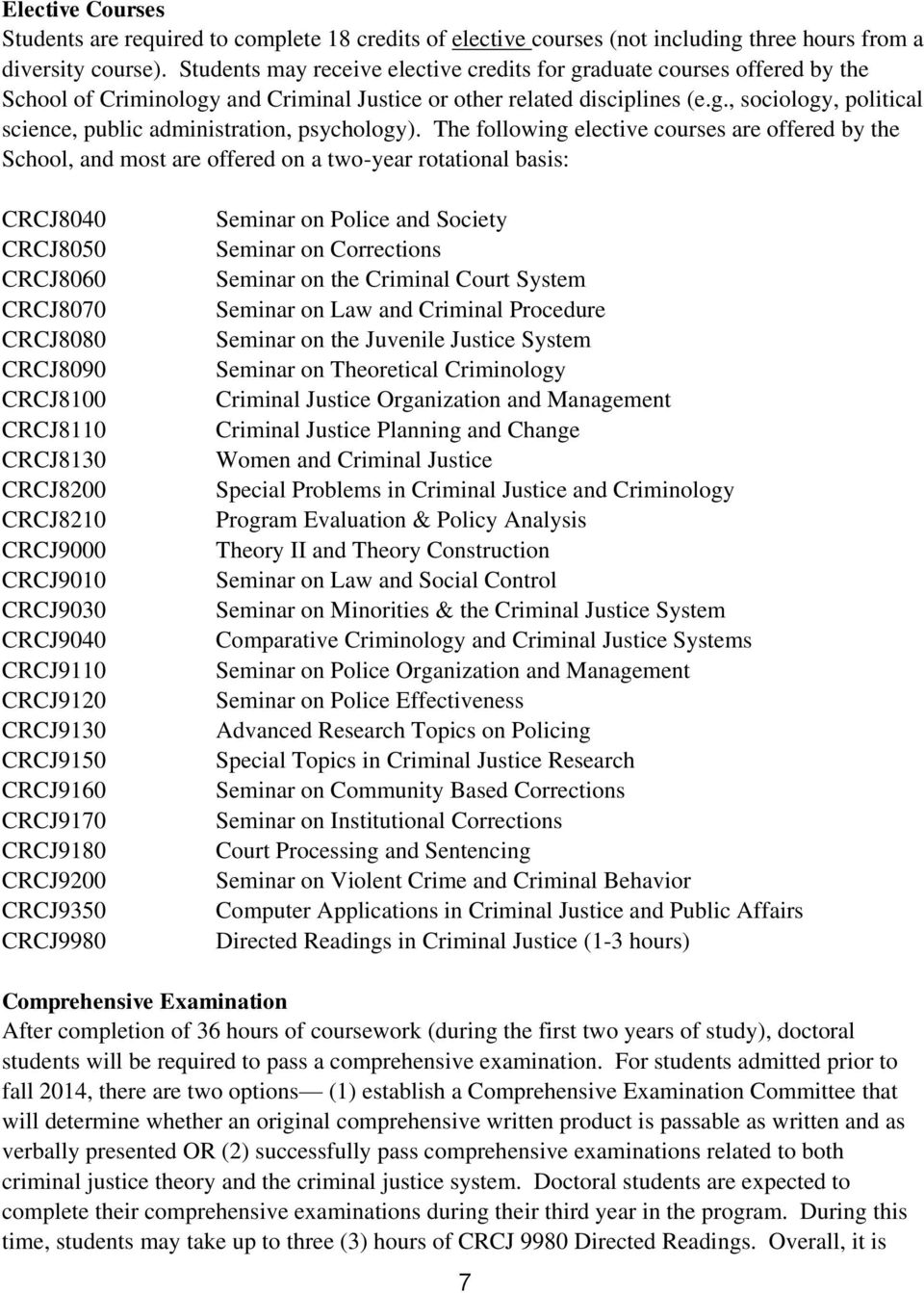
7 Elective Courses Students are required to complete 18 credits of elective courses (not including three hours from a diversity course). Students may receive elective credits for graduate courses offered by the School of Criminology and Criminal Justice or other related disciplines (e.g., sociology, political science, public administration, psychology). The following elective courses are offered by the School, and most are offered on a two-year rotational basis: CRCJ8040 CRCJ8050 CRCJ8060 CRCJ8070 CRCJ8080 CRCJ8090 CRCJ8100 CRCJ8110 CRCJ8130 CRCJ8200 CRCJ8210 CRCJ9000 CRCJ9010 CRCJ9030 CRCJ9040 CRCJ9110 CRCJ9120 CRCJ9130 CRCJ9150 CRCJ9160 CRCJ9170 CRCJ9180 CRCJ9200 CRCJ9350 CRCJ9980 Seminar on Police and Society Seminar on Corrections Seminar on the Criminal Court System Seminar on Law and Criminal Procedure Seminar on the Juvenile Justice System Seminar on Theoretical Criminology Criminal Justice Organization and Management Criminal Justice Planning and Change Women and Criminal Justice Special Problems in Criminal Justice and Criminology Program Evaluation & Policy Analysis Theory II and Theory Construction Seminar on Law and Social Control Seminar on Minorities & the Criminal Justice System Comparative Criminology and Criminal Justice Systems Seminar on Police Organization and Management Seminar on Police Effectiveness Advanced Research Topics on Policing Special Topics in Criminal Justice Research Seminar on Community Based Corrections Seminar on Institutional Corrections Court Processing and Sentencing Seminar on Violent Crime and Criminal Behavior Computer Applications in Criminal Justice and Public Affairs Directed Readings in Criminal Justice (1-3 hours) Comprehensive Examination After completion of 36 hours of coursework (during the first two years of study), doctoral students will be required to pass a comprehensive examination. For students admitted prior to fall 2014, there are two options (1) establish a Comprehensive Examination Committee that will determine whether an original comprehensive written product is passable as written and as verbally presented OR (2) successfully pass comprehensive examinations related to both criminal justice theory and the criminal justice system. Doctoral students are expected to complete their comprehensive examinations during their third year in the program. During this time, students may take up to three (3) hours of CRCJ 9980 Directed Readings. Overall, it is 7
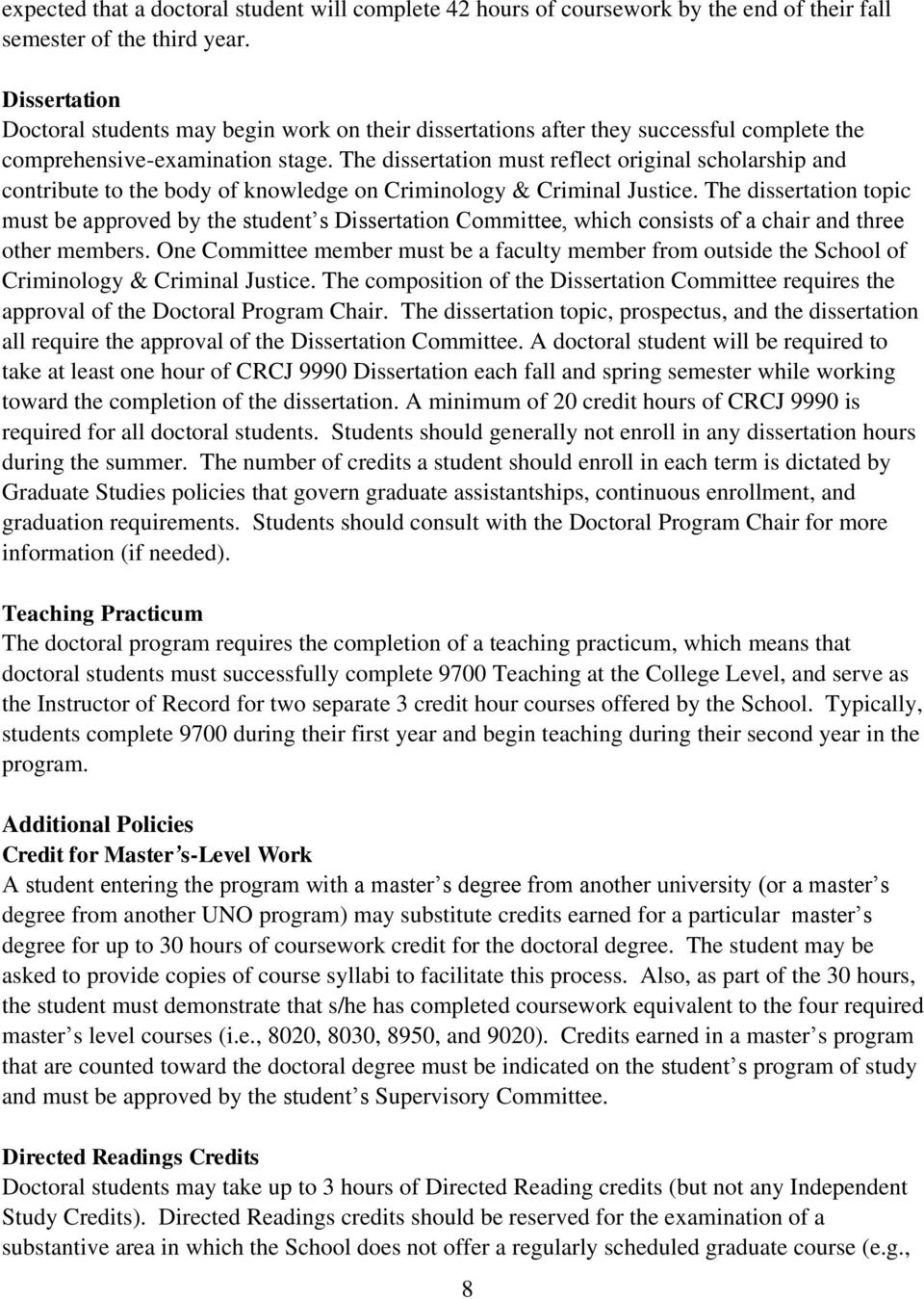
8 expected that a doctoral student will complete 42 hours of coursework by the end of their fall semester of the third year. Dissertation Doctoral students may begin work on their dissertations after they successful complete the comprehensive-examination stage. The dissertation must reflect original scholarship and contribute to the body of knowledge on Criminology & Criminal Justice. The dissertation topic must be approved by the student s Dissertation Committee, which consists of a chair and three other members. One Committee member must be a faculty member from outside the School of Criminology & Criminal Justice. The composition of the Dissertation Committee requires the approval of the Doctoral Program Chair. The dissertation topic, prospectus, and the dissertation all require the approval of the Dissertation Committee. A doctoral student will be required to take at least one hour of CRCJ 9990 Dissertation each fall and spring semester while working toward the completion of the dissertation. A minimum of 20 credit hours of CRCJ 9990 is required for all doctoral students. Students should generally not enroll in any dissertation hours during the summer. The number of credits a student should enroll in each term is dictated by Graduate Studies policies that govern graduate assistantships, continuous enrollment, and graduation requirements. Students should consult with the Doctoral Program Chair for more information (if needed). Teaching Practicum The doctoral program requires the completion of a teaching practicum, which means that doctoral students must successfully complete 9700 Teaching at the College Level, and serve as the Instructor of Record for two separate 3 credit hour courses offered by the School. Typically, students complete 9700 during their first year and begin teaching during their second year in the program. Additional Policies Credit for Master s-level Work A student entering the program with a master s degree from another university (or a master s degree from another UNO program) may substitute credits earned for a particular master s degree for up to 30 hours of coursework credit for the doctoral degree. The student may be asked to provide copies of course syllabi to facilitate this process. Also, as part of the 30 hours, the student must demonstrate that s/he has completed coursework equivalent to the four required master s level courses (i.e., 8020, 8030, 8950, and 9020). Credits earned in a master s program that are counted toward the doctoral degree must be indicated on the student s program of study and must be approved by the student s Supervisory Committee. Directed Readings Credits Doctoral students may take up to 3 hours of Directed Reading credits (but not any Independent Study Credits). Directed Readings credits should be reserved for the examination of a substantive area in which the School does not offer a regularly scheduled graduate course (e.g., 8
9 environmental crime) or to enhance knowledge of a specialized topic within a substantive area (e.g., social learning theory, sentencing reform). Grade Standards As noted previously, the degree requires the successful completion of 92 credit hours of graduate coursework. Successful completion means a grade of B- or higher in each course. In the event a student receives a grade below a B- in a graduate class (including C+, C, or C-), s/he will be notified that his/her status is in jeopardy and that no credit will be given for the course. A second C grade in any graduate course (i.e., any grade below a B-), will result in automatic dismissal from the program. Incompletes The School of Criminology and Criminal Justice has adopted the following guidelines regarding incompletes : Incompletes must be resolved within two semesters or the student will receive a failing grade (i.e., F). The Doctoral Program Chair will notify students each semester of incompletes that need to be addressed. It is the student s responsibility to contact and work with the professor (i.e., in the course in which the incomplete grade was issued) in order to complete the required work. A student may request an extension in cases of extenuating circumstances. Instructors will determine whether a student s request for an extension is warranted. Extensions beyond 12 months must be requested and granted prior a change from an incomplete to a failing grade. 4000/8000 Courses Both and 9000-level courses are offered by the School of Criminology and Criminal Justice and may be included in a student s program of study. A maximum of six hours of duallevel (4000/8000) courses may be included in a program of study. Summary of Requirements The successful completion of 92 credits is required for the doctoral degree: Master s level coursework = 30 credits Doctoral level required coursework = 21 credits Diversity requirement = 3 credits Doctoral level elective coursework, including up to 3 hours of Directed Readings = 18 credits Dissertation = 20 credits Teaching practicum = 0 credits 9

10 SUPERVISORY COMMITTEE for PROGRAM of STUDY Upon admission to the doctoral program, students will be advised by the Doctoral Program Chair, who will assist the student with course selection and program questions during the student s first semester. The Doctoral Program Chair will also facilitate long-range planning with the student. Another member of the faculty will be assigned as the academic advisor for the student during the student s second semester. Each doctoral student is required to have a Supervisory Committee that is responsible for overseeing his/her progress toward the degree until the appointment of a Dissertation Committee (see Dissertation section of the handbook). However, students are responsible for checking their Degree Audit Report on a regular basis to ensure that classes are being applied correctly to their program of study. Concerns should be voiced to the Doctoral Program Chair. Additional information on the Supervisory Committee and a check list appears in Appendix A. Committee Composition and Timing The Supervisory Committee consists of four faculty members; three of the members should be members of the Criminology and Criminal Justice Graduate Program Committee and the fourth member must be a faculty member from another UNO or UNL department. The student should work with the Doctoral Program Chair to identify the chair of his/her Supervisory Committee. The student will then be responsible for identifying the three remaining members (i.e., two internal and one external). The chair of the Supervisory Committee will be the faculty member designated as the student s academic advisor at the beginning of the student s second semester of enrollment. Once the Committee has been constituted, the student must complete and submit the Appointment of Supervisory Committee for the Doctoral Degree form, which is available online through the Graduate College website. The form must be approved by the Doctoral Program Chair and must be forwarded to the Dean of Graduate Studies for approval before the Supervisory Committee is considered officially constituted. The Supervisory Committee must be constituted after the student has completed one semester of doctoral coursework (i.e., at the beginning of the student s second semester). Program of Study and Progress toward the Degree The purpose of the Supervisory Committee is to assist the student with long-term planning geared toward the successful and timely completion of the doctoral degree. The Committee also assists with student s program of study. Within three weeks of its appointment, the Supervisory Committee should meet for the purpose of reviewing and 10
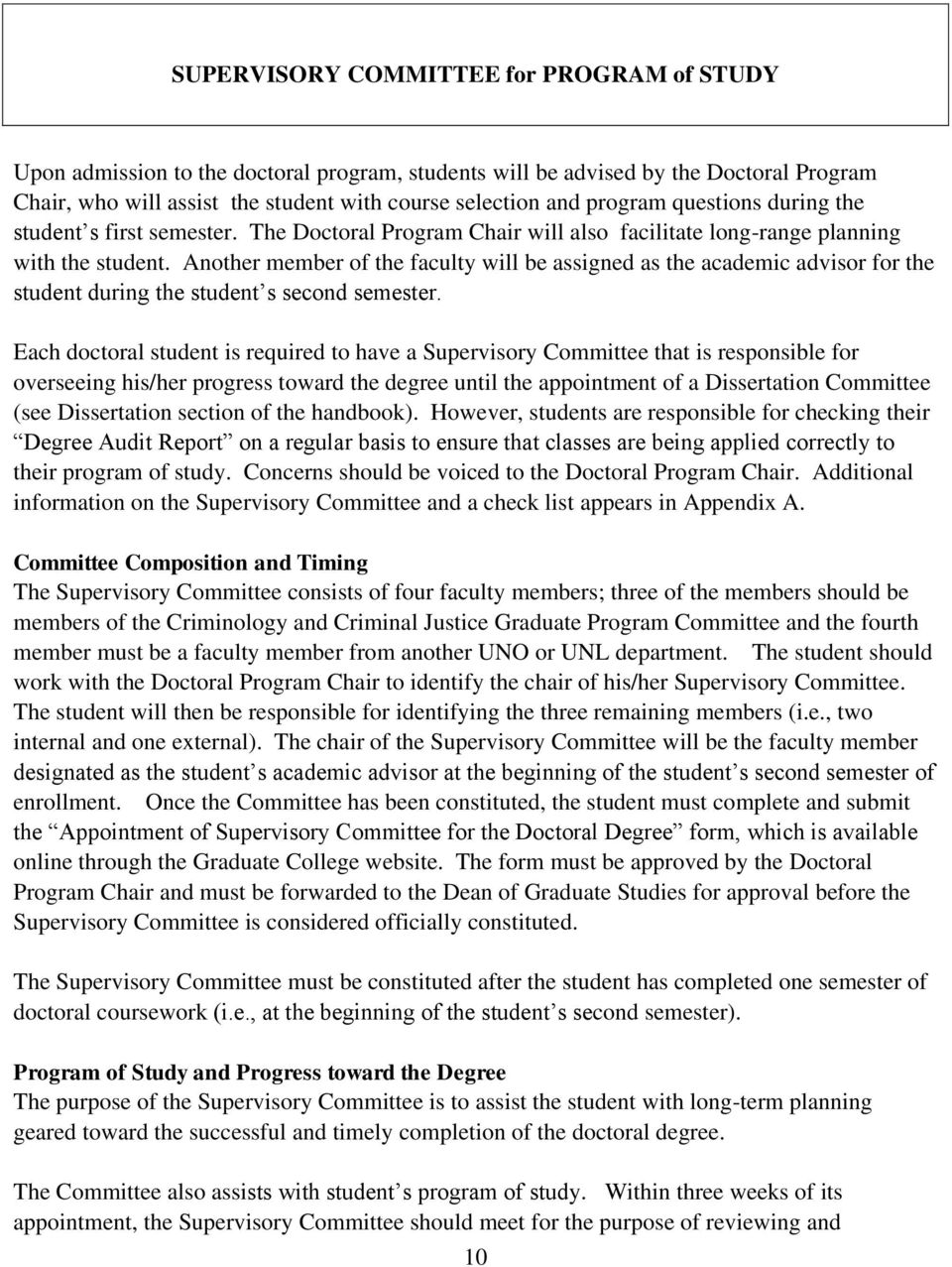
11 approving the student s plan for completing all doctoral level coursework that will be used to meet degree requirements. It is the student s responsibility to arrange the time and place for all meetings. Following the Committee s approval of the program of study, the student must file the Appointment of Supervisory Committee for the Doctoral Degree with Graduate Studies. This form is available online through the Graduate Studies website. The approved Plan of Study form must be submitted before 46 hours have been completed, including hours credited for a master s degree. Any subsequent change in the program of study or in the area of research for the dissertation must be approved by the Supervisory Committee and reported to Graduate Studies via submission of the New Plan of Study form. The form is available online through the Graduate Studies website. At a minimum, the Supervisory Committee should meet with the student during each spring semester for the purpose of reviewing the student s progress toward the degree and his/her performance in the program. To facilitate this process, the student is responsible for preparing an annual progress report and providing a copy of the report to all Committee members prior to the meeting. This report should contain information directly related to the student s overall progress, progress since the last meeting, and future plans and timeline for completion of the degree. Two additional timing issues should be noted. All course work must be completed within three years from the time a student s program of study is approved by the Dean for Graduate Studies. Once the program of study is approved, the student has eight years to complete the degree. 11
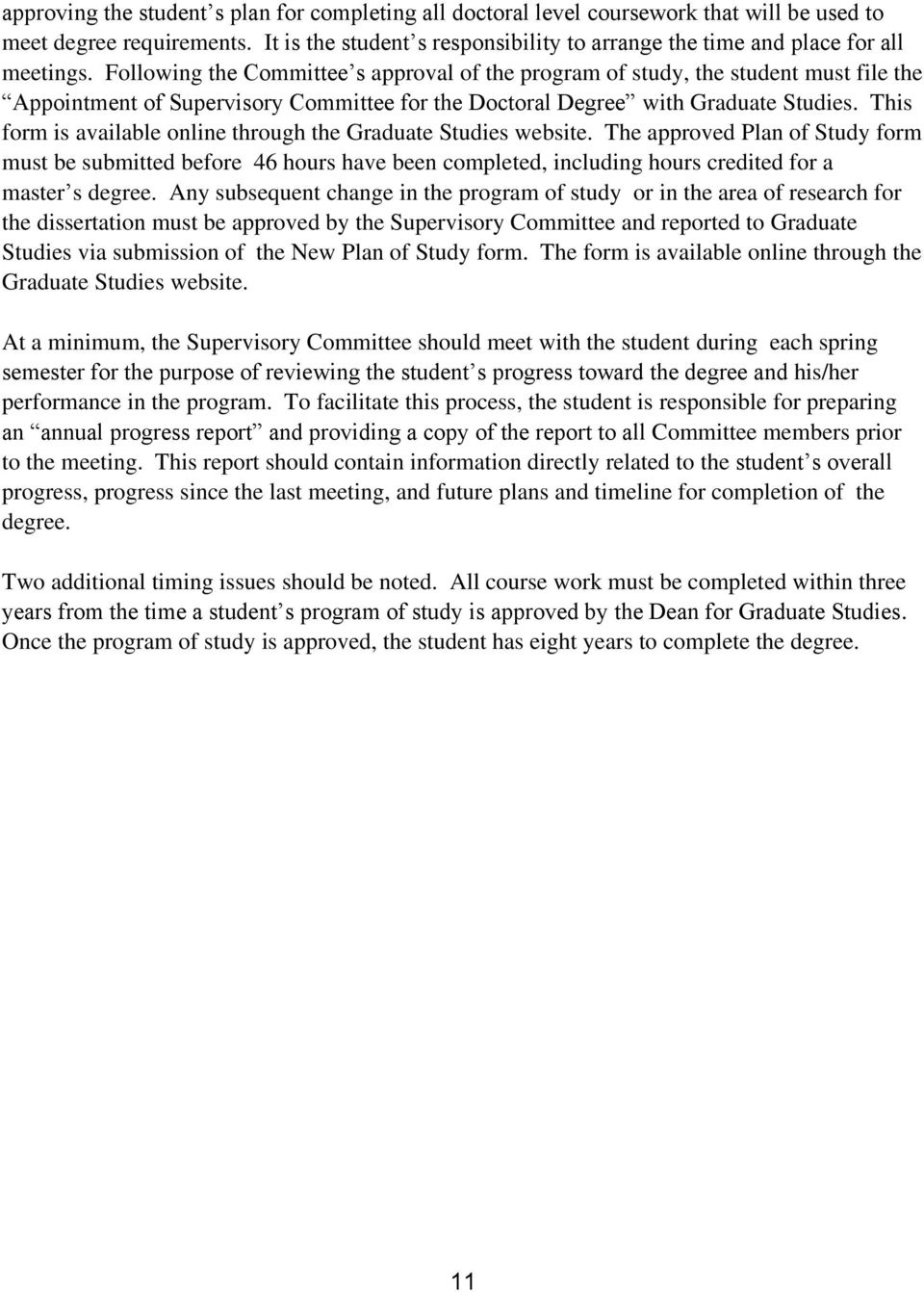
12 TUITION, RESIDENCY, & FINANCIAL AID Candidacy and Continuous Enrollment According to Graduate Studies, doctoral students must be continuously enrolled at UNO once they enter candidacy. A student applies for candidacy after s/he successfully completes the comprehensive-examination stage. The continuous enrollment requirement may be satisfied via enrollment in at least one credit hour per semester. Students are not required to enroll for credits over the summer to satisfy the condition of continuous enrollment. This is true even if a student intends to receive a degree in August. Enrollment Requirements for Graduate Assistants Students with a graduate assistantship must be enrolled in at least 6 credits per semester at UNO. Enrollment during the summer is not necessary. There is one exception a student with a graduate assistantship, who is in his/her last semester, needs only to be enrolled in 1-3 credits per semester. Permission to enroll in fewer than 6 credit hours for students with a graduate assistantship must be obtained from Graduate Studies. The form to request such an accommodation is available from that Office. If a student is in his/her last semester of an assistantship, but is not going to graduate at the end of that semester, s/he must enroll in at least 6 credits. Tuition Who is responsible for paying for graduate student tuition? A student who does not have a graduate assistantship is solely responsible for all tuition and fees incurred. This is the case for students never awarded a graduate assistantship and for students who were awarded a graduate assistantship but who no longer have one. Students with a graduate assistantship are entitled to tuition remission for a maximum of 36 credits per year. With regard to credits for coursework and directed readings, doctoral students with a graduate assistantship must obtain approval from the Doctoral Program Chair and School Director in order to be granted tuition remission for coursework that exceeds 72 credits minus the number of credits transferred into the program (e.g., a student who transfers in 30 credits needs approval to receive tuition remission for credits that extend beyond 42 credits). With regard to dissertation credits, students with graduate assistantships requesting tuition remission for more than 20 dissertation credits must obtain approval from the Doctoral Program Chair and the School Director in advance (with the exception of students who must enroll in at least 6 credits per term to meet Graduate Studies requirements). 12
13 Tuition is assessed differentially depending on whether a student is classified (for tuition purposes) as a resident or out-of-state student (see below). For academic year , the resident tuition rate is $ per credit hour, and the non-resident rate is $ per credit hour. The billing process is complex: Students who do not have a graduate assistantship should expect to incur tuition charges consistent with their residency status. Students with a graduate assistantship are assessed tuition in accordance with their residency status. The School is responsible for paying the resident rate of tuition for all graduate assistants, and the Graduate College assumes responsibility for the differential for the out-ofstate students. Residency A student who moved to Nebraska for the purpose of pursuing an education is considered an outof-state student (for tuition purposes) as long as s/he is a student, regardless of how long s/he lives in the state. To apply for residency for tuition purposes, it is necessary for the student to have an established residence in the state and to be less than a half-time student for a minimum of 12 months. For more information, contact the Registrar s Office. Financial Aid According to the Financial Aid Office, a graduate student must be enrolled in four credit hours per semester (i.e., half time) in order to be eligible for federal financial aid in the form of a student loan. Graduate students who receive financial aid for the academic year are not typically required to enroll in summer credit hours in order to defer loan payments; instead, the summer is bridged between academic years. If a graduate student chooses to apply for additional financial aid during the summer months (beyond that which s/he might have for the academic year), the student would need to be enrolled in four credit hours over the summer. For additional information, contact the UNO Financial Aid Office. Residency and Degree Completion Timeline Full-time students admitted with a master's degree are required to complete 27 hours of graduate work within 18 months. Part-time students employed in a criminal justice agency are required to complete 24 hours within 24 months. Not more than one-third, or 9 hours, of coursework taken during a summer term may be used to meet the residency requirement. All coursework for the degree must be completed within three years from the time that a student's program of study is approved by the Graduate College. The time limit to complete a Ph.D. is 8 years from the time a student files his/her Program of Study Form. Students are required to re-take the comprehensive examination if all course work to be counted toward the Ph.D. (including dissertation credits) is not completed within 3 years following admission into candidacy. 13

14 Summary Notes on Tuition and Enrollment (i.e., What Does It All Mean?) As a general rule, students with graduate assistantships should expect to receive tuition remission during every fall and spring semester that an assistantship is active with the following conditions and caveats in effect: A maximum of 36 credit hours per year are eligible for tuition remission in any one year. Credits taken beyond this are the student s financial responsibility. A student must be enrolled in a minimum of 6 credit hours during every fall and spring semester that s/he has a graduate assistantship: o It is expected that coursework and directed readings credits be used to meet this requirement during the student s initial years in the doctoral program until the completion of required coursework. o During the fall semester of the third year, doctoral students should enroll in up to 3 credits of Directed Readings while they are working on their comprehensive examinations. o Once 72 hours of coursework and the comprehensive examination(s) have been successfully completed, graduate assistants should enroll in 6 dissertation credits per semester. Assuming that the student is working on the dissertation during the spring semester of the third year (6 th semester) and in the fourth year (7 th and 8 th semesters), s/he should enroll in 6 dissertation credits during each of these three semesters and tuition costs will be covered. The remaining dissertation credits may be taken during the summer (if the student plans to graduate in August) or during the fall (if additional time is needed to complete the dissertation). Continuous enrollment is required of students who have entered candidacy (which occurs after a student successfully completes his/her comprehensive examination). Unless coursework or directed reading credit is being taken during the summer in order to complete degree requirements, tuition costs incurred during the summer will not qualify for remission. It is important for students to engage in long-term planning and map out coursework and dissertation credits early in the degree program, especially for those with graduate assistantships. 14
15 COMPREHENSIVE EXAMINATIONS & ADMISSION to CANDIDACY Underlying Philosophy One of the principal goals of the Doctoral Program in Criminology and Criminal Justice is to help students develop specializations within the discipline. The Program, therefore, employs a combination of methods to develop student expertise in substantive areas. These methods include general and specialized courses and seminars, directed readings, research, and informal mentoring. It should be noted that the development of specialized knowledge does not rely solely on coursework. Additional information on the comprehensive examinations follows. Following the completion of coursework, doctoral students complete one or more comprehensive examinations. Students admitted prior to Fall 2014 may take the comprehensive examination adopted by the faculty of the School of Criminology and Criminal Justice (SCCJ) in March of 2009 or the comprehensive examinations adopted by the SCCJ faculty in April All students admitted after Fall 2014 must follow the procedures for comprehensive-examination policy adopted by the faculty in April Comprehensive Examination Policy Adopted March 2009 (aka Option 1) Option 1 purpose. The purpose of the comprehensive examination is to give doctoral students an opportunity to demonstrate their ability to integrate core knowledge, to document their expertise in a specialty area, and to demonstrate their ability to execute and defend an independent research project. Furthermore, such an exercise provides the student with the opportunity to practice and be assessed on skills involved in (1) developing a research project, (2) using critical thinking skills, (3) synthesizing material, (4) writing for publication, and (5) presenting and defending research products. This examination system was adopted by the faculty of the School of Criminology and Criminal Justice in March of 2009, and is the policy for all students admitted into the program from March 2009 to Summer 2014; it is optional for students admitted before March 2009 such students may opt to take the former comprehensive examination. Option 1 comprehensive exam committee. The student is responsible for constituting a Comprehensive Exam Committee that will supervise the administration of an examination. The Committee shall be composed of at least three graduate faculty members from the School of Criminology and Criminal Justice. Students are strongly encouraged to select faculty by specialty area and not by campus. A list of faculty specialty areas is included in the handbook. Comprehensive Examination Committees will not have a chair; each faculty member is an equal participant. However, for efficiency reasons one member should serve as an administrative facilitator for purposes of reporting and communicating between members. A record of the 15
16 Committee s composition shall be filed with the Doctoral Program Chair and the Dean of Graduate Studies when the Committee is constituted. This should occur no later than the initial meeting of the entire Committee. The Committee must be formed no later than the beginning of the student s fifth semester of enrollment following admission to the doctoral program. The Comprehensive Examination Committee must approve the subject of the student s examination, determine how to assess the student s proficiency, and conduct the assessment. All examinations shall include: Demonstration of critical understanding of relevant literature (in written form); Completion of a proposal for a research project; and An oral presentation and defense of the comprehensive exam. The Committee will report to the Doctoral Program Chair and the Chair of the student s Supervisory Committee regarding its assessment of the student s performance on the comprehensive examination. A majority of the Committee s members must deem the student s performance to be acceptable on each examination component for the student to pass. In the event that the Committee reports that a student has failed or in the event that the student has disbanded his or her Committee, the student may petition the Graduate Program Committee to be allowed to form a new Committee in order to take a new examination. A student who is allowed to take a new examination and who fails that examination will be dismissed from the program. Option 1 comprehensive exam procedures 1. Project Approval By the beginning of the fifth semester or (end of the fourth semester), the student should call a meeting of the Comprehensive Exam Committee for the purpose of reviewing and assessing a proposal. The proposal should be distributed to Committee members in advance. It should be a 3 to 5 page document that articulates the following: What is the focus of the comprehensive exam? o What is the topic? What is the research question? o Why is it significant? Why is the proposed topic publishable? If the work is empirical, what data will be used and how will it be acquired? What research methodology (and if appropriate, statistical tools) will be used to analyze the data? If the work is not empirical, what will the project entail? 2. Publishable Article Draft Once the topic meeting has been held and the topic approved, the student is expected to work on the project independently without seeking substantial assistance from Committee members. The Committee may address minor issues (e.g., reference recommendations, minor clarification questions, software assistance), but cannot address questions about substantive issues or key facets of the research methodology, and the Committee cannot read or comment on outlines or drafts. The final draft of the comprehensive exam should be in the format of a paper being sent 16
17 to a journal for consideration of publication. The final draft should be submitted to the Committee at a point in the student s third year in the program. 3. Revise and Resubmit The Comprehensive Examination Committee will have two business weeks to complete a formal review of the student s article draft and provide him/her with written reviews. The reviews will be given to the student, who is expected to address comments and concerns, as is done with revise and resubmit decisions from journal editors. The revised article draft should be submitted to the committee within three weeks. 4. Final Draft The Comprehensive Examination Committee will have two business weeks to determine if the written part of the comprehensive examination (i.e., revised article draft) is a pass or fail. If by majority vote of the Committee (at least 2 of 3) vote to pass the students work the written phase is deemed a pass. The student will then schedule a one hour oral defense of the project, which s/he must also pass by a majority vote of the Committee (i.e., at least 2 of 3 votes). If the committee determines that the written phase of the comprehensive exam is a fail, the student must form a new Comprehensive Examination Committee and start over with a new topic. If the student fails to successfully complete the comprehensive examination on the second attempt, s/he will be dismissed from the doctoral program. 5. Oral Defense During the oral defense of the comprehensive examination, the student will present his/her project to the Comprehensive Examination Committee in a public forum open to all faculty, staff, and students. The defense should consist of a minute presentation where the student describes his/her project, its significance, and major findings or contributions to the literature. The student should also discuss where s/he intends to submit the paper for consideration of publication. After the oral presentation, the student will take questions from the Committee and other individuals who may be present. The oral defense should be scheduled to occur within two weeks of when a passing grade is assigned to the written portion of the comprehensive examination. Appendix B provides a checklist for the comprehensive exam procedures articulated in Option 1. Option 1 FAQs 1) May the article for the comprehensive exam be a pilot study for my dissertation? Yes, but it cannot be the same exact research question as the dissertation. 2) May I use data from previous work I have done? Yes, as long as the research questions and hypotheses are different. 17
18 3) How many times will I be allowed to revise and resubmit the comprehensive examination to my committee? Only once. 4) May I use a paper that I did for a class as my comprehensive exam? No, the comprehensive examination project must be new and original. However, it would be acceptable for a student to pursue an idea that involves testing or elaborating on something done for a class or previous paper. 5) Before I send the article out to a journal, how should decisions be made on authorship? The student should remain the first author and negotiate with the professor(s) about their secondary authorship only in the event that the Committee s members made a contribution beyond merely serving on the examination committee. NOTE: Students are expected to complete the work on their comprehensive examinations independently and, therefore, it should be their own work and not the result of a collaborative effort with faculty members on the Committee. Students are encouraged to take steps after the examination to publish their work. If a student has made arrangements for authorship of the final product that include faculty (e.g., a faculty member provided data with the understanding of authorship on the final product, a faculty member assisted with significant further development beyond the final draft), these arrangements should be made clear and preferably be put in writing prior to submitting the paper for consideration of publication. Students should not expect to provide members of their Comprehensive Examination Committee with authorship on submitted articles for merely serving on their examination Committee. 6) How do I know whom to pick for my committee? It would be advisable for a student to pick faculty who have published in the area of the topic selected for the comprehensive examination. Additionally, students should choose faculty with whom they feel comfortable. Remember, however, that some faculty may have to decline. In the event that happens, it is not a necessarily a reflection on the student. Some faculty may already have as many students as they can handle. Comprehensive Examination Policy Adopted April 2014 (aka Option 2) Option 2 purpose. The purpose of the comprehensive examination is to give doctoral students an opportunity to demonstrate their broad understanding of criminological theory and the criminal justice system. This examination system was adopted by the faculty of the School of Criminology and Criminal Justice in April 2014, and is the policy for all students admitted into the program after Fall 2014; it is optional for students admitted before Fall 2014 such students may opt to take the former comprehensive examination (aka Option 1). Option 2 reading lists. Reading lists developed by faculty are available for each comprehensive examination. The reading lists are available on the School s website. 18
19 Option 2 timing of exams. Exams are offered the second Friday in October and the second Friday in April. If there is any conflict with the exam date, the exam will be moved back a week. Students who are taking the exam need to notify the Doctoral Program Chair in writing 45 days prior to taking the examination of their intent to sit for the exam. Students should request any necessary accommodation at this time. Option 2 composition of committees. Each year in a late spring faculty meeting, two committees each composed of three graduate faculty members will be randomly selected from the above lists to serve on the respective committees. While a faculty member may choose to serve on both committees, each faculty member may only serve on one committee at a time as a grader. The grading committees will serve the next year and will design and grade comprehensive examinations. A chair will be selected by the committee to oversee the creation of questions and communication of feedback to the Doctoral Program Chair. Initially, the chairs will serve two-year terms to provide continuity. The names of members of the grading committees will not be disclosed to students. Option 2 administration of examinations. Each comprehensive exam will have two sessions (a morning session and an afternoon session). Each session will be 4 hours long. During each session students will be asked to answer two of three questions prepared by the grading committee. Students are encouraged to be on time for examinations. Students who arrive late to any of the exams will not be given additional time. Students are permitted to leave the examination to use the restroom, but only one student may leave at a time. Examinations will be submitted electronically with only code numbers, as opposed to student names as identifiers, prior to leaving the examination site. The exams will be submitted through SafeAssign prior to faculty grading. The proctor will provide the Doctoral Program Chair with a list of the student names and code numbers to be used to communicate grading results. Option 2 grading of examinations. The committee will have three weeks to submit grades for examinations. The committee will forward their results the Doctoral Program Chair, who will notify students of the outcome of their exams. The Doctoral Program Chair will request feedback from the committee in the event that a student has failed the exam. Ordinarily, grading will be complete and students notified of their results within three weeks of the exam. Option 2 grading results. Students taking comprehensive examinations can expect one of two outcomes: pass or fail. A grade of pass indicates a student passed each question without any concerns from the committee. A grade of fail indicates that there is substantial need for improvement in the work submitted. Students who fail the exam will receive constructive feedback to guide preparation for a second attempt. Option 2 retaking the examination. Students who fail the comprehensive examination may retake the exam after completing the following: 1. Selecting a comprehensive study advisor among the faculty. 19

20 2. Developing a plan for studying for the examination, which may include reading, attending courses or comprehensive study sessions, and taking written practice examinations under time deadlines for feedback by faculty. 3. Obtained written certification in a letter from the advisor to the Doctoral Program Chair certifying that a reasonable study plan has been completed. Students who choose to retake a failed exam must do so the next time the exam is given. A student who fails a comprehensive exam a second time shall be terminated from the doctoral program. Admission to Candidacy After passing the comprehensive examination (as specified by Option 1 or Option 2 above), the student is eligible for candidacy and should file the "Application for Admission to Candidacy for the Doctoral Degree" with Graduate Studies, which is available online through the Graduate College website. The application must be filed at least seven months prior to the oral defense of the dissertation. Continuous Enrollment After admission to candidacy, the student must maintain continuous enrollment until the doctoral degree is conferred. As described elsewhere, this means that the student must enroll in a minimum of one credit hour of dissertation research during every subsequent fall and spring semester. Failure to maintain continuous enrollment will result in termination of candidacy, which would require the student to start over at the comprehensive examination point. 20
21 THE DISSERTATION All students are required to complete a 20 credit-hour dissertation. The dissertation must reflect original scholarship and contribute to the body of knowledge in the field of criminology and criminal justice. The Doctoral Program Chair must approve the composition of the student s Dissertation Committee. The dissertation topic must be approved by the student's Dissertation Committee. Moreover, the dissertation prospectus and the dissertation itself must be approved by the Dissertation Committee. Students should not register for dissertation hours until the comprehensive-examination stage is completed. Additional information on the dissertation follows, and a check list may be found in Appendix C. Dissertation Committee The Dissertation Committee is formed following the successful completion of the comprehensive examination(s). Committee members provide the student with assistance regarding substantive, methodological, and formatting issues, and also ensure that the work is relevant and of high quality. The Committee consists of at least four members: three members of the Criminology and Criminal Justice Graduate Program Committee and one outside faculty member from a different discipline. All Committee members are selected by the student, but must be approved by the Doctoral Program Chair. The Dissertation Committee may or may not include members of the student's original Supervisory Committee. The Committee should be formed no later than the end of the semester in which the comprehensive exam is successfully completed, but it cannot be formed prior to the completion of the examination. To establish the Dissertation Committee, the student must fill out the "Appointment of Dissertation Committee for the Doctoral Degree" form (which is available online through the Graduate Studies website). On the form, the student will designate the Committee chairperson, two readers (i.e., internal members who read and approve the dissertation and abstract prior to the final oral examination), and an external member. The composition of the Committee must be approved by the Doctoral Program Chair. A copy of the form should be provided to all members of the Committee, and the Committee chairperson should also give a copy to the Doctoral Program Chair who will place a copy in the student's file. Once the form has been filed with Graduate Studies and the Dissertation Committee officially constituted, the Dissertation Committee becomes the student s new Supervisory Committee. Dissertation Topic Approval Early in the dissertation process, the student should schedule a topic approval meeting with his/her Dissertation Committee for the purpose of getting formal approval for the dissertation topic and the general research design and methodology that will be used. Prior to the meeting, the student should provide all Committee members with a written proposal that articulates these 21
22 issues. Additional guidance on the content and format of this document should be sought from the Committee. Once the topic has been approved, the student must submit the "Approval of Dissertation Topic" form (which is available online through the Graduate Studies website) to the Doctoral Program Chair (who must also agree to sign the form). The form must then be filed with Graduate Studies. A copy of the completed form will also be placed in the student s file. Dissertation Prospectus The next step is the dissertation prospectus. The prospectus consists of the first three chapters of the dissertation: 1) A statement of the problem; 2) A comprehensive literature review including coverage of the theoretical or conceptual framework; and 3) A detailed discussion of the research design/methodology. The prospectus must be reviewed and approved by the Dissertation Committee before the student may continue with the dissertation. The student should present the dissertation prospectus to the Dissertation Committee for review at least two weeks in advance of the formal prospectus approval meeting. Because preparation of the prospectus will involve extensive work, the student is encouraged to meet informally with members of the Committee in advance of the defense. The Committee may either approve the prospectus as submitted or require the student to make revisions prior to their approval. Upon approval, the chair of the Dissertation Committee must file the "Approval of Dissertation Prospectus" form (which is an in-house form) with the Doctoral Program Chair. A copy of the approved prospectus and of the approval form will be placed in the student's file. The approved prospectus is considered a "contract" with the student regarding the dissertation. Significant changes in an approved prospectus will require the preparation of a formal prospectus addendum and subsequent review and approval by the Dissertation Committee. Final Oral Defense An oral defense of the dissertation is required of all doctoral students. It is administered by the Dissertation Committee and is open to all members of the School. The Dissertation Committee also determines the character and length of the defense. The examination may be devoted to the area of study in the dissertation. Timing The oral defense will take place after the dissertation has been approved by the Dissertation Committee. The Committee s members must have at least three weeks to read and review the dissertation in its entirety before the final oral defense. At least three weeks prior to the defense, the "Application for Final Oral Examination or Waiver" form (available online through the Graduate Studies website), must be filed with Graduate Studies along with the dissertation abstract (no more than 350 words). The form must be signed by the members of the Committee, 22
23 and must indicate the time and date of the final oral examination. Committee Attendance The final oral examination over the dissertation shall not be held unless all members of the Dissertation Committee are available for the examination. A committee member may waive his/her right to attend. Results Following the oral defense, the Dissertation Committee votes to determine if the student has passed or failed the final oral defense of the dissertation. In the event that members of the Committee are not unanimous regarding whether a candidate should pass, the student may be given approval for the degree provided that only one committee member dissents. The dissenting member of the committee must file a letter of explanation with Graduate Studies. The results of the final oral defense must be submitted to Graduate Studies. If a student fails to pass the final oral examination, the Dissertation Committee will file a report on the failure with Graduate Studies and indicate what the student must do in order to pass all components of the dissertation examination. Another examination may not be held during the same term in which the student failed. Waiver The final oral defense of the dissertation may be waived only with the unanimous consent of the Dissertation Committee and only in extremely unusual circumstances. A formal request for a waiver (with specified reasons) must be filed by the student. This request must be submitted to and approved by the Doctoral Program Chair. 23
24 SUMMARY: STEPS in the PROCESS & IMPORTANT DEADLINES 1) A student is granted admission to the Ph.D. program during the spring semester of a given academic year and begins coursework during the immediate fall semester. 2) During the spring semester of the first year in which course work has begun, the student establishes a Supervisory Committee and submits the appropriate paperwork to Graduate Studies. 3) Within three weeks of the appointment of the Supervisory Committee, the Committee meets to approve the student s program of study. The student files the Criminal Justice Doctoral Plan of Study with the Office of Graduate Studies. a) At least 45 hours of the student s doctoral coursework (including the 20-hour dissertation) is to be completed after the Committee approves a student s program of study. b) Once the program of study is approved, the student has 8 years to complete the degree. c) The student is responsible for setting up the Supervisory Committee meeting and for communicating the date/time/place of the meeting to Committee members. 4) During the spring semester of each year, a student s Supervisory Committee will meet to review the student s progress toward the degree. The student must prepare an annual progress report and distribute this report to Committee members prior to the meeting. The student is responsible for setting up the meeting and for communicating the date/place/time of the meeting to Committee members. 5) After completion of all coursework (or close to the completion of all coursework), the student is eligible to take the comprehensive examination. 6) After passing the comprehensive-examination stage, the student must file the Application for Candidacy for the Doctoral Degree. a) The application is due in the Office of Graduate Studies no later than 7 months prior to the final oral examination (i.e., for the dissertation). b) After admission to candidacy, the student must maintain continuous enrollment until he/she receives the doctoral degree. c) If the term of candidacy is extended beyond three years, the student must pass another comprehensive examination. 7) The student establishes a Dissertation Committee by filling out the Appointment of Dissertation Committee for the Doctoral Degree form. The Doctoral Program Chair 24
25 must approve the composition of the Committee. The Dissertation Committee must be established no later than the end of the semester in which all facets of the comprehensive examination process are successfully completed. 8) The Dissertation Committee meets to approve the dissertation topic; the student submits the Approval of Dissertation Topic form to the Doctoral Program Chair. The student is responsible for setting up the meetings and for communicating the date/time/place to Committee members. 9) The Dissertation Committee meets to approve the dissertation prospectus; the student submits the Approval of Dissertation Prospectus form to the Doctoral Program Chair. The student is responsible for setting up the meetings and for communicating the date/time/place to Committee members. 10) At least one month prior to the final oral examination, the student must submit a preliminary copy of the dissertation and abstract to the members of the Dissertation Committee. 11) At least three weeks prior to the final oral examination, the student submits a preliminary copy of the dissertation, an abstract, and the Application for Final Oral Examination or Waiver to the Office of Graduate Studies. 12) The Dissertation Committee meets for the student s final oral examination. a) The student is responsible for setting up the meeting and for communicating the date/time/place of the meeting to committee members. b) The student must file the Report on Completion of Degree form that is available online. NOTE: A listing of all the forms that must be filled out by the student appears at the end of this handbook. This listing also specifies where each of the forms may be found. 25
26 TENTATIVE SCHEDULE of GRADUATE COURSE OFFERINGS, Year 1 Fall 2014 On-Campus Offerings 8010 Nature of Crime RMS 8180 Criminal Justice Internship EM 8190 Independent Study EM 8950 Statistical Applications in CJ & PA (Stats I) RMA/RMS 9020 Seminar on Theories of Crime RD/RMA 9030 Seminar on Minorities & CJS EM/ED 9080 Advanced Statistical Applications (Stat II) RD 9160 Seminar in Community-Based Corrections EM/ED 9800 Advanced Research Design RD 9980 Directed Readings ED 8990 Thesis Hours RMA 9990 Dissertation Hours RD On-Line Offerings 8030 CJ Research, Theory, and Methodology RMA/RMS 8080 Seminar in Juvenile Justice EM/ED 8800 Special Topics: Gangs and Gang Control EM/ED Year 1 Spring 2015 On-Campus Offerings 8020 Administration of Justice RMA/RMS 8030 CJ Research, Theory, and Methodology RMA/RMS 8180 Criminal Justice Internship EM 8190 Independent Study EM 8970 Masters Capstone RMS 8990 Thesis Hours RMA 9050 Academic Writing RD 9090 Special Problems in Methods (Qualitative 1) RD/ED 9100 Special Problems in Statistical Analysis (Stats III) RD 9150 Special Topics in CJ Research Victimization EM/ED 9700 Teaching at the College Level RD 9980 Directed Readings ED 9990 Dissertation Hours RD 26
27 On-Line Offerings 8040 Seminar in Police and Society EM/ED 8130 Women & Crime EM/ED 8250 SpTop: Risk/Needs Assessment Instruments EM/ED 8950 Statistical Applications in CJ & PA (Stats 1) RMA/RMS Year 1 Summer 2015 On-Campus Offerings 8180 Criminal Justice Internship EM 8190 Independent Study EM 8990 Thesis Hours RMA 9980 Directed Readings ED 9990 Dissertation Hours RD On-Line Offerings 8230 Terrorism EM/ED 8800 Special Topics : TBA EM/ED Year 2 Fall 2015 On-Campus Offerings 8010 Nature of Crime RMS 8060 Seminar on Criminal Court System EM/ED 8080 Seminar in Juvenile Justice EM/ED 8180 Criminal Justice Internship EM 8190 Independent Study EM 8950 Statistical Applications in CJ & PA (Stats I) RMA/RMS 8990 Thesis Hours RMA 9170 Seminar on Institutional Corrections EM/ED 9020 Seminar on Theories of Crime RD/RMA 9080 Advanced Statistical Applications (Stats II) RD 9980 Directed Readings ED 9990 Dissertation Hours RD On-Line Offerings 8020 Administration of Justice RMA/RMS 8800 Special Topic: White Collar Crime EM/ED 9030 Seminar on Minorities & the CJS EM/ED Year 2 Spring 2016 On-Campus Offerings 8020 Administration of Justice RMA/RMS 8130 Seminar on Women and Crime EM/ED 27
28 8180 Criminal Justice Internship EM 8190 Independent Study EM 8210 CJ Program Evaluation & Policy Analysis RD 8970 Masters Capstone RMS 8990 Thesis Hours RMA 9040 Comparative Criminology & CJ Systems EM/ED 9090 Sp. Problems in Research Methods (Quantitative) RD/EM 9100 Special Problems in Statistical Analysis (Stat III) RD 9220 Advanced Criminological Theory EM/ED 9700 Teaching at the College Level RD 9980 Directed Readings ED 9990 Dissertation Hours RD On-Line Offerings 8010 Nature of Crime RMS 8030 CJ Research, Theory, and Methodology RMA/RMS 8050 Seminar in Corrections EM/ED 8090 Seminar in Criminological Theory EM/ED 8250 SpTop: Risk/Needs Assessment Instruments EM/ED Year 2 Summer 2016 On-Campus Offerings 8180 Criminal Justice Internship EM 8190 Independent Study EM 8990 Thesis Hours RMA 9980 Directed Readings ED 9990 Dissertation Hours RD On-Line Offerings 8516 Violence EM/ED 8800 SpTop: Drugs and Crime EM/ED Note: RM = Required Masters level RD = Required Doctoral level EM/ED = Elective Masters & Doctoral level RMS = Required for the Masters of Science RMA = Required for the Masters of Arts 28
29 GRADUATE ASSISTANTSHIPS Graduate assistantships are intended to promote the development and acquisition of both teaching and research skills through faculty mentoring and experiential learning opportunities. At the same time, graduate assistantships are intended to help meet departmental needs with regard to instruction, teaching assistance, and research assistance. Graduate assistant (GA) assignments are for 20 hours/week during the academic year, and include the week before classes start and the week after classes conclude each semester. GAs should anticipate the following type of GA assignments: Masters and 1 st year PhD students will typically be assigned as 10 hour/week GAs to two faculty needing assistance with unfunded research and/or teaching activities. In some instances, one 20 hour/week assignment will be made. 2 nd year PhD students will typically be assigned as the instructor of record for one undergraduate class (10 hour/week) and as a 10 hour/week GA to a faculty member who needs assistance with teaching and/or research activities. 3 rd year PhD students will have GA assignments like 2 nd year PhD students or they may move to 20 hour/week GA assignments on funded projects, depending on the availability of such projects and departmental budget constraints. Alternatively, GAs wishing to pursue teaching-oriented careers may request 20 hour/week teaching assignments (i.e., two courses per semester). 4 th year PhD students will generally have 20 hour/week GA assignments consisting of only teaching (2 classes per semester) unless they are working as a GA on an externally funded research project for 10 hours/week or 20 hours/week. If the departmental budget permits, a 1/1 teaching assignment will be made instead of a 2/2. 5 th year PhD students will generally not be eligible for GA funding and will only be considered for funding in unique situations that coincide with the availability of monetary funds in the department. GA Assignment Process Whenever possible, the DPC will assign GAs to work with faculty who share research interests. However, GA assignments must also fulfill departmental instructional needs and externally funded project needs. The Doctoral Program Chair will solicit requests for GA support from the faculty each year before the start of the fall semester. GA assignments are typically for the academic year though adjustments may need to be made because of changing faculty needs and the start/end of externally funded projects that require GA support. 29
30 Requests for GA support and for specific GAs will be prioritized as follows: Externally Funded Projects: Faculty with externally funded research projects will have first priority in terms of getting GA support in general, but also in requesting specific GAs not otherwise engaged in other funded projects. A PI with funding for one or more 20 hour/week GAs may request a single 20 hour/week GA or two 10 hour/week GAs. Potential for Research and Co-authorship: Faculty actively engaged in the research enterprise and those with a demonstrated record of including students in the research process and tangible research products (e.g., conference presentations, publications) will have second priority with regard to GA support. Basic Research Support and Teaching Assistance: Faculty needing basic research support that have less likelihood of publication and faculty needing assistance with their teaching assignments are also a priority, but less of a priority than faculty with externally funded projects or faculty with a demonstrated record of including students in tangible research products. Course level and class size will also be considered in teaching assistance requests with undergraduate courses and larger class sizes having priority. NOTE: GAs cannot assist with graduate level courses because it often represents a conflict of interest and a breach of university policy when the student is assigning grades to students s/he knows and/or has access to those grades. In compliance with policies articulated by Graduate Studies, RAs "should not be utilized solely for clerical duties." The nature of the student s role and responsibilities are to be articulated by the faculty supervisor and should be commensurate with the student s skill level and experience. Every effort will be made to satisfy faculty requests, but this may not always be possible given issues of supply and demand, budgetary limitations, and the priorities noted above. Several factors will be considered in the assignment of GAs as instructors for particular courses: Year in Program: 2 nd, 3 rd, and 4 th year students will be assigned courses prior to adjuncts and 5 th year students. Teaching Needs: SCCJ has teaching needs that must be fulfilled on both the UNO and UNL campuses. Budgetary Issues: Resources are limited. Thus, there will be instances where more costeffective solutions are adopted. This could take the form of a student teaching two classes in one semester in Lincoln to reduce mileage costs and to address time constraints for students. An effort will be made to balance this the subsequent semester. Two Campus Experience: Ideally students should have the opportunity to teach on both the UNO and UNL campuses as the campus environment is quite different in each locale. However, since it is often an added burden for students to drive to Lincoln, an effort will be made to restrict their teaching on that campus to one semester. 30
31 Prioritization of Assistantships Graduate assistantships are intended to support full-time students. The School attempts to provide financial support to all full-time doctoral students, and occasionally, full-time master s students, if resources permit. When this is not possible, the School must prioritize students in terms of funding decisions. The continuation of support is always contingent upon the availability of funds and the adequacy of the student s performance as a graduate assistant. 1) The first priority is students who were given graduate assistantships upon admission to the program. A student should understand that his/her funding is contingent upon his/her making satisfactory progress toward the degree and fulfilling their GA responsibilities each year. Progress and performance will be evaluated each year by the faculty as a whole using the student s portfolio to facilitate assessment (see Guidelines for Student Progress section of this Handbook). 2) The second priority is funding for students who are beyond their fourth year in the doctoral program. Funding for students in this group is reserved for those who meet a specific teaching or research need in the School. 3) The third priority is funding for students to whom the School has made no funding commitment. Students in this category must meet a specific teaching or research need in the School. Student Portfolio Requirements To be considered for funding the following year, students must submit a portfolio that documents their progress in the program and as a scholar. The portfolios will be evaluated by the faculty as a whole in order to make funding decisions each year. Students should consult their Supervisory Committees during the construction of their portfolios. Portfolios should include the following (if available): Documentation of successful completion of coursework (e.g., grades, courses completed, evidence of work ethic, courses taken in other departments, and documentation of independent reading in the discipline) as well as comprehensive examination materials and dissertation materials. Documentation of participation in scholarly activities (e.g., evidence of independent research, presentations at conferences, brown bags, teaching seminars or training, grant writing seminars, research triangles/teaching circles, and other developmental activities). Writing samples (with dates of completion), conference presentation materials/papers, teaching materials, manuscripts submitted, scholarly works in progress, and proposals for internal or external funding (not travel grants for conferences). 31
32 The due date for student portfolios will be between February 15 th and March 15 th of each year. Students should submit their portfolios through Blackboard so that all members of the faculty may have access. Assessment of Graduate Assistantship Assignments At the end of each semester graduate assistantship assignments will be assessed by both the faculty member and the student. Faculty members will be asked to evaluate a student s timeliness in completing assignments and in their overall performance in the GA position. Students will also be asked for their general assessment of the assignment. 32
33 STUDENT TEACHING PRACTICUM All doctoral students are required to complete a teaching practicum. The goal of the practicum is to prepare students for full-time teaching in the field of criminology and criminal justice. The practicum will provide the student with structured teaching experience, training in pedagogical techniques, and a portfolio of teaching experiences that should facilitate career placement into a college or university faculty position. Exceptions to this requirement will be made only in unusual cases, where there is reason to believe that the doctoral student will never teach as part of his/her professional career. The components of the program are outlined below. 1) All doctoral students will complete a 9-hour teaching practicum that consists of one 3- credit hour course (i.e., 9700 Teaching at the College Level) and will teach at least two courses independently. The student will typically spend the first year of the program gaining teaching experience by serving as a Teaching Assistant for a faculty member, and will then begin teaching during his/her second year. The teaching practicum for part-time students will be spread out over two or three years. 2) As part of the teaching practicum, students generally will teach two separate courses. When possible, the courses will consist of one lower-level (e.g., CRCJ1010, CRCJ2030, CRCJ2110, CRCJ2210, CRCJ2510, CRCJ3000) and one upper-level course related to the student s area of specialization. Students must successfully complete CRCJ9700 before they may teach independently. 3) When possible, students will teach on both the Omaha and Lincoln campuses. 4) Doctoral students are required to participate in a minimum of four professional workshops offered by the Center for Faculty Development or some other individual/agency. At least one of these must be a new statistics or methods workshop. 5) Faculty with responsibility for courses that will be taught by practicum students will be expected to advise those students on course content. These faculty members should also serve as teaching mentors for students who teach courses that are also taught by the faculty member. 33
34 GUIDELINES for DOCTORAL STUDENT PROGRESS This information is intended to provide guidance for doctoral students as they progress through their graduate program and for faculty as they evaluate student progress for funding each year. Funding will be tied to a student s satisfactory progress toward the degree. Satisfactory progress will be assessed using several criteria that include a review of course grades, performance of graduate assistant duties, and research activities (e.g., presentations, work on papers, and publications). The following are guidelines intended to help students know what they should be doing each year. 1) For first year students: A or better in all the coursework Meet expectations in their graduate assistant duties Develop good working relationships with colleagues and faculty 2) For second year students: A or better in all the coursework Meet expectations in their graduate assistant duties Develop good working relationships with colleagues and faculty Develop a first conference presentation and work with a faculty member on a prospective publication Obtain average or better teaching evaluations in courses taught Successfully build syllabi for the classes taught 3) For third year students: Completed or nearly completed coursework Work on the comprehensive examination Publish an article with a colleague or faculty member Present a paper at a conference and then prepare this paper for publication Obtain average or better teaching evaluations in courses taught Have an additional publication in progress 4) For fourth year students: Completed comprehensive exam, and have a paper related to the exam under review Established the Dissertation Committee and begun the dissertation Published a couple of things with faculty or colleagues Create an in-progress list that establishes research agenda Average or better teaching evaluations Be on the job market Present a paper at a conference and then prepare this paper for publication 34
35 GRADE APPEAL POLICY & PROCEDURES Overview The Grade Appeal Policy is intended to articulate and protect both the rights of students to fair and impartial evaluations of their academic performance and the rights and responsibilities of faculty who provide such evaluations. This policy was passed by the SCCJ faculty in February A course grade assigned consistent with University policy may only be changed by the instructor. University administrators may direct a grade to be changed only when it may be establish through the appeals process that the instructor assigned the course grade in an arbitrary or capricious manner. An arbitrary or capricious action is one taken without regard for the facts or circumstances of the appeal; such an action would lack a basis for a reasonable, informed, and honest person to arrive at the same conclusion. Grade Appeal Procedures 1) An informal resolution is recommended as the first step. The student should arrange a meeting with the instructor to discuss the contested grade. The SCCJ encourages instructors and students to work together in order to informally resolve disagreements regarding course grades. SCCJ recognizes, however, that informal resolution is not always possible nor is it always the best course of action. In cases where informal resolution cannot be achieved, the proceeding steps must be followed. 2) If the matter cannot be resolved with the instructor, the student has six weeks from the date the grade was given to submit a written appeal to the Doctoral Program Chair (hereafter simply referred to as Program Chair). The student will also be required to provide a copy of his/her written appeal to the instructor of the course in question. To expedite the process, electronically submitted appeals are encouraged. Upon submitting the appeal to the Program Chair, the appeal will then be forwarded to an ad hoc committee comprised of three randomly selected tenured faculty members from the SCCJ. The Program Chair will inform both the affected student and course instructor of the composition of the assembled ad hoc committee. Although a student has six weeks in which to file a written appeal, the SCCJ faculty strongly encourages the student to submit the appeal within three weeks from the date the grade was given if the student would like to receive a decision in a timely manner. The student should be mindful of the series of steps in the process; a student who takes longer to file an appeal will spend more time waiting for a resolution. The written appeal should contain the student s complete argument for why s/he is contesting the grade. In doing so, the student should do more than merely state that the grade was assigned arbitrarily or capriciously; the student should provide supporting evidence for his/her argument. In short, the student is encouraged to submit a written appeal to the Program Chair and 35
36 instructor within three weeks of the date a grade was given (if the matter cannot be resolved informally). 3) The instructor must provide a written response to the student s argument that a course grade was assigned in an arbitrary or capricious manner. This response may be submitted via to the assembled ad hoc committee and Program Chair and must be done within fifteen business days after receiving the student s written appeal. Faculty may request an extension in the case of extraordinary circumstances. The faculty member will also their response to the student. In sum, the faculty member must provide a written response to the ad hoc committee, Program Chair and the student within 15 business days of receiving the student s written appeal. 4) Once the ad hoc committee and Program Chair have both the student s written appeal and the instructor s written response to the appeal, consideration will be given to the merit of the appeal. The ad hoc committee will have 10 business days to consider both sides and will notify both parties via about the committee s decision and the basis for their decision. 5) If there is merit to the appeal, the ad hoc committee will recommend that the instructor reconsider the grade issued. The instructor will have 10 business days to do so. The instructor will then communicate his/her decision via to the student, the ad hoc committee, and the Program Chair. 6) If the student is not satisfied with the instructor s decision regarding the reconsideration, s/he may submit a formal appeal to the Dean of Graduate Studies for further review of procedures. The SCCJ faculty recommends that this appeal be submitted in a timely manner (e.g., within a week) in order for the Graduate Studies Committee to give it full consideration prior to a semester s end. The student should also be advised that the Committee meets only during the spring and fall semesters; appeals received at the end of a semester may not, therefore, be resolved until the following semester. If the student decides to move the appeal beyond the School of Criminology and Criminal Justice, the student must notify the Program Chair who will then notify the Director of the School. The Director will then verify that all the School s policies and procedures were followed and that a resolution was not reached. The School s Director will then forward the materials amassed on to Graduate Studies, along with a letter outlining the appeal and the decisions reached within the School. The student and faculty member will receive a copy of that letter for their files. 7) If the affected student or faculty is dissatisfied with the process at any time the UNO Office of Ombudsperson may be called upon for assistance. Information about the office and its function may be found at To be clear, Requests for the service of the Ombudsperson usually occur when the normal bureaucratic process has failed to function properly and, therefore, causes undue hardship to one or more members of the UNO community. 36
37 ACADEMIC PROBATION in the GRADUATE PROGRAM The policy that pertains to Academic Probation in the Graduate Program is intended to provide guidance for students and faculty with reference to the placement of graduate students on academic probation. When a student performs at a level below the required standards for successful progress in the doctoral program (i.e., GPA falls below 3.00, a grade below a B- is received in a course, or other instances), Graduate Studies requires the Doctoral Program Chair to make a decision on whether to dismiss the student from the program or place the student on academic probation with a set of expectations to be completed in order to come off of academic probation. If the student successfully completes those expectations, s/he is taken off probation by Graduate Studies. It is the expectation of the School that if the reason for probation is the receipt of a grade lower than a B-, then the student will retake that course and earn a B- or better in it. If there is an instance where the student cannot get that course again while in the program, then the student s Supervisory Committee must meet with the student and review a new Plan of Study that provides a suitable substitute course. If the course is a required course, the student must take it again. If the probation is the result of the GPA falling below 3.00, then the student must repeat the class and s/he has one semester to raise the cumulative GPA back above In other instances, such as a student s failure to make adequate academic progress in their program, the student can be placed on probation, have academic funding stopped, or be dismissed from the program. Any student on academic probation is not allowed to teach while on probation. 37
38 DISMISSAL from the GRADUATE STUDIES COLLEGE and REINSTATMENT POLICY A "B" (3.0 on a 4.0 scale) average must be maintained in all graduate work taken as part of the Ph.D. Program in Criminology and Criminal Justice. Automatic Dismissal Graduate students are expected to do work of high caliber. Failure to do so will result in dismissal from the Graduate Studies College. In particular, the following will result in a student s automatic dismissal from the Ph.D. Program in Criminology and Criminal Justice: Receiving a grade of "C-" (1.67 on a 4.0 scale) or below in any course taken in the student's major field of study or in any course included in the student s plan of study for the doctoral degree will result in a student s automatic dismissal. A grade of "U" or "Fail" in any graduate course taken by a doctoral student shall be treated the same as a grade of "C-" or below and shall result in an automatic dismissal from the Graduate Studies College. Grades that result in an automatic dismissal from the Program may not be applied to a graduate plan of study should the student ever be reinstated. Other Dismissals Departments/Schools may have additional and more stringent criteria for evaluating a student's performance and progress and may demand a higher level of performance than that demanded by the Graduate College. The School of Criminology and Criminal Justice requires that all Ph.D. students must receive a grade of B- or higher in any course taken to remain in good standing. The School of Criminology and Criminal Justice may, under some circumstances, recommend dismissal of a student from a graduate program even though work-quality standards have been maintained. Grounds for dismissal could include, but are not limited to: failure to be accepted by an appropriate dissertation adviser within stipulated time limitations; failure to make timely progress toward the degree; and failure to perform in course work, qualifying examination or research at an acceptable level in the Program. 38
39 Reinstatement Options and Policy Students dismissed from a Graduate Program who then re-apply as non-degree students will be placed on stop enrollment for the School of Criminology and Criminal Justice unless they request and receive permission to enroll as a non-degree student in the Program. 1. Probation or Dismissal The School of Criminology and Criminal Justice will recommend that the Dean for Graduate Studies either dismiss the student or place the student on probation with conditions for reinstatement in the following cases: a. A provisionally admitted student receives a grade of "C" (2.33 on a 4.0 scale) or below in any course involved in the first 12 hours of graduate study; b. A student receives a grade of C or below for six hours of graduate coursework (2.33 on a 4.0 scale) in any courses taken in the student's major field of study or in any courses included in the plan of study for the doctoral degree, regardless of the average; c. A student fails to maintain a "B" (3.0 on a 4.0 scale) average in all graduate work taken as part of the degree. 2. Additional Requirements Some departments/schools apply additional criteria of satisfactory performance beyond the requirements of the Graduate College. A copy of the department's/school's policy is on file in the Graduate Studies Office and a every graduate student enrolled in the Program has a copy of the policy. In the School of Criminology and Criminal Justice, doctoral students must receive a B- or better in all graduate courses taken in order to have those hours applied to their plan of study. 3. Monitoring The Doctoral Program Chair and the student s Doctoral Supervisory Committee shall be responsible for monitoring a doctoral student s quality of work. They will also make recommendations for action. The Graduate Studies Office will send a report to the School at the start of each semester with the names of doctoral students who have received three hours of graduate credit with a grade of "C+" (2.33 on a 4.0 scale) or below as of the end of the previous semester. The Graduate Studies Office shall be responsible for monitoring the quality of work for non-degree students. 39
40 The Dean for Graduate Studies will make final decisions and notify graduate students of their status. 4. Student Responsibilities a. Students must be aware of the Quality of Work Standards of the Graduate College, as well as the additional criteria for satisfactory performance in their respective graduate programs. b. It is the student's responsibility to know when his or her previous course work has failed to meet specified standards. c. Students who are attending classes are still subject to dismissal if the School of Criminology and Criminal Justice recommends an action based on its review of a student s previous performance. 5. Policy on Petitioning for Reinstatement into a Graduate Program The Graduate Program Committee within the School of Criminology and Criminal Justice is responsible for articulating the process for petitions for reinstatement and for evaluating these petitions. For the School of Criminology and Criminal Justice, the reinstatement policy is as follows: a. Once students have been dismissed from the program, they must wait one academic term to request reinstatement. b. At the end of the term, students may write to the Doctoral Program Chair requesting reinstatement. The letter must include 1) an explanation for the previous poor academic performance, 2) a discussion of what changes have been made in students lives to ensure satisfactory academic performance in the future, and 3) a plan for course selection and study habits that will ensure academic success in the future. c. Upon receipt of the letter requesting reinstatement from a doctoral student, the full Graduate Program Committee within SCCJ will consider and vote on a student s request for reinstatement. 6. Fairness of Decision Students should feel free to contact the Dean of Graduate Studies with any questions or concerns regarding the fairness of this process. 40
41 FACULTY in the SCHOOL of CRIMINOLOGY & CRIMINAL JUSTICE Amy Anderson Candice Batton Jonathan Brauer Pauline Brennan Samantha Clinkinbeard John Crank Chris Eskridge Anne Hobbs Dennis Hoffman Lorine Hughes Associate Professor. PhD - Crime, Law, and Justice, Pennsylvania State University. Juvenile Delinquency, Communities and Crime, Advanced Research Methods. Associate Professor and Director. PhD - Sociology, Vanderbilt University. Criminological Theory, Historical Trends in Violence and Crime. Assistant Professor. PhD- Sociology, North Carolina State University. Criminological Theory, Juvenile Delinquency. Associate Professor and Doctoral Program Chair. PhD - Criminal Justice, University at Albany, SUNY. Court Processing, Sentencing, Female Offenders, Media Depictions of Offenders, Corrections. Associate Professor. PhD Social Psychology, University of Nevada- Reno. Social Psychology, Juvenile Delinquency, Survey Research, Program Evaluation, Intersection between Crime, Psychology, and Law. Instructor. PhD Sociology, University of Colorado. Police Practices and Effectiveness, Police Culture, Organizational Theory, Philosophy of Social Science and Criminal Justice, Global Warming and Crime. Professor. PhD Public Administration, Ohio State University. Criminal Court Systems, Organized Crime, Administration of Justice, Terrorism. Director Juvenile Justice Institute. JD University of Nebraska College of Law; PhD Sociology, University of Nebraska at Lincoln. Juvenile Delinquency, Mentoring Juvenile Offenders, Criminal Law and Procedure, System Inequality and Minority Over-representation. Professor. PhD Urban Studies, Portland State University. Race and Justice, Criminal Justice Education. Associate Professor. PhD Sociology, Washington State University. Gangs, Criminology Theory, Social Networks and Quantitative Methods. 41
42 Susan Jacobs Colleen Kadleck Chris Marshall Robert Meier Lisa Sample Jukka Savolainen Pete Simi Joseph Schwartz Ryan Spohn Ben Steiner William Wakefield Associate Professor Emerita. PhD Sociology, University of Nebraska- Lincoln. Criminal Law and Procedure, Court Systems. Associate Professor. PhD Criminal Justice, University of Cincinnati. Media and Crime, Evaluation Research, Policing. Associate Professor. PhD Sociology, Iowa State University. Victimization, Social Control, Quantitative Methods, Theory Construction. Professor. PhD Sociology, University of Wisconsin. Criminological Theory, Social Control, White Collar Crime. Professor and Masters Program Coordinator. PhD, Criminology, University of Missouri-St. Louis. Criminal and Juvenile Justice Policy, Social Construction of Crime, Judicial Decision Making, Sex Offenders and offending. Associate Professor. PhD Sociology, University at Albany, SUNY. Life Course and Developmental Perspectives, Crime Control and Prevention, Violence, Theory. Associate Professor. PhD Sociology, University of Nevada-Las Vegas. Youth and Adult Gangs, Social Movements and Collective Violence, Qualitative Methods. Assistant Professor. PhD Criminology & Criminal Justice, Florida State University. Biosocial Criminology, Behavior Genetics, Intelligence and Crime, Developmental and Life-Course Criminology. Director Consortium for Crime and Justice Research. PhD Sociology, University of Iowa. Juvenile Delinquency, Crime, Families, Child Maltreatment. Associate Professor. PhD Criminal Justice, University of Cincinnati. Juvenile Justice, Corrections, Quantitative Methods. Professor and Outreach Director. PhD Sociology, South Dakota State University. Corrections, Comparative Criminal Justice Systems, Juvenile Justice, Program Evaluation Research. 42
43 Michael Walker Samuel Walker Emily Wright Assistant Professor. PhD Sociology, University of California-Riverside. Jail Systems, Jail Management Practices, Inmate Life. Professor Emeritus. PhD History, Ohio State University. Police and Society, Administration of Justice, Race and Crime. Associate Professor. PhD Criminal Justice, University of Cincinnati. Domestic/Intimate Partner Violence, Family Violence and Victimization, Female Offenders, Neighborhoods and Crime. 43
44 FORMS for DOCTORAL STUDENTS 1. Forms Prior to Comprehensive Examination a) During the second semester of coursework, the student must create a Supervisory Committee and fill out a form for the Proposed Supervisory Committee/Appointment of Supervisory Committee for the Doctoral Degree (found online via the Graduate Studies website). A copy will be placed in the student s master file and a copy will be given to the student. The original will go to Graduate Studies. Please note: this Committee must have four members (three SCCJ faculty and one outside member). b) During the beginning of the second semester, the student must fill out the Plan of Study Form (found online via the Graduate Studies website). This plan must be approved by the Supervisory Committee at their initial meeting during the spring semester. After that approval, the student must get the appropriate signatures. A copy is placed in the student s master file and a copy goes to the student. The original will be filed with Graduate Studies. If a student changes his/her plan of study, then the Change in Plan of Study Form (found online via the Graduate Studies website) needs to be filled out. 2. Comprehensive Examination and Admission to Candidacy Forms a) In the last semester of coursework, students who decide to take comprehensive examination option 1 must assemble a Comprehensive Examination Committee. This is done by filling out the Appointment of the Comprehensive Examination Committee for the Doctoral Degree Form (this is an in-house form available from the School s secretary). The student should obtain appropriate signatures on this form. A copy will be given to the student and the original will be placed in the student s master file. Note: The student does not need to register for credit hours during the summer semester. However, if a student is writing his/her comprehensive examination during the fall or spring semester, s/he should register for 3 hours of Directed Readings credits (note: the number of such credits is capped at 3 total). b) Students who opt to take option 2 of the comprehensive examination (which consists of two 8-hours examinations that cover criminal justice theory and the criminal justice system) do not need to fill out any specific forms, but must inform the Doctoral Program Chair of their intent to take an examination. 44
45 c) After a student passes the comprehensive-examination stage, s/he must apply for candidacy. This is done by filling out the Application for Candidacy for the Doctoral Degree Form (found online via the Graduate Studies website). This form must be completed and filed no later than seven months prior to the final oral examination for the dissertation. The student should obtain signatures. A copy of the form is placed in the student s master file and another copy is given to the student. The original form is filed with Graduate Studies. 3. Dissertation Forms a) After a student passes the comprehensive-examination stage, the student must create a Dissertation Committee before the end of that semester. This is done by filling out the Appointment of Dissertation Committee for the Doctoral Degree Form (this is an in-house form that may be obtained from the School s secretary). The Doctoral Program Chair must approve the composition of the Committee. A copy of the form is given to the student and the original is placed in the student s master file. b) After the student has a dissertation topic fleshed out, then the student should schedule a room and time for a Topic Approval meeting. After all Committee members have agreed on the topic, the student must fill out the Approval of the Dissertation Topic Form (this is an in-house form that may be obtained from the School s secretary) and get the Committee members signatures. A copy is given to the student and the original is placed in the student s master file. c) After the student has completed the dissertation prospectus, s/he must schedule a room and time for its defense.. The student should bring the Approval of Dissertation Prospectus Form (this is an in-house form) to the defense for signatures if the prospectus is approved. A copy is given to the student and the original is placed in the student s master file. d) At least 3 weeks prior to the final dissertation defense, the student must fill out the Application for Final Examination or Waiver for the Doctoral Degree Form (found online via the Graduate Studies website). This form must be submitted with a preliminary copy of the dissertation and abstract to Graduate Studies. Copies of the form are given to the student and placed in the student s master file. The original is sent to Graduate Studies. After the final defense of the dissertation, the revised version of the dissertation must be submitted to the Graduate College at least one month before the date of the graduation ceremony. 4. Completion of Degree Form & ProQuest Submission of Dissertation 45
46 When all of the requirements for the degree have been completed, the student must fill out the Report on Completion of Degree Form (found online via the Graduate Studies website). A copy goes to the student. Another copy is placed in the student s master file. The original goes to Graduate Studies. The student must also submit the finished dissertation to the University library via ProQuest. If the student needs assistance submitting his/her dissertation to ProQuest, s/he should consult an expert from UNO s library staff. 46
47 APPENDIX A: SUPERVISORY COMMITTEE MEETING CHECKLIST The following checklist is intended to assist the student and Supervisory Committee Chair in ensuring that the student has completed all required steps for his/her stage in the program. The checklist should be filled out each year during the Supervisory Committee meeting and then placed in the student s file. Please remember that the Supervisory Committee cannot approve transfer credit for any student, but members of the Committee may make recommendations to the Doctoral Program Chair. 1) A review the student s Plan of Study should take place. The Plan of Study must be submitted on the form found on the Graduate Studies website. The following questions need careful attention: a) Is this the correct plan of study form? b) Is this the correct number of hours (62 hours beyond the master s; 92 hours beyond the bachelor s)? Please note that the student cannot double dip with electives for both the master s and doctoral degrees; courses may only be counted toward one degree or the other. c) Are there classes outside the department (i.e., UNO, UNL) that this student should consider? d) Is the student taking the courses in an order that will allow him/her to finish coursework in a timely fashion? 2) A review of independent study and directed readings credits needs careful attention. a) MA students working toward a PhD need to remember to use the master s level independent study credits, not the doctoral level directed readings credits (i.e., 8190 instead of 9980). And, PhD students need to remember that they should not take independent study credits (i.e., they cannot take CRCJ 8190). b) PhD students need to remember that they may only take up to 3 hours of directed readings credits. Ideally, these 3 credit hours during the fall semester of their third year. c) Students with graduate assistantships must be registered for a minimum of six credit hours every fall and spring semester. Summer registration is not necessary. 3) Students must check their degree audits at least once each semester so that problems may be caught and dealt with accordingly. If a course is listed as not counted toward the degree, the Supervisory Committee must confirm by to the 47
48 Doctoral Program Chair that the course should count. The student should also contact the Doctoral Program Chair via an that may be sent to the Graduate College requesting the correction. 4) Faculty may keep records on any student. However, a copy of everything must be placed in the student s master file. 5) All in house forms are located in the School s file room. 6) The Supervisory Committee Chair should provide the student with feedback each year following the faculty evaluation of students and the spring Supervisory Committee meeting. 48
49 APPENDIX B: COMPREHENSIVE EXAMINATION CHECKLIST for EXAM FORMAT ADOPTED in 2009 Note: This is NOT a checklist for the exam format adopted in spring ) A student must choose a Committee consisting of three School of Criminology and Criminal Justice graduate faculty. 2) A student should fill out the Appointment of Comprehensive Examination Committee for the Doctoral Degree Form. This is an in-house form. The form must have all members listed. A copy will be given to the student. The original form will be placed in the student s master file in SCCJ. Note: Students are allowed to change the composition of their Committee, but such an action will require completion and submission of a new form. Moreover, such an action may mean that the student failed the comprehensive exam with the previous Committee. 3) A student must schedule a topic approval meeting with the three Committee members. A student should consult with his/her Committee members regarding what should be in writing before this meeting. 4) A student must submit a completed comprehensive examination to his/her Committee and allow at least two weeks for members to review it and report back with a grade on the written portion of the examination. 5) The student must obtain feedback from the Committee members regarding whether it is acceptable for him/her to move forward with an oral defense. 6) The student must make all necessary revisions, provided that the Committee deemed the written portion a revise and resubmit. 7) Upon completion of those changes, a student must then schedule a final oral defense on his/her comprehensive examination. 8) If the student successfully orally defends his/her comprehensive examination, s/he should obtain the signatures of the Comprehensive Examination Committee on the original Appointment of Comprehensive Exam Committee for the Doctoral Degree Form, which will indicate successful completion. The signature of the Doctoral Program Chair will also be required. A copy of this form will be given to the student. The original will be placed in the student s SCCJ master file. 49
50 9) The Comprehensive Examination Committee must select one member to contact the Doctoral Program Chair with the results of the defense. 10) If the student passed the comprehensive examination, the student must then apply for candidacy by submitting the Application for Candidacy for the Doctoral Degree Form (found online via the Graduate Studies website.) A copy will be given to the student and a copy will be placed in the student s SCCJ master file. The original form must be filed with Graduate Studies. 50
51 APPENDIX C: DOCTORAL DISSERTATION CHECKLIST 1) A student should consult with several faculty and then choose a Chair for his/her Dissertation Committee. 2) In conjunction with the Chair of the Dissertation Committee, the student should choose 2 other SCCJ graduate faculty and 1 outside member for the Dissertation Committee. 3) The student should then obtain and complete the Appointment of Dissertation Committee for Doctoral Degree Form (this is an in-house form.) The Doctoral Program Chair must approve the composition of the Committee. The student keeps a copy of the signed form. The original will be placed in the student s SCCJ master file. The student must also file a new Appointment of Supervisory Committee Form (found online via the Graduate Studies website), and note on the form that this is a Dissertation Committee. The student keeps a copy. Another copy is placed in the student s SCCJ master file. The original form must be filed with Graduate Studies. 4) The student should work with his/her Committee Chair to prepare the appropriate paperwork to document the topic in sufficient detail for the Committee to consider it. 5) The student should schedule a topic approval meeting with all four members of the Dissertation Committee. 6) After the topic is approved by the Committee, the student must submit the Approval of Dissertation Topic Form (this is an in-house form.) The student keeps a copy and files the original in his/her student SCCJ master file. 7) The student then writes the prospectus and provides a draft of it to his/her Dissertation Committee. 8) The student must schedule an oral defense of the prospectus and successfully complete it. 9) When the Committee deems the prospectus approved, the student must submit the Approval of Dissertation Prospectus Form (this is an in-house form.) The student keeps a copy and files the original in his/her student master file. 51
52 10) When the dissertation is completed, it must be submitted to the Dissertation Committee for their review. At least 3 weeks must be given to the Committee to review the dissertation. 11) If the Dissertation Committee determines that the dissertation is ready for defense, then the student must submit the Application for Final Examination or Waiver of Examination for the Doctoral Degree form (found online via the Graduate Studies website.) This must be done at least three weeks before a scheduled defense. The student keeps a copy. Another copy is placed in the student s SCCJ master file. The original form goes to Graduate Studies. 12) The student must orally defend the dissertation and make whatever revisions are deemed necessary by the Committee. 13) The student must then submit the Report on Completion of Degree Form (found online via the Graduate Studies website.) The student keeps a copy. Another copy is placed in the student s SCCJ master file. The original form goes to Graduate Studies. Note: This form must be filed at least a month before scheduled graduation. 14) The student must submit his/her dissertation in final form to Graduate Studies and to the Criss Library through ProQuest. 52
COLLEGE OF WILLIAM AND MARY ANTHROPOLOGY GRADUATE PROGRAM PROCEDURES
 1 COLLEGE OF WILLIAM AND MARY ANTHROPOLOGY GRADUATE PROGRAM PROCEDURES TABLE OF CONTENTS PROGRAM OVERVIEW 2 ADMINISTRATIVE STRUCTURE. 2 ADMISSION TO THE PROGRAM 3 Page MASTER OF ARTS 1. Introduction. 4
GRADUATE DEGREE REGULATIONS
 Graduate Regulations-Spring 2014 1 GRADUATE DEGREE REGULATIONS DEPARTMENT OF PSYCHOLOGY UNIVERSITY OF FLORIDA GRADUATE DEGREE REGULATIONS 1 I. GENERAL INFORMATION 2 A. Graduate Advisor/Supervisory Committee.
political Science Degree Requirements and Requirements
 UWM Political Science Department Graduate Program Policies A. Political Science at UWM B. M.A. C. Ph.D. D. Transfer of Credits E. Incompletes F. Scheduling Completion of M.A. and Ph.D. Degrees G. Fellowship
DOCTORAL STUDENT HANDBOOK Revised December 2010
 DOCTORAL STUDENT HANDBOOK Revised December 2010 This Doctoral Program Handbook presents the policies of the School of Public Administration at the University of Nebraska at Omaha regarding the Doctor of
DOCTORAL DEGREE PROGRAM GUIDE
 DOCTORAL DEGREE PROGRAM GUIDE Purpose of the Degree The Doctoral degree in Political Science is intended to prepare students for academic careers in research and teaching, and professional careers in public
The current (2015-2016) Marketing Ph.D. Committee consists of Greg M. Allenby (Committee Chair), Xiaoyan Deng, Nino Hardt, and Rebecca Walker Reczek.
 Marketing Ph.D. Program Handbook 1. Marketing Ph.D. Program Structure and Committees Graduate Faculty and the Marketing Ph.D. As a doctoral student, you are enrolled in the Graduate School of the Ohio
How To Get A Phd In Engineering
 Department of Electrical and Computer Engineering Boise State University DOCTORAL PROGRAM ACADEMIC POLICIES AND PROCEDURES 1 I. Ph.D. Program Areas of Study The Department of Electrical and Computer Engineering
DEPARTMENT OF POLITICAL SCIENCE MICHIGAN STATE UNIVERSITY
 DEPARTMENT OF POLITICAL SCIENCE MICHIGAN STATE UNIVERSITY PH.D. HANDBOOK Last Updated, September 2010 1 INTRODUCTION One of the main missions of the Department of Political Science at MSU is the education
Department of Electrical and Computer Engineering. The University of Texas. San Antonio DOCTORAL PROGRAM ACADEMIC POLICIES AND PROCEDURES.
 Department of Electrical and Computer Engineering The University of Texas San Antonio DOCTORAL PROGRAM ACADEMIC POLICIES AND PROCEDURES August 2012 (Date of approval: Aug. 24, 2011) 1 I. Ph.D. Program
Ph.D. PROGRAM GUIDELINES
 Ph.D. PROGRAM GUIDELINES Marketing Department December 8 th, 2014 Kellogg s Marketing Department is regarded as one of the premiere marketing programs in the world and is renowned for its groundbreaking
How To Get A Ph.D. In Sport Management At Trotson University
 Addendum 2014-2015 Graduate Catalog DOCTOR OF PHILOSOPHY (PH.D.) IN SPORT MANAGEMENT NOTE: All applicants to the inaugural class of August 2015 must meet the program requirements listed in the Addendum
PROGRAM HANDBOOK Doctor of Education Higher Education Community College Administration
 PROGRAM HANDBOOK Doctor of Education Higher Education Community College Administration College of Education Graduate Education and Research Texas Tech University Box 41071 Lubbock, TX 79409-1071 (806)
COLLEGE OF VISUAL ARTS AND DESIGN Department of Art Education and Art History DOCTORAL PROGRAM IN ART EDUCATION PROCEDURES MANUAL
 COLLEGE OF VISUAL ARTS AND DESIGN Department of Art Education and Art History DOCTORAL PROGRAM IN ART EDUCATION PROCEDURES MANUAL Revised 3/2008 HEJC MANUAL FOR DOCTORAL STUDENTS IN ART EDUCATION The information
Applicants new to graduate study at the University of Kansas must submit the following materials to the department s graduate admissions coordinator:
 Doctoral Degrees in Curriculum and Instruction Department of Curriculum and Teaching University of Kansas Joseph R. Pearson Hall, Room 321 Lawrence, KS 66045-3101 (785)864-4435 The Department of Curriculum
DOCTOR OF PHILOSOPHY (Ph.D.) DEGREE PROGRAMS IN EDUCATIONAL ADMINISTRATION with an emphasis in HIGHER EDUCATION ADMINISTRATION
 DOCTOR OF PHILOSOPHY (Ph.D.) DEGREE PROGRAMS IN EDUCATIONAL ADMINISTRATION with an emphasis in HIGHER EDUCATION ADMINISTRATION Department of Educational Leadership & Policies College of Education University
DOCTORAL DEGREE PROGRAM
 DOCTORAL DEGREE PROGRAM Introduction The Department of Curriculum and Instruction offers the Doctor of Philosophy in Education degree with a Concentration in Curriculum and Instruction. This program is
Finance PhD in Business Administration Policies and Procedures
 Finance PhD in Business Administration Policies and Procedures West Virginia University is proud to add a new chapter to the legacy of the College of Business and Economics with the addition of the Doctor
G E N E R A L I N F O R M A T I O N F O R G R A D U A T E S T U D E N T S
 G E N E R A L I N F O R M A T I O N F O R G R A D U A T E S T U D E N T S This supersedes previous announcements by the Department of Philosophy. All regulations are to be interpreted in conformity with
MASTERS DEGREE STUDENT HANDBOOK 2015-2016 Revised 08/17/15
 MASTERS DEGREE STUDENT HANDBOOK 2015-2016 Revised 08/17/15 School of Criminology and Criminal Justice University of Nebraska at Omaha 6001 Dodge Street CPACS Suite 218 Omaha, NE 68182-0149 402/554-2610
University of Delaware. Program Policy Document
 University of Delaware Ph.D. in Economic Education A Joint Program of the Department of Economics and the School of Education Program Policy Document Fall 2009 GRADUATE PROGRAM POLICY STATEMENT FOR PH.D
KU School of Education Graduate Student Handbook
 KU School of Education Graduate Student Handbook 2011-2012 Graduate Student Responsibility All graduate students are responsible for informing themselves of requirements of the Graduate School as stated
ADMISSION REQUIREMENTS PROGRAM REQUIREMENTS. Of interest to PH.D. IN COMPUTER SCIENCE PROGRAM DEGREE PROGRAMS APPLICATIONS REGISTRATION
 PH.D. IN COMPUTER SCIENCE PROGRAM ADMISSION REQUIREMENTS PROGRAM REQUIREMENTS ADMISSION REQUIREMENTS FOR THE PH.D. IN COMPUTER SCIENCE A student can be admitted into one of the following graduate degree
DOCTORAL HANDBOOK IN MUSIC EDUCATION
 DOCTORAL HANDBOOK IN MUSIC EDUCATION Admission Standards To be admitted to the doctoral program in music education, an applicant must have a master s degree in music education or a total of 30 credits
LLED Doctoral Program Requirements
 LLED Doctoral Program Requirements Students are responsible for information on the Graduate School website. See, especially the Graduate Bulletin and the Graduate School s Academic Regulations & Procedures
Ph.D. in Communication Sciences and Disorders (Audiology or Speech and Language Pathology), including a joint M.S./Ph.D.
 Ph.D. in Communication Sciences and Disorders (Audiology or Speech and Language Pathology), including a joint M.S./Ph.D. option in SLP Introduction The Doctor of Philosophy (Ph.D.) degree in Communication
DEPARTMENT OF CHEMISTRY AND BIOCHEMISTRY
 UNIVERSITY OF NOTRE DAME DEPARTMENT OF CHEMISTRY AND BIOCHEMISTRY GUIDE TO GRADUATE STUDIES 2014 2015 CONTENTS Chapter Page 1. INTRODUCTION 3 2. DEGREE REQUIREMENTS FOR THE DOCTOR OF PHILOSOPHY 3 3. ACADEMIC
DOCTOR OF PHILOSOPHY in POLITICAL SCIENCE 2013-2014
 DOCTOR OF PHILOSOPHY in POLITICAL SCIENCE 2013-2014 NOTE: THESE RULES ARE IN EFFECT FOR GRADUATE COHORTS STARTING IN THE FALL OF 2013. Department of Political Science Graduate Program 447 Philip G. Hoffman
AND MS DEGREE REQUIREMENTS
 Master s Degree Requirements 1) Admissions requirements Comparative Pathology Graduate Group Integrative Pathobiology (Pending Name Change) Ph.D. AND MS DEGREE REQUIREMENTS Revised: 2005, 2008, 2013 Graduate
RULES, REGULATIONS AND FORMS PERTAINING TO GRADUATE PROGRAMS IN PSYCHOLOGY DEPARTMENT OF PSYCHOLOGY UNIVERSITY OF NEW ORLEANS 2015-2016
 RULES, REGULATIONS AND FORMS PERTAINING TO GRADUATE PROGRAMS IN PSYCHOLOGY DEPARTMENT OF PSYCHOLOGY UNIVERSITY OF NEW ORLEANS 2015-2016 Revised, August 2008 1 TABLE OF CONTENTS I. Admission 4 A. Criteria
STATE UNIVERSITY OF NEW YORK AT ALBANY Department of Economics
 STATE UNIVERSITY OF NEW YORK AT ALBANY Department of Economics Doctor of Philosophy Program Guidelines: May 2013 I. Admission Each application is evaluated on its individual merits by the Economics Department.
The Criminal Justice Department offers two master s degrees in criminal justice, both a Master of Arts and a Master of Science.
 Criminal Justice Admissions Program Requirements Graduate Courses Ross Hall, Room 517, (501) 569-3195, Website Master of Arts and Master of Science The Criminal Justice Department offers two master s degrees
Computer Science Graduate Degree Requirements
 Computer Science Graduate Degree Requirements Duke University Department of Computer Science 1 Introduction This document defines the requirements set forth by the Department of Computer Science for a
Graduate Programs in Education and Human Development
 Graduate Programs in Education and Human Development Department of Curriculum and Instruction Two master s degree options and a doctorate degree are offered in Curriculum and Instruction. The Master of
MASTERS HANDBOOK IN MUSIC EDUCATION
 MASTERS HANDBOOK IN MUSIC EDUCATION M.M. IN MUSIC EDUCATION Admission Standards To be admitted to the Master of Music degree program in Music Education on a regular status, an applicant must have a bachelor
Digital Handbook: About the Master of Arts in History 2015-2016 Contact: Paul Christopher Anderson, Graduate Coordinator
 Digital Handbook: About the Master of Arts in History 2015-2016 Contact: Paul Christopher Anderson, Graduate Coordinator 2 About the Master of Arts The program offers courses in all areas of historical
Purdue University Department of Communication. Graduate Student Manual 2009-2010
 Purdue University Department of Communication Graduate Student Manual 2009-2010 Updated May 2010 1 Table of Contents I. Introduction... 1 II. Admission... 4 III. Major Professor and Committees... 5 IV.
The Doctoral Program in Curriculum and Instruction. Program Guide For Students and Faculty. College of Education Northern Arizona University
 The Doctoral Program in Curriculum and Instruction Program Guide For Students and Faculty College of Education Northern Arizona University Revised Fall 2014 Table of Contents C & I Doctoral Program Overview...
DOCTORAL PROGRAM DEPARTMENT OF BIOLOGICAL SCIENCES TEXAS TECH UNIVERSITY Revised December 2013
 DOCTORAL PROGRAM DEPARTMENT OF BIOLOGICAL SCIENCES TEXAS TECH UNIVERSITY Revised December 2013 The Department of Biological Sciences offers doctoral degree programs in Biology and Zoology for students
Computer Science Graduate Degree Requirements
 Computer Science Graduate Degree Requirements Duke University Department of Computer Science 1 Introduction 2 General Requirements This document defines the requirements set forth by the Department of
Masters Program in Political Science:
 Masters Program in Political Science: Frequently Asked Questions Division of Political Science Mark O. Hatfield School of Government www.pdx.edu/hatfieldschool/political- science (Updated, September 2011)
The Masters of Arts Program in Politics The Wilf Family Department of Politics Graduate School of Arts & Science New York University.
 The Masters of Arts Program in Politics The Wilf Family Department of Politics Graduate School of Arts & Science New York University Student Handbook Last Revised August 2014 Welcome to the Wilf Family
GRADUATE STUDENT HANDBOOK
 GRADUATE STUDENT HANDBOOK FOR STUDENTS IN THE MST IN HISTORY AND IN THE MST IN HISTORY WITH A CONCENTRATION IN THE SOCIAL SCIENCES DEPARTMENT OF HISTORY UW-STEVENS POINT Greg Summers, Chair Department
COMPUTER SCIENCE & COMPUTER ENGINEERING GRADUATE STUDENT HANDBOOK Fall 2015
 COMPUTER SCIENCE & COMPUTER ENGINEERING GRADUATE STUDENT HANDBOOK Fall 2015 University of Arkansas JBHT 504 Fayetteville, Arkansas 72701 www.csce.uark.edu telephone 479-575-6197 fax 479-575-5339 Graduate
GRADUATE PROGRAMS AGRICULTURAL AND APPLIED ECONOMICS TEXAS TECH UNIVERSITY. September 2013
 GRADUATE PROGRAMS IN AGRICULTURAL AND APPLIED ECONOMICS AT TEXAS TECH UNIVERSITY September 2013 This handbook contains information about graduate programs in Agricultural and Applied Economics. It supplements
ENGLISH DEPARTMENT GRADUATE HANDBOOK UNIVERSITY OF TEXAS AT ARLINGTON JANUARY 2015
 ENGLISH DEPARTMENT GRADUATE HANDBOOK UNIVERSITY OF TEXAS AT ARLINGTON JANUARY 2015 2 TABLE OF CONTENTS General Information...3 Academic Calendar...4 Forms...4 Registering for Courses...4 General Courses...4
Students select at time of application the option to which they would like to be admitted.
 German Graduate Program Ph.D. and MA Degree Requirements Revised: Sept 2008; Jan 2009; March 2014 Graduate Council Approved: Feb 18, 2009; Aug 14, 2014 Master s Degree Requirements 1) Admissions requirements
PROCEDURES MANUAL FOR DOCTORAL STUDENTS. Ed.D. Human Resource & Workforce Development Education
 PROCEDURES MANUAL FOR DOCTORAL STUDENTS Ed.D. Human Resource & Workforce Development Education Department of Rehabilitation, Human Resources and Communication Disorders Graduate Studies The purpose of
DOCTORAL DEGREES ADMISSION REQUIREMENTS
 DOCTORAL DEGREES Ball State University offers programs leading to the doctor of philosophy degree (PhD), the doctor of education degree (EdD), the doctor of arts degree (DA), and the doctor of audiology
DEPARTMENT OF POLITICAL SCIENCE
 DEPARTMENT OF POLITICAL SCIENCE HANDBOOK FOR THE GRADUATE PROGRAM Revised Fall 2013 The Department of Political Science at the University of New Mexico is a department of eighteen full-time faculty members.
GRADUATE GROUP IN EPIDEMIOLOGY M.S. PLANS I AND II AND Ph.D. PLAN B DEGREE REQUIREMENTS Graduate Council Approval: June 28, 2013
 GRADUATE GROUP IN EPIDEMIOLOGY M.S. PLANS I AND II AND Ph.D. PLAN B DEGREE REQUIREMENTS Graduate Council Approval: June 28, 2013 The Graduate Group in Epidemiology has both M.S. and Ph.D. tracks. Students
Guide to Graduate Studies Department of Political Science University of Colorado REVISED DECEMBER 2015
 Guide to Graduate Studies Department of Political Science University of Colorado REVISED DECEMBER 2015 Applying to the Political Science Department Graduate Program Application Deadline: December 14 th,
Ph.D. Program Handbook
 Ph.D. Program Handbook School of International Service American University Academic Year 2011-12 Edition Table of Contents Academic Year 2011-12 Edition... i Introduction... ivv Purpose of this Handbook...
Doctor of Philosophy Program Handbook
 Higher Education Doctor of Philosophy Program Handbook College of Education Graduate Education and Research Texas Tech University Box 41071 Lubbock, TX 79409-1071 (806) 742-1997 Fax (806) 742-2197 www.educ.ttu.edu
Biomedical Sciences Graduate Program Guidelines
 Biomedical Sciences Graduate Program Guidelines 1111 West 17 th Street Tulsa, OK 74107-1898 Table of Contents Section Page Number Program Description 3 1. Master of Science (M.S.) in Biomedical Sciences
MASTERS DEGREE STUDENT HANDBOOK 2014-2015 Revised 06/30/2014
 MASTERS DEGREE STUDENT HANDBOOK 2014-2015 Revised 06/30/2014 School of Criminology and Criminal Justice University of Nebraska at Omaha 6001 Dodge Street CPACS Suite 218 Omaha, NE 68182-0149 402/554-2610
A. Grade Point Average (GPA): Admission is normally limited to students with undergraduate GPA of 3.2 or above.
 GRADUATE PROGRAM IN VETERINARY MEDICAL SCIENCES GRADUATE PROGRAM I. Minimum Requirements for Admission Application for admission to the Graduate School must be made to the Director of Admissions as described
DOCTORAL PROGRAM HANDBOOK 2015-2016
 DOCTORAL PROGRAM HANDBOOK 2015-2016 Last updated February 17, 2016 BIOMEDICAL INFORMATICS University of Nebraska Omaha 6001 Dodge Street PKI 172 402/554-2380 www.ist.unomaha.edu/phd-bmi Contents Overview...
Graduate Handbook. Master of Science in Criminal Justice Degree Requirements: Policies and Procedures. Department of Criminal Justice
 Department of Criminal Justice Graduate Handbook Master of Science in Criminal Justice Degree Requirements: Policies and Procedures Department of Criminal Justice Wayne State University 3293 Faculty/Administration
Program of Study Ph.D. in Community Health Promotion University of Arkansas. Introduction
 DOCTOR OF PHILOSOPHY DEGREE: COMMUNITY HEALTH PROMOTION GRADUATE MANUAL DEPARTMENT OF HEALTH, HUMAN PERFORMANCE, & RECREATION 1 Program of Study Ph.D. in Community Health Promotion University of Arkansas
Virginia Tech Department of Accounting and Information Systems Ph.D. Program GENERAL INFORMATION
 Virginia Tech Department of Accounting and Information Systems Ph.D. Program GENERAL INFORMATION Virginia Tech's Doctoral Program in Accounting and Information Systems is a Ph.D. degree in Business Administration
Ph.D. Program Handbook
 Ph.D. Program Handbook School of International Service American University Academic Year 2014-15 Edition Updated August 1, 2014 Table of Contents Introduction... iv Courses & Requirements... 2 Core Courses...
Graduate Studies Policies Manual
 Graduate Studies Policies Manual Policy Number GP-03 02-Mar-2014 Responsible Office: DVC Research & Grad. Studies Page of this Policy 1 of 1 3. Overview Outlines the framework that governs students pathway
Graduate Student Handbook
 Texas State University San Marcos, Texas 78666 http://www.txstate.edu/history Department of History Graduate Student Handbook 2014-2015 Rebecca Montgomery Director of Graduate Studies 1 Graduate Student
UNIVERSITY OF MAINE INTERDISCIPLINARY PH.D. PROGRAM GUIDELINES Revised January 29th, 2015
 UNIVERSITY OF MAINE INTERDISCIPLINARY PH.D. PROGRAM GUIDELINES Revised January 29th, 2015 OVERVIEW The Interdisciplinary Ph.D. program allows qualified individuals to pursue doctoral study in areas that
Cognitive Psychology Graduate Training Program August 1, 2015 MA/PhD Program Requirements
 Cognitive Psychology Graduate Training Program August 1, 2015 MA/PhD Program Requirements The Training Area in Cognitive Psychology is a program of graduate study leading to the degree of Doctor of Philosophy
THE UNIVERSITY OF NEW MEXICO DEPARTMENT OF CIVIL ENGINEERING
 THE UNIVERSITY OF NEW MEXICO DEPARTMENT OF CIVIL ENGINEERING MANUAL FOR GRADUATE STUDIES 2015-2016 TABLE OF CONTENTS 1. INTRODUCTION... 4 2. ADMISSION... 5 2.1. Entrance Requirements GPA and test scores...
Criminal Justice Graduate Program Handbook Department of Criminal Justice College of Arts and Sciences
 Criminal Justice Graduate Program Handbook Department of Criminal Justice College of Arts and Sciences Fayetteville State University 1200 Murchison Road Fayetteville, North Carolina 28301 Phone: 910-672-1478
Student Handbook. Georgia State University
 Student Handbook The Doctoral Program in Educational Psychology Georgia State University Department of Educational Psychology and Special Education This document has been prepared as an overview for the
Graduate Handbook. Master of Science in Criminal Justice Degree Requirements: Policies and Procedures. Department of Criminal Justice
 Department of Criminal Justice Graduate Handbook Master of Science in Criminal Justice Degree Requirements: Policies and Procedures Department of Criminal Justice Wayne State University 3293 Faculty/Administration
Ph.D. PROGRAM IN HIGHER EDUCATION School of Education Indiana University
 Ph.D. PROGRAM IN HIGHER EDUCATION School of Education Indiana University The Ph.D. program prepares students for careers in higher education emphasizing research and related scholarly activities. Toward
DEPARTMENT OF EDUCATIONAL PSYCHOLOGY GRADUATE STUDENT / ADVISOR HANDBOOK DOCTORAL DEGREE PROGRAM. College of Education. University of Arizona
 1 DEPARTMENT OF EDUCATIONAL PSYCHOLOGY GRADUATE STUDENT / ADVISOR HANDBOOK DOCTORAL DEGREE PROGRAM College of Education University of Arizona Revised March 2014 2 DOCTORAL PLAN OF STUDY AND DEGREE FORMS
DEPARTMENT OF POLITICAL SCIENCE GRADUATE STUDIES MANUAL
 Revised 2014 DEPARTMENT OF POLITICAL SCIENCE GRADUATE STUDIES MANUAL I. Program A. The Department of Political Science offers three programs of graduate study: 1. An Option I or Option III M.A. which consist
How To Get A Masters Degree In Linguistics At Nau.Edu
 Handbook for Graduate Students in TESL and Applied Linguistics Programs Section A Section B Section C Section D M.A. in Teaching English as a Second Language (MA-TESL) Ph.D. in Applied Linguistics (PhD
Doctor of Education Higher Education with Concentration in Community College Administration Program Handbook
 Doctor of Education Higher Education with Concentration in Community College Administration Program Handbook College of Education Graduate Education and Research Texas Tech University Box 41071 Lubbock,
GRADUATE PROGRAM IN BIOTECHNOLOGY
 GRADUATE PROGRAM IN BIOTECHNOLOGY I. Governance 2 II. Admission....... 3 III. Counseling...... 3 IV. Course of Study...... 3 V. Student Seminars... 4 VI. Teaching... 4 VII. Research...... 4 VIII. Qualifying
Summary of OS PhD Program Requirements for Faculty and Students Updated Sept 9, 2015
 Summary of OS PhD Program Requirements for Faculty and Students Updated Sept 9, 2015 1) Students are responsible for fulfilling all program requirements including those outlined in the USC Catalogue, the
IOWA STATE UNIVERSITY SUPPLEMENTARY RULES FOR GRADUATE STUDENTS IN ELECTRICAL ENGINEERING OR COMPUTER ENGINEERING
 IOWA STATE UNIVERSITY SUPPLEMENTARY RULES FOR GRADUATE STUDENTS IN ELECTRICAL ENGINEERING OR COMPUTER ENGINEERING (In addition to the rules of the Graduate College) This document together with the Graduate
Department of Biodiversity, Earth and Environmental Science College of Arts and Sciences Graduate Student Handbook
 Department of Biodiversity, Earth and Environmental Science College of Arts and Sciences Graduate Student Handbook Table of Contents I. Introduction II. Graduate Program and Requirements A. The Doctor
Doctoral Program Guidelines (revised 10/14/14)
 FLORIDA STATE UNIVERSITY COLLEGE OF COMMUNICATION AND INFORMATION School of Information Doctoral Program Guidelines (revised 10/14/14) The PhD degree is a research degree designed to produce the critical
DEGREE REQUIREMENTS & ACADEMIC GUIDELINES
 Sam Houston State University 1 DEGREE REQUIREMENTS & ACADEMIC GUIDELINES Graduate Degree Requirements (p. 1) Academic Expectations and Guidelines (p. 3) Graduate programs are typically regarded as either
Graduate School Policies and Procedures
 Graduate School Policies and Procedures Mission Statement: The mission of the Graduate School is to promote excellence in graduate education and to facilitate educational opportunities for graduate students.
Student Guide for the Ph.D. Degree Program in Educational Administration and Policy Studies
 Department of Educational Administration and Policy Studies State University of New York at Albany Student Guide for the Ph.D. Degree Program in Educational Administration and Policy Studies April 2001
VANDERBILT UNIVERSITY DEPARTMENT OF SOCIOLOGY GRADUATE PROGRAM GUIDE
 VANDERBILT UNIVERSITY DEPARTMENT OF SOCIOLOGY 1 GRADUATE PROGRAM GUIDE Last revision, July 2014: These requirements apply to all students entering the graduate program in Fall 2014 and proceeding years.
Political Science Graduate Handbook
 DEPARTMENT OF POLITICAL SCIENCE STATE UNIVERSITY OF NEW YORK AT BUFFALO Political Science Graduate Handbook Last edited: August 20, 2013 520 Park Hall Buffalo, NY 14260-4120 716-645-2252 [email protected]
Graduate School. Admission to Graduate School Doctoral Program. Arriving at the Admission Score. Steps for Admission
 Dr. Angela Spaulding, interim dean Killgore Research Center, Room 102 WTAMU Box 60215 (806)651-2730 Fax (806)651-2733 www.wtamu.edu/graduateschool [email protected] Admission to Graduate School
Doctor of Philosophy in Social Work
 GRADUATE FACULTY COUNCIL DOC. NO. 1051 Approved November 20, 2006 RECOMMENDATION OF THE GRADUATE CURRICULUM COMMITTEE AND THE FACULTY OF THE DEPARTMENT OF SOCIAL WORK FOR GRADUATE SCHOOL BULLETIN COPY
Materials Science and Engineering
 Materials Science and Engineering Graduate Program Requirements The Department of Materials Science and Engineering at the University of Utah offers three graduate degrees: Master of Science (M.S.) Thesis
NORTHEASTERN UNIVERSITY College of Social Sciences and Humanities Department of History REGULATIONS GOVERNING GRADUATE STUDY IN HISTORY
 NORTHEASTERN UNIVERSITY College of Social Sciences and Humanities Department of History REGULATIONS GOVERNING GRADUATE STUDY IN HISTORY Applicable to Students Matriculating in September 2014 The Department
Doctoral Degree Programs in Special Education
 Doctoral Degree Programs in Special Education University of Florida College of Education School of Special Education, School Psychology, & Early Childhood Studies P.O. Box 117050 / 1403 Norman Hall Gainesville,
www.usc.edu/dept/ise Ph.D. Handbook 2013-2014
 www.usc.edu/dept/ise Ph.D. Handbook 2013-2014 DISCLAIMER This handbook is produced by the Daniel J. Epstein Department of Industrial and Systems Engineering as an unofficial guide to graduate studies in
Cognitive Area Program Requirements 10/4/12 1
 THE OHIO STATE UNIVERSITY, DEPARTMENT OF PSYCHOLOGY Cognitive Area Program The guiding principle in the Cognitive Area graduate training program is to involve students from their very first year in the
DEPARTMENT OF BIOLOGICAL SCIENCES GRADUATE POLICIES & PROCEDURES MANUAL
 DEPARTMENT OF BIOLOGICAL SCIENCES GRADUATE POLICIES & PROCEDURES MANUAL This graduate manual is intended for the informational use of graduate students in the Department of Biological Sciences only. Its