
ARGOSY UNIVERSITY ORANGE COUNTY. Academic Catalog Addendum
|
|
|
- Mercy Fowler
- 9 years ago
- Views:
Transcription
1 ARGOSY UNIVERSITY ORANGE COUNTY Academic Catalog Addendum Effective September 1, 2006 August 31, 2007
2 This catalog was prepared by Argosy University, Two First National Plaza, 20 South Clark Street Chicago, Illinois The information contained herein applies to the academic years Curriculum, fees, expenses and other information described herein, while current at the time of publication, are subject to change without notice at the discretion of Argosy University. For more information, write to the above address or phone

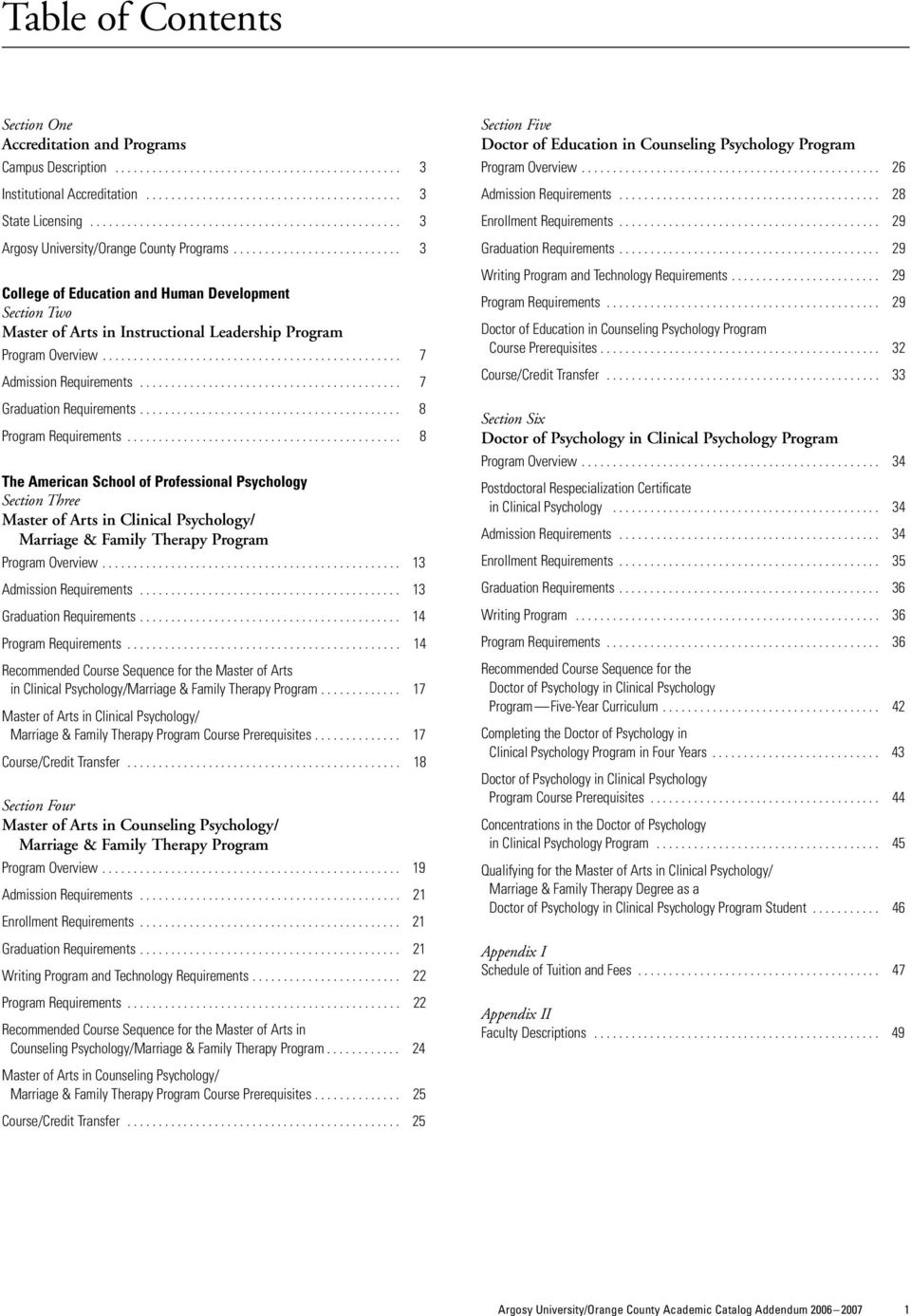
3 Table of Contents Section One Accreditation and Programs Campus Description Institutional Accreditation State Licensing Argosy University/Orange County Programs College of Education and Human Development Section Two Master of Arts in Instructional Leadership Program Program Overview Admission Requirements Graduation Requirements Program Requirements The American School of Professional Psychology Section Three Master of Arts in Clinical Psychology/ Marriage & Family Therapy Program Program Overview Admission Requirements Graduation Requirements Program Requirements Recommended Course Sequence for the Master of Arts in Clinical Psychology/Marriage & Family Therapy Program Master of Arts in Clinical Psychology/ Marriage & Family Therapy Program Course Prerequisites Course/Credit Transfer Section Four Master of Arts in Counseling Psychology/ Marriage & Family Therapy Program Program Overview Admission Requirements Enrollment Requirements Graduation Requirements Writing Program and Technology Requirements Program Requirements Recommended Course Sequence for the Master of Arts in Counseling Psychology/Marriage & Family Therapy Program Master of Arts in Counseling Psychology/ Marriage & Family Therapy Program Course Prerequisites Course/Credit Transfer Section Five Doctor of Education in Counseling Psychology Program Program Overview Admission Requirements Enrollment Requirements Graduation Requirements Writing Program and Technology Requirements Program Requirements Doctor of Education in Counseling Psychology Program Course Prerequisites Course/Credit Transfer Section Six Doctor of Psychology in Clinical Psychology Program Program Overview Postdoctoral Respecialization Certificate in Clinical Psychology Admission Requirements Enrollment Requirements Graduation Requirements Writing Program Program Requirements Recommended Course Sequence for the Doctor of Psychology in Clinical Psychology Program Five-Year Curriculum Completing the Doctor of Psychology in Clinical Psychology Program in Four Years Doctor of Psychology in Clinical Psychology Program Course Prerequisites Concentrations in the Doctor of Psychology in Clinical Psychology Program Qualifying for the Master of Arts in Clinical Psychology/ Marriage & Family Therapy Degree as a Doctor of Psychology in Clinical Psychology Program Student Appendix I Schedule of Tuition and Fees Appendix II Faculty Descriptions Argosy University/Orange County Academic Catalog Addendum
4 Argosy University/Orange County Academic Catalog Addendum

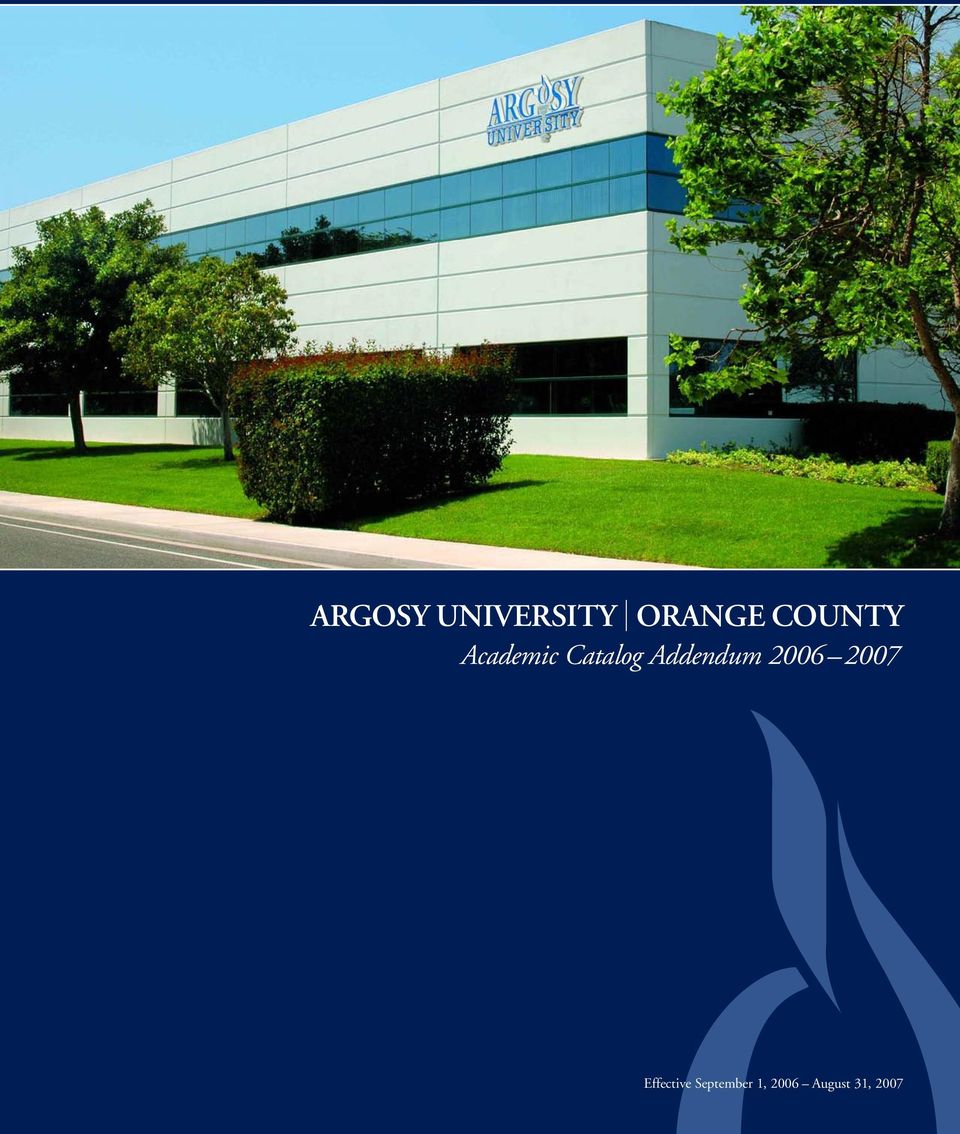
5 Section One Accreditation and Programs The information listed in this addendum applies to the Argosy University Academic Catalog To ensure that this information is applied to the proper publication please refer to the effective date, September 1, 2006 August 31, 2007 on the front cover of the Academic Catalog. If you have questions related to information this addendum, please contact your academic advisor or program chair for assistance. ARGOSY UNIVERSITY/ORANGE COUNTY 3501 West Sunflower Avenue Santa Ana, CA FAX: CAMPUS DESCRIPTION Argosy University/Orange County is located in the heart of Orange County s South Coast Metro region. The Orange County campus has eleven classrooms, laboratories, 20 faculty offices, a student lounge, and a learning resource center. Building A is 55,000 square feet; Building B is 19,660 square feet; and Building C is 17,500 square feet. The Student Services Department, the Office of Student Finance, and the Admissions Department are located in Building A. The faculty, administrative, and executive offices of the campus president are located in Building B. Business, education, and psychology courses are housed in Building B. All classroom space is primarily housed in Building B; however, overflow classrooms will be housed in Buildings A and C. Library The Argosy University/Orange County Library occupies 2,927 square feet and maintains a highly focused collection of resource materials, including current books, journals, testing kits and related materials. The library houses specialized collections of books, journals and dissertations along with computers, CD-ROMs, and online databases to provide easy access to information needed for research and study. INSTITUTIONAL ACCREDITATION Argosy University is accredited by the Higher Learning Commission and is a member of the North Central Association (NCA) (30 North LaSalle Street, Suite 2400, Chicago, IL 60602, , STATE LICENSING Argosy University/Orange County has been granted approval to operate by the California Bureau of Postsecondary and Vocational Education (1625 North Market Boulevard, Suite S202, Sacramento, CA 95834, ARGOSY UNIVERSITY/ORANGE COUNTY PROGRAMS College of Business and Information Technology Associate of Applied Science (AAS) Accounting Technology Business Management Computer Programming & Applications Computer Software Technology Bachelor of Science (BS) Business Administration (Degree Completion Program) May choose one of five optional concentrations: Customized Professional Concentration Finance Healthcare Management International Business Marketing Master of Business Administration (MBA) Business Administration Must choose one of seven concentrations: Customized Professional Concentration Finance Healthcare Administration Information Systems Management International Business Management Marketing Argosy University/Orange County Academic Catalog Addendum

6 Doctor of Business Administration (DBA) Must choose one of six concentrations: Accounting Customized Professional Concentration Information Systems International Business Management Marketing Executive Doctor of Business Administration in Management (Delivery Format) College of Education and Human Development Master of Arts in Education (MAEd) Educational Leadership Instructional Leadership May choose one of four optional concentrations: Single subject teacher credential preparation Single subject teacher credential preparation with BCLAD Multiple subject teacher credential preparation Multiple subject teacher credential preparation with BCLAD Doctor of Education (EdD) Community College Executive Leadership Educational Leadership Must choose a concentration in either: Higher Education Administration K 12 Education Instructional Leadership Must choose an concentration in either: Education Technology Higher Education K 12 Education The American School of Professional Psychology Associate of Applied Science (AAS) Criminal Justice Paralegal Bachelor of Arts (BA) Psychology (Degree Completion Program) May choose an optional concentration in Criminal Justice Master of Arts (MA) Clinical Psychology/Marriage & Family Therapy Counseling Psychology/Marriage & Family Therapy Forensic Psychology Doctor of Education (EdD) Counseling Psychology Organizational Leadership Doctor of Psychology (PsyD) Clinical Psychology May choose an optional concentration in either: Child & Adolescent Psychology Forensic Psychology Postdoctoral Respecialization Certificate 1 Clinical Psychology College of Health Sciences Associate of Applied Science (AAS) Medical Assisting 1 Postdoctoral certificate programs are not eligible for federal financial aid programs. 4 Argosy University/Orange County Academic Catalog Addendum

7 Argosy University/Orange County College of Education and Human Development Argosy University/Orange County Academic Catalog Addendum
8 6 Argosy University/Orange County Academic Catalog Addendum

9 Section Two Master of Arts in Education in Instructional Leadership Program PROGRAM OVERVIEW The MAEd in Instructional Leadership program is designed for students who wish to become teachers, develop or enhance classroom skills, become curriculum supervisors, or become educational leaders with instruction as their main focus. In the MAEd in Instructional Leadership program, students develop core practical and academic skills in analysis, oral and written communication, problem solving, critical thinking, team-building, and computer technology, through courses that examine the practical, historical, philosophical, psychological, social, technical, and theoretical aspects of education. Concentrations in Multiple and Single Subject Teacher Credential Preparation At Argosy University/Orange County, MAEd in Instructional Leadership students may choose to specialize in one of the following concentrations: Single Subject Teacher Credential Preparation Single Subject Teacher Credential Preparation with BCLAD (Bilingual, Cross-Cultural, Language and Academic Development) Note: Emphasis in Spanish. Students should see their campus credential analyst regarding BCLAD certificated in other languages Multiple Subject Teacher Credential Preparation Multiple Subject Teacher Credential Preparation with BCLAD (Bilingual, Cross-Cultural, Language and Academic Development) Note: Emphasis in Spanish. Students should see their campus credential analyst regarding BCLAD certificated in other languages The Single Subject Teacher Credential authorizes the holder to teach in a specific subject in a departmentalized classroom usually found at the middle or secondary level. The Multiple Subject Teacher Credential authorizes the holder to teach all subjects in a self-contained classroom, K 12, as well as in preschool and adult education. It is the credential sought by those who wish to teach elementary school (K 6). Argosy University/Orange County has been approved by the California Commission on Teacher Credentialing (CCTC) to offer the Single Subject and Multiple Subject Credentials. A California Single Subject or Multiple Subject teaching credential requires both proof of subject matter competence and completion of an approved credential program. Students seeking to obtain any teaching credential must make formal application and be admitted to the teacher credential program before beginning coursework. While courses and curricula are designed to satisfy prevailing state licensure and certification requirements in many states, students are responsible for checking with the teaching certification agency in the state in which they teach (or plan to work) to confirm the applicability of program courses and degrees to meet local requirements. ADMISSION REQUIREMENTS A bachelor s degree from a regionally accredited institution, a nationally accredited institution approved by the faculty and dean of the College of Education and Human Development, or an appropriately certified foreign institution. A grade point average of at least 3.0 (on a scale of 4.0) during the last two years of undergraduate work and any subsequent study. A minimum written TOEFL score of 550 (paper version) 213 (computer version), or 79 (Internet version) for all applicants whose native language is not English or who have not graduated from an institution at which English is the language of instruction. All applications for admission must be submitted to the Admissions Department. An admissions representative is available to help interested applicants complete the following required documentation: Completed Application for Admission Form Personal/professional goal statement with a self-appraisal of qualifications for the profession Current résumé The names and contact information of three professional and/or academic references Official transcripts from all postsecondary schools attended Exceptions to the Minimum Grade Point Average Applicants with grade point averages lower than the stated program minimums will be considered for admission on an exception basis with significant evidence of academic and professional potential. This potential may be demonstrated by the career and/or personal accomplishments indicated in the statement of academic and professional goals, the career summary, and academic or professional letters of recommendation. Exceptions must be recommended by the Admissions Committee and approved by the campus dean or program chair. Exceptions must be justified, documented, signed, placed, and retained in the student s academic file. Students admitted on an exception basis will be admitted as regular students on first semester probation. See Exceptions to Admission Requirements in section 5 of the Academic Catalog under Admission Policies. Argosy University/Orange County Academic Catalog Addendum

10 Additional Admission Requirements for the Multiple and Single Subject Teacher Credential Preparation Concentrations Students applying to the MAEd in Instructional Leadership program with a concentration in Single or Multiple Subject Teacher Credential Preparation must meet the following requirements in addition to those listed for the MAEd in Instructional Leadership program. Applicants must: Possess proof of Certificate of Clearance and have passed for the California Basic Education Skills Test (CBEST) before they can begin his/her field experience assignments. Proof of Certificate of Clearance can be obtained by providing Argosy University with a copy of an emergency credential granted to the student. If a student has never been authorized for service in public school, they must file for Certificate of Clearance through Argosy University. Applications can be picked up from the CCTC office and the on-campus credentials analyst. Students must obtain clearance before beginning student teaching, without exception. Possess qualities deemed to be suitable for the field of teaching. Note: Candidates who have been convicted or plead nolo contendere for any violation of the law, excluding minor traffic offenses, may not be eligible for a California Teaching Credential and must check with the credentials analyst for verification. GRADUATION REQUIREMENTS A student is eligible for graduation in the MAEd in Instructional Leadership program when the following requirements are met: Satisfactory completion of all requirements in the program of study (a minimum of 36 semester credit hours), including core, general program or concentration, Capstone Project, and elective requirements. A grade point average of 3.0 or higher (on a scale of 4.0), and a grade of B- or better in all required courses A completed Petition to Graduate submitted to campus administration Academic Probation and Dismissal A student receiving a grade of B- or below in a course required for a preliminary credential will be placed on academic probation. The terms of probation will require the student to retake the course when offered and receive grade of B- or higher. In addition, the probationary student may enroll in a maximum of 3 additional credit hours until the specified course is retaken. An advisor from the College of Education and Human Development will monitor the progress of the student. Students will be dismissed from the concentration for the following: Receipt of a second grade below B- Failure to earn a grade of Pass ( P ) in the Field Experience portion of the program/concentration Receipt of a grade of F Candidate Dismissal According to California Commission on Teacher Credentialing (CCTC) regulations, Argosy University has an obligation to public schools to dismiss candidates who are unsuited to be teachers. Argosy University reviews each candidate s competence throughout the program, informs candidates of their strengths and weaknesses, provides opportunities for learning, and emphasizes that candidates possess high standards of personal conduct. PROGRAM REQUIREMENTS MAEd in Instructional Leadership program students may choose one of the optional concentrations outlined below. General (no concentration) MAEd Instructional Leadership program requirements can be found in the Argosy University Academic Catalog. Teacher Credential Preparation Concentration Requirements U.S. Constitution Requirement All Teacher Credential Preparation concentration candidates must complete an approved course with a grade of C or better covering the U.S. Constitution or pass a college-level exam in this area. Single Subject Teacher Credential Preparation Concentration Requirements The MAEd in Instructional Leadership program with a concentration in Single Subject Teacher Credential Preparation requires the successful completion of 36 semester credit hours distributed as follows: core research requirement, 3 credit hours; preliminary credential course requirements, 30 credit hours; and Capstone Project requirements, 3 credit hours. Core Research Requirement Students are Required to Take the Following E6100 Research in Education (3) Core Research Requirement 3 Credit Hours Preliminary Credential Course Requirements Students Are Required to Take the Following E6900 Cultural Diversity (3) E6901 Foundations of Education (3) E6909 The Adolescent Learner (3) E6910 and Instruction for Diverse Secondary Setting (3) E6911 Language and Literacy Education in Secondary Schools (3) E6912 Disciplinary/Interdisciplinary Methods of Teaching in Secondary Schools (3) E6913 The Reflective Professional: Special Topics Seminar (3) E6914 Theories and Methods of Bilingual/Multicultural Education (3) E6907 Field Experience I: Beginning Practice Teaching (3) E6908 Field Experience II: Advanced Practice Teaching (3) Preliminary Credential Course Requirements 30 Credit Hours Capstone Project Requirements Students are Required to take the Following E6925 Capstone Project (3) Capstone Project Requirements 3 Credit Hours Examination Requirements Passing score on the CBEST Examination Subject matter competence can be met by passage of appropriate Single Subject Assessments for Teaching (CSET/SSAT) and PRAXIS examinations; or completion of an approved program of subject matter coursework, verified by a signed waiver from an accredited California four-year college or university. 8 Argosy University/Orange County Academic Catalog Addendum

11 Single Subject Teacher Credential Preparation Concentration Requirements with BCLAD The MAEd in Instructional Leadership program with a concentration in Single Subject Teacher Credential Preparation with BCLAD requires the successful completion of 39 semester credit hours distributed as follows: core research requirement, 3 credit hours; preliminary credential course requirements, 33 credit hours; and Capstone Project requirements, 3 credit hours. Core Research Requirement Students are Required to Take the Following E6100 Research in Education (3) Core Research Requirement 3 Credit Hours Preliminary Credential Course Requirements Students Are Required to Take the Following E6900 Cultural Diversity (3) E6901 Foundations of Education (3) E6909 The Adolescent Learner (3) E6910 Curriculum and Instruction for Diverse Secondary Setting (3) E6911 Language and Literacy Education in Secondary Schools (3) E6912 Disciplinary/Interdisciplinary Methods of Teaching in Secondary Schools (3) E6913 The Reflective Professional: Special Topics Seminar (3) E6914 Theories and Methods of Bilingual/Multicultural Education (3) E6907 Field Experience I: Beginning Practice Teaching (3) E6908 Field Experience II: Advanced Practice Teaching (3) E6915 Pedagogy in the Primary Languages (3) [BCLAD students only] Preliminary Credential Course Requirements 33 Credit Hours Capstone Project Requirements Students are Required to take the Following E6925 Capstone Project (3) Capstone Project Requirements 3 Credit Hours Examination Requirements Passing score on the CBEST Examination Subject matter competence can be met by passage of appropriate Single Subject Assessments for Teaching (CSET/SSAT) and PRAXIS examinations; or completion of an approved program of subject matter coursework, verified by a signed waiver from an accredited California four-year college or university. Multiple Subject Teacher Credential Preparation Concentration Requirements The MAEd in Instructional Leadership program with a concentration in Multiple Subject Teacher Credential Preparation requires the successful completion of 36 semester credit hours distributed as follows: core research requirement, 3 credit hours; preliminary credential course requirements, 30 credit hours; and Capstone Project requirement, 3 credit hours. Core Research Requirement Students are Required to Take the Following E6100 Research in Education (3) Core Research Requirement 3 Credit Hours Preliminary Credential Course Requirements Students Are Required to Take the Following E6900 Cultural Diversity (3) E6901 Foundations of Education (3) E6902 Curriculum and Instruction for Diverse Elementary School Settings (3) E6903 Language and Literacy Education in Elementary Schools (3) E6904 Mathematics Education in Elementary Schools (3) E6905 Social Studies Education in Elementary Schools (3) E6906 Science Education in Elementary Schools (3) E6907 Field Experience I: Beginning Practice Teaching (3) E6908 Field Experience II: Advanced Practice Teaching (3) E6914 Theories and Methods of Bilingual Multicultural Education (3) Preliminary Credential Course Requirements 30 Credit Hours Capstone Project Requirements Students are Required to take the Following E6925 Capstone Project (3) Capstone Project Requirements 3 Credit Hours Examination Requirements Passing score on CBEST Examination Passing CSET or MSAT scores Argosy University/Orange County Academic Catalog Addendum
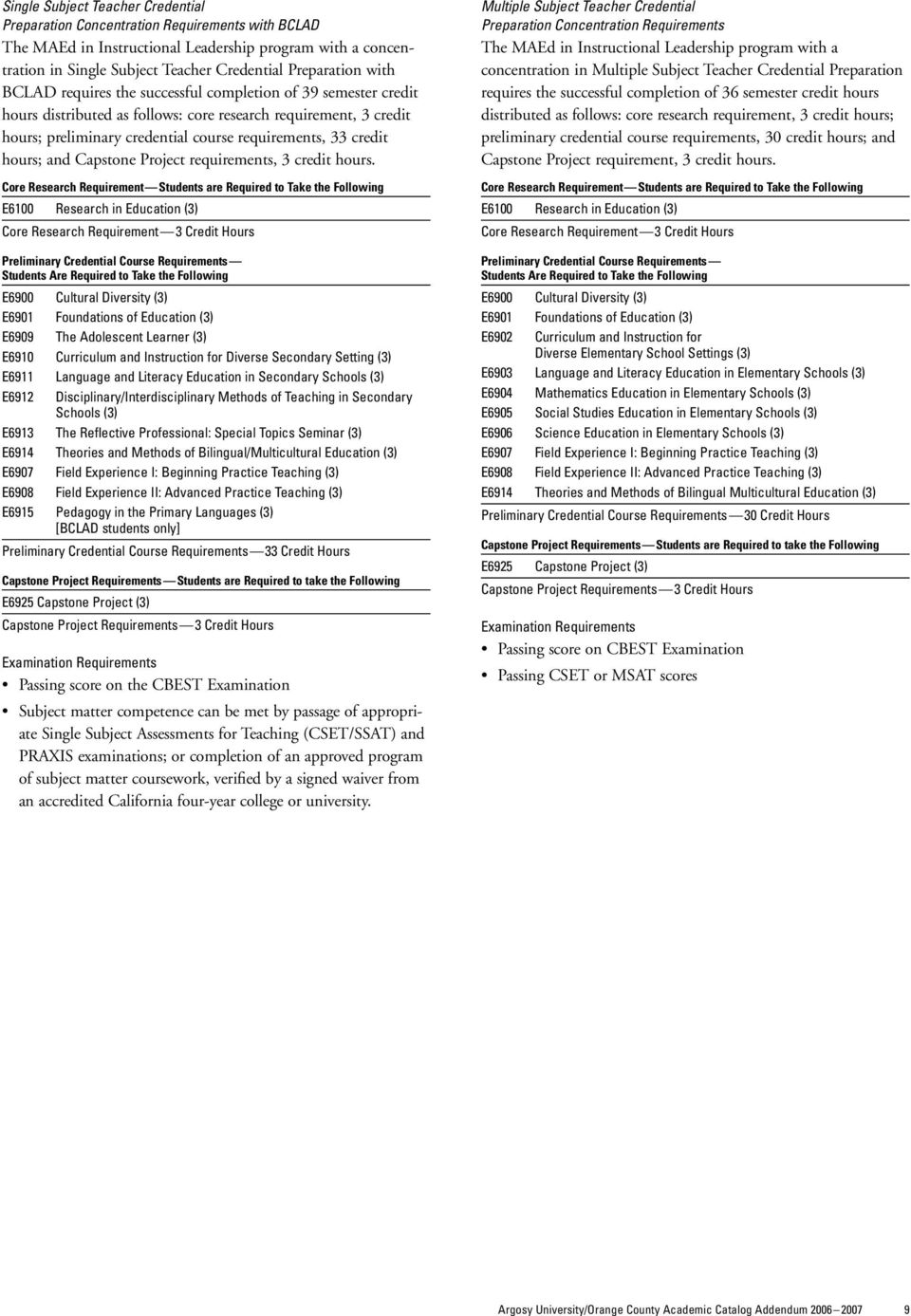
12 Multiple Subject Teacher Credential Preparation Concentration Requirements with BCLAD The MAEd in Instructional Leadership program with a concentration in Multiple Subject Teacher Credential Preparation with BCLAD requires the successful completion of 39 semester credit hours distributed as follows: core research requirement, 3 credit hours; preliminary credential course requirements, 33 credit hours, and Capstone Project requirement, 3 credit hours. Core Research Requirement Students are Required to Take the Following E6100 Research in Education (3) Core Research Requirement 3 Credit Hours Preliminary Credential Course Requirements Students Are Required to Take the Following E6900 Cultural Diversity (3) E6901 Foundations of Education (3) E6902 Curriculum and Instruction for Diverse Elementary School Settings (3) E6903 Language and Literacy Education in Elementary Schools (3) E6904 Mathematics Education in Elementary Schools (3) E6905 Social Studies Education in Elementary Schools (3) E6906 Science Education in Elementary Schools (3) E6907 Field Experience I: Beginning Practice Teaching (3) E6908 Field Experience II: Advanced Practice Teaching (3) E6914 Theories and Methods of Bilingual Multicultural Education (3) E6915 Pedagogy in the Primary Languages (3) [BCLAD students only] Preliminary Credential Course Requirements 33 Credit Hours Capstone Project Requirements Students are Required to take the Following E6925 Capstone Project (3) Capstone Project Requirements 3 Credit Hours Examination Requirements Passing score on CBEST Examination Passing CSET or MSAT scores 10 Argosy University/Orange County Academic Catalog Addendum

13 Argosy University/Orange County The American School of Professional Psychology Argosy University/Orange County Academic Catalog Addendum

14 12 Argosy University/Orange County Academic Catalog Addendum

15 Section Three Master of Arts in Clinical Psychology/ Marriage & Family Therapy Program PROGRAM OVERVIEW The Master of Arts (MA) in Clinical Psychology/Marriage & Family Therapy program has primarily been designed to educate and train students in preparation for licensure as a Marriage and Family Therapist (MFT) in California and/or entry into the Doctor of Psychology (PsyD) Clinical Psychology program. The program introduces students to basic clinical skills and theoretical foundations of Marital and Family Therapy and Clinical Psychology, and enhances student preparation for those considering application for transfer into the PsyD in Clinical Psychology program. Eligibility for Licensure The Master of Arts in Clinical Psychology/Marriage & Family Therapy program prepares a student to pursue licensure in California as a Licensed Marriage and Family Therapist (MFT). Master s-level licensure varies from state to state. It is the student s responsibility to determine the requirements for professional licensure in the state they wish to practice. Students interested in pursuing licensure in states other than California should contact their state s department of professional regulation for information. The American Counseling Association frequently publishes information on professional issues of importance to professional counselors, including licensure, on their Web page: ADMISSION REQUIREMENTS The application process for admission into the MA in Clinical Psychology/Marriage & Family Therapy program requires the submission of materials that will enable the Admissions Department to verify the applicant s academic qualifications to enroll in the MA in Clinical Psychology/Marriage & Family Therapy program. Because the Admissions Committee also takes into consideration the qualities essential to becoming an effective clinician, material is also required which will help to determine the individual s personal integrity, maturity, interpersonal skills, and ability to communicate effectively. A bachelor s degree from a regionally accredited institution, a nationally accredited institution approved and documented by the faculty and dean of the College of Psychology and Behavioral Sciences, or an appropriately certified foreign institution. A grade point average of at least 3.0 (on a scale of 4.0) for the last 60 hours of coursework (including graduate work). A minimum written TOEFL score of 550 (paper version), 213 (computer version), or 79 (Internet version) for all applicants whose native language is not English or who have not graduated from an institution at which English is the language of instruction. Completion of an interview with a member of the program Admissions Committee. All applications for admission must be submitted to the Admissions Department. An admissions representative is available to help interested applicants complete the following required documentation: Completed Application for Admission Form Application fee (non-refundable, except in California) Personal/professional goal statement with a self-appraisal of qualifications for the profession Current résumé (or career summary) Three completed Applicant Recommendation Forms Official transcripts from all postsecondary schools attended Exceptions to the Minimum Grade Point Average Applicants with grade point averages lower than the stated program minimums may be considered for admission with significant evidence of academic and professional potential demonstrated by the career and/or personal accomplishments indicated in the statement of academic and professional goals, the career summary, and academic or professional letters of recommendation. Exceptions must be recommended by the Admissions Committee and program chair, and approved by the college dean. Exceptions must be justified, documented, signed, placed, and retained in the student s academic file. Students admitted on an exception basis will be admitted as regular students on first semester probation. See Exceptions to Admission Requirements in section 5 of the Academic Catalog under Admission Policies. The Admissions Department will notify all applicants of the Clinical Master s Programs Admissions Committee s decision as soon as the decision has been made. Accepted applicants are required to remit a deposit by the date stipulated on the written notification to reserve a place in the entering class. This deposit will be applied toward the tuition of the student s first semester as a matriculated student. Prerequisites for Admission Applicants should have completed the following five undergraduate courses, or their equivalent: Students Must Have Completed the Following Prior to Admission or by the End of the First Year PC6003 Abnormal Psychology (3) PSY101 General Psychology (3) PSY210 Statistics (3) or PSY302 Research Methods (3) PSY361 Personality Theories (3) or PSY400 Counseling Theories (3) PSY415 Psychological Assessment (3) Argosy University/Orange County Academic Catalog Addendum

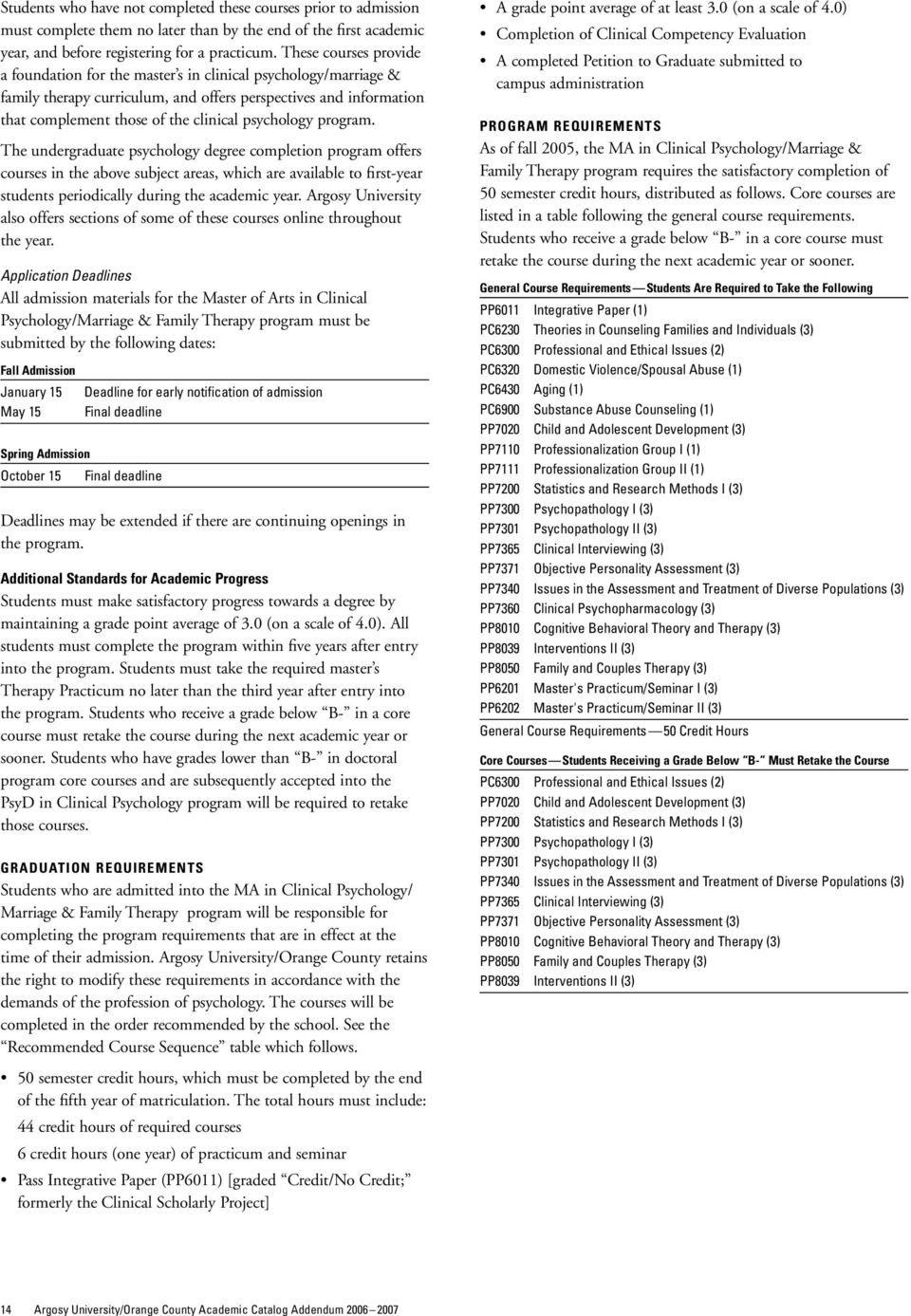
16 Students who have not completed these courses prior to admission must complete them no later than by the end of the first academic year, and before registering for a practicum. These courses provide a foundation for the master s in clinical psychology/marriage & family therapy curriculum, and offers perspectives and information that complement those of the clinical psychology program. The undergraduate psychology degree completion program offers courses in the above subject areas, which are available to first-year students periodically during the academic year. Argosy University also offers sections of some of these courses online throughout the year. Application Deadlines All admission materials for the Master of Arts in Clinical Psychology/Marriage & Family Therapy program must be submitted by the following dates: Fall Admission January 15 May 15 Spring Admission October 15 Deadline for early notification of admission Final deadline Final deadline Deadlines may be extended if there are continuing openings in the program. Additional Standards for Academic Progress Students must make satisfactory progress towards a degree by maintaining a grade point average of 3.0 (on a scale of 4.0). All students must complete the program within five years after entry into the program. Students must take the required master s Therapy Practicum no later than the third year after entry into the program. Students who receive a grade below B- in a core course must retake the course during the next academic year or sooner. Students who have grades lower than B- in doctoral program core courses and are subsequently accepted into the PsyD in Clinical Psychology program will be required to retake those courses. GRADUATION REQUIREMENTS Students who are admitted into the MA in Clinical Psychology/ Marriage & Family Therapy program will be responsible for completing the program requirements that are in effect at the time of their admission. Argosy University/Orange County retains the right to modify these requirements in accordance with the demands of the profession of psychology. The courses will be completed in the order recommended by the school. See the Recommended Course Sequence table which follows. A grade point average of at least 3.0 (on a scale of 4.0) Completion of Clinical Competency Evaluation A completed Petition to Graduate submitted to campus administration PROGRAM REQUIREMENTS As of fall 2005, the MA in Clinical Psychology/Marriage & Family Therapy program requires the satisfactory completion of 50 semester credit hours, distributed as follows. Core courses are listed in a table following the general course requirements. Students who receive a grade below B- in a core course must retake the course during the next academic year or sooner. General Course Requirements Students Are Required to Take the Following PP6011 Integrative Paper (1) PC6230 Theories in Counseling Families and Individuals (3) PC6300 Professional and Ethical Issues (2) PC6320 Domestic Violence/Spousal Abuse (1) PC6430 Aging (1) PC6900 Substance Abuse Counseling (1) PP7020 Child and Adolescent Development (3) PP7110 Professionalization Group I (1) PP7111 Professionalization Group II (1) PP7200 Statistics and Research Methods I (3) PP7300 Psychopathology I (3) PP7301 Psychopathology II (3) PP7365 Clinical Interviewing (3) PP7371 Objective Personality Assessment (3) PP7340 Issues in the Assessment and Treatment of Diverse Populations (3) PP7360 Clinical Psychopharmacology (3) PP8010 Cognitive Behavioral Theory and Therapy (3) PP8039 Interventions II (3) PP8050 Family and Couples Therapy (3) PP6201 Master's Practicum/Seminar I (3) PP6202 Master's Practicum/Seminar II (3) General Course Requirements 50 Credit Hours Core Courses Students Receiving a Grade Below B- Must Retake the Course PC6300 Professional and Ethical Issues (2) PP7020 Child and Adolescent Development (3) PP7200 Statistics and Research Methods I (3) PP7300 Psychopathology I (3) PP7301 Psychopathology II (3) PP7340 Issues in the Assessment and Treatment of Diverse Populations (3) PP7365 Clinical Interviewing (3) PP7371 Objective Personality Assessment (3) PP8010 Cognitive Behavioral Theory and Therapy (3) PP8050 Family and Couples Therapy (3) PP8039 Interventions II (3) 50 semester credit hours, which must be completed by the end of the fifth year of matriculation. The total hours must include: 44 credit hours of required courses 6 credit hours (one year) of practicum and seminar Pass Integrative Paper (PP6011) [graded Credit/No Credit; formerly the Clinical Scholarly Project] 14 Argosy University/Orange County Academic Catalog Addendum
17 Additional Program Requirements Meet with your faculty advisor during the academic year. Master s Therapy CCE Tape In conjunction with the master s Therapy Seminar, therapy students complete a Clinical Competency Conference Examination (CCE). The seminar leader will inform students of what is expected for this task and will hand out materials that explain the guidelines. The deadline for tape submission on the CCE will be announced by the Training Department during the spring semester. Master s Ethics CCE This requirement is satisfied by the successful completion of the Professional and Ethical Issues (PC6300) class with a grade of B or better. Professionalization Group Requirements These discussion groups for first-year students are led by a full-time faculty member and meet once a week for one hour. Students discuss topics related to professional psychology, marriage and family therapy licensure and the development of a professional identity. The faculty member leading the group will help students with academic and field training planning, general consultation on the MA in Clinical Psychology/Marriage & Family Therapy program, and questions emerging during the student s first-year academic experience. The course objectives area as follows: To assist and support students in developing identities as clinical psychology trainees and evolving clinical psychology professionals through readings, discussion, role play and classroom presentation. To introduce students to the ethical practice of psychology and contemporary issues in clinical psychology To orient students to the roles, norms, and expectations of graduate studies and professional practice To provide academic advisement and student advocacy Practicum and Practicum Seminar Requirements The goal of the practicum at the master s level is to train students in the application of the knowledge, skills, and attitudes developed by their academic experience. This experience includes the direct observation, interviewing, and treatment of clients. Certain sites also afford some students with the opportunity of limited exposure to psychological testing procedures. When available, the master s Therapy Practicum stresses family and couples therapeutic intervention. Because there is such a wide range of therapy experiences available, and because the selection of students for a given practicum is done by the site, students should not expect to experience the total spectrum of therapies during the practicum. The practicum is the first opportunity provided to students for clinical field training. Practicum provide students with opportunities to work under supervision with a clinical population within a mental health delivery system. The practicum provides an essential part of clinical training and all students are required to participate in the practicum experience. Liability insurance is included in the cost of the practicum. The practicum is a required 600-hour training experience, which takes place during an academic year, normally beginning in the fall and concluding at the end of the summer I semester. 150 hours of client contact are required within the practicum. The practicum is treated as a course and carries 3 credit hours per semester or 6 credit hours for the academic year. A practicum may not be done in a student s place of employment, nor is any student exempt from the practicum requirements. Students who come to Argosy University/Orange County with extensive clinical backgrounds are placed in practicum sites in areas in which they have an interest and have not had previous experience. The MA in Clinical Psychology/Marriage & Family Therapy program practicum are not intended to substitute for the PsyD in Clinical Psychology practicum. Students who intend to apply for admission into the doctoral program after completing the master s in clinical psychology program may not receive credit for doctorate in clinical psychology practicum on the basis of their master s-level practicum. Eligibility for Practicum All students who enter the master s practicum application process must be in good academic standing, have a minimum grade point average of 3.0 (on a scale of 4.0) and have completed the academic planning which will allow for all the practicum prerequisite courses to be completed prior to the beginning of the practicum. No student may begin a practicum without being in attendance at Argosy University/Orange County for a minimum of two full semesters, including eight courses. The following courses are practicum prerequisite courses and must be completed and/or transferred prior to beginning the practicum: Practicum Prerequisites PC6430 Aging (1) PP7020 Child and Adolescent Development (3) PP7110 Professionalization Group I (1) PP7111 Professionalization Group II (1 ) PP7300 Psychopathology I (3) PP7301 Psychopathology II (3) PP7365 Clinical Interviewing (3) PP8010 Cognitive Behavioral Theory and Therapy (3) PP8039 Interventions II (3) PP8050 Family and Couples Therapy (3) The program chair and the Training Department have the discretion to make decisions on any probationary student who is beyond the first year of attendance. This would include the student activities of both seeking a practicum and attending a practicum. If a first-year student is placed on probation based on fall semester grades, the student may not look for a practicum during the spring semester. If the student has achieved a satisfactory GPA (3.0 on a scale of 4.0) when the spring grades are available, the student, at the discretion of the program chair and the Training Department, may look for a practicum. If a first-year student who has accepted a practicum is placed on probation after fall grades are received, the student may not attend the practicum if the GPA is below the minimum Argosy University/Orange County Academic Catalog Addendum

18 requirement after the spring grades are received. If the GPA is satisfactory after the spring grades are received, the student, at the discretion of the program chair and the Training Department, may begin the practicum. Practicum Evaluation Evaluation of student progress in clinical field training focuses on three areas: theoretical knowledge base, clinical skills and professional attitudes. A thorough review of site and seminar evaluations is conducted by the Training Department, and an overall grade of Credit or No Credit is included in the student s academic record. Please refer to the Argosy University/Orange County Training Manual for a more detailed description of training requirements and guidelines. All students are responsible for being familiar with the information contained in the Training Manual. Practicum Seminar All students enrolled in a practicum must also be enrolled in a practicum seminar. The seminar meets weekly throughout the academic year and allows the student to reflect on various practicum experiences and to acquire additional skills and attitudes useful in field training. The specific content and emphasis of the seminar varies according to the practicum setting, the focus of the enrolled students, and the professional expertise of the faculty member. Clinical Competency Examination Requirements At the master s level, the Clinical Competency Examination consists of two competency-based examinations designed to evaluate the student s mastery of basic clinical assessment and therapeutic skills. Students should be capable of demonstrating clinical competence via the master s Therapy CCE both conceptually and in application. Argosy University/Orange County also expects that students who have learned theoretical and applied concepts in classroom courses will have made use of out-of-class clinical contacts (i.e., practicum, practicum seminar group, visiting lecturers) to refine and extend the skills to be evaluated by the CCE. Therefore, passing the seminar and site evaluation do not guarantee a passing grade on the CCE. Descriptions and Procedures for Successful Completion of the Clinical Competency Examination Master s Therapy Clinical Competency Examination requires the student to submit a client history, a tape, a complete transcript of a therapy hour to be reviewed, a client assessment and progress report, and a self-critique of a therapy session that the student is submitting. The student may have received general supervision on this therapy case or elsewhere prior to submission for satisfying requirement of CCE.The Therapy CCE is graded Pass/Resubmit/Fail. The Ethics CCE requires that the student pass Professional Issues with a grade of B or better. A grade of B- requires remediation to be decided upon by the course instructor; a grade of C+ or lower requires retaking the course. Integrative Paper Requirements MA in Clinical Psychology/Marriage & Family Therapy program students are required to complete an Integrative Paper (PP6011) based upon a presentation of a clinical question or problem that has been defined either before or during their practicum experience, integration of the relevant literature on the topic, with inclusion of core course concepts relevant to the subject as well. The purpose of this review is to assess the student's achievement of a capacity to apply relevant concepts to a clinical topic, and to research relevant areas of the literature so as to demonstrate an independent capacity to approach clinical problems with a scholarly perspective and process. It is expected that the production of this paper will require several drafts and ongoing consultation with a faculty advisor for this project. The criteria for evaluation of the project will include a clear definition of a clinical topic, appropriate application of relevant literature and major course concepts to that topic, the subsequent presentation of a set of observations based on the major findings of this review, a clear written presentation in APA style. This requirement assesses the student s capacity to independently complete a relevant literature review of the clinical questions raised in the case, with a fuller understanding how the literature and the core curriculum can extend and deepen the student s understanding of the topic. The review should include relevant topics from psychopathology, psychotherapy, human development, and diversity courses as well as those derived from the literature review. Students must abide by the structured meeting schedule set by faculty to complete the Integrative Paper by the end of the fall semester. Failure to abide by this schedule and complete assignments in a timely way will result in a No Credit grade and require the course to be taken again in the following academic year. Integrative Paper Prerequisites In order to qualify for Integrative Paper (PP6011), students must be in good standing (GPA of 3.0 on a scale of 4.0) and not on probation; must petition the program chair of the MA in Clinical Psychology/Marriage & Family Therapy program at the beginning of the fall semester prior to the Integrative Paper; receive approval to work with a particular faculty member assigned to this course, and complete and/or transfer all courses listed below: Integrative Paper Prerequisites PP7020 Child and Adolescent Development (3) PP7300 Psychopathology I (3) PP7301 Psychopathology II (3) PP7365 Clinical Interviewing (3) PP7371 Objective Personality Assessment (3) PP8050 Family and Couples Therapy (3) PP8039 Interventions II (3) PP8010 Cognitive Behavioral Theory and Therapy (3) PP7340 Issues in the Assessment and Treatment of Diverse Populations (3) [this must be completed in the fall of the second year] 16 Argosy University/Orange County Academic Catalog Addendum

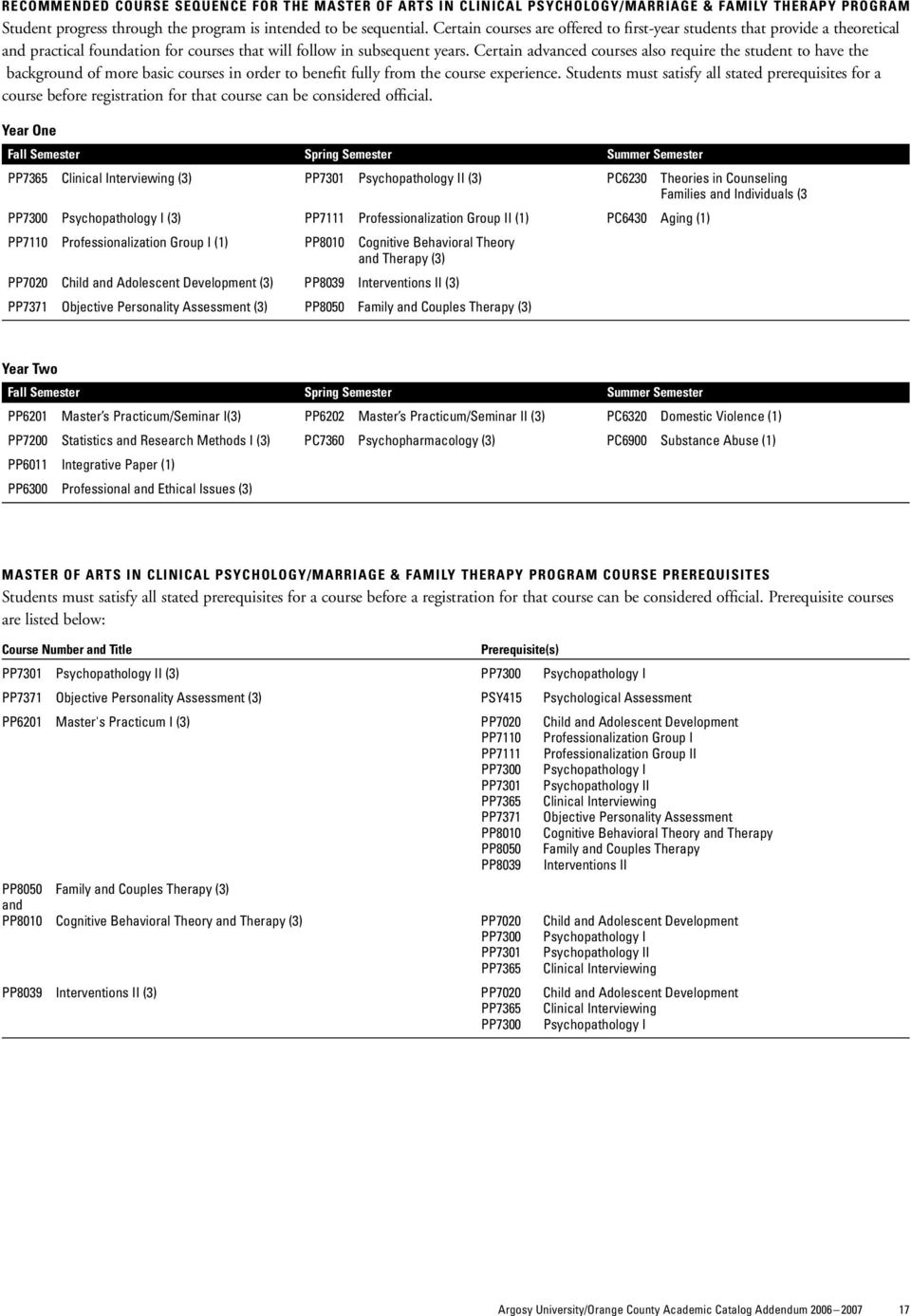
19 RECOMMENDED COURSE SEQUENCE FOR THE MASTER OF ARTS IN CLINICAL PSYCHOLOGY/MARRIAGE & FAMILY THERAPY PROGRAM Student progress through the program is intended to be sequential. Certain courses are offered to first-year students that provide a theoretical and practical foundation for courses that will follow in subsequent years. Certain advanced courses also require the student to have the background of more basic courses in order to benefit fully from the course experience. Students must satisfy all stated prerequisites for a course before registration for that course can be considered official. Year One Fall Semester Spring Semester Summer Semester PP7365 Clinical Interviewing (3) PP7301 Psychopathology II (3) PC6230 Theories in Counseling Families and Individuals (3 PP7300 Psychopathology I (3) PP7111 Professionalization Group II (1) PC6430 Aging (1) PP7110 Professionalization Group I (1) PP8010 Cognitive Behavioral Theory and Therapy (3) PP7020 Child and Adolescent Development (3) PP8039 Interventions II (3) PP7371 Objective Personality Assessment (3) PP8050 Family and Couples Therapy (3) Year Two Fall Semester Spring Semester Summer Semester PP6201 Master s Practicum/Seminar I(3) PP6202 Master s Practicum/Seminar II (3) PC6320 Domestic Violence (1) PP7200 Statistics and Research Methods I (3) PC7360 Psychopharmacology (3) PC6900 Substance Abuse (1) PP6011 Integrative Paper (1) PP6300 Professional and Ethical Issues (3) MASTER OF ARTS IN CLINICAL PSYCHOLOGY/MARRIAGE & FAMILY THERAPY PROGRAM COURSE PREREQUISITES Students must satisfy all stated prerequisites for a course before a registration for that course can be considered official. Prerequisite courses are listed below: Course Number and Title Prerequisite(s) PP7301 Psychopathology II (3) PP7300 Psychopathology I PP7371 Objective Personality Assessment (3) PSY415 Psychological Assessment PP6201 Master's Practicum I (3) PP7020 Child and Adolescent Development PP7110 Professionalization Group I PP7111 Professionalization Group II PP7300 Psychopathology I PP7301 Psychopathology II PP7365 Clinical Interviewing PP7371 Objective Personality Assessment PP8010 Cognitive Behavioral Theory and Therapy PP8050 Family and Couples Therapy PP8039 Interventions II PP8050 Family and Couples Therapy (3) and PP8010 Cognitive Behavioral Theory and Therapy (3) PP7020 Child and Adolescent Development PP7300 Psychopathology I PP7301 Psychopathology II PP7365 Clinical Interviewing PP8039 Interventions II (3) PP7020 Child and Adolescent Development PP7365 Clinical Interviewing PP7300 Psychopathology I Argosy University/Orange County Academic Catalog Addendum
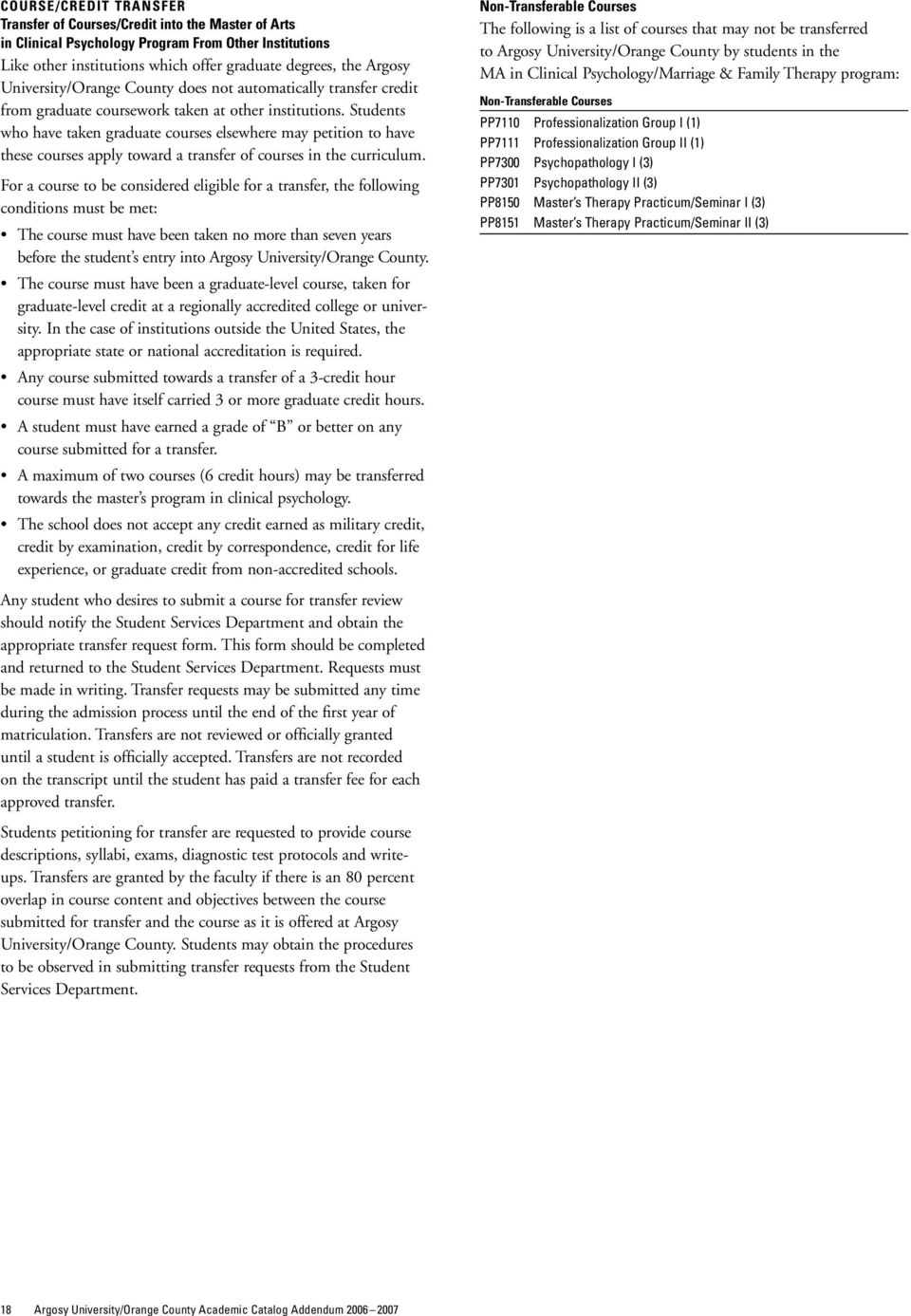
20 COURSE/CREDIT TRANSFER Transfer of Courses/Credit into the Master of Arts in Clinical Psychology Program From Other Institutions Like other institutions which offer graduate degrees, the Argosy University/Orange County does not automatically transfer credit from graduate coursework taken at other institutions. Students who have taken graduate courses elsewhere may petition to have these courses apply toward a transfer of courses in the curriculum. For a course to be considered eligible for a transfer, the following conditions must be met: The course must have been taken no more than seven years before the student s entry into Argosy University/Orange County. The course must have been a graduate-level course, taken for graduate-level credit at a regionally accredited college or university. In the case of institutions outside the United States, the appropriate state or national accreditation is required. Any course submitted towards a transfer of a 3-credit hour course must have itself carried 3 or more graduate credit hours. A student must have earned a grade of B or better on any course submitted for a transfer. A maximum of two courses (6 credit hours) may be transferred towards the master s program in clinical psychology. The school does not accept any credit earned as military credit, credit by examination, credit by correspondence, credit for life experience, or graduate credit from non-accredited schools. Any student who desires to submit a course for transfer review should notify the Student Services Department and obtain the appropriate transfer request form. This form should be completed and returned to the Student Services Department. Requests must be made in writing. Transfer requests may be submitted any time during the admission process until the end of the first year of matriculation. Transfers are not reviewed or officially granted until a student is officially accepted. Transfers are not recorded on the transcript until the student has paid a transfer fee for each approved transfer. Students petitioning for transfer are requested to provide course descriptions, syllabi, exams, diagnostic test protocols and writeups. Transfers are granted by the faculty if there is an 80 percent overlap in course content and objectives between the course submitted for transfer and the course as it is offered at Argosy University/Orange County. Students may obtain the procedures to be observed in submitting transfer requests from the Student Services Department. Non-Transferable Courses The following is a list of courses that may not be transferred to Argosy University/Orange County by students in the MA in Clinical Psychology/Marriage & Family Therapy program: Non-Transferable Courses PP7110 Professionalization Group I (1) PP7111 Professionalization Group II (1) PP7300 Psychopathology I (3) PP7301 Psychopathology II (3) PP8150 Master s Therapy Practicum/Seminar I (3) PP8151 Master s Therapy Practicum/Seminar II (3) 18 Argosy University/Orange County Academic Catalog Addendum
21 Section Four Master of Arts in Counseling Psychology/ Marriage & Family Therapy Program PROGRAM OVERVIEW The Master of Arts (MA) in Counseling Psychology/Marriage & Family Therapy program prepares students to practice and pursue licensure in California as Marriage and Family Therapists (MFT). Counselors who complete this program will be skilled professionals capable of integrating classroom knowledge and practicum experiences into a wide variety of settings with diverse client populations. The program introduces students to basic counseling skills and to applying individual, family, and group theory to client assessment and intervention. The program emphasizes the development of professional attitudes, theoretical and factual knowledge, and assessment and intervention skills essential to marriage and family counseling and professional counseling specialties. The program develops counselors who are committed to the ethical provision of quality services. We are proud of our diverse student body and of a newly established curriculum that develops well-trained MFT professionals. Mission Statement The counseling program is committed to preparing counselors who promote the development of social, psychological, physical, and spiritual health of individuals, families, communities, and organizations toward the betterment of society. Central to our mission is developing counselors who practice social justice, advocacy, self reflectiveness, cultural sensitivity, and ethical behavior. Program Formats Courses are offered on campus on Saturdays from 9 a.m. 4 p.m., one morning course from 9 a.m. 12 p.m., and one afternoon course from 1 4 p.m., weekday evenings, and blended/online. Full-time students will take two on-campus courses and one online course each semester. During the fall and spring semesters, courses are 15 weeks long. During the summer semester, courses are 7.5 weeks long. The program is approximately two years in length for students who attend full-time (approximately three courses per semester, including summers). Course sequencing currently begins each fall, and practicum begins in the fall. Therefore, the programs of students who begin during spring or summer semesters or of those who elect to attend part-time will extend beyond two years. Full-time students should plan to spend approximately 20 hours doing homework each week, and should thus arrange their work and family lives accordingly. Students whose lives will not accommodate this workload or whose past academic records are less strong should probably plan to attend part-time. Blended/Online Courses These courses are blended/online courses that are completed in an Internet-based online environment, and in up to 15 hours per semester of on-campus meetings. Students will be informed of the on-campus meeting schedule as soon as they register for the course. In general, the on-campus meetings will be at the beginning, middle, and end of the course, and will be scheduled around the Saturday course schedule. National online courses are not part of the Master of Arts in Counseling Psychology/ Marriage & Family Therapy program curriculum. The online classroom is accessed with a password and log-in. Inside the online classroom, students have access to course syllabi, assignments, lectures, and discussion threads. Depending on the course and the instructor, students may have the opportunity to participate in group work, real time discussions, and online quizzes or exams. Each blended/online course has a start and an end date. Blended/online courses also have textbooks that can be ordered online-students will receive instructions for ordering materials upon registering for a course. The courses are not self-paced; students have weekly assignments and expectations. However, the courses are very convenient in that the students do not have to be sitting in front of a computer at any given time to participate; they can login at any time of the day. In general, good participation is considered logging in at least three times a week. Students who fail to post to the discussion board for two weeks or for two assignments will need to repeat the course. Before starting the first blended/online course, students receive an orientation to the online classroom environment. To get a better understanding of what an online course is right now, visit our Web site and take the demo course available at Program of Study During their first semester of the master s in Counseling Psychology/Marriage & Family Therapy program, students complete a Program of Study by indicating when they intend to take the required courses. Students receive academic advisement at the beginning of their course of study and ongoing throughout the program. Advisement is considered an essential part of student matriculation, helping students to plan a program of study that is sequential so that each course builds on the previous one. Advisement is conducted in both a group format and through individual appointments prior to online enrollment in classes. Courses taken outside of the program of study will not count toward the courses required for the degree. Should students wish to change their Program of Study, they must submit a written request to their advisor, indicating the change that they wish to make and the reasons for the change. Students are required to retake any course for which they receive a grade below a B-. Argosy University/Orange County Academic Catalog Addendum
22 Brown Bag Lunches Academic advisement, a prerequisite to enrollment, takes place in a group format biweekly during brown bag lunch meetings. The program advisor will be available to discuss upcoming registration needs, advisement issues, to make announcements, and to answer any questions. Students are encouraged to make individual appointments with their advisor as well. To insure enrollment in the correct classes, students must have their program advisor s signature on associated enrollment forms (e.g., on-campus and online), providing clearance for registration. Students are required to attend brown bag lunches, as that is the only means to distribute information critical to their success in the program. Counseling Student Action Association The Counseling Student Action Association (CSAA) was formed by students for students. Its mission is to serve the needs of Master of Arts in Counseling Psychology/Marriage & Family Therapy students by providing general and specialized information services, educational programs, and advocacy, as well as a caring and supportive environment, while fostering a sense of belonging directed toward academic, professional, and personal growth. The CSAA strives to encourage student involvement with the university and serves as a collective advocate for student concerns. The CSAA has provided peer support, bartering services, a newsletter, textbook acquisition advice, and other community building events. Students can find out more about the CSAA by attending the Brown Bag Lunches. Student Review Procedures In order to accomplish program goals, the counseling faculty, individually and collectively, screen or evaluate students as they move through the program. When difficulties are detected, they are initially handled in informal discussions between the student and the student s professor or advisor. If at any time during the course of study a student is considered at-risk, the student will be asked to meet with the faculty to discuss and develop a remedial course of action. In addition to criteria indicated to students in course descriptions, students are expected to meet the following professional criteria: Complete all advanced prerequisites, be in good academic standing, and have no grades of Incomplete. Behave consistently with the Ethical Standards of the American Counseling Association Demonstrate psychological well-being in professional interactions with faculty, students, and clients Develop appropriate self-understanding and knowledge about how self influences client growth Give evidence of the ability to handle the stress inherent in a professional helping position Be willing to be referred for counseling when academic progress or clinical practice is impaired by unresolved issues; and Demonstrate professional behavior which is consistent with the anticipated professional position or practicum/internship placement, including writing ability and the ability to manage the administrative aspects of counseling. The progress of students who are identified as experiencing difficulty is discussed continuously at program evaluation meetings. Students are screened or evaluated at the following stages as they progress through the program: At application and admission During or at the completion of each individual class Upon meeting with advisor about the program of study While enrolled in Counseling Skills I (PC6104) When applying for an practicum placement, and During and after the practicum. Dismissal Students may be removed from the program or from a practicum for difficulties in academic performance, as indicated in the catalog, or for failures in technical and interpersonal skill, attitudes, and professional character. Students who fail to pass the Comprehensive Examinations after two tries are subject to dismissal from Argosy University. Students may be removed from the program or practicum on evidence of incapacity, incompetence, or unethical behavior. These are defined as: Persistent limitations in interpersonal or social relationships characterized by frequent disruptions in collegial and/or client therapist relationships due to factors such as withdrawal, conflicts, inappropriateness, aggressiveness, or hostility; and Persistent inability to carry out professional functions of a counselor characterized by frequent inability to be able to complete complex skills and techniques of the profession without assistance or direction. Eligibility for Licensure Graduates of the Master of Arts in Counseling Psychology/ Marriage & Family Therapy Program are eligible to pursue licensure in California as Licensed Marriage and Family Therapists (LMFTs). Upon completion of educational requirements, two years of post-master s supervised practice is required for licensure as an MFT and registry as a professional counselor. For more information and application materials related to MFT licensure, please contact the Board of Behavioral Sciences, 400 R Street, Suite 3150, Sacramento, CA , Masters-level certification or licensure varies from state to state. It is the student s responsibility to determine the requirements for professional licensure in the state they wish to practice. Students interested in pursuing licensure in states other than California should contact that state s department of professional regulation for information. The American Counseling Association (ACA) and the National Board for Certified Counselors (NBCC) frequently publish information on professional issues of importance to professional counselors, including licensure, on their Web pages: and respectively. 20 Argosy University/Orange County Academic Catalog Addendum
23 Privacy Personal growth and development is considered necessary to becoming an effective counselor. As a result, courses incorporate strategies for promoting such growth. These experiences may include, among others, journaling, reflecting on one's difficulties with the counseling process, identifying and sharing personal issues and history that may hinder effective and culturally sensitive counseling, and sharing personal experiences with bias and discrimination. We recognize the sensitivity necessary to create an environment of safety for such sharing, and expect faculty and students to conduct themselves in a way that promotes such safety. One necessary component in creating safety is the faith that one s disclosures will be held in confidence. Therefore, we expect students to keep confidential any material shared in class and in course assignments. ADMISSION REQUIREMENTS A bachelor s degree from a regionally accredited institution, a nationally accredited institution approved and documented by the faculty and dean of the College of Psychology and Behavioral Sciences, or an appropriately certified foreign institution. A grade point average of at least 3.0 (on a scale of 4.0) for the last 60 hours of coursework (including graduate work). A minimum written TOEFL score of 550 (paper version), 213 (computer version), or 79 (Internet version) for all applicants whose native language is not English or who have not graduated from an institution at which English is the language of instruction. Completion of an interview with a member of the program Admissions Committee. All applications for admission must be submitted to the Admissions Department. An admissions representative is available to help interested applicants complete the following required documentation: Completed Application for Admission Form Application fee (non-refundable, except in California) Personal/professional goal statement with a self-appraisal of qualifications for the profession Current résumé (or career summary) Three completed Applicant Recommendation Forms Official transcripts from all postsecondary schools attended Exceptions to the Minimum Grade Point Average Applicants with grade point averages lower than the stated program minimums may be considered for admission with significant evidence of academic and professional potential demonstrated by the career and/or personal accomplishments indicated in the statement of academic and professional goals, the career summary, and academic or professional letters of recommendation. Exceptions must be recommended by the Admissions Committee and program chair, and approved by the college dean. Exceptions must be justified, documented, signed, placed, and retained in the student s academic file. Students admitted on an exception basis will be admitted as regular students on first semester probation. See Exceptions to Admission Requirements in section 5 of the Academic Catalog under Admission Policies. The applicant is expected to provide all required materials to the Admissions Department by the application deadline. Incomplete applications will not be considered. Prior to the deadline, applicants should check with the Admissions Department concerning the status of their files. After all materials are complete, they will be reviewed by the Admissions Committee, and an interview with program faculty will be set up with those applicants who meet the requirements below to determine the level of fit between the applicant and the program. After the interview, the Admissions Committee will make a determination regarding admission to the program. The director of Admissions will notify all applicants of the Admissions Committee s decisions. Application Deadlines Students may enter the program at various points throughout the year, although course sequencing begins in the fall semester. All admission materials for the Master of Arts in Counseling Psychology/Marriage & Family Therapy program must be submitted by the following dates. Fall Admission June 30 Spring Admission October 30 Summer Admission March 15 Final deadline Final deadline Final deadline ENROLLMENT REQUIREMENTS Students in the program enroll in two to three classes per semester. During the second year practicum which includes an on-campus seminar, students generally enroll in one additional course each semester, or they may enroll in the practicum alone. Students are offered approximately one course per semester online. The remainder must be taken on-campus. Students are required to be continuously enrolled until they satisfy graduation requirements. If needed courses are not available during a given semester, if students elect to take a break from classes, or if students have completed all coursework but have not successfully passed the Comprehensive or Clinical Competency Exam, they must register for Directed Study (P6801). GRADUATION REQUIREMENTS Students who are admitted into the Master of Arts in Counseling Psychology/Marriage & Family Therapy program will be responsible for completing the program requirements that are in effect at the time of their admission. However, the program retains the right to modify these requirements in accordance with the demands of the counseling profession. The courses will be completed in the order recommended by the program. Argosy University/Orange County Academic Catalog Addendum
24 To be eligible for graduation, students must meet the following requirements: Completion of 49 credit hours. The total credit hours must include: 43 credit hours of required courses 6 credit hours of practicum and seminar Successful completion of the Comprehensive Examination no later than the end of the fourth year Successful completion of the Clinical Competency Exam (CCE) A grade point average of at least 3.0 (on a scale of 4.0) Completion of these requirements within four years of matriculation into the program A completed Petition to Graduate submitted to campus administration Petition to Graduate Argosy University/Orange County holds a commencement ceremony annually in May. All students who desire to graduate, even those who do not intend to participate in the annual commencement ceremonies, must submit the appropriate Program Completion Petition and fees to the Student Services Department. Although commencement is held annually, students in the MA in Counseling Psychology/Marriage & Family Therapy program generally complete program requirements in September and will thus be recognized as graduated students and receive letters of completion at that time. Students may walk in the commencement ceremony as long as they anticipate completing the requirements for graduation during the summer following the ceremony. WRITING PROGRAM AND TECHNOLOGY REQUIREMENTS The Professional Writing Course was created in order to help students master the skills of writing psychological reports and literature reviews in an accurate, informational, and professional manner. The Writing program includes both full semester courses and workshops on academic writing, APA style, and library searches. All students need to take the workshops in order to be introduced to Argosy s writing expectations. Students who have not done so have been disadvantaged in grades received on writing assignments. Students will complete a writing assignment early in their program to determine whether they need the assistance of the 15-week course. They may then elect to take the writing course, be required to take the course, or be recommended to the course. The course does not count toward the credit hours required for graduation, although students with any writing difficulties are encouraged and may be required to take it. If students are required to take the course, they must enroll in the course as soon as the course is available to them. Please keep in mind that the use of anyone else s writing, content, or materials, without giving credit to them using proper citations, quotation marks, and page numbers, is plagiarism, for which students may be dismissed from the program. If you have any questions about how to write a paper without plagiarizing someone else s work, please ask your professor and/or attend one of the writing courses or workshops. Students may find the Master s in Counseling Psychology/ Marriage & Family Therapy program at Argosy University/ Orange County technology intensive. The online courses require participation in online discussions, chat rooms, online exams, and electronic assignments submission. Courses require word processing and capacity, and the resources to audio and/or videotape and transcribe counseling sessions. Students who feel anxious about these requirements may want to plan to have technological assistance available so that they do not fall behind in their coursework. PROGRAM REQUIREMENTS Course Requirements The Master of Arts in Counseling Psychology/Marriage & Family Therapy program requires the satisfactory completion of 49 semester credit hours. Following is a list of required courses: Year One Course Requirements Students Are Required to Take the Following PC6005 Maladaptive Behavior and Psychopathology (3) PC6025 Human Growth and Development (3) PC6104 Counseling Skills I (3) PC6230 Theories in Counseling Families and Individuals (3) PC6300 Professional and Ethical Issues (3) PP6320 Domestic Violence and Spousal Abuse (1) PC6420 Community Mental Health (3) PC6505 Group Counseling (3) PC6511 Social and Cultural Diversity (3) PC6525 Appraisal and Assessment (3) PC6700 Couples and Family Counseling (3) Year One Course Requirements 28 Credit Hours Year Two Course Requirements Students Are Required to Take the Following PC6250 Clinical Psychopharmacology (3) PC6400 Practicum and Practicum Seminar I (2) PC6401 Practicum and Practicum Seminar II (2) PC6402 Practicum and Practicum Seminar III (2) PC6420 Community Mental Health (3) PC6521 Research and Program Evaluation (3) PC6600 Career and Lifestyle Development (3) PC6900 Substance Abuse Counseling (3) Year Two Course Requirements 21 Credit Hours Practicum and Practicum Seminar Requirements The practicum is the first opportunity provided to students for field training in counseling. The practicum provides students with the opportunity for working under supervision with a clinical population in a mental health delivery system. The practicum is an essential part of training in counseling, and all students are required to participate in the practicum experience. Liability insurance is included in the cost of the practicum. 22 Argosy University/Orange County Academic Catalog Addendum
25 Students may be placed in a practicum and practicum seminar during their second year of study. A student may also have the option of waiting until all coursework is completed before beginning the practicum experience. Students who work full-time during the daytime hours cannot be guaranteed evening and weekend practicum; so please begin early to plan for work flexibility as some practicum hours will be during weekdays. For registration purposes, the practicum and seminar are treated as a single course. The practicum is a 10-month experience, running from fall through summer I. Practicum usually begins in September and concludes in June. During this time period, the student will be required to spend a minimum of 700 hours, or hours per week, in the practicum training experience. Practicum students are expected to spend a minimum of 240 hours in direct, face-to-face client service. Students will receive at least two hours of on-site, face-to-face supervision per week with a licensed mental health professional, one hour of which is individual supervision. Supervision should occur at a regularly scheduled time each week. A practicum may not be done in a student s place of employment, nor may students transfer the practicum requirements from another educational institution. Students with extensive clinical backgrounds will be placed in practicum sites that allow them to practice in areas of interest with which they do not have previous experience. Eligibility for Practicum All students who begin the practicum application process must be in good academic standing when they apply (have a minimum grade point average of 3.0 on a scale of 4.0) and have completed the academic planning that will allow for all the practicum pre-requisite courses to be completed prior to the beginning of the practicum. No student may begin a practicum without being in the program for a minimum of two semesters. To be eligible for a practicum, a student must have successfully completed or transferred the following courses: Practicum Prerequisites PC6005 Maladaptive behavior and Psychopathology (3) PC6104 Counseling Skills I (3) PC6230 Theories in Counseling Families and Individuals (3) PC6300 Professional and Ethical Issues (3) PC6505 Group Counseling (3) PC6510 Social and Cultural Foundations (3) PC6700 Couples and Family Counseling (3) The program has the discretion to make recommendations to the director of Clinical Training and/or the dean on any fully admitted probationary student who is beyond the first year of attendance. This recommendation would include the student activities of both application for practicum and participating in practicum. If a first-year student is placed on probation based on fall semester grades, the student may not apply for a practicum during the spring semester. If spring grades then indicate that the student has raised his or her GPA to 3.0 on a scale of 4.0, the student, at the discretion of the director of Clinical Training may look for a practicum. A first-year student who has been accepted at a practicum site may only participate in practicum if he or she raises the GPA to 3.0 before practicum begins. Practicum Evaluation The goal of the practicum is to train competent counselors who are capable of providing counseling and effective therapeutic interventions. Evaluation of student progress in clinical field training focuses on three areas: theoretical knowledge, counseling skills, and professional attitudes. A thorough review of site and seminar evaluations is conducted by the Training Department, and an overall grade of Credit or No Credit is included in the student s academic record. Practicum Seminar Requirements All students enrolled in a practicum must also concurrently enroll in a practicum seminar. The seminar meets bi-weekly throughout the practicum year and allows the student to reflect on various practicum experiences and to acquire additional skills and attitudes useful in field training. The specific content and emphasis of the seminar varies according to the practicum setting, the focus of the enrolled students and the professional expertise of the faculty member. Comprehensive Examination Requirements All students in the program are required to successfully complete a Comprehensive Examination. The information tested by the exam covers the course material required of students during their program. By asking objective and essay questions, the examination requires students to be able to demonstrate mastery of the material they have learned, their ability to communicate this mastery, and their ability to think critically, reflectively, ethically, and deeply about the material. Students who fail the Comprehensive Exam their first time will be eligible to take the exam again the next time it is offered (in August or September of each year). Students who fail the exam twice will be subject to dismissal from Argosy University. Comprehensive Examination Prerequisites To be able to sit for the Comprehensive Examination, the student must have successfully completed all required coursework. Students taking the Comprehensive Examination must be in good standing and have a GPA of at least 3.0 (on a scale of 4.0). Comprehensive Examination Procedures Students are required to successfully complete the Comprehensive Examination no later than the end of the fourth year after matriculation. The Comprehensive Examination is offered at least once each year. Students interested in taking the Comprehensive Examination should fill out a petition to take the Comprehensive Exam (available through Student Services) during the specified semester of the year that they intend to take the test one month in advance of the exam. Additional information regarding registration, qualification, format, and dates of the exam can be obtained from the Student Services Department or program chair of the Counseling Psychology/Marriage & Family Therapy program. Argosy University/Orange County Academic Catalog Addendum
26 Clinical Competency Exam Requirements The Clinical Competency Exam (CCE) requires students to present a taped session, a transcript, a clinical case report, and a self-evaluation related to a client that they have been working with during the student s Practicum. In the CCE students demonstrate their conceptual and theoretical abilities and their counseling skills in real world counseling situations. Argosy University/Orange County also expects that students who have learned theoretical and applied concepts in classroom courses will have made use of outof-class clinical contacts (i.e., practicum, practicum seminar group, visiting lecturers) to refine and extend the skills to be evaluated by the CCE. Therefore, receiving passing grades in the practicum seminar and on the practicum supervisor s evaluation does not guarantee a passing grade on the CCE. Descriptions and Procedures for Successful Completion of the Clinical Competency Exam As the Capstone Project for the practicum experience, students submit a tape of a counseling session with a client from their practicum site, a transcript of 30 minutes of the counseling session (including a verbatim, a description of counseling skills used and the reason for their use, an evaluation of each intervention including a better option if needed, and an evaluation of the impact of the intervention on the client), a clinical case report, and a self-evaluation paper. Students receive clear instructions on how to complete each of these assignments, along with multiple opportunities to practice these assignments, during the practicum experience. The CCE tape cannot have been submitted earlier, either for the site or for the program, for review, supervision, or critique. The CCE is graded as Pass, Remediate, or Fail. Students are evaluated on their fund of knowledge regarding the foundations of professional counseling, their ability to manage an interview, the ability to arrive at an accurate diagnosis and dynamic formulation, the ability to develop a theoretically supported treatment plan, their ability to carry out theoretically grounded intervention strategies which promote positive movement in the client, and their ability to evaluate their own work and abilities. In the event that remediation is necessary, students will be given the opportunity to respond to specific faculty feedback about needed improvements. In the event that a student fails the examination, he/she will be guided on how to remediate the exam. The Clinical Training Committee, in consultation with the initial examining faculty member, will recommend a program of remediation to address concerns noted in the CCE. Should the student be unable to complete the remediation for any reason, he/she will be referred to the Clinical Training Committee and then the Student Professional Development Committee for disposition, with one option being dismissal from the program. RECOMMENDED COURSE SEQUENCE FOR THE MASTER OF ARTS IN COUNSELING PSYCHOLOGY/ MARRIAGE & FAMILY THERAPY PROGRAM Student progress through the program is intended to be sequential. Certain courses are offered to first-year students that provide a theoretical and practical foundation for courses that will follow in subsequent years. In addition, certain advanced courses require the student to have the background of more basic courses in order to benefit fully from the course experience. Students must satisfy all stated prerequisites for a course before a registration for that course can be considered official (see below). The MA in Counseling Psychology/Marriage & Family Therapy program recommended course sequence is noted below: Year One Fall Semester Spring Semester Summer Semester PC6104 Counseling Skills I* (3) PC6511 Social and Cultural Diversity (3) PC6005 Maladaptive Behavior and Psychopathology* (3) PC6230 Theories in Counseling Families PC6505 Group Counseling* (3) PC6320 Domestic Violence and Spousal Abuse (1) and Individuals* (3) PC6300 Professional and Ethical Issues* (3) PC6025 Human Growth and Development (3) PC6700 Couples and Family Counseling* (3) PC6900 Substance Abuse Counseling (3) Year Two Fall Semester Spring Semester Summer Semester PC6440 Child and Adolescent Counseling (3) PC6600 Career and Lifestyle Development ** PC6525 Appraisal and Assessment (3) PC6400 Practicum/Seminar I (2) PC6401 Practicum/Seminar II (2) PC6521 Research and Program Evaluation (3) PC6250 Clinical Psychopharmacology (3) PC6402 Practicum III (2) * Prerequisites for practicum. Counseling Skills I (PC6104) is required as a prerequisite for this course. Maladaptive Behavior and Psychopathology (PC6005) is required as a prerequisite for this course. Theories in Counseling Families and Individuals (PC6230) is a prerequisite for this course. **Appraisal and Assessment (PC6525) is a prerequisite for this course. 24 Argosy University/Orange County Academic Catalog Addendum
27 MASTER OF ARTS IN COUNSELING PSYCHOLOGY/MARRIAGE & FAMILY THERAPY PROGRAM COURSE PREREQUISITES Students must satisfy all stated prerequisites for a course before a registration for that course can be considered official. A listing of the prerequisites for courses in the Master of Arts in Counseling Psychology/Marriage & Family Therapy program follows. Course Number and Title Prerequisite PC6400 Practicum prerequisites PC6511 Social and Cultural Diversity PC6300 Professional and Ethical Issues PC6230 Theories in Counseling Families and Individuals PC6505 Group Counseling PC6005 Maladaptive Behavior and Psychopathology PC6104 Counseling Skills I PC6700 Couples and Family Counseling PC6230 Theories in Counseling Families and Individuals PC6104 Counseling Skills I PC6505 Group Counseling PC6104 Counseling Skills I PC6525 Appraisal and Assessment PC6104 Counseling Skills I PC6005 Maladaptive Behavior and Psychopathology PC6250 Clinical Psychopharmacology PC6005 Maladaptive Behavior and Psychopathology PC6005 Maladaptive Behavior and Psychopathology PC6230 Theories in Counseling Families and Individuals PC6600 Career and Lifestyle Development PC6104 Counseling Skills I PC6525 Appraisal and Assessment PC6700 Couples and Family Counseling PC6104 Counseling Skills I PC6230 Theories in Counseling Families and Individuals COURSE/CREDIT TRANSFER Transfer of Courses/Credit into the Master of Arts in Counseling Psychology/Marriage & Family Therapy Program from Other Institutions Like other institutions that offer graduate degrees, the counseling program does not automatically transfer credit from graduate coursework taken at other institutions. Students who have taken graduate courses elsewhere may petition to have these courses apply toward a transfer of courses in the curriculum. Transfers are not reviewed or granted until students have been accepted. For a course to be considered eligible for a transfer, the following conditions must be met: The course must have been taken no more than seven years before the student s entry into the program, except when students present evidence of ongoing work experience or continuing education in that area. The course must have been a graduate-level course, taken for graduate-level credit at a regionally accredited college or university. In the case of institutions outside the United States, the appropriate state or national accreditation is required. Any course submitted towards a transfer of a 3-credit hour course must have itself carried 3 or more graduate semester credit hours. A student must have earned a grade of B or better on any course submitted for a transfer. A maximum of two courses (6 credit hours) may be transferred towards the program. Practicum and practicum seminars are not eligible for transfer. The school does not accept any credit earned as military credit, credit by examination, credit by correspondence, credit for life experience, or graduate credit from non-accredited schools. A student who desires to submit a course for transfer review should notify the Student Services Department and obtain the appropriate Transfer Request Form. This form should be completed and returned to the Student Services Department. Only requests made in writing are reviewed. A request form is required for each course that a student submits for review. A fee will be assessed only if the transfer is granted. All transfer requests must be submitted during the first academic year of the student s enrollment. Students petitioning for transfer may be required to provide course descriptions, syllabi, and exams. Student Services will publish the procedures to be observed in submitting external transfer and transfer requests. Transfer of Courses/Credit from Another Argosy University Campus Students who transfer from one Argosy University campus to another may receive credit for a course taken at the original campus, if the course is identical to the one offered at the transfer campus. In cases where the course is similar but not identical, the campus has the option to review for approval or denial. Students at Argosy University/Orange County who wish to submit course transfer requests for courses taken at another Argosy University campus must do so before or during the first year of enrollment at Argosy University/Orange County. Argosy University/Orange County Academic Catalog Addendum
28 Section Five Doctor of Education in Counseling Psychology Program PROGRAM OVERVIEW The Doctor of Education (EdD) in Counseling Psychology program is designed to meet the special requirements of working professionals motivated to develop their knowledge and skills to enhance and extend their professional practice and their contributions to their current work settings. EdD students are generally experienced practitioners from the diverse fields of social work, counseling, marriage and family, and psychology. The challenges of an ever-changing society, and the diversity of roles available to the professional counselor, require a life-long commitment to continuing education. The EdD in Counseling Psychology program presents a structured opportunity to fulfill this need, and allows counselors from a variety of settings to develop and advance their knowledge and skills in consultation, supervision, training, and teaching positions, as well as to expand the range of their professional counseling practice. Practitioners join together to develop new interests, levels of competency, and direction for their practice through an applied, practitionerscholar approach to the role of counselor. The faculty is composed of committed teaching professionals, dedicated to the development of individual student interest areas during the courses and dissertation. An eclectic mix of backgrounds, theoretical orientations, and interests in the faculty members provides students with the opportunity for exposure to new ideas, as well as support for the extension of established interests. The EdD in Counseling Psychology program assists in the development of leaders in the fields of human services, consultation, and education. Mission Statement The EdD in Counseling Psychology program is committed to preparing counselors who promote the development of social, psychological, physical, and spiritual health of individuals, families, communities, and organizations toward the betterment of society. Central to our mission is developing counselors who practice social justice, advocacy, self reflectiveness, cultural sensitivity, and ethical behavior. Program Formats Courses are offered on campus on Saturdays from 9 a.m. 4 p.m., one morning course from 9 a.m. 12 p.m., one afternoon course from 1 4 p.m., and online. Full-time students will take two oncampus and one blended/online course each semester. During the fall and spring semesters, courses are 15 weeks long. During the summer semester, courses are 7.5 weeks long. The program is approximately three years in length for students who attend full time (approximately 3 courses per semester, including summers). Full-time students should plan to spend approximately 20 hours reading and doing homework each week, and should thus arrange their work and family lives accordingly. Students whose lives will not accommodate this workload or whose past academic records are less strong should probably plan to attend part-time. These courses are blended/online courses that are completed in an Internet-based online environment, and in up to 15 hours per semester of on-campus meetings. Students will be informed of the on-campus meeting schedule as soon as they register for the course. In general, the on-campus meetings will be at the beginning, middle, and end of the course, and will be scheduled around the Saturday course schedule. National online courses are not part of the the EdD in Counseling Psychology. Program Curriculum The online classroom is accessed with a password and log-in. Inside the online classroom, students have access to course syllabi, assignments, lectures, and discussion threads. Depending on the course and the instructor, students may have the opportunity to participate in group work, real-time discussions, and online quizzes or exams. Each blended/online course has a start and an end date. Blended/online courses also have textbooks that can be ordered online-students will receive instructions for ordering materials upon registering for a course. The courses are not self-paced; students have weekly assignments and expectations. However, the courses are very convenient in that the students do not have to sitting in front of a computer at any given time to participate; they can log-in at any time of the day. In general, good participation is considered logging in at least three times a week. Students who fail to post to the discussion board for two weeks or for two assignments will need to repeat the course. Before starting the first blended/online course, students receive an orientation to the online classroom environment. To get a better understanding of what an online course is right now, visit our Web site and take the demo course available at Program of Study During the first semester of the EdD in Counseling Psychology program, students will complete a Program of Study indicating when they intend to take the required courses. Students receive academic advisement at the beginning of their course of study and ongoing throughout the program. Advisement is considered an essential part of student matriculation, helping students to plan a program of study that is sequential so that each course builds on the previous one. Advisement is conducted in both a group format and through individual appointments prior to online enrollment in classes. Courses taken outside of the program of study will not count toward the courses required for the degree. Some research courses bear a course number that is the same 26 Argosy University/Orange County Academic Catalog Addendum
29 whether the course is offered in the American School of Professional Psychology, the College of Education and Human Development, or the College of Business and Information Technology; however, only those listed under the EdD in Counseling Psychology program are permissible as part of a counseling psychology student s Program of Study. Students must also obtain approval for the particular business or education elective that they wish to take, approval that is based upon discussions with their advisor about their professional goals. Should students wish to change their Program of Study, they must submit a written request to their advisor, indicating the change that they wish to make and the reasons for the change. Students are required to retake any course for which they receive a grade below a B-. Brown Bag Lunches Academic advisement, a prerequisite to enrollment, takes place in a group format bi-weekly during brown bag lunch meetings. The program advisor (MACP or EdD) will be available to discuss upcoming registration needs, advisement issues,to make announcements, and to answer any questions. Students are encouraged to make individual appointments with their advisor as well. To insure enrollment in the correct classes, students must have their program advisor s signature on associated enrollment forms (e.g., on-campus and online), providing clearance for registration. Students are required to attend brown bag lunches, as that is the only means to distribute information critical to their success in the program. Optional Internship Students may choose to participate in optional internship opportunities. They may choose to participate in up to 300 hours of internship, with each 100 hours receiving 1 credit hour. The internship hours may include supervised experiences in clinical settings (leadership, grant writing, advocacy), teaching, supervision, and/or other activities of a regularly employed professional. These hours are allocated at the discretion of the doctoral advisor and students, based on experience, training, and professional objectives. Students should receive weekly individual and/or triadic supervision at the internship site by a qualified professional. Counseling Student Action Association The Counseling Student Action Association (CSAA) was formed by students for students. Its mission is to serve the needs of EdD in Counseling Psychology program students by providing general and specialized information services, educational programs, and advocacy, as well as a caring and supportive environment, while fostering a sense of belonging directed toward academic, professional, and personal growth. The CSAA strives to encourage student involvement with the university and serves as a collective advocate for student concerns. The CSAA has provided peer support, bartering services, a newsletter, textbook acquisition advice, and other community building events. Students can find out more about the CSAA by attending the Brown Bag Lunches. Student Review Procedures In order to accomplish program goals, the counseling faculty, individually and collectively, screen or evaluate students as they move through the program. When difficulties are detected, they are initially handled in informal discussions between the student and the student s professor or advisor. If at any time during the course of study a student is considered at-risk, the student will be asked to meet with the faculty to discuss and develop a remedial course of action. In addition to criteria indicated to students in course descriptions, students are expected to meet the following professional criteria: Complete all advanced prerequisites, be in good academic standing, and have no grades of Incomplete Behave consistently with the Ethical Standards of the American Counseling Association Demonstrate psychological well-being in professional interactions with faculty, students, and clients Develop appropriate self-understanding and knowledge about how self influences client growth Give evidence of the ability to handle the stress inherent in a professional helping position Be willing to be referred for counseling when academic progress or clinical practice is impaired by unresolved issues; and Demonstrate professional behavior which is consistent with the anticipated professional position or practicum/internship placement, including writing ability and the ability to manage the administrative aspects of counseling. The progress of students who are identified as experiencing difficulty is discussed continuously at program meetings. Students are screened or evaluated at the following stages as they progress through the program: At application and admission During or at the completion of each individual class Upon meeting with advisor about the program of study When working on pre-dissertation and dissertation tasks Dismissal Students may be removed from the program or from a practicum for difficulties in academic performance, as indicated in the catalog, or for failures in technical and interpersonal skill, attitudes, and professional character. Students may be removed from the program or practicum on evidence of incapacity, incompetency, or unethical behavior. These are defined as: Persistent limitations in interpersonal or social relationships characterized by frequent disruptions in collegial and/or client therapist relationships due to factors such as withdrawal, conflicts, inappropriateness, aggressiveness, or hostility; and Persistent inability to carry out professional functions of a counselor characterized by frequent inability to be able to complete complex skills and techniques of the profession without assistance or direction. Argosy University/Orange County Academic Catalog Addendum
30 Eligibility for Licensure Graduates of the EdD in Counseling Psychology program who have graduated from a counseling master s program are also eligible to become registered professional counselors in California. More information on the registry is available from the California Registry of Professional Counselors and Paraprofessionals, respectively. The American Counseling Association (ACA) and the National Board for Certified Counselors (NBCC) frequently publish information on professional issues of importance to professional counselors, including licensure, on their Web pages: and Although the aim of the EdD in Counseling Psychology program is to develop leaders and contributors in the counseling profession, some students in the EdD in Counseling Psychology program may find it helpful to pursue licensure in California as psychologists. In addition to the educational requirements provided at Argosy University/Orange County, 3000 hours of supervised training is required for licensure as a psychologist. Some of these hours may be acquired during the doctoral program. Also, prospective psychologists must pass the Examination for Professional Practice in Psychology (EPPP), and the California Jurisprudence and Professional Ethics Examination (CJPEE). For more information and application materials please contact the Board of Psychology, 1422 Howe Avenue, Suite 22, Sacramento, CA , [email protected], Psychologist licensure varies from state to state; students interested in pursuing licensure in states other than California should contact that state s department of professional regulation for information. Privacy Personal growth and development is considered necessary to becoming an effective counselor. As a result, courses incorporate strategies for promoting such growth. These experiences may include, among others, journaling, reflecting on one s difficulties with the counseling process, identifying and sharing personal issues and history that may hinder effective and culturally sensitive counseling, and sharing personal experiences with bias and discrimination. We recognize the sensitivity necessary to create an environment of safety for such sharing, and expect faculty and students to conduct themselves in a way that promotes such safety. One necessary component in creating safety is the faith that one's disclosures will be held in confidence. Therefore, we expect students to keep confidential any material shared in class and in course assignments. ADMISSION REQUIREMENTS The application process for admission into the EdD in Counseling Psychology program requires the submission of material that will enable the Admissions Department to verify the applicant s academic qualifications to enroll in the doctoral program in counseling psychology. Because the admission process also takes into consideration the qualities essential to working effectively in this field, material is also required which will enable the Admissions Committee to make a determination of the individual s personal integrity, maturity, interpersonal skills, and ability to communicate effectively. A master s degree from a regionally accredited institution approved and documented by the faculty and dean of the College of Psychology and Behavioral Sciences or an appropriately certified foreign institution. A grade point average of at least 3.0 (on a scale of 4.0) in work leading to a master s degree and in any subsequent graduate study. A minimum written TOEFL score of 550 (paper version), 213 (computer version), or 79 (Internet version) for all applicants whose native language is not English, or who have not graduated from an institution at which English is the language of instruction. Completion of an interview with a member of the program Admissions Committee. All applications for admission must be submitted to the Admissions Department. An admissions representative is available to help interested applicants complete the following required documentation: Completed Application for Admission Form Application fee (non-refundable, except in California) Personal/professional goal statement with a self-appraisal of qualifications for the profession Current résumé (or career summary) Three completed Applicant Recommendation Forms Official transcripts from all postsecondary schools attended The applicant is expected to provide all required materials to the Admissions Department by the application deadline. Incomplete applications will not be considered. Prior to the deadline, applicants should check with the Admissions Department concerning the status of their files. After all materials are complete, they will be reviewed by the Admissions Committee, and an interview will be set up with those applicants who meet the requirements below to determine the level of fit between the applicant and the program. After the interview, the Admissions Committee will make a determination regarding admission to the program. The director of Admissions will notify all applicants of the Admissions Committee s decisions. 28 Argosy University/Orange County Academic Catalog Addendum
31 Application Deadlines Students may enter the program at various points throughout the year. All admission materials for the EdD in Counseling Psychology program must be submitted by the following dates: Fall Admission June 30 Spring Admission October 30 Summer Admission March 15 Final deadline Final deadline Final deadline ENROLLMENT REQUIREMENTS Students in the program enroll in two to three, 3-credit hour classes per semester. Students are offered approximately one course per semester online. The remainder must be taken on-campus. Students are required to be continuously enrolled until they satisfy graduation requirements. If needed courses are not available during a given semester, if students elect to take a break from classes, or if students have completed all courses but have not yet passed the Comprehensive Exam or the pre-dissertation tasks, they must register for Directed Study (1 credit hour) or Advanced Seminar in Research Methods (3 credit hours). GRADUATION REQUIREMENTS Students who are admitted into the Counseling Psychology program will be responsible for completing the program requirements that are in effect at the time of their admission. However, the program retains the right to modify these requirements in accordance with the demands of the counseling profession. The courses will be completed in the order recommended by the program. To be eligible for graduation, students must meet the following requirements: Satisfactory completion of all requirements in the program of study developed in consultation with the faculty members Satisfactory completion of 60 semester credit hours beyond the master s degree, including 48 credit hours of coursework and 12 credit hours of dissertation. A grade point average of 3.2 or higher Satisfactory performance on the Comprehensive Examination Successful completion and defense of the dissertation A completed Petition to Graduate submitted to campus administration WRITING PROGRAM AND TECHNOLOGY REQUIREMENTS The Professional Writing Course was created in order to help students master the skills of writing psychological reports and literature reviews in an accurate, informational, and professional manner. The Writing program includes both full semester courses and workshops on academic writing, APA style, and library searches. All students need to take the workshops in order to be introduced to Argosy University s writing expectations. Students who have not done so have been disadvantaged in grades received on writing assignments. Students will complete a writing assignment early in their program to determine whether they need the assistance of the 15-week course. They may then elect to take the writing course, be required to take the course, or be recommended to the course. The course does not count toward the credit hours required for graduation, although students with any writing difficulties are encouraged and may be required to take it. If students are required to take the course, they must enroll in the course as soon as the course is available to them. Please keep in mind that the use of anyone else s writing, content, or materials, without giving credit to them using proper citations, quotation marks, and page numbers, is plagiarism, for which students may be dismissed from the program. If you have any questions about how to write a paper without plagiarizing someone else s work, please ask your professor and/or attend one of the writing courses or workshops. Students may find the EdD in Counseling Psychology program at Argosy University technology-intensive. The online courses require participation in online discussions, chat rooms, online exams, and electronic assignments submission. Courses require word processing and capacity, and the resources to audio and/or videotape and transcribe counseling sessions. Students who feel anxious about these requirements may want to plan to have technological assistance available so that they do not fall behind in their coursework. PROGRAM REQUIREMENTS The EdD in Counseling Psychology Program requires the satisfactory completion of 60 semester credit hours distributed as follows: counseling requirements, 18 credit hours; professional development requirements, 9 credit hours; professional practice requirements, 9 credit hours; research requirements, 12 credit hours; and dissertation requirements, 12 credit hours. Counseling Requirements Students Choose Six of the Following C7410 Assessment in Counseling (3) C7431 Counseling in Community Settings (3) C7432 Advanced Individual Counseling (3) C7433 Advanced Group Counseling (3) C7434 Cognitive-Behavioral Theories of Counseling (3) C7435 Existential-Humanistic Theories of Counseling (3) C7436 Psychodynamic Theories of Counseling (3) C7440 Marriage and Family Therapy (3) C7445 Brief Psychotherapies (3) C7455 Addictions Counseling (3) C7460 Techniques of Child and Adolescent Counseling (3) Other approved counseling courses C7510 Internships (1 3) Counseling Requirements 18 Credit Hours Argosy University/Orange County Academic Catalog Addendum
32 Professional Development Requirements Students Are Required to Take the Following C7443 Multicultural Issues in Counseling (3) or C7444 Multicultural Issues in Counselor Education and Supervision (3) C7458 Diagnosis and Treatment Planning (3) C7461 Ethics in Counselor Education and Supervision (3) or C7462 Ethics in Practice (3) Professional Development Requirements 9 Credit Hours Professional Practice Requirements Students Are Required to Take the Following C7453 Clinical Consultation (3) C7454 Models of Clinical Supervision (3) Education elective or Business elective (3) Professional Practice Requirements 9 Credit Hours Research Requirements Students Are Required to Take the Following E7834 Writing for Research (3) R7031 Methods and Analysis of Quantitative Research (3) R7036 Program Evaluation Methods (3) R7035 Qualitative Research and Evaluation (3) Research Requirements 12 Credit Hours Dissertation Requirements Students Are Required to Take the Following C7935 Dissertation Counseling (12) Dissertation Requirements 12 Credit Hours Students are required to retake any course for which they receive a grade below a B-. Comprehensive Examination Requirements EdD in Counseling Psychology program students take a Comprehensive Examination during their final semester of coursework. The examination provides an opportunity for students to demonstrate knowledge of key concepts, significant empirical findings, counseling applications, and critical and integrative thinking. The criteria for evaluation of the examination include breadth and depth of knowledge and theory; integration and application of concepts; organization and clarity; and understanding of issues related to diversity and ethics. Students will be expected to provide complete and focused answers to the comprehensive questions. Students will take their Comprehensive Exams on-campus. They must be in good standing (GPA of 3.2 on a scale of 4.0) and not on probation; and must complete and/or have transfer credit for all core course and/or elective options except one. Students may elect to take the exam concurrently with taking the last class required in their program or they may take the exam after they have completed all of their required coursework. The dates for the Comprehensive Exam will be announced during the first or second week of each semester, and will be administered around the fourth or fifth week of each semester. The Comprehensive Exam will take place on two consecutive days from 8 a.m. 12 p.m. Students who need accommodations due to documented learning or medical disabilities will be allowed additional time during the afternoon (1 p.m. 5 p.m.) to complete the exam questions being tested that day. Students are allowed to bring the following items with them when they take the exam: A copy of the DSM-IV-TR Five journals or textbooks A non-annotated reference list An outline or crib notes on one side of one letter-size sheet of paper Students will have two opportunities to pass the Comprehensive Exam. If students fail the first time, they have up to a year (two additional semesters) to study for and pass a second exam during its regularly scheduled administrations. They will take a different exam on their second effort, the same exam that is being given to others for that administration of the comprehensives. During the semesters that students are studying for the exam, they are required to be continuously enrolled. They may take either the 3-credit hour Advanced Seminar in Research Methods (C7930) which offers structured tutorials to assist students in passing the comprehensives (as well as other assistance), a 1 credit hour Directed Independent Study (C7834) in order to study for the exam independently, or another course. Students will receive the results of their Comprehensive Exams within approximately two weeks of taking the exam. The three possible results are Pass, Pass with Remediation, and Fail. Students will need to have a score above 2 (minimally competent) for all eight criteria on the exam in order to receive a passing grade. If students receive a total score of 16 or greater, with scores on one or two criteria below 2, students will receive a Pass with Remediation. These students will have a week to study further on the areas that were not satisfactory and come back to campus to retake those portions of the exam. They will have one morning from 8 a.m. 12 p.m. to do so. If the results are satisfactory, they will receive a passing grade. If the results are still unsatisfactory, they will receive a failing grade. Students who have completed all of their coursework, and are engaged in working on the Comprehensive Exam or the pre-dissertation tasks must be continuously enrolled. Two courses have been developed for this purpose: Directed Independent Study (C7834) (1 credit hour) and Advanced Seminar in Research Methods (C7930) (3 credit hours). Until students start enrolling in dissertation credit hours, students need to be enrolled for at least 3 credit hours per semester to receive financial aid. Advanced Seminar in Research Methods (C7930) is a structured class that is designed to assist students in passing their comprehensives, as well as writing their dissertation prospectus and selecting/recruiting chairs and committees. It will assist students who fail their Comprehensive Exam or fail to progress on their dissertation. If students elect to take the 1-credit hour Directed Independent Study (C7834), they will have to study independently for their Comprehensive Exam or work independently on developing their dissertation prospectus and in selecting their committee. 30 Argosy University/Orange County Academic Catalog Addendum
33 Dissertation Requirements The EdD in Counseling Psychology program has established a number of supports and incentives for students to facilitate their timely completion of their dissertations. Students must pass the Comprehensive Examination, complete a prospectus, and select a dissertation committee to be eligible register for Dissertation Block I, and to begin work on their dissertation. As noted above, students are required to be continuously enrolled in the program, which means registered each semester. Therefore, if they have not completed these pre-dissertation tasks, we recommend that they register for Advanced Seminar in Research Methods (C7930) (3 credit hours), a course that will be offered each semester expressly for the purpose of supporting students in completing their comps, developing their prospectus, and selecting a committee. Students may/will be required to take this course until they have finished these tasks. They also have the option of taking a 1 credit hour Directed Independent Study (C7834) course; however, during this course students would need to independently complete the required tasks. Once students complete these tasks, they may register for Dissertation Block I (C7935). The instructor for the Advanced Seminar in Research Methods (C7930) will inform the program when students are ready to progress. One semester should be enough time for students to complete the pre-dissertation tasks. Those who do not complete these tasks within two semesters of completing their other coursework will appear before the Student Professional Development Committee to develop a plan for their success; the inability to do so may result in dismissal from the program. Prior to participating in Dissertation Block I (C7935), students draft an initial prospectus and approach prospective faculty members about serving as the chair of their dissertation committee. Faculty offer input on the prospectus and decide their willingness to serve on the committee. Should there be a lack of fit between student interest and faculty expertise, the expectation is that students will attempt to accommodate their topic selection to the expertise of the chair of their committee. When a student has located a faculty member who is willing to serve as chair, he/she then approaches faculty members to serve as the two required committee members. When the chair determines that the prospectus is satisfactory, the student submits the Dissertation Committee Petition to the program chair, who formally appoints the chair and committee members to the dissertation committee. Students are referred to the Argosy University/Orange County Dissertation Guide for further instructions as to the specific requirements of the dissertation. Students registered for the dissertation blocks must attend the dissertation course led by the chair of their committee; the course will meet at least monthly at a regularly scheduled time. Students ensure that chairs fill out the dissertation tracking form, with signatures, as students progress. These tracking forms must then be sent to the program chair at the end of each semester to verify students continued progress on the dissertation. Students receive credit for a block and may register for the next block as long as they can show a) at least monthly contact with their chair and b) documented progress on monthly assignments, with almost all of that block s assignments completed (i.e., it must be clear to the chair that the block will be completed within a month). Students may complete the tasks associated with each block within one semester. However, they will be allowed two semesters to complete a block if necessary. If a second semester is necessary, students will register for Directed Independent Study (C7834). If students do not complete a block within two semesters, they will be referred to the Student Professional Development Committee to clarify what will be needed for their future success. If no such plan seems possible, students may be dismissed. Failure to meet at least three times (phone or in person) or failure to make documented progress towards pre-established goals on the thesis in a given semester will result in failure for the semester and a required re-take of that block at the student s cost. When the student and dissertation chair agree that the student has completed Block II tasks, students will defend their dissertation proposal to their committee members. When agreement is reached on the proposal, the student will submit the proposal, with agreed upon changes, to the Institutional Review Board for approval. Approval must be granted prior to collecting data. When the student and dissertation chair agree that the student has completed the dissertation, a dissertation defense date will be set at a time agreeable to the student and dissertation committee members. The chair will then inform the program chair of the date. The date must be set and the program chair notified at least one month in advance of the defense so that formal announcements of the defense can be distributed. Professional Development Requirements Doctoral students are expected to become leaders in and contributors to the counseling profession during and as a result of their tenure in Argosy University/Orange County s EdD in Counseling Psychology program. Students will, therefore, participate in a number of leadership activities during their tenure in the doctoral program. These may include professional association attendance and presentation, article submissions for publication, professional association governance, advocacy for client or counseling profession issues, and/or other types of service (e.g. grant writing, supervision, teaching assistantships). These activities may be completed as course assignments. Faculty are available to mentor students in deciding on and participating in these areas, and advisement about professional development will be available during advisement meetings. Before the end of their programs, students will prepare a portfolio of their professional development experiences. The portfolio will include a one page, double-spaced description of each activity: outlining the activity; what students specifically did; what students learned about themselves, about the profession, and about making contributions to the profession; and what students would do differently next time. Students will also include any artifacts from their experiences (flyers, etc). Argosy University/Orange County Academic Catalog Addendum
34 DOCTOR OF EDUCATION IN COUNSELING PSYCHOLOGY PROGRAM COURSE PREREQUISITES Select courses in the program have master s-level prerequisite requirements. As the Program of Study sheet indicates, students must have completed master s-level research, ethics, multicultural counseling, counseling theories, and diagnosis and treatment planning courses. If students include in their Program of Study any of the following courses, they must have taken a master s-level course in the same content areas: addictions, advanced group counseling, marriage and family therapy, special topics (career), child and adolescent counseling (counseling skills as prerequisite), or assessment in counseling. Students must satisfy all stated prerequisites for a course before a registration for that course can be considered official. A listing of the prerequisites for courses in the Doctor of Education in Counseling Psychology program follows. Course Number and Title Prerequisite E7834 Writing for Research PC6521 Research and Program Evaluation or equivalent R7031 Methods and Analysis of Quantitative Research PC6521 Research and Program Evaluation or equivalent R7035 Qualitative Research and Evaluation PC6521 Research and Program Evaluation or equivalent R7036 Program Evaluation Methods PC6521 Research and Program Evaluation or equivalent C7433 Advanced Group Counseling PC6505 Group Counseling or equivalent C7455 Addictions PC6900 Substance Abuse Counseling or equivalent C7400 Marriage and Family Therapy PC6700 Couples and Family Counseling or equivalent C7537 Special Topics (career) PC6600 Career and Lifestyle Development or equivalent C7432 Advanced Individual Counseling PC6230 Theories in Counseling Families and Individuals or equivalent C7434 Cognitive-Behavioral Theories of Counseling PC6230 Theories in Counseling Families and Individuals or equivalent C7435 Existential-Humanistic Theories of Counseling PC6230 Theories in Counseling Families and Individuals or equivalent C7460 Techniques of Child and Adolescent Counseling PC6104 Counseling Skills I or equivalent C7445 Brief Therapies PC6230 Theories in Counseling Families and Individuals or equivalent C7436 Psychodynamic Theories of Counseling PC6230 Theories in Counseling Families and Individuals or equivalent C7410 Assessment in Counseling PC6525 Appraisal and Assessment or equivalent C7458 Diagnosis and Treatment Planning PC6005 Maladaptive Behavior and Psychopathology or equivalent C7444 Multicultural Issues in CES PC6511 Social and Cultural Diversity or equivalent C7443 Multicultural Issues in Counseling PC6511 Social and Cultural Diversity or equivalent C7461 Ethics in Counselor Education and Supervision PC6300 Professional and Ethical Issues or equivalent C7462 Ethics in Practice PC6300 Professional and Ethical Issues or equivalent 32 Argosy University/Orange County Academic Catalog Addendum
35 COURSE/CREDIT TRANSFER Transfer of Courses/Credit into the EdD in Counseling Psychology Program Other Institutions Like other institutions that offer graduate degrees, the counseling program does not automatically transfer credit from graduate coursework taken at other institutions. Students who have taken graduate courses elsewhere may petition to have these courses apply toward a transfer of courses in the curriculum. Transfers are not reviewed or granted until students have been accepted into the program. For a course to be considered eligible for a transfer, the following conditions must be met: The course must have been taken no more than seven years before the student s entry into the program, except when students present evidence of ongoing work experience or continuing education in that area. The course must have been a doctoral-level course, taken for doctoral level credit at a regionally accredited college or university. In the case of institutions outside the United States, the appropriate state or national accreditation is required. Any course submitted towards a transfer of a 3-credit hour course must have itself carried 3 or more graduate semester credit hours. A student must have earned a grade of B or better on any course submitted for a transfer. A maximum of four courses (12 credit hours) maybe transferred towards the program. Practicum and practicum seminars are not eligible for transfer. The school does not accept any credit earned as military credit, credit by examination, credit by correspondence, credit for life experience, or graduate credit from non-accredited schools. A student who desires to submit a course for transfer review should notify the Student Services Department and obtain the appropriate transfer request form. This form should be completed and returned to the Student Services Department. Only requests made in writing are reviewed. A request form is required for each course that a student submits for review. A fee will be assessed only if the transfer is granted. All transfer requests must be submitted during the first academic year of the student s enrollment. Students petitioning for transfer may be required to provide course descriptions, syllabi, and exams. Student Services will publish the procedures to be observed in submitting external transfer and transfer requests. Transfer of Courses/Credit from Another Argosy University Campus Students who transfer from one Argosy University campus to another may receive credit for a course taken at the original campus, if the course is identical to the one offered at the current campus. In cases where the course is similar but not identical, the campus has the option to review for approval or denial. Students at Argosy University/Orange County who wish to submit course transfer requests for courses taken at another Argosy University campus must do so before or during the first year of enrollment at Argosy University/Orange County. Argosy University/Orange County Academic Catalog Addendum
36 Section Six Doctor of Psychology in Clinical Psychology Program PROGRAM OVERVIEW The Doctor of Psychology (PsyD) in Clinical Psychology program has been designed to educate and train students so that they may eventually be able to function effectively as clinical psychologists. To ensure that students are prepared adequately, the curriculum provides for the meaningful integration of theory, training and practice. The clinical psychology program at Argosy University/ Orange County emphasizes the development of attitudes, knowledge and skills essential in the formation of professional psychologists who are committed to the ethical provision of quality services. Specific objectives of the program include the following: The training of practitioners capable of delivering diagnostic and therapeutic services effectively to diverse populations of clients in need of such treatment. The development of mental health practitioners who understand the biological, psychological and sociological bases of human functioning. The training of practitioners who are capable of exercising leadership both in the healthcare delivery system and in the training of mental health professionals. The preparation of mental health practitioners capable of expanding the role of psychologists within society. The education of psychologists capable of working with other disciplines as part of a professional team. Concentrations in the PsyD in Clinical Psychology Program Students enrolled in the PsyD in Clinical Psychology program at Argosy University/Orange County may choose an optional concentration in Child & Adolescent Psychology or Forensic Psychology. Concentration in Child & Adolescent Psychology The Child & Adolescent Psychology concentration is designed to acquaint doctoral students with basic intervention and assessment approaches to a range of child and adolescent populations. Graduates with the concentration will understand basic principles of assessment and intervention as they are applied to clinically and culturally diverse child and adolescent populations. Concentration in Forensic Psychology The Forensic Psychology concentration is designed to acquaint students with major areas in which law and psychology interact. The goal of the program is to familiarize students with the application of child and adult assessment techniques to both criminal and civil cases, as well as to the emerging area of testing for the hiring of police and governmental law enforcement personnel. Clinical Training Overview Clinical training is the supervised out-of-class contact of students with a clinical population. Through this contact, students apply their theoretical knowledge, implement clinical techniques based on this knowledge, and develop the professional and personal attitudes important to the identity of a professional psychologist. By the end of clinical training, Argosy University/Orange County students possess effective assessment and intervention skills, and practice in a highly ethical manner. During clinical training, students advance through progressively more challenging levels of training. At each level, multiple faculty members and field supervisors assess a student s progress in multiple ways. In order to advance to the next level of clinical training, the student must pass certain courses, complete practicum and internship, and demonstrate competency in specific clinical tasks. POSTDOCTORAL RESPECIALIZATION CERTIFICATE IN CLINICAL PSYCHOLOGY Overview The Postdoctoral Respecialization Certificate in Clinical Psychology is designed for qualified individuals with doctoral degrees in the areas of psychology other than clinical psychology. It provides the opportunity to obtain clinical knowledge and skills through class work and through fieldwork experiences. Coursework and clinical training experiences are designed to enable program participants to seek licensure in clinical psychology. Certificate Requirements Students admitted in the Postdoctoral Respecialization Certificate in Clinical Psychology program must complete a minimum of 10 courses (30 credit hours), a Diagnostic and Therapy Practicum (minimum of 500 hours for each practicum), and a full-time internship. Courses offered as part of the Postdoctoral Respecialization Certificate in Clinical Psychology are those in the PsyD in Clinical Psychology program. Course Sequence Those candidates admitted to the program receive a course of study tailored to their specific professional needs and interests. Courses are selected to prepare students for clinical fieldwork and to meet licensure requirements. The Postdoctoral Respecialization Certificate in Clinical Psychology requires a minimum of two years residency in the program. The typical length of time to complete the program is three years of part-time study and clinical fieldwork, and one-year full-time internship. ADMISSION REQUIREMENTS The application process for admission into the PsyD in Clinical Psychology program requires the submission of material that will enable the Admissions Department to verify the applicant s academic qualifications to enroll in the doctoral program in professional psychology. Because the admission process also takes into consideration the qualities essential to becoming an effective clinical psychologist, material is also required which will enable the Admissions Committee to make a determination of the 34 Argosy University/Orange County Academic Catalog Addendum
37 individual s personal integrity, maturity, interpersonal skills, and ability to communicate effectively. A bachelor s degree from a regionally accredited institution or an appropriately certified foreign institution. A grade point average of at least 3.25 (on a scale of 4.0) in work leading to the bachelor s degree or any subsequent graduate study. A minimum written TOEFL score of 550 (paper version), 213 (computer version), or 79 (Internet version) for all applicants whose native language is not English or who have not graduated from an institution at which English is the language of instruction. Completion of an interview with a member of the program Admissions Committee. All applications for admission must be submitted to the Admissions Department of the campus to which application is being made. An admissions representative is available to help interested applicants complete the following required documentation: Completed Application for Admission Form Application fee (non-refundable, except in California) Personal/professional goal statement with a self-appraisal of qualifications for the profession Current résumé (or career summary) Three completed Applicant Recommendation Forms Official transcripts from all postsecondary schools attended Exceptions to the Minimum Grade Point Average Applicants with grade point averages lower than the stated program minimums may be considered for admission with significant evidence of academic and professional potential demonstrated by the career and/or personal accomplishments indicated in the statement of academic and professional goals, the career summary, and academic or professional letters of recommendation. Exceptions must be recommended by the Admissions Committee and program chair, and approved by the college dean. Exceptions must be justified, documented, signed, placed, and retained in the student s academic file. Students admitted on an exception basis will be admitted as regular students on first semester probation. See Exceptions to Admission Requirements in section 5 of the Academic Catalog under Admission Policies. After reviewing each applicant s qualifications, the school will notify applicants if they have been invited for a personal interview with a faculty member. Such interviews may be scheduled on an Interview Day, when applicants have an opportunity to meet with faculty and students, tour the school and address questions to admission and financial aid staff. After the interview, the Admissions Committee meets to review the applicant in order to render a final decision as to the applicant s acceptance into the PsyD in Clinical Psychology program. The Admissions Department will notify all applicants of the Admissions Committee s decision as soon as the decision has been made. Accepted applicants are required to remit a $ deposit by the date stipulated on the written notification to reserve a place in the entering class. This deposit will be applied toward the tuition of the student s first semester as a matriculated student. Prerequisites for Admission Applicants should have completed the following five undergraduate courses, or their equivalent: Applicants Must Have Completed the Following Prior to Admission or by the End of the First Year PSY101 General Psychology (3) PSY210 or Statistics (3) PSY302 Research Methods (3) PSY361 or Personality Theories (3) PSY400 Counseling Theories (3) PSY410 Maladaptive Behavior and Psychopathology (3) PSY415 Psychological Assessment (3) Students who have not completed these courses prior to admission must complete them no later than the end of the first academic year, and before registering for a practicum. These courses provide an academic foundation for the doctoral clinical psychology curriculum, and offer perspectives that complement those of the clinical psychology program. Argosy University/Orange County offers 3-credit hour undergraduate courses in all of the above subject areas, which are available to first-year students periodically during the academic year and online. Application Deadlines All admission materials for the PsyD in Clinical Psychology program must be submitted by the following dates: Fall Admission January 15 May 15 Spring Admission October 15 Priority deadline (interviews conducted in February/March; final notification April 1) Final deadline (dependent on space availability) Deadline (interviews conducted in early November; final notification late November) ENROLLMENT REQUIREMENTS In order to complete the training segment of the program in a timely fashion, fall-entering students are expected to maintain a full-time course load (13 credit hours for fall and spring semesters, and 6 credit hours for summer session I) during the first full academic year. Students unable to do so must petition the program chair for a reduced course load in either semester. Subsequent academic years in the five-year program require no more than 25 credit hours. Additional Requirements for Academic Progress Students must make satisfactory progress toward a degree by maintaining a grade point average (GPA) of 3.0 on a scale of 4.0, and completing the program within seven years after matriculation. All coursework and practicum (for clinical psychology programs) must be completed by the end of the fifth year after matriculation. The Argosy University/Orange County Academic Catalog Addendum
38 Comprehensive Examination must be completed successfully no later than the end of the fifth year after matriculation. Students who take an approved leave of absence will have seven years plus the length of time that they were on the approved leave of absence, not to exceed one year, to complete the program. GRADUATION REQUIREMENTS Students who are admitted into the program will be responsible for completing the program requirements that are in effect at the time of their admission. The school retains the right to modify these requirements in accordance with the demands of the profession of psychology. The courses will be completed in the order recommended by Argosy University/Orange County. To be eligible for graduation in the PsyD in Clinical Psychology program, students must meet the following requirements: 98 semester credit hours, all of which must be completed by the end of the seventh year of matriculation. The total credit hours must include: A minimum of 71 credit hours of required courses 12 credit hours (2 years) of practicum and practicum seminar groups A minimum of 12 credit hours of general electives 3 credit hours of Clinical Research Project Successful completion of the Comprehensive Examination no later than the beginning of the fifth year Successful completion of all sections of the Clinical Competency Evaluation (CCE) Successful completion of a one year, full-time internship or its equivalent (two half-time internships) Successful completion of the Clinical Research Project (CRP) Grade Point Average (GPA) of at least B (3.0 on a 4.0 scale), with no more than two grades lower than B-, and a grade of B- or better in all core (first two years) courses, excluding CCE courses in assessment and professional issues, which require a B for CCE credit Completion of Professionalization Groups I and II Completion of these requirements within seven years of matriculation into the program A completed Petition to Graduate submitted to campus administration Petition to Graduate Argosy University/Orange County holds a commencement ceremony annually, usually in May. All students who desire to graduate, even those who do not intend to participate in the annual commencement ceremony, must submit the appropriate forms and fees to the Student Services Department. Although commencement is held annually, students who complete graduation requirements at other times during the year will be recognized as a graduated student and receive a letter of completion, provided the Petition for Program Completion is submitted. Depending on the licensure requirements of the state in which a student is making application, graduates may begin counting postdoctoral supervision hours toward licensure upon approval of their Clinical Research Project (CRP) by the CRP chair and committee members, provided that internship and other degree requirements have been met. Requirements for when a student may begin to count post-doctoral hours vary from state to state. Students are thus advised to consult with the necessary state agency in the state for which they are seeking licensure for specific requirements. For those states that will accept the date upon which the CRP has received draft approval from the chairperson and committee members, the Student Services Department will communicate this date to the state licensing board. Students must send a copy of their CRP Approval Form indicating draft approval by the chair and two readers to the Student Services Department so that a record of the date of draft approval is available. Students may not refer to themselves as Doctor or use the title of PsyD until internship and all program requirements have been completed. The date upon which the bound copy is received is recorded on the student transcript as the date upon which all program requirements were met. WRITING PROGRAM Faculty can recommend or require a writing course or workshop to students based on their writing performance in their course. In the latter instance, the student must enroll in this course the following semester. The course does not count towards the credit hours required for graduation. Student failure to enroll in the required writing course or writing workshop, without prior approval from the program chair or designee, will result in an automatic referral to the Student Professional Development Committee. PROGRAM REQUIREMENTS Students who receive a grade below B- in a core course must retake the course during the next academic year or sooner. Core courses are those required in the first two years of the program. The following courses are core courses in the PsyD in Clinical Psychology program: Core Courses Students Receiving a Grade Below B- Must Retake the Course PP7000 History and Systems (3) PP7020 Child and Adolescent Development (3) PP7050 Physiological Psychology (3) PP7060 Social Psychology (3) PP7110 Professionalization Group I (1) PP7111 Professionalization Group II (1) PP7300 Psychopathology I (3) PP7301 Psychopathology II (3) PP7340 Issues in the Assessment and Treatment of Diverse Populations (3) PP7365 Clinical Interviewing (3) PP7370 Cognitive Assessment (3) PP7371 Objective Personality Assessment (3) PP7372 Projective Personality Assessment (3) PP7373 Integrative Assessment (3) PP8039 Interventions II (3) PP8040 Psychoanalytic Theory and Therapy (3) PP8010 Cognitive Behavioral Theory and Therapy (3) PP8050 Family and Couples Therapy (3) PP8470 Adult Development and Aging (3) 36 Argosy University/Orange County Academic Catalog Addendum
39 The PsyD in Clinical Psychology program requires the satisfactory completion of 98 semester credit hours, distributed as follows: General Course Requirements Students Are Required to Take the Following PP7000 History and Systems (3) PP7020 Child and Adolescent Development (3) PP7040 Cognitive and Affective Processes (3) PP7050 Physiological Psychology (3) PP7060 Social Psychology (3) PP7100 Professional Issues: Ethics, Conduct, and Law (3) PP7110 Professionalization Group I (1) PP7111 Professionalization Group II (1) PP7200 Statistics and Research I (3) PP7201 Statistics and Research II (3) PP7300 Psychopathology I (3) PP7301 Psychopathology II (3) PP7340 Issues in the Assessment and Treatment of Diverse Populations (3) PP7350 Consultation and Supervision (3) PP7360 Clinical Psychopharmacology (3) PP7365 Clinical Interviewing (3) PP7370 Cognitive Assessment (3) PP7371 Objective Personality Assessment (3) PP7372 Projective Personality Assessment (3) PP7373 Integrative Assessment (3) PP8010 Cognitive Behavioral Theory and Therapy (3) PP8039 Interventions II (3) PP8040 Psychoanalytic Theory and Therapy (3) PP8050 Family and Couples Therapy (3) PP8201 Practicum I (including seminar) (3) PP8202 Practicum II (including seminar) (3) PP8203 Practicum III (including seminar) (3) PP8204 Practicum IV (including seminar) (3) PP8470 Adult Development and Aging (3) PP8501 Clinical Research Project (3) Elective (3) Elective (3) Elective (3) Elective (3) General Course Requirements 98 Credit Hours Elective Requirements The PsyD in Clinical Psychology program at Argosy University/Orange County requires 12 credit hours of electives. Professionalization Group Requirements These discussion groups for first-year students are led by a full-time faculty member and meet once a week for one hour. Students discuss topics related to professional psychology and the development of a professional identity. The faculty member leading the group will help students with academic and field training planning, general consultation on the PsyD in Clinical Psychology program, and questions emerging during the student s first-year academic experience. The Professionalization Group carries 1 academic credit hour for each semester. The course objectives are as follows: To assist and support students in developing identities as clinical psychology trainees and evolving clinical psychology professionals through readings, discussion, role play and classroom presentation. To introduce students to the ethical practice of psychology and contemporary issues in clinical psychology To orient students to the roles, norms, and expectations of graduate studies and professional practice To provide academic advisement and student advocacy Practicum and Practicum Seminar Requirements The practicum is the first opportunity provided to Argosy University/Orange County students for clinical field training. Within the series of practicum courses, Argosy University/Orange County provides students with the opportunity of working under supervision with a clinical population within a mental health delivery system. The practicum is an essential part of clinical training and all students are required to participate in the practicum experience. Liability insurance is included in the cost of the practicum. Full-time students will normally be placed in a Diagnostic Practicum and Seminar during their second year of study and in a Therapy Practicum and Seminar during the following year. For registration purposes, the practicum and seminar are treated like a course. The practicum/seminar carries 3 credit hours per semester and 6 credit hours per academic year. Practicum usually begin in September and conclude in June. However, a limited number of practicum programs may begin in July or August, and finish in June. For each of the Diagnostic and Therapy Practicum year, the student will be required to spend a minimum of 600 hours in the practicum training experience. A practicum may not be done in a student s place of employment, nor is any student transferred from the practicum requirements. Students who come to Argosy University/Orange County with extensive clinical backgrounds are placed in practicum sites in areas where they have an interest and do not have previous experience. Practicum Eligibility All students who enter the practicum application process must be in good academic standing, and have a minimum grade point average of 3.0 (on a scale of 4.0). Students must have completed the academic planning which will allow for all the practicum prerequisite courses to be completed prior to the beginning of the practicum. No student may begin a practicum without being in attendance at Argosy University/Orange County for a minimum of two and one-half semesters. Argosy University/Orange County Academic Catalog Addendum
40 To be eligible for a Diagnostic Practicum, a student must have successfully completed or transferred the following courses: Diagnostic Practicum Prerequisites PP7020 Child and Adolescent Development (3) PP7060 Social Psychology (3) PP7110 Professionalization Group I (1) PP7111 Professionalization Group II (1) PP7300 Psychopathology I (3) PP7301 Psychopathology II (3) PP7365 Clinical Interviewing (3) PP7370 Cognitive Assessment (3) PP7371 Objective Personality Assessment (3) PP7372 Projective Personality Assessment (3) PP7373 Integrative Assessment (3) PP8039 Interventions II (3) Requirements for the Therapy Practicum include: Successful completion of the Diagnostic Practicum and Diagnostic CCE Good academic standing Successful completion of the following courses (in addition to those required for the Diagnostic Practicum): Therapy Practicum Prerequisites PP7050 Physiological Psychology (3) PP7100 Professional Issues: Ethics, Conduct, and Law (3) PP7340 Issues in the Assessment and Treatment of Diverse Populations (3) PP8010 Cognitive Behavioral Theory and Therapy (3) PP8039 Interventions II (3) PP8040 Psychoanalytic Theory and Therapy (3) PP8050 Family and Couples Therapy (3) PP8201 Practicum Seminar I (3) PP8202 Practicum Seminar II (3) The director of Clinical Training also has the discretion to make decisions on any probationary student who is beyond the first year of attendance. This would include both looking for practicum and participating in practicum. If a first-year student is placed on probation based on fall semester grades, the student may not look for a practicum during the spring semester. If the student has achieved a GPA of 3.0 when the spring grades are available, the student may, at the discretion of the director of Clinical Training, look for a practicum. If a first-year student who has accepted a practicum is placed on probation after spring grades are received, the student may not attend the practicum if the GPA is below a 3.0 after the spring grades are received. The Training Committee may make exceptions only after a thorough review of the student s academic and clinical suitability. If the GPA is at or above 3.0 after the spring grades are received, the student may, at the discretion of the director of Clinical Training, begin the practicum. Practicum Seminar Requirements All students enrolled in a practicum must also concurrently enroll in a practicum seminar. The seminar meets weekly throughout the fall (12 weeks), spring (12 weeks), and summer I (6 weeks) semesters. These meetings allow the student to reflect on practicum experiences and to acquire additional skills and attitudes useful in field training. The specific content and emphasis of the seminar varies according to the practicum setting and focus of the enrolled students and the professional expertise of the faculty member. Types of Practicum Diagnostic Practicum emphasizes the clinical observation and diagnostic interviewing of clients and provides gradual exposure to psychological testing procedures. Therapy Practicum emphasizes some aspect of therapeutic intervention. Time is allocated to direct therapeutic contact, seminars and meetings, and supervision. Mixed Practicum are practicum which combine diagnostic and therapeutic activities. Advanced Practicum is an elective training opportunity for students to gain further experience in either testing, therapy, or a combination of both. Practicum Evaluations The goal of the practicum is to foster the training of competent clinicians capable of providing basic and effective assessment and therapeutic intervention. Evaluation of student progress in clinical field training focuses on three areas: theoretical knowledge base, clinical skills and professional attitudes. A thorough review of all practicum students site and seminar evaluations is conducted by the Clinical Training Committee, and an overall grade of Credit or No Credit is included in the student s academic record. Please refer to the Argosy University/Orange County Training Manual for a more detailed description of training requirements and guidelines. All students are responsible for being familiar with the information contained in the Training Manual. Clinical Competency Examination Requirements The Clinical Competency Examination (CCE) is a series of competency-based examinations, which are designed to evaluate students mastery of major clinical assessment and therapeutic skills. Students should be prepared to demonstrate clinical competence both conceptually and in application. It is also expected that students, having learned theoretical and applied bases in classroom courses, will have made use of out-of-class clinical contacts (i.e., practicum, seminar groups, supplementary supervision, visiting lecturers) to refine and extend the skills to be evaluated by the CCE. Therefore successful completion of coursework and practicum do not guarantee passing the CCE. 38 Argosy University/Orange County Academic Catalog Addendum
41 Descriptions and Procedures for Successful Completion There are four sections to the CCE: Diagnostic Scoring and Interpretation The student meets this requirement by successfully completing all assessment courses with a grade of B or better. Diagnostic Interview and Formulation Students submit a tape, transcript, and diagnostic report and self-critique of a diagnostic interview they have conducted with a client. The tape must not have been submitted earlier either in the school or outside it for review, supervision or critique. Psychotherapy Interventions and Formulations Students submit a tape of a therapy interview, transcript, and therapy case formulation report including a self-critique. This tape cannot have been submitted earlier either in the school or outside it for review, supervision or critique. A prerequisite for this portion of the CCE is successful completion of the Comprehensive Examination. Ethics The student meets this requirement by passing Professional Issues: Ethics, Conduct, and Law (PP7100) with a grade of B or better. Grading Each course considered to be part of the CCE must be passed with a grade of B or better, with the exception of the Diagnostic Interview and Psychotherapy Competencies, which are graded Pass/Pass with Revision/Fail. The course instructors will explain the grading of the CCE required courses. Waiver requests for the CCE courses must have prior course syllabi and course materials (final papers or exam copies), or students may apply for a waiver exam if approved by the faculty. Practicum seminar leaders will distribute material about how to complete the diagnostic and psychotherapy CCE tasks and the criteria for passage. Students work with their seminar leaders and re-submit CCE material until mastery is achieved. Each CCE task must be completed before advancing to the next level of training. Comprehensive Examination Requirements All doctoral students are required to successfully complete a Comprehensive Examination. The material covered in the Comprehensive Examination covers the courses and material required of students during the first two years of study at Argosy University/Orange County. The examination requires students to be able to integrate the material from those years into a form demonstrating both mastery of the material and ability to organize what they have learned in a coherent and logical manner. Students who are unable to pass the Comprehensive Examination will receive information concerning their performance on the examination and assistance in constructing additional experiences and instruction aimed at enabling them to pass this program requirement. Comprehensive Examination Prerequisites To be able to sit for the Comprehensive Examination, the student must have completed successfully all first and second-year courses (as required in the four and five year programs) excluding the practicum. Courses that are transferred are considered successfully completed. Students taking the Comprehensive Examination must complete the following first and second year courses in the doctoral curriculum: Comprehensive Examination Prerequisites PP7020 Child and Adolescent Development (3) PP7060 Social Psychology (3) PP7100 Professional Issues: Ethics, Conduct, and Law (3) PP7200 Statistics and Research I (3) PP7201 Statistics and Research II (3) PP7300 Psychopathology I (3) PP7301 Psychopathology II (3) PP7039 Interventions II (3) PP7340 Issues in the Assessment and Treatment of Diverse Populations (3) PP7365 Clinical Interviewing (3) PP7370 Cognitive Assessment (3) PP7371 Objective Personality Assessment (3) PP7372 Projective Personality Assessment (3) PP7373 Integrative Assessment (3) PP8010 Cognitive Behavioral Theory and Therapy (3) PP8040 Psychoanalytic Theory and Therapy (3) PP8050 Family Couples Therapy (3) PP8470 Adult Development and Aging (3) Procedures for the Comprehensive Examination Students are required to take the Comprehensive Examination no later than the end of the fourth year after matriculation. At Argosy University/Orange County, the Comprehensive Examination is offered once each year in August. Students interested in taking the Comprehensive Examination should fill out the request form to do so during the summer I semester of the year they intend to take the test. The Comprehensive Examination Request Form will be available for students. Clinical Research Project Requirements The Clinical Research Project (CRP) Manual (published as a separate document) for the Argosy University/Orange County PsyD in Clinical Psychology program is designed as a guide to the CRP process. The student should consult the CRP Manual as the primary resource for information about the process from start to finish. Students are required to read and follow the CRP guidelines in the CRP Manual in their entirety as they begin to develop their CRP topics. The CRP Manual was also written as a resource for CRP chair and committee members. The APA Publication Manual (5th edition, revised, 2001) should be used as the guide to editorial style and typing instructions. Argosy University/Orange County Academic Catalog Addendum
42 Clinical Research Project Overview The Clinical Research Project (CRP) is a training experience designed to provide students with a guided opportunity for producing a scholarly paper in which students build upon and consolidate research skills learned in the statistics and research methods course sequence, and prior empirical observations and components of courses in the basic curriculum. A broad range of qualitative methods of inquiry is permitted in the CRP. The types of projects allowed are listed below. Critical Review of the Literature on a Clinically Relevant Topic This involves a scholarly investigation of the literature on some general clinical topic, rather than on the treatment of a disorder. The review should address a question in professional psychology and attempt to answer the questions through a critical evaluation of the available literature, including evaluation of the methods used to investigate the topic. Qualitative Empirical Study This involves the collection, analysis, and interpretation of original data (broadly defined to include secondary descriptive analysis of data already available, replications, content analysis, etc.) to address a problem of theoretical or practical interest. A CRP may utilize qualitative, descriptive, field, or exploratory approaches. Case Study This is essentially a single-subject empirical study, involving a scholarly investigation of the literature on the treatment of a mental disorder in order to explore effective treatment approaches for a clinical disorder, and the study of the treatment of a client. Such a CRP should include appropriate measurement and analysis of treatment progress and outcome. Theoretical Paper The student may, with the approval of the chair and CRP committee, present a theoretical project. This project must include a new integration of theory based on a review of significant literature in this area. The paper should integrate two or more theoretical positions or place an array of research findings under a new theoretical umbrella. This work should be rigorous, integrative, and critical, and should communicate a clear viewpoint developed by the student in the course of the project. In addition, empirical data bearing on the problem should be discussed, and the practical and empirical implications of the analysis should be delineated. Participation in and Original Contribution to some larger qualitative research project conducted by a member of the faculty or other researcher The student s contribution to this project should clearly demonstrate scholarly knowledge and the ability to critically evaluate methodological rigor and clinical significance. Merely participating or collecting data will not be sufficient, but the CRP may include making an original contribution to the larger project, with independent analysis and writing. Program Development Students may develop a new program that can be reasonably implemented by professional psychologists. The reasonable implementation of a new program requires that financial and political constraints be considered. Programs that are developed must be based on a needs assessment out of which the program evolves. The needs assessment must be conducted by the student and documented in the CRP. The CRP for this type of project should include: a theoretical and practical justification of the program that is grounded in appropriate literature, including evaluation of the methodological rigor and clinical significance of the literature, the results of the needs assessment, the goals and objectives of the program, the plans for implementation, and a workable plan for program evaluation. Program Evaluation Students may choose to evaluate a specific service program. The program evaluation should include a formulation of specific evaluation questions, an evaluation design that is recognized and accepted by professionals in the field, an analysis of qualitative data, and a discussion of findings. Findings should be reported in a scholarly manner. Quantitative Empirical Study This involves the collection, analysis, and interpretation of original data to address a problem of theoretical or practical interest. A CRP student may utilize quantitative, descriptive, or inferential approaches to data analysis with the approval of the committee and the program chair. Depending on the nature of the type of CRP, students will be expected to demonstrate competency in the following processes: Identifying a focused and relevant clinical research topic Identifying and reviewing literature relevant to their topic of interest Critically reviewing literature related to their topic of interest Applying relevant research approaches to clinical data Applying relevant and critical theory to theoretical approaches being studied Developing innovations in clinical theory based on critical review of current theories and presentation of relevant clinical data Integrating findings from prior literature and clinical analyses into understanding of current literature and clinical theory and prior empirical research Students, working closely with faculty members, identify a topic that can be fully addressed within the scope of the curriculum, and within the expertise of the full- or half-time faculty currently teaching in the program. In all topics, students will be expected to demonstrate competency in critical analysis of research and empirical literature, application of findings to topic under study, and integration of literature and clinical reviews into new perspectives on the topic being studied. The CRP should be of publishable quality. 40 Argosy University/Orange County Academic Catalog Addendum
43 To repeat: Students are not limited to research on patient populations. All students, however, are required to provide a clinical rationale for proposed reviews. The final CRP document should demonstrate: A mastery of theoretical, clinical, and empirical literature relevant to the topic studied Methodological and statistical knowledge relevant to the area of inquiry The ability to integrate specific theoretical, empirical and clinical observations and findings across studies and synthesize such information into clear conclusions or further hypotheses The ability to write clearly and concisely in the style adopted by the profession. (APA Publication Manual, 5th Edition, revised 2001) In other words, the CRP should be a sophisticated piece of written scholarship that demonstrates the ability to frame and address a psychological issue by an exacting review of published literature and its application to actual clinical data. Types of Questions The following range of inquiry is permitted in the CRP: The topic must have some clinical application. There must be a published empirical literature of sufficient size to warrant critical review. The focus of the literature and/or clinical review is determined by the student in collaboration with the CRP committee. Please refer to the Argosy University/Orange County CRP Manual for a more detailed description of CRP requirements and guidelines. All students are responsible for being familiar with the information contained in the CRP Manual. Internship Requirements Internship Application Requirements All students are required to complete a one-year (12-month) internship, or a two-year (24-month) half-time internship as a condition for graduation. This intensive and supervised contact with clients is essential for giving greater breadth and depth to the student s overall academic experience. Typically, full-time students will begin the internship during their fourth or fifth year of enrollment. In order to be eligible to apply for internships, the student must have completed the following requirements: Be in good academic standing (i.e. must not be on academic probation) Successfully pass the doctoral Comprehensive Examination Successfully pass the entire set of CCE tasks with the exception of the therapy competency, which will not be completed until the summer I session Resolved all grades of incomplete by October 1 of the year they apply Obtain Clinical Research Project (CRP) proposal approval from all committee members, and the Institutional Review Board (if applicable) Any student who does not meet one or more of these requirements, must petition the Training Committee in order to obtain permission to apply for internships. Internship Application Procedures The Training Department actively provides guidance and support for students throughout the internship search process in both group and individual format. The following are the general steps in the process: 1. The student formally declares an intent to apply for internship. 2. The student arranges to have Argosy University/Orange County faculty members and practicum supervisors write letters of recommendation on his or her behalf. 3. The student meets with the director of Clinical Training to review the student s eligibility and to discuss procedures related to the internship application process. 4. The student researches a range of internship sites both in the surrounding geographical area and nationally. Various resources are available to conduct this research, such as directories of internship training (e.g., APA online, APPIC online, CAPIC diskette available via Argosy University/Orange County Training Dept.), and files available in the Training Department. 5. The student submits a list of internship sites that he or she is requesting approval to apply to. The Training Department carefully reviews all applicants requests and decides which sites to approve based on compatibility, rank order, and site application limits. 6. The student sends application materials directly to his or her approved sites. The Training Department will coordinate the processing and sending of letters of recommendation as well as other necessary documents (e.g. APPIC verification of the applicant s eligibility and readiness). 7. The student arranges to meet with internship personnel at those sites where they are offered interviews. 8. The Training Department assists the student in preparing for Uniform Notification Day in February when students will receive their match results online through the National Matching Service Web site. 9. In the event a student does not receive an internship on Uniform Notification Day, the Training Department provides guidance and assistance to him or her in continuing the search process. 10. Students will be permitted to begin their internships if they are in good academic standing, have completed all doctoral academic requirements (including any course incompletes), have successfully passed all CCE tasks and have completed all of their CRP requirements. Argosy University/Orange County Academic Catalog Addendum
44 Learning Contracts Interns are responsible for discussing their training goals and interests with their internship training director or primary supervisor in order to develop a formal learning contract soon after internship begins. This contract will be a written document sent to the Training Department by the student within a month after the start of internship. Evaluation and Remediation Internship supervisors complete a mid-year and final internship progress report. These forms are an evaluation of the student s progress, competence, and performance relative to the learning objectives as well as other factors of importance to the internship site program. These forms are carefully reviewed by the Training Department to make sure that the student is making satisfactory progress. The Training Department actively works to address areas of significant difficulties, and, as necessary, coordinates with the internship site supervisor a remediation plan. If, at any point during the internship process, a student is in need of remediation, the Argosy University/Orange County Procedures for Practicum and Internship Remediation will be implemented. At the completion of the internship year, the Training Department makes the final determination whether or not the internship requirements have been met. If post-internship remedial work is required, the student, the Training Department, and the internship site director will develop a written contract specifying clinical areas needing improvement, methods by which such improvement will be achieved, and criteria by which improvement will be measured. The process of consultation and approval by the Training Department and final approval and/or hearing of student appeal by the Appeals Board applies to internship remediation. Please refer to the Argosy University/Orange County Training Manual for a more detailed description of training requirements and guidelines. All students are responsible for being familiar with the information contained in the Training Manual. RECOMMENDED COURSE SEQUENCE FOR THE DOCTOR OF PSYCHOLOGY IN CLINICAL PSYCHOLOGY PROGRAM FIVE-YEAR CURRICULUM Student progress through the program is intended to be sequential. Certain courses are offered to first-year students that provide a theoretical and practical foundation for courses that will follow in subsequent years. In addition, certain advanced courses require the student to have the background of more basic courses in order to benefit fully from the course experience. Students must satisfy all stated prerequisites for a course before a registration for that course can be considered official. Year One Fall Semester Spring Semester Summer Semester PP7300 Psychopathology I (3) PP7301 Psychopathology II (3) PP7060 Social Psychology (3) PP7365 Clinical Interviewing (3) PP8039 Interventions II (3) PP7373 Integrative Assessment (3) PP7370 Cognitive Assessment (3) PP7371 Objective Personality Assessment (3) PP7020 Child and Adolescent Development (3) PP7372 Projective Personality Assessment (3) PP7110 Professionalization Group I (1) PP7111 Professionalization Group II (1) Year Two Fall Semester Spring Semester Summer Semester PP8040 Psychoanalytic Therapy (3) PP8010 Cognitive Behavioral Theory PP7340 Issues in the Assessment and and Therapy (3) Treatment of Diverse Populations (3) PP7100 Professional Issues: Ethics, Conduct, PP8050 Family and Couples Therapy (3) PP8470 Adult Development and Aging (3) and Law (3) PP8201 Practicum I/Seminar (3) PP8202 Practicum II/Seminar (3) Practicum Seminar complete PP7050 Psychophysiology (3) Year Three Fall Semester Spring Semester Summer Semester PP7200 Statistics and Research Methods I (3) PP7201 Statistics and Research Methods II (3) PP8500 Clinical Research Project Seminar (1) PP7360 Clinical Psychopharmacology (3) PP7350 Consultation and Supervision Practicum Seminar complete PP8203 Practicum III/Seminar (3) PP8204 Practicum IV/Seminar (3) Comps [summer session II] [This could be deferred until Year Four] PP7000 History and Systems (3) [Session I] 42 Argosy University/Orange County Academic Catalog Addendum
45 Year Four Fall Semester Spring Semester Summer Semester Elective (3) Elective (3) Elective (3) PP8501 Clinical Research Project (1) Elective (3) PP7040 Cognition and Affective Processes (3) [Summer I] PP8205 Advanced Practicum [optional] PP8502 Clinical Research Project II (1) PP8205 Advanced Practicum [optional] Year Five Fall Semester Spring Semester Summer Semester PP8900 Internship PP8900 Internship PP8900 Internship PP8900 Internship [summer session II] Note: Students wishing to delay the Diagnostic Practicum until the third year in the program must petition the Training Committee for approval in order to do so. COMPLETING THE DOCTOR OF PSYCHOLOGY IN CLINICAL PSYCHOLOGY PROGRAM IN FOUR YEARS First-year students may be eligible for a four-year curriculum that will require three years of coursework followed by an internship rather than four years of coursework and an internship. Curriculum guidelines for the four-year program are available from the Student Services Department. Generally, no additional approval is necessary prior to beginning the four-year program. Students will need to gain the consent of their advisors prior to applying for a fourth-year internship. Recommended Course Sequence for the Doctor of Psychology in Clinical Psychology Program Four-Year Curriculum Year One Fall Semester Spring Semester Summer Semester PP7300 Psychopathology I (3) PP7301 Psychopathology II (3) PP7060 Social Psychology (3) PP7020 Child and Adolescent Development (3) PP8039 Interventions II (3) PP7373 Integrative Assessment (3) PP7365 Clinical Interviewing (3) PP7371 Objective Personality Assessment (3) PP7370 Cognitive Assessment (3) PP7372 Projective Personality Assessment (3) PP7110 Professionalization Group I (1) PP7111 Professionalization Group II (1) Year Two Fall Semester Spring Semester Summer Semester PP7200 Statistics and Research I (3) PP7201 Statistics and Research II (3) PP8470 Adult Developing and Aging (3) PP8040 Psychoanalytic Therapy(3) PP8050 Family and Couples Therapy (3) PP7340 Issues in the Assessment and Treatment of Diverse Populations (3) PP7100 Professional Issues: Ethics, Conduct, PP8010 Cognitive Behavioral Theory PP8500 Clinical Research Project Seminar (1) and Law (3) and Therapy (3) PP8201 Practicum I/Seminar (3) PP8202 Practicum II/Seminar (3) Practicum Seminar complete Comps [summer session II] PP7040 Cognition and Affective Processes (3) [summer session II] Year Three Fall Semester Spring Semester Summer Semester Elective (3) Elective (3) PP7000 History and Systems (3) [Summer Session I] Elective (3) PP7360 Clinical Psychopharmacology (3) Elective (3) PP7050 Physiological Psychology (3) PP7350 Consultation and Supervision (3) PP8203 Practicum/Seminar III (3) PP8204 Practicum/Seminar IV (3) PP8501 Clinical Research Project (1) PP8501 Clinical Research Project (1) Year Four Fall Semester Spring Semester Summer Semester PP8900 Internship PP8900 Internship PP8900 Internship [summer session II] Argosy University/Orange County Academic Catalog Addendum
46 DOCTOR OF PSYCHOLOGY IN CLINICAL PSYCHOLOGY PROGRAM COURSE PREREQUISITES Students must satisfy all stated prerequisites for a course before a registration for that course can be considered official. A listing of the prerequisites for courses in the Doctor of Psychology in Clinical Psychology program follows. Course Number and Title Prerequisite PP7301 Psychopathology II PP7300 Psychopathology I PP8039 Interventions II PP7365 Clinical Interviewing PP8040 Psychoanalytic Psychotherapy All Year One Courses PP8010 Cognitive Behavioral Theory and Therapy PP7300 Psychopathology I PP7301 Psychopathology II PP8050 Family Couples Therapy PP7365 Clinical Interviewing PP8039 Interventions II PP7350 Consultation/Supervision All Therapy Courses and Completion of Diagnostic Practicum PP8201 Diagnostic Practicum/Seminar PP7020 Child and Adolescent Development PP7300 Psychopathology I PP7301 Psychopathology II PP7365 Clinical Interviewing PP8039 Interventions II PP7370 Assessment I PP7371 Objective Personality Assessment PP7372 Projective Personality Assessment PP7373 Integrative Assessment PP7201 Statistics/Research II PP7200 Statistics/Research I PP7372 Projective Personality Assessment PP7300 Psychopathology I PP7373 Integrative Assessment PP7370 Assessment I PP7371 Objective Personality Assessment PP7372 Projective Personality Assessment PP7020 Child and Adolescent Development PP7365 Clinical Interviewing PP7340 Issues in the Assessment and Treatment of Diverse Populations PP7060 Social Psychology PP7360 Clinical Psychopharmacology PP7050 Physiological Psychology PP8203 Psychotherapy Practicum/Seminar PP7100 Professional Issues: Ethics, Conduct, and Law PP8201 Diagnostic Practicum I PP8202 Diagnostic Practicum II PP8010 Cognitive Behavioral Theory and Therapy PP8040 Psychoanalytic Therapy PP8050 Family and Couples Therapy PP7340 Issues in the Assessment and Treatment of Diverse Populations Advanced Therapy Electives All basic therapy courses Forensic Concentration courses All Year One courses Child & Adolescent Concentration courses All Year One courses 44 Argosy University/Orange County Academic Catalog Addendum
47 CONCENTRATIONS IN THE DOCTOR OF PSYCHOLOGY IN CLINICAL PSYCHOLOGY PROGRAM Child & Adolescent Psychology Concentration Requirements The Child and Adolescent Psychology Concentration is designed to acquaint doctoral students with basic intervention and assessment approaches to a range of child and adolescent populations. Students graduating with the PsyD in Clinical Psychology and with the Child & Adolescent concentration will be eligible for licensure as clinical psychologists. For this reason, the Argosy University/Orange County PsyD in Clinical Psychology program has retained the elements of the curriculum that are essential to educating the and training future psychologists. Graduates with the concentration will understand basic principles of assessment and intervention as they are applied to clinically and culturally diverse child and adolescent populations. Course Requirements Students must satisfy all electives options with the following courses required for the concentration: Child & Adolescent Psychology Course Requirements Students Are Required to Take the Following PP7330 Child and Adolescent Psychopathology (3) PP8175 Child and Adolescent Therapy (3) PP8705 Child Assessment (3) PP8711 Child Maltreatment (3) Child & Adolescent Psychology Course Requirements 12 Credit Hours Child & Adolescent Psychology Practicum Requirements Students with the Child & Adolescent Psychology Concentration are encouraged to enroll in practicum such as agencies, schools, hospitals, clinics and selected and approved practice groups which are primarily engaged in work with children and adolescents. Child & Adolescent Psychology Practicum Seminar Group Requirements Students with the Child & Adolescent Psychology Concentration are encouraged to enroll in seminars with faculty members with clinical experience in working with children and adolescents. Child & Adolescent Psychology Internship Requirements Students with the concentration are encouraged to intern at a site with a primary focus on intervention and assessment with child and adolescent populations. Child & Adolescent Psychology Clinical Research Project Requirements Students with the concentration are encouraged to investigate a topic related to child and adolescent psychology. Forensic Psychology Concentration Requirements The Forensic Psychology concentration is designed to acquaint students with major areas in which law and psychology interact. The goal of the program is to familiarize students with the application of child and adult assessment techniques to both criminal and civil cases, as well as to the emerging area of testing for the hiring of police and governmental law enforcement personnel. Students graduating with the PsyD in Clinical Psychology program and with the Forensic Psychology concentration will be eligible for licensure as clinical psychologists. For this reason, the Argosy University/Orange County PsyD in Clinical Psychology program has retained the elements of the curriculum that are essential to educating and training future psychologists. Graduates with the concentration will understand selected fundamental principles in assessment of individuals involved in both criminal justice and civil legal proceedings. Graduates will become familiar with topics of emerging significance in the areas of suitability assessments of police and governmental personnel. Graduates will be conversant with the role of diverse background factors in the assessment of forensic related populations. Course Requirements Qualified students who elect to take the Forensic Psychology concentration must complete specified courses currently in the curriculum for the clinical psychology doctoral program. Students must satisfy all electives options with the following courses required for the concentration: Forensic Psychology Course Requirements Students Are Required to Take the Following PP8622 Survey of Forensic Psychology (3) PP8624 Criminal Psychology (3) PP8626 Civil Psychology and Law (3) PP8625 Child and Family Forensics (3) Forensic Psychology Course Requirements 12 Credit Hours Practicum Requirements Students with the Forensic Psychology concentration will be encouraged to enroll in practicum that are in forensic settings such as jails, juvenile detention centers, and selected practice groups which are primarily engaged in forensic work. Practicum Seminar Group Requirements Students with the Forensic Psychology concentration will be encouraged to enroll in seminars with faculty members familiar with forensic populations, assessment and intervention. Internship Requirements Students with the Forensic Psychology concentration are encouraged to intern at a site with a primary forensic focus in terms of population served, and intervention and assessment techniques. Clinical Research Project Requirements Students with the concentration are encouraged to investigate a topic related to forensic psychology. Argosy University/Orange County Academic Catalog Addendum
48 QUALIFYING FOR THE MASTER OF ARTS IN CLINICAL PSYCHOLOGY/MARRIAGE & FAMILY THERAPY DEGREE AS A DOCTOR OF PSYCHOLOGY IN CLINICAL PSYCHOLOGY PROGRAM STUDENT PsyD in Clinical Psychology program students who wish to earn the master s in clinical psychology degree while working toward the doctorate must petition for the degree and complete courses and clinical training consistent with the requirements of the master s program. In order to qualify for the degree, doctoral students must complete all courses required for the MA in Clinical Psychology/Marriage & Family Therapy program and one practicum (may be either a master s Clinical Therapy Practicum or a doctoral Advanced Therapy Practicum and Seminar. Depending on the timing of application, the PsyD in Clinical Psychology applicant will be required to complete a master s Therapy Practicum if application is prior to entry into doctoral Diagnostic Practicum, or an Advanced Practicum if after completion of the doctoral Diagnostic Practicum. 46 Argosy University/Orange County Academic Catalog Addendum
49 Appendix I Schedule of Tuition and Fees The following schedule of tuition and fees will become effective September 1, Argosy University reserves the right to add or change any of the fees or charges listed below at any time without prior written notice. TUITION Business Programs Cost Per Semester Credit Hour Bachelor of Science (BS) in Business Administration Degree Completion Program $ Master of Business Administration (MBA) Program Doctor of Business Administration (DBA) Program Education Programs Master of Education (MAEd) in Educational Leadership Program Master of Education (MAEd) in Instructional Leadership Program Doctor of Education (EdD) in Community College Executive Leadership Program Doctor of Education (EdD) in Educational Leadership Program Doctor of Education (EdD) in Instructional Leadership Program Health Sciences Program Associate of Applied Science (AAS) in Medical Assisting Program Psychology Programs Bachelor of Arts (BA) in Psychology Degree Completion Program Master of Arts (MA) in Clinical Psychology/Marriage & Family Therapy Program Master of Arts (MA) in Counseling Psychology/Marriage & Family Therapy Program Doctor of Education (EdD) in Counseling Psychology Program Doctor of Education (EdD) in Organizational Leadership Program Doctor of Psychology (PsyD) in Clinical Psychology Program Argosy University/Orange County Academic Catalog Addendum
50 TRAINING AND PROGRAM-RELATED FEES Psychology Program Fees Cost Per Semester Comprehensive Exam Workshop Internship Fee [clinical psychology] (per semester) $ Professional Liability Insurance (added to all practicum) Clinical Psychology Program Fees Testing Library Fee (first-year students in clinical psychology) OTHER NON-REFUNDABLE STUDENT CHARGES Item Application for Admission Fee $ Course Add/Drop Fee Graduation Fee Installment Plan Fee (per semester) Late Payment Fee Late Registration Fee Returned Check Fee Student Activity Fee (annual) Technology Fee (per credit hour) Transcript Fee No Charge Express Transcript Fee Cost 1 Non-refundable, except in California. 2 The Add/Drop Fee is charged for dropped courses, or courses added after the first day of class. 3 A Graduation Fee is assessed to all degree-seeking students upon completion of their program of study and prior to the receipt of their diploma. 4 Students enrolled in no greater than 1 credit hour each semester are exempt from the Student Activity Fee. 5 An Express Transcript Fee is charged for transcripts requested to be sent via an overnight carrier. 48 Argosy University/Orange County Academic Catalog Addendum
51 Appendix II Faculty Descriptions COLLEGE OF BUSINESS AND INFORMATION TECHNOLOGY Ray William London, PhD, LLM University of Southern California University of Strathclyde School of Law, Scotland Dean Program Chair, Graduate Programs Kenya Reid, MA University of Phoenix Program Chair, Undergraduate Programs, Argosy University/Santa Monica Andrew Sangster, PhD Claremont Graduate University Program Advisor, Dissertation Students Diana Siganoff, MBA Leicester University, United Kingdom Program Advisor, Undergraduate Programs Majdin Taba, PhD Dubna International University, Moscow, Russia Interim Program Chair, Undergraduate Programs R. Barry Wrenn, JD Pepperdine University School of Law Program Advisor, MBA Program COLLEGE OF EDUCATION AND HUMAN DEVELOPMENT Marilyn Al-Hassan, EdD Argosy University/Orange County Program Chair, Education Programs, Argosy University/Inland Empire Marv Abrams, EdD Northern Arizona University Program Chair, Master of Arts in Education Programs Eduardo Arsimendi-Pardi, EdD Nova Southeastern University Assistant Professor Dina Brown, EdD University of California, Irvine/Los Angeles Assistant Professor James Brown, EdD Wilmington College Program Chair, Education Programs, Argosy University/Santa Monica Jeannette Elliott, PhD The Fielding Institute Program Chair, Doctor of Education Programs Christine Geranios Zeppos, EdD Arizona State University, Main Campus Vice President of Academic Affairs THE AMERICAN SCHOOL OF PROFESSIONAL PSYCHOLOGY Melody Bacon, PhD Pacifica Graduate Institute Assistant Professor, Assistant Program Chair, Masters and Doctoral Programs in Counseling Psychology Gary Bruss, PhD Ohio University Program Chair, Master s and Doctoral Programs in Clinical Psychology, Associate Professor Aldwin Domingo, PhD University of Minnesota Assistant Professor Mark Hume, PhD California School of Professional Psychology Assistant Professor Joseph Lantz, PsyD The Illinois School of Professional Psychology Associate Professor Michael Lewin, PhD Oklahoma State University Associate Professor, Assistant Program Chair, Master s and Doctoral Programs in Clinical Psychology Tica Lopez, PhD California School of Professional Psychology Assistant Professor Marc Lubin, PhD University of Chicago Full Professor Lori Montross, PhD University of Kentucky Program Chair, Psychology Programs, Argosy University/San Diego Bina Parekh, PhD Loma Linda University Assistant Professor Jennifer Preston, PhD Claremont Graduate University Program Chair, Bachelors Degree Completion Program, Assistant Professor Christine Sells, PhD St. Johns University Director of Clinical Training Yuying Tsong, PhD University of Southern California Assistant Professor, Program Chair, Masters and Doctoral Programs in Counseling Psychology Kim Vander Dussen, PsyD California School of Professional Psychology/Los Angeles Campus Assistant Professor Argosy University/Orange County Academic Catalog Addendum
52 50 Argosy University/Orange County Academic Catalog Addendum
53 ARGOSY UNIVERSITY ORANGE COUNTY 3501 West Sunflower Avenue Suite 110 Santa Ana, CA Argosy University is accredited by the Higher Learning Commission and is a member of the North Central Association (NCA) (30 North LaSalle Street, Suite 2400, Chicago, IL 60602, , by Argosy University /06
ARGOSY UNIVERSITY SARASOTA. Academic Catalog Addendum 2006 2007
 ARGOSY UNIVERSITY SARASOTA Academic Catalog Addendum 2006 2007 Effective September 1, 2006 August 31, 2007 This catalog was prepared by Argosy University, Two First National Plaza, 20 South Clark Street
American International College PSYCHOLOGY. Doctor of Education in Educational
 American International College 1 PSYCHOLOGY Doctor of Education in Educational cognition Doctor of Education in Educational Psychology The Doctor of Education in Educational Psychology (EdD) program provides
Counselor Education COLLEGE OF EDUCATION AND HUMAN SERVICES. Master of Science in Education. 136 / Graduate Catalog 2015-2016 Chapter 2
 136 / Graduate Catalog 2015-2016 Chapter 2 Counselor Education http://epse.ehs.siu.edu/ COLLEGE OF EDUCATION AND HUMAN SERVICES Graduate Faculty: Asner-Self, Kimberly K., Associate Professor, Ed.D., George
Masters of Science in Clinical Psychology: MFT & LPCC Program Information Packet
 Masters of Science in Clinical Psychology: MFT & LPCC Program Information Packet Department of Psychology One Washington Square San Jose CA 95192-0120 psych.sjsu.edu/grad/clinical Dear Prospective Student,
SCHOOL PSYCHOLOGY 95. DIRECTOR, SCHOOL PSYCHOLOGY PROGRAM William Robelee, Psy.D. (845) 575-3000, ext. 6016 bill.robelee@marist.
 SCHOOL PSYCHOLOGY 95 DIRECTOR, SCHOOL PSYCHOLOGY PROGRAM William Robelee, Psy.D. (845) 575-3000, ext. 6016 [email protected] MISSION AND OBJECTIVES Today s school psychologists must function as effective
M.A. Counseling Psychology 2015 2016 Program Guidebook
 M.A. Counseling Psychology 2015 2016 Program Guidebook NOTE: 1) This guidebook is subject to change. If it does, students will be notified via email and will be provided with the revised version. 2) Policies
2014-15 Spring 2015. Master of Arts in counseling degree programs Handbook. And Certificates of Graduate Study
 2014-15 Spring 2015 Master of Arts in counseling degree programs Handbook And Certificates of Graduate Study School of Psychology & Counseling 1000 Regent University Drive Virginia Beach, VA 23464 regent.edu/acad/schcou
2014-15 Revised September 2014
 2014-15 Revised September 2014 Master of Arts in Counseling Degree Program Handbook And Certificates of Graduate Study School of Psychology & Counseling 1000 Regent University Drive Virginia Beach, VA
School Psychology PsyD Program Information for Applicants
 School Psychology PsyD Program Information for Applicants PROGRAM OVERVIEW William James College offers a doctoral degree (PsyD) in school psychology that prepares practitioners to assume leadership roles
PSYD PROGRAM IN CLINICAL PSYCHOLOGY
 PSYD PROGRAM IN CLINICAL PSYCHOLOGY Program Handbook 2013-2014 This handbook has been prepared as part of and in conjunction with the Medaille College Policy Manuals, Volumes I through VII; detailed or
This program is offered entirely ONLINE throughout the United States and in approved international locations.
 West Virginia University 1 Special Education Degrees Offered Master of Arts in Special Education Doctor of Education with a major in Special Education MASTER OF ARTS IN SPECIAL EDUCATION OVERVIEW The graduate
Special Resources. Faculty. Programs Offered. Single Subject (Secondary Schools) Teaching Credential
 Education: Curriculum Studies & Secondary Education (CSSE) Department Office Stevenson Hall 1078 (707) 664-4203 fax (707) 664-2483 www.sonoma.edu/education Department Chair Perry M. Marker Administrative
M.Ed. COUNSELING AND GUIDANCE School Counseling and Community Counseling
 College of Education M.Ed. COUNSELING AND GUIDANCE School Counseling and Community Counseling The Counseling and Guidance Program prepares qualified counselors who can work with diverse populations and
Psychology. Forensic Psychology Master of Science (M.S.)
 University of North Dakota 1 Psychology http://www.und.edu/dept/psych/ Bradley, Derenne, De Young, Ferraro, Grabe, Holm, Kehn, Kelly, King, Legerski, Looby, McDonald, Miller, Peters, Petros, Plumm, Poltavski,
Counseling (MA) Degrees. Program Description. Learning Outcomes. Counseling (MA)
 This program offered by College of Arts & Sciences Program Description The mission of the Webster University graduate professional counseling degree program is to provide high-quality learning experiences
Master of Library and Information Science (MLIS)
 St. Catherine University 1 Master of Library and Information Science (MLIS) Mission The Master of Library and Information Science (MLIS) program at St. Catherine educates students in the principles, practices
MASTER OF SCIENCE IN EDUCATION AND CERTIFICATION OPTIONS
 Overview MASTER OF SCIENCE IN EDUCATION (INSTRUCTIONAL LEADERSHIP) AND CERTIFICATION OPTIONS Neumann University s graduate program leading to the Master of Science in Education: Instructional Leadership
First-Time Licensure. SECONDARY EDUCATION Master s Degree Program M.Ed.
 SECONDARY EDUCATION Master s Degree Program M.Ed. First-Time Licensure College of Education Secondary Ed. Program University of Nevada, Reno 1664 N. Virginia St. Mailstop 280 Reno, NV 89557 The M.Ed. program
Ph.D. Counselor Education and Supervision 2014 2015 Program Guidebook
 Ph.D. Counselor Education and Supervision 2014 2015 Program Guidebook NOTE: 1) This guidebook is subject to change. If it does, students will be notified via email and will be provided with the revised
Doctorate of Education (Ed.D.) in Counselor Education and Supervision. Admission to the Program
 Minnesota State University, Mankato Department of Counseling and Student Personnel Doctorate of Education (Ed.D.) in Counselor Education and Supervision ADMISSIONS INFORMATION AND FORMS The Doctorate of
Psychology. Forensic Psychology Master of Science (M.S.)
 University of North Dakota 1 Psychology http://www.und.edu/dept/psych/ Bradley, Derenne, De Young, Ferraro, Grabe, Holm, Kehn, Kelly, King, Legerski, Looby, McDonald, Miller, Peters, Petros, Plumm, Poltavski,
Admission to the University
 Admission to the University General Admission Policies and Procedures NHU selects candidates on the basis of educational preparation, intellectual capacity, and motivation. Candidates should show evidence
Counseling Psychology, M.Ed.
 Counseling Psychology, M.Ed. 1 Counseling Psychology, M.Ed. COLLEGE OF EDUCATION (http://www.temple.edu/education) About the Program The Counseling Psychology program offers a 60-credit master's degree
M.A. in School Counseling / 2015 2016
 M.A. in School Counseling / 2015 2016 Course of Study for the Master of Arts in School Counseling Initial License (Pre K 8 or 5 12) Candidates for the degree of Master of Arts in School Counseling are
COLLEGE OF EDUCATION
 COLLEGE OF EDUCATION 77 COLLEGE OF EDUCATION The mission of the College of Education is to prepare educators, counselors, administrators, and other professionals to be lifelong, innovative, informed, reflective
Doctorate Degree Program (DBA) Objectives. Doctoral Program Committee. Applicant Qualifications. Application Material
 Doctorate Degree Program (DBA) The School of Business and Information Technology offers one professionally-oriented doctorate degree program: Doctor of Business Administration (DBA) The doctorate degree
Master of Arts in Psychology
 Master of Arts in Psychology Introduction This handbook describes the major milestones, program regulations and requirements that students will encounter as they complete the Master s program in Psychology
Master of Arts in Psychology
 Master of Arts in Psychology Administrative Unit This program is administered by the Office of Graduate Studies and Research through the faculty of Psychology, Department of Psychology, College of Arts
Humboldt State University has a long tradition. 1914, when it first opened as a Normal. while developing a reputation for innovation
 Education Master of Arts degree in Education Elementary Education: in Multiple Subjects See also:..liberal Studies/Ele.men.tary Education. Child Development/Elementary Education Secondary Education:* Preliminary
Curriculum, Instruction, and Special Education
 Curriculum, Instruction, and Special Education Dr. Susie Burroughs, Interim Department Head Dr. Kent Coffey, Graduate Coordinator 310 Allen Hall PO Box 9705 Mississippi State, MS 39762 Telephone: 662-325-3703
Professors: Harvey Foyle, Dusti Howell, Salim Sehlaoui. Associate Professors: Zeni Colorado, Jane Eberle, Janet Holland, Manjula Shinge, Insook Han.
 INSTRUCTIONAL DESIGN AND TECHNOLOGY Web: http://idt.emporia.edu or [email protected] Phone: 620-341-5829 Zeni Colorado, Chair Abdelilah Salim Sehlaoui, TESOL Director Professors: Harvey Foyle, Dusti Howell,
MASTER OF SCIENCE IN EDUCATION AND CERTIFICATION OPTIONS
 Overview MASTER OF SCIENCE IN EDUCATION (INSTRUCTIONAL LEADERSHIP) AND CERTIFICATION OPTIONS Neumann University s graduate program leading to the Master of Science in Education: Instructional Leadership
INTEGRATED CREDENTIAL PROGRAM GENERAL INFORMATION AND CURRICULUM
 COLLEGE OF EDUCATION, HEALTH, HUMAN SERVICES COLLEGE OF HUMANITIES, ARTS, BEHAVIORAL SOCIAL SCIENCES INTEGRATED CREDENTIAL PROGRAM GENERAL INFORMATION CURRICULUM BACHELOR OF ARTS IN LIBERAL STUDIES MULTIPLE
Human Development Counseling
 University of Illinois Springfield 1 Human Development Counseling Master of Arts www.uis.edu/hdc/ Email: [email protected] Office Phone: (217) 206-6504 Office Location: BRK 332 The Master s Degree The Department
DEPARTMENT OF PSYCHOLOGY Ph.D. in Clinical Psychology 90 SEMESTER HOURS
 DEPARTMENT OF PSYCHOLOGY Ph.D. in Clinical Psychology 90 SEMESTER HOURS Program Coordinator: Ellen Koch, Ph.D. 301G Science Complex Ypsilanti, MI 48197 Ph: 734-487-0189 [email protected] Objectives The
Master of Arts in Psychology
 Master of Arts in Psychology Administrative Unit This program is administered by the Office of Graduate Studies and Research through the faculty of Psychology, Department of Psychology, College of Arts
The University of Tennessee at Chattanooga 615 McCallie Avenue, Dept. 5305 Chattanooga, TN 37403 Counseling Program Application Checklist:
 The University of Tennessee at Chattanooga Counselor Education Program Clinical Mental Health Counseling M.Ed. and School Counseling M.Ed. Thank you for your interest in the Counseling program at the University
MASTER OF EDUCATION 1. MASTER OF EDUCATION DEGREE (M.ED.) (845) 575-3028 [email protected]
 MASTER OF EDUCATION 1 MASTER OF EDUCATION DEGREE (M.ED.) (845) 575-3028 [email protected] MISSION AND OBJECTIVES The Teacher Education programs offered by Marist College are integrally linked
Coastal Carolina University Catalog 2004/2005 ADMISSIONS
 ADMISSIONS 25 ADMISSION INFORMATION The Office of Admissions is committed to marketing the University and attracting students who seek to attend a comprehensive liberal arts institution. As a team, we
Certificate Program in Family and Relationship Therapy. Guidebook. Revised 08/12/14
 Certificate Program in Family and Relationship Therapy Guidebook Revised 08/12/14 Program Objectives: Certificate Program in Family and Relationship Therapy The Certificate Program in Family and Relationship
Graduate Programs in Education and Human Development
 Graduate Programs in Education and Human Development Department of Curriculum and Instruction Two master s degree options and a doctorate degree are offered in Curriculum and Instruction. The Master of
DOCTORAL DEGREES ADMISSION REQUIREMENTS
 DOCTORAL DEGREES Ball State University offers programs leading to the doctor of philosophy degree (PhD), the doctor of education degree (EdD), the doctor of arts degree (DA), and the doctor of audiology
1. List proposed program changes related to merging, splitting, renaming or modifying a program. Community Counseling and School Counseling.
 Proposal to Modify the MA in School Counseling Department of Counseling Prepared and Submitted by Department of Counseling DATE: November, 2013 SEHS COI Approved: December 3, 2013 1. List proposed program
Graduate Study in History
 Graduate Study in History Degrees and Options The History Program in the Department of History and Social Sciences at Pittsburg State University offers a graduate program leading to the MASTER OF ARTS
Overview. Program Outcomes. Azusa Pacific University 1. Program Director: Pedro Olvera, Psy.D. (626) 815-6000, Ext. 5124, polvera@apu.
 Azusa Pacific University 1 Master of Arts in Education: Educational Psychology (M.A.Ed.) and Educational Specialist (Ed.S.) Degree in School Psychology with Embedded Pupil Personnel Services Credential
Professional Programs
 Counseling (COU) Graduate Faculty: Roger Beach, Ed.D. (Chair); Jeffrey Lewis, Ph.D.; Linda Lytle, Ph.D.; Kendra Smith, Ph.D.; LaShaun Williams, Psy.D.; Cheryl Wu, Psy.D.; Frank R. Zieziula, Ph.D. Adjunct
NORTHEASTERN UNIVERSITY College of Social Sciences and Humanities Department of History REGULATIONS GOVERNING GRADUATE STUDY IN HISTORY
 NORTHEASTERN UNIVERSITY College of Social Sciences and Humanities Department of History REGULATIONS GOVERNING GRADUATE STUDY IN HISTORY Applicable to Students Matriculating in September 2014 The Department
Thank you for your interest in the Department of Counseling and Idaho State University. We wish you the best of luck in the admissions process.
 921 South 8 th Avenue, Stop 8120 Pocatello, Idaho 83209-8120 ISU-Meridian Health Science Center 1311 E Central Drive Meridian, Idaho 83642 August 15 - January 15 Dear Master of Counseling (M.Coun.) Program
The Master of Science in Psychology
 Revised MS in Psychology Program; rev 9-15-11 page 1 The Master of Science in Psychology Course Requirements for the Master's Degree: 60 units Continuous enrollment is required. A maximum of 9 semester
LEHMAN COLLEGE Department of Counseling, Leadership, Literacy, and Special Education CURRICULUM CHANGE
 1 LEHMAN COLLEGE Department of Counseling, Leadership, Literacy, and Special Education CURRICULUM CHANGE Type of Change: Revision of Bilingual School Counseling Extension From: M.S.ED. Program in Counselor
Applied Behavior Analysis, M.S.Ed.
 Applied Behavior Analysis, M.S.Ed. 1 Applied Behavior Analysis, M.S.Ed. COLLEGE OF EDUCATION (http://education.temple.edu) About the Program The mission of the Master of Science in Education program in
Application Requirements: Clinical Psychology Programs
 Application Requirements: Clinical Psychology Programs Program Information The application requirements listed here are applicable to the following programs: Clinical Psychology PhD: Fresno, Los Angeles,
CURRENT MFT EDUCATIONAL REQUIREMENTS 4980.37. DEGREE PROGRAM; COURSE OF STUDY AND PROFESSIONAL TRAINING
 CURRENT MFT EDUCATIONAL REQUIREMENTS 4980.37. DEGREE PROGRAM; COURSE OF STUDY AND PROFESSIONAL TRAINING (a) In order to provide an integrated course of study and appropriate professional training, while
COLLEGE OF EDUCATION
 COLLEGE OF EDUCATION 81 COLLEGE OF EDUCATION The mission of the College of Education is to prepare educators, counselors, administrators, and other professionals to be lifelong, informed, reflective, innovative
The University of Tennessee at Chattanooga 615 McCallie Avenue, Dept. 5305 Chattanooga, TN 37403 Counseling Program Application Checklist:
 The University of Tennessee at Chattanooga Counselor Education Program Clinical Mental Health Counseling M.Ed. and School Counseling M.Ed. Thank you for your interest in the Counseling program at the University
GRADUATE DEGREE REGULATIONS
 Graduate Regulations-Spring 2014 1 GRADUATE DEGREE REGULATIONS DEPARTMENT OF PSYCHOLOGY UNIVERSITY OF FLORIDA GRADUATE DEGREE REGULATIONS 1 I. GENERAL INFORMATION 2 A. Graduate Advisor/Supervisory Committee.
REHABILITATION COUNSELING PROGRAM GENERAL COURSE DESCRIPTION
 REHABILITATION COUNSELING PROGRAM GENERAL COURSE DESCRIPTION The Master of Science degree prepares rehabilitation counselors for a wide variety of positions in public and private agencies, and private
G E N E R A L I N F O R M A T I O N F O R G R A D U A T E S T U D E N T S
 G E N E R A L I N F O R M A T I O N F O R G R A D U A T E S T U D E N T S This supersedes previous announcements by the Department of Philosophy. All regulations are to be interpreted in conformity with
Stephen F. Austin State University
 Stephen F. Austin State University Department of Human Services School Counselor Education Program Information Packet Revised January 2016 1 THE DEPARTMENT OF HUMAN SERVICES Stephen F. Austin State University,
Master of Arts in Higher Education (both concentrations)
 Higher Education Dickinson Hall, Room 419 (501) 569-3267 Master of Arts and Doctor of Education The Master of Arts in Higher Education is designed for those individuals who are interested in entering or
PSYCHOLOGY. Master of Science in Applied Psychology
 CJ 515 Budgetary Planning in Public Agencies Examines the nature of public budgeting and financial management from the perspective of a public manager. Explores public budgeting from an analytical perspective.
STUDENT HANDBOOK. Master of Arts Degree in Education Special Education Emphasis
 Master of Arts Degree in Education Special Education Emphasis STUDENT HANDBOOK Cal Poly Pomona College of Education & Integrative Studies (CEIS) Department of Education 1 THE UNIVERSITY MISSION STATEMENT
102-1-12. Educational requirements. (a) Definitions. (1) ``Core faculty member'' means an individual who is part of the program's teaching staff and
 102-1-12. Educational requirements. (a) Definitions. (1) ``Core faculty member'' means an individual who is part of the program's teaching staff and who meets the following conditions: (A) Is an individual
Administration and Supervision
 Educational Administration and Supervision Dickenson Hall, Room 419 (501) 569-3267 The Educational Administration and Supervision program at UALR includes three graduate degree programs (e.g., Master s,
ACADEMIC REGULATIONS FOR MASTER'S DEGREE PROGRAMS
 Additional Requirements 1. At least six hours of electives must be completed to present a minimum total of 120 semester hours. 2. A cumulative grade point average of 2.0, including a minimum of 2.0 in
Master of Education in Educational Psychology With Elementary Licensure through the Urban Institute for Teacher Education 2015-2016
 University of Utah, College of Education Master of Education in Educational Psychology With Elementary Licensure through the Urban Institute for Teacher Education 2015-2016 Program Information is subject
Stephen F. Austin State University Department of Human Services. Clinical Mental Health Counselor Education Program
 Stephen F. Austin State University Department of Human Services Clinical Mental Health Counselor Education Program Information Packet Revised January 2016 THE DEPARTMENT OF HUMAN SERVICES Stephen F. Austin
COLLEGE OF WILLIAM AND MARY ANTHROPOLOGY GRADUATE PROGRAM PROCEDURES
 1 COLLEGE OF WILLIAM AND MARY ANTHROPOLOGY GRADUATE PROGRAM PROCEDURES TABLE OF CONTENTS PROGRAM OVERVIEW 2 ADMINISTRATIVE STRUCTURE. 2 ADMISSION TO THE PROGRAM 3 Page MASTER OF ARTS 1. Introduction. 4
EDUCATION (M.S./M.S.ED.) SCHOOL OF ARTS, SCIENCES AND EDUCATION
 53 EDUCATION (M.S./M.S.ED.) SCHOOL OF ARTS, SCIENCES AND EDUCATION MASTER'S DEGREE IN EDUCATION All programs in the education department are accredited by the Regents Accreditation of Teacher Education.
College of Social Justice and Human Service
 College of Social Justice and Human Service Graduate Programs The College of Social Justice and Human Service offers flexible programs leading to a range of master s, educational specialist, and doctoral
Master of Arts In Counseling Master s degree only
 Master of Arts In Counseling Master s degree only School Psychology and Counseling School of Education La Sierra University School of Education 4500 Riverwalk Parkway Riverside, CA 92515 Master of Arts
Curriculum, Instruction, and Special Education
 Mississippi State University 1 Curriculum, Instruction, and Special Education Department Head: Dr. Janice Nicholson, Interim Graduate Coordinator: Dr. Dana Franz 310 Allen Hall Box 9705 Mississippi State,
CLINICAL COMPETENCY EXAMINATION GUIDELINES
 CLINICAL COMPETENCY EXAMINATION GUIDELINES 2013-2014 Nova Southeastern University Center for Psychological Studies Revised: April 2011 1 Clinical Competency Examination All Psy.D. candidates are required
COUNSELING. Faculty. Programs Offered
 COUNSELING Department Office Nichols Hall 220 (707) 664-2544 www.sonoma.edu/counseling Department Chair Maureen Buckley Administrative Coordinator Stephanie Wilkinson Faculty Maureen Buckley Mark Doolittle
Department of School Psychology Field Placement Manual
 I. INTRODUCTION his manual includes pertinent information regarding requirements for practicum/field experience/internship in the School Psychology program. Be sure to read it over carefully as you are
OKLAHOMA STATE UNIVERSITY. School of Applied Health and Educational Psychology
 OKLAHOMA STATE UNIVERSITY School of Applied Health and Educational Psychology Doctorate in Educational Psychology Option: Counseling Psychology Overview The Counseling Psychology Program leading to the
*Offered in collaboration with the Orlean Bullard Beeson School of Education and Professional Studies.
 1 Graduate Programs This manual is a guide for applicants, candidates, and faculty members in matters related to graduate studies in music. As such, it complements the university catalog. The catalog and
Dr. Candice McQueen, Dean, College of Education 168 LIPSCOMB UNIVERSITY 2009-10
 Dr. Candice McQueen, Dean, College of Education 168 LIPSCOMB UNIVERSITY 2009-10 Department of Education Junior High, Associate Professor and Academic Chair Charles A. Beaman, Visiting Professor Keith Nikolaus,
Graduate Programs. Bunce School of Education Emerson E. Evans School of Business College of Professional and Applied Studies
 Anniversary Hall 740.245.7167 office; 740.245.7175 fax Bob Evans Farms Hall 740.245.7167 office; 740.245.7175 fax 740.245.7352 office; 740.245.7123 fax Graduate Programs Bunce School of Education Emerson
STUDENT HANDBOOK Department of Counselor Education 2014-2015
 STUDENT HANDBOOK Department of Counselor Education 2014-2015 STUDENT HANDBOOK Department of Counselor Education Northeastern Illinois University 2014-2015 Table of Contents Mission Statement 1 Accreditation
Counselor Education CAREER COUNSELING, CLINICAL MENTAL HEALTH COUNSELING, AND SCHOOL COUNSELING
 Counselor Education CAREER COUNSELING, CLINICAL MENTAL HEALTH COUNSELING, AND SCHOOL COUNSELING Dr. Peggy Whiting, Coordinator Counselor Education Program Program Telephone: (919) 530-6182 Fax: (919) 530-5328
Department of School Counseling Field Placement Manual I. INTRODUCTION
 I. INTRODUCTION his manual includes pertinent information regarding requirements for practicum/field experience in the School Counseling program. Be sure to read it over carefully as you are responsible
I. Master s Degree Requirements: A. Completion of appropriate course work as defined by the student s area (Behavioral Neuroscience, Clinical, or
 I. Master s Degree Requirements: A. Completion of appropriate course work as defined by the student s area (Behavioral Neuroscience, Clinical, or Cognitive). Students are to fill out the area course check-list
The College of Saint Elizabeth Report Narrative
 Program Overview and Mission The College of Saint Elizabeth Report Narrative The College of Saint Elizabeth has been recognized as a leader in teacher education since its founding over 100 years ago. In
Application Instructions for the. Counselor Education Program
 Department of Graduate & Professional Studies Eureka Hall 401 6000 J Street Sacramento, CA 95819-6079 (916) 278-5942 www.csus.edu/coe Dear Prospective Student: Application Instructions for the Counselor
Georgia Regents University M.Ed. Counselor Education Program
 Georgia Regents University M.Ed. Counselor Education Program Information for Prospective Students The Counselor Education Master of Education (M.Ed.) degree graduate program at Georgia Regents University
Master of Science in Mental Health Counseling Advanced Certificate in Mental Health Counseling
 Advanced Certificate in Mental Health Counseling Program Overview The program at St. John Fisher College educates students to provide therapeutic mental health interventions in the community. This program
COUNSELING, M.A. GRADUATE PROGRAM SCHOOL COUNSELING, M.A. GRADUATE PROGRAM. Achieve More. Together.
 SCHOOL COUNSELING, M.A. GRADUATE PROGRAM Achieve More. Together. SCHOOL COUNSELING, M.A. GRADUATE PROGRAM Licensed Teachers Licensed Teachers Earning M.A. in School Counseling with LPC Option Non-Licensed
College of Nursing Catalog 2015-2016
 College of Nursing Catalog 2015-2016 Graduate The College of Nursing at the University of Toledo offers several graduate-level degree and certificate programs. Doctor of Nursing Practice (DNP) and Master
Counseling, Educational Psychology, and Foundations
 Mississippi State University 1 Counseling, Educational Psychology, and Foundations Department Head: Dr. David Morse Graduate Coordinator (COE): Dr. Charles Palmer Graduate Coordinator (EPY): Dr. Carlen
Department of Teaching & Learning
 Department of Teaching & Learning 757-68-28, 757 68-284 KaaVonia Hinton-Johnson, Chair The Department of Teaching and Learning offers programs leading to the Master of Science in Education Degree with