
ENHANCING YOUR SKILLS IN STROKE QUALITY IMPROVEMENT & DATA ANALYSIS
|
|
|
- Shona Price
- 9 years ago
- Views:
Transcription
1 ENHANCING YOUR SKILLS IN STROKE QUALITY IMPROVEMENT & DATA ANALYSIS Authors: Patricia Horstman, MSN, RN, NEA-BC Lynn Hundley, MSN, RN, APRN, CCRN, CNRN, CCNS Jeanie Luciano, MSN, RN, CRNP, CNRN, SCRN, FAHA

2 Disclosures Patricia Horstman has no actual or potential conflict of interest in relation to this presentation. Lynn Hundleyhas no actual or potential conflict of interest in relation to this presentation. Jeanie Luciano is a member of the Genentech Speakers Bureau.

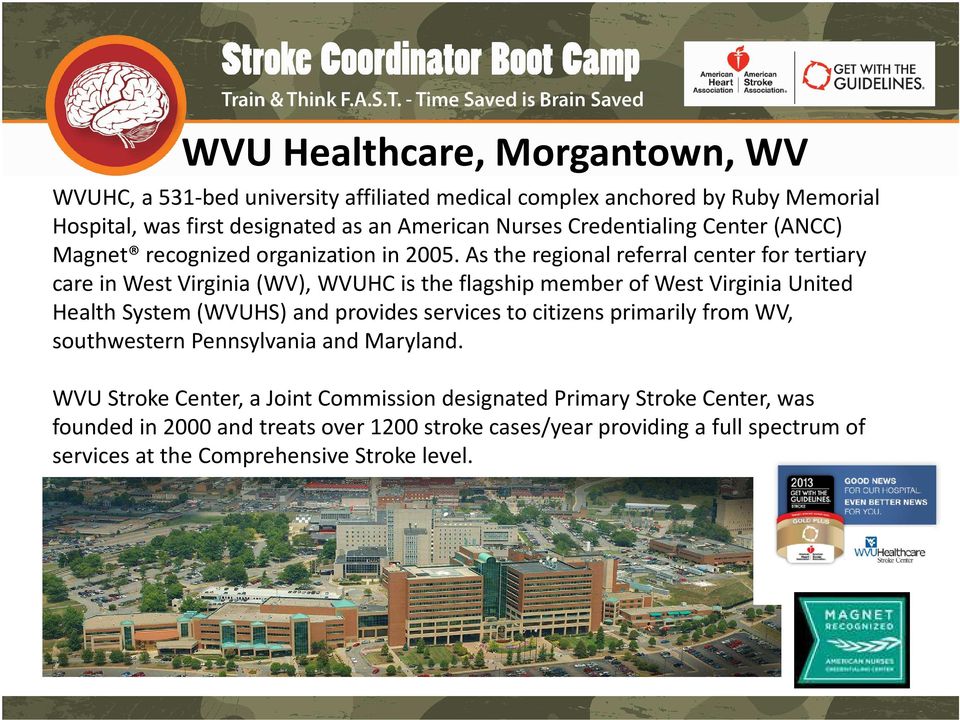
3 WVU Healthcare, Morgantown, WV WVUHC, a 531-bed university affiliated medical complex anchored by Ruby Memorial Hospital, was first designated as an American Nurses Credentialing Center (ANCC) Magnet recognized organization in As the regional referral center for tertiary care in West Virginia (WV), WVUHC is the flagship member of West Virginia United Health System (WVUHS) and provides services to citizens primarily from WV, southwestern Pennsylvania and Maryland. WVU Stroke Center, a Joint Commission designated Primary Stroke Center, was founded in 2000 and treats over 1200 stroke cases/year providing a full spectrum of services at the Comprehensive Stroke level.
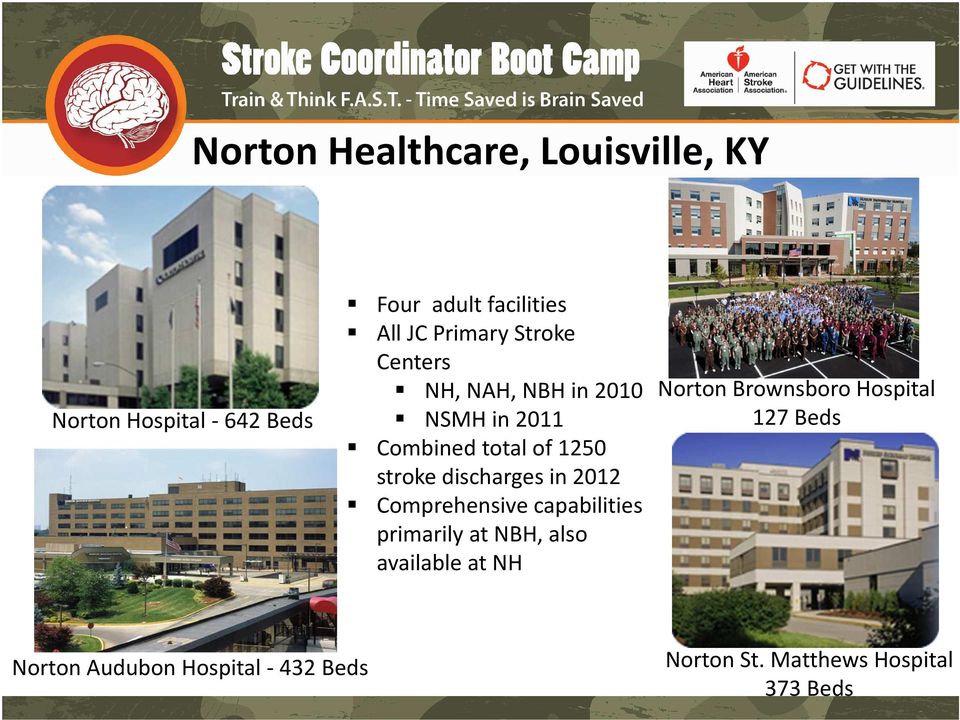
4 Norton Healthcare, Louisville, KY Norton Hospital Beds Four adult facilities All JC Primary Stroke Centers NH, NAH, NBH in 2010 NSMH in 2011 Combined total of 1250 stroke discharges in 2012 Comprehensive capabilities primarily at NBH, also available at NH Norton Brownsboro Hospital 127 Beds Norton Audubon Hospital Beds Norton St. Matthews Hospital 373 Beds
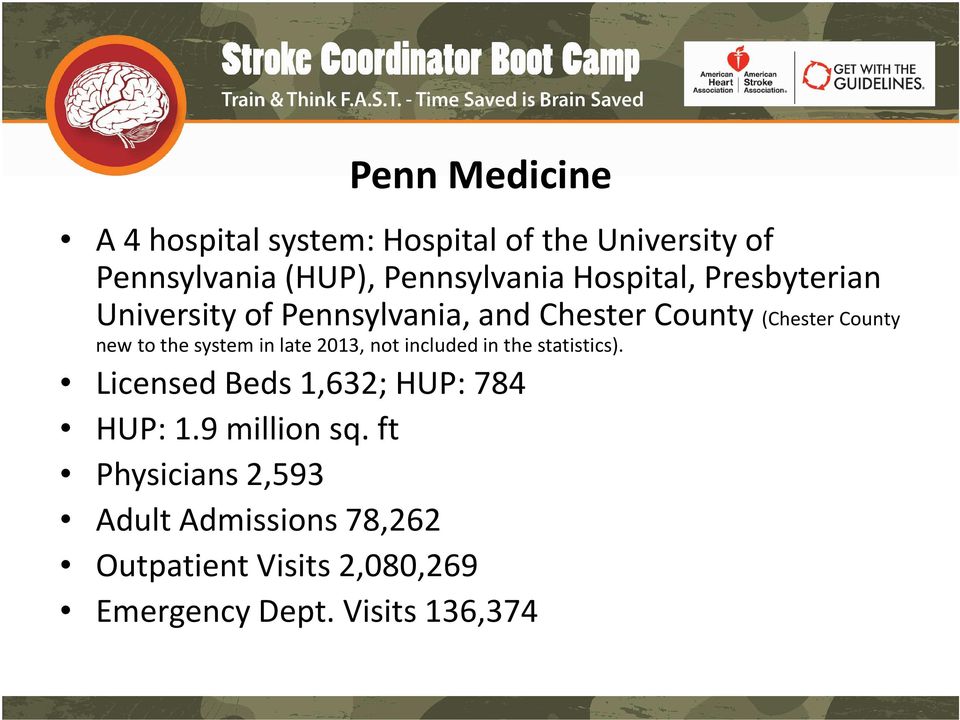
5 Penn Medicine A 4 hospital system: Hospital of the University of Pennsylvania (HUP), Pennsylvania Hospital, Presbyterian University of Pennsylvania, and Chester County (Chester County new to the system in late 2013, not included in the statistics). Licensed Beds 1,632; HUP: 784 HUP: 1.9 million sq. ft Physicians 2,593 Adult Admissions 78,262 Outpatient Visits 2,080,269 Emergency Dept. Visits 136,374
6 STROKE CARE at Penn Medicine HUP is a Comprehensive Stroke Center-about 90 stroke patients per month. Tele-stroke HUB and Spoke Model. PAH, PPMC, and Chester County are Primary Stroke Centers. Good Shepherd-Penn Partners is a CARF-Stroke certified rehabilitation center.

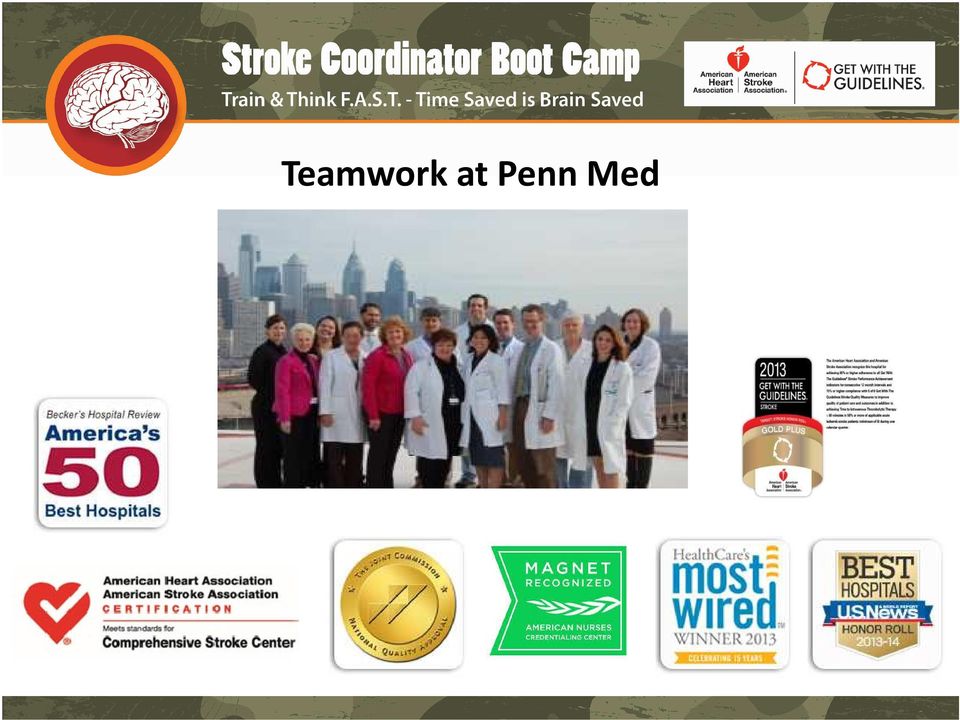
7 Teamwork at Penn Med
8 OBJECTIVE To verbalize and/or demonstrate two new strategies for quality improvement and data analysis that will enhance your skills as a stroke coordinator.

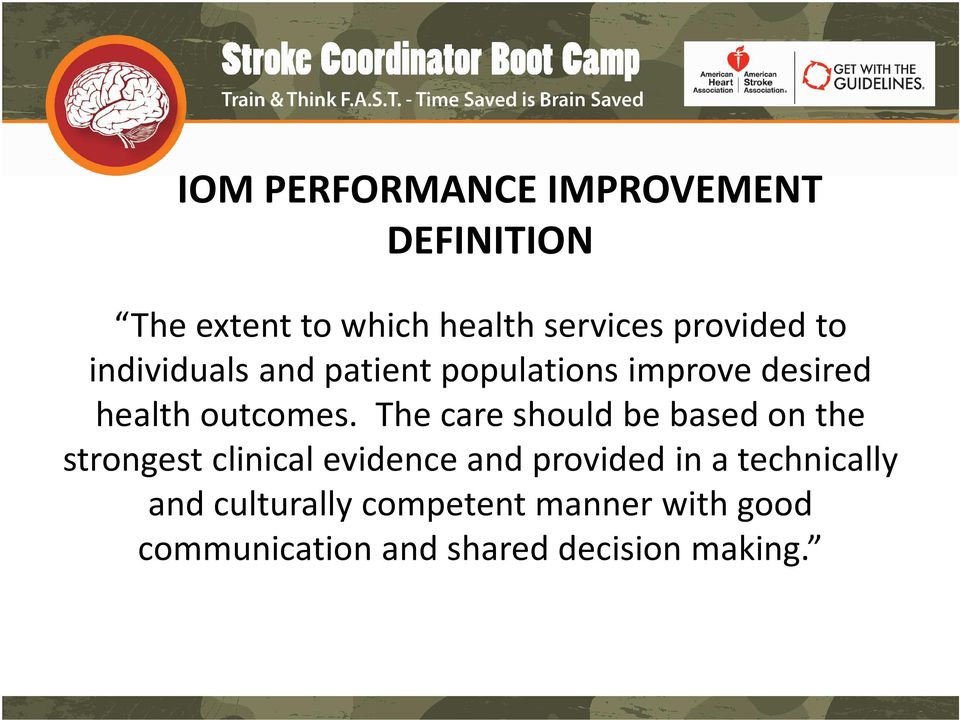
9 IOM PERFORMANCE IMPROVEMENT DEFINITION The extent to which health services provided to individuals and patient populations improve desired health outcomes. The care should be based on the strongest clinical evidence and provided in a technically and culturally competent manner with good communication and shared decision making.
10 PI PRIMER All Assessment of Practice Improvement (PI) activities must follow four steps: Measure The initial sample involves looking at ten or more patients with a specific condition or clinical situation. Measurements can involve any core measure or patient demographic metric. Compare There should be a clearly defined metric to monitor change in performance. When national benchmarks are available, they should be used for comparisons to your data. For measures for which there are no readily available benchmarks, the first measure set can be used as a baseline for future comparison.

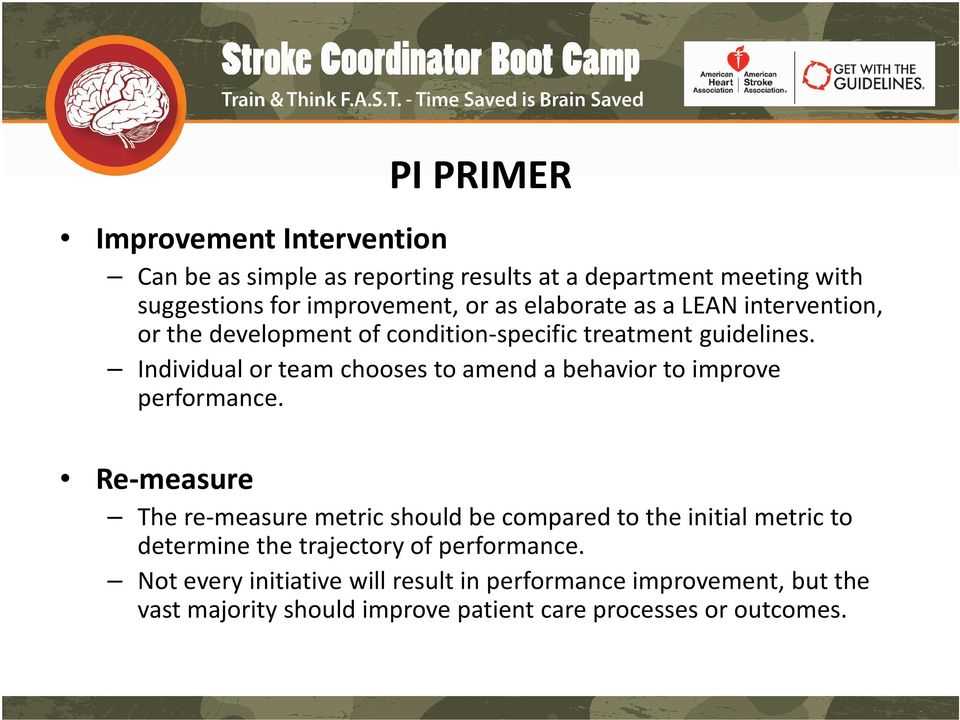
11 PI PRIMER Improvement Intervention Can be as simple as reporting results at a department meeting with suggestions for improvement, or as elaborate as a LEAN intervention, or the development of condition-specific treatment guidelines. Individual or team chooses to amend a behavior to improve performance. Re-measure The re-measure metric should be compared to the initial metric to determine the trajectory of performance. Not every initiative will result in performance improvement, but the vast majority should improve patient care processes or outcomes.
12 NHC PI Methodology Example: DMAIC Phase Outcome Define - Problem Defined - Key process metric(s) identified (id by customers) Measure - Understand Current Process - List of inputs that might be causing the problem - Accurate baseline data (KPOMs) Analyze - Process waste identified - Prioritized list of critical barriers and root cause(s) Improve Control - New process identified - Actions needed to deploy new process + pilot - Hard-wired process w/ hand-off to business owner - Celebration!

13 STROKE CARE How do we get a sense of the quality? What s the best way to care for stroke patients? Are there guidelines for care of a stroke patients?
14 STROKE CARE Guidelines are the basis for protocols for treating the Acute Stroke Patient e.g. BAC - Drive the quality care of stroke patients GWTG-Stroke helps facilities ensure continuous improvement of stroke treatment by aligning clinical care with evidence-based guidelines

15 DATA Quality measures or metrics apply to processes and aspects of care that are strongly supported by science. Each metric needs to be analyzed and evaluated: - Where does the information come from? -What is done with it? -Who is responsible for what? -How is it coordinated?

16 DATA CONSIDERATIONS Who? What? When? Why? Need a systematic data collection process 100% retrospective, random sampling, or concurrent abstraction Stroke Database or Registry (e.g. GWTG, Coverdell) Validation process & reliability studies Specific metrics and targets reviewed on a regular basis Ability to externally benchmark

17 QUALITY MONITORING Collaborative discussions with physicians and other healthcare groups Standing Stroke Care Committee Loop closure Integration with Hospital PI process

18 SAMPLING METHODOLOGY Sampling -a process of selecting a representative part of a population in order to estimate the organization s performance, without collecting data for its entire population. Sampling is done by diagnosis and should be done using available databases that contain monthly patient discharge information, ICD-9/10- CM diagnosis codes, and other necessary administrative data (e.g., only patients 18 and older are included in the DSC stroke measures). The DSC-Stroke measure set sampling populations are: Patients with ICD-9/10 -CM Codes for Ischemic Stroke Patients with ICD-9/10 -CM Codes for Hemorrhagic Stroke

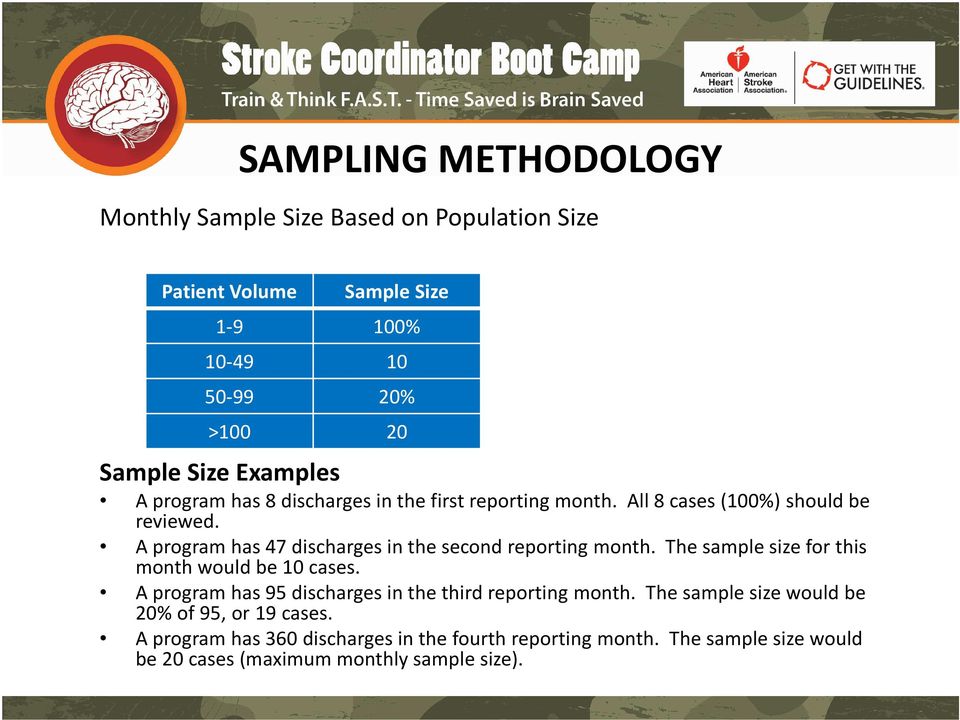
19 SAMPLING METHODOLOGY Monthly Sample Size Based on Population Size Patient Volume Sample Size % % > Sample Size Examples A program has 8 discharges in the first reporting month. All 8 cases (100%) should be reviewed. A program has 47 discharges in the second reporting month. The sample size for this month would be 10 cases. A program has 95 discharges in the third reporting month. The sample size would be 20% of 95, or 19 cases. A program has 360 discharges in the fourth reporting month. The sample size would be 20 cases (maximum monthly sample size).
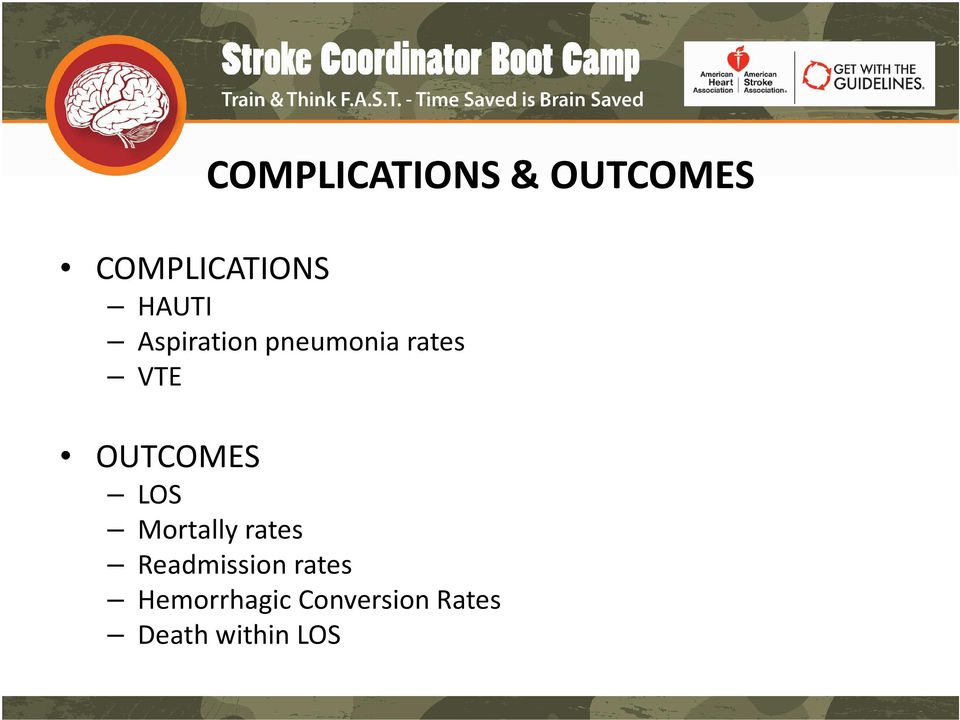
20 COMPLICATIONS & OUTCOMES COMPLICATIONS HAUTI Aspiration pneumonia rates VTE OUTCOMES LOS Mortally rates Readmission rates Hemorrhagic Conversion Rates Death within LOS
21 CORE MEASURES WHAT ARE THEY? Evidence based care interventions shown to provide best outcomes. High volume; problem-prone; costly diagnosis Originally introduced by The Joint Commission and CMS in Data collection began in 2002 on standardized core performance measures.
22 STRATEGIES TO MEET CORE MEASURES Embed the measures in your documentation tools (e.g. teaching handouts) Incorporate into Order sets (e.g. EMR use of hard stops and drop down options) Core Measure checklists or concurrent chart review for validation prior to discharge Incorporate measures in staff/md training Ongoing reporting through PI structure
23 INTERNAL AND EXTERNAL REPORTING Internal reporting Stroke Care Committee Hospital Performance Improvement Structure BOD Other Stroke care providers (e.g. Neuro unit bulletin boards) External reporting The Joint Commission quarterly submissions CMS quarterly submissions
24 THE JOINT COMMISSION (TJC) PRIMARY STROKE CENTER (PSC) STROKE CARE MEASURES
25 STK-1 VTE Prophylaxis Description: Patients with an ischemic stroke or a hemorrhagic stroke who received VTE prophylaxis or have documentation why no VTE prophylaxis was given the day of or the day after hospital admission Strategies: Ensure organizational policy for VTE includes stroke care Align policy with meaningful use expectations Align policy with quality measures and safety goals Examine stroke admission order set and transfer order sets for inclusion of VTE prophylaxis Embed the VTE protocol into the stroke admission order set Develop system for training and education on VTE policy
26 Documentation STK-1 VTE Prophylaxis Should include the date antithrombotic therapy was initiated: Day of or the day after hospital admission The type of VTE prophylaxis provided The reason(s) why antithrombotic therapy was not administered the day of or the day after hospital admission If the patient was ambulating, on the day of admission or the day after admission
27 STK 2 Discharged on Antithrombotic Therapy Description:Patients with an ischemic stroke prescribed antithrombotic therapy at discharge. Strategies: A standardized procedure for patient education should include medications prescribed at discharge. Incorporate antithrombotic therapy was prescribed in the standardized discharge order set and contraindications as a prompt to document the reason(s) why not prescribed. Develop a list of antithrombotic medications within the EMR as a prompt.
28 STK 3 Patients with Afib/Flutter Receiving Anticoagulation Therapy Description: Patients with an ischemic stroke with afib/flutter discharged on anticoagulation therapy Strategies: Standardized admission order set includes anticoagulation therapy for afib/flutter Admission assessment should include a question about the patient s medical history of afib/flutter and medications prior to admission Documentation should include any history of afib/flutter or present afib/flutter Standardized discharge order set should include anticoagulation therapy for afib/flutter Incorporate anticoagulation therapy was prescribed in the standardized discharge order set and contraindications as a prompt to document the reason(s) why not prescribed. Develop a list of anticoagulation medications within the EMR as a prompt
29 STK - 4 Thrombolytic Therapy Administered Description: Acute ischemic stroke patients who arrive at the hospital within 120 minutes (2 hours) of time last known well and for whom IV tpa was initiated at this hospital within 180 minutes (3 hours) of time LKW Strategies: Educational sessions could be developed that focus on the benefits of tpa Develop Stroke Team Alert Pathway that should include: - Pre-hospital information - Time to treatments - Tests and procedures - Nursing interventions - Physician Orders - Medications
30 KEY TIME INTERVAL GOALS
31 STK - 4 Thrombolytic Therapy Administered Strategies (con t): Standing orders for tpa that include: patient eligibility criteria; contraindications; medication administration; BP management; suspected ICH management, nursing interventions Risks and benefits of tpa should be explained to the patient and/or caregiver and documented Admission orders should address patients post-tpa Treat and Transfer protocols should be in place Establish a relationship with the receiving hospital and EMS
32 STK 5 Antithrombotic Therapy by End of Hospital Day 2 Description: Patients with ischemic stroke who receive antithrombotic therapy by the end of hospital day two (day after patient arrival). Strategies: Standardized admission order set that includes antithrombotic therapy for early secondary prevention Standing order should state when to initiate antithrombotic therapy (e.g. if given tpa should state not to begin antithrombotic therapy within 24 hours of tpa administration) If not initiated by the end of hospital day 2 the reason(s) should be documented in patient's medical record. Admission assessment should include a question about the patient's medical history of antithrombotic therapy prior to admission
33 STK 6 Discharged on Statin Medication Description: Ischemic stroke patients with LDL > 100 or LDL not measured, or, who were on cholesterol reducing therapy prior to hospitalization are discharged on statin medication. Strategies: Standardized admission order set that includes information related to cholesterol levels and cholesterol medications (e.g. under Labs, include fasting lipid profile within 48 hours of admission) Admission assessment should include a question about the patient s medical history of dyslipidemia and medications for dyslipidemia prior to admission Include Statins or other cholesterol medications in the stroke education patient procedure Standardized discharge order set for stroke includes under the medications sections, statins or other cholesterol medications prescribed and if not prescribed the reason(s) why not. Contraindications could be listed as a prompt for documentation.
34 STK 8 Stroke Education Description: Patients with ischemic or hemorrhagic stroke or their caregivers who were given educational materials during the hospital stay addressing all of the following: risk factors for stroke, warning signs for stroke, activation of EMS, the need for follow-up after discharge, and medications prescribed at discharge. Strategies: Develop a stroke education policy, review and revise annual as necessary: -Who completes the education -When is education completed -How is it documented Include stroke education in the stroke order set and EMR Standardize education materials
35 STK 10 Assessed for Rehabilitation Description: Patients with an ischemic or hemorrhagic stroke who were assessed for rehabilitation services. Strategies: Standardized admission order set that includes therapy consultations (PT, OT, SLP) Discharge order set should include documentation that the patient was assessed for rehabilitation; if patient was ineligible for rehabilitation and the reason(s) why. Develop a protocol for rehabilitation services Include a mechanism for follow-up after discharge
36 TARGET STROKE BEST PRACTICE STRATEGIES To reduce DTN time for IV tpa in acute ischemic stroke: Advance hospital notification by EMS Rapid triage protocol and Stroke Team notification Single call activation system Stroke Tools: Stroke specific order sets, guidelines, algorithms, pathways, NIHSS, etc. Rapid acquisition and interpretation of brain imaging Rapid laboratory testing
37 REPORTING QUALITY METRICS
38 DATA VALIDATION Validations -Regular process of evaluating data abstraction to ensure registry entries are accurate Registry validations: Intensive Chart Review: e.g. Carotid Stent Stroke within LOS
39 DATA RELIABILITY (INTER-RATER RELIABILITY) Reliability Studies: Both the original Abstractor and a second abstractor review the same charts Compare findings to identify opportunities for improvement through education or further inclusion/exclusion criteria refinement **The Joint Commission recommends 5 charts/quarter**
40 QUALITY REPORT CARD KEY ELEMENTS Measures/Metrics: Volume (e.g.# ischemic strokes) Process (e.g. Door to Needle Time) Outcome (e.g. Deaths within 24 hours of neuroangiography) Data trends over time Benchmark comparisons
41 Sample Stroke Report Card
42 CMS Reporting Effective January 1, 2013 hospitals are required to report 8 stroke quality measures to CMS through their Inpatient Quality Reporting (IQR) process to avoid a 2.0% penalty in the update for Medicare reimbursement payments in the ensuing fiscal year. If you are a Get With The Guidelines-Stroke participating hospital, you may choose to use Outcome (CMS approved vendor) to submit the stroke core measures (additional fees apply)
43 MULTIDISCIPLINARY STROKE COMMITTEE Responsible for providing vision and direction for stroke care May be coordinated by the Stroke Coordinator, QI staff, the Stroke Medical Director or another physician, or an administrator Representation from all professions that touch stroke patients
44 MULTIDISCIPLINARY STROKE COMMITTEE Meeting frequency and agendas: -At minimum quarterly; more frequently if newly established - Agendas can be prepared by the Coordinator -First focus on team responsibilities and program planning (identify strengths and gaps) -As the program matures, focus on PI
45 MULTIDISCIPLINARY STROKE COMMITTEE Identify strengths and gaps of the stroke program based on data review Review and research current guidelines and best practices and develop P & P Review stroke algorithms, pathways, order sets Develop a work plan to track activities, responsibilities and timelines Review Data on a regular basis, but start small and use the data to guide the process Report to the hospital BODs on a regular basis, at least annually
46 Strategies: Case Study HAUTI in Stroke Infection Control RNs review data and identify HAUTI (consistency, conformity to national definitions); Reported on Stroke Report Card and included in house wide PI reports No Foley in Stroke Campaign Guidelines & order set developed for foley use in INR Education for RNs and physicians Stroke Coordinator f/u individually with MDs who have ordered foleys & nurses who insert them Use of bladder scanners on inpatient units No foley Incorporated into Stroke order set
47 NHC: DTN Project Overview DMAIC Project Description: In 2011, 24 ED Stroke Patients were treated with rt-pa out of a total ischemic stroke patient population of 558 patients (4.5%). Of the 24 patients, only 4 (16%) had a door-to-needle time of 60 min or less. Timely use of rt-pa benefits the patient in the following ways: Drug Effectiveness: 33% probability of a higher-score recovery outcome vs. no treatment Increased Benefit: Increased probability of favorable outcome at 3 months post-event as OTT (Last known well to rt-pa administration) decreased showing statistical significance (p=0.005<<0.05) Project Scope: All stroke patients eligible for rt-pa (LKW). Start: Patient arrival at ED / End: Administration of rt-pa Project Goal:Achieve median DTN time of 60 min or less.
48 NHC: Improvement Sustained?? DMAIC
49 Celebrate Your Success!! DMAIC NHC Facility (mins) DTN Norton Brownsboro 39 Norton Audubon 37 Norton St. Mattews 37 Norton Hospital 21
50 Resources/Websites Brain Attack Coalition - American Heart Association/American Stroke Association - Comprehensive Overview of Nursing and Interdisciplinary Rehabilitation Care of the Stroke Patient Guidelines for the Management of Spontaneous Intracerebral Hemorrhage NIHSS Certification - AHA/ASA Representative The Joint Commission - American Association of Neurological Nursing - Get with the Guidelines
51 References pital_inpatient_quality_measures/ ineshfstroke/get-with-the-guidelines-stroke-home- Page_UCM_306098_SubHomePage.jsp Activase.com qoverview.pdf m_improvement_0211 Kallem, Crystal. "Analyzing Clinical Quality Measures for Meaningful Use." Journal of AHIMA 81, no.11 (November/December 2010):
52 QUESTIONS?
Traditional and Emerging Roles of the Stroke Coordinator. Kathy Morrison, MSN, RN, CNRN, SCRN Jean Luciano, MSN, RN, CNRN, CRNP
 Traditional and Emerging Roles of the Stroke Coordinator Kathy Morrison, MSN, RN, CNRN, SCRN Jean Luciano, MSN, RN, CNRN, CRNP Disclosures: Kathy Morrison - I have no actual or potential conflict of interest
TIME LOST IS BRAIN LOST. TARGET: STROKE CAMPAIGN MANUAL
 TIME LOST IS BRAIN LOST. TARGET: STROKE CAMPAIGN MANUAL 2010, American Heart Association TARGET: STROKE CAMPAIGN MANUAL 01 INTRODUCTION Welcome to the Target: Stroke. The purpose of this manual is to provide
Stroke/VTE Quality Measure Build for Meaningful Use Stage 1
 Stroke/VTE Quality Measure Build for Meaningful Use Stage 1 Presented by Susan Haviland, BSN RN Senior Consult, Santa Rosa Consulting Meaningful Use Quality Measures Centers for Medicare and Medicaid Services
Preparing for Comprehensive Stroke Certification
 Preparing for Comprehensive Stroke Certification Claranne Mathiesen, RN, MSN, CNRN Lori Massaro, MSN, RN, CRNP Deborah Murphy, MSN, RN, CNRN, SCRN, CRNP Disclosures Claranne Mathiesen might discuss off-label
Preparing Your Hospital for Primary Stroke Certification Authors: Wendy J. Smith, BS, MA, RES, RCEP, RN Claranne Mathiesen, MSN, RN, CNRN
 Preparing Your Hospital for Primary Stroke Certification Authors: Wendy J. Smith, BS, MA, RES, RCEP, RN Claranne Mathiesen, MSN, RN, CNRN Disclosures Wendy J. Smith-I have no actual or potential conflict
Level III Stroke Center Data Collection Requirements
 Who? Level III Stroke Center Data Collection Requirements All LERN Level III Stroke Centers. LERN Level I and II Stroke Centers have reporting requirements to The Joint Commission or other Board approved
Your Time on the Island The Role of the Stroke Coordinator
 Your Time on the Island The Role of the Stroke Coordinator Andrea Jaeger, MHA, BSN, CNRN Original Presentation by: Alex Graves, MS, ANP 1 Presenter Disclosure Information Andrea Jaeger, MHA, BSN, CNRN
Stoke Boot Camp: What does the Joint Commission Expect of Me? S. Jennifer Cave-Brown MS, RN, NP, ACNP-BC, CNRN Stroke Coordinator- John Muir Health
 Stoke Boot Camp: What does the Joint Commission Expect of Me? S. Jennifer Cave-Brown MS, RN, NP, ACNP-BC, CNRN Stroke Coordinator- John Muir Health Disclosures None to report 2 Objectives Review overall
HITECH Act Update: An Overview of the Medicare and Medicaid EHR Incentive Programs Regulations
 HITECH Act Update: An Overview of the Medicare and Medicaid EHR Incentive Programs Regulations The Health Information Technology for Economic and Clinical Health Act (HITECH Act) was enacted as part of
ALBERTA PROVINCIAL STROKE STRATEGY (APSS)
 ALBERTA PROVINCIAL STROKE STRATEGY (APSS) Stroke Systems of Care Key Components APSS Pillar Recommendations March 28, 2007 1 The following is a summary of the key components and APSS Pillar recommendations
Preparing Your Hospital for Comprehensive Stroke Certification. Authors: Julie Fussner BSN, RN, CPHQ, SCRN Claranne Mathiesen MSN, RN, CNRN
 Preparing Your Hospital for Comprehensive Stroke Certification Authors: Julie Fussner BSN, RN, CPHQ, SCRN Claranne Mathiesen MSN, RN, CNRN Disclosure Claranne Mathiesen MSN, RN, CNRN Julie Fussner BSN,
QUALITY REPORTING. Zahid Butt MD,FACG October 22, 2010. 2007 Medisolv Inc.
 QUALITY REPORTING Zahid Butt MD,FACG October 22, 2010 The Quality Landscape 100+ Entities Data Sources Claims / Administrative Mandatory Submission Voluntary Submission Other Databases Source: Society
Approved: Acute Stroke Ready Hospital Advanced Certification Program
 Approved: Acute Stroke Ready Hospital Advanced Certification Program The Joint Commission recently developed a new Disease- Specific Care Advanced Certification program for Acute Stroke Ready Hospitals
Stroke Systems of Care
 Stroke Systems of Care Ashutosh P. Jadhav, MD PhD Assistant Professor, Neurology and Neurological Surgery Center for Neuro-endovascular Therapy UPMC Stroke Institute Pittsburgh, PA Stroke chain of survival
REMINDER: Please ensure all stroke and TIA patients admitted to hospital are designated as "Stroke Service" in Cerner.
 ACUTE STROKE CLINICAL PATHWAY QEH/HH PCH KCMH Souris Western Stewart Memorial O'Leary PATIENT ID INCLUSION CRITERIA* All patients admitted to hosptial with a suspected diagnosis of acute ischemic stroke
Medicare & Medicaid EHR Incentive Program Final Rule. Implementing the American Recovery & Reinvestment Act of 2009
 Medicare & Medicaid EHR Incentive Program Final Rule Implementing the American Recovery & Reinvestment Act of 2009 Overview American Recovery & Reinvestment Act (Recovery Act) February 2009 Medicare &
Stroke Rehab Across the Continuum of Care in Quinte Region
 Stroke Rehab Across the Continuum of Care in Quinte Region Adrienne Bell Smith Manager of Rehab Therapies QHC Karen Brown Manger Client Services, Hospital Access South East CCAC Disclosure of Potential
Readmissions as an Enterprise Priority. Presenters 4/17/2014
 Readmissions as an Enterprise Priority April 24, 2014 Presenters Vincent A. Maniscalco, MPA, LNHA Administrator Middletown Park Rehabilitation and Health Care Center [email protected] Eileen
Clinical pathway concept - a key to seamless care
 SECTION 5: PATIENT SAFETY AND QUALITY ASSURANCE 1 Clinical pathway concept - a key to seamless care Audrey Janoly-Dumenil, Hôpital Edouard Herriot, CHU Lyon Marie-Camille Chaumais, Hôpital Antoine Béclère,
Patient and Hospital Characteristics Associated with Assessment For Rehabilitation During Hospitalization for Acute Stroke
 Patient and Hospital Characteristics Associated with Assessment For Rehabilitation During Hospitalization for Acute Stroke Lead Author: Janet Prvu Bettger, ScD, FAHA Duke University ; [email protected]
American Stroke Association Highlights Carla D. English, MHS, MHSA
 AMERICAN STROKE ASSOCIATION HIGHLIGHTS 1 CARLA D. ENGLISH, MHS, MHSA QUALITY & SYSTEMS IMPROVEMENT GREATER SOUTHEAST AFFILIATE ASA VISION: Empower people to live longer, healthier lives free of stroke
convey the clinical quality measure's title, number, owner/developer and contact
 CMS-0033-P 153 convey the clinical quality measure's title, number, owner/developer and contact information, and a link to existing electronic specifications where applicable. TABLE 20: Proposed Clinical
CLINICAL QUALITY MEASURES FINALIZED FOR ELIGIBLE HOSPITALS AND CRITICAL ACCESS HOSPITALS BEGINNING WITH FY 2014
 CLINICAL QUALITY MEASURES FINALIZED FOR ELIGIBLE HOSPITALS AND CRITICAL ACCESS HOSPITALS BEGINNING WITH FY 2014 e 55 0495 2 Emergency Department (ED)- 1 Emergency Department Throughput Median time from
AHA/ASA Ischemic Stroke Performance Measures
 AHA/ASA Ischemic Stroke Performance Measures 1. Venous thromboembolism prophylaxis Percentage of patients with ischemic stroke who receive venous thromboembolism prophylaxis Numerator Hospital day 0 or
AMERICAN BURN ASSOCIATION BURN CENTER VERIFICATION REVIEW PROGRAM Verificatoin Criterea EFFECTIVE JANUARY 1, 2015. Criterion. Level (1 or 2) Number
 Criterion AMERICAN BURN ASSOCIATION BURN CENTER VERIFICATION REVIEW PROGRAM Criterion Level (1 or 2) Number Criterion BURN CENTER ADMINISTRATION 1. The burn center hospital is currently accredited by The
Mission: Lifeline Recommendations for Criteria for STEMI Systems of Care
 Mission: Lifeline Recommendations for Criteria for STEMI Systems of Care The Mission: Lifeline Certification Program will acknowledge STEMI Systems, EMS, Non-PCI/STEMI Referral Centers and PCI/STEMI Receiving
Department of Veterans Affairs VHA DIRECTIVE 2011-038 Veterans Health Administration Washington, DC 20420 November 2, 2011
 Department of Veterans Affairs VHA DIRECTIVE 2011-038 Veterans Health Administration Washington, DC 20420 TREATMENT OF ACUTE ISCHEMIC STROKE (AIS) 1. PURPOSE: This Veterans Health Administration (VHA)
Stroke: Major Public Health Burden. Stroke: Major Public Health Burden. Stroke: Major Public Health Burden 5/21/2012
 Faculty Prevention Sharon Ewer, RN, BSN, CNRN Stroke Program Coordinator Baptist Health Montgomery, Alabama Satellite Conference and Live Webcast Monday, May 21, 2012 2:00 4:00 p.m. Central Time Produced
EMS Management of Stroke. Deaver Shattuck, M.D. Brian Wiseman, M.D. Keith Woodward, M.D.
 EMS Management of Stroke Deaver Shattuck, M.D. Brian Wiseman, M.D. Keith Woodward, M.D. Financial Disclosure: No relevant financial relationship exists Working Together to End Stroke Formed in 2013 Identified
Building an Emergency Response to Acute Stroke
 Great Lakes Stroke Network August 2006 Building an Emergency Response to Acute Stroke Wende N. Fedder RN, BSN, MBA Director, Stroke & Neurovascular Services Alexian Brothers Hospital Network Elk Grove
TORONTO STROKE FLOW INITIATIVE - Inpatient Rehabilitation Best Practice Recommendations Guide (updated January 23, 2014)
 TORONTO STROKE FLOW INITIATIVE - Inpatient Rehabilitation Best Practice Guide (updated January 23, 2014) Objective: To enhance system-wide performance and outcomes for persons with stroke in Toronto. Goals:
PLAN OF CORRECTION. Provider's Plan of Correction (Each corrective action must be cross-referenced to the appropriate deficiency.)
 ID Prefix Tag (X4) R000 R200 Provider's Plan of Correction (Each corrective action must be cross-referenced to the appropriate deficiency.) Submission and implementation of this Plan of Correction does
Overview of the TJC/CMS VTE Core Measures
 Overview of the TJC/CMS VTE Core Measures CMS Specification Manual 4.2 January 1, 2013 June 30, 2013 Victoria Agramonte, RN, MSN Project Manager, IPRO VTE Regional Learning Sessions NYS Partnership for
REACHING ZERO DEFECTS IN CORE MEASURES. Mary Brady, RN, MS Ed, Senior Nursing Consultant, Healthcare Transformations LLC,
 REACHING ZERO DEFECTS IN CORE MEASURES Mary Brady, RN, MS Ed, Senior Nursing Consultant, Healthcare Transformations LLC, 165 Lake Linden Dr., Bluffton SC 29910, 843-364-3408, [email protected] Primary
Primary and Comprehensive Stroke Center Designation
 Primary and Comprehensive Stroke Center Designation 1 Presenter Disclosure Information Michelle Whaley MSN, CNS, CCRN, CCNS, ANVP-BC Primary and Comprehensive Stroke Center Designation FINANCIAL DISCLOSURE:
Medical Records Law: Regulatory Issues Meaningful Use? EHR v. EMR
 Medical Records Law: Regulatory Issues Meaningful Use? EHR v. EMR Conrad Meyer JD MHA FACHE Health Care Section Chair Chaffe McCall, LLP [email protected] (504) 585-7067 6/20/2011 McCall 1 Introduction
ACUTE STROKE PATHWAY
 ACUTE STROKE PATHWAY THERE IS A NEED FOR STATEWIDE STROKE SYSTEM OF CARE ALL MISSISSIPPIANS SHOULD BE ABLE TO ACCESS NEW PROTOCOLS FOR STROKE TREATMENT JOINT EFFORT WITH EMS, PHYSICIANS, HOSPITALS AND
Five Myths Surrounding the Business of Population Health Management
 Five Myths Surrounding the Business of Population Health Management Joan Moss, RN, MSN Robert Sehring Chief Nursing Officer and Chief Ministry Services Officer, Senior Vice President, Sg2 OSF HealthCare
Section 6. Medical Management Program
 Section 6. Medical Management Program Introduction Molina Healthcare maintains a medical management program to ensure patient safety as well as detect and prevent fraud, waste and abuse in its programs.
Hospital-Based Sub-Acute Stroke Care and Secondary Prevention. Timothy Lukovits,, M.D.
 Hospital-Based Sub-Acute Stroke Care and Secondary Prevention Timothy Lukovits,, M.D. Volunteer group members Shalini Bansil,, MD Summit NJ Ji Chong,, MD, NYC, NY Srinath Kadimi,, M.D. Fairfield, CT Steve
Heart Failure Best Practice Strategies: Featuring Target: HF Honor Roll Hospitals
 Heart Failure Best Practice Strategies: Featuring Target: HF Honor Roll Hospitals 12/18/2013 12/18/13 2013, American Heart Association 1 Thank you for Joining the Webinar Today. The Presentation will Begin
Examining the Peer Review Process: Reviewing and Monitoring Your Hospital s Stroke Care
 Examining the Peer Review Process: Reviewing and Monitoring Your Hospital s Stroke Care Mary Ciechanowski, MSN, APRN, ACNS-BC, CCRN Maureen DePrince, RN, BA, CCRN, SCRN Deborah Murphy, MSN, RN, CRNP, CNRN,
Making the Case for CPG s Jean Luciano, MSN, RN, CNRN, SCRN, CRNP, FAHA Claranne Mathiesen, MSN, RN, CNRN, SCRN, FAHA
 Making the Case for CPG s Jean Luciano, MSN, RN, CNRN, SCRN, CRNP, FAHA Claranne Mathiesen, MSN, RN, CNRN, SCRN, FAHA Disclosures Jeanie Luciano Genentech speakers bureau Claranne Mathiesen - none 1 Objective
Accreditation and Certification Guidelines
 Accreditation and Certification Guidelines MARTIN GIZZI, MD, PHD, FAHA CHAIR, NJ NEUROSCIENCE INSTITUTE AT JFK CHAIR, NORTH EAST CEREBROVASCULAR CONSORTIUM (NECC) CHAIR, STROKE ADVISORY PANEL, NJDOH MEMBER,
emeasures Transitions
 WHITE PAPER 1010100010101010101010101001000011001 10101000101101101000100000101010010000101011001001010110 0101000101101010001010101010101010100100001010 0101000101101010001011011010001000001010100100
Transforming the pharmacy into a strategic asset
 Transforming the pharmacy into a strategic asset Unlocking hidden savings Ten-hospital health system in the Midwest Success snapshot In a time of reimbursement reductions and declining revenue, cost reduction
TORONTO STROKE FLOW INITIATIVE - Outpatient Rehabilitation Best Practice Recommendations Guide (updated July 26, 2013)
 Objective: To enhance system-wide performance and outcomes for persons with stroke in Toronto. Goals: Timely access to geographically located acute stroke unit care with a dedicated interprofessional team
Performance Measurement for the Medicare and Medicaid Eligible (MME) Population in Connecticut Survey Analysis
 Performance Measurement for the Medicare and Medicaid Eligible (MME) Population in Connecticut Survey Analysis Methodology: 8 respondents The measures are incorporated into one of four sections: Highly
NY Medicaid. EHR Incentive Program
 Eligible Hospitals Participation Year 2-3 (MU1) Webinar www.emedny.org/meipass 1 Background Original Legislation The Health Information Technology for Economic and Clinical Health (HITECH) Act, part of
Boot Camp for Primary Stroke Certification. Sharon Eberlein RN MBA BSN NE-BC
 Boot Camp for Primary Stroke Certification Sharon Eberlein RN MBA BSN NE-BC Speaker Information Sharon Eberlein RN Neuroscience Program Director Texas Stroke Institute Plaza Medical Center of Fort Worth
EHR Meaningful Use 2014 (Stage 1 & 2) DR Reporting Strategies
 EHR Meaningful Use 2014 (Stage 1 & 2) DR Reporting Strategies International MUSE Conference 2013 Educational Session: #1179 Date: Friday May 31 at 3:30 pm Presenter: Glen D Abate Session Agenda CMS EHR
2016 International Stroke Conference Hot Topics Lori M. Massaro, MSN, CRNP Kari Moore, MSN, AGACNP-BC
 2016 International Stroke Conference Hot Topics Lori M. Massaro, MSN, CRNP Kari Moore, MSN, AGACNP-BC Disclosures Lori M. Massaro, MSN,CRNP speakers bureau Genentech Kari Moore, MSN, AGACNP-BC -none 1
Dr. Peters has declared no conflicts of interest related to the content of his presentation.
 Dr. Peters has declared no conflicts of interest related to the content of his presentation. Steve G. Peters MD NAMDRC 2013 No financial conflicts No off-label usages If specific vendors are named, will
Texas Heart Attack and Stroke Data Collection Initiative: Data Update. Nimisha Bhakta, MPH Texas Heart Attack and Stroke Summit July 24, 2015
 Texas Heart Attack and Stroke Data Collection Initiative: Data Update Nimisha Bhakta, MPH Texas Heart Attack and Stroke Summit July 24, 2015 Presenter Disclosure Information FINANCIAL DISCLOSURE: I have
Sanford Improvement Making Lean Work in Healthcare
 Sanford Improvement Making Lean Work in Healthcare David Peterson Enterprise Director of Continuous Improvement Outline/Agenda Office of Continuous Improvement Who are we and what do we do? History/Journey
Journey to Excellence
 Journey to Excellence Kevin W. Sowers, MSN, RN, FAAN President, Duke University Hospital 2 Agenda Introduction to Duke Medicine Call to Action: The Jesica Santillan Story Duke University Hospital s Journey
Application for Research
 Application for Research All research conducted within the Brooks Rehabilitation system or any entity or facility bearing the Brooks name, including the Brooks Rehabilitation Clinical Research Center,
Best Practice Recommendations for Inpatient Stroke Care: Rationale and Evidence for Integrated Stroke Units in North Simcoe Muskoka LHIN
 Best Practice Recommendations for Inpatient Stroke Care: Rationale and Evidence for Integrated Stroke Units in North Simcoe Muskoka LHIN Physician Education Session May 24, 2013 Dr. Mark Bayley,, Cheryl
Avoiding Rehospitalizations in LTC Chris Osterberg, RN BSN Pathway Health Services
 Avoiding Rehospitalizations in LTC Chris Osterberg, RN BSN Pathway Health Services Objectives Understand the new consequences to hospitals for discharged clients being re-admitted within selected time
May 7, 2012. Submitted Electronically
 May 7, 2012 Submitted Electronically Secretary Kathleen Sebelius Department of Health and Human Services Office of the National Coordinator for Health Information Technology Attention: 2014 edition EHR
Capacity Management: Patient Throughput and Case Management Improvement. February 25, 2015
 Capacity Management: Patient Throughput and Case Management Improvement February 25, 2015 Agenda Introduction Impetus for Change Approach to Improving Case and Capacity Management Client Case Study Key
Get With The Guidelines Best Practices: A look at reducing 30-day heart failure readmission rates
 Get With The Guidelines Best Practices: A look at reducing 30-day heart failure readmission rates Thank you for joining the webinar! The presentation will begin shortly. *Please make sure your computer
TPA, STROKE, & TELEMEDICINE. Improving utilization and improving outcomes in a constantly evolving field
 TPA, STROKE, & TELEMEDICINE Improving utilization and improving outcomes in a constantly evolving field OVERVIEW tpa inclusion and exclusion evolution Challenges to tpa administration Target:Stroke Telemedicine
This proposed rule clarifies and makes updates to details regarding this program that were finalized in
 2014 Ambulatory Surgery Center (ASC) and Outpatient Prospective Payment System (OPPS) A Summary of the Quality Provisions of the Proposed Rule Overview On July 8, 2013, the Centers for Medicare and Medicaid
A Review of the Hospital Performance Data Expansion Policy and Outpatient Measures Data Requirements
 A Review of the Hospital Performance Data Expansion Policy and Outpatient Measures Data Requirements Theressa Lee, Director, Center for Quality Measurement and Reporting Presented to the HSCRC Performance
Providence Telemedicine Network
 Providence Telemedicine Network Around the clock, around the region, our specialists are with you when every minute counts. Telemedicine brings our specialists to your hospital It is exciting to report
Marina Richardson, M.Sc. Deb Willems, BSc.PT David Ure, OT Robert Teasell, MD FRCPC
 Assessing the Impact of Southwestern Ontario s Community Stroke Rehabilitation Teams: An Economic Analysis Presenters: Laura Allen, M.Sc. (cand.) Matthew Meyer, Ph.D (cand.) Marina Richardson, M.Sc. Deb
Review of the Stroke and VTE Measure Sets
 Review of the Stroke and VTE Measure Sets Vicky Agramonte, RN, MSN IPRO Quality Data Reporting and Improvement Project Presentation to NYS Hospitals January 29, 2013 The QIO Program CMS Leads a national
What do ACO s and Hospitals want from SNF s and CCRC s
 What do ACO s and Hospitals want from SNF s and CCRC s Presented to the Institute of Senior Living, April 11, 2013 A Division of Kindred Healthcare 1 Assessing the match: What hospitals and ACO s currently
The Centers for Medicare & Medicaid Services (CMS) Acute Care Hospital Fiscal Year (FY) 2018 Quality Improvement Program Measures
 ID Me asure Name NQF # - (HRRP) ID Me asure Name NQF # - (HRRP) ID Me asure Name NQF # - (HRRP) CMS Measures Fiscal Year 2018 The Centers for Medicare & Medicaid Services (CMS) Acute Care Fiscal Year (FY)
Get With The Guidelines - Stroke PMT Special Initiatives Tab for Ohio Coverdell Stroke Program CODING INSTRUCTIONS Effective 10-24-15
 Get With The Guidelines - Stroke PMT Special Initiatives Tab for Ohio Coverdell Stroke Program CODING INSTRUCTIONS Effective 10-24-15 Date and time first seen by ED MD: The time entered should be the earliest
Medicare & Medicaid EHR Incentive Program Meaningful Use Stage 1 Requirements Summary. http://www.cms.gov/ehrincentiveprograms/
 Medicare & Medicaid EHR Incentive Program Meaningful Use Stage 1 Requirements Summary 2010 What are the Requirements of Stage 1 Meaningful Use? Basic Overview of Stage 1 Meaningful Use: Reporting period
Coordinating Transitions of Care: It Takes a Village
 Coordinating Transitions of Care: It Takes a Village Ken Laube RN, BSN, MBA: Vice President Clinical Excellence Situation/Background Patients face significant challenges when moving from one health care
Hospital Inpatient Quality Reporting (IQR) Program
 Clinical Process Measures Program Changes for Fiscal Year 2014 Beginning with January 1, 2012 discharges; hospitals will begin data collection and submission for 4 new measures. Hospitals will not be required
Know Your Neighbor: Regional Collaboration in Stroke Care
 Know Your Neighbor: Regional Collaboration in Stroke Care Presented by: Therese Poland, RN, BSN, MSN Susan Lautner, RN, BSN, MSHL, CPHQ Jeanne Robinson, RN, BSN, MSN, APN Speakers Therese Poland, RN, BSN,
Triple aim of ACA. Shanty Creek, November 2015. 1. Improved patient experience easier acess 2. Improved quality of healthcare 3.
 Theresa Anderson, West Shore Medical Center Tracey Chappel, West Shore Medical Center Ingemar Johansson, Centra Wellness Network Shanty Creek, November 2015 Triple aim of ACA 1. Improved patient experience
a Foundation for Change
 Continuous Quality Improvement ADEs: Steven Utilizing R. Abel, Measurement PharmD, FASHP as Nital Patel, PharmD. MBA a Foundation for Change Sheri Helms, PharmD Candidate Brian Heckman, PharmD Candidate
Crosswalk: CMS Shared Savings Rules & NCQA ACO Accreditation Standards 12/1/2011
 Crosswalk: CMS Shared Savings Rules & NCQA ACO Accreditation Standards 12/1/2011 The table below details areas where NCQA s ACO Accreditation standards overlap with the CMS Final Rule CMS Pioneer ACO CMS
Stacy McLaughlin, RN, MSN. Director of Quality & Performance Improvement
 Stacy McLaughlin, RN, MSN Director of Quality & Performance Improvement 25-bed CAH 21 beds: acute / observation / swingbed 4 bed ICU ED volumes: 14,400 encounters/year 5 Clinics: Rural Health / Primary
Medicaid Comprehensive Rehabilitation Traumatic Brain Injury Memorandum of Understanding Program
 Medicaid Comprehensive Rehabilitation Traumatic Brain Injury Memorandum of Understanding Program Program Overview Carol Hansen RN, BSN, CBIS TBI Program Clinical Specialist 1 TBI MOU Review Referrals Hospitals
Crittenton Hospital Medical Center Primary Stroke Center. Cesar D.Hidalgo, MD. Stroke Program Medical Director
 Crittenton Hospital Medical Center Primary Stroke Center Cesar D.Hidalgo, MD Stroke Program Medical Director 290 bed all-inclusive medical center 500 physicians 54 medical specialties full scope of inpatient,
CHAPTER 535 HEALTH HOMES. Background... 2. Policy... 2. 535.1 Member Eligibility and Enrollment... 2. 535.2 Health Home Required Functions...
 TABLE OF CONTENTS SECTION PAGE NUMBER Background... 2 Policy... 2 535.1 Member Eligibility and Enrollment... 2 535.2 Health Home Required Functions... 3 535.3 Health Home Coordination Role... 4 535.4 Health
1a-b. Title: Clinical Decision Support Helps Memorial Healthcare System Achieve 97 Percent Compliance With Pediatric Asthma Core Quality Measures
 1a-b. Title: Clinical Decision Support Helps Memorial Healthcare System Achieve 97 Percent Compliance With Pediatric Asthma Core Quality Measures 2. Background Knowledge: Asthma is one of the most prevalent