
RISK EVALUATION AND MITIGATION STRATEGY (REMS) Single Shared System for Mycophenolate
|
|
|
- Albert Cannon
- 10 years ago
- Views:
Transcription
1 Initial REMS Approval: 09/25/2012 Most Recent Modification: 09/2013 RISK EVALUATION AND MITIGATION STRATEGY (REMS) Single Shared System for Mycophenolate
2 I. GOALS The goals of the Mycophenolate REMS are: 1. To prevent unplanned pregnancy in patients using mycophenolate and to minimize fetal exposure to mycophenolate by informing prescribers and females of reproductive potential about: the increased risk of first trimester pregnancy loss and congenital malformation associated with exposure to mycophenolate during pregnancy; and the importance of pregnancy prevention and planning 2. To minimize the risks associated with fetal exposure to mycophenolate by collecting information on pregnancy outcomes through the Mycophenolate Pregnancy Registry 3. To inform patients about the serious risks associated with mycophenolate. II. REMS ELEMENTS A. Medication Guide A Medication Guide will be dispensed with each mycophenolate prescription in accordance with 21 CFR The Medication Guides for mycophenolate-containing products are part of the Mycophenolate REMS and will be available on the Mycophenolate REMS website ( B. Elements to Assure Safe Use 1. Healthcare providers who prescribe mycophenolate will receive training. a) Mycophenolate sponsors will ensure that training will be provided to healthcare providers who prescribe mycophenolate-containing products. To become trained, each prescriber will be provided with the Mycophenolate Program Brochure for Healthcare Providers. The brochure includes the following information: i. The risk of first trimester pregnancy loss and congenital malformations associated with mycophenolate ii. iii. Importance of educating females of reproductive potential about the increased risk of first trimester pregnancy loss and congenital malformations associated with exposure to mycophenolate during pregnancy Importance of prescribers providing or facilitating patient education about pregnancy prevention and planning, including acceptable methods of contraception during mycophenolate treatment

3 iv. Importance of only prescribing mycophenolate to a pregnant patient if the benefits of initiating or continuing treatment outweigh the risk of fetal harm v. Importance of reporting to the Pregnancy Registry any pregnancies that occur during mycophenolate treatment or within 6 weeks following discontinuation of treatment vi. vii. Importance of encouraging pregnant patients to participate in the Pregnancy Registry Importance of obtaining a signed Patient-Prescriber Acknowledgement Form from each female of reproductive potential. The Patient-Prescriber Acknowledgement Form is part of the Mycophenolate REMS and is appended b) Mycophenolate sponsors will ensure that prescribers can successfully report that they have taken the training via the Mycophenolate REMS website, mail, fax, or by scanning and ing the Prescriber Training Confirmation Form. The Prescriber Training Confirmation Form is part of the Mycophenolate REMS and is appended. c) Mycophenolate sponsors will maintain a list of all healthcare providers (HCPs) who have completed the Mycophenolate REMS Training. d) Mycophenolate sponsors will redistribute the training materials every two years or following substantive changes that affect the Mycophenolate REMS. Substantive changes are defined as 1) significant changes to the operation of the Mycophenolate REMS; 2) changes to the Prescribing Information and Medication Guide that affect the risk-benefit profile of mycophenolate. e) Mycophenolate sponsors will provide educational materials and a DHCP Letter for Centers to centers (e.g., transplant centers) that choose to administer training to their prescribers through their own centralized process. Mycophenolate sponsors will ensure that a designee of the Center can successfully report the healthcare providers who have participated in the training via the Mycophenolate REMS website, mail, fax, or by scanning and e- mailing the Center Training Confirmation Form. The Center Training Confirmation Form is part of the Mycophenolate REMS and is appended. The DHCP Letter for Centers is part of the Mycophenolate REMS and is appended. f) Mycophenolate sponsors will submit for publication a Journal Information Piece in the following journals: Transplantation American Journal of Transplantation Neurology Arthritis & Rheumatism Journal of the American Academy of Dermatology Journal of the American Society of Nephrology
4 Obstetrics and Gynecology Pediatrics American Family Physician This piece is designed to convey the risks of mycophenolate products, the importance of completing the training, and details on where and how educational materials can be accessed. It will appear monthly for the first 6 months after FDA approval of the REMS and every other month in the subsequent 6 months. The Journal Information Piece is part of the Mycophenolate REMS and is appended. g) Mycophenolate sponsors will ensure that no later than 8 weeks after approval of the REMS, a Dear Healthcare Professional (DHCP) Introductory Letter will be sent to all HCPs who prescribed mycophenolate in the 24 months preceding REMS approval, accompanied by program materials (Prescriber Kit and Patient Kit). Mycophenolate sponsors will ensure that no later than 8 weeks after approval of the REMS, a DHCP Introductory Letter will be sent to all HCPs who: are on the following American Medical Association subspecialty lists: allergy and immunology, immunology, cardiology, dermatology [including surgery, and dermatopathology], gastroenterology, neurology [including surgery and neuropathology], OB/GYN [including maternal fetal medicine], general surgery, thoracic surgery, transplantation surgery, hepatology, nephrology, and rheumatology and all corresponding pediatric subspecialties, and; have not prescribed mycophenolate in the 24 months preceding REMS approval. The DHCP Introductory Letter is designed to convey and reinforce the increased risks of first trimester pregnancy loss and congenital malformation associated with mycophenolate exposure during pregnancy and the importance of prescribers completing the training and will include important safety information about products that contain mycophenolate. The DHCP Introductory Letter will also provide details on where and how educational materials can be ordered. The letter will be available on the Mycophenolate REMS website for 1 year from the date of distribution. The DHCP Introductory Letter is part of the Mycophenolate REMS and is appended. h) Mycophenolate sponsors will maintain a call center to support prescribers interfacing with the Mycophenolate REMS. i) Mycophenolate sponsors will monitor distribution and prescription data monthly to identify new prescribers who should be trained.

5 j) The following materials are part of the Mycophenolate REMS and are appended: Mycophenolate REMS Brochure for Healthcare Providers Patient-Prescriber Acknowledgement Form Prescriber Training Confirmation Form Center Training Confirmation Form DHCP Letter for Centers Journal Information Piece DHCP Introductory Letter Obstetrician/Gynecologist Referral Template Letters for Contraception Counseling Obstetrician/Gynecologist Referral Template Letters for Preconception Counseling Mycophenolate REMS Overview for Patients and Your Birth Control Options Mycophenolate Pregnancy Registry Frequently Asked Questions for Patients Mycophenolate REMS Website These materials will also be available on the Mycophenolate REMS website or by calling the Mycophenolate REMS call center at Mycophenolate sponsors will maintain a centralized pregnancy registry for females who become pregnant and consent to participate. The primary objectives of the Pregnancy Registry are to: Document maternal and fetal outcomes of each exposed pregnancy to further characterize the risk of mycophenolate fetal exposure. Determine mycophenolate exposure status for each reported pregnancy Understand the circumstances that led to the fetal exposure (root cause analysis) Identify factors that affect the risk of adverse outcomes such as dose, timing of exposure, or maternal characteristics III. Timetable for Submission of Assessments Mycophenolate NDA sponsors will submit REMS assessments to FDA every 6 months for the first year from the date of initial approval of the Mycophenolate REMS and annually thereafter. To facilitate inclusion of as much information as possible while allowing reasonable time to prepare the submission, the reporting interval covered by

6 each submission will conclude no earlier than 60 days before the submission date for that assessment. The assessment will be submitted so that it is received by the FDA on or before the due date.

7 BROCHURE FOR HEALTHCARE PROVIDER

8

9 Table of Contents Introducing Mycophenolate REMS 3 Mycophenolate- Related First Trimester Pregnancy Loss and Congenital Malformations.5 Your Role in Mycophenolate REMS.. 6 Reporting a Pregnancy..10 Frequently Asked Questions About Mycophenolate REMS and the Mycophenolate Pregnancy Registry 11 Mycophenolate REMS Resources 14 2
10 Introducing Mycophenolate REMS Mycophenolate REMS (Risk Evaluation and Mitigation Strategy) has been mandated by the FDA (Food and Drug Administration) due to postmarketing reports showing that exposure to mycophenolate during pregnancy is associated with increased risks of first trimester pregnancy loss and congenital malformations. While available data are limited, structural malformations occur in approximately 20% of live-born infants exposed in utero to mycophenolate and first trimester pregnancy loss rates are higher.* The FDA determined that a REMS is necessary to ensure that the benefits of mycophenolate outweigh the risks of first trimester pregnancy loss and congenital malformations associated with mycophenolate use during pregnancy. Mycophenolate is available by prescription as: CellCept (mycophenolate mofetil) Myfortic (mycophenolic acid) Generic formulations of mycophenolate mofetil Generic formulations of mycophenolic acid The goals of the Mycophenolate REMS are: 1. To prevent unplanned pregnancy in patients using mycophenolate and to minimize fetal exposure to mycophenolate by informing prescribers and females of reproductive potential about: The increased risks of first trimester pregnancy loss and congenital malformations associated with exposure to mycophenolate during pregnancy; and The importance of pregnancy prevention and planning 2. To minimize the risks associated with fetal exposure to mycophenolate by collecting information on pregnancy outcomes through the Mycophenolate Pregnancy Registry 3. To inform patients about the serious risks associated with mycophenolate *Sifontis NM, et al. Pregnancy outcomes in solid organ transplant recipients with exposure to mycophenolate mofetil or sirolimus. Transplantation. 2006;82: Prescribing Information for mycophenolate. For complete safety information, please see full Prescribing Information, including Boxed WARNING and Medication Guide, which can be found at 3

11 Introducing Mycophenolate REMS (cont d) All prescribers of mycophenolate and females of reproductive potential, whether or not they plan to get pregnant, should be aware of the risks associated with mycophenolate. Females of reproductive potential include girls who have entered puberty and all women who have a uterus and have not passed through menopause. This brochure, the Mycophenolate REMS Brochure for Healthcare Providers, has been designed to help you understand the components of Mycophenolate REMS. Included are details on what you can do to help ensure the successful implementation of Mycophenolate REMS so that patients understand the risks associated with exposure to mycophenolate during pregnancy. Menopause is the permanent end of menstruation and fertility. Menopause should be clinically confirmed by a patient s healthcare practitioner. Some commonly used diagnostic criteria include: months of spontaneous amenorrhea (not amenorrhea induced by a medical condition or medical therapy); or 2. Postsurgical from a bilateral oophorectomy 4

12 Mycophenolate-Related First Trimester Pregnancy Loss and Congenital Malformations Mycophenolate can cause fetal harm when administered to a pregnant female. Exposure to mycophenolate during pregnancy is associated with an increased risk of: First trimester pregnancy loss Congenital malformations (especially external ear and abnormalities such as a cleft lip and palate) Anomalies in babies of the distal limbs, heart, esophagus and kidney In December 2006, the National Transplantation Pregnancy Registry (NTPR) published data from prospective cases where 24 female transplant patients reported 33 mycophenolate-exposed pregnancies.* Of these pregnancies, there were: 15 spontaneous abortions (45%) 18 live-born infants Four of the 18 live-born infants had structural malformations (22%) The reported malformations were similar to findings in animal reproductive toxicology studies. For comparison, background rate for congenital anomalies in the United States is about 3% and the NTPR data show a rate of 4% to 5% among babies born to organ-transplant patients using other immunosuppressive drugs. Because these postmarketing data are reported voluntarily, it is not always possible to reliably estimate the frequency of particular outcomes. When initiating or continuing treatment with mycophenolate, you should educate females of reproductive potential on the risks associated with exposure to mycophenolate during pregnancy. They need to make informed decisions about treatment. Of the 77 females exposed to systemic mycophenolate during pregnancy that were reported in postmarketing data (collected between 1995 and 2007): 25 had spontaneous abortions 14 had a malformed fetus or infant Six of the 14 malformed offspring had ear abnormalities *Sifontis NM, et al. Pregnancy outcomes in solid organ transplant recipients with exposure to mycophenolate mofetil or sirolimus. Transplantation. 2006;82: Prescribing Information for mycophenolate. 5

13 Your Role in Mycophenolate REMS You need to complete the following steps to help ensure the successful implementation of Mycophenolate REMS with females of reproductive potential: 1. Enroll in Mycophenolate REMS 2. Check Pregnancy Status 3. Educate Females of Reproductive Potential 4. Obtain a Signed Patient-Prescriber Acknowledgment Form 5. Report Any Mycophenolate-Exposed Pregnancies 1. Enroll in Mycophenolate REMS You should become familiar with the risks of embryofetal toxicity associated with mycophenolate and the requirements of Mycophenolate REMS. As a prescriber of mycophenolate, you should enroll in Mycophenolate REMS by completing a Prescriber Training Confirmation Form to document that you understand, and will comply with Mycophenolate REMS. You can submit a Prescriber Training Confirmation Form to Mycophenolate REMS by one of several ways: Visit and complete the online form Complete a hard copy and submit it via fax to Complete a hard copy and mail it to: Mycophenolate REMS 200 Pinecrest Plaza Morgantown, WV Call This brochure is not a comprehensive description of the risks associated with the use of mycophenolate. 6

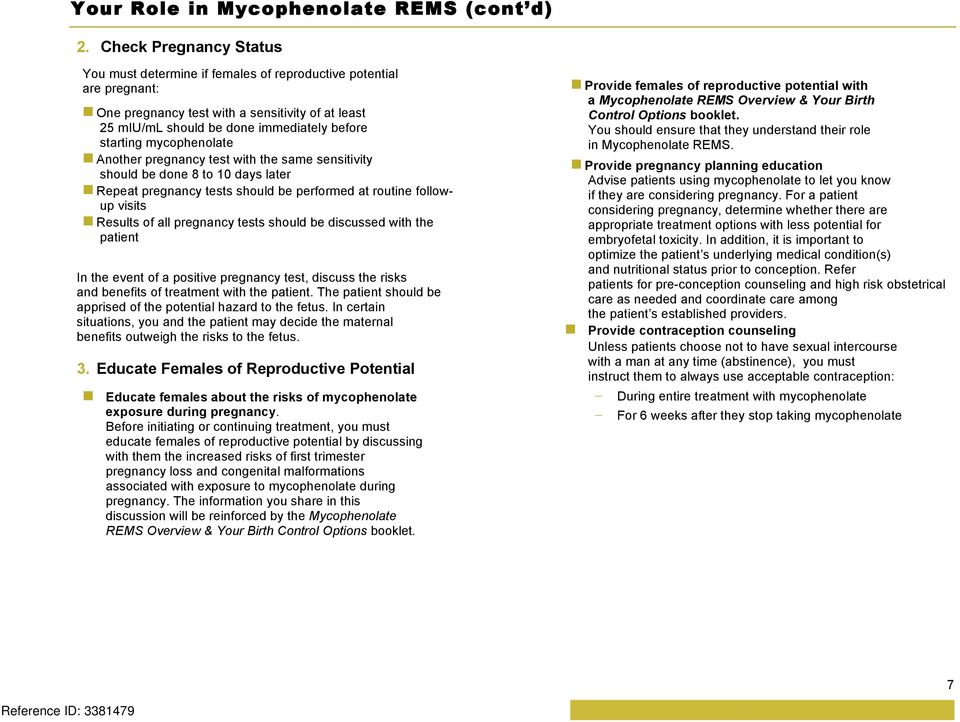
14 Your Role in Mycophenolate REMS (cont d) 2. Check Pregnancy Status You must determine if females of reproductive potential are pregnant: One pregnancy test with a sensitivity of at least 25 miu/ml should be done immediately before starting mycophenolate Another pregnancy test with the same sensitivity should be done 8 to 10 days later Repeat pregnancy tests should be performed at routine followup visits Results of all pregnancy tests should be discussed with the patient In the event of a positive pregnancy test, discuss the risks and benefits of treatment with the patient. The patient should be apprised of the potential hazard to the fetus. In certain situations, you and the patient may decide the maternal benefits outweigh the risks to the fetus. 3. Educate Females of Reproductive Potential Educate females about the risks of mycophenolate exposure during pregnancy. Before initiating or continuing treatment, you must educate females of reproductive potential by discussing with them the increased risks of first trimester pregnancy loss and congenital malformations associated with exposure to mycophenolate during pregnancy. The information you share in this discussion will be reinforced by the Mycophenolate REMS Overview & Your Birth Control Options booklet. Provide females of reproductive potential with a Mycophenolate REMS Overview & Your Birth Control Options booklet. You should ensure that they understand their role in Mycophenolate REMS. Provide pregnancy planning education Advise patients using mycophenolate to let you know if they are considering pregnancy. For a patient considering pregnancy, determine whether there are appropriate treatment options with less potential for embryofetal toxicity. In addition, it is important to optimize the patient s underlying medical condition(s) and nutritional status prior to conception. Refer patients for pre-conception counseling and high risk obstetrical care as needed and coordinate care among the patient s established providers. Provide contraception counseling Unless patients choose not to have sexual intercourse with a man at any time (abstinence), you must instruct them to always use acceptable contraception: During entire treatment with mycophenolate For 6 weeks after they stop taking mycophenolate 7
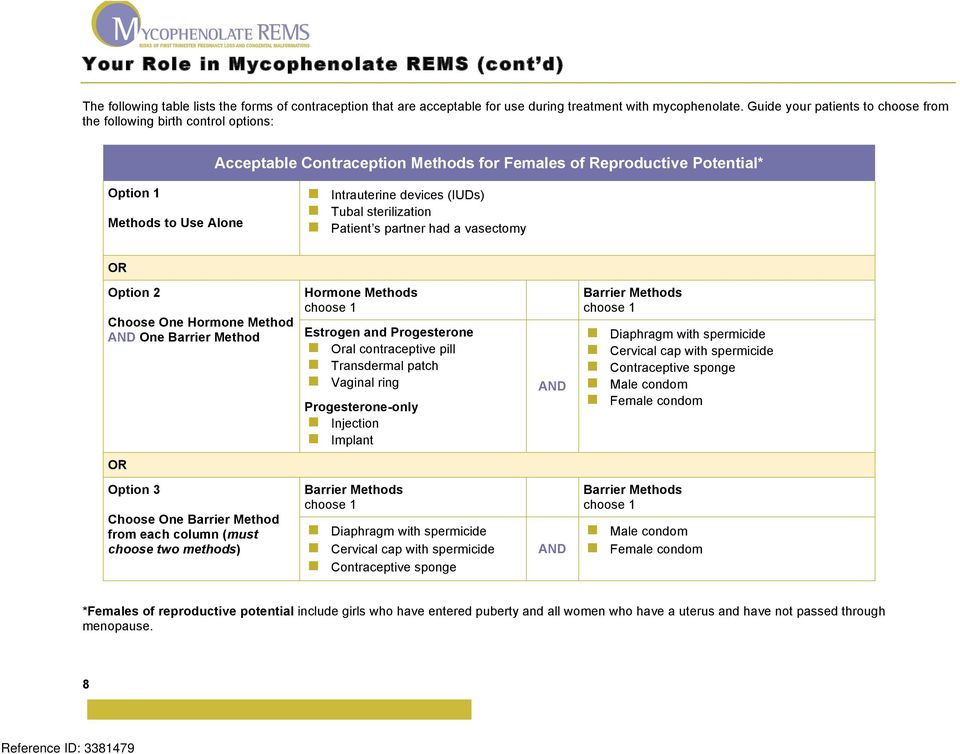
15 Your Role in Mycophenolate REMS (cont d) The following table lists the forms of contraception that are acceptable for use during treatment with mycophenolate. Guide your patients to choose from the following birth control options: Acceptable Contraception Methods for Females of Reproductive Potential* Option 1 Methods to Use Alone Intrauterine devices (IUDs) Tubal sterilization Patient s partner had a vasectomy OR Option 2 Choose One Hormone Method AND One Barrier Method OR Hormone Methods choose 1 Estrogen and Progesterone Oral contraceptive pill Transdermal patch Vaginal ring Progesterone-only Injection Implant AND Barrier Methods choose 1 Diaphragm with spermicide Cervical cap with spermicide Contraceptive sponge Male condom Female condom Option 3 Choose One Barrier Method from each column (must choose two methods) Barrier Methods choose 1 Diaphragm with spermicide Cervical cap with spermicide Contraceptive sponge AND Barrier Methods choose 1 Male condom Female condom *Females of reproductive potential include girls who have entered puberty and all women who have a uterus and have not passed through menopause. 8
16 Your Role in Mycophenolate REMS (cont d) EMERGENCY CONTRACEPTION Patients should also be counseled on the availability of emergency contraception in the event they have intercourse without acceptable contraception or their contraceptive methods fail. Patients 17 years and older can purchase emergency contraception over the counter. Patients can call the Emergency Contraception Hotline * at NOT-2-LATE ( ) to get information on how to obtain emergency contraception. * Mycophenolate REMS is neither affiliated with nor an endorser of this organization. The information provided by Mycophenolate REMS or this organization is meant for informational purposes only, and is not intended to replace medical advice to your patients. 4. Obtain a signed Patient-Prescriber Acknowledgment Form After you have educated females of reproductive potential on the risks associated with exposure to mycophenolate during pregnancy and have counseled them on contraception and pregnancy planning, have them acknowledge this by signing a Patient-Prescriber Acknowledgment Form. By signing this form, patients agree that they will comply with Mycophenolate REMS requirements. For patients who are minors, a legal guardian should sign in addition to the patient. You too, as the prescriber, should sign the form and give a copy to the patient. 5. Report any pregnancies to the Mycophenolate Pregnancy Registry The Mycophenolate Pregnancy Registry has been established to evaluate mycophenolate-exposed pregnancies and their outcomes. This will provide an opportunity to learn more about mycophenolate exposure in utero. Instruct patients to tell you if they get pregnant during treatment with mycophenolate or within 6 weeks following discontinuation of treatment. If you learn that a patient is pregnant: Report the pregnancy to the Mycophenolate Pregnancy Registry By phone: Online: or By mail: Mycophenolate Pregnancy Registry 201 Broadway, Suite 5 Cambridge, MA Retain the original copy for your records. 9

17 Reporting a Pregnancy Patients should be informed that you will report any pregnancies of which you become aware to the Mycophenolate Pregnancy Registry. Provision of patient contact and medical information to the Mycophenolate Pregnancy Registry is covered by an HIPAA waiver. The Mycophenolate Pregnancy Registry program administrator will report personally identifiable pregnancy data to the appropriate drug manufacturer for purposes of reporting to regulatory agencies as required by law. Aggregated de-identified data may be shared among participating sponsors of Mycophenolate REMS and/or submitted for publication in peer-reviewed scientific journals. Encourage the patient to participate in the Mycophenolate Pregnancy Registry Provide the patient with Mycophenolate Pregnancy Registry Frequently Asked Questions for Patients 10

18 Frequently Asked Questions About Mycophenolate REMS and the Mycophenolate Pregnancy Registry Who is Mycophenolate REMS for? Mycophenolate REMS is designed to help inform prescribers, nurses, pharmacists, and females of reproductive potential of the risks associated with exposure to mycophenolate during pregnancy. Who can participate in the Mycophenolate Pregnancy Registry? A female patient is considered eligible if she meets either of the following criteria: A patient who is or was pregnant and was exposed to at least 1 dose of mycophenolate during pregnancy A patient who got pregnant within 6 weeks following discontinuation of treatment Patients who meet either of these criteria, regardless of indication, can participate. Patients whose pregnancy does not meet these criteria may not participate in the Mycophenolate Pregnancy Registry. Why is the Mycophenolate Pregnancy Registry important? Exposure to mycophenolate during pregnancy is associated with: Increased risks of pregnancy loss during the first trimester Higher risk of congenital malformations Ear abnormalities such as microtia Facial deformities, including cleft lip and palate Anomalies of the distal limbs, heart, esophagus, and kidney The Mycophenolate Pregnancy Registry will collect data to characterize the risks associated with exposure to mycophenolate during pregnancy or within 6 weeks following discontinuation of treatment, regardless of indication. There is no limit to the number or type of physicians and/or patients who may contribute data to the Mycophenolate Pregnancy Registry. All reports of potential maternal and fetal exposure to mycophenolate will be considered for the Mycophenolate Pregnancy Registry. The success of the Mycophenolate Pregnancy Registry depends on the participation of both patients and healthcare providers. Healthcare providers should identify patients who are currently pregnant or who may have been exposed to mycophenolate while pregnant, inform them of the Mycophenolate Pregnancy Registry, and encourage them to participate in the Mycophenolate Pregnancy Registry. Healthcare providers should report any pregnancy that may involve exposure to mycophenolate, whether or not the patient chooses to participate. Patients should be informed that you will report any pregnancies of which you become aware to the Mycophenolate Pregnancy Registry. 11

19 Frequently Asked Questions About Mycophenolate REMS and the Mycophenolate Pregnancy Registry (cont d) What is my role in the Mycophenolate Pregnancy Registry? Instruct patients to tell you if they get pregnant during treatment with mycophenolate or within 6 weeks following discontinuation of treatment. If you learn that a patient is pregnant Report the pregnancy to the Mycophenolate Pregnancy Registry Encourage the patient to participate in the Mycophenolate Pregnancy Registry When you report an eligible pregnancy to the Mycophenolate Pregnancy Registry, you should provide your contact information. Also provide the Mycophenolate Pregnancy Registry with information about the pregnancy and the patient s contact information so that she can be called for follow-up for this safety study. Provision of patient contact and medical information to the Mycophenolate Pregnancy Registry is covered by an HIPAA waiver. When patients participate in the Mycophenolate Pregnancy Registry, they agree to provide information about their pregnancy, including information about prenatal drug exposure of any duration, maternal demography and history, and maternal and fetal outcomes of pregnancies exposed to mycophenolate. Patients are encouraged to participate in the Mycophenolate Pregnancy Registry as soon as their pregnancy is known, preferably in the first trimester. After I report my patient s pregnancy, what will her participation involve? The patient will be asked in telephone interviews to answer questions regarding her health and her baby s health. These interviews will take place during each trimester of pregnancy; near the expected time of delivery or at pregnancy outcome; and when the infant reaches 2 months, 6 months, and 1 year of age. Since the Mycophenolate Pregnancy Registry relies on being able to contact the patient, it is important for you to advise her to keep the Mycophenolate Pregnancy Registry informed of any changes to her contact information throughout her participation. After I enroll my patient, what is my role? You will be asked to provide pregnancy and outcomes data on a paper-based case report form (CRF) and submit it via mail or fax, or enter the data into an electronic data capture (EDC) system. You must keep the Mycophenolate Pregnancy Registry informed of any changes to your contact information throughout your participation. 12

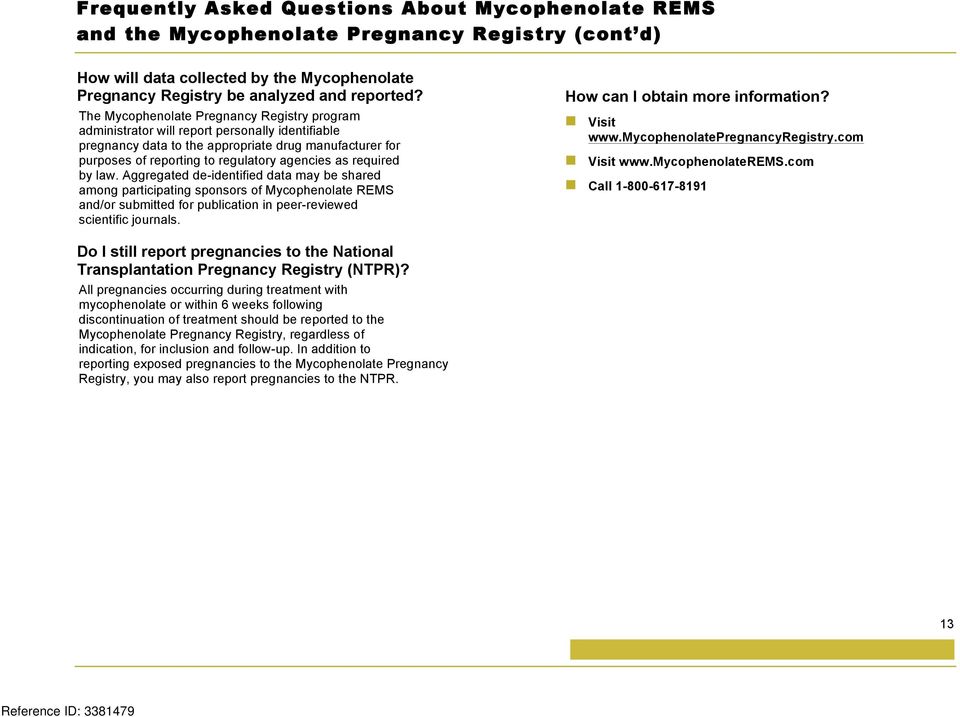
20 Frequently Asked Questions About Mycophenolate REMS and the Mycophenolate Pregnancy Registry (cont d) How will data collected by the Mycophenolate Pregnancy Registry be analyzed and reported? The Mycophenolate Pregnancy Registry program administrator will report personally identifiable pregnancy data to the appropriate drug manufacturer for purposes of reporting to regulatory agencies as required by law. Aggregated de-identified data may be shared among participating sponsors of Mycophenolate REMS and/or submitted for publication in peer-reviewed scientific journals. How can I obtain more information? Visit Visit Call Do I still report pregnancies to the National Transplantation Pregnancy Registry (NTPR)? All pregnancies occurring during treatment with mycophenolate or within 6 weeks following discontinuation of treatment should be reported to the Mycophenolate Pregnancy Registry, regardless of indication, for inclusion and follow-up. In addition to reporting exposed pregnancies to the Mycophenolate Pregnancy Registry, you may also report pregnancies to the NTPR. 13
21 Mycophenolate REMS Resources Several resources have been developed to help ensure that you and your patients understand the risks associated with exposure to mycophenolate during pregnancy and to help you comply with the requirements of Mycophenolate REMS. These resources, some of which have been described previously, are available either in the Mycophenolate REMS Overview & Your Birth Control Options or online. They include: Mycophenolate REMS Web Site: The Web site provides information about Mycophenolate REMS, including the option to order or download resource materials. Enrollment in Mycophenolate REMS can also be completed on this site Mycophenolate REMS Brochure for Healthcare Providers (this brochure) Prescriber Training Confirmation Form Prescribers enroll in Mycophenolate REMS by completing this form Center Training Confirmation Form Centers enroll in Mycophenolate REMS by completing this form prescribers of mycophenolate to help establish a working relationship with an OB/GYN for patient counseling. There are 2 letter templates one for contraception counseling and one for pregnancy planning education that can be customized for your practice and patient before sending to an OB/GYN Medication Guide There is a separate Medication Guide for each mycophenolate formulation Mycophenolate REMS Overview & Your Birth Control Options This booklet helps patients understand Mycophenolate REMS and gives patients an overview of acceptable forms of contraception. Included in the booklet are Patient-Prescriber Acknowledgment Form HCPs and females of reproductive potential sign this to acknowledge that they have been informed about the risks and will comply with Mycophenolate REMS Mycophenolate Pregnancy Registry Frequently Asked Questions for Patients This document answers some common questions about the Mycophenolate Pregnancy Registry in patient-friendly language Obstetrician/Gynecologist Referral Template Letters These customizable letters available online at can be used by 14
22 Mycophenolate REMS Resources (cont d) Mycophenolate Pregnancy Registry The Mycophenolate Pregnancy Registry evaluates mycophenolate-exposed pregnancies and their outcomes. You can contact the Mycophenolate Pregnancy Registry by calling or visiting For more information about Mycophenolate REMS and for all resource materials Visit Call Additional Resources FOR MORE INFORMATION ABOUT CONTRACEPTION* Association of Reproductive Health Professionals: Planned Parenthood: FOR MORE INFORMATION ABOUT BIRTH DEFECTS* Centers for Disease Control and Prevention: *Mycophenolate REMS is neither affiliated with nor an endorser of these organizations. The information provided by Mycophenolate REMS or these organizations is meant for informational purposes only, and is not intended to replace your medical advice to your patients. 15
23
24 OVERVIEW & YOUR BIRTH CONTROL OPTIONS BOOKLET
25
26 Table of Contents Welcome to Mycophenolate REMS... 3 What You Need to Know... 4 Your Role... 5 Your Birth Control Options... 6 Reporting Your Pregnancy... 8 Important Resources... 9 Other Resources
27 3
28 Welcome to Mycophenolate REMS Females who take mycophenolate and can get pregnant should participate in Mycophenolate REMS (Risk Evaluation and Mitigation Strategy). Mycophenolate REMS has been designed to tell you about the risks of taking mycophenolate. Females taking mycophenolate while they are pregnant have a higher risk of miscarriage in the first 3 months. There is also a higher risk that the baby will have birth defects. These medicines contain mycophenolate: CellCept (mycophenolate mofetil) Myfortic (mycophenolic acid) Generic formulations of mycophenolate mofetil Generic formulations of mycophenolic acid This booklet, the Mycophenolate REMS Overview & Your Birth Control Options, tells you what you need to know about Mycophenolate REMS. It explains how it works and what your role is. Please read all of the information in this booklet. Talk with your doctor if you have questions. Program Overview & Your Birth Control Options For complete safety information, please the Medication Guide, which can be found at 4
29 What You Need to Know If you are a girl or woman who can get pregnant, your doctor will talk with you about the risks of mycophenolate during pregnancy. Talk with your doctor about birth control and pregnancy planning. You must always use acceptable birth control During your entire treatment with mycophenolate For 6 weeks after you stop taking mycophenolate Unless you choose not to have sexual intercourse with a man at any time (abstinence), you must always use acceptable birth control. It is important to talk with your doctor about the best forms of birth control for you. The table on page 7 lists your options for birth control during treatment with mycophenolate. If you are thinking about having a baby Tell your doctor right away Do not stop taking mycophenolate on your own In some cases, you and your doctor may decide that your medicine is more important to your health than the possible risks to your unborn baby If you get pregnant while you are taking mycophenolate or within 6 weeks after you stop, tell your doctor right away. 5
30 Your Role If you are a girl or woman who can get pregnant, you should take part in Mycophenolate REMS while you are taking mycophenolate. Steps you need to take: 1. Talk with your doctor about mycophenolate use and risk of miscarriage or birth defects. 2. Sign the Patient-Prescriber Acknowledgment Form. 3. Decide with your doctor what birth control methods are right for you. 4. You should have one pregnancy test immediately before starting mycophenolate and another pregnancy test 8 to 10 days later. Pregnancy tests should be repeated during routine follow-up visits with your doctor. Talk to your doctor about the results of all of your pregnancy tests. 5. If you are thinking about having a baby, talk with your doctor right away. 6. If you get pregnant while you are taking mycophenolate or within 6 weeks after you stop, tell your doctor right away. 7. If you get pregnant while you are taking mycophenolate, participate in the Mycophenolate Pregnancy Registry. The information you provide helps patients and doctors understand the effects of mycophenolate during pregnancy. 6
31 Your Birth Control Options Choosing birth control is very personal. This booklet gives you information on birth control methods you can use while taking mycophenolate. This information should be used along with your doctor s medical advice. After you read this booklet, talk with your doctor or obstetrician/gynecologist. Then you and your doctor can decide what is best for you. You must always use acceptable birth control During your entire treatment with mycophenolate For 6 weeks after you stop taking mycophenolate Unless you choose not to have sexual intercourse with a man at any time (abstinence), you must always use acceptable birth control. You may need to use more than one method of birth control at the same time. If you use an intrauterine device (IUD), had sterilization surgery (had your tubes tied or blocked), or if your partner has had a vasectomy, you do not need to use a second form of birth control. Mycophenolate could reduce the effectiveness of hormonal methods of birth control. Hormonal methods of birth control must be used with a barrier method because studies show that mycophenolate decreases blood levels of certain hormones in the oral contraceptive pill. It is possible that mycophenolate could reduce the effectiveness of the oral contraceptive pill The effectiveness of other hormone methods (like the patch, the ring, the shot, and the implant) may also be reduced while you are taking mycophenolate The table on page 7 lists your options for birth control during treatment with mycophenolate. 7
32 Your Birth Control Options (cont d) The table below lists your options for birth control during treatment with mycophenolate. Pick from the following birth control options: Acceptable Contraception Methods Option 1 Methods to Use Alone Intrauterine devices (IUDs) Tubal sterilization Patient s partner had a vasectomy OR Option 2 Choose One Hormone Method AND One Barrier Method OR Option 3 Choose One Barrier Method From Each Column (must choose two methods) Hormone Methods choose 1 Estrogen and Progesterone Oral contraceptive pill Transdermal patch Vaginal ring Progesterone-only Injection Implant Barrier Methods choose 1 Diaphragm with spermicide Cervical cap with spermicide Contraceptive sponge AND AND Barrier Methods choose 1 Diaphragm with spermicide Cervical cap with spermicide Contraceptive sponge Male condom Female condom Barrier Methods choose 1 Male condom Female condom 8
33 Reporting Your Pregnancy If you get pregnant while taking mycophenolate or within 6 weeks after you stop, call your doctor right away. Do not stop taking your mycophenolate. Your doctor will talk with you about taking part in the Mycophenolate Pregnancy Registry. Your doctor should report pregnancies to the Registry. If you would like to report a pregnancy to the Registry yourself: Call and choose Mycophenolate Pregnancy Registry from the menu, or Visit 9
34 Important Resources There are many resources to help you get the information you need about Mycophenolate REMS. Mycophenolate REMS Overview & Your Birth Control Options (this booklet) Patient-Prescriber Acknowledgment Form After a discussion with your doctor about mycophenolate use and risk of miscarriage or birth defects, both of you will sign this form. It is included with this booklet Medication Guide for mycophenolate Gives you important safety information you need to know about your medicine Your doctor Mycophenolate REMS Web site: Provides access to all Mycophenolate REMS resources and materials. Mycophenolate Pregnancy Registry Collects information about pregnancies that occur during treatment with mycophenolate or within 6 weeks after stopping. You can contact the Registry by calling or by visiting Mycophenolate Pregnancy Registry Frequently Asked Questions for Patients Provides answers to frequently asked questions about the Registry. You can obtain this from your healthcare provider or by visiting: 10
35 Other Resources For more information about birth control* Association of Reproductive Health Professionals: Planned Parenthood: For emergency birth control* Call your doctor or pharmacy Emergency Contraception Hotline: NOT-2-LATE ( ) For more information about Mycophenolate REMS Read the Mycophenolate REMS Overview & Your Birth Control Options (this booklet) Talk with your doctor Visit the Mycophenolate REMS Web site: Call *Mycophenolate REMS is neither affiliated with nor an endorser of these organizations. The information provided by Mycophenolate REMS or these organizations is meant for informational purposes only, and is not intended to replace your doctor s medical advice. 11
36 .
37
38 FREQUENTLY ASKED QUESTIONS FOR PATIENTS
39 MYCOPHENOLATE PREGNANCY REGISTRY FREQUENTLY ASKED QUESTIONS FOR PATIENTS What is the Mycophenolate Pregnancy Registry? The Registry collects information about pregnancies that occur during treatment with mycophenolate or within 6 weeks after stopping. Why should I take part in the Mycophenolate Pregnancy Registry? The information you provide to the Registry will help us better understand the effects of mycophenolate in pregnancy. When you take part in the Registry, you provide important information that may help you and other women who take mycophenolate during their pregnancies. Women taking mycophenolate while they are pregnant have a higher risk of miscarriage in the first 3 months. There is also a higher risk that the baby will have birth defects. Who can be in the Mycophenolate Pregnancy Registry? 1. All females who get pregnant while taking mycophenolate and 2. All females who get pregnant within 6 weeks after stopping treatment with mycophenolate These medicines contain mycophenolate: CellCept (mycophenolate mofetil) Myfortic (mycophenolic acid) Generic formulations of mycophenolate mofetil Generic formulations of mycophenolic acid Tell your doctor right away if you get pregnant. Your doctor will report your pregnancy to the Registry. We encourage you to take part in the Registry. The information you provide to the Registry will help us better understand the effects of mycophenolate in pregnancy. All the information you provide will be kept private. What will I need to do to take part in the Mycophenolate Pregnancy Registry? There are a few simple steps to take. 1. Tell your doctor if you get pregnant The Registry will contact you after speaking with your doctor. (Turn page) For complete safety information, please see the Medication Guide which can be found at
40 2. Complete an Informed Consent form The Informed Consent form will be mailed to you The form tells you what to expect with the Registry. It tells you what your rights are By signing, you allow the Registry to ask you questions about your health and your baby s health. The Registry will also ask for information from your doctors 3. Answer the Registry s questions about your health and your baby s health After the first 3 months of pregnancy 2 more times during the next 6 months of pregnancy At the time of expected delivery When your baby is 2 months, 6 months and 1 year 4. Let the Registry know if your contact information changes The Registry relies on your information to contact you. If your contact information changes, please call What are my rights if I take part in the Mycophenolate Pregnancy Registry? 1. You can quit at any time 2. Your privacy is protected What if I do not want to take part in the Mycophenolate Pregnancy Registry? You only take part in the Registry if you want to do it. If you decide not to participate, it will not change your medical care. How can I get more information? Call and choose Mycophenolate Pregnancy Registry from the menu Visit For more information about Mycophenolate REMS, visit Mycophenolate REMS. All rights reserved. 200 Pinecrest Plaza, Morgantown, WV PRFAQ 05/12
41 PATIENT-PRESCRIBER ACKNOWLEDGMENT FORM
42 PATIENT-PRESCRIBER ACKNOWLEDGMENT FORM These medicines contain mycophenolate: CellCept (mycophenolate mofetil) Myfortic (mycophenolic acid) Generic formulations of mycophenolate mofetil Generic formulations of mycophenolic acid For the patient: Please read each item below. Discuss them with your doctor. Do not sign this form until you are sure you understand it. By signing on the next page, I am stating that 1. My doctor gave me the Mycophenolate REMS Overview & Your Birth Control Options booklet. 2. I know the risks to an unborn baby if I take mycophenolate while I am pregnant. I talked with my doctor about these risks. I understand that if I get pregnant while taking mycophenolate or within 6 weeks after I stop, there is A higher risk of losing the pregnancy (miscarriage) in the first 3 months A higher risk that the baby will have birth defects. 3. I know I will have pregnancy tests before I start and during my mycophenolate treatment. 4. My doctor talked with me about acceptable forms of birth control. 5. Unless I choose not to have sexual intercourse with a man at any time (abstinence), I will always use acceptable birth control During my entire treatment with mycophenolate For 6 weeks after I stop taking mycophenolate Information about your birth control options is provided in the Mycophenolate REMS Overview & Your Birth Control Options booklet. 6. If I am thinking about having a baby during my treatment, I will talk with my doctor right away. 7. I will tell my doctor right away if I get pregnant during my treatment or within 6 weeks after I stop. 8. I know that my doctor will report any pregnancies to the Mycophenolate Pregnancy Registry. (Please fill out form on next page) For complete safety information, please see full Prescribing Information, including Boxed WARNING and Medication Guide, which can be found at
43 PATIENT-PRESCRIBER ACKNOWLEDGMENT FORM Patient Name (please print): Patient Signature: Parent/Guardian Name (if patient under age 18; please print): Parent/Guardian Signature: Date: Date: For the prescriber (or healthcare provider acting on behalf of the prescriber): I have fully explained to my patient (and her parent or guardian if the patient is under age 18) the nature and purpose of treatment with mycophenolate and the risks to females of reproductive potential as described on the previous page. I have asked the patient (and her parent or guardian) if she has any questions regarding her treatment and have answered those questions to the best of my ability. Prescriber s/other Healthcare Provider s Name (please print): Degree: (Circle one) MD DO NP PA Prescriber s/other Healthcare Provider s Signature: Date: PLEASE RETAIN THE ORIGINAL SIGNED DOCUMENT AND PROVIDE A COPY TO THE PATIENT. For more information about Mycophenolate REMS and to request resource materials, please visit or call Mycophenolate REMS All rights reserved. 200 Pinecrest Plaza, Morgantown, WV PPAF5/12
44 PRESCRIBER TRAINING CONFIRMATION FORM
45 PRESCRIBER TRAINING CONFIRMATION FORM The FDA determined that a REMS (Risk Evaluation and Mitigation Strategy) is necessary to ensure that the benefits of mycophenolate outweigh the risks of first trimester pregnancy loss and congenital malformations associated with mycophenolate use during pregnancy. Mycophenolate is available by prescription as CellCept (mycophenolate mofetil) Myfortic (mycophenolic acid) Generic formulations of mycophenolate mofetil Generic formulations of mycophenolic acid As a prescriber of mycophenolate to females of reproductive potential*, I understand that I need to complete and return the Training Confirmation Form to enroll in Mycophenolate REMS. *A female of reproductive potential includes girls who have entered puberty and all females who have a uterus and have not passed through menopause. I agree to do the following: 1. Read and understand the full Prescribing Information for mycophenolate and the Mycophenolate REMS Brochure for Healthcare Providers. 2. Understand the risks of first trimester pregnancy loss and congenital malformations associated with mycophenolate. 3. Educate females of reproductive potential on the risks associated with exposure to mycophenolate during pregnancy. 4. Provide a Mycophenolate REMS Overview & Your Birth Control Options booklet to females of reproductive potential. 5. Provide contraception counseling to patients directly or by partnering with an OB/GYN. 6. Only prescribe mycophenolate to a pregnant patient if the benefits of initiating or continuing treatment outweigh the risk of fetal harm. 7. Discuss alternative treatments to mycophenolate with females of reproductive potential who are pregnant or considering pregnancy. 8. Follow the pregnancy testing recommendations as outlined in the full Prescribing Information for mycophenolate and the Mycophenolate REMS Brochure for Healthcare Providers. 9. Report to the Mycophenolate Pregnancy Registry any pregnancies that occur during mycophenolate treatment or within 6 weeks following discontinuation of treatment. Encourage pregnant patients to participate in the Mycophenolate Pregnancy Registry. 10. Obtain a signed Patient-Prescriber Acknowledgment Form from each female of reproductive potential. I understand that I may be contacted in the future for items pertaining to the administration of Mycophenolate REMS. (PLEASE PRINT) Complete all fields below: Prescriber Prescriber First Name: Last Name: Prescriber Degree: MD, DO, NP, PA (Circle One) Specialty Code (Select one from the back of this form) National Provider Identifier: Prescsriber Address: Facility: Address 1: Address 2: City: State: ZIP: Telephone: Fax: Prescriber Signature: Date: Healthcare Provider acting on behalf of the prescriber: Degree: RN, LPN, NP, PA, RPH, PharmD, CSW (Circle One) For complete safety Information, please see full Prescribing Information, including Boxed WARNING and Medication Guide, which can be found at
46 PRESCRIBER TRAINING CONFIRMATION FORM You can submit a Prescriber Training Confirmation Form by visiting and completing the online form. If you prefer, you can complete the paper form and return it via fax to or mail it to: Mycophenolate REMS 200 Pinecrest Plaza Morgantown, WV You can also call to complete a Prescriber Training Confirmation Form. For more information about Mycophenolate REMS, visit www. MycophenolateREMS.com or call Specialty Specialty Code Allergy and Immunology... 1 Cardiology... 2 Dermatology... 3 Family Practitioner... 4 Gastroenterology... 5 Hepatology... 6 Internal Medicine... 7 Nephrology... 8 Neurology... 9 OB/GYN Pediatric Rheumatology Surgery Transplant Other Mycophenolate REMS. All rights reserved. 200 Pinecrest Plaza, Morgantown, WV PTCF 5/1112
47 CENTER TRAINING CONFIRMATION FORM
48 CENTER TRAINING CONFIRMATION FORM The FDA determined that a REMS (Risk Evaluation and Mitigation Strategy) is necessary to ensure that the benefits of mycophenolate outweigh the risks of first trimester pregnancy loss and congenital malformations associated with mycophenolate use during pregnancy. Mycophenolate is available by prescription as: CellCept (mycophenolate mofetil) Myfortic (mycophenolic acid) Generic formulations of mycophenolate mofetil Generic formulations of mycophenolic acid On behalf of prescribers of mycophenolate to females of reproductive potential,* (place center name here) will complete and return this training form to enroll in Mycophenolate REMS. *A female of reproductive potential includes girls who have entered puberty and all women who have a uterus and have not passed through menopause. We agree to do the following: 1. Read and understand the full Prescribing Information for mycophenolate and the Mycophenolate REMS Brochure for Healthcare Providers 2. Understand the risks of first trimester pregnancy loss and congenital malformations associated with mycophenolate. 3. Educate females of reproductive potential on the risks associated with exposure to mycophenolate during pregnancy. 4. Provide a Mycophenolate REMS Overview & Your Birth Control Options booklet to females of reproductive potential. 5. Provide contraception counseling to patients directly or by partnering with an OB/GYN. 6. Only prescribe mycophenolate to a pregnant patient if the benefits of initiating or continuing treatment outweigh the risk of fetal harm. 7. Discuss alternative treatments to mycophenolate with females of reproductive potential who are pregnant or considering pregnancy. 8. Follow the pregnancy testing recommendations as outlined in the full Prescribing Information for mycophenolate and the Mycophenolate REMS Brochure for Healthcare Providers. 9. Report to the Mycophenolate Pregnancy Registry any pregnancies that occur during mycophenolate treatment or within 6 weeks following discontinuation of treatment. Encourage pregnant patients to participate in the Mycophenolate Pregnancy Registry. 10. Obtain a signed Patient-Prescriber Acknowledgment Form from each female of reproductive potential. 11. Describe how your center plans to implement the program requirements (please explain/outline process below): I understand that I may be contacted in the future for items pertaining to the administration of Mycophenolate REMS. (Please fill out form on next page) For complete safety information, please see full Prescribing Information, including Boxed WARNING and Medication Guide, which can be found at
49 (PLEASE PRINT) CENTER TRAINING CONFIRMATION FORM CENTER INFORMATION Center: Center Type (disease or specialty)* Address: City: State: ZIP: Phone: Fax: Contact Person: Please complete fields below: TRAINED PRESCRIBERS Prescriber Name (Printed) Signature of Prescriber Date Degree (MD, DO, NP, PA) Specialty Code(s)* National Provider Identifier (NPI) *A list of specialty codes can be found on page 4. Healthcare providers acting on behalf of the prescriber should fill out the form on the next page (Please fill out form (Please fill out form on next page)
50 Please complete fields below: CENTER TRAINING CONFIRMATION FORM HEALTHCARE PROVIDERS ACTING ON BEHALF OF THE PRESCRIBER Provider Name (Printed) Signature of Provider Date Degree (RN, LPN, NP, PA, RPH, PharmD, CSW) Specialty Code(s)* Name of Prescriber you are signing for *A list of specialty codes can be found on page 4. (Turn page)
51 CENTER TRAINING CONFIRMATION FORM You can submit a completed Center Training Confirmation Form via fax to or mail it to: Mycophenolate REMS 200 Pinecrest Plaza Morgantown, WV For more information about Mycophenolate REMS, visit or call Specialty Specialty Code Allergy and Immunology... 1 Cardiology... 2 Dermatology... 3 Family Practitioner... 4 Gastroenterology... 5 Hepatology... 6 Internal Medicine... 7 Nephrology... 8 Neurology... 9 OB/GYN Pediatric Rheumatology Surgery Transplant Other Center Type Center Type Code Allergy and Immunology... 1 Cardiology... 2 Dermatology... 3 Dermatology Surgery... 4 Dermatopathology... 5 Gastroenterology... 6 General Surgery... 7 Hepatology... 8 Immunology... 9 Maternal Fetal Medicine Nephrology Neurologic Surgery Neurology Neuropathology OB/GYN Rheumatology Thoracic Surgery Transplantation Surgery Mycophenolate REMS. All rights reserved. 200 Pinecrest Plaza, Morgantown, WV CTCF5/12
52 DEAR HEALTHCARE PROVIDER LETTER
53 IMPORTANT DRUG WARNING Regarding Mycophenolate-Containing Products Dear Healthcare Provider: Mycophenolate REMS (Risk Evaluation and Mitigation Strategy) has been mandated by the FDA (Food and Drug Administration) due to postmarketing reports showing that exposure to mycophenolate during pregnancy is associated with increased risks of first trimester pregnancy loss and congenital malformations. Mycophenolate is available by prescription as CellCept (mycophenolate mofetil) Myfortic (mycophenolic acid) Generic formulations of mycophenolate mofetil Generic formulations of mycophenolic acid The goals of the Mycophenolate REMS are: 1. To prevent unplanned pregnancy in patients using mycophenolate and to minimize fetal exposure to mycophenolate by informing prescribers and females of reproductive potential about the increased risks of first trimester pregnancy loss and congenital malformations associated with exposure to mycophenolate during pregnancy; and the importance of pregnancy prevention and planning 2. To minimize the risks associated with fetal exposure to mycophenolate by collecting information on pregnancy outcomes through the Mycophenolate Pregnancy Registry 3. To inform patients about the serious risks associated with mycophenolate What you need to know to prescribe mycophenolate All prescribers of mycophenolate and females of reproductive potential,* whether or not they plan to get pregnant, should participate in Mycophenolate REMS. If you prescribe mycophenolate to females of reproductive potential (new and continuing patients), you should receive training and agree to do the following: Understand the risks of first trimester pregnancy loss and congenital malformations associated with mycophenolate Educate females of reproductive potential on the risks associated with exposure to mycophenolate during pregnancy Provide a Mycophenolate REMS Overview & Your Birth Control Options booklet to females of reproductive potential Provide contraception counseling to patients directly or by partnering with an OB/GYN Only prescribe mycophenolate to a pregnant patient if the benefits of initiating or continuing treatment outweigh the risk of fetal harm Discuss alternative treatments to mycophenolate with females of reproductive potential who are pregnant or considering pregnancy Follow the pregnancy testing recommendations *A female of reproductive potential includes girls who have entered puberty and all women who have a uterus and have not yet passed through menopause. (Continued on next page) For complete safety information, please see full Prescribing Information, including Boxed WARNING and Medication Guide, which can be found at
54 IMPORTANT DRUG WARNING Regarding Mycophenolate-Containing Products Report to the Mycophenolate Pregnancy Registry any pregnancies that occur during mycophenolate treatment or within 6 weeks following discontinuation of treatment. Encourage pregnant patients to participate in the Mycophenolate Pregnancy Registry Obtain a signed Patient-Prescriber Acknowledgement Form from females of reproductive potential Please note that the manufacturers may contact you in the future for assessment of Mycophenolate REMS. This letter is not a comprehensive description of the risks associated with the use of mycophenolate. For complete safety information, please see full Prescribing Information, including Boxed WARNING and Medication Guide, which can be found at For more information about Mycophenolate REMS, including all program materials and instructions on how to enroll, please visit or call The FDA requests healthcare providers report any pregnancies of which they become aware. Pregnancies that occur during treatment with mycophenolate or within 6 weeks following discontinuation of treatment should be reported by contacting the Mycophenolate Pregnancy Registry. By phone: Online: Or by mail: Mycophenolate Pregnancy Registry 201 Broadway, Suite 5 Cambridge, MA Thank you for your commitment to helping patients understand the risks and benefits associated with mycophenolate treatment. Sincerely, Mycophenolate REMS Team (Continued on next page)
55 IMPORTANT DRUG WARNING Regarding Mycophenolate-Containing Products Indications and Important Selected Safety Information About Mycophenolate-Containing Products INDICATIONS: CellCept (mycophenolate mofetil) is indicated for the prophylaxis of organ rejection in patients receiving allogeneic renal, cardiac or hepatic transplants. CellCept should be used concomitantly with cyclosporine and corticosteroids. Myfortic (mycophenolic acid) is indicated for the prophylaxis of organ rejection in patients receiving allogeneic renal transplants, administered in combination with cyclosporine and corticosteroids. Mycophenolate mofetil is indicated for the prophylaxis of organ rejection in patients receiving allogeneic renal, cardiac or hepatic transplants. Mycophenolate mofetil should be used concomitantly with cyclosporine and corticosteroids. Mycophenolic acid is indicated for the prophylaxis of organ rejection in patients receiving allogeneic renal transplants, administered in combination with cyclosporine and corticosteroids. CONTRAINDICATIONS: Allergic reactions to mycophenolate-containing products have been observed; therefore, mycophenolate-containing products are contraindicated in patients with a hypersensitivity to mycophenolate mofetil, mycophenolic acid or any component of the drug product. WARNING: EMBRYOFETAL TOXICITY, MALIGNANCIES AND SERIOUS INFECTIONS Use during pregnancy is associated with increased risks of first trimester pregnancy loss and congenital malformations. Females of reproductive potential (FRP) must be counseled regarding pregnancy prevention and planning. Immunosuppression may lead to increased susceptibility to infection and possible development of lymphoma and other neoplasms. Only physicians experienced in immunosuppressive therapy and management of organ transplant recipients should prescribe mycophenolatecontaining products. Patients receiving mycophenolate-containing products should be managed in facilities equipped and staffed with adequate laboratory and supportive medical resources. The physician responsible for maintenance therapy should have complete information requisite for the follow-up of the patient. CellCept Intravenous is contraindicated in patients who are allergic to Polysorbate 80 (TWEEN (Continued on next page)
56 IMPORTANT DRUG WARNING Regarding Mycophenolate-Containing Products Important Selected Safety Information About Mycophenolate-Containing Products (cont d) WARNINGS: Embryofetal Toxicity Mycophenolate-containing products can cause fetal harm when administered to a pregnant female. Use of mycophenolate-containing products during pregnancy is associated with an increased risk of first trimester pregnancy loss and an increased risk of congenital malformations, especially external ear and other facial abnormalities including cleft lip and palate, and anomalies of the distal limbs, heart, esophagus, and kidney. Pregnancy Exposure Prevention and Planning Females of reproductive potential must be made aware of the increased risk of first trimester pregnancy loss and congenital malformations and must be counseled regarding pregnancy prevention and planning. Lymphoma and Malignancy Patients receiving immunosuppressive regimens involving combinations of drugs, including mycophenolate-containing products, as part of an immunosuppressive regimen are at increased risk of developing lymphomas and other malignancies, particularly of the skin. Combination with Other Immunosuppressive Agents Mycophenolate mofetil has been administered in combination with the following agents in clinical trials: antithymocyte globulin, OKT3, cyclosporine, and corticosteroids. Mycophenolic acid has been administered in combination with the following agents in clinical trials: antithymocyte/lymphocyte immunoglobulin, muromonab-cd3, basiliximab, daclizumab, cyclosporine, and corticosteroids. The efficacy and safety of the use of mycophenolate-containing products, in combination with other immunosuppressive agents have not been determined. Serious Infections Patients receiving immunosuppressants, including mycophenolate, are at increased risk of developing bacterial, fungal, protozoal and new or reactivated viral infections, including opportunistic infections. These infections may lead to serious, including fatal outcomes. Polyomavirus associated nephropathy (PVAN), JC virus associated progressive multifocal leukoencephalopathy (PML), cytomegalovirus (CMV) infections, reactivation of hepatitis B (HBV) or hepatitis C (HCV) have been reported. Neutropenia Severe neutropenia [absolute neutrophil count (ANC) <0.5 x 10 3 /µl] developed in up to 2.0% of renal, up to 2.8% of cardiac, and up to 3.6% of hepatic transplant patients receiving mycophenolate mofetil 3g daily. Patients receiving mycophenolate-containing products should be monitored for neutropenia. If neutropenia develops [absolute neutrophil count (ANC) <1.3 x 10 3 /µl] or anemia occurs, dosing with mycophenolate-containing products should be interrupted or the dose reduced, appropriate diagnostic tests performed, and the patient managed appropriately. Pure Red Cell Aplasia Cases of pure red cell aplasia (PRCA) have been reported in patients treated with mycophenolatecontaining products in combination with other immunosuppressive agents. Patients receiving mycophenolate-containing products should be monitored for blood dyscrasias. CAUTION: CELLCEPT INTRAVENOUS SOLUTION SHOULD NEVER BE ADMINISTERED BY RAPID OR BOLUS INTRAVENOUS INJECTION (Continued on next page)
57 IMPORTANT DRUG WARNING Regarding Mycophenolate-Containing Products Important Selected Safety Information About Mycophenolate-Containing Products (cont d) PRECAUTIONS: Pregnancy Exposure Prevention and Planning Females of reproductive potential* must be made aware of the increased risk of first trimester pregnancy loss and congenital malformations and must be counseled regarding pregnancy prevention and planning. Females of reproductive potential taking mycophenolate-containing products must receive contraceptive counseling and use acceptable contraception during entire therapy with mycophenolate-containing products and for 6 weeks after stopping therapy (see Full Prescribing Information for acceptable contraception methods). Patients should be aware that mycophenolatecontaining products reduce blood levels of the hormones in the oral contraceptive pill and could theoretically reduce its effectiveness. To prevent unplanned exposure during pregnancy, females of reproductive potential should have a serum or urine pregnancy test with a sensitivity of at least 25 miu/ml immediately before starting a mycophenolatecontaining product. Another pregnancy test with the same sensitivity should be done 8 to 10 days later. Repeat pregnancy tests should be performed during routine follow-up visits. Results of all pregnancy tests should be discussed with the patient. In the event of a positive pregnancy test, females should be counseled with regard to whether the maternal benefits of mycophenolate treatment may outweigh the risks to the fetus in certain situations. Pregnancy Category D Mycophenolate-containing products can cause fetal harm when administered to a pregnant female. If mycophenolate-containing products are used during pregnancy, or if the patient becomes pregnant while taking mycophenolate-containing products, the patient should be apprised of the potential hazard to the fetus. In certain situations, the patient and her healthcare practitioner may decide that the maternal benefits outweigh the risks to the fetus. Risks and benefits of mycophenolate-containing products should be discussed with the patient. For those females using mycophenolatecontaining products at any time during pregnancy and those becoming pregnant within 6 weeks of discontinuing therapy, the healthcare practitioner should report the pregnancy to the Mycophenolate Pregnancy Registry ( ). The healthcare practitioner should also strongly encourage the patient to enroll in the pregnancy registry. Gastrointestinal Disorders Gastrointestinal bleeding (requiring hospitalization) has been reported in de novo renal transplant patients (1.0%) and maintenance patients (1.3%) treated with mycophenolic acid (up to 12 months); and in approximately 3% of renal, in 1.7% of cardiac and in 5.4% of hepatic transplant patients treated with mycophenolate mofetil 3g daily. Mycophenolate-containing products should be administered with caution in patients with active serious digestive system disease because mycophenolate-containing products have been associated with an increased incidence of digestive system adverse events. For patients who are considering pregnancy, consider alternative immunosuppressants with less potential for embryofetal toxicity. (Continued on next page)
58 Important Selected Safety Information About Mycophenolate-Containing Products (cont d) Concomitant Medications It is recommended that mycophenolatecontaining products not be administered concomitantly with azathioprine because of the potential to cause bone marrow suppression and inhibit purine metabolism. Caution should be used in the concomitant administration of mycophenolate-containing products with drugs that interfere with enterohepatic recirculation such as cholestyramine because of the potential to reduce the efficacy of mycophenolate-containing products. Immunizations During treatment with mycophenolate-containing products, avoid the use of live attenuated vaccines and advise patients that vaccinations may be less effective. Phenylketonurics Care should be taken if mycophenolate mofetil oral suspension is administered to patients with phenylketonuria. Complete blood counts should be performed weekly during the first month, twice monthly for the second and third months of treatment, then monthly through the first year. Nursing Mothers It is not known whether mycophenolatecontaining products are excreted in human milk. Because many drugs are excreted in human milk, and because of the potential for serious adverse reactions in nursing infants from mycophenolatecontaining products, a decision should be made whether to discontinue nursing or to discontinue the drug, taking into account the importance of the drug to the mother. ADVERSE REACTIONS: The principal adverse reactions associated with the administration of mycophenolate mofetil include diarrhea, leukopenia, sepsis, vomiting, and there is evidence of a higher frequency of certain types of infections, eg, opportunistic infections. Phlebitis and thrombosis have been reported with intravenous administration. The principal adverse reactions associated with the administration of mycophenolic acid include constipation, nausea, and urinary tract infection in de novo patients and nausea, diarrhea, and nasopharyngitis in maintenance patients. For additional safety information, please see full Prescribing Information, including Boxed WARNING and Medication Guide, which can be found at Patients should not breastfeed during mycophenolate-containing products therapy. * A female of reproductive potential incudes girls who have entered puberty and all women who have a uterus and have not yet passed through menopause Mycophenolate REMS All rights reserved 200 Pinecrest Plaza, Morgantown, WV DHCP08/13
59 DEAR CENTER DIRECTOR LETTER
60 IMPORTANT DRUG WARNING Regarding Mycophenolate-Containing Products Dear Center Director: Mycophenolate REMS (Risk Evaluation and Mitigation Strategy) has been mandated by the FDA (Food and Drug Administration) due to postmarketing reports showing that exposure to mycophenolate during pregnancy is associated with increased risks of first trimester pregnancy loss and congenital malformations. Mycophenolate is available by prescription as CellCept (mycophenolate mofetil) Myfortic (mycophenolic acid) Generic formulations of mycophenolate mofetil Generic formulations of mycophenolic acid The goals of the Mycophenolate REMS are: 1. To prevent unplanned pregnancy in patients using mycophenolate and to minimize fetal exposure to mycophenolate by informing prescribers and females of reproductive potential about: the increased risks of first trimester pregnancy loss and congenital malformations associated with exposure to mycophenolate during pregnancy; and the importance of pregnancy prevention and planning 2. To minimize the risks associated with fetal exposure to mycophenolate by collecting information on pregnancy outcomes through the Mycophenolate Pregnancy Registry 3. To inform patients about the serious risks associated with mycophenolate Why are you receiving this letter? To facilitate training about this risk, you can set up training at your center and enroll all healthcare providers who participate. After completing the training, all healthcare providers should read and sign the Center Training Confirmation Form sent with this letter. What you need to know to prescribe mycophenolate All prescribers of mycophenolate and females of reproductive potential,* whether or not they plan to get pregnant, should participate in Mycophenolate REMS. Healthcare providers who prescribe mycophenolate to females of reproductive potential (new and continuing patients) should receive training and agree to do the following: Understand the risks of first trimester pregnancy loss and congenital malformations associated with mycophenolate Educate females of reproductive potential on the risks associated with exposure to mycophenolate during pregnancy Provide a Mycophenolate REMS Overview & Your Birth Control Options booklet to females of reproductive potential Provide contraception counseling to patients directly or by partnering with an OB/GYN Only prescribe mycophenolate to a pregnant patient if the benefits of initiating or continuing treatment outweigh the risk of fetal harm Discuss alternative treatments to mycophenolate with females of reproductive potential who are pregnant or considering pregnancy Follow the pregnancy testing recommendations * A female of reproductive potential includes girls who have entered puberty and all women who have a uterus and have not passed through menopause. (Continued on next page) For complete safety information, please see full Prescribing Information, including Boxed WARNING and Medication Guide, which can be found at (Continued on next page)
61 IMPORTANT DRUG WARNING Regarding Mycophenolate-Containing Products Report to the Mycophenolate Pregnancy Registry any pregnancies that occur during mycophenolate treatment with or within 6 weeks following discontinuation of treatment. Encourage pregnant patients to participate in the Mycophenolate Pregnancy Registry Obtain a signed Patient-Prescriber Acknowledgment Form from females of reproductive potential Explain how your center will address the risks of mycophenolate-related first trimester pregnancy loss and congenital malformations Please note that the program manufacturers may contact you in the future for assessment of Mycophenolate REMS. This letter is not a comprehensive description of the risks associated with the use of mycophenolate. For complete safety information, please see full Prescribing Information, including Boxed WARNING and Medication Guide, which can be found at For more information about Mycophenolate REMS, including all program materials and instructions on how to enroll, please visit or call The FDA requests healthcare providers to report any pregnancies of which they become aware. Pregnancies that occur during treatment with mycophenolate or within 6 weeks following discontinuation of treatment should be reported by contacting the Mycophenolate Pregnancy Registry. By phone: Online: Or by mail: Mycophenolate Pregnancy Registry 201 Broadway, Suite 5 Cambridge, MA Thank you for your commitment to helping patients understand the risks and benefits associated with mycophenolate treatment. Sincerely, Mycophenolate REMS Team (Continued on next page) (Continued on next page)
62 IMPORTANT DRUG WARNING Regarding Mycophenolate-Containing Products Indications and Important Selected Safety Information About Mycophenolate-Containing Products INDICATIONS: CellCept (mycophenolate mofetil) is indicated for the prophylaxis of organ rejection in patients receiving allogeneic renal, cardiac or hepatic transplants. CellCept should be used concomitantly with cyclosporine and corticosteroids. Myfortic (mycophenolic acid) is indicated for the prophylaxis of organ rejection in patients receiving allogeneic renal transplants, administered in combination with cyclosporine and corticosteroids. Mycophenolate mofetil is indicated for the prophylaxis of organ rejection in patients receiving allogeneic renal, cardiac or hepatic transplants. Mycophenolate mofetil should be used concomitantly with cyclosporine and corticosteroids. Mycophenolic acid is indicated for the prophylaxis of organ rejection in patients receiving allogeneic renal transplants, administered in combination with cyclosporine and corticosteroids. CONTRAINDICATIONS: Allergic reactions to mycophenolate-containing products have been observed; therefore, mycophenolate-containing products are contraindicated in patients with a hypersensitivity to mycophenolate mofetil, mycophenolic acid or any component of the drug product. WARNING: EMBRYOFETAL TOXICITY, MALIGNANCIES AND SERIOUS INFECTIONS Use during pregnancy is associated with increased risks of first trimester pregnancy loss and congenital malformations. Females of reproductive potential (FRP) must be counseled regarding pregnancy prevention and planning. Immunosuppression may lead to increased susceptibility to infection and possible development of lymphoma and other neoplasms. Only physicians experienced in immunosuppressive therapy and management of organ transplant recipients should prescribe mycophenolatecontaining products. Patients receiving mycophenolate-containing products should be managed in facilities equipped and staffed with adequate laboratory and supportive medical resources. The physician responsible for maintenance therapy should have complete information requisite for the follow-up of the patient. CellCept Intravenous is contraindicated in patients who are allergic to Polysorbate 80 (TWEEN). (Continued on next page)
63 IMPORTANT DRUG WARNING Regarding Mycophenolate-Containing Products Important Selected Safety Information About Mycophenolate-Containing Products (cont d) WARNINGS: Embryofetal Toxicity Mycophenolate-containing products can cause fetal harm when administered to a pregnant female. Use of mycophenolate-containing products during pregnancy is associated with an increased risk of first trimester pregnancy loss and an increased risk of congenital malformations, especially external ear and other facial abnormalities including cleft lip and palate, and anomalies of the distal limbs, heart, esophagus, and kidney. Pregnancy Exposure Prevention and Planning Females of reproductive potential must be made aware of the increased risk of first trimester pregnancy loss and congenital malformations and must be counseled regarding pregnancy prevention and planning. Lymphoma and Malignancy Patients receiving immunosuppressive regimens involving combinations of drugs, including mycophenolate-containing products, as part of an immunosuppressive regimen are at increased risk of developing lymphomas and other malignancies, particularly of the skin. Combination with Other Immunosuppressive Agents Mycophenolate mofetil has been administered in combination with the following agents in clinical trials: antithymocyte globulin, OKT3, cyclosporine, and corticosteroids. Mycophenolic acid has been administered in combination with the following agents in clinical trials: antithymocyte/lymphocyte immunoglobulin, muromonab-cd3, basiliximab, daclizumab, cyclosporine, and corticosteroids. Serious Infections Patients receiving immunosuppressants, including mycophenolate, are at increased risk of developing bacterial, fungal, protozoal and new or reactivated viral infections, including opportunistic infections. These infections may lead to serious, including fatal outcomes. Polyomavirus associated nephropathy (PVAN), JC virus associated progressive multifocal leukoencephalopathy (PML), cytomegalovirus (CMV) infections, reactivation of hepatitis B (HBV) or hepatitis C (HCV) have been reported. Neutropenia Severe neutropenia [absolute neutrophil count (ANC) <0.5 x 10 3 /µl] developed in up to 2.0% of renal, up to 2.8% of cardiac, and up to 3.6% of hepatic transplant patients receiving mycophenolate mofetil 3g daily. Patients receiving mycophenolate-containing products should be monitored for neutropenia. If neutropenia develops [absolute neutrophil count (ANC) <1.3 x 10 3 /µl] or anemia occurs, dosing with mycophenolate-containing products should be interrupted or the dose reduced, appropriate diagnostic tests performed, and the patient managed appropriately. Pure Red Cell Aplasia Cases of pure red cell aplasia (PRCA) have been reported in patients treated with mycophenolatecontaining products in combination with other immunosuppressive agents. Patients receiving mycophenolate-containing products should be monitored for blood dyscrasias. The efficacy and safety of the use of mycophenolate-containing products, in combination with other immunosuppressive agents have not been determined. CAUTION: CELLCEPT INTRAVENOUS SOLUTION SHOULD NEVER BE ADMINISTERED BY RAPID OR BOLUS INTRAVENOUS INJECTION (Continued on next page)
64 IMPORTANT DRUG WARNING Regarding Mycophenolate-Containing Products Important Selected Safety Information About Mycophenolate-Containing Products (cont d) PRECAUTIONS: Pregnancy Exposure Prevention and Planning Females of reproductive potential* must be made aware of the increased risk of first trimester pregnancy loss and congenital malformations and must be counseled regarding pregnancy prevention and planning. Females of reproductive potential taking mycophenolate-containing products must receive contraceptive counseling and use acceptable contraception during entire therapy with mycophenolate-containing products and for 6 weeks after stopping therapy (see Full Prescribing Information for acceptable contraception methods). Patients should be aware that mycophenolatecontaining products reduce blood levels of the hormones in the oral contraceptive pill and could theoretically reduce its effectiveness. To prevent unplanned exposure during pregnancy, females of reproductive potential should have a serum or urine pregnancy test with a sensitivity of at least 25 miu/ml immediately before starting a mycophenolatecontaining product. Another pregnancy test with the same sensitivity should be done 8 to 10 days later. Repeat pregnancy tests should be performed during routine follow-up visits. Results of all pregnancy tests should be discussed with the patient. In the event of a positive pregnancy test, females should be counseled with regard to whether the maternal benefits of mycophenolate treatment may outweigh the risks to the fetus in certain situations. For patients who are considering pregnancy, consider alternative immunosuppressants with less potential for embryofetal toxicity. Pregnancy Category D Mycophenolate-containing products can cause fetal harm when administered to a pregnant female. If mycophenolate-containing products are used during pregnancy, or if the patient becomes pregnant while taking mycophenolatecontaining products, the patient should be apprised of the potential hazard to the fetus. In certain situations, the patient and her healthcare practitioner may decide that the maternal benefits outweigh the risks to the fetus. Risks and benefits of mycophenolate-containing products should be discussed with the patient. For those females using mycophenolatecontaining products at any time during pregnancy and those becoming pregnant within 6 weeks of discontinuing therapy, the healthcare practitioner should report the pregnancy to the Mycophenolate Pregnancy Registry ( ). The healthcare practitioner should also strongly encourage the patient to enroll in the pregnancy registry. Gastrointestinal Disorders Gastrointestinal bleeding (requiring hospitalization) has been reported in de novo renal transplant patients (1.0%) and maintenance patients (1.3%) treated with mycophenolic acid (up to 12 months); and in approximately 3% of renal, in 1.7% of cardiac and in 5.4% of hepatic transplant patients treated with mycophenolate mofetil 3g daily. Mycophenolate-containing products should be administered with caution in patients with active serious digestive system disease because mycophenolate-containing products have been associated with an increased incidence of digestive system adverse events. Concomitant Medications It is recommended that mycophenolatecontaining products not be administered concomitantly with azathioprine because of the potential to cause bone marrow suppression and inhibit purine metabolism. (Continued on next page)
65 IMPORTANT DRUG WARNING Regarding Mycophenolate-Containing Products Important Selected Safety Information About Mycophenolate-Containing Products (cont d) Caution should be used in the concomitant administration of mycophenolate-containing products with drugs that interfere with enterohepatic recirculation such as cholestyramine because of the potential to reduce the efficacy of mycophenolate-containing products. Immunizations During treatment with mycophenolate-containing products, avoid the use of live attenuated vaccines and advise patients that vaccinations may be less effective. Phenylketonurics Care should be taken if mycophenolate mofetil oral suspension is administered to patients with phenylketonuria. Complete blood counts should be performed weekly during the first month, twice monthly for the second and third months of treatment, then monthly through the first year. ADVERSE REACTIONS: The principal adverse reactions associated with the administration of mycophenolate mofetil include diarrhea, leukopenia, sepsis, vomiting, and there is evidence of a higher frequency of certain types of infections, eg, opportunistic infections. Phlebitis and thrombosis have been reported with intravenous administration. The principal adverse reactions associated with the administration of mycophenolic acid include constipation, nausea, and urinary tract infection in de novo patients and nausea, diarrhea, and nasopharyngitis in maintenance patients. For additional safety information, please see full Prescribing Information, including Boxed WARNING and Medication Guide, which can be found at Nursing Mothers It s not known whether mycophenolate-containing products are excreted in human milk. Because many drugs are excreted in human milk, and because of the potential for serious adverse reactions in nursing infants from mycophenolatecontaining products, a decision should be made whether to discontinue nursing or to discontinue the drug, taking into account the importance of the drug to the mother. Patients should not breastfeed during mycophenolate-containing products therapy. * A female of reproductive potential incudes girls who have entered puberty and all women who have a uterus and have not yet passed through menopause Mycophenolate REMS All rights reserved 200 Pinecrest Plaza, Morgantown, WV DHCPC08/13
66 JOURNAL INFORMATION
67 IMPORTANT SAFETY INFORMATION FOR PRESCRIBERS OF MYCOPHENOLATE Mycophenolate REMS (Risk Evaluation and Mitigation Strategy) has been mandated by the FDA (Food and Drug Administration) due to postmarketing reports showing that exposure to mycophenolate during pregnancy is associated with increased risks of first trimester pregnancy loss and congenital malformations. Mycophenolate is available by prescription as CellCept (mycophenolate mofetil) Myfortic (mycophenolic acid) Generic formulations of mycophenolate mofetil Generic formulations of mycophenolic acid The goals of Mycophenolate REMS are 1. To prevent unplanned pregnancy in patients using mycophenolate and to minimize fetal exposure to mycophenolate by informing prescribers and females of reproductive potential about The increased risks of first trimester pregnancy loss and congenital malformations associated with exposure to mycophenolate during pregnancy; and The importance of pregnancy prevention and planning 2. To minimize the risks associated with fetal exposure to mycophenolate by collecting information on pregnancy outcomes through the Mycophenolate Pregnancy Registry 3. To inform patients about the serious risks associated with mycophenolate What you need to know to prescribe mycophenolate All prescribers of mycophenolate and females of reproductive potential, whether or not they plan to get pregnant, should participate in Mycophenolate REMS. Mycophenolate Pregnancy Registry It is important for healthcare providers to report any pregnancies of which they become aware that occur during treatment with mycophenolate or within 6 weeks following discontinuation of treatment. The Mycophenolate Pregnancy Registry has been established to evaluate mycophenolate-exposed pregnancies and their outcomes. Pregnancies should be reported by contacting the Mycophenolate Pregnancy Registry at Visit or call to access all resource materials. For complete safety information, please see full Prescribing Information, including Boxed WARNING and Medication Guide, which can be found at Mycophenolate REMS. All rights reserved. 200 Pinecrest Plaza, Morgantown, WV MRJA 11/11
68 OB/GYN CONTRACEPTION COUNSELING LETTER
69 ((Date)) Letter to Ob/Gyn Contraception Counseling ((Recipient s Name)) ((Recipient s Address 1)) ((Recipient s Address 2)) ((City, State, ZIP)) In reference to: My patient ((Patient s Name)) Reason for the referral: Contraception counseling Dear Dr ((Recipient s Last Name)): I am writing to you in reference to the above-named patient who is under my care for ((diagnosis)) and ((insert drug information such as drug name, when patient will begin taking the drug, if treatment has already begun, etc)). This medication contains mycophenolate, which is associated with an increased risk of first trimester pregnancy loss and congenital malformations. It is important that this patient receive contraception counseling about methods that are acceptable for use while taking mycophenolate. Prescribers of mycophenolate participate in the FDA-mandated Mycophenolate REMS (Risk Evaluation and Mitigation Strategy) to ensure that the benefits of mycophenolate outweigh the risks. The following table lists the forms of contraception that are acceptable for use during treatment with mycophenolate. Acceptable Contraception Methods for Females of Reproductive Potential Guide your patients to choose from the following birth control options: Option 1 Methods to Use Alone OR Option 2 Choose One Hormone Method AND One Barrier Method Intrauterine devices (IUDs) Tubal sterilization Patient s partner had a vasectomy Hormone Methods choose 1 Estrogen and Progesterone Oral contraceptive pill Transdermal patch Vaginal ring Progesterone-only Injection Implant AND Barrier Methods choose 1 Diaphragm with spermicide Cervical cap with spermicide Contraceptive sponge Male condom Female condom OR Option 3 Choose One Barrier Method From Each Column (must choose two methods) Barrier Methods choose 1 Diaphragm with spermicide Cervical cap with spermicide Contraceptive sponge AND Barrier Methods choose 1 Male condom Female condom
70 Patients should be aware that mycophenolate reduces blood levels of the hormones in the oral contraceptive pill and could reduce its effectiveness. An additional barrier method must be used with any hormonal contraceptives. Patients should also be counseled on the availability of emergency contraception. Unless patients choose not to have sexual intercourse with a man at any time (abstinence), they should be instructed to use acceptable birth control during the entire treatment with mycophenolate and for 6 weeks after they stop taking mycophenolate. You can find more information about Mycophenolate REMS, including the roles and responsibilities of patients and prescribers of mycophenolate, at The site provides educational materials, as well as access to full Prescribing Information, Important Safety Information and Medication Guides for mycophenolate-containing products. Please call me at ((Signatory s phone)) at your earliest convenience. Thank you for your cooperation. Sincerely, ((Signatory s Name)) ((Signatory s Practice)) CC10/11
71 OB/GYN PRECONCEPTION COUNSELING LETTER
72 Letter to OB/G ((Date)) ((Recipient s Name)) ((Recipient s Address 1)) ((Recipient s Address 2)) ((City, State, ZIP)) In reference to: My patient ((Patient s Name)) Reason for referral: Pre-conception counseling Dear Dr ((Recipient s Last Name)): Letter to Ob/Gyn Pre-conception counseling I am writing to you in reference to the above-named patient who is under my care for ((diagnosis)) and ((insert drug information such as drug name, when patient will begin taking the drug, if treatment has already begun, etc)). This medication contains mycophenolate, and the patient is considering a pregnancy. Because exposure to mycophenolate during pregnancy is associated with increased risks of first trimester pregnancy loss and congenital malformations, it is important that this patient receive pregnancy planning education. There are three components to pregnancy planning which include the following: 1. Pre-conception counseling 2. Determining whether there are appropriate treatment options with less potential for embryofetal toxicity 3. Optimizing the patient s underlying medical conditions prior to conception I would like you to provide pre-conception counseling in order to optimize the patient s future pregnancy outcome. Although a decision regarding treatment options with less potential for embryofetal toxicity may not have been made at the present time, these discussions will be done by my practice. Prescribers of mycophenolate participate in the FDA-mandated Mycophenolate REMS (Risk Evaluation and Mitigation Strategy) to ensure that the benefits of mycophenolate outweigh the risks. You can find more information about Mycophenolate REMS, including the roles and responsibilities of patients and prescribers of mycophenolate, at The site provides educational materials, as well as access to full Prescribing Information, Important Safety Information, and Medication Guides for mycophenolate-containing products. I look forward to working with you to ensure that this patient receives appropriate pregnancy planning education. ((Insert any further details specific to this patient that the OB/GYN should know.)) Please call me at ((Signatory s phone)) at your earliest convenience. Thank you for your cooperation. Sincerely, ((Signatory s Name)) ((Signatory s Practice))
73 MYCOPHENOLATE REMS HOMEPAGE
74
75 Appendix 1. Mycophenolate Risk Evaluation and Mitigation Strategy (REMS) Program a single shared system Current Application Holders Accord Healthcare, Inc. ANDA Mycophenolate mofetil capsules ANDA Mycophenolate mofetil tablets 1009 Slater Road, Suite 210-B Durham, NC (919) Alkem Laboratories Limited U.S. Agent: Gordon Johnston Regulatory Consultants, L.L.C. ANDA Mycophenolate mofetil tablets ANDA Mycophenolate mofetil capsules 3631 Martins Dairy Circle Olney, MD (240) Apotex Corporation ANDA Mycophenolate mofetil capsules ANDA Mycophenolate mofetil tablets ANDA Mycophenolic acid delayed-release tablets 2400 North Commerce Parkway, Suite 400 Weston, FL (954) Mylan Pharmaceuticals, Inc. ANDA Mycophenolate mofetil capsules ANDA Mycophenolate mofetil tablets 781 Chestnut Ridge Road Morgantown, WV (304) Novartis Pharmaceuticals Corporation NDA Myfortic (mycophenolic acid) delayed-release tablets 59 Route 10 East Hanover, NJ (862)
76 Roche Palo Alto, L.L.C. c/o Genentech, Inc. NDA CellCept (mycophenolate mofetil) capsules NDA CellCept (mycophenolate mofetil) tablets NDA CellCept (mycophenolate mofetil) injection NDA CellCept (mycophenolate mofetil) oral suspension 1 DNA Way South San Francisco, CA (850) Roxane Laboratories, Inc. ANDA Mycophenolate mofetil tablets ANDA Mycophenolate mofetil capsules 1809 Wilson Road Columbus, OH (800) Sandoz, Inc. ANDA Mycophenolate mofetil capsules ANDA Mycophenolate mofetil tablets 506 Carnegie Center, Suite 400 Princeton, NJ (303) Strides Arcolab Limited U.S. Agent: Strides Pharma Inc. ANDA Mycophenolate mofetil capsules ANDA Mycophenolate mofetil tablets 201 South Main Street, Suite 3 Lambertville, NJ (410) Teva Pharmaceuticals ANDA Mycophenolate mofetil capsules ANDA Mycophenolate mofetil tablets 425 Privet Road Horsham, PA (888) Vintage Pharmaceuticals ANDA Mycophenolate mofetil capsules ANDA Mycophenolate mofetil tablets 130 Vintage Drive Huntsville, AL (256)
77 This is a representation of an electronic record that was signed electronically and this page is the manifestation of the electronic signature /s/ OZLEM A BELEN 09/27/2013
IMPORTANT DRUG WARNING Regarding Mycophenolate-Containing Products
 Dear Healthcare Provider: Mycophenolate REMS (Risk Evaluation and Mitigation Strategy) has been mandated by the FDA (Food and Drug Administration) due to postmarketing reports showing that exposure to
Mycophenolate mofetil (CellCept ): risks of miscarriage and birth defects. Patient guide. Key points to remember
 Mycophenolate (CellCept ): risks of miscarriage and birth defects Patient guide Key points to remember Mycophenolate (CellCept ) causes birth defects and miscarriages Follow the contraceptive advice given
The Guide To Best Practices For the ipledge Program
 Most Recent Modification: April 2012 The ipledge Program The Guide To Best Practices For the ipledge Program The resource to help the prescriber prepare, plan treatments, and prevent pregnancies during
Birth Control Options
 1 of 5 6/2/2014 9:46 AM Return to Web version Birth Control Options What is contraception? Contraception means preventing pregnancy, also called birth control. Most people know about options such as birth
RISK EVALUATION AND MITIGATION STRATEGY (REMS)
 Initial REMS approval: 08/2015 NDA 22526 Addyi TM (flibanserin) Serotonin 1A receptor agonist and a Serotonin 2A receptor antagonist Sprout Pharmaceuticals, Inc. 4208 Six Forks Road, Suite 1010 Raleigh,
Manual: Policies Document ID: PI013 Date Created: Jun 08 Section: Investigator No. Pages: 7 Review Date: Aug 15 Future Review Date: Aug 17
 P0LICYI013 PREGNANCY AND SEXUAL HEALTH POLICY Manual: Policies Document ID: PI013 Date Created: Jun 08 Section: Investigator No. Pages: 7 Review Date: Aug 15 Future Review Date: Aug 17 PURPOSE To describe
OBGYN Orientation & Billing Guide 9/22/2014
 OBGYN Orientation & Billing Guide 2014 Welcome to Magnolia Health! We thank you for being part of or considering Magnolia s network of participating providers, hospitals, and other healthcare professionals.
Effective long-lasting strategy to prevent unintended pregnancy. The intrauterine system for contraception after abortion.
 Effective long-lasting strategy to prevent unintended pregnancy. The intrauterine system for contraception after abortion. After the abortion I started re-thinking my birth control method. I am looking
Buprenorphine-containing Transmucosal products for Opioid Dependence (BTOD) Risk Evaluation and Mitigation Strategy (REMS)
 Initial REMS approval: 02/2013 Most recent modification: 06/2015 Buprenorphine-containing Transmucosal products for Opioid Dependence (BTOD) Risk Evaluation and Mitigation Strategy (REMS) This REMS applies
ipledge PROGRAM FREQUENTLY ASKED QUESTIONS As of July 21, 2006
 ipledge PROGRAM FREQUENTLY ASKED QUESTIONS As of July 21, 2006 A. TECHNICAL ASSISTANCE B. PRESCRIBER C. PHARMACY D. ALL USERS E. PATIENT 1 A. TECHNICAL What are the steps for first-time login to ipledge?
Safe & Unsafe. abortion
 Safe & Unsafe Facts About abortion WHAT IS THE DIFFERENCE BETWEEN UNSAFE AND SAFE ABORTION? What is unsafe abortion? Unsafe abortion is a procedure for terminating an unplanned pregnancy either by a person
Pharmacist Guide For Isotretinoin
 The ipledge Program Pharmacist Guide For Isotretinoin The resource to help the pharmacist understand and comply with the ipledge program for isotretinoin therapy Isotretinoin must not be used by female
LOVE! Healthier me! Steps to a. Show Your. My top 3 goals for this year are 1 2.
 Show Your LOVE! Steps to a Life offers many opportunities Take time to think about your goals for school, for your job or career and for your health Your physical and mental health are important in helping
our Health Your Rights Your Health, Your Rights
 our Health Your Health, Your Rights Your Rights IF you re a teen in California, you have rights. And that s what this booklet is about your right to privacy and reproductive health care. It has lots of
Overview of Existing State Distribution Mechanisms and Barr s Proposed Educational Program and Distribution for Plan B
 Overview of Existing State Distribution Mechanisms and Barr s Proposed Educational Program and Distribution for Plan B In most states throughout the US, emergency contraception pills, including Plan B,
after you ve had you after you ve had your baby after you ve after you ve had your baby fter you ve had your baby after contraceptive choices
 your guide to contraceptive choices after you ve had your baby Helping you choose the method of contraception that is best for you after you ve had you ve had your bab after you ve had your baby after
BUTTE COUNTY PUBLIC HEALTH DEPARTMENT POLICY & PROCEDURE
 BUTTE COUNTY PUBLIC HEALTH DEPARTMENT POLICY & PROCEDURE SUBJECT: Pregnancy Testing and Counseling Protocol P&P # APPROVED BY: EFFECTIVE DATE: Mark Lundberg MD Health Officer REVISION DATE: 2/20/2010 Phyllis
DEPARTMENT OF HEALTH & HUMAN SERVICES NDA 17-854 NDA 21-793 NDA 17-862. [inside address] Dear :
![DEPARTMENT OF HEALTH & HUMAN SERVICES NDA 17-854 NDA 21-793 NDA 17-862. [inside address] Dear :](/thumbs/24/3528188.jpg "DEPARTMENT OF HEALTH & HUMAN SERVICES NDA 17-854 NDA 21-793 NDA 17-862. [inside address] Dear :") DEPARTMENT OF HEALTH & HUMAN SERVICES Public Health Service Food and Drug Administration Rockville, MD 20857 NDA 17-854 [inside address] Dear : Please refer to your new drug application NDA xx-xxx for
DEPARTMENT OF HEALTH & HUMAN SERVICES Public Health Service Food and Drug Administration Rockville, MD 20857 NDA 17-854 [inside address] Dear : Please refer to your new drug application NDA xx-xxx for
BACKGROUNDER CONTRACEPTION
 BACKGROUNDER CONTRACEPTION DID YOU KNOW?» Approximately 85 out of 100 sexually active women who are not using any contraceptive method will get pregnant within one year. 1» Worldwide 38% of women who become
the IUD the IUD the IUD the IUD the IUD the IUD the IUD the IUD the IUD the IUD the IUD the IUD the IUD your guide to
 your guide to Helping you choose the method of contraception that is best for you IUD IUD the e IUD IU IUD the IUD 2 The intrauterine device (IUD) An IUD is a small plastic and copper device that is put
Information for you Abortion care
 Information for you Abortion care Published in February 2012 This information is for you if you are considering having an abortion. It tells you: how you can access abortion services the care you can expect
Liver Disease & Hepatitis Program Providers: Brian McMahon, MD, Steve Livingston, MD, Lisa Townshend, ANP. Primary Care Provider:
 Liver Disease & Hepatitis Program Providers: Brian McMahon, MD, Steve Livingston, MD, Lisa Townshend, ANP Primary Care Provider: If you are considering hepatitis C treatment, please read this treatment
TRANSMUCOSAL IMMEDIATE RELEASE FENTANYL (TIRF) RISK EVALUATION AND MITIGATION STRATEGY (REMS)
 Initial REMS approval: 12/2011 Most recent modification: /2014 TRANSMUCOSAL IMMEDIATE RELEASE FENTANYL (TIRF) RISK EVALUATION AND MITIGATION STRATEGY (REMS) Page 1 of 16 I. GOALS The goals of the TIRF
http://english.gov.cn/laws/2005-08/24/content_25746.htm
 Page 1 of 5 Measures for Implementation of the Law of the People's Republic of China on Maternal and Infant Care (Promulgated by Decree No.308 of the State Council of the People's Republic of China on
IUD. the IUD. the IUD. the IUD. the IUD. the IUD. the IUD. the IUD. the IUD. the IUD. your guide to
 your guide to Helping you choose the method of contraception that is best for you IUD he the the the 2 3 The intrauterine device (IUD) An IUD is a small plastic and copper device that is put into your
Compare your plan options
 SMALL BUSINESS GROUP Compare your plan options 2014 plans for businesses with 1 50 employees I SMALL BUSINESS GROUP Group Health plans offer value, choice, and more A well-run business takes a lot of time,
CODING GUIDELINES FOR CONTRACEPTIVES. Updated for ICD-10 CM (post October 1, 2015)
 CODING GUIDELINES FOR CONTRACEPTIVES Updated for ICD-10 CM (post October 1, 2015) TABLE OF CONTENTS ICD-10 CM Diagnosis Codes: Encounter for contraception page 2 LARC: Coding for IUD Insertion and Removal
Intrauterine Device (IUD) THE FACTS
 Intrauterine Device (IUD) Quick Facts Effectiveness in Preventing Pregnancy: Use: Of 100 women using IUDs for a year, about one may become pregnant. IUDs are better at preventing pregnancy than condoms,
IUD. the IUD. the IUD. the IUD. the IUD. the IUD. the IUD the IUD. the IUD. the the IUD. the IUD. the IUD. the IUD. the IUD. the IUD.
 your guide to Helping you choose the method of contraception that is best for you I the IUD 2 3 The intrauterine device (IUD) An IUD is a small plastic and copper device that is put into your uterus (womb).
Preconception Clinical Care for Women Medical Conditions
 Preconception Clinical Care for Women All women of reproductive age are candidates for preconception care; however, preconception care must be tailored to meet the needs of the individual. Given that preconception
Sterilisation for women and men: what you need to know
 Sterilisation for women and men: what you need to know Published January 2004 by the RCOG Contents Page number Key points 1 About this information 2 What are tubal occlusion and vasectomy? 2 What do I
NEW YORK STATE Department of Health
 1 NEW YORK STATE Department of Health MEDICAID FEE-FOR-SERVICE BILLING FOR FAMILY PLANNING WEBINAR JUNE 20, 2014 To view recorded webinar, go to: https://www3.gotomeeting.com/register/241775910 2 Welcome
Summary of Services and Cost Shares
 Summary of Services and Cost Shares This summary does not describe benefits. For the description of a benefit, including any limitations or exclusions, please refer to the identical heading in the Benefits
WOMENCARE A Healthy Woman is a Powerful Woman (407) 898-1500. Birth Control Pills
 Birth Control Pills WOMENCARE A Healthy Woman is a Powerful Woman (407) 898-1500 Birth control pills (also called oral contraceptives or "the pill") are used by millions of women in the United States to
MEDICATION GUIDE. SORIATANE (sor-rye-uh-tane) (acitretin) Capsules
 Page 30 Please print: Patient name and address: Telephone: I have fully explained to the patient,, the nature and purpose of the treatment described above and the risks to females of childbearing potential.
Sampling of Catholic-Affiliated Institutions that Provide Contraceptive Coverage
 Sampling of Catholic-Affiliated Institutions that Provide Contraceptive Coverage The following chart lists the contraceptive coverage policies of various Catholic-affiliated institutions. As indicated
implant contraceptiv contraceptive contraceptive raceptiv contraceptive implant contraceptive contraceptive ontraceptive implant ontraceptive im
 your guide to the contraceptive implant Helping you choose the method of contraception that is best for you contra ontraceptive im contraceptive implant mpl ceptive contraceptive contracepti ntraceptive
DRAFT. Select VHA ENTERPRISE STANDARD TITLE:??
 Select VHA ENTERPRISE STANDARD TITLE:?? Choose from: ACUPUNCTURE CONSULT ACUPUNCTURE NOTE ADDENDUM ADDICTION PSYCHIATRY ADDICTION SEVERITY INDEX NOTE ADDICTION PSYCHIATRY ADMINISTRATIVE NOTE ADDICTION
101 CMR: EXECUTIVE OFFICE OF HEALTH AND HUMAN SERVICES 101 CMR 312.00: FAMILY PLANNING SERVICES
 101 CMR 312.00: FAMILY PLANNING SERVICES Section 312.01: General Provisions 312.02: General Definitions 312.03: General Rate Provisions 312.04: Reporting Requirements 312.05: Severability 312.01: General
progestog progestogen stogen-only pill progestogen progestogen-only pill he progestogen-only pill progestogen-onl progestogen-o the progestogenonly
 your guide to the progestogenonly pill Helping you choose the method of contraception that is best for you the progestogen rogestogen-only the progestogen-only pill progestogen-only pill stogen-only progestoge
$6,350 Individual $12,700 Individual
 PLAN FEATURES IN-NETWORK OUT-OF-NETWORK Deductible $5,000 Individual $10,000 Individual $10,000 Family $20,000 Family All covered expenses accumulate separately toward the preferred or non-preferred Deductible.
Healthy Michigan MEMBER HANDBOOK
 Healthy Michigan MEMBER HANDBOOK 2014 The new name for Healthy 1 TABLE OF CONTENTS WELCOME TO HARBOR HEALTH PLAN.... 2 Who Is Harbor Health Plan?...3 How Do I Reach Member Services?...3 Is There A Website?....
North Carolina Be Smart Family Planning Waiver Program
 North Carolina Be Smart Family Planning Waiver Program First Time Motherhood/New Parent Initiative EDGECOMBE GATES HALIFAX HERTFORD NASH NORTHAMPTON 1 Purpose of the Family Planning Waiver (FPW) To reduce
Hormonal Oral Contraceptives: An Overview By Kelsie Court. A variety of methods of contraception are currently available, giving men and
 Hormonal Oral Contraceptives: An Overview By Kelsie Court A variety of methods of contraception are currently available, giving men and women plenty of options in choosing a method suitable to his or her
Where to get services How to use this brochure Questions to ask These choices don t work These choices might work Emergency Contraceptive Pills
 Where to get services How to use this brochure Questions to ask These choices don t work These choices might work Emergency Contraceptive Pills Abstinence Birth Control Pills Cervical Barriers Condoms
Aetna Life Insurance Company
 Aetna Life Insurance Company Hartford, Connecticut 06156 Amendment Policyholder: Group Policy No.: Effective Date: UNIVERSITY OF PENNSYLVANIA POSTDOCTORAL INSURANCE PLAN GP-861472 This Amendment is effective
COVERAGE SCHEDULE. The following symbols are used to identify Maximum Benefit Levels, Limitations, and Exclusions:
 Exhibit D-3 HMO 1000 Coverage Schedule ROCKY MOUNTAIN HEALTH PLANS GOOD HEALTH HMO $1000 DEDUCTIBLE / 75 PLAN EVIDENCE OF COVERAGE LARGE GROUP Underwritten by Rocky Mountain Health Maintenance Organization,
Coventry Health Care of Georgia, Inc. Coventry Health and Life Insurance Company
 Coventry Health Care of Georgia, Inc. Coventry Health and Life Insurance Company PRESCRIPTION DRUG RIDER This Prescription Drug Rider is an attachment to the Coventry Health Care of Georgia, Inc. ( Health
Who Is Involved in Your Care?
 Patient Education Page 3 Pregnancy and Giving Birth Who Is Involved in Your Care? Our goal is to surround you and your family with a safe environment for the birth of your baby. We look forward to providing
NDA 206321 SAXENDA (liraglutide [rdna origin] injection) Novo Nordisk Inc. 800 Scudders Mill Road, Plainsboro, NJ 08536 Phone: 609-786-4690
![NDA 206321 SAXENDA (liraglutide [rdna origin] injection) Novo Nordisk Inc. 800 Scudders Mill Road, Plainsboro, NJ 08536 Phone: 609-786-4690](/thumbs/30/14629112.jpg "NDA 206321 SAXENDA (liraglutide [rdna origin] injection) Novo Nordisk Inc. 800 Scudders Mill Road, Plainsboro, NJ 08536 Phone: 609-786-4690") Initial REMS approval: 12/2014 NDA 206321 SAXENDA (liraglutide [rdna origin] injection) Novo Nordisk Inc. 800 Scudders Mill Road, Plainsboro, NJ 08536 Phone: 609-786-4690 RISK EVALUATION AND MITIGATION
Initial REMS approval: 12/2014 NDA 206321 SAXENDA (liraglutide [rdna origin] injection) Novo Nordisk Inc. 800 Scudders Mill Road, Plainsboro, NJ 08536 Phone: 609-786-4690 RISK EVALUATION AND MITIGATION
Bates College Effective date: 01-01-2010 HMO - Maine PLAN DESIGN AND BENEFITS PROVIDED BY AETNA HEALTH INC. - FULL RISK PLAN FEATURES
 PLAN FEATURES Deductible (per calendar year) $500 Individual $1,000 Family Unless otherwise indicated, the Deductible must be met prior to benefits being payable. Once Family Deductible is met, all family
Employee + 2 Dependents
 FUND FEATURES HealthFund Amount $500 Individual $1,000 Employee + 1 Dependent $1,000 Employee + 2 Dependents $1,000 Family Amount contributed to the Fund by the employer Fund Coinsurance Percentage at
PDS Tech, Inc Proposed Effective Date: 01-01-2012 Aetna HealthFund Aetna Choice POS ll - ASC
 FUND FEATURES HealthFund Amount $500 Individual $1,000 Employee + 1 Dependent $1,000 Employee + 2 Dependents $1,000 Family Amount contributed to the Fund by the employer Fund Coinsurance 100% Percentage
The Healthy Michigan Plan Handbook
 The Healthy Michigan Plan Handbook Introduction The Healthy Michigan Plan is a health care program through the Michigan Department of Community Health (MDCH). Eligibility for this program will be determined
Delaying First Pregnancy
 Delaying First Pregnancy Introduction The age at which a woman has her first pregnancy affects the health and life of a mother and her baby. While pregnancy can present health risks at any age, delaying
Prescription Drug Plan
 Prescription Drug Plan The prescription drug plan helps you pay for prescribed medications using either a retail pharmacy or the mail order program. For More Information Administrative details and procedures
injections injections injections injections injections injection injections injections injections tions njections injections injections injections
 your guide to contraceptive Helping you choose the method of contraception that is best for you ions ections injection njections injection tions 2 Contraceptive Contraceptive contain a progestogen hormone
Q: What can I do if my girlfriend gets pregnant and I am not sure I am the father of the baby?
 TEEN PARENTS: Teenage Fathers Q: What can I do if my girlfriend gets pregnant and I am not sure I am the father of the baby? A: You can have a blood test done to find out whether you are the father. If
Guidance Medication Guides Distribution Requirements and Inclusion in Risk Evaluation and Mitigation Strategies (REMS)
 Guidance s Distribution Requirements and Inclusion in Risk Evaluation and Mitigation Strategies (REMS) U.S. Department of Health and Human Services Food and Drug Administration Center for Drug Evaluation
Prenatal screening and diagnostic tests
 Prenatal screening and diagnostic tests Contents Introduction 3 First trimester routine tests in the mother 3 Testing for health conditions in the baby 4 Why would you have a prenatal test? 6 What are
California PCP Selected* Not Applicable
 PLAN FEATURES Deductible (per calendar ) Member Coinsurance * Not Applicable ** Not Applicable Copay Maximum (per calendar ) $3,000 per Individual $6,000 per Family All member copays accumulate toward
PLAN DESIGN AND BENEFITS Basic HMO Copay Plan 1-10
 PLAN FEATURES Deductible (per calendar year) Member Coinsurance Not Applicable Not Applicable Out-of-Pocket Maximum $5,000 Individual (per calendar year) $10,000 Family Once the Family Out-of-Pocket Maximum
Pregnancy and Substance Abuse
 Pregnancy and Substance Abuse Introduction When you are pregnant, you are not just "eating for two." You also breathe and drink for two, so it is important to carefully consider what you put into your
DRAKE UNIVERSITY HEALTH PLAN
 DRAKE UNIVERSITY HEALTH PLAN Effective Date: 1/1/2015 This is a general description of coverage. It is not a statement of contract. Actual coverage is subject to terms and the conditions specified in the
Lesson Seventeen: Uncovering the Facts about Adoption, Abortion and Teen Parenthood
 Lesson Seventeen: Uncovering the Facts about Adoption, Abortion and Teen Parenthood Student Learning Objectives: The students will be able to... 1. Identify who can legally consent to have an abortion,
HELPFUL INFORMATION. Maryland Physicians Care Office Hours Monday - Friday, 8 a.m. to 5 p.m. Member Services Center 1-800-953-8854
 Members Handbook 2015 HELPFUL INFORMATION Maryland Physicians Care Office Hours Monday - Friday, 8 a.m. to 5 p.m. Member Services Center 1-800-953-8854 Maryland TDD Relay Service 1-800-735-2258 Superior
Mississippi Medicaid Enrollment Application (Ordering/Referring/Prescribing Provider)
 This application is for the sole purpose of ordering/referring/prescribing items and services for MS Medicaid beneficiaries. This type of enrollment does not allow MS Medicaid to reimburse the applicant/provider
PLAN DESIGN & BENEFITS - CONCENTRIC MODEL
 PLAN FEATURES Deductible (per calendar year) Rice University None Family Member Coinsurance Applies to all expenses unless otherwise stated. Payment Limit (per calendar year) $1,500 Individual $3,000 Family
Co-Pay Assistance Program for CUBICIN (daptomycin for injection) for Intravenous Use Enrollment Form
 1. PATIENT INFORMATION Name Gender: o Male o Female Date of Birth: / / Address City State ZIP Email Home Phone Cell Phone Work Phone Alternate Contact Person (Optional) Alternate Phone Number (Optional)
DRAFT GUIDANCE. This guidance document is being distributed for comment purposes only.
 Guidance for Industry Format and Content of Proposed Risk Evaluation and Mitigation Strategies (REMS), REMS Assessments, and Proposed REMS Modifications DRAFT GUIDANCE This guidance document is being distributed
Cervical cancer screening with the HPV test and the Pap test in women ages 30 and older
 Cervical cancer screening with the HPV test and the Pap test in women ages 30 and older When to get tested and how to make sense of your test results If you are 30 years or older and your Pap test is normal
Guide To Isotretinoin For Female Patients Who Can Get Pregnant
 The ipledge Program Guide To Isotretinoin For Female Patients Who Can Get Pregnant The Importance Of Avoiding Pregnancy On Isotretinoin The resource to help you prepare, plan treatments, and prevent pregnancies
SECTION 1.11 RISK MANAGEMENT / QUALITY ASSURANCE POLICY
 A. OVERVIEW 1. Risk management is the system used to minimize the probability of events that have adverse effects and cause loss of human or financial resources. 2. It involves the prevention of circumstances
Provider Notification Obstetrical Billing
 Provider Notification Obstetrical Billing Date of Notification September 1, 20 Revision Date September 17, 2015 Plans Affected Mercy Care Plan and Mercy Care Long Term Care Plan Referrals As outlined in
Consent for Frozen Donor Oocyte In Vitro Fertilization and Embryo Transfer (Recipient)
 Name of Patient: Name of Partner: We, the Patient and Partner (if applicable) named above, are each over the age of twenty-one (21) years. By our signatures below, I/we request and authorize the performance
Family Planning for Women and Couples following Fistula Repair
 Family Planning for Women and Couples following Fistula Repair Fistula Care at EngenderHealth 440 Ninth Avenue, 13th Floor New York, NY, USA 10001 Tel: 212-561-8000 E-mail: [email protected]
Department of Veterans Affairs VHA HANDBOOK 1330.03. Washington, DC 20420 October 5, 2012 MATERNITY HEALTH CARE AND COORDINATION
 Department of Veterans Affairs VHA HANDBOOK 1330.03 Veterans Health Administration Transmittal Sheet Washington, DC 20420 October 5, 2012 MATERNITY HEALTH CARE AND COORDINATION 1. REASON FOR ISSUE. This
Business Life Insurance - Health & Medical Billing Requirements
 PLAN FEATURES Deductible (per plan year) $2,000 Employee $2,000 Employee $3,000 Employee + Spouse $3,000 Employee + Spouse $3,000 Employee + Child(ren) $3,000 Employee + Child(ren) $4,000 Family $4,000
CONSENT TO STERILIZATION OPERATION (SURGICAL VASECTOMY)
 CONSENT TO STERILIZATION OPERATION (SURGICAL VASECTOMY) I (Patient s Name) have been given the following information: Explanation of Sterilization: Vasectomy is a minor surgical procedure that can be performed
New River Health will bill private insurance, Medicaid, and CHIP for eligible students. No child will be denied services due to inability to pay.
 The Richwood School-Based Health Center is pleased to offer medical, mental health counseling, health education, and on site dental services to all Richwood Middle School and Richwood High School students.
CONTRACEPTION TYPES CONTRACEPTION LARA SANDERS, RN CHAPTER 7 PAGES 159-174
 CONTRACEPTION LARA SANDERS, RN CHAPTER 7 PAGES 159-174 CONTRACEPTION Voluntary prevention of pregnancy More than half of pregnancies every year are unintended in women younger than 20 years of age May
4/30/2013 HPV VACCINE AND NORTH DAKOTA HPV IMMUNIZATION RATES HUMAN PAPILLOMAVIRUS (HPV) HUMAN PAPILLOMAVIRUS HPV CONTINUED
 HPV VACCINE AND NORTH DAKOTA HPV IMMUNIZATION RATES HUMAN PAPILLOMAVIRUS (HPV) HUMAN PAPILLOMAVIRUS What is human papillomavirus (HPV)? HPV is the most common sexually transmitted infection. There are
The Healthy Michigan Plan Handbook
 The Healthy Michigan Plan Handbook Introduction The Healthy Michigan Plan is a health care program through the Michigan Department of Community Health (MDCH). The Healthy Michigan Plan provides health
Birth Control M E T H O D S
 Birth Control M E T H O D S Adapted and reproduced with permission of Public Health, Region of Peel. Table of Contents z Introduction... 2 z Anatomy... 3 z Effectiveness... 4 z Hormonal Methods of Birth
100% Fund Administration
 FUND FEATURES HealthFund Amount $500 Employee $750 Employee + Spouse $750 Employee + Child(ren) $1,000 Family Amount contributed to the Fund by the employer Fund Coinsurance Percentage at which the Fund
PLAN DESIGN AND BENEFITS POS Open Access Plan 1944
 PLAN FEATURES PARTICIPATING Deductible (per calendar year) $3,000 Individual $9,000 Family $4,000 Individual $12,000 Family Unless otherwise indicated, the Deductible must be met prior to benefits being
Alkermes, Inc. 852 Winter Street Waltham, MA 02451 1-800-848-4876
 Initial REMS Approved: March 2010 Most Recent Modification: July 2013 NDA 21-897 VIVITROL (naltrexone for extended-release injectable suspension) Opioid Antagonist Alkermes, Inc. 852 Winter Street Waltham,
2015-16 TRS-ActiveCare Medical Plans
 2015-16 TRS-ActiveCare Medical Plans PISD Contribution for full-time employees Full-Time Employee s Monthly Cost TRS-ActiveCare 1-HD PPO Total Monthly Cost Employee Only $341.00 $259.00 $82.00 Employee
the abortion pill by David Hager, M.D.
 the abortion pill by David Hager, M.D. A positive pregnancy test is one of the most life-changing moments for a woman. Never is it more important to base your decisions on accurate information. Try to
2016 PHARMACY. Benefit Summary Book. RXSUMBK2016 www.fepblue.org
 2016 Benefit Summary Book RXSUMBK2016 www.fepblue.org REVIEW THIS SUMMARY BOOKLET TO LEARN HOW TO GET THE MOST FROM YOUR PRESCRIPTION BENEFIT. THIS INCLUDES INFORMATION ABOUT: n Your prescription drug
community. Welcome to the Maryland HealthChoice Member Handbook 2015 2016 (effective December 2015)
 Welcome to the community. Maryland HealthChoice Member Handbook 2015 2016 (effective December 2015) 2015 United Healthcare Services, Inc. All rights reserved. CSMD15MC3664004_003 Important Telephone Numbers
HOSPITAL OF THE UNIVERSITY OF PENNSYLVANIA CONSENT TO PARTICIPATE IN A RESEARCH STUDY AND RESEARCH SUBJECT HIPAA AUTHORIZATION
 CONSENT TO PARTICIPATE IN A RESEARCH STUDY AND RESEARCH SUBJECT HIPAA AUTHORIZATION Protocol Title: A5322, Version 2.0, 01/28/15 Long-term Follow-up of Older HIV-infected Adults in the ACTG: Addressing
There are four areas where you can expect changes to occur as your hormone therapy progresses.
 You are considering taking testosterone, so you should learn about some of the risks, expectations, long term considerations, and medications associated with medical transition. If is very important to