
AN1229. Class B Safety Software Library for PIC MCUs and dspic DSCs OVERVIEW OF THE IEC STANDARD INTRODUCTION
|
|
|
- Arnold Houston
- 9 years ago
- Views:
Transcription
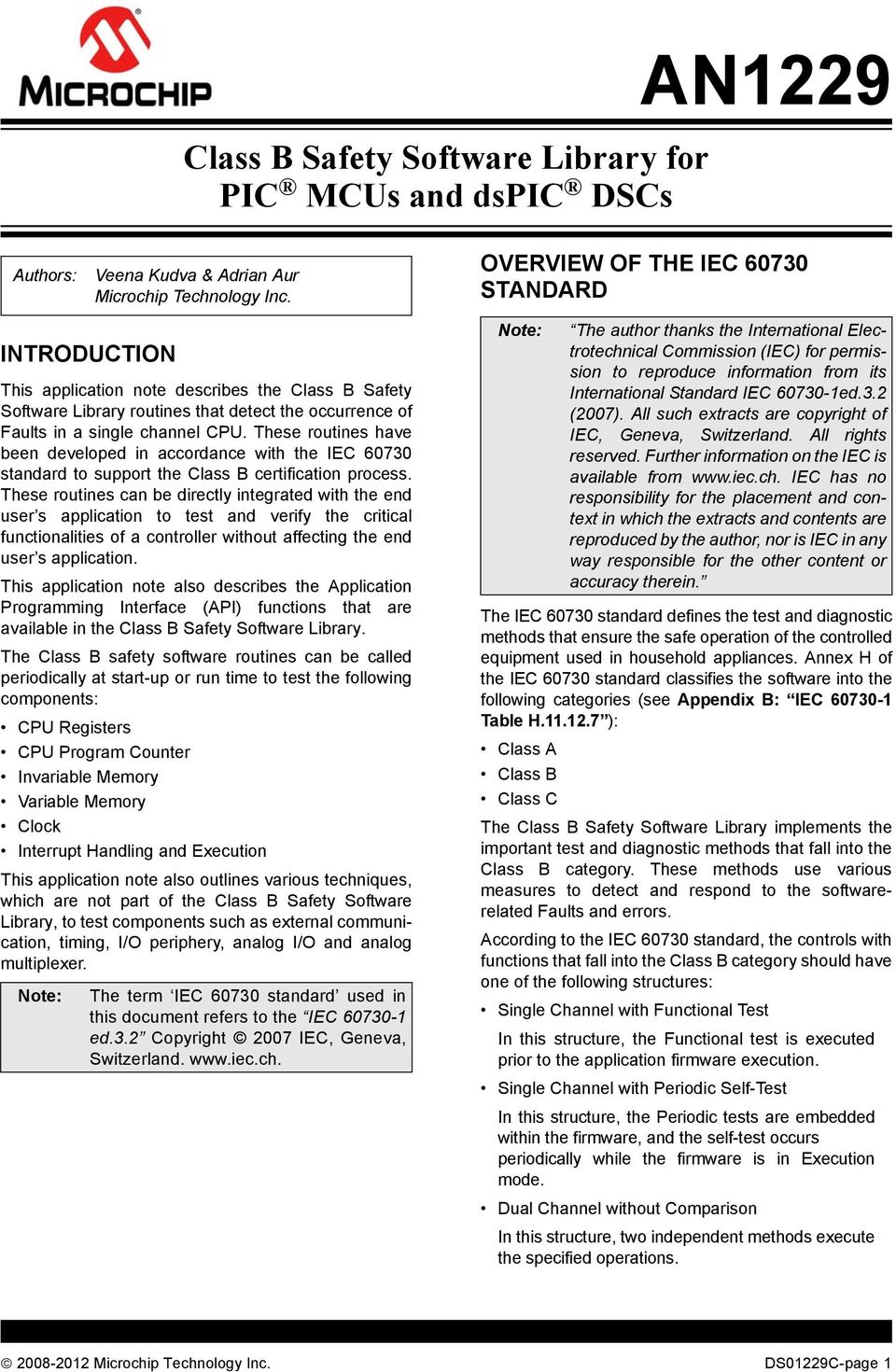
1 Class B Safety Software Library for PIC MCUs and dspic DSCs AN1229 Authors: Veena Kudva & Adrian Aur Microchip Technology Inc. OVERVIEW OF THE IEC STANDARD INTRODUCTION This application note describes the Class B Safety Software Library routines that detect the occurrence of Faults in a single channel CPU. These routines have been developed in accordance with the IEC standard to support the Class B certification process. These routines can be directly integrated with the end user s application to test and verify the critical functionalities of a controller without affecting the end user s application. This application note also describes the Application Programming Interface (API) functions that are available in the Class B Safety Software Library. The Class B safety software routines can be called periodically at start-up or run time to test the following components: CPU Registers CPU Program Counter Invariable Memory Variable Memory Clock Interrupt Handling and Execution This application note also outlines various techniques, which are not part of the Class B Safety Software Library, to test components such as external communication, timing, I/O periphery, analog I/O and analog multiplexer. Note: The term IEC standard used in this document refers to the IEC ed.3.2 Copyright 2007 IEC, Geneva, Switzerland. Note: The author thanks the International Electrotechnical Commission (IEC) for permission to reproduce information from its International Standard IEC ed.3.2 (2007). All such extracts are copyright of IEC, Geneva, Switzerland. All rights reserved. Further information on the IEC is available from IEC has no responsibility for the placement and context in which the extracts and contents are reproduced by the author, nor is IEC in any way responsible for the other content or accuracy therein. The IEC standard defines the test and diagnostic methods that ensure the safe operation of the controlled equipment used in household appliances. Annex H of the IEC standard classifies the software into the following categories (see Appendix B: IEC Table H ): Class A Class B Class C The Class B Safety Software Library implements the important test and diagnostic methods that fall into the Class B category. These methods use various measures to detect and respond to the softwarerelated Faults and errors. According to the IEC standard, the controls with functions that fall into the Class B category should have one of the following structures: Single Channel with Functional Test In this structure, the Functional test is executed prior to the application firmware execution. Single Channel with Periodic Self-Test In this structure, the Periodic tests are embedded within the firmware, and the self-test occurs periodically while the firmware is in Execution mode. Dual Channel without Comparison In this structure, two independent methods execute the specified operations Microchip Technology Inc. DS01229C-page 1
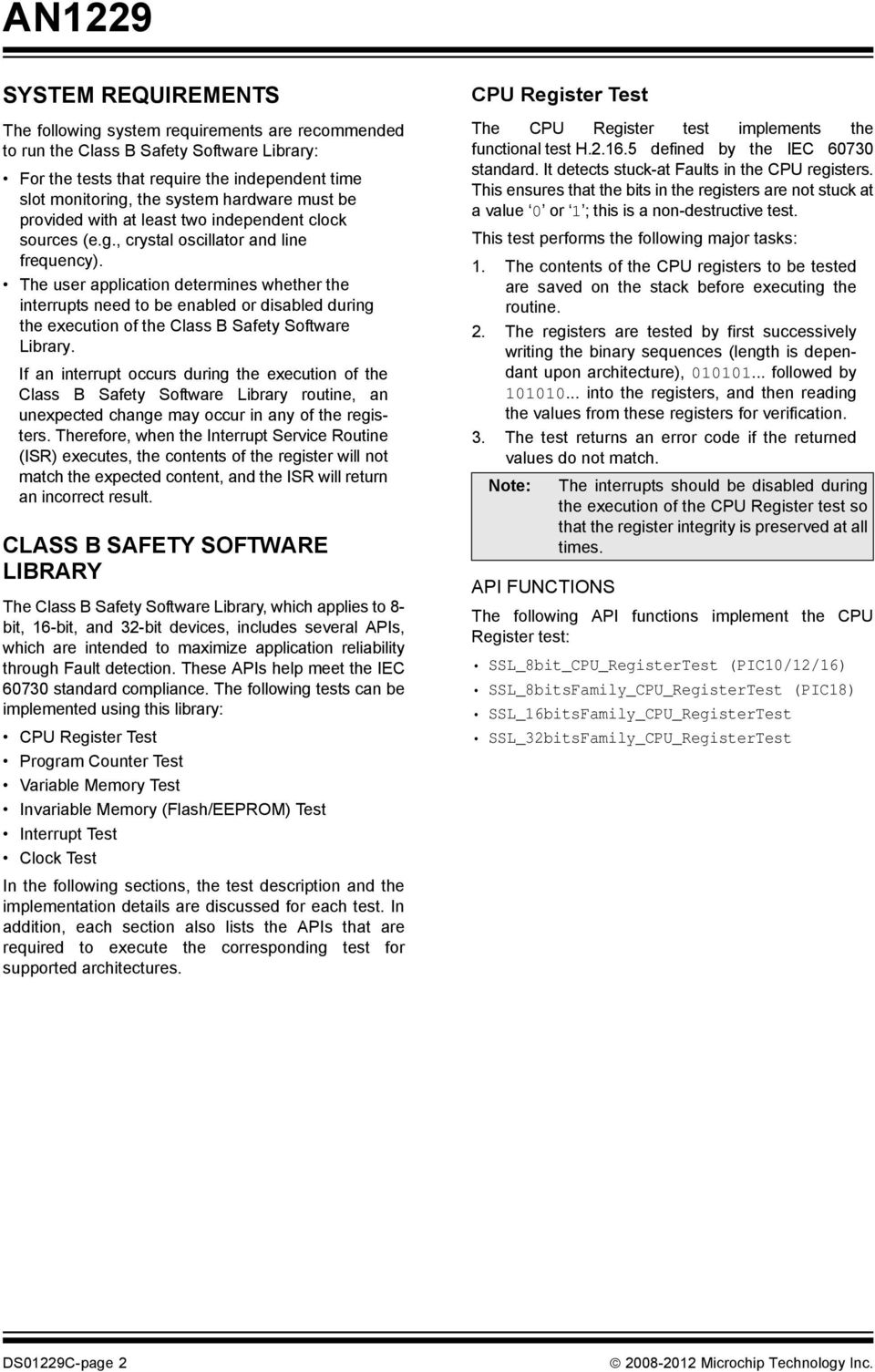
2 SYSTEM REQUIREMENTS The following system requirements are recommended to run the Class B Safety Software Library: For the tests that require the independent time slot monitoring, the system hardware must be provided with at least two independent clock sources (e.g., crystal oscillator and line frequency). The user application determines whether the interrupts need to be enabled or disabled during the execution of the Class B Safety Software Library. If an interrupt occurs during the execution of the Class B Safety Software Library routine, an unexpected change may occur in any of the registers. Therefore, when the Interrupt Service Routine (ISR) executes, the contents of the register will not match the expected content, and the ISR will return an incorrect result. CLASS B SAFETY SOFTWARE LIBRARY The Class B Safety Software Library, which applies to 8- bit, 16-bit, and 32-bit devices, includes several APIs, which are intended to maximize application reliability through Fault detection. These APIs help meet the IEC standard compliance. The following tests can be implemented using this library: CPU Register Test Program Counter Test Variable Memory Test Invariable Memory (Flash/EEPROM) Test Interrupt Test Clock Test In the following sections, the test description and the implementation details are discussed for each test. In addition, each section also lists the APIs that are required to execute the corresponding test for supported architectures. CPU Register Test The CPU Register test implements the functional test H defined by the IEC standard. It detects stuck-at Faults in the CPU registers. This ensures that the bits in the registers are not stuck at a value 0 or 1 ; this is a non-destructive test. This test performs the following major tasks: 1. The contents of the CPU registers to be tested are saved on the stack before executing the routine. 2. The registers are tested by first successively writing the binary sequences (length is dependant upon architecture), followed by into the registers, and then reading the values from these registers for verification. 3. The test returns an error code if the returned values do not match. Note: The interrupts should be disabled during the execution of the CPU Register test so that the register integrity is preserved at all times. API FUNCTIONS The following API functions implement the CPU Register test: SSL_8bit_CPU_RegisterTest (PIC10/12/16) SSL_8bitsFamily_CPU_RegisterTest (PIC18) SSL_16bitsFamily_CPU_RegisterTest SSL_32bitsFamily_CPU_RegisterTest DS01229C-page Microchip Technology Inc.
3 Program Counter Test The Program Counter (PC) test implements the functional test H defined by the IEC standard. The PC holds the address of the next instruction to be executed. The test performs the following major tasks: 1. The PC test invokes the functions that are located in the Flash memory at different addresses. 2. These functions return a unique value. 3. The returned value is verified using the PC test function. 4. If the values match, the PC branches to the correct location. Note 1: The user application defines the address where the PC branches. 2: The size of the program memory varies by device. Refer to the specific device data sheet for more details. The customized linker script defines the addresses where these functions reside in the Flash memory. The functions placed at these addresses return a unique value, which is the starting address of the called function. Example 1 shows how to modify the linker script to place a function in the Flash memory. The actual Flash address space is processor dependent. Please refer to the processor-specific linker script example provided. API FUNCTIONS The following API functions implement the PC test: SSL_8bit_PCtest (PIC10/12/16) SSL_8bitsFamily_PCtest (PIC18) SSL_16bitsFamily_PCtest SSL_32bitsFamily_PCtest EXAMPLE 1: LINKER SCRIPT MODIFICATION /* The modified linker script */ SslTestSection1 0x900: { *(.SslTestSection1); } program /* The SSL_TestFunction1 function*/ long attribute (( section (.SslTestSection1 ))) SSL_TestFunction1() { return((long)&ssl_testfunction1); } Microchip Technology Inc. DS01229C-page 3

4 Invariable Memory (Flash/EEPROM) Test The Invariable Memory (Flash/EEPROM) test implements the periodic modified checksum H defined by the IEC standard. It detects the single bit Faults in the invariable memory. The invariable memory in a system, such as Flash and EEPROM memory, contains data that is not intended to vary during the program execution. The Flash/EEPROM Invariable Memory test computes the periodic checksum using the Cyclic Redundancy Check (CRC). Several standards are used today for the CRC calculation. The characteristics of the CRC divisor vary from 8 to 32 bits depending on the polynomial that is used. The width of a divisor determines its ability to detect the errors. Some commonly used CRC divisors are as follows: CRC-16 = = 8005 (hex) CRC-CCITT = = 1021 (hex) CRC-32 = = 04C11DB7 (hex) Figure 1 illustrates the flowchart for the Invariable Memory test. The CRC16 calculation function returns the final CRC value that can be used to perform the following: 1. At the system start-up, the computed CRC checksum can be used as a reference checksum if the CRC_Flag is set to 0x The reference checksum is stored in the Flash or EEPROM memory and the CRC flag is set to 0xFF. 3. The CRC16 calculation function can be called periodically if the CRC flag is set to 0xFF. 4. The checksum calculated from step 3 is compared with the reference checksum. 5. If both values match, a status bit can be set by the user application to indicate that the invariable memory has passed the test and no errors were found. API FUNCTIONS The following API functions implement the Invariable Memory test: SSL_8bit_EEPROMtest_CRC16 (PIC10/12/16) SSL_8bitsFamily_EEPROMtest_CRC16 (PIC18) SSL_8bitsFamily_Flashtest_CRC16 (PIC18) SSL_16bitsFamily_Flashtest_CRC16 SSL_16bitsFamily_EEPROMtest_CRC16 SSL_32bitsFamily_Flashtest_CRC16 Note: The 16-bit EEPROM test applies only to dspic30f devices. FIGURE 1: FLOWCHART FOR THE INVARIABLE MEMORY TEST Start No CRCFlag == 0 Yes Calculate the CRC Calculate the Reference CRC Checksum Yes Reference CRC == Calculated CRC No Store the Reference CRC Checksum in the Flash/EEPROM Memory Set CRCFlag = 0xFF Pass/No Errors Found Fail/Errors Found End DS01229C-page Microchip Technology Inc.

5 Variable Memory Test The Variable Memory test implements the Periodic Static Memory test H defined by the IEC standard. It detects single bit Faults in variable memory. The variable memory contains data, which is intended to vary during program execution. The RAM Memory test is used to determine if any bit of the RAM memory is stuck at 1 or 0. The March Memory test and Checkerboard test are some of the widely used static memory algorithms for checking the DC Faults. The following tests can be implemented using the Class B Safety Software Library: March Test - March C Test - March C Minus Test - March B Test MARCH TEST A March test performs a finite set of operations on every memory cell in a memory array. Each operation performs the following tasks: 1. Writes 0 to a memory cell (w0). 2. Writes 1 to a memory cell (w1). 3. Reads the expected value 0 from a memory cell (r0). 4. Reads the expected value 1 from a memory cell (r1). March Test Notations Figure 2 illustrates the notations that are used in the March test. FIGURE 2: MARCH TEST NOTATIONS : Arranges the address sequence in ascending order. : Arranges the address sequence in descending order. : Arranges the address sequence in either ascending or descending order. r 0 : Indicates a read operation (reads 0 from a memory cell). r 1 : Indicates a read operation (reads 1 from a memory cell). w 0 : Indicates a write operation (writes 0 to a memory cell). w 1 : Indicates a write operation (writes 1 to a memory cell). Note: The March memory functions do not test the area of the RAM. The following special functions are provided for the area test: SSL_8bitsFamily_RAM_STACKtest_MarchC (PIC18) SSL_16bitsFamily_RAM_STACKtest_MarchC SSL_32bitsFamily_RAM_STACKtest_MarchC Microchip Technology Inc. DS01229C-page 5
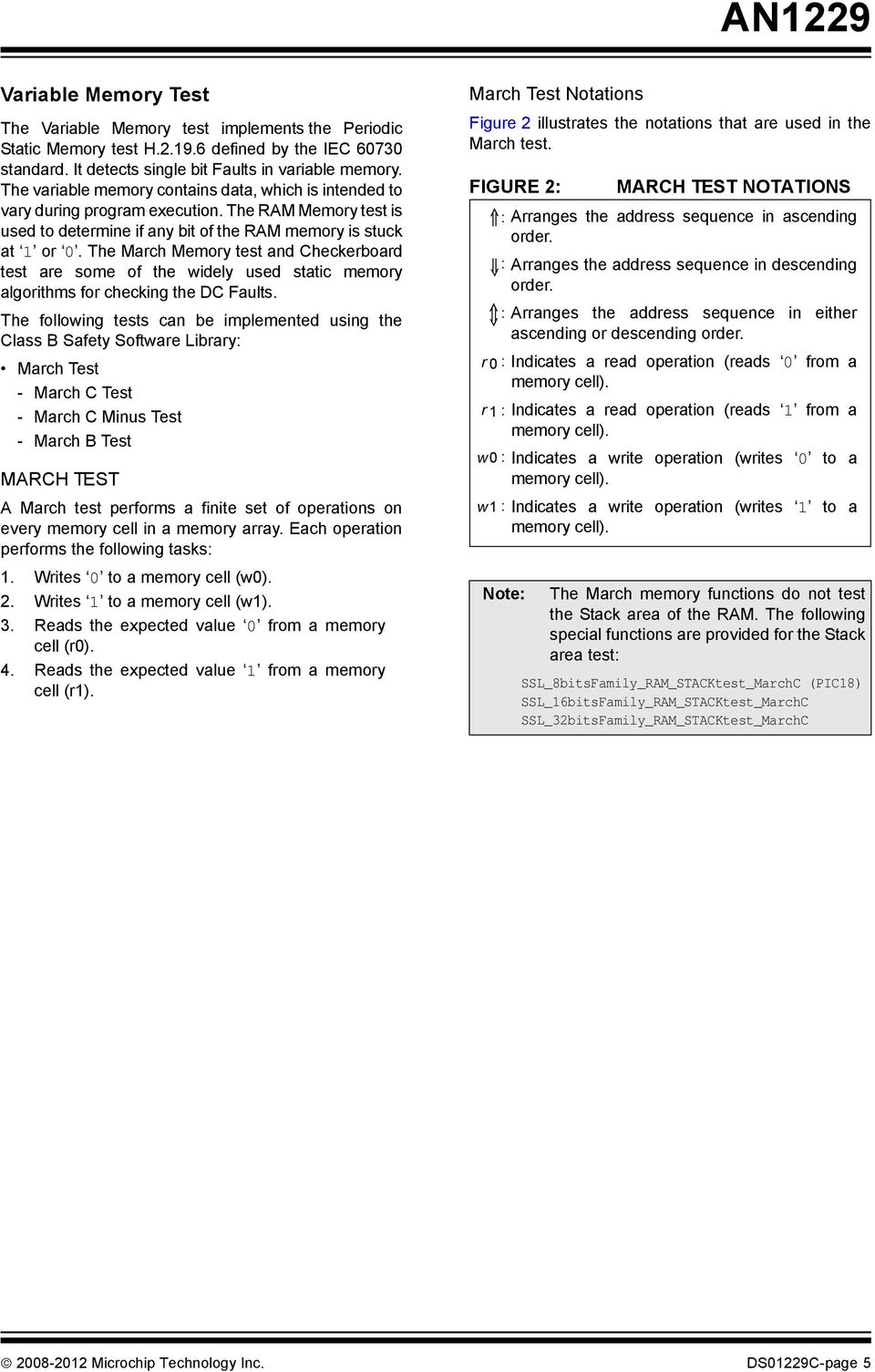
6 MARCH C TEST The March C test is used to detect the following types of Fault in the variable memory: Stuck-at Fault Addressing Fault Transition Fault Coupling Fault The complexity of this test is 11n, where n indicates the number of bits in the memory. This test is a destructive test (i.e., memory contents are not preserved). Therefore, it is designed to run at the system start-up before initializing the memory and the run-time libraries. Example 2 shows the pseudocode that demonstrates the implementation of the March C test. API FUNCTIONS The following API functions implement the March C test: SSL_8bit_RAMtest_MarchC (PIC10/12/16) SSL_8bitsFamily_RAMtest_MarchC (PIC18) SSL_8bitsFamily_RAM_STACKtest_MarchC (PIC18) SSL_16bitsFamily_RAMtest_MarchC SSL_16bitsFamily_RAM_STACKtest_MarchC SSL_32bitsFamily_RAMtest_MarchC SSL_32bitsFamily_RAM_STACKtest_MarchC Figure 3 illustrates a March C algorithm. FIGURE 3: March C { ( w0); ( r 0, w1); MARCH C ALGORITHM ( r 1, w0 ); } ( r 0 ); ( r 0, w1); ( r 1, w0 ); ( r 0 ) EXAMPLE 2: for(i=0;i<=(n-1);i++) x(i)=0; for(i=0;i<=(n-1);i++) { if (x(i)==0) x(i) =1; else return fail; } for(i=0;i<=(n-1);i++) { if(x(i)==1) x(i)=0; else return fail; } for(i=(n-1);i>=0;i--) { if(x(i)==0) x(i)=1; else return fail; } for(i=(n-1);i>=0;i--) { if(x(i)==1) x(i)=0; else return fail; for(i=(n-1);i>=0;i--) { if(x(i)==0) {} else return fail } return pass; PSEUDOCODE FOR MARCH C TEST /*write background to zero*/ DS01229C-page Microchip Technology Inc.
7 MARCH C MINUS TEST The March C Minus test is used to detect the following types of Fault in the variable memory: Stuck-at Fault Addressing Fault Transition Fault Coupling Fault The complexity of this test is 10n, where n indicates the number of bits in the memory. This test is a destructive test. Therefore, it is designed to run at the system start-up before initializing the memory and the run-time libraries. API FUNCTIONS The following API functions implement the March C Minus test: SSL_8bit_RAMtest_MarchC_Minus (PIC10/12/16) SSL_8bitsFamily_RAMtest_MarchC_Minus (PIC18) SSL_16bitsFamily_RAMtest_MarchC_Minus SSL_32bitsFamily_RAMtest_MarchC_Minus Figure 4 illustrates a March C Minus algorithm. FIGURE 4: March CMinus { ( w0); ( r 0, w1); MARCH C MINUS ALGORITHM ( r 1, w0 ); } ( r 0, w1); ( r 1, w0 ); ( r 0 ); Microchip Technology Inc. DS01229C-page 7

8 MARCH B TEST The March B is a non-redundant test that can detect the following types of Fault: Stuck-at Linked Idempotent Coupling Inversion Coupling This test is of complexity 17n, where n indicates the number of bits in the memory. Figure 5 illustrates a March B algorithm. FIGURE 5: March B { } ( r1, w0, w1, w 0); ( r 0, w1, w0 ); MARCH B ALGORITHM ( w0); ( r 0, w1, r1, w 0, r 0, w1); ( r 1, w0, w1 ); Example 3 shows the pseudocode that demonstrates the implementation of the March B test. API FUNCTIONS The following API functions implement the March B test: SSL_8bit_RAMtest_MarchB (PIC10/12/16) SSL_8bitsFamily_RAMtest_MarchB (PIC18) SSL_16bitsFamily_RAMtest_MarchB SSL_32bitsFamily_RAMtest_MarchB Note 1: The user application should allocate appropriate space for the stack before executing any of the March tests (see the details in the specific API function description). The stack must be allocated at an appropriate address so that it does not get overwritten during the test execution. 2: Depending on the architecture, it is recommended that the stack be placed at the beginning or at the end of the data memory. The user application should specify an address such that it does not overlap other statically allocated resources (e.g., the MPLAB ICD 2 RAM space or other debugger used RAM space). DS01229C-page Microchip Technology Inc.
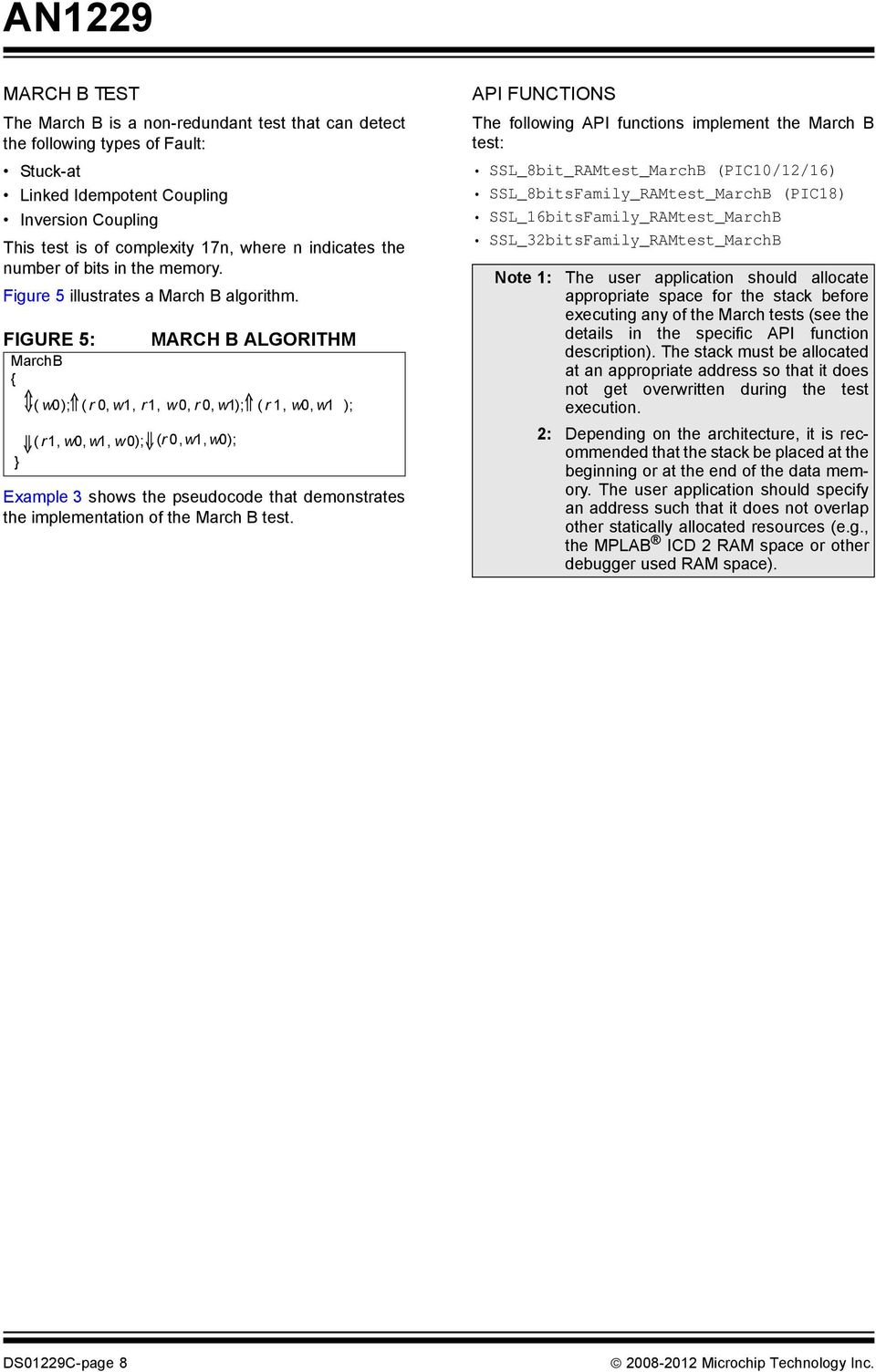
9 EXAMPLE 3: for(i=0;i<=(n-1);i++) x(i)=0; for(i=0;i<=(n-1);i++) { if(x(i)=0) x(i)=1; else return fail; if(x(i)==1) x(i)=0; else return fail; if(x(i)==0) x(i)=1; else return fail; } for(i=0;i<=(n-1);i++) { if(x(i)==1) { x(i)=0; x(i)=1; } else return fail; } for(i=(n-1);i>=0;i--) { if(x(i)=1) { x(i)=0; x(i)=1; x(i)=0; } else return fail; } for(i=(n-1);i>=0;i--) { if(x(i)==0) { x(i)=1; x(i)=0; } else return fail; } return pass; PSEUDOCODE FOR MARCH B TEST /*write background to zero*/ Microchip Technology Inc. DS01229C-page 9
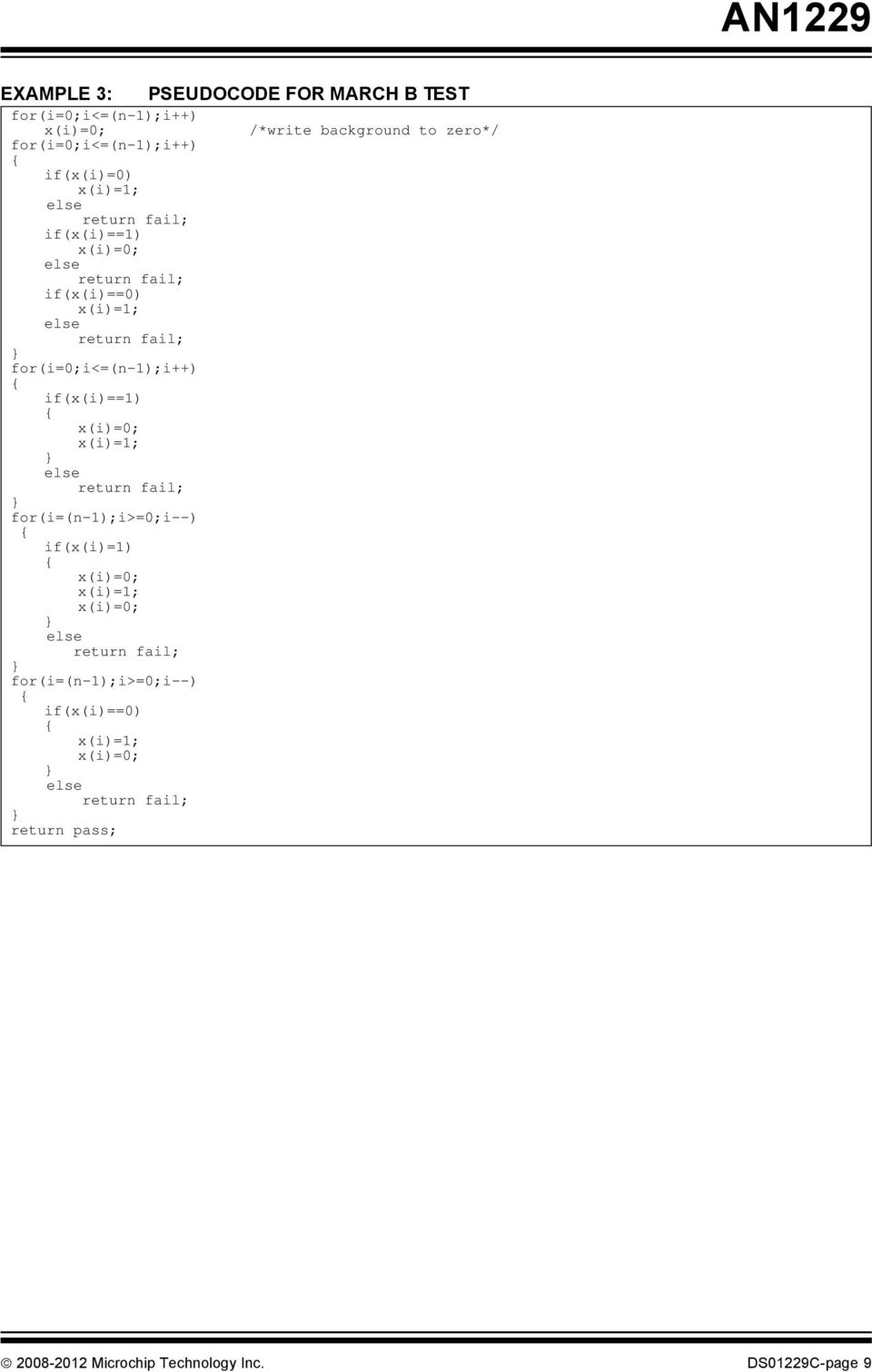
10 CHECKERBOARD RAM TEST The Checkerboard RAM test writes the checkerboard patterns to a sequence of adjacent memory locations. This test is performed in units (memory chunks) of architecture-specific sizes (2 bytes for 8-bit architecture, 4 bytes for 16-bit architecture, 64 bytes for 32-bit architecture). This is a non-destructive memory test. This test performs the following major tasks: 1. Saves the contents of the memory locations to be tested in the CPU registers. 2. Writes the binary value (length is dependant upon architecture) to the memory location, N, and the inverted binary value, , to the memory location, N+1, and so on, until the whole memory chunk is filled. 3. Reads the contents of all the memory locations in the current chunk and verifies its contents. If the values match, the function continues; otherwise it stops and returns an error. 4. Step 2 and 3 are repeated by writing the inverted pattern to the same locations. 5. Once a memory chunk is completed the test of the next chunk is started until all of the requested memory area is tested. API FUNCTIONS The following API functions implement the Checkerboard RAM test: SSL_8bit_RAMtest_CB (PIC10/12/16) SSL_8bitsFamily_RAM_CB_test (PIC18) SSL_16bitsFamily_RAMtest_CheckerBoard SSL_32bitsFamily_RAMtest_CheckerBoard Interrupt Test The Interrupt test implements the independent time slot monitoring H defined by the IEC standard. It checks whether the number of interrupts that occurred is within the predefined range. The goal of the Interrupt test is to verify that interrupts occur regularly. The Interrupt test function can be invoked at specified time intervals. It is triggered by a timer or line frequency interrupt to monitor and verify the interrupt operation. To keep track of the interrupts that occur frequently, a dedicated counter in each ISR can be decremented when an interrupt occurs. For example, if the Serial Peripheral Interface (SPI) is configured to generate an interrupt every 2 ms, the SPI will generate at least five interrupts in 10 ms. When a SPI interrupt occurs, the counter dedicated to keep track of the SPI interrupt is decremented. Thus, if the counter is initialized to five, the counter is decremented to zero in 10 ms. This is verified by the Interrupt test function that is triggered after every 10 ms. To keep track of interrupts that occur rarely, a dedicated counter within the Interrupt test function is decremented if the specific interrupt did not occur during the last time interval. Refer to the example code, which is available for download from the Microchip web site (see Appendix A: Source Code for details.). Clock Test According to the IEC standard, only harmonics and subharmonics of the clock need to be tested. The Clock test implements the independent time slot monitoring H defined by the IEC standard. It verifies the reliability of the system clock (i.e., the system clock should be neither too fast nor too slow): Depending on the choice of the reference clock, one of the following Clock tests can be used: Clock Test Using the Secondary Oscillator (SOSC) Clock Test Using the Line Frequency (50 Hz, 60 Hz) CLOCK TEST USING THE SOSC The Clock Test function is used to verify the proper operation of the CPU clock when the SOSC is used as a reference clock. This test performs the following major tasks: 1. The LP secondary oscillator is used as an independent clock source or a reference clock source. This 32 khz oscillator is used to clock the hardware Timer1. 2. Usually, the Primary Oscillator (POSC) with Phase-Locked Loop (PLL) is the clock source to the CPU. The test uses a hardware timer that runs at the CPU clock frequency (Timer0 for 8- bit architecture, Timer2 for 16-bit architecture and the CPU Core timer for 32-bit architecture). 3. Timer1 is configured to overflow and generate an interrupt at specified time intervals (e.g., 1ms). 4. The value of the hardware timer used to count the CPU clock counts is saved when Timer1 overflows. This value represents the number of CPU clock cycles elapsed in the 1 ms time period of the SOSC. If the number of clock cycles is outside a specified range, the function returns an error code. API FUNCTIONS The following API functions implement the Clock test: SSL_8bitsFamily_CLOCKtest (PIC18) SSL_16bitsFamily_CLOCKtest SSL_32bitsFamily_CLOCKtest DS01229C-page Microchip Technology Inc.
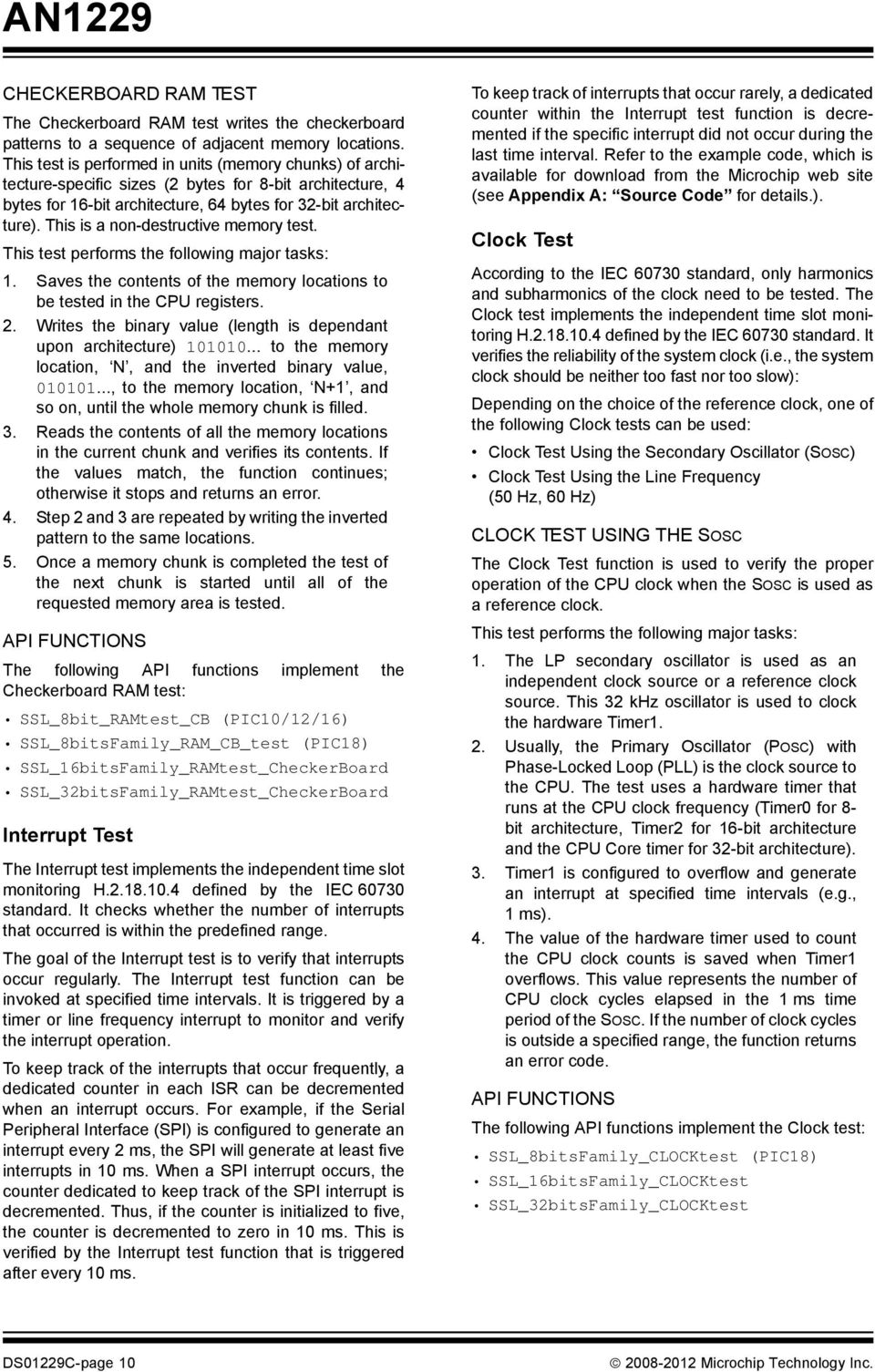
11 CLOCK TEST USING THE LINE FREQUENCY (50 Hz, 60 Hz) The Clock Test function is used to verify the proper operation of the CPU clock. The 50 Hz/60 Hz line frequency is used as an independent clock source or a reference clock source. The input capture module is used for the period measurement. The 50 Hz/60 Hz line frequency is fed to the Input Capture pin (IC1) of the respective device. This test performs the following major tasks: 1. The IC1CON register is configured as follows: a) Hardware Timer2 is selected as the IC1 time base (Timer1 for PIC18). b) The capture operation is programmed to occur on every rising edge of the line frequency. c) A capture done event (interrupt) is programmed to occur on every second capture event 2. The Timer2 prescaler is configured so that the timer count does not time-out within 20 ms/ ms (Timer1 for PIC18). 3. The capture is performed on every rising edge of line frequency. For period measurement, the capture done event (interrupt) is generated after taking two time-stamps (see Figure 6). 4. The difference between the two time-stamps (V1 and V2) provides the timer period value. The number of CPU cycles in 20 ms/16.66 ms of the line frequency is computed as follows: Number of Clock Cycles = ((V1 V2) * Timer2 Prescaler) API FUNCTIONS The following API functions implement the Clock test: API Functions for 8-bit PIC MCUs (PIC18) SSL_16bitsFamily_CLOCKtest_LineFreq SSL_32bitsFamily_CLOCKtest_LineFreq FIGURE 6: TIMER VALUE CAPTURE V2 TMR2 or TMR3 V3 V1 V4 ICx Capture Event Capture Interrupt (ICI<1:0> = 01) Read Captured Value in ISR Read Captured Value in ISR Capture FIFO V1 xxxx xxxx xxxx 1st Capture V1 V2 xxxx xxxx V3 V2 xxxx xxxx V3 V4 xxxx xxxx 2nd Capture 3rd Capture 4th Capture Note: In this illustration, the timer ramp is not to scale Microchip Technology Inc. DS01229C-page 11
12 Addressing of Variable and Invariable Memory and Internal Data Path For single chip microcontrollers or digital signal controllers, such as PIC MCUs and dspic DSCs, the Periodic Static Memory test is used to test the variable memory, and the periodic checksum is used to test the invariable memory. These tests detect any stuck-at Fault in the internal address bus and internal data path. Addressing Wrong Address This test is required only for microcontrollers with an external memory device. External Communication The IEC Class B specifications suggest the following measures to ensure reliable communication between components: TRANSFER REDUNDANCY The transfer redundancy is a Fault/error control technique that protects against coincidental and/or systematic errors in the input and output information. It is achieved by transferring the data between the transmitter and receiver. The data is transferred at least twice in succession and then compared. PROTOCOL TEST The Protocol test is a Fault/error control technique in which the data is transferred to and from the computer components to detect errors in the internal communication protocol. CRC SINGLE WORD A CRC polynomial is used to calculate the CRC checksum of the transmitted message. At the transmitting end, this CRC checksum is appended to the message before transmitting it. At the receiving end, the receiver uses the same CRC polynomial to compute the CRC checksum, and compares the computed value with the received value. Timing The PIC MCUs and dspic DSCs have several dedicated communication interfaces, such as UART, I 2 C and SPI modules. The IEC Class B specifications suggest that these modules should use time slot monitoring to ensure that the communication occurs at the correct point in time. Plausibility Check The plausibility checks on the I/O periphery, analog multiplexer and A/D convertor can be performed as follows: I/O PERIPHERY The plausibility check on an I/O pin can be performed by toggling the I/O and checking the state of the pin. ANALOG MULTIPLEXER To verify the operation of the analog multiplexer, known voltage values are applied to all channels. These values are read and compared with the applied voltage for verification. A/D CONVERTER To test the analog functions of the A/D converter, a known external voltage is applied to the analog inputs. The conversion results are then compared with the applied voltage. API FUNCTIONS FOR 8-BIT PIC MCUs (PIC10/12/16) This section lists and describes the API functions that are available in the Class B Safety Software Library for 8-bit architecture (PIC10/12/16). The API functions are listed below followed by their individual detailed descriptions: SSL_8bit_CPU_RegisterTest SSL_8bit_PCtest SSL_8bit_EEPROMtest_CRC16 SSL_8bit_RAMtest_MarchC SSL_8bit_RAMtest_MarchC_Minus SSL_8bit_RAMtest_MarchB DS01229C-page Microchip Technology Inc.
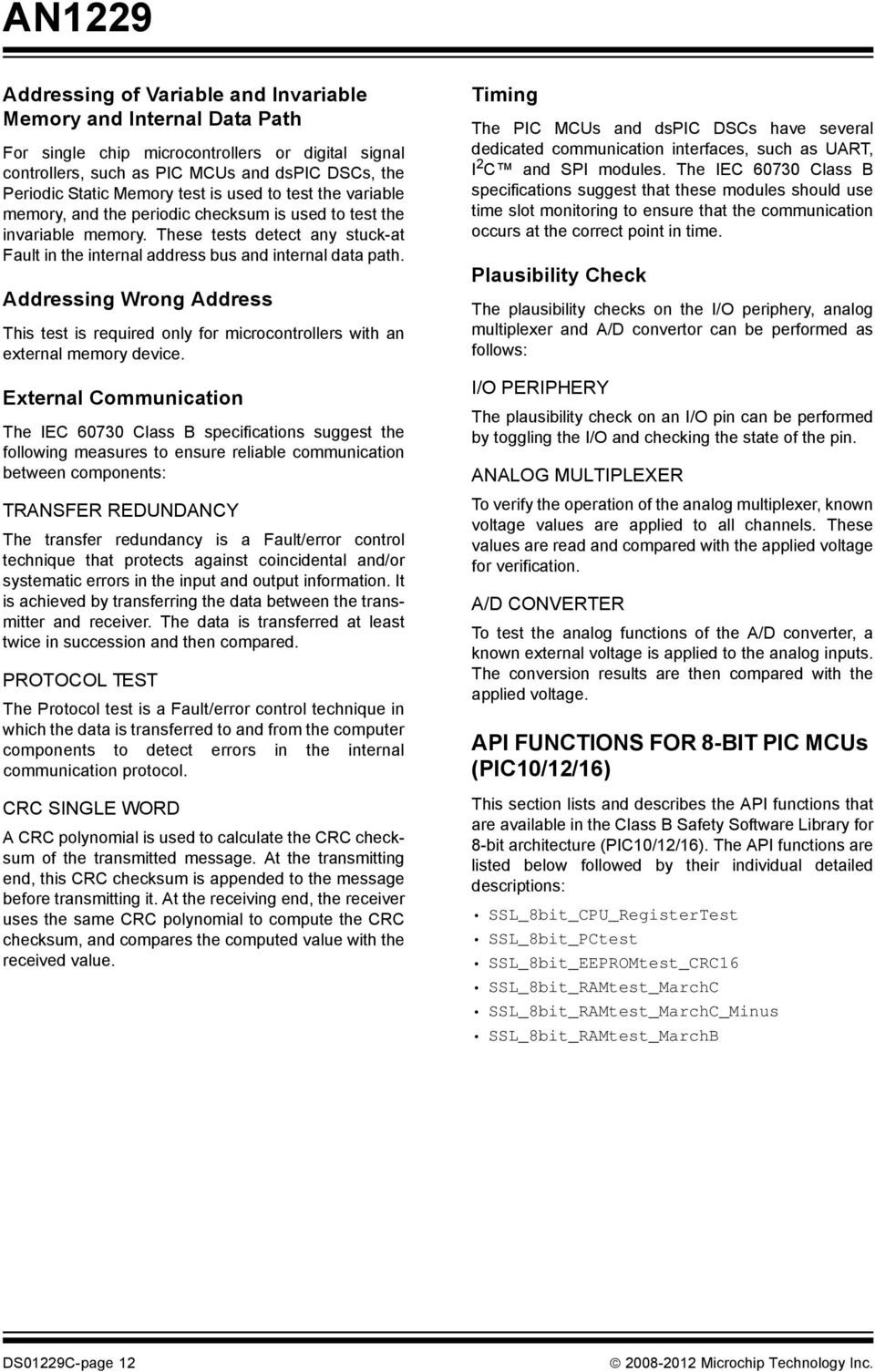
13 SSL_8bit_CPU_RegisterTest This function implements the CPU Register test. The test successively writes the values 0x55 and 0xAA into the registers and then reads the values from these registers for verification. The function returns an error code if the values do not match. The contents of the register (W0) that returns the error code are not preserved. The contents of the CPU register to be tested is saved on a temporary register before executing the routine and is restored upon the completion of the test. int SSL_8bit_CPU_RegisterTest(void); Arguments REGISTER_TEST_FAIL Return value = 0 REGISTER_TEST_PASS Return value = 1 Remarks Source File TABLE 1: RESOURCE REQUIREMENTS Execution Time 77 words NONE 81 cycles Microchip Technology Inc. DS01229C-page 13
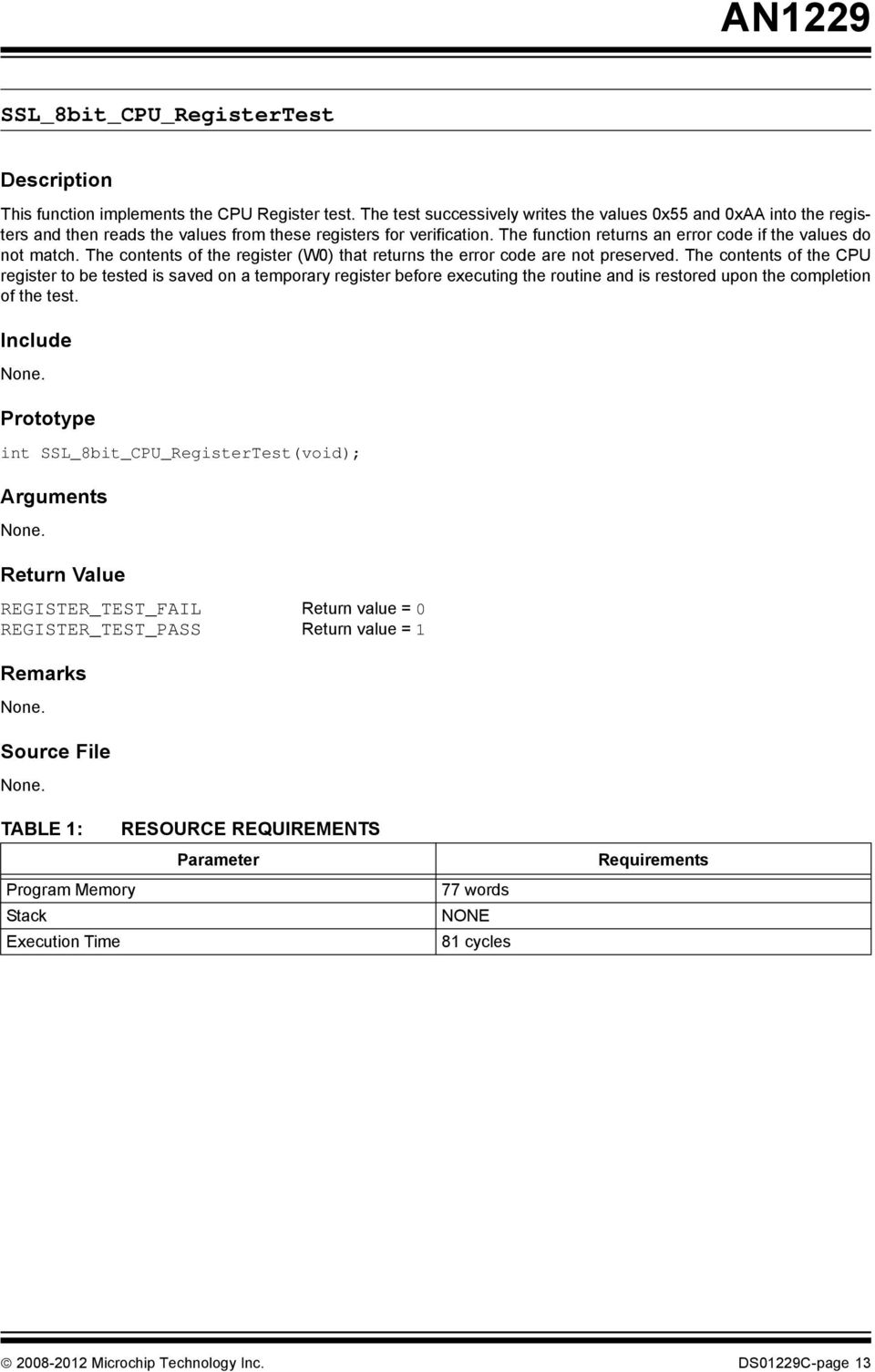
14 SSL_8bit_PCtest This function implements the PC test, which is a functional test of the PC. The test invokes the functions that are located in the Flash memory at different addresses. The SSL_ProgCounterTest.h header file defines the addresses, where these functions reside in the Flash memory. The functions placed at these addresses return a unique value, which is the starting address of the called function. This returned value is verified using the SSL_8bit_PCtest function. SSL_ProgCounterTest.h unsigned int SSL_8bit_PCtest(void); Arguments PC_TEST_FAIL Return value = 0 PC_TEST_PASS Return value = 1 Remarks TABLE 2: RESOURCE REQUIREMENTS Execution Time 107 words 1 byte 92 cycles DS01229C-page Microchip Technology Inc.
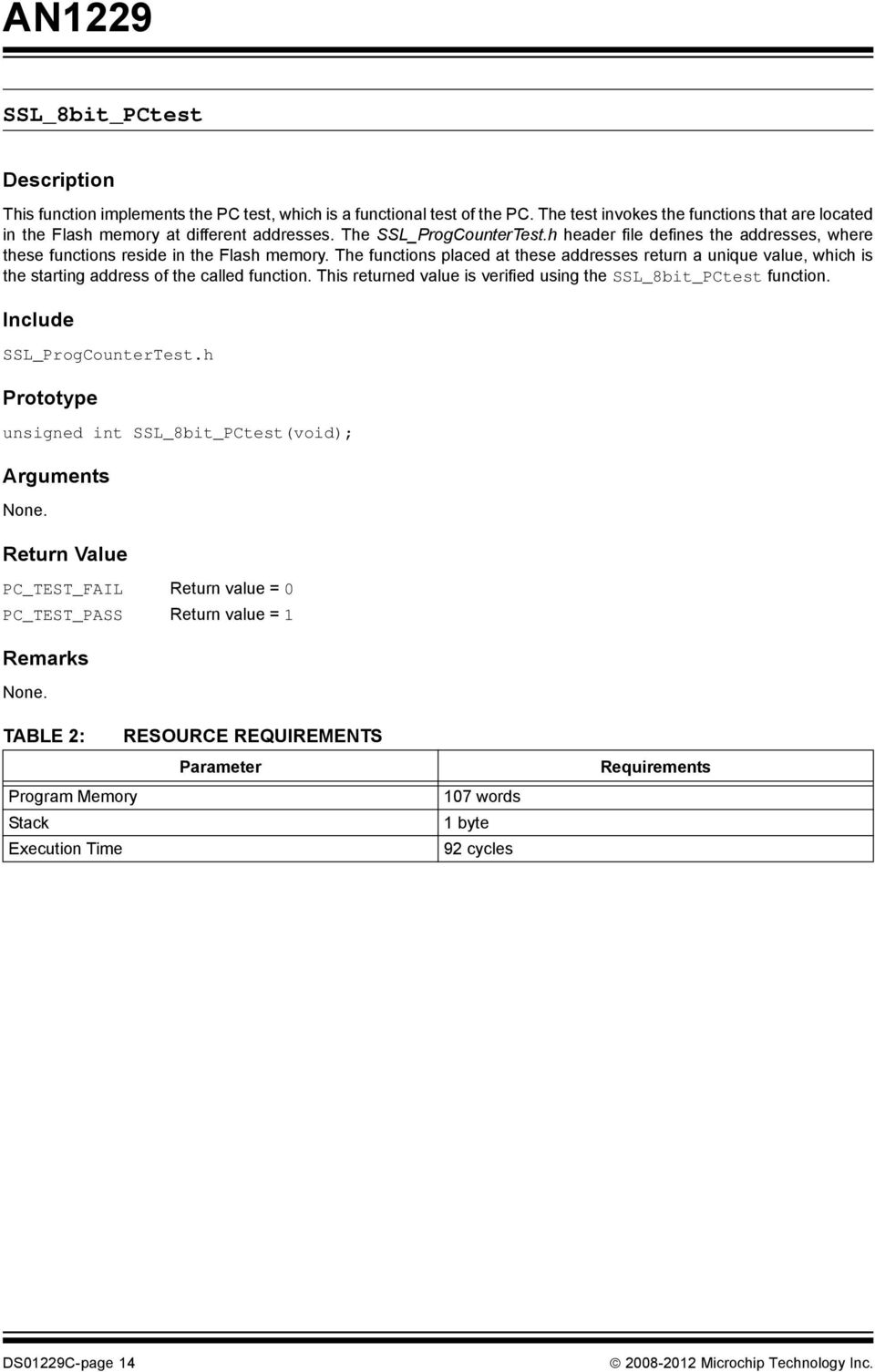
15 SSL_8bit_EEPROMtest_CRC16 This function implements the Invariable Memory test. It computes the CRC of the data located between the address, EEPROM_STARTADDRESS, and the address, EEPROM_ENDADDRESS. This function returns the final CRC value. SSL_EEPROM_CRC.h unsigned int SSL_8bits_EEPROMtest_CRC16(unsigned char startaddress,unsigned char endaddress) Arguments startaddress endaddress Indicates the starting address of the data to be tested Indicates the ending address of the data to be tested crc_result Holds the CRC result Remarks Source File TABLE 3: RESOURCE REQUIREMENTS 149 words 1 byte Execution Time 1091 cycles (1) Note 1: The execution time specified here is for three EEPROM locations Microchip Technology Inc. DS01229C-page 15
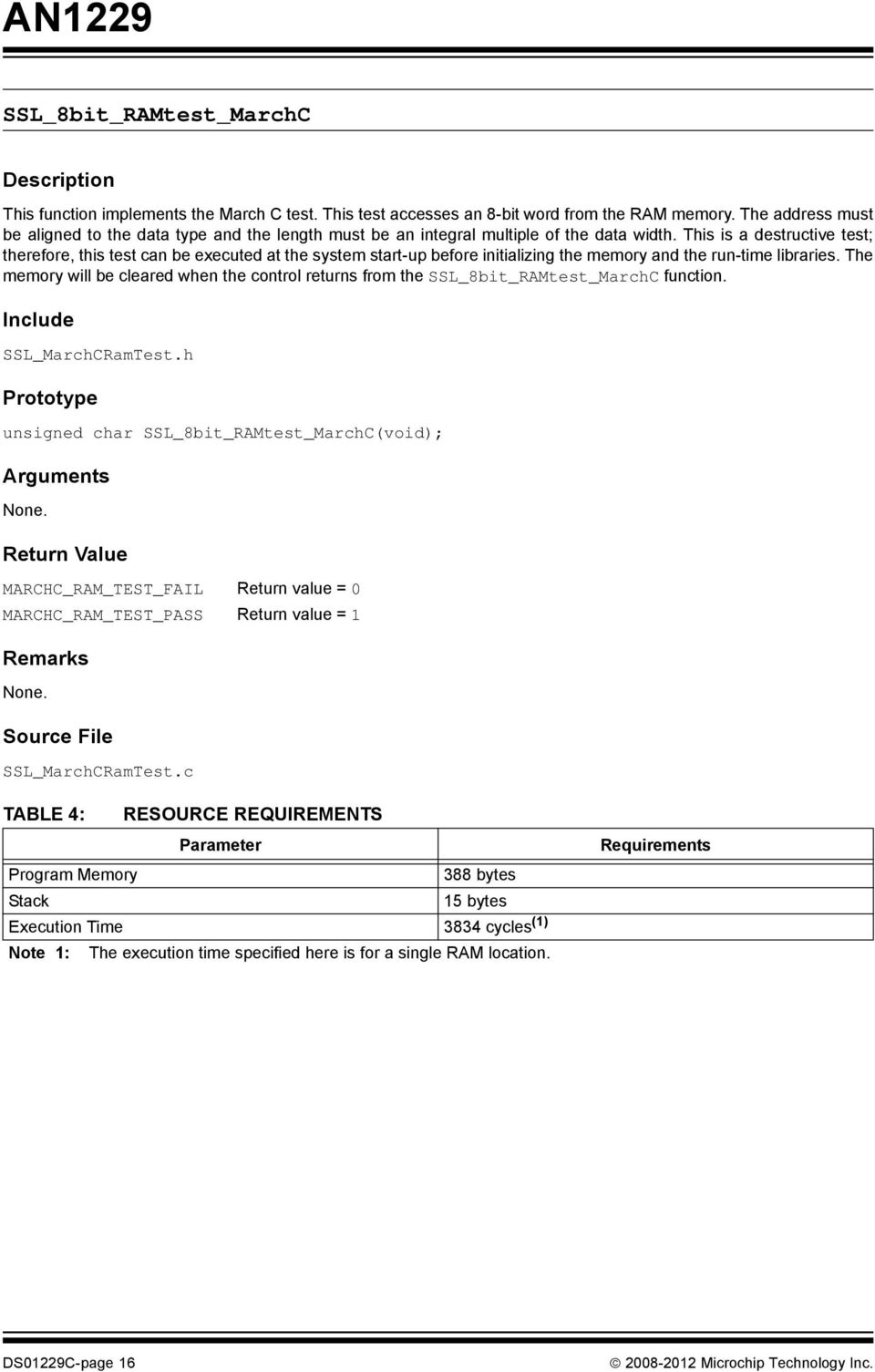
16 SSL_8bit_RAMtest_MarchC This function implements the March C test. This test accesses an 8-bit word from the RAM memory. The address must be aligned to the data type and the length must be an integral multiple of the data width. This is a destructive test; therefore, this test can be executed at the system start-up before initializing the memory and the run-time libraries. The memory will be cleared when the control returns from the SSL_8bit_RAMtest_MarchC function. SSL_MarchCRamTest.h unsigned char SSL_8bit_RAMtest_MarchC(void); Arguments MARCHC_RAM_TEST_FAIL Return value = 0 MARCHC_RAM_TEST_PASS Return value = 1 Remarks Source File SSL_MarchCRamTest.c TABLE 4: RESOURCE REQUIREMENTS 388 bytes 15 bytes Execution Time 3834 cycles (1) Note 1: The execution time specified here is for a single RAM location. DS01229C-page Microchip Technology Inc.
17 SSL_8bit_RAMtest_MarchC_Minus This function implements the March C Minus test. This test accesses an 8-bit word from the RAM memory. The address must be aligned to the data type and the length must be an integral multiple of the data width. This is a destructive test; therefore, this test can be executed at the system start-up before initializing the memory and the run-time libraries. The memory will be cleared when the control returns from the SSL_8bit_RAMtest_MarchCMinus function. SSL_MarchCMInusRamTest.h unsigned char SSL_8bit_RAMtest_MarchCMinus(void); Arguments MARCHC_RAM_TEST_FAIL Return value = 0 MARCHC_RAM_TEST_PASS Return value = 1 Remarks Source File SSL_MarchCMinusRamTest.c TABLE 5: RESOURCE REQUIREMENTS 269 bytes 10 bytes Execution Time 3834 cycles (1) Note 1: The execution time specified here is for a single RAM location Microchip Technology Inc. DS01229C-page 17

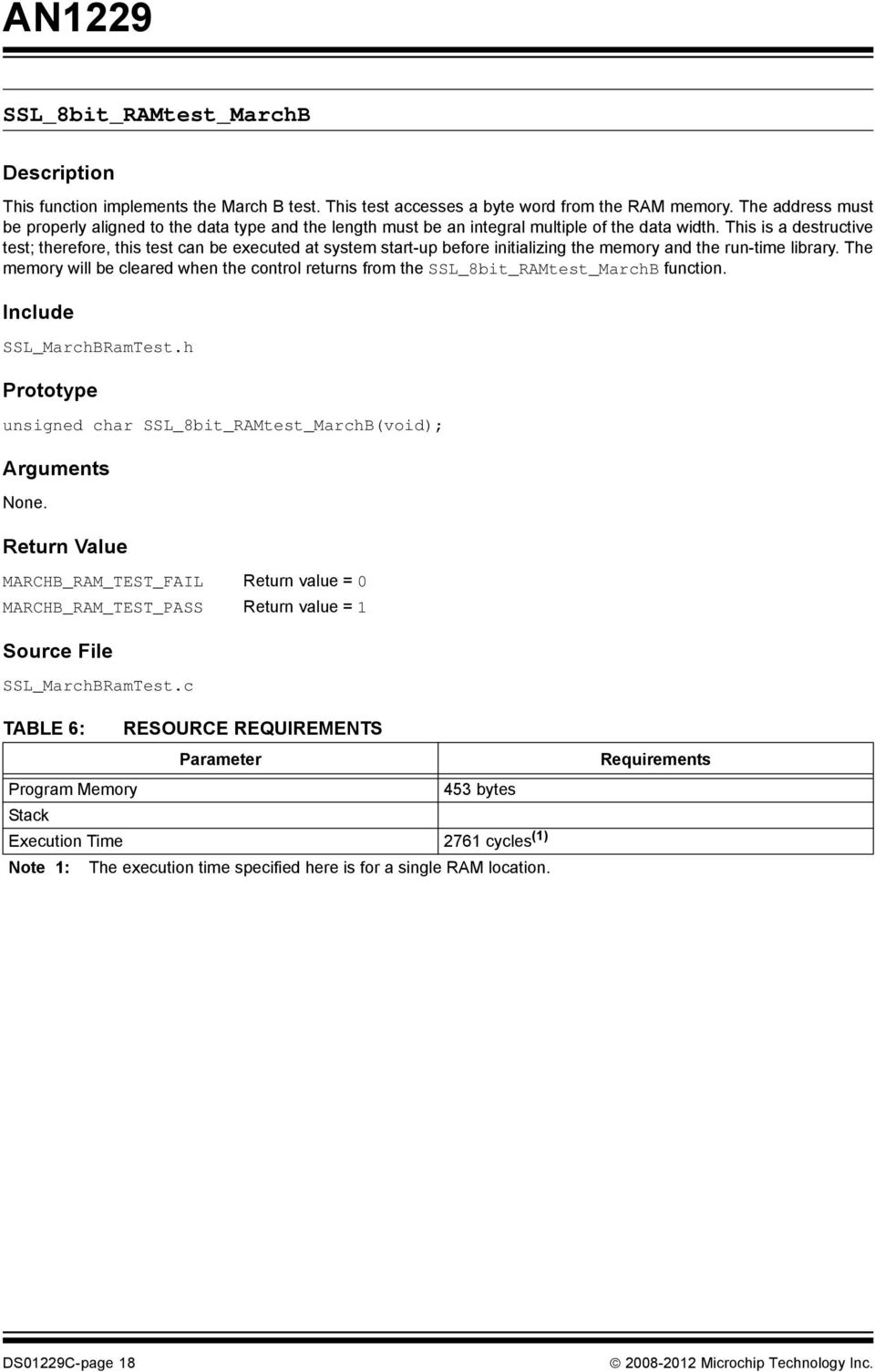
18 SSL_8bit_RAMtest_MarchB This function implements the March B test. This test accesses a byte word from the RAM memory. The address must be properly aligned to the data type and the length must be an integral multiple of the data width. This is a destructive test; therefore, this test can be executed at system start-up before initializing the memory and the run-time library. The memory will be cleared when the control returns from the SSL_8bit_RAMtest_MarchB function. SSL_MarchBRamTest.h unsigned char SSL_8bit_RAMtest_MarchB(void); Arguments MARCHB_RAM_TEST_FAIL Return value = 0 MARCHB_RAM_TEST_PASS Return value = 1 Source File SSL_MarchBRamTest.c TABLE 6: RESOURCE REQUIREMENTS 453 bytes Execution Time 2761 cycles (1) Note 1: The execution time specified here is for a single RAM location. DS01229C-page Microchip Technology Inc.
19 API FUNCTIONS FOR 8-BIT PIC MCUs (PIC18) This section lists and describes the API functions that are available in the Class B Safety Software Library for the 8-bit architecture. The functions are listed below followed by their individual detailed descriptions: SSL_8bitsFamily_CPU_RegisterTest SSL_8bitsFamily_PCtest SSL_8bitsFamily_Flashtest_CRC16 SSL_8bitsFamily_EEPROMtest_CRC16 SSL_8bitsFamily_RAM_STACKtest_MarchC SSL_8bitsFamily_RAMtest_MarchC_Minus SSL_8bitsFamily_RAMtest_MarchB SSL_8bitsFamily_RAMtest_CheckerBoard SSL_8bitsFamily_CLOCKtest SSL_8bitsFamily_CLOCKtest_LineFreq Microchip Technology Inc. DS01229C-page 19
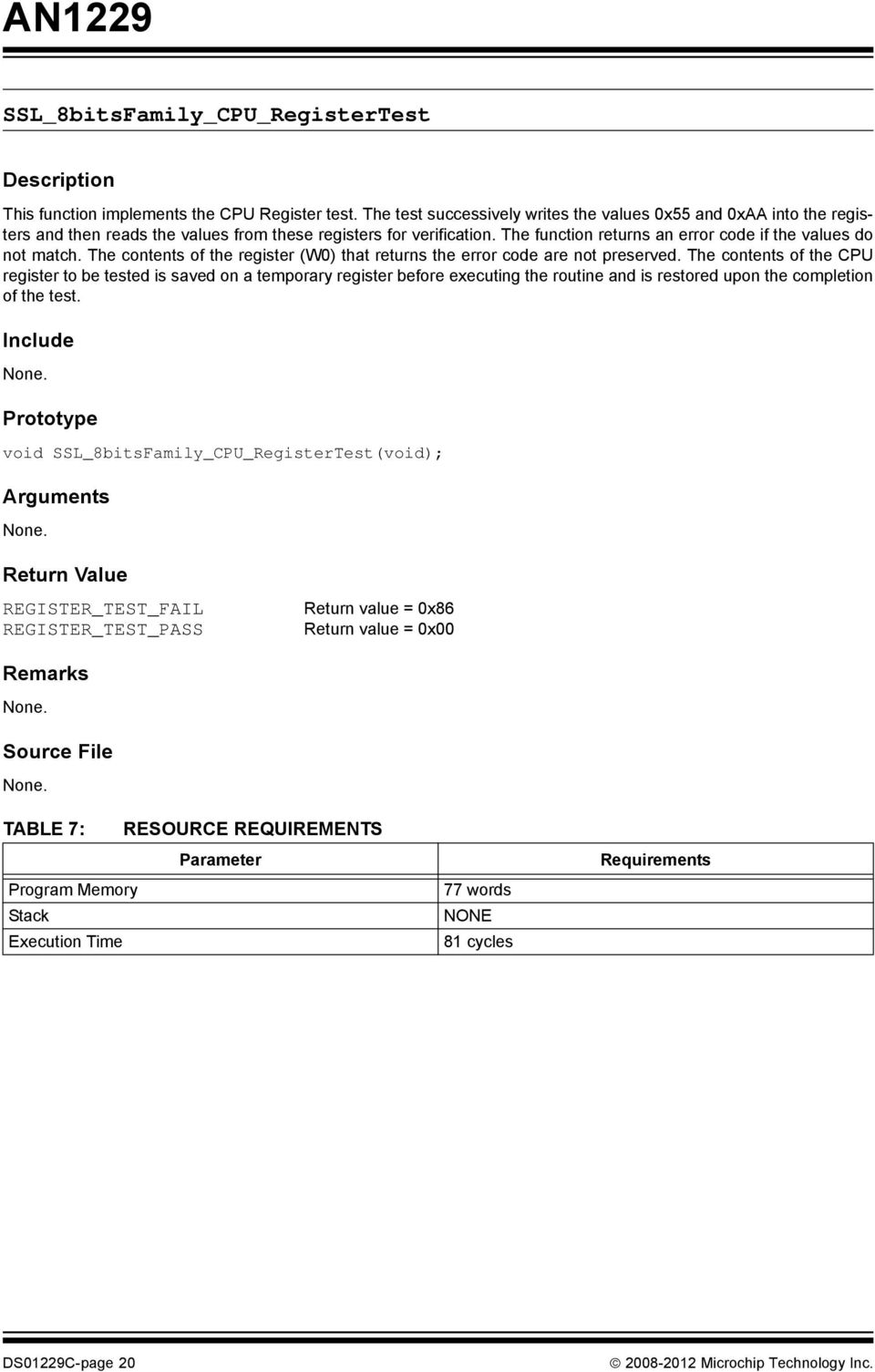
20 SSL_8bitsFamily_CPU_RegisterTest This function implements the CPU Register test. The test successively writes the values 0x55 and 0xAA into the registers and then reads the values from these registers for verification. The function returns an error code if the values do not match. The contents of the register (W0) that returns the error code are not preserved. The contents of the CPU register to be tested is saved on a temporary register before executing the routine and is restored upon the completion of the test. void SSL_8bitsFamily_CPU_RegisterTest(void); Arguments REGISTER_TEST_FAIL REGISTER_TEST_PASS Return value = 0x86 Return value = 0x00 Remarks Source File TABLE 7: RESOURCE REQUIREMENTS Execution Time 77 words NONE 81 cycles DS01229C-page Microchip Technology Inc.
21 SSL_8bitsFamily_PCtest This function implements the PC test, which is a functional test of the PC. The test invokes the functions that are located in the Flash memory at different addresses. The SSL_PcTest.h header file defines the addresses, where these functions reside in the Flash memory. The functions placed at these addresses return a unique value, which is the starting address of the called function. This returned value is verified using the SSL_8bitsFamily_PCtest function. SSL_PcTest.h int SSL_8bitsFamily_PCtest(void); Arguments PC_TEST_FAIL Return value = 0 PC_TEST_PASS Return value = 1 Remarks TABLE 8: RESOURCE REQUIREMENTS Execution Time 107 words 1 byte 92 cycles Microchip Technology Inc. DS01229C-page 21
22 SSL_8bitsFamily_Flashtest_CRC16 This function implements the Invariable Memory test. It computes the CRC of the data located between the address FLASH_STARTADDRESS and the address FLASH_ENDADDRESS. This function returns the final CRC value. SSL_Flash_CRC.h unsigned int SSL_8bitsFamily_Flashtest_CRC16 (word32 startaddress,word32 endaddress, unsigned int crc_result); ARGUMENTS startaddress endaddress crc_result Indicates the starting address of the data to be tested Indicates the ending address of the data to be tested Indicates the initial value of the CRC crc_result Holds the CRC result Remarks TABLE 9: RESOURCE REQUIREMENTS 489 bytes 70 bytes Execution Time 446 cycles (1) Note 1: The execution time specified here is for a single Flash memory location. DS01229C-page Microchip Technology Inc.
23 SSL_8bitsFamily_EEPROMtest_CRC16 This function implements the Invariable Memory test. It computes the CRC of the data located between the address, EEPROM_STARTADDRESS, and the address, EEPROM_ENDADDRESS. This function returns the final CRC value. SSL_EEPROM_CRC.h unsigned int SSL_8bitsFamily_EEPROMtest_CRC16(uReg32 startaddress, ureg32 endaddress, unsigned int crc_result); Arguments startaddress endaddress crc_result Indicates the starting address of the data to be tested Indicates the ending address of the data to be tested Indicates the initial value of the CRC crc_result Holds the CRC result Remarks Source File TABLE 10: RESOURCE REQUIREMENTS 149 words 1 byte Execution Time 1091 cycles (1) Note 1: The execution time specified here is for three EEPROM locations Microchip Technology Inc. DS01229C-page 23
24 SSL_8bitsFamily_RAMtest_MarchC This function implements the March C test. This test accesses an 8-bit word from the RAM memory. The address must be aligned to the data type and the length must be an integral multiple of the data width. This is a destructive test; therefore, this test can be executed at the system start-up before initializing the memory and the run-time libraries. The memory will be cleared when the control returns from the SSL_8bitsFamily_RAMtest_MarchC function. SSL_MarchC.h int SSL_8bitsFamily_RAMtest_MarchC(char * ramstartaddress,int ramsize); Arguments ramstartaddress ramsize Indicates the starting address from where the March C algorithm starts reading the data Indicates the number of bytes that are tested; the size must be an even number MARCHC_RAM_TEST_FAIL Return value = 0 MARCHC_RAM_TEST_PASS Return value = 1 Remarks Source File SSL_MarchCRamTest.c TABLE 11: RESOURCE REQUIREMENTS 388 bytes 15 bytes Execution Time 3834 cycles (1) Note 1: The execution time specified here is for a single RAM location. DS01229C-page Microchip Technology Inc.
25 SSL_8bitsFamily_RAM_STACKtest_MarchC This function implements the March C test on the RAM memory and stack. This test accesses an 8-bit word from the RAM memory. The address must be aligned to the data type and the length must be an integral multiple of the data width. It first tests the RAM memory and then the stack area by transferring the stack contents into the tested RAM area. After the stack is tested, it restores the contents of the stack. This is a destructive test; therefore, this test can be executed at system start-up before initializing the memory and the run-time libraries. The memory will be cleared when the control returns from the SSL_8bitsFamily_RAM_STACKtest_MarchC function. SSL_MarchC_RamAndTest.h int SSL_8bitsFamily_RAM_STACKtest_MarchC(char * ramstartaddress, unsigned int ramsize); Arguments ramstartaddress ramsize Indicates the starting address from where the March C algorithm starts reading the data Indicates the number of bytes that are tested; the size must be an even number MARCHC_RAM_STACK_TEST_FAIL Return value = 0 MARCHC_RAM_STACK_TEST_PASS Return value = 1 Remarks Source File SSL_MarchCRamAndTest.c TABLE 12: RESOURCE REQUIREMENTS 890 bytes 88 bytes Execution Time 1576 cycles (1) Note 1: The execution time specified here is for a single RAM location Microchip Technology Inc. DS01229C-page 25
26 SSL_8bitsFamily_RAMtest_MarchC_Minus This function implements the March C test on the RAM memory and stack. This test accesses an 8-bit word from the RAM memory. The address must be aligned to the data type and the length must be an integral multiple of the data width. It first tests the RAM memory and then the stack area by transferring the stack contents into the tested RAM area. After the stack is tested, it restores the contents of the stack. This is a destructive test; therefore, this test can be executed at system start-up before initializing the memory and the run-time libraries. The memory will be cleared when the control returns from the SSL_8bitsFamily_RAM_STACKtest_MarchCMinus function. SSL_MarchC_Minus.h int SSL_8bitsFamily_RAMtest_MarchC_Minus(char * ramstartaddress, int ramsize); Arguments ramstartaddress ramsize Indicates the starting address from where the March C algorithm starts reading the data Indicates the number of bytes that are tested; the size must be an even number MARCHC_RAM_TEST_FAIL Return value = 0 MARCHC_RAM_TEST_PASS Return value = 1 Remarks Source File SSL_RamTest_MarchCMinus.c TABLE 13: RESOURCE REQUIREMENTS Execution Time 124 bytes 15 bytes 1402 cycles DS01229C-page Microchip Technology Inc.
27 SSL_8bitsFamily_RAMtest_MarchB This function implements the March B test. This test accesses a byte word from the RAM memory. The address must be properly aligned to the data type and the length must be an integral multiple of the data width. This is a destructive test; therefore, this test can be executed at system start-up before initializing the memory and the run-time library. The memory will be cleared when the control returns from the SSL_8bitsFamily_RAMtest_MarchB function. SSL_MarchB.h int SSL_8bitsFamily_RAMtest_MarchB(char * ramstartaddress, int ramsize); Arguments ramstartaddress ramsize Indicates the starting address from where the March B algorithm starts reading the data Indicates the number of bytes that are tested; the size must be an even number MARCHB_TEST_FAIL Return value = 0 MARCHB_TEST_PASS Return value = 1 Source File SSL_MarchBRamTest.c TABLE 14: RESOURCE REQUIREMENTS 453 bytes Execution Time 2761 cycles (1) Note 1: The execution time specified here is for a single RAM location Microchip Technology Inc. DS01229C-page 27
28 SSL_8bitsFamily_RAMtest_CheckerBoard This function implements the Checkerboard test on the RAM memory. The test is performed on the memory space specified by the variable, SIZE. The execution begins from the address defined by the variable, START_RAM. The number of specified locations must be even. SSL_CheckerBoardTest.INC unsigned char SSL_8bitsFamily_Ram_CB_test(void); Arguments RAM_Test_Fail RAM_Test_Pass Return value = 0x86 Return value = 0x00 Remarks Source File SSL_CheckerBoard.asm TABLE 15: RESOURCE REQUIREMENTS 321 bytes 68 bytes Execution Time 43 cycles (1) Note 1: The execution time specified here is for a single RAM location. DS01229C-page Microchip Technology Inc.
29 SSL_8bitsFamily_CLOCKtest This function implements the Clock test. It is used to verify the proper operation of the CPU clock. The TMR0 value of Timer0 is saved within the Timer1 interrupt handler. This value represents the number of CPU clock cycles elapsed in 1 ms time period of the SOSC. If the number of clock cycles is beyond the defined boundary, the function sets an error flag. This test performs the following major tasks: 1. The LP secondary oscillator is used as an independent clock source or a reference clock source. This 32 khz oscillator is used to clock Timer1. 2. The POSC with Phase-Locked Loop (PLL) is the clock source to the CPU. Timer0 runs at the CPU clock frequency. 3. Timer1 is configured to generate an interrupt at specified time intervals (e.g., 1 ms). 4. The TMR0 value of Timer0 is saved within the Timer1 interrupt handler. This value represents the number of CPU clock cycles elapsed in the 1 ms time period of the SOSC. If the number of clock cycles is beyond the defined boundary, the function sets an error flag. For example, the following parameters are used to calculate the CLK_MIN_TIME and CLK_MAX_TIME values for a PIC18F device: Primary Oscillator: INTOSC FOSC: 8 MHz FCY: FOSC/4: (8 * 10^6) / 4 FCY: Secondary oscillator: 32 khz Timer1 period: 31 Therefore, with 4% tolerance, the number of CPU clock cycles in 1ms (2000 cycles) are: CLK_MIN_TIME: 1920 CLK_MAX_TIME: 2080 SSL_ClockTest.h unsigned int SSL_8bitsFamily_CLOCKtest(void); Arguments CLOCK_NO_ERROR Return value = 1 CLOCK_ERROR Return value = 0 Remarks Microchip Technology Inc. DS01229C-page 29
30 SSL_8bitsFamily_CLOCKtest(Continued) Source File SSL_ClockTest.c TABLE 16: RESOURCE REQUIREMENTS Execution Time DS01229C-page Microchip Technology Inc.
31 SSL_8bitsFamily_CLOCKtest_LineFreq This function implements the line frequency Clock test. It is used to verify the proper operation of the CPU clock. It uses the following procedure to configure the IC1CON register: 1. The Timer1 module is selected as the IC1 time base. 2. An interrupt is generated on every second capture event. 3. The capture event is generated on every rising edge of the line frequency. The IC1 pin generates an interrupt after every 20 ms if the line frequency is 50 Hz and after every ms if the line frequency is 60 Hz. Timer1 is configured in such a way so that the timer count does not time-out within 20 ms/16.66 ms. The capture event is generated on every rising edge of the line frequency. For period measurement, the capture interrupt is generated twice and Timer1 count is stored in the 2nd interrupt routine. If the number of clock cycles is beyond the defined boundary, the function sets an error flag. For example, the following parameters are used to calculate CLK_MIN_TIME and CLK_MAX_TIME for a PIC18F device: Primary Oscillator: INTOSC FOSC: 8 MHz FCY: FOSC/4: (8 * 10^6) / 4 FCY: The number of counts that will be counted in the 20ms is = 0.02 * = With a tolerance of 4% CLK_MIN_TIME: CLK_MAX_TIME: SSL_ClockTest_LineFreq.h int SSL_8bitsFamily_CLOCKtest_LineFreq(void); Arguments CLOCK_NO_ERROR Return value = 1 CLOCK_ERROR Return value = 0 Remarks Source File SSL_ClockTest_LineFreq.c TABLE 17: RESOURCE REQUIREMENTS Execution Time Microchip Technology Inc. DS01229C-page 31
32 API FUNCTIONS FOR 16-BIT PIC MCUs AND dspic DSCs This section lists and describes the API functions that are available in the Class B Safety Software Library for 16-bit architecture. The API functions are listed below followed by their individual detailed descriptions: SSL_16bitsFamily_CPU_RegisterTest SSL_16bitsFamily_PCtest SSL_16bitsFamily_Flashtest_CRC16 SSL_16bitsFamily_EEPROMtest_CRC16 SSL_16bitsFamily_RAMtest_MarchC SSL_16bitsFamily_RAMtest_MarchC_Minus SSL_16bitsFamily_RAMtest_MarchB SSL_16bitsFamily_RAMtest_CheckerBoard SSL_16bitsFamily_CLOCKtest SSL_16bitsFamily_CLOCKtest_LineFreq DS01229C-page Microchip Technology Inc.
33 SSL_16bitsFamily_CPU_RegisterTest This function implements the CPU Register test. The test successively writes the values 0x5555 and 0xAAAA into the CPU registers and then reads the values from these registers for verification. The function returns an error code if the values do not match. The contents of the register (W0) that returns the error code are not preserved. The contents of the CPU registers to be tested are saved on the stack before executing the routine and are restored upon the completion of the test. int SSL_16bitsFamily_CPU_RegisterTest(); Arguments CPU_REGISTER_TEST_FAIL Return value = 0 CPU_REGISTER_TEST_PASS Return value = 1 Remarks Source File TABLE 18: RESOURCE REQUIREMENTS Execution Time 1364 bytes (dspic30f/dspic33f) 684 bytes (PIC24H/PIC24F) 1404 bytes (dspic33e) 724 bytes (PIC24E) 58 bytes (dspic30f/dspic33f/dspic33e) 24 bytes (PIC24H/PIC24F/PIC24E) 351 cycles (dspic30f/dspic33f) 181 cycles (PIC24H/PIC24F) 363 cycles (dspic33e) 193 cycles (PIC24E) Microchip Technology Inc. DS01229C-page 33
34 SSL_16bitsFamily_PCtest This function implements the PC test, which is a functional test of the PC. The test invokes the functions that are located in the Flash memory at different addresses. The customized linker script defines the addresses, where these functions reside in the Flash memory. The functions placed at these addresses return a unique value, which is the starting address of the called function. This returned value is verified using the SSL_16bitsFamily_PCtest function. SSL_PcTest.h SSL_16bitsFamily_PCtest(); Arguments PC_TEST_FAIL Return value = 0 PC_TEST_PASS Return value = 1 Remarks TABLE 19: RESOURCE REQUIREMENTS Execution Time 258 bytes 28 bytes 32 cycles DS01229C-page Microchip Technology Inc.
35 SSL_16bitsFamily_Flashtest_CRC16 This function implements the Invariable Memory test. It computes the CRC of the data located between the address FLASH_STARTADDRESS and the address FLASH_ENDADDRESS. This function returns the final CRC value. SSL_Flash_CRC.h unsigned int SSL_16bitsFamily_Flashtest_CRC16 (ureg32 startaddress,ureg32 endaddress, unsigned int init_crcvalue); ARGUMENTS startaddress endaddress init_crcvalue Indicates the starting address of the data to be tested Indicates the ending address of the data to be tested Indicates the initial value of the CRC crc_result Holds the CRC result Remarks TABLE 20: RESOURCE REQUIREMENTS 489 bytes 70 bytes Execution Time 446 cycles (1) Note 1: The execution time specified here is for a single Flash memory location Microchip Technology Inc. DS01229C-page 35
36 SSL_16bitsFamily_EEPROMtest_CRC16 This function implements the Invariable Memory test. It computes the CRC of the data located between the address, EEPROM_STARTADDRESS, and the address, EEPROM_ENDADDRESS. This function returns the final CRC value. SSL_EEPROM_CRC.h unsigned int SSL_16bitsFamily_EEPROMtest_CRC16 (ureg32 startaddress,ureg32 endaddress,unsigned int init_crcvalue); Arguments startaddress endaddress init_crcvalue Indicates the starting address of the data to be tested Indicates the ending address of the data to be tested Indicates the initial value of the CRC crc_result Holds the CRC result Remarks Source File TABLE 21: RESOURCE REQUIREMENTS 492 bytes 70 bytes Execution Time 348 cycles (1) Note 1: The execution time specified here is for a single EEPROM location. DS01229C-page Microchip Technology Inc.
37 SSL_16bitsFamily_RAMtest_MarchC This function implements the March C test. This test accesses a 16-bit word from the RAM memory. The address must be aligned to the data type and the length must be an integral multiple of the data width. This is a destructive test; therefore, this test can be executed at the system start-up before initializing the memory and the run-time libraries. The memory will be cleared when the control returns from the SSL_16bitsFamily_RAMtest_MarchC function. SSL_MarchC.h int SSL_16bitsFamily_RAMtest_MarchC(int * ramstartaddress,int ramsize); Arguments ramstartaddress ramsize Indicates the starting address from where the March C algorithm starts reading the data Indicates the number of bytes that are tested; the size must be an even number MARCHC_RAM_TEST_FAIL Return value = 0 MARCHC_RAM_TEST_PASS Return value = 1 Remarks Note 1: The user application should allocate 0x50 bytes for the stack before executing any of the March tests. The stack must be allocated at an appropriate address so that it does not get overwritten during test execution. 2: It is recommended that the stack be placed at the beginning or at the end of the data memory. The user application should specify an address that does not overlap other statically allocated resources (e.g., the MPLAB ICD 2 RAM space, which starts from the address 0x800). 3: The following changes are made to the.gld file before executing the March B or March C test: Source File SSL_MarchCRamTest.c.stack 0x850: /* Starting Address\* { SP_init =.;. += 0x50; /* length*/ SPLIM_init =.;. += 8; } >data TABLE 22: RESOURCE REQUIREMENTS 585 bytes 88 bytes Execution Time 1254 cycles (1) Note 1: The execution time specified here is for a single RAM location Microchip Technology Inc. DS01229C-page 37
38 SSL_16bitsFamily_RAM_STACKtest_MarchC This function implements the March C test on the RAM memory and stack. This test accesses a 16-bit word from the RAM memory. The address must be aligned to the data type and the length must be an integral multiple of the data width. It first tests the RAM memory and then the stack area by transferring the stack contents into the tested RAM area. After the stack is tested, it restores the contents of the stack. This is a destructive test; therefore, this test can be executed at system start-up before initializing the memory and the run-time libraries. The memory will be cleared when the control returns from the SSL_16bitsFamily_RAM_STACKtest_MarchC function. SSL_MarchC.h int SSL_16bitsFamily_RAM_STACKtest_MarchC(int * ramstartaddress,int ramsize); Arguments ramstartaddress ramsize Indicates the starting address from where the March C algorithm starts reading the data Indicates the number of bytes that are tested; the size must be an even number MARCHC_RAM_STACK_TEST_FAIL Return value = 0 MARCHC_RAM_STACK_TEST_PASS Return value = 1 Remarks Note 1: The user application should allocate 0x50 bytes for the stack before executing any of the March tests. The stack must be allocated at an appropriate address so that it does not get overwritten during test execution. 2: It is recommended that the stack be placed at the beginning or at the end of the data memory. The user application should specify an address that does not overlap other statically allocated resources (e.g., the MPLAB ICD 2 RAM space which starts from the address 0x800). 3: The following changes are made to the.gld file before executing the March B or March C test: Source File.stack 0x850: /* Starting Address\* { SP_init =.;. += 0x50; /* length*/ SPLIM_init =.;. += 8; } >data SSL_MarchCRamAndTest.c TABLE 23: RESOURCE REQUIREMENTS 890 bytes 88 bytes Execution Time 1576 cycles (1) Note 1: The execution time specified here is for a single RAM location. DS01229C-page Microchip Technology Inc.
39 SSL_16bitsFamily_RAMtest_MarchC_Minus This function implements the March C test on the RAM memory and stack. This test accesses a 16-bit word from the RAM memory. The address must be aligned to the data type and the length must be an integral multiple of the data width. It first tests the RAM memory and then the stack area by transferring the stack contents into the tested RAM area. After the stack is tested, it restores the contents of the stack. This is a destructive test; therefore, this test can be executed at system start-up before initializing the memory and the run-time libraries. The memory will be cleared when the control returns from the SSL_16bitsFamily_RAMtest_MarchC_Minus function. SSL_MarchC_Minus.h int SSL_16bitsFamily_RAMtest_MarchC_Minus(int * ramstartaddress,int ramsize); Arguments ramstartaddress ramsize Indicates the starting address from where the March C algorithm starts reading the data Indicates the number of bytes that are tested; the size must be an even number MARCHC_RAM_TEST_FAIL Return value = 0 MARCHC_RAM_TEST_PASS Return value = 1 Remarks Source File SSL_MarchC_MinusRamTest.c TABLE 24: RESOURCE REQUIREMENTS 381 bytes 30 bytes Execution Time 122 cycles (1) Note 1: The execution time specified here is for a single RAM location Microchip Technology Inc. DS01229C-page 39
40 SSL_16bitsFamily_RAMtest_MarchB This function implements the March B test. This test accesses a 16-bit word from the RAM memory. The address must be properly aligned to the data type and the length must be an integral multiple of the data width. This is a destructive test; therefore, this test can be executed at system start-up before initializing the memory and the run-time library. The memory will be cleared when the control returns from the SSL_16bitsFamily_RAMtest_MarchB function. SSL_MarchB.h int SSL_16bitsFamily_RAMtest_MarchB(int * ramstartaddress,int ramsize); Arguments ramstartaddress ramsize Indicates the starting address from where the March B algorithm starts reading the data Indicates the number of bytes that are tested; the size must be an even number MARCHB_TEST_FAIL Return value = 0 MARCHB_TEST_PASS Return value = 1 Remarks Note 1: The user application should allocate 0x50 bytes for the stack before executing any of the March tests. The stack must be allocated at an appropriate address so that it does not get overwritten during test execution. 2: It is recommended that the stack should be placed at the beginning or at the end of the data memory. The user application should specify an address such that it does not overlap other statically allocated resources (e.g., the MPLAB ICD 2 RAM space which starts from the address 0x800). 3: The following changes are made to the.gld file before executing the March B or March C test:.stack 0x850: /* Starting Address\* { SP_init =.;. += 0x50; /* length*/ SPLIM_init =.;. += 8; } >data Source File SSL_MarchBRamTest.c TABLE 25: RESOURCE REQUIREMENTS 630 bytes 88 bytes Execution Time 1183 cycles (1) Note 1: The execution time specified here is for a single RAM location. DS01229C-page Microchip Technology Inc.
41 SSL_16bitsFamily_RAMtest_CheckerBoard This function implements the Checkerboard test on the RAM memory. The test is performed on the memory space specified by the variable, RamSize. The execution begins from the address defined by the variable, RAMSTARTADDRESS. The number of specified locations must be even. SSL_CBram.h int SSL_16bitsFamily_RAMtest_CheckerBoard(int *ramstartaddress,int RamSize); Arguments RamStartAddress RamSize Indicates the starting address from where the Checkerboard test is to be performed Indicates the number of locations that are tested; the size must be an even number CB_TEST_FAIL Return value = 0 CB_TEST_PASS Return value = 1 Remarks Source File SSL_CheckerBoard.s TABLE 26: RESOURCE REQUIREMENTS 321 bytes 68 bytes Execution Time 43 cycles (1) Note 1: The execution time specified here is for a single RAM location Microchip Technology Inc. DS01229C-page 41
42 SSL_16bitsFamily_CLOCKtest This function implements the Clock test. It is used to verify the proper operation of the CPU clock. The TMR2 value of Timer2 is saved within the Timer1 interrupt handler. This value represents the number of CPU clock cycles elapsed in 1 ms time period of the SOSC. If the number of clock cycles is beyond the defined boundary, the function sets an error flag. This test performs the following major tasks: 1. The LP secondary oscillator is used as an independent clock source or a reference clock source. This 32 khz oscillator is used to clock Timer1. 2. The POSC with Phase-Locked Loop (PLL) is the clock source to the CPU. Timer2 runs at the CPU clock frequency. 3. Timer1 is configured to generate an interrupt at specified time intervals (e.g., 1 ms). 4. The PR2 register in the Timer2 module holds the time period value. It must be initialized to a value greater than 1 ms so that Timer2 does not time out before the occurrence of a Timer1 interrupt. 5. The TMR2 value of Timer2 is saved within the Timer1 interrupt handler. This value represents the number of CPU clock cycles elapsed in the 1 ms time period of the SOSC. If the number of clock cycles is beyond the defined boundary, the function sets an error flag. For example, the following parameters are used to calculate the CLK_MIN_TIME and CLK_MAX_TIME values for a dspic30f device: POSC: XT_PLL8 FOSC: 7.37 MHz * 8 FCY: FOSC/4: (7.37 * 10^6 * 8)/4 FCY: SOSC: 32 khz Timer1 Period Register (PR1): 31 Therefore, with 4% tolerance, the number of CPU clock cycles in 1 ms (14740 cycles) are: CLK_MIN_TIME: CLK_MAX_TIME: SSL_ClockTest.h SSL_ClockSwitch.h This file is required only when a PIC24F device is used unsigned int SSL_16bitsFamily_CLOCKtest(void); Arguments CLOCK_NO_ERROR CLOCK_ERROR The CPU clock is operating within the specified range The CPU clock is not operating within the specified range Remarks DS01229C-page Microchip Technology Inc.
43 SSL_16bitsFamily_CLOCKtest(Continued) Source File SSL_ClockTest.c TABLE 27: RESOURCE REQUIREMENTS Execution Time 387 bytes 8 bytes 30 cycles Microchip Technology Inc. DS01229C-page 43
44 SSL_16bitsFamily_CLOCKtest_LineFreq This function implements the line frequency Clock test. It is used to verify the proper operation of the CPU clock. It uses the following procedure to configure the IC1CON register: 1. The Timer2 module is selected as the IC1 time base. 2. An interrupt is generated on every second capture event. 3. The capture event is generated on every rising edge of the line frequency. The IC1 pin generates an interrupt after every 20 ms if the line frequency is 50 Hz and after every ms if the line frequency is 60 Hz. The Timer2 prescaler is configured to operate in 1:8 mode so that the timer count does not time-out within 20 ms/16.66 ms. The capture event is generated on every rising edge of the line frequency. For period measurement, the capture interrupt is generated after taking two time-stamps, V1 and V2 (see Figure 6). The total number of clock cycles is calculated using the following formula: Total Number of Clock Cycles = Timer Count * Timer Prescaler. If the number of clock cycles is beyond the defined boundary, the function sets an error flag. SSL_ClockTest_LineFreq.h SSL_ClockSwitch.h This file is required only when a PIC24F device is used int SSL_16bitsFamily_CLOCKtest_LineFreq(); Arguments CLOCK_NO_ERROR CLOCK_ERROR The CPU clock is operating within the specified range The CPU clock is not operating within the specified range Remarks Source File SSL_ClockTest_LineFreq.c TABLE 28: RESOURCE REQUIREMENTS Execution Time 447 bytes 12 bytes 25 cycles DS01229C-page Microchip Technology Inc.
45 32-BIT API FUNCTIONS FOR 32-BIT PIC MCUs This section lists and describes the API functions that are available in the PIC32MX Class B Safety Software Library for the 32-bit architecture. The functions are listed below followed by their individual detailed descriptions: SSL_32bitsFamily_CPU_RegisterTest SSL_32bitsFamily_PCtest SSL_32bitsFamily_Flashtest_CRC16 SSL_32bitsFamily_RAMtest_MarchC SSL_32bitsFamily_RAM_STACKtest_MarchC SSL_32bitsFamily_RAMtest_MarchC_Minus SSL_32bitsFamily_RAMtest_MarchB SSL_32bitsFamily_RAMtest_CheckerBoard SSL_32bitsFamily_CLOCKtest SSL_32bitsFamily_CLOCKtest_LineFreq Microchip Technology Inc. DS01229C-page 45
46 SSL_32bitsFamily_CPU_RegisterTest This function implements the CPU Register test. First it tests the register 0 to have all bits cleared. For all the other registers (1 to 31) the test successively writes the values 0x and 0xAAAAAAAA into the corresponding CPU register, and then reads the values from the register for verification. The function returns an error code if the values do not match. SSL_CpuRegisterTest.h int SSL_32bitsFamily_CPU_RegisterTest(void); Arguments CPU_REGISTER_TEST_FAIL CPU_REGISTER_TEST_PASS The test failed. Some CPU register(s) has been detected to have stuck bits The test passed. CPU registers have not been detected to have stuck bits Remarks This is a non-destructive test. Interrupts should be disabled when calling this test function. The standard C language call convention applies regarding the registers usage (refer to Section 5.6 Function Calling Convention in the MPLAB C Compiler For PIC32 MCUs User s Guide (DS51686)). Upon the function entry, all registers that need to be preserved are saved into the stack. These registers are restored upon completion of the test. Upon the function return, the register v0 will contain the return code. Source File SSL_CPURegisterTest.S TABLE 29: RESOURCE REQUIREMENTS 2156 bytes 44 bytes Execution Time 922 cycles (11.5 µs) (1) Note 1: The value for the CPU cycles can vary greatly depending on the system settings and the build parameters. All execution time measurements are done with the following settings: 80 MHz, two Flash Wait states, zero RAM Wait states, Prefetch and Cache enabled, PBDIV = 1:1 interrupts and DMA disabled. 2: The co-processor 0 (CP0) registers are not tested by this function. These registers are configuration and status registers and modifying their values could adversely affect the system behavior at run time. DS01229C-page Microchip Technology Inc.
47 SSL_32bitsFamily_PCtest This function implements the PC test, which is a functional test of the PC. It checks that the PC register is not stuck and it properly holds the address of the next instruction to be executed. The test invokes the functions that are located in Flash memory at different addresses. The functions placed at these addresses return a unique value, which is the starting address of the called function. This returned value is verified using the SSL_32bitsFamily_PCtest function. The provided customized linker script, elf32pic32mx.ld, defines the addresses where these functions reside in Flash memory. SSL_PcTest.h int SSL_32bitsFamily_PCtest(void); Arguments PC_TEST_FAIL PC_TEST_PASS The test failed. The PC register has been detected to hold an incorrect address. The test passed. The PC register holds the correct address. Remarks The test uses three different functions: SSL_TestPCFunction1() SSL_TestPCFunction2() SSL_TestPCFunction3() The ROM location of these functions that are used for PC test at run time can be changed by modifying the provided elf32pic32mx.ld file. The elf32pic32mx.ld linker script file should be added to the project. Source File TABLE 30: RESOURCE REQUIREMENTS 332 bytes (debug build) 212 bytes (-O3 -fomit-frame-pointer) 48 bytes (debug build) Execution Time 90 cycles (1.125 µs) (1) Note 1: The value for the CPU cycles can vary greatly depending on the system settings and the build parameters. All execution time measurements are done with the following settings: 80 MHz, two Flash Wait states, zero RAM Wait states, Prefetch and Cache enabled, PBDIV = 1:1 interrupts and DMA disabled. Build: MPLAB C32 V1.10(b) Release -O3 -fomit-frame-pointer Microchip Technology Inc. DS01229C-page 47
48 SSL_32bitsFamily_Flashtest_CRC16 This function calculates the 16-bit CRC of the supplied memory area using the standard Linear Feedback Shift Register (LFSR) implementation. It calculates the CRC over the memory area between the start address and end address and returns the CRC Value. The 16-bit CRC is calculated using the supplied generator polynomial and initial seed. Different generator polynomials can be selected. SSL_Flash_CRC.h unsigned int SSL_32bitsFamily_Flashtest_CRC16(char* startaddress, char* endaddress, unsigned int crcpoly, unsigned int crcseed); Arguments startaddress endaddress crcpoly crcseed Start address of the memory area to calculate the CRC over Final address for which the CRC is calculated The generator polynomial to be used. One of the standard supplied polynomials can be used as well as other user-defined ones. The initial value in the CRC LFSR. The usual recommended value is 0xFFFF. The value of the calculated CRC over the specified memory area. Remarks This test is non-destructive for the memory area to which it is applied. The start address and end address over which the CRC value is calculated are PIC32 variant and applicationdependent. They are run-time parameters. Source File SSL_FlashTest_CRC16.c TABLE 31: RESOURCE REQUIREMENTS 348 bytes (debug build) 196 bytes (-O3 -fomit-frame-pointer) 48 bytes (debug build) Execution Time cycles ( us) for 1024 bytes Flash CRC (1) Note 1: The value for the CPU cycles can vary greatly depending on the system settings and the build parameters. All execution time measurements are done with the following settings: 80 MHz, two Flash Wait states, zero RAM Wait states, Prefetch and Cache enabled, PBDIV = 1:1 interrupts and DMA disabled. Build: MPLAB C32 V1.10(b) Release -O3 -fomit-frame-pointer. DS01229C-page Microchip Technology Inc.
49 SSL_32bitsFamily_RAMtest_MarchC This function implements the March C test. This test performs 32-bit word RAM accesses. The address of the RAM area to be tested must be 32-bit aligned and the size of the tested RAM area must be an integral multiple of 4. The tested RAM memory will be cleared when the control returns from the SSL_32bitsFamily_RAMtest_MarchC function. SSL_MarchC.h int SSL_32bitsFamily_RAMtest_MarchC(int* ramstartaddress, int ramsize); Arguments ramstartaddress ramsize Start address from which the March C test is to be performed. Must be properly 32-bit aligned. Number of consecutive byte locations for which the test is to be performed. The size must be a number multiple of 4. MARCHC_TEST_PASS MARCHC_TEST_FAIL The test passed. RAM area tested has not been detected to have Faults The test failed. Some RAM area location has been detected to have Faults. Remarks This is a destructive memory test. The test must not be performed over the RAM areas that have to be preserved; otherwise, these RAM areas must be saved/restored before/after running the test. Alternatively the test could be run at system start-up before the memory and the run time library is initialized; however, the stack must be initialized. At least 100 bytes should be available for the stack for executing the March C test. The tested RAM area must not overlap the stack. Other statically allocated resources such as the MPLAB ICD or REAL ICE allocated RAM buffers should be excluded from this test. The start address from which the March C test is to be performed and the size of the RAM area are PIC32 variant and application-dependent. They are run-time parameters. Source File SSL_MarchCRamTest.c TABLE 32: RESOURCE REQUIREMENTS 1304 bytes (debug build) 724 bytes (-O3 -fomit-frame-pointer) 100 bytes (debug build) Execution Time cycles ( ms) for 1024 bytes of RAM test (1) Note 1: The value for the CPU cycles can vary greatly depending on the system settings and the build parameters. All execution time measurements are done with the following settings: 80 MHz, two Flash Wait states, zero RAM Wait states, Prefetch and Cache enabled, PBDIV = 1:1 interrupts and DMA disabled. Build: MPLAB C32 V1.10(b) Release -O3 -fomit-frame-pointer Microchip Technology Inc. DS01229C-page 49
50 SSL_32bitsFamily_RAM_STACKtest_MarchC This function implements the March C test on both a RAM and a stack area. First the RAM area is tested using the standard March C test. If the test succeeded the requested area is copied into the RAM area that has just been tested and then the March C test is run over the area as if it were a regular RAM area. The saved area is restored and the result of the test is returned to the user. This test performs 32-bit word RAM accesses. The address of both the RAM and stack areas to be tested have to be 32-bit aligned and the size of the tested areas must be an integral multiple of 4. The tested RAM memory will be cleared when the control returns from the SSL_32bitsFamily_RAM_STACKtest_MarchC function. SSL_MarchC.h int SSL_32bitsFamily_RAM_STACKtest_MarchC(int* ramstartaddress, int ramsize, int* stacktopaddress, int stacksize); Arguments ramstartaddress ramsize stacktopaddress stacksize Start address of RAM area for which the March C test is to be performed. Must not overlap the area! Must be properly 32-bit aligned. Number of consecutive byte locations for which the test is to be performed. The size must be a number multiple of 4. The size of the RAM area tested must be > 100 bytes. Address of the top of the area for which the March C test is to be performed. Note that the stack is supposed to grow downward. This must not overlap the RAM area. Must be properly 32-bit aligned. Number of consecutive byte locations in the area for which the test is to be performed. The size must be a number multiple of 4 and must be < RAM size. MARCHC_TEST_PASS MARCHC_TEST_FAIL MARCHC_TEST_FAIL_SIZE MARCHC_TEST_FAIL_STACK The test passed. RAM and area tested have not been detected to have Faults. The test failed. Either some RAM or area location has been detected to have Faults. The test failed. There was not enough space in the RAM area to save the area. The test failed. The requested area does not actually contain the current hardware SP register. Remarks The RAM and areas must not overlap. The grows downward so the tested area is: [stacktopaddress-stacksize, stacktopaddress] The processor SP register is changed to the point to the RAM area while the area is tested. The size of the area to be tested must be less than the size of the RAM area. Since running the March C RAM and test requires at least 128 bytes of stack, it implies that the size of the tested RAM area should be at least 128 bytes long. Once the area is tested, the SP register is restored. This is a destructive memory test. DS01229C-page Microchip Technology Inc.
51 SSL_32bitsFamily_RAM_STACKtest_MarchC(Continued) The test must not be performed over the RAM areas that have to be preserved; otherwise, these RAM areas must be saved/restored before/after running the test. Alternately, the test could be run at system start-up before the memory and the run time library is initialized; however, the stack needs to be initialized. At least 128 bytes should be available to the stack for executing the March C test. The tested RAM area must not overlap the stack. Other statically allocated resources, such as the MPLAB ICD or REAL ICE allocated RAM buffers should be excluded from this test. The start address for both RAM and the stack areas to be tested and the size of these areas are PIC32MX variant and application-dependent. They are run-time parameters. The standard C language call convention applies regarding the registers usage (refer to Section 5.6 Function Calling Convention in the MPLAB C Compiler For PIC32 MCUs User s Guide (DS51686). Upon the function return the register v0 will contain the return code. Source File SSL_MarchCTest.S TABLE 33: RESOURCE REQUIREMENTS 1572 bytes (debug build) 992 bytes (-O3 -fomit-frame-pointer) 128 bytes (debug build) Execution Time cycles ( ms) for 1024 bytes RAM bytes stack test (1) Note 1: The value for the CPU cycles can vary greatly depending on the system settings and the build parameters. All execution time measurements are done with the following settings: 80 MHz, two Flash Wait states, zero RAM Wait states, Prefetch and Cache enabled, PBDIV = 1:1 interrupts and DMA disabled. Build: MPLAB C32 V1.10(b) Release -O3 -fomit-frame-pointer Microchip Technology Inc. DS01229C-page 51
52 SSL_32bitsFamily_RAMtest_MarchC_Minus This function implements the March C Minus test. This test performs 32-bit word RAM accesses. The address of the RAM area to be tested must be 32-bit aligned and the size of the tested RAM area must be an integral multiple of 4. The tested RAM memory will be cleared when the control returns from the SSL_32bitsFamily_RAMtest_MarchC_Minus function. SSL_MarchC.h int SSL_32bitsFamily_RAMtest_MarchC_Minus(int* ramstartaddress, int ramsize); Arguments ramstartaddress ramsize Start address from which the March C Minus test is to be performed. Must be properly 32-bit aligned. Number of consecutive byte locations for which the test is to be performed. The size must be a number multiple of 4. MARCHC_TEST_PASS MARCHC_TEST_FAIL The test passed. RAM area tested has not been detected to have Faults. The test failed. Some RAM area location has been detected to have Faults. Remarks This is a destructive memory test. The test must not be performed over the RAM areas that have to be preserved; otherwise, those RAM areas must be saved/restored before/after running the test. Alternatively, the test could be run at system start-up before the memory and the run time library is initialized; however, the stack needs to be initialized. At least 100 bytes should be available to the stack for executing the March C Minus test. The tested RAM area must not overlap the stack. Other statically allocated resources such as the MPLAB ICD or REAL ICE allocated RAM buffers should be excluded from this test. The start address from which the March C Minus test is to be performed and the size of the RAM area are PIC32 variant and application-dependent. They are run-time parameters. DS01229C-page Microchip Technology Inc.
53 SSL_32bitsFamily_RAMtest_MarchC_Minus(Continued) Source File SSL_MarchCRamTest.c TABLE 34: RESOURCE REQUIREMENTS 1304 bytes (debug build) 724 bytes (-O3 -fomit-frame-pointer) 100 bytes (debug build) Execution Time cycles ( ms) for 1024 bytes of RAM test. (1) Note 1: The value for the CPU cycles can vary greatly depending on the system settings and the build parameters. All execution time measurements are done with the following settings: 80 MHz, two Flash Wait states, zero RAM Wait states, Prefetch and Cache enabled, PBDIV = 1:1 interrupts and DMA disabled. Build: MPLAB C32 V1.10(b) Release -O3 -fomit-frame-pointer Microchip Technology Inc. DS01229C-page 53
54 SSL_32bitsFamily_RAMtest_MarchB This function implements the March B test. This test performs 32-bit word RAM accesses. The address of the RAM area to be tested must be 32-bit aligned and the size of the tested RAM area must be an integral multiple of 4. The tested RAM memory will be cleared when the control returns from the SSL_32bitsFamily_RAMtest_MarchB function. SSL_MarchB.h int SSL_32bitsFamily_RAMtest_MarchB(int* ramstartaddress, int ramsize); Arguments ramstartaddress ramsize Start address from which the March B test is to be performed. Must be 32-bit aligned. Number of consecutive byte locations for which the test is to be performed. The size must be a number multiple of 4. MARCHB_TEST_PASS MARCHB_TEST_FAIL The test passed. RAM area tested has not been detected to have Faults. The test failed. Some RAM area location has been detected to have Faults. Remarks This is a destructive memory test. The test must not be performed over the RAM areas that have to be preserved; otherwise, these RAM areas must be saved/restored before/after running the test. Alternately, the test could be run at system start-up before the memory and the run time library is initialized; however, the stack needs to be initialized. At least 100 bytes should be available to the stack for executing the March B test. The tested RAM area must not overlap the stack. Other statically allocated resources such as the MPLAB ICD or REAL ICE allocated RAM buffers should be excluded from this test. The start address from which the March B test is to be performed and the size of the RAM area are PIC32 variant and application-dependent. They are run-time parameters. Source File SSL_MarchBRamTest.c TABLE 35: RESOURCE REQUIREMENTS 1540 bytes (debug build) 612 bytes (-O3 -fomit-frame-pointer) 100 bytes (debug build) Execution Time cycles ( ms) for 1024 bytes RAM test. (1) Note 1: The value for the CPU cycles can vary greatly depending on the system settings and the build parameters. All execution time measurements are done with the following settings: 80 MHz, two Flash Wait states, zero RAM Wait states, Prefetch and Cache enabled, PBDIV=1:1 interrupts and DMA disabled. Build: MPLAB C32 V1.10(b) Release -O3 -fomit-frame-pointer. DS01229C-page Microchip Technology Inc.
55 SSL_32bitsFamily_RAMtest_CheckerBoard This function implements the Checkerboard test on the RAM memory. It writes the checkerboard pattern (0x followed by 0xAAAAAAAA) to adjacent memory locations starting at ramstartaddress. It performs the following steps: 1. The content of a 64 bytes memory chunk to be tested is saved in temporary CPU registers. 2. Writes the pattern 0x followed by 0xAAAAAAAA to adjacent memory locations filling up the 64 bytes memory chunk. 3. It reads the memory chunk adjacent locations and checks that the read-back values match the written pattern. If the values match set the success result and go to step 4; otherwise, set the error result and go to step Writes the inverted pattern 0xAAAAAAAA followed by 0x to adjacent memory locations filling up the 64 bytes memory chunk. 5. It reads the memory chunk adjacent locations and checks that the read-back values match the written pattern. If the values match set the success result; otherwise, set the error result. 6. The content of the tested 64 bytes memory chunk is restored from the temporary CPU registers. 7. If the result shows error, the test is done and returns. 8. The Address Pointer is incremented to point to the next sequential 64 bytes memory chunk and the test is repeated from step 1 until all the number of requested memory locations is tested. SSL_CBram.h int SSL_32bitsFamily_RAMtest_CheckerBoard(int* ramstartaddress, int ramsize); Arguments ramstartaddress ramsize Start address from which the Checkerboard test is to be performed. Must be properly 32-bit aligned. Number of consecutive byte locations for which the test is to be performed. The size must be a number multiple of 64. CB_TEST_PASS CB_TEST_FAIL The test passed. RAM area tested has not been detected to have stuck bits. The test failed. Some RAM area location has been detected to have stuck bits. Remarks This is a non-destructive memory test. The content of the tested memory area is saved and restored. The test operates in 64 bytes long memory chunks at a time. At least 32 bytes should be available to the stack for executing the RAM Checker Board test. The tested RAM area must not overlap the stack. The start address from which the Checkerboard test is to be performed and the size of the RAM area are PIC32 variant and application-dependent. They are run-time parameters. The routine accesses one 4-byte RAM word at a time. The standard C language call convention applies regarding the registers usage (refer to Section 5.6 Function Calling Convention in the MPLAB C Compiler For PIC32 MCUs User s Guide (DS51686) Microchip Technology Inc. DS01229C-page 55
56 SSL_32bitsFamily_RAMtest_CheckerBoard(Continued) Upon the function entry all registers that need to be preserved are save into the stack. These registers are restored upon the completion of the test. Upon the function return the register v0 will contain the return code. Source File SSL_CheckerBoardTest.S TABLE 36: RESOURCE REQUIREMENTS 776 bytes 32 bytes Execution Time 3412 cycles (42.65 µs) for 1024 bytes RAM test (1) Note 1: The value for the CPU cycles can vary greatly depending on the system settings and the build parameters. All execution time measurements are done with the following settings: 80 MHz, two Flash Wait states, zero RAM Wait states, Prefetch and Cache enabled, PBDIV = 1:1 interrupts and DMA disabled. Build: MPLAB C32 V1.10(b) Release -O3 -fomit-frame-pointer. DS01229C-page Microchip Technology Inc.
57 SSL_32bitsFamily_CLOCKtest The CPU Clock test verifies that the system clock is within specified limits. The SOSC is used as the reference clock. The function monitors the CPU Core Timer that runs on the CPU system clock. The test performs the following major steps: 1. The SOSC is used as the independent clock source/reference clock source connected to hardware Timer1. 2. The CPU Core Timer monitored in this measurement is incremented every other CPU system clock. 3. Usually the system runs on the POSC with PLL as the clock source to the CPU. However, any CPU clock source except the SOSC itself which is used as a reference is valid for this test. 4. Timer1 is configured to time out after the specified interval of time elapsed (e.g., 10 ms). 5. The content of the Core Timer is saved at the beginning of the measurement, once Timer1 is started. 6. When the hardware Timer1 times out another reading of the Core Timer is taken and the difference is made with the start value. This difference value represents the number of CPU clock cycles counted by the Core Timer during the SOSC period of time. 7. If this value crosses the defined boundary limits, the function returns an appropriate error value, specifying which exact limit (upper/lower) was violated. SSL_ClockTest.h int SSL_32bitsFamily_CLOCKtest(unsigned int sysclk, int nms, int hiclkerr, int loclkerr); Arguments sysclk The current system running frequency, Hz nms Number of milliseconds to be used for the CPU Clock monitoring (1 nms 1000) hiclkerr The upper error limit for the system clock, Hz. A monitored value greater than (sysclk+hiclkerr) will trigger the return of the CLOCK_TEST_FAIL_HI error code. loclkerr The lower error limit for the system clock, Hz. A monitored value less than (sysclk-loclkerr) will trigger the return of the CLOCK_TEST_FAIL_LOW error code. CLOCK_TEST_PASS CLOCK_TEST_FAIL_HI CLOCK_TEST_FAIL_LOW The test passed. The monitored CPU clock is within the requested limits. The test failed. The monitored CPU clock is greater than the specified upper limit. The test failed. The monitored CPU clock is less than the specified lower limit. Remarks The test uses the hardware Timer1. It initializes the timer as needed and, after the test is done, shuts off the timer. The previous state of Timer1 is not preserved/restored. The test assumes that the Core Timer is enabled and linearly counting up as it should do during normal system operation. If the application code specifically disables the Core Timer, it should enable it before this test is called. Also if the value in the Core Timer is updated/changed as part of an ISR, this ISR should be disabled. The interrupts should be disabled when executing this test as the time spent in ISRs will affect the accurate timing of this routine Microchip Technology Inc. DS01229C-page 57
58 SSL_32bitsFamily_CLOCKtest(Continued) The SOSC is used as a reference. The frequency of the signal/crystal connected to this input is defined using the CLOCK_TEST_SOSC_FREQ symbol. The value of the CPU clock monitoring time, nms, is limited because of the use of the hardware Timer1, which is a 16-bit timer. Therefore, the value loaded into this Timer1 register should not exceed Source File SSL_ClockTest.c TABLE 37: RESOURCE REQUIREMENTS 768 bytes (debug build) 528 bytes (-O3 -fomit-frame-pointer) 100 bytes (debug build) Execution Time cycles ( ms) for 100 ms measurement. (1,2) Note 1: The maximum execution time is routine execution + 2 SOSC signal periods (1 period for measurement + synchronization time). 2: The value for the CPU cycles can vary greatly depending on the system settings and the build parameters. All execution time measurements are done with the following settings: 80 MHz, two Flash Wait states, zero RAM Wait states, Prefetch and Cache enabled, PBDIV=1:1 interrupts and DMA disabled. Build: MPLAB C32 V1.10(b) Release -O3 -fomit-frame-pointer. DS01229C-page Microchip Technology Inc.
59 SSL_32bitsFamily_CLOCKtest_LineFreq The CPU Clock Line Test verifies that the system clock is within specified limits. An external frequency applied on the Input Capture 1 pin (IC1) is used as the reference clock. The hardware Timer2 that runs on the system Peripheral Bus (PB) clock is used to monitor the CPU clock and Peripheral Bus divider. The test performs the following major steps: 1. The IC1 input is used as the independent clock source/reference clock source to capture the hardware Timer2. An external reference frequency, usually the line frequency, must be applied to the IC1 input pin. 2. The Input Capture 1 is configured as follows: Timer2 is selected as the IC1 time base Capture is performed on every rising edge Capture done event is generated on every second capture 3. The hardware Timer2 prescaler is calculated (based on the input reference frequency and the current PB frequency) as being the smallest divider possible, such that the 16-bit Timer2 does not overflow within a period time of the input reference signal. This way, the best resolution is achieved for the given conditions. If no valid prescaler value can be obtained an error value is returned (the maximum divider for Timer2 is 256). 4. The IC1 performs the capture on every rising edge of the input reference frequency. For period measurement, the capture done event is generated after the IC1 module takes two time stamps (i.e., after every period of the input reference (20 ms if reference frequency is 50 Hz, 16.66ms if the reference frequency is 60 Hz)). 5. Once the capture done event is signaled, the two Timer2 captured readings are extracted and the number of elapsed PB clocks is calculated as being the difference between the two readings multiplied by the Timer2 prescaler. If this value crosses the defined boundary limits the function returns an appropriate error value, specifying which exactly limit (upper/lower) was violated. CALCULATION EXAMPLE 1: System Clock = 80 MHz PB Clock = 80 MHz (PB divider = 1:1) Input Reference = 50 Hz T2 Min Divider = floor(pbclk/(65536*refclk)) + 1 = 25 Actual T2 Divider = 32 The number of cycles counted by the Timer2 in the Reference clock period is = (80,000,000/32)/50 = 50,000. CALCULATION EXAMPLE 2: System Clock = 80 MHz PB Clock = 10 MHz (PB divider = 1:8) Input Reference = 60 Hz T2 Min Divider = floor(pbclk/(65536*refclk)) + 1 = 3 Actual T2 Divider = 4 The number of cycles counted by Timer2 in the Reference clock period is = (10,000,000/4)/60 = 41,666. SSL_ClockTest_LineFreq.h int SSL_32bitsFamily_CLOCKtest_LineFreq(unsigned int sysclk, unsigned int linerefclk, int hiclkerr, int loclkerr); Microchip Technology Inc. DS01229C-page 59
60 SSL_32bitsFamily_CLOCKtest_LineFreq(Continued) Arguments sysclk linerefclk hiclkerr loclkerr The current system running frequency, Hz The frequency of the reference applied to the IC1 input pin, Hz. Usual values are 50/60 Hz The upper error limit for the system clock, Hz. A monitored value greater than (sysclk+hiclkerr) will trigger the return of the CLOCK_TEST_FAIL_HI error code. The lower error limit for the system clock, Hz. A monitored value less than (sysclk-loclkerr) will trigger the return of the CLOCK_TEST_FAIL_LOW error code. CLOCK_TEST_PASS CLOCK_TEST_FAIL_HI CLOCK_TEST_FAIL_LOW CLOCK_TEST_FAIL_LOW_REF The test passed. The monitored CPU clock is within the requested limits. The test failed. The monitored CPU clock is greater than the specified upper limit. The test failed. The monitored CPU clock is less than the specified lower limit. The test failed. The frequency of the provided reference was too low and could not be used. Remarks The test uses the hardware Input Capture 1 module. It initializes the module as needed and, after the test is done, it shuts it off. The previous state of IC1 is not preserved/restored. The test uses the hardware Timer2. It initializes the timer as needed and, after the test is done, shuts off the timer. The previous state of Timer1 is not preserved/restored. The value of the PB frequency which is used as input by the Timer2 is derived from the system CPU clock by dividing it with the PB divider. The test does not change the value of the PB divider, it uses the current value. The interrupts should be disabled when executing this test as the time spent in ISRs affects the accurate timing of this routine. The frequency of the signal used as a reference on IC1 input should normally be the line frequency. However, any frequency can be used as long as a valid Timer2 divider can be obtained (see the example calculation below for the 16-bit Timer2). If the reference frequency is too low, a valid divider for the Timer2 will not be possible (the maximum divider for Timer2 is 256). A greater PB divider must be selected in this case. If the selected reference frequency is too high, the number of Timer2 captured counts will be too small and the measurement will not have enough resolution. Source File SSL_ClockTest_LineFreq.c DS01229C-page Microchip Technology Inc.
61 TABLE 38: RESOURCE REQUIREMENTS 796 bytes (debug build) 488 bytes (-O3 -fomit-frame-pointer) 48 bytes (debug build) Execution Time cycles ( ms) for 50 Hz reference (1,2). Note 1: The maximum execution time is routine execution + 3 reference signal periods (2 periods for measurement + synchronization time). 2: The value for the CPU cycles can vary greatly depending on the system settings and the build parameters. All execution time measurements are done with the following settings: 80 MHz, two Flash Wait states, zero RAM Wait states, Prefetch and Cache enabled, PBDIV = 1:1 interrupts and DMA disabled. Build: MPLAB C32 V1.10(b) Release -O3 -fomit-frame-pointer Microchip Technology Inc. DS01229C-page 61
62 SUMMARY This application note describes how to implement various diagnostic measures proposed by the IEC standard. These measures ensure the safe operation of controlled equipment that falls under the Class B category. In addition, this application note also describes the different APIs that are available in the Class B Safety Software Library. These APIs can be directly integrated with the end user s application to test and verify the critical functionalities of a controller and are intended to maximize the application reliability through Fault detection. When implemented on a dspic DSC or PIC MCU, these APIs help meet the IEC standard s requirements. Microchip has developed the Class B Safety Software Library to assist you in implementing the safety software routines. Contact your Microchip sales or application engineer if you would like further support. REFERENCES IEC Standard, Automatic Electrical Controls for Household and Similar Use, IEC Edition 3.2, Bushnell, M., Agarwal, V. Essentials of Electronic Testing for Digital, Memory, and Mixed-Signal VLSI Circuits New York: Springer, 1st ed Corr. 2nd printing, 2005 Wu, C. Memory Testing Wu, C. RAM Fault Models and Memory Testing Suk, D.S. and Reddy, S.M. A March Test for Functional Faults in Semiconductor Random-Access Memories, leee Trans. Computers, Vol. C-30, No. 12, 1981, pp DS01229C-page Microchip Technology Inc.
63 APPENDIX A: SOURCE CODE Software License Agreement The software supplied herewith by Microchip Technology Incorporated (the Company ) is intended and supplied to you, the Company s customer, for use solely and exclusively with products manufactured by the Company. The software is owned by the Company and/or its supplier, and is protected under applicable copyright laws. All rights are reserved. Any use in violation of the foregoing restrictions may subject the user to criminal sanctions under applicable laws, as well as to civil liability for the breach of the terms and conditions of this license. THIS SOFTWARE IS PROVIDED IN AN AS IS CONDITION. NO WARRANTIES, WHETHER EXPRESS, IMPLIED OR STATU- TORY, INCLUDING, BUT NOT LIMITED TO, IMPLIED WARRANTIES OF MERCHANTABILITY AND FITNESS FOR A PARTICU- LAR PURPOSE APPLY TO THIS SOFTWARE. THE COMPANY SHALL NOT, IN ANY CIRCUMSTANCES, BE LIABLE FOR SPECIAL, INCIDENTAL OR CONSEQUENTIAL DAMAGES, FOR ANY REASON WHATSOEVER. All of the software covered in this application note is available as a single WinZip archive file. This archive can be downloaded from the Microchip corporate web site at: Microchip Technology Inc. DS01229C-page 63
64 APPENDIX B: IEC TABLE H The following table is reproduced with the permission of the International Electrotechnical Commission (IEC). IEC ed.3.2 Copyright 2007 IEC, Geneva, Switzerland. TABLE B-1: H DS01229C-page Microchip Technology Inc.
65 TABLE B-1: H (CONTINUED) Microchip Technology Inc. DS01229C-page 65
66 TABLE B-1: H (CONTINUED) DS01229C-page Microchip Technology Inc.
67 TABLE B-1: H (CONTINUED) Microchip Technology Inc. DS01229C-page 67
68 TABLE B-1: H (CONTINUED) DS01229C-page Microchip Technology Inc.
69 APPENDIX C: REVISION HISTORY Revision A (September 2008) This is the initial release of this application note. Revision B (May 2010) Information related to 32-bit PIC microcontrollers has been added throughout the document, which includes the following new functions: SSL_32bitsFamily_CPU_RegisterTest SSL_32bitsFamily_PCtest SSL_32bitsFamily_Flashtest_CRC16 SSL_32bitsFamily_RAMtest_MarchC SSL_32bitsFamily_RAM_STACKtest_MarchC SSL_32bitsFamily_RAMtest_MarchC_Minus SSL_32bitsFamily_RAMtest_MarchB SSL_32bitsFamily_RAMtest_CheckerBoard SSL_32bitsFamily_CLOCKtest SSL_32bitsFamily_CLOCKtest_LineFreq Revision C (04/2012) Added 8-bit information Microchip Technology Inc. DS01229C-page 69
70 NOTES: DS01229C-page Microchip Technology Inc.
71 Note the following details of the code protection feature on Microchip devices: Microchip products meet the specification contained in their particular Microchip Data Sheet. Microchip believes that its family of products is one of the most secure families of its kind on the market today, when used in the intended manner and under normal conditions. There are dishonest and possibly illegal methods used to breach the code protection feature. All of these methods, to our knowledge, require using the Microchip products in a manner outside the operating specifications contained in Microchip s Data Sheets. Most likely, the person doing so is engaged in theft of intellectual property. Microchip is willing to work with the customer who is concerned about the integrity of their code. Neither Microchip nor any other semiconductor manufacturer can guarantee the security of their code. Code protection does not mean that we are guaranteeing the product as unbreakable. Code protection is constantly evolving. We at Microchip are committed to continuously improving the code protection features of our products. Attempts to break Microchip s code protection feature may be a violation of the Digital Millennium Copyright Act. If such acts allow unauthorized access to your software or other copyrighted work, you may have a right to sue for relief under that Act. Information contained in this publication regarding device applications and the like is provided only for your convenience and may be superseded by updates. It is your responsibility to ensure that your application meets with your specifications. MICROCHIP MAKES NO REPRESENTATIONS OR WARRANTIES OF ANY KIND WHETHER EXPRESS OR IMPLIED, WRITTEN OR ORAL, STATUTORY OR OTHERWISE, RELATED TO THE INFORMATION, INCLUDING BUT NOT LIMITED TO ITS CONDITION, QUALITY, PERFORMANCE, MERCHANTABILITY OR FITNESS FOR PURPOSE. Microchip disclaims all liability arising from this information and its use. Use of Microchip devices in life support and/or safety applications is entirely at the buyer s risk, and the buyer agrees to defend, indemnify and hold harmless Microchip from any and all damages, claims, suits, or expenses resulting from such use. No licenses are conveyed, implicitly or otherwise, under any Microchip intellectual property rights. Trademarks The Microchip name and logo, the Microchip logo, dspic, KEELOQ, KEELOQ logo, MPLAB, PIC, PICmicro, PICSTART, PIC 32 logo, rfpic and UNI/O are registered trademarks of Microchip Technology Incorporated in the U.S.A. and other countries. FilterLab, Hampshire, HI-TECH C, Linear Active Thermistor, MXDEV, MXLAB, SEEVAL and The Embedded Control Solutions Company are registered trademarks of Microchip Technology Incorporated in the U.S.A. Analog-for-the-Digital Age, Application Maestro, chipkit, chipkit logo, CodeGuard, dspicdem, dspicdem.net, dspicworks, dsspeak, ECAN, ECONOMONITOR, FanSense, HI-TIDE, In-Circuit Serial Programming, ICSP, Mindi, MiWi, MPASM, MPLAB Certified logo, MPLIB, MPLINK, mtouch, Omniscient Code Generation, PICC, PICC-18, PICDEM, PICDEM.net, PICkit, PICtail, REAL ICE, rflab, Select Mode, Total Endurance, TSHARC, UniWinDriver, WiperLock and ZENA are trademarks of Microchip Technology Incorporated in the U.S.A. and other countries. SQTP is a service mark of Microchip Technology Incorporated in the U.S.A. All other trademarks mentioned herein are property of their respective companies , Microchip Technology Incorporated, Printed in the U.S.A., All Rights Reserved. Printed on recycled paper. QUALITY MANAGEMENT SYSTEM CERTIFIED BY DNV == ISO/TS == ISBN: Microchip received ISO/TS-16949:2009 certification for its worldwide headquarters, design and wafer fabrication facilities in Chandler and Tempe, Arizona; Gresham, Oregon and design centers in California and India. The Company s quality system processes and procedures are for its PIC MCUs and dspic DSCs, KEELOQ code hopping devices, Serial EEPROMs, microperipherals, nonvolatile memory and analog products. In addition, Microchip s quality system for the design and manufacture of development systems is ISO 9001:2000 certified Microchip Technology Inc. DS01229C-page 71
72 Worldwide Sales and Service AMERICAS Corporate Office 2355 West Chandler Blvd. Chandler, AZ Tel: Fax: Technical Support: support Web Address: Atlanta Duluth, GA Tel: Fax: Boston Westborough, MA Tel: Fax: Chicago Itasca, IL Tel: Fax: Cleveland Independence, OH Tel: Fax: Dallas Addison, TX Tel: Fax: Detroit Farmington Hills, MI Tel: Fax: Indianapolis Noblesville, IN Tel: Fax: Los Angeles Mission Viejo, CA Tel: Fax: Santa Clara Santa Clara, CA Tel: Fax: Toronto Mississauga, Ontario, Canada Tel: Fax: ASIA/PACIFIC Asia Pacific Office Suites , 37th Floor Tower 6, The Gateway Harbour City, Kowloon Hong Kong Tel: Fax: Australia - Sydney Tel: Fax: China - Beijing Tel: Fax: China - Chengdu Tel: Fax: China - Chongqing Tel: Fax: China - Hangzhou Tel: Fax: China - Hong Kong SAR Tel: Fax: China - Nanjing Tel: Fax: China - Qingdao Tel: Fax: China - Shanghai Tel: Fax: China - Shenyang Tel: Fax: China - Shenzhen Tel: Fax: China - Wuhan Tel: Fax: China - Xian Tel: Fax: China - Xiamen Tel: Fax: ASIA/PACIFIC India - Bangalore Tel: Fax: India - New Delhi Tel: Fax: India - Pune Tel: Fax: Japan - Osaka Tel: Fax: Japan - Yokohama Tel: Fax: Korea - Daegu Tel: Fax: Korea - Seoul Tel: Fax: or Malaysia - Kuala Lumpur Tel: Fax: Malaysia - Penang Tel: Fax: Philippines - Manila Tel: Fax: Singapore Tel: Fax: Taiwan - Hsin Chu Tel: Fax: Taiwan - Kaohsiung Tel: Fax: Taiwan - Taipei Tel: Fax: Thailand - Bangkok Tel: Fax: EUROPE Austria - Wels Tel: Fax: Denmark - Copenhagen Tel: Fax: France - Paris Tel: Fax: Germany - Munich Tel: Fax: Italy - Milan Tel: Fax: Netherlands - Drunen Tel: Fax: Spain - Madrid Tel: Fax: UK - Wokingham Tel: Fax: China - Zhuhai Tel: Fax: /29/11 DS01229C-page Microchip Technology Inc.
Fondamenti su strumenti di sviluppo per microcontrollori PIC
 Fondamenti su strumenti di sviluppo per microcontrollori PIC MPSIM ICE 2000 ICD 2 REAL ICE PICSTART Ad uso interno del corso Elettronica e Telecomunicazioni 1 2 MPLAB SIM /1 MPLAB SIM is a discrete-event
Chapter 13. PIC Family Microcontroller
 Chapter 13 PIC Family Microcontroller Lesson 01 PIC Characteristics and Examples PIC microcontroller characteristics Power-on reset Brown out reset Simplified instruction set High speed execution Up to
An Introduction to MPLAB Integrated Development Environment
 An Introduction to MPLAB Integrated Development Environment 2004 Microchip Technology Incorporated An introduction to MPLAB Integrated Development Environment Slide 1 This seminar is an introduction to
Serial Communications
 Serial Communications 1 Serial Communication Introduction Serial communication buses Asynchronous and synchronous communication UART block diagram UART clock requirements Programming the UARTs Operation
Develop a Dallas 1-Wire Master Using the Z8F1680 Series of MCUs
 Develop a Dallas 1-Wire Master Using the Z8F1680 Series of MCUs AN033101-0412 Abstract This describes how to interface the Dallas 1-Wire bus with Zilog s Z8F1680 Series of MCUs as master devices. The Z8F0880,
AN974 APPLICATION NOTE
 AN974 APPLICATION NOTE Real time clock with ST7 Timer Output Compare By MCD Application Team 1 INTRODUCTION The purpose of this note is to present how to use the ST7 Timer output compare function. As an
AN3307 Application note
 Application note Guidelines for obtaining IEC 60335 Class B certification for any STM32 application Introduction The role of safety has become very important for electronics applications. The level of
Keil C51 Cross Compiler
 Keil C51 Cross Compiler ANSI C Compiler Generates fast compact code for the 8051 and it s derivatives Advantages of C over Assembler Do not need to know the microcontroller instruction set Register allocation
Section 29. Real-Time Clock and Calendar (RTCC)
 Section 29. Real-Time Clock and Calendar (RTCC) HIGHLIGHTS This section of the manual contains the following topics: 29.1 Introduction... 29-2 29.2 Status and Control Registers... 29-3 29.3 Modes of Operation...
Lab Experiment 1: The LPC 2148 Education Board
 Lab Experiment 1: The LPC 2148 Education Board 1 Introduction The aim of this course ECE 425L is to help you understand and utilize the functionalities of ARM7TDMI LPC2148 microcontroller. To do that,
Tutorial for MPLAB Starter Kit for PIC18F
 Tutorial for MPLAB Starter Kit for PIC18F 2006 Microchip Technology Incorporated. All Rights Reserved. WebSeminar Title Slide 1 Welcome to the tutorial for the MPLAB Starter Kit for PIC18F. My name is
A+ Guide to Managing and Maintaining Your PC, 7e. Chapter 1 Introducing Hardware
 A+ Guide to Managing and Maintaining Your PC, 7e Chapter 1 Introducing Hardware Objectives Learn that a computer requires both hardware and software to work Learn about the many different hardware components
Real-Time Clock. * Real-Time Computing, edited by Duncan A. Mellichamp, Van Nostrand Reinhold
 REAL-TIME CLOCK Real-Time Clock The device is not a clock! It does not tell time! It has nothing to do with actual or real-time! The Real-Time Clock is no more than an interval timer connected to the computer
Hello, and welcome to this presentation of the STM32L4 reset and clock controller.
 Hello, and welcome to this presentation of the STM32L4 reset and clock controller. 1 The STM32L4 reset and clock controller manages system and peripheral clocks. STM32L4 devices embed three internal oscillators,
Freescale Semiconductor, I
 nc. Application Note 6/2002 8-Bit Software Development Kit By Jiri Ryba Introduction 8-Bit SDK Overview This application note describes the features and advantages of the 8-bit SDK (software development
AN3307 Application note
 Application note Guidelines for obtaining IEC 60335 Class B certification for any STM32 application Introduction The role of safety has become very important for electronics applications. The level of
TivaWare Utilities Library
 TivaWare Utilities Library USER S GUIDE SW-TM4C-UTILS-UG-1.1 Copyright 2013 Texas Instruments Incorporated Copyright Copyright 2013 Texas Instruments Incorporated. All rights reserved. Tiva and TivaWare
Implementing SPI Master and Slave Functionality Using the Z8 Encore! F083A
 Application Note Implementing SPI Master and Slave Functionality Using the Z8 Encore! F083A AN026701-0308 Abstract This application note demonstrates a method of implementing the Serial Peripheral Interface
AVR Timer/Counter. Prof Prabhat Ranjan DA-IICT, Gandhinagar
 AVR Timer/Counter Prof Prabhat Ranjan DA-IICT, Gandhinagar 8-bit Timer/Counter0 with PWM Single Compare Unit Counter Clear Timer on Compare Match (Auto Reload) Glitch-free, Phase Correct Pulse Width Modulator
MX PIC24F Educational Module User Manual
 MX PIC24F Educational Module User Manual Revision History Date Description Initial release. Table of Contents 1. Introduction... 3 1.1. Package Contents... 3 1.2. Key Hardware Features... 4 2. Hardware
Operating Systems. Lecture 03. February 11, 2013
 Operating Systems Lecture 03 February 11, 2013 Goals for Today Interrupts, traps and signals Hardware Protection System Calls Interrupts, Traps, and Signals The occurrence of an event is usually signaled
Hello, and welcome to this presentation of the STM32 SDMMC controller module. It covers the main features of the controller which is used to connect
 Hello, and welcome to this presentation of the STM32 SDMMC controller module. It covers the main features of the controller which is used to connect the CPU to an SD card, MMC card, or an SDIO device.
find model parameters, to validate models, and to develop inputs for models. c 1994 Raj Jain 7.1
 Monitors Monitor: A tool used to observe the activities on a system. Usage: A system programmer may use a monitor to improve software performance. Find frequently used segments of the software. A systems
SKP16C62P Tutorial 1 Software Development Process using HEW. Renesas Technology America Inc.
 SKP16C62P Tutorial 1 Software Development Process using HEW Renesas Technology America Inc. 1 Overview The following tutorial is a brief introduction on how to develop and debug programs using HEW (Highperformance
Accurate Measurement of the Mains Electricity Frequency
 Accurate Measurement of the Mains Electricity Frequency Dogan Ibrahim Near East University, Faculty of Engineering, Lefkosa, TRNC [email protected] Abstract The frequency of the mains electricity supply
Dolphin In-Circuit programming Updating Firmware in the field
 Dolphin In-Circuit programming Updating Firmware in the field 1 Introduction In systems e.g. gateways, where an external microcontroller is connected to a Dolphin based product like a TCM300 it might be
MODULE BOUSSOLE ÉLECTRONIQUE CMPS03 Référence : 0660-3
 MODULE BOUSSOLE ÉLECTRONIQUE CMPS03 Référence : 0660-3 CMPS03 Magnetic Compass. Voltage : 5v only required Current : 20mA Typ. Resolution : 0.1 Degree Accuracy : 3-4 degrees approx. after calibration Output
8-bit RISC Microcontroller. Application Note. AVR236: CRC Check of Program Memory
 AVR236: CRC Check of Program Memory Features CRC Generation and Checking of Program Memory Supports all AVR Controllers with LPM Instruction Compact Code Size, 44 Words (CRC Generation and CRC Checking)
Serial port interface for microcontroller embedded into integrated power meter
 Serial port interface for microcontroller embedded into integrated power meter Mr. Borisav Jovanović, Prof. dr. Predrag Petković, Prof. dr. Milunka Damnjanović, Faculty of Electronic Engineering Nis, Serbia
Welcome to the tutorial for the MPLAB Starter Kit for dspic DSCs
 Welcome to the tutorial for the MPLAB Starter Kit for dspic DSCs Welcome to this tutorial on Microchip s MPLAB Starter Kit for dspic Digital Signal Controllers, or DSCs. The starter kit is an all-in-one
Freescale Semiconductor, Inc. Product Brief Integrated Portable System Processor DragonBall ΤΜ
 nc. Order this document by MC68328/D Microprocessor and Memory Technologies Group MC68328 MC68328V Product Brief Integrated Portable System Processor DragonBall ΤΜ As the portable consumer market grows
ARM Thumb Microcontrollers. Application Note. Software ISO 7816 I/O Line Implementation. Features. Introduction
 Software ISO 7816 I/O Line Implementation Features ISO 7816-3 compliant (direct convention) Byte reception and transmission with parity check Retransmission on error detection Automatic reception at the
Atmel Norway 2005. XMEGA Introduction
 Atmel Norway 005 XMEGA Introduction XMEGA XMEGA targets Leadership on Peripheral Performance Leadership in Low Power Consumption Extending AVR market reach XMEGA AVR family 44-100 pin packages 16K 51K
UNIVERSITY OF CALIFORNIA. Los Angeles. Software for A Fault Tolerant. Microcontroller Network. A thesis submitted in partial satisfaction
 UNIVERSITY OF CALIFORNIA Los Angeles Software for A Fault Tolerant Microcontroller Network A thesis submitted in partial satisfaction of the requirements for the degree Master of Science in Computer Science
Single Phase Two-Channel Interleaved PFC Operating in CrM
 Freescale Semiconductor Application Note Document Number: AN4836 Rev. 0, 12/2013 Single Phase Two-Channel Interleaved PFC Operating in CrM Using the MC56F82xxx Family of Digital Signal Controllers by Freescale
RS-485 Protocol Manual
 RS-485 Protocol Manual Revision: 1.0 January 11, 2000 RS-485 Protocol Guidelines and Description Page i Table of Contents 1.0 COMMUNICATIONS BUS OVERVIEW... 1 2.0 DESIGN GUIDELINES... 1 2.1 Hardware Design
2.0 Command and Data Handling Subsystem
 2.0 Command and Data Handling Subsystem The Command and Data Handling Subsystem is the brain of the whole autonomous CubeSat. The C&DH system consists of an Onboard Computer, OBC, which controls the operation
Section 7. Oscillator
 HIGHLIGHTS Section 7. This section of the manual contains the following topics: 7 7.1 Introduction... 7-2 7.2 CPU Clocking...7-4 7.3 Configuration Registers... 7-5 7.4 Special Function Registers... 7-8
SPI. Overview and Use of the PICmicro Serial Peripheral Interface. Getting Started: SPI
 SPI Overview and Use of the PICmicro Serial Peripheral Interface In this presentation, we will look at what the Serial Peripheral Interface, otherwise known as the SPI, is, and how it is used to communicate
8-bit Microcontroller. Application Note. AVR134: Real-Time Clock (RTC) using the Asynchronous Timer. Features. Theory of Operation.
 AVR134: Real-Time Clock (RTC) using the Asynchronous Timer Features Real-Time Clock with Very Low Power Consumption (4µA @ 3.3V) Very Low Cost Solution Adjustable Prescaler to Adjust Precision Counts Time,
Embedded Component Based Programming with DAVE 3
 Embedded Component Based Programming with DAVE 3 By Mike Copeland, Infineon Technologies Introduction Infineon recently introduced the XMC4000 family of ARM Cortex -M4F processor-based MCUs for industrial
National CR16C Family On-Chip Emulation. Contents. Technical Notes V9.11.75
 _ V9.11.75 Technical Notes National CR16C Family On-Chip Emulation Contents Contents... 1 1 Introduction... 2 2 Emulation options... 3 2.1 Hardware Options... 3 2.2 Initialization Sequence... 4 2.3 JTAG
Commissioning IDENTControl Compact IC-KP2-2HB17-2V1D Profinet Protocol with a Siemens S7 PLC
 Commissioning IDENTControl Compact IC-KP2-2HB17-2V1D Profinet Protocol with a Siemens S7 PLC Seite 1 von 19 Index of contents 1. Adjustment of communication parameter with web interface...3 2. Installation
Secure My-d TM and Mifare TM RFID reader system by using a security access module Erich Englbrecht ([email protected]) V0.1draft
 Application Report Secure My-d TM and Mifare TM RFID reader system by using a security access module Erich Englbrecht ([email protected]) V0.1draft Embedded RF ABSTRACT This application report describes
RN-131-PICTAIL & RN-171-PICTAIL Evaluation Boards
 RN-131-PICTAIL & RN-171-PICTAIL Evaluation Boards 2012 Roving Networks. All rights reserved. Version 1.0 9/7/2012 USER MANUAL OVERVIEW The RN-131 and RN-171 WiFly radio modules are complete, standalone
Single Phase Two-Channel Interleaved PFC Operating in CrM Using the MC56F82xxx Family of Digital Signal Controllers
 Freescale Semiconductor Application Note Document Number: AN4836 Rev. 1, 07/2014 Single Phase Two-Channel Interleaved PFC Operating in CrM Using the MC56F82xxx Family of Digital Signal Controllers by Freescale
Block 3 Size 0 KB 0 KB 16KB 32KB. Start Address N/A N/A F4000H F0000H. Start Address FA000H F8000H F8000H F8000H. Block 2 Size 8KB 16KB 16KB 16KB
 APPLICATION NOTE M16C/26 1.0 Abstract The following article describes using a synchronous serial port and the FoUSB (Flash-over-USB ) Programmer application to program the user flash memory of the M16C/26
ES_LPC4357/53/37/33. Errata sheet LPC4357/53/37/33. Document information
 Rev. 1.1 8 August 2012 Errata sheet Document information Info Keywords Abstract Content LPC4357FET256; LPC4357FET180; LPC4357FBD208; LPC4353FET256; LPC4353FET180; LPC4353FBD208; LPC4337FET256; LPC4337FET180;
Lecture N -1- PHYS 3330. Microcontrollers
 Lecture N -1- PHYS 3330 Microcontrollers If you need more than a handful of logic gates to accomplish the task at hand, you likely should use a microcontroller instead of discrete logic gates 1. Microcontrollers
Software Real Time Clock Implementation on MC9S08LG32
 Freescale Semiconductor Document Number: AN4478 Rev. 0, 03/2012 Software Real Time Clock Implementation on MC9S08LG32 by: Nitin Gupta Automotive and Industrial Solutions Group 1 Introduction The MC9S08LG32
Implementing a Digital Answering Machine with a High-Speed 8-Bit Microcontroller
 Implementing a Digital Answering Machine with a High-Speed 8-Bit Microcontroller Zafar Ullah Senior Application Engineer Scenix Semiconductor Inc. Leo Petropoulos Application Manager Invox TEchnology 1.0
AVR131: Using the AVR s High-speed PWM. Introduction. Features. AVR 8-bit Microcontrollers APPLICATION NOTE
 AVR 8-bit Microcontrollers AVR131: Using the AVR s High-speed PWM APPLICATION NOTE Introduction This application note is an introduction to the use of the high-speed Pulse Width Modulator (PWM) available
FLYPORT Wi-Fi 802.11G
 FLYPORT Wi-Fi 802.11G System on module 802.11g WIFI - Infrastructure mode - softap mode - Ad hoc mode Microchip PIC 24F 16 bit processor Microchip MRF24WG0MA/MB - Native WiFi 802.11g transceiver - PCB
DAC Digital To Analog Converter
 DAC Digital To Analog Converter DAC Digital To Analog Converter Highlights XMC4000 provides two digital to analog converters. Each can output one analog value. Additional multiple analog waves can be generated
Digital Signal Controller Based Automatic Transfer Switch
 Digital Signal Controller Based Automatic Transfer Switch by Venkat Anant Senior Staff Applications Engineer Freescale Semiconductor, Inc. Abstract: An automatic transfer switch (ATS) enables backup generators,
MICROPROCESSOR. Exclusive for IACE Students www.iace.co.in iacehyd.blogspot.in Ph: 9700077455/422 Page 1
 MICROPROCESSOR A microprocessor incorporates the functions of a computer s central processing unit (CPU) on a single Integrated (IC), or at most a few integrated circuit. It is a multipurpose, programmable
Cover. SEB SIMOTION Easy Basics. Collection of standardized SIMOTION basic functions. FAQ April 2011. Service & Support. Answers for industry.
 Cover SEB SIMOTION Easy Basics Collection of standardized SIMOTION basic functions FAQ April 2011 Service & Support Answers for industry. 1 Preface 1 Preface The SEB is a collection of simple, standardized
AN3265 Application note
 Application note Handling hardware and software failures with the STM8S-DISCOVERY Application overview This application is based on the STM8S-DISCOVERY. It demonstrates how to use the STM8S window watchdog
AND8336. Design Examples of On Board Dual Supply Voltage Logic Translators. Prepared by: Jim Lepkowski ON Semiconductor. http://onsemi.
 Design Examples of On Board Dual Supply Voltage Logic Translators Prepared by: Jim Lepkowski ON Semiconductor Introduction Logic translators can be used to connect ICs together that are located on the
Software User Guide UG-461
 Software User Guide UG-461 One Technology Way P.O. Box 9106 Norwood, MA 02062-9106, U.S.A. Tel: 781.329.4700 Fax: 781.461.3113 www.analog.com ezlinx icoupler Isolated Interface Development Environment
Definitions and Documents
 C Compiler Real-Time OS Simulator Training Evaluation Boards Using and Programming the I 2 C BUS Application Note 153 June 8, 2000, Munich, Germany by Keil Support, Keil Elektronik GmbH [email protected]
How To Program A Microcontroller Board (Eb064) With A Psp Microcontroller (B064-74) With An Ios 2.5V (Power) And A Ppt (Power Control) (Power Supply) (
 dspic / PIC24 Multiprogrammer datasheet EB064-00 00-1 Contents 1. About this document... 2 2. General information... 3 3. Board layout... 4 4. Testing this product... 5 5. Circuit description... 6 Appendix
AN141 SMBUS COMMUNICATION FOR SMALL FORM FACTOR DEVICE FAMILIES. 1. Introduction. 2. Overview of the SMBus Specification. 2.1.
 SMBUS COMMUNICATION FOR SMALL FORM FACTOR DEVICE FAMILIES 1. Introduction C8051F3xx and C8051F41x devices are equipped with an SMBus serial I/O peripheral that is compliant with both the System Management
S4000TH HART. HART Communication Manual
 HART Communication Manual The information and technical data disclosed in this document may be used and disseminated only for the purposes and to the extent specifically authorized in writing by General
MPLAB Harmony System Service Libraries Help
 MPLAB Harmony System Service Libraries Help MPLAB Harmony Integrated Software Framework v1.08 All rights reserved. This section provides descriptions of the System Service libraries that are available
The BSN Hardware and Software Platform: Enabling Easy Development of Body Sensor Network Applications
 The BSN Hardware and Software Platform: Enabling Easy Development of Body Sensor Network Applications Joshua Ellul [email protected] Overview Brief introduction to Body Sensor Networks BSN Hardware
AN3252 Application note
 Application note Building a wave generator using STM8L-DISCOVERY Application overview This application note provides a short description of how to use the STM8L-DISCOVERY as a basic wave generator for
AKD EtherNet/IP Communication
 AKD EtherNet/IP Communication Edition August 2012, Revision C Valid for firmware version 1.7 Patents Pending Part Number 903-200008-00 Keep all manuals as a product component during the life span of the
Palaparthi.Jagadeesh Chand. Associate Professor in ECE Department, Nimra Institute of Science & Technology, Vijayawada, A.P.
 Patient Monitoring Using Embedded Palaparthi.Jagadeesh Chand Associate Professor in ECE Department, Nimra Institute of Science & Technology, Vijayawada, A.P Abstract The aim of this project is to inform
Chapter 1 Lesson 3 Hardware Elements in the Embedded Systems. 2008 Chapter-1L03: "Embedded Systems - ", Raj Kamal, Publs.: McGraw-Hill Education
 Chapter 1 Lesson 3 Hardware Elements in the Embedded Systems 1 Typical Embedded System Hardware units 2 Basic Circuit Elements at the System 3 (i) Power Source 1. System own supply with separate supply
TURBO PROGRAMMER USB, MMC, SIM DEVELOPMENT KIT
 TURBO PROGRAMMER USB, MMC, SIM DEVELOPMENT KIT HARDWARE GUIDE This document is part of Turbo Programmer documentation. For Developer Documentation, Applications and Examples, see http:/// PRELIMINARY (C)
STM32 F-2 series High-performance Cortex-M3 MCUs
 STM32 F-2 series High-performance Cortex-M3 MCUs STMicroelectronics 32-bit microcontrollers, 120 MHz/150 DMIPS with ART Accelerator TM and advanced peripherals www.st.com/mcu STM32 F-2 series The STM32
Operating Systems 4 th Class
 Operating Systems 4 th Class Lecture 1 Operating Systems Operating systems are essential part of any computer system. Therefore, a course in operating systems is an essential part of any computer science
Microtronics technologies Mobile: 99707 90092
 For more Project details visit: http://www.projectsof8051.com/rfid-based-attendance-management-system/ Code Project Title 1500 RFid Based Attendance System Synopsis for RFid Based Attendance System 1.
Using Arduino Microcontrollers to Sense DC Motor Speed and Position
 ECE480 Design Team 3 Using Arduino Microcontrollers to Sense DC Motor Speed and Position Tom Manner April 4, 2011 page 1 of 7 Table of Contents 1. Introduction ----------------------------------------------------------
AVR Butterfly Training. Atmel Norway, AVR Applications Group
 AVR Butterfly Training Atmel Norway, AVR Applications Group 1 Table of Contents INTRODUCTION...3 GETTING STARTED...4 REQUIRED SOFTWARE AND HARDWARE...4 SETTING UP THE HARDWARE...4 SETTING UP THE SOFTWARE...5
Getting Started with PIC24F/PIC24H Programming and Interfacing in C
 Getting Started with PIC24F/PIC24H Programming and Interfacing in C This series of short articles covers the basics of programming a PIC24FJ32GA002/PIC24H 16-bit microcontroller, using Microchip s free
8-Bit Flash Microcontroller for Smart Cards. AT89SCXXXXA Summary. Features. Description. Complete datasheet available under NDA
 Features Compatible with MCS-51 products On-chip Flash Program Memory Endurance: 1,000 Write/Erase Cycles On-chip EEPROM Data Memory Endurance: 100,000 Write/Erase Cycles 512 x 8-bit RAM ISO 7816 I/O Port
Microcontrollers in Practice
 M. Mitescu I. Susnea Microcontrollers in Practice With 117 Figures, 34 Tables and CD-Rom 4y Springer Contents Resources of Microcontrollers, 1 1.1 In this Chapter 1 1.2 Microcontroller Architectures 1
Am186ER/Am188ER AMD Continues 16-bit Innovation
 Am186ER/Am188ER AMD Continues 16-bit Innovation 386-Class Performance, Enhanced System Integration, and Built-in SRAM Problem with External RAM All embedded systems require RAM Low density SRAM moving
Digitale Signalverarbeitung mit FPGA (DSF) Soft Core Prozessor NIOS II Stand Mai 2007. Jens Onno Krah
 (DSF) Soft Core Prozessor NIOS II Stand Mai 2007 Jens Onno Krah Cologne University of Applied Sciences www.fh-koeln.de [email protected] NIOS II 1 1 What is Nios II? Altera s Second Generation
Using the CoreSight ITM for debug and testing in RTX applications
 Using the CoreSight ITM for debug and testing in RTX applications Outline This document outlines a basic scheme for detecting runtime errors during development of an RTX application and an approach to
LonManager PCC-10 and ISA Protocol Analyzers Models 33100-00 and 33100-10
 LonManager and Protocol Analyzers Models 33100-00 and 33100-10 Description The LonManager Protocol Analyzer provides LONWORKS manufacturers, system integrators, and end-users with a rich set of Windows
Eureka Technology. Understanding SD, SDIO and MMC Interface. by Eureka Technology Inc. May 26th, 2011. Copyright (C) All Rights Reserved
 Understanding SD, SDIO and MMC Interface by Eureka Technology Inc. May 26th, 2011 Copyright (C) All Rights Reserved Copyright by Eureka Technology Inc. All Rights Reserved Introduction This white paper
DKWF121 WF121-A 802.11 B/G/N MODULE EVALUATION BOARD
 DKWF121 WF121-A 802.11 B/G/N MODULE EVALUATION BOARD PRELIMINARY DATA SHEET Wednesday, 16 May 2012 Version 0.5 Copyright 2000-2012 Bluegiga Technologies All rights reserved. Bluegiga Technologies assumes
Embedded Systems Design Course Applying the mbed microcontroller
 Embedded Systems Design Course Applying the mbed microcontroller Serial communications with SPI These course notes are written by R.Toulson (Anglia Ruskin University) and T.Wilmshurst (University of Derby).
The following document contains information on Cypress products.
 The following document contains information on Cypress products. Colophon The products described in this document are designed, developed and manufactured as contemplated for general use, including without
Von der Hardware zur Software in FPGAs mit Embedded Prozessoren. Alexander Hahn Senior Field Application Engineer Lattice Semiconductor
 Von der Hardware zur Software in FPGAs mit Embedded Prozessoren Alexander Hahn Senior Field Application Engineer Lattice Semiconductor AGENDA Overview Mico32 Embedded Processor Development Tool Chain HW/SW
PICNet 1. PICNet 1 PIC18 Network & SD/MMC Development Board. Features. Applications. Description
 Features PICNet 1 PIC18 Network & SD/MMC Development Board IC Sockets for 28 or 40-pin Microchip PIC18F Microcontrollers IC Socket for 8-pin serial EEPROM Multiple MCU Oscillator sources Full 10BaseT IEEE
Application Note AN_299. FT800_FT801_Internal_Clock _Trimming
 AN_299 FT800_FT801_Internal_Clock _Trimming Issue Date: 2014-03-04 The FTDI FT800 and FT801 video controllers offer a low cost solution for embedded graphics requirements. In addition to the graphics,
PC Base Adapter Daughter Card UART GPIO. Figure 1. ToolStick Development Platform Block Diagram
 TOOLSTICK VIRTUAL TOOLS USER S GUIDE RELEVANT DEVICES 1. Introduction The ToolStick development platform consists of a ToolStick Base Adapter and a ToolStick Daughter card. The ToolStick Virtual Tools
A High Resolution Performance Monitoring Software on the Pentium
 A High Resolution Performance Monitoring Software on the Pentium Ong Cheng Soon*, Fadhli Wong Mohd Hasan Wong**, Lai Weng Kin* * Software Lab, MIMOS Berhad [email protected], [email protected] ** Dept of Electrical
Section 17. UART HIGHLIGHTS UART. This section of the manual contains the following major topics:
 HIGHLIGHTS Section 17. UART This section of the manual contains the following major topics: 17 17.1 Introduction... 17-2 17.2 Control Registers... 17-4 17.3 UART Baud Rate Generator... 17-10 17.4 UART
Computer Organization and Components
 Computer Organization and Components IS1500, fall 2015 Lecture 5: I/O Systems, part I Associate Professor, KTH Royal Institute of Technology Assistant Research Engineer, University of California, Berkeley
DSPDemo. By Moe Wheatley MoeTronix.
 DSPDemo By Moe Wheatley MoeTronix www.moetronix.com Sept. 10, 2004 Table of Contents 1 Introduction... 3 1.1 The Idea... 3 1.2 Hardware... 3 1.2.1 Block Diagram... 3 1.3 Software... 4 1.3.1 Basic Modules...
A DESIGN OF DSPIC BASED SIGNAL MONITORING AND PROCESSING SYSTEM
 ISTANBUL UNIVERSITY JOURNAL OF ELECTRICAL & ELECTRONICS ENGINEERING YEAR VOLUME NUMBER : 2009 : 9 : 1 (921-927) A DESIGN OF DSPIC BASED SIGNAL MONITORING AND PROCESSING SYSTEM Salih ARSLAN 1 Koray KÖSE
Programing the Microprocessor in C Microprocessor System Design and Interfacing ECE 362
 PURDUE UNIVERSITY Programing the Microprocessor in C Microprocessor System Design and Interfacing ECE 362 Course Staff 1/31/2012 1 Introduction This tutorial is made to help the student use C language
Evo Laser Firmware Developer s Manual
 Evo Laser Firmware Developer s Manual Table of Content Chapter 1 Introduction Chapter 2 Hardware Overview and Subsystems 2.1 Overview 2.2 Evo Laser Hardware Core System 2.3 Evo Laser Smartport TM Chapter