
On-the-Job Search, Work Effort and Hyperbolic Discounting
|
|
|
- Job Day
- 10 years ago
- Views:
Transcription
1 On-the-Job Search, Work Effort and Hyerbolic Discounting Thomas van Huizen March Preliminary draft - ABSTRACT This aer assesses theoretically and examines emirically the effects of time references on two tyes of career investments: work effort and on-the-job search activities. Whereas the former increases the robability of getting romoted, the latter affect the chance of receiving an outside job offer. The aim of this study is to test the exonential versus the hyerbolic discounting model within a framework of on-thejob behaviour. I develo a theoretical model which allows for endogenous work effort and on-the-job search intensity. The central assumtion of the model is that the gains of romotion are larger but more delayed than the gains of (external) job mobility. Deending on whether exonential or hyerbolic discounting is assumed, this model leads to different redictions of the effect of atience on career investments. I make use of the CentER/DNB Household Survey ( ), a large Dutch longitudinal survey containing detailed information about individual time references, on-the-job search behaviour and indicators of work effort. This study is the first to assess emirically the relation between time references and on-the-job search behaviour. The results rovide suort for the hyerbolic discounting model. JEL Classification: D03; J62; J29 Keywords: time references, job search behaviour, work effort PhD candidate, Utrecht University School of Economics (USE), Utrecht, the Netherlands. [email protected]. This aer is a reliminary draft: comments are welcome. This study is art of the research rogramme Life course, social security and the labour market at Utrecht University. Financial suort from Stichting Instituut Gak (SIG) is gratefully acknowledged.
2 1. Introduction Emloyees invest a considerable amount of time and energy in their career in order to climb u the wage ladder. Like most intertemoral choices we make during our life, such as how much to save for retirement and how much education to obtain, the decision how much to investment in one s career involves a trade-off between shortrun costs and long-run benefits. As individual time references or the degree of atience lays a crucial role for the outcome of such evaluations, I assess theoretically and examine emirically the effects of time references on career investments. During their working life, individuals can increase their wage either through changing emloyer (external mobility) or through receiving a romotion (internal vertical mobility): emirical evidence oints out that internal and external mobility are imortant sources of wage growth (e.g. Blau & DeVaro, 2007; Kosteas, 2009; Le Grand & Tahlin, 2002). Here, I assume that a worker s career investment ortfolio consists of two main activities. Firstly, an emloyee can search on-the-job for another job to increase the robability of receiving an outside offer. Secondly, a worker can increase the chance of getting romoted by exerting high work effort on the job and by engaging in extra-role behaviour (such as acceting temorary imositions without rotest, assisting co-workers and building good relationshis with suervisors). In standard economic models of romotion and on-the-job search, agents are assumed to discount future costs and benefits exonentially, which imlies timeconsistent references. However, a substantial amount of exerimental and field evidence demonstrates that references are time-inconsistent and resent-biased (see for a review: (DellaVigna, 2009; Frederick, Loewenstein, & O'Donoghue, 2002)). In order to allow for time-inconsistency, (quasi-)hyerbolic discounting models have been roosed as an alternative for the standard exonential model (e.g. Laibson, 1997). One of the most imortant redictions of hyerbolic discounting models is that individuals have a tendency to rocrastinate investment activities (which involve immediate costs and delayed rewards) and do soon leisure activities (which entail immediate benefits and delayed costs). By assessing the relation between time references and search and work effort, this aer aims to test the exonential against the hyerbolic discounting model. Desite the growing behavioural economic literature on hyerbolic discounting, the labour economic research has aid little attention to the role of time inconsistent references in job search and work effort models. The excetions are the studies of DellaVigna and Paserman (2005) and Paserman (2008), which examine theoretically and emirically the relation between atience and job search and rovide a test of the hyerbolic discounting model. However, both studies focus on search behaviour of unemloyed individuals. Furthermore, Drago (2006) incororates a hyerbolic discount function in a theoretical model of work effort and on-the-job search and tests the hyotheses using data on job duration and absenteeism. However, the theoretical model assumes that the total effort level is exogenous and imlies that on-the-job search is a leisure activity. The model may therefore overlook some central dimensions of the job search rocess. Moreover, the emirical analysis focuses on mobility - the otential outcome of the search rocess - rather than the search activity. The contribution of this aer is threefold. Firstly, I develo an alternative model of on-the-job search and work effort with endogenous career investments. To test whether workers are exonential or hyerbolic discounters, I exloit the theoretical finding that the exected relation between atience and the intensity of onthe-job search deends on the tye of discounting. Secondly, this study is, to our 1

3 knowledge, the first to analyse emirically the effect of time references on the intensity of on-the-job search. In general, studies on on-the-job search examine jobjob transitions and ignore the search rocess (this may due a lack of data and to the fact that search is assumed to be costless in most on-the-job search models). The third contribution is methodological: whereas most studies rely on behavioural roxies for time references (such as smoking, drinking, drug use, having a life insurance), I am able use data which contain detailed information about self-assessed time references. This aer thereby contributes on the one hand to the labour economic literature on work effort and on-the-job search, and on the other hand to the behavioural economic literature on hyerbolic discounting. This study has several olicy imlications. First of all, hyerbolic agents are mainly resonsive to immediate costs and benefits, while the behaviour of exonential agents is more affected by long-run ayoffs. Therefore, it can be exected that the effectiveness of social security and labour market olicies deends on whether workers discount future ayoffs exonentially or hyerbolically. Moreover, introducing commitment mechanisms may be an irrelevant olicy strategy when workers are exonential discounters, but may imrove the welfare of hyerbolic discounters substantially. Policy makers should take this into account when designing olicies directed at encouraging emloyees to search on-the-job to avoid unemloyment or at motivating workers to engage in emloyability enhancing activities. Whether olicies should rely on immediate or long-run incentives deends crucially on the tye of discounting. Furthermore, emloyers could use these insights to imrove their recruitment and retention olicies. The aer is structured as follows: Section 2 reviews the revious literature on hyerbolic discounting and several alications in job search models. In Section 3 the theoretical model is develoed. Section 4 discusses the data and indicators for time references, work effort and search intensity. The final section concludes. 2. Previous literature 2.1 Hyerbolic discounting: a review In the standard economic literature, it is assumed that individuals have well-defined references and try to maximize life-time utility according the following intertemoral utility function: U t ( ut, ut 1,..., u T ) T t t u t where t denotes the time eriod, u t reresents the instantaneous utility in eriod t and δ is the discount factor (0<δ<1), indicating the individual s time reference. In this model, individuals discount utility exonentially. This secific feature imlies that individuals have time-consistent references, which means that [a] erson feels the same about a given trade-off no matter when she is asked (Rabin, 1998,.38). Basically, the reference for A at some future time t over B at time t + x, imlies a reference for A over B for all values of t. However, evidence from a wide range of laboratory exeriments (Frederick et al., 2002) demonstrates that individual time references are dynamically inconsistent. Particularly, exeriments oint out that discounting is a decreasing function of time: discounting is steeer in the immediate future than in the more distant future (e.g. Thaler, 1981). Based on the work of Strotz (1956) and Phels and Pollak (1968), 2

4 Laibson (1997) rooses the following quasi-hyerbolic discounting model as an alternative for the exonential discounting model: T t t t1 T t t t 1 t U ( u, u,..., u ) u u The difference between the exonential discounting model and this model is the introduction of the β arameter (0<β<1), which indicates a reference for immediate gratification. When β is equal to one, the model is identical to the standard exonential model. However, when this arameter is below one, the discount rate is decreasing between the current eriod and the next eriod, but from then on it is constant. Such a (β, δ) model catures the idea of time-inconsistent references. In hyerbolic discounting models, individuals have resent-biased references or are myoic since the individual attaches extra weight to current utility comared to future utility. We rocrastinate on tasks such as mowing the lawn that involve immediate costs and delayed rewards and do soon things such as seeing a movie that involve immediate rewards and delayed costs (Rabin, 1998,.38). As examined by O Donoghue and Rabin (1999), the timing of activities deends on whether the activity involves immediate costs and delayed rewards (an investment activity) or entails immediate rewards and delayed costs (a leisure activity). In general, eole have a tendency to ostone the first tye of activities (labelled as the mañana effect by Strotz (1956)) and to reroerate (that is, do soon) the second tye of activities. An imortant imlication of this tye of models is that individuals have selfcontrol roblems. We would like to behave in one manner, but instead we choose to behave in another. In articular, we tend to ursue immediate gratification in a way that we ourselves do not areciate in the long run (O'Donoghue & Rabin, 2000). Although individuals may be unwilling to engage in an investment activity in the resent or near future, they may be willing and lanning to do so in the more distant future. However, as time asses and the future becomes the resent, the erson refers to abandon the original lan and tends to rocrastinate. In the end, eole end u continuing to ostone the activity until the next eriod. In the literature on hyerbolic discounting models, the assumtions concerning an individual s beliefs about future behaviour and self-control roblems lay an imortant role. Strotz (1956) discusses two distinct cases: sohisticates redict their future behaviour in the correct way and are fully aware of their self-control roblems, whereas naives believe they will behave as lanned and are comletely unaware of their self-control roblems. O Donoghue and Rabin (2001) argue that both cases may be too extreme and therefore develo a model of artial naiveté, in which individuals are aware of their self-control roblems, but underestimate the degree. An imortant imlication is that (artially) sohisticated eole know they will have self-control roblems in the future and are willing to constrain future choices, even if this involves costs. Mechanisms or instruments which restrict the ossibilities of future selves to ursue immediate gratification labelled as commitment devices in the behavioural economics literature are valued by sohisticated agents as such instruments can raise their long-run welfare (e.g. Laibson, 1997). In addition to evidence from numerous exerimental studies, findings from field data rovide suort for the hyerbolic discounting model. Many studies examined whether the model can hel to exlain saving behaviour (Angeletos, Laibson, Reetto, Tobacman, & Weinberg, 2001; Laibson, Reetto, & Tobacman, 2007). Other studies focus on the effectiveness of commitment savings schemes (Ashraf, Karlan, & Yin, 2006; Thaler & Benartzi, 2004) or the imact of default otions on saving behaviour (Choi, Laibson, Madrian, & Metrick, 2003; Madrian & 3
5 Shea, 2001). The findings from these studies are hard to reconcile with standard economic theory but can be exlained by hyerbolic discounting models. Moreover, emirical analyses outside the saving domain rovide suort for the hyerbolic discounting model: studies on gym attendance and contract choice (DellaVigna & Malmendier, 2006), quitting smoking (Gruber & Koszegi, 2001), contract design in consumer markets (DellaVigna & Malmendier, 2004), effects of (self-imosed) deadlines for homework assignments (Ariely & (Ariely & Wertenbroch, 2002) and evidence from neuroscience (McClure, Laibson, Loewenstein, & Cohen, 2004) are also are in line with the redictions of the hyerbolic discounting model. 2.2 Job search behaviour by the unemloyed DellaVigna and (2005) Paserman (DV&P hereafter) roose a test of the exonential versus the hyerbolic discounting model within a job search model focusing on unemloyed job seekers. DV&P exloit the fact that the timing of the costs and benefits of the two central job search decisions the search effort and the reservation wage decision is different. On the one hand, the choice on search effort is rincially an investment decision involving immediate costs (looking for job oenings, contacting emloyers, going to job interviews) and future rewards in terms of better job oortunities. On the other hand, the reservation wage decision involves comaring delayed ayoff streams: accet a job and receive the offered wage in the future or reject the offer and wait and search for a better job. DV&P argue that, if job seekers are hyerbolic discounters, the degree of short-term imatience (β) affects only the search effort decision: higher imatience imlies more rocrastination of job search activities and thus a lower level of search effort. However, short-term imatience (β) can be exected to be orthogonal to the reservation wage decision, since this decision involves the evaluation of future ayoff streams. Conversely, for the exonential discounter, time references (δ) affect not only the search effort decision but also the reservation wage decision. To be secific, the discount rate of exonential discounters is negatively related to the level of search and (strongly) negatively related to the reservation wage. Furthermore, DV&P demonstrate that the theoretical effect of imatience on the duration of the unemloyment sell deends on whether we assume exonential or hyerbolic discounting. For hyerbolic discounters, the search intensity effect dominates the reservation wage effect: it can be exected that more imatient hyerbolic agents send more time in the state of unemloyment because β affects job search effort negatively but has no effect on the reservation wage. On the other hand, for exonential discounters the reservation wage effect (more imatient job seekers accet lower wage offers) dominates the search effort effect and thus the unemloyment duration decreases with exonential imatience (δ). DV&P test these hyotheses using two US longitudinal data sets (NLSY and PSID) and construct a measure of imatience alying factor analysis: the items included in this aggregate measure include several (lagged) behavioural roxies of time references (e.g. smoking, number of hangovers in the ast 30 days, contracetive use, having a life insurance). The study examines the effects of this variable on search effort (measured by the number of search channels), (self-reorted) reservation wages and the duration of unemloyment. The emirical findings are in the direction redicted by the hyerbolic discounting model. Halima and Halima (2009), alying the same emirical strategy and using similar roxies for imatience, relicate these findings for France. Furthermore, Paserman (2008) erforms a 4
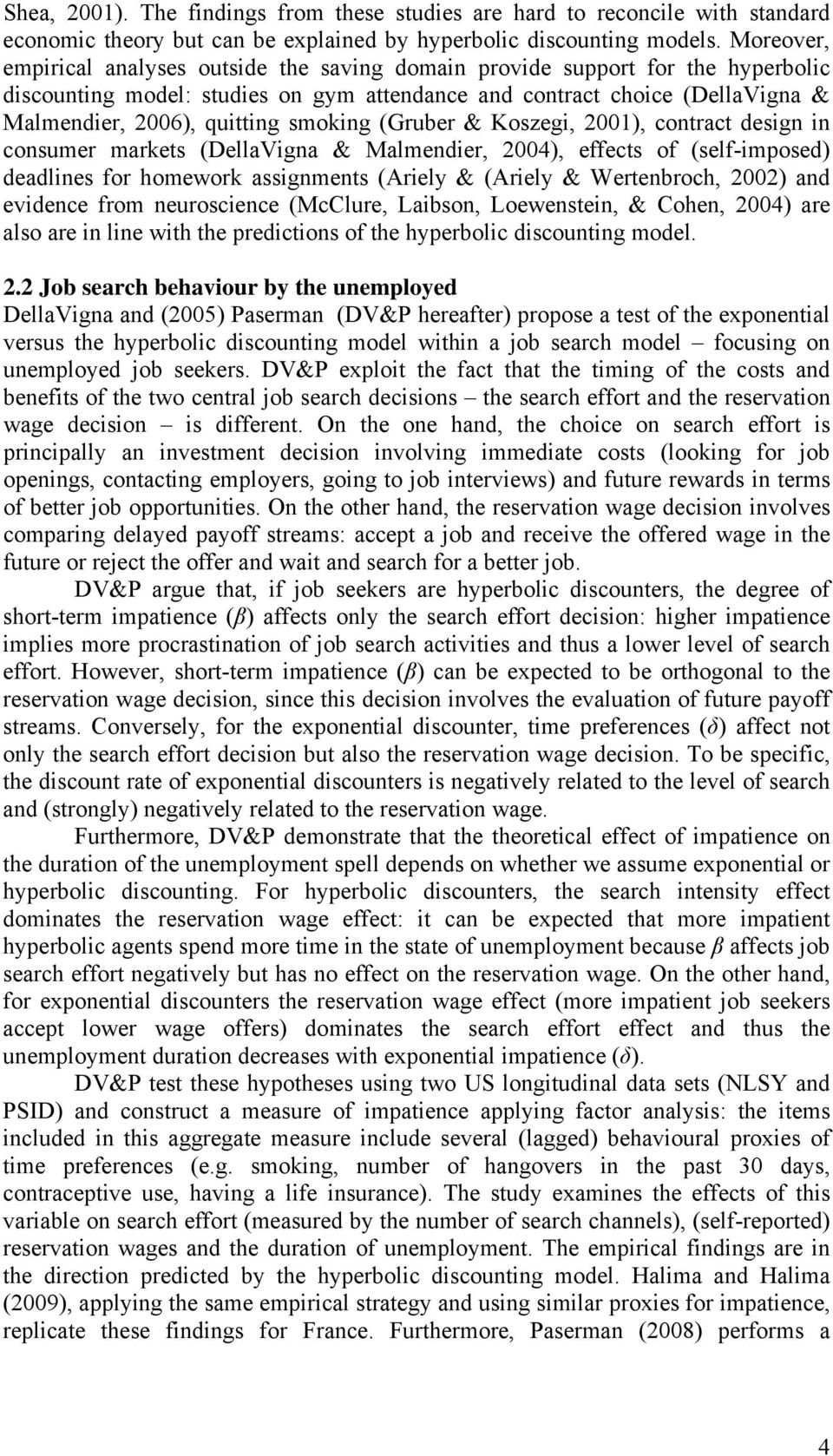
6 structural estimation (using the NLSY) which he uses to evaluate several olicy otions. 2.3 Search and collaboration on-the-job Three eriod model Drago (2006) analyses the career effects of hyerbolic discounting. Drago incororates hyerbolic discounting in a model of on-the-job behaviour, where workers can exerience wage increases through romotion or by moving to another emloyer. The main features and assumtions of the three eriod model are the following: - Workers have to allocate effort/time between job search and collaboration: the sum of the two tyes of effort is assumed to be exogenous (and equal to 1). - On-the-job search (s) ositively affects the robability of receiving a job offer - Collaboration on-the-job (1-s) ositively affects the robability of receiving a romotion. - A crucial assumtion is that the exected size and timing of rewards of the two career aths are different: the long-run benefit from collaboration [i.e. romotion] is greater than the one from search, and benefits that result from collaboration are not as immediate as the rewards from search conditional on the arrival of a better job offer (.3). The aer reviews revious emirical findings that suort this assumtion. In the model, the smaller ayoff of external mobility is received in the current eriod, while the larger benefit of romotion arrives in the future. Workers choose the level of search effort to maximize utility according to the following equation: max wc( s) s ( w) df( ) s[0,1] w (1) s [ V ( )] df( ) (1 s) V ( w ) [1 (1 sf( w))] V ( w) 0 0 w 0 where the first line reresents (immediate) ayoffs in the current eriod, consisting of the wage ( w ) minus the costs ( cs ()) and lus the otential gains of search ( s ( w ' w ) df ( w ') ), where is a arameter reresenting the robability to receive w an outside (and inside) job offer, w ' is the new wage offer and df( ) the cumulative wage distribution of outside wage offers. The second line denotes future ayoffs, which are discounted according to the quasi-hyerbolic discount function: is the short-term discount rate and reresents the long-term discount rate. In the future, workers either move to another emloyer ( s [ V0 ( )] df( ) ), receive a romotion w ( (1 sv ) 0( w ) ) or remain in the same osition ([1 (1 sf( w))] V0 ( w) ). V ( w) 0, V ( ) and V ( w 0 0 ) reresent the lifetime utility when the worker resectively kees the same job, accets an external job offer and gets romoted. Drago derives the f.o.c. of equation of (1): (2) c '( s ) ( w ' w ) df ( w ') V ( w ') V ( w ) df ( w ') V ( w ) V ( w ) w w Note that the art multilied by is negative. Alying comarative statics, Drago shows that more imatient workers exert less work effort (exhibit less collaborative behaviour), but search more on-the-job and are therefore more likely to move to 5

7 another job. Moreover, a hyerbolic worker searches more and thereby exerts less work effort than an exonential worker with identical δ. This rediction contrasts with DV&P s redictions on search effort of the unemloyed, which is (redicted and found to be) negatively related with imatience. Because the direction of the effect of δ on search and work effort is the same as the direction of the effect of β, these redictions cannot be used to test the exonential model against the hyerbolic model 1. Another hyothesis states that onthe-job search effort and therefore the job arrival rate increases with sohistication: by testing this hyothesis, Drago aims to distinguish exonential from hyerbolic discounting. Emirical strategy and results Like DV&P, Drago (2006) makes use of the NLSY for the emirical analysis and alies similar behavioural roxies for time references 2. The study examines the effect of imatience on the hazard rate of voluntary job-job transitions which are associated with wage increases and are not the result of external reasons (such as firing and lant closing) by estimating a Cox roortional hazard model. The results indicate that imatient workers are more likely to make voluntary transitions and thus search more intensively. Moreover, the findings show that sohistication 3 has a ositive and in most secifications a significant effect on the hazard rate. Next, the study assesses the effect of imatience on collaboration or work effort, using the absence rate as an indicator for effort, and finds that more imatient workers have higher absence rates. Drago therefore concludes that, in line with the redictions of the theoretical model, imatience is ositively related with voluntary job-job transitions (and thus with on-the-job search intensity) and negatively related with work effort. Moreover, the results concerning the ositive imact of sohistication on the hazard rate rovide suort for the hyerbolic discounting model. Shortcomings There are several theoretical and methodological roblems associated with the study of Drago. The first theoretical issue concerns the assumtion that total career effort is exogenous and, consequently, that there exists a erfect negative collinear relationshi between on-the-job search on the one hand and work effort on the other hand. It can be argued that more imatient workers invest less in their career and that the entire career investments made by hyerbolic workers are smaller than that made by exonential workers. So, the level of total investments is likely to be endogenous and highly deendent on time references. The assumtion of exogenous career effort, which is crucial for the theoretical redictions, may thus be invalid. Secondly, the model assumes that job search involves immediate net gains (wage increase minus search costs), because both the costs and the benefits from onthe-job search are immediate. As a result, in Drago s model job search can be characterised as a leisure activity, with immediate benefits and delayed costs (in terms 1 Drago in fact argues that the redictions can be used to test the models, as most estimates of δ lie in a more narrow range than the estimates of β, so the variation in mobility rates should be the result of variation in β. The validity of this argument is questionable because the estimates of the time reference arameters are averages roviding little information about the heterogeneity of the arameters and the variation in mobility may be due to other factors (e.g. risk references). 2 Drago however relaces contracetive use by cocaine use. 3 Sohistication is measured by a dummy indicating whether the worker has accumulated savings in an Individual Retirement Account or a Keough account. The argument is that only sohisticated individuals will recognize and demand these retirement accounts as commitment mechanism. 6

8 of foregone romotions). So, in the theoretical model workers allocate time/energy between a leisure activity (search) and an investment activity (collaboration): of course, the more atient the worker, the more effort is allocated to the investment activity. However, it would be more realistic if the benefits of job search in terms of better job oortunities are delayed: in that case on-the-job search can be defined as an investment activity. One of the general redictions of hyerbolic discounting models is that individuals have a tendency to do soon leisure activities, while they are inclined to rocrastinate investment activities. Since the theoretical redictions on search intensity are highly deendent on the timing of benefits, it is crucial to model this feature of job search accurately. Furthermore, there are two methodological roblems. First of all, the study examines the effect of imatience on job mobility but does not analyse the imact on search behaviour (the NLSY data does actually not rovide information about on-thejob search behaviour). Though job mobility is generally the outcome of the search rocess, it is not clear whether imatience affects mobility through other factors: for instance, imatient workers (like unemloyed job seekers) may be more likely to accet another job offer. Moreover, the imact of time references on job mobility may also be the result of the ositive relation between atience and work effort. In addition, there may be another underlying factor, such as job satisfaction, which may be related to both the degree of imatience and the robability of job mobility. A second methodological roblem involves the behavioural roxies that are used in the study of Drago (and by DV&P). These roxies may reflect other individual traits, such as risk aversion. As most of these roxies are clearly health related, it is rather dubious to use an indicator constructed from these roxies to examine the effect of imatience on absenteeism. Finding a ositive relation between absenteeism and, for instance, the number of hangovers in the last month or cocaine use, may rovide little evidence for the effect of time references on work effort. Furthermore, the roxy for sohistication may also measure atience (δ and/or β). 3. Theoretical framework 3.1 The four eriod model In order to accommodate the aforementioned roblems of the theoretical model of Drago, an alternative model of job search and work effort will be roosed. To allow the rewards of job mobility to materialize in the future, an additional eriod ( near future ) is added to the model in which workers are able to move to another job, but are not be able to climb the hierarchy within the same organisation. In this four eriod model, workers (emloyed at wage w) can increase their wage through romotion or by switching jobs. In the first case, the worker receives the romotion wage w, according to the deterministic function ( w) w (which is the same for all jobs). The worker enters the second uwards mobility route external job mobility if he receives a job offer from the cumulative density function Fw ( ') which is higher than his current wage w. So, conditional on receiving a wage offer which is higher than the current wage, the exected wage in the new job equals E( w). These are the central assumtions of the theoretical model: 7
9 Assumtion 1 A worker allocates total career effort between search (s) and effort onthe-job (e), given the effort constraint e s 1 (hereafter, I will refer to the sum of e and s as total career effort or investment). Assumtion 2 Search intensity (s) has a ositive imact on the robability of receiving an outside job offer, whereas effort on-the-job (e) has a ositive imact on the robability of receiving a romotion or an inside job offer: P job offer = ( s ); Promotion = ( e ) where the arameter λ is a constant which varies between 0 and 1 ( 0 1) 4. Assumtion 3 The costs of search and effort c(e,s) are a convex function of total career effort (e + s). Assumtion 4: The rewards from internal uwards mobility or romotion ( w ) are higher than the rewards from external mobility ( ), which are higher than the ayoffs of no mobility ( w ): w w Assumtion 5 The rewards from a romotion are not as immediate as the rewards of moving to a new job: the rewards from job mobility materialize in the near future (t+1), whereas the rewards from romotion emerge during the eriod thereafter (t+2). Assumtion 1 states that workers have to make an allocation between two tyes of investments: work and search effort. Work effort e may be interreted as the amount of effort which is in addition to the minimal accetable work effort. Effort on-the-job (e) thus reresents extra-role behaviour (e.g. working overtime hours, acceting temorary imositions without rotest, assisting co-workers, building good relationshis with suervisors). Search effort consist of all kinds of screening (e.g. searching for vacancies in newsaers and on the internet) and alication activities (writing alications letters, rearing for and attending job interviews). The residual (1-e-s) could be interreted as leisure on-the-job: not all workers make the same level of career investments. Assumtion 1 imlies that there is a trade-off between work effort and search intensity: there may be time restrictions (e.g. working overtime reduces the amount of time to sent on job search activities) and in some cases searching for a job is simly incomatible with exerting high effort (e.g. attending a job interview during working hours imlies absence from work). However, there exists no erfect linear relation between search and effort on-the-job. Assumtion 2 shows that workers can affect their romotion and mobility chances by investing in resectively work and search effort. The cost function is secified under Assumtion 3. As in the model of Drago, the Assumtions 4 and 5 are crucial in the theoretical model: the long-term rewards from romotion are higher, but more ostoned than the rewards from mobility: while the rewards from a romotion will emerge in the distant future, the rewards from a new job will already materialize in the near future. So, workers can ursue smaller more immediate rewards, or larger more ostoned gains. Emirical findings confirm that the long-run gains of romotions outweigh the long-run gains of mobility. The results of Light and 4 The same arameter is used in both the job offer and the romotion equation: this is of course a simlifying assumtion, which is also made in the model of Drago (2006). One may argue that there are different s for the job offer and the romotion equation. We return to this issue in section 5. 8

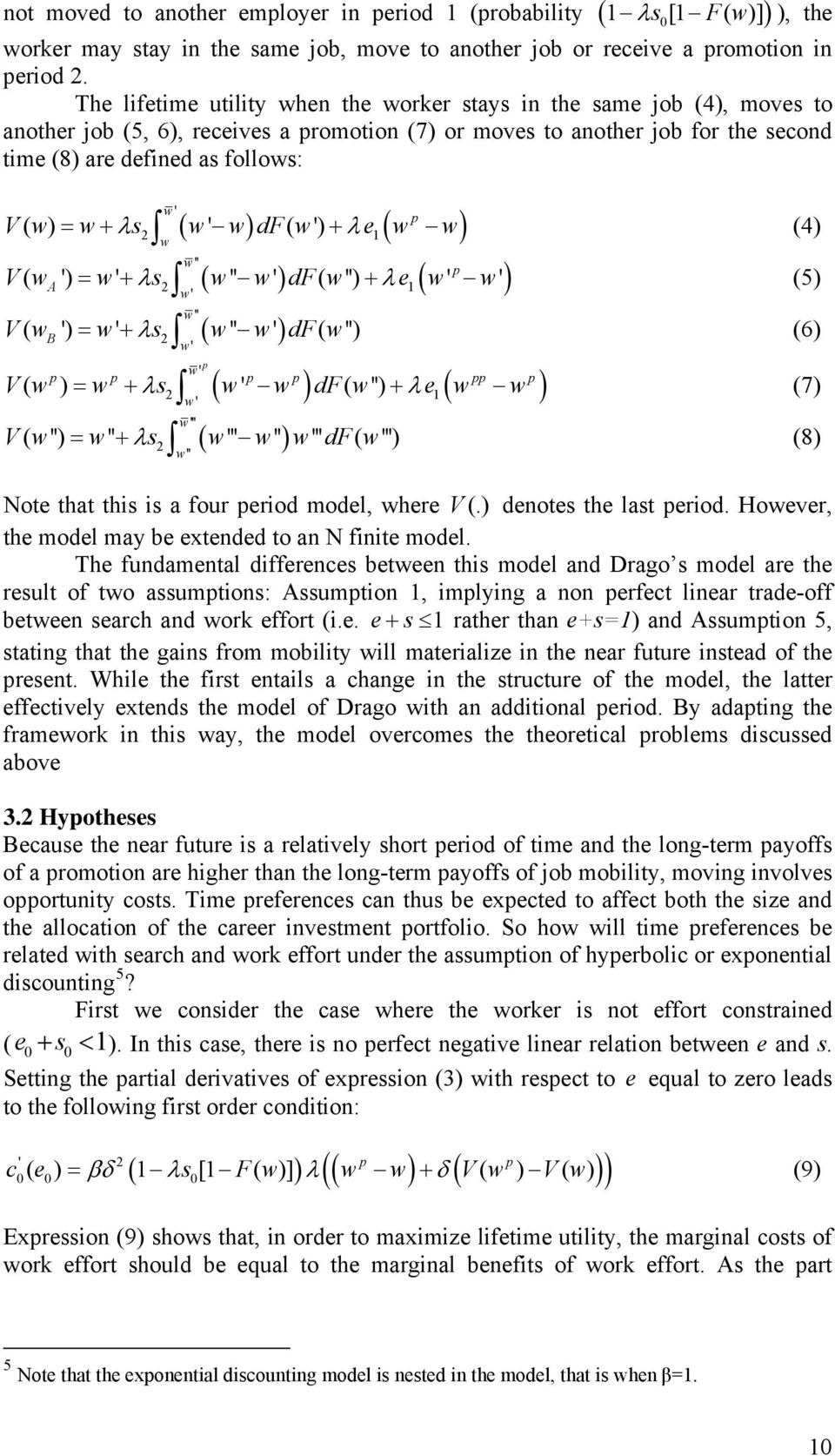
10 McGarry (1998) indicates that workers who exerience job changes frequently have a lower wage ath than less mobile workers. Toel and Ward (1992) also find higher wage growth for stayers than for movers. In addition, the study of McCue (1996) shows that the long-run wage gains from romotion are substantially higher than the long-run wage gains from interfirm mobility. Finally, the findings of Le Grand and Tahlin (2002) indicate that both external and internal mobility increase earnings growth, but that the gains of the former decrease with the frequency whereas the benefits of the latter tye raise with the frequency. A worker with wage w will therefore choose search (s) and effort on-the-job (e) to maximize life-time utility: t=1, nearfuture t=0,resent wc ( e, s ) wc ( e, s ) s ( w) df( ) w ' c2( e2, s2) s1 ' df( ') s0[1 F( w)] V( wa') s1[1 F( )] V( ') V( wa') 2 wc2( e2, s2) s1 wdf( ) e0w w w 1 s0[1 F( w) ] V( w) e0 V( w ) V( w) s1[1 F( )] V( wb ') V( w) t2, distantfuture (3) where w denotes the current wage, w the wage after romotion, the wage of the new job, c(e, s) the cost function of effort and search and a arameter reresenting the robability to receive a job offer. F(w) reresents the cumulative distribution function from which the outside wage offer is drawn. The arameters β and δ are the hyerbolic (short-run) and the exonential (long-run) discount factor resectively. Equation (3) consists of three arts: ayoffs in the resent, the near future and the distant future. The resent eriod can be interreted as the eriod from now until the term of notice: a worker is not able to change to another job within this eriod and therefore receives the wage w and makes costs c0( e0, s0). The second eriod, the near future (the art multilied by ), reresents a eriod after the term of notice, during which a worker can move to another job but cannot exerience a romotion. The ayoffs during this eriod consist of the wage, costs c ( e, s ) and w s0 ( w) df( ), which denoted the gains of mobility multilied by the w robability of receiving a better job offer. 2 In the distant future (the art multilied by ), there are three otential outcomes: staying in the same job; moving to another emloyer and receiving a romotion. With the robability s 0 [1 F ( w )], the workers has moved to another job in eriod 1: in eriod 2, the workers receives the new wage ( ) lus the otential ' gains of moving to another job again ( s ' df( w '') ) and makes costs c2( e2, s2). Note that by moving to another emloyer, the worker forgoes to climb the wage ladder within the current organisation. On the other hand, when the worker has 1 9

11 not moved to another emloyer in eriod 1 (robability 1 s0[1 F( w) ] ), the worker may stay in the same job, move to another job or receive a romotion in eriod 2. The lifetime utility when the worker stays in the same job (4), moves to another job (5, 6), receives a romotion (7) or moves to another job for the second time (8) are defined as follows: ' V( w) ws2 w df( ) e1 w w (4) w V( wa ') s2 ' df( ') e1 (5) ' V( wb ') s2 ' df( ') (6) 2 V( w ) w s w df( ') e1 w w (7) '' ' V ( w '') w '' s ''' '' ''' ( ''') 2 w w w df w (8) Note that this is a four eriod model, where V (.) denotes the last eriod. However, the model may be extended to an N finite model. The fundamental differences between this model and Drago s model are the result of two assumtions: Assumtion 1, imlying a non erfect linear trade-off between search and work effort (i.e. e s 1 rather than e+s=1) and Assumtion 5, stating that the gains from mobility will materialize in the near future instead of the resent. While the first entails a change in the structure of the model, the latter effectively extends the model of Drago with an additional eriod. By adating the framework in this way, the model overcomes the theoretical roblems discussed above 3.2 Hyotheses Because the near future is a relatively short eriod of time and the long-term ayoffs of a romotion are higher than the long-term ayoffs of job mobility, moving involves oortunity costs. Time references can thus be exected to affect both the size and the allocation of the career investment ortfolio. So how will time references be related with search and work effort under the assumtion of hyerbolic or exonential discounting 5? First we consider the case where the worker is not effort constrained ( e0s01 ). In this case, there is no erfect negative linear relation between e and s. Setting the artial derivatives of exression (3) with resect to e equal to zero leads to the following first order condition: ' 2 c ( e ) 1 s [1 F( w)] w w V( w ) V( w) (9) Exression (9) shows that, in order to maximize lifetime utility, the marginal costs of work effort should be equal to the marginal benefits of work effort. As the art 5 Note that the exonential discounting model is nested in the model, that is when β=1. 10
12 2 multilied by is ositive, work effort is increasing in both and. The f.o.c. with resect to search intensity s is: ' 0 0 c ( s ) ( w) df( ) w ' s1 ' df( ') w ' A 1 2 s0[1 F( w)] ws1 wdf( ) e0w w w V( w) e0 V( w ) V( w) s1[1 F( )] V( wb ') V( w) V( w ') s[1 F( )] V( ') V( w ') A (10) Again, under utility maximization the marginal costs of search effort are equal to the marginal benefits of search effort. The art multilied by reresents the shortterm benefits of search, whereas the art multilied by denotes the marginal 2 long-run ayoffs: these involve long-run marginal gains of mobility minus long-run marginal oortunity costs of mobility in terms of forgone romotions. When the long-run ayoffs are ositive, search intensity is increasing in and. However, if there are net long-run costs 6 of searching for external job offers, it can be shown that search intensity is decreasing in if: ( w) ' w s1 wdf( ) e0w w s1 ' df( ') w V( w) e0 V( w ) V( w) 2 s1[1 F( )] V( wb ') V( w) V( wa') s1[1 F( )] V( ') V( wa') (11) Since 1, this ossibility exists theoretically when the distant future costs are over half the near future benefits of search. This is the case when there are substantial differences between the gains of romotion and the gains of mobility. Furthermore, search intensity is decreasing in if the long-run ayoffs of job search are negative and the following condition holds: 6 This is the case if the following condition holds: ws1 wdf( ) e0w w ' w s1 ' df( ') V( w) e0 V( w ) V( w) 0 V( wa') s1[1 F( )] V( ') V( wa') s1[1 F( )] V( wb ') V( w) 11
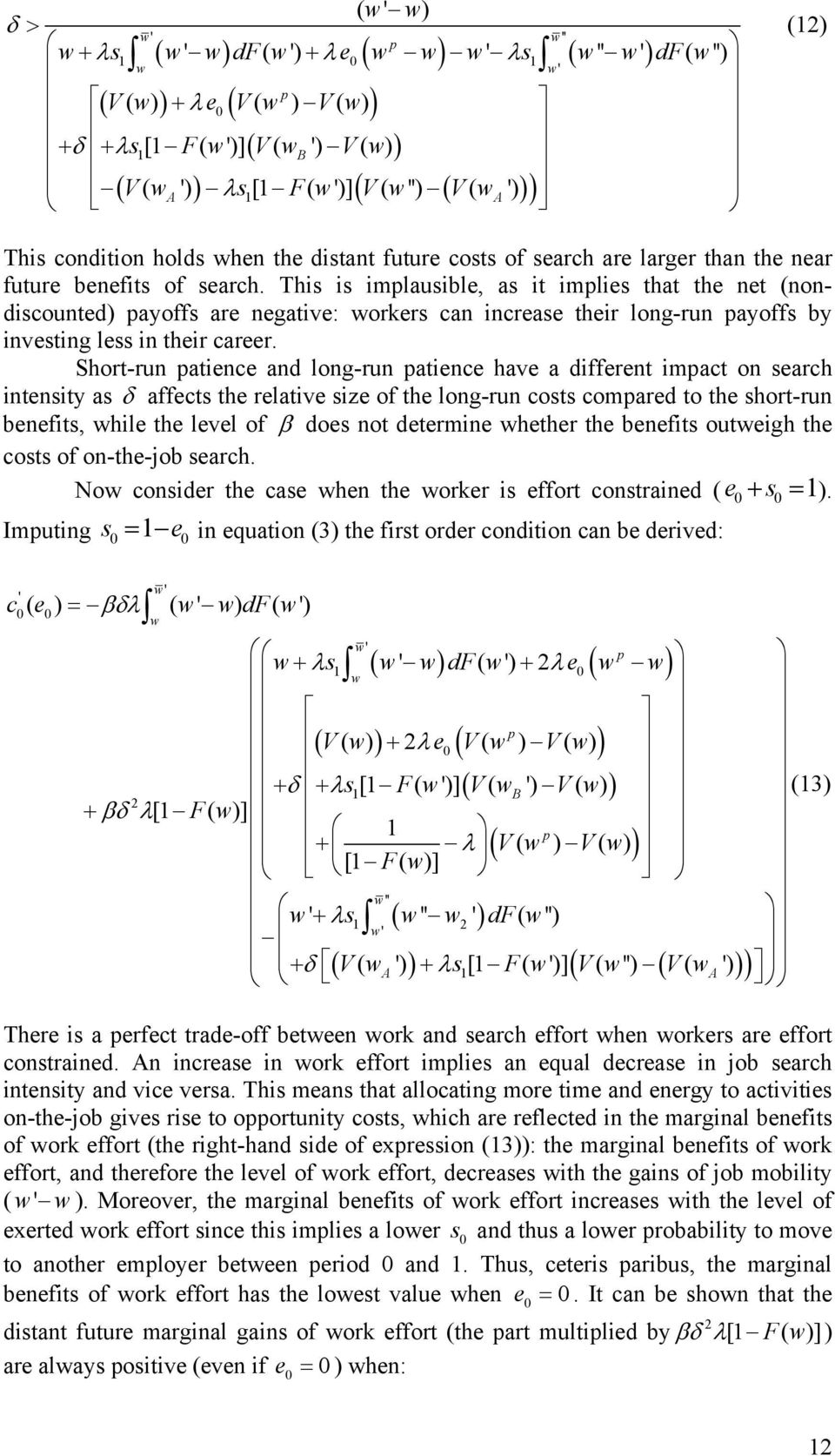
![with resect to search intensity s is: ' 0 0 c ( s ) ( w) df( ) w ' s1 ' df( ') w ' A 1 2 s0[1 F( w)] ws1 wdf( ) e0w w w V( w) e0 V( w ) V( w) s1[1 F( )] V( wb ') V( w) V( w ') s[1 F( )] V( ') V( w ')](/docs-images/50/15570092/images/page_12.jpg "A (10) Again, under utility maximization the marginal costs of search effort are equal to the marginal benefits of search effort.")
13 ( w) w ' w s1 wdf( ) e0w w s1 ' df( ') w V( w) e0 V( w ) V( w) s1[1 F( )] V( wb ') V( w) V( wa') s1[1 F( )] V( ') V( wa') (12) This condition holds when the distant future costs of search are larger than the near future benefits of search. This is imlausible, as it imlies that the net (nondiscounted) ayoffs are negative: workers can increase their long-run ayoffs by investing less in their career. Short-run atience and long-run atience have a different imact on search intensity as affects the relative size of the long-run costs comared to the short-run benefits, while the level of does not determine whether the benefits outweigh the costs of on-the-job search. Now consider the case when the worker is effort constrained ( e0s0 1). Imuting s e in equation (3) the first order condition can be derived: ' c ( e ) ( w) df( ) w w s1 w w df w e0 w w w V( w) 2 e0 V( w ) V( w) s[1 F( )] V( w ') V( w) V( w ) V( w) [1 Fw ( )] ' s1 ' w2' df( ' ) V( wa') s1[1 F( )] V( ') V( wa') ' ( ') 2 1 B 2 [1 Fw ( )] 1 (13) There is a erfect trade-off between work and search effort when workers are effort constrained. An increase in work effort imlies an equal decrease in job search intensity and vice versa. This means that allocating more time and energy to activities on-the-job gives rise to oortunity costs, which are reflected in the marginal benefits of work effort (the right-hand side of exression (13)): the marginal benefits of work effort, and therefore the level of work effort, decreases with the gains of job mobility ( w). Moreover, the marginal benefits of work effort increases with the level of exerted work effort since this imlies a lower s 0 and thus a lower robability to move to another emloyer between eriod 0 and 1. Thus, ceteris aribus, the marginal benefits of work effort has the lowest value when e0 0. It can be shown that the 2 distant future marginal gains of work effort (the art multilied by [1 Fw ( )] ) are always ositive (even if e0 0 ) when: 12
14 w w w 1 [1 Fw ( )] (14) As does not influence the relative size of costs and benefits of work and search effort, hyerbolic atience does not affect the allocation between work and job search effort. The exonential discount rate, however, determines whether the benefits of work effort dominate the costs. Assuming (14), is ositively related with the level of work effort. When e0s0 1, this imlies that on-the-job search intensity decreases with exonential atience. The intuition is that, when workers are effort constrained, increasing work effort - and thus decreasing on-the-job search effort - involves near future costs due to a lower job mobility robability and distant future benefits. Trading off higher search effort for lower work effort entails near future benefits but distant future costs (due to forgone romotions). The higher exonential atience, the more the relative weight shifts away from the near future ayoffs towards the distant future ayoffs. Thus, more atient (effort constrained) workers care relatively more about the distant future comared to the near future and will therefore allocate more effort to on-the-job activities and less to job search. We have demonstrated that the imact of atience on the level and allocation of career investments is deendent on whether exonential or hyerbolic discounting is assumed. The effect of exonential discounting on work effort is ositive, both in the unconstrained and the constrained scenario. Hyothesis EXPO1 Patience (δ) is ositively related to work effort. However, search effort increases with in the unconstrained case but decrease with when the worker is effort constrained. In the latter case, the distant future reward from effort on-the-job dominates the near future reward of searching. Note that for unconstrained workers the higher, the higher both search and work effort and thus the more likely the worker will be effort constrained: so we can exect that search effort increases with when atience is low, and decreases with when atience is high. Hyothesis EXPO2 There is an inverse U-shaed relation between atience (δ) and on-the-job search intensity. Next, what is the exected relation between work effort and on-the-job search and hyerbolic time references? First of all, note that hyerbolic discounters ( 1) exert less total effort than exonential discounters (given the same ) and are therefore less likely to be effort constrained. This is consistent with the general literature on hyerbolic discounting: individuals rocrastinate investment activities such as searching for a job or exerting high effort on-the-job, since they are resentbiased and articularly sensitive to the immediate costs associated with these activities. The higher the degree of resent-biasedness (the lower β), the lower is the value attached to the future gains of search and work effort and the higher the tendency to avoid the immediate investment costs. However, when the worker is effort constrained, does not affect the secific allocation between work and search effort. The rationale is that determines the degree of rocrastination of career 13

15 investments: of course, when the worker is effort constrained, this rocrastination roblem is absent. Hyothesis HYPO1 Patience ( ) is ositively related to work effort. Hyothesis HYPO2 Patience (β) is ositively related to on-the-job search intensity. Comaring EXPO1-2 with HYPO1-2, the exected relation between work effort and time references is ositive both under exonential and under hyerbolic discounting. However, an inverse U-shaed relation between exonential time references and onthe-job search intensity is exected, whereas the model redicts a (diminishing) ositive relation between hyerbolic time references and on-the-job search intensity. Finally, consider the relation between time references and job-job transitions. For exonential discounters, work effort and hence romotion oortunities increase with atience (EXPO1). This means the exected current wage is high for atient workers (due to ast romotions). Given the nature of the wage distribution, the robability of receiving a better outside otion thereby diminishes 7 : atience has a negative job accetance effect which decreases the robability of job mobility. Furthermore, for low levels of atience, job search intensity increases with (EXPO2), thereby having a ositive job arrival effect. The latter imlies a rise of the chance of moving to another emloyer. Consequently, the overall effect is ambiguous (ositive or negative) for low. However, for high there is not only a negative job accetance effect but also a negative job arrival effect (EXPO2), imlying a ositive relation between exonential atience and the robability of job mobility. Hyothesis EXPO3 There is a negative or inverse U-shaed relation between atience (δ) and the robability of job mobility. Under hyerbolic discounting, romotion oortunities also increase with atience (HYPO1), resulting in a negative job accetance effect. On the other hand, hyerbolic time references are ositively related with on-the-job search intensity (HYPO2), which imlies a ositive job arrival effect. Hence, the overall imact of atience on the robability of job mobility is ambiguous. 3.3 Potential extension: unemloyment The model assumes that staying in the same job is the outcome that results in the lowest otential ayoffs. Of course, one can argue that workers may lose their job and become unemloyed. Incororating unemloyment in the theoretical model is esecially relevant from a olicy ersective, because such a model may clarify the relation between atience and activities that decrease the robability to become unemloyment (i.e. search and work effort). When the state of unemloyment is introduced, the art of exression (3) multilied by 1 s0[1 F( w) ] in the distant future will change 8 : 7 Basically, this means a decrease in [1 F( w)]. 8 We assume here that workers cannot lose their jobs in the near future. 14

16 wc2( e2, s2) e0 w w a(1 e0)( uw) s1 wdf( ) w 1 s0[1 F( w)] V( w) e0 V( w ) V( w) a(1 e0 )( V( u) V( w)) s1[1 F( )] V( wb ') V( w) (15) Where u and Vu ( ) reresents the eriod 2 and lifetime utility resectively when the worker loses his job and a(1 e0 ) denotes the robability that the worker is dismissed. Assuming w u and V( w) V( u), both ( u w) and ( Vu ( ) Vw ( )) are negative. By increasing the chance of moving to another emloyer or obtaining a romotion, the level of both on-the-job search and work effort affect the robability to enter unemloyment indirectly. However, one can argue that the layoff robability is deendent on the level of exerted work effort and thereby decreases the chance to become unemloyed directly. For that reason, introducing the state of unemloyment amlifies the existing difference between the distant future gains of work effort and the distant future gains of search effort. Thus, the model leads to the same theoretical redictions on the relation between atience and work and search effort. 3.4 Sohistication versus naïveté As discussed in section 2.1, sohistication refers to the individuals beliefs about. Naïve individuals believe =1 and exect that they will not face self-control roblems in the future, whereas sohisticated individuals have accurate beliefs about their hyerbolic time references and future self-control roblems. In the context of career investments, a sohisticated worker believes that his future selves will exert too little work and search effort. For that reason, this worker is willing to commit his future selves to the behaviour that is otimal from the resent self ersective. As other studies (O Donoghue and Rabin, 1999; 2001) have shown, sohistication may mitigate the roblems of rocrastination of investment activities. So, theoretically both sohistication and hyerbolic atience have a ositive effect on the level of work and on-the-job search effort 9. However, as it is difficult to distinguish emirically between and sohistication, we will not discuss sohistication effects in this aer. 9 Note that sohistication has no theoretical meaning under exonential discounting. 15

17 4. Data 4.1 General For the emirical analysis, I make use of the DNB Household Survey (former name: CentER Savings Survey), a Dutch anel survey which has been collected by CentERdata from 1993 to The anel consists of around households (the size of the anel varies over time): once a year, each household member aged 16 or older fills in a questionnaire via internet 10. The survey contains six different modules which focus on secific domains: demograhical characteristics of the resondent and the household, housing, health and income, assets and liabilities, and economic and sychological concets. As the questions about time references (see next subsection) are asked in the years , I restrict the samle to these years. Moreover, I select male emloyees who have not just (re)entered the labour market by excluding workers who were non-emloyed in the revious year. The rationale is that workers who just (re)entered the labour market may have rather distinctive job search behaviour: they may for instance accet a job which they regard as transitory/temorary. Moreover, many questions refer to the eriod two months rior to the interview (e.g. how many job alications in the ast two months). In this eriod the entrants could be unemloyed and thereby indicating search effort while they were unemloyed. Due to anel attrition and refreshment, I make use of an unbalanced anel, consisting of about 5000 observations and over 1900 individuals. 4.2 Time references I make use of 11 general statements about time references and orientation towards the future (see Table 1 for details). Resondents indicate to which extent they agree with the statement using a 7-oint scale (1=comletely disagree; 7=comletely agree). These measures of atience are fundamentally different from those used by DV&P and Drago, as these are self-assessed statements and refer to individual time references in general: most other time reference measures refer to financial atience (e.g. lottery questions), or are health related (e.g. smoking, drug use). We would exect that the variables FUTURE01, FUTURE02, FUTURE06, FUTURE07 and FUTURE08 are ositively related to atience, whereas the items FUTURE03, FUTURE04, FUTURE05, FUTURE09, FUTURE010 and FUTURE011 can be exected to be negatively correlated with atience. We therefore recode the latter grou of variables (1 is recoded to 7, 2 is recoded to 6, etcetera). Thus, we would exect that all 11 time reference variables are ositively correlated with one another. Aendix A1 rovides details about the correlations between these items and the KMO measures of samling adequacy. The correlation matrix shows that in general correlations between these variables are ositive and significant: the excetions seem to be FUTURE04 and FUTURE05. Moreover, the KMO measures vary between 0.69 and 0.83 (overall KMO of 0.78), which suggest the variables reflect the same underlying trait. Initially, I erformed factor analysis using all 11 future variables (see Aendix A1 for details of factor analyses): the items FUTURE04 and FUTURE05 aeared to have the lowest factor loadings. Therefore (and because they are negatively correlated with the other future variables) I decided to exclude these two 10 It is not necessary that households have a PC or internet: when a PC is absent, access is rovided through a secial box which enables household members to fill in the survey via the television. 16
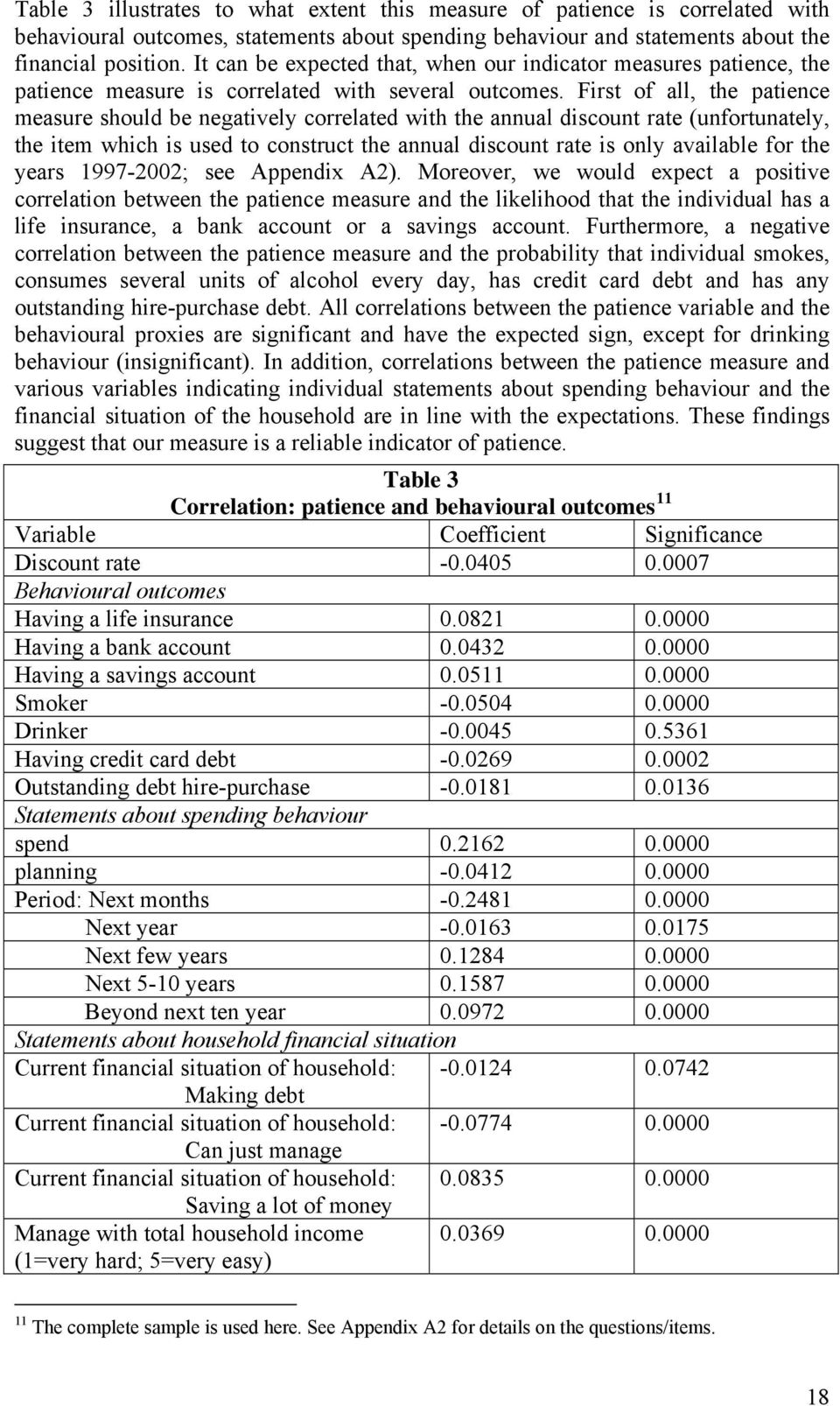
18 Table 1 Time references: statements and descritive statistics Comlete samle Selected workers Patience (N=21587) (N=5008) Name Descrition Mean Std. Dev FUTURE01 I think about how things may be in the future and I try to influence these in everyday life FUTURE02 I often deal with things that will have consequences in several years FUTURE03 I am only concerned about the resent, assuming it will turn out all right in the future FUTURE04 I only think about the immediate consequences of my actions (several days/weeks) FUTURE05 Whether something is convenient determines my decisions to a large extent FUTURE06 I am reared to sacrifice my current well-being in order to achieve objectives in the future FUTURE07 I think that it is imortant to take warnings about negative future results of my actions seriously, even if these results will materialize in the distant future FUTURE08 I believe it is more imortant to deal with matters that will have major consequences in the future, than to deal with matters with immediate but minor consequences FUTURE09 I generally ignore warnings about future roblems because I assume that these roblems will be solved by then FUTURE10 I believe that there is no need to make sacrifices now for future issues, because these could be solved later FUTURE11 I only resond to urgent roblems, suosing that I can deal with future roblems when they emerge items. Aendix A1 shows the results for the factor analysis using the 9 remaining variables: as exected, all variables have ositive loadings. As the first factor is the only one with an eigenvalue above 1 and other factors may be difficult to interret (for instance, for the second factor, some loadings are ositive while others are negative), I kee the first factor and interret this as a measure of atience. As I include a squared atience variable in the estimation equations (next section), I rescaled the variable in such a way that it varies between 1 and 7 (rather than between -3 and 3). Table 2 shows some descritives of this factor. Table 2 Patience measure: summary statistics Mean Std. Dev. 10% 25% 50% 75% 90% Patience(comlete) Patience (selected)

19 Table 3 illustrates to what extent this measure of atience is correlated with behavioural outcomes, statements about sending behaviour and statements about the financial osition. It can be exected that, when our indicator measures atience, the atience measure is correlated with several outcomes. First of all, the atience measure should be negatively correlated with the annual discount rate (unfortunately, the item which is used to construct the annual discount rate is only available for the years ; see Aendix A2). Moreover, we would exect a ositive correlation between the atience measure and the likelihood that the individual has a life insurance, a bank account or a savings account. Furthermore, a negative correlation between the atience measure and the robability that individual smokes, consumes several units of alcohol every day, has credit card debt and has any outstanding hire-urchase debt. All correlations between the atience variable and the behavioural roxies are significant and have the exected sign, excet for drinking behaviour (insignificant). In addition, correlations between the atience measure and various variables indicating individual statements about sending behaviour and the financial situation of the household are in line with the exectations. These findings suggest that our measure is a reliable indicator of atience. Table 3 Correlation: atience and behavioural outcomes 11 Variable Coefficient Significance Discount rate Behavioural outcomes Having a life insurance Having a bank account Having a savings account Smoker Drinker Having credit card debt Outstanding debt hire-urchase Statements about sending behaviour send lanning Period: Next months Next year Next few years Next 5-10 years Beyond next ten year Statements about household financial situation Current financial situation of household: Making debt Current financial situation of household: Can just manage Current financial situation of household: Saving a lot of money Manage with total household income (1=very hard; 5=very easy) The comlete samle is used here. See Aendix A2 for details on the questions/items. 18
20 4.3 Work effort The effort exerted by workers can be measured in several ways. As work effort is an inut factor, we should consider indicators that measure individual inut rather than individual erformance measures (outut). Drago (2006) for instance uses information on emloyee absenteeism and reviews several studies ointing out that absenteeism is negatively related to romotion oortunities. We rely on two different indicators for work effort: statement about individual shirking behaviour and overtime. In the years workers are asked to what extent they agree (on a 5- oint scale) with the following statement: I shirk my duties. Although this question refers to the individual s behaviour in general and not secifically in the work environment, it can be argued that individuals who agree with this statement have a tendency to shirk at work. Table 4 shows that almost three quarters of the workers disagree with this statement: about 12 er cent however state that they are shirkers. Next to the shirking measure, I make use of average overtime work as an indicator for work effort. Landers et al. (1996) demonstrated that long working hours may be used as indicators of work effort in romotion decisions, leasing to a ratrace. Numerous emirical studies examined the investment character of working hours. Francesconi (2001) and Booth et al. (2003), using UK data, find a ositive relationshi between overtime hours and the incidence of romotion. Several studies focused on unaid overtime: Anger (2008) and Pannenberg (2005) used German data to examine the career effects of unaid working hours. Whereas Anger found limited evidence for unaid overtime as career investment in the short-term, the results of Pannenberg indicate that unaid overtime is indeed a long-term career investment. This seems to be consistent with the theoretical model: the future gains of high work effort are long-term. Moreover, it could be argued that there is a trade-off between working overtime hours and job search intensity. 3 The overtime variable ( e ) is defined as the actual (average) weekly working hours minus the contractual weekly working hours (see Table 4 for descritives). In 2 addition, I also used a variable ( e ) which indicates whether the individual works less than, equal to, or more than the contractual hours: 2 e = 0 if actual hours < contractual hours 2 e = 1 if actual hours = contractual hours 2 e = 2 if actual hours > contractual hours The majority of the emloyees reort that they work overtime hours: male workers work on average over three hours more than their contract secifies. Less than 5 er cent of the workers state that on average they work less than their contractual working hours. So, I make use of three indicators for work effort: Table 4 Work effort Freq. Percent Cum. Statement: I shirk my duties (1-5) Very Inaccurate Very Accurate Total 1,

21 Overtime hours (categ.) Freq. Percent Cum. Hours contract >Hours actual Hours contract =Hours actual 1, Hours contract <Hours actual 2, Total 4, Overtime (actual hours contract hours) Obs Mean Std. Dev. Min Max Table 5 show the relation between the different work effort variables: the correlation between the shirking variable and overtime hours is insignificant but the sign is as exected (negative). Table 5 Correlation between different work effort variables Overtime Overtime (categ.) Shirk Overtime Overtime (categ.) (0.0000) Shirk (0.2861) (0.3960) Job search effort In the revious literature, the intensity of job search effort has been measured by various roxies: some rely on the amount of time sent on search activities (Barron & Mellow, 1979; Krueger & Mueller, 2008), others use the number alications during a secific eriod (Gorter & Kalb, 1996; van der Klaauw & van Vuuren, 2010) or the number of different search methods (DellaVigna & Paserman, 2005; Manning, 2009). Emirical evidence oints out that the last indicator is highly related to time sent on searching activities (by unemloyed individuals): Krueger and Mueller (2008) show that the number of search methods is a strong instrument for the number of minutes of job search in the last seven days. The aforementioned literature deals with job search behaviour by the unemloyed: studies that emirically examine on-the-job search are scarce. An excetion is the study of Bloemen (2005), who assesses search behaviour of both the unemloyed and the emloyed. Bloemen makes use of the three following measures for search effort: job search attitude (seriously searching or not); screening (looked for a job in the ast two months); and the number of alications the job seeker made in the ast two months. In our emirical analysis, I use the following indicators of search effort 12 : 12 Resondents are asked the question: Are you currently looking for a(nother) job? Potential answers are: Yes, I am seriously searching for a(nother) job ; Yes, I am considering searching for a(nother) job ; No, I just found another job ; No, I am not looking. We make use of the answer to this question to construct the variable s 1. When the resondent answered this question ositively, several additional questions will be asked. For the variables s 2, s 3 and s 4 information is obtained from 20
22 - Search attitude ( s 1 ): 1 s = 0 if not searching for a job; 1 s = 1 if considering looking for another job; 1 s = 2 if seriously searching for another job. - Whether the worker has alied for a job in the last two months ( s 2 ): 2 s = 0 if no alications 2 s = 1 if one or more alications - The number of job alications made by the worker during the last two months ( s 3 ): 3 s = # alications (0-14) - The number of job search channels/methods used by the worker during the last two months ( s 4 ): 4 s = # search channels (0-8). Table 6 and Table 7 rovide information about these search effort variables. About 18 er cent of the workers is either thinking about looking for or seriously searching for another job. About a quarter of these 879 emloyed job searchers reort that they are seriously searching for another job. One out of 13 workers alied for a job in the last two months; over 40 er cent of the job seekers alied for a job during the revious months. About 2 er cent of the emloyees alied more than 2 times for a job. Considering the number of different search methods, it aears that reading advertisements is the most commonly used channel used by almost half of the job searchers. Next, answering advertisements, directly contacting emloyers and asking friends and relatives are also frequently used job search methods. Just a small minority of the on-the-job searchers uses more than one search channels: on average, workers use one search channel. Table 8 rovides the correlation coefficients between the different indicators of search intensity. When the various indicators measure search intensity, we would exect that the correlations between the indicators to be ositive. The table shows that all correlations are ositive and highly significant. For instance, those workers who reort to search seriously aly more frequently for another job and use more search channels. This indicates that all four measures reresent the same underlying variable: search effort. 4.5 Job-job transitions Although resondents are not asked directly whether or not they moved to another job, we can construct a transition dummy by making use of information on tenure at year t+1 (resondents are asked to reort the year and month in which they started working with their current emloyer). Moreover, workers are regarded as having made a job-job transition, when they reort at year t or t+1 that they are not searching for another job because they already found another job but have not started this new job yet. Accordingly, between the years 1996 and (7 er cent) transitions and 3391 (93 er cent) stayers can be identified. the questions How many times have you alied for a job during the last two months and How have you searched for a job during the last two months? (u to eight different methods). 21
23 Table 6 Job search effort: search attitude, job alications and search channels Frequency (N=5008) Percentage all workers (N=5008) Percentage job seekers (N=879) Search attitude Not looking for another job 4, Considering looking for another job Seriously searching for another job Alied for a job in the ast two months No 4, Yes Number of alications in the ast two months 0 4, >= Different search channels Answered advertisements Placed advertisements Asked emloyers Asked friends/relatives Through job center Temorary emloyment agency Reading advertisements Other way Number of search channels 0 4,
24 Table 7 Descritives: Number of channels and alications Variable Obs Mean Std. Dev. Min Max # channels (all workers) # channels (job seekers) # alications (all workers) # alications (job seekers) Table 8 Correlation between search effort variables All workers (N=5008) Search attitude Alied # alications # channels Search attitude Alied (0.0000) # alications (0.0000) (0.0000) # channels (0.0000) (0.0000) (0.0000) Job seekers (N=879) Search attitude Alied # alications # channels Search attitude Alied (0.0000) # alications (0.0000) (0.0000) # channels (0.0000) (0.0000) (0.0000) 23
25 5. Results 5.1 Work effort In order to assess emirically the relation between atience and work effort, I secify the following equation: k* ' e X k 1, 2, 3 (5.1) it it it it where k* eit denotes work effort, it reresents the atience measure and ' X it include controls, which include demograhical variables (age, age squared, marital status, number of children, educational level), emloyment related factors (tye of contract, civil servant dummy, tenure), the unemloyment rate (rovince level), three regional dummies and 11 year dummies. Since work effort is a latent variable, I use three different roxies: shirking ( e ), overtime categories ( e ) and actual minus contractual hours ( e ): k e 0 if e v i k* i e n if v e v j 1,.., N 1 k k* i j i j1 e N if v e v k k* i 1 i j1 N 5 fork 1; N 2 fork The first column of Table 9 shows the results where I used e (shirking) as the deendent variable, estimated with an ordered robit model. The coefficient of atience is negative and highly significant. This result indicates that more atient workers have a lower tendency to shirk their duties. The coefficients of all the other coefficients are insignificant. It may be a roblem that the question about shirking may reflect the ersonality trait conscientiousness. This ersonality trait is related to time references (Borghans, Duckworth, Heckman, & Ter Weel, 2008). It could therefore be the case that the deendent and the atience measure indicate the same ersonality characteristic. 2 3 The estimation results where e (overtime categories) and e (difference between actual and contractual hours) are used as deendent variables are shown in the last two columns of Table 9, estimated with ordered robit model and ooled OLS resectively. The results are very similar. First of all, the main result is that atience is ositively related with both the robability of overtime work and the number of overtime hours. This finding rovides suort for both the EXPO and the HYPO hyotheses. Note that this result is in line with the theoretical redictions and emirical findings of Drago (2006). Moreover, if atience and conscientiousness are indeed related, this result is consistent with the (in the sychological literature) well documented ositive relation between work effort and this sychological trait (for instance, see Ilies et al. (2009)). Furthermore, the emirical results oint out a ositive and significant effect of the level of education and being married on overtime work, whereas being a civil servant and tenure are negatively related with working overtime hours. The coefficients of age (and age squared), the number of children, the rovince unemloyment rate and the dummy indicating whether the worker has a ermanent contract are however insignificant. 24
26 VARIABLES Table 9 Effort on the job: shirking and working overtime (1) (2) (3) Shirking (Ordered robit) Overtime (Ordered robit) Overtime (OLS) Patience measure *** *** *** ( ) ( ) ( ) Age ( ) ( ) ( ) Age squared ( ) ( ) ( ) Marital status ** *** ( ) ( ) ( ) Nr of children ( ) ( ) ( ) Education level *** ( ) ( ) ( ) Education level *** ** ( ) ( ) ( ) Education level *** *** ( ) ( ) ( ) Education level *** *** ( ) ( ) ( ) Unemloyment rate (rov) ( ) ( ) ( ) Permanent contract ( ) ( ) ( ) Civil servant * *** ( ) ( ) ( ) Tenure ** *** ( ) ( ) ( ) Region: north * ( ) ( ) ( ) Region: east * ( ) ( ) ( ) Region: south * ( ) ( ) ( ) Const *** ( ) ( ) ( ) Const ( ) ( ) Const ( ) Const *** ( ) Observations The coefficients on year dummies are suressed in the table Robust standard errors in arentheses *** <0.01, ** <0.05, * <0.1 25
27 5.2 Search effort We formulate the following equations to examine emirically the relation between time references and search effort: s X k 1, 2, 3, 4 (5.2) s X k 1, 2, 3, 4 (5.3) k* ' it it it it k* 2 ' it 1 it 2 it it it k* sit ' it where reresents search effort, it and 2 denote atience and atience squared, it and X includes the same set of controls as in (5.1). Like work effort, search intensity 1 or effort is a latent variable. As roxies I use search attitude ( s ), whether the worker 2 3 has alied for a job ( s ), the number of job alications ( s ) and the number of job 4 search channels ( s ): k s 0 if s v i k* i s n if v s v j 1,.., N 1 k k* i j i j1 s N if v s k k* i N i 1 N 2 for k 1; N 14 for k 2; N 8 for k 4 s 0 if s 0 k k* i i s if s k i if k 2 k* 1 i 0 1 Table 10 and 11 resent the estimation results for the deendent variable s 2 3 (estimated with an ordered robit model), s (estimated with a robit model), s and 4 s. In the latter two secifications count data is used (number of alications and number of search methods) and therefore these are estimated with a negative binomial regression model. First of all, when atience squared is excluded (equation 5.2), the coefficient of the atience variable is ositive in all four secifications and significant in the first (5 er cent level), second (10 er cent level) and fourth (5 er cent level) secification: the estimated coefficient of the model where the number of alications is used as a deendent variable is insignificant. Under hyerbolic discounting, (shortterm) atience is ositively related to the level of on-the-job search effort. Thus, the emirical finding of a ositive and (in most cases significant) relation between atience and search effort suorts the hyothesis derived from the hyerbolic discounting model. Next, consider the results when atience squared is included in the analyses (equation 5.3). The exonential discounting model redicts an inverse U-shaed relation between the worker s degree of atience and the level of on-the-job search intensity. In line with hyothesis EXPO2, a ositive coefficient of the atience variable and a negative coefficient of atience squared can be exected. This aears to be the case in none of the secifications: in fact, a reverse relation is found when search attitude or a job alication dummy is used as the deendent variable (2 and 4). When the number of job alications or search channels is used as the deendent variable (6 and 8), the coefficient of atient as well as the coefficient of atience squared are ositive. Moreover, in all four secifications the two atience coefficients are individually insignificant. The coefficients are also jointly insignificant in (4) and (6), but are jointly significant in (2) and (8) (resectively the 5 er cent and 10 er 26
28 cent level) 13. Rather than an inverse U-shaed relation, this would imly either a U- shaed or an increasing ositive relation between atience and job search intensity. Hence, we have good grounds to accet hyothesis HYPO2 and reject the hyothesis EXPO2: hyerbolic instead of exonential atience can exlain the emirical relation between time references and on-the-job search effort. Concerning the other emirical results, the directions of the coefficients are generally consistent across the different secifications. This indicates that the different roxies measure the same behavioural outcome. The results indicate an inverse U- shaed relation between age and search effort. The coefficients of the marital status dummy, the number of children, unemloyment rate, the civil servant dummy are negative but insignificant in most cases. As exected, tenure and having a ermanent contract decreases workers on-the-job search intensity significantly. The effect of educational level seems to be ositive in some secifications, but is not clear in others. Search effort seems to be deendent on human caital, but I found no evidence of a (ositive) linear relationshi. 5.3 Job-job transitions The final test of the hyerbolic versus the exonential model concerns the relation between atience and job mobility. The following equations are estimated using a bivariate robit model: * ' Pmob ( ) k it it Xit it k 1, 2, 3, 4 (5.4) k* 2 ' Pmob ( ) it it 2 X it it it k 1, 2, 3, 4 (5.5) As a deendent variable a dummy is used indicating whether the worker has made a 2 job-job transition between t and t+1. As in the revious analyses, it and reresent atience and atience squared and X includes a set of controls. Table 12 resents the ' it results of the robit estimation. In the secification excluding atience squared (column 1), the coefficient of the atience variable is ositive and insignificant. The results of the estimated equation including atience squared are reorted in the second column: both coefficients are individually significant at the 10 er cent level but are jointly insignificant (chi-squared value=4.13, -value=0.13). The coefficient of the atience variable is negative whereas the coefficient of atience squared is ositive. This result imlies a U-shaed rather than an inverse U-shaed relation redicted by the exonential model (EXPO3). Both the (insignificant) ositive (column 1) and the U-shaed relation (column 2) between atience and job mobility cannot be exlained by the exonential model. The hyerbolic model does not lead to unambiguous redictions about the effect of atience on job mobility chances: atience has a negative job accetance effect and a ositive job arrival effect. An exlanation for a U-shaed relation between atience and job mobility may be that the job accetance effect dominates the job arrival effect for low values of atience, while the inverse holds for higher atience levels. Other results are in line with general redications: age, tenure and having a ermanent contract negatively affects the robability to move to another job, while living in the most economically dynamic region of the Netherlands (West) has a ositive imact on the job mobility robability. it 13 (2): chi-squared value=7.66, -value=0.22; (4): chi-squared value=3.72, -value=0.16; (6): chisquared value=2.01, -value=0.37; (8): chi-squared value=5.07, -value=
29 Table 10 On-the-job search intensity: attitude, job alications and search channels Search attitude (ordered robit) Alied for job (robit) VARIABLES (1) (2) (3) (4) Patience ** * ( ) ( ) ( ) ( ) Patience squared ( ) ( ) Age *** *** *** *** ( ) ( ) ( ) ( ) Age squared *** *** *** *** ( ) ( ) ( ) ( ) Marital status ** ** ( ) ( ) ( ) ( ) Nr of children ( ) ( ) ( ) ( ) Education level * * ( ) ( ) ( ) ( ) Education level ** ** ** ** ( ) ( ) ( ) ( ) Education level ** ** ** ** ( ) ( ) ( ) ( ) Education level * * ** ** ( ) ( ) ( ) ( ) Unemloyment rate (rov) ** ** ( ) ( ) ( ) ( ) Permanent contract *** *** ** ** ( ) ( ) ( ) ( ) Civil servant ( ) ( ) ( ) ( ) Tenure *** *** *** *** ( ) ( ) ( ) ( ) Region: north ** ** ( ) ( ) ( ) ( ) Region: east ( ) ( ) ( ) ( ) Region: south ( ) ( ) ( ) ( ) Const *** *** *** *** ( ) ( ) ( ) ( ) Const *** *** ( ) ( ) Observations Clustered and robust standard errors in arentheses *** <0.01, ** <0.05, * <0.1 The coefficients on year dummies are suressed in the table 28
30 Table 11 On-the-job search intensity: number of job alications and search channels Number of job alications (neg. bin. regression) Number of search channels (neg. bin. regression) VARIABLES (5) (6) (7) (8) Patience ** ( ) ( ) ( ) ( ) Patience squared ( ) ( ) Age ** ** *** *** ( ) ( ) ( ) ( ) Age squared *** *** *** *** ( ) ( ) ( ) ( ) Marital status * * ( ) ( ) ( ) ( ) Nr of children ( ) ( ) ( ) ( ) Education level ( ) ( ) ( ) ( ) Education level ( ) ( ) ( ) ( ) Education level ** ** ( ) ( ) ( ) ( ) Education level * * ( ) ( ) ( ) ( ) Unemloyment rate (rov) * * ( ) ( ) ( ) ( ) Permanent contract *** *** *** *** ( ) ( ) ( ) ( ) Civil servant * * ( ) ( ) ( ) ( ) Tenure *** *** *** *** ( ) ( ) ( ) ( ) Region: north ( ) ( ) ( ) ( ) Region: east ( ) ( ) ( ) ( ) Region: south ( ) ( ) ( ) ( ) Const *** *** ( ) ( ) ( ) ( ) Const *** *** *** *** ( ) ( ) ( ) ( ) Observations Clustered and robust standard errors in arentheses *** <0.01, ** <0.05, * <0.1 The coefficients on year dummies are suressed in the table 29
31 Table 12 Job-job transition Job mobility robability (robit model) VARIABLES (1) (2) Patience * ( ) ( ) Patience squared * ( ) Age * * ( ) ( ) Age squared ( ) ( ) Marital status ( ) ( ) Nr of children ** ** ( ) ( ) Education level ( ) ( ) Education level ( ) ( ) Education level ( ) ( ) Education level ( ) ( ) Unemloyment rate (rov) ( ) ( ) Permanent contract ** ** ( ) ( ) Civil servant ( ) ( ) Tenure *** *** ( ) ( ) Region: north ** ** ( ) ( ) Region: east * * ( ) ( ) Region: south ** ** ( ) ( ) Constant * ( ) ( ) Observations Clustered and robust standard errors in arentheses *** <0.01, ** <0.05, * <0.1 The coefficients on year dummies are suressed in the table 30
32 6. Conclusion and discussion By investing in their career, workers can ursue different career aths: some career aths may lead to smaller more immediate rewards, while others may result in larger more delayed benefits. In this aer, I develoed a theoretical model in which workers can allocate time and energy between two tyes of career investments. Firstly, workers can exert high work effort in order to climb the wage ladder within the same organisation. Besides affecting their romotion oortunities, workers can increase the robability of receiving an outside job offer by engaging in job search activities. The central assumtion is that internal romotion leads to larger more delayed rewards, while the gains of external mobility are smaller but more immediate. In the model, the total level of career effort is endogenous: some workers exert less work and on-the-job search effort than others. Because making investments in one s career involves trade-offs between short-run costs and long-run benefits, time references can be exected to be crucial for work effort and job search intensity. Under exonential discounting, atience is ositively related to work effort but has an inverse U-shaed relation with on-the-job search effort. However, assuming workers are hyerbolic discounters, atience has a ositive effect on both work and job search effort. Since both activities are investment activities involving immediate costs, hyerbolic agents have a tendency to rocrastinate these activities in a way that is subotimal for their long-run selves. Furthermore, a negative or inverse U-shaed relation between exonential atience and the robability of a job transition can be exected, whereas the theoretical relation between the hyerbolic discount rate and external job mobility is ambiguous. I exloit these theoretical redictions to test the exonential versus the hyerbolic discounting model. Using detailed information on individual time references, various indicators of work effort and several roxies for on-the-job search intensity, I tested the redictions emirically. The results rovide suort for the hyerbolic discounting model: atience is ositively related to both tyes of career investment. These findings aear to be consistent across different model secifications. Furthermore, we found no evidence of a relation between atience and job mobility as redicted by the exonential discounting model. The results contrast with the central hyothesis and main emirical results of Drago: he redicts a negative relation between atience and search intensity and finds a negative effect of atience on the hazard rate of moving to another job. There are several otential exlanations for this inconsistency. First of all, more imatient workers exert less work effort and therefore are more likely to lose their job: they may move to other jobs anticiating dismissal. Another exlanation could be that the behavioural roxies do not measure imatience but other individual characteristics which are ositively related with job search effort. This seems to be a likely exlanation as the sohistication roxy may cature atience and is ositively related with the hazard rate. Finally, jobs may be considered as exerience goods: imatient workers may be unwilling to invest time and energy in the job and therefore move from one job to another more frequently (without searching intensively). The results have imortant olicy imlications: (on-the-)job search models that were used in revious work as a frame of reference for olicy analyses assume exonential discounting. In such a framework, long-term incentives can be exected to be effective. However, under hyerbolic discounting, olicy should focus on shortterm costs of career investments and commitment devices. Next to the imlications 31
33 for ublic olicy, emloyers could take this into account in the develoment of recruitment and retention olicies. References Angeletos, G. M., Laibson, D., Reetto, A., Tobacman, J., & Weinberg, S. (2001). The hyerbolic consumtion model: Calibration, simulation, and emirical evaluation. Journal of Economic Persectives, 15(3), Anger, S.Working time as an investment? The effects of unaid overtime on wages, romotions, and layoffs. DIW Discussion Paer No.535. Anger, S. (2008). Overtime work as a signaling device. Scottish Journal of Political Economy, 55(2), Ariely, D., & Wertenbroch, K. (2002). Procrastination, deadlines, and erformance: Self-control by recommitment. Psychological Science, 13(3), Ashraf, N., Karlan, D., & Yin, W. (2006). Tying odysseus to the mast: Evidence from a commitment savings roduct in the hiliines. Quarterly Journal of Economics, 121(2), Barron, J. M., & Mellow, W. (1979). Search effort in the labor market. Journal of Human Resources, 14, Blau, F. D., & DeVaro, J. (2007). New evidence on gender differences in romotion rates: An emirical analysis of a cross section of establishments. Industrial Relations, 46(3), Bloemen, H. G. (2005). Job search, search intensity, and labor market transitions: An emirical analysis. Journal of Human Resources, 40(1), 232. Booth, A. L., Francesconi, M., & Frank, J. (2003). A sticky floors model of romotion, ay, and gender. Euroean Economic Review, 47(2), Borghans, L., Duckworth, A. L., Heckman, J. J., & Ter Weel, B. (2008). The economics and sychology of ersonality traits. The Journal of Human Resources, 43(4), Choi, J. J., Laibson, D., Madrian, B. C., & Metrick, A. (2003). Otimal defaults. American Economic Review, 93(2), DellaVigna, S. (2009). Psychology and economics: Evidence from the field. Journal of Economic Literature, 47(2), DellaVigna, S., & Malmendier, U. (2004). Contract design and self-control: Theory and evidence. Quarterly Journal of Economics, 119(2),
34 DellaVigna, S., & Malmendier, U. (2006). Paying not to go to the gym. American Economic Review, 96(3), DellaVigna, S., & Paserman, M. D. (2005). Job search and imatience. Journal of Labor Economics, 23(3), Drago, F. (2006). Career consequences of hyerbolic time references. IZA Discussion Paer No Francesconi, M. (2001). Determinants and consequences of romotions in Britain. Oxford Bulletin of Economics and Statistics, 63(3), Frederick, S., Loewenstein, G., & O'Donoghue, T. (2002). Time discounting and time reference: A critical review. Journal of Economic Literature, 40(2), Gorter, C., & Kalb, G. R. J. (1996). Estimating the effect of counseling and monitoring the unemloyed using a job search model. The Journal of Human Resources, 31(3), Gruber, J., & Koszegi, B. (2001). Is addiction "rational"? Theory and evidence. Quarterly Journal of Economics, 116(4), Halima, B. B., & Halima, M. A. B. (2009). Time references and job search: Evidence from France. Labour, 23(3), Ilies, R., Fulmer, I. S., Sitzmuller, M., & Johnson, M. D. (2009). Personality and citizenshi behavior: The mediating role of job satisfaction. Journal of Alied Psychology, 94(4), Kosteas, V. D. (2009). Job level changes and wage growth. International Journal of Manower, 30(3), Krueger, A. B., & Mueller, A. (2008). Job search and unemloyment insurance: New evidence from time use data. IZA Discussion Paer No Laibson, D. (1997). Golden eggs and hyerbolic discounting. Quarterly Journal of Economics, 112(2), Laibson, D., Reetto, A., & Tobacman, J. (2007). Estimating discount functions with consumtion choices over the lifecycle. NBER Working Paer No. W Landers, R. M., Rebitzer, J. B., & Taylor, L. J. (1996). Rat race redux: Adverse selection in the determination of work hours in law firms. American Economic Review, 86(3), Le Grand, C., & Tahlin, M. (2002). Job mobility and earnings growth. Euroean Sociological Review, 18(4), 381. Light, A., & McGarry, K. (1998). Job change atterns and the wages of young men. Review of Economics and Statistics, 80(2),
35 Madrian, B. C., & Shea, D. F. (2001). The ower of suggestion: Inertia in 401(k) articiation and savings behavior. Quarterly Journal of Economics, 116(4), Manning, A. (2009). You can't always get what you want: The imact of the UK jobseeker's allowance. Labour Economics, 16(3), McClure, S. M., Laibson, D., Loewenstein, G., & Cohen, J. D. (2004). Searate neural systems value immediate and delayed monetary rewards. Science, 306(5695), McCue, K. (1996). Promotions and wage growth. Journal of Labor Economics, 14(2), O'Donoghue, T., & Rabin, M. (1999). Doing it now or later. American Economic Review, 89(1), O'Donoghue, T., & Rabin, M. (2000). The economics of immediate gratification. Journal of Behavioral Decision Making, 13(2), O'Donoghue, T., & Rabin, M. (2001). Choice and rocrastination. Quarterly Journal of Economics, 116(1), Pannenberg, M. (2005). Long-term effects of unaid overtime: Evidence from westgermany. Scottish Journal of Political Economy, 52(2), Paserman, M. D. (2008). Job search and hyerbolic discounting: Structural estimation and olicy evaluation. Economic Journal, 118(531), Phels, E. S., & Pollak, R. A. (1968). On second-best national saving and gameequilibrium growth. Review of Economic Studies, 35(2), Rabin, M. (1998). Psychology and economics. Journal of Economic Literature, 36(1), Strotz, R. H. (1956). Myoia and inconsistency in dynamic utility maximization. The Review of Economic Studies, 23(3), Thaler, R. H. (1981). Some emirical evidence on dynamic inconsistency. Economic Letters, 8(3), Thaler, R. H., & Benartzi, S. (2004). Save more tomorrow (TM): Using behavioral economics to increase emloyee saving. Journal of Political Economy, 112(1), S164-S187. Toel, R. H., & Ward, M. P. (1992). Job mobility and the careers of young men. The Quarterly Journal of Economics, 107(2), Van der Klaauw, B., & van Vuuren, A. (2010). Job search and academic achievement. Euroean Economic Review,54(2),
36 Aendix A1: atience factor analysis Correlation matrix future01 future02 future03 future04 future05 future06 future07 future08 future09 future10 future11 future01 1 future future future future future future future future future future Kaiser-Meyer-Olkin measure of samling adequacy future future future future future future future future future future future Overall
37 Factor analysis A Items: FUTURE01 FUTURE11 Estimation method: rincial factor Eigenvalues Factor Eigenvalue Difference Proortion Cumulative Factor Factor Factor Factor Factor Factor Factor Factor Factor Factor Factor Factor loadings (attern matrix) and unique variances Variable Factor1 Factor2 Factor3 Factor4 Factor5 Uniqueness future future future future future future future future future future future Scoring coefficients future future future future future future future future future future future
38 Factor analysis B Items: FUTURE01-FUTURE03; FUTURE06- FUTURE11 (9) Estimation method: rincial factor Eigenvalues Factor Eigenvalue Difference Proortion Cumulative Factor Factor Factor Factor Factor Factor Factor Factor Factor Factor loadings (attern matrix) and unique variances Variable Factor1 Uniqueness future future future future future future future future future Scoring coefficients future future future future future future future future future
39 Aendix A2: behavioural roxies, statements and discount rates Discount rate Discount rate = (extra amount of money / 1000) Smoker Question: Do you smoke cigarettes? Smoker = 0 if No Smoker = 1 if Yes, daily or Yes, occasionally Drinker Question: Do you consume over four alcoholic beverages each day? Drinker = 0 if No Drinker = 1 if Yes Statements about sending behaviour Period Question: Which of the following time eriods is the most relevant to you when lanning household exenditures and savings? Period = 1 if next few months Period = 2 if next year Period = 3 if next few years Period = 4 if next 5 to 10 years Period = 5 if beyond the next 10 years Send (7-oint scale) Question: Would you indicate on a scale from 1 7 how you use the money that is left after having aid for food, housing and other necessaries? (1 means you want to send the money immediately - 7 means you want to save as much money as ossible) Planning (7-oint scale) Question: Do you find it difficult to control your exenditures (1 very easy 7 very difficult) 38
Risk and Return. Sample chapter. e r t u i o p a s d f CHAPTER CONTENTS LEARNING OBJECTIVES. Chapter 7
 Chater 7 Risk and Return LEARNING OBJECTIVES After studying this chater you should be able to: e r t u i o a s d f understand how return and risk are defined and measured understand the concet of risk
Applications of Regret Theory to Asset Pricing
 Alications of Regret Theory to Asset Pricing Anna Dodonova * Henry B. Tiie College of Business, University of Iowa Iowa City, Iowa 52242-1000 Tel.: +1-319-337-9958 E-mail address: [email protected]
The impact of metadata implementation on webpage visibility in search engine results (Part II) q
 Information Processing and Management 41 (2005) 691 715 www.elsevier.com/locate/inforoman The imact of metadata imlementation on webage visibility in search engine results (Part II) q Jin Zhang *, Alexandra
Multiperiod Portfolio Optimization with General Transaction Costs
 Multieriod Portfolio Otimization with General Transaction Costs Victor DeMiguel Deartment of Management Science and Oerations, London Business School, London NW1 4SA, UK, [email protected] Xiaoling Mei
THE RELATIONSHIP BETWEEN EMPLOYEE PERFORMANCE AND THEIR EFFICIENCY EVALUATION SYSTEM IN THE YOTH AND SPORT OFFICES IN NORTH WEST OF IRAN
 THE RELATIONSHIP BETWEEN EMPLOYEE PERFORMANCE AND THEIR EFFICIENCY EVALUATION SYSTEM IN THE YOTH AND SPORT OFFICES IN NORTH WEST OF IRAN *Akbar Abdolhosenzadeh 1, Laya Mokhtari 2, Amineh Sahranavard Gargari
Large firms and heterogeneity: the structure of trade and industry under oligopoly
 Large firms and heterogeneity: the structure of trade and industry under oligooly Eddy Bekkers University of Linz Joseh Francois University of Linz & CEPR (London) ABSTRACT: We develo a model of trade
Machine Learning with Operational Costs
 Journal of Machine Learning Research 14 (2013) 1989-2028 Submitted 12/11; Revised 8/12; Published 7/13 Machine Learning with Oerational Costs Theja Tulabandhula Deartment of Electrical Engineering and
Two-resource stochastic capacity planning employing a Bayesian methodology
 Journal of the Oerational Research Society (23) 54, 1198 128 r 23 Oerational Research Society Ltd. All rights reserved. 16-5682/3 $25. www.algrave-journals.com/jors Two-resource stochastic caacity lanning
Joint Production and Financing Decisions: Modeling and Analysis
 Joint Production and Financing Decisions: Modeling and Analysis Xiaodong Xu John R. Birge Deartment of Industrial Engineering and Management Sciences, Northwestern University, Evanston, Illinois 60208,
Managing specific risk in property portfolios
 Managing secific risk in roerty ortfolios Andrew Baum, PhD University of Reading, UK Peter Struemell OPC, London, UK Contact author: Andrew Baum Deartment of Real Estate and Planning University of Reading
An Empirical Analysis of the Effect of Credit Rating on Trade Credit
 011 International Conference on Financial Management and Economics IPED vol.11 (011) (011) ICSIT Press, Singaore n Emirical nalysis of the Effect of Credit ating on Trade Credit Jian-Hsin Chou¹ Mei-Ching
A Multivariate Statistical Analysis of Stock Trends. Abstract
 A Multivariate Statistical Analysis of Stock Trends Aril Kerby Alma College Alma, MI James Lawrence Miami University Oxford, OH Abstract Is there a method to redict the stock market? What factors determine
CFRI 3,4. Zhengwei Wang PBC School of Finance, Tsinghua University, Beijing, China and SEBA, Beijing Normal University, Beijing, China
 The current issue and full text archive of this journal is available at www.emeraldinsight.com/2044-1398.htm CFRI 3,4 322 constraints and cororate caital structure: a model Wuxiang Zhu School of Economics
The fast Fourier transform method for the valuation of European style options in-the-money (ITM), at-the-money (ATM) and out-of-the-money (OTM)
 Comutational and Alied Mathematics Journal 15; 1(1: 1-6 Published online January, 15 (htt://www.aascit.org/ournal/cam he fast Fourier transform method for the valuation of Euroean style otions in-the-money
DAY-AHEAD ELECTRICITY PRICE FORECASTING BASED ON TIME SERIES MODELS: A COMPARISON
 DAY-AHEAD ELECTRICITY PRICE FORECASTING BASED ON TIME SERIES MODELS: A COMPARISON Rosario Esínola, Javier Contreras, Francisco J. Nogales and Antonio J. Conejo E.T.S. de Ingenieros Industriales, Universidad
Time-Cost Trade-Offs in Resource-Constraint Project Scheduling Problems with Overlapping Modes
 Time-Cost Trade-Offs in Resource-Constraint Proect Scheduling Problems with Overlaing Modes François Berthaut Robert Pellerin Nathalie Perrier Adnène Hai February 2011 CIRRELT-2011-10 Bureaux de Montréal
Compensating Fund Managers for Risk-Adjusted Performance
 Comensating Fund Managers for Risk-Adjusted Performance Thomas S. Coleman Æquilibrium Investments, Ltd. Laurence B. Siegel The Ford Foundation Journal of Alternative Investments Winter 1999 In contrast
On the predictive content of the PPI on CPI inflation: the case of Mexico
 On the redictive content of the PPI on inflation: the case of Mexico José Sidaoui, Carlos Caistrán, Daniel Chiquiar and Manuel Ramos-Francia 1 1. Introduction It would be natural to exect that shocks to
An Introduction to Risk Parity Hossein Kazemi
 An Introduction to Risk Parity Hossein Kazemi In the aftermath of the financial crisis, investors and asset allocators have started the usual ritual of rethinking the way they aroached asset allocation
Sage HRMS I Planning Guide. The HR Software Buyer s Guide and Checklist
 I Planning Guide The HR Software Buyer s Guide and Checklist Table of Contents Introduction... 1 Recent Trends in HR Technology... 1 Return on Emloyee Investment Paerless HR Workflows Business Intelligence
Asymmetric Information, Transaction Cost, and. Externalities in Competitive Insurance Markets *
 Asymmetric Information, Transaction Cost, and Externalities in Cometitive Insurance Markets * Jerry W. iu Deartment of Finance, University of Notre Dame, Notre Dame, IN 46556-5646 [email protected] Mark J. Browne
Monitoring Frequency of Change By Li Qin
 Monitoring Frequency of Change By Li Qin Abstract Control charts are widely used in rocess monitoring roblems. This aer gives a brief review of control charts for monitoring a roortion and some initial
An important observation in supply chain management, known as the bullwhip effect,
 Quantifying the Bullwhi Effect in a Simle Suly Chain: The Imact of Forecasting, Lead Times, and Information Frank Chen Zvi Drezner Jennifer K. Ryan David Simchi-Levi Decision Sciences Deartment, National
Risk in Revenue Management and Dynamic Pricing
 OPERATIONS RESEARCH Vol. 56, No. 2, March Aril 2008,. 326 343 issn 0030-364X eissn 1526-5463 08 5602 0326 informs doi 10.1287/ore.1070.0438 2008 INFORMS Risk in Revenue Management and Dynamic Pricing Yuri
F inding the optimal, or value-maximizing, capital
 Estimating Risk-Adjusted Costs of Financial Distress by Heitor Almeida, University of Illinois at Urbana-Chamaign, and Thomas Philion, New York University 1 F inding the otimal, or value-maximizing, caital
Title: Stochastic models of resource allocation for services
 Title: Stochastic models of resource allocation for services Author: Ralh Badinelli,Professor, Virginia Tech, Deartment of BIT (235), Virginia Tech, Blacksburg VA 2461, USA, [email protected] Phone : (54) 231-7688,
Dynamics of Open Source Movements
 Dynamics of Oen Source Movements Susan Athey y and Glenn Ellison z January 2006 Abstract This aer considers a dynamic model of the evolution of oen source software rojects, focusing on the evolution of
Project Finance as a Risk- Management Tool in International Syndicated Lending
 Discussion Paer No. 183 Project Finance as a Risk Management Tool in International Syndicated ending Christa ainz* Stefanie Kleimeier** December 2006 *Christa ainz, Deartment of Economics, University of
The risk of using the Q heterogeneity estimator for software engineering experiments
 Dieste, O., Fernández, E., García-Martínez, R., Juristo, N. 11. The risk of using the Q heterogeneity estimator for software engineering exeriments. The risk of using the Q heterogeneity estimator for
Penalty Interest Rates, Universal Default, and the Common Pool Problem of Credit Card Debt
 Penalty Interest Rates, Universal Default, and the Common Pool Problem of Credit Card Debt Lawrence M. Ausubel and Amanda E. Dawsey * February 2009 Preliminary and Incomlete Introduction It is now reasonably
Computational Finance The Martingale Measure and Pricing of Derivatives
 1 The Martingale Measure 1 Comutational Finance The Martingale Measure and Pricing of Derivatives 1 The Martingale Measure The Martingale measure or the Risk Neutral robabilities are a fundamental concet
Interbank Market and Central Bank Policy
 Federal Reserve Bank of New York Staff Reorts Interbank Market and Central Bank Policy Jung-Hyun Ahn Vincent Bignon Régis Breton Antoine Martin Staff Reort No. 763 January 206 This aer resents reliminary
Project Management and. Scheduling CHAPTER CONTENTS
 6 Proect Management and Scheduling HAPTER ONTENTS 6.1 Introduction 6.2 Planning the Proect 6.3 Executing the Proect 6.7.1 Monitor 6.7.2 ontrol 6.7.3 losing 6.4 Proect Scheduling 6.5 ritical Path Method
A MOST PROBABLE POINT-BASED METHOD FOR RELIABILITY ANALYSIS, SENSITIVITY ANALYSIS AND DESIGN OPTIMIZATION
 9 th ASCE Secialty Conference on Probabilistic Mechanics and Structural Reliability PMC2004 Abstract A MOST PROBABLE POINT-BASED METHOD FOR RELIABILITY ANALYSIS, SENSITIVITY ANALYSIS AND DESIGN OPTIMIZATION
Sage HRMS I Planning Guide. The Complete Buyer s Guide for Payroll Software
 I Planning Guide The Comlete Buyer s Guide for Payroll Software Table of Contents Introduction... 1 Recent Payroll Trends... 2 Payroll Automation With Emloyee Self-Service... 2 Analyzing Your Current Payroll
Working paper No: 23/2011 May 2011 LSE Health. Sotiris Vandoros, Katherine Grace Carman. Demand and Pricing of Preventative Health Care
 Working aer o: 3/0 May 0 LSE Health Sotiris Vandoros, Katherine Grace Carman Demand and Pricing of Preventative Health Care Demand and Pricing of Preventative Healthcare Sotiris Vandoros, Katherine Grace
On Multicast Capacity and Delay in Cognitive Radio Mobile Ad-hoc Networks
 On Multicast Caacity and Delay in Cognitive Radio Mobile Ad-hoc Networks Jinbei Zhang, Yixuan Li, Zhuotao Liu, Fan Wu, Feng Yang, Xinbing Wang Det of Electronic Engineering Det of Comuter Science and Engineering
Implementation of Statistic Process Control in a Painting Sector of a Automotive Manufacturer
 4 th International Conference on Industrial Engineering and Industrial Management IV Congreso de Ingeniería de Organización Donostia- an ebastián, etember 8 th - th Imlementation of tatistic Process Control
A Simple Model of Pricing, Markups and Market. Power Under Demand Fluctuations
 A Simle Model of Pricing, Markus and Market Power Under Demand Fluctuations Stanley S. Reynolds Deartment of Economics; University of Arizona; Tucson, AZ 85721 Bart J. Wilson Economic Science Laboratory;
Comparing Dissimilarity Measures for Symbolic Data Analysis
 Comaring Dissimilarity Measures for Symbolic Data Analysis Donato MALERBA, Floriana ESPOSITO, Vincenzo GIOVIALE and Valentina TAMMA Diartimento di Informatica, University of Bari Via Orabona 4 76 Bari,
TOWARDS REAL-TIME METADATA FOR SENSOR-BASED NETWORKS AND GEOGRAPHIC DATABASES
 TOWARDS REAL-TIME METADATA FOR SENSOR-BASED NETWORKS AND GEOGRAPHIC DATABASES C. Gutiérrez, S. Servigne, R. Laurini LIRIS, INSA Lyon, Bât. Blaise Pascal, 20 av. Albert Einstein 69621 Villeurbanne, France
Estimating the Degree of Expert s Agency Problem: The Case of Medical Malpractice Lawyers
 Estimating the Degree of Exert s Agency Problem: The Case of Medical Malractice Lawyers Yasutora Watanabe Northwestern University March 2007 Very Preliminary and Incomlete - Comments Welcome! Abstract
An inventory control system for spare parts at a refinery: An empirical comparison of different reorder point methods
 An inventory control system for sare arts at a refinery: An emirical comarison of different reorder oint methods Eric Porras a*, Rommert Dekker b a Instituto Tecnológico y de Estudios Sueriores de Monterrey,
CRITICAL AVIATION INFRASTRUCTURES VULNERABILITY ASSESSMENT TO TERRORIST THREATS
 Review of the Air Force Academy No (23) 203 CRITICAL AVIATION INFRASTRUCTURES VULNERABILITY ASSESSMENT TO TERRORIST THREATS Cătălin CIOACĂ Henri Coandă Air Force Academy, Braşov, Romania Abstract: The
Drinking water systems are vulnerable to
 34 UNIVERSITIES COUNCIL ON WATER RESOURCES ISSUE 129 PAGES 34-4 OCTOBER 24 Use of Systems Analysis to Assess and Minimize Water Security Risks James Uber Regan Murray and Robert Janke U. S. Environmental
BUBBLES AND CRASHES. By Dilip Abreu and Markus K. Brunnermeier 1
 Econometrica, Vol. 71, No. 1 (January, 23), 173 24 BUBBLES AND CRASHES By Dili Abreu and Markus K. Brunnermeier 1 We resent a model in which an asset bubble can ersist desite the resence of rational arbitrageurs.
Evaluating a Web-Based Information System for Managing Master of Science Summer Projects
 Evaluating a Web-Based Information System for Managing Master of Science Summer Projects Till Rebenich University of Southamton [email protected] Andrew M. Gravell University of Southamton [email protected]
The predictability of security returns with simple technical trading rules
 Journal of Emirical Finance 5 1998 347 359 The redictability of security returns with simle technical trading rules Ramazan Gençay Deartment of Economics, UniÕersity of Windsor, 401 Sunset, Windsor, Ont.,
Beyond the F Test: Effect Size Confidence Intervals and Tests of Close Fit in the Analysis of Variance and Contrast Analysis
 Psychological Methods 004, Vol. 9, No., 164 18 Coyright 004 by the American Psychological Association 108-989X/04/$1.00 DOI: 10.1037/108-989X.9..164 Beyond the F Test: Effect Size Confidence Intervals
An actuarial approach to pricing Mortgage Insurance considering simultaneously mortgage default and prepayment
 An actuarial aroach to ricing Mortgage Insurance considering simultaneously mortgage default and reayment Jesús Alan Elizondo Flores Comisión Nacional Bancaria y de Valores [email protected] Valeria
Synopsys RURAL ELECTRICATION PLANNING SOFTWARE (LAPER) Rainer Fronius Marc Gratton Electricité de France Research and Development FRANCE
 RURAL ELECTRICATION PLANNING SOFTWARE (LAPER) Rainer Fronius Marc Gratton Electricité de France Research and Develoment FRANCE Synosys There is no doubt left about the benefit of electrication and subsequently
GLOBAL EMPLOYMENT TRENDS FOR YOUTH 2012
 GLOBAL EMPLOYMENT TRENDS FOR YOUTH 2012 +0.1 +2.03 +0.04-25.301 023-00.22 006.65 0.887983 +1.922523006.62-0.657987 +1.987523006.82-006.65 +0.1 0.887987 +1.987523006.60 0.887987 +2.03 +1.0075230.887984
New Approaches to Idea Generation and Consumer Input in the Product Development
 New roaches to Idea Generation and Consumer Inut in the Product Develoment Process y Olivier Toubia Ingénieur, Ecole Centrale Paris, 000 M.S. Oerations Research, Massachusetts Institute of Technology,
FDA CFR PART 11 ELECTRONIC RECORDS, ELECTRONIC SIGNATURES
 Document: MRM-1004-GAPCFR11 (0005) Page: 1 / 18 FDA CFR PART 11 ELECTRONIC RECORDS, ELECTRONIC SIGNATURES AUDIT TRAIL ECO # Version Change Descrition MATRIX- 449 A Ga Analysis after adding controlled documents
Rummage Web Server Tuning Evaluation through Benchmark
 IJCSNS International Journal of Comuter Science and Network Security, VOL.7 No.9, Setember 27 13 Rummage Web Server Tuning Evaluation through Benchmark (Case study: CLICK, and TIME Parameter) Hiyam S.
The Economics of Credence Goods: On the Role of Liability, Verifiability, Reputation and Competition
 WORKING PAPERS IN ECONOMICS No 348 he Economics of Credence Goods: On the Role of Liability, Verifiability, Reutation and Cometition Uwe Delleck Rudolf Kerschbamer Matthias Sutter February 29 Institutionen
Optimal Paternalism: Sin Taxes and Health Subsidies
 Optimal Paternalism: Sin Taxes and Health Subsidies Thomas Aronsson and Linda Thunström Department of Economics, Umeå University SE - 901 87 Umeå, Sweden April 2005 Abstract The starting point for this
X How to Schedule a Cascade in an Arbitrary Graph
 X How to Schedule a Cascade in an Arbitrary Grah Flavio Chierichetti, Cornell University Jon Kleinberg, Cornell University Alessandro Panconesi, Saienza University When individuals in a social network
Service Network Design with Asset Management: Formulations and Comparative Analyzes
 Service Network Design with Asset Management: Formulations and Comarative Analyzes Jardar Andersen Teodor Gabriel Crainic Marielle Christiansen October 2007 CIRRELT-2007-40 Service Network Design with
The Changing Wage Return to an Undergraduate Education
 DISCUSSION PAPER SERIES IZA DP No. 1549 The Changing Wage Return to an Undergraduate Education Nigel C. O'Leary Peter J. Sloane March 2005 Forschungsinstitut zur Zukunft der Arbeit Institute for the Study
Web Application Scalability: A Model-Based Approach
 Coyright 24, Software Engineering Research and Performance Engineering Services. All rights reserved. Web Alication Scalability: A Model-Based Aroach Lloyd G. Williams, Ph.D. Software Engineering Research
Analysis of Effectiveness of Web based E- Learning Through Information Technology
 International Journal of Soft Comuting and Engineering (IJSCE) Analysis of Effectiveness of Web based E- Learning Through Information Technology Anand Tamrakar, Kamal K. Mehta Abstract-Advancements of
Methods for Estimating Kidney Disease Stage Transition Probabilities Using Electronic Medical Records
 (Generating Evidence & Methods to imrove atient outcomes) Volume 1 Issue 3 Methods for CER, PCOR, and QI Using EHR Data in a Learning Health System Article 6 12-1-2013 Methods for Estimating Kidney Disease
The Online Freeze-tag Problem
 The Online Freeze-tag Problem Mikael Hammar, Bengt J. Nilsson, and Mia Persson Atus Technologies AB, IDEON, SE-3 70 Lund, Sweden [email protected] School of Technology and Society, Malmö University,
What is Adverse Selection. Economics of Information and Contracts Adverse Selection. Lemons Problem. Lemons Problem
 What is Adverse Selection Economics of Information and Contracts Adverse Selection Levent Koçkesen Koç University In markets with erfect information all rofitable trades (those in which the value to the
Capital, Systemic Risk, Insurance Prices and Regulation
 Caital, Systemic Risk, Insurance Prices and Regulation Ajay Subramanian J. Mack Robinson College of Business Georgia State University [email protected] Jinjing Wang J. Mack Robinson College of Business
Re-Dispatch Approach for Congestion Relief in Deregulated Power Systems
 Re-Disatch Aroach for Congestion Relief in Deregulated ower Systems Ch. Naga Raja Kumari #1, M. Anitha 2 #1, 2 Assistant rofessor, Det. of Electrical Engineering RVR & JC College of Engineering, Guntur-522019,
The Competitiveness Impacts of Climate Change Mitigation Policies
 The Cometitiveness Imacts of Climate Change Mitigation Policies Joseh E. Aldy William A. Pizer 2011 RPP-2011-08 Regulatory Policy Program Mossavar-Rahmani Center for Business and Government Harvard Kennedy
Service Network Design with Asset Management: Formulations and Comparative Analyzes
 Service Network Design with Asset Management: Formulations and Comarative Analyzes Jardar Andersen Teodor Gabriel Crainic Marielle Christiansen October 2007 CIRRELT-2007-40 Service Network Design with
Business Development Services and Small Business Growth in Bangladesh
 Universal Journal of Industrial and Business Management 1(2): 54-61, 2013 DOI: 10.13189/ujibm.2013.010206 htt://www.hrub.org Business Develoment Services and Small Business Growth in Bangladesh Md. Serazul
Finding a Needle in a Haystack: Pinpointing Significant BGP Routing Changes in an IP Network
 Finding a Needle in a Haystack: Pinointing Significant BGP Routing Changes in an IP Network Jian Wu, Zhuoqing Morley Mao University of Michigan Jennifer Rexford Princeton University Jia Wang AT&T Labs
Normally Distributed Data. A mean with a normal value Test of Hypothesis Sign Test Paired observations within a single patient group
 ANALYSIS OF CONTINUOUS VARIABLES / 31 CHAPTER SIX ANALYSIS OF CONTINUOUS VARIABLES: COMPARING MEANS In the last chater, we addressed the analysis of discrete variables. Much of the statistical analysis
INFERRING APP DEMAND FROM PUBLICLY AVAILABLE DATA 1
 RESEARCH NOTE INFERRING APP DEMAND FROM PUBLICLY AVAILABLE DATA 1 Rajiv Garg McCombs School of Business, The University of Texas at Austin, Austin, TX 78712 U.S.A. {[email protected]} Rahul
Corporate Compliance Policy
 Cororate Comliance Policy English Edition FOREWORD Dear Emloyees, The global nature of Bayer s oerations means that our activities are subject to a wide variety of statutory regulations and standards