
CHAPTER 7 STOCHASTIC ANALYSIS OF MANPOWER LEVELS AFFECTING BUSINESS 7.1 Introduction
|
|
|
- Catherine Edwards
- 10 years ago
- Views:
Transcription
1 CHAPTER 7 STOCHASTIC ANALYSIS OF MANPOWER LEVELS AFFECTING BUSINESS 7.1 Introduction Consider in this chapter a business organization under fluctuating conditions of availability of manpower and business with a special emphasis given to a new and prevailing idea of business to go off with the manpower leading to crisis state. The different states have been discussed under the assumption that changes from availability to shortage and shortage to availability occur in exponential times with different parameters.an expression for Rate of Crisis under steady state (C ) is derived and steady state costs have also been worked by assuming different costs for the parameters under different conditions. The content of this chapter has been published as a paper with the title Stochastic Analysis of Manpower Levels Affecting Business in International Mathematical Forum, Volume 7, No. 44, 2012,

2 After Operations Research becoming very popular and found its application in any field whether it is Business or Economics or Science or otherwise the approach to business has completely changed and that companies run on commercial basis, wish to keep only the optimum level of any resources needed to meet company s requirement at any time during the course of the business and manpower is not an exception. This is spelt in the sense that a company does not want to keep manpower more than what is required. Hence the measures taken are retrenchment and recruitment. Recruitment is done when the business is busy and shed manpower when the business is lean. Equally true with the labor, has the option to switch over to other jobs because of better working condition, better emolument, proximity to their living place or other reasons. Under such situations the company may face crisis because the manpower shortage will affect its business, may even loose business and profit will get affected. If skilled laborers and technically qualified persons leave the business the company will be constrained to hire paying heavy price or pay overtime to employees, this will affect the profitability of the company. In this chapter are considered two characteristics namely manpower and business. Formulas for the steady state rate of crisis and the steady state probabilities are derived. The situations may be that the manpower may be fully available or hardly available and business may fluctuate between full availability to nil availability. It goes off when the manpower becomes nil. This is so because the experts may take the business along with them or those who have brought good will to the concern may carry the clients off the concern. The business depends fully on the availability of manpower. The steady state probabilities of the continuous Markov chain describing the transitions in various states are derived

3 and critical states are identified for presenting the cost analysis. illustrations are provided. Numerical 7.2 Assumptions 1. There are two levels of Manpower namely Manpower is full and Manpower is nil. 2. There are two levels of business namely (1) business is fully available (2) business is lean or nil. 3. The time T during which the Manpower remains continuously full and becomes nil has exponential distribution with parameter λ 10 and the time R required to complete full recruitment from nil level is exponentially distributed with parameter μ The busy and nil periods of the business are exponentially distributed with parameters a and b respectively. 5. T and R are independently distributed random variables. 6. When manpower becomes nil, the business is lost and becomes NIL. 7.3 System Analysis The Stochastic Process X ( t ) describing the state of the system is a continuous time Markov chain with 3 points state space as given below in the order of Manpower, and Busness

4 S = { (0 0 ), ( 1 0 ), (1 1 ), } (7.2.1) Where 1-Refers to full availability of manpower and busy period in the case of business. 0-Refers to nil level of manpower and business. The system is in state ( i j ) when the manpower is in state i and business is in state j for ( i j ) = ( 0 0 ) or ( 1 0 ) or ( 1 1 ) and there is not the state ( 0 1 ) as the business is lost when the manpower goes off. The infinitesimal generator Q of the continuous time Markov chain of the state space is given below which is a matrix of order 6. MP / B (0 0) ( 1 0 ) ( 1 1 ) (0 0) - μ 01 μ 01 0 Q = ( 1 0 ) 10 (b + 10 ) b ( 1 1 ) 10 a (a + 10 ) Let π = [ π 00 π 10 π 11 ] be the steady state probability vector of the matrix Q., then π Q = 0, π e = 1 ( ) Using (7.2.2 ) the steady state probabilities are :

5 Π 00 =, Π 10 =, Π 11 = (7.2.3) The only crisis state in this model is ( 1 1 ) since if manpower becomes nil the business goes off with manpower. So the crisis rate of the steady state is given by C = Using the steady state probabilities C = 10 x ( ) 7.4 Numerical Illustration The steady state probabilities and the rate of crises are found using the formulas ( ) and ( ) respectively. Taking,, a =10, b = = 5, 01 = 8, the following are obtained: 00 = , 10 = and 11 = The formula for finding the steady state probability cost is Steady state probability cost = I j [ + ] ( ) Now assigning the values 10 = 5, 7, 9, 11 and 15 the corresponding rate of crises are determined as below in the table:

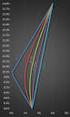
6 λ 10 C The graph is shown below to show the trend of the curve. The crisis rate increases when λ 10 increases when all other values remain the same λ 10 - C graph The rate of crisis increases as the value 10 increases when values of a, b and µ 01 remain fixed. The steady state costs in different situations are determined taking the values:

7 = 50, = 40,, = 65, = 48.where = 50, refers to cost of, funds at state zero, = 40 refers to cost of funds at state 1, = 65 cost of business at state zero and = 48 refers to cost of business at state 1. S.No Steady state probability Cost Total When 10 =5, µ 01 = 8; b = 12, a = 4,8,10, 14 and 18, equation ( ) gives A C Obseve that when busy period goes up the rate of crisis comes down when other values b, 10 and µ 01 remaining constant. The graph is shown below:

8 a - C graph When 10 =5, µ 01 = 8; a =10 and b = 2, 4, 6, 12, 14, and 20, equation gives, b C

9 Observe that when the lean period goes up the rate of crisis also goes up the other values a, 10 and µ 01 remaining constant. The graph is given below to show the effect of b increasing. b - C graph When a =10, b = 12 ; 10 =5 µ 01 = 1, 3, 5, 7 and 10, equation ( ) gives the following C values. µ 01 C

10 µ 01 - C graph It is observed that the rate of crisis increases as time for recruitment takes longer time when all other values a, b and 10 above graph. remain fixed.this effect is shown in the λ 10 and µ 01 C ( λ 10) C ( µ 01)

11 λ 10 and µ 01 - (C ( λ 10), C ( µ 01 ) graph The combined graphs with respect to parameters 10 and µ 01 is given above observe that when the time for which the manpower remaining the same goes up the rate of crisis also goes up and when the time for recruitment of staff to meet the shortage goes up the rate of crisis also goes up. These are shown using bar graphs, the effect of 10 and µ 01 for the same values are shown by the bars drawn adjacent to each to other. The bar lengths increase in both the cases. a&b C ( a ) C ( b )

12 a&b - (C ( a ), C ( b ) ) graph The combined graphs with respect to parameters a and b is given above and observe that when the busy period goes up the rate of crisis comes down whereas when the lean period goes up the rate of crisis also gos up. These are shown using bar graphs, the effect of a and b for the same values are the bars drawn adjacent to each to other. The bar lengths decrease in the case of parameter a increasing and the opposite is the effect in the case of parameter b increasing. 7.5 Observation It is found that as the value of parameter 10 ( time for which the manpower remains the same increases) increases the crisis rate also increases. If 01 increases ( the time for recruitment increases ) the rate of crisis will also imcrease.if a the busy period of the business increases rate of crisis decreases and if b the lean period increases rate of crisis increases. A comparitive study is done

13 using the combined bar graphs. Also observe that the cost of doing business is very high if the manpower is lean and business is also lean but the cost is higher when there is manpower but no business, the business has to be got by paying premium and finally the cost of business is least when the manpower is full and there is full business and so the business can do very well. But, it has to be noted that, there is always a threat of business getting into crisis state if manpower leaves especially experts and experienced people leave the concern. 7.6 Model II In the previous model is derived an expression for crisis state under steady state conditions and also the steady state probabilities considering availability and shortage in manpower and business with the new and prevailing concept of business to go off with manpower. In this model instead of two states for manpower to fluctuate, considerd are three states namely manpower is fully available, moderately available and not all available. The business to fluctuate between two states full availability and zero availability. The business becomes nil when manpower becomes nil. 7.7 Assumptions 1. The time T during which the manpower remains continuously moderate and becomes nil has exponential distribution with parameter λ 10. The time R required to complete recruitment for filling up of vacancies from level nil to moderate level is exponentially distributed with parameter μ The time T during which the Manpower remains continuously full and becomes nil has exponential distribution with parameter λ 20 and the time R required to complete full recruitment from nil level is exponentially distributed with parameter μ 02

14 3. The period of time T during which the Manpower is continuously moderate becomes full has exponentially distribution with parameter λ 21 and the period of time R required for recruitment from insufficient level to full is exponentially distributed with parameter μ 12.The random variables T and R ; T and R :T and R are all independent. 4. The busy and lean periods of the business are exponentially distributed with parameters a and b respectively. The business becomes nil when the manpower goes off. 5. The state of the system is ( I j ) when manpower is in state i and the business is in state j. The state ( 0 1 ) is not considered as our model is based on the assumption that once manpower becomes zero the business goes off. This is because the experts of the concern may carry the business along with them or good will of the concern built over a period is taken away by them. 7.8 System Analysis The Stochastic Process X ( t ) describing the state of the system is a continuous time Markov chain with 5 points state space as given below in the order of Manpower, and Busness S = { (0, 0 ), ( 1 0 ), (1, 1 ),, ( 2 0 ), ( 2 1 ) } (7.8.1) here 2- Refers to full availability in the case of manpower 1-Refers to semi availability or insufficiently available manpower and it refers to busy period in the case of business. 0-Refers to nil level of manpower or business.

15 The infinitesimal generator Q of the continuous time Markov chain of the state space is given below which is a matrix of order 5. MP / B (0 0) ( 1 0 ) ( 1 1 ) ( 2 0 ) ( 2 1 ) (0 0) 1 μ 01 0 μ 02 0 ( 1 0 ) λ 10 2 b μ 12 0 Q = ( 1 1 ) λ 10 a 3 0 μ 12 ( 2 0 ) λ 20 λ b ( 2 1 ) λ a 5 1 = -( μ 01 + μ 02 ), 2 = -( λ 10 + μ 12 +b ), 3 = -( λ 10 + μ 12 +a ), 4 = -( λ 20 +λ 21 +b ), 5 = -( λ 20 + λ 21 +a ) (7.8.2) Q matrix is of order 5. The steady state probability vector satisfies the following equations of the matrix Q Q = 0 and e = 1 ( )

16 = [ ] and e = ( ) t are vectors of order 1 x 5 and 5 x 1 respectively. If Q is taken as MP / B (0 0) ( 1 0 ) ( 1 1 ) ( 2 0 ) (0 0) 1 μ 01 0 μ 02 Q = ( 1 0 ) λ 10 2 b µ 12 ( 1 1 ) λ 10 a 3 0 ( 2 0 ) λ 20 λ Then Q c Q ( 7.8.5) r (λ λ a) where r = (λ 20 0.λ 21 a ) and c = ( 0 0 µ 12 b ) t using (7.8.3 ), the steady state probabilities explicitly are found Π = ( ( ) The crises states are ( 1 1 ) and ( 2 1 ) because as per assumption manpower becoming moderate to zero or full to zero will lead to absolute business loss

17 hence they are critical states. Therefore the rate of crisis for the steady state is given by : = λ λ (7.8.7 ) Steady state costs and numerical illustration The steady state costs are determined by using the formula C ij = ij [ + ], ( ) where c im stands for cost of money at states i = o or 1, c JB stands for cost of business at state j = o or1. Assumed are the following values for different parameters to find the steady costs and the rate of crises:.λ 10 = 3,.λ 20 = 2.λ 21 = 1,.μ 01 = 2.μ 02 = 1.μ 12 = 2 a = 1 b = 2 Using the above values in ( ), gives.r ( - Q ) -1 = ( ).r ( - Q ) -1 e = Now using ( ), the steady state probabilities are as given below 00 = , 10 = , 11 = , 20 = , 21 = Using ( ) the rate of crisis is: = Assuming the following costs and arrive at steady state costs and the expected total cost = 15, = 11,, = 7, = 16.where = 20,

18 S. No Steady state probability Cost of state 1 Π Π Π Π Π Total expected cost (7.8.9) 7.9 Observation It is observed that the steady state cost is very high when both business and manpower are nil where as it is very less when business is full and cases when manpower is full or medium because business has to be obtained by paying premium and the labor has to be paid high. REASONS FOR SELECTION OF MODELS AND THEIR APPLICATION TO INDUSTRIES / ORGANIZATIONS The new concept but most prevalent almost in all industries is introduced namely the business to go off with manpower. The reasons are Experts or silled persons in

19 that business may carry the business along with them or the person who brings good will to the company because of his business acumen or liasion capacity will take the busines along with him. So there is no state here as manpower nil and business full. The paper has two models of two characteristics only. Various operating characteristics are determined when business and manpower fluctuate between two levels, in the second model business fluctuates between two levels but manpower amoung three levels. Numerical examples and graphs explain various truths about the business.nowdays people get good education, equip themselves well academically and technically and job opportunities are more with attractive salaries that they switch over jobs when opportunities come, they are also likely to carry the present business because of their unique skill or good will created over a period of time. This is common in any manufacturing company and software companies.

Chapter 9 Experience rating
 0 INTRODUCTION 1 Chapter 9 Experience rating 0 Introduction The rating process is the process of deciding on an appropriate level of premium for a particular class of insurance business. The contents of
Performance Analysis of a Telephone System with both Patient and Impatient Customers
 Performance Analysis of a Telephone System with both Patient and Impatient Customers Yiqiang Quennel Zhao Department of Mathematics and Statistics University of Winnipeg Winnipeg, Manitoba Canada R3B 2E9
Practice Problems for Homework #8. Markov Chains. Read Sections 7.1-7.3. Solve the practice problems below.
 Practice Problems for Homework #8. Markov Chains. Read Sections 7.1-7.3 Solve the practice problems below. Open Homework Assignment #8 and solve the problems. 1. (10 marks) A computer system can operate
From the probabilities that the company uses to move drivers from state to state the next year, we get the following transition matrix:
 MAT 121 Solutions to Take-Home Exam 2 Problem 1 Car Insurance a) The 3 states in this Markov Chain correspond to the 3 groups used by the insurance company to classify their drivers: G 0, G 1, and G 2
Inventory Decision-Making
 Management Accounting 195 Inventory Decision-Making To be successful, most businesses other than service businesses are required to carry inventory. In these businesses, good management of inventory is
Depreciation. General Mathematics HSC. Name:
 Depreciation General Mathematics HSC Name: 1 HSC CAPACITY MATRIX GENERAL MATHEMATICS TOPIC: Financial Mathematics 6 Depreciation 2 weeks CONTENT CAPACITY BREAKDOWN! DONE IT!!!! GOT IT!!!!! ON MY WAY! WORKING
CHAPTER 3 SECURITY CONSTRAINED OPTIMAL SHORT-TERM HYDROTHERMAL SCHEDULING
 60 CHAPTER 3 SECURITY CONSTRAINED OPTIMAL SHORT-TERM HYDROTHERMAL SCHEDULING 3.1 INTRODUCTION Optimal short-term hydrothermal scheduling of power systems aims at determining optimal hydro and thermal generations
Exam Introduction Mathematical Finance and Insurance
 Exam Introduction Mathematical Finance and Insurance Date: January 8, 2013. Duration: 3 hours. This is a closed-book exam. The exam does not use scrap cards. Simple calculators are allowed. The questions
Practice Midterm IND E 411 Winter 2015 February 2, 2015
 Name: Practice Midterm IND E 411 Winter 2015 February 2, 2015 Instructions: You have 110 minutes. The value of each problem is stated. Partial credit is given for the correct method of solution, so set
TIME SERIES ANALYSIS & FORECASTING
 CHAPTER 19 TIME SERIES ANALYSIS & FORECASTING Basic Concepts 1. Time Series Analysis BASIC CONCEPTS AND FORMULA The term Time Series means a set of observations concurring any activity against different

Application of Markov chain analysis to trend prediction of stock indices Milan Svoboda 1, Ladislav Lukáš 2
 Proceedings of 3th International Conference Mathematical Methods in Economics 1 Introduction Application of Markov chain analysis to trend prediction of stock indices Milan Svoboda 1, Ladislav Lukáš 2
UNIT 2 QUEUING THEORY
 UNIT 2 QUEUING THEORY LESSON 24 Learning Objective: Apply formulae to find solution that will predict the behaviour of the single server model II. Apply formulae to find solution that will predict the
STOCHASTIC PERISHABLE INVENTORY CONTROL SYSTEMS IN SUPPLY CHAIN WITH PARTIAL BACKORDERS
 Int. J. of Mathematical Sciences and Applications, Vol. 2, No. 2, May 212 Copyright Mind Reader Publications www.journalshub.com STOCHASTIC PERISHABLE INVENTORY CONTROL SYSTEMS IN SUPPLY CHAIN WITH PARTIAL
THE DYING FIBONACCI TREE. 1. Introduction. Consider a tree with two types of nodes, say A and B, and the following properties:
 THE DYING FIBONACCI TREE BERNHARD GITTENBERGER 1. Introduction Consider a tree with two types of nodes, say A and B, and the following properties: 1. Let the root be of type A.. Each node of type A produces
5.3 The Cross Product in R 3
 53 The Cross Product in R 3 Definition 531 Let u = [u 1, u 2, u 3 ] and v = [v 1, v 2, v 3 ] Then the vector given by [u 2 v 3 u 3 v 2, u 3 v 1 u 1 v 3, u 1 v 2 u 2 v 1 ] is called the cross product (or
Transmission Lines. Smith Chart
 Smith Chart The Smith chart is one of the most useful graphical tools for high frequency circuit applications. The chart provides a clever way to visualize complex functions and it continues to endure
Statistics in Retail Finance. Chapter 6: Behavioural models
 Statistics in Retail Finance 1 Overview > So far we have focussed mainly on application scorecards. In this chapter we shall look at behavioural models. We shall cover the following topics:- Behavioural
INTEGRATED OPTIMIZATION OF SAFETY STOCK
 INTEGRATED OPTIMIZATION OF SAFETY STOCK AND TRANSPORTATION CAPACITY Horst Tempelmeier Department of Production Management University of Cologne Albertus-Magnus-Platz D-50932 Koeln, Germany http://www.spw.uni-koeln.de/
Rationalizing Salesmen's Compensation Plans
 Rationalizing Salesmen's Compensation Plans FREDERICK E. WEBSTER, JR. Here is an answer to the need for a compensai'ion plan closely tailored to managennent objectives, and to the abilities and needs of
Analysis of a Production/Inventory System with Multiple Retailers
 Analysis of a Production/Inventory System with Multiple Retailers Ann M. Noblesse 1, Robert N. Boute 1,2, Marc R. Lambrecht 1, Benny Van Houdt 3 1 Research Center for Operations Management, University
Soil Dynamics Prof. Deepankar Choudhury Department of Civil Engineering Indian Institute of Technology, Bombay
 Soil Dynamics Prof. Deepankar Choudhury Department of Civil Engineering Indian Institute of Technology, Bombay Module - 2 Vibration Theory Lecture - 8 Forced Vibrations, Dynamic Magnification Factor Let
Stochastic Gene Expression in Prokaryotes: A Point Process Approach
 Stochastic Gene Expression in Prokaryotes: A Point Process Approach Emanuele LEONCINI INRIA Rocquencourt - INRA Jouy-en-Josas ASMDA Mataró June 28 th 2013 Emanuele LEONCINI (INRIA) Stochastic Gene Expression
1 Portfolio mean and variance
 Copyright c 2005 by Karl Sigman Portfolio mean and variance Here we study the performance of a one-period investment X 0 > 0 (dollars) shared among several different assets. Our criterion for measuring
Modern Optimization Methods for Big Data Problems MATH11146 The University of Edinburgh
 Modern Optimization Methods for Big Data Problems MATH11146 The University of Edinburgh Peter Richtárik Week 3 Randomized Coordinate Descent With Arbitrary Sampling January 27, 2016 1 / 30 The Problem
Dealing with large datasets
 Dealing with large datasets (by throwing away most of the data) Alan Heavens Institute for Astronomy, University of Edinburgh with Ben Panter, Rob Tweedie, Mark Bastin, Will Hossack, Keith McKellar, Trevor
Econ 303: Intermediate Macroeconomics I Dr. Sauer Sample Questions for Exam #3
 Econ 303: Intermediate Macroeconomics I Dr. Sauer Sample Questions for Exam #3 1. When firms experience unplanned inventory accumulation, they typically: A) build new plants. B) lay off workers and reduce
PART A: For each worker, determine that worker's marginal product of labor.
 ECON 3310 Homework #4 - Solutions 1: Suppose the following indicates how many units of output y you can produce per hour with different levels of labor input (given your current factory capacity): PART
Paper No 19. FINALTERM EXAMINATION Fall 2009 MTH302- Business Mathematics & Statistics (Session - 2) Ref No: Time: 120 min Marks: 80
 Paper No 19 FINALTERM EXAMINATION Fall 2009 MTH302- Business Mathematics & Statistics (Session - 2) Ref No: Time: 120 min Marks: 80 Question No: 1 ( Marks: 1 ) - Please choose one Scatterplots are used
A DISCRETE TIME MARKOV CHAIN MODEL IN SUPERMARKETS FOR A PERIODIC INVENTORY SYSTEM WITH ONE WAY SUBSTITUTION
 A DISCRETE TIME MARKOV CHAIN MODEL IN SUPERMARKETS FOR A PERIODIC INVENTORY SYSTEM WITH ONE WAY SUBSTITUTION A Class Project for MATH 768: Applied Stochastic Processes Fall 2014 By Chudamani Poudyal &
LECTURE 4. Last time: Lecture outline
 LECTURE 4 Last time: Types of convergence Weak Law of Large Numbers Strong Law of Large Numbers Asymptotic Equipartition Property Lecture outline Stochastic processes Markov chains Entropy rate Random
Chapter 1. Introduction
 Chapter 1 Introduction 1.1. Motivation Network performance analysis, and the underlying queueing theory, was born at the beginning of the 20th Century when two Scandinavian engineers, Erlang 1 and Engset
International Journal of Advances in Science and Technology (IJAST)
 Determination of Economic Production Quantity with Regard to Machine Failure Mohammadali Pirayesh 1, Mahsa Yavari 2 1,2 Department of Industrial Engineering, Faculty of Engineering, Ferdowsi University
Increasing for all. Convex for all. ( ) Increasing for all (remember that the log function is only defined for ). ( ) Concave for all.
 1. Differentiation The first derivative of a function measures by how much changes in reaction to an infinitesimal shift in its argument. The largest the derivative (in absolute value), the faster is evolving.
How To Understand Cost Volume Profit Analysis
 Course Title: Cost Accounting for Decision Making Professional Development Programme on Enriching Knowledge of the Business, Accounting and Financial Studies (BAFS) Curriculum 1 Learning
Brownian Motion and Stochastic Flow Systems. J.M Harrison
 Brownian Motion and Stochastic Flow Systems 1 J.M Harrison Report written by Siva K. Gorantla I. INTRODUCTION Brownian motion is the seemingly random movement of particles suspended in a fluid or a mathematical
H.Calculating Normal Vectors
 Appendix H H.Calculating Normal Vectors This appendix describes how to calculate normal vectors for surfaces. You need to define normals to use the OpenGL lighting facility, which is described in Chapter
CS556 Course Project Performance Analysis of M-NET using GSPN
 Performance Analysis of M-NET using GSPN CS6 Course Project Jinchun Xia Jul 9 CS6 Course Project Performance Analysis of M-NET using GSPN Jinchun Xia. Introduction Performance is a crucial factor in software
Appendix A: Science Practices for AP Physics 1 and 2
 Appendix A: Science Practices for AP Physics 1 and 2 Science Practice 1: The student can use representations and models to communicate scientific phenomena and solve scientific problems. The real world
A Cross-Functional View of Inventory Management, Why Collaboration among Marketing, Finance/Accounting and Operations Management is Necessary
 A Cross-Functional View of Inventory Management, Why Collaboration among Marketing, Finance/Accounting and Operations Management is Necessary Richard E. Crandall, Appalachian State University, John A.
M/M/1 and M/M/m Queueing Systems
 M/M/ and M/M/m Queueing Systems M. Veeraraghavan; March 20, 2004. Preliminaries. Kendall s notation: G/G/n/k queue G: General - can be any distribution. First letter: Arrival process; M: memoryless - exponential
Machine Learning and Pattern Recognition Logistic Regression
 Machine Learning and Pattern Recognition Logistic Regression Course Lecturer:Amos J Storkey Institute for Adaptive and Neural Computation School of Informatics University of Edinburgh Crichton Street,
v w is orthogonal to both v and w. the three vectors v, w and v w form a right-handed set of vectors.
 3. Cross product Definition 3.1. Let v and w be two vectors in R 3. The cross product of v and w, denoted v w, is the vector defined as follows: the length of v w is the area of the parallelogram with
Part II Management Accounting Decision-Making Tools
 Part II Management Accounting Decision-Making Tools Chapter 7 Chapter 8 Chapter 9 Cost-Volume-Profit Analysis Comprehensive Business Budgeting Incremental Analysis and Decision-making Costs Chapter 10
Eigenvalues, Eigenvectors, and Differential Equations
 Eigenvalues, Eigenvectors, and Differential Equations William Cherry April 009 (with a typo correction in November 05) The concepts of eigenvalue and eigenvector occur throughout advanced mathematics They
Programma della seconda parte del corso
 Programma della seconda parte del corso Introduction Reliability Performance Risk Software Performance Engineering Layered Queueing Models Stochastic Petri Nets New trends in software modeling: Metamodeling,
QUEUING THEORY. 1. Introduction
 QUEUING THEORY RYAN BERRY Abstract. This paper defines the building blocks of and derives basic queuing systems. It begins with a review of some probability theory and then defines processes used to analyze
Optimal shift scheduling with a global service level constraint
 Optimal shift scheduling with a global service level constraint Ger Koole & Erik van der Sluis Vrije Universiteit Division of Mathematics and Computer Science De Boelelaan 1081a, 1081 HV Amsterdam The
Managerial Accounting Prof. Dr. Vardaraj Bapat Department of School of Management Indian Institute of Technology, Bombay
 Managerial Accounting Prof. Dr. Vardaraj Bapat Department of School of Management Indian Institute of Technology, Bombay Lecture - 26 Cost Volume Profit Analysis Dear participations in our early session,
1 Uncertainty and Preferences
 In this chapter, we present the theory of consumer preferences on risky outcomes. The theory is then applied to study the demand for insurance. Consider the following story. John wants to mail a package
Pull versus Push Mechanism in Large Distributed Networks: Closed Form Results
 Pull versus Push Mechanism in Large Distributed Networks: Closed Form Results Wouter Minnebo, Benny Van Houdt Dept. Mathematics and Computer Science University of Antwerp - iminds Antwerp, Belgium Wouter
THE WHE TO PLAY. Teacher s Guide Getting Started. Shereen Khan & Fayad Ali Trinidad and Tobago
 Teacher s Guide Getting Started Shereen Khan & Fayad Ali Trinidad and Tobago Purpose In this two-day lesson, students develop different strategies to play a game in order to win. In particular, they will
Industry Environment and Concepts for Forecasting 1
 Table of Contents Industry Environment and Concepts for Forecasting 1 Forecasting Methods Overview...2 Multilevel Forecasting...3 Demand Forecasting...4 Integrating Information...5 Simplifying the Forecast...6
International Journal of Emerging Technologies in Computational and Applied Sciences (IJETCAS) www.iasir.net
 International Association of Scientific Innovation and Research (IASIR) (An Association Unifying the Sciences, Engineering, and Applied Research) ISSN (Print): 2279-0047 ISSN (Online): 2279-0055 International
Load Balancing and Switch Scheduling
 EE384Y Project Final Report Load Balancing and Switch Scheduling Xiangheng Liu Department of Electrical Engineering Stanford University, Stanford CA 94305 Email: [email protected] Abstract Load
3.2 Roulette and Markov Chains
 238 CHAPTER 3. DISCRETE DYNAMICAL SYSTEMS WITH MANY VARIABLES 3.2 Roulette and Markov Chains In this section we will be discussing an application of systems of recursion equations called Markov Chains.
The equivalence of logistic regression and maximum entropy models
 The equivalence of logistic regression and maximum entropy models John Mount September 23, 20 Abstract As our colleague so aptly demonstrated ( http://www.win-vector.com/blog/20/09/the-simplerderivation-of-logistic-regression/
Markov Chains for the RISK Board Game Revisited. Introduction. The Markov Chain. Jason A. Osborne North Carolina State University Raleigh, NC 27695
 Markov Chains for the RISK Board Game Revisited Jason A. Osborne North Carolina State University Raleigh, NC 27695 Introduction Probabilistic reasoning goes a long way in many popular board games. Abbott
Part 1 : 07/27/10 21:30:31
 Question 1 - CIA 593 III-64 - Forecasting Techniques What coefficient of correlation results from the following data? X Y 1 10 2 8 3 6 4 4 5 2 A. 0 B. 1 C. Cannot be determined from the data given. D.
A Log-Robust Optimization Approach to Portfolio Management
 A Log-Robust Optimization Approach to Portfolio Management Dr. Aurélie Thiele Lehigh University Joint work with Ban Kawas Research partially supported by the National Science Foundation Grant CMMI-0757983
Notes on Continuous Random Variables
 Notes on Continuous Random Variables Continuous random variables are random quantities that are measured on a continuous scale. They can usually take on any value over some interval, which distinguishes
Random access protocols for channel access. Markov chains and their stability. Laurent Massoulié.
 Random access protocols for channel access Markov chains and their stability [email protected] Aloha: the first random access protocol for channel access [Abramson, Hawaii 70] Goal: allow machines
Mathematics of Life Contingencies. Math 3281 3.00 W Instructor: Edward Furman Homework 1
 Mathematics of Life Contingencies. Math 3281 3.00 W Instructor: Edward Furman Homework 1 Unless otherwise indicated, all lives in the following questions are subject to the same law of mortality and their
Algebra Unpacked Content For the new Common Core standards that will be effective in all North Carolina schools in the 2012-13 school year.
 This document is designed to help North Carolina educators teach the Common Core (Standard Course of Study). NCDPI staff are continually updating and improving these tools to better serve teachers. Algebra
12.5: CHI-SQUARE GOODNESS OF FIT TESTS
 125: Chi-Square Goodness of Fit Tests CD12-1 125: CHI-SQUARE GOODNESS OF FIT TESTS In this section, the χ 2 distribution is used for testing the goodness of fit of a set of data to a specific probability
A Simple Guide to Churn Analysis
 A Simple Guide to Churn Analysis A Publication by Evergage Introduction Thank you for downloading A Simple Guide to Churn Analysis. The goal of this guide is to make analyzing churn easy, meaning you wont
Natural Resources and International Trade
 Department of Economics University of Roma Tre Academic year: 2013 2014 Natural Resources and International Trade Instructors: Prof. Silvia Nenci Prof. Luca Salvatici [email protected] [email protected]
PPF's of Germany and France
 Economics 165 Winter 2 Problem Set #1 Problem 1: Let Germany and France have respective labor forces of 8 and 6. Suppose both countries produce wine and cares according to the following unit labor requirements:
STOCHASTIC ANALYSIS OF AN AIR CONDITION COOLING SYSTEM MODEL
 Journal of Reliability and Statistical Studies; ISSN (Print) 09-804 (Online)9-5666 Vol. 4 Issue 1 (011) 95-106 STOCHASTIC ANALYSIS OF AN AIR CONDITION COOLING SYSTEM MODEL Rakesh Gupta1 Punam Phartyal
Understanding the Impact of Weights Constraints in Portfolio Theory
 Understanding the Impact of Weights Constraints in Portfolio Theory Thierry Roncalli Research & Development Lyxor Asset Management, Paris [email protected] January 2010 Abstract In this article,
Periodic Capacity Management under a Lead Time Performance Constraint
 Periodic Capacity Management under a Lead Time Performance Constraint N.C. Buyukkaramikli 1,2 J.W.M. Bertrand 1 H.P.G. van Ooijen 1 1- TU/e IE&IS 2- EURANDOM INTRODUCTION Using Lead time to attract customers
Risk Management for IT Security: When Theory Meets Practice
 Risk Management for IT Security: When Theory Meets Practice Anil Kumar Chorppath Technical University of Munich Munich, Germany Email: [email protected] Tansu Alpcan The University of Melbourne Melbourne,
System Design in Wireless Communication. Ali Khawaja
 System Design in Wireless Communication Ali Khawaja University of Texas at Dallas December 6, 1999 1 Abstract This paper deals with the micro and macro aspects of a wireless system design. With the growing
Use the following to answer question 9: Exhibit: Keynesian Cross
 1. Leading economic indicators are: A) the most popular economic statistics. B) data that are used to construct the consumer price index and the unemployment rate. C) variables that tend to fluctuate in
Pricing complex options using a simple Monte Carlo Simulation
 A subsidiary of Sumitomo Mitsui Banking Corporation Pricing complex options using a simple Monte Carlo Simulation Peter Fink Among the different numerical procedures for valuing options, the Monte Carlo
CHAPTER 3 CALL CENTER QUEUING MODEL WITH LOGNORMAL SERVICE TIME DISTRIBUTION
 31 CHAPTER 3 CALL CENTER QUEUING MODEL WITH LOGNORMAL SERVICE TIME DISTRIBUTION 3.1 INTRODUCTION In this chapter, construction of queuing model with non-exponential service time distribution, performance
Essays in Financial Mathematics
 Essays in Financial Mathematics Essays in Financial Mathematics Kristoffer Lindensjö Dissertation for the Degree of Doctor of Philosophy, Ph.D. Stockholm School of Economics, 2013. Dissertation title:
Review of Fundamental Mathematics
 Review of Fundamental Mathematics As explained in the Preface and in Chapter 1 of your textbook, managerial economics applies microeconomic theory to business decision making. The decision-making tools
Chapter 6: Sensitivity Analysis
 Chapter 6: Sensitivity Analysis Suppose that you have just completed a linear programming solution which will have a major impact on your company, such as determining how much to increase the overall production
Exercises Lecture 8: Trade policies
 Exercises Lecture 8: Trade policies Exercise 1, from KOM 1. Home s demand and supply curves for wheat are: D = 100 0 S = 0 + 0 Derive and graph Home s import demand schedule. What would the price of wheat
DATA ANALYSIS II. Matrix Algorithms
 DATA ANALYSIS II Matrix Algorithms Similarity Matrix Given a dataset D = {x i }, i=1,..,n consisting of n points in R d, let A denote the n n symmetric similarity matrix between the points, given as where
2 Integrating Both Sides
 2 Integrating Both Sides So far, the only general method we have for solving differential equations involves equations of the form y = f(x), where f(x) is any function of x. The solution to such an equation
Mathematics Cognitive Domains Framework: TIMSS 2003 Developmental Project Fourth and Eighth Grades
 Appendix A Mathematics Cognitive Domains Framework: TIMSS 2003 Developmental Project Fourth and Eighth Grades To respond correctly to TIMSS test items, students need to be familiar with the mathematics
Structure Preserving Model Reduction for Logistic Networks
 Structure Preserving Model Reduction for Logistic Networks Fabian Wirth Institute of Mathematics University of Würzburg Workshop on Stochastic Models of Manufacturing Systems Einhoven, June 24 25, 2010.
To define concepts such as distance, displacement, speed, velocity, and acceleration.
 Chapter 7 Kinematics of a particle Overview In kinematics we are concerned with describing a particle s motion without analysing what causes or changes that motion (forces). In this chapter we look at
Operations and Supply Chain Management Prof. G. Srinivasan Department of Management Studies Indian Institute of Technology, Madras
 Operations and Supply Chain Management Prof. G. Srinivasan Department of Management Studies Indian Institute of Technology, Madras Lecture - 36 Location Problems In this lecture, we continue the discussion
Optimal Dynamic Resource Allocation in Multi-Class Queueing Networks
 Imperial College London Department of Computing Optimal Dynamic Resource Allocation in Multi-Class Queueing Networks MEng Individual Project Report Diagoras Nicolaides Supervisor: Dr William Knottenbelt
Chapter 19. General Matrices. An n m matrix is an array. a 11 a 12 a 1m a 21 a 22 a 2m A = a n1 a n2 a nm. The matrix A has n row vectors
 Chapter 9. General Matrices An n m matrix is an array a a a m a a a m... = [a ij]. a n a n a nm The matrix A has n row vectors and m column vectors row i (A) = [a i, a i,..., a im ] R m a j a j a nj col
Telephone Traffic Queues in a Customer Call Center. A Thesis. Presented for the. Master of Science Degree. The University of Tennessee at Chattanooga
 Telephone Traffic Queues in a Customer Call Center A Thesis Presented for the Master of Science Degree The University of Tennessee at Chattanooga Patrick Todd April 2009 Copyright 2009 by Patrick Todd
A Programme Implementation of Several Inventory Control Algorithms
 BULGARIAN ACADEMY OF SCIENCES CYBERNETICS AND INFORMATION TECHNOLOGIES Volume, No Sofia 20 A Programme Implementation of Several Inventory Control Algorithms Vladimir Monov, Tasho Tashev Institute of Information