
MEDSense: A Portable Pill Dispensing Device
|
|
|
- Priscilla Wiggins
- 10 years ago
- Views:
Transcription
1 MEDSense: A Portable Pill Dispensing Device By Ashley Martin Christopher Falkner Ryan Pogemiller Timothy Coons Rehabilitation Engineering Research Center Dr. John Enderle [email protected]

2 Table of Contents Section Page Number Executive Summary 3 I. Introduction i. Background.3 ii. Clients...5 iii. Current Market...5 iv. Existing Patents..7 II. Project Description i. Objective..8 ii. Methods.9 III. Budget..14 IV. Conclusion..15 2

3 Executive Summary This proposal outlines the development and production of a pill cap designed to dispense and cut medication for persons with disabilities. This project is being done for the Rehabilitation Engineering Research Center on Accessible Medical Instrumentation (RERC on AMI) competition headed by Dr. John Enderle. The driving goal in designing this device is to provide a means for persons with disabilities to access vital medication when traditional pill caps prove to be increasingly difficult. Certain difficulties associated with the prospective clients disabilities will be discussed later in the proposal. Also, more specific requirements relating to the programming and mechanical performance of the project will be outlined. The idea of an accessible pill cap has been successfully implemented both in previous RERC on AMI and NSF projects as well as in industry. A description of these projects and their similarities to this proposed device will be explained within this proposal. The group plans to use successful elements of past projects as well as new ideas to improve the overall performance of the device. Within the discussion of previous projects done in this area will be an outline of patents currently held on similar projects. Research on patents allows the group to create a unique design that will not infringe on any current patents. Following the summary of past work done on similar devices, a detailed explanation of the project and its requirements will be provided. This will explain both the objectives of the project as well as how the group plans to implement the device. A preliminary budget is also included within the proposal. This budget includes the prices of the proposed major components of the device. The goal is to create a low cost prototype that could be manufactured at an affordable price to be sold to persons with disabilities. This proposed device will provide a better means of both reminding people to take their medication and dispensing their medication than currently available products. I. Introduction: i. Background During a series of scientific innovations sparked by a neo-classical rebirth of interest in the human body around the 17 th century, medical research was revolutionized as scientists began to understand how the body functions. Long before the crucial technique of magnification was conceived, the concept of microorganisms, for example, was limited to ambiguous and mysterious descriptions, often referred to as invisible living creatures (Prescot, Microbiology). Needless to say, when Antony van Leeuwenhoek discovered, in 1673, that observing samples through a series of lenses unveiled an entire world of interacting cells, the field of microbiology was truly born. Soon the entire world became fascinated with the autonomous microcosm of life within the human body and doctors began to study the science behind accepted medical techniques to the point where 3

4 they were capable of understanding the details of common illnesses and disease. As the focus of medical research around the turn of the 19 th century turned away from holistic methods emphasized by the pioneers of cellular biology, it transitioned towards an analytical approach that allowed scientists to map out detailed rationalizations to explain the causes and effects of common sicknesses. Such a deductive approach to medical research would later lead to multiple discoveries of the power of man-made chemical composites in fighting commonly fatal diseases such as polio and smallpox. Eventually, to address high demand for these composites, ingredients were process into pills or capsules of varying sizes and colors and mass-produced and distributed to the public. Thus, the pharmaceutical company was born. Today, modern pharmacological establishments spend billions of dollars each year on advertising due to the exponentially growing supply of competing prescription medications. Patients now find themselves in a world where dangerous conditions and diseases are easily managed by relatively affordable medications. Although a remarkable increase in life expectancy of the American population over the past fifty years could additionally be attributed to an increased awareness of daily health issues, it could easily be argued that the primary culprit is the ubiquity of pharmaceutical products. As the number of available medications increases, however, patients are finding themselves reliant on a growing number of daily medications. Ultimately, many individuals accumulate an unmanageable number of medications, a problem that could potentially lead to unintentional neglect of prescribed schedules and dosages. Busy mothers trying to balance the hectic schedule of multiple children, elderly individuals with chronic memory loss, and patients with mild or severe physical limitations are all inconvenienced by complex medication schedules. Additionally, many prescriptions require half dosages, demanding that patients take the time and effort to cut pills into halves and to count out the correct dosages. Many patients, however, are physically incapable of cutting a small pill and calculating the correct dosage or perhaps too busy to take the time to cut each pill, all of which can lead to miss-consumption of important medications. Although there are multiple devices on the market that are capable of reminding patients when to take their medications or that dispense pills at certain intervals or that can easily cut pills in half, no one device sufficiently addresses the needs of modern patients. Many pill dispensing instruments are bulky and expensive despite their ability to dispense multiple medications at once. Others are compact and portable but difficult to use for elderly patients and those with physical disabilities. Additionally, while there are many manual pill cutting devices on the market, there are few that are automatic and easy to use, another serious problem for elderly and physically challenged patients. Finally, there is not a single device on the market that is capable of performing all the necessary aspects of pill monitoring in one easy to use affordable unit, thus resulting in an incredible demand for a fully automated device capable of addressing the modern patient s varying needs. 4

5 ii. Clients Phylis is an energetic 77 year old woman that has rheumatoid arthritis. This condition causes joint pain and loss of hand strength. She also has macular degeneration and hearing loss but is resolute to staying active and healthy. She has difficulties with using complex interfaces and wishes that the design of the device is simple. Aaron is a war hero from Iraq, with an amputation of the arm above the elbow, neck pain and recurring head aches. Although he has a prosthetic limb, he sometimes does not use it and improvises by only using one hand. Due to the many aliments, he has a number of medications to take. Keisha just recently had a stroke which caused her to loose function in her dominant right hand. Due to the recent stroke, she also has memory loss and has to rely on her family to remind her of when to take her medication. She also has minor hearing loss that is progressively getting worse. She also deals with the challenges of incontinence. Jerry is an 82 year old man that has Parkinson s disease. This disease causes him to have tremors, stiffness, and a decrease range in motion. Also he has been experiencing symptoms of Dementia. Jamie is an active basketball player and has to use a wheelchair because of her spinal cord injury. She wants to stay active while controlling her urinary problems. Violet is a mother of three who has blood pressure medication to take. She wants a device that will dispense her medication as well as keeping the medication away from her children. iii. Current Market Although many facets of the pill dispensing process are provided by currently marketed devices, each has significant oversights with respect to the modern patient s needs. Additionally, many devices accurately approach only one aspect of the pill dispensing process, leaving the patient to do the rest of the work, often an infeasible demand. For patients on a budget, there are many devices available that act as static systems that allow patients to place medications in individual compartments that will unlock at the programmed dispensing times such as the Pill Reminder which is compact, affordable, and easy to use. Although such devices do not satisfy all of the market demands, when combined with other inexpensive static or manual devices, they could cumulatively address all of a patient s medication needs. The E-Pill Vibrating Countdown Timer and Alarm, for example, could supplement the Pill Reminder as a portable device that hangs around the neck and acts as a portable alarm clock. To address elderly patients with hearing loss, the device is capable of vibrating in addition to sounding an alarm to ensure 5

6 Fig 1. Although inexpensive and portable, many devices such as these do not meet the demand of the modern market. From left to right A) Pill Reminder B) E-Pill C) EZ-Swallow Pill Splitter that the patient is clearly notified. The E-Pill device also features a countdown that will remind patients well in advance that there is a medication time approaching. Lastly, a pill cutting device such as the EZ-Swallow Pill Splitter, by American Medical Industries, provides patients with an easier way to cut pills for half dosages. Although the device is manual and requires the patient to have mild use of their fine motor skills, the well designed lever system allows the patient leverage to quickly and easily crack pills into halves. While a combination of these affordable devices certainly addresses many of the market demands, in a rapidly modernizing world, it is desirable to have fully automated devices that reduce the number of individual devices down to one device that performs all tasks. One such model that has received attention is the Med-Time Automatic Pill Dispenser, by the American Medical Alert Corporation, a small circular device that automatically rotates at given time intervals to make the appropriate pills available at each prescribed time. While the device is certainly compact, weighing in at only 17 ounces when empty, its small size actually inhibits easy use by many patients. Elderly patients often have not only poor eye sight, but also an inability to manage simple small motor skills such as programming a device with small buttons or loading and unloading the pills at the beginning of each month. Although the system allows the patient to tip the device upside down to easily release the appropriate pills, there is no doubt that sorting and dispersing multiple medications into each day s position would be a burdening task. Therefore, the market demands a device that is certainly compact, but also that provides large displays and easy to use buttons and voice commands. Additionally, there is a need for a device that automatically separates different medications from individual easy to fill reservoirs and that is capable of cutting them into halves before dispensing. Another popular device on the market, the Monitored Automatic Pill Dispenser MD2, by e-pill Medication Reminders, has benefits addressing needs not addressed by the Med- Time device, but once again falls short of satisfying all of the market demands. Unlike the Med-Time device, the MD2 is bulky and expensive. In addition to the unit s ability to dispense predetermined pill dosages at given time intervals, the MD2 features a voice command option that will verbally instruct patients when and how to take their medications. In addition, there is an off switch that the patient must hit when taking their 6

7 Fig 2. Many automated devices on the market address many but not all of the requirements for a universal pill dispensing device. From left to right A) Monitored Automatic Pill Dispenser MD2 with details B) Med-Time Automatic Pill Dispenser medications to turn off the alarm system, which also acts as a fail safe method. If, for example, the alarm is not turned off, the MD2 will call a selected caregiver to inform them that their patient has not taken their medications. Although this is a convenient design for elderly patients with chronic memory loss, it is a feature that would turn away younger patients who may remember to take their medications but who do not have access to the device at exactly the prescribed dispensing times. While the MD2 certainly addresses many of the markets demands for a pill dispensing device it, as with the Med- Time device, is also incapable of cutting pills in half before dispensing them, a serious problem as previously discussed. iv. Existing Patents CASSETTE FOR DISPENSING PILLS (7,225,597): This device has many cassettes, each filed with a supply of pills and positionable over a target location. The device has a platen beneath the target location with receptacles configured to hold both vials and blister packs. The platen or the cassette is movable so that any blister of the blister pack or the vial can be positioned under the target location to receive a quantity of pills from a cassette. PILL DISPENSER WITH REMINDER (6,581,797): A programmable vitamin and pill dispenser that is capable of storing multiple pill groups. The dispenser provides reminders to an individual when it is time to ingest the next serving. The serving is dispensed into a cup upon depressing a dispenser button. By loading the individual compartments specific to each serving, an individual does not have to create the serving each time. ONE DOSE AT-A-TIME PILL DISPENSER AND CONTAINER HAVING SAME (7,100,797): A device for dispensing pills one at a time or one dose at a time includes a unit chamber fittable within/integral with the rim of a bottle. The unit chamber includes a plurality of radial projections which project inwardly to define discrete pill holding areas. The distance between adjacent radial projections is slightly larger than the width of the pill sought to be contained and dispensed by the container. As the bottle is inverted, pills will fall into the pill holding areas, one pill or dosage amount per area. A dispensing cap 7

8 is rotatable relative to the unit chamber. A single pill-width window in the cap is positionable opposite the pill holding areas of the unit chamber. When a pill is meant to be dispensed, the bottle is inverted or angled downward, and a single pill in the pill holding area opposite the window falls out of the bottle. II. Project Description Program Device (# of pills, # of doses, times of doses) i. Objective This product is an accessible pill cap that dispenses the correct amount of medication at a set time for elderly patients or patients with disabilities. It is difficult for some patients to remember when to take their medication, as well as how much medication to take. It may also be a problem for the patient to cut a pill in half if a half dosage is prescribed. The diverse disabilities of the patients for whom we are designing this pill cap include vision loss due to macular degeneration, hearing loss, loss of or decreased strength and motion in one hand or arm, memory loss and Dementia. Some minor problems that affect these patients that must be kept in mind while designing this pill cap are being in a wheelchair, loss of legs, neuropathy in the hands, hand tremors, having small children and being easily intimidated by high-tech machines. Scheduled Time To Administer Medication If Button Pushed Alarms Turned Off Cuts Specified Number of Pills Visual and Auditory Alarms If Button not Pushed within 30 minutes Medication Not Dispensed The main features of this product are designed to aid the patients in their medication routine. The multi-modal alert system lets patients know when it is time to take their medication with both visual and auditory alarms for patients with hearing loss or vision loss. The automated cutting mechanism accurately cuts pills in half if a half dose is required for patients with macular degeneration or a missing limb. The reminder to order a new prescription Medication Dispensed Reminder of Medication Instructions Device Records that Medication has been taken Device Notifies Someone Offsite that Medication was not taken Device Records that Medication has not been taken Fig 3. Programming Flow Chart when the old prescription runs out is designed for elderly patients, patients with Dementia or memory loss, or busy patients who don t have a lot of time to think about their medication. The offsite alert system, which notifies a family member, nurse or doctor offsite if a dose is missed by the patient, is a built in safety device so a responsible party is notified if something happens to the patient and they miss their dose. An easy-to-use interface is needed since many elderly persons are intimidated by technology and so the device is simple and user-friendly. Other features that are not required but that will add to the accessibility of the product will be implemented. Patient safety is a huge concern for the project plan, so the designers of the device will put the patient s safety as their number one priority while designing the pill dispenser. A security device should be installed to ensure that third- 8

9 party members do not tamper with the schedules or amount of dosage programmed into the pill dispenser since this could seriously harm the patient if an incorrect dose is taken. This device should also be waterproof since many medications are taken with water. Water can cause electrical damage and malfunctioning of electrical equipment. A major safety concern for this product is that it is childproof. Children often mistake medicine pills as candy and will unknowingly consume pills that are left lying in a tray. Therefore, it is important that this design ensures the safety not only of the user, but also of any unsuspecting third party members. This pill dispenser can be broken into six major components. The first component is the scheduled dosage system. A simple front panel will be used and how many pills per dose and the times the pills should be taken will be programmed into the device. The next component is the alarm system. It will include both visual and audio alarms that remind patients each time their pills should be taken, which reads from the previously programmed schedule provided by the user. The user interface is the third component in this device. It should be simple so the patients aren t intimidated by it and the patients will use this to program in the required information about their medication. The next component is the pill transport mechanism. This mechanism will be used to transport pills from the reservoir at the top of the device to the cutting mechanism to the area where the pill is dispensed. The cutting mechanism is the major component. The blade used to cut the pill in half will be powered by a motor. The pill will be stabilized and accurately cut in half by the blade. The last important component of this product is the offsite alert. A wireless system will be used to alert a third party if the medication has not been taken within a specific time frame to ensure the safety and health of the patient. ii. Methods In response to the high demand for a fully automatic programmable pill dispensing device that addresses the needs of a universal audience, MEDSense will be a prototype pill dispensing unit that improves and revolutionizes those designs already on the market. It is of the utmost importance that MEDSense not only improve those tasks which are already accomplished by other dispensing devices, but also offer additional features that optimize user convenience. As a result, the design process will require a meticulously well planned vision of how all the device components will be integrated into one unit. The entire system will be divided, then, into a series of subunits that will be designed and conceptualized individually. Once all units are perfected, the overall device will be designed as an integration of each subunit. The seven selected subunits are 1.) the notification system 2.) cutting device 3.) schedule programming 4.) user interface 5.) transportation mechanism 6.) offsite alert and 7.) physical properties. A brief design synopsis of each subunit is provided below. Notification System It is necessary that the pill dispensing device has a mean of notifying users of various points of interest. To address the needs of a universal audience the notification systems must stimulate multiple senses. MEDSense will feature visual alarm systems to 9

10 accommodate users that are hard of hearing and auditory systems to accommodate users that are blind. Most importantly, the device will notify the user of when to take their medications. A microprocessor will be programmed with various commands strings that remind the user to take their medications at certain time intervals. These strings will be input to a text to speech module that will verbalize the command. Selected times will be specific intervals before medication is dispensed, as selected by the user. The user can, for example, select that the device notify him/her every ten minutes before pills are dispensed to ensure that they are nearby and able to take their medications at that time. For a user with a busier schedule, selecting that the device notifies him/her half an hour before dispensing medications could be more convenient. Additionally, the user can select that the device notify him/her multiple times before dispensing medications. When the medications are dispensed, an alarm will sound and the release button will flash. Once the release button is pressed and pills are dispensed, a voice command will notify the user of consumption parameters specifying what medium to take with the pills (i.e. take with food, take with water, etc.). There will also be a volume control to ensure that all users are clearly notified. Cutting Device Pill Reservoir The cutting device will likely be the most complicated subunit as it determines the accuracy of Screw Mechanism the final product. A custom made stainless steel blade will be used to cut the pills. Stainless Steel was selected because it is very strong, non-corrosive, and low cost. Also, stainless steel is an inert material that will not react with any of the medication ingredients. If to be cut in half Driving the blade will be a small but powerful motor. Testing with a Tinius Olsen material testing device is Cutting Mechanism necessary to determine the specific force required to successfully split various pill types. When splitting the pill, it is important that there is little loss of pill Half Pill Reservoir material and so the cutting device will ensure a weight loss of no more than 1% of the pills original weight. Stabilizing the pill will be accomplished by Tray using a cone shaped funnel that will catch a pill. The pill will become wedged into the mechanism by Fig 4. Mechanical Flow Chart gravity and the blade will crack the pill from above. The funnel will then separate into two pieces by a spring loaded system and a small motor, allowing the pill to fall. This design will accommodate a wide range of pill sizes and shapes. 10

11 Fig 5. Pill Stabilization and Cutting Device Schedule Programming The schedule programming will primarily be executed by the user. An ergonomic front panel will be provided and the user will be prompted to answer basic questions about the medication dosages and times to be dispensed. The question prompts and displays will be programmed as a LabVIEW application that will input from an easy to use key pad and output to an LCD screen. The user will also have the option of adjusting the volume and frequency of the notifications as discussed previously. A possible addition is a barcode scanner that will read all of the medication s scheduling information right from the bottle and will automatically program the device. User Interface On the front panel of the device will be a numerical key pad including numbers ranging from 0-9 as well as a * and # key. The * and # keys will be programmed as yes and no to ensure that the user can easily answer prompted questions. Each key will be labeled with large numerical characters and Braille characters. Additionally, each key will be large and coated with soft grip material to accommodate patients with limited motor skills. All key strokes will be verbalized by a text to speech module to accommodate blind users. There will also be a backlight on the keypad to optimize visualization in all environments. Also on the front panel of the device will be a large LCD flat screen monitor that will visualize all prompted questions. Transportation Mechanism Pills will be stored in a main reservoir at the top of the device, which will feed into a rotating screw device that loads one pill at a time. The screw will be programmed to rotate a specific number of degrees to release one pill into the next compartment at programmed times. Pills will primarily move from one compartment to the next by gravity but will be directed by the horizontally moving screw mechanism. 11

12 Pill Entrance Pill Entrance LCD Screen LCD screen Push Button Push Button Keyboard Pill Exit Keyboard Fig 6. Conceptual Design. A) Front View. B) Side View. Fig 7. Screw Conveyor Mechanism (side view) Offsite Alert An offsite alert is needed to alert a third party member offsite in case a dose is missed. This third party can be a nurse, doctor, pharmacist or family member. It is crucial for the safety of the patient to take their medication on time, and the offsite alert is a safety system to maximize the safety and health of the patient. If they miss a dose, the third party member is alerted and can respond however they feel fit. The MEDSense dispenser will be a wireless device using Bluetooth technology. There will be a Bluetooth module in the dispenser that will send a short-range signal with a frequency in the 2.4 GHz spectrum to a nearby computer with Bluetooth technology that is also connected to the internet. The computer will in turn send a text message to a pre-programmed cell phone number of the assigned caretaker. This cell phone number will be programmed into the MEDSense dispenser with the other information. The device will send an alert offsite if the dose is not taken within thirty minutes of the start of the alarm. Therefore, if the button to dispense medication is not pushed within thirty minutes of the programmed dosage time, the caretaker will be alerted through a text message and be able to come to the aid of the patient. 12

13 Physical Properties While the final goal for manufacturing the product is to fit it onto a pill cap, the prototype can be larger. The maximum proposed dimensions for this device are 2ft. x 2ft. x 2ft. The final design will undoubtedly be smaller than these dimensions but establishing maximum dimensions adds structure to the design process. The casing material used for this design will be plastic. Plastic encasings are light-weight which would make the device easier to transport. Also, the outer casing will be waterproof since many people keep medication in the bathroom. Another important component of the physical design is the durability of the device. The group proposes that the device should be able to withstand a four foot drop. This would more than account for a drop from a countertop or sink. The pill reservoir would be made of a transparent material. This would allow the user to see how many pills are left so that they know when the prescription is about finished. 13

14 IV. Conclusion This device will provide a reliable way for dispensing the correct amount of medication, an easy-to-use scheduling system, and safeguards in case the medication is not taken. The device will alleviate uncertainty and anxiety amongst users with certain disabilities; these disabilities include being deaf and/or blind, arthritis, etc. This device will also be able to alert the user s caretakers via an or text message if the user has not been taking their medication. If the prescription calls for ½ dosage of the medication this device will be able to cut and dispense the prescribed amount. For users with arthritis and other disabilities, the ability for a device to cut their prescription will lessen the hassle of taking their medication. While many products on the market dispense the scheduled dosage, they do not accommodate the need to cut the prescribe medication. In addition to the cutting device, voice directions, brail, and alert lights will be added to accommodate the needs of the user s disabilities. This device will provide a solution to many patients that have disabilities and difficulties with properly taking their prescribe dosages. 14

Guide to remote Care technology
 Guide to remote Care technology Technology Can Help Keep Your Loved One Safe at Home You cannot replace the caring hands of human touch, but you do need to make sure that your loved-ones have access to
PEZ. System Design and Project Plan. System Design and Project Plan. PEZ (Pills EZ) Dispenser. October 12, 2010. Ben Anderson.
 System Design and Project Plan PEZ (Pills EZ) Dispenser October 12, 2010 Ben Anderson Kyle Smith Matt Strasser Jason Terhune Yao Yao PEZ System Design and Project Plan Table of Contents System Design.
Quality Measures for Long-stay Residents Percent of residents whose need for help with daily activities has increased.
 Quality Measures for Long-stay Residents Percent of residents whose need for help with daily activities has increased. This graph shows the percent of residents whose need for help doing basic daily tasks
Medicines: Use Them Safely
 What Are Medicines? What Are Drugs? Medicines: Use Them Safely When Jerry, age 71, came home from the drug store with his latest prescription, he placed all his pill bottles on the kitchen counter and
Organizer Provides Practical Solution to Help Overcome The Harmful Effects of Medication Noncompliance
 FOR IMMEDIATE RELEASE: CONTACT: Tina Powell Public Relations Manager (513) 860-6461 [email protected] Organizer Provides Practical Solution to Help Overcome The Harmful Effects of Medication
Implementing a Fall Alarm Program to Reduce Fall Risk Rein Tideiksaar, PhD FallPrevent, LLC
 Implementing a Fall Alarm Program to Reduce Fall Risk Rein Tideiksaar, PhD FallPrevent, LLC This program was supported by a grant from Implementing a Fall Alarm Program to Reduce Fall Risk Rein Tideiksaar,
Computer Workstation Ergonomic Self Evaluation
 Computer Workstation Ergonomic Self Evaluation Use this guidance to perform a preliminary evaluation of your workstation, and make any adjustments that are necessary to achieve a correct neutral posture.
Medicines: Use Them Safely
 National Institute on Aging AgePage Medicines: Use Them Safely When Jerry, age 71, came home from the drug store with his latest medication, he placed all his pill bottles on the kitchen counter and counted
UNILATERAL SPATIAL NEGLECT Information for Patients and Families
 UNILATERAL SPATIAL NEGLECT Information for Patients and Families What is unilateral spatial neglect? Unilateral spatial neglect (USN) is the inability to pay attention to things on the side that is affected
Prescription Drug Options for Older Adults: Managing Your Medicines
 Prescription Drug Options for Older Adults: Managing Your Medicines As people age, the likelihood of taking medicines increases; studies show that the more medicines people take, the more likely they are
VOICE MAIL. Voice mail allows business professionals access to messages even when they're away from the office.
 INTRODUCTION VOICE MAIL 1. Voicemail (also known as voice-mail, VMS, or message bank) is a centralized system of stored telephone messages that can be retrieved later. The term is also used more broadly
Medications: A Double-Edged Sword Family Caregiver Alliance
 Any symptom in an elderly patient should be considered a drug side effect until proved otherwise. Brown University Long-term Care Quality Letter, 1995. Modern medicines have contributed to longer life
Revolutionary Tabletop Automation. Prescription Validation, Counting and Filling System
 Revolutionary Tabletop Automation Prescription Validation, Counting and Filling System Eyecon is a revolutionary pharmacy automation system Eyecon is fast becoming the preferred choice of pharmacies that
Welcome to the GreatCall Family.
 pms2603 pms1235 pms226 pms298 How-To Guide Welcome to the GreatCall Family. Thank you for choosing the Jitterbug. At GreatCall, we ve made it easy for you to stay Orange - pms 143 connected to friends
Medicines and You: A Guide for Older Adults
 Medicines and You: A Guide for Older Adults Council on Family Health Provided in cooperation with U.S. Department of Health and Human Services Food and Drug Administration and the Administration on Aging
Question Specifications for the Cognitive Test Protocol
 Question Specifications for the Cognitive Test Protocol Core Questions These are the 6 disability questions to be tested in the interview. All of the other questions in the cognitive test protocol are
Verbalize knowledge of laws and policies for administration of prescribed and over the counter medication to students.
 Medication Administration for Non-Licensed School Staff Canton City Schools School Health Issues: A federal mandate created in the 1970s obligated schools to provide children with medical services, including
Advising mothers on management of diarrhoea in the home
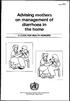 CDD193.1 ORIGINAL ENGUSH 1 Advising mothers on management of diarrhoea in the home A GUIDE FOR HEALTH WORKERS Diarrh~eal Disease Control (CDD) Programme World Health Organization CONTENTS PAGE Introduction
Healthcare Today and Tomorrow: Patient Safety and Bar Coding
 Healthcare Today and Tomorrow: Patient Safety and Bar Coding August 2010 Presenters Melissa A. Fiutak Senior Product Manager, 2D Handheld Scanners Honeywell Scanning & Mobility Regan Baron, RN, BSN Chief
MDwise Right Choices Program
 Welcome to the MDwise Right Choices Program Helping you get the right care at the right time at the right place. MDwise Right Choices Program What is the Right Choices program? The Right Choices program
Medication Administration for Non-Licensed School Staff
 Medication Administration for Non-Licensed School Staff School Health Issues A federal mandate created in the 1970s obligated schools to provide children with medical services, including medication administration.
Preventing Overuse Injuries at Work
 Preventing Overuse Injuries at Work The Optimal Office Work Station Use an adjustable chair with good lumbar support. Keep your feet flat on a supportive surface (floor or foot rest). Your knees should
IMS-640 VoIP Intercom Master Station Operating Instructions
 IMS-64 VoIP Intercom Master Station Operating Instructions MicroComm DXL MicroComm DXL IMS-64 VoIP Intercom Master Station Operating Instructions November, 29 Printed in Canada 29 Harding Instruments MN-DXL-IMS-64-Pv1
Help for completing attendance allowance and disability allowance forms
 Help for completing attendance allowance and disability allowance forms Advice and guidance on applying for these benefits HOUSING AND COMMUNITY LIVING www.luton.gov.uk Luton Borough Council aims to help
Range of Motion. A guide for you after spinal cord injury. Spinal Cord Injury Rehabilitation Program
 Range of Motion A guide for you after spinal cord injury Spinal Cord Injury Rehabilitation Program This booklet has been written by the health care providers who provide care to people who have a spinal
Summary Table for SolarWinds Web Help Desk
 Date: February 10 th, 2015 Name of Product: (WHD) Contact for more Information: http://www.solarwinds.com/support/ Summary Table for Section 1194.21 Software Applications with. See section 1194.21 below.
Improving Subject Compliance with Smart Pill Bottles
 Vol. 3,. 8, August 2007 Can You Handle the Truth? Improving Subject Compliance with Smart Pill Bottles By rman M. Goldfarb According to the American Heart Association, 12% of patients never fill their
RxMap Multimed Adherence Packaging Solutions
 Multimed Solutions RxMap Multimed Adherence Packaging Solutions Provide Patients with a System to Take the Right Medications at the Right Time RxMap Multimed Adherence Packaging Systems: Provide Patients
The Annual Direct Care of Asthma
 The Annual Direct Care of Asthma The annual direct health care cost of asthma in the United States is approximately $11.5 billion; indirect costs (e.g. lost productivity) add another $4.6 billion for a
Iowa Governor s Office of Drug Control Policy
 Iowa Governor s Office of Drug Control Policy medicines or take them in a manner not prescribed, we increase the risk of negative effects. It is estimated that over 35 million Americans are ages 65 and
MEDICATION GUIDE Xyrem (ZĪE-rem) (sodium oxybate) oral solution CIII
 MEDICATION GUIDE Xyrem (ZĪE-rem) (sodium oxybate) oral solution CIII Read this Medication Guide carefully before you start taking Xyrem and each time you get a refill. There may be new information. This
Older Drivers Guide to Driving Safely
 Fit to Drive Traffic Safety for Older Drivers Are you fit to drive? The aging process may increase your risk of being in a traffic crash, and it affects the severity of injuries you experience. Drivers
Summary Table for SolarWinds Web Help Desk
 Date: February 25, 2013 Name of Product: SolarWinds Web Help Desk Contact for more Information: http://www.solarwinds.com/support/ Summary Table for Voluntary Product Accessibility Template (VPAT) Remarks
Elite 8D/Lite Version 8 Zone Controller. Arrowhead Alarm Products Ltd. Operating Guide. Proudly Designed and Manufactured in New Zealand
 Elite 8D/Lite Version 8 Zone Controller 8 Arrowhead Alarm Products Ltd Operating Guide 1 Proudly Designed and Manufactured in New Zealand 2 CONTENTS Page No. INTRODUCTION 4 About your Alarm 4 OPERATING
Blood-clotting disorders XARELTO Identifying genuine products of Bayer HealthCare
 Blood-clotting disorders XARELTO Identifying genuine products of Bayer HealthCare Product presentation, packaging design, and selected security features Imprint Bayer HealthCare AG 51368 Leverkusen Germany
Delirium. The signs of delirium are managed by treating the underlying cause of the medical condition causing the delirium.
 Delirium Introduction Delirium is a complex symptom where a person becomes confused and shows significant changes in behavior and mental state. Signs of delirium include problems with attention and awareness,
Patient Advocate Checklist For:
 Today s Date Patient Advocate Checklist For: Name of Patient An advocate is not a Health Care Proxy and can not make decisions for the patient. The advocate should know who the Health Care Proxy is and
Generic and Brand Name Drugs: Understanding the Basics
 Generic and Brand Name Drugs: Understanding the Basics We ve been there. We can help. Joe has just been diagnosed with bipolar disorder. After talking to his doctor, he decides to see a therapist and go
Your Pharmacy Benefit: Make it Work for You!
 Your Pharmacy Benefit: Make it Work for You! www.yourpharmacybenefit.org Table of Contents Choose Your Plan.............................................2 Steps in Choosing Your Pharmacy Benefits.........................
Asthma and COPD Awareness
 Asthma and COPD Awareness Molina Breathe with Ease sm and Chronic Obstructive Pulmonary Disease Molina Healthcare of Michigan Fall 2012 Importance of Controller Medicines Asthma is a disease that causes
BLOOD COLLECTION MIXER
 USER S MANUAL BLOOD COLLECTION MIXER Model CM735 No. CAT.CM73522Ce Centron Technologies Corporation 319-25 Sadang-4-dong, Dongjak-ku Seoul, Korea 156-823 Tel. +82-2.522.7807 Fax +82-2.522.7806 Table of
What You Need to KnowWhen Taking Anticoagulation Medicine
 What You Need to KnowWhen Taking Anticoagulation Medicine What are anticoagulant medicines? Anticoagulant medicines are a group of medicines that inhibit blood clotting, helping to prevent blood clots.
466-1936 Rev E October 2004 ZZZ*(6HFXULW\FRP. Part No: 60-883-95R. CareGard. User Guide
 ) *(6HFXULW\ 466-1936 Rev E October 2004 ZZZ*(6HFXULW\FRP Part No: 60-883-95R CareGard User Guide FCC Notices FCC Part 15 Information to the User Changes or modifications not expressly approved by GE Security
GRASP. Graded Repetitive Arm Supplementary Program. Exercise manual. Level. This research project is funded by UBC and the Heart and Stroke Foundation
 GRASP Graded Repetitive Arm Supplementary Program Exercise manual Level 1 This research project is funded by UBC and the Heart and Stroke Foundation 1 Welcome to the Grasp study! Thank you for volunteering
Texas Department of Insurance. Office Ergonomics. Provided by. Division of Workers Compensation HS03-003C (03-09)
 Texas Department of Insurance Office Ergonomics Provided by Division of Workers Compensation HS03-003C (03-09) Contents Introduction 1 The Ergonomic Checklist 1 Sharp Edge Hazards 1 Equipment Adjustability
Unit A451: Computer systems and programming. Section 2: Computing Hardware 4/5: Input and Output Devices
 Unit A451: Computer systems and programming Section 2: Computing Hardware 4/5: Input and Output Devices Input and Output devices Candidates should be able to: (a) understand the need for input and output
TAGARNO AS Sandøvej 4 8700 Horsens Denmark Tel: +45 7625 1111 Mail: [email protected]
 8 TAGARNO AS Sandøvej 4 8700 Horsens Denmark Tel: +45 7625 1111 Mail: [email protected] TAGARNO 2 Quick Image Capture Split Screen Function Magnification up to 320x Easy Height Adjustment SD-card ESD Security
CarePartner Telephone With Reminders
 Philips wordmark and Lifeline K100 CarePartner Telephone With Reminders Model 9500 User s Manual Black and white version For use with newsprint and other one-color applications. 1 x P height 1 x P height
SECTION G2: CABLE PROCESSOR MODULE MAINTENANCE
 SECTION G2: CABLE PROCESSOR MODULE MAINTENANCE Cable Processor Module overview WARNING! When tipping the Cable Processor Module back, (after removing the toggle arm pin), use extreme caution not to drop
COMPUTER SUPPORT STAFF TIPS FOR DISABILITY ETIQUETTE
 COMPUTER SUPPORT STAFF TIPS FOR DISABILITY ETIQUETTE COMPUTER SUPPORT STAFF TIPS FOR DISABILITY ETIQUETTE Norman Coombs, CEO EASI EASI: Equal Access to Software and Information 2011 (this document may
AXIRON (AXE-e-RON) CIII
 Medication Guide 1 AXIRON (AXE-e-RON) CIII (testosterone) topical solution Read this Medication Guide before you start using AXIRON and each time you get a refill. There may be new information. This information
Managing Your Medications
 Managing Your Medications Table of Contents Managing Your Medications Handout 1 Personal health goals & medications... 4 Handout 2 Pharmacists can help you... 6 Handout 3 Managing your medications... 7
ArtisanLink Staining System is an automated special stains slide
 Technical Tips Tips on using the ArtisanLink Special Staining System Jamie Nowacek, BS, HT(ASCP) CM, QIHC, PMP Dako North America, Inc. Carpinteria, CA, USA ArtisanLink Staining System is an automated
A Trip to the. Emergency Room. Help Us Help You
 A Trip to the Emergency Room Help Us Help You No one plans to have a medical emergency however there are things that you can do ahead of time to help make the process easier and faster once you arrive
Pharmacist, Mr C A Pharmacy Company. A Report by the Health and Disability Commissioner. (Case 04HDC10718)
 Pharmacist, Mr C A Pharmacy Company A Report by the Health and Disability Commissioner (Case 04HDC10718) Opinion/04HDC10718 Parties involved Mrs A Ms B Mr C A Pharmacy Company Dr D Dr E Ms F Consumer
ALARM SYSTEM INSTALLATION GUIDE
 ALARM SYSTEM INSTALLATION GUIDE Congratulations on the purchase of your Egardia alarm system. Egardia's website www.egardia.com Customer services Please visit www.egardia.com if you would like further
HOW TO CARE FOR A PATIENT WITH DIABETES
 HOW TO CARE FOR A PATIENT WITH DIABETES INTRODUCTION Diabetes is one of the most common diseases in the United States, and diabetes is a disease that affects the way the body handles blood sugar. Approximately
Is It Time for In-Home Care?
 STEP-BY-STEP GUIDE Is It Time for In-Home Care? Helping Your Loved Ones Maintain Their Independence and Quality of Life 2015 CK Franchising, Inc. Welcome to the Comfort Keepers Guide to In-Home Care Introduction
Depression in Older Persons
 Depression in Older Persons How common is depression in later life? Depression affects more than 6.5 million of the 35 million Americans aged 65 or older. Most people in this stage of life with depression
Major Risks and Recommended Solutions
 Major Risks and Recommended Solutions www.icdsecurity.com OVERVIEW Are you familiar with the main security risks that threaten data centers? This paper provides an overview of the most common and major
Peace of mind & help is only a button press away.
 Peace of mind & help is only a button press away. National Broadband Network COMPATIBLE PENDANT TECHNOLOGY Visual & Hearing Impaired DIGITAL CORDLESS PHONE & EMERGENCY PENDANT EMERGENCY ALERT PENDANT Peace
A Barcode Primer for Manufacturers Dr. Peter Green BellHawk Systems Corporation
 A Barcode Primer for Manufacturers Dr. Peter Green BellHawk Systems Corporation Introduction This document is an introduction to the principles and practice of barcode scanning as it relates to a manufacturing
Finding What You Need... 4 Setting Up the Wireless Network Feature... 6 Practice Using the Touchscreen Display... 15
 user guide Table of Contents Getting Started Finding What You Need... 4 Setting Up the Wireless Network Feature... 6 Practice Using the Touchscreen Display... 15 Using Your Phone Making Captioned Phone
Guidelines on Counseling. Approved by PEIPB
 Guidelines on Counseling Approved by PEIPB November 2005 1 Patient Counseling Patient counseling is a key competency element of the Pharmaceutical Care process. Given the advertising for medication in
Liver Wellness Increasing Public Awareness of Liver Health
 Liver Wellness Increasing Public Awareness of Liver Health Managing Your Medications Managing Your Medications Medicines can help you feel better and keep you feeling well, but they can be hard to manage.
Can You Hear Me Now? A Study Unit on Cell Phones Introduction & History
 Introduction & History Since the dawn of time, people have found ways to communicate with one another. Smoke signals and tribal drums were some of the earliest forms of communication. Letters, carried
Medication Administration FAQ
 Medication Administration FAQ 1. Does DHH have a list of non-complex and complex tasks? A: Yes, refer to the Guidelines for the Didactic Training and Establishment of Competency: Section Three: Delegable
Tell your doctor about all the medicines you take, including prescription and nonprescription medicines, vitamins, and herbal supplements.
 SOMAVERT pegvisomant for injection PATIENT INFORMATION SOMAVERT (SOM-ah-vert) (pegvisomant for injection) Read the patient information that comes with SOMAVERT before you start using it and each time you
PARTNERING WITH YOUR DOCTOR:
 PARTNERING WITH YOUR DOCTOR: A Guide for Persons with Memory Problems and Their Care Partners Alzheimer s Association Table of Contents PARTNERING WITH YOUR DOCTOR: When is Memory Loss a Problem? 2 What
Brain Injury Association National Help Line: 1-800-444-6443 Brain Injury Association Web site: www.biausa.org Centers for Disease Control and
 Brain Injury Association National Help Line: 1-800-444-6443 Brain Injury Association Web site: www.biausa.org Centers for Disease Control and Prevention Web site: www.cdc.gov/ncipc/tbi Contents About Brain
Ergonomic Workplace Evaluation ISE 210, Human Factors and Ergonomics San Jose State University Fall 2003
 Ergonomic Workplace Evaluation ISE 210, Human Factors and Ergonomics San Jose State University Fall 2003 Robert Murphy Table of Contents Introduction... 2 Task... 2 Equipment... 4 Workers... 5 Observations
UPLIFT Height Adjustable Standing Desk (T-Frame) DIRECTIONS FOR ASSEMBLY AND USE - - ALSO - - Watch our assembly video
 UPLIFT Height Adjustable Standing Desk (T-Frame) DIRECTIONS FOR ASSEMBLY AND USE - - ALSO - - Watch our assembly video http://bit.ly/9ywwh! CAUTION MAKE SURE NO OBSTACLES ARE IN THE DESK S PATH AND ALL
ES&S AutoMARK. Pre-Election Day Checklist
 ES&S AutoMARK Pre-Election Day Checklist Rear Access Door Touch Screen Monitor Lid Compact Flash Access Door Lid Latches Key-Operated Mode Switch Keypad Ballot Feed Tray ADA Port Headphone Jacks 1 Checking
Making the CarePoint Resident System right for you. Scaleable solutions for your senior living community
 Making the CarePoint Resident System right for you Scaleable solutions for your senior living community Creating a safer CarePoint is a powerful, integrated, easy-to-use Resident Safety System that well
TAKING CARE OF YOUR RHEUMATOID ARTHRITIS
 TAKING CARE OF YOUR RHEUMATOID ARTHRITIS RHEUMATOID ARTHRITIS (RA) FAST FACTS What is Rheumatoid Arthritis? Rheumatoid arthritis (RA) is a chronic disease that can affect your ability to function and be
Meridian 8314 Business Terminal User Guide
 For additional information, Dial Telecommunications Center Centrex Services... - University of Nebraska - Lincoln Telecommunications Center Nebraska Hall Lincoln, NE 6888-0 (0) 7-000 The University of
Cat Detect. for Surface Mining Applications
 Cat Detect for Surface Mining Applications Enhance Your Site s Safety through Increased Operator Awareness Configurable to suit your operation s needs, Cat MineStar System is the industry s broadest suite
INSTRUCTION MANUAL All-In-One GSM Home Alarm System SB-SP7200-GSM
 INSTRUCTION MANUAL All-In-One GSM Home Alarm System SB-SP7200-GSM Revised: August 28, 2014 PRODUCT REFERENCE MOUNTING ACCESSORIES PIR / MOTION DETECTION UNIT MAIN UNIT POWER ADAPTER MOUNTING ACCESSORIES
MEDICATION INFORMATION & RESOURCES (including medical alert bracelets & medical record organizers)
 MEDICATION INFORMATION & RESOURCES (including medical alert bracelets & medical record organizers) 1 6. Keep Taking your Medication. Don t stop taking your medicine just because you are feeling better.
Senior Reminder System Project
 Senior Reminder System Project Vision Document SE 4351 Requirements Engineering, Section 001 September 28, Fall 2015 Milton Bland, [email protected] Zachary Calman, [email protected] Ridge Frederick,
Emergency Room (ER) Visits: A Family Caregiver s Guide
 Family Caregiver Guide Emergency Room (ER) Visits: A Family Caregiver s Guide Your family member may someday have a medical emergency and need to go to a hospital Emergency Room (ER), which is also called
Preventing Patient Falls
 Preventing Patient Falls Patient Falls are the #1 cause of ALL sentinel events. All patients at Doctors Community Hospital are assessed for fall risk and, as appropriate, the Fall Risk Protocol is implemented.
INTRODUCTION TO POSITIONING. MODULE 3: Positioning and Carrying
 MODULE 3: Positioning and Carrying Blankets, pillows and towels, sandbags, carpet on the floor, a doll with floppy limbs that can be positioned i.e. not a hard plastic doll, display materials. Icebreaker
Summary Table Voluntary Product Accessibility Template
 Voluntary Product Accessibility Template (VPAT) Name of Product: imagerunner ADVANCE C5255/C5250/C5240/C5235 Date: May 27, 2012 Note: This document was prepared based on normal walk-up functionality. It
Voluntary Product Accessibility Template
 Date: April 15, 2008 Name of Product: Summit Central Version 4 Contact for more Information: http://www.miesoftware.com Summary Table Section 1194.21 Software Applications and Operating. Please refer to
As You Age. Aging, Medicines, and Alcohol. A Guide to
 As You Age A Guide to Aging, Medicines, and Alcohol U.S. DEPARTMENT OF HEALTH AND HUMAN SERVICES Substance Abuse and Mental Health Services Administration Food and Drug Administration www.samhsa.gov Take
PRODUCT WARRANTY. Page 20
 PRODUCT WARRANTY Manufactured equipment is warranted to be free from defects in material and workmanship for a period of twelve (12) months from date of manufacture as indicated by the date stamp and/or
SPECIAL CONTROL BUTTON FUNCTIONS
 Operating Guide 1 2 3 CONTENTS Page No. OPERATING YOUR ALARM 5 General Information 5 Arming the Alarm 5 Disarming the Alarm 6 Arming in Stay Mode 7 Disarming Stay Mode 8 Bypassing Zones 8 Manual Panic,
Wireless Home Security System Product Manual (Model #80355)
 Wireless Home Security System Product Manual (Model #80355) Installation Instructions During set-up, if no key is pressed for 15 seconds it will come out of the setup mode and you will have to start over.