
What is the purpose of this document? What is in the document? How do I send Feedback?
|
|
|
- Myron Taylor
- 10 years ago
- Views:
Transcription
1 This document is designed to help North Carolina educators teach the Common Core (Standard Course of Study). NCDPI staff are continually updating and improving these tools to better serve teachers. Statistics and Probability Unpacked Content For the new Common Core standards that will be effective in all North Carolina schools in the school year. What is the purpose of this document? To increase student achievement by ensuring educators understand specifically what the new standards mean a student must know, understand and be able to do. What is in the document? Descriptions of what each standard means a student will know, understand and be able to do. The unpacking of the standards done in this document is an effort to answer a simple question What does this standard mean that a student must know and be able to do? and to ensure the description is helpful, specific and comprehensive for educators. How do I send Feedback? We intend the explanations and examples in this document to be helpful and specific. That said, we believe that as this document is used, teachers and educators will find ways in which the unpacking can be improved and made ever more useful. Please send feedback to us at [email protected] and we will use your input to refine our unpacking of the standards. Thank You!

2 Interpreting Categorical and Quantitative Data S.ID Summarize, represent, and interpret data on a single count or measurement variable. S.ID.1 Represent data with plots on the real number line (dot plots, histograms, and box plots). S.ID.2 Use statistics appropriate to the shape of the data distribution to compare center (median, mean) and spread (interquartile range, standard deviation) of two or more different data sets. S.ID.3 Interpret differences in shape, center, and spread in the context of the data sets, accounting for possible effects of extreme data points (outliers). S.ID.1 Construct dot plots, histograms and box plots for data on a real number line. S.ID.2 Describe a distribution using center and spread. S.ID.2 Use the correct measure of center and spread to describe a distribution that is symmetric or skewed. S.ID.2 Identify outliers (extreme data points) and their effects on data sets. S.ID.2 Compare two or more different data sets using the center and spread of each. S.ID.3 Interpret differences in different data sets in context. Interpret differences due to possible effects of outliers. 2
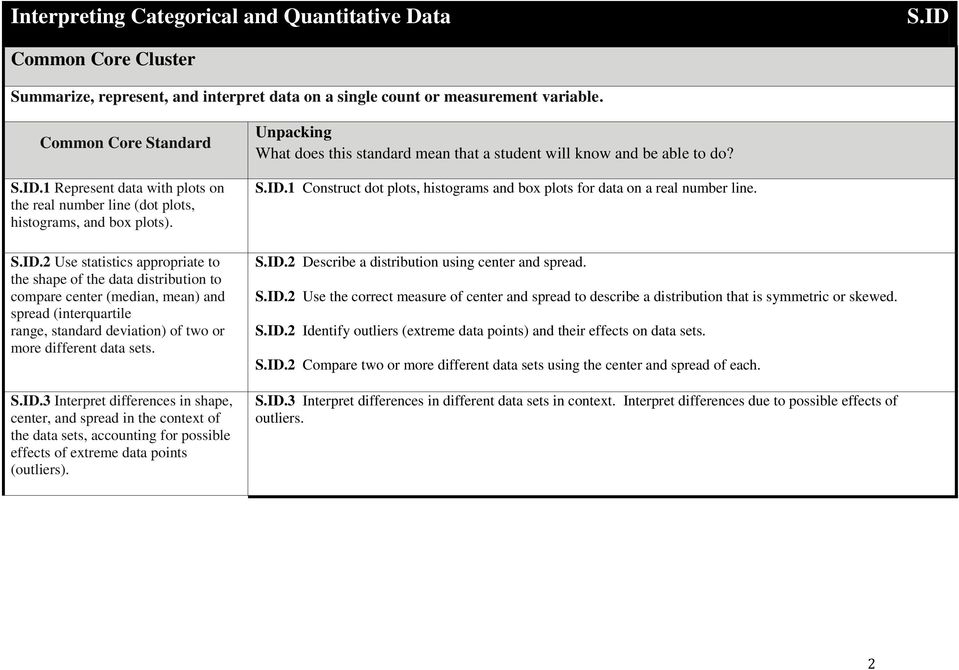
3 S.ID.4 Use the mean and standard deviation of a data set to fit it to a normal distribution and to estimate population percentages. Recognize that there are data sets for which such a procedure is not appropriate. Use calculators, spreadsheets, and tables to estimate areas under the normal curve. Instructional Expectations S.ID.4 Identify data sets as approximately normal or not. S.ID.4 Use the mean and standard deviation to fit it to a normal distribution where appropriate. S.ID.4 Use calculators, spreadsheets, and tables to estimate areas under the normal curve. S.ID.4 Interprets areas under a normal curve in context. In both pathways, the expectation in Algebra I and CCSS Mathematics I, is that in grades 6 8, students describe center and spread in a data distribution. Here they choose a summary statistic appropriate to the characteristics of the data distribution, such as the shape of the distribution or the existence of extreme data points. In Algebra II and CCSS Mathematics III, while students may have heard of the normal distribution, it is unlikely that they will have prior experience using it to make specific estimates. Build on students understanding of data distributions to help them see how the normal distribution uses area to make estimates of frequencies (which can be expressed as probabilities). Emphasize that only some data are well described by a normal distribution. 3
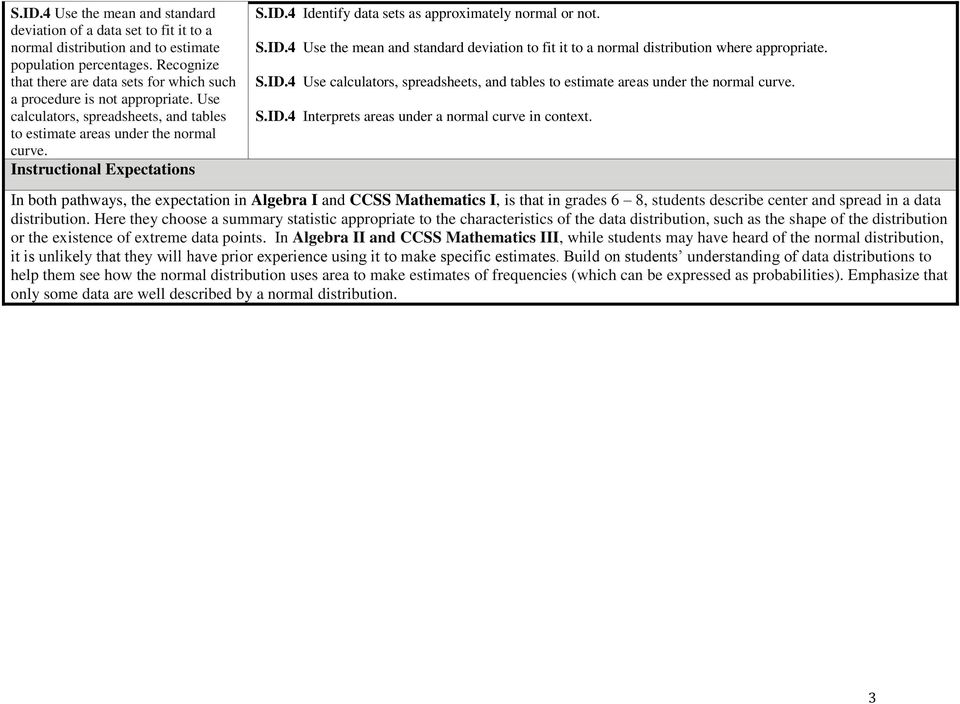
4 Interpreting Categorical and Quantitative Data S.ID Summarize, represent, and interpret data on two categorical and quantitative variables. S.ID.5 Summarize categorical data for two categories in two-way frequency tables. Interpret relative frequencies in the context of the data (including joint, marginal, and conditional relative frequencies). Recognize possible associations and trends in the data. S.ID.6 Represent data on two quantitative variables on a scatter plot, and describe how the variables are related. a. Fit a function to the data; use functions fitted to data to solve problems in the context of the data. Use given functions or choose a function suggested by the context. Emphasize linear and exponential models. b. Informally assess the fit of a function by plotting and analyzing residuals. c. Fit a linear function for a scatter plot that suggests a linear association. S.ID.5 Create a two-way table from two categorical variables and read values from two way table. Interpret joint, marginal, and relative frequencies in context. S.ID.5 Recognize associations and trends in data from a two-way table. S.ID.6 Create a scatter plot from two quantitative variables. S.ID.6 Describe the form, strength and direction of the relationship. S.ID.6a Categorize data as linear or not. Use algebraic methods and technology to fit a linear function to the data. Use the function to predict values. S.ID.6a Explain the meaning of the slope and y-intercept in context. S.ID.6a Categorize data as exponential. Use algebraic methods and technology to fit an exponential function to the data. Use the function to predict values. S.ID.6a Explain the meaning of the growth rate and y-intercept in context. S.ID.6a Categorize data as quadratic. Use algebraic methods and technology to fit a quadratic function to the data. Use the function to predict values. S.ID.6a Explain the meaning of the constant and coefficients in context. 4
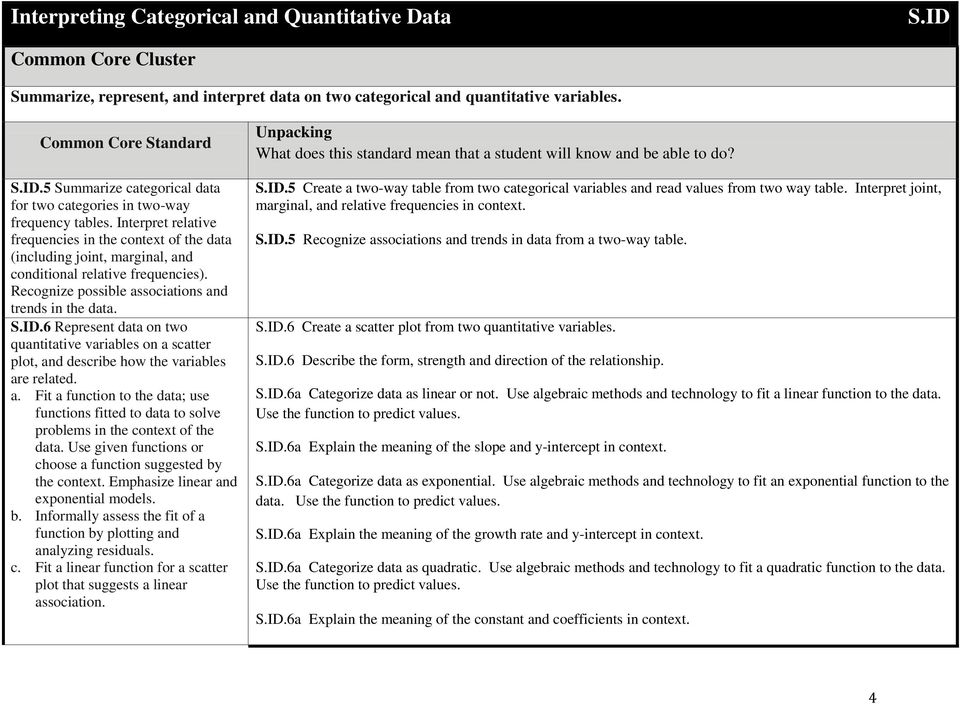
5 S.ID.6b Calculate a residual. Create and analyze a residual plot. S.ID.6c Categorize data as linear or not. Use algebraic methods and technology to fit a linear function to the data. Use the function to predict values. Instructional Expectations In the traditional pathway, Algebra I students take a more sophisticated look at using a linear function to model the relationship between two numerical variables. In addition to fitting a line to data, students assess how well the model fits by analyzing residuals. S.ID.6b should be focused on linear models, but may be used to preview quadratic functions. In the international pathway, CCSS Mathematics I students take a more sophisticated look at using a linear function to model the relationship between two numerical variables. In addition to fitting a line to data, students assess how well the model fits by analyzing residuals. S.ID.6b should be focused on situations for which linear models are appropriate. Interpreting Categorical and Quantitative Data S.ID Interpret linear models. S.ID.7 Interpret the slope (rate of change) and the intercept (constant term) of a linear model in the context of the data. S.ID.8 Compute (using technology) and interpret the correlation coefficient of a linear fit. S.ID.7 Explain the meaning of the slope and y-intercept in context. S.ID.8 Use a calculator or computer to find the correlation coefficient for a linear association. Interpret the meaning of the value in the context of the data. 5
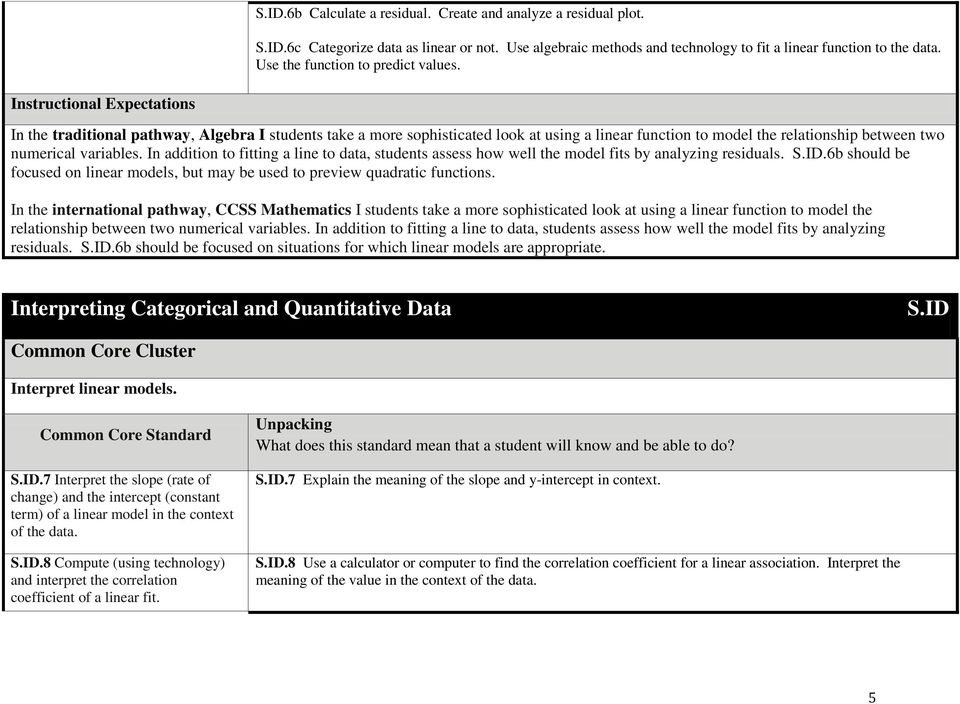
6 S.ID.9 Distinguish between correlation and causation. S.ID.9 Explain the difference between correlation and causation. Instructional Expectations In both pathways, the expectation in Algebra I and CCSS Mathematics I is to build on students work with linear relationships in eighth grade and introduce the correlation coefficient. The focus here is on the computation and interpretation of the correlation coefficient as a measure of how well the data fit the relationship. The important distinction between a statistical relationship and a cause- and-effect relationship arises in S.ID.9. Making Inferences and Justifying Conclusions S.IC Understand and evaluate random processes underlying statistical experiments. S.IC.1 Understand statistics as a process for making inferences about population parameters based on a random sample from that population. S.IC.1 Explain in context the difference between values describing a population and a sample. 6
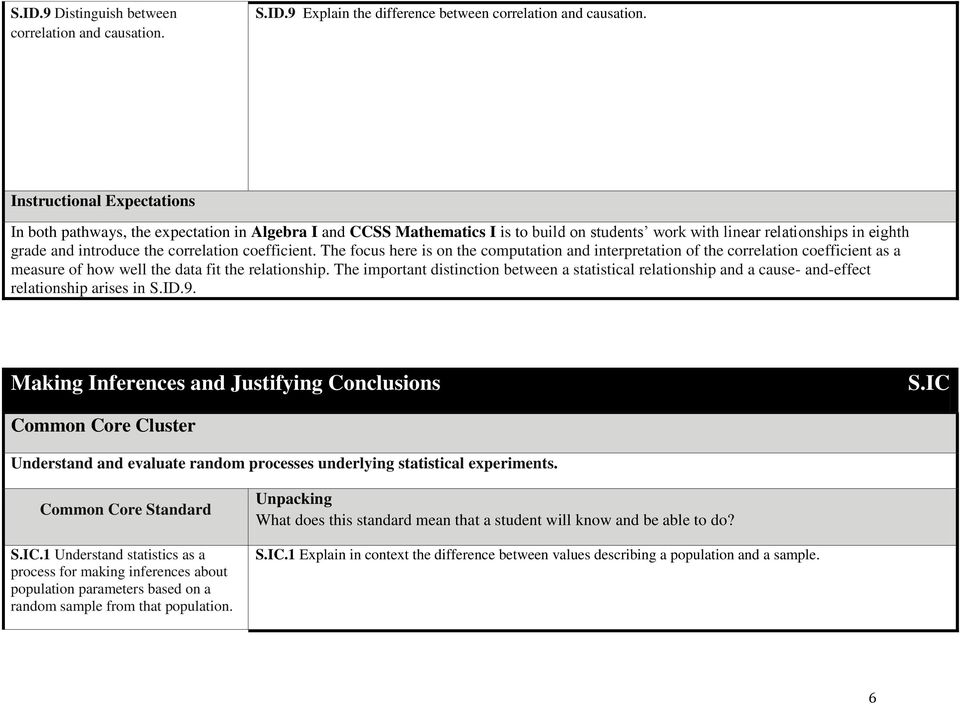
7 S.IC.2 Decide if a specified model is consistent with results from a given data-generating process, e.g., using simulation. For example, a model says a spinning coin falls heads up with probability 0.5. Would a result of 5 tails in a row cause you to question the model? S.IC.2 Explain how well and why a sample represents the variable of interest from a population. S.IC.2 Demonstrate understanding of the different kinds of sampling methods. S.IC.2 Design simulations of random sampling: assign digits in appropriate proportions for events, carry out the simulation using random number generators and random number tables and explain the outcomes in context of the population and the known proportions. Instructional Expectations In both pathways, the expectation in Algebra II and CCSS Mathematics III is that for S.IC.2, include comparing theoretical and empirical results to evaluate the effectiveness of a treatment. Making Inferences and Justifying Conclusions S.IC Make inferences and justify conclusions from sample surveys, experiments, and observational studies. S.IC.3 Recognize the purposes of and differences among sample surveys, experiments, and observational studies; explain how randomization relates to each. S.IC.3 Identify situations as either sample survey, experiment, or observational study. Discuss the appropriateness of each one s use in contexts with limiting factors. S.IC.3 Design or evaluate sample surveys, experiments and observational studies with randomization. Discuss the importance of randomization in these processes. 7
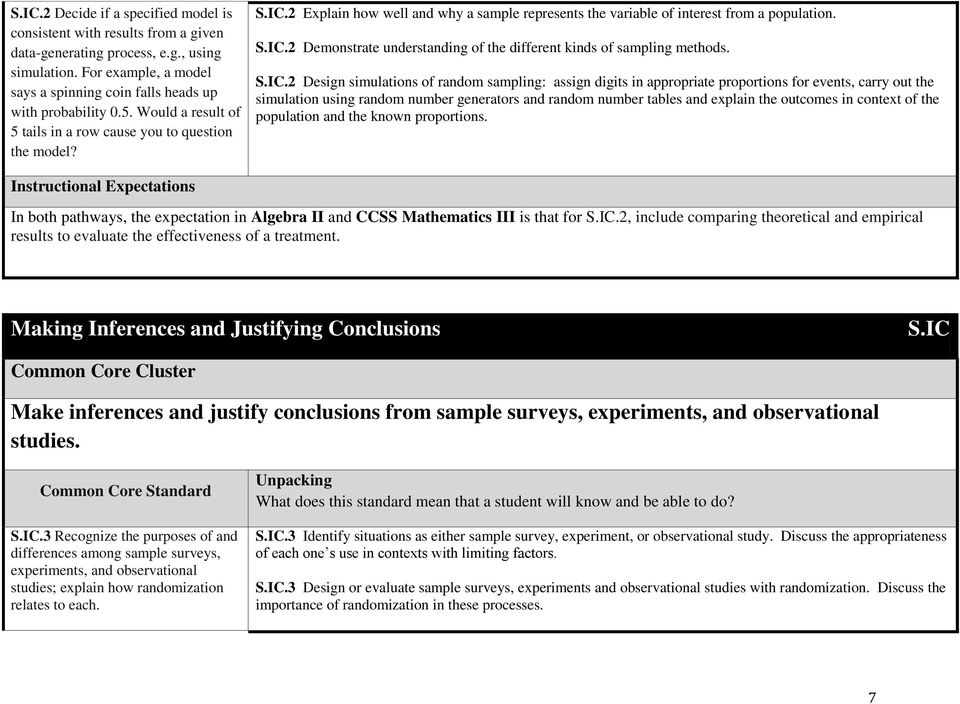
8 S.IC.4 Use data from a sample survey to estimate a population mean or proportion; develop a margin of error through the use of simulation models for random sampling. S.IC.4 Use sample means and sample proportions to estimate population values. S.IC.4 Conduct simulations of random sampling to gather sample means and sample proportions. Explain what the results mean about variability in a population and use results to calculate margins of error for these estimates. S.IC.5 Use data from a randomized experiment to compare two treatments; use simulations to decide if differences between parameters are significant. S.IC.5 Evaluate effectiveness and differences in two treatments based on data from randomized experiments. Explain in context. S.IC.5 Use simulations to generate data simulating application of two treatments. Use results to evaluate significance of differences. S.IC.6 Evaluate reports based on data. S.IC.6 Read and explain in context data from outside reports. Instructional Expectations In both pathways, the expectation in Algebra II and CCSS Mathematics III is that in earlier grades, students are introduced to different ways of collecting data and use graphical displays and summary statistics to make comparisons. These ideas are revisited with a focus on how the way in which data is collected determines the scope and nature of the conclusions that can be drawn from that data. The concept of statistical significance is developed informally through simulation as meaning a result that is unlikely to have occurred solely as a result of random selection in sampling or random assignment in an experiment. For S.IC.4 and 5, focus on the variability of results from experiments that is, focus on statistics as a way of dealing with, not eliminating, inherent randomness. 8

9 Conditional Probability and the Rules of Probability S.CP Understand independence and conditional probability and use them to interpret data. S.CP.1 Describe events as subsets of a sample space (the set of outcomes) using characteristics (or categories) of the outcomes, or as unions, intersections, or complements of other events ( or, and, not ). S.CP.1 Define a sample space and events within the sample space. Identify subsets from sample space given defined events, including unions, intersections and complements of events. S.CP.2 Understand that two events A and B are independent if the probability of A and B occurring together is the product of their probabilities, and use this characterization to determine if they are independent. S.CP.3 Understand the conditional probability of A given B as P(A and B)/P(B), and interpret independence of A and B as saying that the conditional probability of A given B is the same as the probability of A, and the conditional probability of B given A is the same as the probability of B. S.CP.2 Identify two events as independent or not. Explain properties of Independence and Conditional Probabilities in context and simple English. S.CP.3 Define and calculate conditional probabilities. Use the Multiplication Principal to decide if two events are independent and to calculate conditional probabilities. 9

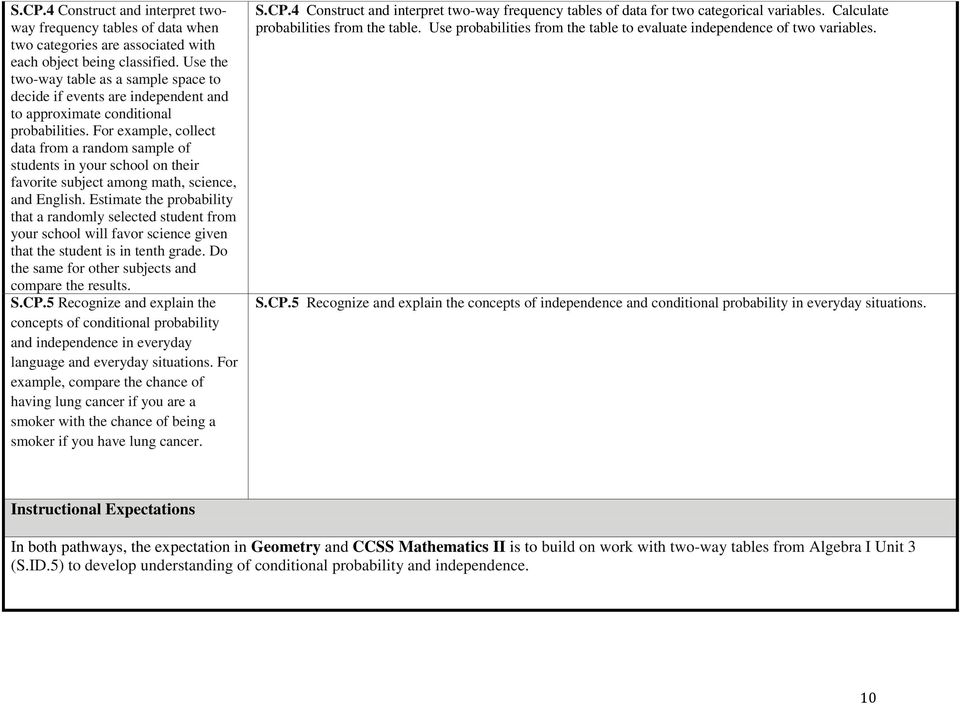
10 S.CP.4 Construct and interpret twoway frequency tables of data when two categories are associated with each object being classified. Use the two-way table as a sample space to decide if events are independent and to approximate conditional probabilities. For example, collect data from a random sample of students in your school on their favorite subject among math, science, and English. Estimate the probability that a randomly selected student from your school will favor science given that the student is in tenth grade. Do the same for other subjects and compare the results. S.CP.5 Recognize and explain the concepts of conditional probability and independence in everyday language and everyday situations. For example, compare the chance of having lung cancer if you are a smoker with the chance of being a smoker if you have lung cancer. S.CP.4 Construct and interpret two-way frequency tables of data for two categorical variables. Calculate probabilities from the table. Use probabilities from the table to evaluate independence of two variables. S.CP.5 Recognize and explain the concepts of independence and conditional probability in everyday situations. Instructional Expectations In both pathways, the expectation in Geometry and CCSS Mathematics II is to build on work with two-way tables from Algebra I Unit 3 (S.ID.5) to develop understanding of conditional probability and independence. 10
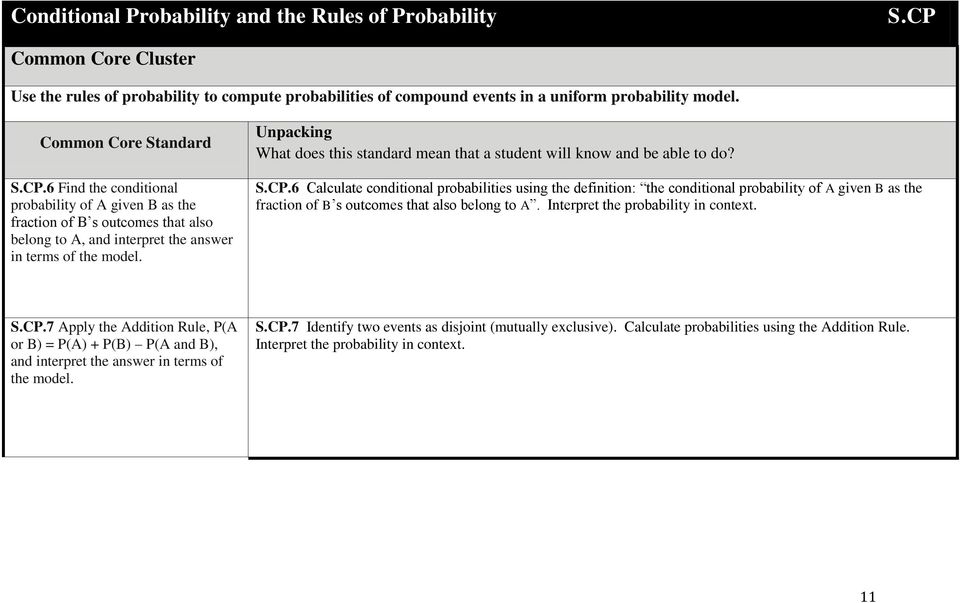
11 Conditional Probability and the Rules of Probability S.CP Use the rules of probability to compute probabilities of compound events in a uniform probability model. S.CP.6 Find the conditional probability of A given B as the fraction of B s outcomes that also belong to A, and interpret the answer in terms of the model. S.CP.6 Calculate conditional probabilities using the definition: the conditional probability of A given B as the fraction of B s outcomes that also belong to A. Interpret the probability in context. S.CP.7 Apply the Addition Rule, P(A or B) = P(A) + P(B) P(A and B), and interpret the answer in terms of the model. S.CP.7 Identify two events as disjoint (mutually exclusive). Calculate probabilities using the Addition Rule. Interpret the probability in context. 11
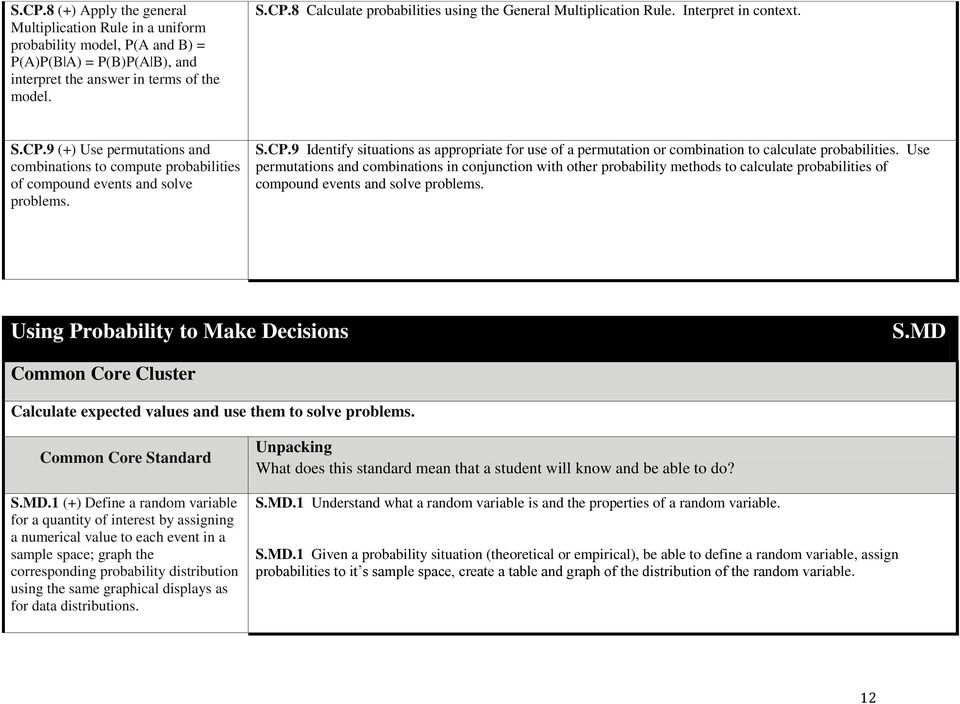
12 S.CP.8 (+) Apply the general Multiplication Rule in a uniform probability model, P(A and B) = P(A)P(B A) = P(B)P(A B), and interpret the answer in terms of the model. S.CP.8 Calculate probabilities using the General Multiplication Rule. Interpret in context. S.CP.9 (+) Use permutations and combinations to compute probabilities of compound events and solve problems. S.CP.9 Identify situations as appropriate for use of a permutation or combination to calculate probabilities. Use permutations and combinations in conjunction with other probability methods to calculate probabilities of compound events and solve problems. Using Probability to Make Decisions S.MD Calculate expected values and use them to solve problems. S.MD.1 (+) Define a random variable for a quantity of interest by assigning a numerical value to each event in a sample space; graph the corresponding probability distribution using the same graphical displays as for data distributions. S.MD.1 Understand what a random variable is and the properties of a random variable. S.MD.1 Given a probability situation (theoretical or empirical), be able to define a random variable, assign probabilities to it s sample space, create a table and graph of the distribution of the random variable. 12
13 S.MD.2 (+) Calculate the expected value of a random variable; interpret it as the mean of the probability distribution. S.MD.2 Calculate and interpret in context the expected value of a random variable. S.MD.3 (+) Develop a probability distribution for a random variable defined for a sample space in which theoretical probabilities can be calculated; find the expected value. For example, find the theoretical probability distribution for the number of correct answers obtained by guessing on all five questions of a multiple-choice test where each question has four choices, and find the expected grade under various grading schemes. S.MD.4 (+) Develop a probability distribution for a random variable defined for a sample space in which probabilities are assigned empirically; find the expected value. For example, find a current data distribution on the number of TV sets per household in the United States, and calculate the expected number of sets per household. How many TV sets would you expect to find in 100 randomly selected households? S.MD.3 Develop a theoretical probability distribution and find the expected value. S.MD.4 Develop an empirical probability distribution and find the expected value. 13

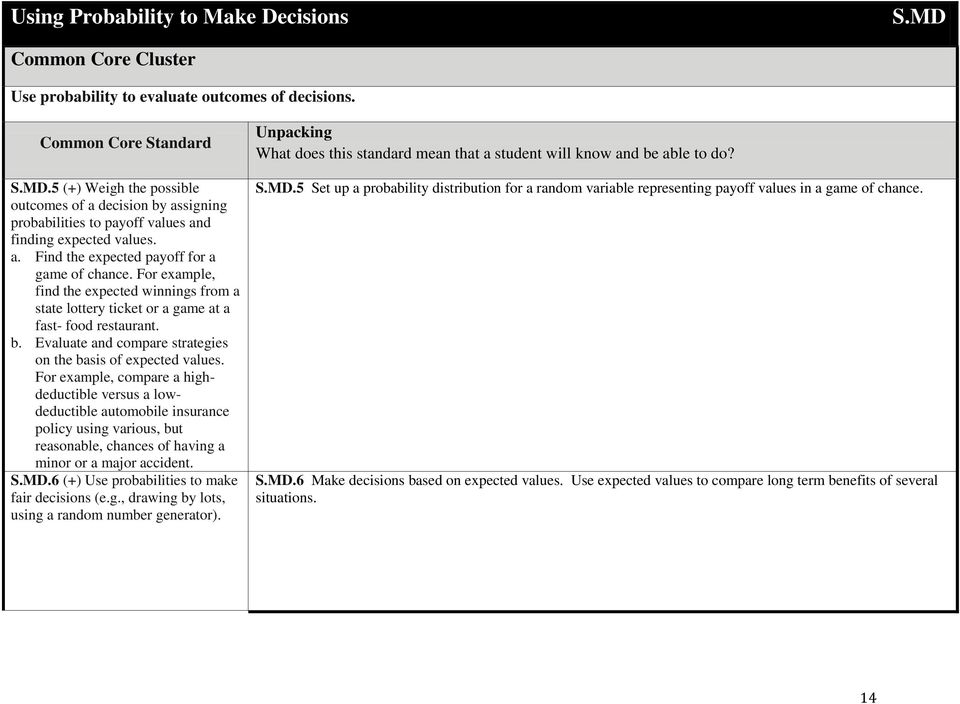
14 Using Probability to Make Decisions S.MD Use probability to evaluate outcomes of decisions. S.MD.5 (+) Weigh the possible outcomes of a decision by assigning probabilities to payoff values and finding expected values. a. Find the expected payoff for a game of chance. For example, find the expected winnings from a state lottery ticket or a game at a fast- food restaurant. b. Evaluate and compare strategies on the basis of expected values. For example, compare a highdeductible versus a lowdeductible automobile insurance policy using various, but reasonable, chances of having a minor or a major accident. S.MD.6 (+) Use probabilities to make fair decisions (e.g., drawing by lots, using a random number generator). S.MD.5 Set up a probability distribution for a random variable representing payoff values in a game of chance. S.MD.6 Make decisions based on expected values. Use expected values to compare long term benefits of several situations. 14
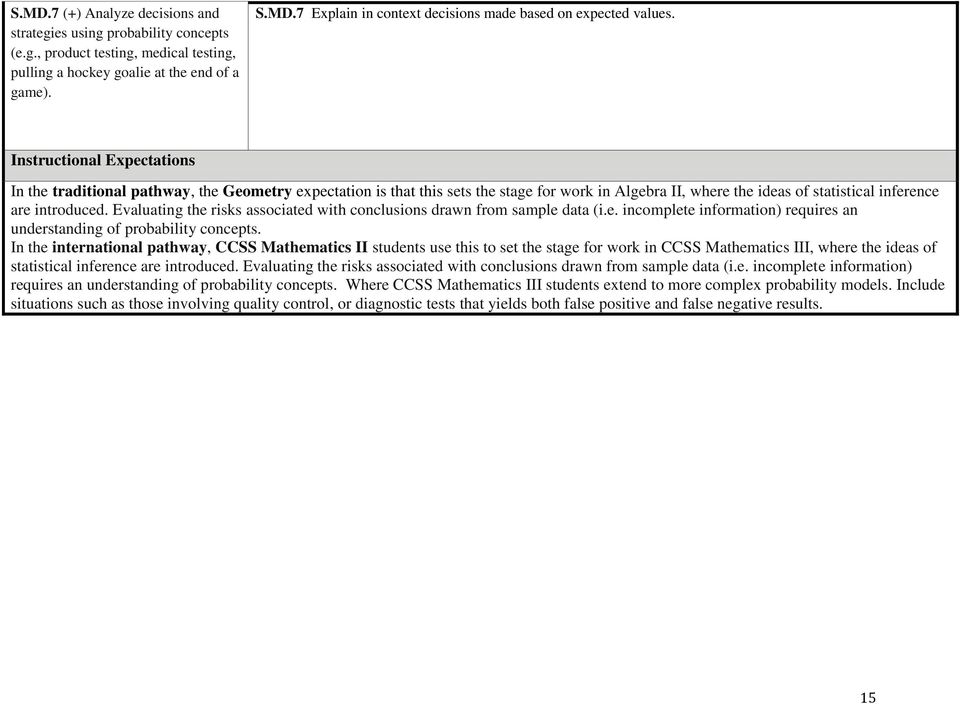
15 S.MD.7 (+) Analyze decisions and strategies using probability concepts (e.g., product testing, medical testing, pulling a hockey goalie at the end of a game). S.MD.7 Explain in context decisions made based on expected values. Instructional Expectations In the traditional pathway, the Geometry expectation is that this sets the stage for work in Algebra II, where the ideas of statistical inference are introduced. Evaluating the risks associated with conclusions drawn from sample data (i.e. incomplete information) requires an understanding of probability concepts. In the international pathway, CCSS Mathematics II students use this to set the stage for work in CCSS Mathematics III, where the ideas of statistical inference are introduced. Evaluating the risks associated with conclusions drawn from sample data (i.e. incomplete information) requires an understanding of probability concepts. Where CCSS Mathematics III students extend to more complex probability models. Include situations such as those involving quality control, or diagnostic tests that yields both false positive and false negative results. 15
COMMON CORE STATE STANDARDS FOR
 COMMON CORE STATE STANDARDS FOR Mathematics (CCSSM) High School Statistics and Probability Mathematics High School Statistics and Probability Decisions or predictions are often based on data numbers in
3. Data Analysis, Statistics, and Probability
 3. Data Analysis, Statistics, and Probability Data and probability sense provides students with tools to understand information and uncertainty. Students ask questions and gather and use data to answer
South Carolina College- and Career-Ready (SCCCR) Probability and Statistics
 South Carolina College- and Career-Ready (SCCCR) Probability and Statistics South Carolina College- and Career-Ready Mathematical Process Standards The South Carolina College- and Career-Ready (SCCCR)
RUTHERFORD HIGH SCHOOL Rutherford, New Jersey COURSE OUTLINE STATISTICS AND PROBABILITY
 RUTHERFORD HIGH SCHOOL Rutherford, New Jersey COURSE OUTLINE STATISTICS AND PROBABILITY I. INTRODUCTION According to the Common Core Standards (2010), Decisions or predictions are often based on data numbers
This curriculum is part of the Educational Program of Studies of the Rahway Public Schools. ACKNOWLEDGMENTS
 CURRICULUM FOR STATISTICS & PROBABILITY GRADES 11 & 12 This curriculum is part of the Educational Program of Studies of the Rahway Public Schools. ACKNOWLEDGMENTS Christine H. Salcito, Director of Curriculum
Vertical Alignment Colorado Academic Standards 6 th - 7 th - 8 th
 Vertical Alignment Colorado Academic Standards 6 th - 7 th - 8 th Standard 3: Data Analysis, Statistics, and Probability 6 th Prepared Graduates: 1. Solve problems and make decisions that depend on un
Curriculum Map Statistics and Probability Honors (348) Saugus High School Saugus Public Schools 2009-2010
 Curriculum Map Statistics and Probability Honors (348) Saugus High School Saugus Public Schools 2009-2010 Week 1 Week 2 14.0 Students organize and describe distributions of data by using a number of different
A Correlation of. to the. South Carolina Data Analysis and Probability Standards
 A Correlation of to the South Carolina Data Analysis and Probability Standards INTRODUCTION This document demonstrates how Stats in Your World 2012 meets the indicators of the South Carolina Academic Standards
The Comparisons. Grade Levels Comparisons. Focal PSSM K-8. Points PSSM CCSS 9-12 PSSM CCSS. Color Coding Legend. Not Identified in the Grade Band
 Comparison of NCTM to Dr. Jim Bohan, Ed.D Intelligent Education, LLC [email protected] The Comparisons Grade Levels Comparisons Focal K-8 Points 9-12 pre-k through 12 Instructional programs from prekindergarten
This unit will lay the groundwork for later units where the students will extend this knowledge to quadratic and exponential functions.
 Algebra I Overview View unit yearlong overview here Many of the concepts presented in Algebra I are progressions of concepts that were introduced in grades 6 through 8. The content presented in this course
NEW YORK STATE TEACHER CERTIFICATION EXAMINATIONS
 NEW YORK STATE TEACHER CERTIFICATION EXAMINATIONS TEST DESIGN AND FRAMEWORK September 2014 Authorized for Distribution by the New York State Education Department This test design and framework document
Algebra 1 Course Information
 Course Information Course Description: Students will study patterns, relations, and functions, and focus on the use of mathematical models to understand and analyze quantitative relationships. Through
Problem of the Month Through the Grapevine
 The Problems of the Month (POM) are used in a variety of ways to promote problem solving and to foster the first standard of mathematical practice from the Common Core State Standards: Make sense of problems
Algebra 1 2008. Academic Content Standards Grade Eight and Grade Nine Ohio. Grade Eight. Number, Number Sense and Operations Standard
 Academic Content Standards Grade Eight and Grade Nine Ohio Algebra 1 2008 Grade Eight STANDARDS Number, Number Sense and Operations Standard Number and Number Systems 1. Use scientific notation to express
Mathematics. Designing High School Mathematics Courses Based on the Common
 common core state STANDARDS FOR Mathematics Appendix A: Designing High School Mathematics Courses Based on the Common Core State Standards Overview The (CCSS) for Mathematics are organized by grade level
Fairfield Public Schools
 Mathematics Fairfield Public Schools AP Statistics AP Statistics BOE Approved 04/08/2014 1 AP STATISTICS Critical Areas of Focus AP Statistics is a rigorous course that offers advanced students an opportunity
Indiana Academic Standards Mathematics: Probability and Statistics
 Indiana Academic Standards Mathematics: Probability and Statistics 1 I. Introduction The college and career ready Indiana Academic Standards for Mathematics: Probability and Statistics are the result of
LAGUARDIA COMMUNITY COLLEGE CITY UNIVERSITY OF NEW YORK DEPARTMENT OF MATHEMATICS, ENGINEERING, AND COMPUTER SCIENCE
 LAGUARDIA COMMUNITY COLLEGE CITY UNIVERSITY OF NEW YORK DEPARTMENT OF MATHEMATICS, ENGINEERING, AND COMPUTER SCIENCE MAT 119 STATISTICS AND ELEMENTARY ALGEBRA 5 Lecture Hours, 2 Lab Hours, 3 Credits Pre-
UNIT 1: COLLECTING DATA
 Core Probability and Statistics Probability and Statistics provides a curriculum focused on understanding key data analysis and probabilistic concepts, calculations, and relevance to real-world applications.
Prentice Hall Algebra 2 2011 Correlated to: Colorado P-12 Academic Standards for High School Mathematics, Adopted 12/2009
 Content Area: Mathematics Grade Level Expectations: High School Standard: Number Sense, Properties, and Operations Understand the structure and properties of our number system. At their most basic level
Common Core Unit Summary Grades 6 to 8
 Common Core Unit Summary Grades 6 to 8 Grade 8: Unit 1: Congruence and Similarity- 8G1-8G5 rotations reflections and translations,( RRT=congruence) understand congruence of 2 d figures after RRT Dilations
CORRELATED TO THE SOUTH CAROLINA COLLEGE AND CAREER-READY FOUNDATIONS IN ALGEBRA
 We Can Early Learning Curriculum PreK Grades 8 12 INSIDE ALGEBRA, GRADES 8 12 CORRELATED TO THE SOUTH CAROLINA COLLEGE AND CAREER-READY FOUNDATIONS IN ALGEBRA April 2016 www.voyagersopris.com Mathematical
Diagrams and Graphs of Statistical Data
 Diagrams and Graphs of Statistical Data One of the most effective and interesting alternative way in which a statistical data may be presented is through diagrams and graphs. There are several ways in
Current Standard: Mathematical Concepts and Applications Shape, Space, and Measurement- Primary
 Shape, Space, and Measurement- Primary A student shall apply concepts of shape, space, and measurement to solve problems involving two- and three-dimensional shapes by demonstrating an understanding of:
How To Understand And Solve A Linear Programming Problem
 At the end of the lesson, you should be able to: Chapter 2: Systems of Linear Equations and Matrices: 2.1: Solutions of Linear Systems by the Echelon Method Define linear systems, unique solution, inconsistent,
Problem Solving and Data Analysis
 Chapter 20 Problem Solving and Data Analysis The Problem Solving and Data Analysis section of the SAT Math Test assesses your ability to use your math understanding and skills to solve problems set in
To represent mathematical relationships using graphs. 4-1 Activity: Relating Quantities See Department Chair for File 1 day A.REI.10, F.IF.
 CCSS for Mathematical Practice: 1. Make sense of problems and persevere in solving them 2. Reason abstractly and quantitatively 3. Construct viable arguments and critique the reasoning of others 4. Model
Chapter 111. Texas Essential Knowledge and Skills for Mathematics. Subchapter B. Middle School
 Middle School 111.B. Chapter 111. Texas Essential Knowledge and Skills for Mathematics Subchapter B. Middle School Statutory Authority: The provisions of this Subchapter B issued under the Texas Education
Business Statistics. Successful completion of Introductory and/or Intermediate Algebra courses is recommended before taking Business Statistics.
 Business Course Text Bowerman, Bruce L., Richard T. O'Connell, J. B. Orris, and Dawn C. Porter. Essentials of Business, 2nd edition, McGraw-Hill/Irwin, 2008, ISBN: 978-0-07-331988-9. Required Computing
Glencoe. correlated to SOUTH CAROLINA MATH CURRICULUM STANDARDS GRADE 6 3-3, 5-8 8-4, 8-7 1-6, 4-9
 Glencoe correlated to SOUTH CAROLINA MATH CURRICULUM STANDARDS GRADE 6 STANDARDS 6-8 Number and Operations (NO) Standard I. Understand numbers, ways of representing numbers, relationships among numbers,
GRADES 7, 8, AND 9 BIG IDEAS
 Table 1: Strand A: BIG IDEAS: MATH: NUMBER Introduce perfect squares, square roots, and all applications Introduce rational numbers (positive and negative) Introduce the meaning of negative exponents for
Pearson Algebra 1 Common Core 2015
 A Correlation of Pearson Algebra 1 Common Core 2015 To the Common Core State Standards for Mathematics Traditional Pathways, Algebra 1 High School Copyright 2015 Pearson Education, Inc. or its affiliate(s).
Probability and Statistics Vocabulary List (Definitions for Middle School Teachers)
 Probability and Statistics Vocabulary List (Definitions for Middle School Teachers) B Bar graph a diagram representing the frequency distribution for nominal or discrete data. It consists of a sequence
Georgia Standards of Excellence 2015-2016 Mathematics
 Georgia Standards of Excellence 2015-2016 Mathematics Standards GSE Coordinate Algebra K-12 Mathematics Introduction Georgia Mathematics focuses on actively engaging the student in the development of mathematical
Big Ideas in Mathematics
 Big Ideas in Mathematics which are important to all mathematics learning. (Adapted from the NCTM Curriculum Focal Points, 2006) The Mathematics Big Ideas are organized using the PA Mathematics Standards
Street Address: 1111 Franklin Street Oakland, CA 94607. Mailing Address: 1111 Franklin Street Oakland, CA 94607
 Contacts University of California Curriculum Integration (UCCI) Institute Sarah Fidelibus, UCCI Program Manager Street Address: 1111 Franklin Street Oakland, CA 94607 1. Program Information Mailing Address:
Grade 6 Mathematics Assessment. Eligible Texas Essential Knowledge and Skills
 Grade 6 Mathematics Assessment Eligible Texas Essential Knowledge and Skills STAAR Grade 6 Mathematics Assessment Mathematical Process Standards These student expectations will not be listed under a separate
Course Text. Required Computing Software. Course Description. Course Objectives. StraighterLine. Business Statistics
 Course Text Business Statistics Lind, Douglas A., Marchal, William A. and Samuel A. Wathen. Basic Statistics for Business and Economics, 7th edition, McGraw-Hill/Irwin, 2010, ISBN: 9780077384470 [This
Middle School Course Acceleration
 Middle School Course Acceleration Some students may choose to take Algebra I in Grade 8 so they can take college-level mathematics in high school. Students who are capable of moving more quickly in their
Performance Level Descriptors Grade 6 Mathematics
 Performance Level Descriptors Grade 6 Mathematics Multiplying and Dividing with Fractions 6.NS.1-2 Grade 6 Math : Sub-Claim A The student solves problems involving the Major Content for grade/course with
1) Write the following as an algebraic expression using x as the variable: Triple a number subtracted from the number
 1) Write the following as an algebraic expression using x as the variable: Triple a number subtracted from the number A. 3(x - x) B. x 3 x C. 3x - x D. x - 3x 2) Write the following as an algebraic expression
Institute of Actuaries of India Subject CT3 Probability and Mathematical Statistics
 Institute of Actuaries of India Subject CT3 Probability and Mathematical Statistics For 2015 Examinations Aim The aim of the Probability and Mathematical Statistics subject is to provide a grounding in
Geometry. Higher Mathematics Courses 69. Geometry
 The fundamental purpose of the course is to formalize and extend students geometric experiences from the middle grades. This course includes standards from the conceptual categories of and Statistics and
Manhattan Center for Science and Math High School Mathematics Department Curriculum
 Content/Discipline Algebra 1 Semester 2: Marking Period 1 - Unit 8 Polynomials and Factoring Topic and Essential Question How do perform operations on polynomial functions How to factor different types
Statistics I for QBIC. Contents and Objectives. Chapters 1 7. Revised: August 2013
 Statistics I for QBIC Text Book: Biostatistics, 10 th edition, by Daniel & Cross Contents and Objectives Chapters 1 7 Revised: August 2013 Chapter 1: Nature of Statistics (sections 1.1-1.6) Objectives
DRAFT. Algebra 1 EOC Item Specifications
 DRAFT Algebra 1 EOC Item Specifications The draft Florida Standards Assessment (FSA) Test Item Specifications (Specifications) are based upon the Florida Standards and the Florida Course Descriptions as
430 Statistics and Financial Mathematics for Business
 Prescription: 430 Statistics and Financial Mathematics for Business Elective prescription Level 4 Credit 20 Version 2 Aim Students will be able to summarise, analyse, interpret and present data, make predictions
How To Write A Data Analysis
 Mathematics Probability and Statistics Curriculum Guide Revised 2010 This page is intentionally left blank. Introduction The Mathematics Curriculum Guide serves as a guide for teachers when planning instruction
Academic Standards for Mathematics
 Academic Standards for Grades Pre K High School Pennsylvania Department of Education INTRODUCTION The Pennsylvania Core Standards in in grades PreK 5 lay a solid foundation in whole numbers, addition,
Data Analysis, Statistics, and Probability
 Chapter 6 Data Analysis, Statistics, and Probability Content Strand Description Questions in this content strand assessed students skills in collecting, organizing, reading, representing, and interpreting
Algebra Unpacked Content For the new Common Core standards that will be effective in all North Carolina schools in the 2012-13 school year.
 This document is designed to help North Carolina educators teach the Common Core (Standard Course of Study). NCDPI staff are continually updating and improving these tools to better serve teachers. Algebra
PCHS ALGEBRA PLACEMENT TEST
 MATHEMATICS Students must pass all math courses with a C or better to advance to the next math level. Only classes passed with a C or better will count towards meeting college entrance requirements. If
Problem of the Month: Fair Games
 Problem of the Month: The Problems of the Month (POM) are used in a variety of ways to promote problem solving and to foster the first standard of mathematical practice from the Common Core State Standards:
Summarizing and Displaying Categorical Data
 Summarizing and Displaying Categorical Data Categorical data can be summarized in a frequency distribution which counts the number of cases, or frequency, that fall into each category, or a relative frequency
Common Core State Standards for Mathematical Practice 4. Model with mathematics. 7. Look for and make use of structure.
 Who Sends the Most Text Messages? Written by: Anna Bargagliotti and Jeanie Gibson (for Project-SET) Loyola Marymount University and Hutchison School [email protected], [email protected], www.project-set.com
Interpreting Data in Normal Distributions
 Interpreting Data in Normal Distributions This curve is kind of a big deal. It shows the distribution of a set of test scores, the results of rolling a die a million times, the heights of people on Earth,
Name: Date: Use the following to answer questions 2-3:
 Name: Date: 1. A study is conducted on students taking a statistics class. Several variables are recorded in the survey. Identify each variable as categorical or quantitative. A) Type of car the student
MULTIPLE CHOICE. Choose the one alternative that best completes the statement or answers the question.
 Final Exam Review MULTIPLE CHOICE. Choose the one alternative that best completes the statement or answers the question. 1) A researcher for an airline interviews all of the passengers on five randomly
Exercise 1.12 (Pg. 22-23)
 Individuals: The objects that are described by a set of data. They may be people, animals, things, etc. (Also referred to as Cases or Records) Variables: The characteristics recorded about each individual.
AP STATISTICS REVIEW (YMS Chapters 1-8)
 AP STATISTICS REVIEW (YMS Chapters 1-8) Exploring Data (Chapter 1) Categorical Data nominal scale, names e.g. male/female or eye color or breeds of dogs Quantitative Data rational scale (can +,,, with
MTH 140 Statistics Videos
 MTH 140 Statistics Videos Chapter 1 Picturing Distributions with Graphs Individuals and Variables Categorical Variables: Pie Charts and Bar Graphs Categorical Variables: Pie Charts and Bar Graphs Quantitative
Designer: Nathan Kimball. Stage 1 Desired Results
 Interpolation Subject: Science, math Grade: 6-8 Time: 4 minutes Topic: Reading Graphs Designer: Nathan Kimball Stage 1 Desired Results Lesson Overview: In this activity students work with the direct linear
Probability and Statistics
 Integrated Math 1 Probability and Statistics Farmington Public Schools Grade 9 Mathematics Beben, Lepi DRAFT: 06/30/2006 Farmington Public Schools 1 Table of Contents Unit Summary....page 3 Stage One:
North Carolina Math 2
 Standards for Mathematical Practice 1. Make sense of problems and persevere in solving them. 2. Reason abstractly and quantitatively 3. Construct viable arguments and critique the reasoning of others 4.
Problem of the Month Pick a Pocket
 The Problems of the Month (POM) are used in a variety of ways to promote problem solving and to foster the first standard of mathematical practice from the Common Core State Standards: Make sense of problems
For example, estimate the population of the United States as 3 times 10⁸ and the
 CCSS: Mathematics The Number System CCSS: Grade 8 8.NS.A. Know that there are numbers that are not rational, and approximate them by rational numbers. 8.NS.A.1. Understand informally that every number
Exploratory data analysis (Chapter 2) Fall 2011
 Exploratory data analysis (Chapter 2) Fall 2011 Data Examples Example 1: Survey Data 1 Data collected from a Stat 371 class in Fall 2005 2 They answered questions about their: gender, major, year in school,
What Does the Normal Distribution Sound Like?
 What Does the Normal Distribution Sound Like? Ananda Jayawardhana Pittsburg State University [email protected] Published: June 2013 Overview of Lesson In this activity, students conduct an investigation
STAT 360 Probability and Statistics. Fall 2012
 STAT 360 Probability and Statistics Fall 2012 1) General information: Crosslisted course offered as STAT 360, MATH 360 Semester: Fall 2012, Aug 20--Dec 07 Course name: Probability and Statistics Number
Measurement with Ratios
 Grade 6 Mathematics, Quarter 2, Unit 2.1 Measurement with Ratios Overview Number of instructional days: 15 (1 day = 45 minutes) Content to be learned Use ratio reasoning to solve real-world and mathematical
Prentice Hall Mathematics Courses 1-3 Common Core Edition 2013
 A Correlation of Prentice Hall Mathematics Courses 1-3 Common Core Edition 2013 to the Topics & Lessons of Pearson A Correlation of Courses 1, 2 and 3, Common Core Introduction This document demonstrates
Finding diagonal distances on the coordinate plane. Linear Inequalities. Permutation & Combinations. Standard Deviation
 Introduction of Surface Area Measurement Unit Conversion Volume of Right Rectangular Prisms Statistical Variability (MAD and IQR) Multiplication of Fractions Scientific Notation Introduction of Transformations
AMS 5 CHANCE VARIABILITY
 AMS 5 CHANCE VARIABILITY The Law of Averages When tossing a fair coin the chances of tails and heads are the same: 50% and 50%. So if the coin is tossed a large number of times, the number of heads and
Statistics 151 Practice Midterm 1 Mike Kowalski
 Statistics 151 Practice Midterm 1 Mike Kowalski Statistics 151 Practice Midterm 1 Multiple Choice (50 minutes) Instructions: 1. This is a closed book exam. 2. You may use the STAT 151 formula sheets and
Cell Phone Impairment?
 Cell Phone Impairment? Overview of Lesson This lesson is based upon data collected by researchers at the University of Utah (Strayer and Johnston, 2001). The researchers asked student volunteers (subjects)
MATH BOOK OF PROBLEMS SERIES. New from Pearson Custom Publishing!
 MATH BOOK OF PROBLEMS SERIES New from Pearson Custom Publishing! The Math Book of Problems Series is a database of math problems for the following courses: Pre-algebra Algebra Pre-calculus Calculus Statistics
The Australian Curriculum Mathematics
 The Australian Curriculum Mathematics Mathematics ACARA The Australian Curriculum Number Algebra Number place value Fractions decimals Real numbers Foundation Year Year 1 Year 2 Year 3 Year 4 Year 5 Year
Summary of Formulas and Concepts. Descriptive Statistics (Ch. 1-4)
 Summary of Formulas and Concepts Descriptive Statistics (Ch. 1-4) Definitions Population: The complete set of numerical information on a particular quantity in which an investigator is interested. We assume
AP Statistics: Syllabus 1
 AP Statistics: Syllabus 1 Scoring Components SC1 The course provides instruction in exploring data. 4 SC2 The course provides instruction in sampling. 5 SC3 The course provides instruction in experimentation.
Pre-Algebra 2008. Academic Content Standards Grade Eight Ohio. Number, Number Sense and Operations Standard. Number and Number Systems
 Academic Content Standards Grade Eight Ohio Pre-Algebra 2008 STANDARDS Number, Number Sense and Operations Standard Number and Number Systems 1. Use scientific notation to express large numbers and small
The Big Picture. Describing Data: Categorical and Quantitative Variables Population. Descriptive Statistics. Community Coalitions (n = 175)
 Describing Data: Categorical and Quantitative Variables Population The Big Picture Sampling Statistical Inference Sample Exploratory Data Analysis Descriptive Statistics In order to make sense of data,
MBA 611 STATISTICS AND QUANTITATIVE METHODS
 MBA 611 STATISTICS AND QUANTITATIVE METHODS Part I. Review of Basic Statistics (Chapters 1-11) A. Introduction (Chapter 1) Uncertainty: Decisions are often based on incomplete information from uncertain
DELAWARE MATHEMATICS CONTENT STANDARDS GRADES 9-10. PAGE(S) WHERE TAUGHT (If submission is not a book, cite appropriate location(s))
 Prentice Hall University of Chicago School Mathematics Project: Advanced Algebra 2002 Delaware Mathematics Content Standards (Grades 9-10) STANDARD #1 Students will develop their ability to SOLVE PROBLEMS
Foundation of Quantitative Data Analysis
 Foundation of Quantitative Data Analysis Part 1: Data manipulation and descriptive statistics with SPSS/Excel HSRS #10 - October 17, 2013 Reference : A. Aczel, Complete Business Statistics. Chapters 1
Relationships Between Two Variables: Scatterplots and Correlation
 Relationships Between Two Variables: Scatterplots and Correlation Example: Consider the population of cars manufactured in the U.S. What is the relationship (1) between engine size and horsepower? (2)
In mathematics, there are four attainment targets: using and applying mathematics; number and algebra; shape, space and measures, and handling data.
 MATHEMATICS: THE LEVEL DESCRIPTIONS In mathematics, there are four attainment targets: using and applying mathematics; number and algebra; shape, space and measures, and handling data. Attainment target
Geostatistics Exploratory Analysis
 Instituto Superior de Estatística e Gestão de Informação Universidade Nova de Lisboa Master of Science in Geospatial Technologies Geostatistics Exploratory Analysis Carlos Alberto Felgueiras [email protected]
Exploratory Data Analysis
 Exploratory Data Analysis Johannes Schauer [email protected] Institute of Statistics Graz University of Technology Steyrergasse 17/IV, 8010 Graz www.statistics.tugraz.at February 12, 2008 Introduction
BNG 202 Biomechanics Lab. Descriptive statistics and probability distributions I
 BNG 202 Biomechanics Lab Descriptive statistics and probability distributions I Overview The overall goal of this short course in statistics is to provide an introduction to descriptive and inferential
MATH 095, College Prep Mathematics: Unit Coverage Pre-algebra topics (arithmetic skills) offered through BSE (Basic Skills Education)
 MATH 095, College Prep Mathematics: Unit Coverage Pre-algebra topics (arithmetic skills) offered through BSE (Basic Skills Education) Accurately add, subtract, multiply, and divide whole numbers, integers,
Prentice Hall Connected Mathematics 2, 7th Grade Units 2009
 Prentice Hall Connected Mathematics 2, 7th Grade Units 2009 Grade 7 C O R R E L A T E D T O from March 2009 Grade 7 Problem Solving Build new mathematical knowledge through problem solving. Solve problems
1 J (Gr 6): Summarize and describe distributions.
 MAT.07.PT.4.TRVLT.A.299 Sample Item ID: MAT.07.PT.4.TRVLT.A.299 Title: Travel Time to Work (TRVLT) Grade: 07 Primary Claim: Claim 4: Modeling and Data Analysis Students can analyze complex, real-world
Statistics E100 Fall 2013 Practice Midterm I - A Solutions
 STATISTICS E100 FALL 2013 PRACTICE MIDTERM I - A SOLUTIONS PAGE 1 OF 5 Statistics E100 Fall 2013 Practice Midterm I - A Solutions 1. (16 points total) Below is the histogram for the number of medals won
Algebra I. In this technological age, mathematics is more important than ever. When students
 In this technological age, mathematics is more important than ever. When students leave school, they are more and more likely to use mathematics in their work and everyday lives operating computer equipment,
Clover Park School District Exploring Computer Science Course: Exploring Computer Science Total Framework Hours up to: 180 CIP Code: 110701
 Clover Park School District Exploring Computer Science Course: Exploring Computer Science Total Framework Hours up to: 180 CIP Code: 110701 Exploratory Preparatory Date Last Modified: 1/2015 CPSD Course:
Open-Ended Problem-Solving Projections
 MATHEMATICS Open-Ended Problem-Solving Projections Organized by TEKS Categories TEKSING TOWARD STAAR 2014 GRADE 7 PROJECTION MASTERS for PROBLEM-SOLVING OVERVIEW The Projection Masters for Problem-Solving
Descriptive statistics Statistical inference statistical inference, statistical induction and inferential statistics
 Descriptive statistics is the discipline of quantitatively describing the main features of a collection of data. Descriptive statistics are distinguished from inferential statistics (or inductive statistics),