
Exam Name: BGP + MPLS Exam Exam Type Cisco Case Studies: 3 Exam Code: Total Questions: 401
|
|
|
- Easter Cooper
- 10 years ago
- Views:
Transcription
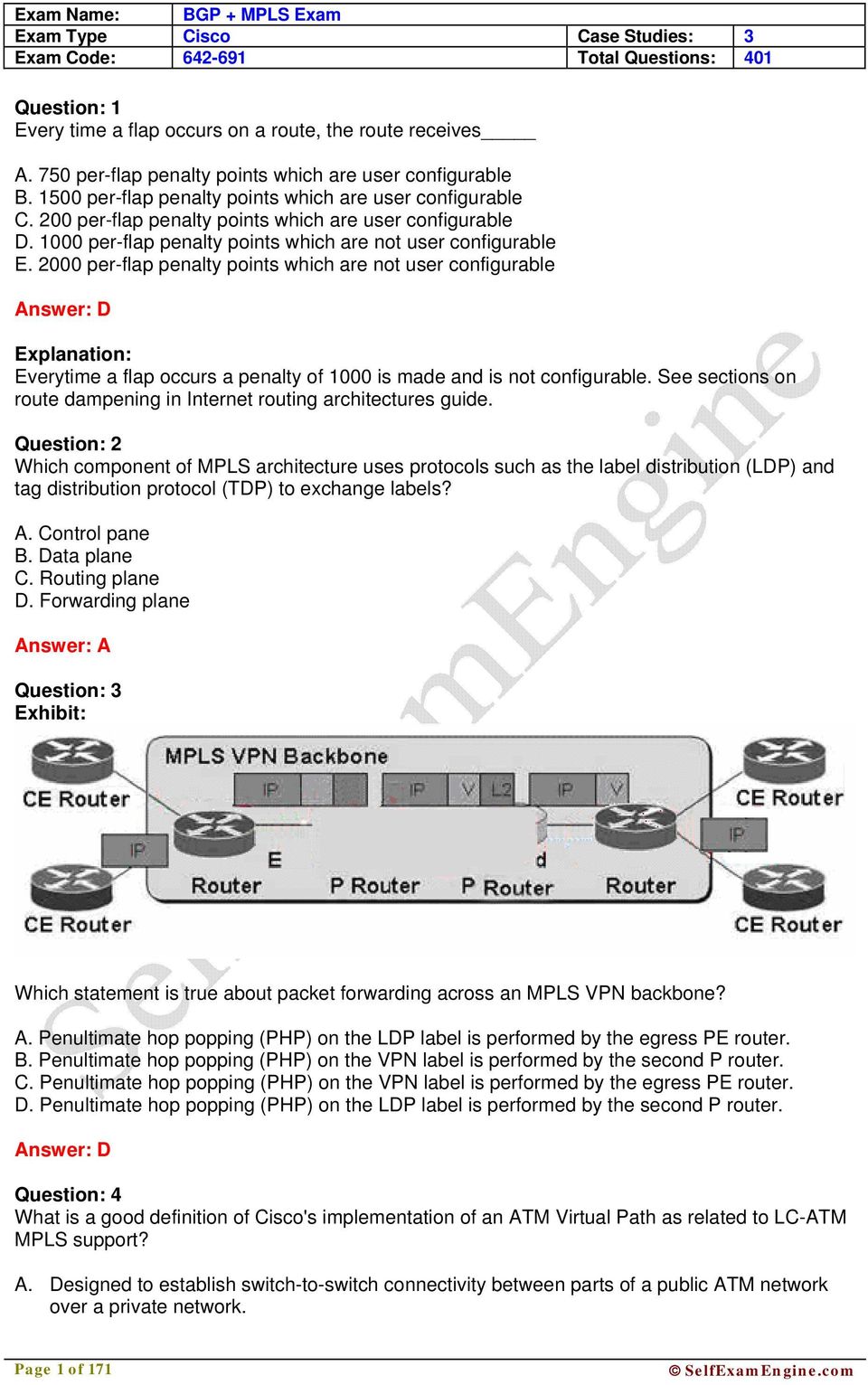
1 Question: 1 Every time a flap occurs on a route, the route receives A. 750 per-flap penalty points which are user configurable B per-flap penalty points which are user configurable C. 200 per-flap penalty points which are user configurable D per-flap penalty points which are not user configurable E per-flap penalty points which are not user configurable Answer: D Everytime a flap occurs a penalty of 1000 is made and is not configurable. See sections on route dampening in Internet routing architectures guide. Question: 2 Which component of MPLS architecture uses protocols such as the label distribution (LDP) and tag distribution protocol (TDP) to exchange labels? A. Control pane B. Data plane C. Routing plane D. Forwarding plane Question: 3 Exhibit: Which statement is true about packet forwarding across an MPLS VPN backbone? A. Penultimate hop popping (PHP) on the LDP label is performed by the egress PE router. B. Penultimate hop popping (PHP) on the VPN label is performed by the second P router. C. Penultimate hop popping (PHP) on the VPN label is performed by the egress PE router. D. Penultimate hop popping (PHP) on the LDP label is performed by the second P router. Answer: D Question: 4 What is a good definition of Cisco's implementation of an ATM Virtual Path as related to LC-ATM MPLS support? A. Designed to establish switch-to-switch connectivity between parts of a public ATM network over a private network. Page 1 of 171
2 B. Designed to establish switch-to-switch connectivity between parts of a private ATM network over a public network. C. Designed to establish router-to-router connectivity between parts of a public ATM network over a public network. D. Designed to establish router-to-router connectivity between parts of a public ATM network over a private network. Answer: B Question: 5 What are two drawbacks when the Internet is accessed through a dedicated subinterface implementation? (Select two.) A. The VRP will leak routes into the global routing table. B. The P router must run both IGP and BGP. C. The PE routers must perform Internet routing D. A limited set of Internet services will be implemented. E. A separate physical link or specific WAN encapsulation is required. Answer: C, E Question: 6 Which three statements are correct regarding Layer 2 overlay VPNs and peer-to-peer VPNs? (Choose three.) A. Peer-to-peer VPNs require the establishment of virtual circuits to connect the different customer sites together. B. Peer-to-peer VPNs require the service provider to participate in the customer routing, accepting customer routes, transporting them across the service provider backbone, and finally propagating them to other customer sites. C. With peer-to-peer VPNs, the service provider is responsible for transport of Layer 2 frames between customer sites, and the customer takes responsibility for all higher layers. D. The implementation of Layer 2 overlay VPNs is the traditional switch-wan model, implemented with technologies like X.25, Frame Relay or ATM. E. With Layer 2 overlay VPNs, the service provider is not aware of customer routing has no information about customer routers. F. It is simple to implement Layer 2 overlay VPNs because the Customer Edge (CE) router just needs a connection to the Service Provider's Edge (PE) router. Answer: B, D, E Question: 7 Exhibit: Page 2 of 171
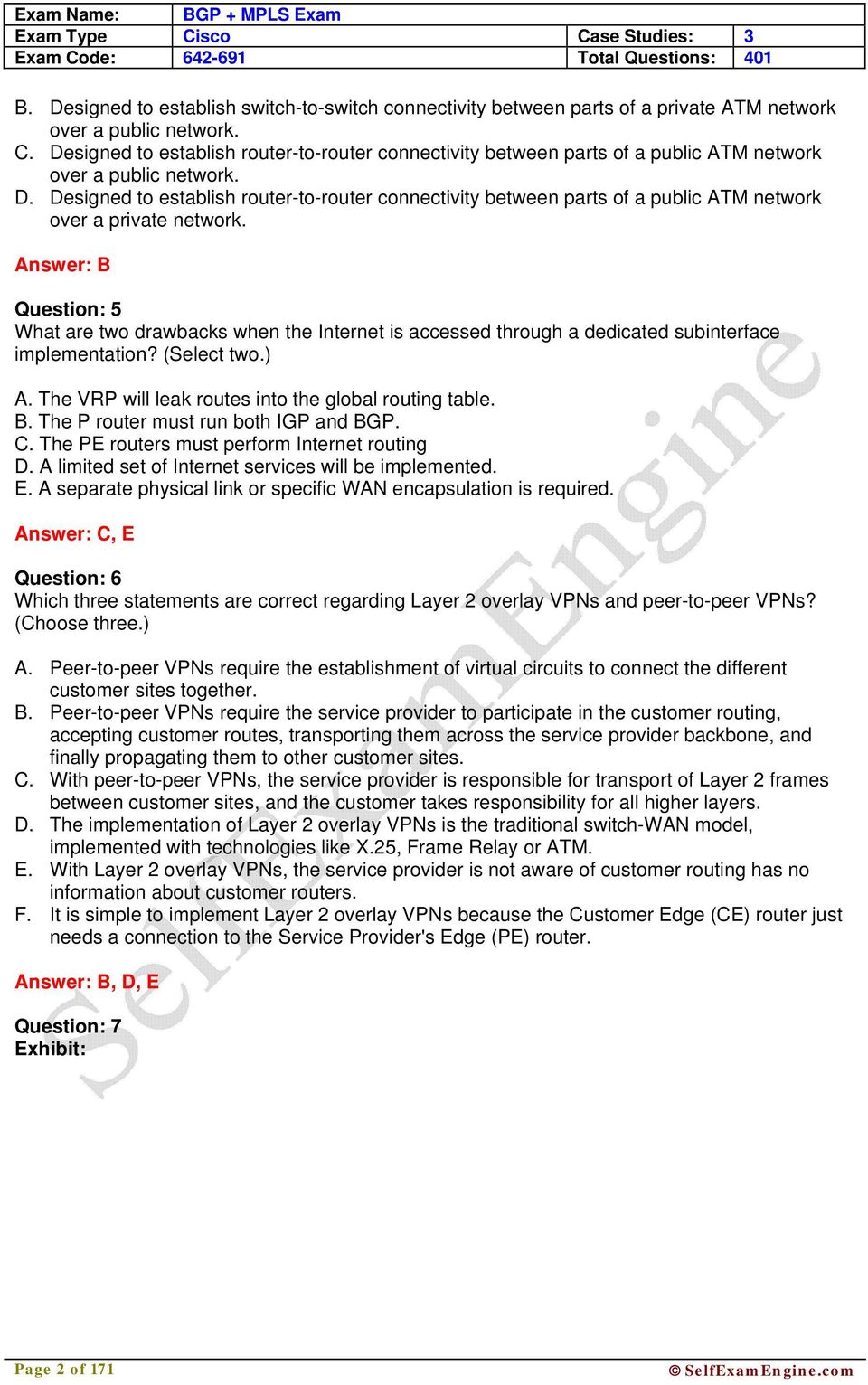
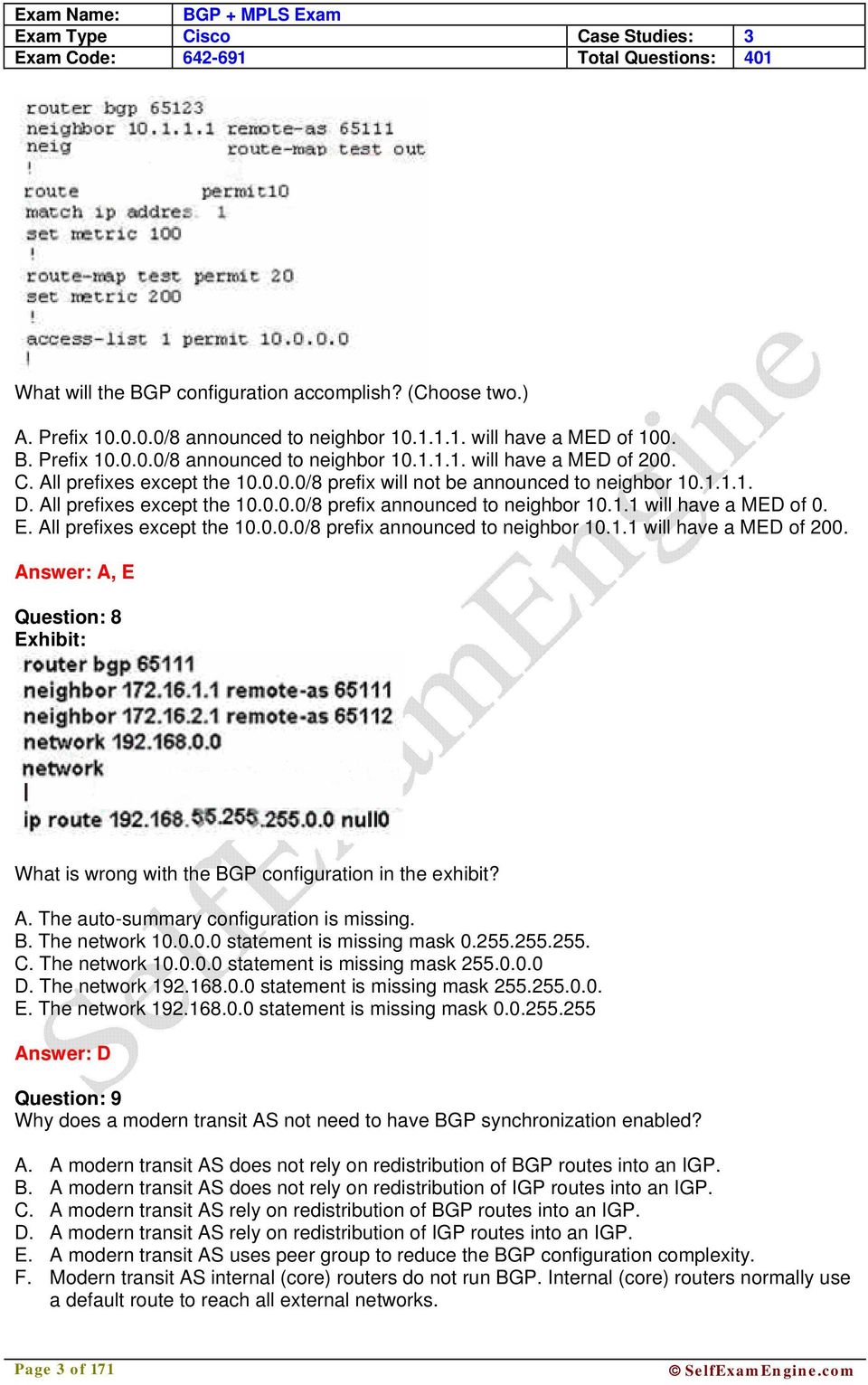
3 What will the BGP configuration accomplish? (Choose two.) A. Prefix /8 announced to neighbor will have a MED of 100. B. Prefix /8 announced to neighbor will have a MED of 200. C. All prefixes except the /8 prefix will not be announced to neighbor D. All prefixes except the /8 prefix announced to neighbor will have a MED of 0. E. All prefixes except the /8 prefix announced to neighbor will have a MED of 200., E Question: 8 Exhibit: What is wrong with the BGP configuration in the exhibit? A. The auto-summary configuration is missing. B. The network statement is missing mask C. The network statement is missing mask D. The network statement is missing mask E. The network statement is missing mask Answer: D Question: 9 Why does a modern transit AS not need to have BGP synchronization enabled? A. A modern transit AS does not rely on redistribution of BGP routes into an IGP. B. A modern transit AS does not rely on redistribution of IGP routes into an IGP. C. A modern transit AS rely on redistribution of BGP routes into an IGP. D. A modern transit AS rely on redistribution of IGP routes into an IGP. E. A modern transit AS uses peer group to reduce the BGP configuration complexity. F. Modern transit AS internal (core) routers do not run BGP. Internal (core) routers normally use a default route to reach all external networks. Page 3 of 171
4 Question: 10 Which of the following are standard filtering-oriented BGP communities? (Choose four.) A. No-export B. No-advertise C. Remote-as D. Local-as E. No-reflect F. Internet, B, D, F Question: 11 Between which types of routers are VPNv4 BGP routes propagated? A. CE and PE B. PE and P C. CE and P D. P and P E. PE and PE F. CE and CE Answer: E Question: 12 In a managed CE router VPN implementation, what information does the service provider need access to on the customer's CE router? A. Access to all customer routes B. Access to all the customer's simple VPN VRF C. Access to the customer's CE router loopback addresses D. Access to the static routes of the customer's CE router Answer: C Question: 13 Network Topology Exhibit Page 4 of 171

5 Company.com is a stock broker service that is using EIGRP AS 1 as the IGP in its network. Company.com has decided to establish connectivity between the New York site and the Los Angeles site. NiceNet, a service provider, has been selected by Company.com to provide the connectivity between the two sites. For this implementation NiceNet is using a MPLS VPN solution. NiceNet has already established MPLS connectivity between all of its PE routers. MPBGP connectivity has also been established on all PE routers. Company.com has successfully completed all necessary tasks on the CE routers, and NiceNet has successfully completed all necessary MPLS VPN configuration tasks on PE12. Your task is to successfully complete the implementation of the VPN connection by configuring the MPLS VPN on PE11 using the following information: Privileged mode password: Company EIGRP is to be used as the PE - CE protocol for the VPN MPBGP is being used to propagate VPN routing information between PE routers. The interface supporting the Company.com is Serial 0/0.101 and will have an IP address of The following has been assigned to Company.com's VPN: Page 5 of 171

6 The VRF_name is Company_22 The RD is 22:10. The route target for import is 21:10. The route target for export is 21:10. Configure EIGRP between CE11A and PE11 using AS number 10. Redistribute from BGP to EIGRP AS 10 using a metric string of Redistribute from EIGRP AS 10 to BGP using metric string of 1. VPN is operational when you see the routes for both the local ( ) and the remote ( ) sites in the VRF routing table. Click on the host computer to start the simulation. Answer: ip cef ip vrf Customer_6 rd 6:10 route-target import 14:10 these lines can be replaced by route-target both 14:10 route-target export 14:10 Interface s0/0 ip vrf forwarding Customer_6 ip address router bgp xx address-family vpnv4 address-family ipv4 vrf Customer_6 neighbor x.x.x.x remote-as xx activate redistribute eigrp metric 1 router eigrp 10 address-family ipv4 vrf Customer_6 network network redistribute BGP XX not enough info in lab sim default-metric Question: 14 Network topology exhibit Page 6 of 171
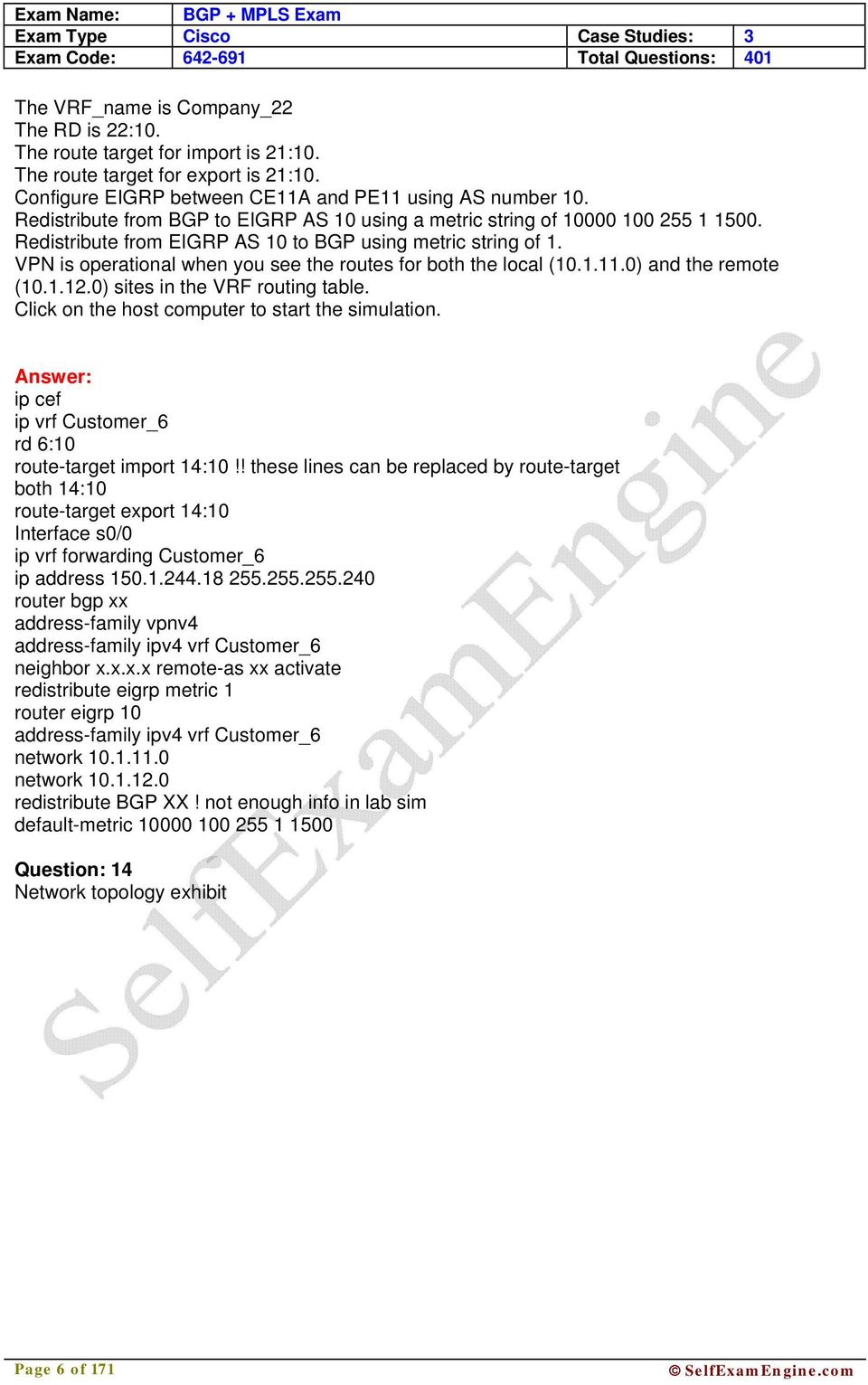
7 Based on the exhibit, what is the correct BGP confederation required on Company4? A. router bgp bgp confederation indentifier bgp confederation peers neighbor remote-as neighbor remote-as neighbor remote-as neighbor remote-as B. router bgp bgp confederation indentifier bgp confederation peers neighbor remote-as neighbor remote-as neighbor remote-as neighbor remote-as C. router bgp bgp confederation peers neighbor remote-as neighbor remote-as neighbor remote-as neighbor remote-as D. router bgp bgp confederation peers neighbor remote-as neighbor remote-as neighbor remote-as neighbor remote-as router bgp % Confed AS number, not the real BGP AS number as seen by real EBGP neighbor Page 7 of 171

8 bgpconfederation identifier % Actual AS number as seen by real EBGP peer. The confederation identifier refers to external AS number neighbor remote-as For B,C and D, they all have the incorrect bgp confederation identifier Question: 15 How would you implement an overlapping VPN when the sites contained in the overlapping portion of two simple VPNs contain an overlapping address space? A. Combine the overlapping VPN with a central service VPN. B. Implement a NAT service to provide unidirectional address translation. C. Implement a dual NAT service with a registered address to be imported and exported between the two central sites. D. Disable routing updates between the overlapping spaces and use a DNS implementation. E. Disable routing updates between the overlapping spaces and use static routing Answer: C Question: 16 What are two characteristics of BGP confederations? (Choose two) A. All routers within the BGP confederation must support BGP confederations. B. The member AS numbers used with the confederation are visible from outside the confederation. C. An Intra-Confederation EBGP session behaves like an EBGP session when propagating routing updates. D. Intra-Confederation EBGP neighbors must be directly connected or ebgp-multihop must be configured., D Question: 17 Network topology exhibit. Page 8 of 171
9 Why would Company2 accept or reject the BGP update from Company13 about the /8 prefix? A. Company2 will reject BGP update to avoid a potential routing loop. B. Company2 will accept the BGP update it is selected as the best path by the BGP route selection process. C. 2 will reject the bgp update because it already has an ospf (igp) route to reach the /8 prefix D. Company2 will accept the BGP update and it will be used as a backup path to reach the /8 prefix if the OSPF (IGP) route is not available. Question: 18 Neighbor maximum-prefix 1000 What is the purpose of the BGP configuration command in the exhibit? A. It limits the number of prefixes that can be sent to neighbor to B. It limits the number of prefixes that can be sent to and received from the neighbor to C. If the number of prefixes sent to the neighbor exceeds 650, the router starts to generate a warning message. D. If the number of prefixes received from the neighbor exceeds 650, the router starts to generate a warning message. E. If the number of prefixes received from the neighbor exceeds 1000, the neighbor relationship to will be dropped. Answer: E Question: 19 Which two statements are true about an EBGP session or an IBGP session? (Choose two.) Page 9 of 171

10 A. IBGP uses AS-Path to detect routing information loops within the AS. B. EBGP routes have a default Admin Distance of 20 and IBGP routes have a default Admin Distance of 200. C. No BGP attributes are changed in EBGP updates except for the next-hop attribute if nexthop-self is configured. D. Routes learned from an EBGP peer not advertised to another EBGP peer to prevent routing information loops. E. IBGP uses split horizon to prevent routing information loops; routes learned from an IBGP peer are not advertised to another IBGP peer. Answer: B, E Question: 20 Network topology exhibit What is the proper configuration on Company2 to support a single BGP session between Company2 and Company3 and to enable load sharing across the two links? A. router bgp neighbor remote-as neighbor remote-as neighbor update-source loopback1 neighbor update-source loopback1 maximum-paths 2 B. router bgp neighbor remote-as neighbor remote-as neighbor ebgp-multihop 2 neighbor ebgp-multihop 2 maximum-paths 2 C. router bgp neighbor remote-as neighbor egbp-multihop 2 neighbor update-source loopback1 ip route ip route Page 10 of 171
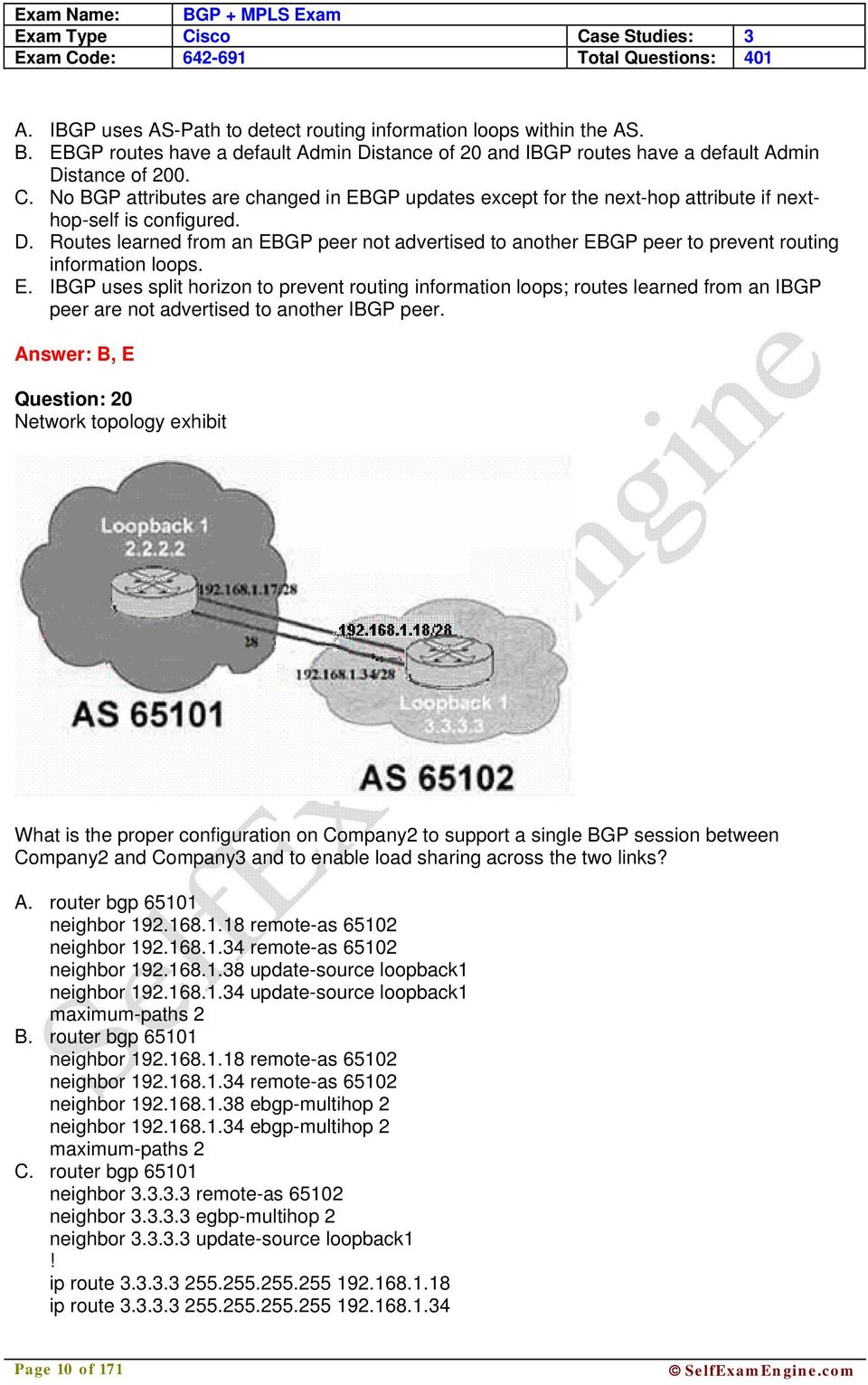
11 D. router bgp neighbor remote-as neighbor update-source loopback1 maximum-paths 2 ip route ip route Answer: C Question: 21 Which statement is true about implementing a hub-and-spoke overlay VPN? A. A hub-and-spoke overlay VPN has no single point of failure B. A spoke site has direct connectivity to other spoke sites. C. If a dynamic routing protocol like RIP is used, split horizon must be disabled at the hub router, or point-to-point sub-interfaces must be used. D. The total number of virtual circuits required to implement a hub-and-spoke overlay VPN is (N(N-1)/2 where N = number of sites. Answer: C Question: 22 What is the most typical use of an overlapping VPN? A. Service providers supporting managed CE Services B. Service providers supporting carrier-over-carrier MPLS implementions C. Simple intranet VPN implementations D. Companies that use MPLS VPNs to implement both intranet and extranet services Answer: D Question: 23 Exhibit: What will the configuration on Company3 accomplish (Choose three.) Page 11 of 171
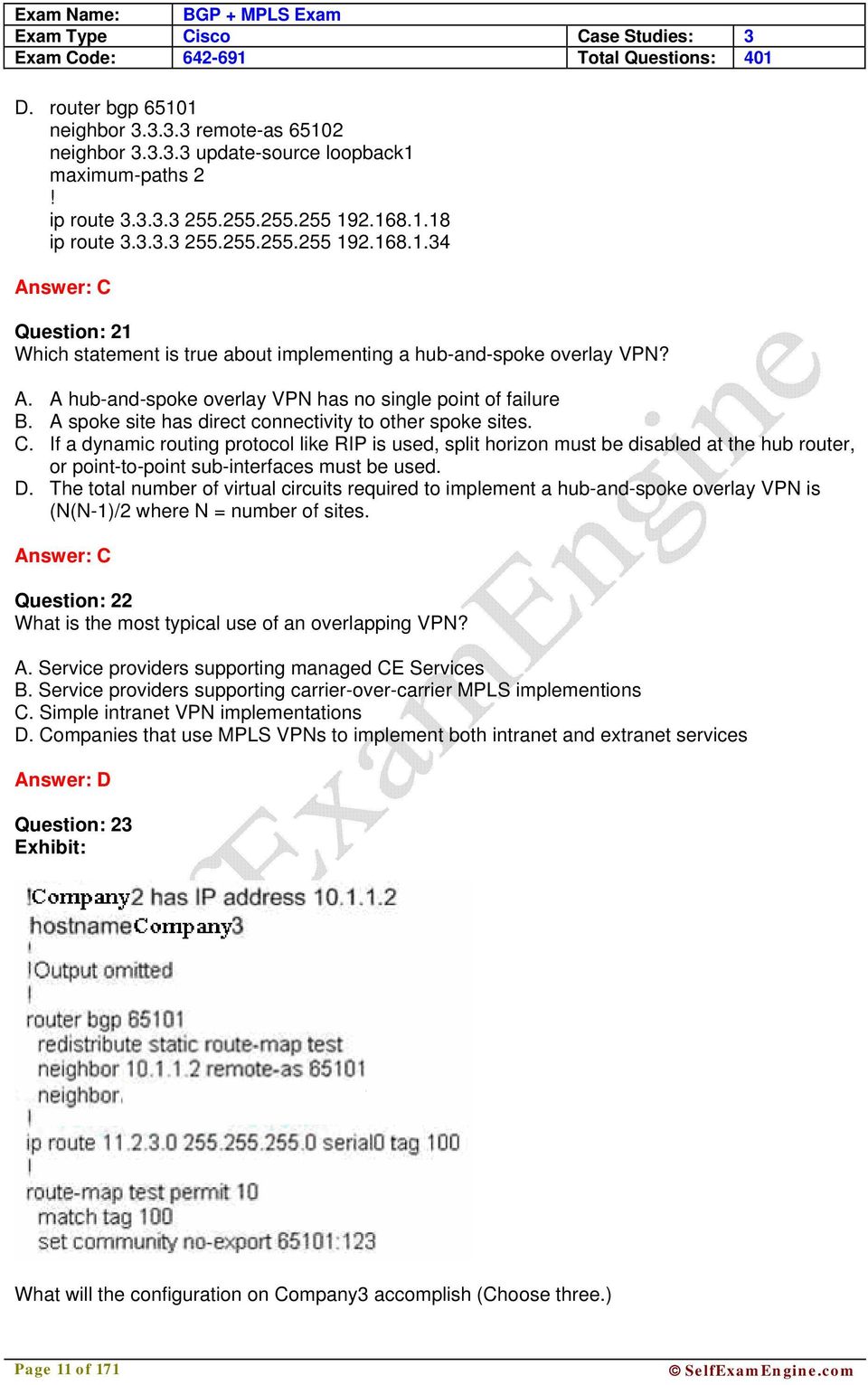
12 A. Company3 will use a static route to reach the customer /24 prefix and tag that static route with a route tag of "100". B. The "no-export" options on the community indicate that the BGP updates should not be sent to any IBGP or EBGP neighbors. C. Company3 will establish an IBGP session with Company2 and Company1 should send BGP community information to Company2 in the IBGP updates. D. All BGP routes learned from Company2 will be tagged with a route tag of 100 and a BGP community number of "65101:123" E. Company1 will redistribute the static route into BGP and use a route-map named "test" to match on route tag "100," then setting the community to "no-export" with a community number of "65101:123"., C, E Question: 24 Which three statements about MPLS VPNs are true? (Choose three.) A. PE routers do not participate in customer routing. B. MPLS VPN is similar to using the peer-to-peer dedicated PE router approach. C. Customer can use overlapping addresses. D. Each customer is assigned an independent routing table (virtual routing and forwarding table - VRF). E. The P Router's routing table contains both the global IP routes and the customer routes. F. CE routers connect directly to the service provider's P routers. Answer: B, C, D Question: 25 What condition must be met for the receiving PE router to install VPNv4 routes into a VRF? A. If at least one RD attached to the VPNv4 route matches at least one import RD configured in the VRF B. If at least one RT attached to the VPNv4 route matches at least one import RT configured in the VRF C. If at least one RD attached to the VPNv4 route matches at least one export RD configured in the VRF D. If at least one RT attached to the VPNv4 route matches at least one export RT configured in the VRF Answer: B Question: 26 Which description is NOT a topology where a central services VPN would be used? A. A service provider offers services to all customers by allowing them access to a common VPN. B. Two or more companies want to exchange information by sharing a common set of servers. C. A security-conscious company separates its departments and allows them to access only to common servers. D. Several interconnected subsidiaries of a company require optimal communication between many sites. Answer: D Question: 27 Page 12 of 171
13 Network topology exhibit What the correct BGP configuration on Company3 and Company2 to have AS prefer the path to AS over the path to AS 65103? A. hostname Company3 router bgp neighbor remote-as neighbor remote-as bgp default local-preference 140 hostname Company2 router bgp neighbor remote-as neighbor remote-as bgp default local-preference 120 B. hostname Company3 router bgp neighbor remote-as neighbor remote-as neighbor local-preference 140 hostname Company2 router bgp neighbor remote-as neighbor remote-as neighbor local-preference 120 Question: 28 Which prefix-list will permit the prefix? A. ip prefix-list test permit /28 B. ip prefix-list test permit /8 le 30 C. ip prefix-list test permit /16 eq 28 D. ip prefix-list test permit /8 ge 29 Page 13 of 171

14 Answer: B Question: 29 Network topology exhibit Company.com recently issued a contract to ISP (AS 65020) to provide a second Internet connection their Boston location. A new router, Company3, will need to be configured to connect to the Internet Service Providers. It is necessary to configure this router to exchange routes with both ISPs, and to filter the routing advertisements out to the ISPs. The basic configuration for the new router has been entered. It is only necessary to complete the BGP configuration steps outlined below. On the Company3 router: Configure BGP to exchange routes with ISP-A (AS 65010). Configure BGP to exchange routes with ISP-B (AS 65020). Only announce the two local Ethernet LAN prefixes ( /24 and /24) to the ISPs. Configure the appropriate as-path access-list to permit only locally originated routes to be advertised in outbound routing updates to the ISPs. Use as-patch ACL number 10 containing only one statement. Start the simulation by clicking on the local host icon. Answer: hostname Company3 interface fastethernet 0/0 ip address no shutdown iterface fastethernet 0/1 ip address no shutdown Page 14 of 171

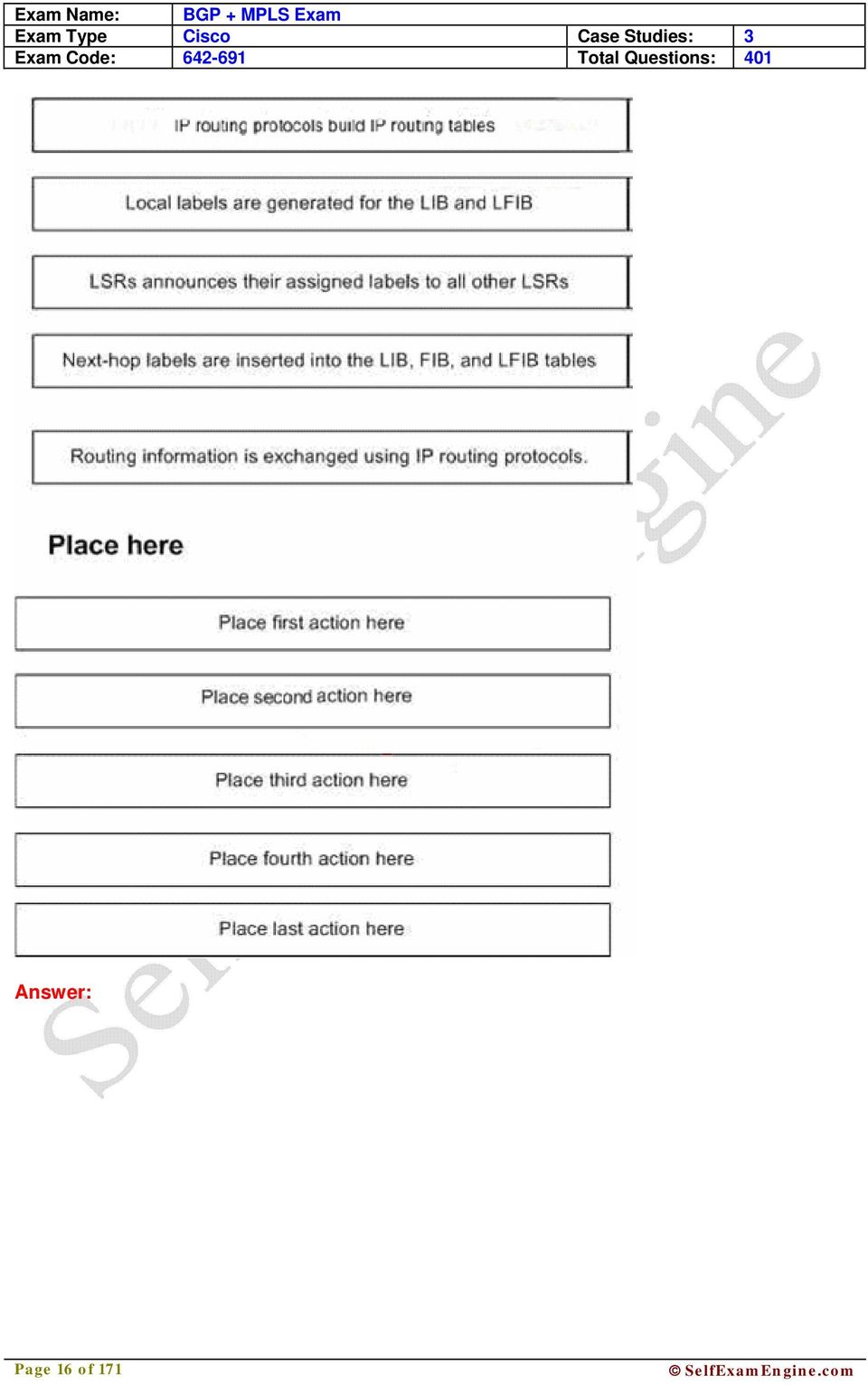
15 router bgp network mask network mask neighbor remote-as neighbor remote-as neighbor filter-list 10 out neighbor filter-list 10 out ip as-path access-list 10 permit ^$ Question: 30 Label allocation and distribution in a frame-mode MPLS network is accomplished by the following actions. While some of the actions do occur periodically in a network, initially some of the these actions require that other actions have already completed. Drag the actions on the left to the boxes on the right in which these actions must initially occur. Page 15 of 171

16 Answer: Page 16 of 171
17 Question: 31 Exhibit, show ip bgp neighbor Output What is causing the BGP session to the neigbor to remain in the Idle state? A. There is an AS number configuration error B. The EBGP-multihop value for neighbor is set to the default value. C. There is an access-list blocking TCP port 179 traffic between the two BGP neighbors. D. The BGP session is using the loopback interface but the update-source is not set to specify the loopback interface. Answer: B Question: 32 Network topology exhibit Page 17 of 171

18 What can prevent the corresponding BGP session from being successfully established? A. Company2 and Company5 cannot establish the IBGP session because Company2 and Company5 are not directly connected. B. Company1 and Company2 establish the EBGP session if the BGP holddown timers between the two EBGP neighbors are different. C. Company2 and Company5 cannot establish the IBGP session using the loopback0 interface if the EBGP-multihop value is set to the default value. D. Company1 and Company2 cannot establish the EBGP session using the loopback0 interface if the EBGP-multihop value is set to the default value. Answer: D Question: 33 Exhibit #1, BGP configuration Exhibit #2, Network Topology Page 18 of 171
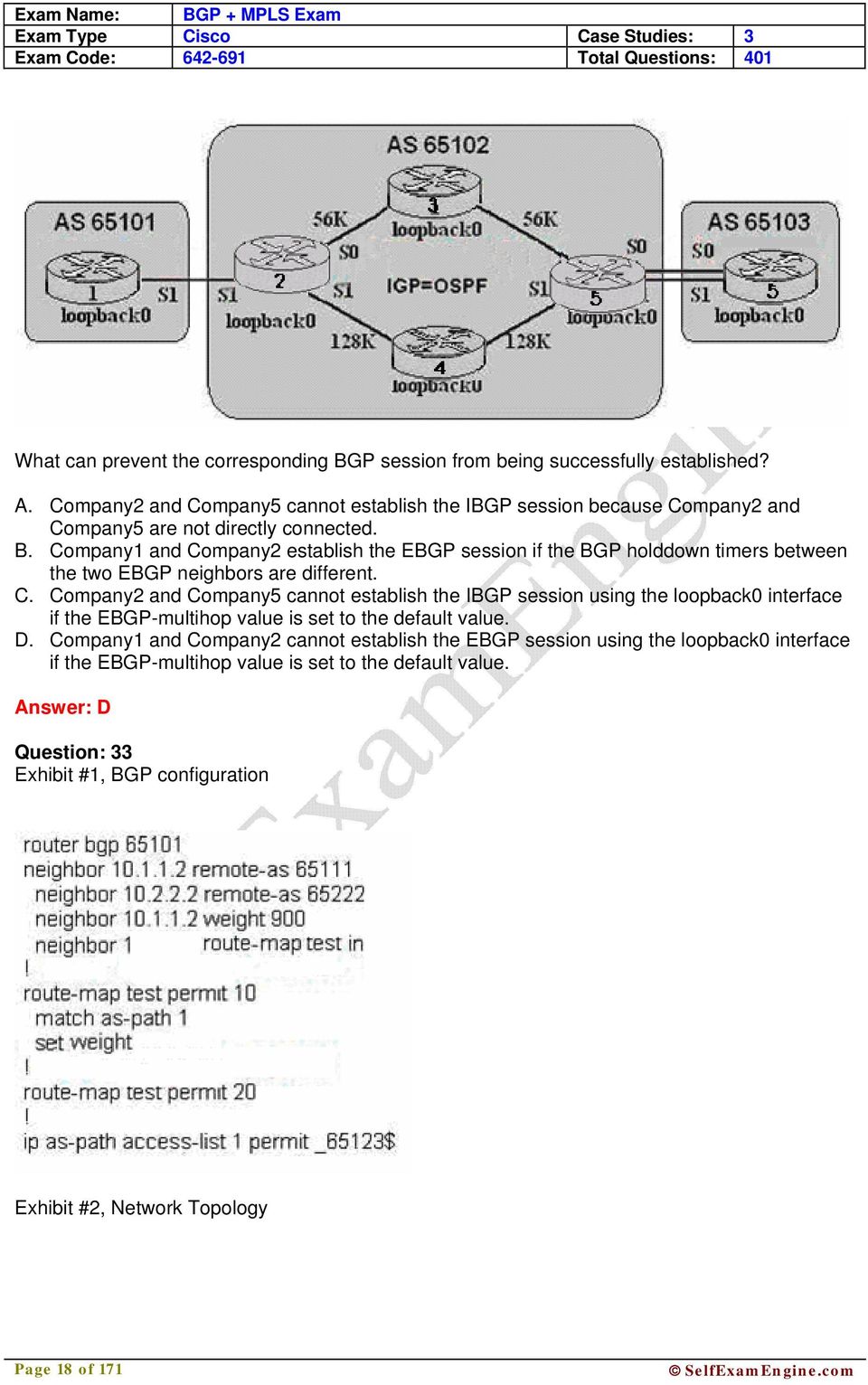
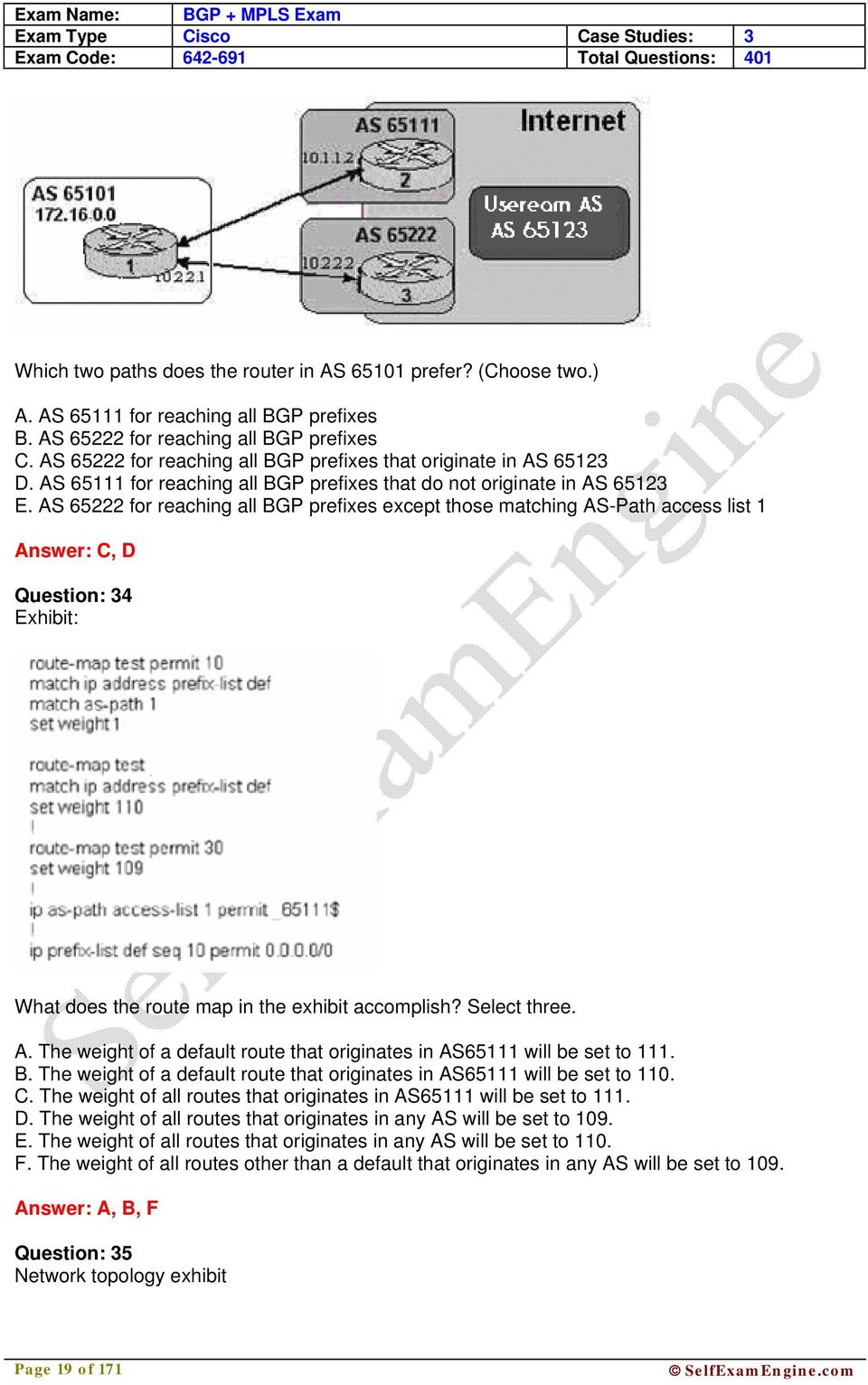
19 Which two paths does the router in AS prefer? (Choose two.) A. AS for reaching all BGP prefixes B. AS for reaching all BGP prefixes C. AS for reaching all BGP prefixes that originate in AS D. AS for reaching all BGP prefixes that do not originate in AS E. AS for reaching all BGP prefixes except those matching AS-Path access list 1 Answer: C, D Question: 34 Exhibit: What does the route map in the exhibit accomplish? Select three. A. The weight of a default route that originates in AS65111 will be set to 111. B. The weight of a default route that originates in AS65111 will be set to 110. C. The weight of all routes that originates in AS65111 will be set to 111. D. The weight of all routes that originates in any AS will be set to 109. E. The weight of all routes that originates in any AS will be set to 110. F. The weight of all routes other than a default that originates in any AS will be set to 109., B, F Question: 35 Network topology exhibit Page 19 of 171
20 Exhibit #2 Which two configuration commands will complete the configuration on Company1 so that when Company1 send the BGP updates to Company4, three copies of the customer's AS number (65103) willb e prepended to the AS-Paht? (Choose two) A. Set as-path prepend 3 B. Set as-path tag C. Neighbor route-map test in D. Neighbor route-map test out E. Set as-path prepend Answer: D, E Question: 36 By default, which BGP path attribute is stripped in the outgoing IBGP updates? A. Origin B. AS-path C. Next Hop D. Communities E. Local Preference Answer: D Community is stripped in outgoing BGP updates. by default is no_export Note: Key to answer is IBGP Page 20 of 171

21 Wrong Answer 1. A Well known mandatory (No stripped) 2. B Well known mandatory (No stripped) 3. C Well known mandatory (No stripped) 4. E Local Preference is local to AS, because this is IBGP it is propagated through the AS Question: 37 Network topology Exhibit How should the EBGP session between Company1 and Company2 be established to enable load balancing? (Choose three.) A. Use the maximum-paths 2 option B. Use the ebgp-multihop 2 option C. Use static routes on Company1 and Company2 to reach the other router's loopback D. Establish a single EBGP session using the loopback0 interface IP address on Company1 and Company2 E. Establish two EBGP sessions using both the S0 and D1 interface IP address on Company1 and Company2 Answer: B, C, D 1. B R1 - R2 requires a EBGP ebgp-multihop of C Requires two static routes going to each other router loopback interface 3. D A BGP session of course is required. Only a single connection is required. Use the loopback is what allows things to work even during a failure Wrong Answer 1. A This is not required because there is only on EBGP path. Would need two if static routes were not define and were going between different routers 2. E Not an efficient way of doing things requires double the tables and bandwidth for updates Question: 38 Network topology Exhibit Page 21 of 171
22 Exhibit #2, Requirements How many VRF tables are needed to support three VPNs (Customer A, Customer B, and a VoIP VPN) wit the requirements? A. 1 VRF B. 3 VRFs C. 4 VRFs D. 5 VRFs E. 7 VRFs Answer: D Question: 39 Network topology Exhibit Page 22 of 171
23 The relevant entries in the FIB, LIB, and LFIB tables for a frame-mode MPLS network is shown. If the link between Routers B and C was lost, what would be the relevant entries in the LFIB table for label, action, and next hop? A. 89, 71, Company5 B. 71, 89, Company5 C. 89,23, Company4 D. 71,23, Company4 Question: 40 Which well-known tunneling technology provides network layer authentication and optional encryption to make data transfer over the Internet secure? A. Layer 2 tunneling B. GRE C. IPSec D. Peer-to-peer E. Layer 2 forwarding Answer: C Question: 41 Since route distinguishers (RD) can not identify participation in more than one VPN, what is required to support complex MPLS VPNs? A. Route target (RT) B. Route tags C. Route maps D. Dedicated PE routers E. Site of origin (SOO) Page 23 of 171
24 Question: 42 When using BGP to carry external routes, what is the ideal interaction between BGP and IGP running within a Transit AS? A. The external routes should be redistributed into an IGP. B. The IGP should carry the routes to reach the BGP next-hops and the core subnets within the AS. C. The IGP should carry the core subnets within the AS. Then a mutual redistribution between BGP and the IGP should be performed. D. The external routes should be redistributed into a Link-State IGP (like OSPF or IS-IS) with filtering to reduce the size of the Link-State database. Answer: B Question: 43 What are the three main BGP scaling issues for service providers? (Choose three.) A. BGP policy scaling issues B. IBGP full mesh scaling issues C. BGP to IGP redistribution scaling issue D. BGP updates and BGP table size scaling issues, B, D Question: 44 Which four attributes are used by BGP to detect routing loops? (Choose four.) A. AS.Path B. Cluster ID C. Cluster List D. Originator ID E. Community ID, B, C, D Question: 45 What is the difference between a managed CE router VPN and a central services VPN? A. In a managed CE router VPN, only customer loopback addresses are marked to be imported into the network management VPN. B. In a managed CE router VPN, only default customer routes are marked to be imported into the network management VPN. C. In a managed CE router VPN, all customer routes are marked to be imported into the network management VPN. D. In a managed CE router VPN, only customer loopback addresses and default customer routes are marked to be imported into the network management VPN. Question: 46 Page 24 of 171
25 Answer: Question: 47 Which three statements are true about route reflectors? (Choose three.) A. If the route is learned from an EBGP peer by the route reflector, it is reflected to all IBGP and EBGP peers. B. If the route is learned from a non-client IBGP peer by the route reflector, it is reflected to all EBGP peers only. Page 25 of 171
26 C. If the route is learned from a non-client IBGP peer by the route reflector, it is reflected to EBGP peers and clients only. D. If the route is learned from a client IBGP peer by the route reflector, it is reflected to all clients only, except the originating client. E. If the route is learned from a client IBGP peer by the route reflector, it is reflected to all EBGP peers, non-clients, and clients (except the originating client)., C, E 1. A routes update to EBGP peers and clients 2. C routes update to non-clients and clients 3. E route updates to all except if originator Wrong 1. B route are sent to clients 2. D routes updates are sent to non clients and EBGP peers Question: 48 Network Topology Exhibit What problem can be caused by the second P router summarizing the loop address of the egress PE router? A. The first P router will be faced with a VPN label which it does not understand. B. The second P router will be faced with a VPN label which it does not understand. C. The egress PE router will not be able to establish a label switch path (LSP) to the ingress PE router. D. A label switch path (LSP) will be established from the ingress PE router to the egress PE router, an event that is not desirable. E. The ingress PE router will not be able to receive the VPN label the egress PE router via MP- IBGP. Page 26 of 171
27 Answer: B Question: 49 In cell-mode MPLS, where is the label imposed? A. Between Layer 1 and Layer 2 headers. B. Between Layer 2 and Layer 3 headers. C. In the VPI/VCI fields D. In the VPI field alone Answer: C Question: 50 Network Topology Exhibit AS-Path prepending is used AS1 in order to influence the return traffic path from AS 5 to AS 1 through the higher speed via AS 2. needs to be configured for AS-Path prepending and a minimum of of the AS number should be prepended. A. Company1; one copy B. Company2; one copy C. Company1; two copies D. Company2; two copies E. Company2; three copies Answer: C Question: 51 Which one of the following is used to prevent routing loops in MPLS VNP networks with multihomed sites? A. RT B. SOO C. RD D. AS-Path E. MPLS Label F. MED Page 27 of 171
28 Answer: B Question: 52 In a multihomed environment with two ISP connections, which two statements are true? (Choose two.) A. The customer should not be configured to act as a transit AS between the two ISPs. B. It is recommend that the multi-homed customer use a registered (public) AS number. C. AS-Path prepending can be configured on the customer's edge router to influence the BGP path selection process for the outbound traffic (traffic from the customer to the ISPs). D. The customer can use Local Proference on the customer's edge routers to influence the BGP path selection process for the inbound traffic (traffic from the ISPs to the customer). E. The advertisement of the customer's IP address space be condiditoned by the customer's edge routers by using a static route to the null0 interface and by using the proper network statement under router bgp., B Question: 53 Network topology exhibit; Internet Access through a Dedicated Sub interface Internet access is through a dedicated subinterface implementation. Which of its routing tables will PE-2 use to forward packets from Site2 to Site 1? A. the global routing table B. the VPNv4 routing table C. the VRF A routing table D. the VRF A FIB E. the PE-IG routing table Page 28 of 171
29 Question: 54 Network topology exhibit Liberal label retention and unsolicited downstream distribution is being used in the frame-mode MPLS network shown in the exhibit. The best to network X as defined by the IGP for network is Company1-Company2-Company4-Company5. What will Router Company3 and rout A. Both routers will add it to their LIB. B. Both routers will ignore it. C. Router Company3 will add the label to its LIB. Router Company4 will ignore it. D. Router Company4 will add the label to its LIB. Router Company3 will ignore it. Question: 55 Exhibit: Which two statements are true? (Choose two). A. Company1 has accepted 20 prefixes from the IBGP neighbor. B. Company1 generated a warning message to the router's console after the IBGP neighbor sent 16 prefixes to Company1. Page 29 of 171
30 C. Company1 generated a warning message to the router's console after the IBGP neighbor sent 15 prefixes to Company1. D. Company1 will drop its neighbor relationship to the IBGP neighbor if sends two more additional prefixes to Company1. E. Company1 will drop its neighbor relationship to the IBGP neighbor if sends three more additional prefixes to Company1. Answer: B, E Question: 56 What is the main advantage of the BGP Route Refresh capability as compared to the "BGP soft-reconfiguration in" option? A. Route Refresh is not Cisco proprietary. B. Route Refresh does not require additional memory. C. Route Refresh does not require the BGP session to be taken down. D. Route Refresh allows BGP routers to automatically send out new BGP updates. Answer: B Question: 57 With MPLS VPNs, which four elements will be included in an MP-BGP update exchange between the PE outers? (Choose four.) A. VPNv4 Address B. Route tag C. Label used for VPN packet forwarding D. Mandatory BGP attributes like As-Path and Next-Hop E. Route target F. Implicit null label used for PHP operation, C, D, E Question: 58 What is true of MPLS TE? A. Only the ingress LSR must see the entire topology of the network. B. Every LSR needs additional information about links in the network, available resources, and constraints. C. Every core router must be able to create an LSP tunnel on demand. D. Both RSVP and CR-LDP are used in conjunction to establish traffic engineering (TE) tunnels and to propagate the labels. Answer: B Question: 59 Network Topology Exhibit Page 30 of 171
31 Exhibit #2: Company2 configuration When Company2 sends the TCP SYN packet to Company3 to establish the IBGP session, what will be the source IP address of the TCP SYN packet from Company2 to Company3? A B C D Answer: C Question: 60 Exhibit, Output Page 31 of 171
32 Which prefix-list can be used to permit only the /22 and the /22 prefixes? A. ip prefix-list test permit /19 le 22 B. ip prefix-list test permit /16 C. ip prefix-list test permit /22 D. ip prefix-list test permit /8 ge 22 E. ip prefix-list test permit /20 le 22 Question: 61 What is the VPN type where sites of two different companies are connected together via Frame Relay virtual circuits? A. overlay intranet VPN B. overlay extranet VPN C. peer-to-peer access VPN D. peer-to-peer Internet VPN E. MPLS simple VPN F. MPLS overlapping VPN Answer: B Question: 62 What is the range of values from which an ISP can assign a private AS number? A to B to C to D to Answer: B Question: 63 Page 32 of 171
33 Exhibit : What is the correct BGP configuration on ES1 and ES2 to have AS prefer the path to ES1 over the path to ES2 to reach AS 65001? (Influence the path selection decision by using the MED attribute) A. hostname ES1 router bgp neighbor remote-as neighbor route-map setmed route-map setmed permit 10 set metric 100 hostname ES2 router bgp neighbor remote-as neighbor route-map setmed route-map setmed permit 10 set metric 200 B. hostname ES1 router bgp neighbor remote-as neighbor route-map setmed out route-map setmed permit 10 set metric 100 hostname ES2 router bgp neighbor remote-as neighbor route-map setmed out route-map setmed permit 10 set metric 200 C. hostname ES1 router bgp neighbor remote-as neighbor route-map setmed in Page 33 of 171
34 route-map setmed permit 10 set metric 100 hostname ES2 router bgp neighbor remote-as neighbor route-map setmed in route-map setmed permit 10 set metric 200 D. hostname ES1 router bgp neighbor remote-as neighbor route-map setmed in route-map setmend permit 10 set metric 200 hostname ES2 router bgp neighbor remote-as neighbor route-map setmed in route-map setmed permit 10 set metric 100 Answer: B Question: 64 Which type of VPN implementation is simple and cost effective because all sites connect only to the PE router and as a result optimum routing between sites is enabled by default? A. peer-to-peer VPN B. overlapping VPN C. hub-and-spoke overlay VPN D. fully-meshed overlap VPN E. client-server VPN Question: 65 Exhibit: Page 34 of 171
35 What can prevent the corresponding BGP session from being successfully established? A. ES2 and ES5 cannot establish the IBGP session if the BGP Hello Timer between the two IBGP neighbors is different. B. ES1 and ES2 cannot establish the EBGP session if the BGP Hello Timer between the two EBGP neighbors are different. C. ES1 and ES2 cannot establish the EBGP session using the loopback0 interface if the EBGPmutlihop value is set to 2. D. ES2 and ES5 cannot establish the IBGP session because they are not using the loopback0 interface to establish the IBGP session. E. ES2 and ES5 cannot establish the IBGP session if ES3 and ES4 have an access list permitting only TCP port 80 and IP protocol number 89 traffic. Answer: E Question: 66 What is true about the label in frame-mode MPLS? A. 32 bit label with an 8 bit label field. B. 32 bit label with a 20 bit label field. C. 20 bit label with a 3 bit Bottom of Stack field. D. 20 bit label with a 1 bit TTL field. Answer: B Question: 67 Which routers in an MPLS VPN service provider's network are used to connect to the customer's routers? A. P routers B. CE routers C. PE routers D. P and PE routers Answer: C Question: 68 Which three statements are true about a Cluster-ID? (Choose three) A. A Cluster-ID configuration is only required on the route reflectors. B. The Cluster-ID is the router ID of the originator of a route within the local AS. Page 35 of 171
36 C. Cluster-List is used to track Cluster IDs similar to the way that the AS-PATH is used to track AS numbers. D. When a cluster contains multiple route reflectors, all the route reflectors in the cluster need to be configured with the same Cluster-ID., C, D Question: 69 In reference to BGP route flap dampening feature, when will the penalty and the flap history of a route clear? A. When the penalty associated with a route reaches the reuse limit. B. When a route is in the history state for longer than the half-time limit. C. When the penalty associated with a route reaches the suppress limit. D. When a route in the suppressed state for longer then the half-time limit. E. When the penalty associated with a route drops below half the reuse limit. Answer: E Question: 70 Exhibit: What is the limitation of BGP? A. AS cannot use BGP to connect to AS B. AS cannot use MED to influence the return traffic from AS C. AS cannot influence how AS will route traffic out to AS D. AS cannot load balance the traffic to AS via AS and AS E. Since AS 65102, 65103, and AS are Transit AS, they must enable synchronization. Answer: C Question: 71 Which prefix-list statement can be used to deny all Class C Private IP addresses? A. ip prefix-list blkc seq 5 deny Page 36 of 171
37 B. ip prefix-list blkc seq 5 deny /24 C. ip prefix-list blkc seq 5 deny /32 le 32 D. ip prefix-list blkc seq 5 deny /16 le 32 Answer: D Question: 72 Which MPLS VPN implementation allows selected sites in one simple VPN to communicate with selected sites of a second VPN? A. central services VPN B. managed CE router services VPN C. overlapping VPN D. managed PE router services VPN Answer: C Question: 73 In a Transit AS, how do the internal routers within the Transit AS forward packets destined for the external networks using a scalable solution? A. Using the default route. B. Using the IGP routes where the external networks are redistributed into the IGP by the edge routers. C. Using the EBGP routes where the external networks are redistributed into the IBGP by the edge routers. D. Using the IBGP routes, then using recursive lookup based on IGP information to resolve the BGP next-hop. Answer: D Question: 74 Which BGP dampening configuration parameter is not configurable by the user? A. half-time B. reuse-limit C. max-suppress D. suppress-limit E. per-flap-penalty Answer: E Question: 75 In a central services topology, which routes do client VRFs contain? A. Routes from the client site, but not from the server site. B. Routes from the server site, but not from the client site. C. Routes from both the client site and the server site. D. Only EBGP routes from either the client site or the server site. Answer: C Question: 76 Page 37 of 171
38 In reference to the diagram depicting the flow of routing updates in an overlapping VPN, which statement is true? A. Sites A1 and A2 will import all networks with RTs 123:750 and 123:1000. B. Sites B1 and B2 will export all networks with RTs 123:760 and 123:1000. C. Sites A1 and A2 communicate with Sites B1 and B2 via A-Central and B-Central. D. Site A-Central exports RTs 123:750 and 123:1000. E. Site B-Central is exporting and importing RT 123:1000 so it can communicate with sites A1 and A2. Answer: D Question: 77 Which prefix will be permitted by the following prefix-list? ip prefix-list test permit /16 le 22 A B C D E Answer: B Question: 78 Which component of MPLS architecture exchanges Layer 3 routing information and labels? A. control plane B. data plane C. forwarding plane D. routing plane Page 38 of 171
39 Question: 79 In the diagram, the Internet is accessed through a dedicated Internet VPN implementation. Which routing table will PE-IG use to forward packets from the Internet to Site-2? A. Global routing table B. VPNv4 routing table C. VRF A routing table D. VRF Internet routing table Answer: D Question: 80 What is the main reason for a multihomed customer to apply an outbound route filter to filter the BGP updates from the customer router to the service provider router? A. To ensure that the return traffic into the customer network will be load balanced between the different service providers. B. To ensure that the outbound traffic from the customer network will be load balanced between the different service providers. C. To prevent the customer network from becoming a transit AS. D. To allow the customer network to become a transit AS. E. To reduce the size of the BGP table on the customer network internal (core) routers. F. To reduce the size of the BGP table on the service provider internal (core) routers. Page 39 of 171
40 Answer: C Question: 81 With MPLS VPNs, what is prepended to an IPv4 address to make it globally unique? A. route target (RT) B. route distinguisher (RD) C. VPNv4 header D. Site of origin (SOO) prefix E. Route tag Answer: B Question: 82 By default, which BGP attribute is stripped in outgoing IBGP updates? A. next-hop B. as-path C. community D. local-preference E. origin Answer: C Question: 83 Based on the following show ip bgp neighbor output, what is the neighbor relationship? ES1#show ip bgp neighbor BGP neighbor is , remote AS 65002, external link Index 2, Offset 0, Mask 0x4 BGP version 4, remote router ID Neighbor under common administration BGP state = Established, table version = 5, up for 00:09:15 Last read 00:00:16, hold time is 180, keepalive interval is 60 seconds Minimum time between advertisement runs is 30 seconds Received 13 messages, 0 notifications, 0 in queue Sent 13 messages, 0 notifications, 0 in queue Prefix advertised 1, suppressed 0, withdrawn 0 Connections established 1; dropped 0 Last reset never 1 accepted prefixes consume 32 bytes 0 history paths consume 0 bytes External BGP neighbor may be up to 255 hops away A. Neighbor is a regular EBGP neighbor. B. Neighbor is am Intra-Confederation IBGP neighbor. C. Neighbor is an Intra-Confederation EBGP neighbor. D. Neighbor is an IBGP neighbor that belongs to the same AS as ES1. E. Neighbor is an IBGP neighbor that belongs to the same Member As ES1. Answer: C Question: 84 Which kind of link does a Layer 3 overlay VPN use? Page 40 of 171
41 A. emulated point-to-point B. dedicated point-to-point C. point-to-multipoint D. permanent virtual circuits Question: 85 Exhibit: Complete the following BGP configuration on ES5 so that it will remove the private AS number before it sends the /16 update to AS 200. Hostname ES5 Output omitted router bgp 300 neighbor remote-as 300 neighbor remote-as 300 neighbor remote-as A. neighbor allowas-out B. neighbor local-as 300 C. neighbor remove-private-as D. neighbor remove-private-out E. neighbor as-prepend private-as Answer: C Question: 86 Exhibit: Page 41 of 171
42 You work as a network administrator at Company.com. Study the exhibit carefully. Which two other BGP router commands are required on Company1 and Company or on both so that Company2 can upload the input prefix-list named testing to Company1 to be used as an output filter? Select two. A. On Company1, user the neighbor capability orf prefix-list receive command. B. On Company1, use the neighbor capability orf prefix-list send command. C. On Company1, user the neighbor prefix-list testing out command. D. On Company2, user the neighbor capability orf prefix-list receive command. E. On Company2, use the neighbor capability orf prefix-list send command. F. On Company3, user the neighbor prefix-list testing out command., E Question: 87 Which two statements are true regarding the BGP network configuration command? (Choose two) A. When using the "network ip-prefix" BGP configuration command to advertise a major network into BGP, at least one of the subnets of the major-network must be present in the BGP table. B. When using the "network ip-prefix mask subnet-mask" BGP configuration command to advertise a classless prefix into BGP, the prefix must have an exact match in the IP routing table. C. When using the "network ip-prefix" BGP configuration command to advertise a major network into BGP, at least one of the subnets of the major-network must be present in the IP routing table. D. When using the "network ip-prefix mask subnet-mask" BGP configuration command to advertise a classless prefix into BGP, the prefix will be announced only if there is at least one network in the specified range in the IP routing table. Answer: B, C Question: 88 In the case of Internet access through a dedicated sub-interface implementation, which routing table will PE-2 use to forward packets from Site-2 to the Internet? A. Global routing table B. VPNv4 routing table C. VRF A routing table D. CE-2 routing table Page 42 of 171
43 E. PE-IG routing table Question: 89 Which BGP path attribute is only used within the local router and NOT shared between all the BGP routers within the AS? A. MED B. Origin C. Weight D. Local Preference Answer: C Question: 90 Which two statements regarding route reflectors are true? (Choose two) A. A non-route reflector capable router cannot be a client. B. A hierarchical route reflector design is where a route reflector client is not directly connected to the route reflector. C. If a client has IBGP sessions to other clients in the same cluster, those clients will receive unnecessary duplicated BGP updates. D. If a client in one cluster has an IBGP session to a route reflector that belongs to different clusters, the clients in the other cluster will receive unnecessary duplicated BGP updates. Answer: C, D Question: 91 What is wrong with the following BGP configuration? interface loopback0 ip address interface s0 ip address interface e1 ip address interface e2 ip address router bgp neighbor remote-as neighbor remote-as neighbor update-source loopback0 network mask no auto-summary router eigrp 100 network network Page 43 of 171
44 A. The network mask statement is wrong. B. The auto-summary configuration statement is missing under router bgp C. The neighbor ebgp-multihop 2 configuration statement is missing under router bgp D. The neighbor ebgp-multihop 2 configuration statement is missing under router bgp E. The neighbor remote-as and the neighbor update-source loopback0 configuration statements should be changed to neighbor remote-as and neighbor update-source loopback0. F. The loopback0 interface IP address should be Question: 92 Exhibit: Given the following: router bgp bgp confederation identifier neighbor remote-as neighbor remote-as neighbor remote-as neighbor remote-as Based on the topology shown in the exhibit, what is the missing configuration statement required on ES4 to complete the BGP confederation configuration? A. bgp confederation peers B. bgp confederation peers C. bgp confederation peers D. bgp confederation peers E. bgp confederation peers Page 44 of 171
45 Question: 93 Which of the following statements about the BGP MED path attribute on Cisco routers is correct? A. If the MED is not attached to a BGP route, it defaults to 0 (best). B. By default, MED can be considered for routers coming from different autonomous systems. C. By default, MED can be considered for routers coming from different intrafederation autonomous systems. D. The bgp deterministic-med command is used to ensure that an accurate MED comparison is made across all routes received from different autonomous systems. E. The bgp deterministic-med command is used to allow the MED to determine the BGP path selection over the other BGP attributes. F. The bgp deterministic-med command is used to ensure that an accurate MED comparison is made across all routes received from the same autonomous system. Question: 94 Which of the following errors is the most common when configuring BGP routers within a transit AS? A. using BGP next-hop-self on the edge routers B. BGP to IGP redistribution errors C. IGP to BGP redistribution errors D. BGP synchronization enabled E. ebgp and ibgp administrative distance configuration errors Answer: D Question: 95 Exhibit: Company3(config-router)#neigbor maximum-prefix warning-only What does the command displayed in the exhibit accomplish? A. It prevents the neighbor from exhausting the memory of the Company3 router. B. It limits the number of BGP Update messages the Company3 router will send to the BGP peer. C. It logs a warning message on the Company3 router if the Company3 router BGP contains more than 100 prefixes. D. It logs a warning message on the Company3 router if the Company3 router BGP table is 80% full. E. It resets the BGP session to the BGP peer of the Company3 router BGP table contains more than 100 prefixes. F. It resets the BGP session to the BGP peer of the Company3 router BGP table is 80% full. Question: 96 Exhibit: Case Study 2, BGP (111 questions) Page 45 of 171
46 There is no direct physical connectivity between Company3 and Company5. The Transit AS is only running partial-meshed IBGP between Company3 and Company5 and is using OSPF as its IGP. Both Company3 and Company5 are using the next-hop-self options. The external BGP routes are not being redistributed into OSPF. BGP synchronization is disabled. What happens to the packet from AS to AS 65103? A. Packets will be black-holed because it will be dropped by Company4. B. Packets will be black-holed because it will be dropped by Company5. C. Packets will be black-holed because it will be dropped by Company6. D. Packets can be transported via the Transit AS without any problems. Answer: C Even with synchronization off testing 6 does not know how to route the packet because OSPF does not know about the route that BGP knows about. Synchronization being off assumes that there is a full mesh of BGP routers. Question: 97 Identify the most appropriate method to connect the customers to the ISPs, to interconnect the two ISPs, and to interconnect the router within each ISP. Place the methods in their correct locations in the diagram. Page 46 of 171
47 Answer: Page 47 of 171
48 1. Box1 EBGP Company.com 1 to ISP1. This is a multi-homed Internet connection. Most appropriate 2. Box 2IBGP Routers within ISP1 3. Box 3EBGP Between ISP1 and ISP2 4. Box 4 IBGP Routers within ISP 2 5. Box 5 Static Routing (Here is the catch). Because this is not a multi-homed connection the most appropriate method is static routes 6. Box 6 EBGP Company.com 2 to ISP2. This is a multi-homed Internet connection. Most appropriate Question: 98 By default, NOT using the next-hop-self option, what is the next-hop for the /8 BGP updates shown in the diagram? Place the correct next-hops in their locations in the diagram. Page 48 of 171
49 Answer: Page 49 of 171
50 1. Company1-Company2 Next Hop This is an EBGP connection. Next hop is address of EBGP peer that advertised the route. 2. Company4-Company5 Next Hop This is an EBGP connection. Next hop is address of EBGP peer that advertised the route. 3. Company3-Company4 Next Hop This is an IBGP connection. Next hop is address of EBGP peer that advertised the route. Question: 99 Exhibit: Given the following configuration for Company2: output omitted Page 50 of 171
51 hostnamecompany2 interfaceloopback 0 ipaddress interfacee0 ipaddress routerbgp neighbor remote-as neighbor remote-as nosync routereigrp 101 network network When Company2 sends the TCP SYN packet to Company3 to establish the IBGP session, what will be the source IP address of the TCP SYN packet from Company2 to Company3? A B C D Answer: C Answer is since neighbor update-source lo0 was NOT entered. Question: 100 Exhibit: What is the required configuration on Company2 to allow Company2 to announce the /16 prefix to Company3 via BGP? A. router bgp neighbor remote-as neighbor remote-as network Page 51 of 171
52 auto-summary B. router bgp neighbor remote-as neighbor remote-as network iproute C. router bgp neighbor remote-as neighbor remote-as network mask auto-summary iproute D. router bgp neighbor remote-as neighbor remote-as network mask iproute Answer: D Without knowing the IGP, we must ensure that an exact route into the routing table for the network advertised. Wrong Answer 1. A Auto summary would only summarize /24 and not /16 2. B Will only advertise /24 and not /16 3. C Need an exact match on route in Routing table and network command Question: 101 Based on the following show ip bgp neighbor output: R1#show ip bgp neighbors BGP neighbor is , remote AS 65103, external link BGP version 4, remote under ID BGP state = Active Last read 00:00:04, hold time is 180, keepalive interval is 60 seconds Received 44 messages, 0 notifications, 0 in queue Sent 45 messages, 6 notifications, 0 in queue Route refresh request: received 0, sent 0 Default minimum time between advertisement runs in 30 seconds For address family: IPv4 Unicast BGP table version 1, neighbor version 0 Index 2, Offset 0, Mask 0x4 0 accepted prefixes consume 0 bytes Prefix advertised 0, suppressed 0, withdraw 0 Number of NLRIs in the update sent: max 0, min 0 Last reset 00:05:18, due to BGP Notification received, peer in wrong AS External BGP neighbor may be up to 2 hops away. No active TCP connection What is causing the BGP session to the neighbor to toggle between the Idle and Active state? Page 52 of 171
53 A. There is an AS number configuration error. B. The BGP neighbor is not reachable. C. The EBGP-multihop value for neighbor is set to the default value. D. The BGP session is using the loopback interface but the update source is not set to specify the loopback interface. The key is looking at the last section of the output. We specified the neighbor in AS but received an error (Notification) that it is not in that AS. Question: 102 Which forward mechanism pre-builds the complete IP forwarding table (FIB) based on the IP routing table? A. CEF Switching B. Fast Switching C. Process Switching D. Optimum Switching CEF is the most advanced form and build a separate FIB. See cef.htm#5757 Question: 103 Exhibit: R1#show ip bgp BGP table version is 1, local router ID is Status codes: s suppressed, d damped, h history, *valid,>best,iinternal Origin codes: i - IGP, e - EGP,? - incomplete Network Next Hop Metric LocPrf Wight Path *i i *i / i R1#show ip route Codes: C - connected, S - static, I - IGRP, R -RIP, M -mobile, B - BGP D - EIGRP, EX - EIGRP external, O - OSPF, IA - OSPF inter area N1 - OSPF NSSA external type 1, N2 - OSPF NSSA external type 2 E1 - OSPF external type 1, E2 - OSPF external type 2, E - EGP i - IS-IS, L1 - IS-IS level-1, L2 - IS-IS level-2, * - candidate default U - per-user static route, o - ODR, P - periodic downloaded static route T - traffic engineered route Gateway of last resort is not set C /8 is directly connected, FastEthernet0/0 C /8 is directly connected, Loopback111 C /8 is directly connected, Serial0/0 Based on the exhibits show ip bg and show ip route output, what is the most likely problem that causes the two IBGP routes NOT to be selected as the best route in the BGP table? A. The Weight is 0. B. The origin code is "i,". C. The Metric (MED) is 0. Page 53 of 171
54 D. BGP synchronization is disabled. E. The BGP next-hop is not reachable. Answer: E One of the first criteria in BGP to accept a route is that the next hop must be reachable. Question: 104 Exhibit: The best path from Company18 (AS 65103) to the /8 prefix (AS 65101) is. A. Via Company15 to AS then to AS because it has the best MED. B. Via Company17 to AS then to AS because it has the best MED. C. Load balanced between Company15 and Company17 due to the equal AS-Path length. D. Via Company15 to AS then to AS because it has the best Local Preference. E. Via Company17 to AS then to AS because it has the best Local Preference. Answer: D BGP selects routes based on Higher Local Preference and then lower MED. LP is use to route to a designation. MED is used for path back. Wrong Answers 1. A. MED is not used for path there 2. B. MED is not used for path there 3. C Not load balanced because Local Preference takes precedence. BGP only hand over best path to IP by default. multi-path would have to be specified for the chance to load balance 4. E Best local preference is the one with the highest value. Page 54 of 171
55 Question: 105 Exhibit: What is the proper BGP configuration on Company3 to have Company3 announce the /8 prefix from Company4 to Company2 via BGP with a next hop of ? A. router bgp neighbor remote-as neighbor remote-as B. router bgp neighbor remote-as neighbor remote-as neighbor next-hop-self C. router bgp neighbor remote-as neighbor remote-as neighbor next-hop-self D. router bgp neighbor remote-as neighbor remote-as neighbor update-source-self Answer: C Causes next-hop to be outgoing interface to neighbor Wrong Answer 1. A is missing Next-hop-self command 2. B This is not done at the EBGP level 3. D update-source-self invalid parameter update-source address is the proper neighbor parameter Question: 106 What are two methods used to configure the local-preference BGP path attribute on Cisco routers? (Choose two) A. Using a route-map with the set local-preference value command. B. Using the bgpdefault local-preference value BGP configuration command. C. Using the default-metric local-preference value BGP configuration command. D. Using the neighbor ip-address local-preference value BGP configuration command., B Page 55 of 171
56 1. A Valid command, See BGP command reference guide 2. B Valid command, See BGP command reference guide Wrong Answer 1. C Invalid command 2. D Invalid command Question: 107 BGP table To forward a packet to /8, the router perform the following steps: Step 1. Search the ip routing table for a route to reach the /8 network. Step 2. Step 3. Find the connected outgoing interface to reach Step 4. Arp for the MAC address if it is not already in the ARP cache. Step 5. Store the MAC address in the Fast Switching cache for successive packets to network What is step 2? A. Search the BGP table for an IGP route to reach the BGP next-hop B. Search the BGP table for an IBGP route to reach the BGP next-hop C. Search the IP routing table for an IGBP route to reach the BGP next-hop D. Search the IP routing table for an IGP route to reach the BGP next-hop of Answer: D Routing table specifies to get to goto To get to do a lookup in the routing table on the next hop. Question: 108 What type of BGP path attributes are propagated to BGP peers with the partial bit set even if they are not recognized? A. Optional Transitive B. Well Known Mandatory C. Optional Non-Transitive D. Well Known Discretionary Optional transitive. Attributes are passed on even if not recognized. Wrong Answer Page 56 of 171
57 1. B. Well known mandatory must be recognized 2. C. Non-transitive would not be propagated 3. D. Well known discretionary must be recognized Question: 109 Exhibit: Given the following configurations, Company2 and Company3 are not able to successfully establish the IBGP session using the loopback 0 interface. What could be the cause of this problem? output omitted hostname Company2 interfacelo 0 ipaddress interfacee0 ipaddress noshut interfacee1 ipaddress noshut routerbgp neighbor remote-as neighbor remote-as neighbor update-source loopback0 routereigrp 101 network output omited hostname Company3 interfacelo 0 ipaddress interfacee0 ipaddress noshut interfacee1 Page 57 of 171
58 ipaddress noshut routerbgp neighbor remote-as neighbor remote-as neighbor update-source loopback0 routereigrp 101 network A. The "No Sync" BGP configuration command is missing. B. Company2 and Company3 are using the loopback0 IP address as the source address for the BGP messages to each other. C. The "network " EIGRP configuration command is missing on Company2 and the "network " D. EIGRP configuration command is missing on Company3. E. The "Neighbor ibgp-multihop 2" BGP configuration command is missing on Company3 and the "neighbor ibgp-multihop 2" BGP configuration command is missing on Company2. Answer: B Question: 110 Exhibit: In the exhibit, how does the following configuration on Company1 affect the AS traffic flow? hostnamecompany1 output omitted routerbgp neighbor remote-as neighbor remote-as Page 58 of 171
59 neighbor remote-as neighbor route-map L2M in route-mapl2m permit 10 setlocal-preference 101 A. Inbound traffic from AS will prefer the path via AS over the path via AS B. Inbound traffic from AS will prefer the path via AS over the path via AS C. Outbound traffic from AS will prefer the path via AS over the path via AS D. Outbound traffic from AS will prefer the path via AS over the path via AS Answer: C Default local preference is 100. Highest local preference is preferred. Routes advertised from AS are given a higher local preference. Local Preference applies to outbound traffic only. Question: 111 Given the following: routerbgp neighbor remote-as neighbor remote-as neighbor remote-as neighbor route-map setlp in route-mapsetlp permit 10 match community 1 set local-preference 150 route-mapsetlp permit 20 ipcommunity-list 1 permit 65103:150 What will the configuration on R1 accomplish? A. Routes from AS marked with a Community of 65103: 150 will have the default Local Preference; all other routes will have a Local Preference of 150. B. Routes from AS marked with a Community of 65103: 150 will have a Local Preference of 150; all other routes will have the default Local Preference. C. Routes from AS and AS marked with a Community of 65103: 150 will have the default Local Preference; all other routes will have a Local Preference of 150. D. Routes from AS and AS marked with a Community of 65103: 150 will have a Local Preference of 150; all other routes will have the default Local Preference. Answer: B Route Map applies to only BGP routes from AS Local Preference is increased if the community string is set. Route Map is only applied to neighbor (AS 65103). Question: 112 Complete the BGP configuration on Company1 so that the show ip bgp output reflects the following path selection? Company1#show ip bgp Page 59 of 171
60 BGP table version is 9, local router ID is Status codes: s suppressed, d damped, h history, *valid, > best, i - internal Origin codes: i - IGP, e - EGP,? - incomplete Network Next Hop Metric LocPrf Weight Path *> i * i *> i * i *> i * I hostname Company1 router bgp neighbor remote-as neighbor remote-as A. neighbor metric 0 B. neighbor metric 0 C. neighbor weight 120 neighbor weight 150 D. neighbor local-preference 0 neighbor local-preference 100 Answer: C As per output the weight value is modified. Wrong Answer 1. A. does not match output 2. B does not match output 3. D no local preference appears to have been used Question: 113 What is the correct BGP configuration to have AS prefer the path to AS over the path to AS except for the traffic which originates in AS 65237? A. router bgp neighbor remote-as neighbor remote-as neighbor weight 160 neighbor weight 150 neighbor filter-list 1 weight 170 ip as-path access-list 1 permit _65237$ B. router bgp neighbor remote-as neighbor remote-as neighbor weight 160 neighbor weight 150 neighbor access-group 1 weight 170 access-list 1 permit _65237$ Page 60 of 171
61 C. router bgp neighbor remote-as neighbor remote-as neighbor weight 160 neighbor weight 150 D. router bgp neighbor remote-as neighbor remote-as neighbor weight 160 neighbor weight 150 neighbor route-map test route-map test permit 10 match as-path _65221$ Command requires the use of as path _65327$ mean originating from Wrong Answer 1. B Needs the filter-list parameter to be use 2. C Will not prefer traffic originating from AS to go to AS D You are supposed to prefer traffic originating from AS and not AS Question: 114 The purpose of the bgp always-compare-med command is to compare the MED. A. Even if the routes originate in different ASs. B. Even if the routes originate from the same AS. C. Even if the routes have different AS-Path length. D. Last, after all other path attributes are compared. E. First, before any other path attributes are compared. See command reference guide. Command allow the comparison of MED for paths from neighbors in different AS. Wrong Answer 1. B not the purpose of always-compare-med. 2. C,D,E is not relevant here Question: 115 Exhibit: Page 61 of 171
62 Complete the following Company1 BGP configuration to load balance the traffic from AS to AS if two identical EBGP routes are learned from AS hostnamecompany1 routerbgp neighbor remote-as neighbor remote-as A. variance 2 B. maximum-paths 2 C. neighbor weight 100 neighbor weight 100 D. neighbor ebgp-multihop 2 neighbor ebgp-multihop 2 E. neighbor local-preference 100 neighbor local-preference 100 Answer: B Maximum-paths 2 is required to load balance traffic between the two AS's. Wrong 1. A Variance 2 is an EIGRP command to balance between over two BGP sessions 2. C Similar weight is required to load balance 3. D Multihop is not required 4. E Local preference needs to be similar to allow load balancing Question: 116 Which two statements are true about route reflector configurations? (Choose two) A. Clients must have IBGP sessions to the other clients and to the route reflector. B. The neighbor ip-address route-reflector-client configuration command is required on the route reflectors. C. When a cluster contains multiple route reflectors, all the route reflectors in the cluster need to be configured with the same Cluster-ID. D. When a cluster contains multiple route reflectors, the bgpcluster-id cluster-id E. configuration command is required on the clients on the route reflectors. Answer: B, C 1. B. Route reflectors are configured by deciding who the clients are Page 62 of 171
63 2. C For redundancy Multiple Route reflectors can be in a cluster. They need to know what there cluster ID is to make this the routers know there peers. Wrong Answer 1. A Clients do not have sessions to other clients. This defeats the purpose of the route reflector 2. D Clients do not know that they are clients Question: 117 based on the following show ip bgp neighbors output from 2, which two statements are true? (choose two) 2#show ip bgp neighbors BGP neighbor is , remote AS 65101, internal link Index 1, Offset 0, Mask 0x2 Route-Reflector Client BGP version 4, remote router ID BGP state = Established, table version = 4, up for 00:01:29 Last read 00:00:29, hold time is 180, keepalive interval is 60 seconds Minimum time between advertisement runs is 5 seconds Received messages, 0 notifications, 0 in queue Sent messages, 0 notifications, 0 in queue Prefix advertised 0, suppressed 0, withdraw 0 Default weight 900 Inbound path policy configured Route map for incoming advertisement is test Last reset 00:01:40, due to User reset 3 accepted prefixes consume 96 bytes 0 history paths consume 0 bytes 0 history paths consume 0 bytes A. 2 is a route reflector client of the neighbor. B. 2 is a route reflector and the neighbor is a client of 2. C. 2 has successfully established the ibgp session with the neighbor. D. all the bgp updates from 2 to the neighbor must go through the route-map called "test". Answer: B, C 1. B The neighbor does not know that it is a route reflector client. 2. C 2 established the ibgp session with must be ibgp because we are using route reflectors. Wrong Answer 1. A. 2 is a reflector and not a client 2. D. bgp updates from not 2 must go through route map test. key this route map is used for incoming advertisement. Question: 118 Within a Transit AS, when is it necessary to redistribute the connected interface into IGP at the edge routers? A. When synchronization is enabled. B. When the edge router is a route reflector. C. When the edge routers are redistributed the BGP into IGP. D. When the edge routers are not using the next-hop-self option. Page 63 of 171
64 E. When the edge routers are not using loopback interface to establish the IBGP sessions. Answer: D When not using the next-hop-self option the next hop is the address of the EBGP peer. The routing table must have a route to the next-hop or the route is not considered. By redistributing connected into the IGP insures that you can get to the next hop neighbor. Wrong Answer 1. A Synchronization ensures that the routes of the EGP match the IGP. 2. B this has no bearing 3. C Generally this is insane 4. E You still need to be sure that you have a route back to the loopback interface Question: 119 Which optional configuration parameter is required on a static route so a route-map can be used to match the static route? A. Tag B. Distance C. Community D. Permanent Command is ip route prefix mask { address interface } [distance] [tag tag][permanent]. Where tag can be used a a match value in route-maps Question: 120 Exhibit: Based on the network topology shown in the exhibit, which routers should be configured as route reflectors but also act as clients to other router reflectors to provide the most scalable solution? A. R1, R2, and R3 B. R6, R7, and R12 Page 64 of 171
65 C. R3, R12, and R14 D. R1, R2, R3, R4, and R5 E. R4, R5, R6, R7, and R12 Answer: B Key is which routers are route reflectors and clients at the same time 1. B R6, R7, and R12 are both clients and route reflectors Wrong Answer 1. A R1, R2, R3 would not route reflectors 2. C makes no sense, they are all the EBGP directly connect peers. 3. D no sense 4. E R4 and R5 are route reflectors but not clients as well. The best way to look at this is to look at each cluster individually to determine which should be route reflectors Question: 121 Which two statements about route reflectors are true? (Choose two) A. A non-route reflector capable router can be a client. B. Clients do not need IBGP sessions to all the route reflectors in the same cluster. C. A hierarchical route reflector design is where a route reflector is also client of another route reflector. D. Clients should have IBGP sessions to route reflectors that belong to different clusters to provide redundancy., C 1. A Route reflector clients never know that they are clients 2. C Route reflectors can be clients to other route reflectors Wrong Answers 1. B Clients need to peer with all route reflectors in a cluster 2. D Clients should only connect to route reflectors in the cluster they belong to Question: 122 Besides BGP policy scaling and IBGP mesh scaling, service providers need to concentrate on controlling. A. The AS-Path length by using AS-PATH prepending. B. The BGP query process by using route summarization. C. The number of routes being redistributed from BGP into the IGP using route-maps. D. The number of routes being redistributed from the IGP into the BGP using route-maps. E. The number of BGP updates and the size of the BGP forwarding tables using route aggregation. Answer: E Question: 123 Which Cisco IOS command is used to view the amount of CPU resources consumed (utilization) due to running BGP processes? A. show ip bgp process Page 65 of 171
66 B. show memory include BGP C. show process cpu include BGP D. show ip protocols include BGP E. show cpu utilization include BGP Answer: C show process cpu is the command used to show cpu resources of all processes. Piping to include show only BGP's usage. Question: 124 Place the correct protocols in their locations on the diagram. Answer: From TOP Left going clockwise 1. Box 1 EBGP R1-R2 2. Box 2 Intra confederation EBGP 3. Box 3IBGP Question: 125 Network X originates in AS Select the correct AS Path information for the Network X update and drag it into the appropriate box. Some of the AS-Paths listed will not be used. Page 66 of 171
67 Answer: From Top left going clockwise 1. Box R1-R2 2. Box 2 (62 63) AS 61-AS Box 3 (63) Confed AS Box Question: 126 Exhibit: How many and what kind of neighbors are configured on R2? A. 1 EBGP neighbor, 3 IBGP neighbors B. 3 EBGP neighbors, 1 IBGP neighbor C. 3 EBGP neighbors, 1 Intra-Confederations IBGP neighbor D. 1 EBGP neighbor, 3 Intra-Confederations EBGP neighbors E. 1 EBGP neighbor, 1 IBGP neighbor, 2 Intra-Confederations EBGP neighbors Answer: E R2 - R1 EBGP, R2 - R6 Confed EBGP, R2 - R4 Confed EBGP, R3 IBGP. = 1 EBGP, 2 confed EBGP, 1 IBGP Question: 127 Which three statements about an EBGP session or an IBGP session are true? (Choose three) A. EBGP uses AS-Path to detect routing information loops. Page 67 of 171
68 B. BGP route selection rules favor IBGP routes over EBGP routes. C. No BGP attributes are changed in IBGP updates except for the next-hop attribute if next-hopself is configured. D. Routes learned from an IBGP peer are not advertised to another IBGP peer to prevent routing information loops within the AS. E. EBGP uses split horizon to prevent routing information loops; routes learned from an EBGP peer are not advertised to another EBGP peer., C, D 1. A EBGP uses AS-Path to ensure that it is not passing its own route back to itself 2. C No BGP attributes are changed 3. D Router learned via IBGP are not advertised to prevent loops Wrong 1. B IBGP routes have admin distance of 200 and EBGP of is preferred 2. E routes learned from EBGP peers are advertised to other EBGP peers. Question: 128 Given the following: routerbgp neighborcustomers peer-group neighbor remote-as neighbor peer-group customers neighbor remote-as neighbor peer-group customers neighbor route-map test2 in Based on the BGP configuration for a router in AS 65123, which two statements are true? (Choose two) A. The peer group is named "customers". B. The two EBGP peer belongs to the same peer-group. C. The route-map named "test2" will be applied both EBGP peers. D. The peer group configuration is used to reduce the full mesh BGP requirements. E. AS 65123, AS and AS belong to the same BGP confederation named "customers"., B 1. A The peer group name is "customers" (configuration statement #2 creates the peer group) 2. B neighbors and belong to the peer group customers (config statements #4 & #6 define who belongs to peer group) Wrong Answers 1. C test2 is not applied to the peer group but only D nothing to do with full mesh. Configuration is used to simplify policy 3. E We are talking about peer groups and not confederations Question: 129 A Transit AS contains 10 routers. To enable full mesh IBGP within that Transit AS, how many IBGP sessions are required? Page 68 of 171
69 A. 10 B. 28 C. 45 D. 50 E. 100 Answer: C full mesh = (n)(n-1)/2 = 10*9/2 = 45 Question: 130 What is the purpose of the following BGP configuration command? neighbor maximum-prefix 1000 A. It limits the number of prefixes that can be sent to neighbor to B. It limits the number of prefixes that can be sent to and received from the neighbor to C. If the number of prefixes sent to the neighbor exceeds 650, the router starts to generate a warning message. D. If the number of prefixes received from the neighbor exceeds 650, the router starts to generate a warning message. E. If the number of prefixes received from the neighbor exceeds 1000, the neighbor relationship to will be dropped. Answer: E Maximum-prefix control how many prefixes can be received from a neighbor. Default warning is 75%, peering will terminated if the maximum is exceeded by default. Question: 131 Exhibit: Based on the show ip bgp output shown in the exhibit, which two statements are true? (Choose two) A. The route will not be sent to any EBGP neighbors. Page 69 of 171
70 B. The route is using the default Weight and Local Preference values. C. The route will not be propagated to any IBGP or EBGP peers because it has the "no-export" community. D. The origin code is "incomplete" because the network command was used to advertise the route via BGP., B 1. A Route will not be sent to any EBGP neighbor, no-export ensures this 2. B Default local preference is 100 Wrong 1. C no-export means do not advertise to EBGP peer. no-advertise means do not advertise to any peer. 2. D incomplete is if IGP is redistributed into BGP. Question: 132 Which statement is true about BGP peer group configurations? A. The use of peer group will increase the CPU load of the BGP process. B. Peer group is used to reduce the full mesh IBGP requirements for Transit AS. C. Peer group is used to sub-divide an AS into multiple sub-ass to increase scalability. D. The use of peer groups allows the router to build BGP update only once for the entire peer group. E. IBGP and EBGP neighbors can be assigned to the same peer groups as long as all peer group members have a common outbound policy. Answer: D One update table is created for all members of a peer group. Wrong Answer 1. A Peer groups reduce CPU, because less tables are maintained 2. B Peer groups do not change full mesh requirement 3. C Confederations are used to subdivide an AS Question: 133 What are the two methods for configuring BGP route dampening? (Choose two) A. Using the bgp dampening command. B. Using a route-map with the set dampening command. C. Using the neighbor ip-address maximum prefix command. D. Using the neighbor ip-address unsuppress-map command. E. Using the neighbor ip-address soft-configuration command., B 1. A bgp dampening [half-life reuse supress max-supress-time][route-map map] 2. B bgp dampening [half-life reuse supress max-supress-time Wrong 1. C used for max prefixes Page 70 of 171
71 2. D not a command 3. E control refresh Question: 134 Exhibit: AS-Path prepending is used in AS1 in order to influence the return traffic from AS 4 to AS 1 through the higher speed path via AS 3. needs to be configured for AS-Path prepending and a minimum of of the AS number should be prepended. A. R1; one copy B. R2; one copy C. R1; two copies D. R2; two copies E. R2; three copies Answer: D For AS 4 to prefer AS 3 path to AS 1, the path needs to be shorter than through AS 2. AS 4 to AS 1 through AS 2 path is "2 1". AS4 through AS 3 to AS 1 is "5 3 1". Need to prepend AS twice on R2 to make it less desirable. Question: 135 Exhibit: R2 is configured to prepend AS number in updates to R3. Which statement is true? A. The BGP updates from R2 to R3 will be rejected by R3 due to loop prevention. B. The EBGP session between R2 and R3 will be dropped due to an AS-Path prepend configuration error. Page 71 of 171
72 C. The AS-Path length via AS will increase to influence the return traffic path selected by the remote ASs. D. The AS-Path length via AS will decrease to influence the return traffic path selected by the remote ASs. E. The AS-Path prepend configuration command using the remote AS number (65102) will be rejected by IOS at R2. R2 is prepending the AS to which it is peering with. BGP prevents loops by not accepting routes from its own AS. Question: 136 Every time a flap occurs on a route, the route receives. A. 750 per-flap penalty points which are user configurable. B per-flap penalty points which are user configurable. C per-flap penalty points which are user configurable. D per-flap penalty points which are not user configurable. E per-flap penalty points which are not user configurable. Answer: D Everytime a flap occurs a penalty of 1000 is made and is not configurable. See sections on route dampening in Internet routing architectures guide. Question: 137 Complete the following BGP configuration so that all prefixes announced to neighbor will have a MED of 100. Drag the required configuration statements into the box. The possible configuration statements are listed in order. Follow the same order when placing your selections into the box. Some of the statements will not be used. Answer: 1. neighbor route-map 1 out 2. route-map 1 permit set metric 100 Wrong Page 72 of 171
73 1. match any (not required) 2. neighbor metric 100 (no such command) 3. neighbor route-map 1 in (wrong direction) 4. filter list can not set MED Question: 138 AS is a dual home customer. When starting the EBGP sessions with both ISPs announcing its networks, which two statements are true about the default behavior of BGP? (Choose two) A. The default BGP route selection prefers the shortest AS-Path. B. If the AS-Paths are equal in length, BGP prefers the route from the peer with the highest router ID. C. The bandwidth available to reach the ISPs is not taken into consideration in the BGP path selection process. D. Using the default BGP "maximum-paths" of 4, BGP can load balance the outbound traffic from the multihomed customer between the two ISPs., C Route selection is > W, > LP, local, shortest AS, < origin cod i<e<?, < MED, ext over interior, closest neighbor, IP address, BGP router ID 1. A default route selection is shortest AS-path 2. C bandwidth is not taken into consideration at all Wrong 1. B Lowest RID 2. D default is one Question: 139 Which regular expression can be used to match all routes originating in the local AS? A. *$ B..$ C. ^$ D..* E. ^* Answer: C ^$ ^ begin path, $ end path. with nothing in between means now AS's pass through it, hence, local. Question: 140 Exhibit: Companyrouter#showip route Codes: C - connected, S - static, I - IGRP, R - RIP, M - mobile, B - BGP D - EIGRP, EX - EIGRP external, O - OSPF, IA - OSPF inter area N1 - OSPF NSSA external type 1, N2 - OSPF NSSA external type 2 E1 - OSPF external type 1, E2 - OSPF external type 2, E- EGP i - IS-IS, L1 - IS-IS level-1, L2 - IS-IS level-2, * -candidate default U - per-user static route, o - ODR Page 73 of 171
74 T - traffic engineered route Gateway of last resort is not set /24 is subnetted, 2 subnets B [20/0] via , 00:00:24 B [20/0] via , 00:00: /28 is subnetted, 3 subnets B [200/0] via , 00:00:31 B [200/0] via , 00:00:31 B [200/0] via , 00:00: /8 is variable subnetted, 2 subnets, 2 masks B /8 [20/0] via , 00:00:24 C /24 is directly connected, Serial /28 is subnetted, 3 subnets C is directly connected, Serial1 C is directly connected, Serial2 C is directly connected, Serial /24 is variably subnetted, 2 subnets, 2 masks B /28 [20/0] via , 00:00:26 Based on the show ip route output in the exhibit, how can you tell if a BGP route is learned via IBGP or EBGP? A. By the Metric B. By the Next Hop C. By the Admin Distance D. By the code "B" or "B Ex" Answer: C admin distance. Distance of EBGP is 20, Distance of IBGP is 200. Question: 141 The Outbound Route Filter (ORF) capability is negotiated between BGP neighbors during the BGP process via the message. A. route propagation; Update B. session establishment; Open C. route propagation; Notification D. route propagation; Route Refresh E. session establishment; Route Refresh Answer: B Capabilities are negotiated during session establishment in the open message. Appendix C P456 Internet routing Architectures. Wrong 1. A needs to be decided before update 2. C notification is an error message 3. D not a message type 4. E not a message type Question: 142 Page 74 of 171
75 Which condition must be met before Route Refresh messages can be sent to a BGP peer? A. The soft reconfiguration feature must be enabled. B. The BGP peer must advertise Route Refresh capability. C. The Outbound Route Filter (ORF) feature must be enabled. D. The BGP peer must have enough memory to store a copy of the original update. Answer: B The peer must announce it is capable of refresh. Without this capability soft config or refresh could not be enabled. Wrong 1. A Not necessary for outbound. Most important to have capability 2. C ORF optimizes the performance of refresh 3. D Copy is stored local, ORF will cause update to be stored on peer Question: 143 How would you complete the following BGP configuration to allow the BGP router in AS to only accept BGP updates from AS having in the first 16 bits and a subnet mask of 24 bits or less? (Any other updates from AS are denied.) routerbgp neighbor remote-as A. neighbor access-list 1 in access-list1 permit /24 B. neighbor access-list 1 in access-list1 permit C. neighbor access-list 1 in access-list1 permit D. neighbor prefix-list test in ipprefix-list test seq 5 permit &17 le 24 E. neighbor prefix-list test in ipprefix-list test seq 5 permit /16 ge 24 Answer: No Right Answer Answer should be ip prefix-list test 5 permit /16 let /16 is the correct network length statement. le 24 is the mask to permit This is a cross between D and E Question: 144 What prefixes will be matched by the prefix-list statements? Place each prefix next to the corresponding prefix-list statement. Page 75 of 171
76 Answer: Question: 145 What does the route map named test in the following BGP configuration accomplish? routerbgp neighbor remote-as neighbor route-map test out ipas-path access-list 1 permit_65222$ ipas-path access-list 2 permit.* route-maptest permit 10 matchas-path 1 setmetric 200 route-maptest permit 20 matchas-path 2 A. Marks all prefixes advertised to the neighbor with a MED of 200. B. Marks all prefixes received from the neighbor with a MED of 200. C. Marks all prefixes originating in autonomous system advertised to the neighbor with a MED of 200. D. Marks all prefixes originating in autonomous system received from the neighbor with a MED of 200. Answer: C Page 76 of 171
77 _65222$. _ space, $ end of path. The first route map statement does this. Route map is applied out bound to Question: 146 Given the following: The customer (AS 65100) is advertising the /8 prefix over the upper link without using AS-Path prepending. The customer (AS 65100) is advertising the /8 prefix with a prepended AS-Path of AS over the lower link. Which two statements are true about the incoming traffic to /8? (Choose two) A. The lower link will be preferred over the upper link. B. The upper link will be preferred over the lower link. C. The upper link will act as a backup for the lower link. D. The lower link will act as a backup for the upper link. E. The upper and lower links will be used simultaneously for load balancing Answer: B, D 1. B The upper link is preferred over the lower link, since, the shortest AS-PATH is preferred 2. D The lower link will act as a backup. If the upper link fails then the lower link will be the preferred path Question: 147 Exhibit: Which two configuration commands will complete the BGP configuration on Company1 so it will conditionally announce the /8 to Company4 via BGP? (Choose two) hostnamecompany1 output omitted 1. routerbgp neighbor remote-as neighbor remote-as Page 77 of 171
78 neighbor remote-as A. 2.network auto-summary B. 2. network mask C. 1.ip route null0 D. 1.ip route null0 255 E. 1.ip route F. 2.aggregate-address mask Answer: B, E 1. 1 E, conditional static route disappears when the link to disappears 2. 2B, correct network command, correct mask, will not advertise when link goes down. Wrong 1. A wrong mask need /8 this defaults to /16 2. C This is unconditional 3. D This is an unconditional floating static route 4. F should be not Question: 148 Which two statements are true about multihomed customers? (Choose two) A. The customer usually uses provider assigned (PA) address space. B. The customer usually uses provider independent (PI) address space. C. Static routing is always adequate between the customer and service provider. D. BGP is only needed if physical link failures on the primary link cannot be detected. E. The customer runs BGP with the service provider using either a private or a public AS number. Answer: B, E? 1. B use PI when possible so route aggregation of ISP is not prevented 2. E Can be either and private or public AS number. However, the private number is not common practice. See ISP essentials. Wrong 1. A Provider assigned is not common for multi-home, common for Single connected 2. C Static routing is not appropriate when multi-homing to multiple ISP's 3. D multi-homing can be used for load balancing. Question: 149 In a multihomed environment with two ISP connections, which two statements are true? (Choose two) A. The customer should not be configured to act as a transit AS between the two ISPs. B. It is recommended that the multi-homed customer use a registered (public) AS number. C. AS-Path prepending can be configured on the customer's edge router to influence the BGP path selection process for the outbound traffic (traffic from the customer to the ISPs). D. The customer can use Local Preference on the customer's edge routers to influence the BGP path selection process for the inbound traffic (traffic from the ISPs to the customer). Page 78 of 171
79 E. The advertisement of customer's IP address space can be conditioned by the customer's edge routers by using a static route to the null0 interface and by using the proper network statement under router bgp., E 1. A Customers do not want to become a transit for ISP's 2. E This a valid way to advertise routes to the ISP Wrong 1. B ISP essentials says most popular, does not say recommend 2. C affects inbound traffic 3. D local preference is for outbound traffic Question: 150 Within a transit AS, which router(s) are typically configured with the BGP next-hop-self option? A. All edge routers running both ebgp and ibgp sessions. B. All internal routers running ibgp sessions. C. The internal routers configured as route reflectors and running ibgp sessions to the client routers. D. The internal routers configured as route reflector clients and running ibgp sessions to the route reflector. E. All BGP routers within the transit AS. Question: 151 Exhibit Based on the network diagram shown in the exhibit, what is the correct configuration on the customer edge router used to conditionally announce the customer networks to the ISP? A. router bgp neighbor commands not shown network mask Page 79 of 171
80 ip route B. router bgp neighbor commands not shown aggregate-address summary-only ip route C. route bgp neighbor commands not shown network network network network ip route null0 ip route null0 ip route null0 ip route null0 D. router bgp neighbor commands not shown aggregate-address summary-only router ospf 1 network area 0 E. router bgp neighbor commands not shown aggregate-address ip route null0 Question: 152 Based on the physical topology of AS 50001, to reduce the IBGP full-mesh requirements, only two redundant route reflectors (RR) will be used in a single cluster. In this case, which two routers should be the RRs and which three routers should be the clients based on the recommended route reflector design rule? Task: 1) Drag the matching text labels given on the left side of the topology to the correct targets on the right to identify these routers. 2) Also, identify all the unnecessary IBGP sessions once the redundant RRs have been configured by clicking on the IBGP session links to disable them. You can re-enable the IBGP Page 80 of 171
81 sessions link by clicking on it again. Answer: Pending.Send your suggestion to Question: 153 What is the effect on existing BGP connections when Path MTU (PMTU) discovery is enabled? A. They dynamically renegotiate the new MTU size. B. After timing out, they will inherit the configured MTU size. C. The connections are reset and negotiate MTU size. D. There is no effect on existing connections. Answer: D Question: 154 Which show command can be used to display the originator ID and cluster-list? A. show ip bgp B. show ip bgp sum C. show ip route bgp D. show ip route {prefix} E. show ip bgp {prefix} F. show ip bgp neighbors {ip address} Question: 155 ES4>show ip bgp BGP routing table entry for /8, version 4 Paths: (1 available, best #1, table Default-IP-Routing-Table) Advertised to non peer-group peers: (metric ) from ( ) Origin IGP, metric 0, localpref 100, valid, internal, best Originator: , Cluster list: Based on the shown ip bgp output shown, which statement is true about the /8 prefix? Page 81 of 171
82 A. It is received from an EBGP neighbor. B. It is received from an intra-confederation EBGP neighbor. C. It is received from an intra-confederation IBGP neighbor. D. It is a prefix locally originated by ES4. E. It is received from a route reflector. Answer: E Question: 156 What does the following command accomplish? Company#clear ip bgp in prefix-filter A. The Company router will perform an outbound soft reconfig to the neighbor. B. The Company router will send out the ORF prefix-list so that a new route refresh will be received from the neighbor. C. The router will perform an inbound soft reconfig on the updates from the Company neighbor. D. The router will send out the ORF prefix-list so that a new route refresh will be received from the Company neighbor. E. The bgp session between the Company and the router will be reset so that all the new bgp updates from the router can be processed by the inbound prefix-list at the Company router. F. The bgp session between the Company and the router will be reset so that all the new bgp updates from the Company router can be processed by the inbound prefix-list at the router. Answer: B Question: 157 When BGP is configured for aggregate addressing, which attribute is set by default unless the asset keyword is specified? A. summary-only B. atomic aggregate C. AS-path D. Aggregate route Answer: B Question: 158 What is one method an ISP can use to reduce the BGP requirements within the ISP network core? A. Use MPLS within the ISP network core. B. Use MPLS to connect to multihomed customers. C. Carry the external routes using an IGP like IS-IS. D. Use recursive routing to reach the BGP next hop. E. Redistribute the external routes into MPLS. Question: 159 Examine the following route-map configuration: Page 82 of 171
83 route-map test permit 10 match as-path 10 set community no-export additive Which of the statements below is correct? A. Any route matched by as-path access-list 10 will not be advertised to ebgp peers. B. Any route matched by as-path access-list 10 will have its BGP community attribute stripped off. C. Any route matched by as-path access-list 10 will have its BGP community attribute stripped off when the route is propagated to ebgp peers. D. Any route matched by as-path access-list 10 will have its BGP community overwritten with the no-export community. Question: 160 Within a transit AS, which routes should the IGP carry if the edge routers are using next-hop-self? A. The core subnets and loopbacks within the transit AS. B. The external subnets used in the EBGP sessions with the neighboring ASs. C. The external subnets used in the EBGP sessions with the neighboring ASs and the core subnets and loopbacks within the transit AS. D. The external routes to remote ASs. E. The external routes to remote ASs and the core subnets and loopbacks within the transit AS. Question: 161 Which two command scenarios will alter the BGP local-preference attribute to 120? (Choose two) A. router(config-route-map)#set local-preference 120 B. router(config-router)#neighbor ip-address local-preference 120 C. router(config-router)#bgp default local-preference 120 D. router(config-router)#neighbor ip-address prefix-list test in local-preference 120, C Question: 162 Based on the show route-map test output shown in the exhibit, which matching routes will be set to a weight of 150? A. Routes that match the prefix-list test AND also match either the as-path filter 1 OR 2 AND also match either the community-list 1 OR 2 Page 83 of 171
84 B. Routes that match the prefix-list named test OR match the as-path filter 1 AND 2 OR match the community-list 1 AND 2 C. Routes that match the prefix-list named test AND match the as-path filter 1 AND 2 AND match the community-list 1 AND 2 D. Routes that match the prefix-list named test OR match the as-path filter 1 OR 2 OR match the community-list 1 OR 2 Question: 163 How do BGP confederations reduce the requirements for a full-mesh ibgp configuration? A. By splitting the autonomous system into a number of smaller autonomous systems and using ibgp sessions among them. B. By modifying the ibgp split horizon rule. C. By modifying the ebgp split horizon rule. D. The combining multiple IBGP sessions into a single IBGP session over loopback interface. E. By synchronizing the IBGP updates to the IGP updates. Question: 164 Which one of the following regarding the BGP route refresh feature is correct? A. Negotiates feature capability during the BGP UPDATE message exchange process. B. Stores a copy of all the inbound BGP routing information in router memory. C. Requires preconfiguration using the neighbor soft-reconfiguration command on the router and the BGP peer. D. Allows a router to request the retransmission of BGP routes from a BGP neighbor. Answer: D Question: 165 To establish a BGP session between two BGP speakers, what will be the first BGP message sent by each BGP speaker after the transport protocol connection is established? A. hello B. query C. open D. sync E. update F. notification Answer: C Question: 166 Which two commands scenarios will alter the BGP weight attribute to 120? (Choose two) A. router(config-route-map)# set weight 120 B. router(config-router)# neighbor ip-address weight 120 C. router(config-router)# bgp default weight 120 D. router(config-router)# neighbor ip-address prefix-list test in weight 120 Page 84 of 171
85 , B Question: 167 Which two BGP prefix-update optimization strategies can be used to minimize the impact of BGP routing policy changes? (Choose two) A. route flap dampening B. soft reconfiguration C. BGP scanner D. No synchronization E. Route refesh F. Synchronization Answer: B, E Question: 168 Which one of the following as-path access-list will match routes which last came from BGP confederation member-as 65111? A. router(config)#ip as-path access-list 1 permit ^\(65111_ B. router(config)#ip as-path access-list 1 permit ^65111_ C. router(config)#ip as-path access-list 1 permit_65111_ D. router(config)#ip as-path access-list 1 permit ^(65111_ E. router(config)#ip as-path access-list 1 permit (65111_ Question: 169 When you are verifying a BGP neighbor relationship using the show ip bgp summary command, which one of the following from the State/PfxRcd field of the show output will confirm that the neighbor relationship has been established? A. connect B. active C. OpenConfirm D. In integer E. Established Answer: D Question: 170 Which configuration task requires configuring the bgp cluster-id {cluster-id} command? A. Configuring the member ASs within a BGP confederation. B. Configuring the BGP confederation ID. C. Configuring hierarchical BGP confederations. D. Configuring redundant BGP confederations. E. Configuring hierarchical route reflectors. F. Configuring redundant route reflectors. Answer: F Question: 171 Page 85 of 171
86 Place the BGP attributes in the correct order as they are examined by the BGP route selection process. Answer: Question: 172 What do the following commands accomplish? router(config-router)#neighbor {ip addressii} route-map {name} out router(config)#route-map {name} permit 10 router(config-route-map)#set as-path prepend {AS-Number} {AS-Number} A. They influence outbound-traffic BGP path selection. B. They influence inbound-traffic BGP path selection. C. They influence both inbound and outbound-traffic BGP path selection. D. They influence BGP path selection using AS-path filtering. E. They limit the size of the BGP table using AS-path filtering. F. They set the BGP confederation sub-ass numbers. Answer: B Question: 173 sanfran#show ip bgp BGP routing table entry for /24, version 15 Paths: (2 available, best #2, table Default-IF-Routing-Table) Advertised to non peer-group peers: from ( ) Page 86 of 171
87 Origin IGP, metric 0, localpref 100, valid, internal from ( ) Origin IGP, metric 0, localpref 100, valid, external, best Based on the output shown in the exhibit, which two statements are correct? (Choose two) A. The ebgp route to /24 is preferred over the ibgp route to /24. B is an ibgp peer. C is an ibgp peer. D is an ebgp peer. E. The sanfran router will load balance the traffic to /24 via two equal cost paths., C Question: 174 Which two statements are true regarding the BGP network configuration command? (Choose two) A. When using the "network ip-prefix" BGP configuration command to advertise a major network into BGP, at least one of the subnets of the major-network must be present in the BGP tabke. B. When using the "network ip-prefix mask subnet-mask" BGP configuration command to advertise a classless prefix into BGP, the prefix must have an exact match in the IP routing table. C. When using the "network ip-prefix" BGP configuration command to advertise a major network into BGP, at least one of the subnets of the major-network must be present in the IP routing table. D. When using the "network ip-prefix mask subnet-mask" BGP configuration command to advertise a classless prefix into BGP, the prefix will be announced only if there is at least one network in the specified range in the IP routing table. Answer: B, C Question: 175 What type of access control list (ACL) is configured using a regular expression? A. prefix-list ACL B. AS-path ACL C. Named ACL D. Extended ACL E. BGP table-map ACL F. BGP community ACL Answer: B Question: 176 Exhibit: Page 87 of 171
88 Based on the topology diagram shown in the exhibit, when should BGP be used as the routing protocol between the customer and the ISP? A. If physical link failures can not be detected by the link-level procedures. B. If the customer wants to affect how the ISP will route the customer's traffic out to the rest of the Internet. C. If the ISP does not support static routing with the customer. D. If the customer is using provider-assigned (PA) address inside the customer's network. E. If the customer is using private addresses inside the customer's network. Question: 177 Which BGP router configuration mode command is best used to summarize prefixed learned from other BGP peers? A. network B. aggregate-address C. auto-summary D. synchronization E. summary-address F. redistribute bgp Question: 178 As the penalty for a flapping route decreases and falls below a certain limit, the route is unsuppressed. What is the name of that limit? A. half-life limit B. suppress limit C. max-suppress-time limit D. reuse limit E. unsuppress limit F. penalty limit Answer: D Question: 179 What is the proper configuration to enable route reflector redundancy? A. To avoid a single point of failure, IBGP full mesh can be used between all the clients in a cluster. Page 88 of 171
89 B. To avoid a single point of failure, a route reflector client can have IBGP sessions to more than one route reflector within the cluster. C. To avoid a single point of failure, a route reflector client can have IBGP sessions to other clients in another cluster. D. To avoid a single point of failure, a route reflector client have IBGP sessions to other route reflectors in another cluster. E. To avoid a single point of failure, a route reflector client can have IBGP sessions to other route reflectors and other clients in another cluster. Answer: B Question: 180 In the establishment of a BGP session between two BGP speakers, what will be the first BGP message sent by each BGP speaker after the transport protocol connection is established? A. hello B. query C. open D. synch E. update F. notification Answer: C Question: 181 Which three statements about a transit AS are correct? (Choose three) A. A transit AS has ebgp connection(s) to only one external AS. B. Routes between ASs are always exchanged via ebgp. C. A transit AS uses an IGP like OSPF of ISIS to propagate the external networks within the transit AS. D. Core routers within a transit AS normally use default routing to reach the external networks. E. ibgp sessions can be established between non directly connected routers. F. Edge routers within a transit AS usually announce themselves as the next hop in the ibgp updates. Answer: B, E, F Question: 182 When the border routers in a transit autonomous system are to be configured, which configuration command should be used if the internal routers within the transit autonomous system have no IGP route to reach the router interface of the EBGP neighbor? A. neighbor {ip-address} ebgp-multihop {hop-count} B. neighbor {ip-address} ibgp-multihop {hop-count} C. neighbor {ip-address} update-source {interface} D. neighbor {ip-address} next-hop-self E. sync F. maximum-paths {paths} Answer: D Question: 183 Exhibit: Page 89 of 171
90 Based on the network diagram shown in the exhibit, both ES5 and ES6 are clients of the ES2 RR. When the /8 ibgp update from ES3 is received by the ES2 RR, which router(s) will ES2 reflect the update to? A. ES1 only B. ES5 and ES6 C. ES5, ES6 and ES1 D. ES4, ES5 and ES6 E. ES4, ES5, ES6, and ES1 F. To no other router Answer: C Question: 184 Exhibit: Page 90 of 171
91 You work as a network engineer at Company.com. In the Transit AS 65001, router P1R3 has no BGP routes in its routing table and as a result has a problem reaching any networks external to AS Unlike router P1R3, the other routers in AS (P1R1, P1R2 and P1R4) are not experiencing any network connectivity issue. All BGP routes are properly inserted into the P1R4 routing table as shown below. P1R4#sh route bpg B /24 [200/0] via , 00:00:26 B /24 [200/0] via , 00:00:26 B /24 [200/0] via , 00:00:26 B /24 [200/0] via , 00:00:22 B /24 [200/0] via , 00:00:26 B /24 [200/0] via , 00:00: /8 is variable subnetted, 9 subnets, 3 masks B /8 [200/0] via , 00:00:26 B /24 [200/0] via , 00:00:22 B /24 [200/0] via , 00:00:21 Task: 1. Correct the configuration on Router P1R3 so its routing table shows the various BGP routes. 2. On router P1R3, adjust the default weight on all of the IBGP updates from router P1R2 in order to cause P1R3's BGP path selection process to choose the path through router P1R2 to exit AS Do this without initiating a hard BGP neighbor reset. Answer: 1. no synchronization 2. neighbor weight 100 Page 91 of 171
92 clear ip bgp * soft in Question: 185 Exhibit: You work as a network engineer at Company.com. AS is a Transit AS with two EBGP connections, one to AS and one to AS Currently there are some connectivity problems with the network: Updates from AS are not being propagated via AS to AS Updates from AS are not being propagated via AS to AS The current EBGP and IBGP sessions setup are shown in the diagram. You have access to all router consoles to issue show commands, display their running configurations, BGP tables, and IP routing tables to troubleshoot the problem. Your goal is to fix the configuration on the Company3 router to solve the problem. Enable secret password is Company. Answer: Pending.Send your suggestion to [email protected] Question: 186 Exhibit, Simulation Page 92 of 171
93 You work as a network engineer at Company.com. An EBGP update about the /8 prefix is received by the router in the Sub-AS from AS Tasks: 1. Identify the AS Path information as the /8 prefix propagated within the Confederation and to AS by selecting the correct AS-Path information from the available options. 2. Also identify if the update will be denied by any of the routers. Click on the update path to place an "X" on the respective router(s) that will deny the update. Answer: Pending.Send your suggestion to [email protected] Question: 187 Which statement is correct about transit AS and ibgp? A. The ibgp full mesh is a physical full mesh of all the routers within a transit AS. B. The ibgp full mesh is a logical mesh of TCP sessions. C. Transit AS running full-mesh ibgp requires synchronization to be enabled. D. Transit AS running full-mesh ibgp requires next-hop-self to be enabled on all the core routers. E. ibgp neighbors within a transit AS must be directly connected to each other. F. To prevent routing loops within a transit AS, ebgp updates are not propagated to ibgp peers. Answer: B Question: 188 Exhibit: ip tcp path-mtu-discovery age-timer infinite What is the result of the command in the exhibit? A. sets the age time to zero B. turns off the age timer C. allows an infinite MTU size for the default age time of 10 minutes D. sets the age time to its default maximum value of 30 minutes. Answer: B Question: 189 Page 93 of 171
94 Which method could be used to improve the scalability of IS-IS used as the IBGP of an ISP? A. Use stub or totally stubby nonbackbone IS-IS areas. B. Use IS-IS route leaking into the nonbackbone IS-IS areas. C. Use IS-IS CSNP on Level-1-2 circuits. D. Use IS-IS pseudo-node on Level-1-2 circuits. E. Use proper interarea route summarization. F. Use proper external route summarization when redistributing BGP routes into IS-IS. Answer: E Question: 190 Which of the following statements about the BGP MED path attribute on Cisco routers is correct? A. If the MED is not attached to a BGP route, it defaults to 0 (best). B. By default, MED can be considered for routes coming from different autonomous systems. C. By default, MED can be considered for routes coming from different intraconfederation autonomous systems. D. The bgp deterministic-med command is used to ensure that an accurate MED comparison is made across all routes received from different autonomous systems. E. The bgp deterministic-med command is used to allow the MED to determine the BGP path selection over the other BGP attributes. F. The bgp always-comapare-med command is used to ensure that an accurate MED comparison is made across all routes received from the same autonomous system. Question: 191 Exhibit: You work as a network technician at Company.com. Study the exhibit carefully. What is the best way for Company.com to make sure that it does not become a transit autonomous system? A. Use static routes to reach its service providers. B. Synchronize routes between its service providers. C. Place access list on its border routers to block transit traffic. D. Filter out all external routes from the updates it sends to its service providers. Answer: D Page 94 of 171
95 Question: 192 Which command is used to configure the external, confederation-wide AS number? A. Company3(config)#router bgp {as-number} B. Company3(config-router)#bgp confederation peers {as-number} C. Company3(config-router)#bgp confederation identifier{as-number} D. Company3(config-router)#bgp cluster-id{as-number} E. Company3(config-router)#neighbor {ip address} remote-as {as-number} Answer: C Question: 193 Which BGP path attribute is used to inform the BGP peer that the routing information that was presented in the original routing updates may have been lost when the updates were summarized? A. AGGREGATOR B. AS_PATH C. ATOMIC_AGGREGATE D. CLUSTER_LIST E. COMMUNITY F. MULTI_EXIT_DISC Answer: C Question: 194 You work as a network engineer at Company.com. You are troubleshooting a BGP neighbor relationship in which the neighbor relationship has gone down. You issue the following command: show ip bgp summary You see the string "PfxCt" and Idle appear in the State/PfxRcd field. What could be the cause of this issue? A. The neighbor has been manually shutdown. B. The maximum prefix limit had been set and exceeded. C. The interface on the neighbor router is down. D. There is a problem with the service provider. E. The neighbor has no prefix to send. Answer: B Question: 195 Exhibit: (output omitted) router bgp neighbor remote-as neighbor remote-as neighbor remote-as (output omitted) You work as a network technician at Company.com. Study the exhibit carefully. Which of the following is the correct set of commands to establish a minimum routing update interval of 60 seconds for all neighbors? A. Company3(config-router)#neighbor advertisement-interval 60 Page 95 of 171
96 B. Company3(config-router)#neighbor advertisement-interval 60 Company3(config-router)#neighbor advertisement-interval 60 Company3(config-router)#neighbor advertisement-interval 60 C. Company3(config-router)#bgp neighbor advertisement-interval 60 D. Company3(config-router)#timers bgp Answer: B Question: 196 As a technician at Company.com you are required to match the correct show command to its usage. Answer: Page 96 of 171
97 Question: 197 When configuring BGP on routers within a transit AS, under what circumstances should BGP synchronization be enabled? A. when a full-mesh ibgp is used B. when route reflectors are used C. when BGP confederation is used D. when redistributing the BGP routes into IGP E. when redistributing the IGP routes into BGP F. when the edge routers are using the BGP next-hop self option Answer: D Question: 198 In the user of hierarchical route reflector design, what is the maximum number of route reflectors that can be configured? A. 1 B. 2 C. 3 D. 4 E. 5 F. 6 G. 10 H. no limit Answer: H Question: 199 When the border routers in a transit autonomous system are to be configured, which configuration command should be used if the internal routers within the transit autonomous system have no IGP route to reach the router interface of the EBGP neighbor? A. neighbor {ip-address} ebgp-multihop {hop-count} B. neighbor {ip-address} ibgp-multihop {hop-count} C. neighbor {ip-address} update-source {interface} D. neighbor {ip-address} next-hop-self Page 97 of 171
98 E. sync F. maximum-paths {paths} Answer: D Question: 200 Which configuration will set the local preference for the /24 prefix to 200 and allow all others prefixes from the BGP neighbor to use the default local preference? A. router bgp neighbor remote-as neighbor route-map Company in ip prefix-list Company seq 5 permit /8 ge 17 route-map Company permit 10 match ip address prefix-list Company set local-preference 200 B. router bgp neighbor remote-as neighbor route-map Company in ip prefix-list Company seq 5 permit /24 route-map Company permit 10 match ip address prefix-list Company set local-preference 200 C. router bgp neighbor remote-as neighbor route-map teskingt in ip prefix-list Company seq 5 permit /16 ge 16 route-map Company permit 10 match ip address prefix-list Company set local-preference 200 route-map Company permit 20 D. router bgp neighbor remote-as neighbor route-map Company in ip prefix-list Company seq 5 permit /24 route-map Company permit 10 match ip address prefix-list Company set local-preference 200 route-map Company permit 20 Answer: D Question: 201 Page 98 of 171
99 Exhibit: Company3(config-router)# neighbor maximum-prefix warning-only What effect does the command in the exhibit have? A. it prevents the neighbor from exhausting the memory of the 3 router. B. it limits the number of bgp update messages the 3 router will send to the bgp peer. C. it logs a warning message on the 3 router if the 3 router bgp table contains more than 100 prefixes. D. it logs a warning message on the 3 router if the 3 router bgp table is 80% full. E. it resets the bgp sessions to the bgp peer if the 3 router bgp table contains more than 100 prefixes. F. it resets the bgp sessions to the bgp peer if the 3 router bgp table is 80% full. Question: 202 What can cause a single sourced ibgp route not to be selected as the best route? A. The BGP MED is 0. B. The BGP next-hop is unreachable. C. The BGP origin is incomplete. D. The BGP weight is 0. E. The BGP local preference is 0. F. BGP synchronization is disabled. Answer: B Question: 203 Because of large BGP tables being received from your ISP Company, you must filer any possible addresses that are within the private IP (RFC 1918) address space. Which prefix lists would filter any of these private addresses? A. ip prefix-list seq 5 deny /16 le 32 ip prefix-list seq 10 deny /12 le 32 ip prefix-list seq 15 deny /8 le 32 B. ip prefix-list seq 5 deny /16 ge 16 ip prefix-list seq 10 deny /12 ge 24 ip prefix-list seq 15 deny /8 ge 8 C. ip prefix-list seq 5 deny /16 ip prefix-list seq 10 deny /12 ip prefix-list seq 15 deny /16 D. ip prefix-list seq 5 deny /16 ip prefix-list seq 10 deny /12 ip prefix-list seq 15 deny /32 Question: 204 What are the two ways for a router to inject its local routes into the BGP table for advertising to other BGP routes? Select two. A. Use the network command in BGP router configuration mode. B. Use the redistribute command in BGP router configuration mode. C. Use the neighbor command in BGP router configuration mode. D. Use the synchronization command in BGP router configuration mode. Page 99 of 171
100 E. Use the route-map command in BGP router configuration mode., B Question: 205 Exhibit: Based on the output of the show ip route bgp command and the BGP configuration shown in the exhibit, which BGP prefixes will be advertised by Company? Select four. A /22 B /24 C /24 D /22 E /24 F /24, D, E, F Question: 206 Exhibit: Page 100 of 171
101 What does the route map in the exhibit accomplish? Select three. A. The weight of the default route that originates in AS65111 will be set to 111. B. The weight of the default route that originates in AS65222 will be set to 110. C. The weight of all routes that originates in AS65111 will be set to 111. D. The weight of all routes that originates in any AS will be set to 109. E. The weight of all routes that originates in any AS will be set to 110. F. The weight of all routes other than a default route that originates in any AS will be set to 109., B, F Question: 207 What are three benefits of an MPLS VPN? (Choose three) A. It provides a network-based VPN service. B. It provides equivalent security to Frame Relay. C. It eliminates the need for multiple routing protocols. D. It offers a more scalable solution than other VPN technologies.,b,d Question: 208 When running basic MPLS in conjunction with VPNs, how many labels does each packet contain? A. Each packet contains one label that identifies the VPN. B. Each packet contains at least two labels. One label identifies the path to the egress router and one that identifies the VPN. C. Each packet contains at least three labels. One label identifies the ingress router, one identifies the egress router and one identifies the path that will be taken. D. Each packet contains at least three labels. One label identifies the ingress router, one label identifies the path to the egress router, and one identifies the VPN. Answer: B Page 101 of 171
102 Question: 209 When running MPLS in the frame mode over an Ethernet, how does the receiving device identify that the frame contains MPLS information? A. MPLS frames are sent over a reserved session. B. MPLS is identified in the protocol port of the Layer 3 header. C. MPLS frames are sent in a special frame with a multicast address similar to CDP. D. The Ether Type of PID in the Layer 2 header identifies the frame as an MPLS frame. Answer: D 1) According to the "Implementing Cisco MPLS" Student Guide (Text Part Number: ) Volume 1, version 1.0, page A label does not contain any information about the layer 3 protocol being carried in a packet. A new proto olidentifier is used for MPLS-enabled Layer 3 protocol. The following list shows the ethertype values used to identify Layer 3 protocols with most Layer 2 encapsulations.: - Unlabeled IP unicast:pid=0x0800 identifies that the frame payload is an IP packet - Labeled IP unicast: PID=0x8847 identifies that the frame payload is a unicast IP packet with a least one label preceding the IP header. The Bottom-of-stack bit indicates when the IP header actually starts. - Labeled IP multicast: PID-0x8848 identifies that the frame payload is a multiicast IP packet with at least one label preceding the IP header. The Bottom-of-stack bit indicates when the IP header actually starts. Summary: Protocol identifier in a layer 2 header specifies that the payload starts with a label (labels) and is followed by an IP header. 2) According to the RFC MPLS lable stack encoding < Transporting Labeled Packets over LAN Media: Exactly one labeled packet is carried in each frame. The label stack entries immediately precede the network layer header, and follow any data link layer headers, including, e.g., any 802.1Q headers that may exist. The ethertype value 8847 hex is used to indicate that a frame is carrying an MPLS unicast packet. The ethertype value 8848 hex is used to indicate that a frame is carrying an MPLS multicast packet. Not B: Option B cannot be correct as the question is asking frames on ethernet, this obviously means identification should be done at layer 2. Question: 210 Exhibit: Page 102 of 171
103 Given the information shown in the exhibit, which two statements are true? (Choose two) A. BGP is used to propagate routes between sites. B. OSPF is used to propagate routes between sites. C. Isolated copies of the customer's IGP run at every site. D. Redistribution between customer IGP and the backbone OSPF is performed at every PErouter.,D Question: 211 The VPN named my_vpn is operating on interface s0/0 of a PE-router. The CE-PE routing protocol is OSPF. Why is the OSPF super-backbone needed in MPLS VPN environments? A. To ensure that the customer's OSPF traffic has priority over the backbone OSPF routing updates. B. To ensure that the backbone internal OSPF routes are not inserted as external OSPF routes into the customer's VPN. C. To ensure that the customer's internal OSPF routes on one site are not inserted as external OSPF routes into other sites on the same VPN. D. To ensure that the customer's internal OSPF routes are not inserted as external OSPF routes into the provider backbone as internal OSPF routes. Answer: C Question: 212 Which IOS command displays the LC-ATM capabilities of an IOS device? A. show mpls atm capability B. show mpls atm-lc capability C. show tag-switching lc-atm capability D. show tag-switching atm-tdp capability Answer: D Page 103 of 171
104 Question: 213 Which two commands are needed to define an MPLS VPN routing context in RIP for VPN my_vpn? (Choose two.) A. router (config) # router rip B. router (config-router) # Network C. router (config-router) # address-family ipv4 D. router (config-router) # address-family ipv4 vrf my_vpn E. router (config-router) # redistribute bgp metric transparent,d Question: 214 In Cisco IOS release 12.1, how many VPN OSPF process can run simultaneously in an MPLS VPN PE-router? A. 1. B. 28 C. 255 D. The number of active processes is controlled by the memory available. Answer: B Question: 215 Which command enables extended community propagation for VPNv4 MP-BGP sessions? A. router (config-router) # ip vpnv4 send-commuinity both B. router (config-router-af) # ip vpnv4 send-community both C. router (config-router-af) # neighbor send-community both D. router (config-router) # vpnv4 neighbor send-community both Answer: C Question: 216 In reference to MPLS VPNs, what is a routing protocol context? A. Routing protocol contexts are specified in the MPLS RFC as OSPF, BGP, and ISIS. B. It is how separate isolated copies of VPN routing instances are created by the IOS. C. It is the interface parameters and timers values used to determine which routes are exported. D. It is the display keyword used with the show ip route vpnv4 command to display the routing protocol parameters for a particular VRF Answer: B Explanations 1) According to the "Implementing Cisco MPLS" Student Guide (Text Part Number: ) Volume 2, version 1.0, page Routing context=routing protocol run in one vrf -Routing contexts were introduced in Cisco IOS software to support the need for separate isolated copies of VPN routing protocols. They can be implemented as separate routing processes (OSPF), similar to traditional Cisco IOS software implementation, or as separate isolated instances of the same routing protocol (EBGP, RIPv2). 2) According to the book "MPLS and VPN Architectures, CCIP Edition " by Jim Guichard, Ivan Pepelnjak. In chapter 5: To support overlapping VPNs, the routing protocol must be limited to a single VPN routing and forwarding (VRF) table. Each PE router must be configured so that Page 104 of 171
105 any routing information learned from an interface can be associated with a particular VRF. This is done through the standard routing protocol process and is known as the routing context. A separate routing context is used per VRF. Some routing protocols (for example, RIP) support several instances (or routing contexts) of the same protocol, with each instance running in a different VRF. Other protocols (for example, OSPF) require a separate copy of the routing protocol process for each VRF. Question: 217 The VPN named my_vpn is operating on interface s0/0 a PE-router. The CE-PE routing protocol is RIP. The MPLS backbone IGP is OSPF. However, when you review the configuration for the PE-router, you find that BGP has been configured. What explains this configuration? A. VPN routes are always imported an exported using MP-BGP. B. This router is configured improperly. BGP is not needed in this configuration. C. This router is configured improperly E-BGP is the required routing protocol between PE and CE-routers. D. BGP should be configured on all routers supporting MPLS to ensure backward-compatibility reasons for earlier versions of IOS. Question: 218 Which statement about Cisco Express Forwarding's (CEF's) default operations is true? A. CEF is enabled by default on all Cisco routers. B. CEF's default operation are router dependent. C. CEF is disabled by default on all Cisco routers. D. CEF is enabled at a global level, but is disabled at an interface level. Answer: D Question: 219 Given the following MPLS configuration to enable frame-mode MPLS over ATM: interface atm 0/0.2 point-to-point pvcauto ip unnumbered loopback 0 tag-switching ip Which command is using incorrect syntax? A. pvc auto B. tag-switching ip C. ip unnumbered loopback 0 D. interface atm 0/0.2 point-to-point Question: 220 Which two are the proper syntax for enabling MPLS on an interface? (Choose two) A. router(config-if)# mpls ip B. router(config-if)# mpls enable C. router(config-if)# tag-switching D. router(config-if)# tag-switching ip E. router(config)# tag-switching int s0/0 Page 105 of 171
106 , D Question: 221 Which statement about MPLS VPN implementations and traditional peer-to-peer VPN implementations is true? A. MPLS and traditional peer-to-peer VPNs require the service provider to participate in the customer routing. B. MPLS and traditional peer-to-peer VPNs require that the customer routing is transparent to the service provider. C. MPLS VPNs require the use of link-state routing protocols, traditional peer-to-peer VPN implementations require distance vector protocols. D. MPLS VPNs are constructed using dynamic routing protocols; traditional peer-to-peer VPN implementations are constructed using static routes. Answer: B Question: 222 How many routing table does a PE have? A. A PE has one routing table for each VRF B. A PE has one global routing table for all VRFs C. A PE has a global routing table and additional routing table for each VRF D. A PE has a CEF global routing table and additional routing table for each VRF Answer: C Question: 223 In frame-mode MPLS, which statement is true? A. MPLS inserts a 32-bit label after the Layer 3 header. B. MPLS replaces the Layer 2 header with a 32-bit label. C. MPLS replaces the Layer3 header with a 32-bit label. D. MPLS inserts 32-bit label between the Layer 2 and Layer 3 headers. Answer: D Question: 224 The ATM LSR forwards based upon the. A. Label B. VPI / VCI C. Route defined in the routing table. D. Layer 2 address of the destination. Answer: B Question: 225 How does a PE-router operating in the default frame mode distribute labels? A. The PE-router distributes a label for every destination in its FIB. B. The PE-router only distributes labels for destinations inside the MPLS domain. C. The PE-router only distributes labels for destinations outside the MPLS domain. D. The PE-router does not distribute labels. Label distribution is only done by the core LSR. Page 106 of 171
107 Question: 226 Which three statements about the traditional OSPF routing model are true? (Choose three) A. Networks running OSPF can be divided into areas. B. OSPF was designed to support hierarchical networks. C. A single area is a physical site or logical division of that site. D. All areas must be physically connected to the backbone area (Area 0) E. OSPF implementations consisting of multiple areas must be interconnected by a backbone area., B, E Question: 227 Why would a system administrator use the tag-switching atm maxhops gloabal configuration command? A. In large ATM-MPLS networks, the LFIB can become too large. Because of this, it is necessary to limit the maximum diameter of the MPLS network. B. TDP relies exclusively on hop-count carried in the TDP request and replay packets to detect loops during the downstream-on-demand label allocation. C. LDP does not support using Router ID to detect routing information in ATM networks during the downstream-on demand label allocation process. D. Because end-to-end delay can cause problems with some voice applications, it is necessary to limit the maximum diameter of the MPLS network. Answer: B 1) According to the "Implementing Cisco MPLS" Student Guide (Text Part Number: ) Volume 1, version 1.0, page tag-switching atm maxhops: Router ID can be used in LDP to detect routing information loops in ATM networks during downstream-on-demand label allocation process. TDP does not support this option and relies exclusively on hop-count carried in the TDP requests and reply packets to detect loop during the downstream-on-demand label allocation. 2) According to cisco: see the following website chapter09186a tag-switchingatm maxhops To limit the maximum hop counts to a value you have specified, use the tag-switching atm maxhops global configuration command. Use the no form of this command to ignore the hop count. tag-switching atm maxhops [number] no tag-switching atm maxhops Syntax Description number(optional) Maximum hop count.defaults The default is 254. Command Modes Global configuration Command History Release Modification 11.1 CTThis command was introduced.usage Guidelines When an ATM TSR receives a BIND REQUEST, it does not send a BIND back if the value in the request is equal to the maxhops value. Instead, the ATM TSR or TSR returns an error that specifies that the hop count has been reached. Page 107 of 171
108 When an ATM-TSR initiates a request for a tag binding, it includes a parameter specifying the maximum number of hops that the request should travel before reaching the edge of the ATM Tag Switching region. This is used to prevent forwarding loops in setting up tag paths across the ATM region. Examples The following example sets the hop count limit to 2: tag-switching atm maxhops 2 Related Commands Command Description show tag-switching atm-tdp bindingsdisplays the requested entries from the ATM TDP tag binding database. Question: 228 The VPN named my_vpn is operating on interface s0/0 of a PE-router. The CE-PE routing protocol is BGP. The MPLS backbone IGP is OSPF. How should you verity routing information is being exchanged between the PE-routers that support this VPN? A. On the local PE-router, you use the show ip cef vrf command and verify that there is a label for the remote PE-router's next-hop. B. On the local PE-router, you use the show ip bgp summary command and verify that the BGP session to the remoter PE-route is up. C. On the local PE-router, you use the show ip bgp vpn4 command and verify that routes from the remote PE-router have been received. D. From the CE-router, you use the pint vrf command to ping the remote CE-router. If the CErouters cannot ping each other, then the PE-routers are not exchanging routing information. Answer: C Question: 229 Which VRF parameters must be specified for a VRF to become operational? A. RD B. Interface C. Import RT. D. Export RT. Question: 230 BGP address families are used to configure which three route exchange mechanisms? (Choose three) A. Propagating Internet routes. B. VPNv4 routes that are propagated across an MPLS/VPN backbone. C. P-router to P-router routes that are propagated across an MPLS/VPN backbone. D. PE-CE routing protocol to exchange VPN routes between provider edge routers and customer edge routers., B, D According to the "Implementing Cisco MPLS" Student Guide (Text Part Number: ) Volume 2, version 1.0, page BGP address families: The BGP process in a MPLS VPN-enabled router performs 3 separate tasks: Page 108 of 171
109 - Global BGP routes(internet routing) are exchanged as in traditional BGP setup. - VPNv4 prefixes are exchanged through MP-BGP. - VPN routes are exchanged with CE routers through per-vrf EBGP sessions. Address families (routing contexts) are used to configure these three tasks in the same BGP process(because only one BGP process can be configured per router), and the routing contexts (called address families from the router configuration perspective) are used to configure all three independent route exchange mechanisms. Question: 231 You should run frame-mode MPLS over an ATM network. (Choose two) A. In situations where ATM SVCs are not available. B. On low end routers that cannot support the number of virtual circuits needed to run cell mode. C. In situations where the labeled packets must traverse ATM networks that do not support MPLS. D. In a migration scenario where the network is moving a classic IP over ATM to an MPLS aware ATM network. Answer: B, C Question: 232 What is the first step to enable MPLS on an IOS-based device? A. Enable MPLS at a global level. A. B. Enable tag-switching at the global level. C. Enable MPLS switching on the affected interfaces. D. Enable Cisco Express Forwarding (CEF) at the global and affected interfaces. Answer: D Question: 233 Given the following command: Tag-switching advertise-tags for list1 to list2 Which statement is true? A. List1 specifies for which networks labels will be advertised. B. List1 specifies for which LSR neighbor labels will be advertised. C. List2 specifies the ending network address for which labels will be advertised. D. List1 specifies the starting network address for which labels will be advertised. Question: 234 How are route targets used to build virtual routing tables in the PE-routers? A. Route targets are prepended to each entry in the VRF to identify which VPN owns the route. B. Route targets are prepended to the customer's IP address to create unique address spacing for each VPN. C. Every customer route exported from a VRF is tagged with appropriate export route targets. VPN routes received by a PE-router are matched against import route targets configured in a CRF. D. Every customer route received from the CE is matched against import route targets. If there is match, the route is added to the VRF. Every route received from the neighbor PE-router is entered in the VRF. It is then matched against export route targets. Page 109 of 171
110 Answer: C Route distinguisher is prepended to IP address to create VPN address, not Route target. Question: 235 When using MPLS on an MPLS aware ATM network, which two statements are true? (Choose two) A. VPI and VCI are used as labels. B. PVCs must be manually created between end devices. C. The ATM devices become aware of Layer 3 by running a Layer 3 routing protocol. D. When running BGP, it is no longer necessary to establish logical connection between BGP neighbors., B Question: 236 Which two statements about TDP and LDP are true? (Choose two) A. TDP and LDP populate the same LFIB. B. TDP operates over UPD while LDP operates over TCP. C. TDP and LDP both operate over TCP, but use different port numbers. D. While TDP and LDP are functionally equivalent, they use a different label format., C According to the "Implementing Cisco MPLS" Student Guide (Text Part Number: ) Volume 1, version 1.0, page TDP vs. LDP: - MPLS and Tag switching are equal on the data plane ( for me it means that they populate the same FIB and LFIB) - The only difference is on the control plane, where tag switching uses Cisco proprietary TDP and MPLS uses standard LDP - TDP and LDP are functionally equivalent but not compatible - TDP use UDP and TCP port number LDP uses UDP and TCP port number 646 Not D: LDP and TDP use the same label format. Question: 237 When redistributing routes from MP-BGP to OSPF, which three are loop prevention mechanisms? (Choose three) A. Tag field. B. Down bit. C. Time To Live field D. Site of Origin field Answer: B, C, D Page 110 of 171
111 According to the "Implementing Cisco MPLS" Student Guide (Text Part Number: ) Volume 2, version 1.0, pages 9-17 to 9-26 OSPF-BGP routing loops: -OSPF down bit: An additional bit ( down bit) has been introduced in the options field of the OSPF LSA header. Pe routers set the down bit when redistributing routes from MP-BGP into OSPF. PE routers never redistribute routes with the down bit set into MP-BGP. -OSPF Tag field: The tag field in external OSPF routes is used to detect cross-domain routing loops. PE routers set the tag field to the BGP As-number when reditributing non- OSPF routes from MP-BGP into OSPF. The tag field is propagated between OSPF domains when the external OSPF routes are redistributing between OSPF domains. PE routers never redistribute OSPF routes with the tag field equal to their BGP AS-number into MP-BGP. And you know that Site of Origin is used in BGP to prevent loops to occur. Question: 238 Which command is used to display summary information on ATM tag bindings? A. show tag-switching vpi summary B. show tag-switching vpi bindings C. show tag-switching atm-tdp summary D. show tag-switching atm-tdp bindings Answer: D Question: 239 The VPN named my_vpn is operating on interface s0/0 of a PE-router. The RD is 65000:101. The CE-PE routing protocol is RIP. The MPLS backbone IGP is OSPF. Which command should be used to display all labels associated with this VPN? A. show mpls vrf my_vpn fib. B. Show ip bgp rd 65000:101 labels C. Show vrf my_vpn labels summary D. Show tag-switching forwarding vrf my_vpn Answer: D Question: 240 Which two are VRF route-limiting options supported by IOS? (Choose two.) A. The maximum hop command limits the total number of hops that can be contained in a VRF. B. The maximum AS-in command limits the total number of Ass that can be contained in a VRF. C. The neighbor maximum-prefix command limits the number of routes that an individual BGP peer can send. D. The maximum routes command limits the total number of routes in a VRF, regardless of whether they are received from CE-routers or from other PE-router via MP-IBGP. Answer: C, D Question: 241 You need selective VRF export so only a subset of the routes. A. From a neighbor PE-router is exported to the CE-router. B. From a neighbor PE-router is exported to the VRF on the local PE. Page 111 of 171
112 C. Exported from a neighbor CE-router is entered into the VRF on the local PE. D. Exported from a VRF is one PE-router is imported into a VRF in another PE-router. Answer: D Question: 242 Which IOS command should you use to display the contents of Label information Base (LIB or TIB)? A. show tag tdp tib B. show tag tdp label C. show tag tdp detail D. show tag tdp bindings Answer: D Question: 243 As related to VPNs, what is a P-network? A. The P-network is the part of the network under the SP's control. B. The P-network is the part of the network under the PTO's control. C. The P-network is the part of the network that is controlled using P-mib. D. The P-network is the part of the network that has been partitioned into an SP domain. Question: 244 Assuming TTL propagation is enabled, how does MPLS ensure the integrity of the TTL loop detection mechanism in IP? A. The TTL field in the MPLS header is set to 255. This field is decremented at each hop in the MPLS cloud. If the TTL has not expired, its value is copied back into the IP header. B. The TTL field in the IP header is copied to the TTL field in the MPLS header. This field is passed transparently through the MPLS cloud. The TTL value is copied back into the IP header. C. The TTL field in the IP header is copied to the TTL field in the MPLS header. This field is decremented by one in the MPLS cloud. If the TTL has not expired its value is copies back into the IP header. D. The TTL field in the IP header is copied to the TTL field in the MPLS header. This field is decremented at each hop in the MPLS cloud. If the TTL has not expired, its value is copied back into the IP header. Answer: D Question: 245 Which statement about TDP/LDP neighbors is true? A. Neighbor discovery is done automatically under both TDP and LDP. B. Neighbor configuration is done manually when using TDP. It is automatic when using LDP. C. On point-to-point links, neighbor assignment is not needed. However, on broadcast links, you must assign neighbors as you do in BGP. D. Because LDP operates under TCP, neighbors must be assigned. Because TDP uses UDP it operates in a broadcast mode and does not use neighbors. Page 112 of 171
113 Question: 246 Which two enable LC-ATM control on a Catalyst interface? (Choose two) A. router (config-if) # ld pip B. router (config-if) # td pip C. router (config-if) # mpls ip D. router (config-if) # tag-switching ip Answer: C, D Question: 247 Which three statements about MPLS VRFs are true? (Choose three) A. Only on interface can be assigned to a single VRF. B. Only one VRF can be assigned to a single interface. C. A VRF is a routing and forwarding instance for a VPN. D. VPN sites share a VRF if they are in an overlapping VPN. E. A single VPN site or many VPN sites can share the same VRF as long as these sites share exactly the same connectivity requirements. Answer: B, C, E B: You can have multiple interfaces associated with a VRF. But only one VRF associated with a particular interface (meaning an interface cannot be associated with multiple VRFs). E (not D): According to the "Implementing Cisco MPLS" Student Guide (Text Part Number: ) Volume 2, version 1.0, page 7-64 Impact of complex VPN topologies on Virtual Routing Tables: - A virtual routing table in a PE router can be used only for sites with identical connectivity requirements. Question: 248 When should you disable redistribution of IPv4 routing updates between MP-BGP neighbors? A. When the network only supports MPLS VPNs. B. When the network is using OSPF or ISIS instead of I-BGP as the network IGP. C. When you want to reduce the number of labels that the P-router needs to store. D. When you want to reduce the number of routes that the P-routers must store in their global BGP routing table. Answer: B Question: 249 When is the conditional label distribution used? A. To block access between two MPLS VPNs. B. To advertise a label only when a network is available. C. To prevent advertising of a label when a link is overloaded. D. To save memory space by not advertising a label for the MPLS WAN links. Answer: D Question: 250 What is the impact of MPLS VPN on CE-routers? Page 113 of 171
114 A. The CE-routers are not MPLS VPN aware. B. The CE-routers must support the same IGP as the P-network. C. The CE-routers must use EBGP as the CE to PE routing protocol. D. The CE-routers must be upgraded to version 12.0 or later to support MPLS. Question: 251 Which two planes make up the MPLS architecture? (Choose two) A. Packet plane B. Control plane C. Routing plane D. Forwarding plane Answer: B, D Question: 252 MPLS supports which three applications? (Choose three) A. VPN B. CDN C. QoS D. Broadcast E. Traffic engineering, C, E Question: 253 Which IOS command is used to display the entries from the ATM TDP tag-binding database? A. show tag-switching vpi database B. show tag-switching vpi bindings C. show tag-switching atm-tdp database D. show tag-switching atm-td.p bindings Answer: D Question: 254 Which two commands specify an Rd for VRF my_vpn? (Choose two.) A. router (config-vrf) # rd 65000:010 B. router (config-vrf) # rd :010 C. router (config-int) # rd :010 D. router (config) # ip vrf my_vpn rd 65000:010 E. router (config) # ip vrf my_vpn rd :010, B Question: 255 Which command configures the propagation of a static VRF route between PE-routers? A. router(config-if)# ip route vrf my_vpn B. router(config-router-af)# ip route s0/0. Page 114 of 171
115 C. router(config-router)# ip route vrf s0/0. D. router(config)# ip route vrf my_vpn s0/0. Answer: D According to the "Implementing Cisco MPLS" Student Guide (Text Part Number: ) Volume 2, version 1.0, page 8-58 Configuring Per-VRF static routes: router (config)# ip route vrf name static route parameters -This command configures per-vrf static routes. -The route is entered in the VRF table. -You must always specify the outgoing interface, even if you specify the next hop. Sample router configuration: ip route vrf Customer_ABC serial 0/0 router bgp address-family ipv4 vrf Customer_ABC redistribute static According to the above example, answer D is the right one. Question: 256 Given the following access list: ip access-list 100 deny tcp any any eq 646 ip access-list 100 permit ip any any Which statement is true? A. The access list blocks Telnet session and should be applied as an input filter on all of the VT interfaces for security reasons. B. The access list blocks LDP traffic and should be applied as an input filter on the PE-router's interface connected to the CE to clock an attempt by an outside source from exchanging labels with the PE-router. C. The access list blocks TCP and should be applied as an input filter on the PE-router's interfaced to the CE to block an attempt by an outside source from using programs link traceroute to identify the core routers. D. The access list blocks UDP and should be applied as an input filter on the PE-router's interfaced to the CE to block an attempt by an outside source from using programs link traceroute to identify the core routers. Answer: B Question: 257 What is the P-router perception of end-to-end MPLS VPN routing? A. The P-router is not MPLS VPN aware. B. The P-router forwards packets based upon the RT contained in the label. C. The P-router perceives the end-to-end MPLS VPN routing as an extension of its own IGP routing. D. The P-router provides separate routing instances for its own IGP and the end-to-end MPLS VPN routing. Page 115 of 171
116 P-routers are not MPLS-VPN aware. Question: 258 On ingress, a label is imposed to a packet. Which process is responsible for this function? A. LDP process. B. Control plane process C. Penultimate hop process. D. Forwarding plane process. Answer: B Question: 259 What is the purpose of the Down bit in an OSPF LSA header? A. The Down bit is used to prevent redistribution loops between MP-BGP and OSPF. B. The Down bit is used to indicate the route that is being advertised has become unavailable. C. The Down bit is used to indicate an interface has been shut down or become unavailable. D. The Down bit is used to indicate the route that is being advertised is coming from an area that is lower in the hierarchical model. Question: 260 How many route targets can you configure on a single VRF? A. Two (one import and on export). B. The maximum is only limited by the router's memory. C. One export and as many imports as the router's memory allows. D. One import and as many exports as the router's memory allows. Answer: B Question: 261 Which command series can be used to troubleshoot TDP session establishment? A The debut tag-switching tdp session. B. The debug tag-switching tcp session. C. The debug tag-switching q931 session. D. The debug tag-switching neighbor session. Question: 262 What is the impact of complex VPN topologies such as Central Services VPN on the VRF tables in the PE-routers? A. Complex VPN topologies might require more than one VRF per VPN. B. Complex VPN topologies might require more that one VRF per interface. C. Complex VPN topologies might require the use of multiple routing protocols to separate VPN address spaces. D. Complex VPN topologies might require the use of the public address space to ensure there is no overlap in the address spaces. Page 116 of 171
117 Question: 263 Which statement is true about the hardware requirements of MPLS? A. Because you do not need to run a routing protocol on P-routers, they require less memory than routers supporting classic IP routing. B. Because of the additional processing and memory requirements needed to build the LFIB, MPLS is only available on high end routers. C. MPLS is available on low end routers, built their use is limited because of the additional processing and memory requirements needed to build the LFIB. D. Because P-routers do not need to carry routes outside the MPLD domain, they require less memory than routers that support the same application using classic IP routing. Answer: C Question: 264 Which two enable LC-ATM control on a router interface? (Choose two) A. router (config-if) # ldp ip B. router (config-if) # tdp ip C. router (config-if) # mpls ip D. router (config-if) #tag-switching ip Answer: C, D Question: 265 How does the export route map affect the VRF export process? A. A route map can be specified for each VRF to filter routers exported from a CE-router to a PE-router. B. A route map can be specified for each VRF to filter routes exported from one PE-router to another PE-router. C. A route map can be specified for each VRF to attach additional route targets to routes exported from a PE-router to a CE-router. D. A route map can be specified for each VRF to attach additional route targets to routes exported from one PE-router to another PE-router. Answer: D Question: 266 Which command should you use to display the contents of LFIB? A. show tag routes B. show tag tdp lfib C. show tag bindings D. show tag forwarding-table Answer: D Question: 267 Exhibit: ***MISSING*** What is the interaction between the routers in Area 2 and the super-backbone? Page 117 of 171
118 A. The OSPF super-backbone is completely transparent to OSPF Area 2. B. The super-backbone appears as a BGP domain to the routers in OSPF Area 2. C. The super-backbone appears as another OSPF area to the routers in OSPF Area 2. D. The super-backbone appears as another OSPF domain to the routers in OSPF Area 2. Answer: Pending.Send your suggestion to [email protected] Question: 268 How do you test end-to-end data flow between PE-routers? A. Use the ping vrf command from the local PE-router to ping the remote PE router's loopback address. B. Use the telnet command from the local PE-router to access the remoter PE-router's loopback address. C. Use the traceroute command from the local PE-router to the remoter PE-router's loopback address. D. Because PE-PE traffic is done via label switching over an LSP, end-to-end data flow cannot be tested. You must test from CE to CE-router. Answer: C Not A: You cannot issue "ping vrf" to a loopback, when other end's loopback is not part of VPN. Question: 269 How are routing protocol context implemented in OSPF? A. Each routing context is implemented by redistributing into MBGP. B. Each routing context is implemented by assigning it to an interface. C. Each routing context is implemented as a separate routing process. D. Each routing context is implemented as a separate isolated instance of the same routing protocol. Answer: C According to the "Implementing Cisco MPLS" Student Guide (Text Part Number: ) Volume 2, version 1.0, page Routing context=routing protocol run in one vrf -Routing contexts were introduced in Cisco IOS software to support the need for separate isolated copies of VPN routing protocols. They can be implemented as separate routing processes (OSPF), similar to traditional Cisco IOS software implementation, or as separate isolated instances of the same routing protocol (EBGP, RIPv2). This is the same issue as the question 201. Question: 270 What is the proper syntax for enabling Cisco Express Forwarding (CEF)? A. router(config)# ip cef B. router(config)# cef ip C. router(config)# cef enable D. router(config-if)# cef ip enable Page 118 of 171
119 Question: 271 Which two statements about MPLS VPN implementations and traditional peer-to-peer VPN implementations are true? (Choose two) A. In MPLS VPNs, the PE-routers are aware of the customer routes. B. In MPLS VPNs, the PE-routers are not aware of the customer routes. C. In traditional peer-to-peer VPN implementations, the PE-routers are aware of the customer routes. D. In traditional peer-to peer VPN implementations, the PE-routers are not aware of the customer routes., C A: Since in MPLS VPN, PE and CE still need to exchange routing information then propagate through MP-iBGP. in peer-to-peer VPNS, PE and P routers ARE in customer's network, of course they exchange routing information. Peer-to-peer routers are visible to customers because they are INSIDE the customer network, so B cannot be correct. Question: 272 Which two are IP-based overlay VPN technologies? (Choose two.) A. MPLS. B. Frame Relay C. IP Security (IPSec) D. Generic Route Encapsulation (GRE) Answer: C, D Question: 273 Which IOS command should you use to list routers in an LSR's adjacency table? A. show tag tdp nei B. show tag tdp adj C. show tag tdp sum D. show tag tdp detail The TDP neighbors and the status of individual TDP sessions also can be monitored with the show tag tdp neighbor command. The command displays the TDP identifiers of the local and remote routers, the IP addresses and the TCP port numbers between the TDP connection is established, the connection uptime and the interfaces through which the TDP neighbor was discovered, as well as all the interface IP addresses used by the TDP neighbor. Reference: MPLS and VPN Architectures (Ciscopress) page 33 Question: 274 What are two mandatory configuration steps to enable MPLS in an all Cisco networks? (Choose two) A. router (config)# mpls Page 119 of 171
120 B. router (config)# ip cef C. router (config-if)# mpls ip D. router (config-if)# mpls label protocol ldp Answer: C ip cef To enable Cisco Express Forwarding (CEF) on the route processor card, use the ip cef command in global configuration mode. ipcef [distributed] mpls ip (interface configuration) To enable MPLS forwarding of IPv4 packets along normally routed paths for a particular interface, use the mpls ip interface configuration command. Reference: r09186a c7a.html Question: 275 How does the import route map affect the VRF import process? A. The import route map overrides the route target import filter. B. A route must pass either the route target import filter or the import route map to be imported. C. The import route map overrides the route target import filter and controls the import of routes. D. A route has to pass the route target import filter first and then the import route map to be imported. Answer: B Use an import route map when an application requires finer control over the routes imported into a VRF than provided by the import and export extended communities configured for the importing and exporting VRF. The import map command associates a route map with the specified VRF. You can use a route map to filter routes that are eligible for import into a VRF, based on the route target extended community attributes of the route. The route map might deny access to selected routes from a community that is on the import list. Reference: r09186a008017cf29.html Question: 276 What is the proper command to associate interface s0/0 with a VRF named my_vpn? A. Router (config-vrf)# int s0/0 B. Router (config-if)# vrf my_vpn C. Router (config)# if vrf my_vpn int s0/0 D. Router (config-if)# ip vrf forwarding my_vpn Answer: D Page 120 of 171
121 After you define all relevant VRFs on the PE router, you must tell the PE router which interfaces belong to which VRF and, therefore, should populate the VRF with routes from connected sites. More than on interface can belong to the same VRF. You can do this by using the ip vrf forwarding interface-mode command, which associates the interface with the name VRF. Both main and sub-interfaces can be defined within a VRF. Reference: MPLS and VPN Architectures (Ciscopress) page 204 Question: 277 You need VRF route to limit the effect of. (Choose two) A. Route loops on the MPLS VPN backbone. B. Malicious behavior on the MPLS VPN backbone. C. Excessive hop count on the customer's network. D. Configuration errors on the MPLS VPN backbone. C Question: 278 Which command configures the redistribution of static VRF routes between PE-routers? A. router (config)# redistribute static B. router (config-if)# redistribute static C. router (config-router)# redistribute static D. router (config-router-af)# redistribute static Answer: C Router(config-router)#redistribute static Redistributes VRF static routes into the VRF BGP table. Reference: 977b.html Question: 279 The VPN named my_vpn is operating on interface s0/0 of a PE-router. The CE-PE routing protocol is RIP. The MPLS backbone IGP is OSPF. However, when you review the configuration for the PE-router, you find that BGP has been configured. What explains this configuration? A. VPN routes are always imported and exported using MP-BGP. B. This router is configured improperly. BGP is not needed in this configuration. C. This router is configured improperly. E-BGP is the required routing protocol between PE and CE-routers. D. D. BGP should be configured on all routers supporting MPLS to ensure backwardcompatibility reasons for earlier version of IOS. Answer: C Page 121 of 171
122 BGP distributes reachability information for VPN-IPv4 prefixes for each VPN. BGP communication takes place at two levels: within IP domains, known as an autonomous systems (interior BGP or IBGP) and between autonomous systems (external BGP or EBGP). PE-PE or PE-RR (route reflector) sessions are IBGP sessions, and PE-CE sessions are EBGP sessions Reference: 977b.html#11140 Question: 280 Which command specifies an RT for VRF my_vpn? A. Router (config-vrf)# route-target both 12703:15 B. Router (config-router-af)# route-target import 12703:15 C. Router (config)# ip vrf my_vpn route-target import 12703:15 D. Router (config-if)# ip vrf my_vpn route-target import 12703:15 route-target To create a route-target extended community for a VRF, use the route-target VRF submode command. To disable the configuration of a route-target community option, use the no form of this command. route-target{import export both} route-target-ext-community noroute-target {import export both}route-target-ext-community Syntax Description import Imports routing information from the target VPN extended community. export Exports routing information to the target VPN extended community. both Imports both import and export routing information to the target VPN extended community. route-target-ext-community Adds the route-target extended community attributes to the VRF's list of import, export, or both (import and export) route-target extended communities. Reference: 977b.html#11140 Question: 281 How could you check for potential MTU size issues on the path taken by a PE-to-PE LSP? A. Because MPLS packets are label switched, MTU problems can only be detected by the user applications. B. Use the ping vrf command with packet size set to the largest MTU along the path and DF bit set from the local PE-router to ping the remote PE-router. C. Use the ping vrf command with packet size set to the smallest MTU along the path and DF bit set from the local PE-router to ping the remote PE-router. D. Because MPLS packets are label switched, packets are automatically fragmented and reassembled by the PE-routers. Therefore, there are no potential MTU issues. D Question: 282 Which three statements about MPLS VRFs are true? (Choose three) A. Only one interface can be assigned to a single VRF. Page 122 of 171
123 B. Only one VRF can be assigned to a single interface. C. A VRF is a routing and forwarding instance for a VPN. D. VPN sites share a VRF if they are in an overlapping VPN. E. A single VPN site or many VPN sites can share the same VRF as long as these sites share exactly the same connectivity requirements. Answer: C D E 1. A forwarding table is derived from the routing table and is based on CEF technology. 2. A set of interfaces that use the derived forwarding table. 3. Rules that control the import and export of routes from and into the VPN routing table. These rules were introduced to support overlapping VPNs and are explained later in this chapter. 4. A set of routing protocols/peers, which inject information into the VPN routing table. This includes static routing. 5. Router variables associated with the routing protocol that is used to populate the VPN routing table. The combination of the VPM IP routing table and associated VPN IP forwarding table is called VPN routing and forwarding instance (VRF). Reference: MPLS and VPN Architectures (Ciscopress) page Question: 283 The VPN called my_vpn is operating on interface s0/0 of a PE-router. The CE-PE routing protocol is RIP. The MPLS backbone IGP is OSPF. How could you verify that the routes received from the remote CE-router are being redistributed into RIP? A. Verify the routing table in the local CE-router. B. Use the show ip cef vrf command on the local PE-router and verify the adjacency table in the CEF cache. C. Use the debug ip routing command in the local PE-router and verify which routes are advertised to the local CE-router. D. Use the show ip routing advertised command on the local PE-router and verify that the routes are being advertised to the CE-router. Answer: B To display the Cisco Express Forwarding (CEF) forwarding table associated with a Virtual Private Network (VPN) routing/forwarding instance (VRF), use the show ip cef vrf command in privileged EXEC mode. Reference: r09186a008017cf46.ht Question: 284 The FIB table is different from other fast-switching caches. It does NOT contain the information about the outgoing interface and the corresponding Layer 2 header. Where is this information stored? A. ARP table B. Neighbor table Page 123 of 171
124 C. Adjacency table D. The above statement is false. E. The Layer 2 header is part of the FIB. Answer: C Adjacency Tables Nodes in the network are said to be adjacent if they can reach each other with a single hop across a link layer. In addition to the FIB, CEF uses adjacency tables to prepend Layer 2 addressing information. Theadjacency table maintains Layer 2 next-hop addresses for all FIB entries. Reference: a00800ca6c9.ht Question: 285 What does the NEGOTIATED field in the output of the show tag-switching atm-tdp capability command indicate? A. It indicates that the VC merge capability has been successfully negotiated. B. It indicates a set of options that both LDP peer devices have agreed to share on this interface. C. It indicates that both TDP peer devices have completed the negotiation phase and have agreed on the TDP/LDP distribution. D. It indicates that the negotiated allocation scheme is UNDIR, if and only if, both peer devices have UNIDIR capability (otherwise it is BIDIR). Answer: B Negotiated - Set of options that both LDP peer devices have agreed to share on this interface. For example, the VPI or VCI allocation on either peer device remains within the negotiated ranges. Reference: r09186a f54.ht Question: 286 Why would you explicitly define the VPI/VCI when deploying cell-mode MPLS? A. To reduce the number of labels required. B. Because cell-mode MPLS only runs over defined VPI/VCIs. C. To ease a migration by connecting an MPLS-enabled ATM network to the old ATM network. D. Because MPLS is needed and parts of the private network cross a non-mpls aware network. A is the only possible answer. A technique (VC merge) actually exists to help reduce the number of labels (and thus VC) created. by mapping multiple incoming label values to a specific outgoing label, the number of VCs can be reduced. of course i am not sure the meaning of the Page 124 of 171
125 word "explicitly" since VC merge seem to do all the mapping automatically. Incorrect Answers: B: B is false, as the reference states...with some hardware platforms supporting only approximately 1000 VCs. The very small number of VCs supported over an ATM interface makes these circuits a scarce resource that must be tightly controlled. if 1000 is only a small number, and if optionb is true, then according to the question, all 1000 VCs must be explicitly defined. which is not possible, so we may "assume" that VCs can be dynamically assigned. C: C doesn't seem to be correct. Explictily defining VCs require careful designs. D: Option D is wrong, since a LSP requires all devices to be able to distribute labels, if non-mpls aware switches are used, they cannot fulfill the downstream-on-demand feature. in this situation, only Frame (but not Cell) mode can be used. Question: 287 What does the REMOTE field in the output of the show tag-switching atm-tdp summary command indicate? A. The number of ATM labels assigned by this LSR on this interface. B. The number of ATM labels assigned to outgoing labels on this interface. C. The number of ATM labels contained in incoming labels on this interface. D. The number of ATM labels assigned by the neighbor LSR on this interface. Answer: D remote- The number of ATM labels assigned by the neighbor LSR on this interface. Reference: r09186a cc4.ht Question: 288 What are two methods to achieve differentiated QoS in MPLS? (Choose two) A. By creating a separate Label Switch Path for each class. B. By using the experimental bits to identify the different classes. C. By using the DiffServ Codepoints to identify the different classes. D. By using the TOS bits in the Layer 3 header to identify the different classes. Answer: B, C Two general approaches are used to mark MPLS traffic for QoS handling within an MPLS network in the first method, the DiffServ "coloring" information is carried in the experimental (EXP) field of the MPLS shim header. This field allows for eight different QoS markings. Label Switched Paths (LSPs) using this approach are called E-LSPs, signifying that QoS information is inferred from the EXP field. Alternatively, IETF specifications allow for a second method of carrying the DiffServ information. Here, the label associated with each MPLS packet carries the portion of the DiffServ marking that specifies how a packet should be queued. The dropping precedence portion of the DiffServ marking is carried either in the EXP field, if an MPLS shim header is being used, or on fields available for this purpose on underlying technologies (for example, CLP bit for ATM and DE bit for Frame Relay). Switching paths within the MPLS network using this approach are called L-LSPs, signifying that QoS information is inferred, in part, from the MPLS label. Page 125 of 171
126 LSPs supporting DiffServ may be established with bandwidth reservation. That is, bandwidth requirements for a label switched path could be signaled at LSP establishment time. Bandwidth reservation could be used to perform admission control on the DiffServ resources that have been provisioned. Though admiss ion control can be performed on an LSP basis, the QoS design within the MPLS network is DiffServ-based, taking advantage of the scalability benefits implicit in that QoSarchitecture. Reference: ml Question: 289 Which statement about configuring frame MPLS over an ATM PVC is true? A. The VPI/VCI must be manually assigned using a value from the label pool. B. The VCI/VPI are assigned dynamically by LDP using a value from the label pool. C. The VPI/VCI must be manually assigned using a value supported by the local ATM switch. D. The interface automatically learns the VPI/VCI from the local ATM switch and associates it with the defined MPLS. Answer: B Label switching Controlled ATM interface (LC-ATM interface) is an interface on a router or an ATM switch in which the VPI/VCI value is assigned through MPLS control products (TDP or LDP). Reference: MPLS and VPN Architectures (Ciscopress) page 50 Question: 290 When using IP over ATM, which three statements are true? (Choose three) A. Layer 3 PVCs must be established to provide routing paths. B. A Layer 2 hub and spoke topology is usually used because it is easier to manager. C. Layer 2 devices have no knowledge of Layer 3 routing information. Virtual circuits must be established. D. Layer 2 topology may be different than the Layer 3 topology, resulting in suboptimal paths and link utilization. C D When trying to fit MPLS architecture into the limitations of ATM technology, a number of obstacles must be overcome: 1. There is no mechanism for direct exchange of IP packets between two adjacent MPLS nodes over an ATM interface. All data exchange over an ATM interface must take place over an ATN virtual circuit (VC). 2. ATM switches cannot perform MPLS label lookup or layer 3 lookup. The only capability of an ATM switch is to map the incoming VC in a cell to an outgoing VC and an outgoing interface. Reference: MPLS and VPN Architectures (Ciscopress) page 49 Page 126 of 171
127 Question: 291 Which MPLS plane is responsible for packet forwarding? A. packet plane B. control plane C. routing plane D. forwarding plane Answer: D MPLS compliments IP technology. It is designed to leverage the intelligence associated with IP Routing, and the Switching paradigm associated with Asynchronous Transfer Mode (ATM). MPLS consists of a Control Plane and a Forwarding Plane. The Control Plane builds what is called a "Forwarding Table," while the Forwarding Plane forwards packets to the appropriate interface (based on the Forwarding Table). Reference: l Question: 292 To whom does a PE-router advertise labels, when operating in the default frame mode? A. The PE-router advertises a label to all of its neighbors. B. The PE-router only advertises labels to its neighbors in the MPLS domain. C. The PE-router only advertises labels to its neighbors outside the MPLS domain. D. The PE-router does not advertise labels. Label advertisement is only done by the core LSR. Answer: B The Ingress Edge-LSR receives an IP packet, classifies the packet into a forward equivalence class (FEC), and labels the packet with the outgoing label stack corresponding to the FEC. For unicast destination-based IP routing, the FEC corresponds to a destination subnet and the packet classification is a traditional layer 3 lookup in the forwarding table. Reference: MPLS and VPN Architectures (Ciscopress) page 25 Question: 293 What is penultimate hop popping? A. A process run on the ingress router that assigns the label to the packet. B. A process run on the P-router that removes a label before forwarding the packet to the egress router. C. A process run the ingress router that sets the TTL value to 255 to hide the core routers from a traceroute. D. A process run on the egress router that pops (sets) the TTL value in the Layer 3 header to the value that is contained in the top label TTL value. Answer: B Traffic Engineering Components Page 127 of 171
128 A router capable of supporting MPLS is known as Label Switching Router (LSR). The LSR, found just before the last LSR in the MPLS clouds, is known as the penultimate hop. The end-to-end MPLS path is known as Label Switched Path (LSP). LSP is originated at the head-end router and terminates at the tail-end router. Reference: ml Question: 294 Which two statements about cell-mode MPLS loop prevention mechanisms are true? (Choose two) A. MPLS relies on the loop prevention mechanism MP-BGPB. B. Loop detection algorithms in LDP ensure that loops are not present. C. MPLS relies on the loop prevention mechanisms embedded in the IGP. D. MPLS labels contain a Time-To-Live (TTL) field that prevents packets from looping indefinitely. Answer: B, D Not A: A is not correct too since running cell mode MPLS doesn't require neither MPLS VPN nor MPiBGP. Not C: C is not correct as ATM switches cannot run IGP. Question: 295 How does a core LSR operating in the default frame mode advertise labels? A. The core LSR advertises a label for every destination in its FIB. B. The core LSR only advertises labels for destinations inside the MPLS domain. C. The core LSR only advertises labels for destinations outside the MPLS domain. D. The core LSR does not advertise labels. Label advertisements is only done by the PE-router. Core LSRs receive this labeled packet and use label forwarding tables to exchange the inbound label in the incoming packet with the outbound label corresponding to the same FEC. Reference: MPLS and VPN Architectures (Ciscopress) page 25 Question: 296 Which statement about an overlapping VPN is true? A. A site participates in more than one VPN. B. A site has a link to both the intranet and the Internet. C. The VPN contains both private and public address spaces. D. The VPN contains two or more overlapping address spaces. Page 128 of 171
129 To support connectivity requirements, the MPLS/VPN architecture supports the concepts of sites, where a VPN is made up of one or multiple sites. A VPN is essentially a collection of sites sharing common routing information, which means that a site may belong to more than one VPN if it holds routes from separate VPNs. Reference: MPLS and VPN Architectures (Ciscopress) page 169 Question: 297 How many routing tables reside on a P-router? A. The P-router has a single global routing table. B. A P-router has one routing table for each VRF. C. A P-router has a global routing table for each VRF. D. A P-router has a global routing table and one additional routing table for each VRF. A, obviously. since it is a P router but not a PE router. It isused to transfer the route to other PE routers as part of the path.it does not"inject" the routes to any of their routing tables. Since it is just partof a path, it needs ONLY a global routing table to inter-connect PE devices. Not D: Option D is true for PE-router. Question: 298 How are customer routes exchanged across the P-network? A. LDP is used to exchange customer routes across the P-network-. B. IBGP is used to exchange customer routes across the P-network. C. OSPF is used to exchange customer routes across the P-network. D. MP-BGP is used to exchange customer routes across the P-network. Answer: D It must be D, OSPF can only be used as in IGP within P network and does not have the capabilities to carry any customer route. Question: 299 As related to VPNs. what is a CE-router? A. A CE-router is a router in the C-network with a link to the P-network. B. A CE-router is a router in the P-network that provides the link to the customer's site. C. A CE-router is a router in the P-network that servers as the customer's entry point to the SP network. D. A CE-router is a router in the customer's site that provides the address translation necessary to ensure that there is no overlap in the addressing scheme. Answer: C The customer connects to the service provider network through a Customer Premises Equipment device. The CPE is usually a Packet Assembly and Disassembly (PAD) device that provides plain Page 129 of 171
130 terminal connectivity, a bridge, or router. The CPE device is also sometimes called a Customer Edge (CE) device. Reference: MPLS and VPN Architectures (Ciscopress) page 131 Question: 300 Which two attributes in BGP are used to help with implementation of the OSPF super-backbone? (Choose two) A. MED B. weight C. AS path D. site of origin E. extended community Answer: D, E * The VPN information is transported using BGP extended communities from PEs to other PEs and is re-injected into the OSPF areas as Summary Network (type 3) Link-State Advertisements (LSAs). The MPLS VPN Super Backbone also enables customers to use multiple area 0 backbones on their sites. Each site can have a separate area 0 as long as it is connected to the MPLS VPN Super Backbone. The result is the same as a partitioned area 0 backbone. Reference: 93f82.shtml Question: 301 The VPN named my_vpn is operating on interface s0/0 of a PE-router. The CE-PE routing protocol is OSPF. The MPLS backbone IPG is OSPF. Which statement is true about the interaction between the customer's OSPF routes and the backbone's OSPF routes? A. On the PE-router, two instances of OSPF are run: one for the VPN and one for the backbone IGP. B. On the PE-router, three instances if OSPF are run: one for the VPN, one for the backbone IGP, and one to carry the PE-PRE routes. C. This configuration is acceptable for MPLS implementations. However, when MPLS VPNs are implemented, OSPF cannot be used as the CE-PE routing protocol and the backbone IGP. D. On the PE-router, a single instance of OSPF is run. However, the customer's routes are kept separate for the backbone route because the RD is prepares to the customer's routes. Answer: C It is important to note that the MPLS/VPN backbone is not a real OSPF area 0 backbone. No adjacencies are formed between PE routers - only between PE and CE routers. MP-iBGP is used between PE routers, and all OSPF routes are translated into VPN-IPv4 routes. This means that the redistribution of routes into BGP does not cause these routes to become external OSPF routes when advertised to other member sites of the same VPN. Page 130 of 171
131 Reference: MPLS and VPN Architectures (Ciscopress) page 235 Question: 302 Exhibit: Which statement is true about route summarization for routes announced to the backbone by Area 1? A. By default, routes will not be summarized. B. By default, routes will be summarized on the network boundaries. C. By default, routes will be summarized to Area 3 (NSSA) but not to Area 2. D. By default, routes will be summarized based upon the summarization schedule configured in the CE-router. Answer: B Summarizing is the consolidation of multiple routes into one single advertisement. This is normally done at the boundaries of Area Border Routers (ABRs). Although summarization could be configured between any two areas, it is better to summarize in the direction of the backbone. This way the backbone receives all the aggregate addresses and in turn will injects them, already summarized, into other areas. There are two types of summarization: 1. Inter-area route summarization 1. External route summarization Reference: Question: 303 What is the influence of the Down bit on the OSPF route section process? A. OSPF routes with the Down bit set are never entered in the M-BGP routing table. B. OSPF routes with the Down but set are never entered in the backbone's IGP routing table. C. OSPF routes with the Down bit set are passed up the hierarchical model. They are blocked from being passed down the hierarchical model. D. OSPF routes with the Down bit set are marked as unavailable. After the third consecutive update with the Down bit set, they are removed from the routing table. Answer: B Page 131 of 171
132 Because inter-site routes may be advertised into a site from various locations, it is necessary to provide a mechanism that allows a PE router to understand whether the route has actually originated from within the attached site, or whether it was injected by another PE router. This mechanism is provided through use of the down-bit, which is an extension to the OSPF protocol and is part of the Options field of the generic LSA header. Any summary LSAs that are generated by the PE routers will have the down-bit set within the LSA. Reference: MPLS and VPN Architectures (Ciscopress) page 240 Question: 304 Exhibit: What is the interaction between a super-backbone and Area 3? A. The super-backbone appears as a NSSA to the non-backbone OSPF routers of Area 3. B. The super-backbone appears as BGP domain to the non-backbone OSPF routers of Area 3. C. The super-backbone appears as another OSPF area to the non-backbone OSPF routers of Area 3. D. The super-backbone appears as Area 0 (backbone area) to the non-backbone OSPF routers of Area 3. Answer: D Traditionally, an elaborate OSPF network consists of a backbone area (area 0) and a number of areas connected to this backbone via an area border router (ABR). By using an MPLS backbone for VPN with OSPF on the customer's site, you can introduce a third level in the hierarchy of the OSPF model. This third level is called the MPLS VPN super backbone. In simple cases, the MPLS VPN super backbone is combined with the traditional area 0 backbone. This means that there is no area 0 backbone on the customer network, since the MPLS VPN super backbone plays the same role as the area 0 backbone. This is shown in the diagram below: Reference: Question: 305 Page 132 of 171
133 How are OSPF route attributes propagates across the MPLS VPN backbone? (Choose two) A. OSPF priority is propagated in the Experimental Bits. B. OSPF cost or external metric is propagated in the BGP MED attribute. C. Metrics for external OSPF router is propagated in the Hop Count field. D. OSPF area, route type, and metric type are propagated in an extended BGP community. Answer: D The redistribution of VRF OSPF routes into MP-iBGP is achieved through use of the address family within the BGP configurations. Reference: MPLS and VPN Architectures (Ciscopress) page 235 Question: 306 Which statement about operating frame MPLS over an ATM PVC is true? A. LDP sessions are established over a reserved PVC. B. The attached ATM switch is aware of the MPLS traffic. C. A TDP or LDP neighborship is established between the two PVC endpoint routers. D. Switching is performed based on the VPI/VCI value in the ATM header established by LDP. Answer: D In certain circumstances, such as during a transition to a full IP=ATM MPLS environment, or if transit ATM switches do not support MPLS, it might be desirable to run MPLS in Frame-mode across ATM PVCs. This is perfectly valid configuration although it suffers from the same scaling issues (due to the high number of VCs) as running IP over ATM in an overlay mode. Question: 307 In frame-relay MPLS, where is the label imposed? A. Between Layer 1 and Layer 2 headers. B. Between Layer 2 and Layer 3 headers. C. In the VPI/VCU fields. D. In the VPI field alone. Answer: C Question: 308 What is a benefit of CEF switching? A. CEF supports IP source prefix-based switching using the FIB. B. CEF uses less memory than fast switching uses. C. CEF is less CPU intensive than fast switching is. D. CEF provides Netflow statistics with minimum CPU overhead. E. CEF allows multiple data planes to share a common control plane. Answer: C Question: 309 What does the global configuration command interface atm 0/0.1 mpls do? Page 133 of 171
134 A. enables frame-mode MPLS operatons on the ATM subinterface B. creates a cell-mode LC-ATM subinterface C. enables both LDP and TDP on the ATM subinterface D. enables LDP only on the ATM subinterface E. creates an ATM subinterface that can support both frame-mode and cell-mode operations Answer: B Question: 310 Which of the following best describes the function of the OSPF tag field? A. prevents cross-domain routing loops for external LSAs. B. prevents cross-domain routing loops for internal LSAs. C. prevents intra-domain routing loops for external LSAs. D. prevents intra-domain routing loops for internal LSAs. Question: 311 Which statement is true about the use of EBGP as the CE-PE routing protocol in MPLS VPN implementations? A. The CE router must be the BGP next hop. B. The egress P router must be the BGP next hop. C. ebgp-multihop must be configured on the MP-BGP sessions between the PE routers. D. next-hop-self must be configured on the MP-IGBP sessions between the PE routers. E. The BGP next hops announced using the core IGP can be summarized to reduce the size of the core routing table. Answer: D Question: 312 Page 134 of 171
135 In the diagram, the Internet is accessed through a dedicated Internet VPN. Which routing table will PE-2 use to forward packets from Site-2 to Site-1? A. Global routing table B. VRF A routing table C. The VPNv4 routing table D. VRP Internet routing table Answer: C Question: 313 Exhibit: Study the exhibit which displays an MPLS cell-mode network that is using default label distribution. When the label request for Network X is sent from router CompanyA to the MPLSenabled ATM Switch CompanyC, which if the following statements are true? Page 135 of 171
136 A. The MPLS-enabled ATM switch CompanyC will reply with the local label if it already has the next-hop label. Or it will not reply with the local label if it does not have the next-hop label and it will forward the label request to the MPLS-enabled ATM Switch CompanyD. B. The MPLS-enabled ATM switch CompanyC will reply with the local label then it will send its own label request to MPLS-enabled switch CompanyD. C. Since MPLS-enabled ATM Switch CompanyC cannot perform IP routing lookup, it will forward the label request to router CompanyE (an ATM edge LSR) and Router CompanyE will then reply with its local label to Router TeastKingA (also an ATM edge LSR). D. Since the MPLS-enabled ATM Switch CompanyC cannot perform IP routing lookup, it will reject the label request from CompanyA. Question: 314 In a managed CE router VPN implementation, which three of the following are RT configuration tasks or tasks that would need to be completed? (Choose three) A. Configure NMS import / export route target in NMS VRF. B. Configure NMS import / export route target in customer VRF. C. Import routes with NMS RT into customer VRF. D. Export routes with NMS RT into customer VRF. E. Export loopback addresses from customer VRF with RT NMS_Client. F. Import loopback addresses from customer VRF with RT NMS_Client., C, E Question: 315 When the show mpls atm-idp command is used, which keyword will display specified entries from the ATM database? A. summary B. bindings C. capability D. database Answer: B Question: 316 What does the show mpls atm-ldp capability command display? A. Capabilities negotiated between MPLS-ATM and LDP neighbors for label-controlled ATM (LC-ATM) interfaces. B. Capabilities specified from the ATM label binding database. C. Capabilities of the Multiprotocol Label Switching (MPLS) label forwarding information base (LFIB). D. Capabilities of tunnels announced to the Interior Gateway Protocol (IGP), including interface, destination, and bandwidth. Answer: Pending.Send your suggestion to [email protected] Question: 317 Match each item to its correct description. Page 136 of 171
137 Answer: Question: 318 Page 137 of 171
138 In the diagram, the Internet is accessed through a dedicated Internet VPN. With which router or routers must PE-2 establish an address-family IPv4 BGP neighbor relationship? A. CE-2 B. PE-1 C. PE-IG D. PE-1 and PE-IG E. CE-1, PE-1 and PE-IG F. CE-1, CE-2, PE-1 and PE-IG Question: 319 What is the difference in implementation between a managed CE services MPLS VPN and a central services MPLS VPN? A. RD assignment B. Selective routes export C. Selective routes import D. MP-BGP route redistribution filtering E. CE-PE routing process F. None Answer: B Page 138 of 171
139 Question: 320 Match the following VPN type to its description. Answer: Question: 321 Match the benefits on the left to the appropriate Internet access method on the right by dragging and dropping each benefit to the proper access method. Benefits that are not appropriate to either method should remain in the left column. Answer: Pending.Send your suggestion to Question: 322 Which three pieces of information are configured within the VRF configuration mode - Router(config-vrf#)? (Choose three) A. RD Page 139 of 171
140 B. Import RT C. Export RT D. Routing protocol address-family E. Multiprotocol BGP (MPBGP) neighbor Answer: Pending.Send your suggestion to Question: 323 What best describes wholesale Internet access service? A. an ISP that uses the IP transport infrastructure of another service provider to reach the customers. B. an ISP that provides broadband access (like DSL or cable) directly to the customers. C. an ISP that provides both MPLS VPN and Internet access simultaneously to the customers D. an ISP that provides a managed firewall service to the customers E. and ISP that provides managed CE services to customers Question: 324 In the diagram, Internet access is through a dedicated subinterface implementation. What indicates that all of the routes to PE-2 must establish a global BGP neighbor relationship? A. CE-1 B. PE-1 C. PE-IG D. CE-2 and PE-IG Page 140 of 171
141 E. CE-1 and PE-2 F. PE-1 and PE-2 Answer: Pending.Send your suggestion to Question: 325 If aggregation (summarization) were to be used on a network with ATM LSRs.What would result? A. LSPs would be broken in two. B. There would be extra LFIB entries. C. The size of the LFIB table would increase. D. There would be extra LIB entries Question: 326 Which condition must be met for the receiving PE router to install VPNv4 routes into a VRF? A. If at least one RD attached to the VPNv4 route matches at least one important RD configured in the VRF. B. If at least one RT attached to the VPNv4 route matches at least one important RT configured in the VRF. C. If at least one RD attached to the VPNv4 route matches at least one export RD configured in the VRF. D. If at least one RT attached to the VPNv4 route matches at least one export RT configured in the VRF. Answer: B Question: 327 Which one of the following is true regarding MPLS independent control label allocations? A. The LSR can always assign a label for a destination prefix, even if it has no downstream label. B. The LSR can assign a label for a destination prefix only if it has already receives a label from the next-hop LSR, otherwise, it must request a label from the next-hop LSR. C. The LSR will assign a label to a destination prefix only when asked for a label by an upstream LSR. D. The label for a destination prefix is allocated and advertised to all LDP peers, regardless of whether the LDP peers are upstream or downstream LSRs for the destination prefix. E. The LSR stores the receives label in its LIB, even when the label is not received from the next-hop LSR. F. The LSR stores only the labels received from the next-hop LSR, all other labels are ignored. Question: 328 Page 141 of 171
142 Refer to the graphic. CE-2 is using a dedicated sub-interface implementation for Internet access. In this case, PE-2 will need to establish VPNv4 BGP neighbor relationship with which other router(s)? A. PE-1 only B. PE-IG only C. PE-1 and PE-IG D. PE-1 and CE-2 Question: 329 Which type of overlay VPN is simplest to implement? A. Fully-meshed B. Hub-and-spoke C. Partial-mesh D. Redundant hub-and-spoke Answer: Pending.Send your suggestion to [email protected] Question: 330 What is the main implementation option when using the global IP routing table to provide Internet access? A. Use a separate logical interface for Internet access that is not placed in a VRF. B. Use the same logical interface for Internet and VPN access and disable packet filtering. Page 142 of 171
143 C. Import the Internet routes from the global IP routing table into the VRF. D. Export the Internet routes from the global IP routing table into the VRF. E. Use packet filtering between the VRF and the VPNv4 MPBGP RIB (routing information base). Question: 331 Which well-known tunnel technology is fast, simple to implement, supports multiple routed protocols, but it provides no security? A. GRE B. IPSec C. Peer-to-peer D. Layer 2 forwarding E. Layer 2 tunneling Question: 332 How is route target (RT) information attached to a VPNv4 route? A. Using the MPLS Label field. B. Using the MPLS EXP bits. C. Using route tags. D. Using Extended BGP communities. E. Using the Route Distinguisher (RD) field. Answer: D Question: 333 How can you configure a router that carries both Internet and VPNv4 routes so that it will only propagate the VPNv4 routes and not the Internet routes to the BGP neighbor? A. router bgp no bgp default ipv4-unicast neighbor remote-as address-family vpnv4 neighbor activate output omitted B. router bgp no bgp default ipv4-unicast neighbor remote-as neighbor activate address-family vpnv4 neighbor activate output omitted C. router bgp neighbor remote-as address-family vpnv4 neighbor activate output omitted D. router bgp address-family vpnv4 neighbor activate output omitted Page 143 of 171
144 Answer: Pending.Send your suggestion to Question: 334 In situations where cost prohibits having separate physical links for VPN and Internet traffic, what are the two recommended methods for creating two logical links over a single physical link? (Choose two) A. The use of Frame Relay subinterfaces. B. The use of 802.1q trunking on LAN interfaces. C. The use of GRE tunnel interfaces. D. The use of PPP multilink interfaces. E. The assignment of two VRFs on the same physical interface., B Question: 335 Which VPN implementation is achieved with technology such as Frame Relay and ATM? A. Layer 1 overlay VPN B. Layer 2 overlay VPN C. Layer 3 overlay VPN D. Peer-to-peer VPN Answer: B Question: 336 Which two statements are true about the label stack used for MPLS VPNs? (Choose two) A. The first label in the label stack is the VPN label assigned by the egress PE router. B. The first label in the label stack is the LDP label used to reach the egress PE router. C. The first label in the label stack is the VPN label used to reach the egress PE router. D. The second label in the label stack is the VPN label assigned by the egress PE router. E. The second label in the label stack is the LDP label used to each the egress PE router. F. The second label in the label stack is the VPN label assigned by the ingress PE router and tells the ingress PE router how to forward the incoming VPN packet. Answer: B, D Question: 337 Drag the VRF-aware on the left to the method used on the right that redistributes routes from MP- BGP into the protocol VRF instance. Page 144 of 171
145 Answer: Question: 338 In the diagram, Internet access is through a dedicated subinterface implementation. Which of its routing tables will PE-2 use to forward packets from Site-2 to Site-1? A. The global routing table. B. The VPNv4 routing table. C. The VRF A routing table. D. The VRF A FIB. E. The PE-IG routing table. Answer: Pending.Send your suggestion to [email protected] Page 145 of 171
146 Question: 339 Which term is used to describe a VPN in which the service provider does not participate in the customer routing? A. MPLS simple VPN B. overlay VPN C. shared PE peer-to-peer VPN D. dedicated PE peer-to-peer VPN E. MPLS complex VPN Answer: B Question: 340 Refer to the graphic. What is a potential problem if the MPLS-enabled ATM switch C reuses an already allocated local label (2/82) for the second upstream LDP peer (router B)? A. Cell interleaving issues at egress of MPLS-enabled ATM switch C. B. Security concerns at the ingress of the MPLS-enabled ATM switch C. Another router connected to MPLS enabled ATM switch C can send a packet and spoof the label (2/82). C. Label lookup issues at the ingress of MPLS-enabled ATM switch C if per-interface label allocation is not used. D. Label lookup issues at the ingress of MPLS-enabled ATM switch C if per-platform label allocation is not used. Question: 341 In MPLS VPN implementations, how are the second (VPN) labels in the label stack propagated from the egress PE router to the ingress PE router? A. The core IGP. B. MP-IBGP VPNv4 routing updates. C. MP-IBGP IPv4 routing updates. Page 146 of 171
147 D. EBGP IPv4 routing ipdates E. LDP F. TDP Answer: B Question: 342 In the set extcommunity rt 123:750 additive command, what does the parameter additive do? A. Replaces the existing set of route targets with a new set. B. Adds the new route target to the existing route target list but does not replace any existing route targets. C. Adds the new route target to the existing route target list and replaces the most current route target. D. Adds the new route target to the existing route target list and replaces the least current route target. Answer: B Question: 343 What is true about how MPLS implementations support different applications? A. The applications only differ in the control plane. B. The forwarding plane is customized for each application. C. MPLS VPNs require RSVP. D. In general a FEC is assigned to a label. Question: 344 Exhibit: Refer to the exhibit. In which type of MPLS VPN are customers A and B participating? A. Overlapping MPLS VPN. Page 147 of 171
148 B. Simple MPLS VPN. C. Central services MPLS VPN. D. Overlay MPLS VPN. E. Managed CE service MPLS VPN. Question: 345 Which MPLS VPN implementation allows selected sites in one simple VPN to communicate with selected sites of a second VPN? A. Central services VPN B. Managed CE router services VPN C. Overlapping VPN D. Managed PE router services VPN Answer: Pending.Send your suggestion to [email protected] Question: 346 Exhibit: Study the configuration shown in the exhibit. Router Company1 is supposed to selectively attach an additional RT of 115:301 to all export routes matched by access-list 10. The configuration is currently not working as intended. Which two items are wrong in the configuration? Select two. A. The route-map is missing the route-map CompanyMAP permit 20 statement. B. The vrf configuration is missing the export map RTMAP command. C. The vrf configuration is missing the route-target export 115:301 command. D. The rd 115:300 command is not correct. E. The set extcommunity rt 115:301 command is not correct. F. The route-target both 115:300 command is not correct. Answer: B, E Page 148 of 171
149 Question: 347 For the packet destined to from Rtr-B: 1. What label will be used at the ingress to Rtr-C? 2. What label will be used at the egress from Rtr-C? Use the drop down box and choose the correct label for each packet. Answer: Pending.Send your suggestion to Question: 348 Exhibit: Study the exhibit. All four routers on the Company Ethernet LAN sent out LDP hello messages. What is the set of TCP sessions that will be initiated? A. Company1 to Company2, Company3 and Company4 B. Company2 to Company1, Company3 and Company4 C. Company3 to Company1, Company2 and Company4 D. Company4 to Company1, Company2 and Company3 Answer: D Question: 349 In order for MPLS to be implemented on ATM switches, what requirements must the ATM switch meet? Select two. A. become Layer 3 aware by running a routing protocol B. use MPLS LDP or TDP to distribute and receive MPLS label information C. use BGP to exchange MPLS VPN labels in the data plane D. use RSVP to exchange MPLS traffic-engineering labels in the data plane E. establish a full mesh of Layer 2 ATM virtual circuits between all the ATM switches in the MPLS domain F. use cell-mode MPLS and insert MPLS label in the ATM AAL5 header Page 149 of 171
150 , B Question: 350 When a VPN solution is being implemented in which each customer site has its own independent Internet access, which three statements are true? Select three. A. Each customer site has to be individually secured against unauthorized Internet access. B. Each customer site has optimal traffic flow to and from the Internet sites. C. Each customer site requires at least some public IP addresses. D. Each customer edge (CE) router will forward the VPN and Internet traffic toward the Internet. E. A central firewall service will be required. F. The MPLS VPN service provider backbone will be over utilized, because the same traffic can cross the backbone of the service provider twice, first as VPN traffic and then as Internet traffic (or vice versa)., B, C Question: 351 Which component of MPLS architecture is a simple label-based forwarding engine that is independent of the type of routing protocol or label exchange protocol? A. control plane B. data plane C. routing plane D. forwarding plane Answer: B Question: 352 Which statements are correct about configuring MPLS over an ATM virtual path on a cell-mode router? Select three. A. An LC-ATM interface must be created B. The ATM VPI value must be set to the virtual path number. C. The virtual path number has to match between the peers. D. The control VC must use a VPI value of 1 to match the default VPI value., B, C Question: 353 For what purpose can the ip vrf sitemap route-map-name command be used? A. applies a route map for setting the SOO B. applies a route map for setting the Down Bit C. applies a route map for setting the Routing Bit D. applies a route map for setting the RD E. applies a route map for setting the RT F. applies a route map for setting the VRF name Question: 354 Exhibit: Page 150 of 171
151 The exhibits shows a topology where the customer, Company.com, is using Internet access through a central firewall at their central site. If Company.com's MPLS VPN and the Internet access traffic share the same service provider backbone, which of the following statements are true? Select two. A. Customer Internet traffic can cross the service provider backbone twice, first as VPN traffic and then as Internet traffic. B. Each customer site CE router must perform NAT if the customer is using private IP addresses. C. Suboptimal routing of the customer's VPN traffic will occur. D. The PE routers will need to exchange both VPNv4 and IPv4 BGP routing updates. E. BGP must be used as the routing protocol between the CE and PE routers., D Question: 355 A PE router is running EIGRP with its MPLS VPN customer. What is wrong with the following EIGRP configuration on the PE router? router eigrp 100 address-family ipv4 vrf Companyvpn network redistribute bgp metric output omitted A. The autonomous-system as-number command is missing under the address-family B. The network command should be configured under the router eigrp configuration mode and not under the address-family. C. The redistribute bgp metric command should be configured under the router eigrp configuration mode and not under the address-family. D. The address-family ipv4 vrf Companyvpn command should be changed to address-family vpnv4 vrf Companyvpn. E. The EIGRP AS number (100) does not match the BGP AS number (65100). Question: 356 Which one of the following MPLS label allocation methods is the least secure? A. per-interface label space B. per-platform label space C. per-vrf label space Page 151 of 171
152 D. per-lib label space E. per-lfib label space Answer: B Question: 357 What can happen if a P router (LSR) within an LSP performs route summarization and suppresses the more specific networks? A. Route summarization will cause every LSR along the LSP to perform a routing lookup. B. Route summarization will help reduce the size of the LIB and LFIB and will not affect MPLS label switching operations. C. Route summarization will cause the P router (LSR) that performs the route summarization to perform PHP (penultimate-hop popping). D. Route summarization will break an LSP into two segments, and the P router (LSR) that performs the route summarization will need to perform a routing lookup. Answer: D Question: 358 What is the correct configuration to limit the route export to only the loopback address of ? A. ip vft VPN_A output omitted export map NMS route-map NMS match ip address 1 set extcommunity rt 123:100 additive access-list 1 permit B. B. ip vft VPN_A output omitted export map NMS route-map NMS match ip address 1 set extcommunity rt 123:100 no-export access-list 1 permit access-list 1 permit any C. ip vft VPN_A output omitted export map NMS route-map NMS match ip address 1 set community rt 123:100 additive access-list 1 permit D. ip vft VPN_A output omitted export map NMS Page 152 of 171
153 route-map NMS match ip address 1 set community rt 123:100 no-export access-list 1 permit access-list 1 permit any Question: 359 Exhibit: Study the exhibit. Based on the show command output, which four statements are correct? Select four. A. Company7 will announce a label of 20 to its LDP neighbors for prefix /16. B. To reach prefix /28 via , Company7 will pop the label. C. To reach prefix /32 via , Company7 will use a label of 19. D. To reach prefix /16 via , Company7 will use a label of 20. E. Company7 will announce an implicit null label to its LDP neighbors for prefix /32. F. To reach prefix /32 via , Company7 will use a label of 19., B, C, D Question: 360 Using OSPF as the CE-PE routing protocol, when and which router will set the down bit? A. The PE router will set the down bit when redistributing routes from MP-BGP into OSPF. B. The PE router will set the down bit when redistributing routes from OSPF into MP-BGP. C. The CE router will set the down bit when propagating the OSPF route to the PE router. D. The PE router will set the down bit when propagating the OSPF route to the CE router. E. The P router will set the down bit when propagating the route to another P router. F. The PE router will set the down bit when propagating the route to another PE router over MP- BGP. Question: 361 Page 153 of 171
154 An OSPF LSA type 5 route is redistributed into MP-BGP. That same route is then redistributed back from MP-BGP into OSPF on another PE router. In this case, that OSPF route will appear as what LSA type on the destination CE router? A. LSA type 1 B. LSA type 2 C. LSA type 3 D. LSA type 4 E. LSA type 5 F. LSA type 7 Answer: E Question: 362 Exhibit: CE1A and CE2A belong to the Company_A VPN. Select the correct commands for the PE1 router to establish static routing from PE1 to the CE1A /24 network by selecting them below. Some of the commands must be entered in the correct order. Also enable propagation of the static route intp MP-iBGP. Assume the MP-iBGP session between PE1 and PE2 have been configured already. Answer: Pending.Send your suggestion to [email protected] Question: 363 Exhibit: Page 154 of 171
155 Study the exhibit. Company1 is supposed to participate in a central service MPLS VPN. What import and export RTs are required in the Company1 VRF? A. route-target both 123:101 route-target export 123:303 route-target import 123:203 B. route-target both 123:101 route-target export 123:203 route-target import 123:303 C. route-target both 123:101 route-target both 123:103 D. route-target both 123:203 route-target both 123:303 E. E. route-target both 123:103 route-target export 123:303 route-target import 123:203 F. F. route-target both 123:103 route-target export 123:203 route-target import 123:303 Question: 364 Which two of the following statements regarding LDP are true? Select two A. LDP can also be used between nonadjacent routers using multicast LDP hello messages. B. LDP does not require periodic hello messages once the LDP session has been established between the LDP peers. C. LDP hello messages use TCP packets with a destination port of number of 646. D. Multiple sessions can be established between a pair of LSRs if they use multiple label spaces. E. Per-platform label space can be identified by label space ID of 0 in the LDP identifier field. Answer: D, E Question: 365 Which statement is true about overlapping VPNs? Page 155 of 171
156 A. Sites that participate in more than one VPN import routes with RTs from any VPN in which they participate and export routes with RTs for all VPNs in which they participate. B. Sites that participate in more than one VPN import routes with RTs for all VPNs in which they participate and export routes with RTs for none of the VPNs in which they participate. C. Sites that participate in more than one VPN only import routes with RTs for all VPNs in which they participate. D. None of the above statements are correct regarding overlapping VPNs. Question: 366 Which IOS show command can be used to examine all the routes that have been redistributed into MP-BGP? A. show ip bgp vpnv4 all B. show ip bgp C. show ip route vrf name D. show ip protocol vrf name E. show ip route bgp F. show ip bgp sum Question: 367 What is a major drawback of using traditional IP routing over an ATM network when connecting multiple sites? A. Each ATM switch in the path has to perform Layer 3 routing lookup. B. ATM virtual circuits have to be established between the different sites. C. There is high ATM management overhead between the ATM switch and the router at each site. D. Each ATM switch has to be manually configured to participate in Layer 3 routing. E. There is high PNNI overhead.- Answer: B Question: 368 What is used to provide virtual intra-area OSPF connectivity across MPLS VPN backbone so the customer's traffic will prefer the MPLS VPN backbone over a backdoor OSPF link between the customer's sites? A. OSPF virtual-link B. OSPF sham-link C. OSPF nssa-link D. OSPF stub-link E. OSPF demand-circuit F. OSPF LSA1-link Answer: B Question: 369 What are three drawbacks of a peer-to-peer VPN using a shared provider edge (PE) router? (Choose three) Page 156 of 171
157 A. A full mesh of virtual circuits is required between the customer sites. B. All the customers have to share a common IP address space. C. Optimal routing between customer sites cannot be guaranteed. D. The shared PE router has to know all routes for all customers. E. Packet filters are required on the PE routers. Answer: B, D, E Question: 370 What are the two major design models for offering Internet access and MPLS VPN services using the same MPLS backbone? (Choose two) A. Implementing Internet access as another VPN. B. Implementing Internet access through the global IP routing table on the PE routers. C. Implementing Internet access through the global VRF routing table on the PE routers. D. Implementing Internet access using Wholesale Internet Access Service. E. Implementing Internet access using packet filtering between the VRF and the global IP routing table on the CE routers., B Question: 371 Exhibit: Refer to the exhibit. Which two of the following statements about the MPLS configurations are true? (Choose two) A. The VPI range being configured is the default VPI range. B. The router is missing the mpls label protocol ldp configuration command on its ATM 0/0.1 subinterface to make it an LC-ARM enabled subinterface. C. There is a problem with the configuration because the control VC should be set to 0 32 instead. D. The ATM switch is using VC merge since VC merge is enabled by default. E. For MPLS label allocations, both VP1 6 and 7 can be used. Page 157 of 171
158 Answer: D, E Question: 372 Which show command is used to verify the proper redistribution of the MPLS VPN EIGRP customer routes into a per-vrf instance if MP-BGP? A. show ip bgp vpnv4 vrf vrf-name B. show ip bgp C. show ip route bgp D. show ip route eigrp E. show ip vrf vrf-name F. show ip vrf detail vrf-name Question: 373 Drag the number of bit(s) on the left to the field of the MPLS header that uses them on the right. Answer: Page 158 of 171
159 Question: 374 What are the three default frame-mode MPLS label allocation and distribution modes? (Choose three) A. per-platform label space B. per-interface label space C. unsolicited label distribution D. downstream-on-demand label distribution E. liberal label retention F. conservative label retention, C, E Question: 375 What are the two tunneling technologies used to implement Layer 3 overlay VPNs over an IP backbone? (Choose two) A. IPSec B. GRE C. L2TP D. PPTP E. AToM F. MPLS TE, B Question: 376 Which IOS command can be used to examine the MPLS VPN label stack for a prefix? A. show ip route vrf [vrf-name] [ip-prefix] B. show ip cef [ip-prefix] C. show ip cef vrf [vrf-name] [ip-prefix] D. show ip vrf detail Page 159 of 171
160 E. show ip bgp vpnv4 all F. show mpls interfaces Answer: C Question: 377 Match the drawbacks on the left to the appropriate MPLS Internet access methods on the right by dragging and dropping the drawbacks to the proper access method. Drawbacks that are not appropriate to either method should be placed in the trash. Answer: Page 160 of 171
161 Question: 378 Which one of the following is a problem solved by VC merge? A. Slow MPLS converges issue when using cell-mode MPLS. B. Limited number of VCs supported by the router and MPLS-enabled ATM switch hardware. C. Security concern when the same local label value is reused on different interfaces. D. Loop detection since the ATM header does not contain a TTL field. Answer: B Question: 379 A pair of MPLS routers, operating in the default frame-mode, are connected over two parallel links. Which of the following describes what will happen when they try to establish LDP sessions? A. Only one LDP session will be established. B. Multiple LDP sessions, one for each link, will be established and the TCP traffic will be load balanced between the links. C. Multiple LDP sessions, one for each link, will be established, but only the one with the highest IP address will be active. D. Multiple LDP sessions, one for each link, will be established, but only the one with the best metric will be active. Question: 380 What does the Cisco ODAP for MPLS VPN feature enable? A. VRF aware NAT services B. VRF aware on-demand IP address pool C. VRF aware Hot Standby Router Protocol D. VRF aware OSPF domain area protocol Page 161 of 171
162 E. VRF aware OSPF database access procedures F. VRF aware DHCP relay services Answer: B Question: 381 In the diagram, the Internet is accessed through a dedicated Internet VPN implementation. With which two routers must PE-2 establish a VPNv4 BGP neighbor relationship? (Choose two) A. CE-1 B. CE-2 C. PE-1 D. CE-IG E. PE-IG Answer: C, E Question: 382 To troubleshoot an MPLS VPN, the show ip route [vrf-name] command should be entered on which router(s)? A. P B. CE C. PE D. CE or PE E. P or PE F. P or PE or CE Page 162 of 171
163 Answer: C Question: 383 Which two statements are true about a service provider managed central firewall service? (Choose two) A. Traffic between the customer sites and the Internet are typically restricted only by the security functions of the service provider managed central firewall. B. Traffic between sites of an individual customer must flow inside the customer's VPN. C. Traffic between the different customers (Inter-customer VPN traffic) should be allowed. D. Customers that still want to retain their own private IP addresses inside their network must use NAT on the service provider managed central firewall. E. Service providers typically use public IP addresses as the address space between the service provider managed central firewall and the customers., B Question: 384 Refer to the graphic. At router B, complete the LFIB for a label of 25. A. Action: label of 47 and Next hop: router C B. Action: label of 75 and Next hop: router E C. Action: label of 25 and Next hop: router C D. Action: label of 25 and Next hop: router E E. Action: 47 and 75 and Next hop: router C and router E Answer: B Question: 385 Page 163 of 171
164 On a dedicated subinterface implementation, PE-2 must establish an address-family vrf IPv4 BGP neighbor relationship with which router? A. CE-1 B. CE-2 C. PE-1 D. PE-IG E. CE-1 and CE-2 F. PE-1 and PE-IG Answer: B Question: 386 What is wrong with the following BGP router configuration? router bgp no bgp default ipv4-unicast address-family vpnv4 neighbor remote-as neighbor update-source loopback 0 neighbor activate neighbor next-hop-self neighbor send-community both A. The neighbor remote-as and the neighbor update-source loopback 0 commands should be moved under the bgp router configuration mode. Page 164 of 171
165 B. The neighbor activate command should be moved under the bgp router configuration mode. C. The no bgp default ipv4-unicast command needs to be removed. D. The neighbor remote-as 65001, the neighbor update-source loopback 0, and the neighbor activate commands should be moved under the bgp router configuration mode. E. Nothing is wrong. The router will be able to propagate VPNv4 routes to the MP- BGP neighbor. Page 165 of 171
166 Exhibit, Network Topology Case Study 1, Case Study Company.com, Scenario Company.com is providing MPLS VPN service to Customer. _FOO and Customer_BAR. Customer_FOO sites CE11A and CE12A belong in a simple VPN. Customer_BAR sites CE11B and CE12B belong in ** missing*** Case Study Company.com, (6 Questions) Question: 1 At the PE11 router, how many BGP routes are in the Customer_FOO VRF routing table? A. 1 B. 2 C. 3 D. 4 E. 5 Answer: C Question: 2 The PE11 router has how many BGP neighbors? A. 1 B. 2 C. 3 D. 4 E. 5 Question: 3 What is the BGP next-hop and MED for the /28 prefix in the Customer_BAR VRF? Select two. Page 166 of 171
167 A. Next-hop = B. Next-hop = C. Next-hop = D. MED = 0 E. MED = 1 F. MED = 100, E Question: 4 What routing protocol is used between the PE11 and CE11A routes? A. EIGRP B. EBGP C. RIPv2 D. Static Routing Answer: C Question: 5 In the PE11 router global routing table, the EIGRP routes are used for what purpose? A. VPNv4 routing B. IGP routing within Company.com network C. PE-CE routing D. To carry the customer routes across Company.com network. E. Internet routing using a separate Internet VPN. Answer: B Question: 6 How many BGP routes are in PE11's global IP routing table? A. 0 B. 1 C. 2 D. 6 E. 12 Page 167 of 171
168 Network Topology Exhibit. Case Study 2, Case Study Company.com Japan, Scenario You work as network administrator at the Nagasaki office of the Japanese branch of Company.com. Company.com is providing MPLS VPN Service to a customer. Customers sites CE11A and CE12A belong in a simple VPN. CE11B and CE12B are not used by the simulator. Case Study Company.com Japan, (5 Questions) Question: 1 For Company11 to reach IP address (Company12 loopback), what outgoing label will be imposed (used)? A. 16 B. 17 C. 18 D. 19 E. 20 F. Implicit Null Answer: C Question: 2 What local label will Company11 announce to its LDP peer for reaching the /32 prefix (Company11 own loopback)? Page 168 of 171
169 A. 16 B. 17 C. 18 D. 19 E. 20 F. Implicit Null Answer: F Question: 3 What routing protocol is used between CE11A and Company11? A. EBGP B. IBGP C. Multi-Protocol BGP D. EIGRP AS E. EIGRP AS Answer: E Question: 4 On Company11, how many prefixes are learned from Company12 ( ) over the MPBGP session? A. 0 B. 1 C. 4 D. 7 Answer: C Question: 5 What label or labels will be imposed by Company11 to reach network /28 in the Customer_1 VRP? A B C. 18 only D. 20 only E. 23 only F. implicit Null Page 169 of 171
170 Network topology exhibit Case Study 3, Case Study Company.com Tallinn, Scenario You are a CCNP certified technician working at the Tallinn branch of Company.com. The colored lines represent VPNs membership. Company.com is a service provider that is providing advanced VPN solutions using MPLS VPNs. Currently Company.com is activating three VPNs. The RED VPN is a sample VPN that connects the site Indigo 1 with Indigo 2. Case Study Company.com Tallin, (4 Questions) Question: 1 Indigo Company has indicated that they cannot establish connectivity between Indigo 1 and Indigo2. Testing has validated that there is MPLS connectivity between the Company routers. Based upon the output of the show commands, what configuration changes must be made to correct the Indigo connectivity issue? A. On Company11, configure a BGP VPN4 neighbor session between Company11 and Company12. B. On Company12, configure a BGP VPN4 neighbor session between Company12 and Company11. C. On Company11, configure a rd of 1:10 in the Indigo_Cyan VRF. D. On Company12, configure a rd of 1:20 in the Cyan_Indigo VRF. E. On Company11, configure a rd of 1:20 in the Cyan_1 VRF. F. On Company12, configure a rd of 1:20 in the Indigo_2 VRF. Question: 2 What import and export route target would you add to the Cyan_Indigo vrf on Company12 to enable the overlapping VPN? A. 1:10 B. 1:20 C. 4:11 D. 4:20 E. 4:21 F. 1:1001 Page 170 of 171
171 Answer: F Question: 3 Based upon the information that you can obtain from Company11 and Company12, what is the routing protocol used between Company11 and the Indigo 1 site? A. BGP B. OSPF C. EIGRP D. RIPv2 E. ISIS Question: 4 Based upon the information that you can obtain from Company12, what type of BGP routing updates will Company12 send to Company11? A. Company11 and Company12 will only exchange IPv4 routing updates. B. Company11 and Company12 will only exchange VPNv4 routing updates. C. Company11 and Company12 will only exchange IPv4 and VPNv4 routing updates. Answer: B Page 171 of 171
MPLS. Cisco MPLS. Cisco Router Challenge 227. MPLS Introduction. The most up-to-date version of this test is at: http://networksims.com/i01.
 MPLS Cisco MPLS MPLS Introduction The most up-to-date version of this test is at: http://networksims.com/i01.html Cisco Router Challenge 227 Outline This challenge involves basic frame-mode MPLS configuration.
MPLS-based Layer 3 VPNs
 MPLS-based Layer 3 VPNs Overall objective The purpose of this lab is to study Layer 3 Virtual Private Networks (L3VPNs) created using MPLS and BGP. A VPN is an extension of a private network that uses
Introducing Basic MPLS Concepts
 Module 1-1 Introducing Basic MPLS Concepts 2004 Cisco Systems, Inc. All rights reserved. 1-1 Drawbacks of Traditional IP Routing Routing protocols are used to distribute Layer 3 routing information. Forwarding
For internal circulation of BSNLonly
 E3-E4 E4 E&WS Overview of MPLS-VPN Overview Traditional Router-Based Networks Virtual Private Networks VPN Terminology MPLS VPN Architecture MPLS VPN Routing MPLS VPN Label Propagation Traditional Router-Based
Using the Border Gateway Protocol for Interdomain Routing
 CHAPTER 12 Using the Border Gateway Protocol for Interdomain Routing The Border Gateway Protocol (BGP), defined in RFC 1771, provides loop-free interdomain routing between autonomous systems. (An autonomous
MPLS Implementation MPLS VPN
 MPLS Implementation MPLS VPN Describing MPLS VPN Technology Objectives Describe VPN implementation models. Compare and contrast VPN overlay VPN models. Describe the benefits and disadvantages of the overlay
How Routers Forward Packets
 Autumn 2010 [email protected] MULTIPROTOCOL LABEL SWITCHING (MPLS) AND MPLS VPNS How Routers Forward Packets Process switching Hardly ever used today Router lookinginside the packet, at the ipaddress,
Introduction to MPLS-based VPNs
 Introduction to MPLS-based VPNs Ferit Yegenoglu, Ph.D. ISOCORE [email protected] Outline Introduction BGP/MPLS VPNs Network Architecture Overview Main Features of BGP/MPLS VPNs Required Protocol Extensions
IMPLEMENTING CISCO MPLS V3.0 (MPLS)
 IMPLEMENTING CISCO MPLS V3.0 (MPLS) COURSE OVERVIEW: Multiprotocol Label Switching integrates the performance and traffic-management capabilities of data link Layer 2 with the scalability and flexibility
MPLS VPN Implementation
 MPLS VPN Implementation Overview Virtual Routing and Forwarding Table VPN-Aware Routing Protocols VRF Configuration Tasks Configuring BGP Address families Configuring BGP Neighbors Configuring MP-BGP Monitoring
How To Set Up Bgg On A Network With A Network On A Pb Or Pb On A Pc Or Ipa On A Bg On Pc Or Pv On A Ipa (Netb) On A Router On A 2
 61200860L1-29.4E March 2012 Configuration Guide Configuring Border Gateway Protocol in AOS for Releases Prior to 18.03.00/R10.1.0 This guide only addresses BGP in AOS data products using AOS firmware prior
PRASAD ATHUKURI Sreekavitha engineering info technology,kammam
 Multiprotocol Label Switching Layer 3 Virtual Private Networks with Open ShortestPath First protocol PRASAD ATHUKURI Sreekavitha engineering info technology,kammam Abstract This paper aims at implementing
MPLS-based Virtual Private Network (MPLS VPN) The VPN usually belongs to one company and has several sites interconnected across the common service
 Nowdays, most network engineers/specialists consider MPLS (MultiProtocol Label Switching) one of the most promising transport technologies. Then, what is MPLS? Multi Protocol Label Switching (MPLS) is
MPLS VPN. Agenda. MP-BGP VPN Overview MPLS VPN Architecture MPLS VPN Basic VPNs MPLS VPN Complex VPNs MPLS VPN Configuration (Cisco) L86 - MPLS VPN
 MPLS VPN Peer to Peer VPN s Agenda MP-BGP VPN Overview MPLS VPN Architecture MPLS VPN Basic VPNs MPLS VPN Complex VPNs MPLS VPN Configuration (Cisco) CE-PE OSPF Routing CE-PE Static Routing CE-PE RIP Routing
Table of Contents. Cisco Configuring a Basic MPLS VPN
 Table of Contents Configuring a Basic MPLS VPN...1 Introduction...1 Prerequisites...1 Requirements...1 Components Used...2 Related Products...2 Conventions...2 Configure...3 Network Diagram...3 Configuration
Kingston University London
 Kingston University London Thesis Title Implementation and performance evaluation of WAN services over MPLS Layer-3 VPN Dissertation submitted for the Degree of Master of Science in Networking and Data
Implementing Cisco MPLS
 Implementing Cisco MPLS Course MPLS v2.3; 5 Days, Instructor-led Course Description This design document is for the refresh of the Implementing Cisco MPLS (MPLS) v2.3 instructor-led training (ILT) course,
Notice the router names, as these are often used in MPLS terminology. The Customer Edge router a router that directly connects to a customer network.
 Where MPLS part I explains the basics of labeling packets, it s not giving any advantage over normal routing, apart from faster table lookups. But extensions to MPLS allow for more. In this article I ll
- Multiprotocol Label Switching -
 1 - Multiprotocol Label Switching - Multiprotocol Label Switching Multiprotocol Label Switching (MPLS) is a Layer-2 switching technology. MPLS-enabled routers apply numerical labels to packets, and can
MPLS Concepts. Overview. Objectives
 MPLS Concepts Overview This module explains the features of Multi-protocol Label Switching (MPLS) compared to traditional ATM and hop-by-hop IP routing. MPLS concepts and terminology as well as MPLS label
MP PLS VPN MPLS VPN. Prepared by Eng. Hussein M. Harb
 MP PLS VPN MPLS VPN Prepared by Eng. Hussein M. Harb Agenda MP PLS VPN Why VPN VPN Definition VPN Categories VPN Implementations VPN Models MPLS VPN Types L3 MPLS VPN L2 MPLS VPN Why VPN? VPNs were developed
How To Make A Network Secure
 1 2 3 4 -Lower yellow line is graduate student enrollment -Red line is undergradate enrollment -Green line is total enrollment -2008 numbers are projected to be near 20,000 (on-campus) not including distance
RFC 2547bis: BGP/MPLS VPN Fundamentals
 White Paper RFC 2547bis: BGP/MPLS VPN Fundamentals Chuck Semeria Marketing Engineer Juniper Networks, Inc. 1194 North Mathilda Avenue Sunnyvale, CA 94089 USA 408 745 2001 or 888 JUNIPER www.juniper.net
Configuring a Basic MPLS VPN
 Configuring a Basic MPLS VPN Help us help you. Please rate this document. Contents Introduction Conventions Hardware and Software Versions Network Diagram Configuration Procedures Enabling Configuring
IMPLEMENTING CISCO MPLS V2.3 (MPLS)
 IMPLEMENTING CISCO MPLS V2.3 (MPLS) COURSE OVERVIEW: The course will enable learners to gather information from the technology basics to advanced VPN configuration. The focus of the course is on VPN technology
How To Understand Bg
 Table of Contents BGP Case Studies...1 BGP4 Case Studies Section 1...3 Contents...3 Introduction...3 How Does BGP Work?...3 ebgp and ibgp...3 Enabling BGP Routing...4 Forming BGP Neighbors...4 BGP and
Multihomed BGP Configurations
 Multihomed BGP Configurations lvaro Retana Cisco IOS Deployment and Scalability 1 genda General Considerations Multihomed Networks Best Current Practices 2 The Basics General Considerations 3 General Considerations
WAN Topologies MPLS. 2006, Cisco Systems, Inc. All rights reserved. Presentation_ID.scr. 2006 Cisco Systems, Inc. All rights reserved.
 MPLS WAN Topologies 1 Multiprotocol Label Switching (MPLS) IETF standard, RFC3031 Basic idea was to combine IP routing protocols with a forwarding algoritm based on a header with fixed length label instead
MPLS VPN over mgre. Finding Feature Information. Prerequisites for MPLS VPN over mgre
 The feature overcomes the requirement that a carrier support multiprotocol label switching (MPLS) by allowing you to provide MPLS connectivity between networks that are connected by IP-only networks. This
Example: Advertised Distance (AD) Example: Feasible Distance (FD) Example: Successor and Feasible Successor Example: Successor and Feasible Successor
 642-902 Route: Implementing Cisco IP Routing Course Introduction Course Introduction Module 01 - Planning Routing Services Lesson: Assessing Complex Enterprise Network Requirements Cisco Enterprise Architectures
Border Gateway Protocol (BGP)
 Border Gateway Protocol (BGP) Petr Grygárek rek 1 Role of Autonomous Systems on the Internet 2 Autonomous systems Not possible to maintain complete Internet topology information on all routers big database,
Routing Protocol - BGP
 Routing Protocol - BGP BGP Enterprise Network BGP ISP AS 3000 AS 2000 BGP is using between Autonomous Systems BGP(cont.) RFC 1771(BGPv4) Support CIDR Transfer the AS information to reach destination Using
Building VPNs. Nam-Kee Tan. With IPSec and MPLS. McGraw-Hill CCIE #4307 S&
 Building VPNs With IPSec and MPLS Nam-Kee Tan CCIE #4307 S& -.jr."..- i McGraw-Hill New York Chicago San Francisco Lisbon London Madrid Mexico City Milan New Delhi San Juan Seoul Singapore Sydney Toronto
IP/MPLS-Based VPNs Layer-3 vs. Layer-2
 Table of Contents 1. Objective... 3 2. Target Audience... 3 3. Pre-Requisites... 3 4. Introduction...3 5. MPLS Layer-3 VPNs... 4 6. MPLS Layer-2 VPNs... 7 6.1. Point-to-Point Connectivity... 8 6.2. Multi-Point
Configuring BGP. Cisco s BGP Implementation
 Configuring BGP This chapter describes how to configure Border Gateway Protocol (BGP). For a complete description of the BGP commands in this chapter, refer to the BGP s chapter of the Network Protocols
Cisco Configuring Basic MPLS Using OSPF
 Table of Contents Configuring Basic MPLS Using OSPF...1 Introduction...1 Mechanism...1 Hardware and Software Versions...2 Network Diagram...2 Configurations...2 Quick Configuration Guide...2 Configuration
- Border Gateway Protocol -
 1 Border Gateway Protocol (BGP) - Border Gateway Protocol - BGP is a standardized exterior gateway protocol (EGP), as opposed to RIP, OSPF, and EIGRP which are interior gateway protocols (IGP s). BGP Version
l.cittadini, m.cola, g.di battista
 MPLS VPN l.cittadini, m.cola, g.di battista motivations customer s problem a customer (e.g., private company, public administration, etc.) has several geographically distributed sites and would like to
AMPLS - Advanced Implementing and Troubleshooting MPLS VPN Networks v4.0
 Course Outline AMPLS - Advanced Implementing and Troubleshooting MPLS VPN Networks v4.0 Module 1: MPLS Features Lesson 1: Describing Basic MPLS Concepts Provide an overview of MPLS forwarding, features,
MPLS VPN Route Target Rewrite
 The feature allows the replacement of route targets on incoming and outgoing Border Gateway Protocol (BGP) updates Typically, Autonomous System Border Routers (ASBRs) perform the replacement of route targets
DD2491 p2 2011. MPLS/BGP VPNs. Olof Hagsand KTH CSC
 DD2491 p2 2011 MPLS/BGP VPNs Olof Hagsand KTH CSC 1 Literature Practical BGP: Chapter 10 MPLS repetition, see for example http://www.csc.kth.se/utbildning/kth/kurser/dd2490/ipro1-11/lectures/mpls.pdf Reference:
Advanced BGP Policy. Advanced Topics
 Advanced BGP Policy George Wu TCOM690 Advanced Topics Route redundancy Load balancing Routing Symmetry 1 Route Optimization Issues Redundancy provide multiple alternate paths usually multiple connections
Frame Mode MPLS Implementation
 CHAPTER 4 Frame Mode MPLS Implementation Lab 4-1: Configuring Frame Mode MPLS (4.5.1) In this lab, you learn how to do the following: Configure EIGRP on a router. Configure LDP on a router. Change the
BGP4 Case Studies/Tutorial
 BGP4 Case Studies/Tutorial Sam Halabi-cisco Systems The purpose of this paper is to introduce the reader to the latest in BGP4 terminology and design issues. It is targeted to the novice as well as the
Expert Reference Series of White Papers. An Overview of MPLS VPNs: Overlay; Layer 3; and PseudoWire
 Expert Reference Series of White Papers An Overview of MPLS VPNs: Overlay; Layer 3; and PseudoWire 1-800-COURSES www.globalknowledge.com An Overview of MPLS VPNs: Overlay; Layer 3; and PseudoWire Al Friebe,
Presentation_ID. 2001, Cisco Systems, Inc. All rights reserved.
 1 Session Number BGP Feature Update 12.0S July 2003 Mike Pennington [email protected] Cisco Systems - Denver, CO 2 Overview Overview Definition of Terms BGP Convergence optimization Issues w/ Static peer-groups
IPv6 over MPLS VPN. Contents. Prerequisites. Document ID: 112085. Requirements
 IPv6 over MPLS VPN Document ID: 112085 Contents Introduction Prerequisites Requirements Components Used Conventions Configure Network Diagram VRF Configuration Multiprotocol BGP (MP BGP) Configuration
Why Is MPLS VPN Security Important?
 MPLS VPN Security An Overview Monique Morrow Michael Behringer May 2 2007 Future-Net Conference New York Futurenet - MPLS Security 1 Why Is MPLS VPN Security Important? Customer buys Internet Service :
HP Networking BGP and MPLS technology training
 Course overview HP Networking BGP and MPLS technology training (HL046_00429577) The HP Networking BGP and MPLS technology training provides networking professionals the knowledge necessary for designing,
Implementing Cisco Service Provider Next-Generation Edge Network Services **Part of the CCNP Service Provider track**
 Course: Duration: Price: $ 3,695.00 Learning Credits: 37 Certification: Implementing Cisco Service Provider Next-Generation Edge Network Services Implementing Cisco Service Provider Next-Generation Edge
BGP Attributes and Path Selection
 BGP Attributes and Path Selection ISP Workshops Last updated 29 th March 2015 1 BGP Attributes BGP s policy tool kit 2 What Is an Attribute?... Next Hop AS Path MED...... p Part of a BGP Update p Describes
Configuring Route Maps and Policy-Based Routing
 C H A P T E R 2 Configuring Route Maps and Policy-Based Routing Perhaps one of the most colorful descriptions for route maps is that route maps are like duct tape for the network not necessarily because
Gateway of last resort is 192.208.10.5 to network 192.208.10.0
 RTB#sh ip bgp BGP table version is 14, local router ID is 203.250.15.10 Status codes: s suppressed, d damped, h history, * valid, > best, i - internal Origin codes: i - IGP, e - EGP,? - incomplete Network
Implementing MPLS VPNs over IP Tunnels on Cisco IOS XR Software
 Implementing MPLS VPNs over IP Tunnels on Cisco IOS XR Software The MPLS VPNs over IP Tunnels feature lets you deploy Layer 3 Virtual Private Netwk (L3VPN) services, over an IP ce netwk, using L2TPv3 multipoint
IMPLEMENTING CISCO IP ROUTING V2.0 (ROUTE)
 IMPLEMENTING CISCO IP ROUTING V2.0 (ROUTE) COURSE OVERVIEW: Implementing Cisco IP Routing (ROUTE) v2.0 is an instructor-led five day training course developed to help students prepare for Cisco CCNP _
Configuring MPLS Hub-and-Spoke Layer 3 VPNs
 CHAPTER 23 This chapter describes how to configure a hub-and-spoke topology for Multiprotocol Layer Switching (MPLS) Layer 3 virtual private networks (VPNs) on Cisco NX-OS devices. This chapter includes
Module 12 Multihoming to the Same ISP
 Module 12 Multihoming to the Same ISP Objective: To investigate various methods for multihoming onto the same upstream s backbone Prerequisites: Module 11 and Multihoming Presentation The following will
MikroTik RouterOS Introduction to MPLS. Prague MUM Czech Republic 2009
 MikroTik RouterOS Introduction to MPLS Prague MUM Czech Republic 2009 Q : W h y h a v e n 't y o u h e a r d a b o u t M P LS b e fo re? A: Probably because of the availability and/or price range Q : W
APNIC elearning: BGP Basics. Contact: [email protected]. erou03_v1.0
 erou03_v1.0 APNIC elearning: BGP Basics Contact: [email protected] Overview What is BGP? BGP Features Path Vector Routing Protocol Peering and Transit BGP General Operation BGP Terminology BGP Attributes
BGP Advanced Features and Enhancements
 BGP Advanced Features and Enhancements George Wu TCOM610 Conditional Route Injection Network: originate route into BGP if there is corresponding routes in IP routing table Aggregate-address: inject route
Lab 4.2 Challenge Lab: Implementing MPLS VPNs
 Lab 4.2 Challenge Lab: Implementing MPLS VPNs Learning Objectives Configure Open Shortest Path First (OSPF) and Enhanced Interior Gateway Routing Protocol (EIGRP) on a router Enable MPLS on a router Verify
Investigation of different VPN Solutions And Comparison of MPLS, IPSec and SSL based VPN Solutions (Study Thesis)
 MEE09:44 BLEKINGE INSTITUTE OF TECHNOLOGY School of Engineering Department of Telecommunication Systems Investigation of different VPN Solutions And Comparison of MPLS, IPSec and SSL based VPN Solutions
MPLS Basics. For details about MPLS architecture, refer to RFC 3031 Multiprotocol Label Switching Architecture.
 Multiprotocol Label Switching (), originating in IPv4, was initially proposed to improve forwarding speed. Its core technology can be extended to multiple network protocols, such as IPv6, Internet Packet
BGP Link Bandwidth. Finding Feature Information. Prerequisites for BGP Link Bandwidth
 The Border Gateway Protocol (BGP) Link Bandwidth feature is used to advertise the bandwidth of an autonomous system exit link as an extended community. This feature is configured for links between directly
BGP-4 Case Studies. Nenad Krajnovic. e-mail: [email protected]
 BGP-4 Case Studies Nenad Krajnovic e-mail: [email protected] Today topics load balancing over multiple links multihoming to a single provider multihoming to different providers following defaults inside
BGP Link Bandwidth. Finding Feature Information. Contents
 The BGP (Border Gateway Protocol) Link Bandwidth feature is used to advertise the bandwidth of an autonomous system exit link as an extended community. This feature is configured for links between directly
Layer 3 Multiprotocol Label Switching Virtual Private Network
 i Zelalem Temesgen Weldeselasie Layer 3 Multiprotocol Label Switching Virtual Private Network Technology and Communication 2014 1 VAASAN AMMATTIKORKEAKOULU UNIVERSITY OF APPLIED SCIENCES Information Technology
s@lm@n Cisco Exam 400-201 CCIE Service Provider Written Exam Version: 7.0 [ Total Questions: 107 ]
![s@lm@n Cisco Exam 400-201 CCIE Service Provider Written Exam Version: 7.0 [ Total Questions: 107 ]](/thumbs/27/11074762.jpg "s@lm@n Cisco Exam 400-201 CCIE Service Provider Written Exam Version: 7.0 [ Total Questions: 107 ]") s@lm@n Cisco Exam 400-201 CCIE Service Provider Written Exam Version: 7.0 [ Total Questions: 107 ] Cisco 400-201 : Practice Test Question No : 1 Which two frame types are correct when configuring T3 interfaces?
s@lm@n Cisco Exam 400-201 CCIE Service Provider Written Exam Version: 7.0 [ Total Questions: 107 ] Cisco 400-201 : Practice Test Question No : 1 Which two frame types are correct when configuring T3 interfaces?
White Paper. Cisco MPLS based VPNs: Equivalent to the security of Frame Relay and ATM. March 30, 2001
 The leading edge in networking information White Paper Cisco MPLS based VPNs: Equivalent to the security of Frame Relay and ATM March 30, 2001 Abstract: The purpose of this white paper is to present discussion
Enterprise Network Simulation Using MPLS- BGP
 Enterprise Network Simulation Using MPLS- BGP Tina Satra 1 and Smita Jangale 2 1 Department of Computer Engineering, SAKEC, Chembur, Mumbai-88, India [email protected] 2 Department of Information Technolgy,
IPv6 over IPv4/MPLS Networks: The 6PE approach
 IPv6 over IPv4/MPLS Networks: The 6PE approach Athanassios Liakopoulos Network Operation & Support Manager ([email protected]) Greek Research & Technology Network (GRNET) III Global IPv6 Summit Moscow, 25
Border Gateway Protocol Best Practices
 Border Gateway Protocol Best Practices By Clifton Funakura The Internet has grown into a worldwide network supporting a wide range of business applications. Many companies depend on the Internet for day-to-day
Understanding Virtual Router and Virtual Systems
 Understanding Virtual Router and Virtual Systems PAN- OS 6.0 Humair Ali Professional Services Content Table of Contents VIRTUAL ROUTER... 5 CONNECTED... 8 STATIC ROUTING... 9 OSPF... 11 BGP... 17 IMPORT
Analyzing Capabilities of Commercial and Open-Source Routers to Implement Atomic BGP
 Telfor Journal, Vol. 2, No. 1, 2010. 13 Analyzing Capabilities of Commercial and Open-Source Routers to Implement Atomic BGP Aleksandar Cvjetić and Aleksandra Smiljanić Abstract The paper analyzes implementations
Simple Multihoming. ISP/IXP Workshops
 Simple Multihoming ISP/IXP Workshops 1 Why Multihome? Redundancy One connection to internet means the network is dependent on: Local router (configuration, software, hardware) WAN media (physical failure,
Introduction Inter-AS L3VPN
 Introduction Inter-AS L3VPN 1 Extending VPN services over Inter-AS networks VPN Sites attached to different MPLS VPN Service Providers How do you distribute and share VPN routes between ASs Back- to- Back
Implementing MPLS VPNs over IP Tunnels
 Implementing MPLS VPNs over IP Tunnels The MPLS VPNs over IP Tunnels feature lets you deploy Layer 3 Virtual Private Netwk (L3VPN) services, over an IP ce netwk, using L2TPv3 multipoint tunneling instead
Transitioning to BGP. ISP Workshops. Last updated 24 April 2013
 Transitioning to BGP ISP Workshops Last updated 24 April 2013 1 Scaling the network How to get out of carrying all prefixes in IGP 2 Why use BGP rather than IGP? p IGP has Limitations: n The more routing
Computer Network Architectures and Multimedia. Guy Leduc. Chapter 2 MPLS networks. Chapter 2: MPLS
 Computer Network Architectures and Multimedia Guy Leduc Chapter 2 MPLS networks Chapter based on Section 5.5 of Computer Networking: A Top Down Approach, 6 th edition. Jim Kurose, Keith Ross Addison-Wesley,
Simple Multihoming. ISP Workshops. Last updated 30 th March 2015
 Simple Multihoming ISP Workshops Last updated 30 th March 2015 1 Why Multihome? p Redundancy n One connection to internet means the network is dependent on: p Local router (configuration, software, hardware)
Fundamentals Multiprotocol Label Switching MPLS III
 Fundamentals Multiprotocol Label Switching MPLS III Design of Telecommunication Infrastructures 2008-2009 Rafael Sebastian Departament de tecnologies de la Informació i les Comunicaciones Universitat Pompeu
--BGP 4 White Paper Ver.1.0-- BGP-4 in Vanguard Routers
 BGP-4 in Vanguard Routers 1 Table of Contents Introduction to BGP... 6 BGP terminology... 6 AS (Autonomous system):... 6 AS connection:... 6 BGP Speaker:... 6 BGP Neighbor/Peer:... 7 BGP Session:... 7
Chapter 6: Implementing a Border Gateway Protocol Solution for ISP Connectivity
 : Implementing a Border Gateway Protocol Solution for ISP Connectivity CCNP ROUTE: Implementing IP Routing ROUTE v6 1 Objectives Describe basic BGP terminology and operation, including EBGP and IBGP. Configure
Fireware How To Dynamic Routing
 Fireware How To Dynamic Routing How do I configure my Firebox to use BGP? Introduction A routing protocol is the language a router speaks with other routers to share information about the status of network
IP Routing Configuring RIP, OSPF, BGP, and PBR
 13 IP Routing Configuring RIP, OSPF, BGP, and PBR Contents Overview..................................................... 13-6 Routing Protocols.......................................... 13-6 Dynamic Routing
MPLS Inter-AS VPNs. Configuration on Cisco Devices
 MPLS Inter-AS VPNs Configuration on Cisco Devices (C) Herbert Haas 2005/03/11 1 #1: Back-to-Back VRF ip vrf blue rd 1:1 route-target both 1:1 address-family ipv4 vrf blue neighbor 1.1.1.2 activate ip vrf
How To Import Ipv4 From Global To Global On Cisco Vrf.Net (Vf) On A Vf-Net (Virtual Private Network) On Ipv2 (Vfs) On An Ipv3 (Vv
 BGP Support for IP Prefix Import from Global Table into a VRF Table The BGP Support for IP Prefix Import from Global Table into a VRF Table feature introduces the capability to import IPv4 unicast prefixes
Introduction to BGP. Cisco ISP Workshops. 2003, Cisco Systems, Inc. All rights reserved.
 Introduction to BGP Cisco ISP Workshops 1 Border Gateway Protocol Routing Protocol used to exchange routing information between networks exterior gateway protocol RFC1771 work in progress to update draft-ietf-idr-bgp4-18.txt
SEC-370. 2001, Cisco Systems, Inc. All rights reserved.
 SEC-370 2001, Cisco Systems, Inc. All rights reserved. 1 Understanding MPLS/VPN Security Issues SEC-370 Michael Behringer SEC-370 2003, Cisco Systems, Inc. All rights reserved. 3
BGP Advanced Routing in SonicOS
 BGP Advanced Routing in SonicOS Document Scope This document provides an overview of SonicWALL s implmenetation of Border Gateway protocol (BGP), how BGP operates, and how to configure BGP for your network.
Using OSPF in an MPLS VPN Environment
 Using OSPF in an MPLS VPN Environment Overview This module introduces the interaction between multi-protocol Border Gateway Protocol (MP-BGP) running between Provider Edge routers (s) and Open Shortest
Inter-Autonomous Systems for MPLS VPNs
 Inter-Autonomous Systems for MPLS VPNs This feature module explains how to provide MPLS VPN services that can span several autonomous systems (ASs) and VPN service providers. History of the Inter-Autonomous
no aggregate-address address mask [as-set] [summary-only] [suppress-map map-name] [advertise-map map-name] [attribute-map map-name]
![no aggregate-address address mask [as-set] [summary-only] [suppress-map map-name] [advertise-map map-name] [attribute-map map-name]](/thumbs/37/17757146.jpg "no aggregate-address address mask [as-set] [summary-only] [suppress-map map-name] [advertise-map map-name] [attribute-map map-name]") BGP Commands Use the commands in this chapter to configure and monitor Border Gateway Protocol (BGP). For BGP configuration information and examples, refer to the Configuring BGP chapter of the Network
BGP Commands Use the commands in this chapter to configure and monitor Border Gateway Protocol (BGP). For BGP configuration information and examples, refer to the Configuring BGP chapter of the Network
Cisco 642-889. Implementing Cisco Service Provider Next-Generation Egde Network Services. Version: 4.1
 Cisco 642-889 Implementing Cisco Service Provider Next-Generation Egde Network Services Version: 4.1 QUESTION NO: 1 Cisco 642-889 Exam Which type of VPN requires a full mesh of virtual circuits to provide
BGP Multipath Load Sharing for Both ebgp and ibgp in an MPLS-VPN
 BGP Multipath Load Sharing for Both ebgp and ibgp in an MPLS-VPN The BGP Multipath Load Sharing for ebgp and ibgp feature allows you to configure multipath load balancing with both external BGP (ebgp)
BGP Multihoming Techniques
 BGP Multihoming Techniques Philip Smith SANOG 12 6th-14th August 2008 Kathmandu 1 Presentation Slides Available on ftp://ftp-eng.cisco.com /pfs/seminars/sanog12-multihoming.pdf And on the
Configuring MPLS VPN & Remote Access. 12- ian- 2010
 Configuring MPLS VPN & Remote Access 12- ian- 2010 What this lecture is about: Quick recap of MPLS and MPLS VPN. MPLS VPN configurahon. Cable technologies. DSL technologies. 3 MPLS VPN Reminder First,