
BGP Multihoming Techniques
|
|
|
- Bartholomew Griffin
- 10 years ago
- Views:
Transcription
1 BGP Multihoming Techniques Philip Smith SANOG 12 6th-14th August 2008 Kathmandu 1

2 Presentation Slides Available on ftp://ftp-eng.cisco.com /pfs/seminars/sanog12-multihoming.pdf And on the SANOG website Feel free to ask questions any time 2

3 Preliminaries Presentation has many configuration examples Uses Cisco IOS CLI Aimed at Service Providers Techniques can be used by many enterprises too 3
4 BGP Multihoming Techniques Why Multihome? Definition & Options Preparing the Network Basic Multihoming Service Provider Multihoming 4

5 Why Multihome? It s all about redundancy, diversity & reliability 5

6 Why Multihome? Redundancy One connection to internet means the network is dependent on: Local router (configuration, software, hardware) WAN media (physical failure, carrier failure) Upstream Service Provider (configuration, software, hardware) 6

7 Why Multihome? Reliability Business critical applications demand continuous availability Lack of redundancy implies lack of reliability implies loss of revenue 7

8 Why Multihome? Supplier Diversity Many businesses demand supplier diversity as a matter of course Internet connection from two or more suppliers With two or more diverse WAN paths With two or more exit points With two or more international connections Two of everything 8

9 Why Multihome? Not really a reason, but oft quoted Leverage: Playing one ISP off against the other for: Service Quality Service Offerings Availability 9

10 Why Multihome? Summary: Multihoming is easy to demand as requirement for any service provider or end-site network But what does it really mean: In real life? For the network? For the Internet? And how do we do it? 10

11 BGP Multihoming Techniques Why Multihome? Definition & Options Preparing the Network Basic Multihoming Service Provider Multihoming 11

12 Multihoming: Definitions & Options What does it mean, what do we need, and how do we do it? 12
13 Multihoming Definition More than one link external to the local network two or more links to the same ISP two or more links to different ISPs Usually two external facing routers one router gives link and provider redundancy only 13

14 Autonomous System Number (ASN) An ASN is a 16 bit integer are for use on the public Internet are for private use only 0 and are reserved ASNs are now extended to 32 bit RFC4893 is standards document describing 32-bit ASNs Representation still under discussion: 32-bit notation or notation draft-michaelson-4byte-as-representation-05.txt AS is used to represent 32-bit ASNs in 16-bit ASN world 14

15 Autonomous System Number (ASN) ASNs are distributed by the Regional Internet Registries They are also available from upstream ISPs who are members of one of the RIRs Current 16-bit ASN allocations up to have been made to the RIRs Around are visible on the Internet The RIRs also have received bit ASNs each Around 10 are visible on the Internet (early adopters) See 15

16 Private-AS Application Applications An ISP with customers multihomed on their backbone (RFC2270) A corporate network with several regions but connections to the Internet only in the core -or- -or- Within a BGP Confederation / /24 C / B /24 A /
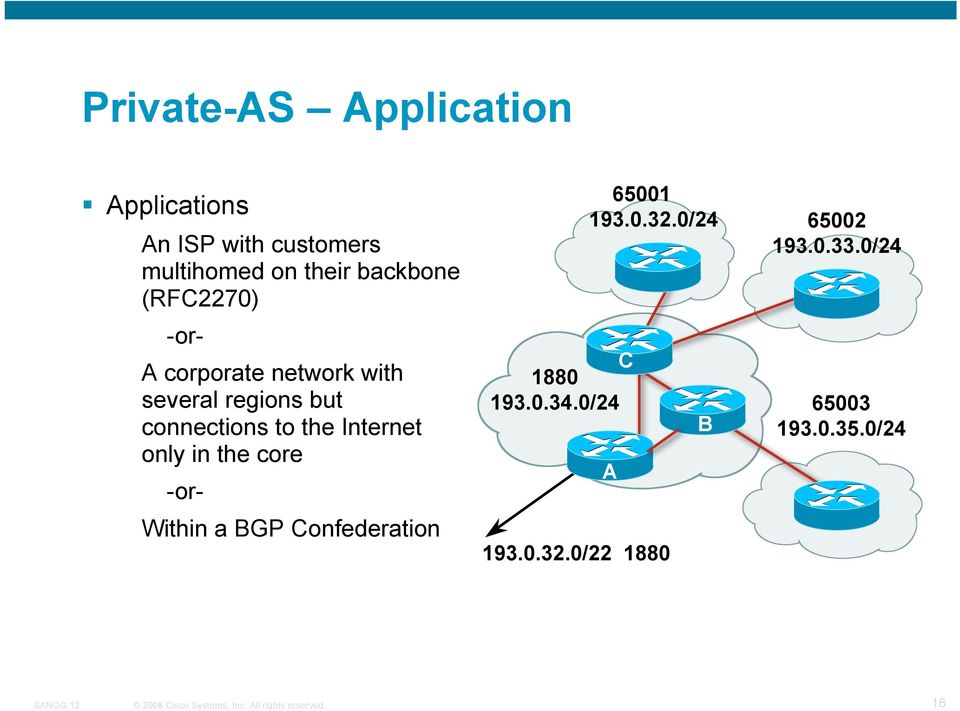
17 Private-AS Removal Private ASNs MUST be removed from all prefixes announced to the public Internet Include configuration to remove private ASNs in the ebgp template As with RFC1918 address space, private ASNs are intended for internal use They should not be leaked to the public Internet Cisco IOS neighbor x.x.x.x remove-private-as 17

18 Configuring Policy Three BASIC Principles for IOS configuration examples throughout presentation: prefix-lists to filter prefixes filter-lists to filter ASNs route-maps to apply policy Route-maps can be used for filtering, but this is more advanced configuration 18

19 Policy Tools Local preference outbound traffic flows Metric (MED) inbound traffic flows (local scope) AS-PATH prepend inbound traffic flows (Internet scope) Communities specific inter-provider peering 19

20 Originating Prefixes: Assumptions MUST announce assigned address block to Internet MAY also announce subprefixes reachability is not guaranteed Current minimum allocation is from /20 to /22 depending on the RIR Several ISPs filter RIR blocks on this boundary Several ISPs filter the rest of address space according to the IANA assignments This activity is called Net Police by some 20

21 Originating Prefixes The RIRs publish their minimum allocation sizes per /8 address block AfriNIC: APNIC: ARIN: LACNIC: RIPE NCC: lacnic.net/en/registro/index.html Note that AfriNIC only publishes its current minimum allocation size, not the allocation size for its address blocks IANA publishes the address space it has assigned to end-sites and allocated to the RIRs: Several ISPs use this published information to filter prefixes on: What should be routed (from IANA) The minimum allocation size from the RIRs 21
22 Net Police prefix list issues Meant to punish ISPs who pollute the routing table with specifics rather than announcing aggregates Impacts legitimate multihoming especially at the Internet s edge Impacts regions where domestic backbone is unavailable or costs $$$ compared with international bandwidth Hard to maintain requires updating when RIRs start allocating from new address blocks Don t do it unless consequences understood and you are prepared to keep the list current Consider using the Team Cymru or other reputable bogon BGP feed: 22
23 Multihoming Scenarios Stub network Multi-homed stub network Multi-homed network Configuration Options 23
24 Stub Network AS100 AS101 No need for BGP Point static default to upstream ISP Upstream ISP advertises stub network Policy confined within upstream ISP s policy 24
25 Multi-homed Stub Network AS100 AS65530 Use BGP (not IGP or static) to loadshare Use private AS (ASN > 64511) Upstream ISP advertises stub network Policy confined within upstream ISP s policy 25
26 Multi-homed Network AS300 Global Internet AS200 AS100 Many situations possible multiple sessions to same ISP secondary for backup only load-share between primary and secondary selectively use different ISPs 26
27 Multiple Sessions to an ISP Example One Use ebgp multihop ebgp to loopback addresses ebgp prefixes learned with loopback address as next hop Cisco IOS router bgp neighbor remote-as 200 neighbor ebgp-multihop 2 ip route serial 1/0 ip route serial 1/1 ip route serial 1/2 AS AS
28 Multiple Sessions to an ISP Example One One ebgp-multihop gotcha: R1 and R3 are ebgp peers that are loopback peering Configured with: neighbor x.x.x.x ebgp-multihop 2 If the R1 to R3 link goes down the session could establish via R2 R1 AS 100 R2 R3 AS 200 Desired Path Used Path 28
29 Multiple Sessions to an ISP Example One Try and avoid use of ebgp-multihop unless: It s absolutely necessary or Loadsharing across multiple links Many ISPs discourage its use, for example: We will run ebgp multihop, but do not support it as a standard offering because customers generally have a hard time managing it due to: routing loops failure to realise that BGP session stability problems are usually due connectivity problems between their CPE and their BGP speaker 29
30 Multiple Sessions to an ISP bgp multi path Three BGP sessions required limit of 6 parallel paths AS 200 ISP router bgp 201 neighbor remote-as 200 neighbor remote-as 200 neighbor remote-as 200 maximum-paths 3 AS
31 Multiple Sessions to an ISP Simplest scheme is to use defaults Learn/advertise prefixes for better control Planning and some work required to achieve loadsharing Point default towards one ISP Learn selected prefixes from second ISP Modify the number of prefixes learnt to achieve acceptable load sharing No magic solution ISP C D A B AS
32 BGP Multihoming Techniques Why Multihome? Definition & Options Preparing the Network Basic Multihoming Service Provider Multihoming 32
33 Preparing the Network Putting our own house in order first 33
34 Preparing the Network We will deploy BGP across the network before we try and multihome BGP will be used therefore an ASN is required If multihoming to different ISPs, public ASN needed: Either go to upstream ISP who is a registry member, or Apply to the RIR yourself for a one off assignment, or Ask an ISP who is a registry member, or Join the RIR and get your own IP address allocation too (this option strongly recommended) 34
35 Preparing the Network Will look at two examples of BGP deployment: Example One: network uses only static routes Example Two: network is currently running an IGP 35
36 Preparing the Network Example One The network is not running any BGP at the moment single statically routed connection to upstream ISP The network is not running any IGP at all Static default and routes through the network to do routing 36
37 Preparing the Network IGP Decide on IGP: OSPF or ISIS Assign loopback interfaces and /32 addresses to each router which will run the IGP Loopback is used for OSPF and BGP router id anchor Used for ibgp and route origination Deploy IGP (e.g. OSPF) IGP can be deployed with NO IMPACT on the existing static routing OSPF distance is 110, static distance is 1 Smallest distance wins 37
38 Preparing the Network IGP (cont) Be prudent deploying IGP keep the Link State Database Lean Router loopbacks go in IGP WAN point to point links go in IGP (In fact, any link where IGP dynamic routing will be run should go into IGP) Summarise on area/level boundaries (if possible) i.e. think about your IGP address plan 38
39 Preparing the Network IGP (cont) Routes which don t go into the IGP include: Dynamic assignment pools (DSL/Cable/Dial/Wireless) Customer point to point link addressing (using next-hop-self in ibgp ensures that these do NOT need to be in IGP) Static/Hosting LANs Customer assigned address space Anything else not listed in the previous slide 39
40 Preparing the Network Introduce OSPF interface loopback 0 ip address interface Ethernet 0/0 ip address interface serial 0/0 ip address interface serial 0/1 ip address router ospf 100 network area 0 network area 0 passive-interface default no passive-interface Ethernet 0/0 ip route serial 0/0 ip route serial 0/1 Add loopback configuration Customer connections 40
41 Preparing the Network ibgp Second step is to configure the local network to use ibgp ibgp can run on all routers, or a subset of routers, or A D B C just on the upstream edge ibgp must run on all routers which are in the transit path between external connections F E AS200 41
42 Preparing the Network ibgp (Transit Path) ibgp must run on all routers which are in the transit path between external connections Routers C, E and F are not in the transit path A D B C Static routes or IGP will suffice Router D is in the transit path Will need to be in ibgp mesh, otherwise routing loops will result F E AS200 42
43 Preparing the Network Layers Typical SP networks have three layers: Core the backbone, usually the transit path Distribution the middle, PoP aggregation layer Aggregation the edge, the devices connecting customers 43
44 Preparing the Network Aggregation Layer ibgp is optional Many ISPs run ibgp here, either partial routing (more common) or full routing (less common) Full routing is not needed unless customers want full table Partial routing is cheaper/easier, might usually consist of internal prefixes and, optionally, external prefixes to aid external load balancing Communities and peer-groups make this administratively easy Many aggregation devices can t run ibgp Static routes from distribution devices for address pools IGP for best exit 44
45 Preparing the Network Distribution Layer Usually runs ibgp Partial or full routing (as with aggregation layer) But does not have to run ibgp IGP is then used to carry customer prefixes (does not scale) IGP is used to determine nearest exit Networks which plan to grow large should deploy ibgp from day one Migration at a later date is extra work No extra overhead in deploying ibgp, indeed IGP benefits 45
46 Preparing the Network Core Layer Core of network is usually the transit path ibgp necessary between core devices Full routes or partial routes: Transit ISPs carry full routes in core Edge ISPs carry partial routes only Core layer includes AS border routers 46
47 Preparing the Network ibgp Implementation Decide on: Best ibgp policy Will it be full routes everywhere, or partial, or some mix? ibgp scaling technique Community policy? Route-reflectors? Techniques such as peer groups and templates? 47
48 Preparing the Network ibgp Implementation Then deploy ibgp: Step 1: Introduce ibgp mesh on chosen routers make sure that ibgp distance is greater than IGP distance (it usually is) Step 2: Install customer prefixes into ibgp Check Does the network still work? Step 3: Carefully remove the static routing for the prefixes now in IGP and ibgp Check Does the network still work? Step 4: Deployment of ebgp follows 48
49 Preparing the Network ibgp Implementation Install customer prefixes into ibgp? Customer assigned address space Network statement/static route combination Use unique community to identify customer assignments Customer facing point-to-point links Redistribute connected through filters which only permit point-to-point link addresses to enter ibgp Use a unique community to identify point-to-point link addresses (these are only required for your monitoring system) Dynamic assignment pools & local LANs Simple network statement will do this Use unique community to identify these networks 49
50 Preparing the Network ibgp Implementation Carefully remove static routes? Work on one router at a time: Check that static route for a particular destination is also learned either by IGP or by ibgp If so, remove it If not, establish why and fix the problem (Remember to look in the RIB, not the FIB) Then the next router, until the whole PoP is done Then the next PoP, and so on until the network is now dependent on the IGP and ibgp you have deployed 50
51 Preparing the Network Completion Previous steps are NOT flag day steps Each can be carried out during different maintenance periods, for example: Step One on Week One Step Two on Week Two Step Three on Week Three And so on And with proper planning will have NO customer visible impact at all 51
52 Preparing the Network Example Two The network is not running any BGP at the moment single statically routed connection to upstream ISP The network is running an IGP though All internal routing information is in the IGP By IGP, OSPF or ISIS is assumed 52
53 Preparing the Network IGP If not already done, assign loopback interfaces (with /32 addresses) to each router which is running the IGP Loopback is used for OSPF and BGP router id anchor Used for ibgp and route origination Ensure that the loopback /32s are appearing in the IGP 53
54 Preparing the Network ibgp Go through the ibgp decision process as in Example One Decide full or partial, and the extent of the ibgp reach in the network 54
55 Preparing the Network ibgp Implementation Then deploy ibgp: Step 1: Introduce ibgp mesh on chosen routers make sure that ibgp distance is greater than IGP distance (it usually is) Step 2: Install customer prefixes into ibgp Check Does the network still work? Step 3: Reduce BGP distance to be less than the IGP (so that ibgp routes take priority) Step 4: Carefully remove the customer prefixes from the IGP Check Does the network still work? Step 5: Restore BGP distance to be greater than IGP Step 6: Deployment of ebgp follows 55
56 Preparing the Network ibgp Implementation Install customer prefixes into ibgp? Customer assigned address space Network statement/static route combination Use unique community to identify customer assignments Customer facing point-to-point links Redistribute connected through filters which only permit point-to-point link addresses to enter ibgp Use a unique community to identify point-to-point link addresses (these are only required for your monitoring system) Dynamic assignment pools & local LANs Simple network statement will do this Use unique community to identify these networks 56
57 Preparing the Network ibgp Implementation Carefully remove customer routes from IGP? Work on one router at a time: Check that IGP route for a particular destination is also learned by ibgp If so, remove it from the IGP If not, establish why and fix the problem (Remember to look in the RIB, not the FIB) Then the next router, until the whole PoP is done Then the next PoP, and so on until the network is now dependent on the ibgp you have deployed 57
58 Preparing the Network Example Two Configuration Before BGP interface loopback 0 ip address interface serial 0/0 ip address interface serial 0/1 ip address router ospf 100 network area 0 passive-interface loopback 0 redistribute connected subnets redistribute static subnets ip route serial 0/0 ip route serial 0/1 Point-to-point links Customer networks Add loopback configuration if not already there 58
59 Preparing the Network Example Two Configuration Steps 1 & 2 interface and OSPF configuration unchanged router bgp 100 redistribute connected subnets route-map point-to-point neighbor remote-as 100 neighbor next-hop-self... network mask network mask distance bgp ip route serial 0/0 ip route serial 0/1 route-map point-to-point permit 5 match ip address 1 set community 100:1 access-list 1 permit Add BGP and related configuration in red 59
60 Preparing the Network Example Two Configuration Steps 3 & 4 router ospf 100 network area 0 network area 0 passive-interface default no passive-interface ethernet 0/0 router bgp 100 redistribute connected route-map point-to-point neighbor remote-as 100 neighbor next-hop-self... network mask network mask distance bgp reduced BGP distance ip route serial 0/0 ip route serial 0/1...etc... OSPF redistribution has been removed, OSPF tidied up 60
61 Preparing the Network Example Two Configuration Step 5 router ospf 100 network area 0 network area 0 passive-interface default no passive-interface ethernet 0/0 router bgp 100 redistribute connected route-map point-to-point neighbor remote-as 100 neighbor next-hop-self... network mask network mask distance bgp BGP distance restored ip route serial 0/0 ip route serial 0/1...etc... 61
62 Preparing the Network Completion Previous steps are NOT flag day steps Each can be carried out during different maintenance periods, for example: Step One on Week One Step Two on Week Two Step Three on Week Three And so on And with proper planning will have NO customer visible impact at all 62
63 Preparing the Network Configuration Summary IGP essential networks are in IGP Customer networks are now in ibgp ibgp deployed over the backbone Full or Partial or Upstream Edge only BGP distance is greater than any IGP Now ready to deploy ebgp 63
64 BGP Multihoming Techniques Why Multihome? Definition & Options Preparing the Network Basic Multihoming BGP Traffic Engineering 64
65 Basic Multihoming Learning to walk before we try running 65
66 Basic Multihoming No frills multihoming Will look at two cases: Multihoming with the same ISP Multihoming to different ISPs Will keep the examples easy Understanding easy concepts will make the more complex scenarios easier to comprehend All assume that the site multihoming has a /19 address block 66
67 Basic Multihoming This type is most commonplace at the edge of the Internet Networks here are usually concerned with inbound traffic flows Outbound traffic flows being nearest exit is usually sufficient Can apply to the leaf ISP as well as Enterprise networks 67
68 Basic Multihoming Multihoming to the Same ISP 68
69 Basic Multihoming: Multihoming to the same ISP Use BGP for this type of multihoming use a private AS (ASN > 64511) There is no need or justification for a public ASN Making the nets of the end-site visible gives no useful information to the Internet Upstream ISP proxy aggregates in other words, announces only your address block to the Internet from their AS (as would be done if you had one statically routed connection) 69
70 Two links to the same ISP One link primary, the other link backup only 70
71 Two links to the same ISP (one as backup only) Applies when end-site has bought a large primary WAN link to their upstream a small secondary WAN link as the backup For example, primary path might be an E1, backup might be 64kbps 71
72 Two links to the same ISP (one as backup only) primary C A AS 100 AS E D backup B AS100 removes private AS and any customer subprefixes from Internet announcement 72
73 Two links to the same ISP (one as backup only) Announce /19 aggregate on each link primary link: Outbound announce /19 unaltered Inbound receive default route backup link: Outbound announce /19 with increased metric Inbound received default, and reduce local preference When one link fails, the announcement of the /19 aggregate via the other link ensures continued connectivity 73
74 Two links to the same ISP (one as backup only) Router A Configuration router bgp network mask neighbor remote-as 100 neighbor description RouterC neighbor prefix-list aggregate out neighbor prefix-list default in ip prefix-list aggregate permit /19 ip prefix-list default permit /0 ip route null0 74
75 Two links to the same ISP (one as backup only) Router B Configuration router bgp network mask neighbor remote-as 100 neighbor description RouterD neighbor prefix-list aggregate out neighbor route-map routerd-out out neighbor prefix-list default in neighbor route-map routerd-in in..next slide 75
76 Two links to the same ISP (one as backup only) ip prefix-list aggregate permit /19 ip prefix-list default permit /0 ip route null0 route-map routerd-out permit 10 match ip address prefix-list aggregate set metric 10 route-map routerd-out permit 20 route-map routerd-in permit 10 set local-preference 90 76
77 Two links to the same ISP (one as backup only) Router C Configuration (main link) router bgp 100 neighbor remote-as neighbor default-originate neighbor prefix-list Customer in neighbor prefix-list default out ip prefix-list Customer permit /19 ip prefix-list default permit /0 77
78 Two links to the same ISP (one as backup only) Router D Configuration (backup link) router bgp 100 neighbor remote-as neighbor default-originate neighbor prefix-list Customer in neighbor prefix-list default out ip prefix-list Customer permit /19 ip prefix-list default permit /0 78
79 Two links to the same ISP (one as backup only) Router E Configuration router bgp 100 neighbor remote-as 110 neighbor remove-private-as neighbor prefix-list Customer out ip prefix-list Customer permit /19 Router E removes the private AS and customer s subprefixes from external announcements Private AS still visible inside AS100 79
80 Two links to the same ISP With Loadsharing 80
81 Loadsharing to the same ISP More common case End sites tend not to buy circuits and leave them idle, only used for backup as in previous example This example assumes equal capacity circuits Unequal capacity circuits requires more refinement see later 81
82 Loadsharing to the same ISP Link one C A AS 100 AS E D Link two B Border router E in AS100 removes private AS and any customer subprefixes from Internet announcement 82
83 Loadsharing to the same ISP Announce /19 aggregate on each link Split /19 and announce as two /20s, one on each link basic inbound loadsharing assumes equal circuit capacity and even spread of traffic across address block Vary the split until perfect loadsharing achieved Accept the default from upstream basic outbound loadsharing by nearest exit okay in first approx as most ISP and end-site traffic is inbound 83
84 Loadsharing to the same ISP Router A Configuration router bgp network mask network mask neighbor remote-as 100 neighbor prefix-list routerc out neighbor prefix-list default in ip prefix-list default permit /0 ip prefix-list routerc permit /20 ip prefix-list routerc permit /19 ip route null0 ip route null0 84
85 Loadsharing to the same ISP Router C Configuration router bgp 100 neighbor remote-as neighbor default-originate neighbor prefix-list Customer in neighbor prefix-list default out ip prefix-list Customer permit /19 le 20 ip prefix-list default permit /0 Router C only allows in /19 and /20 prefixes from customer block Router D configuration is identical 85
86 Loadsharing to the same ISP Router E Configuration router bgp 100 neighbor remote-as 110 neighbor remove-private-as neighbor prefix-list Customer out ip prefix-list Customer permit /19 Private AS still visible inside AS100 86
87 Loadsharing to the same ISP Default route for outbound traffic? Use default-information originate for the IGP and rely on IGP metrics for nearest exit e.g. on router A: router ospf default-information originate metric 2 metric-type 1 87
88 Loadsharing to the same ISP Loadsharing configuration is only on customer router Upstream ISP has to remove customer subprefixes from external announcements remove private AS from external announcements Could also use BGP communities 88
89 Two links to the same ISP Multiple Dualhomed Customers (RFC2270) 89
90 Multiple Dualhomed Customers (RFC2270) Unusual for an ISP just to have one dualhomed customer Valid/valuable service offering for an ISP with multiple PoPs Better for ISP than having customer multihome with another provider Look at scaling the configuration Simplifying the configuration Using templates, peer-groups, etc Every customer has the same configuration (basically) 90
91 Multiple Dualhomed Customers (RFC2270) AS 100 C A1 B1 AS E D A2 AS B2 Border router E in AS100 removes private AS and any customer subprefixes from Internet announcement A3 B3 AS
92 Multiple Dualhomed Customers (RFC2270) Customer announcements as per previous example Use the same private AS for each customer documented in RFC2270 address space is not overlapping each customer hears default only Router An and Bn configuration same as Router A and B previously 92
93 Multiple Dualhomed Customers (RFC2270) Router A1 Configuration router bgp network mask network mask neighbor remote-as 100 neighbor prefix-list routerc out neighbor prefix-list default in ip prefix-list default permit /0 ip prefix-list routerc permit /20 ip prefix-list routerc permit /19 ip route null0 ip route null0 93
94 Multiple Dualhomed Customers (RFC2270) Router C Configuration router bgp 100 neighbor bgp-customers peer-group neighbor bgp-customers remote-as neighbor bgp-customers default-originate neighbor bgp-customers prefix-list default out neighbor peer-group bgp-customers neighbor description Customer One neighbor prefix-list Customer1 in neighbor peer-group bgp-customers neighbor description Customer Two neighbor prefix-list Customer2 in 94
95 Multiple Dualhomed Customers (RFC2270) neighbor peer-group bgp-customers neighbor description Customer Three neighbor prefix-list Customer3 in ip prefix-list Customer1 permit /19 le 20 ip prefix-list Customer2 permit /19 le 20 ip prefix-list Customer3 permit /19 le 20 ip prefix-list default permit /0 Router C only allows in /19 and /20 prefixes from customer block Router D configuration is almost identical 95
96 Multiple Dualhomed Customers (RFC2270) Router E Configuration assumes customer address space is not part of upstream s address block router bgp 100 neighbor remote-as 110 neighbor remove-private-as neighbor prefix-list Customers out ip prefix-list Customers permit /19 ip prefix-list Customers permit /19 ip prefix-list Customers permit /19 Private AS still visible inside AS100 96
97 Multiple Dualhomed Customers (RFC2270) If customers prefixes come from ISP s address block do NOT announce them to the Internet announce ISP aggregate only Router E configuration: router bgp 100 neighbor remote-as 110 neighbor prefix-list my-aggregate out ip prefix-list my-aggregate permit /13 97
98 Basic Multihoming Multihoming to different ISPs 98
99 Two links to different ISPs Use a Public AS Or use private AS if agreed with the other ISP But some people don t like the inconsistent-as which results from use of a private-as Address space comes from both upstreams or Regional Internet Registry Configuration concepts very similar 99
100 Inconsistent-AS? Viewing the prefixes originated by AS65534 in the Internet shows they appear to be originated by both AS210 and AS200 This is NOT bad Nor is it illegal IOS command is show ip bgp inconsistent-as AS 210 AS AS 200 Internet 100
101 Two links to different ISPs One link primary, the other link backup only 101
102 Two links to different ISPs (one as backup only) Internet AS 100 AS 120 C D Announce /19 block A B Announce /19 block with longer AS PATH AS
103 Two links to different ISPs (one as backup only) Announce /19 aggregate on each link primary link makes standard announcement backup link lengthens the AS PATH by using AS PATH prepend When one link fails, the announcement of the /19 aggregate via the other link ensures continued connectivity 103
104 Two links to different ISPs (one as backup only) Router A Configuration router bgp 130 network mask neighbor remote-as 100 neighbor prefix-list aggregate out neighbor prefix-list default in ip prefix-list aggregate permit /19 ip prefix-list default permit /0 ip route null0 104
105 Two links to different ISPs (one as backup only) Router B Configuration router bgp 130 network mask neighbor remote-as 120 neighbor prefix-list aggregate out neighbor route-map routerd-out out neighbor prefix-list default in neighbor route-map routerd-in in ip prefix-list aggregate permit /19 ip prefix-list default permit /0 route-map routerd-out permit 10 set as-path prepend route-map routerd-in permit 10 set local-preference
106 Two links to different ISPs (one as backup only) Not a common situation as most sites tend to prefer using whatever capacity they have (Useful when two competing ISPs agree to provide mutual backup to each other) But it shows the basic concepts of using local-prefs and AS-path prepends for engineering traffic in the chosen direction 106
107 Two links to different ISPs With Loadsharing 107
108 Two links to different ISPs (with loadsharing) Internet AS 100 AS 120 C D Announce first /20 and /19 block A B Announce second /20 and /19 block AS
109 Two links to different ISPs (with loadsharing) Announce /19 aggregate on each link Split /19 and announce as two /20s, one on each link basic inbound loadsharing When one link fails, the announcement of the /19 aggregate via the other ISP ensures continued connectivity 109
110 Two links to different ISPs (with loadsharing) Router A Configuration router bgp 130 network mask network mask neighbor remote-as 100 neighbor prefix-list firstblock out neighbor prefix-list default in ip prefix-list default permit /0 ip prefix-list firstblock permit /20 ip prefix-list firstblock permit /19 110
111 Two links to different ISPs (with loadsharing) Router B Configuration router bgp 130 network mask network mask neighbor remote-as 120 neighbor prefix-list secondblock out neighbor prefix-list default in ip prefix-list default permit /0 ip prefix-list secondblock permit /20 ip prefix-list secondblock permit /19 111
112 Two links to different ISPs (with loadsharing) Loadsharing in this case is very basic But shows the first steps in designing a load sharing solution Start with a simple concept And build on it 112
113 Two links to different ISPs More Controlled Loadsharing 113
114 Loadsharing with different ISPs Internet AS 100 AS 120 C D Announce /19 block A B Announce /20 subprefix, and /19 block with longer AS path AS
115 Loadsharing with different ISPs Announce /19 aggregate on each link On first link, announce /19 as normal On second link, announce /19 with longer AS PATH, and announce one /20 subprefix controls loadsharing between upstreams and the Internet Vary the subprefix size and AS PATH length until perfect loadsharing achieved Still require redundancy 115
116 Loadsharing with different ISPs Router A Configuration router bgp 130 network mask neighbor remote-as 100 neighbor prefix-list default in neighbor prefix-list aggregate out ip prefix-list aggregate permit /19 ip prefix-list default permit /0 ip route null0 116
117 Loadsharing with different ISPs Router B Configuration router bgp 130 network mask network mask neighbor remote-as 120 neighbor prefix-list default in neighbor prefix-list subblocks out neighbor route-map routerd out route-map routerd permit 10 match ip address prefix-list aggregate set as-path prepend route-map routerd permit 20 ip prefix-list subblocks permit /19 le 20 ip prefix-list aggregate permit /19 117
118 Loadsharing with different ISPs This example is more commonplace Shows how ISPs and end-sites subdivide address space frugally, as well as use the AS-PATH prepend concept to optimise the load sharing between different ISPs Notice that the /19 aggregate block is ALWAYS announced 118
119 BGP Multihoming Techniques Why Multihome? Definition & Options Preparing the Network Basic Multihoming BGP Traffic Engineering 119
120 Service Provider Multihoming BGP Traffic Engineering 120
121 Service Provider Multihoming Previous examples dealt with loadsharing inbound traffic Of primary concern at Internet edge What about outbound traffic? Transit ISPs strive to balance traffic flows in both directions Balance link utilisation Try and keep most traffic flows symmetric Some edge ISPs try and do this too The original Traffic Engineering 121
122 Service Provider Multihoming Balancing outbound traffic requires inbound routing information Common solution is full routing table Rarely necessary Why use the routing mallet to try solve loadsharing problems? Keep It Simple is often easier (and $$$ cheaper) than carrying N-copies of the full routing table 122
123 Service Provider Multihoming MYTHS Common MYTHS 1: You need the full routing table to multihome People who sell router memory would like you to believe this Only true if you are a transit provider Full routing table can be a significant hindrance to multihoming 2: You need a BIG router to multihome Router size is related to data rates, not running BGP In reality, to multihome, your router needs to: Have two interfaces, Be able to talk BGP to at least two peers, Be able to handle BGP attributes, Handle at least one prefix 3: BGP is complex In the wrong hands, yes it can be Keep it Simple 123
124 Service Provider Multihoming: Some Strategies Take the prefixes you need to aid traffic engineering Look at NetFlow data for popular sites Prefixes originated by your immediate neighbours and their neighbours will do more to aid load balancing than prefixes from ASNs many hops away Concentrate on local destinations Use default routing as much as possible Or use the full routing table with care 124
125 Service Provider Multihoming Examples One upstream, one local peer One upstream, local exchange point Two upstreams, one local peer Three upstreams, unequal link bandwidths Require BGP and a public ASN Examples assume that the local network has their own /19 address block 125
126 Service Provider Multihoming One upstream, one local peer 126
127 One Upstream, One Local Peer Very common situation in many regions of the Internet Connect to upstream transit provider to see the Internet Connect to the local competition so that local traffic stays local Saves spending valuable $ on upstream transit costs for local traffic 127
128 One Upstream, One Local Peer Upstream ISP AS130 Local Peer AS120 A C AS
129 One Upstream, One Local Peer Announce /19 aggregate on each link Accept default route only from upstream Either /0 or a network which can be used as default Accept all routes from local peer 129
130 One Upstream, One Local Peer Router A Configuration router bgp 110 network mask neighbor remote-as 120 neighbor prefix-list my-block out neighbor prefix-list AS120-peer in ip prefix-list AS120-peer permit /19 ip prefix-list AS120-peer permit /20 ip prefix-list my-block permit /19 Prefix filters inbound ip route null
131 One Upstream, One Local Peer Router A Alternative Configuration router bgp 110 network mask neighbor remote-as 120 neighbor prefix-list my-block out neighbor filter-list 10 in ip as-path access-list 10 permit ^(120_)+$ ip prefix-list my-block permit /19 ip route null0 AS Path filters more trusting 131
132 One Upstream, One Local Peer Router C Configuration router bgp 110 network mask neighbor remote-as 130 neighbor prefix-list default in neighbor prefix-list my-block out ip prefix-list my-block permit /19 ip prefix-list default permit /0 ip route null0 132
133 One Upstream, One Local Peer Two configurations possible for Router A Filter-lists assume peer knows what they are doing Prefix-list higher maintenance, but safer Some ISPs use both Local traffic goes to and from local peer, everything else goes to upstream 133
134 Aside: Configuration Recommendations Private Peers The peering ISPs exchange prefixes they originate Sometimes they exchange prefixes from neighbouring ASNs too Be aware that the private peer ebgp router should carry only the prefixes you want the private peer to receive Otherwise they could point a default route to you and unintentionally transit your backbone 134
135 Service Provider Multihoming One upstream, Local Exchange Point 135
136 One Upstream, Local Exchange Point Very common situation in many regions of the Internet Connect to upstream transit provider to see the Internet Connect to the local Internet Exchange Point so that local traffic stays local Saves spending valuable $ on upstream transit costs for local traffic 136
137 One Upstream, Local Exchange Point IXP Upstream ISP AS130 C A AS
138 One Upstream, Local Exchange Point Announce /19 aggregate to every neighbouring AS Accept default route only from upstream Either /0 or a network which can be used as default Accept all routes originated by IXP peers 138
139 One Upstream, Local Exchange Point Router A Configuration interface fastethernet 0/0 description Exchange Point LAN ip address mask ip verify unicast reverse-path router bgp 110 neighbor ixp-peers peer-group neighbor ixp-peers prefix-list my-block out neighbor ixp-peers remove-private-as neighbor ixp-peers route-map set-local-pref in next slide 139
140 One Upstream, Local Exchange Point neighbor remote-as 100 neighbor peer-group ixp-peers neighbor prefix-list peer100 in neighbor remote-as 101 neighbor peer-group ixp-peers neighbor prefix-list peer101 in neighbor remote-as 102 neighbor peer-group ixp-peers neighbor prefix-list peer102 in neighbor remote-as 103 neighbor peer-group ixp-peers neighbor prefix-list peer103 in..next slide 140
141 One Upstream, Local Exchange Point ip prefix-list my-block permit /19 ip prefix-list peer100 permit /19 ip prefix-list peer101 permit /19 ip prefix-list peer102 permit /19 ip prefix-list peer103 permit /19 route-map set-local-pref permit 10 set local-preference
142 One Upstream, Local Exchange Note that Router A does not generate the aggregate for AS110 If Router A becomes disconnected from backbone, then the aggregate is no longer announced to the IX BGP failover works as expected Note the inbound route-map which sets the local preference higher than the default This ensures that local traffic crosses the IXP (And avoids potential problems with urpf check) 142
143 One Upstream, Local Exchange Point Router C Configuration router bgp 110 network mask neighbor remote-as 130 neighbor prefix-list default in neighbor prefix-list my-block out ip prefix-list my-block permit /19 ip prefix-list default permit /0 ip route null0 143
144 One Upstream, Local Exchange Point Note Router A configuration Prefix-list higher maintenance, but safer urpf on the IX facing interface No generation of AS110 aggregate IXP traffic goes to and from local IXP, everything else goes to upstream 144
145 Aside: IXP Configuration Recommendations IXP peers The peering ISPs at the IXP exchange prefixes they originate Sometimes they exchange prefixes from neighbouring ASNs too Be aware that the IXP border router should carry only the prefixes you want the IXP peers to receive and the destinations you want them to be able to reach Otherwise they could point a default route to you and unintentionally transit your backbone If IXP router is at IX, and distant from your backbone Don t originate your address block at your IXP router 145
146 Service Provider Multihoming Two Upstreams, One local peer 146
147 Two Upstreams, One Local Peer Connect to both upstream transit providers to see the Internet Provides external redundancy and diversity the reason to multihome Connect to the local peer so that local traffic stays local Saves spending valuable $ on upstream transit costs for local traffic 147
148 Two Upstreams, One Local Peer Upstream ISP AS130 Upstream ISP Local Peer AS120 A C AS 110 D AS
149 Two Upstreams, One Local Peer Announce /19 aggregate on each link Accept default route only from upstreams Either /0 or a network which can be used as default Accept all routes from local peer Note separation of Router C and D Single edge router means no redundancy Router A Same routing configuration as in example with one upstream and one local peer 149
150 Two Upstreams, One Local Peer Router C Configuration router bgp 110 network mask neighbor remote-as 130 neighbor prefix-list default in neighbor prefix-list my-block out ip prefix-list my-block permit /19 ip prefix-list default permit /0 ip route null0 150
151 Two Upstreams, One Local Peer Router D Configuration router bgp 110 network mask neighbor remote-as 140 neighbor prefix-list default in neighbor prefix-list my-block out ip prefix-list my-block permit /19 ip prefix-list default permit /0 ip route null0 151
152 Two Upstreams, One Local Peer This is the simple configuration for Router C and D Traffic out to the two upstreams will take nearest exit Inexpensive routers required This is not useful in practice especially for international links Loadsharing needs to be better 152
153 Two Upstreams, One Local Peer Better configuration options: Accept full routing from both upstreams Expensive & unnecessary Accept default from one upstream and some routes from the other upstream The way to go 153
154 Two Upstreams, One Local Peer Full Routes Router C Configuration router bgp 110 network mask neighbor remote-as 130 Allow all prefixes in apart from RFC1918 and friends neighbor prefix-list rfc1918-deny in neighbor prefix-list my-block out neighbor route-map AS130-loadshare in ip prefix-list my-block permit /19 See RFC1918 and friends list...next slide 154
155 Two Upstreams, One Local Peer Full Routes ip route null0 ip as-path access-list 10 permit ^(130_)+$ ip as-path access-list 10 permit ^(130_)+_[0-9]+$ route-map AS130-loadshare permit 10 match ip as-path 10 set local-preference 120 route-map AS130-loadshare permit 20 set local-preference
156 Two Upstreams, One Local Peer Full Routes Router D Configuration router bgp 110 network mask neighbor remote-as 140 Allow all prefixes in apart from RFC1918 and friends neighbor prefix-list rfc1918-deny in neighbor prefix-list my-block out ip prefix-list my-block permit /19 See RFC1918 and friends list 156
157 Two Upstreams, One Local Peer Full Routes Router C configuration: Accept full routes from AS130 Tag prefixes originated by AS130 and AS130 s neighbouring ASes with local preference 120 Traffic to those ASes will go over AS130 link Remaining prefixes tagged with local preference of 80 Traffic to other all other ASes will go over the link to AS140 Router D configuration same as Router C without the route-map 157
158 Two Upstreams, One Local Peer Full Routes Full routes from upstreams Expensive needs lots of memory and CPU Need to play preference games Previous example is only an example real life will need improved fine-tuning Previous example doesn t consider inbound traffic see earlier in presentation for examples 158
159 Two Upstreams, One Local Peer Partial Routes: Strategy Ask one upstream for a default route Easy to originate default towards a BGP neighbour Ask other upstream for a full routing table Then filter this routing table based on neighbouring ASN E.g. want traffic to their neighbours to go over the link to that ASN Most of what upstream sends is thrown away Easier than asking the upstream to set up custom BGP filters for you 159
160 Two Upstreams, One Local Peer Partial Routes Router C Configuration router bgp 110 network mask neighbor remote-as 130 AS filter list filters prefixes based on origin ASN Allow all prefixes and default in; deny RFC1918 and friends neighbor prefix-list rfc1918-nodef-deny in neighbor prefix-list my-block out neighbor filter-list 10 in neighbor route-map tag-default-low in..next slide 160
161 Two Upstreams, One Local Peer Partial Routes ip prefix-list my-block permit /19 ip prefix-list default permit /0 ip route null0 ip as-path access-list 10 permit ^(130_)+$ ip as-path access-list 10 permit ^(130_)+_[0-9]+$ route-map tag-default-low permit 10 match ip address prefix-list default set local-preference 80 route-map tag-default-low permit
162 Two Upstreams, One Local Peer Partial Routes Router D Configuration router bgp 110 network mask neighbor remote-as 140 neighbor prefix-list default in neighbor prefix-list my-block out ip prefix-list my-block permit /19 ip prefix-list default permit /0 ip route null0 162
163 Two Upstreams, One Local Peer Partial Routes Router C configuration: Accept full routes from AS130 (or get them to send less) Filter ASNs so only AS130 and its neighbouring ASes are accepted Traffic to those ASes will go over AS130 link Traffic to other all other ASes will go over the link to AS140 What about backup? 163
164 Two Upstreams, One Local Peer Partial Routes Router C IGP Configuration router ospf 110 default-information originate metric 30 passive-interface Serial 0/0 ip route serial 0/0 254 Router D IGP Configuration router ospf 110 default-information originate metric 10 passive-interface Serial 0/0 ip route serial 0/
165 Two Upstreams, One Local Peer Partial Routes Partial routes from upstreams Use OSPF to determine outbound path Router D default has metric 10 primary outbound path Router C default has metric 30 backup outbound path Serial interface goes down, static default is removed from routing table, OSPF default withdrawn 165
166 Two Upstreams, One Local Peer Partial Routes Partial routes from upstreams Not expensive only carry the routes necessary for loadsharing Need to filter on AS paths Previous example is only an example real life will need improved fine-tuning Previous example doesn t consider inbound traffic see earlier in presentation for examples 166
167 Aside: Configuration Recommendation When distributing internal default by ibgp or OSPF Make sure that routers connecting to private peers or to IXPs do NOT carry the default route Otherwise they could point a default route to you and unintentionally transit your backbone Simple fix for Private Peer/IXP routers: ip route null0 167
168 Service Provider Multihoming Three upstreams, unequal bandwidths 168
169 Three upstreams, unequal bandwidths Autonomous System has three upstreams 8Mbps to ISP A 4Mbps to ISP B 2Mbps to ISP C What is the strategy here? One option is full table from each 3x 270k prefixes 810k paths Other option is partial table and defaults from each How?? 169
170 Diagram ISP C AS130 ISP B AS120 B A ISP A AS110 AS 100 Router A has 8Mbps circuit to ISP A Router B has 4Mbps and 2Mbps circuits to ISPs B&C 170
171 Outbound load-balancing strategy Available BGP feeds from Transit providers: Full table Customer prefixes and default Default Route These are the common options Very rare for any provider to offer anything different 171
172 Outbound load-balancing strategy Accept only a default route from the provider with the largest connectivity, ISP A Because most of the traffic is going to use this link If ISP A won t provide a default: Still run BGP with them, but discard all prefixes Point static default route to the upstream link Distribute the default in the IGP Request the full table from ISP B & C Most of this will be thrown away ( Default plus customers is not enough) 172
173 Outbound load-balancing strategy How to decide what to keep and what to discard from ISPs B & C? Most traffic will use ISP A link so we need to find a good/useful subset Discard prefixes transiting the global transit ISPs Global transit ISPs generally appear in most non-local or regional AS-PATHs Discard prefixes with ISP A s ASN in the path Makes more sense for traffic to those destinations to go via the link to ISP A 173
174 Outbound load-balancing strategy Global Transit ISPs include: 209 Qwest 3549 Global Crossing 701 VerizonBusiness 3356 Level Sprint 3561 Savvis 1668 AOL TDN 7018 AT&T 2914 NTT America 174
175 ISP B peering Inbound AS-PATH filter ip as-path access-list 1 deny _209_ ip as-path access-list 1 deny _701_ ip as-path access-list 1 deny _1239_ ip as-path access-list 1 deny _3356_ ip as-path access-list 1 deny _3549_ ip as-path access-list 1 deny _3561_ ip as-path access-list 1 deny _2914_ ip as-path access-list 1 deny _7018_ ip as-path access-list 1 deny _ISPA_ ip as-path access-list 1 deny _ISPC_ ip as-path access-list 1 permit _ISPB$ ip as-path access-list 1 permit _ISPB_[0-9]+$ ip as-path access-list 1 permit _ISPB_[0-9]+_[0-9]+$ ip as-path access-list 1 permit _ISPB_[0-9]+_[0-9]+_[0-9]+$ ip as-path access-list 1 deny.* 175
176 Outbound load-balancing strategy: ISP B peering configuration Part 1: Dropping Global Transit ISP prefixes This can be fine-tuned if traffic volume is not sufficient (More prefixes in = more traffic out) Part 2: Dropping prefixes transiting ISP A & C network Part 3: Permitting prefixes from ISP B, their BGP neighbours, and their neighbours, and their neighbours More AS_PATH permit clauses, the more prefixes allowed in, the more egress traffic Too many prefixes in will mean more outbound traffic than the link to ISP B can handle 176
177 Outbound load-balancing strategy Similar AS-PATH filter can be built for the ISP C BGP peering If the same prefixes are heard from both ISP B and C, then establish proximity of their origin ASN to ISP B or C e.g. ISP B might be in Japan, with the neighbouring ASN in Europe, yet ISP C might be in Europe Transit to the ASN via ISP C makes more sense in this case 177
178 Inbound load-balancing strategy The largest outbound link should announce just the aggregate The other links should announce: a) The aggregate with AS-PATH prepend b) Subprefixes of the aggregate, chosen according to traffic volumes to those subprefixes, and according to the services on those subprefixes Example: Link to ISP B could be used just for Broadband/Dial customers so number all such customers out of one contiguous subprefix Link to ISP C could be used just for commercial leased line customers so number all such customers out of one contiguous subprefix 178
179 Router A: ebgp Configuration Example router bgp 100 network mask neighbor remote 110 neighbor prefix-list default in neighbor prefix-list aggregate out ip prefix-list default permit /0 ip prefix-list aggregate permit /19 179
180 Router B: ebgp Configuration Example router bgp 100 network mask neighbor remote 120 neighbor filter-list 1 in neighbor prefix-list ISP-B out neighbor route-map to-isp-b out neighbor remote 130 neighbor filter-list 2 in neighbor prefix-list ISP-C out neighbor route-map to-isp-c out ip prefix-list aggregate permit /19..next slide 180
181 Router B: ebgp Configuration Example ip prefix-list ISP-B permit /19 ip prefix-list ISP-B permit /21 ip prefix-list ISP-C permit /19 ip prefix-list ISP-C permit /22 route-map to-isp-b permit 10 match ip address prefix-list aggregate set as-path prepend 100 route-map to-isp-b permit 20 route-map to-isp-c permit 10 match ip address prefix-list aggregate set as-path prepend route-map to-isp-c permit 20 /21 to ISP B dial customers /22 to ISP C biz customers e.g. Single prepend on ISP B link e.g. Dual prepend on ISP C link 181
182 What about outbound backup? We have: Default route from ISP A by ebgp Mostly discarded full table from ISPs B&C Strategy: Originate default route by OSPF on Router A (with metric 10) link to ISP A Originate default route by OSPF on Router B (with metric 30) links to ISPs B & C Plus on Router B: Static default route to ISP B with distance 240 Static default route to ISP C with distance 245 When link goes down, static route is withdrawn 182
183 Outbound backup: steady state Steady state (all links up and active): Default route is to Router A OSPF metric 10 (Because default learned by ebgp default is in RIB OSPF will originate default) Backup default is to Router B OSPF metric 20 ebgp prefixes learned from upstreams distributed by ibgp throughout backbone (Default can be filtered in ibgp to avoid RIB failure error ) 183
184 Outbound backup: failure examples Link to ISP A down, to ISPs B&C up: Default route is to Router B OSPF metric 20 (ebgp default gone from RIB, so OSPF on Router A withdraws the default) Above is true if link to B or C is down as well Link to ISPs B & C down, link to ISP A is up: Default route is to Router A OSPF metric 10 (static defaults on Router B removed from RIB, so OSPF on Router B withdraws the default) 184
185 Other considerations Default route should not be propagated to devices terminating non-transit peers and customers No need to carry default in ibgp Filter out default in ibgp mesh peerings Still carry other ebgp prefixes across ibgp mesh Otherwise routers will follow default route rules resulting in suboptimal traffic flow Not a big issue because not carrying full table 185
186 Router A: ibgp Configuration Example router bgp 100 network mask neighbor ibgp-peers peer-group neighbor ibgp-peers remote-as 100 neighbor ibgp-peers prefix-list ibgp-filter out neighbor peer-group ibgp-peers neighbor prefix-list ibgp-filter out neighbor peer-group ibgp-peers neighbor prefix-list ibgp-filter out ip prefix-list ibgp-filter deny /0 ip prefix-list ibgp-filter permit /0 le
187 Three upstreams, unequal bandwidths: Summary Example based on many deployed working multihoming/loadbalancing topologies Many variations possible this one is: Easy to tune Light on border router resources Light on backbone router infrastructure Sparse BGP table faster convergence 187
188 Summary 188
189 Summary Multihoming is not hard, really Keep It Simple & Stupid Full routing table is rarely required A default is often just as good If customers want 270k prefixes, charge them money for it 189
190 BGP Multihoming Techniques End of Tutorial 190
BGP Multihoming Techniques
 BGP Multihoming Techniques Philip Smith 26th July - 4th August 2006 Karachi 1 Presentation Slides Available on ftp://ftp-eng.cisco.com /pfs/seminars/sanog8-multihoming.pdf And on the SANOG8
Simple Multihoming. ISP/IXP Workshops
 Simple Multihoming ISP/IXP Workshops 1 Why Multihome? Redundancy One connection to internet means the network is dependent on: Local router (configuration, software, hardware) WAN media (physical failure,
Simple Multihoming. ISP Workshops. Last updated 30 th March 2015
 Simple Multihoming ISP Workshops Last updated 30 th March 2015 1 Why Multihome? p Redundancy n One connection to internet means the network is dependent on: p Local router (configuration, software, hardware)
BGP Multihoming. Why Multihome? Why Multihome? Why Multihome? Why Multihome? Why Multihome? Redundancy. Reliability
 Why Multihome? BGP Multihoming ISP/IXP Redundancy One connection to internet means the network is dependent on: Local router (configuration, software, hardware) WN media (physical failure, carrier failure)
BGP Multihoming Techniques
 BGP Multihoming Techniques Philip Smith PacNOG 2 Workshop Apia, Samoa 18-24 June 2006 PacNOG 2 Workshops 1 BGP Multihoming Techniques Why Multihome? Definition & Options Preparing the Network
BGP Multihoming Techniques. Philip Smith <[email protected]> APRICOT 2013 Singapore 19 th February 1 st March 2013
 BGP Multihoming Techniques Philip Smith APRICOT 2013 Singapore 19 th February 1 st March 2013 Presentation Slides p Will be available on n http://thyme.apnic.net/ftp/seminars/ APRICOT2013-Multihoming.pdf
Transitioning to BGP. ISP Workshops. Last updated 24 April 2013
 Transitioning to BGP ISP Workshops Last updated 24 April 2013 1 Scaling the network How to get out of carrying all prefixes in IGP 2 Why use BGP rather than IGP? p IGP has Limitations: n The more routing
BGP Multihoming Techniques
 BGP Multihoming Techniques Philip Smith , Seoul, South Korea August 2003 1 Presentation Slides Available on ftp://ftp-eng.cisco.com/pfs/seminars/ 2 Preliminaries Presentation has many configuration
BGP Multihoming Techniques
 BGP Multihoming Techniques Philip Smith , Oakland 2001, Cisco Systems, Inc. All rights reserved. 1 Presentation Slides Available on NANOG Web site www.nanog.org/mtg-0110/smith.html Available
BGP Multihoming Techniques
 BGP Multihoming Techniques Philip Smith NANOG 41 14th - 16th October 2007 Albuquerque, New Mexico 1 Presentation Slides Available on ftp://ftp-eng.cisco.com /pfs/seminars/nanog41-multihoming.pdf
Module 12 Multihoming to the Same ISP
 Module 12 Multihoming to the Same ISP Objective: To investigate various methods for multihoming onto the same upstream s backbone Prerequisites: Module 11 and Multihoming Presentation The following will
Advanced BGP Policy. Advanced Topics
 Advanced BGP Policy George Wu TCOM690 Advanced Topics Route redundancy Load balancing Routing Symmetry 1 Route Optimization Issues Redundancy provide multiple alternate paths usually multiple connections
APNIC elearning: BGP Basics. Contact: [email protected]. erou03_v1.0
 erou03_v1.0 APNIC elearning: BGP Basics Contact: [email protected] Overview What is BGP? BGP Features Path Vector Routing Protocol Peering and Transit BGP General Operation BGP Terminology BGP Attributes
BGP Attributes and Path Selection
 BGP Attributes and Path Selection ISP Workshops Last updated 29 th March 2015 1 BGP Attributes BGP s policy tool kit 2 What Is an Attribute?... Next Hop AS Path MED...... p Part of a BGP Update p Describes
Using the Border Gateway Protocol for Interdomain Routing
 CHAPTER 12 Using the Border Gateway Protocol for Interdomain Routing The Border Gateway Protocol (BGP), defined in RFC 1771, provides loop-free interdomain routing between autonomous systems. (An autonomous
BGP-4 Case Studies. Nenad Krajnovic. e-mail: [email protected]
 BGP-4 Case Studies Nenad Krajnovic e-mail: [email protected] Today topics load balancing over multiple links multihoming to a single provider multihoming to different providers following defaults inside
Border Gateway Protocol Best Practices
 Border Gateway Protocol Best Practices By Clifton Funakura The Internet has grown into a worldwide network supporting a wide range of business applications. Many companies depend on the Internet for day-to-day
APNIC elearning: BGP Attributes
 APNIC elearning: BGP Attributes Contact: [email protected] erou04_v1.0 Overview BGP Attributes Well-known and Optional Attributes AS Path AS Loop Detection ibgp and ebgp Next Hop Next Hop Best Practice
BGP Multihoming: An Enterprise View BRKRST-2322. 2006, Cisco Systems, Inc. All rights reserved. Presentation_ID.scr
 GP Multihoming: n Enterprise View 2008 isco Systems, Inc. ll rights reserved. isco Public 2 1 GP Multihoming Techniques Multihoming asics Single Provider Multiple Providers Using Policy Provider 1 The
Multihomed BGP Configurations
 Multihomed BGP Configurations lvaro Retana Cisco IOS Deployment and Scalability 1 genda General Considerations Multihomed Networks Best Current Practices 2 The Basics General Considerations 3 General Considerations
BGP for Internet Service Providers
 BGP for Internet Service Providers Philip Smith , Toronto, Canada 1 Presentation Slides Will be available on www.cisco.com/public/cons/seminars/nanog25 Feel free to ask questions any time
BGP Terminology, Concepts, and Operation. Chapter 6 2007 2010, Cisco Systems, Inc. All rights reserved. Cisco Public
 BGP Terminology, Concepts, and Operation 1 IGP versus EGP Interior gateway protocol (IGP) A routing protocol operating within an Autonomous System (AS). RIP, OSPF, and EIGRP are IGPs. Exterior gateway
How To Set Up Bgg On A Network With A Network On A Pb Or Pb On A Pc Or Ipa On A Bg On Pc Or Pv On A Ipa (Netb) On A Router On A 2
 61200860L1-29.4E March 2012 Configuration Guide Configuring Border Gateway Protocol in AOS for Releases Prior to 18.03.00/R10.1.0 This guide only addresses BGP in AOS data products using AOS firmware prior
Fireware How To Dynamic Routing
 Fireware How To Dynamic Routing How do I configure my Firebox to use BGP? Introduction A routing protocol is the language a router speaks with other routers to share information about the status of network
Introduction to Routing
 Introduction to Routing How traffic flows on the Internet Philip Smith [email protected] RIPE NCC Regional Meeting, Moscow, 16-18 18 June 2004 1 Abstract Presentation introduces some of the terminologies used,
Address Scheme Planning for an ISP backbone Network
 Address Scheme Planning for an ISP backbone Network Philip Smith Consulting Engineering, Office of the CTO Version 0.1 (draft) LIST OF FIGURES 2 INTRODUCTION 3 BACKGROUND 3 BUSINESS MODEL 3 ADDRESS PLAN
How To Understand Bg
 Table of Contents BGP Case Studies...1 BGP4 Case Studies Section 1...3 Contents...3 Introduction...3 How Does BGP Work?...3 ebgp and ibgp...3 Enabling BGP Routing...4 Forming BGP Neighbors...4 BGP and
BGP4 Case Studies/Tutorial
 BGP4 Case Studies/Tutorial Sam Halabi-cisco Systems The purpose of this paper is to introduce the reader to the latest in BGP4 terminology and design issues. It is targeted to the novice as well as the
Routing Protocol - BGP
 Routing Protocol - BGP BGP Enterprise Network BGP ISP AS 3000 AS 2000 BGP is using between Autonomous Systems BGP(cont.) RFC 1771(BGPv4) Support CIDR Transfer the AS information to reach destination Using
ISP Case Study. UUNET UK (1997) ISP/IXP Workshops. ISP/IXP Workshops. 1999, Cisco Systems, Inc.
 ISP Case Study UUNET UK (1997) ISP/IXP Workshops ISP/IXP Workshops 1999, Cisco Systems, Inc. 1 Acknowledgements Thanks are due to UUNET UK for allowing the use of their configuration information and network
Chapter 49 Border Gateway Protocol version 4 (BGP-4)
 Chapter 49 Border Gateway Protocol version 4 (BGP-4) Introduction... 1-3 Overview of BGP-4... 1-3 BGP Operation... 1-5 BGP Attributes... 1-6 BGP Route Selection... 1-8 Classless Inter-domain Routing (CIDR)
Network Level Multihoming and BGP Challenges
 Network Level Multihoming and BGP Challenges Li Jia Helsinki University of Technology [email protected] Abstract Multihoming has been traditionally employed by enterprises and ISPs to improve network connectivity.
Chapter 6: Implementing a Border Gateway Protocol Solution for ISP Connectivity
 : Implementing a Border Gateway Protocol Solution for ISP Connectivity CCNP ROUTE: Implementing IP Routing ROUTE v6 1 Objectives Describe basic BGP terminology and operation, including EBGP and IBGP. Configure
BGP Operations and Security. Training Course
 BGP Operations and Security Training Course Training Services RIPE NCC April 2016 Schedule 09:00-09:30 11:00-11:15 13:00-14:00 15:30-15:45 17:30 Coffee, Tea Break Lunch Break End BGP Operations and Security
IPv6 Address Planning
 eip604_v1.0 APNIC elearning: IPv6 Address Planning Contact: [email protected] Overview Where to Get IPv6 Addresses Addressing Plans ISP Infrastructure Addressing Plans Customer Example Address Plan Addressing
IPv6 Addressing. ISP Training Workshops
 IPv6 Addressing ISP Training Workshops 1 Where to get IPv6 addresses p Your upstream ISP p Africa n AfriNIC http://www.afrinic.net p Asia and the Pacific n APNIC http://www.apnic.net p North America n
DD2491 p1 2008. Load balancing BGP. Johan Nicklasson KTHNOC/NADA
 DD2491 p1 2008 Load balancing BGP Johan Nicklasson KTHNOC/NADA Dual home When do you need to be dual homed? How should you be dual homed? Same provider. Different providers. What do you need to have in
MPLS. Cisco MPLS. Cisco Router Challenge 227. MPLS Introduction. The most up-to-date version of this test is at: http://networksims.com/i01.
 MPLS Cisco MPLS MPLS Introduction The most up-to-date version of this test is at: http://networksims.com/i01.html Cisco Router Challenge 227 Outline This challenge involves basic frame-mode MPLS configuration.
Exam Name: BGP + MPLS Exam Exam Type Cisco Case Studies: 3 Exam Code: 642-691 Total Questions: 401
 Question: 1 Every time a flap occurs on a route, the route receives A. 750 per-flap penalty points which are user configurable B. 1500 per-flap penalty points which are user configurable C. 200 per-flap
ETHEL THE AARDVARK GOES BGP ROUTING
 Fable Of Contents ISP TECH TALK by Avi Freedman ETHEL THE AARDVARK GOES BGP ROUTING In this exciting column we'll actually walk through configuring a Cisco router for BGP. It's very important, however,
Understanding Route Redistribution & Filtering
 Understanding Route Redistribution & Filtering When to Redistribute and Filter PAN-OS 5.0 Revision B 2013, Palo Alto Networks, Inc. www.paloaltonetworks.com Contents Overview... 3 Route Redistribution......
Tutorial: Options for Blackhole and Discard Routing. Joseph M. Soricelli Wayne Gustavus NANOG 32, Reston, Virginia
 Tutorial: Options for Blackhole and Discard Routing Joseph M. Soricelli Wayne Gustavus NANOG 32, Reston, Virginia Caveats and Assumptions The views presented here are those of the authors and they do not
Border Gateway Protocol (BGP)
 Border Gateway Protocol (BGP) Petr Grygárek rek 1 Role of Autonomous Systems on the Internet 2 Autonomous systems Not possible to maintain complete Internet topology information on all routers big database,
BGP1 Multihoming and Traffic Engineering
 83950 Telecommunications Laboratory Course BGP1 BGP1 Multihoming and Traffic Engineering date & time student # name 1 2 bgp-tyo.tex,v 1.11 2005/04/18 14:09:14 ams Exp 1/17 Part I Home Assignment 1 General
BGP. 1. Internet Routing
 BGP 1. Internet Routing (C) Herbert Haas 2005/03/11 1 Internet Routing Interior Gateway Protocols (IGPs) not suitable for Inter-ISP routing Technical metrics only No policy features Inter-ISP routing is
no aggregate-address address mask [as-set] [summary-only] [suppress-map map-name] [advertise-map map-name] [attribute-map map-name]
![no aggregate-address address mask [as-set] [summary-only] [suppress-map map-name] [advertise-map map-name] [attribute-map map-name]](/thumbs/37/17757146.jpg "no aggregate-address address mask [as-set] [summary-only] [suppress-map map-name] [advertise-map map-name] [attribute-map map-name]") BGP Commands Use the commands in this chapter to configure and monitor Border Gateway Protocol (BGP). For BGP configuration information and examples, refer to the Configuring BGP chapter of the Network
BGP Commands Use the commands in this chapter to configure and monitor Border Gateway Protocol (BGP). For BGP configuration information and examples, refer to the Configuring BGP chapter of the Network
Border Gateway Protocol BGP4 (2)
 Border Gateway Protocol BGP4 (2) Professor Richard Harris School of Engineering and Advanced Technology (SEAT) Presentation Outline Border Gateway Protocol - Continued Computer Networks - 1/2 Learning
BSCI Module 6 BGP. Configuring Basic BGP. BSCI Module 6
 Configuring Basic BGP BSCI Module 6 BSCI Module 6 2006 Cisco Systems, Inc. All rights reserved. Cisco Public 1 BSCI Module 6 BGP An AS is a collection of networks under a single technical administration.
BGP Best Practices for ISPs Prefix List, AS PATH filters, Bogon Filters, Anycast, Mailing Lists, INOC DBA
 BGP Best Practices for ISPs Prefix List, AS PATH filters, Bogon Filters, Anycast, Mailing Lists, INOC DBA. Gaurab Raj Upadhaya [email protected] Packet Clearing House What are Best Practices Established or
BGP Techniques for Internet Service Providers
 BGP Techniques for Internet Service Providers Philip Smith MENOG 2 19-21 November 2007 Doha, Qatar 1 Presentation Slides Will be available on ftp://ftp-eng.cisco.com /pfs/seminars/menog2-bgp-techniques.pdf
Gateway of last resort is 192.208.10.5 to network 192.208.10.0
 RTB#sh ip bgp BGP table version is 14, local router ID is 203.250.15.10 Status codes: s suppressed, d damped, h history, * valid, > best, i - internal Origin codes: i - IGP, e - EGP,? - incomplete Network
Internet inter-as routing: BGP
 Internet inter-as routing: BGP BGP (Border Gateway Protocol): the de facto standard BGP provides each AS a means to: 1. Obtain subnet reachability information from neighboring ASs. 2. Propagate the reachability
BGP Best Path Selection Algorithm
 BGP Best Path Selection Algorithm Document ID: 13753 Contents Introduction Prerequisites Requirements Components Used Conventions Why Routers Ignore Paths How the Best Path Algorithm Works Example: BGP
Configuring BGP. Cisco s BGP Implementation
 Configuring BGP This chapter describes how to configure Border Gateway Protocol (BGP). For a complete description of the BGP commands in this chapter, refer to the BGP s chapter of the Network Protocols
- Border Gateway Protocol -
 1 Border Gateway Protocol (BGP) - Border Gateway Protocol - BGP is a standardized exterior gateway protocol (EGP), as opposed to RIP, OSPF, and EIGRP which are interior gateway protocols (IGP s). BGP Version
Example: Advertised Distance (AD) Example: Feasible Distance (FD) Example: Successor and Feasible Successor Example: Successor and Feasible Successor
 642-902 Route: Implementing Cisco IP Routing Course Introduction Course Introduction Module 01 - Planning Routing Services Lesson: Assessing Complex Enterprise Network Requirements Cisco Enterprise Architectures
Exterior Gateway Protocols (BGP)
 Exterior Gateway Protocols (BGP) Internet Structure Large ISP Large ISP Stub Dial-Up ISP Small ISP Stub Stub Stub Autonomous Systems (AS) Internet is not a single network! The Internet is a collection
Deploying OSPF for ISPs. OSPF Design. Agenda. Service Providers. SP Architecture. SP Architecture. OSPF Design in SP Networks
 Agenda OSPF Design in SP Networks Deploying OSPF for ISPs Adding Networks in OSPF OSPF in IOS ISP/IXP 1 2 Service Providers OSPF Design As applicable to Service Provider Networks SP networks are divided
HP Networking BGP and MPLS technology training
 Course overview HP Networking BGP and MPLS technology training (HL046_00429577) The HP Networking BGP and MPLS technology training provides networking professionals the knowledge necessary for designing,
BGP Link Bandwidth. Finding Feature Information. Prerequisites for BGP Link Bandwidth
 The Border Gateway Protocol (BGP) Link Bandwidth feature is used to advertise the bandwidth of an autonomous system exit link as an extended community. This feature is configured for links between directly
netkit lab bgp: prefix-filtering Università degli Studi Roma Tre Dipartimento di Informatica e Automazione Computer Networks Research Group
 Università degli Studi Roma Tre Dipartimento di Informatica e Automazione Computer Networks Research Group netkit lab bgp: prefix-filtering Version Author(s) E-mail Web Description 2.1 G. Di Battista,
Load balancing and traffic control in BGP
 DD2491 p2 2009/2010 Load balancing and traffic control in BGP Olof Hagsand KTH /CSC 1 Issues in load balancing Load balancing: spread traffic on several paths instead of a single. Why? Use resources better
Load balancing and traffic control in BGP
 DD2491 p2 2011 Load balancing and traffic control in BGP Olof Hagsand KTH CSC 1 Issues in load balancing Load balancing: spread traffic on several paths instead of a single. Why? Use resources better Can
Introduction to BGP. Cisco ISP Workshops. 2003, Cisco Systems, Inc. All rights reserved.
 Introduction to BGP Cisco ISP Workshops 1 Border Gateway Protocol Routing Protocol used to exchange routing information between networks exterior gateway protocol RFC1771 work in progress to update draft-ietf-idr-bgp4-18.txt
IPv6 and 4-byte ASN Update
 IPv6 and 4-byte ASN Update Philip Smith PacNOG 8 Pohnpei, FSM 22nd-27th November 2010 1 IPv6 Update 2 2004 Today Resurgence in demand for IPv4 address space 5% address space still unallocated
ITRI CCL. IP Routing Primer. Paul C. Huang, Ph.D. ITRI / CCL / N300. CCL/N300; Paul Huang 1999/6/2 1
 IP Routing Primer Paul C. Huang, Ph.D. ITRI / / N300 /N300; Paul Huang 1999/6/2 1 Basic Addressing / Subnetting Class A 0 Network Host Host Host 127 networks / 16,777,216 hosts Class A natural mask 255.0.0.0
BGP Link Bandwidth. Finding Feature Information. Contents
 The BGP (Border Gateway Protocol) Link Bandwidth feature is used to advertise the bandwidth of an autonomous system exit link as an extended community. This feature is configured for links between directly
Understanding Route Aggregation in BGP
 Understanding Route Aggregation in BGP Document ID: 5441 Contents Introduction Prerequisites Requirements Components Used Conventions Network Diagram Aggregate Without the as set Argument Aggregate with
Inter-domain Routing Basics. Border Gateway Protocol. Inter-domain Routing Basics. Inter-domain Routing Basics. Exterior routing protocols created to:
 Border Gateway Protocol Exterior routing protocols created to: control the expansion of routing tables provide a structured view of the Internet by segregating routing domains into separate administrations
Understanding Virtual Router and Virtual Systems
 Understanding Virtual Router and Virtual Systems PAN- OS 6.0 Humair Ali Professional Services Content Table of Contents VIRTUAL ROUTER... 5 CONNECTED... 8 STATIC ROUTING... 9 OSPF... 11 BGP... 17 IMPORT
Internet Routing Protocols Lecture 04 BGP Continued
 Internet Routing Protocols Lecture 04 BGP Continued Advanced Systems Topics Lent Term, 008 Timothy G. Griffin Computer Lab Cambridge UK Two Types of BGP Sessions AS External Neighbor (EBGP) in a different
netkit lab bgp: multi-homed Università degli Studi Roma Tre Dipartimento di Informatica e Automazione Computer Networks Research Group
 Università degli Studi Roma Tre Dipartimento di Informatica e Automazione Computer Networks Research Group netkit lab bgp: multi-homed Version Author(s) E-mail Web Description 2.0 G. Di Battista, M. Patrignani,
BGP for Internet Service Providers
 BGP for Internet Service Providers Philip Smith , Kathmandu,, Nepal January 2003 1 Presentation Slides Will be available on ftp://ftp-eng.cisco.com/pfs/seminars Feel free to ask questions
- Route Filtering and Route-Maps -
 1 Prefix-Lists - Route Filtering and Route-Maps - Prefix-lists are used to match routes as opposed to traffic. Two things are matched: The prefix (the network itself) The prefix-length (the length of the
Routing in Small Networks. Internet Routing Overview. Agenda. Routing in Large Networks
 Routing in Small Networks Internet Routing Overview AS, IGP,, BGP in small networks distance vector or link state protocols like RIP or OSPF can be used for dynamic routing it is possible that every router
Analyzing Capabilities of Commercial and Open-Source Routers to Implement Atomic BGP
 Telfor Journal, Vol. 2, No. 1, 2010. 13 Analyzing Capabilities of Commercial and Open-Source Routers to Implement Atomic BGP Aleksandar Cvjetić and Aleksandra Smiljanić Abstract The paper analyzes implementations
BGP Techniques for Internet Service Providers
 BGP Techniques for Internet Service Providers Philip Smith AfNOG 2011 Dar Es Salaam, Tanzania 5 June 2011 AfNOG 2011 1 Presentation Slides Will be available on ftp://ftp-eng.cisco.com /pfs/seminars/afnog2011-bgp-techniques.pdf
Bell Aliant. Business Internet Border Gateway Protocol Policy and Features Guidelines
 Bell Aliant Business Internet Border Gateway Protocol Policy and Features Guidelines Effective 05/30/2006, Updated 1/30/2015 BGP Policy and Features Guidelines 1 Bell Aliant BGP Features Bell Aliant offers
Application Note. Failover through BGP route health injection
 Application Note Document version: v1.2 Last update: 8th November 2013 Purpose This application note aims to describe how to build a high available platform using BGP routing protocol to choose the best
BGP: Frequently Asked Questions
 BGP: Frequently Asked Questions Document ID: 5816 Contents Introduction How do I configure BGP? How do I configure BGP with the use of a loopback address? What is the order of preference of attributes
--BGP 4 White Paper Ver.1.0-- BGP-4 in Vanguard Routers
 BGP-4 in Vanguard Routers 1 Table of Contents Introduction to BGP... 6 BGP terminology... 6 AS (Autonomous system):... 6 AS connection:... 6 BGP Speaker:... 6 BGP Neighbor/Peer:... 7 BGP Session:... 7
Multihoming and Multi-path Routing. CS 7260 Nick Feamster January 29. 2007
 Multihoming and Multi-path Routing CS 7260 Nick Feamster January 29. 2007 Today s Topic IP-Based Multihoming What is it? What problem is it solving? (Why multihome?) How is it implemented today (in IP)?
BGP Routing. Course Description. Students Will Learn. Target Audience. Hands-On
 Hands-On Course Description This Hands-On course on (Border Gateway Protocol), from the basics of how it works through to advanced issues such as route reflectors, policy, filtering, route selection and
Demystifying BGP: By Jeffrey Papen Thursday, May 15th, 2003
 Demystifying BGP: All across the Internet, the Border Gateway Protocol, or BGP, is used to direct network traffic from one site to another. Here's a look at how BGP works. By Jeffrey Papen Thursday, May
Configuring and Testing Border Gateway Protocol (BGP) on Basis of Cisco Hardware and Linux Gentoo with Quagga Package (Zebra)
 Configuring and Testing Border Gateway Protocol (BGP) on Basis of Cisco Hardware and Linux Gentoo with Quagga Package (Zebra) Contents Introduction Used Abbreviations Border Gateway Protocol (BGP) Overview
E6998-02: Internet Routing
 E6998-02: Internet Routing Lecture 13 Border Gateway Protocol, Part II John Ioannidis AT&T Labs Research [email protected] Copyright 2002 by John Ioannidis. All Rights Reserved. Announcements Lectures
Introduction to The Internet
 Introduction to The Internet ISP Workshops Last updated 5 September 2014 1 Introduction to the Internet p Topologies and Definitions p IP Addressing p Internet Hierarchy p Gluing it all together 2 Topologies
Introduction to The Internet. ISP/IXP Workshops
 Introduction to The Internet ISP/IXP Workshops 1 Introduction to the Internet Topologies and Definitions IP Addressing Internet Hierarchy Gluing it all together 2 Topologies and Definitions What does all
CCNA2 Chapter 11 Practice
 CCNA2 Chapter 11 Practice Two neighbouring routers are configured for OSPF, but they have different hello and dead intervals. What will happen? They will become adjacent as long as they are configured
BGP Advanced Routing in SonicOS
 BGP Advanced Routing in SonicOS Document Scope This document provides an overview of SonicWALL s implmenetation of Border Gateway protocol (BGP), how BGP operates, and how to configure BGP for your network.
Module 7. Routing and Congestion Control. Version 2 CSE IIT, Kharagpur
 Module 7 Routing and Congestion Control Lesson 4 Border Gateway Protocol (BGP) Specific Instructional Objectives On completion of this lesson, the students will be able to: Explain the operation of the
BGP and Traffic Engineering with Akamai. Christian Kaufmann Akamai Technologies MENOG 14
 BGP and Traffic Engineering with Akamai Christian Kaufmann Akamai Technologies MENOG 14 The Akamai Intelligent Platform The world s largest on-demand, distributed computing platform delivers all forms
Interdomain Routing. Outline
 Interdomain Routing David Andersen 15-744 Spring 2007 Carnegie Mellon University Outline What does the Internet look like? Relationships between providers Enforced by: Export filters and import ranking
How More Specifics increase your transit bill (and ways to avoid it)
 How More Specifics increase your transit bill (and ways to avoid it) Your Speaker Today... Fredy Künzler CTO & Founder kuenzler at init7.net www.init7.net www.blogg.ch www.bgp-and-beyond.com AS13030 Twitter:
Beginning BGP. Peter J. Welcher. Introduction. When Do We Need BGP?
 Beginning BGP Peter J. Welcher Introduction At the time I'm writing this, it is time to register for Networkers / CCIE recertification. I just signed up for Denver. You'll probably be reading this around
Community tools to fight against DDoS
 Community tools to fight against DDoS Fakrul Alam Senior Training Officer SANOG 27 & APNIC Regional Meeting, Kathmandu, Nepal 25 Jan - 01 Feb, 2016 Issue Date: Revision: 26-12-2015 1.3 DDoS Denial of Service
LAB II: Securing The Data Path and Routing Infrastructure
 LAB II: Securing The Data Path and Routing Infrastructure 8. Create Packet Filters a. Create a packet filter which will deny packets that have obviously bogus IP source addresses but permit everything