
Development of a high-resolution, high-speed vision system using CMOS image sensor technology enhanced by intelligent pixel selection technique
|
|
|
- Clifford Sullivan
- 10 years ago
- Views:
Transcription
1 Development of a high-resolution, high-speed vision system using CMOS image sensor technology enhanced by intelligent pixel selection technique Kenji Tajima *a, Akihiko Numata a, Idaku Ishii b a Photron Limited, Fujimi, Chiyoda-ku, Tokyo, JAPAN ; b Dept. of Artificial Complex Systems Engineering, Graduate School of Engineering, Hiroshima University, Kagamiyama, Higashi-Hiroshima, JAPAN ABSTRACT We have developed a prototype vision system maintaining conventional data transfer speeds that can achieve both high resolution and high-speed over 1000Hz feedback rate by using Mm-Vision concept, the technique of intelligent selection of pixel of interest for reducing the amount of output data. To verify the effectiveness of the system and its concept, some high-speed image processing experiments have been conducted by the prototype vision system built around a typical personal computer (PC) and software development environment (C or C++ language). In this paper, we also discuss dedicated imaging sensors based on the Mm-Vision concept to improve its performance and usability as well. Keywords: high-speed imaging, vision system, target tracking, CMOS image sensor, random access 1. INTRODUCTION In the real world of vision systems, there are many occasions where both high spatial resolution and high-speed / realtime processing are simultaneously required for applications. For such requirements, however, most of the conventional vision systems are tethered to the standard television systems (e.g. NTSC: 30Hz, PAL: 25Hz) that lack the necessary high-speed performance sufficient to record and analyze the dynamic changes which fast-moving targets show. Some vision chips are proposed that offer high-speed recording of over 1000 FPS (Frames Per Second) combined with high-speed image processing in each pixel in parallel as a single chip 1), but there are limitations on the chip size and the resolutions (number of pixels) under the currently available technologies, which restricts the realization of a vision system with high spatial resolution. As an alternative method to realize a high-speed real-time image processing, some vision systems have been developed that employ a high-speed digital video camera with recording rate of over 1000 FPS and dedicated hardware devices that can process image data output from the camera in real time. The drawback is, however, because high-speed cameras generally have parallel operation of multiple divided areas of an image frame, which compels the dedicated hardware device to be of a parallel structure that consequently tends to make the size of the whole system much larger than what is favorable. In addition, placing a certain limitation on the algorithm must be taken into consideration to avoid the expansion as a result of division of image frame into multiple areas. To overcome the problems, that is, the lowered spatial resolution, increase of the system size, reduced system versatility, etc., as a result of speeding up of the system, a concept of system, the Mm (Mega-pixel and millisecond) - Vision system, incorporating an electronic visual feedback configuration based on the intelligent pixel selection technique has been proposed 2). This paper discusses the basic functions of the prototype camera system developed on this Mm-Vision concept. As verification examples of the developed system, experiments of high-speed target tracking using some visual feature extraction techniques are discussed to verify its high-speed performance and the image processing functionalities in order to find specifications for an Mm-Vision system with more versatility and expandability for future development. * [email protected]

2 2. MM-VISION CONCEPT In the great majority of current vision systems, all images shot by the camera are transferred to the processing unit where all of them are processed in one way or another. As the time for actual processing, as well as data transfer from the camera to the processor unit, of the images rapidly increases along with the improvement of the camera s spatial resolution, it has been increasingly difficult to improve the performance of the entire system. For example, in the case of a system to process 1000 image frames (8 bits) of one megapixel (Mpixel) resolution (e.g x 1024 pixels) per second, a transfer / processing capacity of 1 GB/sec (gigabytes per second) is required which in turn requires a system comprising a very large, complex hardware system. On the other hand, however, it is often found that only a tiny portion within image frames shot by the camera is needed for final image processing in vision systems. So, in the Mm-Vision System, we have tried to realize a small-scale and low-cost system, to avoid the above-mentioned bottleneck in communication and processing, by making it possible to transfer, from the entire image area within the imaging sensor, only a local domain image containing necessary information using a feedback configuration via a coordinate transformation circuit. The overall performance of an Mm-Vision system can be improved in inverse proportion to the increasing amount of image processing and the size of the required local domain without ever adversely affecting the resolution of the imaging sensor. The processing flow of the Mm-Vision concept is shown in Fig. 1. Fig. 1. Basic processing flow with the Mm-Vision concept Imaging sensors for Mm-Vision In the Mm-Vision concept, an imaging sensor that has a performance of selective readout of any local domain or discrete pixels within the entire imaging area (random access capability) is required. Imaging sensors are generally divided into two types: one based on the CCD and the other on the CMOS technology, respectively. With the CCD-based imaging sensors, however, because of its particular structure for data readout using the serially-contiguous pixels or transfer lines (Charge Coupled Device), it is difficult to have a random-access capability. With the CMOS technology, on the other hand, because of its two-dimensional structure of the data readout circuit within the imaging sensor, which allows for data readout by selectively addressing X and Y coordinates, it is relatively easy to realize a random-access performance. But, with most of the CMOS imaging sensors that are commercially available, the readout function of the readout circuit is fixed to one exclusive way, and CMOS sensors allowing for

3 random access to any part within the imaging area at every readout of the frame is scarce. Moreover, with the CMOS imaging sensors, the method of readout (addressing) is very much like that for the DRAM (Dynamic Random Access Memory) devices, which inevitably requires latency (wait time) to be introduced when, for example, the readout line is changed. This may not be a great problem for readout scanning the image data in one direction (sequential access) or readout of a rectangle domain, but to read out the image data selecting any pixel locations to read out (random access), latency is generated at readout of each pixel which amounts to a considerable magnitude when accumulated causing the readout speed to be greatly decreased. This means, if the number of pixels to readout remains the same with every frame, the readout time greatly varies by the shape of the target local domain image and the order of pixels being accessed. With the Mm-Vision concept, because it is intended that the total system processing speed is improved by reducing the number of pixels to read out of each frame being read out, the performance deterioration by the latency in the imaging sensor does not have any meaningful effect on the overall performance of the system. An ideal imaging sensor suitable for the Mm-Vision concept therefore should be one that allows for random access without causing any latency with readout time that is proportional only to the number of pixels to read out. To realize a Mm-Vision system, therefore, we have two options one to develop a new imaging sensor meeting all the requirements of the Mm-Vision concept, the other to use a combination of a commercially available imaging sensor with high-speed recording capability of over 1000 FPS and an external memory (SRAM based memory) devices Image processing with Mm-Vision With the Mm-Vision concept, there is no requirement for the specification of image processing methods. By simplifications of image processing algorithms by the reduced data amount and improvement of recording speed (frame rate), both made possible by the Mm-Vision concept, varied manipulations of image data can be done by hardware processing on simple circuits or software processing on the standard, commercially available personal computer (PC). Also, time-consuming processes such as image expansion, rotation, reduction and geometrical transformation can be carried out as the image data is being read out from the imaging sensor by the use of random access and affine transformation techniques without any additional processing time (Fig. 2). In addition, to meet a requirement for performing hardware image processing, it is possible to develop special hardware device rather easily because the data rate is low. Fig. 2. Examples of affine transformation on the chip

4 3. MM-VISION PROTOTYPE DESIGN To verify the Mm-Vision concept, we worked out an experimental system using a general-purpose CMOS imaging sensor. The experimental system consists of a camera head, dedicated PCI board, device driver, software development kit (SDK) library and a computer. Fig. 3(a) presents an outline view of the system. The camera head and the PCI board are connected with one single cable that is 7 meters long. Image data transfer from the camera head to the computer and control of and power supply to the camera head are all taken care of by this cable. Settings of the camera head, such as the exposure time, position and range of local domain for readout can be done by software control from the computer using the SDK. To do a software image processing, the overall execution speed of the entire system depends on the computer s process capability Mm-Vision prototype camera head For this experimental development project, we used a CMOS imaging sensor, which would promise the highest possibility of realizing the Mm-Vision concept, selected out of all commercially available sensors. Although the imaging sensor has certain limitations because it is not custom-made for this experiment, it allows for arbitrarily changing, frame-by-frame, the location of local domains for readout and for high-speed output of the digital image data that was read out from the imaging sensor. The data uses the high-speed serial communication format using the LVDS (Low Voltage Differential Signaling), taking into consideration the high-speed operation and physical flexibility of the transfer cable. The camera head has an FPGA (Filed Programmable Gate Array) installed in it to control the imaging sensor operation. The image data output from the imaging sensor is also input to the FPGA, which makes it possible to perform a hardware image processing on the image data. The prototype camera head has a 3x3 filter with programmable kernel parameters and a LUT (Look Up Table) implemented in it. Table. 1 shows the basic specifications. Table. 1. Mm-Vision prototype camera head specification Imaging device CMOS Image Sensor (2/3 inch) Maximum resolution 1280 x 1024 (H x V) Pixel size 6.7um x 6.7um Electrical shutter Variable (0.1msec 26.2msec) Frame rate at full resolution reading 14 FPS Lens mount C mount AD conversion resolution 10bit Data clock 40MHz Sensitivity 1.8V / lux.sec Sensitive waveband 400nm -1000nm (w/o IR cut filter) Position changeable at any timing (each frame at least) Windowing capability 2 pixels step for X direction 1 line step for Y direction 10bit to 8bit LUT Internal hardware processing 3x3 programmable filter Binarization with programmable threshold Others Output data bus 24bit (Maximum) Connector and cable MDR 26pin, 7m long Power +12V DC(Supplied from computer via the cable) Camera head size 110mm x 50mm x50mm 3.2. Dedicated PCI board, its device driver and SDK The image data output from the prototype camera head is captured by the dedicated PCI board and transferred to the main memory in the computer via the PCI bus. The image data transferred to the main memory can now be processed with the standard software programs. Controls over the image data transfer as well as the camera head and pertinent settings can be programmed using the SDK.

5 3.3. Mm-Vision prototype basic performance The prototype camera head can also be used as a conventional camera. As an example of the camera being used as a conventional camera, a picture of test target with full resolution is shown in Fig. 3 (b). The imaging sensor used in the prototype camera head has a single color filter array (CFA) built on it and can readily be used for color imaging. The process to derive RGB color data from the single-chip color sensor (called the Color Interpolation) can be installed either in the software or in the FPGA in the camera head. (a) (b) Fig. 3. (a) Mm-Vision prototype system and (b) sample image taken by the system. 4. EVALUATIONS WITH HIGH SPEED TARGET TRACKING Three tests for high speed target tracking were done with the Mm-Vision prototype system and software-based image processing. Those image processing units have been programmed in C++ language using the SDK. The overview of the computer used for the tests was as follows: CPU: AMD Athlon XP2800+ Memory: 512MByte OS: Windows 2000 Professional PCI-bus: 32bit, 33MHz 4.1. Window tracking using center of gravity We verified the high-speed performance of the prototype camera head by conducting target tracking tests of binary image data of a small white ball as a target. We find the deviation of the target position between frames can be minute if the framing rate of the system is sufficiently high against the target movement. In this case, by searching only the local domain image immediately surrounding the center of gravity of the target in the previous frame, the location of the center of gravity of the target can be measured in the subsequent frame. Using this characteristic as described in the above, we implemented an algorithm in the software that performs high-speed tracking of the target by changing the location of the center of a search window with a certain magnitude overlapping the moving target s center of gravity frame by frame as shown in Fig. 4. Table. 2 shows the result of the test conducted measuring the tracking speeds, while changing the position of the search window, in case of one target and its window.

6 Table. 2. Tracking rates with one window (Hz) Exposure Time (msec) Window Size x x x Fig. 4. Window tracking using the center of gravity at high frame rate. We are showing the result of actual tracking of the target in the following. The search window size is 64 x 64 pixels and the target is a white ball of about 20 mm diameter attached to the tip of a pointer. Fig. 5 shows the experimental environment and temporal changes of the trace of the target while the pointer was circled about two times a second. A tracking of the target has been attained at the high operating speed and the mega-pixel spatial resolution of the system. Fig. 5. Target tracking experiment and its results by the prototype system Target tracking using template matching To verify the image processing capability of the system using grayscale images, we performed another target tracking test using the template matching technique. Matching was carried out, frame by frame, by calculating the SAD (Sum of Absolute Differences) to find out the position where the SAD value gets the minimum. In this case, too, using the characteristic of high-speed vision system that the deviation of a target position between frames is minute, we were able to speed up the matching process by limiting the SAD comparisons to local domains only. Fig. 6 shows the example of test performance as described in the above. The picture in the upper left corner depicts the captured image of 64 x 64 pixels, the windowed portion of 32 x 32 pixels being the template image used for matching. The entire image presents the trace of tracking. With a small template image of 32 x 32 pixels, it has been verified that a matching process at a speed around 1000 FPS is possible using grayscale images of the complexity used in this test.


7 Fig. 6. Target tracking using the template matching with the prototype system Color tracking As described elsewhere in the above, the Mm-Vision prototype system can work on color images. With a capability to distinguish colors, the system may be able to effectively identify a target in a situation where identification is hard in grayscale images. We verified the capability of the system to process color images by performing high-speed target tracking using the color feature detection technique. To identify the target, the following equations are derived from each of the RGB values: max = max[r, G, B] (1) min = min[r, G, B] (2) A = (max - min) / 255 x 100 (3) We calculated the A value and the hue value defined by the above equations to compare them with the values of the color of the target identify it. Fig. 7 shows the example of test performance conducted in the above. The picture in the upper left corner depicts the captured image of 64 x 64 pixels, and the color (red) shown to the right is the color of the target that was tracked. Fig. 7.Color target tracking with the prototype system It has been verified by the above test that a tracking of color target is possible at a framing rate of several hundred frames per second even in a situation where it is extremely hard to track grayscale images.

8 5. CONSIDERATION OF SPECIAL IMAGING SENSORS Through the evaluation of the prototype system, the effectiveness of the Mm-Vision concept has been confirmed. However, because the prototype camera system uses a commercially available CMOS sensor, the Mm-Vision concept has not been realized in whole. Because there exists latency, pixel-by-pixel random access is virtually impossible, and the improvement of performance slowed down considerably because the ratio of latency grew faster as the size of rectangular local domains to be read out was reduced. We discuss the specifications required to develop an imaging sensor that meets the requirement of the Mm-Vision concept Basic requirement Random accessing without any latency Random accessing without any latency means that the readout process is carried out of local domain images or discrete pixels in a constant period of time on sufficiently fast clock speed in whatever order the pixels may be read out. A rough idea for the clock speed, although the faster the better, would be that it is fast enough to produce a frame rate of 30 FPS to read out 1M pixels Nondestructive readout Nondestructive readout is as important as the ransom access capability. The reason is that, when an affine transformation circuit, for example, is used for calculation of readout coordinate for a random access operation, the same set of pixels are repeatedly read out (accessed). Nondestructive readout is possible with some of generally available CMOS imaging sensors, but most of them store the image information in the form of electric charges stored in capacitors, which discharge over time resulting in lowered signal levels. Several solutions to this problem are conceivable. One method we are considering is that once the image information is converted into digital form and stored in SRAM-based digital memory, nondestructive readout is subsequently possible without any degradation of the signal level. Fig. 8 shows the conceptual timing of random access and nondestructive readout operation mentioned in this and the above sections Analog to digital converter and peripheral circuits on a chip One of the advantages of the CMOS imaging sensors is that a general CMOS circuit can be configured on one chip, which will greatly contribute to reduction of system size and complexity. So, for imaging sensors for the Mm-Vision applications, we endeavor to make the design of peripheral hardware devices easier by implementing the AD converter to digitize the recorded image data and the drive circuit on a chip. For the drive circuit, we must develop its specifications very carefully because the versatility and future expandability may be adversely affected if strict limitations are set around its features. Fig. 8. Conceptual timing of full random accessing and its readout.

9 5.2 Proposed Architecture for Mm-Vision Image Sensor We propose the following two architectures with the above factors in mind. Both of them are built on the basic structure that the image data is digitized on the sensor chip and stored in the SRAM-based digital memory, and subsequent access from outside is done in the digital memory Pixel Parallel Architecture This proposed imaging sensor is based on the architecture having an AD converter and digital memory for one pixel within one sensor pixel, and the AD converter has only to perform one AD conversion at every readout of one frame of image data, which result in an easier speed-up the AD conversion and then the total operation (Fig. 9). Imaging Sensor Chip Fig. 9. Example pixel structure of the pixel parallel architecture. However, because more circuits and wirings are needed in the sensor areas which are otherwise set aside for photo detective device (e.g. photodiode), the light input area (fill factor) is reduced considerably to result in a lowered sensitivity, or the pixel size must be made larger which inevitably expands the total chip size. Lowered sensitivity requires much higher illumination for high-speed framing with shorter exposure time and causes the user much inconvenience in actual operation. With larger-sized chips, some disadvantages are expected such as the cost increase and the yield decrease in the chip manufacture and less flexibility in the selection of taking lens. However, along with the future advancement in manufacturing technologies that may miniaturize production processes, it is expected such adverse effects may be decreased sooner or later. As a derivative idea, an architecture that uses one ADC and digital memory units for multiple pixels, 2 x 2 pixels for example, not for one single pixel, may be considered Column Parallel Architecture This is an architecture that can maintain the sensitivity and the sensitive area size the same as before by having an AD converter for each line or for each set of multiple lines and separating the digital memory from the photo detective area, without using the latest miniaturized manufacturing process. The drawback of this architecture is, however, because each of the AD converters must AD convert the image data from one line or one set of multiple line for each frame, it is not suitable compared to the pixel parallel architecture for high-speed operation. An example structure with this architecture is shown in Fig. 10.

10 Fig. 10. Example structure of the column parallel architecture. 6. CONCLUSION This paper presented the prototype system designed and developed based on the Mm-Vision concept that satisfies both high spatial resolution and high-speed operation simultaneously. We also demonstrated that high spatial resolution and high-speed processing can be realized on a relatively small-scale and versatile system by the tests of window tracking technique using the center of gravity information, template matching technique using grayscale images and high-speed target tracking using the color feature extraction technique. With all the above we discussed the specifications for a special imaging sensor that completely satisfies the requirements of the Mm-Vision concept. We are planning on developing specifications for a dedicated imaging sensor, based on the findings through the above tests, and on implementing a camera head, and consequently, a vision system. Also, we will be working on application systems of the Mm-Vision concept. ACKNOWLEDGEMENTS The authors would like to acknowledge, and express gratefulness for, the assistance and cooperation extended to them by Hiroshi Nadatani and Kiyohito Ochi of Tokyo University of Agriculture and Technology, Kazuki Kato and Shogo Kurozumi of Hiroshima University and Hiroshi Nagai of Photron Limited. REFERENCES 1. Masatoshi Ishikawa and Takashi Komuro, Digital Vision Chips and High-Speed Vision Systems (Invited), Digest of Technical Papers, pp.1-4, Symposium on VLSI Circuits, Kyoto, Idaku Ishii, High Speed Mega-pixel Vision with Intelligent Scanning, Proc. of the 20th Annual Conference of the Robotics Society of Japan, 3A15, 2002 (in Japanese).

Advantage of the CMOS Sensor
 - TECHNICAL DOCUMENTATION Advantage of the CMOS Sensor Contents 1. Introduction...2 2. Comparing CCD & CMOS...2 3. CMOS Sensor Exmor...3 4. New Wide-D Technology Using High-speed Readout of the CMOS Sensor
Industrial vision cameras CAMERA LINK DVI-D FULL HD CAMERA LINE
 Industrial vision cameras CAMERA LINK DVI-D FULL HD CAMERA LINE CAMERA LINK DVI-D FULL HD CAMERA LINE 12.000.000 PIXEL WITH 25 FRAMES PER SECOND Since 1996 NET distributes teli cameras. High-speed output
Basler beat AREA SCAN CAMERAS. High-resolution 12 MP cameras with global shutter
 Basler beat AREA SCAN CAMERAS High-resolution 12 MP cameras with global shutter Outstanding price / performance ratio High speed through Camera Link interface Flexible and easy integration Overview Convincing
A System for Capturing High Resolution Images
 A System for Capturing High Resolution Images G.Voyatzis, G.Angelopoulos, A.Bors and I.Pitas Department of Informatics University of Thessaloniki BOX 451, 54006 Thessaloniki GREECE e-mail: [email protected]
Advances in scmos Camera Technology Benefit Bio Research
 Advances in scmos Camera Technology Benefit Bio Research scmos camera technology is gaining in popularity - Why? In recent years, cell biology has emphasized live cell dynamics, mechanisms and electrochemical
Basler scout AREA SCAN CAMERAS
 Basler scout AREA SCAN CAMERAS VGA to 2 megapixels and up to 120 fps Selected high quality CCD and CMOS sensors Gigabit Ethernet and FireWire-b interfaces Perfect fit for a variety of applications - extremely
A 10,000 Frames/s 0.18 µm CMOS Digital Pixel Sensor with Pixel-Level Memory
 Presented at the 2001 International Solid State Circuits Conference February 5, 2001 A 10,000 Frames/s 0.1 µm CMOS Digital Pixel Sensor with Pixel-Level Memory Stuart Kleinfelder, SukHwan Lim, Xinqiao
Basler. Area Scan Cameras
 Basler Area Scan Cameras VGA to 5 megapixels and up to 210 fps Selected high quality Sony and Kodak CCD sensors Powerful Gigabit Ethernet interface Superb image quality at all resolutions and frame rates
MONOCHROME RGB YCbCr VIDEO DIGITIZER
 Active Silicon SNAPPER-PMC-8/24 MONOCHROME RGB YCbCr VIDEO DIGITIZER High quality analogue video acquisition board with square pixel sampling for CCIR, EIA (RS-170) standards, and nonstandard video formats.
KS732 Family. Rev. 1.01 KS732. 1/3 CCD Color USB Camera
 KS732 Family 1/3 CCD Color USB Camera The KS732 is a product line of 1/3" compact cameras which is available as an USB version. It is designed to be used in a wide variety of professional industrial, security
Basler. Line Scan Cameras
 Basler Line Scan Cameras High-quality line scan technology meets a cost-effective GigE interface Real color support in a compact housing size Shading correction compensates for difficult lighting conditions
MACHINE VISION MNEMONICS, INC. 102 Gaither Drive, Suite 4 Mount Laurel, NJ 08054 USA 856-234-0970 www.mnemonicsinc.com
 MACHINE VISION by MNEMONICS, INC. 102 Gaither Drive, Suite 4 Mount Laurel, NJ 08054 USA 856-234-0970 www.mnemonicsinc.com Overview A visual information processing company with over 25 years experience
T-REDSPEED White paper
 T-REDSPEED White paper Index Index...2 Introduction...3 Specifications...4 Innovation...6 Technology added values...7 Introduction T-REDSPEED is an international patent pending technology for traffic violation
Basler pilot AREA SCAN CAMERAS
 Basler pilot AREA SCAN CAMERAS VGA to 5 megapixels and up to 210 fps Selected high quality CCD sensors Powerful Gigabit Ethernet interface Superb image quality at all Resolutions and frame rates OVERVIEW
Low-resolution Image Processing based on FPGA
 Abstract Research Journal of Recent Sciences ISSN 2277-2502. Low-resolution Image Processing based on FPGA Mahshid Aghania Kiau, Islamic Azad university of Karaj, IRAN Available online at: www.isca.in,
AxioCam MR The All-round Camera for Biology, Medicine and Materials Analysis Digital Documentation in Microscopy
 Microscopy from Carl Zeiss AxioCam MR The All-round Camera for Biology, Medicine and Materials Analysis Digital Documentation in Microscopy New Dimensions in Performance AxioCam MR from Carl Zeiss Both
product overview pco.edge family the most versatile scmos camera portfolio on the market pioneer in scmos image sensor technology
 product overview family the most versatile scmos camera portfolio on the market pioneer in scmos image sensor technology scmos knowledge base scmos General Information PCO scmos cameras are a breakthrough
CMOS OV7660 Camera Module 1/5-Inch 0.3-Megapixel Module Datasheet
 CMOS OV7660 Camera Module 1/5-Inch 0.3-Megapixel Module Datasheet Rev 1.0, June 2013 Table of Contents 1 Introduction...2 2 Features...3 3 Key Specifications...4 4 Application...4 5 Pin Definition...6
Analecta Vol. 8, No. 2 ISSN 2064-7964
 EXPERIMENTAL APPLICATIONS OF ARTIFICIAL NEURAL NETWORKS IN ENGINEERING PROCESSING SYSTEM S. Dadvandipour Institute of Information Engineering, University of Miskolc, Egyetemváros, 3515, Miskolc, Hungary,
Comp 410/510. Computer Graphics Spring 2016. Introduction to Graphics Systems
 Comp 410/510 Computer Graphics Spring 2016 Introduction to Graphics Systems Computer Graphics Computer graphics deals with all aspects of creating images with a computer Hardware (PC with graphics card)
Computer Vision. Image acquisition. 25 August 2014. Copyright 2001 2014 by NHL Hogeschool and Van de Loosdrecht Machine Vision BV All rights reserved
 Computer Vision Image acquisition 25 August 2014 Copyright 2001 2014 by NHL Hogeschool and Van de Loosdrecht Machine Vision BV All rights reserved [email protected], [email protected] Image acquisition
PRODUCT SHEET. [email protected] [email protected] www.biopac.com
 EYE TRACKING SYSTEMS BIOPAC offers an array of monocular and binocular eye tracking systems that are easily integrated with stimulus presentations, VR environments and other media. Systems Monocular Part
1. Memory technology & Hierarchy
 1. Memory technology & Hierarchy RAM types Advances in Computer Architecture Andy D. Pimentel Memory wall Memory wall = divergence between CPU and RAM speed We can increase bandwidth by introducing concurrency
Reconfigurable Architecture Requirements for Co-Designed Virtual Machines
 Reconfigurable Architecture Requirements for Co-Designed Virtual Machines Kenneth B. Kent University of New Brunswick Faculty of Computer Science Fredericton, New Brunswick, Canada [email protected] Micaela Serra
WHITE PAPER. Are More Pixels Better? www.basler-ipcam.com. Resolution Does it Really Matter?
 WHITE PAPER www.basler-ipcam.com Are More Pixels Better? The most frequently asked question when buying a new digital security camera is, What resolution does the camera provide? The resolution is indeed
Fondamenti su strumenti di sviluppo per microcontrollori PIC
 Fondamenti su strumenti di sviluppo per microcontrollori PIC MPSIM ICE 2000 ICD 2 REAL ICE PICSTART Ad uso interno del corso Elettronica e Telecomunicazioni 1 2 MPLAB SIM /1 MPLAB SIM is a discrete-event
Understanding Network Video Security Systems
 Understanding Network Video Security Systems Chris Adesanya Panasonic System Solutions Company [email protected] Introduction and Overview This session will provide vendor neutral introduction
Note monitors controlled by analog signals CRT monitors are controlled by analog voltage. i. e. the level of analog signal delivered through the
 DVI Interface The outline: The reasons for digital interface of a monitor the transfer from VGA to DVI. DVI v. analog interface. The principles of LCD control through DVI interface. The link between DVI
CSCA0102 IT & Business Applications. Foundation in Business Information Technology School of Engineering & Computing Sciences FTMS College Global
 CSCA0102 IT & Business Applications Foundation in Business Information Technology School of Engineering & Computing Sciences FTMS College Global Chapter 2 Data Storage Concepts System Unit The system unit
Remote RadEye Product Family
 Remote RadEye Product Family Overview The Remote RadEye x-ray camera provides the ultimate flexibility in design and product options for your complex imaging applications. Our unique camera design separates
USB 3.0 Camera User s Guide
 Rev 1.2 Leopard Imaging Inc. Mar, 2014 Preface Congratulations on your purchase of this product. Read this manual carefully and keep it in a safe place for any future reference. About this manual This
An Energy-Based Vehicle Tracking System using Principal Component Analysis and Unsupervised ART Network
 Proceedings of the 8th WSEAS Int. Conf. on ARTIFICIAL INTELLIGENCE, KNOWLEDGE ENGINEERING & DATA BASES (AIKED '9) ISSN: 179-519 435 ISBN: 978-96-474-51-2 An Energy-Based Vehicle Tracking System using Principal
ontroller LSI with Built-in High- Performance Graphic Functions for Automotive Applications
 C ontroller LSI with Built-in High- Performance Graphic Functions for Automotive Applications 1-chip solution for color display, video input and meter control with built-in highperformance CPU core FR81S
Chapter 4 System Unit Components. Discovering Computers 2012. Your Interactive Guide to the Digital World
 Chapter 4 System Unit Components Discovering Computers 2012 Your Interactive Guide to the Digital World Objectives Overview Differentiate among various styles of system units on desktop computers, notebook
Lecture N -1- PHYS 3330. Microcontrollers
 Lecture N -1- PHYS 3330 Microcontrollers If you need more than a handful of logic gates to accomplish the task at hand, you likely should use a microcontroller instead of discrete logic gates 1. Microcontrollers
SNC-VL10P Video Network Camera
 SNC-VL10P Video Network Camera CHANGING THE WAY BUSINESS 2AM. WATCHING HIS NEW PRODUCTION LINE. 10,000 MILES AWAY. COMMUNICATES www.sonybiz.net/netstation CORPORATE COMMUNICATIONS SURVEILLANCE VIDEOCONFERENCING
The Bus (PCI and PCI-Express)
 4 Jan, 2008 The Bus (PCI and PCI-Express) The CPU, memory, disks, and all the other devices in a computer have to be able to communicate and exchange data. The technology that connects them is called the
Basler dart AREA SCAN CAMERAS. Board level cameras with bare board, S- and CS-mount options
 Basler dart AREA SCAN CAMERAS Board level cameras with bare board, S- and CS-mount options Designed to meet smallest space as well as lowest weight and power requirements Plug and play with future-proof
Leica DFC450 & DFC450 C. Digital Microscope Cameras for Analysis and Documentation
 Leica DFC450 & DFC450 C Digital Microscope Cameras for Analysis and Documentation 2 Fast and Easy Analysis and Documentation Excellent picture quality is essential for precise image analysis, documentation,
Unit 1: INTRODUCTION TO ADVANCED ROBOTIC DESIGN & ENGINEERING
 Unit 1: INTRODUCTION TO ADVANCED ROBOTIC DESIGN & ENGINEERING Technological Literacy Review of Robotics I Topics and understand and be able to implement the "design 8.1, 8.2 Technology Through the Ages
Understanding Megapixel Camera Technology for Network Video Surveillance Systems. Glenn Adair
 Understanding Megapixel Camera Technology for Network Video Surveillance Systems Glenn Adair Introduction (1) 3 MP Camera Covers an Area 9X as Large as (1) VGA Camera Megapixel = Reduce Cameras 3 Mega
Networking Remote-Controlled Moving Image Monitoring System
 Networking Remote-Controlled Moving Image Monitoring System First Prize Networking Remote-Controlled Moving Image Monitoring System Institution: Participants: Instructor: National Chung Hsing University
High speed 3D capture for Configuration Management DOE SBIR Phase II Paul Banks [email protected]
 High speed 3D capture for Configuration Management DOE SBIR Phase II Paul Banks [email protected] Advanced Methods for Manufacturing Workshop September 29, 2015 1 TetraVue does high resolution 3D
Discovering Computers 2011. Living in a Digital World
 Discovering Computers 2011 Living in a Digital World Objectives Overview Differentiate among various styles of system units on desktop computers, notebook computers, and mobile devices Identify chips,
DS1104 R&D Controller Board
 DS1104 R&D Controller Board Cost-effective system for controller development Highlights Single-board system with real-time hardware and comprehensive I/O Cost-effective PCI hardware for use in PCs Application
QuickSpecs. Model. HP USB HD 720p v2 Business Webcam. Overview
 Overview 1. Power LED 4. USB connector cable 2. HP Webcam Control Center button 5. Adjustable clip/stand 3. Integrated microphone Model D8Z08AA Introduction Easily connect with colleagues for all of your
Overview. Proven Image Quality and Easy to Use Without a Frame Grabber. Your benefits include:
 Basler runner Line Scan Cameras High-quality line scan technology meets a cost-effective GigE interface Real color support in a compact housing size Shading correction compensates for difficult lighting
Speed Dome. Technical Manual
 Speed Dome Technical Manual 1 Notices The information in this documentation is subject to change without notice and does not represent any commitment on behalf of HIKVISION. HIKVISION disclaims any liability
Power Noise Analysis of Large-Scale Printed Circuit Boards
 Power Noise Analysis of Large-Scale Printed Circuit Boards V Toshiro Sato V Hiroyuki Adachi (Manuscript received July 6, 2007) Recent increases in digital-equipment operation frequency and decreases in
Séries U3-CMOS. Nouvelles. Caméras Numériques USB3. Ultra rapides
 Séries U3-CMOS Nouvelles Caméras Numériques USB3 Ultra rapides 1 Cette nouvelle série de caméras pour la microscopie et adaptée à un grand nombre d applications. 2 Fabrications et contrôles en salles blanches
MRC High Resolution. MR-compatible digital HD video camera. User manual
 MRC High Resolution MR-compatible digital HD video camera User manual page 1 of 12 Contents 1. Intended use...2 2. System components...3 3. Video camera and lens...4 4. Interface...4 5. Installation...5
FPGA. AT6000 FPGAs. Application Note AT6000 FPGAs. 3x3 Convolver with Run-Time Reconfigurable Vector Multiplier in Atmel AT6000 FPGAs.
 3x3 Convolver with Run-Time Reconfigurable Vector Multiplier in Atmel AT6000 s Introduction Convolution is one of the basic and most common operations in both analog and digital domain signal processing.
7 MEGAPIXEL 180 DEGREE IP VIDEO CAMERA
 Scallop Imaging is focused on developing, marketing and manufacturing its proprietary video imaging technology. All our activities are still proudly accomplished in Boston. We do product development, marketing
How To Use An Edge 3.1 Scientific Cmmos Camera
 edge 3.1 scientific CMOS camera high resolution 2048 x 1536 pixel low noise 1.1 electrons global shutter USB 3.0 small form factor high dynamic range 27 000:1 high speed 50 fps high quantum efficiency
A PC-BASED TIME INTERVAL COUNTER WITH 200 PS RESOLUTION
 35'th Annual Precise Time and Time Interval (PTTI) Systems and Applications Meeting San Diego, December 2-4, 2003 A PC-BASED TIME INTERVAL COUNTER WITH 200 PS RESOLUTION Józef Kalisz and Ryszard Szplet
How To Use Trackeye
 Product information Image Systems AB Main office: Ågatan 40, SE-582 22 Linköping Phone +46 13 200 100, fax +46 13 200 150 [email protected], Introduction TrackEye is the world leading system for motion
The Dusk of FireWire - The Dawn of USB 3.0
 WWW.LUMENERA.COM The Dusk of FireWire - The Dawn of USB 3.0 Advancements and Critical Aspects of Camera Interfaces for Next Generation Vision Systems WHAT S INSIDE Executive Summary Criteria for Selecting
COMPUTER HARDWARE. Input- Output and Communication Memory Systems
 COMPUTER HARDWARE Input- Output and Communication Memory Systems Computer I/O I/O devices commonly found in Computer systems Keyboards Displays Printers Magnetic Drives Compact disk read only memory (CD-ROM)
REAL TIME TRAFFIC LIGHT CONTROL USING IMAGE PROCESSING
 REAL TIME TRAFFIC LIGHT CONTROL USING IMAGE PROCESSING Ms.PALLAVI CHOUDEKAR Ajay Kumar Garg Engineering College, Department of electrical and electronics Ms.SAYANTI BANERJEE Ajay Kumar Garg Engineering
TEST CHAPTERS 1 & 2 OPERATING SYSTEMS
 TEST CHAPTERS 1 & 2 OPERATING SYSTEMS True/False Indicate whether the statement is true or false. 1. Changes that you make in virtual machines do not affect your physical computer. 2. The size of a bus
Grasshopper3 U3. Point Grey Research Inc. 12051 Riverside Way Richmond, BC Canada V6W 1K7 T (604) 242-9937 www.ptgrey.com
 Grasshopper3 U3 USB 3.0 Camera Imaging Performance Specification Version 12.0 Point Grey Research Inc. 12051 Riverside Way Richmond, BC Canada V6W 1K7 T (604) 242-9937 www.ptgrey.com Copyright 2012-2015
Comparing Digital and Analogue X-ray Inspection for BGA, Flip Chip and CSP Analysis
 Comparing Digital and Analogue X-ray Inspection for BGA, Flip Chip and CSP Analysis David Bernard & Steve Ainsworth Dage Precision Industries Abstract Non-destructive testing during the manufacture of
Communicating with devices
 Introduction to I/O Where does the data for our CPU and memory come from or go to? Computers communicate with the outside world via I/O devices. Input devices supply computers with data to operate on.
CHAPTER 3: DIGITAL IMAGING IN DIAGNOSTIC RADIOLOGY. 3.1 Basic Concepts of Digital Imaging
 Physics of Medical X-Ray Imaging (1) Chapter 3 CHAPTER 3: DIGITAL IMAGING IN DIAGNOSTIC RADIOLOGY 3.1 Basic Concepts of Digital Imaging Unlike conventional radiography that generates images on film through
Baumer Industrial Cameras Innovative Vision Components for Automated Image Processing
 Baumer Industrial Cameras Innovative Vision Components for Automated Image Processing Content Product Portfolio Industrial cameras 3 GigE Vision Standard Intelligent solutions for GigE Vision 4 GigE Vision
White Paper. "See" what is important
 Bear this in mind when selecting a book scanner "See" what is important Books, magazines and historical documents come in hugely different colors, shapes and sizes; for libraries, archives and museums,
Lesson 10:DESIGN PROCESS EXAMPLES Automatic Chocolate vending machine, smart card and digital camera
 Lesson 10:DESIGN PROCESS EXAMPLES Automatic Chocolate vending machine, smart card and digital camera 1 Automatic Chocolate Vending Machine (ACVM) 2 Diagrammatic representation of ACVM Keypad for user Interface
Solutions for Increasing the Number of PC Parallel Port Control and Selecting Lines
 Solutions for Increasing the Number of PC Parallel Port Control and Selecting Lines Mircea Popa Abstract: The paper approaches the problem of control and selecting possibilities offered by the PC parallel
pco.edge 4.2 LT 0.8 electrons 2048 x 2048 pixel 40 fps 37 500:1 > 70 % pco. low noise high resolution high speed high dynamic range
 edge 4.2 LT scientific CMOS camera high resolution 2048 x 2048 pixel low noise 0.8 electrons USB 3.0 small form factor high dynamic range 37 500:1 high speed 40 fps high quantum efficiency > 70 % edge
CHAPTER 1 INTRODUCTION
 1 CHAPTER 1 INTRODUCTION 1.1 MOTIVATION OF RESEARCH Multicore processors have two or more execution cores (processors) implemented on a single chip having their own set of execution and architectural recourses.
Digital Single Axis Controller
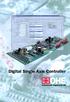 Digital Single Axis Controller The concept of intelligent hydraulic drive a vision? DSAC (Digital Single Axis Controller) Do you need hydraulic servo drive for your machine/system? What would it be like
MACHINE VISION FOR SMARTPHONES. Essential machine vision camera requirements to fulfill the needs of our society
 MACHINE VISION FOR SMARTPHONES Essential machine vision camera requirements to fulfill the needs of our society INTRODUCTION With changes in our society, there is an increased demand in stateof-the art
Applications of algorithms for image processing using programmable logic
 Applications of algorithms for image processing using programmable logic Presented by: Nikolay Nenov, M. Sc. Ph. D. Student at the Technical University of Sofia E-mail: [email protected] Research director:
High-speed image processing algorithms using MMX hardware
 High-speed image processing algorithms using MMX hardware J. W. V. Miller and J. Wood The University of Michigan-Dearborn ABSTRACT Low-cost PC-based machine vision systems have become more common due to
Logical Operations. Control Unit. Contents. Arithmetic Operations. Objectives. The Central Processing Unit: Arithmetic / Logic Unit.
 Objectives The Central Processing Unit: What Goes on Inside the Computer Chapter 4 Identify the components of the central processing unit and how they work together and interact with memory Describe how
How an electronic shutter works in a CMOS camera. First, let s review how shutters work in film cameras.
 How an electronic shutter works in a CMOS camera I have been asked many times how an electronic shutter works in a CMOS camera and how it affects the camera s performance. Here s a description of the way
White paper. CCD and CMOS sensor technology Technical white paper
 White paper CCD and CMOS sensor technology Technical white paper Table of contents 1. Introduction to image sensors 3 2. CCD technology 4 3. CMOS technology 5 4. HDTV and megapixel sensors 6 5. Main differences
Mouse Control using a Web Camera based on Colour Detection
 Mouse Control using a Web Camera based on Colour Detection Abhik Banerjee 1, Abhirup Ghosh 2, Koustuvmoni Bharadwaj 3, Hemanta Saikia 4 1, 2, 3, 4 Department of Electronics & Communication Engineering,
Inspection and Illumination Systems for Visual Quality Assurance. Large selection Attractive prices Tailored solutions. optometron.
 Inspection and Illumination Systems for Visual Quality Assurance Large selection Attractive prices Tailored solutions optometron.de en Optometron fulfils a key role Visual quality assurance is essential
Navigation Aid And Label Reading With Voice Communication For Visually Impaired People
 Navigation Aid And Label Reading With Voice Communication For Visually Impaired People A.Manikandan 1, R.Madhuranthi 2 1 M.Kumarasamy College of Engineering, [email protected],karur,india 2 M.Kumarasamy
SABRE Lite Development Kit
 SABRE Lite Development Kit Freescale i.mx 6Quad ARM Cortex A9 processor at 1GHz per core 1GByte of 64-bit wide DDR3 @ 532MHz UART, USB, Ethernet, CAN, SATA, SD, JTAG, I2C Three Display Ports (RGB, LVDS
CNC-STEP. "LaserProbe4500" 3D laser scanning system Instruction manual
 LaserProbe4500 CNC-STEP "LaserProbe4500" 3D laser scanning system Instruction manual 2 Hylewicz CNC-Technik Siemensstrasse 13-15 D-47608 Geldern Fon.: +49 (0) 2831 133236 E-Mail: [email protected] Website:
Computer Graphics Hardware An Overview
 Computer Graphics Hardware An Overview Graphics System Monitor Input devices CPU/Memory GPU Raster Graphics System Raster: An array of picture elements Based on raster-scan TV technology The screen (and
How To Build A Cloud Computer
 Introducing the Singlechip Cloud Computer Exploring the Future of Many-core Processors White Paper Intel Labs Jim Held Intel Fellow, Intel Labs Director, Tera-scale Computing Research Sean Koehl Technology
Static Environment Recognition Using Omni-camera from a Moving Vehicle
 Static Environment Recognition Using Omni-camera from a Moving Vehicle Teruko Yata, Chuck Thorpe Frank Dellaert The Robotics Institute Carnegie Mellon University Pittsburgh, PA 15213 USA College of Computing
BUILD VERSUS BUY. Understanding the Total Cost of Embedded Design. www.ni.com/buildvsbuy
 BUILD VERSUS BUY Understanding the Total Cost of Embedded Design Table of Contents I. Introduction II. The Build Approach: Custom Design a. Hardware Design b. Software Design c. Manufacturing d. System
Using visible SNR (vsnr) to compare image quality of pixel binning and digital resizing
 Using visible SNR (vsnr) to compare image quality of pixel binning and digital resizing Joyce Farrell a, Mike Okincha b, Manu Parmar ac, and Brian Wandell ac a Dept. of Electrical Engineering, Stanford
DIGITAL-TO-ANALOGUE AND ANALOGUE-TO-DIGITAL CONVERSION
 DIGITAL-TO-ANALOGUE AND ANALOGUE-TO-DIGITAL CONVERSION Introduction The outputs from sensors and communications receivers are analogue signals that have continuously varying amplitudes. In many systems
路 論 Chapter 15 System-Level Physical Design
 Introduction to VLSI Circuits and Systems 路 論 Chapter 15 System-Level Physical Design Dept. of Electronic Engineering National Chin-Yi University of Technology Fall 2007 Outline Clocked Flip-flops CMOS
ECP240-32 & ECP240-32EX
 ECP240-32 & ECP240-32EX Hardware Manual 11Fl., 684-2, Deungchon 3-Dong, Gangseo-Gu, Seoul, Korea TEL: +82 2 2605 1486 FAX: +82 2 2605 1489 http://www.udptech.co.kr Contents 1. PRODUCT OVERVIEW...1 1.1
How To Design An Image Processing System On A Chip
 RAPID PROTOTYPING PLATFORM FOR RECONFIGURABLE IMAGE PROCESSING B.Kovář 1, J. Kloub 1, J. Schier 1, A. Heřmánek 1, P. Zemčík 2, A. Herout 2 (1) Institute of Information Theory and Automation Academy of
Accurate Measurement of the Mains Electricity Frequency
 Accurate Measurement of the Mains Electricity Frequency Dogan Ibrahim Near East University, Faculty of Engineering, Lefkosa, TRNC [email protected] Abstract The frequency of the mains electricity supply
How To Fix Out Of Focus And Blur Images With A Dynamic Template Matching Algorithm
 IJSTE - International Journal of Science Technology & Engineering Volume 1 Issue 10 April 2015 ISSN (online): 2349-784X Image Estimation Algorithm for Out of Focus and Blur Images to Retrieve the Barcode
High-Speed Thin Client Technology for Mobile Environment: Mobile RVEC
 High-Speed Thin Client Technology for Mobile Environment: Mobile RVEC Masahiro Matsuda Kazuki Matsui Yuichi Sato Hiroaki Kameyama Thin client systems on smart devices have been attracting interest from
LoliTrack. Video Tracking Software. Operation Manual
 LoliTrack Video Tracking Software Operation Manual TABLE OF CONTENTS INTRODUCTION TO THE VIDEO TRACKING SOFTWARE Tracking Principle 1 Features 2 Included 2 Computer Requirements 2 INSTALL THE VIDEO TRACKING