
Seismic Cone Penetration Test. Experimental results in onshore areas.
|
|
|
- Victor Ball
- 10 years ago
- Views:
Transcription
1 Seismic Cone Penetration Test. Experimental results in onshore areas. Alexandra-Ioana Iliescu Jeremy Geron Abstract The use of cone penetration test (CPTu) is an geotechnical onshore site investigation which is often used as well as other more traditional investigations. To begin with, this article will present a detailed description of CPTu, SCPTu and shear waves types. The field tests description provides with information about the soil conditions and draws an idea of the SCPTu set up. For a better understanding of the soil properties, laboratory tests (water content, particle size distribution, pycnometer and hydrometer methods) were performed. The CPTu along with SCPTu results provide with reliable information about soil stratigraphy and a lot of data to be interpreted. Two different methods of finding S-waves are presented along with one method for P-wave in order to analyze and compare with the theoretical assessments. Keywords: seismic, cone penetration test, S-wave, P-wave, soil classification test, shear velocity. 1 Introduction The cone penetration test (CPTu) is frequently used in both onshore and offshore construction as geotechnical investigation. The seismic cone penetrometer can dramatically reduce the cost in time efficiency associated with seismic testing, especially if CPTu is used as part of the regular site investigation program. Comparisons of onshore seismic cone shear wave velocities with those measured by both down-hole and crosshole techniques at sites in Canada, (Rice, 1984), United States, (J.A. Jendrezejczuk) and Belgium, (Bouhon, 2010) have already validated the seismic cone technique. This article presents and discusses results from SCPT preformed in sand and clay in Aalborg area. The cone bearing, friction sleeve stress, cone pore pressure and shear velocity data can be used to provide a fast and reliable determination of soil type and shear strength, according to (P. K. Robertson). The data given by the cone can be interpreted to get a good continuous prediction of the soil type and shear strength parameters. When a seismometer is integrated into the cone penetration test procedure, the CPTu becomes SCPTu (Seismic Cone Penetration Test). The use of S-Wave velocity data in foundation investigations has become increasingly popular in recent years, but use of this valuable and diagnostic study has been delayed because of the difficulty of obtaining reliable data, particularly under varying geologic conditions, (Beckstead). To obtain the measurements a rugged velocity seismometer has been incorporated into the cone penetrometer. Downhole seismic shear wave velocity measurements can be made during brief pauses in the CPTu. In (J.A. Jendrezejczuk) the shear wave speed is computed by dividing the distance between two pairs of receivers by the time for the signal to travel from one receiver to the next. There are four types of seismic waves who propagates through the soil. These can be divided into two categories. The first category are the body waves also named flat/volume waves, their displacement is Longitudinal for the P wave and transversal for the S wave, as seen in Figure 1. The Compression (P) wave are also referred as irrotational waves which propagate through solid and fluids. They propagate at a higher velocity than shear waves. The Shear (S) as said before their direction is transversal but the S waves are also referred as the rotational waves and are unable to propagate through fluids. Figure 1: Different types waves. (Rice, 1984) II

2 2 Field test To have an overview of the two different testing sites, Aalborg is located in Jutland which is part of the north of Denmark as seen in Figure 2. The tests performed in sand were located in the east part of Aalborg, the industrial part of the city. On the location of the site a wind turbine blade deposit will be build. The location for the clay soil is in the center of Aalborg, next to the Train Station and the Bus Terminal. Figure 2: Position of the field test, Wikimedia (2006) Concerning the sand field, this site is situated a few meters from the fjord which means it is a basin deposit area. The soils composition is: the top layer (1-4 meters) a fjord deposit of clay/gyttia, while the lower layers are is mostly composed of silty sand. The SCPTu were performed until approx. 8 meters depth. til reaching the middle of Borehole 127 and 130 (five SCPTu). The distance between SCPTu is of ten meters. From the middle SCPTu a perpendicular line of SCPTu is done keeping the same rule of ten meters between each other so that another four SCPTu are to be done, as seen in Figure 3. For the clay soil the site is situated in the center of Aalborg. The composition of this in mainly a top layer of sand (2-3) meters of sand and the rest is clay. Five different SCPTu where executed in this location. These SCPTu where realized with a 5 meters distance between each other starting 5 meters away from the Borehole B4 which profile can be seen in Figure 4. Due to a very agglomerate area as the center Figure 4: Positioning of the city, different errors of SCPTu could appear in the results of SCPT. These errors can be generated by the construction site situated next to the testing site or the presence of the bus terminal and train station. The works from the site along with the passing of the trains, buses and cars produce mild vibrations that could reach the cone, which is very sensitive on every interference. In addition, another cause for possible errors in the results could be the appearance of the site. The SCPTu were performed on pavement stones and asphalt. The asphalt in comparison with normal soil, or even the pavement stones, absorbs the energy, which causes a poor signal for the waves, therefore errors in the results. The setup can be seen in Figure 5, where for the P-waves, the plate has been mounted into the ground by drilling into the asphalt or removing the pavement stones. Figure 3: Position of the Boreholes and SCPTu Nine different SCPTu are executed in a crossshape positioning. A first line of SCPTu was chosen and the first SCPTu is taken from the middle of Borehole 126 and 131, aligned un- Figure 5: Setup for the shear waves III

3 2.1 Description of the cone. The cone used for the tests has standard values specified in the E.U and American standards as seen in Figure 6. The friction sleeve, f s,whichis placed above the conical tip, also has a standard dimension of 150 cm 2. A pore pressure transducer is installed to measure the dynamic pore pressure during the penetration.the cone penetrometer is pushed into the soil at a standard speed of 20 mm/s. with a penetration rate of 20 mm/s. In certain cases the soil was pre-drilled due to fill. The cone penetetrometer is advancing through the soil by being pushed firmly and continuously in thegroundbythetruckmachinecreatingmechanical contact between the seismometer carrier and the soil. Therefore, allowing good coupling and signal response both for clay and sand. Also, the orientation of the cone is controlled by setting up the X and O rings and the depth synchronizer provides with accurate depth measurements. 2.2 Description of machineries and test setup. The setup of the machinery starts by positioning thecpttruckorcabincrawlerovertheexact position chosen previously. For the SCPT the seismic sources are a sledge hammer and a piston, which was blown on a steel plate stuck on the ground. After a 1 meter pre-drill, two plates on both sides of the hole are placed in order to insure that the left and the right part of the S wave testing are aligned as seen in Figure 7. Figure 6: The standard type of cone. The memo cone used in this SCPT and the equipment has a certain number of standard values (E.U and American) properties: A conical tip; A10cm 2 probe with a tip angle of 60 ; A 7 channel measuring: point resistance, q c, local friction, f s pore pressure, u, tilt, temperature, electric conductivity, seismic, uniaxial for shear wave measurememnts; Depth synchronization; Data acquisition system and software; Data interpretation, CPT-LOG software. The signal is transmitted up through the steel of the rods to a microphone on the penetrometer. The absence of the cable makes the system very easy and time efficient in usage. The measurements were used until 8m, engineers choice, Figure 7: Setup for the shear waves The plates used in this case are L shaped and the bottom of the plate should be equipped with transversal teeth to improve the contact with the ground as seen in Figure 8. The distance between the place where the hammer hits and the SCPTu hole is of 1,4 meters. To have a constant and exact same force on left and right S wave a mounting has been realized as seen in Figure 9. Concerning the position for the P waves the distance for this test is at 1,8 meters from the hole through which the rod string is fed. It has to be perpendicular to the S wave set up as seen in Figure 10. For the P wave generation is a plate with a circular part which is pushed into the soil with a hydraulic or pneumatic piston as seen in Figure 11. The waves were generated by blowing the piston on the steel plate from a free fall. IV

4 Figure 8: L plate with transversal teeth, Sledge hammer and Penetration Cone Geotech (2012) Figure 11: Introduction of P wave plate into the ground A specific hammer has been created to have the comparable wave generated as the one used for the S wave setup. It is also designed to generate a constant hit during the hole test. The hammer is composed a tube of 1,5 meter height which gives a control height on which a chosen weight is dropped off as it can be seen in Figure 12. The seismic signal is generated by striking the L plate pad with the hammer. Figure 9: Hammer display Figure 12: Set-up of the P wave test Figure 10: SCPT field setup, Geotech (2004) 2.3 Manipulation The penetration velocity is measured while the rod string is pushed into the soil. Previously, it V

5 was defined that the CPT will be performed until 8 meters. The Seismic part of the test is performed every each meter. When the rod string has reached the depth required, the engine of the penetrometer or drill rig are stopped. This is done to give the possibility to realize the SCPT test which is noise sensitive. The interval shear velocity can be easily checked on field, for quality assessment. As soon as the Seismic part is finished the CPT can continue the same way until the desired depth is reached. 3 Soil Classification Tests for Sand With the data obtained both from the borings and the CPTs results, profiles with soil type stratigraphy, description and corresponding depths were plotted using as in Figure 13. It can be observed that the first layer is a fill layer for the first approx. 2 meters, being followed by a a layer of clay and gyttia and after approx 3 meters fine sand is reached. 3.1 Determination of Water Content From two of the borings seen in Figure 10, soil samples were taken in order to perform several soil classification tests. According to the geotechnical survey from the boreholes, The first test performed was the water content one. This test is performed to determine the water (moisture) content of soils. The water content is required as a guide to classification of natural soils and as a control criterion in re-compacted soils and is measured on samples used for most field and laboratory tests according to (DS/S-19000, 2004a). The water content, w is defined as the weight loss of the soil in % of the dry weight by drying in an incubator (oven) at a temperature of 105 C to a constant weight. w = W w 100% W s (1) = (W + Bowl) (W s + Bowl) 100% W s + Bowl (2) where, Bowl : weight of the bowl [g] W : weight of sample before drying [g] W s : weight of the dried sample [g] W w : weight of the water sample [g] The samples that were tested were taken from half of meter to half of meter until 8 meters were reached. The first two meters of the both borings were covered with topsoil clay. Furthermore, gyttia is found for the first boring until 3.6 meters, whereas for the second one until 2.8 meters. Until 8 meters the presence of fine silty sand was observed. For all the samples taken from both boreholes Table 1 presents the ranges on which the water content varies in the samples. For Borehole 100, the maximum value represents a gyttia sample situated at 3.5 m depth, whereas the minimum value is fine sand found at 8m. For Borehole 200, the maximum value represents a clay sample situated at aprox. 2.0 m depth, whereas the minimum value is fine sand found at 4 m. Table 1: Water content results Figure 13: Bore hole 100 and 200 profile with soil type and depth Layer Water content, [%] Borehole Topsoil - clay Gyttia Fine sand Borehole Topsoil - clay Gyttia Fine sand VI

6 3.2 Determination of Particle Size Distribution After performing the water content test on every sample, 8 samples were chosen for a sieving analysis, 4 out of each boring from different depths as seen in the Table 2. Table 2: Grain size analysis. Borehole sample details Borehole Sample Depth Type of soil no. no. [m] fine silty sand fine sand fine sand fine sand fine sand fine sand fine sand fine sand The screenings on each sieve in % of the dry weight of the total of each sample are plotted into a coordinate system which is function of the sieve dimension, as seen in Figure 14. The screening percentanges are plotted in the vertical axis in an arithmetic scale and the sieve dimensions on the horizontal one in a logarithm scale. s% ngs nin een cre Sc GrainSizeAnalysis Sievemeshsize size Sample34 Sample28 Sample25 Sample31 Sample99 Sample11 Sample14 Sample17 Figure 14: Grain size analysis on sand samples W s : Weight of a given volume soil [g] grain W i : Weight of the same volume deionised [g] water at 4 C The results obtained can be observed in Table 3. Table 3: Relative density results Sample no Relative density, G s,[-] Determination of Particle Size Distribution - Hydrometer test The hydrometer analysis is the process by which the weight-related distribution of soil grains after size in the silt fraction (2μm-60μm). The hydrometer also determines the specific gravity (or density) of the suspension, and this enables the percentage of particles of a certain equivalent particle diameter to be calculated. According to Section 3.3 the relative density obtained for Sample 9 is 2.66 as seen in Table 3. The grain diameter,d, is found by writing the Stoke s law, (DS/S-19000, 2004c) where the relative density is entered instead of the actual density so it becomes: d = 18η 100 (G s d 0 )g 60 h t (4) The corresponding values of weight percentages and grain size are put in the same coordinate system as the sieve curve of Sample 9 as seen in Figure 15. The recorded curve part (the beginning one) is considered as the slurry curve. 3.3 Determination of Particle Density - Pycnometer method From the results observed from the sieving curves four different soil samples were taken in order to perform the pycnometer test in order to obtain the relative density found using Equation (3), (DS/S-19000, 2004b). where, G s = W v W i (3) s% nin ng gs cr re ee Sc Sample Sievemeshsize size Figure 15: Sample 9 Sieveing curve after Hydrometer Test VII

7 (a) Sand (b) Clay Figure 16: CPT results before and after error filtering for the soil types seen in Figure 13 VIII

8 4 Interpretation of data 4.1 CPTu Results - Error Filtering The CPTu is considered as a standard method of assessing soil properties, so measuring errors can occur during the test. Some of them can be detected, other might be, wrongly, assumed to be a real soil property. One of the easiest ways for detecting the errors is by assessing the raw data. According to (Andersen, 2011) two criteria have formed the base for removing the data. For the first one, measurements with zero cone tip resistance have been removed as a zero cone resistance indicates a cavity in the soil, but for sand deposits is unlikely to happen. The second one takes into account the errors occurring in connection with stops of the cone, during the tests. The stops during the penetration test are caused by the need of attaching new rods or from each meter for performing the seismic tests. These errors are due to halts, and it is often seen as drops in the cone resistance. The rods have a length of 0.95 m and the drops in cone resistance and friction sleeve are seen every meter. For the sand case, when the sand was getting stiffer, around 7 meters, the cone had to be halted more often, as seen in Figure 16. When the penetrometer is halted, the pressure on the cone and the sleeve friction is released. Cone penetration in sands will not occur completely drained. When the cone stops, small excess pore pressure drains away and again builds up during the penetration. The peaks marked with there lines represent the halts and they were removed as they are not representative of inherent soil properties. This is basically based on engineering judgment. Generally, most of the data removed was errors produced by halts and the final results for clay can be seen in Figure SCPTu results - verification of waves The seismic signal was generated by the blows of the hammer for the S-waves and of the piston for the P-waves, only one blow for each type of wave. The first step of the interpretation of the results was to verify if the signal was spreading in the right direction along with the depth. The profile sheet is used for viewing the seismic signal traces at different depths. For sand, in Figure 17 both compressive and shear waves on the first SCPTu are presented, each graph representing the seismic signal trace loaded file for the corresponding depth. It can be observed that as deep the penetration goes the weaker the signal becomes, which was what it was expected. The difference in the depth is of 1 meter. It can be observed that as deep the penetration goes the weaker the signal becomes. (a) P-waves (b) S-waves Left (c) S-waves Right Figure 17: Shear waves from Sand Sounding In sand, it was interesting to see if the signal is intercepted correctly by the cone so during one of the SCPTs performed in sand at a depth of 5 meters 10 successive blows were applied for both P-waves and S-waves, left and right and can be seen in Figure 18. Each color represents one blue. IX

9 (a) P-waves (b)s-wavesright For the left shear waves it can be observed that the signal is the same after multiple blowing, but for the right one it can be seen that each blow s signal has a different peak at differentplacesintime. AsforthePwavesitcan be mentioned that only one of the blows did not follow the pattern, caused by a possible error in signal, whereas the rest form a peak signal around the same time. For clay a different approached was used in order to verify the accuracy of the signal. The seismic test was performed both on the cone s way down into the ground but also while removing it, upwards. In Figure 19 are plotted with red color the down direction waves and with blue the up direction ones. It can be observed that on both directions the wave register the same peak, but when it comes to dissipation the ones that are measured on the up direction take more time. This fact can be explained by the void in the SCPTu hole that prevent the propagation and therefore a proper dissipation of the signal into the ground. Another problem influencing the accuracy of the waves was the location of the tests performed in clay. As mentioned before the location, was next to a bus terminal and the ground was covered with asphalt which made the placing of the SCPTu plates very difficult. In Figure 20 it can be observed that for the P-wave problems were not encountered as the plate was dug into the ground. For the S-waves ones it can be observed a difference in signal distribution from one sounding to another. In Figure 21a and Figure 21b it can be seen that in the first meters there is not a defined peak of signal and a possible cause can be the asphalt and the topsoil above the clay layer which can produce delay in signal, hence a faster dissipation. For the last meters the signal registered a peak because at a lower level no surface disturbances are encountered. Therefore for the last SCPTus the S-waves plates were placed on a layer of sand added on the asphalt to reduce the effects of the surface disturbances and so the wave distribution can be seen in Figure 21c and Figure 21c. (c) S-waves Left Figure 18: 10 time blow SCPTu waves in 5 meters depth X

10 (a) P-waves (a) S-waves Left (b) S-waves Left (b) S-waves Right (c) S-waves Right (c) S-waves Left Figure 19: Shear waves from SCPTu in Clay Figure 20: P-waves depth profile for Clay (d) S-waves Right Figure 21: Shear waves from Clay SCPTu XI

11 4.3 SCPTu results - P-waves Cross-Correlation Method For obtaining the velocities generated by the P-waves a relative new method has been used. Using a vertical direction hammer, one blow is applied on the plate in order to generate the signal of the wave. In signal processing, crosscorrelation is a measure of similarity of two waveforms as a function of a time-lag applied to one of them. According to (Schaff and Waldhauser) in the case of a SCPTu, it is possible to obtain a correlation function by zero-padding in the time domain or to be computed by the inverse Fourier transform of the cross spectrum. In this case though, the difference in depth and wave velocity between the two depths is displayed in Figure22. The P-velocities are displayed in a chart format depending on depth and type of soil. The results for sand can be seen in Figure 23. The value in the fill layer is considered an error in measurement as its value is negative, also the gyttia values are relative high whereas the sand ones are more or less in the same range of values. 4.4 SCPTu results - S-waves Reverse Polarity Method The method of determining shear wave velocity from seismic CPT data basically involves dividing an increment shear wave travel time into an increment of travel path. The test procedure consists of generating reverse polarity shear waves, first by impacting one end of the timber, and then by impacting the opposite end (left and right). Accelerationtime traces, corresponding to each impact, are recorded on the computer for subsequent processing and analysis. In analyzing the data, particular attention is paid to the two records made with horizontal impacts. The true shear waves should reverse polarity, and this characteristic is used as the most important identifying characteristic. In some surveys, the shear waves are readily obvious and this is not difficult. In others, there may be numerous other arrivals and noise signals that make identification difficult; hence the need for a clear reversal signature, (J.A. Jendrezejczuk). The first blow (for example, the left side) represents the seismic record from the SPCTu as seen in Figure 25 part A. To confirm that a real shear wave was obtained, another record is taken by hitting on the other side (in this case, the right) and if the data is correct it should look as Figure 25 part B. The first break is in the opposite direction, which confirms that the reading is a shear wave. Many analysts superimpose the records, for better comparison as shown in Figure 25 part C. Figure 23: P-velocity for Sand For clay, the SCPTu results are calculated for both down and up direction of the test as seen in Figure 24. It can be observed that for the both directions the velocities follow the same pattern and the values are in the same range. Figure 25: Shear waves reverse polarity when the source polarity is reversed, (Crice). Figure 24: P-velocity for Clay It has been found that the reverse polarity of the source greatly facilitates the identification ofthes-waveandthetimeforthefirstcrossover point (shear wave changes sign) is easily identified from the polarized waves (forward and reverse) and provides the most repeatable reference arrival time, (R. G. Campanella, 1986). XII

12 Figure 22: Cross correlation method for P-waves Figure 26: Seismic analysis using reverse polarity,(geotech, 2004) XIII

13 4.4.2 SCPTu results - shear velocity The shear wave velocity is readily computed by dividing the distance between two pairs of receivers by the time for the signal to travel from the one receiver to the next. Travel times can be computed using the start of the S-wave, or any corresponding prominent feature on the time signals (e.g., zero crossing or peak), as the reference. As an example, using the traces given in Figure26,withthestartoftheS-waveasthereference, the shear wave speed is calculated as follows: we consider X1 =4m and X2 =5m as the reading depths, T 1 = ms and T 2= ms as the tracing amplitudes, ΔX crt = 0.89m as correction factor for the distance by the depth and from Equation (5) we obtain the final result. strongest signal point. The velocities are computed using the same routine as shown by Equation (5). From the Section 4.2 it was observed that along the depth the signal follows a path and pattern, so it was considered an interesting idea to see the results if the point of the strongest signal is followed. For sand and clay the results are seen in Figure 30 and there can be seen differences in values. The filling layer has negative values and can be considered as an error in measurement. Unfortunately, the values obtained with the second method are double in value as the first one. V s = ΔX crt ΔT = =80.40m (5) s The results for all the depths in sand soil are plotted in Figure27 (a) Sand Figure 27: Shear Velocities Sand For clay, the velocities were displayed as a comparison from the down and up direction ofthescptusasinfigure28. (b) Clay Figure 30: Shear waves from Clay SCPTu obtained using Reverse Polarity Method Cross-Correlation Method Figure 28: Shear Velocities Clay Another approach is to follow the signal s path, choosing the strongest signal point as seen in Figure 29, where the traces are placed on the Cross-correlation calculates the time interval by aligning the signal trains in the time axis, and it utilizes considerably more information in the collected shear waves than the first arrival and first cross-over methods, Liao and Mayne (2006). Cross-correlation works well if two signals are of the same shape. For both sand and clay the S-waves shapes have been verified in previous sections and in Figure 31 can be shown the signal generated by a blow on the left side. XIV

14 Figure 29: Seismic Analysis using Reverse Polarity Figure 31: Cross-correlation method for obtaining S-waves XV

15 4.4.4 SCPTu results - shear velocity The results of the cross-correlation method are displayed in a similar matter than the reverse polarity ones. In Figure 32 the sand results are displayed and it can be observed that on the S-left the values are relative small and the 2400m/s valueisconsideredtobeanerrorin measurement, whereas the S-right ones display more realistic values. (a) S-left (a) S-left (b) S-right Figure 33: Shear waves from Sand SCPTu using Cross- Correlation Method 5 Conclusion (b) S-right Figure 32: Shear waves from Sand SCPTu using Cross- Correlation Method For clay, the down and up SCPTu was analyzed and the range of values is similar for both. Also S-left and S-right signals are similar providing with the same results for both sides generated wave velocities. One of the most important conclusion is that the basic CPTu along with the Seismic test was successful and provided accurate stratigraphic details for both sand and clay. The seismometer on the cone was able to detect both P-waves and S-waves signals. However not all the values are in the ranges. The seismic test was successful, considering that the seismic wave velocities could be determined. According to (Andersen), the ranges for sand and gravel, S-waves are between 0 and 200 m/s, P-waves from 500 to 800 m/s and for clay, S-waves are between 0 and 250 m/s and P-waves from 500 to 700 m/s. This means that the P-waves values are below both ranges. For each site the velocity profiles were determined and the values for shear (S-wave) were in general considered to be correct, ranging between 0 to 300 m/s for sand (with some negative values on the first meter due to the fill in the sand) and from 50 to 200 m/s for clay. As for the P-waves, they are out of range, varying between 0 to 450 m/s for sand and between 0 to 220 m/s for clay. As highlighted by (R. G. Campanella, 1986), the combination of the seismic downhole method with the CPTu provide rapid and reliable means XVI

16 of determining stratigraphic, soil properties and velocity information in one SCPTu. The addition of seismic measurements significantly can improve the ability of the CPTu, meaning the bearing capacity is obtained from the CPTu and the soil deformation (elastic parameters) are obtained from the SCPTu. It was observed that closer intervals will result in better resolution of the subsurface layers and more accurate velocities,but also required more time to conduct the test. In the end a one meter interval was a good choice as it could have been possible to notice and compare signal traces for both types of waves. Another important point that was reached is that the SCPTu downhole survey has advantages like: faster to carry out (in the same time with the CPTu), does not require a different hole from the CPTu, provides with accurate depth determination during and after the tests and geophone orientation is maintained being attached to the cone. Since modern seismographs have digital data storage, computers can simplify the processing and display of data. Different problems encountered during testing: Since sand was the first time the SCPTu test was realised, it may have caused some errors (wrong way of hitting the hammer, not at the right depth, ect.). This is why it can be observedthatacoupleoftimewehavesome Shear velocities that are out of range. The water level is pretty high since we are 20 meters from the fyord and this has not been taken in account. In clay was background frequency noise caused by the presence of traffic and concrete and asphalt layer. It was observed that it seriously affected the signal, at least on the first meters, thus the accurate interpretation of the both shear and compressive wave signals.for some soundings (the last 3) it has been tested to put some soil between the asphalt and the plate to have a better connection. To insure a better generation of S waves in Clay compared to Sand an improvement was brought. One person wasstandingonthesplatewhilethewavewas generated to insure that the wave wouldn t stay in the surface. An other test done was to make the original SCPTu going downwards but a upwards test was also brought as it can be seen a difference is shown the closer the test gets to the surface, this can be explained by the fact that there is more air over and under and the contact surface is not perfect so it does not allow thewavetobeproperlymeasuredbythegeophone. The final conclusion and one of the mostimportantonesisthat,thespctuswere performed for the first time in North of Denmarkandthateventhoughsomeoftheresults are not accurate, they should be considered as a starting point to more investigations regarding SCPTu. As a personal statement it would be advised foragreaterexperiencetogobacktothesame sand site to add all the evolutions brought in the Clay site to observe the difference between the new values and the previously obtained values. XVII

17 References Andersen. Lars Andersen. Linear Elastodynamic Analysis. Aalborg University. Andersen, Sarah S., Lauridsen Kristoffer Andersen, Sarah S. Probabilistic site description based on cone penetration test, Beckstead. D. O. Beckstead. Example of Downhole P-Wave and S-Wave Utilizing Signal Enhancement and Polarity Reversal. Bouhon, Olivier Bouhon. Apport des méthodes géophysiques dans la reconnaissance liée aux besoins des chantiers de travaux souterrains: Tunnel STAFELTER, Crice. Doug Crice. Borehole Shear-Wave Surveys for Engineering Site Investigations. DS/S-19000, 2004a. DS/S Geotechnical investigation and testing - Laboratory testing of soil - Part 1: Determination of water content (ISO/TS :2004) DS/S-19000, 2004b. DS/S Geotechnical investigation and testing - Laboratory testing of soil - Part 3: Determination of particle density - Pycnometer method (ISO/TS :2004) P. K. Robertson, R. G. Campanella. D. Gillespie A. Roce P. K. Robertson, R. G. Campanella. Seismic CPT to Measure In Situ Shear Wave Velocity. Journal of Geotechnical Engineering, V112. R. G. Campanella, P. K. Robertson, D. Gillespie N. Laing P.J. Kurfurst R. G. Campanella, P. K. Robertson. Seismic cone penetration testing in the near offshore of the MacKenzie Delta. Canadian Journal Geotechnical, V24, pp , Rice, Anthony H. Rice. The Seismic Cone Penetrometer, Schaff and Waldhauser. David P. Schaff and Felix Waldhauser. Waveform Cross-Correlation-Based Differential Travel-Time Measurements at the Northern California Seismic Network. Bulletin of the Seismological Society of America, 95(6). Wikimedia, Wikimedia. Aalborg Map. URL: wiki/file:map_dk_\unhbox\voidb@x\ setbox\z@\hbox{!}\dimen@\ht\z@ \advance\dimen@-1ex\hboxto\z@{\raise. 67\dimen@\hbox{\char23}\hss}Alborg. PNG?uselang=fr, Downloaded: 05/10/2012. DS/S-19000, 2004c. DS/S Geotechnical investigation and testing - Laboratory testing of soil - Part 4: Determination of particle size distribution (ISO/TS :2004) Geotech, Geotech.SCPT SOUNDING (Seismic Cone Penetration Test) Geotech, Geotech.Seismic CPT adapter. URL: index.php/en/seismic-cpt-adapter, Downloaded: 05/10/2012. J.A. Jendrezejczuk. M.W. Wambs J.A. Jendrezejczuk. Surface Measurements of Shear Wave Velocity at The 7-GeV APS Site. Argonne National Laboratory Report LS-129. Liao and Mayne, T. Liao and P. W. Mayne. AUTOMATED POST-PROCESSING OF SHEAR WAVE SIGNALS. Proceedings of the 8th U.S. National Conference on Earthquake Engineering, Paper No. 460, 1 10, XVIII

ON THE INTERPRETATION OF SEISMIC CONE PENETRATION TEST (SCPT) RESULTS
 Studia Geotechnica et Mechanica, Vol. XXXV, No. 4, 213 DOI: 1.2478/sgem-213-33 ON THE INTERPRETATION OF SEISMIC CONE PENETRATION TEST (SCPT) RESULTS IRENA BAGIŃSKA Wrocław University of Technology, Faculty
Cone Penetration Test (CPT)
 Cone Penetration Test (CPT) The cone penetration test, or CPT in short, is a soil testing method which will provide a great deal of high quality information. In the Cone Penetration Test (CPT), a cone
Caltrans Geotechnical Manual
 Cone Penetration Test The cone penetration test (CPT) is an in-situ sounding that pushes an electronic penetrometer into soil and records multiple measurements continuously with depth. Compared with rotary
INDIRECT METHODS SOUNDING OR PENETRATION TESTS. Dr. K. M. Kouzer, Associate Professor in Civil Engineering, GEC Kozhikode
 INDIRECT METHODS SOUNDING OR PENETRATION TESTS STANDARD PENETRATION TEST (SPT) Reference can be made to IS 2131 1981 for details on SPT. It is a field edtest to estimate e the penetration e resistance
ASSESSMENT OF SHEAR WAVE VELOCITY FROM INDIRECT INSITU TESTS
 Proceedings of Indian Geotechnical Conference IGC-2014 December 18-20, 2014, Kakinada, India ASSESSMENT OF SHEAR WAVE VELOCITY FROM INDIRECT INSITU TESTS Kant, L., M. Tech Student, Department of Earthquake
INSITU TESTS! Shear Vanes! Shear Vanes! Shear Vane Test! Sensitive Soils! Insitu testing is used for two reasons:!
 In-situ Testing! Insitu Testing! Insitu testing is used for two reasons:! To allow the determination of shear strength or penetration resistance or permeability of soils that would be difficult or impossible
SPECIFICATION FOR DYNAMIC CONSOLIDATION / DYNAMIC REPLACEMENT
 SPECIFICATION FOR DYNAMIC CONSOLIDATION / DYNAMIC REPLACEMENT 1.0 SOIL IMPROVEMENT 1.1 General Soil Investigation Information are provided in Part B1 annex as a guide to the Contractor for his consideration
c. Borehole Shear Test (BST): BST is performed according to the instructions published by Handy Geotechnical Instruments, Inc.
 Design Manual Chapter 6 - Geotechnical 6B - Subsurface Exploration Program 6B-2 Testing A. General Information Several testing methods can be used to measure soil engineering properties. The advantages,
Cone Penetration Testing in Geotechnical Practice. Tom Lunne Peter K. Robertson John J.M. Powell
 Cone Penetration Testing in Geotechnical Practice Tom Lunne Peter K. Robertson John J.M. Powell BLACKIE ACADEMIC & PROFESSIONAL An Imprint of Chapman & Hall London Weinheim New York Tokyo Melbourne Madras
Satish Pullammanappallil and Bill Honjas. Optim LLC, Reno, Nevada, USA. John N. Louie. J. Andrew Siemens. Siemens & Associates, Bend, Oregon, USA
 Comparative Study of the Refraction Microtremor (ReMi) Method: Using Seismic noise and standard P-wave refraction equipment for deriving 1-D S-wave profiles Satish Pullammanappallil and Bill Honjas Optim
Site Investigation. Some unsung heroes of Civil Engineering. buried right under your feet. 4. Need good knowledge of the soil conditions
 This is an attempt to create a stand alone self learning module on site investigation. Fasten your seat belts. Sit back, relax and enjoy. 1 2 Site Investigation Some unsung heroes of Civil Engineering
Using Combination of SPT, DMT and CPT to Estimate Geotechnical Model for a Special Project in Turkey
 Using Combination of SPT, DMT and CPT to Estimate Geotechnical Model for a Special Project in Turkey Figen Orhun Onal GE, M.Sc., Site Works Manager, Zemin Etud ve Tasarım A.Ş., Istanbul, [email protected]
LABORATORY DETERMINATION OF CALIFORNIA BEARING RATIO
 LABORATORY DETERMINATION OF CALIFORNIA BEARING RATIO STANDARD IS: 2720 (Part 16) 1979. DEFINITION California bearing ratio is the ratio of force per unit area required to penetrate in to a soil mass with
Cone Penetration Testing (CPT) Michael Bailey, P.G. U.S. Army Corps of Engineers, Savannah District
 Cone Penetration Testing (CPT) Michael Bailey, P.G. U.S. Army Corps of Engineers, Savannah District Recommended publications ASTM D 5778-07 Standard Test Method for Electronic Friction Cone and Piezocone
A study on the Effect of Distorted Sampler Shoe on Standard Penetration Test Result in Cohesionless soil
 ISSN: 319-53 (An ISO 39: 00 Certified Organization) A study on the Effect of Distorted Sampler Shoe on Standard Penetration Test Result in Cohesionless soil Utpal Kumar Das Associate Professor, Department
Cone penetration testing, CPTu
 1 Cone penetration testing, CPTu Preface Our company is Environmental Mechanics AB or short Envi. A Swedish company developing, producing and marketing systems for cone penetration testing (also known
1 Mobilisation and demobilisation 1 Deep boring sum 2 Cone penetration tests sum 3 Miscellenous tests sum
 Malaysian Civil Engineering Standard Method of Measurement (MyCESMM) CLASS D: SITE INVESTIGATION WORK Measurement covered under other classes: Excavation not carried out for the purpose of soil investigation
KWANG SING ENGINEERING PTE LTD
 KWANG SING ENGINEERING PTE LTD 1. INTRODUCTION This report represents the soil investigation works at Aljunied Road / Geylang East Central. The objective of the soil investigation is to obtain soil parameters
Eurocode 7 - Geotechnical design - Part 2 Ground investigation and testing
 Brussels, 18-20 February 2008 Dissemination of information workshop 1 Eurocode 7 - Geotechnical design - Part 2 Ground investigation and testing Dr.-Ing. Bernd Schuppener, Federal Waterways Engineering
NOTES on the CONE PENETROMETER TEST
 GE 441 Advanced Engineering Geology & Geotechnics Spring 2004 Introduction NOTES on the CONE PENETROMETER TEST The standardized cone-penetrometer test (CPT) involves pushing a 1.41-inch diameter 55 o to
Ingeniería y Georiesgos Ingeniería Geotécnica Car 19 a Nº 84-14 of 204 ; TEL : 6916043 E-mail: [email protected]
 The plot below presents the cross correlation coeficient between the raw qc and fs values (as measured on the field). X axes presents the lag distance (one lag is the distance between two sucessive CPT
Geotechnical Measurements and Explorations Prof. Nihar Ranjan Patra Department of Civil Engineering Indian Institute of Technology, Kanpur
 Geotechnical Measurements and Explorations Prof. Nihar Ranjan Patra Department of Civil Engineering Indian Institute of Technology, Kanpur Lecture No. # 13 (Refer Slide Time: 00:18) So last class, it was
Figure 2.31. CPT Equipment
 Soil tests (1) In-situ test In order to sound the strength of the soils in Las Colinas Mountain, portable cone penetration tests (Japan Geotechnical Society, 1995) were performed at three points C1-C3
Module 1 : Site Exploration and Geotechnical Investigation. Lecture 4 : In-situ tests [ Section 4.1: Penetrometer Tests ] Objectives
![Module 1 : Site Exploration and Geotechnical Investigation. Lecture 4 : In-situ tests [ Section 4.1: Penetrometer Tests ] Objectives](/thumbs/26/8734290.jpg "Module 1 : Site Exploration and Geotechnical Investigation. Lecture 4 : In-situ tests [ Section 4.1: Penetrometer Tests ] Objectives") Lecture 4 : In-situ tests [ Section 4.1: Penetrometer Tests ] Objectives In this section you will learn the following Penetrometer Tests Standard penetration test Static cone penetration test Dynamic cone
Lecture 4 : In-situ tests [ Section 4.1: Penetrometer Tests ] Objectives In this section you will learn the following Penetrometer Tests Standard penetration test Static cone penetration test Dynamic cone
Soil behaviour type from the CPT: an update
 Soil behaviour type from the CPT: an update P.K. Robertson Gregg Drilling & Testing Inc., Signal Hill, California, USA ABSTRACT: An initial application of CPT results is to evaluate soil type and soil
PREDICTING THE HYDRAULIC CONDUCTIVITY OF MAKASSAR MARINE CLAY USING FIELD PENETRATION TEST (CPTU) RESULTS
 Proceedings of the Sixth International Conference on Asian and Pacific Coasts (APAC 2011) December 14 16, 2011, Hong Kong, China PREDICTING THE HYDRAULIC CONDUCTIVITY OF MAKASSAR MARINE CLAY USING FIELD
CHAPTER 1 INTRODUCTION
 CHAPTER 1 INTRODUCTION 1.1 Introduction The design and construction of foundations require a good knowledge of the mechanical behaviour of soils and of their spatial variability. Such information can be
Measurement of Soil Parameters by Using Penetrometer Needle Apparatus
 Vol.3, Issue.1, Jan-Feb. 2013 pp-284-290 ISSN: 2249-6645 Measurement of Soil Parameters by Using Penetrometer Needle Apparatus Mahmoud M. Abu zeid, 1 Amr M. Radwan, 2 Emad A. Osman, 3 Ahmed M.Abu-bakr,
An Automatic Kunzelstab Penetration Test
 An Automatic Kunzelstab Penetration Test Yongyuth Sirisriphet 1, Kitidech Santichaianant 2 1 Graduated student: Faculty of Industrial Education in and Technology. King Mongkut's University of Technology
Penetration rate effects on cone resistance measured in a calibration chamber
 Penetration rate effects on cone resistance measured in a calibration chamber K. Kim Professional Service Industries, Inc, Houston, TX, USA M. Prezzi & R. Salgado Purdue University, West Lafayette, IN,
Multiple parameters with one Cone Penetration Test. by Mark Woollard
 Multiple parameters with one Cone Penetration Test by Mark Woollard Subjects introduction MW introduction APB introduction CPT portfolio APB onshore CPT equipment near shore CPT equipment offshore CPT
DEM modelling of the dynamic penetration process on Mars as a part of the NASA InSight Mission
 Proceedings of the 4th European Young Geotechnical Engineers Conference (EYGEC), Durham, UK Osman, A.S. & Toll, D.G. (Eds.) 05 ISBN 978-0-9933836-0 DEM modelling of the dynamic penetration process on Mars
Geotechnical Investigation Test Report
 Geotechnical Investigation Test Report Report No. htsc/rcd/ 3457 Dated: - 20/03/2010 Asphalt Standard Penetration Test as per IS 2131 ------------- IS 6403 Soil Job Card No - 1649 Cement Client/Department
INTERNATIONAL JOURNAL OF CIVIL AND STRUCTURAL ENGINEERING Volume 3, No 3, 2013
 INTERNATIONAL JOURNAL OF CIVIL AND STRUCTURAL ENGINEERING Volume 3, No 3, 2013 Copyright by the authors - Licensee IPA- Under Creative Commons license 3.0 Research article ISSN 0976 4399 Reliability of
International Journal of Scientific & Engineering Research, Volume 4, Issue 9, September-2013 409 ISSN 2229-5518
 International Journal of Scientific & Engineering Research, Volume 4, Issue 9, September-2013 409 Estimation of Undrained Shear Strength of Soil using Cone Penetration Test By Nwobasi, Paul Awo Department
How To Design A Foundation
 The Islamic university - Gaza Faculty of Engineering Civil Engineering Department CHAPTER (2) SITE INVESTIGATION Instructor : Dr. Jehad Hamad Definition The process of determining the layers of natural
Classification and probabilistic description of a sand site based on CPTU
 Classification and probabilistic description of a sand site based on CPTU K. Lauridsen, S. Andersen, L. Ibsen, B. Nielsen 1 Agenda Objective of the project The test site Probabilistic interpretation of
CONSTANT HEAD AND FALLING HEAD PERMEABILITY TEST
 CONSTANT HEAD AND FALLING HEAD PERMEABILITY TEST 1 Permeability is a measure of the ease in which water can flow through a soil volume. It is one of the most important geotechnical parameters. However,
Module 1 : Site Exploration and Geotechnical Investigation. Lecture 5 : Geophysical Exploration [ Section 5.1 : Methods of Geophysical Exploration ]
![Module 1 : Site Exploration and Geotechnical Investigation. Lecture 5 : Geophysical Exploration [ Section 5.1 : Methods of Geophysical Exploration ]](/thumbs/40/20679662.jpg "Module 1 : Site Exploration and Geotechnical Investigation. Lecture 5 : Geophysical Exploration [ Section 5.1 : Methods of Geophysical Exploration ]") Objectives In this section you will learn the following General Overview Different methods of geophysical explorations Electrical resistivity method Seismic refraction method 5 Geophysical exploration
Objectives In this section you will learn the following General Overview Different methods of geophysical explorations Electrical resistivity method Seismic refraction method 5 Geophysical exploration
Standard Test Method for Mechanical Cone Penetration Tests of Soil 1
 Designation: D 3441 98 AMERICAN SOCIETY FOR TESTING AND MATERIALS 100 Barr Harbor Dr., West Conshohocken, PA 19428 Reprinted from the Annual Book of ASTM Standards. Copyright ASTM Standard Test Method
NUMERICAL MODELLING OF PIEZOCONE PENETRATION IN CLAY
 NUMERICAL MODELLING OF PIEZOCONE PENETRATION IN CLAY Ilaria Giusti University of Pisa [email protected] Andrew J. Whittle Massachusetts Institute of Technology [email protected] Abstract This paper
CONE PENETRATION TESTING AND SITE EXPLORATION IN EVALUATING THE LIQUEFACTION RESISTANCE OF SANDS AND SILTY SANDS ABSTRACT
 CONE PENETRATION TESTING AND SITE EXPLORATION IN EVALUATING THE LIQUEFACTION RESISTANCE OF SANDS AND SILTY SANDS E. J. Newman 1, T. D. Stark 2, and S. M. Olson 3 ABSTRACT Refined relationships between
Use and Application of Piezocone Penetration Testing in Presumpscot Formation
 Use and Application of Piezocone Penetration Testing in Presumpscot Formation Craig W. Coolidge, P.E. Summit Geoengineering Services, Rockland, Maine ABSTRACT: This paper examines the advantages and limitations
CIVL451. Soil Exploration and Characterization
 CIVL451 Soil Exploration and Characterization 1 Definition The process of determining the layers of natural soil deposits that will underlie a proposed structure and their physical properties is generally
HAULBOWLINE, CORK STATIC CONE PENETRATION TESTS FACTUAL REPORT
 HAULBOWLINE, CORK STATIC CONE PENETRATION TESTS FACTUAL REPORT CONE PENETRATION TESTS Cone resistance Local friction Porewater pressure Dissipations REPORT NO: RRM CONTRACT NO: GLOVER SITE INVESTIGATIONS
manufacturer of seismic borehole equipment sales rentals field service
 manufacturer of seismic borehole equipment sales rentals field service the company Geotomographie provides complete solutions for borehole and near-surface seismic surveys to geophysical, engineering and
CPTic_CSM8. A spreadsheet tool for identifying soil types and layering from CPTU data using the I c method. USER S MANUAL. J. A.
 CPTic_CSM8 A spreadsheet tool for identifying soil types and layering from CPTU data using the I c method. USER S MANUAL J. A. Knappett (2012) This user s manual and its associated spreadsheet ( CPTic_CSM8.xls
product manual HS-4210 HS-4210_MAN_09.08 Digital Static Cone Penetrometer
 HS-4210_MAN_09.08 product manual HS-4210 Digital Static Cone Penetrometer Introduction This Manual covers the measurement of bearing capacity using the Humboldt Digital Static Cone Penetrometer (DSCP).
Numerical Simulation of CPT Tip Resistance in Layered Soil
 Numerical Simulation of CPT Tip Resistance in Layered Soil M.M. Ahmadi, Assistant Professor, [email protected] Dept. of Civil Engineering, Sharif University of Technology, Tehran, Iran Abstract The paper
Physics 2A, Sec B00: Mechanics -- Winter 2011 Instructor: B. Grinstein Final Exam
 Physics 2A, Sec B00: Mechanics -- Winter 2011 Instructor: B. Grinstein Final Exam INSTRUCTIONS: Use a pencil #2 to fill your scantron. Write your code number and bubble it in under "EXAM NUMBER;" an entry
Soil Classification Through Penetration Tests
 Pak. J. Engg. & Appl. Sci. Vol. 9, Jul., 2011 (p. 76-86) Soil Classification Through Penetration Tests A. H. Khan, A. Akbar, K. Farooq, N. M. Khan, M. Aziz and H. Mujtaba Department of Civil Engineering,
Lymon C. Reese & Associates LCR&A Consulting Services Tests of Piles Under Axial Load
 Lymon C. Reese & Associates LCR&A Consulting Services Tests of Piles Under Axial Load Nature of Services The company has a long history of performance of tests of piles and pile groups under a variety
NEW DEVELOPMENTS AND IMPORTANT CONSIDERATIONS FOR STANDARD PENETRATION TESTING FOR LIQUEFACTION EVALUATIONS. Jeffrey A Farrar M.S.
 NEW DEVELOPMENTS AND IMPORTANT CONSIDERATIONS FOR STANDARD PENETRATION TESTING FOR LIQUEFACTION EVALUATIONS Jeffrey A Farrar M.S., P E 1 ABSTRACT Standard Penetration Tests (SPT) are often used for evaluating
Effect of grain size, gradation and relative density on shear strength and dynamic cone penetration index of Mahi, Sabarmati and Vatrak Sand
 Discovery ANALYSIS The International Daily journal ISSN 2278 5469 EISSN 2278 5450 2015 Discovery Publication. All Rights Reserved Effect of grain size, gradation and relative density on shear strength
Geotechnical Testing Methods II
 Geotechnical Testing Methods II Ajanta Sachan Assistant Professor Civil Engineering IIT Gandhinagar FIELD TESTING 2 1 Field Test (In-situ Test) When it is difficult to obtain undisturbed samples. In case
REPORT. Earthquake Commission. Christchurch Earthquake Recovery Geotechnical Factual Report Merivale
 REPORT Earthquake Commission Christchurch Earthquake Recovery Geotechnical Factual Report Merivale REPORT Earthquake Commission Christchurch Earthquake Recovery Geotechnical Factual Report Merivale Report
ODOT/OSU collaboration on the development of CPT Capabilities for use in Ohio Transportation Projects
 CPT Cone Penetration Testing ODOT/OSU collaboration on the development of CPT Capabilities for use in Ohio Transportation Projects Presented by: Jason Ross, Staff Engineer, BBC&M Engineering, Inc. Kirk
2. THE TEORRETICAL OF GROUND PENETRATING RADAR:
 Sixteenth International Water Technology Conference, IWTC 16 2012, Istanbul, Turkey 1 THE USE OF GROUND PENETRATING RADAR WITH A FREQUENCY 1GHZ TO DETECT WATER LEAKS FROM PIPELINES Alaa Ezzat Hasan Ministry
INTRODUCTION TO SOIL MODULI. Jean-Louis BRIAUD 1
 INTRODUCTION TO SOIL MODULI By Jean-Louis BRIAUD 1 The modulus of a soil is one of the most difficult soil parameters to estimate because it depends on so many factors. Therefore when one says for example:
VOLUME III GEOLOGY, HYDROGEOLOGY & GEOTECHNICAL REPORT CAPITAL REGION RESOURCE RECOVERY CENTRE
 2.0 SITE INVESTIGATION METHODOLOGY The following section summarizes the Site investigation methodology applied during the subsurface investigation and hydrogeological assessment completed at the CRRRC
GLOSSARY OF TERMINOLOGY
 GLOSSARY OF TERMINOLOGY AUTHORIZED PILE LENGTHS - (a.k.a. Authorized Pile Lengths letter) Official letter stating Engineer's recommended length of concrete piles to be cast for construction of foundation.
MONITORING THE GPR RESPONSE OF CURING CONCRETE T. De Souza 1, A.P. Annan 1, J.D. Redman 1, and N. Hu 1 1 Sensors & Software Inc., Mississauga, Canada
 MONITORING THE GPR RESPONSE OF CURING CONCRETE T. De Souza 1, A.P. Annan 1, J.D. Redman 1, and N. Hu 1 1 Sensors & Software Inc., Mississauga, Canada Abstract: Ground penetrating radar (GPR) is becoming
Chapter 4 SUBSURFACE INVESTIGATION GUIDELINES
 Chapter 4 SUBSURFACE INVESTIGATION GUIDELINES Final SCDOT GEOTECHNICAL DESIGN MANUAL August 2008 Table of Contents Section Page 4.1 Introduction...4-1 4.2 Subsurface Investigation...4-2 4.2.1 Preliminary
hs2 Ground A non-technical guide
 hs2 Ground Investigations A non-technical guide Contents HS2 ground investigations 1 Essential Q&A 2 2 In-ground investigation techniques 9 2.1 Cable percussion borehole 10 2.2 Rotary core borehole 12
Pavements should be well drained both during and upon completion of construction. Water should not be allowed to pond on or near pavement surfaces.
 Project No. 208-8719 January, 2009 Ref: 2-8719BR Anthony Hudson - Broadscale Geotechnical Investigation - Proposed Commercial Development - 52 Old Pacific Highway, Pimpama Page 32 iii) Pavements should
SUPPLEMENTAL TECHNICAL SPECIFICATIONS BI-DIRECTIONAL STATIC LOAD TESTING OF DRILLED SHAFTS
 July 14, 2015 1.0 GENERAL BI-DIRECTIONAL STATIC LOAD TESTING OF DRILLED SHAFTS This work shall consist of furnishing all materials, equipment, labor, and incidentals necessary for conducting bi-directional
WDC 14-056 - Whakatane Central Business District Geotechnical Investigation
 WDC 14-056 - Whakatane Central Business District Geotechnical Investigation Data Delivery Report Simon Henderson 11/4/2014 Site investigation relating to the ground investigation of the Whakatane central
Geotechnical Investigation using Standard Penetration Test (SPT) in Rangamati, Bandarban and Khagrachari Towns
 1. Introduction 1.1 Scope of Work The Asian Disaster Preparedness Centre (ADPC) is implementing the project Seismic Hazard and Vulnerability Mapping for Rangamati, Bandarban and Khagrachari Municipality.
How To Prepare A Geotechnical Study For A Trunk Sewer Project In Lincoln, Nebraska
 APPENDIX B Geotechnical Engineering Report GEOTECHNICAL ENGINEERING REPORT Preliminary Geotechnical Study Upper Southeast Salt Creek Sanitary Trunk Sewer Lincoln Wastewater System Lincoln, Nebraska PREPARED
FINAL REPORT ON SOIL INVESTIGATION
 FINAL REPORT ON SOIL INVESTIGATION FOR PROPOSED CONSTRUCTION AT SS-6B AREA AT HPCL VISAKH REFINERY VISAKHAPATNAM ANDHRA PRADESH J.J. ASSOCIATES(VISAKHAPATNAM) AETP(P) LIMITED #11-6-3, RockDale Layout,
AS COMPETITION PAPER 2008
 AS COMPETITION PAPER 28 Name School Town & County Total Mark/5 Time Allowed: One hour Attempt as many questions as you can. Write your answers on this question paper. Marks allocated for each question
4.4 WAVE CHARACTERISTICS 4.5 WAVE PROPERTIES HW/Study Packet
 4.4 WAVE CHARACTERISTICS 4.5 WAVE PROPERTIES HW/Study Packet Required: READ Hamper pp 115-134 SL/HL Supplemental: Cutnell and Johnson, pp 473-477, 507-513 Tsokos, pp 216-242 REMEMBER TO. Work through all
BEARING CAPACITY AND SETTLEMENT RESPONSE OF RAFT FOUNDATION ON SAND USING STANDARD PENETRATION TEST METHOD
 SENRA Academic Publishers, British Columbia Vol., No. 1, pp. 27-2774, February 20 Online ISSN: 0-353; Print ISSN: 17-7 BEARING CAPACITY AND SETTLEMENT RESPONSE OF RAFT FOUNDATION ON SAND USING STANDARD
Fundamentals of CONE PENETROMETER TEST (CPT) SOUNDINGS. J. David Rogers, Ph.D., P.E., R.G.
 Fundamentals of CONE PENETROMETER TEST (CPT) SOUNDINGS J. David Rogers, Ph.D., P.E., R.G. Cone Penetration Test CPT soundings can be very effective in site characterization, especially sites with discrete
METHOD STATEMENT HIGH STRIAN DYNAMIC TESTING OF PILE. Prepared by
 METHOD STATEMENT HIGH STRIAN DYNAMIC TESTING OF PILE Prepared by Infratech ASTM CO., LTD. Contents Chapter Description Page Contents...... 1 List of Appendix. 1 1. Introduction.. 2 2. Test Method..2 3.
CHAPTER 9 LONG TERM MONITORING AT THE ROUTE 351 BRIDGE
 CHAPTER 9 LONG TERM MONITORING AT THE ROUTE 351 BRIDGE 9.1 INTRODUCTION An important reason that composite piles have not gained wide acceptance in the civil engineering practice is the lack of a long
SAMPLE GUIDE SPECIFICATIONS FOR OSTERBERG CELL LOAD TESTING OF DEEP FOUNDATIONS
 Page 1 of 9 SAMPLE GUIDE SPECIFICATIONS FOR OSTERBERG CELL LOAD TESTING OF DEEP FOUNDATIONS 1. GENERAL REQUIREMENTS 1. Description of Work: This work consists of furnishing all materials, equipment and
ANNEX D1 BASIC CONSIDERATIONS FOR REVIEWING STUDIES IN THE DETAILED RISK ASSESSMENT FOR SAFETY
 ANNEX D1 BASIC CONSIDERATIONS FOR REVIEWING STUDIES IN THE DETAILED RISK ASSESSMENT FOR SAFETY ANNEX D1: BASIC CONSIDERATIONS FOR REVIEWING STUDIES IN DRA FOR SAFETY D1-1 ANNEX D1 BASIC CONSIDERATIONS
Evaluation of Properties of Soil Subgrade Using Dynamic Cone Penetration Index A Case Study
 International Journal of Engineering Research and Development e-issn: 2278-067X, p-issn: 2278-800X Volume 4, Issue 4 (October 202), PP. 07-5 Evaluation of Properties of Soil Subgrade Using Dynamic Cone
A Ground Improvement Update from TerraSystems
 TERRANOTES A Ground Improvement Update from TerraSystems SOIL MODULUS AFTER GROUND IMPROVEMENT Evaluation of ground improvement is accomplished using a variety of methods, from simple elevation surveys
King Saud University College of Engineering Civil Engineering Department DEFORMATION OF PARTIALLY SATURATED SAND. Sultan Musaed Al-Ghamdi
 King Saud University College of Engineering Civil Engineering Department DEFORMATION OF PARTIALLY SATURATED SAND By Sultan Musaed Al-Ghamdi Submitted in Partial Fulfillment of The Required For the Degree
Soil Behavior Type using the DMT
 Soil Behavior Type using the DMT Peter K. Robertson Gregg Drilling & Testing Inc., Signal Hill, CA, USA. E-mail: [email protected] Keywords: Soil Behavior Type, CPT, DMT ABSTRACT: The most promising
Electronic Soil Test Logging. Strategic Advantage or Unnecessary Headache?
 1 Electronic Soil Test Logging Strategic Advantage or Unnecessary Headache? 2 The Plan 3 4 What is it? Digitally Recording Soil Test Data Why? 5 6 Traditional Work Flow Field Digital Entry Sample Review
Sonic Logging in Deviated Boreholes of an Anisotropic Formation: Laboratory Study
 Sonic Logging in Deviated Boreholes of an Anisotropic Formation: Laboratory Study Zhenya Zhu, Shihong Chi, and M. Nafi Toksöz Earth Resources Laboratory Dept. of Earth, Atmospheric, and Planetary Sciences
DYNAMIC CONE PENETRATION TEST INSTRUCTIONAL MANUAL GEOTECHANICAL
 DYNAMIC CONE PENETRATION TEST INSTRUCTIONAL MANUAL GEOTECHANICAL J. P. Scientific Instruments 7, Civil Lines, Roorkee-247667 DYNAMIC CONE PENETRATION TEST CONTENTS: PAGE NO. 1.0 INTRODUCTION 03 2.0 PROBLEM
QUESTION TO AUDIENCE
 Site investigation some aspects of EN1997 Part 2 David Norbury David Norbury Limited BGA Symposium Eurocode 7 Today and Tomorrow, Cambridge, England, March 2011 QUESTION TO AUDIENCE How many of you have
The advantages and disadvantages of dynamic load testing and statnamic load testing
 The advantages and disadvantages of dynamic load testing and statnamic load testing P.Middendorp & G.J.J. van Ginneken TNO Profound R.J. van Foeken TNO Building and Construction Research ABSTRACT: Pile
EVALUATING THE IMPROVEMENT FROM IMPACT ROLLING ON SAND
 EVALUATING THE IMPROVEMENT FROM IMPACT ROLLING ON SAND D.L. Avalle, Broons Hire (SA) Pty Ltd, Australia J.P. Carter, The University of Sydney, Australia Abstract Impact rolling, utilising a non-circular
Chapter 7 Analysis of Soil Borings for Liquefaction Resistance
 Chapter 7 Analysis of Soil Borings for Liquefaction Resistance 7.1. Introduction. This chapter addresses the analysis of subsurface soil data to determine the factor of safety against liquefaction and
product manual 08.09 H-4210A PORTABLE STATIC CONE PENETROMETER
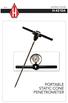 08.09 product manual H-4210A PORTABLE STATIC CONE PENETROMETER PORTABLE STATIC CONE PENETROMETER GENERAL INFORMATION The H-4210A Static Cone Penetrometer is an unparalleled device for measuring soil consistency.
Ground improvement using the vibro-stone column technique
 Ground improvement using the vibro-stone column technique A. Kosho 1 A.L.T.E.A & Geostudio 2000, Durres, Albania ABSTRACT The vibro stone columns technique is one of the most used techniques for ground
7.2.4 Seismic velocity, attenuation and rock properties
 7.2.4 Seismic velocity, attenuation and rock properties Rock properties that affect seismic velocity Porosity Lithification Pressure Fluid saturation Velocity in unconsolidated near surface soils (the
Speed A B C. Time. Chapter 3: Falling Objects and Projectile Motion
 Chapter 3: Falling Objects and Projectile Motion 1. Neglecting friction, if a Cadillac and Volkswagen start rolling down a hill together, the heavier Cadillac will get to the bottom A. before the Volkswagen.
Experiment 1: SOUND. The equation used to describe a simple sinusoidal function that propagates in space is given by Y = A o sin(k(x v t))
 Experiment 1: SOUND Introduction Sound is classified under the topic of mechanical waves. A mechanical wave is a term which refers to a displacement of elements in a medium from their equilibrium state,
Physics 9e/Cutnell. correlated to the. College Board AP Physics 1 Course Objectives
 Physics 9e/Cutnell correlated to the College Board AP Physics 1 Course Objectives Big Idea 1: Objects and systems have properties such as mass and charge. Systems may have internal structure. Enduring
Rock Bolt Condition Monitoring Using Ultrasonic Guided Waves
 Rock Bolt Condition Monitoring Using Ultrasonic Guided Waves Bennie Buys Department of Mechanical and Aeronautical Engineering University of Pretoria Introduction Rock Bolts and their associated problems
Seismic Waves Practice
 1. Base your answer to the following question on the diagram below, which shows models of two types of earthquake waves. Model A best represents the motion of earthquake waves called 1) P-waves (compressional
CPT interpretation in marine soils less than 5m depth examples from the North Sea
 CPT interpretation in marine soils less than 5m depth examples from the North Sea R. Mitchell SEtech (Geotechnical Engineers) Limited, Great Yarmouth, England S. Wootton & R. Comrie SEtech (Geotechnical
SUGGESTION ABOUT DETERMINATION OF THE BEARING CAPACITY OF PILES ON THE BASIS OF CPT SOUNDING TESTS
 SUGGESTION ABOUT DETERMINATION OF THE BEARING CAPACITY OF PILES ON THE BASIS OF CPT SOUNDING TESTS JóZSEF PUSZTAI About the authors Pusztai József Budapest University of Technology and Economics, Department
Free Fall: Observing and Analyzing the Free Fall Motion of a Bouncing Ping-Pong Ball and Calculating the Free Fall Acceleration (Teacher s Guide)
 Free Fall: Observing and Analyzing the Free Fall Motion of a Bouncing Ping-Pong Ball and Calculating the Free Fall Acceleration (Teacher s Guide) 2012 WARD S Science v.11/12 OVERVIEW Students will measure