
GRADUATION & CAREER PLANNING GUIDE BUSINESS & INDUSTRY FLOUR BLUFF INDEPENDENT SCHOOL DISTRICT
|
|
|
- Aileen Hoover
- 10 years ago
- Views:
Transcription
1 GRADUATION & CAREER PLANNING GUIDE STEM THE OFFICIAL GRADUATION GUIDE FOR FLOUR BLUFF HIGH SCHOOL Flour Bluff High School Grades 9 & 10 ARTSPUBLICSERVICES HUMANITIES MULTIDISCIPLINARY BUSINESS & INDUSTRY FLOUR BLUFF INDEPENDENT SCHOOL DISTRICT Every Student Is Worth My Best

2 TABLE OF CONTENTS COURSE OFFERING INDEX Board and Administrative Team...7 High School Guidance Counselors...8 Mission and Goals...9 Principal s Letter...10 Nondiscrimination Statement/Intent Statement...11 Foundation High School Program - Overview Foundation High School Program - Endorsements Foundation High School Program - Distinguished Level of Achievement STAAR End of Course Exams...27 Texas Education Agency Graduation Toolkit Checklists...28 Texas Education Agency Graduation Toolkit Glossary...29 Texas Education Agency Graduation Toolkit University Resources...30 Texas Education Agency Graduation Toolkit Workforce Resources...31 Grading Guidelines...32 Quick Facts about Grade Point Averages (GPAs) Grade Weighted Courses and UIL Exempt Courses Grade Classification Requirements...38 Credit by Examination Application...39 Texas Virtual School Network University Preparatory High School Program...42 Pre-Advanced Placement and Advanced Placement Coursework...43 Dual Credit Del Mar College West Campus Information...46 Articulated Credit...47 Craft Training Center of the Coastal Bend...48 Dual Credit and Articulated Courses Curriculum for National Honor Society Members...54 SAIL (Gifted and Talented Program) Information Schedule Change Regulations...57 Course Descriptions Local Credit Courses Courses by Endorsement Areas Special Programs Resources for High School and Beyond Financial Aid Websites Texas Grant FBHS Clubs and Organizations Public Notices NOTE: This Graduation and Career Planning Guide is subject to change based on updates and changes to law or policy from TEA and the FBISD Board of Trustees. 1

3 Course Offering Index Accounting Accounting Technician (Dual Credit) Advanced Animal Science Advanced Architectural Design Advanced Automotive Technology (Dual Credit) Advanced Broadcast Journalism...64 Advanced Fashion Design Advanced Mathematical Decision Making...72 Advanced Robotics Advanced Welding Advancement Via Individual Determination (AVID)...65 Aerobic Activities...89 Aerospace Engineering Air Conditioning/HVAC (Dual Credit) Aircraft Technology (Dual Credit) Algebra I...71 Algebra II...72 American Sign Language...67 Anatomy & Physiology...80, 119 Applied Music (Dual Credit)...99 Aquatic Science...80 Architectural Design (Dual Credit) Art...94 Athletic Trainer...89 Athletics...89 Auto Body (Dual Credit) Automotive Technology (Dual Credit) Avionics Electronics Technology Specialty (Dual Credit) Band Color Guard...98 Band Biology...77 Biotechnology (Dual Credit) Building Maintenance (Dual Credit) Business Information Management...101, 108 Calculus...73 Career Preparation I-II Cheerleading...89 Chemistry Child Care/Early Childhood Administrator (Dual Credit) Child Development/Early Childhood (Dual Credit) Child Development Child Guidance Choir Civil Engineering and Architecture

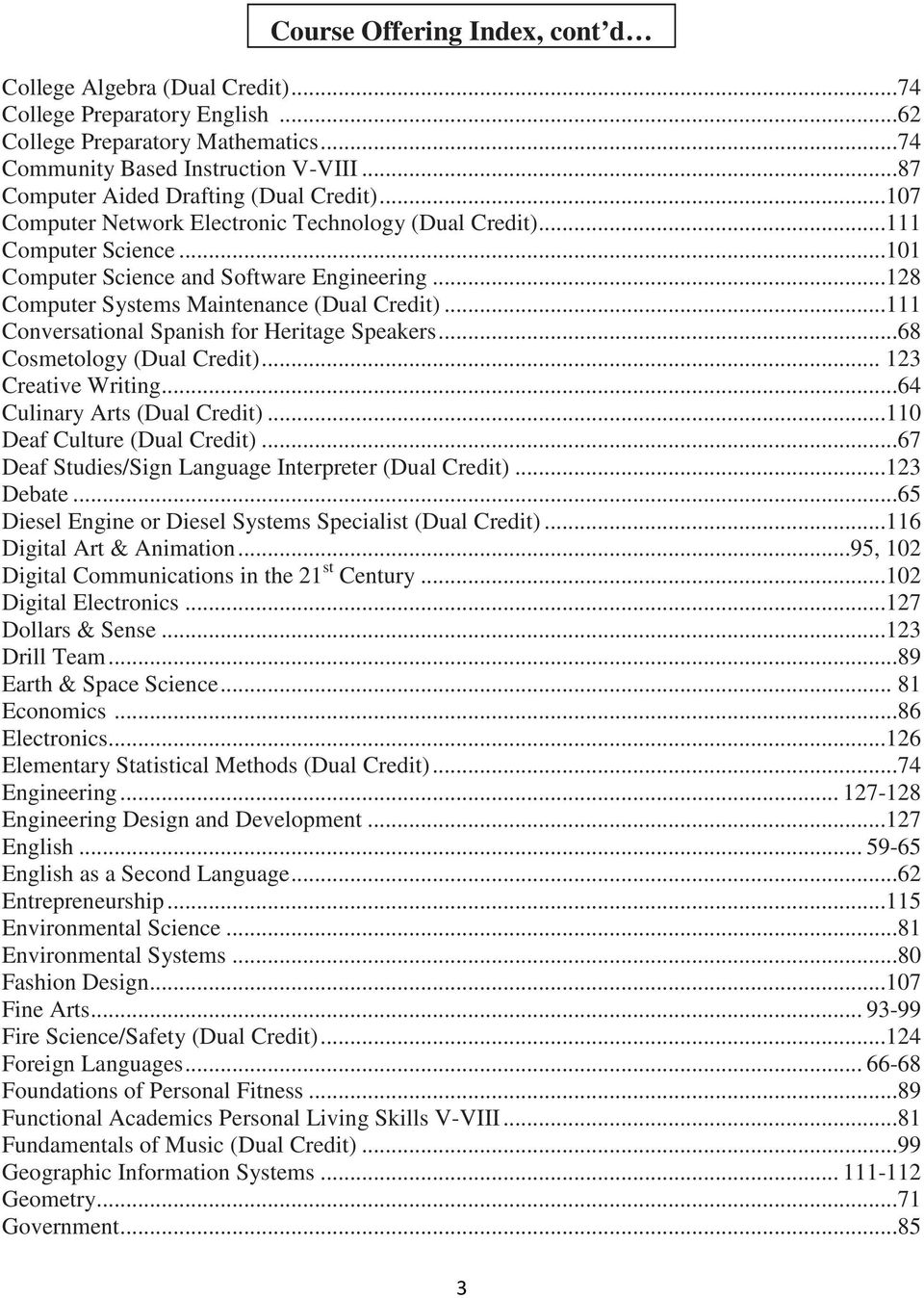
4 Course Offering Index, cont d College Algebra (Dual Credit)...74 College Preparatory English...62 College Preparatory Mathematics...74 Community Based Instruction V-VIII...87 Computer Aided Drafting (Dual Credit) Computer Network Electronic Technology (Dual Credit) Computer Science Computer Science and Software Engineering Computer Systems Maintenance (Dual Credit) Conversational Spanish for Heritage Speakers...68 Cosmetology (Dual Credit) Creative Writing...64 Culinary Arts (Dual Credit) Deaf Culture (Dual Credit)...67 Deaf Studies/Sign Language Interpreter (Dual Credit) Debate...65 Diesel Engine or Diesel Systems Specialist (Dual Credit) Digital Art & Animation...95, 102 Digital Communications in the 21 st Century Digital Electronics Dollars & Sense Drill Team...89 Earth & Space Science Economics...86 Electronics Elementary Statistical Methods (Dual Credit)...74 Engineering Engineering Design and Development English English as a Second Language...62 Entrepreneurship Environmental Science...81 Environmental Systems...80 Fashion Design Fine Arts Fire Science/Safety (Dual Credit) Foreign Languages Foundations of Personal Fitness...89 Functional Academics Personal Living Skills V-VIII...81 Fundamentals of Music (Dual Credit)...99 Geographic Information Systems Geometry...71 Government
5 Course Offering Index, cont d Health Science Health...91 Human Geography...84 Human Services (Dual Credit) Humanities...65 Independent Studies: Foundations for College Algebra...73 Individual Sports...89 Industrial Machining (Dual Credit) Instructional Practices in Education and Training Integrated Physics and Chemistry...78 Integrated Software Applications (Dual Credit) Interactive Game Technology and Simulation (Dual Credit) Interpersonal Studies Introduction to Clinical Laboratory Science (Dual Credit) Introduction to Engineering Design Introduction to Mobile Application Development (Dual Credit) Introduction to Problem Solving with Computers I (Dual Credit) Introduction to Robotics...102, 126 Introduction to the Interpreting Profession (Dual Credit)...67 Introduction to the Deaf Community (Dual Credit)...67 Journalism Law Enforcement (Dual Credit) Lifetime Fitness and Wellness (Dual Credit) Lifetime Nutrition and Wellness Livestock Production Marching Band...90 Math Models with Applications...71 Mathematical Applications in Agriculture, Food, and Natural Resources...72, 106 Mathematics Medical Laboratory Technician (Dual Credit) Medical Terminology Money Matters Music Appreciation (Dual Credit)...99 Music Instrumental Ensemble Networking Technology: CISCO (Dual Credit) Newspaper...64 NJROTC...90 Non-Destructive Testing (Dual Credit) Occupational Preparation I-IV...91 Occupational Safety & Health (Dual Credit) Occupational Therapy (Dual Credit) Office Practice Classes PAL Peer Assistance and Leadership

6 Course Offering Index, cont d Pharmacy Technician (Dual Credit) Phlebotomy Photography (Dual Credit)...99 Photojournalism...65 Physical Education Physical Therapy (Dual Credit) Physics...79 Pipe Drafting Technology (Dual Credit) Pipefitting Practicum in Culinary Arts (Dual Credit) Practicum in Education & Training I-II Practicum in Health Science for Emergency Medical Technician-Basic (Dual Credit) Practicum in Health Science Precision Metal Manufacturing Pre-Calculus...73 Principles of Agriculture, Food, and Natural Resources Principles of Business, Marketing & Finance...108, 114 Principles of Education and Training Principles of Engineering Principles of Health Science Principles of Human Services Principles of Information Technology...102, 111 Principles of Technology...80, 126 Process Technology (Dual Credit) Professional Communications (Speech)...64 Professional Truck Driver (Dual Credit) Programming I (Dual Credit) Psychology Raster Based Geographic Information Systems Reading...64 Recreation & Leisure Research & Technical Writing Retailing and E-tailing Science Scientific Research and Design...81 Small Business Management (Dual Credit) Social Studies Sociology...87 Sound Recording Business (Dual Credit) Spanish Spatial Technology & Remote Sensing Statistical Methods and Probability (Dual Credit)...74 Statistics and Risk Management with Accounting I...74 Statistics

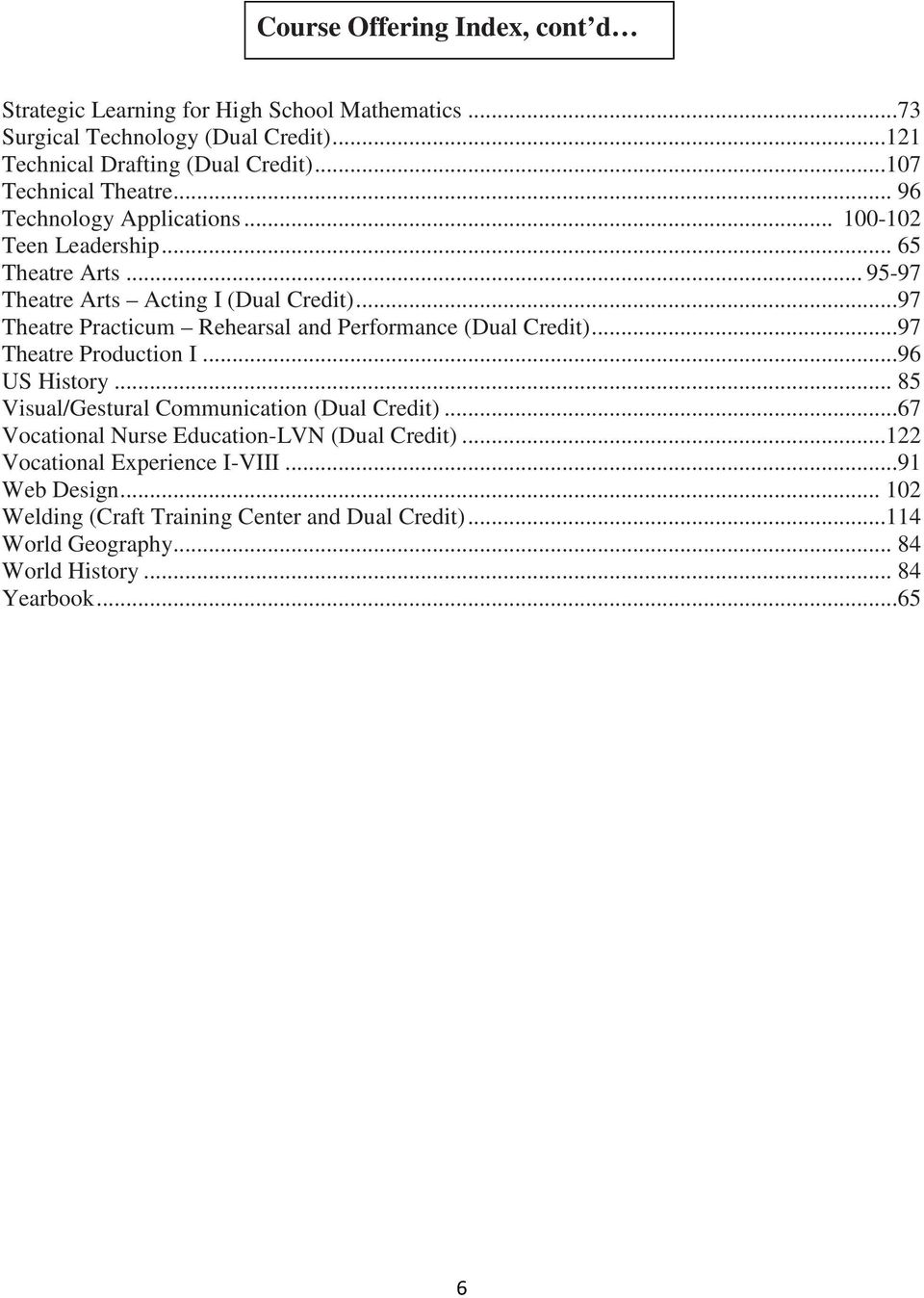
7 Course Offering Index, cont d Strategic Learning for High School Mathematics...73 Surgical Technology (Dual Credit) Technical Drafting (Dual Credit) Technical Theatre Technology Applications Teen Leadership Theatre Arts Theatre Arts Acting I (Dual Credit)...97 Theatre Practicum Rehearsal and Performance (Dual Credit)...97 Theatre Production I...96 US History Visual/Gestural Communication (Dual Credit)...67 Vocational Nurse Education-LVN (Dual Credit) Vocational Experience I-VIII...91 Web Design Welding (Craft Training Center and Dual Credit) World Geography World History Yearbook
8 FLOUR BLUFF INDEPENDENT SCHOOL DISTRICT Board of Trustees Richard Pittman, President Steve Ellis, Vice-President Shirley Thornton, Secretary Brian Grunberg Michael Morgan Dr. Jim Needham Dan Suckley Administration Joe Kelley, Superintendent Dr. Alicia Needham, Assistant Superintendent for Curriculum and Instruction Brian Schuss, Assistant Superintendent for Business Management Cheryl Cannon, Director of Instruction Dr. Linda Barganski, Director of Special Programs Julie Johnson, Director of Special Education James Crenshaw, High School Principal Pam Pailes, Dean of Student Services Dr. Allison Schaum, University Preparatory High School Program Director Tracy Erickson, Curriculum Supervisor Darryl Smith, Academic Intervention & Assessment Supervisor Ron Fisher, Director of Security James Potts, Assistant Principal Bobby Jones, Assistant Principal Brodie Wallace, Assistant Principal Ann Helms, Student Development and Guidance Center Director 7

9 High School Guidance Counselors Allison Gaye Chachere, A-Er Melissa Doyle, Es-Ll Tina Watson, Lo-Ra George (Chip) Johnston, Re-Z Molly Parker, High School Military Connected Counselor Karen Hancock, Special Education Counselor

10 Flour Bluff Independent School District MISSION STATEMENT Flour Bluff Independent School District in partnership with the community has high expectations for all students and is committed to: Building a solid foundation for college, career and lifelong success through academic, extracurricular and special programs. Providing a safe, caring, effective learning environment that promotes healthy, productive life-styles. Developing character that fosters responsible citizenship and leadership. Enhancing our relationship with the community while providing fiscal responsibility. Supporting effective educational innovation. GOALS Flour Bluff Independent School District: Empower students to be creative, independent, analytical thinkers and lifelong learners who exercise a strong work ethic, resulting in exemplary performance. Provide all students, faculty, staff and community members the opportunity to maximize their potential in a safe, healthy, supportive learning environment. Create a culture of excellence to attract and maintain a highly qualified, motivated faculty and staff. Engage parents as active partners in developing well-rounded students who are strong leaders and responsible citizens. Partner with industry and community in a mutually beneficial manner to enhance our students educational experiences and opportunities. Continue to be a good steward of the community s financial resources and explore new opportunities for organizational efficiency and effectiveness. 9

11 Flour Bluff High School 2505 Waldron Road Corpus Christi, Texas January 2015 Dear Students: It is a great pleasure to welcome you to the high school on behalf of the entire staff. You are entering one of the most important phases of your education and with the help of your parents and counselor, you are going to make some decisions that will impact the rest of your life. Inside this guide, you will find valuable information that will guide you in making those decisions. The courses you decide to take now can open or close many doors to you. It is important that you take the time to read and understand the information in this booklet so that you are able to make wise choices. If at any time you need help, a guidance counselor will be available to assist you. This guide includes a list of all of the courses available at the high school, along with a written description of each class. You will also note that there are different graduation plans available. The harder you work and the higher your graduation plan, the more doors will be opened to you as an adult. Please be sure you take the time to plan your schedule carefully, as there will be few schedule changes once everyone has registered for classes and schedules are printed. Just as in college, if there are not enough students to make a class, it will be cancelled for that semester or year. When a class is full, it will be closed. It is important that you make a well-thought-out plan to follow the first time. There are several special programs in which a student can participate while in high school. To be considered for these programs, students must complete an application and meet the deadlines for submission of the application. Please take the time to read about these programs, and contact your counselor if further information is needed. Congratulations for taking this important step in planning your future. We look forward to having you as a student in Best wishes, James Crenshaw Principal 10

12 Assurance of Nondiscrimination Flour Bluff Independent School District does not discriminate on the basis of race, religion, color, age, national origin, sex, or disability in providing education or access to benefits of educational services, activities, and programs, including vocational programs, in accordance with: Title VI of the Civil Rights Act of 1964, as amended Title IX of the Educational Amendments Act of 1972; Section 504 of the Rehabilitation Act of 1973, as amended Title II of the Americans with Disabilities Act. Flour Bluff Independent School District will take steps to assure that limited English language skills will not be a barrier to admission and participation in all educational and career and technology education programs. For information about your rights or grievance procedures, contact the Title IX Coordinator, Dr. Alicia Needham, at 2505 Waldron Road, Corpus Christi, Texas (361) ; Career and Technology Education contact, Dr. Linda Barganski, (361) ; the Section 504 Coordinator, Cheryl Cannon (361) ; or English as a Second Language Program Coordinator, Dr. Linda Barganski, at (361) It is the policy of Flour Bluff Independent School District not to discriminate on the basis of race, color, national origin, sex or handicap in its vocational programs, services or activities as required by Title VI of the Civil Rights Act of 1964, as amended; Title IX of the Education Amendments of 1972; and Section 504 of the Rehabilitation Act of 1973, as amended. Es norma de Flour Bluff Independent School District no discriminar por motivos de raza, color, origen national, sexo o impedimento, en sus programas, servicios o activades vocacionales, tal como lo requieren el Titulo VI de la Ley De Deprechos Civiles de 1964, segun enmienda; el Titulo IX de las Enmiendas en la Educacion, de 1973, segun enmienda. Notification to Parents of Teacher Qualifications As a parent of a student at Flour Bluff High School, you have the right to know the professional qualifications of the classroom teachers who instruct your child, and Federal law requires the school district to provide you this information in a timely manner, if you request it. Specifically, you have the right to request the following information about each of your child s classroom teachers: Whether the teacher meets the state qualifications and licensing criteria for the grades and subjects he or she teaches Whether the teacher is teaching under emergency or provisional status because of special circumstances The teacher s college major, whether the teacher has any advanced degrees, and the field of discipline of the certification or degree Whether paraprofessionals provide services to your child and, if so, their qualifications If you would like to receive any of this information, please contact the campus principal at Intent of this Guide The provisions and information set forth in this Graduation and Career Planning Guide are intended to be informational and not contractual in nature. The District hereby reserves and retains the right to amend, alter, change, delete, or modify any of the provisions of this guide at any time, from time to time, in any manner that the Administration or the Board of Trustees of the District deems to be in the best interest of the students of this District. The contents of this guide apply to all students and programs in the District and do not amend, abridge, or replace Board policies or administrative regulations established by the District. 11

13 Texas Education Agency Graduation Toolkit Texas High School Diploma Steps Distinguished Level of Achievement 22 Credits for the Foundation High School Program Requirements of 1 Endorsement (including 4 th credit of Math and Science and 2 additional electives) STEM Business & Industry Public Service Arts & Humanities Multi- Disciplinary Studies Be sure to visit your school counselor to learn more about your options. Students may earn more than one endorsement. BR

14 Texas Education Agency Graduation Toolkit Graduation Program Overview Foundation High School Program A new, more flexible graduation program that allows students to pursue their interests will be in place for all students who enter high school, beginning in the school year. The program contains up to four parts: A 22-credit foundation program which is the core of the new Texas high school diploma Five endorsement* options that allow students to focus on a related series of courses A higher performance category called Distinguished Level of Achievement Performance Acknowledgments that note outstanding achievement The Foundation requirements (22 credits) include: English (4 credits) English I English II English III An advanced English course Mathematics (3 credits) Algebra I Geometry An advanced math course Science (3 credits) Biology Integrated Physics & Chemistry or an advanced science course An advanced science course Social Studies (3 credits) World History or World Geography U.S. History U.S. Government (one-half credit) Economics (one-half credit) Languages Other Than English (2 credits) 2 credits in the same language or 2 credits from Computer Science I, II, III Physical Education (1 credit) Fine Arts (1 credit) Electives (5 credits) Speech: Demonstrated proficiency Endorsements Total credits with endorsements 26 Enhancements Additionally, a student may earn the Distinguished Level of Achievement and/or a Performance Acknowledgment for outstanding performance. The Distinguished Level of Achievement must be earned to be admitted to a Texas public university under the Top 10 percent automatic admission law. Distinguished Level of Achievement Foundation Program requirements 4 credits in math including Algebra II 4 credits in science at least 1 endorsement Performance Acknowledgments dual credit course bilingualism and biliteracy PSAT, ACT s Plan, SAT or ACT Advanced Placement or International Baccalaureate exam earning a nationally or internationally recognized business or industry certification or license *A student entering 9th grade must indicate an endorsement he or she plans to follow. A student may change or add an endorsement at any time. A student may graduate without earning an endorsement if, after his or her sophomore year, the student s parent signs a form permitting the student to omit the endorsement requirement. BR

15 GRADUATION REQUIREMENTS FOR FOUNDATION PLAN WITH AN ENDORSEMENT* For specific requirements to the Foundation plan, please refer to the information below and to the graduation chart on the pages that follow. This information is subject to change by the Texas Education Agency or the Texas Legislature. ENGLISH Four credits required. Credits must consist of English I, II, III, and an advanced English course. MATH Three credits required. All students must take Algebra I, Geometry and an advanced Math course. Three math credits must be earned at the high school, regardless of math credits earned prior to entering 9 th grade. The additional credit may be selected from the following courses: Algebra II (Course required for Distinguished and eligible for top 10% automatic admission to an Institute of Higher Education) Mathematical Models with Applications Mathematical Applications in Agriculture, Food, and Natural Resources (intended for students pursuing an Agriculture plan of study) Statistics and Risk Management with Accounting I Advanced Mathematical Decision Making PreCalculus Independent Study in Mathematics (Dual Credit & Non-Dual Credit) Dual Credit or Advanced Placement Calculus Dual Credit or Advanced Placement Statistics Dual Credit College Algebra Certain Career and Technical Education Courses SCIENCE Three credits required. Three of the credits must consist of a Biology credit, Integrated Physics and Chemistry and an advanced Science course. The additional science credit can be selected from: Principles of Technology Chemistry Physics Dual Credit or Advanced Placement Biology Dual Credit or Advanced Placement Chemistry Dual Credit or Advanced Placement Physics Anatomy and Physiology or Dual Credit Anatomy and Physiology Aquatic Science Environmental Systems Advanced Placement Environmental Science Earth and Space Science Advanced Animal Science Certain Career and Technical Education Courses SOCIAL STUDIES Three credits required. Credits must consist of World Geography or World History, United States History, U.S. Government and Economics. 14

16 PHYSICAL EDUCATION One credit required. Education equivalencies may fulfill this requirement, i.e. Marching Band (fall semester), NJROTC, Athletics, Athletic Trainer, Cheerleading (fall semester), Drill Team and certain approved outside physical education activities. Marching Band, NJROTC and Cheerleading will only substitute for up to one credit of P.E. See your counselor for details. Physical Education courses are graded on a Pass/Fail basis for students who entered 9 th grade in and after. FINE ARTS One credit required. Students may choose from Art, Theater Arts, Band, Choir, or Digital Art & Animation. TECHNOLOGY APPLICATIONS required. Students may take Business Information Management I or II, Business Information Management (Dual Credit), Digital Communications in the 21 st Century, Digital Art and Animation, Computer Science, Pre-Advanced Placement Computer Science, Advanced Placement Computer Science, Computer Science and Software Engineering, Principles of Information Technology, Robotics, Web Design or other computer-based courses as approved by the Flour Bluff Independent School Board for Technology Applications credit. Please find course descriptions for additional course options in the Information Technology section. SPEECH One-half credit required. Professional Communications, Dual Credit Professional Communications, or Communication Applications will fulfill the speech requirement for graduation. FOREIGN LANGUAGE Two credits required in the same language. Choices include Spanish, American Sign Language, or Computer Science Programming if completed by ELECTIVES Three and one-half credits required. These courses should be in the area of interest to the student to further establish their career pathway. ENDORSEMENTS Each student is required to declare an endorsement from the following: Science, Technology, Engineering and Math (STEM) Public Service Business and Industry Arts and Humanities Multi-Disciplinary Studies Each of these endorsements requires one additional math course, one additional science course and two electives in the chosen endorsement field. Students should select courses that will advance their career pathways and support obtaining admission to an institute of higher education or a certificate/license to become employable in the workforce. Flour Bluff High School has courses and partnerships in the community to support several different Career Pathways. Additional courses may be required for students to complete their pathway. The following pages outline several of these Career Pathways. 15

17 Texas Education Agency Graduation Toolkit Endorsements Choices Endorsements For the first time, students will be able to earn one or more endorsements as part of their graduation requirements. Endorsements consist of a related series of courses that are grouped together by interest or skill set. They provide students with in-depth knowledge of a subject area. Students must select an endorsement* in the ninth grade. Districts and charters are not required to offer all endorsements. If only one endorsement is offered, it must be multi-disciplinary studies. Students earn an endorsement by completing the curriculum requirements for the endorsement, including 4th credit of math and science and 2 additional elective credits. Students can choose from 5 endorsement areas Science, Technology, Engineering and Mathematics (STEM) Career and Technical Education (CTE) courses related to STEM Mathematics Science Combination of no more than two of the categories listed above Computer Science Business and Industry (one of the following or a combination of areas) Agriculture Food and Natural Resources Architecture and Construction Arts Hospitality and Tourism Technology and Communications Audio/Video Information Technology Business Management and Administration Finance Manufacturing Transportation or Distribution and Logistics Marketing Technology Applications English electives in public speaking, debate, advanced broadcast journalism, advanced journalism including newspaper and yearbook Public Service (one of the following) Human Services Health Science Education and Training Law Public Safety Government and Public Administration Corrections and Security Junior Reserve Officer Training Corps (JROTC) Arts and Humanities (one of the following) 2 levels each in two languages other than English (LOTE) 4 levels in the same LOTE Courses from one or two areas (music, theater, art, dance) in fine arts English electives not included in Business and Industry Social Studies American Sign Language (ASL) Multi-Disciplinary Studies (one of the following) 4 advanced courses from other endorsement areas 4 credits in each foundation subject area, including English IV and chemistry and/or physics 4 credits in Advanced Placement, International Baccalaureate, or dual credit selected from English, mathematics, science, social studies, economics, LOTE or fine arts *Visit your school counselor to learn more about your options. Students may earn more than one endorsement. ENDORSEMENTS BR

18 Flour Bluff High School Endorsement Fields STEM Public Service Business and Arts and Multi- (Science, Technology, Industry Humanities Disciplinary Engineering and Math) All Endorsement Fields All Endorsement Fields All Endorsement Fields All Endorsement Fields All STEM Endorsement require a fourth math and require a fourth math and a require a fourth math require a fourth math Fields require Algebra 2, a fourth science. fourth science. and a fourth science. and a fourth science. Chemistry, and Physics. Career Pathways Career Pathways Career Pathways Career Pathways Career Pathways Project Lead the Way (Engineering) 4 credits Engineering (PLTW) Engineering Design and Development must be final course. Computer Programming 4 credits Comp. Science Robotics STEM Combination - 3 credits from Robotics and one of the prior STEM categories. (Ex: Robotics and Comp. Sci., or Robotics and PLTW) Biotechnology 4 credits in Biotechnology and CTE related courses ending with Del Mar College. Mathematics Specialty 5 credits Math Alg. 1, Geom., Alg. 2 and two higher level Science Specialty 5 credits Science Biology, Chemistry, Physics, and two additional sciences (Not IPC) STEM Combination 3 credits additional from a combination of no more than two of the prior STEM categories. (Ex: two PLTW and one Comp. Sci.; Robotics and Comp. Sci.; Robotics and PLTW) Health Science/EMT 4 credits in Health Science and CTE related courses that include any course that is the third level or higher. Del Mar College is available. Child Development 4 credits in Child Development and related CTE courses that include a course that is the third level or higher. Del Mar College is available. Education 4 credits in Education and CTE related courses that include a course that is the third level or higher. NJROTC 4 credits in NJROTC The following Career Pathways require 4 CTE credits related to the specialization ending with courses at Del Mar College: Cosmetology Law Enforcement Firefighter Occupational Safety and Hazard Inspector Medical Laboratory Tech. Surgical Tecchnology Pharmacy Technology Physical Therapy Human Services (Social Services) Vocational Nurse Education (LVN or transition to RN) Digital Art and Tech. 4 credits in Technology Applications (Digital Art and Animation, Digital Communications, Web Design, and another course to be developed). Journalism 4 credits to include Journalism and 3 additional credits from one area (Yearbook, Newspaper, or Debate). The following Career Pathways require 4 credits ending with Del Mar College or Craft Training Center related to the specialization: Air Conditioning Building Maintenance Aviation Technology Automotive Technology Com. Truck Driver Culinary Arts/ Hospitality Kitchen Supervisor Electronics/Electrical Welding Non-Destructive Testing Process Technology Drafting Finance/Business Man. Game Technology Networking Technology (CISCO) Computer Network Technician Industrial Machining Geographic Info. Systems (GIS) The next three Career Pathways require 4 CTE credits related to the specialization that include a course that is the third level or higher: General Business Career Development Must include Career Dev.II. Fashion Design Must include Advanced Fashion Design. 17 Fine Arts 4 credits in Fine Arts from no more than two categories or disciplines (Art, Band, Theatre Art, or Choir). Art Theatre Arts Band Choir Fine Arts 4 credits in Sound Recording Business (music based) and related Fine Art courses that include a course that is the third level or higher (Del Mar College). Social Studies Specialty 5 credits in Social Studies Foreign Language Specialty 4 credits in Foreign Lang. / LOTE (Ex: 4 credits Spanish or 4 credits ASL) OR 2 levels of one LOTE plus 2 levels of another LOTE English Specialty 4 credits in English Language Arts - does not include English 1 3 (Ex: Creative Writing, Research and Technical Writing, Humanities, Comm. Appl., AP Eng. Lit and Comp., Ind. Studies in English, Literary Genres, and/or English 4) Four credits in each of the four foundation / core subjects (generalist) 4 credits in the four core subjects (English, Math, Science, and Social Studies) must include English 4 and Chemistry and/or Physics. Four credits in AP or Dual Credit 4 credits in AP or Dual Credit from ELA, Math, Science, Social Studies, Foreign Language, or Fine Arts. Four Advanced Courses in any combination from any of the endorsement areas. The 4 Advanced Courses must prepare for the workforce or postsecondary education without remediation.

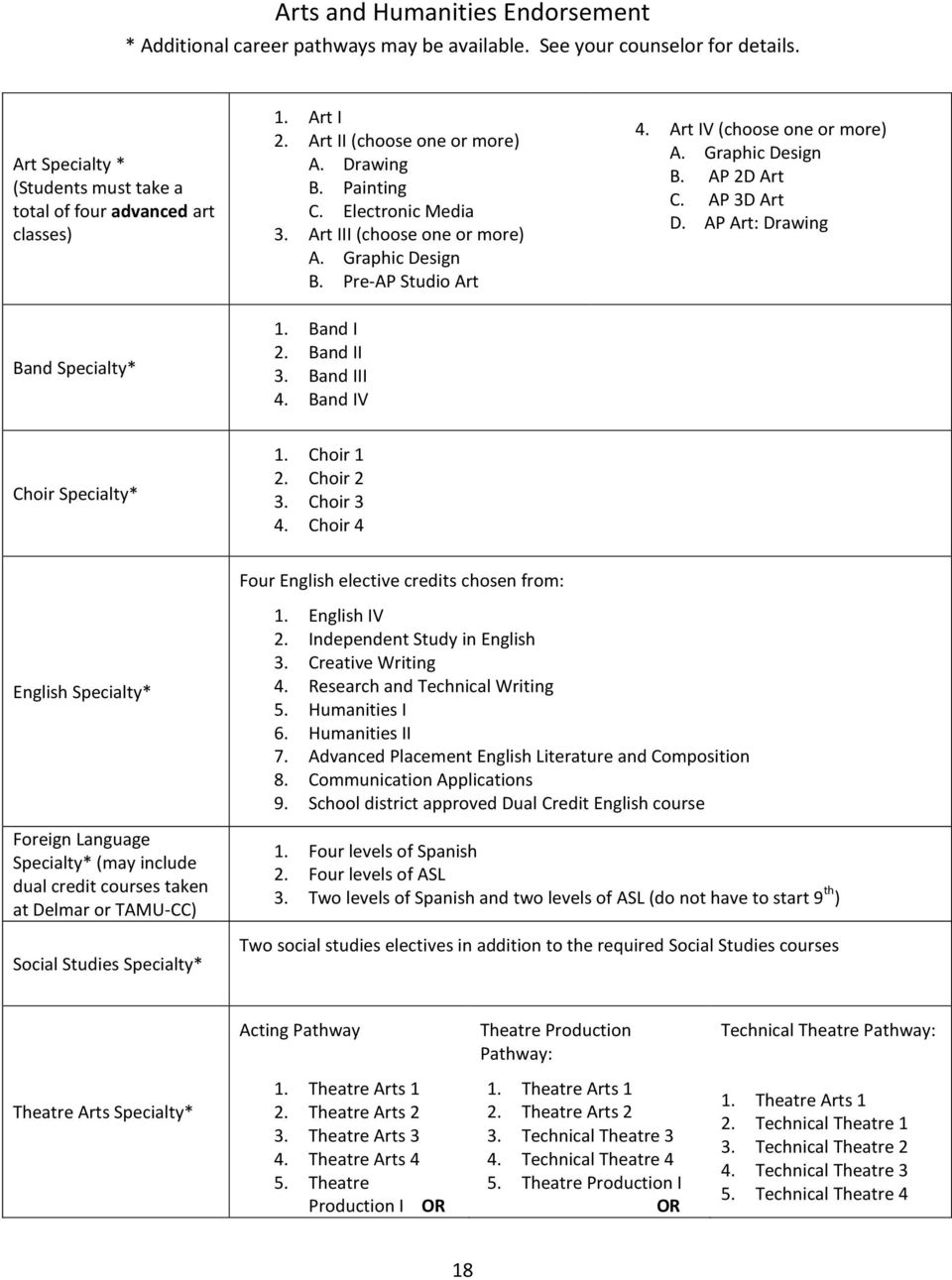
19 Arts and Humanities Endorsement * Additional career pathways may be available. See your counselor for details. Art Specialty * (Students must take a total of four advanced art classes) Band Specialty* 1. Art I 2. Art II (choose one or more) A. Drawing B. Painting C. Electronic Media 3. Art III (choose one or more) A. Graphic Design B. Pre-AP Studio Art 1. Band I 2. Band II 3. Band III 4. Band IV 4. Art IV (choose one or more) A. Graphic Design B. AP 2D Art C. AP 3D Art D. AP Art: Drawing Choir Specialty* 1. Choir 1 2. Choir 2 3. Choir 3 4. Choir 4 English Specialty* Foreign Language Specialty* (may include dual credit courses taken at Delmar or TAMU-CC) Social Studies Specialty* Four English elective credits chosen from: 1. English IV 2. Independent Study in English 3. Creative Writing 4. Research and Technical Writing 5. Humanities I 6. Humanities II 7. Advanced Placement English Literature and Composition 8. Communication Applications 9. School district approved Dual Credit English course 1. Four levels of Spanish 2. Four levels of ASL 3. Two levels of Spanish and two levels of ASL (do not have to start 9 th ) Two social studies electives in addition to the required Social Studies courses Acting Pathway Theatre Production Pathway: Technical Theatre Pathway: Theatre Arts Specialty* 1. Theatre Arts 1 2. Theatre Arts 2 3. Theatre Arts 3 4. Theatre Arts 4 5. Theatre Production I OR 1. Theatre Arts 1 2. Theatre Arts 2 3. Technical Theatre 3 4. Technical Theatre 4 5. Theatre Production I OR 1. Theatre Arts 1 2. Technical Theatre 1 3. Technical Theatre 2 4. Technical Theatre 3 5. Technical Theatre 4 18
20 Business and Industry Endorsement * Additional career pathways may be available. See your counselor for details. Aircraft Technology (Avionics) (start 9 th if student didn t take BIM in JH) Automotive Career Development* Culinary Arts* Commercial Truck Driver Digital Art and Technology* (courses may be taken in any sequence) Electronics Fashion Design Journalism* (students must take three years of the same course i.e. 3 years of yearbook) Non-Destructive Testing (Welding, Pipeline, and Aerospace Inspector) Welding* 1. Business Information Management (recommended) 2. Dollars and Sense/Electronics (recommended) 3. Aircraft Technology (Delmar West Campus) 4. Advanced Aircraft Technology (Delmar West Campus) 1. Dollars and Sense/Electronics (recommended) 2. Automotive Technology (Delmar West Campus) 3. Advanced Automotive Technology (Delmar West Campus) 1. Principles of Human Services 2. Principles of Business, Marketing and Finance 3. Career Development I 4. Career Development II 1. Principles of Human Services 2. Lifetime Nutrition and Wellness 3. Culinary Arts I (Delmar West Campus) 4. Practicum in Culinary Arts (Delmar West Campus) 1. Business Information Management 2. Principles of Business, Marketing, and Finance; Dollars and Sense 3. Money Matters; Entrepreneurship 4. DC Driver and Safety Education; DC Driver Education 1. Digital Art and Animation (also counts as a fine art) 2. Digital Communications in the 21 st Century 3. Web Design 4. 4 th Course to be developed 1. Electronics 2. Electrical Technology (Delmar West Campus or Craft Training Center) 3. Adv. Electrical Technology (Delmar West Campus or Craft Training Center) 1. Principles of Human Services 2. Dollars and Sense (recommended) 3. Fashion Design 4. Advanced Fashion Design 1. Journalism 2. Yearbook 1 3. Yearbook 2 4. Yearbook 3 OR 1. Journalism 2. Newspaper 1 3. Newspaper 2 4. Newspaper 3 OR 1. Electronics 2. Non-destructive Testing I (Delmar West Campus) 3. Non-destructive Testing II (Delmar West Campus) 1. Journalism 2. Debate 1 3. Debate 2 4. Debate 3 1. Dollars and Sense (recommended) 2. Welding (Delmar West or Craft Training Center) 3. Advanced Welding (Delmar West Campus or Craft Training Center) 4. Pipefitting or Precision Metal Manufacturing (Delmar West or Craft) 19

21 Multi Disciplinary Endorsement * Additional career pathways may be available. See your counselor for details. AP/Dual Credit Four credits in any combination of AP or Dual Credit courses (See College and Career Planning Guide for a list of available courses) Advanced Courses Four advanced courses, not in a coherent sequence, from any combination of endorsements Four by Four* Four courses in each of the four core areas 20
22 Public Service Endorsement * Additional career pathways may be available. See your counselor for details. Child Development* 1. Principles of Human Services 2. Dollars & Sense/Child Development 3. Child Guidance 4. Additional Public Service Course, which could be taken at Delmar as Dual Credit through the Early Childhood Development Program Cosmetology 1. Principles of Human Services 2. Dollars and Sense (recommended) 3. Cosmetology I (Delmar West Campus) 4. Cosmetology II (Delmar West Campus) Education* (students in this sequence take the Child Development Associate certification test) 1. Principles of Human Services 2. Instructional Practices in Education concurrent with Child Development 3. Practicum in Education I 4. Practicum in Education II Firefighter* (start 9 th if student didn t take BIM in JH) 1. Business Information Management 2. Professional Communications/Medical Terminology (recommended) 3. Firefighter I (Delmar West Campus) 4. Firefighter II (Delmar West Campus) Health Science* /EMT* (enrollment in Anatomy and Physiology for 3 rd or 4 th science is recommended) 1. Medical Terminology (recommended) 2. Principles of Health Science 3. Health Science 4. Practicum in Health Science OR 1. Principles of Health Science 2. Health Science 3. Dual Credit Medical Terminology for EMT Students (Fall, FBHS online) 4. Dual Credit EMT (Spring, Delmar West Campus) Law Enforcement* (start 9 th if student didn t take BIM in JH) NJROTC* 1. Business Information Management 2. Professional Communications/Health (recommended) 3. Law Enforcement I (Delmar West Campus) 4. Law Enforcement II (Delmar West Campus) 1. NJROTC I 2. NJROTC II 3. NJROTC III 4. NJROTC IV 21
23 Science, Technology, Engineering and Math Endorsement * Additional career pathways may be available. See your counselor for details. Four or more credits, in sequence, chosen from: Computer Programming* Mathematics Pathway (may need to start 9 th grade, dependent on when the student took Algebra I) Project Lead the Way* (Engineering)(start 9 th grade because not all PLTW classes may be offered every year) 1. Computer Science 1 2. Computer Science 2 (Pa-AP Computer Science) 3. Computer Science 3 4. One or more of the following, in any order: a. AP Computer Science b. Mobile App Development (Online dual credit through Abilene Christian University) c. Game Programming and Design (Online dual credit through Abilene Christian University) Three math credits, including: 1. Algebra II 2. 2 additional math courses for which Algebra II is a pre-requisite 1. Introduction to Engineering (Required) 2. Two or more of the following: a. Principles of Engineering b. Aerospace Engineering c. Digital Electronics d. Civil Engineering e. Computer Science and Software Engineering 3. Engineering Design and Development (Must be final course) Four or more credits, in sequence, to include: Robotics Science Pathway 1. Electronics 2. Introduction to Robotics 3. Advanced Robotics 4. 1 or more programming courses or dual credit programming courses Four science credits, including 1. Chemistry 2. Physics 3. 2 additional science courses 22
24 Texas Education Agency Graduation Toolkit Distinguished Level of Achievement Benefits Choices determine options Most of the very best jobs available now and in the future require education and training beyond a high school diploma. Whether you intend to pursue a high-demand, industry workforce credential from a community or technical college or a traditional four-year degree from a university, the choices made in high school will determine your future options. To best prepare yourself now for the transition to post-high school education or quality workforce training, choosing and taking the right classes is essential. The Distinguished Level of Achievement will ensure the best preparation for your future. Why it matters Benefits The Distinguished Level of Achievement opens a world of educational and employment opportunities for you beyond high school. The Distinguished Level of Achievement will: Credential Technical College Allow you to compete for Top 10% automatic admissions eligibility at any Texas public university; Position you among those first in line for a TEXAS Grant* to help pay for university tuition and fees; and Ensure you are a more competitive applicant at the most selective colleges and universities. What it means The Distinguished Level of Achievement requires more math and more science than the Foundation High School Program. The Distinguished Level of Achievement requires: A total of four credits in math, including Algebra II; A total of four credits in science; and Successful completion of an endorsement in your area of interest. *Must be financially qualified Advantages Opportunity to earn an endorsement in an area of interest More college and university options More financial aid options Better preparation for college-level coursework at community/technical colleges and universities Opportunity for immediate enrollment in classes related to your chosen field of study Strong foundation to successfully complete an industry workforce credential or college degree Texas Education Agency Texas Higher Education Coordinating Board Texas Workforce Commission TEXAS THE STATE OF TEXAS ED U CATION AGENC Y BR
25 FOUNDATION PLAN WITH AN ENDORSEMENT DISTINGUISHED LEVEL OF ACHIEVEMENT A student may earn a Distinguished Level of Achievement by successfully completing four math credits, which must include Algebra II, four science credits, and the curriculum requirements for the Foundation Plan with an Endorsement. A student must earn the Distinguished Level of Achievement to be eligible for top 10% automatic college admission. PERFORMANCE ACKNOWLEDGEMENTS A student may earn a Performance Acknowledgement for outstanding performance in a dual credit course in bilingualism and biliteracy on an AP test or IB exam on the PSAT, the ACT-Aspire, the SAT, or the ACT or, for earning a nationally or internationally recognized business or industry certification or license. Dual Credit Performance Acknowledgement: A student may earn a performance acknowledgment on the student's diploma and transcript for outstanding performance in a dual credit course by successfully completing: (1) at least 12 hours of college academic courses, including those taken for dual credit as part of the Texas core curriculum, and advanced technical credit courses, including locally articulated courses, with a grade of the equivalent of 3.0 or higher on a scale of 4.0 or (2) an associate degree while in high school Bilingualism and Biliteracy Performance Acknowledgements: A student may earn a performance acknowledgment on the student's diploma and transcript by demonstrating proficiency in accordance with local school district grading policy in two or more languages by: (1) completing all English language arts requirements and maintaining a minimum grade point average (GPA) of the equivalent of 80 on a scale of 100; and (2) satisfying one of the following: completion of a minimum of three credits in the same language in a language other than English with a minimum GPA of the equivalent of 80 on a scale of 100; or demonstrated proficiency in the Texas Essential Knowledge and Skills for Level IV or higher in a language other than English with a minimum GPA of the equivalent of 80 on a scale of 100; or completion of at least three credits in foundation subject area courses in a 24
26 language other than English with a minimum GPA of 80 on a scale of 100; or demonstrated proficiency in one or more languages other than English through one of the following methods: a score of 3 or higher on a College Board AP exam for a language other than English; or a score of 4 or higher on an IB exam for a higher-level languages other than English course; or performance on a national assessment of language proficiency in a language other than English of at least Intermediate High or its equivalent. In addition to meeting the requirements to earn a performance acknowledgment in bilingualism and biliteracy, an English language learner must also have: (A) participated in and met the exit criteria for a bilingual or English as a second language (ESL) program; and (B) scored at the Advanced High level on the Texas English Language Proficiency Assessment System (TELPAS). Advanced Placement Test or International Baccalaureate Examination: A student may earn a performance acknowledgment on the student's diploma and transcript for outstanding performance on a College Board advanced placement test or International Baccalaureate examination by earning: (1) a score of 3 or above on a College Board advanced placement examination (2) a score of 4 or above on an International Baccalaureate examination PSAT, ACT-PLAN, SAT or ACT Examination: A student may earn a performance acknowledgment on the student's diploma and transcript for outstanding performance on the PSAT, the ACT-Aspire, the SAT, or the ACT by: (1) earning a score on the Preliminary SAT/National Merit Scholarship Qualifying Test (PSAT/NMSQT ) that qualifies the student for recognition as a commended scholar or higher by the College Board and National Merit Scholarship Corporation, as part of the National Hispanic Recognition Program (NHRP) of the College Board or as part of the National Achievement Scholarship Program of the National Merit Scholarship Corporation (2) achieving the college readiness benchmark score on at least two of the four subject tests on the ACT-Aspire examination (3) earning a combined critical reading and mathematics score of at least 1250 on the SAT ; or (4) earning a composite score on the ACT examination of 28 (excluding the writing subscore) 25
27 Nationally or Internationally Recognized Business or Industry Certification: A student may earn a performance acknowledgment on the student's diploma and transcript for earning a nationally or internationally recognized business or industry certification or license with: (1) performance on an examination or series of examinations sufficient to obtain a nationally or internationally recognized business or industry certification or (2) performance on an examination sufficient to obtain a government-required credential to practice a profession Nationally or internationally recognized business or industry certification shall be defined as an industry validated credential that complies with knowledge and skills standards promulgated by a nationally or internationally recognized business, industry, professional, or government entity representing a particular profession or occupation that is issued by or endorsed by: a national or international business, industry, or professional organization a state agency or other government entity or a state-based industry association Certifications or licensures for performance acknowledgements shall: be age appropriate for high school students represent a student's substantial course of study and/or end-of-program knowledge and skills include an industry recognized examination or series of examinations, an industry validated skill test, or demonstrated proficiency through documented, supervised field experience and represent substantial knowledge and multiple skills needed for successful entry into a high-skill occupation 26
28
29 Texas Education Agency Graduation Toolkit Graduation Program Checklists 8 th Grade Review choices offered under the Foundation High School Program and the Endorsements to decide on your future academic path. Select the endorsement that best fits your area of personal interest and the major you plan to study in college. Recognize that most college entrance requirements include rigorous advanced courses including Algebra II, higher-level science courses and languages other than English. 9 th /10 th Grade Monitor high school credits; be sure to meet all local and state requirements by the end of the senior year. Take dual enrollment or Advanced Placement courses if possible to earn college credit while still in high school. Keep list of awards, honors and extracurricular activities for scholarship and college applications. Research colleges or universities you are interested in attending. Check admission and application requirements and timelines. 11 th /12 th Grade Explore interests and take advantage of Career Day opportunities. Attend college nights hosted by your high school. Talk with school representatives about the types of financial aid available. Take the Preliminary SAT/National Merit Scholarship Qualifying Test in your sophomore year for practice. In your junior year, take the PSAT for eligibility for the National Merit Scholarship Competition. Students who take the PSAT or ACT s PLAN tend to score higher on the SAT or ACT than those who do not. Take dual enrollment or Advanced Placement courses if possible to earn college credit while you are still in high school. Check with your counselor s office to learn about available scholarships. Be sure to apply early and for as many scholarships as possible. Do not limit yourself to local scholarships. Consider taking SAT/ACT preparation classes. Sign up and take the ACT and/or SAT test, preferably in your junior year but no later than the fall of your senior year. Fill out the FAFSA (Free Application for Federal Student Aid) early in the spring of your senior year. Apply to college during the fall of your senior year. If you plan to pursue technical training or enter the workforce after graduation, see the Information - Workforce Resources page or visit Texas Reality Check at BR
30 Texas Education Agency Graduation Toolkit Graduation Program Glossary Foundation High School Program The basic 22-credit graduation program for Texas public school students. Endorsements Areas of specialized study. The areas are: Science, Technology, Engineering and Mathematics (STEM) Business and Industry Arts and Humanities Public Service Multidisciplinary Studies A district or charter that offers only one endorsement must offer Multidisciplinary Studies. Distinguished Level of Achievement A high level of academic achievement earned by going beyond the Foundation High School Program. It requires a total of 26 course credits, including Algebra II, a fourth science credit and an endorsement. A student must earn this designation to be eligible for Top 10 percent automatic admission to a Texas public university. Performance Acknowledgments Students may earn an additional acknowledgment on their diploma because of outstanding performance in areas such as dual credit courses and bilingualism and biliteracy; on Advanced Placement, International Baccalaureate, PSAT, ACT s Plan, the SAT or ACT exams; or by earning a nationally- or internationally-recognized business or industry certification. Course Credit A unit of measure awarded for successful completion of a course. Completion of a one semester course typically earns one-half credit for a student. Industry Workforce Credential A state, nationally, or internationally-recognized credential that aligns with the knowledge and skills standards identified by an association or government entity representing a particular profession or occupation and valued by business or industry. Examples include a credential for certified nurse aid (CNA) or the automotive service excellence (ASE) certification in the automotive industry. STAAR State of Texas Assessments of Academic Readiness (STAAR) is the state-mandated test given annually to students in grades 3-8 and in five high school courses. EOC STAAR end-of-course exams are state mandated tests given during the final weeks of a course. In addition to meeting graduation course requirements, students are required to pass five end-of-course exams to earn a diploma from a Texas public high school. Those five exams are given when a student takes English I and II, Biology, Algebra I and U.S. History courses. BR
31 Texas Education Agency Graduation Toolkit Information University Resources Resources House Bill 5 In 2013, the Texas Legislature passed House Bill 5 creating a new graduation plan for Texas students the Foundation High School Program. This webpage provides an array of information including: A side-by-side comparison of the Foundation High School Program and the previous graduation plans (PDF) A Foundation High School Program Frequently Asked Questions (PDF) Approved Foundation High School Program Rules Detailed information about the state s graduation plan (PDF) Compare College TX Compare College TX is an interactive, mobile-friendly web tool designed to help students and parents learn more about Texas public universities and community/ technical colleges. Did you know... credit eligible students can earn college credit while still in high school by taking Advanced Placement courses and earning high scores on the AP tests or by enrolling in and passing dual credit courses? earnings over their lifetime, high school graduates with a bachelor's degree earn 84 percent more* than a high school graduate? students ranked in the Top 10 percent of their graduating class from an accredited public or private Texas high school are eligible for automatic admission to any Texas public university if they have completed the Distinguished Level of Achievement? tuition the highest ranking graduate at each Texas public high school receives a certificate from the Texas Education Agency that can be used as a scholarship to cover tuition costs at any Texas public college or university? *Center on Education and the Workforce, The College Payoff: Education, *Occupations, Lifetime Earnings, August Georgetown University BR
32 Texas Education Agency Graduation Toolkit Information Workforce Resources Career If you are considering going straight into the workforce or into a technical training program following graduation, you still need to complete your high school education and earn a high school diploma. While in high school, you will want to: Look at the five endorsements offered under the Foundation High School Program. Determine your area of interest. Complete your selected endorsement along with the required foundation program to earn your high school diploma. Learn about available jobs, and any required post-high school or technical training. Explore new career opportunities. Research wage and occupation information, required levels of education and training requirements. Discover your interests and abilities; use labor market resources at and at Research which jobs are among the fastest and most in-demand in Texas at Community College & Career Schools Find training and certifications for specific occupations or skills through community colleges or career schools and colleges at Did you know... training many of the high-demand jobs 1 will require some postsecondary education? tuition students attending community colleges or trade schools may also be eligible for state or federal financial aid? 2 credential that Texas public school students can earn a Performance Acknowledgement with their diploma by earning a nationally- or internationally-recognized credential for a specific professional occupation, such as certified nurses aid certification (CAN) or computer tech certification (CTC) while in high school? earnings over their lifetime, high school graduates with a workforce certificate from a community or technical college earn 20 percent more 3 than those with only a high school diploma? 1 Texas Workforce Commission 2 Get the facts at or studentaid.ed.gov 3 Center on Education and the Workforce, Certificates: Gateway to Gainful Employment and College Degrees, 3 June Georgetown University BR
33 GRADING GUIDELINES Flour Bluff High School operates on an eight (8) period schedule, which includes an advisory period. The school year is divided into two semesters with three six-week grading periods per semester. Students will earn credits by semester (.5 per semester for a one period course). Two semesters of the same course will be averaged together to determine credit. To receive credit for a course, a student must earn an average of 70 or above. All semester course grades earned for high school credit are recorded on the Academic Achievement Record (Transcript). Semester exams will count 20% of the semester grade. [A student may be exempt from a semester exam if they have a average and no more than three absences; or average with no more than two absences; or average with no more than one absence.] Semester averages are figured by averaging the first, the second, and the third six weeks grades. A student s cumulative GPA (grade point average) is determined by each semester s grades based on a 100- point scale. Advanced courses are considered grade-weighted and are given an additional 10 points per semester when calculating the GPA. All state approved courses taken in an attempt to earn high school credit will be calculated in the GPA (grade point average) except local credit courses, credit from non-accredited, non-public schools, including home school, or state credit physical education courses taken as pass/fail. Students and parents are required to provide proof of accreditation status for institutions providing high school level instruction, other than public schools, at the time of enrollment in the District. Students who transfer high school credits for courses designated as Advanced Placement, Pre-Advanced Placement, Dual Credit or Advanced Credit from accredited institutions shall receive weighted credits counted toward the GPA as approved by the Board. The Board approved weighted courses are provided annually in the District s High School Graduation and Career Planning Guide. Grades from non-accredited, nonpublic schools, including home schools, shall not be used in determining class rank, grade point average, or academic average. When a student retakes a course, all grades will be calculated in the GPA, whether or not the student receives credit. A student may not receive duplicate credit for an identical course. High school credit courses taken at the junior high are calculated into the student s high school GPA. Students who earn credit on a Pass/Fail basis will receive a grade in accordance with board policy. Rank is based on the cumulative GPA. *Students who rank in the Top Ten Percent (10%) of their class will have automatic admission into most Texas public colleges or universities. Class rank for automatic admission is determined at the end of the junior year, mid-senior year, and end of the senior year. A student must be on the Recommended or Distinguished Achievement Plan to qualify for the Top Ten Percent (10%). The University of Texas at Austin uses a sliding scale to determine automatic admission. See your counselor for additional details. Class rank and the identification of the Valedictorian and Salutatorian will be implemented in an equitable and consistent fashion. Any student designated as Valedictorian or Salutatorian must have completed the last three semesters of academic work at Flour Bluff High School and must be on the Recommended or Distinguished Achievement Plan. Official class rank for Valedictorian, Salutatorian and Honor Graduates (Academic Distinction) is calculated from the cumulative GPA at the end of the fifth six weeks of their senior year. In the event of a tie for Valedictorian, the student having taken the greatest number of advanced courses will be awarded the position. Should further resolution be necessary, the student having the greatest number of credits will be designated as Valedictorian. Graduating seniors who have a cumulative GPA of 90 or above on the Recommended or Distinguished Achievement Plans, will be recognized as graduating with Academic Distinction and will be given an honor cord. 32
34 Flour Bluff Independent School District Quick Facts about Grade Point Averages (GPAs) Students who take high school credit courses earn a Grade Point Average (GPA) which is recorded on the student s transcript. When a student applies to colleges, scholarship programs or employers and provides a transcript, the GPA of the individual is usually considered as a factor in selection of the individual. The Grade Point Average is composed of all the high school credit courses a student takes, except courses designated as local credit (i.e. office practice, remedial courses, etc.), high school credits transferred from institutions that are non-accredited, nonpublic schools, including home school, or state credit physical education courses taken as pass/fail. When students take high school credit courses in junior high, these courses count in the GPA. If a course is re-taken, each semester completed will be included in the GPA. Students who fail a class for credit that is required for graduation must re-take the course. Both the previous and new grades will be included in the GPA. Some high school credit courses are weighted, meaning they earn additional value in the GPA. For each semester completed in a weighted class, the student earns 10 additional points on the semester average when calculating GPA. When a course is a full credit, each semester grade is counted in the GPA and if the course is weighted, the student earns 10 additional points on each semester average for the class. When a student takes a full credit course in a semester that is not detailed into two semester/half-credit grades, the final grade counts twice as does the weight, if it is a weighted course. Weighted courses include the following types of classes: Advanced Placement Pre-Advanced Placement University Preparatory Dual Credit Foreign Languages III and higher Fine Arts IV and higher Career and Technology Courses, Level III and higher Debate III Practicum in Health Science Humanities Newspaper III Yearbook III NJROTC IV Advanced Project Lead the Way Courses Other designated Advanced/Honors Classes 33
35 Flour Bluff Independent School District Quick Facts about Grade Point Averages (GPAs) cont d When a student takes a Credit by Exam or Correspondence Course, the grade earned is reported on the transcript as the course grade and is calculated into the GPA. Students must earn an 80 or better on a credit-by-exam test in order to earn credit and to have it placed on the transcript. Students who are in the Top Ten Percent of their class at the end of the junior year, midsenior year or end of the senior year are automatically admitted to Texas public colleges and universities, if they meet the application deadlines. The University of Texas at Austin has a unique set of rules for entry, based on legislation see your counselor for specific details, based on the year of graduation. A student in the Top Ten Percent should apply for college and scholarships based on the official rank in place at the time of the college or scholarship deadline. Ranks pertaining to the Top Ten Percent are posted at the end of the junior year, mid-senior year and end of the senior year. In order to be in the Top Ten Percent, the student must complete the Recommended or Distinguished Achievement Plan and have a GPA in the top ten percent of the class. The student must have graduated from a public high school in Texas accredited by a generally recognized accrediting organization. Students in the Top Ten Percent may be eligible for college scholarships offered through the Texas Higher Education Coordinating Board. The student with the highest GPA at the end of the senior year (through the 5th six weeks) is determined to be the Valedictorian. The student must have completed the last three semesters at Flour Bluff ISD. If there is a tie, the position of Valedictorian will first be awarded to the student with the greatest number of advanced or honors credits. If a tie remains, the position of Valedictorian will be awarded to the student with the greatest number of credits earned. If a tie remains, then the student completing the greatest number of credits in FBISD will be awarded the honor. If the tie is not broken after these methods, the students involved in the tie will share the honor. Dual credit grades during the final spring semester of the senior year will not be calculated into the official GPA calculation for Valedictorian and Salutatorian, as the official grades are not received until the end of the semester. The student with the second highest GPA at the end of the senior year (through the 5th six weeks) is determined to be the Salutatorian. The student must have completed the last three semesters at Flour Bluff ISD. The most critical factors in determining a student s GPA are the number of weighted and unweighted courses the student takes over their entire high school credit career and the grade the student earns in the courses. Students have the option to start taking high school credit courses while in junior high. 34
36 Flour Bluff Independent School District Quick Facts about Grade Point Averages (GPAs) cont d Students may also take high school credit courses in summer school, by correspondence or distance learning and as articulated credit or dual credit at designated colleges and universities. (i.e. Del Mar College, Texas A & M University Corpus Christi, Del Mar Regional Technical Center, Craft Training Center, Abilene Christian University, etc.) The following high school credits are offered in the junior high: o Algebra I o Geometry o Health o Professional Communications o Business Information Management o Theatre Arts I o Art I o Spanish I o Spanish II o Pre-AP Spanish I o Pre-AP Spanish II o AVID I o AVID II o Gateway to Technology o Introduction to Engineering Students who transfer high school credits for courses designated as Advanced Placement, Pre-Advanced Placement, Dual Credit or advanced credit from accredited institutions shall receive weighted credits counted toward the GPA as approved by the FBISD Board of Trustees. For students who have letter grades such as A, A+, A-, etc., a board-approved conversion scale is used to determine the numerical average. Physical Education course equivalents are graded on a Pass/Fail basis and will not count in the GPA (Starting with students entering high school in ). Students who transfer a Pass/Fail grade and do not obtain the official numeric grade for the course will receive a 70 for a passing grade and 69 for a failing grade on their transcript. Graduating seniors who have maintained a cumulative average of 90 or above and are completing the Recommended or Distinguished Achievement Program shall be recognized as graduating with academic distinction. No rounding up shall be used in this calculation. 35
37 GRADE WEIGHTED COURSES (School Board Approved) ALL PRE-ADVANCED PLACEMENT AND ADVANCED PLACEMENT COURSES UNIVERSITY PREPARATORY COURSES: UP ALGEBRA II UP BIOLOGY UP CALCULUS UP CHEMISTRY UP ENGLISH I, II, III UP GEOMETRY UP PHYSICS UP PRE-CALCULUS UP SPANISH I UP SPANISH II UP WORLD GEOGRAPHY UP WORLD HISTORY ALL DUAL CREDIT COURSES ADVANCED COURSES: ART IV BAND IV CHORAL MUSIC IV DEBATE III ENGINEERING DESIGN AND DEVELOPMENT GIS III HEALTH SCIENCE TECHNOLOGY III HUMANITIES NEWSPAPER III and YEARBOOK III NJROTC IV OTHER LANGUAGES III, IV, V, VI THEATRE ARTS IV and TECHNICAL THEATRE IV THEATRE PRODUCTION IV CIVIL ENGINEERING AND ARCHITECTURE AEROSPACE ENGINEERING DIGITAL ELECTRONICS COMPUTER SCIENCE AND SOFTWARE ENGINEERING ADVANCED ROBOTICS *NOTE: REGULAR PRECALCULUS IS UIL-EXEMPT BUT NOT GRADE WEIGHTED 36
38 Advanced Placement, Dual Credit and Honors/Advanced Courses Approved by the Flour Bluff I.S.D. Board of Trustees as Exempted from No Pass, No Play for All Advanced Placement, Dual (University/College) Credit Courses in English, Mathematics, Science, Social Studies, Economics and Languages Other Than English AP English III AP English IV DC English IV DC English Literature AP Human Geography AP World History DC World History AP U.S. History DC U.S. History AP U.S. Government DC Government DC Economics AP Economics DC Sociology AP Biology DC Biology AP Chemistry DC Chemistry AP Physics 1 AP Physics 2 AP Physics C Mechanics DC Physics DC Algebra DC PreCalculus DC Trigonometry AP Calculus AB & BC DC Calculus AP Statistics DC Statistics AP Environmental Science DC Anatomy and Physiology DC Psychology DC Foreign Languages DC American Sign Language AP Computer Science Any additional Advanced Placement or Dual Credit English, Mathematics, Science, Social Studies, Economics and Languages Other Than English Courses in accordance with the Texas Education Agency and/or Texas Higher Education Coordinating Board rules/regulations/policies. Other Advanced Courses approved by the FBISD Board of Trustees: PreCalculus Humanities Other Languages III, IV, V, VI Career and Technical Education courses approved by TEA to count for Advanced Mathematics or Science Per local board policy, students enrolled in these courses must earn a grade of 60 or higher in order to be considered exempt for UIL No Pass, No Play purposes. 37
39 GRADE CLASSIFICATION REQUIREMENTS To be classified as a Sophomore, a student shall have earned 6 credits, 3 of which shall be from the following list of courses. To be classified as a Junior, a student shall have earned 12 credits, 7 of which shall be from the following list of courses. To be classified as a Senior, a student shall earn 18 credits. Students shall take an English, Math, Science, and Social Studies course each year until these credits are fully achieved Mathematics Algebra I Geometry Math Models with Applications (Minimum or Recommended Plan Only) Algebra II Mathematical Applications in Agriculture, Food and Natural Resources (Minimum or Recommended Plan Only) PreCalculus Advanced Placement/Dual Credit Calculus Advanced Placement/Dual Credit Statistics Independent Studies in Math Dual Credit College Algebra Advanced Placement Computer Science Advanced Math Decision Making Statistics and Risk Management with Accounting Other Dual Credit Math Courses (all versions) Social Studies/Economics: World Geography World History U. S. History Government Economics (all versions) English Language Arts: English I English II English III English IV (all versions) Science: Integrated Physics & Chemistry (Recommended Plan Only) Biology Chemistry Physics Principles of Technology (Minimum or Recommended Plan Only) Advanced Placement/ Dual Credit Biology Advanced Placement/Dual Credit Chemistry Advanced Placement/Dual Credit Physics Advanced Placement Environmental Science Anatomy & Physiology Aquatic Science Environmental Systems Advanced Animal Science Earth & Space Science Career and Technical Education Courses determined by the Texas Education Agency to count for Advanced Math/Science Credit Recovery is available for qualified students through the ACE (Alternative Center for Education) program, after school, distance learning, and/or credit by exam. Credit by exam for acceleration is also available. (See credit by exam application on the following page). For additional information, see your counselor. Students will be required to take the STAAR EOC state assessments regardless of how they earn credit, when state law requires it. 38
40 FLOUR BLUFF INDEPENDENT SCHOOL DISTRICT CREDIT BY EXAMINATION A student having an exceptional command of a subject may utilize an exam to earn credit for an academic subject. Credits by exams are offered for students having no formal prior instruction in a subject or may be utilized to overcome a failing course grade. The first time a student takes an exam the district will pay. This applies to each new subject a student may take. If a student applies to retest, the student will pay for the exam. Student Name SS# Local ID # Home Phone Address Parent/Guardian Work Phone Reason for requesting a credit by examination: Credit by exam cannot be used for a course failed due to attendance or a previous grade below 60%. The student will be administered an examination covering the (TEKS) Texas Essential Knowledge and Skills. The exam will be developed and graded by Texas Tech University or The University of Texas, Advanced Placement, or CLEP. For course credit, the student must score a minimum of 80% on the appropriate examination. Scores resulting in award of credit will be recorded on the transcript and calculated in the grade point average. No credit by exam applications will be accepted after the first two (2) weeks of the school year due to the loss of time in the succeeding course. Transfer students shall submit an application within one (1) week of enrollment. Course Title (Credit by Exam) Requested By signing below I understand and agree to follow the Flour Bluff ISD district policy regarding credit by examination. I also understand that review sheets are available on-line at for exams ordered from The University of Texas. Review sheets for exams ordered from Texas Tech are available on-line at: Student Signature Date Parent/Guardian Signature Date 39
41 TxVSN Texas Virtual School Network GET CONNECTED TO YOUR FUTURE The Texas Virtual School Network (TxVSN) allows districts the opportunity to offer educational courses through electronic means. All courses meet 100% of the Texas Essential Knowledge and Skills (TEKS) for that course. Each have been evaluated, monitored and approved by the Texas Education Agency. The courses offered through TxVSN allow districts to expand local high school offerings and may provide credit recovery and/or advancement for specific students. Local district policy governs whether a student is eligible to request a TxVSN course and whether the district or the student is responsible for the cost of the course. Through TxVSN students have the option to take courses that: Are not currently available in your district or at your campus Allow you to connect to your class work anytime, anywhere Help you catch up if you have fallen behind Allow you to fit classes into your busy schedule Help prepare you for college Students will need to submit an application to participate in TxVSN through one of the following methods: Students, who have not been previously successful in a course, may request to take an equivalent TxVSN course during the school day by utilizing one of their scheduled class periods. The District will pay for the course. Students may request to take a TxVSN course that is not offered within Flour Bluff ISD. The course must be taken during the school day by utilizing one of the student s eight periods. The District will pay for the course. Students may request to take a TxVSN course to accelerate instruction by taking the course outside of their regular school day. The student will pay for the course. Limited funds will be available for economically disadvantaged students. TxVSN does not allow students to enroll themselves in the online course. An application must be completed to request a TxVSN course prior to the start of the course. Requests, that meet the specific criteria, will be considered based on available funds. The cost of the courses can range from $ to $ Some scholarships may be available. Students who are approved will take one semester course at a time. Contact your counselor for additional information. Visit the website for a listing of available courses: 40
42 Texas Virtual School Network Application for Courses Enrollment The following application for virtual courses offered through the Texas Virtual School Network must be completed and returned to your counselor prior to the beginning of the course. The student s acceptance into the program is based on a review of the student s needs, the transcript and the purpose for the requested course enrollment. Name: (Last) (First) (M.I.) Today s Date Date of Birth Age Gender: M F SS# FBISD ID# Mailing Address (Street) (City) (ZIP) Phone Number Are you enrolled in any of the following special programs? (Please mark each that applies.) Special Education 504 ESL GT Total number of High School Credits previously earned: (Attach a current transcript.) Proposed schedule for the semester in which the course is requested: Semester Period 1 Period 2 Period 3 Period 4 Period 5 Period 6 Period 7 Period 8 Which course do you wish to take online? Do you wish to take the course during the school day? Yes No Have you previously failed the course? Yes No What is your reason/purpose for requesting the TxVSN course? Students must take the STAAR EOC when state law requires it. 41
43 University Preparatory High School Program (An Early College High School Program of FBISD and Texas A&M University-Corpus Christi) Imagine taking a giant leap forward by attending college while you are still in high school. In four years, you can earn a high school diploma AND up to 60 college credit hours! Take college classes with free tuition. Graduate from high school with up to two years of college credit. Be one of the first in your family to go to college and get a degree. Enjoy the Texas A&M University-Corpus Christi campus by attending on site during your junior and senior years. The University Preparatory High School Program will review and accept students who meet one or more of the following priority criteria: Students who desire to be first generation college graduates Students who are at-risk as defined by Public Education Information Management System (PEIMS) Students who are considered economically disadvantaged Students who are identified as English Language Learners (ELL) Recruitment for the UPHSP is conducted only in 8 th grade. If accepted into the program, the following are non-negotiable for acceptance: Student and parent must attend an informational meeting about the UPHSP Interested students must complete the program application Student must meet one or more of the priority criteria Complete a student interview with the program director Student and parent must sign and return letter of acceptance by the designated deadline Student and parent must attend a mandatory parent orientation meeting at the beginning of the school year The following criteria will create a profile for acceptance: Student Academic Performance (Grades) Student Discipline Record Student Attendance Record Student State Assessment Scores (8 th grade STAAR and EOC) Student Essay Note: ALL FBISD 8th grade students can apply for admission to the University Preparatory High School Program. 42
44 PRE-ADVANCED PLACEMENT AND ADVANCED PLACEMENT COURSEWORK All students are encouraged to take challenging course work. Pre-Advanced Placement (Pre-AP) and Advanced Placement (AP) coursework is designed to be college preparatory work. Students who wish to take Pre-AP or AP coursework can expect the course to be both rewarding and challenging and should be prepared to spend a great deal of time devoted to homework and independent study. Students taking AP coursework are also required to take the Advanced Placement Exam at the end of the course. Pre-AP and AP course work is: Reading-Intensive: Writing-Intensive: Research-Heavy Project-Oriented: Based on Critical Thinking: Problem-Solving Skills AP courses are designed to assist students in obtaining college credit by successfully taking the AP Exam; therefore, the courses are very rigorous. Most colleges and universities in the U.S., as well as colleges and universities in 24 other countries, have an AP policy granting incoming students credit, placement, or both on the basis of their AP exam grades. Many of these institutions grant up to a full year of college credit (sophomore standing) to students who earn a sufficient number of qualifying AP grades. Students seeking credit through their AP grades should note that individual colleges and universities, not the College Board or the AP Program, grant course credit and placement. Because policies regarding AP grades vary, students should obtain a college s AP policy in writing. Students can find this information by searching the institution s catalogue or Website, or by using the College Search feature on collegeboard.com. Key questions include: Will credit or placement be available for qualifying AP grades? What minimum AP exam grade qualifies a student for credit or placement? Must a student fulfill other requirements to receive credit or placement? Payment Information: Flour Bluff Independent School District pays a portion of each AP test fee. Students are responsible for the remaining portion. For the school year, the student s portion for each AP test is $ A reduced fee is available for students who qualify for free or reduced lunch. Payments for AP tests will be collected at the beginning of the second six weeks of the course. Payment arrangements are available, if needed. Students who have not made payment arrangements by the end of the first semester are subject to removal from the course. Exit Procedure for Pre-AP and AP: During the first six-week grading period, any request to exit a Pre-AP or AP class will require meeting with the student s parent, teacher and counselor/administrator. The teacher may recommend reassignment to a regular class if the student is not demonstrating success in the Pre-AP or AP classroom. If a student is reassigned to a regular class, grades previously earned will be transferred to the regular class, without weighted value (unless the student has already earned semester credit.) 43
45 DUAL CREDIT ENROLLMENT (College Level Courses) Dual Credit (college and high school credit) courses are designed to assist junior or senior students in obtaining college credit by successfully taking the actual college course; therefore, the courses are very rigorous. Dual Credit courses will be offered through Del Mar College, Texas A & M University - Corpus Christi, and Abilene Christian University, depending on the number of students enrolled. If a minimum of 12 Flour Bluff students enroll, the course may be offered at the high school campus. Dual Credit coursework: Allows the student to earn both high school and college credit at the same time Counts on a student s college and high school transcript and GPA Allows college credit to be taken at a substantial cost reduction May transfer to other state colleges and universities (check with college) Each semester of Dual Credit (80 average or above) counts as an advanced measure on the Distinguished Achievement Plan. Students may take up to two Dual Credit classes per semester, including two classes each summer session. With a GPA of 90 or better, students may take more Dual Credit courses per semester. Application Requirements: Students taking Dual Credit coursework are required to meet all college eligibility criteria in accordance with college deadlines, including: Students must reach Junior level standing. A student has reached Junior level standing upon acquiring 12 credits, 7 of which come from the core subjects. Students must submit a Dual Credit program application. Students must submit the college application for admission for Del Mar College, Texas A&M- Corpus Christi, or Abilene Christian University, and be admitted to the chosen college. Students must submit qualifying test scores for the Texas Success Initiative (TSI) assessment, unless exempt by ACT, SAT, or STAAR EOC scores. o The TSI is offered at Flour Bluff High School for an exam fee of $12. See the Counseling Office for information on specific testing dates and times. Students may also contact the Del Mar Testing Center ( ) or the Texas A&M University-Corpus Christi Testing Center ( ) to schedule an appointment to take the test. Students must submit an official high school transcript to Del Mar College, Office of Admissions ( ), Texas A&M-Corpus Christi ( ), or Abilene Christian University. Payment Information: Students must register each semester for Dual Credit courses at the appropriate college and must pay for fees, as well as textbooks. Del Mar College currently waives tuition. Students pay for fees. Texas A & M University-Corpus Christi and Abilene Christian University offer discounted rates. Students still pay for lab fees, books, and enrollment fees each semester. Withdrawal Information: Should a student choose to withdraw from a dual credit course, a conference with the parent, student and counselor should be held. The student will have to formally withdraw from the college first, and may lose fees paid. Students must follow all college deadlines and policies. If a student is reassigned to a regular class, grades previously earned will be transferred to the regular class without weighted value (unless the student has already earned semester credit). Grades: Dual credit grades are officially reported at the end of the semester and students do not receive official progress or report card grades. Students must earn a 70 (C) or better to earn credit in the course. 44
46 FLOUR BLUFF INDEPENDENT SCHOOL DISTRICT 2505 Waldron Rd. Corpus Christi, TX Phone (361) Fax (361) PERMISSION TO RELEASE INFORMATION FOR DUAL CREDIT COURSES The Family Education Rights and Privacy Act (FERPA) of 1974 is a federal law that gives you the right to inspect and review your student records. For your protection, FERPA limits release of information about your records without your explicit written consent. Flour Bluff I.S.D. is requesting permission to receive this information from the college in which you are enrolled for dual credit. The purpose of our request is to facilitate enrollment, grade and attendance reporting, eligibility reporting and other pertinent matters in regards to receiving high school and college credit for the courses in which you are enrolled. If you wish the school to receive this information and to authorize us to give out information to your parents or other parties, we need the consent from you, the student, by completing and returning this form to the Registrar s Office. I,, give authorized personnel of Flour Bluff (Print Student s name) Independent School District permission to release information regarding any: academic records, attendance records, health records, judicial records, financial payment records To: Mother/Stepmother (name) Father/Stepfather (name) Guardian or Other (name) Spouse (name) I understand that although I am not required to release my records to this/these individual(s), I am giving my consent to release the information as indicated. I also understand that I have a right to receive a copy of such records upon request and that this release remains in effect until revoked by me, in writing, and delivered to the Registrar s Office. Student Signature Printed Name of Student Date 45
47 DEL MAR COLLEGE WEST CAMPUS DUAL CREDIT CAREER AND TECHNICAL COURSES Flour Bluff Independent School District has contracted with Del Mar College to provide certain Dual Credit career and technology courses at the Del Mar College West Campus. These courses expand the offerings of our Career and Technical Education Program. They are offered as dual credit and are grade weighted. Students from area high schools will participate in these classes. The student s schedule must be arranged with academic classes in the morning in order to take afternoon classes, or with academic classes in the afternoon in order to take morning classes. Flour Bluff Independent School District will provide transportation. Del Mar College will provide an updated list of Dual Credit courses each year. Course tuition will be paid by Flour Bluff I.S.D., provided a minimum enrollment for the course is met. Tools and books will also be provided but will remain the property of the school district. If a student would like to do so, he/she may choose to purchase the books and/or tools in order to keep them after the course is complete. Students will need to purchase uniforms, shoes and licenses for some classes. 46
48 What is Articulated Credit? College and high school course curriculums are aligned by a process called articulation. Articulation is a planned process linking high school teachers and college faculty to determine the level of education for which credit is awarded. This assists students in making a smooth transition from one level of education to another without experiencing delays or duplication in learning. The Advanced Technical Credit Program (Statewide Articulation) is an advanced career and technical program designed to provide a method for high school students who continue technical programs of study in college to receive credit for knowledge and skills without duplication of coursework. Students successfully demonstrating college-level competence in content-enhanced high school courses are eligible to receive banked (in escrow) credit for courses that are part of an Associate of Applied Science (AAS) degree or certificate plan offered by public two-year colleges. Some universities may also honor these courses, particularly those that offer BAAS, BAT, BSIS or similar baccalaureate degrees. Advantages Exposure to college-level coursework Course grade of 3.0 (80) on certain courses or combination of courses counts as an advanced measure for the Distinguished Achievement Program Recognized at many public two-year colleges and universities across the state Large selection of career and technology courses and some academic courses Students begin a college technical major in high school Possible Limitations Applies primarily to the Associate of Applied Science (AAS) degree and certain bachelor s degrees Credit applies only if a student can use the course in a related college degree plan Credit banked until a student completes six semester hours of additional college-level coursework, which may include AP, CLEP, and/or dual credit Transfer of credit to universities may be limited Secondary schools may be limited in articulated career and technology or academic course offerings and course scheduling options. 47
49 The Craft Training Center of the Coastal Bend (CTCCB) is a non-profit organization, representing Corpus Christi industrial owners and contractors who are working together to solve the growing manpower shortages facing the South Texas construction industry. The Craft Training Center of the Coastal Bend provides task-oriented skills training to students in order to prepare them to be hired by local industrial owners and contractors, utilizing Contren curricula developed by The National Center for Construction Education and Research (NCCER). Training areas include: * Pipefitting * Welding * Instrumentation * Electrical Students interested in taking these courses should plan with the guidance counselor. In order to be trained, certified and hired, students must be able to successfully complete drug screening through the Craft Training Center and meet age requirements. Students unable to pass this drug screening will be removed from the course and required to reimburse Craft Training Center for the cost of the drug test. Certain equipment, clothing, and fees may be required of the student. 48
50 Dual Credit Courses Offered through Texas A & M University-Corpus Christi Elite Islander Program Core Courses English Math English Composition I - ENGL 1301 College Algebra MATH 1314 English Composition II - ENGL 1302 Math for Business MATH 1324 Public Speaking COMM 1315 Statistics for Life MATH 1442 Business Calculus MATH 1325 Discrete Math MATH 2305 Precalculus MATH 2312 Fine Arts Calculus I MATH 2413 Calculus II MATH 2414 Art and Society ARTS 1301 Acting I THEA 1351 Science The Art of Theater - THEA 1310 Art History Survey I 1303 Biology I BIOL 1406 Elements of Musical Style MUSI 1307 Biology II BIOL 1407 Understanding and Enjoying Music MUSI 1306 Principles of Microbiology BIOL 2420 Concert Band MUEN 1122 General Chemistry I CHEM 1411 Chamber Choir MUEN 1153 General Chemistry II CHEM 1412 Concert Orchestra MUEN 1124 Environmental Science I ESCI 1401 Physics I PHYS 1401 Social Studies Physics II PHYS 1402 Anatomy and Physiology I BIOL 2401 U.S. History to 1865 HIST 1301 Anatomy and Physiology II BIOL 2402 U. S. History since 1865 HIST 1302 University Physics I PHYS 2425 U.S. Government & Politics POLS 2305 University Physics II PHYS 2426 Macroeconomic Principles ECON 2301 Intro to Astronomy: Stars & Galaxies PHYS 1303 Intro to Astronomy: Solar System PHS 1304 Foreign Language Spanish III SPA Physical Education French I FREN 1311 French II FREN 1312 French III FREN 2311 Foundation of Kinesiology KINE
51 Electives Literature of Western World / Classics to Professional Skills ESCI 3202 Renaissance ENGL 2332 Essentials of Geology GEOL 1303 Literature of Western World / Enlightenment Physical Geology GEOL 1403 to Present ENGL 2333 Historical Geology GEOL 1404 Themes & Genres English Literatures Introductory Chemistry 1305 ENGL 2334 Themes & Genres Literatures of the French IV 2312 Americas ENGL 2335 Spanish IV SPAN 2312 Spanish Literature I SPAN 3307 Spanish Literature II SPAN 3308 Spanish American Literature I SPAN 3309 Introduction to Modeling MATH 1470 Spanish American Literature II SPAN 3310 Trigonometry MATH 1316 Financial Accounting ACCT 2301 Differential Equations MATH 3315 Photography I ARTS 2356 Film and Culture COMM 1305 Introduction to Video Production COMM 3313 Texas History HIST 3331 Intro to Music Literature MUSI 1308 General Psychology PSYC 2301 Western Civilization I HIST 2311 Western Civilization II HIST 2312 Computer Literacy COSC 1315 State and Local Government POLS 2306 Game Design COSC 2325 Human Society SOCI 1301 Geospatial Systems I GISC 1470 Principles of Microeconomics ECON 2302 Digital Drafting and Design GISC 1436 Intro to Problem Solving with Computers COSC
52 Dual Credit Courses Offered Through Del Mar College Core Courses English Math English Composition I - ENGL 1301 College Algebra - Math 1314 English Composition II - ENGL 1302 Plane Trigonometry - MATH 1316 Public Speaking SPCH 1315 Math for Business I - MATH 1324 World Literature I ENGL 2332 Math for Business II - MATH 1325 World Literature II ENGL 2333 Elementary Statistical Methods - MATH 1342 Pre-Calculus - MATH 2312 Differential Equations MATH 2320 Statistical Methods - MATH 2342 Calculus I MATH 2413 Calculus II MATH 2414 Social Studies Science American Government I GOVT 2301 General Biology BIOL 1308 American Government II GOVT 2302 Biological Concepts I BIOL 1406 United States History I HIST 1301 Biological Concepts II BIOL 1407 United States History II HIST 1302 Texas History HIST 2301 Principles of Macroeconomics ECON 2301 Principles of Microeconomics ECON 2302 Introduction to Sociology SOCI 1301 Mexican-American Politics GOVT 2311 Western Civilization I HIST 2311 Western Civilization II HIST 2312 Fine Arts Art Appreciation ARTS 1301 Photography I ARTS
53 Electives Accounting Financial Accounting ACCT 2301 American Sign Language (ASL) Visual/Gestural Communication SLNG 1215 Intro to the Deaf Community SLNG 1317 Beginning ASL I SGNL 1301 Beginning ASL II SGNL 1302 Intermediate ASL I SLNG 1304 Intermediate ASL II SLNG 1305 Intro to the Interpreting Profession SLNG 1321 Deaf Culture SLNG 1347 American Sign Language III SLNG 1444 American Sign Language IV SLNG 1445 Chemical Laboratory Technology Chemical Calculations I CTEC 1205 Chemical Calculations II CTEC 1206 Foreign Language Beginning French I FREN 1411 Beginning French II FREN 1412 Intermediate French I FREN 2311 Intermediate French II FREN 2312 Intermediate Spanish I SPAN 2311 Intermediate Spanish II SPAN 2312 Game Technology & Simulation Level Design GAME 1304 Health Science Intro to Clinical Laboratory Science MLAB 1201 Phlebotomy PLAB 1223 Information Technology/Software Computing Integrated Software Applications I ITSC 1309 Kinesiology Lifetime Fitness & Wellness KINE 1238 Natural Science Human Anatomy & Physiology I BIOL 2401 Human Anatomy & Physiology II BIOL 2402 Microbiology & Clinical Pathology BIOL 2420 Intro to Chemistry I CHEM 1405 General Inorganic Chemistry I CHEM 1411 General Inorganic Chemistry II CHEM 1412 Physical Geology GEOL 1303 Earth History GEOL 1404 Stars and Galaxies PHYS 1303 College Physics I PHYS 1401 College Physics II PHYS 1402 University Physics I PHYS 2425 University Physics II PHYS 2426 Science Technology Applied Physics SCIT 1418 Applied Analytical Chemistry I SCIT 1543 Applied Organic Chemistry I SCIT 2401 Social/Behavioral Science General Psychology PSYC 2301 Lifespan Growth & Development PSYC 2314 Visual or Performing Arts Art Appreciation ARTS 1301 Art History I ARTS 1303 Photography I ARTS 2356 Theatre Practicum I DRAM 1120 Theatre Practicum II DRAM 1121 Introduction to Theater DRAM 1310 Acting I DRAM 1351 Applied Music MUAP (Private Instruction) Concert Band MUEN 1121 Concert Orchestra MUEN 1122 Concert Choir MUEN 1141 Music Appreciation MUSI 1306 Music Literature MUSI
54 Certificates/Associates Degrees Offered at Del Mar College This list is subject to being updated by Flour Bluff ISD or Del Mar College Business & Industry Endorsement Agriculture, Food and Natural Resources Process Technology Architecture and Construction Air Conditioning/HVAC Building Maintenance Computer Aided Drafting Pipe Drafting Technology Technical Drafting Arts, A/V Technology, and Communications Interactive Game Technology and Simulation Sound Recording Business Business Management and Administration Small Business Management Finance Accounting Technician Hospitality and Tourism Culinary Arts Hospitality Management Kitchen Supervisor Information Technology Computer Network Electronic Technology Digital Media/Web Developer Geographic Information Systems Networking Technology CISCO Manufacturing Welding Industrial Machining Transportation, Distribution, and Logistics Auto Body Automotive Technology Aviation Maintenance Aviation/Power Plant Technician Avionics Diesel Engine or Diesel Systems Specialist Professional Truck Driver Public Services Endorsement Education and Training Child Development/Early Childhood Child Care/Early Childhood Administrator Health Science Cluster Emergency Medical Technician Medical Laboratory Technician Pharmacy Technician Physical Therapy Surgical Technology Vocational Nurse Education (LVN) Human Services Child Development/Early Childhood Cosmetology Deaf Studies/Sign Language Interpreter Human Services Law, Public Safety, Corrections, and Security Criminal Justice Firefighter Occupational Safety and Health Specialist Science, Technology, Engineering and Math Endorsement Science, Technology, Engineering, and Mathematics Biotechnology 53
55 CURRICULUM FOR NATIONAL HONOR SOCIETY MEMBERS To be considered for selection to the National Honor Society (NHS), juniors and seniors need to be enrolled in a core academic curriculum of at least 6 Pre-AP, AP, and/or Dual Credit classes by the end of their 11th grade and carry a GPA of 95. In addition to a GPA of 95, the NHS selection process also includes evidence of student volunteerism (student activity form), evaluation by the student s present teachers in the areas of leadership and character, and a discipline file check for major or repeat referrals. A council of five teachers will deliberate over the results of each of these measures for each NHS candidate. This council will then vote on whether or not to extend an invitation to each candidate. NHS membership is a privilege, not a right. Please see the FBISD website for more information on the NHS selection process. Once selected as members of the National Honor Society, seniors are required to be enrolled in at least 3 core curriculum classes. Standard government/economics can be part of the 3 required classes. In addition to other non-curriculum requirements, National Honor Society members need to maintain a GPA of 95 throughout their senior year in order to wear the white honor stole during graduation. Tutors are available for students struggling to meet these requirements. English: English IV, AP English Literature and Composition, AP English Language and Composition, Dual Credit English Math: Pre-AP Calculus, AP Calculus, AP Statistics, Dual Credit Calculus, Dual Credit Probability & Statistics, Dual Credit Statistical Method, Dual Credit College Algebra, Statistics and Risk Management with Accounting Science: AP Biology, Physics, AP Physics I, AP Physics II, AP Physics C, Anatomy and Physiology, AP Environmental Science, Dual Credit Anatomy & Physiology, Dual Credit Biology, Dual Credit Chemistry, Dual Credit Physics, Earth & Space Science, Aquatic Science, Advanced Animal Science, Scientific Research & Design Social Studies: Government, AP Government, Dual Credit Government, Economics, Dual Credit Economics, Dual Credit Psychology, AP US History, AP World History, AP Human Geography Foreign Language: Spanish II-V, ASL II-III, Dual Credit ASL II-IV, AP Spanish Language, AP Spanish Literature Career and Technology: Dual Credit CISCO, Accounting, Computer Science, Business Computer Application & Programming, AP Computer Science, Engineering Computer Assisted Drafting, Health Science Technology II - III, GIS II -III, Dual Credit Medical Terminology, Dual Credit Emergency Medical Technology, Dual Credit Occupational Therapy, Dual Credit Physical Therapy, Mathematical Applications in Agriculture, Food, and Natural Resources Electives: Debate III, Independent Study, Humanities, Band IV, Art IV, Yearbook/ Newspaper II-IV, Dual Credit Theatre Arts, AP Studio Art, Dual Credit Applied Music 54
56 S.A.I.L. (Gifted & Talented Program) Students Accelerating in Innovative Learning! WHAT IS S.A.I.L.? The Flour Bluff School District s Gifted & Talented Program is designed to serve identified students who need challenges and educational instruction beyond the regular classroom objectives. The S.A.I.L. instructional program is differentiated to promote extension and enrichment for identified students to: Apply general intellectual ability through tasks, using higher level questioning and problem-solving strategies. Develop creative/independent thinking skills. Utilize the skills of research to promote the development of advanced products. Encourage the pursuit of interests in specified subjects. Develop an understanding of self and others in relation to giftedness. The SAIL (Gifted and Talented) Program at grades 9-12 includes Dual Credit, Pre-Advanced Placement, Advanced Placement (AP), and University Preparatory Courses. SCREENING PROCEDURES 1.) Students are nominated at anytime by parents, staff, and community members or through self-nomination. 2.) Students are assessed according to district time lines and procedures, which are posted on each campus. 3.) Each campus SAIL (gifted and talented) Committee meets to review assessment data, screen applicants, and to recommend placement of students for whom the SAIL program is an appropriate placement, utilizing established criteria. Qualification is based on general intellectual ability, specific subject matter aptitude, and creative/productive thinking skills. ASSESSMENT TIMELINE Current students who are nominated will be assessed in May. Applications must be submitted by May 1st, for the May testing. Assessment will occur in August for new students within the first ten days of the semester. Students who qualify will be placed within the first three weeks of the fall semester. Parents receive notification regarding qualification. Students who qualify must submit a parent permission slip in order to be placed and served. FURLOUGHS AND EXIT POLICY A student or parent may request a temporary leave from the program of not less than one semester and a maximum of one year for extenuating circumstances. The student s eligibility to reenter the SAIL (Gifted and Talented) Program shall be reviewed by the campus committee at the end of the furlough period. The campus committee may exit a student from the SAIL program upon the recommendation of the teacher and/or parent when the program fails to meet the student s educational needs. Reasons for consideration of exit will include: Evidence of working at a level of frustration, observable through performance and/or behavior. Demonstration of clear inability or unwillingness to maintain the standards of program performance by maintaining a below satisfactory grade average for two six weeks or more in a Pre-AP, AP, or Dual Credit class. Procedures for exit will include parent conference, a counselor/student conference, and a dismissal review by the campus committee to include input from the parent, teacher, and campus administrator. APPEALS Parents or students may appeal any final decision of the campus committee regarding selection for or removal from the SAIL Program. Appeal shall be made first to the campus committee. Any subsequent appeals shall be made in accordance with FNG (LOCAL) in Board Policy. 55
57 Flour Bluff Independent School District 2505 Waldron Rd. Corpus Christi, Texas (361) Nomination to assess eligibility for the S.A.I.L. Program Flour Bluff Independent School District offers a Gifted and Talented Program, called S.A.I.L. (Students Accelerating in Innovative Learning). The S.A.I.L. instructional program is differentiated to promote enrichment for identified students in the areas of reading/language arts, mathematics, science and social studies. Students may be nominated to be assessed for this program by anyone: parents, staff, community members, or through self-nomination. Students may be assessed only once annually for program eligibility. Nominated students will be assessed according to district procedures and timelines. Should you wish to nominate a student to be assessed for the program, please complete the form below and forward it to the campus principal or curriculum supervisor, at the address noted above. We thank you for taking the time to nominate a student for this program. Should you have questions or need additional information, you may contact the campus principal or Dean of Student Services at (361) I,, have read the SAIL (Gifted and Talented) Program Brochure and believe that this would be an appropriate program for the student that I am nominating. I would like to nominate to be assessed for the SAIL (Gifted and Talented) Program at Flour Bluff I.S.D. in the following area(s). Please mark the area(s) in which you believe the student excels: Reading/Language Arts Social Studies Mathematics Science Signature: Date: Student Name: ID# Grade: Campus: Parent/Guardian: Telephone No. ( ) Address: 56
58 SCHEDULE CHANGE REGULATIONS FLOUR BLUFF HIGH SCHOOL STUDENT SCHEDULES (EED LOCAL) FROM SCHOOL BOARD POLICY Schedule Changes (FOB Legal) (FNG Legal) According to Education Code , a parent may request a change in the class or teacher to which the parent s child has been assigned if the reassignment or change would not affect the assignment or reassignment of another student. The change may require a conference with the parent, student, teacher and the principal. Classes will not be changed unless it is due to an ARD, 504 or extenuating circumstances that must be accommodated immediately. Acceptable reasons to have a schedule change are as follows: change of an elective to correspond with a career pathway upgrade of a schedule for a stronger academic load schedule a class needed for graduation correct a mistake in course placement add an elective that has low enrollment student has already failed same course under same teacher Schedule changes will not be permitted after a student has received a grade for the first six-weeks in which he or she is enrolled in the class unless: 1. A student is requesting a schedule change from an athletics class to an appropriate physical education class. Requires coach s approval. 2. A student is requesting a schedule change from an NJROTC class to an appropriate physical education class. Requires instructor s approval. 3. A student is requesting a schedule change from an AP or Pre-AP class to an equivalent general class. Requires instructor s approval. 4. A student is requesting a schedule change from Band or Choir to another fine art class. Requires instructor s approval. 5. All schedule changes from classes associated with a competitive team must have prior approval from the instructor of the class the student is changing from and the campus principal. 6. Should a student choose to withdraw from a Dual Credit course, the student will have to formally withdraw from the college and may lose fees paid. The student must follow all college deadlines. If a student drops a Dual Credit course prior to the completion of the course, they are only withdrawn from the college course enrollment. The high school enrollment continues with a transfer to a regular, unweighted, course for course completion. This policy includes only Dual Credit courses that are necessary for the student to graduate. When an equivalent class is not available, the student will transfer to credit recovery to finish a similar course. The student will not be allowed to drop a dual credit course and have an excused period. Students are required to enroll in the course associated with the extracurricular activities in which they participate, unless the student is carrying a full academic load. Requests for exceptions must be approved by the campus principal. Dropping Classes Dropping a class will not be permitted after a student has received a grade for the first six-weeks in which he or she is enrolled in the class. Students are permitted to drop year-long elective classes at the END of the first semester but must replace it with a half-credit elective class. Dropping a class for an excused period will only be permitted before the end of the first six weeks. 57
59 COURSE DESCRIPTIONS Texas Essential Knowledge and Skills are available on the TEA Website ( NOTE: Courses are subject to change based on enrollment, resources, and available certified teaching staff. COURSE VARIATIONS: Variations of courses are noted throughout the Course Descriptions section of this catalog. ** denotes these courses on the following pages. These courses are assigned by committee only: General Education with Accommodations Students may receive accommodations or in-class support from General and Special Education and are required to meet all of the TEKS (Texas Essential Knowledge & Skills) for the course. Students will take all required state assessments associated with the course. Inclusion Students will receive more than accommodations from Special Education. Students will have an Individualized Education Plan that somewhat modifies the curriculum. Students will take all required state assessments associated with the course. Basic Students receive significantly modified curriculum based on individual needs. The course is taught by a teacher certified in Special Education who is Highly Qualified in the subject area. Students will take all required state assessments associated with the course. Applied Students receive significant accommodations and curriculum is dramatically modified. The course is taught by a teacher certified in Special Education who is Highly Qualified in the subject area. Students will take all required state assessments associated with the course. Functional Academic Students receive significant accommodations and the curriculum is built on teaching prerequisite skills for the TEKS of the subject. The course is taught by a teacher certified in Special Education who is Highly Qualified in the subject area. Students will take all required state assessments associated with the course. 58
60 English Language Arts Courses English I Pre-Advanced Placement English I University Preparatory English I English I (General Education with Accommodations) ** English I Inclusion ** Basic English I ** Applied English I ** Functional Academic English I ** English II Pre-Advanced Placement English II University Preparatory English II English II (General Education with Accommodations) ** English II Inclusion ** Basic English II ** Applied English II ** Functional Academic English II ** English III Advanced Placement English III University Preparatory English III English III (General Education with Accommodations) ** English III Inclusion ** Basic English III ** Applied English III ** Functional Academic English III ** English IV Advanced Placement English IV University Preparatory English IV Dual Credit English IV English IV (General Education with Accommodations) ** English IV Inclusion ** Basic English IV ** Applied English IV ** Functional Academic English IV ** English as a Second Language I-III (ESL) ** College Preparatory English ** This course is assigned by committee only. 59
61 ENGLISH I English I is a mandatory course for graduation. Students may take Pre-Advanced Placement English I in place of English I. Through literature, the course focuses on reading skills and strategies, grammar and composition skills, language usage, and STAAR EOC preparation through reading, writing, speaking, and listening. Students are required to take the STAAR EOC English I state assessment. PRE-ADVANCED PLACEMENT ENGLISH I (Grade Weighted) Reading/Writing Intensive! PRE-AP ENGLISH I offers the English I curriculum with enrichment through novels, projects, and additional study of literary techniques. Students are required to take the STAAR EOC English I state assessment. UNIVERSITY PREPARATORY HIGH SCHOOL PROGRAM English 1 (UP) (Grade Weighted) University Preparatory High School English 1 students complete a rigorous and comprehensive study of English I within the fall semester. Students read and write extensively and begin an ongoing study of literary analysis while incorporating proper research and citation techniques. College readiness skills are developed through writing, speaking, listening, and visual representation. Students plan, draft, and complete a variety of written compositions on a regular basis. Compositions are edited for clarity, engaging language, and the correct use of the conventions and mechanics of written English. Students analyze multiple genres of culturally diverse texts to draw inferences and conclusions and make generalizations and predictions. They apply their knowledge of literary forms and terms to evaluate the author s use of these devices. A summer reading component is required. Students are required to take the STAAR EOC English I state assessment. ENGLISH I (GENERAL EDUCATION WITH ACCOMMODATIONS) ** ENGLISH I INCLUSION ** BASIC ENGLISH I ** APPLIED ENGLISH I ** FUNCTIONAL ACADEMIC ENGLISH I ** ENGLISH II English II is a mandatory course for graduation. Pre- Advanced Placement English II may be taken in place of English II. After reading and analyzing short stories, nonfiction articles, poetry, novels, and Shakespearean drama, the student responds in writing. Writing assignments range from wellelaborated paragraphs to multi-paragraph compositions. Students are required to take the STAAR EOC English II state assessment. PRE-ADVANCED PLACEMENT ENGLISH II (Grade Weighted) Reading/Writing Intensive! Recommended prerequisite: Pre-AP English I Pre AP English II covers the English II curriculum with enrichment through novels, a collection of short stories, and additional literary analysis. Students are required to take the STAAR EOC English II state assessment. UNIVERSITY PREPARATORY HIGH SCHOOL PROGRAM English II (UP) (Grade Weighted) University Preparatory High School Program English II students complete a rigorous and comprehensive study of English II within the spring semester. Students continue to develop good habits of mind through engaging in careful reading and critical analysis of literature. Through the close reading of selected poetry, drama, non-fiction, and novels, students deepen their understanding of the ways writers use language to provide both meaning and pleasure for their readers. As they read, students consider a work s structure, a writer s style, arguments and themes. Smaller-scale elements such as the use of figurative language, imagery, symbolism and tone are also analyzed. In addition to considering a work s literary artistry, students reflect on the social and historical values it reflects and embodies. Careful attention to both textual detail and historical context provides a foundation for interpretation. Students will demonstrate what they ve learned through many challenging writing assignments where they defend, refute, or qualify arguments of theme and meaning through synthesis from various readings. Students incorporate research and proper citation techniques. There is also a required outside reading component. Students are required to take the STAAR EOC English II state assessment. 60
62 ENGLISH II (GENERAL EDUCATION WITH ACCOMMODATIONS) ** ENGLISH II INCLUSION ** BASIC ENGLISH II ** APPLIED ENGLISH II ** FUNCTIONAL ACADEMIC ENGLISH II ** ENGLISH III English III is a mandatory course for graduation. AP English Language and Composition may be taken in place of English III. English III is a cohesive study of literature, grammar, and writing. The course is a chronological study of American literature. The course stresses communication skills through reading, writing, speaking, listening, and evaluating. ADVANCED PLACEMENT ENGLISH LANGUAGE AND COMPOSITION III Reading/Writing Intensive! (Grade Weighted) Recommended prerequisite: Pre-AP English II AP English Language and Composition engages students in becoming skilled readers of prose written in a variety of periods, disciplines, and rhetorical contexts. Students also work to become skilled writers who compose for a variety of purposes. The course texts are college-level texts with selections written by American and other authors. The composition course teaches students to read primary and secondary sources carefully, to synthesize material from these texts in their own compositions, and to cite sources. Students become aware of the interactions among a writer s purposes, audience expectations, and subjects, as well as the way generic conventions and the resources of language contribute to effectiveness in writing. Students will be required to pay for and take the College Board Exam in May. UNIVERSITY PREPARATORY HIGH SCHOOL PROGRAM ENGLISH III (UP) (Grade Weighted) University Preparatory High School Program English III students complete a rigorous and comprehensive study of the English III TEKS. Students complete assignments designed to help them learn to read critically, think analytically, and communicate clearly using diverse genres and modes of composition. This course focuses the development of interpretive skills as students learn to write and read with increasing complexity and sophistication, so the expectations are high and the workload is challenging. Students will be involved in college-readiness coursework in and out of class, focusing on close reading and varied writing assignments, both formal (taken through the stages of the writing process as well as in-class timed writings) and informal. Students spend a large part of the year examining examples of non-fiction prose from various authors and historical periods that serve as models for rhetorical analysis--the study of how authors use devices such as schemes, tropes, tone, diction, organization, and logical and emotional arguments to achieve particular rhetorical purposes, with a special emphasis on argumentation. ENGLISH III (GENERAL EDUCATION WITH ACCOMMODATIONS) ** ENGLISH III INCLUSION ** BASIC ENGLISH III ** APPLIED ENGLISH III ** FUNCTIONAL ACADEMIC ENGLISH III ** ENGLISH IV English IV is a mandatory course for graduation. Dual Credit or Advanced Placement English Literature and Composition may be taken in place of English IV. British and World literature from the Anglo-Saxon society through the twentieth century is studied. Diverse selections become starting points for research, discussions, essays, creative responses, projects, and publications with the purpose of exploring British and world culture as it relates to the students world today. Internet and computer technology support classroom instruction. Standardized college entry test preparation includes a focus on grammar, vocabulary, and reasoning skills. 61
63 ADVANCED PLACEMENT ENGLISH LITERATURE AND COMPOSITION IV (Grade Weighted) Reading/Writing Intensive! Recommended prerequisite: AP English III AP English Literature and Composition offers college level studies and advanced level enrichment experiences in literature and composition. Independent reading is required. (Possible college credit awarded, depending on specific college and test score.) Students will be required to pay for and take the College Board Exam in May. DUAL CREDIT ENGLISH IV (Grade Weighted) Eligibility Required This is a composition course providing instruction in writing and analysis of expository prose. A one-hour lab is required. The second half of the course emphasizes literature and the writing of analytical essays. Students are expected to pay all required fees and/or tuition. ENGL 1301 (R3,E3,M1) ENGL 1302 (R3,E3,M1) III is available for local credit as a support class for students learning English as a second language. COLLEGE PREPARATORY ENGLISH Reading/Writing Intensive! This course prepares students who have been previously unsuccessful on either the Reading or the Writing portion of the Texas Success Initiative exam for entry-level college English coursework. Students will review grammar and mechanics; practice writing sentences, paragraphs and short essays; and improve reading skills with an emphasis on composition skills in English. This course may satisfy remedial English requirements at local colleges and universities. ENGLISH IV (GENERAL EDUCATION WITH ACCOMMODATIONS) ** ENGLISH IV INCLUSION ** BASIC ENGLISH IV ** APPLIED ENGLISH IV ** FUNCTIONAL ACADEMIC ENGLISH IV** ENGLISH AS A SECOND LANGUAGE I-III (ESL) Eligibility Required The ESL course focuses on the writing process, the building of academic vocabulary, and grammar skills. ESL I and II are offered to students based upon a Home Language Survey and recommendation of a Language Proficiency Assessment Committee (LPAC). Limited English Proficient (LEP) students who qualify through assessment may be placed in ESL I & II ( for state credit) as determined by the LPAC. Credit in English III & IV must also be earned to fulfill English requirements (4 credits) for graduation and must be approved by the LPAC. ESL 62
64 Speech Courses Professional Communications Dual Credit Communications Applications Reading Courses Reading I-III (Read Right ) Applied Reading IV-VIII ** Creative Writing Research & Technical Writing Writing Courses Journalism Advanced Broadcast Journalism I-II Newspaper I-III Photojournalism Yearbook I-III Journalism Courses Other Related Elective Courses Advancement Via Individual Determination (AVID) I-IV Debate I-III Humanities I-II Teen Leadership ** This course is assigned by committee only. 63
65 PROFESSIONAL COMMUNICATIONS Professional communication will be examined in regard to social appropriateness, environmental cues, visual supports and prompts. Emphasis will be on expanding generalization of communication to real life context and independent living. Students will explore job related recognition of words and symbols as well as their use in supported employment. Emphasis will be on expanding vocabulary, routine scripts and social interactions. DUAL CREDIT COMMUNICATIONS APPLICATIONS One-half Credit (Grade Weighted) Eligibility Required Juniors and Seniors may choose to take this course through Del Mar College. Students must complete all college registration requirements. Fulfills one-half credit (.5) of speech requirement. Students are expected to pay all required fees and/or tuition. SPCH 1315 (R3,E3,M1) READING READING I - III (READ RIGHT ) One-half to Three Credits READING I, II, III offers students instruction in a research based methodology designed to develop reading with competence, confidence, and understanding. Students locate information in varied sources, read critically, evaluate sources, and draw supportable conclusions. Students learn how various texts are organized and how authors choose language for effect. All of these strategies are applied in texts that cross the subject fields. For high school students whose first language is not English, the students native language serves as a foundation for English language acquisition and language learning. This course can be recommended for any student who did not pass their STAAR EOC Reading test. For more information on Read Right please see the Special Programs section. APPLIED READING IV-VIII ** WRITING CREATIVE WRITING Writing Intensive! One-half to Students will use the literary genre of short stories as a model to create their own works. Their creative pieces will be shared with other groups of writers. The revision of written pieces for a variety of audiences is the focus. Students will also explore ways to publish their best work. Students should be willing to write, revise, and share their works with others. RESEARCH & TECHNICAL WRITING One-half to This is a state elective credit which provides STAAR EOC remediation skills. The study of technical writing and reading allows students to develop skills necessary for writing and reading persuasive and informative texts such as essays, reports, proposals, and memoranda. Students are expected to skillfully research a topic or a variety of topics and to present that information through a variety of media. All students are expected to demonstrate an understanding of the recursive nature of the writing process, effectively applying the conventions of usage and the mechanics of written English and to analyze the conventions used by themselves as well as by other nonfiction writers. Students will analyze and discuss published and unpublished pieces of writing, develop and apply criteria for effective writing, and set their own goals as writers. JOURNALISM JOURNALISM Writing Intensive! A B average or above in English is recommended as a prerequisite for Newspaper and Yearbook. Journalism introduces students to the journalistic style of writing and the methods of defining, gathering, and evaluating news. Students learn to write for publication and to design newspaper and magazine pages while studying the role of the print media in the U.S. The course provides the background for succeeding courses in yearbook and newspaper production as well as advanced broadcasting. ADVANCED BROADCAST JOURNALISM I, II Per Year Prerequisite: Journalism Focus for these courses is on developing a product to be broadcast by either radio or television (television will be the main focus). Broadcast Journalism is vital for student journalistic education. Courses should be taken in sequence. NEWSPAPER I - III Per Year (Grade Weighted) Prerequisite: Journalism (recommended C average or above) Courses should be taken in sequence. Newspaper I, II, and III are one-half to one-credit courses providing direct experience in the production of a high school newspaper. Instruction includes the 64
66 acquisition of skills in the areas of writing and editing for publication, providing student coverage of school community life, using desktop publishing computer applications and developing financial responsibility by working within a production budget. Students must be willing to write and interview outside of class time. Newspaper III students receive grade weighted credit due to the time devoted to the publication outside of class. PHOTOJOURNALISM Students will plan, interpret, and critique visual representations, carefully examining their product for publication. Students will also refine and enhance their journalistic skills and will plan, prepare, and produce photographs for a journalistic publication. Students will become analytical consumers of media and technology, study the laws and ethical considerations impacting photography, and use technology, visual and electronic media as tools. Photojournalism students communicate in a variety of forms for a variety of audiences and purposes. YEARBOOK I - III Per Year (Grade Weighted) Prerequisite: Journalism ( B average or above recommended) Courses should be taken in sequence. Yearbook I, II, and III are courses in which the student directly participates in all aspects of yearbook production. Students use desktop publishing computer applications to write, edit, and design yearbook spreads, while covering the year pictorially through photographs. Yearbook III students receive grade weighted credit and will also explore ways to publish their best work. Students must be willing to write and take photos outside of class time. They also must be willing to share their work with others. OTHER RELATED ELECTIVES ADVANCEMENT VIA INDIVIDUAL DETERMINATION (AVID) I-IV AVID is a course designed to help students in the middle (B - C students) be successful in Pre-AP and AP courses. AVID follows a set curriculum aimed at improving organizational, time management, social, writing, reading, and study skills of students. Each student must sign a contract stating they agree to follow the guidelines and rules of the AVID class. Stipulations include enrollment in at least one Pre- AP or AP course, maintaining an A-B average in all classes with at least a C average in the advanced placement course, and adhering to school behavior guidelines. Students are given extra support from tutorial periods during the AVID class to assist in achieving in higher level classes. This is a class that improves skills of those identified to have the potential to be successful if given extra support. DEBATE I - III Prerequisite: Professional Communications must be taken consecutively in sequence I-III. Debate students are prepared for competitive tournaments (required) as they develop abilities in reading, writing, listening, speaking, and analyzing. After studying the structure and format of debates and analyzing reasoning forms and approaches (logic and critical thinking), students prepare briefs and evaluate arguments. DEBATE III is grade weighted because of high performance and skill requirements. Competitions outside of the school day are required for Debate II and III. HUMANITIES I-II One-half Credit (per semester) (Grade Weighted) Humanities is an interdisciplinary program fusing language and literature, fine arts, social science, and science. Instruction includes major historical and cultural movements as they are reflected in various art forms (music, art, sculpture, architecture). The course involves intensive study (research and analysis of problems) of selected authors, genres, and historical periods. Specific topics vary each year. Competition is an integral part of the course as students participate in practice academic meets. As a culminating activity, students may compete in the Academic Decathlon as representatives of Flour Bluff High School. Humanities is grade weighted due to high performance and skill requirements. TEEN LEADERSHIP One-half to Teen Leadership is an elective credit designed to develop leadership, principle-based decision making, personal responsibility, attitude, social skills, emotional intelligence, healthy relationships, goal setting, and public speaking ability while preparing students to move from school to the workforce. Students are taught to resolve conflicts and resist peer pressure. The course is motivational in nature, offering students the opportunity to focus their career goals by achieving success at the high school level and planning appropriately for life after high school. 65
67 Foreign Language Courses American Sign Language I-III Dual Credit American Sign Language II-IV Dual Credit Deaf Culture Dual Credit Introduction to the Deaf Community Dual Credit Introduction to the Interpreting Profession Dual Credit Visual Gestural Communication Spanish I-VI Pre-AP Spanish I Pre-AP Spanish II Pre-AP Spanish III Conversational Spanish for Heritage Speakers Advanced Placement Spanish Language Advanced Placement Spanish Literature Dual Credit Spanish III-VI 66
68 FOREIGN LANGUAGE NOTE: THE DISTINGUISHED ACHIEVEMENT PLAN REQUIRES THREE YEARS OF THE SAME FOREIGN LANGUAGE AND THE RECOMMENDED PLAN REQUIRES TWO YEARS/CREDITS. AMERICAN SIGN LANGUAGE I, II, III (each) Articulated (Level III Grade Weighted) Courses to be taken in sequence. Two years of American Sign Language fulfills the language requirement for the recommended plan. Three years fulfills the language requirements for the Distinguished Achievement Plan. In the first year of the course students learn how to form the alphabet, to sign common words and phrases, and to develop vocabulary and the skills needed to communicate effectively. The course requires students to be actively involved in sending and receiving verbal and nonverbal signs. American Sign Language credits may be articulated for three Del Mar College credits as part of a certificate program. DUAL CREDIT AMERICAN SIGN LANGUAGE II, III, IV (each) (Grade Weighted) Eligibility Required ASL II, III, and IV Dual Credit are offered by Del Mar College for High School and College Credit. Students must complete all college registration requirements. If taken at Del Mar College one credit per semester (a four hour course). Students are expected to pay all required fees and/or tuition. DUAL CREDIT DEAF CULTURE (Grade Weighted) Prerequisite: SGNL 1302 Historical and contemporary perspective of American Deaf culture using a socio-cultural model. Includes cultural identity and awareness, values, groups, norms communication, language, and significant contributions made by deaf people to the world. Students are expected to pay all required fees and/or tuition. SLNG 1347 (R3, E3, M1) DUAL CREDIT INTRODUCTION TO THE DEAF COMMUNITY (Grade Weighted) An overview of the physical, educational, social and cultural implications within the context of a deaf or hard-of-hearing individual s personal life, family and community in today s multi-cultural world. Emphasis on current educational and vocational programs, legislation, technology, oppression and other issues. Students are expected to pay all required fees and/or tuition. SLNG 1317 (R3, E2, M1) DUAL CREDIT INTRODUCTION TO THE INTERPRETING PROFESSION (Grade Weighted) Prerequisite: SGNL 1301or instructor approval An overview of the field of American Sign Language (ASL)/English interpretation. Provides a historical framework for the current principles, ethics, roles, responsibilities and standard practices of the interpreting profession. Students are expected to pay all required fees and/or tuition. SLNG 1321 (R3, E2 M1) DUAL CREDIT VISUAL/GESTURAL COMMUNICATION (Grade Weighted) Development of skills in non-verbal communications. Emphasizes the use and understanding of facial expression, gestures, pantomime and body language. Students are expected to pay all required fees and/or tuition. SLNG 1215 (R1, E1, M1) SPANISH I - VI Per Year (Levels III and higher are Grade Weighted) Courses are to be taken in sequence. These modern language courses are recommended for the collegebound, as well as the career-minded, student for whom the knowledge of a foreign language is a valuable asset. In the first year course, students begin sequential development of the skills needed to understand and speak the foreign language. Reading, writing, listening and speaking activities use the target language to assist with the development of skills. Reading consists primarily of elements which the student has learned to understand and speak. Writing is done primarily to reinforce grammar. The second year and third year levels introduce further vocabulary and grammar. Students continue to use reading, writing, listening and speaking activities to further develop competency in the language. The foreign language is increasingly used as the vehicle for meaningful communication. Students in all levels study the culture of the countries where the language is spoken. Levels III, IV, V, and VI are grade weighted because of high performance and skill requirements. Level V and VI are grade weighted because of rigorous independent study. 67
69 PRE-AP SPANISH I (Grade Weighted) This course is intended for serious students planning to enroll in higher level Spanish courses. Pre-AP Spanish 1 cultivates a solid foundation of the grammatical structures of the language through an accelerated Spanish 1 curriculum. Oral and written communication acquired through the target language is an integral element of the course. Projects and activities enhance the acquisition of the language. An enriched study of Spanish customs and cultures is also emphasized. PRE-AP SPANISH II (Grade Weighted) Prerequisite: Spanish I This class is recommended for the college-bound, career-minded student who has an excellent knowledge of basic Spanish grammar and at least an intermediate level of fluency. Reading, writing, listening, and speaking activities use the target language to continue to develop intermediate language skills. Speaking is an integral part of this course and the predominant language of instruction is Spanish. This course is grade weighted because of the high performance and skill requirements. An independent reading component of challenging materials, including Spanish short stories, is required. PRE-AP SPANISH III (Grade Weighted) This course is intended for students planning to enroll in Advanced Placement Spanish level courses. The course is conducted almost entirely in Spanish. The student is expected to communicate in Spanish. AP resources will also be utilized to expose students to the proficiency requirement of the AP exam. The student will develop their ability to analyze and evaluate written and oral language. This will be facilitated through the study of Spanish literature as well as authentic language sources. The study of Spanish speaking customs and cultures will also be emphasized. CONVERSATIONAL SPANISH FOR HERITAGE SPEAKERS The course is conducted in Spanish. Students are expected to communicate in all areas as a native speaker. This course develops the student s native language skills through appropriate level literature and advanced grammatical structures. This course will challenge and enhance the student s writing, reading and speaking skills. Students will broaden their understanding of their culture as well as the cultures and communities of other Spanish speaking countries. ADVANCED PLACEMENT SPANISH LANGUAGE (Grade Weighted) Intensive! Prerequisite: Spanish I-III AP SPANISH provides opportunities for the capable and highly motivated students. Select literary works, appropriate to the age level and interests of the students, are introduced. Student understanding of principle literary genres, historical periods, and geographical areas of Spanish-speaking countries are emphasized. Included are special projects that students pursue in order to broaden their competencies in the language. Speaking is an integral part of this course. College-level learning experiences are provided for students to prepare for the College Board Advanced Placement Examination. Students will be required to pay for and take the College Board Exam in May. ADVANCED PLACEMENT SPANISH LITERATURE (Grade Weighted) Intensive! Prerequisite: Spanish I-VI (recommended average of 85 or above) The class is literature based, requiring independent reading of challenging materials. AP Spanish literature is for serious Spanish students who are thinking of pursuing Spanish in their career or as a college major or minor. Students will be required to pay for and take the College Board Exam in May. DUAL CREDIT SPANISH III, IV, V, VI Each (Grade Weighted) Eligibility required Juniors and seniors may choose to study Spanish for dual credit through Del Mar College. Students must complete all college registration requirements. Students are expected to pay all required fees and/or tuition. DC Spanish: SPAN 2311 (R3,E3,M1) DC Spanish: SPAN 2312 (R3,E3,M1) 68
70 Mathematics Courses Algebra I University Preparatory Algebra I Algebra I (General Education with Accommodations) ** Algebra I Inclusion ** Basic Algebra I ** Applied Algebra I ** Functional Academic Algebra I ** Geometry Pre-Advanced Placement Geometry University Preparatory Geometry Geometry (General Education with Accommodations) ** Geometry Inclusion ** Basic Geometry ** Applied Geometry ** Functional Academic Geometry ** Mathematical Models with Applications Mathematical Models with Applications (General Education with Accommodations) ** Mathematical Models with Applications Inclusion ** Basic Mathematical Models with Applications ** Applied Mathematical Models with Applications ** Functional Academic Mathematical Models with Applications ** Mathematical Applications in Agriculture, Food, & Natural Resources Algebra II Pre-Advanced Placement Algebra II University Preparatory Algebra II Algebra II (General Education with Accommodations) ** Algebra II Inclusion ** Basic Algebra II ** Applied Algebra II ** Functional Academic Algebra II ** Advanced Mathematical Decision Making Independent Studies: Foundations for College Algebra PreCalculus University Preparatory High School Program PreCalculus Pre-Advanced Placement PreCalculus 69
71 Advanced Placement Calculus AB Advanced Placement Calculus BC Dual Credit Calculus Mathematics Courses Cont d Strategic Learning for High School Mathematics College Preparatory Mathematics Dual Credit College Algebra Advanced Placement Statistics Statistics and Risk Management with Accounting I Dual Credit Elementary Statistical Methods Dual Credit Statistical Methods and Probability Applied Math V-VIII ** Functional Academics Math V-VIII ** ** This course is assigned by committee only. 70
72 ALGEBRA I UNIVERSITY PREPARATORY HIGH SCHOOL PROGRAM ALGEBRA 1 The purpose of Algebra I is to acquaint students with some of the fundamental properties of the real number system, to give them practice in deductive reasoning, introduce algebraic notation and graphing, begin a study of linear and nonlinear relations, and apply algebraic manipulations to solve equations, inequalities, and word stated problems. Students are required to take the STAAR EOC Algebra I state assessment. ALGEBRA I (GENERAL EDUCATION WITH ACCOMMODATIONS) ** ALGEBRA I INCLUSION ** BASIC ALGEBRA I ** APPLIED ALGEBRA I ** FUNCTIONAL ACADEMIC ALGEBRA I ** GEOMETRY Recommended Prerequisite: Algebra I Geometry involves the recognition of twodimensional figures and their properties, as well as the study of three-dimensional figures. It increases the ability to deal with spatial concepts. Geometry also develops logic and reasoning skills through formal proofs of various theorems and properties. PRE-ADVANCED PLACEMENT GEOMETRY (Grade Weighted) Recommended Prerequisite: Algebra I Pre-AP Geometry involves an in-depth recognition of two dimensional figures and their properties, as well as the study of three-dimensional figures. It increases the ability to deal with spatial concepts. Pre-AP Geometry also develops logic and reasoning skills through formal proofs of various theorems and properties. Geometrical application projects are assigned each grading period. UNIVERSITY PREPARATORY HIGH SCHOOL PROGRAM GEOMETRY (Grade Weighted) University Preparatory High School Program Geometry students complete a rigorous and comprehensive study of the Geometry TEKS. Students relate mathematics to real-life situations and careers. They build logical reasoning capabilities and the ability to justify conclusions in a structured manner. Students analyze characteristics and properties of two- and three dimensional geometric shapes. They will use visualization, spatial reasoning, and geometric modeling to solve problems. Throughout the course students connect the algebra skills previously developed to the geometric concepts. UPHSP Geometry is a rigorous course that prepares students for higher-level college mathematics. GEOMETRY (GENERAL EDUCATION WITH ACCOMMODATIONS) ** GEOMETRY INCLUSION ** BASIC GEOMETRY ** APPLIED GEOMETRY ** FUNCTIONAL ACADEMIC GEOMETRY ** MATHEMATICAL MODELS WITH APPLICATIONS Recommended Prerequisite: Algebra I, Geometry Math Models is a mathematical process course that uses calculations, equations, graphs, justification and proofs and systems of equations to describe and explain real world situations. This course may not be taken after Algebra II when used for the fourth math on the Recommended Plan. This course will not satisfy a math requirement on the Distinguished Achievement Plan. MATHEMATICAL MODELS WITH APPLICATIONS (GENERAL EDUCATION WITH ACCOMMODATIONS) ** Recommended Prerequisite: Algebra I, Geometry 71
73 MATHEMATICAL MODELS WITH APPLICATIONS INCLUSION ** Recommended Prerequisite: Algebra I, Geometry BASIC MATH MODELS WITH APPLICATIONS ** Recommended Prerequisite: Algebra I, Geometry APPLIED MATH MODELS WITH APPLICATIONS ** Recommended Prerequisite: Algebra I, Geometry FUNCTIONAL ACADEMIC MATH MODELS WITH APPLICATIONS ** Recommended Prerequisite: Algebra I, Geometry MATHEMATICAL APPLICATIONS IN AGRICULTURE, FOOD, & NATURAL RESOURCES Recommended Grade Level: 9-12 This course prepares students for careers in agriculture, food, and natural resources. The student will apply knowledge and skills related to mathematics, including algebra, geometry, and data analysis in the context of agriculture, food, and natural resources. THIS COURSE WILL SATISFY THE FOURTH MATH CREDIT ON THE MINIMUM OR RECOMMENDED PLAN IF TAKEN PRIOR TO ALGEBRA II. ALGEBRA II A solid background and credit in Algebra I is required. Credit in Geometry is recommended. The study of Algebra II allows students to develop logical reasoning skills by implementing fundamental algebraic concepts. Such concepts include linear functions, equations and inequalities, variable relationships, problem solving, radicals and radical expressions, exponential and logarithmic functions, rational expressions, matrices, and analytic geometry dealing with quadratic functions. PRE-ADVANCED PLACEMENT ALGEBRA II (Grade Weighted) Recommended Prerequisite: Pre-AP Geometry This course follows the objectives stated for Algebra II, but is a more extensive and rigorous course of study. Higher level thinking skills are required as students are expected to analyze problems and formulate an approach to their solutions. Students must be independent thinkers and be willing to go past how to determine why. UNIVERSITY PREPARATORY HIGH SCHOOL PROGRAM ALGEBRA II (Grade Weighted) University Preparatory High School Program Algebra II students complete a rigorous and comprehensive study of the Algebra II TEKS. Students enhance and expand college readiness skills and the mathematical foundations of Algebra I and Geometry in preparation for future higher-level mathematics courses. The course involves operations with real and complex numbers as well as matrices. The problem solving processes will use functions and relations. The use of data analysis and statistics will be justified while satisfying predictions bases on a set of data. Students will gain experience with quadratic functions, logarithmic and exponential functions, linear functions, solution methods for systems of linear functions, and matrix operations. ALGEBRA II (GENERAL EDUCATION WITH ACCOMMODATIONS) ** ALGEBRA II INCLUSION ** BASIC ALGEBRA II ** APPLIED ALGEBRA II ** FUNCTIONAL ACADEMIC ALGEBRA II ** ADVANCED MATHEMATICAL DECISION MAKING Required Prerequisites: Algebra I, Geometry, and Algebra II Recommended Grade Levels: This course is a 4 th year math course to follow Algebra I, Geometry, and Algebra II (or the equivalent). Its primary purpose is to prepare students for college majors that may not require calculus, for technical training, or for a range of career options. This course may also be used as an elective. THIS COURSE WILL SATISFY THE FOURTH MATH REQUIREMENT. 72
74 INDEPENDENT STUDIES: FOUNDATIONS FOR COLLEGE ALGEBRA Prerequisite: Algebra I &II, GEOMETRY Students will extend their understanding of math beyond the Algebra II level. Students will further their understanding of functions, complex numbers, conics, sequences and series, trigonometry, logarithms, probability and matrices. This course is designed to bridge the gap between Algebra II and College Algebra or Pre-Calculus. INDEPENDENT STUDIES WILL SATISFY THE FOURTH MATH REQUIREMENT. PRECALCULUS Prerequisite: Algebra II and Geometry This course includes the study of trigonometry. The course stresses the fundamental approach in presentation of topics, allows a rigorous development of mathematical concepts, and provides a review of high school mathematics courses. THIS COURSE WILL SATISFY THE FOURTH MATH REQUIREMENT. UNIVERSITY PREPARATORY HIGH SCHOOL PROGRAM PRECALCULUS (Grade Weighted) University Preparatory High School Program PreCalculus students complete a rigorous and comprehensive study of the PreCalculus TEKS. Students combine elementary analysis, trigonometry, and analytical geometry with college readiness skills. Essential topics covered are polynomial functions (trigonometric, exponential, and logarithmic), polar coordinates, sequences and series, linear and quadratic functions, conics (including parabola, ellipse, circle and hyperbola) and inverse functions. PRE-ADVANCED PLACEMENT PRECALCULUS Intensive! (Grade Weighted) Recommended Prerequisite: Pre-AP Geometry and Pre-AP Algebra II Pre-AP PreCalculus is a course that extends concepts of Algebra and Geometry to students in a collegepreparatory program. This course is designed for students who are going to take AP Calculus in high school as well as students going to college. The course includes the study of trigonometry. It also stresses the fundamental approach in presentation of topics, a rigorous development of mathematical concepts and reviews high school mathematics courses. THIS COURSE WILL SATISFY THE FOURTH MATH REQUIREMENT. ADVANCED PLACEMENT CALCULUS AB (Grade Weighted) Recommended Prerequisite: Pre-AP PreCalculus Calculus is an exciting subject, justly considered to be one of the greatest achievements of the human intellect. Part of the aim of this course is to train students to think logically. Calculus is fundamentally different from the mathematics that students have studied previously. Calculus is less static and more dynamic. It is concerned with change and motion; it deals with quantities that approach other quantities. By the time students finish this course, they will be able to use the ideas of calculus to decide where to sit in a movie theater, explain the shapes of cans, position a shortstop and explain the formation and location of rainbows. Possible college credit may be awarded, depending on the specific college and/or test score. Students will be required to pay for and take the College Board Exam in May. THIS COURSE WILL SATISFY THE FOURTH MATH REQUIREMENT. ADVANCED PLACEMENT CALCULUS BC (Grade Weighted) The dynamic nature of calculus is further explored in this course. Possible college credit may be awarded, depending on the specific college and/or test score. Students will be required to pay for and take the College Board Exam in May. THIS COURSE WILL SATISFY THE FOURTH MATH REQUIREMENT. DUAL CREDIT CALCULUS Per Semester (Grade Weighted) Eligibility Required Calculus includes limits, continuity differentiation with applications, conic sections and an introduction to integration. The course continues with the study of integration with applications, logarithmic and exponential functions; vectors, dot and cross products and surfaces. THIS COURSE WILL SATISFY THE FOURTH MATH REQUIREMENT. MATH 2413 Calc I (R3, E1, M3) MATH 2414 Calc II (R3, E1, M3) STRATEGIC LEARNING FOR HIGH SCHOOL MATHEMATICS One-half Credit Per Semester Students who have not passed the STAAR End of Course Algebra I Exam but have passed the Algebra I course will benefit from this course by learning specific mathematical skills. Students will learn to identify and correct their own errors in learning. 73
75 COLLEGE PREPARATORY MATHEMATICS Prerequisite: Algebra II This course is intended to prepare students who have been previously unsuccessful on the Math portion of the Texas Success Initiative exam for entry-level college mathematics coursework. Students will review skills in Algebra and Geometry to prepare for College Algebra. This course may satisfy the remedial mathematics requirements at local colleges and universities. DUAL CREDIT COLLEGE ALGEBRA Per Semester (Grade Weighted) Eligibility Required Fundamentals of algebra, including inequalities, functions, quadratic equations, exponential and logarithmic functions, systems of equations, determinants and instructor option of binomial theorem or progressions (or both). Students are expected to pay all required fees and/or tuition. THIS COURSE WILL SATISFY THE FOURTH MATH REQUIREMENT. MATH 1314 (R3, E1, M3) ADVANCED PLACEMENT STATISTICS (Grade Weighted) Challenging! AP Statistics blends the calculations and deductive thinking of mathematics with data exploration and experimentation. The course emphasizes collegelevel learning experiences and is built around four main topics: exploring data, planning a study, probability as it relates to distributions of data and inferential reasoning. Students should have advanced mathematics skills and a Pre-AP background. Students will be required to pay for and take the College Board Exam in May. THIS COURSE WILL SATISFY THE FOURTH MATH REQUIREMENT. STATISTICS AND RISK MANAGEMENT WITH ACCOUNTING I Two Credits Required Prerequisite: Algebra II Recommended Grade Levels: Students will use a variety of graphical and numerical techniques to analyze patterns and departures from patterns to identify and manage risk that could impact an organization. Students will use probability as a tool for anticipating and forecasting data within business models to make decisions. Students will determine the appropriateness of methods used to collect data to ensure conclusions are valid. THIS COURSE WILL SATISFY THE FOURTH MATH REQUIREMENT. DUAL CREDIT ELEMENTARY STATISTICAL METHODS Per Semester (Grade Weighted) Eligibility Required This statistical course covers description-frequency distributions, measures of location, variation, probability-basic rules, concepts of random variables and their distributions (including binomial and normal); statistical inference-confidence intervals, tests of hypotheses p-values, introduction to linear regression. Students are expected to pay all required fees and/or tuition. THIS COURSE WILL SATISFY THE FOURTH MATH REQUIREMENT. MATH 1342 (R3, E1, M3) DUAL CREDIT STATISTICAL METHODS AND PROBABILITY Per Semester (Grade Weighted) Eligibility Required Descriptive statistics, probability, random variables, inferential statistics-hypothesis tests, confidence intervals, linear regression, correlation, contingency tables and analysis of variables. Students are expected to pay all required fees and/or tuition. THIS COURSE WILL SATISFY THE FOURTH MATH REQUIREMENT. MATH 2342 (R3, E1, M3) APPLIED MATH V-VIII **(Elective) Students will build on prior knowledge in Algebra 1, Geometry, Math Models, and upperlevel maths as determined by committee. FUNCTIONAL ACADEMICS MATH V-VIII ** Functional Academics Math V ** (Elective) Functional Academics Math VI ** (Elective) Functional Academics Math VII ** (Elective) Functional Academics Math VIII ** (Elective) 74
76 Science Courses Biology Pre-Advanced Placement Biology University Preparatory High School Program Biology Biology (General Education with Accommodations) ** Biology Inclusion ** Basic Biology ** Applied Biology ** Functional Academic Biology ** Advanced Placement Biology Dual Credit Biology Integrated Physics and Chemistry (IPC) Integrated Physics and Chemistry (IPC) (General Education with Accommodations) ** Integrated Physics and Chemistry (IPC Inclusion) ** Basic Integrated Physics and Chemistry (IPC) ** Applied Integrated Physics and Chemistry (IPC) ** Functional Academic Integrated Physics and Chemistry (IPC) ** Chemistry Pre-Advanced Placement Chemistry University Preparatory High School Program Chemistry Chemistry (General Education with Accommodations) ** Chemistry Inclusion ** Advanced Placement Chemistry Dual Credit Chemistry Physics University Preparatory High School Program Physics Physics (General Education with Accommodations) ** Advanced Placement Physics 1 Advanced Placement Physics 2 Advanced Placement Physics C Dual Credit Physics Principles of Technology Principles of Technology (General Education with Accommodations) ** Principles of Technology Inclusion ** Basic Principles of Technology ** Applied Principles of Technology ** Anatomy and Physiology Dual Credit Anatomy and Physiology 75
77 Science Courses Cont d Aquatic Science Environmental Systems Advanced Placement Environmental Science Earth and Space Science Scientific Research and Design Other Related Elective Courses Applied Science V-VIII ** Functional Academics Personal Living Skills (PLS) IV-VIII ** ** This course is assigned by committee only. 76
78 BIOLOGY I Students learn how science has built a body of changing and increasing knowledge described by physical, mathematical and conceptual models. Biology studies a variety of topics that include: structure and functions of cells and viruses; growth and development of organisms; cells, tissues, and organs, nucleic acids and genetics; taxonomy; metabolism and energy transfers in living organisms; living systems; and homeostasis. Students are required to take the STAAR EOC Biology state assessment. PRE-ADVANCED PLACEMENT BIOLOGY (Grade Weighted) Intensive! Recommended: Concurrent enrollment in Pre-AP Geometry Pre-AP Biology is a preparatory course for Advanced Placement Biology or college Biology. Students learn how science has built a body of changing and increasing knowledge described by physical, mathematical and conceptual models. Biology studies a variety of topics that include: structure and functions of cells and viruses; growth and development of organisms; cells, tissues and organs; nucleic acids and genetics; taxonomy; metabolism and energy transfers in living organisms; living systems; and homeostasis. Students are required to take the STAAR EOC Biology state assessment. UNIVERSITY PREPARATORY HIGH SCHOOL PROGRAM BIOLOGY (Grade Weighted) University Preparatory High School Program Biology students complete a rigorous and comprehensive study of the Biology TEKS while also covering the college readiness skills relevant to the investigation and analysis of living organisms. Extensive studies consist of concepts dealing with the complexity of life, its impact on man and its relevance to man s future. Students discuss and examine living organisms and how they interrelate to each other and their environment. Each student will participate in classroom discussions and lectures, use computer and library research skills, study outside the classroom, use organizational skills and conduct proper laboratory investigations. Students will also increase writing skills, improve scientific vocabulary and analyze and interpret data and graphs. Students are required to take the STAAR EOC Biology state assessment. BIOLOGY (GENERAL EDUCATION WITH ACCOMMODATIONS) ** BIOLOGY INCLUSION ** BASIC BIOLOGY ** APPLIED BIOLOGY ** FUNCTIONAL ACADEMIC BIOLOGY ** ADVANCED PLACEMENT BIOLOGY (Grade Weighted) Recommended Prerequisite: Pre-AP Chemistry, Pre-AP Biology The AP Biology course is designed to be the equivalent of a college introductory biology course. The course covers molecular biology, cytology, cell process, genetics, evolution, classification, anatomy, zoology and botany. The AP Biology course helps students develop an understanding of a science as an interrelated process and to perfect critical thinking and laboratory skills. Students will be required to pay for and take the College Board Exam in May. NOTE: THIS COURSE WILL SATISFY THE FOURTH SCIENCE REQUIREMENT. If this is the first Biology course a student takes, the student is required to take the STAAR EOC Biology state assessment DUAL CREDIT BIOLOGY (Grade Weighted) Eligibility Required Prerequisite: One year each of high school biology and chemistry, or concurrent enrollment in Chemistry. BIOL1406- BIOLOGICAL CONCEPTS 1 - CELLULAR AND MOLECULAR Provides a foundation in biological concepts for students majoring in the sciences. Includes fundamentals of molecular biology, cell structure and function, cellular respiration, photosynthesis, cell reproduction, genetics and biotechnology. BIOL BIOLOGICAL CONCEPTS II - EVOLUTION, DIVERSITY, STRUCTURE, FUNCTION AND ENVIRONMENT Provides a foundation in biological concepts for students majoring in the sciences. Includes evolution, origin and history of life, classification and diversity 77
79 of life; plant and animal structures, functions and life cycles; behavior, ecology and global ecology. Students are expected to pay all required fees and/or tuition. NOTE: THIS COURSE WILL SATISFY THE FOURTH SCIENCE REQUIREMENT. INTEGRATED PHYSICS AND CHEMISTRY (IPC) Students use scientific methods during investigations and make informed decisions using critical-thinking and scientific problem solving. This course integrates the disciplines of physics and chemistry in the following topics: motion, waves, energy transformations, properties of matter, changes in matter and solution chemistry. NOTE: IPC WILL NOT COUNT AS A REQUIRED SCIENCE ON THE DISTINGUISHED ACHIEVEMENT PLAN. IF THIS COURSE IS USED AS A REQUIRED SCIENCE ON THE MINIMUM OR RECOMMENDED PLAN, IT CAN NOT BE TAKEN AS THE FINAL OR FOURTH YEAR OF SCIENCE AND IT MUST BE TAKEN BEFORE THE SENIOR YEAR. INTEGRATED PHYSICS AND CHEMISTRY (IPC) (GENERAL EDUCATION WITH ACCOMMODATIONS) ** INTEGRATED PHYSICS AND CHEMISTRY (IPC) INCLUSION ** BASIC INTEGRATED PHYSICS AND CHEMISTRY (IPC) ** APPLIED INTEGRATED PHYSICS AND CHEMISTRY (IPC) ** FUNCTIONAL ACADEMIC INTEGRATED PHYSICS AND CHEMISTRY (IPC) ** CHEMISTRY Recommended Prerequisite: Biology, Algebra I, Geometry and concurrent enrollment in Algebra II Students study the properties, composition and structure of matter and of the energy involved. The course includes historical development, problemsolving, and laboratory experimentation. Chemistry is the foundation for all areas of medical science as well as many other branches of science and technology. PRE-ADVANCED PLACEMENT CHEMISTRY (Grade Weighted) Intensive Recommended Prerequisite: Pre-AP Biology, Algebra I, Geometry and concurrent enrollment in Algebra II. Students complete a rigorous and comprehensive study of the Chemistry TEKS while expanding college readiness skills. Students reinforce crucial academic skills while preparing for the complex thinking expected in Advanced Placement science courses. By performing experiments, analyzing data, manipulating numbers mathematically, and studying scientific information, students develop the skills and knowledge necessary to better understand the world. Students explore the properties, functions and interrelations of matter and energy. Mathematical computations and written lab reports are a strong part of chemistry and therefore math and English proficiency is integrated throughout the course. UNIVERSITY PREPARATORY HIGH SCHOOL PROGRAM CHEMISTRY (Grade Weighted) University Preparatory High School Program Chemistry students complete a rigorous and comprehensive study of the Chemistry TEKS while expanding college readiness skills. Students reinforce crucial academic skills while preparing for the complex thinking expected in college science courses. By performing experiments, analyzing data, manipulating numbers mathematically, and studying scientific information, students develop the skills and knowledge necessary to better understand the world. Students explore the properties, functions and interrelations of matter and energy. Mathematical computations and written lab reports reinforce both math and English proficiency throughout the course. CHEMISTRY (GENERAL EDUCATION WITH ACCOMMODATIONS) ** CHEMISTRY INCLUSION ** ADVANCED PLACEMENT CHEMISTRY (Grade Weighted) Recommended prerequisite: Algebra II, and Pre- AP Chemistry. AP Chemistry offers college-level studies and advanced-level enrichment experiences involving chemical changes of matter. Students will be 78
80 required to pay for and take the College Board Exam in May. Colleges may grant credit based upon AP test scores. NOTE: THIS COURSE WILL SATISFY THE FOURTH SCIENCE REQUIREMENT DUAL CREDIT CHEMISTRY (Grade Weighted) College Eligibility and Application Required Recommended Prerequisite: Chemistry and Algebra II (grade of 80) CHEM 1411 is an introduction to the principles of chemistry, including the study of metals, nonmetals, compounds, chemical formulas and equations, stoichiometry, gas laws, atomic structure, chemical bonding, thermochemistry, periodic properties and trends, and the electrolytic behavior of solutions. CHEM 1412 is a continuation of the study of chemical principles with an emphasis on properties of solutions including colligative effects, chemical thermodynamics, reaction kinetics, chemical equilibrium, acid/base properties and equilibria, electrochemistry, and nuclear chemistry. Students are expected to pay all required fees and/or tuition. NOTE: THIS COURSE WILL SATISFY THE FOURTH SCIENCE REQUIREMENT. CHEM 1411 (R3,E3,M3) CHEM 1412 (R3,E3,M3) PHYSICS Recommended prerequisite: Biology, Chemistry, Algebra I, Geometry and completion of /or concurrent enrollment in Algebra II. PHYSICS is the study of the interaction of matter and energy. The investigative approach is used and includes: problem solving and laboratory investigations of such topics as force and motion, work, heat, sound, light, magnetism and electricity. Physics provides a solid basis for college bound students who will major in science and engineering. Students in this course are required to prepare various projects. UNIVERSITY PREPARATORY HIGH SCHOOL PROGRAM PHYSICS (Grade Weighted) University Preparatory High School Program Physics students complete a rigorous and comprehensive study of the Physics TEKS while increasing college readiness skills. Students engage in a math intensive exploration of mechanics and thermodynamics that looks at the concepts and laws of modern physics. Students develop critical thinking skills necessary to solve multi-step problems and conduct hands-on lab experiments that model phenomena. Students also evaluate scientific models through comparisons with empirical data. PHYSICS (GENERAL EDUCATION WITH ACCOMMODATIONS) ** ADVANCED PLACEMENT PHYSICS I (Grade Weighted) Recommended Prerequisites: Completion of geometry and strongly recommended completion or concurrent enrollment in Algebra II. AP Physics 1 is equivalent to a first semester college course in algebra-based physics. The first year course covers Newtonian mechanics; work, energy and power; mechanical waves and sound and introduces electric circuits. Student will be required to pay for and take the AP Physics 1 College Board exam in May. NOTE: THIS COURSE WILL SATISFY THE PHYSICS CREDIT. ADVANCED PLACEMENT PHYSICS II (Grade Weighted) Recommended Prerequisites: AP Physics 1 or comparable introductory course in physic, strongly recommended completion or concurrent enrollment in Pre Calculus. AP Physics 2 is an option for a second year of physics study. It is equivalent to a second semester college course in algebra based physics. The course covers fluid mechanics, thermodynamics, electricity and magnetism, optics and atomic and nuclear physics. Student will be required to pay for and take the AP Physics 2 College Board exam in May. NOTE: THIS COURSE WILL SATISFY THE FOURTH SCIENCE REQUIREMENT ADVANCED PLACEMENT PHYSICS C (Grade Weighted) Recommended Prerequisites: AP Physics 1 or comparable introductory course in physics. In addition, completion or concurrent enrollment in Calculus strongly recommended. AP Physics C is an option for a second year of Physics study and is equivalent to one semester of calculus based (engineering) college physics. Physics C: Mechanics will provide instruction in each of the following six content areas: kinematics; Newton s laws of motion; work, energy and power; systems of particles and linear momentum; circular motion and rotation; and oscillations and gravitation. The course utilizes guided inquiry and student 79
81 centered learning to foster the development of critical thinking skills and uses introductory differential and integral calculus throughout. Student will be required to pay for and take the AP Physics C: Mechanics College Board exam in May. NOTE: THIS COURSE WILL SATISFY THE FOURTH SCIENCE REQUIREMENT. DUAL CREDIT PHYSICS (Grade Weighted) Eligibility Required Prerequisite: PreCalculus This course studies the principles of mechanics, heat, elementary magnetism, electricity, light, sound and modern physics. Students are expected to pay all required fees and/or tuition. NOTE: THIS COURSE WILL SATISFY THE FOURTH SCIENCE REQUIREMENT. PHYS 1401 (R3,E1,M3) PHYS 1402 (R3,E1,M3) PRINCIPLES OF TECHNOLOGY ARTICULATED Recommended Prerequisite: Chemistry, Algebra II; math intensive! Principles of Technology is a systems approach to the understanding of physics concepts and mathematics. Focus is on force, work, rate, resistance, energy and power of mechanical, electrical, fluid and thermal systems. The course is a hands-on experiment based study of physics. This course will count as a science credit for Physics on the Minimum or Recommended Plan only. PRINCIPLES OF TECHNOLOGY (GENERAL EDUCATION WITH ACCOMMODATIONS) ** PRINCIPLES OF TECHNOLOGY INCLUSION ** BASIC PRINCIPLES OF TECHNOLOGY ** APPLIED PRINCIPLES OF TECHNOLOGY ** ANATOMY AND PHYSIOLOGY- ARTICULATED Prerequisite: Biology and Chemistry required (strong reading skills recommended) This course offers both exploratory and advanced activities covering the structures and functions of the components of the human body. Investigations are designed to build a base for all those working to pursue a medically-related career. Instruction centers on the relationship of the systems of the human body to the physiological functions of the body, including structures, cell specialization and gross anatomy. NOTE: THIS COURSE WILL SATISFY THE FOURTH SCIENCE REQUIREMENT. DUAL CREDIT ANATOMY AND PHYSIOLOGY (Grade Weighted) Eligibility Required Prerequisite: Biology and Chemistry required (strong reading skills recommended) Dual Credit Anatomy and Physiology is the in-depth study of the structure and function of the systems of the body. Each system will be examined from the microscopic to macroscopic level focusing on physiology from the cellular level to the gross anatomical level. The course will include lab practicals and research projects and it will provide a foundation for all those pursuing a medical career. Students have to purchase texts and some lab manuals. Students are also expected to pay all required fees and/or tuition. NOTE: THIS COURSE WILL SATISFY THE FOURTH SCIENCE REQUIREMENT. BIOL 2401 (R3,E3,M2) BIOL 2402 (R3,E3,M2) AQUATIC SCIENCE Recommended Prerequisite: Three (3) science credits Aquatic Science includes the study of marine/aquatic organisms and ecological relationships. Physical oceanography topics such as tides and other water movements, water chemistry, marine pollution, and marine/aquatic topography are presented. Field studies are emphasized. Numerous marine fields such as marine ecology, marine biology, marine technology, and oceanography are investigated. NOTE: THIS COURSE WILL SATISFY THE FOURTH SCIENCE REQUIREMENT. ENVIRONMENTAL SYSTEMS Recommended prerequisite: Biology and Chemistry Environmental Systems is the study of cycles, organisms, process and their interactions. Field studies are emphasized. Environmental Systems includes studies of: habitats, ecosystems, biomes, pollution, air and soil quality, energy flows, 80
82 populations and human activity. This is a good course for building/reviewing STAAR Biology concepts. NOTE: THIS COURSE WILL SATISFY THE FOURTH SCIENCE REQUIREMENT. ADVANCED PLACEMENT ENVIRONMENTAL SCIENCE (Grade Weighted) Prerequisite: Algebra II and two (2) years of high school laboratory science 1 life/1 physical---pre-ap Biology and Pre-AP Chemistry are recommended. AP Environmental Science is designed to provide students with scientific principles and concepts required to understand the interrelationships of the natural world and to identify and analyze environmental problems. Participation in field trips is required. Students are required to pay for and take the College Board Exam in May. NOTE: THIS COURSE WILL SATISFY THE FOURTH SCIENCE REQUIREMENT. EARTH & SPACE SCIENCE Recommended Prerequisites: Three units of science, one of which may be taken concurrently and three units of math, one of which may be taken concurrently. (Recommended for students in grade 12 but may be taken by students in grade 11) This course is the study of Earth in space and time; solid Earth and fluid Earth. The course explores how earth-based and space-based astronomical observations reveal differing theories about the structure, scale, composition, origin and history of the universe. NOTE: THIS COURSE WILL SATISFY THE FOURTH SCIENCE REQUIREMENT. SCIENTIFIC RESEARCH & DESIGN This course is an in-depth approach to apply the scientific method to industry standards, guidelines and requirements. Field trips will be incorporated into projects. Research will be conducted under the supervision of a certified teacher. Students are expected to thoroughly understand the scientific process. Students will be formulating their own hypothesis, conducting experiments, recording data and analyzing results. NOTE: THIS COURSE WILL SATISFY THE FOURTH SCIENCE REQUIREMENT. APPLIED SCIENCE V-VIII ** Eligibility Required Students will build on prior knowledge in Biology, Chemistry, Physics, and upper-level sciences as determined by committee. Applied Science V (Elective)** Applied Science VI (Elective)** Applied Science VII (Elective)** Applied Science VIII (Elective)** FUNCTIONAL ACADEMICS PERSONAL LIVING SKILLS (PLS) V-VIII ** Eligibility Required This course of study is developed to integrate the domestic, recreation, leisure and school community domains. Students investigate, through activity-based sessions, a variety of activities associated with the daily living experience. Organizing a daily routine and schedule will serve the student in their process of taking charge of living independently. Students will study areas of cooking, safety, leisure, chores, duties, responsibilities, budget, time management, first aid, emergency procedures and communication. Personal safety and responsibility will be examined in the context of taking care of one s self, others and pets. Health care, transportation, telephone skills and appropriate recreation activities are addressed in relation to a full capacity living experience. Students will develop strategies to respond to potential emergencies. Functional Academics PLS V** (Elective) One Credit Functional Academics PLS VI **(Elective) One Credit Functional Academics PLS VII** (Elective) One Credit Functional Academics PLS VIII** (Elective) One Credit 81
83 Social Studies Courses World Geography Pre-Advanced Placement World Geography University Preparatory High School Program World Geography World Geography (General Education with Accommodations) ** World Geography Inclusion ** Basic World Geography ** Applied World Geography ** Functional Academics World Geography ** Advanced Placement Human Geography World History University Preparatory High School Program World History World History (General Education with Accommodations) ** World History Inclusion ** Basic World History ** Applied World History ** Functional Academics World History ** Advanced Placement World History U.S. History U.S. History (General Education with Accommodations) ** U.S. History Inclusion ** Basic U.S. History ** Applied U.S. History ** Functional Academics U.S. History ** Advanced Placement U.S. History Dual Credit U.S. History U.S. Government U.S. Government (General Education with Accommodations) ** U.S. Government Inclusion ** Basic U.S. Government ** Applied U.S. Government and Economics ** Functional Academics U.S. Government ** Advanced Placement U.S. Government and Politics Dual Credit Government Economics Economics (General Education with Accommodations) ** Economics Inclusion ** 82
84 Social Studies Courses cont d Basic Economics ** Applied Economics ** Functional Academics Economics ** Dual Credit Economics Other Related Elective Courses PAL Peer Assistance and Leadership Psychology Dual Credit Psychology Sociology Dual Credit Sociology Community-Based Instruction (CBI) V-VIII ** ** This course is assigned by committee only. 83
85 WORLD GEOGRAPHY World Geography is a comprehensive survey of the World by regions. Each major region will be examined for its physical, political, economic and cultural composition and its impact on the world. Homework & study are required as this is the first time students have encountered world information on this scale. PRE-ADVANCED PLACEMENT WORLD GEOGRAPHY (Grade Weighted) Intensive! Pre-AP World Geography offers advanced level studies with enriched overviews of world cultures, their accomplishments, interactions with each other and the environment. The course emphasizes the interconnections of the environment and the human condition. Independent reading, research projects, and presentations along with current events and issues will supplement the core instruction. UNIVERSITY PREPARATORY HIGH SCHOOL PROGRAM WORLD GEOGRAPHY (Grade Weighted) University Preparatory High School Program World Geography students complete a rigorous and comprehensive study of the World Geography TEKS. Students reinforce college readiness skills while examining the interaction of people and their physical environments in the major areas of the world. Students will explore the earth s physical and human characteristics with topics that range from map skills to types of governments and economic systems. Special emphasis is place on the study of the world s countries including their landforms and topography, resources, cultures, ethnic groupings, demographic patterns and historical backgrounds. Students apply geographical concepts and skills through critical thinking applications about the world. WORLD GEOGRAPHY (GENERAL EDUCATION WITH ACCOMMODATIONS) ** WORLD GEOGRAPHY INCLUSION ** BASIC WORLD GEOGRAPHY ** APPLIED WORLD GEOGRAPHY ** FUNCTIONAL ACADEMICS WORLD GEOGRAPHY ** ADVANCED PLACEMENT HUMAN GEOGRAPHY (Grade Weighted) Intensive! Recommended 11th - 12th grade AP Human Geography course focuses on patterns of human development in the world and will offer an additional choice for an advanced weighted elective. This course may be taken in place of World Geography or as an elective credit for graduation. Students will be required to pay for and take the College Board Exam in May. WORLD HISTORY This course is an overview of the history of mankind from all parts of the world emphasizing major forces in geography, commerce and political ideals. The course study requires students to examine and analyze important historical figures, events and issues from the earliest times to the present. UNIVERSITY PREPARATORY HIGH SCHOOL PROGRAM WORLD HISTORY (Grade Weighted) University Preparatory High School Program World History students complete a rigorous and comprehensive study of the World History TEKS. Students enhance college readiness skills while developing a greater understanding of the evolution of different types of human societies through out world history. Study of these societies is gathered through selective factual knowledge and the use of analytical skills. Students will analyze the changes in global frameworks including the causes and consequences that changes have had on our history. WORLD HISTORY (GENERAL EDUCATION WITH ACCOMMODATIONS) ** WORLD HISTORY INCLUSION ** BASIC WORLD HISTORY ** APPLIED WORLD HISTORY ** 84
86 FUNCTIONAL ACADEMICS WORLD HISTORY ** ADVANCED PLACEMENT WORLD HISTORY (Grade Weighted) Intensive! The AP World History course is a rigorous, fastpaced, college-ready course. This course is focused on helping students develop important historical thinking skills such as crafting historical arguments from historical evidence, chronological reasoning, comparison and contextualization, and historical interpretation and synthesis. Acquiring these skills will enable students to deepen their grasp of historical content and contexts. Students will develop their analytical skills. This sharpened instructional focus prepares students for subsequent college courses by enabling them to think and reason systematically and deeply. The study of world history requires students to think on many different geographic and temporal levels. This course will prepare students to explore broad trends and global processes over time. Students are required to pay for and take the AP World History Exam in May. U.S. HISTORY In this course, students will study the history of the United States since Reconstruction to the present. The political, economic and social events and issues related to the years 1865 to the present. Students will examine, evaluate, analyze cause and effect and use critical thinking skills to interpret the history of the U.S. Events and issues studied will include the industrialization and urbanization of the U.S., major wars, domestic and foreign policies, and reform movements. Students are required to take the STAAR EOC U.S. History state assessment. U.S. HISTORY (GENERAL EDUCATION WITH ACCOMMODATIONS) ** U.S. HISTORY INCLUSION ** BASIC U.S. HISTORY ** APPLIED U.S. HISTORY ** FUNCTIONAL ACADEMICS U.S. HISTORY ** ADVANCED PLACEMENT UNITED STATES HISTORY (Grade Weighted) Intensive! Intensive and rigorous reading requirement. AP United States History is designed to offer high school students learning experiences equivalent to college introductory U.S. History. The course provides both comprehensive review of U.S. History from the pre-colonial period to present and thorough preparation for taking the AP U.S. History examination. Independent reading and essay writing is required. Students are required to pay for and take the College Board Exam in May. Students are required to take the STAAR EOC U.S. History state assessment. DUAL CREDIT UNITED STATES HISTORY (Grade Weighted) Intensive! Eligibility Required Survey of the nation s colonial background, the struggle for independence, and the emergence of political parties; emphasis on individualism, westward expansion, social reform, and sectionalism. The second half of the course includes the survey of reconstruction; the impact of industrialization, urbanization, and immigration; the rise of America as a world power; the quest for economic security and social justice. Students are required to take the STAAR EOC U.S. History state assessment. Students are expected to pay all required fees and/or tuition. HIST 1301 (R3,E3,M1) HIST 1302 (R3,E3,M1) U.S. GOVERNMENT One-half Credit American Government is a survey course delving into the workings of the U.S. Government. Various topics included are the Constitution, political parties, interest groups and the branches of the government. The course prepares students as citizens and may lead to a career in law, politics or political science. U.S. GOVERNMENT (GENERAL EDUCATION WITH ACCOMMODATIONS) ** One-half Credit U.S. GOVERNMENT INCLUSION ** One-half Credit BASIC U.S. GOVERNMENT ** One-half Credit 85
87 APPLIED U.S.GOVERNMENT One-half Credit FUNCTIONAL ACADEMICS U.S. GOVERNMENT ** One-half Credit ADVANCED PLACEMENT U.S. GOVERNMENT AND POLITICS One-half Credit (Grade Weighted) Spring Semester Recommended Prerequisite: AP United States History, Pre-AP or AP World History and Pre-AP World Geography AP U.S. Government and Politics is designed to provide the students with a learning experience equivalent to that obtained in most college introductory US Government and Politics courses. Independent reading and essay writing is required. (College credit may be earned, depending on specific college and test score achieved.) Students are required to pay for and take the College Board Exam in May. DUAL CREDIT GOVERNMENT One-half Credit (Grade Weighted) Eligibility Required Students will take GOVT 2305 from Del Mar College for high school and college credit. The course is offered on-line only. Additionally, students may also take GOVT 2306 in order to complete future college government requirements. Students should check with their future university for specific course requirements. Students are expected to pay all required fees and/or tuition. GOVT 2305 (R3,E3,M1) GOVT 2306 (R3,E3,M1) ECONOMICS One-half Credit Economics focuses on the basic economic principles concerning production, consumption, and distribution of goods and services in the United States and a comparison with those in other countries around the world. Students examine the rights and responsibilities of consumers and businesses. ECONOMICS (GENERAL EDUCATION WITH ACCOMMODATIONS) ** One-half Credit BASIC ECONOMICS ** One-half Credit APPLIED ECONOMICS** One half Credit FUNCTIONAL ACADEMICS ECONOMICS ** One-half Credit DUAL CREDIT ECONOMICS One-half Credit (Grade Weighted) Eligibility Required. History, development and application of macroeconomic and microeconomic theory underlying the production, distribution and exchange of goods and services. Attention given to the application of economic principles to economic problems. Students must be able to manage time and work independently. Course offered on-line only. Students are expected to pay all required fees and/or tuition. ECON 2301 (R3,E3,M2) PAL PEER ASSISTANCE AND LEADERSHIP ; Eligibility and application required The PAL program provides an opportunity for eleventh and twelfth grade students to develop their leadership skills before leaving high school. High school students will serve as mentors to younger students with the understanding that by participating in positive, productive pursuits with peers, youth can more easily resist negative influences, such as the illegal use of addictive substances, excessive school absences, and unlawful activities. The PAL program replicates a proven model of peer helping. PSYCHOLOGY One-half Credit In psychology, students consider the development of the individual and the personality. The study of psychology is based on a historical framework, stressing the role of the individual in society. The study of psychology also relies on effective collection and analysis of data. Students study topics such as theories of human development, personality, motivation, and learning. The student will be expected to understand and use basic principles of testing and measurement, to analyze evidence collected through various means of research, and to present the results of research orally and in writing. ECONOMICS INCLUSION ** One-half Credit 86
88 DUAL CREDIT PSYCHOLOGY One-half Credit (Grade Weighted) Eligibility Required Survey of the science of psychology. Topics may include scientific methods of the fields, learning, memory, biology, personality theory, stress, and mental disorders. A departmental semester exam is required, even if the student earns an exemption from high school courses. Students are expected to pay all required fees and/or tuition. PSYC 2301 (R3,E3,M1) SOCIOLOGY One-half Credit In sociology, students study dynamics and models of individual and group relationships. Students study topics such as the history and systems of sociology, cultural and social norms, social institutions, and mass communication. Students will study and analyze the social norms and behaviors of various subcultures and will understand the societal roles of government, geography, economics and culture. volunteer internship with participating community agencies. I-II Home and school community III-IV Community Skills V-VI Employment in the Community VII-VIII Employment in the Community Community Based Instruction V (Elective) One to Seven Credits Community Based Instruction VI (Elective) One to Seven Credits Community Based Instruction VII (Elective) One to Seven Credits Community Based Instruction VIII (Elective) One to Seven Credits DUAL CREDIT SOCIOLOGY One-half Credit (Grade Weighted) Eligibility Required Introduction to the concepts and principles used in the study of group life, social institutions, and social processes. Students are expected to pay all required fees and/or tuition. SOCI 1301 (R3.E3, M1 ) COMMUNITY-BASED INSTRUCTION (CBI) V-VIII ** Eligibility Required This course introduces the students to the interactive relationship between the individual and the community. Students will examine public service, voluntary organizations and the availability of a variety of community activities in which the student may participate. The ability to communicate and access community businesses, services and resources is developed through practical experiences and individual interpersonal communication skills. This community based instruction will focus on transportation, directionality, local landmarks and other information related to community awareness. This awareness is developed through planned experience in accessing emergency services through appropriate procedures, appropriate use of the telephone and public services available locally. Students who have previously participated in Community-Based Instruction and are ready to further investigate and explore their specific career interest participate in Real Employment and Discovery for Young Adults, a career mentoring 87
89 Physical Education Courses Foundations of Personal Fitness Aerobic Activities Individual or Team Sports Adapted Physical Education I-VIII ** Athletics Athletic Trainer Cheerleading (Fall) Drill Team Marching Band (Fall) Naval Junior Officers Training Corps Program (NJROTC) I Other Related Elective Courses Naval Junior Officers Training Corps Program (NJROTC) I-IV Health Recreation and Leisure I-VIII ** Vocational Experience I-VIII ** Occupational Preparation I-IV ** ** This course is assigned by committee only. 88
90 FOUNDATIONS OF PERSONAL FITNESS One-half to The purpose of this course is to motivate students to strive for lifetime fitness with an emphasis on the health-related components of physical fitness. The knowledge and skills taught in this course include teaching students about the process of becoming fit as well as achieving some degree of fitness within the class. The concept of wellness, or striving to reach optimal levels of health, is the cornerstone of this course and is exemplified by one of the course objectives-students designing their own personal fitness program. AEROBIC ACTIVITIES One-half to Recommended Prerequisite: Foundations of Personal Fitness Students are exposed to a variety of activities that promote health-related fitness. A major expectation of this course is for the student to design a personal fitness program that uses aerobic activities as foundations. INDIVIDUAL OR TEAM SPORTS One-half to Recommended Prerequisite: Foundations of Personal Fitness Students are expected to participate in a wide range of individual sports that can be pursued for a lifetime. The continued development of health-related fitness and the selection of individual sports activities that are enjoyable is a major objective of this course. ADAPTED PHYSICAL EDUCATION ** Eligibility Required This course is designed to incorporate instruction in the fundamentals of personal fitness, strength and conditioning. Diet, exercise and hygiene will be addressed in the context of promoting healthy habits in regard to activity. Students will gain experience in a variety of activities which may be enjoyed individually or in a group. Experience with a wide variety of activities is intended to encourage students to expand their options for enjoyable physical activities. One-half Credit Each: Adapted PE I Adapted PE II Adapted PE III Adapted PE IV Adapted PE V (Elective) Adapted PE VI (Elective) Adapted PE VII (Elective) Adapted PE VIII (Elective) ATHLETICS One-half Credit (per semester) Eligibility Required PE equivalency All athletic courses are PE equivalencies. Students may use up to four athletic credits as state credits. ATHLETIC TRAINER One-half Credit (per semester) Eligibility Required PE equivalency This course is designed to give students hands-on experience in the treatment and rehabilitation of athletic injuries. Fundamentals of kinesiology and biomechanics are taught. The course requires participation outside of the school day, working practices and contests. There are long hours and hard work involved, but the rewards are tremendous. Students must have a strong commitment and permission from the athletic trainer or athletic director to be enrolled in the class. CHEERLEADING One-half to toward PE equivalency (Fall Semester) Eligibility Required (Assigned by Committee) This course is a requirement for students who are selected to the cheerleading team. The purpose of this course is to create and uphold enthusiastic school spirit, promote good sportsmanship, and good citizenship while maintaining good academic standing. The goal of instructional and performance activities is to enhance each individual member s skills and development in cheerleading. Each team member must be committed and dedicated to the extra time required outside of the school day to achieve personal and team improvement and growth. Students on the cheerleading team serve as representatives of our school and community and are required to attend athletic, academic, and community events. DRILL TEAM One-half to toward PE equivalency Eligibility Required Students learn synchronized kick routines which are choreographed to music. The Drill Team creates school spirit and promotes good sportsmanship by performing routines at extra-curricular school events. Students are required to attend athletic, academic, and community events. It is the responsibility of the parent/guardian to meet and satisfy all financial requirements associated with drill team activities/membership. Drill Team serves as a 89
91 substitute for the state-mandated P.E. requirement for graduation. Students must take a physical exam. MARCHING BAND One-half to toward PE equivalency (Fall Semester) Eligibility Required See Fine Arts Course Descriptions NAVAL JUNIOR OFFICERS TRAINING CORPS PROGRAM (NJROTC) Flour Bluff Navy Junior ROTC student cadets grow in leadership and disciplinary skills as they progress through the program. They are expected to be leaders as both campus role models and as community ambassadors. Flour Bluff s competitive teams have been National and State Champions almost from the inception of the program in Drill Teams, Air Rifle Shooting Teams, Academic Teams, and Athletic Competition Teams are selected on a competitive basis and comprise the travel teams. Generally, competition involves both Varsity and Junior Varsity level competition and spans the entire school year. Academically, the Flour Bluff NJROTC program is ranked in the top 99 th percentile of all programs of its kind in the nation. As a Navy Distinguished Unit, NJROTC at Flour Bluff offers tremendous educational scholarship opportunities. Annually, the unit can nominate 3 students to the Naval Academy, 3 students to West Point, and 3 students to the Air Force Academy. Additionally, the unit has had more of its cadets awarded full college ROTC scholarships than any other Navy program in the state of Texas. NJROTC I fulfills the statemandated P.E. requirement for graduation. NJROTC I NJROTC I serves as the foundation for the development of fellowship skills. The goals of the NJROTC program are explained, study skills are developed, Military Customs and Courtesies are demonstrated, and rudimentary marching skills are started. Performance requirements are limited to preparation and participation in the Annual Military Inspection. The commencement of leadership and command skills begin through involvement in Unit competitive teams. Students will learn to make informed decisions based on participation in Leadership Academies and Mini-Boot Camps. NJROTC I covers a multi-disciplinary curriculum spanning Leadership, Social Sciences, Geography, Oceanography, History through 1860 and Health Education. NJROTC II Prerequisite: NJROTC I NJROTC II expands upon the burgeoning leadership skills first developed in NJROTC I. Approaches to leadership and influencing behavior are taught. Performance expectations are limited to preparation and participation in the Annual Military Inspection. Involvement in competitive teams is strongly encouraged. Unit management responsibility is assigned to cadets seeking opportunities to excel. Group and individual technical skills, both from a leadership and drill perspective, will be learned through practice and through participation as instructors in Mini-Boot and Leadership Academies. NJROTC II covers an interdisciplinary curriculum encompassing Leadership, Career Planning, Citizenship, History 1860-WWII, Meteorology and Weather. Successful completion of this class allows for accelerated advancement to pay grade E-2 in the military services. NJROTC III Prerequisite: NJROTC II NJROTC III cadets serve in secondary leadership positions of the Unit. Leadership assignment responsibilities are expected of most third year cadets. Performance expectations are limited to preparation and participation in the Annual Military Inspection. Involvement in competitive teams is strongly encouraged and is required for upper echelon officer positions. Advanced Group and individual technical skills, both from a leadership and drill perspective, will be learned through continued practice and through participation as instructors in Mini-Boot and Leadership Academies. NJROTC III covers an interdisciplinary curriculum encompassing Leadership, Military Justice, Astronomy, International Law and the Sea, Power, and National Security, History Post-WWII to Bosnia and Challenges of the Future. Successful completion of this class allows for accelerated advancement to pay grade E-3 in the military services. NJROTC IV (Grade Weighted) Prerequisite: NJROTC III NJROTC IV cadets serve in the Primary Leadership positions of the Unit. Leadership assignment responsibilities are expected of all fourth year cadets. Performance expectations are limited to preparation and participation in the Annual Military Inspections. Every NJROTC IV cadet officer must have completed summer training at Navy Mini-Boot Camp and the Navy Leadership Academy. NJROTC IV 90
92 cadets are expected to instruct other cadets in all aspects of group leadership and technical drill aspects. Involvement in competitive teams is strongly encouraged and is required for upper echelon officer positions. NJROTC IV covers a curriculum designed to complete an advanced leadership program. Successful completion of this class allows for accelerated advancement to pay grade E-3 in the military services. NJROTC IV is grade weighted because of its high performance, leadership and technical skill requirements. HEALTH One-half Credit (per semester) Elective In health education, students acquire the health information and skills necessary to become healthy adults and learn about behaviors in which they should and should not participate. To achieve that goal, students will understand the following: students should first seek guidance in the area of health from their parents; personal behaviors can increase or reduce health risks throughout the lifespan; health is influenced by a variety of factors; students can recognize and utilize health information and products; and personal/interpersonal skills are needed to promote individual, family and community health. RECREATION AND LEISURE I-VIII ** The recreation and leisure course will outline the benefits of planned home, school and community activities that develop the entire person by recognizing a variety of individual interests, hobbies and abilities. Students will explore activities that foster physical and interpersonal development. They will develop strategies for managing and budgeting time, and the overall appropriate scheduling of time within independent living. Students will develop leisure activities that foster continued personal growth and utilize community resources, to include the library, community learning center, employment opportunities and commercial facilities. (Eligibility Required) I-II Personal recreation and leisure III-IV Community based recreation and leisure; V-VI Employment and Independent Living recreation and leisure; VII-VIII Employment and Independent Living recreation and leisure. Each: Recreation and Leisure I (Technology Applications) Recreation and Leisure II (Fine Arts) Recreation and Leisure III (Elective) Recreation and Leisure IV (Elective) Recreation and Leisure V (Elective) Recreation and Leisure VI (Elective) Recreation and Leisure VII (Elective) Recreation and Leisure VIII (Elective) VOCATIONAL EXPERIENCE** Eligibility Required The vocational experience program is developed in order to assist students in making a smooth transition from academic pursuits to employment. Students will examine the relationship between what is learned in the classroom and how these skills are applied on the job. Investigations are made in these areas: job skills and interests; the application and interview processes; understanding the job experience; quality employability skills; job performance evaluations; job training; employment policies; procedures, rights and responsibilities; positive productive work experiences; work ethics and job attitudes; coworker, supervisor and customer relationships; safety; decision making; fiscal responsibility; corrective feedback or criticism; and teamwork and collaboration. Learning to apply personal skills through successful employment will be enforced. Self-discipline will be explored in the context of interpersonal skill development and self-awareness. Self-initiative, follow through, and best effort are skills applied in the process of a positive work experience. Vocational Experience I (Elective) One to Seven Credits Vocational Experience II (Elective) One to Seven Credits Vocational Experience III (Elective) One to Seven Credits Vocational Experience IV (Elective) One to Seven Credits Vocational Experience V (Elective) One to Seven Credits Vocational Experience VI (Elective) One to Seven Credits Vocational Experience VII (Elective) One to Seven Credits Vocational Experience VIII (Elective) One to Seven Credits OCCUPATIONAL PREPARATION I-IV ** The Occupational Preparation course is for students who may need instruction prior to acquiring a job in order to be successful in competitive employment. The focus of the course will be on experience with concepts and skills for identifying suitable work situations, locating available positions in a desired field of work, and skills for maintaining employment. Guidance will be provided in consideration of factors related to occupations and vocational self-appraisal. 91
93 Instruction will cover the rights and responsibilities of employers and employees, guidelines for comp time versus overtime, reasonable expectations for work hours, benefits and payroll deductions. Experiential knowledge of real work situations with the mentor available through this program will increase the likelihood of successful competitive employment in the student s future. The occupational preparation skills of the individual student will determine the student s placement in this course and subsequent follow-up courses during the student s high school experience. This course should be considered a prerequisite for Vocational Experience. (Eligibility Required) Occupational Preparation I (Elective) Occupational Preparation II (Elective) Occupational Preparation III (Elective) Occupational Preparation IV (Elective) 92
94 Fine Arts Courses Art I Art II Drawing Art II Painting Art II Electronic Media Art III Graphic Design Art III Pre-Advanced Placement Studio Art Art IV Graphic Design Art IV Advanced Placement Studio Art Digital Art and Animation Theatre Arts I-IV Technical Theatre I-IV Theatre Production I Dual Credit Theatre Practicum Rehearsal and Performance Dual Credit Theatre Arts Acting I Music I-IV Band Music I-IV Instrumental Ensemble Junior Varsity Music II-III Band Band Color Guard/Winter Guard Choral Music I-IV Varsity Treble Choir I-IV Tenor-Bass Choir I-IV Junior Varsity Treble Choir I-IV Dual Credit Applied Music Dual Credit Fundamentals of Music Dual Credit Music Appreciation Dual Credit Photography I 93
95 ART I Students study the elements and principles of design to develop skills in creative thinking and communication, and use a variety of media, which may include drawing (pencil, pastels, charcoal, colored pencil), painting (tempera and watercolor), sculpture (clay, paper), printmaking (linoleum), computers (enrichment), and mixed media. Art appreciation, art history and evaluation through student and teacher critiques expand the student s verbal and visual vocabulary. Students keep a notebook for class notes and vocabulary that will be used to study for tests. Students who plan on continuing in higher levels of art are encouraged to keep a sketchbook to develop drawing and compositional skills and to participate in a variety of local, regional and national art competitions. Art 1 is the prerequisite for the other art courses, which include Painting II, Electronic Media II, Graphic Design III, and Pre-AP and AP Studio Art. ART II: DRAWING Prerequisite: Art I In this second year course, students work both from observation and imagination on projects and exercises designed to improve drawing and compositional skills. Students will work in a variety of media, such as pencil, colored pencil, ink, scratchboard, pastels, paint and mixed media. It is designed to engage students in higher level thinking skills through creative problem solving and personal expression. Students will create original works of art in the areas of portraits, landscapes, interiors, still lifes, perspective drawings, figure drawings and other areas of interest. The elements and principles of design are studied in addition to major artists and art history movements. Students will be expected to work at least two hours a week to complete a major homework project each six weeks. Participation in local, regional and national competitions is encouraged. Quality works from this class can be included in the Advanced Placement Drawing or the 2-D Design Portfolio for students who intend to take AP Art. ART II: PAINTING Prerequisite: Art I This second year course provides exposure to a variety of art processes and techniques. The elements and principles of design are studied in addition to major artists and art movements. Instruction emphasizes the development of a personal style and drawing skills. Students work in a variety of painting and drawing techniques, drawing techniques which include watercolor, tempera, acrylic, under glaze and mixed media on two and three-dimensional surfaces to create original works of art. Students will work in collaboration with the teacher to devise an individual project to be executed outside of class (homework) each six weeks in order to develop artistic skills and work on areas of interest. Participating in a variety of local, regional and national art competitions is encouraged. Quality works created in this class can form a basis for an AP portfolio. ART II: ELECTRONIC MEDIA Prerequisite: Art I (Recommended grade of 80 in Art I and computer literacy). This second year art course develops skills in using technology as well as traditional art media for visual communication. Students will create fine art and commercial art projects in illustration, graphic design, animation and photography. Adobe Photoshop and Bryce 3-D are among the software applications, in addition to colored pencils, paint, pencil and other media. The elements and principles of design are studied in addition to major artists and art movements. Participation in a variety of local, regional and national art competitions is encouraged. Quality works created in this class can form a basis for an AP portfolio. ART III: GRAPHIC DESIGN Prerequisite: Art II and Computer Literacy Students use the elements and principles of design to create artwork for illustration, package or product design, architecture and interior design, advertising, music or theater productions, murals, contests and other artistic applications. Processes include painting, drawing, printmaking and computer art. Art history focuses on fine and commercial art to develop an understanding of composition and self-expression. Art critiques enable students to evaluate their own work as well as that of famous artists. Career development includes exposure to careers in the arts and expansion of workplace skills. The course emphasizes attention to individual interests and strengths. Students will work in collaboration with the teacher to devise an individual project to be executed outside of class (homework) each six weeks in order to develop artistic skills and work on areas of interest. Participation in a variety of local, regional and national art competitions is encouraged. 94
96 ART III: PRE-ADVANCED PLACEMENT STUDIO ART (Grade Weighted) Prerequisite: Art II and Computer Literacy This course provides opportunities for capable and highly motivated students to prepare a series of artwork, both in and out of the classroom to be used in the Advanced Placement portfolio in their senior year. Processes include drawing, painting, printmaking, mixed media and electronic media. The continued development of composition and technique and of a personal style is stressed. Students will work in collaboration with the teacher in the early development of the AP Portfolio, as well as individual projects to be executed outside of class (homework) each six weeks in order to develop artistic skills and work on areas of interest. Participation in a variety of local, regional, and national art competitions is expected. Students are required to devote time outside of the normal class period. ART IV: GRAPHIC DESIGN (Grade Weighted) Prerequisite: Art III Student interests, strengths and career orientation determine individualized plans for development in art history and criticism and in production of original works of art. Students prepare a portfolio for display and for use in applying for higher education admission and scholarships. Computers and traditional art media are used to create images that communicate which may include illustrations, advertising, commercial designs, wearable art and others. Processes include drawing, painting, printmaking and electronic media. Students will collaborate with the teacher to devise an individual project to be executed outside of class (homework) each six weeks in order to develop artistic skills and work on areas of interest. Participation in local, regional and national art competitions is expected. ART IV: ADVANCED PLACEMENT STUDIO ART (Grade Weighted) Challenging! Prerequisite: Art III Opportunities are provided for the capable and highly motivated student to prepare a series of artworks for the AP Portfolio to be submitted in early May to be evaluated by the College Board for college credit. This course requires independent research and a commitment to producing a large number of quality artworks, both in and out of the classroom. The AP Portfolio consists of 29 compositionally sound and technically proficient artworks in three sections: Quality, Concentration (based on a central theme or concept) and Breadth (based on a variety of styles and media). Students will work in collaboration with the teacher in the development of an AP Portfolio focusing on drawing or 2- dimensional art, as well as individual projects to be executed outside of class (homework) each six weeks in order to develop artistic skills and work on areas of interest. Participation in a variety of local, regional and national art competitions is expected. In order to successfully submit the portfolio for AP credit, students must devote considerable time outside of the normal class period. Student will be required to pay for and take the College Board Exam in May. DIGITAL ART AND ANIMATION Prerequisite: Middle School Technology Applications, strong keyboarding skills necessary This visual communication course introduces basic design, drawing, photography, storyboarding, typography, and imaging techniques using Adobe Photoshop, Illustrator, Bryce 3-D and other advanced applications. Students will create original animations (2-D and 3-D), illustrations, web design images, and graphic design products such as CD covers, posters, packaging, utilizing cameras, scanners, graphics tablets, sound equipment and traditional art media. Fulfills either the Fine Arts requirement or the Technology Applications requirement for graduation. THEATRE ARTS I Theatre Arts I is a survey course providing an overview of all aspects of the art of Theatre. Students explore a variety of performance styles, receive an introduction to technical theatre, and begin their study of theatre history. No prior theatre experience or course is required to be eligible for this course. Theatre I students have the opportunity to audition for all departmental productions and may choose to compete in theatre and speech related competitions. This course fulfills the requirements for a Fine Arts Credit. THEATRE ARTS II Prerequisite: Theatre Arts I Theatre Arts II builds upon the background established in Theatre Arts I. Students expand and explore their abilities as performers and continue a study of the cultural contributions of the drama. Students study styles of theatre including children s theatre and puppet theatre, as well as studying historical styles of acting. Students also begin to explore the role of the director through student 95
97 directed scenes. Theatre II students are expected to audition for all departmental productions. THEATRE ARTS III Prerequisite: Theatre Arts I and II Theatre Arts III continues the student s study of Theatre with a more in-depth exploration of techniques and styles of acting. The course is tailored to meet the needs of the students who are enrolled in the course, but includes an increased emphasis on directing and the production process. Increased attention is focused toward student creativity, poise, confidence and individuality. Students begin to explore college opportunities and the skills necessary for regional and professional auditions. Students are expected to audition for and meaningfully participate in all school productions either onstage or backstage. THEATRE ARTS IV (Grade Weighted) Prerequisite: Theatre Arts I, II, and III Theatre Arts IV is a grade weighted course for students with a strong interest in Theatre as a possible career choice. The course is tailored to meet the needs of the students who are enrolled in the course, but students continue to study directing and acting, as well as collaborating with design students on a theatrical production. Additionally, students will explore college options and prepare for college auditions. There is increased attention to creativity, poise, confidence and individuality, through students active participation in major productions. Students explore colleges and prepare for college entrance and scholarship auditions. Students are expected to take a leadership role in school productions. TECHNICAL THEATRE I Prerequisite: Theatre Arts I Technical Theatre I is an independent course within the theatrical arts offerings at the high school level. The majority of the work in the class consists of learning to construct scenery for all types of drama productions including working with lights, properties, costumes, makeup, sound, etc. The remaining time is used on projects to improve the theatre arts department and to staff all activities that occur there. This course may require a commitment of time outside the academic school day. TECHNICAL THEATRE II Prerequisite: Technical Theatre I /Teacher Approval This course is a continuation of Technical Theatre I. Students assume a leadership role in preparing the theatre for school drama productions and provide lighting and sound for school assemblies and other activities which utilize the auditorium. This course may require a commitment of time outside the academic school day. TECHNICAL THEATRE III Prerequisite: Technical Theatre II or Theatre Arts II/Teacher Approval Students have the opportunity to select and specialize in one or more of the following areas: scenery, properties, lighting, sound, stage management and publicity. Students are expected to take a leadership role in the school productions, as well as helping to facilitate community and district productions which occur in the auditorium. This course may require a commitment of time outside of the academic school day. TECHNICAL THEATRE IV (Grade Weighted) Prerequisite: Technical Theatre III/Teacher Approval Technical Theatre IV is a grade weighted course for students with a strong interest in a Technical Theatre or Theatrical Design career. The course is tailored to meet the needs of the students who are enrolled in the course and their particular areas of interest. Students have the opportunity to serve in leadership positions on technical crews and to apply the creative process through design and practical application of those designs. Additionally, students will explore college options and prepare a portfolio of their design work. Students are expected to take a leadership role in school productions, as well as helping to facilitate community and district productions which occur in the auditorium. This course may require a commitment of time outside of the academic school day. THEATRE PRODUCTION I Prerequisite: Theatre Arts I-IV Prerequisite: Teacher Approval Theatre Production is a course for students with a strong interest in competitive and performance Theatre. The course is tailored to meet the needs of the students who are enrolled in the course, but students continue to study directing and acting. There is increased attention to Texas Forensics Association (TFA), the fall production, & UIL One Act Play participation, and UIL competitions. Additionally, students will explore college options and prepare for 96
98 college auditions. Students explore colleges and prepare for college entrance and scholarship auditions. Students are expected to take a leadership role in school productions and be active in the International Thespian Society. DUAL CREDIT THEATRE ARTS-ACTING I One-half Credit (Grade Weighted) Study and practice of basic techniques of acting, including role analysis, rehearsal discipline, playing action, and performance of selected scenes from dramatic literature. Students are expected to pay all required fees and/or tuition. THEA 1351 (R2, E1, M1) DUAL CREDIT THEATRE PRACTICUM - REHEARSAL AND PERFORMANCE One-half Credit (Grade Weighted) Prerequisite: Audition for and casting in the semester production Students will rehearse and perform the staging of varied productions. Over the course of a production, students will practice basic and advanced techniques of acting, including role analysis, character appropriate movement, rehearsal discipline and playing action. Various movement techniques to improve alignment, control, balance, flexibility and expressiveness will be explored as part of the rehearsal process. Students are expected to pay all required fees and/or tuition. DRAM 1320 (Summer) (R1, E1, M1) BAND With musical excellence as its primary goal, the band participates in a variety of school and community activities during the school year. Band members continue the musical training which began in the 6th grade throughout Junior High School. Band members are key representatives of the student body and are expected to maintain high standards in their academic course work, citizenship and character. In the fall semester, Band students have the choice of membership in the Marching Band or Junior Varsity Band. The marching band performs at all varsity football games, pep rallies, selected competitions and local and community events. Students in marching band in the fall semester may substitute one credit for the physical education graduation requirement with the remaining band credits applying toward fine arts and/or elective graduation requirements. Attendance is required at all after school rehearsals and performances as part of the graded curricula. The Junior Varsity Band class is designed to improve the student s individual performance. This allows the student to easily integrate into the concert band classes in the spring. The Junior Varsity Band has no marching requirements and students do NOT receive PE credit. During the spring semester, placement in one of several performing ensembles is determined through an audition process which includes a student s technical proficiency as well as demonstrated leadership skills, personal commitment and reliability to ensemble requirements, ensemble instrumentation limitations, eligibility information and director recommendation. All ensembles perform at various concerts, community events and competitions, which require frequent rehearsals and performances after school hours. Attendance is required at all after-school rehearsals and performances as a part of the graded curricula. Students are required to participate in the marching band, which requires physical stamina. MUSIC I BAND BAND I serves as a wind and percussion student s first year as a member of a performance ensemble at the high school level. Performance expectations in BAND I are based on students performance proficiency obtained through three (3) continuous years of study in a middle band program or its equivalent. Students will demonstrate independently and in ensembles accurate intonation and rhythm, fundamental skills and basic performance techniques while performing moderate to difficult literature. Students will make informed judgments regarding the quality and effectiveness of musical performances, interpret music symbols and terms referring to dynamics, tempo and articulation during solo and ensemble performances. BAND I students read and perform music that incorporates rhythmic patterns in simple, compound and asymmetric meters, and use standard music terminology to define concepts of intervals, music notation, chord structure, rhythm/meter and musical performance. MUSIC II BAND Prerequisite: Band I/Director Recommendation BAND II serves as a wind and percussion student s second year as a member of a performance ensemble at the high school level. Performance expectations in BAND II are based on students performance proficiency obtained through four (4) continuous years of study in a middle school and high school band program or its equivalent. Students will demonstrate independently and in ensembles accurate intonation and rhythm, intermediate level skills and more advanced performance techniques while performing moderately difficult literature. BAND II students will be expected to compare and contrast 97
99 music forms of selected performance literature, perform expressively from memory and notation from a varied repertoire of music. Group and individual technical skills, both instrumental and artistic, will be learned through the rehearsal and practice of moderately advanced literature and technical exercises. MUSIC III BAND Prerequisite: Band II/ Director Recommendation BAND III serves as a wind and percussion student s third year as a member of a performance ensemble at the high school level. Performance expectations in BAND III are based on students performance proficiency obtained through five (5) continuous years of study in a middle school and high school band program or its equivalent. Students will demonstrate independently and in ensembles accurate intonation and rhythm, advanced skills and advanced performance techniques while performing moderately difficult literature. Students will be able to sight read major, minor, modal and chromatic melodies, as well as evaluate and offer constructive suggestions for the improvement of musical performance. Students will exhibit, describe and critique small and large ensemble performance techniques during formal and informal concerts. Group and individual technical skills, both instrumental and artistic, will be learned through the rehearsal and practice of moderately difficult literature and technical exercises. MUSIC IV BAND (Grade Weighted) Prerequisite: Band III/ Director Recommendation BAND IV serves as a wind and percussion student s fourth year as a member of a performance ensemble at the high school level. Performance expectations in BAND IV are based on students performance proficiency obtained through six (6) continuous years of study in a middle school and high school band program or its equivalent. Students will demonstrate independently and in ensembles accurate intonation and rhythm, advanced skills and advanced performance techniques while performing difficult literature as well as demonstrate diverse musical styles through performance. BAND IV students are expected to lead peers with understanding and respect by demonstrating refined musical style and interpretation as well as self-evaluation, insight and leadership skills. Groups and individual technical skills, both instrumental and artistic, will be learned through the rehearsal and practice of advanced/difficult literature and technical exercises. BAND IV is grade weighted because of high performance and skill requirements. MUSIC I-IV INSTRUMENTAL ENSEMBLE Prerequisite: Director Recommendation Ensemble Class will offer lessons and practice time for students. The addition of the class helps to insure success for these individuals at UIL and TMEA competitions. JUNIOR VARSITY MUSIC II-III BAND Per Year Prerequisite: Director Recommendation Junior Varsity Band serves as an alternative to students who have chosen not to participate in Marching Band. The class is designed to work on individual skills and prepare the student for Spring Concert Band classes. This class receives no PE credit. BAND COLOR GUARD/WINTER GUARD One-half Credit This class is designed to prepare the students for upcoming competitions and to enhance performance of the Color Guard for the next Marching Band Season. Students who complete this class will be eligible to audition as a guard member in the Marching Band. The Winterguard Class (Spring Semester) will be a continuation of the Varsity Marching Color Guard. CHORAL MUSIC I - IV One credit Per Year (Level IV is Grade Weighted) Courses should be taken in sequence. Students are exposed to a variety of vocal literature and provided with an opportunity to develop and explore their special abilities in music. Mixed choruses develop skills such as rhythm, pitch and basic musical symbols, which are essential to interpreting the musical score. Accurate pitch and tone production breathe techniques and part singing are stressed. Students are acquainted with the heritage of choral literature. Placement in the choir will be based on a selected criteria and/or director recommendation. Students may also participate in a vocal ensemble. CHORAL MUSIC IV is grade weighted because of high performance and skill requirements. VARSITY TREBLE CHOIR I - IV Per Year Prerequisite: Director s Approval This is an advanced ensemble for those who read music well, display independence in multipart singing and are dedicated to improving themselves through choir. Ability to pass a Jensen s Level 4 singing sight reading exercise with a minimum of 75% accuracy is also a prerequisite. The class 98
100 incorporates the study of music history, music theory and advanced vocal performance techniques into the interpretation of musical selections. The voice is developed to sing in a wide range of musical styles, primarily Treble choir a cappella literature. The students will study topics from ancient vocal repertoire to contemporary a cappella singing putting into practice all they study. Students will be able to compete at all solo contests and auditions for honor ensembles. This is a very busy performing choir and the top-level treble voice chair. TENOR-BASS CHOIR I - IV Per Year All members must pass a simple audition for membership. The class incorporates the study of music history, music theory and vocal performance techniques into the interpretation of musical selections. The voice is developed to sing in a wide range of musical styles, with emphasis on Tenor-Bass Mixed choir literature. The students will study topics from ancient vocal repertoire to contemporary a cappella singing putting into practice all they study. Students will be able to compete at all solo contests and audition for honor ensembles. This is a performing choir and the only level of choir for tenor bass voices. JUNIOR VARSITY TREBLE CHOIR I - IV Per Year This is a beginning level choir for treble voiced students who have had little or no vocal music training. Students are taught the fundamentals of vocal technique, music theory, solfege, music reading and unison/2 part vocal literature. Students will be able to compete at all solo contests, audition for honor ensembles and become eligible for advancement opportunities at the end of each semester for Varsity Choir. This is a performing choir and the first level choir for treble voices. DUAL CREDIT FUNDAMENTALS OF MUSIC (Grade Weighted) Eligibility Required Preparation for music majors with limited music training toward MUSI 1211 and Introduction to musical skills including notation (music reading), ear training, solfege singing, and keyboarding skills specifically related to music theory and terminology. Introduction to music software used for ear training and music writing. Students are expected to pay all required fees and/or tuition. MUSI 1301 (R1,E1,M1) DUAL CREDIT MUSIC APPRECIATION (Grade Weighted) Eligibility Required Develops an understanding of musical arts through the study of the elements of music including melody, harmony, rhythm, color, texture and form. Includes styles traits, genres and composers of various historical periods. Emphasizes the development of listening skills. Students are expected to pay all required fees and/or tuition. MUSI 1306 (R3,E3,M1) DUAL CREDIT PHOTOGRAPHY I (Grade Weighted) Eligibility Required Basic course in black and white photography with emphasis on equipment, film processing and producing finished prints. Course includes concepts and methods of traditional and contemporary photography. Student must supply manual/adjustable 35mm camera, photographic paper, film and other supplies as needed. Students are expected to pay all required fees and/or tuition. ARTS 2356 (R1, E1, M1) DUAL CREDIT APPLIED MUSIC (Grade Weighted) Eligibility Required Prerequisite: Directors Approval Students enroll in private lessons (instrument and voice) at Del Mar College. Students are expected to pay all required fees and/or tuition. MUAP , (R1,E1,M1) 99
101 Technology Applications Courses Business Information Management I-II Dual Credit Business Information Management Computer Science I Pre-Advanced Placement Computer Science Advanced Placement Computer Science Digital Art and Animation Digital Communications in the 21 st Century Principles of Information Technology Introduction to Robotics Web Design Other computer-based courses as approved by the Flour Bluff Independent School Board 100
102 BUSINESS INFORMATION MANAGEMENT I Articulated Recommended Grade Levels 9-12 Prerequisite: Computer literacy and keyboarding proficiency Business Information Management I is a Career and Technology Education course preparing students to apply technology skills to workplace business situations focused on word processing, spreadsheet, database, telecommunications, desktop publishing, presentation management, networking, operating systems and emerging technologies. Students complete the course at the intermediate skill level in word processing, spreadsheet and database applications. Fulfills the Technology Applications requirement for graduation. BUSINESS INFORMATION MANAGEMENT II Articulated Prerequisite: Business Information Management I Students implement personal and interpersonal skills to strengthen individual performance in the workplace and in society and make a successful transition to the workforce or postsecondary education. Students apply technical skills to address business applications of emerging technologies, create complex word-processing documents, develop sophisticated spreadsheets using charts and graphs, and make an electronic presentation using appropriate multimedia software. DUAL CREDIT BUSINESS INFORMATION MANAGEMENT (Grade Weighted) Eligibilityand keyboarding proficiency required ITSC 1309 OR POFI 1301 ITSC 1309: Integration of software applications from popular business productivity software suites. Keyboarding proficiency required. POFI 1301: Overview of computer office applications including current terminology and technology and business productivity software suites. Fulfills the Technology Applications requirement for graduation. Fees and tuition are required. BCIS 1305 (R3, E1, M1) COMPUTER SCIENCE I May articulate for college credit Recommended Prerequisite: Algebra I Students learn programming methodology and beginning concepts and skills associated with programming languages, including Java and C+ data types. Structures data, algorithms, and applications of computing are essential elements. Fulfills the Technology Applications requirements for graduation. PRE-ADVANCED PLACEMENT COMPUTER SCIENCE (Grade Weighted) Recommended Prerequisite: Computer Science I This course will foster students' creativity and innovation by presenting opportunities to design, implement, and present meaningful programs through a variety of media. Students will collaborate with one another, their instructor, and various electronic communities to solve the problems presented throughout the course. Through data analysis, students will identify task requirements, plan search strategies, and use computer science concepts to access, analyze, and evaluate information needed to solve problems. By using computer science knowledge and skills that support the work of individuals and groups in solving problems, students will select the technology appropriate for the task, synthesize knowledge, create solutions, and evaluate the results. Students will learn digital citizenship by researching current laws and regulations and by practicing integrity and respect. Students will gain an understanding of computer science through the study of technology operations, systems, and concepts. This course is second in a track that begins with the PLTW CSSE course, followed by this course, and concluding with AP Computer Science and/or AP CS Principles (upon initial AP testing in 2017). This course also serves as a second year of a programming language which, under HB 5, allows students to earn foreign language credit for graduation. Fulfills the Technology Applications requirement for graduation. ADVANCED PLACEMENT COMPUTER SCIENCE (Grade Weighted) Prerequisites: Pre-AP Algebra II, experience in problem solving and structuring of a topic in a logical manner. Recommended Prerequisite: Computer Science I and Pre-AP Computer Science Emphasizes programming methodology with a concentration on problem solving, algorithm development, data structures and abstraction. Students will design and implement computer based solutions to problems, will develop and select appropriate algorithms and data structures to solve problems and will be able to code fluently using JAVA and C+ programming language. AP Computer Science case studies require reading and understanding large programs and the design and development processes leading to the program as 101
103 well as ethical and social implications of computer use. Fulfills the Technology Applications requirement for graduation. Students will be required to pay for and take the College Board Exam in May. THIS COURSE WILL SATISFY THE FOURTH MATH REQUIREMENT ON THE RECOMMENDED PLAN. DIGITAL ART AND ANIMATION Prerequisite: Middle School Technology Applications, strong keyboarding skills necessary This visual communication course introduces basic design, drawing, photography, storyboarding, typography, and imaging techniques using Adobe Photoshop, Illustrator, Bryce 3-D and other advanced applications. Students will create original animations (2-D and 3-D), illustrations, web design images, and graphic design products such as CD covers, posters, packaging, utilizing cameras, scanners, graphics tablets, sound equipment and traditional art media. Fulfills either the Fine Arts requirement or the Technical Applications requirement for graduation. DIGITAL COMMUNICATIONS IN THE 21 ST CENTURY Prerequisite: Middle School Technology Applications Multimedia is a course designed to provide experience in the use of sounds, images, graphics, and video to create projects utilizing technology. Students will become familiar with appropriate terminology and develop the necessary skills through hands-on experiences to build interactive products. Fulfills the Technology Applications requirement for graduation. PRINCIPLES OF INFORMATION TECHNOLOGY ; Recommended Grade Level 9-10 Students develop computer literacy skills to adapt to emerging technologies used in the global marketplace. Students implement personal and interpersonal skills to prepare for a rapidly evolving workplace environment. Students enhance reading, writing, computing, communication, and reasoning skills and apply them to the information technology environment. Students will identify various employment opportunities in the information technology field. They will also demonstrate knowledge of the different hardware and software components associated with information systems. Together, students will analyze network systems. Student will also demonstrate a clear understanding of legal and ethical procedures as they apply to the use of information technology. Fulfills the Technology Applications requirement for graduation. INTRODUCTION TO ROBOTICS (ROBOTICS PROGRAMMING AND DESIGN) One-Half Credit Spring Semester Recommended Grade Levels 9-12 Prerequisite: Electronics in Fall This course fosters students' creativity and innovation by presenting opportunities to design, implement, and present meaningful robotic programs through a variety of media. Students will collaborate to solve problems in designing and programming robots. Through data analysis, students will identify task requirements, plan search strategies, and use robotic concepts to access, analyze, and evaluate information needed to solve problems. By using robotic knowledge and skills that support the work of individuals and groups in solving problems, students will select the technology appropriate for the task, synthesize knowledge, create solutions, and evaluate the results. Students will learn digital citizenship, researching current laws and regulations and practicing integrity and respect. Students will gain an understanding of the principles of robotics through the study of physics, robotics, automation, and engineering design concepts. This class uses Lego Mindstorm technology. Fulfills the Technology Applications requirement for graduation. WEB DESIGN Prerequisite: Middle School Technology Applications, strong keyboarding skills necessary This course focuses on scripting, developing searching strategies, publishing skills and placing information on a web server. The popularity of the WWW is due largely to the ease with which users access and navigate the web and also create pages of information to share with others. Students will design and develop a visual interface using web authoring tools. Fulfills the Technology Applications requirement for graduation. 102
104 Local Credit Courses Library Science Office Practice Print Shop Office Practice Nurse Office Practice Guidance Office Practice Athletic Office Practice 103
105 Local credit courses cannot be used to satisfy graduation requirements on the Recommended or Distinguished Achievement Graduation Plans and are limited in satisfying minimum plan requirements. LIBRARY SCIENCE One-half to One Local Credit (1/2-1) Prerequisite: Eligibility required (responsible students passing all courses in previous semester and completion of all state testing requirements, no office referrals, no excessive absences). Library Science is designed for students interested in working in a library. Students check out and shelve books and perform other clerical duties. Local credit only. Librarian approval required on registration form. OFFICE PRACTICE One-half to One Local Credit (1/2-1) Prerequisite: Eligibility and application required (responsible students passing all courses in previous semester and completion of all state testing requirements, no office referrals, no excessive absences). OFFICE PRACTICE is offered to junior or senior level students. Students in office practice perform basic secretarial duties, such as alphabetizing and filing, collating papers, and receptionist tasks. Students must prove capable of maintaining confidentiality of information records. Application and approval required. PRINT SHOP OFFICE PRACTICE One-half to One Local Credit (1/2-1) Prerequisite: Eligibility and application required (responsible students passing all courses in previous semester and completion of all state testing requirements, no office referrals, no excessive absences). PRINT SHOP AIDE is offered to junior or senior level students who will assist in preparing printed material to include booklets, brochures, buttons, forms, stationery, envelopes, notepads, etc. and perform duties such as making copies, folding, stapling, hole punching, sorting and packing materials. Application and approval required. NURSE OFFICE PRACTICE One-half to One Local Credit (1/2-1) Prerequisite: Eligibility and application required (responsible students passing all courses in previous semester and completion of all state testing requirements, no office referrals, no excessive absences). NURSE S AIDE is offered to junior and senior level students. Student Aides are responsible for keeping all first aid supplies and containers clean and full. They will assist the nurse with temperature taking, making ice packs, filing student records and emergency cards, making copies and other medical office duties as requested by the nurse. STUDENTS MUST PROVE CAPABLE OF MAINTAINING CONFIDENTIALITY OF INFORMATION RECORDS. The Nurse s approval is required on application form. GUIDANCE OFFICE PRACTICE One-half to One Local Credit (1/2-1) Prerequisite: Eligibility and application required (responsible students passing all courses in previous semester and completion of all state testing requirements, no office referrals, no excessive absences). Offered to junior and senior level students. Guidance office aides assist in delivering passes, perform basic secretarial skills and assist with any duties needed in the GoCenter. STUDENTS MUST PROVE CAPABLE OF MAINTAINING CONFIDENTIALITY OF INFORMATION RECORDS. Counselor approval is required on request form. ATHLETIC OFFICE PRACTICE One-half to One Local Credit (1/2-1) Prerequisite: Eligibility required (responsible students passing all courses in previous semester and completion of all state testing requirements, no office referrals, no excessive absences). Requires Athletic Director s approval. See office practice description. 104
106 Career and Technology Education Courses and You: Which courses will help you prepare for your career and earn credit toward your chosen endorsement? Note: Tuition and fees may apply for Dual Credit courses. Arts and Humanities Endorsement Career and Technology Education Courses Students may earn the Arts and Humanities Endorsement by taking courses in Art, Band, Choir, English Language Arts, Foreign Language, Social Studies, or Theater Arts. Please find course descriptions for these courses on pages Although students may also take Career and Technology Education courses, these courses do not apply specifically to the Arts and Humanities Endorsement. See your counselor for more information. Business and Industry Endorsement Career and Technology Education Courses Agriculture, Food, & Natural Resources Programs of study include: Agribusiness Systems Animal Systems Environmental Service Systems Food Products and Processing Systems Plant Systems Power, Structural and Technical Systems Natural Resources Systems PRINCIPLES OF AGRICULTURE, FOOD AND NATURAL RESOURCES ; Recommended Grade Level: 9-12 (This should be taken as the first agricultural science course.) To be prepared for careers in agriculture, food and natural resources, students must attain general academic skills and knowledge in agriculture. This course allows students to develop knowledge and skills regarding career opportunities, personal development, globalization, industry standards, details, practices and expectations. To prepare for success, students need to have opportunities to learn, reinforce, experience, apply and transfer their knowledge and skills in a variety of settings. 105
107 ADVANCED ANIMAL SCIENCE ; Recommended Grade Level: 12; Prerequisite: Livestock Production This course covers evaluating market classes and grades of livestock, identifying animal products and consumption patterns relative to human diet and health issues. Students will apply principles of genetics and breeding to livestock improvement. The course examines animal anatomy and physiology in livestock species and explores policies and issues in animal science issues, with regard to biotechnology, animal welfare, environmental physiology and nutrition. Students will explore methods of marketing livestock. NOTE: THIS COURSE WILL SATISFY THE FOURTH SCIENCE REQUIREMENT. LIVESTOCK PRODUCTION Articulated ; Recommended Grade Level: This course covers animal anatomy and physiology related to nutrition, reproduction, health and management of domesticated animals. Students will study animal genetics and reproduction, animal pests and diseases, and will recognize livestock management techniques. MATHEMATICAL APPLICATIONS IN AGRICULTURE, FOOD, & NATURAL RESOURCES ; Recommended Grade Level: 9-12 This course prepares students for careers in agriculture, food and natural resources. The student will apply knowledge and skills related to mathematics, including algebra, geometry and data analysis in the context of agriculture, food and natural resources. NOTE: THIS COURSE WILL SATISFY THE FOURTH MATH CREDIT. PROCESS TECHNOLOGY (DUAL CREDIT) Two Year Program; College Eligibility and Application Required Course is held at Del Mar College West Campus. The curriculum in Process Technology is designed for the purpose of preparing graduates to work as process operators in the petrochemical industry. The curriculum provides general education in mathematics, applied physical science, English, basic computer principles and operation; process operating procedures; fundamentals of process instrumentation, statistical quality control, process equipment, reactions, reactors, distillation process, safety, and problems solving/ troubleshooting. Level I - Two Credits (Grade Weighted); Level II - Two Credits (Grade Weighted) Architecture & Construction Programs of study include: Design/Pre-Construction Construction Maintenance/Operations ARCHITECTURAL DESIGN (DUAL CREDIT) Two Credits (Grade Weighted); Recommended Grade Levels: College Eligibility and Application Required The technical content of this program provides knowledge and skills in the diverse areas of applied architecture, building engineering and construction. Computer applications in drafting and design, cost estimating and project scheduling provide the student with skills essential to a career in architectural technology. In the first year, the student should acquire a foundation in building materials, methods of construction, and architectural drawing, along with training in mathematics and communication skills. DFTG Fall (R1,E1,M1); DFTG Spring (R2,E1,M2) ADVANCED ARCHITECTURAL DESIGN (DUAL CREDIT) Two Credits (Grade Weighted); Recommended Grade Levels: 11-12; Prerequisite: Architectural Design College Eligibility and Application Required Students will gain advanced knowledge and skills specific to those needed to enter a career in architecture and construction or prepare a foundation toward a postsecondary degree in architecture, construction science, drafting, interior design, and landscape architecture. Advanced Architectural design includes the advanced knowledge of the design, design history, techniques, and tools related to the production of drawings, renderings, and scaled models for commercial or residential architectural purposes. 106
108 AIR CONDITIONING/HVAC (DUAL CREDIT) Two Year Program; (Grade Weighted); College Eligibility and Application Required Course is held at Del Mar College West Campus. Students learn the mechanical, electrical, and electronic components of heating, air conditioning and refrigeration systems. Please see counselor for course details. BUILDING MAINTENANCE (DUAL CREDIT) Two Year Program; (Grade Weighted); College Eligibility and Application Required Course is held at Del Mar College West Campus. Students learn general maintenance skills in order to repair and maintain machines, mechanical equipment, buildings, and electrical and heating systems. Please see counselor for course details. COMPUTER AIDED DRAFTING (DUAL CREDIT) Two Year Program; (Grade Weighted); College Eligibility and Application Required Course is held at Del Mar College West Campus. Students learn the skills and knowledge of the latest CAD software in order to prepare technical drawings and plans used in the production or construction of a product or structure. Please see counselor for course details. PIPE DRAFTING TECHNOLOGY (DUAL CREDIT) Two Year Program; (Grade Weighted); College Eligibility and Application Required Course is held at Del Mar College West Campus. The pipe drafting technician program is a specialized area within the technical drafting program. This program trains drafting technicians in industrial drafting, specializing in computer-aided pipe drafting and pipe design. Students study computer-aided two and three dimensional drafting; an overview of the construction industry; and all aspects of pipe drafting including fittings, system layouts, plans, elevations, and isometrics; and pipe design. Students also receive instruction in technical drafting and the design of fabricated objects in the industry. PIPEFITTING Two Credits; Recommended Grade Levels: 11-12; Recommended Prerequisite: Algebra or Geometry, Welding and Advanced Welding This course is held at Craft Training Center. Students gain knowledge and skills needed to enter industry as a pipefitter, technician, or supervisor, or prepare for a post-secondary degree in construction management, architecture, or engineering. TECHNICAL DRAFTING (DUAL CREDIT) Two Year Program; (Grade Weighted); College Eligibility and Application Required Course is held at Del Mar College West Campus. The drafting technician is an essential member of the engineering team. The technical drafting program provides the opportunity to utilize computer applications to gain proficiency in the production of construction, structural, mechanical, and pipe drafting. Graduates are trained to be employed as technicians in land surveying, general building construction, structural systems, industrial piping, machine design, ship-building, and other allied areas. Arts, A/V Technology & Communications Programs of study include: Audio and Video Technology and Film Journalism and Broadcasting Performing Arts Printing Technology Telecommunications Visual Arts FASHION DESIGN ; Recommended Grade Levels: This course covers various careers in fashion, including aspects of the textile and apparel industries. Students will develop technical knowledge and skills needed for success in careers within fashion. Emphasis will be on applying 107
109 academic knowledge and skills in fashion, textiles and apparel projects, professional communication strategies, ethical decision making, production process from design concept to finished project, and the use of technologies in the fashion industry. ADVANCED FASHION DESIGN Two Credits; Recommended Grade Levels: 10-12; Prerequisite: Fashion Design In this course, students will be expected to develop an advanced understanding of fashion, with an emphasis on design and production. Emphasis will be on the evolution of garment development and fashion, worldwide fashion production, textile suitability for specific applications and uses and implications of textile characteristics on apparel and fashion. Students may create a portfolio of fashion designs and produce quality fashion products INTERACTIVE GAME TECHNOLOGY AND SIMULATION (DUAL CREDIT) Two Year Program; (Grade Weighted); College Eligibility and Application Required Course is held at Del Mar College West Campus. The Interactive Game Technology and Simulation Certificate is designed to prepare students for employment in the emerging gaming and commercial simulation fields. This program provides a solid foundation of games and simulation knowledge while allowing students to choose either a graphic programming emphasis or a graphic art emphasis. The capstone course is a team effort that comprises students in both branches working together to produce a quality project for the students portfolios. Game technology media lets players create worldwide communities to plan and share ideas as computer-generated simulation becomes increasingly important in industrial training, commercial advertising, and educational technology. Fees and tuition may apply. SOUND RECORDING BUSINESS (DUAL CREDIT) Two Year Program; (Grade Weighted); College Eligibility and Application Required Course is held at Del Mar College West Campus. The Associate in Applied Science Degree in Sound Recording Technology prepares the student for employment in the music industry. After studying Sound Recording Technology at Del Mar College, students can seek employment immediately or continue their studies at a four-year institution. The music technology lab at Del Mar College is the most comprehensive in South Texas. The lab features 12 fully equipped student stations, a master teaching/recording station, an isolation booth, and audio/recording/video access to Wolfe Recital Hall. The instruction and high academic rigor is designed for those pursuing the AAS in Sound Recording Technology or the level 1 Sound Recording Business certificate. Fees and tuition may apply Business Management & Administration Programs of study include: Administrative and Information Support Business Analysis Financial Management and Accounting Human Resources Management Marketing PRINCIPLES OF BUSINESS, MARKETING, & FINANCE Articulated One-half Credit; Recommended Grade Levels: 9-12 (This should be taken as the first business course.) Students gain knowledge and skills in economics and private enterprise systems, the impact of global business, marketing of goods and services, advertising and product pricing. Students analyze the sales process and financial management principles. This course allows students to reinforce, apply and transfer academic knowledge and skills to a variety of interesting and relevant activities, problems and settings in business, marketing and finance. BUSINESS INFORMATION MANAGEMENT I Articulated ; Recommended Grade Levels: 9-12; Prerequisite: Computer literacy and keyboarding proficiency 108
110 Business Information Management I is a Career and Technology Education course preparing students to apply technology skills to workplace business situations focused on word processing, spreadsheet, database, telecommunications, desktop publishing, presentation management, networking, operating systems, and emerging technologies. Students complete the course at the intermediate skill level in word processing, spreadsheet, and database applications. This course will fulfill the Technology Applications requirement for graduation. BUSINESS INFORMATION MANAGEMENT II Articulated ; Recommended Grade Levels: 11-12; Prerequisite: Business Information Management I Business Information Systems II provides further development in data base and spreadsheet applications. This course will fulfill the Technology Applications requirement for graduation. SMALL BUSINESS MANAGEMENT (DUAL CREDIT) Two Year Program; (Grade Weighted); College Eligibility and Application Required Course is held at Del Mar College West Campus. Advancement opportunities are unlimited in retail store management, industrial management or sales and marketing. Careers in business open doors to all types of jobs in growing professions. Internships and work-study opportunities provide students with the abilities to perform successfully in their chosen academic or occupational field. The business management faculty provides student support, including a continuing program of counseling and guidance, to assist students in achieving their individual educational goals. Management Development programs incorporate education and training to prepare individuals for career paths with businesses, non-profit organizations, governmental agencies, and academic institutions. Fees and tuition may apply. Career Development CAREER PREPARATION I Two to Three Credits; Recommended Grade Levels: 11-12; Prerequisite: 16 years of age Class +15 hours work per week of the academic calendar year, co-op or work-based component. 40% of student grade is from employer. This course is designed to provide opportunities for students to participate in a learning experience that combine classroom instructions with paid employment experiences. The goal is to prepare students with a variety of skills for a fast-changing workplace. Students are taught employability skills, job interview techniques, communication skills, human relations, as well as financial and budget activities. CAREER PREPARATION II Two to Three Credits; Recommended Grade Level: 12; Prerequisite: Career Preparation I Class +15 hours work per week of the academic calendar year, co-op or work-based component. 40% of student grade is from employer. This course is designed to provide opportunities for students to participate in a learning experience that combine classroom instructions with paid on-the-job training experiences. Students develop skills for lifelong learning, employability, leadership, management, work ethics, safety, and communication. Finance Programs of study include: Banking and Related Services Business Financial Management Financial and Investment Planning Insurance Services ACCOUNTING I Articulated ; Recommended Grade Levels: Accounting is designed to give basic knowledge and skills in double-entry bookkeeping. Students learn to interpret and analyze business papers, records, and transactions as an aid to management. Learning tasks include preparation of balance sheets, posting of journal entries, analyzing debits and credits, preparing financial statements, etc. Business simulations (practice sets) provide experience. Computers are used in the course for processing data. 109
111 ACCOUNTING TECHNICIAN (DUAL CREDIT) Two Year Program; (Grade Weighted); College Eligibility and Application Required The Accounting Program is recognized for the professional expertise of the faculty and provides the most current software and technology available. The program focuses on preparing individuals for entry-level positions in accounting by providing students with basic accounting skills. Fees and tuition may apply. MONEY MATTERS One-half Credit; Recommended Grade Levels: 9-12; Recommended Prerequisite: Principles of Business, Marketing, and Finance Students will investigate global economics with emphasis on the free enterprise system and its impact on consumers and businesses. Students apply critical-thinking skills to analyze financial options based on current and projected economic factors. Students will gain knowledge and skills necessary to set long-term financial goals based on those options. Students will determine methods of achieving long-term financial goals through investment, tax planning, asset allocation, risk management, retirement planning, and estate planning. Hospitality & Tourism Programs of study include: Lodging Recreation, Amusements, and Attractions Restaurants and Food/Beverage Services Travel and Tourism CULINARY ARTS (DUAL CREDIT) Two Credits (Grade Weighted); Recommended Grade Levels: Fall Semester; College Eligibility and Application Required Course is held at Del Mar College West Campus. During the fall, study of the fundamental principles of food preparation and cookery to include Brigade System, cooking techniques, material handling, heat transfer, sanitation, safety, nutrition and professionalism. In the spring, fundamentals of baking include dough, quick breads, pies, cakes, cookies, tarts and doughnuts. Instruction in flours, fillings, and ingredients. Topics include baking terminology, tool and equipment use, formula conversions, functions of ingredients and the evaluation of baked products. Students must purchase uniform and miscellaneous personal supplies. Fall - CHEF 1301 Basic Food Preparation and CHEF 1305 Sanitation & Safety (R2, E2, M1) PRACTICUM IN CULINARYARTS (DUAL CREDIT) Two Credits (Grade Weighted); Recommended Grade Levels: Spring Semester; College Eligibility and Application Required Course is held at Del Mar College West Campus. This course is a unique practicum that provides occupationally specific opportunities for students to participate in a learning experience that combines classroom instruction with actual business and industry career experiences. Practicum in Culinary Arts integrates academic and career and technical education; provides more interdisciplinary instruction; and supports strong partnerships among schools, businesses, and community institutions with the goal of preparing students with a variety of skills in a fast-changing workplace. Students are taught employability skills, which include job-specific skills applicable to their training plan, job interview techniques, communication skills, financial and budget activities, human relations and portfolio development. Practicum in Culinary Arts is relevant and rigorous, supports student application of academic standards and effectively prepares students for college and career success. Students must purchase uniform and miscellaneous personal supplies. Spring - PSTR 1301 Fundamentals of Baking and RSTO 1313 Hospitality Supervision (R2, E2, M1) 110
112 Information Technology These courses satisfy the local Technology Application requirement. Programs of study include: Information Support and Services Interactive Media Network Systems Programming and Software Development PRINCIPLES OF INFORMATION TECHNOLOGY ; Recommended Grade Levels: 9-10 Students develop computer literacy skills to adapt to emerging technologies used in the global marketplace. Students implement personal and interpersonal skills to prepare for a rapidly evolving workplace environment. Students enhance reading, writing, computing, communication, and reasoning skills and apply them to the information technology environment. Students will identify various employment opportunities in the information technology field. They will also demonstrate knowledge of the different hardware and software components associated with information systems. Together, students will analyze network systems. Student will also demonstrate a clear understanding of legal and ethical procedures as they apply to the use of information technology. COMPUTER NETWORK ELECTRONIC TECHNOLOGY I and II (DUAL CREDIT) Two Credits Per Year (Grade Weighted); Prerequisite: Algebra II College Eligibility and Application Required Course is held at Del Mar College West Campus. The Computer Network Electronic Technology curriculum is designed to offer training for an entry level computer/electronic technician in the field of computer repair, networking, and fiber optics. The curriculum also prepares the student for various industry certifications. Level I - This course introduces DC and AC circuits. Level II - An investigation of combinational and sequential logic elements and circuits and semiconductor devices. COMPUTER SYSTEMS MAINTENANCE (DUAL CREDIT) (Grade Weighted); Recommended Grade Levels: College Eligibility and Application Required Course is held at Del Mar College West Campus. Computer Maintenance is a Career and Technology Education course that will prepare students to enter the computer industry with entry-level skills. This is an activity-based course that uses a combination class and lab setting to introduce students to computers and their peripherals. Students produce individual projects and work in small groups to set-up, diagnose, repair, and upgrade various types of microcomputer systems. Students study and apply the latest techniques and equipment for the testing and repair of micro computers and other related devices. This includes electricity/electronic theory, computer systems, data communication, repair and maintenance, entrepreneurship, safety, leadership training and career opportunities. NETWORKING TECHNOLOGY; CISCO (DUAL CREDIT) Two Year Program; (Grade Weighted); College Eligibility and Application Required Course is held at Del Mar College West Campus. Dual Credit Network Support courses help students gain credits toward the Information Technology Career Foundation Certificate (ITCFC) which represents the core knowledge for the Information Technology Field. GIS: GEOGRAPHIC INFORMATION SYSTEMS ; Recommended Grade Levels: The purpose of this class is to help students learn about their local community through the use of Geospatial Information Systems (GIS) technology. Students are challenged to understand and solve problems. The instructor uses both academic study and applied instruction to achieve measurable results. Students participate in structured, applied learning exercises using local geographic data sources provided by SPACESTARS, including a High Resolution Satellite Air photo centered on the school, a Landsat multispectral image of the country, and over 114 GIS layers at the county level. GIS: GEOGRAPHIC INFORMATION SYSTEMS (DUAL CREDIT) (Grade Weighted); Recommended Grade Levels: College Eligibility and Application Required 111
113 Course is held at Del Mar College West Campus. This curriculum prepares the student with the skills necessary to pursue a career in the field of Geographical Information Systems (GIS) and Global Positioning Systems (GPS). The program uses up-to-date technology and affords students a wide variety of employment opportunities in the corporate world and both local and state government agencies. Students will learn to acquire, analyze, and manage spatial data and information. GIS Specialists work with digital maps, graphics, and databases to derive management data. GIS: RASTER BASED GEOGRAPHIC INFORMATION SYSTEMS ; Recommended Grade Levels: 11-12; Prerequisite: GIS Students learn how to solve locally based problems. Each project/ application has an emphasis on a career cluster and the unique way problems are solved using GIS. Problem solving is the key to success in these classroom-based projects. For example, in business, it s location, location, location. Students pick a business and find the optimal site for it. Then, they learn how to show the final project as a three dimensional model of their community! The students plan, conduct, and present solutions in other study areas, such as: vegetation analysis, school bus routing, and school-based emergency management solutions. GIS: RASTER BASED GEOGRAPHIC INFORMATION SYSTEMS (DUAL CREDIT) (Grade Weighted); Recommended Grade Levels: College Eligibility and Application Required Course is held at Del Mar College West Campus. Instruction in GIS data sets including raster-based information such as images or photographs, acquisition of such data, and processing and merging with vector data. Course offered only in the Spring semester. GIS: SPATIAL TECHNOLOGY & REMOTE SENSING (SPATECRS) ; Recommended Grade Level: 12; Prerequisite: RBGIS This course will provide for practical application of GIS I and II skills. Advanced GIS students work towards ESRI certification. Students work on a community based problem that can be analyzed with GIS technologies. Each GIS course articulates with Del Mar College and Texas A&M University - Corpus Christi programs. GIS: SPATIAL TECHNOLOGY & REMOTE SENSING (SPATECRS) (DUAL CREDIT) (Grade Weighted); Recommended Grade Level: 12; Prerequisite: RBGIS College Eligibility and Application Required Course is held at Del Mar College West Campus. This course focuses on the study of spatial data structures and the display, manipulation and analysis of geographic information. Study on the technical aspects involved in spatial data handling, analysis and modeling. It includes theories and procedures associated with the implementation and management of GIS projects. A variety of GIS software packages will be used in the laboratory. INTEGRATED SOFTWARE APPLICATIONS I (DUAL CREDIT) (Grade Weighted); Suggested prerequisite: Keyboarding proficiency. College Eligibility and Application Required Course is held at Texas A&M University-Corpus Christi. Integration of software applications from popular business productivity software suites. Instruction in embedding data, linking and combining documents using word processing, spreadsheets, databases and/or presentation media software. May be concurrently offered as an Internet course. ITSC 1309 (R1, E1, M1) INTRODUCTION TO MOBILE APPLICATION DEVELOPMENT (DUAL CREDIT) (Grade Weighted); Recommended Grade Levels: 11-12; Recommended Prerequisites: Algebra I and II; ACT 21; 1000 SAT (math+verbal); (Students may submit PSAT, COMPASS or TSI scores if they have not taken ACT or SAT) College Eligibility and Application Required Course is taught through Abilene Christian University and is online only. Introduces application development for mobile computing devices such as iphone, ipad or Android. Students learn basic mobile development concepts that apply to multiple platforms. Topics include an introduction to user interface design, database connectivity, and network communications. The course includes a project that challenges the student to create a small mobile app of their choosing. Fees and tuition required. 112
114 INTRODUCTION TO PROBLEM SOLVING WITH COMPUTERS I (DUAL CREDIT) (Grade Weighted); Recommended Grade Level: 12; Prerequisite: MATH 1314 or beyond College Eligibility and Application Required Course is held at Texas A&M University Corpus Christi. This course is a broad introduction to many Computer Science topics including: algorithms, problem solving, operating system concepts, computer architecture, and programming languages. Fees and tuition required. PROGRAMMING I (DUAL CREDIT) (Grade Weighted); Prerequisite: Completion of CS 111 with a grade of C or better or concurrent enrollment in MATH 124 or MATH 18 College Eligibility and Application Required Course is taught through Abilene Christian University and is online only. Programming, debugging, and small program development in a statically typed procedural language. Topics include sequential, selective, and iterative control flow, modularity, simple data types, arrays, formatted input and output and text file processing. Fees and tuition required. Manufacturing Programs of study include: Health, Safety, and Environmental Assurance Logistics and Inventory Control Manufacturing Production Process Development Maintenance, Installation, and Repair Production Quality Assurance INDUSTRIAL MACHINING I and II (DUAL CREDIT) Two Credits Per Year (Grade Weighted) College Eligibility and Application Required Course is held at Del Mar College West Campus. Level I - Introduction to machine shop theory and the application and basic operation of machine tools. MCHN Fall (R1,E1,M1); MCHN Spring (R1,E1,M1) Level II - Introduction to the common types of lathes followed by the introduction to basic milling operations. MCHN Fall (R1,E1,M1); MCHN Spring (R1,E1,M1) NON-DESTRUCTIVE TESTING I AND II (DUAL CREDIT) Two Credits Per Year (Grade Weighted) College Eligibility and Application Required Course is held at Del Mar College West Campus. This program is designed to prepare students for careers in industries ranging from aerospace, chemical and petrochemical, welding and the military. Graduates would perform duties as a level II nondestructive metal testing technician. Graduates are prepared to use industry standards to perform noninvasive metal testing methods including acoustic emission, neutron radiography, penetrant leaking, thermography, eddy current and ultrasonics to determine the acceptability or safety of materials and processes. Students learn how to locate a defect in an aircraft fuselage or a refinery pipeline without damaging those components. Specialized courses for this program include Ultrasonics, Liquid Penetrant/Magnetic Particle Testing, Metallurgy, Corrosion, Eddy Current and Radiography. Level I - Fall - NDTE 1371 and NDTE 1410 (R1,E1,M1); Spring - NDTE 2571 (R1,E1,M1) Level II - Fall - NDTE 1405 (R1, E1, M1); Spring - NDTE 2401 (R1, E1, M1) PRECISION METAL MANUFACTURING Two Credits; Recommended Grade Levels: 11-12; Recommended Prerequisite: Algebra, Welding and Advanced Welding This course is held at Craft Training Center. Precision Metal Manufacturing provides the knowledge, skills, and technologies required for employment in metal technology systems. This course supports integration of academic 113
115 and technical knowledge and skills. Students will have opportunities to reinforce, apply, and transfer knowledge and skills to a variety of settings and problems. WELDING Two Credits; Recommended Grade Levels: 11-12; Recommended Prerequisite: Algebra I One Year Program Course is held at Craft Training Center. The curriculum offers skill development in oxy-acetylene and electric welding of plate and pipe. Students have the opportunity to develop skills and understanding of related and technical information associated with welding so that they can qualify to pass entry-level certification tests required by industry. ADVANCED WELDING Two Credits; Recommended Grade Levels: 11-12; Recommended Prerequisite: Algebra or Geometry and Welding One Year Program Course is held at Craft Training Center. This course is a continuation of the Welding curriculum that offers a more in depth development of oxy-acetylene and electric welding of plate and pipe. Students will have the opportunity to continue to develop skills and understanding of related and technical information associated with welding so that they can qualify to pass entry-level certification tests required by industry. WELDING (DUAL CREDIT) Two Credits (Grade Weighted) Fall Semester; College Eligibility and Application Required Course is held at Del Mar College West Campus. The Welding curriculum offers skill development in oxy-acetylene and electric welding of plate and pipe. Students have the opportunity to develop skills and understanding of related and technical information associated with welding so that they can qualify to pass entry-level certification tests required by industry. ADVANCED WELDING (DUAL CREDIT) Two Credits (Grade Weighted); Recommended Grade Levels: 11-12; Recommended Prerequisite: Algebra or Geometry and Welding Spring Semester; College Eligibility and Application Required This course is held at Del Mar College West Campus and furthers students knowledge and abilities in the field of welding. Marketing Programs of study include: Buying and Merchandising Distribution and Logistics E-Marketing Management and Entrepreneurship Marketing Communications and Promotion Marketing Information Mgmt. and Research Professional Sales and Marketing PRINCIPLES OF BUSINESS, MARKETING, & FINANCE Articulated One-half Credit; Recommended Grade Levels: 9-12 (This should be taken as the first marketing course.) Students gain knowledge and skills in economics and private enterprise systems, the impact of global business, marketing of goods and services, advertising and product pricing. Students analyze the sales process and financial management principles. This course allows students to reinforce, apply and transfer academic knowledge and skills to a variety of interesting and relevant activities, problems and settings in business, marketing and finance. 114
116 ENTREPRENEURSHIP One-half Credit; Recommended Grade Levels: 9-12; Recommended Prerequisite: Principles of Business, Marketing, and Finance. Students will gain the knowledge and skills needed to become an entrepreneur. Students will learn the principles necessary to begin and operate a business. The primary focus of the course is to help students understand the process of analyzing a business opportunity, preparing a business plan, determining feasibility of an idea using research, and developing a plan to organize and promote the business and its products and services. In addition, students understand the capital required, the return on investment desired, and the potential for profit. Students learn basic accounting principles, explore market research, establish a basic knowledge of business ethics, and learn about credit and pricing structure. RETAILING AND E-TAILING One-half Credit; Recommended Grade Levels: 9-12; Recommended Prerequisite: Principles of Business, Marketing, and Finance Students will have the opportunity to develop skills that involve electronic media techniques necessary for a business to compete in a global economy. Students will coordinate online and off-line marketing. Students will explore how retail businesses satisfy economic needs in an ethical way. They will use market research to develop a marketing plan and work with a team to market a business. Students will also develop a basic knowledge of E- tailing, learning to use the internet as a marketing tool in a secure, legal, and ethical way. The importance of good customer service and the Consumer Bill of Rights will also be emphasized. Transportation, Distribution, & Logistics Programs of study include: Facility and Mobile Equipment Maintenance Health, Safety, and Environmental Management Logistics Planning & Management Services Sales and Service Transportation Operations Transportation Systems/Infrastructure Planning, Management, & Regulation Warehousing & Distribution Center Operations AIRCRAFT TECHNOLOGY (DUAL CREDIT) Two Credits (Grade Weighted); Recommended Grade Levels: College Eligibility and Application Required Course is held at Del Mar College West Campus. The curriculum in Airframe Applied Technology is designed to prepare students to service, check, inspect, troubleshoot and repair aircraft and related systems. AERM Federal Aviation Regulations; AERM 1303 Shop Practices; AERM 1315 Aviation Science; AERM 1310 Ground Operations; AERM 1414 Basic Electricity; AERM 1205 Weight and Balance (R1, E1, M1) ADVANCED AIRCRAFT TECHNOLOGY (DUAL CREDIT) Three Credits (Grade Weighted); Recommended Grade Levels: 11-12; College Eligibility and Application Required Course is held at Del Mar College West Campus. AERM 1351 Aircraft Turbine Engine Theory; AERM 1357 Fuel Metering and Induction Systems; AERM 1340 Aircraft Propellers; AERM 1444 Aircraft Reciprocating Engines; AERM 1456 Aircraft Power Plant Electrical (R1, E1, M1) AVIONICS ELECTRONICS TECHNOLOGY SPECIALTY (DUAL CREDIT) (Grade Weighted) College Eligibility and Application Required Course is held at Del Mar College West Campus. The Avionics Program is designed to prepare students for employment in general aviation avionics repair stations. The goal of the program is to provide a comprehensive 115
117 training in circuit analysis, laboratory techniques, and the use of modern testing equipment in the avionics electronics industry. Specifically, the curriculum emphasizes the inspection, troubleshooting, service, repair, and maintenance of communications and navigation systems. The following courses overlap for both the Ramp Tech and the Avionics Tech I Certificate Programs: CETT 1304 High Reliability Soldering; CETT 1303 DC Circuits; CETT 1305 AC Circuits; AVNC1303 Introduction to Aviation Electronic Systems; CETT 1329 Solid State Devices; AVNC1343 Aviation Electrical and Electronic System Installation; AVNC 2357 Aviation Communications Component Level Repair; AVNC 1325 Emerging Technologies in Aviation Electronic Systems; AVNC 2345 Aviation Navigation Equipment Component Level Repair; AVNC 2357 Aviation Communications Component Level Repair; AVNC 2350 Aviation Pulsed RF Equipment Component Level Repair (R1, E1, M1) AUTO BODY (DUAL CREDIT) Two Year Program; (Grade Weighted); College Eligibility and Application Required Course is held at Del Mar College West Campus. Students learn to restore damaged metal frames and body sections to their original shape and location through the skilled used of specialized machinery. Please see counselor for course details. AUTOMOTIVE TECHNOLOGY (DUAL CREDIT) Two Credits (Grade Weighted); College Eligibility and Application Required Course is held at Del Mar College West Campus. Introduction to automotive industry including automotive history, safety practices, shop equipment and tools, vehicle subsystems, service publications, professional responsibilities and basic automotive maintenance. Second semester is overview of automotive electrical systems including topics in operational theory, testing, diagnosis, repair of charging and starting systems and electrical accessories. Emphasis on electrical principles schematic diagrams and service manuals. Fall - AUMT 1405 Intro to Auto Tech; Spring - AUMT 1407 Auto Electrical Systems (R1, E1, M1) ADVANCED AUTOMOTIVE TECHNOLOGY (DUAL CREDIT) Two Credits (Grade Weighted); Prerequisites: Automotive Technician I; Strong math and reading comprehension skills are necessary for spring semester of Auto Tech I and all of Auto Tech II. College Eligibility and Application Required Course is held at Del Mar College West Campus. Operation and repair of drum/disc type brake systems. Topics include brake theory, diagnosis, and repair of power, manual, anti-lock brake systems and parking brakes. Second semester is diagnosis and repair of automotive suspension and steering systems including electronically controlled systems. Includes component repair, alignment procedures, and tire and wheel service. Fall - AUMT 1410Auto Brake Systems; Spring - AUMT 1316 Automotive Suspension and Steering Systems (R1, E1, M1) DIESEL ENGINE OR DIESEL SYSTEMS SPECIALIST (DUAL CREDIT) Two Year Program; (Grade Weighted); College Eligibility and Application Required Course is held at Del Mar College West Campus. Students learn foundational diesel service skills in order to repair various diesel machinery such as farm or heavy equipment, recreational vehicles, or marine craft. Please see counselor for course details. PROFESSIONAL TRUCK DRIVER (DUAL CREDIT) Per Year (Grade Weighted) One Semester; College Eligibility and Application Required Students will learn how to successfully operate a tractor-trailer. Instruction includes safety regulations, air brakes, combination vehicles, behind the wheel training and observation. Completion of the course ensures students have met the objectives and are ready to test for a Class A CDL. Students must pass a Department of Transportation physical and drug screen. Tuition and fees may apply. CVOP
118 Multidisciplinary Endorsement Career and Technology Education Courses Students who wish to earn the Multidisciplinary Endorsement by taking Career and Technology Education courses may earn credit in four advanced courses from any combination of endorsements. In addition, students may earn the Multidisciplinary Endorsement by receiving four credits in any variety of dual credit Career and Technology Education courses. Please find course descriptions for these advanced Career and Technology Education courses throughout pages Remember that the Multidisciplinary Endorsement may also be earned by taking core subject courses rather than Career and Technology Education courses. See your counselor for more information. Public Service Endorsement Career and Technology Education Courses Education & Training Programs of study include: Teaching/Training Professional Support Services Administration & Administrative Support EDUCATION: PRINCIPLES OF EDUCATION AND TRAINING ; Recommended Grade Levels: 9-12 (This should be taken as the first teaching course.) Principles of Education and Training is designed to introduce learners to the various careers available within the education and training career cluster. Students use self-knowledge and educational and career information to analyze various careers within the education and training career cluster. Students will also gain an understanding of the basic knowledge and skills essential to careers within the education and training career cluster. Students will develop a graduation plan that leads to a specific career choice in the student's interest area. EDUCATION: INSTRUCTIONAL PRACTICES IN EDUCATION AND TRAINING ; Recommended Grade Levels: 10-12; Prerequisite: Principles of Education and Training (This should be taken as the second teaching course.) This is a field based internship that provides students with background knowledge of child and adolescent development as well as principles of effective teaching and training practices. Students learn to plan and direct individualized instruction and group activities, prepare instructional materials, develop materials for educational environments, assist with record keeping and complete other responsibilities of teachers, trainers, paraprofessionals or other educational personnel. EDUCATION: PRACTICUM IN EDUCATION AND TRAINING I Two Credits; Recommended Grade Levels: 11-12; Prerequisite: Principles of Education and Training and Instructional Practice in Education and Training (This should be taken as the third teaching course.) This is a field-based internship that provides students background knowledge of child and adolescent development principles, as well as principles of effective teaching and training practices. Emphasis will be on the learner and learning process, assessing instruction and learning, and continued development as a teaching or training professional. 117
119 EDUCATION: PRACTICUM IN EDUCATION AND TRAINING II Two Credits; Recommended Grade Level: 12; Prerequisite: Principles of Education and Training, Instructional Practice in Education and Training, and Practicum in Education and Training I (This should be taken as the final teaching course.) This is the third course in the Education sequence. Students spend eight hours a week on other campuses interning with teachers to prepare and deliver lessons in large and small groups. Students are expected to take on a greater leadership role within the classroom and complete more detailed assignments for presentations. Students have the opportunity to earn the Child Development Associate Credential (CDA). CHILD DEVELOPMENT/EARLY CHILDHOOD (DUAL CREDIT) Two Year Program; (Grade Weighted); College Eligibility and Application Required The Child Development/Early Childhood curriculum is designed to prepare an individual to educate and care for young children from birth through age 12. The program is designed to provide performance-based training in the skills needed to be a competent teacher in child care centers, preschool programs, family day homes, Head Start programs, or other early childhood programs. The CD/EC Program also provides students with opportunities to train for economic independence; and to prepare for job entry, occupational advancement, and career development. As part of the training, students are required to work directly with young children in the model laboratory on campus and in community early childhood programs. Students must demonstrate performance skills which meet the specific needs of children and work with parents and other adults to nurture children s physical, social, emotional, and intellectual growth. Prior to field site placement, students are required to have a criminal history check, record of a negative TB test, and a food handler s card. Fees and tuition may apply. CHILD CARE/EARLY CHILDHOOD ADMINISTRATOR (DUAL CREDIT) Two Year Program; (Grade Weighted); College Eligibility and Application Required The Mission of the Child Development/Early Childhood Program is to provide fully accredited occupational, academic and pre-professional courses leading to certificate, associate degrees, and/or the first two years of transferable credit toward a baccalaureate degree. The CD/EC Program also provides students with opportunities to train for economic independence; and to prepare for job entry, occupational advancement, and career development. The Program is committed to the concept of the learning college and focuses on student learning. The Child Development/Early Childhood curriculum is designed to prepare an individual to educate and care for young children from birth through age 12. The program is designed to provide performance-based training in the skills needed to be an administrator in child care centers, preschool programs, family day homes, Head Start programs, or other early childhood programs. Prior to field site placement, students are required to have a criminal history check, record of a negative TB test, and a food handler s card. Fees and tuition may apply. Government and Public Administration Programs of study include: Foreign Service Governance National Security Planning Public Management and Administration Regulation Revenue and Taxation We currently do not offer courses in these programs of study; however, students may consider taking Dual Credit Government/ Political Science, Communications, and/or Foreign Language courses to support these career pathways. 118
120 Health Science Programs of study include: Health Informatics Therapeutic Services Support Services Diagnostic Services Biotechnology Research and Development HEALTH SCIENCES: PRINCIPLES OF HEALTH SCIENCE Articulated, ; Recommended Grade Levels: 9-11 (This should be taken as the first health science course.) This course develops skills related to the health care industry such as patient relationships, working environment, and ethical and legal responsibilities. HEALTH SCIENCES: HEALTH SCIENCE Articulated, Two Credits; Recommended Grade Levels: 11-12; Prerequisite: Principles of Health Science and Biology (This should be taken as the second health science course.) This is a course designed to provide for the development of multi-occupational knowledge and skills related to a wide variety of health careers. Students will have hands-on experiences for continued knowledge and skill development in both high school and hospital settings. Students will need to purchase two pairs of medical scrubs. During hospital rotations, students must meet the same safety, privacy, and patient care guidelines which hospital employees must follow. Two TB tests are mandatory. Students will be required to pass a drug screening to participate. HEALTH SCIENCES: PRACTICUM IN HEALTH SCIENCE Two Credits (Grade Weighted); Recommended Grade Levels: 11-12; Recommended prerequisite: Health Science and Biology (This should be taken as the third health science course.) The Health Science Technology courses are designed to teach students about skills necessary to pursue a career in the health care field, spanning various roles--nurses, physicians, medical technologists, veterinarians, pharmacy technician, nursing assistants, etc. Students learn in a laboratory situation and carry their skills into the medical field through a work-based program. Students may earn Emergency Medical Technician, Certified Nurse s Assistant, and Pharmacy Technician certification through this coursework. Practicum in Health Science is grade weighted due to rigorous and independent study requirements. TB test is mandatory. Students will need to purchase two sets of medical scrubs. Students will be required to pass a drug screening to participate. ANATOMY & PHYSIOLOGY Articulated ; Recommended Grade Levels: 10-12; Recommended prerequisite: Three Science credits This course offers both exploratory and advanced activities covering the structures and functions of the components of the human body. Investigations are designed to build a base for all those working to pursue a medically-related career. Instruction centers on the relationship of the systems of the human body to the physiological functions of the body, including structures, cell specialization, and gross anatomy. NOTE: THIS COURSE WILL SATISFY THE FOURTH SCIENCE REQUIREMENT. ANATOMY AND PHYSIOLOGY (DUAL CREDIT) (Grade Weighted); Prerequisite: Biology and Chemistry (requires strong reading skills) College Eligibility and Application Required Course is held at Flour Bluff High School and at Del Mar College. Dual Credit Anatomy and Physiology is the indepth study of the structure and function of the systems of the body. Each system will be examined from the microscopic to macroscopic level focusing on physiology from the cellular level to the gross anatomical level. The course will include lab practicals and research projects, and it will provide a foundation for all those pursuing a medical career. Tuition and fees may apply. NOTE: THIS COURSE WILL SATISFY THE FOURTH SCIENCE REQUIREMENT. BIOL 2401 (R3, E3, M2); BIOL 2402 (R3, E3, M2) 119
121 EMERGENCY MEDICAL TECHNICIAN BASIC (DUAL CREDIT PRACTICUM IN HEALTH SCIENCE) Two Credits (Grade Weighted) Spring Semester; College Eligibility and Application Required Course is held at Del Mar College West Campus. Preparation for certification as an Emergency Medical Technician (EMT) Basic. Includes all the skills necessary to provide emergency medical care at a basic life support level with an emergency service or other specialized services. Also includes a basic type of health professions work-based instruction that helps students synthesize new knowledge, apply previous knowledge, or gain experience managing the workflow. Practical experience supports theory. Close and/or direct supervision is provided by the clinical professional (faculty or preceptor), generally in a clinical setting. Clinical education is an unpaid learning experience, and required clinical time is in addition to class time. Students must purchase uniforms and equipment and meet JCAHO requirements. (see EMS section in Del Mar College catalog) The Texas Department of State Health Services may not allow persons to test to receive certification or licensure if they have been convicted of certain crimes above the level of a Class C misdemeanor. Driving While Intoxicated (DWI) or Driving Under the Influence (DUI) arrests or convictions may preclude the candidate from certification, no matter the level of arrest or conviction. Students who have convictions of this nature should contact the program director prior to enrollment. Students will be required to pass a drug screening to participate. EMSP 1501 Emergency Medical Technician Basic, EMSP 2160 Clinical (R1, E1, M1) INTRODUCTION TO CLINICAL LABORATORY SCIENCE (DUAL CREDIT) (Grade Weighted) College Eligibility and Application Required Course is held at Del Mar College West Campus. Introduction to clinical laboratory science, including quality control, laboratory math, safety, basic laboratory equipment, laboratory settings, accreditation and certification, professionalism and ethics. MLAB 1201 (R3, E3, M3) MEDICAL LABORATORY TECHNICIAN (DUAL CREDIT) Two Year Program; (Grade Weighted); College Eligibility and Application Required Course is held at Del Mar West Campus. Students considering a career in Clinical Laboratory Science should understand the challenges of medicine and science the Medical Laboratory Technologist experiences the best of both worlds. The practice of modern medicine would be impossible without the tests performed in the clinical laboratory. A medical team of pathologists, technologists, and technicians work together to determine the presence, extent, or absence of disease and provide data needed to evaluate the effectiveness of treatment. The program is offered in accordance with the standards of the National Accrediting Agency for Clinical Laboratory Sciences. The Medical Laboratory Technology program is offered in cooperation with local pathologists, hospitals, the Community Blood Bank, and other health service agencies. Fees and tuition may apply. MEDICAL TERMINOLOGY Articulated One-half Credit; Recommended Grade Levels: 9-12 A course designed to develop a working knowledge of the language of medicine. Students acquire word-building skills by learning prefixes, suffixes, roots, and abbreviations. By relating terms to body systems, students identify proper use of words in a medical environment. Knowledge of medical terminology enhances the student s ability to successfully secure employment or pursue advanced education in health care. MEDICAL TERMINOLOGY (DUAL CREDIT) - FOR EMT PROGRAM STUDENTS One-half Credit (Grade Weighted) Fall Semester; College Eligibility and Application Required Course is held online. Required for Emergency Medical Services Professions courses. Study of common medical terminology, word origin, structure and application. HPRS 1206 Essentials of Medical Terminology (R2, E2, M1) MEDICAL TERMINOLOGY (DUAL CREDIT) - FOR NON-EMT STUDENTS One-half Credit (Grade Weighted) College Eligibility and Application Required 120
122 Course is held online. Study of word origin and structure through the introduction of prefixes, suffixes, root words, plurals, abbreviations and symbols, surgical procedures, medical specialties and diagnostic procedures. HITT 1305 Medical Terminology I (R3, E3, M1) OCCUPATIONAL THERAPY (DUAL CREDIT) (Grade Weighted); Prerequisite: Physical Therapy Spring Semester; College Eligibility and Application Required Course is held at Del Mar College West Campus. Introduction to occupational therapy including the historical development and philosophy. Emphasis on the roles of the occupational therapy assistant. Topics include occupation in daily life; education and functions; occupational therapy personnel; current health care environment; and moral, legal, and ethical issues. Special application required. Students are responsible for lab coat and fees. OTHA 1305 (R2, E2, M2) PHARMACY TECHNICIAN (DUAL CREDIT) Two Year Program; (Grade Weighted) ; College Eligibility and Application Required Course is held at Del Mar College West Campus. The Pharmacy Technology Program curriculum is designed to prepare students for a career as a Certified Pharmacy Technician, a health care professional who works directly under the supervision of a Registered Pharmacist in providing health care and medications to patients in institutional (hospital) and retail settings. The responsibilities of a Certified Pharmacy Technician include the ability to order, stock, package, prepare medications, operate computerized dispensing systems, prepare insurance claim forms, and maintain written or computerized patient medication records. Fees and tuition may apply. Accreditation: Del Mar College Pharmacy Technology program has received Accredited status from the Accreditation Services Division of the American Society of Health-System Pharmacists. PHLEBOTOMY (DUAL CREDIT) (Grade Weighted) College Eligibility and Application Required Course is held at Del Mar College West Campus. Skill development in the performance of a variety of blood collecting methods using proper techniques and universal precautions. Includes vacuum collection devices, syringes, capillary skin puncture, butterfly needles and blood culture and specimen collection on adults, children and infants. Emphasis on infection prevention, proper patient identification, labeling of specimens and quality assurance, specimen handling, processing and receiving. Fees may apply. PLAB 1223 (R3, E3, M3) PHYSICAL THERAPY (DUAL CREDIT) (Grade Weighted) Fall Semester; College Eligibility and Application Required Course is held at Del Mar College West Campus. Introduction to the profession of physical therapy including the historical and current scope of physical therapy. Special application required. Students are responsible for lab coat and fees. PTHA 1201 (R2, E2, M2) SURGICAL TECHNOLOGY (DUAL CREDIT) Two Year Program; (Grade Weighted); College Eligibility and Application Required Course is held at Del Mar College West Campus. This one-year program leads to a Certificate and/or an Associate in Applied Science Degree in Surgical Technology. Graduates have a knowledge of surgical aseptic technique and application: familiarity with surgical procedures, anatomy, physiology, microbiology, pathology and the ability to meet the needs of the surgical team in areas where they are qualified. Accreditation: The Surgical Technology program operates under the standards of the Accreditation Review Committee on Education in Surgical Technology (ARC-ST). It is recognized by the Commission on Accreditation of Allied Health Education Programs (CAAHEP). Graduates of this program are eligible to sit for the national certification examination. Those students passing the examination become Certified Surgical Technologists (CST). Certification is accepted in all 50 states, and is good for four years between renewals. Fees and tuition may apply. *Students should be aware that in the state of Texas, the law dictates that hospitals are now required to hire only Certified Surgical Technologists if possible, and that only graduates of accredited Surgical Technology programs, like the one here at Del Mar College, are allowed to sit for the national certification exam. If you 121
123 are considering a career in Surgical Technology be sure that the program you enter can offer you a path to certification upon completion. VOCATIONAL NURSE EDUCATION-LVN (DUAL CREDIT) Two Year Program; (Grade Weighted); College Eligibility and Application Required The Department of Nurse Education offers multiple entry/exit (MEEP) programs. Students may enter the vocational nursing (VN) or associate in applied science degree (AAS) registered nursing program. The AAS nursing program requires completion of all 4 semesters. The AAS students may also choose to take 2 VN courses and be eligible to take the NCLEX-PN at the end of the third semester prior to completion of the AAS nursing program. The VN program allows students to progress through the first 3 semesters of the AAS program courses without the requirement of completing all general education courses. These students will be eligible to return after completing the general education courses and complete the fourth semester of the AAS nursing program. Fees and tuition may apply. Human Services Programs of study include: Consumer Services Counseling and Mental Health Services Early Childhood Development and Services Family and Community Services Personal Care Services PRINCIPLES OF HUMAN SERVICES One-half Credit; Recommended Grade Levels: 9-12 (This should be taken as the first human services course.) This course will enable students to investigate careers in the human services cluster, including counseling and mental health, early childhood development, family and community and personal care services. Students are expected to gain the knowledge and skills essential for success in high-skill, high-wage, or high-demand human services careers. Students will use acquire skills in personal management, conflict resolution and leadership in order to enhance their career opportunities in the field of human services CHILD DEVELOPMENT One-half Credit; Recommended Grade Levels: 10-12; Recommended Prerequisite: Principles of Human Services (Preparation for Parenting Embedded) This technical laboratory course is designed to focus on skills needed to guide the physical, intellectual, emotional and social development of children. Emphasis is given to the development of competencies related to the study of children, pregnancy and prenatal development, birth and the newborn, types and stages of growth and development, rights and responsibilities of parents and children, needs of children, factors influencing the behavior of children, selection of child-care services, health and safety of children with special needs, coping with crises, the effects of technology on child development and careers related to the area of child development. CHILD GUIDANCE ; Recommended Grade Levels: 10-12; Recommended Prerequisite: Principles of Human Services and Child Development This course addresses the knowledge and skills related to child growth and guidance, equipping students to develop positive relationships with children and teaching effective caregiver skills. Students use these skills to promote the well-being and healthy development of children, strengthen a culturally diverse society, and pursue careers related to the care, guidance and education of children, including those with special needs. Emphasis will be on roles and responsibilities of care givers, child care options, the effect of play in the development of children and appropriate guidance techniques for children of various ages and development levels. 122
124 COSMETOLOGY I (DUAL CREDIT) Two Credits (Grade Weighted); College Eligibility and Application Required Course is held at Del Mar College West Campus. An introduction to the field of cosmetology, including Texas Department of Licensing and Regulation cosmetology statutes and rules. Fall semester is a course in the basic fundamentals of cosmetology. Topics include safety and sanitation, service preparation, manicure, facial, chemical services, shampoo, haircut, wet styling and comb out. Spring semester continues with presentation of the theory and practice of nail services. Topics include terminology, application, and workplace competencies in nail services. Student must pay for uniform, state license fee, and miscellaneous personal supplies. Fall - CSME 1405 Fundamentals of Cosmetology; Spring - CSME 1443 Manicuring and Related Theory (R1, E1, M1) COSMETOLOGY II (DUAL CREDIT) Two Credits (Grade Weighted); Prerequisite: Cosmetology 1; Good comprehension skills are necessary for cosmetology courses. College Eligibility and Application Required Course is held at Del Mar College West Campus. Course continues with the basic fundamentals of cosmetology. Topics include an introduction to the terminology, implements, sectioning, and finishing techniques as they relate to the theory and practice of haircutting. The spring semester is an overview of the procedures and operations as related to salon management such as developing procedures for appointment scheduling and record management; identifying issues related to inventory control, and operational management. Theory and practice of skincare are introduced, identifying the terminology related to skin treatments, demonstrating the proper application and exhibiting workplace competencies in skin care. Fall - CSME 1310 Introduction to Haircutting and Related Theory Spring - CSME 1244 Introduction to Salon Development & CSME 1248 Principles of Skin Care (R1, E1, M1) UPON SUCCESSFUL COMPLETION OF Cosmetology 1 and 2 the student can continue with the intermediate level in the College program. DEAF STUDIES/SIGN LANGUAGE INTERPRETER (DUAL CREDIT) Two Year Program; (Grade Weighted); College Eligibility and Application Required Course is held at Del Mar College West Campus. The American Sign Language & Interpreting Program s mission is to enable students to develop communication skills to be used with persons who are deaf; and to prepare students for careers working with persons who are deaf or hard of hearing. This degree is for those who wish to become American Sign Language/English interpreters. Students must demonstrate knowledge and skills in both English and American Sign Language and apply for admission to the program. Students will then take courses in preparation for the Texas Board for Evaluation of Interpreters Basic Interpreting Certification exam, including a written Test of English Proficiency and an interpreting performance exam. Upon graduation and successful completion of a certification exam, students can work in a variety of professional areas as ASL/English interpreters. Fees and tuition may apply. DOLLARS & SENSE One-half Credit; Recommended Grade Levels: 10-12; Recommended Prerequisite: Principles of Human Services This course focuses on consumer practices and responsibilities, the money management process, decision-making skills, impact of technology, and preparation for human services careers. The student demonstrates management of individual and family resources such as finances, food, clothing, shelter, health care, recreation, transportation, time and human capital. The student demonstrates management of financial resources to meet the goals of individuals and families across the life span. HUMAN SERVICES (DUAL CREDIT) Two Year Program; (Grade Weighted); College Eligibility and Application Required Course is held at Del Mar College West Campus. The Human Services curriculum offers a program of study that approaches the objective of meeting human needs through an interdisciplinary knowledge base. The program introduces the student to educational practicum and internship experiences as well as theoretical models and ethical standards of the human services field. Courses in the Human Services program may be applied to a certificate or an Associate of Applied Science degree. A unique aspect of the programs is the practicum and/or internship experience through community affiliations. Students who meet program requirements have the opportunity to receive agency 123
125 and clinical experience in the areas of substance abuse counseling, gerontology and intergenerational practices as well as mental health. Fees and tuition may apply. INTERPERSONAL STUDIES One-half Credit; Recommended Grade Levels: 10-12; Recommended Prerequisite: Principles of Human Services This course examines how the relationships between individuals and among family members significantly affect the quality of life. Students use knowledge and skills in family studies and human development to enhance personal development, foster quality relationships, promote wellness of family members, manage multiple adult roles, and pursue careers related to counseling and mental health services. Students are encouraged to participate in extended learning experiences such as career and technical student organizations and other leadership or extracurricular organizations. LIFETIME FITNESS AND WELLNESS (DUAL CREDIT) One-half Credit (Grade Weighted) College Eligibility and Application Required Course is held at Texas A&M-Corpus Christi. Introduction to the core concepts and practices of lifetime fitness and health necessary to achieve optimal well-being. Topics include components of fitness, assessment and exercise prescription, healthy lifestyle behaviors, nutrition, stress management, and weight management. Includes an exercise component. Students will be expected to design and implement an activity program throughout the semester. Fees and tuition required. KINE 1238 (R1, E1, M1) LIFETIME NUTRITION & WELLNESS One-half Credit; Recommended Grade Levels: 10-12; Recommended Prerequisite: Principles of Human Services This course will allow students to use principles of lifetime wellness and nutrition to help them make informed choices that promote wellness, as well as pursue careers related to hospitality and tourism, education and training, human services and health sciences. Emphasis will be on the role of nutrients in the body, principles of digestion and metabolism, knowledge of nutritionally balanced diets, safety and sanitation, knowledge of food management principles and investigation of careers in nutrition. Law, Public Safety, Corrections, & Security Programs of study include: Corrections Services Emergency and Fire Management Services Law Enforcement Services Legal Services Security and Protective Services FIRE SCIENCE/SAFETY (DUAL CREDIT) Physically Two Credits (Grade Weighted) Two Year Program; College Eligibility and Application and Special Program Application Required Course is held at Del Mar College West Campus. For all individuals who are interested in a career as a fire fighter, this program prepares the student to take the Basic Fire Fighter examination with the Texas Commission on Fire Protection. One must take the series of courses concurrently to satisfy the TCFP curriculum for Basic Structural Fire Suppression, Course #100. These courses are taught at Del Mar College. Good physical condition, clean criminal history, and a medical physical are required prior to admittance to the program. Student must pay for uniform and rental of firefighting equipment. FIREFIGHTER I Two Credits First four of the courses in the series in basic preparation for a new firefighter to satisfy the TCFP curriculum for Basic Structural Fire Suppression, Course #
126 Fall - FIRS 1301 Firefighter Certification I and FIRS 1407 Firefighter Certification II Spring - FIRS 1413 Firefighter Certification III and FIRS 1319 Firefighter Certification IV (R2, E1, M1) FIREFIGHTER II Two Credits Next four of the courses in the series in basic preparation for a new firefighter to satisfy the TCFP curriculum for Basic Structural Fire Suppression, Course #100. Fall - FIRS 1423 Firefighter Certification V and FIRS 1429 Firefighter Certification VI Spring - FIRS 1433 Firefighter Certification VII and FIRS 1103 Firefighter Agility/Fitness Preparation (R2, E1, M1) To complete the Basic Firefighter Certificate students must also complete EMSP 1501 Emergency Medical Technician Basic and EMSP 2160 Clinical after high school graduation. To be hired as a firefighter, a clean criminal background check is required. LAW ENFORCEMENT I (DUAL CREDIT) (Grade Weighted); Recommended Grade Levels: Fall Semester; College Eligibility and Application Required Course is held at Del Mar College West Campus or online. History, philosophy and ethical considerations of criminal justice the nature and impact of crime and an overview of the criminal justice system, including law enforcement and court procedures. CRIJ 1301 Intro to Criminal Justice (R3, E3, M1) Study of the judiciary in the American criminal justice system and the adjudication processes and procedures. CRIJ 1306 Court Systems and Practices (R3, E3, M1) LAW ENFORCEMENT II (DUAL CREDIT) (Grade Weighted); Recommended Grade Levels: Spring Semester; College Eligibility and Application Required Course is held at Del Mar College West Campus or online. A study of the nature of criminal law; philosophical and historical development; major definitions and concepts; classification of crime; elements of crimes and penalties using Texas statutes as illustrations; criminal responsibility. CRIJ 1310 Fundamentals of Criminal Law (R3, E3, M1) Police profession; organization of law enforcement systems; police role; police discretion; ethics; police-community interaction; current and future issues. CRIJ 2328 Police Systems and Practices (R3, E3, M1) OCCUPATIONAL SAFETY AND HEALTH (DUAL CREDIT) Two Credits (Grade Weighted) One Year Program; College Eligibility and Application Required Course is held at Del Mar College West Campus. Students studying Occupational Safety and Health Technology are preparing for a career in the profession of Safety Specialist. The professional curriculum is designed to provide opportunities to assimilate knowledge, develop skills, and acquire competencies which prepare the student for job entry, economic independence, occupational advancement, career development as an Occupational Safety Technicians or Industrial Hygiene Technicians, Environmental Protection Officers, Ergonomists, Health Physicists, Industrial Hygienists, or Mine Examiners. Fees may apply. Fall - OSHT 2309 (R1,E1,M1); Spring - OSHT 1309 (R1,E1,M1) 125
127 STEM Endorsement Career and Technology Education Courses Science, Technology, Engineering, & Mathematics Programs of Study: Science and Math Engineering and Technology ELECTRONICS Articulated ; Recommended Grade Levels: 9-12 Students enrolled in this course will demonstrate knowledge and applications of circuits, electronic measurement, and electronic implementation. Through use of the design process, students will transfer academic skills to component designs in a project based environment. Students will use a variety of computer hardware and software applications to complete assignments and projects. INTRODUCTION TO ROBOTICS (ROBOTICS PROGRAMMING AND DESIGN) One-Half Credit; Recommended Grade Levels: 10-12; Prerequisite: Electronics in Fall Spring Semester This course fosters students' creativity and innovation by presenting opportunities to design, implement, and present meaningful robotic programs through a variety of media. Students will collaborate with one another, their instructor, and various electronic communities to solve problems in designing and programming robots. Through data analysis, students will identify task requirements, plan search strategies, and use robotic concepts to access, analyze, and evaluate information needed to solve problems. By using robotic knowledge and skills that support the work of individuals and groups in solving problems, students will select the technology appropriate for the task, synthesize knowledge, create solutions, and evaluate the results. Students will learn digital citizenship by researching current laws and regulations and by practicing integrity and respect. Students will gain an understanding of the principles of robotics through the study of physics, robotics, automation, and engineering design concepts. This class focuses on the basics of robotic design and use Lego Mindstorm technology. ADVANCED ROBOTICS (ROBOTICS AND AUTOMATION) (Grade Weighted); Recommended Grade Levels: 11-12; Prerequisite: Electronics, Intro to Robotics Students enrolled in this course will demonstrate knowledge and skills necessary for the robotic and automation industry. Through implementation of the design process, students will transfer advanced academic skills to component designs in a project-based environment. Students will build prototypes or use simulation software to test their designs. Additionally, students explore career opportunities, employer expectations, and educational needs in the robotic and automation industry. Students will take the concepts learned in the Intro to Robotics course and apply to larger more complex robots similar to those used in industry. This course moves into VEX robotics which requires robots be built and programmed from "scratch." PRINCIPLES OF TECHNOLOGY ; Recommended Grade Levels: 10-12; Prerequisite: One Science credit and Algebra I Fulfills Physics requirement on Recommended Plan. Principles of Technology is a systems approach to the understanding of physics concepts and mathematics. Focus is on force, work, rate, resistance, energy and power of mechanical, electrical, fluid and thermal systems. The course is a hands-on experiment based study of physics. BIOTECHNOLOGY (DUAL CREDIT) Two Year Program; (Grade Weighted); College Eligibility and Application Required Course is held at Del Mar College West Campus. The Biotechnology curriculum is designed to prepare students for a career in the biotechnology industry. There are various careers in the biotechnology industry including but not limited to: biomedical or laboratory technicians, biomaterials specialists, regulatory specialists, bio-manufacturing 126
128 technicians, clinical research associate, forensic science specialists, environmental health specialists, and agricultural biotechnologists. Coursework emphasizes laboratory skills, including sterile techniques, laboratory mathematics, spectrophotometry, flow cytometry, recombinant DNA techniques, electrophoresis, genomics, bioinformatics, polymerase chain reaction, chromatography, protein characterization, ELISA, enzymatic assays, sequencing, microscopy, and cell culture techniques. The Biotechnology program has also been recognized by TSSB (Texas Skill Standards Board). Another highlight of the Biotech program is that every summer, qualified students are send to paid internship nationwide and get first hand research and work experience. Fees and tuition may apply. PROJECT LEAD THE WAY/ENGINEERING INTRODUCTION TO ENGINEERING DESIGN Articulated ; Recommended Grade Levels: 9-12 (This should be taken as the first engineering course.) This course emphasizes the development of a design. Students use computer software to produce, analyze and evaluate models of project solutions. They study the design concepts of form and function, then use state of the art technology to translate conceptual design into reproducible products. This course teaches students to: * Understand and apply the design process to solve various problems in a team setting; * Apply adaptive design concepts in developing sketches, features, parts and assemblies. PRINCIPLES OF ENGINEERING Articulated ; Recommended Grade Levels: 10-12; Prerequisite: Intro to Engineering Design (This should be taken as the second engineering course.) This course provides an overview of engineering technology. Students develop problem-solving skills by tackling real-world engineering problems. Through theory and practical hands-on experiences, students address the emerging social and political consequences of technological change. The course of study includes: Overview and Perspective of Engineering; Design Process; Communication and Documentation; Engineering Systems; Statics; Materials and Materials Testing; Thermodynamics; Engineering Quality and Reliability, including model design, mass property calculations in evaluating a parametric model, cost analysis, product marketing, career exploration and portfolio presentation; and Dynamics. DIGITAL ELECTRONICS Articulated (Grade Weighted); Recommended Grade Levels: 11-12; Prerequisite: Principles of Engineering Recommended prerequisite: Concurrent enrollment in college preparatory Mathematics. (This should be taken as the third engineering course.) This course introduces students to applied digital logic, a key element of careers in engineering and engineering technology. This course explores the smart circuits found in watches, calculators, video games and computers. Students use industry standard computer software in testing and analyzing digitals circuitry; design circuits to solve problems, and export their designs to a printed circuit auto-routing program. This course covers several topics including: Analog and digital fundamentals; Number systems and binary addition; Logic gates and functions; Boolean algebra and circuit design; Decoders, multiplexers and de-multiplexers. ENGINEERING DESIGN & DEVELOPMENT Articulated (Grade Weighted); Recommended Grade Levels: (This should be taken as the final/capstone engineering course.) An engineering research course in which students work in teams to research, design and construct a solution to an open-ended engineering problem. Students apply principles developed in prior courses and are guided by a community mentor. They must present progress reports, submit a final written report and defend their solutions to a panel of outside reviewers at the end of the school year. AEROSPACE ENGINEERING Articulated (Grade Weighted); Recommended Grade Levels: The course explores the evolution of flight, flight fundamentals, navigation and control, aerospace materials, propulsion, space travel, orbital mechanics, ergonomics, remotely operated systems and related careers. In addition, the course presents alternative applications for aerospace engineering concepts and is the engineering discipline which develops new technologies for use in aviation, defense systems and space exploration. 127
129 CIVIL ENGINEERING AND ARCHITECTURE Articulated (Grade Weighted); Recommended Grade Levels: The course includes an introduction to many of the varied factors involved in building design and construction including building components and systems, structural design, storm water management, site design, utilities and services, cost estimation, energy efficiency and careers in the design and construction industry. The major focus of the CEA course is to expose students to the design and construction of residential and commercial building projects, design teams and teamwork, communication methods, engineering standards and technical documentation. COMPUTER SCIENCE AND SOFTWARE ENGINEERING Articulated (Grade Weighted); Recommended Grade Levels: This course is project-and problem-based, with students working in teams to develop computational thinking and solve open-ended, practical problems that occur in the real world. The course aligns with the College Board s new Computer Science Principles framework. The course is not a programming language course; it aims instead to develop computational thinking, to generate excitement about the field of computing, and to introduce computational tools that foster creativity. Students completing the course will be well-prepared for a course in Java or other object-oriented computer language. 128
130 SPECIAL PROGRAMS See your counselor for information and eligibility requirements for all special programs. AT-RISK PROGRAM-STATE COMPENSATORY EDUCATION Students needing remedial coursework or intervention may be identified as At-Risk and may qualify for End of Course classes, Reading I, II and III, or a credit recovery program (ACE or Odyssey after school). S.A.I.L. (Gifted and Talented Student Program) Nominations are accepted at all times; see your counselor for an application. S.A.I.L. students will be identified through a battery of assessments, and those who qualify will be served through Pre-AP, UP, AP courses, or Dual Credit courses. SPECIAL EDUCATION This program is available for students with disabilities-- through the Admission, Review, and Dismissal process. See your counselor for information. 504 PROGRAM Options are available to accommodate students with disabilities as determined by a 504 committee. See your counselor for information. DYSLEXIA PROGRAM Services offered to students who qualify for reading instruction under the dyslexia program guidelines. Contact your counselor for additional information. ESL PROGRAM English as a second language is offered to students based upon a Home Language Survey and recommendation of a Language Proficiency Assessment Committee (LPAC). Students who qualify through assessment may receive special English classes and content modifications. Placement in ESL I & II (for state credit) will be determined by the LPAC. Credit in English III & IV must also be earned to fulfill English requirements (4 credits) for graduation. READ RIGHT READ RIGHT is a unique approach to teaching reading that enables students with reading problems to significantly improve their reading skills in a relatively brief amount of time. The READ RIGHT system integrates knowledge from brain research, learning theory and reading theory and is consistently successful in permanently eliminating reading problems. Students are tutored in READ RIGHT on a daily basis with four students serviced per tutor per period. Each student participates in weekly critical thinking sessions and is also expected to read independently outside of class time in level-appropriate materials. READ RIGHT students learn to assume responsibility for their own learning. 129
131 RESOURCES FOR HIGH SCHOOL AND BEYOND TESTING (Texas Education Agency STAAR EOC information) (SAT & PSAT college entrance exam) (ACT college entrance exam) - TSI (Texas Success Initiative) - (college placement exam) - (Online Practice Tests for ACT, SAT, GED, MCAT, ASVAB, civil service, EMS, Firefighter, Law Enforcement, Postal Services and others.) (College entrance exam preparation includes PSAT) (Exam preparation includes AP exams) (Preparation for essay portion of college entrance exams) (ACT & SAT practice tests) (learn valuable test taking strategies, improve math and English skills, college entrance exam prep) COLLEGE INFORMATION (All inclusive Website for college-bound Texans) (Texas Common Application for Texas 4 yr. public universities) (NCAA College athletes must register with the NCAA after 11th grade year) (College search, compare colleges, careers and majors) (Search engine for the ideal college. by region, college sports, major, tuition, etc.) (Links to college home pages) (College search website includes Christian colleges) (College application for out-of-state and some private schools) (User friendly program for students and teachers researching career paths or colleges) CAREERS (Occupational Outlook Handbook - education or training needed for careers, estimated earnings, job prospects, working conditions) (Career planning, explore colleges and majors, resume building) (Link for Health Science and Career Planning) (Texas Workforce Commission career development resource) (Craft Training Center of the Coastal Bend Apprenticeships) (Achieve Texas - Career Planning Tools) (Career Alternative Resource Evaluation System career exploration 130
132 OTHER RESOURCES (Library of Congress) (State of Texas) (Department of Assistive and Rehabilitative Services) (College and career planning resource) (Our school website - programs, scholarships, contests and other helpful information) FINANCIAL AID (Free Application for Federal Student Aid) (U.S. Dept. of Education website for parents and students) (financial aid need estimator) (Grant information) (scholarships, jobs, internships, college information) (Coastal Bend Community Foundation scholarships) (Grants, loans, federal student aid) (Financial aid includes military aid) (Hope Scholarship & Lifetime Learning Credit information) (Leading provider of student loans) (Tax incentives for higher education) This website contains everything a Texan needs to know about preparing for, applying for, and paying for college or technical school. Links include: o Getting through college o Career Planning o Military in Texas o FAFSA (Free Application for Federal Student Aid) o TEXAS Grant o Residency Information o Adult Education o Forms and Applications o TOPCAT -- free test prep o Early High School Graduation Scholarship If you are interested in locating additional web sites, by Octameron, is an entire book of college information web sites. If you do not have access to a computer at home, you may use the computers in the GO Center, located within the Counselor s office. The Counselors Page on our school website, includes college programs, scholarships, contests and other helpful college and career-related information. 131
133 Texas Grant Toward Excellence, Access and Success (TEXAS) Grant Program Program Purpose The Texas Legislature established the TEXAS (Towards Excellence, Access and Success) Grant to make sure that well-prepared high school graduates with financial needs could go to college. Who can apply? A student who: is a Texas resident; graduated from a public or accredited private high school in Texas no earlier than fall 1998; completed the Recommended or Distinguished Achievement High School Program; has financial need with an Expected Family Contribution (EFC) of less than or equal to $4,000; enrolls in a non-profit public college or university in Texas within 16 months of high school graduation; has not been convicted of a felony or a crime involving a controlled substance; has registered with the Selective Service or are exempt from this requirement. Students entering the program from high school who continue in college and who meet program academic standards can receive awards for up to 150 semester credit hours, until they receive a bachelor s degree, or for five years if enrolled in a 4-year degree plan or six years if enrolled in a 5-year degree plan, whichever comes first. You apply for the TEXAS Grant when you complete and submit the Free Application for Federal Student Aid (FAFSA) or other application as required by your college s financial aid office. Funding is limited, so you need to submit your FAFSA as soon as possible after January 1st of your senior year. The financial aid office at each college and university will determine if TEXAS Grant is part of the aid package that is offered to you. *Your eligibility for this program is determined by the financial aid office at your college. Contact your college financial aid office for additional information on eligibility or availability of funds. 132
134 FBHS CLUBS AND ORGANIZATIONS Students who participate in these clubs and organizations are subject to random drug testing. School Sponsored Curriculum-Related Clubs/Organizations/Groups/Activities/Competitions Academic Decathlon [Humanities Students--Competition] Interact [Volunteer Services and Advanced Measures Projects] Academic Octathlon [Humanities Students--Competition] International Thespian Society American Mathematics Challenge [Competition] American Sign Language [American Sign Language Students] American Sign Language National Honor Society Athletics [Athletics Students Competition] Band [Band Students] Band Color Guard [Color Guard Students] BEST Robotics [PLTW Students Competition] Business Professionals of America [Career Prep and Business Students--Competition] Cheerleaders [Cheerleading Students--Competition] Chess [Competition] Choir [Choir Students] Class of 2015 [Senior Students Representation of Student Body for School Events] Class of 2016 [Junior Students Representation of Student Body for School Events] Class of 2017 [Sophomore Students Representation of Student Body for School Events] Class of 2018 [Freshman Students Representation of Student Body for School Events] Debate Distributive Education Clubs of America [Career Prep and Business Students--Competition] Drill Team Film Club Future Career and Community Leaders of America (FCCLA) [Family and Consumer Science Students Volunteer Services and Competition] Future Teachers of America [Instructional Practices in Education and Training Students Volunteer Service] Health Occupations Students of America (HOSA) [Health Science Students Competition] Junior Engineering Technical Society (JETS) [PLTW Students Competition] KEDT Academic Challenge [Humanities Students Competition] Key Club [Volunteer Services and Advanced Measures Projects] Mock Trial [Competition] Mu Alpha Theta National Forensic League [Theatre Arts, Communication Applications and Debate Students Competition] National Honor Society [Volunteer Services and Advanced Measures Projects Students in Advanced Courses] Newspaper [Journalism Students] Photography Club Science Bowl Science Olympiad Sociology Club Spanish National Honor Society [Volunteer Services and Advanced Measures Projects] Student Congress Student Council [Volunteer Services, Representation of the Student Body and Advanced Measures Projects] Student 2 Student Trig Star [Math Students Competition] University Preparatory Student Senate [Representation of Student Body in Program] Visionarios [Art Students-Competition] Visual Arts Scholastic Events (VASE) [Art Students] Yearbook [Journalism Students] University Interscholastic League Students Competition Athletics Literary Criticism Calculator, Math, Number Sense One Act Play Computer Applications Prose and Poetry Computer Science Ready Writing Current Events Science Debate Lincoln Debate and Cross Examination Social Studies Extemporaneous Speaking Spelling Journalism Technical Theatre 133
135 PUBLIC NOTICES IT IS THE POLICY OF FLOUR BLUFF INDEPENDENT SCHOOL DISTRICT NOT TO DISCRIMINATE ON THE BASIS OF RACE, COLOR, NATIONAL ORIGIN, SEX, HANDICAP, OR AGE IN ITS EMPLOYMENT PRACTICES AS REQUIRED BY TITLE VI OF THE CIVIL RIGHTS ACT OF 1964, AS AMENDED; TITLE IX OF THE EDUCATION AMENDMENT OF 1972; THE AGE DISCRIMINATION ACT OF 1975, AS AMENDED, AND SECTION 504 OF THE REHABILITATION ACT OF 1973, AS AMENDED. IT IS THE POLICY OF FLOUR BLUFF INDEPENDENT SCHOOL DISTRICT NOT TO DISCRIMINATE ON THE BASIS OF RACE, COLOR, NATIONAL ORIGIN, SEX OR HANDICAP IN ITS VOCATIONAL PROGRAMS, SERVICES, OR ACTIVITIES AS REQUIRED BY TITLE VI OF THE CIVIL RIGHTS ACT OF 1964, AS AMENDED; TITLE IX OF THE EDUCATION AMENDMENTS OF 1972; AND SECTION 504 OF THE REHABILITATION ACT OF 1973, AS AMENDED. FLOUR BLUFF INDEPENDENT SCHOOL DISTRICT WILL TAKE STEPS TO ASSURE THAT LIMITED ENGLISH LANGUAGE SKILLS WILL NOT BE A BARRIER TO ADMISSION AND PARTICIPATION IN ALL EDUCATIONAL AND CAREER AND TECHNOLOGY EDUCATION PROGRAMS. FOR INFORMATION ABOUT YOUR RIGHTS OR GRIEVANCE PROCEDURES, CONTACT THE TITLE IX COORDINATOR, OR CAREER AND TECHNICAL EDUCATION CONTACT, DR. ALICIA NEEDHAM, AT 2505 WALDRON ROAD, , THE SECTION 504 COORDINATOR, CHERYL CANNON, AT 2505 WALDRON ROAD, , OR ESL COORDINATOR, DR. LINDA BARGANSKI, AT 2505 WALDRON ROAD, SHOULD YOU NEED TRANSLATED INFORMATION, LARGE PRINT, EXPLANATION OR OTHER FORMS OF ASSISTANCE, PLEASE CALL (361) , TRACY ERICKSON. SI USTED NECESITA INFORMATION TRADUCIDA, UNA EXPLICACION, LETRA GRANDE O CUALQUIER OTRA FORMA DE AYUDA, LLAME A (361) , TRACY ERICKSON. 134
Graduation Toolkit. Texas Education Agency. Foundation High School Program. Information for Planning Your High School Years & Beyond
 Texas Education Agency Graduation Toolkit Information for Planning Your High School Years & Beyond including information about the new Foundation High School Program Overview Benefits Choices Checklists
Graduation Toolkit. Graduation Program - Overview. Distinguished Level of Achievement - Benefits. Texas High School Diploma - Steps
 Texas Education Agency Graduation Toolkit Graduation Program - Overview Distinguished Level of Achievement - Benefits Texas High School Diploma - Steps Endorsements - Choices Graduation Program - Checklists
House Bill 5 and High School Graduation Requirements
 House Bill 5 and High School Graduation Requirements Foundation High School Program HB 5 gives the SBOE decision-making authority in a number of areas related to the new high school graduation requirements.
Texas Private High School Certification. Admission to a Texas Public University Top 10 Percent Scholarship
 Texas Private High School Certification Admission to a Texas Public University Top 10 Percent Scholarship UPDATED 4-2014 - EFFECTIVE FALL 2014 Certification of Course Completion Equivalent BACKGROUND INFORMATION
HB5 Foundation High School Programs
 HB5 Foundation High School Programs Foundation High School Program 22 Credits 4 English Credits: English I, II, III, one advanced English course 3 Math Credits: Algebra I, Geometry, one credit in any authorized
Texas Private High School Certification. TEXAS Grant Admission to a Texas Public University Top 10 Percent Scholarship
 Texas Private High School Certification TEXAS Grant Admission to a Texas Public University Top 10 Percent Scholarship UPDATED 06/2014 - EFFECTIVE FALL 2013 Certification of Course Completion Equivalent
Engaging Families: Answering K-12 Family Questions About College To Career Readiness
 Engaging Families: Answering K-12 Family Questions About College To Career Readiness AUGUST 12, 2015 1 Key Topic Endorsements/ New Grad Plans/ 2015 Legislative Update Career Exploration Advanced Academics
School Guidelines, 2015-2016 Graduation Requirements
 DISTINGUISHED LEVEL OF English Language Arts* Four Credits English I, II, III, and an advanced course. The fourth credit of English may be satisfied by: English IV, English Research/Technical Writing,
High School Curriculum Certification Admission to a Texas Public University OR Top 10 Percent Scholarship OR TEXAS Grant
 High School Curriculum Certification Admission to a Texas Public University OR Top 10 Percent Scholarship OR TEXAS Grant UPDATED 11 26 09 EFFECTIVE FALL 2009 Certification of Course Completion Equivalent
SCIENCE, TECHNOLOGY, ENGINEERING & MATHEMATICS (STEM) ENDORSEMENT A STEM
 SCIENCE, TECHNOLOGY, ENGINEERING & MATHEMATICS (STEM) ENDORSEMENT A STEM endorsement can be earned by completing the foundation program general endorsement requirements including algebra II, chemistry,
Godley High School Class of 2019 Course Selection Guide
 Godley High School Class of 09 Course Selection Guide 0-06 Plan for the future because that s where you are going to spend the rest of your life. ~Mark Twain~ TO THE STUDENTS Students: This Course Catalog
Graduation Plans Students who entered 9 th grade before the 2014-2015 school year
 Graduation Plans Students who entered 9 th grade before the 2014-2015 school year All students should plan to graduate on the Recommended or Distinguished Achievement Program. Students should take rigorous
Aledo High School. Don R. Daniel Ninth Grade Campus. 2015-2016 Course Description Book
 Aledo High School Don R. Daniel Ninth Grade Campus 2015-2016 Course Description Book Table of Contents (Click on page number to jump to that page) GENERAL INFORMATION... 5 STUDENT LOAD... 5 JUNIOR AND
TEXAS STATE BOARD OF EDUCATION
 TEXAS STATE BOARD OF EDUCATION CAPITOL OFFICE: TEXAS EDUCATION AGENCY 1701 N. CONGRESS AVENUE 512.463.9007 (O) 512.936.4319 (F) [email protected] DISTRICT OFFICE: P.O. BOX 276406 SAN ANTONIO,
Foundation + Endorsement = Distinguished Level of Achievement
 What does this mean for my learner? A learner entering Grade 9 in the 2014-2015 school year and thereafter shall enroll in the courses necessary to complete the curriculum requirements for the Foundation
High School Certification Office of Admissions & Recruitment
 Out of State Applicants Admission to a Texas Public University EFFECTIVE FALL 2009 Certification of Course Completion Equivalent to Recommended High School Program BACKGROUND INFORMATION The Texas Legislature
WAKELAND HIGH SCHOOL & FISD ENDORSEMENT GUIDE
 WAKELAND HIGH SCHOOL FISD ENDORSEMENT GUIDE The Distinguished Level of Achievement (DLA) graduation plan is the FISD default graduation plan. The core of this plan is also known as the 4 x 4 where students
LEWISVILLE ISD 2015-2016 HIGH SCHOOL COURSE DESCRIPTION GUIDE
 LEWISVILLE ISD 2015-2016 HIGH SCHOOL COURSE DESCRIPTION GUIDE Flower Mound High School FMHS 9 th Grade Campus Hebron High School HHS 9 th Grade Campus Lewisville High School LHS Harmon 9 th /10 th Grade
8 th Grade Parent Meeting
 8 th Grade Parent Meeting Indiana s Graduation Requirements (Class of 2016 & Beyond) Rigorous Preparation Core 40 with Academic Honors Core 40 Core 40 with Technical Honors Postsecondary Success College
2015-2016 Endorsement Course Selection Worksheet (Endorsement Flow Charts may be viewed on LCISD Home Page under HB5 icon)
 2015-2016 Endsement Course Selection Wksheet (Endsement Flow Charts may be viewed on LCISD Home Page under HB5 icon) Arts and Humanities Endsements 4 credits in SAME Language 1 st year LOTE 2 nd year same
SCHEDULING PRESENTATION
 SCHEDULING PRESENTATION Class of 2017 Credits Earn 1 credit for every semester class you pass. Passing is a D- Should have 20 by end of soph. year to be on track for Core 40 Need to make up credits? Summer
TEACHER ASSIGNMENT CHART
 TEACHER ASSIGNMENT CHART TABLE OF CONTENTS PART I REQUIREMENTS FOR ASSIGNMENT OF TEACHERS PREKINDERGARTEN-GRADE 6 GRADES 6-8 ELECTIVES, DISCIPLINARY COURSES, LOCAL CREDIT COURSES, AND INNOVATIVE COURSES,
Agriculture, Foods & Natural Resources Plans: Ag Mechanic
 Agriculture, Foods & Natural Resources Plans: Ag Mechanic Career Goal: Chief Executive, Teacher, Environmental Engineer, Farmer, Welder, Conservation Scientist. s Name: 5 LOTE I 5 LOTE II 6 PE 6 Fine Arts
Public Services Endorsement
 STEM Business/Industry Public Services Arts/Humanities Multidisciplinary English II (EOC) English II (EOC) English II(EOC) English II(EOC) English II (EOC) Algebra II Chemistry Physics 5 Additional/ Electives
Texas Private High School Certification. TEXAS Grant Admission to a Texas Public University Top 10 Percent Scholarship
 myutsa ID HS Rank / Texas Private High School Certification TEXAS Grant Admission to a Texas Public University Top 10 Percent Scholarship EFFECTIVE 11-26-09 Certification of Completion of Courses Equivalent
Heritage High School Home of the Coyotes. Class of 2015 Registration for Senior Classes
 Heritage High School Home of the Coyotes Class of 2015 Registration for Senior Classes Your Four-Year Plan! Last year during registration, you should have completed your course selections for senior year!
CURRICULUM. Texas Association of School Administrators
 HB 5 Aycock Accountability, Assessment, and Curriculum Requirements Due to the dense content of HB 5, the following summary is organized into four broad categories: (1) curriculum, (2) assessment, (3)
FAIRFIELD HIGH SCHOOL ACADEMIC HANDBOOK
 FAIRFIELD HIGH SCHOOL ACADEMIC HANDBOOK It is the policy of Fairfield High School not to discriminate on the basis of race, color, national origin, sex, age, or handicap in all courses and programs as
COURSE SELECTION PROCESS
 COURSE SELECTION PROCESS Franklin Central High School Our vision is to have the most sought after graduates by colleges, universities, and the world of work! Diploma Options Class of 2016+ Core 40 Requirements
How To Help Your Child With College Preparation
 DMS Preparing for College Parent Meeting What are some of the program options at DCHS? November 18, 2014 Welcome Thank you for coming tonight. We have several things on our agenda to accomplish tonight.
ELLISON HIGH SCHOOL 2015-2016 Registration Sheet
 ELLISON HIGH SCHOOL 2015-2016 Registration Sheet GUIDANCE: Milton Amundson; Juli Fischer; Heather Moore; Crystal Morris; Sarah Noteboom; Amy Picot; TyAnna Virdell Last Name First Name I.D.# Address 2015-2016
Pre-Registration 2016-2017. Class of 2017 SENIORS
 Pre-Registration 2016-2017 Class of 2017 SENIORS You should have: Pre-Registration Booklet Course Description Booklet Educational Planning Transcript (will also serve as pre-registration form) College
t^iqebo=`eofpqf^k=^`^abjv=
 t^iqebo=`eofpqf^k=^`^abjv= FOUR YEAR CURRICULUM REQUIREMENTS AND ELECTIVES - 2015-2016 Revised 3/11/15 The following requirements have been adopted in order to ensure that our students are prepared for
10 Different State Diploma Structures from Across the Country. October 28, 2014
 10 Different State Diploma Structures from Across the Country October 28, 2014 Guiding Questions How do other states compare on issues of rigor, complexity of course requirements, and college and career
NORTH EAST ISD HIGH SCHOOL COURSE CATALOG 2014 2015
 Robert E Lee HS Douglas MacArthur HS Winston Churchill HS International School of the Americas NORTH EAST ISD HIGH SCHOOL COURSE CATALOG 2014 2015 Theodore Roosevelt HS James Madison HS Ronald Reagan HS
Minimum College Admission Standards (Revised 09/2014) College Academic Distribution Requirements
 English Distribution Requirements (CADR) Meeting the CADRs, if taken in high school Meeting the CADRs through college coursework College Academic Distribution Requirements (CADRs) coursework NOTE: Previous
CURRICULUM FRAMEWORK,
 ` CURRICULUM FRAMEWORK, SCHOOLS OF STUDY, AND MAJORS SMAJORS Wando High School 1000 Warrior Way Mount Pleasant, South Carolina 29466 (843) 881-8200 www.wandohigh.com Sherry M. Eppelsheimer, Interim Principal
Miami-Dade County Public Schools
 Please note that the information included in this document may be revised, pending legislative changes resulting from the 2016 legislative session. The changes would be in effect for the 2016-2017 school
Vidor High School Four-Year Graduation Plan and Course Description Catalog Beginning with Freshmen 2014-2015
 Vidor High School Four-Year Graduation Plan and Description Catalog Beginning with Freshmen 2014-2015 2 Dear Parents: It is time once again at Vidor High School for your child to select the courses he/she
Diploma Requirements Procedure (up to the Class of 2016) Hoover City Schools September 2013
 Note: These requirements apply to students who enrolled in the ninth (9 th ) grade before the 2013-14 school year. Graduation Credential Options The following sections describe the various options for
An International Baccalaureate World School PROFILE 2011-2012. Mission Statement
 DENTON HIGH SCHOOL An International Baccalaureate World School PROFILE 2011-2012 Mission Statement Denton High School, in partnership with the home and community, is dedicated to the development of knowledgeable,
Cluster Templates for Students & Parents
 1 The Career Clusters icons are being used with the permission of the States Career Clusters Initiative, 2007. Updated December 2009 www.careerclusters.org Spartanburg Community College does not discriminate
GUIDELINES RELATED TO SCHEDULING
 GUIDELINES RELATED TO SCHEDULING SENIOR PRIVILEGE AM/ SENIOR PRIVILEGE PM Seniors who can meet ALL graduation requirements with a shortened schedule, and who have confirmation that personal transportation
WELCOME TO WASHINGTON HIGH SCHOOL
 WELCOME TO WASHINGTON HIGH SCHOOL CLASS OF 2019 [email protected] remember to update parent email info 1 Choices Are you ready for all of the choices that you have to make? The things you do in high
MIDDLE SCHOOL COURSE GUIDE 2016-2017
 MIDDLE SCHOOL COURSE GUIDE 2016-2017 All information in the course guide is subject to change. To access the most current document go to www.kellerisd.net 1 KELLER INDEPENDENT SCHOOL DISTRICT 350 KELLER
NORTH EAST ISD HIGH SCHOOL COURSE CATALOG 2015 2016
 Robert E Lee HS Douglas MacArthur HS Winston Churchill HS International School of the Americas NORTH EAST ISD HIGH SCHOOL COURSE CATALOG 2015 2016 Theodore Roosevelt HS James Madison HS Ronald Reagan HS
2015 Texas Career Education Winter Conference Dr. Linda Anderson Brett Gage Ceci Rachels Allison Vinson. Birdville Independent School District
 2015 Texas Career Education Winter Conference Dr. Linda Anderson Brett Gage Ceci Rachels Allison Vinson Birdville Independent School District Birdville Independent School District 6125 East Belknap Street
Health Science Public Service Endorsement
 Health Science Public Service Endorsement Within the Health Science tract students will be provided the opportunity to develop a greater understanding and gain certification(s) in the science of health
Review your plan of study each year after adjusting to the current course schedule.
 Develop a Four-Year Plan of Study Your School Counselor will help you plan your four years of high school in such a manner that your course selections will meet graduation requirements and help you in
Approved Electives. Approved Humanities Transfer Electives. Educational Information. Minimum Requirements for Associate Degrees in the VCCS
 Educational Information General Education Minimum Requirements for Associate Degrees in the VCCS AA AS AA&S AAA/AAS Communication (a) 6 6 6 3 Humanities / Fine Arts 6 6 6 3 Foreign Language 6 0 0 0 (Intermediate
COLLEGE & CAREER. PATHWAYS Endorsement Guide 2015-16
 COLLEGE & CAREER PATHWAYS Endorsement Guide 2015-16 H EST.1996 CONNALLY S Connally High School Administration Daniel Garcia, Principal Sheila Reed, Associate Principal John Edwards, Assistant Principal
CURRICULUM FRAMEWORK,
 ` CURRICULUM FRAMEWORK, SCHOOLS OF STUDY, AND MAJORS SMAJORS Wando High School 1000 Warrior Way Mount Pleasant, South Carolina29466 (843) 881-8200 www.wandohigh.com Lucy G. Beckham, Principal 2014-2015
Coastal Carolina University Catalog 2004/2005 ADMISSIONS
 ADMISSIONS 25 ADMISSION INFORMATION The Office of Admissions is committed to marketing the University and attracting students who seek to attend a comprehensive liberal arts institution. As a team, we
Boonville R-I High School. Senior Enrollment Presentation
 Boonville R-I High School Senior Enrollment Presentation Enrollment Form Unit of Credit Course Selection Teacher Approval Teacher Comments Communication Arts Elective Elective Elective Elective Elective
EDEN PRAIRIE HIGH SCHOOL REGISTRATION GUIDE. 2015-2016 School Year
 EDEN PRAIRIE HIGH SCHOOL REGISTRATION GUIDE 2015-2016 School Year INTRODUCTION This registration packet and the annual Course Offerings Guide have been prepared to assist students with making important
How To Get A College Degree In North Carolina
 HIGH SCHOOL OPTIONS FAQ s High School Options - Quick Glance: pg 1 International Baccalaureate Program: pg 2 Health Sciences Academy: pg 3 Phoenix STEM Academy: pg 4 Rockingham Early College High: pg 5
Flour Bluff University Preparatory High School Program
 Flour Bluff University Preparatory High School Program 2015-2016 Educational Partnership Texas A&M University - Corpus Christi Del Mar College- Corpus Christi 1 Program Design and Purpose The design of
Course Selection for 2016-17
 Course Selection for 2016-17 You can access Course Planner through the district website www.slcs.us select South Lyon East High School. The link Career Cruising/Course Planner is under Career Cruising
Clyde High School Dual Credit Program 2014-15
 Clyde High School Dual Credit Program 2014-15 Clyde High School is offering students the opportunity to earn college credit in addition to high school credit. The dual credit program aligns Clyde High
Graduation Requirements
 Senior Registration Graduation Requirements College Entrance Requirements Course Offerings TITLE A-G YR SEM 1 SEM 2 GR TITLE A-G YR SEM 1 SEM 2 GR ART ENGLISH Draw ing/painting + Y 0154 1154 9-12 English
Smithson Valley High School. Class of 2018
 Smithson Valley High School Class of 2018 Class Organization Freshman- 1 st year of enrollment Sophomore- 2 nd year + 5 credits Junior- 3 rd year + 10 credits Senior- 4 th year + 18 credits STAAREnd Of
Belton ISD Secondary Course Planning Guide 2016-2017
 Belton ISD Secondary Course Planning Guide 2016-2017 Belton High School 600 Lake Road Belton, TX 76513 254.215.2200 Belton New Tech High School @ Waskow 320 N. Blair Belton, TX 76513 254.215.2500 Lake
LBHS COLLEGE AND CAREER ACADEMIES 2015-16
 LBHS COLLEGE AND CAREER ACADEMIES 2015-16 Lemon Bay High School offers College and Career Academies (CCA s) that offer students the opportunity to advance their studies in a chosen career cluster through
ABILENE INDEPENDENT SCHOOL DISTRICT. College and career. Planning Guide
 ABILENE INDEPENDENT SCHOOL DISTRICT College and career Planning Guide 2015-2016 ABILENE INDEPENDENT SCHOOL DISTRICT 2015-2016 BOARD OF TRUSTEES Dr. Danny Wheat Dr. Barry Hoefer Robert Laird Randy Piersall
Endorsements Frequently Asked Questions
 Endorsements Frequently Asked Questions General 1. Does every student have to graduate with an endorsement? No. A student may opt to graduate Foundation High School Program only without an endorsement
SEVEN LAKES HIGH SCHOOL. Course Selection Process
 SEVEN LAKES HIGH SCHOOL Course Selection Process CALENDAR: SLHS COURSE SELECTION PROCESS Jan 30: Feb.4: Students receive course selection information during Spartan time. Completed course selection worksheet
Florida s Guide to Public High School Graduation
 Florida s Guide to Public High School Graduation It s a Major Opportunity! For Students Entering Ninth Grade in 2008-2009 Florida Department of Education 2008 1 High School Graduation Programs Overview
Indiana Department of Education Guidance Document for Priority Dual Credit Courses http://www.transferin.net/high-school-students/ctl.
 Agriculture Agriculture ALS: Plants & Soils Agribusiness Management Food Science Horticulture Landscape Management Natural Resource Mgmt Indiana Department of Education Guidance Document for Priority Dual
MPS DIPLOMA PATHS OVERVIEW
 MPS DIPLOMA PATHS OVERVIEW A world-class school district facilitates student goal-setting. High school students in the Millard Public Schools will choose a diploma path to pursue during their high school
State Board of Education Graduation Requirements Frequently Asked Questions Volume One
 State Board of Education Graduation Requirements Frequently Asked Questions Volume One General 1. What happened to concurrent enrollment courses? Are they no longer allowed to count toward graduation credit?
EDEN PRAIRIE HIGH SCHOOL REGISTRATION GUIDE for the 2013-2014 School Year
 EDEN PRAIRIE HIGH SCHOOL REGISTRATION GUIDE for the 2013-2014 School Year Class of 2015/2016/2017 INTRODUCTION This registration packet and the annual Course Offerings Guide have been prepared to assist
Michigan s High School Graduation requirements Guide for Parents
 D i c k i n s o n - I r o n I n t e r m e d i a t e S c h o o l D i s t r i c t Michigan s High School Graduation requirements Guide for Parents Important Notice Information is subject to change. For the
Computer Science in Texas High Schools
 Computer Science in Texas High Schools Hal Speed Austin Affiliate TRC Computer Science Network Training 16 January 2015 Recent Grad s Take on CS Software is everywhere Computer science teaches you how
QUESTIONS AND ANSWERS MassCore Updated October 16, 2015
 GENERAL QUESTIONS 1. What is? is a recommended, rigorous course of study based on standards in Massachusetts s curriculum frameworks that aligns high school coursework with college and career expectations.
WELCOME INCOMING FRESHMEN CLASS OF 2019!
 WELCOME INCOMING FRESHMEN CLASS OF 2019! Signature Programs Dysart Automotive Tech AVID Cambridge JROTC Photo Imaging Willow Canyon Valley Vista Shadow Ridge Allied Health Cambridge Academy International
GRADUATION PLAN OPTIONS
 2015 2016 INTRODUCTION House Bill 5 (HB5), passed by the Texas Legislature this spring, made substantial changes to the state s graduation requirements, moving from the current 4x4 graduation plans to
Texas. High School. Program of Studies and Course Description Guide
 Texas High School Program of Studies and Course Description Guide 2015-2016 TABLE OF CONTENTS Introduction... 1 Making a Career Connection... 2-3 Agriculture, Food & Natural Resources... 4 Architecture
INDIANA S NEW HIGH SCHOOL COURSE AND CREDIT REQUIREMENTS
 Updated 6/15/06 Indiana State Board of Education FREQUENTLY ASKED QUESTIONS REGARDING INDIANA S NEW HIGH SCHOOL COURSE AND CREDIT REQUIREMENTS June 2006 TABLE OF CONTENTS General Information and Brief
EXPLORE YOUR FUTURE WITH THE FOUNDATION HIGH SCHOOL PROGRAM
 EXPLORE YOUR FUTURE WITH THE FOUNDATION HIGH SCHOOL PROGRAM what you want to do Figuring out when you grow up is a challenge, but boy is it worth it! With the Foundation High School Program s endorsement
Florida s Guide to Public High School Graduation
 Florida s Guide to Public High School Graduation It s a Major Opportunity! For Students Entering Ninth Grade in 2007-2008 Florida Department of Education 2007 High School Graduation Programs Overview If
Class of 2016. Finding Success at Hellgate
 Class of 2016 Finding Success at Hellgate Learning Goals Understand graduation requirements and number of credits needed Learn about classes offered through Hellgate Learn about Q (formerly Zangle) Understand
Twelfth Grade Student Intervention and Support Courses AP Courses: AP Independent Study: Concurrent Enrollment Courses GTI Career Courses
 Cyprus High School As a 12 th grade student, you are almost ready to graduate! It s time to review your first three years and make sure you are online to graduate and prepared for college and/or a career
CONCURRENT ENROLLMENT LOS ANGELES COMMUNITY COLLEGE DISTRICT ARTICULATION AGREEMENT
 CONCURRENT ENROLLMENT LOS ANGELES COMMUNITY COLLEGE DISTRICT ARTICULATION AGREEMENT *Course titles and descriptions may vary among campuses. The community college course must align with the high school
Planning for the Future... High School Course Catalog 2014-2015
 Planning for the Future... High School Course Catalog 2014-2015 Leander Independent School District Leander High School 3301 S. Bagdad Road Leander, TX 78641 Brad Mansfield, Principal 512-570-1000 Mascot:
2012-13 Indian Creek High School Curriculum Guide
 2012-13 Indian Creek High School Curriculum Guide March 1, 2012 Prepared for Indian Creek High School Students, Parents, and Family by Mr. Steve N. Cowser, Principal Table of Contents A Letter to Parents...
COURSE DESCRIPTION GUIDE HIGH SCHOOL GRADES 10-12 MESQUITE INDEPENDENT SCHOOL DISTRICT
 COURSE DESCRIPTION GUIDE HIGH SCHOOL GRADES 10-12 MESQUITE INDEPENDENT SCHOOL DISTRICT 2014-2015 High School Course Description Guide Grades 10 through 12 Linda Henrie, Ed.D. Superintendent of Schools
Sullivan Central High School 131 Shipley Ferry Road Blountville, TN 37617. Student Registration 2015-2016
 Sullivan Central High School 131 Shipley Ferry Road Blountville, TN 37617 Student Registration 2015-2016 Main Office (423) 354-1200 Attendance (423) 354-1231 Counseling (423) 354-1226 Principal Mr. Loren
Wylie ISD Career Experiences #Ihaveaplanwisd
 Wylie ISD Career Experiences #Ihaveaplanwisd Does your student have a plan? Understanding the requirements for high school and how to earn an endorsement are critical for creating a 4 year plan for high
High School Registration Graduation Requirements
 High School Registration Graduation Requirements Beginning with the class of 2013, students will complete the Future-Ready course of study. These courses are designed so that all students graduate prepared
Harlandale Independent School District 2015-2016* Course Catalog
 Harlandale Independent School District 2015-2016* Course Catalog Nondiscrimination Act In accordance with Title VI, Civil Rights Act of 1964, Title IX, Education Amendment of 1972, Section 504, Rehabilitation
New. High School Graduation. Michigan s. Requirements
 Michigan s New High School Graduation Requirements a guide for parents of 7th and 8th grade students. Monroe County Intermediate School District 1101 South Raisinville Road Monroe, MI 48161 www.misd.k12.mi.us
Shelby County Board of Education GRADUATION REQUIREMENTS
 Shelby County Board of Education GRADUATION REQUIREMENTS 5004 Issued Date: 08/26/10 Revised: 05/28/13 Effective: 07/01/13 I. PURPOSE To identify requirements for graduation for Shelby County Schools. II.
College/University Transfer Programs
 Tidewater Community College 0-5 Catalog Transfer Education College/University Transfer Programs associate Degree Specialization Certificate Liberal Arts page Business Administration page Engineering* page
FULTON COUNTY BOARD OF EDUCATION
 FULTON COUNTY BOARD OF EDUCATION Alpharetta High School 3595 Webb Bridge Road, Alpharetta, GA 30005 Phone: 470-254-7640 FAX: 470-254-7653 http://school.fultonschools.org/hs/alpharetta Home of the Raiders
Class of 2018 Graduation Requirements
 8 th Grade Parent Orientation January 23, 2014 Class of 2018 Graduation Requirements Language Arts Core Credits 4 Science Core Credits 4 Mathematics Core Credits 4 Social Studies Core Credits 4 World Language
ASSOCIATE IN ARTS DEGREE GENERAL EDUCATION 2010-2011
 ASSOCIATE IN ARTS DEGREE GENERAL EDUCATION 2010-2011 Revised 2.23.11 Graduation from Santa Monica College with the Associate in Arts degree is granted upon successful completion of a program of study of