
Workshop Repair Manual
|
|
|
- Octavia Hunter
- 10 years ago
- Views:
Transcription
1 Workshop Repair Manual Technical Note 3736A Diesel Engine G9T - G9U High Pressure - Common Rail 4 cast iron cylinders Vehicle Type Engine Master XDXG XDXN XDXN XDXM XDXU - XDXM XDXM XDXU XDXV G9T 720 G9T 722 G9T 750 G9U 720 G9U 724 G9U 750 G9U 754 Espace (JE0X) XE0K - XE0S G9T 710 Espace IV JK0H G9T 742, 743 Laguna II XG0F G9T 700, 702, 703 Vel Satis BJ0E - BJ0F - BJ0G - BJ0M BJ0F - BJ0G BJ0F G9T 702 G9T 700, 701 G9T 703 Avantime DE01 G9T 712 Trafic XLXD G9U 730 Supersedes Workshop Repair Manual MOT. G9T APRIL 2003 EDITION ANGLAISE "The repair methods given by the manufacturer in this document are based on the technical specifications current when it was prepared. The methods may be modified as a result of changes introduced by the manufacturer in the production of the various component units and accessories from which his vehicles are constructed." RENAULT 2002 All copyrights reserved by RENAULT. Copying or translating, in part or in full, of this document or use of the service part reference numbering system is forbidden without the prior written authority of RENAULT.

2 Contents ENGINE AND PERIPHERALS Page Preface -1 Cleanliness - Safety -2 Engine identification -10 Tightening torques (in danm or degrees) -13 Specifications Cylinder head -17 Pistons -26 Con rods -29 Crankshaft -31 Bearing shells -32 Piston base cooling jets -33 Preparing the engine to be mounted on the support -34 Consumables -38 Precaution -38 Parts to be replaced after removal -38 Standard replacement -39 Special tooling required -40 Equipment required -45 Page Removing the upper engine -47 Adjusting the timing -50 Removing the injector holders -61 Dismantling the cylinder head -64 Cleaning -66 Checking the gasket face -66 Checking the camshaft longitudinal clearance -67 Reassembling the cylinder head -68 Removing the peripherals -72 Extracting the gudgeon pins -75 Fitting con rod bearing shells -75 Refitting the peripherals -79 Con rods/piston assembly -88 Fitting the piston rings -95 Replacing the oil pump drive pin oil deflector -96 Fitting the flywheel end crankshaft seal -96 Special notes concerning engines equipped with balance shafts -100 Special notes concerning engines not equipped with balance shafts -107 Fitting the intermediate shaft roll pins -111 Replacing the play compensation sprockets -114 Method for replacing the high pressure pump sprocket -116 Fitting intermediate shaft No. 2 seal and the timing end crankshaft seal -119 Fitting the flywheel end crankshaft seal -123 Refitting the upper engine -123 Inlet rocker shaft -124 Exhaust rocker shaft -124 Fitting the camshaft seals -138 Timing adjustment method -147 Timing belt tension -149 Checking the tension and timing -151

3 1 ENGINE AND PERIPHERALS Foreword USING THE MANUAL There are two main sections in this manual: technical specifications, overhauling the engine. For repairing vehicle components, refer to the Workshop Repair Manual and Technical Notes for the vehicle. UNITS OF MEASUREMENT All dimensions are given in millimetres (mm) (unless stated otherwise). Tightening torques are expressed in decanewtonmetres (danm). Reminder: 1 danm = 1.02 m.kg. Pressures in bar Reminder: 1 bar = 100,000 Pa. TOLERANCES Tightening torques given without a tolerance must be accurate to within: in Degrees (±3 ). in danm (±10 %). -1

4 Cleanliness - Safety OPERATION The "Common Rail" high pressure direct injection system is a sequential diesel fuel injection system (based on the petrol engine multipoint injection system). This new injection system reduces operating noise, reduces the volume of pollutant gases and particles and produces high engine torque at low engine speeds thanks to a pre-injection process. The low pressure pump (also called the booster pump) supplies the high pressure pump via the pressure regulator filter then the fuel filter during the starting phase only, at a pressure of between 2 and 4 bar. The high pressure pump generates the high pressure, which is transmitted to the injector rail. The pressure regulator located on the pump modulates the high pressure pump supply flow. The rail supplies each injector through a steel pipe. The computer: determines the injection pressure value necessary for the engine to run correctly and then controls the pressure regulator. It checks that the pressure value is correct by analysing the value transmitted by the pressure sensor located on the rail, determines the injection timing necessary to deliver the right quantity of diesel fuel and the moment when injection should start, electrically controls each injector individually after determining these two values. The flow injected into the engine is determined by: the duration of injector control, the injector opening and closing speed, the needle stroke (determined by the type of injector), the injector nominal hydraulic flow (determined by the type of injector), the high pressure rail pressure, regulated by the computer. THE CLEANLINESS AND SAFETY ADVICE SPECIFIED IN THIS DOCUMENT MUST BE FOLLOWED DURING ANY WORK CARRIED OUT ON THE HIGH PRESSURE INJECTION SYSTEM. -2

5 Cleanliness - Safety OPERATING DIAGRAM DESCRIPTION The circuit comprises: a "pump-sender" supply unit (1) (located in the fuel tank), a fuel filter (2), a high pressure regulator (3) mounted on the pump, a high pressure pump (4), an injector rail (5) fitted with a diesel fuel pressure sensor and a pressure limiter (6), four solenoid injectors, various sensors, an injection computer. Dismantling the interior of the high pressure pump and the injectors is prohibited. -3

6 Cleanliness - Safety CLEANLINESS ADVICE THAT MUST BE FOLLOWED WHEN WORKING ON THE HIGH PRESSURE DIRECT INJECTION SYSTEM Risks relating to contamination The system is highly sensitive to contamination. The risks caused by contamination are: damage to or destruction of the high pressure injection system, a component seizing up or leaking. All After Sales operations must be performed under very clean conditions. This means that no impurities (particles a few microns in size) should penetrate the system during dismantling or get into the circuits via the fuel unions. The cleanliness guidelines must be applied from the filter through to the injectors. WHAT ARE THE SOURCES OF CONTAMINATION? Contamination is caused by: metal or plastic chips, paint, fibres; cardboard, from brushes, from paper, from clothing, from cloths. foreign bodies such as hair, ambient air, etc. ADVICE TO BE FOLLOWED BEFORE ANY WORK IS CARRIED OUT ON THE INJECTION SYSTEM Protect the accessories and timing belts, the electrical accessories (starter, alternator, electric power assisted steering pump) and the mating face to prevent diesel fuel spilling onto the clutch friction plate. Ensure that you have the caps for the unions to be opened (bag of caps sold by the Parts Department - part no ). Caps are to be used once only. After use, they must be discarded (once used they are soiled and cleaning is not sufficient to make them reusable). Unused caps must be discarded. Ensure that you have resealable plastic bags for storing removed parts. Parts store in these will be less prone to contamination. These bags are single use; after use they must be discarded. Ensure that you have lint-free cleaning cloths (part no ). Using a normal cloth or paper for cleaning purposes is prohibited. These are not lint-free and may contaminate the system fuel circuit. Each cloth must be used once only. WARNING Cleaning the engine using a high pressure washer is prohibited because of the risk of damaging connections. Furthermore, moisture may collect in connectors and cause electrical connection problems. -4

7 Cleanliness - Safety CLEANING ADVICE TO BE FOLLOWED BEFORE CARRYING OUT ANY WORK ON THE FUEL CIRCUIT Use fresh thinner for each operation (used thinner is contaminated). Pour it into an uncontaminated container. For each operation, use a clean brush which is in good condition (the brush must not lose any hairs). Use a brush and thinner to clean the unions to be opened. Blow compressed air over the cleaned parts (tool and workbench, and the parts, unions and injection system area). Check that no bristles have been left behind. Wash your hands before and during the operation if necessary. When wearing leather protective gloves, cover them with latex gloves. ADVICE TO BE FOLLOWED DURING THE OPERATION As soon as the circuit is open, all openings must be plugged to prevent system contamination. The caps to be used are available from the Parts Department (part no ). They must not be reused under any circumstances. Close the resealable bag, even if it has to be reopened shortly afterwards. The ambient atmosphere carries impurities. All components removed from the injection system must be stored in a hermetically sealed plastic bag once they have been plugged. Using a brush, thinner, air gun, swab or normal cloth is strictly prohibited once the circuit has been opened. These items could allow contamination to enter the system. If a component is being replaced, the new component must not be removed from its packaging until it is ready to be fitted on the vehicle. -5

8 Cleanliness - Safety CAP FITTING INSTRUCTIONS (part no ) -6

9 Cleanliness - Safety RAIL PROTECTOR Model 1 General information The rail protector isolates the high pressure injection system from the engine compartment. IMPORTANT This rail protector ensures safe operation and requires special attention when being fitted. To fulfil its safety function, the rail protector must consist of: two soundproofing pads (1), to be replaced if they are damaged or soaked with diesel fuel, a lower metal protector (2) mounted between the rail and the cylinder head, a diesel fuel drain pipe (3), to be replaced if damaged or soaked with diesel fuel, a rubber flap (4) mounted on the metal protector and the rocker cover, two side partitions (5), a partition (6) mounted on the rocker cover (on some versions), two clips for fixing the side partitions to the rubber flap. Whenever working on the rail protector, make sure the system components are fitted properly after refitting. IMPORTANT Failure to comply with these instructions may have serious safety-related consequences. -7

10 Cleanliness - Safety Model 2 General information The model two rail protector fulfils the same function as model one. This protector is a development which optimises the protection function of the high pressure injection system. IMPORTANT The rail protector ensures safe operation and requires special attention when being fitted. To fulfil its safety function, the rail protector must consist of: two soundproofing pads (1) to be replaced if they are damaged or soaked with diesel fuel, a lower aluminium protector (2) mounted between the rail and the cylinder head, a diesel fuel drain pipe (3), to be replaced if damaged or soaked with diesel fuel, a plastic cover (4) mounted on the aluminium protector, a seal (5) to prevent leaks between the cover and rail protector. Whenever working on the rail protector, make sure the system components are fitted properly after refitting. IMPORTANT Failure to comply with these instructions may have serious safety-related consequences. -8

11 Cleanliness - Safety POST-REPAIR CHECK Re-prime the circuit. To do this, turn the low pressure pump over by switching on the ignition several times, or turn the low-pressure pump over using the fault finding tool via the "Actuator commands" menu. After any operation, check that there are no diesel fuel leaks. Run the engine at idling speed until the engine cooling fan is activated, then accelerate several times at no load. WARNING The engine must not run with diesel fuel containing more than 10% diester. The system can inject the diesel fuel into the engine at a pressure of up to 1350 bar. Before any operation, check that the injector rail is depressurised. It is vital that you observe the tightening torque: of the high pressure pipes, of the cylinder head injector, of the pressure sensor and pressure regulator. When replacing a high pressure pipe, follow the method below: remove the high pressure pipe, holding the filter rod on the injector with a lock-wrench, insert anti-contamination plugs, loosen the high pressure rail, fit the new high pressure pipe, manually bring the unions together until they touch, tighten to torque: the high pressure rail mountings, the injector end union, the high pressure rail end union. IMPORTANT Dismantling the interior components of the pump is prohibited. The fuel return pipe fitted to the injectors must be replaced when it is removed. The diesel fuel temperature sensor cannot be removed. It is part of the fuel return rail. Loosening a high pressure pipe union when the engine is running is prohibited. When the high pressure pump, injectors and highpressure supply, return and output unions are removed or repaired, all orifices should be fitted with appropriate new blanking plugs to prevent contamination entering. WARNING All pipes removed must be replaced. -9

12 Engine identification ENGINE IDENTIFICATION There are two means of identification. A) A plate (1) riveted onto the cylinder block. -10
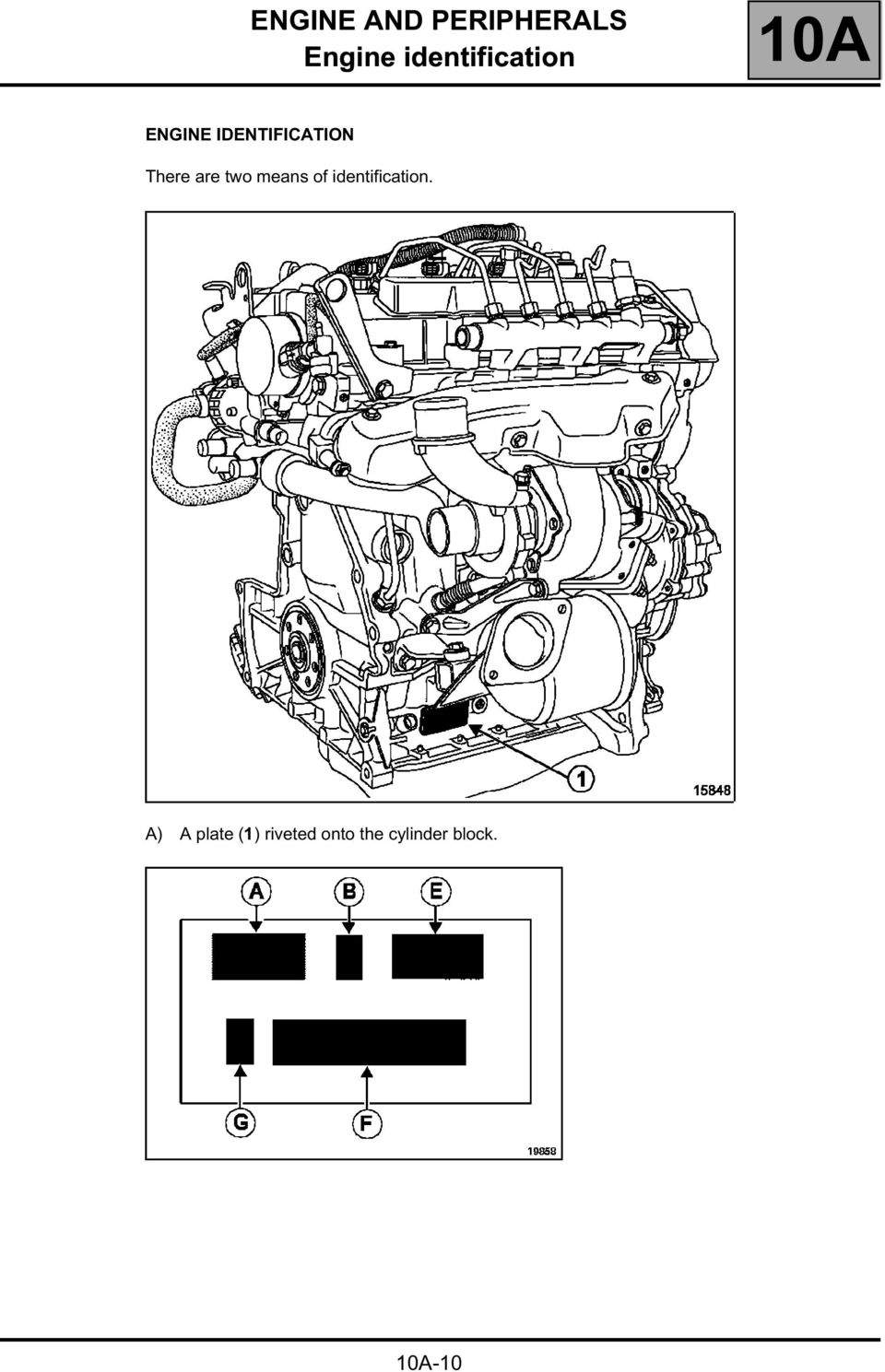
13 Engine identification A label (2) stuck onto the rocker cover. A B E F G H engine type, the engine approval letter, The engine rating, the engine fabrication number, the engine assembly factory, the assembled engine part number. -11

14 Engine identification Engine Rating Compression ratio Bore (mm) Stroke (mm) Cubic capacity (cc) G9T G9U / /

15 Tightening torques (in danm and/or in degrees) UPPER ENGINE Description Tightening torque Heater plugs 1.5 Injector flange bolt * Common rail mounting bolt 2.5 High pressure pipe nuts: on injectors on the pump and on the rail Camshaft bearing cap bolts * Camshaft hub bolts 6 Camshaft sprocket bolts 0.9 Hydraulic rocker shaft bolts * Vacuum pump mounting bolts 2.3 Inlet tract bolt on cylinder head * Rocker cover bolt * Exhaust manifold nuts 2.7 Cylinder head plenum chamber bolts 1 Turbocharger flange nut 2.7 Turbocharger oil return bolt 0.8 Turbocharger oil supply hollow bolt on cylinder block 2.3 Turbocharger oil supply nut on turbocharger 2.3 Exhaust gas recirculation valve bolt on venturi 1.5 Exhaust heat shield bolt 1 Cylinder head support bolt 4.4 Air conditioning compressor bolts 2.1 Alternator bolts 3 * See tightening procedure. -13

16 Tightening torques (in danm and/or in degrees) UPPER ENGINE (continued) Description Tightening torque Power assisted steering pump bolt 2.1 Power assisted steering pulley bolt 1 Accessories tension wheel bolt 2.1 Accessories pulley bolt 4.4 Engine lifting ring bolts M6 M8 1 3 Timing belt cover bolt 1 Cylinder head mounting bolts * Timing tension wheel bolt 2.5 Timing pulley mounting bolt 3 * See tightening procedure. RAIL PROTECTOR: Model 2 Protector bolts (M6 bolt) (M8 bolt) RAIL PROTECTOR: Model 1 Lower metal protector bolt (M6 bolt) 1-14

17 Tightening torques (in danm and/or in degrees) PERIPHERALS Description Tightening torque Sump bolts ** Crankshaft pulley bolts 5 plus angle of 90 ±6 Flywheel bolts: Classic Dual mass flywheel 2 plus angle of 45 ±6 2.5 plus angle of 50 ±6 Clutch bolts 1.2 Oil pump bolts: M6 M Anti-emulsion plate bolts 1 Bolts for split con rod caps 2.5 plus angle of 60 ±6 Crankshaft bearing cap bolts 2 plus angle of 150 ±10 Crankshaft bearing cap housing seam bolts 2 Water pump bolts 1 Water pump cover bolts 1 Water pump sprocket nut 5 Piston base cooling jet mounting bolts 2* Timing cover bolt M6 M Alternator bracket mounting bolt 3 High pressure pump mounting bolt 3 High pressure pump rear support bolt 3 High pressure pump sprocket nut 9 Cylinder marking sensor mounting bolt 1 Intermediate shaft mounting bolts 2.5 plus angle of 30 ±6 Timing belt pulley bolt 3 Oil filter holder mounting bolt 2.2 Dipstick guide mounting bolt Lower mounting Upper mounting Oil level sensor mounting bolt 1 TDC cap mounting bolt 3.1 ** See tightening order * Important: left-hand thread. -15

18 Tightening torques (in danm and/or in degrees) LOWER ENGINE (continued) Description Tightening torque Coolant pipe bolts 3.1 Venturi mounting bolts 2.2 Catalytic converter mounting nuts 2.1 Catalytic converter stay mounting bolts 2.1 Relay bearing mounting bolts 6.2 Balance shaft cassette mounting bolts 1.5 plus an angle of 38 ±6-16

19 Specifications CYLINDER HEAD Cylinder head bolts must always be replaced. WARNING Do not oil new bolts. Bolts must be oiled if reused. Cylinder head tightening procedure WARNING In order to ensure that the bolts are correctly tightened, use a syringe to remove any oil which may be in the cylinder head mounting holes. Tighten the cylinder head bolts to torque (3 danm) and in order. Check that all the bolts are correctly tightened to 3 danm then angle tightening (bolt by bolt) by 300 ± 6. WARNING Do not retighten the cylinder head bolts after applying this procedure. -17

20 Specifications Cylinder head changes Model 1 This cylinder head has lower washers on the valve springs. Marking (1) is made directly on the newly cast cylinder head. Model 2 This cylinder head no longer has valve spring lower washers. Marking (1) is made after milling. -18

21 Specifications Cylinder head gasket thickness There are two cylinder head gasket thicknesses: Thickness of crushed gasket: 1.16 ± 0.05 mm 1.21 ± 0.05 mm Cylinder head gasket thickness 1.21 ± 0.05 mm The thickness of the cylinder head gasket is measured at (1). G9T engine Cylinder head gasket thickness 1.16 ± 0.05 mm -19
22 Specifications G9U engine Cylinder head gasket thickness 1.21 ± 0.05 mm Reset the dial gauge on the front of the cylinder block. Apply force to the piston to eliminate the various clearances (between pin and piston, between pin and con rod, etc.) Take the protrusion value at both points (1) and (2), then take the average of the two measurements. Note: All measurements must be carried out along the longitudinal engine axis, in order to eliminate any errors due to tilting of the piston. WARNING The dial gauge feeler must not be in the valve clearance. Note: When replacing: the crankshaft, the cylinder block, the con rods, the pistons. The thickness of the cylinder head gasket must be calculated. Checking piston protrusion Clean the piston crowns in order to eliminate any scaling. Turn crankshaft by one revolution (in the operating direction, clockwise at the timing end) to bring piston no. 1 close to the top dead centre. Put tool (Mot ) in position. Insert tool (Mot ) equipped with a dial gauge on its pressure plate (Mot ), and find top dead centre of the piston. Measure the piston protrusion. The protrusion must be: ± mm. -20
23 Specifications Cylinder head height (mm) H = 90.2 Hydraulic tappet These engines are equipped with hydraulic thrust bearings (1) and roller type rocker arms (2). Gasket face deformation (mm) Cylinder head 0.05 Cylinder block 0.06 Test the cylinder head to detect any cracks using the cylinder head test tools, comprising a tray and a kit suited to the cylinder head (cap, sealing plate, blanking cover). The approval reference no. of the cylinder head test tray is
24 Specifications Valves Stem diameter (in mm) Inlet: ± Exhaust: ± Head diameter (in mm) Inlet: 30.6 ±0.12 Exhaust: 29.5 ±0.12 Valve seat Seat angle Inlet and exhaust: External diameter D (in mm) 89 30' Inlet: ± 0.01 Exhaust: ± 0.01 Mating face angle Inlet and exhaust: 90 15' Valve length (in mm) Inlet: ± 0.15 Exhaust: 123 ± 0.15 Max valve lift (in mm) Inlet: 7.8 Exhaust: 7.8 No valve clearance adjustment. Diameter of housing in the cylinder head (in mm) Inlet: ± Exhaust: ±
25 Specifications Valve guide Length (in mm) The valve stem seals must be fitted using tool Mot or other suitable equipment. Inlet and exhaust: 50 ± 0.15 Guide external diameter (in mm) Inlet and exhaust: Diameter of guide housing in the cylinder head (in mm) Inlet and exhaust: 11 Guide internal diameter (in mm) Inlet and exhaust: Not machined: Machined*: * This value must be obtained with the guide fitted in the cylinder head. The inlet and exhaust guides have valve stem seals which must be replaced each time the valves are removed. Note: Do not lubricate the valve stem seals before fitting them. -23
26 Specifications Angle of the inlet and exhaust guides (in degrees) Inlet: 95 Position of inlet and exhaust valve guides (mm) Inlet: A = 8.7 ± 0.15 Exhaust: A = 13.3 ± 0.15 Exhaust: 94 Valve springs (mm) Free length: 46.7 Length under load 18.5 dan dan dan dan dan dan dan 30 Length of joined spires: 28 Wire diameter: 3.2 ± 0.02 Internal diameter: 14.1 ± 0.2 External diameter:
27 Specifications Camshaft How to distinguish between camshafts: the exhaust camshaft has the vacuum pump drive (1), the inlet camshaft has no vacuum pump drive. Longitudinal clearance (mm) 0.05 to 0.13 Number of bearings: 6 Diameter of camshaft bearings (in mm) on the camshafts: on the cylinder head: Timing diagram Inlet opening retardation (ROA) * - 11 Inlet closing retardation (RFA) 16 Exhaust opening advance (AOE) 28 Exhaust closing advance (AFE)** - 13 * If the inlet opening retardation is negative, the valves open after top dead centre. ** If the exhaust closing advance is negative, the valves close before top dead centre. Either by a marking (2): marking details: (B) gives the engine type, (C) identifies the camshafts (A = Inlet and E = Exhaust), (D) is used by the supplier only. 1 Cylinder block top dead centre fixed marking 2 Flywheel top dead centre moving mark 3 Flywheel bottom dead centre moving mark 4 Inlet Opening Retardation ROA 5 Exhaust Closing Advance AFE 6 Inlet Closing Retardation RFA 7 Exhaust Opening Advance AOE 8 Direction of engine rotation (flywheel end) -25
28 Specifications PISTONS Fitting the free floating pin in the con rod and in the piston. The gudgeon pin is retained by circlips. These engines are fitted with KOLBENSCHMIDT pistons. Piston marking Table of gudgeon pin heights G9T * Mark on piston Pin height H (in mm) Thickness of the associated cylinder head gasket (in mm) E F J K L These pistons have no ducting (oil circulation in the piston crown contributing to piston cooling). * Mark on piston Pin height H (in mm) Thickness of the associated cylinder head gasket (mm) E F J K Direction of fitting of the piston ("Λ" flywheel end) 2 Piston height category 3 Used by the supplier only 4 Used by the supplier only 5 Piston axis of symmetry 6 Gudgeon pin hole axis 7 Offset between axis (5) and axis (6). This offset is 0.5 mm L These pistons have no ducting (oil circulation in the piston crown contributing to piston cooling). -26
29 Specifications * Mark on piston Pin height H (in mm) Thickness of the associated cylinder head gasket (mm) A or T B or U C or W D or X G or Y These pistons have ducting (oil circulation in the piston crown contributing to piston cooling). Procedure for distinguishing between pistons with an identical mark but different pin heights: G9U * Mark on piston Pin height H (in mm) N O P R S The tolerance on the pin heights is ± 0.02 mm. * The various gudgeon pin heights are exclusively reserved for the engine assembly factory. The Parts Department supplies only the following piston categories F and K U and X O and R B and D Calculation:X = H - 31/2 Example: piston of category F with a pin height H = Hence X = (31 / 2) X = mm piston of category F with a pin height H = Hence X = (31 / 2) X = mm -27
30 Specifications Measuring the piston diameter The piston diameter should be measured with A = 49 mm for G9T engines, A = 47 mm for G9U engines. Piston diameter (in mm): ± for G9T engines, ± for G9U engines. Fitting the rings Rings are adjusted to their original fitting. They must be free in their grooves. Ensure the rings' direction of fitting is correct. Gudgeon pin (in mm) Length 64.7 to 65 External diameter to 31 Internal diameter ± 0.1 Rings Three rings (thickness in mm) Compression ring: 3 Sealing ring 1.75 Scraper ring End clearance Rings End clearance (in mm) Compression ring 0.2 to 0.35 Sealing ring 0.5 to 0.7 Scraper ring 0.25 to
31 Specifications CON RODS The con rods are of the "SPLIT" type. Lateral clearance of the big end (in mm) 0.22 to Big end diametrical clearance (in mm) to Big end - small end centre-to-centre distance: There are four categories of big end - small end centre-to-centre distance* (mm). G9T ± ± ± ± G9U ± WARNING The bolts must be coated with engine oil under the heads and on the threads when the con rods are fitted on the engine. Positioning of the con rod caps on the body is ensured by textured mating faces. Impacts or a foreign body between the body-cap mating faces will cause a rapid fracture of the con rod. It is vital that the mating faces remain clean and dry. Do not oil the bearing shell pressure faces (cap side and con rod side) ± ± ± * Marking of the rotating assembly on the original engine is reserved exclusively for the engine assembly factory. The Parts Department supplies only the following con rod category: 3 for G9T engines 7 for G9U engines Big end diameter (mm) (there are two big end diameters) Small end diameter (mm) (without bush) 33.5 (with bush) Note: The con rod small end bushes cannot be replaced. -29
32 Specifications WARNING Do not use a sharp point to mark the big end caps in relation to their bodies, to prevent incipient breakage of the con rod. Use a permanent marker pen. The maximum con rod weight difference for a given motor must be 25 grams. -30
33 Specifications Direction of fitting of the con rod in relation to the piston CRANKSHAFT Number of bushings 5 Crankshaft lateral clearance (mm) 0.06 to Crankshaft diametrical clearance (mm) to Diameter of bushings The bushing diameters are shown on the crankshaft by paint marks. Paint mark Blue Red Position the "Λ" (1) etched on the piston crown downwards and lubrication hole (2) on the small end to the right of the vertical axis (as shown on the diagram above). Also, the slot (3) should be positioned at the flywheel end. Direction of fitting circlips on the piston Bushing diameter (mm) inclusive to exclusive inclusive to 58 inclusive Note: This paint mark is used only by the factory for matching bearing shells and bushings. The Parts Department supplies only a single type of bearing shell. Crankpin diameter (mm) The lateral shims are located on bearing no. 2. NO REGRINDING IS AUTHORISED The lateral shims have changed: A foolproofing device has been added. They are not interchangeable. The foolproofing device helps fitting the lateral shims: Model 1 (1) Model 2 (2) Fit the circlips on the piston as shown above. -31
34 Specifications BEARING SHELLS Crankshaft bearing shells These engines are fitted with foolproofed bearing shells. Con rod bearing shells These engines are fitted with non-foolproofed bearing shells. Direction of fitting: on the cylinder block, fit grooved bearing shells on all the bearings, on the bearing caps, fit non-grooved bearing shells. The bearing shells are fitted using tools Mot and Mot (with diameter 48 mm or 53 mm). Note: On a given bearing, fit an upper bearing shell and a lower bearing shell of the same colour. The bearing caps and cylinder block bearings must be clean and dry before the bearing shells are fitted. -32
35 Specifications Piston base cooling jet WARNING The piston base cooling jet mounting bolts have a left-handed thread. -33
36 Specifications PREPARING THE ENGINE TO BE MOUNTED ON THE SUPPORT Before the engine is mounted on the support (Mot ), the engine's electrical harness must be removed and the engine oil drained. Remove the exhaust heat shield. Remove the turbocharger retaining strut from the cylinder block (if fitted). -34
37 Specifications Remove the turbocharger retaining strut and the pre-catalytic converter retaining strut from the cylinder block (if fitted). Remove the turbocharger oil supply pipe. Remove the turbocharger oil return pipe. Remove the three turbocharger mounting bolts (1). -35
38 Specifications Remove: the exhaust manifold, driveshaft relay bearing. -36
39 Specifications Note: It is essential to remove the relay bearing centring dowel to enable stud D1 to be correctly positioned. Position the rods (D), (D1) of tool Mot and (T) of Mot in the cylinder block so that they fit into holes 19, 28 and 29 of the plate (Mot ). -37
40 Specifications CONSUMABLES Type Quantity Component concerned Part no. Cleaner - Cleaning parts DECAPJOINT Coat Cleaning sealing surfaces RHODORSEAL 5661 Coat Crankshaft bearing cap housing LOCTITE FRENETANCH 1 or 2 drops High pressure pump bolt WARNING WARNING The cleanliness rules described at the start of this document must be strictly observed when working on the fuel supply system. PARTS TO BE REPLACED AFTER REMOVAL: all seals, flywheel bolts, crankshaft bearing bolts, crankshaft pulley bolts, con rod cap bolts, injector holder copper washers, diesel return pipes, high pressure pipes, pipe caps, belts, timing tension wheel, timing pulley, exhaust gas recirculation pipe. WARNING Excess sealant could be squeezed out when the parts are tightened; a mixture of sealant and fluid could damage certain components (engine, radiator, etc.) -38
41 Standard replacement PREPARING USED ENGINE FOR RETURN The engine must be cleaned and drained (oil and water). Leave on the used engine or include in the return box: the oil filter, the oil pressure switch, the water pump, the high pressure pump, the rail, the injectors the heater plugs, the diesel fuel collector on rail protector model 2, the oil level sensor, the cylinder head plenum chamber, the water pump coolant inlet pipe, the rocker cover, the dipstick, the vacuum pump, the flywheel, the clutch. the inlet shim assembly, the accessories support. Remember to remove: all coolant flexible pipes, the exhaust manifold, the alternator, the power assisted steering pump, the air conditioning compressor, the rail protector model 1 (entire system), the cover of model 2. The used engine must be secured to the base under the same conditions as the overhauled engine: plastic caps and covers fitted, cardboard cover over the assembly. -39
42 Special tooling required Engineering reference Parts Department part no. Description Mot Crankshaft spigot bush extractor Mot Dial gauge support. Used with tool Mot Mot Dial gauge support thrust plate. Used with tool Mot Mot Magnetised flexible shaft for angle wrench for tightening cylinder head Mot Angle wrench with index for tightening cylinder head (1/2" drive) Mot Engine support plate for Desvil engine stand (with studs A to W) Mot Stud ref. "T" for Desvil engine stand Used with Mot Mot Flywheel end crankshaft seal fitting tool -40
43 Special tooling required Engineering reference Parts Department part no. Description Mot Flywheel locking tool Mot Depth gauge for measuring the height of crankpins Mot Pliers for removing valve stem seals Mot Tool for fitting con rod bearing shells Mot Tool for fitting bearing shells on split con rods - adaptor for Mot mm and 53 mm Mot Tool for fitting high pressure pump nut blanking cover Mot Tool for fitting valve stem seals Mot Inlet camshaft setting tool -41
44 Special tooling required Engineering reference Parts Department part no. Description Mot Top dead centre locating pin Mot Exhaust camshaft setting tool Mot High pressure pump sprocket immobiliser pin Mot Intermediate sprocket immobiliser tool Mot Tool for aligning the play compensation sprocket teeth Mot Tool for refitting the oil deflector on the crankshaft sprocket Mot Tool for refitting the roll pins on the intermediate sprocket shafts Mot High pressure pump sprocket retaining and extraction tool -42
45 Special tooling required Engineering reference Parts Department part no. Description Mot Injector extraction tool Mot Tool for fitting timing end crankshaft seal Mot Tool for fitting intermediate shaft seal Mot Tool for fitting camshaft seal Mot Flywheel end crankshaft seal fitting tool Mot Tool for removing high pressure pipes Mot Cylinder head support Mot Stud ref. "D1" for Desvil engine stand Used with Mot
46 Special tooling required Engineering reference Parts Department part no. Description Mot Lip seal extractor 28 mm to 50 mm Mot Lip seal extractor 50 mm to 75 mm Mot Lip seal extractor 80 mm to 95 mm Mot Set of 3 sleeves for fitting elastomer seals. This kit is needed for tools Mot. 1560, Mot and Mot Mot Balance shaft setting tool Mot Flywheel timing pin Emb Set of clutch disc centring mandrels Emb Clutch compression tool for resetting the play compensation system -44
47 Equipment required Description Tool for fitting piston and rings into cylinder liner Manual extractor for removing the water pump sprocket Standard 22 mm long "1/2" (12.7 mm square) drive socket for removing the oil pressure checking gauge Valve spring compressor Cylinder head test tools from CULASSE EUROPE SERVICE comprising, for example, a tray and the various kits for each model of cylinder head (cap, sealing plate, blanking cover). The approval number of the cylinder head test tray is Female torx socket 8/12/14, standard 1/2 (12.7 mm square) Angle tightening wrench Tool for fitting valve stem seals -45
48 Equipment required Description High pressure pipe wrench Articulated wrench for removing and refitting heater plugs Crankshaft spigot bush extractor pliers Dummy heater plug for measuring the pressure at end of compression "CROWFOOT" socket for tightening high pressure pipes to torque -46
49 REMOVING THE UPPER ENGINE Remove the accessories belt by turning the spanner to the left to slacken the belt. Lock the tension wheel by inserting a 4 mm Allen key in the hole (1). -47
50 Remove the cylinder head suspended mounting. -48
51 Remove: the timing cover, the TDC setting rod cap (1). -49
52 ADJUSTING THE TIMING Note: The camshaft grooves must be vertical as shown in the following illustration (zoom or top view). Fit the TDC setting rod (Mot. 1536). Turn the engine clockwise (timing end), while pressing down on the TDC setting rod (Mot. 1536) until it reaches the timing setting point. Position the top dead centre mark (1) almost vertically to the engine as shown in the following illustration. -50
53 The inlet and exhaust camshafts are set using tools Mot and Mot Place tools Mot and Mot in the camshaft grooves as recommended below. For the inlet camshaft: Fit tool Mot SCREWING IN THE BOLT (1) BY HAND. Loosen the three camshaft sprocket bolts (2) by up to one turn. Turn the inlet camshaft clockwise by the hub mounting bolt (3) using a 16 mm tubular hexagon box spanner, so as to pin the tool Mot to the cylinder head. Then lock down the bolt (1) onto tool (Mot. 1534). -51
54 For the exhaust camshaft: Fit tool Mot SCREWING IN THE BOLT (4) BY HAND. Loosen the three camshaft sprocket bolts (5) by up to one turn. Turn the inlet camshaft clockwise by the hub mounting bolt (6) using a 16 mm tubular hexagon box spanner, so as to pin tool Mot to the cylinder head. Then lock down the bolt (4) onto tool Mot
55 Slacken the timing belt by loosening the tension wheel bolt (1). Remove the three bolts (2), then remove the exhaust camshaft sprocket. Remove: the timing belt, the inlet camshaft sprocket, the camshaft hubs by removing the bolts (3). -53
56 Remove: the strut linking the multifunction support to the venturi unit, the power assisted steering pump rear bolt, the power assisted steering pump pulley. -54
57 Remove: the power assisted steering pump, the accessories belt pulley, the accessories belt tension wheel, -55
58 Remove the alternator. -56
59 Remove the air conditioning compressor. -57
60 RAIL PROTECTOR WARNING Pay strict attention to the rules regarding cleanliness (see start of document). Unclip the rail protector from the rocker cover, pushing it as far back as possible. Remove the sealing partition (2) attached by two nuts to the rocker cover, holding the stud in place (on some versions). Model 1 Unclip the rail protector side partitions (1). Remove the absorbent soundproofing pads (3). -58
61 Model 2 Disconnect the oil vapour rebreathing pipe (1). Remove the diesel fuel drain pipe (3). Remove the heater plugs using the correct equipment. Unclip the protector plastic cover and remove it. WARNING When loosening the high pressure pipe nuts (7), hold the filter-rod retaining nuts (8) with a lock wrench. -59
62 Remove the injector pipes using tool Mot or other suitable equipment. Remove the high pressure pipe between the high pressure pump and the rail (using a "CROWFOOT" socket). WARNING The clip (6) is very fragile. -60
63 Remove: the fuel return pipe (be sure to replace it),* the oil vapour recirculation pipe (Model 1). Fit the anti-contamination blanking covers on the high pressure pump, the injectors and the high pressure pipes (set of caps available from the Parts Department). * To remove the return pipe, press on the clips then pull the pipe out vertically. It is not necessary to remove the clips. If removed, be sure to replace them. Apply release agent around the injector. WARNING Never reuse injector holder mounting bolts. A special set of studs is available from the Parts Department. REMOVING THE INJECTOR HOLDERS Loosen the mounting bolts on each injector holder. A special extractor must be used to remove the injectors. Fit the extractor onto an injector holder. Tighten the knurled ring to bring the two jaws together on the flat surfaces without over-tightening. Never attempt to remove an injector holder locked in its cylinder head well without using the tool described below. Description of the extractor (Mot and 1549). 1 Extractor support chassis (1), which is mounted on the rocker cover mounting bolts. Check that it is positioned correctly before use. 2 Extractor (2). 3 Extractor bolt (3). -61 Mount the tool (Mot and 1730) chassis on the rocker cover mounting bolts. Tighten the extraction bolt until the injector is released from the cylinder head.
64 RAIL PROTECTOR: Model 1 Remove the washer from the bottom of each injector well. Remove: the bolt from the clamp (3) securing the rail to the lower metal protector, the three common rail bolts (4), then remove the rail. Remove: the two clips (2), the engine lifting eye at the flywheel end, -62
65 Remove: the side partition mounting bolt (5), the lower metal protector mounting bolt (6). Remove: the two aluminium protector mounting bolts, the rail protector. Remove the rail protector with the side partition. Model 2 Remove both injector rail mounting bolts, then remove the rail. Remove: the two aluminium protector mounting bolts, the rail protector. -63
66 Remove: the rocker cover bolts, the vacuum pump, the cylinder head plenum chamber. -64
67 Remove the coolant pipe. -65
68 Remove the rocker shafts. -66
69 Mark the camshaft bearing caps. Remove the camshaft bearing caps. WARNING Mark the position and direction of fitting of the bearings. -67
70 Remove: the camshafts, the exhaust gas recirculation pipe. -68
71 Remove the cylinder head. -69
72 DISMANTLING THE CYLINDER HEAD Place the cylinder head on the cylinder head stand (Mot. 1573). Remove the inlet manifold. Remove the cylinder head suspended mounting. -70
73 Compress the valve springs using a valve-spring compressor. Remove the keys. Remove the springs' upper mounts. Remove the springs. Note: Before removing the valves and the valve stem seals, be sure to mark the position (H) of one of the old seals in relation to the cylinder head using Mot or other suitable equipment. Fit the pushrod (1) of Mot on the valve stem seal. Note: The internal diameter of the pushrod must be identical to that of the valve. In addition, the bottom of the pushrod must be snug to the metal upper section of the valve stem seal. -71
74 CLEANING IMPORTANT Do not scratch the aluminium sealing surfaces. Wear goggles. Wear gloves during this operation. Clean the sealing surfaces with DECAPJOINT compound to dissolve any pieces of seal which are still bonded. Apply the product to the part to be cleaned, wait around ten minutes, then remove residue using a wooden spatula. Do not allow this product to drip on to the paintwork. Insert the guide tube (2) in the top of the pushrod, until the guide tube comes into contact with the cylinder head. Lock the pushrod with the tumblewheel. Remove the guide tube - pushrod assembly, being careful not to loosen the tumblewheel. Remove the valve guide seals using the pliers (Mot. 1335). Remove the spring lower mounts (if fitted, see section "Cylinder head specifications"). Take care during this operation to prevent foreign bodies getting into the pressurised oil inlet pipes, paying attention to the following: hydraulic thrust bearings, camshafts (pipes both on the cylinder block and cylinder head). oil return pipes. Failure to follow this advice could lead to the blocking of the various oil inlet ducts, resulting in rapid destruction of the engine. CHECKING THE GASKET FACE Check for gasket face deformation using a ruler and a set of shims. Maximum distortion: 0.05 mm Test the cylinder head to detect any cracking using the cylinder head test tools (comprising a tray and kit for the cylinder head: cap, sealing plate and blanking cover). The approval number of the cylinder head test tray is
75 CHECKING CAMSHAFT LONGITUDINAL CLEARANCE Refit: the camshafts, ensuring they are correctly positioned (see camshaft identification in the "Technical specifications" section), the camshaft bearing caps (without tightening to torque), the rocker shafts, without the rocker arms. Tighten the camshaft bearing caps to a torque of 0.9 danm. Fit a cylinder liner retaining bracket (Mot. 588) so it be used as a support for the magnetic holder. Check the longitudinal clearance, which must be between 0.05 and 0.13 mm inclusive. Remove: the rocker shafts, the camshaft bearing caps, the camshafts. -73
76 -74
77 REASSEMBLING THE CYLINDER HEAD Fit new valves. Gently grind them in on their respective seats. Clean all the parts thoroughly, mark them for identification purposes, then carry out the refitting operation. Oil the inside of the valve guide. Fit the lower valve spring mounts (if fitted, see section "Cylinder head specifications"). Valve stems seals must be fitted using Mot or other suitable equipment. Note: Do not lubricate the valve stem seals before fitting them. Fitting new valve stem seals. Place the valve in the cylinder head. Fit the valve insert of Mot on the valve stem (the diameter of the insert must be the same as that of the valve stem) Keep the valve pressed against its seat. Place the valve stem seal (not lubricated) over the valve insert. Push the valve stem seal past the insert, then withdraw the insert. -75
78 Mount the guide tube-pushrod assembly on the valve stem seal. -76
79 Secure the cylinder head suspended mounting by tightening the bolts to a torque of 4.5 danm. Push the valve stem seal down by tapping the top of the sleeve with the palm of your hand until the guide tube touches the cylinder head. Repeat these operations for all the valves. Fit: the springs, the upper mounts, Compress the springs. Secure the inlet manifold without locking the bolts. Fit the keys. -77
80 REMOVING THE PERIPHERALS Remove the timing gear cover. Fit the flywheel immobiliser (Mot. 1316). Remove: the timing belt pulleys and tension wheels, the water pump cover, the crankshaft accessories pulley. -78
81 Remove the seal (1). Remove: the high pressure pump sprocket nut (2), the number 2 intermediate shaft disc (3), the water pump nut (4). -79
82 Remove the water pump sprocket using the extractor tool (U43L) for example. -80
83 Screw the pin (Mot. 1538) into the high pressure pump sprocket, to lock the automatic play compensation system. Fit the extractor (Mot. 1548) on the high pressure pump sprocket by tightening the three bolts (5). Then turn bolt (6) to remove the high pressure pump sprocket. -81
84 Fit Mot on intermediate sprocket number 1. Bend the two tabs (7) against the sprocket and then lock them. Remove the mounting bolt (8) and then the sprocket. -82
85 Remove: the crankshaft timing sprocket, intermediate sprocket number 1 pin and washer. Remove: intermediate sprocket number 2 pin, the water pump by removing both bolts (10). WARNING When replacing intermediate sprocket number 1 (on its own) or intermediate sprocket number 2 (on its own), be sure to replace both sprockets in the cases listed below. Engines concerned: G9T 710 up to the following engine number: C G9T 720 all engines are concerned G9T 722 up to the following engine number: C G9U 720 up to the following engine number: C Remove intermediate sprocket number 2 by removing the mounting bolt (9). Remove the venturi unit by removing the three bolts (11). -83
86 Remove the high pressure pump by removing the three bolts (13). Remove the three bolts (12) or the two bolts (14) from the high pressure pump rear support. Remove the clutch mechanism and plate. -84
87 Remove the flywheel. Remove the inner timing cover bolts, then remove the cover. Remove the sump. -85
88 Engine not equipped with balance shafts Remove: the multifunction support, the oil level sensor, the oil filter holder. Remove: the oil pump complete with its chain, the oil pump drive sprocket. Remove the flywheel sensor. -86
89 Remove the anti-emulsion plate: Engine equipped with balance shafts With the engine set to top dead centre and tool Mot in position, set the balance shaft assembly using a 4 mm Allen key (2). Remove the balance shaft assembly. Gently turn the engine over to drain the oil still in the cylinder block. Remove the oil pump. -87
90 Remove the crankshaft bearing cap cover. WARNING Do not use a sharp point to mark the big end caps in relation to their bodies, to prevent incipient breakage of the con rod. Use a permanent marker pen. -88
91 Remove the con rod cap bolts and the connecting rod/ piston assemblies. Remove the piston base cooling jets. The bolts have a left-handed thread. Be sure to mark the position of the crankshaft bearing shells, as the category may be different on each bearing. Remove the crankshaft bearing shells. -89
92 FITTING THE CON ROD BEARING SHELLS Remove the crankshaft spigot bush using tool Mot. 11 or an extractor. Clean: the stiffener baseplate, the cylinder block, the crankshaft. EXTRACTING THE GUDGEON PINS The main bearing shells are fitted using tool Mot and Mot (with diameter 48 mm or 53 mm). Note: When fitting the bearing shells, make sure that all the parts are clean and dry. Note: Be sure to mark the con rod to match it to its piston, because the piston height categories on a given engine may be different (see Technical Specifications). To extract the gudgeon pin, remove the circlip with a screwdriver and withdraw the pin. -90
93 On the con rod body Slide the bearing shell support (1) of tool Mot (using the 48 mm or 53 mm diameter bearing shell) into the groove (2) on the base of tool Mot Fit the body of the con rod on the base (as shown in the diagram). Ensure that the lower section (4) of the small end is in contact with the centring pin. Fit the rail (3) of Mot (using the 48 mm or 53 mm diameter rail) on the base (as shown in the diagram). Fit the bearing shell (5) on the bearing shell support, then push it in the direction of the arrow (as shown in the diagram). -91
94 Slide the bearing shell support to the end stop of the con rod body. Then remove the support from the con rod body and repeat the operation for the other con rod bodies. On the con rod cap Fit the con rod cap as shown in the diagram. Note: Do not cause impacts on the split con rod breakage seams. Push the rail (in the direction of the arrow) until the con rod cap is resting on the pins (6) on the base. -92
95 Fit the shell (7) on the shell support, then push it in the direction of the arrow (as shown in the diagram). Slide the shell support to the end stop of the con rod cap. Remove the support from the con rod cap and repeat the operation for the other con rod caps. Note: Do not cause impacts on the split con rod breakage seams. -93
96 REFITTING THE PERIPHERALS Refit the piston base cooling jets, tightening them to a torque of 2 danm. The bolts have a left-handed thread. -94
97 Refit the crankshaft bearing shells non-grooved on the crankshaft bearing cap cover. Refit the grooved crankshaft bearing shells on the cylinder block bearings, checking that the lubrication holes in the bearing shells and the cylinder block crankshaft bearings are correctly aligned. Note: The bearing shells must be fitted on clean, dry surfaces. Apply a drop of oil on the crankshaft bearing shells. -95
98 Refit the crankshaft lateral shims (1) on bearing No. 2 (grooves on crankshaft side). -96
99 Refit the crankshaft. Refit the bearing cap casing by tightening the centre bolts in order to a torque of 2 danm, then angle tighten by 150 ± 10 (use the old centre bolts). -97
100 Check the lateral clearance of the crankshaft, which must be between 0.06 and mm. Remove the crankshaft bearing cap cover. The crankshaft bearing cap cover is sealed with a bead of RHODORSEAL 5661 which must have a width of 2 ± 0.4 mm and follow the line shown here. WARNING Excess sealant could be squeezed out when the parts are tightened. A mixture of sealant and fluid could damage certain components (engine, radiator, etc.) -98
101 Do not forget to replace the centre crankshaft bearing cap cover bolts. Refit the crankshaft bearing cap cover by tightening the centre bolts in order to a torque of 2 danm, then angle tighten by 150 ±
102 Refit the outer bolts of the crankshaft bearing cap cover in order and to torque (2 danm). Check that the crankshaft rotates freely. -100
103 Replacing con rods or pistons When replacing pistons or con rods, determine the crankpin height "HM". This will enable you to choose a piston matching the con rod on sale from the Parts Department, or matching the original con rods. The crankpin height is measured using tool Mot and tool Mot
104 1 ENGINE AND PERIPHERALS Measuring the crankpin height for cylinders 1 and 4: set the engine to top dead centre using Mot. 1536, fit Mot in place of the "con rod -piston - bearing shells" assembly (use the appropriate depth gauge - Mot ), calibrate the dial gauge (A) on the cylinder block, taking the average of points C and E, then slide the dial gauge to measure the protrusion (D) of rod (B). Measuring the crankpin height for cylinders 2 and 3: set the crankpin to approximately top dead centre, fit Mot (using the appropriate depth gauge - Mot ), calibrate the dial gauge (A) on the cylinder block, taking the average of points C and E, place the dial gauge opposite the rod (B), turn the crankshaft to define the top dead centre of the crankpin and, at the same time, note the rod protrusion value (D). Calculating crankpin height (HM) HM = Length of B - Protrusion at D Example (all dimensions are given in mm): Length of rod B = (value noted in the Mot and Mot kit). Cylinder Protrusion (D) HM = = for cylinder 1. HM = for cylinder 2. HM = for cylinder 3. HM = for cylinder 4. Note: The crankpin height must also be calculated when a cylinder block or crankshaft is replaced. To determine the piston category to be used, a formula is available: A = D - E A represents the gudgeon pin height in mm D is the crankpin height measured in mm E is the centre-to-centre distance between the big and small ends in mm -102
105 "CON RODS/PISTONS" ASSEMBLY The pistons have a "Λ" mark etched on their crowns, indicating the flywheel end. Note: Put the gap in the gudgeon pin locking spring ring on top, at ± 45 to the vertical axis of the piston. Oil the gudgeon pin. Check that the gudgeon pins rotate correctly in the new piston and in the corresponding con rod. Direction of fitting of the con rod in relation to the piston Position the "Λ" (1) etched on the piston crown downwards and the small end lubrication hole (2) to the right of the vertical axis (as shown in the diagram below). Moreover, the slot (3) must be at the flywheel end. -103
106 FITTING THE RINGS The rings must be free within their grooves and at their original settings. Check that the big ends have the correct lateral clearance of 0.22 mm to mm. Ensure the rings are fitted the correct way round with the word "TOP" pointing upwards. Orientation of the rings in the piston Ensure each ring's end clearance is correctly oriented as shown in the diagram below. Note: Do not oil the ring grooves or the rings. Check the piston protrusion, which must be ± mm. Lightly oil the pistons and barrels. Fit the "con rod/piston" assemblies into the cylinder block using the ring, making sure they are fitted the right way round (the "Λ" towards the flywheel). Fit the con rods onto the oiled crankpins of the crankshaft. Fit the con rod caps, ensuring they are correctly matched (marks made when dismantling). Tighten the con rod cap bolts to the required torque (2.5 danm), then angle tighten by 55 ± 6. Reset the dial gauge on the front of the cylinder block. Apply force to the piston to eliminate the various clearances (between pin and piston, between pin and con rod, etc.) Take the protrusion value at both points (1) and (2), then take the average of the two measurements (see technical specifications). -104
107 REPLACING THE OIL PUMP DRIVE SPROCKET OIL DEFLECTOR The oil deflector is fitted using tool Mot Arrange the parts as shown in the drawing, then tighten the bolt (1) until it locks. Fitting the flywheel end crankshaft seal This engine can be fitted with two different types of seal. Old and new seals are easily recognised. The old elastomer seal is fitted with a spring (2) and has a V-shaped sealing lip (3). Note: Never oil the seal mating faces; the parts must be clean and dry. -105
108 For the new seals, follow the method described below. The new elastomer seal has a flat sealing lip (4) and a protector (5) which also fits the seal to the engine. Fit tool Mot on the crankshaft, securing it with bolts (6). For the old seals, use tool Mot Put the protector with the seal on tool Mot. 1564, being careful not to touch the seal. -106
109 Mount the cover (7) and the nut (8) of tool Mot (positioning the nut thread (9) towards the outside of the engine). Remove the nut, cover, protector and base of tool Mot Tighten the nut until the cover touches the cylinder block. -107
110 Clean the crankshaft mounting bolt threads Install the flywheel immobiliser (Mot. 1316). Degrease the bearing face of the flywheel on the crankshaft. Refit the flywheel, hand-tightening all the bolts. Fit the TDC setting rod (Mot. 1536). Turn the engine clockwise (timing end), while pressing down on the TDC setting rod (Mot. 1536) until it reaches the setting point. Install the flywheel timing pin (Mot. 1665). Tighten the bolts to a torque of: 2.5 danm plus 50 ± 6 angle for the dual mass flywheel, 2 danm plus 45 ± 6 angle for the classic flywheel. Remove: the flywheel timing pin (Mot. 1665), the flywheel immobiliser (Mot. 1316). -108
111 Refit the flywheel sensor. Precautions to be taken when fitting the flywheel sensor: position the clip and press at (1) to align the clip holes with the boss holes. insert the sensor up to the stop on the flywheel target. the connector must be below the anti-rotation bracket. release the clip. Operations to be performed for fitting a sensor that has already been used: file down the flange and insert a 1.15 mm shim between the target and the sensor before releasing the clip. -109
112 Special notes on engines equipped with balance shafts: Fit the TDC setting rod (Mot. 1536). Turn the engine clockwise (timing end), while pressing on the TDC setting rod (Mot. 1536) until it reaches the timing setting point. How to determine the crankshaft - balance shafts backlash Take the two 2.22 mm calibration shims from the kit, clean them, and put them in position on the cylinder block. Clean the balance shaft assembly and cylinder block support points. Degrease and then blow-clean the gearing: at the crankshaft end (1), at the balance shafts end (2). To tighten the bolts properly, use a syringe to remove any oil found in the holes for mounting the balance shaft assembly on the cylinder block. Note: The shim thickness is etched on them at (3). -110
113 Make sure the balance shaft assembly is properly set. Turn the shaft in the direction of the arrow until the 4 mm Allen key can be inserted in the flyweight hole (4). To do this, the hole position hole (4) in the balance shaft assembly vertically. Do not blow-clean the oil duct (5) to prevent any contamination from entering. -111
114 Check that the crankshaft is set at top dead centre. Fit the longitudinal clearance locking tool (Mot. 1660) on the balance shaft assembly. Refit the balance shaft assembly by tightening the old bolts in order and to torque (1.5 danm), then angle tighten by 38 ± 6. Fit the radial clearance locking tool (Mot. 1660) on the balance shaft assembly after loosening the bolt (1). Tighten bolt (1) until it locks, then loosen bolt (1) by approximately
115 With a pencil, mark the starter ring gear teeth (one mark every 13 teeth). Place measuring tool (2) of the tool (Mot. 1660) on the end of the drive shaft. Position tool (2) horizontally with a set of shims (3), then immobilise the tool with a lock bolt (4). Remove the set of shims. Fit the dial gauge on the measuring tool. Remove the TDC setting rod (Mot. 1536). WARNING The drive shaft end can have one of two diameters: 12 mm or 14 mm. To mount the measuring tool on the end of the 14 mm shaft, remove the tool socket (5). -113
116 Determining the backlash Pull lever (1) upward until the fixed pointer (2) is aligned with the lower part (3) of the lever. Then gently move the lever (1) back downward until the fixed pointer (2) is aligned with mark (4) on the lever. Move the lever (1) downward until the fixed pointer (2) is aligned with the lower part (6) of the lever. Then gently move lever (1) back upward until the fixed pointer (2) is aligned with the mark (7) on the lever. Holding the lever in this position, reset the dial gauge by pressing and holding the dial gauge button (5) for around 1 second. -114
117 Read and note the value displayed on the dial gauge. Repeat the above procedure several times to confirm the reading. Release the measuring tool. Turn the crankshaft in the operating direction by 13 teeth on the starter ring gear. Position the measuring tool (Mot. 1660) horizontally with a set of shims, then lock it. Measure the backlash. Repeat the above procedure for every 13 starter ring teeth over a complete crankshaft rotation. Take the smallest readings to select the correct shims from the table below (for example, with a reading of 422 microns, use 2.06 mm thick shims). Adjustment shim thickness based on backlash measured with the calibration shim Dial gauge backlash reading (in µm) -115
118 Remove the measuring tool (Mot. 1660). Set the crankshaft at top dead centre with the rod (Mot. 1536). Set the balance shaft assembly with a 4 mm Allen key. Remove the balance shaft assembly. Remove the 2.22 mm calibration shims. Clean the balance shaft assembly and cylinder block support points. Clean the shims. To tighten the bolts properly, use a syringe to remove any oil found in the holes for mounting the balance shaft assembly on the cylinder block. Make sure the crankshaft and balance shaft assembly are set. Refit the selected shims. Refit the balance shaft assembly by tightening the new bolts in order to torque (1.5 danm), then angle tighten by 38 ± 6. Remove the locking tools (Mot. 1660), the TDC setting rod (Mot. 1536), and the 4 mm Allen key. Refit the anti-emulsion plate, tightening the bolts to a torque of 1 danm. -116
119 Refit the oil pump by tightening the M6 bolts to a torque of 1 danm, and the M8 bolt to a torque of 2.5 danm. -117
120 Special notes concerning engines not equipped with balance shafts -118
121 Refit: the anti-emulsion plate without locking the bolts, the oil pump drive chain and sprocket. Tighten the oil pump bolts in order and to torque (2.5 danm). Tighten the anti-emulsion plate bolts in order and to torque (1 danm). -119
122 ALL TYPES Clean the inner timing cover. Put all the bolts in position and then tighten in accordance with the table below. Check that the oil supply pipes (1) and (2) are not clogged. Fit the seal between the cylinder block and the inner timing cover. bolts 19, 20, 21 are M6* bolts, bolts 1 and 2 are M8* bolts, the other bolts are M6* bolts. Assembly Operation No. 1 Operation No. 2 Operation No. 3 Bolt tightening order Tightening torque (in danm) 1 (pretightening)
123 WARNING Excess sealant could be squeezed out when the parts are tightened. A mixture of sealant and fluid could damage certain components (engine, radiator, etc.) Refit the multifunction support by securing it against both the cylinder block and on the inner timing cover. Tighten the bolts in order and to torque (3 danm). Refit: the oil level sensor to a torque of 1 danm the oil filter support equipped with a new seal and a new filter element. Tighten only the two bolts (7) to torque (2.5 danm). Apply some RHODORSEAL 5661 at points (3). Refit the oil sump equipped with a new seal. Pre-tighten the bolts in order and to a torque of 0.5 danm, then perform the final tightening to torque (0.9 danm). -121
124 Refit the high pressure pump, applying one or two drops of LOCTITE FRENETANCH, then tighten the bolts to a torque of 3 danm. Model 2 Refit the high pressure pump rear support, tightening the bolts to a torque of 3 danm. Refit the venturi unit, tightening the bolts to a torque of 2.5 danm. Model 1-122
125 FITTING THE INTERMEDIATE SHAFT ROLL PINS Roll pins are fitted using tool Mot Intermediate shaft No. 1 Offer up the intermediate shaft as shown in the diagram. The roll pin housing (2) must be facing upward and the shaft groove (3) must fit onto the lug on the base. Position the base (1) of tool Mot in the vice. Insert the roll pin into the hole (4) in the base. -123
126 Tap the roll pin punch with a hammer until the punch comes into contact with the base. Offer up the intermediate shaft as shown in the diagram. The roll pin housing (6) should be facing upward and the shaft groove (7) should fit onto the lug on the base. Insert the roll pin into the hole (8) in the base. Intermediate shaft No. 2 Position the base (5) of tool Mot in the vice. -124
127 Tap the roll pin punch with a hammer until the punch comes into contact with the base. Lubricate the bores and the intermediate shafts with engine oil. Refit intermediate shaft No. 1 (9), positioning the roll pin in the groove (10). Refit intermediate shaft No. 2 (11), positioning the roll pin in the groove (12). Refit the bearing washers (13). Refit the water pump (fitted with a seal) by pressing down on the bosses (14) to properly secure the pump against the inner timing cover. Tighten the bolts (15) to torque (1 danm). -125
128 REPLACING THE PLAY COMPENSATION SPROCKETS Note: Special tooling is required for this operation. For replacing intermediate sprocket No. 1 and the high pressure pump sprocket use tool Mot Method for replacing intermediate sprocket No. 1: Remove the two brackets from tool Mot Fit intermediate sprocket No. 1 on the locator (9). Tighten the bolt with its washer (10), to prevent the sprocket slipping off the locator. Push the toothed segment (11) in the direction of the arrow to immobilise the sprocket, then lock it with the wing nut (12). Place tool Mot in a vice, then adjust the levers (1) and (2) as shown below: for lever (1), insert the pin (3) in the groove (4), then tighten the wing nut (5), for lever (2), insert the pin (6) in the groove (7), then tighten the wing nut (8). Remove tool Mot. 1539, holding the levers (2) and then (1) in turn to facilitate removal of the tool and to prevent the gear tooth automatic compensation from relaxing suddenly. Remove intermediate sprocket No
129 Refit the new intermediate sprocket No. 1, locking it by means of the bolt (10) and the toothed segment (11). Check that the locating pins (3) and (6) are in the middle of the grooves (4) and (7) on levers (1) and (2). Turn the lever (2) in the direction of the arrow to align the teeth of the hub with those of the lower flange. Press on the tool (Mot. 1539) until the tool stops against the upper flange. Remove intermediate sprocket No. 1 from Mot Refit the retaining brackets on tool Mot Turn the lever (1) in the direction of the arrow to align the teeth of the upper flange with those of the hub. Mount tool Mot down as far as the teeth of the lower flange. -127
130 Method for replacing the high pressure pump sprocket. Adjust lever (1) so that the locating pin (3) is in groove (13), then tighten the wing nut (5). Fit the high pressure pump sprocket on the locator, then tighten bolt (10) with its washer, to prevent the sprocket slipping off from the locator. Push the toothed segment (11) in the direction of the arrow to immobilise the sprocket, then lock the toothed segment with the wing nut (12). Remove tool Mot. 1538, holding the lever (1) to facilitate removal of the tool and to prevent the gear tooth automatic compensation from relaxing suddenly. Refit the new high pressure pump sprocket, locking it with bolt (10) and the toothed segment (11). Check that the locating pin (3) is in the middle of the groove (4) on the lever (1). -128
131 Set the crankshaft to top dead centre using tool Mot WARNING When replacing intermediate sprocket number 1 (on its own) or intermediate sprocket number 2 (on its own), be sure to replace both sprockets in the cases listed below. Engines concerned: G9T 710 up to the following engine number: C G9T 720 all engines are concerned G9T 722 up to the following engine number: C G9U 720 up to the following engine number: C Turn the lever (1) in the direction of the arrow to align the teeth of the upper flange with those of the hub. Screw tool Mot until it locks. Refit the crankshaft sprocket (1); the key (2) must be located towards the top in the vertical axis of the engine. Refit intermediate sprocket No. 2 without tightening the bolt (3). Remove the high pressure pump sprocket from tool Mot
132 Refit intermediate sprocket No. 1, tightening the bolt (4) to torque (2.5 danm) plus an angle of 30 ± 6, then remove tool Mot Refit the high pressure pump sprocket nut, tightening it to a torque of 9 danm. Refit the water pump sprocket, tightening the nut to a torque of 4 danm. Refit the flywheel immobiliser (Mot. 1316), making sure that the key (2) of the crankshaft sprocket is at the top and in the vertical axis of the engine. Then remove the TDC setting rod (Mot. 1536). Refit the timing gear housing seal, after degreasing the sealing surfaces. Refit the high pressure pump sprocket, aligning marks (5) and (6). -130
133 Refit the timing gear housing cover, so that all the bolts are in contact with the cover. FITTING THE INTERMEDIATE SHAFT NO.2 SEAL AND TIMING END CRANKSHAFT SEAL. This engine can be fitted with two different types of seal. Tighten to torque in the following order: the M6 bolts: 10, 4, 8, 7, 12 and 2 (0.8 danm), the M8 bolts: 13, 14 and 15 (2.5 danm), the M6 bolts: 1, 2, 3, 4, 5, 6, 7, 8, 9, 10, 11 and 12 (1.1 danm). Old and new seals are easily recognised. The old elastomer seal is fitted with a spring (2) and has a V-shaped sealing lip (3). Note: Never oil the seal mating faces; the parts must be clean and dry. -131
134 The new elastomer seal has a flat sealing lip (4) and a protector (5) which also fits the seal to the engine. Fitting the seal on intermediate shaft No. 2: Screw the threaded rod (7) of tool Mot into intermediate shaft No. 2. Remove bolt (6). -132
135 For the new seal, put the protector with the seal on the intermediate shaft, taking care not to touch the seal. Mount the cover (8) and the nut (9) of tool Mot (positioning the threaded part (10) of the nut towards the outside of the engine). For the old seal, place the protector marked B of tool (Mot. 1628) fitted with the seal on the intermediate shaft. Note: Never oil before fitting; the parts must stay clean and dry. -133
136 Screw on the nut until the cover makes contact with the timing gear cover. Remove the nut, the cover, the protector and the threaded rod. Refit the intermediate shaft bolt, tightening it to a torque of 2.5 danm plus an angle of 30 ±
137 Fitting the timing end crankshaft seal Screw the threaded rod (11) of tool Mot into the crankshaft. For the old seal, place the protector marked C of tool Mot fitted with the seal on the crankshaft. Note: Never oil before fitting; the parts must stay clean and dry. For the new seal, put the protector with the seal on the crankshaft, taking care not to touch the seal. In addition, position the groove (12) of the protector opposite the key on the crankshaft sprocket (13). -135
138 Mount the cover (14) and the nut (15) of tool Mot (positioning the threaded part (16) of the nut towards the outside of the engine). Remove the nut, the cover, the protector and the threaded rod. Screw on the nut until the cover makes contact with the timing cover. -136
139 Refit the cap on intermediate shaft No. 2 using tool Mot Note: Never oil before fitting; the parts must stay clean and dry. Refit the water pump cover fitted with the new seal, tightening the bolts to a torque of 1 danm. Refit the timing pulley, tightening the bolt to a torque of 3 danm. Refit the crankshaft accessories pulley, tightening the bolt to a torque of 5 danm plus an angle of 90 ± 6. Fit the tension wheel again without locking the bolt, ensuring the roll pin (1) is correctly positioned in the groove (2). Remove the flywheel immobiliser (Mot. 1316). -137
140 To fit the cap on the high pressure pump, make a flat area of X = 17 mm and Y = 40 mm on tool Mot REFITTING THE UPPER ENGINE Assessing the rocker shafts. WARNING Do not reverse the rocker shaft spacers. -138
141 INLET ROCKER SHAFT EXHAUST ROCKER SHAFT Check that the lubrication holes in the rocker shaft, the rocker arms and the bearings are not blocked. To ensure the rocker shaft is correctly fitted, position the flat part (1) as shown in the diagram and then slide the rocker arms onto the shaft so that the lubrication holes (2) on the shaft coincide with those on the arms. Mount: the spacer (3), the clip (4), the bolt (5). Carry out the above operations for the other rocker arms. Check that the lubrication holes in the rocker shaft, the rocker arms and the bearings are not blocked. To ensure that the rocker shaft is correctly fitted, position the flat part (6) as shown in the diagram and then slide the rocker arms onto the shaft so that the lubrication holes (7) on the shaft coincide with those on the arms. Fit: the spacer (8), the clip (9), the bolt (10). Carry out the above operations for the other rocker arms. Fit the cylinder head gasket (with the markings facing upwards). Mount the cylinder head. Tighten the cylinder head (see Cylinder head specifications). -139
142 Apply some oil to the camshaft bearings on the cylinder head side. Refit the camshafts, positioning them correctly (see "Camshaft identification" in the Technical specifications section). Apply a drop of oil on each bearing. Note: The sealing surfaces must be clean, dry and free from grease (avoid finger marks). Put a bead of LOCTITE mm wide on: bearing cap number 6, inlet camshaft (1), bearing caps numbers 1 and 6, exhaust camshaft (2). -140
143 Refit: the camshaft bearing caps (in accordance with the marks made previously), tightening to a torque of 1.2 danm only: the bolts (4) of inlet camshaft bearings 1 and 6, the bolts (5) of exhaust camshaft bearings 1 and 6, the rocker shafts, positioning them as follows: for the exhaust camshaft, put the end of the rocker shaft with the flat part (7) at the timing end, for the inlet camshaft, put the end of the rocker shaft without the flat part (8) at the timing end. -141
144 In order to tighten the rocker shaft correctly, you must start with: the inlet rocker shaft bolts, then those of the exhaust, tightening them in order and to torque (1.3 danm). the inlet camshaft bearing cap bolts, then those of the exhaust, tightening them in order and to torque (1 danm). -142
145 -143
146 Refit: the new exhaust gas recirculation pipe with new seals, and tighten the bolts to a torque of 2.5 danm, the thermostat unit fitted with new seals, tightening the bolts to a torque of 1 danm, the vacuum pump fitted with a new seal, tightening the bolts to a torque of 2.3 danm, the coolant pipe bolt, tightening to a torque of 3 danm. the coolant pipe fitted with new seals (to be tightened to torque later), -144
147 WARNING Excess sealant could be squeezed out when the parts are tightened. A mixture of sealant and fluid could to certain components (engine, radiator, etc.) Flywheel end. Apply some RHODORSEAL 5661 to the corners of the camshaft bearing caps and in the half-shell. Timing end Fit all the new seals on the rocker cover. -145
148 Note: Apply a drop of FRENETANCH LOCTITE on bolts Refit the rocker cover, tightening the bolts in order and to torque (1.2 danm). -146
149 Tighten the inlet manifold bolts in order and to torque (1.2 danm). Refit: the flywheel end engine lifting eye the clips on the venturi unit sleeve. Note: Check that the turbulence flap is operating correctly. Check that there is no hard point. Use a vacuum pump. Note: The sleeve bearing surfaces must be clean and dry. -147
150 Refit the heater plugs, tightening them to a torque of 1.5 danm. Do not remove the protective caps from each component until the last moment. Fit a new washer on each injector nozzle. Fit the injector with its bracket and locking spring ring. Oil the threads of the nuts. Clean the injector sockets and the injector bodies as well as their brackets using a lint-free cloth (use the wipes recommended for this purpose, part no ) soaked in fresh solvent. Dry off using a new cloth. Clean one of the old injector mounting bolts and screw it down to the end of the mounting hole to clean out the threading. WARNING Before mounting the stud on the cylinder head, make sure the nut (3) screws smoothly onto the stud (1); if not, replace both. WARNING Tighten the nut (4) on the timing end first, then the nut (5) on the flywheel end. Tighten nut (4) to torque (0.6 danm), then tighten nut (5) to torque (0.6 danm) (starting with the timing end and finishing at the flywheel end). Angle tighten nut (5) only by 360 ± 30 (flywheel end nut). Fit the new studs (1) and injector mounting spacers (2) after coating the threads with oil and screw them in as far as possible by hand (0.2 danm). Always replace the studs and nuts after every removal. -148
151 RAIL PROTECTOR WARNING The cleanliness rules must be strictly observed (see start of document). Model 1 Refit the rubber flap to the lower metal protector by pulling on the five rubber wall staples (4). Check that the wall staples are clipped on correctly. Refit the "rubber flap/lower metal protector" assembly to the engine by refitting the lower metal protector mounting bolt (3). WARNING Excess sealant could be squeezed out when the parts are tightened. A mixture of sealant and fluid could damage certain components (engine, radiator, etc.) Refit the injector rail with its partition (5) without locking the rail mounting bolts. Apply a bead of RHODORSEAL 5661 on the cylinder head at the point indicated by a black line in the diagram. -149
152 Remove the caps from the rail, the injector holders, the pump and the injection pipes. Fit the injection pipes between: the rail and the injectors, the rail and the pump. Refit: the fuel return pipe*, the oil vapour recirculation pipe. Pre-tighten the high pressure pipe nuts by hand. * To refit the return pipe, press on the clips and mount the pipe onto the injector head. Release the clip. Tighten to a torque of: 2.5 danm the rail mounting bolts, 2.5 danm the injection pipe nuts at the injector end 2.7 danm the injection pipe nuts at the rail and high pressure pump end. Clip on the pump/rail pipe retaining clip and tighten the two mounting bolts. -150
153 Model 2 WARNING Excess sealant could be squeezed out when the parts are tightened. A mixture of sealant and fluid could damage certain components (engine, radiator, etc.) Refit the aluminium protector, finger tightening both mounting bolts. Tighten bolt (1) to torque (0.4 danm). Clean the RHODORSEAL 5651 between the rocker cover and the protector. Refit the injector rail by finger tightening the two mounting bolts. Remove the caps from the rail, the injector holders and the injection pipes. Apply RHODORSEAL 5661 to the rocker cover at the point marked on the diagram. Fit the injection pipes between the rail and the injectors, and pretighten by hand until they touch. Tighten to torque in the following order: the injection pipe unions on the rail (2.2 danm pretightening), the aluminium protector mounting bolt (1) (2.5 ± 0.5 danm), the two rail mounting bolts (2.5 ± 0.5 danm), the injection pipe unions on the injectors (2.5 ± 0.7 danm), the injection pipe unions on the rail (2.7 ± 0.8 danm). -151
154 Fit the injection pipe between pump and rail, and pretighten by hand until they touch. Clip on the pump-rail pipe (2). Finger tighten the pump-rail injection pipe bracket bolt. Tighten to torque: the pump-rail injection pipe unions (2.7 ± 0.8 danm), the pump-rail pipe bracket bolt (0.3 danm). the rail protector bolt (3). Fit the sleeves on the injection pipes. Refit the diesel drain pipe, checking that it is not capped. This pipe must be replaced if it has been in contact with diesel fuel. Refit the soundproofing pads, replacing them if they are damaged or soaked with diesel fuel. Refit a new diesel return pipe, ensuring that the mounting clips are properly fitted to the injectors and rail. -152
155 FITTING THE CAMSHAFT SEALS This engine can be fitted with two different types of seal. Old and new seals are easily recognised. The new elastomer seal has a flat sealing lip (4) and a protector (5) which also fits the seal to the engine. The old elastomer seal is fitted with a spring (2) and has a V-shaped sealing lip (3). Note: Never oil the mating faces of the seal before fitting. The surfaces must remain clean and dry. -153
156 Screw the threaded rod (6) of tool Mot into the camshaft. For the new seal, put the protector with the seal on the camshaft, taking care not to touch the seal. For the old seal, place on the camshaft the protector marked A of tool Mot fitted with the seal. Fit the cover (7) and the collar nut (8) of tool Mot
157 Screw on the collar nut until the cover touches the cylinder head. Remove the nut, the cover, the protector and the threaded rod. -155
158 Refit the camshaft hubs with the timing sprockets fitted. Position the camshaft grooves vertically as shown in the following diagram (top view zoom). -156
159 Position tools Mot and Mot in the camshaft grooves following the instructions below. For the exhaust camshaft: Note: Tools Mot and Mot must not be subjected to a force greater than the recommended torque on the hubs, or they could be destroyed. For the inlet camshaft: Fit tool Mot. 1537, screwing in the bolt (4) by hand. Turn the exhaust camshaft clockwise by the hub mounting bolt (6) (using a 16 mm tubular hexagon box spanner) in order to secure tool Mot against the cylinder head, then lock the Mot bolt (4). Fit tool Mot. 1534, screwing in the bolt (1) by hand. Tighten the camshaft hub bolts (3) and (6) to torque (6 danm). Turn the inlet camshaft clockwise by the hub mounting bolt (3) (using a 16 mm tubular hexagon box spanner) in order to secure tool Mot against the cylinder head, then lock the Mot bolt (1). -157
160 Refit the air conditioning compressor, tightening the bolts to torque (2.1 danm) -158
161 Refit the alternator, tightening the bolts to torque (2.1 danm). -159
162 Refit the power assisted steering pump, tightening the bolts to torque (2.1 danm). Refit the accessories belt pulley, tightening the bolt to torque (4.5 danm). Refit the accessories belt tension wheel, tightening the bolts to torque (2.1 danm). -160
163 Refit the power assisted steering pump pulley, tightening the bolts to torque (1 danm). -161
164 Refit the strut between the multifunction support and the exhaust gas recirculation valve support, tightening the bolts to torque (1 danm). Refit the power assisted steering pump rear bolt, tightening to torque (2.1 danm). ADJUSTING THE TIMING METHOD Set the crankshaft at top dead centre (the TDC mark (1) on the crankshaft accessories pulley must be in the vertical axis of the engine). Remove the timing sprocket from the exhaust camshaft, to facilitate fitting of the timing belt. Loosen the three inlet camshaft timing sprocket bolts by up to one turn. -162
165 Fit the timing belt, starting with: the intermediate sprocket (1), then the pulley (2), then the inlet camshaft sprocket (while trying to keep the bolts in the centre of the sprocket openings), and finally the tension wheel (3). Fit the exhaust camshaft sprocket on the belt. Position it on the camshaft hub while trying to keep the bolts in the centre of the sprocket openings. Reinsert the three sprocket mounting bolts without tightening them. -163
166 TIMING BELT TENSION Check that the tab (1) of tool Mot can move freely in the vertical axis. The moving pointer (5) of the tension wheel must be aligned with the edge (6). Insert a 6 mm Allen key into the tension wheel cam opening (2). Check that the bolts (8) are not at the end stop of the camshaft timing sprocket openings. Turn the tension wheel cam anticlockwise until the surface (3) of the tab (1) is aligned with the upper surface (4) of tool Mot Tighten to torque: the tension wheel bolt (7) (2.5 danm), the camshaft timing sprocket bolts (8) (1 danm). -164
167 Remove the camshaft setting tools Mot and Mot. 1537, and the TDC setting rod Mot For the inlet camshaft: Turn the crankshaft clockwise through two revolutions at the timing end. Set the crankshaft at top dead centre (the TDC mark on the crankshaft accessories pulley must be in the vertical axis of the engine). The camshaft grooves must be positioned vertically as shown in the diagram (top view zoom). Refit tools Mot and Mot in the camshaft grooves following the instructions below. Mount tool Mot. 1534, screwing in the bolt (1) by hand. Loosen the three camshaft sprocket bolts (2) by up to one turn. Turn the inlet camshaft clockwise with the hub mounting bolt (3) (using a 16 mm tubular hexagon box spanner) in order to secure tool Mot against the cylinder head, then lock the Mot bolt (1). -165
168 For the exhaust camshaft: CHECKING THE TIMING AND THE TENSION Undo the tension wheel bolt (7) while holding the cam with a 6 mm Allen key. Turn the tension wheel cam clockwise until the surface (9) of the tab (1) is aligned with the upper surface (4) of tool Mot Mount tool Mot. 1537, screwing in the bolt (4) by hand. Loosen the three camshaft sprocket bolts (5) by up to one turn. Turn the exhaust camshaft clockwise by the hub mounting bolt (6) (using a 16 mm tubular hexagon box spanner) in order to secure tool Mot against the cylinder head, then lock the Mot bolt (4). Check that the tab (1) of tool Mot can move freely in the vertical axis. The moving pointer (5) of the tension wheel must be located in the middle of the groove (10). -166
169 Tighten to torque: the tension wheel bolt (7) (2.5 danm), the camshaft timing sprocket bolts (8) (1 danm) Remove the camshaft setting tools Mot and Mot and the TDC setting rod Mot Refit the TDC setting rod hole cap, applying a drop of RHODORSEAL 5661 to the thread and tightening to a torque of 3 danm. -167
170 Refit: the timing cover, tightening the bolts to a torque of (1 danm), the lifting eye (1), tightening the bolt to torque (2.1 danm), -168
171 Refit: the cylinder head suspended mounting, tightening the bolts to torque (2.5 danm). -169
172 Centre the clutch plate using the centring mandrels (Emb. 1518). Refit the mechanism. Self-adjusting clutch mechanisms must be compressed using the tool Emb. 1604, following the method described below. Place the baseplate of tool Emb in a vice. Screw on the nut until it locks. Then insert a pair of circlip pliers at (6). Mount the mechanism and then the ball thrust bearing (4) and the nut (5) on the base. -170
173 Remove the mechanism from the base (checking that the springs are correctly compressed). Refit the mechanism on the flywheel, tightening the bolts to torque (1.2 danm). Compress the springs (7), then release the mechanism by completely unscrewing the nut (5) while keeping the springs compressed. -171
174 Refit the accessories belt by turning the key to the left to remove the 4 mm Allen key from the hole (2). Remove the engine from the support (Mot ). WARNING Never rotate the engine with the crankshaft accessories pulley not fitted with the belt, to prevent internal destruction of the pulley. -172
175 Refit the exhaust manifold, equipped with a new seal (with the foolproof fitting holes (A) at the timing end), then tighten the nuts in order and to torque (2.7 danm). Refit the relay bearing, tightening the bolts to torque (6.2 danm). -173
176 RAIL PROTECTOR Model 1 Put some RHODORSEAL 5661 on the cylinder head at the point indicated by a black cross in the diagram. mount the upper strap (7), refit the partition mounting bolt (8), reconnect the diesel fuel drain pipe (9), checking carefully that it is not blocked. To refit the side partition on the lower metal protector be sure to follow the procedure below: mount the lower strap (5). mount the partition rubber ring (6) onto the lower metal protector, then mount the upper section of the partition on the metal protector, Refit: the soundproofing pads, replacing them if they are damaged or soaked with diesel fuel. -174
177 Refit the sealing partition, mounted on the rocker cover by two nuts. Check that the mark (10) on the rail partition is positioned correctly (in the axis of the high pressure rail outlets). Check that the new diesel return pipe is correctly attached to the injectors and to the pressure relief valve at the end of the rail. Fold the rubber flap forward and clip the side sealing partitions to the flap. Check that the clip buttons are correctly fastened to the partitions and that the rubber flap skirts are correctly positioned. WARNING Check that the diesel fuel drain pipe is correctly connected. Clip the rubber flap onto the rocker cover and the engine mounting. Check that the rubber flap is correctly fitted on the rocker cover and engine mounting points. -175
178 Model 2 Refit the rail protector plastic cover. Reconnect the oil vapour rebreathing pipe. -176
179 Refit the turbocharger, tightening the nuts to torque (2.7 danm). Refit the turbocharger oil return pipe, tightening the bolts to torque (1 danm). Refit the turbocharger oil supply pipe, tightening the hollow bolts to torque (2.3 danm). Note: Check the turbocharger lubrication circuit, especially making sure that there is no contamination and checking the conformity of the hollow bolts. -177
180 Refit the exhaust heat shield, tightening the bolts to torque (1 danm). -178
REMOVAL AND INSTALLATION
 303-01C-1 REMOVAL AND INSTALLATION Engine Body On Special Tool(s) Adapter For 303-D043 303-D043-02 or equivalent Special Tool(s) 303-01C-1 Turbocharger Lifting Bracket 303-1266 Wrench, Fan Clutch Nut 303-214
Model No: VS4815 1. SAFETY INSTRUCTIONS VS4800 2. INTRODUCTION & APPLICATIONS VS4815 3. CONTENTS. 2.1 Introduction. 2.
 Instructions for: Petrol Engine Twin Camshaft Setting / Locking Tool Kit - (incorporating Vanos Alignment) - BMW N42 & N46 Engines Model No: VS4800 Associated kit: Camshaft/Carrier Bracket Remover & Installer
1 5 05-12 5 05-12. Additions, Revisions, or Updates
 5 05-12 1 5 05-12 SUBJECT DATE Cylinder Head May 2012 Additions, Revisions, or Updates Publication Number / Title Platform Section Title Change DDC-SVC-MAN-0023 EPA04 MBE 4000 Cylinder Head Additional
Workshop repair manual
 Workshop repair manual ENGINE (Diesel) Indirect injection Aluminium, 4 cylinders Types 852 J8S Vehicles Renault 18 Fuego Renault 20 Renault 21 Renault 25 Renault 30 Safrane Espace Trafic Master Jeep Cancels
Marine Diesel Engine VF4 VF5 VF4.140E VF4.170E VF5.220E VF5.250E. Service Manual
 Marine Diesel Engine VF4 VF5 Service Manual VF4.140E VF4.170E VF5.220E VF5.250E Copyright 2009 Vetus N.V. Schiedam Holland Reproduction of text and illustrations, in whole or in part, is strictly prohibited.
DR90. Baja Motorsports Inc. P.O. Box 61150 Phoenix, AZ 85082 Toll Free: 888-863-2252 PART NUMBERS AND PRICES ARE SUBJECT TO CHANGE 1 of 51
 DR90 Toll Free: 888-863-2252 PART NUMBERS AND PRICES ARE SUBJECT TO CHANGE 1 of 51 CYLINDER & CYLINDER HEAD 1 DR90-001 842645048166 CYLINDER 1 1 2 DR90-002 842645048173 GASKET, CYLINDER 1 1 3 DR90-003
1/29/2008 DR70. Baja Motorsports Inc. P.O. Box 61150 Phoenix, AZ 85082 Toll Free: 888-863-2252 PART NUMBERS PRICES ARE SUBJECT TO CHANGE 1 of 43
 DR70 Toll Free: 888-863-2252 PART NUMBERS PRICES ARE SUBJECT TO CHANGE 1 of 43 CYLINDER & CYLINDER HEAD 1 DR70-001 883099044472 CYLINDER 1 1 2 DR70-002 883099044489 GASKET, CYLINDER 1 1 3 DR70-003 883099044496
Cooling system components, removing and installing
 Engine BHW Cooling system components, removing and installing Page 1 / 24 19-1 Cooling system components, removing and installing Warning! When doing any repair work, especially in the engine compartment,
Volkswagen Jetta, Golf, GTI 1999, 2000 Brake System 47 Brakes - Hydraulic Components (Page GR-47)
 47 Brakes - Hydraulic Components (Page GR-47) FS III front brake calipers, servicing Front brake caliper piston, removing and installing FN 3 front brake calipers, servicing Front caliper piston, removing
2003 ACCORD - Automatic Transmission Removal
 2003 ACCORD - Automatic Transmission Removal Special Tools Required Engine support hanger, A and Reds AAR-T-12566 Engine hanger balancer bar VSB02C000019 Front subframe adapter VSB02C000016 These special
Char-Lynn Hydraulic Motor. Repair Information. 10 000 Series. October, 1997
 Char-Lynn Hydraulic Motor October, 1997 Repair Information Geroler Motor Two Speed 001 27 Retainer inside bore of valve plate bearingless motors only 4 15 16 3 6 35 Parts Drawing 25 2 2 1 19 17 36 40 47
Volkswagen New Beetle 2.0 Liter 4-cyl General, Engine (Engine Code AEG) 17 Engine-Lubrication system (Page GR-17)
 17 Engine-Lubrication system (Page GR-17) Lubrication system components, removing and installing Oil pan, removing and installing Oil pressure and oil pressure switch, checking Dynamic oil pressure warning
Turbocharger system components, servicing
 21-1 Turbocharger system components, servicing Engine codes: AAZ, 1Z, AHU Observe rules of cleanliness Page 21-10 Turbocharger hoses and lines, connecting Page 21-11 WARNING! Do not re-use any fasteners
B1BBM2K1-806 DW10ATED ENGINE ENGINE INTRODUCTION DW10 1 - DESCRIPTION. Main structure of the DW10 engine :
 of 23 http://www.christiantena.pwp.blueyonder.co.uk/motor/peugeot/hdi/b... 7/12/2005 9:27 p.m. B1BBM2K1-806 DW10ATED ENGINE ENGINE INTRODUCTION DW10 1 - DESCRIPTION Main structure of the DW10 engine :
Volkswagen New Beetle 2.0 Liter 4-cyl General, Engine (Engine Code AEG) 15 Engine- Cylinder head, Valvetrain (Page GR-15)
 15 Engine- Cylinder head, Valvetrain (Page GR-15) Cylinder head, removing and installing Compression, checking Valve train, servicing Camshaft oil seal, replacing Camshaft, removing and installing Hydraulic
BR150 Pmi Baja Reaction 150cc Go Kart (VIN PREFIX L4VM)
 Page 1 of 21 Product Information Baja Web > Product Information > Parts Lists > GOKART > BR150 Pmi Baja Reaction 150cc Go Kart (VIN PREFIX L4VM) BR150 Pmi Baja Reaction 150cc Go Kart (VIN PREFIX L4VM)
P7100 PUMP INSTALLATION INSTRUCTIONS Diesel Care & Performance Inc
 P7100 PUMP INSTALLATION INSTRUCTIONS Diesel Care & Performance Inc Installation Timing Pin Location CAUTION: Before installing the injection pump, be sure that number 1 cylinder is at the Top Dead Center
VS4760.V2. Instructions for: Diesel Engine Setting/Locking Tool Kit Renault dci Engines. Model No: 1. SAFETY INSTRUCTIONS
 Instructions for: Diesel Engine Setting/Locking Tool Kit Renault dci Engines Model No: VS4760.V2 Thank you for purchasing a Sealey product. Manufactured to a high standard this product will, if used according
PET. Illustration 001-00. Pos Part Number Description Remark Qty Model. - 356 72 106 jack 1. - 356 72 108 operating rod 1. - 356 72 103 tool bag 1
 Model 959 0 0 00-00 7 6:56.0.00 tool and accessories tool - 7 06 jack - 7 0 operating rod - 7 03 tool bag - 7 0 spark plug wrench - 0 A ring wrench 36 MM - - tyre pressure gauge L 709 0-999 57 05 0 rim
MAN - MERCEDES - BENZ
 SAYFA: 1 10100 10102 10103 355 353 06 15 355 353 03 15 346 353 08 15 AXLE GEAR AXLE GEAR AXLE (WITH BUSHING TYPE) (WITH BUSHING TYPE) (WITH BUSHING TYPE) 2521 2517-2521-2622 10104 10105 10106 308 350 00
DR50 Hensim Dirt Runner 49cc Dirt Bike (VIN PREFIX LLCH or LUAH)
 Page 1 of 21 Product Information Baja Web > Product Information > Parts Lists > DIRTBIKE > DR50 Hensim Dirt Runner 49cc Dirt Bike (VIN PREFIX LLCH or LUAH) DR50 Hensim Dirt Runner 49cc Dirt Bike (VIN PREFIX
Volkswagen Jetta, Golf, GTI 1999, 2000 Brake System 46 Brakes - Mechanical Components (Page GR-46)
 46 Brakes - Mechanical Components (Page GR-46) Front brakes Brake pads, removing and installing Brake pads, removing and installing FN 3 brake caliper, servicing FS III brake caliper, servicing Rear wheel
Rebuild Instructions for 70001 and 70010 Transmission
 Rebuild Instructions for 70001 and 70010 Transmission Brinn, Incorporated 1615 Tech Drive Bay City, MI 48706 Telephone 989.686.8920 Fax 989.686.6520 www.brinninc.com Notice Read all instructions before
1/29/2008 DR125 / DR150. Baja Motorsports Inc. P.O. Box 61150 Phoenix, AZ 85082 Toll Free: 888-863-2252 PARTS AND PRICES ARE SUBJECT TO CHANGE 1 of 55
 DR125 / DR150 Toll Free: 888-863-2252 PARTS AND PRICES ARE SUBJECT TO CHANGE 1 of 55 CYLINDER HEAD ASSY. 1 125-001 883099006937 CYLINDER HEAD COVER 1 1 2 125-002 883099006944 BOLT M6X28 2 3 3 125-003 883099006951
Slide the new steering column shaft through the steering column from the driver compartment.
 Slide the new steering column shaft through the steering column from the driver compartment. Push the column shaft through the steering column until the machined end is out past the column lower bushing.
ENGINE FUEL FUEL FILTER... FUEL HEATER... INJECTOR... SUPPLY PUMP... COMMON RAIL... FUEL PRESSURE LIMITTER...
 FUEL FILTER............................ FUEL HEATER.......................... INJECTOR.............................. SUPPLY PUMP.......................... COMMON RAIL.......................... FUEL PRESSURE
1/29/2008 DR50. Baja Motorsports Inc. P.O. Box 61150 Phoenix, AZ 85082 Toll Free: 888-863-2252 PART NUMBERS PRICES ARE SUBJECT TO CHANGE 1 of 45
 DR50 Toll Free: 888-863-2252 PART NUMBERS PRICES ARE SUBJECT TO CHANGE 1 of 45 CYLINDER & CYLINDER HEAD Part UPC Number Description Baja Description 1 DR50-001 842645074424 CYLINDER 1 1 2 DR50-002 842645074431
COOLING SYSTEM Section Page
 5 COOLING SYSTEM Section Page 5.1 COOLANT PRE-HEATER... 5-3 5.2 COOLANT PUMP NON-EGR ENGINE... 5-7 5.3 COOLANT PUMP EGR ENGINE... 5-13 5.4 FRONT CONNECTOR HOUSING NON-EGR ENGINE... 5-17 5.5 FRONT CONNECTOR
DR90. Baja Motorsports Inc. P.O. Box 61150 Phoenix, AZ 85082 Toll Free: 888-863-2252 PART NUMBERS AND PRICES ARE SUBJECT TO CHANGE 1 of 51
 DR90 Toll Free: 888-863-2252 PART NUMBERS AND PRICES ARE SUBJECT TO CHANGE 1 of 51 CYLINDER & CYLINDER HEAD Part UPC Number Description Baja Description 1 DR90-001 842645048166 CYLINDER 1 1 2 DR90-002
DR125 and DR150 Hensim Dirt Runner 125cc and 150cc Dirt Bike (VIN PREFIX LLCH or LUAH)
 Parts Lists - DR125 and DR150 Hensim Dirt Runner 125cc and 150cc Dirt Bike (VIN PR... Page 1 of 25 Product Information Baja Web > Product Information > Parts Lists > DIRTBIKE > DR125 and DR150 Hensim Dirt
Kobelco Extended Warranty Program. www.kobelco-europe.com
 Kobelco Extended Warranty Program www.kobelco-europe.com Kobelco Extended Warranty is a convenient, value added way to give your Kobelco customers added security and peace of mind. Benefits of the Kobelco
Engine, disassembling and assembling
 13-1 Engine, disassembling and assembling Note: Replace the oil cooler and thoroughly clean the oil passages if you find metal shavings or larger quantities of small metal particles in the engine oil,
Wynn s Extended Care
 Wynn s Extended Care Every car deserves to receive the very best care... especially yours. How Do You Keep Your Reliable Transportation Reliable? Count on Wynn s Because Wynn s has been caring for cars
Cooling system components, removing and installing
 Page 1 of 34 19-1 Cooling system components, removing and installing WARNING! The cooling system is pressurized when the engine is warm. When opening the expansion tank, wear gloves and other appropriate
CAM-03, Camshaft Assembly Oil Seal Replacement
 CAM-03, Camshaft Assembly Oil Seal Replacement Tools Jack stands Floor Jack Metric Socket set Metric Wrench set Porsche Timing Belt Tension tool (P9201) Flywheel Lock (P9206) Balance Shaft Pin Spanner
Cylinder head, removing and replacing
 15-1 Cylinder head, removing and replacing WARNING! Do not re-use any fasteners that are worn or deformed in normal use. Some fasteners are designed to be used only once, and are unreliable and may fail
WORKSHOP MANUAL 50CC ENGINE HORIZONTAL LIQUID-COOLED CYLINDER
 Sales division Technical network leadership WORKSHOP MANUAL 50CC ENGINE HORIZONTAL LIQUID-COOLED CYLINDER Sales division Technical network leadership TABLE OF CONTENTS TABLE OF CONTENTS TABLE OF CONTENTS...
M A N U A L 13-10-05
 Documentation The following information sheets illustrate the description below: 12-WW01-4G-E Sectional view of the lance with main dimensions 12-W101-6G-E Sectional view of the head of the lance with
STEERING SYSTEM - POWER
 STEERING SYSTEM - POWER 1990 Nissan 240SX 1990 STEERING Nissan - Power Rack & Pinion Axxess, Maxima, Pulsar NX, Sentra, Stanza, 240SX, 300ZX DESCRIPTION The power steering system consists of a rack and
Front axle components, overview
 just a test. Front axle components, overview 40-1 General Information Load bearing components and parts of the suspension must not be welded or straightened. Vehicles without drive axle must not be moved,
Contents. Description Page Description Page
 Contents Description Page Description Page Auger Housing Assembly 1 Muffler 18 Handle and Control Assembly 3 Fuel Tank r Assembly 19 Engine and Drive Assembly 5 Clutch Retarder 20 Cylinder Head 7 Retarder
Volkswagen Jetta, Golf, GTI 1999, 2000 2.8 Liter VR6 2V Engine Mechanical, Engine Code(s): AFP 17 Engine-Lubrication (Page GR-17)
 17 Engine-Lubrication (Page GR-17) Lubrication system components, removing and installing Oil filter housing, disassembling and assembling Oil pan, removing and installing Oil pressure and oil pressure
Adjustment Data MAZDA - 626-2.0 Comprex D - RF-CX
 Adjustment Data MAZDA - 626-2.0 Comprex D - RF-CX Engine (general) Engine code RF Capacity 1998 (cc) Idle speed 725 ± 25 Valve clearance Valve clearance Cold Inlet 0.25 (mm) Exhaust 0.35 (mm) Compression
CONTINUED COVERAGE FOR YOUR NEW, USED, OR CERTIFIED PRE-OWNED BMW.
 BMW EXTENDED SERVICE CONTRACTS FEEL THE RUSH OF ASSURANCE. CONTINUED COVERAGE FOR YOUR NEW, USED, OR CERTIFIED PRE-OWNED BMW. Whether your original 4-year/50,000-mile BMW Warranty is coming to an end,
Drive shaft, servicing
 Volkswagen Passat B6 - Drive shaft, servicing Стр. 1 из 41 40-7 Drive shaft, servicing Drive shafts, overview I - Assembly overview: Drive axle with CV joint VL100 40-7, Drive axle with CV joint VL100,
Cooling system components, removing and installing
 Volkswagen Touareg 3.2 - Cooling system components, removing and installing Page 1 / 24 19-1 Cooling system components, removing and installing Warning! Hot steam may escape when opening expansion tank.
Front brakes (FN- 3), servicing
 j a t Front brakes (FN- 3), servicing 46-1 Front brakes, servicing Note: Install complete repair kit. After replacing brake pads and before moving vehicle, depress brake pedal several times firmly to properly
BSA Goldstar Parts - Price List April 2016. 65-1137 Exhaust Lifter Cable 15.00. 65-1163 Exhaust Lifter Cable Holder S/S 9.00
 Rocker Boxes 65-1137 Exhaust Lifter Cable 15.00 65-1163 Exhaust Lifter Cable Holder S/S 9.00 2-443 Exhaust Lifter Cable Holder Nut S/S 0.50 65-401 Exhaust Lifter Spindle Felt 2.00 65-387 Exhaust Lifter
Fuel Injection Pump, Rotary (005-014)
 Fuel Injection Pump, Rotary View Related Topic Page 1 of 30 Fuel Injection Pump, Rotary (005-014) Table of Contents Summary General Information Preparatory Steps Remove Front Gear Train Rear Gear Train
ABV20 Air Actuated Boiler Blowdown Valve Installation and Maintenance Instructions
 4057250/8 IM-P405-16 AB Issue 8 ABV20 Air Actuated Boiler Blowdown Valve Installation and Maintenance Instructions 1 General safety information 2 General product information 3 Installation 4 Operation
This is the civilian transfer case with the cooling loop only found in the driven gear half of the front case.
 INTRODUCTION The Transfer case used in the AMG Hummer is a New Venture Gear, model 242. This case has been in use for the H-1/Hummer since the early 1990 s. There have been modifications to the internal
EM 58. 19. REMOVE NO. 2 MANIFOLD STAY (a) Remove the bolt, nut and stay.
 57 ROVAL 1. DISCHARGE FUEL SYST PRESSURE (See page FU-9) 2. DISCONNECT CABLE FROM NEGATIVE BATTERY TERMINAL CAUTION: Wait at least 90 seconds after disconnecting the cable from the negative (-) battery
6-years/75,000 miles Comprehensive coverage Subsequent Owner Warranty $100 Deductible
 LINCOLN PREMIER LIMITED WARRANTY 6-years/75,000 miles Comprehensive coverage Subsequent Owner Warranty $100 Deductible Comprehensive Coverage Because Lincoln has always been a brand you can trust and respect,
SERVICE PARTS LIST PAGE 1 OF 6 BASE ASSEMBLY SPECIFY CATALOG NO. AND SERIAL NO. WHEN ORDERING PARTS 12" DUAL BEVEL COMPOUND MITER SAW B27A
 PAGE 1 OF 6 BASE ASSEMBLY 00 0 EXAMPLE: Component Parts (Small #) Are Included When Ordering The Assembly (Large #). SPECIFY CATALOG NO. AND NO. WHEN ORDERING PARTS 1 02-80-0050 Thrust Bearing (1) 2 05-80-0510
The cylinder head bolts tightening stages have been updated as listed in Table 1.
 NUMBER: 07 EPA04 MBE 4000-6 S.M. REF.: 1.2.2 ENGINE: MBE 4000 DATE: November 2007 SUBJECT: CYLINDER HEAD BOLTS TIGHTENING STAGES PUBLICATION: 6SE412 The cylinder head bolts tightening stages have been
M-9424-463V Intake Manifold INSTALLATION INSTRUCTIONS
 Please visit www.fordracingparts.com for the most current instruction information!!! PLEASE READ ALL OF THE FOLLOWING INSTRUCTIONS CAREFULLY PRIOR TO INSTALLATION. AT ANY TIME YOU DO NOT UNDERSTAND THE
Assembly overview - fuel tank
 Assembly overview - fuel tank vw-wi://rl/n.en-gb.k02589829.wi::33090894.xml?xsl=3 Page 1 of 2 Assembly overview - fuel tank 1 - Fuel tank 2 - Sleeve When removing, support using engine and gearbox jack
NUMBER: 08 DD15-10 S.M. REF.: 3.2 ENGINE: DD15 DATE: September 2008
 NUMBER: 08 DD15-10 S.M. REF.: 3.2 ENGINE: DD15 DATE: September 2008 SUBJECT: 3.2 OIL PAN PUBLICATION: DDC-SVC-MAN-0002 Oil pan section 3.2 has been updated. Section Change 3.2 Oil Pan Call-outs have been
Chapter 2 Part A: In-car engine repair procedures
 2A 1 Chapter 2 Part A: In-car engine repair procedures Contents Camshaft - removal, inspection and refitting...... See Chapter 2B Compression check......................... See Chapter 2B Crankshaft rear
www.servicechamp.com
 1-800-221-0216 Fax: 1-800-472-2281 www.servicechamp.com Service Champ Part 52081 Service Interval every 30,000 miles / Chevrolet 1992-2002 6.5 liter Description and Operation The fuel filter element separates
Unit: mm(in) Item Standard value Service limit Axle shaft run out - 0.2(0.008)
 Rear Wheel/Brake/Suspension 13. Rear Wheel/Brake/Suspension Service Information 13-1 Troubleshooting 13-2 Rear Wheel 13-3 Rear Cushion 13-4 Rear Swing Arm 13-7 Service Information General Safety If the
SLP 1.85 Ratio Offset Rocker Arms with Valve Springs, LS3
 PART #50190 SLP 1.85 Ratio Offset Rocker Arms with Valve Springs, LS3 PACKING LIST Before installation, use this check list to make sure all necessary parts have been included. ITEM QTY CHECK PART NUMBER
2003 Audi A4. AUDI' '3.0L V6 - AVK Engine - A4 & A6
 Installation (A4) CAUTION: Before installation, ensure camshafts are aligned, crankshaft is locked in place and camshaft gear bolts are loose as described in removal procedures. When turning camshaft,
MINI EXTENDED SERVICE CONTRACTS
 MINI EXTENDED SERVICE CONTRACTS LESS WORRY, MORE WEEEE! CONTINUING COVERAGE FOR YOUR NEW, USED, OR CERTIFIED PRE-OWNED MINI. Whether your odometer is ticking toward the end of your original 4-year/50,000-mile
CYLINDER HEAD (4A FE)
 EM81 CYLINDER HEAD (4AFE) COMPONENTS EM82 ENGINE MECHANICAL REMOVAL OF CYLINDER HEAD (See page EM81) 1. DISCONNECT CABLE FROM NEGATIVE TERMINAL OF BATTERY CAUTION: Work must be started after approx. 20
This instruction is valid for all ACD pump models shown on page 2
 Screw pumps ACD Maintenance and Service Instruction This instruction is valid for all ACD pump models shown on page 2 Contents Page List of components 2 Exploded view/ordering code 3 Service intervals
Rear wheel brakes, servicing. Стр. 1 из 45. Note:
 Volkswagen Touareg - Rear wheel brakes, servicing Стр. 1 из 45 46-2 Rear wheel brakes, servicing Rear brakes, FN 44 brake caliper, servicing Note: After replacing brake pads, depress brake pedal firmly
Volkswagen Golf 5 2004-> VW Rabbit GTI 2006->
 Стр. 1 из 24 Volkswagen Golf 5 2004-> VW Rabbit GTI 2006-> 19-1 Cooling system components Warning! Hot steam may escape when opening expansion tank. Wear protective goggles and protective clothing to prevent
3. SEISCO PARTS & SERVICE REMOVAL AND REPAIR GUIDE
 4 3. SEISCO PARTS & SERVICE REMOVAL AND REPAIR GUIDE A. Changing the Control Board B. Replacing a Heating Element C. Thermistor Replacement D. High Limit Switch Replacement E. Level Detector Replacement
Pallet Jack. OWNER S MANUAL Model MH1230. Important Safety Instructions Assembly Instructions Parts and Hardware Identification
 OWNER S MANUAL Model MH1230 Important Safety Instructions Assembly Instructions Parts and Hardware Identification Pallet Jack CAUTION: Read, understand and follow ALL instructions before using this product
Cooling system components, removing and installing
 Page 1 of 30 19-1 Cooling system components, removing and installing Notes: When the engine is warm the cooling system is under pressure. If necessary release pressure before commencing repair work. Secure
POSEIDON 2-29, 2-25 & 2-22 POSEIDON 2-29, 2-25 & 2-22 XT
 POSEION 2-29, 2-25 & 2-22 POSEION 2-29, 2-25 & 2-22 XT Repair Manual Index A. Safety precautions 3 B. Technical data 4 C. Structure 5-6. Service / Repair 7-23 E. Tools 24 F. Function 25-26 G. Electric
PARTS MANUAL EH12-2 ENGINE. Model. PUB-EP5713 Rev. 7/99
 PARTS MANUAL Model EH12-2 ENGINE PUB-EP5713 Rev. 7/99 940 Lively Blvd. Wood Dale, IL 60191 Phone: 630-350-8200 Fax: 630-350-8212 e-mail: [email protected] www.robinamerica.com Copyright 1999 Robin
Figure 2 The fan and shroud also needs to be removed for access to the four a/c compressor bolts and removal of the compressor from the top.
 Here are some pictures to show what s required when replacing the A/C compressor, expansion valve and receiver/drier on a 2001 Volvo V70. Even if you don t replace these A/C parts these pictures can help
Skills Standards MEDIUM/HEAVY DUTY TRUCK: DIESEL ENGINE REPAIR TECHNICIAN OD32151 ALIGNED WITH ASE/NATEF
 Skills Standards MEDIUM/HEAVY DUTY TRUCK: DIESEL ENGINE REPAIR TECHNICIAN OD32151 ALIGNED WITH ASE/NATEF Competency-Based Education: OKLAHOMA S RECIPE FOR SUCCESS BY THE INDUSTRY FOR THE INDUSTRY Oklahoma
1994 Volkswagen Corrado SLC
 1994-98 ENGINES Volkswagen 2.8L 6-Cylinder ENGINE IDENTIFICATION NOTE: For engine repair procedures not covered in this article, see ENGINE OVERHAUL PROCEDURES - GENERAL INFORMATION article in the GENERAL
Cylinder head gasket, replacement
 "VCC065612 EN 20110604" 1(7) Cylinder head gasket, replacement Special tools: 999 5098 Disconnect battery earth lead Drain coolant Remove heat shield over exhaust manifold. (Only the two bottom bolts on
Service Manual Rol-Lift
 R 2000 Service Manual Rol-Lift Series: T and E Developed by Generic Parts Service This manual is intended for basic service and maintenance of the Rol-Lift pallet jack. The pallet jacks you are servicing
ARTICLE BEGINNING APPLICATION IDENTIFICATION DESCRIPTION LUBRICATION & ADJUSTMENT TROUBLE SHOOTING. MANUAL TRANSMISSIONS Saab 5-Speed Transaxle
 Article Text ARTICLE BEGINNING MANUAL TRANSMISSIONS Saab 5-Speed Transaxle APPLICATION TRANSMISSION APPLICATION ÄÄÄÄÄÄÄÄÄÄÄÄÄÄÄÄÄÄÄÄÄÄÄÄÄÄÄÄÄÄÄÄÄÄÄÄÄÄÄÄÄÄÄÄÄÄÄÄÄÄÄÄÄÄÄÄÄÄÄÄ Vehicle Application Transmission
TABLE OF CONTENTS. iii
 TABLE OF CONTENTS GENERAL INFORMATION 1 PERIODIC MAINTENANCE AND TUNE-UP PROCEDURES 5 ENGINE 9 LUBRICATION SYSTEM 24 FUEL SUPPLY SYSTEM 28 TRANSMISSION COMPONENTS 33 ELECTRICAL STARTING SYSTEM 36 BELT
AUTO TRANS DIAGNOSIS Article Text 1998 Volkswagen Passat This file passed thru Volkswagen Technical Site - http://volkswagen.msk.
 AUTO TRANS DIAGNOSIS Article Text 1998 Volkswagen Passat This file passed thru Volkswagen Technical Site - http://volkswagen.msk.ru ARTICLE BEGINNING 1997-98 AUTOMATIC TRANSMISSIONS Volkswagen Shift Interlock
1.8 CRANKSHAFT OIL SEALS
 SERIES 60 SERVICE MANUAL 1.8 CRANKSHAFT OIL SEALS An oil seal is fitted between each end of the crankshaft and the bores of the flywheel housing and gear case cover to retain the lubricating oil in the
Service Parts. John Deere TO4039D 4039TL CD4039DF CD4039TF 4045DF 4045TF. Engine. Engine Models:
 Service s Engine Engine Models: John Deere TO4039D 4039TL CD4039DF CD4039TF 4045DF 4045TF Generator Models: 20--40ROZJ/REOZJ 20--40DSJ/DSEJ 50/60ROZJ serial nos. 257821 and above 50/60REOZJ/REOZJB 50/60DSJ/DSEJ/DSEJB
5 Mechanisms and accessories
 5 Mechanisms and accessories 51A SIDE OPENING ELEMENT MECHANISMS 52A NON-SIDE OPENING ELEMENT MECHANISMS 54A WINDOWS 55A EXTERIOR PROTECTION 56A EXTERIOR EQUIPMENT 57A INTERIOR EQUIPMENT X79 NOVEMBER 2009
illustration ref. no. description SWAG no. RS Kombi, Octavia Scout 4x4, Octavia 4x4 for: Octavia, Octavia Kombi
 Skoda protection Kit for strut 20 56 0003 - for: Fabia Skoda protection Kit for strut 30 56 0010 for: Felicia I, Felicia II - Skoda protection Kit for strut 30 56 0029, Octavia Kombi 4x4, Octavia RS, Octavia
DYNA RIDER FOOTBOARD KIT
 -J0 REV. 0-0-0 DYNA RIDER FOOTBOARD KIT GENERAL Kit Number 000 Models For model fitment information, see the P&A Retail Catalog or the Parts and Accessories section of www.harley-davidson.com (English
Round Housing with Side Ports
 Power Steering Steering Control Unit (SCU) Parts and Repair Information 5 Series Steering Control Units 001 Square Housing with Side Ports Round Housing with Side Ports T E L RP Round Housing with End
Cooling system components
 Page 1 / 33 19-1 Cooling system components Caution! When doing any repair work, especially in the engine compartment, pay attention to the following due to clearance issues: Route lines of all types (e.g.
Oregon Fuel Injection
 Corporate Office: P.O. Box 21121, VE Pump Removal and Installation Cummins Lock Timed Applications Removal Clean the exterior of the injection pump and mounting surfaces. 1. Disconnect the fuel return
SECTION G2: CABLE PROCESSOR MODULE MAINTENANCE
 SECTION G2: CABLE PROCESSOR MODULE MAINTENANCE Cable Processor Module overview WARNING! When tipping the Cable Processor Module back, (after removing the toggle arm pin), use extreme caution not to drop
Volkswagen B3 Passat Manual Transmission 02A 34 Manual Transmission - Controls, Assembly (Page GR-34) 02A 5-speed. Gearshift cable/lever installing
 34 Manual Transmission - Controls, Assembly (Page GR-34) 02A 5-speed Gearshift cable/lever installing Gearshift housing repairing Gearshift lever repairing lever/relay lever, installing Gearshift mechanism
2740 Whitten Rd Bldg 103 Memphis, TN 38133 Telephone 901-380-9290 Email [email protected]
 Fuel Injection Pump Replacement REMOVAL Diesel Care & Performance Inc 1. Disconnect negative battery terminal. 2. Remove throttle linkage. Fuel Injection Pump Bracket 3. Remove injection pump bracket.
MERCEDES FIRST EDITION - 2013
 FIRST EDITION - 2013 CONTENTS Accessories... 1 Hydraulic Jacks Air Intake... 2 Air Filter Charger Charging System Intake Charger Hose Intake Manifold Intake Pipe Air Filter Intercooler Charger Aircondition...
Part No. AJS & MATCHLESS SINGLE ENGINE - NEW PARTS Price (20% VAT)
 Part No. AJS & MATCHLESS SINGLE ENGINE - NEW PARTS Price (20% VAT) Price (excl VAT) 022298 Alloy cylinder barrel, 86mm bore, 1956-on short-stroke CS models. 240.00 200.00 000217 Nut for cylinder base stud,
Step-by-step instructions:
 Spark plug thread repair for Ford Triton cylinder heads Step-by-step instructions: Identification Installation Verification Specifically designed and tested for 4.6L, 5.4L, and 6.8L 2 and 4 valve heads,
Table of Contents. Overview 1. Pump Disassembly 2. Control Disassembly / Reassembly 7. Pump Reassembly 13. Adjustment Procedures DR Control 19
 Table of Contents Overview 1 Pump Disassembly 2 Control Disassembly / Reassembly 7 Pump Reassembly 13 Adjustment Procedures DR Control 19 Adjustment Procedures DRG Control 20 Adjustment Procedures DFR
C O N T E N T S 1 ABOUT THIS PARTS LIST... 2 ENGINE GROUP... 3 3 CONTENTS-FRAME GROUP
 C O N T E N T S 1 ABOUT THIS PARTS LIST... 2 2 CONTENTS-ENGINE ENGINE GROUP ENGINE GROUP... 3 3 CONTENTS-FRAME GROUP FRAME GROUP... 5 4 ENGINE PARTS LIST... 9 5 FRAME PARTS LIST...37 1 ABOUT THIS PARTS
DO NOT attempt to repair hub and wheel bearing assembly.
 Page 1 of 6 HUB & WHEEL BEARINGS (WITH PULSE VACUUM HUBLOCK) DO NOT attempt to repair hub and wheel bearing assembly. Removal DO NOT remove hub lock assembly by prying on hub lock legs. This can crack
ENGINE 4G1 SERIES CONTENTS GENERAL INFORMATION ... 1. SPECIFICATIONS... 11A-1-1 SERVICE SPECIFICATIONS REWORK DIMENSIONS TORQUE SPECIFICATIONS ...
 11A-0-1 ENGINE 4G1 SERIES CONTENTS GENERAL INFORMATION... 11A-0-3 1. SPECIFICATIONS... 11A-1-1 SERVICE SPECIFICATIONS REWORK DIMENSIONS TORQUE SPECIFICATIONS......... NEW TIGHTENING METHOD-BY USE OF BOLTS
TUTORIAL. REbUILdING. front CALIpER O-RING CONVERSION CORVETTE 1965-82. Part #: HT-1
 Part #: HT-1 1965-82 CORVETTE O-RING CONVERSION front CALIpER REbUILdING TUTORIAL Choosing a Brake Caliper Rebuild Kit Standard Lip Seals vs. O-Ring Seals Lip seal design seals are used on 1965-1982 Corvette