
National Quality Forum (NQF) Endorsed Set of 34 Safe Practices*
|
|
|
- Isabel Bond
- 9 years ago
- Views:
Transcription
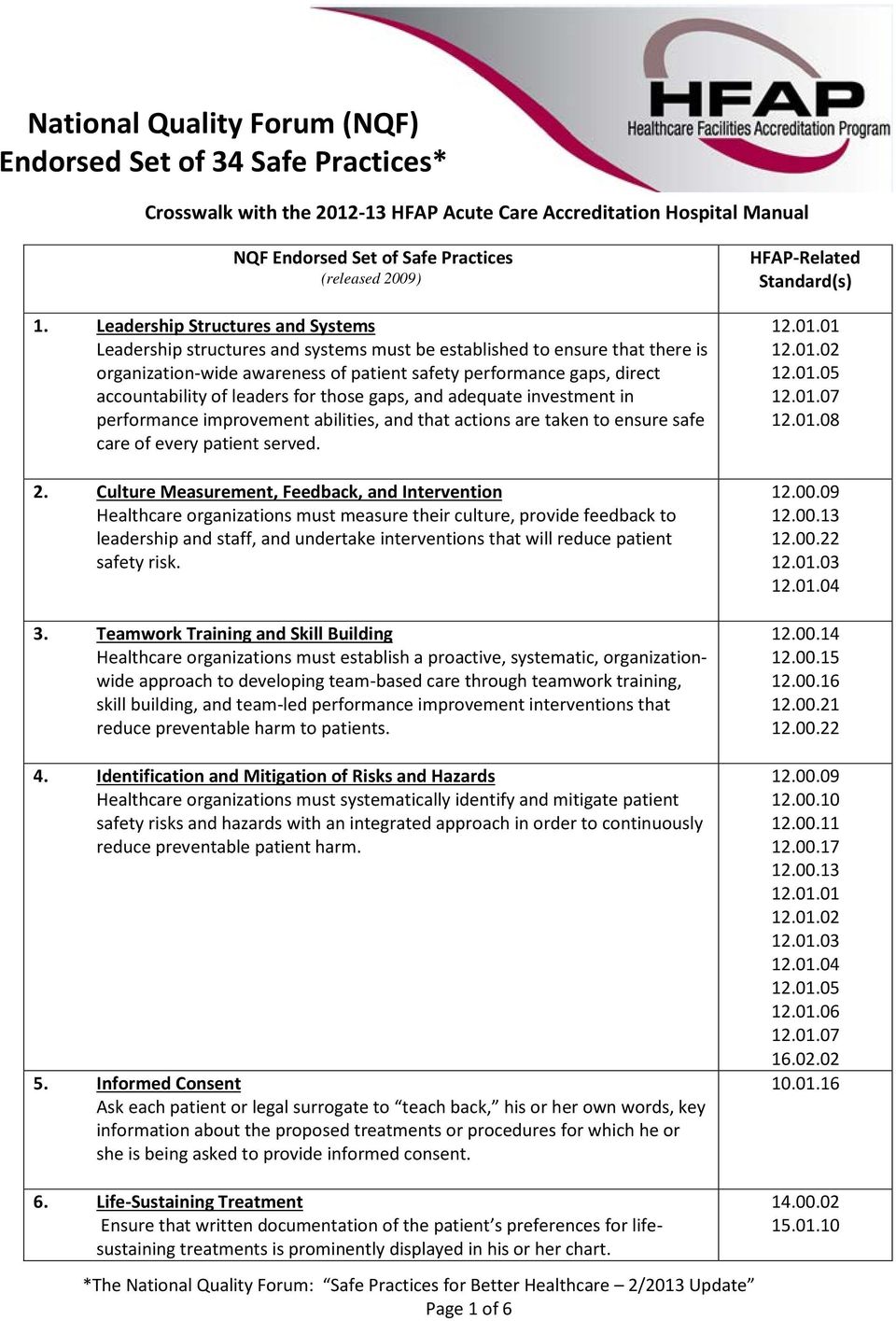
1 NQF Endorsed Set of Safe Practices (released 2009) 1. Leadership Structures and Systems Leadership structures and systems must be established to ensure that there is organization-wide awareness of patient safety performance gaps, direct accountability of leaders for those gaps, and adequate investment in performance improvement abilities, and that actions are taken to ensure safe care of every patient served. 2. Culture Measurement, Feedback, and Intervention Healthcare organizations must measure their culture, provide feedback to leadership and staff, and undertake interventions that will reduce patient safety risk. 3. Teamwork Training and Skill Building Healthcare organizations must establish a proactive, systematic, organizationwide approach to developing team-based care through teamwork training, skill building, and team-led performance improvement interventions that reduce preventable harm to patients. 4. Identification and Mitigation of Risks and Hazards Healthcare organizations must systematically identify and mitigate patient safety risks and hazards with an integrated approach in order to continuously reduce preventable patient harm. 5. Informed Consent Ask each patient or legal surrogate to teach back, his or her own words, key information about the proposed treatments or procedures for which he or she is being asked to provide informed consent. 6. Life-Sustaining Treatment Ensure that written documentation of the patient s preferences for lifesustaining treatments is prominently displayed in his or her chart. HFAP-Related Standard(s) Page 1 of 6
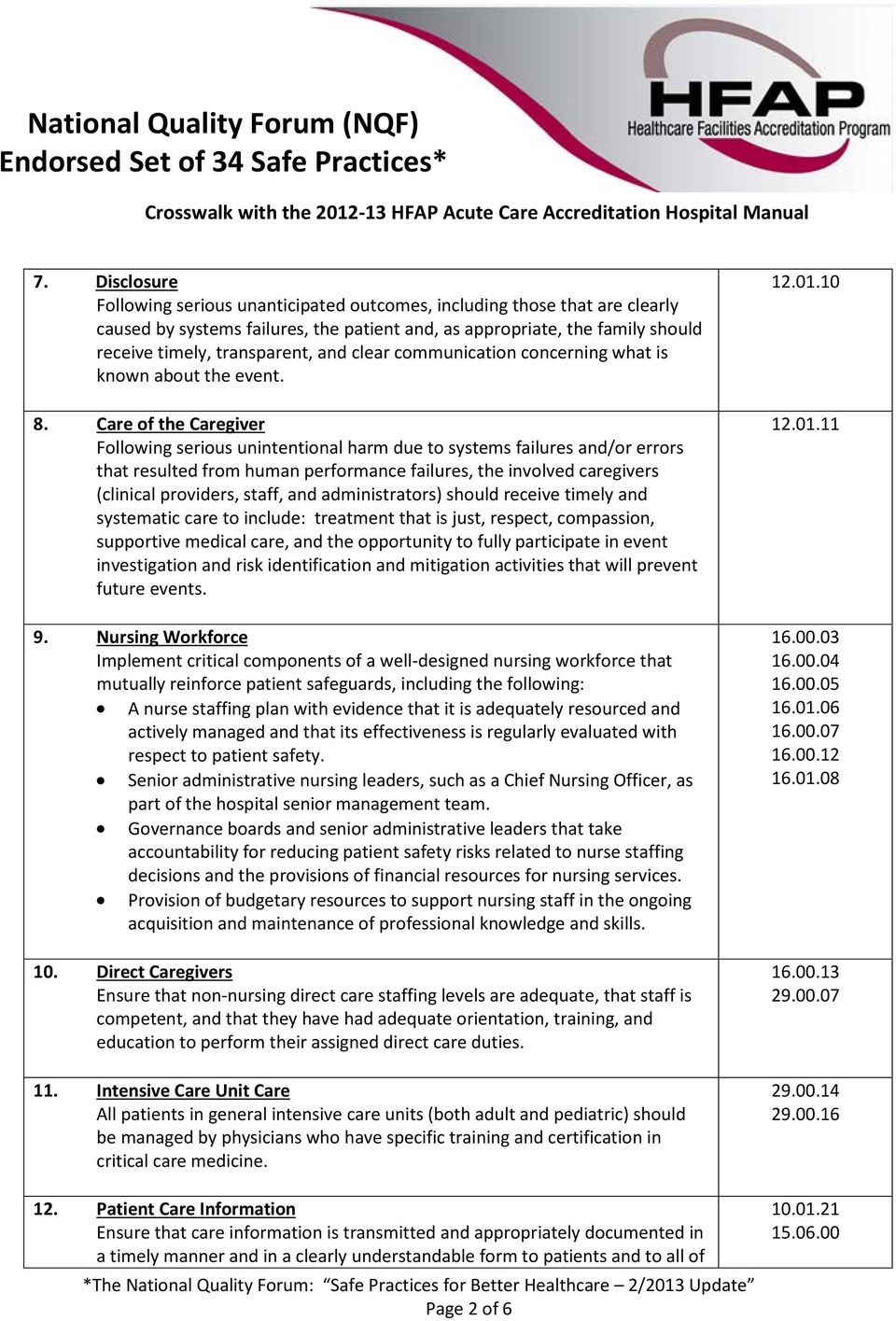
2 7. Disclosure Following serious unanticipated outcomes, including those that are clearly caused by systems failures, the patient and, as appropriate, the family should receive timely, transparent, and clear communication concerning what is known about the event. 8. Care of the Caregiver Following serious unintentional harm due to systems failures and/or errors that resulted from human performance failures, the involved caregivers (clinical providers, staff, and administrators) should receive timely and systematic care to include: treatment that is just, respect, compassion, supportive medical care, and the opportunity to fully participate in event investigation and risk identification and mitigation activities that will prevent future events. 9. Nursing Workforce Implement critical components of a well-designed nursing workforce that mutually reinforce patient safeguards, including the following: A nurse staffing plan with evidence that it is adequately resourced and actively managed and that its effectiveness is regularly evaluated with respect to patient safety. Senior administrative nursing leaders, such as a Chief Nursing Officer, as part of the hospital senior management team. Governance boards and senior administrative leaders that take accountability for reducing patient safety risks related to nurse staffing decisions and the provisions of financial resources for nursing services. Provision of budgetary resources to support nursing staff in the ongoing acquisition and maintenance of professional knowledge and skills. 10. Direct Caregivers Ensure that non-nursing direct care staffing levels are adequate, that staff is competent, and that they have had adequate orientation, training, and education to perform their assigned direct care duties. 11. Intensive Care Unit Care All patients in general intensive care units (both adult and pediatric) should be managed by physicians who have specific training and certification in critical care medicine. 12. Patient Care Information Ensure that care information is transmitted and appropriately documented in a timely manner and in a clearly understandable form to patients and to all of Page 2 of
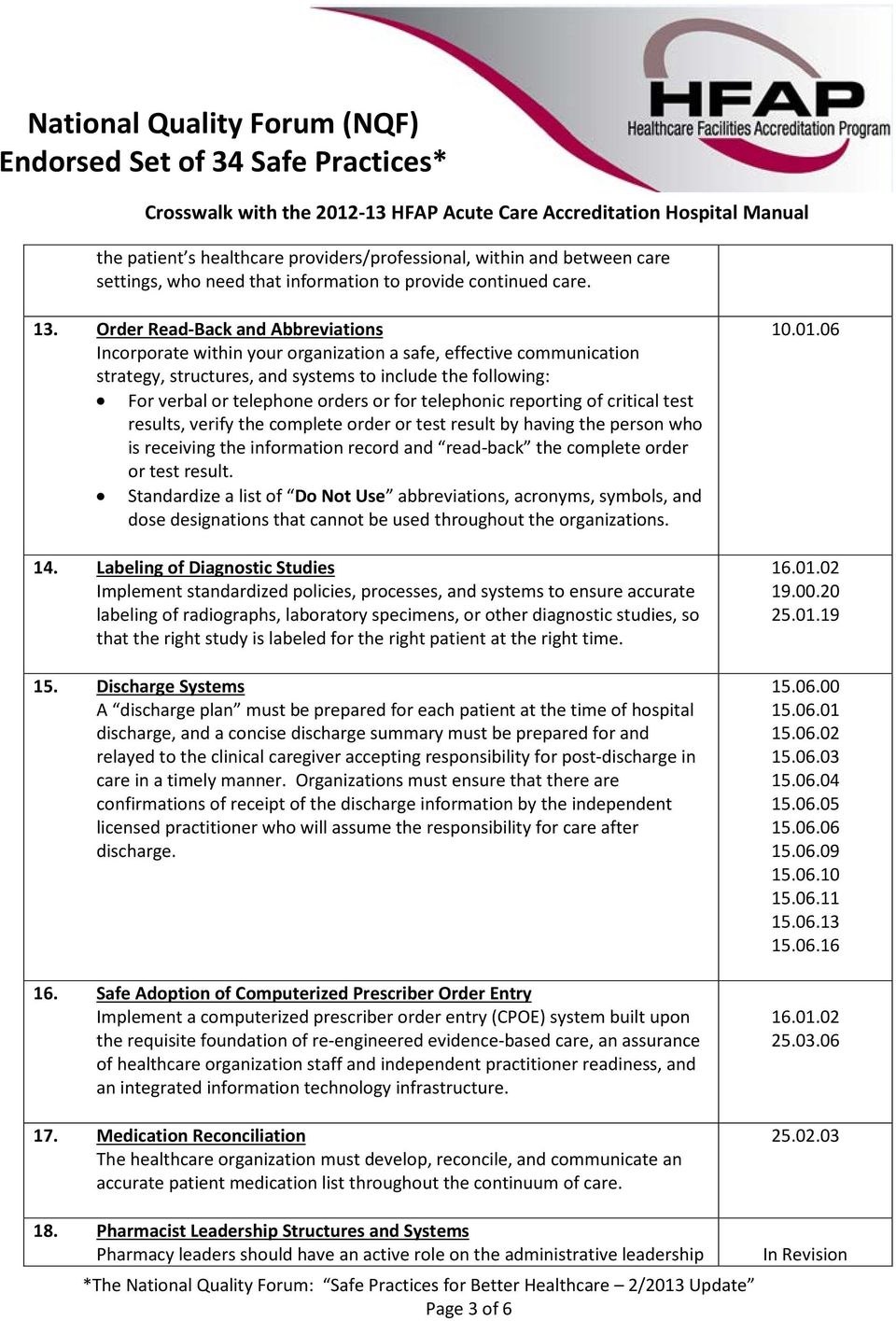
3 the patient s healthcare providers/professional, within and between care settings, who need that information to provide continued care. 13. Order Read-Back and Abbreviations Incorporate within your organization a safe, effective communication strategy, structures, and systems to include the following: For verbal or telephone orders or for telephonic reporting of critical test results, verify the complete order or test result by having the person who is receiving the information record and read-back the complete order or test result. Standardize a list of Do Not Use abbreviations, acronyms, symbols, and dose designations that cannot be used throughout the organizations. 14. Labeling of Diagnostic Studies Implement standardized policies, processes, and systems to ensure accurate labeling of radiographs, laboratory specimens, or other diagnostic studies, so that the right study is labeled for the right patient at the right time. 15. Discharge Systems A discharge plan must be prepared for each patient at the time of hospital discharge, and a concise discharge summary must be prepared for and relayed to the clinical caregiver accepting responsibility for post-discharge in care in a timely manner. Organizations must ensure that there are confirmations of receipt of the discharge information by the independent licensed practitioner who will assume the responsibility for care after discharge. 16. Safe Adoption of Computerized Prescriber Order Entry Implement a computerized prescriber order entry (CPOE) system built upon the requisite foundation of re-engineered evidence-based care, an assurance of healthcare organization staff and independent practitioner readiness, and an integrated information technology infrastructure. 17. Medication Reconciliation The healthcare organization must develop, reconcile, and communicate an accurate patient medication list throughout the continuum of care Pharmacist Leadership Structures and Systems Pharmacy leaders should have an active role on the administrative leadership In Revision Page 3 of 6
4 team that reflects their authority and accountability for medication management systems performance across the organization. 19. Hand Hygiene Comply with current Centers for Disease Control (CDC) and Prevention Hand Hygiene Guidelines, World Health Organization (WHO) Guidelines on Hand Hygiene and Institute for Healthcare Improvement (IHI) Improving Hand Hygiene Improving Hand Hygiene. 20. Influenza Prevention Comply with current Centers for Disease Control and Prevention (CDC) recommendations for influenza vaccinations for healthcare personnel and the annual recommendations of the CDC Advisory Committee on Immunization Practices for individual influenza prevention and control. 21. Central Line-Associated Bloodstream Infection Prevention Take actions to prevent central line-associated bloodstream infection by implementing evidence-based intervention practices. 22. Surgical-Site Infection Prevention Take action to prevent surgical-site infections by implementing evidencebased intervention practices. 23. Care of the Ventilated Patient Take actions to prevent complications associated with ventilated patients: specifically, ventilator-associated pneumonia, venous thromboembolism, peptic ulcer disease, dental complications, and pressure ulcers. 24. Multidrug-Resistant Organism Prevention Implement a systematic multi-drug resistant organism (MDRO) eradication program built upon the fundamental elements of infection control, an evidence-based approach, and a re-engineered identification and care process for those patients with or at risk for MDRO infections Note: This practice applies to, but is not limited to, epidemiologically important organisms such as methicillin-resistant Staphylococcus aureus, vancomycin-resistant enterococci, and Clostridium difficile. Multidrugresistant gram-negative bacilli, such as Enterobacter species, Klebsiella species, Pseudomonas species, and Escherichia coli, and vancomycin-resistant Staphylococcus aureus, should be evaluated for inclusion on a local system level based on organizational risk assessments." Page 4 of 6

5 25. Catheter-Associated Urinary Tract Infection Prevention Take actions to prevent catheter-associated urinary tract infection by implementing evidence-based intervention practices. 26. Wrong-Site, Wrong-Procedure, Wrong-Person Surgery Prevention Implement universal guidelines for preventing surgery on the wrong person or the wrong site or for performing the wrong procedure for all invasive practices. 27. Pressure Ulcer Prevention Take actions to prevent pressure ulcers by implementing evidence-based intervention practices. 28. Venous Thromboembolism Prevention Evaluate each patient upon admission, and regularly thereafter, for the risk of developing venous thromboembolism. Utilize clinically appropriate, evidence-based methods of thromboprophylaxis. 29. Anticoagulation Therapy Organizations should implement practices to prevent patient harm due to anticoagulant therapy. 30. Contrast Media-Induced Renal Failure Prevention Utilize validated protocols to evaluate patients who are at risk for contrast media-induced renal failure and gadolinium-associated nephrogenic systemic fibrosis, and utilize a clinically appropriate method for reducing the risk of adverse events based on the patient s risk evaluations. 31. Organ Donation Hospital policies that are consistent with applicable law and regulations should be in place and should address patient and family preferences for organ donation, as well as specify the roles and desired outcomes for every stage of the donation process. 32. Gylcemic Control Take actions to improve glycemic control by implementing evidence-based intervention practices that prevent hypoglycemia and optimize the care of patients with hyperglycemia and diabetes. 33. Fall Prevention Take actions to prevent patient falls and to reduce fall-related injuries by implementing evidence-based intervention practices. Page 5 of

6 34. Pediatric Imaging When CT imaging studies are undertaken on children, child-size techniques should be used to reduce unnecessary exposure to ionizing radiation Page 6 of 6

National Quality Forum Safe Practices for Better Healthcare
 National Quality Forum Safe Practices for Better Healthcare UCLA Health System advocates the National Quality Forum (NQF) endorsed safe practices.this set of safe Practices encompasses 34 practices that
NQF. Safe Practices for Better Healthcare 2010 Update SAFE PRACTICES A CONSENSUS REPORT NATIONAL QUALITY FORUM
 NQF NATIONAL QUALITY FORUM SAFE PRACTICES Safe Practices for Better Healthcare 2010 Update A CONSENSUS REPORT NQF SAFE PRACTICES CONSENSUS COMMITTEE Gregg S. Meyer, MD, MSc (Co-Chair) Massachusetts General
Medication Management (Safe Practices 14-18)
 Medication Management (Safe Practices 14-18) David Bates, MD Hayley Burgess, PharmD Charles Denham, MD November 8, 2007 This Webinar focuses upon the following NQF-EndorsedTM Safe Practices: Safe Practice
Hospital Information. Facility Name: Primary HEN Contact: Quality Lead: Infection Preventionist: HEN 2.0 Survey Questions
 Hospital Information Facility : Quality Lead: Infection Preventionist: Email Email Email HEN 2.0 Survey Questions Patient and Family Engagement 1) Prior to scheduled admission, hospital staff provides
State HAI Template Utah. 1. Develop or Enhance HAI program infrastructure
 State HAI Template Utah 1. Develop or Enhance HAI program infrastructure Successful HAI prevention requires close integration and collaboration with state and local infection prevention activities and
JOINT COMMISSION INTERNATIONAL ACCREDITATION STANDARDS FOR HOME CARE,
 About this Manual This new accreditation manual contains Joint Commission International s (JCI s) standards, intent statements, and measurable elements for home care organizations, including patient-centered
MN HAI Prevention Plan 1
 Healthcare Associated Infections Plan Minnesota Department of Health Healthcare Associated Infections Program Introduction In response to the increasing concerns about the public health impact of healthcare-associated
National Patient Safety Goals Effective January 1, 2015
 National Patient Safety Goals Effective January 1, 2015 Goal 1 Improve the accuracy of patient identification. NPSG.01.01.01 Hospital ccreditation Program Use at least two patient identifiers when providing
National Patient Safety Goals Effective January 1, 2015
 National Patient Safety Goals Goal 1 Nursing are enter ccreditation Program Improve the accuracy of patient and resident identification. NPSG.01.01.01 Use at least two patient or resident identifiers when
The Physician s Guide to The Joint Commission s Hospital Standards and Accreditation Process
 The Physician s Guide to The Joint Commission s Hospital Standards and Accreditation Process 2 Table of Contents I. Physicians and The Joint Commission...4 II. An Overview of The Joint Commission...7 III.
2013 Indiana Healthcare Provider and Hospital Administrator Multi-Drug Resistant Organism Survey
 2013 Indiana Healthcare Provider and Hospital Administrator Multi-Drug Resistant Organism Survey Antibiotic resistance is a global issue that has significant impact in the field of infectious diseases.
Introduction to Infection Control
 CHAPTER 3 Introduction to Infection Control George Byrns and Mary Elkins Learning Objectives 1 Define terms used in infection control. 2. Review significant risk factors for infection. 3. Identify the
CYSTIC FIBROSIS CLINICS AS A MODEL OF INTERPROFESSIONAL CARE
 CYSTIC FIBROSIS CLINICS AS A MODEL OF INTERPROFESSIONAL CARE 1. Cystic fibrosis introduction 2. CF Foundation centers 3. Care disciplines: physician specialists (pulmonary, GI, endocrine, genetics, palliative
Patient Safety: Applying Industrial Quality Models in Healthcare Settings Tempora mutantur, nos et mutamur in illis
 Patient Safety: Applying Industrial Quality Models in Healthcare Settings Tempora mutantur, nos et mutamur in illis Julie Louise Gerberding, MD MPH Division of Healthcare Quality Promotion National Center
National Patient Safety Goals Effective January 1, 2015
 National Patient Safety Goals Effective January 1, 2015 Goal 1 Improve the accuracy of resident identification. NPSG.01.01.01 Long Term are ccreditation Program Medicare/Medicaid ertification-based Option
APPROVED: 2010 National Patient Safety Goals
 APPROVED: 2010 National Patient Safety Goals Some Changes Effective Immediately The Joint Commission released its 2010 An article on changes to the National Patient Safety Goals (NPSGs) in Universal Protocol
LOUISIANA STATE UNIVERSITY HEALTH SCIENCES CENTER - SHREVEPORT MEDICAL RECORDS CONTENT/DOCUMENTATION
 LOUISIANA STATE UNIVERSITY HEALTH SCIENCES CENTER - SHREVEPORT MEDICAL RECORDS CONTENT/DOCUMENTATION Hospital Policy Manual Purpose: To define the components of the paper and electronic medical record
June 10, 2015. Dear Mr. Slavitt:
 1275 K Street, NW, Suite 1000 Washington, DC 20005-4006 Phone: 202/789-1890 Fax: 202/789-1899 [email protected] www.apic.org June 10, 2015 Andrew M. Slavitt Acting Administrator Centers for Medicare &
New Jersey State Department of Health and Senior Services Healthcare-Associated Infections Plan 2010
 New Jersey State Department of Health and Senior Services Healthcare-Associated Infections Plan Introduction The State of New Jersey has been proactive in creating programs to address the growing public
Errors in the Operating Room. Patrick E. Voight RN BSN MSA CNOR President Association of perioperative Registered Nurses (AORN)
 Errors in the Operating Room Patrick E. Voight RN BSN MSA CNOR President Association of perioperative Registered Nurses (AORN) What What We All We Strive All Strive For: For: Patient Patient Safety Safety
Infectious Diseases @ EUHM Learning Activities:
 Infectious Diseases @ EUHM Learning Activities: Preceptor: Steve Mok, PharmD, BCPS (AQ-ID) Office: EUHM Clinical Pharmacy office, 2 nd fl Peachtree Building Hours: 8:00 17:00 Desk: 404-686-8904 Pager:
healthcare associated infection 1.2
 healthcare associated infection A C T I O N G U I D E 1.2 AUSTRALIAN SAFETY AND QUALITY GOALS FOR HEALTH CARE What are the goals? The Australian Safety and Quality Goals for Health Care set out some important
Hospital Inpatient Quality Reporting (IQR) Program
 Clinical Process Measures Program Changes for Fiscal Year 2014 Beginning with January 1, 2012 discharges; hospitals will begin data collection and submission for 4 new measures. Hospitals will not be required
Patient Safety. Annual Continuing Education Modules. Contents
 Annual Continuing Education Modules Patient Safety This self-directed learning module contains information you are expected to know to protect yourself, our patients, and our guests. Target Audience: Contents
Review of Healthcare-Associated Infection (HAI) and Multidrug-Resistant Organism (MDRO) Reporting Requirements in the United States PRESENTED BY:
 Review of Healthcare-Associated Infection (HAI) and Multidrug-Resistant Organism (MDRO) Reporting Requirements in the United States PRESENTED BY: BYRAN DAI MASTERS OF HEALTH SCIENCE CANDIDATE 14 JHSPH
Medicare Long-Term Care Hospital Prospective Payment System
 Medicare Long-Term Care Hospital Prospective Payment System May 5, 2015 Payment Rule Brief PROPOSED RULE Program Year: FFY 2016 Overview, Resources, and Comment Submission On May 17, the Centers for Medicare
Catheter-Associated Urinary Tract Infection (CAUTI) Prevention. Basics of Infection Prevention 2 Day Mini-Course 2013
 Catheter-Associated Urinary Tract Infection (CAUTI) Prevention Basics of Infection Prevention 2 Day Mini-Course 2013 2 Objectives Define the scope of healthcare-associated urinary tract infections (UTI)
Yale New Haven Health System Center for Healthcare Solutions
 Table of Contents Education and Training Yale New Haven Health System Center for Healthcare Solutions 2009-2010 Fall/Winter Course Guide TOPICS [email protected] www.yalenewhavenhealth.org/healthcaresolutions
The Leapfrog Hospital Survey Scoring Algorithms. Scoring Details for Sections 2 9 of the 2016 Leapfrog Hospital Survey
 The Leapfrog Hospital Survey Scoring Algorithms Scoring Details for Sections 2 9 of the 2016 Leapfrog Hospital Survey Table of Contents 2016 Leapfrog Hospital Survey Scoring Algorithms... 3 Section 2:
An Overview of Accreditation Results: Alberta
 An Overview of Accreditation Results: Alberta December 2014 Accreditation Canada retains all intellectual property rights for the information presented herein, unless otherwise specified. The Accreditation
Joint Commission International Accreditation Standards for Ambulatory Care
 Effective 1 January 2015 Joint Commission International Accreditation Standards for Ambulatory Care English 3rd Edition Section I: Accreditation Participation Requirements JOINT COMMISSION INTERNATIONAL
National Patient Safety Goals Effective January 1, 2016
 National Patient Safety Goals Effective January 1, 2016 Goal 1 Improve the accuracy of patient identification. NPSG.01.01.01 mbulatory Health are ccreditation Program Use at least two patient identifiers
Overview of the Hospital Value-Based Purchasing (VBP) Fiscal Year (FY) 2017
 Overview of the Hospital Value-Based Purchasing (VBP) Fiscal Year (FY) 2017 Bethany Wheeler Hospital VBP Program Support Contract Lead HSAG February 17, 2015 2 p.m. ET Purpose This event will provide an
Standard 1. Governance for Safety and Quality in Health Service Organisations. Safety and Quality Improvement Guide
 Standard 1 Governance for Safety and Quality in Health Service Organisations Safety and Quality Improvement Guide 1 1 1October 1 2012 ISBN: Print: 978-1-921983-27-6 Electronic: 978-1-921983-28-3 Suggested
Improving Safety: Developing Safety Metrics and Improving Error Reporting. Petra Khoury, Pharm D Adnan Tahir, MD
 Improving Safety: Developing Safety Metrics and Improving Error Reporting Petra Khoury, Pharm D Adnan Tahir, MD Learning Objectives List Prevalent patient safety issues reported within hospitals Identify
Guide to the National Safety and Quality Health Service Standards for health service organisation boards
 Guide to the National Safety and Quality Health Service Standards for health service organisation boards April 2015 ISBN Print: 978-1-925224-10-8 Electronic: 978-1-925224-11-5 Suggested citation: Australian
Medweb Telemedicine 667 Folsom Street, San Francisco, CA 94107 Phone: 415.541.9980 Fax: 415.541.9984 www.medweb.com
 Medweb Telemedicine 667 Folsom Street, San Francisco, CA 94107 Phone: 415.541.9980 Fax: 415.541.9984 www.medweb.com Meaningful Use On July 16 2009, the ONC Policy Committee unanimously approved a revised
Common Mistakes Medical Facilities Make
 Common Mistakes Medical Facilities Make What You Can Do To Help Them Michelle Foster Earle, President OmniSure Risk Management Consulting Yo u r s o u r c e f o r p r o f e s s i o n a l l i a b i l i
Standards of Practice for Patient Identification, Correct Surgery Site and Correct Surgical Procedure
 Standards of Practice for Patient Identification, Correct Surgery Site and Correct Surgical Procedure Introduction The following Standards of Practice were researched and written by the AST Education and
Iatrogenesis. Suzanne Beyea,, RN, PhD, FAAN Associate Director: Centers for Health and Aging
 Iatrogenesis Suzanne Beyea,, RN, PhD, FAAN Associate Director: Centers for Health and Aging Iatrogenesis Definition from the Greek word, iatros,, meaning healer, iatrogenesis means brought forth by a healer
Physicians ACO. Don McCormick President. Company Logo
 Physicians ACO Don McCormick President Company Logo Why Congress and CMS want ACOs Cost of health care is too high Quality of health care is too low Evidence for both conditions is undeniable Congress
Relevant Quality Measures for Critical Access Hospitals
 Policy Brief #5 January 0 Relevant Quality Measures for Critical Access Hospitals Michelle Casey MS, Ira Moscovice PhD, Jill Klingner RN, PhD, Shailendra Prasad MD, MPH University of Minnesota Rural Health
Improving Hospital Performance
 Improving Hospital Performance Background AHA View Putting patients first ensuring their care is centered on the individual, rooted in best practices and utilizes the latest evidence-based medicine is
NZS8134.2:2008 & NZS8134.3:2008
 Winchcombe Healthcare Limited CURRENT STATUS: The following summary has been accepted by the Ministry of Health as being an accurate reflection of the Surveillance audit conducted against the Health and
Adverse Drug Events and Medication Safety: Diabetes Agents and Hypoglycemia
 Adverse Drug Events and Medication Safety: Diabetes Agents and Hypoglycemia Date: October 20, 2015 Presented by Mike Crooks, PharmD., PCMH-CCE Pharmacy Interventions, Technical Lead 11/9/2015 1 Objectives:
Joint Commission International Accreditation Standards for Medical Transport Organizations
 Effective 1 July 2015 Joint Commission International Accreditation Standards for Medical Transport Organizations English 2nd Edition Section I: Accreditation Participation Requirements JOINT COMMISSION
Lab ID Events MRSA Bloodstream Infection and C. difficile
 Lab ID Events MRSA Bloodstream Infection and C. difficile MDRO and CDI Module Methicillin-resistant Staphylococcus (MRSA), Vancomycinresistant Enterococcus(VRE), certain gram negative bacilli, Clostridium
Orientation Program for New Infection Control Professionals
 Orientation Program for New Infection Control Professionals Module 1: Introduction and Four-Week Schedule Table of Contents Module 1: Introduction... 2 Note to Managers... 2 IPC Orientation Program...
SAMPLE ANTIMICROBIAL STEWARDSHIP POLICY
 SAMPLE ANTIMICROBIAL STEWARDSHIP POLICY FOR A LOCAL HEALTH DISTRICT OR NETWORK Purpose of this document The development of an official policy for Antimicrobial Stewardship (AMS) is a fundamental step towards
TITLE: Processing Provider Orders: Inpatient and Outpatient
 POLICY and PROCEDURE TITLE: Processing Provider Orders: Inpatient and Outpatient Number: 13211 Version: 13211.3 Type: Patient Care Author: Janice Dinner; Provider Order Policy Committee Effective Date:
Highlights of the Revised Official ICD-9-CM Guidelines for Coding and Reporting Effective October 1, 2008
 Highlights of the Revised Official ICD-9-CM Guidelines for Coding and Reporting Effective October 1, 2008 Please refer to the complete ICD-9-CM Official Guidelines for Coding and Reporting posted on this
 Translating Evidence to Safer Care Patient Safety Research Introductory Course Session 7 Albert W Wu, MD, MPH Former Senior Adviser, WHO Professor of Health Policy & Management, Johns Hopkins Bloomberg
Staff should not feel that the Quality Management staff are policing them. These thoughts
 Chapter IV and Patient Introduction This chapter is the responsibility of the Director/leader and everyone in the hospital, especially the senior leaders whose role is essential to implement the program.
COMMUNICATING RADIATION RISKS IN PAEDIATRIC IMAGING
 COMMUNICATING RADIATION RISKS IN PAEDIATRIC IMAGING Information to support healthcare discussions about benefit and risk Executive summary Executive summary Advances in technologies using ionizing radiation
The Joint Commission s Patient Safety Initiatives
 The Joint Commission s Patient Safety Initiatives Global Healthcare User Group (HUG) Princeton, November 30, 2005 Richard J. Croteau, M.D. Executive Director for Patient Safety Initiatives 1 The Joint
Job Description. The post holder is required to be registered with the Nursing and Midwifery Council.
 Job Description JOB TITLE: Registered Nurse DIRECTORATE: Diagnostics and Clinical Support Interventional Radiology Theatres GRADE: Band 5 REPORTS TO: Sister/Charge Nurse ACCOUNTABLE TO: Matron JOB SUMMARY
Sentinel Event Data. Root Causes by Event Type 2004 2014. Copyright, The Joint Commission
 Sentinel Event Data Root Causes by Event Type 2004 2014 Joint Commission Root Cause Information www.jointcommission.org/sentinel_event_policy_and_procedures/ Sentinel Events are reported to The Joint Commission
Medication Safety Committee Guidelines. Emergency Department Medication Management Safety Tool
 ication Safety Committee Guidelines Department ication Management Safety Tool TABLE OF CONTENTS REVISION LOG... 2 INTRODUCTION... 3 COMMITTEE REPRESENTATION... 3 EMERGENCY DEPARTMENT MEDICATION MANAGEMENT
NDNQI. NDNQI:Transforming Data into Quality Care. www.nursingquality.org. 3901 Rainbow Boulevard, M/S 3060. University of Kansas Medical Center
 NDNQI NDNQI:Transforming Data into Quality Care University of Kansas Medical Center 391 Rainbow Boulevard, M/S 36 Kansas City, KS 6616 www.nursingquality.org American Nurses Association The American Nurses
Learning from Defects
 Learning from Defects Problem Statement: Healthcare organizations could increase the extent to which they learn from defects. We define learning as reducing the probability that a future patient will be
NEVER EVENT LISTS ENDORSED BY NATIONAL QUALITY FORUM & MEDICARE
 Never Events : Medicare s and Health Plan s Policies on Providing Payment for Serious and Preventable Hospital Errors BACKGROUND Preventable medical errors are a leading cause of death in the United States
Reporting Adverse Events and Concerns at Stroger Hospital
 Reporting Adverse Events and Concerns at Stroger Hospital Case Pt on coumadin comes in for community acquired pneumonia and is started on levaquin After several days, you note a lot of bruising.. You realize
Information Governance and Management Standards for the Health Identifiers Operator in Ireland
 Information Governance and Management Standards for the Health Identifiers Operator in Ireland 30 July 2015 About the The (the Authority or HIQA) is the independent Authority established to drive high
U.S. Department of Health & Human Services May 7, 2014. New HHS Data Shows Major Strides Made in Patient Safety, Leading to Improved Care and Savings
 U.S. Department of Health & Human Services May 7, 2014 New HHS Data Shows Major Strides Made in Patient Safety, Leading to Improved Care and Savings The data in this report shows a substantial nine percent
convey the clinical quality measure's title, number, owner/developer and contact
 CMS-0033-P 153 convey the clinical quality measure's title, number, owner/developer and contact information, and a link to existing electronic specifications where applicable. TABLE 20: Proposed Clinical
C-Difficile Infection Control and Prevention Strategies
 C-Difficile Infection Control and Prevention Strategies Adrienne Mims, MD MPH VP, Chief Medical Officer [email protected] 1/18/2016 1 Disclosure This educational activity does not have commercial
Scope of Practice for Registered Nurses (RN)
 Scope of Practice for Registered Nurses (RN) Health Regulation Department Dubai Health Authority (DHA) [email protected] DHA hotline tel. no: 800 DHA (342) www.dha.gov.ae Introduction Health Regulation
Deleted Elements of Performance for Rehabilitation and Psychiatric Distinct Part Units in Critical Access Hospitals
 Deleted Elements of Performance for Rehabilitation and Psychiatric Distinct Part Units in Critical Access Hospitals Effective January 1, 2010 Critical Access Hospital Accreditation Program Standard EC.0001
UNIVERSITY OF WISCONSIN HOSPITAL AND CLINICS DEPARTMENT OF PHARMACY SCOPE OF PATIENT CARE SERVICES FY 2014 October 1 st, 2014
 UNIVERSITY OF WISCONSIN HOSPITAL AND CLINICS DEPARTMENT OF PHARMACY SCOPE OF PATIENT CARE SERVICES FY 2014 October 1 st, 2014 Department Name: Department of Pharmacy Department Director: Steve Rough, MS,
The Centers for Medicare & Medicaid Services (CMS) Acute Care Hospital Fiscal Year (FY) 2018 Quality Improvement Program Measures
 ID Me asure Name NQF # - (HRRP) ID Me asure Name NQF # - (HRRP) ID Me asure Name NQF # - (HRRP) CMS Measures Fiscal Year 2018 The Centers for Medicare & Medicaid Services (CMS) Acute Care Fiscal Year (FY)
AMERICAN BURN ASSOCIATION BURN CENTER VERIFICATION REVIEW PROGRAM Verificatoin Criterea EFFECTIVE JANUARY 1, 2015. Criterion. Level (1 or 2) Number
 Criterion AMERICAN BURN ASSOCIATION BURN CENTER VERIFICATION REVIEW PROGRAM Criterion Level (1 or 2) Number Criterion BURN CENTER ADMINISTRATION 1. The burn center hospital is currently accredited by The
HOSPITAL EPIDEMIOLOGY AND INFECTION CONTROL MANDATORY INFECTION CONTROL EDUCATION
 Office of Origin: Department of Hospital Epidemiology and Infection Control (HEIC) I. PURPOSE The purpose of this policy is to: A. Ensure compliance with California Health and Safety Code, section 1288.95
Health Care Leader Action Guide to Reduce Avoidable Readmissions
 Health Care Leader Action Guide to Reduce Avoidable Readmissions January 2010 TRANSFORMING HEALTH CARE THROUGH RESEARCH AND EDUCATION Osei-Anto A, Joshi M, Audet AM, Berman A, Jencks S. Health Care Leader
RULES AND REGULATIONS OF THE BYLAWS OF THE MEDICAL STAFF UNIVERSITY OF NORTH CAROLINA HOSPITALS
 RULES AND REGULATIONS OF THE BYLAWS OF THE MEDICAL STAFF UNIVERSITY OF NORTH CAROLINA HOSPITALS Approved by the Executive Committee of the Medical Staff, November 5, 2001. Approved and adopted by the Board
MEMORANDUM OF UNDERSTANDING BETWEEN THE CENTERS FOR DISEASE CONTROL AND PREVENTION AND (Insert Name of Company/Organization)
 MEMORANDUM OF UNDERSTANDING BETWEEN THE CENTERS FOR DISEASE CONTROL AND PREVENTION AND (Insert Name of Company/Organization) I. Purpose Under this agreement, the Centers for Disease Control and Prevention
National Healthcare Safety Network (NHSN) Introduction & Enrollment
 National Healthcare Safety Network (NHSN) Introduction & Enrollment Surveillance for Healthcare-Associated & Resistant Pathogens (SHARP) Unit 1 Introduction to NHSN Secure, internet-based surveillance
PLAN OF CORRECTION. Provider's Plan of Correction (Each corrective action must be cross-referenced to the appropriate deficiency.)
 ID Prefix Tag (X4) R000 R200 Provider's Plan of Correction (Each corrective action must be cross-referenced to the appropriate deficiency.) Submission and implementation of this Plan of Correction does
Macrosystems: Policy, Payment, Regulation, Accreditation, and Education to Improve Safety
 This work is licensed under a Creative Commons Attribution-NonCommercial-ShareAlike License. Your use of this material constitutes acceptance of that license and the conditions of use of materials on this
GUIDELINES ON PREVENTING MEDICATION ERRORS IN PHARMACIES AND LONG-TERM CARE FACILITIES THROUGH REPORTING AND EVALUATION
 GUIDELINES GUIDELINES ON PREVENTING MEDICATION ERRORS IN PHARMACIES AND LONG-TERM CARE FACILITIES THROUGH REPORTING AND EVALUATION Preamble The purpose of this document is to provide guidance for the pharmacist
What Is Patient Safety?
 Patient Safety Research Introductory Course Session 1 What Is Patient Safety? David W. Bates, MD, MSc External Program Lead for Research, WHO Professor of Medicine, Harvard Medical School Professor of
See page 331 of HEDIS 2013 Tech Specs Vol 2. HEDIS specs apply to plans. RARE applies to hospitals. Plan All-Cause Readmissions (PCR) *++
 Hospitalizations Inpatient Utilization General Hospital/Acute Care (IPU) * This measure summarizes utilization of acute inpatient care and services in the following categories: Total inpatient. Medicine.