
Operator s Instruction Manual
|
|
|
- Rosa Gaines
- 10 years ago
- Views:
Transcription
1 Operator s Instruction Manual Part Number: Rev: Fabius GS Software Version 1.3n Date: 12 September Draeger Medical, Inc. Fabius GS Warning: For a full understanding of the performance of this anesthesia machine, the user should carefully read this manual before operating.

2

3 Contents Chapter 1. Introduction Contents Overview Operator s Responsibility Intended Use Safety Features Copyright, Trademark, and Limitation of Liability Symbol Definition Abbreviations General Warnings and Cautions Chapter 2. Configurations and Components Contents Typical Fabius GS Configuration Components Chapter 3. Operating Concept Contents Overview Standard Function Controls Cross-Functional Controls and Displays Monitoring Ventilation Fresh Gas Control Fresh Gas Flow Monitoring Resolutions APL Valve Chapter 4. Preparation Contents Activating the Battery Gas Supply Medical Gas Pipeline Supply of O2, N2O, and AIR Cylinders with Pin-index Mounting Electrical Supply Attaching Manual (Ambu) Ventilation Bag Preparing the Ventilator Ventilator Safety Features Attaching the CO2 Absorber onto the Compact Breathing System Attaching the Inspiratory Valve Attaching the Expiratory Valve Attaching the Adjustable Pressure Limiting (APL) Valve Inserting the Flow Sensor Attaching the Waste Gas Outlet Port Connecting the Compact Breathing System Connecting the Breathing Hoses Inserting A New O2 Sensor Capsule Connecting the O2 Sensor Connecting the Pressure Sensor Connecting the Breathing Pressure Gauge Connecting the APL Bypass and Peep/PMAX Hoses i
4 Contents Connecting the Flow Sensor Installing Anesthetic Gas Scavenging Hose to the Compact Breathing System Scavenger System for Fabius GS Additional Equipment Daily and Preuse Checkout Form Chapter 5. Operation and Shut-down Contents Operation Preparation for Transport or Storage Chapter 6. Monitoring Contents Overview Alarms Oxygen Monitoring Respiratory Volume Monitoring Breathing Pressure Monitoring Chapter 7. Setup Window (Used During Operation) Contents Overview Setup Window Access Auto Set Calibrate O2 Sensor Activate Des Comp Access Alarm Log Access Alarm Volume Window Deactivation Chapter 8. Standby Mode Functions Contents Overview Standby Screen Standby Setup Screen Chapter 9. Routine Maintenance and Cleaning Contents Routine Maintenance Disassembling Disinfecting/Cleaning/Autoclaving Maintenance Intervals Checking Readiness for Operation Chapter 10. Troubleshooting Contents ii
5 Contents Chapter 11. Components Contents Front View Compact Breathing System (Top View) Rear View (3-Gas Supply Connections) Chapter 12. Technical Data Contents Technical Data Diagrams Appendix. Daily and Preuse Checkout Form iii
6

7 Chapter 1 - Introduction Contents Introduction Contents Overview... 3 Recommendations... 3 Not for Use in Areas of Explosion Hazard... 3 Safe Connection with Other Electrical Equipment... 3 Operator s Responsibility... 3 Intended Use... 4 Safety Features... 4 Copyright, Trademark, and Limitation of Liability... 4 Copyright... 4 Trademark Notices... 4 Limitation of Liability... 4 Symbol Definition... 5 Abbreviations... 8 General Warnings and Cautions... 9 Fabius GS Operator s Manual 1

8

9 Overview Chapter 1 - Introduction Overview Caution: For your safety and that of your patients, strictly follow this instruction manual. Any use of the Fabius GS requires full understanding and strict observation of these instructions. The unit is only to be used for purposes specified here. Recommendations Because of the sophisticated nature of Draeger Medical anesthesia equipment and its critical importance in the operating room setting, it is highly recommended that only appropriately trained and experienced professionals, using authentic Draeger Medical spare parts, be permitted to service and maintain this equipment. Please contact DrägerService at (800) or (215) for service of this equipment. Draeger Medical also recommends that its anesthesia equipment be serviced at six-month intervals. Periodic Manufacturer's Certification Agreements are available for equipment manufactured by Draeger Medical. For further information concerning these agreements, contact DrägerService at (800) or (215) Not for Use in Areas of Explosion Hazard The Fabius GS is neither approved nor certified for use in areas where combustible or explosive gas mixtures are likely to occur. To avoid explosion hazards, flammable anaesthetic agents such as ether and cyclopropane or other flammable substances must not be used in this machine. Only anaesthetic agents that comply with the requirements on non-flammable anaesthetic agents in the IEC Standard, Particular requirements for the safety of anaesthetic machine, are suitable for use in this machine. Safe Connection with Other Electrical Equipment Electrical connections to equipment which are not listed in these Instructions for Use should only be made following consultations with the respective manufacturers or an expert and shall be in compliance with national medical device regulations. Operator s Responsibility The equipment design, the accompanying literature, and the labeling on the equipment take into consideration that the purchase and use of the equipment are restricted to trained professionals, and that certain inherent characteristics of the equipment are known to the trained operator. Instructions, warnings, and caution statements are limited, therefore, to the specifics of the Draeger Medical, Inc. design. This publication excludes references to hazards which are obvious to a medical professional, to the consequences of product misuse, and to potentially adverse effects in patients with abnormal conditions. Product modification or misuse can be dangerous. Draeger Medical, Inc. disclaims all liability for the consequences of product alterations or modifications, as well as for the consequences which might result from the combination of Draeger Medical, Inc. products with products supplied by other manufacturers if such a combination is not endorsed by Draeger Medical, Inc. The operator of the anesthesia system must recognize that the means of monitoring and discovering hazardous conditions are specific to the composition of the system and the various components of the system. It is the operator, and not the various manufacturers or suppliers of components, who has control over the final composition and arrangement of the anesthesia system used in the operating room. Therefore, the responsibility for choosing the appropriate safety monitoring devices rests with the operator and user of the equipment. The Fabius GS is equipped to monitor breathing circuit pressure, exhaled volume and inspired oxygen, and to sound an alarm when any of these parameters violates a preset limit. The Fabius GS should not be used if any of these monitors are not functioning properly. Draeger Medical, Inc. also recommends that the Fabius GS only be used to deliver anesthesia and/or mechanical ventilation in accordance with the guidelines for patient monitoring published by the American Society of Anesthesiologists. In addition to volume, pressure, and oxygen monitoring, these guidelines require the use of a capnometer to monitor inspired and expired carbon dioxide as well as other patient monitors including continuous electrocardiography, pulse oximetry, and arterial blood pressure monitoring. Anesthetic agent monitoring and temperature monitoring are also strongly recommended. The responsibility for the selection of the best level of patient monitoring belongs solely to the equipment operator. To this extent, the manufacturer, Draeger Medical, Inc., disclaims responsibility for the adequacy of the monitoring package selected for use with the anesthesia system. However, Draeger Medical, Inc. is available for consultation to discuss monitoring options for different applications. Fabius GS Operator s Manual 3
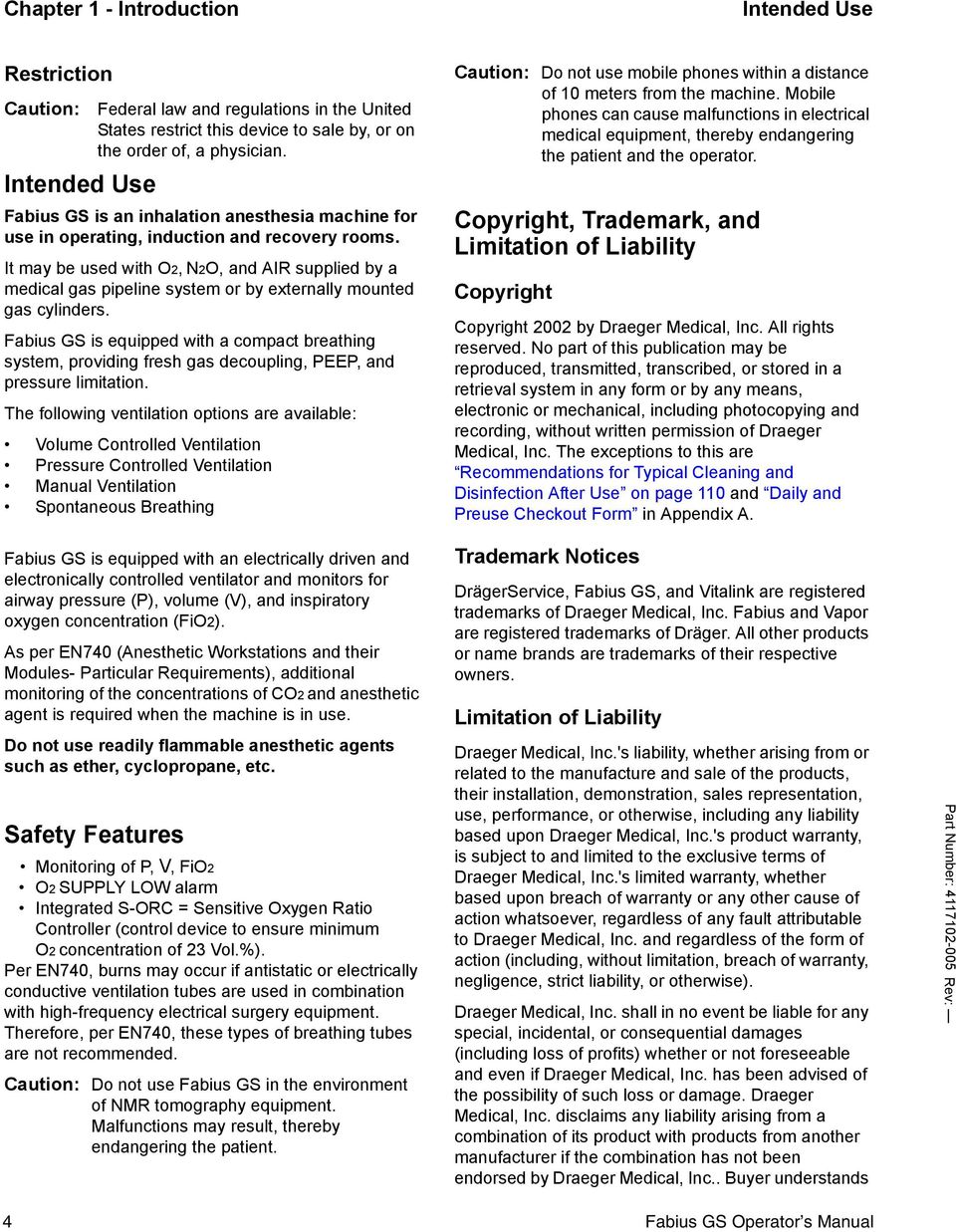
10 Chapter 1 - Introduction Intended Use Restriction Caution: Intended Use Federal law and regulations in the United States restrict this device to sale by, or on the order of, a physician. Fabius GS is an inhalation anesthesia machine for use in operating, induction and recovery rooms. It may be used with O2, N2O, and AIR supplied by a medical gas pipeline system or by externally mounted gas cylinders. Fabius GS is equipped with a compact breathing system, providing fresh gas decoupling, PEEP, and pressure limitation. The following ventilation options are available: Volume Controlled Ventilation Pressure Controlled Ventilation Manual Ventilation Spontaneous Breathing Caution: Do not use mobile phones within a distance of 10 meters from the machine. Mobile phones can cause malfunctions in electrical medical equipment, thereby endangering the patient and the operator. Copyright, Trademark, and Limitation of Liability Copyright Copyright 2002 by Draeger Medical, Inc. All rights reserved. No part of this publication may be reproduced, transmitted, transcribed, or stored in a retrieval system in any form or by any means, electronic or mechanical, including photocopying and recording, without written permission of Draeger Medical, Inc. The exceptions to this are Recommendations for Typical Cleaning and Disinfection After Use on page 110 and Daily and Preuse Checkout Form in Appendix A. Fabius GS is equipped with an electrically driven and electronically controlled ventilator and monitors for airway pressure (P), volume (V), and inspiratory oxygen concentration (FiO2). As per EN740 (Anesthetic Workstations and their Modules- Particular Requirements), additional monitoring of the concentrations of CO2 and anesthetic agent is required when the machine is in use. Do not use readily flammable anesthetic agents such as ether, cyclopropane, etc. Safety Features Monitoring of P, V, FiO2 O2 SUPPLY LOW alarm Integrated S-ORC = Sensitive Oxygen Ratio Controller (control device to ensure minimum O2 concentration of 23 Vol.%). Per EN740, burns may occur if antistatic or electrically conductive ventilation tubes are used in combination with high-frequency electrical surgery equipment. Therefore, per EN740, these types of breathing tubes are not recommended. Caution: Do not use Fabius GS in the environment of NMR tomography equipment. Malfunctions may result, thereby endangering the patient. Trademark Notices DrägerService, Fabius GS, and Vitalink are registered trademarks of Draeger Medical, Inc. Fabius and Vapor are registered trademarks of Dräger. All other products or name brands are trademarks of their respective owners. Limitation of Liability Draeger Medical, Inc.'s liability, whether arising from or related to the manufacture and sale of the products, their installation, demonstration, sales representation, use, performance, or otherwise, including any liability based upon Draeger Medical, Inc.'s product warranty, is subject to and limited to the exclusive terms of Draeger Medical, Inc.'s limited warranty, whether based upon breach of warranty or any other cause of action whatsoever, regardless of any fault attributable to Draeger Medical, Inc. and regardless of the form of action (including, without limitation, breach of warranty, negligence, strict liability, or otherwise). Draeger Medical, Inc. shall in no event be liable for any special, incidental, or consequential damages (including loss of profits) whether or not foreseeable and even if Draeger Medical, Inc. has been advised of the possibility of such loss or damage. Draeger Medical, Inc. disclaims any liability arising from a combination of its product with products from another manufacturer if the combination has not been endorsed by Draeger Medical, Inc.. Buyer understands 4 Fabius GS Operator s Manual
11 Symbol Definition Chapter 1 - Introduction that the remedies noted in Draeger Medical Inc.'s limited warranty are its sole and exclusive remedies. Furthermore, buyer acknowledges that the consideration for the products, equipment, and parts sold reflects the allocation of risk and the limitations of liability referenced herein. Symbol Definition The following symbols appear on the labels on the back of the Fabius GS and are defined below. Caution: Caution: Refer to accompanying documents before operating equipment. Risk of electric shock, do not remove cover. Refer servicing to a DrägerService representative.! Degree of protection against electric shock: Type B. Registration Mark C US Year Manufactured The following symbols appear on the shipping container of the Fabius GS. This end up. Handle with care. Keep dry. Fabius GS Operator s Manual 5

12 Chapter 1 - Introduction Symbol Definition Minimum and maximum storage temperatures. 60 c -10 c The following symbols are used on other locations of the Fabius GS to provide quick and easy recognition of product functions. DRAGER MEDICAL, Quarry Road INC Telford, PA TITLE AW - LOGO - PACKAG DRAWN BY APPROVED BY ARTWORK NO S A G DATE DATE D L B AW41150 Oxygen Concentration Sensor Port Breathing Pressure Sensor Port Breathing Volume Sensor Port Ventilator Port Pipeline, Gauge, Pipeline Inlet Breathing Bag Flowmeter Level Indicator Indicates Direction 6 Fabius GS Operator s Manual

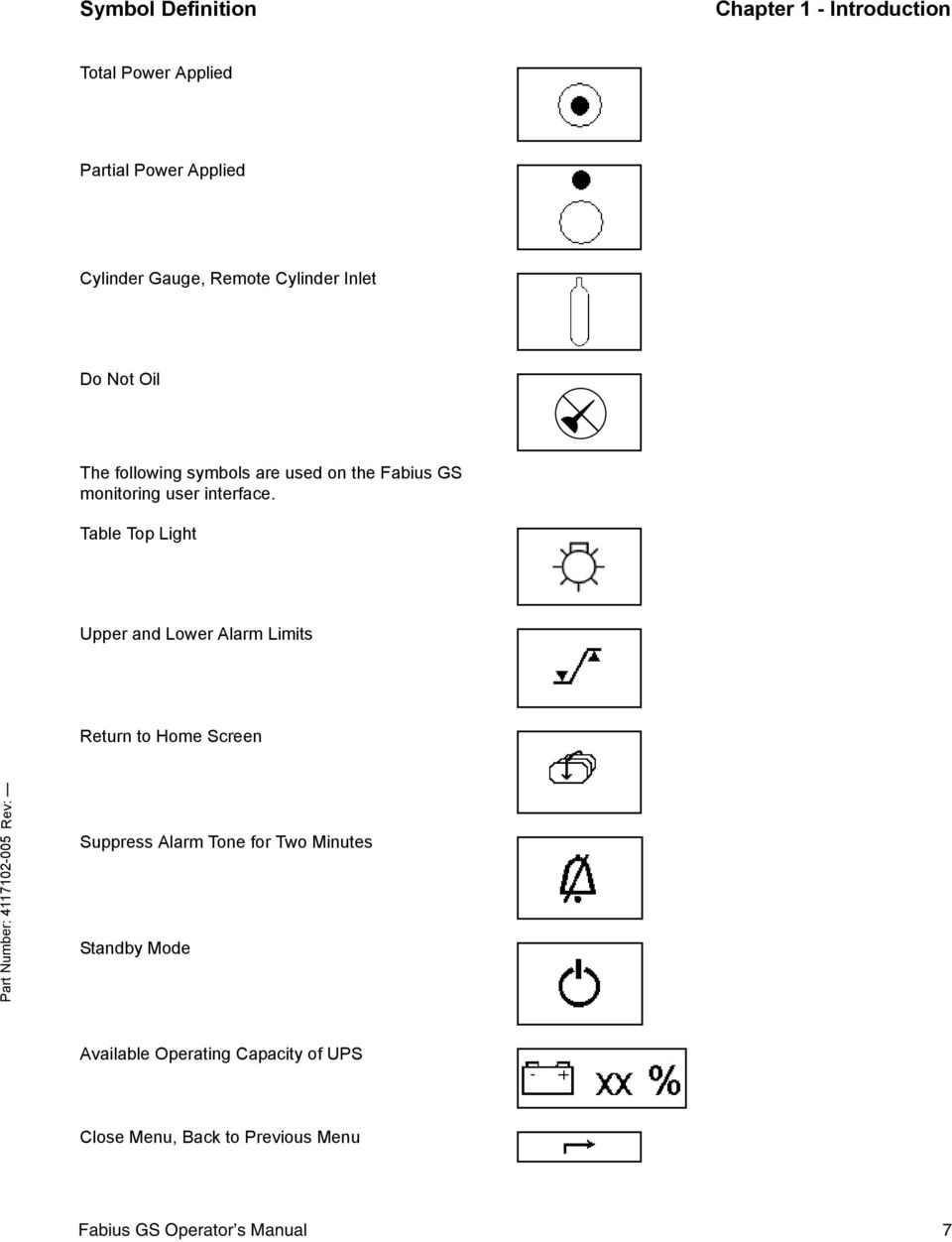
13 Symbol Definition Chapter 1 - Introduction Total Power Applied Partial Power Applied Cylinder Gauge, Remote Cylinder Inlet Do Not Oil The following symbols are used on the Fabius GS monitoring user interface. Table Top Light Upper and Lower Alarm Limits Return to Home Screen Suppress Alarm Tone for Two Minutes Standby Mode Available Operating Capacity of UPS Close Menu, Back to Previous Menu Fabius GS Operator s Manual 7
14 Chapter 1 - Introduction Abbreviations Upper Alarm Limit Lower Alarm Limit Mains Applied/Mains Power Alarm Off Setup Screen Abbreviations Abbreviation FLOW FiO 2 MAN MEAN N 2 O O 2 PAW Meaning Expiratory flow Inspiratory O 2 concentration Manual ventilation Mean (airway) pressure Nitrous Oxide Oxygen Airway pressure PEAK PEEP PLAT Pmax SPONT TI : TE Tip : Ti UPS Peak (airway) pressure Positive end-expiratory pressure Plateau airway pressure Maximum (airway) pressure setting Spontaneous breathing Ratio of inspiratory to expiratory time Ratio of inspiratory pause time to inspiratory time Uninterruptible power supply VAC VT Vacuum (e.g., for secretion aspiration) Tidal volume 8 Fabius GS Operator s Manual

15 General Warnings and Cautions Chapter 1 - Introduction General Warnings and Cautions The following list of warnings and cautions apply to general operation and maintenance of the Fabius GS. Warnings and cautions about installing and operating specific parts appear with those topics. Warning statements give important information that, if ignored, could lead directly to a patient's or operator's injury. Caution statements give important information that, if ignored, could lead directly to equipment damage and, indirectly, to a patient's injury. Warning: Any person involved with the setup, operation, or maintenance of the Fabius GS anesthesia system must be thoroughly familiar with this instruction manual. Warning: This anesthesia system will not respond automatically to certain changes in patient condition, operator error, or failure of components. The system is designed to be operated under the constant surveillance and control of a qualified operator. Warning: No third-party components shall be attached to the anesthesia machine, ventilator, or breathing system (except for certain approved exceptions). For more information, contact your local Authorized Service Organization or DrägerService at: DrägerService Draeger Medical, Inc Commerce Drive Telford, PA Tel: (215) (800) Fax: (215) Warning: Each institution and user has a duty to independently assess, based on its, his, or her unique circumstances, what components to include in an anesthesia system. However, Draeger Medical, in the interest of patient safety, strongly recommends the use of an oxygen analyzer, pressure monitor, volume monitor, and end-tidal CO2 monitor in the breathing circuit at all times. Warning: When moving the anesthesia machine, remove all monitors and equipment from the top shelf and use only the machine handles or push/pull bars. The anesthesia machine should only be moved by people who are physically capable of handling its weight. Draeger Medical recommends that two people move the anesthesia machine to aid in maneuverability. Exercise special care so that the machine does not tip when moving up or down inclines, around corners, and across thresholds (for example, in door frames and elevators). Do not attempt to pull the machine over any hoses, cords, or other obstacles on the floor. Warning: Apply the caster brakes when the anesthesia machine is in use. Caution: Caution: Caution: Caution: Caution: Although the Fabius GS is designed to minimize the effects of ambient radiofrequency interference, machine functions may be adversely affected by the operation of electrosurgical equipment or short wave or microwave diathermy equipment in the vicinity. Communications with external equipment may be temporarily affected by electromagnetic interference due to the use of electrosurgical equipment. Do not place more than 40 pounds on top of the Fabius GS monitor housing. Never allow the battery to completely discharge. If the battery does discharge completely, recharge immediately. Front GCX rails have a maximum accessories weight load of 5 lb./2.3 kg, extended out at 3 in./7.6 cm from the rail, at any position on the rail. Fabius GS Operator s Manual 9

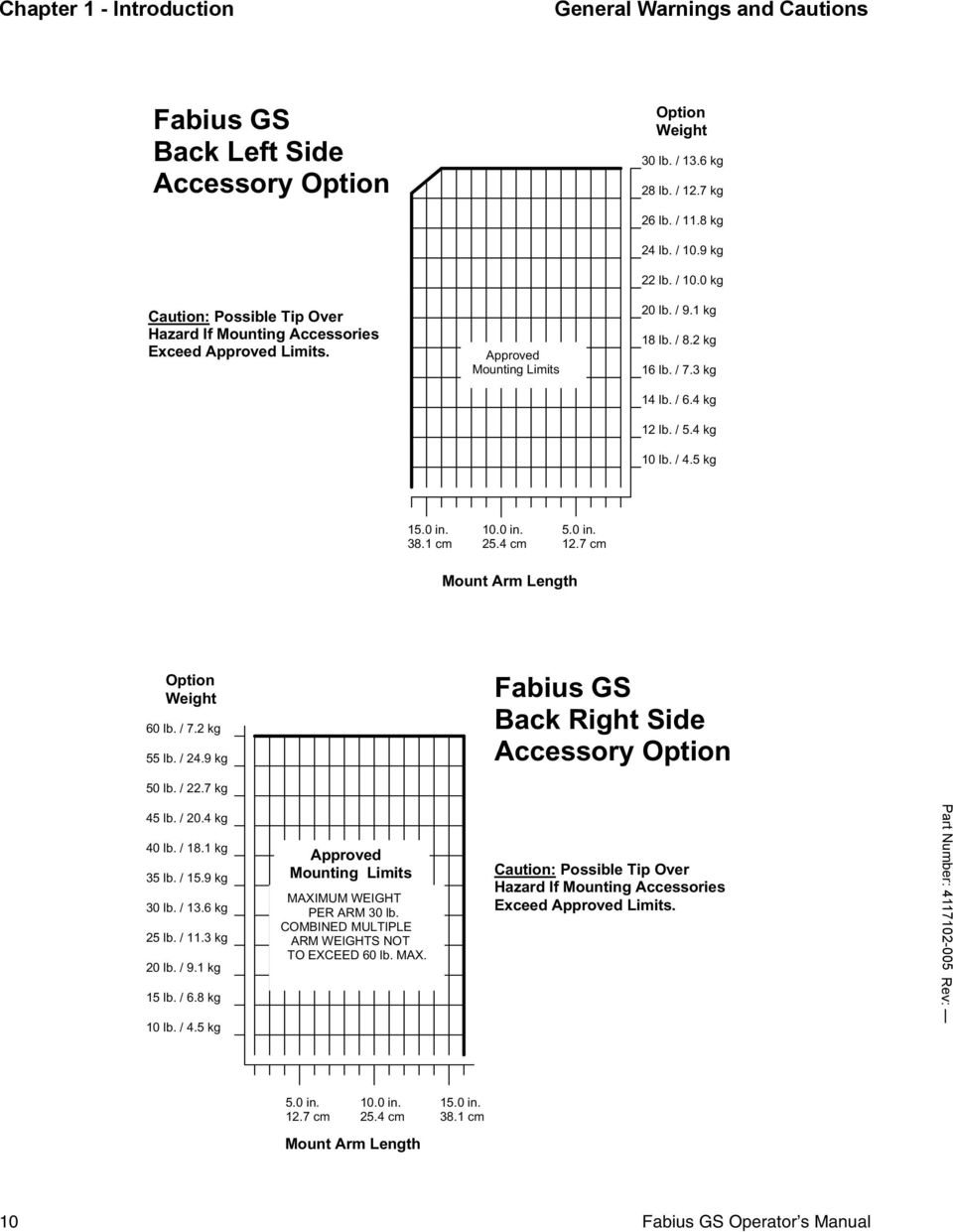
16 Chapter 1 - Introduction General Warnings and Cautions Fabius GS Back Left Side Accessory Option Option Weight 30 lb. / 13.6 kg 28 lb. / 12.7 kg Caution: Possible Tip Over Hazard If Mounting Accessories Exceed Approved Limits. Approved Mounting Limits 26 lb. / 11.8 kg 24 lb. / 10.9 kg 22 lb. / 10.0 kg 20 lb. / 9.1 kg 18 lb. / 8.2 kg Option Weight 16 lb. / 7.3 kg 14 lb. / 6.4 kg 12 lb. / 5.4 kg 10 lb. / 4.5 kg 15.0 in cm 10.0 in cm 5.0 in cm Mount Arm Length Option Weight 60 lb. / 7.2 kg 55 lb. / 24.9 kg Fabius GS Back Right Side Accessory Option 50 lb. / 22.7 kg 45 lb. / 20.4 kg 40 lb. / 18.1 kg 35 lb. / 15.9 kg 30 lb. / 13.6 kg 25 lb. / 11.3 kg 20 lb. / 9.1 kg 15 lb. / 6.8 kg 10 lb. / 4.5 kg Approved Mounting Limits MAXIMUM WEIGHT PER ARM 30 lb. COMBINED MULTIPLE ARM WEIGHTS NOT TO EXCEED 60 lb. MAX. Caution: Possible Tip Over Hazard If Mounting Accessories Exceed Approved Limits. 5.0 in cm 10.0 in cm Mount Arm Length 15.0 in cm 10 Fabius GS Operator s Manual
17 Chapter 2 - Configurations and Components Contents Configurations and Components Contents Typical Fabius GS Configuration Components Vaporizers (Optional) Dräger Vapor Interlock System (Optional) Selectatec * (Optional) Fabius GS Operator s Manual 11
18

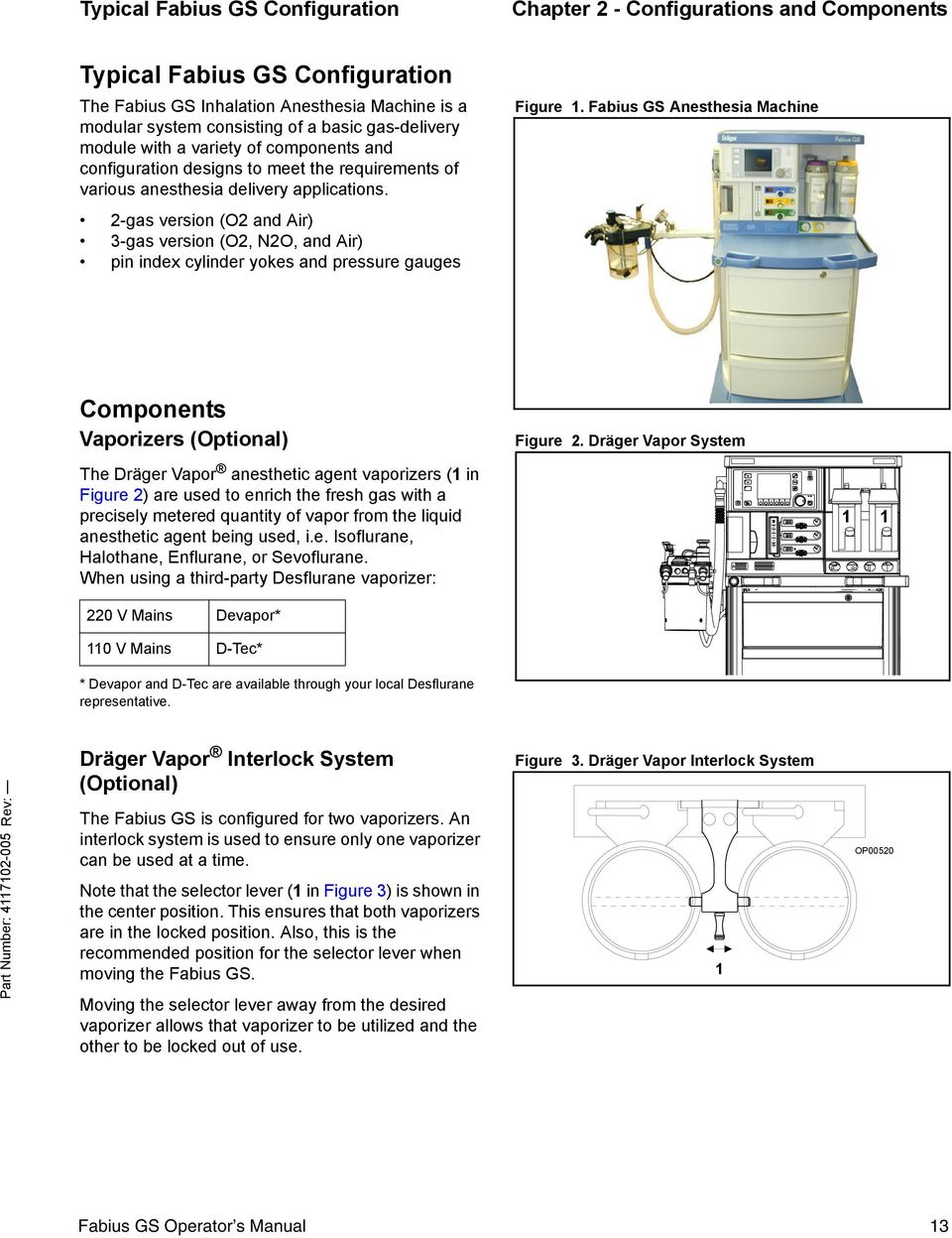
19 Typical Fabius GS Configuration Chapter 2 - Configurations and Components Typical Fabius GS Configuration The Fabius GS Inhalation Anesthesia Machine is a modular system consisting of a basic gas-delivery module with a variety of components and configuration designs to meet the requirements of various anesthesia delivery applications. 2-gas version (O2 and Air) 3-gas version (O2, N2O, and Air) pin index cylinder yokes and pressure gauges Figure 1. Fabius GS Anesthesia Machine Components Vaporizers (Optional) Figure 2. Dräger Vapor System The Dräger Vapor anesthetic agent vaporizers (1 in Figure 2) are used to enrich the fresh gas with a precisely metered quantity of vapor from the liquid anesthetic agent being used, i.e. Isoflurane, Halothane, Enflurane, or Sevoflurane. When using a third-party Desflurane vaporizer: V Mains Devapor* 110 V Mains D-Tec* * Devapor and D-Tec are available through your local Desflurane representative. Dräger Vapor Interlock System (Optional) The Fabius GS is configured for two vaporizers. An interlock system is used to ensure only one vaporizer can be used at a time. Note that the selector lever (1 in Figure 3) is shown in the center position. This ensures that both vaporizers are in the locked position. Also, this is the recommended position for the selector lever when moving the Fabius GS. Moving the selector lever away from the desired vaporizer allows that vaporizer to be utilized and the other to be locked out of use. Figure 3. Dräger Vapor Interlock System 1 OP00520 Fabius GS Operator s Manual 13
20 Chapter 2 - Configurations and Components Components Selectatec * (Optional) The interlock system for the Selectatec is built into the vaporizers. When a vaporizer is selected for use, the interlocking index pins will protrude from the sides of the vaporizer thereby not allowing the neighboring vaporizer to be opened. For more specific information on the Selectatec, refer to the Selectatec Vaporizer s instruction manual. *Selectatec is a registered trademark of Datex-Ohmeda. 14 Fabius GS Operator s Manual
21 Chapter 3 - Operating Concept Contents Operating Concept Contents Overview Standard Function Controls Home Key Mains Power Applied LED Selecting and Confirming Tabletop Light Key Cross-Functional Controls and Displays Key LED Indicators Setup Key Status Bar Monitoring Monitoring Controls Monitoring Windows Selecting/Setting Monitoring Functions Ventilation Ventilation Controls Ventilator Compliance Compensation Ventilation Screens Changing Ventilation Modes Selecting/Setting Ventilation Parameters Fresh Gas Control Fresh Gas Flow Monitoring Resolutions Standard Resolution High Resolution APL Valve Fabius GS Operator s Manual 15
22
23 Overview Chapter 3 - Operating Concept Overview This chapter provides an overview of the user interface, which enables you to set and view monitoring, ventilation, and status information using the respective screens, windows, keys, soft keys, and the rotary knob. See Monitoring on page 63 for more information. Standard Function Controls Figure 4. Ventilation Monitor Screen and System Controls Home Key The Home key (1 in Figure 4) displays the main screen (the screen in Figure 4) from anywhere in the system. Mains Power Applied LED 1 The Mains Power Applied LED (2 in Figure 4), when illuminated, indicates that the machine is connected to a Mains power source Selecting and Confirming The rotary knob (3 in Figure 4) is used to select and confirm functions by: Turning (Select) Turning the rotary knob moves the cursor over the system operating parameters or changes the value of a parameter that has been confirmed for adjustment. Note: This function is indicated in the examples and instructions of this manual by select. Pressing (Confirm) Pressing the rotary knob either confirms the system operating parameter to be adjusted or confirms the change to the selected operating parameter. Note: This function is indicated in the examples and instructions of this manual by confirm. Tabletop Light Key The Tabletop Light key (4 in Figure 4) turns on the tabletop light. Fabius GS Operator s Manual 17
24 Chapter 3 - Operating Concept Cross-Functional Controls and Displays Cross-Functional Controls and Displays Cross-functional controls and displays are used for both monitoring and ventilation functions. Key LED Indicators LED indicators (1 in Figure 5) within keys (Volume Control, Pressure Control, Man/Spont, Alarm Silence, and Standby) illuminate when that mode or function is selected and operating. Figure 5. Ventilation Monitor Screen and System Controls Setup Key The Setup key is 2 in Figure 5. Figure 6. Setup Window Pressed During A Ventilation Mode The Setup window (1 in Figure 6) replaces the Waveform area (3 in Figure 5). The Setup window enables you to perform ventilation functions and view and change monitoring settings. 1 Pressed During Standby Mode The Standby Setup screen (Figure 7) appears. The Standby Setup screen enables you to define site defaults and configuration. Figure 7. Standby Setup Screen 18 Fabius GS Operator s Manual
25 Cross-Functional Controls and Displays Chapter 3 - Operating Concept Status Bar The following numbers in parenthesis refer to Figure 8. Figure 8. Status Bar Mode Display (1) Displays the active ventilator mode. Alarm Silence Status (2) Displays the time remaining for alarm silence when the Silence Alarms key is pressed. Battery Power Level (3) Displays the status of the reserve power. Time (4) Displays the time. Fabius GS Operator s Manual 19
26 Chapter 3 - Operating Concept Monitoring Monitoring Figure 9. Ventilation Monitor Screen and System Controls Monitoring Controls LED Indicators LED lamps (1 in Figure 9) in the upper right corner of the control panel indicate the degree of urgency of currently active alarms. Warning Red Blinking Caution Yellow Blinking Advisory Yellow Continuous Silence Alarms Key The Silence Alarms key (2 in Figure 9) silences all active alarm tones for 2 minutes. It resets the silence time for two minutes each time the key is pressed. Alarm Limit Key The Alarm Limit key (3 in Figure 9) displays the Alarm Limits window (1 in Figure 10), which appears in the same location on all mode screens. Figure 10. Alarm Limit Configure Window Setup Key The Setup key (4 in Figure 9) is a cross-functional control. See Setup Key on page Fabius GS Operator s Manual
27 Monitoring Chapter 3 - Operating Concept Monitoring Windows The following numbers in boldface refer to Figure 11. Alarm Window The Alarm window (1) displays up to four of the highest priority alarms. Figure 11. Monitor Screen Oxygen Monitor Window The Oxygen Monitor window (2) displays the inspiratory oxygen concentration in units of percent (%). It also displays the oxygen alarm limits in the farright section of this window. Respiratory Volume Monitor Window The Respiratory Volume Monitor window (3) displays the patient's frequency (breaths per minute) or respiratory rate, tidal volume, minute volume, the minute volume high alarm limit, and the minute volume low alarm limit. Breathing Pressure Monitor Window The Breathing Pressure Monitor window (4) displays the patient's positive end expiratory pressure (PEEP), mean airway pressure (MEAN) or plateau airway pressure (PLAT), and peak airway pressure (PEAK). Breathing Pressure Trace Window The Breathing Pressure Trace window (5) displays a trace, or waveform, of the patient's breathing pressure. 5 4 Fabius GS Operator s Manual 21
28 Chapter 3 - Operating Concept Monitoring Selecting/Setting Monitoring Functions The following example describes changing alarm limits on the Standby Setup Screen. Example 1. Press the Setup key while the Standby Screen (Figure 12) is active. The Standby Setup screen (Figure 13) replaces the Standby Screen. 2. The rotary knob enables you to select the Default Settings or Configuration label. Select and confirm the Default Settings label. The Default Settings column is selected (Figure 14). Note: Note: Selecting and confirming the return arrow (1 in Figure 13) will deactivate the Standby Setup screen and activate the Standby screen (Figure 12). Selecting and confirming the return arrow (1 in Figure 14) will deselect the Default Settings column and reselect the Default Settings label as in Figure 13. Figure 12. Standby Screen Figure 13. Standby Setup Screen 1 Figure 14. Standby Setup Screen Default Settings Selected 1 22 Fabius GS Operator s Manual
29 Monitoring Chapter 3 - Operating Concept 3. Select and confirm the Alarm Limits label. The Default Alarm Limits window appears (1 in Figure 15). Figure 15. Standby Setup Screen Default Alarm Limits 1 4. Select the alarm limit value that needs to change (Figure 16). Figure 16. Standby Setup Screen Default Alarm Limits Select 5. Confirm the alarm limit value and select a new value for the alarm limit (ex., in Figure 17, the value was changed from 30 to 25). 6. Confirm the new value for the alarm limit. The new alarm limit value is saved and the cursor moves over the return arrow. Figure 17. Standby Setup Screen Default Alarm Limits Confirm Fabius GS Operator s Manual 23
30 Chapter 3 - Operating Concept Ventilation Ventilation Figure 18. Ventilation Monitor Screen and System Controls Ventilation Controls The following numbers in boldface refer to Figure 18. Ventilation Mode Keys Ventilation modes are selected by pressing one of the ventilation mode keys (1, 2, 3) and are confirmed by pressing the rotary knob. If the selection is not confirmed, the ventilation mode will not change Standby Key The Standby key (5) switches the ventilator to standby mode. Monitoring and alarms are turned off and the ventilator stops. Setup Key The Setup key (4) is a cross-functional control. See Setup Key on page 18. Soft Keys Soft keys (6) select ventilation parameters and functions. Ventilator Compliance Compensation Ventilator compliance compensation is continuously applied during Volume Control so that the tidal volume delivered to the patient corresponds to the Vt setting. Ventilator compliance is determined during the leak and compliance test performed from the Standby mode. To have compliance compensation work accurately, it is important that the patient hoses used during the leak/compliance test match the type of hoses used during the procedure. Note: When the ventilator settings for Volume Control cause the ventilator to operate at its limits of performance, it is not possible for the Fabius GS to apply compliance compensation. If the ventilator's performance limit is reached, it is not possible to increment the Vt setting via the Volume Control Settings window. 24 Fabius GS Operator s Manual
31 Ventilation Chapter 3 - Operating Concept Ventilation Screens Soft Key Labels The following numbers in boldface refer to Figure 19. Each soft key (1) is associated with a ventilation parameter (2) that is associated with a specific ventilation mode (3). Figure 19. Ventilation Monitor Screen and System Controls Volume Control Mode The following soft key labels appear from left to right along the bottom of the Volume Control screen. See Figure 20. PMAX (maximum ventilation pressure). The range for PMAX is 15 to 70 cmh 2 O. The factory default value is 40 cmh 2 O. VT (tidal volume). The range for VT is 20 ml to 1400 ml. The factory default value is 600 ml. Freq (ventilation frequency). The range for Frequency is 4 bpm to 60 bpm. The factory default value is 12 bpm. TI:TE (time ratio between inspiration time and expiration time phases). The range for TI:TE is 4:1 to 1:4. The factory default value is 1:2. TIP:TI (relative inspiratory pause). The range for TIP:TI is 0% to 50%. The factory default value is 10%. PEEP (positive end expiratory pressure). The range for PEEP is 0 to 20 cmh 2 O. The factory default value is 0 cmh 2 O. Figure 20. Volume Control Ventilation Screen Fabius GS Operator s Manual 25
32 Chapter 3 - Operating Concept Ventilation Pressure Control Mode The following soft key labels appear from left to right along the bottom of the Pressure Control screen. See Figure 21. PINSP (inspiratory pressure setting). The range for PINSP is 5 to 60 cmh 2 O. The factory default value is 15. Freq (ventilation frequency). The range for Frequency is 4 bpm to 60 bpm. The factory default value is 12 bpm. TI:TE (time ratio between inspiration and expiration phases). The range for TI:TE is 4:1 to 1:4. The factory default value is 1:2. Insp Flow (rate at which the piston travels upward to create the target pressure). The range for Insp Flow is 10 L/min to 75 L/min. The factory default value is 30 L/min. PEEP (positive end expiratory pressure). The range for Peep is 0 to 20 cmh 2 O. The factory default value is 0 cmh 2 O. Figure 21. Pressure Control Ventilation Screen ManSpont Mode The Apnea Pressure and Volume Alarms labels appear to the left of their ON/OFF label on the bottom of the ManSpont screen. See Figure 22. Pressing the ON/OFF soft key turns the applicable alarm(s) ON or OFF. Figure 22. ManSpont Ventilation Screen 26 Fabius GS Operator s Manual
33 Ventilation Standby Mode The following soft key labels appear from left to right along the bottom of the Standby screen. See Figure 23. Run System Test Calibrate Flow Sensor Calibrate O2 Sensor Leak / Compl Test Access Alarm Log Restore Site Defaults See Standby Screen on page 91 for details. Figure 23. Standby Screen Chapter 3 - Operating Concept Flow Meter Monitor Window The Flow Meter Monitor window is a graphical display of the flow rates of O 2, Air, and N 2 O (L/min) (1 in Figure 24). Note: On some non-u.s. units of the Fabius GS, the O2 and N2O virtual flow tubes have changed positions. Figure 24. Flow Meter Monitor Window 1 Fabius GS Operator s Manual 27
34 Chapter 3 - Operating Concept Ventilation Changing Ventilation Modes Volume Control and Pressure Control The following example describes changing from the present ventilation mode Volume (1 in Figure 25) Figure 25. Ventilator Mode Change Confirmation to the desired ventilation mode Pressure (2 in Figure 25) with the desired ventilation settings (3 in Figure 25). 1. Press the Pressure Control key. The LED associated with this key starts blinking (4 in Figure 25). It remains blinking until the selected mode of operation is confirmed. A message appears (5 in Figure 25) that provides instructions to confirm the mode change. The Waveform window is replaced by the Ventilator Settings window (6 in Figure 25) (Volume and Pressure modes only). 2. If the ventilation settings are correct, confirm the mode change. 3. If the ventilation settings are not correct, for each parameter that needs to change, press the corresponding soft key, select the correct value, and confirm the change. 4. When the parameter changes are completed, confirm the ventilation mode change After the mode change is confirmed, the Pressure Control key LED switches from blinking to constantly on, the ventilator switches to the selected operating mode, and the waveform is restored after a short delay. 28 Fabius GS Operator s Manual
35 Ventilation Chapter 3 - Operating Concept Ventilator Setting Selection The ventilator settings for the new mode of operation are automatically derived from the settings and performance of the last confirmed automatic ventilation mode. Settings affected in the new mode will be highlighted (1 in Figure 26). The settings for Freq., TI : TE, and PEEP are taken directly from the settings used in the former mode. When changing from Volume Control to Pressure Control, Pinsp is set to the Plateau pressure developed in Volume Control. When changing from Volume Control to Pressure Control, the suggested value for Insp. Flow is either the last used value or the site default value. When changing from Pressure Control to Volume Control, VT is set by dividing the last minute volume by the respiratory rate. When changing from Pressure Control to Volume Control, the suggested value for TIP : TI is either the last used value or the site default value. When changing from Pressure Control to Volume Control, PMAX is set 10 cmh 2 O higher than the plateau pressure developed during Pressure Control. Figure 26. Ventilator Mode Change Settings 1 Fabius GS Operator s Manual 29
36 Chapter 3 - Operating Concept Ventilation ManSpont ManSpont (Manual/Spontaneous) is a non-automatic mode of ventilation. However, the ventilation monitor and alarms are still operational. In ManSpont mode, the ventilator piston is moved to its top-most position to minimize system compliance. Manual ventilation (with APL valve pressure limit) can be delivered with the APL valve switch in the MAN position. Spontaneous ventilation (APL valve wide-open) can occur with the APL valve in the SPONT position. The following examples describe changing from the present ventilation mode Volume (1 in Figure 27) to the desired ventilation mode ManSpont (1 in Figure 28). Spontaneous Breathing 1. Press the ManSpont key. The LED associated with this key starts blinking (2 in Figure 27). It remains blinking until the selected mode of operation is confirmed. The Waveform window is replaced by the ManSpont window (3 in Figure 27). A message appears (4 in Figure 27) that provides instructions to confirm the mode change. 2. Confirm the mode change. The ManSpont screen is activated (Figure 28). After the mode change is confirmed, the ManSpont key LED switches from blinking to constantly on and the waveform is restored after a short delay. 3. Set the toggle on the APL valve (1 in Figure 29) to the SPONT position. 4. Set the appropriate fresh gas flow. Note: The ManSpont screen enables you to turn the Apnea Pressure alarm and Volume alarms ON or OFF. Figure 27. Ventilator Mode Change to Man Spont Figure 28. ManSpont Ventilation Screen Figure 29. APL Vavle 1 30 Fabius GS Operator s Manual
37 Ventilation Chapter 3 - Operating Concept Manual Ventilation Note: In ManSpont mode, the apnea volume timer countdown for caution alarms changes from 15 seconds to 30 seconds, and for warning alarms from 30 seconds to 60 seconds. 1. Press the ManSpont key. The LED associated with this key starts blinking (1 in Figure 30). It remains blinking until the selected mode of operation is confirmed. The Waveform window is replaced by the ManSpont window (2 in Figure 30). A message appears (3 in Figure 30) that provides instructions to confirm the mode change. Figure 30. Ventilator Mode Change to Man Spont Confirm the mode change. The ManSpont screen is activated (Figure 31). After the mode change is confirmed, the ManSpont key LED switches from blinking to constantly on and the waveform is restored after a short delay. Note: The ManSpont screen enables you to turn the Apnea Pressure alarm and Volume alarms ON or OFF. 3. Set the toggle on the APL valve (1 in Figure 32) to the MAN position. 4. Adjust the pressure limiting valve to set the appropriate value for the maximum ventilation pressure. 5. Press the O 2 flush button, as required, to inflate the bag. 6. Set the fresh gas flow. 7. Start manual ventilation. Figure 31. ManSpont Ventilation Screen Figure 32. APL Vavle 1 Fabius GS Operator s Manual 31
38 Chapter 3 - Operating Concept Ventilation Selecting/Setting Ventilation Parameters 1. In Volume Control mode, press the Volume Control key. The Volume Control Ventilation Settings window (1 in Figure 33) replaces the Waveform window. In Pressure Control mode, press the Pressure Control key. The Pressure Control Ventilation Settings Window (1 in Figure 34) replaces the Waveform window. Figure 33. Volume Ventilator Settings Window 1 The following example continues in Volume Control mode. 2. Press the VT (tidal volume) soft key. The Ventilator Settings window appears with the VT parameter label highlighted (1 in Figure 35). 3. Select a new VT parameter setting. 4. Confirm the new VT parameter setting. Figure 34. Pressure Control Ventilator Settings Window 1 Note: Once the Ventilator Settings window is activated, it will return to the Waveform window if 15 seconds pass and neither the rotary knob nor a soft key is pressed. If the Home key is pressed, the Ventilator Settings window will return to the Waveform window. In either case, the ventilation parameter will remain as it was before it was activated in the Ventilator Settings window. Figure 35. Volume Control Ventilator Label Selected 1 32 Fabius GS Operator s Manual
39 Fresh Gas Control Chapter 3 - Operating Concept Fresh Gas Control The following numbers in boldface refer to Figure 36. Flow is increased when the flow control knobs (N 2 O (1), AIR (2), O 2 (3)) are turned counterclockwise. The total flow meter (4) displays the flow measurement of all of the applied gases combined. Note: The total flow meter is calibrated for a 50/50 mixture of N 2 O and O 2. The accuracy of the flow meter may degrade with other gas mixtures. (See the Technical Data section for specifications.) The total flow meter serves two purposes. The total flow meter provides a reference of the total fresh gas applied to the breathing circuit. (Flow rate measurements for each individual gas; N 2 O, Air, and O 2 ; are provided by their respective electronic flow indicator.) Should a fault develop in the electronic flow sensing, digital display, or power circuitry, the total flow meter is still functional. The measurement will indicate the total flow rate prior to the fault condition. To adjust the fresh gas ratios while under the fault condition, shut off all flows (O 2 may be left on), and then restore each gas flow individually. For example, start with 2 L/min O 2. The total flow meter will read 2 L/min. If 1 L/min of N 2 O is needed, open the N 2 O flow control knob until the total flow meter reads 3 L/min - 2 L/min O 2 plus 1 L/min N 2 O. The electronic fresh gas flow indicators (N 2 O (5), AIR (6), O 2 (7)) display the flow measurement of each gas. Note: The electronic fresh gas flow meters are altitude corrected. The central supply pressure indicators (N 2 O (8), AIR (9), O 2 (10)) display the pressure measurement of each gas entering the Fabius GS from the facility s pipeline. The cylinder gauges (O 2 (11), Air (12)) display the pressure measurement of each gas entering the Fabius GS from cylinders. The O2 Low Supply Pressure Alarm LED (13) flashes when the O2 supply is below the factory set minimum pressure, nominally 20 psi (1.4 bar). Figure 36. Flowmeter and Pressure Gauge Assembly 4 TOTAL FLOW ±15% FS L/min L/min L/min Pipeline N 2O Pipeline AIR Pipeline O Cylinder Pressure O2 Air Fabius GS Operator s Manual 33
40 Chapter 3 - Operating Concept Fresh Gas Flow Monitoring Resolutions Fresh Gas Flow Monitoring Resolutions The Fabius GS can be configured by your Local Authorized Service Organization to display fresh gas flow rates either in a standard resolution mode or in a high resolution mode. Figure 37. Standard Resolution Fresh Gas Flow Monitoring Standard Resolution If standard resolution is configured (Figure 37), the numeric displays (LEDs) for the fresh gas flow rates support 100 ml/min. increments (format xx.x l/min.) and the flow meters on the monitor screen indicate a range of 0 to 12 l/min. High Resolution If high resolution is configured (Figure 38), the numeric displays (LEDs) for the fresh gas flow rates support 10 ml/min. increments (format x.xx l/min.) and the flow meters on the monitor screen indicate a range of 0 to 10 l/min. with an emphasis on resolution at the lower end of the scale. High-resolution data is displayed when all individual gas flows are below 9.99 l/min. Switching to standard resolution occurs when the highest flow rate is greater than 9.99 l/min. Switching to high resolution occurs when the highest flow rate drops below 9.00 l/min. Figure 38. High Resolution Fresh Gas Flow Monitoring 34 Fabius GS Operator s Manual
41 APL Valve Chapter 3 - Operating Concept APL Valve The following numbers in boldface refer to Figure 39. The APL valve (1) has two functions. It limits the maximum pressure during manual ventilation. It also exhausts excess gas into the scavenger system during manual and spontaneous ventilation. The APL valve is connected to the patient airway through the ventilator. It functions only when the ventilator is in ManSpont mode or ventilator override condition. The APL valve has a toggle switch (2) for selecting between manual and spontaneous modes of ventilation. When the side of the switch marked MAN is up, the APL valve sets maximum pressure for manual ventilation. When the side marked SPONT is up, pressure is released for spontaneous ventilation. Depressing the switch while in the MAN position will also temporarily relieve pressure. Maximum pressure adjustment is made by rotating the APL valve adjustment (3) when the toggle switch is in the MAN position to set peak airway pressure. The adjustment housing is labelled to indicate pressure settings. Rotating the adjustment counterclockwise reduces the peak inspiratory pressure and the pressure at which gas is released to the scavenging system. Rotating the adjustment clockwise increases the peak inspiratory pressure and the pressure at which gas is released to the scavenging system. During spontaneous ventilation, resistance to patient exhalation is automatically eliminated by toggling to the SPONT position, which eliminates the need to readjust backpressure. Figure 39. APL Vavle Fabius GS Operator s Manual 35
42
43 Chapter 4 - Preparation Contents Preparation Contents Activating the Battery Gas Supply Medical Gas Pipeline Supply of O2, N2O, and AIR Cylinders with Pin-index Mounting Electrical Supply Attaching Manual (Ambu) Ventilation Bag Preparing the Ventilator Ventilator Safety Features Attaching the CO2 Absorber onto the Compact Breathing System Attaching the Inspiratory Valve Attaching the Expiratory Valve Attaching the Adjustable Pressure Limiting (APL) Valve Inserting the Flow Sensor Attaching the Waste Gas Outlet Port Connecting the Compact Breathing System Connecting the Breathing Hoses Inserting A New O2 Sensor Capsule Connecting the O2 Sensor Connecting the Pressure Sensor Connecting the Breathing Pressure Gauge Connecting the APL Bypass and Peep/PMAX Hoses Connecting the Flow Sensor Installing Anesthetic Gas Scavenging Hose to the Compact Breathing System Scavenger System for Fabius GS Daily and Preuse Checkout Form Fabius GS Operator s Manual 37
44
45 Activating the Battery Chapter 4 - Preparation Note: Complete the Periodic Manufacturer's Service procedure (SP00225) after you set up the Fabius GS anaesthesia machine. Activating the Battery Figure 40. Battery Fuse The Fabius GS anesthesia machine is shipped with the battery fuse disconnected in order to prevent discharge during shipment and storage prior to installation. 1. Remove the battery fuse from the top drawer of the Fabius GS. 2. Remove the battery fuse from its packaging. OXYGEN SENSOR BREATHING PRESSURE VOLUME SENSOR 3. Insert the battery fuse into the battery fuse holder (1 in Figure 40) (turn the fuse 1/4-turn clockwise until it is snug). 1 Gas Supply Note: Medical gases must be dry and free from dust and oil. The central gas supply gas connections are shown in Figure 41. Figure Gas Supply Connections Medical Gas Pipeline Supply of O2, N2O, and AIR Warning: Carefully check hoses each time you connect a machine to a wall or ceiling outlet to ensure that both ends of the hose are indexed for the same gas. Pipeline delivery hoses used between wall outlets and anesthesia machines have caused accidents when, during assembly, an oxygen fitting was placed on one end of the hose and a nitrous oxide fitting on the other end. The following numbers in boldface refer to Figure Connect the N2O hose (1) to the connector on the Fabius GS and to the wall terminal unit (4) of the medical gas pipeline system. 2. Connect the AIR hose (2) to the connector on the Fabius GS and to the wall terminal unit (4) of the medical gas pipeline system. 4 PIPELINE PIPELINE PIPELINE Connect the O2 hose (3) to the connector on the Fabius GS and to the wall terminal unit (4) of the medical gas pipeline system. Fabius GS Operator s Manual 39
46 Chapter 4 - Preparation Cylinders with Pin-index Mounting Cylinders with Pin-index Mounting Warning: When attaching a cylinder, ensure that only one washer is installed between the cylinder and the yoke gas inlet. The use of multiple washers will inhibit the pinindex safety system. Be sure to verify the presence of the index pins each time a cylinder is installed. Never attempt to override the pin-index safety system. Caution: Do not oil or grease the O2 cylinder valves and O2 pressure regulator. There is a risk of explosion. If cylinder valves are leaky or difficult to open or close, they must be repaired in accordance with the manufacturer s specifications. Even if the gas supply is connected to a medical gas pipeline, the cylinders should remain on the device in reserve. The following numbers in boldface refer to Figure 42. To connect a gas cylinder (1) to its yoke: 1. Remove the old washer (2) and install a new washer on the seat of the yoke gas inlet connection. 2. Verify that the two index pins (3) below the gas inlet (4) are present. 3. Insert the head (5) of the gas cylinder into the yoke from below. Ensure that the gas outlet and indexing holes on the cylinder head align with the gas inlet and index pins of the yoke assembly (6). 4. Engage the indexing holes with the index pins. 5. Turn the yoke handle (7) clockwise against the cylinder head, so that the point of the yoke handle bolt is aligned with the indent on the back of the cylinder head. 6. Verify that the washer is in place, the index pins are engaged, and the cylinder hangs vertically. 7. Tighten the yoke firmly. When required, the cylinder valve (8) is opened using the cylinder wrench (9) that is provided. 8. When a cylinder is removed, place the yoke plug (10) in the yoke assembly and tighten. Figure 42. Pin Index Cylinder Mounting Fabius GS Operator s Manual
47 Electrical Supply Chapter 4 - Preparation Cylinders attached to the hanger yokes must contain gas at the recommended pressures outlined in Table 1. (Indicated pressures are of E-size cylinders at 70 F, or 21 C.) Cylinders measuring less than the minimum recommended pressure (PSI - MIN) should be replaced with new, full cylinders. Table 1. Recommended Cylinder Gas Pressures GAS PSI/bar - FULL (typical full load) PSI/bar - MIN Air 1900/ /69 Nitrous Oxide 745/51 600/42 Oxygen 1900/ /69 Electrical Supply Fabius GS can be operated at mains voltages from 100 V to 240 V. Push power plug into supply mains socket. Switch on the machine. The system power switch (1 in Figure 43) is on the rear of the machine. Figure 43. Power Switch OXYGEN SENSOR BREATHING PRESSURE VOLUME SENSOR 1 Attaching Manual (Ambu) Ventilation Bag Hang the fully prepared and tested bag on the rail at the right (1). Figure 44. Manual (Ambu) Ventilation Bag 1 Fabius GS Operator s Manual 41
48 Chapter 4 - Preparation Preparing the Ventilator Preparing the Ventilator Figure 45. Ventilator Assembly Use only disinfected/sterilized components. The following numbers in boldface refer to Figure Swing out the ventilator door (1). 3 6 A B 2. Unlatch the three clasps (2) to remove the cover (3). 3. Insert the diaphragm (4). 4. Fit the cover (3) and lock the three clasps Connect the ventilator chamber pressure sensor line (5) to the ventilator chamber pressure sensor line port (6) Swing the ventilator unit (1) back into position. 1 Ventilator Safety Features High pressure safety relief valve (A) Negative pressure safety relief valve (B) Ventilator chamber pressure sensor Caution: Fabius GS anesthesia machines that were shipped with a SW version 1.1x or 1.20 have a 3-cmH2O negative pressure relief valve in the ventilator cover. These ventilator covers must not be used with machines equipped with software version 1.30 or higher. Machines with software version 1.30 or higher require a ventilator cover with an 8-cmH2O negative pressure relief valve. These ventilator covers have a smaller locating pin. The two covers are not interchangeable. Using an incorrect ventilator cover on a Fabius GS could cause a ventilator malfunction. (All units with SW version 1.1x or 1.20 can be upgraded to SW version 1.30.) 42 Fabius GS Operator s Manual
49 Attaching the CO2 Absorber onto the Compact Breathing SystemChapter 4 - Preparation Attaching the CO2 Absorber onto the Compact Breathing System 1. Remove the absorber canister (see Replacing CO2 Absorbent on page 56 for more information). 2. Fill the absorber with fresh CO2 absorbent to the fill line. Dräger Medical, Inc. recommends the use of Drägersorb 800 Plus. 3. Ensure that no CO2 absorbent dust/particles have been deposited between the gaskets and the sealing surfaces. Such dust and particles can cause leaks in the system. 4. Tighten the absorber by turning it to the right into the compact breathing system. Attaching the Inspiratory Valve The following numbers in boldface refer to Figure Place the valve disc (3) in the valve seat. 2. Place the gasket (4) on top of the valve disc. 3. Fit the inspection cap (with port) (5). 4. Tighten the retaining nut (6) securely. Figure 46. CO2 Absorber Figure 47. Inspiratory/Expiratory Valves Attaching the Expiratory Valve The following numbers in boldface refer to Figure Place the valve disc (7) in the valve seat. 2. Place the gasket (8) on top of the valve disc. 3. Fit the inspection cap (9). 4. Tighten the retaining nut (10) securely. Fabius GS Operator s Manual 43
50 Chapter 4 - Preparation Attaching the Adjustable Pressure Limiting (APL) Valve Attaching the Adjustable Pressure Limiting (APL) Valve Tighten the pressure-limiting valve (9 in Figure 48) securely into place with the retaining nut. Figure 48. APL Valve 9 Inserting the Flow Sensor The following numbers in boldface refer to Figure Unscrew and remove the expiration port (1). 2. Insert the flow sensor (2). 3. Reinstall the expiration port (1). Attaching the Waste Gas Outlet Port Screw the waste gas port into the compact breathing system from underneath (3 in Figure 49). Figure 49. Flow Sensor Assembly Fabius GS Operator s Manual
51 Connecting the Compact Breathing System Chapter 4 - Preparation Connecting the Compact Breathing System The following numbers in boldface refer to Figure 50 and Figure 51. Caution: The sealing rings on the threaded and conical connectors (5 and 6) must be undamaged and clean. Caution: Only hand-tighten the threaded connectors. Do not use tools. 1. Pull and hold plunger (1) out to its full extension on the compact breathing system. 2. Fit the compact breathing system onto the compact breathing system mount (2). 3. Release the plunger (1) and rotate the compact breathing system until the plunger locks into position. 4. Screw the fresh gas hose from the Fabius GS (3) to the compact breathing system (4). 5. Screw the ventilation hose to the ventilator (5) and attach it to the conical connector ventilator port on the compact breathing system (6). Figure 50. Compact Breathing System Installation Figure 51. Hose Connections for Compact Breathing System Fabius GS Operator s Manual 45
52 Chapter 4 - Preparation Connecting the Breathing Hoses Connecting the Breathing Hoses Note: Take care not to damage the breathing hoses. Figure 52. Breathing Hose Handling Caution When connecting and disconnecting, always hold the breathing hoses by the end sleeve, not by the spiral reinforcement (Figure 52). Otherwise, the spiral reinforcement may be torn loose. Breathing hoses with a damaged spiral reinforcement can kink or become occluded. Before each use, check the breathing hoses for damage. The following numbers in boldface refer to Figure Push patient breathing hoses (1) onto both the inspiratory and expiratory connectors or onto the microbial filters. 2. Connect both patient breathing hoses to the Y-piece (2). 3. Connect the bag (3) to the elbow port on the compact breathing system. Figure 53. Installing Breathing Hoses 2 1 Inserting A New O2 Sensor Capsule Inserting a new O2 sensor capsule: The following numbers in boldface refer to Figure Unscrew the cap (1) from the sensor housing. 2. Remove the new sensor capsule from its packaging, or use a disinfected sensor capsule. 3. Insert the capsule (2) in the housing, with the ring-shaped conductors against the contacts in the housing. 4. Screw the cap (1) on firmly by hand. Figure 54. O2 Sensor Capsule Assembly Fabius GS Operator s Manual
53 Connecting the O2 Sensor Chapter 4 - Preparation Connecting the O2 Sensor The following numbers in boldface refer to Figure 55. Push the O2 sensor into the port opening of the inspiratory port dome (1), and plug the connector into the connector panel. Figure 55. Connecting the O2 Sensor Capsule OXYGEN SENSOR BREATHING PRESSURE VOLUME SENSOR 2 1 OP00336A Connecting the Pressure Sensor The following numbers in boldface refer to Figure 56. Press the pressure measuring line hose onto the hose barb (1) until it engages. Caution: Do not squeeze the pressure measuring line hose when pressing it onto the hose barb. Connect the pressure measuring line hose to the bacterial filter (2) and plug it firmly onto the port on the connector panel. Figure 56. Pressure Sensor Connections OXYGEN SENSOR BREATHING PRESSURE VOLUME SENSOR 2 1 Fabius GS Operator s Manual 47
54 Chapter 4 - Preparation Connecting the Breathing Pressure Gauge Connecting the Breathing Pressure Gauge 1. Connect the pressure gauge (1) to the compact breathing system mount (2) and secure with the retaining screw (3) and lockwasher (4). Push the pressure measuring line hose onto the hose barb (5), the breathing pressure gauge port (6), and onto the port on the connector panel (7). Figure 57. Breathing Pressure Gauge Connecting the APL Bypass and Peep/PMAX Hoses The following numbers in boldface refer to Figure Plug the control hose to the connection port on the PEEP/PMAX valve (1) and to the connection port marked PEEP on the connection panel (2). 2. Plug the control hose to the connection port on the APL Bypass valve (3) and to the connection port marked APL on the connection panel (4). Note: The control hoses are connected together near the end of each hose. The APL bypass hose is larger than the PEEP/PMAX hose. Figure 58. APL Bypass and Peep Hose Connections OXYGEN SENSOR BREATHING PRESSURE VOLUME SENSOR Fabius GS Operator s Manual
55 Connecting the Flow Sensor Chapter 4 - Preparation Connecting the Flow Sensor Push the cable onto the connection port on the flow sensor (1). Figure 59. Connecting the Flow Sensor OX YGEN SEN SO R BREATHING PRESSURE VO LUM E SEN SO R 1 OP00337A Installing Anesthetic Gas Scavenging Hose to the Compact Breathing System Connect the transfer hose to the waste gas port of the Compact Breathing System and to the anesthetic gas scavenging line or an anesthetic agent filter. A second transfer hose is required for the Semi-open compact breathing system. Figure 60. Installing the Scavenger Transfer Hose Fabius GS Operator s Manual 49
56 Chapter 4 - Preparation Scavenger System for Fabius GS Scavenger System for Fabius GS Figure 61. AGS Scavenger Caution: Do not use anesthetic gas scavenging system in combination with extracorporeal oxygenator. AGS The following numbers in boldface refer to Figure Output connection (1) from the scavenger system to the hospital waste gas removal system. Connection to scavenger system (2) from Fabius GS breathing system. Flow indicator (3). During use, the flow indicator must be between the upper and lower marks on the tube Flow adjustment valve (4). Note: Activate hospital vacuum system before using scavenger system. For more detailed information on the scavenger system, refer to the separate specific Instructions for Use. For detailed information regarding mounting the scavenger system to the Fabius GS anesthesia workstation, refer to specific instructions provided with the scavenger kit. Additional Equipment Prepare additional equipment as specified in the specific Instructions for Use. Caution: If monitors and other equipment are placed on top of Fabius GS, the risk of tipping over the unit is increased, especially when rolling over thresholds etc. Remove all monitors and other equipment from the top of the Fabius GS before moving the unit. Daily and Preuse Checkout Form Complete the Daily and Preuse Checkout Form in Appendix A. 50 Fabius GS Operator s Manual
57 Chapter 5 - Operation and Shut-down Contents Operation and Shut-down Contents Operation Power-Up Screen Power-Up Standby Screen Ventilation Monitor Screen Setting the Vapor O2 Flush Minimum Flow of Anesthesia Nitrogen Wash-out (When Required) Replacing CO2 Absorbent Power Failure Backup Ventilator Fail State Overriding the Ventilator Preparation for Transport or Storage Switch Off the Anesthetic Agent Vaporizer Switching Off the Ventilator Remove the O2 Sensor Switch Off System Power Disconnect the Central Gas Supply Fabius GS Operator s Manual 51
58
59 Operation Chapter 5 - Operation and Shut-down Operation Power-Up Screen When the SYSTEM POWER switch is turned to the ON position, the Fabius GS performs extensive selftests on its internal hardware. As these diagnostics are performed, each test and its result appear on the screen. The result, Pass or Fail, indicates the status of the tested component. See Figure 62. Figure 62. Power-Up Screen Self-Diagnostic Conclusions At the end of the self-diagnostics, one of three possible conclusions to the self-tests is posted on the screen (Figure 62). FUNCTIONAL Every component of the monitoring system is in satisfactory operational order. After a brief delay, the Standby screen appears. CONDITIONALLY FUNCTIONAL A noncritical fault was detected. The Fabius GS may be used, but call your local Authorized Service Organization or DrägerService (see Daily and Preuse Checkout Form for DrägerService contact information). Press the rotary knob to continue operation. NON-FUNCTIONAL A serious fault was detected and operation of the monitor and ventilator is inhibited. Do not use the machine. Immediately call your local Authorized Service Organization or DrägerService to correct the problem. Fabius GS Operator s Manual 53
60 Chapter 5 - Operation and Shut-down Operation Power-Up Standby Screen Figure 63. Power-Up Standby Screen Following a successful power-up, the Standby screen appears (Figure 63) and provides instructions on starting the operation of the Fabius GS. Ventilation Monitor Screen Figure 64. Ventilation Monitor Screen and System Controls When the Fabius GS is in use, monitoring information is displayed on the Ventilation Monitor screen. See Operating Concept on page 15 for an explanation of the Ventilation Monitor screen controls and windows. Setting the Vapor The following numbers in boldface refer to Figure Ensure that the vaporizer is properly seated. 2. Lock the unused Vapor by sliding the lever (1) as far as it will go in the direction of the unused Vapor (in this example, the left hand Vapor is locked). 3. On the Vapor to be used, press and hold down the 0 button (2) and turn the handwheel (3) counter-clockwise to the desired anesthetic agent concentration. Figure 65. Setting the Vapor Regularly check the filling level on the sight glass. When reaching the minimum mark, fill the Vapor with anesthetic agent. 5. Please refer to the specific Instructions for Use for Dräger Vapor. 54 Fabius GS Operator s Manual
61 Operation Chapter 5 - Operation and Shut-down O2 Flush 1. Press the O2 Flush button (1 in Figure 66). Additional O2 flows into the compact breathing system. The flow control elements and the anesthetic agent vaporizer (Vapor) are bypassed. Note: In Man. Spont. mode, pressure may rise rapidly up to the setting of the APL valve. Figure 66. O2 Flush Button 1 Minimum Flow of Anesthesia When long-term flow of anesthesia is below 0.5 L/min, increased humidity in the ventilator hose is a natural occurrence. Disconnect the ventilator hose from the compact breathing system and clean before and after long term procedures. Use water traps in the expiratory hose. Empty water traps if their water level exceeds the maximum water level limit. Nitrogen Wash-out (When Required) During anesthesia induction, air containing about 79% nitrogen (N2) remains in the compact breathing system (and in the patient's lungs). If the unit will be used for a low-flow anesthesia case, press the O2 Flush to remove this N2. Fabius GS Operator s Manual 55
62 Chapter 5 - Operation and Shut-down Operation Replacing CO2 Absorbent Figure 67. Replacing the Absorber Canister The CO2 absorbent in the compact breathing system should be replaced when two-thirds of the CO2 absorbent has changed color. Draeger Medical recommends the use of Drägersorb 800 Plus. The color change indicates that the CO2 absorbent can no longer absorb CO2 (Drägersorb 800 Plus changes from white to violet). Do not flush CO2 absorbent for long periods with dry gas because the CO2 absorbent will dry out. When the moisture content falls below a specified minimum level, the following undesirable reactions can occur, regardless of the type of CO2 absorbent and the anesthetic agent used, e.g. Halothane, Enflurane, Isoflurane, Sevoflurane or Desflurane: reduced CO2 absorption, formation of CO, absorption and/or decomposition of the inhalation anesthetic agent, increased heat generation in the absorber, leading to higher breathing gas temperatures. These reactions can result in danger to the patient in the form of CO intoxication, insufficient depth of anesthesia and airway burns. Note: Please refer to the specific Instructions for Use for Drägersorb 800 Plus. Draeger Medical recommends that absorbent be changed, regardless of color, if the anesthesia machine has been idle for 48 hours or more. Further, Draeger Medical recommends that it be changed at the beginning of the work week. Warning: Absorbent is caustic and is a strong irritant to the eyes, skin, and respiratory tract. When replacing the absorbent, take care not to spill its caustic contents. 1. Empty the expired CO2 absorbent from the absorber into an appropriate refuse container. 2. Fill the absorber with fresh CO2 absorbent. 3. Ensure that no CO2 absorbent dust/particles have been deposited between the gaskets and sealing surfaces. Such dust and particles can cause leaks in the system. Dräger recommends the use of Drägersorb 800 Plus. 56 Fabius GS Operator s Manual
63 Operation Chapter 5 - Operation and Shut-down Power Failure Backup In case of power failure: the machine will continue without interruption, the POWER FAIL caution message will be displayed in the Alarm window, the battery symbol (r) will appear in the status bar, and the Mains Power Applied LED turns off. At 20% of reserve power, the Advisory message BATTERY LOW! is displayed in the alarm window. At 10% of reserve power, the Caution message BATTERY LOW!! is displayed in the alarm window. Warning: When the Caution message BATTERY LOW!! is displayed in the alarm window, less than nine minutes remain until the electronics shut down. The electronics will remain shut down until AC is restored. Caution: Never allow the battery to completely discharge. If the battery does discharge completely, recharge immediately. If the power failure extends beyond the life of the battery or in the event of a power supply failure, the pneumatic functions (APL valve, breathing pressure gauge, S-ORC, cylinder and pipeline gauges, total flow meter, vaporizers, and fresh gas flow control) of the Fabius GS remain functional. Manual or spontaneous ventilation can be maintained. Fabius GS Operator s Manual 57
64 Chapter 5 - Operation and Shut-down Operation Ventilator Fail State If the Fabius GS does not recover from a VENTILATOR FAIL condition, 1. Switch to ManSpont mode by pressing the ManSpont key and confirming the mode change by pressing the rotary knob. 2. Set the APL valve to MAN position. 3. Adjust the APL pressure limit for the desired inspiratory plateau pressure. 4. Press the O2 flush button on the Fabius GS as required to sufficiently inflate the breathing bag. 5. Manually ventilate the patient by squeezing the breathing bag. Note: In the ventilator fail situation, the ventilator piston assembly position may not be locked. As a result, airway pressure may initially push the piston back to its limit stop, increasing the volume of the breathing bag. It may be necessary to press the O2 flush button again to reinflate the breathing bag. 58 Fabius GS Operator s Manual
65 Operation Chapter 5 - Operation and Shut-down Overriding the Ventilator In the unlikely event of a fault in which the ventilator does not recover, and the user cannot switch to manual ventilation mode through the use of the ManSpont key and rotary knob, manual ventilation is still possible. 1. Locate the system power switch on the rear panel. 2. Toggle the system power switch to off (Figure 68) and then Figure 68. Toggle Power Switch to Off Label 3. Toggle the system power switch back to on (Figure 69). The ventilator now performs as in ManSpont mode. 4. Set the APL valve to MAN position. 5. Adjust the APL pressure limit for the desired inspiratory plateau pressure. 6. Press the O2 flush button on the Fabius GS as required to sufficiently inflate the breathing bag. 7. Manually ventilate the patient by squeezing the breathing bag. Note: After toggling the main power switch, the Fabius GS will perform its diagnostic tests. During the diagnostic tests, manual ventilation is possible. If the diagnostic tests result in FUNCTIONAL, the Fabius GS will automatically switch to ManSpont mode if fresh gas flow is detected. Fabius GS respiratory monitoring is available. If the diagnostic tests result in NON- FUNCTIONAL, Manual ventilation is still possible but Fabius GS respiratory monitoring is not available. Note: In ventilator override situation the ventilator piston assembly position may not be locked, as in ManSpont mode. As a result, airway pressure may initially push the piston back to its limit stop, increasing the volume of the breathing bag. It may be necessary to press the O2 flush button again to reinflate the breathing bag. 8. Contact your local Authorized Service Organization before using the ventilator. Figure 69. Toggle Power Switch to On Label Fabius GS Operator s Manual 59
66 Chapter 5 - Operation and Shut-down Preparation for Transport or Storage Preparation for Transport or Storage Warning: When moving the anesthesia machine, remove all monitors and equipment from the top shelf, remove the absorber system, and use only the machine handles to push or pull the unit. The anesthesia machine should only be moved by people who are physically capable of handling its weight. Draeger Medical recommends that two people move the anesthesia machine to aid in maneuverability. Exercise special care so that the machine does not tip when moving up or down inclines, around corners, and across thresholds (for example, in door frames and elevators). Do not attempt to pull the machine over any hoses, cords, or other obstacles on the floor. Switch Off the Anesthetic Agent Vaporizer Figure 70. Closing the Vaporizer (Dräger Vapor) Turn the handwheel (1 in Figure 70) to 0 until the button engages Fabius GS Operator s Manual
67 Preparation for Transport or Storage Chapter 5 - Operation and Shut-down Switching Off the Ventilator Figure 71. Turning off the Ventilator The following numbers in boldface refer to Figure Switch the anesthesia ventilator to standby by pressing the Standby button (1). 2. Confirm by pressing the rotary knob (2). Fabius GS is now in standby mode. 2 1 Remove the O2 Sensor Remove the O2 sensor from the inspiratory valve and leave exposed to air. This precaution prolongs the service life of the O2 sensor. Switch Off System Power Figure 72. Control Unit On/Off Switch Switch off the unit using the switch at the back (1) and disconnect the power plug. OXYGEN SENSOR BREATHING PRESSURE VOLUME SENSOR 1 Fabius GS Operator s Manual 61
68 Chapter 5 - Operation and Shut-down Preparation for Transport or Storage Disconnect the Central Gas Supply 1. Remove all plug-in couplings from the wall terminal units. 2. Close gas cylinders. 3. Press the O2 Flush to depressurize the entire system. Figure 73. Central Gas Supply PIPELINE PIPELINE PIPELINE 62 Fabius GS Operator s Manual
69 Chapter 6 - Monitoring Contents Monitoring Contents Overview Alarms Alarm Limits Key Alarm Tones Alarm Text Display Convention Oxygen Monitoring Oxygen Monitoring Overview Oxygen Monitor Window Oxygen Monitor Controls Setting Oxygen Alarm Limits Calibrating the Oxygen Sensor Oxygen Alarm Messages Oxygen Monitoring Problem Resolution Respiratory Volume Monitoring Respiratory Volume Monitoring Overview Respiratory Volume Monitor Display Respiratory Volume Monitor Controls Setting the Minute Volume Alarm Limits Respiratory Volume Alarm Messages Respiratory Volume Monitoring Problem Resolution Breathing Pressure Monitoring Breathing Pressure Monitoring Displays Breathing Pressure Monitor Controls Setting the Pressure and Threshold Alarm Limits Breathing Pressure Alarm Messages Problem Resolution Fabius GS Operator s Manual 63
70
71 Overview Chapter 6 - Monitoring Overview This chapter describes functions that are specific to oxygen monitoring, respiratory volume monitoring, and breathing pressure monitoring. For information on general monitoring functions, see Operating Concept on page 15. Alarms Setting Alarm Limits The Alarm Limits key enables you to set alarm limits for the present procedure. To set the default alarm limits that take effect at power-up, see Setting Alarm Limit Defaults on page 98. Alarm Limits Key The Alarm Limits key is shown at 1 in Figure 74. Displays the Alarm Limits window (1 in Figure 75). Use the select and confirm process outlined in Selecting/Setting Monitoring Functions on page 22 to change the alarm limits on the Alarm Limits window. Figure 74. Ventilation Monitor Screen and System Controls 1 2 Alarm LED Indicators The Alarm LED indicators are shown at 2 in Figure 74. See LED Indicators on page 20 for details. Alarm Tones The alarm tones provide an audible alert to the message displays. Each message is assigned a tone or sequence of tones to indicate its degree of urgency. Warning (continuous) Caution (every 30 seconds) Advisory (single signal or no tone for selected advisories only) Figure 75. Alarm Limit Configure Menu Window 1 Alarm Text Display Convention Warnings are followed by three exclamation marks (!!!). Cautions are followed by two exclamation marks (!!). Advisories are followed by one exclamation mark (!). Fabius GS Operator s Manual 65
72 Chapter 6 - Monitoring Oxygen Monitoring Oxygen Monitoring Oxygen Monitoring Overview Inspiratory oxygen concentration is measured with a dual galvanic cell sensor, which is attached to the inspiratory valve dome. The sensor contains two independent electrochemical cells, or sensor halves. When the sensor is exposed to oxygen, an electrochemical reaction occurs within each cell. The oxygen monitor measures the current produced in each cell, computes an average for the two cells, and translates the average into an oxygen concentration measurement. Caution: Never remove an oxygen sensor from its housing, except to replace it. If a sensor is removed from its housing, you must do the following before continuing normal operations: Reinstall the sensor in the housing. Calibrate the sensor. Note: When the machine is not in use, remove the oxygen sensor assembly from the inspiratory valve dome, and insert the valve dome plug into the dome. Oxygen Monitor Window Figure 76. Oxygen Monitor Window The following numbers in boldface refer to Figure the numerical value for inspiratory oxygen concentration in units of percent (%) between 10% and 100% 2 - the high oxygen concentration alarm limit 3 - the low oxygen concentration alarm limit Fabius GS Operator s Manual
73 Oxygen Monitoring Chapter 6 - Monitoring Oxygen Monitor Controls Figure 77. Monitor Controls The following numbers in boldface refer to Figure 77. You use the Alarm Limits key (1), Setup key (2), and rotary knob (3) to set oxygen concentration alarm limits and calibrate the oxygen sensor Setting Oxygen Alarm Limits At power-up, the oxygen high and low alarm limits are automatically set to their default settings (See Default Settings on page 95 for more information). You can adjust these limits within specified ranges. Oxygen Alarm Limits Oxygen High Limit The Oxygen High Alarm Limit range is from 19% to 100%. The Oxygen High Limit can not be set less than or equal to the Oxygen Low Limit. The factory default for Oxygen High Limit is 100%. Oxygen Low Limit The Oxygen Low Alarm Limit range is from 18% to 99%. The Oxygen Low Alarm Limit can not be set equal to or greater than the Oxygen High Limit. The factory default value for Oxygen Low Limit is 20%. Procedure See Alarms on page 65 to change the high or low alarm limit. Fabius GS Operator s Manual 67
74 Chapter 6 - Monitoring Oxygen Monitoring Calibrating the Oxygen Sensor To calibrate the oxygen sensor correctly, make sure it is exposed only to room air during the entire calibration period. The oxygen sensor should be calibrated as part of the daily preoperative setup of the anesthesia equipment. 1. Press the Setup key (1 in Figure 78). Figure 78. Ventilation Monitor Screen and System Controls 1 The Setup screen appears (Figure 79). 2. Press the soft key under the Calibrate O2 Sensor soft key label (1 in Figure 79). Figure 79. Setup Window 1 The Calibrate O2 Sensor Instruction window replaces the Setup screen soft key labels window (Figure 80). Figure 80. Calibrate O 2 Sensor Instruction Screen After the instructions are followed and the rotary knob is pressed, the present O 2 value is replaced by CAL (1 in Figure 81). Upon successful completion of the calibration, the O 2 concentration measurement is restored. If, at the end of the calibration period, the O2 SENSOR FAIL! Advisory message appears in the Alarm window, the calibration was not successful. An unsuccessful calibration can be caused by several conditions as described in Table 2 on page 69. Figure 81. Calibrate O 2 Sensor in Progress Bar 1 68 Fabius GS Operator s Manual
75 Oxygen Monitoring Chapter 6 - Monitoring Table 2. Unsuccessful Calibration - Causes and Solutions Cause Sensor was exposed to an excessively lean or excessively rich oxygen calibration mixture. Sensor was exposed to a constantly changing calibration mixture. Sensor did not receive the proper waiting period. Sensor is exhausted. Sensor is disconnected. Solution Make sure that the sensor is exposed to room air for the entire calibration period. Make sure that the sensor is exposed to room air for the entire calibration period. If the sensor capsule was removed from the sensor assembly, a waiting period equal to the time that the capsule spent outside the sensor assembly is necessary prior to calibration. New sensors require a 15- minute waiting period. If the oxygen sensor has decayed beyond its useful service life (see the Specifications section of the manual), replace the exhausted sensor with a new sensor and allow the proper waiting period. When the sensor is disconnected or if there is no cell in the housing, the display area is blank, and the message O2 SENSOR FAIL! appears in the Alarm window. If this happens, ensure that the sensor is correctly assembled and recalibrate the oxygen sensor. Consequences If the oxygen sensor is improperly calibrated, it can cause inaccurate measurements. When a calibration gas mixture is excessively rich or lean in oxygen, the Fabius GS will not complete an attempted calibration; however, if the calibration gas is rich or lean but is within certain limits, the Fabius GS will complete the calibration. As a result, when displaying sensor measurements, the Fabius GS displays an oxygen percentage either higher or lower than the actual oxygen percentage. Therefore, make sure that the sensor is exposed only to room air during the entire calibration period. Figure 82 illustrates the relationship between the calibration mixture and the accuracy of oxygen measurement. A = Displayed O 2 Percentage B = Actual O 2 Percentage 1 = At calibration, sensor exposed to < 21% O2. Thus, displayed % O2 will be higher than actual O2. 2 = Correct calibration of room air (21% O2) for entire calibration period. Displayed % O2 = actual % O2. 3 = At calibration, sensor exposed to > 21% O2. Thus, displayed % O2 will be lower than actual % O2. Figure 82. Measurement Error Due to Incorrect Calibration A B Fabius GS Operator s Manual 69
76 Chapter 6 - Monitoring Oxygen Monitoring Oxygen Alarm Messages The following list contains all warning, caution, and advisory alarms associated with oxygen monitoring. INSP O2 LOW (Warning) The Warning message INSP O2 LOW!!! appears in the Alarm window and an alarm sounds if the measured inspiratory oxygen concentration falls below the low alarm limit. O2 SUPPLY LOW (Warning) The Warning message O2 SUPPLY LOW!!! appears in the Alarm window and an alarm sounds if the oxygen supply drops too low to properly pressurize the fresh gas circuit (below about 20 psi (1.4 bar)). The red LED indicator in the O 2 area will flash until the O 2 supply is restored. Under normal operating conditions, the O2 supply channel is pressurized sufficiently to prevent this alarm from occurring. If the O2 supply pressure fails and O2 is not being used by the Fabius GS, the circuit will remain pressurized and the O2 SUPPLY LOW alarm will not annunciate immediately. If pressure is reduced in this circuit by the use of O2, O2 flush, etc., the alarm will annunciate when the internal supply pressure drops below 20 psi (1.4 bar), nominal. INSP O2 HIGH (Caution) If the measured inspiratory oxygen concentration exceeds the high alarm limit, the Caution message INSP O2 HIGH!! appears in the Alarm window, and an intermittent audible alarm sounds. O2 SENSOR FAIL (Advisory) The Advisory message O2 SENSOR FAIL! appears in the Alarm window when any of the following instances occur: O2 sensor has not been correctly calibrated. O2 sensor replaced and/or not calibrated. O2 sensor used up. O2 sensor disconnected. Faulty sensor cable. O2 SENSOR CAL DUE (Advisory) More than 18 hours have passed since the last sensor calibration. 70 Fabius GS Operator s Manual
77 Oxygen Monitoring Chapter 6 - Monitoring Oxygen Monitoring Problem Resolution Table 3. Oxygen Monitoring Problem Resolution PROBLEM POSSIBLE CAUSE REMEDY Alarm Message O2 SENSOR FAIL! appears in Alarm window. Pressing the Calibrate O2 Sensor soft key does not initiate calibration. Pressing Calibrate O2 Sensor soft key initiates calibration, but Oxygen Monitor window is blank at end of calibration period. Sensor needs calibration (Display area remains blank when a reading is expected.) Hardware malfunction. Faulty sensor housing and cable. Sensor cord is disconnected. Sensor is disconnected. Sensor cord is damaged. Sensor is exposed to incorrect oxygen concentration. Sensor exposed to constantly changing calibration mixture. Sensor capsule was removed from housing for a prolonged period. New capsule not given proper waiting period. Exhausted or faulty sensor capsule. Perform proper calibration. Remove sensor assembly from breathing circuit. Make sure sensor is exposed to room air only. Calibrate the sensor. Contact your local Authorized Service Organization or DrägerService. Replace housing/cable assembly. Insert sensor cord connector into the interface panel. Insert sensor cord connector into the interface panel. Replace housing/cord assembly. Expose sensor to room air for 21% calibration. Allow a waiting period equal to duration of capsule removal. Allow 15 minute waiting period. Replace sensor capsule. Fabius GS Operator s Manual 71
78 Chapter 6 - Monitoring Respiratory Volume Monitoring Respiratory Volume Monitoring Respiratory Volume Monitoring Overview Respiratory volume is measured using thermal anemometry. The flow sensor output is converted into meaningful readings for minute volume, tidal volume, and respiratory rate displays. Caution: Note: Although the Fabius GS is designed to minimize the effects of ambient radiofrequency interference, the functioning of the respiratory volume monitor may be adversely affected by the operation of electrosurgical equipment or short wave or microwave diathermy equipment in the vicinity. Sudden, irregular expiratory flow may cause erratic tidal volume and respiratory rate displays. To avoid such erroneous measurements, defer reading the display until a full minute has elapsed after the irregular flow has stopped. 72 Fabius GS Operator s Manual
79 Respiratory Volume Monitoring Chapter 6 - Monitoring Respiratory Volume Monitor Display Information about the patient's respiratory volume is presented in the Respiratory Volume Monitor window in the middle of the monitor display as shown in Figure 83. From left to right, measured values are shown for breathing frequency (1), tidal volume (2), and minute volume (3). At the extreme right, in small type, is the minute volume high alarm limit (4) and the minute volume low alarm limit (5). The following numbers in boldface refer to Figure 83. Frequency (Freq) (1) Shows the number of breaths during the previous minute of respiration. Readings appear after two breaths. The numeric data is displayed in units of Breaths Per Minute (bpm). The display range is from 2 bpm to 99 bpm. Tidal Volume Measurement (VT) (2) Displays the expired volume for each breath. If the monitor does not detect a valid breath within 30 seconds in an automatic ventilation mode or within 60 seconds in ManSpont mode, the display area goes blank. The numeric data is displayed in units of milliliters (ml). The display range is from 0 ml to 1500 ml. Figure 83. Monitor Display Minute Volume Measurement (MV) (3) Continuously displays the volume of exhaled gas accumulated during the previous minute of respiration. The numeric data is displayed in units of liters/minute (L/min). The display range is from 0.1 L/min to 99.0 L/min. Minute Volume Alarm High Limit (4) Indicates the volume above which an alarm condition occurs. The numeric data is displayed in units of liters/minute (L/min). Minute Volume Alarm Low Limit (5) Indicates the volume below which an alarm condition occurs. The numeric data is displayed in units of liters/minute (L/min). Fabius GS Operator s Manual 73
80 Chapter 6 - Monitoring Respiratory Volume Monitoring Respiratory Volume Monitor Controls The following numbers in boldface refer to Figure 84. You can use the Alarm Limits key (1), the Standby key (2), and the rotary knob (3) to set the high and low respiratory volume alarm limits. Figure 84. Respiratory Volume Monitor Controls 1 While the ventilator is on, apnea volume alarms are generated at 15 seconds (Caution) and 30 seconds (Warning) if the respiratory volume monitor does not sense a valid breath. While the ventilator is off and the system is in ManSpont mode, these alarms are generated at 30 seconds (Caution) and 60 seconds (Warning). The Fabius GS's volume alarms are automatically enabled when the ventilator is switched from Standby to a ventilation mode. Setting the Minute Volume Alarm Limits If the minute volume falls below the minute volume low alarm limit or above the minute volume high limit, an alarm condition occurs. Minute Volume High Limit The Minute Volume High Limit range is from 0.1 L/min. to 20.0 L/min. Factory default value: 12.0 L/min. Minute Volume Low Limit The Minute Volume Low Limit range is from 0.0 L/min. to 19.9 L/min. Factory default value: 3.0 L/min. 3 2 Procedure See Alarms on page 65 to change the low alarm limit. 74 Fabius GS Operator s Manual
81 Respiratory Volume Monitoring Chapter 6 - Monitoring Respiratory Volume Alarm Messages The following list contains all warning, caution, and advisory alarms associated with respiratory volume monitoring. APNEA VOLUME (Warning/Caution) The Fabius GS continuously monitors the expiratory flow in the patient breathing system. By processing the expiratory flow pattern, the monitor can determine whether a valid breath has occurred. A valid breath has a tidal volume of 20 ml or greater. When the ventilator is on: If 15 seconds pass and a valid breath is not detected, the Caution message APNEA VOLUME!! appears in the Alarm window, and an intermittent audible alarm sounds. If an additional 15 seconds pass (30 seconds total) and a valid breath is not detected, the Caution message APNEA VOLUME!! is upgraded to a Warning in the Alarm window, and a continuously repeating audible alarm sounds. During apneic conditions, the respiratory volume measurements disappear after 30 seconds. When a valid breath is detected, alarm annunciation ceases and a tidal volume measurement appears in the display window. When the system is in ManSpont Mode: The Caution condition does not occur until 30 seconds have elapsed without a valid breath. The Warning condition does not occur until 60 seconds have elapsed without a valid breath. During apneic conditions, the respiratory volume measurements disappear after 60 seconds. When a valid breath is detected, alarm annunciation ceases and a tidal volume measurement appears in the display window. EXP PORT LEAKAGE (Caution) Expiratory volume during inspiration is greater than 15 ml. MINUTE VOLUME HIGH (Caution) Whenever the Fabius GS measures a minute volume higher than the high minute volume alarm limit, the Caution message MINUTE VOLUME HIGH!! appears in the Alarm window, and an intermittent audible alarm sounds. Fabius GS Operator s Manual 75
82 Chapter 6 - Monitoring Respiratory Volume Monitoring MINUTE VOLUME LOW (Caution) Whenever the Fabius GS measures a minute volume less than the low minute volume alarm limit, the Caution message MINUTE VOLUME LOW!! appears in the Alarm window, and an intermittent audible alarm sounds. FLOW SENSOR CAL DUE (Advisory) The FLOW SENSOR CAL DUE! advisory message appears in the Alarm window if it has been longer than 18 hours since the flow sensor has been calibrated. FLOW SENSOR FAIL (Advisory) The FLOW SENSOR FAIL! advisory message appears in the Alarm window if the sensor cable is not properly connected to the interface panel, if there is an internal sensor fault. VOLUME ALARMS OFF (Advisory) Volume alarms disabled by the operator when in ManSpont mode. Respiratory Volume Monitoring Problem Resolution Table 4. Respiratory Volume Monitoring Problem Resolution PROBLEM POSSIBLE CAUSE REMEDY Blank display area Two breaths have not elapsed (for minute volume and respiratory rate) since respiration began. Wait for two breaths to read display. Blank display area, FLOW SENSOR FAIL! alarm message in Alarm window Apnea condition Sensor cable is disconnected. Sensor fault Correct apnea condition. Ensure sensor is properly connected to the expiratory valve. Reconnect sensor cable to sensor at breathing system. Replace sensor assembly. Inaccurate data displayed Flow sensor signal drift Calibrate the sensor. Desflurane compensation setting not consistent with actual agent delivered Activate or deactivate Des Comp as appropriate. External agent analyzer providing inaccurate data through the communications port. Check agent analyzer. Check communications cable. Disconnect analyzer from the Fabius GS and set Des Comp appropriately. 76 Fabius GS Operator s Manual
83 Breathing Pressure Monitoring Chapter 6 - Monitoring Breathing Pressure Monitoring Figure 85. Breathing Pressure Monitoring Displays Breathing Pressure Monitoring Displays Information about the patient's breathing pressure is presented in the Breathing Pressure Monitor Window (1 in Figure 85) and in the Breathing Pressure Trace Window (2 in Figure 85). The Breathing Pressure Monitor window contains breathing pressure measurements expressed in units of cmh 2 O as well as the pressure high and pressure threshold alarm limits. The measurement units are selected via the Configuration screen (see Configuration on page 101). Note: The Fabius GS can be configured by your Local Authorized Service Organization to display mean pressure (MEAN) instead of plateau pressure (PLAT). The following numbers in boldface refer to Figure PEEP (Positive End Expiratory Pressure) The breathing pressure at the end of exhalation. The numeric data display range is from 0 to 30. Figure 86. Breathing Pressure Monitor Data PLAT (Plateau) Breathing Pressure The breathing pressure at the end of inspiration. The numeric data display range is from 0 to MEAN Breathing Pressure The average of all the instantaneous pressure values recorded during each breath. The numeric data display range is from 0 to PEAK Breathing Pressure The highest instantaneous pressure value for each breath. The numeric data display range is from 0 to Pressure High Alarm Limit 5 - Pressure Threshold Alarm Limit Breathing Pressure Trace Window This large window displays a breathing pressure trace, or waveform. 7 - Breathing Pressure Threshold Limit Line 8 - Breathing Pressure Minimum and Maximum Trace Scale Limits Indicator Fabius GS Operator s Manual 77
84 Chapter 6 - Monitoring Breathing Pressure Monitoring Breathing Pressure Monitor Controls The following numbers in boldface refer to Figure 87. The Alarm Limits key (1) and the rotary knob (2) enable you to set breathing pressure alarm limits. Figure 87. Breathing Pressure Monitor Controls 1 2 Setting the Pressure and Threshold Alarm Limits At power-up and when you press the Restore Default Settings key on the Standby screen, the breathing pressure high and pressure threshold alarm limits are automatically set to their default settings. You can adjust these limits within specified ranges. Pressure Threshold Alarm Limit The Pressure Threshold Limit range is from 5 to 30 cmh 2 O. Factory default value: 8 cmh 2 O. The pressure threshold alarm limit defines the level below which an apneic alarm condition exists. When the patient's breathing pressure falls below the threshold limit for 15 seconds, a message appears in the Alarm window and an audible alarm sounds. Note: The pressure threshold alarm limit should be as close as possible to the sensed peak pressure without exceeding it, approximately 6 cmh 2 O below the peak pressure. Procedure See Alarms on page 65 to change the pressure high alarm limit. 78 Fabius GS Operator s Manual
85 Breathing Pressure Monitoring Chapter 6 - Monitoring Breathing Pressure Alarm Messages The following list contains all warning, caution and advisory alarms associated with breathing pressure monitoring. PRES APNEA ALARM OFF The apnea pressure alarm is disabled. APNEA PRESSURE (Warning/Caution) When the ventilator is on: If the measured breathing pressure does not cross the pressure threshold alarm limit for more than 15 seconds, the Caution message APNEA PRESSURE!! appears in the Alarm window and an intermittent audible alarm sounds. If the breathing pressure does not cross the pressure threshold for an additional 15 seconds (30 seconds total), the Caution message APNEA PRESSURE!! is upgraded to a Warning in the Alarm window (APNEA PRESSURE!!!), and a continuously repeating audible alarm sounds. When the system is in ManSpont Mode: The APNEA PRESSURE alarm is automatically deactivated. The APNEA PRESSURE alarm can be activated. When it is activated in ManSpont mode, the Caution occurs after 30 seconds, and the Warning occurs after 60 seconds. CONTINUOUS PRESSURE (Warning) If the measured breathing pressure remains above the pressure threshold alarm limit for more than 15 seconds, the breathing pressure display area is cleared, the Warning message CONTINUOUS PRESSURE!!! appears in the Alarm window, and a continuous audible alarm sounds. When the measured breathing pressure drops below the pressure threshold alarm limit, alarm annunciation ceases. AIRWAY PRESSURE HIGH (Warning) If the measured breathing pressure exceeds the high pressure limit, the Warning message AIRWAY PRESSURE HIGH!!! appears in the Alarm window and a continuously repeating audible alarm sounds. This alarm condition is cleared when the measured breathing pressure drops below the high pressure alarm limit. However, the alarm message is extended for 10 seconds to allow for a momentary high pressure condition. Fabius GS Operator s Manual 79
86 Chapter 6 - Monitoring Breathing Pressure Monitoring PRESSURE NEGATIVE (Warning) If the measured breathing pressure falls below -5 cmh 2 O or mean pressure falls below -2 cmh 2 O, the Warning message PRESSURE NEGATIVE!!! appears in the Alarm window and a continuously repeating audible alarm sounds. This alarm condition is cleared when the sensed pressure rises above -5 cmh 2 O or above a mean pressure of -2 cmh 2 O. However, the alarm message is extended for 10 seconds to allow the recognition of a momentary subatmospheric pressure condition. EXP PRESSURE HIGH (Caution) During Volume or Pressure Ventilation (Caution) Any time that the monitor measures a PEEP of 4cmH 2 O over the PEEP setting, the Caution message EXP PRESSURE HIGH!! appears in the Alarm window and an intermittent audible alarm sounds. PEEP HIGH (Advisory) During ManSpont Mode (Advisory) Alarm annunciation occurs when the measured PEEP is greater than 4 cmh 2 O. INSP PRES NOT REACH (Advisory) Any time that PINSP pressure is not reached in Pressure mode, the Advisory message INSP PRES NOT REACH! appears in the Alarm window. PRESSURE SENSOR FAIL (Advisory) If the Fabius GS detects a faulty sensor, the Advisory message PRESSURE SENSOR FAIL! appears in the Alarm window. If this happens, call your local Authorized Service Organization or DrägerService (see Daily and Preuse Checkout Form for DrägerService contact information). PRESSURE LIMITING (Advisory) Any time that the monitor detects pressure greater than or equal to the PMAX setting, Advisory message PRESSURE LIMITING! appears in the Alarm window. This advisory can only occur when the ventilator is in Volume Control mode. PRES THRESHOLD LOW (Advisory) The Advisory message PRES THRESHOLD LOW appears in the Alarm window any time the sensed peak pressure exceeds the threshold pressure alarm limit by more than 6 cmh 2 O at threshold pressure alarm limit settings of 5 20 cmh 2 O, or by more than 80 Fabius GS Operator s Manual
87 Breathing Pressure Monitoring Chapter 6 - Monitoring 8 cmh 2 O at threshold pressure alarm limit settings of cmh 2 O. Setting the threshold pressure alarm limit at 30 cmh 2 O disables the PRES THRESHOLD LOW advisory. Problem Resolution Table 5. Breathing Pressure Monitoring Problem Resolution PROBLEM POSSIBLE CAUSE REMEDY No pressure readout in display area during ventilation Erratic readings Pilot line not connected. Pilot line blocked or kinked. Condensation accumulation in pilot line. Make sure pilot line is properly connected. Make sure that lumen of pilot line is free of obstructions. Drain and reconnect pilot line. Fabius GS Operator s Manual 81
88
89 Chapter 7 - Setup Window (Used During Operation) Contents Setup Window (Used During Operation) Contents Overview Setup Window Access Auto Set Calibrate O2 Sensor Activate Des Comp Access Alarm Log Access Alarm Volume Window Deactivation Fabius GS Operator s Manual 83
90
91 Overview Chapter 7 - Setup Window (Used During Operation) Overview This chapter describes the monitoring and ventilation functions available in the Setup window, which can be used in Volume Control, Pressure Control, and ManSpont mode. The Setup window enables you to perform ventilation functions and view and change monitoring settings for the current operation. Note: To set default monitoring settings to be used at the power-up of each operation, see Standby Setup Screen on page 95. Setup Window Access Press the Setup key (1 in Figure 88) while the ventilator is in Volume Control, Pressure Control, or ManSpont ventilation mode. The Setup window (1 in Figure 89) replaces the Waveform area and the soft key labels (2 and 3 in Figure 88). Figure 88. Ventilation Monitor Screen and System Controls The following soft key labels appear in the Setup window: Auto Set Calibrate O2 Sensor Activate Des Comp Access Alarm Log Access Alarm Volume Figure 89. Setup Window 1 Fabius GS Operator s Manual 85
92 Chapter 7 - Setup Window (Used During Operation) Auto Set Auto Set Press the Auto Set soft key. The breathing pressure threshold is set to 4 cmh 2 O below the current Peak pressure data value. Note: Note: The threshold setting may not be less than 5 cmh 2 O or greater than 30 cmh 2 O. In the absence of a current Peak pressure data value, pressing the softkey will have no effect. Calibrate O2 Sensor 1. Press the Calibrate O2 Sensor soft key. The Calibrate O 2 Sensor Instruction window (Figure 90) replaces the Setup window. Figure 90. Calibrate O 2 Sensor Instruction Screen 2. Follow the instructions and press the rotary knob. The present O 2 value is replaced by CAL (1 in Figure 91). Figure 91. Calibrate O 2 Sensor in Progress Bar 1 Upon completion of the calibration, the O 2 concentration measurement appears. If the O 2 sensor can not be calibrated, replace the O 2 capsule in the O 2 sensor housing (see Inserting A New O2 Sensor Capsule on page 46. If the O 2 sensor still can not be calibrated, call your local Authorized Service Organization or DrägerService (see Daily and Preuse Checkout Form for DrägerService contact information). 86 Fabius GS Operator s Manual
93 Activate Des Comp Chapter 7 - Setup Window (Used During Operation) Activate Des Comp Press the Activate Des Comp soft key. Figure 92. Setup Des Comp Activated 2 Desflurane compensation is Activated. When the Activate Des Comp soft key is pressed, its soft key label changes from Activate Des Comp to Deactivate Des Comp (1 in Figure 92). Des ON appears at the top of the Setup window (2 in Figure 92). The Desflurane compensation state will not change when you restore site defaults or run system diagnostics. Note: Caution: Desflurane has characteristics that affect the sensitivity of the Fabius GS flow sensor. To help assure that the volume measurements from the monitor are accurate, select "ACTIVATE DES COMP" when Desflurane is used in the breathing circuit. The Fabius GS will automatically compensate for the change in flow measurement characteristics caused by the use of Desflurane. Ensure that Desflurane compensation is only activated whenever Desflurane is used. Failure to activate when Desflurane is used will affect measured volume accuracy. Activating when Desflurane is not used will affect measured volume accuracy. 1 Caution: Note: The Fabius GS will automatically compensate for Desflurane when agent concentration data is available through communication with an external agent analyzer. Inaccurate data from the analyzer may affect measured volume accuracy. If Desflurane concentration data is communicated to the Fabius GS by an external agent analyzer, the Fabius GS will automatically perform the corresponding flow compensation. In this case, the communicated data always overrides the functionality of the Desflurane compensation softkey. Fabius GS Operator s Manual 87
94 Chapter 7 - Setup Window (Used During Operation) Access Alarm Log Access Alarm Log Press the Access Alarm Log soft key. The alarm log (Figure 93) replaces the Setup window. Turn the rotary knob to scroll down the list of alarm messages. Note: If Clear Alarm Log is selected and confirmed, all alarm messages in the Alarm Log are deleted. Figure 93. Setup Alarm Log Access Alarm Volume 1. Press the Access Alarm Volume soft key. The Alarm Volume Setting window (Figure 94) replaces the Setup window. 2. Select and confirm a new alarm volume value. The new alarm volume value is saved and the Access Alarm Volume Setting window disappears. Note: The value 1 is the minimum and the value of 10 is the maximum. Figure 94. Setup Alarm Volume Window Deactivation Once the Setup window is activated, if no rotary knob activity occurs within 15 seconds, the Setup window is deactivated and the Waveform window is activated. Another way to deactivate the Setup window and activate the Waveform window is to press the Home key. 88 Fabius GS Operator s Manual
95 Chapter 8 - Standby Mode Functions Contents Standby Mode Functions Contents Overview Standby Screen Access Sleep Mode Run System Test Calibrate Flow Sensor Calibrate O2 Sensor Leak / Compliance Test Access Alarm Log Restore Site Defaults Standby Setup Screen Default Settings Configuration Fabius GS Operator s Manual 89
96
97 Overview Chapter 8 - Standby Mode Functions Overview This chapter describes the functions that are made available in Standby mode. Standby Screen Access 1. Press the Standby key. The Standby Confirmation Message and Gas Flow Control Valve Shut Off Message window (1 in Figure 95) replaces the Waveform window. The LED associated with the Standby key starts blinking. It remains blinking until Standby is confirmed by pressing the rotary knob. Note: If confirmation does not occur within 15 seconds, the Standby Confirmation Message and Gas Flow Control Valve Shut Off Message window are deactivated and the Waveform window is activated. The Ventilator will not be switched to Standby mode. 2. Confirm. The Standby screen (Figure 96) replaces the previous screen. After the Standby status is confirmed, The Standby key s LED is switched from blinking to constantly on, and the ventilator is switched to Standby mode. If fresh gas flow is detected, then the flows were not shut off before activating Standby mode and the Gas still flowing! alarm message will appear in the alarm window (Figure 96). Once all gas flow control valves are shut off, the flow detection alarm message disappears (Figure 97). Figure 95. Standby Confirmation Message and Gas Flow Control Valve Shut Off Message Window 1 Figure 96. Standby Screen Figure 97. Standby Screen Fabius GS Operator s Manual 91
98 Chapter 8 - Standby Mode Functions Standby Screen Sleep Mode If 5 minutes elapse in Standby mode with no user input, SLEEP mode is activated (Figure 98). The Ventilator monitor screen is replaced by the screen saver. The Screen Saver displays a message that provides instructions on how to activate Standby mode. Figure 98. Sleep Mode Screen Run System Test Press the Run System Test soft key. The system diagnostics is performed (Figure 99). After successful completion, the system switches to the Standby screen. Figure 99. Diagnostics Screen Calibrate Flow Sensor 1. Press the Calibrate Flow Sensor soft key. The Calibrate Flow Sensor Instruction window replaces the Standby screen soft key labels (Figure 100). Figure 100. Calibrate Flow Sensor Instruction Screen 2. Follow the instructions. The Calibrate Flow Sensor in Progress bar replaces the instruction window (Figure 101). 3. Upon completion of the calibration, the Flow Sensor Calibration completed message (Figure 102) or the Flow Sensor Calibration FAILED message (Figure 103 on page 92) appears. Figure 101. Calibrate Flow Sensor in Progress Bar Figure 102. Calibrate Flow Sensor Completed Bar Flow Sensor Calibration Failed - Troubleshooting If the Flow sensor can not be calibrated, retry the calibration. If the Flow sensor still can not be calibrated, call your local Authorized Service Organization or DrägerService (see Daily and Preuse Checkout Form for DrägerService contact information). Figure 103. Calibrate Flow Sensor Failed Bar 92 Fabius GS Operator s Manual
99 Standby Screen Chapter 8 - Standby Mode Functions Calibrate O2 Sensor Figure 104. Calibrate O 2 Sensor Instruction Screen 1. Press the Calibrate O2 Sensor soft key. The Calibrate O 2 Sensor Instruction window replaces the Standby screen soft keys (Figure 104). 2. Follow the instructions. The Calibrate O 2 Sensor in Progress bar replaces the instruction window (Figure 105). Figure 105. Calibrate O 2 Sensor in Progress Bar 3. Upon completion of the calibration, the O2 Sensor Calibration completed message (Figure 106) or the O2 Sensor Calibration FAILED message (Figure 107) appears. Figure 106. Calibrate O 2 Sensor Completed Bar O2 Sensor Calibration Failed - Troubleshooting Figure 107. Calibrate O 2 Sensor FAILED Bar If the O 2 sensor can not be calibrated, replace the O 2 capsule in the O 2 sensor housing (see Inserting A New O2 Sensor Capsule on page 46). If the O 2 sensor still can not be calibrated, call your local Authorized Service Organization or DrägerService (see Daily and Preuse Checkout Form for DrägerService contact information). Leak / Compliance Test Figure 108. Leak / Compliance Test Vent Prep Message 1. Press the Leak / Compl Test soft key. The Leak / Compl Test Ventilator Preparation message replaces the Standby screen (Figure 108), followed by the Leak / Compl Test Instruction screen (Figure 109). 2. Follow the instructions on the Leak / Compl Test Instruction screen. Upon completion of the instructions, the Leak / Compl Test Results screen appears (Figure 110 on page 94). Figure 109. Leak / Compliance Test Instruction Screen Fabius GS Operator s Manual 93
100 Chapter 8 - Standby Mode Functions Standby Screen Figure 110. Leak / Compliance Test Results Screen Access Alarm Log Figure 111. Standby Screen Alarm Log 1. Press the Access Alarm Log soft key. The Alarm Log appears (Figure 111). 2. Turn the rotary knob to scroll through the Alarm Log. When the Clear Alarm Log is selected and confirmed, all alarms in the Alarm Log are deleted. Restore Site Defaults Press the Restore Site Defaults soft key. The predefined site default settings are restored, and the Default settings restored message appears (Figure 112). Site default settings are set in the Standby Setup screen. Figure 112. Site Defaults Restored Bar 94 Fabius GS Operator s Manual
101 Standby Setup Screen Chapter 8 - Standby Mode Functions Standby Setup Screen In Standby mode, press the Setup key. The Standby Setup screen (Figure 113) replaces the Standby Screen. The cursor, which appears over Default Settings, enables you to select Default Settings or Configuration. Figure 113. Standby Setup Screen Default Settings Select and confirm Default Settings. The Default Settings column is selected (Figure 114). If the return arrow (1 in Figure 114) is selected and confirmed, the Default Settings column is deselected and Default Settings is selected (Figure 113). The Default Settings Items are: Volume settings Pressure settings Alarm Limits Alarm Volume Restore Factory Defaults Figure 114. Standby Setup Screen Default Settings Selected 1 Fabius GS Operator s Manual 95
102 Chapter 8 - Standby Mode Functions Standby Setup Screen Volume Settings 1. Select and confirm Volume settings. The Default Volume Settings window appears along the bottom of the Standby Setup screen (Figure 115). Figure 115. Standby Setup Screen Default Volume 2. Press a soft key (ex., PMAX in Figure 116). The cursor appears over the setting for the selected soft key. 3. Select and confirm a new setting value (ex., in Figure 116, the setting value was changed from 40 to 50). The Standby Setup screen instructs you to confirm the new default setting (Figure 117). 4. Repeat steps 2 and 3 for setting other parameter values. Figure 116. Standby Setup Screen Default Volume Change 5. Confirm the new default setting. The Default Volume Ventilator Settings window disappears, and the cursor appears over the return arrow. Pressure Settings Use the process example in Volume Settings and replace Volume settings with Pressure settings. Figure 117. Standby Setup Screen Default Volume Change Saved 96 Fabius GS Operator s Manual
103 Standby Setup Screen Chapter 8 - Standby Mode Functions Alarm Limits 1. Select and confirm Alarm Limits. The Default Alarm Limits window appears (Figure 118). Figure 118. Standby Setup Screen Default Alarm Limits 2. Select and confirm the desired alarm limit (Figure 119). Figure 119. Standby Setup Screen Default Alarm Limits Select 3. Select a new setting value (ex., in Figure 120, the setting value was changed from 30 to 25). 4. Confirm the new setting value. The new setting is saved and the cursor appears over the return arrow. 5. Repeat steps 2 through 4 for setting other setting values. Figure 120. Standby Setup Screen Default Alarm Limits Confirm Fabius GS Operator s Manual 97
104 Chapter 8 - Standby Mode Functions Standby Setup Screen Setting Alarm Limit Defaults When the anesthesia machine is started, it uses the default alarm limit values that were established the last time the machine was configured. These values can be viewed and changed in the Alarm Limit window. The Alarm Limit window is deactivated if the rotary knob is not used within 15 seconds, if the Alarm Limit key is pressed again, or if any other key is pressed. Alarm Variables Oxygen High Limit The Oxygen High Alarm Limit range is from 19% to 100%. It is not possible to set the Oxygen High Limit setting to less than or equal to the Oxygen Low Limit. The factory default value for Oxygen High Limit is 100%. Oxygen Low Limit The Oxygen Low Alarm Limit range is from 18% to 99%. It is not possible to set the Oxygen Low Limit setting to equal to or greater than the Oxygen High Limit. The factory default value for Oxygen Low Limit is 20%. Minute Volume High Limit The Minute Volume High Limit range is from 0.1 L/min. to 20.0 L/min. The factory default value is 12.0 L/min. Minute Volume Low Limit The Minute Volume Low Limit range is from 0.0 L/min. to 19.9 L/min. The factory default value is 3.0 L/min. Pressure High Limit The Pressure High Limit range is from 10 to 70 cmh 2 O. The factory default value is 40 cmh 2 O. Apnea Pressure Threshold The Apnea Pressure Threshold Limit range is from 5 to 30 cmh 2 O. The factory default value is 8 cmh 2 O. 98 Fabius GS Operator s Manual
105 Standby Setup Screen Chapter 8 - Standby Mode Functions Alarm Volume 1. Select and confirm Alarm Volume. The Default Alarm Volume Setting window appears next to Alarm Volume (Figure 121). Figure 121. Standby Setup Screen Default Alarm Volume 2. Select and confirm a new alarm volume value (ex., in Figure 122, the value is changed from 4 to 5 ). The new alarm volume value is saved and the Default Alarm Volume Setting window disappears. Note: The value 1 is the minimum and the value of 10 is the maximum. Figure 122. Standby Setup Screen Default Alarm Volume Fabius GS Operator s Manual 99
106 Chapter 8 - Standby Mode Functions Standby Setup Screen Restore Factory Defaults 1. Select and confirm Restore Factory Defaults. The Restore Factory Defaults Setting window appears next to Restore Factory Defaults (Figure 123). 2. Select and confirm Yes or No. When Yes is selected and confirmed, the factory defaults are restored and replace the Default Settings. The factory default settings: Volume Control PMAX = 40 VT = 600 Freq = 12 TI : TE = 1:2.0 TIP : TI = 10 PEEP = 0 Pressure Control PINSP = 15 Freq = 12 TI : TE = 1:2.0 Insp Flow = 30 PEEP = 0 Figure 123. Restore Factory Defaults Alarm Default Settings for O 2 High = 100 Low = 20 Alarm Default Settings for MV High = 12.0 Low = 3.0 Alarm Default Settings for Pressure High = 40 Threshold = 8 Alarm Audio Volume = Fabius GS Operator s Manual
107 Standby Setup Screen Configuration Select and confirm Configuration. The Configuration column is selected (Figure 124). If the return arrow is selected and confirmed, the Configuration column is de-selected and Configuration is selected. The Configuration Items are: Time Set Time Format Date Set Date Format Acoustic Confirmation Alarm Tone Sequence Waveform Display Time Set 1. Select and confirm Time Set. The Time Set window appears to the right of Time Set and the cursor appears over the hour field (Figure 125). Chapter 8 - Standby Mode Functions Figure 124. Standby Setup Screen Configuration Settings Selected Figure 125. Standby Setup Screen Configure Time Hour Select 2. Select and confirm a new hour time value (ex., in Figure 126, the value is changed from 13 to 20 ). The cursor moves over the minute field (Figure 127). Figure 126. Standby Setup Screen Configure Time Hour Fabius GS Operator s Manual 101
108 Chapter 8 - Standby Mode Functions Standby Setup Screen 3. Select and confirm a new minute time value (ex., in Figure 127, the value is changed from 15 to 30 ). The new time values are saved, the Time Set window disappears, and the cursor in the Configuration column appears over Time Set. Note: This three-step process also applies to Date Set on page 103. Figure 127. Standby Setup Screen Configure Time Minute Time Format 1. Select and confirm Time Format. The Time Format window appears to the right of Time Format and the cursor appears over the default time format value (Figure 125). Figure 128. Standby Setup Screen Configure Time Format 2. Select and confirm a new time format value (ex., in Figure 126, the value is changed from 24:00 Hour to AM/PM ). The new format value is saved, the Time Format window disappears, and the cursor in the Configuration column appears over Time Format. The values that can be selected are 24 Hour or AM/PM. Note: This two-step process applies to all other items in the Configuration column except for Time Set and Date Set. Figure 129. Standby Setup Screen Configure Time Hour 102 Fabius GS Operator s Manual
109 Standby Setup Screen Chapter 8 - Standby Mode Functions Date Set The values that can be selected are numerical values applicable to day, month, and two-digit year. Figure 130. Standby Setup Screen Configure Date Set Select Date Format The values that can be selected are MM-DD-YY or DD-MM-YY. Figure 131. Standby Setup Screen Configure Date Format Select Acoustic Confirmation The values that can be selected are On and Off. If On is selected, an acoustic confirmation is annunciated every time that the rotary knob is pressed. Figure 132. Standby Setup Screen Configure Acoustic Confirmation Fabius GS Operator s Manual 103
110 Chapter 8 - Standby Mode Functions Standby Setup Screen Alarm Tone Sequence The values that you can select are Dräger and EN 740. Figure 133. Standby Setup Screen Alarm Tone Sequence Select Waveform Display The values that you can select are Normal and Filled. If Normal is selected, the waveform is not filled with a solid pattern, but appears as a line (1 in Figure 135). Figure 134. Standby Setup Screen Waveform Display Figure 135. Normal Waveform Display Fabius GS Operator s Manual
111 Chapter 9 - Routine Maintenance and Cleaning Contents Routine Maintenance and Cleaning Contents Routine Maintenance Disassembling Preparing the Compact Breathing System Dismantling the Inspiratory Valve Dismantling the Expiratory Valve Dismantling the Flow Sensor Dismantling the APL-Valve Dismantling the Absorbent Canister Dismantling Parts of the Ventilator Disinfecting/Cleaning/Autoclaving Recommendations for Typical Cleaning and Disinfection After Use Maintenance Intervals When Required Every 6 Months Annually After 3 Years Checking Readiness for Operation Fabius GS Operator s Manual 105
112
113 Routine Maintenance Chapter 9 - Routine Maintenance and Cleaning Routine Maintenance Routine maintenance must be performed regularly to ensure safe and effective operation. Regularly check the condition of the absorbent and the overall condition of the machine, power cord, hoses, and breathing bag. Disassembling Preparing the Compact Breathing System 1. Leave the Dräger Vapor(s) on the machine. 2. Remove all breathing hoses. 3. Remove the breathing bag. 4. Remove the ventilation hose. 5. Remove the fresh gas hose from the breathing system. 6. Remove the anesthetic scavenging hose. 7. Detach the APL-bypass and the Peep/Pmax lines from the breathing system and from the side of the machine. 8. Remove the flow sensor cable. 9. Remove the O2 sensor cable. 10. Remove the compact breathing system. Dismantling the Inspiratory Valve 1. Unscrew the retaining nut. 2. Remove the inspection cap. 3. Extract the valve disc. Dismantling the Expiratory Valve 1. Unscrew the retaining nut. 2. Remove the inspection cap. 3. Extract the valve disc. Dismantling the Flow Sensor 1. Loosen fitting on the expiration port. 2. Extract the flow sensor. Dismantling the APL-Valve 1. Unscrew the retaining nut. 2. Remove the APL-valve. 3. Unscrew the waste gas outlet port. Fabius GS Operator s Manual 107
114 Chapter 9 - Routine Maintenance and Cleaning Disassembling Dismantling the Absorbent Canister 1. Turn the absorber counter-clockwise and remove by pulling down. 2. Empty the expired CO2 absorbent from the absorber into an appropriate refuse container. Warning: Absorbent is caustic and is a strong irritant to the eyes, skin, and respiratory tract. When replacing the absorbent, take care not to spill its caustic contents. 3. Fill the absorber with fresh CO2 absorbent. 4. Ensure that no CO2 absorbent dust/particles have been deposited between the gaskets and sealing surfaces. Such dust and particles can cause leaks in the system. Dräger recommends the use of Drägersorb 800 Plus. Dismantling Parts of the Ventilator Figure 136. Dismantling the Ventilator The following numbers in boldface refer to Figure Swing out the ventilator door (1). 2. Disconnect the ventilator chamber pressure sensor line (2) from the ventilator chamber pressure sensor line port (3). 5 3 A B 3. Unlock the three clasps (4) to remove the cover (5). 4. Remove the diaphragm (6) Fabius GS Operator s Manual
115 Disinfecting/Cleaning/Autoclaving Chapter 9 - Routine Maintenance and Cleaning Disinfecting/Cleaning/Autoclaving Clean and autoclave the Fabius GS Anesthesia Workstation and its parts according to the guidelines below. Follow your institution's policies regarding specific methods and agents for cleaning and sterilization. Determination of the need and frequency of sterilization of any particular component is the responsibility of the user institution. Autoclaving procedures should be performed according to procedures established by the user institution following the specific instructions provided by the manufacturer of the sterilizing equipment or agent to be used. Such policies, procedures, and instructions should ultimately be consistent with established principles of clinical microbiology and infection control. Caution: The exterior and certain other components of the anesthesia workstation consist of materials that are sensitive to certain organic solvents sometimes used for cleaning and disinfecting (e.g., phenols, halogen releasing compounds, oxygen releasing compounds, strong organic acids, etc.). Exposure to such substances may cause damage that is not always immediately apparent. Sterilization with ethylene oxide (EtO) or formaldehyde is also not permitted. To prevent any damage, we recommend that only detergents and disinfectants are used that are compatible with the device, e.g. surface disinfectants on the basis of aldehydes, alcohols, or quarternary ammonium compounds for disinfection. Ensure that all disinfectants are registered with the U.S. Environmental Protection Agency (or approved by your national authorities) for use as intended. Always follow the instruction labels specifically with respect to prescribed concentrations and the necessary exposure times. Disinfectants often contain besides their main active agents additives that can also damage materials. When in doubt, ask the supplier/ manufacturer of the disin-fectant/cleaning agent. Caution: The Fabius GS and its components must not be treated with formaldehyde vapors or ethylene oxyde! Warning: Follow all of your accepted hospital procedures for disinfecting parts contaminated with body fluids (protective clothing, eyewear, etc.). Fabius GS Operator s Manual 109
116 Chapter 9 - Routine Maintenance and Cleaning Disinfecting/Cleaning/Autoclaving Recommendations for Typical Cleaning and Disinfection After Use A Washing Machine (Wet pasturization at 70 C, 158 F, for 30 minutes after detergent cleaning) B Wiping (Glutaraldehyde-based formultations of 2%; ethyl or isopropyl alcohol at 70% to 90%; sodium hypochlorite (5.2% household bleach) 1:500 dilution (100 ppm free chlorine)) C Immersion (Glutaraldehyde-based formultations of 2%) D Autoclaving (Including steam or hot air at 134 C, 273 F). Use your manufacturer s or your facility s recommendations. 1 Per patient 2 Daily 3 Weekly 4 Monthly * Front daily, other surfaces weekly Table 6. Schedules for Fabius GS Anesthesia Workstation Components Processed Schedules Workstation (outside) B * Vaporizers B 2 A B C D Power cable, gas supply hoses Breathing bag and hose and Y-piece B 4 A 1 B 1 D 1 Diaphragm A 1 C 1 D 1 Breathing system A 1 C 1 D 1 Valve discs A 1 C 1 D 1 Ventilator hose D 1 Ventilator cover D 1 APL-valve D 1 Exhaust port D 1 Control lines and cables (outside) B 3 Expiratory port A 1 C 1 D 1 Absorber and insert A 1 C 1 D 1 Flow sensor (outside) B 2 C 2 AGS housing A 1 C 1 D 1 AGS flow tube (no filter) B 1 D 1 AGS buffer vol. container A 1 C 1 D 1 AGS transfer hose A 1 C 1 D Fabius GS Operator s Manual
117 Maintenance Intervals Chapter 9 - Routine Maintenance and Cleaning Maintenance Intervals Clean and disinfect the machine and components before each service (and also when returning for repair). When Required Replace the O2 sensor when calibration is no longer possible. Replace the flow sensor when calibration is no longer possible. Replace the pressure-measuring line (silicone rubber hose and sleeve). Replace APL-bypass and PEEP and Pmax silicone rubber hoses. Replace the ventilator hose if it is discolored or damaged. Every 6 Months Inspection and service by trained service personnel. Draeger Medical, Inc. recommends DrägerService. Fabius GS Breathing systems Dräger Vapor Sensors Ventilator hose Annually Replace the bacterial filter on the pressuremeasuring line. Replace the diaphragm in the ventilator (patient). Replace Vapor O-Rings After 3 Years By trained service personnel: Replace the lead gel rechargeable battery for the back-up power supply. Replace the diaphragm and O-rings of the ventilator (piston). Replace breathing system canister assembly and associated seals. Checking Readiness for Operation Refer to Daily and Preuse Checkout Form in the Appendix. Fabius GS Operator s Manual 111
118
119 Chapter 10 - Troubleshooting Contents Troubleshooting Contents Table 8. Alarm Message, Probable Cause, and Remedy Fabius GS Operator s Manual 113
120
121 Contents Chapter 10 - Troubleshooting Table 7. Alarm Message, Probable Cause, and Remedy Alarm Message Probable Cause Remedy AIRWAY PRESSURE HIGH APNEA FLOW APNEA PRESSURE Upper alarm limit for airway pressure has been exceeded, ventilation hose is kinked. Alarm limit has been set too low. Breathing/ventilation stops. Leak or disconnect in breathing circuit. Inadequate fresh-gas supply. Breathing/ventilation stops. Leak or disconnect in breathing circuit. Check hose system on anesthesia machine. Check breathing circuit or alarm limit value. Check ventilator. Check breathing circuit. Ensure adequate fresh-gas supply. Check ventilator. Check breathing circuit. BATTERY LOW AC failure and battery < 20% = Advisory Restore mains power. AC failure and battery < 10% = Caution CHECK BATTERY UPS is not functional. Replace fuse. Call your local Authorized Service Organization or DrägerService (see Daily and Preuse Checkout Form for DrägerService contact information). CONTINUOUS PRESSURE EXP PORT LEAKAGE EXP PRESSURE HIGH FLOW SENSOR CAL DUE FLOW SENSOR FAIL FRESH GAS LOW INSP O2 HIGH INSP O2 LOW INSP PRES NOT REACH MINUTE VOLUME HIGH Breathing pressure above threshold for more than 15 seconds. Expiratory flow of more that 15 ml measured during inspiration. Peep is 4 cmh 2 O above the Peep setting in an automatic ventilation mode. More than 18 hours passed since last flow sensor calibration. Flow sensor has not been calibrated. Sensor faulty. Inadequate fresh-gas supply. Blocked/kinked hose. Leak or disconnect in breathing circuit. Inspiratory O2 concentration exceeds the upper alarm limit. Inspiratory O2 concentration is below lower alarm limit. Set pressure not achieved while ventilating in Pressure Control mode. Minute volume has exceeded upper alarm limit. Flow sensor has not been calibrated. Sensor faulty. Check breathing circuit. If in ManSpont mode, check fresh gas flow. Check expiratory valve and valve disk. Check tubing of expiration control line. Follow the procedure to calibrate flow sensor. Call your local Authorized Service Organization or DrägerService (see Daily and Preuse Checkout Form for DrägerService contact information). Check PEEP/PMAX, etc. hoses for kinks. Follow the procedure to calibrate flow sensor. Follow the procedure to calibrate sensor. Replace sensor and calibrate. Call your local Authorized Service Organization or DrägerService (see Daily and Preuse Checkout Form for DrägerService contact information). Ensure adequate fresh-gas supply. Check hoses. Check breathing circuit. Check flowmeter settings and O2 high alarm limit. Check O2 supply. Check flowmeter settings and O2 low alarm limit. Check ventilator and Pinsp settings. Calibrate flow sensor. Replace if necessary. Fabius GS Operator s Manual 115
122 Chapter 10 - Troubleshooting Contents Alarm Message Probable Cause Remedy MINUTE VOLUME LOW NO FRESH GAS O2 SENSOR CAL DUE O2 SENSOR FAIL O2 SUPPLY LOW PEEP HIGH POWER FAIL PRES APNEA ALARM OFF PRESSURE LIMITING Minute volume has fallen below lower alarm limit. Blocked/kinked hose. Leak in breathing system. Reduced volume due to pressure limitation. Reduced lung compliance. Flow sensor not calibrated or faulty. Inadequate fresh-gas supply. Fresh-gas control valve closed More than 18 hours passed since last oxygen sensor calibration. O2 sensor has not been correctly calibrated. O2 sensor replaced and/or not calibrated. O2 sensor used up. O2 sensor disconnected. Faulty sensor cable. O 2 supply line has less than minimum pressure permitted (approximately 20 psi). Peep is higher than 4 cmh 2 O in ManSpont mode. Mains not connected. Facility power failure. Pressure alarms off in ManSpont. Measured pressure equals or exceeds Pmax ventilator setting. Check breathing circuit and alarm limit. Check breathing circuit. Check breathing system. Check Pmax setting on ventilator control panel. Check ventilator settings. Follow the procedure to calibrate flow sensor and replace if necessary. Ensure adequate fresh-gas supply. Open fresh-gas control valve. Follow the procedure to calibrate oxygen sensor. Follow the procedure to calibrate O2 sensor. Follow the procedure to calibrate O2 sensor. Replace sensor capsule and calibrate. Connect O2 sensor assembly. Replace O2 sensor housing assembly. Check O 2 supply and cylinder backup. Check APL-valve setting and/or fresh gas flow. Connect mains. Check ventilator and Pmax settings. PRESSURE NEGATIVE Measured breathing pressure is less than Check breathing circuit and ventilator settings. -5 cmh 2 O. PRESSURE SENSOR FAIL Faulty sensor or pressure not calibrated. Call your local Authorized Service Organization or DrägerService (see Daily and Preuse Checkout Form for DrägerService contact information). PRES THRESHOLD LOW Ventilation parameters were changed without changing alarm settings. Breathing pressure leak or partial disconnection occurs when the threshold pressure alarm limit is set significantly lower than the peak pressure. Push the Auto Set soft key and check ventilator settings. Check breathing circuit. RS232 COM FAIL External monitor cable disconnected. Check monitor interface cable. SPEAKER FAIL Primary speaker failed. Call your local Authorized Service Organization or DrägerService (see Daily and Preuse Checkout Form for DrägerService contact information). VENTILATOR FAIL Ventilator not assembled correctly. Check diaphragm and close cover. Check PEEP/PMAX line for disconnect or leak. Select Standby Mode and switch back to the previous ventilation mode. VOLUME ALARMS OFF Volume alarms turned off by operator in ManSpont mode. 116 Fabius GS Operator s Manual
123 Chapter 11 - Components Contents Components Contents Front View Compact Breathing System (Top View) Rear View (3-Gas Supply Connections) Fabius GS Operator s Manual 117
124
125 Front View Chapter 11 - Components Front View Figure 137. Compact Breathing System and Front of Machine O2 sensor on inspiratory valve 2 Inspiratory valve 3 Switching lever MAN and SPONT on pressure limiting valve 4 Pressure-limiting valve for manual ventilation (APL valve) 5 Airway pressure gauge 6 Dräger Vapor anesthetic agent vaporizer 7 Oxygen flush 8 Total fresh gas flowmeter 9 Ventilator 10 Ventilator control panel (settings for ventilation parameters and airway monitoring) 11 Ventilator hose Fabius GS Operator s Manual 119
126 Chapter 11 - Components Compact Breathing System (Top View) Compact Breathing System (Top View) Figure 138. Compact Breathing System Plunger 2 Switching lever MAN and SPONT on pressure limiting valve 3 APL Bypass valve connection port 4 PEEP/PMAX valve connection port 5 Inspiratory valve 6 Expiratory valve 7 Inspiratory port 8 Connector for breathing bag 9 Expiration port 120 Fabius GS Operator s Manual
127 Rear View (3-Gas Supply Connections) Chapter 11 - Components Rear View (3-Gas Supply Connections) Figure 139. Compact Breathing System and Back of Machine Power cable 2 On/off switch 3 Fuse 4 Connectors for medical gas pipeline supply (central supply) 5 Connectors for gas cylinder supply (reserve supply) Fabius GS Operator s Manual 121
128
129 Chapter 12 - Technical Data Contents Technical Data Contents Technical Data Ambient Conditions Machine Data Fuses Electromagnetic Compatibility (EMC) Electrical Safety Conformance Ventilator Anesthesia Gas Supply Module Anesthetic Agent Vaporizer Interface Breathing System Low Oxygen Supply Pressure Alarm S-ORC (Sensitive Oxygen Ratio Controller) Serial Interface Diagrams Fabius GS Operator s Manual 123
130
131 Technical Data Chapter 12 - Technical Data Technical Data Ambient Conditions During operation Temperature 10 to 35 C Atmospheric pressure 700 to 1060 cmh 2 O Relative humidity 20 to 80% During storage Temperature 10 to 60 C Atmospheric pressure 700 to 1060 cmh 2 O Relative humidity 10 to 90% Machine Data Gas supply from medical gas pipeline system Pipeline System Pressure Range at Machine Connector O2, N2O, Air: 50 to 55 psi (3.4 to 3.8 bar) Note: Pipeline system supply pressure variation shall not exceed ± 10% Gas supply connectors: NIST or DISS (where required) Each inlet is fitted with a non-return valve Pipeline Pressure Indicator Accuracy ± 3% of full scale from 40 to 120 psi (2.7 to 8 bar) Piping Pressure Relief (Canada) < 75 psi (520 kpa) Gas supply from supplementary O2 and N2O cylinders (with pin-index connections) Cylinder Connections Pin-indexed hanger yokes (CGA V ) Cylinder Gas Pressure O2, AIR 1900 psi (131 bar) (typical full loads at 70 ºF, 21 ºC) N2O 745 psi (51.3 bar) Cylinder Gauges Conform to ASME B40.1 Grade B Cylinder Gauge Range O 2 0 to 3000 psi (206.8 bar) N 2 O 0 to 3000 psi (206.8 bar) AIR 0 to 3000 psi (206.8 bar) Internal Regulator Safety Relief Valve Pressure Equipment Class 70 psi m Class 1, Type B, IPX0 Ingress of Fluids IPX0 Fabius GS Operator s Manual 125
132 Chapter 12 - Technical Data Technical Data Dimensions and Weight (Approximate) Weight: Base unit with COSY and without 224 lbs. (101.6 kg) supplementary cylinders and vaporizers Dimensions (with COSY)*: (W) 89 cm x (H) cm x (D) 84 cm Dimensions (without COSY): (W) 69 cm x (H) cm x (D) 82 cm * Note: Width may vary with COSY arm position. Power supply, Rating Non-configurable Rechargeable batteries Rating: Type: Recharging time: Operation time with fully charged batteries: Fuses Vac, 50/60 Hz., 2.3 A maximum 24 V; 3.5 Ah sealed, gelled lead-acid < 16 hours on the mains or full operation time 45 minutes, minimum Figure 140. Fuse Locations The following numbers in boldface refer to Figure 140. Mains fuses:(1) For V supply voltage: 2x T2.5AL 250V IEC 127/III Fuses located on circuit board: 1x T1.6AL 250V IEC 127/III (2) 1x T4AL 250V IEC 127/III (3) 1x T2.5AL 250V IEC 127/III (4) 1 5 Battery fuse: 1x T3.15AL 250V IEC 127/III (5) Electromagnetic Compatibility (EMC) Conforming to EN and IEC The operation of this anesthetic workstation or module may be adversely affected by electromagnetic interference exceeding the levels specified in EN Electrical Safety Conformance Conforms to: UL2601 IEC CAN/CSA No IEC Fabius GS Operator s Manual
133 Technical Data Chapter 12 - Technical Data Ventilator Control Inputs Ranges Note: P = Pressure Control mode only; V = Volume Control mode only PMAX (V) Pressure limiting cmh 2 O (1 cmh 2 O resolution) VT (V) Tidal volume ml (10 ml resolution) f Breathing frequency 4 60 bpm (1 bpm resolution) Ti/Te Inspiration/expiration ratio 4 : 1 to 1 : 4 Tip/Ti (V) Inspiration pause 0% - 50% (1% resolution) PEEP End-expiratory pressure 0-20 cmh 2 O (1 cmh 2 O resolution) Pinsp (P) Inspiratory pressure 5-60 cmh 2 O (1 cmh 2 O resolution) Insp Flow (P) Inspiratory flow L/min (1 L/min resolution) Delivery Accuracy PMAX Pressure limiting ± 5 cmh 2 O of setting VT Tidal volume ± 5% of setting or 20 ml, whichever is greater (discharged to atmosphere, no compliance compensation) f Breathing frequency ± 1 bpm of setting Ti/Te Inspiration/expiration ratio ± 5% of setting Tip/Ti (V) Inspiration pause ± 25% of setting PEEP End-expiratory pressure ± 2 cmh 2 O* or ± 20% of setting, whichever is greater High Pressure Safety Relief Valve 75 ± 5 cmh 2 O Negative Pressure Safety Relief Valve (Ambient Air Inlet Valve) -7.5 to -9 cmh 2 O System Compliance Compensation Measurement 0.2 to 6.0 ml/cmh 2 O +/- 0.2 ml/cmh 2 O or +/- 10% of actual compliance, whichever is greater Fabius GS Operator s Manual 127
134 Chapter 12 - Technical Data Technical Data Anesthesia Gas Supply Module Fresh Gas Flow Indicators: O2, N2O, Air: Range and accuracy: 0.0 to 12.0 L/min ± 10% of reading or 0.12 L/min (into an ambient atmosphere of 14.7 psi (101.3 kpa) at 20 C). Resolution: 0.1 L/min. Fresh Gas Flow Stability: O2 and N2O: ±10% of setting with pipeline pressures between psi Air ± 10% of setting with pipeline pressures between psi Air flow rate will vary proportionally with supply pressures outside psi. Total Fresh Gas Flowmeter: Range and accuracy: 0 to 10 L/min ± 10% of full scale at STP, calibrated with 50% O 2 / 50% N 2 O gas mixture 0 to 10 L/min ± 15% of full scale at STP for all other gas mixtures Resolution: O2 flush (bypass): 0.5 L/min from L/min 1.0 L/min from 2-10 L/min at 55 psi (3.8 bar): max. 50 L/min at 50 psi (3.4 bar): min. 35 L/min Common Gas Outlet Pressure Limit: 13 psi (0.9 bar), maximum 128 Fabius GS Operator s Manual
135 Technical Data Chapter 12 - Technical Data Anesthetic Agent Vaporizer Interface Dräger Vapor quick-change plug-in system for up to two anesthetic agent vaporizers. The connections are automatically closed and sealed when the vaporizer is removed. Dräger Halothane Vapor Dräger Enflurane Vapor Dräger Isoflurane Vapor Dräger Sevoflurane Vapor Datex-Ohmeda Devapor/D-Tec for Desflurane See specific Instructions for Use manuals for technical data of anesthetic agent vaporizers. Monitoring and Measurement Display Range Resolution Accuracy Condition Airway pressure (numeric) -20 to 99 cmh 2 O 1 cmh 2 O ±4%* Paw Airway pressure (wave) 0 to 99 cmh 2 O Ve Expiratory minute volume 0 to 99.9 L/ min 0.1 L/ min ±15% ATPS Expiratory tidal volume 0 to 1500 ml 1 ml ±15% or ±20 ml, whichever is greater * Max. ± 4% of the measured value or ± 2 cmh 2 O, whichever is greater. At standard test conditions per EN740 Annex DD and fresh gas flow = 2 times Ve. ATPS = Ambient Temperature Pressure Saturated Gas ATPS Note: For end-tidal values of Desflurane exceeding 12%, tidal and minute volume accuracies may exceed ±15% f Breathing frequency 2 to 99 bpm ±1 bpm ±1 bpm FiO2 O2 measurement in the main gas flow Response time Service life of O 2 sensor cell 10 to 100 vol.% 1 vol.% ±3 vol.% with reference to ambient pressure during calibration Less than 25 seconds > 8 months at 25 C, 50% relative humidity, 50% O 2 gas mixture (or > 5000% hour O 2 ) Fabius GS Operator s Manual 129
136 Chapter 12 - Technical Data Technical Data Breathing System Inspiratory Resistance Expiratory Resistance Compact Breathing System Volume: 2.8 L + bag Compliance: 0.22 ml/cmh 2 O* in automatic mode (Volume Control) Absorber volume: 1500 ml Resistance of Breathing System 5 L/min 30 L/min 60 L/min 0.5 cmh 2 O* 1.3 cmh 2 O* 2.8 cmh 2 O* 0.7 cmh 2 O* 2.4 cmh 2 O* 4.8 cmh 2 O* Compliance exclusive of patient hoses. Note: Resistance tests in compliance with EN * cmh 2 O, Dry Classification II b Conforming to Directive 93/42/EEC Appendix IX UMDNS Code Universal Medical Device Nomenclature System Control Inputs Ranges APL-Valve MAN mode 5-70 cmh 2 O SPONT mode 1.5 cmh 2 O Pressure Required to Open a Wet Unidirectional Valve Moist: 1.5 cmh 2 O (Tested in accordance with EN740) Pressure Generated by a Wet Unidirectional Valve Moist: 3.1 cmh 2 O (Tested in accordance with EN740) Low Oxygen Supply Pressure Alarm Alarm limit Alarm signal LED indicator Warning signal when the pressure drops below 20 ± 4 psi High priority alarm (Warning) The red LED indicator in the O 2 area of the gas flow control interface will flash until the O 2 supply is restored. 130 Fabius GS Operator s Manual
137 Technical Data Chapter 12 - Technical Data S-ORC (Sensitive Oxygen Ratio Controller) S-ORC is a control element which guarantees a minimum O2 concentration in the fresh gas flow. As from a flow rate of approx. 200 ml/min., the N2O concentration in the fresh gas can be freely set between 0 and 75%. During O2 shortage N2O metering valve open and O2 metering valve closed or O2 flow less than 0.2 L/min During N2O failure S-ORC limits the N2O concentration in the fresh gas, so that the O2 concentration does not drop below 23 vol.%. S-ORC prevents N2O flow O2 may still be administered. No alarm. Serial Interface Type: RS Baud Rates: 4800, 9600, 19.2K Parity: Odd, Even, None Data Bits: 7 or 8 Stop Bits: 1 or 2 Protocol: Vitalink. Medibus Fabius GS Operator s Manual 131
138 Chapter 12 - Technical Data Diagrams Diagrams Figure 141. Gas flow diagram (Compact Breathing System) Ventilator setting Pmax / Peep Fresh Gas Decoupling Fresh gas Absorber APL Bypass APL Valve MAN SPONT Bag Scavenging 132 Fabius GS Operator s Manual
139 Diagrams Chapter 12 - Technical Data Figure 142. Schematic Diagram of Internal Gas Flow O2 YOKE O2 YOKE YOKE OPTION O2 GAUGE N2O YOKE FRESH GAS INLET OPTION N2O GAUGE AIR GAUGE O2 GAUGE TOTAL FLOWMETER SORC FLOW CONTROL VALVE MANIFOLD FLOWMETER ASM OPTION SORC BY-PASS ASM FLOW SENSORS N2O GAUGE O2 FLUSH * * CHECK VALVE CHECK VALVE VAPOR MOUNT OPTION * Note: The check valve is not installed on the Canadian machine. Fabius GS Operator s Manual 133
140
141 Appendix - Daily and Preuse Checkout Form Daily and Preuse Checkout Form Before operating the Fabius GS, the following checkout verification form must be completed to ensure that the machine is ready for use. Do not insert any additional components into or modify the anesthesia system after the checkout procedure is started. This is a recommended procedure. Follow your institution's policies for specific checkout procedures. Caution: If any check can not be carried out satisfactorily, the machine must not be used. Call your local Authorized Service Organization or DrägerService at: DrägerService Draeger Medical, Inc Commerce Drive Telford, PA Tel: (215) (800) Fax: (215) Fabius GS Operator s Manual i
142
143 Appendix - Daily and Preuse Checkout Form Please note that this Daily Pre-use check list takes into consideration all possible configurations of the Fabius GS. The clinician need only use those areas that apply to their specific Fabius GS configuration. All checks must be carried out daily before equipment is used. The person who carries out the checks must be fully conversant with the Instruction for Use. Checks marked with a P must be carried out before each patient use. These pages should be removed and copied to establish a daily record of machines checks. Mark each function when checks have been satisfactorily completed. Fabius GS Serial Number Pre-conditions P Inspection intervals for machine and accessories are current Machine fully assembled and connected Monitors (O2, P, V, CO2, anesthetic agent) (when present) switched on and functioning, self test carried out satisfactorily System diagnostics for Fabius GS carried out Checking the Medical Gas Connections Visually inspect all gas supplies from the medical gas pipeline system and cylinders to make sure that they connect properly and fit securely. Verify that all medical gas pipeline supplies are within acceptable pressure ranges. Open reserve gas cylinders (when present). O2 pressure more than 1000 psi (70 bar) N2O pressure greater than 600 psi (43 bar) if present Air pressure greater than 1000 psi (70 bar) if present Close reserve gas cylinders. O2 Flush Function Press O2 flush: A strong flow of gas should be emitted from the patient connection. Release O2 flush button: flow of gas from patient connection stops. P P Sampling line for gas monitoring (when present) connected to Luer lock on the Y-piece, correct anesthetic agent selected Desflurane vaporizer (when being used) powered on Checking Reserve Power P Verify that battery is fully charged. (If the battery does not show full a charge, the battery operation time is not guaranteed to be 45 minutes.) Fabius GS Operator s Manual iii
144 Appendix - Daily and Preuse Checkout Form Checking the Flow Control/Metering System Vapor 19.n, Vapor 2000 (Tec 5) Activate ManSpont mode. P Fastening; Latched down firmly and set vertically Fully open the O2 metering valve. O2 flow of at least 10 L/min present. P Handwheel; In zero position and engaged Fully open the N2O metering valve. N2O flow of at least 10 L/min present. Turn off the O2 supply. Remove the O2 connector and close the O2 cylinder valve. The O2 Low Supply Pressure Alarm LED is blinking. N2O does not flow. Restore the O2 supply: N2O flow is present. Set O2 metering valve to 1.5 L/min. N2O flow = 3 L/min to 5 L/min Close the O2 metering valve: No N2O flow. Open the AIR flow control valve. Air flow of at least 10 L/min present. Close all metering valves. P P P P Filling level between min. and max. Interlock; Locking function OK (when present) Key-indexed filling system; Sealing key or pin inserted and closed tight. (when present) Filler opening locked shut. Quik Fil or Funnel filling system; Locking screw tight (when present) Desflurane Vaporizer (when present) P P P Fastening; Latched down firmly and set vertically Handwheel; In zero position and engaged Filling level between min. and max. Sensor Calibration Remove O2 sensor housing from inspiratory valve dome Calibrate O2 sensor Calibrate flow sensor Replace O2 sensor Checking the Gas Type Set the O2 metering valve to approx. 3 L/min. Verify an O2 concentration indication of approx. 100 vol.%. Close O2 metering valve. P Selectatec P P P P Operational light lit Fastening; Latched down firmly and set vertically Handwheel; In zero position and engaged Filling level between min. and max. Interlock; Locking function OK (when present) Checking the Condition of CO2 Absorbent P Color change is no more than half the canister of CO2 absorbent. iv Fabius GS Operator s Manual
145 Appendix - Daily and Preuse Checkout Form Leak Testing the Fresh Gas Circuit Test once without the vaporizer and once with each Dräger Vapor with the handwheel set to zero. Go to Standby and press the Leak Test soft key. Follow the instructions on the screen. If the system leaks (i.e. pressure drops): Check that all plug-in, push-fit and screw connectors fit tightly. Replace any missing or damaged seals. If necessary, call your local Authorized Service Organization or DrägerService. Checking Ventilator Operation P P P P P Connect a breathing bag to the Y-piece to act as test lung. Press the Pressure Control key and confirm. Check that ventilation measurements are displayed. Check that the ventilator piston is cycling. Monitor the operation of the inspiratory and expiratory valve discs. Inspiratory and Expiratory Valves (Compact Breathing Systems) Press the ManSpont key and confirm. Set APL-valve to MAN position and adjust to 30 cmh 2 O. Press O2 flush. P P Breathing bag for manual ventilation fills Inspiratory and expiratory valve discs move freely when the breathing bag is squeezed and released. Pressure-Limiting Valve (Compact Breathing System) P Set APL valve to MAN and 30 cmh 2O. Set fresh gas flow to 20 L/min. P P P Press the ManSpont key and confirm. When the pressure waveform on the Breathing Pressure Trace window stabilizes (e.g., a flat line), flip the APL-valve to SPONT to release pressure. Peak pressure display on monitor reads 24 to 36 cmh 2 O. P P Monitors Check that the breathing bag (test lung) on the Y-piece is ventilating. Press the Standby key and confirm. The alarm function can be tested by setting alarm limits to levels that are certain to trigger an alarm. Check the alarm limit settings. The monitor alarm limits are automatically set to a default configuration when the SYSTEM POWER switch is turned on. Check these settings and adjust them if necessary. Alarm limits can be adjusted at the beginning of or during a procedure. Also, make sure that any external monitors (if any) are connected properly. Test the alarm functions for all monitors. Simulate alarm conditions and check for appropriate alarm signals. Test the O2 monitor and alarm module. Test the volume monitor and alarm module. Test the pressure monitor and alarm module. Press the Standby key and confirm. Fabius GS Operator s Manual v
146 Appendix - Daily and Preuse Checkout Form Additional Monitors (when present) Check the CO2 monitor and alarm module. Check the anesthetic agent monitor and alarm module. Anesthetic Gas Scavenging System P Check the hose connections. P Before Connecting to Patient Verify that all vaporizers are off (the handwheels are set to zero), the APL Valve is set as desired, all flowmeters indicate 0, the patient suction is level adequate, and the breathing system is ready to use (the bag is in place and all hoses are connected properly) P Adjust the flow regulator to place the float between the "Minimum" and "Maximum" marks. If any check can not be carried out satisfactorily, the machine must not be used. P P Press and hold the O2 flush button and verify that airway pressure is < 10 cmh 2 O with Y-piece occluded. Close all flow control valves on the machine, with Y-piece occluded, and verify that airway pressure is > -0.5 cmh2o. Daily Checkout Signature Name Date Manual Ventilation Bag for Emergency Ventilation (when present) Preuse Checkout Signature Check that the bag is functioning correctly by pumping manually. When the bag is squeezed, air must audibly and tangibly flow out of the mask cone; when the bag is released, it must rapidly recover its original shape. Block off the mask connector (cone) with the ball of your thumb: you should only be able to squeeze the bag a little. Name Date Preuse Checkout Signature Name Date Preuse Checkout Signature Name Date vi Fabius GS Operator s Manual
147 Appendix - Daily and Preuse Checkout Form Preuse Checkout Signature Preuse Checkout Signature Name Date Name Date Preuse Checkout Signature Preuse Checkout Signature Name Date Name Date Preuse Checkout Signature Preuse Checkout Signature Name Date Name Date Preuse Checkout Signature Preuse Checkout Signature Name Date Name Date Preuse Checkout Signature Name Date Preuse Checkout Signature Name Preuse Checkout Signature Name Date Preuse Checkout Signature Name Date Date Fabius GS Operator s Manual vii
148 Appendix - Daily and Preuse Checkout Form Preuse Checkout Signature Preuse Checkout Signature Name Date Name Date Preuse Checkout Signature Preuse Checkout Signature Name Date Name Date Preuse Checkout Signature Preuse Checkout Signature Name Date Name Date Preuse Checkout Signature Preuse Checkout Signature Name Date Name Date Preuse Checkout Signature Preuse Checkout Signature Name Date Preuse Checkout Signature Name Name Date Preuse Checkout Signature Name Date Date viii Fabius GS Operator s Manual
149
150 c 0344 Directive 93/42/EEC Concerning Medical Devices The CE mark applies to Fabius GS Anesthesia Machines equipped with gas color codes in compliance with EN Dräger Medical, Inc Quarry Road Telford, PA USA (215) (215) (Sales Fax) (215) (Service Fax) EC Representative: Dräger Medical AG & Co. KGaA Germany Moislinger Allee D Lübeck (451) FAX(451)
Fabius GS. Inhalation Anesthesia Machine Software 3.n Operating Instructions. Because you care
 Fabius GS WARNING: For a full understanding of the performance characteristics of this equipment, the user should carefully read this manual before operating. Inhalation Anesthesia Machine Software 3.n
Boaray 700 Anesthesia Machine
 Boaray 700 Anesthesia Machine Features CE certification. 15 inch colored LCD, touch screen setting, big font display, free changeable angles of views. Various ventilation modes - VCV, PCV, SIMV+VCV, SIMV+PCV.
Understanding Anesthetic Delivery Systems Dean Knoll, CVT, VTS (Anes.) Anesthesia Technician Supervisor University of Wisconsin Madison, WI May 2003
 Understanding Anesthetic Delivery Systems Dean Knoll, CVT, VTS (Anes.) Anesthesia Technician Supervisor University of Wisconsin Madison, WI May 2003 Knowing the functions of the anesthetic delivery system
Aliseo Anesthesia system
 Aliseo Anesthesia system Cost effective technology in anesthesia Features Ventilator Electrically driven Volume controlled, ACV, electronic PEEP Ventilation with ambient air Stand-by mode at end case Direct
GE Healthcare. Avance Carestation. Innovating with you, shaping exceptional care
 GE Healthcare Avance Carestation Innovating with you, shaping exceptional care Clinician inspired perioperative solutions GE s Avance Carestation was developed using an approach to perioperative solutions
Impact Uni-Vent 754 Portable Ventilator
 Impact Uni-Vent 754 Portable Ventilator Description - Indications- Contraindications- Side Effects- Special Considerations- The Uni-Vent 754 Portable Ventilator is a portable electronically controlled,
Anesthesia Solutions. Prima SP2 Anesthesia Systems. The Future of Anesthesia. Partnership for Life
 Anesthesia Solutions The Future of Anesthesia Prima SP2 Anesthesia Systems The Penlon Anesthesia System Range provides the user with their choice of advanced, easy to use anesthesia systems u Advanced
Veterinary Clinics and Hospitals
 Anesthetic Gases: Guidelines for Workplace Exposure Veterinary Clinics and Hospitals Inhalation anesthesia in veterinary hospitals is practiced in a manner similar to that in human hospitals. Generally,
Aestiva Anesthesia Machine. Technical Reference Manual
 Aestiva Anesthesia Machine Technical Reference Manual Aestiva Datex-Ohmeda products have unit serial numbers with coded logic which indicates a product group code, the year of manufacture, and a sequential
Laerdal Patient Monitor Help Page 1 June 14, 2012, Rev E
 Laerdal Patient Monitor Help Page 1 Using the Laerdal Patient Monitor The Laerdal Patient Monitor software is used to simulate a typical Patient Monitor found in hospitals and ambulances. It is made available
Advantium 2 Plus Alarm
 ADI 9510-B Advantium 2 Plus Alarm INSTALLATION AND OPERATING INSTRUCTIONS Carefully Read These Instructions Before Operating Carefully Read These Controls Corporation of America 1501 Harpers Road Virginia
Porter Instrument Division
 AA173200i Parker Hannifin Corporation Porter Instrument Division 245 Township Line Road Hatfield, PA 19440 USA Tel: 215-723-4000 Ref. 10545100 Rev. F CE Notice The symbol on this product indicates compliance
Aespire View. User s Reference Manual. Software Revision 6.X
 Aespire View User s Reference Manual Software Revision 6.X Datex-Ohmeda, Inc., a General Electric Company, doing business as GE Healthcare. User Responsibility This Product will perform in conformity with
FLIGHT MEDICAL INNOVATIONS LTD. FLIGHT 60 Ventilator. Operator's Manual
 FLIGHT MEDICAL INNOVATIONS LTD. FLIGHT 60 Ventilator Operator's Manual V60-00001-18 Rev.D April 2011 Legal Notice Legal Notice Disclaimer FLIGHT MEDICAL INNOVATIONS LTD. (FLIGHT MEDICAL) provides this
The centrepiece of a complete anaesthesia workstation
 The centrepiece of a complete anaesthesia workstation IntelliSave AX700 anaesthesia machine A slim design with rich functionality To develop the first Philips-branded anaesthesia machine, we listened to
The Anesthesia Ventilator
 The Anesthesia Ventilator Why is the piston replacing the bellows? For many decades, and millions of anesthetics, the bellows anesthesia ventilator has been a safe and effective clinical device. Indeed,
RI-215A Operator s Manual. Part Number: 71-0045RK Revision 0 Released: 10/3/05
 RI-215A Operator s Manual Part Number: 71-0045RK Revision 0 Released: 10/3/05 Warranty RKI Instruments, Inc., warrants gas alarm equipment sold by us to be free from defects in materials and workmanship,
Daker DK 1, 2, 3 kva. Manuel d installation Installation manual. Part. LE05334AC-07/13-01 GF
 Daker DK 1, 2, 3 kva Manuel d installation Installation manual Part. LE05334AC-07/13-01 GF Daker DK 1, 2, 3 kva Index 1 Introduction 24 2 Conditions of use 24 3 LCD Panel 25 4 Installation 28 5 UPS communicator
Manual for Fire Suppression & Methane Detection System
 Manual for Fire Suppression & Methane Detection System Fogmaker North America Post address: 150 Gordon Dr Exton, PA 19341 Delivery address: 150 Gordon Dr Exton, PA 19341 Tel: 610-265-3610 Fax: 610-265-8327
Portable Air Conditioner. OWNER S MANUAL Read these instructions before use. Model: MF08CESWW. Voltage rating: 115V~60Hz Power rating : 800W
 MODE ALARM Portable Air Conditioner OWNER S MANUAL Read these instructions before use 8 Model: MF08CESWW Voltage rating: 115V~60Hz Power rating : 800W Customer Support : 1-800-474-2147 For product inquiries
Portable Air Conditioner. OWNER S MANUAL Read these instructions before use. Model: MN12CES / MN10CESWW
 Portable Air Conditioner OWNER S MANUAL Read these instructions before use 8 Model: MN12CES / MN10CESWW Voltage rating: 120V~60Hz Power rating : 1100W (MN12CES) Power rating : 900W (MN10CESWW) Customer
FLIGHT MEDICAL INNOVATIONS LTD. FLIGHT 50 Ventilator. Service Manual. DOC-0004 Rev B. Sep 2012
 FLIGHT MEDICAL INNOVATIONS LTD. FLIGHT 50 Ventilator Service Manual DOC-0004 Rev B Sep 2012 Legal Notice Legal Notice Disclaimer FLIGHT MEDICAL INNOVATIONS Ltd. (FLIGHT MEDICAL) provides this Service Manual
Portable Air Conditioner. OWNER S MANUAL Read these instructions before use. Model: MM14CCS. Voltage rating: 115V~60Hz Power rating : 1400W
 Portable Air Conditioner OWNER S MANUAL Read these instructions before use Model: MM14CCS Customer Support : 1-800-474-2147 Voltage rating: 115V~60Hz Power rating : 1400W For product inquiries or support
Impact Uni-Vent 750 Portable Ventilator
 Impact Uni-Vent 750 Portable Ventilator Description - Indications- Contraindications- Side Effects- Special Considerations- The Uni-Vent 750 Portable Ventilator is a portable electronically controlled,
USER INSTRUCTIONS FOR GET PORTABLE 12k BTU AIR CONDITIONER MODEL No. GPACU12HR
 USER INSTRUCTIONS FOR GET PORTABLE 12k BTU AIR CONDITIONER MODEL No. GPACU12HR CONTENTS Introduction Safety Notes Identification of parts Installation instructions Operation instructions Maintenance Troubleshooting
User Manual THR840DUK Digital Thermostat
 User Manual THR840DUK Digital Thermostat 50051982-001 Rev. A WARNING: This product must be correctly installed and configured to work properly (see pages 12-24). If you are not experienced in wiring electrical
BLOOD COLLECTION MIXER
 USER S MANUAL BLOOD COLLECTION MIXER Model CM735 No. CAT.CM73522Ce Centron Technologies Corporation 319-25 Sadang-4-dong, Dongjak-ku Seoul, Korea 156-823 Tel. +82-2.522.7807 Fax +82-2.522.7806 Table of
VANGUARD A OPERATOR S MANUAL PORTER. FM-952 Rev. E 7/07
 PORTER Parker Hannifin Corporation Porter Instrument Division 245 Township Line Rd. P.O. Box 907 Hatfield, PA 19440-0907 USA (215) 723-4000 / fax (215) 723-5106 VANGUARD A OPERATOR S MANUAL FM-952 Rev.
FLOW-i ANESTHESIA DELIVERY SYSTEM
 FLOW-i ANESTHESIA DELIVERY SYSTEM Making the exceptional routine MAQUET Medical Systems USA FLOW-i 1 FLOW-i Anesthesia DELIVERY SYSTEM MAKING THE EXCEPTIONAL ROUTINE Commitment to care: For more than
StorTrends 3400 Hardware Guide for Onsite Support
 StorTrends 3400 Hardware Guide for Onsite Support MAN-3400-SS 11/21/2012 Copyright 1985-2012 American Megatrends, Inc. All rights reserved. American Megatrends, Inc. 5555 Oakbrook Parkway, Building 200
ecomax Instructions for use Wall hung room sealed fan assisted condensing boilers For the user
 For the user Instructions for use ecomax Wall hung room sealed fan assisted condensing boilers ecomax 63/ E ecomax 68/ E ecomax 6/ E ecomax 635 E ecomax 84/ E ecomax 88/ E ecomax 835 E GB Table of contents
DIGITAL ALARM II FOR HOSPITALS AND LABORATORIES INSTALLATION AND OPERATING INSTRUCTIONS 52 635.0
 Form No. 74-00-4001 S168-195-001 Revision E DIGITAL ALARM II FOR HOSPITALS AND LABORATORIES INSTALLATION AND OPERATING INSTRUCTIONS 52 635.0 INTRODUCTION Allied Healthcare Products, Inc. s Digital Alarm
Puritan Bennett 840 Ventilator User s Pocket Guide. Puritan Bennett 840 Ventilator Pocket Guide
 Puritan Bennett 840 Ventilator User s Pocket Guide i The Puritan Bennett 840 Ventilator System is manufactured in accordance with Covidien proprietary information, covered by one or more of the following
Microwave Meter. Instruction Manual
 Microwave Meter 840046 Instruction Manual Microwave Meter 840046 Copyright 2009 by Sper Scientific ALL RIGHTS RESERVED Printed in the USA The contents of this manual may not be reproduced or transmitted
Intelli-Time Alarm Clock model 13027
 Instruction Manual Intelli-Time Alarm Clock model 13027 CONTENTS Unpacking Instructions... 2 Package Contents... 2 Product Registration... 2 Features & Benefits... 3 Clock Setup... 4 Intelli-Time Clock...
Operating Instructions & Maintenance Guidelines for Precision Vaporizers
 Operating Instructions & Maintenance Guidelines for Precision Vaporizers This page intentionally blank. Examination and Preparation for Use We want you to be completely satisfied with your vaporizer. Please
User s Guide. Oreck Air Purifier with HEPA Filtration. Important! Read this manual carefully, and keep for future reference.
 User s Guide Oreck Air Purifier with HEPA Filtration Important! Read this manual carefully, and keep for future reference. Enjoy Congratulations on your purchase of the Oreck Air Purifier with HEPA Filtration.
Automatic Phone-Out Home Monitoring Systems
 Automatic Phone-Out Home Monitoring Systems Power Outage and Freeze Alarm Model Number: THP202 Power Outage, Freeze and Flood Alarm Product Description Model Number: THP201 These monitoring systems are
PAR Tablet 10 Quick Start Guide
 ParTech, Inc. 8383 Seneca Turnpike New Hartford, NY 13413 p.800.458.6898 www.partech.com PAR Tablet 10 Quick Start Guide PN 770505503 This material has been created in order to accommodate a wide range
USER S MANUAL HSC-24A
 AIRREX AIR CONDITIONER USER S MANUAL HSC-24A Thank you for purchasing an AIRREX AIR CONDITIONER. BEFORE operation please read this user s manual carefully. Keep this manual readily available. It is ESSENTIAL
Wireless Home Security System Product Manual (Model #80355)
 Wireless Home Security System Product Manual (Model #80355) Installation Instructions During set-up, if no key is pressed for 15 seconds it will come out of the setup mode and you will have to start over.
Owner s Manual. Not suitable for mobile applications. Important Safety Instructions 2. Quick Installation 3. Basic Operation 4. Storage & Service 7
 Register online today for a chance to win a FREE Tripp Lite product! www.tripplite.com/warranty Owner s Manual Internet Office & BC Personal UPS Systems Not suitable for mobile applications. Important
Owner s Guide. ca6554
 PROFESSIONAL SERIES Owner s Guide For Models: ca6554 Deluxe Vehicle Security and Remote Start System with 2 Way Confirming LCD Remote Control IMPORTANT NOTE: The operation of the Security and Convenience
Installation and Operation Back-UPS 1250, 1300, 1500
 Installation and Operation Back-UPS 1250, 1300, 1500 Inventory bu001a Safety and General Information This unit is intended for indoor use only. Do not operate this unit in direct sunlight, in contact with
Refrigerant Charging Unit ICOGD. 020AH1000 Operating Manual. FR.8.2.4-09 İ-COLD 12.03.2014 Rev. 00
 E Refrigerant Charging Unit ICOGD 020AH1000 Operating Manual FR.8.2.4-09 İ-COLD 12.03.2014 Rev. 00 Contents Technical Specifications... 20 Safety... 21 A/C System... 22 Components... 23 Control Panel...
Ceiling Mount Air Handler Manual
 www.surna.com 303.993.5271 Ceiling Mount Air Handler Manual Models: CMAH12, CMAH18, CMAH24, CMAH30, CMAH36, CMAH48, CMAH60 Revised: September 2014 Table of Contents Warranty Information 4 Limited Warranty
Operating Manual Remote Cost Control Monitor
 Operating Manual Remote Cost Control Monitor INTRODUCTION: Congratulations on purchasing the Remote Cost Control. This is a state-of-the-art power monitoring socket that is highly accurate and easy to
Service manual. Website: www.andico.com.au CAUTION - BEFORE SERVICING THE UNIT, READ THE SAFETY - PRECAUTIONS IN THIS MANUAL.
 Website: www.andico.com.au Service manual CAUTION - BEFORE SERVICING THE UNIT, READ THE SAFETY - PRECAUTIONS IN THIS MANUAL. - ONLY FOR AUTHORISED SERVICE PERSONNEL. MODELS: MPK1-09CR-QB8 MPK1-12ER-QB6
Scope: Applies to the various anesthesia vaporizers used to deliver a known concentration of vaporized liquid. Sample. Type Interval Time Required
 Anesthesia Vaporizers Procedure No. 436-20081015-01 ( Major ) Used For: Anesthesia Unit Vaporizers [10-144] Commonly Used In: Operating rooms, emergency departments, delivery rooms, trauma departments,
The Anesthesia Ventilator
 The Anesthesia Ventilator Why is the piston replacing the bellows? For many decades, and millions of anesthetics, the bellows anesthesia ventilator has been a safe and effective clinical device. Indeed,
INSTALLER S & OWNER S MANUAL
 INSTALLER S & OWNER S MANUAL HVAC INSTALLER: PLEASE LEAVE MANUAL FOR HOMEOWNER DEH 3000 DEH 3000 Part No. 4028539 Dehumidifier & Ventilation System Controller P.O. Box 8680 Madison, WI 53708 TOLL-FREE
User manual. Your best protection against theft and loss. (Android) Made for
 User manual Made for Your best protection against theft and loss (Android) Warranty SCOPE OF THE WARRANTY Subject to legal provisions, the responsibility of SECU4 under this warranty is limited to the
Element D Services Plumbing
 Medical Vacuum and Gas PART 1 - GENERAL 1.01 OVERVIEW A. This section addresses medical vacuum, waste anesthetic gas disposal, compressed air, oxygen, nitrous oxide, nitrogen and carbon dioxide systems.
Carina Pocket Guide Software version 3.n. The Carina Pocket Guide is not a replacement or substitute for the Instructions for Use.
 MT-0569-2008 Carina Pocket Guide Software version 3.n The Carina Pocket Guide is not a replacement or substitute for the Instructions for Use. Any use of the device requires full understanding and strict
ENGINEERING SPECIFICATION. Engineering Specification SAPPHIRE 42 Bar
 Engineering Specification SAPPHIRE 42 Bar PART 1 GENERAL 1.1 DESCRIPTION OF WORK This specification outlines the requirements for a "Total Flood" SAPPHIRE Clean Agent Fire Suppression System. The work
Use and Care Manual. Model CPA12KH AIR CONDITIONER
 Use and Care Manual Model CPA12KH AIR CONDITIONER Introduction Thank you for choosing this air conditioner to provide you and your family with all of the "Home Comfort" requirements for your home, cottage
LS1024B / LS2024B/ LS3024B. Solar Charge Controller USER MANUAL
 EPSOLAR LS1024B / LS2024B/ LS3024B Solar Charge Controller USER MANUAL Thank you very much for selecting our product! This manual offers important information and suggestions with respect to installation,
For over 40 years, the leader in. nitrous oxide. equipment technology.
 Conscious Sedation Delivery Systems For over 40 years, the leader in nitrous oxide equipment technology. Made in U.S.A. Over 40 years ago Fraser Sweatman pioneered the technology used for safe delivery
466-1936 Rev E October 2004 ZZZ*(6HFXULW\FRP. Part No: 60-883-95R. CareGard. User Guide
 ) *(6HFXULW\ 466-1936 Rev E October 2004 ZZZ*(6HFXULW\FRP Part No: 60-883-95R CareGard User Guide FCC Notices FCC Part 15 Information to the User Changes or modifications not expressly approved by GE Security
RIGOL. Quick Guide. DS1000CA Series Oscilloscope. Aug. 2011. RIGOL Technologies, Inc.
 Quick Guide DS1000CA Series Oscilloscope Aug. 2011 Technologies, Inc. Guaranty and Declaration Copyright 2011 Technologies, Inc. All Rights Reserved. Trademark Information is a registered trademark of
TS1200 Intelligent Lead Free Soldering Station. Operation Manual
 TS1200 Intelligent Lead Free Soldering Station Operation Manual Thank you for purchasing an Intelligent Lead Free Soldering Station. It is designed for lead free soldering. Please read this manual before
2» 10» 18» 26» PD3 34 00 42»
 » STARDOM Safe Capsule Series User Manual... 2» STARDOM Safe Capsule Serie Bedienungsanleitung... 10» Série STARDOM Safe Capsule Manuel de l utilisateur... 18 26 PD3500 34» Manual de usuario de STARDOM
Operating Manual. Newport Medical Instruments, Inc. NEWPORT HT50 VENTILATOR. OPRHT50NA Rev. B September 2008. Exclusively Distributed by:
 Newport Medical Instruments, Inc. NEWPORT HT50 VENTILATOR Operating Manual OPRHT50NA Rev. B September 2008 Exclusively Distributed by: Newport Medical Instruments, Inc. 1620 Sunflower Ave Costa Mesa, CA
Parker Hannifin Corporation Porter Instrument Division 245 Township Line Road Hatfield, PA 19440 USA. REF. 10049600 Rev. L
 REF. 10049600 Rev. L Parker Hannifin Corporation Porter Instrument Division 245 Township Line Road Hatfield, PA 19440 USA TABLE OF CONTENTS WARNINGS 2 DESCRIPTION AND MECHANICAL ASSEMBLY 2 CONNECTION
ADEMCO 4500 Thermostat
 ADEMCO 4500 Thermostat User Guide N7972V1 5/05 Rev. A TABLE OF CONTENTS About the 4500 Thermostat...1 Saving Money on Energy Bills...1 The 4500 Thermostat Provides Comfort and Convenience...1 How the 4500
FT-100 Fire Training Fog Machine User Manual English
 FT-100 Fire Training Fog Machine User Manual English 2015 Antari Lighting and Effects Ltd. User Manual - English Safety Information Please read the following safety information carefully before operating
HP ProDisplay P19A LED Backlit Monitor. User Guide
 HP ProDisplay P19A LED Backlit Monitor User Guide 2013 Hewlett-Packard Development Company, L.P. The only warranties for HP products and services are set forth in the express warranty statements accompanying
Single Day Alarm Clock with. Bluetooth and USB Play-through
 Single Day Alarm Clock with Bluetooth and USB Play-through MODEL : BSC 200 READ THIS INSTRUCTION MANUAL BEFORE OPERATING THE APPLIANCE. SAVE THIS MANUAL FOR FUTURE REFERENCE. TABLE OF CONTENTS IMPORTANT
User Manual. Humidity-Temperature Chart Recorder. Model RH520
 User Manual Humidity-Temperature Chart Recorder Model RH520 Introduction Congratulations on your purchase of the Extech RH520 Temperature + Humidity Chart Recorder. The RH520 measures and displays Temperature,
Operation Manual. Smart-UPS C. Uninterruptible Power Supply. Tower 1000/1500 VA. 120/230 Vac. su0813a
 Operation Manual Smart-UPS C Uninterruptible Power Supply Tower 1000/1500 VA 120/230 Vac su0813a Product Description The APC by Schneider Electric Smart-UPS is a high performance uninterruptible power
SECTION G2: CABLE PROCESSOR MODULE MAINTENANCE
 SECTION G2: CABLE PROCESSOR MODULE MAINTENANCE Cable Processor Module overview WARNING! When tipping the Cable Processor Module back, (after removing the toggle arm pin), use extreme caution not to drop
HP ProDisplay P17A LED Backlit Monitor. User Guide
 HP ProDisplay P17A LED Backlit Monitor User Guide 2013 Hewlett-Packard Development Company, L.P. Microsoft, Windows, and Windows Vista are either trademarks or registered trademarks of Microsoft Corporation
OPL BASIC. Dosing System for Professional Laundry machines. Contents
 OPL BASIC Dosing System for Professional Laundry machines Contents 1 Getting Started. Page 2 2 Installation. Page 4 3 Set Up & Operation. Page 8 4 Maintenance & Accessories. Page 10 5 Troubleshooting Page
Copyright. Trademarks
 Copyright 2015 Sanford, L.P. All rights reserved. No part of this document or the software may be reproduced or transmitted in any form or by any means or translated into another language without the prior
Back-UPS Pro 1300/1500 Installation and Operation
 Back-UPS Pro 1300/1500 Installation and Operation Inventory Safety Do not install the Back-UPS in direct sunlight, in excessive heat, humidity, or in contact with fluids. Connect the battery bu059a bu058a
2000 Respironics, Inc. All rights reserved.
 Clinical Manual TM Clinical Manual BiPAP systems are the subject of one or more of U.S. Patents #5148802, #5239995, #5313937, #5433193, Canadian Patent #2, 024, 477, European Patent #EP0425092, German
USER MANUAL. Model 6103 3U ForeFront Alarm Card SALES OFFICE (301) 975-1000 TECHNICAL SUPPORT (301) 975-1007. An ISO-9001 Certified Company
 USER MANUAL Model 6103 3U ForeFront Alarm Card An ISO-9001 Certified Company Part# 07M6103 Doc# 123011U Rev. A Revised 7/15/03 SALES OFFICE (301) 975-1000 TECHNICAL SUPPORT (301) 975-1007 CONTENTS 1.0
Prima SP2 Anaesthetic Machine Range. Service Manual. Partnership for Life
 Prima SP2 Anaesthetic Machine Range Service Manual Partnership for Life IMPORTANT Servicing and Repairs In order to ensure the full operational life of this anaesthetic machine, servicing by a Penlon-trained
Vivo 50/60 PC Software Help (english), version 3.0. 1. Introduction. 3. Dialogs. 7. Year data view. 8. Alarm view. 2. User interface. 9.
 1. Introduction 1.1 Quick guide 1.2 Software 1.3 Software help 1.4 Patient data handling 2. User interface 2.1 Select function 2.2 The PC Software screen 2.3 Menus 2.4 Toolbar 2.5 Views and functions 2.6
PC1130 Electric Air Compressor
 Senco Products Inc. 8485 Broadwell Road Cincinnati, Ohio 45244 PC1130 Electric Air Compressor Operating Instructions 2006 by Senco Products, Inc. Warnings for the safe use of this tool are included in
Industrial Tower Uninterruptible Power Supply Specifications Bulletin Numbers 1609-P
 Technical Data Industrial Tower Uninterruptible Power Supply Specifications Bulletin Numbers 1609-P Topic Page 1609-P Specifications 2 1609-P Approximate Dimensions and Shipping Weights 3 Additional Resources
SoftRAID 5 QUICK START GUIDE. for OWC ThunderBay
 SoftRAID 5 QUICK START GUIDE for OWC ThunderBay TABLE OF CONTENTS INTRODUCTION...1 1.1 MINIMUM SYSTEM REQUIREMENTS 1.2 FEATURES 1.3 ABOUT THIS MANUAL SYSTEM SETUP...2 2.1 GETTING STARTED 2.2 INITIALIZING,
MAKING MODERN LIVING POSSIBLE. living connect. Installation and User Guide. Danfoss heating
 MAKING MORN LIVING POSSIBLE Danfoss heating living connect Installation and User Guide Contents 1.0 System overview... 3 2.0 Overview of display and control buttons... 3 3.0 Installation - step by step...
Table of Contents TO OPERATE THE 12.0 VOLT POWER PACK: THIS OPERATES ONLY OFF THE UNIT S RECHARGEABLE BATTERY, NOT OFF YOUR VEHICLE S BATTERY.
 TO OPERATE THE 12.0 VOLT POWER PACK: THIS OPERATES ONLY OFF THE UNIT S RECHARGEABLE BATTERY, NOT OFF YOUR VEHICLE S BATTERY. Table of Contents Page No. 1. Turn the main power switch located on the back-side
How To Use A U.S. Cell Phone At Home
 U.S. Cellular Home Phone 1 Contents Getting to Know Your Device...5 Appearance... 5 LED Indicators... 6 Device Installation...7 Before You Begin... 7 Installing the Battery... 7 Installing the Power Adapter...
Experiment HE-6: Breath by Breath Measurement of Respiratory Exchange Ratio (RER)
 Experiment HE-6: Breath by Breath Measurement of Respiratory Exchange Ratio (RER) Background The two sources of energy available for human metabolism are carbohydrates (CHO) and fats. These molecules are
Your personal anesthesia assistant DRÄGER PRIMUS
 D-16232-2009 Your personal anesthesia assistant DRÄGER PRIMUS 02 DRÄGER PRIMUS An entire world of care You re playing a vital role in an increasingly complex healthcare system. Your job is to provide state-of-the-art
Leak Detection System
 Instructions - Parts List Leak Detection System 311200A For detecting leaks in your diaphragm pump system. Not for use in explosive atmospheres. Part No. 234576 120 psi (0.8 MPa, 8 bar) Maximum Air Input
HomeSafe-Basic VT-PS99E. User s Manual. PSTN Home Alarm System. Page: 1 / 15
 HomeSafe-Basic VT-PS99E User s Manual PSTN Home Alarm System Page: 1 / 15 Table of Contents 1. Product Overview:... 3 2. Main Functions & Features... 3 3. For Your Safety... 4 4. VT-PS99E Characteristics...
HP UPS R1500 Generation 3
 HP UPS R1500 Generation 3 Installation Instructions Part Number 650952-001 NOTE: The rating label on the device provides the class (A or B) of the equipment. Class B devices have a Federal Communications
Safety Requirements Specification Guideline
 Safety Requirements Specification Comments on this report are gratefully received by Johan Hedberg at SP Swedish National Testing and Research Institute mailto:[email protected] -1- Summary Safety Requirement
Portable Air Conditioner
 Portable Air Conditioner Owner's Manual Model:3 in 1 12,000 Btu/h Series 3 Please read this owner s manual carefully before operation and retain it for future reference. CONTENTS 1. SUMMARY...1 2. PORTABLE
USER MANUAL WARNING! CONTENTS MODEL 1 SPECIFICATIONS READ ALL INSTRUCTIONS BEFORE PROCEEDING. Non-Programmable Single Stage Heat/Cool Thermostat
 Builder MODEL 1010 Series Non-Programmable Single Stage Heat/Cool Thermostat USER MANUAL Compatible with low voltage single stage gas, oil or electric heating or cooling systems, including single stage
Home Ventilator. 2009 Breath of Life Home Medical Equipment and Respiratory Services
 Home Ventilator 2009 Breath of Life Home Medical Equipment and Respiratory Services 1 Your Prescription Your physician has prescribed a home ventilator system for your child. This book will help you to
Electronic Pressure Switch EDS 300
 Electronic Pressure Switch EDS 300 User manual Page 2 of 16 Content 1. Functions of the EDS 300...3 2. Mounting...3 3. Operating keys on the membrane keypad...4 4. Digital display...4 5. Output function...5
User and installation manual
 User and installation manual aquaero 5 The information contained in this manual is subject to change without prior notice. All rights reserved. Current as of April 2011 ENGLISH: PAGE 1 DEUTSCH: SEITE 13
ATS Overhead Table Shelf System INSTRUCTION MANUAL
 ATS Overhead Table Shelf System INSTRUCTION MANUAL ATS Overhead Table Shelf System Instruction Manual Warranty Newport Corporation warrants this product to be free of defects in material and workmanship
PK5500 v1.1 Installation Instructions
 PK5500 v1.1 Installation Instructions 1 2 3 4 5 6 7 8 9 * 0 # WARNING: Please refer to the System Installation Manual for information on limitations regarding product use and function and information on
User s manual FLIR VP50/VP52 Non-contact AC voltage detector
 User s manual FLIR VP50/VP52 Non-contact AC voltage detector User s manual FLIR VP50/VP52 #T559851; r. AD/ 9134/9134; en-us Table of contents 1 Disclaimers... 1 1.1 Copyright... 1 1.2 Quality assurance...
Installation and Operation Manual Back-UPS BX800CI-AS/BX1100CI-AS
 + Installation and Operation Manual Back-UPS BX800CI-AS/BX1100CI-AS Inventory Safety and General Information bu001c This unit is intended for indoor use only. Do not operate this unit in direct sunlight,