
Prima SP2 Anaesthetic Machine Range. Service Manual. Partnership for Life
|
|
|
- Vivian Barrett
- 9 years ago
- Views:
Transcription
1 Prima SP2 Anaesthetic Machine Range Service Manual Partnership for Life

2

3 IMPORTANT Servicing and Repairs In order to ensure the full operational life of this anaesthetic machine, servicing by a Penlon-trained engineer should be undertaken periodically. The machine must be serviced to the schedule and methods detailed in sections 8 and 9. For any enquiry regarding the servicing or repair of this machine, contact the nearest accredited Penlon agent: or communicate directly with: Technical Support Penlon Limited Abingdon Science Park Abingdon OX14 3PH UK Tel: +44 (0) Fax: +44 (0) [email protected] Always give as much of the following information as possible: 1. Type of equipment 2. Product name 3. Serial number 4. Approximate date of purchase 5. Apparent fault (i)

4 FOREWORD This manual has been produced to provide authorised personnel with information on the function, routine performance, maintenance and repair applicable to the Prima SP anaesthetic machine range. Information contained in this manual is correct at the date of publication. The policy of Penlon Limited is one of continued improvement to its products. Because of this policy, Penlon Limited reserves the right to make any changes which may affect instructions in this manual, without giving prior notice. Personnel must make themselves familiar with the contents of this manual and the machine s function before using the apparatus. THE IMPORTANCE OF PATIENT MONITORING WARNING Anaesthetic systems have the capability to deliver mixtures of gases and vapours to the patient which could cause injury or death unless controlled by a qualified anaesthetist. There can be considerable variation in the effect of anaesthetic drugs on individual patients so that the setting and observation of control levels on the anaesthesia systems does not in itself ensure total patient safety. Anaesthesia system monitors and patient monitors are very desirable aids for the anaesthetist but are not true clinical monitors as the condition of the patient is also dependent on his respiration and the functioning of his cardio-vascular system. IT IS ESSENTIAL THAT THESE ELEMENTS ARE MONITORED FREQUENTLY AND REGULARLY AND THAT ANY OBSERVATIONS ARE GIVEN PRECEDENCE OVER MACHINE CONTROL PARAMETERS IN JUDGING THE STATE OF A CLINICAL PROCEDURE. Copyright Penlon Limited, 2008 All rights reserved. (ii)
5 CONTENTS Page No. USER RESPONSIBILITY 1 1. WARNINGS AND CAUTIONS 2 2. PURPOSE 4 3. DESCRIPTION Framework and General Construction Gas Circuit 5 Gas Circuit Schematic Gas Supply Safety Devices Mechanical Anti Hypoxic Device (AHD) Pressure Gauges Flowmeters and Controls Vaporizers Common Gas Outlet (CGO) Electrical Power Supply Auxiliary Gas Outlets A200SP Absorber AV-S Ventilator MRI Compatibility SPECIFICATION Physical Dimensions Gas Supplies Flowmeters Gas Pressures Auxiliary Gas Outlets Oxygen Failure Warning Devices Oxygen Flush Mechanical AHD System Environmental (including MRI compatibility) Electrical Supply PRE-USE CHECKS Pre-use Check List Pre-use Checks - Gas Supply Gas Pipeline Supplies Gas Cylinder Supplies Flowmeters Vaporizers Electrical Supply Patient Breathing System 25 (iii)
6 CONTENTS 5.6 Leak Rate Check - Low pressure gas system Oxygen Flush Anaesthetic Gas Scavenge System (AGSS) Ventilator Alarm System Testing FUNCTION TEST 6.1 Introduction Machine Frame Electrical Supply Pipeline Supply and Non-return Valve Cylinder Supply and Pressure Reducing Valves Flowmeter Unit Gas Safety Devices Vaporizers and backbar Manifold Reduced Pressure Gas Circuit Leakage Test Oxygen Flush Control Auxiliary Outputs FAULT FINDING SERVICE SCHEDULE SERVICE PROCEDURES Servicing Information Ancillary Equipment, including A200SP Absorber Cleaning and Sterilisation Internal Gas System Front Cover - Removal Flowmeter Cover - Removal Mechanical AHD System Gas Control Valve Capsule Replacement Secondary Regulators High Pressure (cylinder) Gas Block Selectatec Compatible Manifold Block Flowmeter Tubes Flowmeter Assembly Oxygen Monitor Sensor PARTS LISTS 72 APPENDIX Product Classification and Labelling Terminology 98 Disposal at end of useful life - risk assessment 98 (iv)

7 USER RESPONSIBILITY This anaesthetic machine has been built to conform with the specification and operating procedures stated in this manual and/or accompanying labels and notices when checked, assembled, operated, maintained and serviced in accordance with these instructions. To ensure the safety of this device it must be checked and serviced to at least the minimum standards laid out in this manual. A defective, or suspected defective, product must not under any circumstances be used. The user must accept responsibility for any malfunction which results from noncompliance with the servicing requirements detailed in this manual. Additionally, the user must accept responsibility for any malfunction which may result from misuse of any kind or noncompliance with other requirements detailed in this manual. Statements in this manual preceded by the following words are of special significance: WARNING CAUTION NOTE means there is a possibility of injury to yourself or others. means there is a possibility of damage to the apparatus or other property. indicates points of particular interest for more efficient and convenient operation. Always take particular notice of the warnings, cautions and notes provided throughout this manual. Worn, broken, distorted, contaminated or missing components must be replaced immediately. Should such a repair become necessary it is recommended that a request for service advice be made to the nearest Penlon accredited agent. This device and any of its constituent parts must be repaired only in accordance with written instructions issued by Penlon Limited and must not be altered or modified in any way without the written approval of Penlon Limited. The user of this equipment shall have the sole responsibility for any malfunction which results from improper use, maintenance, repair, damage or alteration by anyone other than Penlon or its appointed agents. USA and Canadian Federal Law restricts the sale and use of this device to, or on the order of, a licensed practitioner. 1

8 1. WARNINGS AND CAUTIONS The following WARNINGS and CAUTIONS must be read and understood before using this anaesthetic apparatus. WARNINGS 1. This apparatus is designed for use only with non flammable anaesthetic agents. It must not be used with or in close proximity to flammable anaesthetic agents, due to a possible fire or explosion hazard. 2. Exterior panels must not be removed by unauthorised personnel and the apparatus must not be operated with such panels missing. On machines with an electrical power supply, there is a possible electric shock hazard. 3. No oil, grease or other flammable lubricant or sealant must be used on any part of the machine in close proximity to medical gas distribution components. There is a risk of fire or explosion. 4. When attaching cylinders of medical gases ensure that the machine yoke and cylinder faces are dust free and clean and that the sealing washer provided is in position between the cylinder valve and the yoke. Tighten the yoke securely before opening the cylinder valve. Dust and dirt presents a fire hazard in the presence of high pressure gas. Leakage of high pressure gas can cause serious injury. 5. Anaesthesia apparatus must be connected to an anaesthetic gas scavenging system (AGSS) to dispose of waste gas and prevent possible health hazards to operating room staff. This requirement must be observed during test procedures as well as during use with a patient. 6. Prima SP machines must only be used with Sigma Delta vaporizers (or other vaporizers approved by Penlon Limited) installed by means of the Selectatec system. Free-standing vaporizers may be accidentally tipped, resulting in excessive and uncalibrated volumes of anaesthetic drug entering the breathing system Do not install or connect any vaporizers of any description between the Common Gas Outlet (CGO) and the breathing system unless they are specifically designed for such use. (If this is done, the oxygen flush flow will pass through the vaporizer and may result in gross overdosage when the flush valve is operated.) 7. The breathing system which conveys gases from the anaesthetic machine to the patient and disposes of expired gases is a vital part of the anaesthetic delivery system. Because breathing systems require frequent cleaning and disinfection they are not a permanent part of the anaesthetic machine and therefore cannot be directly under the control of the anaesthetic machine manufacturer. However, we strongly recommend that only breathing systems which have been approved and authorised by Penlon for use with the Prima SP range should be employed. This is particularly important when mechanical ventilation is employed. 8. When mechanical ventilation is employed the patient breathing system must be connected directly to an overpressure relief valve to prevent the possibility of barotrauma. 9. Always perform a pre-use check of the machine, including vaporizers, ventilator, circle absorber and monitors before clinical use. Follow the pre-use checklist (see section 5) as a minimum requirement. Many clinical incidents occur because of a failure to check for correct function. 10. The machine must not be used if any of the alarm, monitoring or protection system devices are not functioning correctly. 11. The machine must not be fitted with more than four operator accessible mains socket outlets. There is a risk of an excessive leakage current. 2

9 WARNINGS AND CAUTIONS 12. The use of antistatic or electrically conductive breathing hoses is not recommended when using high frequency electrical surgery equipment (e.g. : Diathermy). Burns may be caused. 13. Before any electrically powered machine is used clinically for the first time, check that the hospital engineering department has carried out an earth continuity test. 14. Before using any additional electrical equipment powered by the auxiliary sockets on the machine, check that the additional equipment is correctly wired and is earthed through its plug. A missing or defective protective earth conductor may increase earth leakage currents to the patient to values exceeding the allowable limits, resulting in ventricular fibrillation, or interference with the pumping action of the heart. 5. Mechanical AHD system - The oxygen flow control is restricted to prevent the needle valve from fully closing. This ensures a minimum basal flow of oxygen. DO NOT attempt to close the flow to zero. Do not overtighten. 6. Compressed gas supplies must be clean and dry. 7. When the auxiliary gas outlets are in use on a machine with cylinder supply only, or if the pipeline supply is not in use, check flow rate requirements, and ensure that adequate back-up cylinders are available. 15. Additional equipment placed on the top shelf must be securely attached. Take care when moving a fully loaded machine, particularly when negotiating ramps. Check that hoses or power leads are not trailing on the floor. CAUTIONS 1. Flowmeter needle valves are designed to seal with light torque and may be damaged if tightened excessively. Do not force the control knob past either the fully open or fully closed positions. 2. Open cylinder valves slowly to avoid damage to pressure reducing valves. Ensure that cylinder valves are at least one full turn open when in use. 3. Under no circumstances should anaesthetic agents be used for cleaning purposes. 4. After use, always disconnect the machine from the piped gas supply and/or close the gas cylinder valves. 3

10 2. PURPOSE The Prima SP2 anaesthesia workstation range is intended to provide controlled concentrations and flows of anaesthesia gases into a patient breathing system, from where the anaesthesia ventilator and breathing circuit will then deliver this fresh gas mixture to the patient Use the Prima SP2 in conjunction with anaesthetic vaporizers, breathing hoses and patient connection fittings which comply with the relevant ISO standard or equivalent. Depending upon the patient circuit selected, the machines can be used in open, semiopen, semi-closed or closed circuit configurations. The range has been designed to give a wide choice of configurations and accessories, as follows: Gas supplies Up to three gases Oxygen, nitrous oxide, and air, with pinindex cylinder yokes, and provision for up to three pipeline supply inlets. Vaporizer mounting systems Backbar manifold for Selectatec compatible vaporizers. Anti-hypoxic Device (AHD) The mechanical AHD system is designed to minimise the risk of a hypoxic mixture reaching the patient, see section 3. 4

11 3. DESCRIPTION 3.1 General Construction Frame The machine has a cast aluminium base, extruded aluminium uprights, with aluminium and plastic panels. Mobility Four castors are fitted, with a brake on each of the front castors. The castors are five inches diameter. A footrest is built into the front of the machine and, to aid manoeuvrability, two handles are provided. Mounting posts and brackets A mounting system is built into each side upright, to allow the use of pole-mount brackets, V-brackets, and ventilator mounting brackets. The pole mount upright can be used to mount an A200SP Absorber assembly. Work surfaces The work surface has raised edges to retain instruments, vials etc. A pull-out writing tablet is mounted under the work surface. 3.2 Gas Circuit Gas Circuit Schematic A gas circuit schematic is shown on the following page. All available gas supply options are shown. Gas Supplies A variety of cylinder and pipeline combinations can be added to the basic specification of oxygen and nitrous oxide cylinder and pipeline supply. For example, two extra gas cylinders (choose from one additional oxygen, one additional nitrous oxide, one air), and one extra pipeline supply - Air. Cylinder Yokes The yokes are rear mounted and conform with ISO standards for pin-index fitting. To ensure that only cylinders of the appropriate gas may be installed the yokes are designed so that the retaining latch cannot be closed unless the index pins are fully engaged. 1 Pipeline Inlets (1) Up to three, rear mounted pipeline gas inlets can be fitted. Pipeline supply hoses are connected by non-interchangeable, screw threaded unions (DISS - diameter indexed safety system). Filters To prevent dirt entering the gas system, cylinder yokes and pipeline inlets are fitted with filters. Gas Inlet Block Each individual cylinder or pipeline supply, is routed through a separate gas block. Each gas block has an integral high pressure gauge tapping for direct mounting of a pressure gauge, and a non-return valve to prevent back flow of gas. In addition, cylinder gas blocks have a diaphragm pressure regulator to reduce the pressure of the compressed gas supply, and a factory set pressure relief valve. This prevents pressure build up under the diaphragm should any leakage develop across the reducing valve seat. Secondary Pressure Regulator A second stage regulator reduces the pressure supplied to each flowmeter control (see section 4). The fitment of a secondary regulator for oxygen and nitrous oxide enhances the performance of the mechanical AHD system. Secondary regulation of the air supply aids the stabilisation of the output at the flowmeter. 5

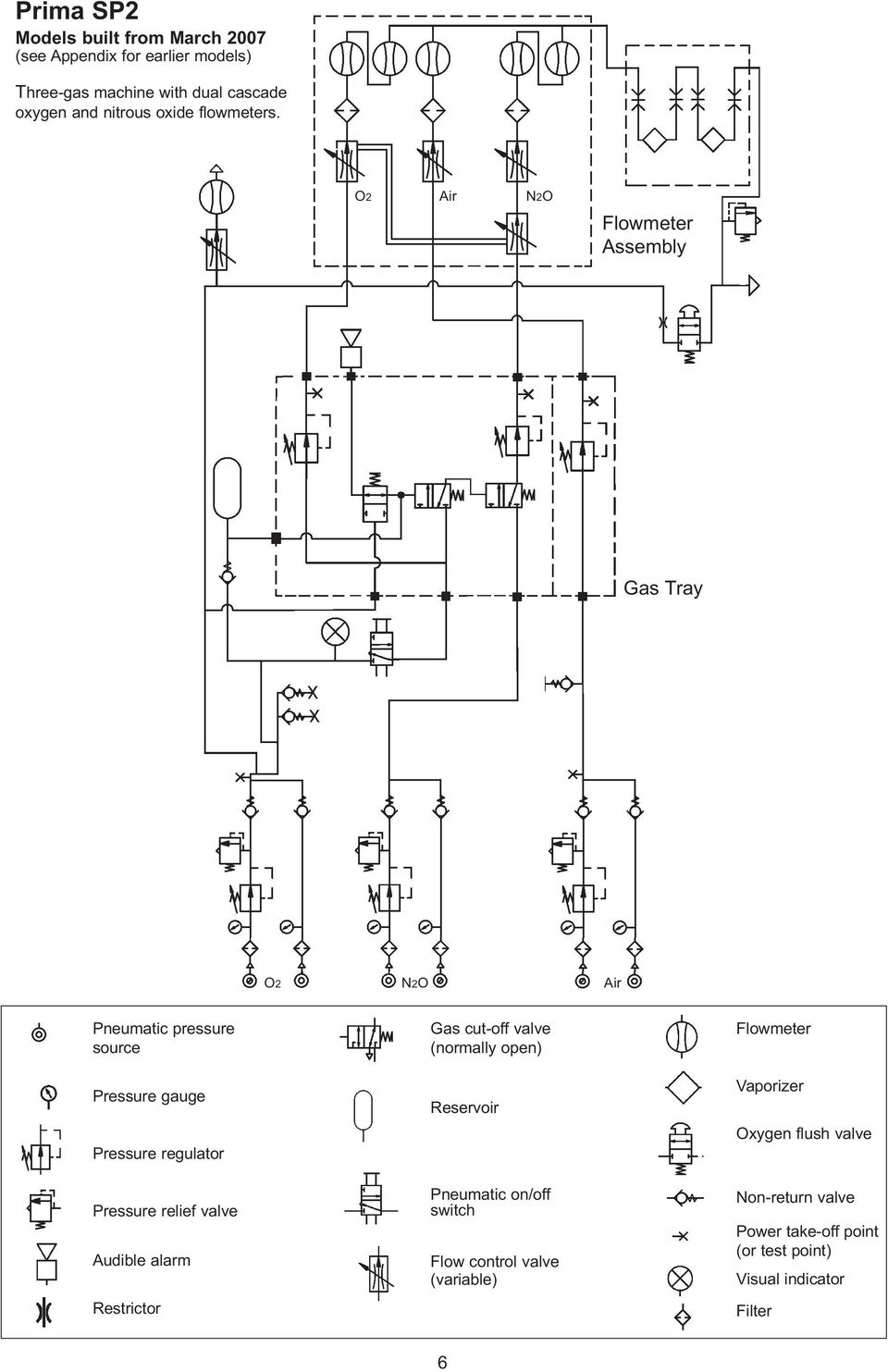
12 Prima SP2 Models built from March 2007 (see Appendix for earlier models) Three-gas machine with dual cascade oxygen and nitrous oxide flowmeters. O2 Air N2O Flowmeter Assembly Gas Tray O2 N2O Air Pneumatic pressure source Pressure gauge Pressure regulator Pressure relief valve Audible alarm Restrictor Gas cut-off valve (normally open) Reservoir Pneumatic on/off switch Flow control valve (variable) Flowmeter Vaporizer Oxygen flush valve Non-return valve Power take-off point (or test point) Visual indicator Filter 6
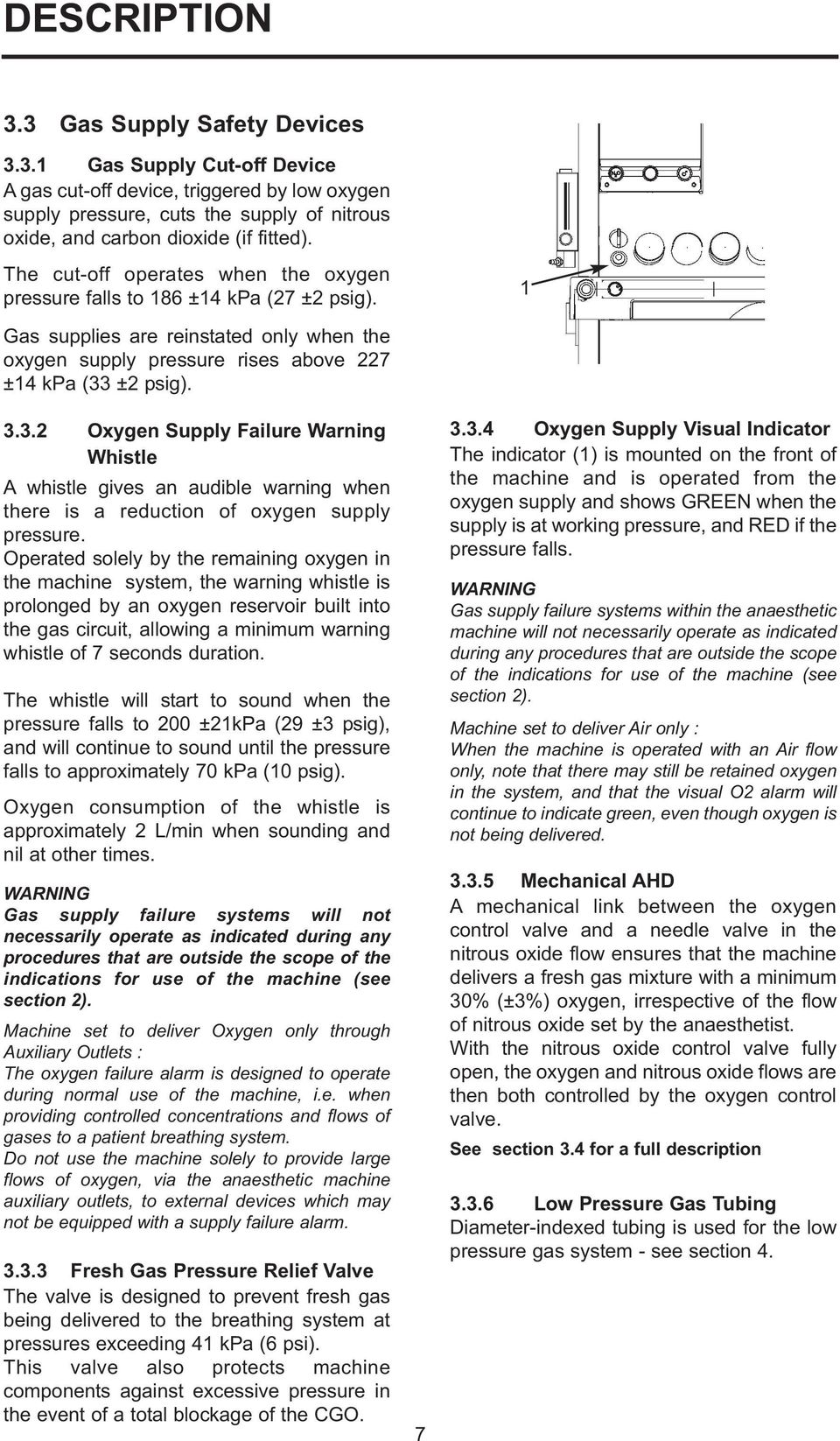
13 DESCRIPTION 3.3 Gas Supply Safety Devices Gas Supply Cut-off Device A gas cut-off device, triggered by low oxygen supply pressure, cuts the supply of nitrous oxide, and carbon dioxide (if fitted). The cut-off operates when the oxygen pressure falls to 186 ±14 kpa (27 ±2 psig). 1 Gas supplies are reinstated only when the oxygen supply pressure rises above 227 ±14 kpa (33 ±2 psig) Oxygen Supply Failure Warning Whistle A whistle gives an audible warning when there is a reduction of oxygen supply pressure. Operated solely by the remaining oxygen in the machine system, the warning whistle is prolonged by an oxygen reservoir built into the gas circuit, allowing a minimum warning whistle of 7 seconds duration. The whistle will start to sound when the pressure falls to 200 ±21kPa (29 ±3 psig), and will continue to sound until the pressure falls to approximately 70 kpa (10 psig). Oxygen consumption of the whistle is approximately 2 L/min when sounding and nil at other times. WARNING Gas supply failure systems will not necessarily operate as indicated during any procedures that are outside the scope of the indications for use of the machine (see section 2). Machine set to deliver Oxygen only through Auxiliary Outlets : The oxygen failure alarm is designed to operate during normal use of the machine, i.e. when providing controlled concentrations and flows of gases to a patient breathing system. Do not use the machine solely to provide large flows of oxygen, via the anaesthetic machine auxiliary outlets, to external devices which may not be equipped with a supply failure alarm Fresh Gas Pressure Relief Valve The valve is designed to prevent fresh gas being delivered to the breathing system at pressures exceeding 41 kpa (6 psi). This valve also protects machine components against excessive pressure in the event of a total blockage of the CGO Oxygen Supply Visual Indicator The indicator (1) is mounted on the front of the machine and is operated from the oxygen supply and shows GREEN when the supply is at working pressure, and RED if the pressure falls. WARNING Gas supply failure systems within the anaesthetic machine will not necessarily operate as indicated during any procedures that are outside the scope of the indications for use of the machine (see section 2). Machine set to deliver Air only : When the machine is operated with an Air flow only, note that there may still be retained oxygen in the system, and that the visual O2 alarm will continue to indicate green, even though oxygen is not being delivered Mechanical AHD A mechanical link between the oxygen control valve and a needle valve in the nitrous oxide flow ensures that the machine delivers a fresh gas mixture with a minimum 30% (±3%) oxygen, irrespective of the flow of nitrous oxide set by the anaesthetist. With the nitrous oxide control valve fully open, the oxygen and nitrous oxide flows are then both controlled by the oxygen control valve. See section 3.4 for a full description Low Pressure Gas Tubing Diameter-indexed tubing is used for the low pressure gas system - see section 4.
14 DESCRIPTION 3.4 Mechanical AHD (Anti Hypoxic Device) Introduction The Mechanical AHD is housed within the flowmeter module and comprises a gear linkage between the oxygen control valve and a needle valve in the nitrous oxide flow. The system controls the relative flow rates of oxygen and nitrous oxide. A predetermined minimum oxygen concentration of 30% ±3% in the oxygen / nitrous oxide mixture is maintained over the flow range to prevent delivery of a hypoxic mixture Gas Delivery Switch The Gas Delivery Switch (1) operates on the oxygen supply and must be in the On position for normal operation of the anaesthetic machine. The switch consequently controls the supply of all gases provided with a gas cut-off triggered by a predetermined pressure level within the oxygen supply (see section 3.3.1). A whistle (oxygen failure warning whistle) will sound briefly whenever the gas delivery switch is turned on or off. Note that the whistle functions continuously if the oxygen supply fails (see section 3.3.2). NOTE The switch also controls the electrical supply to the ventilator and optional flowmeter lighting unit Gear Linkage and Nitrous Oxide Control Valves A gear linkage connects the oxygen control knob on the flowmeter module and a needle valve in the nitrous oxide flow. This linkage limits the flow of nitrous oxide relative to the flow of oxygen set by the user. Note that this needle valve acts as the primary nitrous oxide valve, and is actuated only by movement of the oxygen control. The nitrous oxide control knob on the flowmeter module operates a secondary needle valve in the nitrous oxide flow. It is positioned downstream of the primary valve and therefore is used only to restrict the flow already set by the primary valve, which itself has been determined by the position of the oxygen control knob. 8 1 Therefore, for any oxygen flow set by the user, the mixture delivered will still contain a minimum 30% ±3% oxygen even with the nitrous oxide control knob fully open. As the nitrous oxide knob is progressively closed, the oxygen content of the mixture increases to 100% Oxygen Basal Flow To allow the system to function correctly, an oxygen basal flow is continuously supplied. Single Flow Tubes: ml/min Dual Cascade System Flow Tubes: ml/min This basal flow can only be turned on and off by using the Gas Delivery Switch. CAUTION The oxygen control is restricted to prevent the needle valve from fully closing. This ensures a minimum oxygen basal flow. DO NOT attempt to close the flow to zero. Do not overtighten the knob. 3.5 Pressure Gauges Pressure gauges (50 mm diameter) are located on the front panel below the flowmeter bank. The gauge for Air is positioned between oxygen and nitrous oxide. Unused gauge positions are blanked out. All pressure gauges are colour coded and labelled for the gases whose pressures they are indicating. Cylinder gauges are marked: CYLINDER. Pipeline gauges are marked: PIPELINE. The gauges are calibrated in kpa x 100.

15 DESCRIPTION 3.6 Flowmeters and Controls All models The flowmeters, mounted behind the perspex cover on the left hand side of the machine, are length-indexed to prevent inadvertent, incorrect installation. All floats indicate flow rate in line with the upper surface as shown below. Read flow at this level Dual Cascade Flow Tubes The flow of gas through dual cascade system flow tubes always flows through the low-flow tube first. The high-flow tube should not show any flow until more than 1 L/min is set. At flows above 1 L/min, the high-flow tube reading indicates the rate of flow for that gas Auxiliary Oxygen Flowmeter An auxiliary oxygen flowmeter (1) is mounted to the left of the machine flowmeter bank. Flow range: 0-10 L/min Each flow control valve is positioned directly underneath the flow tube assembly to which it corresponds, and the control knob is colour-coded for the gas which it controls. 1 The oxygen flow control knob is made physically distinguishable from the other flow controls for identification by touch in accordance with ISO standards. When fitted, air and carbon dioxide flowmeters are always installed in the inner positions on the flowmeter assembly. These positions are blanked out if air or carbon dioxide are not specified for the machine. The gas delivery switch, positioned on the front panel controls the supply of oxygen and must be in the ON position for normal operation of the machine. Flow control of each gas is achieved by a needle valve comprising a polished stainless steel needle mounted concentrically in a common manifold block. To minimise wear and material pick-up the needle seat is manufactured from silver. The flow control knob is turned counter-clockwise to increase the gas flow. CAUTION Needle valves are designed to seal with light torque and may be damaged if tightened excessively. DO NOT USE EXCESSIVE FORCE. 9

16 DESCRIPTION 3.7 Vaporizers CAUTION Read the instruction manual supplied with the vaporizer before clinical use. 3.8 Common Gas Outlet (CGO) Vaporizer Mounting Systems Selectatec compatible vaporizers for the administration of volatile anaesthetic agents can be mounted on the compatible universal backbar. WARNING Vaporizers must always be securely mounted, and never used free-standing. Unmounted vaporizers may be accidentally tipped resulting in uncalibrated and excessive volumes of liquid anaesthetic drug entering the breathing system. Vaporizers of any description must not be installed or connected between the Common Gas Outlet (CGO) and the Breathing System, unless they are specifically designed for such use. (If this is done, the oxygen flush flow will pass through the vaporizer, and severe overdosage may result) Selectatec Compatible Vaporizer Selectatec compatible vaporizers, (e.g. the Sigma Delta with the Selectatec connector block), may be mounted on a universal compatible back bar manifold. Two and three-station manifolds are available, with each station fitted with two valve capsule assemblies for vaporizer connector block attachment. When a vaporizer is installed on a station the valves on that station open automatically to allow gas flow into and out of the vaporizer. Removal of the vaporizer from the station closes the valves on that station. The outlet (1) is at the rear of the machine, and has a 22 mm male taper and concentric 15 mm female taper. The male taper incorporates the Penlon Safelock system designed to prevent accidental disconnection of the breathing system. Note - front mounted CGO available as an option. 2 Oxygen Flush An emergency oxygen flush valve button (2) is mounted at the font of the machine and is marked O2 FLUSH. Depressing the button provides a delivery of between litres/min of oxygen through the common gas outlet (1). Releasing the button allows the springloaded valve to return to its normal position. 1 Selectatec compatible vaporizer interlock systems are described in the literature supplied with the vaporizer. 10

17 DESCRIPTION 3.9 Electrical Power Supply Mains Power Supply Power is fed to the machine via the mains lead, to power an optional auxiliary output panel, and/or lighting system. 1 Mains Power Indicator The warning lamp (1) is illuminated, when mains power is connected. Current Leakage NOTE a) It is the user s responsibility to ensure that the total sum of leakage currents from additional equipment plugged into the auxiliary sockets plus the leakage current from the machine does not exceed the values specified in any relevant national standards that may apply in the country where the machine is in use. b) Each socket is protected with two 5 A fuses Auxiliary Power Supply Sockets The optional mains electricity outlet panel is fitted to the rear of the machine. The supply is controlled by an ON/OFF switch (2), which also incorporates a circuit breaker Flowmeter Bank Lighting The lighting system is controlled by a threeway switch (3). The three positions denote: A: Off B: Bright light C: Dim light 3 Battery charging takes place automatically when the ventilator mains lead is connected to a live mains supply. The OFF indicator on the ventilator front control panel will show a yellow light during charging. NOTE The stated battery back-up period will only be available if the battery is kept fully charged. If the battery has been allowed to discharge below the LOW BATTERY condition, the ventilator will not function correctly until the voltage raises above the LOW BATTERY level. A fourteen hours recharge will be necessary to bring the battery to full charge. B A C 11

18 DESCRIPTION Ventilator Power Supply The mains lead for an AV-series ventilator can be plugged into one of the auxiliary power sockets on the rear of the machine. AV-S with interface link to Prima SP (See section 3.15) a) Turn the machine Gas Delivery Switch ON. The ventilator will power-up. b) While the Prima SP power is ON, the Ventilator can be turned OFF and ON, using the ventilator On/Off switch. c) Turn the Gas Delivery Switch to OFF. The ventilator will power-down. AV-S Ventilator Back-up Battery If the power supply to the ventilator fails, the ventilator back-up battery will power the ventilator for 30 minutes, if the battery has been maintained in a fully charged condition. Refer also to the user instruction manual supplied with the ventilator Battery charging takes place automatically when the ventilator mains lead is connected to a live mains supply. The OFF indicator on the ventilator front control panel will show a yellow light during charging. NOTE The stated battery back-up period will only be available if the battery is kept fully charged. If the battery has been allowed to discharge below the LOW BATTERY condition, the ventilator will not function correctly until the voltage raises above the LOW BATTERY level. A fourteen hours recharge will be necessary to bring the battery to full charge Monitor and other Accessories The mains lead (or adaptor) for a monitor system or other accessories requiring an electrical supply can be plugged into one of the auxiliary sockets on the rear of the machine. 12
19 DESCRIPTION 3.10 Auxiliary Gas Outlets CAUTION When the auxiliary gas outlets are in use on a machine with cylinder supply only, or if the pipeline supply is not in use, check flow rate requirements, and ensure that adequate back-up cylinders are available. 1 Oxygen and Air Auxiliary outlets (1) are mounted on the rear of the machine. Supply pressure See section A200SP Absorber The A200SP Absorber and ventilator bellows assembly is mounted on a polemount bracket attached to the machine frame upright. Refer to the user instruction manual for A200SP for detailed information on installation and operation AV-S Ventilator Interface to Prima SP2/3 An interface cable links the rear of the ventilator control unit to the gas delivery switch on the anaesthetic machine. Ventilator ON/OFF function a) Turn the machine Gas Delivery Switch (C) ON. The ventilator will power-up. b) While the Prima SP2 power is ON, the Ventilator can be turned OFF and ON, using the ventilator On/Off switch (refer to ventilator user manual. c) Turn the Gas Delivery Switch to OFF. The ventilator will power-down. Refer to the user instruction manual for AV-S for detailed information on installation and operation. 13

20 4. SPECIFICATION 4.1 Physical Dimensions Overall frame size: Work surface Height: Size: Loading: Writing tablet: Top shelf: Loading: Drawers: Loading: Castors: Height x Width x Depth (cm) 139 x 71 x cm 58 cm x 25 cm 30 kg (66 lb) - evenly distributed. 30 x 22 cm 71 cm x 35 cm 30 kg (66 lb) - evenly distributed. 12 x 54.5 x 35 cm 10 kg (22 lb) evenly distributed Diameter: 5 inches Front pair braked Ventilator bellows post Bushed to accept 25.4 mm (1 inch) or 22 mm (7/8 inch) poles. Loading 30 kg (66 lb) Gas scavenging fixing Loading Bracket on frame upright 30 kg (66 lb) Common gas outlet: 22 mm male taper with coaxial 15 mm female taper connections, Safelock fitting Weight (approximate, depending on specification): 75 kg (165 lb) 14

21 SPECIFICATION 4.2 Gas Supplies Cylinders: Special order options: Pipeline: Medical gas colour codes: Oxygen Nitrous oxide Medical air Carbon dioxide Helium Xenon A maximum of four cylinder fittings can be specified All cylinder yokes are pin-indexed Helium, Xenon Maximum of three (oxygen, nitrous oxide, air). All to relevant national standards. green or White* Blue Yellow or Black/White* Grey Brown Green (bright) *To comply with relevant national standards. Internal pipework is diameter indexed for each gas: Oxygen: 8 mm Carbon Dioxide: 4 mm Nitrous oxide 6 mm Helium 4 mm Air 5 mm Xenon 4 mm Mixed gas 10 mm 4.3 Flowmeters Flow ranges: Single flow tubes Oxygen: Nitrous Oxide: Air Helium 0-10 L/min 0-10 L/min 0-10 L/min 0-10 L/min Cascade flow tubes Oxygen /Air /Nitrous Oxide (1) ml/min (2) 0-10 L/min Flowmeter Accuracy The accuracy of the flowmeter tubes is ± 2.5% of full scale reading. 15
22 SPECIFICATION Flowmeter construction and dimensions Tubes and floats are matched, and must not be interchanged. Flowmeter tubes have antistatic coatings. Tubes are length indexed: Oxygen 260 mm (10.24 inch) Nitrous oxide 250 mm (9.84 inch) Other gases 240 mm (9.45 inch) (see 3.12) Scale length 152 mm (6 in) minimum (all flow tubes except carbon dioxide) 4.4 Gas Pressures USA/ Canada/Japan UK Pipeline supplies: 340 kpa 400 kpa (50 psig) (58 psig) Cylinder supplies: Reduced pressure from regulator 310 kpa +15 kpa / -35 kpa 380 kpa +15 kpa / -35 kpa (at 5 L/min flow) (45 psig +2 psig / -5 psig) (55 psig +2 psig / -5 psig) Regulator diaphragm 2800 kpa 2800 kpa bursting pressure (406 psig) (406 psig) Reduced pressure system 600 kpa 600 kpa safety valve (87 psig) (87 psig) Safety valve 41 kpa ±10% 41 kpa ±10% (to protect flowmeter, (6 psi ±10%) (6 psi ±10%) vaporizer etc.) Reduced pressure from secondary regulators (at 5 L/min flow) Oxygen and Nitrous Oxide kpa (22-35 psi) Air kpa (30-41 psi) 4.5 Auxiliary Gas Outlets Pipeline supply: Cylinder supply: Gas is supplied at pipeline supply pressure (see above) Gas is supplied at reduced pressure from cylinder regulator (see above) Oxygen Two self sealing connections on rear of machine Total flow rate: not less than 100 L/min to free air 80 L/min against 243 kpa (36 psig) resistance 70 L/min against 270 kpa (40 psig) resistance 50 L/min against 297 kpa (44 psig) resistance Air (on machines with Air supply option) One self sealing connection on rear of machine. 16
23 SPECIFICATION 4.6 Oxygen Failure Warning Devices 1. Gas system whistle 2. Visual indicator, direct pressure operated 4.7 Oxygen Flush Button on front edge of worksurface The system supplies L/min when fully depressed. 4.8 Mechanical AHD System Minimum oxygen concentration Basal Flow Cascade flow tubes Oxygen basal flow 30% ±3% (of total O2 + N2O flow) ml/min Single Flow tubes Oxygen basal flow ml/min Reduced pressure from secondary regulators: See section Environmental Operating Conditions Temperature +10 to 38 o C (50 to 100 o F) Atmospheric Pressure range 70 kpa to 106 kpa Altitude 2438 m (8000 ft) maximum Humidity 10-95% R.H. non-condensing. Transport and storage temperature: Basic machine -5 to 60 o C (23 to 140 o F) Oxygen monitor option -5 to 50 o C (23 to 122 o F ) Cleaning Wipe external surfaces with dry or damp cloth. Use mild soap, or disinfectant solution if necessary. 17
24 SPECIFICATION 4.10 Electrical Supply Power Input NOTE: The internal power circuit feeds the machine lighting systems only. Option 1: Internal power / auxiliary power sockets US/CSA specification machines: VAC, 60 Hz, 1350 VA maximum Non-US/CSA specification machines: VAC, Hz, VA maximum Option 2: Auxiliary power outlets / No internal power US/CSA specification machines: VAC, 60 Hz, 1200 VA maximum Non-US/CSA specification machines: VAC, Hz, VA maximum Option 3: Internal power / No power outlets Non-US/CSA specification machines only: VAC, Hz, 100 VA maximum Fuses (internal power): Power cable: Power Outlets Auxiliary power outlets : Fuses Overload Protection T2AH ceramic (¼ x 1¼ inch) high breaking capacity fuses Permanently attached 3 metre lead Stowage hooks for cable on rear. Four outlets: 5 A per outlet 10 A maximum total T5AH ceramic (¼ x 1¼ inch) high breaking capacity fuse on Live and Neutral on each outlet 10 A thermal circuit breaker incorporated within the power outlet On/Off switch Electromagnetic Compatibility The Prima SP2 meets the requirements of EN (Electromagnetic compatibility - requirements and tests) 4.11 Device Classification and Labelling Type B Applied Part Degree of protection against electric shock This symbol denotes: Class 1 Classification Type of protection against electric shock: Class 1 Type B equipment IPX0 Ingress Protection Classification according to the degree of protection against ingress of water: Labelling This symbol denotes: IPX0 (not protected) Refer to the User Manual 18
25 5. PRE-USE CHECKS 5.1 Pre-use Checklist A pre-use checklist for the Prima SP2 range of machines is printed on the next page. This checklist is also supplied with the machine. Where necessary, subsequent sections in this manual provide an explanation and procedure for setting up the machine and ancillary equipment and the various checks that must be carried out before clinical use. WARNING Pre-use checks must be performed before each period of clinical use. These checks must be supplemented by periodic Function Testing, and full Service Testing by a Penlon-trained engineer to the Service Schedule given in this manual. These checks will not in themselves ensure the safe use of the apparatus, which remains the responsibility of the qualified practitioner in charge of it. 19
26 PRE-USE CHECKS PRE-USE CHECKLIST The machine must be carefully inspected and checked as follows. An incorrectly functioning machine must be repaired by a suitably qualified person before use. 1. Check for visible damage, machine stability, and condition of gas supply hoses. 2. Check for labelling which may indicate status of machine, including faults or recent servicing. 3. Check correct connection of electrical supply. 4. Check correct connections of gas supplies. 5. Check adequate pipeline supply and back-up cylinder supply. 6. Switch on gas delivery switch, and note special operating system: Check functioning of flowmeters. Check function of Mechanical AHD, 7. Check correct connection and functioning of the vaporizers. 8. Check functioning of oxygen flush. 9. Check leak rate of low pressure gas system. 10. Check the integrity of the patient circuit. 11. Test the alarm system. Refer to Section 5 in the User Manual for further information. Ancillary equipment 12. Check operation of the AGSS. 13. Check functioning of ventilator, including disconnect alarm. 14. Check that the oxygen analyser and other patient monitoring equipment functions correctly. Refer to the relevant user manual for further information. 20
27 PRE-USE CHECKS 5.2 Pre-use Checks - Gas Supply Gas Pipeline Supplies Oxygen supply: 1. Connect the oxygen pipeline hose only. Check that the correct pressure gauge reading is obtained. 2. Turn on the Gas Delivery switch (1). Check that the warning whistle sounds briefly, and that the correct basal flow of oxygen is delivered (see section 3.8). 3. Open both oxygen and nitrous oxide flowmeter valves. Check that flow is only shown in the oxygen flowmeter. 4. Close both valves. Turn off the Gas Delivery switch. Check that the warning whistle sounds briefly, and that the oxygen basal flow is stopped. Nitrous Oxide supply: 5. Connect the Nitrous Oxide pipeline hose. Check the gauge reading. Turn on the Gas Delivery switch (1). Check for a flow of nitrous oxide when the flowmeter needle valve is operated, and that the oxygen valve is open. NOTE: cylinder supply can be used if necessary for this test. Air supply: 6. Connect the Air pipeline hose. Check the gauge reading. Check for a flow of air when the flowmeter needle valve is operated. CAUTION The mechanical AHD system requires that the oxygen flowmeter control is restricted to prevent the needle valve from fully closing. This ensures a minimum oxygen basal flow. DO NOT attempt to close the flow to zero. Do not overtighten the knob Gas Cylinder Supplies CAUTION Open the cylinder valves slowly to avoid damage to the pressure reducing valve and pressure gauges. Ensure that valves are at least one full turn open when in use. 1. Fit the gas cylinders to their respective yokes, open the cylinder valves one at a time and check the pressure on each gauge. NOTE A) When two cylinders are provided for a single gas, test each separately, clearing pressure after each test by opening the flowmeter valve. B) Turn off the reserve cylinders during normal use. C) N2O - cylinder pressure does not indicate cylinder content. 2. Ensure that all flowmeters are kept closed until gas supplies are required. 21
28 PRE-USE CHECKS Flowmeters 1. Turn on the Gas Delivery switch (1) and check that the warning whistle sounds briefly briefly, and that the correct basal flow of oxygen is delivered (see section 4). 2. Open the nitrous oxide flowmeter needle valve and check that there is no nitrous oxide flow. 3. Operate the oxygen flowmeter needle valve. Check that full scale of flow of oxygen and nitrous oxide can be achieved, and that the floats in both tubes move freely and rotate when at a steady flow. 4. Check that the nitrous oxide flow can be turned off by gentle rotation of the oxygen knob. Check also that the nitrous oxide float reseats on the bottom stop, and that the oxygen basal flow continues to flow. 5. Operate the other flowmeter control knobs in turn to check: the full scale of flow can be obtained; the floats move freely and rotate at a steady flow; the flow can be turned off by gentle rotation of the knob; and that the floats reseat on the bottom stop. 6. Dual cascade flow tubes: Check that gas flow is through the low flow tube initially until full flow is achieved, then through the high flow tube. 7. Auxiliary flowmeter (2) Rotate the flowmeter control and check that a gas flow can be obtained
29 PRE-USE CHECKS 5.3 Vaporizers Pre-use Checks On ALL vaporizers, before use: 1. Check all joints for gas tightness. 2. Check vaporizer agent level. 3. Check for correct agent delivery concentrations - use an agent analyser. Always follow the procedures and checklist given in the instruction manual supplied with the vaporizer, particularly when filling the vaporizer with anaesthetic agent General Information Selectatec Compatible Vaporizers with Interlock WARNING Only vaporizers with the Selectatec compatible interlock function will interlock if installed on a two station or three station manifold. The installation of non-interlock vaporizers allows the possible operation of more than one vaporizer at the same time. If two vaporizers only are mounted on a three station manifold, they must be installed on adjacent stations. Check that the interlock mechanisms of all the vaporizers on the manifold are working correctly, i.e. check that only one vaporizer at a time can be turned on. WARNING Vaporizers must always be mounted, never used free-standing. Free standing vaporizers may be accidentally tipped resulting in excessive and uncalibrated volumes of anaesthetic drug entering the breathing system. Do not install or connect any vaporizer of any description between the CGO and the breathing system, unless it is specifically designed for such use. (This allows the oxygen flush flow to pass through the vaporizer, and severe overdosage may result) Selectatec Mounting System Dependent on choice of backbar manifold system, up to three Selectatec compatible vaporizers may be fitted. To install the vaporizer, carefully offer the vaporizer up to the manifold. Check that the gas connection ports on the vaporizer are aligned with the valves on the manifold. Carefully lower the vaporizer onto the manifold and lock the vaporizer into position by clockwise rotation of the locking lever through 90 o. NOTE Do not use excessive force to lock the vaporizer onto the manifold. Damage to the locking fastener will result. CAUTION To prevent damage to the locking shaft, ensure that the gas connection ports are aligned with the valves on the manifold, and are correctly engaged, before tightening the locking lever. 23
30 PRE-USE CHECKS 5.4 Electrical Supply 1. Connect the machine power lead to a suitable mains supply socket Set the switch (1) to ON. Check for correct function of each auxiliary power outlet 3. Check all electrical equipment, including devices powered by the auxiliary power outlets on the rear of the machine. 4. Machines with optional flowmeter lighting: Check for correct operation. 24
31 PRE-USE CHECKS - All models 5.5 Patient Breathing System Hose Connections Check that all hoses are secure Breathing System Hose, Reservoir Bag, Ventilator Connectors for the Inspiratory hose and Expiratory hose, and the reservoir bag connector are 22 mm male. All connectors comply with ISO 5356/1. The ventilator connection point is also 22 mm male. Hose and bag connections are fitted with Penlon Safelock high security fittings. Check all connections for gas tightness Fresh Gas Supply The fresh gas hose assembly supplied with the machine has a Penlon connector at the absorber inlet and a 22 mm Safelock taper at the other end. This should be connected to the common gas outlet of the anaesthetic machine. Check all connections for gas tightness A200SP Absorber Always follow the pre-use check procedures given in the instruction manual supplied with the absorber. The use of an oxygen monitor (and a carbon dioxide analyser) is highly recommended when using any partial rebreathing anaesthetic system. 3 A200SP Connections 1. Inspiratory connector 2. Expiratory connector 3. Bag connector 4. Inlet - from DRIVE GAS outlet on ventilator control unit. 5. Inlet - fresh gas hose from Common Gas Outlet 6. Exhaust outlet from APL Valve - connect to Anaesthetic Gas Scavenge System 7. Oxygen monitor sensor 8. Outlet - sample line to Pressure Monitor Port on ventilator 9. Interface cable - Bag/Vent switch and spirometer (connects internally to Prima SP On/Off Switch interface, then to connector on ventilator control unit rear panel)
32 PRE-USE CHECKS Note AV-S has spirometry and oxygen monitor. 2. Interface cabling is shown for Prima SP2 On/Off switch and A200SP Bag/Vent switch. 1. Bellows 2. Ventilator Control Unit 3. Outlets to Anaesthetic Gas Scavenging System (AGSS) 4. Bacterial Filter 5. Absorber valve block 6. Heat and moisture exchanger 7. Patient 8. CGO Block on anaesthetic machine (Fresh Gas Supply) 9. Auxiliary Outlet on anaesthetic machine (Drive Gas Supply) 10. Flow sensor - expiratory 11. Flow sensor - inspiratory 12 Connectors - sensor - pressure monitor 13. Expiratory Valve - Absorber 14. Inspiratory Valve - Absorber 15. Inlet - from Ventilator Bellows 16. Connector - Reservoir Bag 17. Inlet - Absorber - Fresh Gas Supply 18. Drive Gas Inlet - Ventilator 19. Drive gas Outlet - ventilator control unit to bellows 20. Outlet - Exhaust Valve 21. Inlet - Bellows Drive Gas 22. Outlet - to breathing system 23. Input socket - Oxygen monitor sensor 24. Input socket - Prima SP interface (SP on/off switch) 25. Input socket: (i) A200SP Absorber Bag/Vent control position (ii) Spirometer sensor signal 26. Interface connections on Prima SP and A200SP 27. APL Valve 28. Outlet from APL Valve to AGSS 29. Oxygen sensor 30. AV-S remote screen 31. Cable - AV-S control unit to screen 26
33 PRE-USE CHECKS Breathing Circuit Schematic Note 1. To protect the expiratory limb of the breathing circuit, and the spirometer, use a breathing circuit bacterial filter (4), and a heat and moisture exchanger (6) at the patient Y-piece. CAUTION Replacement/Disposal - always follow the instructions supplied with the filter or heat and moisture exchanger. Always renew components at the recommended interval. 2. Follow the instructions in the relevant user manual for connection to analysers and monitors. 3. Ventilator connections shown are for AV-S with spirometry and oxygen monitor. 4. For A200SP, refer also to the user documentation supplied with the absorber Pre-use Test for Complete System Connect the CGO outlet on the machine to the fresh gas inlet of the A200SP absorber. NOTE This machine must be fitted with a breathing system complying with approved design parameters, at the selection of the qualified practitioner. The breathing system components do not constitute part of the machine but connections between the machine and breathing system should be verified as follows: 1. Fit a patient circuit to the inspiratory connector (1) and expiratory connector (2) on the absorber, and a breathing bag to the bag arm connector (3). 2. Set the bag/ventilator switch (4) on the absorber to Bag 3. Close the adjustable pressure limiting (APL) valve (5), and occlude the patient connection port on the patient circuit. Press the oxygen flush valve button on the front of the machine briefly. Check that the reservoir bag inflates and the manometer (6) indicates approximately 40 cmh2o Release the oxygen flush valve. Check that the pressure is maintained in the system with less than 200 ml/min fresh gas delivered into the breathing system, showing that no leaks are present. 5. If this test fails, check the low pressure system on the machine (section 5.6). If the machine low pressure test is successful, check the ventilator and absorber, referring to the relevant user instruction manual
34 PRE-USE CHECKS 5.6 Machine Low Pressure Leak Test NOTE This test is necessary if the system fails the low pressure test Attach a side branch connector to the CGO outlet. Connect the side branch tube to a sphygmomanometer. 2. Turn on a flow of 150 ml/min of oxygen. Block the open port of the connector with a finger. The pressure in the low pressure gas system will rise and be displayed on the sphygmomanometer. 3. Check that the pressure rises to at least 100 mmhg. Release the finger seal immediately the pressure is reached. CAUTION Do not maintain closure of the open port longer than necessary to perform the test. This test should be performed: (a) With all vaporizers off and isolated. (b) With each vaporizer in turn set to 1%. NOTE This test is equivalent to (and in some cases exceeds) the requirements for system leakage rates quoted in national standards worldwide. 5.7 Oxygen Flush Check for a high flow of oxygen through the CGO outlet when the flush valve button is pressed and that the flow ceases when the button is released. 5.8 Anaesthetic Gas Scavenge System (AGSS) By inspection, check that all sources of expired anaesthetic gases, e.g. the absorber APL valve, and the ventilator bellows patient gas exhaust port, are connected to an approved collection system leading to an AGSS. WARNING Do not connect a vacuum system directly to the APL valve on the absorber. A receiving system with a positive and negative pressure control function must be interposed. Systems must comply with standard ISO 8835 part Ventilator Always follow the pre-use check procedures given in the ventilator instruction manual. Check all hose and tubing connections for gas tightness. Check all wiring connections for correct fitment and security. AV-S Ventilator Check for correct fitment of the interface cable at each connector. Check that the cable between the control unit and remote screen is securely in place. Check the interface system function: a) Turn the Gas Delivery Switch ON. The ventilator will power-up. b) While the Prima SP2 power is ON, the ventilator can be turned off and on, using the ventilator On/Off switch. c) Turn the Gas Delivery Switch to OFF. The ventilator will power-down. This test is most conveniently done after the breathing system has been attached, using the reservoir bag as an indicator of gas flow. 28
35 PRE-USE CHECKS 5.10 Alarm System Test WARNING The anaesthetic machine must not be used if any alarm is not functioning correctly. Primary Oxygen Failure Alarm The machine is fitted with a warning whistle and a visual indicator (1). These components act as oxygen supply failure devices and constitute the primary alarm system, powered only by the residual oxygen supply, as described in section 3. The system can be checked whenever the low pressure oxygen system is first pressurised by turning on a cylinder or connecting a pipeline. a) The whistle will sound briefly as pressure increases, and, b) The visual indicator will turn from red to green. Whistle, Visual Indicator, and Gas Cut-off Device Test A formal test (including the action of the internal gas cut-off device) is performed as follows: 1. Connect oxygen, nitrous oxide and air supplies. 2. Set the Gas Delivery switch (2) to ON, and check that the warning whistle sounds briefly. 3. Set a flow of 2 L/min on both flowmeters. 4. Disconnect the oxygen supply at the wall socket or close the oxygen cylinder valve and check: a) that as the oxygen flow slows down, the whistle starts to sound and continues for at least 7 seconds. b) that the flow of nitrous oxide is cut off completely before the oxygen flowmeter shows zero flow. c) that the visual indicator (1) turns red before the oxygen flow is entirely stopped. d) air continues to flow. NOTE All gases must be included in the pre-use check. 5. Reinstate the oxygen supply. Check that the flow of nitrous oxide is reinstated, and that the visual indicator turns green again
36 6. FUNCTION TEST 6.1 Introduction Commissioning a New Machine Every PrimaSP anaesthetic machine is tested thoroughly before leaving the factory, but it is essential to undertake a complete performance check as described in this section before the machine is first used clinically. This can be done by a Penlon trained engineer as part of the commissioning of a new machine. Regular Function Test Full function testing should be carried out, at six month intervals, by a Penlon trained engineer or other persons certificated by Penlon Limited. Procedures for servicing and repair are described in subsequent sections in this Service Manual. Safety Precautions WARNING Before commencing any test work ensure that all vaporizers are in the "Off" position. Note that the OFF position may be indicated on the vaporizer as a 0 (zero). Refer to the vaporizer instruction manual. WARNING During any test procedure the release of Nitrous Oxide or anaesthetic vapours into the working environment must be controlled. Connect the machine to an approved anaesthetic gas scavenging system (AGSS). WARNING Do not contaminate pipeline connections, cylinder yokes, regulators or pressure gauges with oil or grease, or any other flammable lubricant or sealant. Read the procedure carefully before carrying out each test, noting references to machine specifications and equipment. Perform these tests in sequence. Equipment Required No complex test equipment is required for the series of tests described below. Leak tests Apply a Leak Test Spray or a diluted solution of soap in water to the suspect connector, (not on high pressure cylinders) and check for a stream of bubbles at the joint. Flow rates Check with a respirometer or other suitable flow measurement device. Electrical circuits Check with a multi-meter. Pressure Check with a manometer. 30
37 FUNCTION TEST 6.2 Machine Frame 1. Check the main structure of the machine is firmly assembled, free from obvious distortion and damage and that all attachments are secure. 2. Check that the castor wheels are securely attached to the machine frame and that the wheels run and swivel freely. Check that each front wheel locking mechanism is working. 3. Check the drawer unit open and close smoothly. 4. Check that the writing tablet (if fitted) opens and closes smoothly. A 6.3 Electrical Safety Tests 1. Disconnect the mains lead from the electrical supply. 2. Disconnect all equipment from the auxiliary power outlet panel (A). 3. Perform Electrical Safety Tests as specified by the National Standards applicable to your country. 4. Check electrical outlet sockets for correct output and earth continuity. 31
38 FUNCTION TEST 6.4 Pipeline Gas Supply and Non-Return Valve 1. Ensure that all reserve gas cylinders are turned off, and removed from the machine. 2. Leave the Gas Delivery ON/OFF switch (1) in the "OFF" Position. 3. Check ALL Pipeline Hose assemblies for correct probes, colour coding, and attachment to the machine. 4. Inspect ALL Pipeline hoses for cracks, and check that all clips and connections are secure Connect the Oxygen Supply to the anaesthetic machine using the pipeline hose. 6. Check that the oxygen pipeline pressure gauge indicates the correct pipeline pressure. 7. Check the security of the Oxygen Hose connections by tug-testing the hose (2). Perform this test at both ends of the hose by tugging gently whilst grasping the hose between thumb and forefinger. Firm leak free joints should be maintained, without any relative movement of the spigot, ferrule or hose. Note: Renew all faulty hose assemblies Hoses: Test for leaks from each hose by brushing leak detecting fluid generously about both end fittings. 9. Pipeline Non-return Valve (NRV) Test for leaks, using a pipeline non-return valve or ball valve assembly. The leak rate should be less than 10 kpa in one minute. Alternatively, fit a tube securely to cover the hole in the centre of the Oxygen Cylinder Yoke Seal (3). Brush leak detecting fluid over the other end of the tube. Leaks will be indicated by bubbling of the fluid Dry with paper towel, fix any leaks (replace hose/nrv if necessary). 11. Connect the Nitrous Oxide Supply to the anaesthetic machine using the pipeline hose. Repeat tests 5, to 10 for this gas. 12. Connect the Air Supply to the anaesthetic machine using the pipeline hose. Repeat tests 5 to 10 for this gas. 32
39 FUNCTION TEST 6.5 Cylinder Gas Supply And Pressure Reducing Valves. CAUTION This machine is fitted with an hypoxia guard known as a Mechanical Anti Hypoxic Device (MAHD). This device prevents the delivery of hypoxic mixtures to the patient and must only be adjusted by a Penlon-trained Engineer or other persons certificated to do so by Penlon Limited. Incorrect adjustment of the MAHD could result in the failure of this device and the loss of hypoxia protection. The oxygen control is restricted to prevent the needle valve from fully closing. This ensures a minimum flow of oxygen at all times while the machine is switched on. This small flow of oxygen is known as the Basal Flow. DO NOT attempt to fully close the oxygen flow to zero. DO NOT overtighten Flow Control knobs for the other gases as this will reduce the life of the needle valves. 1. Ensure that all flowmeter control valves are shut. Disconnect all the pipeline gas supplies. 2. Remove all gas cylinders. 3. Check each cylinder yoke for security of attachment, and free movement of the clamp bar (1) and clamp screw (2). Check Pin Index system pins (3) are secure and undamaged. 4. Check that a seal (4) is in place and undamaged, in each cylinder yoke. 5. Attach each gas cylinder to its appropriate yoke, ensuring full engagement of the "Pin Index" system. Note: Use full bottles only. 6. Turn on the Oxygen Cylinder. Check that the Cylinder pressure is indicated on the Oxygen Cylinder pressure gauge in a smooth sweeping movement. Check that all other gauges indicate zero pressure. Check that there is no flow of gas indicated on the Oxygen flow tube. 7. Turn on the Gas Delivery Switch (5). Check that the warning whistle sounds briefly. Check that a basal flow of oxygen is delivered, as indicated in the table Basal Flow Cascade O2 flowmeter Single O2 flowmeter ml/min ml/min 33
40 FUNCTION TEST Leak Tests For each gas leak test, allow a minimum 2 minute period. 8. Turn OFF Gas Delivery Switch (5). 9. Turn the Oxygen Cylinder OFF. 10. Drain down the oxygen system and blank off the output of the O2 secondary regulator. Turn on the O2 cylinder then turn off again. 11. Observe the pressure gauge reading; a leak will be indicated by the needle pointer falling towards zero. Maximum acceptable leak is 500 kpa. 12. Drain down the oxygen system and remove the blank. Reconnect the output of the secondary regulator. 13. Turn the Oxygen Cylinder ON. 14. Turn the Gas Delivery Switch (5) ON (warning whistle will sound briefly). 15. Check that all flow control valves are in the OFF position and that the only flow indicated is the Oxygen Basal Flow. 16. Turn the Nitrous Oxide Cylinder ON. Check that the Nitrous Oxide pressure gauge responds in a smooth sweeping movement Check that the only Gauges indicating pressure are those for Oxygen and Nitrous Oxide Check again that the only indicated flow is the Oxygen Basal Flow. 17. Turn the Nitrous Oxide Cylinder OFF 18. Observe the pressure gauge reading; a leak will be indicated by the needle pointer falling towards zero. Maximum acceptable leak is 200 kpa. 5 Oxide and Air gauges indicate pressure. Check again that the only indicated flow is the Oxygen Basal Flow. 20. Turn the Air Cylinder OFF. 21. Observe the pressure gauge reading. A leak will be indicated by the needle pointer falling towards zero. Maximum acceptable leak is 500 kpa. 22. Turn the Air Cylinder ON. 23. Set all gas flows, as required, to 5 litres/min. 24. Connect a manometer to each Primary regulator test point in turn and check regulator is set in accordance with specification for relevant country. 25. Connect a manometer to each Secondary regulator test point in turn and check regulator is set in accordance with specification for relevant gas. 26. Reduce gas flows to minimum settings. 19. Turn the Air Cylinder ON. Check that the Air pressure gauge responds in a smooth sweeping movement. Check that the Oxygen, Nitrous 34
41 FUNCTION TEST 6.6 Flowmeter Unit 1. Visually inspect the flowmeter tubes for damage. Check that the transparent shield is in place. 2. Turn the Gas Delivery Switch (1) to ON. Check that a basal flow of oxygen is delivered, as follows: Cascade O2 flowmeter ml/min Single O2 flowmeter ml/min 1 3. Open the Oxygen Flowmeter control slowly. Check that a full flow can be obtained. 4. Set a flow rate of 6 L/min Check that the float is stable in its setting and spins freely. Repeat test at a flow rate of 500 ml/min. 5. Without rotating the control knob, check for wear by gently pulling on the knob, and check that any fluctuation in flow rate is within the range of ±100 ml/min. 6. Close the Oxygen Flowmeter control valve gently until the mechanical stop engages. 7. Check Oxygen Basal Flow (see operation 2). 8. Nitrous Oxide / Oxygen Linkage 9. Fully open the Nitrous Oxide Flow control and check that no flow is indicated on the flow tube. 10. Slowly open the Oxygen Flowmeter control and check that the Nitrous Oxide flow tube float rises. Pause briefly at an indicated Nitrous Oxide flow of 4 L/min. Check that the Nitrous Oxide flow tube float is stable in its setting and spins freely. Increase the Oxygen flow until maximum flow of Nitrous Oxide has been achieved. 11. Close the Oxygen Flowmeter control valve gently. Pause briefly when Nitrous Oxide flow indicates 500 ml/min. Check the stability of the Nitrous Oxide float and that it spins freely. Decrease the Oxygen flow until the mechanical stop engages. Check that as the Oxygen flow rate is reduced, so is the flow of Nitrous Oxide. Check again that the only flow indicated is the Oxygen Basal Flow. 12. Close the Nitrous Oxide Flowmeter control. 13. Open the Air Flowmeter control slowly and see that a full flow can be obtained. 14. Set an Air flow of 5 L/min and check that the Air flow tube float is rotating and stable. 15. Close the Air Flowmeter control gently until no gas flows. 35
42 FUNCTION TEST 6.7 Gas Safety Devices Mechanical AHD 1. Gas Delivery Switch (1) ON. Fully open the Nitrous Oxide Flowmeter and check that there is no flow of gas indicated on the N2O flow tube. 2. Fit an Oxygen Analyser to the output of the Common Gas Outlet. Refer to the table below, and check % Oxygen concentration at the oxygen flows specified. Adjust the Oxygen Flowmeter control only - Do NOT adjust the N2O flowmeter. Note The flow rates for N2O are given as a guide only. O2 Flow %O2 N2O Flow (L/min) (in O2/N2O mixture) % % % % % Turn OFF the Gas Delivery Switch. Check that both gas flows are stopped. 4. Turn ON the Gas Delivery Switch Check that both flows are reinstated. 5. Partially close the Nitrous Oxide flowmeter to check that it limits the Nitrous Oxide flow. Check that the reducing flow gives an increased Oxygen concentration. Fully open the Nitrous Oxide flowmeter. 6. Close the Oxygen flowmeter control valve gently until the mechanical stop engages. Check that the same corresponding values of Oxygen and Nitrous Oxide flows are achieved as tabled above. 7. Ensure that when the Oxygen flow is at its basal level, all Nitrous Oxide flows have ceased. Check that only the Oxygen Basal Flow is indicated on the flow tubes. Close the Nitrous Oxide Flowmeter and switch off the Gas Delivery Switch Oxygen Fail Cut-off 8. Set the following flow rates: Oxygen: 5 L/min N2O: 5 L/min CO2 (if fitted) : 500 ml/min. 9. Turn Off the Oxygen Cylinder and observe that the Oxygen Cylinder pressure gauge indicates falling Oxygen pressure. 10. Check that the warning whistle (Oxygen Fail Alarm) sounds before the supply of oxygen is exhausted from the anaesthetic machine and that its duration is a minimum of 7 seconds. 11. Check that before the supply of Oxygen is exhausted from the anaesthetic machine, that Nitrous Oxide flow is cut off automatically by the Oxygen Fail System. Oxygen Fail Warning 12. Check that before the supply of Oxygen is fully exhausted, that the visual indicator (2) has turned fully red. 13. Turn OFF all Flowmeters and turn ON the Oxygen cylinder so that only the Oxygen Basal Flow is indicated. 14. Check that the visual indicator (2) is showing fully green.
43 FUNCTION TEST 6.8 Vaporizers and Back Bar Manifold Assembly Selectatec Compatible Vaporizer 1. Check that all the vaporizers are securely mounted on the manifold. If a vaporizer is not secure, check the condition of the locking shaft (1). 2. On interlock vaporizers check that the interlock mechanism (interlock bolt, 2) of each vaporizer is working correctly, i.e only one vaporizer at a time can be turned on. 3. Selectatec Manifold - check all pillar valves open and seal correctly. Check pillar valve inserts sit proud or flush with the pillar valve. A sunken pillar valve insert denotes failure of the internal spring Cagemount Vaporizer (if fitted) Vaporizers fitted with the Cagemount tapers have the male taper (Inlet Port - 3) on the left and the female taper on the right as viewed from the front of the vaporizer. Two M6 studs with nuts, washers and a clamp plate (4) are provided to fix the vaporizer to the anaesthetic machine. 1 2 NOTE Some international standards demand that this type of vaporizer should only be used on machines with a single mounting station. In addition, use a safety clip (Catalogue No 52275) to retain the Cagemount taper cones in position on the vaporizer Fitting the Vaporizer 1. The taper cone joints must be engaged axially and not sideways loaded. Use the shims (5) provided so that the distance from the back bar to the taper joint can be adjusted by adding or removing shims from the vaporizer. 2. The cone joints should then be lightly smeared with an Oxygen compatible lubricant such as "Fomblin". The taper joints must be engaged by applying axial pressure, and the fixing nuts tightened. Check all joints for gas tightness. 3. Check flexible hoses for security of attachment and integrity. 37
44 FUNCTION TEST 6.9 Reduced Pressure Gas Circuit Leakage (Back Bar Leak Test and Pressure Relief Test) 1 Connect a suitable test pressure gauge (Manometer) to the Common Gas Outlet (CGO) using suitable tubing and connector. 2 Ensure all vaporizers attached to the machine are turned OFF. 3 Using the Oxygen Flow Control Valve, raise the pressure in the circuit slowly until a flow of 10 L/min is set. Check that the Pressure Relief Valve (PRV) mounted under the gauge cover, on the right hand side, begins to leak in the range of 37 to 45 kpa. 4 Do not exceed this pressure. 5 Alter the pressure by reducing the Oxygen Flow Rate until the displayed reading on the test gauge is 20 kpa (150 mmhg). 6 The maximum permissible flow to maintain the above pressure is 200 ml/min. 7 If a higher flow rate is required to maintain a pressure of 20 kpa (150 mmhg) there is a leak in the system that must be fixed. Use soap solution to detect leak, repair and repeat above tests (5, 6 & 7). 8 Repeat the above tests (5, 6 & 7) with all fitted vaporizers turned on (Test one at a time) to check gas tightness of each individual vaporizer. A leaking vaporizer must be withdrawn from use. Return the unit to your supplier Emergency Oxygen Flush Control Test 1 Ensure all flowmeter control valves are turned off. 2 Oxygen Cylinder is turned on and Oxygen Pipeline is unconnected from the wall outlet. 3 Depress the Emergency Oxygen Flush (O2 Flush) button. 4 Check that the delivered flow rate is between L/min. 5 Ensure the spring action cuts off the Oxygen flow when the button is released. 6. Check that the whistle does not sound when the Oxygen flush is operated. If this occurs check that the Oxygen Cylinder Valve is fully open. If the problem is not rectified, instruct the service engineer to check: a) filters and Non-return valves for restriction. b) the pressure of the primary Oxygen regulator. 7. Connect the oxygen pipeline and close the cylinder valve and repeat tests Auxiliary Outputs - Test 1 Check outputs for security and correct function. 2 With a suitable flowmeter measure the output from each outlet to ensure that greater than 100 litres/min can flow to free air. 3 Ensure that the oxygen failure alarm does not function during this test. 4. Repeat the test for both pipeline and cylinder supplies. 38
45 7. FAULT FINDING 7.1 Introduction Provided the Anaesthetic Machine is regularly serviced and correctly used, it is unlikely that serious component faults will occur. After several years usage, some items may require replacement and regular performance checks - see section 8. To trace possible faults, refer to the Fault Diagnosis Table, which will indicate the required action. In many cases, apparent machine faults may be attributable to causes other than machine malfunctions; these causes are also listed. 39
46 FAULT FINDING 7.2 Fault Diagnosis Table Component Symptom Possible Fault Remedy Cylinder pressure reducing valves, gauges and yokes. Leaking high pressure connection from cylinder to yoke. Bodok seal absent or worn. Cylinder clamp screw assembly damaged. Fit/replace seal. Replace as necessary. Inadequate engagement of pin-index system. Ensure correct gas cylinder is attached. Check index pins not loose or damaged. Replace as necessary. Pressure relief valve leaks or out of adjustment. Diaphragm or valve disc worn, damaged. Adjust/replace regulator as necessary. Faulty relief valve. Fit new relief valve. Outlet pressure too high, - may occur with leaking pressure relief valve Diaphragm worn, damaged or out of adjustment. Regulator seat damaged. Adjust/replace regulator as necessary. Replace regulator. Outlet pressure too low. Loose connections. Tighten leaking joints. (DO NOT use excessive force) Test for leaks. Diaphragm / valve disc worn/damaged or regulator out of adjustment. Adjust/replace regulator as necessary. Pressure gauge reads zero when cylinder valve opened. Cylinder empty. Bodok seal absent or worn. Replace cylinder. Fit/replace seal. Cylinder clamp screw assembly damaged. Pressure gauge seal damaged. Replace as necessary. Replace as necessary. Pressure gauge pointer sticks at above zero reading. Inadequate engagement of pinindex system. Ensure correct gas cylinder is attached. Check index pins not loose or damaged. Leaking high pressure non-return valve. Defective gauge. Defective gauge. Replace gauge. Replace gauge. Gas trapped in system. Open flowmeter and empty system. Damaged O seal. Replace plunger O seal assembly. 40
47 FAULT FINDING Component Symptom Possible Fault Remedy Pipeline supply hoses and inlet blocks Pressure gauge reads zero when connection to supply made. Loose connections. Tighten leaking joints. (DO NOT use excessive force). Test for leaks. Defective gauge. Replace gauge. Faulty probe or hose. Replace as necessary. Blocked filter. Replace as necessary. Pipeline supply defective. Contact hospital engineer. Insufficient free flow. Blocked filter. Replace as necessary. Pipeline supply defective. Contact hospital engineer. Flowmeter units Float stays at bottom of tube when control valve opened. No gas supply. Pressure reduction valve defect. Check cylinder/pipeline connections. See instructions under component group Pipeline supply defective. See instructions under component group. Control knob loose on shaft. Tighten. 41
48 FAULT FINDING Component Symptom Possible Fault Remedy Flowmeter units (Mechanical AHD system) Float stays at bottom of tube when control valve opened(n2o flowmeter) Gas delivery switch left in off position. Gear linkage loose on O2 or N2O primary valve shaft. Turn on gas delivery switch Reset gears and tighten Restricted flow through flowmeter (Control valve opening does not achieve expected flow) Gear linkage loose on valve shaft. Reset gears and tighten Incorrect O2 concentration. N2O flow limited by N2O control valve. Secondary regulators out of alignment. Open N2O control valve Check and reset secondary regulators. Replace if necessary Gear linkage loose on valve shaft. Reset gears and tighten 42
49 FAULT FINDING Component Symptom Possible Fault Remedy Flowmeter unit Float sticks at above zero reading when control valve closed. Dirt in tube. Build up of electrostatic charge. Remove tube and clean. Check earthing contacts at bottom of flowmeter tubes. Increase flow rate sharply to break charge, then close valve. Flowmeter unit not vertical. Ensure machine is on level surface. Upper float retaining peg not centralised or moulding flash not removed. Remove flow tube and retaining peg. Clean off moulding flash and re-position retaining peg. Worn needle valve. Replace complete valve and/or seat.assembly. Float level unstable after start up. Pressure reducing valve defect. See instruction under component group. Flowmeter unit not vertical. Ensure machine is on level surface. 43
50 FAULT FINDING Component Symptom Possible Fault Remedy Flowmeter unit Restricted flow through flowmeter (Control valve opening does not achieve expected flow). Faulty cylinder pressure reducing valve, yoke or connections. Faulty pipeline supply hoses or connections. Blocked flowmeter filter. Control knob loose on shaft. See instruction under component group. See instructions under component group. Clean or replace lower bobbin assembly. Tighten. Incorrect valve restriction shimming. Reset valve shims. Damaged valve seat assembly. Replace complete valve. Float level falls after initial setting. Reducing valve defect. See instructions under relevant component group. Pipeline supply defect. See instructions under component group. Leak in upstream connection. Test for leaks. Tighten leaking joints. (DO NOT use excessive force.) Blockage in downstream gas circuit. Trace site of blockage and clear. (Not oxygen flowmeter) Gas cut-off units in operation or defective. See instructions under component group. Worn needle valve and/or seat. Replace complete valve assembly. 44
51 FAULT FINDING Component Symptom Possible Fault Remedy Vaporizer mounting facility. Leakage at back bar manifold or vaporizer interlock joints. Loose manifold or vaporizer retaining screws. Tighten. Missing O seals Replace O seals. Selectatec compatible system. Leakage from back bar. Damaged or worn gas valves. Replace valve. Leakage from vaporizer connections. Vaporizer difficult to remove. Damaged or worn O seals or seal faces. Damaged or worn locking system. Replace as necessary. Replace components as necessary. Gas cut-off unit. No nitrous oxide. Oxygen supply not turned on. Turn on supply. No N2O (or restricted flow) Mechanical AHD gas delivery switch left in Off position. Turn on gas delivery switch Faulty safety capsule valve. Replace valve. Safety capsule valve fails to operate correctly. Valve shuttle or seals defective. Loose valve retaining screws. Worn or damaged O seals. Fit replacement capsule valve. Tighten. Replace seals. Vent port blocked. See instructions under component group. Leaks at joint between manifold and valve seating. Loose valve. Worn O seals. Tighten retaining screws Replace seals Valve cuts flow of nitrous oxide as required but does not restore it. Valve shuttle or seals defective. Fit replacement valve. 45
52 FAULT FINDING Component Symptom Possible Fault Remedy Warning Whistle. Leakage at whistle. Loose connection. Tighten. (DO NOT use excessive force). Faulty whistle. Replace whistle. Whistle continually sounds when oxygen on. Faulty whistle. Low pressure in circuit. Replace whistle. See instructions under component group. Whistle fails to sound. Faulty whistle. Replace whistle. Low pressure in circuit. See instructions under component group. Pressure relief valve (fresh gas circuit) Leakage through valve. High pressure in circuit. Reduce pressure. Check for blockage in downstream circuit. Relief pressure too high. Faulty valve Replace complete valve Relief pressure too low. Faulty valve Replace complete valve. 46
53 FAULT FINDING Component Symptom Possible Fault Remedy Emergency oxygen flush Valve does not operate. No oxygen supply. See instructions under component groups. Defective valve. Replace valve. Low Oxygen flow (less than 35 l/min). Low oxygen supply pressure. See instructions under components group. Worn valve seals. Fit new seals or replace valves as necessary. Incorrect adjustment of valve shaft. Replace valve. Incorrect control jet. Replace control jet. Leaks around control button. Worn valve seals. Fit new seals or replace valve as necessary. O2 flow into breathing circuit or atmosphere (valve does not shut off flow). Worn valve seals. Incorrect adjustment of valve shaft. Replace valve. Replace valve. Defective valve. Replace valve. 47
54 FAULT FINDING Component Symptom Possible Fault Remedy Electrical power supply Machine dead Mains supply /socket Check supply (plug ON). Faulty on/off switch Replace switch (front panel). Mains supply faulty. Reset circuit breaker (rear panel). 48
55 8. SERVICE SCHEDULE 1 Initial Checks 1.1 Check serial number to determine service required. 1.2 Check general condition and configuration of any attachments. 1.3 Inspect internal tubing. Replace tubing that is discoloured or has lost flexibility 2 Check Castors 2.1 Operation and security. 2.2 Locking mechanism if fitted. 3 Examine Cylinder Yoke Assemblies 3.1 Check for damage, cleanliness, all fitting are tight and clamping screws for freedom of movement. 3.2 Replace Bodok seals. 3.3 Replace yoke inlet filters. (annual service) 3.4 Replace cylinder and pipeline NRV O-rings. (4 year service) 4 Check Pipeline Hoses 4.1 Examine pipeline connectors, probes and hoses for cleanliness and damage. Replace seals if required, check for anti-confusion. 4.2 Replace hoses at 3-year intervals and date replacement hose. Note age of hose on service report. If hoses not dated work from age of machine. 4.3 Pressure Leak Test Hoses with cylinders removed and machine OFF. 4.4 Replace pipeline inlet filters. (annual service) 5 Pressure Gauge Checks 5.1 Examine each Pressure Gauge for damage. Check they read zero with no gases supplied, and operate smoothly with gases connected 6 Mechanical AHD Linkage Inspection. (annual service) 6.1 Connect O2 and switch on machine. Note basal flow reading. 6.2 Remove Rotameter control knobs. 6.3 Remove manifold block cover. 6.4 Inspect the gears for alignment, wear and damage. Reset or replace if required, lightly lubricate with Molykote BG Ensure grub screws are tight. 6.6 Refit manifold block cover and Rotameter control knobs. Ensure that basal flow is at the same rate as noted in Gas Delivery Switch Inspection. 7.1 Set a flow of 2 l/min O2 and 2 l/min N2O. Operate the Gas Delivery switch to the OFF position and ensure both flows go to zero. 7.2 Set the Gas Delivery switch to ON and ensure the flows are correctly re-instated. 7.3 Set O2 and N2O flows back to minimum 7.4 Ensure that flowmeter backlight operates, if fitted, as switch is operated Ensure that ventilator operates, if fitted, as switch is operated 49
56 SERVICE SCHEDULE 8 Check Regulators 8.1 Set relevant gas flow to 5 litres/min. Check primary regulator outlet pressures (refer to section 4 - Specification) 8.2 Replace Primary regulators. (5 year service) 8.3 Check secondary O2 and N2O regulator outlet pressures (refer to section 4 - Specification) 8.4 Secondary regulator pressures can be adjusted as required to obtain MAHD readings. Note Maximum flow rates MUST be available from the flow tubes. 8.5 Check secondary Air regulator (refer to section 4 - Specification) 8.6 Operate the gas delivery switch OFF then ON Ensure regulator returns to set value. Any regulator that cannot be correctly adjusted, or does not return to set value should be replaced 9 High Pressure Leak Checks 9.1 Turn OFF and drain all gases from machine. Unplug all pipelines from wall outlets. 9.2 Fit all cylinders if not fitted - but do not turn on 9.3 Remove 8 mm O2 pipe from output of cut-off block. (This is the O2 Basal flow feed to the Rotameter) 9.4 Blank the 8 mm O2 Connector (from which you have just removed the tubing) with the 8 mm blanking plug from your test case. 9.5 Turn on O2 cylinder. 9.6 Turn ON on/off switch. There should be no basal flow indicated on flow tube. 9.8 Turn on N2O and Air cylinders. 9.9 Turn off O2, Air and N2O Cylinders Check High Pressure for leaks on all gases (maximum allowable leak rate: O2 and Air: 500 kpa in a 2 minute period N2O : 200 kpa in a 2 minute period) Turn off O2 cylinder and drain Oxygen from system Turn OFF on/off switch Remove blanking plug and connect 8 mm O2 tube back into connector Turn on O2 cylinder Turn ON on/off switch. Check that the Oxygen basal flow has been re-instated with the O2 Rotameter fully clockwise. Check all other Rotameters are fully clockwise. 10 Check Common Gas Outlet 10.2 Check Safelock O ring, replace if necessary Replace Safelock O ring. (annual service) 10.4 Replace O2 flush valve complete with O rings x 2 and seal O ring x 1. (4 year service) 10.7 Replace flexible hose from Manifold PRV block to CGO manifold (annual service) 11 Check Emergency Oxygen Flush 11.1 Flow rate is between l/min., on cylinder and pipeline supply. Ensure O2 fail does not alarm. 50
57 SERVICE SCHEDULE 12 Check Oxygen Fail Alarm 12.1 Set O2 at 2 l/min, set N2O at 3 l/min, set Air at 3 l/min 12.2 Shut Off O2 supply Check audible warning operates between kpa dropping Check N2O ceases flowing between kpa dropping Visual indicator is Red between kpa dropping Audible warning operates for 7 seconds minimum Check that after O2 flow has ceased that Air continues to flow Turn On O2 supply. Ensure visual indicator is Green, and whistle sounds briefly. Ensure all flows are re-instated. Reset all flowmeter controls to minimum. 13 Check Flowmeter Operation 13.1 Check needle valves for smooth operation and positive off position Check flowmeter tube and freedom of bobbin Inspect flowmeter upper and lower seals, replace if necessary Replace flowmeter upper and lower seals and filters. (2 year service) 14 Additional Mechanical AHD Checks 14.1 Connect O2 monitor to CGO 14.2 Turn On Gas Delivery switch. Ensure whistle sounds briefly Ensure a basal flow: ml/min (Cascade machines), ml/min (single flow tube machines) Fully open N2O control and ensure No N2O flow Slowly increase O2 control throughout range. Ensure reading correspond to table below: - Set O2 Flow Observe N2O Flow Observe N2O Monitor L/min L/min % O2 0.25* % 0.5* % % % % * Denotes Cascade machines only 15 Additional Mechanical AHD Checks 15.4 Partially close N2O control Ensure N2O flow is reduced and O2% increases. Fully open N2O control. Set O2 flow at 8 l/min Gradually decrease O2 control ensuring readings correspond to table above. When fully closed basal flow should be: ml/min (Cascade flowmeter) ml/min (single tube flowmeter) Fully close N2O control 15.7 Refit flow tube cover 51
58 SERVICE SCHEDULE 16 Check Back Bar Assembly (Selectatec fitting only) 16.1 Replace selectatec O rings Replace vaporizer-locking springs. (annual service) 16.4 Ensure pillar valves protrude, check for positive spring function Gently twist valve body and ensure valve is secure 17 Fresh Gas Pressure Relief Valve Occlude CGO Outlet with a manometer 17.2 At 10 l/min PRV relieves at 41 kpa ± 10% 18 Leak Test From Flowmeter to Common Gas Outlet Occlude CGO with manometer Set flow to maintain a pressure of 20 kpa (3 psi). If flow is greater than 200 ml investigate and rectify internal leak Repeat this check on all stations with and without vaporizers fitted, and with vaporizers On and Off Remove manometer from CGO. 19 Auxiliary Outlets 19.1 Check auxiliary outlets for minimum of 100 l/min to free air. 20 Final Gas Concentration Test 20.1 Carry out final gas concentration tests using the table below: All machines Set O2 Set N2O Set Air O2 Concentration Check No. L/min L/min L/min % ± 2% % ± 2% % ± 2% Additional check for machines with CO2 (not available on US spec machines) Set O2 Set N2O Set CO2 O2 Concentration L/min L/min L/min % ± 2% 22 Electrical Safety Checks 22.1 Earth Continuity (Max 0.2 ohms) at 1 Amp or less 22.2 Insulation Resistance (not less than 20 Meg Ohms) at Vdc 22.3 Earth Leakage (Max 500 micro amps) 22.4 Enclosure Leakage (Max 100 micro amps) 22.5 Check Flow tubes for continuity from glass tube to metal contact clip. Approx. 5 kohms Fit Electrical Safety Test Label if requested to do so by hospital. 23 Paperwork 23.1 Fill out appropriate service report. 52
59 9. SERVICING PROCEDURES 9.1 Servicing The Prima SP2 range of anaesthetic machines must only be serviced by a Penlon-trained engineer to the following service schedule: Every 6 months Inspection and Function Check Every 12 months Annual service which includes routine replacement of seals, etc. as preventive maintenance At 3 years interval Pipeline hoses - replace At 5 years interval Primary regulators - replace Every 2 and 4 years Additional tests / component replacement Details of these service operations are given in this Prima SP2 Service Manual, available only to Penlon trained engineers. Mechanical AHD System Additional servicing for the mechanical AHD system only. Function Test (At 6 month intervals, see section 6.7 Additional Servicing (At 12 month intervals) Secondary Regulators - check pressure setting Gear linkage - inspect Service Tools Regulator Spanner - Regulators manufactured by Gas Arc 9.2 Ancillary Equipment Sigma Delta Vaporizer Follow the instructions given in section 8 of the user instruction manual. These include: Every 6 months Function test and calibration test Every 10 years Major overhaul (if unit to be used beyond 10 years). Note: Halothane vaporizers - major overhaul required at 5 years. On vaporizers with interlock, test the function of the interlock system during the vaporizer calibration test Monitor Follow the service recommendations detailed in the monitor user instruction manual AV-S Ventilator If the anaesthetic machine was supplied with an AV- series ventilator, refer to section 7 of the ventilator user instruction manual, for servicing requirements. These include: 6 months Inspection and Function Check 12 months Replace bellows Replace O seals and drive gas inlet filter, etc. 24 and 48 months Additional component replacement Anaesthetic Gas Scavenging System Follow the service recommendations detailed in the AGSS user instruction manual Flow setting tool 53
60 SERVICING PROCEDURES 9.3 Cleaning and Sterilisation Frequently wipe over the external surfaces of the machine, the vaporizers, with a damp cloth. Always allow the machine to dry off thoroughly before using it. (Mild antiseptic solutions may be used but should be rinsed off with clean water.) Circle System Absorber A200 Absorber 6 months Inspection and Function Check 12 months Component replacement. 48 months Additional component replacement Removing the Absorber Assembly CAUTION The canister (1) may contain condensate. Before removing the absorber from the pole-mount assembly, refer to the A200SP user manual for instructions on draining the canister and disposing of absorbent. 1. Set the brakes on the anaesthetic machine front castors. 2. Slacken the knob (2), and lift the absorber assembly from the polemount User Maintenance The Prima SP series user manual states that user maintenance is restricted to cleaning the external surfaces of the machine All other maintenance and servicing must only be carried out by Penlon-trained engineers. The Prima SP2 must be only be serviced according to the schedule and procedures given in this Service Manual. Breathing system hoses and other components must be sterilised to the manufacturer s recommended methods. Monitor Refer to the monitor user instruction manual. Ventilator AV-series Ventilator Bellows Assembly Cleaning The user must follow the detailed instructions included in section 7.5 of the ventilator user instruction manual. Never use any hard object or abrasive agent to clean any of the components, only a soft cloth. If the valve seat is damaged, the diaphragm valve will leak and this may cause serious malfunction. CAUTION Do not use any cleaning solution containing alcohol or any harsh abrasive cleaning agent on the bellows housing. Sterilisation The user must follow the detailed instructions included in section 7 of the ventilator user instruction manual. WARNING Do not autoclave the bellows housing. The exhalation diaphragm valve assembly must be disassembled prior to sterilisation - do not sterilise the diaphragm. 54
61 SERVICING PROCEDURES 9.4 Internal Gas System Pipework Identification Internal pipework is colour coded and diameter indexed, as follows: Colour codes Oxygen Nitrous Oxide Medical Air Tubing diameter Oxygen Nitrous Oxide Medical Air Mixed Gas Green (or White, on non-us specification machines) Blue Yellow (or Black/white on non-us specification machines) 8 mm 6 mm 5 mm 10 mm Tubing Connectors Push-in type fittings are used throughout the low pressure circuit To connect and disconnect the tubing from the connectors, follow the procedures detailed below. Do not use excess force. A Disconnecting tubing from connector Push in the tube and the connector end piece A. Hold the end piece A in place. Pull the tube out to disconnect. Fitting tubing to connector Push in the tube as far as possible Do not use excessive force. The connector end piece A will also move inwards. Pull the tube carefully outwards. The end piece A will be pulled outwards to the locked position. A 55
62 Gas System Components Rear view CGO outlet (optional front position also shown ) 2. Oxygen flush button 3. High pressure regulator 4. High pressure block 5. Low pressure block 6. Test point - low pressure block 7. Fresh gas pressure relief valve 8. Pipeline supply inlet block 9. Auxiliary outlets 10. Secondary regulator 11. Test point - primary regulator 12. Vaporizer Manifold block 13. Warning whistle 14. Oxygen failure visual indicator 15. Gas delivery switch 16. Therapy Flowmeter 56
63 SERVICING PROCEDURES O2 Circuit (March 2007 onwards) Reservoir To O2 Flowmeter To N2O Flowmeter Supply in to Warning Whistle O2 / N2O Gas Block Non-return Valve N2O In O2 In Oxygen Supply Visual Indicator Gas Delivery On/Off Switch O2 Pipeline Supply Block O2 Sensing line To Auxiliary Outlet To Oxygen Flush 57
64 SERVICING PROCEDURES 9.5 Front Cover - Remove and Refit CAUTION Ensure that any residual gas in the machine is exhausted before commencing the dismantling procedure. Removal 1. Remove all cylinders, and disconnect Pipeline supply hoses. 2. At the rear of the machine, slacken the screws (1) securing the gas blocks. 3. Remove the two top fixing screws (2) securing the panel to the front of the machine. 4. Slacken each screw (3) on the side of the machine, to loosen the side clamp plates. 5. Carefully pull the cover (4) away from the front of the machine. Note that the gas delivery switch and oxygen fail Refit 6. Line up the cover with the gauges and switches. 7. Check that the clamp plate on each side of the machine is positioned to allow the sides of the cover to fit between each plate and the frame. 8. Carefully push the cover into place. 9. Screw in the top fixings (2). Do NOT tighten. 10. Tighten the clamp plate screws (3). 11. Tighten the top fixings (2). 12. At the rear of the machine, tighten the screws (1)
65 SERVICING PROCEDURES 9.6 Flowmeter Cover Removal 1. Slacken the screws (1) securing the spacer strip (2). 2. Remove the screws (3) and top guard (4). 3. Remove the cover (5). 4 3 Refitting 4. Reverse the removal procedure
66 SERVICING PROCEDURES 9.7 Mechanical AHD System Check and Adjust Basal Flow Cascade flowmeter models Oxygen basal flow Single flowmeter models ml/min ml/min Oxygen basal flow NOTE: The machine must be on a flat surface. 1. Check that all flowmeter controls are OFF. 2. Switch the gas delivery switch (1) to ON. 3. Check that a basal flow of oxygen is indicated, as shown above. If the basal flow is outside the range given above: a) adjust the output of the secondary Oxygen regulator, (see section 9.7.2) to achieve the correct basal flow. b) check the oxygen concentration, see section Switch the Gas Delivery switch to OFF. 5. If the correct basal flow can not be achieved, reset the gear linkage - see section
67 SERVICING PROCEDURES Check Oxygen Concentration NOTE: The machine must be on a flat surface. 1. If the machine is not fitted with an Oxygen monitor, connect a stand-alone analyser to the CGO outlet. 2. Set the Gas Delivery switch (1) to ON. 3. Turn the Nitrous Oxide flowmeter control to maximum Refer to the table below, and check % Oxygen concentration at the oxygen flows specified. Adjust the Oxygen Flowmeter control only Do NOT adjust the N2O flowmeter. Note that flow rates for N2O are given as a guide only. 3 4 O2 Flow %O2 (in O2/N2O mixture) N2O Flow 0.25 L/min % L/min % L/min % L/min % L/min % If the %O2 concentration is outside the range given above, at any of the set flows, adjust the output of either or both of the secondary regulators, as follows: 5. Switch the Gas Delivery switch to OFF. 6. Remove the front cover - follow the procedure given in section 9.5. Retighten the screws (2) securing the gas blocks. Reconnect the cylinder and pipeline supplies. 7. Attach a pressure gauge to the regulator test point (3 - oxygen, or 4 - nitrous oxide). 8. Switch the Gas Delivery switch to ON To increase output: turn the regulator cap, (5 or 6) slowly clockwise. To decrease output: turn the regulator cap fully anticlockwise, then clockwise to the correct setting. Maintain the output pressure within the range: 2 Secondary regulator pressure kpa (22-35 psi) 10. If the correct basal flow can not be achieved, reset the gear linkage - see section Recheck the Oxygen Concentration. 61
68 SERVICING PROCEDURES Gear Linkage - Reset Cascade and Single Flowmeter Tube Systems NOTE: The machine must be on a flat surface. Set the secondary regulators 1. Set the Gas Delivery Switch (1) to OFF. 2. Disconnect all pipeline and cylinder supplies Remove the front cover - see section 9.6. Retighten the screws securing the gas blocks. Reconnect the cylinder and pipeline supplies. 4. Attach a pressure gauge to the oxygen regulator test point (2). 5. Set the Gas Delivery Switch to ON. 6. Set a flow of 5 L/min Oxygen. Reset the O2 secondary regulator to 172 kpa (25.0 psi) To increase output: turn the regulator cap, (3) slowly clockwise. To decrease output: turn the regulator cap fully anti-clockwise, then clockwise to the correct setting Return the flow to minimum. 9. Attach a pressure gauge to the N2O regulator test point (4) Set a flow of 5 L/min nitrous oxide. Reset the N2O secondary regulator to 186 kpa (27.0 psi). To increase output: turn the regulator cap, (5) slowly clockwise. To decrease output: turn the regulator cap fully anti-clockwise, then clockwise to the correct setting. Return the flow to minimum Set the Gas Delivery Switch (1) to OFF. Gear Linkage 12. Remove the flowmeter control knobs (6), screws (7) and control knob cover (8). 13. Loosen the grubscrews and remove the O2 gear (9) and small N2O gear (10)
69 SERVICING PROCEDURES 14. Check the condition of the gears and grubscrews. Replace with new components if necessary. Clean all traces of Loctite from the grubscrews and apply new Loctite Check that each gear slides easily on its shaft. 16. Set the Gas Delivery Switch to ON. 17. Open the N2O valve to maximum, to check full flow. 18. Close the valve gently until the N2O bobbin ceases to rotate. Do not over tighten the valve when closing - this will cause irreparable damage to the valve seat. 19. Fit the O2 gear (9) on the shaft. 20. Fit the O2 control knob and open the O2 control valve, to check full flow. Cascade Flowmeter Tube Models: Close the valve until a flow of ml/min is obtained. Single Flowmeter Tube Models: Close the valve until a flow of ml/min is obtained. 21 Distance the inner face of the O2 gear (9) with a 0.1 mm feeler gauge at A. Tighten the grubscrews (10) to secure the O2 gear. Check the flow returns to the basal flow set in operation 20, above A 22. With the O2 gear against the stop, replace the N2O gear (11) and push on so that the front faces of the gears are flush, see X-X as illustrated. Note that the rear face of the N2O gear is closer to the manifold block than the O2 gear. 12 X Tighten the grubscrews (12) to secure the N2O gear. Apply a small amount of Molycote BG87 grease, evenly distributed, to the O2 and N2O gear teeth. 12 X 24. If the machine is not fitted with an Oxygen monitor, connect a stand-alone analyser to the CGO outlet. 63
70 SERVICING PROCEDURES 25. Check Oxygen concentration: Turn the Nitrous Oxide flowmeter control to maximum. Refer to the table below, and check % Oxygen concentration at the Oxygen flows specified. Adjust the Oxygen Flowmeter control only - Do NOT adjust the N2O flowmeter. Note The flow rates for N2O are given as a guide only. O2 Flow %O2 N2O Flow (in O2/N2O mixture) 0.25 L/min % L/min % L/min % L/min % L/min % If the %O2 concentration is outside the range given above, at any of the set flows, adjust the output of either or both of the secondary regulators - see NOTE Maintain output pressures within the range: kpa (22-35 psi) 26. Check the Oxygen basal flow - see Recheck the Oxygen Concentration. 28. Remove the O2 control knob. 29. Carefully refit the control knob cover (8) and screws (7), ensuring that the basal flow does not change. Fit the O2 and N2O control knobs
71 SERVICING PROCEDURES 9.8 Control Valve Capsule Removal/Replacement CAUTION Needle valves are designed to seal with a light torque only and may be damaged if tightened excessively Note: There are no user serviceable components within each flow control valve capsule (1). This procedure relates only to the exchange of the complete, factory set, valves. 1. Remove all gas cylinders and disconnect all gas pipeline hoses. CAUTION Ensure that all gas supplies are exhausted before commencing these procedures. High pressure gas can fire the valve out of the machine. 2. Remove the cover and flowmeter knobs, as detailed in section To remove a capsule, first loosen the grub screws (2) and remove the gear (3). 5. To replace the flow control valve, lightly smear the O-seals (5) with Fomblin and insert the capsule into the manifold block. 6. Align the two slots (6) with the securing screw holes, and refit the screws and washers (4). 7. If necessary reset the gears, as detailed in section 9.7.3, and check the gas flows. 8. Replace the flowmeter knobs and cover. 9. Perform a function test, section Undo the two securing screws and washers (4) and withdraw the capsule (1). 65
72 SERVICING PROCEDURES 9.9 Secondary Regulators Check and Reset Pressure Output 1. Turn the Gas Delivery Switch (1) to OFF. 2. Disconnect all pipeline and cylinder supplies 1 3. Remove the front cover - see section 9.5. Retighten the screws (2) securing the gas blocks. Reconnect the cylinder and pipeline supplies. 4. Attach a pressure gauge to the oxygen regulator test point (3). 5. Turn the Gas Delivery Switch to ON. 6. Set a flow of 5 L/min Oxygen. Reset the Oxygen secondary regulator to the figure given in the table. 7. To increase output: turn the regulator cap, (4) slowly clockwise. To decrease output: turn the regulator cap fully anti-clockwise, then clockwise to the correct setting. 8. Return the flow to minimum Attach a pressure gauge to the nitrous oxide regulator test point (5). 10. Set a flow of 5 L/min nitrous oxide. Reset the N2O secondary regulator to the figure given in the table. To increase output: turn the regulator cap, (6) slowly clockwise. To decrease output: turn the regulator cap fully anti-clockwise, then clockwise to the correct setting. Return the flow to minimum. 11. Turn the Gas Delivery Switch to OFF. 12. Check the oxygen basal flow - see section Check % oxygen concentration. - see section Secondary regulators Pressure output at 5 L/min flow: Oxygen and Nitrous Oxide kpa (22-35 psi) Air kpa (30-41 psi) 66
73 SERVICING PROCEDURES 9.10 High Pressure (Cylinder) Gas Block Remove and Refit CAUTION Ensure that any residual gas in the machine is exhausted before commencing the dismantling procedure. 1. Remove all cylinders and disconnect all pipeline supplies. 2. At the rear of the machine, remove the two screws (1) at the rear of the block to be removed. Refer to if necessary. 3. Remove the screws (2) at the rear of the adjacent gas block. 4. At the front of the machine, carefully pull the blocks (3 and 4) from the machine. Separate the blocks - detach the block (4) from the tubing connector (5). 5. To refit. reverse the above procedure and then carry out a full function test (see section 6) Yoke Filter - Remove and Refit CAUTION Ensure that any residual gas in the machine is exhausted before commencing the dismantling procedure. 1. Remove all cylinders and disconnect all pipeline supplies. 2. Remove the Bodok seal (1). 3. Unscrew the yoke insert (2). 4. Use a suitable rod to carefully remove the filter (3). 5. To refit. reverse the above procedure. Fit a new Bodok seal. Function test the machine (see section 6)
74 SERVICING PROCEDURES 9.11 Selectatec Compatible Manifold Block 1. The valve capsule top O-seal (arrowed A on the illustration) must be regularly changed to prevent the possible occurrence of leaking Check for splitting, perishing, and expansion, and also check if the seal is sticking to the vaporizer. A To ensure satisfactory performance: a. ALWAYS perform a leak test before using the manifold block or after changing the vaporizer. b. Replace these O-seals regularly (maximum 6 months interval). DO NOT apply grease or lubricant Overhaul CAUTION Ensure that any residual gas in the machine is exhausted before commencing the dismantling procedure. Removal 1. Remove all cylinders and disconnect all pipeline supplies. 2. Remove the front cover, (see section 9.6), to gain access to the manifold block. 3. Disconnect the inlet and outlet fresh gas hoses. 4. Remove the screws at the rear of the machine, to allow removal of the manifold block. Overhaul and Refit 5. Dismantle the block as illustrated. 6. Renew all O-seals. 7. To refit. reverse the dismantling procedure. Function test the machine - see section 6. 68
75 SERVICING PROCEDURES 9.12 Flowmeter Tubes - Removal CAUTION Ensure that any residual gas in the machine is exhausted before commencing the dismantling procedure. Removal 1. Remove all cylinders and disconnect all pipeline supplies. 2. Remove the flowmeter cover, (see section 9.7). 3. Hold the tube, as illustrated, and press upwards (X) against the resistance of the spring. 4. Carefully detach the lower end of the tube from the bobbin. 5. Remove the tube, ensuring that the top bobbin remains in place (Y). Overhaul - Bobbin Assemblies 6. Remove and refit the components, as illustrated below, taking care not to damage the O-seals when refitting the bobbins. Refitting the Flowmeter 7. Reverse the removal procedure, noting: a) the scale must be centralised. b) the tube is touching the contact strip (1). 8. Carry out a machine Function Test - section 6. X 1 Y 0293 O-seal Bobbin Washer 0691 O-seal Washer Bobbin 0691 O-seal 0293 O-seal 0508 Filter Bobbin Bobbin Cascade flowmeter system illustrated. On non-cascade models, a filter (0508) is fitted to each flow tube. 69
76 SERVICING PROCEDURES 9.13 Flowmeter Assembly - Removal CAUTION Ensure that any residual gas in the machine is exhausted before commencing the dismantling procedure. 2 Removal 1. Remove all cylinders and disconnect all pipeline supplies. 2. Disconnect the machine from the mains electrical supply. 3. Remove the flowmeter cover, (see section 9.6). 4. Remove the four screws (1) securing the flowmeter assembly to the machine frame Disconnect the tubing (2) where necessary to allow the removal of the flowmeter assembly. Refitting 6. Reconnect the tubing at the back of the flowmeter assembly - see section Reverse the removal procedure. 8. Carry out a machine Function Test - section 6. 70
77 SERVICING PROCEDURES 9.14 Oxygen Monitor Sensor Sensor - Cleaning and Disinfection In case of contamination the sensor may be cleaned with distilled water and allowed to dry naturally. CAUTION The sensor is not suitable for sterilisation by steam or exposure to chemicals such as ethylene oxide or hydrogen peroxide. Do not immerse the sensor in any cleaning solution. Do not autoclave or expose the sensor to high temperatures. Sensor Replacement WARNING The sensor contains: a) A small quantity of electrolyte, classified as a harmful irritant which is potentially hazardous. b) Lead Do not attempt to open a cell. ALWAYS check the integrity of the sensor assembly before use. Once exhausted, the sensor must be disposed of according to hospital, local, state and federal regulations. Sensor Unit - Remove and Refit 1. Pull out the cable connector (A) from the expired sensor (B). 2. Remove sensor from the absorber or Tee adaptor. 3. Discard the expired sensor and flow diverter (C). 4. Insert the cable connector into the new sensor (B). 5. If necessary, screw the new flow diverter (C) onto the new sensor, and fit new O rings. 6. Fit the assembly into the absorber. 7. Reconnect the cable 8. Calibrate the new sensor, see section Dispose of the used components according to hospital regulations and relevant national legislation. A B Sensor location on A200SP Absorber C Replacement part number Sensor assembly 71
78 10. PARTS LIST Preventive Maintenance Kits (PMKs) Prima SP2/3 range is serviced on a 6 month; 1 year; 2 year; and 4 year cycle. 6 month Kit Part No year Kit Part No year Kit Part No year Kit Part No NOTE: 1. Pipeline hoses must be replaced at three years 2. Primary regulators must be replaced at five years. 72
79 PARTS LIST Prima SP2/3 Range Preventive Maintenance Kit 6 Month Service Part No Kit Contents Part No Qty. Component Description Bodok Seal O-ring - Selectatec O-ring - Safelock Connector on CGO outlet 016 Bodok Seal O-ring 043 O-ring 73
80 PARTS LIST Prima SP2/3 Preventive Maintenance Kit 12 Month Service Part No Kit Contents Part No Qty. Component Description m Hose - Backbar Outlet to CGO (not shown) Hose Support Seal Support Split O-ring Dzus Clip O-ring - Selectatec (2 station shown) Bodok Seal Filter - Yoke and Pipeline O-seal - Safelock O-seal - Hose assembly - Backbar outlet to CGO (not shown) 043 O-ring Dzus Clip Split O-ring Seal Support O-ring Hose Support 016 Bodok Seal 0762 Filter - Yoke and pipeline 74
81 PARTS LIST Prima SP2/3 Preventive Maintenance Kit 24 Month Service Part No Kit Contents Part No Qty. Component Description m Hose - Backbar Outlet to CGO (not shown) Hose Support Seal Support Split O-ring O-ring - Selectatec Bodok Seal Flowmeter Bobbin - Metal with Filter Flowmeter Bobbin - Metal without Filter Filter - Yoke and Pipeline Filter - Flowmeter Flowmeter Bobbin - Tube Seals Washer Shock Washer O-seal - Flowmeter O-seal - Safelock mm Tubing - Sample Block Dzus Clip O-seal - Hose Assembly (backbar to CGO outlet) - not shown O-seal - Flowmeter Tube 016 Bodok Seal 0762 Filter - Yoke and pipeline 75
82 PARTS LIST Preventive Maintenance Kit - 24 Month Service 0293 O-seal Bobbin Washer 0691 O-seal Washer Bobbin 0691 O-seal 0293 O-seal Bobbin 0508 Filter 0508 Filter Bobbin Split O-ring Seal Support Dzus Clip Hose Support O-ring 043 O-ring 76
83 PARTS LIST Prima SP 2/3 Preventive Maintenance Kit 48 Month Service Part No Kit Contents Part No Qty. Component Description O-ring - Selectatec Bodok Seal Flowmeter Bobbin - Metal with Filter Flowmeter Bobbin - Metal without Filter Filter - Yoke and Pipeline Filter - Flowmeter Flowmeter Bobbin - Tube Seals Washer Shock Washer O-seal - Flowmeter Tube O-seal - Flowmeter Tube m Tubing: CGO (O2 fush button to rear outlet) O-seal - Safelock Clippard Valve - Oxygen Flush O-ring - Oxygen Flush Clippard Valve O-ring - Cylinder/Pipeline NRV Hose Support Seal Support Split O-ring Dzus Clip Following not shown: m Hose - Backbar Outlet to CGO O-seal - Hose assembly - Backbar Outlet to CGO Dzus Clip Split O-ring Seal Support O-ring Hose Support 016 Bodok Seal 0762 Filter - Yoke and pipeline 77
84 PARTS LIST 0691 O-ring 0691 O-ring Tubing 0691 O-seal 043 O-ring 0314 O-ring Important Apply a small amount of Loctite 243 to the threads of this screw when refitting Clippard Valve 0293 O-seal Bobbin Washer 0691 O-seal Washer Bobbin 0691 O-seal 0293 O-seal Bobbin 0508 Filter 0508 Filter Bobbin 78
85 PARTS LIST Main Assemblies and Miscellaneous Components Note that parts lists for sub-assemblies are on following pages Item Part No. Description Quantity Screw - M4 X 10 SKT HD Cap Screw - M6 X Screw - M6 X Screw - M5 x Washer - M Screw - M4 X 40 Slotted CSK SS Screw - M4 x 10 Pan Head SS Screw - M4 x 12 But CB Screw - M4 X 10 LG CSK HD, ST STL Screw - M6 X 16 SKT Button HD SS Screw - M4 x 10 But Flanged HD Screw - M8 X 10 LG Selector Switch O2 + N2O Manifold Assembly (secondary regulators) Air Manifold Assembly (secondary regulator) Coupling Visual indicator (oxygen failure) Product Label Cable Retainer Pipe - Flush In (Ø8) Pipe - Flush Out (Ø8) Pipe - O2 In (Ø8) Pipe - CGO (Ø10 ) Frame Assembly Fresh Gas Manifold Gas Bar Installation Auxiliary Outlet Assembly Gauge Cover Backbar Assembly Vertical Access Panel Top Shelf Assembly 1 Parts List continues on following pages 79
86 80
87 PARTS LIST Main Assemblies and miscellaneous parts (continued) Note that parts lists for sub-assemblies are on following pages Item Part No. Description Quantity Flowmeter O2+N2O Cascade CGO Outlet Plug CGO Outlet Gauge Cover Clamp Plate Dome Plug Ø28.0 Black 2 37* V Bracket GCX Assembly 1 38* V Bracket Assembly RH Forward Therapy Flowmeter Assembly 1 40* Cable Management 1 41* Hook Drip Pole Assembly 1 42* On Off Label 1 43* Label (Visual indicator - oxygen failure) 1 44* Label - Auxiliary Outlet 1 45* Label - CGO Outlet 46* Label - Lighting 1 47* Power Supply Unit Mains Lead 1 48* Lighting PSU 1 49* Lighting Loom PSU M6 X 10 SKT Cap SCR. ST ST Pipe - Back Bar 1 52* Backbar (Selectatec 2 station) Safety Panel Electrical Panel - Int. Power CSA Pipeline Connector USA Reservoir (Norgren) 1 81
88 PARTS LIST Fresh Gas Manifold Item Part No. Description Quantity Gas Block Outlet Connector Coupling Elbow - 8mm Tube O-ring Ø0.45 X CS Elbow - 10 mm Tube mm Outlet Male Connector 1 82
89 PARTS LIST Gas Regulator Bar Assembly Item Part No. Description Quantity High Pressure Gas Block Air (USA) High Pressure Gas Block O2 (USA ) Low Pressure Gas Block (Air) Stem Adaptor Coupling b Screw - M6 X O-ring - G 1/8 Plug C/W Low Pressure Gas Block N2O Low Pressure Gas Block O2 (USA ) High pressure Gas Block N2O 1 83
90 PARTS LIST Auxiliary Outlet assembly Item Part No. Description Quantity Auxiliary Outlet Block O2 Outlet (DISS 1240) Dowty Seal G 1/ Plug (G 1/8) complete with O-ring Elbow 8 mm Tube 1 84
91 PARTS LIST Backbar Manifold Assembly - 3 Station Selectatec Item Part No. Description Quantity Three Station Backbar - Selectatec Compatible Backbar Sealing Screw O-ring Ø19.1 X Ø1.6 Viton /4 Ball Location Button Screw (M5 X 12 SKT HD) Valve Capsule Screw (M4 X 12 SKTHD) Clip Retaining Plate Screw (M2.5 X 6) Dzus Spring Interlock Peg Nut (M2.5) Stem Adaptor PRV Manifold Block Label - Leak Check Dowty Seal G1/ Outlet Connector PRV Warning Label Coupling 2 85
92 PARTS LIST Backbar Manifold Assembly - 2 Station Selectatec Item Part No. Description Quantity Valve Capsule Screw (M4 X 12 SKT HD) Location Button Screw (M5 x 12 SKT HD ) Clip Retaining Plate Screw (M2.5 X 6) Interlock Peg DZUS Spring Nut (M2.5) Label Leak Check Coupling Stem Adaptor PRV Manifold Block PRV Dowty Seal G1/ Outlet Connector b 2 Station Backbar 1 86
93 PARTS LIST Therapy Flowmeter Item Part No. Description Quantity Flowmeter GCX Bracket Therapy Flowmeter Coupling Hose Tail M5 X 40 SKT HD Cap Flowmeter Adaptor Block O Ring Ø6.1 X Ø M6 X 16 SKT Set Screw ST STL Cup Point M5 X 30 SKT HD Cap 2 87
94 PARTS LIST Flowmeter Assembly Item Part No. Description Quantity Flowmeter Overlay M4 x 10 CSK ST STL CHEM BLK Label N2O Flow Tube Cover Knob N2O, Air, CO Anti-Tamper (3 Hole) M4 x 35 Cap Head SS Label O2 US Knob O Flow Tube N2O Cascade Flow Tube N2O Low Needle Valve - N2O Spur Gear 50 Teeth Spur Gear 20 Teeth Spring Ø7.62 X LG /4 Ball Screw - M3 X Needle Valve Assembly - O Needle Valve Assembly - N2O - left-hand thread Spacer Plate Top Cover Flowmeter Panel Prima Us Label Cascade Mixing Chamber M3 X 6 LG SKT HD Stop Pin M3 Plain Washer Elbow 8 mm Tube Elbow 10 mm Tube Flow Tube O2 Low Flow Tube O2 Cascade 1 Parts List continues on following pages 88
95 PARTS LIST 89
96 PARTS LIST Flowmeter Assembly (continued) Item Part No. Description Quantity M4 X 12 SKT HD Cap A/R Ø8 Mm Tube M4x6 Grubscrew Cup P t SS M4 X 4 LG Grub Screw M4 X 8 LG Grub Screw M4 Nut Elbow 6 mm Tube Coupling Tube Conn A/R Ø6 mm Tube Label Air Product Label PNA A/R Ø6 mm Tube Flow Tube Low Air Flow Tube Air Needle Valve - Air Elbow 5 mm Tube Tube Conn A/R Ø5 mm Tube Manifold Block Panel - Flowmeter US 1 90
97 PARTS LIST 91
98 PARTS LIST Electrical Panel Assembly Item Part No. Description Quantity Electrical Panel (CSA 102 INT PWR) Fuse Holder /4 Spade Red Crimp, Shrouded Crimp Connector 3/ Mains Socket CSA Eyelet Connector M5 Red Fuse (2 A Ceramic) Nut (M4) Wire (18 AWG PVC Equip green/yellow - CSA) Circuit Breaker (110 v 10 amp) Wire (black 16/30 (18 AWG) PVC Equip) wire (white 16/30 (18 AWG) PVC Equip) Fuse (5 A Ceramic, HR) INT Star Washer M M5 Plain Washer - ST ST Nut (M5) Earth Label M4 Int. S. Proof Washer Mains Wiring Colour Label 1 20 See Mains Lead Wiring Ref O2 Monitor Mains Lead 1 92
99 PARTS LIST 93
100 PARTS LIST Frame Assembly Item Part No. Description Quantity Base Casting Castor Castor (with brake) Main Leg M/C Front Leg LH Front Leg RH Work Surface Assembly Main Box Assembly Top Shelf Side Panel Mounting Strip M6 X 30 SKT C/SK SS Ø16 Spring Washer M8 X 20 ST ST Button HD Cylinder Support M4 X 10 LG CSK HD, ST STL Back Panel M8 X 30 LG Cap Screw M8 X 25 LG Cap Screw Bump Stop M4 Plain Washer M4 x 20 Cap Head SS Gas Carrier 102 SS M6 X 12 LG Cap Screw M6 X 12 Button HD SS Main Box Clamp Plate M6 X 16 SKT Button HD SS M4 x 10 But Flanged HD M4 x 12 Pan Head SS Tube Hook Drawer Runner (Set) Draw Assembly Installation Elesa Lock CSU.13/ Boxing Plate Ø20 Washer SS Dome Plug Ø M4 X 12 LG CSK HD Lighting Sub Assembly M3 X 10 LG Pan HD 2 94
101 PARTS LIST 95
102 PARTS LIST 96
103 PARTS LIST Work Surface Assembly Item Part No. Description Quantity O2 Push Button Assembly Work Surface Rail M/C M4 x 20 Cap Head Ss Work Surface Rail Bracket M3 X 20 SS SK HD Slide Out Work Surface M4 Plain Washer M4 X 14 SKT HD Cap Worksurface M4 X 10 Button HD Worksurface Runner 2 97
104 APPENDIX Prima SP2 Schematic for models built up to March 2007 USA specification three-gas machine with dual cascade oxygen and nitrous oxide flowmeters. O2 Air N2O Flowmeter Assembly Gas Tray O2 N2O Air 98
105 APPENDIX Key to Gas Schematic Pneumatic pressure source Filter Pressure gauge Pressure regulator Pressure relief valve Audible alarm Restrictor Gas cut-off valve (normally open) Reservoir Pneumatic on/off switch Flow control valve (variable) Flowmeter Vaporizer Oxygen flush valve Non-return valve Power take-off point (or test point) Visual indicator 99
106 APPENDIX APPENDIX 1 Product Classification and Labelling Terminology The terms Class 1 and Type B are defined in IEC (the standard for electrical medical equipment). This symbol denotes: Type B equipment Type B equipment calls for a particular degree of protection against electric shock. Class 1 equipment has additional protection such that metal parts of the unit that are accessible to the user (e.g. the metal casing of the oxygen monitor unit) cannot become live in the event of failure of the basic insulation of the electrical components within the unit. This symbol denotes: Refer to the User Manual! APPENDIX 2 Disposal at end of useful life - risk assessment There are no risks associated with disposal of this product. Follow your hospital, local, state and federal regulations. Check the relevant user manual for information relating to disposal of major system components - AVS ventilator, Delta Vaporizer, A200SP Absorber. 100
107
108 Cat. No Doc. No. PR SP2/ SM January 2008 Penlon Ltd All rights reserved. Penlon Limited Abingdon Science Park Barton Lane Abingdon OX14 3PH UK. Technical Support Tel: 44 (0) Fax: 44 (0) UK Sales Tel: Fax: International Sales Tel: 44 (0) Fax: 44 (0)
Understanding Anesthetic Delivery Systems Dean Knoll, CVT, VTS (Anes.) Anesthesia Technician Supervisor University of Wisconsin Madison, WI May 2003
 Understanding Anesthetic Delivery Systems Dean Knoll, CVT, VTS (Anes.) Anesthesia Technician Supervisor University of Wisconsin Madison, WI May 2003 Knowing the functions of the anesthetic delivery system
NITROUS TRANSFER PUMP INSTRUCTIONS
 NITROUS TRANSFER PUMP INSTRUCTIONS SAFETY TIPS Never directly inhale nitrous oxide. When inhaled in large quantities, nitrous oxide can cause respiratory ailments or in extreme cases, death by suffocation.
Anesthesia Solutions. Prima SP2 Anesthesia Systems. The Future of Anesthesia. Partnership for Life
 Anesthesia Solutions The Future of Anesthesia Prima SP2 Anesthesia Systems The Penlon Anesthesia System Range provides the user with their choice of advanced, easy to use anesthesia systems u Advanced
Porter Instrument Division
 AA173200i Parker Hannifin Corporation Porter Instrument Division 245 Township Line Road Hatfield, PA 19440 USA Tel: 215-723-4000 Ref. 10545100 Rev. F CE Notice The symbol on this product indicates compliance
Druck PV 62x pneumatic/hydraulic pressure stations
 GE Sensing & Inspection Technologies Druck PV 6x pneumatic/hydraulic pressure stations safety and quick reference guide - K08 A. PV 6: Pneumatic pressure station (Figure A.) -90 mbar to 0 bar (-3. to 300
SELECTION, APPLICATION AND MAINTENANCE
 DIESEL PROTECTION SYSTEMS Automatic Diesel Engine Shut Down System for Safe Area Applications SELECTION, APPLICATION AND MAINTENANCE Series 300 Series 310 SYSTEM DESCRIPTION Suitable for attended engine
NÜVE SANAYİ MALZEMELERİ İMALAT VE TİCARET A.Ş. OT 020 BENCH TOP STEAM STERILIZER USER S MANUAL
 NÜVE SANAYİ MALZEMELERİ İMALAT VE TİCARET A.Ş. OT 020 BENCH TOP STEAM STERILIZER USER S MANUAL NÜVE SANAYİ MALZEMELERİ İMALAT VE TİCARET A.Ş. Esenboğa Yolu 22 km Akyurt - ANKARA / TURKEY Tel : (00 90 312)
SECTION G2: CABLE PROCESSOR MODULE MAINTENANCE
 SECTION G2: CABLE PROCESSOR MODULE MAINTENANCE Cable Processor Module overview WARNING! When tipping the Cable Processor Module back, (after removing the toggle arm pin), use extreme caution not to drop
Your safety and the safety of others are very important.
 NATURAL GAS TO PROPANE CONVERSION KIT 090 INSTALLATION INSTRUCTIONS FOR ALTITUDES 0 -,00 FT. ONLY PROPANE CONVERSION KIT SAFETY... INSTALLATION REQUIREMENTS... Tools and Parts... LP Gas Requirements...
Float and Thermostatic Traps Series H, C and X
 Hoffman Specialty Installation & Maintenance Instructions HS-(E) and Thermostatic Traps Series H, C and X Series C & NPT Series C NPT Series X NPT Series C NPT Series H Ratings Maximum Max. Operating NPT
TECHNICAL BULLETIN. Meritor WABCO Cab Leveling Valves and Chassis Leveling Valves. How the Cab Leveling and Chassis Leveling Valves Work
 Revised 02-00 TECHNICAL BULLETIN Meritor WABCO Cab Leveling Valves and Chassis Leveling Valves This technical bulletin covers both cab and chassis leveling valves manufactured by Meritor WABCO. While the
FJ2. 2 Ton Trolley Floor Jack Assembly & Operating Instructions
 FJ2 2 Ton Trolley Floor Jack Assembly & Operating Instructions READ ALL INSTRUCTIONS AND WARNINGS BEFORE USING THIS PRODUCT. This manual provides important information on proper operation & maintenance.
INFRARED QUARTZ WALL HEATER
 INFRARED QUARTZ WALL HEATER MODEL NO: IQ2000 PART NO: 6939004 MOUNTING & OPERATION INSTRUCTIONS GC0715 INTRODUCTION Thank you for purchasing this CLARKE Infrared Wall Heater. Before attempting to use this
MODEL T200-F18 MODEL T125-F18 Finish Nailers
 P MODEL T200-F18 MODEL T125-F18 Finish Nailers IMPORTANT! DO NOT DESTROY It is the customer s responsibility to have all operators and service personnel read and understand this manual. OPERATING MANUAL
Hydraulic control unit series 0086-372-01
 Technical Product Information No. 1290 EN Hydraulic control unit series 0086-372-01 Contents Page About this Technical Product Information (TPI) 2 The ORTLINGHAUS numbering system 2 About the product 3
V94 BULK TAPE DEGAUSSER
 TECHNICAL MANUAL Operating and Maintenance Instructions for V94 BULK TAPE DEGAUSSER V94 BULK TAPE DEGAUSSER TECHNICAL MANUAL Document No. M000208 Production Standard ZZ 009 415 WARNING To help minimise
REB 1 REB 3 REB 5 REB 6 REB 8 REB 10 REB 12 REB 16
 REB 1 REB 3 REB 5 REB 6 REB 8 REB 10 REB 12 REB 16 Manually Operated Electronic Speed Controller Single Phase For all applications using suitably specified single-phase induction motor fans 1 GENERAL The
VANGUARD A OPERATOR S MANUAL PORTER. FM-952 Rev. E 7/07
 PORTER Parker Hannifin Corporation Porter Instrument Division 245 Township Line Rd. P.O. Box 907 Hatfield, PA 19440-0907 USA (215) 723-4000 / fax (215) 723-5106 VANGUARD A OPERATOR S MANUAL FM-952 Rev.
Operating Instructions & Maintenance Guidelines for Precision Vaporizers
 Operating Instructions & Maintenance Guidelines for Precision Vaporizers This page intentionally blank. Examination and Preparation for Use We want you to be completely satisfied with your vaporizer. Please
OPL BASIC. Dosing System for Professional Laundry machines. Contents
 OPL BASIC Dosing System for Professional Laundry machines Contents 1 Getting Started. Page 2 2 Installation. Page 4 3 Set Up & Operation. Page 8 4 Maintenance & Accessories. Page 10 5 Troubleshooting Page
PBX Series Quick Fit Connector Bimetallic Steam Traps
 6262100/6 IM-P626-01 ST Issue 6 PBX Series Quick Fit Connector Bimetallic Steam Traps Installation and Maintenance Instructions 1. Safety information 2. General product information 3. Installation 4. Commissioning
SunMaxx Solar Filling Station Operating Instructions
 SunMaxx Solar Filling Operating Instructions Content 1. Declaration of conformity... 2 2. Introduction... 2 3. Transportation and unpacking... 4 4. Mounting and commissioning... 5 5. End of operation...
Element D Services Plumbing
 Medical Vacuum and Gas PART 1 - GENERAL 1.01 OVERVIEW A. This section addresses medical vacuum, waste anesthetic gas disposal, compressed air, oxygen, nitrous oxide, nitrogen and carbon dioxide systems.
USER INSTRUCTIONS FOR 10 LITRE PORTABLE DEHUMIDIFIER MODEL NO. DHMD102
 USER INSTRUCTIONS FOR 10 LITRE PORTABLE DEHUMIDIFIER MODEL NO. DHMD102 THANK YOU FOR CHOOSING YOUR NEW DEHUMIDIFIER. BEFORE USING THE UNIT READ THESE INSTRUCTIONS FULLY AND RETAIN THEM FOR FUTURE REFERENCE
EASIDEW PORTABLE HYGROMETER INSTALLATION, OPERATION AND MAINTENANCE MANUAL
 EASIDEW PORTABLE HYGROMETER INSTALLATION, OPERATION AND MAINTENANCE MANUAL Issue February 2004 2 TABLE OF CONTENTS SECTION PAGE 1. INTRODUCTION 3 1.1 General 3 1.2 Ceramic Sensing Element 3 1.3 Calibration
National- Spencer Inc.
 9-27-2010 National- Spencer Inc. 19.2V HEAVY DUTY GREASE GUN PRODUCT SPECIFICATION Charger Input Power 110 VAC Battery Output Power 19.2V Battery Capacity 1500 MAH Battery Pack Charge Time 1 Hour Maximum
Please also see 10 golden rules for correct Saniflo installation on www.saniflo.co.uk
 1. Description Sanicom is a lifting pump for wastewater used in commercial applications (restaurants, hairdressing salons, the catering industry etc.). The unit operates automatically, has a high performance
Threaded Inline Air Heaters
 Threaded Inline Air Heaters FOR SAFETY & LONG HEATER LIFE, CAREFULLY READ THIS MANUAL BEFORE USE. Safety SHOCK HAZARD! Only qualified individuals should install this heater and related controls. Follow
DIGITAL ALARM II FOR HOSPITALS AND LABORATORIES INSTALLATION AND OPERATING INSTRUCTIONS 52 635.0
 Form No. 74-00-4001 S168-195-001 Revision E DIGITAL ALARM II FOR HOSPITALS AND LABORATORIES INSTALLATION AND OPERATING INSTRUCTIONS 52 635.0 INTRODUCTION Allied Healthcare Products, Inc. s Digital Alarm
Bench Autoclave. Standard Operating Procedure. For Installation, Use and Maintenance
 Bench Autoclave Standard Operating Procedure For Installation, Use and Maintenance 1. Introduction This SOP is intended for use with the following model, in a laboratory context: Type: Nuve Bench Top Steam
Boaray 700 Anesthesia Machine
 Boaray 700 Anesthesia Machine Features CE certification. 15 inch colored LCD, touch screen setting, big font display, free changeable angles of views. Various ventilation modes - VCV, PCV, SIMV+VCV, SIMV+PCV.
Advantium 2 Plus Alarm
 ADI 9510-B Advantium 2 Plus Alarm INSTALLATION AND OPERATING INSTRUCTIONS Carefully Read These Instructions Before Operating Carefully Read These Controls Corporation of America 1501 Harpers Road Virginia
CARING FOR YOUR WATER HEATER
 http://waterheatertimer.org/troubleshoot-rheem-tankless-water-heater.html Water Heater Inspections CARING FOR YOUR WATER HEATER Venting System (Direct Vent Only) The venting system should be inspected
NewAir AC-10000E, AC-10000H Portable Air Conditioner Owner s Manual PLEASE READ AND SAVE THESE INSTRUCTIONS
 NewAir AC-10000E, AC-10000H Portable Air Conditioner Owner s Manual PLEASE READ AND SAVE THESE INSTRUCTIONS BEFORE USE GENERAL SAFETY INSTRUCTIONS: ALWAYS OPERATE THE UNIT IN AN UPRIGHT POSITION AND PLACE
Introduction. Safety Guidelines. Part Numbers. Operation and Maintenance Manual. Operation and Maintenance Manual
 Operation and Maintenance Manual Introduction Read all instructions thoroughly. Installation of the OilTector must comply with all Federal, State and Local Codes, Regulations and Practices. The OilTector
Model 43AP Pneumatic Controller, Style B
 Instruction MI 011-476 January 1980 Model 43AP Pneumatic Controller, Style B Installation and Operation Model 43AP Controller continuously detects the difference between a process measurement and its set
- 2 - IMPORTANT SAFETY REMINDERS
 USER MANUAL IMPORTANT SAFETY REMINDERS This appliance should only be used for domestic cleaning, as described in this user guide. Please ensure that this guide is fully understood before operating the
Parker Hannifin Corporation Porter Instrument Division 245 Township Line Road Hatfield, PA 19440 USA. REF. 10049600 Rev. L
 REF. 10049600 Rev. L Parker Hannifin Corporation Porter Instrument Division 245 Township Line Road Hatfield, PA 19440 USA TABLE OF CONTENTS WARNINGS 2 DESCRIPTION AND MECHANICAL ASSEMBLY 2 CONNECTION
Operation Manual. 150 Watt Halogen Light Source for Endoscopy Model # s ESS-150, ESS-150A ESS-220, ESS-220A
 Operation Manual 150 Watt Halogen Light Source for Endoscopy Model # s ESS-150, ESS-150A ESS-220, ESS-220A Endoscopy Support Services, Inc. Croton River Executive Park Route 22, Bldg. 3 Brewster, NY 10509
SBC90. Abrasive Blast Cabinet Assembly & Operating Instructions
 SBC90 Abrasive Blast Cabinet Assembly & Operating Instructions READ ALL INSTRUCTIONS AND WARNINGS BEFORE USING THIS PRODUCT. SAVE THESE INSTRUCTIONS FOR FUTURE REFERENCE. This manual provides important
INSTALLATION INSTRUCTIONS Fan Coil Replacement Coil Kit EBX & EBXX
 Fan Coil Replacement Coil Kit EBX & EBXX These instructions must be read and understood completely before attempting installation. These instructions covers the installation of replacement coil kit into
SELECTION, APPLICATION AND MAINTENANCE
 DIESEL PROTECTION SYSTEMS D-Series Engine Automatic Overspeed Shut Down Valves (Spindle Types with Air Pressure and Manual Shut Down Options) SELECTION, APPLICATION AND MAINTENANCE Valve Numbers D92-AP
Portable Air Conditioner
 Portable Air Conditioner Owner's Manual Model:3 in 1 12,000 Btu/h Series 3 Please read this owner s manual carefully before operation and retain it for future reference. CONTENTS 1. SUMMARY...1 2. PORTABLE
36G22, 36G23, 36G24 & 36G52 36J22, 36J23, 36J24 & 36J52 DSI and HSI Single Stage Combination Gas Valve
 Operator: Save these instructions for future use! FAILURE TO READ AND FOLLOW ALL INSTRUCTIONS CAREFULLY BEFORE INSTALLING OR OPERATING THIS CONTROL COULD CAUSE PERSONAL INJURY AND/OR PROPERTY DAMAGE. DESCRIPTION
Failure to comply with the following cautions and warnings could cause equipment damage and personal injury.
 1.0 IMPORTANT RECEIVING INSTRUCTIONS Visually inspect all components for shipping damage. Shipping Damage is not covered by warranty. If shipping damage is found, notify carrier at once. The carrier is
CDS TROUBLESHOOTING SECTION I. VACUUM. 1.0. Weak vacuum at wand. Gauge reads normal (10hg to 14hg)
 CDS TROUBLESHOOTING SECTION I. VACUUM 1.0. Weak vacuum at wand. Gauge reads normal (10hg to 14hg) 1.1. Clogged hoses or wand tube. Disconnect hoses and carefully check for an obstruction. 1.2. Excessive
FLUORESCENT UV- RING LIGHT OPERATING INSTRUCTION
 FLUORESCENT UV- RING LIGHT OPERATING INSTRUCTION Caution! UV-radiation of this device is in the range of UV-A (320-400 nm). Direct exposure to eyes shall therefore be avoided. UV protection glasses shall
For over 40 years, the leader in. nitrous oxide. equipment technology.
 Conscious Sedation Delivery Systems For over 40 years, the leader in nitrous oxide equipment technology. Made in U.S.A. Over 40 years ago Fraser Sweatman pioneered the technology used for safe delivery
Scope: Applies to the various anesthesia vaporizers used to deliver a known concentration of vaporized liquid. Sample. Type Interval Time Required
 Anesthesia Vaporizers Procedure No. 436-20081015-01 ( Major ) Used For: Anesthesia Unit Vaporizers [10-144] Commonly Used In: Operating rooms, emergency departments, delivery rooms, trauma departments,
Compressed Gas Cylinder Program
 Department of Environmental Health & Safety Procedures Compressed Gas Cylinder Program March 2010 Compressed Gas Cylinder Program Page 1 of 8 Table of Contents I. Introduction II. III. IV. Policy Scope
ecomax Instructions for use Wall hung room sealed fan assisted condensing boilers For the user
 For the user Instructions for use ecomax Wall hung room sealed fan assisted condensing boilers ecomax 63/ E ecomax 68/ E ecomax 6/ E ecomax 635 E ecomax 84/ E ecomax 88/ E ecomax 835 E GB Table of contents
15GAL STEEL OIL DRAIN WITH 110V PUMP
 15GAL STEEL OIL DRAIN WITH 110V PUMP OWNER S MANUAL WARNING: Read carefully and understand all ASSEMBLY AND OPERATION INSTRUCTIONS before operating. Failure to follow the safety rules and other basic safety
INSTRUCTION MANUAL CIRRO MK 3/TYPE 2 MIST GENERATOR
 INSTRUCTION MANUAL CIRRO MK 3/TYPE 2 MIST GENERATOR INTRODUCTION The Cirro MK 3 is a fully professional mist generator for producing sufficient airborne reflection particles to enable effect lighting to
WIKA INSTRUMENT CORPORATION
 WIKA INSTRUMENT CORPORATION Instruction Manual GAUGE PRESSURE INDICATOR Series 1500 Series 1000 Series 300 WIKA Instrument Corporation 1000 Wiegand Boulevard Lawrenceville, GA 30043 1-888-945-2872 http://www.wika.com
GenStore Archive Cabinet
 GenStore Archive Cabinet Setup and Maintenance Manual Version A April 2014 Two GenStore Archives shown mounted on optional table stand. 2 Contents Getting Started... 4 Using this Manual...4 Safety Precautions...4
AUTOMATIC CHANGEOVER MANIFOLD Series 915
 AUTOMATIC CHANGEOVER MANIFOLD Series 915 FEATURES Fully automatic, simple, hassle-free operation No variance in delivery pressure Designed for ultra high purity gas service Built-in audio and visual alarm
FLR 1000 & 1000-BR Series Flow Sensors & Meters For Gases
 FLR 1000 & 1000-BR Series Flow Sensors & Meters For Gases READ THIS MANUAL COMPLETELY BEFORE ATTEMPTING TO CONNECT OR OPERATE YOUR FLOW SENSOR. FAILURE TO DO SO MAY RESULT IN INJURY TO YOU OR DAMAGE TO
12 Volt 30 Amp Digital Solar Charge Controller
 12 Volt 30 Amp Digital Solar Charge Controller User s Manual WARNING Read carefully and understand all INSTRUCTIONS before operating. Failure to follow the safety rules and other basic safety precautions
IMPORTANT SAFETY INSTRUCTIONS WARNING READ AND SAVE THESE OPERATING AND SAFETY INSTRUCTIONS BEFORE USING THIS HEATER.
 THERMAWAVE CERAMIC HEATER Model HZ-850 Series Model HZ-860 Series IMPORTANT SAFETY INSTRUCTIONS WARNING READ AND SAVE THESE OPERATING AND SAFETY INSTRUCTIONS BEFORE USING THIS HEATER. Warning Failure to
Single Deadman 150 psi (10.3 bar) Air Lifting Bag (ALB) Controller
 Specifications Single Deadman 150 psi (10.3 bar) Air Lifting Bag (ALB) Controller Introduction These purchase specifications cover the minimum requirements of a Single Deadman Air Lifting Bag (ALB) Controller
ARCO Electric Products Installation and Maintenance Manual Low Voltage Automatic Power Factor Correction Capacitor Systems 2013
 ARCO Electric Products Installation and Maintenance Manual Low Voltage Automatic Power Factor Correction Capacitor Systems 2013 READ CAREFULLY These instructions are intended to cover good practices in
POSEIDON 2-29, 2-25 & 2-22 POSEIDON 2-29, 2-25 & 2-22 XT
 POSEION 2-29, 2-25 & 2-22 POSEION 2-29, 2-25 & 2-22 XT Repair Manual Index A. Safety precautions 3 B. Technical data 4 C. Structure 5-6. Service / Repair 7-23 E. Tools 24 F. Function 25-26 G. Electric
Before installation it is important to know what parts you have and what the capabilities of these parts are.
 INSTALLATION GUIDE Before installation it is important to know what parts you have and what the capabilities of these parts are. The Recon XZT is the smallest and most powerful gauge of its kind. With
RI-215A Operator s Manual. Part Number: 71-0045RK Revision 0 Released: 10/3/05
 RI-215A Operator s Manual Part Number: 71-0045RK Revision 0 Released: 10/3/05 Warranty RKI Instruments, Inc., warrants gas alarm equipment sold by us to be free from defects in materials and workmanship,
MODEL G300 BRAKE BLEEDER
 MODEL G300 BRAKE BLEEDER Installation, Operation & Repair Parts Information Branick Industries, Inc. 4245 Main Avenue P.O. Box 1937 Fargo, North Dakota 58103 REV060616 P/N: 81-0035G 1 THIS PAGE INTENTIONALLY
EPM3. Phase Sequence and Motor Rotation Tester. Users Manual
 EPM3 Phase Sequence and Motor Rotation Tester Users Manual 1 L1 L2 L3 2 3 A B C CAT 600V 3-PHASE TESTER 5 TEST M1 M2 BATT M3 EPM3 MOTOR ROTATION TESTER EPM3 MOTOR ROTATION DETERMINED WHILE FACING MOTOR
Please keep these operating instructions in a safe place.
 Please keep these operating instructions in a safe place. Dear Customer: Check this product for visible damage immediately upon receipt. Inform the shipper if there is any shipping damage. Note that damage
MP-4V Heavy Duty Riveter / 39048
 MP-4V Heavy Duty Riveter / 39048 This newly designed heavy-duty air/hydraulic riveter is ergonomically designed with the professional in mind. The light weight 3.7 lbs. well balanced MP-4V includes a Vacuum
Part I - Installation
 400 Series Pressure and Differential Pressure Switches Types: H400, H402, H403, H400K, H402K, J400, J402, J403, J400K, J402K UNITED ELECTRIC CONTROLS Installation and Maintenance Instructions Please read
Installation and User Instructions Unvented Electric Storage Water Heater Models: S10UNV, S15UNV.
 Installation and User Instructions Unvented Electric Storage Water Heater Models: S10UNV, S15UNV. MULTIPOINT Please read and understand these instructions before starting work. Please leave this leaflet
BERMAD Fire Protection
 400E-2M/700E-2M IOM Bermad Electrically Controlled Deluge Valve with EasyLock Manual Reset Model: 400E-2M/700E-2M INSTALLATION OPERATION MAINTENANCE Application Engineering BERMAD 400E-2M/700E-2M Bermad
SUB Universal water baths SBB Boiling baths JB, PB Unstirred water baths
 SUB Universal water baths SBB Boiling baths JB, PB Unstirred water baths Operating instructions Universal water baths SUB6: 6 litres SUB14: 14 litres SUB28: 28 litres SUB36: 36 litres Boiling baths SBB6:
Class 5 to 7 Truck and Bus Hydraulic Brake System
 Class 5 to 7 Truck and Bus Hydraulic Brake System Diagnostic Guide 1st Edition * 5+0 Important Service tes The information in this publication was current at the time of printing. The information presented
Maxi Pressurisation Units (Maxi, Maxi Plus & HP)
 Maxi Pressurisation Units (Maxi, Maxi Plus & HP) Installation and Maintenance Instructions Contents 1 Dimensions 3 1.1 Installation 4 1.1 Mains/boosted cold water inlet 4 1.2 Connection to the system 5
Meaco 30L and Meaco 40L dehumidifier instruction manual
 Meaco 30L and Meaco 40L dehumidifier instruction manual Please read this instruction manual before using the dehumidifier and keep safe for future reference SAFETY INSTRUCTIONS PLEASE READ ALL INSTRUCTIONS
VOYAGER 570G. 744A Sprayer Control
 VOYAGER 570G 744A Sprayer Control U S E R M A N U A L U S E R M A N U A L Table of Contents CHAPTER 1 - INTRODUCTION...1 SYSTEM CONFIGURATIONS...1 KIT CONTENTS...3 CONTROL HOUSING ASSEMBLY...5 CHAPTER
SELECTION, APPLICATION & MAINTENANCE
 DIESEL PROTECTION SYSTEMS TPZ Engine Air Intake Shut Down Valves (Combined Automatic Overspeed and Air Pressure Operated Shut Down Bendix Types) SELECTION, APPLICATION & MAINTENANCE Valve Numbers TPZ-101
SDX Submersible Depth Transmitter User Manual
 SDX Submersible Depth Transmitter User Manual January 2011 USER INFORMATION Stevens makes no warranty as to the information furnished in these instructions and the reader assumes all risk in the use thereof.
Operating and Maintenance Instructions MEDIPOINT 125 MEDICAL GAS CENTRAL ALARM
 Operating and Maintenance Instructions MEDIPOINT 125 MEDICAL GAS CENTRAL ALARM CONTENTS SECTION 0. SAFETY, STORAGE AND HANDLING DATA 0.1 Indentification of symbols 0.2 Environmental conditions 0.3 Environmental
Turbocharger system components, servicing
 21-1 Turbocharger system components, servicing Engine codes: AAZ, 1Z, AHU Observe rules of cleanliness Page 21-10 Turbocharger hoses and lines, connecting Page 21-11 WARNING! Do not re-use any fasteners
SALTER AIRE Plus COMPRESSOR Model 8350 / 8352 / 8353. Instruction Manual. Page 1 of 9
 SALTER AIRE Plus COMPRESSOR Model 8350 / 8352 / 8353 Instruction Manual Page 1 of 9 TABLE OF CONTENTS Introduction...3 Important Safeguards..3 System Components...5 Setup and Operation...5 Setup...5 Operation....6
Powers Controls TH 192 HC Heating/Cooling Room Thermostat
 Powers Controls TH 192 HC Heating/Cooling Room Thermostat Technical Instructions Document No. 155-066P25 TH 192-2 50 60 70 80 70 TH0356R1 60 80 POWERS Description The TH 192 HC thermostats are proportional
Fuel Injection Pump, Rotary (005-014)
 Fuel Injection Pump, Rotary View Related Topic Page 1 of 30 Fuel Injection Pump, Rotary (005-014) Table of Contents Summary General Information Preparatory Steps Remove Front Gear Train Rear Gear Train
DRM75A 230V 20/100A DIN rail single phase two wire energy meter
 DRM75A 230V 20/100A DIN rail single phase two wire energy meter 1.1 Safety instruction 1.2 Foreword 1.3 Performance criteria 1.4 Specifications 1.5 Basic errors 1.6 Description 1.7 Dimensions 1.8 Installation
Refrigerant Charging Unit ICOGD. 020AH1000 Operating Manual. FR.8.2.4-09 İ-COLD 12.03.2014 Rev. 00
 E Refrigerant Charging Unit ICOGD 020AH1000 Operating Manual FR.8.2.4-09 İ-COLD 12.03.2014 Rev. 00 Contents Technical Specifications... 20 Safety... 21 A/C System... 22 Components... 23 Control Panel...
SHOT BLAST CABINET MODEL NO: CSB20B
 SHOT BLAST CABINET MODEL NO: CSB20B PART NO: 7640110 USER INSTRUCTIONS GC0216 INTRODUCTION Thank you for purchasing this CLARKE Shot Blast Cabinet which is designed for professional workshop use. Before
RE-3 : SOLID TOP RANGE RANGE TOP ONLY
 VULCAN ELECTRIC SOlid top oven range MODEL: RE-3 - SOLID TOP oven Range RE-3T - SOLID range top only ON CABINET BASE RE-3 : SOLID TOP RANGE Model Re-3T : Solid TOP RANGE TOP ONLY Index: General Data 2
Operating Instructions
 Important information: These instructions contain safety information, read and follow them carefully. Dialight will not accept any responsibility for injury, damage or loss which may occur due to incorrect
FF30. Flexicon. Operator s Manual. FF30-F In-feed Rotary Table. OPERATOR S MANUAL Serial Number yyww xxxx. Filling and Capping System
 Flexicon Filling and Capping System FF30 Operator s Manual FF30-F In-feed Rotary Table FF30F OM 2.02 EN Page 1 of 19 DECLARATION OF CONFORMITY....3 CAUTION...4 1 GENERAL INFORMATION....5 1.1 Use...5 1.2
Model 1756 Test Lead Kit
 Keithley Instruments 28775 Aurora Road Cleveland, Ohio 44139 1-888-KEITHLEY http://www.keithley.com Model 1756 Test Lead Kit Gerneral Purpose Test Lead Information Description These test leads allow you
COMPRESSED GASES. 1.2 The contents of each cylinder and container must be clearly identified (by tag or stamp) on the cylinder.
 Page 1 of 5 COMPRESSED GASES A compressed gas is defined as any mixture of gases in a container with a pressure exceeding 40 psi. at 70 o F, or 104 psi. at 130 o F; or any flammable liquid with an absolute
Pump Specifications 250 Series Submersible Sump / Effluent Pump 2 Solids handling
 Pump Specifications 250 Series Submersible Sump / Effluent Pump 2 Solids handling 250_P1 R10/7/2015 Copyright 2015 Liberty Pumps Inc. All rights reserved. Specifications subject to change without notice.
INSTRUCTIONS AND PARTS LIST FOR MODEL 70H & 75H HAND-OPERATED HYDRAULIC PRESS
 INSTRUCTIONS AND PARTS LIST FOR MODEL 70H & 75H HAND-OPERATED HYDRAULIC PRESS SETTING UP THE PRESS FOR OPERATION For shipping convenience, the gauge, pump handle, hoist crank, screw nose and base angles
Manual for Fire Suppression & Methane Detection System
 Manual for Fire Suppression & Methane Detection System Fogmaker North America Post address: 150 Gordon Dr Exton, PA 19341 Delivery address: 150 Gordon Dr Exton, PA 19341 Tel: 610-265-3610 Fax: 610-265-8327
Product Manual. CVS Type 67AFR Filter Regulator. Introduction. Installation. Description
 Product Manual CVS Type 67AFR Filter Regulator Introduction This CVS Controls product manual includes instructions for the installation, adjustment, maintenance and parts ordering of the CVS Type 67AFR
Tech. Services: (800) 477-8326 Fax: (800) 765-8326 Order Entry: (800) 541-1418 Fax: (800) 288-7031 Internet Address: http://www.powerteam.
 ORIGINAL INSTRUCTIONS Form No.102842 5 SPX Hydraulic Technologies 5885 11th Street Rockford, IL 61109-3699 USA Tech. Services: (800) 477-8326 Fax: (800) 765-8326 Order Entry: (800) 541-1418 Fax: (800)
Hydraulic Transmission Jacks Operating Instructions & Parts Manual
 Blackhawk Automotive is a Licensed Trade Mark Made by SFA Companies, Kansas City, MO Hydraulic Transmission Jacks Operating Instructions & Parts Manual Model BH7011 BH7210 Capacity 1/2 Ton 1 Ton SFA Companies
USER S MANUAL HSC-24A
 AIRREX AIR CONDITIONER USER S MANUAL HSC-24A Thank you for purchasing an AIRREX AIR CONDITIONER. BEFORE operation please read this user s manual carefully. Keep this manual readily available. It is ESSENTIAL
OHIO MEDICAL CORPORATION. Medical Gas Panel. Installation and Maintenance Manual
 OHIO MEDICAL CORPORATION Medical Gas Panel Installation and Maintenance Manual P/N 255105 (Rev.5) 08/2005 P/N 255105 (Rev.5) 08/2005 PAGE 2 OHIO MEDICAL CORPORATION PAGE 3 1.0 User Responsibilities The