
Oracle s Cloud Solutions for Public Sector
|
|
|
- Chad Ramsey
- 10 years ago
- Views:
Transcription
1 An Oracle White Paper March 2012 Oracle s Cloud Solutions for Public Sector
2 Disclaimer The following is intended to outline our general product direction. It is intended for information purposes only, and may not be incorporated into any contract. It is not a commitment to deliver any material, code, or functionality, and should not be relied upon in making purchasing decisions. The development, release, and timing of any features or functionality described for Oracle s products remains at the sole discretion of Oracle.

3 Executive Overview... 1 Introduction... 2 What is Cloud Computing?... 4 History... 4 Cloud Computing Defined... 5 Comparing Public and Private Clouds... 7 Key Points... 8 Oracle: The Leader in Cloud Computing... 9 Key Points NIST Cloud Framework Alignment Cloud Deployment Models Cloud Service Models Cloud Service Management Cloud Security Roadmap to Cloud Conclusion Additional Resources Oracle Resources Industry Resources... 29

4 Executive Overview Public sector organizations are increasingly driven to improve operational efficiency, share information, and integrate processes across operational and jurisdictional boundaries while maintaining control over costs. Recently, cloud computing has captured significant attention as both a business and computing model that enables public sector organizations to achieve these daunting objectives. Despite some early market confusion regarding the exact nature of cloud computing, public sector customers and vendors have rallied around the standard taxonomy defined by the U.S. National Institute of Standards and Technology (NIST). This structure has enabled industry analysts to measure cloud computing trends. From its humble beginnings, adoption and use of cloud computing is now growing at a compound annual growth rate of 26%. Further, cloud computing is expected to account for roughly 20% of the overall global IT market, excluding IT services and client devices, by Public sector organizations are already at the forefront of this trend. In fact, many major government IT organizations around the world, including the U.S., Canadian, U.K., Japanese, Australian, and South Korean national governments, have already defined their cloud strategy and determined to run centralized government clouds, leveraging public clouds where appropriate. Oracle is a clear and well-positioned leader in public and private cloud computing. Building upon its market leading commercial-off-the-shelf enterprise software, Oracle has enhanced its hardware, software and management capabilities through investments in innovation, strategic acquisitions as well as key partnerships. This paper outlines Oracle s cloud computing strategies, solutions and services for public sector customers and partners, and articulates Oracle s value proposition and key differentiators. Additional resources outlining Oracle s cloud computing strategy and capabilities, including Oracle s overall vision for public sector IT in the 21st century can be found online at: 1

5 Introduction Responding to business and legal mandates 1,2 to manage costs and improve efficiency, public sector organizations are looking to cloud computing as a potential solution. U.S. Federal government agencies are exploring cloud computing with the support of the Federal CIO, the Office of Management and Budget and the General Services Administration. Meanwhile, state and local agencies, beset by severe budget cuts, a rapidly aging workforce, and increased service demand, are considering data center consolidation, shared services, and cloud computing as approaches for reducing costs while enabling rapid innovation. These efforts, however, should not be taken to imply cloud computing is a U.S.-only phenomenon. Far from it, significant government-level cloud computing initiatives can be found across the globe in Japan 3, Australia 4, South Korea 5, Canada 6, the United Kingdom 7 and the European Union 8, to name just a few. Although some see cloud computing as an IT initiative, many public sector customers are considering changing the way they do business to best leverage computing, storage, infrastructure, and application services provided by cloud vendors. Their goals are to achieve lower computing costs, improved quality of service, and faster deployment of new capabilities. The movement of applications and data to cloud architectures has also accelerated due to readily apparent economies of scale and new consumption models enabled by cloud architectures. Many public sector organizations are demonstrating that they are taking cloud computing seriously by engaging in pilot projects and even awarding contracts to operate some part of their business in the cloud. The public sector s heightened cloud computing focus is further driven by: The U.S. Federal Government s Shared First Plan to implement a move of at least two services per agency to a shared environment. The U.S. Federal Data Center Consolidation Initiative (FDCCI) to consolidate over 800 data centers by The Canadian Government announcement to close 90% of its data centers through strategic consolidation State and Local Governments expanded efforts to share and consolidate resources by leveraging cloud and subscription-based solutions. The identification of cloud computing and data center consolidation as top 5 priorities of the National Association of State Chief Information Officers (NASCIO) 9 Given the amount of attention paid to cloud computing in the media and the marketplace, it is important to understand where and how Oracle is leading the way, helping public sector 2

6 customers realize their cloud computing goals. To provide perspective on Oracle s cloud computing position and strategy for public sector organizations, this paper has three objectives: Document Oracle s capabilities and leadership in cloud computing including specific public sector examples; Explain Oracle s unique cloud computing strategy and focus for public sector customers and partners. Define and clarify cloud computing in relation to current IT deployments and trends within the public sector; 1 NIST Helps Accelerate the Federal Government's Move to the Cloud, 2 GSA Testimony to Congress on Cloud Computing, 3 Japanese Ministry of Information and Communications, Kasumigaseki Cloud Plans, MIC Newsletter, April, 2009, 4 Cloud Computing Strategic Direction Paper, Australian Government Department of Finance and Deregulation, 5 The Korea Times: Korea Leaps on Cloud Computing Bandwagon, December 2009, 6 Network World: Canada clears up its cloud strategy, February 2010, 7 Cloud computing offers real economic benefits, UK Department for Business, Innovation and Skills, November, 2010, 8 The Future of Cloud Computing, Opportunities for European Cloud Computing Beyond 2010, 9 State CIO Priorities for 2012, 3
7 What is Cloud Computing? History The concept of shared services infrastructure has existed in the IT industry for a long time. One might even consider mainframe computing to be a forerunner of cloud computing as some of the characteristics of cloud computing such as virtualization, multi-tenancy, and metering (charge back) were well established during the era of mainframe timesharing computing. Over the last two decades, organizations explored utility computing to bring these capabilities to their open-systems environments, but centralized management and metering practices were still too immature from a functional business model perspective. Without a well-defined solution to this problem, IT organizations continued to grow organically, often creating isolated silos to satisfy the needs of different business functions. This led to a widespread proliferation of redundant, over-provisioned and under-utilized hardware and software resources across the enterprise. This proliferation was then later exacerbated by the widespread adoption of Internet based technologies as businesses rushed to provide services using the Internet. After the initial wave of euphoria around the Internet had passed, many enterprises began to examine their use of IT more carefully, asking questions such as: How do we run centralized IT services to support multiple departments and agencies? How can we better manage IT resources to respond rapidly to business needs? How do we control costs through predictable resource allocation? How can we provide more consistent and measurable service levels? How can we take advantage of outsourcing to reduce expenses? How can we reduce server sprawl and increase our efficiency and utilization? In response to these questions, the IT industry began to market concepts such as elastic computing and Software-as-a-Service (SaaS). These services were simply extensions to existing shared services offerings to make them more readily accessible over the Internet. Unfortunately, these new models often did not sufficiently address issues such as data security, access reliability and interoperability, service level agreements and data co-mingling across network, operating system, and application layers. In the enterprise software market, initial adoption of SaaS was further limited by a lack of flexibility along with a small set of available applications (most notably customer relationship management) that catered to smaller organizations as opposed to the needs of larger enterprises. 4

8 Over the last five years, the Internet, internet-based computing, and related IT services have matured in terms of stability, security and availability. Technologies and IT operating models that were in their infancy during the early years of Internet computing (such as collaboration and web services frameworks) have matured as well. These changes have led enterprises to explore the feasibility of standardizing processes, reducing costs, and increasing efficiency by adopting some form of cloud computing. Cloud Computing Defined Although it is true that a certain amount of marketing hype has tended to obscure the idea that cloud computing is only the latest phase in the evolution of network-based computing, it is also true that cloud computing is getting substantial attention in the marketplace. This is taking place even though there are still multiple contextual definitions as to what cloud computing is or why it might be important. Much of the confusion in the marketplace is due to a lack of a common understanding among customers, vendors, and analysts as to what defines cloud computing. An official, vendor-neutral definition of cloud computing for the public sector comes from the U.S. National Institute of Standards and Technologies: Cloud computing is a model for enabling ubiquitous, convenient, on-demand network access to a shared pool of configurable computing resources (e.g. networks, servers, storage, applications, and services) that can be rapidly provisioned and released with minimal management effort or service provider interaction. - The NIST Definition of Cloud Computing, NIST Special Publication , September 2011 The NIST cloud computing definition identifies five essential characteristics, three service models, and four deployment models. For the purposes of this paper, we will use the NIST definition to discuss cloud computing as well as its component services and models. 5

9 Essential Cloud Characteristic The five essential characteristics of cloud computing solutions include: On-demand self-service. A consumer can unilaterally provision computing capabilities, including compute, storage and application services, as needed automatically without requiring human interaction with each service provider. Broad network access. The service provider s capabilities are available over the network and accessed through standard mechanisms that promote use by heterogeneous (thin or thick) client platforms as well as by other services. Resource pooling. The service provider s computing resources are pooled to serve multiple (internal or external) customers using a multi-tenant model, with resources dynamically assigned and re-assigned according to customer demand, service levels and other factors. Rapid elasticity. The service provider s capabilities can be elastically provisioned and released, possibly automatically, to scale rapidly up and down based upon demand. Measured service. The service provider automatically controls and optimizes resource use by leveraging a metering capability, for the purpose of billing and chargeback, allowing users to pay only for what they consume and avoid paying when the service is unavailable or not being utilized. Cloud Service Models The three cloud computing services models include: 6

10 Software as a Service (SaaS). The service provider offers one or more applications over the network to be customized (where possible) and used by its customers. Platform as a Service (PaaS). The service provider offers development and deployment platforms over the network to be used by customers building or assembling their own applications using these provided frameworks. Infrastructure as a Service (IaaS). The service provider offers network access to compute, storage, network services, and infrastructure software for customers to use as building blocks onto which they develop or assemble their own applications and services. Deployment Models The four cloud computing deployment models include: Public cloud. An environment provisioned for open use by the general public. Private cloud. An environment provisioned for exclusive use by a single organization comprising multiple (internal) consumers. Sometimes called an enterprise cloud, private clouds can be on-premise or off-premise, managed internally or managed by a third-party provider. Community cloud. An environment provisioned for exclusive use by a specific community of consumers from different organizations that share business or computing goals, needs or concerns. Hybrid cloud. An environment comprised of two or more of the above specified cloud computing deployment models in a manner where they are bound together using technology that supports application, service or data portability, migration and interoperability. Comparing Public and Private Clouds Although each of the cloud deployment models offers the potential for cost savings, improved services levels and faster deployment, there are some key differences between them. Organizations often choose public and private cloud solutions for different reasons, as illustrated in the following table. 7
11 Although public clouds are getting much of the attention at this point, private clouds potentially offer more significant advantages over time including lower total cost of ownership (TCO), increased security control, and easier integration. This is especially true for customers considering the use of cloud technologies for business critical applications and IT services. In the public sector, private clouds may be more appropriate as they can better address issues such as operational expense (OPEX) fluctuation, budget cycle and funding source alignment, and other color of money budgetary and procurement issues. Key Points Several key factors are driving cloud computing in public sector such as legislative directives, centralized IT management, procurement leadership, and strategic initiatives including the reduction of data centers owned and operated by government organizations. Here are some of the key points Oracle has witnessed in our work with public sector ministries, agencies, and departments around the world: For public sector, the U.S. Federal Government s National Institute of Standards and Technology (NIST) has taken a leading role to document a comprehensive framework to describe cloud computing, identify key requirements and considerations, as well as document cloud computing standards and reference architectures. There are important differences between the public and private cloud deployment models. These differences are less about the underlying technology used than the financial models, risk mitigation strategies, and value-added services offered by the 8

12 provider. Oracle believes that interoperable implementations, however, can help customers to simplify the creation of hybrid architectures that leverage the strengths of each. Cloud computing is simply the next stage in the evolution of IT building upon the wellestablished foundations of distributed and web computing, shared services, and service oriented architecture. Standardization and consolidation are logical first steps for organizations evolving towards a cloud computing model and allow those organizations to begin realizing cost and operational benefits right away. With a more consistent, standardized foundation, organizations can employ IT automation to achieve even greater levels of agility and efficiency. Operating system virtualization is not equivalent to cloud computing. Virtualization can be delivered at different levels, and each method has its own benefits. Organizations that focus solely on operating system virtualization simply exchange physical silos for virtual ones. Service-driven virtualization, on the other hand, can realize substantially greater cost and operational benefits. Oracle: The Leader in Cloud Computing With over 380,000 customers worldwide, including a presence in 20 of the 20 top global governments, 15 of the top 15 U.S. Federal cabinet agencies, and 50 of the top 50 states, Oracle is the world s largest business software company offering a complete IT portfolio from applications and middleware to databases, servers and storage. At each of these layers, Oracle strives to offer market-leading, best of breed products ensuring that customers realize the greatest value from their investment. Further, Oracle s seeks to optimize the value of its portfolio through the creation of industry-specific reference architectures and capabilities to best align its products and services to specific customer needs. Finally, Oracle is committed to offering its customers choice through the use of open-protocols and standards to simplify integration and management and improve time to deployment. Oracle continues to build on its solid history of providing enabling technology for each stage in the evolution of computing for the past 30 years, and with cloud computing, it is no different. Building upon the foundations of distributed computing and shared services; cloud computing necessarily takes significant advantage of Oracle technology the same technology that powers thousands of government deployments around the world. In fact, the vast majority of the largest businesses and government organizations are using Oracle technologies to meet their requirements for performance, scalability, availability and security. For these very same reasons, many of the pioneers and leaders of cloud computing depend on Oracle hardware and software technologies to power their offerings. When it must run it runs on Oracle. 9
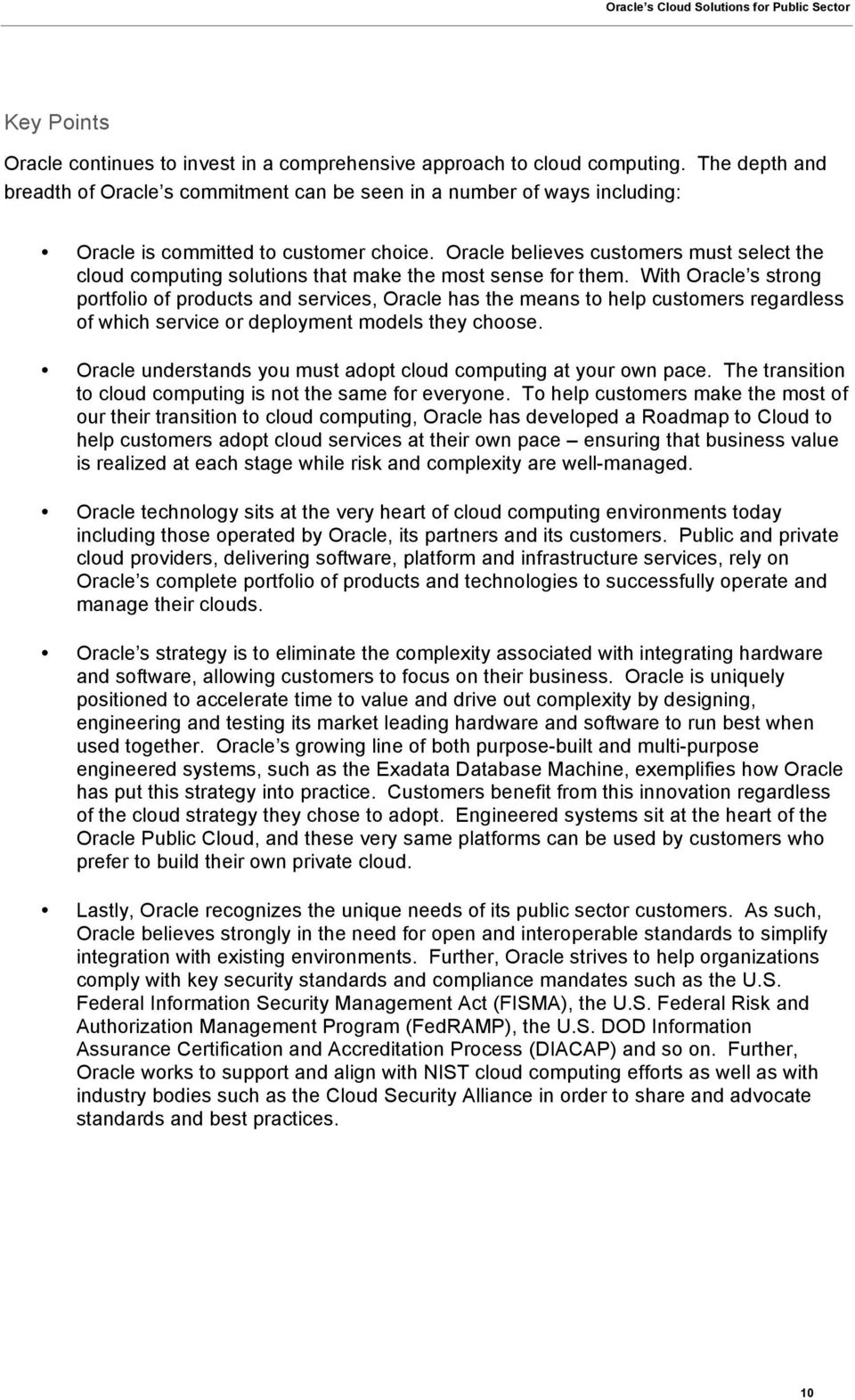
13 Key Points Oracle continues to invest in a comprehensive approach to cloud computing. The depth and breadth of Oracle s commitment can be seen in a number of ways including: Oracle is committed to customer choice. Oracle believes customers must select the cloud computing solutions that make the most sense for them. With Oracle s strong portfolio of products and services, Oracle has the means to help customers regardless of which service or deployment models they choose. Oracle understands you must adopt cloud computing at your own pace. The transition to cloud computing is not the same for everyone. To help customers make the most of our their transition to cloud computing, Oracle has developed a Roadmap to Cloud to help customers adopt cloud services at their own pace ensuring that business value is realized at each stage while risk and complexity are well-managed. Oracle technology sits at the very heart of cloud computing environments today including those operated by Oracle, its partners and its customers. Public and private cloud providers, delivering software, platform and infrastructure services, rely on Oracle s complete portfolio of products and technologies to successfully operate and manage their clouds. Oracle s strategy is to eliminate the complexity associated with integrating hardware and software, allowing customers to focus on their business. Oracle is uniquely positioned to accelerate time to value and drive out complexity by designing, engineering and testing its market leading hardware and software to run best when used together. Oracle s growing line of both purpose-built and multi-purpose engineered systems, such as the Exadata Database Machine, exemplifies how Oracle has put this strategy into practice. Customers benefit from this innovation regardless of the cloud strategy they chose to adopt. Engineered systems sit at the heart of the Oracle Public Cloud, and these very same platforms can be used by customers who prefer to build their own private cloud. Lastly, Oracle recognizes the unique needs of its public sector customers. As such, Oracle believes strongly in the need for open and interoperable standards to simplify integration with existing environments. Further, Oracle strives to help organizations comply with key security standards and compliance mandates such as the U.S. Federal Information Security Management Act (FISMA), the U.S. Federal Risk and Authorization Management Program (FedRAMP), the U.S. DOD Information Assurance Certification and Accreditation Process (DIACAP) and so on. Further, Oracle works to support and align with NIST cloud computing efforts as well as with industry bodies such as the Cloud Security Alliance in order to share and advocate standards and best practices. 10
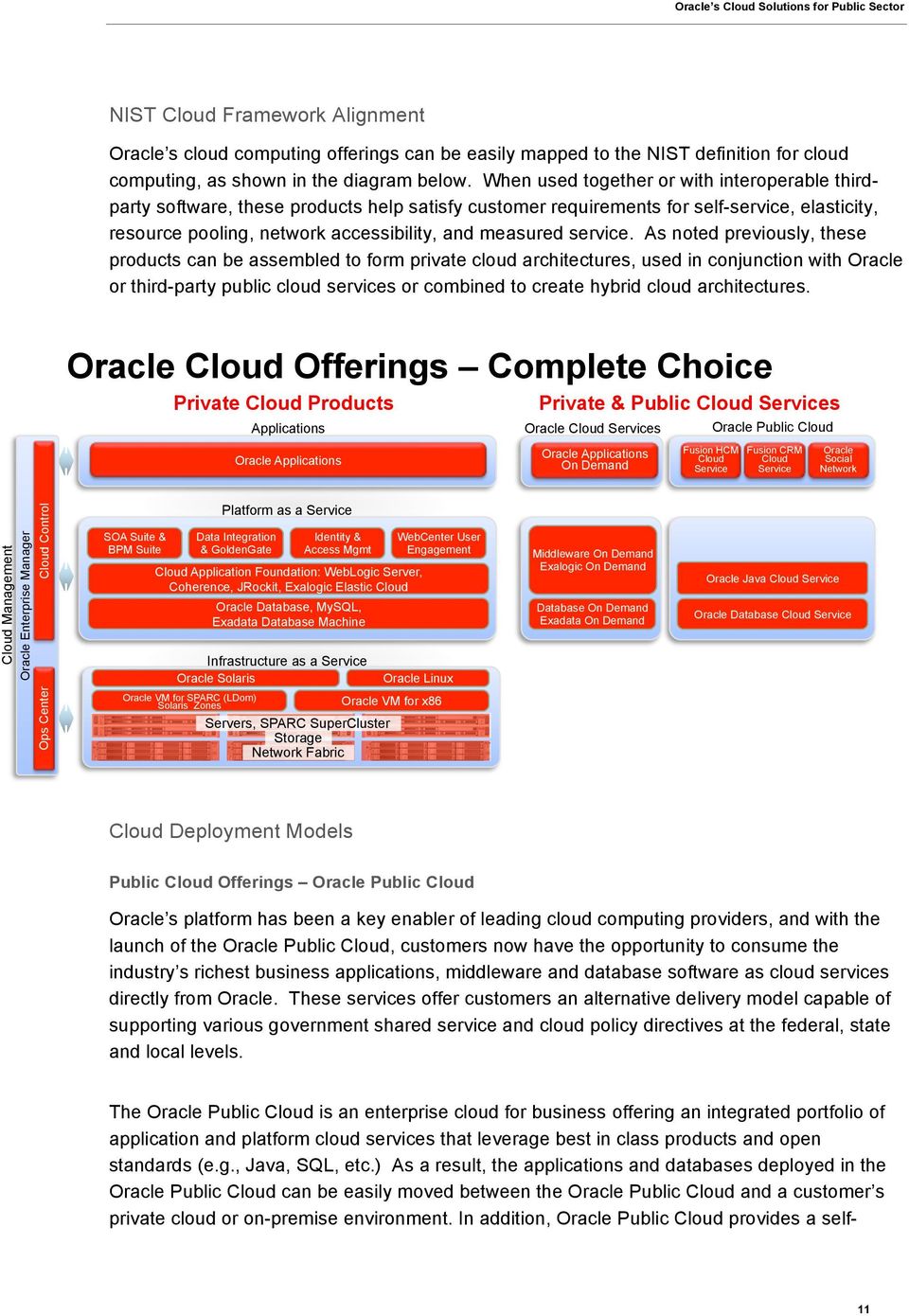
14 NIST Cloud Framework Alignment Oracle s cloud computing offerings can be easily mapped to the NIST definition for cloud computing, as shown in the diagram below. When used together or with interoperable thirdparty software, these products help satisfy customer requirements for self-service, elasticity, resource pooling, network accessibility, and measured service. As noted previously, these products can be assembled to form private cloud architectures, used in conjunction with Oracle or third-party public cloud services or combined to create hybrid cloud architectures. Oracle Cloud Offerings Complete Choice Private Cloud Products Applications Oracle Applications Private & Public Cloud Services Oracle Cloud Services Oracle Applications On Demand Fusion HCM Cloud Service Oracle Public Cloud Fusion CRM Cloud Service Oracle Social Network Cloud Management Oracle Enterprise Manager Cloud Control SOA Suite & BPM Suite Platform as a Service Data Integration & GoldenGate Identity & Access Mgmt Cloud Application Foundation: WebLogic Server, Coherence, JRockit, Exalogic Elastic Cloud Oracle Database, MySQL, Exadata Database Machine Infrastructure as a Service Oracle Solaris WebCenter User Engagement Oracle Linux Middleware On Demand Exalogic On Demand Database On Demand Exadata On Demand Oracle Java Cloud Service Oracle Database Cloud Service Ops Center Oracle VM for SPARC (LDom) Solaris Zones Oracle VM for x86 Servers, SPARC SuperCluster Storage Network Fabric Cloud Deployment Models Public Cloud Offerings Oracle Public Cloud Oracle s platform has been a key enabler of leading cloud computing providers, and with the launch of the Oracle Public Cloud, customers now have the opportunity to consume the industry s richest business applications, middleware and database software as cloud services directly from Oracle. These services offer customers an alternative delivery model capable of supporting various government shared service and cloud policy directives at the federal, state and local levels. The Oracle Public Cloud is an enterprise cloud for business offering an integrated portfolio of application and platform cloud services that leverage best in class products and open standards (e.g., Java, SQL, etc.) As a result, the applications and databases deployed in the Oracle Public Cloud can be easily moved between the Oracle Public Cloud and a customer s private cloud or on-premise environment. In addition, Oracle Public Cloud provides a self- 11
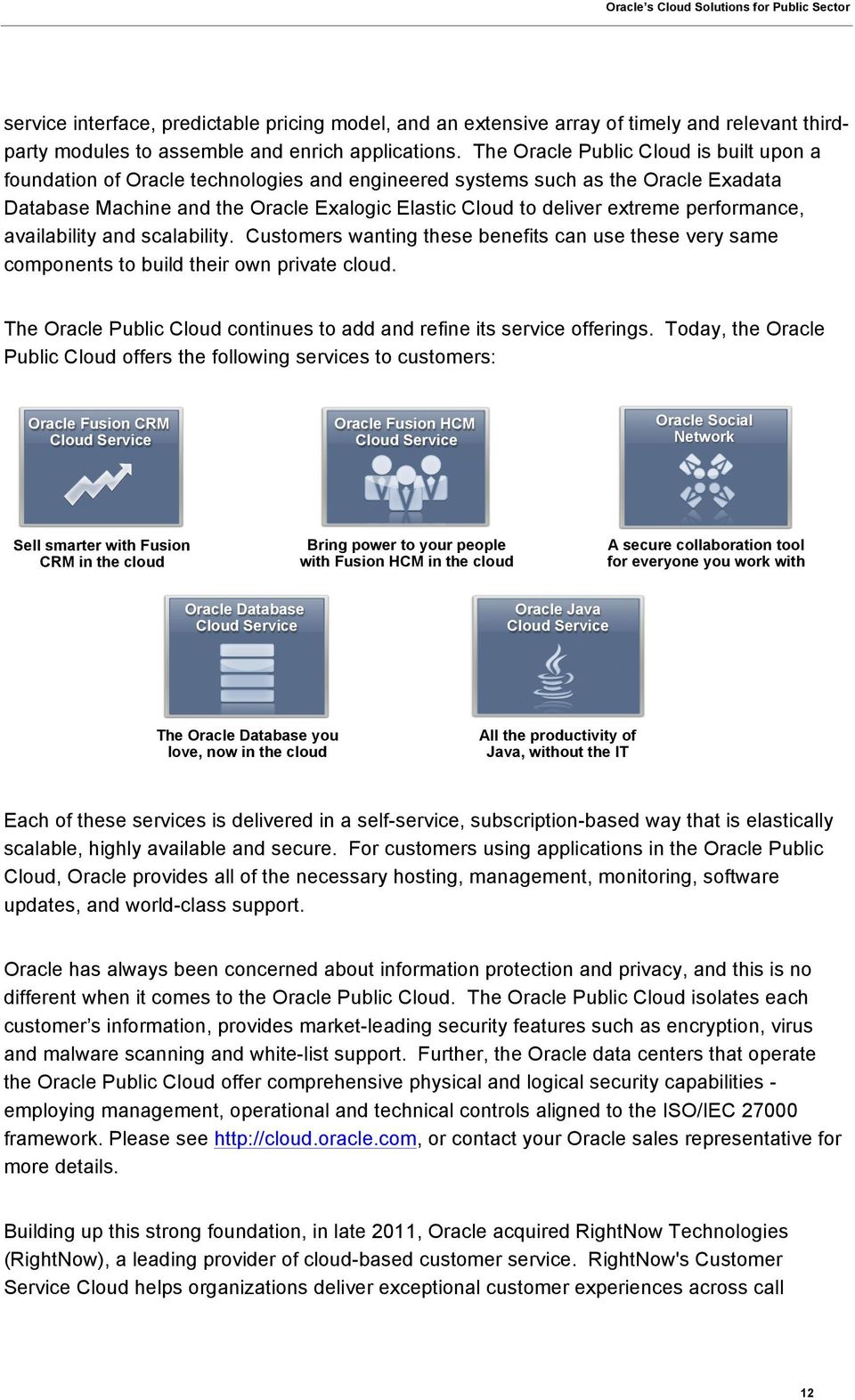
15 service interface, predictable pricing model, and an extensive array of timely and relevant thirdparty modules to assemble and enrich applications. The Oracle Public Cloud is built upon a foundation of Oracle technologies and engineered systems such as the Oracle Exadata Database Machine and the Oracle Exalogic Elastic Cloud to deliver extreme performance, availability and scalability. Customers wanting these benefits can use these very same components to build their own private cloud. The Oracle Public Cloud continues to add and refine its service offerings. Today, the Oracle Public Cloud offers the following services to customers: Oracle Fusion CRM Cloud Service Oracle Fusion HCM Cloud Service Oracle Social Network Sell smarter with Fusion CRM in the cloud Bring power to your people with Fusion HCM in the cloud A secure collaboration tool for everyone you work with Oracle Database Cloud Service Oracle Java Cloud Service The Oracle Database you love, now in the cloud All the productivity of Java, without the IT Each of these services is delivered in a self-service, subscription-based way that is elastically scalable, highly available and secure. For customers using applications in the Oracle Public Cloud, Oracle provides all of the necessary hosting, management, monitoring, software updates, and world-class support. Oracle has always been concerned about information protection and privacy, and this is no different when it comes to the Oracle Public Cloud. The Oracle Public Cloud isolates each customer s information, provides market-leading security features such as encryption, virus and malware scanning and white-list support. Further, the Oracle data centers that operate the Oracle Public Cloud offer comprehensive physical and logical security capabilities - employing management, operational and technical controls aligned to the ISO/IEC framework. Please see or contact your Oracle sales representative for more details. Building up this strong foundation, in late 2011, Oracle acquired RightNow Technologies (RightNow), a leading provider of cloud-based customer service. RightNow's Customer Service Cloud helps organizations deliver exceptional customer experiences across call 12
16 centers, the web and social networks. Together, Oracle and RightNow can enable a superior customer experience at every contact and across every channel. For more than 10 years, RightNow has helped more than 170 government agencies; including federal civilian, defense, and intelligence organizations, deliver superior service by phone, web, chat, and social networks. In fact, RightNow is the only SaaS provider with authority to operate and deliver a customer experience solution via the highly secure DISA Cloud infrastructure. Public Cloud Offerings Partner Clouds In addition to the Oracle Public Cloud, Oracle products and technologies are used by many of the leading public cloud providers as part of their specific service offerings. In fact, there are Oracle partners today delivering additional subscription-based applications optimized for Public Sector customers and delivered on infrastructure compliant with Federal and State Government security requirements. These partner SaaS offerings include: 1. Oracle Siebel Case and Service Management 2. Oracle Hyperion Enterprise Performance Management 3. Oracle E-Business Suite Federal Financials Management 4. Oracle E-Business Suite Contract Lifecycle Management 5. Oracle JD Edwards EnterpriseOne - optimized for state and local government entities such as City, County, Transportation, and Justice Customers benefit from Oracle s innovative products and the partner s focus on public sector concerns. In some situations, customers may also be able to leverage their existing investment in Oracle licenses, often called bring your own license. Similarly, some public cloud providers have established combined technical support models to offer their customers with a seamless support experience. Private Cloud Offerings On-Premise Despite the capabilities available in public cloud offerings, customers often still have lingering concerns in a number of areas including security policy compliance, interoperability, and portability: Security. Given the sensitive nature of public sector information, organizations are naturally resistant to storing that data on the Internet or with a non-trusted third party. Furthermore, multi-tenancy and the potential for co-mingling of data often are in conflict with the data classification and access requirements of federal agencies. Even in a single tenant context, public sector entities may encounter challenges demonstrating policy and regulatory compliance, because public cloud providers may not make necessary information easily or publicly available. 13
17 Interoperability. Public sector organizations are under pressure to increase the quality and availability of information. Consequently, many agencies have adopted a strategy that involves data rationalization and integration across a variety of application silos. To maximize the value and benefit of information, this strategy would naturally need to be applied to any cloud services that are being used. Unfortunately, when looking across the public cloud landscape, interoperability between service providers, implementations and service models is often spotty at best. Portability. As a result of interoperability concerns and the lack of well-established standards for inter-cloud portability, public sector organizations are rightly concerned about being locked-in to a single cloud vendor or implementation. To date, many of the public cloud providers have focused their efforts only on the small to medium commercial business space in an effort to attract a large pool of customers. Unfortunately, this focus has left such implementations wanting in terms of being able to satisfy the more stringent demands of enterprise and government customers. As a result, many customers will begin their cloud adoption with a private cloud deployment. An additional benefit of this approach is that like-minded agencies can pool their investments and resources to create a shared private cloud infrastructure, offering more complete services at service levels beyond what they could otherwise do individually. In addition, integration with legacy services and data is typically easier to achieve using private cloud architectures where a customer has greater control over the underlying architecture, interfaces, and touch-points. Oracle has the experience, products, technologies and services to enable public sector organizations to be successful with their private cloud initiatives. As a leading cloud computing services and infrastructure provider, Oracle understands the need for strong, resilient security, application and data integration and portability, and alignment to both industry and open standards. Oracle has a proven track record in supporting public sector customers with their shared service environments including those that meet strict government requirements for secure access, data segregation, and compliance. In the following sections, specific Oracle technologies will be highlighted to further illustrate the capabilities that Oracle can deliver to support public sector cloud implementations. Private Cloud Offerings Oracle Cloud Services Oracle Cloud Services delivers application and technology managed services for Oracle software and hardware including management, monitoring, patching, security, and upgrade services. Customers can choose to host their applications at Oracle, at facilities operated by Oracle partners, or on-premise in their own environments. With Oracle Cloud Services, customers generally purchase their own Oracle software licenses and support, including licenses for business applications such as PeopleSoft, Oracle E-Business Suite, and Oracle Fusion Applications. The complete list of Oracle Cloud Services offerings is available at: 14

18 Public sector agencies running their applications at Oracle Cloud Services will benefit from more than twelve years of experience operating mission critical services for our customers. Oracle Cloud Services supports over 5.5 million satisfied end-customers across its six data center locations. Designed to support the needs of public sector agencies, Oracle Cloud Services Austin Data Center facility: satisfies Tier IV data center requirements providing % availability; exceeds minimum EPA renewable energy usage requirements; employs Embassy Level physical security including biometrics and PINs for each employee; complies with ISO 27001, ISO 27002, HIPAA, PCI, 21 CFR Part 11 and many other standards and mandates; and supports a U.S. Federal Zone that is both FISMA and DIACAP certified and accredited Cloud Service Models Oracle is the only vendor to offer a complete portfolio of solutions for each of the cloud service models: SaaS, PaaS, and IaaS. More importantly, Oracle understands that one size does not fit all, and that customers will want to choose the combination of solutions that best fits their needs. Regardless of the solutions chosen, customers who implement cloud solutions using Oracle products and technology will realize the benefits of a solution that has been engineered and optimized to work together. Software as a Service Technologies Oracle recognizes the challenge and complexity of wading through an ocean of enterprise applications, offered by numerous vendors. Customers must not only ensure that the applications meet their needs, but also that they will integrate well into their existing business processes and IT environment all while not disrupting their business. To simplify this burden, Oracle offers customers a comprehensive suite of business applications based upon its 30+ years of business process and industry expertise. Customers interested in deploying software as a service internally can select from a comprehensive suite of horizontal business applications (including customer relationship management, human capital management, financials, and governance, risk and compliance) as well as market-leading applications focused on the needs of public sector customers (including igovernment, case management, geo-spatial and location tracking, and taxation and policy management). 15

19 Oracle s enterprise applications were designed to be offered as shared services across organizations making them ideally suited to public and private clouds as well as enterprise deployments. Building upon this foundation, Oracle Fusion Applications offers customers a comprehensive set of business modules that have been designed for the cloud, use the latest technology advances, and incorporate the best practices gathered from Oracle s thousands of customers. Oracle Fusion Applications are 100% open-standards-based business applications and modules that set a new standard for how organizations innovate, work, and collaborate. Platform as a Service Technologies Organizations realize that a shared services platform, used to create, integrate, and share applications, is critical to maximizing the value of a cloud computing architecture. Just as with applications delivered as a service, platform technologies must too offer flexibility, elastic scalability, and self-service access in order to more rapidly respond to workload fluctuation as well as the ever-changing needs of the organization. Oracle has a very comprehensive PaaS offering that includes market-leading, best-in-class products such as the Oracle Database, the Oracle WebLogic Suite, and the Oracle Identity Management Suite all #1 in their respective categories according to industry analyst reports. 16

20 Oracle s platform as a service offering has been extremely well received in the industry. Today, over 250 SaaS providers are using Oracle products and technologies as a foundation for their own offerings. Providers such as salesforce.com, Ariba, and Perot Systems are just a few of the companies using Oracle s platform as a service solution to power their clouds. Similarly, Oracle leverages this very same, customer available, technology to power its own cloud computing offerings including the Oracle Public Cloud and Oracle Cloud Services. Oracle s PaaS offering is based upon a well-integrated collection of products and technologies that provide middleware and application integration functionality as well as data services, but organizations seeking to build cloud computing architectures need business-ready solutions not point products. Oracle understands what it takes to run enterprise-ready cloud computing environments, and that is why Oracle introduced its line of fit-for-purpose engineered systems complete hardware and software solutions, engineered together and optimized to deliver the best performance, elastic scalability, security, and availability while drastically reducing IT complexity. These engineered systems are designed speed up time to deployment, reduce support and management costs, and scale in response to the needs of the organization making them ideal foundations for any PaaS architecture. Middleware as a Service Oracle Exalogic Elastic Cloud (Exalogic) is an integrated hardware and software system, engineered, tested, and tuned by Oracle to run Java and non-java applications with extreme performance, scalability and availability. Exalogic provides a complete cloud application infrastructure, consolidating the widest possible range of Java and non-java applications and workloads while meeting the most demanding service-level requirements. Engineered for large-scale, mission-critical deployments, Exalogic is an excellent foundation for enterpriseclass cloud computing through its support for thousands of applications with differing multitenancy, security, reliability, and performance needs. Exalogic is engineered to use the latest 17
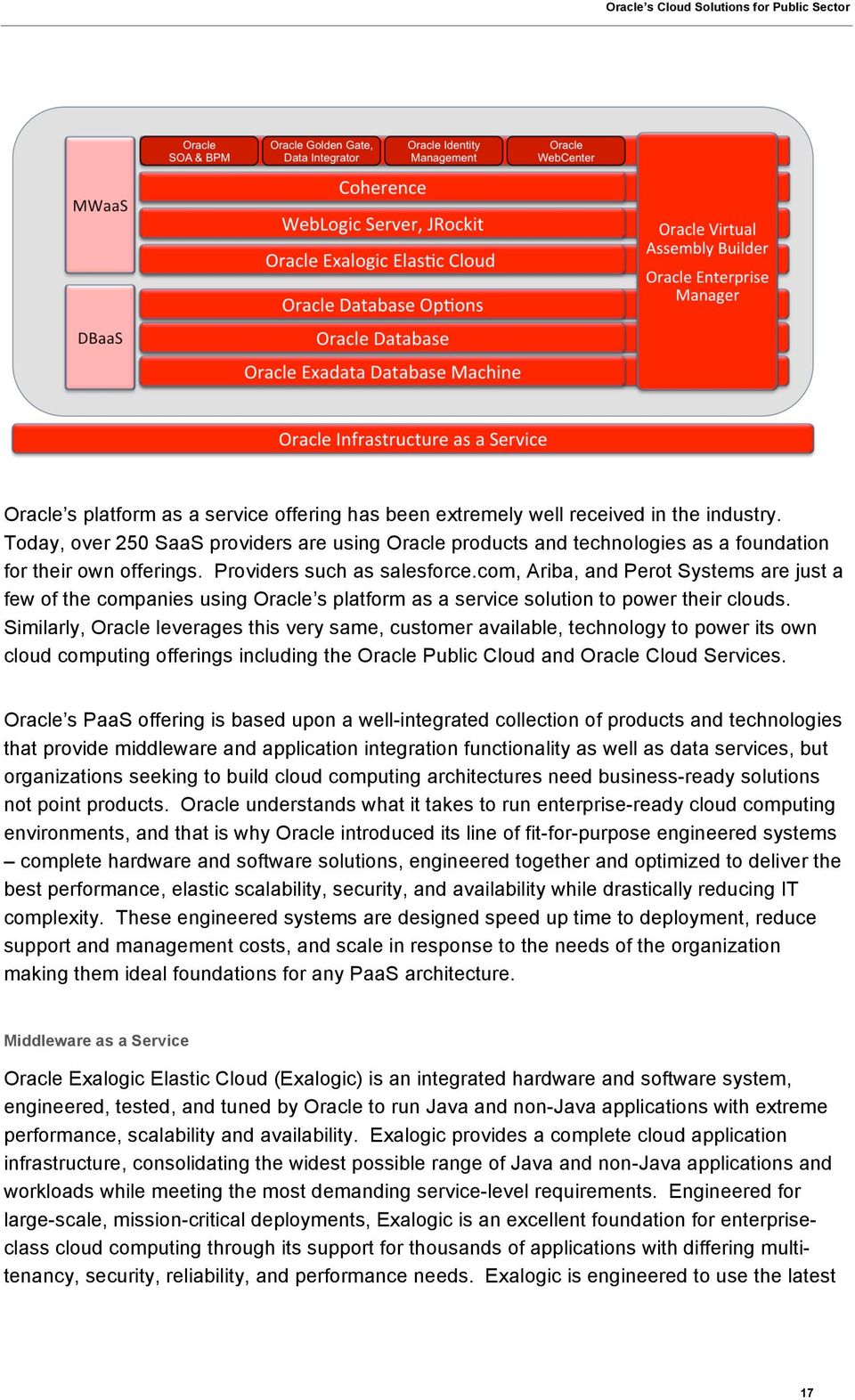
21 high performance hardware, the industry-leading Oracle WebLogic Suite, and Oracle s innovative Exalogic Elastic Cloud software, all engineered and tested for maximum capability and performance with minimal set-up. Organizations can customize this foundation based upon their needs using Oracle s Fusion Middleware. For example, organizations looking to integrate their PaaS architecture with legacy applications and services can leverage Oracle s SOA and BPM suites allowing for process management and composite application assembly. Oracle Data Integrator and Oracle Golden Gate provide high-performance at high-volume data integration and replication services. Oracle s market leading Identity Management Suite provides best-in-class identity and access management as well as identity governance and federation capabilities. Lastly, Oracle WebCenter Suite delivers a user engagement platform allowing organizations to create portals, mash-ups, and support contextual content delivery and collaboration. Each of these capabilities can be delivered on the Exalogic platform, exposed as integrated services as well as linked with legacy applications through the use of standards-based, interoperable protocols and interfaces. Similarly, Oracle s SaaS horizontal and industryspecific applications can also integrate with and run transparently on the Exalogic Elastic Cloud platform, taking full advantage of its performance, elastic scalability, security and availability features. Database as a Service The Oracle Exadata Database Machine (Exadata) provides an optimized platform for all forms of database workloads, ranging from scan-intensive data warehouse applications to highly concurrent OLTP applications. With its combination of smart Oracle Exadata Storage Server Software, intelligent Oracle Database software, and the latest industry standard hardware components, Exadata delivers extreme performance along with high availability, resilient security and simplified management. With Oracle's unique clustering, workload management, and security capabilities, the Exadata is also well suited for consolidating multiple databases onto a single grid. Delivered as a complete pre-optimized and pre-configured package of software, servers, and storage, Exadata is simple and fast to implement and ready to tackle large-scale business applications. Further, Oracle understands that databases are rarely used in isolation which is why Oracle has extended its line of engineered systems to include products that easily and seamlessly integrate with Exadata. The Oracle Big Data Appliance is an engineered system that is optimized for acquiring, organizing, and loading structured and unstructured data into the Oracle database. Similarly, the Oracle Exalytics In-Memory Machine is a best-in-class in-memory analytics platform well suited to advanced data visualization and exploration, business intelligence, modeling, 18
22 forecasting and planning. Each of these engineered systems combines an optimized hardware platform with a comprehensive software stack that are pre-integrated and tested to reduce the cost and complexity of IT infrastructure while increasing productivity and performance. The Oracle Big Data Appliance and the Oracle Exalytics In-Memory Machine can be combined with the Oracle Exadata Database Machine to create a comprehensive, high performance information management architecture supporting not only database as a service but also areas such as analytics and planning as a service. Infrastructure as a Service Technologies Infrastructure as a Service is focused on delivering all of the core building blocks that are needed to run applications and services including operating systems, virtualization technologies, compute services as well as storage. Oracle s IaaS offering is based upon a comprehensive collection of integrated products and technologies that cover this entire spectrum and more. Unlike most vendors who can offer only partial solutions, Oracle has all of the hardware and software components that our customers need to build robust, secure and scalable IaaS architectures. Oracle s IaaS offering supports cloud goals of self-service, elastic scalability, resource metering and so on, but more importantly, by engineering the products to work best together, Oracle can offer what no other vendor can application aware provisioning and management simplifying and streamlining application deployment and assembly of multi-tier applications including all of the necessary compute, storage, and virtualization building blocks. Before discussing the integrated and engineered solutions, let s look at a few of the innovative products and technologies that make up Oracle s IaaS offering. Oracle Solaris 11 The Oracle Solaris 11 operating system (Solaris 11 OS) is the first general purpose operating system engineered for cloud computing. For more than twenty years, public sector customers have relied upon the Solaris OS to run their business. As the #1 UNIX operating system, Solaris offers best-in-class security, availability, elastic scalability, and monitoring features. Whether used on SPARC or Intel platforms, the Solaris OS is the operating system of choice 19
23 when applications must run. New to the Solaris 11 OS are features specifically designed to help customers realize their cloud computing goals, including: New provisioning and update functionality to ensure that deployments are fast, reliable and repeatable New, integrated network virtualization enabling the creation of high-performance, virtualized architectures within or between systems running the Solaris OS New, converged systems management allowing for the management of integrated systems not just multiple operating system instances Continued binary compatibility and support for earlier versions allowing legacy applications to be migrated into the cloud environment In addition, as customers have come to expect, the Solaris 11 OS has continued to make significant improvements in its resource management, performance, scalability and security underscoring why Solaris is the premier operating system for customer cloud environments. Oracle VM Oracle offers customers a highly efficient, enterprise-class virtualization solution for both SPARC and Intel-based server platforms allowing customers to more easily consolidate physical systems, improve overall server utilization and deploy IaaS-based services. For customers using Oracle s SPARC T-Series servers, Oracle VM for SPARC supports the creation of 128 separate virtual servers on a single physical system, taking full advantage of the massive thread scale offered by the SPARC T3 and SPARC T4 processors as well as the Oracle Solaris OS. Provided at no extra cost, Oracle VM for SPARC supports dynamic and automated resource management of CPU, memory, virtual I/O, and even hardwareaccelerated cryptography. Redundant virtual networks and disks and secure, live migration of running virtual machines helps to meet even the most demanding availability requirements. For customers using Intel-based platforms, from Oracle or third parties, Oracle VM for x86 enables customers to move beyond simple server consolidation to streamlining application deployment and management. To complement Oracle VM for x86, Oracle offers over 90 virtual machine templates to enable customers to deploy enterprise-class software in a more rapid, repeatable and error-free manner. These templates include all of the most popular applications and software including Oracle Applications, Oracle Fusion Middleware and the Oracle Database. With the release of Oracle VM for x86, significant scalability improvements were made far exceeding the ability of competitive solutions. Supporting over 128 virtual CPUs per physical machine, Oracle VM for x86 offers four times the scalability at lower cost than leading competitors. 20
24 Together, Oracle VM for SPARC and Oracle VM for x86 enable customers to: manage collections of server pools and storage resources from a single control point deploy applications and services in a rapid, scalable and repeatable manner scale their deployments elastically in response to change in demand, and monitor performance, utilization and key metrics in support of service metering Oracle SPARC SuperCluster The Oracle SPARC SuperCluster is the first general-purpose engineered system that combines the computing power of the new SPARC T4 processor, the performance and scalability of the new Oracle Solaris 11 operating system, the optimized database performance of Oracle Exadata Storage, and the accelerated middleware processing of the Oracle Exalogic Elastic Cloud. As a result, the SPARC SuperCluster is an ideal platform for consolidating large numbers of applications, databases, and middleware workloads or for deploying complex, multi-tier services. By engineering these various components to work best together, customers will benefit from lightning-fast improvements in data compression, queries, OLTP response times, and even Java middleware performance. Applications deployed on the Oracle SPARC SuperCluster can run on a mix of Oracle Solaris 10 and Oracle Solaris 11 and use Oracle VM Server for SPARC and Oracle Solaris Zones for workload isolation. For customers considering cloud computing architectures, the Oracle SPARC SuperCluster provides a highperformance, secure and scalable datacenter in a box for deploying enterprise multi-tier applications and services. Oracle Sun ZFS Storage Appliance The Oracle s Sun ZFS Storage Appliance delivers enterprise-class network attached storage (NAS) capabilities with leading Oracle integration, simplicity, efficiency, performance, and total cost of ownership. The Sun ZFS Storage Appliances supports robust application and data storage for all of Oracle s server platforms including Oracle s SPARC SuperCluster and Exalogic Elastic Cloud engineered systems. Capable of supporting a wide array of missions, the Sun ZFS Storage Appliance offers all of the simplified management and data protection benefits of the ZFS file system in an appliance form-factor that offers unparalleled ease of deployment, integration and use. For cloud computing deployments, capabilities such as thin provisioning, compression, and de-duplication serve to avoid over-allocation of storage capacity while also optimizing storage use. Market-leading analytics powered by the Oracle Solaris DTrace facility provide insight into virtual machine workloads to help improve the overall reliability, performance and availability of application services. The Sun ZFS Storage Appliance earned the highest overall scores in the six-year history of Storage Magazine s Quality Awards for NAS, for both enterprise and mid-range NAS. The 21
25 comparative analysis focused on initial product quality, features, reliability, technical support, and sales force competence. The Sun ZFS Storage appliance is the only NAS product that is engineered together with Oracle Applications, Oracle Fusion Middleware, Oracle Database and Oracle s SPARC SuperCluster. Further, it is the only NAS product optimized for Oracle VM and the Oracle Exadata Database Machine. Such tight engineering integration enables Oracle software to run fastest and most efficiently on this platform. Oracle Pillar Axiom Storage System Oracle s Pillar Axiom 600 storage system delivers industry-leading storage consolidation that combines predictable, high-performance with extreme efficiency. The Oracle Pillar Axiom storage system features a modular design allowing customers to purchase only the capacity and performance that is needed today, adding incremental capabilities as needed to support changes in business needs. Near-linear scaling of storage capacity and performance are possible through the use of multi-technology RAID pools to ensure efficient utilization of all solid-state and traditional storage devices. For cloud computing environments, the Oracle Pillar Axiom s patented Quality of Service (QoS) architecture ensures predictable performance for each application and client across the cloud architecture. Oracle Optimized Solution for Enterprise Clouds The Oracle Optimized Solution for Enterprise Cloud Infrastructure provides an integrated, complete reference infrastructure with recommendations and best practices for deploying and optimizing an enterprise cloud infrastructure or a highly virtualized environment. It addresses every layer of the infrastructure stack with Oracle hardware and software components including the Oracle VM Server for x86, the Oracle's Sun Blade 6000 Modular Systems, and Oracle Sun ZFS Storage Appliances. This highly optimized architecture provides customers with a robust, flexible IaaS foundation for running enterprise applications, middleware, and database software. Cloud Service Management Oracle understands that having best-in-class products and technologies to power your cloud is not enough. Without a comprehensive approach to cloud service management, organizations will never be able to realize their full potential nor achieve their agility, efficiency and cost savings goals. Cloud service management is about providing the right level of business, service and resource management capabilities that enable customers to maximize their investment in cloud architectures. 22
26 Cloud Enablement Cloud Analytics: OCDM Customer Mgmt: Siebel CRM Billing: BRM Order Orchestration: OSM Service Catalog: UIM, OVAB Service Activation: ASAP, IPSA Enterprise Mgmt: Enterprise Manager Hardware Mgmt: Ops Center Business Management Service Management Resource Management SOA & BPM Oracle Applications Platform as a Service Data Integration: ODI, GoldenGate Cloud Application Foundation: WebLogic Server, Coherence, Exalogic Elastic Cloud Security: Identity Mgmt Oracle Database, Database Options Exadata Database Machine Oracle Solaris Oracle VM for SPARC (LDom) Solaris Containers Infrastructure as a Service Servers Storage Exposure Platform: OCSG Collaboration Apps (OCUCS) User Interaction: WebCenter Oracle VM for x86 Converged App Platform: OCCAS Oracle Linux Service Provider Network Cloud Business Management Cloud computing is about more than just technologies that help consolidate and streamline operations, improve agility or aid in cost recovery. At its heart, cloud computing is about transforming IT to operate more as a business. Oracle has significant experience and capabilities in this area to help cloud service providers manage their business. The Oracle Applications portfolio includes many of these capabilities including customer relationship management, billing and revenue management, business analytics, and service level and contract management. Cloud Service Development and Orchestration Another aspect of cloud computing architectures that must be considered is what services will be offered, how will they be defined, what are their service characteristics, and how will those services be managed over their lifetime. The processes and technologies needed to respond to these questions will vary based upon the type of services offered. For example, in the past, organizations had to build web, application and database servers individually, installing and configuring their operating systems and respective applications, and ultimately integrating the various components. Today, customers can use the Oracle Virtual Assembly Builder to quickly create and configure multi-tier application topologies, package them into self-contained, reusable software appliances, and ultimately provision them onto virtualized resources. 23
27 Going further, Oracle Virtual Assembly Builder structures the process of combining individual software appliances into cohesive, reusable units known as assemblies. These assemblies understand and make the necessary connections between the individual software appliances so that they can be deployed and maintained as a unit. When the assembly is deployed, the components are configured automatically and managed throughout their lifecycle using Oracle Virtual Assembly Builder. Cloud Resource Management Any true cloud resource management solution must help customers exploit the five essential cloud characteristics as defined by NIST. Oracle Enterprise Manager Cloud Control 12c is the industry s first complete cloud resource management solution supporting self-service provisioning, centralized policy-based resource management supporting elastic scalability, integrated metering, chargeback, and capacity planning, as well as complete lifecycle management of the physical and virtual environment from applications to disk. 24
28 Optimize Plan Meter & Charge Manage Applications and Business Services Platform as a Service DBaaS MWaaS Infrastructure as a Service Setup Build Monitor Deploy Test By delivering comprehensive provisioning, patching, monitoring, administration, and configuration management capabilities via web-based or command-line interface, Enterprise Manager significantly reduces the complexity and cost associated with managing Oracle VM, Linux, Unix, and Microsoft Windows operating system environments. In addition, enterprises using Oracle hardware can extract detailed telemetry from their server, storage and network infrastructure layers, allowing them to manage thousands of systems in a scalable manner. Oracle Enterprise Manager helps customers accelerate the adoption of virtualization and cloud computing, optimizing IT resources, improving utilization, simplifying IT processes, and reducing costs. Cloud Security Oracle is one of the very few vendors that can secure cloud environments from applications to disk. Oracle s strategy of engineering and integrating its hardware and software portfolio to work best together means that customers will benefit from a defense in depth architecture that covers every layer of an organization s cloud architecture. Whether organizations are looking at public or private clouds, at SaaS, PaaS or IaaS, Oracle has the products and technologies that are needed to protect applications and particularly information no matter where it is at rest, in use and in transit. 25
29 Applications Governance, Risk and Compliance Fraud Prevention End-to-End Protection - From Applications to Disk Complete Choice - Open, Standards-based Best of Breed - Integrated and Integratable Platform as a Service Identity and Access Management Multi-factor Authorization and Privileged User Management Data Encryption and Masking Activity Monitoring Infrastructure as a Service Strong Authentication Role-based Access Control Auditing Server Hard Partitions Secure Virtualization Hardware Cryptographic Acceleration Network, Disk and Tape Encryption Service Provider Network Oracle believes in a defense-in-depth strategy where security is engineered into every product and integrated where appropriate with other products across the portfolio. For example, encryption used by Oracle Applications, Oracle Fusion Middleware, and even Oracle Databases can take advantage of hardware-accelerated encryption offered by Oracle s SPARC T4 processors. Customers concerned with managing encryption keys will find that the Oracle Key Manager will centralize key management across tape storage, operating systems, and even databases. The Oracle Database offers strong authentication, data encryption, and (privileged) user access control to ensure that information is only accessible to those who need it. Oracle s industry leading identity management suite of products integrates with products up and down the stack providing a common backbone for identification, strong authentication, and auditable access management. Collectively, these products and technologies can be assembled based upon organization s policies and regulatory mandates to create a reinforcing security architecture for cloud computing, data center consolidation, and virtually any other need. Roadmap to Cloud No organization wants to spend time, money or resources needlessly. When it comes to cloud computing, the same is true organizations do not embark on cloud strategies just to have a cloud. It is critical therefore to understand the driving factors behind such a move and whether it is a standalone activity or part of a more transformational move toward delivering IT as a service. 26
30 Cloud*Compu8ng* Shared*Services* Consolidated*Pla;orm* IT*Silos* Standardized*Technology* Agility Business Modularity Efficiency Architectural Complexity Simplicity The journey to cloud computing does not happen overnight, nor does it need to be an overwhelming task. Oracle works with organizations to understand their needs and to develop a cloud strategy that is appropriate for them. One size never fits all, although there are recurring patterns that can help guide customer through the various phases of a cloud computing evolution. These patterns, captured in Oracle s Roadmap to Cloud and Oracle's collection of Reference Architectures, were developed with three customer goals and principles in mind: A cloud strategy is not just about technology. It must encompass people, process and technology. A cloud strategy must not only benefit IT organizations, but it must mutually benefit the business users who consume cloud services. A cloud strategy must be implemented using a gradual and phased approach, aligned to business pace, and where each phase can be mapped to measurable business goals and benefits. Oracle continually refines the Roadmap to Cloud, collaboratively with the customer, after each phase to ensure continued alignment with customer goals and requirements. Oracle has also developed a suite of strategy, assessment, workshop, architecture, and implementation services to help public sector customers at every step along their own road to cloud. 27
31 Conclusion Public sector organizations are increasingly driven to improve operational efficiency, share information, and integrate processes across operational and jurisdictional boundaries while maintaining control over costs. Recently, cloud computing has captured significant attention as both a business and computing model that enables public sector organizations to achieve these daunting objectives. As a leader in cloud computing, Oracle understands that cloud computing is about choice. Depending upon the needs of an organization, they may choose from a variety of cloud service and deployment models. Oracle embraces and supports customer choice by offering options for public and private clouds as well as clouds hosted on-premise, at Oracle or with one of Oracle s partners. Oracle also realizes that customers will embrace cloud computing at their own pace which is why Oracle offers a variety of services built upon its Roadmap to Cloud to help customers quickly realize benefits from whichever path they choose to take. Private Cloud Products Applications Oracle Applications Private & Public Cloud Services Oracle Cloud Services Oracle Applications On Demand Fusion HCM Cloud Service Oracle Public Cloud Fusion CRM Cloud Service Oracle Social Network Cloud Management Oracle Enterprise Manager Cloud Control SOA Suite & BPM Suite Platform as a Service Data Integration & GoldenGate Identity & Access Mgmt Cloud Application Foundation: WebLogic Server, Coherence, JRockit, Exalogic Elastic Cloud Oracle Database, MySQL, Exadata Database Machine Infrastructure as a Service Oracle Solaris WebCenter User Engagement Oracle Linux Middleware On Demand Exalogic On Demand Database On Demand Exadata On Demand Oracle Java Cloud Service Oracle Database Cloud Service Ops Center Oracle VM for SPARC (LDom) Solaris Zones Oracle VM for x86 Servers, SuperCluster Storage Network Fabric Oracle continues to expand and enhance its comprehensive portfolio of products to best support cloud computing needs. This is accomplished not only through new innovation but also through the engineering and integration of products to work best when used together. Nowhere is it more evident that in the release of Oracle s engineered systems including the Oracle Exadata Database Machine, the Oracle Exalogic Elastic Cloud and the Oracle SPARC SuperCluster T4-4. All of these platforms leverage compute, storage, networking and software integrated together to realize the best performance, highest security, and greatest scalability while significantly reducing the deployment time so that customers can begin seeing value right away. 28
32 Additional Resources Oracle Resources Oracle Cloud Computing Strategy and Offerings Oracle Public Cloud Dr.Cloud s Flying Circus GovCloud Girish Venkat GovCloud Blog Industry Resources The NIST Definition of Cloud Computing, NIST SP , September NIST Cloud Computing Program NASCIO Publications Capitals in the Clouds (Parts I, II, and III) Cloud Security Alliance Casey Coleman- CIO-GSA- Blog on Cloud Computing 29
33 Oracle Cloud Solutions for Public Sector March 2012 Author: Glenn Brunette, Paul Andres, Girish Venkataraman, Geri Born, Harry Foxwell Contributing Authors: Ken Currie, Tim Ryan, Tim Wallace Oracle Corporation World Headquarters 500 Oracle Parkway Redwood Shores, CA U.S.A. Worldwide Inquiries: Phone: Fax: Copyright 2012, Oracle and/or its affiliates. All rights reserved. This document is provided for information purposes only and the contents hereof are subject to change without notice. This document is not warranted to be error-free, nor subject to any other warranties or conditions, whether expressed orally or implied in law, including implied warranties and conditions of merchantability or fitness for a particular purpose. We specifically disclaim any liability with respect to this document and no contractual obligations are formed either directly or indirectly by this document. This document may not be reproduced or transmitted in any form or by any means, electronic or mechanical, for any purpose, without our prior written permission. Oracle and Java are registered trademarks of Oracle and/or its affiliates. Other names may be trademarks of their respective owners. AMD, Opteron, the AMD logo, and the AMD Opteron logo are trademarks or registered trademarks of Advanced Micro Devices. Intel and Intel Xeon are trademarks or registered trademarks of Intel Corporation. All SPARC trademarks are used under license and are trademarks or registered trademarks of SPARC International, Inc. UNIX is a registered trademark licensed through X/Open Company, Ltd oracle.com/us/industries/public-sector
Oracle Cloud Computing Strategy
 Oracle Cloud Computing Strategy Han Wammes Public Sector Market Development Manager 1 Copyright 2012, Oracle and/or its affiliates. All rights reserved. Safe Harbor Statement The following is intended
An Oracle White Paper June 2011. Oracle Cloud Computing
 An Oracle White Paper June 2011 Oracle Cloud Computing 1 Executive Overview Cloud computing is a significant advancement in the delivery of information technology and services. By providing on demand access
Oracle Cloud Computing Strategy
 Oracle Cloud Computing Strategy Rex Wang VP Infrastructure & Management 1 Copyright 2011, Oracle and/or its affiliates. All rights reserved. The Safe Harbor The following is intended to outline our general
<Insert Picture Here> Cloud Computing Strategy
 Cloud Computing Strategy Rex Wang VP Infrastructure and Management The following is intended to outline our general product direction. It is intended for information purposes only,
<Insert Picture Here> Infrastructure as a Service (IaaS) Cloud Computing for Enterprises
 Infrastructure as a Service (IaaS) Cloud Computing for Enterprises Speaker Title The following is intended to outline our general product direction. It is intended for information
Oracle s Cloud Computing Strategy
 Oracle s Cloud Computing Strategy Your Strategy, Your Cloud, Your Choice Sandra Cheevers Senior Principal Product Director Cloud Product Marketing Steve Lemme Director, Cloud Builder Specialization Oracle
Oracle Reference Architecture and Oracle Cloud
 Oracle Reference Architecture and Oracle Cloud Anbu Krishnaswamy Anbarasu Enterprise Architect Social. Mobile. Complete. Global Enterprise Architecture Program Safe Harbor Statement The following is intended
Datamation. Find the Right Cloud Computing Solution. Executive Brief. In This Paper
 Find the Right Cloud Computing Solution In This Paper There are three main cloud computing deployment models: private, public, and hybrid The true value of the cloud is achieved when the services it delivers
Oracle Cloud Strategy. Sudip Datta Vice President of Product Management
 Oracle Cloud Strategy Sudip Datta Vice President of Product Management The following is intended to outline our general product direction. It is intended for information purposes only, and may not be incorporated
<Insert Picture Here> Oracle VM and Cloud Computing
 Oracle VM and Cloud Computing Paulo Bosco Otto Sales Consultant [email protected] The following is intended to outline our general product direction. It is intended for
Oracle Solaris: Aktueller Stand und Ausblick
 Oracle Solaris: Aktueller Stand und Ausblick Detlef Drewanz Principal Sales Consultant, EMEA Server Presales The following is intended to outline our general product direction. It
Oracle Public Cloud An Enterprise Cloud for Business Critical Applications Gerry Lim, Regional Program Director, Cloud Initiatives, ASEAN
 Oracle Public Cloud An Enterprise Cloud for Business Critical Applications Gerry Lim, Regional Program Director, Cloud Initiatives, ASEAN Sponsored by 1 Copyright 2012, Oracle and/or its affiliates. All
<Insert Picture Here> Enterprise Cloud Computing: What, Why and How
 Enterprise Cloud Computing: What, Why and How Andrew Sutherland SVP, Middleware Business, EMEA he following is intended to outline our general product direction. It is intended for
<Insert Picture Here> Enterprise Cloud Computing: What, Why and How
 Enterprise Cloud Computing: What, Why and How Jean-Claude Sotto Technology Sales Rep Middlware and E2.0 The following is intended to outline our general product direction. It is intended
Oracle: Private Platform as a Service from Oracle
 Oracle: Private Platform as a Service from Oracle Liviu Gherman Sales Manager Fusion Middleware 6 octombrie 2010, Cluj he following is intended to outline our general product direction.
Differentiate with Specialization. Pablo Hanono Senior OPN Program Manager Oracle Worldwide Alliances & Channels September 2014
 Differentiate with Specialization Pablo Hanono Senior OPN Program Manager Oracle Worldwide Alliances & Channels September 2014 Safe Harbor Statement The following is intended to outline our general product
Oracle Platform as a Service (PaaS) FAQ
 Oracle Platform as a Service (PaaS) FAQ 1. What is Platform as a Service (PaaS)? Platform as a Service (PaaS) is a standardized, shared and elastically scalable application development and deployment platform
INTRODUCTION TO CLOUD COMPUTING CEN483 PARALLEL AND DISTRIBUTED SYSTEMS
 INTRODUCTION TO CLOUD COMPUTING CEN483 PARALLEL AND DISTRIBUTED SYSTEMS CLOUD COMPUTING Cloud computing is a model for enabling convenient, ondemand network access to a shared pool of configurable computing
Optimizing Storage for Better TCO in Oracle Environments. Part 1: Management INFOSTOR. Executive Brief
 Optimizing Storage for Better TCO in Oracle Environments INFOSTOR Executive Brief a QuinStreet Excutive Brief. 2012 To the casual observer, and even to business decision makers who don t work in information
Oracle s Cloud Computing Strategy
 Oracle s Cloud Computing Strategy Making IT Consumable Richard Garsthagen Director Cloud Business Development EMEA Copyright 2014, Oracle and/or its affiliates. All rights reserved. Trends Driving IT Innovation
How To Manage Your It From A Business Perspective
 ORACLE ENTERPRISE MANAGER CLOUD CONTROL TRANSFORM ENTERPRISE IT THROUGH TOTAL CLOUD CONTROL Create self-service IT, simplify and automate IT operations, and deliver enterprise clouds that provide maximum
<Insert Picture Here> Private Cloud with Fusion Middleware
 Private Cloud with Fusion Middleware Duško Vukmanović Principal Sales Consultant, Oracle [email protected] The following is intended to outline our general product direction.
Kent State University s Cloud Strategy
 Kent State University s Cloud Strategy Table of Contents Item Page 1. From the CIO 3 2. Strategic Direction for Cloud Computing at Kent State 4 3. Cloud Computing at Kent State University 5 4. Methodology
An Oracle White Paper August 2011. Oracle VM 3: Application-Driven Virtualization
 An Oracle White Paper August 2011 Oracle VM 3: Application-Driven Virtualization Introduction Virtualization has experienced tremendous growth in the datacenter over the past few years. Recent Gartner
<Insert Picture Here> Enabling Cloud Deployments with Oracle Virtualization
 Enabling Cloud Deployments with Oracle Virtualization NAME TITLE The following is intended to outline our general product direction. It is intended for information purposes only,
Cloud Computing. Bringing the Cloud into Focus
 Cloud Computing Bringing the Cloud into Focus November 2011 Introduction Ken Cochrane CEO, IT/NET Partner, KPGM Performance and Technology National co-leader IT Advisory Services KPMG Andrew Brewin Vice
WWT View Point. Journey to the Private Cloud: Take the First Steps with FlexPod
 WWT View Point Journey to the Private Cloud: Take the First Steps with FlexPod TABLE OF CONTENTS 1...EXECUTIVE OVERVIEW 2...SECTION 1: THE ROAD TO PRIVATE CLOUDS 3...SECTION 2: START WITH A STABLE INTEGRATED
 ORACLE Industries D85180 Oracle SBC Configuration and Administration 5 2.625,00 Applications D84502GC10 Oracle Commerce: Managing Your Site Using the Business Tools Rel 11 3 1.890,00 D79790GC10 Using Endeca
Database Consolidation onto Private Clouds
 An Oracle White Paper October 2011 Database Consolidation onto Private Clouds Executive Overview... 3 Cloud Overview and Considerations... 4 Business Drivers for Consolidating Databases onto a Private
An Oracle White Paper October 2010. The Most Complete and Integrated Virtualization: From Desktop to Datacenter
 An Oracle White Paper October 2010 The Most Complete and Integrated Virtualization: From Desktop to Datacenter Introduction... 1 The Changing Face of Virtualization... 2 Keeping Pace with Evolving IT Needs...
An Oracle White Paper October 2011. Oracle s Cloud Solutions for Higher Education and Research
 An Oracle White Paper October 2011 Oracle s Cloud Solutions for Higher Education and Research Disclaimer The following is intended to outline our general product direction. It is intended for information
Cloud Reference Architecture
 An Oracle White Paper November 2012 Oracle Enterprise Transformation Solutions Series Cloud Reference Architecture Disclaimer The following is intended to outline our general product direction. It is intended
Public & Private Cloud Services
 Public & Private Cloud Services George Bourmas Sales Consulting Manager Database & Options Exadata Team Leader CEE 1 2 Oracle s Architectural Vision Complete, Open, Integrated Systems ENGINEERED TO WORK
Red Hat Enterprise Linux solutions from HP and Oracle
 Red Hat Enterprise Linux solutions from HP and Oracle Driven by innovation to improve interoperability and scalability, HP, Red Hat, and Oracle deliver a broad and deep range of Linux offerings to enhance
VALUE PROPOSITION FOR SERVICE PROVIDERS. Helping Service Providers accelerate adoption of the cloud
 VALUE PROPOSITION FOR SERVICE PROVIDERS Helping Service Providers accelerate adoption of the cloud Partnership with Service Providers Enabling Your Cloud Services in Complex Environments Today s challenge
OVERVIEW Cloud Deployment Services
 OVERVIEW Cloud Deployment Services Audience This document is intended for those involved in planning, defining, designing, and providing cloud services to consumers. The intended audience includes the
VMware vcloud Powered Services
 SOLUTION OVERVIEW VMware vcloud Powered Services VMware-Compatible Clouds for a Broad Array of Business Needs Caught between shrinking resources and growing business needs, organizations are looking to
The Hybrid Cloud: Bringing Cloud-Based IT Services to State Government
 The Hybrid Cloud: Bringing Cloud-Based IT Services to State Government October 4, 2009 Prepared By: Robert Woolley and David Fletcher Introduction Provisioning Information Technology (IT) services to enterprises
CON9488 The Enterprise Cloud Simplified with Oracle VM
 CON9488 The Enterprise Cloud Simplified with Oracle VM Andy Herm, Senior Architect, Cloud Infrastructure, Oracle Conor Wentz, Senior Architect, Cloud Infrastructure, Oracle Honglin Su, Sr. Director of
THREE WAYS TO GET EXTREME PERFORMANCE IN THE CLOUD
 THREE WAYS TO GET EXTREME PERFORMANCE IN THE CLOUD By Barbara Lewis 2013 W W W.OUT S OUR CING -CENT E R. C O M Outsourcing Center 2013. A Package Deal: Managed Cloud Services for Engineered Systems The
OIT Cloud Strategy 2011 Enabling Technology Solutions Efficiently, Effectively, and Elegantly
 OIT Cloud Strategy 2011 Enabling Technology Solutions Efficiently, Effectively, and Elegantly 10/24/2011 Office of Information Technology Table of Contents Executive Summary... 3 The Colorado Cloud...
An Oracle White Paper April 2013. Siebel CRM Contact Center on Oracle Engineered Systems Maximizing Contact Center Productivity
 An Oracle White Paper April 2013 Siebel CRM Contact Center on Oracle Engineered Systems Maximizing Contact Center Productivity Disclaimer The following is intended to outline our general product direction.
Data Center Op+miza+on
 Data Center Op+miza+on Sept 2014 Jitender Sunke VP Applications, ITC Holdings Ajay Arora Sr. Director, Centroid Systems Justin Youngs Principal Architect, Oracle 1 Agenda! Introductions! Oracle VCA An
Establishing a Private Cloud
 SPONSORED CONTENT Fireside Chat Solutions Brief Establishing a Private Cloud By Miklos Sandorfi, Vice President of Solutions & Cloud, Hitachi Data Systems Claude Lorenson, Senior Product Manager, Cloud
ORACLE CORP FORM 10-K. (Annual Report) Filed 06/25/15 for the Period Ending 05/31/15
 ORACLE CORP FORM 10-K (Annual Report) Filed 06/25/15 for the Period Ending 05/31/15 Address 500 ORACLE PARKWAY MAIL STOP 5 OP 7 REDWOOD CITY, CA 94065 Telephone 6505067000 CIK 0001341439 Symbol ORCL SIC
<Insert Picture Here> Oracle Cloud Computing Strategy
 Oracle Cloud Computing Strategy Arthur F. Tyde III Program Executive, High Performance, Grid, Cloud Computing Oracle ASEAN The following is intended to outline our general product
Consolidate Your Middleware to the #1 Application Server: Oracle WebLogic Suite Chuk Munn Lee Oracle
 Consolidate Your Middleware to the #1 lication Server: Oracle WebLogic Suite Chuk Munn Lee Oracle Evolving From Silos to Grid 2 Combining Virtualization and Grid Better Together 3
Successfully Deploying Globalized Applications Requires Application Delivery Controllers
 SHARE THIS WHITEPAPER Successfully Deploying Globalized Applications Requires Application Delivery Controllers Whitepaper Table of Contents Abstract... 3 Virtualization imposes new challenges on mission
Introduction to Database as a Service
 Introduction to Database as a Service Exadata Platform Revised 8/1/13 Database as a Service (DBaaS) Starts With The Business Needs Establish an IT delivery model that reduces costs, meets demand, and fulfills
IBM Software Cloud service delivery and management
 IBM Software Cloud service delivery and management Rethink IT. Reinvent business. 2 Cloud service delivery and management Virtually unparalleled change and complexity On this increasingly instrumented,
Overview. The Cloud. Characteristics and usage of the cloud Realities and risks of the cloud
 Overview The purpose of this paper is to introduce the reader to the basics of cloud computing or the cloud with the aim of introducing the following aspects: Characteristics and usage of the cloud Realities
Why Oracle Database Runs Best on Oracle Servers and Storage. Optimize the Performance of the World s #1 Enterprise Database.
 Why Oracle Database Runs Best on Oracle Servers and Storage Optimize the Performance of the World s #1 Enterprise Database. 2 Contents 4 Engineered to Work Together 6 Oracle Optimized Solutions 10 Lower
A Comprehensive Cloud Management Platform with Vblock Systems and Cisco Intelligent Automation for Cloud
 WHITE PAPER A Comprehensive Cloud Management Platform with Vblock Systems and Cisco Intelligent Automation for Cloud Abstract Data center consolidation and virtualization have set the stage for cloud computing.
Realize the Full Potential of Virtualized Java Applications
 An Oracle White Paper April, 2010 Realize the Full Potential of Virtualized Java Applications Oracle WebLogic Server on Oracle JRockit Virtual Edition Oracle Virtual Assembly Builder The performance of
journey to a hybrid cloud
 journey to a hybrid cloud Virtualization and Automation VI015SN journey to a hybrid cloud Jim Sweeney, CTO GTSI about the speaker Jim Sweeney GTSI, Chief Technology Officer 35 years of engineering experience
An Oracle White Paper April 2013. Siebel CRM Customer Order Management on Engineered Systems High-Performing Siebel Customer Order Management
 An Oracle White Paper April 2013 Siebel CRM Customer Order Management on Engineered Systems High-Performing Siebel Customer Order Management Table of Contents Executive Overview... 3 Introduction... 4
Cisco Unified Data Center: The Foundation for Private Cloud Infrastructure
 White Paper Cisco Unified Data Center: The Foundation for Private Cloud Infrastructure Providing Agile and Efficient Service Delivery for Sustainable Business Advantage What You Will Learn Enterprises
Fujitsu Cloud IaaS Trusted Public S5. shaping tomorrow with you
 Fujitsu Cloud IaaS Trusted Public S5 shaping tomorrow with you Realizing the cloud opportunity: Fujitsu Cloud iaas trusted Public s5 All the benefits of the public cloud, with enterprise-grade performance
Clouds on the Horizon: What s the Best Oracle Fusion Strategy for Those Still on Oracle 11i or R12.0?
 Clouds on the Horizon: What s the Best Oracle Fusion Strategy for Those Still on Oracle 11i or R12.0? Gustavo Gonzalez -Oracle ACE at IT Convergence Abstract The general availability of Oracle Fusion,
Oracle Database - Engineered for Innovation. Sedat Zencirci Teknoloji Satış Danışmanlığı Direktörü Türkiye ve Orta Asya
 Oracle Database - Engineered for Innovation Sedat Zencirci Teknoloji Satış Danışmanlığı Direktörü Türkiye ve Orta Asya Oracle Database 11g Release 2 Shipping since September 2009 11.2.0.3 Patch Set now
Oracle Database Cloud Exadata Service. Transforming The Cloud for Mission-critical Business Operations
 Oracle Database Cloud Exadata Service Transforming The Cloud for Mission-critical Business Operations When it comes to business-critical applications, the promise of the cloud still eludes many enterprises.
IBM Cloud Security Draft for Discussion September 12, 2011. 2011 IBM Corporation
 IBM Cloud Security Draft for Discussion September 12, 2011 IBM Point of View: Cloud can be made secure for business As with most new technology paradigms, security concerns surrounding cloud computing
Oracle Cloud: Oracle s Platform and Infrastructure Services. Amit Zavery Group Vice President Product Development
 Oracle Cloud: Oracle s Platform and Infrastructure Services Amit Zavery Group Vice President Product Development Safe Harbor Statement "Safe Harbor" Statement: Statements in this presentation relating
Running Oracle s PeopleSoft Human Capital Management on Oracle SuperCluster T5-8 O R A C L E W H I T E P A P E R L A S T U P D A T E D J U N E 2 0 15
 Running Oracle s PeopleSoft Human Capital Management on Oracle SuperCluster T5-8 O R A C L E W H I T E P A P E R L A S T U P D A T E D J U N E 2 0 15 Table of Contents Fully Integrated Hardware and Software
HP Private Cloud Solutions
 HP Private Cloud Solutions Get on the fast track to on-demand shared services delivery Solution brief Quickly moving toward the cloud More and more organizations are realizing the benefits of a dramatically
Oracle Spatial 11g Specialization and Certification Albert Godfrind. 1 Copyright 2012, Oracle and/or its affiliates. All rights reserved.
 Oracle Spatial 11g Specialization and Certification Albert Godfrind 1 Copyright 2012, Oracle and/or its affiliates. All rights reserved. Agenda Specialization vs Certification Benefits of Specialization
Oracle Public Cloud - An Enterprise Cloud for Business Critical Applications
 Oracle Public Cloud - An Enterprise Cloud for Business Critical Applications Carsten Ratzlaff ORACLE Deutschland B.V. & Co. KG Robert-Bosch-Str. 5 63303 Dreieich Key Words: Fusion Applications, Cloud Computing,
SAS and Oracle: Big Data and Cloud Partnering Innovation Targets the Third Platform
 SAS and Oracle: Big Data and Cloud Partnering Innovation Targets the Third Platform David Lawler, Oracle Senior Vice President, Product Management and Strategy Paul Kent, SAS Vice President, Big Data What
Top five lessons learned from enterprise hybrid cloud projects
 Top five lessons learned from enterprise hybrid cloud projects Top performer highlights More than half of top performers give users access to selfservice provisioning across both private and public cloud
ORACLE DATA SHEET KEY FEATURES AND BENEFITS ORACLE WEBLOGIC SERVER STANDARD EDITION
 KEY FEATURES AND BENEFITS STANDARD EDITION Java EE 7 full platform support Java SE 8 certification, support Choice of IDEs, development tools and frameworks Oracle Cloud compatibility Industry-leading
Overview and Frequently Asked Questions
 Overview and Frequently Asked Questions OVERVIEW Oracle is pleased to announce that we have completed our acquisition of Siebel Systems and we are now operating as one. As the leader in customer relationship
Solution brief. HP CloudSystem. An integrated and open platform to build and manage cloud services
 Solution brief An integrated and open platform to build and manage cloud services The industry s most complete cloud system for enterprises and service providers Approximately every decade, technology
EMC HYBRID CLOUD SOLUTION FOR HEALTHCARE
 EMC HYBRID CLOUD SOLUTION FOR HEALTHCARE Next-Generation Health IT at the Point-of-Care ESSENTIALS Delivering ITaaS via a trusted, well-run EMC Hybrid Cloud drives business alignment, efficiency, and end-user
1. From the CIO 3. 2. Strategic Direction for Cloud Computing at Kent State 4. 3. Cloud Computing at Kent State University 5
 Kent State University ss Cloud Strategy Table of Contents Item Page 1. From the CIO 3 2. Strategic Direction for Cloud Computing at Kent State 4 3. Cloud Computing at Kent State University 5 4. Methodology
White paper Reaping Business Value from a Hybrid Cloud Strategy
 White paper Fujitsu Hybrid Cloud Services White paper Reaping Business Value from a Hybrid Cloud Strategy How to embrace a hybrid cloud model to maximize the benefits of public and private cloud services
An Oracle White Paper April 2012. Making Infrastructure-as-a-Service in the Enterprise a Reality
 An Oracle White Paper April 2012 Making Infrastructure-as-a-Service in the Enterprise a Reality Contents Executive Overview... 3 The Challenges of Managing Complexity... 4 Providing Cloud Infrastructure
Cisco Unified Data Center
 Solution Overview Cisco Unified Data Center Simplified, Efficient, and Agile Infrastructure for the Data Center What You Will Learn The data center is critical to the way that IT generates and delivers
I D C V E N D O R S P O T L I G H T
 I D C V E N D O R S P O T L I G H T L e ve r a g i n g N e x t - Generation Servi c e D e l i ve r y: T h e M o ve t o C l o ud Servi c e s November 2011 Adapted from CSC Innoventure 2011: Good Things
Making a Smooth Transition to a Hybrid Cloud with Microsoft Cloud OS
 Making a Smooth Transition to a Hybrid Cloud with Microsoft Cloud OS Transitioning from today s highly virtualized data center environments to a true cloud environment requires solutions that let companies
1 Copyright 2011, Oracle and/or its affiliates. All rights reserved. Insert Information Protection Policy Classification from Slide 7
 1 Copyright 2011, Oracle and/or its affiliates. All rights reserved. Insert Information Protection Policy Classification from Slide 7 Oracle Virtual Machine Server pre x86 Marián Kuna Technology Sales
Digital Transformation
 Digital Transformation The Leadership Edge Pascal Giraud Senior Director EMEA Technology Copyright 2014 Oracle and/or its affiliates. All rights reserved. 2 Enterprise Computing Trends GLOBALIZATION DATA
ORACLE INFRASTRUCTURE AS A SERVICE PRIVATE CLOUD WITH CAPACITY ON DEMAND
 ORACLE INFRASTRUCTURE AS A SERVICE PRIVATE CLOUD WITH CAPACITY ON DEMAND FEATURES AND FACTS FEATURES Hardware and hardware support for a monthly fee Optionally acquire Exadata Storage Server Software and
Demystifying the Cloud Computing 02.22.2012
 Demystifying the Cloud Computing 02.22.2012 Speaker Introduction Victor Lang Enterprise Technology Consulting Services Victor Lang joined Smartbridge in early 2003 as the company s third employee and currently
Cloud Computing and Standards
 Cloud Computing and Standards Heather Kreger CTO International Standards, IBM [email protected] 2012 IBM Corporation Technology will play the key role in success Speed Value 90% 1 view cloud as critical
See Appendix A for the complete definition which includes the five essential characteristics, three service models, and four deployment models.
 Cloud Strategy Information Systems and Technology Bruce Campbell What is the Cloud? From http://csrc.nist.gov/publications/nistpubs/800-145/sp800-145.pdf Cloud computing is a model for enabling ubiquitous,