
Information for New Scheme Teachers
|
|
|
- Aldous West
- 10 years ago
- Views:
Transcription
1 Information for New Scheme Teachers

2 INTRODUCTION Teaching is a dynamic and rewarding profession. Good teachers provide students with rich, interesting and well structured learning experiences. Teachers who provide these experiences enjoy the opportunities and rewards offered by the profession, and recognition of their achievements by the community. The ability to provide these experiences for students requires a foundation of knowledge, skills and capacities built in the early years of teaching. The Institute s Professional Teaching Standards describe the knowledge, skills and understandings expected of competent and effective teachers. Accreditation is the structure that supports teachers to meet these Standards. The Purpose of this Guide A key priority of the NSW Institute of Teachers and of the profession in general, is to support you to establish yourself in your teaching career. This support occurs through accreditation during which you will be mentored and supported by senior members of the teaching profession. This process will provide you with a structured induction into teaching. This guide is designed to support you both in your entry into the teaching profession and in the process of accreditation. It emphasises professional growth and learning and provides a structure to build confidence and expertise by encouraging you to think constructively about teaching and learning. Who is a New Scheme Teacher? A new scheme teacher is a person who was employed for the first time as a teacher in NSW after 30 September 2004 OR a person returning to teaching after an absence of 5 or more years after this date. All new scheme teachers must achieve accreditation at Professional Competence. Achieving Accreditation at Professional Competence In order for you to achieve accreditation you will need to meet all the Professional Teaching Standards for Professional Competence across the seven elements. You will need to demonstrate your ability to integrate and apply the knowledge and skills that underpin each standard and create, on a consistent basis, an environment where learning opportunities for all students are optimised. Evidence for Accreditation The purpose of collecting samples of your work is to encourage you to think constructively about your teaching. In order for this collection to be a credible record, it is important that you analyse your work as it reflects your attainment of the standards for Professional Competence. As you continue to apply your analytical skills you will strengthen and improve your own performance. Roles and Responsibilities Your progress towards accreditation is a partnership between you and your school. Both of you have roles and responsibilities. P a g e 1

3 Your Role You are responsible for supporting your accreditation process. This involves ensuring that you have a copy of and understand the Professional Teaching Standards, particularly the standards for Professional Competence. The process of meeting the standards will be used as a basis for assessing your progress and developing and building your confidence and expertise. This will help you recognise factors which influence the quality of teaching and learning. It will help you learn from your experience, taking responsibility for managing your progress and communicating your own support needs, communicating regularly with colleagues to discuss your practice and seeking professional engagement with colleagues within and outside the school to improve your practice. Your School s Role Your school will support you in gaining accreditation at the level of Professional Competence, by giving you feedback and guidance. The Role of the NSW Institute of Teachers The Institute of Teachers oversees the system of accreditation and recognition of teachers professional capacity against the Professional Teaching Standards. The Institute advises and assists TAAs in accrediting teachers as well as monitoring the accreditation process across all schools. The Institute s processes support the consistent and fair application of the Professional Teaching Standards for each teacher. The Institute manages and supports the use of external assessors in the accreditation process. It provides briefing sessions for these assessors to support their capacity to make consistent judgments. The Institute also monitors the application of accreditation decisions across the state. The Role of the External Assessor The external assessor provides feedback in the form of a review to the Institute about consistency of judgements across and within TAAs. Their review focuses on an analysis of the report and supporting evidence in relation to a statewide benchmark. External assessors reviews include advice on emphases, and the usefulness of evidence, as well as other reporting to help assure the consistency of judgements across all TAAs. Their reviews are returned to the Institute for inclusion in a large report to each TAA. The external assessors review does not affect the individual accreditation decisions made by the TAAs about their new scheme teachers. P a g e 2

4 GUIDE FOR THE COLLECTION OF EVIDENCE The information in this guide is organised in two parts. These two parts reflect the way the accreditation process works. PART ONE: The Accreditation Decision This section describes the evidence you can collect to support your progress to accreditation. This will be gathered for the purpose of self-analysis and evaluation and as a basis for the professional discussions you will have with supervisors and colleagues. In addition, it could be used by the supervising teacher as stimulus to complete the Accreditation Report. It is important that you keep all original documentation that is used to recommend you for accreditation at the level of Professional Competence. PART TWO: The Accreditation Report This section describes the specific, annotated examples of documentary evidence that you will include in the Accreditation Report that will be written by your supervisor, signed by your TAA and forwarded to the Institute. Documentation and the Standards The tables on pages 5-7 and page 10 are intended to demonstrate how the Standards are aligned to classroom and professional practice. They will help you when you are collecting evidence to support your progress towards accreditation. It is very important that you do not view this as a checklist. The Standards will always need to be integrated into teaching practice in order for you to achieve your goals and objectives. In practice, you will find that combinations of Standards or aspects of Standards apply in a range of circumstances. P a g e 3

5 PART ONE Documentation to Support the Accreditation Decision Your supervising teacher can use the documentation you collect to contribute to their decision about your accreditation. This can be used by the Teacher Accreditation Authority as stimulus for completion of the Accreditation Report. Putting together evidence is an ongoing process, so you should retain copies of evidence and record your thinking about your development as you proceed. In gathering evidence for the accreditation decision, you could: collect lesson plans and units of work or other planning documents you have developed collect student work samples (bearing in mind issues of confidentiality) 1 collect reports to parents and community members (bearing in mind issues of confidentiality and sensitivity to student background) collect notes on observations of your teaching collect notes from team teaching or collaborative planning opportunities document behaviour management strategies collect notes from meetings with supervising teacher regarding teaching observations, lesson planning and student achievement discuss any professional learning opportunities you have participated in and the effect this has had on your teaching and your students learning make notes relating to your personal practice, about relevant articles you have read and websites you have visited include your professional learning plan or program. REMEMBER: You will NOT need to include all this evidence with your Accreditation Report 1 Privacy and Personal Information Please note: the use of student work samples does not breach the Privacy and Personal Information Protection (PPIP) Act 1998, provided that anything that would allow the student to be identified is removed. The copyright in the samples is retained by the individual student. Where samples are used in the report, the teacher should have the informed consent of the student (and, depending on the student s age, from his or her parents). P a g e 4

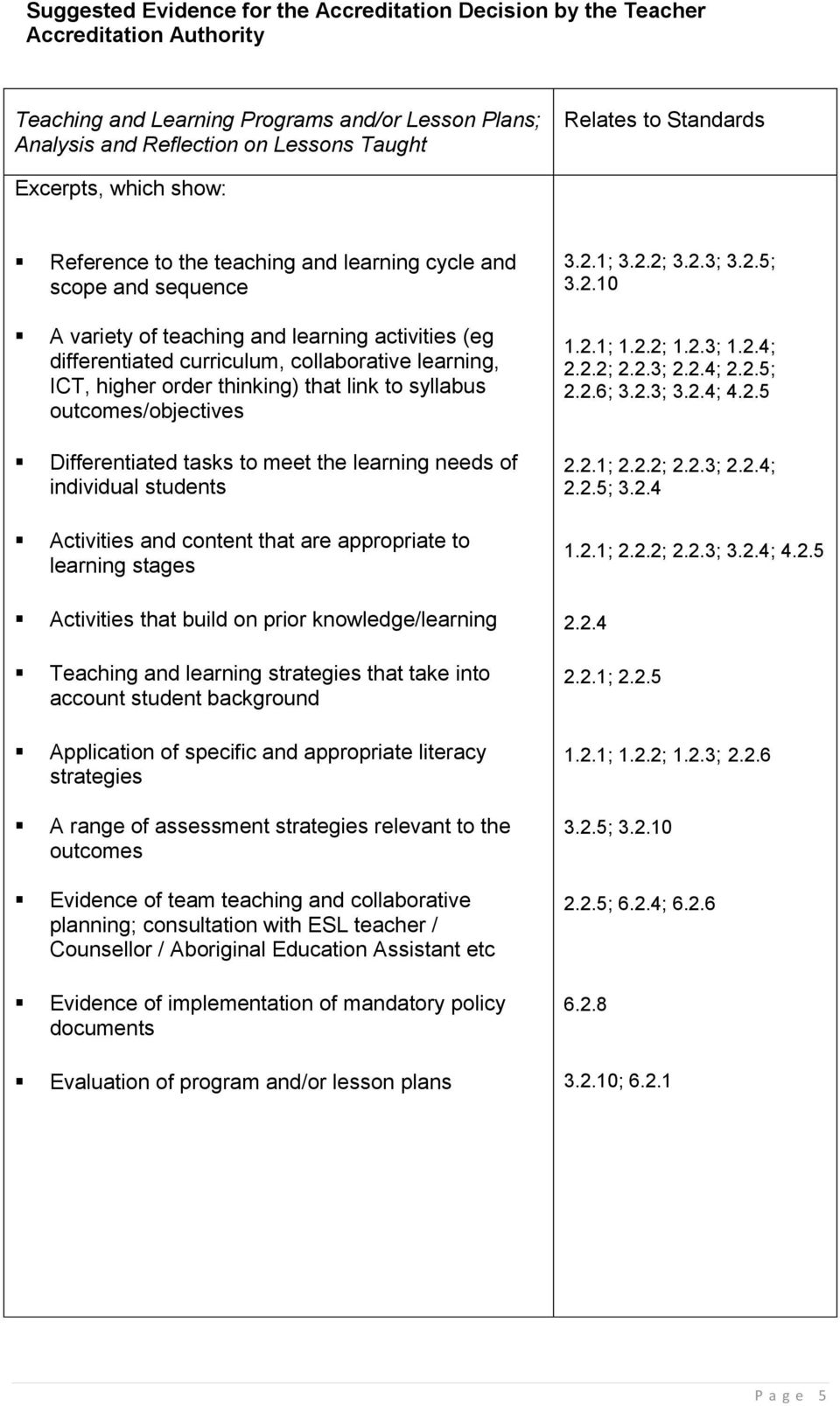
6 Suggested Evidence for the Accreditation Decision by the Teacher Accreditation Authority Teaching and Learning Programs and/or Lesson Plans; Analysis and Reflection on Lessons Taught Relates to Standards Excerpts, which show: Reference to the teaching and learning cycle and scope and sequence A variety of teaching and learning activities (eg differentiated curriculum, collaborative learning, ICT, higher order thinking) that link to syllabus outcomes/objectives Differentiated tasks to meet the learning needs of individual students Activities and content that are appropriate to learning stages Activities that build on prior knowledge/learning Teaching and learning strategies that take into account student background Application of specific and appropriate literacy strategies A range of assessment strategies relevant to the outcomes Evidence of team teaching and collaborative planning; consultation with ESL teacher / Counsellor / Aboriginal Education Assistant etc Evidence of implementation of mandatory policy documents Evaluation of program and/or lesson plans 3.2.1; 3.2.2; 3.2.3; 3.2.5; ; 1.2.2; 1.2.3; 1.2.4; 2.2.2; 2.2.3; 2.2.4; 2.2.5; 2.2.6; 3.2.3; 3.2.4; ; 2.2.2; 2.2.3; 2.2.4; 2.2.5; ; 2.2.2; 2.2.3; 3.2.4; ; ; 1.2.2; 1.2.3; ; ; 6.2.4; ; P a g e 5
7 Lesson Observations Relates to standards Notes and discussion about lessons observed Interaction with students Classroom/Learning environment Routines and behaviour management Lesson content and structure Communication strategies and effectiveness of classroom discussion Effectiveness of group work Management of student behaviour 4.2.1; 4.2.3; 5.2.1; 5.2.3; ; 5.2.2; 5.2.3; 5.2.4; ; 5.2.3; 5.2.4; 5.2.5; ; 1.2.2; 1.2.3; 1.2.4; 2.2.1; 2.2.2; 2.2.3; 2.2.4; 2.2.5; 3.2.2; 3.2.4; 3.2.5; 3.2.6; 4.2.1; 4.2.3; 4.2.4; ; ; 3.2.7; 4.2.1; 4.2.2; ; ; 5.2.1; 5.2.2; 5.2.3; ; 5.2.6; Team Teaching/Collaborative Planning Notes from meetings with colleagues, support staff, supervisors 6.2.4; Student work samples Student work samples linked to excerpts from program or lesson plans ; 3.2.2; 3.2.4; 3.2.7; 4.2.1; 6.2.1; Classroom Management Documentation Annotated copy of school behaviour management forms Implementation of school policies and procedures Implementation of classroom strategies designed to manage problems in the classroom 5.2.3; Recording and Reporting Student Progress Record of feedback given to students; evidence of record-keeping system Parent/teacher meetings; plan for meetings and records; written communication to parents; record of letters etc sent home 3.2.6; 3.2.7; ; 7.2.1; 7.2.2; 7.2.3; P a g e 6

8 Accurate record keeping of assessment, attendance and any discipline matters ; Meeting Records Record of meetings with supervisor regarding teaching observed, lesson planning and student achievement ; 6.2.1; 6.2.2; 6.2.4; Professional Learning Plan Professional Learning Plan that contains: Self analysis and reflection Attendance and participation in professional learning opportunities Use of/ implementation of professional learning activities 6.2.1; ; 6.2.2; 6.2.3; REMEMBER: Only a selection of these documents presented for the accreditation decision should be included in the Accreditation Report which is forwarded to the NSW Institute of Teachers. This is explained in Part Two. P a g e 7

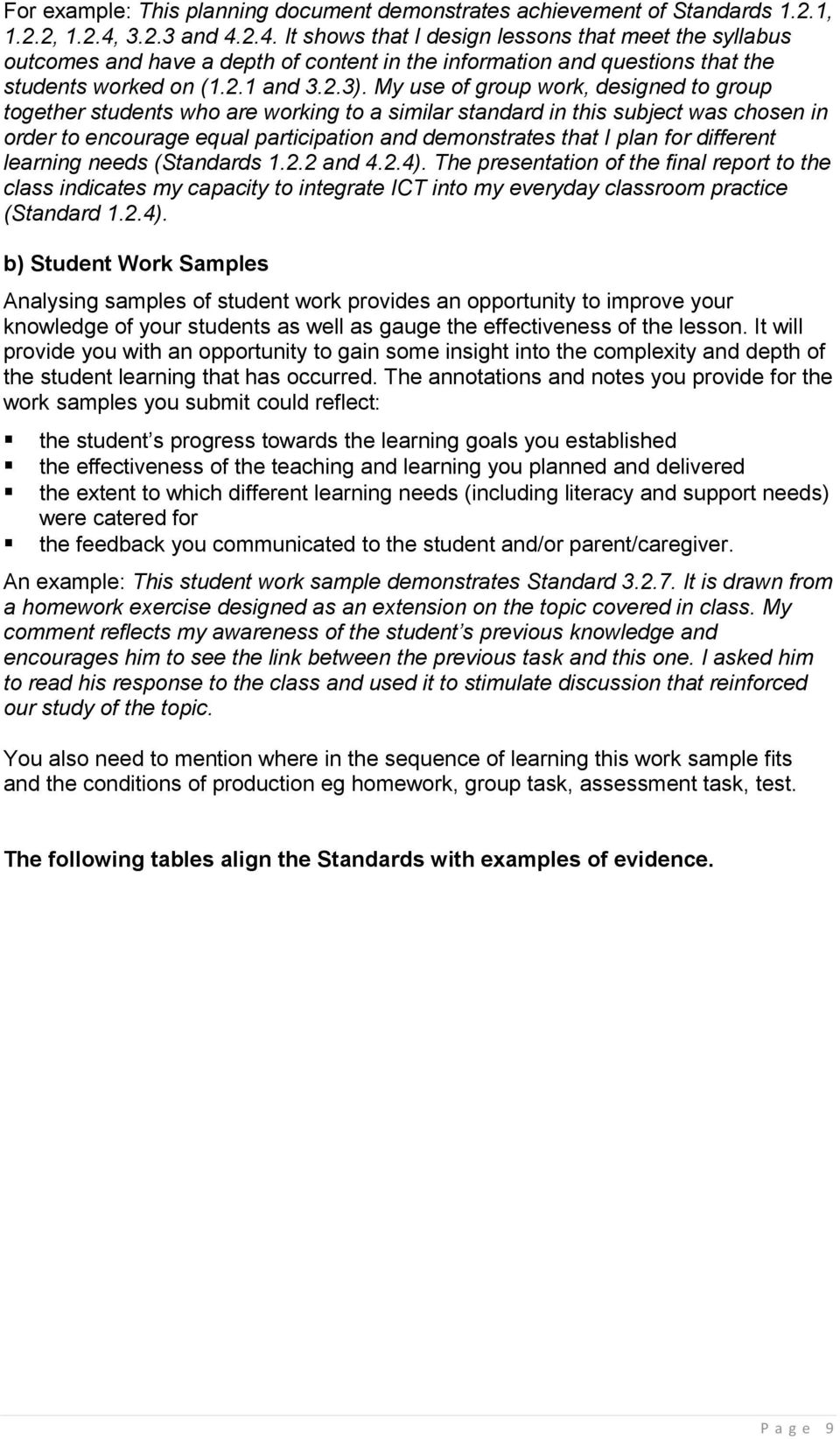
9 PART TWO Documentation for Inclusion with Your Accreditation Report After the Teacher Accreditation Authority has made the decision about your accreditation, an Accreditation Report is submitted to the NSW Institute of Teachers, Selected evidence of your work accompanies this report. This evidence is to be drawn from your everyday teaching practice and is to be annotated by you. When you are selecting the pieces of evidence to submit to the NSW Institute of Teachers, consider the relationship between the report written by your supervisor and the evidence. They should relate to one another. Choose appropriate evidence that explicitly demonstrates the Standard/s you nominate. Be sure that your understanding of how this sample demonstrates your achievement of the Standards, is evident and that the Standards you selected are substantiated in the documentation. You need to annotate the evidence that is to be included with the Accreditation Report. The annotations ensure that your work can be understood outside your context and should demonstrate your achievement of the Standards. The annotations should make specific links between your teaching practice and the Standards. For example, This planning document demonstrates achievement of Standards 1.2.1, 1.2.2, and It shows that I design lessons that meet syllabus outcomes, that I plan for different learning needs and take into account the prior knowledge of my students. It indicates my capacity to integrate ICT into my everyday classroom practice. The annotations should also match the Standards you have selected. For example, if you select standard Provide timely, effective and consistent oral and written feedback to students to encourage them to reflect on and monitor their learning - then it is important to see the evidence of this on the work sample. Please note: One item of documentary evidence can meet a number of Standards. The emphasis for evidence collection is on the quality rather than the quantity of documentation. 1. What to submit? Submit only an appropriate number of well annotated documents rather than a large number of documents that do not contribute to evidence for the accreditation report. You should submit: annotated excerpts from lessons plans and/or programs you have developed that have been signed and dated by your supervising teacher annotated student work samples. a) Lesson Plans and/or Programs The planning documents you submit should be annotated to ensure that they demonstrate how you use your knowledge of content and syllabus requirements, of your students and of pedagogy when planning for effective learning. Make sure you include evidence describing why you selected the activities and resources that you did and how this catered for your students learning needs. P a g e 8

10 For example: This planning document demonstrates achievement of Standards 1.2.1, 1.2.2, 1.2.4, and It shows that I design lessons that meet the syllabus outcomes and have a depth of content in the information and questions that the students worked on (1.2.1 and 3.2.3). My use of group work, designed to group together students who are working to a similar standard in this subject was chosen in order to encourage equal participation and demonstrates that I plan for different learning needs (Standards and 4.2.4). The presentation of the final report to the class indicates my capacity to integrate ICT into my everyday classroom practice (Standard 1.2.4). b) Student Work Samples Analysing samples of student work provides an opportunity to improve your knowledge of your students as well as gauge the effectiveness of the lesson. It will provide you with an opportunity to gain some insight into the complexity and depth of the student learning that has occurred. The annotations and notes you provide for the work samples you submit could reflect: the student s progress towards the learning goals you established the effectiveness of the teaching and learning you planned and delivered the extent to which different learning needs (including literacy and support needs) were catered for the feedback you communicated to the student and/or parent/caregiver. An example: This student work sample demonstrates Standard It is drawn from a homework exercise designed as an extension on the topic covered in class. My comment reflects my awareness of the student s previous knowledge and encourages him to see the link between the previous task and this one. I asked him to read his response to the class and used it to stimulate discussion that reinforced our study of the topic. You also need to mention where in the sequence of learning this work sample fits and the conditions of production eg homework, group task, assessment task, test. The following tables align the Standards with examples of evidence. P a g e 9
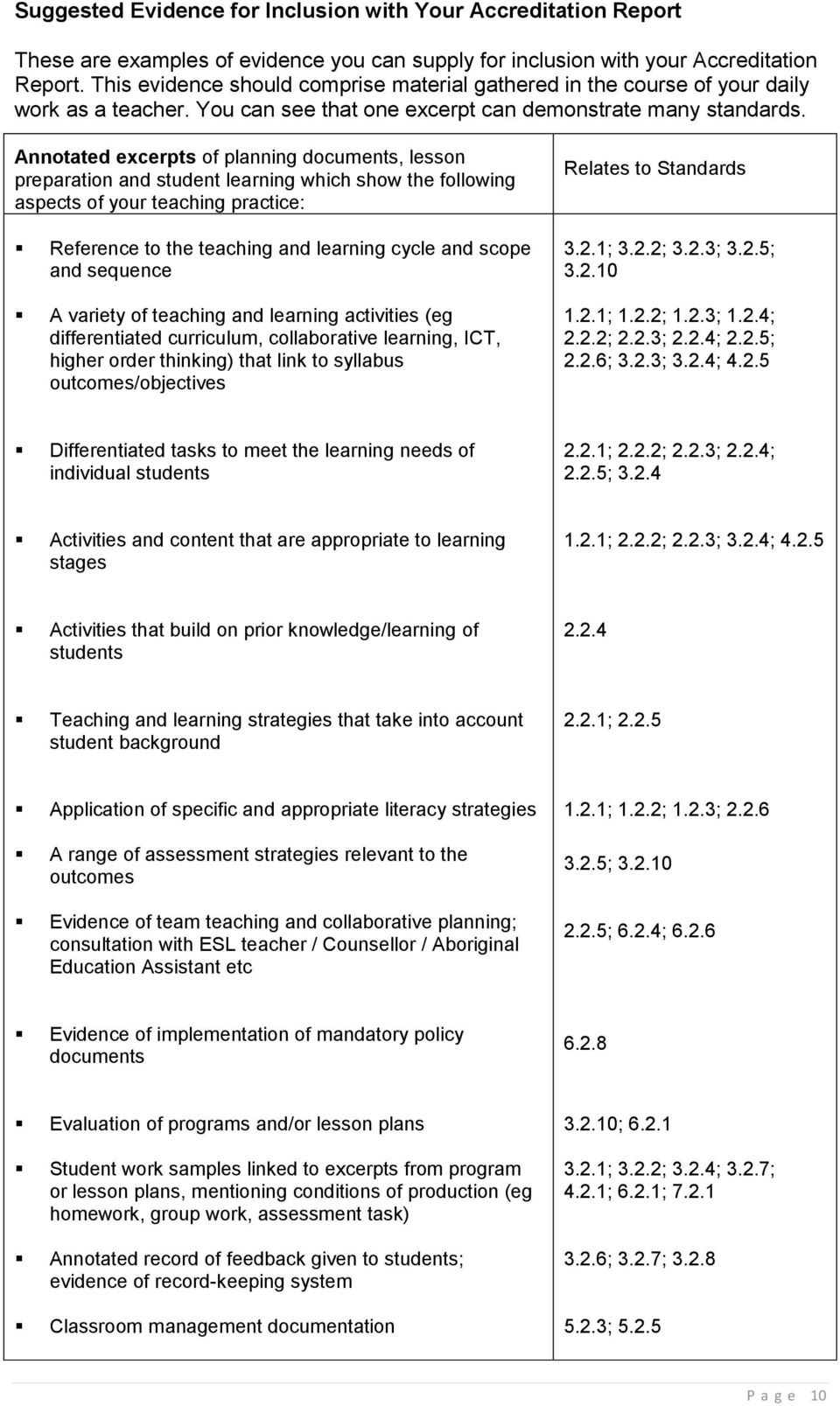
11 Suggested Evidence for Inclusion with Your Accreditation Report These are examples of evidence you can supply for inclusion with your Accreditation Report. This evidence should comprise material gathered in the course of your daily work as a teacher. You can see that one excerpt can demonstrate many standards. Annotated excerpts of planning documents, lesson preparation and student learning which show the following aspects of your teaching practice: Reference to the teaching and learning cycle and scope and sequence A variety of teaching and learning activities (eg differentiated curriculum, collaborative learning, ICT, higher order thinking) that link to syllabus outcomes/objectives Relates to Standards 3.2.1; 3.2.2; 3.2.3; 3.2.5; ; 1.2.2; 1.2.3; 1.2.4; 2.2.2; 2.2.3; 2.2.4; 2.2.5; 2.2.6; 3.2.3; 3.2.4; Differentiated tasks to meet the learning needs of individual students 2.2.1; 2.2.2; 2.2.3; 2.2.4; 2.2.5; Activities and content that are appropriate to learning stages 1.2.1; 2.2.2; 2.2.3; 3.2.4; Activities that build on prior knowledge/learning of students Teaching and learning strategies that take into account student background 2.2.1; Application of specific and appropriate literacy strategies A range of assessment strategies relevant to the outcomes Evidence of team teaching and collaborative planning; consultation with ESL teacher / Counsellor / Aboriginal Education Assistant etc 1.2.1; 1.2.2; 1.2.3; ; ; 6.2.4; Evidence of implementation of mandatory policy documents Evaluation of programs and/or lesson plans Student work samples linked to excerpts from program or lesson plans, mentioning conditions of production (eg homework, group work, assessment task) Annotated record of feedback given to students; evidence of record-keeping system Classroom management documentation ; ; 3.2.2; 3.2.4; 3.2.7; 4.2.1; 6.2.1; ; 3.2.7; ; P a g e 10
12 P a g e 11

Evidence Guide for the Proficient Teacher Standards
 Guide for the Proficient Teacher Standards Guide for the Proficient Teacher Standards Table of Contents Section One: Teaching Standards... 3 Section Two: for Accreditation... 8 Section Three: Examples
Developing a school accreditation policy for teachers progressing to Proficient Teacher
 Developing a school accreditation policy for teachers progressing to Proficient Teacher Information provided by the Board of Studies, Teaching and Educational Standards (BOSTES) All TAAs are required to
Appendix 1: Detailed evidence examples
 Appendix 1: Detailed examples These examples are not an exhaustive list and serve only as an illustration. They should not be viewed as a checklist. Please note: one quality item can provide for a range
Transition to full registration. Providing evidence of practice EVIDENCE GUIDE
 Transition to full registration Providing evidence of practice EVIDENCE GUIDE Table of Contents This is a QCT resource for provisionally registered teachers (developed from AITSL s Guide to Transition
AUSTRALIAN PROFESSIONAL STANDARDS FOR TEACHERS I L C O U N C
 AUSTRALIAN PROFESSIONAL STANDARDS FOR TEACHERS QUALITY TEACHING I L C O U N C Contents Introduction 2 Organisation of the Australian Professional Standards for Teachers 4 Professional Knowledge 8 Professional
A guide to the evidence-based process for full registration SUPPORTING PROVISIONALLY REGISTERED TEACHERS
 A guide to the evidence-based process for full registration SUPPORTING PROVISIONALLY REGISTERED TEACHERS Updated 0 SUPPORTING PROVISIONALLY REGISTERED TEACHERS ONLINE Teachers with provisional registration
Guide for Transition to Full Registration
 Guide for Transition to Full Registration February 2012 1 The Guide for Transition to Full Registration (Guide to Full Registration) Table of Contents 1. Background on using the Guide to Full Registration
FINAL EVALUATION FORM. Graduate Certificate of Education PPA5106 Early Childhood Studies
 Graduate Certificate Teacher Name: Centre/School: University Supervisor: Year Level Taught: FINAL EVALUATION FORM Graduate Certificate of Education PPA5106 Early Childhood Studies Please indicate whether
Our Young Learners: giving them the best possible start
 NSW DEPARTMENT OF EDUCATION & TRAINING Our Young Learners: giving them the best possible start An Education Strategy for the Early Years from Kindergarten to Year 4, 2006-2009 Introduction We are committed
New Scheme Teacher Accreditation Policy
 New Scheme Teacher Accreditation Policy This policy addresses issues in relation to: Staff Teaching Staff Responsible for Delivering the Curriculum 3.2.1 Safe and Supportive Environment Student Welfare
AITSL is funded by the Australian Government. Guide to the Certification of Highly Accomplished and Lead Teachers in Australia
 AITSL is funded by the Australian Government Guide to the Certification of Highly Accomplished and Lead Teachers in Australia The Australian Institute for Teaching and School Leadership (AITSL) has been
Senior Leadership Team and Class Teacher Job Description & Person Specification
 Senior Leadership Team and Class Teacher Job Description & Person Specification SCHOOL Queen Eleanor s C of E Junior School TITLE Senior Leadership Team & Class Teacher JOB PURPOSE As part of the Leadership
Transition to Full Registration
 Transition to Full Registration Guide to Evidencing the Professional Standards at the Proficient Level Teacher Registration Board of Western Australia www.trb.wa.gov.au 2014 / 21998 Transition to Full
Business Services (Administration) Curriculum Framework
 Business Services (Administration) Curriculum Framework Stage 6 Syllabus Part A for implementation from 2000 Business Services Office Administration (120 indicative hours) Business Services Office Administration
PERFORMANCE AND DEVELOPMENT FRAMEWORK FOR PRINCIPALS, EXECUTIVES AND TEACHERS IN NSW PUBLIC SCHOOLS
 PERFORMANCE AND DEVELOPMENT FRAMEWORK FOR PRINCIPALS, EXECUTIVES AND TEACHERS IN NSW PUBLIC SCHOOLS Introduction and Context The NSW Department of Education and Communities is committed to attracting,
Master of Teaching (Primary) Primary Professional Experience 1. Professional Experience Handbook
 Master of Teaching (Primary) Primary Professional Experience 1 Professional Experience Handbook The University of Queensland 2015 The University of Queensland - School of Education M Teach - Primary Professional
Cambridge International Certificate in Teaching and Learning 6208 Cambridge International Diploma in Teaching and Learning 6209
 Cambridge International Certificate in Teaching and Learning 6208 Cambridge International Diploma in Teaching and Learning 6209 Preface This syllabus sets out the details of the Certificate and Diploma
For examination in 2015
 Cambridge International Certificate in Teaching with Digital Technologies 6224 Cambridge International Diploma in Teaching with Digital Technologies 6225 For examination in 2015 Preface This syllabus sets
Calday Grange Grammar School PERSON SPECIFICATION: TEACHER
 Qualifications 1. Qualified teacher status. a) Commitment to continuing professional development activities Professional Attributes 1. Have high expectations of young people including a commitment to ensuring
Information Technology Curriculum Framework
 Information Technology Curriculum Framework Stage 6 Syllabus Part A for implementation from 2000 Information Technology (120 indicative hours) Information Technology (180 indicative hours) Information
Professional Standards for Teachers in England from September 2007 1
 Professional Standards for Teachers in England from September 2007 1 Introduction Bringing coherence to the professional and occupational standards for the whole school workforce 1. The framework of professional
Cambridge International Certificate in Educational Leadership 6247 Cambridge International Diploma in Educational Leadership 6248
 Cambridge International Certificate in Educational Leadership 6247 Cambridge International Diploma in Educational Leadership 6248 For examination in 2015 Preface This syllabus sets out the details of the
Certification of Highly Accomplished and Lead Teachers in Australia
 AITSL is funded by the Australian Government Certification of Highly Accomplished and Lead Teachers in Australia April 2012 The Australian Institute for Teaching and School Leadership (AITSL) has been
PRESERVICE. PROFESSIONAL STANDARDS FOR QUEENSLAND TEACHERS (graduate level): A guide for use with preservice teachers QUEENSLAND COLLEGE OF TEACHERS
 PRESERVICE PROFESSIONAL STANDARDS FOR TEACHERS (graduate level): March 2009 INTRODUCTION The Professional Standards for Queensland Teachers underpin all stages of teachers professional learning throughout
School Management Plan 2012 2014. 2012 2014 School Management Plan Identifier: SPS PD/110712/D004
 School Management Plan 2012 2014 Policy: 2012 2014 School Management Plan Identifier: SPS PD/110712/D004 Author: Mr. Bernard Cheng Consultation: School Executive Endorsement: Kerri Brickley: School Education
Vernon Park Primary School. Teaching and Learning Policy
 Vernon Park Primary School Teaching and Learning Policy The school s approach to teaching and learning is based upon the school vision: At Vernon Park Primary School we aim to provide all children, parents,
Professional Standards for Teachers
 Professional Standards for Teachers Guidelines for Professional Practice July 2005 Queensland the Smart State The State of Queensland (Department of Education) 2005 Copyright protects this publication.
MAINTENANCE OF ACCREDITATION AT THE PROFICIENT TEACHER LEVEL
 MAINTENANCE OF ACCREDITATION AT THE PROFICIENT TEACHER LEVEL INFORMATION FOR TEACHERS YOUR CONTINUING PROFESSIONAL DEVELOPMENT YOUR MAINTENANCE OF ACCREDITATION REPORT REVISED: 22 JANUARY 2014 Contents
Business Services Curriculum Framework
 Business Services Curriculum Framework Stage 6 Syllabus Part A for implementation from 2002 Business Services (120 indicative hours) Business Services (240 indicative hours) Business Services Extension
Accreditation at Highly Accomplished and Lead Teacher. Information for Referees
 Accreditation at Highly Accomplished and Lead Teacher Information for Referees Contents Introduction... 3 Candidate s evidence for accreditation... 3 Importance of referee statements... 3 Candidate s selection
QUALITY ASSURANCE IN INITIAL TEACHER EDUCATION
 QUALITY ASSURANCE IN INITIAL TEACHER EDUCATION BENCHMARK INFORMATION ON THE STANDARD for INITIAL TEACHER EDUCATION IN SCOTLAND CONSULTATION DOCUMENT April 2000 This document has been produced under the
aitsl.edu.au Accreditation of Initial Teacher Education Programs in Australia
 aitsl.edu.au Accreditation of Initial Teacher Education Programs in Australia Standards and Procedures April 2011 2011 Education Services Australia as the legal entity for the Ministerial Council for Education,
Professional Experience Handbook - Appendices Bachelor of Education (Early Childhood) Course Code SL033BEEC 2013
 Professional Experience Handbook - Appendices Bachelor of Education (Early Childhood) Course Code SL033BEEC 2013 Professional Experience Unit SLEE202 Teaching and Learning in Early Childhood Table of
To act as a professional inheritor, critic and interpreter of knowledge or culture when teaching students.
 FOUNDATIONS (1, 2) To act as a professional inheritor, critic and interpreter of knowledge or culture when teaching students. Situates the discipline's basic benchmarks and points of understanding (concepts,
THE PSYCHOLOGICAL SOCIETY OF IRELAND CUMANN SÍCEOLAITHE ÉIREANN ACCREDITATION CRITERIA FOR POSTGRADUATE PROFESSIONAL TRAINING
 THE PSYCHOLOGICAL SOCIETY OF IRELAND CUMANN SÍCEOLAITHE ÉIREANN ACCREDITATION CRITERIA FOR POSTGRADUATE PROFESSIONAL TRAINING IN EDUCATIONAL PSYCHOLOGY DATE: 22 ND FEBRUARY 2010 Date for review: February
Performance Appraisal Policy For Teachers
 Performance Appraisal Policy For Teachers Department: Schools HR Advisory Team Author: Ruth Alinek Original date of Issue: April 2012 Latest Review: May 2013 Version: 3 Hertfordshire County Council 2012.
Australian Professional Standards for Teachers
 Australian Professional Standards for Teachers This version of the Australian Professional Standards for Teachers was adopted by the Queensland College of Teachers (QCT) with permission from the Australian
Australian Professional Standards for Teachers
 AITSL is funded by the Australian Government Australian Professional Standards for Teachers February 2011 Formerly the National Professional Standards for Teachers Work on the (the Standards) commenced
Evaluation Case Study
 Australian Government Department of Education More Support for Students with Disabilities 2012-2014 Evaluation Case Study Team teaching by speech pathologists and teachers in the classroom MSSD Output
Teaching ESL Students in Mainstream Classrooms: language in learning across the curriculum. 2013 Information for Schools
 : language in learning across the curriculum 2013 Information for Schools What is Teaching ESL student in Mainstream Classrooms (TESMC)? (TESMC) is for educators seeking to develop understandings of the
PRESERVICE. PROGRAM APPROVAL GUIDELINES for Preservice Teacher Education QUEENSLAND COLLEGE OF TEACHERS. Revised September 2011
 PRESERVICE PROGRAM APPROVAL GUIDELINES for Preservice Teacher Education Revised September 2011 COLLEGE OF TEACHERS PROGRAM APPROVAL GUIDELINES for Preservice Teacher Education Revised September 2011 COLLEGE
Chorlton High School. Job Description. Curriculum Support Assistant Grade 5 (MCC Teaching Assistant Level 4 Teaching and Learning)
 Chorlton High School Job Description Curriculum Support Assistant Grade 5 (MCC Teaching Assistant Level 4 Teaching and Learning) The post holder will report to the appropriate Curriculum Leader. Apart
End of Experience/Placement Assessment Report: Masters of Teaching (Primary) Graduate Diploma of Teaching (Primary)
 End of Experience/Placement Assessment Report: Unit Code LEM503 Unit Title Supervised Practicum A: Literacy and Numeracy 1 Pre-service Teacher s name: Name of Education Setting: Mentor Teacher 1 (name):
INVESTORS IN PEOPLE REVIEW REPORT
 INVESTORS IN PEOPLE REVIEW REPORT Lower Farm Primary School Page: 1 of 13 CONTENTS Key Information 3 Assessor Decision 3 Milestone Dates 3 Introduction 4 Assessment Objectives 4 Feedback Against the Assessment
Damers First School Teaching & Learning Policy
 Damers First School Teaching & Learning Policy DAMERS FIRST SCHOOL HAPPY CHILDREN & HIGH QUALITY OHANA! In our family NO ONE GETS LEFT BEHIND Because we believe CHILDREN ARE OUR FUTURE. TEACH THEM WELL
Assessment, Recording and Reporting Policy. Committee Responsible: Curriculum & Standards
 The process of assessing, recording and reporting is required to: Inform students, parents and teachers of attainment and progress being made by students in all areas of the curriculum. Allow realistic
Salary The postholder will be paid on the appropriate point of the pay scale with the addition of the TLR 2B.
 JOB DESCRIPTION ASSISTANT CURRICULUM LEADER FOR SCIENCE (TLR 2B) Salary The postholder will be paid on the appropriate point of the pay scale with the addition of the TLR 2B. Line of Responsibility The
Evaluation of degree programs. Self-Evaluation Framework
 Evaluation of degree programs Self-Evaluation Framework COVER, December 2009 FOREWORD UNIL's approach to quality emphasizes procedures based on reflection that encourage the faculties and units concerned
Teacher of Art Design Technology (temporary part-time (0.6) to cover maternity leave)
 Teacher of Art Design Technology (temporary part-time (0.6) to cover maternity leave) Table of Contents Letter from Sarah Baker, Headteacher 2 Letter from Nick Lawrence, Curriculum Team Leader of ADT 3
CLEMTON PARK PS. Learning Support Team Policy
 CLEMTON PARK PS Learning Support Team Policy A Learning Support Team A learning support team is a whole school planning and support mechanism. It is formed with the purpose of addressing the learning support
How To Teach
 AITSL is funded by the Australian Government Certification documentary evidence supplement Lead teachers Companion document to the Guide to Certification of Highly Accomplished and Lead Teachers in Australia
Evaluation Case Study. Changing the roles of special education teachers
 Australian Government Department of Education More Support for Students with Disabilities 2012-2014 Evaluation Case Study Changing the roles of special education teachers MSSD Output 9: Modifying lesson
The Standards for Registration: mandatory requirements for Registration with the General Teaching Council for Scotland December 2012
 DRIVING FORWARD PROFESSIONAL STANDARDS FOR TEACHERS The Standards for Registration: mandatory requirements for Registration with the General Teaching Council for Scotland December 2012 Contents Page The
Assessment, Recording and Reporting Policy
 St Peter s CE (VA) Infants School Assessment, Recording and Reporting Policy Philosophy Assessment is essential for the promotion of effective learning and teaching. It enables the teacher to deliver an
ASU College of Education Course Syllabus ED 4972, ED 4973, ED 4974, ED 4975 or EDG 5660 Clinical Teaching
 ASU College of Education Course Syllabus ED 4972, ED 4973, ED 4974, ED 4975 or EDG 5660 Clinical Teaching Course: ED 4972, ED 4973, ED 4974, ED 4975 or EDG 5660 Credit: 9 Semester Credit Hours (Undergraduate),
ACCREDITATION Classroom ready: Demonstrating the impact on student learning of initial teacher education programs
 ACCREDITATION Classroom ready: Demonstrating the impact on student learning of initial teacher education programs Position Paper August 2015 Classroom ready: Demonstrating the impact on student learning
ROLES AND RESPONSIBILITIES The roles and responsibilities expected of teachers at each classification level are specified in the Victorian Government
 ROLES AND RESPONSIBILITIES The roles and responsibilities expected of teachers at each classification level are specified in the Victorian Government Schools Agreement 2004: Leading teacher Leading teachers
THE VOCATIONAL GRADUATE CERTIFICATE IN LOCAL GOVERNMENT MANAGEMENT
 THE VOCATIONAL GRADUATE CERTIFICATE IN LOCAL GOVERNMENT MANAGEMENT IT S THE CAREER ACCELERATOR FOR COUNCIL MANAGERS SUBJECT CHOICES Govern councils Manage the human resources process in local government
Humanities Teacher Job Description
 Humanities Teacher Job Description This job description forms part of the contract of employment of the successful applicant. The appointment is subject to the conditions of employment of Teachers contained
Final Intern Evaluation
 EDG4944 - Final (Part 1) Bachelors of Science in Education Number of Students= Number of Evaluations= Final Intern Evaluation AP1. Instructional Design and Lesson Planning. Applying concepts from human
Using the e5 Instructional model (engage, explore, explain, elaborate, evaluate) in Traffic Safety Education
 Using the e5 Instructional model (engage, explore, explain, elaborate, evaluate) in Traffic Safety Education Conrad Remenyi, Senior Project Officer, Department of Education & Early Childhood Development,
Student Welfare, Good Discipline and Effective Learning. Student Welfare Policy
 Student Welfare, Good Discipline and Effective Learning Student Welfare Policy 1996 New South Wales Department of School Education Student Welfare Directorate RESTRICTED WAIVER OF COPYRIGHT The printed
APPLICATION TRANSITION FROM PROVISIONAL TO (FULL) REGISTRATION
 Member of the Australasian Teacher Regulatory Authorities Inc. PO Box 3649, Rundle Mall SA 5000 Phone: (08) 8226 2666 Fax: (08) 8226 2667 Website: www.trb.sa.edu.au Email: [email protected] APPLICATION
Art, Design Policy. Michael Sobell Sinai School
 Art, Design Policy 2014 Art, Design & displays Policy Rationale At Sinai School, we are concerned with the education of the whole child and the development of Art and Craft skills will enable the achievement
Job Description Teacher of Engineering/Design and Technology
 Job Description Teacher of Engineering/Design and Technology Post title Salary Reporting to Core Purpose Teacher of Engineering/Design and Technology UCL Academy Main Pay Scale M1-M9 (Full Time) Assistant-Principal
Bachelor of Education Early Childhood
 Faculty of Humanities Faculty of Humanities Faculty of Professional Experience Handbook Bachelor of Education Early Childhood Bentley and Regional Professional Studies in Teaching an Assessment in Junior
PROFESSIONAL STANDARDS for Queensland Teachers
 PROFESSIONAL STANDARDS for Queensland Teachers December 2006 COLLEGE OF TEACHERS LETTER from the Chair Colleagues On behalf of the Queensland College of Teachers, I would like to introduce the Professional
Office of the Commissioner for Public Employment COUNSELLING. for better work performance
 Office of the Commissioner for Public Employment COUNSELLING for better work performance Northern Territory Government Contents Introduction Performance Management Page 1 Feedback Page 4 Moving from feedback
CHC50113 Diploma of Early Childhood Education and Care
 CHC50113 Diploma of Early Childhood Education and Care Introduction Australian National Training Group is a Registered Training Organisation (RTO number 41311) registered with the Australian Skills Quality
STUDENT INFORMATION GUIDE
 STUDENT INFORMATION GUIDE Future Skills is a registered training organisation with scope to deliver and assess against a range of qualifications, including the TAE40110 Certificate IV in Training and Assessment
Bachelor of Education Dual Degree Programs (Secondary & MYS) Introduction to Professional Practice. Professional Experience Handbook
 Bachelor of Education Dual Degree Programs (Secondary & MYS) Introduction to Professional Practice Professional Experience Handbook The University of Queensland 2015 B Ed Dual Degree Secondary Introduction
Programme Specification: Master of Business Administration
 Programme Specification: Master of Business Administration 1. Awarding Institution/Body University of Gloucestershire 2. Teaching Institution University of Gloucestershire 3. Recognition by Professional
ADEPT Performance Standards. for. Classroom-Based Teachers
 ADEPT Performance Standards for Classroom-Based Teachers Revised ADEPT Performance Standards for Classroom-Based Teachers Introduction Central to the ADEPT system is a set of expectations for what teaching
CHC50113 Diploma of Early Childhood Education and Care
 Introduction CHC50113 Diploma of Early Childhood Education and Care is a Registered Training Organisation (RTO number 41095) registered with the Australian Skills Quality Authority. Early Learning Institute
Contents. Before you begin
 Contents Contents Before you begin Learning outcomes for TAEASS401A Plan assessment activities and processes Understanding the competency standard Developing and recording employability skills What is
2014 2015 one year courses cosmetic and fragrance marketing & management
 2014 2015 one year courses cosmetic and fragrance marketing & management undergraduate programmes one year course cosmetic and fragrance marketing & management 02 Brief descriptive summary Over the past
Textiles Technology Years 7 10. Advice on Programming and Assessment
 Textiles Technology Years 7 10 Advice on Programming and Assessment 2003 Copyright Board of Studies NSW for and on behalf of the Crown in right of the State of New South Wales. This document contains Material
Mastery approaches to mathematics and the new national curriculum
 October 2014 Mastery approaches to mathematics and the new national curriculum Mastery in high performing countries The content and principles underpinning the 2014 mathematics curriculum reflect those
Monitoring and tracking progress and achievement in the broad general education
 and achievement in the broad general education This paper is part of a suite of resources 1 and provides advice on approaches to monitoring and tracking progress and achievement in order to help inform
Lecturer Job Description - Maths Graduate
 Lecturer Job Description - Maths Graduate Date : May 2014 Reports to : Section Leader, Skills for Life Introduction Bicton College s Values are embodied in the following statements: We are student focussed
Assessment in the New National Curriculum
 Assessment in the New National Curriculum Introduction We believe that effective assessment provides information to improve teaching and learning. We give learners regular feedback on their learning so
Section 1 - General Course Information
 Course Information Form (CIF) The CIF provides core information to students, staff teams and others on a particular course of study. Section 1 - General Course Information Course Title Applied Social Work
Quality teaching in NSW public schools Discussion paper
 Quality teaching in NSW public schools Discussion paper Professional Support and Curriculum Directorate May 2003 Quality teaching in NSW public schools Discussion paper 2003 State of NSW Department of
Teachers Standards May 2012
 Teachers Standards May 2012 TEACHERS STANDARDS IN ENGLAND FROM SEPTEMBER 2012 INTRODUCTION, LEGAL STANDING AND INTERPRETATION 1. The new Teachers Standards published by the Secretary of State for Education
Planning and Programming Guidelines for Teachers. Transition Year 9
 Planning and Programming Guidelines for Teachers Transition Year 9 2010 Planning and Programming Guidelines for Teachers Transition Year 9 NT Department of Employment and Training Requirements for curriculum,
Junior Cycle Business Studies Draft Specification. For consultation
 Junior Cycle Business Studies Draft Specification For consultation 1 2 Contents Introduction to junior cycle 5 Rationale 6 Aim 7 Overview: Links 8 Overview: Course 11 Progression 14 Expectations for students
Government response to the review of teacher education and school induction
 Government response to the review of teacher education and school induction Government response to the review of teacher education and school induction In February 2010, the Queensland Government released
Paper E-180314-? Appendix 1 Annex A
 Comparison between the GCC s Degree Recognition Criteria (May 2010) and the Councils on Chiropractic Education International - International Chiropractic Accreditation Standards (2009) Introduction The
Procedures for Assessment and Accreditation of Medical Schools by the Australian Medical Council 2011
 Australian Medical Council Limited Procedures for Assessment and Accreditation of Medical Schools by the Australian Medical Council 2011 Medical School Accreditation Committee These procedures were approved
North Carolina Professional Teaching Standards
 North Carolina Professional Teaching Standards For every student in North Carolina, a knowledgeable, skilled compassionate teacher...a star in every classroom. As Approved by the State Board of Education
Programme Specification
 Programme Specification 1. Programmes: Programme Title International Foundation (Art and Design) UCAS Code (Completed by Registry post approval) Click here to enter text. GSA Code (Completed by Registry
Reflective Practice: Goals for Professional Growth Library Media Specialist
 Reflective Practice: Goals for Professional Growth Library Media Specialist Professional s Instructional Program I integrate the teaching of information skills with curriculum standards and classroom content.
developing an action plan Implementing change: Implementing change: developing an action plan
 Implementing change: developing an action plan Implementing change: developing an action plan Implementing change: developing an action plan Implementing change overview The change process through which
REFLECTING ON EXPERIENCES OF THE TEACHER INDUCTION SCHEME
 REFLECTING ON EXPERIENCES OF THE TEACHER INDUCTION SCHEME September 2005 Myra A Pearson, Depute Registrar (Education) Dr Dean Robson, Professional Officer First Published 2005 The General Teaching Council
PGCert/PGDip/MA Education PGDip/Masters in Teaching and Learning (MTL) Programme Specifications
 PGCert/PGDip/MA Education PGDip/Masters in Teaching and Learning (MTL) Programme Specifications Faculty of Education, Law and Social Sciences School of Education December 2011 Programme Specification PG
Standards for Excellence
 THE AUSTRALIAN ASSOCIATION OF MATHEMATICS TEACHERS Standards for Excellence in Teaching Mathematics in Australian Schools 2006 edition These Standards were originally adopted by AAMT Council in 2002 as