
Early childhood education and care in Canada 2012
|
|
|
- Anabel Wilkins
- 10 years ago
- Views:
Transcription
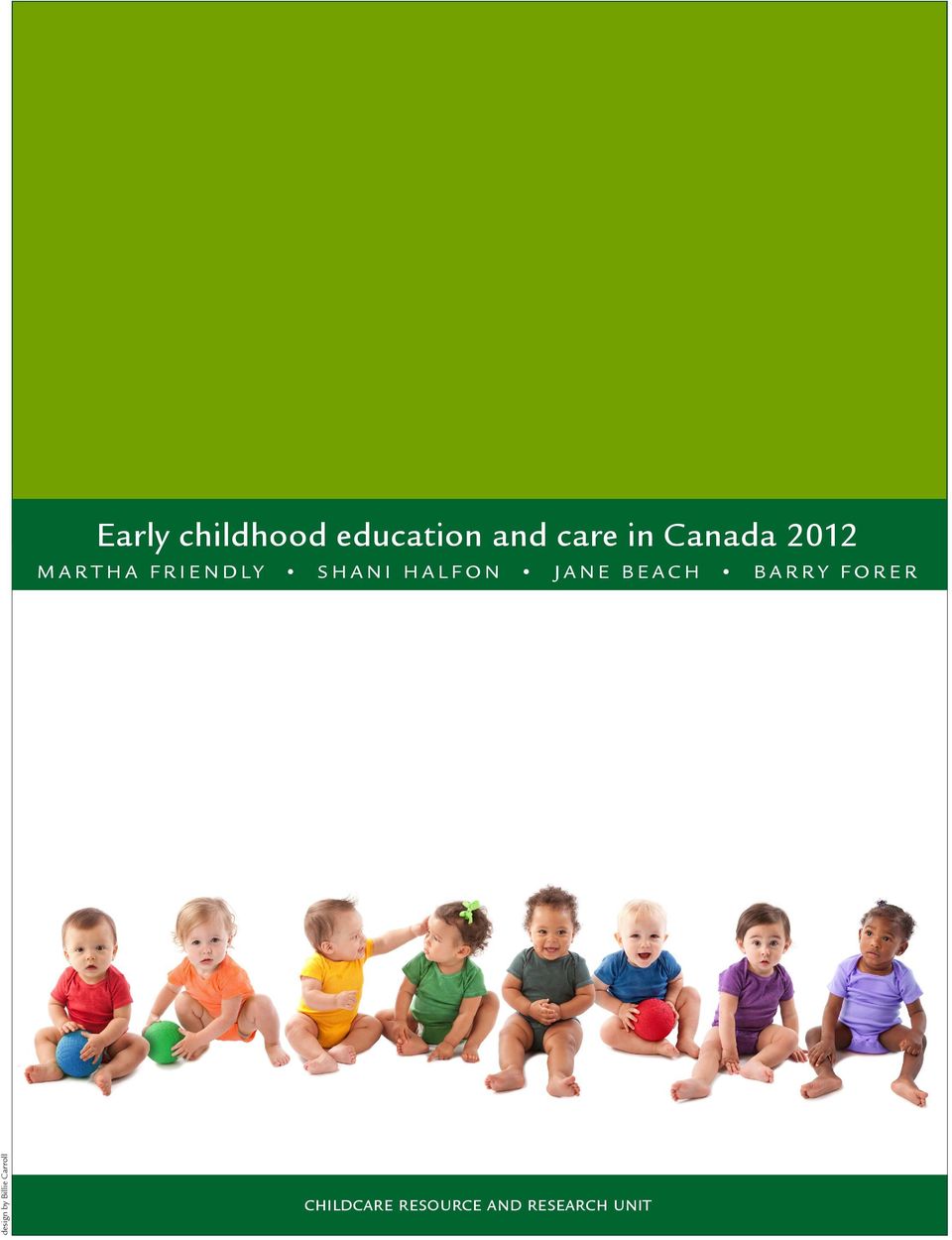
1 Early childhood education and care in Canada 2012 MARTHA FRIENDLY SHANI HALFON JANE BEACH BARRY FORER design by Billie Carroll childcare resource and research unit
2 Early childhood education and care in Canada 2012 Martha Friendly, Shani Halfon, Jane Beach and Barry Forer Childcare Resource and Research Unit August 2013, 69 pg. Revised December ISBN Childcare Resource and Research Unit 225 Brunswick Avenue Toronto ON Canada M5S 2M6 Telephone Website: Cover and interior design: Billie Carroll Library and Archives Canada Cataloguing in Publication Early childhood education and care in Canada 2012/ Martha Friendly et al 9th edition Earlier editions by Martha Friendly, Jane Beach and the Childcare Resource and Research Unit published under several titles including Child Care in Canada. ISBN Child care services government policy Canada; 2.Early childhood education government policy Canada; 3. Friendly, Martha; 4. Childcare Resource and Research Unit; 5. Series: Beach, Jane. Early childhood education and care in Canada Copyright 2013 by the Childcare Resource and Research Unit. All rights reserved. This report is fully downloadable. Sections may be freely reproduced for educational, scholarly and not-for-profit purposes if they are limited in length and fully cited. Permission to reproduce longer sections or for commercial publications should be sought in writing from the Childcare Resource and Research Unit. Citation: Friendly, M., Halfon, S., Beach, J. and Forer, B. (2013). Early childhood education and care in Canada Toronto: Childcare Resource and Research Unit. This work is licensed under the Creative Commons Attribution-NonCommercial- NoDerivs 3.0 Unported License. To view a copy of this license, visit creativecommons.org/licenses/by-nc-nd/3.0/. 2

3 Table of contents INTRODUCTION 4 About this report 4 Methods 4 Data sources 5 Acknowledgements 5 About the Childcare Resource and Research Unit PROVINCES/TERRITORIES 6 Newfoundland and Labrador 10 Prince Edward Island 14 Nova Scotia 18 New Brunswick 22 Quebec 26 Ontario 30 Manitoba 33 Saskatchewan 37 Alberta 41 British Columbia 46 Northwest Territories 49 Nunavut 52 Yukon COMPARATIVE TABLES 55 Table 1 Regulated child care spaces, % of 0-12 year olds for whom there is a regulated space and % of 0-5 year olds for whom there is a regulated full/parttime centre space. Provinces/territories/Canada total Table 2 Selected characteristics of kindergarten. Provinces/ territories Table 3a Average (median) full-time monthly parent fees in full-day centres by age group. Provinces/Canada total Table 3b Average monthly parent fees by age group. Territories Table 4 Average (median) gross hourly wages. Provinces/ Canada total 2012 (1998 figures adjusted for inflation for comparison) 59 Table 5 Minimum post-secondary early childhood training requirements for staff in full-time child care centres. Provinces/territories Table 6 Regulated family child care: Required ECE training and administrative model. Provinces/territories Table years (rounded estimates in 1000s). Provinces/territories/Canada total Table years with employed mothers (rounded estimate in 1000s) 63 Table 9 Workforce participation rate of mothers by age of youngest child (%, rounded estimate). Provinces/ territories/canada total Table 10 Total number of regulated child care spaces. Provinces/territories/Canada total Table 11 Total allocations for regulated child care (in unadjusted dollars rounded). Provinces/territories/ Canada total / Table 12 Percent of children 0-5 years for whom there is a regulated full or part-time centre-based child care space. Provinces/territories/Canada total Table 13 Percent of children 0-12 years for whom there is a regulated child care space. Provinces/territories/ Canada total Table 14 Allocation in unadjusted dollars for each regulated child care space. Provinces/territories/Canada total Table 15 Percent of regulated centre-based spaces that are for-profit. Provinces/territories/Canada total
4 Introduction ABOUT THIS REPORT Early childhood education and care in Canada 2012 is the ninth edition of similarly collected information developed by the Childcare Resource and Research Unit (CRRU). These reports on cross-canada data on early childhood programs have been compiled and published about every two years since the early 1990s. The Childcare Resource and Research Unit s ECEC in Canada reports, together with the data available in Public investments in early childhood education and care in Canada 2010 (a document developed by CRRU and published by Human Resources and Skills Development Canada (HRSDC, Government of Canada) are consistent in format, content and methodology. Thus they form a body of information that is both comparative across Canada and longitudinal over a 20 year period. This makes it possible to identify trends and developments over time information useful for research, policy-making and advocacy. This report, published in 2013, considers early childhood education and child care (ECEC) in Canada during the period , using cross- Canada and longitudinal data. Due to cancellation of federal funding, it is more limited than were previous editions. It is a subset of the information provided in previous versions, focusing largely on regulated child care. Users of the data may need to refer back to previous editions of ECEC in Canada for information on child care regulations, specific funding programs, maternity and parental leave, information on federal ECEC contributions and detailed information on kindergarten. Note that some information on kindergarten is provided in both provincial/territorial sections and comparative tables in this report. Like previous editions, this report relies primarily on provincial/territorial ECEC officials who kindly provided most of the data. These data, combined with data provided by Statistics Canada, easily available public information and data from the previous editions make up the longitudinal and current snapshot of regulated child care in Canada in Data sources are provided below. For further information, please refer to previous editions (1992, 1995, 1998, 2001, 2004, 2006 and 2008) online and in print, to HRSDC s 2010 publication Public investments in early childhood education and care in Canada 2010 (online only) and to CRRU s The state of early childhood education and care in Canada 2010 (online only). METHODS Most of the data on regulated child care in this report were provided by provincial/territorial government officials. The method used to collect and verify data on regulated child care from each province/territory followed a series of steps. First, a written questionnaire was sent to each self-identified official with key responsibility who assembled the data. Following a review of the data by the researchers, clarification was sought from relevant jurisdictions where necessary. A draft was then compiled using material provided by government officials and other sources where applicable. Provincial/territorial officials vetted the completed sections. Statistics Canada sources were used for demographic data. Note that in some instances there may be minor discrepancies between previously-reported data, based on periodic reviews and updates undertaken by specific jurisdictions. Every effort has been made to ensure the accuracy and consistency of the data provided in this publication and to use accurate and consistent terminology and categories across provinces/territories. This was not always possible due to the use of different terminologies, categories, data collection methods and missing information across Canada. In some instances, information that is consistent by date or definition was not available. Where this has occurred, dates and explanations have been provided or noted in the text or footnotes. The authors would appreciate being contacted if any discrepancies are noted. DATA SOURCES Number of Children 0-12 Years Special tabulation based on the Labour Force Survey, 2012 Annual Average. Conducted by Statistics Canada. Children 0-12 Years with Employed Mothers Special tabulation based on the Labour Force Survey, 2012 Annual Average. Conducted by Statistics Canada. NOTE: These data were reported in previous versions of ECEC in Canada as Children 0-12 Years with Mothers in the Paid Labour Force. The current report uses the term employed mothers but it is comparable to the data labelled Children 0-12 Years with Mothers in the Paid Labour Force in all previous versions of this report. The earlier term was ambiguous; it 4
5 could be interpreted as either mothers in the labour force (not all of whom are paid) or only those in the labour force who are paid (technically the same as employed ). Workforce Participation of Mothers by of Youngest Child Statistics Canada, Labour Force Survey (2012 annual), CANSIM Table Children 0-14 Years Identifying with an Aboriginal Group Statistics Canada, 2011 National Household Survey, Catalogue # x These data on the number of children identifying with an Aboriginal group from the 2011 National Household Survey may or may not be comparable to data in previous editions of Early childhood education and care in Canada, which came from Long-form Census data. Other data sources are noted in the report. ACKNOWLEDGEMENTS The authors very much appreciate the participation of provincial/territorial officials responsible for regulated child care in their respective jurisdictions who spent considerable time preparing and providing the information. Many thanks to you all for your kind assistance. The financial contribution of the Muttart Foundation, on behalf of Saskatchewan and Alberta data, is most gratefully acknowledged with thanks. ABOUT THE CHILDCARE RESOURCE AND RESEARCH UNIT The Childcare Resource and Research Unit, founded in 1982, is a Toronto-based policy research institute on early childhood education and care (ECEC) and family policy. Based on the best available evidence, CRRU works on behalf of a universal public system of high quality ECEC services and complementary family policy. CRRU s basic operating premise is that public policy should be based on the best possible information available from multidisciplinary research and policy analysis. All CRRU publications including this document may be downloaded from the website at Childcare Resource and Research Unit 225 Brunswick Ave. Toronto Ontario M5S 2M6 Canada TEL FAX Correction Please note that this version of ECEC in Canada 2012 includes a correction from the version originally released in August The Canada figures in tables 11 and 14 (total allocation for regulated child care and allocation per space) have been corrected to reflect the most recent information. We would like to apologize for any inconvenience this may have caused. December

6 Newfoundland and Labrador OVERVIEW Kindergarten is the responsibility of the Department of Education and regulated child care the responsibility of the Department of Child, Youth and Family Services. Kindergarten is provided on a part-day basis for all five year olds; attendance is not compulsory. Centre-based child care is mostly operated on a for-profit basis, with some non-profit centres and several publicly-operated programs. Both agency-affiliated and individually licensed family child care models of regulation are used. The provincial government is in the process of implementing changes to ECEC, with a 10-year Early Learning and Child Care Strategy in the Ministry of Child, Youth and Family Services and an Early Childhood Learning Framework in the Ministry of Education. PROVINCIAL RESPONSIBILITY FOR CHILD CARE Division of Family and Child Development Department of Child, Youth and Family Services P.O. Box 8700 St. John s, Newfoundland A1B 4J6 Government website: PROVINCIAL CONTEXT 0-12 years (2012 rounded estimate) 0 3, , , , , , , , , , , , ,000 Total 63, years (aggregated) (2012 rounded estimate) , , ,000 Total 63,800 6
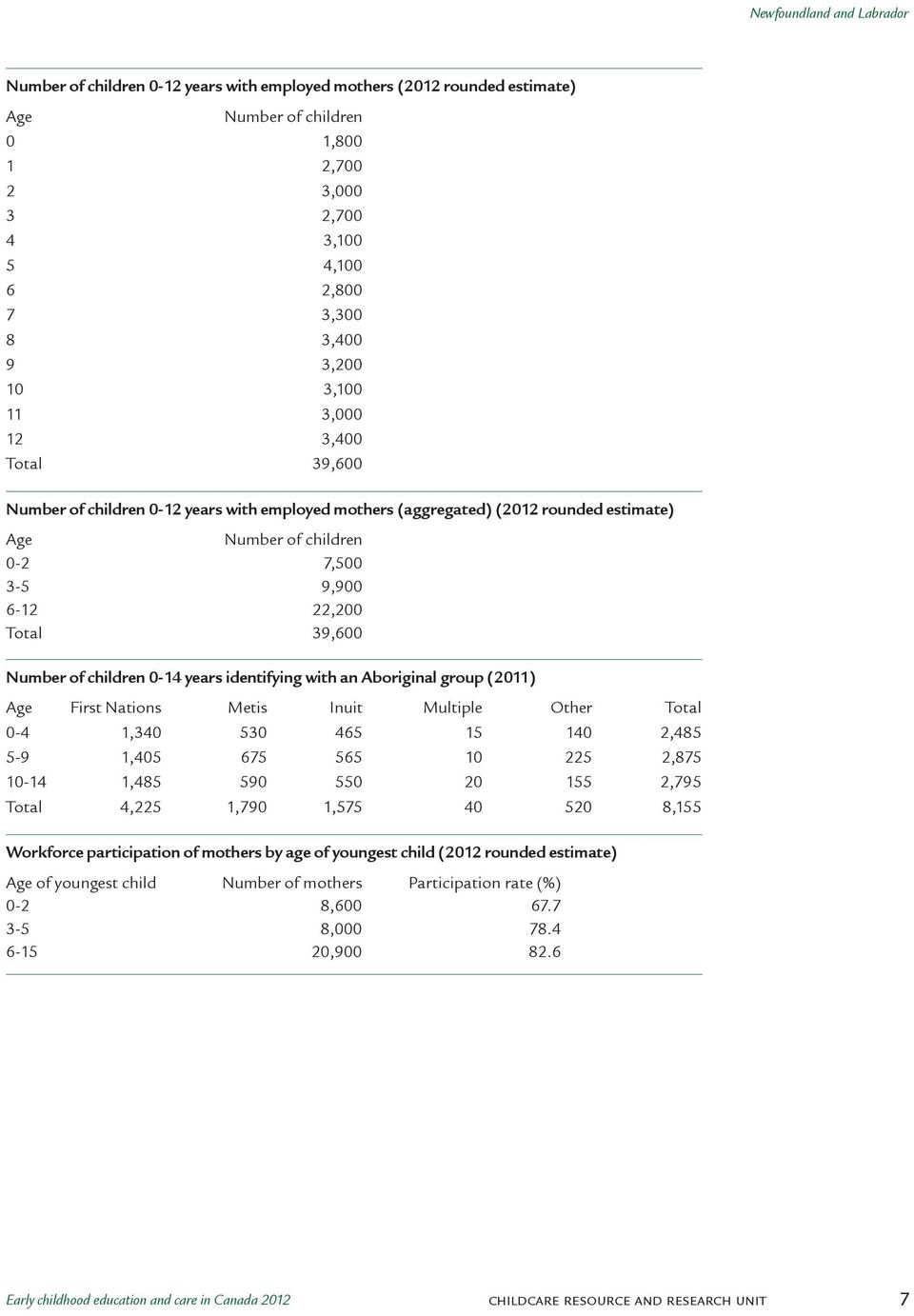
7 Newfoundland and Labrador 0-12 years with employed mothers (2012 rounded estimate) 0 1, , , , , , , , , , , , ,400 Total 39, years with employed mothers (aggregated) (2012 rounded estimate) 0-2 7, , ,200 Total 39, years identifying with an Aboriginal group (2011) First Nations Metis Inuit Multiple Other Total 0-4 1, , , , , ,795 Total 4,225 1,790 1, ,155 Workforce participation of mothers by age of youngest child (2012 rounded estimate) of youngest child Number of mothers Participation rate (%) 0-2 8, , ,
8 Newfoundland and Labrador SPACE STATISTICS (MARCH 2012) Number of regulated child care spaces Centre-based group Full-day Part-day Total Infant (birth-24 months) Preschool (24 months school entry age) 5, ,548 School-age (stand alone) Total centre-based spaces 5,198 1,397 6,595 Total family child care 605 Total number of regulated spaces 7,200 Children with special needs in regulated child care Statistics are not kept on total number of children with special needs attending typical child care facilities but approximately 322 children with special needs received a fee subsidy. There are also 48 children with special needs at Daybreak Parent/Child Centre, which receives core funding. Children receiving fee subsidies group months school entry 1,762 School-age 590 Total 2,468 Number of child care programs Centre-based Full-day 137 Part-day nursery school 37 Stand-alone school age 18 Total centre-based 192 (This includes school-based child care centres) For infants 2 For preschool and school-age 19 For school-age 21 Family child care Family child care agencies 2 Family child care homes (ncy-based and 104 individually licensed) 8

9 Newfoundland and Labrador Sponsorship of regulated centre-based spaces Full-time regulated centre-based spaces Non-profit 1,424 For-profit 3,774 Total 5,198 Part-time and school-age regulated centre-based spaces Part-time non-profit 252 Part-time for-profit 188 Total 440 School-age non-profit 656 School-age for-profit 301 Total 957 Non-profit 2,332 For-profit 4,263 PROVINCIAL ALLOCATIONS FOR REGULATED CHILD CARE (2011/2012 ) One time funding Equipment grants $ 434,775 Recurring funding ELCC supplement 3,057,000 Inclusion 1,414,200 Capacity Initiative 1,768,000 Family Child Care Initiative 694,900 Family child care agencies 314,400 Total recurring funding 7,248,500 Fee subsidies 13,541,230 Total regulated child care $21,224,505 Other funding ECE bursaries $224,000 Certification and professional development 177,400 Other grants 319,775 9

10 Prince Edward Island OVERVIEW Until 2010, kindergarten was delivered by child care centres under child care legislation but has moved to the public education system, becoming a compulsory full-school day program for five year olds. Regulated child care has been under the Department of Education and Early Childhood Development since Centres, delivered by for-profit and non-profit operators, now include Early Years Centres, which are governed by new provincial policies. These policies include provincially-set parent fees, required spaces for infants and children with special needs, mandatory parent advisory committees, established staff wages and benefits, new early learning (curriculum) framework, revised certification and training requirements and a formula-based, unit funding approach. When the new policy was introduced, existing centres were given the option to apply for designation as Early Years Centres, remain regulated private centres or retire their licenses. Government determines the number of Early Years Centres based on demonstrated community need. PROVINCIAL RESPONSIBILITY FOR CHILD CARE Department of Education and Early Childhood Development 250 Water St., Holman Centre, Summerside, PE C1N 1B6 Government website: PROVINCIAL CONTEXT 0-12 years (2012 rounded estimate) 0 1, , , , , , , , , , , , ,900 Total 19, years (aggregated) (2012 rounded estimate) 0-2 3, , ,200 Total 19,400 10

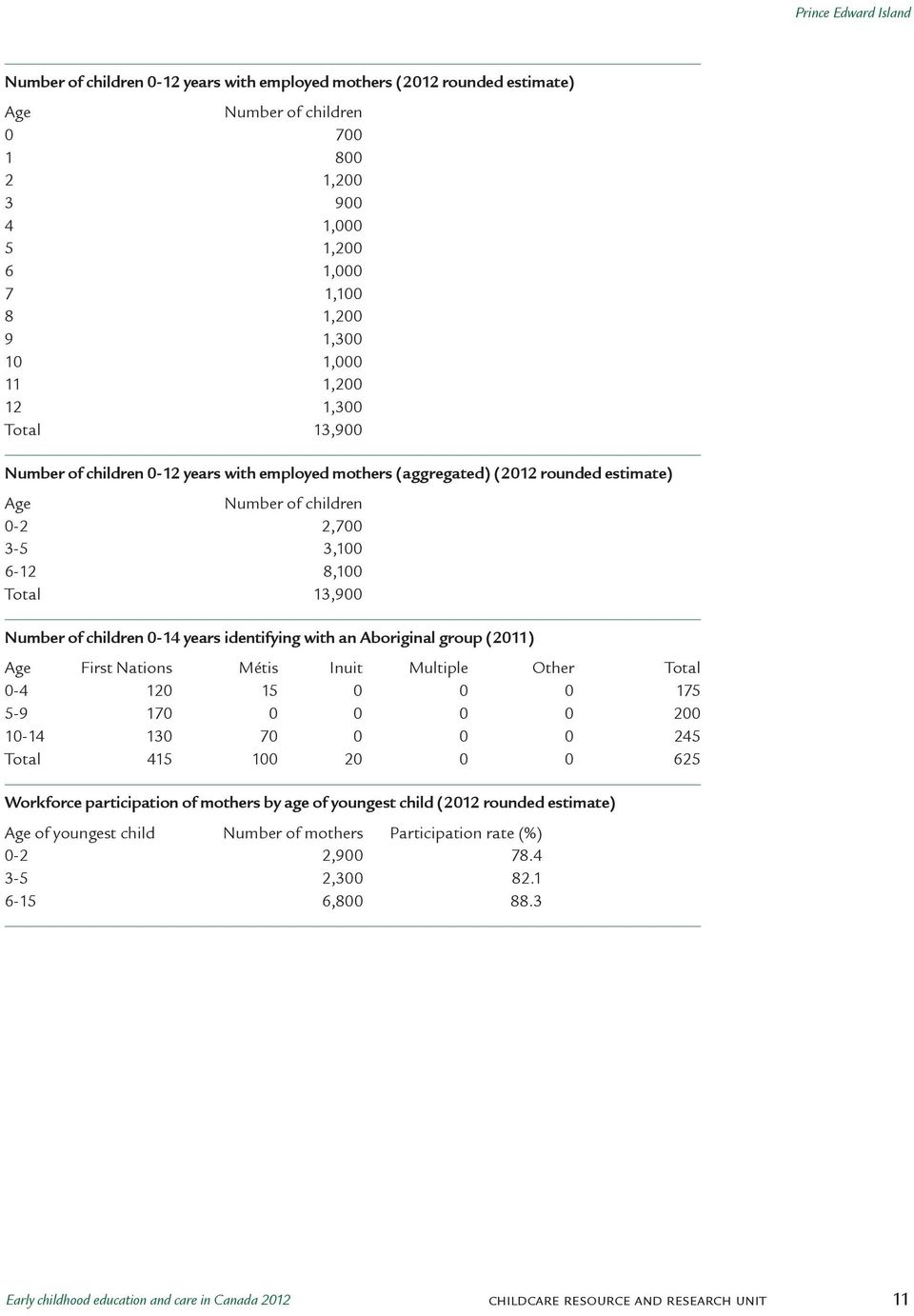
11 Prince Edward Island 0-12 years with employed mothers (2012 rounded estimate) , , , , , , , , , ,300 Total 13, years with employed mothers (aggregated) (2012 rounded estimate) 0-2 2, , ,100 Total 13, years identifying with an Aboriginal group (2011) First Nations Métis Inuit Multiple Other Total Total Workforce participation of mothers by age of youngest child (2012 rounded estimate) of youngest child Number of mothers Participation rate (%) 0-2 2, , ,
12 Prince Edward Island SPACE STATISTICS (MARCH 2012) Number of regulated child care spaces Centre-based group Full-day Part-day Total Infant (0-24 months) Preschool (2-4 years) 2, ,799 School-age (5-12 years) Total centre-based spaces 2,864 1,159 4,023 1 Total family child care spaces 28 Total number of regulated spaces 4,051 Children with special needs in regulated child care Total 213 Children receiving fee subsidies group years school entry 404 School-age (5 years and over) 348 Total 958 Number of child care programs Centre-based Full-day (Early Years Centres - EYCs) 45 Full-day (Other centres) 21 Part-day nursery school 8 Stand-alone school-age 28 Total number of centre-based programs 102 School-based chld care centres (These are included in centre-based programs) For preschool-age children 1 For school-age children 9 Family child care Individual family child care providers 4 Sponsorship of regulated centre-based spaces Non-profit 804 For-profit 3,219 1 Note that kindergarten was previously part of child care centres but is now part of the public education system. The numbers of spaces in previous editions of ECEC in Canada are not directly comparable. For comparability of PEI data over the years, 1485 kindergarten spaces would be added to the total here. 12

13 Prince Edward Island PROVINCIAL ALLOCATIONS FOR REGULATED CHILD CARE (2011/2012 ) One time funding $655,900 Recurring funding Operating grants 455,000 Special needs funding 1,200,000 Early Years Centres 6,500,000 Child care fee subsidies (March 2012) 3,660,500 Total regulated child care $12,471,400 Other funding Early Childhood Development Association $160,000 13

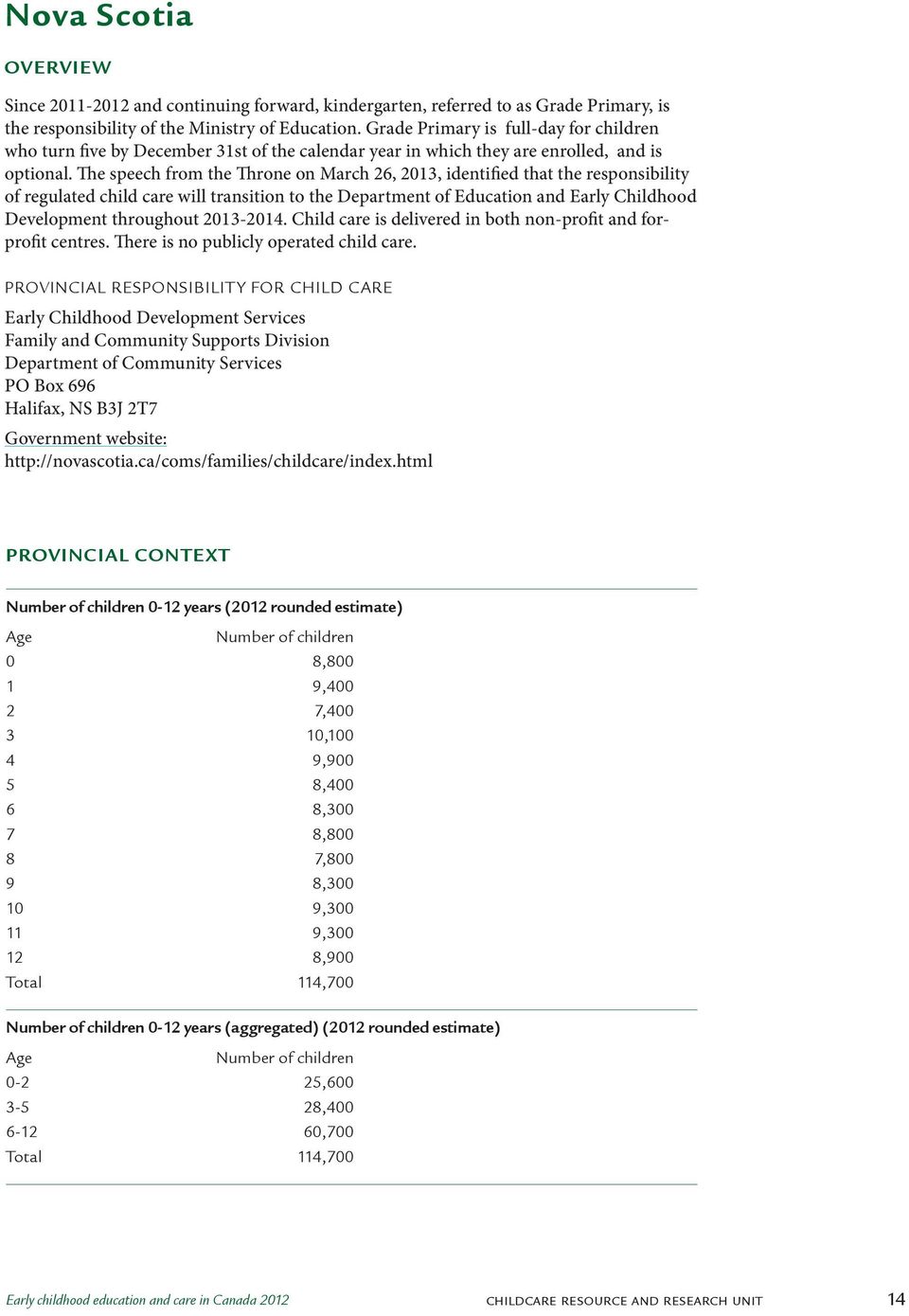
14 Nova Scotia OVERVIEW Since and continuing forward, kindergarten, referred to as Grade Primary, is the responsibility of the Ministry of Education. Grade Primary is full-day for children who turn five by December 31st of the calendar year in which they are enrolled, and is optional. The speech from the Throne on March 26, 2013, identified that the responsibility of regulated child care will transition to the Department of Education and Early Childhood Development throughout Child care is delivered in both non-profit and forprofit centres. There is no publicly operated child care. PROVINCIAL RESPONSIBILITY FOR CHILD CARE Early Childhood Development Services Family and Community Supports Division Department of Community Services PO Box 696 Halifax, NS B3J 2T7 Government website: PROVINCIAL CONTEXT 0-12 years (2012 rounded estimate) 0 8, , , , , , , , , , , , ,900 Total 114, years (aggregated) (2012 rounded estimate) , , ,700 Total 114,700 14
15 Nova Scotia 0-12 years with employed mothers (2012 rounded estimate) 0 5, , , , , , , , , , , , ,600 Total 77, years with employed mothers (aggregated) (2012 rounded estimate) , , ,900 Total 77, years identifying with an Aboriginal group (2011) First Nations Metis Inuit Multiple Other Total 0-4 1, , , , , ,915 Total 6,025 1, ,165 Workforce participation of mothers by age of youngest child (2012 rounded estimate) of youngest child Number of mothers Participation rate (%) , , ,

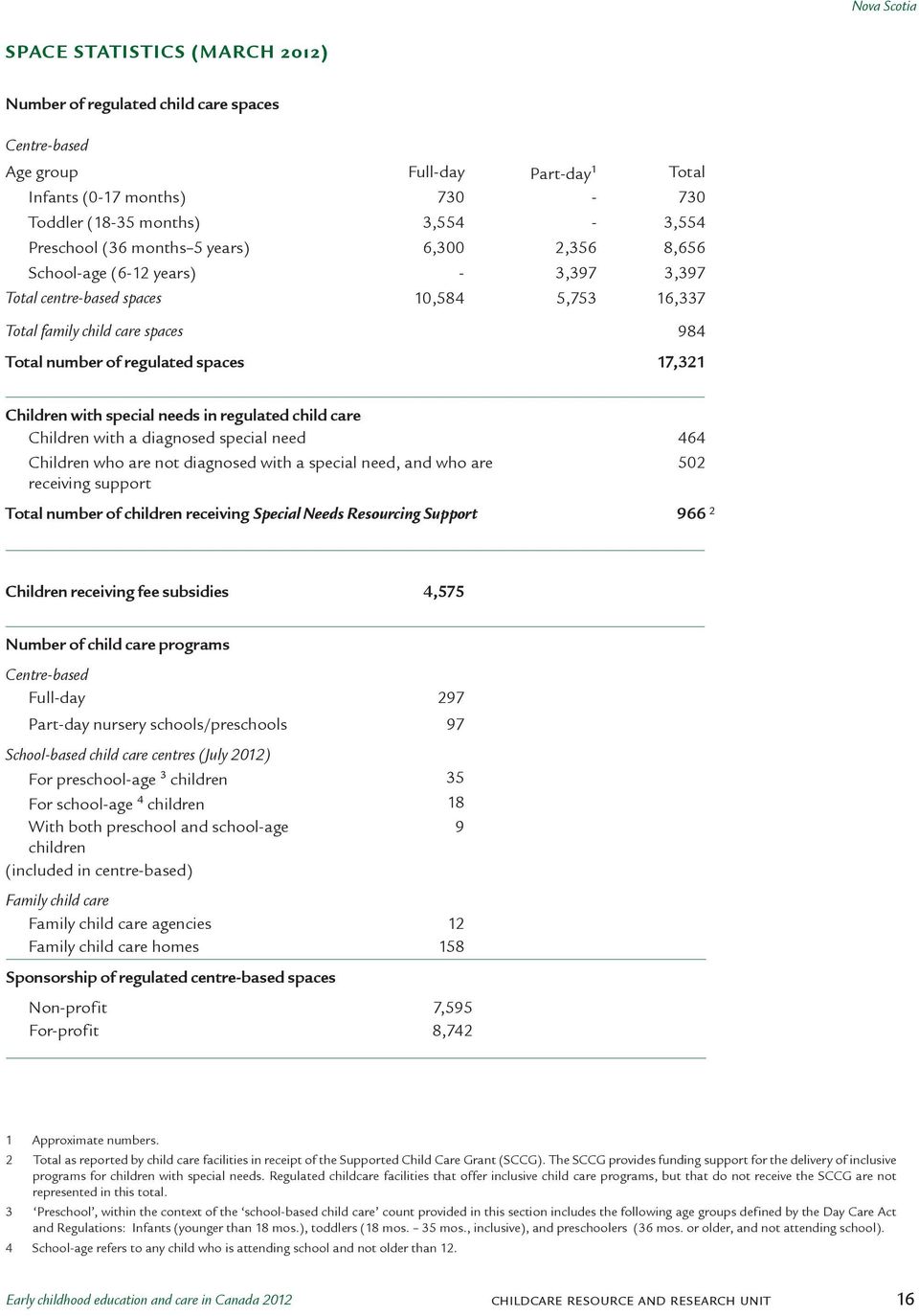
16 Nova Scotia SPACE STATISTICS (MARCH 2012) Number of regulated child care spaces Centre-based group Full-day Part-day 1 Total Infants (0-17 months) Toddler (18-35 months) 3,554-3,554 Preschool (36 months 5 years) 6,300 2,356 8,656 School-age (6-12 years) - 3,397 3,397 Total centre-based spaces 10,584 5,753 16,337 Total family child care spaces 984 Total number of regulated spaces 17,321 Children with special needs in regulated child care Children with a diagnosed special need 464 Children who are not diagnosed with a special need, and who are 502 receiving support Total number of children receiving Special Needs Resourcing Support Children receiving fee subsidies 4,575 Number of child care programs Centre-based Full-day 297 Part-day nursery schools/preschools 97 School-based child care centres (July 2012) For preschool-age 3 children 35 For school-age 4 children 18 With both preschool and school-age 9 children (included in centre-based) Family child care Family child care agencies 12 Family child care homes 158 Sponsorship of regulated centre-based spaces Non-profit 7,595 For-profit 8,742 1 Approximate numbers. 2 Total as reported by child care facilities in receipt of the Supported Child Care Grant (SCCG). The SCCG provides funding support for the delivery of inclusive programs for children with special needs. Regulated childcare facilities that offer inclusive child care programs, but that do not receive the SCCG are not represented in this total. 3 Preschool, within the context of the school-based child care count provided in this section includes the following age groups defined by the Day Care Act and Regulations: Infants (younger than 18 mos.), toddlers (18 mos. 35 mos., inclusive), and preschoolers (36 mos. or older, and not attending school). 4 School-age refers to any child who is attending school and not older than
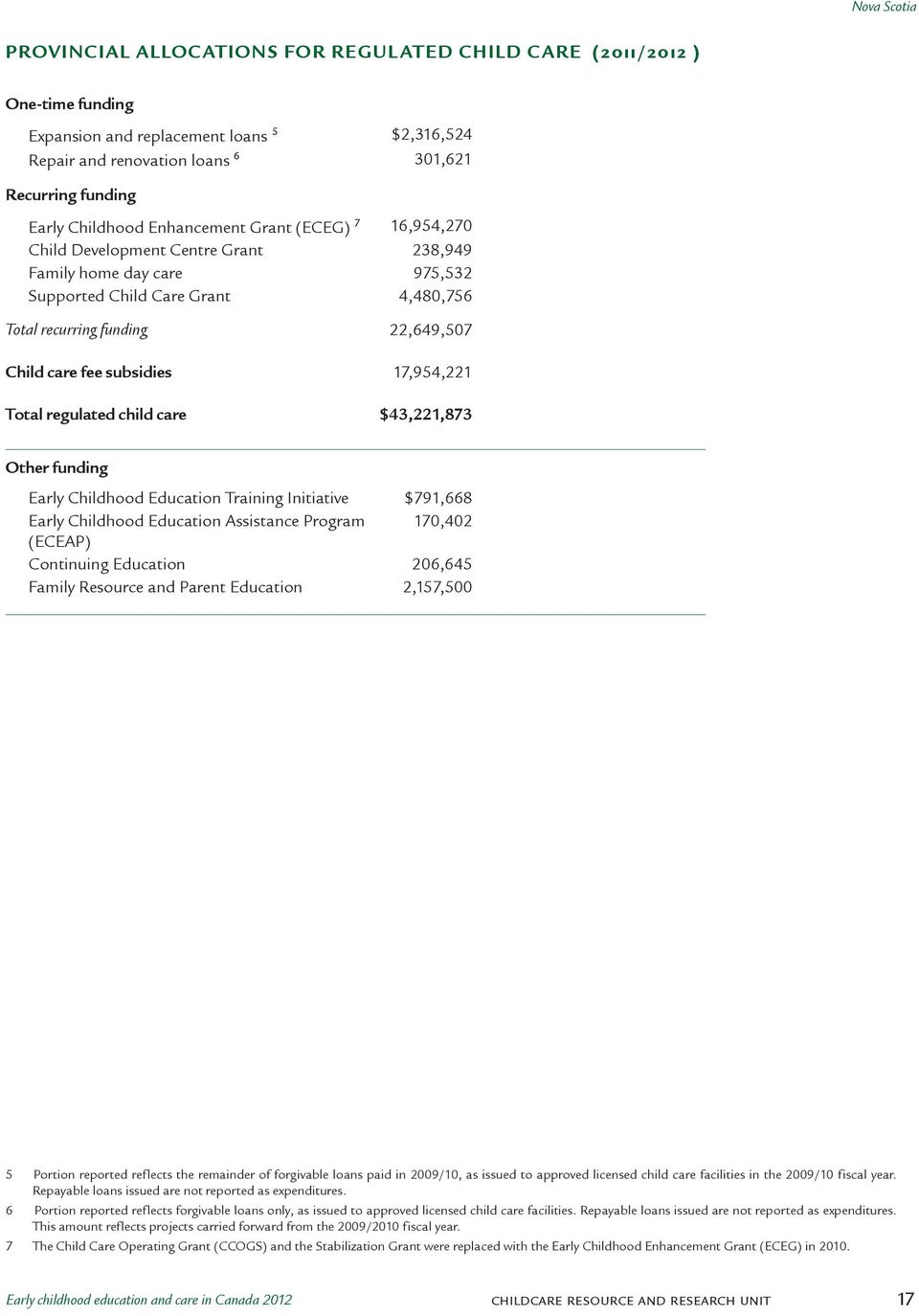
17 Nova Scotia PROVINCIAL ALLOCATIONS FOR REGULATED CHILD CARE (2011/2012 ) One-time funding Expansion and replacement loans 5 $2,316,524 Repair and renovation loans 6 301,621 Recurring funding Early Childhood Enhancement Grant (ECEG) 7 16,954,270 Child Development Centre Grant 238,949 Family home day care 975,532 Supported Child Care Grant 4,480,756 Total recurring funding 22,649,507 Child care fee subsidies 17,954,221 Total regulated child care $43,221,873 Other funding Early Childhood Education Training Initiative $791,668 Early Childhood Education Assistance Program 170,402 (ECEAP) Continuing Education 206,645 Family Resource and Parent Education 2,157,500 5 Portion reported reflects the remainder of forgivable loans paid in 2009/10, as issued to approved licensed child care facilities in the 2009/10 fiscal year. Repayable loans issued are not reported as expenditures. 6 Portion reported reflects forgivable loans only, as issued to approved licensed child care facilities. Repayable loans issued are not reported as expenditures. This amount reflects projects carried forward from the 2009/2010 fiscal year. 7 The Child Care Operating Grant (CCOGS) and the Stabilization Grant were replaced with the Early Childhood Enhancement Grant (ECEG) in
18 New Brunswick OVERVIEW New Brunswick moved responsibility for kindergarten, regulated child care and other early childhood development programs into the Department of Education and Early Childhood Development in Kindergarten is a compulsory full school-day program for five year olds. New Brunswick is an officially bilingual province with parallel English and French public education sectors. French and English kindergartens are delivered as part of those two sectors; with 2012 amendments to the Early Learning and Childcare Act, child care centres will become part of the province s dualistic approach to French and English. Regulated child care centres are predominantly for-profit, with some non-profit centres, and no publicly-delivered child care. Regulated child care spaces are termed approved spaces ; regulated family child care homes are termed community child care homes, and parental leave is termed child care leave. PROVINCIAL RESPONSIBILITY FOR CHILD CARE Early Learning and Child Care Unit Education and Early Childhood Development Place 2000, P.O. Box 6000, 250 King Street Fredericton, NB E3B 1E7 Government website: PROVINCIAL CONTEXT 0-12 years (2012 rounded estimate) 0 6, , , , , , , , , , , , ,700 Total 94, years (aggregated) (2012 rounded estimate) , , ,000 Total 94,500 18

19 New Brunswick 0-12 years with employed mothers (2012 rounded estimate) 0 3, , , , , , , , , , , , ,300 Total 61, years with employed mothers (aggregated) (2012 rounded estimate) , , ,600 Total 61, years identifying with an Aboriginal group (2011) First Nations Metis Inuit Multiple Other Total 0-4 1, , , , , ,100 Total 4, ,710 Workforce participation of mothers by age of youngest child (2012 rounded estimate) of youngest child Number of mothers Participation rate (%) , , ,
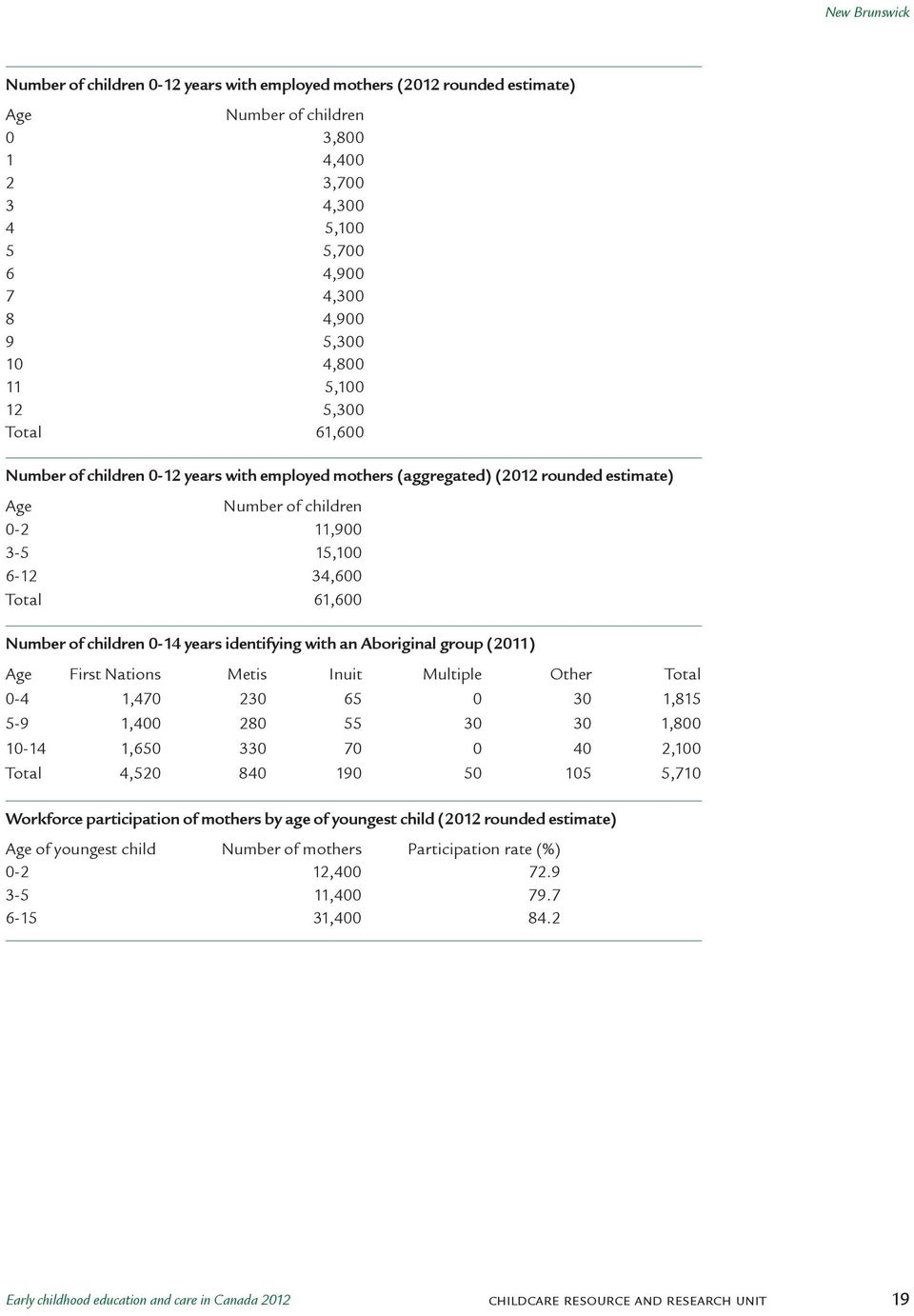
20 New Brunswick SPACE STATISTICS (MARCH 2012) Number of regulated child care spaces Centre-based group 1 Total Infants (0-2 years) 1,463 Preschool (2 4 years) 9,221 School-age (5-12 years) 10,229 Total centre-based spaces 20,913 Total family child care spaces 782 Total number of regulated child care spaces 21,695 Children with special needs in regulated child care Children receiving fee subsidies 3 group Total 0-4 years 2, years 2, years 7 Total number of subsidies 5,320 Number of child care programs Centre-based Full-day 223 Part-day nursery schools/preschools 25 Stand alone after-school programs 157 Combined nursery/school-age programs Total centre-based programs 542 School-based child care centres For preschool-age children 14 For school-age children 106 (included in centre-based) Family child care Individual family child care providers 120 Number of francophone child care centres These figures are estimates made by provincial officials. New Brunswick approves child care centres for a total enrolment based on usable space and does not allocate spaces according to specific age groups. The number of spaces the facility operates per age category is collected through the Quality Improvement Funding Support Program s application process. 2 This figure represents the number of children receiving Integrated Day Care Services as of March 31, The average monthly number served for 2011/12 was 220. In addition to the total reported here, 97 school-age children were supported through the Support Worker Program. 3 This figure is the number of children receiving subsidies as of March 31st, Note that New Brunswick is reporting annual cumulative totals. Thus, this figure is not comparable to the numbers reported in the various editions of Early Childhood Education and Care in Canada. The cumulative total is 5,320. Totals are also collected using different age ranges than those asked within the survey. 4 The part-day nursery school/preschools and combined nursery/school figures are estimates as the data cannot identify part-time programs. 20
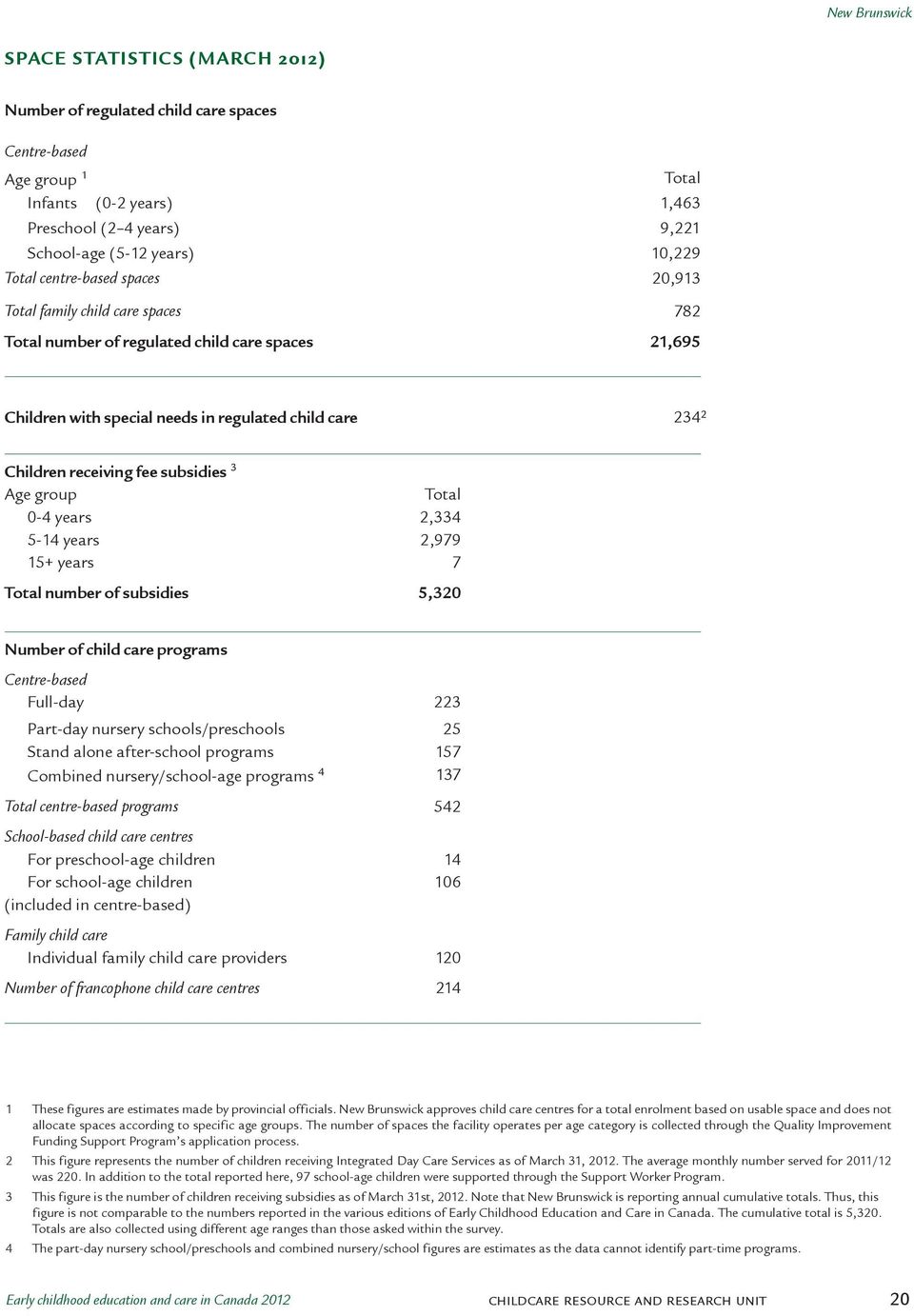
21 New Brunswick Sponsorship of regulated centre-based spaces Non-profit 7,916 For-profit 12,799 PROVINCIAL ALLOCATIONS FOR REGULATED CHILD CARE (2011/2012 ) One time funding none Recurring funding Quality Improvement Funding Support $18,700,000 (includes training initiatives) Special Needs Funding 2,100,000 Child care fee subsidies 14,200,000 Total regulated child care $ 35,000,000 Other funding Early Learning and Child Care Trust Fund 5 Training assistance for child care staff $1,452,902 New child care spaces 10,254,402 Early Childhood Care and Education N B 1,230,000 (wage reimbursement program) Professional development 2,476,753 Braiding Our resources 25,070 Curriculum materials grant 407,094 Total other funding $15,846,221 5 These figures represent disbursements under this fund cumulatively to March
22 Quebec OVERVIEW Provision of early childhood education and child care in Quebec is under two ministries, the Ministère de l Éducation, du Loisir et du Sport (MELS) and the Ministère de la Famille et des Aînés (MFA). Quebec provides full-day kindergarten (maternelle) for all five year olds and some kindergarten (pre-maternelle) for four year olds under MELS. MFA is responsible for regulated child care for children aged 0-4. Regulated child care includes centres de la petite enfance (CPEs) which operate as small non-profit networks of several installations or centres; CPEs often include regulated family child care as well. Family child care providers are supervised by Child Care Coordinating Offices (many of which are part of CPEs). Some regulated family child care is provided in group family child care homes, with two providers.there are, as well, for-profit centres (garderies). Quebec does not provide regulated part-day child care programs but permits them to operate as unregulated part-day jardins d enfants. CPEs, regulated family child care and some garderies are primarily publicly funded. Spaces in these programs are termed reduced contribution spaces for which parents pay a flat $7.00/day fee. Quebec does not use fee subsidies targeted to eligible parents. All children aged 0-4 who have secured a space in a reduced contribution program may attend at $7.00 a day regardless of family income or parents employment status. Some garderies are unfunded; parents using unfunded garderies may be reimbursed an amount so that the cost is equivalent to $7.00 a day. School-age child care is operated by schools under MELS. It is available at the same flat $7.00/day, (which applies when school is in session) as regulated child care for 0-4s. School boards are required to provide school-age care when there is sufficient demand. Quebec has its own separate program for family-related leave and benefits (in other provinces/territories, the federal government is responsible for family leave benefits). There are two options that parents may choose: the Basic Plan and the Special Plan. Under these options, the Quebec maternity/parental leave benefits are paid at an income replacement rate of 70-75%. There is, as well, a paternity leave period earmarked to new fathers. PROVINCIAL RESPONSIBILITY FOR CHILD CARE Ministère de la Famille et des Aînés 425, rue Saint-Amable Quebec, QC, G1R 4Z1 Telephone: (418) Government website: 22
23 Quebec PROVINCIAL CONTEXT 0-12 years (2012 rounded estimate) 0 73, , , , , , , , , , , , ,000 Total 1,072, years (aggregated) (2012 rounded estimate) , , ,600 Total 1,072, years with employed mothers (2012 rounded estimate) 0 51, , , , , , , , , , , , ,300 Total 746, years with employed mothers (aggregated) (2012 rounded estimate) , , ,400 Total 746,100 23
24 Quebec 0-14 years identifying with an Aboriginal group (2011) First Nations Metis Inuit Multiple Other Total 0-4 7,595 2,745 1, , ,675 2,430 1, , ,370 2,425 1, ,540 Total 20,645 7,600 4, ,565 Workforce participation of mothers by age of youngest child (2012 rounded estimate) of youngest child Number of mothers Participation rate (%) , , , SPACE STATISTICS (MARCH 2012) Centre-based (0-4 years, CPEs and garderies 1 ) group CPEs Funded gardieries Non-funded garderies Total centrebased Infants (under 18 months) 10,784 3,880 3,448 18,112 Preschoolers (18 months - 4 years) 73,888 37,156 24, ,481 Total (0-4 years) (Regulated by the Ministère de la Famille) Regulated family child care 84,672 41,036 27, ,481 Enrolled family child care spaces Infants under 18 months 13,867 Toddlers (18 months-up to age 3) 38, year olds 32,850 Kindergarten and school-age 166 Total enrolled family child care 85,095 Total spaces regulated by Ministère de la Famille Funded Non-funded Total School-age (March 2008) Total school-age child care spaces 2 (Under the Ministère de l Éducation, du Loisir et du Sport) 210,803 27, ,576 Total number of spaces regulated by the Ministère de la Famille and under the aegis of Ministère de l Éducation, du Loisir et du Sport 162, ,568 Children with special needs in regulated child care 5,816 1 Garderies can be funded or unfunded (See SPONSORSHIP spaces below.) 2 The number of school-age spaces is from 2008; more recent information is not available. 24
25 Quebec Children receiving fee subsidies Not applicable Number of child care programs Number of CPEs 980 Number of centres that are part of CPEs 1,434 Number of garderies 1,178 Number of garderies Funded 649 Number of garderies Non-funded 526 Number of school-age services Not available Number of Family Child Care Coordinating Offices 164 Number of family child care providers 15,448 Sponsorship of regulated centre-based spaces Centre-based spaces (0-4) Non-profit (CPEs) 84,672 Garderies (for-profit 3 and other non-cpe centres) Includes: 68,809 Funded garderies 41,036 Non-funded garderies 27,773 School-age (school board operated) 162,992 4 PROVINCIAL ALLOCATIONS FOR REGULATED CHILD CARE (2011/2012 ) 5 Child care fee subsidies not applicable 6 One time funding Capital expenditures $25,086,000 Recurring funding Funding to CPEs and garderies $2,156,596,000 Pension plan for employees in child care 58,737,000 Total child care expenditure for children 0-4 years 2,240,419,000 Expenditure on school-age child care (by MELS) 7 152,300,000 Total regulated child care $2,392,649,000 3 Most garderies are for-profit; a small number may be non-profit. 4 The number of school-age spaces is from More recent information was not available. 5 Source : Comptes publics Quebec does not use fee subsidies. 7 Expenditure figures on school-age child care are from More recent information is not available. 25
26 Ontario OVERVIEW There have been significant ECEC policy and program transitions in Ontario in the last few years. In 2010, regulated child care began to be transferred to the Ministry of Education which now is responsible for all aspects of policy and operation. Child care and full-day kindergarten are both part of the Early Learning Division in the Ministry of Education. Ontario is the only province that offers kindergarten for all four year olds (Junior Kindergarten; kindergarten for five year olds is called Senior Kindergarten). Ontario is phasing in full-day kindergarten for four and five year olds, which will be fully in place by Child care for the rest of the before- and after- kindergarten day is to be offered when there is sufficient demand either as an extended day or by non-profit third party operators. Municipal governments play a key role in child care in Ontario. This includes public delivery of child care services as well as financing, coordination, administration and planning. Forty-seven local government entities (CMSMs and DSSABs) are designated child care Service Managers. Child care licensing and overall policy and funding are provincial government responsibilities. The majority of Ontario s child care is delivered by a mixture of non-profit, for-profit and municipal, publicly operated programs. Regulated child care is provided in centres (including part-day nursery school) or by providers in their own homes supervised by licensed family child care agencies. PROVINCIAL RESPONSIBILITY FOR CHILD CARE Ministry of Education Early Learning Division 24th floor, Mowat Block 900 Bay Street Toronto, ON M7A 1L2 Government website: 26
27 Ontario PROVINCIAL CONTEXT 0-12 years (2012 rounded estimate) 0 135, , , , , , , , , , , , ,500 Total 1,892, years (aggregated) (2012 rounded estimate) , , ,046,500 Total 1,892, years with employed mothers (2012 rounded estimate) 0 84, , , , , , , , , , , , ,300 Total 1,218, years with employed mothers (aggregated) (2012 rounded estimate) , , ,000 Total 1,218,300 27
28 Ontario 0-14 years identifying with an Aboriginal group (2011) First Nations Metis Inuit Multiple Other Total ,575 5, , ,475 5, , ,850 5, ,000 Total 53,850 16,575 1, ,695 74,195 Workforce participation of mothers by age of youngest child (2012 rounded estimate) of youngest child Number of mothers Participation rate (%) , , , SPACE STATISTICS (MARCH 2012) Number of regulated child care spaces Centre-based group Full-day 1 Part-day Total Infants (0-18 months) 9,269-9,269 Toddlers (18-30 months) 30,867-30,867 Preschool (2.5-5 years) 103, ,474 JK (3 years 8 months) 26,454-26,454 SK (4 years 8 months) 6,093-6,093 School-age (6-12 years) - 99,743 99,743 Total centre-based spaces 2 176,157 99, ,900 Family child care 3 17,097 Total number of regulated spaces 4 292,997 Children with special needs (December 2011) (Children receiving special needs resourcing in regulated child care) 5 27,639 Children receiving fee subsidies 6 (December 2011) 140,625 1 Breakdowns of full-day and part-day centre-based child care are not available except for school-age. Figures for nursery school (part-day) are not available. 2 The total number of centre-based spaces is not the sum of the age groups listed. This is a result of child care centres having alternate capacity rooms. Alternate capacity means that a room may be used for different age groups at different times. Therefore, the capacity by age group can exceed the total number of spaces. 3 This figure represents the enrolment in family child care. Licensed capacity information is not available because it fluctuates according to the ages of the children being served. 4 This figure includes the licensed capacity of child care centres and enrolment in regulated family child care. 5 This figure is a cumulative total number of special needs children serviced throughout the fiscal year. Figures comparable to other provinces/territories (that is, the number of children served at a given point in time) are not available. 6 This figure is the cumulative total number of children subsidized throughout the fiscal year. Figures comparable to other provinces/territories (that is, the number of children served at a given point in time) are not available. 28
29 Ontario Number of child care programs Centre-based (full and part-day) 4,922 For preschool-age children 3,966 7 School-based child care centres Total (all ages) 2,308 (included in centre-based) Family child care (home child care) Number of family child care agencies 132 Number of family child care homes 6,142 Sponsorship of regulated spaces Full and part-time regulated centre spaces Non-profit 205,791 (Includes 7,192 municipally-operated spaces as well as licensed before and after school programs) For-profit 70,109 Regulated family child care (private home day care) agencies and private homes ncies Homes Non-profit ,812 For-profit PROVINCIAL ALLOCATIONS FOR REGULATED CHILD CARE (2011/2012 ) One time funding none Recurring funding (actual expenditures) Wage subsidies/wage Improvement $170,600,000 Special needs resourcing 48,500,000 Child care fee subsidies Regular fee subsidies 353,300,000 Ontario Works subsidies 33,500,000 Early Learning & Child Development Grant 216,600,000 (transfer to municipalities) 9 Transition funding 14,000,000 Other transfers to municipalities 28,700,000 Total 10 $865,100,000 7 The 3,966 centres for pre-school age children include centres that also serve school-age children. 8 This includes municipally-operated family child care agencies and homes. Current figures were not provided for the number of municipally-operated family child care agencies and homes. 9 This funding can be applied to fee subsidies, wage subsidies, and special needs resourcing by the local government. 10 Total may not add due to rounding. Ontario s municipalities make legislated and discretionary financial contributions above this amount. In recent years legislated contributions have been approximately $150M annually. Discretionary contributions have added almost $60M more on an annual basis. 29
30 Manitoba OVERVIEW In Manitoba, kindergarten is a part-day non-compulsory program for all five year olds for which Manitoba Education is responsible. Regulated child care is under the aegis of Manitoba Family Services and Labour. Manitoba provides operating funds to eligible child care centres through a unit funding model, and to regulated family and group child care homes. This operational funding is linked to regulated age group composition and a maximum parent fee set by the provincial government and incorporates fee subsidies for eligible families. Regulated child care centres for 0-12 year olds (including nursery schools) are primarily non-profit with a few for-profit operations; there is no publicly-delivered child care. Regulated family child care is delivered through an individually licensed model; there is, as well, group family child care with two providers. PROVINCIAL RESPONSIBILITY FOR CHILD CARE Manitoba Early Learning and Child Care Manitoba Family Services and Labour Garry Street Winnipeg, MB R3C 4V6 Government website: PROVINCIAL CONTEXT 0-12 years (2012 rounded estimate) 0 13, , , , , , , , , , , , ,800 Total 187, years (aggregated) (2012 rounded estimate) , , ,400 Total 187,400 30
31 Manitoba 0-12 years with employed mothers (2012 rounded estimate) 0 7, , , , , , , , , , , , ,200 Total 111, years with employed mothers (aggregated) (2012 rounded estimate) , , ,600 Total 111, years identifying with an Aboriginal group (2011) First Nations Métis Inuit Multiple Other Total ,390 6, , ,860 6, , ,710 6, ,935 Total 41,955 19, ,730 Workforce participation of mothers by age of youngest child (2012 rounded estimate) of youngest child Number of mothers Participation rate (%) , , ,
32 Manitoba SPACE STATISTICS (MARCH 2012) Number of regulated child care spaces Centre-based group Full-day Part-day Total Infants (0-2 years) 1, ,864 Preschool (2-6 years) 12,644 3,817 16,461 School-age - 9,219 9,219 Occasional child care Total centre-based spaces 14,508 13,060 27,568 Total family child care spaces 3,046 Total number of regulated spaces 30,614 Children with special needs in regulated child care 1,529 Children receiving fee subsidies 9,006 Number of child care programs Centre-based Full-day 305 Part-day nursery schools 152 Stand-alone after-school programs 183 Total centre-based programs 640 Individual family child care providers 420 Sponsorship of regulated centre-based spaces Non-profit 26,300 For-profit 1,268 PROVINCIAL ALLOCATIONS FOR REGULATED CHILD CARE (2011/2012 ) One-time funding Capital grants $2,900,000 1 Recurring funding Operating grants 2 91,628,800 Special needs grants 11,708,800 Child care fee subsidies 28,107,600 Total regulated child care $134,345,200 1 Refers to the Family Choices Building Fund, created to offset costs of construction, expansion or revitalization of existing non-profit child care centres. The Fund provides one-third of total project costs up to $400,000 for centres not in schools. The Fund also has a component that provides 100% of costs for centres located in schools or on school property, which is managed by Manitoba Education. 2 Includes all training, recruitment and retention grants. 32
33 Saskatchewan Saskatchewan OVERVIEW Kindergarten, pre-kindergarten (pre-k) and regulated child care are all the responsibility of the Ministry of Education. Pre-K and regulated child care are under the Early Learning Branch and kindergarten is part of the Curriculum and E-Learning Branch. Kindergarten and pre-k are part-day. Kindergarten is for all five year olds, while pre-k is targeted to vulnerable three and four year olds who meet locally specified eligibility criteria. Both these programs are provided with no parent fee by school authorities. In Saskatchewan, part-day preschools for children under compulsory school age are not funded or required to be licensed. Regulated family child care homes use an individual licensing approach; group family child care with two providers is offered. Historically, regulated child care centres have been almost entirely non-profit. For-profit services receive no public funding including fee subsidies. There are several municipally delivered or supported centres. PROVINCIAL RESPONSIBILITY FOR CHILD CARE Early Learning and Child Care Program Ministry of Education 2220 College Avenue Regina, SK S4P 4V9 Government website: PROVINCIAL CONTEXT 0-12 years (2012 rounded estimate) 0 12, , , , , , , , , , , , ,800 Total 161, years (aggregated) (2012 rounded estimate) , , ,800 Total 161,200 33
34 Saskatchewan 0-12 years with employed mothers (2012 rounded estimate) 0 6, , , , , , , , , , , , ,900 Total 103, years with employed mothers (aggregated) (2012 rounded estimate) , , ,500 Total 103, years identifying with an Aboriginal group (2011) First Nations Métis Inuit Multiple Other Total ,705 5, , ,430 4, , ,140 4, ,770 Total 39,280 13, ,780 Workforce participation of mothers by age of youngest child (2012 rounded estimate) of youngest child Number of mothers Participation rate (%) , , ,
35 Saskatchewan SPACE STATISTICS (MARCH 2012) Number of regulated child care spaces Centre-based group Full-day Part-day 1 Total Infants (6 weeks -17 months) Toddlers (18-29 months) 2,450-2,450 Preschool (30 months-kindergarten) 5,469-5,469 School-age (grade 1-13) - 1,301 1,301 Total centre-based spaces 8,909 1,301 10,210 Family child care spaces enrolled in family child care homes 1,099 enrolled in group family child care homes 966 Total family child care spaces 2,065 Total number of regulated spaces 2 12,275 Children with special needs in regulated child care 585 Children receiving fee subsidies 3 3,401 4 Number of child care programs Total centre-based programs 259 School-based child care centres For preschool-age children 99 (included in centre-based) Family child care Total number of individual family child care providers 245 Sponsorship of regulated centre-based spaces Non-profit 8,892 Municipal 116 For-profit 61 1 Saskatchewan does not license part-day preschools. The number of hours services may be provided is restricted by the legislation. 2 As of March 2012 an additional 565 child care centre spaces were in various stages of development; totalling 12,840 spaces operational /in development. 3 breakdown of children receiving a fee subsidy is not available. 4 Monthly average in
36 Saskatchewan PROVINCIAL ALLOCATIONS FOR REGULATED CHILD CARE (2011/2012 ) One-time funding Development funding (Start-up grants, Space $2,048,289 development capital grants, Fire health and safety grants) Capital (school-based) 5,477,460 Enriched Learning Environment Grants 180,223 Equipment family child care homes 191,125 Recurring funding (March 2012-Budget) Early Childhood Services Grants 30,836,272 Teen Student Child Care Centre Support 2,813,157 Nutrition family child care homes 935,865 Inclusion grants 5 3,861,421 Total recurring funding $38,446,715 Child care fee subsidies (March 2012-Budget) 16,309,339 Total regulated child care $62,653,151 Other funding 6 $1,454,726 Early Childhood Training 7 $769,751 5 Includes Individual Inclusion, Centre Inclusion, Enhanced Accessibility and Adapted Equipment Grants. 6 Includes Targeted Initiatives, Preschool Support, Home Alternates Program, Early Childhood Initiatives, Northern Equipment/Transportation, ELPG Grant. 7 Includes funds paid to licensed child care programs for tuition reimbursement, professional development, and northern training. 36
37 Alberta OVERVIEW Two ministries are responsible for early childhood education and care. Early Childhood Services (ECS), which includes kindergarten, falls under Alberta Education while regulated and approved child care falls under Alberta Human Services. Kindergarten refers to an education program in the year before grade 1. Younger preschool-age children with special needs may be able to access other ECS programs. Kindergarten is not compulsory and is usually part-day. ECS programs are publicly funded and may be delivered by various operators including public, charter and private schools and non-profit ECS operators. About half the supply of regulated child care services for 0-12 year olds outside school hours are operated on a for-profit basis in Alberta. The remainder are mostly non-profit, with a small number of municipally operated or supported programs. Approved family day homes (family child care) operate under an agency model and are approved based on Ministry standards; there are no regulations. Group family child care homes (with two providers) are licensed. Out-of-school (school-aged) programs are provided for kindergarten and school-age children. PROVINCIAL RESPONSIBILITY FOR CHILD CARE Alberta Human Services 6th Floor Sterling Place th Street Edmonton, AB T5K 2N2 Government website: PROVINCIAL CONTEXT 0-12 years (2012 rounded estimate) 0 44, , , , , , , , , , , , ,300 Total 598,200 37
38 Alberta 0-12 years (aggregated) (2012 rounded estimate) , , ,400 Total 598, years with employed mothers (2012 rounded estimate) 0 22, , , , , , , , , , , , ,700 Total 359, years with employed mothers (aggregated) (2012 rounded estimate) , , ,400 Total 359, years identifying with an Aboriginal group (2011) First Nations Metis Inuit Multiple Other Total ,525 8, , ,655 7, , ,175 8, ,760 Total 39,350 25, ,570 Workforce participation of mothers by age of youngest child (2012 rounded estimate) of youngest child Number of mothers Participation rate (%) , , ,
39 Alberta SPACE STATISTICS (MARCH 2012) Number of regulated child care spaces Centre-based 1 group Full-day Part-day Total Infants (under 12 months) 1,432-1,432 Infants (13-19 months) 3,409-3,409 Toddlers (19 months to less than 3 years) 10,663 1,500 12,163 Preschool (three years to 4.5 years) 11,602 14,748 26,350 Kindergarten (4.5 years and attending an approved - 14,423 14,423 ECS program part-time) Out-of-school (Grades 1 to 6) 22,265 22,265 Innovative child care (no age grouping) Total centre-based spaces 27,483 52,936 80,419 Family child care Contracted capacity in approved family day home spaces 11,425 Group family child care spaces 40 Total number of regulated or approved child care spaces 91,884 Children with special needs receiving support in regulated/approved child care Information not available Children receiving fee subsidies group Total Infants (under 19 months) 3,526 Toddlers (19 months 3 years) 4,387 Preschool (3-4.5 years) 5,815 Kindergarten 5,642 School-age (grades 1-6) 5,617 Total number of children receiving fee subsidies 24,987 Number of child care programs Centre-based Day care centres 669 Innovative 17 Out-of-school care 742 Preschool (part-day) 750 Total number of centre-based programs 2,178 Family child care Number of family child care agencies (contracted) 82 Number of individual family child care providers 2,781 (approved) Group family child care homes (licensed) 4 1 Spaces in group family child care are included in centre-based figures by age group. 39
40 Alberta Sponsorship 2 of regulated centre-based spaces Regulated centre-based program spaces Non-profit and public 39,545 For-profit 40,914 Family day home agencies Non-profit 45 For-profit 37 PROVINCIAL ALLOCATIONS FOR REGULATED CHILD CARE (2011/2012 ) One-time funding none Recurring funding (Actual amounts 2011/ ) Accreditation $80,780,075 Child care fee subsidies Day Care Subsidy 76,794,100 Group Family Day Homes 100,785 Family Day Home Subsidy 15,138,411 Extended Hours Subsidy 281,900 Stay-At-Home Parent Support 1,373,497 Out of School Care Subsidy 17,677,038 Infant Care Incentive 7,429,441 Kin Child Care Subsidy 4 8,110,968 Family Day Home ncy Contracts 6,655,232 Specialized Child Care (Inclusive) 3,539,283 Total regulated child care $209,769,762 Other funding Family Resources: Alberta Parent Link Centres $16,705,330 Kin Child Care Subsidy 4 8,110,968 2 Alberta typically reports sponsorship by program, as it relates to the license holder. 3 Annual report 2011/2012 authorized budget amount for child care including Accreditation totals was $238,706, Kin child care subsidy for eligible parents who use a non-custodial relative to care for their child. 40
41 British Columbia OVERVIEW Responsibility for BC s early childhood education and care is split among three departments: kindergarten under the Ministry of Education, regulated child care policy under the Ministry of Children and Family Development and child care licensing and monitoring under the Ministry of Health. British Columbia introduced full-day kindergarten for five year olds in All public schools are now required to provide the program. Another ECEC program under the Ministry of Education, StrongStart BC, requires that children be accompanied by a parent or other caregiver. It is operated by most school boards for children younger than five years. A variety of kinds of regulated child care programs for children 0-12 years old are provided including programs outside regular school hours for school-aged children. About half of BC s full-day centre-based programs are operated on a for-profit basis and half non-profit; there are no publicly-delivered child care programs. Regulated family child care in BC for up to seven 0-12 year olds is provided by individually licensed family child care providers. Family child care providers caring for one or two children are called licence not required (LNR). Neighbourhood Child Care Resource and Referral Programs may register these providers, in which case they are termed registered licence not required (RLNR) providers. PROVINCIAL RESPONSIBILITY FOR CHILD CARE Child Care Programs and Services Ministry of Children and Family Development PO Box 9778, STN Prov Govt Victoria, BC V8W 9R4 Government website: Child Care Licensing Community Care Facilities Ministry of Health 6th floor, 1515 Blanshard Street Victoria, BC V8W 3C8 Government website: 41
42 British Columbia PROVINCIAL CONTEXT 0-12 years (2012 rounded estimate) 0 41, , , , , , , , , , , , ,600 Total 570, years (aggregated) (2012 rounded estimate) , , ,300 Total 570, years with employed mothers (2012 rounded estimate) 0 23, , , , , , , , , , , , ,400 Total 352, years with employed mothers (aggregated) (2012 rounded estimate) , , ,400 Total 352,300 42
43 British Columbia 0-14 years identifying with an Aboriginal group (2011) First Nations Métis Inuit Multiple Other Total ,390 4, , ,830 5, , ,710 6, ,425 Total 42,930 15, ,675 Workforce participation of mothers by age of youngest child (2012 rounded estimate) of youngest child Number of mothers Participation rate (%) , , , SPACE STATISTICS (MARCH 2012) Number of regulated child care spaces Centre-based 1 (2011/2012) group Full-day Part-day Total Group child care (under 3 years) 7,299-7,299 Group child care (30 months-school-age) 25,084-25,084 Preschool (nursery school) - 21,261 21,261 School-age (including kindergarten) - 31,281 31,281 Emergency care Special needs Group multi-age child care 2,008-2,008 Total centre-based spaces 34,391 52,542 86,933 Total family child care spaces (2011/12) 2 15,975 Total number of regulated spaces (2011/2012) 102,908 Children with special needs in regulated child care (2011/2012) 10,000 3 Children receiving fee subsidies in regulated child care (2011/2012 monthly average) group 4 Total Under 3 years 4, years 8,395 School-age (includes kindergarten 5 year-olds) 5,953 Average monthly number of children receiving fee subsidies in regulated care 5 18,286 1,2 Information shows the number of licensed group child care spaces that received Child Care Operating Funding (CCOF) in 2011/12. Information on the number of child care spaces that do not receive CCOF is not available and is therefore not included in the totals; however, the majority of licensed child care providers in the province receive operating funding. 3 This represents children receiving special needs support through the Supported Child Development (SCD) program (2011/12) in both regulated and unregulated child care. The number of children receiving SCD services in regulated child care only is not available. The figure is cumulative over the year, so is not comparable to other provinces/territories. 4 These are monthly averages for 2011/12. The age groups have changed slightly to account for a new definition of school age. 5 Subsidies may also be used in unregulated child care. The number of these is not available. (See Other Funding, below). 43
44 British Columbia Number of child care programs Centre-based Full-day (0-3 years and 3-5 years) 1,351 Part-day nursery schools/preschools (30 months 1,100 school entry) After-school programs 1,123 Other (emergency, specialized) N/A Multi-age 224 Total centre-based programs 2,864 School-based child care centres For children younger than school-age 470 For school-age children (includes kindergarten age 478 five year-olds) (Included in centre-based) Family child care (2011/2012) Number of (CCOF 5 ) funded and licensed family child care providers 2,213 Sponsorship of regulated centre-based spaces (2011/2012) Non-profit group Full-day Part-day Group child care (under 36 months) 3,922 - Group child care 30-months-school-age 12,054 - Preschool - 12,503 School-age - 19,271 Emergency care - - Special needs - - Group multi-age child care Total centre-based non-profit spaces full-and part-day 16,572 31,774 Total centre-based non-profit spaces 48,346 For-profit group Full-day Part-day Group child care (under 36 months) 3,377 - Group child care 30 months-school-age 13,050 - Preschool - 8,778 School-age - 12,030 Emergency care - - Special needs - - Group multi-age child care 1,412 - Total centre-based for-profit spaces full- and part-day 17,839 20,808 Total centre-based for-profit spaces 38,647 5 Programs receiving Child Care Operating Funds. 44
45 British Columbia PROVINCIAL ALLOCATIONS FOR REGULATED CHILD CARE (2011/2012 ) One-time funding Minor capital $200,000 Recurring funding Child Care Operating Fund (CCOF) 70,732,000 Supported Child Development Program 56,634,000 (SCDP) 6 Fee subsidies in regulated child care 99,585,000 Total regulated child care $227,151,000 Other funding Child Care Resource and Referral $9,671,000 Child care fee subsidies in unregulated child care 39,306,000 Family Resource Programs 1,260,000 Child Care Awards of Excellence 20,000 6 Includes children receiving SCD services in both regulated and unregulated child care. Expenditure for children receiving SCD services in regulated child care only is not available. 45
46 Northwest Territories Northwest Territories OVERVIEW Regulated child care and kindergarten in the Northwest Territories are both under the Department of Education, Culture and Employment (Early Childhood and School Services). Kindergarten may be full or part-day; most kindergartens are full-day. All regulated child care is non-profit with several part-day programs operated by school boards. Regulated family child care homes are termed regulated day homes. Note that 2012 data was not available from the NWT; this section mostly uses 2010 data from Public investments in early childhood education and care 2010 ( eng/ecd/ececc/page15.shtml) TERRITORIAL RESPONSIBILITY FOR CHILD CARE Department of Education, Culture and Employment Government of the Northwest Territories Lahm Ridge Tower, 3rd Floor P.O. Box 1320 Yellowknife, NT, X1A 2L9 Government website: TERRITORIAL CONTEXT 0-12 years (2012 rounded estimate) Total 8, years (aggregated) (2012 rounded estimate) 0-2 2, , ,275 Total 8,196 46
47 Northwest Territories 0-12 years with employed mothers (aggregated) (2012 rounded estimate) 0-2 1, , ,800 Total 5,000 Children 0-14 years identifying with an Aboriginal group (2011) First Nations Métis Inuit Multiple Other Total 0-4 1, , , , , ,960 Total 3, , ,040 Workforce participation of mothers by age of youngest child (2012 rounded estimate) These current data are not yet available SPACE STATISTICS (MARCH 2010) 1 Number of regulated child care spaces Centre-based group Number of spaces Infant (0-2 years) 126 Preschool (2-5 years) After-school (6-12 years) 456 Total regulated centre-based spaces 1,385 Family child care Infant (0-2 years) 98 Preschool (2-5 years) 204 After-school (6-12 years) 98 Total family child care spaces 400 Total number of regulated spaces 1,785 Children with special needs in regulated child care Information not available. Children receiving fee subsidies in regulated child care Information not available data was not available. This section uses 2010 data from Public investments in early childhood education and care All centres are licensed for full-time spaces even though many operate as part-day nursery schools/playschools. Of the 803 preschool spaces for children age 2-5, 321 operate as part-day spaces. 47
48 Northwest Territories Numbers of child care programs (2010) Centre-based Full-day centres 26 Part-day nursery schools/preschools 20 Stand-alone school-age centres 13 Total centre-based programs 59 School-based child care centres For preschool-age children 14 For school-age children 10 (Included in centre-based) Family child care Individually licensed family child care providers 49 Sponsorship All centres are currently non-profit and family day homes are considered to be non-profit. TERRITORIAL ALLOCATIONS FOR REGULATED CHILD CARE (2009/10) One-time funding Recurring funding Start-up and operating grants 2 none $1,500,000 Fee subsidies 3 1,042,000 Total 4 $2,542,000 2 All licensed non-profit centres and family child care homes are eligible for start-up and operating funding. Breakdown between one-time start-up and ongoing operating grants is not available. 3 The fee subsidy budget includes subsidies used in both regulated and unregulated child care. 4 The budget allocations for fee subsidies and operating grants remains unchanged from 2004/05. However, in 2004/05 both budgets were under spent. In 2005/06 the expenditures for the operating grants came close to the amount allocated. 48
49 Nunavut Nunavut OVERVIEW One department has responsibility for Nunavut s regulated child care and kindergarten Education. Kindergarten for five year olds is a part-day program. Regulated child care programs for children 0-12 years are all non-profit. Family child care homes are termed family day homes in Nunavut. TERRITORIAL RESPONSIBILITY FOR REGULATED CHILD CARE Early Childhood Development Manager Department of Education Government of Nunavut Box 1000, Station 910 Iqaluit, NU X0A 0H0 Government website: This links to a page that allows allows a choice of language. English page - TERRITORIAL CONTEXT 0-12 years (July 2012 estimate) Total 9, years (aggregated) (July 2012 estimate) 0-2 2, , ,771 Total 9, years with employed mothers (aggregated) (rounded estimate 2012) ,200 Total 3,800 49
50 Nunavut Children 0-14 years identifying with an Aboriginal group (2011) First Nations Métis Inuit Multiple Other Total , , , , , ,000 Total , ,970 Workforce participation of mothers by age of youngest child (2012 rounded estimate) Current data is not yet available. SPACE STATISTICS (MARCH 2012) Number of regulated child care spaces Centre-based group Full-day Part-day Total Infant (under two years) Preschool (two years-school entry) School-age (kindergarten-12 years) Family child care Infant (under two years) 2-2 Preschool (two years-school entry) 4-4 School-age (kindergarten-12 years) Total number of regulated child care spaces ,104 Children with special needs in regulated child care Information not available. Children receiving fee subsidies in regulated child care The number of children is not available but 75 families received subsidies through the Daycare User Subsidy and 89 families received subsidies through the Young Parents Stay Learning program during the fiscal year ending March 31, Number of child care programs Centre-based Full-day centres 31 Part-day nursery schools/preschools 14 Stand-alone after-school programs 7 Total number of centre-based programs 52 School-based child care centres For preschool-age children 16 For school-age children 4 (Included in centre-based) Family child care homes 1 50
51 Nunavut Sponsorship of regulated centre-based spaces Non-profit 1 1,104 TERRITORIAL ALLOCATIONS FOR REGULATED CHILD CARE (2011/2012) One time funding Igloolik Capital Fund 2 $235,000 Recurring funding Start-up and operating grants 3 2,150,000 Fee subsidies Daycare user subsidy 4 502,000 Young Parents Stay Learning 5 140,000 Total regulated child care $3,027,000 Other Funding Healthy Children Initiative 6 $908,000 DEA-ECE Language/Cultural Funding 7 1,600,000 1 All child care centres in Nunavut are non-profit. Family day homes are considered to be non-profit. 2 One time capital funding to assist in the cost of building or renovating for the only community in Nunavut that did not have a physical space for a licensed full-time day care. 3 A breakdown between one-time start-up and ongoing operating grants is not available. 4 The fee subsidy budget includes spending on both regulated and unregulated child care. 5 The allocation for the Young Parents Stay Learning program is not comparable to previous years due to changes in parameters. In 2009/10 the actual spending was considerably higher than the allocation. 6 Funding for early childhood programs to enhance the development opportunities of children 0 to 6 years of age. This can be used for licensed or unlicensed early childhood programs. 7 Funding for District Education Authorities to provide/support early childhood programs that enhance the fluency of the Inuit language and knowledge of the Inuit culture. This can be used for licensed or unlicensed early childhood programs 51
52 Yukon OVERVIEW Regulated child care is under the aegis of Health and Social Services. Kindergarten is the responsibility of the Department of Education in Yukon and is part of the public school system. It may be part-day or full-day for five year olds. In some local communities there is also part-day kindergarten for four year olds. Regulated child care for 0-12 year olds is for-profit and non-profit, with a predominance of for-profit services; there are no publicly operated programs. Regulated family child care homes are called family day homes and are individually licensed. TERRITORIAL RESPONSIBILITY FOR CHILD CARE Child Care Services Unit Yukon Health and Social Services Government of the Yukon P.O. Box 2703 Whitehorse, YT Y1A 2C6 Government website: TERRITORIAL CONTEXT 0-12 years (2012 rounded estimate) Total 5, years (aggregated) (estimate 2012) 0-2 1, , ,946 Total 5, years with employed mothers (aggregated) (rounded estimate 2012) ,800 Total 3,300 52
53 Yukon Children 0-14 years identifying with an Aboriginal group (2011) First Nations Métis Inuit Multiple Other Total Total 1, ,920 Workforce participation of mothers by age of youngest child (2012 rounded estimate) Current data is not yet available. SPACE STATISTICS (MARCH 2012) Number of regulated child care spaces Centre-based (licensed capacity) Total regulated centre-based spaces 1,204 ( breakdown - occupied spaces) group Occupied spaces Infants (up to 18 months) 71 Toddlers (18-36 months) 217 Preschool (36 months - school-age) 406 School-age 208 Total number of occupied centre-based spaces 902 Family child care (capacity) Total family child care spaces 236 ( breakdown - occupied spaces) group Occupied spaces Infants 16 Toddlers 64 Preschool-age 92 School-age 49 Total number of occupied family child care spaces 221 Total number of regulated child care spaces 1,440 Children with special needs in regulated child care (estimated) 50 Children receiving fee subsidies
54 Yukon Numbers of child care programs Centre-based Full-day centres 33 Stand-alone after-school programs 2 Total centre-based programs 35 School-based programs For preschool-age children 1 (Included in centre-based) Family child care Individual family child care providers 30 Sponsorship of regulated centre-based spaces Non-profit 430 For-profit 774 TERRITORIAL ALLOCATIONS FOR REGULATED CHILD CARE (2011/2012) Recurring funding Unit funding $4,114,000 Supports to children with special needs 470,000 Fee subsidies $3,077,000 Total regulated child care $7,661,000 Other Funding Whitehorse Child Development Centre $1,844,402 Yukon College ECD Course Funding 40,000 54
55 Comparative tables TABLE 1 Regulated child care spaces, % of 0-12 year olds for whom there is a regulated space and % of 0-5 year olds for whom there is a regulated full/part-time centre space. Provinces/territories/Canada total 2012 Centre-based full- and part-day child care spaces for 0-5 School-age child care spaces Regulated family child care spaces 1 Total regulated spaces 0-12 Children 0-12 for whom there is a regulated child care 2 space (%) Children 0-5 for whom there is a regulated full or part-time centre 3 space (%) NL 5, , PE 3, , NS 12,940 3, , NB 10, , , QC 153, , , , ON 176,157 99,743 17, , MB 18,325 9,219 3,046 30, SK 8,909 1,301 2,065 12, AB 58,154 22,265 11,465 91, BC 55, ,281 15, , NT , NU , YT , CA 503, , , , Note that regulated family child care does not necessarily use the concept of spaces in the same way that it is used in centre-based child care; this figure may represent enrolment, not licensed capacity. 2 This calculation uses all regulated child care spaces centre-based and family child care. 3 The total number of regulated spaces including regulated family child care cannot be used here as some of the provinces/territories cannot provide age breakdowns. 4 This number was calculated for children 0-4 years old; in PEI, NB and BC 2012 figures are not directly comparable to figures in earlier editions of ECEC in Canada. (QC s figures are comparable to figures from previous years). Five-year-olds in these provinces are included in school-age child care spaces and attend full-day kindergarten in the public education system. 5 The total number of Quebec school-age spaces is from More recent information was not available. 6 The NT figures represent 2010 data; more recent information was not available. 7 YT provided total occupied spaces and total regulated spaces, but breakdown by type of service only for occupied spaces. Thus, the sum of centre-based, school-age and family child care do not equal the total regulated spaces above. Total regulated spaces have been used in the Canada total and in calculating coverage 0-12; the occupied space figure was used for calculating coverage
56 Comparative tables TABLE 2 Selected characteristics of kindergarten. Provinces/territories 2012 Full-/part-day for five yearolds? Availability for four yearolds Ministry/Department responsible Is same Ministry/ Department also responsible for child care? NL Part-day No Education No child care in Child, Youth and Family Services PE Full school-day No Education and Early Childhood Development NS Full school- day Some Education and Early Childhood Development NB Full school-day No Education and Early Childhood Development QC Full school-day Some Ministère de l éducation, du Loisir et du Sport Yes Yes 1 Yes No child care in Ministère de la Famille et des Aînés ON Full school-day 2 Yes shift to full school-day in process Education, Early Learning Division Yes MB Part-day Some Education No child care in Family Services and Consumer Affairs SK Part-day Some 3 Education (Curriculum and E-Learning branch) Yes child care in the Early Learning branch with Pre-K AB Part-day Some 4 Education No child care in Human Services BC Full school-day No Education No child care in Children and Family Development and Health NT Full and part-day No Education, Culture and Employment Yes NU Part-day No Education Yes YT Full and part-day Some Education No child care in Health and Social Services 1 Shift announced; in process. 2 Will be fully implemented by Pre kindergarten for three and four year olds is provided part-day in targeted communities for vulnerable children. 4 Kindergarten is part of Early Childhood Services (ECS); services may be available for preschool-age children younger than age five with a variety of special needs. 56
57 Comparative tables TABLE 3a Average (median) full-time monthly parent fees 1 in full-day centres by age group. Provinces/Canada total 2012 Province 2 Infants ($) Toddlers ($) Pre-schoolers ($) NL n/a PE NS NB QC ON 1, MB SK AB BC 1, CA TABLE 3b Average monthly parent fees by age group. Territories Territory Infants ($) Toddlers ($) Pre-schoolers ($) NT 900 n/a 600 NU 650 n/a 650 YT Source: You Bet We Still Care!, conducted by Flanagan, Beach and Varmuza for the Child Care Human Resources Sector Council (2013). Territorial specific data was not available due to the small number of responses. 2 In Quebec, Manitoba and PEI, province-wide parent fees are set by the provincial government. 3 Canada average fees include territorial data from You Bet We Still Care! 4 Data source for parent fees in the Northwest Territories, Nunavut and Yukon is territorial government data in Public Investment in Early Childhood Education and Care in Canada 2010 (HRSDC, 2013). There were too few territorial responses to the You Bet We Still Care! survey to calculate 2012 fees. 57
58 Comparative tables TABLE 4 Average (median) gross hourly wages. Provinces/Canada total 2012 (1998 figures adjusted for inflation for comparison) 1 Province 2 Program directors Program staff Program staff 2012 ($) 2012 ($) 1998 ($) NL PE NS NB QC ON MB SK AB BC Canada Date source for staff and director wages - the You Bet We Still Care! survey conducted by the Child Care Human Resources Sector Council (Flanagan, Beach and Varmuza, 2013) data specific to the territories was not available from You Bet We Still Care! as there were too few responses. Territorial data was however included in the Canada-wide averages. For data on wages in the territories see previous editions of ECEC in Canada. 58
59 Comparative tables TABLE 5 Minimum post-secondary early childhood training requirements for staff in full-time child care centres. Provinces/territories 2012 Centre directors Other full-time staff NL Two year ECE diploma One year ECE certificate/ one staff member per group. Others hour course. In infant care/one year ECE certificate required all staff. PE One year ECE diploma One staff per centre one year ECE diploma NS Training program in ECE or equivalent Training program in ECE or equivalent 2/3 of staff NB Director or designate OR ¼ of staff one year ECE certificate or equivalent 1 See centre directors QC Not specified 2/3 of staff in centres college/university ECE OR one year. ON MB Two year ECE diploma/approved College of Arts and Technology (CAAT) or equivalent Post-ECE diploma continuing education certificate or degree program from an approved Manitoba post-secondary institution One staff per group two year ECE diploma from approved CAAT or equivalent ECE diploma from recognized Manitoba community college or Manitoba Child Care Program s Competency Based Assessment (CBA) program 2/3 of staff for 0-6 year olds and ½ of staff for schoolage and nursery school. All 40 hours of approved training within first year of work SK Two year ECE diploma 2 50% of staff one year ECE. All 120 hour child care orientation course AB Two year ECE diploma 25% of staff one year ECE certificate. All orientation course or equivalent ECE-related course work (45 hours). BC Not specified With infant/toddler groups up to 36 months one staff with basic ECE training (902 hrs) at approved training institution plus one infant/toddler educator with specialized post-basic training (200 hours). With groups 30 months to school-age one staff with basic ECE training. NT No training required No training required NU No training required No training required YT Not specified 20% of staff two year ECD training or degree in Health and Social Services or Education plus 60 hour course. Additional 30% of staff one year ECD training. All others 60 hour course. 1 All facilities not meeting staff qualification requirements by April 2006 were required to submit an action plan detailing how they would meet it. 2 Directors appointed to a centre director position prior to July 2001 require a one-year certificate or equivalent but must upgrade to a two-year diploma if they accept employment with another centre. 59
60 Comparative tables TABLE 6 Regulated family child care: Required ECE training and administrative model. Provinces/territories 2012 Required ECE training ncy model or individually licensed providers NL Minimum course ( 30 hours every three years) Both agency model and individual license PE Minimum course (30 hours) Individual license NS Minimum course Level 1/Canadian Child Care Federation family day care training ncy model NB None Individual license QC Minimum course ( 45 hours + 6 hours each year) ncy model, includes group family child care ON None ncy model MB Minimum course (40 hours/community college) Individual license, includes group family child care SK Minimum course (40 hours ) Individual license AB Not specified ncies must develop appropriate training in described areas Group family child care - Minimum course (45 hours) ncy model (contracted and approved, not licensed) and licensed group family child care homes BC Minimum course ( 20 hours) Individual license NT None Individual license NU None Individual license YT Minimum course (60 hours, family day home course or equivalent) Individual license 60
61 61 TABLE years (rounded estimates in 1000s) 1. Provinces/territories/Canada total NL PE NS NB QC ON , , , , , , , ,046.5 MB SK AB BC NT 9 8 n/a n/a n/a n/a n/a n/a NU n/a n/a n/a n/a n/a n/a n/a n/a YT 2 3 n/a n/a n/a n/a n/a n/a CA 2 2, ,680 2,347 2,719 2,245 2,832 2,090 2,801 2,048 2,764 2,004 2,705 2,049 2,608 2,093 2,558 2,230 2,566 1 Further age breakdowns are available in each provincial/territorial chapter and in previous editions of ECEC in Canada. 2 Totals may not add up due to rounding. 3 There are no figures for NU, as it did not exist at this time. Data for the other territories was not regularly available until Comparative tables
62 62 TABLE years with employed mothers 1 (rounded estimate in 1000s) 2 1 This data was reported in previous versions of ECEC in Canada as Children 0-12 Years with Mothers in the Paid Labour Force. The current report uses the term employed mothers ; it is comparable to the data labelled Children 0-12 Years with Mothers in the Paid Labour Force in all previous versions of this report. The earlier term was ambiguous; it could be interpreted as either mothers in the labour force (not all of whom are paid) or only those in the labour force who are paid (technically the same as employed ).. 2 Further age breakdowns are available in each provincial/territorial chapter and in previous editions of ECEC in Canada. 3 Totals may not add up due to rounding NL PE NS NB QC ON MB SK AB BC NT n/a n/a n/a n/a n/a n/a n/a n/a NU n/a n/a n/a n/a n/a n/a n/a n/a n/a n/a n/a n/a n/a n/a n/a n/a YT n/a n/a n/a n/a n/a n/a n/a n/a CA 3 1, ,456 1,390 1,862 1,375 1,939 1,317 1,991 1,224 1,829 1,236 1,815 1,275 1,783 1,268 1,711 1,376 1,720 4 Canada total figures did not include NT or YT until 2003, while figures for NU were not included until Comparative tables
63 63 TABLE 9 Workforce participation rate of mothers by age of youngest child (%, rounded estimate). Provinces/territories/Canada total yrs 1995 (%) 1998 (%) 2001 (%) 2003 (%) 2005 (%) 2007 (%) 2009 (%) 2012 (%) 3-5 yrs 6-15 yrs 0-2 yrs 3-5 yrs 6-15 yrs 0-2 yrs 3-5 yrs 6-15 yrs 0-2 yrs 3-5 yrs 6-15 yrs NL PE n/a n/a NS NB QC ON MB SK AB BC NT 1 n/a n/a n/a n/a n/a n/a n/a n/a n/a n/a n/a n/a n/a n/a n/a n/a n/a n/a n/a n/a n/a NU 1 n/a n/a n/a n/a n/a n/a n/a n/a n/a n/a n/a n/a n/a n/a n/a n/a n/a n/a n/a n/a n/a YT 1 n/a n/a n/a n/a n/a n/a n/a n/a n/a n/a n/a n/a n/a n/a n/a n/a n/a n/a n/a n/a n/a CA Territorial information for 1995, 1998, 2003 and 2005 was not available. Territorial information for 2007, 2009 and 2012 is available but due to the use of different age categories, the information is not equivalent to other provinces so is not included here. For the most recent information for the territories, see individual territorial sections. 0-2 yrs 3-5 yrs 6-15 yrs 0-2 yrs 3-5 yrs 6-15 yrs 0-2 yrs 3-5 yrs 6-15 yrs 0-2 yrs 3-5 yrs 6-15 yrs Comparative tables
64 64 TABLE 10 Total number 1 of regulated child care spaces. Provinces/territories/Canada total NL 3,568 4,202 4,275 4,226 4,921 5,642 5,868 5,972 6,200 7,200 PE 2 4,123 3,888 3,717 4,270 4,100 4,051 4,293 4,424 5, NS 10,826 10,645 11,163 11,464 12,759 12,982 13,247 13,711 15,295 17,321 NB 7,162 7,952 9,204 11,086 11,897 13,163 14,170 15,506 18,785 21,695 QC 3 78, , , , , , , , , ,568 ON 145, , , , , , , , , ,997 MB 18,977 18,846 20,490 23,022 25,634 25,984 26,375 27,189 29,382 30,614 SK 6,418 7,266 7,124 7,166 7,910 8,712 8,850 9,173 10,848 12,275 AB 51,656 51,088 47,033 47,693 63,351 (46,238) 6 66,288 (47,587) 6 71,177 (52,528) 6 73,981 (54,499) 6 82,050 (62,980) 6 91,884 (69,610) 6 BC 42,927 59,794 68,978 72,949 80,230 79,190 82,386 87,538 97, ,908 NT 963 1,286 1,351 1,234 1,219 1,525 1,703 1,768 1,785 n/a NU n/a n/a n/a 932 1, ,013 1,015 1,104 YT 1,020 1,060 1,307 1,348 1,369 1,330 1,293 1,262 1,431 1,440 CA 371, , , , , , , , , ,842 1 These figures include full-day and part-day (nursery schools or preschools) centres for children under compulsory school-age, regulated family child care and school-age centre-based care. In most cases, these figures represent licensed capacity, not enrolment. Refer to provincial/territorial sections for further information. 2 Publicly funded kindergarten was part of the regulated child care system in PEI between 2000 and September For the purpose of comparison with other provinces, part-day kindergarten spaces in child care centres were not included in these space figures before 2012, so 2012 figures are not directly comparable to earlier figures. 3 Quebec s figures include school-age spaces under the Ministry of Education. 4 In 2006 a figure for school-age spaces in Quebec was not available. At that time, we calculated an estimate based on the ECEC in Canada 2004 figure of 141,977 school-age spaces, expanded using the same percentage increase as the increase in total centre-based spaces for children aged 0-4 from %. Quebec school-age figures were available in 2006 and 2008 but not in 2010 or The 2008 school-age space figure was used in 2010 and in these 2012 calculations. 5 Ontario s figures for total regulated spaces may not be comparable from year to year. In some years, Ontario was not able to determine whether regulated family child care spaces were or were not included in total regulated spaces. 6 School-age child care in Alberta became regulated for the first time in For purpose of comparison with previous years, the 2004, 2006, 2007, 2008, 2010 and 2012 figures include total number of spaces with and without school-age care. Comparative tables
65 65 TABLE 11 Total allocations for regulated child care (in unadjusted dollars rounded). Provinces/territories/Canada total / ($) 1995 ($) 1998 ($) 2001 ($) 2003/04 ($) 2005/06 ($) 2007/08 ($) 2009/10 ($) 2011/2012 ($) NL 1,668,000 2,980,000 3,300,000 7,753,000 9,636,000 12,322, ,844,000 20,523,000 21,224,505 PE 2 2,766,000 1,683,000 2,578,000 4,230,000 4,682,000 4,725,000 6,227,000 6,432,000 12,471,400 NS 11,421,000 11,844,000 15,685,000 12,892,000 19,768,000 23,695,000 37,150,000 39,033,000 43,221,873 NB 3,646,000 3,200,000 5,523,000 11,823,000 13,900,000 22,475,000 26,236,000 28,936,000 35,000,000 QC 140,726, ,695, ,860,000 1,092,428,000 1,560,000, ,678,879,000 1,730,574,000 1,998,720, ,392,649,000 4 ON 420,140, ,800, ,500, ,500, ,400,000 (534,100,000) 5 830,100, ,400, ,800, ,100,000 5 MB 42,152,000 45,204,000 45,189,000 62,876,400 73,004,000 86,327, ,983, ,551, ,345,200 SK 12,307,000 12,714,000 15,746,000 16,388,000 19,639,000 22,773,000 47,134,000 53,716,000 62,653,151 AB 66,613,000 67,623,000 54,297,000 57,500,000 53,600,000 72,470, ,733, ,627, ,769,762 BC 6 55,798,000 98,681, ,865, ,563, ,725, ,108, ,740, ,514, ,151,000 NT 2,286,000 1,708,000 2,271,000 1,602,000 2,542,000 2,542,000 2,542,000 2,542,000 Not available 7 NU n/a n/a n/a 1,865,000 1,786,000 2,315,000 2,470,000 2,775,000 3,027,000 YT 2,438,000 4,148,000 4,764,000 4,440,000 5,197,000 5,409,000 6,409,000 7,359,000 7,661,000 CA 761,959, ,279,000 1,048,579,000 1,889,804,000 2,401,879,000 2,940,140,000 3,087,443,000 3,496,528,000 4,016,815,891 1 This is an estimated expenditure provided by provincial officials. 2 Between 2000 and September 2010, PEI s kindergartens were part of the child care system. For the purpose of comparison with other jurisdictions, this calculation does not include PEI s spending on part-day kindergarten between 2000 and See PRINCE EDWARD ISLAND section for more detail. 3 Estimate. 4 This figure includes 2008 spending on school-age child care; more recent information not available. 5 Ontario s total allocation identified in ECEC in Canada 2006 did not include $296 million in the form of grants provided to municipalities under Best Start to support child care capital expansion and operating costs. Municipalities were to spend the funds for capital, fee subsidies, special needs resourcing, wage subsidies and wage improvement but Information was not available to identify how or in what year these funds were spent. These funds have been added to the previous total in this table; the previous total allocation figure is in parentheses. Note that the 2007/08, 2009/10 and 2011/12 total allocations include a similar fund. 6 Subsidies in British Columbia may be used in both regulated and unregulated care. At one time, no breakdown was available. At the suggestion of provincial officials, these figures were estimated using 60% of the subsidy allocation in 1992, 55% in 1995, and 50% in /08. 7 As data for NT were not available in 2012, the 2010 figures were used in this table. Comparative tables
66 Comparative tables TABLE 12 Percent of children 0-5 years for whom there is a regulated full or part-time centre-based child care space. Provinces/territories/Canada total (%) 1995 (%) 1998 (%) 2001 (%) 2004 (%) 2006 (%) 2008 (%) 2010 (%) 2012 (%) NL PE NS n/a n/a n/a n/a n/a NB n/a n/a n/a 11.9 n/a QC ON 12.4 n/a (est.) 14.0( est.) MB SK AB BC NT 10.2 n/a n/a n/a n/a NU n/a n/a n/a n/a YT n/a n/a n/a CA PEI introduced publicly-funded part-day kindergarten in September 2000; it was part of the regulated child care system, as it had been before In September 2010 kindergarten moved to the public education system. For the purpose of comparison with other jurisdictions where kindergarten is under the public education system, the number of children attending part-day kindergarten only have not been included in totals. Therefore, PEI s figures for 2001, 2004, 2006, 2008 and 2010 are not comparable to those of previous years. 2 This number was calculated for children 0-4 years old so 2012 figures are not directly comparable to earlier figures in PEI, NB and BC. In these provinces, 5 year olds are now included in school-age child care spaces, not in the preschool-age category (this has also been the practice in Quebec for some years). 3 In ECEC in Canada 2006, this figure was reported in error as 29.4%, due to the inclusion of school-age spaces. This has now been corrected by using a provincial estimate. 4 Nursery schools (part-time) are not regulated in Quebec, Saskatchewan and the Yukon Territory, so are not included in these figures. 5 Neither an age breakdown nor an estimate was available for Ontario for The 1992 figure is used in calculating the totals. 6 This figure has been amended to include the new information for New Brunswick. 66
67 67 TABLE 13 Percent of children 0-12 years for whom there is a regulated child care space. Provinces/territories/Canada total (%) 1995 (%) 1998 (%) 2001 (%) 2004 (%) 2006 (%) 2008 (%) 2010 (%) 2012 (%) NL PE NS NB QC 2, ON MB SK AB (8.9) (9.3) (10.1) (11.3) (11.6) 5 BC NT 5.7 n/a n/a n/a n/a NU n/a n/a n/a n/a YT n/a n/a n/a CA PEI introduced publicly-funded part-day kindergarten in September At that time, kindergarten in PEI was still part of the regulated child care system, as it was before In September 2010 kindergarten moved to the public education system. For the purpose of comparison with other jurisdictions where kindergarten is under the public education system, the number of children attending part-day kindergarten only have not been included in totals. 2 Nursery schools (part-time) are not regulated in Quebec, Saskatchewan and the Yukon Territory, so are not included in these figures. 3 Quebec s figures include school-age spaces which are under the aegis of the Ministry of Education. 4 These percentages may not be comparable to those of previous years due to uncertainties about the data. 5 School-age child care in Alberta became regulated for the first time in For purpose of comparison, the 2004, 2006, 2008, 2010and 2012 figures include total number of spaces with and without schoolage care. Comparative tables
68 68 TABLE 14 Allocation in unadjusted dollars for each regulated child care space 1.Provinces/territories/Canada total $ 1995 $ 1998 $ 2001 $ 2003/04 $ 2005/06 $ 2007/08 $ 2009/10 $ 2011/12 $ NL ,835 1,958 2,183 3,323 3,310 2,948 PE , , , , , ,078 NS 1,055 1,113 1,405 1,125 1,549 1,825 2,710 2,552 2,495 NB ,066 1,168 1,707 1,692 1,540 1,613 QC 3 1,795 1,828 1,713 4,651 4,849 4,644 4,691 5,268 5,958 ON 2,887 3,664 2,816 2,608 2,406 3,611 4 (2,323) 3, , ,952 MB 2,221 2,399 2,205 2,731 2,848 3,322 3,898 3,967 4,388 SK 1,918 1,750 2,210 2,279 2,483 2,614 5,138 4,952 5,104 AB 1,290 1,324 1,154 1, ,093 1,429 2,323 2,283 BC 1,300 1,650 1,868 2,256 1,754 2,224 2,476 2,341 2,207 NT 2,374 1,328 1,681 1,298 2,085 1,666 1,438 1,424 n/a NU n/a n/a n/a 2,001 1,091 2,345 2,438 2,733 2,742 YT 2,390 3,914 3,645 4,086 3,796 4,067 5,079 5,143 5,320 CA 2,051 2,340 2,029 3,185 3,223 3,259 3,560 3,792 4,070 1 These figures based on total provincial allocations and total number of regulated child care spaces, therefore are rough approximations of actual allocation per space , 2003/04, 2005/06, 2007/08 and 2009/10 figures for PEI do not include part-day kindergarten expenditure in child care centres or spaces for the purpose of comparison with other jurisdictions. 3 Quebec figures include expenditure on school-age care from the Ministry of Education. 4 Ontario s total allocation in 2005/06 in ECEC in Canada 2006 did not include $296 million in the form of grants provided to municipalities under Best Start to support child care capital expansion and operating costs. Municipalities were to spend the funds for capital, fee subsidies, special needs resourcing, wage subsidies and wage improvement. Information was not available to identify how or in what year these funds were spent. These funds have been added to the 2005/06 total, thus increasing the allocation per space in this table. The previous total allocation figure is in parentheses. Note that the 2007/08 and 2009/10 allocations include a similar fund. (See ONTARIO section for further explanation.) Comparative tables
69 Comparative tables TABLE 15 Percent of regulated centre-based spaces that are for-profit. Provinces/territories/Canada total (%) 1995 (%) 1998 (%) 2001 (%) 2004 (%) 2006 (%) 2008 (%) 2010 (%) 2012 (%) NL PE NS NB n/a n/a QC ON MB SK AB BC n/a n/a NT n/a NU n/a n/a n/a YT CA Kindergarten was part of the child care system in PEI until 2010, when it moved into the public school system. For the purpose of comparison with other jurisdictions, PEI figures did not include part-day kindergarten spaces until Therefore, 2012 figures may not be directly comparable to previous years. 2 Percent estimate provided by provincial officials. 3 QC figures have been calculated including school-age child care spaces which are under the Ministry of Education. The figure used for school-age spaces comes from 2008, as an up-to-date figure was not available. 69
The state of early childhood education and care in Canada 2012
 movingchildcareforward.ca The state of early childhood education and care in Canada 2012 Carolyn Ferns & Martha Friendly, June 2014 This report provides a snapshot of the state of Canadian ECEC in 2012,
Application deadline: march 31 Apply for a $2,000 bursary!
 VIVRE À FOND LA FRANCOPHONIE CANADIENNE THREE-WEEK PROGRAM for Grades 8 and 9 Application deadline: march 31 Apply for a $2,000 bursary! Follow us! #destinationclic www.fb.com/destination.clic @OLP-PLO
Canada Population: Fertility rate: GDP per capita: Children under 6 years: Female labour force participation:
 Canada Population: 32.2 m. Fertility rate: 1.53. GDP per capita: USD 30 700. Children under 6years: 2 074 860 (2005). Female labour force participation: 73.5% of women (15-64) participate in the formal
What Factors Influence Wages and Benefits in Early Learning and Child Care Settings?
 What Factors Influence Wages and Benefits in Early Learning and Child Care Settings? Child Care Human Resources Sector Council Funded by the Government of Canada s Sector Council Program 2 What Factors
A Survey of Centre-Based Early Childhood Education and Care in Canada. Highlights Report. Child Care Human Resources Sector Council
 A Survey of Centre-Based Early Childhood Education and Care in Canada Highlights Report Child Care Human Resources Sector Council A Survey of Centre-Based Early Childhood Education and Care in Canada Highlights
MANITOBA EARLY CHILDHOOD EDUCATION PROFILE NOVEMBER 2011
 MANITOBA EARLY CHILDHOOD EDUCATION PROFILE NOVEMBER 2011 GOVERNANCE Manitoba: Governance structure early childhood education Lead ministry/ Department of Family Services and Consumer Affairs department
Pathways to Early Childhood Education Credentialing in Canada
 Pathways to Early Childhood Education Credentialing in Canada Child Care Human Resources Sector Council Prepared for the Child Care Human Resources Sector Council 151 Slater St, Suite 505 Ottawa, ON K1P
Early Childhood Education and Care in Canada
 Now and Tomorrow Excellence in Everything We Do Public Investments in Early Childhood Education and Care in Canada 2010 SP-1026-10-12E Public Investments in Early Childhood Education and Care in Canada
4.0 Health Expenditure in the Provinces and Territories
 4.0 Health Expenditure in the Provinces and Territories Health expenditure per capita varies among provinces/territories because of different age distributions. xii Population density and geography also
Ressources humaines et Développement des compétences Canada
 Human Resources and Skills Development Canada PART-TIME STUDENT LOAN AND/OR GRANT APPLICATION CANADA STUDENT LOANS PROGRAM A. PERSONAL DATA Last name Ressources humaines et Développement des compétences
PRINCE EDWARD ISLAND EARLY CHILDHOOD EDUCATION PROFILE NOVEMBER 2011
 PRINCE EDWARD ISLAND EARLY CHILDHOOD EDUCATION PROFILE NOVEMBER 2011 GOVERNANCE Prince Edward Island: Governance structure early childhood education Lead ministry/ Department of Education and Early Childhood
THE STATE OF ECEC IN CANADA: AN OVERVIEW
 THE STATE OF ECEC IN CANADA: AN OVERVIEW Each of Canada s 14 jurisdictions 10 provinces, three territories and the federal government has its own approach to early childhood education and care. Each has
Resolving Customer Complaints
 Resolving Customer Complaints When a Problem Occurs - We Can Help As an MCAP Client you have come to expect a high level of customer service. If you have a complaint regarding our service or policy, we
Engineers Canada 2012 Membership Survey
 Engineers Canada 2012 Membership Survey June 3, 2013 Contents List of Tables... i List of Figures... ii Descriptions of Membership Categories... iii 1 Introduction... 1 2 Membership Composition... 1 2.1
PROVINCIAL/TERRITORIAL COMPASSIONATE LEAVE LEGISLATION Provinces/Territories with Compassionate Care Leave Legislation
 PROVINCIAL/TERRITORIAL COMPASSIONATE LEAVE LEGISLATION Provinces/Territories with Compassionate Care Leave Legislation Almost all of the provinces and territories either had existing labour legislation
PARAMETERS OF THE PERSONAL INCOME TAX SYSTEM FOR 2015. November 2014
 PARAMETERS OF THE PERSONAL INCOME TAX SYSTEM FOR 2015 November 2014 PARAMETERS OF THE PERSONAL INCOME TAX SYSTEM FOR 2015 Legal deposit November 2014 Bibliothèque et Archives nationales du Québec ISBN
Occupational Therapists in Canada, 2010 National and Jurisdictional Highlights and Profiles
 Occupational Therapists in Canada, 2010 National and Jurisdictional Highlights and Profiles October 2011 Spending and Health Workforce Who We Are Established in 1994, CIHI is an independent, not-for-profit
Children 0-12 yrs with mothers in the paid labour force (2001 rounded estimate) 0-2 yrs 144,000 3-5 160,100 6-12 469,000 Total 0-12 773,100
 Québec PROVINCIAL CONTEXT Number of children 0-12 yrs (2001 rounded estimate) 0-2 yrs 225,000 3-5 234,700 6-12 655,500 Total 0-12 1,115,200 Note: Total may not add up due to rounding. Children 0-12 yrs
Internet Connectivity Among Aboriginal Communities in Canada
 Internet Connectivity Among Aboriginal Communities in Canada Since its inception the Internet has been the fastest growing and most convenient means to access timely information on just about everything.
Investment Dealers Association of Canada
 2 Investment Dealers Association of Canada Dual Registration of Life Insurance Agents and Securities Salespersons The respective securities and insurance legislation and governing bodies of each of the
taxation Current to June 20, 2013 What s Inside www.bdo.ca
 www.bdo.ca taxation Tax Facts 2013 Current to June 20, 2013 Tax Facts 2013 provides you with a summary of 2013 personal income tax rates and amounts, as well as corporate tax rates (as at July 1, 2013),
THE STATE OF EARLY CHILDHOOD EDUCATION AND CHILD CARE IN 2009
 THE STATE OF EARLY CHILDHOOD EDUCATION AND CHILD CARE IN 2009 Over the last three decades, participation in an early childhood education and care program has become the norm for older preschool-aged children
OECD Thematic Review of. Early Childhood Education and Care. Canadian Background Report
 OECD Thematic Review of Early Childhood Education and Care Canadian Background Report Gillian Doherty Child Care Consultant and Adjunct Professor, University of Guelph Martha Friendly Coordinator, Childcare
Child Care Services (CCS) Certification Information Booklet. Table of Contests
 1 Table of Contests Introduction 02 Child Care Services Certification NL 02 The Levels of Certification 03 The Classifications of Certification 03 The Child Care Services Certification Advisory Committee
Spending on Postsecondary. of Education, Fact Sheet. Education Indicators in Canada. June 2011
 Catalogue no. 81-599-X Issue no. 007 ISSN: 1709-8653 ISBN: 978-1-100-18860-7 Education Indicators in Canada Spending on Postsecondary Education June 2011 Tourism and the Centre for Education Statistics
Instructions NDEB Equivalency Process
 NDEB Equivalency Process Table of Contents Submitting an online application... 3 Website... 3 Online registration portal... 5 Submitting required documents... 10 Application Instructions-Final.docx 2 /
TEACHER QUALIFICATIONS SERVICE (TQS) APPLICATION FOR TEACHER CERTIFICATION AND SALARY EVALUATION
 TEACHER QUALIFICATIONS SERVICE (TQS) APPLICATION FOR TEACHER CERTIFICATION AND SALARY EVALUATION Your application will be considered complete when the following items have been received by the Registrar,
The Dietitian Workforce in Canada
 The Dietitian Workforce in Canada Meta-Analysis Report MARCH 2011 www.dietitians.ca www.dietetistes.ca Dietitians of Canada 2011. All rights reserved. DIETITIANS OF CANADA 1 Executive Summary The purpose
Manitoba Early Learning and Child Care Commission FINAL REPORT
 Manitoba Early Learning and Child Care Commission FINAL REPORT Kathleen Flanagan and Jane Beach January 2016 Kathleen Flanagan and Associates, Inc. January 6, 2016 Dear Minister Kerri Irvin-Ross, On behalf
The Regulation and Supply of Nurse Practitioners in Canada: Health Expenditure Estimates
 The Regulation and Supply of Nurse Practitioners in Canada: Preliminary Technical Provincial Appendix and Territorial Government Health Expenditure Estimates 1974 1975 to 2004 2005 The Regulation and
Early Childhood Education Report
 Early Childhood Education Report 2014 TERMS USED IN EARLY CHILDHOOD EDUCATION REPORT 2014 Early childhood education () refers to programs for young children based on an explicit curriculum delivered by
Funds for Fleets. A guide to government funding opportunities for employers in Canada s trucking industry
 Funds for Fleets A guide to government funding opportunities for employers in Canada s trucking industry Funds for Fleets Government funding opportunities for employers in Canada s trucking industry 1.
2016 CARE. Chartered Accountancy Reciprocity Examination
 2016 CARE Chartered Accountancy Reciprocity Examination Information for Applicants Seeking to Qualify as Chartered Professional Accountants, Chartered Accountants and as Public Accountants in Ontario Preface
Section V. Jurisdictional Requirements (Section V) General Instructions
 Section V General Instructions Since the insurance legislation in the various jurisdictions in Canada is not exactly the same, certain differences must be accommodated. Everything related to each jurisdiction
Pharmacist Workforce, 2012 Provincial/Territorial Highlights
 pic pic Pharmacist Workforce, 2012 Provincial/Territorial Highlights Spending and Health Workforce Our Vision Better data. Better decisions. Healthier Canadians. Our Mandate To lead the development and
Compensation of Full-Time Employees in Small Charities in Canada (2010)
 Compensation of Full-Time Employees in Small Charities in Canada (2010) January 2013 The HR Council takes action on nonprofit labour force issues. As a catalyst, the HR Council sparks awareness and action
Overview How BC teacher salaries rank among the provinces and territories in 2011
 13 BARGAINING PROPOSAL BRITISH COLUMBIA TEACHERS FEDERATION Document Number: U102 Date: Time: Overview How BC teacher salaries rank among the provinces and territories in 2011 Minimum The minimum salary
Sprott Flow-Through Limited Partnerships. Sprott Tax-Assisted Investments
 Sprott Flow-Through Limited Partnerships Sprott Tax-Assisted Investments sprott asset management lp Natural resources an essential element of a well-structured investment portfolio Adding natural resource
Open Government and Information Management. Roy Wiseman Executive Director, MISA/ASIM Canada CIO (Retired), Region of Peel roy.wiseman@outlook.
 Open Government and Information Management Roy Wiseman Executive Director, MISA/ASIM Canada CIO (Retired), Region of Peel [email protected] Open Government Defined Government of Canada defines Open
Understanding Oil Tanks
 Understanding Oil Tanks Insurance Issues you should know CREA The Canadian Real Estate Association [email protected] UNDERSTANDING OIL TANKS Real estate transactions can be put at risk if a client purchases
Nursing Education in Canada, Consolidated Statistics for Entry-to-Practice Certificate, Diploma and Baccalaureate Programs: 2006-2007
 STATISTICS Nursing Education in Canada, Consolidated Statistics for Entry-to-Practice Certificate, Diploma and Baccalaureate Programs: 2006-2007 The Canadian Association of Registered Psychiatric Nurse
A Snapshot of Resource Websites per Province
 A Snapshot of Resource Websites per Province Alberta Alberta students can access resources in the form of scholarships, student loans and grants/bursaries through the Government of Alberta. http://alis.alberta.ca/ec/fo/studentsfinance/students-finance.html
www.ccsc-cssge.ca Funded by the Government of Canada s Sector Council Program
 People, Programs and Practices: A Training Strategy for the Early Childhood Education and Care Sector in Canada Child Care Human Resources Sector Council Prepared by: Jane Beach & Kathleen Flanagan Prepared
Addressing Dental Hygiene Labour Shortages in Rural and Remote Areas. A submission to the
 Addressing Dental Hygiene Labour Shortages in Rural and Remote Areas A submission to the House of Commons Standing Committee on Human Resources, Skills and Social Development and the Status of Persons
Atlantic Provinces 71 COMMUNITIES
 NATIONAL STUDY OF AUTOMOBILE INSURANCE RATES Third Release Atlantic Provinces 71 COMMUNITIES vs. British Columbia, Alberta Saskatchewan, Manitoba & Ontario 3,985,162 Auto Insurance Rates Compared October
Canadian Provincial and Territorial Early Hearing Detection and Intervention. (EHDI) Programs: PROGRESS REPORT
 Canadian Provincial and Territorial Early Hearing Detection and Intervention (EHDI) Programs: PROGRESS REPORT www.sac-oac.ca www.canadianaudiology.ca 1 EHDI PROGRESS REPORT This progress report represents
Financial Recruitment Incentive Programs for Nursing Personnel in Canada
 LEADERSHIP PERSPECTIVE 41 Financial Recruitment Incentive Programs for Nursing Personnel in Canada Maria Mathews, PhD Professor of Health Policy/Health Care Delivery, Division of Community Health and Humanities
Information on the Classification of Early Childhood Educators and Child Care Assistants
 Manitoba Family Services and Housing Manitoba Child Care Program Information on the Classification of Early Childhood Educators and Child Care Assistants Introduction The Community Child Care Standards
Ontario Child Care Service Management and Funding Guideline 2014
 Ontario Child Care Service Management and Funding Guideline 2014 Consolidated Municipal Service Managers and District Social Services Administration Boards Ministry of Education December 2013 Table of
Pay Statement Guidelines
 The Canadian Payroll Association 1600 250 Bloor Street East Toronto, ON M4W 1E6 Tel: 416-487-3380 Toll-free: 1-800-387-4693 Fax: 416-487-3384 Payroll Infoline: [email protected] Membership: [email protected]
Manitoba Family Services Early Learning and Child Care. Information on the Classification of Early Childhood Educators and Child Care Assistants
 Manitoba Family Services Early Learning and Child Care Information on the Classification of Early Childhood Educators and Child Care Assistants Spring 2014 Introduction The Community Child Care Standards
Article. Work absences in 2011. by Maria Dabboussy and Sharanjit Uppal
 Component of Statistics Canada Catalogue no. 75-001-X Perspectives on Labour and Income Article Work absences in 2011 by Maria Dabboussy and Sharanjit Uppal April 20, 2012 Statistics Canada Statistique
If you have an accident
 LABOUR PROGRAM If you have an accident What to do and how to do it LT-058-03-05 This publication is available in multiple formats (large print, audio cassette, braille and diskette) in English and French.
Dimensions of core housing need in Canada
 C O O P E R A T I V E H O U S I N G F E D E R A T I O N O F C A N A D A Dimensions of core housing need in Canada Completed by Will Dunning Inc. for Co-operative Housing Federation of Canada July 2007
CANADA SUMMER JOBS 2016. Creating Jobs, Strengthening Communities. Applicant Guide
 CANADA SUMMER JOBS 2016 Creating Jobs, Strengthening Communities Applicant Guide Table of Contents 1.0 Purpose... 3 2.0 Introduction... 3 2.1 Objectives... 3 2.2 Assessment Criteria... 3 2.3 Application
CANADA 2003. 1. Overview of the system
 CANADA 2003 1. Overview of the system The system of benefits and incentives in Canada comprises a number of programs, including benefit programs and tax assistance. Some are the responsibility of the federal
SECTION V. Each jurisdiction s requirements can now be found in this section, including filing requirements/dates and mailing addresses.
 SECTION V Insurers must accommodate for the differences in legislation from jurisdiction to jurisdiction in Canada. Each jurisdiction s requirements can now be found in this section, including filing requirements/dates
Report of the CMEC Quality Assurance Subcommittee
 Report of the CMEC Quality Assurance Subcommittee 2007 2007 CMEC Jurisdictional Update on Activities Related to Quality Assurance Introduction In February 2007, ministers responsible for advanced education
A Snapshot State of the Nation: K- 12 Online Learning in Canada
 A Snapshot State of the Nation: K- 12 Online Learning in Canada Michael K. Barbour, Wayne State University Robin Stewart, Chatham Kent Public Library Background A Snapshot State of the Nation Study: K-12
Review of Section 38 (Benefits), Workers Compensation Act
 Legislative Review of Workers Compensation Review of Section 38 (Benefits), Workers Compensation Act Discussion Paper May 2015 Discussion Paper May 2015 Published by: Province of New Brunswick P.O. Box
Control and sale of alcoholic beverages, for the year ending March 31, 2013 Released at 8:30 a.m. Eastern time in The Daily, Thursday, April 10, 2014
 Control and sale of alcoholic beverages, for the year ending March 31, 2013 Released at 8:30 a.m. Eastern time in The Daily, Thursday, April 10, 2014 Beer and liquor stores and agencies sold $21.4 billion
Operating revenue for the accounting services industry totaled $15.0 billion, up 4.8% from 2011.
 Catalogue no. 63-256-X. Service bulletin Accounting Services 2012. Highlights Operating revenue for the accounting services industry totaled $15.0 billion, up 4.8% from 2011. Accounting, bookkeeping and
Analytical Bulletin Certified and Non-Certified Specialists: Understanding the Numbers
 Analytical Bulletin Certified and Non-Certified Specialists: Understanding the Numbers CIHI Physician Databases 2004:2 Introduction Physician count information is available from a number of Canadian data
Income tax rates for Canadian-controlled private corporations (CCPCs) 2012-2013
 Income tax rates for Canadian-controlled private corporations (CCPCs) 2012-2013 Federal income tax rates for income earned by a CCPC 1 Small Active Income between $400,000 and General Active General corporate
Occupational Injuries and Diseases in Canada, 1996 2008
 Fair, Safe and Productive Workplaces Labour Occupational Injuries and Diseases in Canada, 1996 2008 Injury Rates and Cost to the Economy Jaclyn Gilks and Ron Logan Research and Analysis, Occupational Health
MANAGEMENT GUIDELINES
 ONTARIO CHILD CARE SERVICE MANAGEMENT GUIDELINES WAGE SUBSIDY PART 1: Overview of Wage Subsidy WAGE SUBSIDY TABLE OF CONTENTS 1.0 Introduction...3 1.1 Wage Subsidy Overview...4 1.2 Best Start Wage Subsidy
Dear Reader: Presented herewith is the Annual Gaming Report pursuant to Section 56 of the Gaming Control Act for the year ending March 31, 2013.
 Dear Reader: Presented herewith is the Annual Gaming Report pursuant to Section 56 of the Gaming Control Act for the year ending March 31, 2013. The Annual Gaming Report covers the activities of the Alcohol
Day-to-Day Banking. Opening a Personal Deposit Account or Cashing a Federal Government Cheque at Scotiabank. Cheque Holding Policy
 Day-to-Day Banking Opening a Personal Deposit Account or Cashing a Federal Government Cheque at Scotiabank Cheque Holding Policy Opening A Personal Deposit Account We make it easy to open a personal deposit
Catalogue no. 75F0010XIE. Labour Market and Income Data Guide
 Catalogue no. 75F0010XIE Labour Market and Income Data Guide Choosing the best data source for your needs Data in many forms Statistics Canada disseminates data in a variety of forms. In addition to publications,
Business. Small. Banking
 26 Public Accountability Statement CIBC has been an important part of the Keelan family business for more than 50 years. For third-generation business owner Joyce Keelan, pictured with CIBC Branch Manager
Red Seal Endorsement and Employer Satisfaction in Private Sector
 Survey of Employers in Specific Trades Regarding the Red Seal Program FINAL REPORT Submitted to: John Kealey Trades and Apprenticeship Division Human Resources and Skills Development Canada EKOS RESEARCH
NATIONAL PROFILE STATE AFTERSCHOOL PROFILES. Quick Facts. The Afterschool Landscape A View Across the States
 STATE AFTERSCHOOL PROFILES NATIONAL PROFILE This national profile provides a picture of afterschool programs across all 50 states and the District of Columbia. It includes information about promising state
Regulated Nurses, 2013
 Report July 2014 Spending and Health Workforce Our Vision Better data. Better decisions. Healthier Canadians. Our Mandate To lead the development and maintenance of comprehensive and integrated health
Ms. Cecilie Lord (Chair) Assistant Deputy Minister Health Strategies Division Alberta Health 10025 Jasper Avenue, 24th Floor Edmonton, AB T5J 2N3
 Ms. Cecilie Lord (Chair) Health Strategies Division 10025 Jasper Avenue, 24th Floor Mr. Ian Potter (Vice-Chair) Health Promotion and Programs Branch Room A1614, 16th Floor Tunney s Pasture (AL1916A) Ms.
Nurse Practitioners in Canada
 Nurse Practitioners in Canada Prepared for the Health Care Co-operative Federation of Canada Biju Mathai, BSc Policy and Research Intern Canadian Co-operative Association March 20, 2012 Nurse Practitioners
Article. Gambling 2011. by Katherine Marshall. Component of Statistics Canada Catalogue no. 75-001-X Perspectives on Labour and Income
 Component of Statistics Canada Catalogue no. 75-001-X Perspectives on Labour and Income Article Gambling 2011 by Katherine Marshall September 23, 2011 Statistics Canada Statistique Canada Standard symbols
College of Nurses of Ontario. Membership Statistics Highlights 2014
 College of Nurses of Ontario Membership Statistics Highlights 2014 Revised February 25, 2015 VISION Leading in regulatory excellence MISSION Regulating nursing in the public interest Membership Statistics
PEI Population Demographics and Labour Force Statistics
 PEI Population Demographics and Labour Force Statistics PEI Public Service Commission PEI Population Demographics and Labour Force Statistics Diversity Division PEI Public Service Commission November 2010.
Complaints or concerns about health care services or business services can be directed to a number of sources.
 What to do if you are not happy with service you received from your ENT, Audiologist, Speech- Language Pathologist, Hearing Aid Dispenser or Service Provider. Complaints or concerns about health care services
Control and sale of alcoholic beverages, for the year ending March 31, 2012 Released at 8:30 a.m. Eastern time in The Daily, Thursday, April 11, 2013
 Control and sale of alcoholic beverages, for the year ending March 31, 2012 Released at 8:30 a.m. Eastern time in The Daily, Thursday, April 11, 2013 Beer and liquor stores and agencies sold $20.9 billion
Workers Compensation How to Make a Claim
 Workers Compensation How to Make a Claim HOW TO MAKE A WORKERS COMPENSATION CLAIM dśğĩžůůžǁ ŝŷőŝŷĩžƌŵăɵžŷǁ ŝůůśğůɖljžƶƚžŵăŭğăǁ ŽƌŬĞƌƐΖĐŽŵƉĞŶƐĂƟŽŶĐůĂŝŵĨŽƌLJŽƵƌƐĞůĨŽƌ to help your fellow workers establish