
Red Seal Endorsement and Employer Satisfaction in Private Sector
|
|
|
- Helena Reynolds
- 5 years ago
- Views:
Transcription

1 Survey of Employers in Specific Trades Regarding the Red Seal Program FINAL REPORT Submitted to: John Kealey Trades and Apprenticeship Division Human Resources and Skills Development Canada EKOS RESEARCH ASSOCIATES INC. September 15, 2010

2 EKOS RESEARCH ASSOCIATES Ottawa Office 359 Kent Street, Suite 300 Ottawa, Ontario K2P 0R6 Tel: (613) Fax: (613) Toronto Office 181 Harbord Street Toronto, Ontario M5S 1H5 Tel: (416) Fax: (416)

3 TABLE OF CONTENTS Executive Summary...v 1. Introduction Background Purpose of the Survey Methodology Use of Standards Use of Skilled Tradespersons and Standards Presence of Standards Proportion with Red Seal Awareness of Red Seal Awareness of Red Seal Sources of Information Value and Usefulness of Red Seal Perceived Value of Red Seal Red Seal as Hiring Advantage Utility of the Red Seal Program Future Importance of the Red Seal Program Red Seal as a Marketing/ HR Tool Use of Red Seal in Marketing and HR APPENDIX A: Covering Letter APPENDIX B: Questionnaire EKOS RESEARCH ASSOCIATES, 2010 iii

4

5 EXECUTIVE SUMMARY Background and Purpose The Interprovincial Standards Red Seal Program (Red Seal Program) was established in 1952 with the objective of enhancing employment mobility for skilled workers across Canada. There are now 50 trades, of over 300 apprenticeable trades, included in the Red Seal Program nationally. The Red Seal Program is administered in each province and territory under the guidance of the Canadian Council of Directors of Apprenticeship (CCDA). To date, there has been no national survey of employers on the Red Seal Program. This survey of employers of tradespersons in eight specific trades addresses this gap to better understand employers awareness and use of the Red Seal endorsement, and the perceived labour market benefits of the Red Seal. The research will enable the Red Seal Program to adapt the program as necessary to better meet the needs of employers, to ensure the continued relevance and value of the Red Seal endorsement and employers participation in apprenticeship training. Methodology The survey universe was defined to include private and public sector employers that employed skilled tradespersons in the last five years in at least one of the following eight trades: welder; cook; hairstylist; construction electrician; plumber; automotive service technician; machinist; or carpenter. The sampling frame for private sector employers was based on information from Statistics Canada regarding the number of individuals employed in these trades in each segment of the North American Industry Classification System (NAICS). A sampling frame was built to include all establishments in specific NAICSs. The sampling source used to create the frame was Dun & Bradstreet. A sample frame was also used to sample the public sector, including municipalities, universities, schools and hospitals (MUSH). A national random sample was drawn in each case, stratified to oversample larger organizations (relative to their natural occurrence in the frame) and organizations hiring trades with fewer employers (e.g., those employing cooks, plumbers and hairstylists). In total 3,203 interviews were completed with private sector employers and a further 450 interviews were completed with public sector employers. The response rate to the survey was 47 per cent for the private sector employer sample and 53 per cent for the public sector employer sample. The margin of error for the private sector sample of employers in the eight trades is +/-1.7 per cent and +/-4.6 per cent for the sample public sector sample. The data were weighted according to the sample frame numbers for total organizations by size and by province/territory. EKOS RESEARCH ASSOCIATES, 2010 v
6 Findings Use of Standards Almost all private sector employers who employ construction electricians or plumbers indicated that these tradespersons meet a provincial/territorial or national standard (over 90 per cent), followed closely by employers of automotive service technicians and hairstylists. Least commonly, six in ten employers who employ cooks or machinists said these tradespersons meet a provincial/territorial or national standard (somewhat higher among public sector employers). For most trades, employers were much more apt to indicate that their skilled tradespersons have a provincial certification and less often a Red Seal endorsement. The exception is for cooks where provincial/territorial certification and Red Seal endorsement are more similar in prevalence. In the private sector, employers of electricians, cooks, plumbers and automotive service technicians were more likely to report their tradespersons as having a Red Seal endorsement (49 to 45 per cent). In the middle range are employers of welders and machinists (39 and 34 per cent, respectively, indicated that their employees in these trades have a Red Seal endorsement). Somewhat less likely to employ Red Seal designated tradespersons were employers of carpenters (29 per cent) and hairstylists (26 per cent). Public sector employers were less apt than private sector employers to indicate their tradespersons holding any of the standards listed, including the Red Seal. The Red Seal endorsement tended to be more prevalent among private sector employers in the Western provinces and among larger organizations. Awareness of Red Seal About half of all employers hiring in the eight trades were aware of the Red Seal Program (marginally higher among public sector employers). Awareness tends to be lower among employers of hairstylists and plumbers, and among smaller organizations. Of the private and public sector employers that have heard of the Red Seal, the endorsement itself and the examination process were the components or products of the program with which they were most familiar. Other aspects (e.g., program guides, CCDA, Ellis Chart) have far lower levels of awareness among the surveyed employers. The primary sources of information that private and public sector employers have about the Red Seal Program are from employees and tradespersons themselves and, to a lesser extent, from educational institutions (with public sector employers comparatively more likely to rely on the former source and less so on the latter). vi EKOS RESEARCH ASSOCIATES, 2010

7 Value and Usefulness of Red Seal The sub-set of employers with familiarity with the Red Seal endorsement was queried about the value of the endorsement for their organization: Just over six in ten private sector employers indicated that the trade-related skills and abilities of certified journeypersons with a Red Seal endorsement meet the needs of their organization; Just under half of private sector employers consider the Red Seal endorsement to be a hiring advantage. That said, a small minority of respondents require the Red Seal - most prevalent in the territories and British Columbia, as well as among employers hiring electricians and plumbers, and among the largest employers (100 or more full-time employees); Three in ten of the sub-set of private sector employers consider the Red Seal endorsement useful to their organization; About one-quarter of the sub-set of private sector employers believe that the Red Seal endorsement will become more important in their company s future hiring decisions (most expect no change); Of this sub-set of private sector employers, 41 per cent said that they encourage all journeypersons and apprentices to write the Red Seal exam, and another 12 per cent said that they do in some cases (lower among public sector employers); and Use of the Red Seal to market services is limited; about one in five private and public employers use the Red Seal to promote their services and a small minority reported that their clients request the Red Seal endorsement. Except where otherwise noted, for each of these indicators, public sector employers familiar with the Red Seal responded more favourably than their private sector counterparts regarding the value and usefulness of the Red Seal Program to their organization. Among private sector employers who consider the Red Seal to be a hiring advantage, the two most important rated reasons are: the Red Seal is a reliable indicator of the skills excellence of the candidate; and the Red Seal enables hiring of journeypersons from other provinces/territories with confidence. Similarly, employers who indicated that they consider the Red Seal Program to be useful for their organization most commonly responded that they found the program useful in conveying information on the skills and abilities of the tradesperson. Employers who are familiar with the Red Seal, but do not consider the endorsement to be a hiring advantage, were more apt to agree with the mobility advantages of the Red Seal endorsement, rather than with the endorsement being an indicator of the abilities of the tradesperson. Among employers who have not found the Red Seal Program to be useful for their organization, the primary reasons cited have to do with the requirements of the organization such as not relevant/necessary for the business/work they conduct or not useful for their type of business (includes lack of relevance due to the small size of the company, not EKOS RESEARCH ASSOCIATES, 2010 vii
8 planning on changing/hiring/expanding). One in five respondents indicated limited or no awareness/ information/experience with the Red Seal Program. Hiring and Training Practices When queried as to hiring and training practices, 22 per cent of private employers indicated that they rely solely on training their own apprentices, 11 per cent hire already certified tradesperson, half do both (training under some circumstances and hiring certified employees under others), and 16 per cent reported that they neither train nor hire certified journeypersons. By comparison, public sector employers were more apt than their private sector counterparts to recruit certified tradespersons (71 per cent), and were considerably less apt to train apprentices (39 per cent). In terms of potential incentives that employers would need to make the Red Seal Program a standard and to encourage them to undertake apprenticeship training, one in four (24 per cent) of private sector employers who do not currently train apprentices indicated that incentives would not make a difference as they are either not able to or are not interested in implementing a Red Seal training/endorsement program. A further 16 per cent of this segment said that government subsidies or grants to offset the costs would be required (higher among those already using the Red Seal). Another 11 per cent indicated a need for more detailed information on the Interprovincial Standards Red Seal Program and what it offers the employer in the way of assurances of quality skilled help (higher among firms in Quebec and larger employers). For public sector employers, nearly one in four (22 per cent) respondents who do not currently train apprentices cited government assistance or incentives as a required incentive to encourage their organization to provide apprenticeship training for the Red Seal endorsement. viii EKOS RESEARCH ASSOCIATES, 2010
9 1. INTRODUCTION 1.1 BACKGROUND The Interprovincial Standards Red Seal Program (Red Seal Program) was established in 1952 with the objective of enhancing the mobility for skilled workers across Canada. Currently the intent of the Red Seal is to represent a standard of excellence in the skilled trades. Standards of qualification for Red Seal trades are established in partnership with apprenticeship and certification stakeholders and are accepted by all jurisdictions 1. The Red Seal contributes to the geographic mobility of workers in the regulated trades as stated in Chapter 7 (the Labour Mobility chapter) of the Agreement on Internal Trade (implemented in 2009). National Occupational Analyses (NOAs) for Red Seal trades form the basis of the examination and jurisdictional curriculum development. There are now 50 trades included in the Red Seal Program nationally (from over 300 apprenticeable trades covering) 88 per cent of all registered apprentices in Canada. The Red Seal Program is administered in all participating provinces and territories under the guidance of the Canadian Council of Directors of Apprenticeship (CCDA). Members of CCDA are drawn from participating provinces/territories and Human Resources and Skills Development Canada (HRSDC). The mission of the CCDA is to provide a forum for inter-jurisdiction collaboration that facilitates the development of a certified, high skilled and mobiles trades workforce. Interprovincial Red Seal examinations are used to determine whether apprentices and experienced tradespersons meet the national standard in a particular Red Seal trade. Eligibility for writing an exam is determined by each provincial/territory apprenticeship authority. Following completion of their apprenticeship training, both apprentices and certified journeypersons who successfully complete an interprovincial Red Seal examination obtain a Red Seal endorsement on their provincial/territorial certificates. The examination is based on a national occupational analysis developed for each trade. In 2009, roughly 40,000 Red Seal exams were written and over 24,000 Red Seals were issued. The intended benefits of the Red Seal Program include: Mobility of certified workers between all jurisdictions based on an industry-recognized standard of competency (without having to write further examinations); Recognition by employers as a standard of excellence (defined and approved by industry from across the country), conveying benefits in terms of employment opportunities and competitive hiring advantage; 1 Quebec is an active member of the Canadian Council of Directors of Apprenticeship (CCDA) and fully supports the Red Seal Program. However, Quebec does not participate in the Red Seal Program for the designated automotive trades (including automotive service technician). Please keep this in mind when interpreting the results of this survey. EKOS RESEARCH ASSOCIATES,

10 A symbol of professional pride; and An assurance of quality work. 1.2 PURPOSE OF THE SURVEY The current research will enable the Red Seal Program to adapt the program, as necessary, to better meet labour market needs, to ensure the continued relevance and value of the Red Seal and to ensure employers participation in apprenticeship training. Specifically, the survey findings will give the CCDA, HRSDC and individual provincial and territorial jurisdictions the required information to: Effectively measure the performance of the Red Seal Program in meeting the labour marketrelated needs of employers; Guide policy and decision making to increase employer participation in apprenticeship; and Help ensure that the Red Seal Program is seen as a standard of excellence throughout industry. In addition, the research will support the CCDA s new performance measurement strategy. 1.3 METHODOLOGY a) Sampling The survey universe for the main sample was defined to include both private and public sector employers that employed skilled tradespersons in the five years prior to (and including the collection of) the survey, in at least one of the following eight trades: welder; cook; hairstylist; construction electrician; plumber; automotive service technician; machinist; or carpenter. Some of the trades that form part of the survey sample are compulsory - a requirement in which people entering or working in a designated trade must be certified or be registered as an apprentice - while other are non-compulsory. In addition, this requirement varies amongst the jurisdictions and could impact employer's responses to the survey. [s1]the private and public sector samples were drawn in two separate processes. Based on information from Statistics Canada regarding the number of individuals employed in these trades in each segment of the North American Industry Classification System (NAICS), a sample frame was built to include all private sector establishments in selected NAICSs. The sampling source used to create the frame was Dun & 2 EKOS RESEARCH ASSOCIATES, 2010

11 Bradstreet 2. The following are the number of NAISC codes used to define the sample frame of private sector employers for each trade: TABLE 1.1: Number of NAICS s Used to Define Private Sector Sample Frame Total number of NAICS codes used: 64 Profession Number of NAICS codes Automotive service technician 8 Cook 4 Carpenter 3 Construction electrician 1 Hairstylist 1 Machinist 31 Plumber 3 Welder 36 The sample frame included multiple locations for a single organization, although, in these cases head offices (i.e., administrative centres) were removed. Organizations with only one individual (i.e., independent contractors) were also removed from the frame. With the survey population defined in this way, the sample frame included the following numbers of private sector organizations (by size and jurisdiction). TABLE 1.2: Private Sector Sample Frame by Size and Jurisdiction Size 1 to to and over Total Jurisdiction Count (# of employees) % Count % Count % Count % AB 28, % 4, % % 33, % BC 33, % 3, % % 36, % MB 6, % % % 7, % NB 5, % % % 5, % NL 2, % % % 2, % NS 5, % % % 5, % NT % % 3 0.0% % NU % 7 0.0% 0 0.0% % ON 86, % 8, % 1, % 96, % 2 The Dun & Bradstreet Corporation headquartered in Short Hills, New Jersey, USA, is a provider of credit information on businesses and corporations. The company is perhaps best known for its D-U-N-S (Data Universal Numbering System) identifiers assigned to over 150 million global companies. Dun & Bradstreet Canada advertises access to information on approximately one and a half million Canadian businesses. EKOS RESEARCH ASSOCIATES,

12 Size 1 to to and over Total Jurisdiction Count (# of employees) % Count % Count % Count % PE % % 5 0.0% % QC 50, % 5, % % 56, % SK 6, % % % 7, % YT % % 1 0.0% % Total 225, % 24, % 3, % 253, % Once built, the sample frame was used to draw a stratified random sample of private sector employers from across the country. The private sector sample was stratified to oversample larger organizations (relative to their natural occurrence in the frame). It also attempted to over represent trades with fewer employers (e.g., those employing cooks, plumbers and hairstylists). The sample was drawn in a way that enabled collection in relatively equal concentrations across jurisdictions as well. In total 3,203 interviews were completed with private sector employers. This ensured that there were sufficient cases to be able to isolate results by size, sector and jurisdiction across the country. It also ensured that the overall sample was representative of the country and of all sizes of employers hiring in the designated eight trades as well as representative of all employers relying on the specific trades targeted by the survey within the industries defined for the frame. This size of sample carries with it a margin of error 3 of up to +/-1.7 per cent overall, although, margins of error are larger for the sub-segments. The following table presents the number of cases in each major segment of the private sector sample and the corresponding margin of error. TABLE 1.3: Private Sector Survey Sample Total Sampling (#) Margin of error OVERALL 3, TRADES Welder Cook Hairstylist Construction electrician Plumber Automotive service technician Machinist Carpenter (%) 3 This is the degree of precision or level of confidence in the results. The margin of error is calculated at a 0.05 confidence level (i.e., 19 times out of 20), expressing the likelihood that the results of the survey accurately reflect the true population targeted in the study. 4 EKOS RESEARCH ASSOCIATES, 2010

13 Total Sampling (#) Margin of error (%) OVERALL 3, BUSINESS SIZE <5 1, , JURISDICTION British Columbia Alberta Saskatchewan Manitoba Ontario Quebec New Brunswick Nova Scotia Prince Edward Island Newfoundland/Labrador Territories In a separate process, a frame was build for the public sector, including municipalities, universities, schools and hospitals (MUSH). In this case, however, all pubic sector organizations in Canada were included in the frame, which included the following numbers of public sector organizations (by size and jurisdiction). No organizations were included from the three territories in this case. TABLE 1.4: Public Sector Sample Frame Size 1 to to and over Total Jurisdiction Count (# of employees) % Count % Count % Count % AB % % % % BC % % % 1, % MB % % % % NB % % % % NL % % % % NS % % % % ON % % % 1, % PE % % 9 0.1% % QC 1, % % % 1, % SK % % % % Total 4, % 2, % 1, % 7, % EKOS RESEARCH ASSOCIATES,

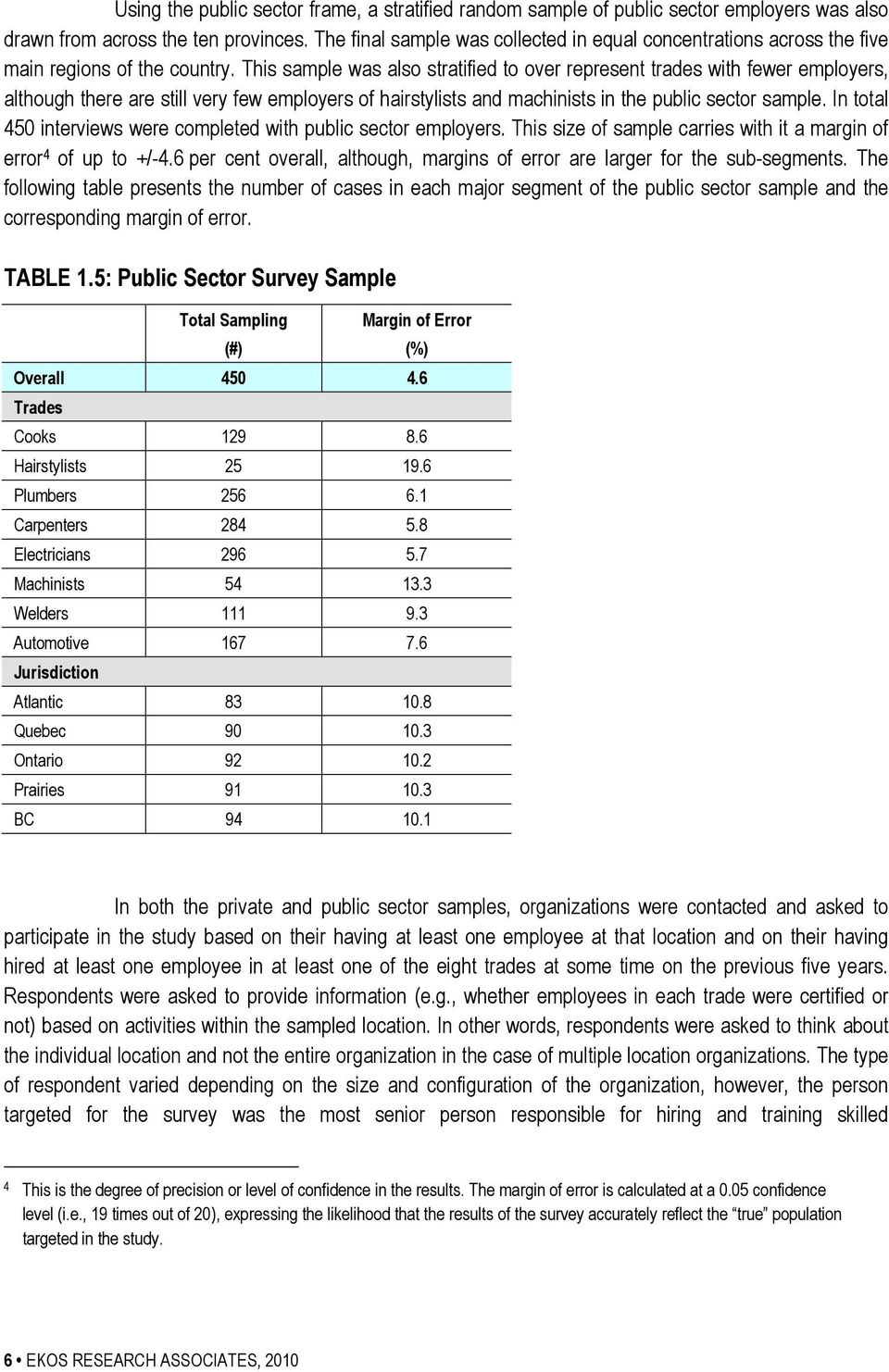
14 Using the public sector frame, a stratified random sample of public sector employers was also drawn from across the ten provinces. The final sample was collected in equal concentrations across the five main regions of the country. This sample was also stratified to over represent trades with fewer employers, although there are still very few employers of hairstylists and machinists in the public sector sample. In total 450 interviews were completed with public sector employers. This size of sample carries with it a margin of error 4 of up to +/-4.6 per cent overall, although, margins of error are larger for the sub-segments. The following table presents the number of cases in each major segment of the public sector sample and the corresponding margin of error. TABLE 1.5: Public Sector Survey Sample Total Sampling (#) Margin of Error (%) Overall Trades Cooks Hairstylists Plumbers Carpenters Electricians Machinists Welders Automotive Jurisdiction Atlantic Quebec Ontario Prairies BC In both the private and public sector samples, organizations were contacted and asked to participate in the study based on their having at least one employee at that location and on their having hired at least one employee in at least one of the eight trades at some time on the previous five years. Respondents were asked to provide information (e.g., whether employees in each trade were certified or not) based on activities within the sampled location. In other words, respondents were asked to think about the individual location and not the entire organization in the case of multiple location organizations. The type of respondent varied depending on the size and configuration of the organization, however, the person targeted for the survey was the most senior person responsible for hiring and training skilled 4 This is the degree of precision or level of confidence in the results. The margin of error is calculated at a 0.05 confidence level (i.e., 19 times out of 20), expressing the likelihood that the results of the survey accurately reflect the true population targeted in the study. 6 EKOS RESEARCH ASSOCIATES, 2010
15 tradespersons/workers. In the private sector this was often the owner/operator, although, in some cases it was a line manager. In larger organizations, this was sometimes a Human Resources Vice-President or other senior representative of the company. b) Survey Instrument and Pretesting One of the key challenges in surveying employers is to design a questionnaire that adequately addresses all of the questions (or as many as possible) within the constraints of a questionnaire that is not overly long or burdensome. A draft survey instrument was provided by the Red Seal Employer Survey Working Group. The instrument was further refined based on additional discussions and consultations with the Working Group 5 and then programmed into English and French for data collection purposes. The questionnaire was tested (in English and then in French) with 50 employer organizations with the objective of assessing the length of time required for the interviews, appropriate sequencing and clarity of the questions, and overall flow and response rates. Quality and comprehensiveness of the data returned was scrutinized, particularly in terms of the differences in responses and issues based on familiarity with the Red Seal Program and by the size of organization. Communications materials as well as organization and respondent screening were also tested. Testing revealed the need for minor changes to the skip logic and a few minor adjustments to the wording to increase clarity. c) Survey Administration The target respondent within eligible organizations was the senior person responsible for making HR decisions for the company, particularly with respect to hiring skilled tradespersons. A letter of introduction, signed by representatives of the CCDA was available to respondents who requested it to verify the legitimacy and objectives of the survey. It also outlined the authority to collect personal information, details about the survey would be administered and how HRSDC and CCDA would use the data collected in the survey. A total of 3,203 interviews were completed with private sector employers and a further 450 interviews were completed with public sector employers. Respondents were provided the option to complete the survey by telephone or online through an invitation that could be sent immediately by the interviewer while on the phone with the sample member. Up to 12 total calls were to be made to cases in the sample who agreed to participate in the survey by phone. The response rate to the survey was 47 per cent for the private sector employer sample and 58 per cent for the public sector employer sample. The margin of error for the private sector sample is +/- 1.7 per cent. Although the margin of error for results by trade were higher (between 3.6 and 5.1 per cent) 5 The Red Seal Employer Survey Working Group is a sub-committee of the Canadian Council of Director of Apprenticeship (CCDA) and is comprised of provincial/territorial and federal representatives. As project authority, the Working Group is responsible for overseeing the survey implementation. EKOS RESEARCH ASSOCIATES,
16 and for items where the respondent base was less than the full sample and +/-4.6 per cent for the public sector sample. TABLE 1.6: Response Rate Summary Private sector sample Public Sector sample Total cases 25,536 3,930 Unused 1,767 1 Invalid numbers 3, Functional sample (A) 20,191 3,553 Unresolved (callback, appointment) 6,500 1,172 Ineligible (B) 6,252 1,621 Refusal 5, Completed interviews (C ) 3, Response rate % 58.3% d) Database Management and Weighting The purpose of database management is to transform the survey data into a computerized format and create a usable file for the required analysis. In the context of CATI, the survey database is created as the survey unfolds. Each interview is added to the final database as it is completed. Answer consistency checks and skips (simple and complex) are programmed right into the questionnaire so that questions cannot be asked when they are not required and they cannot be left unanswered when they require an entry. Data editing is thus relegated to a minor check of "non applicable" code attribution in cases where backward skips occurred during an interview. Following completion of the field component, the data were reviewed and cleaned. A coding scheme for open-ended questions was developed. Senior coders reviewed all open-ended responses and assigned the appropriate code to each. The data were weighted according to the sample frame numbers for total organizations by size and by jurisdiction. Although there was an oversampling of employers hiring in some trades, it was difficult to implement a weight that adjusted for this because organizations (in the sample frame and in the final survey sample) hired in several different trades. In fact, in the case of some trades (e.g., machinists and welders) the overlap was quite high. In order to explore the magnitude of the issue a weight was created that included not only size and jurisdiction, but also adjusted for trades. These results (with the second weight applies) were compared to results using the original weight (with no trade incidence). In virtually all cases the results were essentially the same (to within two to three percentage points). Since the second weight artificially inflated the number of overall cases in the sample a decision was made to report on results using the original weight. Results are reported based on the application of a 6 The response rate is calculated as (B+C) / A. 8 EKOS RESEARCH ASSOCIATES, 2010

17 weight for size and jurisdiction but not for trade. For this reason, the results under sample organizations that employ cooks more than they under sample other types of organizations. Readers should note that Don t know and No response answers are not always represented in the charts, which therefore, may not always add to 100 per cent. Also, rounding in some cases results in a portrayal of a 99 or 101 per cent distribution. In the case of some results there are marked differences reported by employers in Quebec, compared with employers located in other jurisdictions. IN interpreting these results, it is also important for readers to note that there is no provincial standard in Quebec, as there is on the other provincial/territorial jurisdictions, which may contribute to these differences. EKOS RESEARCH ASSOCIATES,

18

19 2. USE OF STANDARDS 2.1 USE OF SKILLED TRADESPERSONS AND STANDARDS Almost all private sector employers who employ construction electricians or plumbers indicated that these tradespersons meet a jurisdictional standard (92 and 91 per cent, respectively). This is followed closely by employers of automotive service technicians and hairstylists where just under nine in ten indicated that these tradespersons in their organization meet a jurisdictional standard. Somewhat less frequently, seven in ten employers of carpenters and welders said the same, as did six in ten employers of cooks or machinists. Public sector employers responded similarly to private sector employers with respect to those trades that most often meet a jurisdictional standard construction electricians, plumbers, automotive service technicians and hairstylists. Public sector employers are more apt (by 8 to 24 percentage points) than private sector employers to have indicated that their tradespersons including carpenters, welders, cooks and machinists meet a jurisdictional standard. Incidence of Meeting Standards by Trade Do/did any of your skilled tradespersons who are meet a provincial/ territorial or national standard? Construction Electricians Plumbers Automotive Service Technicians Hairstylists Carpenters Welders Cooks Machinists Those saying yes 71% 82% 61% 69% 60% 87% 81% 87% 82% 75% 86% 84% 92% 94% 91% 94% 0% 20% 40% 60% 80% 100% EKOS Research Associates Inc. Private (n=3203) Public (n=450) Interprovincial Standards Red Seal Program, 2010 EKOS RESEARCH ASSOCIATES,

20 Sub-group differences in use of trade-based standards in the private sector vary across the trades, but are largely consistent with respect to region (employers in the Western jurisdictions were more apt to say their tradespersons meet a standard while employers in Quebec are less likely to do so) and the trade certification status of the respondent (those with a Red Seal themselves were more likely to say their tradespersons, including themselves, meet a jurisdictional standard). There are fewer sub-group differences within those trades where the proportion meeting a standard is highest. Specific results include: Employers in British Columbia, Alberta and the Atlantic were more apt to say their welders meet a jurisdictional standard, as were those who themselves have a Red Seal. The likelihood that welders meet a standard increases with the size of the organization. Employers in Quebec were less likely to say their welders meet a standard. Red Seal-designated respondents were more likely to say their cooks meet a standard. Employers with less than five employees were less apt to employ cooks who meet a standard. With respect to hairstylists, Quebec employers were less apt to say their hairstylists meet a jurisdictional standard. Having automotive service technicians that meet a standard was more common among British Columbia and Alberta employers, among responders who themselves have a Red Seal and was also more prevalent as the size of the organization increased. Alberta employers were more likely to say their machinists meet a standard, as were those who have a Red Seal themselves and organizations with 100 employees or more. Again, employers in Quebec were less apt to employ machinists who meet a standard. Employers in Quebec and British Columbia more often stated that their carpenters meet a standard. Employers in Ontario were less likely to do so. 2.2 PRESENCE OF STANDARDS Survey respondents who indicated that they had employees in one or more of the eight trades, were subsequently asked if they met a jurisdictional standard. Note that respondents were able to select as many standards as applied, so responses add to more than 100 per cent in each case. a) Welders Among the 71 per cent of private sector employers who indicated that their welders meet a jurisdictional standard, the type of standard was most likely to be a provincial certification (67 per cent), followed by a Canadian Welding Bureau certificate (57 per cent) and an apprenticeship certification (46 per cent). Almost four in ten (39 per cent) of applicable employers of welders said their employees in this trade have a Red Seal endorsement. Somewhat fewer (30 per cent) indicated that their welders have a jurisdictional pressure welding certificate. 12 EKOS RESEARCH ASSOCIATES, 2010

21 In comparison to private sector employers, the 82 per cent of public sector employers reporting a jurisdictional standard were less apt to indicate that their welders hold a Canadian Welding Bureau certificate (20 per cent) or jurisdictional pressure welding certificate (17 per cent). Applicable public sector welders, however, were more apt to meet provincial certification (74 per cent) and apprenticeship certification (48 per cent) standards than were their private sector colleagues. b) Construction electricians Among the 92 per cent of private sector employers who indicated that their construction electricians meet a jurisdictional standard most said these tradespersons hold a provincial certificate. In fact, these employers were more likely than other sampled trade employers to indicate that their construction electricians hold a provincial certificate (86 per cent) or apprenticeship certification. Almost half (49 per cent) indicated that their construction electricians have a Red Seal designation, while, three in ten said their construction electricians have a Master Electrician Licence. Applicable public sector employers were less apt than their private sector counterparts to indicate that their construction electricians had provincial certification (81 per cent), apprenticeship certification or a Red Seal endorsement. Applicable public sector employers were, however, more likely to state that their construction electricians had their Master Electrician License (35 per cent). Types of Standards Met by Trade Which of the following provincial/territorial or national standards do/did your meet? Welders Construction Electricians Journeyperson with provincial certification 67% 74% 86% 81% Journeyperson with Red Seal endorsement Apprenticeship certification 39% 31% 46% 48% 49% 40% 70% 46% Canadian Welding bureau certificate Provincial or territorial pressure welding certificate 0% Master Electrician Licence -- 20% 30% 17% 57% 0% -- 0% -- 29% 35% EKOS Research Associates Inc. 0% 20% 40% 60% 80% 100 % Private (n=471) Public (n=93) 0% 20% 40% 60% 80% 100 % Private (n=500) Interprovincial Standards Public (n=281) Red Seal Program, 2010 EKOS RESEARCH ASSOCIATES,
22 c) Plumbers Of the 91 to 94 per cent of private and public employers who stated that their plumbers meet a standard, the majority indicated that they have a provincial certification (84 per cent and 82 per cent, respectively). This is followed by an apprenticeship certification and a Red Seal endorsement for applicable private sector employers. The reported frequencies are somewhat lower among applicable public sector employers, particularly with respect to apprenticeship certification. d) Automotive Service Technicians Of the 81 to 87 per cent of applicable private and public employers, the most common type of standard met by automotive service technicians is a provincial certification. Most applicable private and public sector employers (84 per cent and 79 per cent, respectively) said their automotive service technicians meet this type of standard. This is followed by an apprenticeship certification and a Red Seal endorsement. Again, the reported incidence of these standards tends to be somewhat lower among applicable public sector employers. Types of Standards Met by Trade Which of the following provincial/territorial or national standards do/did your meet? Plumbers Automotive Service Technicians Journeyperson with provincial certification 84% 82% 84% 79% Journeyperson with Red Seal endorsement 45% 38% 45% 38% Apprenticeship certification 44% 69% 43% 60% EKOS Research Associates Inc. 0% 20% 40% 60% 80% 100 % Private (n=334) Public (n=243) 0% 20% 40% 60% 80% 100 % Private (n=658) Public (n=139) Interprovincial Standards Red Seal Program, EKOS RESEARCH ASSOCIATES, 2010
23 e) Machinists Of the 60 per cent of private sector employers hiring machinists with a jurisdictional standard, seven in ten indicated that their machinists have a provincial certification (71 per cent), compared to eight in ten of the 84 per cent who are applicable among public sector employers (79 per cent). Just over half of applicable private and public sector employers reported that their machinists have an apprenticeship certification. While one-third of applicable private sector and four in ten applicable private sector employers mentioned that their machinists have a Red Seal endorsement. f) Carpenters Of the 75 per cent of private and 86 per cent of public sector employers of carpenters who meet a jurisdictional standard most identified this standard as provincial (80 per cent and 85 per cent, respectively). Six in ten applicable private sector and nearly five in ten applicable public sector employers specified that their carpenters have an apprenticeship certification. Three in ten applicable private sector employers indicated that they employ carpenters with a Red Seal endorsement. In contrast to other trades, the reported prevalence of the Red Seal endorsement is higher among applicable public sector employers of carpenters. Types of Standards Met by Trade Which of the following provincial/territorial or national standards do/did your meet? Machinists Carpenters Journeyperson with provincial certification 71% 79% 80% 85% Journeyperson with Red Seal endorsement 34% 40% 29% 46% Apprenticeship certification 55% 52% 48% 61% EKOS Research Associates Inc. 0% 20% 40% 60% 80% 100 % Private (n=301) Public (n=46) 0% 20% 40% 60% 80% 100 % Private (n=364) Public (n=249) Interprovincial Standards Red Seal Program, 2010 EKOS RESEARCH ASSOCIATES,
24 g) Hairstylists Of the 82 to 87 per cent of public and private employers of hairstylists who meet a standard, they also most often indicated a provincial standard (75 per cent and 78 per cent, respectively). Over half of applicable private sector employers stated that their hairstylists have an apprenticeship certification, compared to one in four for public sector employers. About one-quarter of applicable private and public sector employers indicated that they employ hairstylists with a Red Seal endorsement. The sample size for public sector employers of this trade is quite small (n=20), however, and may not be representative of public sector hairstylist trade workers overall. h) Cooks The type of standard that applicable cooks meet was more evenly distributed among the two populations compared to the other trades. Approximately six in ten private and public sector employers of cooks with a jurisdictional standard declared that their cooks have a provincial certification (56 per cent and 63 per cent, respectively), followed by a Red Seal endorsement and an apprenticeship certification. Types of Standards Met by Trade Which of the following provincial/territorial or national standards do/did your meet? Hairstylist Cooks Journeyperson with provincial certification 75% 78% 56% 63% Journeyperson with Red Seal endorsement 26% 22% 44% 44% Apprenticeship certification 27% 55% 38% 31% EKOS Research Associates Inc. 0% 20% 40% 60% 80% 100 % Private (n=391) Public (n=20) 0% 20% 40% 60% 80% 100 % Private (n=238) Public (n=89) Interprovincial Standards Red Seal Program, EKOS RESEARCH ASSOCIATES, 2010
25 Among those organizations that have employees in each trade table 2.1 provides an overview of the prevalence of the Red Seal endorsement across the eight trades. In the private sector, employers of construction electricians, cooks, plumbers and automotive service technicians were more likely to report their tradespersons as having a Red Seal endorsement (49 to 44 per cent). In the middle range are employers of welders and machinists. Employers of carpenters and hairstylists were somewhat less likely to indicate employing Red Seal designated tradespersons. Overall, one in three private sector employers reported the presence of Red Seal endorsed employees across the eight trades. Public sector employers were less apt than their private sector counterparts to declare employing tradespersons with a Red Seal endorsement in many of the trades: welders; plumbers; automotive service technician; and construction technician. Two key exceptions are for carpenters and machinists for which the Red Seal endorsement was cited more often among public sector employers. That said, considering an average across all participating employers, the percentage of public sector survey respondents reporting the presence of Red Seal endorsement in their organizations is higher than found in the private sector. TABLE 2.1: Summary of Presence of Red Seal Endorsement by Trade Private Sector Employer Skilled Tradespersons with Red Seal Endorsement Public Sector Employer Hairstylist 26% 22% Carpenter 29% 46% Machinist 34% 40% Welder 39% 31% Cook 44% 44% Plumber 45% 38% Automotive Service Technician 45% 38% Construction electrician 49% 40% Overall 33% 40% EKOS RESEARCH ASSOCIATES,
26 With respect to sub-group differences in the private sector sample, regionally there tends to be a pattern of greater prevalence of the Red Seal endorsement among employed tradespersons in the Western jurisdictions and a somewhat lower incidence in Ontario and even lower in Quebec. Respondents who hold a Red Seal endorsement themselves were more likely to indicate that tradespersons in their employ have a Red Seal endorsement (recall that respondents were instructed to include themselves in their response to this question). For most trades, the likelihood of employing tradespersons with a Red Seal endorsement increases with the size of the organization and tends to be least likely among those organizations with fewer than five employees. Table 2.2 summarizes these relationships. TABLE 2.2: Summary of Sub-Group Differences (private sector) Skilled Tradespersons with Red Seal Endorsement Welder Cook Hairstylist Construction electrician Plumber Automotive service technician Machinist Carpenter Higher Alberta, SK/Man, Atlantic,100+ employees, in business <10 years, respondent has Red Seal Lower Ontario, Quebec Higher BC, respondent has Red Seal Lower Quebec, less than 5 employees Higher Alberta, SK/Man, respondent has Red Seal Lower Less than 5 employees, Quebec, Ontario Higher Respondent has Red Seal, 5-19 employees Lower Ontario, Quebec Higher BC, Alberta, SK/Man, respondent has Red Seal Lower Ontario, Quebec Higher Alberta, SK/Man, respondent has Red Seal Lower Less than 5 employees, Quebec Higher Alberta, BC, respondent has Red Seal, 100+employees Lower Ontario, Quebec Higher Increases with size of organization, respondent has Red Seal Lower Quebec 18 EKOS RESEARCH ASSOCIATES, 2010
27 2.3 PROPORTION WITH RED SEAL Employers with tradespersons who have a Red Seal endorsement were asked about the proportion of workers in the trade within their organization that have a Red Seal. Private sector employers of plumbers, construction electricians and automotive service technicians indicated the highest proportions (76 per cent, 75 per cent and 72 per cent of persons in each of these trades respectively have a Red Seal endorsement.) Welders follow closely private sector employers of welders estimated that two-thirds of welders within their organization have a Red Seal. Somewhat lower proportions were indicated for machinists, carpenters and hairstylists. Private sector employers of cooks indicated that about four in ten of the cooks in their organization have a Red Seal. While public sector employers were less apt to report that their tradespersons have a Red Seal, those who employ tradespersons with a Red Seal cited a greater prevalence of the Red Seal endorsement within their workplace than did their private sector counterparts. The proportion of reported automotive service technicians, welders and machinists with the Red Seal endorsement was approximately 95 per cent. For plumbers, construction electricians, carpenters and hairstylists the allocated proportion of public sector tradespersons with a Red Seal was approximately 85 per cent. The estimated prevalence of a Red Seal among public sector cooks was seven in ten, which is significantly higher than the proportion indicated by private sector employers. Proportion of Tradespersons with Red Seal About what proportion of your have/had a Red Seal endorsement? Average % Plumbers Construction Electricians Automotive Service Technicians Welders Machinists Carpenters Hairstylists Cooks n=172 n=107 n=284 n=125 n=327 n=56 n=148 n=36 n=88 n=22 n=142 n=126 n=114 N/A n=124 n=39 77% 90% 75% 88% 72% 95% 68% 93% 60% 94% 56% 83% 53% 41% 70% 0% 20% 40% 60% 80% 100% EKOS Research Associates Inc. Private Public Interprovincial Standards Red Seal Program, 2010 EKOS RESEARCH ASSOCIATES,
28
29 3. AWARENESS OF RED SEAL 3.1 AWARENESS OF RED SEAL Employers who did not mention the use of the Red Seal as a standard were subsequently asked if they had heard of the Red Seal Endorsement. Of the 60 per cent of private sector employers who did not cite the Red Seal as a standard, one in four (24 per cent) said they were aware of the Red Seal endorsement. Taking into account all private sector employers in the survey sample, it is reasonable to calculate that half (49 per cent) of all employers hiring in the eight trades are aware of the Red Seal. In the public sector, by comparison, the percentage is marginally higher at 54 per cent. Awareness of Red Seal (Prompted and Unprompted) Have you heard of the Red Seal endorsement? Yes No 2% Unsure 1% Includes the 60% of sample who did not list Red Seal as standard their employees meet (24% said have heard of Red Seal) and the 40% who listed Red Seal as standard (therefore assumed that 100% had heard of Red Seal) EKOS Research Associates Inc. 49% 54% 49% 44% 0% 20% 40% 60% 80% 100% Private (n=3203) Public (n=450) The Red Seal is an endorsement of qualification in the skilled trades. Certified journeypersons are able to obtain a Red Seal by successfully completing an interprovincial Red Seal examination. Does this sound familiar? Yes, familiar Yes, vaguely familiar No, not familiar 6% 5% 9% 10% 85% 84% 0% 20% 40% 60% 80% 100% Private (n=1377) Public (n=184) Includes the 76% who had not heard of Red Seal of those asked (60%) Interprovincial Standards Red Seal Program, 2010 Of the half of private sector respondents (49 per cent) that were not aware of the Red Seal standard, a small percentage indicated that that they were familiar or vaguely familiar with it once it was explained to them. This result was also reflected in similar proportions among the public sector respondents. EKOS RESEARCH ASSOCIATES,
30 Taking into account the full sample of private sector employers that cited either using the Red Seal as a standard or indicated they were aware of it, employers of construction electricians or plumbers were the most prevalent, followed by employers of automotive service technicians. Employers of hairstylists and carpenters were the least apt to indicate either using the Red Seal Program or being familiar with it (see Table 3.1). TABLE 3.1: Total Awareness of Red Seal (private sector 7 ) Have you heard of the Red Seal endorsement? (full sample) Yes(%) Partial sample of 60% not citing standard) Yes (%) (based on full sample) Overall 24% 49% TRADESPERSON Hairstylist 18% 36% Carpenter 19% 40% Machinist 25% 46% Cook 31% 50% Welder 25% 51% Automotive service technician 24% 54% Plumber 22% 59% Construction electrician 26% 62% REGION British Columbia 41% 71% Alberta 57% 85% Saskatchewan 23% 69% Manitoba 34% 68% Ontario 19% 40% Quebec 15% 18% New Brunswick 20% 52% Nova Scotia 45% 72% Prince Edward Island 52% 82% Newfoundland/Labrador 59% 81% Territories 57% 87% Awareness of the Red Seal standards program among private sector employers, even among non-users, was more pronounced in the territories and the Atlantic and Western provinces, and was lowest in Ontario and Quebec. The highest level of reported Red Seal use or awareness was in the territories (87 per cent) and the lowest level was in Quebec (18 per cent). 7 The sample size of public sector employers is too small to break this finely with any degree of confidence. 22 EKOS RESEARCH ASSOCIATES, 2010
31 In terms of familiarity with the specific products/components of the Red Seal Program, beyond the endorsement and examination aspects of the program, familiarity drops significantly. Among private and public sector employers who indicated that they are familiar with the Red Seal standard, seven in ten respondents (71 per cent and 73 per cent, respectively) stated that they are familiar with the endorsement. Six in ten private sector and five in ten public sector employers said they are familiar with the examination. Falling considerably, about one in three respondents from both employer groups indicated that they are aware of the interprovincial program guides and one in four said they are aware of the Canadians Council of Directors of Apprenticeship (CCDA). The development process for the Red Seal exam, the website, the National Occupational Analyses (NOA) and the Ellis Chart represent the Red Seal Program aspects that the fewest employers are familiar with. Familiarity With Details of Red Seal Are you familiar with each of the following aspects or products of the Interprovincial Standards Red Seal program? The Red Seal endorsement The Red Seal examination The Interprovincial Program Guides The Canadian Council of Directors of Apprenticeship The Red Seal examination development process The Red Seal website The National Occupational Analyses (NOA) The Ellis chart Those who are familiar with Red Seal 5% 4% 24% 17% 18% 22% 15% 12% 37% 32% 31% 22% 61% 52% 71% 73% EKOS Research Associates Inc. 0% 20% 40% 60% 80% 100% Private (n=2044) Public (n=295) Interprovincial Standards Red Seal Program, 2010 In terms of familiarity with the various components of the Red Seal Program, employers surveyed in British Columbia were the most often aware, followed by employers in Alberta, Nova Scotia and Prince Edward Island. Familiarity was most frequent among organizations with 20 or more employees. More specifically: Familiarity with the endorsement was strongest among employers in British Columbia, those using the Red Seal and among organizations with 20 employees or more. Familiarity was weaker among organizations that employ hairstylists and those situated in Ontario. Familiarity with the examination was most prevalent in the territories, Prince Edward Island, British Columbia, Alberta and Nova Scotia, as well as among mid to larger-sized employers (i.e., with 20 employees or more). Reported familiarity was also frequent among respondents EKOS RESEARCH ASSOCIATES,
32 that employ cooks, construction electricians and plumbers as well as among those employers that indicated using the Red Seal as a standard. Familiarity with the examination was less prevalent among organizations that hire welders, automotive service technicians and machinists or among organizations that operate in Ontario and Quebec. Familiarity with the interprovincial program guides was strongest among employers of automotive service technicians, organizations that use the Red Seal as a standard, mid to larger-sized employers and among respondents in Prince Edward Island, British Columbia and Saskatchewan. Reported familiarity with the interprovincial program guides was weaker lowest for respondents in Ontario and Quebec, and among employers hiring cooks. Familiarity with the CCDA is highest among those respondents that employ hairstylists as well as among relatively newer organizations (in operation for less than 10 years). Reported familiarity with the CCDA was lowest in Quebec, Newfoundland/Labrador and the territories and among organizations that employ cooks. Familiarity with the examination development process was more prevalent among those employing cooks, those using the Red Seal as a standard, mid to larger-sized employers, as well as those respondents located in Prince Edward Island and British Columbia. Reported familiarity with the examination development process was less frequent in Ontario. Familiarity with the Red Seal website was highest among those respondents that employ cooks and, to a lesser extent, machinists as well as among mid to larger-sized employers, and those in British Columbia. Reported familiarity with the Red Seal website was lowest in the oldest companies (40 years or more of operation), Ontario employers, and among those respondents who employ construction electricians. Reported familiarity with the National Occupational Analysis was more pronounced in Quebec and Prince Edward Island. 3.2 SOURCES OF INFORMATION Among those private sector employers familiar with specific Red Seal products or components, their primary sources of information on the Red Seal Program were employees and tradespersons (38 per cent of employers that are familiar with the program), college and technical institutes (27 per cent), Red Seal website (12 per cent) and the Jurisdictional Apprenticeship Authorities for the province/territory (10 per cent). Their public sector counterparts indicated a somewhat higher degree of reliance on employees and tradespersons (41 per cent of employers that are familiar with the program), the Red Seal website (14 per cent) and the jurisdictional apprenticeship authority (12 per cent), and less reliance on college and technical institutes (20 per cent) as sources of information on the Red Seal Program, compared with applicable private sector organizations. 24 EKOS RESEARCH ASSOCIATES, 2010
33 Sources of Information about Red Seal Where do you get your information about the Red Seal program? Those familiar with any specific aspect of Red Seal Employees/tradespeople 38% 41% College/technical institute 27% 20% Red Seal website 12% 14% Jurisdictional Apprenticeship Authorities 10% 12% Canadian Council of Directors of Apprenticeship 2% 1% Other 4% 13% DK/NR 14% 8% EKOS Research Associates Inc. 0% 20% 40% 60% Private (n=1325) Public (n=191) Interprovincial Standards Red Seal Program, 2010 In terms of specific patterns among respondents in the reported use of different information sources about the Red Seal Program: Reliance for information on employees and tradespersons was highest among employers hiring cooks and carpenters, employers using a jurisdictional standard other than Red Seal, as well as among larger-sized employers (with 100 or more employees) and organizations located in Quebec. Reported reliance on college and technical institutes for information about the Red Seal Program was most frequent among organizations that hire construction electricians, those using the Red Seal as a standard, and employers in British Columbia. The website was cited as an information source more often by larger employers, particularly those employing welders or cooks, as well as those situated in Quebec and in British Columbia. Although less used overall, the Jurisdictional Apprenticeship Authorities were identified as a relatively popular information source among organizations that hire hairstylists, and among employers situated in Alberta and Saskatchewan. EKOS RESEARCH ASSOCIATES,
34
35 4. VALUE AND USEFULNESS OF RED SEAL 4.1 PERCEIVED VALUE OF RED SEAL The sub-set of employers that indicated broad familiarity with the Red Seal endorsement were asked about the relevance of the endorsement to the needs of their organization. Just over six in ten private sector employers (62 per cent) indicated that the trade-related skills and abilities of certified journeypersons with a Red Seal endorsement meet the needs of their organization (responded 5, 6 or 7 on a 7-point scale). Public sector employers were somewhat more positive than private sector respondents (71 per cent). A minority of both private and public sector respondents indicated that the Red Seal endorsed journeypersons trade-related skills and abilities meet their needs to a moderate extent (responded 4 on a 7-point scale), or to a limited extent (responded 1, 2 or 3 on a 7-point scale). It should be noted, however, that a relatively considerable proportion of employers from both the private and public sectors were not able or declined to answer. Red Seal Meeting Employer Needs Thinking about certified journeypersons with Red Seal endorsement to what degree do their trade-related skills and abilities meet the needs of your organization? Those who are familiar with Red Seal Limited meeting of needs (1-3) Moderate meeting of needs (4) Greater meeting of needs (5-7) DK/NR 10% 4% 17% 8% 11% 16% 62% 71% EKOS Research Associates Inc. 0% 20% 40% 60% 80% 100% Private (n=2044) Public (n=295) Interprovincial Standards Red Seal Program, 2010 EKOS RESEARCH ASSOCIATES,
36 In terms of sub-group differences among private sector employers: Employers of automotive service technicians were the most apt to indicate that the traderelated skills and abilities of Red Seal endorsed journeypersons meet their needs, while those who employ cooks were least likely to say this. Employers who currently, or have in the past, employ tradespersons with a Red Seal endorsement, or who themselves hold a Red Seal, provided higher ratings of the relevance of trade-related skills and abilities to their organizational needs. Employers in the Western jurisdictions (with the exception of Saskatchewan) also provided higher average ratings of the relevance of the Red Seal journeypersons trade-related skills and abilities, whereas employers in Ontario and Quebec gave slightly lower average ratings. 4.2 RED SEAL AS HIRING ADVANTAGE Among private sector employers who are familiar with the Red Seal endorsement, nearly half (48 per cent) considered the Red Seal to be a hiring advantage with their organization (responded 5, 6 or 7 on a 7-point scale). One-quarter (26 per cent) indicated the Red Seal provided a moderate hiring advantage, while another quarter (25 per cent) assigned the Red Seal a limited or no hiring advantage at all (responded 1, 2 or 3 on a 7-point scale). Compared to the private sector, public sector employers assigned greater value or importance to the Red Seal endorsement. Over six in ten (64 per cent) indicated that a Red Seal endorsed journeyperson seeking a position with their organization would have a hiring advantage. Two in ten (19 per cent) and one in seven (15 per cent) public sector employers stated that the Red Seal endorsement would provide little or no hiring advantage with their organization. 28 EKOS RESEARCH ASSOCIATES, 2010
37 Red Seal as Hiring Advantage To what extent would Red Seal endorsed journeypersons have a hiring advantage if they were seeking a position with your organization? Those who are familiar with Red Seal Limited advantage (1-3) 25% 15% Moderate advantage (4) 26% 19% Stronger advantage (5-7) 48% 64% 0% 20% 40% 60% 80% 100% Private (n=2044) Public (n=295) EKOS Research Associates Inc. Interprovincial Standards Red Seal Program, 2010 In terms of patterns of perceived hiring advantage attributed to the Red Seal endorsed journeypersons within their organization: Among the eight trades included in the study, private sector employers of automotive service technicians and construction electricians assigned a greater hiring advantage to Red Seal endorsed journeypersons compared to employers of the other trades. Employers of machinists were the least apt to say that Red Seal journeypersons would have a hiring advantage at their organization. Following the pattern of utilization and knowledge of the Red Seal Program, employers in Ontario and Quebec were the least likely to assign a hiring advantage to Red Seal endorsed journeypersons. Employers whose tradespersons meet other types of standards, or no standard at all, were less likely to see the Red Seal as a hiring advantage. Conversely, those who currently employ Red Seal endorsed journeypersons or who have a Red Seal themselves tended to assign a greater hiring advantage to the Red Seal. The extent to which the Red Seal endorsement is perceived as a hiring advantage increases moderately with the size of the organization. EKOS RESEARCH ASSOCIATES,
38 In terms of rational, being able to use the Red Seal as a reliable indicator of the skills excellence of the candidate, and enabling hiring of journeypersons from other jurisdictions with confidence were rated as the primary reasons for considering it a hiring advantage, according to 62 per cent of applicable private employers. Enabling tradespersons to work in more than one province or territory was also a basis for this consideration for 53 per cent of this same segment of employers. Ratings of the importance of the hiring advantages were higher among the same segment of public sector employers, although the exception of mobility of the employee was substantially lower than the private sector rating, likely because this is less applicable to public sector organizations. Public (n=246) 2 11 The Red Seal enables us to hire journeypersons from other provinces with confidence Advantages of Red Seal How important are each of the following reasons why you consider the Red Seal endorsement to be a hiring advantage? Private (n=1584) Private (n=1584) Public (n=246) Private (n=1584) Public (n=246) Those who consider Red Seal an advantage The Red Seal is a reliable indicator of the skills excellence of the candidate The Red Seal enables our tradespersons to work in more than one province or territory EKOS Research Associates Inc. 0% 20% 40% 60% 80% 100% Not important (1-3) Moderately important (4) Important (5-7) Interprovincial Standards Red Seal Program, 2010 Across these findings, private sector employers who have hired Red Seal endorsed tradespersons or have a Red Seal themselves consistently provided a higher rating of the importance of each of the items as reasons for considering the Red Seal to be a hiring advantage. Other sub-group differences are as follows: Compared to other trades, employers of automotive service technicians were somewhat more likely to consider the Red Seal to be a hiring advantage because the Red Seal is a reliable indicator of skills excellence. Regionally, employers in Ontario were less apt to rate this as an important reason for considering the Red Seal as a hiring advantage. Those in British Columbia, on the other hand, were the most positive about this reason for considering the Red Seal as a hiring advantage. 30 EKOS RESEARCH ASSOCIATES, 2010
39 Hiring from other jurisdictions with confidence was rated more important by employers of hairstylists and automotive service technicians, and less so by employers of machinists and carpenters. Employers in the territories, British Columbia, Alberta and Saskatchewan provided a higher rating of the importance of this item compared with other employers. Mobility of tradespersons was ranked as a more important reason for assigning a hiring advantage to Red Seal endorsed journeypersons by employers of hairstylists and construction electricians (and somewhat less so by employers of carpenters). Employers in Ontario were less apt to rate this reason as important compared to employers in other jurisdictions. Private sector employers who are familiar with the Red Seal, but do not consider the endorsement to be a hiring advantage were asked about their overall impressions of the designation. In general, private sector employers from this group were more apt to agree with the mobility advantages of the endorsement rather than with the endorsement being an indicator of the abilities of the tradesperson. Nearly six in ten (57 per cent) respondents from this segment of employers agreed (responded 5, 6 or 7 on a 7-point scale) that the Red Seal endorsement makes it easier for skilled tradespersons to work in other jurisdictions. Three in ten agreed that the Red Seal endorsement is a reliable standard of skills excellence. Public sector employer familiar with the Red Seal provided ratings of the mobility advantages of the Red Seal that were similar to those of private sector employers. Public sector employers, however, were more apt than their private sector counterparts to rank the importance of the Red Seal endorsement as a standard of skills excellence as a hiring advantage. Impressions of Red Seal How important are each of the following reasons why you consider the Red Seal endorsement to be a hiring advantage? Those who do not consider the Red Seal a hiring advantage Private (n=437) Public (n=246) The Red Seal endorsement makes it easier for skilled tradespersons to work in other provinces & territories The Red Seal endorsement is a reliable standard of skills excellence Private (n=437) Public (n=246) % 20% 40% 60% 80% 100% Disagree (1-3) Neither (4) Agree (5-7) EKOS Research Associates Inc. Interprovincial Standards Red Seal Program, 2010 EKOS RESEARCH ASSOCIATES,
40 Other sub-group differences among the surveyed employers include: Employers of hairstylists and employers in the Atlantic were somewhat more likely to agree that the Red Seal has mobility advantages. Organizations in operation for years were less likely to agree that the Red Seal is a reliable indicator of skills excellence. 4.3 UTILITY OF THE RED SEAL PROGRAM Public sector employers familiar with the Red Seal Program ranked its usefulness to their organization somewhat more favourably than did the corresponding segment of private sector employers. Of those employers that were familiar with the Red Seal, three in ten (29 per cent) private sector and four in ten (44 per cent) public sector employers indicated that the endorsement is useful to their organization (rated 5, 6 or 7 on a 7-point scale). Approximately one-third of applicable private sector and one-quarter of their public sector counterparts indicated that the program is moderately useful or not useful. Although it is not certain that those employers that were not familiar with the Red Seal would have given it lower ratings, it is possible that, taking the full sample into consideration, one sixth of employers hiring in the eight trades consider the Red Seal Program to be useful. Usefulness of Red Seal Overall, in your experience as an employer, how useful is the Red Seal program to your organization? Those familiar with Red Seal Not useful (1-3) 35% 24% Moderately useful (4) 32% 26% Useful (5-7) 29% 44% 0% 20% 40% 60% 80% 100% Private (n=2044) Public (n=295) EKOS Research Associates Inc. Interprovincial Standards Red Seal Program, EKOS RESEARCH ASSOCIATES, 2010
41 In terms of private sector sub-group differences: Employers of cooks and automotive service technicians provided higher ratings of the usefulness of the program compared to other employers, while employers of machinists assigned, on average, lower ratings of the usefulness of the Red Seal Program for their organization. The perceived utility of the program was ranked higher among employers who have Red Seal endorsed tradespersons in their employ and among those who themselves have a Red Seal endorsement. Rated usefulness of the program increases with the size of the organization. Private sector employers in Newfoundland/Labrador, the territories, British Columbia and Saskatchewan provided higher ratings of the usefulness of the program, while those in Ontario and Quebec rated the Red Seal Program as less useful for their organization. Private sector employers who considered the Red Seal Program to be useful for their organization were asked to expand on how the program was proving helpful. The most common responses related to the Red Seal as an indicator of the skills and abilities of the tradesperson. For example, a minority (21 per cent) of respondents referred to the Red Seal as a helpful indicator of the skills, ability, knowledge, capabilities or competencies of tradespersons. One in five (19 per cent) employers referred to the certification aspect that the Red Seal provides an independent endorsement that individuals are qualified/certified/educated for the position, that is to say, have undergone the appropriate training/testing/ certification process, and/or are fully licensed. A small group of respondents (eight per cent) specifically mentioned that the Red Seal Program provides an indication of superior skills and abilities. A few of these employers (13 per cent) cited the utility of the program in fostering interprovincial mobility (can work in any jurisdiction, can hire from/in any jurisdiction, access to jobs/employees, confidence in their abilities out of jurisdiction). Other benefits of the Red Seal Program cited by a small number of these private sector respondents include: Creates a jurisdictional standard for the trade, establishes goals/benchmark to measure against, standardizes industry/trade (eight per cent); Enhances the organization s ability to market their services and/or obtain business (well perceived by and at times requested by customers and clients, creates competitive advantage, ability to provide better service) (six per cent); and Provides an assessment of other attributes of the tradesperson and reflects positively on applicant characteristics (e.g., trustworthiness, lends credibility, indicates initiative, shows they are serious/professional, positive work ethic/hard worker)) (four per cent). EKOS RESEARCH ASSOCIATES,
42 Among those private sector employers who have not found the Red Seal Program to be useful for their organization, the primary reasons provided for this assessment have to do with the requirements of the organization: three in ten of these respondents said that the Red Seal is not relevant/necessary for the business/work they conduct or is not useful for their organization (includes lack of relevance due to the small size of the company and not planning on changing/hiring/expanding). One in five of these private sector employers indicated no or limited awareness/information/experience with the Red Seal Program. Other reasons provided by private sector employers for not finding the Red Seal Program useful for their organization include: The Red Seal Program does not necessarily prepare/qualify/train/test workers at the levels they require/want, does not automatically imply they are skilled/ready to work, tradespersons are just as qualified without it (10 per cent); Do not work outside of their jurisdiction, no need for employees to work outside of their jurisdiction (10 per cent); and Informal training or hands on experience is more important (six per cent). 4.4 FUTURE IMPORTANCE OF THE RED SEAL PROGRAM About one-quarter of private sector employers who are familiar with the Red Seal (26 per cent) think that the Red Seal endorsement will become more important (rated 5, 6 or 7 on a 7-point scale) in their company s hiring decisions in the future. The majority consider that there will be no change (59 per cent) and a small proportion believe the endorsement will become less important in their company s hiring decisions in the future (13 per cent). Among the same segment of public sector employer ratings were somewhat more favourable in their estimation of the future importance of the Red Seal Program with onethird (35 per cent) indicating that the endorsement will become more important in their organization s future hiring decisions and a very small number indicating that the endorsement will become less important (two per cent). 34 EKOS RESEARCH ASSOCIATES, 2010
43 Perceived Trend for Role of Red Seal Do you think the Red Seal endorsement will become more or less important in your company s hiring decisions in the future? Those familiar with Red Seal Becomes less important (1-3) 13% 2% Remain about the same (4) 59% 58% Become more important (5-7) 26% 35% 0% 20% 40% 60% 80% 100% Private (n=2044) Public (n=295) EKOS Research Associates Inc. Interprovincial Standards Red Seal Program, 2010 Other sub-group differences among employers include: Private sector employers of cooks and welders, as well as employers who currently employ Red Seal endorsed tradespersons and/or who have a Red Seal themselves were more likely to think that the Red Seal Program will become more important in their company s hiring decisions in the future. Employers in Newfoundland/Labrador and the territories were somewhat more likely to consider the Red Seal endorsement as increasing in importance, while employers in Ontario were less likely to think that it will. The rating of the relative importance of the Red Seal Program to their company s hiring decisions in the future tended to increase moderately in relation to company size; larger organizations tend to believe that the importance of the Red Seal endorsement would increase over time. Key reasons provided by employers in support of their belief that the Red Seal endorsement will become more important in their organization s future hiring decisions are similar to responses provided describing the overall usefulness of the program. Notably, that the program provides an indication of the skills level/capabilities of the candidate (25 per cent) and, the Red Seal Program enables interprovincial mobility, is a proxy for other work-related characteristics or qualities (e.g., commitment, work ethic), and it reflects well on the organization - mentioned by about one in ten respondents each. EKOS RESEARCH ASSOCIATES,
44
45 5. RED SEAL AS A MARKETING/ HR TOOL 5.1 USE OF RED SEAL IN MARKETING AND HR a) Use in Marketing The Red Seal is used by a modest proportion of employers who are familiar with the program to promote and market services, although, it is far from a commonplace practice. A minority of private and public sector employers familiar with the Red Seal (fifteen per cent and thirteen per cent, respectively) indicated that their organization uses the endorsement to promote their services and a few employers mentioned that they use it in this way in some circumstances but that it depends on the service or situation. Among the two in three surveyed private and public sector employers that are familiar with the Red Seal Program, a small number reported that their clients typically request the Red Seal, although the reported frequency was higher among public sector employers. Red Seal as Marketing Tool/Indicator of Quality Do you use the hiring of Red Seal endorsed tradespersons to promote your services? Do your clients or customers typically request the Red Seal? Yes 15% 13% Yes 2% 8% No 80% 83% No 93% 85% It depends on 5% Some do and 4% service/situation 1% some don t 3% 0% 20% 40% 60% 80% 100% Private (n=2044) Public (n=295) 0% 20% 40% 60% 80% 100% Private (n=2044) Public (n=295) EKOS Research Associates Inc. Those familiar with Red Seal Interprovincial Standards Red Seal Program, 2010 EKOS RESEARCH ASSOCIATES,
46 In terms of differences among the sub-groups: Reported use of the Red Seal in marketing activities was most prevalent in the territories, Newfoundland/Labrador, British Columbia and Saskatchewan, as well as among the largest private sector employers (although it is still used less than one-quarter of the time, except in the territories where it is used by a larger proportion of employers). In terms of specific patterns of use, reported client requests for the Red Seal among both employer groups were highest in the territories (27 per cent) and among those hiring welders (15 per cent). b) Use in Human Resources The majority of private and public sector employers familiar with the Red Seal indicated that their organization does not require the Red Seal endorsement as a requirement when hiring a journeyperson in a skilled trade (78 per cent and 60 per cent respectively), although familiar public sector employers were more apt to require Red Seal certification than were their private sector counterparts. Nearly one in six of these public sector employers and just under half of private sector employers familiar with the program stated that their organization requires other qualifications or endorsements when hiring a journeyperson in a skilled trade. This means that approximately 30 per cent of all surveyed employers have some form of qualification/certification requirement. Of these, about one in three employers (or about 10 per cent of all employers hiring in the top eight trades) require the Red Seal when hiring a journeyperson in a skilled trade. Among the private and public sector employers that indicated that a Red Seal endorsed journeyperson would have a hiring advantage within their organization (48 per cent and 60 per cent, respectively), 21 per cent of private sector and 38 per cent of public sector responders reported that their organization requires the Red Seal endorsement when hiring a journeyperson in a skilled trade. 38 EKOS RESEARCH ASSOCIATES, 2010
47 Requirement for Red Seal and Other Qualifications Do you require a Red Seal endorsement when hiring a journeyperson in a skilled trade? Do you require any other qualifications or endorsement when hiring a journeyperson in a skilled trade? Yes 21% 38% Yes 47% 57% No 78% 60% No 53% 40% DK/NR 1% 2% DK/NR 3% EKOS Research Associates Inc. 0% 20% 40% 60% 80% 100% Private (n=1584) Public (n=246) Those who consider Red Seal an advantage 0% 20% 40% 60% 80% 100% Private (n=2022) Public (n=288) Interprovincial Standards Red Seal Program, 2010 In terms of sub-group differences: The requirement for some form of qualification or endorsement is more prevalent among employers hiring hairstylists and plumbers, as well as among employers in Quebec and the oldest employers (in business for 40 years or more). Private sector employers that were the least apt to require any form of qualification or endorsement when hiring a journeyperson in a skilled trade were located in Newfoundland/Labrador. The requirement for the Red Seal endorsement, specifically, was most prevalent in the territories and British Columbia, as well as among private sector employers hiring construction electricians and plumbers, and among the largest employers (100 or more full-time employees). Private sector employers that were the least apt to require the Red Seal endorsement when hiring a journeyperson in a skilled trade were located in Quebec and Ontario, as well as those hiring cooks or machinists. Of private sector employers who indicated a familiarity with the Red Seal, four in ten (41 per cent) said that they encourage all journeypersons and apprentices in their organization to write the Red Seal examination, and one in ten (12 per cent) indicated that they do in some cases. Of all private sector employers hiring in the eight trades this represents about one in four (26 per cent) that encourages all their uncertified tradespersons and one in three employers (34 per cent) who encourage, in at least some cases, their unendorsed journeypersons and apprentices to take the Red Seal exam. EKOS RESEARCH ASSOCIATES,
48 For public sector employers who are familiar with the Red Seal Program, just over one in four (28 per cent) said they encourage all trade journeypersons and apprentices in their organization to write the Red Seal exam if they are not already Red Seal certified. One in seven (15 per cent) said that in some cases do they encourage their tradespersons to write the Red Seal examination if they are not already certified. Encouragement from Employers to Have Red Seal Do you encourage journeypersons and/or apprentices in your company to write the Red Seal examination if they are not already Red Seal certified? Those familiar with Red Seal Yes, in all cases Yes, only in some cases No DK/NR 41% 28% 12% 15% 44% 53% 2% 4% EKOS Research Associates Inc. 0% 20% 40% 60% 80% 100% Private (n=2044) Public (n=295) Interprovincial Standards Red Seal Program, 2010 Considering all public sector employers hiring in the eight trades this translates to two in ten employers (18 per cent) that encourage all unendorsed journeypersons and apprentices to take the Red Seal exam. Similarly, just over one in four (28 per cent) employers encourage, at least in some cases, unendorsed tradespersons to take the Red Seal examination. Sub-group trends among respondents include: Encouragement from private sector employers for unendorsed employees to write the Red Seal exam is strongest among those hiring construction electricians and, to a lesser extent, cooks. Encouragement from private sector employers for tradespersons to write the Red Seal examination is most prevalent in the territories, Alberta, Saskatchewan, Nova Scotia and British Columbia, as well as among the smallest organizations (with five or fewer full-time employees). Encouragement for tradespersons to write the Red Seal examination is more prevalent among organizations that rely on the Red Seal as their standard. 40 EKOS RESEARCH ASSOCIATES, 2010
49 TABLE 5.1: Encouragement to Write Red Seal by Trade and Jurisdiction (private sector) Do you encourage journeypersons and/or apprentices in your company to write the Red Seal examination if they are not already Red Seal certified? Yes, in all cases Yes, in some cases Overall 41% 12% 44% TRADESPERSON Machinist 36% 9% 53% Carpenter 36% 14% 49% Welder 37% 15% 47% Cook 37% 27% 34% Hairstylist 38% 16% 41% Plumber 44% 11% 44% Automotive service technician 45% 9% 42% Construction electrician 46% 10% 42% REGION British Columbia 46% 17% 35% Alberta 55% 10% 33% Saskatchewan 54% 10% 34% Manitoba 44% 15% 37% Ontario 31% 9% 57% Quebec 21% 16% 61% New Brunswick 40% 14% 43% Nova Scotia 49% 13% 37% Prince Edward Island 52% 3% 40% Newfoundland and Labrador 49% 17% 31% Territories 61% 20% 19% No c) Current Pattern of Training Almost three-quarters of private sector employers in the sample reported that they train apprentices (72 per cent). Readers should recall, however, that the sample is contained to employers of tradespersons that have employed tradespersons in the eight specified trades in the past five years, and is not representative of all employers. Over six in ten (61 per cent) indicated that they actively recruit journeypersons who are already certified. Taken together, 22 per cent of surveyed private sector employers rely solely on training their own apprentices, 11 per cent hire already certified tradespersons and half of employers do both; presumably training employees under some circumstances and hiring certified employees under other situations. Approximately one in seven (16 per cent) indicated that they neither train nor hire certified journeypersons. EKOS RESEARCH ASSOCIATES,
50 By comparison, public sector employers were more apt than their private sector counterparts to actively recruit certified journeypersons and less apt to train apprentices. Nearly seven in ten (71 per cent) public sector employers indicated that their organization actively recruits already certified journeypersons, while four in ten public sector employers stated that their organization provides apprenticeship training. Training and Recruitment Activity Does your organization train apprentices? Does your organization actively recruit already certified journeypersons? Yes 39% 72% Yes 61% 71% No 28% 60% No 38% 28% 0% 20% 40% 60% 80% 100% Private (n=3202) Public (n=450) 0% 20% 40% 60% 80% 100% Private (n=3202) Public (n=450) EKOS Research Associates Inc. Interprovincial Standards Red Seal Program, 2010 As illustrated in Table 5.2, sub-group differences reported by private sector employers include: The practice of training apprentices is most concentrated among private sector employers that employ cooks. Although, employers of cooks is also the sub-group with the highest concentration of organizations that neither train nor hire certified tradespersons. Employers hiring hairstylists were more likely than other surveyed employers to hire already certified skilled tradespersons. Employers of construction electricians, plumbers and automotive service technicians were the most likely of all private sector employers to both train apprentices and hire already certified tradespersons. Mid to larger-sized organizations were most apt to both train apprentices and hire already certified journeypersons. Smaller-sized employers were more likely to either train apprentices or hire already certified journeypersons, but not both. Smaller organizations, as a group, were also least apt to provide training to apprentices or to hire already certified tradespersons. 42 EKOS RESEARCH ASSOCIATES, 2010
51 Geographically, the concentration of private sector employers that reported training apprentices was highest in Manitoba. Employers in British Columbia and Nova Scotia were somewhat more apt than employers from other jurisdictions to hire already certified journeypersons, although, this still represented a small proportion of employers in these jurisdictions. The concentration of employers that both train apprentices and hire already certified tradespersons was highest in Alberta, Saskatchewan and Newfoundland/Labrador (presumably where labour shortages have been most prevalent in the past four or five years). Private sector employers in Quebec and New Brunswick reported higher than average rates of neither training apprentices nor hiring already certified journeypersons. It is also worth noting that respondents from private sector organizations where the Red Seal is considered as the standard, and in those cases where the respondent was Red Seal certified, were more apt than other organizations to both train apprentices and hire already certified tradespersons (in 66 and 65 per cent of cases, respectively). TABLE 5.2: Employers Who Train, Recruit, Do both or Neither (private sector) 8 Train Recruit Both Neither Overall 22% 11% 50% 16% TRADESPERSON Hairstylist 16% 23% 46% 15% Welder 21% 14% 50% 16% Construction electrician 21% 9% 61% 9% Automotive service technician 22% 9% 55% 14% Carpenter 23% 11% 47% 18% Plumber 23% 9% 60% 7% Machinist 26% 11% 44% 18% Cook 30% 12% 21% 36% REGION British Columbia 17% 18% 53% 12% Alberta 16% 9% 63% 11% Saskatchewan 23% 8% 62% 7% Manitoba 30% 4% 54% 12% Ontario 24% 10% 49% 16% Quebec 26% 11% 39% 23% New Brunswick 22% 11% 42% 25% Nova Scotia 18% 18% 46% 18% Prince Edward Island 25% 8% 42% 25% Newfoundland/Labrador 15% 13% 61% 11% Territories 16% 5% 61% 17% 8 Sample size among public sector respondents is not large enough to break this finely with a high degree of confidence. EKOS RESEARCH ASSOCIATES,
52 Among private and public sector employers that stated that their organization does not train apprentices, most respondents (87 per cent and 90 per cent, respectively) indicated that they had not trained apprentices in Red Seal trades within the past five years. A very small proportion of private and public sector employers that do not currently provide apprenticeship training said that their organization has trained apprentices in the Red Seal trades over the past five years. Past Incidence of Training for Employers Who Don t Currently Train Have you trained apprentices in Red Seal trades in the past 5 years? Those who do not train apprentices Yes 11% 4% No 87% 90% DK/NR 2% 6% 0% 20% 40% 60% 80% 100% Private (n=821) Public (n=262) EKOS Research Associates Inc. Interprovincial Standards Red Seal Program, 2010 Variations in reported training and recruitment practices among private sector employers subgroups include: The most likely segment of private sector employers who indicated that they trained apprentices in the past, but no longer do, were operating among automotive service technicians (16 per cent). Geographically, Quebec had the highest concentration of employers reporting they do not currently train apprentices, but that they have trained apprentices within the past five years. Respondents that do not currently train apprentices were asked about potential incentives from the Interprovincial Standards Red Seal Program that would encourage their organization to train apprentices 9. One in four of the applicable private sector segment (24 per cent) said that incentives would 9 There may be a higher degree of measurement error influencing the results of this question given that the Red Seal Program is a certificate program, not a training program, therefore incentives to train may to be seen as inappropriate by some employers. 44 EKOS RESEARCH ASSOCIATES, 2010
53 not make a difference in their organization, either because they are not interested in training apprentices or because there is insufficient work or employment opportunities within their organization to rationalize adopting a training program. Given that this 24 per cent is one of four in the private sector who do not train, it represents six per cent of all private sector members of the sample). Another 11 per cent of this segment of private sector employers indicated that more detailed information about the Red Seal Program and what it offers the employer in the way of assurances of quality skilled help would be required to encourage them to train apprentices. One in seven (16 per cent) of this segment of the private sector and 2 in ten (22 per cent) of the same cohort of public sector employers indicated that government financial assistance or incentives to offset the cost of training would be required. EKOS Research Associates Inc. Incentives to Train Apprentices What would you require from the Interprovincial Standards Red Seal program to encourage you to train apprentices? Gov. financial assistance or incentive 16% 22% More information 11% -- Lack of opportunity/not enough work 5% -- Nothing would make a difference -- Other -- DK/NR Those who do not train apprentices 19% 25% 48% 38% 0% 20% 40% 60% 80% 100% Private (n=810) Public (n=258) Interprovincial Standards Red Seal Program, 2010 In terms of sub-group differences: Geographically, a larger proportion of the employers in Alberta and Quebec that do not currently train apprentices said incentives would not make a difference (29 and 24 per cent, respectively), although this is still a minority of these employers in each of these provinces. A requirement for more information about the Red Seal standards program and apprenticeship training was most concentrated in Quebec relative to employers in other jurisdictions (24 per cent). Also, larger-sized organizations were more apt than smaller ones (with fewer than 20 employees) to want more information about the Red Seal Program in order to consider making it a requirement within their organization. Employers of carpenters were also more apt than other trades employers to indicate that more information about the Interprovincial Standards Red Seal Program would be required to encourage them to train apprentices. EKOS RESEARCH ASSOCIATES,
54 It is interesting to note that it is the organizations that already use the Red Seal as a standard as well as in cases where the respondent is Red Seal certified that indicated that government financial assistance or incentives would be required from the Interprovincial Standards Red Seal Program to encourage their organization to train apprentices. 46 EKOS RESEARCH ASSOCIATES, 2010
55 APPENDIX A COVERING LETTER
56
57 Canadian Council of Directors of Apprenticeship Conseil canadien des directeurs de l apprentissage March, 2010 <fname><lname> <address> Dear Mr./Ms. <Iname>, The Canadian Council of Directors of Apprenticeship (CCDA), with support from Human Resources and Skills Development Canada (HRSDC), is undertaking research on the employment of skilled tradespersons and the effectiveness of the Interprovincial Standards Red Seal Program. As an employer of skilled tradespersons, you can help CCDA better understand impacts of the Red Seal Program, including the delivery of services and products, the value of the Red Seal endorsement in hiring qualified tradespeople, and the training of apprentices in general. Your input, in combination with information collected from other sources, will be valuable in making decisions on program design and delivery. EKOS Research has been engaged to conduct a survey of employers. They will contact employers to complete an interview either by telephone or online at a time convenient to them. The interview should take approximately 10 minutes. Alternatively, you may wish to contact EKOS Research directly toll free at to arrange to complete the interview or to update contact information. The information you provide will be collected under the authority of the Department of Human Resources and Skills Development Act and will be administered in accordance with the Privacy Act, and other applicable laws. The information you provide is for the purpose of the research only. Your participation is completely voluntary and your acceptance or refusal to participate will not affect any services you might receive from HRSDC or the CCDA. Your responses are confidential and your name, including the name of businesses, will not be associated with any information you provide. HRSDC and the CCDA will receive the final results of the study in the form of a report which will contain grouped responses only. Should you have any questions or concerns about this research, please contact EKOS Research toll free at Your co-operation is greatly appreciated. Sincerely, Joe Black CCDA Chair EKOS RESEARCH ASSOCIATES,
58
59 APPENDIX B QUESTIONNAIRE
60
61 Q2 Does your organization (i.e. business) currently employ skilled trades people at this location? Yes... 1 No... 2 Don t know/no Response... 3 Q2A Did your organization employ skilled trades people at this location in the past 5 years? Yes... 1 No... 2 Don t know/no Response... 3 Q3 [1,26] Does/Did your organization employ any of the following tradespersons? Read list of 8 trades and take each one that applies Welder... 1 Cook... 2 Hairstylist... 3 Construction Electrician... 4 Plumber... 5 Automotive Service Technician... 6 Machinist... 7 Carpenter... 8 Millwright(s), industrial workers... 9 Sheet metal/steel fabricators (iron worker, boiler maker Steam/gas/pipe fitters Refrigeration/air conditioning mechanic, heating/cooling/hvac Heavy duty mechanic, machinery/equipment Tool and dye, mold makers Various other mechanics Aesthetician/nail tech Various other technicians, parts apprentice Painter Various other fabricators, machine builders Various other operators Roofer Various other engineers Other Concrete/masonry Drywaller/insulator Other (specify) Don t know/no Response EKOS RESEARCH ASSOCIATES,
62 Q3A1 Do/Did any of your skilled tradespersons who are welders meet a provincial/territorial or national standard? Yes... 1 No... 2 Don t know/no Response... 3 Q3A2 Do/Did any of your skilled tradespersons who are cooks meet a provincial/territorial or national standard? Yes... 1 No... 2 Don t know/no Response... 3 Q3A3 Do/Did any of your skilled tradespersons who are hairstylists meet a provincial/territorial or national standard? Yes... 1 No... 2 Don t know/no Response... 3 Q3A4 Do/Did any of your skilled tradespersons who are construction electricians meet a provincial/territorial or national standard? Yes... 1 No... 2 Don t know/no Response... 3 Q3A5 Do/Did any of your skilled tradespersons who are plumbers meet a provincial/territorial or national standard? Yes... 1 No... 2 Don t know/no Response... 3 Q3A6 Do/Did any of your skilled tradespersons who are automotive service technicians meet a provincial/territorial or national standard? Yes... 1 No... 2 Don t know/no Response EKOS RESEARCH ASSOCIATES, 2010
63 Q3A7 Do/Did any of your skilled tradespersons who are Machinists meet a provincial/territorial or national standard? Yes... 1 No... 2 Don t know/no Response... 3 Q3A8 Do/Did any of your skilled tradespersons who are carpenters meet a provincial/territorial or national standard? Yes... 1 No... 2 Don t know/no Response... 3 Q3B1 [1,19] Which of the following provincial/territorial or national standards do/did your welders meet? READ LIST, Take all that apply Journeyperson with provincial certification?... 1 Journeyperson with Red Seal endorsement?... 2 Apprenticeship certification?... 3 Pre-employment (or pre-apprenticeship) trade certificate?... 4 Technologist certification?... 5 Power engineering provincial standard?... 6 Military trades training?... 7 Training provided by equipment manufacturers?... 8 Canadian Welding bureau certificate?... 9 Provincial or territorial pressure welding certificate? Master Electrician Licence ICAR (International Conference Of Auto Repair) Stainless steel ticket American welding standards Aluminum ticket/certification Welding supervisor ticket Safety training (WHMIS, TSSA, H25) Any others; please specify Other None Don t know/no Response Q3B2 [1,18] Which of the following provincial/territorial or national standards do/did your cooks meet? Take all that apply Journeyperson with provincial certification?... 1 Journeyperson with Red Seal endorsement?... 2 Apprenticeship certification?... 3 EKOS RESEARCH ASSOCIATES,
64 Pre-employment (or pre-apprenticeship) trade certificate?... 4 Technologist certification?... 5 Power engineering provincial standard?... 6 Military trades training?... 7 Training provided by equipment manufacturers?... 8 Canadian Welding bureau certificate?... 9 Provincial or territorial pressure welding certificate? Master Electrician Licence Food safety/handling/preparation certification WHMIS First aid course Cooking school International cooking standards (Tunisia, Lebanon...) Any others; please specify Other None Don t know/no Response Q3B3 [1,17] Which of the following provincial/territorial or national standards do/did your hairstylists meet? Take all that apply Journeyperson with provincial certification?... 1 Journeyperson with Red Seal endorsement?... 2 Apprenticeship certification?... 3 Pre-employment (or pre-apprenticeship) trade certificate?... 4 Technologist certification?... 5 Power engineering provincial standard?... 6 Military trades training?... 7 Training provided by equipment manufacturers?... 8 Canadian Welding bureau certificate?... 9 Provincial or territorial pressure welding certificate? Master Electrician Licence DEP (Diplome D'etude Professional) Licensed/certified (general) Course in hairstyling Cosmotology association (provincial) Any others; please specify Other None Don t know/no Response Q3B4 [1,20] Which of the following provincial/territorial or national standards do/did your construction electricians meet? Take all that apply Journeyperson with provincial certification?... 1 Journeyperson with Red Seal endorsement?... 2 Apprenticeship certification?... 3 Pre-employment (or pre-apprenticeship) trade certificate? EKOS RESEARCH ASSOCIATES, 2010
65 Technologist certification?... 5 Power engineering provincial standard?... 6 Military trades training?... 7 Training provided by equipment manufacturers?... 8 Canadian Welding bureau certificate?... 9 Provincial or territorial pressure welding certificate? Master Electrician Licence Journeyperson with interprovincial license/certification Contractor's license Safety standards/requirements Gold seal WHMIS Class A, B, C licenses Industrial electrician/ amp certification Any others; please specify Other None Don t know/no Response Q3B5 [1,19] Which of the following provincial/territorial or national standards do/did your plumbers meet? Take all that apply Journeyperson with provincial certification?... 1 Journeyperson with Red Seal endorsement?... 2 Apprenticeship certification?... 3 Pre-employment (or pre-apprenticeship) trade certificate?... 4 Technologist certification?... 5 Power engineering provincial standard?... 6 Military trades training?... 7 Training provided by equipment manufacturers?... 8 Canadian Welding bureau certificate?... 9 Provincial or territorial pressure welding certificate? Master Electrician Licence Gas fitting Interprovincial Master plumbing Various tickets/certifications (electrical, refrigeration, pump, operating, plumbing...) Various training courses (safety, trade related...) CMMTQ (Corporation des Membres Mécanicien en Tuyauterie du Québec) Any others; please specify Other None Don t know/no Response EKOS RESEARCH ASSOCIATES,
66 Q3B6 [1,24] Which of the following provincial/territorial or national standards do/did your automotive service technicians meet? Take all that apply Journeyperson with provincial certification?... 1 Journeyperson with Red Seal endorsement?... 2 Apprenticeship certification?... 3 Pre-employment (or pre-apprenticeship) trade certificate?... 4 Technologist certification?... 5 Power engineering provincial standard?... 6 Military trades training?... 7 Training provided by equipment manufacturers?... 8 Canadian Welding bureau certificate?... 9 Provincial or territorial pressure welding certificate? Master Electrician Licence CPA (Comité Paritaire Automobile (Montreal only) Various motor vehicle specific certificates (air conditioning, propane, safety, painting...) Brand specific/certification (GM, VW, KIA, dealership, Delco, Bear) Motor vehicle inspectors Interprovincial ticket/standard Drive clean Various licenses (mechanic, truck, dealer's) Training in safety, WHMIS ICAR (Collision Repair Training, worldwide) ASE (Automotive Service Excellence) Registered with the Ministry Of Quebec Any others; please specify Other None Don t know/no Response Q3B7 [1,19] Which of the following provincial/territorial or national standards do/did your machinists meet? Take all that apply Journeyperson with provincial certification?... 1 Journeyperson with Red Seal endorsement?... 2 Apprenticeship certification?... 3 Pre-employment (or pre-apprenticeship) trade certificate?... 4 Technologist certification?... 5 Power engineering provincial standard?... 6 Military trades training?... 7 Training provided by equipment manufacturers?... 8 Canadian Welding bureau certificate?... 9 Provincial or territorial pressure welding certificate? Master Electrician Licence DEP (Diplome d'étude Professional) International standards/qualifications Formal education (masters degree/university/college) EKOS RESEARCH ASSOCIATES, 2010
67 Experience Specific training courses (safety, ASE) Tool and dye Any others; please specify Other None Don t know/no Response Q3B8 [1,17] Which of the following provincial/territorial or national standards do/did your carpenters meet? Take all that apply Journeyperson with provincial certification?... 1 Journeyperson with Red Seal endorsement?... 2 Apprenticeship certification?... 3 Pre-employment (or pre-apprenticeship) trade certificate?... 4 Technologist certification?... 5 Power engineering provincial standard?... 6 Military trades training?... 7 Training provided by equipment manufacturers?... 8 Canadian Welding bureau certificate?... 9 Provincial or territorial pressure welding certificate? Master Electrician Licence CCQ (carte de competence du Quebec) Interprovincial Safety training Cabinet maker ticket Any others; please specify Other None Don t know/no Response Q3C Have you heard of the Red Seal endorsement? Yes... 1 No... 2 Unsure... 3 Q3D The Red Seal is an endorsement of qualification in the skilled trades - certified journeypersons are able to obtain a Red Seal by successfully completing an interprovincial Red Seal examination. Does this sound familiar? Yes, it is familiar... 1 Yes, but only vaguely familiar... 2 No, not familiar... 3 Don t know/no Response... 9 EKOS RESEARCH ASSOCIATES,
68 Q4A About what proportion of your welders have/had a Red Seal endorsement? Percent... 1 Don t know/ No Response Q4B About what proportion of your cooks have/had a Red Seal endorsement? Percent... 1 Don t know/ No Response Q4C About what proportion of your hairstylists have/had a Red Seal endorsement? Percent... 1 Don t know/ No Response Q4D About what proportion of your construction electricians have/had a Red Seal endorsement? Percent... 1 Don t know/ No Response Q4E About what proportion of your plumbers have/had a Red Seal endorsement? Percent... 1 Don t know/ No Response Q4F About what proportion of your automotive service technicians have/had a Red Seal endorsement? Percent... 1 Don t know/ No Response Q4G About what proportion of your machinists have/had a Red Seal endorsement? Percent... 1 Don t know/ No Response Q4H About what proportion of your carpenters have/had a Red Seal endorsement? Percent... 1 Don t know/ No Response Q5A Are you familiar with each of the following aspects or products of the Interprovincial Standards Red Seal program? The Red Seal endorsement Yes... 1 No EKOS RESEARCH ASSOCIATES, 2010
69 Don t know/ No Response... 9 Q5B Are you familiar with each of the following aspects or products of the Interprovincial Standards Red Seal program? National Occupational Analyses (NOA) conducted for Red Seal trades Yes... 1 No... 2 Don t know/ No Response... 9 Q5C Are you familiar with each of the following aspects or products of the Interprovincial Standards Red Seal program? The Ellis chart Yes... 1 No... 2 Don t know/ No Response... 9 Q5D Are you familiar with each of the following aspects or products of the Interprovincial Standards Red Seal program? The Red Seal examination Yes... 1 No... 2 Don t know/ No Response... 9 Q5E Are you familiar with each of the following aspects or products of the Interprovincial Standards Red Seal program? The Red Seal examination development process Yes... 1 No... 2 Don t know/ No Response... 9 Q5F Are you familiar with each of the following aspects or products of the Interprovincial Standards Red Seal program? The Interprovincial Program Guides Yes... 1 No... 2 Don t know/ No Response... 9 EKOS RESEARCH ASSOCIATES,
70 Q5G Are you familiar with each of the following aspects or products of the Interprovincial Standards Red Seal program? The Red Seal website Yes... 1 No... 2 Don t know/ No Response... 9 Q5H Are you familiar with each of the following aspects or products of the Interprovincial Standards Red Seal program? The Canadian Council of Directors of Apprenticeship Yes... 1 No... 2 Don t know/ No Response... 9 Q5FOLLOW [1,20] Where do you get your information about the Red Seal program? Red Seal website... 1 Canadian Council of Directors of Apprenticeship... 2 Employees/tradespeople... 3 College/technical institute... 4 General apprenticeship board... 5 Internet (general), various search engines... 6 Provincial government authorities/agencies/dept's... 7 Apprenticeship branch/office/program... 8 Mentions of media general mentions magazines, pamphlets, newspapers, television, radio Information in the mail Various gov't websites (provincial, government general) Canadian Welding Bureau (CWB) ITA (Industry Training Authority) Experience with red seal (through work, personal knowledge by having a red seal, business/licensing experiences) Do not seek/look for information, have not heard about it Various unions Various trade associations/trade magazines Emploi Quebec, labour board Other Don t know/no Response EKOS RESEARCH ASSOCIATES, 2010
71 Q7 Thinking about certified journeypersons with Red Seal endorsement to what degree do their trade-related skills and abilities meet the needs of your organization, using a scale where 1 means their skills and abilities do not meet your needs at all, to 7 means completely meet your needs and the midpoint 4 means a moderate extent 1. Does not meet the needs at all Meets needs to a moderate extent Completely meets needs... 7 Don t know/no Response... 9 Q7B Why is that? Do not require, not necessary, not relevant to the work/type of business, have the employees they need... 1 Unfamiliar with red seal, do not have enough information, was not aware... 3 skills/specialized training do not match needs, either too specialized or do not Have the ability they require... 4 Other DK/NR Q8 To what extent would Red Seal endorsed journeypersons have a hiring advantage if they were seeking a position with your organization? Please rate your answer on a scale of 1 to 7 where 1 is no advantage whatsoever, 7 is very strong hiring advantage, and the midpoint 4 is a moderate advantage. 1. No advantage whatsoever Moderate advantage Very strong hiring advantage... 7 Do not hire journeypersons... 9 Q8RS Do you require a Red Seal endorsement when hiring a journeyperson in a skilled trade? Yes... 1 No... 2 Don t know... 9 EKOS RESEARCH ASSOCIATES,
72 OTHQUAL Do you require any other qualifications or endorsement when Hiring a journeyperson in a skilled trade? Yes... 1 No... 2 Don t know... 9 OTHRS Which one? Experience... 3 Training (through college, ICAR, general training programs/courses, dealers...)... 4 Formal education... 5 Provincial (jouneyperson) ticket/license/certification... 6 Apprenticeship program/inter provincial, willing to participate in program... 7 Driver's license... 8 Safety training (first aid, food handling, WHMIS)... 9 Various tickets (welding, trade, millwright, Canadian welding bureau licenses...).. 10 Various certificates Show ability/competency, certain level of aptitude/standard Other Don t know Q9IMPORT1 How important are each of the following reasons why you consider the Red Seal endorsement to be a hiring advantage? Rate your answer on a scale where 1 means this reason is not at all important, 7 is extremely important and the midpoint 4 is moderately important The Red Seal enables our tradespersons to work in more than one province or territory Not at all important Moderately important Extremely important Not applicable... 8 Don t know... 9 Q9IMPORT2 How important are each of the following reasons why you consider the Red Seal endorsement to be a hiring advantage? Rate your answer on a scale where 1 means this reason is not at all important, 7 is extremely important and the midpoint 4 is moderately important The Red Seal enables us to hire journeypersons from other provinces with confidence Not at all important EKOS RESEARCH ASSOCIATES, 2010
73 Moderately important Extremely important Not applicable... 8 Don t know... 9 Q9IMPORT3 How important are each of the following reasons why you consider the Red Seal endorsement to be a hiring advantage? Rate your answer on a scale where 1 means this reason is not at all important, 7 is extremely important and the midpoint 4 is moderately important The Red Seal is a reliable indicator of the skills excellence of the candidate Not at all important Moderately important Extremely important Not applicable... 8 Don t know... 9 Q9NOADV1 To what extent do you agree or disagree with the following statements. Please use a 7- point scale where 1 is strongly disagree, 7 is strongly agree and the midpoint 4 is neither agree nor disagree. The Red Seal endorsement makes it easier for skilled tradespersons to work in other provinces and territories. Strongly disagree Neither agree nor disagree Strongly agree Don t know... 9 Q9NOADV2 To what extent do you agree or disagree with the following statements. Please use a 7- point scale where 1 is strongly disagree, 7 is strongly agree and the midpoint 4 is neither agree nor disagree. The Red Seal endorsement is a reliable standard of skills excellence Strongly disagree Neither agree nor disagree EKOS RESEARCH ASSOCIATES,
74 Strongly agree Don t know... 9 QPROMOTE Do you use the hiring of Red Seal endorsed tradespersons to promote your services? Yes... 1 No... 2 It depends on the service/situation... 3 Don t know... 9 QREQUEST Do your clients or customers typically request the Red Seal? Yes... 1 No... 2 Some do and some don t... 3 Don t know... 9 Q6 Overall, in your experience as an employer, how useful is the Red Seal program to your organization on a scale of 1 to 7, with 1 meaning not at all useful, to 7 meaning extremely useful and the midpoint 4 is moderately useful? 1. Not at all useful Moderately useful Extremely useful... 7 Don t know/no Response... 9 Q6B In what ways is the Red Seal program useful to your company? Indication of skills/ability/level of knowledge, what their capabilities are, competency level (know they can do the work, confident in their skills/experience)... 1 Markets/promotes company well, gets them business, markets well with customers/clients, competitive advantage, at times requested by customers/clients, better service... 2 Mobility/interprovincial license (can work in any province, can hire from/in any province, access to jobs/employees, confidence in their abilities out of province)... 3 That they are qualified/certified/educated for the position (undergone training/testing/certification process, fully licensed, licensed for liabilities)... 4 Reflects positively on the applicant/indication of positive characteristics (e.g: trustworthy/lends credibility, has taken initiative, shows they are serious/professional, positive work ethic/hard worker...) EKOS RESEARCH ASSOCIATES, 2010
75 Creates a national standard, established goals/benchmark to measure against, standardizes industry/trade... 6 Lowers cost of training/do not need to be trained or supervised/can work alone, helps with quality control, red seal candidates can train other apprentices/can take more apprentices on... 7 Necessary/mandatory/required to get work... 8 It is not that important/useful, other certifications is sufficient for business they conduct, not very useful, rarely... 9 Indication of a superior/higher skill level than other candidates, more qualified/experienced, skill excellence (specific mentions of higher skills not just what skill level is, testing is more difficult) Advantages during the hiring process/eases the hiring process, use it as a tool when hiring (more candidates to choose from/bigger pool, use it as a guideline) Other Don t know/no Response Q6C Why have you found the Red Seal program to be of little use to your company? Not relevant/necessary for the business/work they conduct, not useful to the type of business they are (includes lack of relevance due to the small size of the company, not planning on changing/hiring/expanding)... 1 No awareness/experience/information with the red seal program, has not come up.. 2 Customers/clients do not ask for it... 3 Area's/communities lack of employment opportunities/condition of the local labour market (small/rural community, no one is moving here/looking for work in their area, lack of tradespersons applying...)... 4 Do not require it (general mention), not a requirement in the province... 5 Red Seal program does not necessarily prepare/qualify/train/test them at the levels they require/want, does not automatically imply they are skilled/ready to work, just as qualified without it... 6 Need for standardization, need to improve the standards (testing is too difficult, testing is not difficult enough, inaccurate testing/testing does not allow for language difficulties...)... 7 Do not work out of province/interprovincially, no need to work out of the province... 8 Experience/hands on experience as they are trained is more important... 9 We hire apprentices (prefer to train/teach them to our own requirements, necessary to start with apprentices for this type of trade) Other training programs/courses are better, if hired red seal would still require further training, prefer to conduct their own in house training) Cost/affordability Other Don t know/no Response EKOS RESEARCH ASSOCIATES,
76 Q9CHA Do you think the Red Seal endorsement will become more or less important in your company s hiring decisions in the future? Rate your answer on a scale where 1 means it will become much less important than it has been, 7 means that it will become much more important and the midpoint 4 means that it will remain about the same as it has been in the past. 1. Become much less important Remain about the same Become much more important... 7 Don t know/no Response... 9 Q9JUS What are the reasons for this? Require people who are qualified/trained/educated, important for employees to have been tested, indication /assurance of a certain level of skill... 1 Not relevant/do not require red seal to their business (experience eliminates it's necessity, other training programs/courses needed, not specific enough for the work they do)... 2 Unaware, need more information, future prospect perhaps... 3 Labour market conditions/lack of opportunity (hard to find skilled workers, no one moving here for jobs, lack of business/trade... 4 Ability to work in multiple provinces, hire out of province, bringing knowledge from experience outside of province/multiple provinces... 5 Red seal does not imply qualified personnel, does not lend credibility, not an accurate indication of skill level... 6 More important as technology advances, work is becoming more technical, industry changes/advances in how things are done... 7 Need for standardization/national red seal standards, beneficial to have a standardized quality in the trade/industry, promotion of trade/industry as reliable... 8 Cost effectiveness issues, high wages/cost of retaining red seal workers, cannot afford to hire them... 9 Necessary/beneficial for a successful or expanding business (customer/client needs are better met, necessary for insurance/liability concerns with the company, required for growth/direction the company is going in Indication of a reliable/competent employee, implies a strong work ethic, shows Drive/initiative/respect towards the trade Other Don t know/no Response Q12 Do you encourage journeypersons and/or apprentices in your company to write the Red Seal examination if they are not already Red Seal certified? Yes, in all cases... 1 Yes, but only in some cases EKOS RESEARCH ASSOCIATES, 2010
77 No... 3 Don t know/no Response... 9 Q12SOME In what cases and why not in all cases? Depends on the individual's skills/ability/competence/experience, what level they are at, whether they have the ability to go further...)... 1 Unnecessary/not required (do not work out of province, their skills already meet requirements, already have the red seal...)... 2 Encouraged/recommended to select employees, younger guys who it would benefit in the future, for out of province, encourage journeypersons... 3 Required/mandatory for certain positions of employment/new hires, apprentices automatically tested/obtain red seal...)... 4 Personal choice/interest, up to the individual (if they have the drive, if they want to work out of province...)... 5 Lack of information/knowledge, unaware... 6 Type/length of contract, need for that trade, type of work, if required for contract... 7 Other Don t know/no Response Q12NONE Why is that? Not required/unnecessary/not mandatory (customers not asking for it, employees are already qualified, have level they need)... 1 Not important/relevant, no advantage to them (waste of time/money, does not determine qualification level, staying within province...)... 2 Lack of awareness, unfamiliar, need for more information/knowledge, program inaccessible to area... 3 Personal choice, up to the individual (not the role of the employer to encourage it, if they want/show interest)... 4 Standard that is required/necessary (obtained when writing the provincial exam, for new hires)... 5 In order to work inter provincially, have their interprovincial ticket, not required if remaining in the province... 6 Red seal does not imply skill set/qualifications, lacks credibility... 7 Other particular experience/competence/skill are most important, other specific training tickets required/sufficient... 8 Afraid that they will leave the company once certified (cost involved may not bring a return)... 9 High turn over rate of employees, lack of applicants/employees/workers/trades people Not applicable (do not hire tradespeople, do not do any hiring/small operation...).. 98 Don t know/no Response Q13A1 Does your organization train apprentices? Yes... 1 No... 2 Don t know... 9 EKOS RESEARCH ASSOCIATES,
78 Q13B1 Does your organization actively recruit already certified journeypersons? Yes... 1 No... 2 Don t know... 9 Q13A Why do you prefer to train apprentices, but not actively recruit journeypersons? Don t know/no Response Q13B Why do you prefer to actively recruit journeypersons, but spend less time training apprentices? Don t know/no Response Q13C How do you decide whether to train apprentices or to recruit journeypersons? Don t know/no Response Q13D Have you trained apprentices in Red Seal trades in the past 5 years? Yes... 1 No... 2 Don t know/no Response... 3 Q13D2A Why did you stop training apprentices? Q13D2B What would you require from the Interprovincial Standards Red Seal program to encourage you to train apprentices? DO NOT READ Expand the Interprovincial Standards Red Seal program to cover more trades... 1 Expand the Interprovincial Standards Red Seal program to cover more provinces that recognize the Red Seal endorsement... 2 Gov. financial assistance or incentive (wage/training subsidies/grants, financial help for the cost of retaining/training employee to make it worth their while)... 3 More information, provide a better understanding of what it is/what they do/how it benefits the company, approach them with information EKOS RESEARCH ASSOCIATES, 2010
79 Provide them with hirees/workers/apprentices to train, access to interested candidates... 5 Nothing, would not make a difference, requirement for red seal candidates are simply not there... 6 Lack of opportunity/not enough work/clientele/issues with size of company/cost... 7 Time constraints/no time to train employees/paperwork... 8 Require assurance once trained that they will remain with company/afraid of leaving after certified... 9 Other Don t know/no Response DEMOSTATE [0,0] These last few questions are for statistical purposes only and will only take another minute. MULTILOC Does your organization have more than one worksite in Canada or is this the only location? More than one location... 1 Only location... 2 Don t know/no Response QEMPFULL [0,1] How many employees are there in your entire organization that are: Full time/full year: Don t know/no Response QEMPPART [0,1] How many employees are there in your entire organization that are: Other (part time, seasonal, contract): Don t know/no Response QNUM1 How many full time, part time, and seasonal welders are currently/were employed by the organization? Number... 1 Don t know/no Response... 9 EKOS RESEARCH ASSOCIATES,
80 QNUM2 How many full time, part time, and seasonal cooks are currently/were employed by the organization? Number... 1 Don t know/no Response... 9 QNUM3 How many full time, part time, and seasonal hairstylists are currently/were employed by the organization? Number... 1 Don t know/no Response... 9 QNUM4 How many full time, part time, and seasonal construction electricians are currently/were employed by the organization? Number... 1 Don t know/no Response... 9 QNUM5 How many full time, part time, and seasonal plumbers are currently/were employed by the organization? Number... 1 Don t know/no Response... 9 QNUM6 How many full time, part time, and seasonal automotive service technicians are currently/were employed by the organization? Number... 1 Don t know/no Response... 9 QNUM7 How many full time, part time, and seasonal machinists are currently/were employed by the organization? Number... 1 Don t know/no Response... 9 QNUM8 How many full time, part time, and seasonal carpenters are currently/were employed by the organization? Number... 1 Don t know/no Response EKOS RESEARCH ASSOCIATES, 2010
81 QTIME How many years has this organization been in operation in Canada? Years... 7 Less than a year... 8 Don t know/no Response... 9 QOP Does this organization operate: Locally... 1 Regionally... 2 Provincially... 3 Nationally... 4 Internationally... 5 No Response... 9 QPOS What is your position or job title or function? President or CEO/owner/co-owner... 1 Human resource manager... 2 Operations manager, office manager... 3 Supervisor, general... 4 Vice president of Human Resources... 5 Other Vice-President... 6 Other executive... 7 Other manager... 8 Support positions... 9 Various directors operations/project/admin/finance/etc Other hr positions coordinator/supervisor/generalist/etc Accountant/bookkeeper/payroll/treasurer Comptroller Various trade positions chef/hairstylist/machinist/electrician/etc Estimator Safety officer/coordinator Chief administrative officer Principal Various administrators project/client care/career awareness/etc Various officers economic development/corporate/etc Other Don t know/no Response QSTRADE Are you a skilled tradesperson yourself? Yes... 1 No... 2 No Response... 9 EKOS RESEARCH ASSOCIATES,
82 QRSTRADE Do you have a Red Seal? Yes... 1 No... 2 No Response... 9 Q14 Would you be willing to participate in future research to investigate issues identified by this survey? Yes... 1 No... 2 Don t know/no Response... 3 THNK [0,0] Thank you for your participation. Should you wish to obtain information pertaining to this study, you may submit a request to HRSDC pursuant to the Access to Information Act. You may obtain your survey responses by submitting a request under the Privacy Act. Instructions for making both requests are provided in Info Source which is available at the following internet address: When making a request, please refer to the name of this study: EKOS RESEARCH ASSOCIATES, 2010
Report September, 2008 How Many is Too Many?
 Report September, 2008 How Many is Too Many? A comparative analysis of journeyperson-to-apprentice ratios across Canada Plamen Petkov, Senior Policy Analyst Introduction Canada currently has 13 different
Funds for Fleets. A guide to government funding opportunities for employers in Canada s trucking industry
 Funds for Fleets A guide to government funding opportunities for employers in Canada s trucking industry Funds for Fleets Government funding opportunities for employers in Canada s trucking industry 1.
4.0 Health Expenditure in the Provinces and Territories
 4.0 Health Expenditure in the Provinces and Territories Health expenditure per capita varies among provinces/territories because of different age distributions. xii Population density and geography also
Engineers Canada 2012 Membership Survey
 Engineers Canada 2012 Membership Survey June 3, 2013 Contents List of Tables... i List of Figures... ii Descriptions of Membership Categories... iii 1 Introduction... 1 2 Membership Composition... 1 2.1
Nursing Education in Canada, Consolidated Statistics for Entry-to-Practice Certificate, Diploma and Baccalaureate Programs: 2006-2007
 STATISTICS Nursing Education in Canada, Consolidated Statistics for Entry-to-Practice Certificate, Diploma and Baccalaureate Programs: 2006-2007 The Canadian Association of Registered Psychiatric Nurse
Instructions NDEB Equivalency Process
 NDEB Equivalency Process Table of Contents Submitting an online application... 3 Website... 3 Online registration portal... 5 Submitting required documents... 10 Application Instructions-Final.docx 2 /
Analytical Bulletin Certified and Non-Certified Specialists: Understanding the Numbers
 Analytical Bulletin Certified and Non-Certified Specialists: Understanding the Numbers CIHI Physician Databases 2004:2 Introduction Physician count information is available from a number of Canadian data
Employment and Training Division Ministry of Training, Colleges and Universities
 Employment and Training Division Ministry of Training, Colleges and Universities In this presentation Ontario s Apprenticeship System Becoming an Apprentice Benefits and Financial Incentives for Apprentices
Occupational Therapists in Canada, 2010 National and Jurisdictional Highlights and Profiles
 Occupational Therapists in Canada, 2010 National and Jurisdictional Highlights and Profiles October 2011 Spending and Health Workforce Who We Are Established in 1994, CIHI is an independent, not-for-profit
Occupational Injuries and Diseases in Canada, 1996 2008
 Fair, Safe and Productive Workplaces Labour Occupational Injuries and Diseases in Canada, 1996 2008 Injury Rates and Cost to the Economy Jaclyn Gilks and Ron Logan Research and Analysis, Occupational Health
Spending on Postsecondary. of Education, Fact Sheet. Education Indicators in Canada. June 2011
 Catalogue no. 81-599-X Issue no. 007 ISSN: 1709-8653 ISBN: 978-1-100-18860-7 Education Indicators in Canada Spending on Postsecondary Education June 2011 Tourism and the Centre for Education Statistics
2010 National Physician Survey :
 2010 National Physician Survey : Family Physician Usage of Electronic Medical Records Inese Grava-Gubins, Artem Safarov, Jonas Eriksson College of Family Physicians of Canada CAHSPR, Montreal, May 2012
Report of the CMEC Quality Assurance Subcommittee
 Report of the CMEC Quality Assurance Subcommittee 2007 2007 CMEC Jurisdictional Update on Activities Related to Quality Assurance Introduction In February 2007, ministers responsible for advanced education
Pharmacist Workforce, 2012 Provincial/Territorial Highlights
 pic pic Pharmacist Workforce, 2012 Provincial/Territorial Highlights Spending and Health Workforce Our Vision Better data. Better decisions. Healthier Canadians. Our Mandate To lead the development and
University tuition fees, 2014/2015 Released at 8:30 a.m. Eastern time in The Daily, Thursday, September 11, 2014
 University tuition fees, 2014/2015 Released at 8:30 a.m. Eastern time in The Daily, Thursday, September 11, 2014 Canadian full-time students in undergraduate programs paid 3.3% more on average in tuition
If you have experience and academic. The Applied Science and Engineering Technology Professions in Canada ELECTRICAL TECHNOLOGY
 The Applied Science and Engineering Technology Professions in Canada If you have experience and academic credentials in applied science or engineering, a career as a certified technician or technologist
Economic Impacts of MLS Home Sales and Purchases in Canada and the Provinces
 Economic Impacts of MLS Home Sales and Purchases in Canada and the Provinces Economic Impacts of MLS Home Sales and Purchases in Canada and the Provinces Prepared for: The Canadian Real Estate Association
R c e o c g o n g i n ti t on o n o f o P i r or o r E x E p x e p r e i r en e c n e c and Qualifications
 Recognition of Prior Experience and Qualifications Trades Qualification (TQ) Provincial Certificate Holder For Interprovincial Status Agreement on Internal Trade (AIT) Experience Counts! Why is a Certificate
Dear Reader: Presented herewith is the Annual Gaming Report pursuant to Section 56 of the Gaming Control Act for the year ending March 31, 2013.
 Dear Reader: Presented herewith is the Annual Gaming Report pursuant to Section 56 of the Gaming Control Act for the year ending March 31, 2013. The Annual Gaming Report covers the activities of the Alcohol
NCLEX-RN 2015: Canadian Results. Published by the Canadian Council of Registered Nurse Regulators (CCRNR)
 NCLEX-RN 2015: Canadian Results Published by the Canadian Council of Registered Nurse Regulators (CCRNR) March 31, 2016 Contents Message from the president 3 Background on the NCLEX-RN 4 The role of Canada
Entering Driver and Vehicle Information
 The Oil Well Service Vehicle Cycle Exemption Permit, Water Well Drilling Rig Exemption Permit, and the Municipal Firefighting Vehicle Permit require driver and/or vehicle information as part of the application
The Dietitian Workforce in Canada
 The Dietitian Workforce in Canada Meta-Analysis Report MARCH 2011 www.dietitians.ca www.dietetistes.ca Dietitians of Canada 2011. All rights reserved. DIETITIANS OF CANADA 1 Executive Summary The purpose
Canadian Patient Experiences Survey Inpatient Care: Frequently Asked Questions
 September 2014 Canadian Patient Experiences Survey Inpatient Care: Frequently Asked Questions Background... 3 1. What is the Canadian Patient Experiences Survey Inpatient Care?... 3 2. What factors were
environics research group
 environics research group FINAL REPORT Canadian Adult National Immunization Coverage (Adult NICS) Survey 2006 Prepared for: Public Health Agency of Canada (PHAC) November 2006 HC POR # POR-05-75 336 MacLaren
BLUEPRINT FOR THE FEDERATION OF IDENTITY MANAGEMENT
 BLUEPRINT FOR THE FEDERATION OF IDENTITY MANAGEMENT Identity Policy and Programs (IPP) June 7, 2010 - Draft Page 1 of 29 TABLE OF CONTENTS BLUEPRINT FOR THE...4 Executive Summary...4 FEDERATION OF IDENTITY
A Survey of Centre-Based Early Childhood Education and Care in Canada. Highlights Report. Child Care Human Resources Sector Council
 A Survey of Centre-Based Early Childhood Education and Care in Canada Highlights Report Child Care Human Resources Sector Council A Survey of Centre-Based Early Childhood Education and Care in Canada Highlights
Sprott Flow-Through Limited Partnerships. Sprott Tax-Assisted Investments
 Sprott Flow-Through Limited Partnerships Sprott Tax-Assisted Investments sprott asset management lp Natural resources an essential element of a well-structured investment portfolio Adding natural resource
Ontario s Licensing Regulation and the Proposed Regulatory Amendments Q&As
 Q1: Why was Ontario s licensing regime implemented? A1: Through province wide consultations and with industry support across the province, it was determined that consistent province wide licensing would
Survey of Innovation and Business Strategy, 2012 Released at 8:30 a.m. Eastern time in The Daily, Monday, March 10, 2014
 Survey of Innovation and Business Strategy, 2012 Released at 8:30 a.m. Eastern time in The Daily, Monday, March 10, 2014 Global value chains Business activities performed outside of Canada In 2012, 13.7
BEYOND THE WHEEL Final Report for Industry - 2012
 BEYOND THE WHEEL Final Report for Industry - 2012 Labour Market Information Study Our mission: to assist the Canadian trucking industry to recruit, train and retain the human resources needed to meet current
If you have experience and academic. The Applied Science and Engineering Technology Professions in Canada MECHANICAL TECHNOLOGY
 The Applied Science and Engineering Technology Professions in Canada MECHANICAL TECHNOLOGY If you have experience and academic credentials in applied science or engineering, a career as a certified technician
PROVINCIAL/TERRITORIAL COMPASSIONATE LEAVE LEGISLATION Provinces/Territories with Compassionate Care Leave Legislation
 PROVINCIAL/TERRITORIAL COMPASSIONATE LEAVE LEGISLATION Provinces/Territories with Compassionate Care Leave Legislation Almost all of the provinces and territories either had existing labour legislation
How To Get A Job In Canada
 APPLICATION FOR EVALUATION OF FOREIGN SOCIAL WORK CREDENTIALS For persons located in, or immigrating to, the province of Alberta, Saskatchewan, Manitoba, Ontario, New Brunswick, Newfoundland, Nova Scotia,
House for sale (Dept. of Finance) Real Estate
 House for sale (Dept. of Finance) Real Estate The residential real estate market turned in another solid performance in 2010. Strong demand for housing during the first half of 2010 was fuelled by record
Tobacco Use in Canada: Patterns and Trends. 2012 Edition
 Tobacco Use in Canada: Patterns and Trends 212 Edition Tobacco Use in Canada: Patterns and Trends 212 Edition This report was prepared by Jessica Reid, MSc, and David Hammond, PhD. Data analysis was completed
CHAPTER 4. Eye Care in the Private Sector: Innovation at the Service of Patients
 CHAPTER 4 Eye Care in the Private Sector: Innovation at the Service of Patients In Canada, it is professionals working essentially in private practices who provide patients with the eye and vision care
Day-to-Day Banking. Opening a Personal Deposit Account or Cashing a Federal Government Cheque at Scotiabank. Cheque Holding Policy
 Day-to-Day Banking Opening a Personal Deposit Account or Cashing a Federal Government Cheque at Scotiabank Cheque Holding Policy Opening A Personal Deposit Account We make it easy to open a personal deposit
Public Accounting Rights for Certified General Accountants in Canada. Issue Brief
 Public Accounting Rights for Certified General Accountants in Canada Issue Brief IMPORTANT NOTE: Some information regarding Ontario is out of date pursuant to the adoption of the Public Accounting Act,
Nurses and Environmental Health: Survey Results
 Nurses and Environmental Health: Survey Results BACKGROUND As part of its centennial project on environmental health, the Canadian Nurses Association (CNA) applied for and received funding from Health
Overview How BC teacher salaries rank among the provinces and territories in 2011
 13 BARGAINING PROPOSAL BRITISH COLUMBIA TEACHERS FEDERATION Document Number: U102 Date: Time: Overview How BC teacher salaries rank among the provinces and territories in 2011 Minimum The minimum salary
Pathways to Early Childhood Education Credentialing in Canada
 Pathways to Early Childhood Education Credentialing in Canada Child Care Human Resources Sector Council Prepared for the Child Care Human Resources Sector Council 151 Slater St, Suite 505 Ottawa, ON K1P
AGREEMENT IN PRINCIPLE Labour Mobility Chapter of the Agreement on Internal Trade/Teaching Profession 1999 09 29
 AGREEMENT IN PRINCIPLE Labour Mobility Chapter of the Agreement on Internal Trade/Teaching Profession 1999 09 29 This agreement in principle is developed in conformity with the provisions of Chapter 7
Fraser Alert. Canadians Celebrate Tax Freedom Day on June 6. June 2009. Main Conclusions. Market solutions to public policy problems
 Fraser Alert Market solutions to public policy problems June 2009 Canadians Celebrate Tax Freedom Day on June 6 Main Conclusions On Tax Freedom Day, the average Canadian family has earned enough money
CONTENTS. Executive Summary... 3 BC Labour Market. Credentials. Employment Outcomes
 CONTENTS Executive Summary... 3 BC Labour Market Skills Deficit 2016 to 2020. 5 Labour Market Outlook 2010 to 2020. 6 Employment by Sector..... 7 Job Openings 2010 to 2020..... 8 Regional Job Openings
Proposed Amendments to the Fatal Accidents Act Discussion Paper. Prepared by the Department of Justice
 Proposed Amendments to the Fatal Accidents Act Discussion Paper Prepared by the Department of Justice Contents About the proposed Amendments to the Fatal Accident Act... 3 Background and Purpose... 4 Proposed
From Classroom to Career: May 2014. Report Summary ENGINEERING EMPLOYMENT IN ONTARIO: RESEARCH AND ANALYSIS
 ENGINEERING EMPLOYMENT IN ONTARIO: RESEARCH AND ANALYSIS From Classroom to Career: May 2014 Report Summary To read the full report, please visit: http://www.ospe.on.ca/?page=adv_issue_elms Report Summary
Survey of Employer Perspectives on the Employment of People with Disabilities
 United States Department of Labor Office of Disability Employment Policy Survey of Employer Perspectives on the Employment of People with Disabilities Technical Report November 2008 Prepared by CESSI 6858
Review of Labour Market Development Agreement (LMDA) Funded Initiatives (October 23, 2012)
 Review of Labour Market Development Agreement (LMDA) Funded Initiatives (October 23, 2012) LMDA Objectives Provincial/Territorial governments and the Government of Canada have two types of agreements to
2015 Annual Alberta Labour Market Review. Employment. Unemployment. Economic Regions. Migration. Indigenous People. Industries
 2015 Annual Alberta Labour Market Review Employment. Unemployment. Economic Regions Migration. Indigenous People. Industries Occupations. Education. Demographics Employment Despite the economic downturn,
College of Nurses of Ontario. Membership Statistics Highlights 2014
 College of Nurses of Ontario Membership Statistics Highlights 2014 Revised February 25, 2015 VISION Leading in regulatory excellence MISSION Regulating nursing in the public interest Membership Statistics
Catalogue no. 89-640-X. 2008 General Social Survey: Selected Tables on Social Engagement
 Catalogue no. 89-640-X 2008 General Social Survey: Selected Tables on Social Engagement 2008 How to obtain more information For information about this product or the wide range of services and data available
Consulting Services. Service bulletin. Highlights. Catalogue no. 63-259-X
 Catalogue no. 63-259-X. Service bulletin Consulting Services 2010. Highlights revenues for the consulting services industry in Canada increased by 1.6% in 2010 to $12.8 billion, up from $12.6 billion in
2016 CARE. Chartered Accountancy Reciprocity Examination
 2016 CARE Chartered Accountancy Reciprocity Examination Information for Applicants Seeking to Qualify as Chartered Professional Accountants, Chartered Accountants and as Public Accountants in Ontario Preface
Internationally Educated Medical Radiation Technologists APPLICATION for ASSESSMENT
 Internationally Educated Medical Radiation Technologists APPLICATION for ASSESSMENT Discipline for which you are applying: Radiological Technology Magnetic Resonance Nuclear Medicine Technology Radiation
IT PAYS TO HIRE AN APPRENTICE:
 Canadian Apprenticeship Forum Forum canadien sur l apprentissage IT PAYS TO HIRE AN APPRENTICE: Calculating the Return on Training Investment for Skilled Trades Employers in Canada A Study of 16 Trades
Additional Tables, Youth Smoking Survey 2008-09
 Additional Tables, Youth Smoking Survey 2008-09 Table 1. cigar use in last 30 days, cigarillo/little cigar/cigar use in last 30 days, cigarette use in the last 30 days, self defining as a smoker, Canada,
The Regulation and Supply of Nurse Practitioners in Canada: Health Expenditure Estimates
 The Regulation and Supply of Nurse Practitioners in Canada: Preliminary Technical Provincial Appendix and Territorial Government Health Expenditure Estimates 1974 1975 to 2004 2005 The Regulation and
Best Practices Guide. Recruiting International Skilled Workers in the Trades. Preparing to Hire Foreign Workers
 Best Practices Guide Recruiting International Skilled Workers in the Trades Preparing to Hire Foreign Workers Labour Market Opinion, Work Permit and Trades Certification Using an Employment Agency Recruiting
FREQUENTLY ASKED QUESTIONS MOBILITY
 FREQUENTLY ASKED QUESTIONS MOBILITY These FAQs are intended to provide you with an overview to the provisions respecting mobility. The questions and answers are intended as a guide, only. Lawyers seeking
Survey of the General Public The Value of Presenting: A Study of Arts Presentation in Canada
 Survey of the General Public The Value of Presenting: A Study of Arts Presentation in Canada FINAL REPORT Submitted to: Strategic Moves & CAPACOA EKOS RESEARCH ASSOCIATES March 2012 EKOS RESEARCH ASSOCIATES
Survey of Canadians on Privacy-Related Issues
 FINAL REPORT Survey of Canadians on Privacy-Related Issues Prepared for the Office of the Privacy Commissioner of Canada January 2013 Phoenix SPI is a Gold Seal Certified Corporate Member of the MRIA 1678
Compensation of Full-Time Employees in Small Charities in Canada (2010)
 Compensation of Full-Time Employees in Small Charities in Canada (2010) January 2013 The HR Council takes action on nonprofit labour force issues. As a catalyst, the HR Council sparks awareness and action
A Profile of Community and Social Service Workers. National Occupational Classification (NOC 4212)
 A Profile of Community and Social Service Workers National Occupational Classification (NOC 4212) January 2013 The HR Council takes action on nonprofit labour force issues. As a catalyst, the HR Council
How the practice of medicine is regulated in Canada
 Regulatory Bodies The federal government s authority over health care is limited to issues concerning spending, criminal law, patent regulation, aboriginal health services, and matters relating to the
Control and sale of alcoholic beverages, for the year ending March 31, 2012 Released at 8:30 a.m. Eastern time in The Daily, Thursday, April 11, 2013
 Control and sale of alcoholic beverages, for the year ending March 31, 2012 Released at 8:30 a.m. Eastern time in The Daily, Thursday, April 11, 2013 Beer and liquor stores and agencies sold $20.9 billion
Issues in Canadian Universities and Impact on Business Schools
 Issues in Canadian Universities and Impact on Business Schools November 14, 2012 Carleton University, Ottawa, Ontario By Christine Tausig Ford, Vice-President and Chief Operating Officer, AUCC Summary
Plumbing Apprenticeship
 Plumbing Apprenticeship appliedtechnology.humber.ca FAQ s on Apprenticeship What is apprenticeship? Apprenticeship is hands-on training for people who enjoy learning by doing. The training provides access
HMRC Tax Credits Error and Fraud Additional Capacity Trial. Customer Experience Survey Report on Findings. HM Revenue and Customs Research Report 306
 HMRC Tax Credits Error and Fraud Additional Capacity Trial Customer Experience Survey Report on Findings HM Revenue and Customs Research Report 306 TNS BMRB February2014 Crown Copyright 2014 JN119315 Disclaimer
Apprenticeship Supply and Demand Challenges. Dialogue Findings Summary
 Apprenticeship Supply and Demand Challenges Dialogue Findings Summary About the Canadian Apprenticeship Forum The Canadian Apprenticeship Forum Forum canadien sur l apprentissage (CAF-FCA) is a national,
Regulation of Paramedics and Emergency Medical Attendants: A Jurisdictional Review
 Regulation of Paramedics and Emergency Medical Attendants: A Jurisdictional Review Health Professions Regulatory Advisory Council (HPRAC) Regulation of Paramedics and Emergency Medical Attendants: A Jurisdictional
Nurse Practitioner Education in Canada
 0 Nurse Practitioner Education in Canada Final Report November 2011 1 2 Contents Background...4 Key Findings on Nurse Practitioner Programs in Canada...5 Nursing Programs in Canada...5 Age of Nurse Practitioner
Labour Mobility Act QUESTIONS AND ANSWERS
 Labour Mobility Act QUESTIONS AND ANSWERS Background: Agreement on Internal Trade... 1 Background: Labour Mobility Act... 3 Economic Impacts... 5 Role of Professional and Occupational Associations... 5
taxation Current to June 20, 2013 What s Inside www.bdo.ca
 www.bdo.ca taxation Tax Facts 2013 Current to June 20, 2013 Tax Facts 2013 provides you with a summary of 2013 personal income tax rates and amounts, as well as corporate tax rates (as at July 1, 2013),
Construction Boilermaker Apprenticeship
 Construction Boilermaker Apprenticeship appliedtechnology.humber.ca FAQ s on Apprenticeship What is apprenticeship? Apprenticeship is hands-on training for people who enjoy learning by doing. The training
Take me through the process.
 : What does it take to create an Apprenticeship program? Take me through the process. 10 STEPS TO IMPLEMENT YOUR APPRENTICESHIP PROGRAM 1. Decide what skills you need and what you can provide. To begin,
Tobacco Use in Canada: Patterns and Trends
 Tobacco Use in Canada: Patterns and Trends 214 EDITION University of Waterloo I Waterloo, Ontario www.tobaccoreport.ca Tobacco Use in Canada: Patterns and Trends 214 Edition This report was prepared by
Operating revenue for the accounting services industry totaled $15.0 billion, up 4.8% from 2011.
 Catalogue no. 63-256-X. Service bulletin Accounting Services 2012. Highlights Operating revenue for the accounting services industry totaled $15.0 billion, up 4.8% from 2011. Accounting, bookkeeping and
Atlantic Provinces 71 COMMUNITIES
 NATIONAL STUDY OF AUTOMOBILE INSURANCE RATES Third Release Atlantic Provinces 71 COMMUNITIES vs. British Columbia, Alberta Saskatchewan, Manitoba & Ontario 3,985,162 Auto Insurance Rates Compared October
DIGITAL ECONOMY ANNUAL REVIEW
 DIGITAL ECONOMY ANNUAL REVIEW LABOUR MARKET DIGITAL ECONOMY TALENT ICT 2 0 1 4 THE INFORMATION AND COMMUNICATIONS TECHNOLOGY COUNCIL (ICTC) RESEARCH BY: THE INFORMATION AND COMMUNICATIONS TECHNOLOGY COUNCIL
APPENDIX C. Public Opinion Research for the Canadian Nurse Practitioner Initiative
 APPENDIX C Public Opinion Research for the Canadian Nurse Practitioner Initiative Prepared for: The Canadian Nurses Association June 2005 Proprietary Warning The information contained herein is proprietary
Student Alcohol. Technical Report
 Cross-Canada ReporT ON Student Alcohol and Drug Use Technical Report Matthew M. Young, Ph.D. Senior Research & Policy Analyst, Canadian Centre on Substance Abuse Adjunct Research Professor of Psychology,
Mortgage Loan Insurance Business Supplement
 CANADA MORTGAGE AND HOUSING CORPORATION Mortgage Loan Insurance Business Supplement YEAR-END December 31, March 31, The following Mortgage Loan Insurance Business Supplement is prepared for the year ending