
Early Childhood Workforce Preparation In New York State: A Pilot Study
|
|
|
- George Gardner
- 10 years ago
- Views:
Transcription
1 Early Childhood Workforce Preparation In New York State: A Pilot Study Kristi S. Lekies and Mon Cochran Cornell Early Childhood Program November 2002 Table of Contents
2 Acknowledgements...i Introduction... 1 Purpose of Paper... 3 Employment Trajector ies in Early Childhood Education... 4 Public School/Universal Prekindergarten Teachers... 4 Current Requirements....5 New Requirements... 6 Preparatory Provisional Teaching and Transitional Certificates... 8 Public School Teaching Assistants Existing and New Requirements No Child Left Behind Act...11 Child Care Center Staff...11 New York State Child Care Center Staff Qualification Requirements New York City Board of Health Child Care Center Staff Qualification Requirements Head Start and Early Head Start Program Staff Qualifications Summary and Implications..18 Institutions of Higher Education and Early Childhood Teacher Preparation Programs Four-year Colleges and Universities Two-year Community Colleges Summary and Implications Program Articulation History of Involvement with Teacher/Caregiver Preparation Current Enrollment and Capacity The Articulation Process Faculty Capacity and Motivation Summary and Implications Financial Assistance and Incentives Public School Teachers and Other Staff Teachers for Tomorrow New York City Teaching Fellows Program Tuition Reimbursement and Loan Forgiveness Program The Teaching Opportunity Program Scholarship Additional Scholarship Programs Support for Teaching Assistants Federal Incentives Child Care Center, Community-based Universal Prekindergarten and Head Start Staff..31 Educational Incentive Program (EIP) Child Care Professional Retention Program.34 TEACH Early Childhood New York Scholarship Program New York State Department of Labor Apprenticeship and Training Program: Early Childhood Associate Credential.35
3 Union Benefits Head Start Funding Local Funding Sources Overall Summary and Recommendations...37 Appendix A: Listing of Registered Early Childhood Preparation Programs at Two-Year and Four-Year Institutions in New York State Appendix B: Articulation between Two- and Four-Year College Early Childhood Education Teacher Preparation Programs: A Case Study... 43

4 List of Tables Table 1: Current Teacher Certification Requireme nts... 7 Table 2: New Teacher Certification Requirements... 8 Table 3: Teaching Assistant Certification...12 Table 4: Child Care Center Staffing Regulations (outside NYC)...15 Table 5: Child Care Center Staffing Regulations (inside NYC)...16 Table 6: Head Start Regula tions...18 Table 7: Sources of Impact on the Higher Education System...20 Table 8: Early Childhood Program Offerings at Four-Year Institutions...21 Table 9: Early Childhood Program Offerings at Two-Year Institutions...22 Table 10: EIP 2002 Income Chart...33 Table 11: NYS Professional Development Awards for Early Childhood Workers...35
5 Acknowledgements This paper has been funded in part by the Foundation for Child Development. The authors wish to thank Joshua Eckenrode, Michelle Gottlieb, Parijat Sharma, and Leslie Ungberg for their assistance in obtaining the background information necessary for this paper. We also wish to express our appreciation to Maria Beneján, Robert Frawley, Janette McCord, Alene Wyatt, anonymous early childhood educators, and numerous other colleagues in early care and education throughout the state for their time in answering our many questions about teacher certification, college and university programs, and career pathways. We are grateful to Dr. Ruby Takanishi and Fasaha Traylor for their deep concern about the well-being of young children and the generous support of this work.

6 Introduction A key component of a quality early care and education system for young children is the early childhood workforce the teachers, assistants, and other individuals who work directly with children and the directors that plan and administer programs. Their ability to create a positive learning environment is of critical importance as increased numbers of children receive early childhood services and more is understood about the role these services play in enhancing child development, early literacy, and school readiness. While the relationship between teacher education and classroom quality has been well documented, much less is known about the actual preparation of teachers. What education and experiences must a teacher of young children have? What about assistant teachers and directors? Where can they obtain this preparation? Are the institutions of higher education adequate in meeting the demand? Are financial incentives available to assist those who need them? Center-based employment in early care and education takes place within three different regulatory frameworks, each operating under a different auspice. The Experimental and Universal Prekindergarten Programs are monitored by the New York State Education Department. Child care centers are regulated by the New York State Office of Children and Family Services and the New York City Department of Health. Head Start and Early Head Start Programs fall under federal oversight. Teachers and other caregivers are subjected to different educational requirements in these three systems, resulting in difficulties in transferring between systems, and often inconsistencies in levels of quality for children. Any efforts to improve early care and education, therefore, must include the development of a teacher preparation system

7 designed with an understanding of these evolving regulatory frameworks and the differences and similarities among them. 1 Throughout New York State, two- and four-year colleges and universities offer a wide range of professional preparation options, including individual courses, certificates, the Child Development Associate credential 2, and associate s through master s degrees in early childhood and related fields of study. Of concern is the ability of this higher education infrastructure to prepare the workforce, now and into the future. 3 Current views are that the existing higher education system is understaffed and under-resourced. 4 New educational and training requirements have been implemented across all three early care and education systems over the past decade, with more due to take effect over the next two years. For example, a new Birth - Grade 2 teacher certification will take effect February Are there enough programs, and are they accessible to those who wish to enroll? More information about existing higher education programs at all levels is needed if efforts to improve quality are to be achieved as envisioned. Another important issue in early childhood workforce preparation is that of articulation. Articulation refers to the policies, guidelines, and practices that allow students to transfer credits earned in one university or college to another. 5 Early childhood teachers often begin their post-secondary education in community colleges, but increasingly need bachelor s and even master s degrees to be eligible for teaching 1 Family child care is another major area in which individuals provide early care and education services but is beyond the scope of this pilot effort. 2 The Child Development Associate credential (CDA) is a nationally recognized credential used primarily in Head Start and child care that is issued by the Council for Early Childhood Professional Recognition. It requires 120 clock hours of education (approximately 9 college credits), 480 hours of experience, and an assessment that consists of input from parents, observation by an adviser, a resource file, examination, and a situational interview. 3 D. M. Early and P. J. Winton (2001). Preparing the workforce: Early childhood teacher preparation at 2- and 4-year institutions of higher education. Early Childhood Research Quarterly, 16, Early and Winton, 2001; S. Vecchiotti (2001). Career development and universal prekindergarten: What now? What next? New York: Foundation for Child Development, Working Paper Series. 5 Early and Winton, 2001, p. 300.
8 positions. Teacher candidates from lower income backgrounds and minority groups are especially likely to begin at community colleges due to the colleges greater flexibility in accommodating working students and lower tuition costs than at four-year institutions. 6 Articulation can increase the size and diversity of the early childhood workforce by improving educational options for students, increasing the likelihood they will continue their education, and reducing the time, stress, and cost involved in obtaining higher education. 7 A discussion of early childhood workforce preparation would be incomplete without knowledge of the financial assistance and incentives that exist to help individuals further their education and obtain the required credentials. What is this funding, and who is eligible for it? Purpose of Paper This paper is designed to explore a number of issues central to early childhood teacher preparation in New York State. First, to better understand the demand for early childhood teachers, the paper will describe the educational rungs on the current occupational ladders in public school prekindergarten, child care, and Head Start, with particular reference to the educational requirements attached to the various pathways. A second fact-finding aspect of the paper will involve documenting the current capacity of higher education institutions in New York offering the Child Development Associate (CDA) credential and associate s, bachelor s and master s degree programs in early 6 Early & Winton, 2001; M. I. Kushner and A. A. Ortiz (2001). The Preparation of Early Childhood Education Teachers to Serve English Language Learners. In D. Horm-Wingerd, M. Hyson, and N. Karp (Eds.), New teachers for a new century: The future of early childhood professional preparation (pp ). Washington, DC: U. S. Department of Education, National Institute on Early Childhood Development and Education. 7 D. J. Cassidy, L. L. Hestenes, P. S. Teague, and J. A. Springs, (2000). North Carolina early childhood education articulation manual: The facilitation of the transfer of credit between early childhood education/child development departments in two- and four-year institutions of higher education. Raleigh, NC: The North Carolina Division of Child Development.
9 childhood teacher preparation, as well as assessing the capacity of these programs to meet the current and future needs of New York s early care and education system. Because some of the individuals interested in teaching preschool children enter the higher education system via CDA programs and two-year community colleges, their access to teacher certification depends upon how these programs articulate with four-year institutions. A third component of this paper consists of lessons learned from an articulation case study involving an informal consortium of a State University of New York (SUNY) four-year college and two community colleges. This case study was conducted to provide insight into the challenges faced by higher education institutions seeking to articulate with one another. The resources and incentives available to adults in New York wishing to obtain early childhood teaching credentials, either prior to workforce entry or to support further education while employed, is a fourth aspect of teacher preparation about which much more knowledge is needed. This paper includes the results of inquiry into the dimensions of New York s Educational Incentive Program, a $10 million program designed to provide financial assistance for higher education coursework related to early childhood education. Other incentive programs that exist throughout the state and in New York City are discussed as well. The information provided in this paper serves as a springboard for broader discussion of the needs related to the preparation of the early childhood workforce. The authors identify gaps in existing knowledge and propose key areas for further inquiry. Employment Trajectories in Early Care and Education Center-based early childhood professionals working with children in New York are employed within three different regulatory frameworks: public school and Universal

10 Prekindergarten, child care centers, and Head Start. A description of these frameworks and their associated requirements is provided in the sections below. Public School and Universal Prekindergarten Teachers Teachers and assistant teachers working in public school programs, i.e., the Experimental Prekindergarten Program and Universal Prekindergarten Program (UPK), and in community-based programs providing UPK services, must meet the requirements as established by the State Education Department. In New York City, additional New York City Board of Education requirements apply. Currently, teachers are required to possess a Pre-K - Grade 6 certification to teach in public prekindergarten and UPK classrooms. However, beginning February 2, 2004, this certification will be replaced by new Early Childhood (Birth - Grade 2) and Childhood (Grade 1 - Grade 6) certifications. This change resulted from a review of teacher certification requirements by the New York State Board of Regents and recommendations of the Career Development Initiative, a group formed to address quality early childhood services, workforce preparation, and professional development issues in New York. 8 The new Birth - Grade 2 certification recognizes the need for specialized knowledge of how young children learn and develop and the importance of developmentally appropriate instructional practices. The existing Pre-K - Grade 6 certification does not require any specific coursework or practicum experiences with preschool-aged children. An Early Childhood Annotation, which recognizes this expertise, is available on a voluntary basis. 9 8 For more information see Career Development Initiative: The Next Three Years (1999). Albany: Author. Available from the New York State Council on Children and Families: 9 See the State Education Department website for more detailed information on current and existing teacher certification requirements:

11 Current requirements. The State Education Department grants two types of certification at the present time: provisional and permanent. Individuals may begin classroom teaching with a provisional certification but must obtain permanent certification within a five-year time period if they wish to continue teaching in public school prekindergarten programs. 10 These requirements also apply to teachers in community-based UPK programs as of the academic year. Provisional certification requirements consist of: 1) a bachelor s degree from a state-approved elementary teacher education program or a bachelor s degree with specific liberal arts and education coursework; 2) college supervised student teaching or one year paid full-time teaching experience in Pre-K - Grade 6; 3) passing scores on two examinations, Liberal Arts and Sciences and Assessment of Teaching Skills-Written; and 4) completion of child abuse and neglect identification and school violence prevention workshops. For permanent certification, individuals must: 1) obtain a master s degree related to their field of teaching; 2) have two years satisfactory teaching experience; and 3) pass two additional examinations, the Assessment of Teaching Skills-Performance and the Content Specialty Test. For teachers in New York City, an additional Board of Education license is required. Individuals must apply first for a conditional license and pass an oral examination. New teachers are also required to complete up to 60 hours of professional development during their first year of teaching, depending on their credentials and experience. To obtain a permanent New York City license, they must have permanent certification and complete six college credits in special education and two credits in an approved human relations course. Table 1 summarizes the current requirements for public school and UPK teachers. 10 Under certain circumstances can an initial certification be renewed beyond the five-year period.
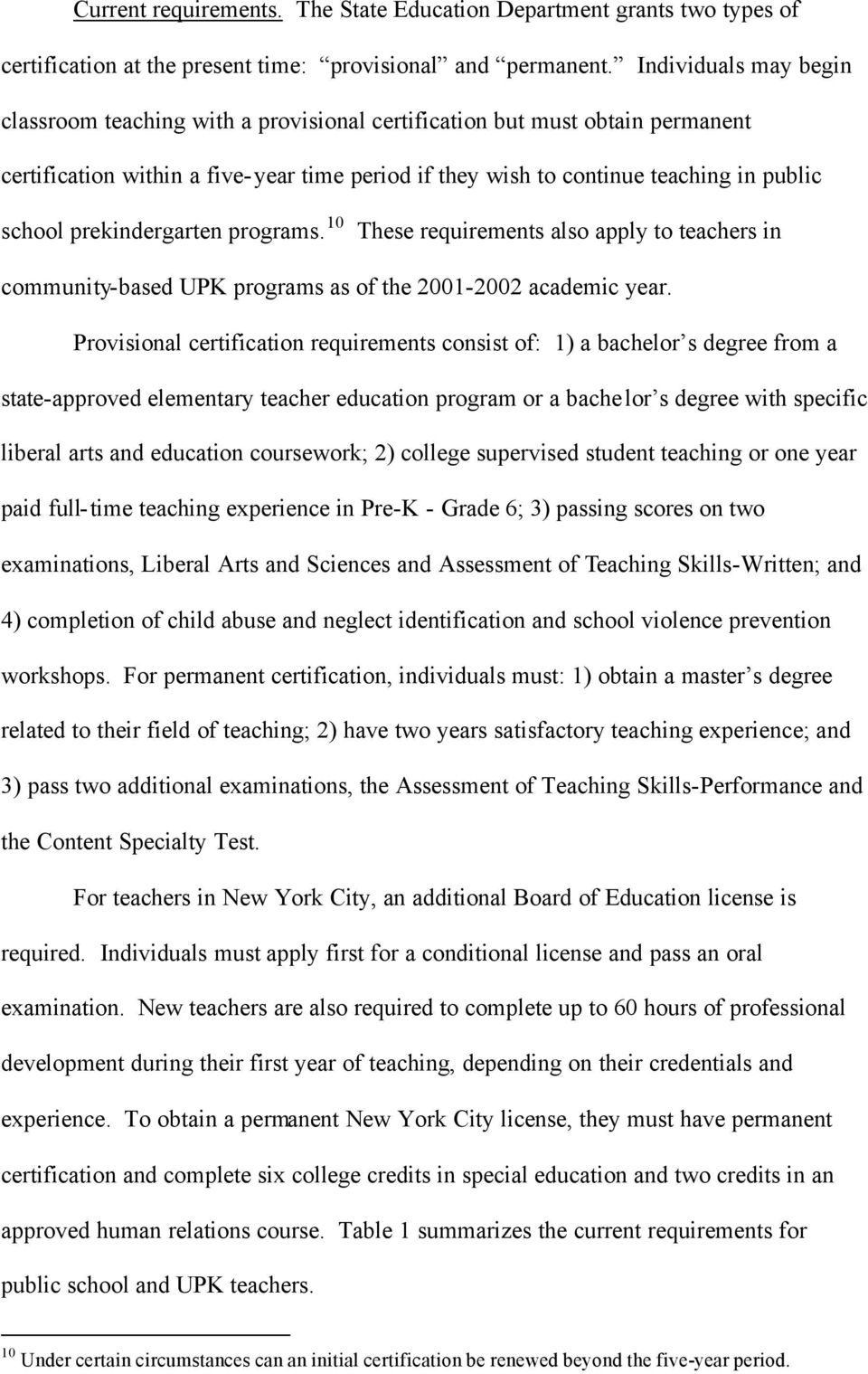
12 New requirements. Beginning February 2, 2004, a number of changes will go into effect. First, the certifications issued by the State Education Department will be called initial and professional and will have some new expectations. For the initial certification, individuals must: 1) possess a bachelor s degree from an approved teacher education program, which includes a general liberal arts and sciences core, a major in a liberal arts and sciences field, coursework in education, and student teaching experience; 2) obtain a recommendation from a college with an approved teaching program that is accredited by the National Council for the Accreditation of Teacher Education (NCATE) or another professional education association; and 3) pass three examinations, Liberal Arts and Sciences, Assessment of Teaching Skills-Written, and Content Specialty Test. This certification is valid up to three years, with one extension possible upon the completion of 24 credits of approved graduate study. For the professional teaching certificate, teachers must complete: 1) their master s degree in an approved teacher Table 1. Current Teacher Certification Requirements Certification Education Experience Provisional Permanent Bachelor's degree from approved elementary teacher education program or Bachelor's degree with liberal arts and sciences and education coursework Master's degree in field related to teaching area Supervised student teaching or one year full-time satisfactory paid experience 2 years teaching Exams and Other Requirements Liberal Arts and Sciences Exam; Assessment of Teaching Skills-Written Exam; completion of child abuse identification and school violence prevention workshops Content Specialty Test; Assessment of Teaching Skills-Performance Exam Validity Valid for 5 years; May be renewed for 5 years; May be extended for 2 years Permanently valid
13 Board of Education License (NYC) Same as above, but including 6 credits in special education and 2 credits in approved Human Relations course same as above Board of Education oral exam; for new teachers, up to 60 hours of professional development during first year. Source: Part 80 of the Regulations of the Commissioner of Education: Requirements for Teachers Certificates and Teaching Practice education program or field related to their area of teaching; 2) one year of mentored teaching; and 3) two additional years of successful teaching. A second area of change consists of mentoring, evaluation, and professional development requirements. New teachers will receive mentoring by experienced teachers during their first year in the classroom to ease the transition and to increase retention. School districts will evaluate teachers every year using rigorous criteria, and they will provide continuing professional education for all teachers. All teachers with professional certification must complete 175 hours of continuing education every 5 years to maintain their teaching certificates. In addition, teacher education programs are required to meet higher standards and to obtain and maintain accreditation. Any programs in which less than 80% of their graduates pass state certification exams will be phased out. Table 2 below summarizes the new requirements. Table 2. New Teacher Certification Requirements Certification Education Experience Exams and Other Requirements Validity

14 Initial Bachelor's degree from approved teacher education program (Birth- Grade 2) Supervised student teaching Liberal Arts and Sciences Exam; Assessment of Teaching Skills- Written Exam; Content Specialty Test; completion of child abuse identification and school violence prevention workshops Valid for 3 years, 1 year extension possible with 24 semester hours of approved graduate study; Not renewable. Professional Master's degree in field related to teaching area 3 years teaching, including 1 year mentored teaching None Must complete 175 hours of professional development every 5 years to remain valid. Board of Education License (NYC) Same as above, but including 6 credits in special education and 2 credits in approved Human Relations course same as above Board of Education oral exam; for new teachers, up to 60 hours of professional development during first year. Source: Part 80 of the Regulations of the Commissioner of Education: Requirements for Teachers Certificates and Teaching Practice Preparatory Provisional Teaching (PPT) and transitional certificates. Currently, due to shortages in New York City and other parts of the state, individuals may be eligible for a Preparatory Provisional Teaching certificate (PPT), which allows them to begin classroom teaching without having completed all formal requirements for the provisional certification. They must have a bachelor s degree, be nominated for a fulltime vacancy in a high need or shortage area, develop an educational plan for the State Education Department indicating any deficiencies, and take at least six college credits a year until all requirements are met. PPT certificates are valid for one year and can be renewed three times. However, they will be phased out by February 1, In July 2000, the Board of Regents approved an alternative teacher certification program option for individuals interested in teaching but who lack the necessary degree

15 from a teacher education program and related student teaching experience. Like the Preparatory Provisional Teaching certificate, the Transitional B certification requires a bachelor s degree with an academic background in the area in which they plan to teach. However, it is much more rigorous in that it requires matriculation in an alternative teacher certification program leading to provisional or initial certification, employment as a teacher during the period they are completing coursework, completion of examinations before entering the classroom, and supervised mentoring. Colleges and universities that offer alternative programs partner with one or more school districts that provide the necessary employment and mentoring opportunities. Prior to placement in the classroom, individuals must complete 200 hours of intensive pre-service training that includes content on teaching strategies, New York State Learning Standards, classroom management, and how children learn, as well as supervised teaching experience in the classroom. They must also pass the Liberal Arts and Sciences and Content Special Test examinations. The Transitional B certificate is valid up to three years, or only as long as the individual is matriculated in the alternative certification program, and only for employment in the specified school district as coordinated by the university. The New York City Teaching Fellows Program is an example of a program in which participants obtain intensive training and classroom experience during the summer, receive a Transitional B certificate to begin full-time teaching in the fall, and enroll in a special graduate program through a consortium of City University of New York schools to obtain their master s degrees. A similar Transitional C certificate is available for career changers and others holding a graduate academic or graduate professional degree. This requires enrollment in
16 an intensive program that leads to a professional certification, employment in a specified school district, and completion of exams. Public School Teaching Assistants Teaching assistants are considered members of the teaching staff as they work directly with children and have teaching duties under the general supervision of a certified teacher. For example, they may work with individual or groups of students on special projects, provide information about students to teachers, help create instructional materials, and assist in instructional programs such as music and art. Therefore, they are subject to certification requirements as established by the State Education Department. Existing and new requirements. Currently, individuals must have a high school diploma or equivalent along with some experience in working with young children to obtain a teaching assistant position. They are granted a one-year temporary license that can be renewed one time. If they have obtained six credits at a college or university, this license can be converted to a continuing certificate that is valid indefinitely unless they leave the teaching field for five years or more. New requirements for teaching assistants will also take effect February 2, Four different levels will exist, allowing for a career path from beginning teaching assistant to certified teacher. All new Level I assistants must have a high school diploma and pass a state-developed examination that tests communication and quantitative skills. This certification is valid for one year and can be renewed for one additional year. Level II requires six college credit hours, one year experience and is valid for two years. Level III requires 18 credit hours and one year experience and is valid continuously with completion of 75 hours of professional development every 5 years. The preprofessional certificate, which is valid for five years and can be renewed once, requires 18 credit hours, one year experience, and matriculation in a program that leads to teacher

17 certification. Level II, III, and preprofessional teaching assistants must also complete the examination of communication and quantitative skills. These requirements are summarized in Table 3. No Child Left Behind Act. The recently passed federal No Child Left Behind Act includes provisions for staff working in programs supported by Title I funds. Teachers must be highly qualified, which in New York is defined as having a transitional, provisional, or permanent certification. Newly hired teaching assistants hired after January 8, 2002 must have completed two years of post-secondary education, have an associate s degree or higher, or pass a formal state examination of communication and quantitative skills. Those hired prior to January 8, 2002 will have four years to meet the requirements. 11 Child Care Center Staff Child care centers and their staff directors, teachers, and assistant teachers are regulated either by the New York State Office of Children and Family Services or by the New York City Department of Health. The regulations of the Office of Children and Family Services covering all of New York State will be discussed first, followed by those of the Department of Health. It should be noted, however, that classrooms in centers contracted to provide Universal Prekindergarten services for a school district must have teachers that have obtained state teacher certification as described above. In addition, the following requirements are actually the minimum necessary. Individual centers may have educational and other requirements that exceed these minimums. Table 3. Teaching Assistant Certification 11 Refer to the State Education Department website or No Child Left Behind website at for more information.
18 Existing Certificate Education Experience Exam Validity Temporary Continuing Level 1 High School diploma 6 credit hours of undergraduate study in related field High School diploma related experience 1 year related experience Test of Communication and Quantitative Skills 1 year; can be renewed once Continuously valid, except if holder has not been regularly employed as a teaching assistant in NY public schools for 5 years. 1 year; renewable for 1 year under special conditions Level 2 6 credit hours of undergraduate study 1 year Test of Communication and Quantitative Skills 2 years, not renewable New (effective Feb 2, 2004) Level 3 Preprofessional 18 credit hours of undergraduate study 18 credit hours and matriculation in program leading to teacher certification or in a program with an articulation agreement with such a program 1 year 1 year Test of Communication and Quantitative Skills Test of Communication and Quantitative Skills Source: Part 80 of the Regulations of the Commissioner of Education: Requirements for Teachers Certificates and Teaching Practice continuous with 75 hours of professional development every 5 years 5 years; renewable if matriculation in program leading to teacher certification or in a program with an articulation agreement, and completion of 30 credits. New York State child care center staff qualification requirements. 12 Staff qualifications consist of education, experience, and professional development. The minimum requirements have been increasing over the past 20 years to include some 12 Part 418 of the Office of Children and Family Services regulations cover child day care centers.

19 postsecondary education and other professional development. Child care directors must have a bachelor s degree including, or in addition to, 12 credits in early childhood, child development or related field, or an associate s degree in early childhood or related field with a plan of study leading to a bachelor s degree. Directors with a bachelor s degree are required to have one year full-time teaching experience in a child care center, family or group family day care home, or other early childhood program, and one year experience supervising staff. Those with an associate s degree are required to have two years teaching and two years supervisory experience. The Career Development Initiative recently established the Children s Program Administrator Credential. To earn the credential, child care center directors and other interested individuals submit a portfolio to the New York State Association for the Education of Young Children, showing completion of 18 credits at either the undergraduate or graduate level. Coursework covers administration of children s programs, financial planning, operations management, marketing, ethics, and program design. A minimum of an associate s degree in early childhood or related area or the completion of 60 credits as a matriculated student is required, with at least 18 credits in early childhood or related coursework. Teachers, or head of group, 13 for preschoolers, must meet one of the following three requirements: 1) an associate s degree in early childhood, child development, or related field; 2) a Child Development Associate (CDA) credential; or 3) 9 college credits in early childhood, child development, or related field. For those with an associate s degree, no specific experience related to caring for children is required. For those without this degree, two years of experience is required. In addition, the head of group 13 The regulations use the term head of group rather than teacher.

20 for infants and toddlers must have one year of specific training and/or experience in infant and toddler care. Teacher assistants, or assistant to head of group, that work in child care centers must be 16 years of age or older and have a high school diploma or its equivalent or substantial experience working with children under 13 years of age. However, no one under age 18 may be left alone to supervise a group of children. All directors and employees, as well as any volunteers who have regular contact with children, are required to complete a minimum of 30 hours of training every two years. Topics include child development, nutrition and health needs of children, program development, safety and security procedures, communication between parents and staff, business record maintenance and management, child abuse identification, and statutes and regulations pertaining to child day care and child abuse. Fifteen of the 30 hours must be completed within the first six months of employment. New York City Board of Health child care center staff qualification requirements. 14 In New York City, staff requirements are similar to those of the State Education Department for public school and UPK teachers. For example, preschool directors and teachers are required to possess provisional or permanent teacher certification. In addition, the Department of Health mandates some student teaching and other experience with children under age six, as well as a parent education and community relations course that may not be included in a teacher education program. 15 Because of teacher shortages in many New York City child care centers, individuals without all necessary qualifications are allowed to work in the classroom 14 New York City Health Code requirements, Article covers city licensed child day care programs. 15 Klinger, N. (2002). A Guide to Early Childhood Teacher Preparation and Certification (Rev. Ed.). New York: Child Care Inc.

21 under special circumstances. Three categories of individuals can be conditionally approved by the Department Table 4. Child Care Center Staffing Regulations (centers outside of NYC) Position Education Experience Continuing Education Director Bachelor's degree including, or in addition to, 12 credits in early childhood, child development, or related field 1 year full-time teaching experience in an early childhood program; and 1 year experience supervising staff 30 hours of training every 2 years or, associate's degree in early childhood or related field with plan of study leading to bachelor's degree 2 years full-time teaching experience; and 2 years experience supervising staff 30 hours of training every 2 years Head of Group of Preschoolers Associate's degree in early childhood, child development, or related field Or CDA, or 9 credits in early childhood, child development, or a related field None specified 2 years experience caring for children 30 hours of training every 2 years 30 hours of training every 2 years Head of Group of Infants/Toddlers Same as Head of Group of Preschoolers Same as above, including 1 year of specific training and/or experience in infant or toddler care 30 hours of training every 2 years Assistant to Head of Group High school diploma or its equivalent Or, substantial experience working with children under 13 years of age 30 hours of training every 2 years Source: New York State Office of Children and Family Services Regulations Part 418 of Health if they enroll in a study plan: 1) teachers with an associate s degree in early childhood; 2) teachers with 90 or more credits and one year paid classroom experience with children up to third grade; or 3) teachers with a bachelor s or master s degree in early childhood education or an academic subject, who are not state certified, and who lack the required coursework. Study plans, which are submitted to the Department of Health from an accredited college or university, specify the coursework and other requirements an
22 individual needs for teacher certification, along with a timeline for completion. Completion must be at the rate of six credits or more per year. 16 The requirements are illustrated in Table 5 below. Table 5. Child Care Center Staffing Regulations (centers in NYC) Position Education Experience Educational Director- Preschool Master's degree, NYS Teacher Certification 2 years teaching young children in a licensed daycare Group Teacher for Preschool NYS Teacher Certification and Master's degree in Early Childhood Education, or Master's degree and additional coursework in child development. Or Bachelor's degree with Provisional Certification. Or Associate's degree in Early Childhood and enrolled in a study plan leading to certification. 300 hours of supervised student teaching, of which at least 150 are in prekindergarten or kindergarten grades. Educational Director-Infants Bachelor's degree in Early Childhood 1 year with infants or toddlers Group Teacher for Infants Associate's degree in Early Childhood, or CDA, or HS diploma 1 year with infants Assistant Teacher HS diploma, or CDA, or 60 college credits None specified Source: New York City Health Code Requirements, Article 47. Head Start and Early Head Start Program Staff Qualifications Head Start centers are licensed child care centers and therefore must be in accordance with Office of Children and Family Services or New York City Board of Health regulations. In addition, they must comply with federal regulations and 16 Klinger, 2002; New York City Department of Health Study Plan Teacher Guidelines for Two-Year Permit.
23 performance standards as established by the Department of Health and Human Services and the Head Start Act. As with child care centers, these regulations stipulate the minimum education, experience, and other qualifications for professional staff. Individual programs may choose to exceed these or require specific knowledge, such as engaging families in educational activities. In addition, those Head Start programs providing Universal Prekindergarten services must have state certified teachers in UPK classrooms. For Head Start and Early Head Start directors, no specific educational credentials are mentioned in the regulations and standards. However, they are required to possess leadership ability, good interpersonal skills, the ability to develop and manage a budget, human services program management experience, and an understanding of the goals of Head Start. By September 2003, at least half of all Head Start teachers in center-based programs must have an associate s, bachelor s, or advanced degree in early childhood education or a related field, with preschool teaching experience. More specifically, the degree must include six or more courses in early childhood education and/or child development and experience as a student teacher in a supervised field placement, a teacher in a licensed preschool program, or a teacher in a public school preschool program. Teachers without a college degree are required to have a Child Development Associate (CDA) or other state awarded certificate for preschool teachers that meets or exceeds the requirements of a CDA. Early Head Start and Head Start teachers working with infants and toddlers must obtain a CDA credential for Infant and Toddler Caregivers or an equivalent credential within one year of hire. They must also have experience working with very young children as a teacher in a licensed preschool program.
24 As with teachers in public school and child care programs, Head Start teachers participate in professional development activities. Head Start programs must provide inservice training opportunities to program staff and volunteers to assist them in increasing their skills and knowledge, obtaining credentials, and improving their ability to deliver services to children and families. A summary of the requirements for Head Start staff is provided below in Table Table 6. Head Start Regulations (effective September 30, 2003) Staff Education Experience Other Directors Discretion of agency Demonstrated skills and abilities in a management capacity relevant to human services program management Professional Development Teachers (at least 50% of total) Bachelor's, Associate's, or advanced degree in early childhood or related field which includes six or more courses in early childhood and/or child development Supervised student teaching or other experience as a preschool teacher Professional Development Other Teachers Infant/Toddler Staff CDA or state awarded certificate for preschool teachers that meets or exceeds requirements of a CDA Must have CDA for infant and toddler caregivers or an equivalent credential within one year of hire Source: Head Start Performance Guidelines Supervised student teaching or other experience as a preschool teacher Supervised student teaching or other experience as a preschool teacher Professional Development Professional Development Summary and Implications In summary, different regulatory frameworks apply to early childhood professionals in public schools and Universal Prekindergarten, child care, and Head Start, 17 See for more information on Head Start regulations.
25 each with its own set of required educational qualifications and each monitored by a different regulatory agency. Although educational requirements vary substantially among the three systems, they all share one strong trend: educational requirements have been increasing across the board, with more changes forthcoming in the years ahead. What does this mean for the higher education system? The more stringent requirements clearly place demands on the existing system, as greater numbers of people must obtain credentials, coursework, and continuing education experiences. An examination of the current and new requirements illustrates numerous sources of impact on higher education programs. For example, by 2003 half of all Head Start teachers will need at least an associate s degree. A new preprofessional certification system, requiring college credits and/or matriculation in a teacher certification program, will go into effect for teaching assistants in The Birth - Grade 2 certification has resulted in the establishment of new bachelor s and master s level programs. A new Child Care Administrator s credential will involve coursework at either the undergraduate or graduate level. A summary of potential sources of impact is provided in Table 7. Of concern is whether current higher education early childhood teacher preparation programs are adequate to meet the growing demand documented in Table 7. Furthermore, are these programs accessible for all who wish or need to enroll? These issues will be explored in the following sections. Institutions of Higher Education and Early Childhood Teacher Preparation Programs Early childhood professionals receive the education and training they need from two- and four-year colleges and universities. These institutions of higher education offer individual coursework, certificates, the Child Development Associate (CDA) credential,
26 and associate s through advanced degrees in early childhood and related fields of study. As new educational requirements have recently been implemented across the three occupational ladders, and additional requirements will take effect over the next two years, a closer look at the higher education infrastructure is needed to determine its ability to meet current and future demand for highly qualified staff. This section provides information on the number and types of different higher education programs that exist within the state of New York. Table 7. Sources of Impact on the Higher Education System Two-year community college Source of Impact No Child Left Behind Act requirement that public school teaching assistants in Title I-funded programs complete college credits and/or associate s degree, or pass state examination Associate s degree, CDA, or 9-credit early childhood education or related field requirement for child care teachers CDA requirement for Head Start teachers Infant-Toddler CDA or relevant coursework/experience requirement for Head Start infant and toddler teachers Continuing education requirements for all child care and Head Start staff Date Currently in effect for new teaching assistants; 2006 for all others Current Current Current Current Associate degree requirement or higher for half of Head Start teachers 2003 State requirement that other teaching assistants complete increased amount of college credits Continuing education requirements for teaching assistants in public schools Four-year college/university Source of Impact Study Plans leading to certification for child care teachers in NYC and directors (outside of NYC) Date Current New Child Care Administrator credential Requirement that all UPK teachers be certified in school-based and community-based programs Current Current Elimination of Preparatory Provisional Teacher certification 2003 Establishment of pre-professional certification for teaching assistants 2004 New Birth-Grade 2 certification 2004 Graduate level programs
27 Source of Impact Study Plans leading to certification for child care teachers in NYC New Child Care Administrator credential Requirement that all UPK teachers be certified in school-based and community-based programs Establishment of alternative teacher certification programs Date Current Current Current Current Elimination of Preparatory Provisional Teacher certification 2003 New Birth-Grade 2 certification 2004 Reduction in time to complete master s degree from 5 to 3 years 2004 Continuing education requirements for public school/upkteachers 2004 Four-year colleges and universities In the State of New York, there are 142 fouryear colleges and universities. Of these schools, 87 (61%) offer teacher certification of any kind at either the bachelor s or master s level. Fifty-two (37%) offer early childhood education teacher certification (Birth - Grade 2) at either the bachelor s or master s level. Twenty (14%) have early childhood special education, and 10 (7%) have early childhood education with a bilingual extension. In addition, 19 currently offer alternative teacher certification programs of any kind, with several having an alternative teacher certification program in early childhood. Breaking down the figures by degree, 37 colleges and universities in the state (26%) offer bachelor s level Birth - Grade 2 certification, 35 (25%) offer a master s level certification, and 17 (12%) offer both bachelor s and master s degrees. 18 Table 8. Early Childhood Program Offerings at Four-Year Institutions Number % of total 4-year institutions % Offering teaching certification 87 61% Offering Birth-Grade 2 certification 52 37% Offering Birth-Grade 2 special education certification 20 14% Offering Birth-Grade 2 with bilingual extension 10 7% Offering both special education and bilingual extension 3 2% 18 These are estimates based on extensive internet searches of the State Education Department and colleges and universities across the state. Due to the recent changes in programs and transition to new certification, information must be gathered directly from programs to get specific figures.
28 Bachelor's level programs(birth-grade 2) 37 26% Master's level programs(birth-grade 2) 35 25% Both bachelor's and master's(birth-grade 2) 17 12% Degree programs in child development and other related programs also exist throughout the state. As these programs and specific courses can be found in a wide range of departments across colleges and universities, such as education, human development, family studies, and psychology, further investigation is needed to identify their location, content, and degrees offered. More information is also needed about online course and degree options. 19 Two-year community colleges. There are 47 two-year community colleges in New York. Of these colleges, 34 are State University of New York (SUNY) community and technical colleges, 6 are City University of New York (CUNY) community colleges, and 7 are independent two-year schools (non-business or professional). Twenty-six (55%) of the 47 community colleges offer associate s or applied associate of science degrees in early childhood, 16 (36%) offer the CDA, and 18 (38%) offer certificate of completion programs in early childhood. 20 There are also 6 four-year colleges and universities that offer associate s degrees in early childhood. Table 9 summarizes the early childhood degree offerings of two-year institutions. A complete list of programs is provided in Appendix A. Table 9. Early Childhood Program Offerings at Two-Year Institutions Number % of total Total two-year institutions % SUNY community and technical colleges 34 72% CUNY community colleges 6 13% Independent two-year schools(non-business or professional) 7 15% 19 Efforts are underway at Cornell University and the NYS Council on Children and Families to gather this information. 20 A certificate of completion is usually half the credits of an Associate of Applied Science degree (30 credits) with 6-10 credits or more of early childhood coursework
29 Two-year schools offering AA or AAS in Early Childhood 26 55% Offering CDA 16 34% Offering certificate of completion in Early Childhood 18 38% Four-year schools offering Two-year degree in Early Childhood 6 4% It should be noted that while associate s and bachelor s degree early childhood programs are located throughout the state, only a few master s degree early childhood teacher certification programs exist in upstate New York. Furthermore, only a few doctoral programs in early care and education have been identified in the entire state of New York. Summary and Implications These descriptive data on the current and potential capacity of New York s higher education system lead to several conclusions and additional questions. First, it is clear that there is room for expansion of early childhood teacher, caregiver, and teaching assistant preparation within existing higher education institutions if there is need for such growth. Only about one- third of four-year colleges/universities and half of community colleges are currently offering degrees in early childhood education. Second, this overview of current capacity suggests a possible gap in existing coverage: Master s level teacher certification programs in upstate New York. Also notable is the absence of Ph.D. programs in early childhood education, a concern because the Ph.D. is now the degree of choice for higher education directors of early childhood degree programs at both the community college and four-year college levels, and for faculty at the four-year level. Third, these data lead to the next level of inquiry: How many students can existing programs prepare on an annual basis, and how does this compare with program-level demand as it currently exists and can be anticipated in the future? For instance, the articulation case study conducted for this paper indicates that the demand for bachelor s
30 degree preparation by graduates of two-year associate degree programs may well already be greater than bachelor s degree programs can handle. How elastic are existing bachelor s level programs can they stretch to accommodate increased demand? What incentives exist or could be introduced to encourage such expansion? Program Articulation Articulation agreements in New York are developed on a voluntary basis between institutions; no state mandates are in place that require articulation. Several clusters of collaborating two- and four-year early childhood programs have been identified in various parts of the state. However, the extent to which articulation occurs or how well it is working is currently unknown. In order to identify the important questions surrounding efforts to articulate associate s level with bachelor s level early childhood teacher preparation programs in the state, the authors conducted an articulation case study in upstate New York during May and June This case study focused on a public four-year institution of higher education offering a Birth - Grade 2 teacher certification and two nearby community colleges. Data collection consisted of in-depth interviews with the faculty members heading the early childhood programs in each of the three higher education programs, and a focus group interview with the three faculty as a group. Individual interviews were used to gather descriptive information about each of the three early childhood teacher preparation programs, learn about any articulation agreements currently in existence or in process between the community colleges and the four-year program, and identify the successes and challenges associated with these efforts to articulate. Most of the discussion in the focus group revolved around possible policy changes at the state and college levels that might increase the incentive to articulate community college programs with those in four-year institutions and reduce the burden
31 associated with that process. Although the study focused on community college to fouryear college articulation, some information was also gathered about CDA credential to associate s degree and bachelor s to master s program articulation issues as well. A number of important findings emerged from the interviews and focus group data. History of Involvement with Teacher/Caregiver Preparation The community college early childhood programs in this study predated the fouryear university Birth - Grade 2 teacher certification program. Respondents expressed the belief that community colleges have generally been in the forefront of early childhood teacher preparation, and that many of the four-year programs in New York have been developed more recently. Current Enrollment and Capacity The community colleges studied were serving far more students than was the four-year institution. Although a substantial proportion of the community college graduates will not want to continue for a bachelor s degree, a 25% continuation rate would require a five-fold increase at the four year college beyond present enrollment. 21 Enrollments in the community college programs studied have increased sharply in the past three to five years. Respondents attributed this growth to steadily increasing educational background requirements for Head Start teachers, expanding continuing education requirements for child care staff, and the teacher certification requirement in the Universal Prekindergarten Program. The Articulation Process 21 Transfer rates from community colleges to four-year colleges and universities have consistently averaged 20 to 25%. J. Y. Hunger & J. Lieberman (2001). The road to equality: Report on transfer for the Ford Foundation. New York: The Ford Foundation. 22 For more information on a newly established SUNY teacher preparation initiative, see A new vision in teacher education at
32 Respondents indicated that the work involved in developing articulation agreements between the community colleges and the four-year college and in supporting students through the transfer process has been very time-consuming and at times very frustrating. It has been a bottom up process, with little direction and few incentives provided by the State Department of Education or the central administration of SUNY. 22 For greater specifications of these frustrations, please refer to the attached case study in Appendix B. The college cluster studied in this case was on its way to establishing a very wellarticulated set of relationships. Faculty in the three institutions attributed their joint success to the following strategies and factors: o A willingness to sit down together and plan the core early childhood courses jointly, thereby ensuring comparability of core early childhood courses across programs. o The ideological commitment of the bachelor s program director to provide access for community college students, stemming from her prior experiences in Head Start and as director of a child care resource and referral agency. o Close attention by community college program directors to identifying students interested in a bachelor s degree early in their associate s degree programs and advising them regarding which courses will be transferable to the four-year program. Other strategies for assisting students through the course and college transfer process currently in the process of implementation or under discussion include: o A one-credit orientation course for community college students that assists them in understanding the structure and dynamics of the early childhood major and planning a four-year program within the major. o A documentation portfolio, maintained by the community college student, that contains evidence of all early childhood-related coursework and field experiences completed prior to and during college enrollment. o Cross-registration agreements between the four-year and community colleges, allowing students in one college to register for a given early
33 childhood course in the other college (i.e., different sections of the same course taught on different campuses). o Joint registration agreements, in which the entire community college early childhood major, rather than individual courses, is approved for transfer. Faculty Capacity and Motivation The community colleges in this study had made a minimal investment in full-time early childhood faculty. In addition to teaching 8-10 courses a year, the lone full-time faculty member in each community college advised all of the students in her program, hired and supervised adjunct faculty, and developed and nurtured articulation agreements with other colleges. A number of ideas for possible incentives that could be provided by state agencies or local institutions of higher education to facilitate the articulation process were identified by study respondents: o Release time from a course in return for time spent developing an articulation agreement. o Per diem to cover the costs of travel and meals related to articulation meetings. o Faculty development training to share promising practices. o State Education or SUNY grants to cover additional costs to the college (admissions office staff, articulation specialist, etc.). Such grants would serve to raise the status of early childhood within the higher education system through state recognition of its value. o A certain amount of Educational Incentive Program (EIP) funding available to a college or cluster of colleges that meet certain articulation criteria and demonstrate success at supporting transfer students. The colleges would work as agents for the state EIP office to distribute the funds. Other early childhood teacher preparation concerns and challenges identified by this cluster of teacher preparation program directors included a perceived shortage of master s-level teacher preparation programs (especially in upstate New York), difficulty
34 in finding and recruiting Ph.D. level faculty qualified to teach in their teacher preparation programs, and the overall effects of low teacher compensation within the early childhood field on recruitment of qualified candidates in their teacher preparation programs (especially for work with infants and toddlers). Summary and Implications This case study underscored the growing need for accessible early childhood teacher preparation programs at the associate s, bachelor s, and master s degree levels. It also documented the dimensions of the challenge involved in articulation between the two- and four-year college levels, and provided an illuminating example of the ways that dedicated faculty can work as a cluster to overcome obstacles and achieve successful articulations. A host of questions in need of statewide study flow from these case study findings. Is the demand for associate s and bachelor s programs growing as fast in other parts of the state as was found in this instance? Are the directors of other higher education early childhood programs in the state as poorly endowed with full-time faculty and other institutional supports as was found here? To what extent are the kinds of innovations that facilitate articulation among these three institutions being developed elsewhere, and are they being diffused systematically throughout the higher education early childhood network in New York? Financial Assistance and Incentives Within New York State, various types of financial assistance and incentives are available to help early childhood professionals obtain and increase their educational credentials through access to higher education programs. This support is provided from
35 state and federal sources, local school districts, and unions in which early childhood teachers are members. 23 A summary of resources is described in the following section. Public School Teachers and Other Staff Specific programs have been identified to recruit and retain teachers in public school positions, and to assist individuals who are uncertified or temporarily certified complete the necessary coursework and other requirements. While not specific to early childhood education, these programs are relevant for those teaching in early childhood classrooms. Several statewide and New York City programs are described below. It is likely that school districts across the state, particularly those in larger communities, also provide some kind of financial assistance for educational activities. Teachers for Tomorrow. The Teachers for Tomorrow Program is a state-funded program to increase the supply of teachers in districts with teacher shortages, especially in low performing schools. Public school districts with teacher shortages apply for funding, and interested individuals then apply to these districts to participate. The program supports six types of activities: 1) recruitment incentives of $3400 annually for certified teachers who agree to teach for the first time in a designated teacher shortage or subject shortage area (for up to four years); 2) stipends of up to $2000 for teachers with temporary certification to complete coursework or take examinations required for initial or provisional certification, if they agree to teach for at least one year in a teacher or subject shortage area; 3) summer internship programs for students in teacher education programs to work in one of big five city school districts (New York City, Buffalo, Rochester, Syracuse, and Yonkers); they may receive up to $2000, college credit, and field experience; 23 Additional support, such as through private employers, may also be available but is beyond the scope of this paper.
36 4) a master teacher program in which Nationally Board Certified teachers mentor new teachers in low-performing schools; they receive an annual stipend of $10,000 in addition to their regular salary (up to three years); 5) a tuition reimbursement program in which teachers with initial or provisional certification, who agree to teach for at least one year in a teacher or subject shortage area, receive up to $700 per course or $2100 per year for coursework taken toward the permanent or professional certification (renewable for one additional year); and 6) an intensive summer training course for first time teachers in New York City working in shortage areas. The following programs are available to teachers and others interested in working in New York City schools: New York City Teaching Fellows Program. As described earlier in this paper, the Teaching Fellows Program provides an alternative certification route to individuals interested in teaching but without the necessary education credits and student teaching experience. Those accepted into the program participate in an intensive summer program and then begin full-time employment in the classroom in the fall, along with the required graduate study that will lead to professional certification. Participants will receive a regular salary and benefits, a living stipend of $2500 during the preservice component, and AmeriCorps program benefits including up to $4725 a year (for two years) to cover higher education costs. Tuition Reimbursement and Loan Forgiveness Program. As a way to attract and retain teachers in hard-to-staff and underperforming schools, the New York City Board of Education has developed a number of incentives for teachers who work in these schools. New teachers can receive reimbursement of up to $3400 per year for educational expenses. Incumbent teachers can receive tuition reimbursement or loan forgiveness of up to $3400 a year to obtain their master s degree. Uncertified teachers who have passed the Liberal Arts and Sciences and Assessment of Teaching Skills-Written examinations but still have certification deficiencies can receive tuition reimbursement or loan
37 forgiveness of up to $3400 per year to complete certification. Uncertified teachers in hard-to-staff (but not underperforming) schools can receive up to $2000 per year. Recipients of this funding must commit to remaining in the designated school for every year they receive the benefit. Another type of incentive involves an increase in salary credit allowed for prior experience for those who teach in underperforming schools. This adjustment will result in a substantial salary increase. The Teaching Opportunity Program Scholarship. This program, funded by Americorps and a number of private foundations, is a collaborative initiative between the City University of New York and the New York City Board of Education. It provides scholarships and special training to qualified college graduates and career changers who wish to enter a teaching career, including a fully paid master s degree. Targeted are individuals in subject shortage areas, such as Spanish, math, science, and engineering. Additional Scholarship Programs. Scholarships are also available from the Board of Education for individuals with bachelor s degrees who wish to obtain degrees and certifications in special subject areas in high demand. These include bilingual pupil services, bilingual education, and bilingual special education. Support for Teaching Assistants. Paraprofessionals working in the New York City school system are required to obtain six college credits during their first year of employment. The Board of Education will pay for up to six credits per semester. Federal Incentives. Federal funding also provides a number of incentives and sources of assistance for teachers and those interested in becoming teachers. Troops to Teachers helps place eligible members of the armed services into teacher training programs and teaching positions. Transition to Teaching provides alternative routes to certification for career professionals and recent college graduates. Teach for America
38 provides placement, preservice and inservice training, and an Americorps award of $4725 to cover higher education costs and student loans. Expanded Loan Forgiveness allows up to $5000 in student loan forgiveness if qualified individuals teach math, science, or special education in low-income schools for five consecutive years. These programs are expected to increase substantially over the next few years. In addition, a proposed teacher tax deduction will allow up to $400 to be excluded on federal income tax returns to defray teachers out-of-pocket costs for materials, professional development, and training. 24 Child Care Center, Community-Based Universal Prekindergarten, and Head Start Staff Early childhood professionals who are employed in programs other than public schools have several sources of financial assistance to them: Educational Incentive Program. Funded by the New York State Office of Children and Family Services, the Educational Incentive Program (EIP) is the primary source of financial assistance for those working in the child care system. EIP provides scholarship money to child care providers to participate in university or college undergraduate coursework, workshops, conferences, and other training. This program was created in 1997 and has provided over $11.5 million in assistance to thousands of child care providers. For 2002, the budget for this program has increased to $10 million per year. Over 5000 individuals received scholarships in the first half of Eligible applicants include registered family child care providers, licensed group family child care providers or assistants, child care classroom staff or directors of a licensed day care center or Head Start center located outside of New York City, and noncertified child care classroom staff of a licensed day care center or Head Start center 24 See for more information about these programs.
39 located in New York City who are currently caring for children as part of the adult/child ratio requirement. Also eligible are those who care for children in a registered school-age program. Applicants must meet income eligibility requirements as established by EIP. Funds will cover tuition for courses and training in specific subject areas, as well as costs associated with pre-approved credential, certificate, and individual accreditation assessment fees such as for the Child Development Associate Credential. In addition, EIP applies to credit-bearing courses for students matriculated in liberal arts degree programs. The funding covers courses and training in New York and in other states. As shown in the table below, scholarship amounts are based on income and family size and are either $1000, $1500, or $2000 per EIP year. Awards are based on financial criteria and not the type of training. If the individual is approved for funding, the education and training organization will be paid the scholarship on behalf of the individual. Child Care Professional Retention Program. This program, funded by the State of New York, was designed to reduce staff turnover and reward increased professional development of those who work in the early childhood field. Eligible applicants are those with direct child care or support duties, or are responsible for educational or programmatic content of the child care Table 10. EIP 2002 Income Chart Family Size $2,000 $1,500 $1,000 1 $0-18,700 $18,701-28,000 $28,001-37,300 2 $0-24,400 $24,401 36,500 $36,501-48,700 3 $0-30,100 $30,101-45,200 $45,201-60,200 4 $0-35,800 $35,801-53,800 $53,801-71,800
40 5 $0-41,600 $41,601-62,400 $62,401-83,200 6 $0-47,300 $47,301-71,000 $71,000-94,700 Each Add'l add $5,700 add $8,600 add $11,500 Guidelines for Suffolk, Nassau, Westchester, Putnam, Rockland counties or NYC Family Size $2,000 $1,500 $1,000 1 $0-20,600 $20,601-31,000 $31,001-41,000 2 $0-26,800 $26,801-40,200 $40,201-53,600 3 $0-33,100 $33,101-49,700 $49,701-66,200 4 $0-39,400 $39,401-59,200 $59,201-79,000 5 $0-45,800 $45,801-68,600 $68,601-91,500 6 $0-52,000 $52,001-78,100 $78, ,200 Each Add'l add $6,300 add $9,500 add $12,700 Souce: EIP website: setting. Applicants must work in child day care programs licensed by the Office of Children and Family Services or the New York City Department of Health and be employed at least half time. They must have been employed in such a position for the continuous 12 months prior to the date of application, and commit to remaining with the same child care program for 6 months. Those in positions funded by Head Start or preschool special education are ineligible, unless they spend at least 20 hours per week providing other early childhood services not funded by these sources. The award schedule is based upon the applicant s education level, employment in direct or non-direct care, and whether he or she has achieved a credential, certificate, or degree with the 18-month application period. Awards range from $300 for individuals with a high school diploma or equivalent or less in non-direct care to $2000 for
41 individuals who received specialized associate s, bachelor s or master s degree within the past 18 months. TEACH Early Childhood New York Scholarship Program (Teacher Education and Compensation Helps). This program, which exists in over 20 states, provides participants with scholarship support for credit-bearing coursework in early care and education along with increases in compensation. TEACH covers a significant portion of the cost of tuition, books, and release time for credit-bearing coursework leading to a credential/certificate or degree. Cash bonuses also are paid to the participant upon completion of the annual contracted coursework (e.g., $100 for each three credits completed). In addition, the employer agrees to give the employee a percentage pay increase upon completion in exchange for the employee s commitment to remain with the child care program for a specified period, usually one year. The rate of pay increase ranges from 2% for a certificate to 10% for a master s degree. There are no income eligibility requirements for TEACH. All child care providers in regulated programs seeking a credential/certificate or degree are eligible to apply for funding. TEACH received funding primarily from the State Education Department, with additional foundation support, from Currently, the program is not in effect; however, efforts are underway to obtain funding to continue the program. The New York State Child Care Coordinating Council has established and managed the program. In the three-year period, TEACH provided scholarships to 111 participants at a cost of $354,000. Table 11. NYS Professional Development Awards for Early Childhood Workers
42 Education Level Awards for those in non-direct care positions Awards for those in direct care positions Awards for those in direct care positions who have achieved a credential/certificate/degree within 18 months of application HS, GED, or lower CDA or General Associate s Specialized Associate s, Bachelor s or Master s $300 $500 $750 $500 $750 $1,500 $750 $1,000 $2,000 Source: New York State Office of Children and Family Services webite: New York State Department of Labor Apprenticeship and Training Program: Early Childhood Associate Credential. This credential is obtained though an agreement between an individual (apprentice), the sponsoring child care facility where an individual is employed, and the Department of Labor. Apprentices receive on-the-job training and mentoring, as well as related coursework through a BOCES institution, college, or university. They are expected to demonstrate competence in specific training areas identified by the Department of Labor and to complete 3500 hours of related work and a yearly minimum of 144 clock hours of related instruction. The Department of Labor training staff monitor the apprentice s progress through the program. The compensation to apprentices by their sponsors increases in accordance with their skill level. This program ended as of June 30, 2002, and it is unknown whether it will be reinstated at a future time. Approximately 100 apprentices have participated in the two-year period the program was in effect.
43 Union Benefits. For child care workers in New York City who are members of the Day Care Council Local 205, DC 1707, tuition benefits are available to assist with the costs of higher education. However, individuals are required to apply for and use funds from the state EIP program first. The union fund can reimburse up to 16 credits in a 12-month period at a rate of up to $105 per undergraduate credit and $185 per graduate credit. All courses must be job related and advance one s career within Day Care Local 205. Head Start funding. Each year, Head Start Quality Improvement funds are provided to Head Start and Early Head Start programs across the country to improve the qualifications of teachers and classroom staff and to increase the number of teachers with college degrees. A formula, based on teacher qualifications in 1998, is used to determine the amount each program receives: $1300 for each teacher without a degree in early childhood education or related field and $300 for each teacher with a degree. This funding covers tuition, fees, and materials; the costs of supporting teachers access to and success in completing courses and degrees, including transportation, release time, and substitutes; increases in compensation tied to achievement of associate s, bachelor s, or advanced degrees; and providing additional training to teachers that already have qualifying degrees. Specific schedules of benefits and eligibility are developed by individual Head Start and Early Head Start programs. Head Start employees may also qualify for EIP funds. Local funding sources. Local day care councils may have professional development funds available for workshops, conferences, and tuition. They may also cover reimbursement for expenses such as books, lodging, food, transportation, and substitute caregivers.
44 Overall Summary and Recommendations This paper represents the first time that an effort has been made to describe and relate four important aspects of New York s higher education teacher and caregiver preparation programs in early childhood education: the educational background requirements of the three primary early childhood employment pathways or ladders (public prekindergarten, child care, Head Start), the credential and degree granting capacity of New York colleges and universities, issues related to articulation between the two- and four-year colleges and universities in this higher education system, and the resources and incentives available to adults in the state wishing to obtain early childhood teaching credentials. Important lessons have been learned through this analysis. Although each early childhood auspice has its own regulations and requirements for education, experience, examinations, and professional development, a cross-cutting trend is strongly in the direction of increasing educational requirements. As the expectations for qualifications continue to increase across all systems, particularly in the next few years, more attention must be given to those colleges and universities that offer early childhood education and related programs. Research conducted for this paper has identified existing higher education early childhood teacher preparation programs, but much more needs to be known about the degree-generating capacity of these programs and the extent to which they could expand to meet increased demand. The apparent shortage of master s level teacher certification programs identified in upstate New York, in the face of growing demand for such programs by community college graduates, is a serious concern and underscores the need for more in-depth analysis of demand for and supply of higher education early childhood teacher preparation programs across the board.
45 Beyond the number of places in higher education available to adults interested in becoming early childhood teachers and caregivers, and the geographic location of those places, is the extent to which teacher candidates can move smoothly and efficiently from two-year to four-year institutions in pursuit of those degrees and certificates. The articulation case study conducted for this paper indicates that this process is fraught with difficulty for many students even when faculty in the involved colleges and universities are working hard to facilitate the transitions. This case study also suggested that very little support or incentives for program articulations are provided either by those regulating higher education programs at the state level or by local college/university administrators. In the face of growing demand for more credentialed, degreed, and certified early childhood teachers and caregivers, these analyses underscore the need not only for further study of the early childhood degree-granting capacity of the higher education system in New York, but also state-wide research into the extent and effectiveness of articulation between two-year and four-year higher education programs in this system. A rather impressive range of financial and other incentives available to adults seeking higher education preparation in early care and education were identified as a part of this research. It is not at all clear, however, that interested students and students-to-be are aware of these various possibilities, or that the resources currently available can be accessed by those most in need of them. Are there groups of people that do not qualify for any type of assistance, or is the existing patchwork of programs and services comprehensive in scope? For example, teaching assistants in public schools need college credit but do not qualify for the Educational Incentive Program. Household income guidelines may also disqualify child care center teachers from receiving EIP even though their individual salaries are low. Furthermore, are people aware of these programs? To
46 what extent are they utilized? Although New York City has established mechanisms for addressing shortages in high needs districts, it is unknown to what extent they are needed and available in other parts of the state. Deeper analysis of the extent and limits of each incentive program and the ways that they are marketed is necessary to fully understand their effectiveness in facilitating entrance into and completion of higher education early childhood teacher preparation programs, especially for low income residents, people of color, and adults whose first language is not English. Although further study is needed of the capacity, articulation, and educational incentive issues addressed in this first-stage study of higher education s role in preparing the early childhood teacher and caregiver workforce, the outlines of an action plan for improving the teacher preparation system are already beginning to emerge. The study suggests that there is a growing need for master s-level teacher preparation programs in parts of upstate New York. Articulation agreements between two- and four-year college early childhood programs are sorely lacking and badly needed across the state. Innovations that facilitate student transfer from two- to four-year programs have already been developed in some college clusters, and they should be disseminated broadly throughout the higher education system. While deeper investigation of the issues addressed in this paper is likely to uncover other arenas in need of policy and programmatic attention, immediate action in these three areas of concern would represent significant progress in the ongoing process of improving the preparation of early childhood teachers and caregivers in New York State. Appendix A
47 Listing of Registered Early Childhood Preparation Programs at Two -Year and Four-Year Institutions in New York State Four-Year Institutions Offering Early Childhood Teacher Certification School Location Degrees Offered Alfred University Alfred BA Bank Street College NYC MSED Canisius College Buffalo BA/BS Cazenovia College Cazenovia BS CUNY Brooklyn College NYC BA CUNY City College NYC BS/MSED CUNY College of Staten Island NYC BA CUNY Hunter College NYC MSED CUNY Lehman College NYC BA/MSED CUNY Medger Evers College NYC BA CUNY Queens College NYC MS/MSED College of Mount St. Vincent Riverdale BA College of New Rochelle New Rochelle BA/BS/MSED College of Saint Rose Albany BS Concordia College-Bronxville Bronxville BA Daemen College Amherst BS Dowling College Oakdale MS D Youville College Buffalo MS Elmira College Elmira BA/BS Fordham University NYC BS/BA/MST Hofstra University Hempstead BA/MA/MSED Iona College New Rochelle BS/MST/MS Keuka College Keuka Park BS LIU Brentwood Campus Brentwood MS LIU Brooklyn Campus NYC MSED LIU C.W. Post Campus Brookville BS/MA/MS Manhattanville College Purchase BS/MAT Mercy College Dobbs Ferry BA/BS/MS Nazareth College Rochester MSED New York Institute of Technology NYC/Islip/Old Westbury MS New York University NYC BS/MA Niagara University Niagara University BS/BA/MSED Pace University NYC/Westchester MST/MSED St. John's University NYC MSED St. Joseph's College NYC/Patchogue BA Sarah Lawrence College Bronxville MSED SUNY Albany Albany MS SUNY Buffalo Buffalo EDM SUNY College at Brockport Brockport BS/BA SUNY College at Buffalo (Buffalo State College) Buffalo BS/MSED SUNY College at Cortland Cortland BA/BS SUNY College at Fredonia Fredonia BSED/MSED SUNY College at Geneseo Geneseo BA/BSED/MSED
48 SUNY College at New Paltz New Paltz BS/MSED/MST SUNY College at Oneonta Oneonta BS SUNY College at Plattsburgh Plattsburgh BS SUNY College at Potsdam Potsdam MSED/MST SUNY College at Purchase Purchase BA/BS Syracuse University Syracuse BA/BA/MS Touro College NYC/Bay Shore BA/BS/MS University of Rochester Rochester MS Wagner College Staten Island MSED Yeshiva University NYC BA Two-Year Institutions Offering Early Childhood Programs Associate s Degree Programs School Location Degree Offered Borough Manhattan Community College NYC AAS Bronx Community College NYC AAS Broome Community College Binghamton AAS Cayuga Community College Auburn AA Cazenovia College Cazenovia AS College Mount St. Vincent NYC AAS Corning Community College Corning AAS Dutchess Community College Poughkeepsie AAS Empire State College Statewide AA/AS Erie Community College Buffalo AAS Fulton-Montgomery Community College Johnstown AAS Herkimer County Community College Herkimer AAS Hostos Community College NYC AAS Hudson Valley Community College Troy AAS Jefferson Community College Watertown AAS Kingsborough Community College NYC AAS Maria College of Albany Albany AAS Marymount Manhattan College NYC AAS Nassau Community College Garden City AAS New York University NYC AAS Orange County Community College Middletown AAS Pace University Pleasantville AS Schenectady County Community College Schenectady AAS Suffolk County Community College Selden AAS Sullivan County Community College Loch Sheldrake AS SUNY Ag&Tech Cobleskill Cobleskill AAS SUNY Tech Canton Canton AS SUNY Tech Farmingdale Farmingdale AS Tompkins Cortland Community College Dryden AAS Trocaire College Buffalo AAS Villa Maria College Buffalo AAS Westchester Community College Valhalla AAS CDA Programs
49 School Corning Community College Genesse Community College Hudson Valley Community College Jamestown Community College Jefferson Community College Monroe Community College Nanny School of Long Island Nyack College Onondaga Community College Orange County Community College Rockland Community College Sullivan County Community College SUNY College at Oneonta SUNY College at Purchase SUNY Empire State College Tompkins Cortland Community College Location Corning Batavia Troy Jamestown Watertown Rochester Cold Spring Harbor Nyack Syracuse Middletown Suffern Loch Sheldrake Oneonta Purchase Statewide Dryden Certificate of Completion Programs School Adirondack Community College Broome Community College Cayuga Community College Corning Community College Dutchess Community College Elmira College Fulton-Montgomery Community College Genesse Community College Jamestown Community College Mercy College Monroe Community College Onondaga Community College Orange County Community College Rockland Community College Schenectady County Community College SUNY College at Purchase Sullivan County Community College Westchester Community College Location Queensbury Binghamton Auburn Corning Poughkeepsie Elmira Johnstown Batavia Olean NYC Rochester Syracuse Middletown Suffern Schenectady Purchase Loch Sheldrake Valhalla
50 Appendix B Articulation between Two- and Four-Year College Early Childhood Education Teacher Preparation Programs: A Case Study Dr. Kristi Lekies Dr. Mon Cochran The Cornell Early Childhood Program Cornell University October 2002 In the world of early childhood professional development articulation customarily refers to the relationship between one strand of professional development and another. For instance, one can examine the extent to which Child Development Associate (CDA) preparation is integrated into community college associate degree programs, or the extent to which college credits taken for the two-year associate degree preparation can be counted toward a four-year early childhood degree leading to teacher certification. Articulation is given special attention in this paper because it can play such an important role in providing access to advanced preparation for the many early childhood teachers who cannot take the traditional route through four-year college preparation. Four-year early childhood education programs are relatively few in number and widely dispersed geographically, whereas community colleges are much more available. Teachers already in the workforce do not have the time to attend the full-time programs typically found in four-year colleges and universities, but can take one or two late afternoon or evening courses a semester offered at the local community college. Adults unsure of their ability to achieve success in the college environment are unlikely to risk failure in a four-year institution, but often will try out a course in the low-risk environs of the community college. Community colleges are also a more affordable option for many students, providing that beginning there doesn t necessitate a substantial amount of
51 extra coursework. For all these reasons, well-articulated higher education programs, which provide a reasonably smooth path from a certificate program (CDA) through community college and the four-year institution into the master s program, can make advanced preparation available to good candidates for early childhood teaching who would otherwise never be able to become lead teachers in prekindergarten programs requiring bachelor s or master s level teacher qualifications. Purpose and Scope of Study This articulation case study was conducted in upstate New York during May and June It focused on a public four-year institution of higher education and two nearby community colleges. Data collection consisted of in-depth interviews with the faculty members heading the early childhood programs in each of the three institutions, and a focus group interview with the three faculty as a group. Individual interviews were used to gather descriptive information about each of the three early childhood teacher preparation programs, learn about any articulation agreements currently in existence or in process between the community colleges and the four-year program, and identify the successes and challenges associated with these efforts to articulate (see attached interview questions). Most of the discussion in the focus group revolved around possible policy changes at the state and college levels that might increase the incentive to articulate community college programs with those in four-year colleges and universities and reduce the burden associated with that process. Although the study focused on community college to four-year college/university articulation, some information was also gathered about CDA credential to community college and bachelor s program to master s program articulation issues as well. All interviews were taped, and the transcriptions analyzed to identify the issues outlined
52 below. Findings begin with brief descriptions of each of the three higher education programs, summarized in Table 1. Articulation of the community colleges with the four-year college is then discussed, highlighting four major issues: 1) transfer of course credit; 2) space available in the four-year college; 3) successful articulation strategies; and, 4) incentives to articulate. The presentation ends with identification of a number of other issues raised by the respondents deserving attention in further study of early childhood teacher preparation. Higher Education Program Descriptions Table 1 provides an overview of the origins, enrollment growth, types of students, and number of courses characterizing the three institutions of higher education involved in this study. Table 1. Early Childhood Education Programs Community College #1 Community College #2 4-Year University Origins Created 3 years ago. Previously a 3-course track in Human Services Created approximately 20 years ago. Created 2 years ago. Will receive first transfers in Fall Size/Over Time One tenure-line faculty member. 85 Students ( ). 15 Students ( ). Growth projected to increase further One tenure-line faculty member. 300 Students ( ). 2 tenure-line faculty. 38 Students (Spring 2002). Types of Students 30-40% traditional; 60% non-traditional; Older students often begin with CDA. More than 50% coming directly from high school Mostly traditional collegeage students
53 Number of Early Childhood Courses Several important patterns can be discerned from the data in Table 1. First, the community college early childhood programs predate the four-year college program. In fact, the director of the four-year program drew heavily from the syllabi developed by her community college colleagues when first developing her core early childhood courses. Respondents expressed the belief that community colleges have generally been in the forefront of early childhood teacher preparation, and that many of the four-year programs in New York have been developed more recently in response to the new Birth-Grade 2 teacher certification. A second pattern apparent in this case is that the community colleges are serving far more students than is the four-year college. This is partly because the four-year program is only two years old, and so has enrolled just two class years. But even doubling its size to represent four-years of enrollment yields a number smaller than the community college enrollments. A substantial proportion of the community college graduates will not want to continue for a bachelor s degree. But assuming that 25% wish to continue on, this amounts to almost 50 students between the two community colleges. In the (unlikely) event that the four-year college was willing to reserve half of its junior and senior year enrollment for community college graduates, this would require places for one hundred juniors and the same number of seniors (50% continuing and 50% transfer), a five fold increase beyond present enrollment. Student enrollment interacts with another trend visible in Table 1, the minimal investment made by these institutions in full-time faculty. In addition to teaching 8-10
54 courses a year the lone tenure-line faculty member in each community college advises all of the students in her program, hires and supervises adjunct faculty, and develops and nurtures articulation agreements with other colleges. Finally, it is clear from the Table 1 data that enrollments in the community college programs have increased sharply in the past three years. Respondents attribute this growth to steadily increasing educational background requirements for Head Start teachers, expanding continuing education requirements for child care staff, and the teacher certification requirement in the New York Universal Prekindergarten (UPK) program. In the words of a community college program director: People who are working in centers that have UPK see the UPK teachers doing exactly what they re doing but maybe getting paid more, and [they say] I could do that if I had my degree. Or I could keep this job if I had my degree. Head start [teachers] see the handwriting on the wall that the fouryear degree [requirement] is coming and they might just as well get started. Articulation Challenges Why should a four-year college or university offering a bachelor s degree in early childhood education reach out to articulate with community college associate s degree programs? Our interviews revealed that the work involved, both in developing articulation agreements that lead to substantial course credit transfer and in supporting students through the transfer process, is very time consuming and often very frustrating. It is a bottom up process, with little initiative by or direction from the college and no financial incentives provided by the State Department of Education or the central administration of SUNY. 25 At the college level, admissions staff and transfer advisors could be helpful but often don t have the specialized knowledge needed to help students navigate the articulation maze, leaving grossly 25 For more information on a newly established SUNY teacher preparation initiative, see A new vision in teacher education at
55 overworked and underpaid faculty program directors to guide students through the transfer thicket alone. Belief in the Value of the Community College The college cluster studied in this case is well on the way to establishing a well-articulated set of relationships, using some highly innovative strategies. The key to success was a willingness to sit down together and plan the core early childhood courses jointly. In the words of the director of the four-year program, The interesting part of what we ve done is that we ve looked at the courses that [the four-year college] will be accepting and we ve identified the same outcomes, the same activities and the same assessment tools for these courses [in all three institutions], so that when the students graduate in fact they will be receiving the same education regardless of where they took that course. The other thing that we re trying to do is develop a portfolio that will start in their first class that will be continued throughout the sequence of the courses, [so] it won't matter if they start here or if they start at a community college. [T]hen for the students who are transferring in, if they re coming in from [name of community college] they can bring in the Introduction of Early Childhood, Observation and Assessment, the curriculum course, [and] the practicum in preschool [course]. It became clear in the course of this study that the ideological commitment of the bachelor s-level program director to creating access for community college students was the linchpin for the success of this collaborative effort. As one of the community college respondents put it, It s really the four-year schools [that dictate articulation], we are at their mercy. This faculty member had worked for years to develop an articulation agreement with another public four-year college, experiencing nothing but frustration. The overarching problem seemed to have been a fundamental lack of interest in serving community college students. Excuses for lack of cooperation included concern about the quality and content of community college courses and fear (unsubstantiated) that transfer students would have high failure rates on the state teacher qualification test, thereby threatening program
56 accreditation. However, the fundamental underlying dynamic seemed to be a lack of interest in providing community college students with a route to teacher certification. The bachelor s-level program director in the study described her previous experiences in Head Start and as director of a child care resource and referral agency as crucial to understanding the value of higher education for career advancement and the competencies brought to the classroom by mature early childhood practitioners eager to learn more. Space Available In The Four-year Program When asked whether there are enough four-year early childhood teacher preparation programs in New York State to accommodate all the students completing two-year programs, both community college respondents were skeptical. One responded by saying I don t think [name of local four-year college] has the capacity for all the people that are coming through. Her colleague pointed out that, more and more people are now starting at four-year schools as freshman. And so by the time our students will be coming in as transfers the programs are full. Their colleague and supporter directing the four-year program agreed that this is a real issue, indicating that [W]e do have enough students. In fact last January I was told by the department chair that they re not going to admit anymore transfer students. And I was, like, Wait a minute! The early childhood ones they can admit because we need the numbers for those upper courses anyway. And so that message got transferred and I think it was okay. But it s true. I mean if we have them as freshman, what s the motivation to accept the transfer students? It is clear from these findings that great potential exists for bottlenecks to develop at the third year point in the four-year programs, when community college transfers must compete with juniors already enrolled at the four-year institution. Given the natural bias in favor of the already-enrolled student, it will take significant incentives to counter this tendency and assure transfer students of
57 space. The difficulties involved in negotiating articulation agreements and the added burden placed on faculty by the need to integrate transfer students into the four-year program reduce the probability that transfer students will receive equal priority as candidates for four-year degrees in public higher education institutions. One of the community college program directors made the interesting observation that her graduates are welcomed by bachelor s degree programs in private colleges. Transfer of Course Credit A number of questions arise when the four-year institution considers the request to give a student credit toward the bachelor s degree in early childhood education for courses taken at the community college. Are the courses equivalent in content to those offered at the four-year college or university? Do they provide a knowledge base for the student that will support a high probability of success in the junior and senior years and on the state credentialing exam? Do the courses fulfill the general education requirements imposed by the State University of New York? Is there room within the four-year program for elective coursework, such that courses taken in the community college might be transferred not to fulfill early childhood program requirements but to round out the elective portion of the bachelor s degree? The quality of community college early childhood course offerings. All respondents agreed that this is a major issue in developing articulation agreements. From the community college perspective, the question is how to convince the bachelor s program that its courses are equivalent in content and quality to introductory early childhood courses at the four-year college. The director of the bachelor s program wants to make sure that transfer students have a foundation in early childhood that will ensure success in the junior and senior years. Her willingness to find ways to develop this
58 assurance and to take risks in this regard is likely to depend on how badly her program needs students or her ideological commitment to meeting the needs of adults coming up through the community college system. The three-college cluster studied here resolved this issue by developing four early childhood courses jointly. The community college faculty noted that early childhood bachelor s degree programs in private colleges are much more generous about accepting transfer credits than are the SUNY programs, perhaps in part because they need students but also because they are not bound by SUNY restrictions. These private bachelor s degree programs are out of reach financially for many community college graduates. The four-year college respondent used the on-line distance education courses that students sometimes seek to transfer for equivalency credit as an example of questionable previous coursework. She described how students who have taken such courses, when asked about content covered, are unable to describe what the course taught them. The issue for her was how to be sure that students are learning foundation concepts through the courses they take in their first two years, and her initial strategy to provide such assurance has been to collaborate with community college faculty in development of those courses: I have no problem with distance learning for some courses she said, But I have a problem with [it in] early childhood. I think early childhood is all about building relationships, getting to know people, building a community of learners, that s what its about. And how do you do this if you never see the people? Non-early childhood community college courses required by the early childhood major. The community college programs included in this study require their early childhood majors to take courses in the college that do not carry an early childhood prefix; that is, they are offered by other departments. The early childhood program director has much less control over the content of these courses, and certainly is not
59 positioned to negotiate their equivalency with a course in, say, the English Department of the nearby four-year SUNY program. Therefore, these courses are likely not to be accepted for transfer credits that meet the requirements of bachelor s level early childhood teacher preparation programs. General education courses. General education courses are required to be taken by all bachelor s degree students within the SUNY system in areas of inquiry identified by the SUNY Regents. The community college respondents reported that there are 10 of these content areas, and that students must take one course in each area. At the community college level this adds up to 30 credits, or half the credits required for the associate s degree. The Central Administration of the SUNY system determines, for each SUNY campus, whether particular courses within the 10 content areas fulfill the system-wide general education requirement. If a course has been approved, it is transferable to another SUNY higher education institution for use in fulfilling the Gen Ed requirement. Community colleges may not have received Gen Ed course approval in all 10 Gen Ed content areas. As a result, associate s degree graduates from those higher education institutions will transfer to SUNY bachelor s programs without having completed all of their Gen Ed requirements during their first two years, and are therefore that much less likely to be able to apply a full 60 credits toward completion of the bachelor s degree. Lack of leeway in the four-year early childhood course of study. The issue of whether courses taken at the community college fulfill either the Gen Ed or the early childhood program requirements of the four-year institution is especially pertinent if those four-year programs are so tightly structured that there is no room for elective coursework coursework falling outside the requirements of Gen Ed and the major.
60 Study respondents suggested that this is true of most SUNY early childhood bachelor s degree programs. Further research is needed to determine whether this perception is accurate. If it is, then this puts a even greater burden on community colleges to make sure that they have exhausted every possible avenue to provide their students with the courses needed to meet the bachelor s degree program requirements. Successful Articulation Strategies The participants in this early childhood education articulation cluster had pioneered a number of strategies for ensuring that community college graduates could transfer a maximum number of credits into the four-year college, and that their transition to that senior institution would be a seamless as possible. Joint course development. This process, described briefly earlier, made use of the new program accreditation guidelines developed by the National Association for the Education of Young Children (NAEYC). One of the community college participants described it this way: We made a grid of the NAEYC guidelines down the side [of the page], and then our courses, like four or five courses, the intro, curriculum, across the top. [Then we went down those guidelines and we talked about [each one] together. [We] kind of negotiated where [each of] those concepts or topics would be introduced all the way up to practice and competency level. Because we realized it is a building process, and you don t just learn it once and then never talk about it again. So we did levels. And we decided what topics or standards or guidelines were going to be covered in each course and at what level, how we would bring them along in different levels. And those basic courses that we were going to transfer, we agreed that they would be the same so that in all of the three colleges our intro to education has these as the learning guidelines from NAEYC and we have similar, not identical but similar documentation of the student learning. And how we went about it was up to us. And so we developed these course grids as a way of identifying and clarifying for ourselves what students would come away [with] from that course. And so then [name of bachelor s degree program director] could be assured that our students have this. So it helped all of us. Orientation course. The director of the four-year college in this study is in the process of developing a one credit course for her first-year students that assists them in
61 understanding the structure and dynamics of the early childhood education major and planning a four-year program within the major. Recently she and one of her community college counterparts conceived an analogous one-credit course that will be offered at the community college, designed to help those students figure out how to fulfill requirements for maximum course transfer to the four-year college and navigate the transfer process. They incorporated the idea into a proposal for funding from a state agency. One of the respondents described the core idea in this way: [Colleague s name] and I wrote a grant for smoothing out the kinks between two year and four-year schools. At [name of university] they have a freshman course, a one credit course to teach the students all about the [fouryear university experience], and we wanted to create one of those courses for the transfer students, to just give them all the kind of information they need. [Students] would get one credit, and the course would be modeled after the freshman course. The proposal has recently been funded, and planning for the new course is now under way. Documentation portfolio. Both community college program directors require that students develop and maintain a documentation portfolio that contains evidence of all early childhood-related coursework and field experiences completed prior to and during college enrollment. This portfolio is required by bachelor s level certification programs as a condition of completion. Cross-registration. Cross-registration agreements can be developed between the four-year and community colleges, allowing students in one college to register for a given early childhood course in the other college (i.e., different sections of the same course taught on different campuses). This insures that the four-year college will accept the credits received for successful completion of that course. Joint registration. Joint registration agreements are also possible, although difficult to achieve. With joint registration the entire community college early childhood
62 major, rather than individual courses, is approved for transfer into the bachelor s degree program. Membership in professional interest groups. One of the community college respondents described how membership in the professional association serving four-year college and university early childhood faculty helps her understand the issues facing those programs, and how several directors of four-year programs have joined the somewhat parallel community college association (ACCESS). In her words, [Name] is a member of ACCESS even though she s not a two-year person and I m a member of the New York NCATE and all those teacher training organizations because I learn what s going on in the four-year [institutions] and I think it s an important thing to do. So I get and I go to their annual meetings when I can. And just stay in touch. [T]here are a bunch of four-year people [in ACCESS]. They are sort of the leaders of the four-year teacher education programs. Incentives to Articulate The focus group was asked whether there were incentives that might facilitate the articulation process and increase the probability that key administrators and other faculty within each institution might make articulation a higher priority. The following ideas emerged from the discussion: o Release time from a course in return for time spent developing an articulation agreement. o Per diem to cover the costs of travel and meals related to articulation meetings. o Faculty development training to share promising practices. o State Education or SUNY grants to cover additional costs to the college (admissions office staff, articulation specialist, etc.). Such grants would serve to raise the status of early childhood within the higher education system through state recognition of its value.
63 o Make a certain amount of Educational Improvement Program (EIP) funding available to a college or cluster of colleges that meet certain articulation criteria, and demonstrate success at supporting transfer students. The colleges would work as agents for the state EIP office to distribute the funds. Other Concerns and Challenges A number of other issues worth further discussion surfaced during the individual interviews and focus group conducted for this case study. Two involved perceived shortages of master s and doctoral level early childhood degree programs and qualified faculty. Three other concerns were linked a sense that current incentives and practices skim the most academically-gifted students off the top of the community college pool, inadvertently reinforcing the historic split in American early childhood between education and care, because salaries for child care positions are so low that students seeking four-year degrees gravitate toward the teaching of 4-7 year-olds in public school systems. Shortage of master s programs. The four-year college program director expressed strong concern about where her bachelor s degree graduates would be able to get access to the master s degree program needed to obtain permanent certification in New York State. Asked where master s degree programs are located, she responded, There s some in New York City. Teachers College, some of the CUNY schools. [T]here might be some upstate, but again it would [depend on where they are]. One option she mentioned would be to add a master s program within her own higher education institution. There s some problems in terms of where the early childhood people will go for their master s degree, she said. And the [students are] starting to realize that as they re
64 starting their courses. So somewhere down the line soon I think we need to develop a master s degree. The problem of finding qualified faculty. The four-year college involved in this study is currently searching for faculty to fill several tenure-line professorial positions in early childhood education. The respondent from that college, who chairs the search for these positions, lamented the shortage of qualified applicants. On the one hand, applicants with doctoral degrees in early childhood education often define early childhood education very narrowly to include only teachers in public school settings, and they have very little experience with other types of community settings such as family child care, non-profit child care centers, and family resource centers. On the other hand, applicants with doctorates in child development, human development, or human service studies often have richer community experience, but don t have the terminal degree in the area (early childhood education) within which they will be teaching. The state Department of Education is apparently pushing higher education institutions to meet this terminal degree criterion with the directors of their teacher education programs, and may be doing so at the expense of leadership with a comprehensive understanding of early care and education. The four-year college representative in this study used herself as an example when describing the problem: One of the things that State Ed has been very adamant about is that people need to have their terminal degrees in the area that they are teaching in. So if you re in elementary ed and you re teaching math, then your terminal degree, which means your Ph.D., would need to be in math education. It s becoming very specific. If you re teaching reading, then it would be in literacy. So for special ed it would need to be special ed. For early childhood I was told well, your terminal degree isn t in early childhood education so that s a problem. Despite the fact that I have 30 years of experience in early care and education I have a master s degree that gives me certification in New York State in early childhood and special ed. [But] my PhD. is in [a related field].
65 In the focus group, discussants brainstormed a policy idea aimed at exposing new Ph.D. s in early childhood education to the full range of early care and education settings in local communities through the use of post-doctoral internships supervised by well-grounded faculty in multi-disciplinary departments of human development or child and family studies. Respondents also voiced skepticism regarding whether there are even enough Ph.D. programs out there to meet the expanding need for early childhood faculty in two-year and four-year institutions. Skimming by four-year colleges and universities. This concern was expressed as an anticipation by respondents in this study, rather than an actual result of current practice. Respondents described several current trends that they fear will converge to generate the future expectation. First, the majority of young adults seeking early childhood teacher certification want to work in public education, with 4-7 year olds. They make this choice partly because infants and toddlers are relatively invisible within the early childhood education system, but largely because salaries are much better in the public schools and most school systems begin with four-year-olds. Second, respondents in this case study suggest that academically-gifted students tend also to be the ones who have this public school teaching goal in mind. The third pattern has already been flagged: growing demand for relatively few places in the four-year degree programs, putting those programs in the position to be quite selective. The traditional criteria used by higher education institutions when they can be selective are academic previous grades, test scores, etc. Application of those criteria will result in the selection of those community college graduates with the public system bias, argued one of the respondents, thereby skimming the
66 smartest, most motivated students off into the education sector and leaving much less well prepared teachers to care for infants and toddlers. Reinforcing the education/care dichotomy. If it turns out that the student selection system at the four-year college/university level ends up giving preference to students interested only in public prekindergarten - Grade 2 programs, leaving those forced to terminate higher education at the associate s level to fill lower-paying child care jobs, then this will reinforce the distinction between education and care that the early care and education community has been seeking for several decades to reduce or eliminate. One of the respondents in this study felt that the way the State Department of Education has designed the new Birth - Grade 2 teaching certificate reflects a narrow, public education conception of early care and education, with little concern for the infanttoddler segment of the age span. She expressed the concern this way: One of the things I see is that because of the way that early care and education historically has developed there s always been sort of an education side and a care side. And now of course we re trying to use the terminology to bring those together. But they ve not been together and there s lots of ways to show that they re not together. For example, even the way that early childhood is regulated within the state obviously the pre-k programs are under State Ed and childcare centers are under Office of Children and Family Services. Well, I think that even when State Ed wrote the [Birth to Grade Two certification] program they didn t conceive of anything except elementary school models. Even though they said Birth - Grade two, if you read, [i]t does not show a recognition of Birth - Grade two. It really is based on the elementary school model. So as a result, I think that there s a lack of understanding [t]hat early care and education takes place in that total continuum. Later on in the interview this respondent reinforced this concern when discussing field placements for her students, noting that it is very difficult to get approval for the use of family child care homes and family resource centers as field sites because SUNY doesn t consider them educational settings.
67 Effects of low pay. All three respondents in this study described how they emphasize to incoming students the low salaries paid to child care providers and early childhood education teachers. They see this as truth in advertising and a way of ensuring that students will choose early childhood education with no illusions about the level of economic compensation. As indicated earlier, these respondents are convinced that once they are enrolled in the major, salary prospects are a major factor motivating the choices students make about whether to work in the public or private sector and what age child to teach or care for. Several respondents also mentioned the belief that a number of the students who complete early childhood degrees at the associate s and bachelor s levels never take jobs in early childhood education or care, or leave early childhood jobs prematurely, because they cannot afford or are unwilling to accept the salaries available in the field. This results in a substantial ongoing loss to society of the investment made both by the state and by those individuals in post-secondary early childhood teacher preparation. Because they consist of the road not chosen, rather than an action taken, these losses are not visible, and tend not to be included in the cost-benefit calculations used to describe the economics of the current early care and education system. The case could be made that increasing the salaries of early childhood teachers and caregivers would reduce this leakage of trained adults into other professions and thus make early childhood higher education programs more efficient, reducing the overall cost of teacher preparation. These savings in professional preparation could then be applied to reduce the net effect of the wage increase on the overall cost of the early care and education system. Questions for Future Research
68 The findings from this case study raise a number of more general questions about the articulation of two-year and four-year early childhood teacher preparation programs in New York State. These questions include the following: Two- and Four-Year Colleges/Universities 1. What institutions of higher education in New York have articulation agreements and what is the scope of them? Where are particular clusters of two-year and four-year institutions of higher education located throughout the state? How many courses will transfer and what are they? Are these agreements adequate in meeting the needs of students? 2. What are the attitudes of two-year and four-year institutions of higher education toward articulation? What are the perceived benefits and drawbacks to articulation? 3. How did these agreements come to be developed? What are the motivating factors for participating in an articulation agreement? What factors can be identified as the keys to successful agreements? 4. How many community colleges have encountered roadblocks by four-year schools? What was the nature of these roadblocks and have they been resolved? 5. What supports are needed to develop articulation agreements (personnel, release time, funding, etc)? How supportive is college or university administration toward the development of these agreements? In what ways do they demonstrate this support? 6. What supports are in place to assist students who wish to transfer (transfer counselors, written or web-based materials, etc.)? How adequate are these supports? Do traditional and nontraditional students have different needs? 7. What percentage of community college early childhood students transfer to four-year institutions? How do community college students do academically once they transfer? Are there any particular issues and concerns related to these students? State-Level Institutions 1. What are the roles of the State (State Education Department, State University of New York) in the structure and functioning of the early childhood teacher preparation system? What particular mandates, directives, or incentives for articulation are provided or are being considered at the state level? Are there any that will be enacted in the foreseeable future?
69 2. Are two- and four-year early childhood programs content with the role the State has played? What changes could be made, if any?
70 Interview Questions General information 1. Tell me about your program. How long has it been in existence? Describe the content of your program and the different degree and certificate options. Does the program focus on preschoolers, or are there infant and toddler courses as well? Is there any coursework/field experiences for students interested in administration? Do you offer distance education? Weekend and evening courses? Summer school? 2. How many faculty do you have and are they full-time or part-time? 3. Tell me about your students. What percentage are traditional vs. nontraditional students? For the non-traditional students, are they already working in the field of early care and education? Have your enrollment numbers been increasing or decreasing over the past 10 years? Over the past 5 years? 4. In any given year, what percentage of your students continue on in four-year teacher certification programs? 5. For those that don t continue, what do they do? What types of positions do they go into? Do you have any idea how many eventually continue on for more education, either an associate s or bachelor s degree? Do you feel more students would like to continue if programs were available to meet their needs? 6. Are there any particular patterns you ve observed with the students? For example, do you estimate that a certain percentage will enter your program for a CDA but then decide to continue on for an associate s or bachelor s? Do a certain percentage decide to come back for their associate s or go on for their bachelor s after a period of time has elapsed? Issues around articulation/transfer: 1. Is there someone such as a transfer coordinator at your school who can assist the students who plan to transfer to four-year teacher certification programs? Does this person handle students transferring specifically into teacher certification programs, or does he/she assist all students? What services are provided? Do they advocate for students? Overall, how adequate would you say the services are at your school to help the students who wish to transfer into a four-year teacher certification program? 2. How easy or difficult is it to obtain accurate information from the other university to which they plan to transfer?
71 3. Are there any four-year schools in New York or elsewhere that allow for dual admission (your school and a four-year program simultaneously)? 4. For students who continue on to a four-year teacher certification program, are there particular universities where they transfer? 5. Is it easier for students to transfer to particular universities than to others? Does the ease of articulation influence the students decisions of where to go? 6. What experience have you had with students transferring to four-year teacher certification programs? On average, how many credits are they able to transfer? Does this vary by university? Any differences between private and public institutions? At what point do students know how their credits will transfer? 7. Does the transfer usually occur course by course, or are there a block of courses that transfer? Is there articulation between programs? Are the courses that transfer accepted for upper level coursework? 8. What have been the biggest obstacles that students encounter when they transfer to a four-year program? (credits do not transfer, credits transfer but do not count toward major, general studies credits transfer but early childhood credits do not, lack of information beforehand, etc.) Has progress been made in improving the situation? If so, how? 9. Are there any particular courses that are troublesome? How are you dealing with this? 10. Do you feel the students who transfer are well-prepared academically? Are there disadvantages coming from a community college? Are they able to enroll in the classes they need when they transfer? 11. Do they need to take any teacher exams before they transfer? Articulation agreements with four-year colleges and universities: 12. With which four-year programs does your school have articulation agreements? Do these agreements cover early childhood coursework? Please tell me more about how this works. 13. How did these agreements originate? Who took the initiative in getting them established? 14. At your college, who is involved in dealing with issues around articulation? How much contact do you have with them? For early childhood and teacher certification issues, who is involved? Who provides the leadership? Do you have regular meetings or other ongoing communication?
72 15. How much communication do you have with the faculty at four-year teacher certification programs? If they are planning any changes in their curriculum or other requirements, are you informed of this beforehand? Are there any schools that you are working closely with? 16. Who do you work with at the four-year schools? (transfer coordinators, faculty, administration) Is it one key person or a group of faculty? Are there committees set up? Do you meet regularly? Overall, how would you describe this relationship? Are private colleges more accommodating than the SUNY schools? 17. Please tell me about the process of getting courses, a block of courses, or an entire program articulated with another college or university. How long does it take? Who are the key players? Who has the final say? Do they have any background in early childhood? What steps are taken to educate or inform them about early childhood? How much communication do you have? What obstacles do you typically face, and how are they overcome? 18. Is there any money available through the state or your school or other sources to help develop early childhood articulation agreements? Who covers the cost involved (meetings, travel, communications)? Is there any financial support available for students through your school or the four-year program to reduce costs for students transferring (e.g., reduced tuition at the four-year school)? 19. Do you feel the four-year programs are supportive of accepting early childhood coursework taken through your program? How supportive are the faculty? Department chairs? College or university administration? If their programs are competitive and they have adequate numbers of students, what incentive do they have for implementing articulation agreements, particularly the more competitive schools? 20. If four-year universities accept early childhood credits towards a major, do the credits count toward upper or lower-division coursework? Do you see a problem with students completing upper level work first, before general studies requirements are completed? 21. Has the State had any role in facilitating articulation agreements? If so, how? Agreement with four-year university: 21. Tell me about your relationship with [name of university]. How did the partnership originate? What obstacles did you need to overcome? How did you do this? Who were the key players involved? Who are the key players today? 22. Is the articulation agreement in writing or in some other official form? Do you feel this arrangement will continue, or is it in jeopardy in any way? What monitoring takes place? What problems continue to exist? How well do the students do?
73 Other articulation issues: 23. Have articulation difficulties ever resulted in students delaying their transfer (such as for a semester) or deciding not to continue their education in early childhood? Have they needed to change their choice of schools? 24. What articulation difficulties do you see for non-traditional students, particularly those who are currently working and attending your program parttime? What is the minimum distance they would need to travel to a university to complete their bachelor s level and certification? 25. Do you feel there are there enough four-year teacher certification programs in New York to accommodate all of the students completing two-year programs in early childhood who wish to continue on for certification? 26. Is there anyone you re working with at the state level to address issues of articulation? Do you feel state-level intervention of some sort is necessary or would be helpful? 27. Do you have any idea how many students with CDAs or Associate of Applied Science degrees from your program eventually become teacher-certified? Other related issues: 1. Do you feel the new Birth-Grade 2 certification will have an impact on your program? Do you feel it will increase or decrease the number of students? Will this create additional difficulties for articulation or make it easier? 2. One of the goals of the State Commissioner of Education is for new teachers to begin teaching with their Master s degree already in hand. Do you feel this will affect students in your program? (for example, will those interested in certification begin at four-year universities that grant Master s degrees instead of a community college? Will this affect their choice of where they transfer?) 3. If some universities can lose their accreditation (for teacher certification) if an adequate number of students don t pass the certification exams, do you feel this will affect the transfer of credits from your school or other two-year community colleges? 4. What do you see as the most effective way to increase the number of certified early childhood teachers in New York? 5. What are the costs to students for attending your program? How much of an issue is the cost of education for the students to attend your program or to continue their education? Has the EIP been helpful? How could it be improved? Are there other sources of funding (TEACH, TAP)?
74 6. Do you have any success or horror stories to share about students who have transferred from your program to four-year teacher certification programs? Questions listed are for two-year colleges; modifications were made for the four-year college as appropriate.
75 Appendix A Listing of Registered Early Childhood Preparation Programs at Two -Year and Four-Year Institutions in New York State Four-Year Institutions Offering Early Childhood Teacher Certification School Location Degrees Offered Alfred University Alfred BA Bank Street College NYC MSED Canisius College Buffalo BA/BS Cazenovia College Cazenovia BS CUNY Brooklyn College NYC BA CUNY City College NYC BS/MSED CUNY College of Staten Island NYC BA CUNY Hunter College NYC MSED CUNY Lehman College NYC BA/MSED CUNY Medger Evers College NYC BA CUNY Queens College NYC MS/MSED College of Mount St. Vincent Riverdale BA College of New Rochelle New Rochelle BA/BS/MSED College of Saint Rose Albany BS Concordia College-Bronxville Bronxville BA Daemen College Amherst BS Dowling College Oakdale MS D Youville College Buffalo MS Elmira College Elmira BA/BS Fordham University NYC BS/BA/MST Hofstra University Hempstead BA/MA/MSED Iona College New Rochelle BS/MST/MS Keuka College Keuka Park BS LIU Brentwood Campus Brentwood MS LIU Brooklyn Campus NYC MSED LIU C.W. Post Campus Brookville BS/MA/MS Manhattanville College Purchase BS/MAT Mercy College Dobbs Ferry BA/BS/MS Nazareth College Rochester MSED New York Institute of Technology NYC/Islip/Old Westbury MS New York University NYC BS/MA Niagara University Niagara University BS/BA/MSED Pace University NYC/Westchester MST/MSED St. John's University NYC MSED St. Joseph's College NYC/Patchogue BA Sarah Lawrence College Bronxville MSED SUNY Albany Albany MS SUNY Buffalo Buffalo EDM SUNY College at Brockport Brockport BS/BA SUNY College at Buffalo (Buffalo State College) Buffalo BS/MSED SUNY College at Cortland Cortland BA/BS
76 SUNY College at Fredonia Fredonia BSED/MSED SUNY College at Geneseo Geneseo BA/BSED/MSED SUNY College at New Paltz New Paltz BS/MSED/MST SUNY College at Oneonta Oneonta BS SUNY College at Plattsburgh Plattsburgh BS SUNY College at Potsdam Potsdam MSED/MST SUNY College at Purchase Purchase BA/BS Syracuse University Syracuse BA/BA/MS Touro College NYC/Bay Shore BA/BS/MS University of Rochester Rochester MS Wagner College Staten Island MSED Yeshiva University NYC BA Two-Year Institutions Offering Early Childhood Programs Associate s Degree Programs School Location Degree Offered Borough Manhattan Community College NYC AAS Bronx Community College NYC AAS Broome Community College Binghamton AAS Cayuga Community College Auburn AA Cazenovia College Cazenovia AS College Mount St. Vincent NYC AAS Corning Community College Corning AAS Dutchess Community College Poughkeepsie AAS Empire State College Statewide AA/AS Erie Community College Buffalo AAS Fulton-Montgomery Community College Johnstown AAS Herkimer County Community College Herkimer AAS Hostos Community College NYC AAS Hudson Valley Community College Troy AAS Jefferson Community College Watertown AAS Kingsborough Community College NYC AAS Maria College of Albany Albany AAS Marymount Manhattan College NYC AAS Nassau Community College Garden City AAS New York University NYC AAS Orange County Community College Middletown AAS Pace University Pleasantville AS Schenectady County Community College Schenectady AAS Suffolk County Community College Selden AAS Sullivan County Community College Loch Sheldrake AS SUNY Ag&Tech Cobleskill Cobleskill AAS SUNY Tech Canton Canton AS SUNY Tech Farmingdale Farmingdale AS Tompkins Cortland Community College Dryden AAS Trocaire College Buffalo AAS Villa Maria College Buffalo AAS Westchester Community College Valhalla AAS
77 CDA Programs School Corning Community College Genesse Community College Hudson Valley Community College Jamestown Community College Jefferson Community College Monroe Community College Nanny School of Long Island Nyack College Onondaga Community College Orange County Community College Rockland Community College Sullivan County Community College SUNY College at Oneonta SUNY College at Purchase SUNY Empire State College Tompkins Cortland Community College Location Corning Batavia Troy Jamestown Watertown Rochester Cold Spring Harbor Nyack Syracuse Middletown Suffern Loch Sheldrake Oneonta Purchase Statewide Dryden Certificate of Completion Programs School Adirondack Community College Broome Community College Cayuga Community College Corning Community College Dutchess Community College Elmira College Fulton-Montgomery Community College Genesse Community College Jamestown Community College Mercy College Monroe Community College Onondaga Community College Orange County Community College Rockland Community College Schenectady County Community College SUNY College at Purchase Sullivan County Community College Westchester Community College Location Queensbury Binghamton Auburn Corning Poughkeepsie Elmira Johnstown Batavia Olean NYC Rochester Syracuse Middletown Suffern Schenectady Purchase Loch Sheldrake Valhalla
78
Title 20-A: EDUCATION
 Title 20-A: EDUCATION Chapter 502: CERTIFICATION OF EDUCATIONAL PERSONNEL Table of Contents Part 6. TEACHERS... Section 13011. GENERAL AUTHORIZATION OF STATE BOARD... 3 Section 13012. PROVISIONAL TEACHER
Child Development Associate (CDA) Credential and Process
 Facts about the 1 Child Development Associate (CDA) Credential and Process What Is a CDA? CDA stands for Child Development Associate. This is a person who has successfully completed the CDA assessment
AGENDA ITEM III A PROPOSED NEW ACADEMIC PROGRAM
 AGENDA ITEM III A PROPOSED NEW ACADEMIC PROGRAM LOUISIANA STATE UNIVERSITY AT EUNICE Associate of Arts (A.A.) in Early Childhood Education (CIP Code 13.1204) BACKGROUND INFORMATION In June 2000, the Board
District of Columbia Career Guide for Early Childhood and Out of School Time Professionals
 District of Columbia Career Guide for Early Childhood and Out of School Time Professionals Pathways to Professional Growth Division of Early Learning Office of the State Superintendent of Education (OSSE)
WELCOME TEACHER CERTIFICATION WORKSHOP
 WELCOME THE ROAD TO NEW YORK STATE CERTIFICATION TEACHER CERTIFICATION WORKSHOP SATURDAY, MARCH 21, 2009 SAMUEL CHEUNG, [email protected] To be a teacher in the NYC public schools You must have valid
Child Care Staffing Ratios and Qualifications Current Requirements and History. Title 22
 On The Capitol Doorstep Child Care Staffing Ratios and Qualifications Current Requirements and History Title 5 Child Development Programs California Department of Education, Program Standards The Child
Cosimo Tangorra, Jr. Update on School Counseling Regulations SUMMARY
 THE STATE EDUCATION DEPARTMENT / THE UNIVERSITY OF THE STATE OF NEW YORK / ALBANY, NY 12234 TO: FROM: Higher Education Committee P-12 Education Committee John L. D Agati Cosimo Tangorra, Jr. SUBJECT: Update
Memorandum of Agreement Template Statewide Associate to Baccalaureate Articulation Agreement
 Memorandum of Agreement Template Statewide Associate to Baccalaureate Articulation Agreement Introduction to the Template This template provides sample language and appendix items that can be used to develop
3. Originating Office: Office of Head Start
 U.S. DEPARTMENT OF HEALTH AND HUMAN SERVICES ACF Administration for Children and Families 1. Log No. ACF-IM-HS-11-03 2. Issuance Date: 09/09/11 3. Originating Office: Office of Head Start 4. Key Words:
LEHMAN COLLEGE Department of Counseling, Leadership, Literacy, and Special Education CURRICULUM CHANGE
 1 LEHMAN COLLEGE Department of Counseling, Leadership, Literacy, and Special Education CURRICULUM CHANGE Type of Change: Revision of Bilingual School Counseling Extension From: M.S.ED. Program in Counselor
Training Requirements For Child Care Personnel
 Training Requirements For Child Care Personnel 2 Table of Contents Introductory Child Care Training... 3 Early Literacy and Language Development Training Requirement... 5 Introductory Training Exemptions...
Elementary and Secondary Teacher Preparation. ELEMENTARY and SECONDARY TEACHER PREPARATION
 Elementary and Secondary Teacher Preparation ELEMENTARY and SECONDARY TEACHER PREPARATION 87 88 Elementary and Secondary Teacher Preparation CHAPTER VI ELEMENTARY AND SECONDARY TEACHER PREPARATION Teacher
Be an Educated Higher Education Consumer Make the Right Choice for You!!!
 Be an Educated Higher Education Consumer Make the Right Choice for You!!! ECE CREDIT PROGRAMS - FREQUENTLY ASKED QUESTIONS Are you thinking about improving your knowledge and competencies in order to better
Kirkwood Community College
 Child Development Associate Credential (CDA) or a CDA Equivalency? Changing Qualifications for Early Childhood Professionals in Iowa Children in Iowa deserve access to quality early care and education
Maryland State Department of Education Division of Certification and Accreditation
 Maryland State Department of Education Division of Certification and Accreditation Guidelines for Implementing Approved Alternative Preparation Programs Revised July 2010 This document is based upon: The
05-071 MAINE STATE BOARD OF EDUCATION Chapter 115: CERTIFICATION, AUTHORIZATION, AND APPROVAL OF EDUCATION PERSONNEL
 05-071 MAINE STATE BOARD OF EDUCATION Chapter 115: CERTIFICATION, AUTHORIZATION, AND APPROVAL OF EDUCATION PERSONNEL SUMMARY: This rule contains the requirements for certification, authorization, and approval
05-071 MAINE STATE BOARD OF EDUCATION Chapter 115: CERTIFICATION, AUTHORIZATION, AND APPROVAL OF EDUCATION PERSONNEL
 05-071 MAINE STATE BOARD OF EDUCATION Chapter 115: CERTIFICATION, AUTHORIZATION, AND APPROVAL OF EDUCATION PERSONNEL SUMMARY: This rule contains the requirements for certification, authorization, and approval
Early Childhood Teaching Policies
 Early Childhood Teaching Policies Outline Background Overview of Proposed Policies Proposed Changes to Bulletin 746 and 996 Implementation Supports Timeline 1 Support All Teachers To Be Excellent Addressing
Education Administrator, Director and Principal Careers, Jobs, and Employment Information
 Education Administrator, Director and Principal Careers, Jobs, and Employment Information Career and Job Highlights for Education Administrators Qualifications such a master s or doctoral degree and experience
Preparing Early Childhood Professionals
 Preparing Early Childhood Professionals NAEYC s Standards for Programs Marilou Hyson, Editor NAEYC s Standards for Initial Licensure, Advanced, and Associate Degree Programs Also includes standards material
TITLE 23: EDUCATION AND CULTURAL RESOURCES SUBTITLE A: EDUCATION CHAPTER I: STATE BOARD OF EDUCATION SUBCHAPTER b: PERSONNEL
 ISBE 23 ILLINOIS ADMINISTRATIVE CODE 25 TITLE 23: EDUCATION AND CULTURAL RESOURCES : EDUCATION CHAPTER I: STATE BOARD OF EDUCATION : PERSONNEL Section 25.10 Accredited Institution PART 25 EDUCATOR LICENSURE
PROPOSAL TO CHANGE THE ACADEMIC MASTER PLAN
 PROPOSAL TO CHANGE THE ACADEMIC MASTER PLAN Proposed Name of Degree: B.A. Degree in Early Childhood Studies Faculty Proposing New Program: Maria K. Denney, Ph.D. & Joan Karp, Ph.D. Review and Approval:
This program is offered entirely ONLINE throughout the United States and in approved international locations.
 West Virginia University 1 Special Education Degrees Offered Master of Arts in Special Education Doctor of Education with a major in Special Education MASTER OF ARTS IN SPECIAL EDUCATION OVERVIEW The graduate
Charles A. Szuberla, Jr.
 THE STATE EDUCATION DEPARTMENT / THE UNIVERSITY OF THE STATE OF NEW YORK / ALBANY, NY 12234 TO: FROM: Higher Education Committee P-12 Education Committee John L. D Agati Charles A. Szuberla, Jr. SUBJECT:
PROFESSIONAL DEVELOPMENT OPPORTUNITIES FOR STAFF
 PROFESSIONAL DEVELOPMENT OPPORTUNITIES FOR STAFF HEAD START LEADERSHIP CONFERENCE Sally Holloway Whatcom Community College Sally Holloway Whatcom Community College Early Childhood Education Project Director
POLICY ISSUES IN BRIEF
 ISSUES AND SOLUTIONS for Career and Technical Education in Virginia 2015 Educators and business representatives from across Virginia, along with 10 organizations representing Career and Technical Education
Arkansas Early Childhood Professional Development System
 Arkansas Early Childhood Professional Development System Vision Statement All early s in Arkansas value a coordinated professional development system based upon research and best practice, which contains
EARLY CHILDHOOD EDUCATION (AS) Associate Degree, Certificate of Achievement & Department Certificate Programs (formerly Child Development)
 A Course of Study for EARLY CHILDHOOD EDUCATION (AS) Associate Degree, Certificate of Achievement & Department Certificate Programs (formerly Child Development) Early Childhood Education majors will be
Educational Qualifications of Program Administrators and Teaching Staff
 PROFESSIONAL DEVELOPMENT Educational Qualifications of Program Administrators and Teaching Staff Building Better Futures for Children and the Profession Elisabeth Nichols If early childhood practitioners
STUDENT HANDBOOK. Master of Education in Early Childhood Education, PreK-4 and Early Childhood Education Certification Programs
 Master of Education in Early Childhood Education, PreK-4 and Early Childhood Education Certification Programs STUDENT HANDBOOK Lincoln University Graduate Education Program 3020 Market Street Philadelphia,
National Board for Professional Teaching Standards Certification Incentive Program
 Certificated Personnel BP 4112.2(a) CERTIFICATION The Superintendent or designee shall ensure that persons employed in positions requiring certification qualifications have the appropriate credential or
11/03/15 REVISOR KLL/IL RD4370
 1.1 Board of Teaching 1.2 Proposed Permanent Rules Relating to Out-of-State Teacher Licenses 1.3 8710.0450 APPLICANTS FOR LICENSURE FROM OUTSIDE MINNESOTA. 1.4 Subpart 1. Definitions. For the purposes
MASTER OF ARTS IN TEACHING (MAT) with INTERDISCIPLINARY EARLY CHILDHOOD EDUCATION (IECE) CERTIFICATION
 MASTER OF ARTS IN TEACHING (MAT) with INTERDISCIPLINARY EARLY CHILDHOOD EDUCATION (IECE) CERTIFICATION INFORMATION AND APPLICATION PACKET Application Deadline Rolling Review of documents by Enrollment
THE STATE OF EARLY CHILDHOOD HIGHER EDUCATION IN CALIFORNIA TECHNICAL REPORT OCTOBER 2015
 THE STATE OF EARLY CHILDHOOD HIGHER EDUCATION IN CALIFORNIA TECHNICAL REPORT OCTOBER 2015 By Lea J.E. Austin, Fran Kipnis, Marcy Whitebook, and Laura Sakai CENTER FOR THE STUDY OF CHILD CARE EMPLOYMENT
Early Childhood Teacher Preparation Programs in the United States
 Early Childhood Teacher Preparation Programs in the United States State Report for Pennsylvania National Prekindergarten Center FPG Child Development Institute The University of North Carolina at Chapel
Questions regarding this General Policy may be directed CSDE Education Consultants listed in the document under the state funded programs they manage.
 General Policy on Early Childhood Educator Requirements in State-Funded Programs The CSDE is excited to announce the first legislation that aligns staff qualifications across CSDE administered state-funded
Working in Child Care in North Carolina
 Working in Child Care in North Carolina The North Carolina Child Care Workforce Survey 2003 NC Early Childhood Needs and Resources Assessment Child Care Services Association FPG Child Development Institute
Licensure Regulations for School Personnel Effective September 21, 2007
 Licensure Regulations for School Personnel Effective September 21, 2007 State Board of Education 8VAC20-22-10 et. seq. Virginia Department of Education Division of Teacher Education and Licensure P.O.
South Carolina Early Care and Education Technical Assistance System
 2010 South Carolina Early Care and Education Technical Assistance System South Carolina Early Care and Education Technical Assistance System Table of Contents Acknowledgements 3 Introduction 4 Purpose
Alternate Route to Interim Teaching Certification Program Application
 Office of Professional Preparation Services Alternate Route to Interim Teaching Certification Program Application For Educator Preparation Providers seeking approval to offer an alternate route to interim
Because children ARE our future. [email protected] www.idealearlylearning.com Office: (678) 632-4085 Fax: (678) 228-1912
 Because children ARE our future [email protected] www.idealearlylearning.com Office: (678) 632-4085 Fax: (678) 228-1912 Dr. Bisa Batten Lewis, Founder & CEO Course Information Child Development
161.048 Alternative certification program -- Purpose -- Options -- Testing and eligibility requirements -- Salary schedule. (1) The General Assembly
 161.048 Alternative certification program -- Purpose -- Options -- Testing and eligibility requirements -- Salary schedule. (1) The General Assembly hereby finds that: (a) 1. There are persons who have
ARKANSAS DEPARTMENT OF EDUCATION POLICIES GOVERNING EDUCATOR PREPARATION PROGRAM APPROVAL May 8, 2016
 ARKANSAS DEPARTMENT OF EDUCATION POLICIES GOVERNING EDUCATOR PREPARATION PROGRAM APPROVAL May 8, 2016 1.0 REGULATORY AUTHORITY AND PURPOSE 1.01 These rules shall be known as Arkansas Department of Education
Charles A. Szuberla, Jr.
 THE STATE EDUCATION DEPARTMENT / THE UNIVERSITY OF THE STATE OF NEW YORK / ALBANY, NY 12234 TO: FROM: Higher Education Committee P-12 Education Committee John L. D Agati Charles A. Szuberla, Jr. SUBJECT:
Educational Practices REFERENCE GUIDE. Aligned to the AdvancED Standards for Quality Schools
 Educational Practices REFERENCE GUIDE Aligned to the AdvancED Standards for Quality Schools Table of Contents Introduction... 3 Purpose and Direction... 4 Governance and Leadership... 5 Duties of the Governing
NAEYC. Infant 0-15 months 1:4. Toddler 12-28 months 1:4 21-36 months 1:6. Preschool 30-48 months 1:9 48-60 months 1:10. Schoolage 5 15 years 1:12
 Ratio and Group Size (Group size twice the ratio) 0-12 months 1:4 or 2:8 or 3:10 12-18 months 1:5 Group size for children 0-18 months not to exceed 10 children 0-15 months 1:4 0-18 months 1:4 18-36 months
Here s what you get when you take the CDA course at the Georgia Training Institute at Sheltering Arms:
 CDA benefits to participants Cost $1,200 Here s what you get when you take the CDA course at the Georgia Training Institute at Sheltering Arms: 120 hours of CDA specific training Materials and individualized
Child Development and Educational Studies
 Degree and GAVILAN Certificate COLLEGE CATALOG Programs 2015-2017 Contact (408) 848-4719 [email protected] Degrees and Certificates Oered: Early Childhood Education: Associate in Science for Transfer (A.S.-T.)
505-3-.05 GEORGIA TEACHER ACADEMY FOR PREPARATION AND PEDAGOGY (GaTAPP)
 Effective July 3, 2014 505-3-.05 GEORGIA TEACHER ACADEMY FOR PREPARATION AND PEDAGOGY (GaTAPP) (1) PURPOSE. This rule states specific content standards and requirements for approving nontraditional preparation
School District of Palm Beach County. Guidelines for Career Education Programs And District Issued Career & Technical Education Certificates
 School District of Palm Beach County Guidelines for Career Education Programs And District Issued Career & Technical Education Certificates Implemented 2007 Presented in partnership by the Division of
Welcome to our New York State Teacher Certification presentation!
 Welcome to our New York State Teacher Certification presentation! The Office of Teacher Recruitment and Quality (TRQ) thanks you for your interest in teaching in a New York City public school, and your
NOTE: This document includes amendments, effective 3/20/15, to Regulations.01.07 under COMAR 13A.14.08.
 For Informational Purposes Only NOTE: This document includes amendments, effective 3/20/15, to Regulations.01.07 under COMAR 13A.14.08. Title 13A STATE BOARD OF EDUCATION Subtitle 14 CHILD AND FAMILY DAY
Master of Science in Education Teacher Education
 Master of Science in Education Teacher Education Program Director Marcia Matamin 2321 Beeghly Hall (330) 941-3652 [email protected] Program Description The master teacher education program provides advanced
Master of Science in Education Teacher Education
 Master of Science in Education Teacher Education Program Director Marcia Matanin 2407 Beeghly Hall (330) 941-3251 [email protected] Program Description The master teacher education program provides advanced
Preschool Development Grant Planning Meeting
 Preschool Development Grant Planning Meeting Administered by the Arizona Department of Education Early Childhood Education Section Agenda Welcome and Introductions Overview of School Readiness Overview
Attachment A: Draft MO and KS ECE Director Credential Frameworks and School-Age Director Credential Frameworks
 Attachment A: Draft MO and KS ECE Director Credential Frameworks and School-Age Director Credential Frameworks Missouri Issued by: The Association for the Education of Young Children of Missouri (AEYC-MO)
Comprehensive System of Personnel Development (CSPD): Attachment 4.10
 Comprehensive System of Personnel Development (CSPD): Qualified Personnel Providing Vocational Rehabilitation Services The Office of Adult Career and Continuing Education Services Vocational Rehabilitation
The Early Childhood Higher Education Inventory: Taking Stock of the States
 The Early Childhood Higher Education Inventory: Taking Stock of the States March 4, 2014 Hosted by: 1 Presenters Why the need for an Inventory Linda K. Smith, Deputy Assistant Secretary and Inter-Departmental
CHILD DEVELOPMENT ASSOCIATE ADVISOR REGISTRY
 CHILD DEVELOPMENT ASSOCIATE ADVISOR REGISTRY GENERAL INFORMATION ROLES AND RESPONSIBILITIES ELIGIBILITY REQUIREMENTS CONSENT FORM WAIVER REQUEST FORM Council for Professional Recognition 2460 16th Street
Will apply content knowledge, decision-making skills and sound judgments inherent in the learning and teaching process.
 TEACHER INTERN PROGRAM DESIGN The Teacher Intern Program focuses on a way of thinking about teaching that includes planning and preparation, classroom management, instruction and professional responsibilities.
Sec. 1. The following definitions in this section apply throughout this title:
 TITLE 511 INDIANA STATE BOARD OF EDUCATION ARTICLE 10.1 TEACHER TRAINING AND LICENSING Rule 1. Definitions 511 IAC 10.1-1-1 Definitions Sec. 1. The following definitions in this section apply throughout
Personnel Requirements for Day Care and Latchkey Employees and Centers
 Personnel Requirements for Day Care and Latchkey Employees and Centers MEP Services will track these requirements and work with employees to ensure they are all met. Staff Requirements for Latchkey and
How To Get A Teaching License In Indiana
 Rules for Educator Preparation and Accountability (REPA) Office of Educator Licensing and Development Indiana Department of Education February 11, 2010 1 Summary On January 7, 2010 the Advisory Board for
AN ACT relating to alternative certification programs. Be it enacted by the General Assembly of the Commonwealth of Kentucky:
 UNOFFICIAL COPY AS OF 01/20/16 16 REG. SESS. 16 RS SB 52/ AN ACT relating to alternative certification programs. Be it enacted by the General Assembly of the Commonwealth of Kentucky: Section 1. KRS 161.048
SECTION X EDUCATIONAL OPPORTUNITIES Author: Dr. Will Harden, et al 10/12/2004
 SECTION X EDUCATIONAL OPPORTUNITIES Author: Dr. Will Harden, et al 10/12/2004 EXECUTIVE SUMMARY Residents of Camden County and KBNSB are fortunate to enjoy quality educational opportunities. Public schools
2.04 CAEP is the Council for Accreditation of Educator Preparation.
 ARKANSAS DEPARTMENT OF EDUCATION POLICIES GOVERNING PROGRAMS FOR EDUCATOR LICENSURE OFFERED BY INSTITUTIONS OF HIGHER EDUCATION IN ARKANSAS December 2014 1.0 REGULATORY AUTHORITY AND PURPOSE 1.01 These
The College of Saint Elizabeth Report Narrative
 Program Overview and Mission The College of Saint Elizabeth Report Narrative The College of Saint Elizabeth has been recognized as a leader in teacher education since its founding over 100 years ago. In
Title 22 Teacher/Director Preparation Requirements
 Title 22 Teacher/Director Preparation Requirements 101215 ADMINISTRATOR QUALIFICATIONS AND DUTIES 101215 (a) The administrator must be at least 18 years of age. The licensee, if an individual or any member
Worcester Center Based Early Education and Care
 Edward Street Child Services Providing advocacy, resources and support to early childhood educators and the children they serve. Worcester Center Based Early Education and Care Salary and Benefits Survey
Focus on an Untapped Classroom Resource:
 Focus on an Untapped Classroom Resource: Helping Paraprofessionals Become Teachers Christine L. Smith Attracting and keeping teachers in the classroom continues to be a problem faced by schools across
Graduate Programs in Education and Human Development
 Graduate Programs in Education and Human Development Department of Curriculum and Instruction Two master s degree options and a doctorate degree are offered in Curriculum and Instruction. The Master of
School Psychology PsyD Program Information for Applicants
 School Psychology PsyD Program Information for Applicants PROGRAM OVERVIEW William James College offers a doctoral degree (PsyD) in school psychology that prepares practitioners to assume leadership roles
Discuss DIVERSITY AND PROFESSIONAL DISPOSITIONS 1 SECTION I CONTEXT
 Discuss DIVERSITY AND PROFESSIONAL DISPOSITIONS 1 SECTION I CONTEXT Provide the following contextual information: 1. Description of any state or institutional policies that may influence the application
This section incorporates requirements found in Section 21-13 of the School Code. Preparation and Licensure Board
 5/21B-5 Licensure Powers of the State Board of Education This section incorporates the provisions of Sections 21-0.01 (certification powers and duties of ISBE) and 21-1c (exclusive certification authority)
Become More Valuable
 Become More Valuable Extend Your Credentials with an Advanced Certificate From The College of New Rochelle In partnership with CITE Bilingual Extension for Pupil Personnel Services Accelerated Off-Campus
QUALITYstarsNY/NAEYC: Non-aligned Standards LEARNING ENVIRONMENT
 QUALITYstarsNY/NAEYC: Non-aligned Standards Note: As a program accredited by the National Association for the Education of Young Children (NAEYC), you will receive up to 159 automatic points. This does
MASTER OF SCIENCE IN EDUCATION AND CERTIFICATION OPTIONS
 Overview MASTER OF SCIENCE IN EDUCATION (INSTRUCTIONAL LEADERSHIP) AND CERTIFICATION OPTIONS Neumann University s graduate program leading to the Master of Science in Education: Instructional Leadership
EARLY CHILDHOOD EDUCATION Associate Degree, Certificate of Achievement & Department Certificate Programs (formerly Child Development)
 A Course of Study f EARLY CHILDHOOD EDUCATION Associate Degree, Certificate of Achievement & Department Certificate Programs (fmerly Child Development) Early Childhood Education majs will be trained to
Requirements and the Application Process
 Requirements and the Application Process Initial Issued to teacher candidates who are completing an undergraduate or graduate degree and do not already have a teaching certification. Valid for 5 years
M.A. in School Counseling / 2015 2016
 M.A. in School Counseling / 2015 2016 Course of Study for the Master of Arts in School Counseling Initial License (Pre K 8 or 5 12) Candidates for the degree of Master of Arts in School Counseling are
*Note: On or after May 1, 2014, the Liberal Arts and Sciences Test (LAST) will be replaced by the new Academic Literacy Skills Test (ALST).
 Lehman College School of Education Advising Worksheet PROGRAM/CERTIFICATION REQUIREMENTS Student ID# Program: M.S.Ed. 48 Credit Dual Certification Program in Bilingual Early Childhood or Childhood Special