
Preparing for practice
|
|
|
- Gwendolyn Bishop
- 10 years ago
- Views:
Transcription
1 Preparing for practice team learning outcomes for registration
2 Contents Contents Introduction 4 Purpose of training and education 4 Role and responsibilities of the GDC 4 Aim 5 Role and responsibilities of education and training providers 7 Role and responsibilities of the student 8 Outcomes 9 Overarching outcomes 11 Note on implementation 13 Assessment and quality assurance 13 Guidance on terminology 14 Glossary 15 Outcomes for dentists Communication 22 Professionalism 24 Management and Leadership 25 Outcomes for Communication 32 Professionalism 33 Management and Leadership 34 Outcomes for Communication 40 Professionalism 41 Management and Leadership 43 Outcomes for Communication 48 Professionalism 49 Management and Leadership 50 2 General Council
3 Contents Outcomes for orthodontic Communication 55 Professionalism 57 Management and Leadership 58 Outcomes for clinical Communication 64 Professionalism 66 Management and Leadership 67 Outcomes for Communication 71 Professionalism 73 Management and Leadership 74 Acknowledgements 76 Bibliography 77 Summary table of learning outcomes 79 Preparing for practice 3

4 Introduction Introduction This document describes the outcomes that an individual must be able to demonstrate by the end of their training, in order to register with the General Council (GDC) as a professional and member of the team. The registered team comprises: Dentist Therapist Hygienist Nurse Therapist Technician Technician Purpose of training and education The purpose of education and training is to produce an individual who can demonstrate, on successful completion of an assessed education or training programme, that they have met the outcomes required for registration as a professional with the GDC. Those in training for registration should aim, and be supported, to attain the highest standards in terms of knowledge, skills, including clinical and technical skills, and professional attributes, in particular putting the interests of patients first at all times. The role and responsibilities of the GDC The primary role of the GDC is to protect patients. The GDC s role in relation to education and training is to ensure that those who join our registers are fit to practise at the point of registration and remain so throughout their working lives. Our responsibility is therefore to define the outcomes required, and to make sure they are met through the education, training and assessment process by future registrants. The guiding principles for the GDC s role in relation to education and training include: Safety and quality of care for patients Current and future oral health needs In defining outcomes required for registration, the GDC will take into account equality and diversity requirements Outcomes should reflect the full range of knowledge, skills, attitudes and behaviours that a student or trainee must demonstrate to the level appropriate for registration i.e. 4 General Council

5 professionalism, communication, clinical/technical and management and leadership skills There must be a relationship between the outcomes required at the pre-registration stage of education, and the standards a fully registered professional must meet to fulfil regulatory requirements Regulation of education and training provision should be fair, impartial, consistent and evidence-based in its judgements The burden of regulation on the providers of education and training should be kept to the necessary minimum, through an approach that is targeted, proportionate, and informed by risk An outcomes centred approach should encourage innovation, particularly in the development of new approaches to teaching, learning and assessment The GDC should recognise the range of variables in the delivery of education e.g. of oral health needs, service structures, learning and teaching styles, and forms of team working The learning outcomes should be responsive to changes in public expectations and evolve in the light of such changes Aim Introduction The learning outcomes reflect the knowledge, skills, attitudes and behaviours a registrant must have to practise safely, effectively and professionally in the relevant registration category. The aim is to develop a rounded professional who, in addition to being a competent clinician and /or technician, will have the range of professional skills required to begin working as part of a team and be well prepared for independent practice. It is recognised that many newly qualified dentists go on to complete further training in order to practise in the NHS. professionals also work outside the NHS, so the GDC has a responsibility to set learning outcomes which prepare all potential registrants for safe and independent practice, from the first day of registration. Independent practice does not mean working alone and in isolation, but within the context of the wider healthcare team (see glossary on page 15). The skills required of registrants are covered in the following domains: the range of skills required to deliver direct care, where registrants interact with patients, and also the essential technical skills, carried out in the absence of patients which support their care, for example, by Communication the skills involved in effectively interacting with patients, their representatives, the public and colleagues and recording appropriate information to inform patient care Preparing for practice 5
6 Introduction Professionalism the knowledge, skills and attitudes/behaviours required to practise in an ethical and appropriate way, putting patients needs first and promoting confidence in the team Management and Leadership the skills and knowledge required to work effectively as a team, manage their own time and resources and contribute to professional practices An important element of being ready for practice is the ability of an individual to recognise the responsibility that comes with being a registrant and delivering patient care. Being able to judge one s own limitations and work within them is essential. All professionals must understand the principles of evidencebased practice and be able to make appropriate decisions on patient care using this approach. The learning outcomes will form the foundation upon which a registrant will be expected to develop and maintain their knowledge and skills throughout their professional career, and become fully proficient. The outcomes derive from and are consistent with the GDC s Standards for Professionals and requirements for lifelong learning. professionals are part of a wider and healthcare team and should have the aim of delivering high quality patient care that puts patients needs first, taking account of current and future oral health needs. Registration overview Practising within your own limitations Pre-registration training New registrant safe beginner Meeting GDC standards and CPD requirements Further training and experience All round proficiency Revalidation Patients The patient is central to oral health care. This concept should be embedded from the first day of training and demonstrated in students approaches to learning and practice. Patient needs and protection are a priority in the education and training process. 6 General Council

7 Patients want good quality dentistry which lasts and is delivered in an appropriate manner. Registrants should be able to recognise and take account of the needs of different patient groups including children, adults, older people, and those with special care requirements. Appropriate communication and good interpersonal skills are crucial to being an effective registrant. Gaining patient engagement and understanding in the delivery of their care is fundamental. This can help give patients the confidence to make decisions and manage their own oral health. Introduction Importance of the learning environment Education and training providers will need to take into consideration: The changing practice environment Providing an appropriate learning environment Recognising the students learning needs to support the development of a reflective, professional registrant Role and responsibilities of education and training providers It is the responsibility of education and training providers to devise qualifications that will produce individuals who demonstrate the outcomes the GDC requires. In doing so, education and training providers should make sure that they take account of the following: Patient needs and protection are a priority in delivering education and training, particularly relating to direct interaction with students That learning opportunities and experiences prepare students adequately for the transition to vocational practice or further training Developments in oral health need and the role of registrants in promoting the health and well-being of the public Technological and clinical advances That the qualification for registration only represents the first stage in the development of the professional, and education and training must prepare students to carry out reflective practice and self-directed learning to keep their knowledge and skills up to date throughout their professional lives and adhere to any regulatory requirements regarding lifelong learning, CPD and revalidation The importance of team working, with opportunities for students to train and work with other professionals That meaningful patient feedback is actively sought and recorded to be used to inform student development Preparing for practice 7

8 Introduction Students now learn and are assessed in a range of environments such as hospitals, primary care and community services. The education or training provider must ensure anyone involved in the supervision and training of students is adequately trained to carry out the role, both clinically and as appropriate in terms of assessment and reporting of student progress All staff involved in the delivery and assessment of and DCP training must be familiar with and understand this document Students must have the opportunity to practise on a sufficient number and a wide range of patients, or patient cases ( ) of all ages and including those with special care requirements, with a wide range of treatment needs, simple and complex in order to achieve the outcomes Students must have demonstrated to the education/training provider that they are clinically competent where the outcomes required this Students must be trained in accordance with appropriate requirements in relation to dealing with medical emergencies Equality and diversity The GDC is committed to promoting and developing equality and diversity in all its work. We would expect education and training providers to adhere to current best practice, and guidance. Providers have a responsibility to ensure they comply with the law in this area. Role and responsibilities of the student Student fitness to practise The GDC puts professionalism at the heart of our agenda. The scope of what the GDC requires of students goes beyond academic achievement, and incorporates the attitudes, values and behaviours needed for registration. These are described in the GDC s Student Fitness to Practise guidance which students are expected to follow. The GDC expects professionalism to be embedded throughout education and training. All students must have knowledge of Standards for Professionals, and its associated guidance, and demonstrate their own professionalism. Student Fitness to Practise provides guidance for students and education and training providers on the following: The types of professional behaviour and health standards expected of students Appropriate checks to be made before prospective students are admitted to the programme for the protection of the public 8 General Council

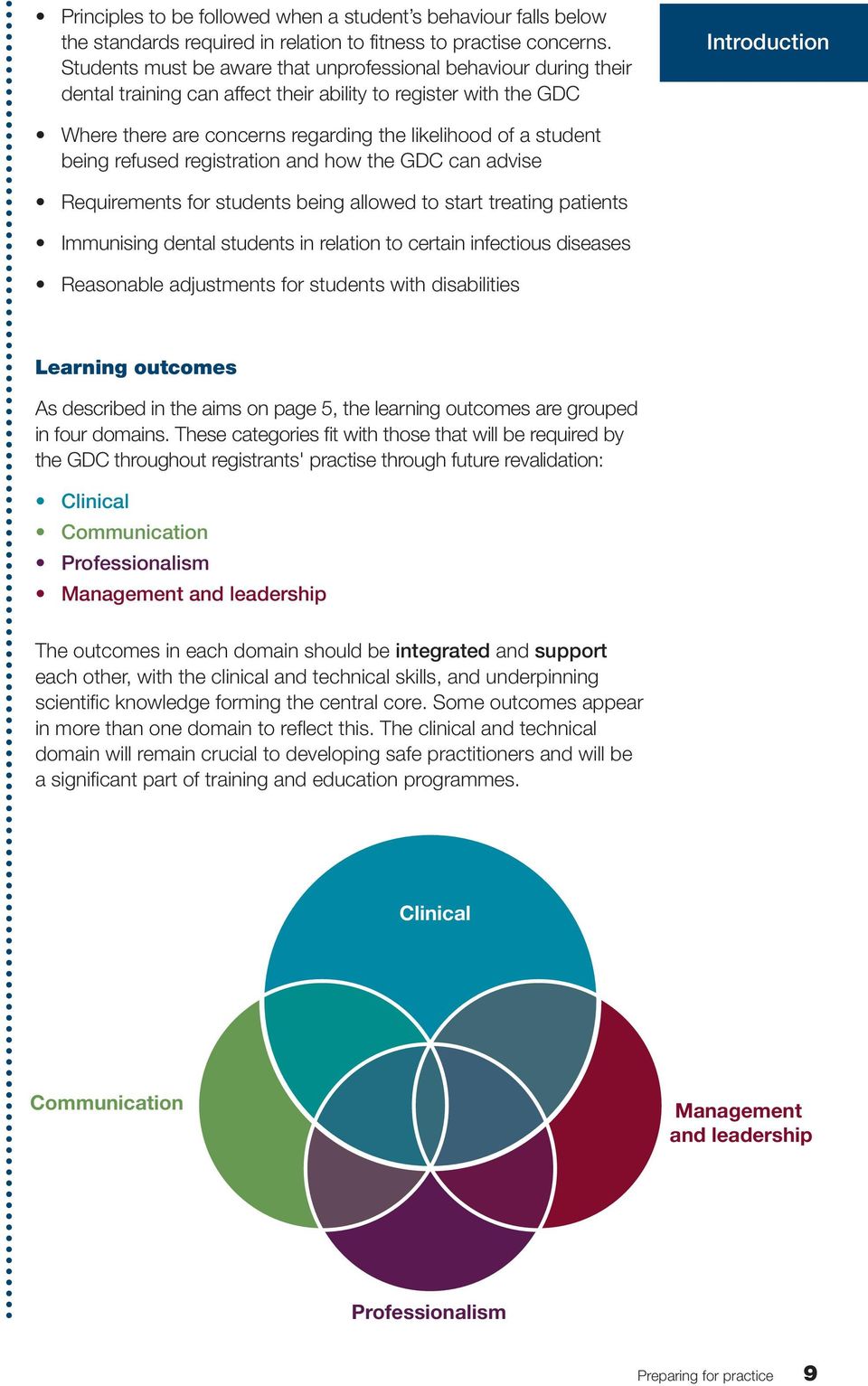
9 Principles to be followed when a student s behaviour falls below the standards required in relation to fitness to practise concerns. Students must be aware that unprofessional behaviour during their training can affect their ability to register with the GDC Introduction Where there are concerns regarding the likelihood of a student being refused registration and how the GDC can advise Requirements for students being allowed to start treating patients Immunising students in relation to certain infectious diseases Reasonable adjustments for students with disabilities Learning outcomes As described in the aims on page 5, the learning outcomes are grouped in four domains. These categories fit with those that will be required by the GDC throughout registrants' practise through future revalidation: Communication Professionalism Management and leadership The outcomes in each domain should be integrated and support each other, with the clinical and technical skills, and underpinning scientific knowledge forming the central core. Some outcomes appear in more than one domain to reflect this. The clinical and technical domain will remain crucial to developing safe practitioners and will be a significant part of training and education programmes. Communication Management and leadership Professionalism Preparing for practice 9
10 Introduction Specific legislation, guidelines and best practice affecting oral health care and team working is not always referenced. This is because such content is liable to frequent change. Underpinning science The relevant sciences (biomedical, behavioural, engineering and materials) that underpin the clinical domain are fundamental to understanding oral conditions and how to treat them. Appropriate emphasis should be provided on the delivery and assessment of the sciences in the interpretation of the Foundations of practice section of the outcomes. The sciences taught must be relevant to the practice of dentistry in order to understand patient conditions and behaviours and then apply to their assessment, diagnosis, treatment and care. Evidence-based dentistry An approach to oral health care that involves the integration of: the systematic assessment of clinically relevant scientific evidence relating to the patient s health and history with; the professional s clinical or technical expertise and the patient s treatment needs and choices In order to effectively carry out sound evidence-based decisions professionals must understand the principles of good research practice, at the level appropriate to their registrant category.* The principles of an evidence-based approach and the underpinning scientific knowledge are fundamental to implementing the outcomes. They should be applied as relevant to the registration category, and importantly, in relation to patient care. It is well recognised that producing registrants with good clinical and technical competence is vital for safe practice. However, this cannot be the sole aim. It is just as important that all registrants are developed with a full range of skills to enable them to provide sound, evidence-based and well delivered patient care. The learning outcomes also clearly relate to the GDC Scope of Practice and other GDC Professional Standards documents. Some signposting has been provided within the publication. Look out for the which highlights specific GDC guidance you may need to refer to. However this is not exhaustive. *Competencies for the New General Dentist (as approved by the 2008 ADEA House of Delegates) Team working All members of the team contribute to the patient s experience of treatment. The quality of teamwork is closely linked to the quality of care the team provides. It is important that potential registrants recognise the importance of this and have the opportunity to develop in a team environment as early as possible in their training. 10 General Council
11 The structure within each of the domains is consistent across the registration categories, allowing for variation in scope of practice, to facilitate opportunities for team integration and effective team working. The outcomes for each registration category are numbered and presented in a table to enable easy comparison. Where outcomes are worded identically between registrant categories it is expected that, as with all the other outcomes, they should be delivered as appropriate to the category in question. It may be that the level of complexity, for example, is greater for one group than another. The coverage of scientific principles in the Foundations of practice, degree of critical thinking, level and use of research, and evaluation skills will vary across the registrant categories in relation to their scope of practice and responsibilities. List of overarching outcomes There are seven overarching outcomes which should be demonstrated throughout education and training. These form the key principles of effective and professional practice, running through all the domains, and apply to all of the registration categories. Upon registration with the GDC the registrant will be able to: Practise safely and effectively, making the high quality long term care of patients the first concern Introduction Recognise the role and responsibility of being a registrant and demonstrate professionalism through their education, training and practice in accordance with GDC guidance Demonstrate effective clinical decision making Describe the principles of good research, how to access research and interpret it for use as part of an evidence based approach to practice Apply an evidence-based approach to learning, practice, clinical judgment and decision making and utilise critical thinking and problem solving skills Accurately assess their own capabilities and limitations, demonstrating reflective practice, in the interest of high quality patient care and act within these boundaries Recognise the importance of lifelong learning and apply it to practice domain Delivering safe, effective and appropriate care to patients is the focus of developing a registrant s clinical knowledge, competence and decision making skills. The learning outcomes have been separated Preparing for practice 11

12 Introduction into two sections Individual patient care and Population based health and care. The individual patient care section begins with a section on the foundations of practice then follows the patient journey, including the stages through assessment, diagnosis and patient management. Communication domain Good communication skills are integral to successful patient care - enabling patient assessment, patient consent, treatment and effective team working. The learning outcomes have been separated into three sections Patients, their representatives and the public, Team and wider healthcare environment, and Generic communication skills. Professionalism domain The professionalism of registrants is a key focus for the GDC. It is essential that students recognise the importance of professionalism and are able to demonstrate the attributes of professional attitudes and behaviour at all times from the beginning of their training. This domain draws widely from the GDC Standards for Professionals and most outcomes will be applicable to the whole team. The learning outcomes have been separated into four sections Patients and the public, Ethical and legal, Teamwork, and Development of self and others. Management and leadership domain Good management and leadership skills are vital to effective delivery of high quality patient care. This includes management of time, resources, and effective team working. Upon registration a professional would not be expected to be fully competent in a management and leadership role this will take time and experience. However, new registrants must be well prepared and understand the expectations and the responsibility of their role and the role of the rest of the team. Management and leadership should be embedded in training from the outset of their career. Many of the learning outcomes in this domain are therefore knowledge or principle based. Where there is a requirement to demonstrate aspects of leadership and management in the team this may be at a limited level, related to the basic requirements of delivering care within the team. There will be opportunities during clinics and outreach placement to demonstrate and reflect on use of these skills. Evidence may be collected in a portfolio, including simulation where an opportunity or scenario does not arise. 12 General Council

13 The learning outcomes have been separated into three sections Managing self, Working with others, and Managing the clinical and working environment. Introduction Note on implementation The outcomes describe the knowledge, skills, attitudes and behaviours the individual should be able to demonstrate and be assessed against. The intention is to provide a balance of detail, for consistent interpretation, and flexibility for responding to developments in practice and encouraging innovation among education and training providers. Providers will be expected to develop more detailed learning outcomes from these higher level outcomes which fit and relate to their curriculum. Assessment and quality assurance It is for each education and training provider to design their curriculum/programme to suit their circumstances, providing it is consistent with these learning outcomes. Education and training providers should design assessments so that they assess students against all the required learning outcomes. The GDC, when it monitors and inspects institutions will be concerned with how students are assessed against the outcomes. The GDC needs to know that the professionals joining its registers are safe to practise independently. Therefore, we will require evidence that trainees are assessed appropriately in all the learning outcomes set for the relevant registrant category; this is how the GDC can be sure that professionals have achieved (as opposed to covered in their programmes) the learning outcomes. So, for the quality assurance of standards for education and training, we will require a mapping of assessments (including workplace based assessment, portfolios, projects and exams) against the learning outcomes. Assessments should be rigorous, appropriate and reliable as a gateway for students to become qualified to practise independently. There will be systems in place to set appropriate standards for assessment to decide whether students have achieved the outcomes. All the outcomes will be assessed at appropriate points during the training programme. The quality of and DCP programmes will be monitored, reviewed and evaluated in a systematic way. The education or training provider will have a clear framework or plan for how it organises quality management and quality control, including who is responsible for this. Each education and training provider is required to keep records of the academic and clinical performance of each student. The records should be arranged so that the extent and quality of clinical work completed by the student across all clinical environments is clear and auditable. Preparing for practice 13
14 Introduction If the GDC considers that the programme of study or assessment does not ensure that the student possesses the requisite knowledge, skills, attitudes or behaviours necessary for registration with us, immediate remedial action by the education or training provider will be required. The GDC will not recognise a qualification for registration purposes until it is satisfied that any identified weaknesses in a programme of study have been satisfactorily addressed. To decide that a qualification ceases to confer the right to apply to be registered in the GDC register: for DCP programmes, the GDC may decide to do this itself through its published quality assurance policy and process for BDS undergraduate dentist degrees the GDC may make representations to the Privy Council to order this The quality assurance process incorporates a mechanism for updating the learning outcomes as and when the need and evidence arises. Full guidance on the GDC quality assurance standards and process can be found in a separate document. Guidance on terminology In the learning outcomes, statements using must or will mean something is mandatory. Statements using should, for example, in the roles and responsibilities section, may be taken in to account in the quality assurance process when the GDC considers whether the overall criteria have been met. Taxonomy used Knowledge Skills Attitudes/ behaviours Key words used in the learning outcomes* Describe, recognise, explain, discuss, interpret, identify, evaluate Use, apply, manage, produce, implement, perform, record, extract, modify, refer Participate, contribute, act, take responsibility, respect Application Recall or recognise information, explain or interpret meaning from a given scenario or statement Use or apply knowledge and skills Receive and respond to information, react and participate actively, prioritise and display values * The examples provided are not an exhaustive list and some may be applicable to more than one category 14 General Council

15 *Competencies for the New General Dentist (as approved by the 2008 ADEA House of Delegates) Use of the term manage in the clinical context: this refers to all actions performed by a healthcare provider that are designed to alter the course of a patient s condition; these may include providing education, advice, treatment by the professional, treatment by the dentist, treatment by the dentist after consultation with another healthcare professional, referral of a patient to another healthcare professional, and monitoring the treatment provided; it may also include preventative action, observation or providing no treatment.* Glossary Safe beginner - a rounded professional who, in addition to being a competent clinician and /or technician, will have the range of professional skills required to begin working as part of a team and be well prepared for independent practice. They will be able to assess their own capabilities and limitations, act within these boundaries and will know when to request support and advice. Independent practice working with autonomy within the GDC Scope of Practice, and own competence, once registered. Independent practice does not mean working alone and in isolation, but within the context of the wider and healthcare team, and may be under supervision if newly qualified. Introduction Preparing for practice 15
16 Outcomes Upon registration with the GDC the registrant will be able to demonstrate the outcomes as relevant to the practice of dentistry and patient care. 1 Individual patient care 1.1 Foundations of practice The registrant will be able to apply to the practice of dentistry principles that derive from the biomedical, behavioural and materials sciences. The registrant will recognise and take account of the needs of different patient groups including children, adults, older people, and those with special care requirements throughout the patient care process Explain, evaluate and apply the principles of an evidencebased approach to learning, clinical and professional practice and decision making Critically appraise approaches to research and integrate with patient care Identify oral diseases and explain their relevance to prevention, diagnosis and treatment Identify general and systemic disease and explain their relevance to oral health and their impact on clinical treatment Explain the aetiology and pathogenesis of oral disease Identify relevant and appropriate, oral, craniofacial and general anatomy and explain their application to patient management Describe relevant physiology and discuss its application to patient management Explain the potential routes of transmission of infectious agents in practice, mechanisms for the prevention of infection, the scientific principles of decontamination and disinfection and their relevance to health and safety Describe the properties of relevant drugs and therapeutic agents and discuss their application to patient management Recognise the scientific principles underpinning the use of materials and biomaterials and evaluate their limitations and selection, with emphasis on those used in dentistry 16 General Council
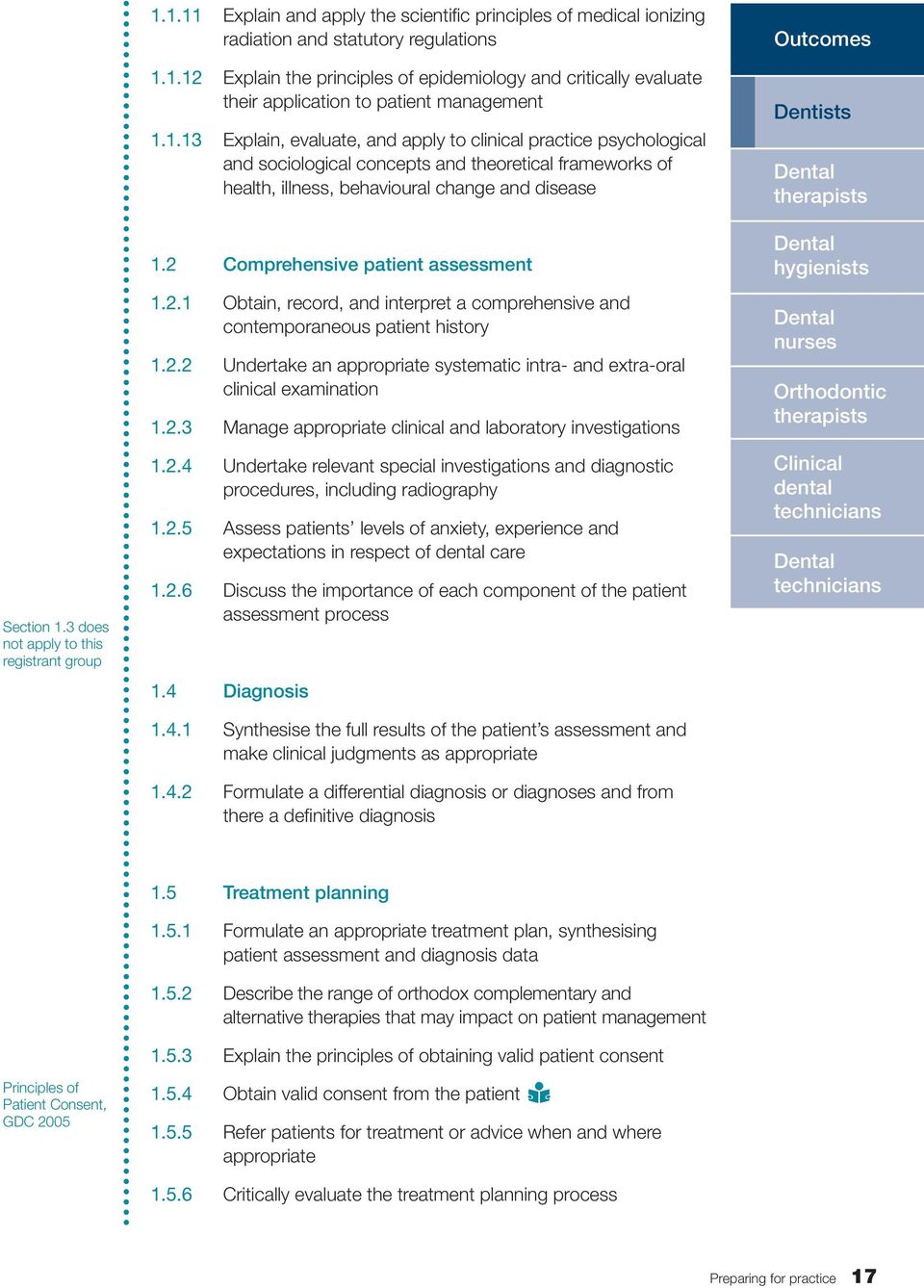
17 Section 1.3 does not apply to this registrant group Explain and apply the scientific principles of medical ionizing radiation and statutory regulations Explain the principles of epidemiology and critically evaluate their application to patient management Explain, evaluate, and apply to clinical practice psychological and sociological concepts and theoretical frameworks of health, illness, behavioural change and disease 1.2 Comprehensive patient assessment Obtain, record, and interpret a comprehensive and contemporaneous patient history Undertake an appropriate systematic intra- and extra-oral clinical examination Manage appropriate clinical and laboratory investigations Undertake relevant special investigations and diagnostic procedures, including radiography Assess patients levels of anxiety, experience and expectations in respect of care Discuss the importance of each component of the patient assessment process 1.4 Diagnosis Synthesise the full results of the patient s assessment and make clinical judgments as appropriate Formulate a differential diagnosis or diagnoses and from there a definitive diagnosis Outcomes Patient Consent, GDC Treatment planning Formulate an appropriate treatment plan, synthesising patient assessment and diagnosis data Describe the range of orthodox complementary and alternative therapies that may impact on patient management Explain the principles of obtaining valid patient consent Obtain valid consent from the patient Refer patients for treatment or advice when and where appropriate Critically evaluate the treatment planning process Preparing for practice 17
18 Outcomes 1.7 Patient management Treat all patients with equality, respect and dignity Identify, explain and manage the impact of medical and psychological conditions in the patient Monitor and review treatment outcomes Prevent, diagnose and manage patient anxiety appropriately, effectively and safely Prevent, diagnose and manage pain appropriately, effectively and safely Evaluate the risks and benefits of treatment under general anaesthesia and make appropriate referrals Evaluate the risks and benefits of treatment under conscious sedation and make appropriate referrals Safely and appropriately prescribe and administer drugs and therapeutic agents Explain the role and organisation of referral networks, clinical guidelines and policies and local variation Explain the need to take responsibility for establishing personal networks with local and medical colleagues, specialists and other relevant individuals and organisations Critically evaluate all components of patient management Section 1.6 does not apply to this registrant group 1.8 Patient and public safety Identify and explain the risks around the clinical environment and manage these in a safe and efficient manner Implement, perform and manage effective decontamination and infection control procedures according to current guidelines Recognise and take responsibility for the quality of services and devices provided to the patient Explain the responsibilities and limitations of delegating to other members of the team Comply with current best practice guidelines Identify, assess and manage medical emergencies Explain the importance of and maintain accurate, contemporaneous and comprehensive patient records in accordance with legal and statutory requirements and best practice 18 General Council
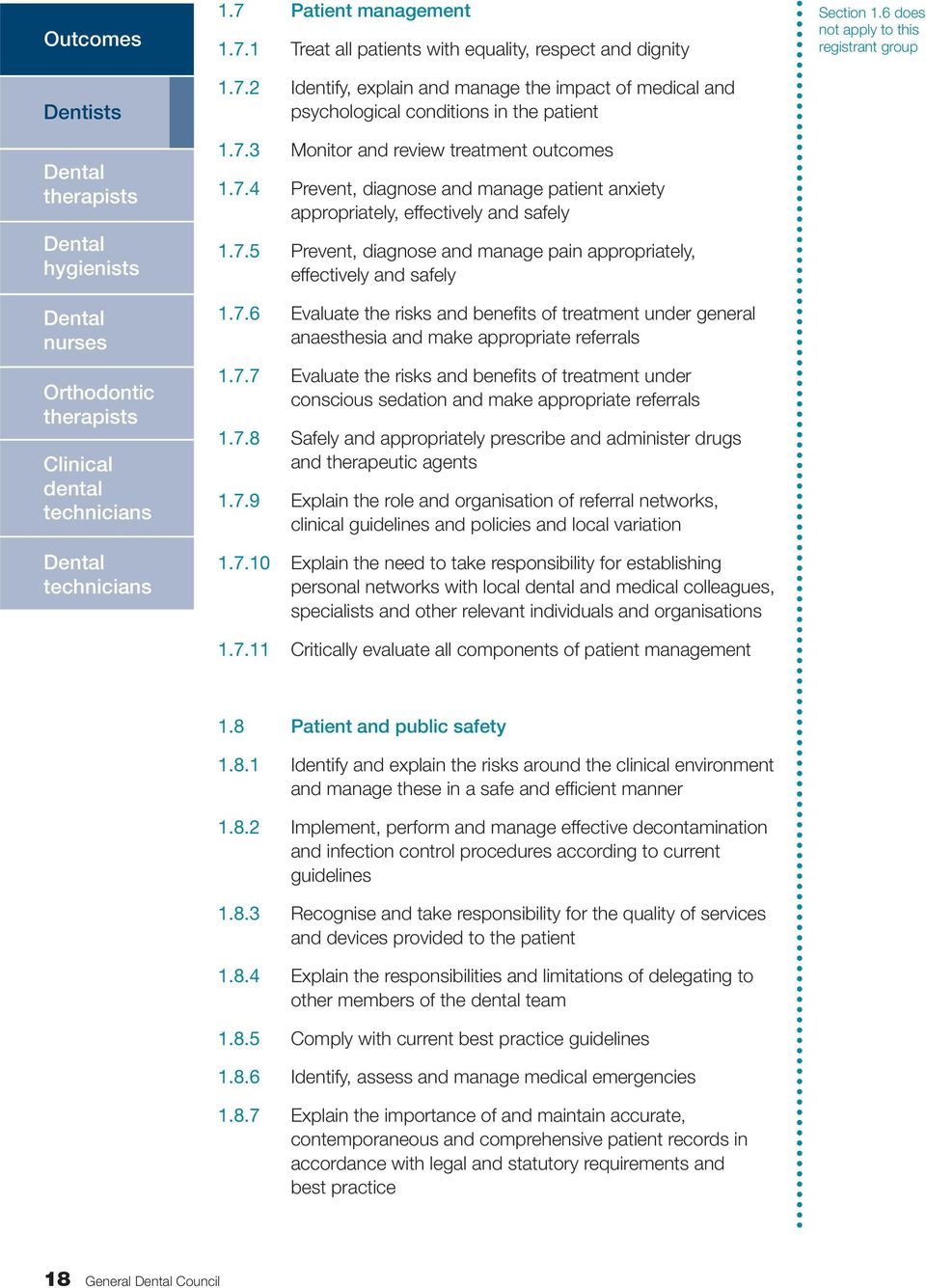
19 1.8.8 Identify the signs of abuse or neglect, explain local and national systems that safeguard welfare and raise concerns where appropriate 1.9 Treatment of acute oral conditions Recognise and manage patients acute oro-facial and pain Recognise and manage acute dento-alveolar and mucosal infection Recognise and manage dento-alveolar and mucosal trauma Identify the need for and make arrangements for follow-up care 1.10 Health promotion and disease prevention Recognise the responsibilities of a dentist as an access point to and from wider healthcare Provide patients with comprehensive and accurate preventive education and instruction in a manner which encourages self-care and motivation Outcomes Explain the principles of preventive care and apply as part of a comprehensive treatment plan Underpin all patient care with a preventive approach that contributes to the patient s long-term oral and general health Manage the application of preventive treatments Assess the results of treatment and provide aftercare and ongoing preventive advice Evaluate the health risks of diet, drugs and substance misuse, and substances such as tobacco and alcohol on oral and general health and provide appropriate advice and support 1.11 Management and treatment of periodontal disease Assess and manage the health of periodontal and soft tissues taking into account risk and lifestyle factors Describe, take account of and explain to the patient the impact of the patient s periodontal health on the overall treatment plan and outcomes Preparing for practice 19

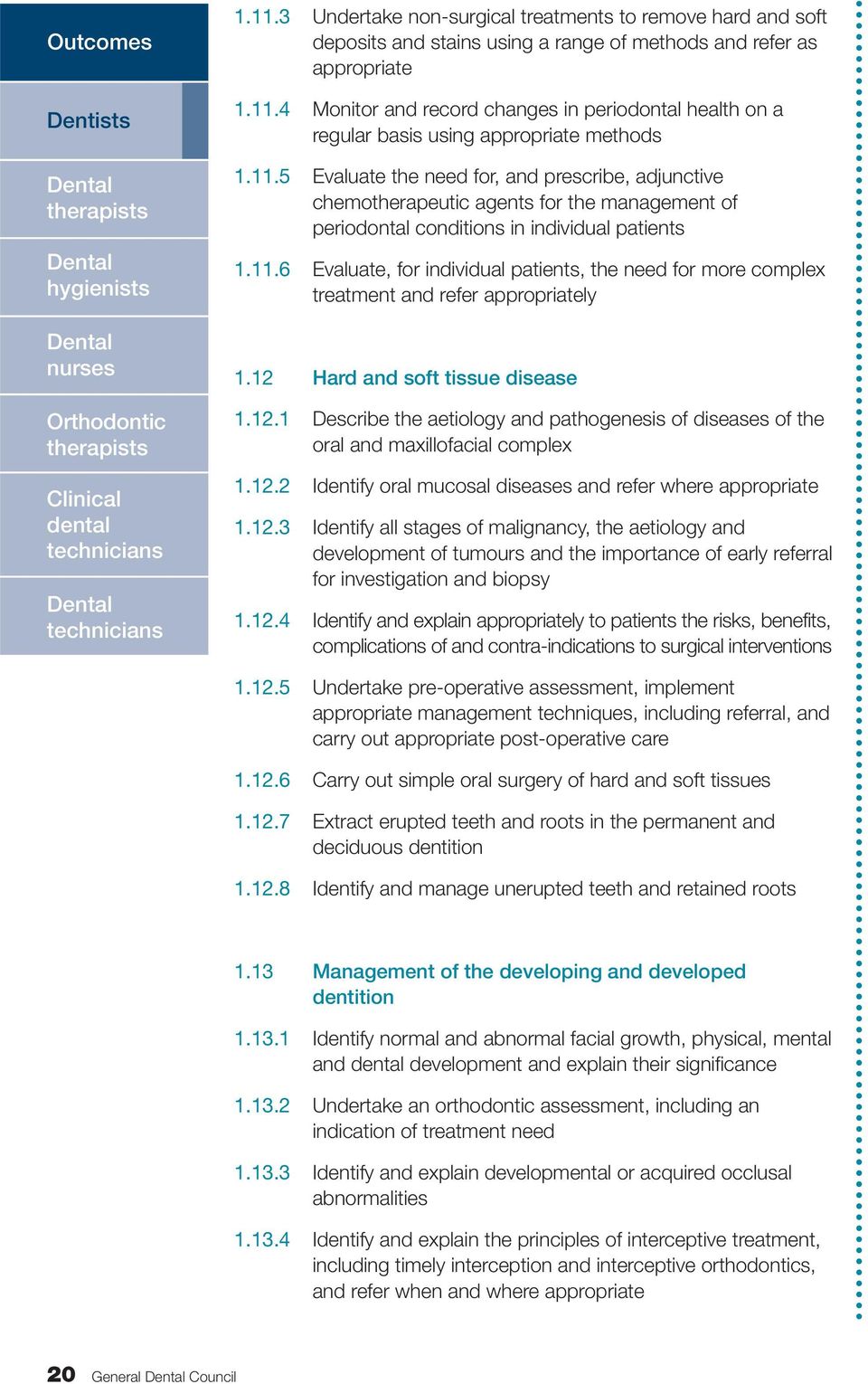
20 Outcomes Undertake non-surgical treatments to remove hard and soft deposits and stains using a range of methods and refer as appropriate Monitor and record changes in periodontal health on a regular basis using appropriate methods Evaluate the need for, and prescribe, adjunctive chemotherapeutic agents for the management of periodontal conditions in individual patients Evaluate, for individual patients, the need for more complex treatment and refer appropriately 1.12 Hard and soft tissue disease Describe the aetiology and pathogenesis of diseases of the oral and maxillofacial complex Identify oral mucosal diseases and refer where appropriate Identify all stages of malignancy, the aetiology and development of tumours and the importance of early referral for investigation and biopsy Identify and explain appropriately to patients the risks, benefits, complications of and contra-indications to surgical interventions Undertake pre-operative assessment, implement appropriate management techniques, including referral, and carry out appropriate post-operative care Carry out simple oral surgery of hard and soft tissues Extract erupted teeth and roots in the permanent and deciduous dentition Identify and manage unerupted teeth and retained roots 1.13 Management of the developing and developed dentition Identify normal and abnormal facial growth, physical, mental and development and explain their significance Undertake an orthodontic assessment, including an indication of treatment need Identify and explain developmental or acquired occlusal abnormalities Identify and explain the principles of interceptive treatment, including timely interception and interceptive orthodontics, and refer when and where appropriate 20 General Council
21 Identify and explain when and how to refer patients for specialist treatment and apply to practice Recognise and explain to patients the range of contemporary orthodontic treatment options, their impact, outcomes, limitations and risks Undertake limited orthodontic appliance emergency procedures 1.14 Restoration and replacement of teeth Assess and manage caries, occlusion, and tooth wear Recognise and manage temporomandibular joint disorders Create an oral environment where restoration or replacement of the tooth is viable Where appropriate, restore the dentition using the principle of minimal intervention, to a standard that promotes the longevity of the restoration or prostheses Manage restorative procedures that preserve tooth structure, replace missing or defective tooth structure, maintain function, are aesthetic and long lasting, and promote soft and hard tissue health Outcomes Assess, diagnose and manage the health of the pulp and periradicular tissues, including treatment to prevent pulpal and periradicular disease Recognise the role of surgical management of periradicular disease Determine the prognosis and undertake appropriate nonsurgical treatments to manage pulpal and periradicular disease for uncomplicated deciduous and uncomplicated permanent teeth Recognise the risks of non-surgical root canal treatment and how to manage them Evaluate the need for more complex treatment and refer accordingly Assess the need for, design, prescribe and provide biomechanically sound partial and complete dentures Recognise and explain to patients the range of implant treatment options, their impact, outcomes, limitations and risks Preparing for practice 21
22 Outcomes 2 Population-based health and care 2.1 Discuss the basic principles of a population health approach including demographic and social trends, UK and international oral health trends, determinants of health and inequalities in health, and the ways in which these are measured and current patterns 2.2 Describe the and wider healthcare systems professionals work within including health policy and organisation, delivery of healthcare and equity 2.3 Describe and evaluate the role of health promotion in terms of the changing environment, community and individual behaviours to deliver health gain 2.4 Evaluate evidence-based prevention and apply appropriately 2.5 Explain the principles of planning oral health care for communities to meet needs and demands Communication The registrant must recognise the importance of appropriate communication in healthcare at all times and through all media Upon registration with the GDC the registrant will be able to: 3 Patients, their representatives and the public 3.1 Communicate appropriately, effectively and sensitively at all times with and about patients, their representatives and the public and in relation to: patients with anxious or challenging behaviour referring patients to colleagues, particularly where patients are from diverse backgrounds or there are barriers to patient communication difficult circumstances, such as breaking bad news, or discussing issues such as alcohol consumption, smoking, or diet 3.2 Recognise the importance of non-verbal communication, including listening skills, and barriers to effective communication 22 General Council
23 Patient Consent, GDC Explain and check patients understanding of treatments, options, costs and informed consent and enable patients to make their choice 3.4 Obtain informed consent Outcomes 4 Team and the wider healthcare environment 4.1 Communicate appropriately with colleagues from and other healthcare professions in relation to: the direct care of individual patients oral health promotion the day to day working of the clinical department/practice in which the individual works the wider contribution which the department/practice makes to and healthcare in the surrounding community raising concerns when problems arise 4.2 Explain the role of appraisal, training and review of colleagues, giving and receiving effective feedback 4.3 Give and receive feedback effectively to and from other members of the team 4.4 Communicate appropriately and effectively in professional discussions and transactions within the health and other sectors Learning to Manage Health Information - NHS Generic communication skills 5.1 Communicate appropriately, effectively and sensitively by spoken, written and electronic methods and maintain and develop these skills 5.2 Use appropriate methods to provide accurate, clear and comprehensive information when referring patients to other and healthcare professionals 5.3 Explain the importance of and maintain accurate, contemporaneous and comprehensive patient records in accordance with legal and statutory requirements and best practice 5.4 Recognise the use of a range of communication methods and technologies and their appropriate application in support of clinical practice 5.5 Recognise and act within the principles of information governance Preparing for practice 23
24 Outcomes Professionalism Upon registration with the GDC the registrant will be able to: 6 Patients and the public 6.1 Put patients interests first and act to protect them 6.2 Act with integrity and be trustworthy 6.3 Respect patients dignity and choices 6.4 Protect the confidentiality of all personal information 6.5 Recognise and respect the patient s perspective and expectations of care and the role of the team, taking into account issues relating to equality and diversity 7 Ethical and legal 7.1 Recognise and act within the GDC s standards and within other professionally relevant laws, ethical guidance and systems 7.2 Recognise and act upon the legal and ethical responsibilities involved in protecting and promoting the health of individual patients 7.3 Act without discrimination and show respect for patients, colleagues and peers and the general public 7.4 Take responsibility for and act to raise concerns about your own or others health, behaviour or professional performance as described in The Raising Concerns 8 Teamwork 8.1 Describe and respect the roles of and other healthcare professionals in the context of learning and working in a and wider healthcare team 8.2 Co-operate effectively with other members of the and wider healthcare team in the interests of patients 8.3 Explain the contribution that team members and effective team working makes to the delivery of safe and effective high quality care Patient Confidentiality, GDC 2005 Standards for Professionals, GDC 2005 The Principles of Raising Concerns, GDC 2006 Team Working, GDC 2006 Scope of Practice, GDC Development of self and others 9.1 Recognise and demonstrate own professional responsibility in the development of self and the rest of the team GDC CPD requirements, General Council
25 9.2 Utilise the provision and receipt of effective feedback in the professional development of self and others 9.3 Explain the range of methods of learning and teaching available and the importance of assessment, feedback, critical reflection, identification of learning needs and appraisal in personal development planning 9.4 Develop and maintain professional knowledge and competence and demonstrate commitment to lifelong learning 9.5 Recognise and evaluate the impact of new techniques and technologies in clinical practice 9.6 Accurately assess their own capabilities and limitations in the interest of high quality patient care and seek advice from supervisors or colleagues where appropriate 9.7 Explain and demonstrate the attributes of professional attitudes and behaviour in all environments and media Management and Leadership Outcomes Upon registration with the GDC the registrant will be able to: Management Responsibility, GDC Managing self 10.1 Put patients interests first and act to protect them 10.2 Effectively manage their own time and resources 10.3 Recognise the impact of personal behaviour on the health care environment and on wider society and manage this professionally 10.4 Recognise the significance of their own management and leadership role and the range of skills and knowledge required to do this effectively 10.5 When appropriate act as an advocate for patient needs Raising Concerns, GDC Take responsibility for personal development planning, recording of evidence, and reflective practice 10.7 Ensure that all aspects of practice comply with legal and regulatory requirements 10.8 Demonstrate appropriate continuous improvement activities Preparing for practice 25
26 Outcomes 11 Managing and working with others 11.1 Take a patient-centred approach to working with the and wider healthcare team 11.2 Recognise and respect own and others contribution to the and wider healthcare team and demonstrate effective team working, including leading and being led Recognise the importance of and demonstrate personal accountability to patients, the regulator, the team and wider community 11.4 Where appropriate lead, manage and take professional responsibility for the actions of colleagues and other members of the team involved in patient care 11.5 Recognise and comply with the team working requirements in the Scope of Practice and Standards documents 11.6 Describe the scope of practice of the team and manage and delegate work accordingly, ensuring only those with appropriate training undertake procedures 11.7 Recognise, take responsibility for and act to raise concerns about their own or others health, behaviour or professional performance as described in The Principles of Raising Concerns 11.8 Recognise the need to ensure that those who raise concerns are protected from discrimination or other detrimental effects Team Working, GDC 2006 Scope of Practice, GDC 2008, Principles of Team Working, GDC 2006 The Principles of Raising Concerns, GDC Managing the clinical and working environment 12.1 Recognise and comply with systems and processes to support safe patient care 12.2 Recognise the need for effective recorded maintenance and testing of equipment and requirements for appropriate storage, handling and use of materials 12.3 Recognise and demonstrate the procedures for handling of complaints as described in the Complaints Handling 12.4 Describe the legal, financial and ethical issues associated with managing a practice 12.5 Recognise and comply with national and local clinical governance and health and safety requirements 12.6 Describe the implications of the wider health economy and external influences Complaints Handling, GDC 2006 Management Responsibility, GDC General Council
27 Upon registration with the GDC the registrant will be able to demonstrate the outcomes as relevant to the practice of therapy and patient care. 1 Individual patient care 1.1 Foundations of practice The registrant will be able to apply to the practice of therapy principles that derive from the biomedical, behavioural and materials sciences The registrant will recognise and take account of the needs of different patient groups including children, adults, older people, and those with special care requirements throughout the patient care process Describe the principles of an evidence-based approach to learning, clinical and professional practice and decision making Describe oral diseases and their relevance to prevention, diagnosis and treatment Explain general and systemic disease and their relevance to oral health Outcomes Explain the aetiology and pathogenesis of oral disease Describe relevant and appropriate, oral, craniofacial and general anatomy and explain their application to patient management Describe relevant and appropriate physiology and explain its application to patient management Explain the potential routes of transmission of infectious agents in practice, mechanisms for the prevention of infection, the scientific principles of decontamination and disinfection and their relevance to health and safety Describe the properties of relevant drugs and therapeutic agents and discuss their application to patient management Describe the scientific principles underpinning the use of materials and biomaterials and discuss their limitations and selection, with emphasis on those used in dentistry Explain the scientific principles of medical ionizing radiation and statutory regulations Recognise psychological and sociological factors that contribute to poor oral health, the course of diseases and the success of treatment Preparing for practice 27
28 Outcomes 1.2 Contribution to patient assessment Recognise the importance of and carry out an appropriate systematic intra- and extra-oral clinical examination Recognise the importance of and record a comprehensive and contemporaneous patient history Recognise the significance of changes in the patient s reported oral health status and take appropriate action Recognise abnormalities of the oral cavity and the rest of the patient and raise concerns where appropriate Contribute to relevant special investigations and diagnostic procedures, including radiography Assess patients levels of anxiety, experience and expectations in respect of care Discuss the importance of each component of the patient assessment process 1.5 Responding to the treatment plan Explain the principles of obtaining valid patient consent Obtain valid consent from the patient Carry out care as prescribed by the dentist and plan the delivery in the most appropriate way for the patient Identify where patients needs may differ from the treatment plan and refer patients for advice when and where appropriate Discuss the role of the therapist and other members of the team in the treatment plan Sections 1.3 and 1.6 do not apply to this registrant group Patient Consent, GDC Patient management Treat all patients with equality, respect and dignity Explain the impact of medical and psychological conditions in the patient Recognise the need to monitor and review treatment outcomes Manage patient anxiety and pain through effective communication, reassurance and relevant behavioural techniques Manage patient pain through the appropriate use of analgesia 28 General Council
29 1.7.6 Explain the risks and benefits of treatment under general anaesthesia and conscious sedation Refer to other healthcare professionals as prescribed by the dentist Recognise the need for and make arrangements for appropriate follow-up care Recognise local referral networks, local clinical guidelines and policies Discuss the role of the therapist and other members of the team in the patient management process 1.8 Patient and public safety Recognise the risks around the clinical environment and manage these in a safe and efficient manner Implement and perform effective decontamination and infection control procedures according to current guidelines Recognise and take responsibility for the quality of care provided to the patient Take responsibility for ensuring compliance with current best practice guidelines Outcomes Recognise and manage medical emergencies Explain the importance of and maintain accurate, contemporaneous and comprehensive patient records in accordance with legal and statutory requirements and best practice Recognise the signs of abuse or neglect and describe local and national systems and raise concerns where appropriate 1.9 Treatment of acute oral conditions Recognise and manage patients with acute oral conditions ensuring involvement of appropriate team members 1.10 Health promotion and disease prevention Explain the principles of preventive care Provide patients with comprehensive and accurate preventive education and instruction in a manner which encourages self-care and motivation Preparing for practice 29
30 Outcomes Underpin all patient care with a preventive approach that contributes to the patient s long-term oral health and general health Advise on and apply a range of preventive materials and treatment as appropriate Assess the results of treatment and provide appropriate aftercare and ongoing preventive advice Describe the health risks of diet, drugs and substance misuse, and substances such as tobacco and alcohol on oral and general health and provide appropriate advice, referral and support 1.11 Periodontal therapy Assess and manage the health of periodontal and soft tissues taking into account risk and lifestyle factors Explain and take account of the impact of the patient s periodontal and general health on the overall treatment plan and outcomes Undertake prescribed non-surgical treatments to remove hard and soft deposits and stains using a range of methods Monitor and record changes in periodontal health as necessary using appropriate indices Place temporary dressings and re-cement crowns with a temporary cement Recognise and appropriately manage the complications associated with periodontal therapy Recognise the role of surgical management of periodontal diseases, apply antimicrobials, and provide appropriate patient care Describe the risks related to implant therapy and manage the health of peri-implant tissues 1.12 Extraction of teeth Explain the risks, indications and complications of extractions Extract erupted deciduous teeth under local anaesthetic 30 General Council
31 1.13 Management of the developing and developed dentition Identify normal and abnormal facial growth, physical, mental and development and explain their significance 1.14 Restoration of teeth Assess and manage caries, occlusion, and tooth wear, and, where appropriate, restore the dentition using the principle of minimal intervention, maintaining function and aesthetics Restore teeth using a wide range of treatments and materials appropriate to the patient including permanent and temporary direct restorations, maintaining function and aesthetics Provide pulp treatment for deciduous teeth Restore deciduous teeth using preformed crowns Explain the role of the therapist in the restoration of teeth Outcomes 2 Population-based health and care 2.1 Describe the basic principles of a population health approach including demographic and social trends, UK and international oral health trends, determinants of health and inequalities in health, the ways in which these are measured and current patterns 2.2 Explain the and wider healthcare systems professionals work within including health policy and organisation, delivery of healthcare and equity 2.3 Describe and evaluate the role of health promotion in terms of the changing environment, community and individual behaviours to deliver health gain 2.4 Explain evidence-based prevention and apply appropriately 2.5 Describe the principles of planning oral health care for communities to meet needs and demands Preparing for practice 31
32 Outcomes Communication The registrant must recognise the importance of appropriate communication in healthcare at all times and through all media Upon registration with the GDC the registrant will be able to: 3 Patients, their representatives and the public 3.1 Communicate appropriately, effectively and sensitively at all times with and about patients, their representatives and the general public and in relation to: patients with anxious or challenging behaviour referring patients to colleagues, particularly where patients are from diverse backgrounds or there are barriers to patient communication difficult circumstances, such as when breaking bad news, and when discussing issues, such as alcohol consumption, smoking or diet 3.2 Recognise the importance of non-verbal communication, including listening skills, and barriers to effective communication 3.3 Explain and check patients understanding of treatments, options, costs and informed consent 3.4 Obtain informed consent Patient Consent, GDC Team and the wider healthcare environment 4.1 Communicate appropriately with colleagues from and other healthcare professions in relation to the direct care of individual patients, including oral health promotion 4.2 Explain the role of appraisal, training and review of colleagues, giving and receiving effective feedback 4.3 Give and receive feedback effectively to and from other members of the team 5 Generic communication skills 5.1 Communicate appropriately, effectively and sensitively by spoken, written and electronic methods and maintain and develop these skills 5.2 Explain the importance of and maintain accurate, contemporaneous and comprehensive patient records in 32 General Council
33 Learning to Manage Health Information - NHS 2009 Patient Confidentiality, GDC 2005 accordance with legal and statutory requirements and best practice 5.3 Recognise the use of a range of communication methods and technologies and their appropriate application in support of clinical practice 5.4 Recognise and act within the principles of information governance Professionalism Upon registration with the GDC the registrant will be able to: 6 Patients and the public 6.1 Put patients interests first and act to protect them 6.2 Act with integrity and be trustworthy 6.3 Respect patients dignity and choice 6.4 Protect the confidentiality of all personal information 6.5 Recognise and respect the patient s perspective and expectations of care and the role of the team, taking into account issues relating to equality and diversity Outcomes Standards for Professionals, GDC 2005 The Principles of Raising Concerns, GDC Ethical and legal 7.1 Recognise and act within the GDC s standards and within other professionally relevant laws, ethical guidance and systems 7.2 Recognise and act upon the legal and ethical responsibilities involved in protecting and promoting the health of individual patients 7.3 Act without discrimination and show respect for patients, colleagues and peers and the general public 7.4 Take responsibility for and act to raise concerns about your own or others health, behaviour or professional performance as described in The Raising Concerns Preparing for practice 33
34 Outcomes 8 Teamwork 8.1 Describe and respect the roles of and other healthcare professionals in the context of learning and working in a and wider healthcare team 8.2 Co-operate effectively with other members of the and wider healthcare team in the interests of patients 8.3 Explain the contribution that team members and effective team working makes to the delivery of safe and effective high quality care 9 Development of self and others 9.1 Recognise and demonstrate own professional responsibility in the development of self and the rest of the team 9.2 Utilise the provision and receipt of effective feedback in the professional development of self and others 9.3 Explain the range of learning and teaching methods and the importance of assessment, feedback, critical reflection, identification of learning needs and appraisal in personal development planning 9.4 Develop and maintain professional knowledge and competence and demonstrate commitment to lifelong learning 9.5 Recognise and evaluate the impact of new techniques and technologies in clinical practice 9.6 Accurately assess own capabilities and limitations in the interest of high quality patient care and seek advice from supervisors or colleagues where appropriate 9.7 Describe and demonstrate the attributes of professional attitudes and behaviour in all environments and media Team Working, GDC 2006 Scope of Practice, GDC 2008 CPD requirements, GDC 2011 Management and Leadership Upon registration with the GDC the registrant will be able to: 10 Managing self 10.1 Put patients interests first and act to protect them 10.2 Effectively manage their own time and resources Management Responsibility, GDC General Council
35 Standards for professionals, GDC 2005, Raising Concerns, GDC 2006 Team Working, GDC 2006 Scope of Practice, GDC 2008, Team Working, GDC 2006 The Principles of Raising Concerns, GDC Recognise the impact of personal behaviour and manage this professionally 10.4 Recognise the range of skills and knowledge that contribute to effective management and leadership 10.5 When appropriate act as an advocate for patient/carer needs 10.6 Take responsibility for personal development planning, recording of evidence, and reflective practice 10.7 Ensure that all aspects of practice comply with legal and regulatory requirements 10.8 Demonstrate appropriate continuous improvement activities 11 Working with others 11.1 Take a patient-centred approach to working with the and wider healthcare team 11.2 Recognise and respect own and others contribution to the and wider healthcare team and demonstrate effective team working Recognise and demonstrate personal accountability to patients, the regulator, the team and wider community 11.4 Recognise and comply with the team working requirements in the Scope of Practice and Standards documents 11.5 Recognise, take responsibility for and act to raise concerns about their own or others health, behaviour or professional performance as described in The Raising Concerns Outcomes Complaints Handling, GDC 2006 Management Responsibility, GDC Managing the clinical and working environment 12.1 Recognise and comply with systems and processes to support safe patient care 12.2 Recognise the need for effective recorded maintenance and testing of equipment and requirements for appropriate storage, handling and use of materials 12.3 Recognise and demonstrate the procedures for handling complaints as described in the Complaints Handling 12.4 Describe the legal, financial and ethical issues associated with managing a practice 12.5 Recognise and comply with national and local clinical governance and health and safety requirements Preparing for practice 35
36 Outcomes Upon registration with the GDC the registrant will be able to demonstrate the outcomes as relevant to the practice of hygiene and patient care. 1 Individual patient care 1.1 Foundations of practice The registrant will be able to apply to the practice of hygiene principles that derive from the biomedical, behavioural and materials sciences The registrant will recognise and take account of the needs of different patient groups including children, adults, older people, and those with special care requirements throughout the patient care process Describe the principles of an evidence-based approach to learning, clinical and professional practice and decision making Describe oral diseases and their relevance to prevention, diagnosis and treatment Explain general and systemic disease and their relevance to oral health Explain the aetiology and pathogenesis of oral disease Describe relevant and appropriate, oral, craniofacial and general anatomy and explain their application to patient management Describe relevant and appropriate physiology and explain its application to patient management Explain the potential routes of transmission of infectious agents in practice, mechanisms for the prevention of infection, the scientific principles of decontamination and disinfection and their relevance to health and safety Describe the properties of relevant drugs and therapeutic agents and discuss their application to patient management Describe the scientific principles underpinning the use of materials and biomaterials and discuss their limitations and selection, with emphasis on those used in dentistry Explain the scientific principles of medical ionizing radiation and statutory regulations 36 General Council
37 Sections 1.3 and 1.4 do not apply to this registrant group Patient Consent, GDC Recognise psychological and sociological factors that contribute to poor oral health, the course of diseases and the success of treatment 1.2 Contribution to patient assessment Recognise the importance of and carry out an appropriate systematic intra- and extra-oral clinical examination Recognise the importance of and record a comprehensive and contemporaneous patient history Recognise the significance of changes in the patient s reported oral health status and take appropriate action Recognise abnormalities of the oral cavity and the rest of the patient and raise concerns where appropriate Contribute to relevant special investigations and diagnostic procedures, including radiography Assess patients levels of anxiety, experience and expectations in respect of care Discuss the importance of each component of the patient assessment process 1.5 Responding to the treatment plan Explain the principles of obtaining valid patient consent Obtain valid consent from the patient Carry out care as prescribed by the dentist and plan the delivery in the most appropriate way for the patient Identify where patients needs may differ from the treatment plan and refer patients for advice when and where appropriate Discuss the role of the hygienist and other members of the team in the treatment plan Outcomes 1.7 Patient management Treat all patients with equality, respect and dignity Explain the impact of medical and psychological conditions in the patient Recognise the need to monitor and review treatment outcomes Preparing for practice 37
38 Outcomes Manage patient anxiety and pain through effective communication, reassurance and relevant behavioural techniques Manage patient pain through the appropriate use of analgesia Explain the risks and benefits of treatment under general anaesthesia and conscious sedation Refer to other healthcare professionals as prescribed by the dentist Recognise the need for and make arrangements for appropriate follow-up care Recognise local referral networks, local clinical guidelines and policies Discuss the role of the hygienist and other members of the team in the patient management process 1.8 Patient and public safety Recognise the risks around the clinical environment and manage these in a safe and efficient manner Implement and perform effective decontamination and infection control procedures according to current guidelines Recognise and take responsibility for the quality of care provided to the patient Take responsibility for ensuring compliance with current best practice guidelines Recognise and manage medical emergencies Explain the importance of and maintain accurate, contemporaneous and comprehensive patient records in accordance with legal and statutory requirements and best practice Recognise the signs of abuse or neglect and describe local and national systems and raise concerns where appropriate 1.9 Treatment of acute oral conditions Recognise and manage patients with acute oral conditions ensuring involvement of appropriate team members 38 General Council
39 1.10 Health promotion and disease prevention Explain the principles of preventive care Provide patients with comprehensive and accurate preventive education and instruction in a manner which encourages self-care and motivation Underpin all patient care with a preventive approach that contributes to the patient s long-term oral health and general health Advise on and apply a range of preventive materials and treatment Assess the results of treatment and provide appropriate aftercare and ongoing preventive advice Describe the health risks of diet, drugs and substance misuse, and substances such as tobacco and alcohol on oral and general health and provide appropriate advice, referral and support 1.11 Periodontal therapy Assess and manage the health of periodontal and soft tissues taking into account risk and lifestyle factors Outcomes Explain and take account of the impact of the patient s periodontal and general health on the overall treatment plan and outcomes Undertake prescribed non-surgical treatments to remove hard and soft deposits and stains using a range of methods Monitor and record changes in periodontal health as necessary using appropriate indices Recognise and appropriately manage the complications associated with periodontal therapy Place temporary dressings and re-cement crowns with a temporary cement Recognise the role of surgical management of periodontal diseases and provide appropriate patient care Describe the risks related to implant therapy and manage the health of peri-implant tissues 1.13 Management of the developing and developed dentition Identify normal and abnormal facial growth, physical, mental and development and explain their significance Preparing for practice 39
40 Outcomes 2 Population-based health and care 2.1 Describe the basic principles of a population health approach including demographic and social trends, UK and international oral health trends, determinants of health and inequalities in health, the ways in which these are measured and current patterns 2.2 Explain the and wider healthcare systems professionals work within including health policy and organisation, delivery of healthcare and equity 2.3 Describe and evaluate the role of health promotion in terms of the changing environment, community and individual behaviours to deliver health gain 2.4 Explain evidence-based prevention and apply appropriately 2.5 Describe the principles of planning oral health care for communities to meet needs and demands Communication The registrant must recognise the importance of appropriate communication in healthcare at all times and through all media Upon registration with the GDC the registrant will be able to: 3 Patients, their representatives and the public 3.1 Communicate appropriately, effectively and sensitively at all times with and about patients, their representatives and the general public and in relation to: patients with anxious or challenging behaviour referring patients to colleagues, particularly where patients are from diverse backgrounds or there are barriers to patient communication difficult circumstances, such as when breaking bad news, and when discussing issues, such as alcohol consumption, smoking or diet 3.2 Recognise the importance of non-verbal communication, including listening skills, and barriers to effective communication 40 General Council
41 Patient Consent, GDC 2005 Learning to Manage Health Information - NHS Explain and check patients understanding of treatments, options, costs and informed consent 3.4 Obtain informed consent 4 Team and the wider healthcare environment 4.1 Communicate appropriately with colleagues from and other healthcare professions in relation to the direct care of individual patients, including oral health promotion 4.2 Explain the role of appraisal, training and review of colleagues, giving and receiving effective feedback 4.3 Give and receive feedback effectively to and from other members of the team 5 Generic communication skills 5.1 Communicate appropriately, effectively and sensitively by spoken, written and electronic methods and maintain and develop these skills 5.2 Explain the importance of and maintain accurate, contemporaneous and comprehensive patient records in accordance with legal and statutory requirements and best practice 5.3 Recognise the use of a range of communication methods and technologies and their appropriate application in support of clinical practice 5.4 Recognise and act within the principles of information governance Outcomes Professionalism Upon registration with the GDC the registrant will be able to: 6 Patients and the public 6.1 Put patients interests first and act to protect them 6.2 Act with integrity and be trustworthy 6.3 Respect patients dignity and choices Preparing for practice 41
42 Outcomes 6.4 Protect the confidentiality of all personal information 6.5 Recognise and respect the patient s perspective and expectations of care and the role of the team, taking into account issues relating to equality and diversity Patient Confidentiality, GDC Ethical and legal 7.1 Recognise and act within the GDC s standards and within other professionally relevant laws, ethical guidance and systems 7.2 Recognise and act upon the legal and ethical responsibilities involved in protecting and promoting the health of individual patients 7.3 Act without discrimination and show respect for patients, colleagues and peers and the general public 7.4 Take responsibility for and act to raise concerns about your own or others health, behaviour or professional performance as described in The Raising Concerns 8 Teamwork 8.1 Describe and respect the roles of and other healthcare professionals in the context of learning and working in a and wider healthcare team 8.2 Co-operate effectively with other members of the and wider healthcare team in the interests of patients 8.3 Explain the contribution that team members and effective team working makes to the delivery of safe and effective high quality care Standards for Professionals, GDC 2005 The Principles of Raising Concerns, GDC 2006 Team Working, GDC 2006 Scope of Practice, GDC Development of self and others 9.1 Recognise and demonstrate own professional responsibility in the development of self and the rest of the team 9.2 Utilise the provision and receipt of effective feedback in the professional development of self and others 9.3 Explain the range of learning and teaching methods and the importance of assessment, feedback, critical reflection, identification of learning needs and appraisal in personal development planning 9.4 Develop and maintain professional knowledge and competence and demonstrate commitment to lifelong learning GDC CPD requirements 42 General Council
43 9.5 Recognise and evaluate the impact of new techniques and technologies in clinical practice 9.6 Accurately assess own capabilities and limitations in the interest of high quality patient care and seek advice from supervisors or colleagues where appropriate 9.7 Describe and demonstrate the attributes of professional attitudes and behaviour in all environments and media Outcomes Management Responsibility, GDC 2008 Standards for professionals, GDC 2005, Raising Concerns, GDC 2006 Team Working, GDC 2006 Scope of Practice, GDC 2008, Team Working, GDC 2006, Standards for professionals, GDC 2005 Management and Leadership Upon registration with the GDC the registrant will be able to: 10 Managing self 10.1 Put patients interests first and act to protect them 10.2 Effectively manage their own time and resources 10.3 Recognise the impact of personal behaviour and manage this professionally 10.4 Recognise the range of skills and knowledge that contribute to effective management and leadership 10.5 When appropriate act as an advocate for patient needs 10.6 Take responsibility for personal development planning, recording of evidence and reflective practice 10.7 Ensure that all aspects of practice comply with legal and regulatory requirements 10.8 Demonstrate appropriate continuous improvement activities 11 Working with others 11.1 Take a patient-centred approach to working with the and wider healthcare team 11.2 Recognise and respect own and others contribution to the and wider healthcare team and demonstrate effective team working Recognise and demonstrate personal accountability to patients, the regulator, the team and wider community 11.4 Recognise and comply with the team working requirements in the Scope of Practice and Standards documents Preparing for practice 43
44 Outcomes 11.5 Recognise, take responsibility for and act to raise concerns about their own or others health, behaviour or professional performance as described in The Principles of Raising Concerns 12 Managing the clinical and working environment 12.1 Recognise and comply with systems and processes to support safe patient care 12.2 Recognise the need for effective recorded maintenance and testing of equipment and requirements for appropriate storage, handling and use of materials 12.3 Recognise and demonstrate the procedures for handling complaints as described in the Complaints Handling 12.4 Describe the legal, financial and ethical issues associated with managing a practice 12.5 Recognise and comply with national and local clinical governance and health and safety requirements The Raising Concerns, GDC 2006 Complaints Handling, GDC 2006 Management Responsibility, GDC General Council
45 Upon registration with the GDC the registrant will be able to demonstrate the outcomes as relevant to the practice of nursing and patient care. 1 Individual patient care 1.1 Foundations of practice The registrant will be able to apply to the practice of nursing principles that derive from the biomedical and behavioural sciences The registrant will recognise and take account of the needs of different patient groups including children, adults, older people, and those with special care requirements throughout the patient care process Describe the principles of an evidence-based approach to learning, clinical and professional practice and decision making Recognise the range of normal human structures and functions with particular reference to oral disease and treatment Outcomes Recognise abnormalities of the oral cavity and the rest of the patient and raise concerns where appropriate Explain the aetiology and pathogenesis of caries and periodontal disease Describe relevant and oral anatomy and their application to patient management Describe relevant and appropriate physiology and its application to patient management Explain the potential routes of transmission of infectious agents in practice, mechanisms for the prevention of infection, the scientific principles of decontamination and disinfection and their relevance to health and safety Describe commonly used biomaterials and their application Describe psychological and sociological aspects of health,illness, behavioural change and disease 1.2 Contribution to patient assessment Explain the need for and record an accurate and contemporaneous patient history Preparing for practice 45
46 Outcomes Accurately describe and record an oral health assessment Accurately record charting as carried out by other appropriate registrants Recognise the significance of changes in the patient s reported oral health status and take appropriate action Prepare records, images, equipment and materials for clinical assessment Recognise and describe the varying levels of patient anxiety, experience and expectations in respect of care Discuss the importance of each component of the patient assessment process 1.5 Responding to the treatment plan Explain the principles of obtaining valid patient consent Discuss the role of the nurse and other members of the team in the treatment plan 1.7 Patient management Treat all patients with equality, respect and dignity Explain the impact of medical and psychological conditions in the patient Monitor, support and reassure patients through effective communication and behavioural techniques Advise patients on oral health maintenance Recognise the need for and make arrangements for followup care as prescribed by the operator Describe the role of the nurse and other members of the team in the patient management process Sections 1.3 and 1.4 do not apply to this registrant group Patient Consent, GDC Patient and public safety Use the working and clinical environment in a safe and efficient manner Perform effective decontamination and infection control procedures Comply with current best practice guidelines Recognise and manage medical emergencies 46 General Council
47 1.8.5 Explain the importance of accurate, contemporaneous and comprehensive patient records in accordance with legal and statutory requirements and best practice Recognise the signs of abuse or neglect and describe local and national systems and raise concerns where appropriate 1.9 Treatment of acute oral conditions Recognise and manage patients with acute oral conditions ensuring involvement of appropriate team members 1.10 Health promotion and disease prevention Describe the principles of preventive care Provide patients with accurate and effective preventive information in a manner which encourages self-care and motivation Discuss the health risks of diet, drugs and substance misuse, and substances such as tobacco, alcohol and drugs on oral and general health Outcomes 1.11 Contributing to treatment Prepare and maintain the clinical environment including the instruments and equipment Provide chairside support to the operator during treatment Prepare, mix and handle materials Process and manage radiographs 2 Population-based health and care 2.1 Describe the basic principles of a population health approach including demographic and social trends, UK and international oral health trends, determinants of health and inequalities in health, the ways in which these are measured and current patterns 2.2 Describe the and wider healthcare systems professionals work within including health policy and organisation, delivery of healthcare and equity 2.3 Describe and evaluate the role of health promotion in terms of the changing environment, community and individual behaviours to deliver health gain Preparing for practice 47
48 Outcomes 2.4 Describe evidence-based prevention and apply appropriately 2.5 Describe the principles of planning oral health care for communities to meet needs and demands Communication The registrant must recognise the importance of appropriate communication in healthcare at all times and through all media Upon registration with the GDC the registrant will be able to: 3 Patients, their representatives and the public 3.1 Communicate appropriately, effectively and sensitively with and about patients, their representatives and the general public 3.2 Communicate appropriately, effectively and sensitively to provide reassurance and information on oral hygiene to patients and their representatives 3.3 Explain the purpose and process of informed consent Patient Consent, GDC Team and the wider healthcare environment 4.1 Communicate appropriately with colleagues from and other healthcare professions in relation to the direct care of individual patients, including oral health promotion 4.2 Explain the role of appraisal, training and review of colleagues, and giving and receiving effective feedback 4.3 Give and receive feedback effectively to and from other members of the team 5 Generic communication skills 5.1 Communicate appropriately, effectively and sensitively by spoken, written and electronic methods and maintain and develop these skills 5.2 Explain the importance of accurate, contemporaneous and comprehensive patient records in accordance with legal and statutory requirements and best practice 48 General Council
49 Learning to Manage Health Information - NHS 2009 Patient Confidentiality, GDC Recognise the use of a range of communication methods and technologies and their appropriate application in support of clinical practice 5.4 Recognise and act within the principles of information governance Professionalism Upon registration with the GDC the Registrant will be able to: 6 Patients and the public 6.1 Put patients interests first and act to protect them 6.2 Act with integrity and be trustworthy 6.3 Respect patients dignity and choices 6.4 Protect the confidentiality of all personal information 6.5 Recognise and respect the patient s perspective and expectations of care and the role of the team, taking into account issues relating to equality and diversity Outcomes Standards for Professionals, GDC 2005 The Principles of Raising Concerns, GDC 2006 Team Working, GDC 2006 Scope of Practice, GDC Ethical and legal 7.1 Recognise and act within the GDC s standards and within other professionally relevant laws, ethical guidance and systems 7.2 Recognise and act upon the legal and ethical responsibilities involved in protecting and promoting the health of individual patients 7.3 Act without discrimination and show respect for patients, colleagues and peers and the general public 7.4 Take responsibility for and act to raise concerns about your own or others health, behaviour or professional performance as described in The Raising Concerns 8 Teamwork 8.1 Describe and respect the roles of and other healthcare professionals in the context of learning and working in a and wider healthcare team Preparing for practice 49
50 Outcomes 8.2 Co-operate effectively with other members of the and wider healthcare team in the interests of patients 8.3 Explain the contribution that team members and effective team working makes to the delivery of safe and effective high quality care 9 Development of self and others 9.1 Recognise and demonstrate own professional responsibility in the development of self and the rest of the team 9.2 Utilise the provision and receipt of effective feedback in the professional development of self and others 9.3 Develop and maintain professional knowledge and competence and demonstrate commitment to lifelong learning 9.4 Recognise the impact of new techniques and technologies in clinical practice 9.5 Accurately assess own capabilities and limitations in the interest of high quality patient care and seek advice from supervisors or colleagues where appropriate 9.6 Describe and demonstrate the attributes of professional attitudes and behaviour in all environments and media GDC CPD requirements Management and leadership Upon registration with the GDC the registrant will be able to: 10 Managing self 10.1 Put patients interests first and act to protect them 10.2 Effectively manage their own time and resources 10.3 Recognise the impact of personal behaviour and manage this professionally 10.4 When appropriate act as an advocate for patient needs 10.5 Take responsibility for personal development planning, recording of evidence, and reflective practice 10.6 Ensure that all aspects of practice comply with legal and regulatory requirements 10.7 Demonstrate appropriate continuous improvement activities Management Responsibility, GDC 2008 Standards for professionals, GDC General Council
51 Team Working, GDC 2006 Scope of Practice, GDC 2008, GDC 2006, Standards for professionals, GDC 2005 Principles of Raising Concerns, GDC 2006 Complaints Handling, GDC 2006 Management Responsibility, GDC Working with others 11.1 Take a patient-centred approach to working with the and wider healthcare team 11.2 Recognise and respect own and other team members contribution to the and wider healthcare team and demonstrate effective team working Recognise and comply with the team working requirements in the Scope of Practice and Standards documents 11.4 Recognise, take responsibility for and act to raise concerns about your own or others health, behaviour or professional performance as described in The Raising Concerns 12 Managing the clinical and working environment 12.1 Recognise and comply with systems and processes to support safe patient care 12.2 Recognise the need for effective recorded maintenance and testing of equipment and requirements for appropriate storage, handling and use of materials 12.3 Recognise and demonstrate the procedures for handling of complaints as described in the Complaints Handling 12.4 Describe the legal, financial and ethical issues associated with managing a practice 12.5 Recognise and comply with national and local clinical governance and health and safety requirements Outcomes Preparing for practice 51
52 Outcomes Upon registration with the GDC the registrant will be able to demonstrate the outcomes as relevant to the practice of orthodontic therapy and patient care. 1 Individual patient care 1.1 Foundations of practice The registrant will be able to apply to the practice of orthodontic therapy principles that derive from the biomedical, behavioural and materials sciences The registrant will recognise and take account of the needs of different patient groups including children, adults, older people, and those with special care requirements throughout the patient care process Describe the principles of an evidence-based approach to learning, clinical and professional practice and decision making Explain the range of normal human structures and functions with particular reference to oral disease and treatment Explain the aetiology and pathogenesis of oral disease Describe relevant, craniofacial and oral anatomy and explain their application to patient management Describe relevant physiology and explain its application to patient management Explain the potential routes of transmission of infectious agents in practice, mechanisms for the prevention of infection, the scientific principles of decontamination and disinfection and their relevance to health and safety Describe the scientific principles underpinning the use of biomaterials and discuss their limitations with emphasis on those used in dentistry Explain the scientific principles of medical ionizing radiation and statutory regulations Describe psychological and sociological aspects of health, illness, behavioural change and disease 1.2 Contribution to patient assessment Explain the need for an accurate and contemporaneous patient history 52 General Council
53 Sections 1.3, 1.4 and 1.6 do not apply to this registrant group Recognise the significance of changes in the patient s reported oral health status and take appropriate action Recognise the early stages of mucosal abnormality and the importance of appropriate and timely referral Assess patients levels of anxiety, experience and expectations in respect of care Contribute to relevant special tests and diagnostic procedures Discuss the importance of each component of the patient assessment process 1.5 Responding to the treatment plan Explain the principles of obtaining valid patient consent Obtain valid consent from the patient Carry out care as prescribed by the dentist and plan the delivery in the most appropriate way for the patient Identify where patients needs may differ from the treatment plan or prescription and refer patients for advice where appropriate Discuss the role of the orthodontic therapist and other members of the team in the treatment plan Outcomes 1.7 Patient management Treat all patients with equality, respect and dignity Explain the impact of medical and psychological conditions in the patient Recognise the need to monitor and review treatment outcomes Manage patient anxiety through effective communication, reassurance and relevant behavioural techniques Recognise the need for appropriate follow-up care Recognise the management and organisation of local referral networks, local clinical guidelines and policies Describe the role of the orthodontic therapist and other members of the team in the patient management process Preparing for practice 53
54 Outcomes 1.8 Patient and public safety Recognise the risks around the clinical environment and manage these in a safe and efficient manner Implement and perform effective decontamination and infection control procedures Take responsibility for ensuring compliance with current best practice guidelines Recognise and manage medical emergencies Explain the importance of and maintain accurate, contemporaneous and comprehensive patient records in accordance with legal and statutory requirements and best practice Recognise the signs of abuse or neglect and describe local and national systems and raise concerns where appropriate 1.9 Treatment of acute oral conditions Recognise and manage patients with acute oral conditions ensuring involvement of appropriate team members 1.10 Health promotion and disease prevention Describe the principles of preventive care Provide patients with comprehensive and accurate preventive education and instruction in a manner which encourages self-care and motivation Underpin all patient care with a preventive approach that contributes to the patient s long-term oral and general health Describe the health risks of diet, drugs and substance misuse, and substances such as tobacco and alcohol on oral and general health and provide appropriate advice, referral and support 1.13 Management of the developing and developed dentition Section 1.12 does not apply to this registrant group Identify normal and abnormal facial growth, physical, mental and development and explain their significance Explain the aetiology of malocclusion Describe how to undertake an orthodontic assessment and explain how treatment need is assessed 54 General Council
55 Recognise and explain to patients the range of contemporary orthodontic treatment options, their impact, outcomes, limitations and risks Recognise common problems related to orthodontic treatment and take appropriate action Undertake orthodontic procedures as prescribed by the referring practitioner 2 Population-based health and care 2.1 Describe the basic principles of a population health approach including demographic and social trends, UK and international oral health trends, determinants of health and inequalities in health, the ways in which these are measured and current patterns 2.2 Describe the and wider healthcare systems professionals work within including health policy and organisation, delivery of healthcare and equity 2.3 Describe and evaluate the role of health promotion in terms of the changing environment and community and individual behaviours to deliver health gain 2.4 Describe evidence-based prevention and apply appropriately Outcomes 2.5 Describe the principles of planning oral health care for communities to meet needs and demands Communication The registrant must recognise the importance of appropriate communication in healthcare at all times and through all media Upon registration with the GDC the registrant will be able to: 3 Patients, their representatives and the public 3.1 Communicate appropriately, effectively and sensitively at all times with and about patients, their representatives and the general public and in relation to: patients with anxious or challenging behaviour Preparing for practice 55
56 Outcomes referring patients to colleagues, particularly where patients are from diverse backgrounds or there are barriers to patient communication difficult circumstances, such as when breaking bad news, and when discussing issues, such as alcohol consumption, smoking or diet 3.2 Recognise the importance of non-verbal communication, including listening skills, and barriers to effective communication 3.3 Explain and check patients understanding of treatments, options, costs and informed consent 3.4 Obtain informed consent 4 Team and the wider healthcare environment 4.1 Communicate appropriately with colleagues from and other healthcare professions in relation to the direct care of individual patients, including oral health promotion 4.2 Explain the role of appraisal, training and review of colleagues, and giving and receiving effective feedback 4.3 Give and receive feedback effectively to and from other members of the team Patient Consent, GDC Generic communication skills 5.1 Communicate appropriately, effectively and sensitively by spoken, written and electronic methods and maintain and develop these skills 5.2 Explain the importance of and maintain accurate, contemporaneous and comprehensive patient records in accordance with legal and statutory requirements and best practice 5.3 Recognise the use of a range of communication methods and technologies and their appropriate application in support of clinical practice 5.4 Recognise and act within the principles of information governance Learning to Manage Health Information - NHS General Council
57 Professionalism Upon registration with the GDC the registrant will be able to: Outcomes Patient Confidentiality, GDC 2005 Standards for Professionals, GDC 2005 The Principles of Raising Concerns, GDC Patients and the public 6.1 Put patients interests first and act to protect them 6.2 Act with integrity and be trustworthy 6.3 Respect patients dignity and choices 6.4 Protect the confidentiality of all personal information 6.5 Recognise and respect the patient s perspective and expectations of care and the role of the team, taking into account issues relating to equality and diversity 7 Ethical and legal 7.1 Recognise and act within the GDC s standards and within other professionally relevant laws, ethical guidance and systems 7.2 Recognise and act upon the legal and ethical responsibilities involved in protecting and promoting the health of individual patients 7.3 Act without discrimination and show respect for patients, colleagues and peers and the general public 7.4 Take responsibility for and act to raise concerns about their own or others health, behaviour or professional performance as described in The Principles of Raising Concerns Team Working, GDC 2006 Scope of Practice, GDC Teamwork 8.1 Describe and respect the roles of and other healthcare professionals in the context of learning and working in a and wider healthcare team 8.2 Co-operate effectively with other members of the and wider healthcare team in the interests of patients 8.3 Explain the contribution that team members and effective team working makes to the delivery of safe and effective high quality care Preparing for practice 57
58 Outcomes 9 Development of self and others 9.1 Recognise and demonstrate own professional responsibility in the development of self and the rest of the team 9.2 Utilise the provision and receipt of effective feedback in the professional development of self and others 9.3 Develop and maintain professional knowledge and competence and demonstrate commitment to lifelong learning 9.4 Recognise and evaluate the impact of new techniques and technologies in clinical practice 9.5 Accurately assess own capabilities and limitations in the interest of high quality patient care and seek advice from supervisors or colleagues where appropriate 9.6 Describe and demonstrate the attributes of professional attitudes and behaviour in all environments and media Management and leadership Upon registration with the GDC the registrant will be able to: GDC CPD requirements 10 Managing self 10.1 Put patients interests first and act to protect them 10.2 Effectively manage their own time and resources 10.3 Recognise the impact of personal behaviour and manage this professionally 10.4 Recognise the range of skills and knowledge that contribute to effective management and leadership 10.5 When appropriate act as an advocate for patient needs 10.6 Take responsibility for personal development planning, recording of evidence, and reflective practice 10.7 Ensure that all aspects of practice comply with legal and regulatory requirements 10.8 Demonstrate appropriate continuous improvement activities Management Responsibility, GDC 2008 Standards for professionals, GDC 2005, Raising Concerns, GDC General Council
59 Team Working, GDC 2006 Scope of Practice, GDC 2008, Principles of Team Working, GDC 2006, Standards for professionals, GDC 2005 The Principles of Raising Concerns, GDC 2006 Complaints Handling, GDC 2006 Management Responsibility, GDC Working with others 11.1 Take a patient-centred approach to working with the and wider healthcare team 11.2 Recognise and respect own and others contribution to the and wider healthcare team and demonstrate effective team working Recognise and demonstrate personal accountability to patients, the regulator, the team and wider community 11.4 Recognise and comply with the team working requirements in the Scope of Practice and Standards documents 11.5 Recognise, take responsibility for and act to raise concerns about their own or others health, behaviour or professional performance as described in The Principles of Raising Concerns 12 Managing the clinical and working environment 12.1 Recognise and comply with systems and processes to support safe patient care 12.2 Recognise the need for effective recorded maintenance and testing of equipment and requirements for appropriate storage, handling and use of materials 12.3 Recognise and apply the procedures for handling complaints as described in the Complaints Handling 12.4 Describe the legal, financial and ethical issues associated with managing a practice 12.5 Recognise and comply with national and local clinical governance and health and safety requirements Outcomes Preparing for practice 59
60 Outcomes Upon registration with the GDC the registrant will be able to demonstrate the outcomes as relevant to the practice of clinical technology and patient care. 1 Individual patient care 1.1 Foundations of practice The registrant will be able to apply to the practice of clinical technology principles that derive from the biomedical, behavioural, engineering and materials sciences The registrant will recognise and take account of the needs of different patient groups including children, adults, older people, and those with special care requirements throughout the patient care process Describe the principles of an evidence-based approach to learning, clinical and professional practice and decision making Explain the range of normal human structures and functions with particular reference to oral disease and treatment Recognise abnormalities of the oral cavity and the rest of the patient and raise concerns where appropriate Explain the aetiology and pathogenesis of oral disease Describe relevant, oral and general anatomy and their application to patient management Describe relevant physiology and its application to patient management Explain the potential routes of transmission of infectious agents in practice, mechanisms for the prevention of infection, the scientific principles of decontamination and disinfection and their relevance to health and safety Describe the scientific principles underpinning the use of materials and biomaterials and discuss their limitations and selection, with particular emphasis on those used in dentistry Explain and apply the scientific principles of medical ionizing radiation and statutory regulations Describe psychological and sociological aspects of health, illness, behavioural change and disease 60 General Council
61 1.2 Contribution to patient assessment Recognise the importance of and carry out an appropriate systematic intra and extra-oral clinical examination Recognise the importance of and record a comprehensive and contemporaneous patient history Recognise the significance of changes in the patient s reported oral health status and take appropriate action Contribute to relevant special tests and diagnostic procedures Assess patients levels of anxiety, experience and expectations in respect of care Discuss the importance of each component of the patient assessment process 1.3 Patient assessment (edentulous patient) Obtain, record, and interpret a comprehensive and contemporaneous patient history Undertake an appropriate systematic intra and extra-oral clinical examination Outcomes Manage appropriate clinical and laboratory investigations Undertake relevant special investigations and diagnostic procedures, including radiography 1.4 Diagnosis (edentulous patient) For the edentulous patient formulate a differential diagnosis 1.5 Treatment planning (edentulous patient) For the edentulous patient formulate an appropriate treatment plan based on the patient assessment and diagnosis Patient Consent, GDC Responding to the treatment plan Explain the principles of obtaining valid patient consent Obtain valid consent from the patient Provide care as outlined in a treatment plan or prescription and plan the delivery in the most appropriate way for the patient Preparing for practice 61
62 Outcomes Identify where patients needs may differ from the treatment plan or prescription and refer patients for advice or treatment where appropriate Recognise abnormalities of the oral cavity and the rest of the patient and raise concerns where appropriate Discuss the role of the clinical technician and other members of the team in the treatment plan 1.7 Patient management Treat all patients with equality, respect and dignity Explain the impact of medical and psychological conditions in the patient Recognise the need to monitor and review treatment outcomes Manage patient anxiety and pain through effective communication, reassurance and relevant behavioural techniques and refer where appropriate Recognise and take responsibility for understanding the management and organisation of local referral networks, local clinical guidelines and policies Discuss the role of the clinical technician and other members of the team in the patient management process 1.8 Patient and public safety Recognise the risks around the clinical environment and manage these in a safe and efficient manner Implement and perform effective decontamination and infection control procedures according to current guidelines Take responsibility for ensuring compliance with current best practice guidelines and European manufacturing legislation Recognise and take responsibility for the fitness for purpose of custom made devices provided Recognise and manage medical emergencies Explain the importance of and maintain accurate, contemporaneous and comprehensive patient records in accordance with legal and statutory requirements and best practice 62 General Council
63 1.8.7 Recognise the signs of abuse or neglect and describe local and national systems and raise concerns where appropriate 1.9 Treatment of acute oral conditions Recognise and manage patients with acute oral conditions ensuring involvement of appropriate team members 1.10 Health promotion and disease prevention Explain the principles of preventive care Explain how the design and manufacture of custom made devices can contribute to the prevention of oral disease and the interests of the patient s long term oral health, safety and well-being Evaluate and apply the principles of evidence based and appropriate design in the manufacture and provision of custom made devices Provide patients with comprehensive and accurate preventive education and instruction in a manner which encourages self-care and motivation Outcomes Underpin all patient care with a preventive approach that contributes to the patient s long-term oral and general health Assess the results of treatment and provide aftercare and ongoing preventive advice Sections do not apply to this registrant group Describe the health risks of diet, drugs and substance misuse, and substances such as tobacco and alcohol on oral and general health and provide appropriate information and support 1.14 Replacement of teeth Design, manufacture, assess and provide biomechanically sound removable devices Design, manufacture, assess and provide biomechanically sound fixed prostheses Design, manufacture, assess and provide biomechanically sound orthodontic appliances Repair custom made devices to meet the needs of the patient Preparing for practice 63
64 Outcomes Repair and modify custom made devices Evaluate, for individual patients, the need for more complex treatment and seek advice Fit devices and appliances for the oral cavity according to prescription Fit biomechanically sound complete dentures Explain the role of the clinical technician in the replacement of teeth 2 Population-based health and care 2.1 Describe the basic principles of a population health approach including demographic and social trends, UK and international oral health trends, determinants of health and inequalities in health, the ways in which these are measured and current patterns 2.2 Explain the and wider healthcare systems professionals work within including health policy and organisation, delivery of healthcare and equity 2.3 Describe and evaluate the role of health promotion in terms of the changing environment, community and individual behaviours to deliver health gain 2.4 Explain evidence-based prevention and apply appropriately 2.5 Describe the principles of planning oral health care for communities to meet needs and demands Communication The registrant must recognise the importance of appropriate communication in healthcare at all times and through all media Upon registration with the GDC the registrant will be able to: 3 Patients, their representatives and the public 3.1 Communicate appropriately, effectively and sensitively at all times with and about patients, their representatives and the general public and in relation to: patients with anxious or challenging behaviour 64 General Council
65 Patient Consent, GDC 2005 referring patients to colleagues, particularly where patients are from diverse backgrounds or there are barriers to patient communication difficult circumstances, such as when breaking bad news, and when discussing issues, such as alcohol consumption, smoking or diet 3.2 Recognise the importance of non-verbal communication, including listening skills, and barriers to effective communication 3.3 Explain and check patients understanding of treatments, options, costs and informed consent 3.4 Obtain informed consent 4 Team and the wider healthcare environment 4.1 Communicate appropriately with colleagues from and other healthcare professions in relation to the direct care of individual patients, including oral health promotion 4.2 Explain the role of appraisal, training and review of colleagues, and giving and receiving effective feedback 4.3 Give and receive feedback effectively to and from other members of the team 4.4 Communicate appropriately and effectively in professional discussions and transactions within the health and other sectors Outcomes Learning to Manage Health Information - NHS Generic communication skills 5.1 Communicate appropriately, effectively and sensitively by spoken, written and electronic methods and maintain and develop these skills 5.2 Use appropriate methods to provide accurate, clear and comprehensive information when referring patients to other and healthcare professionals 5.3 Explain the importance of and maintain accurate, contemporaneous and comprehensive patient records in accordance with legal and statutory requirements and best practice 5.4 Recognise the use of a range of communication methods and technologies and their appropriate application in support of clinical practice 5.5 Recognise and act within the principles of information governance Preparing for practice 65
66 Outcomes Professionalism Upon registration with the GDC the registrant will be able to: 6 Patients and the public 6.1 Put patients interests first and act to protect them 6.2 Act with integrity and be trustworthy 6.3 Respect patients dignity and choices 6.4 Protect the confidentiality of all personal information 6.5 Recognise and respect the patient s perspective and expectations of care and the role of the team, taking into account issues relating to equality and diversity 7 Ethical and legal 7.1 Recognise and act within the GDC s standards and within other professionally relevant laws, ethical guidance and systems 7.2 Recognise and act upon the legal and ethical responsibilities involved in protecting and promoting the health of individual patients 7.3 Act without discrimination and show respect for patients, colleagues and peers and the general public 7.4 Take responsibility for and act to raise concerns about your own or others health, behaviour or professional performance as described in The Raising Concerns Patient Confidentiality, GDC 2005 Standards for Professionals, GDC 2005 The Principles of Raising Concerns, GDC Teamwork 8.1 Describe and respect the roles of and other healthcare professionals in the context of learning and working in a and wider healthcare team 8.2 Co-operate effectively with other members of the and wider healthcare team in the interests of patients 8.3 Explain the contribution that team members and effective team working makes to the delivery of safe and effective high quality care Team Working, GDC 2006 Scope of Practice, GDC General Council
67 CPD requirements, GDC Development of self and others 9.1 Recognise and demonstrate own professional responsibility in the development of self and the rest of the team 9.2 Utilise the provision and receipt of effective feedback in the professional development of self and others 9.3 Explain the range of learning and teaching methods and the importance of assessment, feedback, critical reflection, identification of learning needs and appraisal in personal development planning 9.4 Develop and maintain professional knowledge and competence and demonstrate commitment to lifelong learning 9.5 Recognise and evaluate the impact of new techniques and technologies in clinical practice 9.6 Accurately assess own capabilities and limitations in the interest of high quality patient care and seek advice from supervisors or colleagues where appropriate 9.7 Describe and demonstrate the attributes of professional attitudes and behaviour in all environments and media Outcomes Management and leadership Upon registration with the GDC the registrant will be able to: Management Responsibility, GDC 2008 Standards for professionals, GDC 2005, Raising Concerns, GDC Managing self 10.1 Put patients interests first and act to protect them 10.2 Effectively manage their own time and resources 10.3 Recognise the impact of personal behaviour and manage this professionally 10.4 Recognise the range of skills and knowledge that contribute to effective management and leadership 10.5 When appropriate act as an advocate for patient needs 10.6 Take responsibility for personal development planning, recording of evidence, and reflective practice 10.7 Ensure that all aspects of practice comply with legal and regulatory requirements 10.8 Demonstrate appropriate continuous improvement activities Preparing for practice 67
68 Outcomes 11 Working with others 11.1 Take a patient-centred approach to working with the and wider healthcare team 11.2 Recognise and respect own and others contribution to the and wider healthcare team and demonstrate effective team working Recognise and demonstrate personal accountability to patients, the regulator, the team and wider community 11.4 Recognise and comply with the team working requirements in the Scope of Practice and Standards documents 11.5 Recognise, take responsibility for and act to raise concerns about their own or others health, behaviour or professional performance as described in The Principles of Raising Concerns 11.6 Recognise the need to ensure that those who raise concerns are protected from discrimination or other detrimental effect 12 Managing the clinical and working environment 12.1 Recognise and comply with systems and processes to support safe patient care 12.2 Recognise the need for effective recorded maintenance and testing of equipment and requirements for appropriate storage, handling and use of materials 12.3 Recognise and demonstrate the effective handling of complaints as described in the Complaints Handling 12.4 Describe the legal, financial and ethical issues associated with managing a practice 12.5 Recognise and comply with national and local clinical governance and health and safety requirements Team Working, GDC 2006 Scope of Practice, GDC 2008, Principles of Team Working, GDC 2006, Standards for professionals, GDC 2005 The Principles of Raising Concerns, GDC 2006 Complaints Handling, GDC 2006, Principles of Management Responsibility, GDC General Council
69 Upon registration with the GDC the registrant will be able to demonstrate the outcomes as relevant to the practice of technology and patient care. 1 Supporting individual patient care 1.1 Foundations of practice The registrant will be able to apply to the practice of technology principles that derive from the biomedical, engineering, and materials sciences The registrant will recognise and take account of the needs of different patient groups including children, adults, older people, and those with special care requirements throughout the patient care process Describe the principles of an evidence-based approach to learning, professional practice and decision making Describe the range of normal and oral anatomy and physiology Recognise abnormalities of the oral cavity and their effect on devices Outcomes Explain the potential routes of transmission of infectious agents in practice, mechanisms for the prevention of infection, the scientific principles of decontamination and disinfection and their relevance to health and safety Describe and evaluate the procedures used in the design and manufacture of custom made devices Describe and evaluate the scientific principles underpinning the use of materials and biomaterials and discuss their selection 1.5 Responding to the prescription Carry out procedures to meet the prescription Assess the fitness for purpose of custom made devices and propose alternative solutions where required Recognise and take responsibility for establishing personal networks with professionals, specialists and other relevant individuals and organisations Patient Consent, GDC Discuss the role of the technician and other members of the team in the treatment plan Explain the principles of obtaining valid patient consent Obtain valid consent from the patient Preparing for practice 69
70 Outcomes 1.7 Patient management Treat all patients with equality, respect and dignity Explain the impact of medical and psychological conditions in the patient Manage patient anxiety, support and reassure patients through effective communication and behavioural techniques Recognise and take responsibility for understanding the management and organisation of local referral networks, local clinical guidelines and policies Discuss the role of the technician and other members of the team in the patient management process 1.8 Patient and public safety Recognise the risks around the working laboratory environment and manage these in a safe and efficient manner Perform effective decontamination and infection control procedures, taking into account their effect on materials Take responsibility for ensuring compliance with current best practice guidelines and European manufacturing legislation Recognise and take responsibility for the fitness for purpose of custom made devices provided Recognise and manage medical emergencies Explain the importance of and maintain accurate, contemporaneous and comprehensive patient records in accordance with legal and statutory requirements and best practice 1.10 Health promotion and disease prevention Describe the principles of preventive care Explain how the design and manufacture of custom made devices can contribute to the prevention of oral disease and the interests of the patient s long term oral health, safety and well-being Evaluate and apply the principles of evidence based and appropriate design in the manufacture and provision of custom made devices 70 General Council
71 1.14 Manufacture of custom made devices Design, manufacture, assess and provide biomechanically sound removable devices Design, manufacture, assess and provide biomechanically sound fixed prostheses Design, manufacture, assess and provide biomechanically sound orthodontic appliances Evaluate, for individual patients, the need for more complex treatment and seek advice 1.15 Modification and repair of custom made devices Repair custom made devices to meet the needs of the patient Repair and modify custom made devices 2 Population-based health and care 2.1 Explain how social, cultural and environmental factors contribute to general and oral health 2.2 Describe the healthcare systems professionals work within including health policy and organisation, delivery of healthcare and equity Outcomes 2.3 Recognise the impact of clinical guidelines relating to the delivery of oral health care on laboratory practice and their implications Communication The registrant must recognise the importance of appropriate communication in healthcare at all times and through all media Upon registration with the GDC the registrant will be able to: 3 Patients, their representatives and the public 3.1 Communicate appropriately, effectively and sensitively at all times with and about patients, their representatives and the general public where required or as directed and in relation to: patients with anxious or challenging behaviour Preparing for practice 71
72 Outcomes where patients are from diverse backgrounds or there are barriers to patient communication 3.2 Recognise the importance of non-verbal communication, including listening skills, and barriers to effective communication 3.3 Explain and check patients understanding of treatments, options, costs and informed consent 3.4 Obtain informed consent 4 Team and the wider healthcare environment 4.1 Communicate appropriately with colleagues from and other healthcare professions in relation to patient care 4.2 Explain the role of appraisal, training and review of colleagues, and giving and receiving effective feedback 4.3 Give and receive feedback effectively to and from other members of the team 4.4 Communicate appropriately and effectively in professional discussions and transactions within the health and other sectors Patient Consent, GDC Generic communication skills 5.1 Communicate appropriately, effectively and sensitively by spoken, written and electronic methods and maintain and develop these skills 5.2 Explain the importance of and maintain accurate, contemporaneous and comprehensive patient records in accordance with legal and statutory requirements and best practice 5.3 Recognise the use of a range of communication methods and technologies and their appropriate application in support of the practice of technology 5.4 Recognise and act within the principles of information governance Learning to Manage Health Information - NHS General Council
73 Patient Confidentiality, GDC 2005 Standards for Professionals, GDC 2005 The Principles of Raising Concerns, GDC 2006 Professionalism Upon registration with the GDC the registrant will be able to: 6 Patients and the public 6.1 Put patients interests first and act to protect them 6.2 Act with integrity and be trustworthy 6.3 Respect patients dignity and choice 6.4 Protect the confidentiality of all personal information 6.5 Recognise and respect the patient s perspective and expectations of care and the role of the team, taking into account issues relating to equality and diversity 7 Ethical and legal 7.1 Recognise and act within the GDC s standards and within other professionally relevant laws, ethical guidance and systems 7.2 Recognise and act upon the legal and ethical responsibilities involved in protecting and promoting the health of individual patients 7.3 Act without discrimination and show respect for patients, colleagues and peers and the general public 7.4 Take responsibility for and act to raise concerns about their own or others health, behaviour or professional performance as described in The Raising Concerns Outcomes Team Working, GDC 2006 Scope of Practice, GDC Teamwork 8.1 Describe and respect the roles of and other healthcare professionals in the context of learning and working in a and wider healthcare team 8.2 Co-operate effectively with other members of the and wider healthcare team in the interests of patients 8.3 Explain the contribution that team members and effective team working makes to the delivery of safe and effective high quality care GDC CPD requirements 9 Development of self and others 9.1 Recognise and demonstrate own professional responsibility in the development of self and the rest of the team Preparing for practice 73
74 Outcomes 9.2 Utilise the provision and receipt of effective feedback in the professional development of self and others 9.3 Explain the range of learning and teaching methods and the importance of assessment, feedback, critical reflection, identification of learning needs and appraisal in personal development planning 9.4 Develop and maintain professional knowledge and competence and demonstrate commitment to lifelong learning 9.5 Recognise and evaluate the impact of new techniques and technologies in the practice of technology 9.6 Accurately assess own capabilities and limitations in the interest of high quality patient care and seek advice from supervisors or colleagues where appropriate 9.7 Describe and demonstrate the attributes of professional attitudes and behaviour in all environments and media Management and leadership Upon registration with the GDC the registrant will be able to: 10 Managing self 10.1 Put patients interests first and act to protect them Management Responsibility, GDC Effectively manage their own time and resources 10.3 Recognise the impact of personal behaviour and manage this professionally 10.4 Recognise the significance of the management and leadership role and the range of skills and knowledge required to do this effectively 10.5 Recognise the importance of managing the delivery of technology and the range of skills and knowledge required to do this effectively 10.6 Take responsibility for personal development planning, recording of evidence, and reflective practice 10.7 Ensure that all aspects of practice comply with legal and regulatory requirements 10.8 Demonstrate appropriate continuous improvement activities Standards for professionals, GDC 2005, Raising Concerns, GDC General Council
75 Team Working, GDC 2006 Scope of Practice, GDC 2008, Standards for professionals, GDC 2005 The Principles of Raising Concerns, GDC 2006 Complaints Handling, GDC 2006 Management Responsibility, GDC Working with others 11.1 Recognise the need for a patient-centred approach when working with the and wider healthcare team 11.2 Recognise and respect own and others contribution to the and wider healthcare team and demonstrate effective team working Recognise and demonstrate personal accountability to the regulator, the team and wider community 11.4 Recognise and comply with the team working requirements in the Scope of Practice and Standards documents 11.5 Recognise, take responsibility for and act to raise concerns about your own or others health, behaviour or professional performance as described in The Raising Concerns 12 Managing the clinical and working environment 12.1 Recognise and comply with systems and processes to support safe patient care 12.2 Recognise the need for effective recorded maintenance and testing of equipment and requirements for appropriate storage, handling and use of materials 12.3 Recognise and demonstrate the effective handling of complaints as described in the Complaints Handling 12.4 Describe the legal, financial and ethical issues associated with managing a practice 12.5 Recognise and comply with national and local clinical governance and health and safety requirements Outcomes Preparing for practice 75
76 Reference Acknowledgments The GDC would like to thank all the members of the strategic project group for their contribution and expert advice in the development of the new learning outcomes for registration. Also, we would like to recognise the valuable input provided by all those that attended the feedback workshops, responded to the public consultation and other stakeholder discussions. Members of the project group Janet Clarke - Director of Salaried Services, Heart of Birmingham PCT Helen Falcon - Postgraduate Dean, Oxford and Wessex Deaneries John Langford - Consultant in Public Health, NHS West Midlands Strategic Health Authority Eric Rooney - Consultant in Public Health, Cumbria PCT Sue Morison - Director of Centre for Excellence in Interprofessional Education and Lecturer in Education - School of Medicine, Dentistry and Biomedical Sciences, Queen's University Belfast Sarah Crossfield Policy Manager, General Council 76 General Council
77 Bibliography Reference Trust, Assurance and Safety: The regulation of health professionals in the 21st century White Paper, Department of Health February 2007 GDC Education Strategic Review April 2008 NHS services in England an independent review led by Professor Jimmy Steele June 2009 High quality care for all: NHS Next Stage Review final report Department of Health 2008 Medical Leadership Competency Framework Academy of Medical Royal Colleges and NHS Institute for Innovation and Improvement Second Edition May 2009 A Curriculum for UK Foundation Training Committee of Postgraduate Deans and Directors Competencies for Vocational Training and General Professional Training in Scotland NHS for Scotland 2002 Tomorrow s Doctors General Medical Council 2009 Understanding public perceptions of information and access to NHS Dentistry in the West Midlands, for NHS West Midlands Ipsos Mori/NHS West Midlands December 2008 Revalidation: The Patient Perspective Ipsos Mori/GDC November 2009 Every Child Matters Green Paper The Stationery Office, London 2003 Learning to Manage Health Information: a theme for clinical education. Making a difference NHS Connecting for Health 2009 Salaried Primary Care Services (England)Terms and Conditions of Service NHS Employers January 2008 Delivering Better Oral Health: An evidence-based toolkit for prevention Department of Health and British Association for the Study of Community Dentistry 2007 British Journal (2006) Undergraduate training as preparation for vocational training in England: a survey of vocational practitioners and their trainers views J.Patel, K.Fox, B.Grieveson and C.C.Youngson Preparing for practice 77
78 Reference Profile And Competences For The Graduating European Dentist ADEE Update 2009 Improving oral health and outcomes: developing the public health workforce in England Department of Health March 2010 QAA Honours Degree Benchmark Statements for Dentistry QAA 2002 GDC publications Standards for Professionals, GDC 2005 The Raising Concerns, GDC 2006 Team Working, GDC 2006 Scope of Practice, GDC 2008 Management Responsibility, GDC 2008 Complaints Handling, GDC 2006 Patient Consent, GDC 2005 Continuing Professional Development for, GDC 2011 Continuing Professional Development for DCPs, GDC 2011 Our publications can be downloaded from 78 General Council
79 Summary table of learning outcomes The structure within each of the domains is consistent across the registration categories, allowing for variation in scope of practice, to facilitate opportunities for team integration and effective team working. Where outcomes are worded identically between registrant categories it is expected that, as with all the other outcomes, they should be delivered as appropriate to the category in question. It may be that the level of complexity or responsibility, for example, is greater for one group than another. The coverage of scientific principles in the Foundations of practice, degree of critical thinking, and level and use of research will vary across the registrant categories in relation to their scope of practice and responsibilities. There are seven overarching outcomes which should be demonstrated throughout education and training. These form the key principles of effective and professional practice, running through all the domains (, Communication, Professionalism, Management and Leadership), and are the same for all of the registration categories. Overarching outcomes Note: for all registration categories. Upon registration with the GDC the registrant will be able to: Practise safely and effectively, making the high quality long term care of patients the first concern Recognise the role and responsibility of being a registrant and demonstrate professionalism throughout education, training and practice in accordance with GDC guidance Demonstrate effective clinical decision making Describe the principles of good research, how to access research and interpret it for use as part of an evidence based approach to practice Apply an evidence-based approach to learning, practice, clinical judgment and decision making and utilise critical thinking and problem solving skills Accurately assess own capabilities and limitations, demonstrating reflective practice, in the interest of high quality patient care and act within these boundaries Recognise the importance of lifelong learning and apply it to practice The numbering in the table is designed to enable cross-referencing across the registrant categories. Preparing for practice 79
80 Upon registration with the GDC the registrant will be able to demonstrate the outcomes as relevant to the practice of dentistry and patient care. 1 Individual patient care 1.1 Foundations of practice The registrant will be able to apply to the practice of dentistry principles that derive from the biomedical, behavioural and materials sciences. The registrant will recognise and take account of the needs of different patient groups including children, adults, older people, and those with special care requirements throughout the patient care process. Upon registration with the GDC the registrant will be able to demonstrate the outcomes as relevant to the practice of therapy and patient care. 1 Individual patient care 1.1 Foundations of practice The registrant will be able to apply to the practice of therapy principles that derive from the biomedical, behavioural and materials sciences The registrant will recognise and take account of the needs of different patient groups including children, adults, older people, and those with special care requirements throughout the patient care process Upon registration with the GDC the registrant will be able to demonstrate the outcomes as relevant to the practice of hygiene and patient care. 1 Individual patient care 1.1 Foundations of practice The registrant will be able to apply to the practice of hygiene principles that derive from the biomedical, behavioural and materials sciences The registrant will recognise and take account of the needs of different patient groups including children, adults, older people, and those with special care requirements throughout the patient care process Explain, evaluate and apply the principles of an evidence-based approach to learning, clinical and professional practice and decision making Critically appraise approaches to research and integrate with patient care Describe the principles of an evidence-based approach to learning, clinical and professional practice and decision making Describe the principles of an evidence-based approach to learning, clinical and professional practice and decision making Describe oral diseases and their relevance to prevention, diagnosis and treatment Describe oral diseases and their relevance to prevention, diagnosis and treatment Identify oral diseases and explain their relevance to prevention, diagnosis and treatment Explain general and systemic disease and their relevance to oral health Explain general and systemic disease and their relevance to oral health Identify general and systemic disease and explain their relevance to oral health and their impact on clinical treatment Explain the aetiology and pathogenesis of oral disease Explain the aetiology and pathogenesis of oral disease Explain the aetiology and pathogenesis of oral disease Identify relevant and appropriate, oral, craniofacial and general anatomy and explain their application to patient management Describe relevant and appropriate, oral, craniofacial and general anatomy and explain their application to patient management Describe relevant and appropriate physiology and explain its application to patient management Describe relevant and appropriate, oral, craniofacial and general anatomy and explain their application to patient management Describe relevant and appropriate physiology and explain its application to patient management Describe relevant physiology and discuss its application to patient management Explain the potential routes of transmission of infectious agents in practice, mechanisms for the prevention of infection, the scientific principles of decontamination and disinfection and their relevance to health and safety Describe the properties of relevant drugs and therapeutic agents and discuss their application to patient management Recognise the scientific principles underpinning the use of materials and biomaterials and evaluate their limitations and selection, with emphasis on those used in dentistry Explain and apply the scientific principles of medical ionizing radiation and statutory regulations Explain the potential routes of transmission of infectious agents in practice, mechanisms for the prevention of infection, the scientific principles of decontamination and disinfection and their relevance to health and safety Describe the properties of relevant drugs and therapeutic agents and discuss their application to patient management Describe the scientific principles underpinning the use of materials and biomaterials and discuss their limitations and selection, with emphasis on those used in dentistry Explain the scientific principles of medical ionizing radiation and statutory regulations Recognise psychological and sociological factors that contribute to poor oral health, the course of diseases and the success of treatment Explain the potential routes of transmission of infectious agents in practice, mechanisms for the prevention of infection, the scientific principles of decontamination and disinfection and their relevance to health and safety Describe the properties of relevant drugs and therapeutic agents and discuss their application to patient management Describe the scientific principles underpinning the use of materials and biomaterials and discuss their limitations and selection, with emphasis on those used in dentistry Explain the scientific principles of medical ionizing radiation and statutory regulations Recognise psychological and sociological factors that contribute to poor oral health, the course of diseases and the success of treatment 80 General Council
81 Upon registration with the GDC the registrant will be able to demonstrate the outcomes as relevant to the practice of nursing and patient care. Upon registration with the GDC the registrant will be able to demonstrate the outcomes as relevant to the practice of orthodontic therapy and patient care. Upon registration with the GDC the registrant will be able to demonstrate the outcomes as relevant to the practice of clinical technology and patient care. Upon registration with the GDC the registrant will be able to demonstrate the outcomes as relevant to the practice of technology and patient care. 1 Individual patient care 1.1 Foundations of practice The registrant will be able to apply to the practice of nursing principles that derive from the biomedical and behavioural sciences The registrant will recognise and take account of the needs of different patient groups including children, adults, older people, and those with special care requirements throughout the patient care process Describe the principles of an evidence-based approach to learning, clinical and professional practice and decision making 2 Individual patient care 1.1 Foundations of practice The registrant will be able to apply to the practice of orthodontic therapy principles that derive from the biomedical, behavioural and materials sciences The registrant will recognise and take account of the needs of different patient groups including children, adults, older people, and those with special care requirements throughout the patient care process Describe the principles of an evidence-based approach to learning, clinical and professional practice and decision making 1 Individual patient care 1.1 Foundations of practice The registrant will be able to apply to the practice of clinical technology principles that derive from the biomedical, behavioural, engineering and materials sciences The registrant will recognise and take account of the needs of different patient groups including children, adults, older people, and those with special care requirements throughout the patient care process Describe the principles of an evidence-based approach to learning, clinical and professional practice and decision making 1 Supporting individual patient care 1.1 Foundations of practice The registrant will be able to apply to the practice of technology principles that derive from the biomedical, engineering, and materials sciences The registrant will recognise and take account of the needs of different patient groups including children, adults, older people, and those with special care requirements throughout the patient care process Describe the principles of an evidence-based approach to learning, professional practice and decision making Recognise the range of normal human structures and functions with particular reference to oral disease and treatment Recognise abnormalities of the oral cavity and the rest of the patient and raise concerns where appropriate Explain the aetiology and pathogenesis of caries and periodontal disease Describe relevant and oral anatomy and their application to patient management Explain the range of normal human structures and functions with particular reference to oral disease and treatment Explain the aetiology and pathogenesis of oral disease Describe relevant, craniofacial and oral anatomy and explain their application to patient management Describe relevant physiology and explain its application to patient management Explain the range of normal human structures and functions with particular reference to oral disease and treatment Recognise abnormalities of the oral cavity and the rest of the patient and raise concerns where appropriate Explain the aetiology and pathogenesis of oral disease Describe relevant, oral and general anatomy and their application to patient management Describe the range of normal and oral anatomy and physiology Recognise abnormalities of the oral cavity and their effect on devices Explain the potential routes of transmission of infectious agents in practice, mechanisms for the prevention of infection, the scientific principles of decontamination and disinfection and their relevance to health and safety Describe and evaluate the procedures used in the design and manufacture of custom made devices Describe relevant and appropriate physiology and its application to patient management Explain the potential routes of transmission of infectious agents in practice, mechanisms for the prevention of infection, the scientific principles of decontamination and disinfection and their relevance to health and safety Describe commonly used biomaterials and their application Explain the potential routes of transmission of infectious agents in practice, mechanisms for the prevention of infection, the scientific principles of decontamination and disinfection and their relevance to health and safety Describe the scientific principles underpinning the use of biomaterials and discuss their limitations with emphasis on those used in dentistry Explain the scientific principles of medical ionizing radiation and statutory regulations Describe relevant physiology and its application to patient management Explain the potential routes of transmission of infectious agents in practice, mechanisms for the prevention of infection, the scientific principles of decontamination and disinfection and their relevance to health and safety Describe the scientific principles underpinning the use of materials and biomaterials and discuss their limitations and selection, with particular emphasis on those used in dentistry Describe and evaluate the scientific principles underpinning the use of materials and biomaterials and discuss their selection Describe psychological and sociological aspects of health,illness, behavioural change and disease Describe psychological and sociological aspects of health, illness, behavioural change and disease Explain and apply the scientific principles of medical ionizing radiation and statutory regulations Describe psychological and sociological aspects of health, illness, behavioural change and disease Preparing for practice 81
82 Explain the principles of epidemiology and critically evaluate their application to patient management Explain, evaluate, and apply to clinical practice psychological and sociological concepts and theoretical frameworks of health, illness, behavioural change and disease 1.2 Comprehensive patient assessment Obtain, record, and interpret a comprehensive and contemporaneous patient history Undertake an appropriate systematic intra and extra-oral clinical examination Manage appropriate clinical and laboratory investigations Undertake relevant special investigations and diagnostic procedures, including radiography Assess patients levels of anxiety, experience and expectations in respect of care Discuss the importance of each component of the patient assessment process 1.2 Contribution to patient assessment Recognise the importance of and carry out an appropriate systematic intra and extra-oral clinical examination Recognise the importance of and record a comprehensive and contemporaneous patient history Recognise the significance of changes in the patient s reported oral health status and take appropriate action Recognise abnormalities of the oral cavity and the rest of the patient and raise concerns where appropriate Contribute to relevant special investigations and diagnostic procedures, including radiography Assess patients levels of anxiety, experience and expectations in respect of care 1.2 Contribution to patient assessment Recognise the importance of and carry out an appropriate systematic intra and extra-oral clinical examination Recognise the importance of and record a comprehensive and contemporaneous patient history Recognise the significance of changes in the patient s reported oral health status and take appropriate action Recognise abnormalities of the oral cavity and the rest of the patient and raise concerns where appropriate Contribute to relevant special investigations and diagnostic procedures, including radiography Assess patients levels of anxiety, experience and expectations in respect of care Discuss the importance of each component of the patient assessment process Discuss the importance of each component of the patient assessment process Section 1.3 does not relate to this registrant group Sections 1.3 and 1.4 do not relate to this registrant group Sections 1.3 and 1.4 do not relate to this registrant group 1.4 Diagnosis Synthesise the full results of the patient s assessment and make clinical judgments as appropriate Formulate a differential diagnosis or diagnoses and from there a definitive diagnosis 1.5 Treatment planning Formulate an appropriate treatment plan, synthesising patient assessment and diagnosis data Describe the range of orthodox complementary and alternative therapies that may impact on patient management Explain the principles of obtaining valid patient consent 1.5 Responding to the treatment plan Explain the principles of obtaining valid patient consent Obtain valid consent from the patient Carry out care as prescribed by the dentist and plan the delivery in the most appropriate way for the patient 1.5 Responding to the treatment plan Explain the principles of obtaining valid patient consent Obtain valid consent from the patient Carry out care as prescribed by the dentist and plan the delivery in the most appropriate way for the patient Obtain valid consent from the patient Identify where patients needs may differ from the treatment plan and refer patients for advice when and where appropriate Identify where patients needs may differ from the treatment plan and refer patients for advice when and where appropriate 82 General Council
83 1.2 Contribution to patient assessment Explain the need for and record an accurate and contemporaneous patient history Accurately describe and record an oral health assessment Accurately record charting as carried out by other appropriate registrants Recognise the significance of changes in the patient s reported oral health status and take appropriate action Prepare records, images, equipment and materials for clinical assessment 1.2 Contribution to patient assessment Explain the need for an accurate and contemporaneous patient history Recognise the significance of changes in the patient s reported oral health status and take appropriate action Recognise the early stages of mucosal abnormality and the importance of appropriate and timely referral Assess patients levels of anxiety, experience and expectations in respect of care Contribute to relevant special tests and diagnostic procedures 1.2 Contribution to patient assessment Recognise the importance of and carry out an appropriate systematic intra and extra-oral clinical examination Recognise the importance of and record a comprehensive and contemporaneous patient history Recognise the significance of changes in the patient s reported oral health status and take appropriate action Contribute to relevant special tests and diagnostic procedures Assess patients levels of anxiety, experience and expectations in respect of care Sections 1.2 to 1.4 do not relate to this registrant group Recognise and describe the varying levels of patient anxiety, experience and expectations in respect of care Discuss the importance of each component of the patient assessment process Discuss the importance of each component of the patient assessment process Discuss the importance of each component of the patient assessment process Sections 1.3 and 1.4 do not relate to this registrant group Sections 1.3 and 1.4 do not relate to this registrant group 1.3 Patient assessment (edentulous patient) Obtain, record, and interpret a comprehensive and contemporaneous patient history Undertake an appropriate systematic intra and extra-oral clinical examination Manage appropriate clinical and laboratory investigations Undertake relevant special investigations and diagnostic procedures, including radiography 1.4 Diagnosis (edentulous patient) For the edentulous patient formulate a differential diagnosis 1.5 Responding to the treatment plan Explain the principles of obtaining valid patient consent Discuss the role of the nurse and other members of the team in the treatment plan 1.5 Responding to the treatment plan Explain the principles of obtaining valid patient consent Obtain valid consent from the patient Carry out care as prescribed by the dentist and plan the delivery in the most appropriate way for the patient Identify where patients needs may differ from the treatment plan or prescription and refer patients for advice where appropriate 1.5 Treatment planning (edentulous patient) For the edentulous patient formulate an appropriate treatment plan based on the patient assessment and diagnosis 1.5 Responding to the prescription Carry out procedures to meet the prescription Assess the fitness for purpose of custom made devices and propose alternative solutions where required Recognise and take responsibility for establishing personal networks with professionals, specialists and other relevant individuals and organisations Discuss the role of the technician and other members of the team in the treatment plan Preparing for practice 83
84 1.5.5 Refer patients for treatment or advice when and where appropriate Critically evaluate the treatment planning process Discuss the role of the therapist and other members of the team in the treatment plan Discuss the role of the hygienist and other members of the team in the treatment plan 1.7 Patient management Treat all patients with equality, respect and dignity Identify, explain and manage the impact of medical and psychological conditions in the patient Monitor and review treatment outcomes 1.7 Patient management Treat all patients with equality, respect and dignity Explain the impact of medical and psychological conditions in the patient Recognise the need to monitor and review treatment outcomes 1.7 Patient management Treat all patients with equality, respect and dignity Explain the impact of medical and psychological conditions in the patient Recognise the need to monitor and review treatment outcomes Prevent, diagnose and manage patient anxiety appropriately, effectively and safely Manage patient anxiety and pain through effective communication, reassurance and relevant behavioural techniques Manage patient anxiety and pain through effective communication, reassurance and relevant behavioural techniques Prevent, diagnose and manage pain appropriately, effectively and safely Manage patient pain through the appropriate use of analgesia Manage patient pain through the appropriate use of analgesia Evaluate the risks and benefits of treatment under general anaesthesia and make appropriate referrals Evaluate the risks and benefits of treatment under conscious sedation and make appropriate referrals Safely and appropriately prescribe and administer drugs and therapeutic agents Explain the role and organisation of referral networks, clinical guidelines and policies and local variation Explain the need to take responsibility for establishing personal networks with local and medical colleagues, specialists and other relevant individuals and organisations Critically evaluate all components of patient management Explain the risks and benefits of treatment under general anaesthesia and conscious sedation Refer to other healthcare professionals as prescribed by the dentist Recognise the need for and make arrangements for appropriate follow-up care Recognise local referral networks, local clinical guidelines and policies Discuss the role of the therapist and other members of the team in the patient management process Explain the risks and benefits of treatment under general anaesthesia and conscious sedation Refer to other healthcare professionals as prescribed by the dentist Recognise the need for and make arrangements for appropriate follow-up care Recognise local referral networks, local clinical guidelines and policies Discuss the role of the hygienist and other members of the team in the patient management process 1.8 Patient and public safety Identify and explain the risks around the clinical environment and manage these in a safe and efficient manner 1.8 Patient and public safety Recognise the risks around the clinical environment and manage these in a safe and efficient manner 1.8 Patient and public safety Recognise the risks around the clinical environment and manage these in a safe and efficient manner 84 General Council
85 1.5.5 Discuss the role of the orthodontic therapist and other members of the team in the treatment plan Explain the principles of obtaining valid patient consent 1.6 Responding to the treatment plan Explain the principles of obtaining valid patient consent Obtain valid consent from the patient Provide care as outlined in a treatment plan or prescription and plan the delivery in the most appropriate way for the patient Identify where patients needs may differ from the treatment plan or prescription and refer patients for advice or treatment where appropriate Recognise abnormalities of the oral cavity and the rest of the patient and raise concerns where appropriate Discuss the role of the clinical technician and other members of the team in the treatment plan Obtain valid consent from the patient 1.7 Patient management Treat all patients with equality, respect and dignity Explain the impact of medical and psychological conditions in the patient 1.7 Patient management Treat all patients with equality, respect and dignity Explain the impact of medical and psychological conditions in the patient 1.7 Patient management Treat all patients with equality, respect and dignity Explain the impact of medical and psychological conditions in the patient 1.7 Patient management Treat all patients with equality, respect and dignity Explain the impact of medical and psychological conditions in the patient Monitor, support and reassure patients through effective communication and behavioural techniques Advise patients on oral health maintenance Recognise the need for and make arrangements for follow-up care as prescribed by the operator Describe the role of the nurse and other members of the team in the patient management process Recognise the need to monitor and review treatment outcomes Manage patient anxiety through effective communication, reassurance and relevant behavioural techniques Recognise the need for appropriate follow-up care Recognise the management and organisation of local referral networks, local clinical guidelines and policies Describe the role of the orthodontic therapist and other members of the team in the patient management process Recognise the need to monitor and review treatment outcomes Manage patient anxiety and pain through effective communication, reassurance and relevant behavioural techniques and refer where appropriate Recognise and take responsibility for understanding the management and organisation of local referral networks, local clinical guidelines and policies Discuss the role of the clinical technician and other members of the team in the patient management process Manage patient anxiety, support and reassure patients through effective communication and behavioural techniques Recognise and take responsibility for understanding the management and organisation of local referral networks, local clinical guidelines and policies Discuss the role of the technician and other members of the team in the patient management process 1.8 Patient and public safety Use the working and clinical environment in a safe and efficient manner 1.8 Patient and public safety Recognise the risks around the clinical environment and manage these in a safe and efficient manner 1.8 Patient and public safety Recognise the risks around the clinical environment and manage these in a safe and efficient manner 1.8 Patient and public safety Recognise the risks around the working laboratory environment and manage these in a safe and efficient manner Preparing for practice 85
86 1.8.2 Implement, perform and manage effective decontamination and infection control procedures according to current guidelines Recognise and take responsibility for the quality of services and devices provided to the patient Explain the responsibilities and limitations of delegating to other members of the team Comply with current best practice guidelines Implement and perform effective decontamination and infection control procedures according to current guidelines Recognise and take responsibility for the quality of care provided to the patient Take responsibility for ensuring compliance with current best practice guidelines Recognise and manage medical emergencies Implement and perform effective decontamination and infection control procedures according to current guidelines Recognise and take responsibility for the quality of care provided to the patient Take responsibility for ensuring compliance with current best practice guidelines Recognise and manage medical emergencies Identify, assess, and manage medical emergencies Explain the importance of and maintain accurate, comprehensive and contemporaneous patient records in accordance with legal and statutory requirements and best practice Identify the signs of abuse or neglect, explain local and national systems that safeguard welfare and raise concerns where appropriate Explain the importance of and maintain accurate, contemporaneous and comprehensive patient records in accordance with legal and statutory requirements and best practice Recognise the signs of abuse or neglect and describe local and national systems and raise concerns where appropriate Explain the importance of and maintain accurate, contemporaneous and comprehensive patient records in accordance with legal and statutory requirements and best practice Recognise the signs of abuse or neglect and describe local and national systems and raise concerns where appropriate 1.9 Treatment of acute oral conditions Recognise and manage patients acute oro-facial and pain Recognise and manage acute dento-alveolar and mucosal infection Recognise and manage dentoalveolar and mucosal trauma Identify the need for and make arrangements for follow-up care 1.9 Treatment of acute oral conditions Recognise and manage patients with acute oral conditions ensuring involvement of appropriate team members 1.9 Treatment of acute oral conditions Recognise and manage patients with acute oral conditions ensuring involvement of appropriate team members 1.10 Health promotion and disease prevention Recognise the responsibilities of a dentist as an access point to and from wider healthcare Provide patients with comprehensive and accurate preventive education and instruction in a manner which encourages self-care and motivation 1.10 Health promotion and disease prevention Explain the principles of preventive care 1.10 Health promotion and disease prevention Explain the principles of preventive care Provide patients with comprehensive and accurate preventive education and instruction in a manner which encourages self-care and motivation Provide patients with comprehensive and accurate preventive education and instruction in a manner which encourages self-care and motivation Explain the principles of preventive care and apply as part of a comprehensive treatment plan Underpin all patient care with a preventive approach that contributes to the patient s long-term oral and general health Underpin all patient care with a preventive approach that contributes to the patient s long-term oral health and general health Advise on and apply a range of preventive materials and treatment as appropriate Underpin all patient care with a preventive approach that contributes to the patient s long-term oral health and general health Advise on and apply a range of preventive materials and treatment Manage the application of preventive treatments Assess the results of treatment and provide aftercare and ongoing preventive advice Assess the results of treatment and provide appropriate aftercare and ongoing preventive advice Describe the health risks of diet, drugs and substance misuse, and substances such as tobacco and alcohol on oral and general health and provide appropriate advice, referral and support Assess the results of treatment and provide appropriate aftercare and ongoing preventive advice Describe the health risks of diet, drugs and substance misuse, and substances such as tobacco and alcohol on oral and general health and provide appropriate advice, referral and support 86 General Council
87 1.8.2 Perform effective decontamination and infection control procedures Comply with current best practice guidelines Recognise and manage medical emergencies Explain the importance of accurate, contemporaneous and comprehensive patient records in accordance with legal and statutory requirements and best practice Recognise the signs of abuse or neglect and describe local and national systems and raise concerns where appropriate Implement and perform effective decontamination and infection control procedures Take responsibility for ensuring compliance with current best practice guidelines Recognise and manage medical emergencies Explain the importance of and maintain accurate, contemporaneous and comprehensive patient records in accordance with legal and statutory requirements and best practice Recognise the signs of abuse or neglect and describe local and national systems and raise concerns where appropriate Implement and perform effective decontamination and infection control procedures according to current guidelines Take responsibility for ensuring compliance with current best practice guidelines and European manufacturing legislation Recognise and take responsibility for the fitness for purpose of custom made devices provided Recognise and manage medical emergencies Explain the importance of and maintain accurate, contemporaneous and comprehensive patient records in accordance with legal and statutory requirements and best practice Recognise the signs of abuse or neglect and describe local and national systems and raise concerns where appropriate Perform effective decontamination and infection control procedures, taking into account their effect on materials Take responsibility for ensuring compliance with current best practice guidelines and European manufacturing legislation Recognise and take responsibility for the fitness for purpose of custom made devices provided Recognise and manage medical emergencies Explain the importance of and maintain accurate, contemporaneous and comprehensive patient records in accordance with legal and statutory requirements and best practice 1.9 Treatment of acute oral conditions Recognise and manage patients with acute oral conditions ensuring involvement of appropriate team members 1.9 Treatment of acute oral conditions Recognise and manage patients with acute oral conditions ensuring involvement of appropriate team members 1.9 Treatment of acute oral conditions Recognise and manage patients with acute oral conditions ensuring involvement of appropriate team members 1.10 Health promotion and disease prevention Describe the principles of preventive care 1.10 Health promotion and disease prevention Describe the principles of preventive care 1.10 Health promotion and disease prevention Explain the principles of preventive care 1.10 Health promotion and disease prevention Describe the principles of preventive care Provide patients with accurate and effective preventive information in a manner which encourages self-care and motivation Discuss the health risks of diet, drugs and substance misuse, and substances such as tobacco, alcohol and drugs on oral and general health Provide patients with comprehensive and accurate preventive education and instruction in a manner which encourages self-care and motivation Underpin all patient care with a preventive approach that contributes to the patient s longterm oral and general health Describe the health risks of diet, drugs and substance misuse, and substances such as tobacco and alcohol on oral and general health and provide appropriate advice, referral and support Explain how the design and manufacture of custom made devices can contribute to the prevention of oral disease and the interests of the patient s long term oral health, safety and well-being Evaluate and apply the principles of evidence based and appropriate design in the manufacture and provision of custom made devices Provide patients with comprehensive and accurate preventive education and instruction in a manner which encourages self-care and motivation Underpin all patient care with a preventive approach that contributes to the patient s longterm oral and general health Assess the results of treatment and provide aftercare and ongoing preventive advice Explain how the design and manufacture of custom made devices can contribute to the prevention of oral disease and the interests of the patient s long term oral health, safety and well-being Evaluate and apply the principles of evidence based and appropriate design in the manufacture and provision of custom made devices Preparing for practice 87
88 Evaluate the health risks of diet, drugs and substance misuse, and substances such as tobacco and alcohol on oral and general health and provide appropriate advice and support 1.11 Management and treatment of periodontal disease Assess and manage the health of periodontal and soft tissues taking into account risk and lifestyle factors Describe, take account of and explain to the patient the impact of the patient s periodontal health on the overall treatment plan and outcomes Undertake non-surgical treatments to remove hard and soft deposits and stains using a range of methods and refer as appropriate Monitor and record changes in periodontal health on a regular basis using appropriate methods Evaluate the need for, and prescribe, adjunctive chemotherapeutic agents for the management of periodontal conditions in individual patients Evaluate, for individual patients, the need for more complex treatment and refer appropriately 1.11 Periodontal therapy Assess and manage the health of periodontal and soft tissues taking into account risk and lifestyle factors Explain and take account of the impact of the patient s periodontal and general health on the overall treatment plan and outcomes Undertake prescribed nonsurgical treatments to remove hard and soft deposits and stains using a range of methods Monitor and record changes in periodontal health as necessary using appropriate indices Place temporary dressings and re-cement crowns with a temporary cement Recognise and appropriately manage the complications associated with periodontal therapy Recognise the role of surgical management of periodontal diseases, apply antimicrobials, and provide appropriate patient care Describe the risks related to implant therapy and manage the health of peri-implant tissues 1.11 Periodontal therapy Assess and manage the health of periodontal and soft tissues taking into account risk and lifestyle factors Explain and take account of the impact of the patient s periodontal and general health on the overall treatment plan and outcomes Undertake prescribed nonsurgical treatments to remove hard and soft deposits and stains using a range of methods Monitor and record changes in periodontal health as necessary using appropriate indices Recognise and appropriately manage the complications associated with periodontal therapy Place temporary dressings and re-cement crowns with a temporary cement Recognise the role of surgical management of periodontal diseases and provide appropriate patient care Describe the risks related to implant therapy and manage the health of peri-implant tissues 1.12 Hard and soft tissue disease Describe the aetiology and pathogenesis of diseases of the oral and maxillofacial complex Identify oral mucosal diseases and refer where appropriate Identify all stages of malignancy, the aetiology and development of tumours and the importance of early referral for investigation and biopsy Identify and explain appropriately to patients the risks, benefits, complications and contra-indications to surgical interventions Undertake pre-operative assessment, implement appropriate management techniques, including referral, and carry out appropriate post-operative care Carry out simple oral surgery of hard and soft tissues Extract erupted teeth and roots in the permanent and deciduous dentition Identify and manage unerupted teeth and retained roots 1.12 Extraction of teeth Explain the risks, indications and complications of extractions Sections 1.12 does not apply to this registrant group Extract erupted deciduous teeth under local anaesthetic 1.13 Management of the developing and developed dentition Identify normal and abnormal facial growth, physical, mental and development and explain their significance Undertake an orthodontic assessment, including an indication of treatment need 1.13 Management of the developing and developed dentition Identify normal and abnormal facial growth, physical, mental and development and explain their significance 1.13 Management of the developing and developed dentition Identify normal and abnormal facial growth, physical, mental and development and explain their significance 88 General Council
89 Describe the health risks of diet, drugs and substance misuse, and substances such as tobacco and alcohol on oral and general health and provide appropriate information and support 1.11 Contributing to treatment Prepare and maintain the clinical environment including the instruments and equipment Sections 1.11 and 1.12 do not apply to this registrant group Sections 1.11 to 1.13 do not apply to this registrant group Sections 1.11 to 1.13 do not apply to this registrant group Provide chairside support to the operator during treatment Prepare, mix and handle materials Process and manage radiographs Sections 1.12 and 1.13 do not apply to this registrant group 1.13 Management of the developing and developed dentition Identify normal and abnormal facial growth, physical, mental and development and explain their significance Explain the aetiology of malocclusion Preparing for practice 89
90 Identify and explain developmental or acquired occlusal abnormalities Identify and explain the principles of interceptive treatment, including timely interception and interceptive orthodontics, and refer when and where appropriate Identify and explain when and how to refer patients for specialist treatment and apply to practice Recognise and explain to patients the range of contemporary orthodontic treatment options, their impact, outcomes, limitations and risks Undertake limited orthodontic appliance emergency procedures 1.14 Restoration and replacement of teeth Assess and manage caries, occlusion, and tooth wear Recognise and manage temporomandibular joint disorders Create an oral environment where restoration or replacement of the tooth is viable Where appropriate, restore the dentition using the principle of minimal intervention, to a standard that promotes the longevity of the restoration or prostheses Manage restorative procedures that preserve tooth structure, replace missing or defective tooth structure, maintain function, are aesthetic and long lasting, and promote soft and hard tissue health Assess, diagnose and manage the health of the pulp and periradicular tissues, including treatment to prevent pulpal and periradicular disease Recognise the role of surgical management of periradicular disease Determine the prognosis and undertake appropriate nonsurgical treatments to manage pulpal and periradicular disease for uncomplicated deciduous and uncomplicated permanent teeth Recognise the risks of non-surgical root canal treatment and how to manage them Evaluate the need for more complex treatment and refer accordingly Assess the need for, design, prescribe and provide biomechanically sound partial and complete dentures Recognise and explain to patients the range of implant treatment options, their impact, outcomes, limitations and risks 1.14 Restoration of teeth Assess and manage caries, occlusion, and tooth wear, and, where appropriate, restore the dentition using the principle of minimal intervention, maintaining function and aesthetics Restore teeth using a wide range of treatments and materials appropriate to the patient including permanent and temporary direct restorations, maintaining function and aesthetics Provide pulp treatment for deciduous teeth Restore deciduous teeth using preformed crowns Explain the role of the therapist in the restoration of teeth 90 General Council
91 Describe how to undertake an orthodontic assessment and explain how treatment need is assessed Recognise and explain to patients the range of contemporary orthodontic treatment options, their impact, outcomes, limitations and risks Recognise common problems related to orthodontic treatment and take appropriate action Undertake orthodontic procedures as prescribed by the referring practitioner 1.14 Replacement of teeth Design, manufacture, assess and provide biomechanically sound removable devices 1.14 Manufacture of custom made devices Design, manufacture, assess and provide biomechanically sound removable devices Design, manufacture, assess and provide biomechanically sound fixed prostheses Design, manufacture, assess and provide biomechanically sound fixed prostheses Design, manufacture, assess and provide biomechanically sound orthodontic appliances Repair custom made devices to meet the needs of the patient Design, manufacture, assess and provide biomechanically sound orthodontic appliances Evaluate, for individual patients, the need for more complex treatment and seek advice Repair and modify custom made devices Evaluate, for individual patients, the need for more complex treatment and seek advice Fit devices and appliances for the oral cavity according to prescription Fit biomechanically sound complete dentures Explain the role of the clinical technician in the replacement of teeth Preparing for practice 91
92 Communication 2 Population-based health and care 2.1 Discuss the basic principles of a population health approach including demographic and social trends, UK and international oral health trends, determinants of health and inequalities in health, and the ways in which these are measured and current patterns 2.2 Describe the and wider healthcare systems professionals work within including health policy and organisation, delivery of healthcare and equity 2.3 Describe and evaluate the role of health promotion in terms of the changing environment, community and individual behaviours to deliver health gain 2.4 Evaluate evidence-based prevention and apply appropriately 2.5 Explain the principles of planning oral health care for communities to meet needs and demands The registrant must recognise the importance of appropriate communication in healthcare at all times and through all media Upon registration with the GDC the registrant will be able to: 3 Patients, their representatives and the public 3.1 Communicate appropriately, effectively and sensitively at all times with and about patients, their representatives and the public and in relation to: patients with anxious or challenging behaviour referring patients to colleagues, particularly where patients are from diverse backgrounds or there are barriers to patient communication difficult circumstances, such as breaking bad news, or discussing issues such as alcohol consumption, smoking, or diet 3.2 Recognise the importance of non-verbal communication, including listening skills, and barriers to effective communication 3.3 Explain and check patients understanding of treatments, options, costs and informed consent and enable patients to make their choice 3.4 Obtain informed consent 2 Population-based health and care 2.1 Describe the basic principles of a population health approach including demographic and social trends, UK and international oral health trends, determinants of health and inequalities in health, the ways in which these are measured and current patterns 2.2 Explain the and wider healthcare systems professionals work within including health policy and organisation, delivery of healthcare and equity 2.3 Describe and evaluate the role of health promotion in terms of the changing environment, community and individual behaviours to deliver health gain 2.4 Explain evidence-based prevention and apply appropriately 2.5 Describe the principles of planning oral health care for communities to meet needs and demands The registrant must recognise the importance of appropriate communication in healthcare at all times and through all media Upon registration with the GDC the registrant will be able to: 3 Patients, their representatives and the public 3.1 Communicate appropriately, effectively and sensitively at all times with and about patients, their representatives and the general public and in relation to: patients with anxious or challenging behaviour referring patients to colleagues, particularly where patients are from diverse backgrounds or there are barriers to patient communication difficult circumstances, such as when breaking bad news, and when discussing issues, such as alcohol consumption, smoking or diet 3.2 Recognise the importance of non-verbal communication, including listening skills, and barriers to effective communication 3.3 Explain and check patients understanding of treatments, options, costs and informed consent 3.4 Obtain informed consent 2 Population-based health and care 2.1 Describe the basic principles of a population health approach including demographic and social trends, UK and international oral health trends, determinants of health and inequalities in health, the ways in which these are measured and current patterns 2.2 Explain the and wider healthcare systems professionals work within including health policy and organisation, delivery of healthcare and equity 2.3 Describe and evaluate the role of health promotion in terms of the changing environment, community and individual behaviours to deliver health gain 2.4 Explain evidence-based prevention and apply appropriately 2.5 Describe the principles of planning oral health care for communities to meet needs and demands The registrant must recognise the importance of appropriate communication in healthcare at all times and through all media Upon registration with the GDC the registrant will be able to: 3 Patients, their representatives and the public 3.1 Communicate appropriately, effectively and sensitively at all times with and about patients, their representatives and the general public and in relation to: patients with anxious or challenging behaviour referring patients to colleagues, particularly where patients are from diverse backgrounds or there are barriers to patient communication difficult circumstances, such as when breaking bad news, and when discussing issues, such as alcohol consumption, smoking or diet 3.2 Recognise the importance of non-verbal communication, including listening skills, and barriers to effective communication 3.3 Explain and check patients understanding of treatments, options, costs and informed consent 3.4 Obtain informed consent 92 General Council
93 1.15 Modification and repair of custom made devices Repair custom made devices to meet the needs of the patient Repair and modify custom made devices 2 Population-based health and care 2.1 Describe the basic principles of a population health approach including demographic and social trends, UK and international oral health trends, determinants of health and inequalities in health, the ways in which these are measured and current patterns 2.2 Describe the and wider healthcare systems professionals work within including health policy and organisation, delivery of healthcare and equity 2.3 Describe and evaluate the role of health promotion in terms of the changing environment, community and individual behaviours to deliver health gain 2.4 Describe evidence-based prevention and apply appropriately 2.5 Describe the principles of planning oral health care for communities to meet needs and demands 2 Population-based health and care 2.1 Describe the basic principles of a population health approach including demographic and social trends, UK and international oral health trends, determinants of health and inequalities in health, the ways in which these are measured and current patterns 2.2 Describe the and wider healthcare systems professionals work within including health policy and organisation, delivery of healthcare and equity 2.3 Describe and evaluate the role of health promotion in terms of the changing environment and community and individual behaviours to deliver health gain 2.4 Describe evidence-based prevention and apply appropriately 2.5 Describe the principles of planning oral health care for communities to meet needs and demands 2 Population-based health and care 2.1 Describe the basic principles of a population health approach including demographic and social trends, UK and international oral health trends, determinants of health and inequalities in health, the ways in which these are measured and current patterns 2.2 Explain the and wider healthcare systems professionals work within including health policy and organisation, delivery of healthcare and equity 2.3 Describe and evaluate the role of health promotion in terms of the changing environment, community and individual behaviours to deliver health gain 2.4 Explain evidence-based prevention and apply appropriately 2.5 Describe the principles of planning oral health care for communities to meet needs and demands 2 Population-based health and care 2.1 Explain how social, cultural and environmental factors contribute to general and oral health 2.2 Describe the healthcare systems professionals work within including health policy and organisation, delivery of healthcare and equity 2.3 Recognise the impact of clinical guidelines relating to the delivery of oral health care on laboratory practice and their implications The registrant must recognise the importance of appropriate communication in healthcare at all times and through all media Upon registration with the GDC the registrant will be able to: The registrant must recognise the importance of appropriate communication in healthcare at all times and through all media Upon registration with the GDC the registrant will be able to: The registrant must recognise the importance of appropriate communication in healthcare at all times and through all media Upon registration with the GDC the registrant will be able to: The registrant must recognise the importance of appropriate communication in healthcare at all times and through all media Upon registration with the GDC the registrant will be able to: 3 Patients, their representatives and the public 3.1 Communicate appropriately, effectively and sensitively with and about patients, their representatives and the general public 3.2 Communicate appropriately, effectively and sensitively to provide reassurance and information on oral hygiene to patients and their representatives 3.3 Explain the purpose and process of informed consent 3 Patients, their representatives and the public 3.1 Communicate appropriately, effectively and sensitively at all times with and about patients, their representatives and the general public and in relation to: patients with anxious or challenging behaviour referring patients to colleagues, particularly where patients are from diverse backgrounds or there are barriers to patient communication difficult circumstances, such as when breaking bad news, and when discussing issues, such as alcohol consumption, smoking or diet 3.2 Recognise the importance of non-verbal communication, including listening skills, and barriers to effective communication 3.3 Explain and check patients understanding of treatments, options, costs and informed consent 3 Patients, their representatives and the public 3.1 Communicate appropriately, effectively and sensitively at all times with and about patients, their representatives and the general public and in relation to: patients with anxious or challenging behaviour referring patients to colleagues, particularly where patients are from diverse backgrounds or there are barriers to patient communication difficult circumstances, such as when breaking bad news, and when discussing issues, such as alcohol consumption, smoking or diet 3.2 Recognise the importance of non-verbal communication, including listening skills, and barriers to effective communication 3.3 Explain and check patients understanding of treatments, options, costs and informed consent 3 Patients, their representatives and the public 3.1 Communicate appropriately, effectively and sensitively at all times with and about patients, their representatives and the general public where required or as directed and in relation to: patients with anxious or challenging behaviour where patients are from diverse backgrounds or there are barriers to patient communication 3.2 Recognise the importance of non-verbal communication, including listening skills, and barriers to effective communication 3.3 Explain and check patients understanding of treatments, options, costs and informed consent 3.4 Obtain informed consent 3.4 Obtain informed consent 3.4 Obtain informed consent Preparing for practice 93
94 Professionalism Communication 4 Team and the wider healthcare environment 4.1 Communicate appropriately with colleagues from and other healthcare professions in relation to: the direct care of individual patients oral health promotion the day to day working of the clinical department/practice in which the individual works the wider contribution which the department/practice makes to and healthcare in the surrounding community raising concerns when problems arise 4.2 Explain the role of appraisal, training and review of colleagues, giving and receiving effective feedback 4.3 Give and receive feedback effectively to other members of the team 4.4 Communicate appropriately and effectively in professional discussions and transactions within the health and other sectors 5 Generic communication skills 5.1 Communicate appropriately, effectively and sensitively by spoken, written and electronic methods and maintain and develop these skills 5.2 Use appropriate methods to provide accurate, clear and comprehensive information when referring patients to other and healthcare professionals 5.3 Explain the importance of and maintain accurate, contemporaneous and comprehensive patient records in accordance with legal and statutory requirements and best practice 5.4 Recognise the use of a range of communication methods and technologies and their appropriate application in support of clinical practice 5.5 Recognise and act within the principles of information governance Upon registration with the GDC the registrant will be able to: 6 Patients and the public 6.1 Put patients interests first and act to protect them 6.2 Act with integrity and be trustworthy 6.3 Respect patients dignity and choices 6.4 Protect the confidentiality of all personal information 6.5 Recognise and respect the patient s perspective and expectations of care and the role of the team, taking into account issues relating to equality and diversity 4 Team and the wider healthcare environment 4.1 Communicate appropriately with colleagues from and other healthcare professions in relation to the direct care of individual patients, including oral health promotion 4.2 Explain the role of appraisal, training and review of colleagues, giving and receiving effective feedback 4.3 Give and receive feedback effectively to other members of the team 5 Generic communication skills 5.1 Communicate appropriately, effectively and sensitively by spoken, written and electronic methods and maintain and develop these skills 5.2 Explain the importance of and maintain accurate, contemporaneous and comprehensive patient records in accordance with legal and statutory requirements and best practice 5.3 Recognise the use of a range of communication methods and technologies and their appropriate application in support of clinical practice 5.4 Recognise and act within the principles of information governance Upon registration with the GDC the registrant will be able to: 6 Patients and the public 6.1 Put patients interests first and act to protect them 6.2 Act with integrity and be trustworthy 6.3 Respect patients dignity and choice 6.4 Protect the confidentiality of all personal information 6.5 Recognise and respect the patient s perspective and expectations of care and the role of the team, taking into account issues relating to equality and diversity 4 Team and the wider healthcare environment 4.1 Communicate appropriately with colleagues from and other healthcare professions in relation to the direct care of individual patients, including oral health promotion 4.2 Explain the role of appraisal, training and review of colleagues, giving and receiving effective feedback 4.3 Give and receive feedback effectively to other members of the team 5 Generic communication skills 5.1 Communicate appropriately, effectively and sensitively by spoken, written and electronic methods and maintain and develop these skills 5.2 Explain the importance of and maintain accurate, contemporaneous and comprehensive patient records in accordance with legal and statutory requirements and best practice 5.3 Recognise the use of a range of communication methods and technologies and their appropriate application in support of clinical practice 5.4 Recognise and act within the principles of information governance Upon registration with the GDC the registrant will be able to: 6 Patients and the public 6.1 Put patients interests first and act to protect them 6.2 Act with integrity and be trustworthy 6.3 Respect patients dignity and choices 6.4 Protect the confidentiality of all personal information 6.5 Recognise and respect the patient s perspective and expectations of care and the role of the team, taking into account issues relating to equality and diversity 94 General Council
95 4 Team and the wider healthcare environment 4.1 Communicate appropriately with colleagues from and other healthcare professions in relation to the direct care of individual patients, including oral health promotion 4 Team and the wider healthcare environment 4.1 Communicate appropriately with colleagues from and other healthcare professions in relation to the direct care of individual patients, including oral health promotion 4 Team and the wider healthcare environment 4.1 Communicate appropriately with colleagues from and other healthcare professions in relation to the direct care of individual patients, including oral health promotion 4 Team and the wider healthcare environment 4.1 Communicate appropriately with colleagues from and other healthcare professions in relation to patient care 4.2 Explain the role of appraisal, training and review of colleagues, and giving and receiving effective feedback 4.3 Give and receive feedback effectively to other members of the team 4.2 Explain the role of appraisal, training and review of colleagues, and giving and receiving effective feedback 4.3 Give and receive feedback effectively to other members of the team 4.2 Explain the role of appraisal, training and review of colleagues, and giving and receiving effective feedback 4.3 Give and receive feedback effectively to other members of the team 4.4 Communicate appropriately and effectively in professional discussions and transactions within the health and other sectors 4.2 Explain the role of appraisal, training and review of colleagues, and giving and receiving effective feedback 4.3 Give and receive feedback effectively to other members of the team 4.4 Communicate appropriately and effectively in professional discussions and transactions within the health and other sectors 5 Generic communication skills 5.1 Communicate appropriately, effectively and sensitively by spoken, written and electronic methods and maintain and develop these skills 5.2 Explain the importance of accurate, contemporaneous and comprehensive patient records in accordance with legal and statutory requirements and best practice 5.3 Recognise the use of a range of communication methods and technologies and their appropriate application in support of clinical practice 5.4 Recognise and act within the principles of information governance 5 Generic communication skills 5.1 Communicate appropriately, effectively and sensitively by spoken, written and electronic methods and maintain and develop these skills 5.2 Explain the importance of and maintain accurate, contemporaneous and comprehensive patient records in accordance with legal and statutory requirements and best practice 5.3 Recognise the use of a range of communication methods and technologies and their appropriate application in support of clinical practice 5.4 Recognise and act within the principles of information governance 5 Generic communication skills 5.1 Communicate appropriately, effectively and sensitively by spoken, written and electronic methods and maintain and develop these skills 5.2 Use appropriate methods to provide accurate, clear and comprehensive information when referring patients to other and healthcare professionals 5.3 Explain the importance of and maintain accurate, contemporaneous and comprehensive patient records in accordance with legal and statutory requirements and best practice 5.4 Recognise the use of a range of communication methods and technologies and their appropriate application in support of clinical practice 5.5 Recognise and act within the principles of information governance 5 Generic communication skills 5.1 Communicate appropriately, effectively and sensitively by spoken, written and electronic methods and maintain and develop these skills 5.2 Explain the importance of and maintain accurate, contemporaneous and comprehensive patient records in accordance with legal and statutory requirements and best practice 5.3 Recognise the use of a range of communication methods and technologies and their appropriate application in support of the practice of technology 5.4 Recognise and act within the principles of information governance Upon registration with the GDC the Registrant will be able to: Upon registration with the GDC the registrant will be able to: Upon registration with the GDC the registrant will be able to: Upon registration with the GDC the registrant will be able to: 6 Patients and the public 6.1 Put patients interests first and act to protect them 6.2 Act with integrity and be trustworthy 6.3 Respect patients dignity and choices 6.4 Protect the confidentiality of all personal information 6.5 Recognise and respect the patient s perspective and expectations of care and the role of the team, taking into account issues relating to equality and diversity 6 Patients and the public 6.1 Put patients interests first and act to protect them 6.2 Act with integrity and be trustworthy 6.3 Respect patients dignity and choices 6.4 Protect the confidentiality of all personal information 6.5 Recognise and respect the patient s perspective and expectations of care and the role of the team, taking into account issues relating to equality and diversity 6 Patients and the public 6.1 Put patients interests first and act to protect them 6.2 Act with integrity and be trustworthy 6.3 Respect patients dignity and choices 6.4 Protect the confidentiality of all personal information 6.5 Recognise and respect the patient s perspective and expectations of care and the role of the team, taking into account issues relating to equality and diversity 6 Patients and the public 6.1 Put patients interests first and act to protect them 6.2 Act with integrity and be trustworthy 6.3 Respect patients dignity and choice 6.4 Protect the confidentiality of all personal information 6.5 Recognise and respect the patient s perspective and expectations of care and the role of the team, taking into account issues relating to equality and diversity Preparing for practice 95
96 Professionalism 7 Ethical and legal 7.1 Recognise and act within the GDC s standards and within other professionally relevant laws, ethical guidance and systems 7.2 Recognise and act upon the legal and ethical responsibilities involved in protecting and promoting the health of individual patients 7.3 Act without discrimination and show respect for patients, colleagues and peers and the general public 7.4 Take responsibility for and act to raise concerns about your own or others health, behaviour or professional performance as described in The Raising Concerns 8 Teamwork 8.1 Describe and respect the roles of and other healthcare professionals in the context of learning and working in a and wider healthcare team 8.2 Co-operate effectively with other members of the and wider healthcare team in the interests of patients 8.3 Explain the contribution that team members and effective team working makes to the delivery of safe and effective high quality care 7 Ethical and legal 7.1 Recognise and act within the GDC s standards and within other professionally relevant laws, ethical guidance and systems 7.2 Recognise and act upon the legal and ethical responsibilities involved in protecting and promoting the health of individual patients 7.3 Act without discrimination and show respect for patients, colleagues and peers and the general public 7.4 Take responsibility for and act to raise concerns about your own or others health, behaviour or professional performance as described in The Raising Concerns 8 Teamwork 8.1 Describe and respect the roles of and other healthcare professionals in the context of learning and working in a and wider healthcare team 8.2 Co-operate effectively with other members of the and wider healthcare team in the interests of patients 8.3 Explain the contribution that team members and effective team working makes to the delivery of safe and effective high quality care 7 Ethical and legal 7.1 Recognise and act within the GDC s standards and within other professionally relevant laws, ethical guidance and systems 7.2 Recognise and act upon the legal and ethical responsibilities involved in protecting and promoting the health of individual patients 7.3 Act without discrimination and show respect for patients, colleagues and peers and the general public 7.4 Take responsibility for and act to raise concerns about your own or others health, behaviour or professional performance as described in The Raising Concerns 8 Teamwork 8.1 Describe and respect the roles of and other healthcare professionals in the context of learning and working in a and wider healthcare team 8.2 Co-operate effectively with other members of the and wider healthcare team in the interests of patients 8.3 Explain the contribution that team members and effective team working makes to the delivery of safe and effective high quality care 9 Development of self and others 9.1 Recognise and demonstrate own professional responsibility in the development of self and the rest of the team 9.2 Utilise the provision and receipt of effective feedback in the professional development of self and others 9.3 Explain the range of methods of learning and teaching available and the importance of assessment, feedback, critical reflection, identification of learning needs and appraisal in personal development planning 9.4 Develop and maintain professional knowledge and competence and demonstrate commitment to lifelong learning 9.5 Recognise and evaluate the impact of new techniques and technologies in clinical practice 9 Development of self and others 9.1 Recognise and demonstrate own professional responsibility in the development of self and the rest of the team 9.2 Utilise the provision and receipt of effective feedback in the professional development of self and others 9.3 Explain the range of learning and teaching methods and the importance of assessment, feedback, critical reflection, identification of learning needs and appraisal in personal development planning 9.4 Develop and maintain professional knowledge and competence and demonstrate commitment to lifelong learning 9.5 Recognise and evaluate the impact of new techniques and technologies in clinical practice 9 Development of self and others 9.1 Recognise and demonstrate own professional responsibility in the development of self and the rest of the team 9.2 Utilise the provision and receipt of effective feedback in the professional development of self and others 9.3 Explain the range of learning and teaching methods and the importance of assessment, feedback, critical reflection, identification of learning needs and appraisal in personal development planning 9.4 Develop and maintain professional knowledge and competence and demonstrate commitment to lifelong learning 9.5 Recognise and evaluate the impact of new techniques and technologies in clinical practice 9.6 Accurately assess their own capabilities and limitations in the interest of high quality patient care and seek advice from supervisors or colleagues where appropriate 9.7 Explain and demonstrate the attributes of professional attitudes and behaviour in all environments and media 9.6 Accurately assess their own capabilities and limitations in the interest of high quality patient care and seek advice from supervisors or colleagues where appropriate 9.7 Describe and demonstrate the attributes of professional attitudes and behaviour in all environments and media 9.6 Accurately assess their own capabilities and limitations in the interest of high quality patient care and seek advice from supervisors or colleagues where appropriate 9.7 Describe and demonstrate the attributes of professional attitudes and behaviour in all environments and media 96 General Council
97 7 Ethical and legal 7.1 Recognise and act within the GDC s standards and within other professionally relevant laws, ethical guidance and systems 7.2 Recognise and act upon the legal and ethical responsibilities involved in protecting and promoting the health of individual patients 7.3 Act without discrimination and show respect for patients, colleagues and peers and the general public 7.4 Take responsibility for and act to raise concerns about your own or others health, behaviour or professional performance as described in The Raising Concerns 7 Ethical and legal 7.1 Recognise and act within the GDC s standards and within other professionally relevant laws, ethical guidance and systems 7.2 Recognise and act upon the legal and ethical responsibilities involved in protecting and promoting the health of individual patients 7.3 Act without discrimination and show respect for patients, colleagues and peers and the general public 7.4 Take responsibility for and act to raise concerns about your own or others health, behaviour or professional performance as described in The Raising Concerns 7 Ethical and legal 7.1 Recognise and act within the GDC s standards and within other professionally relevant laws, ethical guidance and systems 7.2 Recognise and act upon the legal and ethical responsibilities involved in protecting and promoting the health of individual patients 7.3 Act without discrimination and show respect for patients, colleagues and peers and the general public 7.4 Take responsibility for and act to raise concerns about your own or others health, behaviour or professional performance as described in The Raising Concerns 7 Ethical and legal 7.1 Recognise and act within the GDC s standards and within other professionally relevant laws, ethical guidance and systems 7.2 Recognise and act upon the legal and ethical responsibilities involved in protecting and promoting the health of individual patients 7.3 Act without discrimination and show respect for patients, colleagues and peers and the general public 7.4 Take responsibility for and act to raise concerns about your own or others health, behaviour or professional performance as described in The Raising Concerns 8 Teamwork 8.1 Describe and respect the roles of and other healthcare professionals in the context of learning and working in a and wider healthcare team 8.2 Co-operate effectively with other members of the and wider healthcare team in the interests of patients 8.3 Explain the contribution that team members and effective team working makes to the delivery of safe and effective high quality care 8 Teamwork 8.1 Describe and respect the roles of and other healthcare professionals in the context of learning and working in a and wider healthcare team 8.2 Co-operate effectively with other members of the and wider healthcare team in the interests of patients 8.3 Explain the contribution that team members and effective team working makes to the delivery of safe and effective high quality care 8 Teamwork 8.1 Describe and respect the roles of and other healthcare professionals in the context of learning and working in a and wider healthcare team 8.2 Co-operate effectively with other members of the and wider healthcare team in the interests of patients 8.3 Explain the contribution that team members and effective team working makes to the delivery of safe and effective high quality care 8 Teamwork 8.1 Describe and respect the roles of and other healthcare professionals in the context of learning and working in a and wider healthcare team 8.2 Co-operate effectively with other members of the and wider healthcare team in the interests of patients 8.3 Explain the contribution that team members and effective team working makes to the delivery of safe and effective high quality care 9 Development of self and others 9.1 Recognise and demonstrate own professional responsibility in the development of self and the rest of the team 9.2 Utilise the provision and receipt of effective feedback in the professional development of self and others 9.3 Develop and maintain professional knowledge and competence and demonstrate commitment to lifelong learning 9.4 Recognise the impact of new techniques and technologies in clinical practice 9 Development of self and others 9.1 Recognise and demonstrate own professional responsibility in the development of self and the rest of the team 9.2 Utilise the provision and receipt of effective feedback in the professional development of self and others 9.3 Develop and maintain professional knowledge and competence and demonstrate commitment to lifelong learning 9.4 Recognise and evaluate the impact of new techniques and technologies in clinical practice 9 Development of self and others 9.1 Recognise and demonstrate own professional responsibility in the development of self and the rest of the team 9.2 Utilise the provision and receipt of effective feedback in the professional development of self and others 9.3 Explain the range of learning and teaching methods and the importance of assessment, feedback, critical reflection, identification of learning needs and appraisal in personal development planning 9.4 Develop and maintain professional knowledge and competence and demonstrate commitment to lifelong learning 9 Development of self and others 9.1 Recognise and demonstrate own professional responsibility in the development of self and the rest of the team 9.2 Utilise the provision and receipt of effective feedback in the professional development of self and others 9.3 Explain the range of learning and teaching methods and the importance of assessment, feedback, critical reflection, identification of learning needs and appraisal in personal development planning 9.4 Develop and maintain professional knowledge and competence and demonstrate commitment to lifelong learning 9.5 Accurately assess their own capabilities and limitations in the interest of high quality patient care and seek advice from supervisors or colleagues where appropriate 9.6 Describe and demonstrate the attributes of professional attitudes and behaviour in all environments and media 9.5 Accurately assess their own capabilities and limitations in the interest of high quality patient care and seek advice from supervisors or colleagues where appropriate 9.6 Describe and demonstrate the attributes of professional attitudes and behaviour in all environments and media 9.5 Recognise and evaluate the impact of new techniques and technologies in clinical practice 9.6 Accurately assess their own capabilities and limitations in the interest of high quality patient care and seek advice from supervisors or colleagues where appropriate 9.7 Describe and demonstrate the attributes of professional attitudes and behaviour in all environments and media 9.5 Recognise and evaluate the impact of new techniques and technologies in the practice of technology 9.6 Accurately assess their own capabilities and limitations in the interest of high quality patient care and seek advice from supervisors or colleagues where appropriate 9.7 Describe and demonstrate the attributes of professional attitudes and behaviour in all environments and media Preparing for practice 97
98 Management and leadership Upon registration with the GDC the registrant will be able to: 10 Managing self 10.1 Put patients interests first and act to protect them 10.2 Effectively manage their own time and resources 10.3 Recognise the impact of personal behaviour on the health care environment and on wider society and manage this professionally 10.4 Recognise the significance of their own management and leadership role and the range of skills and knowledge required to do this effectively 10.5 When appropriate act as an advocate for patient needs 10.6 Take responsibility for personal development planning, recording of evidence, and reflective practice 10.7 Ensure that all aspects of practice comply with legal and regulatory requirements 10.8 Demonstrate appropriate continuous improvement activities 11 Managing and working with others 11.1 Take a patient-centred approach to working with the and wider healthcare team 11.2 Recognise and respect own and others contribution to the and wider healthcare team and demonstrate effective team working, including leading and being led Recognise the importance of and demonstrate personal accountability to patients, the regulator, the team and wider community 11.4 Where appropriate lead, manage and take professional responsibility for the actions of colleagues and other members of the team involved in patient care 11.5 Recognise and comply with the team working requirements in the Scope of Practice and Standards documents 11.6 Describe the scope of practice of the team and manage and delegate work accordingly, ensuring only those with appropriate training undertake procedures 11.7 Recognise, take responsibility for and act to raise concerns about their own or others health, behaviour or professional performance as described in The Raising Concerns 11.8 Recognise the need to ensure that those who raise concerns are protected from discrimination or other detrimental effect Upon registration with the GDC the registrant will be able to: 10 Managing self 10.1 Put patients interests first and act to protect them 10.2 Effectively manage their own time and resources 10.3 Recognise the impact of personal behaviour and manage this professionally 10.4 Recognise the range of skills and knowledge that contribute to effective management and leadership 10.5 When appropriate act as an advocate for patient/carer needs 10.6 Take responsibility for personal development planning, recording of evidence, and reflective practice 10.7 Ensure that all aspects of practice comply with legal and regulatory requirements 10.8 Demonstrate appropriate continuous improvement activities 11 Working with others 11.1 Take a patient-centred approach to working with the and wider healthcare team 11.2 Recognise and respect own and others contribution to the and wider healthcare team and demonstrate effective team working Recognise and demonstrate personal accountability to patients, the regulator, the team and wider community 11.4 Recognise and comply with the team working requirements in the Scope of Practice and Standards documents 11.5 Recognise, take responsibility for and act to raise concerns about their own or others health, behaviour or professional performance as described in The Raising Concerns Upon registration with the GDC the registrant will be able to: 10 Managing self 10.1 Put patients interests first and act to protect them 10.2 Effectively manage their own time and resources 10.3 Recognise the impact of personal behaviour and manage this professionally 10.4 Recognise the range of skills and knowledge that contribute to effective management and leadership 10.5 When appropriate act as an advocate for patient needs 10.6 Take responsibility for personal development planning, recording of evidence and reflective practice 10.7 Ensure that all aspects of practice comply with legal and regulatory requirements 10.8 Demonstrate appropriate continuous improvement activities 11 Working with others 11.1 Take a patient-centred approach to working with the and wider healthcare team 11.2 Recognise and respect own and others contribution to the and wider healthcare team and demonstrate effective team working Recognise and demonstrate personal accountability to patients, the regulator, the team and wider community 11.4 Recognise and comply with the team working requirements in the Scope of Practice and Standards documents 11.5 Recognise, take responsibility for and act to raise concerns about their own or others health, behaviour or professional performance as described in The Raising Concerns 98 General Council
99 Upon registration with the GDC the registrant will be able to: Upon registration with the GDC the registrant will be able to: Upon registration with the GDC the registrant will be able to: Upon registration with the GDC the registrant will be able to: 10 Managing self 10.1 Put patients interests first and act to protect them 10.2 Effectively manage their own time and resources 10.3 Recognise the impact of personal behaviour and manage this professionally 10 Managing self 10.1 Put patients interests first and act to protect them 10.2 Effectively manage their own time and resources 10.3 Recognise the impact of personal behaviour and manage this professionally 10 Managing self 10.1 Put patients interests first and act to protect them 10.2 Effectively manage their own time and resources 10.3 Recognise the impact of personal behaviour and manage this professionally 10 Managing self 10.1 Put patients interests first and act to protect them 10.2 Effectively manage their own time and resources 10.3 Recognise the impact of personal behaviour and manage this professionally 10.4 When appropriate act as an advocate for patient needs 10.5 Take responsibility for personal development planning, recording of evidence, and reflective practice 10.6 Ensure that all aspects of practice comply with legal and regulatory requirements 10.7 Demonstrate appropriate continuous improvement activities 10.4 Recognise the range of skills and knowledge that contribute to effective management and leadership 10.5 When appropriate act as an advocate for patient needs 10.6 Take responsibility for personal development planning, recording of evidence, and reflective practice 10.7 Ensure that all aspects of practice comply with legal and regulatory requirements 10.8 Demonstrate appropriate continuous improvement activities 10.4 Recognise the range of skills and knowledge that contribute to effective management and leadership 10.5 When appropriate act as an advocate for patient needs 10.6 Take responsibility for personal development planning, recording of evidence, and reflective practice 10.7 Ensure that all aspects of practice comply with legal and regulatory requirements 10.8 Demonstrate appropriate continuous improvement activities 10.4 Recognise the significance of the management and leadership role and the range of skills and knowledge required to do this effectively 10.5 Recognise the importance of managing the delivery of technology and the range of skills and knowledge required to do this effectively 10.6 Take responsibility for personal development planning, recording of evidence, and reflective practice 10.7 Ensure that all aspects of practice comply with legal and regulatory requirements 10.8 Demonstrate appropriate continuous improvement activities 11 Working with others 11 Working with others 11 Working with others 11 Working with others 11.1 Take a patient-centred approach to working with the and wider healthcare team 11.2 Recognise and respect own and other team members contribution to the and wider healthcare team and demonstrate effective team working Recognise and comply with the team working requirements in the Scope of Practice and Standards documents 11.1 Take a patient-centred approach to working with the and wider healthcare team 11.2 Recognise and respect own and others contribution to the and wider healthcare team and demonstrate effective team working Recognise and demonstrate personal accountability to patients, the regulator, the team and wider community 11.1 Take a patient-centred approach to working with the and wider healthcare team 11.2 Recognise and respect own and others contribution to the and wider healthcare team and demonstrate effective team working Recognise and demonstrate personal accountability to patients, the regulator, the team and wider community 11.1 Recognise the need for a patient-centred approach when working with the and wider healthcare team 11.2 Recognise and respect own and others contribution to the and wider healthcare team and demonstrate effective team working Recognise and demonstrate personal accountability to the regulator, the team and wider community 11.4 Recognise, take responsibility for and act to raise concerns about their own or others health, behaviour or professional performance as described in The Raising Concerns 11.4 Recognise and comply with the team working requirements in the Scope of Practice and Standards documents 11.4 Recognise and comply with the team working requirements in the Scope of Practice and Standards documents 11.4 Recognise and comply with the team working requirements in the Scope of Practice and Standards documents 11.5 Recognise, take responsibility for and act to raise concerns about their own or others health, behaviour or professional performance as described in The Raising Concerns 11.5 Recognise, take responsibility for and act to raise concerns about their own or others health, behaviour or professional performance as described in The Raising Concerns 11.6 Recognise the need to ensure that those who raise concerns are protected from discrimination or other detrimental effect 11.5 Recognise, take responsibility for and act to raise concerns about their own or others health, behaviour or professional performance as described in The Raising Concerns Preparing for practice 99
100 Management and leadership 12 Managing the clinical and working environment 12.1 Recognise and comply with systems and processes to support safe patient care 12.2 Recognise the need for effective recorded maintenance and testing of equipment and requirements for appropriate storage, handling and use of materials 12.3 Recognise and demonstrate the procedures for handling of complaints as described in the Complaints Handling 12.4 Describe the legal, financial and ethical issues associated with managing a practice 12.5 Recognise and comply with national and local clinical governance and health and safety requirements 12.6 Describe the implications of the wider health economy and external influences 12 Managing the clinical and working environment 12.1 Recognise and comply with systems and processes to support safe patient care 12.2 Recognise the need for effective recorded maintenance and testing of equipment and requirements for appropriate storage, handling and use of materials 12.3 Recognise and demonstrate the procedures for handling complaints as described in the Complaints Handling 12.4 Describe the legal, financial and ethical issues associated with managing a practice 12.5 Recognise and comply with national and local clinical governance and health and safety requirements 12 Managing the clinical and working environment 12.1 Recognise and comply with systems and processes to support safe patient care 12.2 Recognise the need for effective recorded maintenance and testing of equipment and requirements for appropriate storage, handling and use of materials 12.3 Recognise and demonstrate the procedures for handling complaints as described in the Complaints Handling 12.4 Describe the legal, financial and ethical issues associated with managing a practice 12.5 Recognise and comply with national and local clinical governance and health and safety requirements 100 General Council
101 12 Managing the clinical and working environment 12.1 Recognise and comply with systems and processes to support safe patient care 12.2 Recognise the need for effective recorded maintenance and testing of equipment and requirements for appropriate storage, handling and use of materials 12.3 Recognise and demonstrate the procedures for handling of complaints as described in the Complaints Handling 12.4 Describe the legal, financial and ethical issues associated with managing a practice 12.5 Recognise and comply with national and local clinical governance and health and safety requirements 12 Managing the clinical and working environment 12.1 Recognise and comply with systems and processes to support safe patient care 12.2 Recognise the need for effective recorded maintenance and testing of equipment and requirements for appropriate storage, handling and use of materials 12.3 Recognise and apply the procedures for handling complaints as described in the Complaints Handling 12.4 Describe the legal, financial and ethical issues associated with managing a practice 12.5 Recognise and comply with national and local clinical governance and health and safety requirements 12 Managing the clinical and working environment 12.1 Recognise and comply with systems and processes to support safe patient care 12.2 Recognise the need for effective recorded maintenance and testing of equipment and requirements for appropriate storage, handling and use of materials 12.3 Recognise and demonstrate the effective handling of complaints as described in the Complaints Handling 12.4 Describe the legal, financial and ethical issues associated with managing a practice 12.5 Recognise and comply with national and local clinical governance and health and safety requirements 12 Managing the clinical and working environment 12.1 Recognise and comply with systems and processes to support safe patient care 12.2 Recognise the need for effective recorded maintenance and testing of equipment and requirements for appropriate storage, handling and use of materials 12.3 Recognise and demonstrate the effective handling of complaints as described in the Complaints Handling 12.4 Describe the legal, financial and ethical issues associated with managing a practice 12.5 Recognise and comply with national and local clinical governance and health and safety requirements Preparing for practice 101
102 Notes 102 General Council
103 Preparing for practice 103
104
Preparing for practice
 www.gdc-uk.org Preparing for practice team learning outcomes for registration (2015 revised edition) Contents Contents Introduction 4 Purpose of training and education 4 Role and responsibilities of the
The First Five Years. Third Edition (Interim) 2008
 The First Five Years Third Edition (Interim) 2008 Foreword This interim guidance replaces The First Five Years second edition published in 2004. It will stay in force until 2010, when the General Dental
Dental care professions Benchmark statement: Health care programmes
 Dental care professions Benchmark statement: Health care programmes Phase 2 QAA 089 11/05 Quality Assurance Agency for Higher Education 2005 ISBN 1 84482 428 4 All QAA's publications are available on our
DENTAL COUNCIL. Statutory Examination
 DENTAL COUNCIL Statutory Examination The Dentists Act 1985 requires that in order to practice dentistry in the Republic of Ireland a dentist must be registered with the Dental Council of Ireland. Registration
CLINICAL GOALS OF PATIENT CARE AND CLINIC MANAGEMENT. Philosophical Basis of the Patient Care System. Patient Care Goals
 University of Washington School of Dentistry CLINICAL GOALS OF PATIENT CARE AND CLINIC MANAGEMENT Philosophical Basis of the Patient Care System The overall mission of the patient care system in the School
Residency Competency and Proficiency Statements
 Residency Competency and Proficiency Statements 1. REQUEST AND RESPOND TO REQUESTS FOR CONSULTATIONS Identify needs and make referrals to appropriate health care providers for the treatment of physiologic,
Good Scientific Practice
 Section 1: The purpose of this document There are three key components to the Healthcare Science workforce in the UK: 1. Healthcare Science Associates and Assistants who perform a diverse range of task
Code of Conduct. Property of UKAPA 20/11/2009 1
 Code of Conduct A Physician Assistant (now associate) (PA) is defined as someone who is: a new healthcare professional who, while not a doctor, works to the medical model, with the attitudes, skills and
SCOPE OF PRACTICE GENERAL DENTAL COUNCIL
 www.gdc-uk.org SCOPE OF PRACTICE Effective from 30 September 2013 2 SCOPE OF PRACTICE The scope of your practice is a way of describing what you are trained and competent to do. It describes the areas
RESIDENT TRAINING GOALS AND OBJECTIVES STATEMENTS
 RESIDENT TRAINING GOALS AND OBJECTIVES STATEMENTS Evaluation and treatment of dental emergencies Recognize, anticipate and manage emergency problems related to the oral cavity. Differentiate between those
Standards of proficiency. Operating department practitioners
 Standards of proficiency Operating department practitioners Contents Foreword 1 Introduction 3 Standards of proficiency 7 Foreword We are pleased to present the Health and Care Professions Council s standards
Improving quality, protecting patients
 Improving quality, protecting patients Standards of proficiency for Healthcare Science Practitioners 31 July 2014 Version 1.0 Review date: 31 July 2015 Foreword I am pleased to present the Academy for
The Practice of Dental Technology and Clinical Dental Technology and the working relationship within the Practice of Dentistry Practice Standard
 The Practice of Dental Technology and Clinical Dental Technology and the working relationship within the Practice of Dentistry Practice Standard July 2012 Preamble Section 118 of the Health Practitioners
Professional Competencies of the Newly Qualified Dental Prosthetist
 Professional Competencies of the Newly Qualified Dental Prosthetist February 2016 Australian Dental Council Level 2, 99 King Street Melbourne Victoria Australia Copyright 2016 This work is copyright 2016.
Tomorrow s Doctors. Outcomes and standards for undergraduate medical education
 Outcomes and standards for undergraduate medical education The duties of a doctor registered with the General Medical Council Patients must be able to trust doctors with their lives and health. To justify
Level 8 - Job description for an advanced nurse practitioner in general practice
 Level 8 - Job description for an advanced nurse practitioner in general practice Title: Advanced nurse practitioner in general practice Agenda for Change (AfC) banding: 8 Hours of duty: Responsible to:
JOB DESCRIPTION. Advanced Nurse Practitioner Professional Lead
 JOB DESCRIPTION JOB TITLE: RESPONSIBLE TO: LOCATION(S): JOB PROFILE: Advanced Nurse Practitioner Advanced Nurse Practitioner Professional Lead North Bristol Trust Southmead Hospital This role is to work
Dental Team Working. Frequently asked questions
 GENERAL DENTAL COUNCIL www.gdc-uk.org Dental Team Working Frequently asked questions May 2010 About this document Our ethical guidance, Standards for Dental Professionals sets out the six main principles
Principles of dental team working
 www.gdc-uk.org Principles of dental team working General Dental Council Standards Guidance We aim to protect patients promote confidence in dental professionals be at the forefront of healthcare regulation
Standards of proficiency. Occupational therapists
 Standards of proficiency Occupational therapists Contents Foreword 1 Introduction 3 Standards of proficiency 7 Foreword We are pleased to present the Health and Care Professions Council s standards of
Nurse practitioner standards for practice
 Orientating statements Nurse practitioners have the capability to provide high levels of clinically focused nursing care in a variety of contexts in Australia. Nurse practitioners care for people and communities
Exhibit 9 ADEA Competencies for Entry into the Allied Dental Professions (As approved by the 2010 ADEA House of Delegates)
 Exhibit 9 ADEA Competencies for Entry into the Allied Dental Professions (As approved by the 2010 ADEA House of Delegates) Introduction In 1998 99, the Section on Dental Hygiene of the American Association
Expected Competencies of graduates of the nursing program at Philadelphia University
 Expected Competencies of graduates of the nursing program at Philadelphia University Background Educational programs are prepared within the context of the countries they serve. They are expected to respond
Nurse Practitioner Mentor Guideline NPAC-NZ
 Nurse Practitioner Mentor Guideline NPAC-NZ Purpose To provide a framework for the mentorship of registered nurses to prepare for Nurse Practitioner (NP) registration from the Nursing Council of New Zealand.
About the consultation
 Hearing Aid Council and Health Professions Council consultation on standards of proficiency and the threshold level of qualification for entry to the Hearing Aid Audiologists/Dispensers part of the Register.
Develop a specialist who is capable of correlation of basic sciences and clinical sciences, and challenge the requirements for certification.
 Course Specification Faculty : Dentistry Department : Endodontics Program Specification: Diploma Degree A-Basic Information 1-Programme Title: Diploma in Endodontics 2-Departments (s): Endodontics 4-Coordinator:
Standards for pre-registration nursing education
 Standards for pre-registration nursing education Contents Standards for pre-registration nursing education... 1 Contents... 2 Section 1: Introduction... 4 Background and context... 4 Standards for competence...
Competencies for the nurse practitioner scope of practice
 Competencies for the nurse practitioner scope of practice Approved by Council September 2008 Nurse practitioner scope of practice Nurse practitioners are expert nurses who work within a specific area of
into the for Entry Following Entry into care team the Allied Dental Assisting guidelines. professions. programs.
 ADEA Competencies for Entry into the Allied Dental Professionss (As approved by the 2011 ADEA House of Delegates) Introduction In 1998 99, the Section on Dental Hygiene of the American Association of Dental
Competencies for registered nurses
 1 Competencies for registered nurses Te whakarite i nga mahi tapuhi kia tiakina ai te haumaru a-iwi Regulating nursing practice to protect public safety December 2007 2007 2 Competencies for registered
Paper E-180314-? Appendix 1 Annex A
 Comparison between the GCC s Degree Recognition Criteria (May 2010) and the Councils on Chiropractic Education International - International Chiropractic Accreditation Standards (2009) Introduction The
D.15/610 amended REGULATIONS FOR THE DEGREE OF BACHELOR OF DENTAL SURGERY (BDS)
 REGULATIONS FOR THE DEGREE OF BACHELOR OF DENTAL SURGERY (BDS) D.15/610 amended These regulations apply to students admitted to the BDS curriculum in the academic year 2010-2011 and thereafter. (See also
Scope of Practice for Registered Nurses (RN)
 Scope of Practice for Registered Nurses (RN) Health Regulation Department Dubai Health Authority (DHA) [email protected] DHA hotline tel. no: 800 DHA (342) www.dha.gov.ae Introduction Health Regulation
The Code: Standards of conduct, performance and ethics for nurses and midwives
 The Code: Standards of conduct, performance and ethics for nurses and midwives We are the nursing and midwifery regulator for England, Wales, Scotland, Northern Ireland and the Islands. We exist to safeguard
www.gdc-uk.org Standards for Education Standards and requirements for providers of education and training programmes
 www.gdc-uk.org Standards for Education Standards and requirements for providers of education and training programmes November 2012 GDC Standards for Education The Standards for Education and the requirements
Professional Behaviour and Ethical Conduct. Code of Practice relating to:
 Code of Practice relating to: Professional Behaviour and Ethical Conduct Promoting transparency and enhancing public confidence in the dental profession February 2012 Code of Practice relating to: Professional
Level 3 Diploma in Dental Nursing (5234-01/91) January 2014 Version 1.1 (February 2015)
 Level 3 Diploma in Dental Nursing (5234-01/91) QUALIFICATION HANDBOOK January 2014 Version 1.1 (February 2015) Qualification at a glance Subject area City & Guilds number 5234 Age group approved 16+ Assessment
Faculty of General Dental Practice (UK) Response to HEE Call for Evidence on Non-Surgical Cosmetic Interventions. February 2014
 Faculty of General Dental Practice (UK) Response to HEE Call for Evidence on Non-Surgical Cosmetic Interventions February 2014 About the FGDP(UK) The Faculty of General Dental Practice (UK) is based at
Standards of proficiency. Chiropodists / podiatrists
 Standards of proficiency Chiropodists / podiatrists Contents Foreword 1 Introduction 3 Standards of proficiency 7 Foreword We are pleased to present the Health and Care Professions Council s standards
Registered School Nurses Scope of Practice
 Registered School Nurses Scope of Practice INTRODUCTION: This document identifies the fundamental competencies required in each of the three domains of nursing practice, namely: Care Provision and Management,
TEST OF COMPETENCE PART 1 - NURSING TEST. Please do NOT book your online Test of Competence until you have studied and reviewed the following modules.
 CBT STUDY GUIDE TEST OF COMPETENCE PART 1 - NURSING TEST Please do NOT book your online Test of Competence until you have studied and reviewed the following modules. This Guide is to be used in conjunction
A Career in. Dental Technology
 A Career in Dental Technology The role and responsibility of the Dental Technician A dental technician is an essential member of the dental team and carries out all aspects of technical dentistry to complement
Working Relationship between Dental Hygienists and Dentists/Dental Specialists Practice Standard
 Working Relationship between Dental Hygienists and Dentists/Dental Specialists Practice Standard March 2012 Practice standard rationale 1 The Health Practitioners Competence Assurance Act 2003 ( the Act
Standards of proficiency. Dietitians
 Standards of proficiency Dietitians Contents Foreword 1 Introduction 3 Standards of proficiency 7 Foreword We are pleased to present the Health and Care Professions Council s standards of proficiency for
Standards of proficiency. Arts therapists
 Standards of proficiency Arts therapists Contents Foreword 1 Introduction 3 Standards of proficiency 7 Foreword We are pleased to present the Health and Care Professions Council s standards of proficiency
A developmental framework for pharmacists progressing to advanced levels of practice
 ACLF Advanced to Consultant level Framework A developmental framework for pharmacists progressing to advanced levels of practice Version 2009(a) CoDEG www.codeg.org ADVANCED AND CONSULTANT LEVEL COMPETENCY
Job Description Nurse Practitioner
 Job Description Nurse Practitioner The post holder is responsible for the delivery of general practice nursing to the whole practice population and specialised care to patients with HIV, their carers,
NMC Standards of Competence required by all Nurses to work in the UK
 NMC Standards of Competence required by all Nurses to work in the UK NMC Standards of Competence Required by all Nurses to work in the UK The Nursing and Midwifery Council (NMC) is the nursing and midwifery
3. Entry Requirements
 1. Introduction The EFP has previously published its recommendations concerning undergraduate and specialist education in periodontology. The aim of this document is to give guidance to those authorities
PROGRAMME SPECIFICATION POSTGRADUATE PROGRAMMES
 PROGRAMME SPECIFICATION POSTGRADUATE PROGRAMMES KEY FACTS Programme name Speech and Language Therapy Award Postgraduate Diploma/ MSc School School of Health Sciences Department or equivalent Division of
Guide to the National Safety and Quality Health Service Standards for health service organisation boards
 Guide to the National Safety and Quality Health Service Standards for health service organisation boards April 2015 ISBN Print: 978-1-925224-10-8 Electronic: 978-1-925224-11-5 Suggested citation: Australian
Personal Assessment Form for RN(NP) Practice for the SRNA Continuing Competence Program (CCP)
 Personal Assessment Form for RN(NP) Practice for the SRNA Continuing Competence Program (CCP) Completing a personal assessment is a mandatory component of the SRNA CCP. It allows a RN and RN(NP) to strategically
Nursing & Midwifery Learning Disability Liaison Nurse Acute Services Band 7 subject to job evaluation. Trustwide
 PLYMOUTH HOSPITALS NHS TRUST JOB DESCRIPTION Job Group: Job Title: Existing Grade: Directorate/Division: Unit: E.g., Department, Area, District Location: Reports to: Accountable to: Job Description last
Learning Disabilities Nursing: Field Specific Competencies
 Learning Disabilities Nursing: Field Specific Competencies Page 7 Learning Disabilities Nursing: Field Specific Competencies Competency (Learning disabilities) and application Domain and ESC Suitable items
Standards of Proficiency and Practice Placement Criteria
 Social Workers Registration Board Standards of Proficiency and Practice Placement Criteria Bord Clárchúcháin na noibrithe Sóisialta Social Workers Registration Board Issued: January 2014 Contents Page
Standards of Physical Therapy Practice
 Standards of Physical Therapy Practice The World Confederation for Physical Therapy (WCPT) aims to improve the quality of global healthcare by encouraging high standards of physical therapy education and
School of Medicine, Dentistry and Biomedical Sciences
 School of Medicine, Dentistry and Biomedical Sciences Academic Year 2011/12 Undergraduate Dentistry Year 1and beyond: 2011/2012 An Introduction to Dentistry at Queen s The undergraduate course in Dentistry
Specialist Occupational Therapist Band 6 (Stroke Rehabilitation) Factors Essential % Desirable %
 PERSONNEL SPECIFICATION POST: Specialist Occupational Therapist Band 6 (Stroke Rehabilitation) DEPARTMENT: Occupational Therapy LOCATION: Western Health & Social Care Trust DATE: July 2013 Factors Essential
Occupational Therapists Registration Board. Standards of Proficiency and Practice Placement Criteria
 Occupational Therapists Registration Board Standards of Proficiency and Practice Placement Criteria Occupational Therapist Registration Board Page 1 of 22 Contents Background 3 Standards of proficiency
The Code. Professional standards of practice and behaviour for nurses and midwives
 The Code Professional standards of practice and behaviour for nurses and midwives Introduction The Code contains the professional standards that registered nurses and midwives must uphold. UK nurses and
Job Description. BRANCH Integrated Services GRADE JM2
 DIRECTORATE People and Communities JOB TITLE Consultant Social Work Practitioner Job Description BRANCH Integrated Services GRADE JM2 SECTION Community Family Service Main Purpose of the Job To operate
Australian Medical Council Limited. Standards for Assessment and Accreditation of Primary Medical Programs by the Australian Medical Council 2012
 Australian Medical Council Limited Standards for Assessment and Accreditation of Primary Medical Programs by the Australian Medical Council 2012 Medical School Accreditation Committee December 2012 December
Continuing Professional Development
 www.gdc-uk.org Continuing Professional Development for dental professionals 2 CPD for dental professionals is defined as: lectures, seminars, courses, individual study and other activities, that can be
Competencies for entry to the register: Adult Nursing
 for entry to the register: Adult Nursing Domain 1: Professional values All nurses must act first and foremost to care for and safeguard the public. They must practise autonomously and be responsible and
JOB DESCRIPTION. The Richmond Community Rehabilitation Service sits at the heart of integrated health and social care in Richmond.
 JOB DESCRIPTION POST: BAND: ACCOUNTABLE TO: Occupational Therapist seconded to HRCH PO2 Assistant Team Manager (HRCH) CONTEXT The Richmond Community Rehabilitation Service sits at the heart of integrated
Medical College of Georgia Augusta, Georgia School of Medicine Competency based Objectives
 Medical College of Georgia Augusta, Georgia School of Medicine Competency based Objectives Medical Knowledge Goal Statement: Medical students are expected to master a foundation of clinical knowledge with
JOB DESCRIPTION Nurse Practitioner
 JOB DESCRIPTION JOB TITLE: Nurse Practitioner NAME: SALARY: LOCATION: REPORTING TO: JOB SUMMARY Salary will be dependent upon qualifications and experience Pelham Medical Group Humberview Surgery Church
GEN2. Consultant report form. Request. This is a request for a consultant report on behalf of: Applicant s name. Applicant s GMC reference number
 Consultant report form This is a request for a consultant report on behalf of: Applicant s name Applicant s GMC reference number Request Dear the applicant s supervising consultant/consultant colleague
Code of Ethics for Pharmacists and Pharmacy Technicians
 Code of Ethics for Pharmacists and Pharmacy Technicians About this document Registration as a pharmacist or pharmacy technician carries obligations as well as privileges. It requires you to: develop and
International Guidelines for Specialty Training and Education in Oral and Maxillofacial Surgery
 International Guidelines for Specialty Training and Education in Oral and Maxillofacial Surgery International Guidelines for Specialty Training and Education in Oral and Maxillofacial Surgery International
The code: Standards of conduct, performance and ethics for nurses and midwives
 The code: Standards of conduct, performance and ethics for nurses and midwives We are the nursing and midwifery regulator for England, Wales, Scotland, Northern Ireland and the Islands. We exist to safeguard
Doing Well, Doing Better. Standards for Health Services in Wales
 Doing Well, Doing Better Standards for Health Services in Wales April 2010 Foreword by the Assembly Minister for Health and Social Services The Healthcare Standards for Wales (2005) framework has been
Objectives of Training in Radiation Oncology
 Objectives of Training in Radiation Oncology 2008 This document applies to those who begin training on or after July 1 st, 2009. (Please see also the Policies and Procedures. ) DEFINITION Radiation Oncologists
Tuition and Fees Dentists - Full time (per annum): 20,000
 Diploma of Oral Surgery Residency Training Program in preparation for the Fachzahnarzt in Oral Surgery Specialty Examination in the Republic of Germany Degree awarded: - Diploma of Oral Surgery - Fachzahnarzt
Standards of proficiency. Radiographers
 Standards of proficiency Radiographers Contents Foreword 1 Introduction 3 Standards of proficiency 7 Foreword We are pleased to present the Health and Care Professions Council s standards of proficiency
The National Occupational Standards. Social Work. Topss UK Partnership
 The National Occupational Standards for Social Work Topss UK Partnership May 2002.doc &.pdf files edition Every effort has been made to keep the file sizes of this document to a manageable size. This edition
Intern training National standards for programs
 Intern training National standards for programs Introduction These national standards outline requirements for processes, systems and resources that contribute to good quality intern training. Health services
Second round Consultation July 2013. Perioperative Nurses College of NZNO. 1 P a g e. Perioperative Nurses College of NZNO, July 2013,
 Proposal of formalising the role and education pathway of the Registered Nurse who is providing anaesthetic assistance to the Anaesthetist within the perioperative continuum. Second round Consultation
Health Authority Abu Dhabi
 Health Authority Abu Dhabi Document Title: Policy Scope of Practice for Registered Nurses Document Ref. Number: PPR/HC/EX/P0004/07 - A Version 0.9 Approval Date: May 2007 Effective Date: May 2007 Last
Nursing Agencies. Minimum Standards
 Nursing Agencies Minimum Standards 1 Contents Page Introduction 3 Values underpinning the standards 6 SECTION 1 - MINIMUM STANDARDS Management of the nursing agency 1. Management and control of operations
JOINT DIRECTOR OF PUBLIC HEALTH JOB DESCRIPTION
 JOINT DIRECTOR OF PUBLIC HEALTH JOB DESCRIPTION Employing organisation: London Borough Waltham Forest Grade/Salary: 88-98,000 (permanent). Interim Daily Rate 910. Responsible to: Deputy Chief Executive
The Good medical practice framework for appraisal and revalidation
 The Good medical practice framework for appraisal and revalidation The framework sets out the broad areas which should be covered in medical appraisal and on which recommendations to revalidate doctors
Programme Specification BSc (Hons) Nursing (Adult)
 Programme Specification BSc (Hons) Nursing (Adult) NOTE: This specification provides a concise summary of the main features of the course and the learning outcomes that a typical student might reasonably
STUDY PLAN Master Degree in Clinical Nursing/ Palliative Care (Thesis )
 STUDY PLAN Master Degree in Clinical Nursing/ Palliative Care (Thesis ) I. GENERAL RULES AND CONDITIONS: 1. This plan conforms to the valid regulations of the programs of graduate studies. 2. Areas of
PRACTICE FRAMEWORK AND COMPETENCY STANDARDS FOR THE PROSTATE CANCER SPECIALIST NURSE
 PRACTICE FRAMEWORK AND COMPETENCY STANDARDS FOR THE PROSTATE CANCER SPECIALIST NURSE MARCH 2013 MONOGRAPHS IN PROSTATE CANCER OUR VISION, MISSION AND VALUES Prostate Cancer Foundation of Australia (PCFA)
COLlege of nursing, midwifery and healthcare
 COLlege of nursing, midwifery and healthcare College of Nursing, Midwifery and Healthcare We are a leading institution for professional healthcare education, working in close collaboration with healthcare
AANMC Core Competencies. of the Graduating Naturopathic Student
 Page 1 Introduction AANMC Core Competencies of the Graduating Naturopathic Student Page 2 Table of Contents Introduction... 3 Core Principles... 5 Medical Assessment and Diagnosis... 6 Patient Management...
Standards for the Dental Team www.gdc-uk.org. Standards
 www.gdc-uk.org Standards This document sets out the standards of conduct, performance and ethics that govern you as a dental professional. It specifies the principles, standards and guidance which apply
Programme Specification
 Programme Specification Where appropriate outcome statements have be referenced to the appropriate Benchmarking Statement (BS) Awarding Institution Teaching Institution Professional body accreditation
Specialist Module in Old Age Psychiatry
 A Competency Based Curriculum for Specialist Training in Psychiatry Specialist Module in Old Age Psychiatry Royal College of Psychiatrists Royal College of Psychiatrists 2009 SPECIALIST IN THE PSYCHIATRY
THE PSYCHOLOGICAL SOCIETY OF IRELAND CUMANN SÍCEOLAITHE ÉIREANN ACCREDITATION CRITERIA FOR POSTGRADUATE PROFESSIONAL TRAINING
 THE PSYCHOLOGICAL SOCIETY OF IRELAND CUMANN SÍCEOLAITHE ÉIREANN ACCREDITATION CRITERIA FOR POSTGRADUATE PROFESSIONAL TRAINING IN EDUCATIONAL PSYCHOLOGY DATE: 22 ND FEBRUARY 2010 Date for review: February
Career & Development Framework for District Nursing
 & Development for District Nursing & Development for District Nursing Contents Introduction 5 6 7 8 Practitioner Senior Advanced Practitioner Consultant Practitioner Appendices Appendix 1 Appendix 2 Appendix
n at i o n a l c o m p e t e n c y s ta n d a r d s f o r t h e e n r o l l e d n u r s e
 October 2002 n at i o n a l c o m p e t e n c y s ta n d a r d s f o r t h e e n r o l l e d n u r s e Introduction Description of Enrolled Nurse National Competency Standards Assessing Competence Glossary
Approved by the Health and Care Professions Council
 PROGRAMME SPECIFICATION Master of Arts in Social Work Awarding institution Teaching institution UCAS Code JACS Code Programme Duration Language of Programme Liverpool John Moores University LIVERPOOL JOHN
Standards for specialist education and practice
 Standards for specialist education and practice This document is now the UKCC s exclusive reference document specifying standards for specialist practice. Any previous documentation, as detailed below,
to a Degree in Mental Health Nursing
 to a Degree in Mental Health Nursing Let s Talk About Mental Health Mental health affects us all. Why? Because the way we think and feel about ourselves and our lives affects our behaviour and our ability
TRAINING STANDARDS IN IMPLANT DENTISTRY
 TRAINING STANDARDS IN IMPLANT DENTISTRY Introduction 2012 1 Dental implants are used to replace one or more missing teeth. Their insertion involves various surgical and restorative dental procedures and