
Update Notice. This chapter, subchapter, part, or section titled was updated to Introduction How to Use the Handbook. in Postal Bulletin issue
|
|
|
- Brittney Powers
- 10 years ago
- Views:
Transcription
1 Update Notice Handbook EL-505, Injury Compensation January 2015 Handbook EL-505, Injury Compensation, was last printed in December To inform you of changes since that time, we periodically update this online edition of the handbook. We use vertical bars (i.e., revision bars) in the margin to indicate text changed since December How to Use This Update Notice Use this update notice to find out about changes published in the Postal Bulletin that have occurred since the last printed version. Find the chapter, subchapter, part, section, or system of records in the first column and read across the other columns to find specific information about that revision. This online version of EL-505, Injury Compensation, published in December 1995, is updated through January 22, 2015, with the following Postal Bulletin articles: This chapter, subchapter, part, or section titled was updated to Introduction How to Use the Handbook The Text Chapter 11, Rehabilitation Program Exhibit 11.7c Contractual Obligations for Rehabilitation Positions comply with Section V of the Equal Employment Opportunity Commission (EEOC)-approved Settlement Agreement in Glover v. Potter, EEOC No. 320-A2-8011X. A complete copy of the Settlement Agreement is available on the internet at The revisions reiterate that persons in permanent rehabilitation positions have the same rights to pursue promotional and advancement opportunities as other Postal Service employees and that the Postal Service will not deny promotional or advancement opportunities to persons in permanent rehabilitation positions based upon their disability, if any, in violation of the Rehabilitation Act of 1973, as amended. reflect the more current Snow Arbitration Decision, H94N-4H-C , dated November 4, 1998, that renders the Snow Arbitration Decision currently cited in Exhibit 11.7c (H0C-3N-c 418) incorrect. in Postal Bulletin issue number with an issue date of Handbook EL-505, December 1995 i

2 Injury Compensation This chapter, subchapter, part, or section titled was updated to Exhibit 11.9b Pre-reemployment of Reassignment Employee Interview Checklist Extending an In- House Rehabilitation Job Offer ICCO Responding to the Employee s Refusal of the In-House Rehabilitation Job Offer ICCO Exhibit Sample Letter: Termination of Limited Duty Assignment for Refusal of In-House Rehabilitation Program Job Offer comply with Section V of the Equal Employment Opportunity Commission (EEOC)-approved Settlement Agreement in Glover v. Potter, EEOC No. 320-A2-8011X. (See explanation under Introduction above.) show current procedure for responding to an employee s refusal of an in-house rehabilitation program job offer. in Postal Bulletin issue number with an issue date of ii Handbook EL-505, December 1995

3 Injury Compensation Transmittal Letter Handbook EL-505 December 1995 Transmittal Letter 1. Explanation. Handbook EL-505 is a reference for injury compensation control office and control point personnel at postal facilities to manage the USPS Injury Compensation Program. 2. Distribution Initial. Handbook EL-505 is distrubted to area injury compensation offices. Further distribution to the postal facilites will be accomplished by the area Human Resources injury compensation anlyst. Additional Copies. Additional copies will be maintained by the area Human Resources injury compensation analyst. 3. Comments Submit questions and suggestions about the content of this document in writing to: OFFICE OF SAFETY AND RISK MANAGEMENT US POSTAL SERVICE 475 L ENFANT PLAZA SW RM 9801 WASHINGTON DC Submit questions regarding the organization or editing of this document to: CORPORATE PUBLISHING AND INFORMATION MANAGEMENT INFORMATION SYSTEMS US POSTAL SERVICE 475 L ENFANT PLAZA SW RM 2800 WASHINGTON DC Cancellations. The previous issue of Handbook EL-505 is obsolete. 5. Effective Date. This handbook is effective December Gail Sonnenberg Vice President Human Resources
4

5 Contents Introduction Injury Compensation Office Setup Immediate Involvement With Traumatic Injuries and Occupational Illnesses Claims Management Recurrence of Disability Medical Management Limited Duty Program Management Controversion and Challenge Fraud and Abuse Third Party Liability Rehabilitation Program Records Management Timekeeping and Accounting Appendix A Abbreviations and Acronyms Appendix B Addresses Appendix C Definitions Appendix D Forms Handbook EL-505, December 1995 v

6 Injury Compensation This page intentionally left blank vi Handbook EL-505, December 1995

7 Exhibits Exhibit 3.5a Advising the Employee of Rights, Responsibilities, and the Initial Choice of Physician Exhibit 3.5b Sample Letter: Employee Rights, Responsibilities, and Choice of Physician Exhibit 3.5c Sample Letter: Employee Rights, Responsibilities, and Choice of Physician Attachment for Exhibit 3.5c Publication 71, Notice for Employees Requesting Leave for Conditions Covered by the Family and Medical Leave Act Exhibit 3.13 Injury Action Checklist Exhibit 4.6 Conditions for Compensation of Claims Exhibit 4.16 Conditions for Continuation of Pay Exhibit 4.19a Employee Rights and Responsibilities in Extended Cases Exhibit 4.19b Sample Letter: Leave Buy Back Policy Exhibit 4.20a Sample Letter: Request for Transfer of FEHB Enrollment to OWCP Exhibit 4.20b Sample Letter: Transfer of Federal Employees Health Benefit Enrollment to Office of Workers Compensation Programs Exhibit 5.1 New Injuries and Illnesses vs. Recurrences Exhibit 6.1 Sample Letter: Limited Duty Availability Exhibit 6.2a Medical Management Tools Exhibit 6.2b Sample Letter: Referral Consideration for the Nurse Intervention Program Exhibit 6.4 Sample Letter: Employee Fitness-for-Duty Examination Scheduling Exhibit 6.5a Sample Letter: Board-Certified Specialist Fitness-for-Duty Examination Consultation Scheduling Handbook EL-505, December 1995 vii

8 Injury Compensation Exhibit 6.5b Sample Letter: Employee Fitness-for-Duty Examination Consultation Scheduling Exhibit 7.1 Limited Duty Assignment Guidelines Exhibit 7.4 Sample Letter: Limited Duty Assignments Exhibit 7.5a Sample Letter: Limited Duty Job Offer Exhibit 7.5b Modified Distribution Clerk Job Description Exhibit 8.3a Sample Letter: Challenge of Entire Claim Exhibit 8.3b Sample Letter: Challenge of Entire Claim Exhibit 8.3c Sample Letter: Challenge of Entire Claim Exhibit 8.3d Sample Letter: Controversion of Entire Continuation of Pay Period Termination of Pay Exhibit 8.3e Sample Letter: Controversion of Partial Continuation of Pay Period Continuation of Pay Not Terminated Exhibit 8.5 Sample Letter: Employee s Notice of Controverted or Challenged Claim Exhibit 8.6 Sample Letter: Employee s Notice of Claim Denial Exhibit 9.3a Fraud and Abuse Referral Checklist Exhibit 9.3b Sample Letter: Referral Memorandum Exhibit 10.3a Sample Letter: Notice to the Injured Employee of Potential Third Party Claim and Office of Workers Compensation Programs Procedures Exhibit 10.3b Sample Letter: Second Request for Form 2562, Notice of Potential Third Party Claim Exhibit 10.3c Sample Letter: Notice to the Third Party of the Injury Exhibit 10.5 Sample Letter: Notice to Office of Workers Compensation Programs of Third Party Involvement Exhibit 10.9a Sample Letter: Notice to the Employee of the U.S. Postal Service Decision Not to Accept Assignment and Information on Employee Options viii Handbook EL-505, December 1995

9 Exhibits Exhibit 10.9b Sample Letter: Notice to the Employee of the Postal Service Decision to Accept Assignment Exhibit 10.10a Sample Letter: Notice to the Third Party of Assignment of the Postal Employee s Claim and Request for Settlement Discussion Exhibit 10.10b Sample Letter: Request to the Third Party for Settlement Exhibit 10.10c Claim Negotiation Exhibit 10.11a Sample Letter: Notice to the Employee of the Government s Lien Exhibit 10.11b Sample Letter: Notice to the Third Party and/or Insurer of the Government s Lien Exhibit 10.11c Sample Letter: Notice to the Employee of the Government s Lien and Request for Further Information Exhibit 10.12a Sample Letter: Notice to the Attorney of the Government s Lien Exhibit 10.12b Sample Letter: Request for Status and Transmission of Further Information Exhibit Sample Letter: Request for Information From the Employee and Notice to the Employee of the Government s Lien Exhibit Sample Letter: Memo to the U.S. Postal Service Disbursement Office Advising of Disbursement to Be Made Exhibit 11.1 Office of Workers Compensation Program s Role in Referring Employees to the Rehabilitation Program Exhibit 11.4a Sample Letter: Task Force Review Letter Exhibit 11.4b Sample Letter: Employee Scheduling for Pre-reemployment or Reassignment Medical Examination Exhibit 11.6a Sample Letter: Request for Concurrence on a Management Refusal Exhibit 11.6b Loss of Wage-Earning Capacity Exhibit 11.7a Sample Letter: Request for Identification of Rehabilitation Position Exhibit 11.7b Rehabilitation Assignment Priority Exhibit 11.7c Contractual Obligations for Rehabilitation Positions Handbook EL-505, December 1995 ix
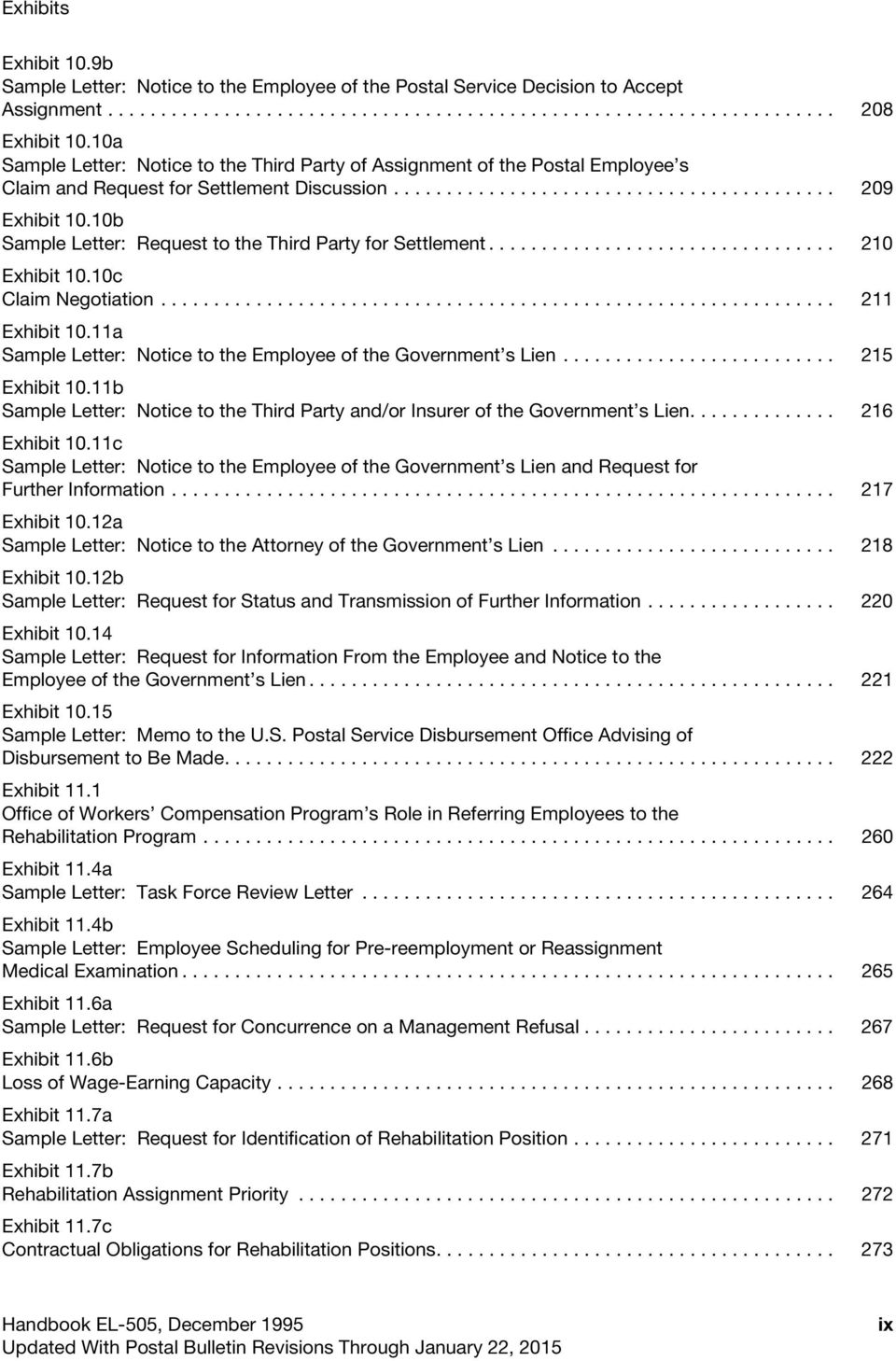
10 Injury Compensation Exhibit 11.8a Sample Modified Job Description Exhibit 11.8b Request for Medical Review of Proposed Job Description Exhibit 11.8c Sample Letter: Rehabilitation Program Job Offer Exhibit 11.9a Sample Letter: Employee Scheduling for Pre-reemployment or Reassignment Interview Exhibit 11.9b Pre-reemployment or Reassignment Employee Interview Checklist Exhibit 11.9c Restoration Rights and Benefits Exhibit 11.9d Retirement Considerations Exhibit 11.9e Questions and Answers on Retirement Credit for Time Spent in Receipt of Office of Workers Compensation Programs Benefits Exhibit 11.11a Sample Letter: Employee Report to Duty Exhibit 11.11b Sample Form 50 Actions Exhibit 11.11c OPM Notification of Reemployment of a Disability Annuitant Exhibit 11.16a Sample Letter: Post-reemployment or Reassignment Employee Interview Exhibit 11.16b Sample Post-reemployment or Reassignment Supervisor Interview Exhibit Sample Letter: Termination of Limited Duty Assignment for Refusal of In-House Rehabilitation Program Job Offer Exhibit 12.1a Disclosure Conditions Exhibit 12.1b Injury Compensation Privacy Act Log for Accounting of Disclosure Exhibit 12.4 Injury Compensation Computer Systems Exhibit 12.8 Noncompliant Response to a Subpoena Exhibit 13.1 COP/LWOP-IOD Timekeeping Work Sheet Exhibit 13.6 Regular Rural Routes Exhibit Timekeeping Codes x Handbook EL-505, December 1995

11 Exhibits Exhibit Leave Types Exhibit 13.14a Sample Letter: Personnel Notification Leave Without Pay Exhibit 13.14b Sample Letter: Personnel Notification Return to Duty Exhibit Third Party Court Appearance Exhibit 13.19a Sample Letter: Leave Buy Back Policy Exhibit 13.19b Sample Letter: Form Letter CA Exhibit 13.19c Application for Reinstatement of Leave (EN-1207) Handbook EL-505, December 1995 xi

12 Injury Compensation This page intentionally left blank xii Handbook EL-505, December 1995

13 Introduction Purpose of the Handbook Handbook EL-505, Injury Compensation, is a comprehensive guide to help injury compensation control office (ICCO) and designated control point personnel perform their jobs. In this handbook, we have attempted to compile and update all applicable U.S. Postal Service (USPS) regulations, policies, and guidelines into one user-friendly manual. The handbook serves as both a training tool and a reference guide. It covers many injury compensation (IC) issues, including: The history of the USPS Injury Comensation Program. Certain provisions of the Federal Employees Compensation Act (FECA). Staffing and supplying an ICCO. Responses to employee injuries. Claims management. Records management. Limited duty and rehabilitation. Legal issues surrounding injury compensatin. Using this handbook alone is not sufficient for the effective management of a USPS Injury Compensation Program. A complete list of supplementary IC resource materials is, therefore, included in Chapter 1. Finally, it is important to note that while responsible parties and means of implementation may vary from one installation to another, the USPS responsibilities and obligations set forth in the boxed portions of this guide and labeled Obligation are mandatory. How to Use the Handbook The Text This handbook comprises 13 chapters, each beginning with a brief overview of the topics covered. Chapter 1 is considered a reference chapter and should be used to answer fundamental questions concerning workers compensation. When a chapter is written for personnel in a specified Postal Service position, the relevant position is indicated. The words disabled and disability are found in many statutes, rules, and regulations. They are used by the Department of Labor, the Department of Veterans Affairs, the Equal Employment Handbook EL-505, December

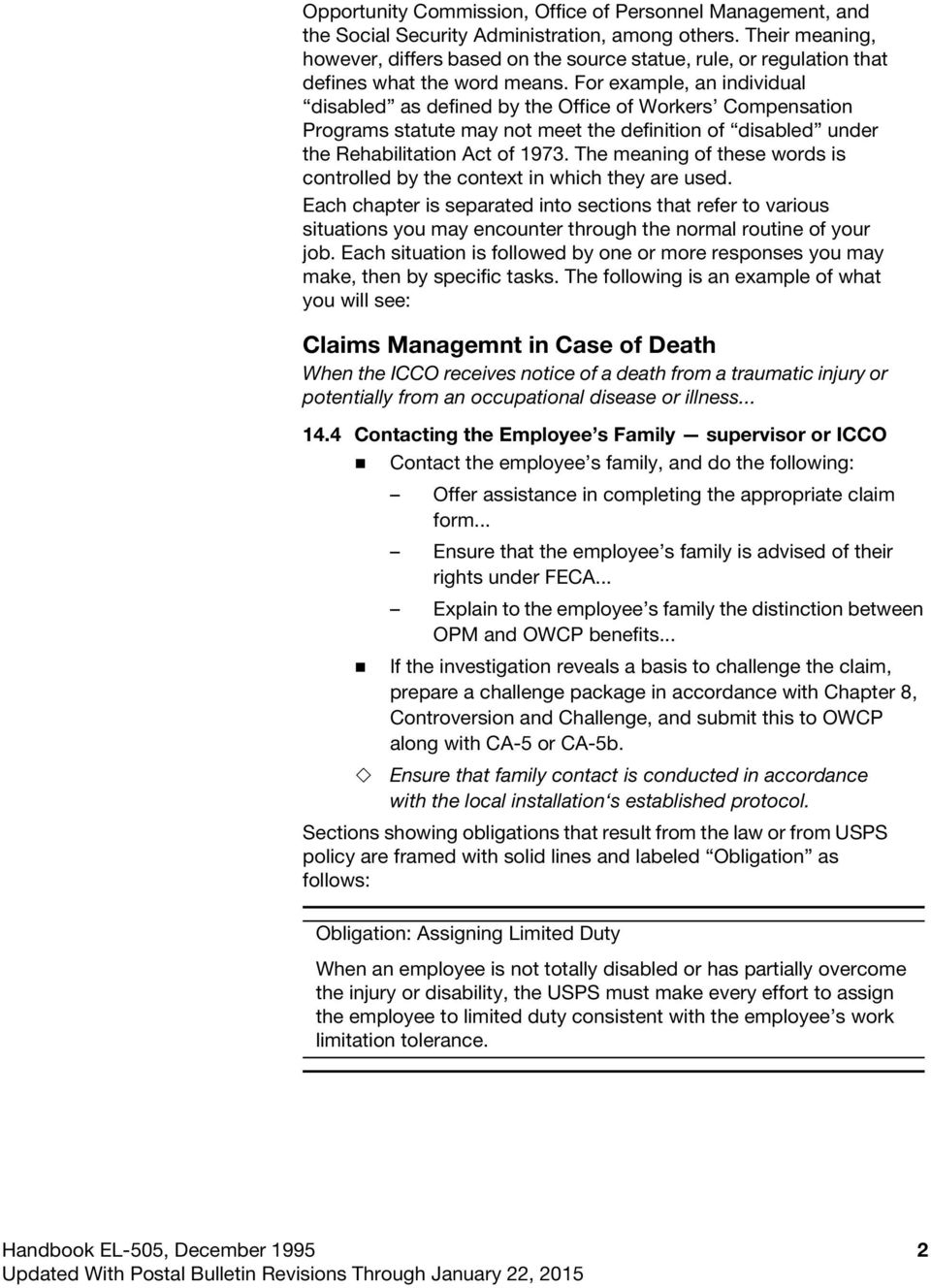
14 Opportunity Commission, Office of Personnel Management, and the Social Security Administration, among others. Their meaning, however, differs based on the source statue, rule, or regulation that defines what the word means. For example, an individual disabled as defined by the Office of Workers Compensation Programs statute may not meet the definition of disabled under the Rehabilitation Act of The meaning of these words is controlled by the context in which they are used. Each chapter is separated into sections that refer to various situations you may encounter through the normal routine of your job. Each situation is followed by one or more responses you may make, then by specific tasks. The following is an example of what you will see: Claims Managemnt in Case of Death When the ICCO receives notice of a death from a traumatic injury or potentially from an occupational disease or illness Contacting the Employee s Family supervisor or ICCO Contact the employee s family, and do the following: Offer assistance in completing the appropriate claim form... Ensure that the employee s family is advised of their rights under FECA... Explain to the employee s family the distinction between OPM and OWCP benefits... If the investigation reveals a basis to challenge the claim, prepare a challenge package in accordance with Chapter 8, Controversion and Challenge, and submit this to OWCP along with CA-5 or CA-5b. Ensure that family contact is conducted in accordance with the local installation s established protocol. Sections showing obligations that result from the law or from USPS policy are framed with solid lines and labeled Obligation as follows: Obligation: Assigning Limited Duty When an employee is not totally disabled or has partially overcome the injury or disability, the USPS must make every effort to assign the employee to limited duty consistent with the employee s work limitation tolerance. Handbook EL-505, December
15 Introduction Sections that provide information that will help you fulfill the tasks outlined are framed with dotted lines, for example: Assigning an Employee to Limted Duty When an employee has partially overcome the injury or disability, the USPS must make every effort toward assigning the employee to limited duty consistent with the employee s work limitation tolerance. The Appendixes Throughout the handbook, you will find references to appendixes. You will find these appendixes at the end of the handbook. They are labeled as follows: Appendix A, Abbreviations and Acronyms. Appendix B, Addresses. Appendix C, Definitions. Appendix D, Forms. Handbook EL-505, December

16 Injury Compensation This page intentionally left blank 4 Handbook EL-505, December 1995

17 1 The USPS Injury Compensation Program 1 The USPS Injury Compensation Program Overview Background Information History Purpose of the Federal Employees Compensation Act Family and Medical Leave Act Privacy Act Eligibility General Provisions of the Federal Employees Compensation Act Employee Entitlements Continuation of Regular Pay Compensation for Wage Loss Medical Care Vocational Rehabilitation Schedule Awards Compensation for Loss of Wage-Earning Capacity Death Benefits Attendant Allowance Cost-of-Living Adjustments Dual Benefits Third Party Liability Appeal Rights Withdrawal of a Claim Penalties Penalty for False Statement Penalty for False Claim Penalty for Refusal to Process Claim Penalty for Fraudulently Claiming or Obtaining Benefits Pending Disciplinary Action Relevant Provision of FMLA Responsibilities Office of Workers Compensation Programs, U.S. Department of Labor U.S. Postal Service Handbook EL-505, December

18 1 Injury Compensation Headquarters Area Offices Districts and Plants Control Offices Installations Claims Administration Hierarchy Resource Materials Regulations, Policies, and Procedures Forms and Notices Handbook EL-505, December 1995
19 1 The USPS Injury Compensation Program Overview This chapter provides basic information about the USPS Injury Compensation Program. It first highlights the history and various provisions of the Federal Employees Compensation Act (FECA). Then it describes the organization and staff responsibilities. The last part of the chapter lists valuable resource material to include in your injury compensation (IC) office. Background Information History The USPS Injury Compensation Program was established in 1978 after the USPS realized it needed to establish a program to deal with the escalating costs of workers compensation benefits. It is important to understand the history of FECA and the relationship between the USPS Injury Compensation Program and the Office of Workers Compensation Programs (OWCP). In 1908, President Theodore Roosevelt signed legislation to provide workers compensation for certain federal employees in unusually hazardous jobs. The scope of the law was very restricted, and its benefits were quite limited. However, it was the first workers compensation law to pass the constitutionality test of the U.S. Supreme Court. The Federal Employees Compensation Act (FECA), enacted in 1916, is a workers compensation law for civilian federal employees. Originally it included wage loss compensation, medical care, and survivors benefits provisions. An independent quasi-judicial Employees Compensation Commission administered the law. Administrative responsibility for FECA was assigned to the Department of Labor (DOL) in FECA is now administered by the Office of Workers Compensation Programs, Employment Standards Administration, U.S. Department of Labor. In 1974, FECA was amended, increasing benefits and significantly changing the law by adding provisions such as continuation of pay (COP) and claimant s choice of physician. The effect of this amendment eventually led to the establishment of the USPS Injury Compensation Program. Handbook EL-505, December

20 Injury Compensation Eligibility Purpose of the Federal Employees Compensation Act Family and Medical Leave Act Privacy Act FECA provides compensation benefits to civilian employees of the United States for disability because of personal injury or disease sustained while in the performance of duty. FECA also provides for the payment of benefits to dependents if a work-related injury or disease causes an employee s death. FECA is intended to be remedial in nature, and proceedings under it are nonadversarial. Provisions of the Family and Medical Leave Act (FMLA) cover some absences for job-related injuries or illnesses that also qualify as serious health conditions. Injury compensation records are maintained by the USPS within the privacy system of records identified as USPS (OWCP Record Copies) and (Injury Compensation Payment Validation Records). Under the provisions of the Postal Reorganization Act, 39 U.S.C. 1005(c), all employees of the USPS are covered by FECA. This coverage extends to all full-time, part-time, and temporary (including casual and transitional) employees, regardless of the length of time on the job or the type of position held. (Federal (FECA) Procedure Manual (FECA PM) 2-802) General Provisions of the Federal Employees Compensation Act Employee Entitlements Continuation of Regular Pay An employee s regular pay may be continued for up to 45 calendar days of wage loss because of disability and medical treatment following a traumatic injury. This is to ensure that the employee s income is not interrupted while the claim is being adjudicated. COP is not considered compensation and is therefore subject to income tax, retirement, and other deductions. After entitlement to COP is exhausted, the employee may apply for compensation or use leave. (20 CFR ; FECA PM 2-807) See Chapter 4, Claims Management. Chapter 13, Timekeeping and Accounting. Compensation for Wage Loss OWCP establishes the employee s pay rate for compensation purposes based on one of the following: Pay rate on date of injury. Date disability began. Date disability recurs if it is more than 6 months after the employee returns to full-time employment. 4 Handbook EL-505, December 1995
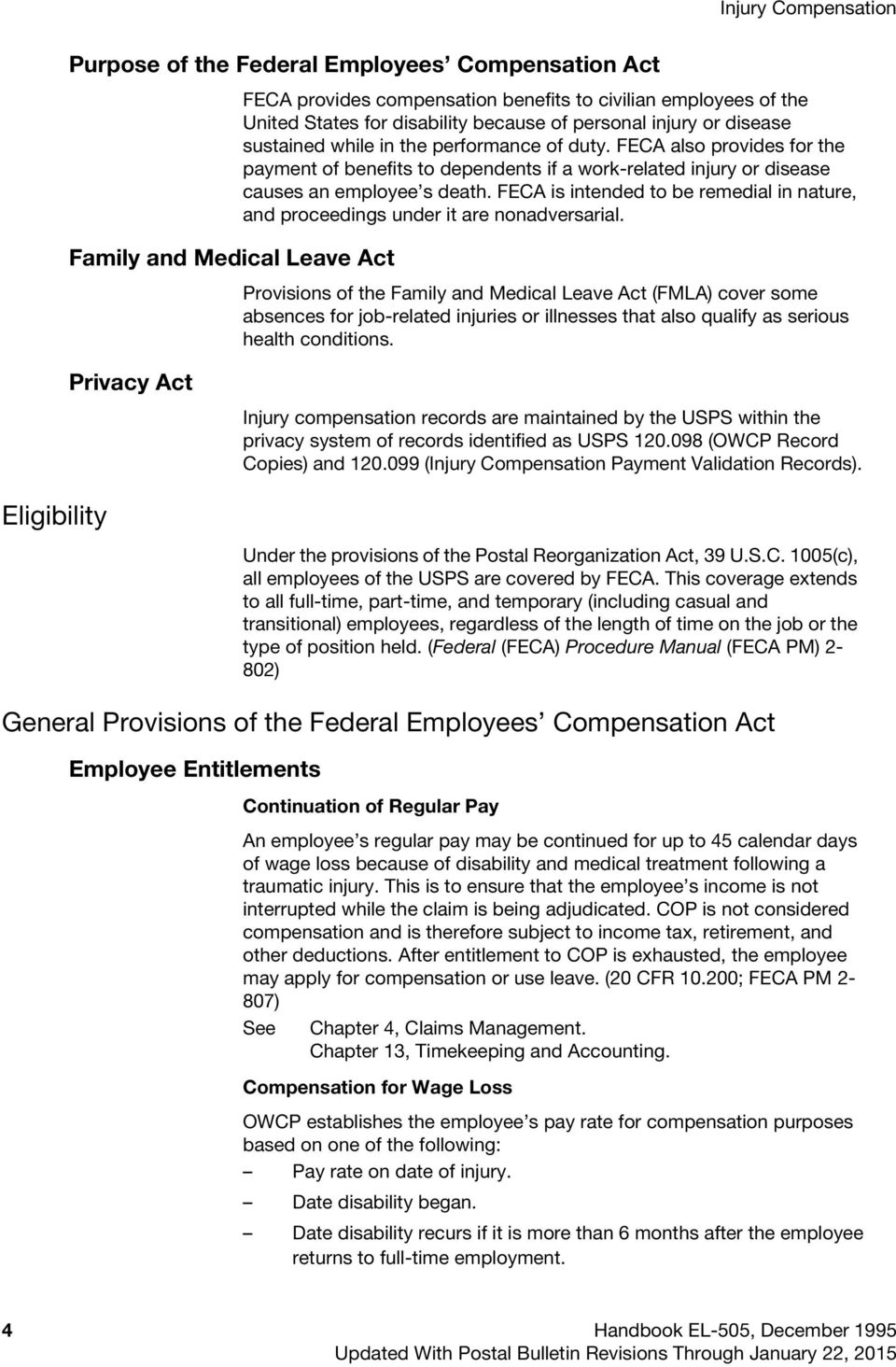
21 The USPS Injury Compensation Program In cases of total disability, an employee is entitled to compensation at the rate of 66 2/3 percent of the employee s established pay if there are no dependents, or 75 percent of the pay if there are one or more dependents. Pay may include additional amounts that may be included in salary, such as premium pay, night and Sunday differential, and costof-living allowance. Compensation payments for total disability may continue as long as the disability continues, which may mean the lifetime of the employee. There is no total dollar maximum. (20 CFR through 303; FECA PM 2-900) Medical Care If the claim is accepted as compensable under FECA, the injured employee is entitled to medical services. These include examinations, treatments, and related services such as hospitalization, medications, appliances, supplies, and transportation, as prescribed or recommended by qualified physicians that in the opinion of OWCP are likely to cure, give relief, or reduce the degree or the period of disability (see Appendix C, Definitions, for physician). However, preventive care may not be authorized. There is no dollar maximum or time limitation on medical care. It will be provided as long as the evidence indicates it is needed for the effects of the injury. (20 CFR Subparts E and F; FECA PM and Part 3, Medical Management, FECA PM) SEE Chapter 4, Claims Management. Chapter 6, Medical Management. Vocational Rehabilitation Rehabilitation services may be arranged to assist in training for work that the claimant can perform if the injured employee suffers a job-related handicap because of the injury and cannot resume usual employment. Rehabilitation service is supervised by OWCP but is usually provided in cooperation with state or private rehabilitation agencies. When rehabilitation is under way, OWCP may provide a monthly maintenance allowance not to exceed $200 in addition to compensation for wage loss. (20 CFR ; FECA PM 2-813; OWCP PM) SEE Chapter 11, Rehabilitation Program. Schedule Awards Compensation is provided for permanent loss or loss of use (either partial or total) of certain internal organs, members, or functions of the body such as arms, legs, hands, feet, fingers, toes, or eyes and loss of hearing or loss of vision. Schedule awards may be paid for different body parts. Each extremity has been rated for a specific number of weeks of compensation. If a serious disfigurement of the head, face, or neck results from a job-related injury, an award may also be made for such disfigurement. Schedule awards may be paid concurrently with Office of Personnel Management s (OPM) retirement benefits. Schedule awards can be paid even if the employee returns to work or is no longer under actual medical care. Employees may not, however, receive wage loss compensation and schedule award benefits concurrently for the same injury. If an employee sustains a period of Handbook EL-505, December
22 Injury Compensation temporary total disability during the course of the award, the award may be interrupted to pay for the period of disability. The schedule award resumes after the employee returns to work. If an employee dies during the course of a schedule award from causes unrelated to the compensable injury, his or her dependents are entitled to the balance of the award at the rate of 66 2/3 percent of the employee s established pay. (20 CFR ; FECA PM 2-808) Compensation for Loss of Wage-Earning Capacity When an injured person suffers a wage loss because of a disability that is less than total, compensation may be paid for loss of wages or wageearning capacity (LWEC). The injury compensation control office (ICCO) may request that an LWEC determination be made by the OWCP claims examiner if sufficient medical evidence indicates that an individual who is receiving compensation has attained maximum medical improvement, is unable to return to the position held at the time of injury (or to earn equivalent wages), and is not totally disabled for all gainful employment. If the employee is reemployed at a job paying less than the original position, or if it is determined that he or she can perform the duties of a specific job that is deemed suitable by OWCP, compensation will be payable based on the LWEC determination. (20 CFR ; FECA PM 2-813) SEE Chapter 11, Rehabilitation Program. Death Benefits In the event of death because of employment, FECA provides up to $800 for funeral and burial expenses. If the employee dies away from his or her place of residence, the cost of transporting the body to the place of burial is paid in full. In addition, a $200 allowance is paid for administrative costs of terminating a decedent s employee status with the federal government. Survivors are entitled to benefits in the form of compensation payments: A surviving spouse with no eligible children is entitled to compensation at the rate of 50 percent of the deceased employee s salary. Benefits are paid to the spouse until death or remarriage before age 55. If a spouse under age 55 remarries, OWCP makes a lump-sum payment equal to 24 times the monthly compensation at the time of remarriage. The benefits of a spouse who remarries after the age of 55 are not affected by the marriage. If children are eligible in addition to the spouse, the spouse may receive compensation equal to 45 percent of the employee s regular pay, plus an additional 15 percent for each child, to a maximum of 75 percent of the deceased employee s regular pay. The children s portion is paid on a share and share alike basis. Eligible children include: An unmarried child under the age of 18, or over the age of 18 who is incapable of self-support because of mental or physical disability. A child between 18 and 23 years of age who has not completed 4 years of post high school education and is regularly pursuing a fulltime course of study. 6 Handbook EL-505, December 1995
23 The USPS Injury Compensation Program If the deceased employee leaves no spouse, the first child is entitled to 40 percent and each additional child is entitled to 15 percent of the employee s salary up to a maximum of 75 percent, payable on a share and share alike basis. Other surviving dependents may be entitled to compensation benefits at various percentages according to degree of dependence. Monthly payments for all beneficiaries cannot exceed 75 percent of the employee s monthly pay rate or 75 percent of the top step of a GS-15 salary, whichever is less. Other persons who may qualify are dependent parents, brothers, sisters, grandparents, and grandchildren. However, the surviving spouse and children have first priority. (20 CFR and.307; FECA PM 2-700; Publication CA-810, Injury Compensation for Federal Employees) SEE Chapter 4, Claims Management. Attendant Allowance Employees who are injured so severely that they are unable to meet their own physical needs such as feeding, bathing, or dressing may qualify to receive an attendant s allowance up to a maximum of $1,500 per month. This allowance may be paid in addition to compensation for wage loss. (20 CFR , FECA PM 2-807, Publication CA-810, Chapter 7, Compensation Benefits) Cost-of-Living Adjustments Compensation benefits are increased by the applicable consumer price index effective March 1 each year for all beneficiaries who have been in receipt of benefits for more than 1 year prior to that date. Dual Benefits FECA prohibits payment of compensation and certain other federal benefits at the same time. Office of Personnel Management (OPM). Except for schedule awards, a person may not receive disability benefits from OWCP concurrently with a regular or disability annuity (either Civil Service Retirement System (CSRS) or Federal Employees Retirement System (FERS)) nor may a person receive death benefits from OWCP concurrently with a survivor s annuity (either CSRS or FERS). Therefore, a beneficiary who is entitled to both benefits must elect between them. Department of Veterans Affairs (VA). Beneficiaries who receive compensation from the VA may also be required to elect between the benefits paid by that agency and those paid by OWCP. An election is required between VA and FECA benefits if a VA award is increased because of the compensation injury. The election is only between the increase and FECA benefits. Social Security Administration (SSA). An employee or the employee s survivor may receive Social Security payments payable on account of nonfederal employment and OWCP benefits at the same time, subject to income limitations imposed by the SSA. For FERS employees, any portion of SSA old age retirement or death benefits attributable to an employee s federal service is deducted from compensation payable. Handbook EL-505, December
24 Injury Compensation Third Party Liability Other Federal Income. An employee or the employee s survivor may receive compensation concurrently with military retired pay, retirement pay, retainer pay, or equivalent pay for service in the armed forces or other uniformed services subject to reduction of such pay in accordance with 5 U.S.C (b). An employee may receive severance pay concurrently with compensation for a schedule award or for loss of wage-earning capacity but not with compensation for temporary total disability. Finally, an employee may receive unemployment compensation benefits concurrently with OWCP benefits. In instances in which an employee s injury or death in the performance of duty occurs under circumstances creating a legal liability on some person or party other than the U.S. government, the employee (or survivor in the case of death) is encouraged to pursue a third party claim. An employee who refuses to pursue recovery from a liable third party after being asked to do so by the DOL may be denied compensation. The USPS may assist in obtaining a settlement. An employee who sustains a job-related injury cannot recover damages from the United States for the effects of the injury except through FECA. (20 CFR Subpart G; FECA PM ) SEE Chapter 10, Third Party Liability. Appeal Rights If an employee or the survivors disagree with the final determination made by OWCP, a hearing may be requested to give the claimant an opportunity to present evidence in further support of the claim or ask that the claim be reconsidered by the OWCP district office. Also, there is a provision for additional review by OWCP and a right to appeal to the Employees Compensation Appeals Board (ECAB), a separate entity of DOL. Three avenues of appeal are provided for employees; the USPS is not entitled to appeal. Only one type of appeal may be requested by the employee at a time. The types of appeal include: Hearing. The employee is entitled to either an oral hearing before an office representative or a review of the written record (but not both) as long as the request is made within 30 days of the formal decision and reconsideration has not already been requested. The employee may change his or her hearing request in writing within 30 days of OWCP s acknowledgment of the initial request. Reconsideration. The employee may request OWCP to reconsider a formal decision made by the district office. The request should clearly and concisely state the ground on which it is based and should be substantiated by relevant evidence not previously submitted. A reconsideration must be requested within 1 year of the date the contested formal decision was issued. Employees Compensation Appeals Board (ECAB) Review. The employee may request review by ECAB, the highest authority in FECA claims. ECAB s review is based solely upon the case record at the time of the formal decision. New evidence is not considered by ECAB. 8 Handbook EL-505, December 1995
25 The USPS Injury Compensation Program Withdrawal of a Claim Employees residing within the U.S. or Canada have 90 days from the date of decision to file for review. Employees residing outside the U.S. or Canada must file within 180 days of the date of decision. For good cause shown, ECAB may waive a failure to file an application within 90 days or 180 days, but no more than one year from the date of the final decision. (20 CFR through 139; FECA PM through1603) SEE Chapter 8, Controversion and Challenge. All employees claim forms (CA-1, Federal Employee s Notice of Traumatic Injury and Claim for Continuation of Pay/Compensation, and CA-2, Notice of Occupational Disease and Claim for Compensation) are official records of the OWCP and not the USPS. (20 CFR 10.10) Employees who desire to withdraw a claim on these or any other official OWCP forms should be referred to OWCP. Penalties Penalty for False Statement Any employee, supervisor, or representative who knowingly makes a false statement with respect to a claim under FECA may be subject to a fine of not more than $10,000 or 5 years in prison, or both. (20 CFR 10.23) Penalty for False Claim Any employee, supervisor, or representative who, with respect to a claim under FECA, enters into any agreement to obtain the payment or allowance of any false or fraudulent claim may be subject to a fine of not more than $10,000 or 10 years in prison, or both. (20 CFR 10.23) Penalty for Refusal to Process Claim Any employee or supervisor responsible for making reports in connection with an injury who willfully fails, neglects, or refuses to do so; induces, compels, or directs an injured employee to forego filing a claim; or willfully retains any notice, report, or paper required in connection with an injury may be subject to a fine of not more than $500 or 1 year in prison, or both. (20 CFR 10.23) Penalty for Fraudulently Claiming or Obtaining Benefits Claimants convicted of fraudulently claiming or obtaining benefits under FECA cited in Public Law , effective 9/30/94, lose entitlement to medical benefits, compensation for wage loss, and any other benefits payable under FECA. (20 CFR 10.23) Pending Disciplinary Action USPS administrative disciplinary action must not be delayed based on current claim status. Relevant Provision of FMLA An employee may be on a workers compensation absence because of a job-related injury or illness that also qualifies as a serious health Handbook EL-505, December
26 Injury Compensation condition under FMLA. The workers compensation absence and FMLA leave may run concurrently (subject to proper notice and designation by the employer). At some point the health care provider providing medical care pursuant to the workers compensation injury may certify the employee is able to return to work in a limited duty position. If the employer offers such a position, and the employee does not accept the position, the employee may no longer qualify for workers compensation benefits, but the employee is entitled to continue on unpaid FMLA leave either until the employee is able to return to the same or equivalent job the employee left or until the 12-week FMLA leave entitlement is exhausted. Responsibilities Office of Workers Compensation Programs, U.S. Department of Labor U.S. Postal Service OWCP has the exclusive authority (except as otherwise provided by law) for the administration, implementation, and enforcement of FECA. Its main responsibility is to determine whether the claimant is entitled to benefits under FECA. Claim decisions, determinations, and adjudications are made in the name of, or for, the director of OWCP. Responsibility for FECA is vested in 12 OWCP district offices. The locations and jurisdiction of these offices are identified in Appendix B, Addresses. Headquarters The manager of Safety and Risk Management: Establishes policy and procedures through the vice president of Human Resources (HR). Coordinates and provides technical guidance in field activities to ensure uniform management of the program. Identifies training needs for those involved in administering the program. Coordinates efforts with DOL in conjunction with the USPS responsibilities under FECA. Provides reports to postal management at all levels about the status of the program. Identifies program initiatives to enhance effective program management. Area Offices Area HR managers: Implement the national Injury Compensation Program policies and directives. Oversee areawide program activities to ensure compliance with national policies and guidelines. 10 Handbook EL-505, December 1995
27 The USPS Injury Compensation Program Area HR analysts for injury compensation: Advise Headquarters on the status of the Injury Compensation Program within the area and assist in the administration of policy, programs, and procedures that affect the program. Provide technical assistance and guidance to Customer Services and Sales (CSS) districts and Processing and Distribution (P&D) centers, satellite offices, and their assigned ICCO personnel in relation to the program. Manage and oversee cost-reduction initiatives and case management techniques. Define area goals and objectives within the guidelines established by Headquarters. Districts and Plants Customer Service and Sales district HR managers: Implement Headquarters and area program policies, objectives, and action plans within the district boundaries. Ensure that authorized IC positions are staffed, sufficient ICCO staff (HR specialists) are assigned and trained (see pp. 2 through 4), and appropriate control point personnel are designated. Managers of P&D centers, bulk mail centers (BMCs) and air mail centers: Implement the objectives and policies of the program within the operations under their jurisdiction. Ensure that control point personnel are designated, where appropriate. Control Offices ICCOs are physically located at district offices and selected satellite offices. They are supervised by a senior IC specialist and staffed by a designated number of HR specialists and, in some offices, HR associates. Senior IC specialists: Oversee program administration within the district boundaries. Supervise ICCO activities. Assist management in the selection and designation of ICCO or control point personnel. Ensure that ICCO or control point personnel are properly trained. ICCO personnel: Administer and control all aspects of the Injury Compensation Program within the domiciling installation and defined area of responsibility. Installations Control point personnel are designated by the installation head (or functional manager in large installations). At least one control point person must be designated for each tour of operation. Control points report functionally to either the senior IC specialist or to the designated ICCO in program matters. Control point personnel (all management levels): Handbook EL-505, December
28 Injury Compensation Authorize medical treatment in accordance with CFR (a). Review medical documentation to determine employee s duty status. Coordinate activities of first-line supervisors relative to claims management efforts. First-line supervisors: Perform claims management activities immediately following the injury. Investigate the circumstances surrounding the injury. Conduct all necessary coordination and follow up with designated control point supervisors and ICCOs. Employees: Fulfill their obligations as set forth in this chapter. Claims Administration Hierarchy Claims administration responsibility always rests with the ICCO at a management level above that of the injured employee. Designated ICCO-employee relationships are as follows: Employee Craft employees Supervisors Postmasters District managers and direct manager reports Plant managers All full-time and collateral IC personnel Area managers Headquarters and Headquarters-related units (unless otherwise advised) Control Level District Area Headquarters Resource Materials Regulations, Policies, and Procedures This handbook is a compilation of various USPS-issued regulations, policies, and procedures. However, because of the nature and complexity of the Injury Compensation Program, the handbook in itself is not sufficient for the effective management of this program. To effectively manage the program, IC personnel should establish a reference library including, but not limited to, the documents listed below. The Federal Employees Compensation Act, as amended, 5 U.S.C. 8101, et seq. Copies of FECA may be obtained from the OWCP district office. Code of Federal Regulations, 20 CFR 10 The Code of Federal Regulations (CFR) describes the provisions of the law and contains additional information concerning administration of the 12 Handbook EL-505, December 1995
29 The USPS Injury Compensation Program program. Part 10 provides helpful information for developing local procedures and responding to local inquiries. Copies may be obtained from the OWCP district office. Federal (FECA) Procedure Manual, Part 2, Claims The FECA PM describes the procedures used by OWCP personnel in processing claims. This manual can be of great assistance in determining whether to controvert or challenge a claim in some questionable cases. Periodic revisions made by OWCP are distributed by USPS Headquarters and area offices. For optimum benefit, it is imperative that this manual be updated with current information. Requests for a copy should be directed to: DIVISION OF FEDERAL EMPLOYEES COMPENSATION OFFICE OF WORKERS COMPENSATION PROGRAMS 200 CONSTITUTION AVE NW WASHINGTON DC Federal (OWCP) Procedure Manual, Part 3, Rehabilitation The Federal (OWCP) Procedure Manual (OWCP PM) contains procedures for OWCP s vocational rehabilitation program. Like the FECA PM, the OWCP PM provides insight into the criteria followed by OWCP. Ordering and maintenance procedures for this manual are the same as cited for the FECA PM. Pamphlet CA-550, Questions and Answers About the Federal Employees Compensation Act Describes in nontechnical language the basic provisions of the law and includes information concerning the most common issues about entitlement and claims processing. It is intended for use primarily by employees. Copies may be ordered from material distribution centers. Decisions of the Employees Compensation Appeals Board ECAB is the highest authority for appeals review in federal workers compensation claims. Board decisions are often precedent setting and can result in revision of guidelines by OWCP. A familiarity with ECAB decisions, particularly high-profile decisions, is extremely helpful when preparing controversion and challenge packages. Copies of relevant ECAB decisions are disseminated by USPS Headquarters and area offices. Decisions and summaries are also available in various formats from private contractors. Publication CA-810, Injury Compensation for Federal Employees, February 1994 Publication CA-810 was prepared by OWCP and is intended to serve as a handbook for all federal agencies. It provides basic information regarding the administration of FECA. Like 20 CFR, Part 10, this publication can be extremely helpful when developing local procedures and responding to local inquiries. Handbook EL-515, Joint Rehabilitation Guidelines, May 1992 Handbook EL-515 was a joint venture by the USPS and DOL to provide procedures and guidelines for rehabilitation program efforts. Handbook EL-505, December
30 Injury Compensation Employee and Labor Relations Manual 540, Special Postal Bulletin, August 2, 1990 The Employee and Labor Relations Manual (ELM) 540 was prepared by the USPS. It lists policies and procedures in compliance with FECA and its related regulations. Administrative Support Manual 353, Privacy Act The Administrative Support Manual (ASM) 353 includes instructions for applying the Privacy Act and the USPS regulations that implement it. Those who handle IC case files and payment records must be familiar with their Privacy Act responsibilities. Management Instruction EL , Job-Related First-Aid Injuries This management instruction provides policies and procedures for reporting injuries to OWCP, for determining choice of physician, and for paying medical bills to contract physicians for initial treatment of jobrelated first-aid injuries. Publication 540, A Guide for Managing Injuries, November 1994 Publication 540 provides guidance to field managers in establishing or supplementing procedures for the early management of IC claims. Handbook F-21, Time and Attendance, October 7, 1988, and Handbook F-22, PSDS Supervisor s Guide, May 1992 These handbooks address specific pay issues relevant to injured workers. Forms and Notices Many forms are used to collect information needed in the administration of the Injury Compensation Program, some from OWCP, and some from the USPS. It is important for IC personnel to be aware of their uses and comply with the required time frames for submitting them. CA-1, Federal Employee s Notice of Traumatic Injury and Claim for Continuation of Pay/Compensation The CA-1 notifies management of a traumatic injury and serves as the report to OWCP, when needed. The employee, or someone acting in his or her behalf, should submit the CA-1 to the supervisor as soon as possible following injury but no later than 30 days for COP entitlement. Statutory requirements will be met for FECA benefits if the CA-1 is filed within 3 years from the injury. The supervisor should submit this form to the ICCO within 24 hours from receipt from the employee. The ICCO must submit this form to OWCP within 10 working days from the date received by the supervisor (or other postal official) from the employee. CA-2, Notice of Occupational Disease and Claim for Compensation The CA-2 notifies management of an occupational illness or disease and serves as the report to OWCP, when needed. 14 Handbook EL-505, December 1995
31 The USPS Injury Compensation Program Statutory requirements will be met if filed within 3 years from date of awareness. The supervisor submits this form to the ICCO within 24 hours. The ICCO submits this form to OWCP within 10 working days from the date received by the supervisor or other postal official. CA-2a, Federal Employee s Notice of Recurrence of Disability and Claim of Pay/Compensation The CA-2a notifies management and OWCP that an employee, after returning to work, is again disabled because of a prior injury or occupational illness. It also serves as a claim for continuation of pay or for compensation. Immediately upon notification, the ICCO or the supervisor provides the employee with CA-2a. The employee completes Part A and returns the form. If received by the supervisor, the form must be submitted to the ICCO within 24 hours. The ICCO submits this form to OWCP within 10 working days from receipt of the form from the employee. CA-3, Report of Termination of Disability and/or Payment The CA-3 notifies OWCP that the employee has returned to work and/or that continuation of pay has terminated. Immediately upon the employee s return to work, the ICCO submits the CA-3 to OWCP. The CA-3 is the preferred form recognized by both agencies even though the employee s return to work may be reported on the CA-7 or the CA-17. CA-5, Claim for Compensation by Widow, Widower, and/or Children The CA-5 serves as the official notice to the OWCP of the surviving widow s, widower s, and/or children s claim for compensation because of the employee s death which resulted from a job-related injury. Upon notification, the ICCO provides the appropriate dependent with the form. The dependent, or representative, should complete the form within 30 days (but no later than 3 years after death) and return it to the ICCO. (If death resulted from an injury for which a disability claim was timely filed, the time requirements for filing the death claim have been met.) CA-5b, Claim for Compensation by Parents, Brothers, Sisters, Grandparents, or Grandchildren The CA-5b provides claims compensation for specified dependents when the injury results in the employee s death. The ICCO submits the CA-5b to OWCP within 10 working days from date of receipt from the dependent. The time requirements for CA-5b are the same as for CA-5. CA-6, Official Superior s Report of Employee s Death The CA-6 notifies OWCP of the employment-related death of an employee. The ICCO submits the CA-6 to OWCP within 10 working days after knowledge of the job-related death. Handbook EL-505, December
32 Injury Compensation CA-7, Claim for Compensation on Account of Traumatic Injury or Occupational Disease The CA-7 is used to claim compensation if (1) injury has resulted in permanent impairment involving the total or partial loss, or loss of use, of certain parts of the body or serious disfigurement of the face, head, or neck; or (2) medical evidence shows disability is expected to continue beyond the COP period in traumatic cases and results in wage loss. When disability is expected to extend beyond the COP period in traumatic injury cases, the ICCO provides the employee with a CA-7 10 days before the end of the COP period. The employee is instructed to complete his or her portion, have the attending physician complete the CA-20. The ICCO submits the completed CA-7 to OWCP not less than 5 working days before termination of COP. In occupational disease or illness cases, a CA-7 should be submitted along with the CA-2 if the disability is being claimed at that time. In other instances, the CA-7 is completed and submitted to OWCP not more than 5 days after the period claimed by the employee. CA-8, Claim for Continuing Compensation on Account of Disability The CA-8 provides claims compensation when disability continues beyond the time covered by the claim filed on the CA-7. CA-8s are filed on a recurring basis (usually every 2 weeks) until advised otherwise by OWCP. If disability is expected to continue, the ICCO provides the employee with the CA-8 at least 10 days before the end of the time indicated on either the CA-7 or the previous CA-8. The employee completes his or her portion, and has the attending physician complete the CA-20a. The ICCO submits the completed CA-8 to OWCP at least 5 days before the end of the period claimed on the CA-7 or the previous CA-8. CA-10, What a Federal Employee Should Do When Injured at Work The CA-10 provides employees with information regarding their rights, responsibilities, and benefits under FECA. The CA-10 is to be posted on employee bulletin boards. CA-11, When Injured at Work This pamphlet provides facts about medical benefits, disability, compensation for death, and other entitlements for civilian employees of the federal government. The CA-11 should be handed out during employee orientation. CA-13, Work Injury Benefits for Federal Employees The CA-13 is a card for federal employees to carry in their wallets as a reference. It provides instructions for employees and their families in the event of an employment-related injury or death. The CA-13 should be handed out during employee orientation. CA-16, Authorization for Examination and/or Treatment The CA-16 authorizes an injured employee to obtain examination and/or treatment for up to 60 days and provides OWCP with an initial medical report. 16 Handbook EL-505, December 1995
33 The USPS Injury Compensation Program The CA-16 forms are issued by the ICCO or trained control point personnel only. The CA-16 must be promptly issued within 4 hours in traumatic injuries requiring medical attention, except first-aid injuries where the employee has elected treatment by a contract medical provider. CA-16s are rarely used for occupational illness or disease claims and only with prior OWCP approval. If the employee chooses to select a contract medical provider beyond first-aid treatment, the CA-16 should be issued in accordance with FECA for the employee s selection of the contract medical provider as the employee s treating physician. CA-17, Duty Status Report The CA-17 provides management and OWCP with an interim medical report containing information as to the employee s ability to return to any type of work. Initially issued by the supervisor at the time of injury, subsequent issuances are performed by either the ICCO or control point personnel. The employee is responsible for having the attending physician complete the CA-17 at each visit when there is a change in medical condition and for its prompt return to the ICCO or control point. The ICCO submits the completed form to OWCP within 10 days from date of receipt. CA-20, Attending Physician s Report The CA-20 provides medical support for claims and is attached to the CA-7, which provides the ICCO and OWCP with medical information. The CA-20 is initially issued by the supervisor at the time of injury when the CA-16 is not used and when the injury is not a first-aid injury treated by a contract medical provider. Subsequent issuances are the same as for the CA-17. CA-20 must be submitted promptly to OWCP upon completion of most recent examination or treatment. CA-20a, Attending Physician s Supplemental Report The CA-20a provides OWCP with additional medical information in connection with a supplemental claim filed on an attached CA-8. A corresponding CA-20a is to be submitted with each CA-8 filed. The CA- 20a must be submitted promptly to OWCP upon completion of most recent examination or treatment. Evidence Required in Support of a Claim for 35A, Occupational Disease 35B, Work-Related Hearing Loss 35C, Asbestos-Related Illness 35D, Work-Related Coronary/Vascular Condition 35E, Work-Related Skin Disease 35F, Work-Related Pulmonary Illness (not asbestosis) 35G, Work-Related Psychiatric Illness 35H, Work-Related Carpal Tunnel Syndrome The 35A-through-H series of forms provides employee and management with a checklist of information required from both parties in order for OWCP to adjudicate the respective occupational illness or disease claim. Handbook EL-505, December
34 Injury Compensation These forms should be submitted with the CA-2. HCFA-1500, Health Insurance Claim Form This form provides OWCP with a standard billing form to facilitate payment of medical bills. The HCFA-1500 is issued along with the CA-16, the CA-20, and the CA- 17 when the employee is scheduled for medical examination and/or treatment. Form 2491, Medical Report First-Aid Injuries Form 2491 provides management with a medical report containing information regarding the employee s ability to return to work. This form is used in lieu of the CA-16/20 and the CA-17 when the employee is being treated for a first-aid injury by a contract medical provider. Form 2491 is issued by the ICCO or control point personnel or the supervisor at the time of injury (initial examination or treatment) and follow-up visit. Form 2556, Third Party Statement of Recovery Form 2556 provides OWCP and the USPS with a breakdown of disbursements made from monies recovered from a third party pursuit. This form is used when the employee is represented by an attorney or has assigned the action to the USPS. When the employee is represented by an attorney, the ICCO issues this form directly to the attorney upon notification. Upon the employee s recovery, the form must be completed promptly and forwarded to OWCP with a check for the government s lien by the ICCO. Form 2557, Employee s Third Party Recovery Statement Form 2557 provides OWCP and the USPS with a breakdown of monies recovered by the employee when pursuing his or her own third party action. The ICCO issues this form promptly to the employee upon notification that he or she is pursuing his or her own action. Upon recovery, the employee returns the form to the ICCO, along with a check for the government s lien, for prompt referral to OWCP. Form 2559, Third Party Claim Information Request Form 2559 provides information about the employee s action (or intended action) regarding the pursuit of a third party action. This form is issued by the ICCO when the employee s response on Form 2562 was negative or undecided. Form 2560, Referral of Third Party Material This form is the cover letter for the transmittal of third party documents and information. It is used by the ICCO when forwarding third party material. Form 2562, Injury Compensation Program Notice of Potential Third Party Claim Form 2562 provides general information regarding a potential third party and the employee s intent. 18 Handbook EL-505, December 1995
35 The USPS Injury Compensation Program This form is issued by the ICCO to the employee upon notification of a possible third party liability. The employee promptly completes the form and returns it to the ICCO for referral to OWCP. Form 2573, Request OWCP Claim Status Form 2573 provides a standard format for requesting general claim status information from OWCP. The form is used by the ICCO when needed. Form 2577, Assignment of Claim to the USPS Form 2577 provides the USPS with the authority to pursue a third party recovery. This form is issued by the ICCO to the employee upon notification of the employee s lack of intent to take personal action. If in agreement, the employee completes and returns the form to the ICCO for referral to OWCP. Publication 71, Notice for Employees Requesting Leave for Conditions Covered by the Family and Medical Leave Act When an employee is absent from work because of an FMLA-covered injury or illness, a copy of Publication 71 is given to him or her along with the modified letter called Employee Rights, Responsibilities, and Choice of Physician (see Exhibit 3.5b). Handbook EL-505, December
36 Injury Compensation This page intentionally left blank 20 Handbook EL-505, December 1995
37 2 Injury Compensation Office Setup 2 Injury Compensation Office Setup Overview Procedures Injury Compensation Unit Authorizing Injury Compensation Positions district HR manager Supplying an Adequate Stock of Forms, Sample Letters, and Supplies senior IC specialist Supplying Office Equipment district HR manager Centralizing the Processing of IC Forms and Paperwork and the Management of Claims district HR manager or senior IC specialist Handbook EL-505, December
38 Injury Compensation This page intentionally left blank 26 Handbook EL-505, December 1995
39 2 Injury Compensation Office Setup Overview The injury compensation (IC) office or unit serves as the injury compensation control office (ICCO). To effectively manage the Injury Compensation Program and control compensation costs, the IC unit must: Be organized in a manner that centralizes the processing of administrative paperwork. Promote efficiency through the training of IC personnel as well as managers and supervisors. Facilitate the administrative duties and responsibilities of IC personnel by utilizing the Human Resource Information System (HRIS) and the Workers Compensation Information Subsystem (WCIS). Be large enough to accommodate file cabinets and a lektriever and have at least one conference area to allow for privacy while interviewing employees or preparing and discussing individual compensation cases. Because of the complexities of IC policies, procedures, and regulations, the unit should have all resource materials identified in Chapter 1 available for guidance and reference. Handbook EL-505, December
40 Injury Compensation Procedures Injury Compensation Unit When forming an injury compensation unit Authorizing Injury Compensation Positions district HR manager Fill the following authorized IC positions: Senior IC specialist. HR specialists. HR associates. Clearly define all duties and responsibilities of IC personnel so they will be held accountable for their specific areas, programs, and compensation cases. 28 Handbook EL-505, December 1995
41 Injury Compensation Office Setup Supplying an Adequate Stock of Forms, Sample Letters, and Supplies senior IC specialist Supply your unit with the following forms: All CA and PS forms identified in Chapter 1. Leave repurchase forms. Form 2240, Pay, Leave, and Other Hours Adjustment Request. Form 2243, PSDS Hours Adjustment Record. Form 3971, Request for or Notification of Absence. SEE Appendix D, Forms. Supply your office with the following correspondence: Limited duty accommodations/acceptance or rejection of limited duty (see exhibits in Chapter 7, Limited Duty Program Management). Leave repurchase policy notification (see Exhibit 4.19b, Sample Letter: Leave Buy Back Policy). COP authorization (see Chapter 4, Claims Management). Third party liability letters (see exhibits in Chapter 10, Third Party Liability). Health benefit refund (see Chapter 4, Claims Management). Basic controversion letter (see exhibits in Chapter 8, Controversion and Challenge). Furnish your office with the following office supplies: Sturdy file folders with two-pronged fasteners on both sides. Do not use official personnel folders (OPFs). Copy paper, legal pads, pencils, pens, paper clips, stapler, etc. Bulletin board. Handbook EL-505, December
42 2-3 Injury Compensation 2-3 Supplying Office Equipment district HR manager Supply your office with the following office equipment: Desks with telephones. Facsimile machine. Telephone answering machine. Computers and printers. Electric typewriter (optional, depending on computer capability). Copy machine. Document shredder. File cabinets and lektriever. Partitions. 30 Handbook EL-505, December 1995
43 Injury Compensation Office Setup Centralizing the Processing of IC Forms and Paperwork and the Management of Claims district HR manager or senior IC specialist Ensure that IC personnel receive proper training for effective claims management and program administration. Arrange to assign the claims equitably among members of the staff. One common way to assign claims is to split the alphabet between staff members and assign claims according to the last initial of the claimant. Prepare a comprehensive IC policy and procedure statement to be incorporated in an accident kit so that managers and supervisors will know what to do when an injury occurs. Establish a procedure for the: Main office. Station or branches. Associate offices. Other detached units such as vehicle maintenance facilities (VMFs) and bulk mail centers (BMCs). The IC policy must: Require immediate notification of injury: Injured employees must notify their supervisor if medically able to do so. The supervisor must notify the IC unit. Record essential information on answering machine tape during IC unit off-tour hours. Ensure that injured employees receive immediate medical attention following an injury or illness. Ensure that injured employees are informed of their rights and responsibilities, and that entitlements are authorized. Require that all claim forms and related paperwork be submitted through the unit within the specific time frame (normally as soon as possible, but no later than 2 days after receipt from the employee). Ensure that the employee s duty status is ascertained. Ensure that limited duty is made available and offered. OWCP and USPS Training Courses IC personnel may enroll in the following OWCP or USPS courses by contacting the OWCP district office or area HR analyst for injury compensation for scheduling. OWCP OWCP Basic Course, Training for Federal Employing Agency Compensation Specialists (3 days). Advanced Course for Federal Agency Compensation Specialists (12 hours, self-paced). USPS Injury Compensation Program Administration Course (2 weeks). WCIS. HRIS. This policy or procedure statement must be endorsed by the installation head and enforced. Handbook EL-505, December
44 Injury Compensation This page intentionally left blank 32 Handbook EL-505, December 1995
45 3 Immediate Involvement With Traumatic Injuries and Occupational Illnesses 3 Immediate Involvement With Traumatic Injuries and Occupational Illnesses Overview Procedures Employee Responsibilities Informing Employees of Their Responsibilities supervisor Supervisor and Control Point Responsibilities in an Emergency Initiating Medical Treatment in an Emergency supervisor Authorizing Medical Treatment in an Emergency ICCO or control point Supervisor and Control Point Responsibilities in a Nonemergency Notifying the ICCO supervisor Advising the Employee of Rights and Responsibilities supervisor Assisting the Employee in Reporting an Injury and Making a Choice of COP or Leave supervisor Assisting the Employee in Reporting an Occupational Illness or Disease supervisor Assisting the Employee in Reporting a Recurrence of Disability supervisor or ICCO Initiating Medical Treatment in a Nonemergency ICCO or designated control point Authorizing Medical Treatment in a Nonemergency supervisor or ICCO Completing and Forwarding Claim Information supervisor Investigating the Claim supervisor acting as control point Determining Duty Status control point Monitoring the Claim control point Handbook EL-505, December
46 Injury Compensation This page intentionally left blank 34 Handbook EL-505, December 1995
47 3 Immediate Involvement With Traumatic Injuries and Occupational Illnesses Overview This chapter addresses the supervisor s role in the event that an employee suffers a work-related traumatic injury or disease or illness. (For information regarding occupational disease or illness claims, see Chapter 4, Claims Management.) As stated in Chapter 1, one of the main reasons for the development of the USPS Injury Compensation Program was cost control. This objective, however, in no way lessens our primary responsibility for the safety and health of our employees. Accident prevention should always be our first defense. After an accident and subsequent injury have occurred, however, active involvement and claims management at all levels are paramount to accomplishing our cost control and employee welfare goals. Close coordination and cooperation between IC and supervisory personnel are vital to ensure the best interests of both the employee and the USPS. The employee s supervisor is in an excellent position to ensure that proper and immediate actions are taken following an injury. He or she has firsthand knowledge of the employee, the working environment and, in many cases, the actual circumstances surrounding the injury. It is the supervisor who is there to ensure that the injured employee is provided with his or her benefits and rights under FECA. In addition to the employee s supervisor, the designated control point also plays an essential role in the early management of the claim. The designated control point initially authorizes, through the issuance of the CA-16, Authorization for Examination and/or Treatment, the medical examination and treatment when an injured employee elects an outside physician and hospital (not under contract with USPS), reviews initial medical findings to determine employee s duty status, and determines when the issuance of a CA-16 is not appropriate. A CA-16 may be issued to a hospital or clinic under contract if the employee elects that provider as a treating physician and the extent of treating the injury is beyond first aid. Handbook EL-505, December
48 Injury Compensation Procedures Employee Responsibilities When a new employee is hired Informing Employees of Their Responsibilities supervisor Obligation: Notifying OWCP of Traumatic Injury or Occupational Illness or Disease FECA requires written notice of a traumatic injury be given within 30 calendar days from the date on which the injury occurs. Failure to give notice within this 30-day period will result in a loss of entitlement to COP as well as a loss of compensation rights in the event that the claim for compensation is not filed within 3 years. The notice of traumatic injury is given on the CA-1. An employee who believes he or she has developed an occupational disease or illness, or a person acting on behalf of the employee, must give written notice of the disease or illness to the employee s official supervisor. If, for any reason, it is impractical to give notice to the employee s official supervisor, notice of the disease or illness is given to any USPS official or to OWCP. The notice of disease or illness is given on the CA-2. FECA specifies that notice be given to OWCP within 30 calendar days from the date on which the employee was first aware, or by the exercise of reasonable diligence should have been aware, of a possible connection between the disease or illness and the related factors or conditions of employment. Failure to give notice within this time period may result in a loss of compensation rights in the event that the claim for compensation is not filed within 3 years. During employee orientation, advise employees to report their injuries and illnesses immediately in order to protect their interests, receive prompt medical care, and ensure uninterrupted income. Regularly advise employees of their responsibilities during periodic safety meetings. Ensure that the employee rights and responsibilities are posted on the bulletin board along with local injury compensation policy for reporting injuries. 36 Handbook EL-505, December 1995
49 Immediate Involvement With Traumatic Injuries and Occupational Illnesses 3-2 Supervisor and Control Point Responsibilities in an Emergency When an emergency work-related accident or illness occurs Initiating Medical Treatment in an Emergency supervisor Medical Emergency A medical emergency is an injury or sudden and unexpected onset of a condition requiring immediate medical care. Some problems are considered emergencies because, if not treated promptly, they might become more serious (for example, animal bites, eye injuries, deep cuts, broken bones). Others are emergencies because they are potentially life-threatening (for example, heart attacks, strokes, weapon wounds, sudden inability to breathe). In the event that there is a doubt as to the emergent nature of the emergency, it should be handled as an emergency (ELM ). If emergency treatment is essential and securing authorization would be impractical, an employee may obtain emergency treatment without prior authorization. Immediately ensure that appropriate medical care is provided: Advise the employee of his or her right to treatment by a USPS contract medical provider or by a private physician or hospital of his or her choice. Arrange for the employee to go to the nearest available physician or hospital or to a physician or hospital chosen by the employee or by the employee s representative. In emergency situations, you must accompany the employee to the doctor s office or hospital, or arrange for another supervisor to do so, to ensure that the employee receives prompt medical treatment. If there is not sufficient time to advise the employee of all rights and responsibilities, advise the employee that he or she must do at least the following, if medically able to do so: Submit CA-17, Duty Status Report, and other medical evidence to the supervisor or control point within FECA requirements after the examination (or at the start of the employee s next scheduled work shift), so that the employee s duty status may be determined. Let the treating physician know of the availability of limited duty and request the physician to provide any limitations imposed by the injury. Return Form 2491, Medical Report First-Aid Injuries. If there is not sufficient time to complete appropriate paperwork (see When a nonemergency job-related accident or illness occurs... ), arrange to do it after medical care has been provided. Note that: Verbal authorization may be given for medical treatment initially and the CA-16 issued within 4 hours (see 3.3, Authorizing Medical Treatment in an Emergency). CA-1, Federal Employee s Notice of Traumatic Injury and Claim for Continuation of Pay/ Compensation, should be submitted within 48 hours, if possible. Handbook EL-505, December
50 3-3 Injury Compensation 3-3 Authorizing Medical Treatment in an Emergency ICCO or control point If the injury is an emergency and the employee needs medical attention immediately and selects a private physician or hospital, give verbal authorization and issue CA-16, Authorization for Examination and/or Treatment, within 4 hours. Coordinate transportation for the employee to his or her elected medical facility. Obligation: Authorizing Medical Examination and/or Treatment Initial medical examination and/or treatment must be authorized in accordance with the FECA provisions and applicable OWCP regulations and policies governing medical care. FECA guarantees the employee the right to a free choice of physician. Remember that an injured employee cannot issue a CA-16 for himself or herself. If a person designated to issue a CA-16 becomes injured, the control point at the next higher level of authority would have to issue the CA-16. SEE Chapter 1, USPS Injury Compensation Program. 38 Handbook EL-505, December 1995
51 Immediate Involvement With Traumatic Injuries and Occupational Illnesses 3-4 Supervisor and Control Point Responsibilities in a Nonemergency When a nonemergency job-related accident or illness occurs Notifying the ICCO supervisor Obligation: Notifying the ICCO The supervisor must notify the ICCO immediately or as soon as possible after an injury has been reported. Notify the ICCO as soon as possible after an injury has been reported. Since most ICCOs are equipped with answering machines, notification can be given on a 24-hour basis. Give the following information as soon as it is available: Name of injured employee. Date and time of injury. Injury type. Brief incident summary. Description of medical care provided, if any. Employee s duty status. Handbook EL-505, December
52 3-5 Injury Compensation 3-5 Advising the Employee of Rights and Responsibilities supervisor Obligation: Advising Employees of Entitled Benefits Under FECA FECA provides that employees who suffer job-related disabilities are entitled to continuation of regular pay up to a maximum of 45 calendar days for a traumatic injury, compensation for wage loss if disability continues beyond 45 days, medical care, schedule awards, and vocational rehabilitation. Obligation: Notifying Employees Whether Absences Count Toward FMLA 12-Week Allowance Employees are to be notified in writing if related absences will count toward the 12 workweeks allowed under FMLA and, if so, provided with a copy of Publication 71, Notice for Employees Requesting Leave for Conditions Covered by the Family and Medical Leave Act. Review rights, responsibilities, and benefits with the employee (see Exhibit 3.5a). Determine if absences related to the accident or illness are covered by FMLA. FMLA Protection Only employees who have accumulated a total of 1 year of postal employment and have actually worked a total of 1,250 hours during the 12 months preceding the absence are eligible for the 12-week FMLA leave allotment. Eligible employees who are absent because of an on-the-job injury or work-related illness receive FMLA protection if either of the following two conditions are met: Hospital care: inpatient care (i.e., an overnight stay) in a hospital or residential care facility. Absence plus treatment: a period of incapacity of more than 3 consecutive calendar days that also involves one of the following: Treatment, examination, or evaluation of the condition two or more times by a health care provider or health care services provider. Treatment, examination, or evaluation of the condition by a health care provider on at least one occasion which results in a regimen of continuing treatment under the supervision of the health care provider. A regimen of continuing treatment includes, for example, a course of prescription medication or therapy that requires a visit to a health care provider to initiate. Provide the employee with the letter called Employee Rights, Responsibilities, and Choice of Physician (see Exhibit 3.5b). If absences are covered by FMLA, use the modified letter (see Exhibit 3.5c) and attach Publication 71, Notice for Employees Requesting Leave for Conditions Covered by the Family and Medical Leave Act. Annotate a copy of the letter with the date that the employee was given the letter so that it can be forwarded to OWCP to be filed in the employee s case file. Provide the employee with one of the following forms, depending on the situation: 40 Handbook EL-505, December 1995
53 Immediate Involvement With Traumatic Injuries and Occupational Illnesses 3-5 CA-1, Federal Employee s Notice of Traumatic Injury and Claim for Continuation of Pay/ Compensation. CA-2, Notice of Occupational Disease and Claim for Compensation. CA-2a, Federal Employee s Notice of Recurrence of Disability and Claim for Continuation of Pay/Compensation. Proceed as indicated in 3.6, 3.7, or 3.8, depending on the situation. Handbook EL-505, December
54 3-6 Injury Compensation 3-6 Assisting the Employee in Reporting an Injury and Making a Choice of COP or Leave supervisor Provide the employee with CA-1, Federal Employee s Notification of Traumatic Injury and Claim for Continuation of Pay/Compensation. Instruct him or her to do the following: Complete the employee s section of the form. Make choice of treating physician. Elect COP, annual leave, or sick leave if time loss occurs from the job-related injury. Promptly return CA-1 with supporting medical documentation, if available, to the supervisor. If the employee submits medical information later, forward that information to the ICCO for submission with the CA-1, or with the case number, to OWCP. The employee is responsible for submitting prima facie medical evidence of disability to the supervisor within 10 working days. If he or she fails to do so, COP can be terminated. Prima Facie Evidence Prima facie evidence is medical evidence that indicates the employee is disabled as a result of a job-related injury and thus cannot perform the job held at the time of injury. Upon receiving the completed CA-1 from the employee, do the following: Document on CA-1 the date the form was received. Complete the receipt attached to CA-1 and give a copy to the employee or his or her representative. Review the CA-1 for completeness and accuracy, and assist the employee in correcting any deficiencies found. Complete the official supervisor s report of traumatic injury, items 17 through 18. Inform the employee of his or her right to elect COP or annual or sick leave for time loss resulting from the job-related injury. Comment on the employee s narrative statement by either confirming it, refuting it, or providing additional, relevant, and probative information in a separate cover letter to the OWCP. Complete Form 1769, Accident Report. Submit the completed CA-1, a copy of Form 1769, Accident Report, and all other documentation to the ICCO within 24 hours of receipt from the employee. Inform the employee whether COP will be controverted and whether pay will be terminated in accordance with one of the eight regulatory reasons. Explain to the employee his or her responsibility to submit prima facie medical evidence of disability within 10 working days of the date of receipt of the CA-1 from the employee. 42 Handbook EL-505, December 1995
55 Immediate Involvement With Traumatic Injuries and Occupational Illnesses Assisting the Employee in Reporting an Occupational Illness or Disease supervisor Provide the employee with CA-2, Notice of Occupational Disease and Claim for Compensation, and two copies of the appropriate checklist on CA-35 A-H (see Appendix D, Forms, for the individual names of these forms) for the disease reported. Instruct him or her to do the following: Complete the employee s section of the form. Provide all the necessary documentation as outlined in items 1 and 2 under Instructions for Completing Form CA-2. Promptly return the CA-2 and narrative statement within 2 days, if possible. Provide detailed information for the supporting medical and factual information requested on the checklist. Choose sick leave, annual leave, or leave without pay pending the OWCP adjudication of the claim, if unable to work. Contact the ICCO for further guidance and compensation information. Upon receiving the completed CA-2 from the employee, do the following: Document on CA-2 the date the form was received. Complete the Receipt of Notice of Occupational Disease or Illness and give it to the employee or his or her representative. Review the CA-2 for completeness and accuracy. If incomplete, contact the employee or his or her representative for the missing information and assist the employee in correcting any deficiencies found. Complete the official supervisor s report of occupational disease, items 19 through 34. Comment on the employee s narrative statement by either confirming, refuting, or providing additional, relevant, and probative information in a separate cover letter to OWCP. Complete Form 1769, Accident Report. Submit the completed CA-2, a copy of Form 1769, Accident Report, and all other documentation to the ICCO within 24 hours of receipt from the employee. SEE Chapter 1, The USPS Injury Compensation Program. Handbook EL-505, December
56 3-8 Injury Compensation 3-8 Assisting the Employee in Reporting a Recurrence of Disability supervisor or ICCO Provide the employee with CA-2a, Federal Employee s Notice of Employee s Recurrence of Disability, and instruct him or her to do the following: Complete part A, items 1 through 23. Provide a narrative statement explaining the circumstances surrounding the current disability and describe the connection between the current condition and job duties to the earlier injury or occupational disease or illness. Complete part C, items 1 through 8, only if no longer employed by either the USPS or another federal agency at the time of recurrence. In this case, send the form directly to OWCP. Choose COP (if entitled and the 45 calendar days have not been used, and 90 days have not elapsed since first return to duty) or annual or sick leave pending adjudication of the recurrence claim. Upon receiving CA-2a from the employee, do the following: Complete part B, items 24 through 44. Seek assistance from the ICCO, if necessary. Forward CA-2a and the employee s statement to the ICCO. 44 Handbook EL-505, December 1995
57 Immediate Involvement With Traumatic Injuries and Occupational Illnesses Initiating Medical Treatment in a Nonemergency ICCO or designated control point Obligation: Ensuring Right to a Free Choice of Physician Initial medical examination and treatment must be authorized in accordance with FECA provisions and applicable OWCP regulations and policies governing medical care. FECA guarantees the employee the right to a free choice of physician. Inform the employee of his or her right to treatment by a USPS contract medical provider or by a private physician or hospital of his or her choice: Provide the definition of physician (if necessary). Advise the employee that, at any time, and at his or her own free will, the employee may select a physician or hospital within approximately 25 miles of his or her home or work site. Physician A physician is any surgeon, podiatrist, dentist, clinical psychologist, optometrist, chiropractor, or osteopathic practitioner used within the scope of his or her practice as defined by state law. Exceptions are as follows: 1. Chiropractors, if their reimbursable services are other than treatment consisting of manual manipulation of the spine to correct subluxation as demonstrated to exist by X ray. 2. Naturopaths, faith healers, and other practitioners of the healing arts, because they are not recognized as physicians within the meaning of FECA. In nonemergency situations, a postal supervisor is not authorized to accompany the employee to the medical facility. Provide the appropriate forms and make arrangements for the employee to see the physician of choice: If the employee selects treatment by a USPS contract medical provider, issue the following: Form 3956, Authorization for Medical Attention, if it is necessary in your installation. Form 2491, Medical Report First-Aid Injuries. If the employee selects a private outside physician or hospital, issue any or all of the following forms (see 3.10, Authorizing Medical Treatment in a Nonemergency): CA-16, Authorization for Examination and/or Treatment. CA-17, Duty Status Report. CA-20, Attending Physician s Report. HCFA-1500, Health Insurance Claim Form. If the employee does not select a physician, refer the employee to the USPS contract medical provider for diagnosis and initial evaluation, advising the employee that he or she may select a physician of choice after initial evaluation by the contract medical provider in accordance with ELM If the employee is to be examined by the USPS contract medical provider before seeking treatment from a private physician or hospital, ensure the following: The examination is performed promptly following the report of the injury. Handbook EL-505, December
58 3-9 Injury Compensation CA-16 is provided for the private physician of choice, within 4 hours of the injured employee s reporting of injury. The USPS examination in no way interferes with or delays the employee s right to seek a prompt examination and treatment from a physician of choice. Form 2491, Medical Report First-Aid Injuries Form 2491 is only for USPS provider-treated first-aid injuries and can be used for a maximum of two visits per injury (one initial and one follow-up) to confirm full recovery. If treatment is required beyond the second visit, the injury is no longer considered a firstaid injury, and the same forms must be issued as those needed for treatment when an outside physician or hospital is selected, as set forth in the following section. (This is true even if the employee continues treatment with the contract medical providers.) Refer the employee to the IC unit for assistance if he or she wishes to change his or her treating physician. For continued payment of medical expenses by OWCP, a change of the employee s initial choice of physician is permitted only with OWCP approval. 46 Handbook EL-505, December 1995
59 Immediate Involvement With Traumatic Injuries and Occupational Illnesses Authorizing Medical Treatment in a Nonemergency supervisor or ICCO Obligation: Authorizing Medical Examination and/or Treatment Initial medical examination and/or treatment must be authorized in accordance with the FECA provisions and applicable OWCP regulations and policies governing medical care. FECA guarantees the employee the right to a free choice of physician. In a nonemergency, determine if CA-16 issuance is required, as shown in the information block below. If it is required, issue the employee the form within 4 hours. If it is not required, provide a CA-17, Duty Status Report, and CA-20, Attending Physician s Report, to the employee for completion by the treating physician. The CA-20 is attached to CA-7, Claim for Compensation on Account of Traumatic Injury or Occupational Disease. When used as mentioned above, it is to be detached from the CA-7. When to Issue CA-16 Issue CA-16 to authorize medical treatment: For all traumatic injuries requiring medical attention when the employee elects outside treatment, even if the initial treatment is provided by the contract physician, except as cited below. When the injured employee elects the USPS contract medical provider for continued medical treatment beyond the first-aid care (after the first two visits). Following a recurrence of disability, provided the ICCO agrees. You must have concurrence by the ICCO for recurrence cases. Do not issue CA-16 to authorize medical treatment: For first-aid injuries when medical care is provided by a USPS contract medical provider for the first two visits and the employee voluntarily accepts this care. Following the submission of an occupational disease or illness claim (CA-2) or an occupational disease or illness recurrence claim (CA-2a) that has not been accepted by OWCP. Issuance of CA-16s for an occupational disease or illness claim must have prior OWCP approval. Refer all inquiries to the IC unit. At some future time or as the need arises. Advanced or blanket authorization is not to be given. Advise employees who ask for it to contact OWCP in writing. Do not issue CA-16 to authorize a change of physicians after the initial choice has been made. Refer the employee to the ICCO. When the employee elects a physician of choice, ask the employee to contact the selected physician by telephone to determine if the physician is available and will accept the employee for treatment. If not, the employee should be encouraged to select another Handbook EL-505, December
60 3-10 Injury Compensation qualified physician or hospital in order to obtain prompt medical care. Inform the employee of his or her obligation to advise the physician of the availability of limited duty, letting the physician know that the USPS will accommodate most restrictions. USPS personnel must not interfere with the medical care prescribed by the employee s attending physician. Supervisory contact with a physician or a physician s staff is to be limited to inquiries regarding the employee s duty status (see 4.5, Reviewing the Medical Documentation to Assess the Duty Status). Complete your portion of the following forms and give them to the employee: CA-16, Authorization for Examination and/or Treatment, or CA-20, Attending Physician s Report. CA-17, Duty Status Report. HCFA-1500, Medical Provider s Claim Form. Advise the employee to report back to you following the examination and treatment, if medically able: If you will not be available, let the employee know to whom he or she should report. Provide a telephone number to call in case the employee is medically unable to return. 48 Handbook EL-505, December 1995
61 Immediate Involvement With Traumatic Injuries and Occupational Illnesses Completing and Forwarding Claim Information supervisor If the employee elects either COP or sick or annual leave on a CA-1, ensure that Form 3971, Request for or Notification of Absence, is: Complete for periods of disability beyond the day of injury. Authorized by the IC unit. Form 3971 cannot be filed until the employee completes a CA-1. Until a CA-1 is filed, the employee s time must be charged to either sick or annual leave or leave without pay (LWOP) in accordance with ELM 510, Employee Benefits. SEE Chapter 13, Timekeeping and Accounting. Coordinate employee s duty status with the designated control point. When the employee is capable of returning to the work site following initial examination and treatment, the control point will review available medical documentation and determine if the employee is capable of returning to either full or limited duty. Upon completion of the CA-1, CA-2, or CA-2a as soon as possible but no later than 24 hours following receipt from the employee forward the claim package to the IC unit. Submit the following documents, if available and applicable: Form Form CA-17. Other medical evidence or pertinent information. Employee s Rights and Responsibilities sample letter. Submit to the ICCO a copy of the investigation report (i.e., Form 1769, Accident Report, or other written accident reports), if available, so that ICCO personnel may decide if there are grounds to controvert or challenge the claim. Do not delay the CA-1 pending completion of the investigation. Maintain contact with the ICCO to ensure that the claim is properly managed and the employee is provided his or her rights under FECA. Handbook EL-505, December
62 3-12 Injury Compensation 3-12 Investigating the Claim supervisor acting as control point Obligation: Investigating the Injury According to FECA, the USPS does not have the right to participate actively in the claims adjudication process. However, the USPS may investigate the circumstances surrounding an injury to an employee and the extent of the employee s disability. Begin an investigation of the claim immediately upon notification that an injury has occurred: Investigate the circumstances surrounding the injury and write down any facts you find. If necessary, contact the ICCO and safety office so that they also may become involved in the investigation. The results of the investigation should either substantiate the claim or show doubt as to its validity. Investigation Resources Some of the sources and expertise available during the investigation include: Injured employee. Witnesses. Immediate supervisor and unit manager. Medical evidence. Safety staff. IC unit staff. Inspection Service. Official personnel folder. Vehicle accident investigator. Law enforcement agency. Determine, if possible, if a third party liability exists. If the investigation reveals that the injury was caused by a person or organization not under the employ of the USPS or other federal agency, annotate the appropriate block on the CA-1. SEE Chapter 10, Third Party Liability. After the investigation is complete, write a detailed report of your findings. Timely submission of reports is critical for proper processing, administration, and referral to OWCP within the established time frame of 10 working days from date of USPS receipt from employee. 50 Handbook EL-505, December 1995
63 Immediate Involvement With Traumatic Injuries and Occupational Illnesses Determining Duty Status control point Review initial medical findings, determine employee s duty status, and assign the employee as follows: Fit for full duty return the employee to his or her regular assignment. Fit for limited duty place the employee in an assignment that accommodates his or her medical restrictions. Not fit for duty before the end of the employee s work shift on the day of injury, charge the remaining scheduled time to administrative leave. Beginning the next full day or work shift, the employee will be placed in the status annotated on the CA-1, either COP or sick or annual leave. Sick leave, annual leave, or LWOP will be used until accrued leave is exhausted (ELM 510). The employee will then be placed in a (leave without pay/injured on duty) LWOP-IOD status (see Chapter 7, Limited Duty Program Management, and Chapter 13, Timekeeping and Accounting.) Ensure that all medical documentation is forwarded to the ICCO and all necessary actions have been taken. Coordinate with employee s supervisor and review action items listed on Injury Action Checklist (see Exhibit 3.13). Handbook EL-505, December
64 3-14 Injury Compensation 3-14 Monitoring the Claim control point Obligation: Monitoring Duty Status The USPS monitors the employee s medical progress and duty status by obtaining periodic medical reports. Maintain contact with IC unit and supervisor. If the employee has been found not fit for duty, close coordination is instrumental in facilitating a return to work status as early as medically possible. 52 Handbook EL-505, December 1995
65 Immediate Involvement With Traumatic Injuries and Occupational Illnesses 3-14 Exhibit 3.5a Advising the Employee of Rights, Responsibilities, and the Initial Choice of Physician To make sure that the employee understands his or her rights and responsibilities: Provide the employee the sample letter called Rights, Responsibilities, and Initial Choice of Physician (see Exhibit 3.5b). Counsel the employee regarding rights and responsibilities, using the following summary, which is more detailed than that in the letter. Continuation of Pay or Sick or Annual Leave If the injury is disabling, the employee may elect to use one the following: a. Continuation of Pay COP may be used in the case of job-related injury for a period not to exceed 45 calendar days. (Also see Chapters 4 and 13 for additional information regarding COP.) If the employee elects COP, he or she must: (1) Annotate the appropriate block on CA-1, Federal Employee s Notice of Traumatic Injury and Claim for Continuation of Pay/Compensation. (2) Complete Form 3971, Request for or Notification of Absence. Advise the employee that: (1) He or she has the right to select COP, annual leave, or sick leave. (2) He or she is responsible for submitting or arranging for the submittal of prima facie medical evidence of a traumatic disabling injury within 10 working days after claiming COP. Prima facie evidence is medical evidence that indicates the employee is disabled as a result of a job-related injury and thus cannot perform the job held at the time of injury. Under the provisions of 20 CFR (a)(1), if such evidence is not received within that time frame, it may serve as sufficient reason for termination of COP, subject to reinstatement upon receipt of such evidence. b. Sick or Annual Leave If the employee elects sick or annual leave, he or she must: (1) Annotate the appropriate block on CA-1, Federal Employee s Notice of Traumatic Injury and Claim for Continuation of Pay/Compensation. (2) Complete Form 3971, Request for or Notification of Absence. Advise the employee that: (1) The use of annual or sick leave does not extend the 45-calendar-day COP period that begins with the first period of time lost after the day or shift of injury. (2) Leave is limited to the amount that the employee has accrued. (3) An employee who elects to use sick or annual leave during the 45-day period in which COP is available is not entitled to buy back that leave with later compensation payments. (ELM b) (4) The employee may subsequently request COP instead of previously requested sick and/or annual leave. However, such a request must be made within 1 year of the date that leave is used, or within 1 year of the date OWCP approves the claim, whichever is later. If COP is granted, then the employee s sick and annual leave used for the period of time covering the absences for the injury will be credited to the employee s leave balance. (5) Pay attributable to the leave period (COP, sick leave, or annual leave) is subject to taxes and other usual payroll deductions. Note: ICCO authorization is not required for the employee to use sick or annual leave. Handbook EL-505, December
66 3-14 Injury Compensation Compensation If disability extends beyond the 45-day COP entitlement period, the employee is entitled to file with the OWCP for compensation payments. Medical Care Injured employees are entitled to receive medical and related services made necessary by the medical condition or conditions accepted as being job-related. These services are provided by a physician or hospital of the employee s choice. When possible, the employee s choice of physician should be in writing and made part of the claim file. The sample letter Employee Rights, Responsibilities, and Choice of Physician will serve this purpose (see Exhibit 3.5b). For continued payment of medical expenses by OWCP, a change of the employee s initial choice of physician is permitted only with OWCP approval. If an employee wishes to change his or her treating physician, refer the employee to either the ICCO or OWCP for assistance. Return to Duty Advise the employee of his or her obligation to return to duty (either full or limited) as soon as possible. To fulfill this obligation, the employee must: a. Advise the attending physician that the USPS will accommodate most limitations. b. Request that the physician specify the limitations and restrictions imposed by the injury. c. Immediately advise the supervisor or control point of those limitations and restrictions. If the USPS has identified specific alternative positions available, advise the employee to do the following: a. Furnish the attending physician the description of such alternative positions. b. Inquire whether and when he or she will be able to perform such duties. c. Furnish the supervisor, the ICCO, or the control point with a copy of the physician s response. Schedule Awards Eligible employees may be entitled to a schedule award, defined as compensation for the permanent loss, or loss of use, of each of certain members, organs, and functions of the body. Refer employees to the ICCO or OWCP for assistance if this should occur. Vocational Rehabilitation OWCP s policy is to assist permanently disabled employees, injured on the job, to return to gainful employment within their medically defined work restrictions. Consideration in the returnto-work effort is always given first to the previous employer. Advise employees that if they become eligible for participation in this program, they will be contacted by OWCP and/or the USPS ICCO. Employees may also request consideration. 54 Handbook EL-505, December 1995
67 Immediate Involvement With Traumatic Injuries and Occupational Illnesses 3-14 Exhibit 3.5b Sample Letter: Employee Rights, Responsibilities, and Choice of Physician Variant for Employee Absences Not Covered by Family and Medical Leave Act (FMLA) [U.S. Postal Service Letterhead] [date] [name] [street address] [city, state, ZIP Code] Dear [name] : This letter is in regard to your job-related traumatic injury of [date]. In view of your recent injury, we would like to take this opportunity to advise you of some of the benefits and responsibilities that are accorded by the Federal Employees Compensation Act (FECA). FECA benefits include but are not limited to the following: Initial choice of physician to provide medical examination and/or treatment.* Payment of injury-related medical expenses. Up to 45 calendar days of continuation of pay (COP). Compensation for wage loss after the 45-calendar-day COP period expires. Compensation for permanent impairment of specified members and functions of the body. Vocational rehabilitation services. Death and/or survivor benefits. * In nonemergency situations, you should advise your supervisor, medical unit, or injury compensation control office or point of initial choice of physician before treatment. This will allow for timely issuance of the appropriate medical authorization forms. While FECA provides for the above benefits, it also places certain responsibilities on the injured employee. Specifically, it is your responsibility to: Complete and submit the employee s portion of CA-1, Federal Employee s Notice of Traumatic Injury and Claim for Continuation of Pay/Compensation, to your supervisor as soon as possible. Arrange for the submission of prima facie (i.e., true, valid, and sufficient at first impression) medical evidence of a traumatic disabling injury to your supervisor, medical unit, or injury compensation control office or point within 10 working days after claiming COP. Failure to provide medical evidence may result in termination of COP. Handbook EL-505, December
68 3-14 Injury Compensation If limited duty work is available and offered, you must notify your attending physician and request him/her to specify the limitations and restrictions that apply. Thereafter, immediately advise your supervisor, medical unit, or injury compensation control office or control point of the limitations and restrictions imposed by your physician. If offered limited duty work within the limitations and restrictions imposed by your attending physician, you are obligated to return to duty unless you request leave under FMLA. In assigning limited duty, we will follow the provisions of the Employee and Labor Relations Manual ( a) so as to minimize any adverse disruptive effect on you. Injury compensation control office or control point personnel are available to provide guidance or assistance on matters related to your injury. Additionally, such personnel will do everything possible to ensure timely receipt of benefits. If you have any questions whatsoever, visit or call the injury compensation unit at [telephone number] or contact your local OWCP. We wish you a full and speedy recovery. [signature] [name] Senior Injury Compensation Specialist 56 Handbook EL-505, December 1995
69 Immediate Involvement With Traumatic Injuries and Occupational Illnesses 3-14 Exhibit 3.5c Sample Letter: Employee Rights, Responsibilities, and Choice of Physician Variant for Employee Absences Covered by Family and Medical Leave Act (FMLA) [U.S. Postal Service Letterhead] [date] [name] [street address] [city, state, ZIP Code] Dear [name] : This letter is in regard to your job-related traumatic injury of [date]. In view of your recent injury, we would like to take this opportunity to advise you of some of the benefits and responsibilities that are accorded by the Federal Employees Compensation Act (FECA). FECA benefits include but are not limited to the following: Initial choice of physician to provide medical examination and/or treatment.* Payment of injury-related medical expenses. Up to 45 calendar days of continuation of pay (COP). Compensation for wage loss after the 45-calendar-day COP period expires. Compensation for permanent impairment of specified members and functions of the body. Vocational rehabilitation services. Death and/or survivor benefits. * In nonemergency situations, you should advise your supervisor, medical unit, or injury compensation control office or point of initial choice of physician before treatment. This will allow for timely issuance of the appropriate medical authorization forms. You are also eligible for protections provided by FMLA, since your absence qualifies as a serious health condition that is covered by that Act. While FECA provides for the above benefits, it also places certain responsibilities on the injured employee. Specifically, it is your responsibility to: Complete and submit the employee s portion of CA-1, Federal Employee s Notice of Traumatic Injury and Claim for Continuation of Pay/Compensation, to your supervisor as soon as possible. Arrange for the submission of prima facie (i.e., true, valid, and sufficient at first impression) medical evidence of a traumatic disabling injury to your supervisor, medical unit, or injury compensation control office or point within 10 working days after claiming COP. Failure to provide medical evidence may result in termination of COP. Handbook EL-505, December
70 3-14 Injury Compensation If limited duty work is available and offered, you must notify your attending physician and request him/her to specify the limitations and restrictions that apply. Thereafter, immediately advise your supervisor, medical unit, or injury compensation control office or control point of the limitations and restrictions imposed by your physician. If offered limited duty work within the limitations and restrictions imposed by your attending physician, you are obligated to return to duty unless you request leave under FMLA. If you choose not to accept the limited duty job offer, you may not be entitled to COP or wage loss compensation under FECA. However, you are not obligated to accept such duty during the period of FMLA protection, provided you are willing to forgo the FECA wage loss payments. In assigning limited duty, we will follow the provisions of the Employee and Labor Relations Manual ( a) so as to minimize any adverse disruptive effect on you. Injury compensation control office or control point personnel are available to provide guidance or assistance on matters related to your injury. Additionally, such personnel will do everything possible to ensure timely receipt of benefits. If you have any questions whatsoever, visit or call the injury compensation unit at [telephone number] or contact your local OWCP. We wish you a full and speedy recovery. [signature] [name] Senior Injury Compensation Specialist Attachment: Publication 71, Notice for Employees Requesting Leave for Conditions Covered by the Family and Medical Leave Act. 58 Handbook EL-505, December 1995
71 Immediate Involvement With Traumatic Injuries and Occupational Illnesses 3-14 Attachment for Exhibit 3.5c Publication 71, Notice for Employees Requesting Leave for Conditions Covered by the Family and Medical Leave Act Handbook EL-505, December
72 Injury Compensation Attachment for Exhibit 3.5c (continued) Publication 71, Notice for Employees Requesting Leave for Conditions Covered by the Family and Medical Leave Act This page intentionally left blank 60 Handbook EL-505, December 1995
73 Immediate Involvement With Traumatic Injuries and Occupational Illnesses 3-14 Exhibit 3.13 Injury Action Checklist Action n Check Immediately ensure that medical care is provided to the employee in emergency situations. Contact the ICCO immediately or as soon as possible following report of injury. Provide the employee with sample letter called Employee Rights, Responsibilities and Choice of Physician (see Exhibit 3.5b). Review rights and responsibilities with employee. Have employee complete and sign the sample letter. Provide employee with a copy of sample letter. Assist employee in completing employee s portion of the CA-1, if necessary. Upon submission by employee, complete the receipt portion of CA-1 and return the receipt to the employee. Complete supervisor s portion of CA-1. Have the employee make an appointment with the physician of employee s choice, if a private physician was elected. Issue appropriate medical forms: Form 2491, Medical Report First-Aid Injuries. CA-16, Authorization for Examination and/or Treatment CA-17, Duty Status Report. CA-20, Attending Physician s Report. HCFA-1500, Health Insurance Claim Form. Review medical documentation following examination or treatment and determine employee s duty status. Make limited duty job offer, if appropriate. Issue Form 3971, Request for or Notification of Absence, if employee is found unfit for duty. Complete investigation of circumstances surrounding injury. Forward CA-1 (and all available medical and other pertinent documentation) to the ICCO as soon as possible but no later than within 24 hours from date of receipt from employee. Note: This checklist is a brief overview of the primary actions that must be taken immediately following an injury. While all of the above actions must be performed, they do not necessarily need to be performed in the listed sequence. The sequence of events will depend on the individual circumstances. Handbook EL-505, December
74 Injury Compensation This page intentionally left blank 62 Handbook EL-505, December 1995
75 4 Claims Management 4 Claims Management Overview Procedures Initial Traumatic Injury Claims Management Determining If the Claim Is Reportable ICCO Making an Initial Assessment Following Verbal Notification ICCO Processing Documentation ICCO Reviewing CA-1, Federal Employee s Notice of Traumatic Injury and Claim for Continuation of Pay ICCO Reviewing the Medical Documentation to Assess the Duty Status ICCO Reviewing the Information for Integrity ICCO Submitting the Claim Package to OWCP ICCO Initial Occupational Illness or Disease Claims Management Responding to Notice of a Potential Occupational Disease or Illness ICCO Reviewing CA-2, Notice of Occupational Disease and Claim for Compensation ICCO Reviewing the Claim Information for Integrity ICCO Submitting the Claim Package to OWCP or Retaining It ICCO Claims Management in Case of Death Investigating a Death From a Traumatic Injury or Potentially From an Occupational Disease or Illness supervisor or ICCO Formally Notifying OWCP of the Death ICCO Contacting the Employee s Family supervisor or ICCO Management of the 45-Day COP Entitlement Period Responding to an Employee s Election of COP, Sick, or Annual Leave ICCO Providing COP ICCO or designated control point Monitoring the Medical Documentation to Determine the RTW Date ICCO Continued Case Management Monitoring a Partially Disabled Employee ICCO Initiating Compensation for a Totally Disabled Employee ICCO Initiating Actions for Continuing Health Benefits Enrollment ICCO Handbook EL-505, December
76 4 Injury Compensation Extended Claims Management Determining Whether an Employee Is Eligible to Participate in an In-House Rehabilitation Program ICCO Determining Whether to Separate or Not to Separate an Employee After Remaining in an LWOP-IOD Status ICCO Separating an Employee in an LWOP-IOD Status From USPS Rolls ICCO Ensuring That Eligible Employees Receive Their Health Benefits Refund ICCO Initiating Health Benefits Refund ICCO or designated control point personnel Reassignment and Reemployment Considering a Former or Current Employee for Reemployment ICCO Ensuring Recognition of Appeal Rights ICCO Handbook EL-505, December 1995
77 4 Claims Management Overview This chapter addresses the various claims management stages. Good claims management is a continuing effort and does not end at the conclusion of the 45-day COP entitlement period. Claims management continues until the following occurs: The injured or ill worker is returned to full duty and medical care is finished. His or her disability is ruled by OWCP as being no longer job related. The employee s survivor dies or becomes ineligible, and benefits for the survivor cease. Even when the employee is considered permanently and totally disabled, i.e., never will be able to return to work (RTW) in any capacity, supporting medical information should be reviewed periodically. The ICCO serves two primary customers the injured employee and the USPS. IC personnel must ensure that the employee is provided with all the rights and benefits to which he or she is entitled. At the same time, the interest of the USPS must be served by guarding against workers compensation fraud and abuse. Serving the interests of these two customers is neither an easy task nor one that the ICCO can accomplish alone. Close coordination and cooperation with all functional areas is absolutely necessary for a successful program. The ICCO is, however, responsible for the day-today program administration within the USPS. All claim documents must be tracked through the ICCO for referral to OWCP. This chapter is divided into six sections. The first three deal with initial claims management. The last three deal with claims management for progressively longer periods: Initial traumatic injury claims management what must be done as soon as the ICCO learns of the injury. Initial occupational illness or disease claims management what must be done as soon as the ICCO learns of the illness or disease. Claims management in case of death what must be done as soon as the ICCO learns of the death. Management of the 45-day COP entitlement period what must be done during the 45-day period. Continued claims management what must be done following the 45- day COP entitlement period during the first year of disability. Extended claims management what must be done when total or partial disability extends beyond 1 year. Handbook EL-505, December
78 Injury Compensation Procedures Initial Traumatic Injury Claims Management When the ICCO receives notice of a traumatic injury or death Determining If the Claim Is Reportable ICCO Obligation: Submitting the Claim to OWCP in a Timely Manner A CA-1, Federal Employee s Notice of Traumatic Injury and Claim for Continuation of Pay/Compensation, is completed for job-related traumatic injuries, including first-aid cases. If the injury meets the conditions for reporting to OWCP, the ICCO submits the completed CA-1, Federal Employee s Notice of Traumatic Injury and Claim for Continuation of Pay or Compensation, and any other documents that have some bearing on the claim to the appropriate OWCP office within 10 working days after they are received from the employee. Determine if the claim is the result of a traumatic injury and is reportable to OWCP by checking the two following lists, and then take one of the following actions: File the CA-1 for a nonreportable first-aid case, i.e., one that meets all of the following conditions: Treatment is provided by a USPS physician, nurse, or contract medical provider. The initial visit occurs during workhours or nonworkhours on the day or during the shift in which the injury occurred, or during nonworkhours thereafter. The follow-up visit for confirmation of complete recovery occurs during nonworkhours. The employee is able to perform all duties of his or her position. File a nonreportable first-aid injury in the employee s official medical folder (OMF) or in the employee s official personnel folder (OPF) if there is no OMF. Prepare to report the claim to OWCP in other cases. An injury must be reported if it is likely to result in or has resulted in, any of the following: A reportable first-aid case, i.e., one that is treated by a private physician, or that the employee simply wishes to report. Prolonged treatment beyond first aid, i.e., more than initial and one follow-up visit of medical care. A medical claim charged against OWCP. Disability for work or assignment to limited duty beyond the day or shift of injury. Continuation of pay. Future disability. Permanent impairment. Death. An employee cannot be required to complete a CA-1 if he or she chooses not to. However, the ICCO should annotate the employee s refusal to complete a CA Handbook EL-505, December 1995
79 Claims Management Making an Initial Assessment Following Verbal Notification ICCO Determine what the circumstances surrounding the accident were and what actions have been taken by considering the following questions: Was medical care provided by a postal contract medical provider or by a private physician? Was CA-16 used? Were proper forms provided? What is the employee s duty status? Is the medical condition job-related? Is the employee capable of limited duty? Was a limited duty job offer made? When can receipt of the claim forms be expected? Provide assistance in regard to forms completion, submission, required follow-up actions, etc. If the injury resulted in an employee fatality, use the guidelines found in 4.12, Investigating a Death From a Traumatic Injury or Potentially From an Occupational Disease or Illness. Notify the district HR manager through the proper chain of command of any serious breakdown in procedure, e.g., failure to provide appropriate medical care. If the claim is reportable, the completed CA-1 and any other documents related to the claim will need to be submitted to the appropriate OWCP office within 10 working days after it is received from the employee. SEE 4.6, Reviewing the Information for Integrity. 4.7, Submitting the Claim Package to OWCP. Handbook EL-505, December
80 4-3 Injury Compensation 4-3 Processing Documentation ICCO Date-stamp all claim documents upon receipt in the ICCO. Check the documentation to ensure receipt of the following: CA-1, Federal Employee s Notice of Traumatic Injury and Claim for Continuation of Pay/ Compensation. All medical evidence (Form 2491, Medical Report First-Aid Injuries, and CA-17, Duty Status Report, and other documentation). The Employee Rights, Responsibilities, and Choice of Physician letter (see Exhibit 3.5b for sample) with the attachment Publication 71, Notice for Employees Requesting Leave for Conditions Covered by the Family and Medical Leave Policies (see Exhibit 3.5e). Form 3971, Request for or Notification of Absence, if required. Other information pertinent to the case (e.g., investigation report). Ensure that the data have been entered into the HRIS. Coordinate with safety personnel to ensure that Form 1769, Accident Report, has been completed. 68 Handbook EL-505, December 1995
81 Claims Management Reviewing CA-1, Federal Employee s Notice of Traumatic Injury and Claim for Continuation of Pay ICCO Review CA-1 for completeness and accuracy. If it is incomplete, contact the employee, the employee s representative, or the employee s supervisor for the missing information. Any changes made on the Supervisor portion of the CA-1 must be initialed by ICCO personnel (or the supervisor) making the revision. If the employee wishes to make a change to the Employee Data portion, ensure that the employee initials the revision or submits the change in writing on a separate piece of paper that is signed and dated. Under no circumstances may ICCO personnel revise any information submitted by the injured employee or by his or her representative or delay submission of the CA-1 to the OWCP within 10 working days from the date received by the supervisor. Handbook EL-505, December
82 4-5 Injury Compensation 4-5 Reviewing the Medical Documentation to Assess the Duty Status ICCO Obligation: Assigning Limited Duty When an employee is not totally disabled or has partially overcome the injury or disability, the USPS must make every effort to assign the employee to limited duty consistent with the employee s work limitation tolerance. Review the medical documentation, e.g., Form 2491, Medical Report First-Aid Injuries, and CA-17, Duty Status Report, to ensure that it is sufficient to assess the employee s duty status and do the following: Determine if the medical documentation is consistent with the information reported on the claim form or other documentation. Example: If the severity and length of disability appears disproportionate to the injury (e.g., the CA-17 reflects 2 weeks of total disability for a finger contusion), ensure that the treating physician is aware of the availability of limited duty. If the injured employee was seen by both an outside private physician and a USPS contract medical provider, determine if there is a conflict in medical opinion (see 6.6, Responding After the Fitness-For-Duty examination (FFD) Decision). If duty status has not been indicated, contact the treating physician, either in writing or by telephone, for clarification for ICCO to determine if a FFD is appropriate (ELM 547.3). The ICCO or the control point may contact the treating physician concerning the employee s work limitations and restrictions imposed by the effects of the injury and possible job assignment. However, when possible, this contact should be made by either the health unit or USPS medical provider personnel. Contact with the treating physician for medical information other than the employee s duty status should be made only by the USPS associate area medical director, a medical provider, or the occupational health nurse administrator. SEE Chapter 6, Medical Management. If the employee s duty status has been indicated, do the following: If fit for full duty, (i.e., no disability, capable of working his or her regular job), determine if the employee is working. If the employee is back to regular work, no further follow-up is needed. If not, find out the reason. If fit for limited duty, (i.e., partially disabled, capable of working within his or her medical restrictions), determine if a proper limited duty job offer was made. Document any change in duty status. Immediately send a new CA-17 to the treating physician to formally document any change. SEE Chapter 7, Limited Duty Program Management. If totally disabled (i.e., cannot work at all in any capacity), determine whether the employee elected COP on the CA-1, and if so, whether COP has been provided. 70 Handbook EL-505, December 1995
83 Claims Management Reviewing the Information for Integrity ICCO Using the information found in Exhibit 4.6, Conditions for Compensation of Claims, review the information to determine if there is a basis to challenge the claim or any part of it with OWCP, or any reason to refer the case to the Inspection Service for investigation of possible fraud or abuse. SEE Exhibit 4.6, Conditions for Compensation of Claims. Chapter 8, Controversion and Challenge. Chapter 9, Fraud and Abuse. Handbook EL-505, December
84 4-7 Injury Compensation 4-7 Submitting the Claim Package to OWCP ICCO Submit the employee s claim package to OWCP within the established 10-working-day time frame. If supportive information is available, submit the entire package consisting of the following: A properly completed CA-1. A properly completed CA-16. All available medical documentation. All supportive documentation (witness statements, investigation report, etc.). The signed, dated copy of the Employee Rights, Responsibilities, and Choice of Physician letter (see Exhibit 3.5b for sample). Do not, under any circumstances, delay submission of the CA-1. The 10-day period begins from the date of receipt by the postal official who initially receives the document. If medical reports and supportive information are not available, send a cover letter with the completed CA-1 advising OWCP what additional information will be forthcoming. This action will allow OWCP to assign a claim number and initiate the claims process. The OWCP will notify the employee and the ICCO of the claim number by CA-801 (postcard). This information is also available on the Workers Compensation Information Subsystem (WCIS). If this information is not available within 5 days after submission of the initial claim to OWCP, send available supportive information, making sure the DOI and Social Security number are included for identification. Do not hold any information or documentation in suspense more than 5 days after submission of the initial claim to OWCP while waiting for a claim number to be assigned. 72 Handbook EL-505, December 1995
85 Claims Management 4-8 Initial Occupational Illness or Disease Claims Management When the ICCO receives notice of a potential occupational illness or disease Responding to Notice of a Potential Occupational Disease or Illness ICCO Upon receipt of CA-2, Notice of an Occupational Disease and Claim for Compensation, inform the employee of the following: COP is not applicable in cases of occupational disease or illness. He or she is to submit CA-7 if he or she wishes to make a claim for compensation as a result of his or her job-related disease or illness or CA-8 if the disability continues and subsequent claims are to be made. Compensation benefits (i.e., payment for lost wages, payment of medical expenditures, etc.) are contingent upon OWCP s approval of the claim. If approved, compensation is not payable for the first 3 days of disability unless the disability extends beyond 14 calendar days. Medical care is authorized via CA-16 only with prior approval of OWCP. Supporting medical and factual information as requested on the checklists, Forms CA 35A-H, will expedite OWCP s adjudication of the claim. Handbook EL-505, December
86 4-9 Injury Compensation 4-9 Reviewing CA-2, Notice of Occupational Disease and Claim for Compensation ICCO Review the completed CA-2 for completeness and accuracy. If incomplete: Contact the employee, his or her representative, or the supervisor for the missing information. Assist the employee or supervisor in correcting any deficiencies. Insert the appropriate codes on both the front and back of the CA-2 in the following categories: Occupation. Type and source of injury. Agency code. 74 Handbook EL-505, December 1995
87 Claims Management Reviewing the Claim Information for Integrity ICCO Using the information found in Exhibit 4.6, Conditions for Compensation of Claims, review the information to determine if there is a basis to challenge the claim or any part of it with OWCP, or any reason to refer the case to the Inspection Service for investigation of possible fraud or abuse. SEE Exhibit 4.6, Conditions for Compensation of Claims. Chapter 8, Controversion and Challenge. Chapter 9, Fraud and Abuse. Handbook EL-505, December
88 4-11 Injury Compensation 4-11 Submitting the Claim Package to OWCP or Retaining It ICCO If medical expenses or lost time were incurred or are expected, submit the original completed CA-2 and accompanying documentation to the OWCP district office as soon as possible, but no later than 10 working days from when the form was received by the official supervisor. Do not delay submission pending receipt of supportive and requested documentation. If medical expense or lost time is not incurred or expected, submit the CA-2 to the district OWCP and file a copy of the CA-2 in the employee s OPF. Enter the claim and all other activity in HRIS to monitor the disability and OWCP s adjudication and establish call-up dates. 76 Handbook EL-505, December 1995
89 Claims Management 4-12 Claims Management in Case of Death When the ICCO receives notice of a death from a traumatic injury or potentially from an occupational disease or illness... Obligation: Informing Survivors of Compensation in Case of a Death FECA provides for the payment of monetary compensation to specified survivors of an employee whose death is the result of an employment-related injury or illness and for payment of certain funeral and burial expenses Investigating a Death From a Traumatic Injury or Potentially From an Occupational Disease or Illness supervisor or ICCO Immediately after receiving notice of an employee s death, notify the following individuals by telephone, telegram, or facsimile if available: Designated area HR analyst. The OWCP district office. Coordinate with safety personnel, the Inspection Service, local law enforcement personnel, or other investigative agencies to conduct a thorough investigation of the circumstances surrounding the employee s death. The OHNA or the USPS contract medical provider should assist in making any necessary medical contacts (e.g., hospital emergency room, coroner s office) and securing their reports. IC personnel must prepare written notification on CA-6 and submit it to the OWCP as soon as possible, and within 10 working days of notification of the death. Handbook EL-505, December
90 4-13 Injury Compensation 4-13 Formally Notifying OWCP of the Death ICCO Upon completion of the investigation, initiate CA-6. Submit this form to OWCP as soon as possible and send a duplicate copy to the area HR manager via the designated area HR analyst. The statutory limits for filing these claims are: Within 10 working days after receiving knowledge of a death by traumatic injury. Within 30 calendar days after knowing, by the exercise of reasonable diligence, that the employee s death was due to an employment-related occupational disease or illness. Failure on the part of the USPS to give written notice to OWCP within stautory time limits may result in a loss of compensation rights by the deceased employee s survivors in the event that the survivors fail to file a claim for compensation within 3 years. 78 Handbook EL-505, December 1995
91 Claims Management Contacting the Employee s Family supervisor or ICCO Contact the employee s family, and do the following: Offer assistance in completing the appropriate claim form, i.e., CA-5, Claim for Compensation by Widow, Widower, and/or Children, or CA-5b, Claim for Compensation by Parents, Brothers, Sisters, Grandparents, or Grandchildren. Ensure that the employee s family is advised of their rights under FECA to collect payment of monetary compensation to specified survivors of an employee whose death is the result of an employment-related injury and for payment of certain funeral and burial expenses. Explain to the employee s family the distinction between OPM and OWCP benefits and arrange a meeting with the personnel services office for further explanation of OPM and OWCP entitlements. If the investigation reveals a basis to challenge the claim, prepare a challenge package in accordance with Chapter 8, Controversion and Challenge, and submit this to OWCP along with CA-5 or CA-5b. Ensure that family contact is conducted in accordance with the local installation s established protocol. If the employee s survivors are entitled to benefits, periodically review the case to ensure that the legal period of entitlement has not been exceeded. Handbook EL-505, December
92 Injury Compensation Management of the 45-Day COP Entitlement Period When the injured employee does not return to work immediately following a traumatic injury Responding to an Employee s Election of COP, Sick, or Annual Leave ICCO Obligation: Informing Injured Employees of Right to COP, Sick, or Annual Leave A traumatically injured employee may elect to have COP for the first 45 calendar days of disability or to use sick or annual leave. This election must be made on the CA-1. Determine whether the employee has elected COP, sick, or annual leave on the CA-1. If the employee chooses sick or annual leave, ensure that the employee has been made aware of his or her rights and responsibilities (see Exhibit 3.5b, Sample Letter: Employee Rights, Responsibilities, and Choice of Physician). If the employee elects COP, follow the procedures in 4.16, Authorizing COP. SEE Chapter 3, Immediate Involvement With Traumatic Injuries and Occupational Illnesses. 80 Handbook EL-505, December 1995
93 Claims Management Providing COP ICCO or designated control point Ensure that the supervisor has submitted the Form 3971, completed and signed with the CA- 1 (see Exhibit 4.6). If the claim appears to satisfy the conditions for providing COP as shown in Exhibit 4.16, determine whether to: Provide COP. Prima facie medical evidence must be submitted within 10 working days for COP to continue. Provide COP but prepare to controvert it. Withhold COP and prepare to controvert it. Withhold COP and/or apply to OWCP for compensation. COP may be controverted for any failure to meet conditions of entitlement. COP may be withheld, however, only in limited circumstances as specified in Exhibit Remember that the final decision regarding COP entitlement rests with OWCP. SEE Exhibit 4.16, Conditions for Continuation of Pay, ELM If the employee is entitled to COP, submit a completed and signed Form Enter the information into HRIS, and do the following: Review all available medical documentation to determine the estimated return-to-work (RTW) date. Track COP in segments corresponding with information cited on CA-17 or other documentation. Unless it is obvious from the beginning that the disability will be long term, never provide all 45 days of COP. If medical documentation is not initially available, provide COP for 10 working days or less. This will allow for receipt of prima facie medical evidence. If not received within this 10-day time frame, COP may be terminated; however, it must be reinstated upon receipt of the prima facie evidence. If medical documentation does not provide an anticipated RTW date, but continues to show total disability, use the next scheduled appointment date as a guide to track COP usage. Enter a call-up date in the HRIS to review COP and duty status that corresponds with the expiration of the latest COP period. This will help to avoid any unnecessary interruptions in the employee s pay. Update the COP tracking log in the employee s case file and determine the last day COP can be used and annotate the log. Maintain close communication with the employee s supervisor or the control point regarding the employee s duty status to help prevent erroneous use of COP, unnecessary adjustments, and interruptions in the employee s pay. SEE Chapter 13, Timekeeping and Accounting. If COP entitlement is in question, determine what action to take. SEE Chapter 8, Controversion and Challenge. Handbook EL-505, December
94 4-17 Injury Compensation 4-17 Monitoring the Medical Documentation to Determine the RTW Date ICCO Closely monitor the supporting medical documentation, e.g., CA-17, to determine when the employee can return to work, in either a full or limited duty status. Check with OWCP to determine if medical information has been submitted directly to them. Contact the treating physician for an updated CA-17, if medical information is not available. (ELM ) Initiate a FFD, if appropriate. Upon the employee s return, issue CA-3, Report of Termination of Disability and/or Payment. SEE Chapter 6, Medical Management. If it is anticipated that the employee s disability will extend beyond the 45-day COP entitlement period, issue CA-7, Claim for Compensation on Account of Traumatic Injury or Occupational Disease. 82 Handbook EL-505, December 1995
95 Claims Management 4-18 Continued Case Management When it appears that an employee will remain totally or partially disabled beyond the first 45 days following a traumatic injury Monitoring a Partially Disabled Employee ICCO Assigning an Employee to Limited Duty When an employee has partially overcome the injury or disability, the USPS must make every effort toward assigning the employee to limited duty consistent with the employee s work limitation tolerance. Assign the employee to a limited duty assignment, as specified in Section 7-4, Offering a Temporary Duty Assignment. Continue to monitor the medical documentation until the employee returns to full duty (see 4.5, Reviewing the Medical Documentation to Assess the Duty Status). If an employee files a CA-2a, Federal Employee s Notice of Recurrence of Disability and Claim for Continuation of Pay/Compensation, see Chapter 5, Recurrence of Disability. SEE Chapter 7, Limited Duty Program Management. Handbook EL-505, December
96 4-19 Injury Compensation 4-19 Initiating Compensation for a Totally Disabled Employee ICCO Obligation: Advising Employee of Obligation to Return to Work The USPS must advise the employee of his or her obligation to return to work as soon as possible. The USPS must advise the employee that pursuant to OWCP regulations, detailed supplementary reports must be made by the physician at approximately monthly intervals in all cases of serious injury or disease, including all cases requiring hospital treatment or prolonged care. When it appears likely that disability will extend beyond the COP period, provide the employee with CA-7 and the attached CA-20 at least 10 days before the end of COP and instruct him or her to complete Part A, items 1 through 20, on CA-7 and return it to the ICCO within 5 working days to preclude interruption of pay. Upon receipt of CA-7 from the employee: Complete CA-7, Part B, items 21 through 38. To ensure the continuation of health benefits, if the employee has been enrolled with health benefits since the first opportunity or for 5 years immediately preceding the start of injury compensation or from or before 12/31/64, note this fact in the Remarks section, showing the enrollment code and the beginning and ending dates of the pay period in which the employee s normal pay ceased. Forward the completed CA-7 to the OWCP district office along with the completed CA-20 by the 40th calendar day of COP. If the CA-20 has not been returned with the CA-7, submit the CA-7 to the OWCP and advise them that the employee has not returned the required medical documentation. Inform the employee of his or her rights and responsibilities (see Exhibit 4.19a, Employee Rights and Responsibilities in Extended Cases). An employee who uses sick or annual leave after the 45-day COP period expires may be entitled to buy back sick leave with compensation payments (see Exhibit 4.19b, Sample Letter: Leave Buy Back Policy). Forward any subsequently completed CA-8 and any other accompanying medical reports to OWCP within 5 working days upon receipt from the employee. SEE Chapter 13, Timekeeping and Accounting. 84 Handbook EL-505, December 1995
97 Claims Management Initiating Actions for Continuing Health Benefits Enrollment ICCO If the total period of disability is less than 29 days, no action needs to be taken on health benefits enrollment. When the total period of disability is more than 29 days in an LWOP-IOD status, coordinate with the personnel services office to ensure that necessary and appropriate actions are taken: If the employee is separated, contact OWCP to determine whether or not the enrollment can be transferred to OWCP. If enrollment can be transferred, OWCP will request transfer by letter (see Exhibit 4.20a, Sample Letter: Request for Transfer of Federal Employees Health Benefit (FEHB) Enrollment to OWCP). Send all Forms SF-2809, Health Benefits Registration Form Federal Employees Health Benefits Programs, and SF-2810, Federal Employees Health Benefits Program Notice of Change in Health Benefits Enrollment, and any other health benefits documentation in the employee s OPF to OWCP (see Exhibit 4.20b, Sample Letter: Transfer of FEHB Enrollment to OWCP). If OWCP does not request transfer for the employee who has been in LWOP-IOD status for 10 months, ICCO will coordinate with the personnel services office to send out a letter of transfer with supporting documentation to transfer health benefits enrollment to OWCP (see Exhibit 4.20b, Sample Letter: Transfer of Federal Employees Health Benefit Enrollment to OWCP). If enrollment cannot be transferred, terminate the enrollment. If the employee makes any permissible change in enrollment, notify OWCP by letter as soon as possible of the change and its effective date and file the letter in the IC file. If the enrollment has been transferred to OWCP and the employee subsequently is separated, notify OWCP by letter of the separation so that OWCP knows how to dispose of the enrollment if compensation payments cease. Handbook EL-505, December
98 Injury Compensation Extended Claims Management When the employee remains totally or partially disabled beyond 1 year Determining Whether an Employee Is Eligible to Participate in an In-House Rehabilitation Program ICCO Obligation: Reassigning an Employee Following Limited Duty Limited duty is a temporary accommodation. If medical findings indicate that the employee has reached maximum medical improvement (MMI), he or she should either be returned to full duty or permanently reassigned to a modified position under the Rehabilitation Program. When an employee has been working in a limited duty assignment for 1 year to determine whether the employee is eligible to participate in the USPS in-house rehabilitation program by reviewing the medical documentation. If the medical documentation is not definitive, first check with OWCP to see if they have more current definitive medical information. If not, schedule the employee for an FFD. After the FFD is completed and an opinion rendered, do the following: If the medical evidence supports the employee s capability of performing full duty, submit a copy of the doctor s opinion letter along with all pertinent medical documentation to OWCP. If the medical evidence indicates the employee still has restrictions but further improvement is expected, continue the employee s limited duty assignment. Reevaluate in 6 months or the time frame specified by the examining physician for the anticipated improvement. If the employee s medical restrictions are deemed to be permanent by the examining physician, and such restrictions prevent the employee from ever returning to the employee s regular position, proceed with an in-house rehabilitation effort. Conflicts in medical opinion must be ultimately resolved by OWCP before initiating any change in the employee s status. See 6.6, Responding After the FFD Decision. SEE Chapter 11, Rehabilitation Program ELM Handbook EL-505, December 1995
99 Claims Management Determining Whether to Separate or Not to Separate an Employee After Remaining in an LWOP-IOD Status ICCO Obligation: Allowing LWOP-IOD Status for 1 Year Disabled employees who receive OWCP compensation are placed in an LWOP-IOD status for an initial period of up to 1 year from the date OWCP compensation begins. At the end of the first year, determine whether to separate an employee from the USPS rolls by initiating the following actions: Permit the employee to remain in a LWOP-IOD status for an additional period to allow for a thorough review of the case. Request current claim status and copies of latest medical reports from OWCP. Schedule the employee for an FFD. If the medical documentation reflects that the employee is capable of performing full duty, do the following: Ensure that any existing conflict in medical opinions are resolved by OWCP before initiating any other actions (see 6.6, Responding After the FFD Decision). Direct the employee back to work by a letter that is signed by the district HR manager or designee and includes the following items: The medical opinion as to duty status. The report-to-duty date and time. Where and to whom the employee should report. A statement advising employee that failure to report may result in disciplinary action, including removal. A description of job duties to include physical requirements of a job. Forward a copy of the letter to the appropriate functional manager and forward all copies of correspondence along with all pertinent medical documentation to OWCP. If medical evidence supports temporary partial disability (i.e., the employee still has restrictions that prevent him or her from performing full duty), but further improvement is expected, issue a written limited duty job offer. Check with the treating physician to determine the period needed for medical improvement of the employee. If medical evidence supports permanent partial disability (i.e., the employee s restrictions are permanent, and he or she will never be able to perform full duty, but is capable of limited work), issue a written job offer for a permanent modified position under the provisions of the Joint DOL-USPS Rehabilitation Program (see Chapter 11, Rehabilitation Program). If medical evidence supports temporary total disability (i.e., the employee has not reached maximum improvement, but a return to work is expected), and if the anticipated return to work is expected within 6 months from date of examination, extend the LWOP-IOD status. SEE Chapter 11, Rehabilitation Program. Reevaluate the employee s duty status at the end of the 6-month period. Initiate separation action when medical documentation supports permanent total disability, i.e., the employee will never be able to return to work in any capacity. Handbook EL-505, December
100 4-23 Injury Compensation 4-23 Separating an Employee in an LWOP-IOD Status From USPS Rolls ICCO Prepare a request letter for separation action addressed to the manager of Safety and Risk Management at Headquarters, containing the following information: A brief history of the employee s injury. The date the employee entered into an LWOP-IOD status. The employee must have been in an LWOP-IOD status for 1 year before separation is requested. Conclusive medical reports that are no more than 6 months old and a summary of pertinent medical documentation substantiating the request for separation. A request to the area HR analyst for confirmation to terminate the employee s LWOP-IOD status and initiate separation action. The request is to be agreed with by the district HR manager and the appropriate functional manager and be signed by the district manager. Submit your request directly to Headquarters unless your area ICCO has requested a review of the separation request before Headquarters review. The employee must be maintained on USPS rolls until a formal decision is received from Headquarters. Upon concurrence with the manager of Safety and Risk Management at Headquarters, submit a memorandum to the personnel services office through the district HR manager that requests the local personnel services office to: Initiate employee notification and separation action. Advise the employee of his or her retirement rights in the notification letter. Retirement Rights If the employee is covered under the Civil Service Retirement System (CSRS) and has 5 or more years of creditable civilian service, he or she will be eligible to file an application for disability retirement under CSRS, provided the application is filed with OPM within 1 year from the date of separation from the Postal Service. If the employee is covered under the Federal Employee s Retirement System (FERS), and has 18 months or more of creditable civilian service, he or she will be eligible to file an application for disability retirement under FERS, provided the application is filed with OPM within 1 year from the date of separation from the Postal Service. If the employee is a noncareer employee, he or she must be advised to file with the Social Security Administration. Terminate the LWOP-IOD status and take appropriate separation action if the following are true: The employee does not file a retirement application within the 14-day period. The employee is covered under the CSRS and has less than 5 years creditable civilian service. (ELM ) The employee is covered under FERS and has less than 18 months creditable civilian service. Enter a call-up into HRIS of 1 year to follow up with personnel services on status of separation action for review until compensation ceases. Ensure that HRIS is annotated when the employee has been separated. Separation under these provisions does not preclude subsequent reemployment if medical status should change. 88 Handbook EL-505, December 1995
101 Claims Management Ensuring That Eligible Employees Receive Their Health Benefits Refund ICCO Obligation: Ensuring Refund of Health Benefits The Health Benefits Refund Program is designed to reimburse injured employees for an overdeduction of health benefits premiums by the OWCP. For the first year of compensable disability, OWCP deducts the employee portion of health benefits premiums at the USPS rate. Thereafter, the deduction is made at the standard rate applied by the OPM for federal employees. The OPM employee share of the premium cost is higher than the USPS employee share. Therefore, injured employees may be eligible for a refund for overdeduction of health benefits premiums. To determine that the employee is eligible for a refund, ensure that all of the following criteria are met for the period of compensable disability: The employee must be in an LWOP-IOD status. Employees who are separated from the USPS are not eligible for a health benefit refund. The employee must receive OWCP compensation payments with health benefits premiums deducted at the OPM rate. A period of at least 1 year must have elapsed since the employee was initially placed on OWCP compensation. Initiate Form 202, Health Benefits Refund Payment Authorization, and verify the information on the WCIS. Form 202 is initiated on a quarterly basis. Calculate amount of refund to be paid by subtracting the difference between the OPM health benefits premium rate and the Postal Service rate of the health benefits plan selected by the employee. Obtain approval on the completed Form 202 from the district HR manager or district manager. Forward Form 202 to the appropriate district finance office for payment using account identifier code (AIC) 587, Fees for Service Postal Operations. File the original Form 202 in the employee s IC file and send one copy to the employee s OPF and two copies to the finance office. In turn, the finance office will send the refund and a copy of Form 202 to the employee. Ensure that the injured employee has continuation of enrollment for health benefits. Handbook EL-505, December
102 4-25 Injury Compensation 4-25 Initiating Health Benefits Refund ICCO or designated control point personnel To ensure that an eligible employee receives his or her health benefit refund: Initiate Form 202, Health Benefits Refund Payment Authorization, on a quarterly basis. In calculating the amount of the refund to be paid, subtract the difference between the OPM health benefits premium rate and the Postal Service rate of the health benefits plan chosen by the employee. Obtain approval of the facility manager or designee. Submit two copies of the refund authorization to the finance office for payment using AIC 587, Fees for Service Postal Operations. File the original Form 202 in the employee s injury compensation file and one copy in the OPF. The finance office will forward the refund and one copy of the Form 202 to the employee and retain one copy for its records. 90 Handbook EL-505, December 1995
103 Claims Management 4-26 Reassignment and Reemployment When a current employee is to be reassigned or a former employee reemployed Considering a Former or Current Employee for Reemployment ICCO Obligation: Ensuring Reemployment or Reassignment of Employees Injured on Duty Disability Fully Overcome Within 1 Year When an employee fully overcomes the injury or disability within 1 year after the commencement of compensation payments from OWCP, or after compensable disability recurs, the USPS must give an employee the right to resume employment in the former or an equivalent position. Disability Fully Overcome After More Than 1 Year When a current or former employee fully overcomes the injury or disability more than 1 year after compensation begins, the USPS must give the current or former employee priority consideration for reemployment or reassignment into the former position or an equivalent one. Disability Partially Overcome Current Employee: When an employee has partially overcome a compensable disability, the USPS must make every effort toward assigning the employee to limited duty consistent with the employee s medically defined work limitation tolerance. In assigning such limited duty, the USPS should minimize any adverse or disruptive impact on the employee. Former Employee: When a former employee has partially recovered from a compensable injury or disability, the USPS must make every effort toward reemployment consistent with medically defined work limitation tolerances. Such an employee may be returned to any position for which he or she is qualified, including a lower grade position than that which the employee held when compensation began. When an injured employee or former employee is being considered for reassignment or reemployment, ensure that postal obligations are met. To ensure priority consideration of former employees who fully recover from their compensable disabilities more than 1 year after the start of compensation, enter their names on an employment list in two groups. Groups 1: All those entitled to 10-point veteran preference. They must be considered for employment before persons in Group 2. Groups 2: All other former employees. These former employees must be considered before other sources of recruitment, such as transfers from other agencies, reinstatements, or appointments from hiring registers. Current Employees. When an employee has partially overcome a compensable disability, the USPS must make every effort toward assigning the employee to limited duty consistent with the employee s medically defined work limitation tolerance (see ). In assigning such limited duty, the USPS should minimize any adverse or disruptive impact on the employee. SEE Chapter 11, Rehabilitation Program. Handbook EL-505, December
104 4-27 Injury Compensation 4-27 Ensuring Recognition of Appeal Rights ICCO Obligation: Ensuring Notification of Restoration Appeal Rights OPM Appeal Rights Disability Fully Overcome Within 1 Year An employee who has fully overcome the injury or disability within 1 year after the commencement of compensation payments from OWCP may appeal to the Merit Systems Protection Board (MSPB) if he or she believes a proposed offer of reemployment does not meet the requirements of restoration as outlined in he OPM regulations. The letter of appeal must be submitted within 30 days after the date of the offer or 30 days after the date of reemployment, whichever is later. (5 CFR ) Disability Fully Overcome After More Than 1 Year A current or former employee who fully overcomes the injury or disability more than 1 year after compensation begins may appeal to the MSPB only when he or she has requested restoration through formal application to the installation head and restoration has been refused. An appeal of the denial of restoration must be filed with MSPB within 30 days from the day the denial letter is received. Upon restoration, however, the injured worker is not given the right to appeal the nature of the restoration. (5 CFR ) Disability Partially Overcome A current or former employee who partially overcomes the injury or disability may appeal to the MSPB only when he or she has requested restoration through formal application to the installation head and restoration has been refused. The current or former employee may then appeal to the MSPB for a determination of whether the USPS is acting arbitrarily and capriciously in denying them restoration. (5 CFR and 401) FECA Appeal Rights When the employee receives a written decision from OWCP, the employee will also receive a copy of his or her appeal rights (as outlined in Chapter 8, Controversion and Challenge). The employee is advised to read the information carefully and to specify clearly which one of the procedures he or she is requesting in appealing a decision. When an injured current or former employee is entitled to restoration rights upon return to work but believes he or she has not received proper consideration for restoration or has been improperly restored, ensure that the current or former employee understands his or her right to appeal to the MSPB under CFR Handbook EL-505, December 1995
105 Claims Management 4-27 Exhibit 4.6 Conditions for Compensation of Claims For a claim to be compensable under FECA, it must satisfy five basic conditions. Time The claim must be filed within the statutory time limits as follows: Written notice of injury or death must be filed within 30 days after the occurrence of the injury or death (a timely claim for compensation also constitutes a timely notice of injury). The original claim for disability or death compensation must be filed within 3 years after the occurrence of injury or death, although allowances will be made in the following cases: The USPS had actual knowledge of the injury or death within 30 days after occurrence, acquired from the immediate supervisor s firsthand observation, from another employee, from USPS medical personnel, from an entry into the employee s OMF, or from results of tests conducted by the ICCO in connection with known occupational hazards. Written notice of injury or death was given within 30 days of its occurrence. Normally, timeliness is not a factor when challenging entitlement to compensation benefits. It is rare that the 3-year time frame cited above is exceeded. However, timeliness is frequently a basis for controverting and withholding COP. It is not uncommon for an employee to exceed the 30-day requirement for filing written notice of injury. (ELM ) If the claim was not filed within the time limits given, contact the OWCP district office. OWCP may excuse late notice of injury or death if exceptional circumstances exist. These time limits apply only to injuries and deaths that occurred on or after 9/7/74. Contact OWCP regarding injuries that occurred before this date. Postal Service Employee The injured employee or decedent must be or have been an employee of the USPS at time of injury or exposure, regardless of the length of time on the job or the type of position held (including casual and transitional). Occasionally, a question will arise as to whether an injured worker has employee status under FECA. This usually occurs in cases involving contract drivers or contract cleaners. OWCP will determine this factor using any of the following criteria: Whether the worker performed services or offered services to the public generally as a contractor, or was permitted to do so by the USPS. Whether the worker was required to furnish any tool or equipment. The period of time the work relationship was to exist. Whether the USPS had the right to discharge the worker at any time and, if so, when and under what circumstances. Whether the USPS had any right to control or direct the manner in which the work was performed. The manner in which payment for the worker s services was determined. Whether the activity that the worker was engaged in was a regular and continuing activity of the USPS. Handbook EL-505, December
106 4-27 Injury Compensation Fact of Injury The employee or decedent must have sustained an injury as defined in FECA. The following issues must be addressed: Whether the alleged incident or exposure actually happened. Whether the alleged incident or exposure happened in the manner cited by the employee. Example: A clerk alleged injury to the left side of her body when she slipped on water in a rest room. However, an eyewitness stated that when she walked into the rest room, she found the claimant sitting on an ashtray, asleep. When the eyewitness awoke the claimant, she became startled and collapsed to the floor as she attempted to stand up. The eyewitness further stated that there was no water on the rest room floor, and the claimant noted that her legs were numb. In order to establish a fact of injury in a traumatic case, the employee has to establish that the injury occurred while in the performance of duty in the time, place, and manner alleged, and that the injury resulted from a specific event or incident. An injury does not have to be confirmed by an eyewitness in order to establish the fact that an employee sustained an injury in the performance of duty, but the employee s statement must be consistent with the surrounding facts and circumstances and subsequent cause of action. Performance of Duty The injury, illness, or death must have resulted from an incident or circumstance occurring while the employee was performing official duties. The injury, illness, or death must have resulted from one or more of the following situations: The employee s performance of regular or special assigned duties, including activities considered reasonable incidents of employment (e.g., established coffee breaks). A requirement imposed by the employment. An employee s fear and anxiety regarding his or her ability to carry out official duties. Injuries resulting from employment matters other than those cited above are generally regarded as not arising out of, or in the course of employment and, therefore, are not covered by FECA. In some cases, however, it is difficult to define the performance of duty factor, so it is imperative that the ICCO investigation be thorough and accurate. Example: A carrier was injured in a vehicle accident while delivering his or her assigned route. The initial information received stated that the carrier was assigned to a foot route, did not have a drive-out agreement, and utilized his or her private vehicle without authorization. Based on this initial information, it appeared that the carrier s actions removed him or her from the scope of his or her regular assigned duties and, in turn, provided a basis to challenge the claim. A further investigation, however, revealed that the use of private vehicles (without driveout agreements) was common practice at the employee s station, and in fact many carriers also used private vehicles without a drive-out agreement with the full knowledge of their supervisor. The fact that management was aware and obviously condoned this practice placed it in the realm of regular assigned duties and made it a compensable employment factor. 94 Handbook EL-505, December 1995
107 Claims Management 4-27 Causal Relationship The injury, disability or death must be caused by conditions of employment. Causal relationships are medical issues and must be supported by medical documentation provided by a recognized physician. Four types of causal relationships are recognized: Direct causation when the injury or factors of employment, through a natural and unbroken sequence, result in the claimed condition. Example: As a result of a slip and fall on ice, a carrier fractures his arm. Aggravation when a preexisting condition is worsened, either temporarily or permanently, by an injury arising in the course of employment. Compensation is payable for the duration of the aggravation as medically determined. Example: A mail handler s preexisting degenerative disc disease is aggravated when the gate of an all-purpose container falls on him. Temporary aggravation a limited period of medical treatment or disability until the employee returns to his or her pre-injury physical status. Compensation is payable only for the period of aggravation established by the weight of the medical evidence, and not for any disability caused solely by the underlying disease. Permanent aggravation when a condition persists indefinitely because of the effects of the job-related injury or when a condition is materially worsened such that it will not revert to its pre-injury level of severity. Acceleration when a job-related injury or disease hastens the development of an underlying condition and the ordinary progression of the disease would not account for the speed with which a condition develops. Example: An employee s diabetes may be accelerated by a work schedule so erratic that it prohibits the regular intake of food required by persons with this condition. Precipitation when a latent condition manifests itself because of factors of employment. As with aggravation, precipitation may be either temporary or permanent. Example: A custodian with tuberculosis, latent for a number of years, has renewed exposure in the workplace. In this case, the acceptance of the claim is limited to how long the work-related tuberculosis lasts. Entitlement to compensation ends once the person recovers. Handbook EL-505, December
108 4-27 Injury Compensation Exhibit 4.16 Conditions for Continuation of Pay Providing COP An injured employee s request for COP must be granted by the USPS except in the following six circumstances: The disability is caused by an occupational disease. The injury occurs off USPS premises and the employee is not performing official off premise duties. Example: Employee comes into the post office to pick up paycheck on scheduled day off; changing a tire in the parking lot located on postal premises. The injury is caused by one of the following: The employee s willful misconduct. The employee s intent to kill or injure himself or herself or another person. The employee s intoxication by alcohol or illegal drugs. The injury is not reported on CA-1 within 30 days following the injury. Work stoppage first occurred more than 90 days following the injury. The employee initially reports the injury after his or her employment has terminated. When casual employees or other employees with specific terms of employment are injured, provide COP only through the end of their appointments. The USPS may controvert the employee s right to COP for reasons other than the six circumstances cited above. However, the final determination of COP entitlement lies with OWCP. Withholding and Terminating COP The ICCO is responsible for challenging a claimant s case if it is found that the five basic conditions have not been met and for controverting COP to which the claimant is not entitled. COP may also be withheld or terminated during the 45-day COP period only in those cases meeting the criteria specified in FECA s implementing regulations. In questionable cases, contact the area HR analyst for guidance. Ensure that the USPS is in compliance with FECA. Do not withhold or terminate COP in the following situations: As part of disciplinary action, or as a result of a disciplinary action that terminates employment, unless written notice of termination for cause was issued to the employee before the date of injury. Pending OWCP s controversion decision. In cases when either one of the following applies: Facts of injury are questionable. Medical evidence does not establish causal relationship. Immediately notify the employee if COP is either withheld or terminated. 96 Handbook EL-505, December 1995
109 Claims Management 4-27 Controverting and Withholding COP Controvert and withhold COP in the following situations: The injured worker was not a USPS employee at the time of the injury or exposure. The injury or exposure did not occur on USPS premises and the employee was not in the performance of duty. The injury is proximately caused by one of the following: The employee s willful misconduct. The employee s intent to bring about injury or death to himself or herself or another person. The employee s intoxication by alcohol or illegal drugs. The employee suffers an occupational illness rather than a job-related traumatic injury. In this case, the employee may apply for compensation or take annual or sick leave. The employee files the CA-1 more than 30 days from the date of injury. The employee files the CA-1 after the termination of employment. Work stoppage occurs more than 90 days after the date of the injury. In cases where timeliness of filing is at issue, contact OWCP. Allowances are sometimes made for unusual circumstances. Terminating COP Terminate COP in the following situations: The employee does not submit prima facie medical evidence within 10 working days after claiming COP. In this case, ensure that the employee is aware of this requirement and of the fact that COP may be reinstated upon receipt of such evidence. The ICCO receives medical evidence that the employee s treating physician has found the employee to be no longer disabled, but capable of performing the duties of the position held at the time of injury. In this case, direct the employee back to work. The ICCO receives medical evidence that the employee s treating physician has found the employee to be partially disabled and the employee does not respond to a written limited duty assignment offer within 5 working days of such offer. The ICCO receives notification from OWCP that COP should be terminated. The employee s scheduled period of employment expires or employment is otherwise terminated, provided the date of termination of employment was established before the date of injury. Handbook EL-505, December
110 4-27 Injury Compensation Exhibit 4.19a Employee Rights and Responsibilities in Extended Cases When an employee remains totally or partially disabled beyond the first 45 days following a traumatic injury, he or she must be advised of the following rights and responsibilities: He or she is obligated to return to work as soon as possible. He or she has the right to file a claim for compensation on CA-7. He or she is responsible for having the treating physician complete the attached CA-20, Attending Physician s Report, in duplicate, and forward the original to OWCP and the duplicate to the ICCO (enclose an official postage-paid return envelope). OWCP compensation may be used after the 45-day COP expires but there is a waiting period of 3 calendar days before compensation begins. This period begins immediately after the end of the 45-calendar day COP period, may not be satisfied by using sick or annual leave, and must be a nonpay status. If the disability continues for more than 14 calendar days after the expiration of the 45-day COP period, then the 3-calendar-day waiting period is no longer applicable. He or she may be entitled to buy back leave used with compensation payments.* If disability extends beyond the period claimed on CA-7, subsequent claims are submitted on CA-8, Claim for Continuing Compensation on Account of Disability. He or she is responsible for submitting or arranging for the submission of medical evidence in support of the claim. CA-20a, Attending Physician s Supplement Report, is attached to CA-8 for this purpose. He or she must complete CA-8, items 1 through14, and forward it to the ICCO for completion of items 15 through 24. He or she must file CA-8 every two weeks during the period of disability unless otherwise instructed by OWCP. * Employees on USPS rolls may buy back leave. Employees on the rolls must be advised, in writing, by the ICCO or control point following their return to duty that the buy back must be initiated within 1 year of the return or within 1 year of the date OWCP approved the claim, whichever is later. Employees who are being separated because of disability or other reasons must be advised, in writing, before separation that they cannot buy back leave after they are off the rolls. SEE Exhibit 4.19b, Sample Letter: Leave Buy Back Policy. 98 Handbook EL-505, December 1995
111 Claims Management 4-27 Exhibit 4.19b Sample Letter: Leave Buy Back Policy [U.S. Postal Service Letterhead] Date: Our Ref: Subject: Leave Buy Back Policy To: File Number: [OWCP case number] Date of Injury: [date] This refers to your job-related injury or illness of [date] and the annual or sick leave used during the period [dates]. A claim for compensation [was/will be] submitted to the Office of Workers Compensation Programs (OWCP) for the above leave period. If the OWCP approves this claim, you may be entitled to buy back the leave with compensation payments. Please be aware that you will not be permitted to buy back leave unless the buy back is initiated within the prescribed time frame and you are on the rolls of the Postal Service. If you intend to buy back leave, the buy back must be initiated within 1 year following your return to duty or within 1 year of the date OWCP approved your claim, whichever is later. Moreover, only current employees (i.e., employees on the rolls of the Postal Service) may buy back leave. Therefore, if you are separated from the Postal Service because of disability, retirement disability, or other reasons, you cannot buy back leave after you are off the rolls. If you have any questions, please contact either the Injury Compensation Control Office at [telephone number] or OWCP. We are available for guidance and assistance and will be happy to answer your questions. [signature] [name] [title] Injury Compensation Control Office cc: Employee s IC File OWCP Handbook EL-505, December
112 4-27 Injury Compensation Exhibit 4.20a Sample Letter: Request for Transfer of FEHB Enrollment to OWCP U.S. Department of Labor Employment Standard Administration Office of Workers Compensation Programs Division of Federal Employees Compensation Washington, DC Request for Transfer of FEHB Enrollment to OWCP Employing office name and address: Date of request: File number: Employee s name: Social Security number: Effective date of transfer: The above-named employee is receiving compensation under the Federal Employee s Compensation Act and we are withholding premiums for the employee s Federal Employees Health Benefits (FEHB) Program enrollment from the employee s compensation. Please forward the employee s health benefits enrollment documents to this office as specified in the Federal Employees Health Benefits Handbook (formerly the Supplement 8901 of the Federal Employee s Personnel Manual). The documents include the copies of every SF 2809 and SF 2810 in the employee s Official Personnel Folder beginning with the date of his or her initial enrollment in the FEHB Program, together with any related documentation (such as medical documentation from a disabled child over age 22). As of the effective date shown above, OWCP is the employing office for this employee. If you have sent the employee s OPF to the Federal Records Center, it is your responsibility to recall it so that you can comply with this request. If you have any questions concerning this request, you may contact: Name of contact: Telephone number: To be completed by employing office Employing office: Attach documents to this form and return to OWCP. File a copy of the form in the employee s OPF to show the disposition of the FEHB documents. Name of employing office contact Telephone number Date documents sent to OWCP U.S. G.P.O.: B7-360: b 100 Handbook EL-505, December 1995
113 Claims Management 4-27 Exhibit 4.20b Sample Letter: Transfer of Federal Employees Health Benefit Enrollment to Office of Workers Compensation Programs [U.S. Postal Service Letterhead] [date] [name of OWCP district office] [street address] [city, state, ZIP Code] Date of request: OWCP file number: Employee s name: Social Security number: Effective date of transfer: The above-named employee is receiving compensation under the Federal Employee s Compensation Act (FECA), and Office of Workers Compensation Programs (OWCP) is withholding premiums for the employee s Federal Employees Health Benefits (FEHB) Program enrollment from the employee s compensation. Attached are the employee s health benefits enrollment documents, which this agency is forwarding to OWCP as specified in the Federal Employees Health Benefits (FEHB) Handbook (formerly the Supplement of the Federal Employees Personnel Manual). The documents include the copies of every SF-2809 and SF-2810 in the employee s official personnel folder (OPF) beginning with the date of his or her initial enrollment in the FEHB Program, together with any related documentation (such as medical documentation for a disabled child over age 22). As of the effective date shown above, OWCP is the employing office for this employee. The reason for this action is: [ ] This employee is separating (or has separated on) [date]. [ ] This employee will complete 365 days in nonpay status on [date]. If you have any questions concerning this transfer, you may contact: [name of contact] [telephone number] Sincerely, [signature of personnel official] Handbook EL-505, December
114 5 Recurrence of Disability 5 Recurrence of Disability Overview Procedures Report of Recurrence to Supervisor Identifying a Recurrence of Disability supervisor Initiating Claim Forms supervisor Notice of Recurrence to ICCO Responding to Notice of a Recurrence of Disability ICCO Notice of Return to Work Notifying OWCP of Employee s Return to Work ICCO Handbook EL-505, December
115 Injury Compensation This page intentionally left blank 103 Handbook EL-505, December 1995
116 5 Recurrence of Disability Overview This chapter addresses the roles of the supervisor, control point, and ICCO when an employee experiences a recurrence of disability from a job-related traumatic injury or occupational illness or disease. Care must be taken to differentiate a true recurrence of a disability, a disability caused by a new injury or illness, or a compensable condition related to a previous disabling injury or illness so that the proper procedure can be followed. Supervisors and IC personnel must remain alert to whether there is an intervening cause that may signal the occurrence of a new injury and whether that intervening cause occurs on or off duty. A disability resulting from a job-related incident or incidents identifiable in time and place is considered a new injury or illness. The term recurrence is reserved for a spontaneous return or increase of disability without an intervening cause. This chapter addresses these distinctions and provides examples that will help in making the differentiation. Handbook EL-505, December
117 Recurrence of Disability 5-1 Procedures Report of Recurrence to Supervisor When an employee is again disabled as a result of the original compensable injury or illness Identifying a Recurrence of Disability supervisor Obligation: Initiating a Claim in Case of Recurrence The employee must immediately notify his or her supervisor of the recurrence of disability. The supervisor must immediately initiate CA-2a, Federal Employee s Notice of Recurrence of Disability and Claim for Continuation of Pay/Compensation. Discuss the situation with the employee when he or she reports a recurrence of disability. With the help of Exhibit 5.1, determine if a recurrence of disability, a new injury or illness, or a related compensable condition exists (see Exhibit 5.1, New Injuries and Illnesses vs. Recurrences). Prepare to controvert or challenge any element of the recurrence of disability not deserving a specific benefit. Contact the area HR analyst or the OWCP district office to request instructions in any case where there may be doubt that the symptoms or disability are the result of the initial injury. Handbook EL-505, December
118 5-2 Injury Compensation 5-2 Initiating Claim Forms supervisor If the injury or illness is new, provide the employee with either CA-1, Federal Employee s Notice of Traumatic Injury and Claim for Continuation of Pay/Compensation, or CA-2, Notice of Occupational Disease and Claim for Compensation, and follow directions for processing as outlined in Chapter 4, Claims Management. If the injury or illness is consequential or intervening, provide the employee with either CA-7, Claim for Compensation on Account of Traumatic Injury or Occupational Disease, or CA-8, Claim for Continuing Compensation on Account of Disability; write a letter of explanation to OWCP if necessary; and follow directions for processing as outlined in Chapter 4, Claims Management. If the injury or illness is a recurrence of disability, initiate the following steps: Provide the employee with CA-2a. Instruct the employee to do the following, requesting the ICCO for assistance as necessary: Read the Instruction for Employee portion on CA-2a. Complete the CA-2a, Part-A, items 1 through 23. Submit all factual and medical evidence in support of the determination of recurrence of disability. Promptly return the completed CA-2a. Review the employee s completed portion of CA-2a and complete Part B, items 24 through 44. Immediately forward the completed CA-2a, along with any attachments or statements, to the ICCO or the designated control point. Issue CA-16, Authorization for Examination and/or Treatment, to authorize examination or treatment for the recurrence of disability provided: The claim is for an injury, not an illness. OWCP has not disallowed the original claim. More than 6 months have not elapsed since the employee last returned to work. In those situations when the USPS cannot authorize the examination and treatment, contact the ICCO so that IC personnel can contact the OWCP district office for the employee to obtain authorization. 106 Handbook EL-505, December 1995
119 Recurrence of Disability 5-3 Notice of Recurrence to ICCO When the ICCO receives notice of an employee s recurrence of disability Responding to Notice of a Recurrence of Disability ICCO Obligation: Processing a Recurrence Claim If, after having been discharged from medical treatment, an injured employee again has symptoms or disability under circumstances from which it may reasonably be inferred that the symptoms or disability are due to an injury previously recognized as compensable by OWCP, the ICCO authorizes the required medical care, if applicable; provides COP, if applicable; and informs the employee of compensation entitlement if COP is exhausted or the period of COP entitlement has expired. Upon receiving CA-2a, review the form for completeness and accuracy and complete Part B, items 24 through 44, if the employee s supervisor has not already done so. If the form is incomplete, contact the employee or his or her representative for the missing information and assist the employee or representative in correcting any deficiencies found. Authorize medical care by using CA-16 if the supervisor has not done so. In those situations when the USPS cannot authorize the examination and treatment, contact the OWCP district office for the employee to obtain authorization. Provide COP up to the amount of any remaining COP, if all the following conditions are met: Recurrence of disability stems from a traumatic injury, not an occupational disease or illness. The original claim of disability has not been denied by OWCP. The 45-day COP period has not been exhausted. The disability recurs within 90 days of the date the employee first returns to work following the initial period of disability. Obtain periodic medical evidence on CA-17, Duty Status Report, in cases where pay is continued. Inform the employee that he or she must initiate a claim for compensation on CA-7 if any of the following conditions are met: Recurrence of disability stems from an occupational illness or disease. The 45-day COP period has been exhausted. Disability recurs more than 90 days after he or she first returns to work. If CA-7 has previously been submitted, instruct the employee to file the claim on CA-8. Submit the original completed CA-2a and accompanying forms and documentation, if any, to the OWCP district office as soon as possible. If there is a lost time workday, make a copy of the CA-2a for the IC claim file and a copy for Safety. Never delay submission of the CA-2a to OWCP pending receipt of medical report and documentation. Prepare to controvert or challenge any element of the recurrence of disability not deserving a specific benefit. Contact the area HR analyst or the OWCP district office to request instructions in any case where there may be doubt that the symptoms or disability are the result of the injury. Handbook EL-505, December
120 Injury Compensation Notice of Return to Work When an employee returns to work Notifying OWCP of Employee s Return to Work ICCO The employee may have returned to work by the time CA-2a is submitted to OWCP. If so, no notice of return to work is required. If not, when the employee does return to work, complete and forward CA-3, Report of Termination of Disability and/or Payment, to the OWCP. 108 Handbook EL-505, December 1995
121 Exhibit 5.1 New Injuries and Illnesses vs. Recurrences Distinguishing Between New Event and Recurrence Confusion in distinguishing a recurrence of disability from a new injury or illness occurs when physicians relate symptoms back to an old injury without considering whether there is an intervening cause or whether it occurs on or off duty. The same is true when a previous condition is exacerbated by an occupational disease. New Injury or Illness If, while the employee is in the performance of duty, a second incident occurs and precipitates an injury, even if the injury is to the same part of the body previously injured, it is considered a new injury. If a new exposure to the same causes again precipitates an occupational disease or illness, it is considered a new illness. Both result from a circumstance that is considered an intervening cause that occurs during the performance of duty. Because compensable conditions include aggravations and accelerations of preexisting or underlying conditions, aggravation of a previous injury may be diagnosed as a new traumatic injury. The definition applies without consideration of the length of time since the last injury. For instance, an employee may have bona fide back injuries on 2 consecutive days. A condition from a previous injury may be aggravated by stress or strain in the work environment. This condition constitutes a new occupational disease. A new injury is reported on CA-1; a new illness on CA-2. Define or refer to traumatic injury and occupational disease as: Traumatic injury means a wound or other condition of the body caused by external force, including stress or strain. The injury: Must be identifiable as to time and place of occurrence and member or function of the body affected. Must be caused by a specific event or incident, or series of events or incidents, within a single day or work shift. May also include damage to or destruction of prosthetic devices or appliances. Occupational illness or disease means an illness or disease produced by one of the following: Systemic infections. Continued or repeated stress or strain. Exposure to toxins, poisons, fumes, etc. Other continued and repeated exposure to conditions of the work environment over a longer period of time than a single day or work shift. Handbook EL-505, December
122 5-4 Injury Compensation Related Compensable Conditions Two other kinds of injury or illness are compensable because of their relationship to a previous job-related injury or illness. Although there is an intervening cause, it does not occur while the employee is in the performance of duty. A consequential injury is an injury that occurs outside the performance of duty but is considered to be the result of a job-related injury or a weakness or impairment caused by a work-related injury. Included in this definition are injuries caused by weakness from or treatment for an accepted job-related injury. Example: Crutches prescribed for an on-the-job ankle injury cause a shoulder condition. The shoulder condition is a consequential injury because, although it occurred during nonwork hours, it resulted from impairment caused by a workrelated injury. An intervening injury is an injury that occurs outside the performance of duty to the same part of the body originally injured and is considered to be at least partially the result of the original job-related injury rather than the result of the second injury alone. The resulting condition is considered related to the original injury unless the second injury alone is established as its cause. There is no designated form to advise OWCP of a consequential or intervening injury. A CA-7 or CA-8 is used if necessary to request compensation. Example: An employee sustained a job-related injury to his left knee and began receiving compensation benefits. He underwent vocational rehabilitation and returned to a suitable job. He later filed a claim for recurrence of disability when he reinjured the left knee while playing basketball. In view of his left knee condition, playing basketball was not a reasonable activity, and the recurrence of disability filed was not the result of the natural consequence or progression of his job-related injury but was due to an independent, intervening cause attributable to his own intentional conduct (ECAB Decision No , issued 11/16/90). Recurrence A recurrence of disability is a spontaneous return or increase of disability because of a previous injury or occupational disease without intervening cause. A CA-2a is used to report a recurrence of injury or illness. Selecting the Appropriate Form Sample Case #1 A window clerk sustains a sprained right ankle from tripping on a mail sack. After a brief period of disability and physical therapy, she returns to her regular duties, which are sedentary. Following her return to work, she is selected for a letter carrier position requiring long periods of standing and walking. She had applied for the position before her ankle injury. After 3 months as a letter carrier, the employee complains of ankle pain and submits medical evidence certifying that she is disabled for the letter carrier job. The medical report states that the prolonged walking has aggravated the employee s weakened ankle. What form, if any, is needed at this time? Answer: This employee would need to file CA-2, Notice of Occupational Disease and Claim for Compensation. She has identified the repeated stress and strain of walking as the source of her current disability. The claimant needs to submit medical and factual evidence in support of her claim. 110 Handbook EL-505, December 1995
123 Recurrence of Disability 5-4 Sample Case #2 A secretary with the USPS is currently performing limited duty as the result of a back injury suffered on the job 2 weeks ago. While he is typing at his desk, he is jarred by a mail cart hitting his chair. His previously moderate back pain is suddenly unbearable. He leaves work immediately to return to the physician who has been treating him. Should he file another claim form? Answer: In this situation, the employee has sustained a new injury. He can associate the onset of pain with a specific event identifiable by time and place of occurrence within one work shift or workday. This applies even though he was only released to limited duty and is still under treatment. Accordingly, he should file CA-1, Federal Employee s Notice of Traumatic Injury and Claim for Continuation of Pay/ Compensation, and is entitled to another 45 days of COP for any time lost. Sample Case #3 A postal inspector is confined to desk work after sustaining a low back injury during a scuffle with a suspect. She is receiving physical therapy three times a week. On Monday morning, she calls in sick saying that she lifted her small daughter over the weekend and exacerbated her back pain. What should she do now? Answer: This employee appears to have sustained an intervening injury. This is an injury that occurs outside the performance of duty to the same part of the body originally injured. The resulting condition is considered related to the original injury unless the second injury alone is established as its cause. Because the inspector is still under active medical treatment and has only been released to limited duties, it is unlikely that the second injury alone is enough to cause her current disability. There is no form designed to advise OWCP of an intervening injury. This employee should simply inform OWCP of the second incident by letter. She should also submit a medical report that includes an opinion on the relationship between disability and the original injury. If her eligibility for COP has expired, she will also need to file CA-7, Claim for Compensation on Account of Traumatic Injury or Occupational Disease. Sample Case #4 An occupational health nurse with the USPS has been performing modified work since sustaining a wrist injury 6 months ago. The physical demands of his modified work are very light; however, he has made frequent complaints of wrist pain to his supervisor. Despite the complaints, the employee has not seen his treating physician since returning to work 4 months ago. Late on a Thursday afternoon, he says he cannot take the pain any longer and is going to his physician. The following day, he reports to his supervisor that the doctor has taken him off work and is recommending surgery. The doctor feels the current problems are related to the original injury. What is required of the employee? Answer: The employee seems to have had a recurrence of disability. He should be requested to file a CA-2a, Notice of Recurrence of Disability and Claim for Continuation of Pay/Compensation; supporting documentation; and CA-7, Claim for Compensation on Account of Traumatic Injury or Occupational Disease, for lost time. Handbook EL-505, December
124 6 Medical Management 6 Medical Management Overview Procedures Medical Evidence Ensuring That Medical Evidence Substantiates the Injured Employee s Duty Status ICCO Reviewing Medical Documentation ICCO Contacting the Treating Physician ICCO Initiating a Fitness-for-Duty Examination ICCO, OHNA Initiating a Fitness-for-Duty Examination Consultation ICCO, OHNA Responding After the Fitness-for-Duty Examination Decision ICCO Contacting the Occupational Health Nurse Administrator for Assistance in Claims Management ICCO Medical Payments Processing Medical Bills ICCO Reviewing Medical Payments ICCO Handbook EL-505, December
125 Injury Compensation This page intentionally left blank 113 Handbook EL-505, December 1995
126 6 Medical Management Overview This chapter addresses basic medical management procedures, as well as various services and medical management tools available to assist the ICCO. Effective medical management from the onset of the injury or illness is the key to returning injured employees to work as soon as possible. The first section of the chapter illustrates situations and responses encountered when managing medical claims. The second section details what medical bills may be submitted for payment and what steps to take for processing. The chapter is primarily written for ICCO personnel; however, a few sections pertain to the responses of the OHNA when tracking occupational injuries and illnesses. Handbook EL-505, December
127 Medical Management 6-1 Procedures Medical Evidence When determining an injured employee s duty status... Obligation: Requesting Medical Examinations The USPS has the authority to require the employee to undergo a medical examination to determine whether the employee meets the mandatory medical requirements of the position held or is able to perform the duties of that position. This examination cannot, however, interfere with issuance of CA-16, with the employee s free choice of physician, or with any authorized examination or treatment. (ELM 545.2, Authorizing Examination and/or Treatment, and ELM 543.1, Initial Medical Examination and/or Treatment. For emergency treatment, refer to ELM ) 6-1 Ensuring That Medical Evidence Substantiates the Injured Employee s Duty Status ICCO Obligation: Securing the Treating Physician s Duty Status Statement The physician or hospital must, for each visit of the employee, make a professional statement showing that the employee is one of the following: fit for duty; fit for limited duty, with the work tolerance limitations indicated; or not fit for duty, with an expected return-to-duty date indicated. Inform the employee that his or her physician or hospital must, for each visit, make a professional statement showing that the employee is one of the following: Fit for duty. Fit for limited duty, with the work tolerance limitations indicated. Not fit for duty, with an expected return-to-duty date indicated. Injury Beyond First Aid When the injury requires more than two visits, it is no longer considered a first-aid injury, and Form 2491 may no longer be used. When the injury goes beyond first aid (third visit) and the criteria set forth in Chapter 3, Immediate Involvement With Traumatic Injuries and Occupational Illnesses, are met, CA-16 is issued. Instruct the employee to advise the physician that limited duty is available. Have the employee provide the treating physician with all the appropriate medical forms for all visits to the treating physician subsequent to the initial visit. If the employee elects treatment by a USPS contract medical provider, issue the following forms: For a first-aid injury, provide Form 2491, Medical Report First-Aid Injuries. This form is used for the follow-up visit as well as the initial visit. For treatment beyond first aid, provide the following forms: CA-16, Authorization for Examination and/or Treatment. CA-17, Duty Status Report. HCFA-1500, Health Insurance Claim Form (billing). Handbook EL-505, December
128 6-1 Injury Compensation If the employee elects treatment by a private physician, provide the following forms: CA-16, Authorization for Examination and/or Treatment (required by 20 CFR a for traumatic injuries). CA-17, Duty Status Report. CA-20, Attending Physician s Report. HCFA-1500, Health Insurance Claim Form (billing). When medical reports do not reflect duty status, contact the treating physician to clarify the employee s availability for either full or limited duty, and follow up with a letter with an enclosed CA-17 (see Exhibit 6.1, Sample letter: Limited Duty Availability). (ELM ) SEE Section 6.8, Processing Medical Payments, for payment of medical bills beyond the second visit. 116 Handbook EL-505, December 1995
129 Medical Management Reviewing Medical Documentation ICCO Obligation: Monitoring Medical Progress The USPS monitors the employee s medical progress and duty status by obtaining periodic medical reports to determine if the employee will be able to return to work in the near future or to further clarify medical work restrictions imposed. Review the medical evidence and address the following: Whether the medical findings indicate the employee is capable of returning to either full or limited duty. If capable for full duty, immediately return the employee to his or her regular position. If capable for limited duty, arrange for a limited duty assignment. If the employee is already on limited duty, determine if the medical findings indicate if the restrictions have been either increased or decreased and if so, change the employee s limited duty assignment accordingly. Whether the cited period of disability is consistent with the nature of the injury. Consult with either the OHNA or the USPS contract medical provider. Whether information provided in Block 12 of CA-17 is consistent with Side B of Block 7. Note that, because of unfamiliarity with the forms, physicians sometimes indicate in Block 12 that the employee is incapable of returning to work; however, a review of the restrictions may reveal that the employee can perform limited duty tasks. Whether the medical findings indicate that therapy is required. If so, do the following: Advise the installation head to emphasize to the employee the importance of participating in scheduled therapy treatment to facilitate the recovery process. Report, in writing, missed appointments to OWCP. Whether a referral request for nurse intervention is appropriate (see Exhibit 6.2a, Medical Management Tools, and Exhibit 6.2b, Sample Letter: Referral Consideration for the Nurse Intervention Program). SEE Chapter 7, Limited Duty Program Management. Handbook EL-505, December
130 6-3 Injury Compensation 6-3 Contacting the Treating Physician ICCO When the USPS medical provider or OHNA is unable to do so, contact the treating physician if additional information is needed because of inconsistencies relative to the employee s duty status or if there are incomplete medical reports. (ELM ) The designated control point may contact the treating physician if clarification is needed following the initial examination. When making such contacts, ensure the following: USPS personnel and the staff of USPS contract medical providers are not interfering with the medical care prescribed by the employee s attending physician. Inquiries are limited to information regarding the medical condition of the employee, or the employee s ability to return to full or limited duty. When communicating with the treating physician, professionally present the pertinent facts and request the treating physician s medical opinion. Contact the treating physician when requesting a new CA-17, updating medical progress. Ensure that the following are accomplished: Document any change in duty status authorized by the treating physician. When duty status information is given, issue a new CA-17 with a cover letter, requesting the treating physician to confirm the information in writing. Send copies of such correspondence to the employee and to the OWCP district office, and forward copies of the physician s response to both, once it is received. Assignment of employee to appropriate duty status must not be delayed. If written confirmation from the treating physician is pending, initiate the assignment based on information received in the documented telephone contact. 118 Handbook EL-505, December 1995
131 Medical Management Initiating a Fitness-for-Duty Examination ICCO, OHNA Fitness-for-Duty Examination A fitness-for-duty examination (FFD) is a physical examination conducted by a contract medical provider to determine the employee s current medical status. The purposes of the FFD are to evaluate medical status, confirm or verify limited duty assignments, and assist in the rehabilitation effort. Initiate an FFD at any time if there are unresolved questions regarding the employee s duty status (ELM 547.3). Unsupported findings of disability or unresolved inconsistencies may be challenged by the ICCO personnel. The FFD may include the parts of the anatomy being treated as a result of the job-related injury, provided the examination in no way disturbs or interferes with the treatment regimen. Remember that the purpose of the FFD is to determine the employee s capability of performing work. Therefore, if the employee is obviously totally incapacitated (e.g., immobile), an FFD would be inappropriate. The fact that an injured or ill employee is scheduled for a series of treatments or appointments with a physician or hospital does not by itself, however, establish that the employee is not fit for duty. Schedule an appointment for an FFD following approval of appropriate official with the USPS contract medical provider as follows: Schedule the FFD as soon as possible after the employee s appointment with his or her treating physician. This will allow the USPS contract medical provider to review the most current medical information at the time of the FFD. Issue a scheduling letter to the employee. (It is encouraged that two copies be sent: one by regular mail and one by certified mail with return receipt requested) directing him or her to report for the FFD (see Exhibit 6.4, Sample Letter: Employee FFD Scheduling). Prepare the letter for the signature of the district HR manager, and include the following information: Reason for the FFD in accordance with ELM Date, time, and location of the examination. Instructions to bring updated medical information. Possible consequences if employee fails to appear. When a short lead time cannot be avoided, contact the employee by phone, and follow up with written confirmation. When the employee fails, without good cause, to appear for the FFD, contact the local labor relations office to discuss possible administrative action. Advise OWCP if the employee does not report for the FFD examination and request the claims examiner to schedule the employee for a second opinion examination if the employee continues to be uncooperative. Handbook EL-505, December
132 6-5 Injury Compensation 6-5 Initiating a Fitness-for-Duty Examination Consultation ICCO, OHNA An FFD consultation occurs when the USPS contract medical provider requires a boardcertified specialist s opinion, requires a specific test to be performed before rendering his or her own opinion regarding the employee s condition, or when permanent personnel actions are being considered (e.g., permanent reassignment under the USPS in-house rehabilitation program). In these instances, initiate the following: Coordinate efforts with the USPS contract medical provider or the OHNA. Schedule an appointment with an appropriate board-certified specialist (or laboratory or facility for a test). Send a letter to the board-certified specialist or laboratory including or indicating the following: A statement of what information is needed, the type of test to be performed, and billing instructions. A summary of the employee s pertinent medical history. (Include appropriate medical reports, test results, etc.) The signature of either the USPS contract medical provider or the OHNA. If neither are available, the senior IC specialist can sign the letter (see Exhibit 6.5a, Sample Letter: Board-Certified Specialist FFD Consultation Scheduling). Send a second scheduling letter to the employee that contains the information as listed above that advises him or her that the consultation is part of the previously initiated FFD and instructs the employee to bring updated medical information (see Exhibit 6.5b, Sample Letter: Employee FFD Consultation Scheduling). It is encouraged that two copies of the letter be sent: one by regular mail and one by certified mail with return receipt requested. If the USPS contract medical provider wants to see the employee again following an FFD consultation, schedule the employee for a follow-up FFD. Follow the procedure mentioned in 6.4, Initiating a Fitness-for-Duty Examination. 120 Handbook EL-505, December 1995
133 Medical Management Responding After the Fitness-for-Duty Examination Decision ICCO Obtain a copy of the USPS contract medical provider s medical opinion. Advise the employee of the FFD results in writing (usually with a copy of Form 2485, Medical Examination and Assessment), if the USPS contract medical provider has not already done so. Remember that the FFD determination is not limited to the employee s regular duties but is based on whether the employing installation can provide alternative duties that the employee can perform safely. When the USPS contract medical provider agrees with the treating physician, do the following: Place the employee (or have him or her remain) in the appropriate duty status (e.g., fit for limited duty). If deemed appropriate based on medical findings, schedule the employee for a follow-up FFD (e.g., medical findings may indicate employee is currently totally disabled, but is expected to improve within 2 weeks). Obtain copies of all pertinent medical reports for referral to OWCP. When the USPS medical provider needs to clarify the employee s duty status because of incomplete medical reports, lack of specific or conflicting medical restrictions from the treating physician, ensure that the USPS medical provider does the following: Contacts the treating physician to attempt to obtain the clarifications. Follows up with written confirmation when a change in duty status occurs when advised by the ICCO. Physicians under contract to the USPS who are not considered postal employees are not allowed by federal regulations to contact the employee s medical provider. Authority for Medical Issues No administrative action may be taken to change the employee s compensation or duty status until all medical issues are resolved. When the USPS contract medical provider does not agree with the treating physician, the injured employee s duty status may not be changed without the concurrence of the treating physician. OWCP has sole authority regarding the disposition of medical issues, and the medical data on which the OWCP decision is based become the ruling medical authority. OWCP will determine if a second opinion or an independent medical examination (IME) is required and will schedule the appropriate examinations. Therefore, work assignments are determined in accordance with the medical suitability and work restrictions identified, not with what the treating physician submitted. For purposes of work assignment, the USPS contract medical provider is permitted to further restrict an employee s work activities, but cannot lessen the restrictions placed on the employee by the treating physician or the OWCP s medical authority determination. When contact with the treating physician fails to resolve the difference in medical opinions, do the following: Obtain a detailed report from the USPS contract medical provider that includes medical rationale to support his or her opinion along with all supporting documentation. Handbook EL-505, December
134 6-6 Injury Compensation Prepare a controversion or challenge package for submittal to the OWCP district office upon receipt of the USPS medical contract provider s report. SEE Chapter 8, Controversion and Challenge. USPS Contract Medical Provider Review of Medical Evidence A review by the USPS contract medical provider is critical in cases involving any question about the following: The employee s fitness for full or limited duty. A relationship between the job-related injury and preexisting medical problems. A causal relationship between the medical condition and factors of employment. The employee s achievement of maximum medical improvement. The use of a medical consultant or specialist by OWCP for a second opinion or an IME. The use of a board-certified specialist as part of an FFD does not constitute a second opinion under the intent of FECA. The use of a specialist can, however, further support the opinion of the USPS contract medical provider. A change of employee s treating physician. Monitor status by reviewing OWCP correspondence. If necessary, request periodic status updates using Form 2573, Request OWCP Claim Status. If OWCP fails to respond within a reasonable period of time (e.g., 8-12 weeks), refer the matter to the designated area HR analyst. Upon receipt of OWCP s decision, take one of the following actions: If the ICCO agrees with the decision, place the employee in the following work assignments: If the employee is found fit for limited duty, see Chapter 7, Limited Duty Program Management. If the employee is found fit for the Rehabilitation Program, see Chapter 11, Rehabilitation Program. If the employee is found fit for full duty, issue a letter directing the employee to report back to his or her regular position. If the ICCO disagrees with the decision and has evidence to support such disagreement: Contact the designated area HR analyst by telephone and review the case. If the area HR analyst is in agreement with the ICCO s position, forward the case to the area HR analyst for further follow-up with the OWCP district office and, if necessary, USPS Headquarters. Use HRIS call-ups to monitor medical progress through resolution. SEE Chapter 7, Limited Duty Program Management Chapter 11, Rehabilitation Program 122 Handbook EL-505, December 1995
135 Medical Management Contacting the Occupational Health Nurse Administrator for Assistance in Claims Management ICCO IC personnel may contact the OHNA for the following information: A list of injured or ill employees on COP, OWCP rolls or limited duty, or in the Rehabilitation Program maintained to assist the ICCO office in tracking IC claims. Review of interim medical reports from the treating physician to monitor the treatment and prognosis for recovery. Assistance in facilitating return of the employee to regular duty and ensuring job suitability for those who cannot return to regular duty. Handbook EL-505, December
136 Injury Compensation Medical Payments When medical expenses are incurred Processing Medical Bills ICCO Medical Payments Medical payments may be paid either by the USPS or OWCP. The USPS pays medical bills for the following: First-aid cases treated by USPS contract medical providers. Management directed medical services, e.g., FFDs, consultative examinations, and tests. Medical bills arising from these visits, including first-aid visits, may include office visits, X rays, lab work, pharmaceutical bills, and miscellaneous medical expenses. Use HRIS to generate the Medical Bill Certification Form to authorize payment of medical bills for job-related injuries that are not paid by OWCP. OWCP pays for all medical bills resulting from a job-related injury or illness for which a CA-1, Federal Employee s Notice of Traumatic Injury and Claim for Continuation of Pay/ Compensation or CA-2, Notice of Occupational Disease and Claim for Compensation, is filed, except medical management services (see Exhibit 6.2a, Medical Management Tools). When payment is made by the USPS for first-aid bills or management-directed medical services, make arrangements for local payment by using AIC 577, Medical Expenses Onthe-Job Injury or Illness, and support with a completed medical bill certification (MBC) form. Provide documentation by doing the following: Date stamp all bills. Enter the data into the HRIS Medical Management Application, and use the system to generate a completed MBC form. When first-aid treatment is provided by a USPS contract medical provider, and the employee elects not to file CA-1, Federal Employee s Notice of Traumatic Injury and Claim for Continuation of Pay/Compensation, initiate the processing of the bill, using Form 7381, Requisition for Supplies, Services, or Equipment, and charge the bill to AIC 578. Provide documentation by doing the following: Date stamp all bills. Enter the data into the HRIS Medical Management System, and use the system to generate a completed MBC Form. Ensure that the completed MBC form is signed by the senior IC specialist. Forward the completed MBC form, with the bill, to Finance for payment. When treatment continues beyond the initial first two visits for first-aid treatment provided by a USPS contract medical provider and payment is made by OWCP, do the following: Advise OWCP in writing to preclude dual payment for the initial two visits. Instruct the USPS contract medical provider to establish a new account when submitting subsequent bills (after two visits) to the OWCP. Date stamp all bills. Bills, other than hospital and pharmaceutical bills, are submitted on HCFA-1500, Health Insurance Claim Form. 124 Handbook EL-505, December 1995
137 Medical Management 6-8 Forward the bills to OWCP as soon as possible but no later than l0 working days after receipt. Handbook EL-505, December
138 6-9 Injury Compensation 6-9 Reviewing Medical Payments ICCO When medical bills are paid by the USPS, obtain the HRIS-generated logs and summaries of local payments to track and monitor the medical expenses. When medical bills are paid by OWCP, do the following: Review bill payments monthly to determine if any duplicate or erroneous payments were made and to facilitate timely corrective action, when needed, by accessing the Exceptions segment of the Bill Payment System (BPS) under the WCIS. Upon identification and verification of a duplicate or erroneous payment, submit all pertinent information to OWCP with a request to collect the overpayment and credit the USPS on the chargeback report. Forward a copy of the bill and payment in question to the area HR analyst. Contact the area HR analyst when assistance is needed for either the identification or collection of duplicate or otherwise erroneous bill payments. 126 Handbook EL-505, December 1995
139 Medical Management 6-9 Exhibit 6.1 Sample Letter: Limited Duty Availability [U.S. Postal Service Letterhead] [date] [name] (treating physician) [street address] [city, state, ZIP Code] File Number: [OWCP case number] Date of Injury: Dear [name] : We understand that you are providing medical care to our employee, [name], secondary to the job-related injury he or she sustained on [date]. When a postal employee is injured in the performance of duty, our aim is to ensure that he or she receives prompt medical attention and other benefits as provided by the Federal Employees Compensation Act (FECA). Under this Act, we have an obligation to provide suitable limited duty work, and employees have an obligation to return to work or seek work when able. Accordingly, if [Mr./Ms. name] is physically unable to perform the activity outlined on the enclosed CA-17, Duty Status Report, side A (Supervisor portion), alternative work is generally available. [Inclusion of the following sentence is optional.] Attached are a few examples of the types of limited duty assignments that are available. Kindly complete side B (Physician portion) of the CA-17. If you indicate that [Mr./Ms. name] has physical restrictions, we will make every effort to provide an accommodation fully consistent with the restrictions imposed. Please return the CA-17 in the self-addressed envelope provided. Should you have any questions, please call our contract medical provider or occupational health nurse administrator at [telephone number]. Thank you for your attention to and cooperation in this matter. Sincerely, [signature] [name] Manager, Human Resources Enclosure: CA-17, Duty Status Report Handbook EL-505, December
140 6-9 Injury Compensation Exhibit 6.2a Medical Management Tools Office of Workers Compensation Program s Early Nurse Intervention Program The Office of Workers Compensation Program s (OWCP) Early Nurse Intervention Program uses registered nurses to intervene in identified compensation cases for purposes of assisting the injured employee, shortening the period of disability, and reducing compensation costs. The nurses interact with the injured employee, treating physician, employing office, and claims examiner to hasten the worker s recovery from the effects of the injury, and to promote a return to the pre-injury level of activities. The role of the nurse is as follows: Establish a supportive relationship with the injured worker and instill confidence that the medical management effort can be effective, beneficial, and lead to resumption of activities of the pre-injury level. Provide the injured worker an opportunity to discuss the injury and the medical treatment. Gather sufficient information about the injured worker s condition and ongoing medical treatment to recommend and coordinate appropriate medical services designed to expedite recovery. Assist the treating physician and injured worker to establish the best timing for and choice of medical services and treatment modalities. Monitor the injured worker s medical condition and the treatment provided. If necessary, assist the injured worker in obtaining authorizations or other services from OWCP district offices as well as provide information to OWCP about non-work-related medical conditions that may affect recovery. Encourage the injured worker to cooperate with medical treatment and other efforts to prepare for return to a higher level of activity and, as feasible, return to work. Assist in identifying and reviewing the limited duty assignment. Currently, OWCP attempts to have nurse intervention occur within days after the date of injury. The OWCP claims examiner decides which cases will be referred to the program. The program is especially useful in cases of orthopedic disability. Cases involving surgery, prolonged treatments such as physical therapy without clear goals or direction, multiple concurrent medical and psychological issues, and catastrophic injuries are also likely to benefit from the program. Although the claims examiner decides whether a case should be referred for inclusion in this program, the ICCO may request the claims examiner to consider specific cases for referral. While the program is designed to target new injuries, other cases may also be recommended (e.g., medically stagnant cases). After a referral request is initiated, use Human Resources Information System (HRIS) to check on status (see Exhibit 6.2b, Sample Letter: Referral Consideration for the Nurse Intervention Program). 128 Handbook EL-505, December 1995
141 Medical Management 6-9 Medical Initiatives In addition to the OWCP Early Nurse Intervention Program described above, there are other management tools available to assist ICCO personnel in returning injured employees to work or bringing cases to a resolution. USPS medical contract provider services should be coordinated with the area medical director for his or her advice and professional opinion. Medical Management Services There are numerous private concerns that provide a variety of medical management services, including in-depth assessments of all medical documentation and other pertinent data. Such services have proven beneficial in certain cases involving review of complex medical issues. Some companies allow for contracting on a case-by-case basis. When considering whether to contract with a medical management service, contact three to five of the company s clients to determine their degree of satisfaction with the services, fees charged, and return on investment. Routine Use of Records Authority for disclosure of medical information for routine use of records to nonpostal personnel is cited in ASM (f) under Routine Uses of Records Maintained in the System. The routine use of records cited in section (f) provides disclosure to agents and contractors where records or information may be disclosed to an expert, consultant, or other individual who is under contract to the Postal Service to fulfill agency function, but only to the extent necessary to fulfill that function. Physical Capability Testing Many rehabilitation and therapy services offer a variety of testing techniques as a tool to help determine an injured worker s capability to return to work. It must be noted, however, that the testing itself is of little benefit unless used as a diagnostic tool to assist an authorized physician (preferably a board-certified specialist) in developing a medical opinion. If deemed appropriate by the USPS contract medical provider, testing would be conducted as part of the FFD. It is imperative that the physician who will be using the results of these tests be familiar with and have confidence in the testing techniques being utilized. This must be established before entering into a contract with a testing service. Another available testing procedure includes the following: Functional capacity evaluation (FCE). An FCE is a whole body test that consists of a series of evaluative procedures to determine a worker s physical demand level. It is designed to measure the employee s pain or fatigue level and can be stopped at any time by the patient. Handbook EL-505, December
142 6-9 Injury Compensation Exhibit 6.2b Sample Letter: Referral Consideration for the Nurse Intervention Program [U.S. Postal Service Letterhead] [date] [name] [street address] [city, state, ZIP Code] Claimant: File No: [OWCP case number] Dear [name of claims examiner] : It is requested that the above-named claimant be considered for participation in the Nurse Intervention Program. It is believed that this program would be beneficial to [Mr./Ms. name] for the following reasons: Thank you for your attention to this matter. If you require additional information or would like to discuss this request, please call the undersigned at [telephone number]. Sincerely, [signature] [name] [title] 130 Handbook EL-505, December 1995
143 Medical Management 6-9 Exhibit 6.4 Sample Letter: Employee Fitness-for-Duty Examination Scheduling [U.S. Postal Service Letterhead] Date: Our Ref: Subject: To: [name] [street address] [city, state, ZIP Code] File Number: [OWCP case number] Dear [name] : This is in reference to the job-related injury that you sustained on [date]. As a result of this injury, it is necessary to determine your ability to perform the essential duties of your regular position in either a full or modified capacity (ELM ). You are, therefore, scheduled for a fitness-for-duty examination (FFD). You are directed to report to: Name of Doctor: Address: Phone: Date: Time: In order to assist the above physician in the medical evaluation, please bring a current narrative report prepared by your treating physician. The report should include the following: 1. Diagnosis. 2. Dates of treatment. 3. Prognosis. 4. Results of pertinent medical studies. 5. Specific work restrictions (if any) and their duration. 6. Prescribed medication, including that which is required while working. 7. Date of anticipated return to work (either full or limited duty). 8. Medical justification for current disability (either total or partial). Handbook EL-505, December
144 6-9 Injury Compensation During the course of this examination, it may be medically determined that additional testing may be warranted. Therefore, please allow additional time for these studies. It would be helpful if you bring current medical documentation. Failure to report for this examination may be cause for disciplinary action. Sincerely, [signature] [name] Manager, Human Resources cc: OWCP Claims Examiner Postmaster or Manager Employee s Worksite Contract Medical Provider File 132 Handbook EL-505, December 1995
145 Medical Management 6-9 Exhibit 6.5a Sample Letter: Board-Certified Specialist Fitness-for-Duty Examination Consultation Scheduling [U.S. Postal Service Letterhead] [date] [name of specialist] [street address] [city, state, ZIP Code] Employee: Date of Injury: Dear [name of specialist] : This is in reference to our employee, [name], who is scheduled to be examined by you on [date ] at [time]. To assist you in the examination, following is a brief history of [Mr./Ms. name] s job-related injury: [NOTE: The history should include, at a minimum: Date of injury. Description of accident or exposure. Original diagnosis. Subsequent diagnoses (if any). Length of disability (both total and partial). Other pertinent information. (Example: If a concurrent (non-job-related) condition is involved, brief information regarding this condition should also be provided.)] Please provide your medical opinion regarding the following issues: [NOTE: The questions requiring a medical opinion should be specific and will vary from case to case. However, as a general rule, these questions should include, but not be limited to, the following: Has the employee fully recovered from the job-related injury? Is the employee capable of performing his or her regular assignment as reflected on the attached Standard Job Description? If employee cannot perform his or her regular assignment, what are his or her physical restrictions? Please indicate by completing the attached Work Restriction Evaluation form. Are the current limitations caused or related to the job injury? Are the current limitations considered permanent? If not, when can full recovery be expected?] Handbook EL-505, December
146 6-9 Injury Compensation In addition to the above information, attached are copies of the latest medical reports on file. If you require any additional information, please contact the undersigned on _[telephone number]_. Please send your report along with your bill to: Thank you for your assistance in this matter. Sincerely, [signature] [name] [Contract Medical Provider/Occupational Health Nurse Administrator/Senior Injury Compensation Specialist] Attachments: Latest Medical Reports Standard Job Description* OWCP-5, Work Capacity Evaluation [*Ensure that the physical requirements of regular job are clearly cited.] 134 Handbook EL-505, December 1995
147 Medical Management 6-9 Exhibit 6.5b Sample Letter: Employee Fitness-for-Duty Examination Consultation Scheduling [U.S. Postal Service Letterhead] Date: Our Ref: Subject: To: [name] [street address] [city, state, ZIP Code] Dear [name] : File Number: [OWCP case number] This is in further reference to the job-related injury that you sustained on [date] and the fitnessfor-duty examination (FFD) which was initiated on [date]. As a result of this initial examination, Dr. [name of contract medical provider] has determined that a consultative examination is necessary before an opinion regarding your duty status can be rendered. You are, therefore, directed to report to: Name of Doctor: Address: Phone: Time: You may bring updated medical documentation to this examination. If you did not provide a current medical report from your treating physician at time of the above-cited initial FFD, please bring a current report to this examination. The report is to include: 1. Diagnosis. 2. Dates of treatment. 3. Prognosis. 4. Results of pertinent medical studies. 5. Specific work restrictions (if any) and their duration. 6. Prescribed medication, including that which is required while working. 7. Date of anticipated return to work (either full or limited duty). 8. Medical justification for current disability (either total or partial). Failure to report for this examination without an acceptable reason is just cause for disciplinary action. Sincerely, [signature] [name] Manager, Human Resources Handbook EL-505, December
148 7 Limited Duty Program Management 7 Limited Duty Program Management Overview Procedures Limited Duty Program Establishing an Informal Limited Duty Program ICCO Establishing a Formal Limited Duty Program ICCO Establishing an Effective Tracking System ICCO Limited Duty Assignments Offering a Limited Duty Assignment ICCO Following Up After the Limited Duty Assignment Is Offered ICCO Handbook EL-505, December
149 Injury Compensation This page intentionally left blank 137 Handbook EL-505, December 1995
150 7 Limited Duty Program Management Overview This chapter addresses limited duty provided to an employee who has physical limitations identified by a qualified treating physician stemming from an on-the-job injury or illness. The limited duty program is designed to accommodate injured employees who are temporarily unable to perform their regular functions. Effective utilization and management of limited duty assignments benefits the USPS as well as the injured employee. These assignments permit employees to work within their medically prescribed physical restrictions. Limited duty often accelerates recuperation as employees generally recuperate faster if they are as active as possible. Moreover, limited duty employees retain the discipline of going to work every day, continue their contribution to the USPS, and are regarded as productive workers. Finally, since limited duty employees work at the job site, they are often motivated to return to their regular job as soon as possible rather than continue doing a lesser skilled limited duty assignment. Early return to the regular job is the ultimate objective of the limited duty program. Limited duty is an integral aspect of injury compensation program administration and, if managed effectively, makes a significant contribution to cost containment and control initiatives. Handbook EL-505, December
151 Limited Duty Program Management 7-1 Procedures Limited Duty Program When a limited duty program is needed... Obligation: Assigning Employees to Limited Duty Positions The USPS has legal responsibilities to employees with job-related disabilities under OPM regulations. Specifically, with respect to employees who partially recover from a compensable injury, the USPS must make every effort to assign the employee to limited duty consistent with the employee s medically defined work limitation tolerance. The USPS, in assigning employees to limited duty, must minimize any adverse or disruptive impact on the employee (ELM ). 7-1 Establishing an Informal Limited Duty Program ICCO Establish a standard procedure that accomplishes the following: Requires all injured employees who are partially disabled to report to their regular supervisor. Directs supervisors to find appropriate duty for the employee well within the work limitations imposed by the attending physician, and notify the ICCO accordingly. Requires IC personnel to assist the supervisor in finding a suitable assignment, if the supervisor s initial response is that he or she does not have any work that the injured employee can do, by doing the following: Review the work restrictions with the supervisor to determine the frequency and duration of physical tasks so as to define the physical requirements and determine exactly what the injured employee can do. If the supervisor is unable to usefully employ an injured employee within his or her assigned work station, broaden the search by following the USPS priority assignment policy and obtain assignment approval from the next appropriate level of management (see Exhibit 7.1, Limited Duty Assignment Guidelines). Handbook EL-505, December
152 7-2 Injury Compensation 7-2 Establishing a Formal Limited Duty Program ICCO Formal and Informal Limited Duty Programs A formal program differs from an informal one in that it uses a special job bank set up by the ICCO and appropriate managers. This special bank consists of limited duty tasks that are filled only by injured employees. Normally, this approach is most effective in large installations. Establish a special bank of limited duty tasks to be filled only by injured employees by doing the following: Analyze the types and numbers of injured employees to determine the most common work restrictions. Identify existing tasks that meet the most common work restrictions. Create limited duty assignments according to the guidelines (see Exhibit 7.1, Limited Duty Assignment Guidelines). Ensure that each limited duty assignment chosen for the job bank: Has clearly specified physical requirements to enable IC personnel to determine whether the proposed limited duty assignments are safely within the imposed work restrictions established by the treating physician. Has a range of difficulty so that as the injured employee s medical condition improves, the physical demands of the assignment may be gradually increased. Increased physical demand helps promote recovery. Is responsive to USPS guidelines (see Exhibit 7.1, Limited Duty Assignment Guidelines). 140 Handbook EL-505, December 1995
153 Limited Duty Program Management Establishing an Effective Tracking System ICCO Input into HRIS (or prepare a list of, if necessary) all employees on limited duty, and carry out the following: Generate a status report every accounting period on limited duty employees and provide copies to all functional managers. Require each employee to provide periodic updated medical reports of duty status. Establish call-up dates to monitor the duration of the limited duty status and to coincide with the next scheduled medical evaluation. Review medical documentation with the OHNA or USPS contract medical provider. When the period of limited duty appears to be excessive for the nature or type of injury, or medical documentation lacks supporting rationale, arrange for an FFD. Before the FFD, coordinate with the OHNA or the contract medical provider to discuss the prognosis with the treating physician. Check for additional medical information in OWCP file. If the physician conducting the FFD finds the employee capable of returning to regular duty, request the area medical director or associate area medical director to contact the employee s treating physician and discuss the FFD findings. Forward the FFD findings to OWCP district office with a cover letter. SEE Chapter 6, Medical Management. Handbook EL-505, December
154 Injury Compensation Limited Duty Assignments When an employee is able to return to work in a limited capacity... Obligation: Requirement for Written Job Offers FECA requires that the USPS notify the employee immediately of the description of the job and its physical requirements and of the date the job will be available. To facilitate early return to work, the USPS may contact the employee by telephone, but must provide written confirmation of the job s availability as soon as possible thereafter. (20 CFR (b) (1) and (d) (1) (2)) (ELM ) 7-4 Offering a Limited Duty Assignment ICCO If medical documentation indicates the employee is capable of performing limited duty, do the following: Identify a limited duty assignment (see Exhibit 7.1, Limited Duty Assignment Guidelines). Ensure that the limited duty assignment is consistent with medically prescribed physical restrictions. Consult with the OHNA, contract physician, or the treating physician if you have any doubts (see Exhibit 6.1, Sample Letter: Limited Duty Availability). Offer a limited duty job assignment in writing and include the following information: A description of the duties to be performed. The specific physical requirements of the position and any special demands of the workload or unusual working conditions. The organizational and geographical location of the job. The date on which the job will first be available. If the employee is at the work site and has not lost work time beyond the date of the injury, extend the offer immediately. If the employee is not currently working, initially offer the job by telephone and follow up with a written job offer (see Exhibit 7.4, Sample Letter: Limited Duty Assignments). 142 Handbook EL-505, December 1995
155 Limited Duty Program Management Following Up After the Limited Duty Assignment Is Offered ICCO If the job offer is accepted: Submit the job offer along with the employee s written acceptance to OWCP. Follow up with the employee to confirm that he or she has returned to duty. Submit CA-3, Report of Termination of Disability and/or Payment, to OWCP if there have been periods of disability. If the job offer is declined: Submit the job offer and declination with a cover letter to OWCP for adjudication. Monitor the case to ensure that OWCP renders a decision as to the suitability of the limited duty job offer and takes appropriate action to terminate or reduce the compensation or COP if applicable (see Exhibit 7.5a, Sample Letter: Limited Duty Job Offer, and Exhibit 7.5b, Modified Distribution Clerk Job Description). Manage the limited duty assignment to ensure that the employee returns to his or her regular duty assignment at the earliest possible date. Handbook EL-505, December
156 7-5 Injury Compensation Exhibit 7.1 Limited Duty Assignment Guidelines Basic Considerations The USPS should minimize any adverse or disruptive impact on the employee in assigning limited duty. (ELM ) Consider the following when making limited duty assignments: Match the limited duty job as closely as possible to the regular job. Do not make the limited duty job more desirable than the employee s regular job. The limited duty work environment should be similar to that of the regular job. If the limited duty environment is more attractive, it may seem like a reward. If the environment is less attractive, it may seem like a punishment. The limited duty job should have similar pay. To put an injured employee in a job that pays more than the regular job creates a problem, especially if the employee performs well. To put an injured employee in a lower paying job (i.e., a job that requires less skill) makes poor use of resources. Little or no training should be required. Don t expect supervisors to train someone in a skilled assignment when they know he or she will only be there a short time. The assignment should result in a tangible product and should not be a make work job. The assignment should be a function where temporary additional help is useful. This will help ensure that injured employees make a useful contribution to the organization. Priority for Assignment Whenever possible, assign qualified employees to limited duty in their regular craft, during regular tour of duty, and in their regular work facility. Prioritize the limited duty assignment in the following manner: To the extent that there is adequate work available within the employee s work limitation tolerances, within the employee s craft, in the work facility to which the employee is regularly assigned, and during the hours when the employee regularly works, that work constitutes the limited duty to which the employee is assigned. If adequate duties are not available within the employee s work limitation tolerances in the craft and work facility to which the employee is regularly assigned within the employee s regular hours of duty, other work may be assigned within that facility. If adequate work is not available at the facility within the employee s regular hours of duty, work outside the employee s regular schedule may be assigned as limited duty. However, all reasonable efforts must be made to assign the employee to limited duty within the employee s craft and to keep the hours of limited duty as close as possible to the employee s regular schedule. An employee may be assigned limited duty outside of the work facility to which the employee is normally assigned only if there is not adequate work available within the employee s work limitation tolerances at the employee s facility. In such instances, every effort must be made to assign the employee to work within the employee s craft within the employee s regular schedule and as near as possible to the regular work facility to which the employee is normally assigned. If it is necessary to change any of the elements to meet the employee s physical limitations or to provide the employee with suitable work, the elements must be changed in this specific order: 144 Handbook EL-505, December 1995
157 Limited Duty Program Management 7-5 Priority of Choice Regular Craft Regular Tour Regular Facility 1st Within Within Within 2nd Outside Within Within 3rd Within Outside Within 4th Outside Outside Within 5th Within Within Outside 6th Outside Within Outside 7th Within Outside Outside 8th Outside Outside Outside Handbook EL-505, December
158 7-5 Injury Compensation Questions and Answers About Limited Duty Q. What are the differences between limited duty and light duty? A. Limited duty is provided to employees who have partial disabilities which stem from a jobrelated injury or illness. Limited duty does not have to be requested, rather it is made available and offered. Limited duty comes under the purview of FECA 5 U.S.C. 8101, et. seq. Normally, light duty is provided to employees who have partial disabilities from non-jobrelated medical conditions. Light duty must be requested in writing. Light duty comes under the purview of Article XIII of the National Agreement (including but not limited to American Postal Workers Union (APWU) and National Association of Letter Carriers (NALC).) Q. If a full-time employee s schedule is changed as a result of being placed in a limited duty assignment, is such employee entitled to out-of-schedule premium pay? A. No. Exceptions to the obligation to pay out-of-schedule premium to full-time employees for work performed outside of schedule include situations in which the employee s schedule is temporarily changed for a limited duty assignment as required by FECA, as amended (Handbook F-21, Time and Attendance, b). Q. If an eligible employee who is regularly assigned to a night tour of duty is rescheduled to limited duty on the day tour, is the employee entitled to receive an equivalent amount of night differential when rescheduled to day work? A. Yes. COP and compensation payments both include night differential. Thus, if the employee is not compensated for the loss in salary (i.e., night differential), the employee would be entitled to COP (if otherwise eligible) or compensation. If the employee is entitled to COP, night differential can be paid as COP and count as a COP day, even though the employee works 8 hours of limited duty. Q. If a limited duty employee is found to have permanent partial disabilities resulting from a job injury, can the limited duty assignment be made permanent? A. No. All limited duty assignments are temporary. If medical documentation confirms that an employee has permanent physical restrictions, the employee must be officially reassigned, i.e., a Form 50, Notification of Personnel Action, is initiated to show a rehabilitation program classification (see Chapter 11, Rehabilitation Program). Q. To what labor distribution code (LDC) or operation should limited duty hours be charged? A. Generally, limited duty hours are charged to LDC 68, operation 959. Q. Is it mandatory to charge limited duty hours to LDC 68, operation 959? A. No. LDC 68 is used to record the hours of all employees who are temporarily assigned to a modified position, either part-time or full-time, in order to accommodate medical restrictions imposed as a result of a job-related injury or illness. This does not include employees who are essentially performing their regularly assigned duties with minor modifications (Handbook F-2, Functional Management). Q. Can employees on limited duty work overtime? A. Yes. An employee can work overtime so long as overtime work is not medically contraindicated. However, under such circumstances, overtime work should be approached with caution. 146 Handbook EL-505, December 1995
159 Limited Duty Program Management 7-5 Q. How many hours of limited duty should be granted a part-time flexible employee who normally does not work a 40-hour workweek? A. Whenever possible, a part-time flexible employee should be granted the number of limited duty hours that are equivalent to the average of the employee s weekly workhours for the 1-year period immediately preceding the date of injury, excluding overtime. (20 CFR b) Q. How many hours of limited duty should be granted a part-time flexible employee who has been employed less than a year? A. Whenever possible, an employee should be granted the number of limited duty hours that are equivalent to the average of the employee s weekly workhours during the period of appointment, excluding overtime. (20 CFR c) Handbook EL-505, December
160 7-5 Injury Compensation Exhibit 7.4 Sample Letter: Limited Duty Assignments [U.S. Postal Service Letterhead] Date: Our Ref: Subject: To: [name] [street address] [city, state, ZIP Code] Dear [name] : File Number: [OWCP case number] Date of Injury: This letter is in regard to your job-related injury of [date]. Based on the Office of Workers Compensation Programs CA-17, Duty Status Report, or other medical documentation from your treating physician, it appears that you can perform limited duty work with specified limitations. A copy of this CA-17 or other medical documentation is enclosed. Federal regulations require injured employees to seek and perform limited duty work when medically able to do so. This letter provides you with a written description of an alternate position or restricted or limited duties to which you may be assigned. The specific duties of this position are described [below/in an attachment to this letter]. You are expected to report to [name of supervisor] to begin this limited duty work no later than [date]. In assigning these limited duties we have followed the provisions of the Employment and Labor Relations Manual ( a) so as to minimize any adverse or disruptive effect on you. If you believe that you are unable to perform these duties for medical reasons related to your injury, you must provide written medical evidence to this effect from your attending physician no later than the date shown in the paragraph above. Should you have any questions about this notification or the described limited duties, please visit or call the Injury Compensation Control Office [name of ICCO] at [telephone number]. Sincerely, [signature] [name] Injury Compensation Supervisor Enclosures: CA-17, Duty Status Report Modified Job Description cc: OWCP 148 Handbook EL-505, December 1995
161 Limited Duty Program Management 7-5 Exhibit 7.5a Sample Letter: Limited Duty Job Offer [U.S. Postal Service Letterhead] Date: Our Ref: Subject: Limited Duty Assignment Offer To: [name] [street address] [city, state, ZIP Code] File Number: [OWCP case number] Date of Injury: Dear [name] : This letter is in regard to your job-related injury of [date]. Based on Office of Workers Compensation Programs (OWCP) CA-17, Duty Status Report, or other medical documentation from your treating physician, it appears that you can perform limited duty work with specified limitations. A copy of this CA-17 or other medical documentation is enclosed. Federal regulations require injured employees to seek and perform limited duty work when medically able to do so. This letter provides you with a written description of an alternate position or restricted or limited duties to which you may be assigned. The specific duties of this position are described in an attachment to this letter. You are expected to report to begin this limited duty work no later than [date]. In assigning these limited duties we have followed postal policy and procedures so as to minimize any adverse or disruptive effect on you. If you believe that you are unable to perform these duties for medical reasons related to your injury, you must provide written medical evidence to this effect from your attending physician not later than [date]. If medical evidence is not received by this date, your continuation of pay will be terminated and OWCP will be advised. Should you have any questions about this notification or the described limited duties, please visit or call the Injury Compensation Control Office [name of ICCO], at [telephone number]_. Sincerely, [signature] [name] [Senior Injury Compensation Specialist/Control Point Supervisor] (continued) Handbook EL-505, December
162 7-5 Injury Compensation Page 2 I ACCEPT THIS LIMITED DUTY JOB OFFER I REJECT THIS LIMITED DUTY JOB OFFER FOR THE REASON BELOW EMPLOYEE S SIGNATURE EMPLOYEE S SIGNATURE DATE DATE COMMENTS cc: OWCP Enclosures: CA-17, Duty Status Report Modified Job Description [See Exhibit 7.5b, Modified Distribution Clerk Job Description.] 150 Handbook EL-505, December 1995
163 Limited Duty Program Management 7-5 Exhibit 7.5b Modified Distribution Clerk Job Description Employee: John Doe Tour: Days off: Location: Workhours: General Duties: Manual Distribution of Letter Mail Separates and files mail according to ZIP Codes into manual distribution case, collects mail for dispatch, and replenishes logs with mail for manual distribution. Physical Requirements: Environmental Exposures indoors only Standing Walking Sitting Lifting Carrying Pushing Pulling Climbing Stooping Kneeling Crawling Twisting Reaching 1-3 hours per day (primarily to collect mail and load ledges) 1-3 hours per day 6-8 hours per day 5-10 pounds maximum Handfuls of mail to replenish ledges and place in mail trays for dispatch None None None None None None None Above shoulder level occasionally for minutes daily Mr. Doe does not have to carry regular mail trays, but can replenish ledge by cart or handful, versus normal productive standards. In addition, he is permitted to alternate the sitting and standing at the distribution case as much as he deems necessary for his condition and comfort. He will be primarily filing letter mail into the distribution case. Handbook EL-505, December
164 8 Controversion and Challenge 8 Controversion and Challenge Overview Procedures Basis for Controversion or Challenge Establishing a Basis for Controversion or Challenge ICCO Determining If the Entire Claim, or a Portion Thereof, Should Be Controverted or Challenged ICCO Controversion or Challenge Preparing the Controversion and Challenge Package ICCO Submitting the Controversion or Challenge Package to OWCP ICCO Notifying the Employee of Controversion or Challenge ICCO Disposition by OWCP Responding to OWCP s Formal Decision ICCO Appeals Ensuring That the Employee Is Informed of His or Her Rights and Obligations ICCO Reviewing the Case and Making the Appropriate Arrangements senior IC specialist Disputing the Transcript Findings ICCO Responding to the Appeal Decision ICCO Handbook EL-505, December
165 Injury Compensation This page intentionally left blank 153 Handbook EL-505, December 1995
166 8 Controversion and Challenge Overview This chapter addresses situations in which the USPS identifies information in the course of processing a claim that leads it to question the validity of the injury or resulting disability. If, after a thorough review and investigation, this information leads to allegations that are supported by specific factual evidence, and such evidence is relevant to the basic claim requirements, the USPS is obligated to dispute either the entire claim or any element of it by one or both of the following: Controversion, i.e., disputing the entitlement of COP for a traumatic injury. Challenge, i.e., disputing any aspect of a claim except COP entitlement or disputing the entire claim for either a traumatic injury, occupational disease or illness, or survivor benefits. The five basic conditions that must be met for a claim to be compensable under FECA are also discussed. The following issues must be considered: The claim must be filed within the statutory time limits. The injured employee or decedent must be or have been an employee of the USPS at the time of injury or exposure, regardless of the length of time on the job or the type of position held (including casual and transitional). The employee or decedent must have sustained an injury as defined in FECA. The injury, illness, or death must have resulted from an incident or circumstance occurring while the employee was performing official duties. The injury, disability, or death must have been caused by conditions of employment. The responsibility for satisfying these five conditions rests with the claimant. Once the claimant has made a prima facie case (at first appearance, before investigation), OWCP has the responsibility of making a decision on the basis of evidence presented, or notifying the claimant of what additional information is needed. If the claim has already been accepted and benefits are being paid, OWCP must prove that payments should not continue. (20 CFR ) Because the claimant needs only to present a prima facie case, the task of further developing the case rests with OWCP. The mere fact that an employee fails to respond to an OWCP request for further information is not, in itself, cause for denial. Depending on the particular circumstances Handbook EL-505, December
167 Controversion and Challenge involved, OWCP claims examiner takes additional measures, including writing directly to physicians and witnesses, scheduling medical examinations, making conference calls, etc. It is essential that the circumstances surrounding a claim be investigated as soon as possible so that the ICCO s position may be presented in an accurate, professional, and timely manner. Handbook EL-505, December
168 Injury Compensation Procedures Basis for Controversion or Challenge When the USPS decides there is reason to controvert or challenge a claim Establishing a Basis for Controversion or Challenge ICCO Obligation: Recognizing the Basis for Controversion or Challenge It is the responsibility of the ICCO to controvert or challenge a claim if any of the basic requirements or conditions are not met. A case will not be considered compensable by OWCP if it fails to meet any of the five basic requirements or considerations. When reviewing a claim for possible controversion or challenge, determine if the five basic conditions (see Exhibit 4.6, Conditions for Compensation of Claims) have been met: The claim must first satisfy the statutory time requirements of FECA. The injured or deceased individual must be an employee within the meaning of the law. The employee must in fact have sustained an injury or disease. The employee must have been in the performance of duty when the injury or illness was sustained. There must be a causal relationship between the condition claimed and the injury or disease sustained. 156 Handbook EL-505, December 1995
169 Controversion and Challenge Determining If the Entire Claim, or a Portion Thereof, Should Be Controverted or Challenged ICCO Determine if the entire claim, or a portion thereof, should be controverted or challenged: Challenge the entire claim, controverting COP if necessary, when there is reason to believe that the employee is not entitled to any of the benefits he or she is claiming. (ELM and ELM ) Example: A claim filed as a traumatic injury is clearly one which is better classified as an occupational disease or illness. In this case, challenge the entire CA-1. Advise the employee to file a CA-2, Notice of Occupational Disease and Claim for Compensation. Challenge any portion of a claim, controverting COP if necessary (see Exhibit 4.16, Conditions for Continuation of Pay), when there is evidence that the employee is not entitled to specific benefits under FECA. Example: Medical evidence supports 2 days of disability but the employee takes 4 days. Controvert the last 2 days of COP and withhold COP the last 2 days. (20 CFR (a)(2) Example: An employee is on OWCP s periodic rolls. After 2 years of collecting compensation, medical evidence indicates that the disability is no longer related to employment factors. Challenge the continued compensation payments. SEE Exhibit 4.16, Conditions for Continuation of Pay. Temporary USPS Assignments and COP When casual employees or other employees with specific terms of employment are injured, COP is provided only through the end of their appointments (see Chapter 13, Timekeeping and Accounting). Examples: If a casual employee is hired for 89 days and is injured on the 84th day, COP is paid only through the 89th day. However, if disability continues beyond the 89th day, CA-7 is initiated 5 working days before the termination of the COP. If an employee is hired for an appointment not to exceed 89 days and on the 40th day into the appointment the appointment is changed to 60 days because of lack of work, and then an injury occurs on the 44th day of the appointment, COP is paid through the 60th day. In other questionable cases not described above, contact the designated area HR analyst for guidance in determining whether to withhold or terminate COP. Handbook EL-505, December
170 Injury Compensation Controversion or Challenge When controverting or challenging a claim Preparing the Controversion and Challenge Package ICCO Obligation: Preparing the Controversion and Challenge Package The controversion and challenge package must be thoroughly documented and tailored to the facts of each case. If a written explanation of the dispute is not submitted by the USPS, OWCP may accept the employee s report of injury as factual. Importance of the Claim Package The importance of a carefully prepared and well-documented claim package cannot be overemphasized. If the claim form has not already been submitted, review it carefully for completeness and accuracy in preparation for submittal. If CA-1 is used, clearly mark item 35 and provide an explanation for the controversion provided. Do not delay submitting the claim pending collection of data to support a controversion or challenge. Early and proper identification of controverted or challenged claims is essential to permit OWCP to give these claims priority in processing, and to avoid the possibility of substantial or erroneous payment of COP or compensation benefits. SEE Chapter 4, Claims Management. Prepare exhibits that contain the factual information necessary to support the controversion or challenge action. Arrange the exhibits in chronological sequence. Use the following examples as exhibit possibilities: Witness statements, both positive and negative. You may need to include those statements from witnesses, who, although working in the immediate vicinity of the alleged accident, had no knowledge of it. Supervisor s statement. Medical evidence. Diagrams and maps. Photographs. Time and attendance records. Other documents obtained by investigation. Investigative memorandum, i.e., results of the investigation conducted by the Inspection Service. Results of environmental studies conducted by safety personnel. Prepare a cover letter, the most important part of the package. Keep the letter brief and construct it to include the following elements: An introduction that contains the following information: Claimant identification. Nature of the claim. 158 Handbook EL-505, December 1995
171 Controversion and Challenge 8-3 A statement that the claim, or portion of the claim, is being controverted or challenged. Presentation of evidence including the following: Documented evidence, attached as exhibits. Factual information for which supporting documentation may not be available (e.g., knowledge of outside employment). Do not use hearsay information. All evidence must be from credible sources, be complete, and be clear. Use HRIS call-up to track receipt of requested information. A simple summary in the last paragraph referring to the FECA statute and containing statements of the following: What is being controverted and why. What is being included as supporting references and attachments. What action is being requested. SEE Exhibit 8.3a, Sample Letter: Challenge of Entire Claim Disputed Requirement: Postal Employee. Exhibit 8.3b, Sample Letter: Challenge of Entire Claim Disputed Requirement: Fact of Injury. Exhibit 8.3c, Sample Letter: Challenge of Entire Claim Disputed Requirement: Performance of Duty. Exhibit 8.3d, Sample Letter: Controversion of Entire COP Period COP Withheld Disputed Requirement: Time. Exhibit 8.3e, Sample Letter: Controversion of Partial COP Period COP Not Terminated Disputed Requirement: Causal Relationship. Further References to Use in the Cover Letter In addition to acquired evidence, the following may be used to further support the ICCO position: Reference to precedent-setting ECAB decisions. It is essential, however, to ensure that the ECAB decision is relevant to the case. Caution must be used when comparing a seemingly similar situation. The surrounding circumstances must be considered when determining the applicability of an ECAB decision. ECAB decisions are to be referenced by name and number, i.e., John Smith, 10 ECAB 921. There is no need to attach a copy. Review of content and criteria set forth in applicable FECA PM. This review can be extremely helpful. Not only does this assist in familiarizing ICCO personnel with FECA terminology, but it provides insight into the rationale used by OWCP when adjudicating the claim. Handbook EL-505, December
172 8-4 Injury Compensation 8-4 Submitting the Controversion or Challenge Package to OWCP ICCO Submit the package as soon as possible, updating HRIS and filing a copy of the package in the case file. 160 Handbook EL-505, December 1995
173 Controversion and Challenge Notifying the Employee of Controversion or Challenge ICCO Notify the employee, in writing, that his or her claim is being controverted or challenged (see Exhibit 8.5, Sample Letter: Employee s Notice of Controverted or Challenged Claim). Handbook EL-505, December
174 Injury Compensation Disposition by OWCP When OWCP renders a decision Responding to OWCP s Formal Decision ICCO Obligation: Noting OWCP s Pretermination Notice When evidence of record shows that compensation benefits should be terminated or reduced, the claimant will, in most cases, be issued a written notice of the proposed action and be given the opportunity to submit relevant evidence or argument. A pretermination notice will be provided in virtually all cases where the proposed action is based upon medical or other evidence obtained by OWCP. Such notice is also required in all cases where full periodic payments may be terminated, including cases on the shortterm roll, except when termination is based on the following: Death of the claimant. Return to work. Suspension or forfeiture of compensation. Notice of proposed reduction or termination of compensation benefits does not constitute a formal decision. Therefore, no USPS action may be initiated based on this notice. (See FECA PM for further information.) OWCP s Formal Decision OWCP s decision will be issued as either a compensation order or letter of denial with a copy to the USPS. When the controversion or challenge is upheld, (i.e., compensation benefits are denied), do the following: Initiate the following administrative action: Send the Employee s Notice of Claim Denial (see Exhibit 8.6) to the employee initiating claim recovery of benefits. If medically appropriate, direct the employee back to work. Ensure that the employee has received his or her appeal rights in the letter from OWCP and monitor any appeal activity. Update HRIS and use HRIS call-up to track follow-up actions. When controversion or challenge is denied by OWCP, i.e., entitlement to compensation benefits is upheld, expect notification by OWCP explaining the rationale for denying the challenge and upholding the claim. If the ICCO disagrees with OWCP s decision and such disagreement is based on valid reasons, discuss the case by telephone with the area HR analyst. If the area HR analyst agrees, forward the case to the area HR analyst s office for resubmission to OWCP. 162 Handbook EL-505, December 1995
175 Controversion and Challenge 8-7 Appeals When an employee wishes to appeal OWCP s decision... Obligation: Recognizing OWCP Final Authority The final authority in OWCP in the determination of a claim is vested in the director. The decision contains findings of fact and a statement of reasons. A copy of the decision, together with information as to the right to a hearing, to a reconsideration, and to an appeal to the Employees Compensation Appeals Board, will be mailed to the claimant s last known address. A copy will also be sent to the USPS. 8-7 Ensuring That the Employee Is Informed of His or Her Rights and Obligations ICCO When reviewing compensation orders or letters of denial, ensure that the employee receives the pertinent appeal rights from OWCP according to the circumstances of the case and advise him or her of the leave options available (see Exhibit 8.6). The USPS has no appeal rights under FECA. Employee s Appeal Rights and Scheduling a Hearing Reconsideration. In order to support a request for reconsideration, new evidence or argument for error in fact or law must be submitted within 1 year from date of issuance of OWCP district office decision. This time requirement applies only to decisions rendered on or after June 1, There is no time limitation for decisions made before this date. Any request not accompanied by such new evidence will be denied as insufficient prima facie evidence. Applications for reconsiderations are processed at OWCP district office as outlined in FECA PM Before reaching a decision, OWCP will provide the USPS with copies of any pertinent new evidence submitted by the claimant and will be allowed 15 days for review and comment. However, new medical evidence will not be provided since it is not considered pertinent for review and comment by the employing agency. OWCP has sole responsibility for evaluating medical evidence. Hearing. An employee may request a hearing in any case where the injury or death occurred after July 4, The hearing must be requested before any reconsideration is undertaken. New evidence may be submitted in connection with a hearing, but it is not required. (Section 5 U.S.C. 8124) In place of an oral hearing, a claimant may request a review of the written record. Such a review would not involve attendance by the claimant. As with the oral hearing, the claimant may submit any evidence or argument deemed relevant. Handbook EL-505, December
176 8-7 Injury Compensation As with the reconsideration process, the USPS will be provided with copies of pertinent documentation submitted by the employee and allowed 15 days for review and comment. Applications for hearings and reviews should be mailed within 30 days of issuance of OWCP district office s decision. They are processed by the Branch of Hearings and Review, OWCP National Office, as outlined in FECA PM Review by ECAB. ECAB will not consider new evidence; therefore, any appeal to this body will proceed on the basis of the record as it stands at the time OWCP decision was made. Requests for appeal should be filed within 90 days from the date of OWCP district office decision for employees in the U.S. or Canada (180 days for employees residing outside the U.S. or Canada); however, ECAB may extend the period for filing up to 1 year if good cause is shown for the delay. ECAB is a separate entity from OWCP within DOL. ECAB processes review applications as outlined in FECA PM Scheduling a Hearing OWCP hearing representative will mail a notice to the employee or the employee s representative, and to the USPS, specifying the date, time, and place for the hearing at least 15 days before the scheduled hearing date. With the exception of unusual circumstances, hearings will be scheduled within 100 miles of the claimant s home. (The USPS will receive a separate notice advising of its right to have a representative attend the hearing and obtain a copy of the hearing transcript.) The employee may withdraw the request for a hearing at any time before the hearing by written notice, or on the record at the hearing itself. The request for postponement must be in writing, must be received by the Branch of Hearings and Review at least 3 days before the date of the scheduled hearing, and must show good cause for postponement. If the employee fails to appear at a scheduled hearing, he or she may request that another hearing be scheduled, but must do so within 10 days after the date set for the hearing. 164 Handbook EL-505, December 1995
177 Controversion and Challenge Reviewing the Case and Making the Appropriate Arrangements senior IC specialist When notice of a hearing is received, review the case to determine whether attendance at the hearing is necessary. The USPS need not send a representative in every case but should send a representative to those hearings that involve fact of injury, performance of duty, or special interest. Complete OWCP hearing notice that asks if the USPS will send a representative to the hearing and if the USPS wishes to receive a copy of the hearing transcript. Always request a copy of the transcript. You may also need to request a copy, in writing, at the hearing. Select a USPS representative to attend the hearing, e.g., the senior IC specialist, the HR specialist handling the case, a USPS attorney, etc. Make the necessary arrangements and inform the representative that he or she is to attend the hearing as an observer without the right to question or participate in any manner unless the claimant or the hearing representative specifically requests information from the USPS. Ensure that the USPS representative reviews and is thoroughly familiar with, the claimant s OWCP case and related grievances, i.e., EEO complaints and Merit Systems Protection Board actions. Confirm the day before the scheduled hearing and by telephone that the hearing is still planned. Handbook EL-505, December
178 8-9 Injury Compensation 8-9 Disputing the Transcript Findings ICCO When the hearing transcript is received, thoroughly review all the facts presented in the transcript, make written notations where conflicts exist, and compile any additional documentation that would substantiate the USPS position. Prepare a letter to OWCP hearing representative citing the areas in dispute with supporting documentation attached. List the disputed areas in sequence as they appear in the transcript and identify them by page number and paragraph. Submit this letter to OWCP hearing representative within 15 days following the release of the transcript. If a written explanation of the dispute is not submitted, OWCP may accept the employee s report of injury as factual. Send a copy of the response to the claiment or the claiment s authorized representative. If cases involve complex issues that warrant legal analysis or further interpretation of FECA or USPS policies, refer to the chief field counsel and the designated area HR analyst for assistance and guidance. The Final Decision If the OWCP hearing representative who is evaluating the evidence and testimony, needs additional case development, he or she will remand the case back to the OWCP district office. When all evidence and testimony are evaluated, OWCP hearing representative will issue a decision that affirms, reverses, remands, or modifies OWCP district office s decision. 166 Handbook EL-505, December 1995
179 Controversion and Challenge Responding to the Appeal Decision ICCO If the decision is adverse to the claimant, advise the employee of his or her appeal rights again. If a new OWCP decision is received, take the same steps described in 8.6, Responding to OWCP s Formal Decision. Handbook EL-505, December
180 8-10 Injury Compensation Exhibit 8.3a Sample Letter: Challenge of Entire Claim Variant for Disputed Requirement: Postal Employee [U.S. Postal Service Letterhead] [date] [name of claims examiner at Office of Workers Compensation Programs] [street address] [city, state, ZIP Code] Name: Dear [name] : SSN: File No: [OWCP case number] This is in reference to [name] who was injured on [date] when he/she was involved in a motor vehicle accident. [name] filed a CA-1 on [date] (Attachment 1). Since [name] is not an employee of the U.S. Postal Service, his/her entitlement to Federal Employees Compensation Act (FECA) benefits is being challenged. Please be aware that continuation of pay has been withheld. [Describe the circumstances, e.g.: The U.S. Postal Service has a contract with Highway Services Trucking, Inc. to transport mail (Exhibit A Copy of Contract). Mr. Stayman is employed by Highway Services Trucking, Inc. as a driver. Mr. Stayman is not on the U.S. Postal Service payroll nor does the U.S. Postal Service have any direct supervisory authority over him.] In view of the above, it is requested that [name] s claim for benefits be denied since [he/ she] is not a Postal Service employee under the purview of FECA. Your attention to this matter is appreciated. Sincerely, [signature] [name] Senior Injury Compensation Specialist Attachments: [List all documents in the claim package.] 168 Handbook EL-505, December 1995
181 Controversion and Challenge 8-10 Exhibit 8.3b Sample Letter: Challenge of Entire Claim Variant for Disputed Requirement: Fact of Injury [U.S. Postal Service Letterhead] [date] [name of claims examiner at Office of Workers Compensation Programs] [street address] [city, state, ZIP Code] Name: SSN: File No: [OWCP case number] Dear [name] : This letter is in reference to our employee, [name], [title], who filed a CA-2, Notice of Occupational Disease and Claim for Compensation, for stress on [date]. The initial claim package was forwarded to your office on March 8, Based on an investigation into the circumstances surrounding this claim, we are challenging [name] s entitlement to Federal Employees Compensation Act (FECA) benefits. [Describe the circumstances, e.g.: On January 22, 1995, Ms. Ruby filed an Equal Employment Opportunity (EEO) complaint alleging she was being harassed by her supervisor. She cited the manner in which he spoke and assigned work to her as the source of the harassment. This allegation was investigated via the EEO process and a decision was rendered on February 28, The decision concluded that the preponderance of evidence failed to support a finding of harassment (Attachment 1 Statement from senior EEO management representative at local office.) On March 2, 1995, Ms. Ruby was seen by her treating physician, Dr. Samuel S. Stone. Ms. Ruby provided Dr. Stone with the same history of harassment as mentioned above. However, she failed to mention to Dr. Stone that the allegation of harassment was found to be unsupported upon investigation. Dr. Stone diagnosed Ms. Ruby with stress-related disability because of harassment in the workplace (Attachment 2 copy of Dr. Stone s report). Ms. Ruby provided an inaccurate history regarding her allegation. She implied to both her treating physician and your office that the harassment was a matter of fact. However, the evidence of record failed to support this finding.] In view of the above, it is our contention that [name] has not established fact of injury and [his/her] entire claim should, therefore, be denied. (continued) Handbook EL-505, December
182 8-10 Injury Compensation Page 2 Your favorable consideration of this request is appreciated. Sincerely, [signature] [name] Senior Injury Compensation Specialist Attachments: [List all documents in the claim package.] 170 Handbook EL-505, December 1995
183 Controversion and Challenge 8-10 Exhibit 8.3c Sample Letter: Challenge of Entire Claim Variant for Disputed Requirement: Performance of Duty [U.S. Postal Service Letterhead] [date] [name of claims examiner at Office of Workers Compensation Programs] [street address] [city, state, ZIP Code] Name: SSN: File No: [OWCP case number] Dear [name] : This is in reference to our employee, [name], [title], who alleges that he/she was injured on [date]. Circumstances surrounding his alleged [injury type] provide grounds for challenging the entire claim. [Describe the circumstances, e.g.: On the date of the alleged injury, Mr. Doe was observed reporting for work with a noticeable limp in his right leg (Exhibit A Statement from Supervisor). Upon returning from his route, Mr. Doe reported that he had tripped over a sprinkler head at 202 Deerfield Lane and injured his right leg. He requested medical treatment and was issued a CA-16 to see Dr. Fawn. After our safety specialist investigated the premises at 202 Deerfield Lane, he discovered that there was no sprinkler system at that address (Exhibit B Statement from Safety Specialist). Further investigation revealed that a fellow employee named Mr. Buck had seen Mr. Doe, an avid tennis player, playing tennis at the local park on March 5, 1995, the evening before the alleged injury (Exhibit C Statement from Mr. Buck).] Based on our investigation, it appears that [name] did not sustain [his/her] injury while in the performance of duty. We request, therefore, that [name] s entire claim be disallowed. Your timely adjudication of this claim would be greatly appreciated. Sincerely, [signature] [name] Senior Injury Compensation Specialist Attachments: [List all documents in the claim package.] Handbook EL-505, December
184 8-10 Injury Compensation Exhibit 8.3d Sample Letter: Controversion of Entire Continuation of Pay Period Termination of Pay Variant for Disputed Requirement: Time [U.S. Postal Service Letterhead] [date] [name of claims examiner at Office of Workers Compensation Programs] [street address] [city, state, ZIP Code] Name: SSN: File No: [OWCP case number] Dear [name] : This is in reference to our employee, [name], [title], who sustained a work-related injury on [date]. Because of untimeliness, [name] s entitlement to continuation of pay (COP) is being controverted. Please be aware that pay has been terminated in this case. [Describe the circumstances, e.g.: As reflected on the attached CA-1, Mr. Dolphin sustained his injury on August 8, However, the CA-1 was not filed until October 8, 1995.] In view of the above, [name] has failed to meet the 30-day statutory reporting requirement. Therefore, it is requested that [name] s claim for COP be denied. Thank you for your attention to this matter. Sincerely, [signature] [name] Senior Injury Compensation Specialist Attachments: [List all documents contained in the claim package.] 172 Handbook EL-505, December 1995
185 Controversion and Challenge 8-10 Exhibit 8.3e Sample Letter: Controversion of Partial Continuation of Pay Period Continuation of Pay Not Terminated Variant for Disputed Requirement: Causal Relationship [U.S. Postal Service Letterhead] [date] [name of claims examiner at Office of Workers Compensation Programs] [street address] [city, state, ZIP Code] Name: SSN: File number: [OWCP case number] Dear [name] : This letter is in reference to our employee, [name], [title], who was injured on [date] when [describe injury]. Because of a lack of supporting medical documentation, [name) s entitlement to [number] hours of continuation of pay (COP) is being controverted. As information, payment of COP was not terminated. [Describe the circumstances, e.g.: On April 1, 1995, Ms. Sunflower was seen by her treating physician, Dr. Rose, who diagnosed her as totally disabled for April 1 and April 2, 1995 (Attachment 1- CA-17). However, she did not return to work until April 5th. On April 3, Ms. Sunflower s supervisor, Mr. Tulip, placed a follow-up call to Dr. Rose s office. This call confirmed that Ms. Sunflower was, in fact, released to return to work on April 3 (Exhibit A Statement from Supervisor). On the same date, Ms. Sunflower was advised by telephone, as well as by written confirmation, that medical evidence was required to support disability subsequent to April 2, 1995 (Exhibit B Copy of Confirmation Letter to Employee). As of this date, no additional medical evidence has been received.] In view of the above, [name] has not established that [his/her] absence on [date], was due to [his/her] work-related injury. It is, therefore, requested that COP be denied for [period]. Thank you for your review of this matter. Sincerely, [signature] [name] Senior Injury Compensation Specialist Attachments: [List all documents in the claim package.] Handbook EL-505, December
186 8-10 Injury Compensation Exhibit 8.5 Sample Letter: Employee s Notice of Controverted or Challenged Claim With Variant for Withholding or Termination of COP Certified Return Receipt Requested [U.S. Postal Service Letterhead] Date: Our Ref: Subject: To: [name] [street address] [city, state, ZIP Code] Dear [name] : This is in reference to your injury claim filed on [date] for [nature of injury]. Under the Federal Employees Compensation Act, the U.S. Postal Service may formally express opposition to a claim whenever doubt exists as to entitlement to benefits. In regard to your claim, this office disputes your entitlement to [benefit(s) being controverted or challenged] for the following reason(s): [reason(s) for dispute]. All pertinent documents have been sent to the Office of Workers Compensation Programs (OWCP). However, you can submit the medical reports and/or related bills directly to OWCP. If you choose to send information directly to OWCP, please furnish a copy of the medical report to the Injury Compensation Control Office (ICCO) to ensure that appropriate and timely actions are taken with regard to the claim. For your convenience, you may continue to submit this information to the ICCO for prompt handling and submission to OWCP. Upon adjudication, OWCP will issue a final decision in writing. [If applicable, add a statement regarding the withholding or termination of COP. Also add:] Please be aware that pay has been terminated pending OWCP s decision. In the interim, you may elect to use either sick or annual leave. If you do not have sufficient leave to cover your absence, you may request regular leave without pay (LWOP). Please advise your immediate supervisor of your election as soon as possible. If election is not made within 7 days from receipt of this letter, your period of disability related to this claim will be automatically charged to LWOP. If you have any questions or wish to submit additional evidence, you may contact the ICCO at [telephone number]. Sincerely, [signature] [name] [title] cc: OWCP District Office Employee s Supervisor 174 Handbook EL-505, December 1995
187 Controversion and Challenge 8-10 Exhibit 8.6 Sample Letter: Employee s Notice of Claim Denial Certified Return Receipt Requested [U.S. Postal Service Letterhead] Date: Our Ref: Subject: To: [name] [street address] [city, state, ZIP Code] Dear [name] : This letter is in reference to the compensation order dated [date] regarding your Office of Workers Compensation Programs (OWCP) Claim No. [number] (copy attached). As indicated by the attached order, your claim for the cited Federal Employees Compensation Act benefits has been disallowed by the U.S. Department of Labor, OWCP. It is imperative that you contact your immediate supervisor to arrange for approval of Form 3971 to cover the period of absence involved. Any future absence(s) and/or related medical evidence from this disability should be submitted to your supervisor for approval. You have the option to substitute sick or annual leave for the continuation of pay you received and/or for the leave without pay/injured on duty (LWOP-IOD) which was entered for you into the payroll system. Please advise your immediate supervisor of your choice of leave. If you do not have sufficient leave to cover your absence during this period of disability, you may request regular LWOP. If you do not make your election within 7 days from receipt of this letter, your absence for the period involved will be changed to LWOP. If you have any questions, please contact the Injury Compensation Control Office at [telephone number]. Sincerely, [signature] [name] [title] Attachment: OWCP Compensation Order cc: Employee s Supervisor Handbook EL-505, December
188 9 Fraud and Abuse 9 Fraud and Abuse Overview Procedures Fraud and Abuse Determining If Fraud or Abuse Exists supervisor Responding to a Possible Case of Fraud or Abuse supervisor Responding to Notification of Possible Fraud or Abuse ICCO Monitoring Fraud and Abuse Cases senior IC specialist Handbook EL-505, December
189 Injury Compensation This page intentionally left blank 177 Handbook EL-505, December 1995
190 9 Fraud and Abuse Overview This chapter identifies the criteria needed to identify suspected fraud and abuse cases for further investigation by the Inspection Service and outlines procedures for referring cases to the Postal Inspection Service. The investigation of IC cases involving possible fraud and abuse comes under the jurisdiction of the Inspection Service. The objective of the Inspection Service is to assist ICCO personnel in reducing compensation costs resulting from fraudulent claims and to gather information leading to the removal of dishonest employees from the USPS. Although the terms fraud and abuse are related, they are not interchangeable. Fraud is an intentional deceptive act, or series of acts, committed by an individual with the intent to cause the USPS or OWCP to grant benefits that would not normally be provided under FECA, for example, a faked injury or concealment of facts indicating that an injury occurred off duty. Abuse is excessive, extravagant, or improper use of FECA in a manner contrary to its legal use in order to acquire additional benefits for personal gain, for example, prolonging the length of the recovery period needed for a job-related injury. The key difference between fraud and abuse is intent. When employees apply for or receive FECA benefits to which they are not entitled, they are abusing FECA. This abuse may occur because the employees are ignorant of the law and its provisions or because they genuinely feel that they are entitled to those benefits. When employees deliberately apply for FECA benefits that they know they are not entitled to, they are committing fraud. Abuse is not always fraud, but fraud is always abuse. Since the inception of Inspection Service investigations into FECA fraud and abuse, several distinct types of fraud and abuse have been identified. Some of the types identified are the following: Concealing, with intent to defraud, prior injuries or physical impairment when hired. Reporting an on-the-job injury when the injury occurred off the job. Fabricating an injury or falsifying the extent or seriousness of the real injury. Engaging in and concealing outside employment while receiving compensation payments. Regularly engaging in activities that are inconsistent with the alleged injury or medical restrictions. Failing to return to work after recovering from an injury. Continuing to accept compensation when no longer disabled, or no longer an employee of the USPS, or without making any effort to return to work. Handbook EL-505, December
191 Fraud and Abuse 9-1 Procedures Fraud and Abuse When fraud or abuse is suspected... Obligation: Recognizing the Penalty for Conviction of Fraudulent Workers Compensation Claim An individual convicted of a violation of 18 U.S.C. 1920, as amended, or of any other fraud related to the application for or receipt of benefits under Subchapter I or III of Chapter 81 of Title 5, forfeits, as of the date of the conviction, all entitlement to any prospective benefits provided by Subchapter I or III for any injury occurring on or before the date of conviction. Such a forfeiture of benefits is in addition to any action the Secretary may take under section 8106 or 8129 of title 5, United States Code. If an individual has one or more dependents as defined under section 8110(a), the Secretary of Labor may, during the period of incarceration, pay to such dependents a percentage of the benefits that would have been payable to such individual computed according to the percentages set forth in section 8133(a)(1) through (5). 9-1 Determining If Fraud or Abuse Exists supervisor To determine whether fraud or abuse may exist, consider the following warning signals: There are no witnesses to the accident (if there were witnesses, consider their reliability), and the circumstances surrounding the injury are suspect. The injury cannot have logically happened as described. The employee sustains a minor accident which resulted in a disabling soft tissue injury with an inconsistent length of disability. The injury is not reported on the day of occurrence. The employee has a history of leave abuse or has previously filed questionable claims. The injury is reported when disciplinary action is pending or leave of any type is denied. The injury occurs shortly before an employee s defined termination date. The employee is known to have recently engaged in outside activities (sports or other work) that could cause similar injury inconsistent with the employee s medical restrictions. The employee has a confrontation with his or her supervisor before the accident. The treating physician handles multiple claims and always indicates disability. Handbook EL-505, December
192 9-2 Injury Compensation 9-2 Responding to a Possible Case of Fraud or Abuse supervisor Obligation: Submitting Information to OWCP The USPS has the responsibility to submit to OWCP, at any time, all relevant and probative factual and medical evidence in its possession or evidence that it may acquire through investigation or other means. When it appears that fraud or abuse has occurred, do the following: Immediately notify the ICCO. Document all pertinent information. Forward all documentation to the ICCO. 180 Handbook EL-505, December 1995
193 Fraud and Abuse Responding to Notification of Possible Fraud or Abuse ICCO Using the Fraud and Abuse Referral Checklist (see Exhibit 9.3a) as a guide, determine if the case should be forwarded to the Inspection Service as follows: If one or more of the items in Section A are checked, refer the case to the Inspection Service. If one or more of the items in Section B are checked, consider referring the case to the Inspection Service; however, evaluate each case on an individual basis. Refer a case only when there is strong probable cause to believe fraud or abuse is present. If appropriate, refer the case to the Inspection Service. Prepare a referral memorandum to be signed by the senior IC specialist and include all pertinent documentation (see Exhibit 9.3b, Sample Letter: Referral Memorandum). In instances where evidence is likely to be moved or destroyed, or where emergency attention is indicated, immediately contact the Inspection Service by telephone or in person. Follow up the contact, in writing, as indicated above. Forward the initial claims package to OWCP within the established time frame, regardless of whether the case is referred to the Inspection Service. Do not include the referral when submitting the claim package because at this stage it has not yet been determined if an investigation by the Inspection Service is warranted. Referral methods may vary according to local agreements between the ICCO and Inspection Service units. Enter the referral information into a tracking system. Maintain contact with Inspection Service personnel. They will determine if the case is accepted for investigation (jacketed) or declined. If the case is jacketed, the Inspection Service will conduct an investigation. If a preliminary review indicates that an additional investigation would be unproductive, the Inspection Service will return the file to the ICCO with an explanation. Prepare a controversion or challenge package if the Inspection Service s investigation supports the existence of fraud or abuse. Upon completion of the investigation, the Inspection Service will issue an investigative memorandum to the installation head and a copy to the ICCO containing information that will assist the ICCO in deciding the course of action to be taken. SEE Chapter 8, Controversion and Challenge. Inspection Service Reward Program In accordance with 39 CFR 233, the Inspection Service pays rewards for information leading to the detection of persons or firms who obtain or seek to obtain money, property, or services from the USPS through any fraudulent activity, including the use of false or fraudulent claims or statements, or who successfully reduce or seek to reduce the amount of money owed to the USPS through fraud. Rewards are payable only from the proceeds recovered through criminal, civil, or administrative action. The amount paid is determined at the discretion of the Chief Postal Inspector, but will not exceed one-half of the amount recovered. Private citizens and postal employees, except postal inspectors and Law Department employees, are eligible to receive rewards. However, these individuals must initiate action for payment of a reward because it is unlawful for any government employee to solicit or suggest the filing of a claim against the government. See Exhibit 9.3a, Fraud and Abuse Referral Checklist, and Form 557, Application for Reward, in Appendix D, Forms. Handbook EL-505, December
194 9-4 Injury Compensation 9-4 Monitoring Fraud and Abuse Cases senior IC specialist At quarterly intervals, review the status of all referrals with the postal inspector assigned to handle local IC matters. Use HRIS call-up dates to schedule review dates and the HRISgenerated pending referrals report to assist in the actual review. 182 Handbook EL-505, December 1995
195 Fraud and Abuse 9-4 Exhibit 9.3a Fraud and Abuse Referral Checklist Employee s Name: SSN: DOI: Nature of Injury: OWCP Claim No.: Questionable Circumstance Section A 1. Evidence of falsification or alteration of forms (attach a copy of the form). 2. Concealment of prior injuries or physical impairments at the time of hiring (attach a copy of the supporting documentation and statements). 3. Incriminating witness statement or admission by claimant (attach a copy of the statement). 4. Physical activity inconsistent with the nature of the claimed injury (attach a copy of the information received). Note: It may not be inconsistent for a mail handler with a 70-pound lifting requirement to be seen grocery shopping, for example, or carrying a small child. 5. Concealed employment while collecting continuation of pay or Office of Workers Compensation Programs compensation (attach a copy of the information received). 6. Evidence of collusion with a physician (attach name, address, and telephone number of the physician, and the basis for allegation). Section B 7. The employee has a history of leave abuse or questionable prior injuries (attach PS 3972 or a list of prior injuries including date of injury, claim number, and nature of injury). 8. The injury was reported in the first pay period of employment. Date the employee began duty: 9. The injury was reported when disciplinary action was pending or leave of any type had been denied (attach a summary of the circumstances surrounding the case). 10. A temporary employee claimed the injury occurred at the end of the employment period. (continued) Handbook EL-505, December
196 9-4 Injury Compensation 11. There were no witnesses to the injury, and the circumstances surrounding the injury are suspect. Specify where the injury occurred: 12. The accident was very minor and resulted in a disabling soft tissue injury with an inconsistent length of disability. Other pertinent data: Signature of Person Completing Checklist Date Completed Printed Name and Title Phone Number 184 Handbook EL-505, December 1995
197 Injury Compensation Exhibit 9.3b Sample Letter: Referral Memorandum [U.S. Postal Service Letterhead] [date] [name], Inspector in Charge [street address] [city, state, ZIP Code] SUBJECT: Federal Employees Compensation Act (FECA) Claim Referral Possible Fraud and/or Abuse Name: SSN: Dear [name] : File No: [OWCP case number] This is in reference to the FECA Claim filed [name], [SSN], [employing office]. It is requested that consideration be given to investigating this claim for possible fraud and/or abuse. Attached is a copy of the claim, the Fraud and Abuse Referral Checklist, and all pertinent documentation. As indicated by the attached, the basis for this request is [basis of request]. Thank you for your attention regarding this matter. Please advise this office of your decision. Sincerely, [signature] [name] Senior Injury Compensation Specialist This page intentionally left blank Attachments: Copy of Claim Fraud and Abuse Checklist 185 Handbook EL-505, December 1995
198 10 Third Party Liability 10 Third Party Liability Overview Procedures Potential Third Party Case Recognizing a Potential Third Party Case ICCO Investigating the Potential Third Party Case ICCO Notifying the Employee and the Third Party of a Potential Third Party Claim ICCO Determining Whether DOL or the USPS Has Authority to Pursue Recovery of Damages ICCO DOL Authority Notifying OWCP of a Potential Third Party Claim ICCO Monitoring the Case ICCO USPS Authority Keeping DOL Updated ICCO Determining Whether the Employee Intends to Pursue Third Party Action ICCO USPS Pursuit of Recovery Deciding Whether to Accept Assignment ICCO Pursuing Recovery of Damages ICCO Employee Pursuit of Recovery Notifying the Employee of the Government s Lien and Monitoring the Case ICCO Attorney Pursuit of Recovery Notifying the Attorney of the Government s Lien and Monitoring the Case ICCO Employee Indecision or Failure Deciding Whether to Seek Assignment ICCO Seeking Assignment of the Case to the USPS ICCO Settlement Disbursing Settlement Funds ICCO Records Court Compensation Handbook EL-505, December
199 Injury Compensation This page intentionally left blank 187 Handbook EL-505, December 1995
200 10 Third Party Liability Overview When a third party a person or organization other than the USPS or another U.S. agency is responsible for a job-related injury or illness for which an employee receives benefits under FECA, either DOL or the USPS may want to attempt to recover damages from the third party or the insurer. Damages in this case means (1) what DOL is entitled to for wage compensation and medical and related benefits paid out and (2) what the employee is entitled to for pain, suffering, damage to property, and outof-pocket expenses not covered by FECA benefits. Although USPS COP is not recoverable, the USPS gains from the recovery of DOL funds because the USPS liability to DOL is reduced by the amount recovered. To serve the interests of the USPS, ICCO personnel need to do these things: 1. Identify potential third party cases and provide the initial investigation and documentation. 2. Assess the feasibility of attempting to recover damages by considering whether the third party is clearly at fault, how rapid recovery might be, and whether the payoff would be large enough to warrant the considerable effort involved. 3. If DOL has authority to pursue recovery (in cases of job-related illness and some job-related injury), identify the case for DOL, supply necessary documentation, request DOL to pursue the claim, and then monitor the case. 4. If the USPS has authority to pursue recovery, find out whether the employee will attempt to do this on his or her own behalf, with or without the aid of an attorney, or whether the employee will assign this task to the USPS. You will not want to accept assignment, of course, if you have determined that pursuit is not feasible. If it is feasible, continue this pursuit under the guidance of the area HR IC analyst. 5. Once a settlement is reached, make sure that settlement funds are disbursed properly between the employee and DOL. 6. Once the settlement funds are disbursed, make sure that OWCP credits the appropriate payment amount to the USPS. Handbook EL-505, December
201 Third Party Liability 10-3 Procedures Potential Third Party Case When a third party is involved in a job-related injury or illness Recognizing a Potential Third Party Case ICCO Review CA-1 especially item 29 and the description of the accident in the case of traumatic injury, CA-2 in the case of occupational illness, or CA-5 or 5b in the case of death to determine if a third party is involved and whether that third party could be responsible for the injury, illness, or death and thus liable for the damages. Common Circumstances for a Third Party Claim Although a third party recovery case can arise from many circumstances in which a third party s act or failure to act results in the injury or death of an employee, the most common circumstances include, but are not limited to, these: Automobile accidents. Animal attacks. Tripping, slipping, and falling on sidewalks, steps, and other portions of nonfederal property. Defective machinery, automobiles, and equipment. Physical attacks and other assaults. Defects in leased postal premises Investigating the Potential Third Party Case ICCO Coordinate an investigation of the incident resulting in injury or the circumstances of illness, doing the following: Review Form 1769, Accident Report, and CA-1, CA-2, CA-5, or CA-5b to determine if they are adequate to provide needed information and determine third party liability. If necessary and possible, obtain a detailed, written statement from: The injured employee. Any witness to the incident. Any other person who may be acquainted with the facts or is identified as having pertinent information. If necessary, obtain: The name, address, and telephone number of the third party. A detailed description of the place where the incident occurred and all the circumstances concerning the incident. If any further investigation of the incident has been made by the local police, USPS vehicle services, USPS safety personnel, the Inspection Service, or any other organization, obtain a copy of the reports and the investigative file. SEE Handbook M-19, Accident Investigation Tort Claims, for information and procedures regarding investigative techniques and guides Notifying the Employee and the Third Party of a Potential Third Party Claim ICCO When you have identified a potential third party case, provide the following to the injured employee and a copy to OWCP (updating HRIS): Handbook EL-505, December
202 10-4 Injury Compensation Notice to the Injured Employee of Potential Third Party Claim and OWCP Procedures (see Exhibit 10.3a for sample letter). Form 2562, Injury Compensation Program Notice of Potential Third Party Claim. Ask the employee to complete and return Form 2562 immediately. If you have not received the completed Form 2562 within 15 days, provide the injured employee (updating HRIS): Second Request, Notice of Potential Third Party for Claim Form 2562 (see Exhibit 10.3b). Follow up as necessary to secure the completed form. Immediately send to the potential third party (updating HRIS): Notice to the Third Party of the Injury (see Exhibit 10.3c) Determining Whether DOL or the USPS Has Authority to Pursue Recovery of Damages ICCO Note whether DOL or the USPS is responsible for recovering damages. Obligation: Noting Responsibility for Pursuing the Claim FECA (5 U.S.C ) provides that if an injury or death of an employee compensable under FECA is caused by a third party, DOL may require the employee receiving the benefits (or the beneficiary) to do one of the following: 1. Assign to the United States any right of action he or she may have (1) to force the third party to pay damages or (2) to share in money received in satisfaction of a liability claim. 2. Prosecute the action in his or her own name. If the employee refuses to assign right of action to the United States or to prosecute an action in his or her own name when required to do so by the Secretary of Labor, he or she may be denied compensation by DOL. An agreement between the director of OWCP, DOL, and the USPS (November 1980) provides that to more efficiently and effectively accomplish the stated purpose of FECA, OWCP agrees that the USPS may administratively pursue recovery of damages from the third party who is responsible for the injury sustained by a USPS employee in all cases of traumatic injury except in any of the following cases: a. When the injury results in the death of the employee. b. When the injury occurs outside of the United States or Canada. c. When the third party is a common carrier. d. When malpractice or product liability is involved. e. When injuries are sustained by more than one employee in the same incident (group injuries). Pursuit of recovery of damages in those cases and in occupational illness cases is the responsibility of DOL. 190 Handbook EL-505, December 1995
203 Third Party Liability 10-6 DOL Authority When DOL has authority to pursue recovery of damages Notifying OWCP of a Potential Third Party Claim ICCO Send to OWCP, together with CA-1, CA-2, CA-5, or CA-5b (updating HRIS): Notice to OWCP of Third Party Involvement (see Exhibit 10.5). A copy of the completed Form The investigation report and other file material needed to support the case. If the CA-1, CA-2, CA-5 or CA-5b has already been submitted to OWCP, forward these items as soon as possible. Do not delay submitting the CA-1, CA-2, CA-5 or CA-5b pending receipt of third party information. SEE 4.7, Submitting the Claim Package to OWCP Monitoring the Case ICCO When DOL has authority, take no direct action to recover damages. When the claim clearly reflects a potential for high-dollar settlement, or when there is clear-cut liability and the possibility of a quick settlement, follow up to see that OWCP encourages the employee to initiate a claim, either with or without the aid of an attorney. Monitor the progress of OWCP s action and obtain periodic status reports until the case is closed. Refer to the area HR IC analyst any such cases that are closed without a payment from the third party. Handbook EL-505, December
204 Injury Compensation USPS Authority When the USPS has authority to pursue recovery of damages Keeping DOL Updated ICCO Forward copies to OWCP of all letters issued together with other pertinent third party claim documents Determining Whether the Employee Intends to Pursue Third Party Action ICCO On the basis of answers to Form 2562 and other information you have, determine whether the employee intends to pursue the claim and, if so, whether the employee is represented by an attorney. 192 Handbook EL-505, December 1995
205 Third Party Liability USPS Pursuit of Recovery When the employee wants to assign the claim to the USPS for recovery Deciding Whether to Accept Assignment ICCO Decide whether it is feasible to pursue recovery of damages. If not, provide the employee: Notice to the Employee of the USPS Decision Not to Accept Assignment and Information on Employee Options (see Exhibit 10.9a). If so, provide the employee (updating HRIS): Notice to the Employee of the USPS Decision to Accept Assignment (see Exhibit 10.9b). Form 2577, Assignment of Claim to the USPS. Obligation: Assuming Authority to Accept Assignment and Sign Release The following are authorized to accept voluntary assignment of an employee s claim against a third party: 1. An area HR IC analyst. 2. A senior IC specialist. 3. An attorney from the Headquarters Claims Division of the Law Department. A senior IC specialist can sign a release on behalf of the USPS before disbursement when requested by the third party or insurance carrier. Factors in Deciding Whether to Accept Assignment Negotiating third party settlements is a cumbersome process requiring coordination of efforts with the employee, third party, attorney, and insurance company, and completion of numerous forms and letters. This work load can be reduced by being selective in choosing third party cases for pursuit. The general premise is that workhours expended should result in significant dollar recovery. Pursue a third party claim only when it clearly reflects a potential for high-dollar settlement or when there is clear-cut liability and the possibility of a quick settlement Pursuing Recovery of Damages ICCO When you receive assignment of the employee s claim on Form 2577, send to the third party and to his or her insurer, if known (updating HRIS): Notice to the Third Party of Assignment of the Postal Employee s Claim and Request for Settlement Discussion (see Exhibit 10.10a). A copy of the completed Form If you do not initially receive a reply to the notice to the third party of assignment of the claim to the USPS, follow up by sending to the third party and to his or her insurer, if known (updating HRIS): Request to the Third Party for Settlement (see Exhibit 10.10b). Handbook EL-505, December
206 10-10 Injury Compensation A reasonable amount to request is three to five times the amount of the lien (see Exhibit 10.10c, Claim Negotiation, for information on computing the lien and projecting a settlement figure). When you receive a reply to the notice to the third party of assignment of the claim to the USPS (Exhibit 10.10a) or to the request for settlement (Exhibit 10.10b), attempt to negotiate a settlement of the government s and the employee s claim. Contact the area HR IC analyst if you need assistance. SEE Exhibit 10.10c, Claim Negotiation. Obligation: Recovering Damages When the Case Is Assigned to the USPS When the employee has indicated that he or she does not wish to pursue a recovery from a third party and has assigned the claim to the USPS, the USPS with certain adjustments is entitled to recover from the third party or his or her insurer the compensation and medical and related expenses paid by DOL on behalf of the employee. In addition, the USPS is entitled to recover on behalf of the employee those damages to which the employee may be entitled. Such damages may consist of payment for pain and suffering sustained by the employee, any damage to the employee s personal property, and outof-pocket expense not covered by FECA benefits. When you recover damages, provide the employee and the area HR IC analyst: A copy of Form 2556, which indicates the employee s total entitlement. Make sure that OWCP district office is provided with copies of all documents pertaining to the recovery. 194 Handbook EL-505, December 1995
207 Third Party Liability Employee Pursuit of Recovery When the employee pursues third party action not represented by an attorney Notifying the Employee of the Government s Lien and Monitoring the Case ICCO Furnish the employee (updating HRIS): Form 2557, Employee s Third Party Recovery Statement. Notice to the Employee of the Government s Lien (see Exhibit 10.11a). Mail to the third party and/or the insurer (updating HRIS): Notice to the Third Party and/or Insurer of the Government s Lien (see Exhibit 10.11b). Monitor the status of the case as necessary, sending periodic letters requesting status or action taken (updating HRIS): At least every 60 days after the notice of the government s lien is given to the employee, check with the employee to determine the status of the case. If necessary, send Notice to the Employee of the Government s Lien and Request for Further Information (see Exhibit 10.11c). If within 6 months after the accident a recovery has not been made, or if before that time there is information that the action on the claim has been terminated, contact the employee for the status of the recovery action. If the employee decides not to pursue or is unsuccessful in the recovery attempt, proceed in accordance with When the employee does not pursue third party action or is unsuccessful in the recovery attempt... When you receive notification from the postal employee that the case has been terminated: Obtain, verify, and correct if necessary the settlement sheet, Form 2557, Employee s Third Party Recovery Statement, and payment due the USPS. Forward settlement sheet in accordance with 10.15, Disbursing Settlement Funds. Provide the employee and the area HR IC analyst a copy of Form 2557, which indicates the employee s total entitlement. Ensure that OWCP district office is provided with copies of all documents pertaining to the recovery. Handbook EL-505, December
208 Injury Compensation Attorney Pursuit of Recovery When the employee pursues third party action represented by an attorney Notifying the Attorney of the Government s Lien and Monitoring the Case ICCO Forward to the employee s attorney (updating HRIS): Form 2556, Third Party Statement of Recovery. Notice to the Attorney of the Government s Lien, together with the copies of pertinent reports referred to in that letter (see Exhibit 10.12a). Monitor the status of the case as necessary, sending periodic letters requesting status or action taken (updating HRIS): Within 30 days after mailing the notice of lien, send Request for Status and Transmission of Further Information (see Exhibit 10.12b) to the attorney who is representing the postal employee. Within 90 days after mailing the notice of lien and request for status, try to obtain a status report on the progress of the case by contacting the attorney directly. Continue to obtain status reports as frequently as necessary. Within 90 days after any request for a status report has been made, send a follow-up letter to the attorney. Within 15 days after the follow-up letter is sent, contact the employee regarding status of the case. If recovery still has not been made, do one of the following: Monitor progress if the case is still in the process of recovery. Send the case to the area HR IC analyst for further action. When you receive information that a third party recovery of damages is imminent, contact DOL for an up-to-date statement of all disbursements made by DOL and advise the employee or the employee s attorney of those disbursements. Obligation: Recovering Damages that the USPS Is Entitled to Recover From Proceeds Paid to the Employee The USPS, with certain adjustments, is entitled to recover from the proceeds paid to an employee by a third party the amount of compensation and medical and related expenses paid by DOL on behalf of the employee. COP monies cannot be recovered. When you receive notification from the postal employee s attorney that the case has been terminated: Without payment of any damages to the USPS: Verify the nature of termination and do one of the following: Attempt to obtain a voluntary assignment if the case appears to have merit. Close the file. By payment of damage to the employee: Obtain and verify the settlement sheet, Form 2556, Third Party Statement of Recovery, and payment due the USPS. Forward the settlement sheet to the appropriate USPS disbursement office in accordance with 10.15, Disbursing Settlement Funds. 196 Handbook EL-505, December 1995
209 Third Party Liability Provide the employee and the area HR IC analyst a copy of Form 2556, which indicates the employee s total entitlement. Ensure that OWCP district office is provided with copies of all documents pertaining to the recovery. Handbook EL-505, December
210 Injury Compensation Employee Indecision or Failure When the employee does not pursue third party action or is unsuccessful in the recovery attempt Deciding Whether to Seek Assignment ICCO Decide whether it is feasible to pursue recovery of damages. SEE 10.9, Deciding Whether to Accept Assignment Seeking Assignment of the Case to the USPS ICCO Furnish the employee (updating HRIS): Form 2559, Third Party Claim Information Request. Request for Information From the Employee and Notice to the Employee of the Government s Lien (see Exhibit 10.14). Seek resolution as necessary: If you do not receive Form 2559 within 15 days, contact the employee directly or through the employee s supervisor to determine what action the employee intends to take against the third party. If the employee advises: That he or she will seek recovery against the third party, proceed in accordance with When the employee pursues third party action represented by an attorney... or When the employee pursues third party action not represented by an attorney..., as appropriate. That he or she will not seek recovery against the third party, or is unable to decide what action he or she will take, ask whether the employee will agree to assign his or her claim against the third party to the USPS by signing Form 2577, Assignment of Claim to the USPS. If the employee declines to make the assignment: Refrain from saying or doing anything to the employee that could be regarded as pressuring or coercing the employee to agreeing to the assignment. Point out that the USPS is not ordering or directing the employee to either sue or assign the claim, but advise the employee of the following information: By assigning a claim to the USPS, the employee will enable the USPS to attempt to shift the financial liability for the employee s injury from the USPS to the true wrongdoer, i.e., the third party. The ultimate recovery that the employee will realize for the injury cannot possibly be reduced by the employee s agreement to the assignment. An employee is entitled to a minimum of 20 percent of the net recovery after the expense of the recovery (attorney s fees, property damage, and court costs only) have been deducted. In addition, any surplus amount realized in the third party action that exceeds the amount of the employee s compensation payments and the expense of realization or collection will be paid to the employee. DOL is authorized to require pursuit or assignment of the claim and to terminate an employee s compensation payments if he or she refuses to pursue or assign what appears to be a valid third party claim. If the employee continues to refuse to pursue or assign his or her claim, then refer the file to the area HR IC analyst. Use Form 2560, Referral of Third Party Material, to transmit the file. Take no further action to obtain an assignment after the file is referred. 198 Handbook EL-505, December 1995
211 Third Party Liability Settlement When settlement has been made Disbursing Settlement Funds ICCO If the third party check is made payable to OWCP and includes only OWCP payment, send the check and Form 2556 or 2557, as applicable, directly to OWCP. If the check is made payable to the USPS: If it includes only OWCP payment, deposit the check and issue a Treasury check or nofee money order to OWCP. If it includes OWCP payment with the employee s share, includes payments issued in installments, or is payable to the postmaster, the following procedures apply: Deposit the check or monies in the postmaster s trust account. Request a receipt Form 3544, Post Office Receipt for Money. Include the employee s name and OWCP claim number on the receipt. Together with Form 2556 or 2557, whichever is applicable, forward to the accounting office Memo to the USPS Disbursement Office Advising of Disbursement to Be Made (see Exhibit 10.15). Have the accounting office issue to the appropriate parties, i.e., OWCP and postal employee, no-fee money orders or Treasury checks that include the employee s name and OWCP claim number. If the third party makes installment payments, see that disbursements are issued to the postal employee at periodic intervals (3 or 6 months) until the total expected monies from the third party are collected. SEE Appendix B, Addresses, for addresses of OWCP lockbox depositories. Handbook EL-505, December
212 Injury Compensation Records When records are requested... SEE Chapter 12, Records Management. 200 Handbook EL-505, December 1995
213 Third Party Liability Court Compensation When employees must be compensated for court appearances... SEE Chapter 13, Timekeeping and Accounting. Handbook EL-505, December
214 Injury Compensation Exhibit 10.3a Sample Letter: Notice to the Injured Employee of Potential Third Party Claim and Office of Workers Compensation Programs Procedures [U.S. Postal Service Letterhead] Date: Our Ref: Subject: Notice of Potential Third Party Claim To: File Number: [OWCP case number] Date of Injury: Our records show that on the above date you sustained an injury under circumstances that may place liability for damages upon a third party (a person or organization other than an employee or organization of the United States government). Under the provisions of Title 5, United States Code, 8131, the Secretary of Labor can require a workers compensation beneficiary to prosecute an action for damages in his or her own name when injury or death occurs under circumstances that indicate legal liability to pay damages on a party other than the government. As a beneficiary of workers compensation, you are asked to seek the recovery of damages from such a third party. When you recover damages, you will be entitled to keep a minimum of 20 percent of the net recovery, but out of the remainder of the damages recovered, you must reimburse the United States for any payments made to you. Enclosed is Form 2562, Injury Compensation Program Notice of Potential Third Party Claim. Kindly complete this form and return it in the self-addressed envelope provided. The USPS encourages you to pursue this claim in one of the following ways: 1. Retain an Attorney: Your own lawyer can usually obtain the best settlement. The required 20 percent and any other money remaining after payment of the attorney s fees and reimbursement of government expenses is yours to keep. To find a lawyer, you might check with your union steward or other postal employees. The state or local bar association will generally have a list for referral service in the yellow pages. Most attorneys will accept such a claim on a contingency basis; i.e., if no settlement is reached, they will not charge you. 2. Self Pursuit: You can pursue the claim yourself. To do this, contact the third party or that party s insurance company yourself and request a settlement. The amount of recovery is up to you, but you should take into consideration your obligation to reimburse the government for payments made to you or on your behalf. The required 20 percent and any other money remaining after reimbursement of government expenses is yours to keep. 202 Handbook EL-505, December 1995
215 Third Party Liability 3. USPS Assignment: If you have incurred medical expenses and you do not wish to pursue the claim using either of the above methods, you can assign your claim to the USPS. By doing so, you authorize the Injury Compensation Control Office to attempt to reach a settlement with the third party on your behalf. The required 20 percent and any other money remaining after reimbursement of government expenses is yours to keep. No fee is charged. If, after considering the alternatives, you plan to pursue a third party claim, indicate on the Form 2562, section C, item 3, which of the three actions listed you intend to pursue. If you refuse to pursue the claim, the Department of Labor will be notified, and you may become ineligible for injury compensation. Please return the Form 2562, whether or not you plan to pursue a third party claim, to our office within [7 to 14] days of the date of this letter. If you have any questions, you may contact our office at [ICCO telephone number]. [signature] [name] [title] Injury Compensation Control Office Enclosure: Form 2562 cc: OWCP District Office File Handbook EL-505, December
216 Injury Compensation Exhibit 10.3b Sample Letter: Second Request for Form 2562, Notice of Potential Third Party Claim [U.S. Postal Service Letterhead] Date: Our Ref: Subject: Second Request for Form 2562, Injury Compensation Program Notice of Potential Third Party Claim To: File Number: [OWCP case number] Date of Injury: You are required to complete Form 2562, Injury Compensation Program Notice of Potential Third Party Claim, and return it to the Injury Compensation Control Office as instructed in a previous memorandum. The completed Form 2562 must be received by this office no later than [current date plus 7 days]. Failure to respond or return this form by the date specified will result in further necessary action. [signature] [name] [title] Injury Compensation Control Office cc: OWCP District Office File 204 Handbook EL-505, December 1995
217 Third Party Liability Exhibit 10.3c Sample Letter: Notice to the Third Party of the Injury [U.S. Postal Service Letterhead] [date] [name] [street address] [city, state, ZIP Code] Employee: Date of Injury: Dear [name] : This letter is to give you notice that the above-named postal employee was injured under circumstances that indicate you may be legally liable. The circumstances are as follows: [Describe circumstances.] When we receive documentation of the extent of the injury, further action may be taken. This may come from the employee or a private attorney retained by the employee, or if the employee prefers, [he/she] may assign [his/her] claim to this office for action. Any claim will include special damages (medical bills, any personal property loss, etc.) and general damages (pain and suffering, inconvenience, etc.). If you have any questions, you, your insurance company, or your attorney may call this office at [ICCO telephone number] for further information. Sincerely, [signature] [name] [title] Injury Compensation Control Office cc: OWCP District Office File Handbook EL-505, December
218 Injury Compensation Exhibit 10.5 Sample Letter: Notice to Office of Workers Compensation Programs of Third Party Involvement [U.S. Postal Service Letterhead] Date: Our Ref: Subject: Potential Third Party Claim To: [applicable OWCP district office] Employee: File Number: [OWCP case number] Date of Injury: This memo is to give you notice that the above-named postal employee was injured under circumstances that indicate potential third party liability. The circumstances are as follows: [Describe circumstances.] As you know, under these circumstances, we do not have authority administratively to pursue collection of damages from the third party. Therefore, we request that your office pursue this matter and ensure that the U.S. Postal Service subrogation rights are protected. Thank you for your cooperation. [signature] [name] [title] Injury Compensation Control Office cc: File 206 Handbook EL-505, December 1995
219 Third Party Liability Exhibit 10.9a Sample Letter: Notice to the Employee of the U.S. Postal Service Decision Not to Accept Assignment and Information on Employee Options [U.S. Postal Service Letterhead] Date: Our Ref: Subject: Third Party Claim To: File Number: [OWCP case number] Date of Injury: This memorandum acknowledges receipt of your completed Form 2562, Injury Compensation Program Notice of Potential Third Party Claim, in which you indicate that you wish to assign your claim to the U.S. Postal Service. Based upon administrative considerations, we regretfully cannot accept an assignment at this time. Accordingly, we encourage you to pursue your claim. As stated in our initial letter, you can pursue the claim yourself or retain the services of an attorney. In either case, we will be available for advice, guidance, and assistance. If you have any questions, please contact the Injury Compensation Control Office at [ICCO telephone number]. [signature] [name] [title] Injury Compensation Control Office cc: File Handbook EL-505, December
220 Injury Compensation Exhibit 10.9b Sample Letter: Notice to the Employee of the Postal Service Decision to Accept Assignment [U.S. Postal Service Letterhead] Date: Our Ref: Subject: Assignment of Claim to the USPS To: File Number: [OWCP case number] Date of Injury: This memorandum acknowledges receipt of your completed Form 2562, Injury Compensation Program Notice of Potential Third Party Claim, in which you indicate that you wish to assign your claim to the U.S. Postal Service. Please be advised that we will be happy to accept such an assignment. Accordingly, enclosed is Form 2577, Assignment of Claim to the USPS. Please sign and return the form immediately to this office in the self-addressed envelope provided for your convenience. Since you have assigned your full personal injury claim to the Postal Service, it is extremely important that you not discuss the claim with the party responsible for your injury or with the party s insurance company or representative. If anyone questions you regarding this matter, please refer him or her to this office at [ICCO telephone number]. We believe that you are entitled to special damages (medical bills, personal property loss, and lost wages) and general damages (pain and suffering, inconvenience) for any injury suffered because of the negligence of another. We will do our best to see that any recovery is appropriate. Thank you for your cooperation. [signature] [name] [title] Injury Compensation Control Office Enclosure: Form 2577 cc: File 208 Handbook EL-505, December 1995
221 Third Party Liability Exhibit 10.10a Sample Letter: Notice to the Third Party of Assignment of the Postal Employee s Claim and Request for Settlement Discussion [U.S. Postal Service Letterhead] [date] [name] [street address] [city, state, ZIP Code] Employee: File Number: [OWCP case number] Date of Injury: Dear [name] : Recently you received a letter from this office stating that the above-named employee was injured when [he/she] [brief description of injury circumstances]. According to the provisions of the Federal Employees Compensation Act, our employee has filed for benefits and has assigned the personal injury claim to the Postal Service. A copy of that assignment, Form 2577, Assignment of Claim to the USPS, is attached. We request that you, your insurance carrier, or your attorney contact this office at [ICCO telephone number] to discuss settlement of this matter. Sincerely, [signature] [name] [title] Injury Compensation Control Office Attachment: Copy of Form 2577 cc: File Handbook EL-505, December
222 Injury Compensation Exhibit 10.10b Sample Letter: Request to the Third Party for Settlement [U.S. Postal Service Letterhead] [date] [name] [street address] [city, state, ZIP Code] File Number: [OWCP case number] Date of Injury: Dear [name] : On [employee injury date], the above-named employee was injured under the following circumstances: [Describe circumstances and third party involvement.] We feel that you breached your legal duty to our employee by failing to [describe negligence of third party]. As stated in our previous letter, our employee assigned all rights to this personal injury claim to the Postal Service. As assignee, therefore, we have sole and full authority to handle this claim. Our authority flows from Title 5, United States Code, ; 20 Code of Federal Regulations , et seq.; and 4 Code of Federal Regulations 102.2, et seq. As we feel that there is liability, we present our claim for damages. We feel that a very reasonable value for our claim is $ [amount]. This represents special damages (out-of-pocket expenses such as medical expenses), with the remainder allocated to general damages (pain and suffering). Again, we have the authority to settle this claim locally and would prefer to do so. Please contact me at [ICCO telephone number]. Should you prefer to mail your check or money order (made payable to the U.S. Postal Service in the amount mentioned above), a postage-paid envelope is enclosed. May we hear from you by [current date plus 14 days]? Thank you for your attention to this matter. Sincerely, [signature] [name] [title] Injury Compensation Control Office Enclosure: Postage-paid envelope cc: File 210 Handbook EL-505, December 1995
223 Third Party Liability Exhibit 10.10c Claim Negotiation Negotiation Strategy Factors to Consider Both sides in a third party action are normally interested in settling the claim amicably and avoiding the inconvenience and expense of litigation. Essentially, injury compensation control office personnel and the representatives of the third party are trying to reach an agreement as to the value of the employee s injury with its attendant pain, suffering, and inconvenience for which there is no fixed price. Whether the injury is major or minor depends on factors other than the medical or lost time expenses. These factors are: The severity of the injury. Whether permanent disfigurement resulted from the injury. Whether there is a possibility of long-term medical problems because of the injury. For example, the physician says the claimant will probably develop arthritis 5 to 10 years from now because of the injury. Credibility No single negotiating method is best. The correct technique is the one that works best for you. To be effective, however, you will need to establish and maintain credibility. Use terms of the trade to sound knowledgeable and to increase your confidence in yourself and your job. These include the following: Legal terminology, such as negligence, tort, absolute liability, comparative negligence, contributory negligence. Shorthand terminology familiar to the other party, such as specials, medicals, med pay, P.D. (property damage), pain and suffering. Know your case. Review the complete file so that you know and can discuss: All the details concerning the accident and the injury. The legal basis for the claim (i.e., what the third party did or did not do and how this caused the injury). The nature and extent of the employee s injury. Special damages, including property damages, doctors bills, hospital bills, prescriptions, other medical expenses, and lost earnings (even if wholly or partially compensated by Department of Labor (DOL) payments, annual or sick leave taken, or schedule award). General damages, including pain, suffering, embarrassment, temporary and permanent limitation of use of part of the body, interference with the employee s normal activities (such as sports, hobbies, and home life). Calculations Be prepared with calculations to guide you: Figure the government s lien by adding up all costs for: Compensation payments. Medical bills and related expenses. Any other employee out-of-pocket expenses. Handbook EL-505, December
224 Injury Compensation Compute a projected settlement figure by multiplying the total dollar amount of the lien by one of the following: For a minor injury, three times the amount of the lien. For a major injury, five times the amount of the lien. For disfigurement cases, use DOL schedule, which pays a maximum of $3,500 for disfigurement of the face, head, or neck. Conduct of Negotiations Remember that it is in the best interest of the USPS to obtain the maximum settlement: the greater the settlement, the larger the surplus and a surplus is insurance against expenditures if the employee s injury recurs. Try to get the third party representatives to make the first settlement offer. Occasionally, they will surprise you and offer more than the minimum you were prepared to accept. Make high original settlement demands. The third party representatives will never offer to pay more than you demand. Normally, you can expect them at first to offer to pay nothing at all, or perhaps only the out-of-pocket expenses. If you start high and they start low, a settlement can usually be reached at an acceptable point in between. If your original demand is at or below a fair settlement amount, there is no room to negotiate. Do not necessarily believe everything representatives of the other side say. They too will be trying to emphasize the facts and laws that are favorable to them and to gloss over matters that could increase the possibility of liability and the extent of the damages. If at first it appears that a mutually satisfactory settlement cannot be reached, do not give up. To avoid litigation, both sides should be willing to give a little. If the parties are not very far apart after negotiation, impasses frequently can be resolved by splitting the difference settling for an amount halfway between the lowest settlement demand and the highest settlement offer. 212 Handbook EL-505, December 1995
225 Third Party Liability Common Questions From an Attorney or Adjuster Q. What right do you have to accept an assignment? A. Title 5, United States Code, Q. If the employee was aware of the hazard, why should we (the insurance company) pay? A. Awareness of a hazard by the employee does not provide a shield for the insurance company. Q. What pain and suffering? A. Have you ever sustained this type of injury? Have you ever experienced emotional trauma? How do you know the level of pain and suffering? Q. Your claim couldn t possibly be worth $3,000! How could it? A. You mean it is worth more? Your insured s dog is a monster. There may be permanent disfigurement. I handle numerous claims, and my request is reasonable. Q. What is your formula? A. There is no formula. Each case is evaluated and compared with other settlements. Q. Are you a lawyer? A. We are not the employee s legal representatives, but representatives of the USPS, which is an assignee of the claim. Q. How can you assign a personal injury claim? A. You can t under state law, but we are presenting this claim under federal law, 5 U.S.C. 8131, Q. Can we get a release from the injured employee even though the claim has been assigned to the USPS? A. Yes, but it is legally ineffective. Q. Your carrier crossed the lawn and fell. Therefore, there is no liability. A. Our carrier s status as invitee is not altered by crossing the lawn. Q. Your carrier failed to use the sidewalk and is negligent. A. Our carrier used reasonable care and is not required to use sidewalks. Handbook EL-505, December
226 Injury Compensation Watch Your Language Use simple sentences with nouns and active verbs. The animal charged... Personalize. Use names....our letter carrier, Madeline Johnson. Use specifics. The beast caused a gash that required medical treatment and... Develop a convincing vocabulary: To describe the event: charge skulk brutal lunge savage ferocious impale slink violent pounce onslaught vicious To describe the injury: cavity groove pierced misery stab bruised anguish gash excruciating throbbing slash crushed rip ache pain raw Important Points of Telephone Negotiating Caller Advantage The caller is prepared and chooses the time of the call. You should offset this advantage by telling the adjuster that you will review the case and return his or her call. Risky Telephone negotiating creates the temptation to settle too soon. Do not resolve on the first call and offer. Easy To Be Depersonalized Do not be Uncle Sam versus Big Business. Remain a representative of the injured employee. Fast Know what you want before you call or return a call: an offer, a counter offer, a statement of position? When you get the answer or information you want, get off the phone. Protection When you encounter problems or become nervous, excuse yourself to take care of other business. Return the call when you are better prepared. Summary 1. Be the caller. 2. Plan and prepare. 3. Have the file at hand. 4. Use credible words. 5. Listen and make a memo of the discussion for the file. 6. Remain courteous, calm, and cool. Always exit gracefully. 7. Write a letter in reference to the call, proposing the next action. 214 Handbook EL-505, December 1995
227 Third Party Liability Exhibit 10.11a Sample Letter: Notice to the Employee of the Government s Lien [U.S. Postal Service Letterhead] Date: Our Ref: Subject: Notice to the Employee of the Government s Lien To: File Number: [OWCP case number] Date of Injury: Our records show that you have presented or you intend to present a claim for damages against a third party apparently responsible for your injury. The Federal Employees Compensation Act provides that the United States must be reimbursed out of any third party recovery for any disbursements made to you or on your behalf by the United States. Therefore, you should include as damages in your claim the disbursements indicated on the enclosed Form 2557, Employee s Third Party Recovery Statement, and any other disbursements that you have received or that have been made on your behalf. If you receive additional treatment, compensation, or continuation of pay, contact this office for an up-to-date statement of disbursement before settling your claim. This office must be notified of any recovery you obtain. Completion and submission of the Form 2557 will serve as notification of a recovery obtained without the services of an attorney. It will also enable you to determine the amount of any refund you must pay to the Postal Service. A self-addressed return envelope is enclosed for your convenience. If you retain the services of an attorney to assist you in your third party claim, please advise this office immediately and provide the attorney s name and complete address. If you have not initiated a third party action or retained an attorney to represent you, we encourage you to consider assigning your claim to the U.S. Postal Service. If you wish to discuss this matter or desire us to assist you, please contact our office at [ICCO telephone number]. Sincerely, [signature] [name] [title] Injury Compensation Control Office Enclosure: Form 2557 cc: OWCP District Office File Handbook EL-505, December
228 Injury Compensation Exhibit 10.11b Sample Letter: Notice to the Third Party and/or Insurer of the Government s Lien [U.S. Postal Service Letterhead] [date] [name] [street address] [city, state, ZIP Code] Employee: File Number: [OWCP case number] Date of Injury: Your Insurer: Policy Number: Dear [name] : We have been informed that the postal employee named above will make, or has made, a claim for damages as a result of an incident involving [you/your insurer] that occurred on the date shown. The injury occurred in the performance of federal employment and comes under the Federal Employees Compensation Act (Title 5, United States Code, 8108, et seq.). Section 8132 requires that the government be reimbursed for payments made to or on behalf of a beneficiary out of the recovery made from a third party. Section 8132, Adjustment After Recovery From a Third Person, also states: No court, insurer, attorney, or other person shall pay or distribute to the beneficiary or his designee the proceeds of such suit or settlement without first satisfying or assuring satisfaction of the interest of the United States. Because of the government s financial interest in the outcome of this case, we request that you please request a statement from this office of the government s disbursements before distributing any proceeds in settlement of this case. Sincerely, [signature] [name] [title] Injury Compensation Control Office cc: OWCP District Office 216 Handbook EL-505, December 1995
229 Third Party Liability Exhibit 10.11c Sample Letter: Notice to the Employee of the Government s Lien and Request for Further Information [U.S. Postal Service Letterhead] Date: Our Ref: Subject: Notice of the Government s Lien and Third Party Claim Information Request To: File Number: [OWCP case number] Date of Injury: This is a follow-up to our letter dated regarding the third party claim that you plan to pursue on your own. Under the provisions of Title 5, United States Code, 8131, the Secretary of Labor can require a workers compensation beneficiary to prosecute an action for damages in his or her own name when injury or death occurs under circumstances that indicate a party other than the government has a legal liability to pay damages. As a beneficiary of workers compensation, you were asked to seek the recovery of damages from such a third party. When you recover damages, you are entitled to keep a minimum of 20 percent of the net recovery, but out of the remainder of the damages recovered, you must reimburse the United States for any payments it has made to you. If you have initiated a third party action, you should contact us for a statement of any Office of Workers Compensation Programs (OWCP) disbursements made to you or on your behalf before you make a final settlement. These disbursements must be repaid from any recovery you make from the third party. If you have reached a settlement, please submit a completed copy of the previously provided Form 2557 to this office. If you have not reached a settlement, please provide a statement for our records about whether, as a result of this injury, you have presented a claim for damages against anyone other than the Postal Service or OWCP. Please answer the questions on the enclosed Form 2559, Third Party Claim Information Request, and return it promptly to this office. If you wish to discuss this matter or desire to have us assist you, please contact the Injury Compensation Control Office at [ICCO telephone number]. Sincerely, [signature] [name] [title] Injury Compensation Control Office Enclosure: Form 2559 cc: OWCP District Office File Handbook EL-505, December
230 Injury Compensation Exhibit 10.12a Sample Letter: Notice to the Attorney of the Government s Lien [U.S. Postal Service Letterhead] [date] [name], Attorney-at-Law [street address] [city, state, ZIP Code] Employee: File Number: [OWCP case number] Date of Injury: Dear [name] : We have been advised that you have been retained to represent the above-named employee with respect to the third party damage claim arising for the above-referenced injury. Copies of the reports contained in our file are enclosed for your information. If disbursements have been made in this case, you will also find a statement showing the disbursements made to date. Title 5, United States Code, 8132 states, in part: No court, insurer, attorney or other person shall pay or distribute to the beneficiary or his designee the proceeds of such suit or settlement without first satisfying or assuring satisfaction of the interest of the United States. Also, enclosed is Form 2556, Third Party Statement of Recovery, for your use. Upon request, we will furnish you an updated statement of disbursements or copies of additional reports. If you have any questions concerning the third party aspect of this case, or the obligation and responsibilities to protect the government s lien imposed by Title 5, United States Code, 8131, please contact the Injury Compensation Control Office at [ICCO telephone number]. Sincerely, [signature] [name] [title] Injury Compensation Control Office Enclosures: Form 2556 Attorney Information Sheet Case File Copies List of Disbursements cc: OWCP District Office File 218 Handbook EL-505, December 1995
231 Third Party Liability THIRD PARTY CASE ATTORNEY INFORMATION SHEET The purpose of this enclosure is to provide you with specific information that you may not be aware of as to the implications of the Federal Workers Compensation Laws. 1. Assistance that the USPS [Injury Compensation Control Office] can provide: Although most of our records and investigations are not public information, all information available will be forwarded to you upon request since you represent our employee. 2. Lien against any recovery: We have a lien upon any recovery; the exact amount of the lien depends upon the results of certain computations. Specials that our lien may comprise are medical bills, schedule awards, and compensation benefits. An update of these specials can be obtained upon request. This lien is against any recovery, regardless of whether it is for special and/or general damages. 3. Basis of the federal lien: Our lien is based upon Title 5, United States Code, 8132, which indicates, in part: If an injury for which FECA compensation is payable is caused under circumstances creating a legal liability in a person other than the United States to pay damages, and the employee receives money in satisfaction of that liability, after deducting the costs of suit and a reasonable attorney s fee, the employee shall refund to the United States the amount of compensation paid by the United States and credit any surplus or future payments of compensation payable for the same injury. 4. Statement of recovery: We are providing a Form 2556, Statement of Recovery. If and when a settlement is made, this statement of recovery must be completed. Full instructions for completion are on the reverse of the form; however, if you need any additional information or assistance, please call this office. 5. How to compute the amount of the federal lien: Form 2556, Third Party Statement of Recovery, is used to compute the amount of the lien and of the employee s recovery. Our lien is not the total amount of our expenses; we allow a deduction to the employee for the payment of attorney fees. This allowance for attorney s fees goes to the employee. 6. Satisfaction of lien: Please ensure that our lien is satisfied before distributing any recovery. Federal law prohibits the distribution of a recovery without first ensuring satisfaction of the lien. Handbook EL-505, December
232 Injury Compensation Exhibit 10.12b Sample Letter: Request for Status and Transmission of Further Information [U.S. Postal Service Letterhead] [date] [name], Attorney-at-Law [street address] [city, state, ZIP Code] Employee: File Number: [OWCP case number] Date of Injury: Dear [name] : We will appreciate a report concerning the present status of this third party damage claim. If possible, advise us of the date that you expect the matter to be concluded. We are enclosing copies of additional reports from our file that may be of assistance to you. Also, enclosed is a statement of the disbursements made to the employee. Sincerely, [signature] [name] [title] Injury Compensation Control Office Enclosures: Additional Reports Statement of Disbursements cc: OWCP District Office File 220 Handbook EL-505, December 1995
233 Third Party Liability Exhibit Sample Letter: Request for Information From the Employee and Notice to the Employee of the Government s Lien [U.S. Postal Service Letterhead] Date: Our Ref: Subject: Third Party Claim Information Request To: File Number: [OWCP case number] Date of Injury: We have received information from you that you do not intend to take action against the third party in your on-the-job injury claim. Please be advised that under the provisions of Title 5, United States Code, 8131, the Secretary of Labor can require a workers compensation beneficiary to prosecute an action for damages in his or her own name when injury or death occurs under circumstances that indicate a party other than the government has a legal liability to pay damages. As a beneficiary of workers compensation, you were asked to seek the recovery of damages from such a third party. When you recover damages, you are entitled to keep a minimum of 20 percent of the net recovery, but out of the remainder of the damages recovered, you must reimburse the United States for any payments made to you. If you refuse to pursue your claim or assign it to the U.S. Postal Service, the U.S. Department of Labor, Office of Workers Compensation, may deny your compensation benefits. Please answer the questions on the enclosed Form 2559, Third Party Claim Information Request, for our records and promptly return it to this office in the self-addressed envelope provided. In the event that you have initiated a third party action, you should contact us for a statement of Office of Workers Compensation Programs disbursements made to you or on your behalf before you make a final settlement. These disbursements must be repaid from any recovery you make from the third party. If you wish to discuss this matter or desire us to assist you, please contact our office at [ICCO telephone number]. Sincerely, [signature] [name] [title] Injury Compensation Control Office Enclosure: Form 2559 cc: OWCP District Office File Handbook EL-505, December
234 Injury Compensation Exhibit Sample Letter: Memo to the U.S. Postal Service Disbursement Office Advising of Disbursement to Be Made [U.S. Postal Service Letterhead] Date: Our Ref: Subject: Recovery Disbursements Third Party Settlement To: Disbursing Officer [applicable account office] The enclosed check or money order in the amount of $ [amount] represents settlement of a third party claim for: Name: SSN: OWCP Case No: These funds are forwarded for disposition (see attached Form 2556 or 2557 for amount of total recovery). 1. Amount due Office of Workers Compensation Programs $ [amount] Send check to: U.S. Department of Labor [Applicable District Office] Lockbox Depository 2. Amount due employee $ [amount] Send check to: [employee s name] c/o Injury Compensation Control Office [signature] Injury Compensation Control Office 222 Handbook EL-505, December 1995
235 Injury Compensation This page intentionally left blank 223 Handbook EL-505, December 1995
236 11 Rehabilitation Program 11 Rehabilitation Program Overview Procedures Potential Rehabilitation Candidates Identifying Potential Rehabilitation Program Participants area IC personnel Requesting Referral From OWCP area IC personnel or IC specialist Responding to the Referral Package Received From OWCP area IC personnel or IC specialist Medical Evaluation Evaluating the Results of Medical Examinations associate area medical director or contract medical provider Responding to the Results of the Medical Examination area IC personnel or ICCO Management Refusal Initiating Management Refusal Action senior IC specialist or district HR manager Management Job Offer Identifying a Modified Job Assignment ICCO Preparing the Job Description area IC personnel or ICCO Conducting the Pre-reemployment or Reassignment Interview With the Employee ICCO Extending the Job Offer area IC personnel or ICCO Responding to the Employee s Acceptance of the Job Offer ICCO Responding to the Employee s Refusal of, or Refusal to Respond to, the Job Offer area IC personnel or ICCO Employee Relocation Initiating a Job Offer for a Relocated Injured Former Employee originating district s senior IC specialist Identifying a Modified Position for Current or Former Employees Who Have Relocated for Health Conditions area IC personnel or senior IC specialist Arranging for Payment of Relocation Expenses senior IC specialist Employee Return to Work Monitoring the Injured Employee s Return to Work ICCO or employee s supervisor Handbook EL-505, December
237 Rehabilitation Program 11 1-Year Follow-Up Scheduling and Monitoring the Results of a Follow-Up FFD ICCO or postal contract physician USPS In-House Rehabilitation Program Identifying Potential In-House Program Participants ICCO Scheduling and Monitoring the Results of the FFD to Determine If a Job Offer Can Be Made area IC personnel or ICCO Extending an In-House Rehabilitation Job Offer ICCO Responding to the Employee s Refusal of the In-House Rehabilitation Job Offer ICCO Responding to the Employee s Acceptance of the In-House Rehabilitation Job Offer ICCO Responding to the Injured Employee s Return to Work ICCO Handbook EL-505, December
238 11 Rehabilitation Program Overview The Joint DOL-USPS Rehabilitation Program was developed to fulfill the USPS legal obligation to provide work for injured-on-duty (IOD) employees. Providing gainful employment within medically defined work restrictions has proven to be in the best interest of both the employee and the USPS. In many cases, returning to work has aided the employee in reaching maximum recovery. This program is also one of the most viable means of controlling workers compensation costs. Over the years, an in-house rehabilitation program has evolved and has been incorporated into the Rehabilitation Program as a means of facilitating the proper placement and accommodation of current employees with permanent partial disabilities resulting from injuries on duty. This program is also appropriate for reassigning to permanent modified positions employees who have not received compensation but have been in temporary limited duty assignments for an extended period of time. From December 1978 to May 1979, DOL and the USPS conducted a pilot program for the rehabilitation of injured USPS workers through reemployment. From that pilot program, procedures and forms were developed that provided the basis for the original guidelines issued in October 1979 and for Handbook EL-515, Joint Rehabilitation Guidelines (issued in May 1992), now being made a part of this handbook. The Rehabilitation Program is applicable for both former and current USPS employees on OWCP rolls. To be eligible for participation in the Rehabilitation Program, the employee must meet the following criteria: He or she must have an approved FECA claim on file with OWCP. He or she must have a job-related, permanent partial disability documented by medical evidence. He or she must be receiving or be eligible to receive compensation payments for the disability. (Note that an employee working in a limited duty assignment is eligible for disability compensation but is not receiving it because an appropriate limited duty assignment has been made available.) Handbook EL-505, December
239 Rehabilitation Program 11-1 Procedures Potential Rehabilitation Candidates When you review chargeback reports each accounting period... Obligation: Recognizing OWCP and USPS Responsibilities It is the administrative responsibility of the Secretary of Labor, pursuant to Title 5, United States Code, Chapter 81, to direct the rehabilitation efforts of those permanently disabled individuals covered under FECA. OWCP, Employment Standards Administration, DOL, administers those responsibilities at the discretion of the Secretary. The USPS responsibility is outlined in FECA, 8151(b)(2). It is the policy of the USPS to make every effort to reemploy or reassign IOD employees with permanent partial disabilities to positions consistent with their medical work restrictions Identifying Potential Rehabilitation Program Participants area IC personnel OWCP Pay Statuses Regular-periodic-roll (PR) status applies to both current and former employees who have been medically determined to be totally disabled for an extended or indefinite period. No wage-earning-capacity (PN) status applies to employees who have been determined to be totally and permanently disabled. Identify possible participants by doing the following: Review periodic roll reports and prioritize these employees according to their potential for termination or reduction of compensation in the following target groups: 49 years old and under injured less than 5 years. 49 years old and under injured more than 5 years years old regardless of injury date. 61 years old and over regardless of injury date. Review the most current medical documents for both PR- and PN-status employees in the order of the priority target groups mentioned. If OWCP has previously screened a PR-status case for possible Rehabilitation Program participation, wait at least 1 year before submitting another request, unless new evidence indicating a change in duty status has been received. Compare current documents with previous medical reports to determine if there is any change in the employee s duty status. Consider for reemployment individuals who were separated on the basis of unsatisfactory attendance if the periods of absenteeism were deemed compensable by OWCP. Do not, however, refer former employees who have been separated because of serious misconduct (e.g., mail theft). While a PN status indicates that the employee will never be able to return to work in any capacity, it must be remembered that conditions can and do change. The medical status, therefore, should be reviewed periodically. SEE Section 4.26, Considering a Former or Current Employee for Reemployment SEE Exhibit 11.1, OWCP s Role in Referring Employees to the Rehabilitation Program. Handbook EL-505, December
240 11-2 Injury Compensation 11-2 Requesting Referral From OWCP area IC personnel or IC specialist After potential Rehabilitation Program participants have been identified, contact OWCP district director to review the PR and PN cases to determine the feasibility of Rehabilitation Program participation and prepare a referral package. The request should include the names of the employees and their corresponding OWCP file numbers. Enter HRIS call-up for OWCP response (see Exhibit 11.1, OWCP s Role in Referring Employees to the Rehabilitation Program). Maintain contact with OWCP rehabilitation specialist or counselor assigned to the case. After the official referral is made to the USPS, OWCP rehabilitation counselor will contact the ICCO within 3 weeks to determine if the package has been received and to discuss the case. Request OWCP rehabilitation specialist s or counselor s assistance to obtain and clarify any missing or conflicting documentation. Continued coordination between the ICCO and OWCP rehabilitation specialist or counselor will result in a successful Rehabilitation Program effort in most instances. 228 Handbook EL-505, December 1995
241 Rehabilitation Program Responding to the Referral Package Received From OWCP area IC personnel or IC specialist Upon receiving the referral package from OWCP, review it to ensure completeness and timeliness of all medical documentation, and to ensure that the package contains the following items: OWCP-3, Injured Worker s Rehabilitation Status Report (see Exhibit 11.1, OWCP s Role in Referring Employees to the Rehabilitation Program). OWCP-5a, b, or c, Work Capacity Evaluation, and the medical report. OWCP-9, Rehabilitation Case Record. OWCP-35, Routine Referral and Award. All medical documentation must be based on a medical examination conducted within 1 year of the date of the referral. Enter the information into HRIS. Within 5 days of receiving the referral, review the employee s OPF located in the personnel services office to identify major elements of the employee s work history. If the OPF has been retired to the Federal Records Center, submit an SF-127, Request for Official Personnel Folder (Separated Employee), in duplicate, to: NATIONAL PERSONNEL RECORDS CENTER (CIVILIAN) GENERAL SERVICE ADMINISTRATION 111 WINNEBAGO ST LOUIS MO The request generally takes about 2 weeks for processing. Upon receiving the OPF, review and document the rehabilitation file as indicated above. Retrieve and review the employee s injury compensation case file, normally located in the ICCO, for the accepted conditions and diagnoses of record. If the former employee has relocated, send a copy of the rehabilitation file to the appropriate ICCO. When the former employee relocates to an area outside the geographic area of the originating ICCO, the senior IC specialist must send all pertinent rehabilitation documents, via transmittal letter, to the gaining ICCO that has jurisdiction where the former employee has relocated (see Section 11.13, Initiating a Job Offer for a Relocated Injured Employee). (ELM ) Based on review of the referral package and the employee s previous work history, determine whether to: Recommend a refusal to reemploy with justification (see Section 11.6, Initiating Management Refusal Action, for refusal procedures). Pursue the rehabilitation effort (see Section 11.7, Identifying a Modified Job Assignment). Handbook EL-505, December
242 Injury Compensation Medical Evaluation When medical evaluation is necessary Evaluating the Results of Medical Examinations associate area medical director or contract medical provider Evaluation of OWCP Rehabilitation Program Referrals The USPS medical provider will evaluate all medical records referred by OWCP. An injured employee may have some degree of concurrent disability not caused by or related to the original job injury or disability. The USPS medical provider will carefully evaluate all concurrent disabilities and include their potential impact in his or her recommendation. Concurrent disabilities must be accommodated in job offers under the Rehabilitation Program. As with other after-duty examinations, consultative services may be used if deemed appropriate by the USPS medical provider. The medical officer concurs with OWCP-documented medical limitations or provides an opinion increasing the employee s limitations in a separate report. The medical officer cannot lessen the medical limitations rendered by OWCP in any way. The job assignment is made on the basis of OWCP-documented medical limitation. SEE Chapter 6, Medical Management. The Pre-reemployment or Reassignment Medical Examination Before job offers can be extended, employees may undergo a complete physical examination by the USPS. This examination is paid for by the USPS and is in addition to medical documentation submitted by OWCP. In medically contested cases where OWCP has conducted a second opinion and/or impartial medical examination, it would not be necessary. Initiate a pre-reemployment or reassignment medical examination by doing the following: Schedule an appointment with the USPS contract medical provider. Advise the USPS contract medical provider, in writing, that the employee is being considered for reemployment or reassignment under the Rehabilitation Program and provide copies of all medical records provided by OWCP (see Exhibit 11.4a, Sample Letter: Task Force Review Letter). Submit these documents in advance of the scheduled examination date. Issue a letter to the employee advising him or her to report for the scheduled medical examination (see Exhibit 11.4b, Sample Letter: Employee Scheduling for Pre-reemployment/ Reassignment Medical Examination). Prepare the letter for the signature of the district HR manager or designee. It is encouraged that two copies of the letter be sent by both regular and certified mail with return receipt requested. Provide copies to OWCP rehabilitation specialist, rehabilitation counselor, and the claims examiner. The letter should include the following: The reason for the examination. The date, time, and location of the examination. A statement indicating the employee s right to bring updated medical documents. 230 Handbook EL-505, December 1995
243 Rehabilitation Program 11-4 A statement indicating possible consequences if the employee fails to appear for the examination. Use HRIS call-up to follow up. If the employee fails to appear for the pre-reemployment or reassignment medical examination, do one of the following: If there is an acceptable reason for the employee s failure to appear (e.g., family emergency), reschedule the examination. If the excuse is unacceptable, contact the claims examiner immediately, both by phone and in writing, for appropriate follow-up from OWCP. Handbook EL-505, December
244 11-5 Injury Compensation 11-5 Responding to the Results of the Medical Examination area IC personnel or ICCO Results of Medical Examination Results of the pre-reemployment or reassignment medical examination are documented on Form 2485, Medical Examination and Assessment. The USPS contract medical provider also completes Form 2489, Identification of Physical/Mental Disability, at this time. After the USPS contract medical provider forwards a copy of Form 2485 and Form 2489 and any consultative reports to the ICCO, evaluate the results of the examination to determine if a job offer can be made. If the results of the medical examination indicate any of the following situations, proceed to initiate a management refusal action (see Section 11.6, Initiating Management Refusal Action): The injured employee s restrictions are so severe that a suitable USPS assignment cannot be identified. Most restrictions can be accommodated within the USPS. Some limitations, however, prohibit accommodation in a USPS environment. The medical evidence indicates that the injured employee is no longer disabled because of residuals from the job-related injury. The current disability has been caused by a nonoccupational condition. In cases where the injured employee is not eligible for participation in the Rehabilitation Program, continued entitlement to compensation benefits may also be in question. If the results of the USPS medical examination confirm that the employee is permanently partially disabled because of a job-related injury and capable of performing restricted duties, proceed to identify a modified job assignment (see Section 11.7, Identifying a Modified Job Assignment). Maintain close contact with the functional managers or supervisors to identify a suitable modified assignment, as it is the most critical and often the most difficult step in the Rehabilitation Program process. 232 Handbook EL-505, December 1995
245 Rehabilitation Program 11-6 Management Refusal When management refuses to provide a modified job offer Initiating Management Refusal Action senior IC specialist or district HR manager When it is determined that management will not extend a job offer, prepare a letter to the Headquarters manager of Safety and Risk Management (see Exhibit 11.6a, Sample Letter: Request for Concurrence on a Management Refusal). The letter must be signed by the district manager and a copy sent through the appropriate functional manager (the manager of function where the employee was assigned at time of injury) and the designated area HR analyst, and must include the following: The specific reasons for the proposed management refusal. Supporting medical evidence and other documentation. A request for Headquarters concurrence with the proposed action. Upon receipt of Headquarters concurrence, initiate the following: Notify the injured employee, in writing, that while he or she was considered for placement under the Rehabilitation Program, a job offer will not be extended, and the reasons why. Provide a copy of this letter to OWCP rehabilitation specialist and rehabilitation counselor. Prepare a cover letter that includes the following: A summary of actions taken. A request for consideration of appropriate action, e.g.: Pursuance of placement with a new employer. Issuance of a loss of wage-earning capacity (LWEC) decision, as appropriate, if further rehabilitation efforts are unsuccessful (see Exhibit 11.6b, Loss of Wage- Earning Capacity). This request should be addressed by the claims examiner. Termination of compensation payments when medical evidence indicates disability is not because of the job-related condition. Copies of Headquarters concurrence. Employee s notification letter. Supporting documentation. SEE Chapter 8, Controversion and Challenge. Handbook EL-505, December
246 Injury Compensation Management Job Offer When management identifies a modified job offer... Identification of Modified Job Assignments Determining the procedure to be used to facilitate assignment identification is a local management decision. The following two processes are common practices: Management contact by placement priority. This procedure calls for the ICCO to contact the appropriate management level on a person-to-person basis. While this method usually results in the development of a suitable assignment, it can be extremely time consuming, delay the entire process, and create an unnecessary amount of correspondence. If the manager of the office where the employee was officially assigned at the time of injury cannot identify a permanent modified assignment within that office, the ICCO must proceed to the next management level until an assignment is identified or all avenues are exhausted. Management team. In this process, management designates representatives from major functions or work units to serve on a Rehabilitation Program committee chaired by the senior IC specialist. Medical restrictions of potential program participants are reviewed, placement priorities are considered, and recommended assignments are drafted. Following the meeting, the senior IC specialist submits the recommended modified assignment to the appropriate manager for concurrence. The management team method has proven to be very successful. It allows for immediate input from the major functional areas, availability of the senior IC specialist to answer questions and clarify responsibilities, and a timely rehabilitation process. 234 Handbook EL-505, December 1995
247 Rehabilitation Program Identifying a Modified Job Assignment ICCO Initiate the following actions: Prepare a memorandum for the appropriate management review (see Exhibit 11.7a, Sample Letter: Request for Identification of Rehabilitation Position) that includes the following information: Notification that the employee is being considered for permanent placement under the Rehabilitation Program. A request that a modified assignment be identified. A brief work history of the employee. The employee s medical restrictions. Priority placement guidelines (see Exhibit 11.7b, Rehabilitation Assignment Priority). Placement priority for the Rehabilitation Program is the same as for limited duty. Submit the prepared memorandum to the locally determined review authority. Assist management in identifying a suitable modified job assignment. Review the injured employee s medically defined work restrictions. Each task within the identified assignment must comply with the employee s medical limitation. Consider the following possible placements: Employee s current position. If the employee is a current employee (was never separated from the USPS rolls) and is capable of performing his or her core duties with only minor modification, assignment to the current position may be feasible. This type of accommodation is not considered a modified assignment, and the workhours are charged to the regular operation LDC. Reassignment to an existing position. If a current employee can no longer perform the core duties of his or her position but is capable of performing the core duties of another authorized position for which he or she is qualified, reassignment may be offered. Since the employee is performing the core duties of the position, the workhours are charged to the regular operation LDC. Residual vacancy. If a vacancy has been posted for bid or application and there are no successful bidders or applicants, both current and former employees may be offered a residual vacancy if they can perform the core duties of the position with only minor modification. Again, since the core duties are being performed, this is not considered a modified assignment and the workhours are charged to the regular operation LDC. Modified assignment. If a current or former employee s restrictions prohibit accommodation as described in the categories above, individual tasks must be identified and combined to develop a modified assignment consistent with the employee s medical restrictions. These tasks are usually subfunctions and may be from multiple positions. The workhours for employees accommodated in modified assignments are charged to LDC 69. Ensure that: Any adverse or disruptive influence on the employee is minimized (see Exhibit 11.7b, Rehabilitation Assignment Priority). Contractual obligations are honored (see Exhibit 11.7c, Contractual Obligations for Rehabilitation Positions). Handbook EL-505, December
248 11-8 Injury Compensation 11-8 Preparing the Job Description area IC personnel or ICCO Once a suitable assignment has been identified, develop a concise job description that is clear and readily understandable. Do not use a standard position description with annotations to reflect the accommodations unless the employee s work restrictions are so minor that they can be accommodated in a regular assignment. (For example, a letter carrier can perform his or her regular job with the use of a cart.) Include the following elements: The name of the injured employee cited on the job description. This demonstrates that the assignment was specifically tailored to accommodate the injured employee s medical limitations. The job title. Choose a job title to indicate a modified assignment and state what the employee s status will be (for example, Clerk, Distribution (Modified), Full-Time Regular). The work schedule, tour, and location. All specific tasks involved in the assignment. Avoid terms such as other duties as assigned. If such terms are used, however, give examples of what the other duties are. The physical requirements of the proposed tasks. Blanket statements such as all assigned duties are within the defined medical restrictions are not acceptable. Any special workload demands or unusual working conditions. SEE Exhibit 11.8a, Sample Modified Job Description. Request the employee s treating physician or the ruling medical authority identified by OWCP to review the modified job description and provide his or her opinion about whether the identified tasks comply with the employee s medical restrictions (see Exhibit 11.8b, Request for Medical Review of Proposed Job Description). Contact OWCP rehabilitation specialist and request that he or she assists in expediting the request. When the ruling authority is the employee s treating physician, contact him or her directly. When the ruling authority is a physician contracted by OWCP, the review request by OWCP must be made by either the rehabilitation specialist, the rehabilitation counselor, or the claims examiner. When review by the physician who provided the work restrictions is not feasible, ensure that the USPS contract medical provider reviews the proposed job description. In those instances when the reviewing physician determines that the job description should be modified, make the necessary changes to the job description before the actual job offer is made. Once the proposed job description has been finalized, prepare (but do not yet send) a job offer letter that includes the following: The offered position title. The work schedule and tour. The work location. The grade and salary. The effective date of job availability. 236 Handbook EL-505, December 1995
249 Rehabilitation Program 11-8 A description of the appropriate appeal rights. The date that a response to the job offer is required (usually 2 weeks from date of receipt). The possible consequences of refusing the offered job. A space designated for the employee s acceptance or refusal and comments. Do not include any information regarding election of OPM benefits. SEE Section 4.26, Considering a Former or Current Employee for Reemployment SEE Exhibit 11.8c, Sample Letter: Rehabilitation Program Job Offer. Handbook EL-505, December
250 11-9 Injury Compensation 11-9 Conducting the Pre-reemployment or Reassignment Interview With the Employee ICCO Schedule a pre-reemployment or reassignment interview with the employee and do the following: Send a certified letter, with return receipt requested, to the employee approximately 2 weeks before the scheduled interview, requesting him or her to report for a prereemployment or reassignment interview (see Exhibit 11.9a, Sample Letter: Employee Scheduling for Pre-reemployment/ Reassignment Interview). Provide a copy to OWCP rehabilitation specialist and OWCP rehabilitation counselor or the staff nurse, if appropriate, and request their presence, depending upon availability, at the interview. Invite the following individuals to attend the interview so they are available to respond to the concerns of the employee: Representatives from the personnel services office and Labor Relations. The manager or supervisor of the proposed work site. Whether or not the above individuals need to attend the interview depends on how much the designated ICCO person knows about these functional area matters. If the employee fails to appear or provide an acceptable reason for not appearing, advise the rehabilitation specialist and request him or her to initiate appropriate follow-up action. Ensure that the employee receives the following information during the pre-employment interview (see Exhibit 11.9b, Pre-reemployment/Reassignment Employee Interview Checklist): An in-depth analysis of his or her medical limitations and his or her responsibility to work within the prescribed work restrictions. A full explanation of all restoration rights and benefits (see Exhibit 11.9c, Restoration Rights and Benefits). ( A copy can be provided to the employee.) If applicable, the status of injury compensation, disability retirement benefits, and future eligibility (see Exhibit 11.9d, Retirement Considerations). All details regarding the identified assignment, including title, grade, salary, duties, work location, tour of duty and all other pertinent information. If applicable, indicate that the job description was reviewed by a physician, and state the doctor s name and findings. Instructions for completion and submission of any required employment forms. 238 Handbook EL-505, December 1995
251 Rehabilitation Program Extending the Job Offer area IC personnel or ICCO Within 90 days of the official referral by the rehabilitation specialist (normally during the prereemployment interview), provide the employee with a written job offer package that includes the following: The job offer letter (see Exhibit 11.8c, Sample Letter: Rehabilitation Program Job Offer). The prepared job description (see Exhibit 11.8a, Sample Modified Job Description). Without the job description the offer is invalid. Allow the employee 2 weeks to respond to the package. If the job offer cannot be extended within 90 days because of unusual circumstances, the senior IC specialist must notify the rehabilitation specialist in writing before the 90th day with a copy to the area HR analyst of the reasons for the delay and the expected date it is encouraged that the job offer be sent by both regular and certified, return receipt mail. Prepare a summary of the pre-reemployment interview and send it along with a copy of the job offer to both the rehabilitation specialist and the claims examiner at the time it is provided to the employee. Good Faith Understanding In the rehabilitation effort, both the employee and the USPS are expected to act in good faith. The USPS acts in good faith by offering an appropriate job to the employee within 90 days of the official referral by the rehabilitation specialist. The employee acts in good faith by being flexible and realistic about the job being offered. The rehabilitation specialist is responsible for monitoring the case relative to the good faith effort of both parties. Handbook EL-505, December
252 11-11 Injury Compensation Responding to the Employee s Acceptance of the Job Offer ICCO Upon receipt of the employee s acceptance, issue a letter to the employee advising him or her where, when, and to whom he or she is to report (see Exhibit 11.11a, Sample Letter: Employee Report to Duty). Direction of the Employee Back to Work When an employee returns to work, the ICCO person will accompany the employee to the appropriate office. If this is not practical, direct the employee as indicated below or as established by local protocol. In reemployment cases, when the employee was a former employee who was previously separated from USPS rolls, the employee will normally be directed to report initially to the personnel services office for completion of the appropriate paperwork. In reassignment cases, when the employee is a current employee who was never separated from USPS rolls, the employee may be directed to the work site. Personnel can usually process the appropriate paperwork without the employee s presence. Provide copies of the report-to-duty letter to the following individuals or units: Personnel services office. The local personnel services office has the administrative responsibility to complete all standard personnel forms including those required for health benefits insurance, life insurance, and retirement. Forward with a transmittal letter a copy of the report-to-duty letter requesting processing of the necessary paperwork. In addition to the report-to-duty letter, provide also: Form 2489, Identification of Physical/Mental Disability, completed by the USPS contract medical provider. Information from this form is entered onto Form 50. (Do not retain a copy of Form 2489 in the Rehabilitation Program file.) A copy of the prepared job description and the job offer and acceptance letter. A copy of the appropriate sample, Exhibit 11.11b, Sample Forms 50 Actions The manager or supervisor at the identified work site. Provide also a copy of the job description and the job offer and acceptance letter. It is imperative that the manager or supervisor be advised of any change in the employee s status or work restrictions. OWCP rehabilitation specialist or rehabilitation counselor. Provide also a copy, along with copy of employee s acceptance. OWCP claims examiner. Provide also a copy of the employee s acceptance and a completed CA-3, Report of Termination of Disability and/or Payment, upon the employee s actual return to work. Coordinate with the personnel services office to ensure that OPM is notified of the reemployment of a disability annuitant previously approved for as annuity, even in cases where it was waived in lieu of OWCP benefits (see Exhibit 11.11c, OPM Notification of Reemployment of a Disability Annuitant). The reemployed individual s name. Social Security number. Date of birth. Civil service annuity claim number (CSA civil service account). Date of reemployment. 240 Handbook EL-505, December 1995
253 Rehabilitation Program Indication of whether retirement deductions are to be made from the salary or the position to which reemployed. A copy of Form 2485, Medical Examination and Assessment, must be attached. The notification should be sent to: RETIREMENT OPERATIONS CENTER OFFICE OF PERSONNEL MANAGEMENT PO BOX 45 BRYERS PA SEE Exhibit 11.9d, Retirement Considerations. Enter call-up dates into HRIS for periodic follow-up actions. Handbook EL-505, December
254 11-12 Injury Compensation Responding to the Employee s Refusal of, or Refusal to Respond to, the Job Offer area IC personnel or ICCO Obligation: Recognizing the Penalty of Refusing Work Section 8106 of FECA provides that an employee who refuses to seek suitable work or refuses or neglects to work after suitable work is offered is not entitled to compensation. If the employee refuses the job offer, notify the rehabilitation specialist by telephone. Within 2 working days, advise the claims examiner, in writing, of the employee s refusal to accept the offered assignment, and send a copy to OWCP rehabilitation specialist. The following is to be attached to the advisement letter: A copy of the job offer and refusal letter signed by the employee. A copy of the pre-reemployment interview summary. Ensure that the offered assignment remains available during the entire OWCP due process procedure, which may result in a decision to terminate benefits. The employee must be allowed to return to work if he or she accepts the job offer any time before the final OWCP due process action (i.e., issuance of decision to terminate benefits). This requirement is extremely important. If for any reason the offered assignment becomes unavailable before the conclusion of this process (e.g., assignment given to someone else, premature administrative action, etc.), or the offered position is deemed invalid by OWCP, the employee s entitlement to compensation payments will continue, and the entire rehabilitation effort is voided. OWCP Due Process The OWCP claims examiner is provided with a copy of the job offer and job description at the same time it is extended to the employee. If the employee refuses the offer, a series of actions must take place to ensure that the injured employee receives due process as a result of a USPS offer of employment. These actions include the following: The claims examiner reviews the offer package, along with the evidence of record, and determines if it is suitable to the employee s partially disabled condition. When the offered job is determined not to be suitable, the claims examiner advises the ICCO, OWCP rehabilitation specialist, and the employee, in writing, of the unsuitability of the offer. When the claims examiner determines that the offered job is suitable, the claims examiner notifies the employee in writing of the following points: That OWCP considers the job offer suitable under the provisions of 5 U.S.C. 8106(c). 242 Handbook EL-505, December 1995
255 Rehabilitation Program That if the employee refuses the job, he or she will not be entitled to monetary benefits (except medical benefits) unless he or she can show that such refusal was reasonable or justified. The employee has 30 days from the date of the notification by the claims examiner to accept the employment or to explain why the employment was refused. That the offered job remains available for due process consideration. That the employee is entitled to LWEC, if applicable. That the employee can still accept the job without penalty. That further action will be taken without additional notice by OWCP for the employee s failure to cooperate. When the employee does not provide good cause for refusing the offered job, the claims examiner may terminate the employee s benefits at the end of the 30-day notification period in addition to 15 days for due process consideration. SEE Exhibit 11.6b, Loss of Wage-Earning Capacity. When the claims examiner determines that the offered job was not suitable, coordinate with the appropriate manager or supervisor to make the necessary revisions and reoffer the job. This action will be considered a new job offer and, if refused, the employee will again be entitled to full due process. Handbook EL-505, December
256 Injury Compensation Employee Relocation When an injured employee has relocated to another geographical area subsequent to a job-related disability... Obligation: Extending a Job Offer to a Relocated Employee If a current employee voluntarily moves to another area, a job offer should be extended by the originating district first. As long as the employee is on USPS rolls and was not required to move, he or she should be available to return to work at his or her employing district. If a former employee voluntarily moves to an isolated area that has limited job opportunities, a reasonable attempt should be made to reemploy the individual at a USPS facility within the commuting distance of his or her current address. However, if an assignment cannot be identified, the originating installation may make a suitable job offer. If a current or former injured employee is required to move to a different geographic area because of health conditions that were caused by the injury, or that predated it, the issue of job availability must be considered with respect to the new area of residence. It is USPS policy for the affected districts to act in a cooperative manner in meeting USPS obligations and achieving USPS objectives. 244 Handbook EL-505, December 1995
257 Rehabilitation Program Initiating a Job Offer for a Relocated Injured Former Employee originating district s senior IC specialist When a former employee has relocated to an area outside the geographic boundaries of the employing district, within 5 days of receipt of OWCP referral, send pertinent rehabilitation information with a cover letter, by certified mail with return receipt requested, to the senior IC specialist of the gaining district (the district where the employee now resides) requesting assistance in placing the employee. Provide a copy of the letter to the designated area HR analyst. Update the HRIS. Contact the designated area HR analyst if assistance is required. Handbook EL-505, December
258 11-14 Injury Compensation Identifying a Modified Position for Current or Former Employees Who Have Relocated for Health Conditions area IC personnel or senior IC specialist For current or former employees who have relocated for health conditions, make a good faith effort to identify a suitable assignment within commuting distance of the employee s new residence. Once a modified position is identified, continue the rehabilitation effort following standard procedures, keeping the originating district advised of the rehabilitation effort status. Contact the designated area HR analyst if assistance is required. 246 Handbook EL-505, December 1995
259 Rehabilitation Program Arranging for Payment of Relocation Expenses senior IC specialist Obligation: Receiving Payment or Reimbursement of Moving Expenses 20 CFR (f) provides that an injured employee who relocates to accept a suitable job offer after termination from the USPS rolls may be entitled to receive payment or reimbursement of moving expenses from OWCP compensation fund. This provision further states that federal travel regulations pertaining to permanent change of duty station moves are to be used in determining whether expenses claimed are reasonable and necessary. (See FECA PM for additional information.) Relocation Expenses Relocation expenses are payable only to former employees (no longer on postal rolls). When paid by OWCP, these expenses are paid from the compensation fund and charged back to the USPS along with all other compensable payments. There is nothing in FECA or OWCP procedures that prohibits the employing district from paying or reimbursing the employee out of USPS funds under normal relocation procedures without requesting reimbursement from OWCP. OWCP Responsibility OWCP adjudicates all requests for relocation. When the job offer is determined suitable and relocation is approved, OWCP senior claims examiner should notify the concerned parties of the procedures to obtain reimbursement. OWCP district office pays or reimburses authorized expenses except where the USPS has requested an advance payment from OWCP compensation fund. OWCP national office handles all requests for advance payment from the compensation fund in cases where the USPS cannot advance the money for the move from its own accounts. Employee Responsibility General Services Administration (GSA) regulations require that an employee whose moving expenses are paid by the federal government must remain in federal employment for one year after the move. If the employee ceases work for a reason unacceptable to OWCP, the relocation expenses will be declared an overpayment. Incorporate a positive statement in the job offer concerning payment of relocation expenses, forward a copy of the job description to OWCP claims examiner requesting a suitability determination before extending the job offer. Advise a potential Rehabilitation Program participant who has relocated that his or her relocation expenses will be paid as long as the offered assignment is found suitable by OWCP. Advise him or her of GSA regulations requiring continued employment for 1 year. Coordinate with Finance to ensure the following: Upon acceptance of the job offer, Finance, in coordination with the ICCO, will initiate required relocation actions, e.g., arrange for a government bill of lading to have a moving company transport the employee s household goods, issue advance payments, etc. Upon completion of the move, Finance will examine the expenditures and certify that the types of expenses and actual amounts are allowable according to GSA travel regulations, and in accordance with what the USPS would authorize for any other employee Handbook EL-505, December
260 11-15 Injury Compensation undergoing a permanent change of duty station. Copies of the certified bills and travel vouchers are then sent to OWCP for payment. If the employee ceases to work for a reason unacceptable to OWCP, Finance will declare the relocation expenses as overpayment. 248 Handbook EL-505, December 1995
261 Rehabilitation Program Employee Return to Work When the employee returns to work Monitoring the Injured Employee s Return to Work ICCO or employee s supervisor Brief the immediate supervisor on the injured employee s medical status and work limitations. Conduct periodic follow-ups in coordination with OWCP to assist in the employee s readjustment to a working environment, to ensure that the employee is working safely within the prescribed work restrictions, and to identify potential problems. As a means of follow-up, the following actions are encouraged: On the day the employee returns to work, accompany the employee to his or her designated office or work site. When this is not possible, do the following: Contact the office to which the employee is to report before the reporting time. Remind the appropriate person of the employee s reporting time and request that the ICCO be called if there is any problem. Contact the employee and the supervisor later in the day to see if there are any potential concerns or problems. Let the employee know that the ICCO is available if he or she has questions regarding the assignment, work restriction, or claim. Advise the employee that routine employee matters must be handled through his or her supervisor or the local personnel services office. At the end of the first week, interview the employee and supervisor to evaluate the employee s adjustment to the work environment, the status of his or her physical well being, etc. (see Exhibit 11.16a, Sample Letter: Post-Reemployment/Reassignment Employee Interview, and Exhibit 11.16b, Sample Letter: Post-Reemployment/ Reassignment Supervisor Interview). At the end of the first month, schedule the employee for a follow-up FFD, if necessary, to determine his or her medical condition during the adjustment period. The FFD findings may reveal that the employee s work restrictions need to be further modified on either a temporary or permanent basis. It is not unusual for an employee s work limitations to be temporarily more restrictive during the initial return-to-work period. Coordinate with the appropriate manager or supervisor and make the recommended modification to the work restrictions. Make any changes in writing and provide a copy to the employee, supervisor, OWCP rehabilitation specialist, and claims examiner. At the end of the third and sixth months, interview the employee and the supervisor to determine adjustment progress. If the modification is permanent and restrictive to a degree that it prohibits the employee from performing the assigned tasks, a new job description will need to be developed. Make additional contacts depending on the individual circumstances. If everything appears to be going well, further contacts are not necessary. Document progress reports based on the follow-up actions listed above and make them part of the employee s rehabilitation file. Provide copies of the reports to the rehabilitation specialist and the area HR analyst through normal management channels. Handbook EL-505, December
262 11-16 Injury Compensation OWCP Rehabilitation Specialist Required Follow-Up In coordinating efforts with the ICCO when conducting employee follow-ups, OWCP rehabilitation specialist or counselor has the responsibility to review the employee s progress for a minimum of 2 months following the return to work. If a rehabilitation nurse worked with the employee and the USPS in coordinating the RTW effort, the nurse contacts the employee for 2 months at the following intervals: The day the employee returns to work. The end of the first month. The end of the second month. Follow-ups may continue beyond 2 months if: The employee still has adjustment problems. The employee is expected to increase from part-time to full-time employment. The rehabilitation specialist, as documented on OWCP-3 Injured Worker s Rehabilitation Status Report, believes that continued follow-up is necessary for the employee to remain successfully employed. To ensure the best interest of both the employee and the USPS, monitor the employee s progress as long as the employee remains in the Rehabilitation Program. In many cases, after injured employees return to work under the Rehabilitation Program, their medical conditions improve to a point where they can successfully bid on positions for which they meet the physical requirements. In other cases, full recovery occurs over a period of time and the employees return to their former (or equivalent) positions. 250 Handbook EL-505, December 1995
263 Rehabilitation Program Year Follow-Up When the employee has been back to work for 1 year Scheduling and Monitoring the Results of a Follow-Up FFD ICCO or postal contract physician Upon completion of the employee s first year in an assignment under the Rehabilitation Program, and continuing on an annual basis, ask the postal contract physician to review current medical information from the employee s treating physician. If the contract physician determines that a FFD is warranted, based on a change in medical conditions, then schedule the employee for the FFD to determine if there has been any change in the employee s condition and if the assignment needs to be adjusted or changed. It is in the best interest of all concerned to motivate injured employees to perform at their full capabilities. When medically feasible, the progressive upgrading of assigned duties has been proven to help employees reach maximum recovery levels. After the FFD has been conducted, provide the employee s supervisor or manager and OWCP claims examiner a copy of the FFD results in writing. If the FFD indicates no change in the employee s work limitations, advise the employee, in writing, of the FFD findings and the fact that his or her rehabilitation assignment will remain the same. If the results of the FFD indicate that the employee s work limitations should be further restricted, take the following actions: If the further restriction is slight and does not affect the performance of the assigned tasks, advise the employee of the fact that the specified work limitation has been further restricted, the degree of restriction, and the fact that the new restriction does not affect his or her current assignment. If the further restriction is significant and necessitates either a revision in the current assignment or the development of a new job description, consult the employee s supervisor and revise the current assignment to conform with the new restrictions. Advise the employee of the following: That his or her work limitations have been further restricted (cite the degree of restriction). That because the restrictions are considered permanent and may hinder the performance of the current position, a new job description will be developed, and upon finalization, a formal job offer will be extended pending OWCP s approval. That, in the interim, his or her current assignment has been adjusted to meet the new work restrictions. Since the previously offered and accepted assignment no longer complies with the employee s work limitations, and therefore is no longer a valid job offer, proceed with developing a new job description. Because the employee is already in a work status with the USPS, follow the procedures outlined in the next section (see USPS In-House Rehabilitation Program). When the results of the FFD indicate the employee s condition has improved to the extent that the work limitations may be reduced, initiate the following action: If the FFD indicates the employee is still permanently partially disabled from the jobrelated injury but is capable of a higher level of performance than that required in the current assignment, notify the ICCO to proceed with the in-house Rehabilitation Program procedures as outlined in the next section and advise the employee of the following: Handbook EL-505, December
264 11-17 Injury Compensation The FFD findings and the new restrictions. That a new job description is being developed to conform with his or her updated work restrictions and that upon finalization, a formal offer will be extended pending OWCP s approval. That, in the interim, he or she will remain in the current assignment because his or her work restrictions are well within the requirements of the current assignment. If the FFD indicates that the employee has improved and is capable of performing the full duties of the position held at the time of injury, the ICCO will proceed with appropriate restoration action as outlined below. 252 Handbook EL-505, December 1995
265 Rehabilitation Program USPS In-House Rehabilitation Program When an employee s disability is deemed to be permanent... Obligation: Providing Rehabilitation for the Permanently Disabled Beneficiary Section 8104 of FECA provides that the Secretary of Labor may direct a permanently disabled beneficiary under FECA to undergo vocational rehabilitation, and may furnish services from the Employee s Compensation Fund. The worker is entitled to compensation at the total disability rate while in a Rehabilitation Program. OWCP Vocational Rehabilitation Services Reemployed workers may voluntarily request vocational rehabilitation services offered by OWCP to keep them competitive in the labor market. Since it is USPS policy to make injured employees whole with regard to salary upon their return to work, USPS rehabilitation participants are not normally considered for these services. The workers who are eligible include those holding the following: The positions with substantial loss of wage-earning capacity. The positions that will be reduced due to labor market trends. The positions with skill levels offering temporary employment. The positions that are made available to an experienced employee now able to perform only limited duties. These positions are especially tailored to the injured worker and would not available competitively at entry level. These positions with specific duties and salaries could probably not be duplicated in the general labor market. Criteria for receiving these services are as follows: The rehabilitation services authorized by OWCP are initiated within 3 months of return to work and occur during nonworkhours. The employee s interest and ability to handle part-time rehabilitation services in addition to the regular work assignment must be considered. The Rehabilitation Program can be completed within 2 years. In-House Rehabilitation Program For the most part, the in-house program process is the same as that outlined in the previous section. Although this is considered an in-house program, FECA provisions and OWCP procedures are still applicable. OWCP is still the final authority in determining job suitability and compensation entitlement. Handbook EL-505, December
266 11-18 Injury Compensation Identifying Potential In-House Program Participants ICCO Identify potential participants by reviewing routine and requested medical reports from the treating physician, e.g., CA-17, narrative reports, etc. Once a determination of permanent disability is made, the temporary limited duty assignment is no longer appropriate and a permanent accommodation is required. When reviewing the reports, ascertain whether the employee s treating physician has done the following: Determined that the employee s partial disability is permanent. Failed to provide an anticipated recovery date or declared the disability to be permanent after the employee has been working in a limited duty capacity for an extended period, e.g., 1 year. Repeatedly changed the anticipated recovery date of an employee who has been working in a limited duty capacity for an extended period. SEE Chapter 6, Medical Management. 254 Handbook EL-505, December 1995
267 Rehabilitation Program Scheduling and Monitoring the Results of the FFD to Determine If a Job Offer Can Be Made area IC personnel or ICCO When a potential in-house program participant has been identified, first check OWCP case file for current medical information. If OWCP case file does not contain current or adequate medical information, then schedule the employee for an FFD (see Section 11.17, Scheduling and Monitoring the Results of a Follow-Up FFD). Require that the examination include a consultative examination by an appropriate board-certified specialist. In instances where OWCP work restrictions are not current, it is imperative that the FFD be as thorough as possible. A consultation by a specialist is particularly important when there is a difference of medical opinion between the employee s treating physician and the USPS contract medical provider. When the employee fails to appear for the FFD for an acceptable reason (such as a family emergency), reschedule the examination. If the excuse is unacceptable, seek guidance from Labor Relations. When the FFD has been conducted, ensure that the USPS contract medical provider provides the ICCO with the results of the FFD using by Form Determine whether to extend a job offer by reviewing the FFD results. If the FFD indicates that the employee is no longer disabled from the job-related injury (or has returned to his or her preinjury state), a permanent reassignment under the in-house Rehabilitation Program is not appropriate. In this instance, initiate the following actions: If the FFD finding is in conflict with the employee s treating physician: Request the USPS medical provider to identify the conflict and outline suggested course of actions with the ICCO personnel. Allow the employee to remain in his or her limited duty assignment until the matter is resolved. (At this point, all that exists is a difference in opinion between the USPS examining physicians and the employee s treating physician, which is not a sufficient reason to relieve an employee of his or her limited duty assignment.) If the difference in opinion cannot be resolved (ELM ), prepare a challenge package and request OWCP to schedule a second opinion and independent medical examination. Upon receipt of OWCP s decision, take appropriate action such as the following: Direct the employee to return to his or her regular position. Advise the employee of his or her right to apply for a nonoccupational light-duty assignment under contractual provisions. Proceed with the in-house rehabilitation effort if it is determined that the employee does have permanent residual effects from the job-related injury. If the FFD is in agreement with the treating physician or the conflict has been resolved, proceed with an in-house rehabilitation effort. SEE Exhibit 11.7c, Contractual Obligations for Rehabilitation Positions. Chapter 6, Medical Management. Chapter 8, Controversion and Challenge. Handbook EL-505, December
268 11-20 Injury Compensation Extending an In-House Rehabilitation Job Offer ICCO When a job offer can be made, proceed with the rehabilitation effort as outlined (see Section 11.5, Responding to the Results of the Medical Examination, through Section 11.10, Extending the Job Offer), except where OWCP involvement or notification is cited. Normally, there is no OWCP participation during the job identification through job offer process of the in-house program. SEE Exhibit 11.7b, Rehabilitation Assignment Priority. 256 Handbook EL-505, December 1995
269 Rehabilitation Program Responding to the Employee s Refusal of the In-House Rehabilitation Job Offer ICCO When the injured employee refuses the job offer, prepare a letter for the signature of the district HR manager with a copy to the appropriate functional manager, advising the employee or designee of the following: That because his or her disabilities have been determined to be permanent, he or she is no longer eligible for a limited duty assignment. That he or she may still accept the offered assignment, which will remain open until OWCP determines its suitability and gives due process. That OWCP will be advised that a permanent assignment was offered in good faith and rejected by the employee. That the employee will remain in his or her limited duty assignment until OWCP makes a suitability determination on the rehabilitation job offer. SEE Exhibit 11.21, Sample Letter: Termination of Limited Duty Assignment for Refusal of In-House Rehabilitation Program Job Offer. Advise management against any premature personnel action. OWCP has the sole authority in determining if a job offer is valid. Additionally, under FECA provisions, the employee must be provided with another opportunity to accept the offer. Keep the offered position available until a final decision is made by OWCP (see Section 11.12, Responding to the Employee s Refusal of, or Refusal to Respond to, the Job Offer, for information concerning OWCP s due process). Send a complete package to OWCP claims examiner consisting of the following: A summary letter of the actions taken. The job offer and refusal. The job description. Supporting medical documentation. The employee notification letter. If OWCP determines that the rehabilitation job offer is suitable, the employee is no longer entitled to limited duty. If the employee still refuses an in-house rehabilitation job offer after due process has been provided, terminate the limited duty assignment and direct the employee to personnel services office for other options available. Handbook EL-505, December
270 11-22 Injury Compensation Responding to the Employee s Acceptance of the In-House Rehabilitation Job Offer ICCO When the employee accepts the job, initiate appropriate notification as outlined in 11.11, Responding to the Employee s Acceptance of the Job Offer. In addition to sending a copy of the employee s report-to-duty letter, provide OWCP with a complete package that includes copies of the following: Job offer and acceptance. Job description. Supporting medical documentation. Report-to-duty letter. 258 Handbook EL-505, December 1995
271 Rehabilitation Program Responding to the Injured Employee s Return to Work ICCO When the injured employee assumes the new permanent assignment, monitor the employee s work and medical progress and initiate follow-up action as cited in 11.16, Monitoring the Injured Employee s Return to Work. Handbook EL-505, December
272 11-23 Injury Compensation Exhibit 11.1 Office of Workers Compensation Program s Role in Referring Employees to the Rehabilitation Program The Office of Workers Compensation Programs (OWCP) rehabilitation specialist has the overall managerial responsibility for developing and screening referrals of injured employees from all sources. In addition, private or state rehabilitation counselors acting as screeners (OWCP RC-Ss) in a contractual arrangement with OWCP may screen and evaluate referrals of employees and perform initial interviews. In addition to requests received from ICCOs, the rehabilitation specialist (RS) may identify possible program participants from other sources, such as the claims examiner (CE), computer-generated referral lists, health professionals, the injured employee, unions, or attorneys. Screening Once the employee has been identified as a possible participant, the RS or the OWCP RC-S screens the compensation file to review basic information regarding the employee s medical condition, physical capabilities, reemployment potential, and other data that will determine the course of the rehabilitation effort. Within 5 days of receipt of the files, the RS sends an OWCP-3, Rehabilitation Status Report, indicating the actions planned for the employee. Copies of OWCP-3 are sent to the appropriate parties, including those cited below, for information: Designated area HR analyst. (The area HR analyst should furnish a copy to the senior IC specialist.) Injured employee and representative, if any. OWCP compensation file. Initial Employee Contact The RS or OWCP RC-S contacts an eligible employee by mail or telephone to arrange an initial interview to discuss rehabilitation services and explain reemployment. The RS or OWCP RC-S uses an OWCP-6, Initial Interview Letter, soliciting personal or phone contact. If the employee does not respond to the OWCP-6 within 21 days: The RS notifies the CE of the employee s noncooperation and requests the CE to take appropriate action. The first action of the CE is to send an OWCP-11, Notification of Due Process for Failure to Cooperate, to the employee. If the employee fails to respond to the notification letter within 30 days, the CE reduces compensation benefits to $0 until the employee agrees to cooperate. Interview With the Employee The RS or OWCP RC-S conducts an interview with each employee by personal visit or telephone. The interview precedes any other services. The quality of the initial interview depends on the ability of the RS or OWCP RC-S to communicate professional competence, a sense of urgency, and concern to the employee. The RS or OWCP RC-S must be able to listen effectively and ensure the following elements: The employee must be given an opportunity to express his or her feelings and other concerns that may interfere with the recovery process. The RS or OWCP RC-S must analyze and summarize the interview and clarify the rehabilitation process. The purpose of rehabilitation (i.e., to help a person get back to work) must be explained. 260 Handbook EL-505, December 1995
273 Rehabilitation Program The RS or OWCP RC-S stresses that training may not necessarily be included in the Rehabilitation Program. If the employee was previously approved for annuity by OPM, the RS advises the employee to contact the personnel services office for an explanation on the effects of reemployment on retirement benefits (see Exhibit 11.9d, Retirement Considerations). The RS or OWCP RC-S secures additional information, if needed, from the employee and discusses the next step in the rehabilitation process. Determining Appropriate Action Following the interview, services are either initiated to prepare the employee for a return to work, or are deferred, pending receipt of further medical or other information. Usually, a rehabilitation counselor is assigned to facilitate the process; however, in some cases, a registered field nurse may be assigned by OWCP staff nurse to facilitate the medical management of the case. OWCP Nurse Intervention Program OWCP currently has a staff nurse assigned to each district office. When an injured employee has been in COP for 45 days, the CE automatically refers the case to the staff nurse for assignment to a field nurse to provide rehabilitation services within a 180-day period. The field nurse coordinates medical services and clarifies medical issues and obtains work restrictions. The injured employee is not required to participate in rehabilitation with the staff nurse. If the injured employee refuses such services, OWCP procedures call for the case to be referred back to the RS, where participation is mandatory. Contact With Agency Once work limitations are identified, the field nurse contacts the injured employee. The nurse will contact USPS district IC personnel to discuss identification of a modified job to accommodate the work restrictions. Ideally the field nurse meets with the IC personnel on site to identify possible job assignments for the injured employee. If the claim file does not contain a current work restriction evaluation and a report of a medical evaluation conducted within the past year, the RS, OWCP RC-S, or staff nurse will notify the CE. The CE will obtain these documents before an official referral is made to the USPS. SEE Chapter 6, Medical Management. Handbook EL-505, December
274 11-23 Injury Compensation Closure of Referral Action The RS or OWCP RC-S closes a referral by annotating the appropriate block of the OWCP- 3, citing the reason for closure, and providing copies to all interested parties when rehabilitation services are considered inappropriate in the following cases: If unsuccessful attempts have been made to contact the employee (referred back to the CE). If the employee has already successfully returned to work with the USPS (e.g., limited duty). If the claim files have been previously referred to the RS or OWCP RC-S and there is no change from the previous condition. If the employee is permanently restricted to working less than 2 hours per day. If medical documentation does not indicate the employee can return to work at this time (referred back to the CE). If the employee refuses to cooperate in recommended reemployment efforts, the RS or OWCP RC-S will take the following steps: If current medical information indicates that the employee can work at least 4 hours per day, the RS or OWCP RC-S informs the employee of the pertinent section of the Act. Section 8113(b) states that if an individual without good cause fails to apply for and undergo vocational rehabilitation and the wage-earning capacity of the individual would probably have substantially increased, the Secretary may reduce compensation. Furthermore, Section 8106(c) states that a partially disabled employee who refuses to seek suitable work or refuses or neglects to work after suitable work is offered to, procured by, or secured for him, is not entitled to compensation. If the employee persists in refusing to participate, the RS completes an OWCP-3, Injured Worker s Rehabilitation Status Report, detailing the employee s failure to cooperate, recommends to the CE that compensation be reduced to $0, and closes the referral action. A copy of OWCP-3 is provided to the CE, and he or she then evaluates the employee s refusal and takes appropriate action. Referral to a Rehabilitation Counselor by OWCP Rehabilitation Specialist The OWCP RC is directed by the RS to provide rehabilitation services throughout the reemployment process and prepare monthly progress reports. Initially, counseling and guidance focus on preparing the employee and easing the transition in returning to work, because frequently the employee has been away from work for a long time. There is usually a need to share concerns about the injury, the pain resulting from the injury, feelings about the loss of the preinjury job, and concerns about adjustment to work. The OWCP RC also provides the employee with information on benefits if a loss of salary occurs when accepting a new job. Counseling services are continued after the employee returns to work to ensure that the employee has adjusted to the work environment. In the rare instances when the RS performs these services directly with the employee, the RS is responsible for all those duties normally provided by the OWCP RC, such as counseling and guidance, coordination with the appropriate ICCO staff person, and followup. 262 Handbook EL-505, December 1995
275 Rehabilitation Program The RS refers the employee to an OWCP RC through OWCP-35, Routine Referral and Award, which authorizes counseling, guidance, testing, and placement services by the OWCP RC. This form authorizes services for a specified dollar amount for up to 2 years of service unless the RS modifies the limit. Other documents in the referral package include: OWCP-3, Injured Worker s Rehabilitation Status Report. OWCP-5a, b, or c, Work Capacity Evaluation, with most current work restrictions. OWCP-9, Rehabilitation Case Record. Significant medical reports. Actions Taken by OWCP Rehabilitation Counselor The OWCP RC performs the following tasks: Meets with the employee, listens to his or her concerns, provides an understanding of the reemployment process, and ensures that the employee is prepared for return to work. Explains the purpose and process of reemployment or reassignment to the employee s treating physician, if needed. Ensures that current medical reports and work restrictions, if needed, are obtained from the treating physician. If there is a medical report from a second opinion specialist or impartial specialist, the CE determines which report carries the weight of medical evidence. Evaluates the feasibility of the employee s reemployment based on all information available. Recommends any additional services to assist in proper reemployment. Coordinates with the ICCO and the RS and discusses any major obstacles to reemployment with the RS. Facilitates the employee s transition back to work through open and objective communication with all parties involved with the employee. Serves as a liaison between employee s treating physician and the USPS in developing a rehabilitation job. Evaluates the suitability of the proposed job offer before the pre-reemployment interview of the employee. Referral to the USPS When it is determined that the employee is a candidate for participation in the rehabilitation program, the RS sends a referral package to the area IC office or the ICCO at the originating installation. An OWCP-3 is used as the official referral for reemployment or reassignment under the rehabilitation program. The case is considered referred to the USPS only when the RS signs the OWCP-3 and places an X in the Placement Previous Employer box. A copy of the referral is sent to the designated area HR analyst for monitoring. Injured employees under FECA are entitled to compensation at the total disability rate while in a rehabilitation program. The RC will request the CE to continue total disability benefits during the rehabilitation efforts. An employee receiving compensation for a scheduled award can receive rehabilitation services; however, an employee who is concurrently receiving an OPM annuity with the scheduled award is not entitled to OWCP rehabilitation services (since the person would not otherwise be entitled to disability compensation). Handbook EL-505, December
276 11-23 Injury Compensation Exhibit 11.4a Sample Letter: Task Force Review Letter [U.S. Postal Service Letterhead] [date] [name] (employee s physician) [street address] [city, state, ZIP Code] RE: CLAIM #: Dear Dr. [name] : Our records reflect that you are providing medical care to our above mentioned former employee for the job-related injury [he/she] sustained on [date]. Mr./Mrs. [name] has chosen to receive Workers Compensation benefits under the Federal Employees Compensation Act (FECA). [He/She] is not receiving retirement benefits. Federal employees receiving benefits under FECA are required by statute to return to either their former or alternate work, when medically able. They are also to inquire of their treating physicians the earliest date they may return to work. The employer is required to demonstrate that suitable work is made available to the injured employee in accordance with medical capabilities. In keeping with our obligation, we request that you complete the enclosed form to provide the employee s work restrictions and return it to this office as soon as possible. When completing the form, please document the physical limitations currently imposed on your patient s life activities both on and off the job. Please be aware that we can create alternative work that will simulate these limitations. Enclosed is a self-addressed stamped envelope. Thank you for your cooperation to this matter. Sincerely, [signature] [name] Human Resources Analyst Enclosures: CA-17 Postage-paid envelope cc: Employee 264 Handbook EL-505, December 1995
277 Rehabilitation Program Exhibit 11.4b Sample Letter: Employee Scheduling for Pre-reemployment or Reassignment Medical Examination [U.S. Postal Service Letterhead] Date: Our Ref: Subject: To: [injured employee s name] [street address] [city, state, ZIP Code] Dear [name] : This is in reference to the job-related injury you sustained on [date]. As a result of this injury, you are being considered for [reemployment or reassignment] under the provisions of the Rehabilitation Program. To facilitate this effort, we have scheduled a [pre-reemployment or reassignment] medical examination for you. You are to report to: Name of Doctor: Address: Phone: Date: Time: It will be helpful if you will bring current medical documentation from your treating physician. Such documentation should include: 1. Diagnosis. 2. Dates of treatment. 3. Prognosis. 4. Results of pertinent medical studies. 5. Specific work restrictions (if any) and their duration. 6. Prescribed medication, including that which is (would be) required while working. 7. Date of anticipated return to work (either full or modified duty). 8. Medical justification for current disability (either total or partial). Handbook EL-505, December
278 11-23 Injury Compensation During the course of this examination, it may be medically determined that additional testing is warranted. Therefore, please allow additional time for these studies. Please call the above-listed phone number to confirm your appointment with Dr. [name] at least 48 hours before the appointment date. As indicated above, this examination is critical to the rehabilitation program effort. Failure to cooperate in this effort will be brought to the Office of Workers Compensation Programs (OWCP) attention for action deemed necessary. Sincerely, [signature] [name] Manager, Human Resources cc: OWCP Claims Examiner, RS, and/or Rehabilitation Counselor Examining Physician [Note: Two copies of this letter are to be mailed to the employee as follows: Original: Regular mail Copy: Certified mail, return receipt requested.] 266 Handbook EL-505, December 1995
279 Rehabilitation Program Exhibit 11.6a Sample Letter: Request for Concurrence on a Management Refusal SUBJECT: Request for Concurrence on Refusal to Extend a Job Offer TO: MANAGER, SAFETY AND RISK MANAGEMENT USPS HEADQUARTERS RM L ENFANT PLAZA SW WASHINGTON DC THROUGH: [appropriate functional manager] [designated area human resources analyst] This is in reference to the below cited Rehabilitation Program candidate: Name: SSN: Claim No: It is our recommendation that a job offer not be extended to Mr./Ms. [name] for the following reason: Work restrictions are too severe. [Attach a copy of the pre-reemployment/reassignment medical examination (Form 2485), other supporting medical information within 1 year (if any), and a detailed explanation of the reasons an accommodation cannot be made.] Non-job-related medical reasons. [Attach a copy of the Form 2485, other medical documentation within 1 year (if any), and a detailed explanation.] Prior employment record. [Justification must be fully documented on a separate sheet.] We request your concurrence on our recommendation in order to close this rehabilitation effort. CONCUR: [signature] [district/plant] Manager [functional] Manager CONCUR: [signature] CONCUR: [signature] Area Human Resources Analyst Manager, Safety and Risk Management Handbook EL-505, December
280 11-23 Injury Compensation Exhibit 11.6b Loss of Wage-Earning Capacity Formal LWEC Decisions Federal Employees Compensation Act (FECA) 5 U.S.C. 8115(a) provides compensation for the reduction of compensation to reflect a worker s earning capacity (see also 20 CFR ). The law provides for payment of compensation based upon loss of wage-earning capacity (LWEC) for permanent effects of an injury, i.e., the injured employee has reached maximum medical improvement but still continues to have residuals from the job-related injury. 20 CFR states that an injured employee who is unable to return to the position held at the time of injury, or to earn equivalent wages, but who is not totally disabled for all gainful employment is entitled to compensation computed on LWEC (see FECA PM 2-813). The Office of Workers Compensation Programs (OWCP) claims examiner determines the employee s LWEC entitlement. This compensation is paid on the basis of the difference between the employee s capacity to earn wages and the current wages of the job held at time of injury. The Shadrick formula is used by OWCP to determine an injured employee s wage-earning capacity (see FECA PM 2-900). As mentioned elsewhere, the USPS should request OWCP to consider issuing an LWEC decision in certain cases. It is important, however, that the ICCO ensure that such requests are appropriate. The fact that an employee may be eligible for LWEC based on a selected (or constructed) position in no way negates management s obligation to make a good faith job offer to an injured employee. Every effort must be made to identify suitable assignments and, when necessary, management refusal actions must be in compliance with procedures outlined in 11.6, Initiating Management Refusal Action. LWEC is based on the following criteria: Failure to cooperate with the early stages of the rehabilitation process. CFR (f) provides that if an injured employee refuses to participate in rehabilitation after being directed to do so, OWCP may assume, in the absence of evidence to the contrary, that rehabilitation would have resulted in reemployment with no loss of earnings, and compensation may be adjusted to $0. However, there is no reduction to $0 if a training or job placement program is identified before the employee s refusal to cooperate. In these cases, the LWEC, even with failure to cooperate, is based on the earnings of jobs identified, not reduced to $0. Actual earnings. When an injured employee returns to alternative employment with an actual wage loss, OWCP claims examiner must determine whether the earnings in the alternative employment fairly and reasonably represent the employee s wage-earning capacity. If the earnings do fairly and reasonably represent the injured employee s wage-earning capacity, the claims examiner should prepare a formal LWEC decision. Since it is USPS policy to make injured employees whole (no loss of earnings) upon reemployment or reassignment under the rehabilitation program, the employee s compensation should be adjusted to $0 unless the employee is not capable of working his or her normal schedule (e.g., less than 8 hours per day). 268 Handbook EL-505, December 1995
281 Rehabilitation Program Selected position. In determining the type of work a permanent partially disabled employee can perform, an OWCP claims examiner selects a specific job, taking into consideration several determination factors. These include: Nature and degree of injury-related disability (and any other disability that preceded the injury). Work limitation resulting from injury-related and preceding disabilities. Note: OWCP only takes into account disability conditions that pre-existed the injury. Disabling conditions which develop subsequent to the injury are not taken into account. Usual or former employment. Age and education of the employee. Qualifications for other employment, i.e., experience. Availability of suitable employment in the employee s geographical area. Any other factors which may affect the employee s earning capacity. Estimated earning capacity (as a last resort). When extensive rehabilitation efforts do not succeed, the injured employee s wage-earning capacity is determined on the basis of a minimum of two positions deemed suitable but not actually held. In making this determination, the test is whether the injured employee s wage-earning capacity based on the selected jobs appears reasonable when considering the following factors specified in 5 U.S.C. 8115: The nature of the injury. The degree of physical impairment (including impairments resulting from both injuryrelated and preexisting conditions any conditions arising after the compensable injury should not be considered). The usual employment. The injured employee s age. Qualifications for other employment (including education and previous employment and training as well as work limitations imposed by the injury-related and preexisting impairments). The availability of suitable employment. This is usually evaluated with respect to the area where the injured employee resides at the time of determination rather than the area of residence at the time of injury. However, when the employee voluntarily moves to an isolated locality with few job opportunities, the question of availability should be applied to the area of residence at the time of the injury. If the employee is required to move because of health conditions caused by the injury or that predated it, availability must be considered with respect to the new area of residence. Other factors or circumstances. These may include the employee s aptitude for acquiring new skills, general appearance, personality factors, ability to adjust to the handicap, the industrial realities in the area where the employee is to be rated, other skills possessed by the employee, mental alertness, and the need for a license. Handbook EL-505, December
282 11-23 Injury Compensation Modification of Formal LWEC Decisions Once an LWEC decision has been issued, basic criteria must be met before any further change in compensation can be made. The criteria used by OWCP for modifying a formal LWEC are explained in FECA PM These criteria are: The original rating was in error. The claimant s medical condition has changed. The claimant has been vocationally rehabilitated. A wage increase of 25 percent or greater has occurred. 270 Handbook EL-505, December 1995
283 Rehabilitation Program Exhibit 11.7a Sample Letter: Request for Identification of Rehabilitation Position With Variants for Specific Addresses SUBJECT: Potential rehabilitation program Participant [name of injured employee] TO: [appropriate functional manager or management team members] This is in reference to [name of injured employee], who was injured on [date of injury], when [give brief description of how injury happened].. As a result of this job-related injury, Mr./Ms. [name] is permanently partially disabled and is being considered for placement under the rehabilitation program. Mr./Ms. [name] s work restrictions are as follows: [List medically defined work restrictions] At the time of injury, Mr./Ms. [name] was a [position title], assigned to [name of work site], and worked on tour [number]. Mr./Ms. [name] s last day in a work status was [date]. Your assistance is requested in identifying an assignment consistent with Mr./Ms. [name] s medical limitations. When identifying such an assignment, please bear in mind management s responsibility to minimize any adverse effect on the employee. Whenever possible, placement should be made in the same craft, facility, and tour in which the employee was assigned at the time of the injury/disability. When this is not possible, further consideration should be given in the order of priority cited on attachment. [The next paragraph will vary depending on the addressees.] [When addressed to a specific functional manager:] If you have any questions and/or require assistance in identifying a suitable assignment, please contact [name and phone number of injury compensation control office person handling the case]. It would be appreciated if your response was received by [date response needed]. [When addressed to management team members:] This rehabilitation program effort will be discussed at the next management team meeting scheduled for [date and time of meeting]. The meeting will be held in [location]. Thank you for your assistance in this matter. [signature] Senior Injury Compensation Specialist Attachment: Rehabilitation Assignment Priority [see Exhibit 11.7b]. Handbook EL-505, December
284 11-23 Injury Compensation Exhibit 11.7b Rehabilitation Assignment Priority Whenever possible, assign qualified employees to rehabilitation job assignments duty in their regular craft, during regular tour of duty, and in their regular work facility. Prioritize the rehabilitation job assignment in the following manner: To the extent that there is adequate work available within the employee s work limitation tolerances, within the employee s craft, in the work facility to which the employee is regularly assigned, and during the hours when the employee regularly works, that work constitutes the rehabilitation job assignment to which the employee is assigned. If adequate duties are not available within the employee s work limitation tolerances in the craft and work facility to which the employee is regularly assigned within the employee s regular hours of duty, other work may be assigned within that facility. If adequate work is not available at the facility within the employee s regular hours of duty, work outside the employee s regular schedule may be assigned as rehabilitation. However, all reasonable efforts must be made to assign the employee to a rehabilitation job assignment within the employee s craft and to keep the hours of the rehabilitation job assignment as close as possible to the employee s regular schedule. An employee may be assigned rehabilitation outside of the work facility to which the employee is normally assigned only if there is not adequate work available within the employee s work limitation tolerances at the employee s facility. In such instances, every effort must be made to assign the employee to work within the employee s craft within the employee s regular schedule and as near as possible to the regular work facility to which the employee is normally assigned. If it is necessary to change any of the elements to meet the employee s physical limitations or to provide the employee with suitable work, the elements must be changed in this specific order: Priority of Choice Regular Craft Regular Tour Regular Facility 1st Within Within Within 2nd Outside Within Within 3rd Within Outside Within 4th Outside Outside Within 5th Within Within Outside 6th Outside Within Outside 7th Within Outside Outside 8th Outside Outside Outside 272 Handbook EL-505, December 1995
285 Rehabilitation Program Exhibit 11.7c Contractual Obligations for Rehabilitation Positions Reemployment or reassignment must be in compliance with applicable collective bargaining agreements. Individuals so reemployed or reassigned must receive all appropriate rights and protection under the newly applicable collective bargaining agreement. Contractual obligations may affect rehabilitation assignments in two ways: The nature of the assignment itself. For example, contractual obligations affect whether the assignment may be full-time, part-time, to a residual vacancy, or to a uniquely created position for the employee. The assigned employee s rights, such as seniority rights. The contractual obligations relating to rehabilitation assignments are complex, are not necessarily identical in every collective bargaining agreement, and are fact-driven in their application. Minimum qualification requirements, including written examinations, may be waived in individual cases for former or current employees injured on duty and considered for reemployment or reassignment. When there is evidence, including that submitted by the medical officer, that the employee can be expected to perform satisfactorily in the position within 90 days after assignment, one of the following may grant a waiver: For Headquarters and Headquarters field unit positions, the vice president of Employee Resource Management. For area positions, an area HR manager. For other field positions, a district HR manager. Former employees who are reemployed into bargaining unit positions or current career employees who are reassigned into such positions are credited with seniority in accordance with the collective bargaining agreement covering the postion to which they are assigned. Labor Relations must be consulted to ensure that contractual obligations are considered and addressed, as required. Handbook EL-505, December
286 11-23 Injury Compensation Exhibit 11.8a Sample Modified Job Description Rehabilitation Program Job Description for Patty P. Peachtree TITLE: Clerk, Distribution (Modified), Part-Time Flexible LOCATION: Tree Grove Station TOUR: Tour 2 (07:30 a.m. - 04:00 p.m.) Duties to Be Performed Casing mail at a modified distribution case (sorts mail into pigeonholes). Note: Employee will not be required to lift trays of mail. Trays will be placed on ledge of case for the employee. Physical Activity Required to Perform Duties Intermittent sitting in a chair with a back support for no more than 2 hours at a time, reaching no higher than shoulder level, lifting no more than 5 pounds. Other duties that may be assigned include: Answering phones. Rewrapping damaged parcels. Other duties, when assigned, will require activity not to exceed lifting of more than 10 pounds, sitting for more than 2 hours in a chair with a back support, reaching above shoulder level, or walking for more than 1 hour. Employee will not be required to bend, squat, or kneel. Environmental Factors All work performed inside in a heated or air-conditioned work area. Other Factors [Describe any other factors that may be pertinent to the specific case, e.g., exposure to chemicals, etc.] 274 Handbook EL-505, December 1995
287 Rehabilitation Program Exhibit 11.8b Request for Medical Review of Proposed Job Description [U.S. Postal Service Letterhead] [date] [name] [street address] [city, state, ZIP Code] Dear Doctor [name of reviewing physician] : This is in reference to Mr./Ms. [name], who was injured in the course of [his/her] employment with the U.S. Postal Service on [date of injury]. As a result of this injury, Mr./Ms. [name] is considered permanently partially disabled. In view of the above, Mr./Ms. [name] is being considered for permanent placement in a modified assignment that will accommodate his or her limitations. A proposed job description has been prepared in accordance with the work restriction evaluation report, which was completed by [ you /name of physician who completed the report], on [date report was completed]. Copies of both the proposed job description and the work restriction evaluation report are attached. In order to facilitate Mr./Ms. [name] s placement, your assistance is requested. It would be most appreciated if you would review the attached documents and determine if the proposed job description is in compliance with Mr./Ms. [name] s work restrictions. For your convenience, you may respond by completing the lower portion of this letter. A self-addressed return envelope is also enclosed. A response by [date response is needed] would be extremely helpful. Thank you for your attention to this matter. Sincerely, [signature] [name] Senior Injury Compensation Specialist Attachments: Proposed Job Description Work Restriction Evaluation I have reviewed the proposed job description and, in my opinion: It is in compliance with Mr./Ms. [name] s restrictions It is not in compliance with Mr./Ms. [name] s restrictions. The job description should be revised as follows: [details of proposed revision]. (Signature of Reviewing Physician) (Date) cc: Employee Handbook EL-505, December
288 11-23 Injury Compensation Exhibit 11.8c Sample Letter: Rehabilitation Program Job Offer [U.S. Postal Service Letterhead] Date: Our Ref: Subject: To: Reemployment/Reassignment Offer [injured employee s name] [street address] [city, state, ZIP Code] RE: OWCP Claim No. Certified No. Based on the positive results of your pre-reemployment/reassignment physical examination conducted on [date], we are offering you the following position: Modified Distribution Clerk Full-Time 5 0 $31,766 (incl. cost of living allowances) Title Grade Step Salary Tree Grove, GA Sun/Mon Post Office Tour Time Days Off The duties of the proposed position are outlined on the attached job description and are in strict compliance with your medically defined work limitations. Your work limitations are as follows: [List work restrictions.] Please review the attached job description, indicate your decision by signing in the appropriate space below, and return this letter within 10 days following receipt. A self-addressed return envelope is enclosed for your convenience. If you believe that this position is not a proper restoration, you may appeal to the Merit Systems Protection Board (MSPB) as outlined in 5 CFR 353. Such an appeal must be submitted to MSPB within 30 days after the date of offer, or 30 days after the date of reemployment/reassignment, whichever is later. If you refuse to accept this reemployment/reassignment offer, we will so advise the Office of Workers Compensation Programs (OWCP) for whatever action they deem necessary. Further entitlement to compensation benefits may be affected. Should you have any questions before making a decision, you may contact [name of ICCO person handling case] at [telephone number]. [signature] [name] Manager, Human Resources Attachment: Sample Modified Job Description [See Exhibit 11.8a.] 276 Handbook EL-505, December 1995
289 Rehabilitation Program I ACCEPT YOUR POSITION OFFER I REFUSE YOUR POSITION OFFER FOR THE REASONS CITED BELOW Signature Signature Date Date Comments: cc: Rehabilitation Counselor OWCP Claims Examiner Area Human Resources Analyst Handbook EL-505, December
290 11-23 Injury Compensation Exhibit 11.9a Sample Letter: Employee Scheduling for Pre-reemployment or Reassignment Interview [U.S. Postal Service Letterhead] Date: Our Ref: Subject: To: [injured employee s name] [street address] [city and state] OWCP Claim No. Certified No. Dear Mr. or Ms. [name] : This is in reference to your job-related injury which you sustained on [date of injury]. After a careful review of the most recent medical information, we have determined that you may be eligible for placement in a permanent assignment under the Rehabilitation Program. To discuss the possibility of your [reemployment/reassignment], an appointment for an interview as been scheduled for you at the date, time, and location cited below. A job description has been prepared in strict compliance with your medically defined work limitations. The job description, along with a job offer, will be discussed during the interview. Date: Time: Location: I am looking forward to explaining the Rehabilitation Program to you and discussing the possibility of your [reemployment/reassignment] within the U.S. Postal Service. If you are unable to keep this appointment, please contact me at [ICCO phone number]. Please be aware that failure to appear for this appointment and/or contact this office may adversely affect your entitlement to future Office of Workers Compensation Programs (OWCP) compensation benefits. Sincerely, [signature] [name] [ICCO person handling the case] cc: [Interview attendees] 278 Handbook EL-505, December 1995
291 Rehabilitation Program Exhibit 11.9b Pre-reemployment or Reassignment Employee Interview Checklist 1. Explain the specific duties required of the position that is being offered under the Rehabilitation Program. 2. Explain the physical requirements demanded of the position. (If applicable, advise employee that the job description was reviewed by a physician (name the physician) who determined that the proposed duties were in compliance with the employee s work restrictions.) 3. Inform employee of the location of the work facility and work schedule being assigned. 4. Explain fully all restoration rights, responsibilities, and benefits upon reemployment: Employee status seniority. These are based upon provision of the applicable U.S. Postal Service collective bargaining agreements covering the position to which the employee is being assigned. Probation period. Reemployed individuals who have completed their probationary periods, or individuals who would have completed their probationary periods but for their compensable injuries, are not required to serve a new probationary period. Leave credit. Total time on Office of Workers Compensation (OWCP) rolls will be creditable for computing leave rate accrual. Salary determination. This is based upon the position to which the individual is reemployed/ reassigned. Retirement: A separated (nonretired) employee who returns to work, either part time or full time, receives full credit for time spent on FECA rolls, but his or her family may be left without survivor s benefits in event of death. An employee who has applied for and been approved for retirement, even if he or she receives Federal Employees Compensation Act (FECA) benefits and never receives disability annuity, will not always receive credit for time spent on FECA rolls when returning to work. In this case, future retirement benefits are determined in accordance with 5 U.S.C. 8344(a). Bid rights. Reemployed/reassigned individuals may bid on other positions provided they meet the physical requirements of the job. Persons in permanent rehabilitation positions have the same rights to pursue promotional and advancement opportunities as other employees. If a Rehabilitation Program employee is a successful bidder on another position, the employee will no longer be a Rehabilitation Program participants unless the employee's work restrictions continue. Medical Treatment. The individual is entitled to continued medical treatment, if needed, as a result of the injury. Disability Retirement. The individual is entitled to apply for these benefits if, after returning to work, he or she is medically determined to be permanently disabled from performing any type of work. 5. Inform the employee of the time required for receipt of acceptance or declination of job offer before follow-up action is initiated (usually 2 weeks). 6. Inform the employee that refusal of a valid job offer may result in termination or reduction of OWCP benefits. 7. Document the date the pre-reemployment/reassignment interview was held and other pertinent information relating to the interview. Handbook EL-505, December
292 11-23 Injury Compensation Exhibit 11.9c Restoration Rights and Benefits The U.S. Postal Service has legal responsibilities to employees with job-related disabilities under 5 U.S.C and the Office of Personnel Management (OPM) regulations. Upon full recovery, former and current injured employees will be returned to their regular or former (or equivalent) positions as stated in Chapter 4, Claims Management. All rights and benefits that the employee would have had or have acquired in the regular or former position had there been no injury or disability are restored. Upon partial recovery, former employees being reemployed and current employees being reassigned under the provisions of the Rehabilitation Program are entitled to the following rights and benefits: Probationary period: Individuals who have completed their probationary periods, or would have completed their probationary periods but for their compensable injuries, are not required to serve a new probationary period. Leave credit: For purposes of computing leave rate accrual, former employees who were eligible to accrue leave are credited, upon reemployment, with the total time compensation was received from Office of Workers Compensation Programs (OWCP). Retirement benefits: See Exhibit 11.9d, Retirement Considerations. Salary determination: The following salary restoration criteria must be met for both reemployment and reassignment of former and current employees. Note: the term grade or step, as used below, means grade or salary for individuals in a nonstep salary schedule. Reemployment or reassignment to the grade or step at time of disability. Individuals receive the current salary for that grade and the step that the individual would have acquired had there been no injury or disability. Reemployment or reassignment to a higher grade. Individuals placed in a position with a grade higher than that of the position held at time of disability are placed at the current salary for the grade or step that the individual would have acquired had there been no injury or disability. Reemployment or reassignment to a lower grade. The salary below maximum of lower grade. The individual will be placed in any higher step in the lower grade less than one full step above the current salary for the grade or step that the individual would have acquired had there been no injury or disability. Salary above maximum of lower grade. In those cases where the current salary for the grade or step that the individual would have acquired had there been no injury or disability exceeds the maximum salary of the lower grade position, the employee is afforded a saved rate at the higher grade and step salary. These saved-rate provisions apply for an indefinite period and are subject to the rules of the salary schedule assigned for the following employees: Former career employees who are being reemployed under the provisions of the rehabilitation program. Current career employees who accept a job offer and are permanently reassigned because of a job-related injury. Limited duty career employees who are permanently reassigned because of a jobrelated injury. 280 Handbook EL-505, December 1995
293 Rehabilitation Program Reemployment or reassignment to a position in a different salary schedule. When an individual is reemployed or reassigned to a position in a salary schedule different from the schedule under which the employee was paid at the time of injury or disability, the individual is treated under the following rules, applicable to the new salary schedule: The individual is reemployed or reassigned at the grade appropriate for the position to which he or she was reemployed or reassigned. The individual is placed in any higher step in the new grade less than one full step above the current salary for the grade or step the individual would have acquired had there been no injury or disability. If reemployment or reassignment is to a nonstep schedule, the individual is placed at a salary plus any salary increases the individual would have acquired had there been no injury or disability. Merit salary increases ( (3) (b)) are based on the most recent performance rating before the injury or disability. If the current salary for the grade the individual would have acquired had there been no injury or disability exceeds the maximum salary of the new grade, the individual is given a saved rate. These saved-rate provisions apply for an indefinite period and are subject to the rules of the salary schedule to which assigned for the following employees: Former career employees. Limited duty career employees. Current career employees who have accepted a job offer and are reassigned to a lower grade because of a job-related injury. Former position under a different salary schedule. If the position held at the time of injury or disability is no longer under the same salary schedule, the current salary for the former grade or step is determined for Headquarters and Headquarters field units by the vice president of Human Resources (HR); for area positions, the area HR managers; and for field positions, the district HR manager within the district boundaries. Step increases: Upon reemployment under the provisions of the Rehabilitation Program, former employees are assigned a new waiting period for step or merit increases. Upon return to work or reassignment, current employees who were in a LWOP-IOD status receive credit for the period of absence as if duty with the USPS had been continuous for step increase purposes. The date assigned is based on the effective date for the most recent step, merit, or equivalent increase the individual would have acquired had there been no injury or disability. Upon reassignment of limited duty employees, standard step increase procedures apply. Handbook EL-505, December
294 11-23 Injury Compensation Exhibit 11.9d Retirement Considerations Employee Notification Ensure that the potential Rehabilitation Program participant is advised during the prereemployment interview of the effect the reemployment will have on future retirement benefits. Disability Annuitant Status Ceases The reemployment status of a disability annuitant is determined by the continuing nature of his or her disability annuity and restoration of that individual s wage-earning capacity. The disability annuitant status will cease if the individual meets the following conditions: Reemployed to full-time employment. Deemed recovered, restored to earning capacity, or found administratively recovered by Office of Personnel Management (OPM). Individuals whose disability annuitant status ceases will receive credit for time spent on Office of Workers Compensation Programs (OWCP) rolls during periods of separation, and they will be covered by the same retirement system they were entitled to before the separation. Their future retirement benefits will be based on their reemployment. Disability Annuitant Status Remains A disability annuitant status will remain if the individual meets the following conditions: Reemployed to part-time employment (working less than full time). Receiving compensation from OWCP during reemployment. Example: A former full-time distribution clerk with disability annuitant status partially recovers from a compensable job-related injury and is reemployed under the Rehabilitation Program. However, medical restrictions limit work to 20 hours per week. In this case, wageearning capacity has not been restored because the employee is unable to earn wages equivalent to wages of the position held at the time of injury or disability. These individuals will not receive credit for the period of separation during which the annuitant received OWCP benefits. For reemployment purposes, OPM considers these former employees to be reemployed annuitants. Although they will be placed under the same retirement system, they were covered by before their separation, retirement deductions for Civil Service Retirement System (CSRS) reemployed annuitants are optional. CSRS annuitants must file an election to have CSRS deductions withheld from their pay during reemployment. This option does not apply to Federal Employees Retirement System (FERS) disability annuitants. FERS reemployed annuitants will have retirement contributions withheld during their period of reemployment. Personnel offices must refer to subchapter 100 of the OPM CSRS and FERS Handbook for Personnel and Payroll Offices for guidance when hiring reemployed annuitants. Reinstatement of Eligibility Reemployed annuitants continue to maintain their OPM annuitant status. Consequently, upon separation from reemployment, they are eligible for: Their disability annuity, plus any cost-of-living allowances granted retirees during the period they were not receiving an annuity. 282 Handbook EL-505, December 1995
295 Rehabilitation Program If they complete the equivalent of at least 1 year of full-time employment, a supplemental annuity based on their period of reemployment. If they complete the equivalent of at least 5 years of full-time employment, their annuities redetermined to include all periods of service, including the time spent on OWCP rolls during the period of separation. Former annuitants reemployed under the procedures in this chapter may be entitled to the restoration of disability retirement status if they are later found unable to perform successfully in the new position because of the original compensable injury or disability and are again separated. Job Offer Made But Individual Fails to Cooperate A former employee who has an approved OWCP disability claim and an approved disability retirement on file with OPM has the right to elect benefits from either OWCP or OPM. Once the employee has elected OWCP benefits, any subsequent election should be initiated by either OWCP or the injured employee. With the above in mind, the senior injury compensation (IC) specialist must ensure that any communication regarding the job offer or the employee s failure to cooperate in the rehabilitation effort originating from the injury compensation control office (ICCO) does not include any reference to an election of OPM benefits. OWCP will not consider the employee to have made an informed election of benefits unless the employee was advised by OWCP that the job is considered to be suitable, and notified of the consequences of a refusal without reasonable cause. If the employee decides not to accept the job offer or fails to cooperate in the rehabilitation effort, an election of OPM benefits will be offered when appropriate by OWCP, and the employee may voluntarily elect to receive OPM disability annuity. OPM Notification Upon reemployment of a disability annuitant (or in advance, if possible), the senior IC specialist must ensure that the Office of Personnel Management (OPM) is notified. OPM must be notified in all cases where the reemployed individual was previously approved for an annuity, even in cases where it was waived in lieu of OWCP benefits. Failure to notify OPM may adversely affect the employee s future retirement benefits. Separated Employee Status Former employees who were separated from the USPS but who did not apply for a disability annuity will receive retirement credit for all time spent on OWCP rolls, including periods of separation. Former employees who were separated from the USPS but who did apply for disability annuity will not receive retirement credit for any time spent on the OWCP roles, including periods of separation. Current Employee Status Current employees (never separated from the U.S. Postal Service) will receive retirement credit for all time spent on OWCP rolls while in an LWOP-IOD status. Additional Guidance See Exhibit 11.9e, Questions and Answers on Retirement Credit for Time Spent in Receipt of OWCP Benefits. Handbook EL-505, December
296 11-23 Injury Compensation Exhibit 11.9e Questions and Answers on Retirement Credit for Time Spent in Receipt of Office of Workers Compensation Programs Benefits General Service Credit Q. Does a retiring employee receive full credit in his or her retirement computation for periods of leave without pay (LWOP) and separation during which he or she receives Office of Workers Compensation (OWCP) benefits? A. Yes. As long as the period(s) involved occurred before the separation on which eligibility to the annuity is based, this service is available as service credit for purposes of eligibility, average salary, and length of service. Q. Is there any purpose for which a period of separation during which the employee received OWCP benefits cannot be credited? A. Yes. A period of separation cannot be credited in meeting the 1-year-out-of-2 provision of Civil Service Retirement System (CSRS), irrespective of the separated employee s entitlement to OWCP benefits. Q. What is the 1-year-out-of-2 provision? A. Under the 1-year-out-of-2 provision, a CSRS employee must complete 1 year of creditable service subject to retirement deductions in the 2 years immediately preceding his or her separation before being eligible for a nondisability retirement based on that separation. Federal Employees Retirement System (FERS) does not have the same requirement. Employees and Annuitants Q. What is the difference between a separated employee and an annuitant? A. A separated employee is a former federal employee who was covered by either CSRS or FERS. An annuitant is a separated employee who has applied for and received either a CSRS or FERS annuity on the basis of his or her separation. Q. Is an annuitant who elects to receive OWCP benefits for loss of wage-earning capacity (LWEC) in lieu of annuity still considered an annuitant? A. Yes. This is because he or she may, at any time, reverse the election and choose to receive an annuity in lieu of OWCP benefits. Q. How can an annuitant receive retirement credit for periods of separation after retirement during which he or she receives employee s compensation in lieu of civil service annuity? A. An annuitant can credit periods of separation during which he or she receives OWCP benefits in lieu of annuity by becoming reemployed and earning new title to annuity based on a separation that occurs after the period of receipt of OWCP benefits. Reemployed Annuitants Q. How does an annuitant earn a new title to annuity? A. A new title to annuity can only be earned through reemployment. When the right to annuity ceases on or during reemployment, a new right to an immediate or deferred annuity will be determined at the time of the employee s next separation. CSRS employees must meet the 1- year-out-of-2 provision (see question 3) in order to establish a new title to a nondisability annuity. When the right to annuity continues during reemployment, a new title to annuity is earned only when the reemployed annuitant completes 5 years of actual, continuous, full-time service, or the part-time equivalent, and earns a right to a redetermined annuity. 284 Handbook EL-505, December 1995
297 Rehabilitation Program Q. What kinds of annuities terminate on or during reemployment? A. Under CSRS, a discontinued service annuity terminates when the employee is reemployed in a position that would be covered by CSRS. Other CSRS annuities terminate when the annuitant is reemployed under special circumstances, such as becoming a member of Congress or a Presidential appointee. All other annuities, and the right to receive annuity, are not directly affected by reemployment. However, special rules apply to disability annuities that terminate during reemployment. Q. What are the special rules that apply to disability annuities that terminate during reemployment? A. When a CSRS or FERS disability annuitant is found recovered or restored to earning capacity by Office of Personnel Management (OPM), the normal termination date can be affected by reemployment. A disability annuity usually terminates 1 year after the date of a finding of recovery, or 6 months after the end of the calendar year for which the disability annuitant was found restored to earning capacity. When a disability annuitant who has been found recovered or restored to earning capacity is reemployed before the ordinary termination date of the annuity, the annuity terminates on the later of (a) the date of reemployment or (b) the date of OPM s finding. Q. On what basis can a disability annuitant be found recovered? A. OPM will find a disability annuitant recovered from his or her disability in either of these cases: a. Medical evidence shows that the medical condition that initially caused the disability has ameliorated to the point that the annuitant is no longer disabled for the position from which he or she retired. b. The annuitant is permanently reemployed, under CSRS or FERS, in a position of the same grade or pay level as the position from which he or she retired. Q. What circumstances will prevent OPM from making a recovery finding on the basis of reemployment? A. If the disability annuitant is age 60 or over, he or she may only be found recovered at his or her own request. Also, if the reemployed disability annuitant continues to receive OWCP benefits on the basis of loss of wage-earning capacity (LWEC) (working less than full time), a recovery finding on the basis of reemployment is inappropriate. Q. May a reemployed disability annuitant request OPM to make a finding of recovery from disability? What effect does the request have? A. Yes. A reemployed disability annuitant may request to be found recovered from his or her disability. A disability annuitant age 60 or over may only be found recovered at his or her request. However, an annuitant s request cannot constitute the sole basis for a recovery finding. There must also be evidence of medical recovery or equivalent employment. To receive prompt attention, a request for a recovery finding should be accompanied by such documentation. Q. On what basis may a disability annuitant be found restored to earning capacity? A. A disability annuitant is deemed restored to earning capacity when, at the end of any calendar year in which the annuitant is under age 60, the annuitant s earnings equal or exceed 80 percent of the current pay of the position from which the annuitant retired. Handbook EL-505, December
298 11-23 Injury Compensation Q. Are OWCP benefits counted as part of a disability annuitant s earnings either for restoration to earning capacity purposes or as part of his or her salary for average salary purposes? A. No. Q. How is average salary computed, especially when the employee is working a part-time schedule? A. Average salary is computed on the rate of basic pay (excluding cost of living allowances (COLA)) of the position, not on how much the employee is actually paid. For part-time service before April 7, 1986 the full-time annual rate of the position is prorated by the employee s parttime work schedule. Part-time service on or after that date is credited at the full-time salary rate, but the amount of service is prorated. Q. What CSRS or FERS benefits are payable if the reemployed annuitant (whose annuity terminated on or during reemployment) separates without new title or either immediate or deferred annuity? A. If a nondisability annuity terminated on or during reemployment, it may be reinstated as of the date of separation. If a disability annuity terminated on or during reemployment, and the employee is (a) still, or once again, disabled by the same medical condition and (b) under age 62, the disability annuity may be reinstated. If a disability annuity terminates on or during reemployment, but the employee does not meet the above, he or she may be entitled to discontinued service annuity based on the termination of the disability annuity. To meet this requirement, he or she will need to have 25 years of service when he or she initially retires, or 20 years of service, and be age 50 or over when the disability annuity terminates. If none of the above circumstances applies to the employee, he or she will be entitled to a deferred annuity based on the previous separation. Q. What benefits will be payable to a reemployed annuitant whose annuity does not terminate during reemployment if he or she is not entitled to a redetermined annuity? A. If the annuitant completes at least 1 year of actual, continuous full-time reemployment service, or its part-time equivalent, he or she will be entitled to a supplemental annuity. A supplemental annuity is in addition to the regular annuity. Q. Can periods of separation during which the annuitant receives OWCP benefits be included in the computation of the supplemental annuity? A. No. Only actual reemployment service may be used in the computation of a supplemental annuity. 286 Handbook EL-505, December 1995
299 Rehabilitation Program Exhibit 11.11a Sample Letter: Employee Report to Duty [U.S. Postal Service Letterhead] Date: Our Ref: Subject: To: [employee s name] [street address] [city, state, ZIP Code] RE: OWCP Claim No. Certified No. Dear Mr./Ms. [name] : This is in reference to your acceptance of the job offer we extended on [date of job offer] under the provisions of the Rehabilitation Program. We are pleased to advise you that your new assignment becomes effective on [effective date]. Please report to the person and location as indicated below: Name: Title: Location: Time: If you have any questions or require clarification regarding this assignment, please contact [name of ICCO person] at [telephone number]. Congratulations on your [reemployment/reassignment]! Sincerely, [signature] [name] Manager, Human Resources cc: OWCP Claims Examiner [and/or] Rehabilitation Specialist Manager, [work site] Personnel Services Office Handbook EL-505, December
300 11-23 Injury Compensation Exhibit 11.11b Sample Form 50 Actions 288 Handbook EL-505, December 1995
301 Rehabilitation Program Exhibit 11Exhibit 11.11b Sample Form 50 Actions (continued) Handbook EL-505, December
302 11-23 Injury Compensation Exhibit 11.11b Sample Form 50 Actions (continued) 290 Handbook EL-505, December 1995
303 Rehabilitation Program Exhibit 11.11b Sample Form 50 Actions (continued) Handbook EL-505, December
304 11-23 Injury Compensation Exhibit 11.11c OPM Notification of Reemployment of a Disability Annuitant With Variants for Full- and Part-Time Employees RETIREMENT OPERATIONS CENTER OFFICE OF PERSONNEL MANAGEMENT PO BOX 45 BOYERS, PENNSYLVANIA RE: [name of employee] DOB: SSN: CSA No: OWCP No: The above-referenced former employee has disability annuitant status with your office and has been receiving workers compensation payments from the Department of Labor. Mr./Ms. [name] has accepted a job offer with the U.S. Postal Service under the provisions of the Joint USPS/DOL Rehabilitation Program. Mr./Ms. [name] s reemployment will be effective on [effective date]. Attached for your records are a copy of the results of the pre-reemployment medical examination (PS Form 2485) and a copy of the Standard Form 50, Notification of Personnel Action. [Applies to employees who will be working full-time and whose compensation will be terminated upon reemployment:] Since Mr./Mrs. [name] will be working on a full-time basis in a position of equivalent grade and pay to the one he/she occupied at retirement, we are requesting an administrative finding of recovery retroactive to his/her date of reemployment. This determination is made in accordance with Chapter 102 of the OPM Operating Manual Retirement contributions will be withheld from the employee s salary. [Applies to employees who will be working part-time and who will continue to receive compensation because of loss of wage-earning capacity (LWEC):] Since Mr./Mrs. [name] will be working on a part-time basis and will continue to receive compensation from the Department of Labor for loss of wage-earning capacity, we have determined the position is not equivalent in grade or pay to the one he/she occupied at retirement. In view of this determination, we have informed Mr./Mrs. [name] of his/her status as a reemployed annuitant. We have further advised Mr./Mrs. [name] that he/she will retain his/her right to the disability annuity and may elect to receive this annuity upon separation and termination of compensation. We have also advised him/her that he/she will be entitled to a supplemental annuity based on the period of reemployment if he/she works the equivalent of at least 1 year full time and the option of having the annuity redetermined if he/she works the equivalent of at least 5 years full time. This determination has been made in accordance Chapter 102 of the OPM Operating Manual Handbook EL-505, December 1995
305 Rehabilitation Program Please note that the standard retirement deductions [will/will not] be withheld from Mr./Ms. [name] s salary. (Federal Employees Retirement System contributions are mandatory; Civil Service Retirement System contributions are optional.) If further clarification is required, please contact the undersigned on [telephone number] Sincerely, [signature] [name] Senior Injury Compensation Specialist Attachments: Form 2485 Form 50 cc: Personnel Services Office OWCP Claims Examiners Handbook EL-505, December
306 11-23 Injury Compensation Exhibit 11.16a Sample Letter: Post-reemployment or Reassignment Employee Interview Interviewed by: Employee Name SSN: Facility Name: Date: Date of Reemployment: Phone: Phone: Address: Position Assigned: Title Grade Step Salary Work Schedule: Tour Time Days Off Accommodation or modifications made to the position for the employee: 1. How does employee feel about returning to work? 2. What is the attitude of the employee toward: a. Immediate supervisor? b. Co-workers? 3. Has employee experienced any difficulty in adjusting to the work environment? 4. Has employee experienced any health or medical problems? If yes: a. What are the problems? b. Did employee have this medical condition examined by the postal medical officer or outside treating physician? c. What was the date of treatment and result of the examination? 5. Does employee have any other comments or suggestions regarding the Rehabilitation Program? cc: [appropriate functional] Manager Area Human Resources Analyst OWCP Rehabilitation Counselor File 294 Handbook EL-505, December 1995
307 Rehabilitation Program Exhibit 11.16b Sample Post-reemployment or Reassignment Supervisor Interview Interviewed by: Supervisor Name: Employee Name: Facility Name: Date: Title: Phone Date of Reemployment: SSN: Facility Name: Phone: Position Assigned: Title Grade Step Salary Work Schedule: Tour Time Days Off Accommodation or modifications made to the position for the employee: 1. How does the supervisor assess the employee s attitude toward: a. Current position? b. Work environment? c. Co-workers? 2. Has the employee been absent since his or her reemployment or reassignemnt? If yes, list dates and reasons (if known). cc: [appropriate functional] Manager Area Human Resources Analyst OWCP Rehabilitation Counselor File Handbook EL-505, December
308 11-23 Injury Compensation Exhibit Sample Letter: Termination of Limited Duty Assignment for Refusal of In-House Rehabilitation Program Job Offer [U.S. Postal Service Letterhead] Date: Our Ref: Subject: To: [name] [street address] [city, state, ZIP Code] Dear Mr./Ms. [employee s name] : File No. [OWCP case number] Certified No. This is in further reference to our job offer letter, dated [date]. By the above letter, you were offered permanent reassignment under the provisions of the Rehabilitation Program. You were advised that this assignment was in strict compliance with your medically defined permanent work restrictions, and requested to respond by _[date]_. [As of the date of this letter, you have failed to respond. On _[date of employee response]_, you advised that you were refusing the job offer]. This office believes your refusal is invalid for the following reason(s): [Respond to employee s reasons for refusal (if any were given)]. The purpose of the limited duty program is to accommodate the temporary partial disabilities of injured-on-duty employees. Since your disabilities have now been medically defined as being permanent, you are no longer eligible for participation in the limited duty program. However, your limited duty assignment will continue pending OWCP s suitability determination on the rehabilitation job offer. Please be aware that OWCP will be advised that you were offered a permanent assignment in accordance with your work limitations and that such assignment will remain available until a decision is rendered by OWCP. If you have any questions or wish to reconsider the offered position, please contact the senior injury compensation specialist on [telephone number]. Sincerely, [signature] [name] Manager, Human Resources 296 Handbook EL-505, December 1995
309 Injury Compensation This page intentionally left blank 297 Handbook EL-505, December 1995
310 12 Records Management 12 Records Management Overview Procedures Injury Compensation Case Files Ensuring That Privacy Act Requirements Are Met senior IC specialist Establishing Files ICCO Maintaining and Closing Files ICCO Using Logs, Registers, and Reports senior IC specialist Maintaining Logs, Registers, and Reports ICCO Individual Case Files Preparing an IC Case File ICCO Disclosure Request Determining Whether the Requester May Be Allowed Access to the Records ICCO Disclosure Denied Denying Access to IC Files ICCO Disclosure Granted Granting Access to Injury Compensation File Information by Telephone ICCO Granting On-Site Access to IC File Information ICCO Granting Access to IC File Information by Mail ICCO Obtaining Information Not Found in Files Requesting Materials From the Medical Unit ICCO Requesting Materials From OWCP Claim Files ICCO Requesting Permission to Inspect OWCP Claim Files senior IC specialist Handbook EL-505, December
311 Injury Compensation This page intentionally left blank 299 Handbook EL-505, December 1995
312 12 Records Management Overview This chapter explains the administrative system that the ICCO must establish to ensure proper handling of records kept to reflect the status of all claims and to ensure compliance with the Privacy Act. It also provides an overview of the HRIS, the WCIS, and the Workers Compensation Information Reporting System (WCIRS). (For step-by-step procedures on how to use these systems, see the WCIS/WCRIS Reference Guide, January 1995.) Under FECA, all records, medical and other reports, statements of witnesses, and other papers relating to the injury or death of a civil employee of the United States or other persons entitled to compensation or benefits from the United States under FECA, and all amendments and extensions thereof, are the official records of OWCP. They are not records of the agency, establishment, or department making or having the care or use of such records. (20 CFR 10.10) These records are contained within a government-wide system of records under the control of DOL. The regulations of the agency in possession of such records, however, govern the procedure for requesting access to or amending the records. The ICCO, consequently, is responsible for the maintenance, disclosure, and disposition of injury compensation program records within the USPS consistent with the Privacy Act. (FECA, 20 CFR 10.12, and 29 CFR 70a.1(b)(3)) The ICCO maintains three types of program records. Individually identifiable information within two of these types, case files and claims status records, must be collected, used, disclosed, and safeguarded in compliance with Privacy Act regulations found in the ASM 353. Case files. The ICCO prepares a case file for each new claim it receives. These files consist of all relevant claim forms, medical documentation, correspondence, and any other pertinent information. These files contain sensitive information regarding the injured claimant. Claim status records. These records consist of logs and reports that relate to the status of claims, e.g., Inspection Service Referral Report, Third Party Log, etc. These records contain information that identifies individual claimants. Program administration and general office records. These records relate to the general administration and internal operations of the ICCO, e.g., directives, general reports, etc. These records do not contain individually identifiable information. Many of the logs and reports are available through HRIS, WCIS, and WCIRS. HRIS should be used to gather pertinent IC data whenever possible for effective claims management. Manual logs should only be used in cases where there is no electronic capture of data under HRIS available. Handbook EL-505, December
313 Records Management Procedures Injury Compensation Case Files When you establish the IC office record system... Obligation: Case Files and the Privacy Act IC case files are maintained to monitor the administration of benefits under FECA, as amended, which covers all officers and employees of the USPS. IC records are maintained by the USPS within the Privacy Act system of records identified as USPS (OWCP Records Copies). Privacy Act regulations apply to all IC case files and claim status records (identified as USPS ), including those that are computerized. These files and records are, therefore, to be treated as restricted and given the same measure of security as other personnel records systems. Postal Service regulations implementing the Privacy Act are found in ASM 353. Descriptions of Privacy Act systems of records USPS and are found in the ASM Appendix. The Privacy Act of 1974 The Privacy Act of 1974 provides safeguards for individuals against invasion of personal privacy. It provides criminal penalties, including fines up to $5,000 for any officer or employee of a federal agency who, knowing that disclosure is prohibited, willfully discloses information about an individual to any person or agency not entitled to receive it. In addition, the Privacy Act provides criminal penalties for any person who knowingly and willfully requests or obtains under false pretense any record from a federal agency concerning another individual. Handbook EL-505, December
314 12-1 Injury Compensation 12-1 Ensuring That Privacy Act Requirements Are Met senior IC specialist Ensure that files and records containing identifiable information are stored in locked cabinets, and secure those cabinets when the records are not in use. Ensure that computerized information is password-protected and not left unattended on screens. Familiarize staff with necessary precautions to ensure that file information is disclosed only to individuals with proper authorization (see Exhibit 12.1a, Disclosure Conditions). Ensure that an accurate accounting is maintained of every disclosure of information from a system of records except for: Information disclosed to the file subject. Information disclosed to USPS employees for use in the performance of their duties. Information that is public under the Freedom of Information Act. Records of correspondence in many instances satisfy Privacy Act requirements, but the ICCO staff, at the discretion of the manager, can also maintain a log for accounting of disclosure in each file (see Exhibit 12.1b, Injury Compensation Privacy Act Log for Accounting of Disclosure). For retention period for accounting of disclosure, see ASM Handbook EL-505, December 1995
315 Records Management Establishing Files ICCO Prepare a separate folder for each new injury or illness reportable to OWCP and place files alphabetically in file cabinet according to employee s last name. (A color-coded system may be helpful to identify the type of claim CA-1, CA-2, CA-5/5b, third party pursuits, etc.) For nonreportable traumatic injury cases, maintain the original CA-1 claim form in the employee s OMF, if it is available, or in the employee s OPF. If the CA-1 is maintained in the OPF, the CA-1 and any medical documentation must be kept in a sealed envelope within the OPF. File claims for recurrences (CA-2as) in the same folders with the original injuries or illnesses. If OWCP combines two or more of an employee s claims (as often happens when an employee has multiple new injuries to the same part of the body), process the claims as one and identify them with one OWCP file number. Annotate the involved files and keep the claim files together. This can be accomplished by various means, depending on the size of the individual files and available material, e.g.: Use one folder and insert dividers, correctly labeled, separating the individual claim documents that were processed before the claims were combined. Establish a master folder and fasten it together with the other claim folders using large rubber bands. Establish a master folder and place all involved case files in an expandable folder. When an employee with an IC case file is reassigned to another postal facility in a different geographic area, transfer the file, via certified mail, to the appropriate ICCO and retain a copy of the transmittal letter in the general administrative file. Handbook EL-505, December
316 12-3 Injury Compensation 12-3 Maintaining and Closing Files ICCO Factors Considered in Records Retention Receiving compensation, for purposes of records retention, is defined as any payments (wage loss and medical) made by OWCP. Moreover, the case is considered active when an employee is working in a limited duty status in lieu of receiving compensation for wage loss. The end of the fiscal year from the effective date of termination of all FECA benefits is the cutoff date for file retention purposes. When employee compensation is terminated (no wage loss, no medical payments, and no limited duty), the case file must be placed in inactive files, retained for 5 years, and then destroyed. Retain active files at the local ICCO as long as the employee or survivor is in receipt of FECA benefits (wage loss or medical payments or limited duty). Once FECA benefits cease, cut off the file at the end of the fiscal year and move the case folder to the inactive file for 5 years. Do not send the files to a national files retention center (NFRC). Review inactive files at the end of each fiscal year to verify that each file has been inactive during the year. Destroy by shredding or burning files that have remained inactive for 5 years from date of cutoff. 304 Handbook EL-505, December 1995
317 Records Management Using Logs, Registers, and Reports senior IC specialist Track cost and forecast trends over specified periods of time by using the logs, registers, and reports available via the reporting systems (see Exhibit 12.4, Injury Compensation Computer Systems). Accurate data are essential in order to provide facts on a particular case or information about the overall IC Program. Familiarize staff with aids that can assist them in the performance of their tasks. The following are used most often in day-to-day claim and program management: Available via HRIS: Call-up Messages. Use this register to provide a list of suspended items that require attention on a specified date. The daily use of this register is vital to ensuring good claims management. Injury Claim Log. Use this log, a master journal of all claims filed, in the preparation of various reports and responses to inquiries. It is available on demand. Claim Control Register. Use this individual case register to provide an up-to-date picture of the status of a case. Generate the register from the basic format available on demand, place it on the left-hand side of the case file, and update it manually. Controversion/Challenge Status Report. Use this report, available on demand, to identify cases awaiting OWCP decisions. Rehabilitation Program. Use this log to identify employees on OWCP s rolls and track job offers and results. Injury Compensation Activity Summary (ICAS). Use this report to track and summarize program activity. The information in this report is used by all levels of management to access program trends and activities. Available via WCIS: Chargeback Report. Use this report, which reflects the dollar amounts DOL OWCP is charging back to the USPS for monies disbursed under FECA provisions, to provide data useful in planning the budget, initiating rehabilitation efforts, and evaluating the cost of injuries. Updated every accounting period, the Chargeback Report is a primary cost indicator used by all levels of management. From the MISSC: Workers Compensation-Injury on Duty Report (WC-IOD). Use this report, automatically generated every accounting period, to gain awareness of both hours and cost of the COP and LWOP-IOD being entered into the USPS payroll system. This cost report, along with the dollar amounts reflected on the chargeback, provides a good picture of the overall cost of injuries. Handbook EL-505, December
318 12-5 Injury Compensation 12-5 Maintaining Logs, Registers, and Reports ICCO Maintain accounting of disclosure logs with the related records and dispose of them with those records or after 5 years, whichever is longer. Maintain other logs, registers, and reports on a fiscal year basis, cutting off inactive documents each fiscal year. It is not necessary to retain complete copies of all management reports. Some management reports consist of summaries as well as detailed information. Dispose of logs, registers, reports, and summaries 10 years after date of cutoff. Update the Injury Compensation Activity Summary or HRIS each accounting period. Review the Chargeback Report or WCIS carefully each accounting period. If you find that an erroneous payment is covered, submit a written request to OWCP to correct the error. Such requests must be accompanied by supporting documentation. When local efforts fail to correct the error, refer the matter to the designated area HR analyst. Review the Workers Compensation Injury on Duty Report for the MISSC carefully each accounting period. If you discover errors, notify the area HR analyst or Headquarters IC specialist, in writing, to initiate corrective action. 306 Handbook EL-505, December 1995
319 Records Management 12-6 Individual Case Files When an employee submits an injury claim Preparing an IC Case File ICCO Establish an IC case file for each employee who submits an injury claim. Upon receipt of the claim form, set up a file, using a sturdy file folder with two-pronged fasteners on both sides. Do not use OPFs. Prepare the label and include the following information: (a) Employee s name: last, first, middle initial. (b) Date of injury. (c) Social Security number. (d) Type of claim form filed. (e) Name of station or post office. (f) Nature of injury. Example: Coleman, Ray T. DOI: 06/05/ CA-1 Penn Pines Sta Low Back Provide additional information to assist the ICCO in locating files within the local office s system (color coding, e.g.). Generate the appropriate claims management aids from HRIS and place on the left-hand side of the folder. Available aids consist of: Claim Control Register. This register provides basic information regarding the injury and space for activity notes. COP Tracking Log. This log allows for tracking COP by date and accounting period. It also provides space for entering the actual number of COP hours used per day. In addition, a comments column allows for entering information such as holiday pay, medical care, etc. Claim Activity Tracking Log. This log is specifically designed to keep track of all correspondence, forms, etc. It provides space for entering the date, description and suspense date (if any) for each action. Privacy Act Disclosure Log. (See 12.1b, Injury Compensation Privacy Act for Accounting of Log Disclosure.) Arrange claim documents in the folder chronologically from bottom to top on the right-hand side of the folder. A copy of the originating claim form (CA-1, CA-2, CA-5 and CA-5b) should always be on the bottom. Keep only copies of claim forms and medical reports pertaining to a FECA claim in the ICCO case file. File documents may include, but not be limited to: All pertinent CA forms (CA-1, 2, 7, 8, 16, 17, 20, etc.). All pertinent medical reports. Handbook EL-505, December
320 12-6 Injury Compensation All pertinent PS forms (third party recovery forms; Form 1769, Accident Report; etc.) and form letters. Correspondence. Investigative reports. Do not maintain uncirculated personal notes with the case file or any file that is accessible to other persons. Forward the originals of pertinent CA forms, medical reports, pertinent investigative reports, and correspondence to the OWCP district office. Place the file alphabetically in the file cabinet according to the employee s last name. 308 Handbook EL-505, December 1995
321 Records Management 12-7 Disclosure Request When requests are made for information in IC files Determining Whether the Requester May Be Allowed Access to the Records ICCO Employee Records Records related to an employee s injury or illness are sensitive and must be protected from unauthorized access and disclosure. These records are in the exclusive custody of ICCO personnel, and disclosure is made directly from ICCO to the requester. Determine whether the individual requesting the information may be allowed access to the information requested (see ASM Appendix and Exhibit 12.1a, Disclosure Conditions, for information that will help in the decision). If the request is for Inspection Service Records, refer the requester to the chief postal inspector (see ASM a). If the request is for medical or psychological records, contact the postal or contract medical provider or OHNA to determine if disclosure of any portion of the records could have an adverse effect on the individual. When such a determination is made, respond according to the type of requester: If the request is from an employee, prepare a written response advising the requester that: Because of the nature of the requested medical information, the documentation cannot be provided directly to the employee. Upon the employee s written authorization, however, the requested information will be provided to his or her representative or personal treating physician. The employee has the right to appeal the withholding of this information to the USPS General Counsel. If the request is from a union official other than the employee s authorized representative, immediately consult with Labor Relations. In some instances, a summary prepared by the contract medical provider or the OHNA may be sufficient to respond to the union request. If the request is from a judge who requests release of medical information via court orders or subpoenas, immediately consult the chief field counsel. When it is determined that the records must be released, a cautionary statement must be included as to the possible adverse effect that would result if information from the record were made known to the subject or to the public. This statement is prepared by either the contract medical provider or the OHNA. Handbook EL-505, December
322 Injury Compensation Disclosure Denied When the requester may not be allowed access to IC files Denying Access to IC Files ICCO If the requester asks for information that cannot be disclosed or does not have the required authorization (see ASM Appendix and Exhibit 12.1a, Disclosure Conditions), send a response to the requester advising why the requested documents cannot be provided, adapting as follows if necessary: If the request is in the form of a subpoena, a more detailed response is required to explain that a court order signed by a judge is required (see Exhibit 12.8, Noncompliant Response to a Subpoena, for a sample letter). If the requester is the file subject or a representative with written permission from the file subject, consult with the chief field counsel before notifying the requester of the denial. Prepare a written response to the requester including: Reason for the denial. Advisement of appeal rights. The requester has a right to appeal the denial to the General Counsel at USPS Headquarters. 310 Handbook EL-505, December 1995
323 Records Management 12-9 Disclosure Granted When the requester may be allowed access to IC files Granting Access to Injury Compensation File Information by Telephone ICCO If the requester is an individual seeking information that is public under the Privacy Act or a postal employee known to you who requires IC claim information in the performance of postal duties, ask for a Social Security number, OWCP file number, or other specific information that will provide positive identification. Provide the information when you are satisfied. Public Information The name, job, title, grade, salary, duty status, and/or date of postal employment of any current or former employee are public information under the Freedom of Information Act and may be disclosed to any person without requiring employee authorization or logging the request. Other information contained in IC case files is, for the most part, exempt from public disclosure. Handbook EL-505, December
324 12-10 Injury Compensation Granting On-Site Access to IC File Information ICCO Establish the identity of the requester. If the request is from the file subject or another authorized individual: Inform the requester that: Postal employees who wish to review any of their own records must do so on their own time, except as provided for under current collective bargaining agreements. Records are available for inspection and copying during normal ICCO business hours. A complete official file can be obtained from the OWCP district office. Schedule an appointment with the requester for the earliest possible date but not more than 10 working days from the date of request. Before the scheduled appointment, review the file to ensure that the file is in proper order. If the file subject is accompanied by another individual, have the file subject sign a statement that he or she authorizes a representative to be present during his or her review of the specific record or records. Allow the file subject and/or his or her authorized representative to review the file in your presence or that of another ICCO staff person. The ICCO representative must maintain control over the official record. If requested, make copies (either the ICCO representative or the reviewer in the presence of the ICCO staff person). Furnish without charge the first 100 pages in response to a request from anyone other than a postal employee in performance of postal duties. After that, a fee of 15 cents per page may be charged for duplicating any record. Copying fees collected as a result of Privacy Act requests are deposited in AIC Handbook EL-505, December 1995
325 Records Management Granting Access to IC File Information by Mail ICCO Respond in writing to any authorized individual requesting records by mail. If the disclosure is in response to a subpoena, court order, or other demand for testimony or records, contact the office of the chief field counsel immediately for instructions. Send all records that may be disclosed (see Exhibit 12.1a, Disclosure Conditions) within 10 working days. Furnish without charge the first 100 pages in response to a request from a file subject or his or her representative. After that, a fee of 15 cents per page may be charged for duplicating any record. Copying fees collected as a result of Privacy Act requests are deposited in AIC 127. Handbook EL-505, December
326 Injury Compensation Obtaining Information Not Found in Files When pertinent information is not submitted with the claim Requesting Materials From the Medical Unit ICCO To obtain medical documentation relevant to an IC claim (e.g., information regarding a preexisting condition) that remains in the employee s medical folder, prepare a written request to the medical unit in care of the respective OHNA stating the specific record or information being requested and the reason for needing it. 314 Handbook EL-505, December 1995
327 Records Management Requesting Materials From OWCP Claim Files ICCO To obtain copies of materials from OWCP claim files, submit a request in writing, through the area HR analyst, to the appropriate claims examiner. Identify yourself and state the reason you are requesting the information. Once it is received, the material becomes part of the IC case file and access is limited. Handbook EL-505, December
328 12-14 Injury Compensation Requesting Permission to Inspect OWCP Claim Files senior IC specialist To request that a designee be permitted to inspect files at the OWCP district office, submit a request to the OWCP district director well in advance of the planned visit. The letter should: Request confirmation of the planned visit date(s). Provide a list of the cases to be reviewed. State the purpose of the review. Identify the reviewer(s). Upon arrival at the OWCP district office, reviewers must present picture identification. The above procedures are not normally required for designated liaisons (e.g., designated area HR analysts) once proper identification is established. 316 Handbook EL-505, December 1995
329 Records Management Exhibit 12.1a Disclosure Conditions Full information on Privacy Act requirements for disclosure of information kept in the official record series is found in ASM 353 and Appendix, section C. The following provides general guidelines. If requester is... Public Postal employee in performance of postal duties Routine user (individual with externally authorized access as defined in ASM Appendix, section C) File subject (individual to whom file pertains) Representative of file subject Other requester without file subject s consent, including spouse but other than postal employee in performance of duty or routine user as defined in ASM With required... Verbal identification of employee with SSN, OWCP claim number, or other specific identifier Proper verbal statement of position and need Written request on letterhead, signed by agency official, specifying need If the routine user is a union representative other than the employee s authorized representative, the request should be screened by Labor Relations (LR). The senior IC specialist should confer with LR to determine local protocol for reviewing files. Identification in person or signed request by mail Written authorization from the file subject One of the following: A court order signed by a judge directing the USPS to disclose the records Compelling evidence from the requester that the health or safety of the file subject is affected, with notification sent to the last known address of file subject Accounting must be kept...* * Correspondence meets ASM requirements for accounting, but logging of requests suggested (see 12.1). No No Yes No Yes Yes This information can be disclosed... Name, job, title, grade, salary, duty status, dates of postal employment of file subject Information in file relative to official need Information in file relative to the request except : The name of or information identifying an individual who has expressly requested anonymity Records compiled in reasonable anticipation of civil action or proceeding, such as a lawsuit or administrative hearing Records of the disclosure of information to law enforcement agencies for civil or criminal law enforcement purposes Psychological and other sensitive medical and records. Uncirculated personal notes with information pertaining to individuals Information in file relative to court order or compelling need Handbook EL-505, December
330 Handbook EL-505, December Exhibit 12.1b Injury Compensation Privacy Act Log for Accounting of Disclosure USPS Record System Personnel Records OWCP Record Copies, , and Injury Compensation Payment Validation Records, (See ASM 353.3) Name of Claimant FECA Claim No. Requester and Address Purpose and Listing of Items and/or Data Disclosed Date Provided Records Management 12-14
331 Records Management Exhibit 12.4 Injury Compensation Computer Systems Human Resources Information System The IC module is part of the national HRIS. The primary objective of the module is to improve the ability of local ICCOs to track and control IC claims. The module provides detailed tracking of every on-the-job injury case, including local firstaids cases. It creates logs and reports that eliminate the need for manual logs and aids in evaluating injury activities. It ensures data integrity by comparing the WCIS and safety and IC databases. If there is a discrepancy, the system creates an exception to advise you. The module also provides an automatic tickler system in the form of system messages called call-ups. These messages are scheduled case activities for specific dates in the future. The messages assist you in providing timely return to work of recovered employees, timely settlement of third party cases, and a great deal more. One of the benefits of a national system is that information such as employee name, address, job assignment, years of service, OWCP case status, etc. are provided from other existing HRIS and WCIS subsystems. Also, multiple people can access the same injury record at the same time. Local injury data are rolled up to the area and national levels to provide the total number of ICCO activities taken, servicewide injury trends, through the ICAS report generated each accounting period. For more information, see the Injury Compensation System User s Guide. Workers Compensation Information Subsystems WCIS is considered a valuable management tool in controlling and reducing compensation costs and monitoring injury claims activities. The WCIS is a database that contains current information on all postal injury claims, including compensation and medical payments, made to or on behalf of postal employees by the DOL, OWCP. Additionally, the data contained in the WCIS are used by Headquarters and the area offices to generate various management reports. This information is updated weekly at the MISSC with computer tapes furnished by the OWCP and is available for online query by IC personnel and postal inspectors assigned to the investigation of IC claims for fraud or abuse. In WCIS, all open OWCP cases filed by USPS employees and all cases closed less than 2 years can be viewed. Individual payments made during the past 2 years can also be viewed. After 2 years, this information cannot be viewed by accessing the automated compensation payment system or bill payment system; however, the amount of these payments is always reflected in TOTAL (total payments). Privacy Act Consideration The warning Restricted Information appears on WCIS screen displays and documents containing sensitive information. All records associated with WCIS applications are subject to USPS policies concerning the Privacy Act, and any questions or correspondence related to disclosures should be referred to the ASM, 352, 353, and Appendix. Relative to the restricted information, computer terminals should be kept in a secured area and should not be left unattended when restricted information is being displayed. Handbook EL-505, December
332 12-14 Injury Compensation Workers Compensation Information Reporting System Workers Compensation Information Reporting System (WCIRS) is an ad hoc reporting system written in FOCUS language in which information is extracted from the WCIS IDMS database. This file is updated every 28 days or when the periodic roll files are received and inputted into the system. Certain menu-driven reports are available and can be easily printed on local printers. A recent enhancement accomplished on the WCIRS is the addition of a reports menu designed specifically to assist the Inspection Service in its review of periodic roll case files. These reports are accessible to all WCIS/WCIRS users. Types of WCIRS Reports The WCIRS provides users with the capability of requesting available online reports in three categories: Fiscal year payments. Reported claims (from 1989 to current year). Periodic rolls (current year only). Other management reports can be generated by individuals skilled in FOCUS programming language using the ad hoc reports menu item on the main menu. Any special requests need to be directed to the Headquarters WCIS/WCIRS Coordinator at with the reason for requesting this report. Sufficient time should be given for the programmer to schedule to accommodate the existing work load. For more information, see the Workers Compensation Information Reporting System (WCIRS) Reference Guide, January Handbook EL-505, December 1995
333 Records Management Exhibit 12.8 Noncompliant Response to a Subpoena With Variants for Requests Related to Workers Compensation Records [U.S. Postal Service Letterhead] [date] [name] [street address] [city, state, ZIP Code] Re: [Reference lawsuit identified on subpoena] Dear [name] : This letter responds to the subpoena you have served on the U.S. Postal Service in [city], [state] seeking disclosure of records regarding a postal employee. For the reasons set forth below, we are unable to release the requested records at this time. The records that you are requesting are protected from disclosure under the Privacy Act, 5 U.S.C. 552a. The Act prohibits disclosure of such records except in certain specified instances. Generally, in private litigation, the records may only be disclosed pursuant to a release signed by the employee whose records are sought, or the order of a court of competent jurisdiction (5 U.S.C. 552a(b)(11)). The federal courts have consistently held that a subpoena signed by an attorney or clerk of court is insufficient to meet the requirements of the Privacy Act (Doe v. DiGenova, 779 F.2d 74, 85 (DC Cir. 1985); Perry v. State Farm Fire & Casualty, 734 F.2d 1441, 1447 (11th Cir. 1984); Bruce v. United States, 621 F.2d 914, 916 (8th Cir. 1980); Moore v. United States Postal Service, 609 F.Supp. 681 (E.D.N.Y. 1985); Stiles v. Atlanta Gas Light Co., 453 F.Supp. 798, 800 (N.D. Ga. 1978)). Because the subpoena you have submitted bears only the signature of the [clerk of court/attorney], and contains no indication of judicial approval, we are unable to release the requested records. However, upon receipt of either an employee release or court order directing disclosure, we will release the record. [For requests related to workers compensation records, add the following two paragraphs:] Additionally, it is noted that some of the requested records may pertain to a job-related injury and the claim for benefits under the Federal Employees Compensation Act arising therefrom. Such official records are under the exclusive jurisdiction of the U.S. Department of Labor. A request for authorization to produce these records should be sent to: EMPLOYMENT STANDARDS ADMINISTRATION OFFICE OF WORKERS COMPENSATION PROGRAMS 200 CONSTITUTION AVENUE WASHINGTON DC Handbook EL-505, December
334 12-14 Injury Compensation [For requests seeking the appearance of postal officials regarding the contents of employee records, add the following paragraph:] In addition to documents, you seek testimony of a postal official. To the extent that any information known to him or her about a postal employee was gained through the generation or review of records protected from disclosure by the Privacy Act, the official may not reveal that information absent a court order or the employee s authorization. Thus, no postal official will appear at the scheduled deposition until you obtain a court order or an authorization from the person who is the subject of your inquiries. Sincerely, [signature] [name] Senior Injury Compensation Specialist 322 Handbook EL-505, December 1995
335 Injury Compensation This page intentionally left blank 323 Handbook EL-505, December 1995
336 13 Timekeeping and Accounting 13 Timekeeping and Accounting Overview Procedures Continuation of Pay Tracking Time for COP ICCO or designated control point personnel Providing COP for Most Full-Time, Part-Time, Transitional, Casual, or Temporary Employees ICCO or designated control point personnel Providing COP for Employees Being Terminated ICCO or designated control point personnel Recording COP for Most Full-Time, Part-Time, Transitional, Casual, or Temporary Employees ICCO personnel Recording Limited Duty for Most Full-Time, Part-Time, Casual, Transitional, or Temporary Employees ICCO or designated control point personnel Authorizing and Recording COP for Regular Rural Carriers ICCO or designated control point personnel Authorizing and Recording COP for Substitute Rural Carriers ICCO or designated control point personnel Recording COP for Noncareer Temporary Relief Rural Carriers ICCO or designated control point personnel Recording Limited Duty Hours for Regular Rural Carriers ICCO or designated control point personnel Leave and Compensation Administration Authorizing Sick or Annual Leave During COP Period ICCO or designated control point personnel Adjusting Pay When OWCP Approves Controversion of COP ICCO or designated control point personnel Recording Absences When Employee Receives Compensation for Wage Loss from OWCP ICCO or designated control point personnel Recording Absences When a Claim Is Pending ICCO or designated control point personnel Notifying Personnel of LWOP Status ICCO or designated control point personnel Recording Court Appearance Time When the USPS Prosecutes a Third Party Case ICCO or designated control point personnel Recording Court Appearance Time When an Employee Prosecutes a Third Party Case ICCO or designated control point personnel Handbook EL-505, December
337 Timekeeping and Accounting 13 Pay Adjustments and Recovery Recovering Excessive COP Hours ICCO or designated control point personnel Recovering Compensation Overpayment ICCO or designated control point personnel Processing Leave Buy Back ICCO or designated control point personnel Initiating Health Benefits Refund ICCO or designated control point personnel Recurrence of Disability Handbook EL-505, December
338 13 Timekeeping and Accounting Overview The purpose of this chapter is to provide the ICCO with specific guidelines for proper timekeeping and accounting procedures. These guidelines are essential for effective management and administration of the injury compensation program. Although the administration of compensation and leave administration is addressed, special attention is given to COP. Public Law , approved September 7, 1974, significantly revised FECA to provide for continuation of regular pay for a period not to exceed 45 days for certain employees who file a claim for wage loss caused by traumatic injury. Pay received during the COP period is considered regular income and not compensation, and unlike compensation, it is subject to all taxes and other payroll deductions applicable to regular income. The intent of the COP provision is to eliminate interruption in the employee s income during the period immediately following a job-related traumatic injury. Employees eligible for COP include all current: Regular schedule employees, including managers and supervisors. Part-time flexible employees. Transitional employees. Temporary employees. Casual employees. Rural carriers. Independent contractors and individuals employed by independent contractors are generally not entitled to COP. See Chapter 4, Claims Management, for information concerning COP eligibility criteria. Handbook EL-505, December
339 Timekeeping and Accounting 13-1 Procedures Continuation of Pay When an employee chooses COP after sustaining a traumatic injury Tracking Time for COP ICCO or designated control point personnel Obligation: Monitoring COP The ICCO must monitor COP hours to ensure that employees do not receive COP for more than a 45-calendar-day period for any one injury. COP Entitlement Employees may receive COP for up to 45 calendar days for time lost from work because of disability resulting from a job-related injury provided that absence from work time is medically indicated. Medical documentation to support this absence must be furnished within 10 days from the beginning of disability. The maximum number of COP hours most employees are entitled to receive per injury is 264. Rural carriers with an H route cannot exceed 312 COP hours; rural carriers with a J route cannot exceed 288 COP hours. Holidays and scheduled leave are counted as workdays. An employee s entitlement to COP must be used within 90 days of the DOI, or if there is no immediate time loss, within 90 days of the first time loss following the DOI. The only exception is when continuing days of COP bridge the 90th day. In that case, pay may be continued until entitlement is exhausted or the employee returns to work. Track employees COP days as follows: Start tracking COP days on the calendar day following the first full day or shift the employee is absent from work because of a disabling traumatic injury. For example, if an employee whose regular work schedule is Monday through Friday, 8:00 a.m. to 4:30 p.m., sustains a disabling injury at 2:00 p.m. Friday, the first day to be charged against the COP entitlement is Saturday rather than the employee s next scheduled workday, even though there is no payment made. Continue tracking up to the day the employee returns to work or 45 days is reached, whichever comes first. Include weekends, holidays, and planned leave during that time. For a bargaining unit or FLSA-nonexempt EAS employee, count any day or shift on which the employee requires time off as a full calendar day. For an FLSA-exempt EAS employee, if the employee returns to work part time because of medical limitations or requires time off for treatment of the injury, any portion of the day lost counts as a full day of COP regardless of the FLSA-exempt status. If the employee loses time because of further periods of disability or for medical treatment, start and stop tracking in the same way for each subsequent absence. Ensure that the number of days included within the employee s COP limit does not exceed 45 calendar days within the 90-day entitlement period. Handbook EL-505, December
340 13-1 Injury Compensation Only if the injury occurs before the beginning of the workday may the DOI be charged to COP. Track an employee s COP hours as follows: Count actual hours charged to COP. Ensure that the number of hours charged to COP within the 45-day COP period does not exceed: For a rural carrier with an H route, 312 hours. For a rural carrier with a J route, 288 hours. For other employees, 264 hours. SEE Exhibit 13.1, COP/LWOP-IOD Timekeeping Worksheet, for assistance in tracking days and hours. SEE Exhibit 13.17, Recovering Excessive COP Hours, for information on monitoring COP. 328 Handbook EL-505, December 1995
341 Timekeeping and Accounting Providing COP for Most Full-Time, Part-Time, Transitional, Casual, or Temporary Employees ICCO or designated control point personnel Pay During the COP Period Pay during the COP period includes: Night shift differential or Sunday premium pay employees would normally receive. Holiday pay employees would normally receive (recorded as holiday pay but counted as COP days). Changes in pay that otherwise would have occurred during the 45-day period (e.g., step, general, or promotion increases, demotion, termination of a temporary detail) are reflected in the COP amount and take effect at the time they normally would have occurred. Provide COP with Form 3971, Request for or Notification of Absence, for different types of employees in the following manner: Regular schedule employees (full-time or part-time employees who work each week for the same number of hours) receive pay for the regularly scheduled hours not worked because of the injury. The amount paid during COP is equal to their current basic rate plus COLA and premium pay, excluding overtime. COP Rate = current basic pay + COLA and premium pay (excluding overtime) Part-time flexible schedule employees (employees who work each week, but do not work the same number of hours each week) receive pay at a weekly rate equal to their total earnings, excluding overtime, during the 1 year preceding the DOI (or since appointment, if less than 1 year), divided by the number of weeks during which some earnings were received during that same period. The amount paid during COP is equal to basic pay plus COLA and premium pay, excluding overtime. Weekly COP Rate = total earnings during 1 year preceding the DOI,including COLA and premium pay (excluding overtime) number of weeks that earnings were received during the year The calculated weekly pay rate is prorated for any partial weeks of eligibility: for each day, an amount equal to the weekly pay, less any regular pay received for the week, divided by the number of days that have not been worked. Daily COP rate = calculated weekly pay less any regular pay received for the week number of days not worked during the same period However, the weekly pay may not be less than 2.9 times the average daily pay received during the 52-week period immediately preceding the DOI. Average daily pay = total earnings during the 1 year preceding the injury (excluding overtime) number of days worked during the same period Handbook EL-505, December
342 13-2 Injury Compensation This minimum does not apply to partial weeks in which COP begins or ends. Casual or temporary employees, or other intermittent employees who are not part of the regular work force and who do not work each week, receive weekly pay (including prorated amounts for partial weeks) as computed for part-time flexible employees. When casual employees or other employees with specific terms of employment are injured, authorize COP only through the end of their appointments. Example: If a casual employee is hired for 89 days and becomes injured on the 85th day, COP is covered only through the 89th day. Transitional employees are noncareer employees hired to fill positions normally held by career employees for a temporary period not to exceed 359 days. These employees work each week but may not work the same hours weekly. Transitional carriers are hired at the level and initial step of the position they are filling (i.e., Level 5 or Level 6) and receive COLA. All other transitionals (APWU) are hired at the level and initial step of the position they are filling but do not receive COLA. If an employee is hired for 89 days and the appointment is changed to 60 days because of lack of work before the date that the injury occurred, COP is awarded through the 60th day. 330 Handbook EL-505, December 1995
343 Timekeeping and Accounting Providing COP for Employees Being Terminated ICCO or designated control point personnel Ensure that COP is not interrupted as part of a disciplinary action nor terminated as a result of a disciplinary action that terminates employment unless final written notice of termination for cause was issued to the employee before the date of injury. If an employee has received notice of a disciplinary action or termination prior to injury, provide COP only through the end of his or her appointment. If an employee receives notice of a disciplinary action or termination after the DOI, provide COP beyond the date of separation. The employee is identified by special coding on Form 50, Notification of Personnel Action. The entries on Form 50 should reflect the following: Item 21...Code 9. Item 22...PP/YR 45th day of COP. Item 23...Code CP. Item 95...Code + W. If, after separation, it is determined that COP is to be terminated before the date shown in item 22, completion of another Form 50 is required and must include the appropriate pay period and year in item 22. If a claim is submitted before termination of employment and if the separation date was identified before the DOI, COP is not provided beyond the day of separation. COP is not paid if any one of the following conditions applies: The disability is a result of an occupational disease or illness. The employee is neither a citizen nor a resident of the United States, Canada, or the territory under the administration of the Panama Canal Commission (i.e., a foreign national employed outside the areas indicated). The injury occurred off USPS premises, and the employee was not engaged in official off-premises duties. The injury occurred on USPS premises, but the employee was not engaged in any employment-related activity. Example:The employee was injured when he or she came into work on his or her day off to pick up a paycheck or was changing a tire on a personal vehicle in the parking lot. The employee caused the injury by his or her willful misconduct, or intended to bring about his or her injury or death or that of another person, or the employee s intoxication was the proximate cause of the injury. The injury was not reported on a form approved by OWCP (usually Form CA-1) within 30 days following the injury. Work stoppage first occurred more than 90 days following the injury. The employee initially reported the injury after employment was terminated. COP may be paid if the medical evidence indicates that the claimant is fit for limited duty and limited duty is not provided. However, limited duty is not offered if the claimant has been terminated. For periods of disability either after the 45th day of COP or after the date of separation if COP was not authorized, instruct the claimant to request compensation payments by submitting a CA-7, Claim for Compensation on Account of Traumatic Injury or Occupational Disease, listing the dates of total disability and providing medical reports to substantiate such disability. Handbook EL-505, December
344 13-4 Injury Compensation 13-4 Recording COP for Most Full-Time, Part-Time, Transitional, Casual, or Temporary Employees ICCO personnel On the DOI, keep the injured employee in a work status or grant administrative leave for any fraction of a day or shift lost, so that the employee receives pay for the entire shift that he or she is scheduled to work. Do not charge the DOI to the 45-day COP period, except when the injury occurs before the beginning of the workday or shift. If an employee receives first-aid treatment and returns to work the same day, excuse his or her time spent for first-aid treatment to administrative leave. Do not require the employee to clock out when leaving the place of duty for first-aid examination or treatment. If an employee, including a casual or temporary employee, is directed by management to an on-site or off-site medical unit the same day as the accident, record the time spent waiting for and receiving medical attention as work time, up to all time that the employee would have been directed to work beyond the regularly scheduled shift. An employee whose treatment extends beyond his or her scheduled end of shift is not to be credited with that time. If an employee, except a casual or temporary employee, is excused from work during the scheduled shift, charge the remaining portion of the shift to Other Paid Leave (Administrative), rather than COP. If an employee is excused from work on a nonscheduled day for which the guarantee period applies, change the remaining portion of the employee s workday to Guaranteed Time and Guaranteed Overtime, as applicable. Guaranteed Time Guaranteed time, under the guarantee provisions of collective bargaining agreements, is time paid for but not worked because the employee has been released by the supervisor and has clocked out before the end of a guaranteed period. Example: Most bargaining unit full-time regular employees are guaranteed 8 hours of work or pay if called in on their nonscheduled day to work. If such an employee works 6 hours and is then released, and told by his or her supervisor to clock out because of lack of work, the remaining 2 hours of the employee s 8-hour guarantee are recorded as guaranteed time. On any day or shift other than the DOI when an employee stops work for a portion of a day or shift: If a bargaining-unit or FLSA-nonexempt EAS employee requires time off for treatment of an injury, count the day or shift as 1 full calendar day for the purpose of totaling COP, and record COP in any combination with workhours or any type of leave to equal a full service day: If work is available for the rest of the day and the employee is absent for all or any part of the remaining hours, record the absence as leave, LWOP, AWOL, etc., as appropriate, since absence beyond the time needed because of the injury cannot be charged to COP. If the employee is not allowed to work a partial shift, he or she is entitled to COP for the entire shift. 332 Handbook EL-505, December 1995
345 Timekeeping and Accounting 13-4 If an FLSA-exempt EAS employee returns to work on a part-time basis because of medical limitations, or requires time off for treatment of the injury, COP is granted in fullday increments. Use of any COP counts as a full day toward the 45 days of COP regardless of FLSA status. Record COP only in combination with workhours, court leave, military leave, and administrative leave equal to a full service day of 8 hours. Do not combine COP with annual leave, sick leave, LWOP, or AWOL, which must be taken in 8-hour increments. If personal absence is granted for some or all of the balance of a full service day of 8 hours in which COP is taken, record the personal absence time as workhours. Handbook EL-505, December
346 13-5 Injury Compensation 13-5 Recording Limited Duty for Most Full-Time, Part-Time, Casual, Transitional, or Temporary Employees ICCO or designated control point personnel When an injured employee is assigned limited duty, charge and record workhours to LDC 68, Operation 959. SEE Chapter 7, Limited Duty Program Management. 334 Handbook EL-505, December 1995
347 Timekeeping and Accounting Authorizing and Recording COP for Regular Rural Carriers ICCO or designated control point personnel Authorize COP on Form 1314, Regular Rural Carrier Time Certificate, by marking the Days Assigned Carrier Absent (DACA) block with code C for each day the carrier was scheduled to work. The code C will automatically pay other leave and also identify it as COP on generated reports. Rural carrier leave is charged in whole day increments only. When the following day is a relief day, J or K day, or a holiday H, enter the appropriate relief or holiday code. Record other paid leave, e.g., Administrative for the DOI, by marking the DACA block with a code O and annotating the back of the time card to read Administrative leave due to on-thejob injury. SEE Exhibit 13.6, Regular Rural Routes. Pay procedures for rural carriers do not allow for two employees to be certified on the same route on the same day. Handbook EL-505, December
348 13-7 Injury Compensation 13-7 Authorizing and Recording COP for Substitute Rural Carriers ICCO or designated control point personnel For guidance in paying COP for substitute rural carriers, see 13.2, Authorizing COP for Most Full-Time, Part-Time, Transitional, Casual, or Temporary Employees. To determine the hourly pay rate for substitute carriers, find the quotient for their basic annual rate for a 40-hour evaluated route at their specific attained step divided by 2,000. Add this amount to the quotient for the annual COLA rate divided by Level 5 RSC B is the same rate. COP hourly rate = Basic annual rate COLA + 2,000 2,080 Example: Basic annual rate for 40 hours at step 12: ($31,818) divided by 2, COLA ($1,997) divided by 2,080 = +.96 COP hourly rate $ Handbook EL-505, December 1995
349 Timekeeping and Accounting Recording COP for Noncareer Temporary Relief Rural Carriers ICCO or designated control point personnel To determine the hourly pay rate for temporary relief carriers, i.e., rural carrier associates and rural carrier reliefs, use the hourly salary. Handbook EL-505, December
350 13-9 Injury Compensation 13-9 Recording Limited Duty Hours for Regular Rural Carriers ICCO or designated control point personnel When a regular rural carrier is working limited duty, record the hours by entering E in the DACA block of Form 1314, Regular Rural Carrier Time Certificate, for each day the employee is working on limited duty. This allows the regular carrier to be paid limited duty hours and COP leave hours that occur on the same day or days within a service week (see Exhibit 13.6, Regular Rural Routes). Determine the number of COP hours to be used in conjunction with limited duty hours by doing the following: Use whole COP hours in conjunction with limited duty hours to complete the week, remembering that COP cannot exceed 45 calendar days. H or M route = 6 days J route = 5.5 days K route = 5 days Ensure that limited duty hours plus COP hours do not exceed E days multiplied by the daily evaluated hours for J, H, and M routes. COP hours may be rounded to nearest whole number. For each day COP hours are recorded, the whole day counts toward completion of the 45-calendar-day allowance period. For K routes, ensure that limited duty hours plus COP hours do not exceed 40 hours in a week. Take 40 hours and deduct the limited duty hours to determine the COP hours. Record the number of hours in hundredths the employee works in the Limited Duty Hours block. Do not include these hours in the actual weekly workhours block. Pay limited duty hours at the evaluated hourly rate or level 5 attained step of RSC B, whichever is greater. Limited duty hours worked in excess of 40 are paid at 150 percent of the RSC B rate. SEE Chapter 7, Limited Duty Program Management. 338 Handbook EL-505, December 1995
351 Timekeeping and Accounting Leave and Compensation Administration When leave or compensation is needed Authorizing Sick or Annual Leave During COP Period ICCO or designated control point personnel Authorize only as much sick or annual leave as the employee has accrued and only for the 45-calendar-day COP period. The use of sick or annual leave does not extend the 45- calendar-day period. Pay that is attributable to the leave period is subject to taxes and other usual payroll deductions. If the employee subsequently requests COP instead of the previously requested annual or sick leave, the request must be made within 1 year of the date that leave is used or within 1 year of the date OWCP approves the claim, whichever is later. The employee is not entitled to buy back that leave with later compensation payments. Handbook EL-505, December
352 13-11 Injury Compensation Adjusting Pay When OWCP Approves Controversion of COP ICCO or designated control point personnel If OWCP finds that the employee is not entitled to COP after it has been paid, charge the payments to annual or sick leave (see Exhibit 13.11, Timekeeping Codes). Notify the employee, who then makes the choice between sick leave, annual leave, or both. Prepare a pay adjustment on Form 2240, Pay, Leave, or Other Hours Adjustment Request, and Form 2243, PSDS Hours Adjustment Record. 340 Handbook EL-505, December 1995
353 Timekeeping and Accounting Recording Absences When Employee Receives Compensation for Wage Loss from OWCP ICCO or designated control point personnel When an employee is absent from work while receiving compensation for wage loss from the OWCP, grant LWOP-IOD. Approve with Form 3971, Request for or Notification of Absence, hours type 49 or 25 in PSDS offices (see Exhibit 13.12, Leave Types). Handbook EL-505, December
354 13-13 Injury Compensation Recording Absences When a Claim Is Pending ICCO or designated control point personnel When there are no workhours while an OWCP claim is pending, record the employee s time either by regular LWOP hours (type 59, 60, or 23 in Postal Service Data Site (PSDS) offices), annual leave (55 or 01 in PSDS offices), or sick leave (56 or 02 in PSDS offices) as appropriate. If the claim is subsequently approved, process Form 2240, Pay, Leave, or Other Hours Adjustment Request, to change the leave type originally recorded to LWOP-IOD for the period of time that OWCP has approved payment. 342 Handbook EL-505, December 1995
355 Timekeeping and Accounting Notifying Personnel of LWOP Status ICCO or designated control point personnel When an employee has been in an LWOP status more than 30 days, notify the personnel services office to prepare Form 50 (see Exhibit 13.14a, Sample Letter: Personnel Notification Leave Without Pay). The form will be submitted to the Minneapolis Information Systems Service Center (MNISSC) and annotated under item 50, Remarks, LWOP for the purpose of receiving workers compensation under PL The employee LDC should be changed to 67. When the employee returns to duty, notify the personnel services office via memo to update Form 50, item 50 to read Return to duty (see Exhibit 13.14b, Sample Letter: Personnel Notification Return to Duty). The LDC must then be changed back to the appropriate LDC. Handbook EL-505, December
356 13-15 Injury Compensation Recording Court Appearance Time When the USPS Prosecutes a Third Party Case ICCO or designated control point personnel When an employee must appear in court as a witness in a third party action assigned to the USPS, place him or her in an official duty status for: Time spent in court. Time spent traveling between the court and his or her work site. Do not place the employee in an official duty status for: Time spent traveling between residence and the court because it is considered commuting time and, therefore, is not compensable. 344 Handbook EL-505, December 1995
357 Timekeeping and Accounting Recording Court Appearance Time When an Employee Prosecutes a Third Party Case ICCO or designated control point personnel When an employee prosecutes a third party action in his or her own name, compensate the employee as follows: For court appearances: Compensate the employee as if he or she were in an official duty status by recording hours as work only, and not as court leave or any other type of leave, on the employee s time card. Form 3971, Request for or Notification of Absence, is not required. Have the employee document the time required for appearances on the memorandum, Third Party Court Appearance, (see Exhibit 13.16), and return it to the ICCO. For time used within the employee s work schedule to develop the case, charge time to annual leave or LWOP. The employee is not in an official duty status as defined by the USPS, but the USPS makes this adjustment to implement the FECA provision requiring compensation of such an employee. Handbook EL-505, December
358 Injury Compensation Pay Adjustments and Recovery When pay adjustments must be made Recovering Excessive COP Hours ICCO or designated control point personnel Monitor COP hours to ensure that employees do not receive COP for more than 45 calendar days for any one injury. Use Report HRHO62, Workers Compensation Injury on Duty, for COP data. The report is produced each pay period by the MNISSC and printed automatically to each installation s system printer. It assists the ICCO and other postal officials in monitoring employees in a COP status. COP in excess of the maximum number of hours could reflect: Overpayment. Two or more injuries. Inefficient authorization and tracking procedures. Recover excessive COP hours by initiating pay adjustment on Form 2243, PSDS Hours Adjustment Record, or Form 2240, Pay, Leave, or Other Hours Adjustment Request. Note whether the employee chooses sick, annual, and/or LWOP and send the form to the finance office. The finance office processes the form or sends it to the MNISSC if further processing is necessary. 346 Handbook EL-505, December 1995
359 Timekeeping and Accounting Recovering Compensation Overpayment ICCO or designated control point personnel Monitor compensation payments via PHC908P1, Chargeback Summary Report, and PHC931P1, Chargeback Detail Report. Immediately notify the OWCP district office of any overpayment. When an overpayment is discovered, OWCP: Determines the period of absence from the job that resulted in the overpayment in the course of adjudication of the claim. Notifies the ICCO or point personnel and the employee of the period of disability that is approved by OWCP. Monitor action taken by OWCP on overpayments identified. Handbook EL-505, December
360 13-19 Injury Compensation Processing Leave Buy Back ICCO or designated control point personnel Leave Buy Back An employee who sustains a job-related disability may use sick or annual leave or both to avoid interruption of income. If the employee uses leave during a period of disability caused by an occupational disease or illness, and a claim for compensation is approved, the employee may, with the approval of the USPS, buy back the used leave and have it recredited to the employee s account. If the employee uses leave during a period of disability caused by a traumatic injury and a claim is approved by the OWCP district office, the employee may buy back leave taken after the 45-day COP period. The employee may not repurchase leave taken during the 45-day COP period unless the employee was not entitled to receive COP. Computing the amount due the USPS to effect the leave repurchase is the responsibility of the USPS and is to be done in accordance with USPS accounting principles and practices. If the USPS does not approve a repurchase of leave, then no compensation may be paid for the period leave was used. Where the USPS agrees to the leave repurchase, the employee may elect to have the compensation payable for the period paid directly to the USPS to be applied against the amount due the agency to effect the repurchase. When an employee wishes to buy back leave used subsequent to the 45-day COP period, or leave used during a period of disability caused by an occupational disease or illness, advise the employee either orally or in writing of the USPS leave buy back policy (see Exhibit 13.19a, Sample Letter: Leave Buy Back Policy) Leave cannot be repurchased during the COP period. Initiate a leave buy back request through completion and submission of CA-7 or CA-8. Such a form can request a buy back for those days or hours when medical certification of total disability is available or when leave was taken for related medical appointments or therapy. Proceed as follows: Determine the amount of leave used by the employee after the 45-day COP period. Determine if any of the annual leave being bought back is from a previous leave year. If so, determine whether this annual leave, when added to the annual leave carried over by the employee during that previous leave year, if any, will exceed the employee s annual leave carryover ceiling. If the amount of leave determined above exceeds the employee s annual leave carryover ceiling, take the following action: Determine the amount of annual leave that can be bought back without creating a forfeiture situation. Inform the employee of the maximum amount of annual leave that can be bought back while remaining within the carryover ceiling. Caution the employee to buy back only the amount of annual leave that can be recredited and explain why. When OWCP has issued the form letter CA-1207 (see Exhibit 13.19b) with enclosure EN- 1207, Application for Reinstatement of Leave (see Exhibit 13.19c), and the employee has completed items 1 and 2 and submitted the completed EN-1207 to the ICCO, complete items 3 through 7 and send the EN-1207 with a cover letter requesting the MNASC to process the leave buy back. 348 Handbook EL-505, December 1995
361 Timekeeping and Accounting The MNASC makes pay adjustments changing paid leave to LWOP-IOD and sends Form 1903-DZ to the employee s work location showing deductions and net amount due from OWCP. A copy is sent to the employee. Send the verified CA-1207 to OWCP with the current amount of hours to be bought back. When OWCP submits approval on the CA-1207, advise the employee to complete and sign the back of the CA-1207, indicating that he or she will do one of the following: Pay the USPS directly and receive compensation from OWCP. Let OWCP pay compensation directly to the USPS MNISSC and he or she will pay or receive the difference. The employee must authorize OWCP to pay the compensation to the disbursing officer, MNISSC, unless full pay for the leave period has previously been refunded. Handbook EL-505, December
362 13-20 Injury Compensation Initiating Health Benefits Refund ICCO or designated control point personnel Health Benefits Refund Enhancement to WCIS Implementation of the automated processing of employee refunds of health benefit premiums became effective September 1995 (see Management Memo dated ). To ensure that an eligible employee receives his or her health benefit refund: Follow instructions provided in the WCIS Health Benefits Guide issued September Note: These instructions are also available on line by requesting them from the Health Benefits menu in WCIS. Maintain health benefits information for a period of 2 years before the initial implementation date (September 6, 1995) for processing of refunds. Information is available to the requester for the current quarter and one previous quarter beginning with postal quarter 4, FY Process manually all refunds covering periods earlier than postal quarter 4, FY 1995, by doing the following: Retrieve Form 202, Health Benefits Refund Payment Authorization, from the WCIS. In calculating the amount of the refund to be paid, subtract the difference between the OPM health benefits premium rate and the USPS rate of the health benefits plan chosen by the employee. Obtain approval of the facility manager or designee. Submit two copies of the refund authorization to the finance office for payment using Account Identifier Code 587, Fees for Service Postal Operations. File the original Form 202 in the employee s injury compensation file and one copy in the OPF. The finance office will forward the refund and one copy of the Form 202 to the employee, and retain one copy for its records. 350 Handbook EL-505, December 1995
363 Timekeeping and Accounting Recurrence of Disability When the employee suffers a recurrence of disability... SEE Chapter 5, Recurrence of Disability. Handbook EL-505, December
364 Injury Compensation Exhibit 13.1 COP/LWOP-IOD Timekeeping Work Sheet [ ] Traumatic [ ] Illness/Disease [ ] Third party [ ] Controverted Employee: Address: SS# Tele: DOB: PL: OWCP No: Physcians Name, Address, Phone: Date Stopped Work: Date COP Began: Date Pay Stopped: AL/SL: Date RTW: RECURRENCES Date: Date Stopped RTW WORK DOI: DATE FORMS SENT TO OWCP Forms Date Remarks COP TRACKING SHEET Nature of Injury: Day Date Comments Day Date Comments Compensation From To Limited Duty From To Remarks: Handbook EL-505, December 1995
365 Timekeeping and Accounting Exhibit 13.6 Regular Rural Routes Type Of Routes H Route (Evaluated Hour Route) The regular carrier s salary is based upon 12 days per pay period, 312 days per year, or 2,496 hours per year. Evaluated pay hours on an H type route may vary from 12 to 46 hours per week. J Route (Evaluated Hour Route) The regular carrier s salary is based upon 5 days during 1 week and 6 days the other week, for a total of 11 days per pay period, 286 days a year, or 2,288 hours per year. One relief day per pay period is authorized. Evaluated pay hours vary from 41 to 46 hours per week. K Route (Evaluated Hour Route) The regular carrier s salary is based upon 5 days each week, 260 days per year, or 2,080 hours per year. One relief day is authorized each week. The relief day must be the same day each week except for routes on rotating relief. Evaluated pay hours vary from 40 to 48 hours per week. Rates of Pay Basic Rate the annual, daily, or hourly salary, excluding COLA. Base Rate the annual, daily, or hourly rate, including COLA. Calculating Rate base or basic daily and hourly rates determined by dividing the base or basic annual rate (BAR) as follows: Route Type H or M (6-day workweek) J (5½-day workweek) K (5-day workweek) Regular Center Carrier Evaluated Daily Rate Evaluated Hourly Rate Substitute Carrier Evaluated Daily Rate Evaluated Hourly Rate BAR 312 BAR 2496 BAR 302 BAR 2416 BAR 286 BAR 2288 BAR 276 BAR 2208 BAR 260 BAR 2080 BAR 250 BAR 2000 Handbook EL-505, December
366 Injury Compensation Exhibit Timekeeping Codes Codes to be used with Distributed Data Entry or Distributed Reporting 43 Penalty Overtime 49 LWOP/IOD 52 Workhours 53 Overtime 54 Night Work 55 Annual Leave 56 Sick Leave 57 Holiday Work 58 Holiday Leave 59 Part Day LWOP 60 Full Day LWOP 61 Court Leave 62 Guarantee Time 65 Meeting Time 66 Convention Leave 67 Military Leave 68 Guarantee OT 69 Blood Donor 70 Stewards Time 71 COP 72 Sunday Premium 74 Christmas Work 76 Nonscheduled 86 Administrative Leave 354 Handbook EL-505, December 1995
367 Timekeeping and Accounting Exhibit Leave Types Leave Types (Information Only) Leave Type Time Card Code PSDS Code LWOP-Lieu of Sick Leave 59/60 20 LWOP-Proffered 59/60 21 LWOP-Personal Reasons 59/60 22 LWOP-Part Day LWOP-Full Day LWOP-AWOL 59/60 24 LWOP-IOD-OWCP LWOP-Maternity 59/60 26 LWOP-Suspension 59/60 27 LWOP-Union Official LWOP-Suspension Pending Termination 59/60 29 Continuation of Pay (USPS) Court Duty Military Leave Postmaster s Organization Blood Donor Leave Other Paid Leave Convention Leave Acts of God Veteran s Funeral Relocation Civil Defense Civil Disorder Voting Leave Handbook EL-505, December
368 Injury Compensation Exhibit 13.14a Sample Letter: Personnel Notification Leave Without Pay [U.S. Postal Service Letterhead] Date: Our Ref: Subject: To: Re: Leave Without Pay Personnel Services Office [employee name] [SSN] [designation] [P.O. and state] Effective [date], the above-named employee is to be placed in a leave without pay status for the purpose of receiving compensation because of an injury sustained while on the job. This employee is to remain in this status until [he/she] returns to work. The completed CA-7 was submitted to the OWCP district office on [date]. The last day in pay status is [date]. Sincerely, [signature] [name] [title] Injury Compensation Office 356 Handbook EL-505, December 1995
369 Timekeeping and Accounting Exhibit 13.14b Sample Letter: Personnel Notification Return to Duty [U.S. Postal Service Letterhead] Date: Our Ref: Subject: To: Re: Return to Duty Personnel Services Office [employee name] [SSN] [designation] [P.O. and state] On [date] you were informed that the above-named employee was placed in a leave without pay status for the purpose of receiving compensation because of an injury on the job from [date], until further notice. Leave without pay for this purpose terminated on [date]. Your first date to return to duty status will be [date], [full time/part time]. Sincerely, [signature ] [name] [title] Injury Compensation Office Handbook EL-505, December
370 Injury Compensation Exhibit Third Party Court Appearance Subject: Third Party Court Appearance To: Postmaster/Installation Head Attn: I, the undersigned, attest to the validity and accuracy of the clock times entered below. I understand that these entries must represent only the time my presence was required in court and, if applicable, travel from and to work. I also understand that the deliberate furnishing of false information may result in a fine of not more than $10,000 or imprisonment of not more than 5 years, or both (18 U.S.C. 1001). Signature of Employee Witness of Signature EMPLOYEE NAME PAY LOCATION IMMEDIATE SUPERVISOR Date of Appearance: Time Departed Work (if applicable) Time Arrived Court Time Departed Court Time of Return to Work (if applicable) Document additional appearances as follows: cc: Employer Timekeeper Date of Appearance: Time Departed Work (if applicable) Time Arrived Court Time Departed Court Time Return to Work (if applicable) Relevant Times Relevant Times Employee s Initials Employee s Initials Date of Appearance: Time Departed Work (if applicable) Time Arrived Court Time Departed Court Time Return to Work (if applicable) Relevant Times Employee s Initials Date of Appearance: Time Departed Work (if applicable) Time Arrived Court Time Departed Court Time Return to Work (if applicable) Relevant Times Employee s Initials Relevant Times Employee s Initials Date of Appearance: Time Departed Work (if applicable) Time Arrived Court Time Departed Court Time Return to Work (if applicable) Page 1 of 2 See Privacy Act Statement on page Handbook EL-505, December 1995
371 Timekeeping and Accounting Privacy Act Statement The collection of this information is authorized by 39 U.S.C. 401, 1003, and 5 U.S.C This information will be used to compensate you for court appearances in connection with a third party case. As a routine use, the information may be disclosed to an appropriate government agency, domestic or foreign, for law enforcement purposes; where pertinent, in a legal proceeding to which the USPS is a party or has an interest; to a government agency in order to obtain information relevant to a USPS decision concerning employment, security clearances, contracts, licenses, grants, permits, or other benefits; to a government agency upon its request when relevant to its decision concerning employment, security clearances, security or suitability investigations, contracts, licenses, grants, or other benefits; to a congressional office at your request; to an expert, consultant, or other person under contract with the USPS to fulfill an agency function; to the Federal Records Center for storage; to the Office of Management and Budget for review of private relief legislation; to an independent certified public accountant during an official audit of USPS finances; to an investigator, administrative judge, or complaints examiner appointed by the Equal Employment Opportunity (EEO) Commission for investigation of a formal EEO complaint under 29 CFR 1613; to the Merit Systems Protection Board or Office of Special Counsel for proceedings or investigations involving personnel practices and other matters within their jurisdiction; to a labor organization as required by the National Labor Relations Act; to agencies having taxing authority for taxing purposes; to financial organizations receiving allotments; to state Employment Security Agencies to process unemployment compensation claims; to a federal or state agency providing parent locator service or to other authorized persons as defined by Public Law ; to the National Association of Postal Supervisors that relates to postal supervisors; to the Office of Personnel Management (OPM), Social Security Administration, Veterans Administration, Office of Workers Compensation Programs, health insurance carriers, or plans, or other program management agencies or retirement systems for use in determining a claim for benefits; and to OPM for its active employee/annuitant data systems used to analyze federal retirement and insurance costs. Completion of this form is voluntary; however, if this information is not provided, you may not be compensated. Page 2 of 2 Handbook EL-505, December
372 Injury Compensation Exhibit 13.19a Sample Letter: Leave Buy Back Policy Verbal or Written Information Provided To Injured Employee To [name] : This refers to your job-related injury or illness of [date], and the annual or sick leave related thereto used during the period. A claim for compensation [was/will] be submitted to the Office of Workers Compensation Programs (OWCP) for the above leave period. The buy back cannot be initiated until the period of leave buy back is approved by OWCP with submission of EN You may use your sick or annual leave and then buy back the leave to prevent any interruption in pay while your claim for compensation is being processed by OWCP. If you go into an LWOP status, you will not receive a compensation check until your claim is approved by OWCP. If your claim is disapproved, you will not be allowed to buy back your leave. The following information is provided for you to determine whether or not you want to use the buy back process: 1. Your claim must be approved by OWCP before you submit CA-7 and the subsequent CA-8. After completing them, you must submit forms CA-7 and CA-8 to the USPS for time verification. 2. Unless you are disabled 14 days or more after the 45 days of COP is exhausted, there is a 3-day LWOP waiting period before compensation can be paid. If the 3-day period is applicable, you will not be paid compensation for 3 days and will be required to pay back the full amount of leave pay received for the 3 days when buying back leave. 3. You will be required to reimburse the USPS the difference in your net pay and the amount of compensation for the leave period before your leave is restored. OWCP will pay your compensation to PDC and you will be required to reimburse any difference in the net pay you received. The amount you will be required to refund will depend on your compensation rate (75 percent with dependent, 66 2/3 percent with no dependent) and the amount of tax deductions you take. Because no tax deductions are made on compensation, in some instances the net pay may be less than the compensation rate. In these instances, the USPS will refund the difference to you. If the leave you buy back is from the preceding calendar year, you must refund the difference between compensation and gross pay, since no tax credit can be allowed. After this amount is paid, it can be used as a deduction on an amended tax return. If you have any further questions, consult your tax advisor. 4. Processing the leave buy back request may take a considerable amount of time. For this reason you should consider: a. That if you are planning to leave the Postal Service, you must allow sufficient time to process your leave buy back and credit your leave before actual separation. Buy back cannot be processed after you have been separated from the USPS. b. Whether you plan to carry over the maximum hours of annual leave to the next calendar year. If so, any annual leave you buy back must be accomplished during this calendar year; otherwise, you cannot be reimbursed annual leave which would exceed the maximum carryover. Check with personnel services to find out the maximum carryover allowed. 5. During the buy back process, the period you were on leave will be changed to LWOP-IOD. Since you do not earn leave while on LWOP, the sick and annual leave you earned while in a leave status will be deducted from your leave balance. For example, for every 80 hours bought back and changed to LWOP, both annual and sick leave are reduced by the amount earned in one pay period. 6. If you intend to buy back leave, the buy back must be initiated within 1 year following your return to duty or within 1 year of the date OWCP approves your claim, whichever is later. Moreover, only current employees (i.e., employees on the rolls of the USPS) may buy back leave. Therefore, if you are separated from the USPS for any reason, you cannot buy back leave after you are off the rolls. 360 Handbook EL-505, December 1995
373 Timekeeping and Accounting Exhibit 13.19b Sample Letter: Form Letter CA-1207 U.S. Department of Labor Employment Standards Administration U.S. Department of Labor Office of Workers Compensation Programs PO Box 566 New York, NY (212) File Number: Date of Injury: Employee: Dear Mr./Ms. The condition we accepted under the above case file number entitles you to all compensation and medical benefits provided under the Federal Employees Compensation Act. If you either enter a leave-without-pay status or buy back the leave which you use as a result of the injury, you may receive compensation. Based on information presently available to the Office of Workers Compensation Programs (OWCP), you are eligible for $ [amount] gross compensation, which covers the period from [date] for total hours leave. To buy back leave used as a result of your injury: 1. You must refund to the USPS the amount of pay which you received for leave during the abovestated period. This amount will be shown in item 6 on EN-1207, enclosed. 2. Your agency must change your leave record from leave with pay to leave without pay for the period in question. If you are unable to refund the entire amount of leave pay received, you may arrange with the USPS to pay the difference between the leave pay and the gross compensation due. To receive compensation for all or part of the leave period named above, complete items 1 and 2 on the enclosed EN An accountable officer of the USPS ISSC should then complete items 3 through 7 and return the form to OWCP. If you wish OWCP to pay your compensation directly to the USPS, check item 2(b). US POSTAL SERVICE INJURY COMPENSATION If you have not returned to work and you lose pay or will enter a leave-without-pay status in the future, you should file claim for compensation on CA-8, which can be obtained from the USPS or from OWCP. Sincerely, Claims Examiner Enclosure: EN-1207 Handbook EL-505, December
374 Injury Compensation Exhibit 13.19c Application for Reinstatement of Leave (EN-1207) File: Employee: Items 1 and 2 to be completed by employee: 1. I request reinstatement of my leave for the period from through. (If leave was intermittent or involved partial days, show the specific dates and hours for which compensation is claimed.) 2. Check either (a) or (b): a. I have refunded or made arrangements to refund all leave pay received. Please forward compensation directly to me. b. I have arranged with the U.S. Postal Service (USPS) to refund only the difference between leave pay and compensation. Compensation which is due me should be paid to the USPS. Signed Date Items 3 through 7 to be completed by an accountable officer of the USPS (in the USPS, by appropriate Information Systems Service Center). 3. Name and address of the USPS. 4. Total amount employee owes agency prior to any refund. 5. If applicable, are health benefits (HB) and optional life insurance (OLI) deductions for the period of leave repurchase included in the amount to be refunded as shown in the above 6 a. Yes No. If no, has credit for deductions been requested from OPM? Yes No. b. If the period(s) covered by the request for HB/OLI refund or credit is different than shown in item 3, show the specific period(s) in item Remarks. 7. The USPS agrees to allow the employee to buy back his or her leave. Leave records will be, or have been, changed from Leave with Pay to Leave without Pay for the period: Signature of accountable officer: Title: Date: 362 Handbook EL-505, December 1995
375 Injury Compensation This page intentionally left blank 363 Handbook EL-505, December 1995
376 Appendix A Abbreviations and Acronyms AIC APWU ASM AWOL BAR BMC BPS CE CFR COLA COP CSA CSRS CSS DACA DOI DOL ECAB EEO ELM FCE FECA FECA PM FEHB FERS FFD FLSA account identifier code American Postal Workers Union Administrative Support Manual absent without leave basic annual rate Bulk Mail Center Bill Payment System (under WCIS) claims examiner Code of Federal Regulations cost-of-living allowance continuation of pay civil service account Civil Service Retirement System Customer Services and Sales days assigned carrier absent date of injury Department of Labor Employees Compensation Appeals Board Equal Employment Opportunity Employee and Labor Relations Manual functional capacity evaluation Federal Employees Compensation Act Federal (FECA) Procedure Manual Federal Employees Health Benefit Federal Employees Retirement System fitness-for-duty examination Fair Labor Standards Act Handbook EL-505, December
377 Abbreviations and Acronyms Appendix A FMLA GSA HB HR HRIS IC ICAS ICCO IME IOD LDC LR LWEC LWOP LWOP/IOD MBC MISSC MMI MSPB NALC NFRC OHNA OLI OMF OPF OPM OWCP OWCP PM P&D PN PR PSDS RC RC-S Family and Medical Leave Act General Services Administration health benefits human resources Human Resources Information System injury compensation Injury Compensation Analysis Summary Injury Compensation Control Office independent medical examination injured on duty labor distribution code labor relations loss of wage-earning capacity leave without pay leave without pay/injured on duty medical bill certification Minneapolis Information Systems Service Center maximum medical improvement Merit Systems Protection Board National Association of Letter Carriers National Files Retention Center occupational health nurse administrator occupational life insurance official medical folder official personnel folder Office of Personnel Management Office of Workers Compensation Programs Federal (OWCP) Procedure Manual Processing and Distribution no wage-earning-capacity status regular periodic roll status Postal Service data site rehabilitation counselor rehabilitation counselor-screener Handbook EL-505, December
378 Appendix A Injury Compensation RS RTD RTW SSA SSN USPS VA VMF WC-IOD WCIRS WCIS rehabilitation specialist return to duty return to work Social Security Administration Social Security Number U.S. Postal Service Department of Veterans Affairs vehicle maintenance facility Workers Compensation-Injury on Duty Workers Compensation Information Reporting System Workers Compensation Information System 366 Handbook EL-505, December 1995
379 Injury Compensation This page intentionally left blank 367 Handbook EL-505, December 1995
380 Appendix B Addresses OWCP District Offices Address US DEPT OF LABOR OWCP ONE CONGRESS ST 11TH FLOOR BOSTON MA US DEPT OF LABOR OWCP 201 VARICK ST ROOM 750 NEW YORK NY US DEPT OF LABOR OWCP GATEWAY BLDG ROOM MARKET ST PHILADELPHIA PA US DEPT OF LABOR, OWCP 214 N HOGAN ST, SUITE 1006 JACKSONVILLE FL Adjudication Branch Post Adjudication Branch QCM Case Management Branch Re-employment Branch For case numbers ending in Team (CAA) SUITE 1001 ZIP CODE Team (CCA) SUITE 1003 ZIP CODE Team (CEA) SUITE 1005 ZIP CODE Team (CGA) ALL CASE NUMBERS SUITE 1007 ZIP CODE For case numbers ending in Team (CBS) SUITE 1002 ZIP CODE Team (CDA) SUITE 1004 ZIP CODE Team (CFA) SUITE 1016 ZIP CODE Team (P90) Suite 1009 ZIP CODE PRMS Branch Team (P80) SUITE 1008 ZIP CODE Medical Bills/Bill Management SUITE 1011 ZIP CODE District DISTRICT OFFICE 1 BOSTON DISTRICT OFFICE 2 NEW YORK DISTRICT OFFICE 3 PHILADELPHIA DISTRICT OFFICE 6 JACKSONVILLE Handbook EL-505, December
381 Addresses Address US DEPT OF LABOR OWCP 1240 E NINTH ST ROOM 851 CLEVELAND OH US DEPT OF LABOR OWCP 230 S DEARBORN ST 8TH FLOOR CHICAGO IL US DEPT OF LABOR OWCP CITY CENTER SQUARE 1100 MAIN STREET KANSAS CITY MO US DEPT OF LABOR OWCP 1801 CALIFORNIA ST SUITE 915 DENVER CO US DEPT OF LABOR OWCP 71 STEVENSON ST SECOND FLOOR SAN FRANCISCO CA US DEPT OF LABOR OWCP 525 GRIFFIN ST ROOM 100 DALLAS TX US DEPT OF LABOR OWCP 800 N CAPITOL ST NW ROOM 800 WASHINGTON DC District DISTRICT OFFICE 9 CLEVELAND DISTRICT OFFICE 10 CHICAGO DISTRICT OFFICE 11 KANSAS CITY DISTRICT OFFICE 12 DENVER DISTRICT OFFICE 13 SAN FRANCISCO DISTRICT OFFICE 16 DALLAS DISTRICT OFFICE 25 WASHINGTON, D.C. Handbook EL-505, December
382 Injury Compensation OWCP District Office Lockbox Depository Always provide OWCP case file number and claimant name on the check. Address US DEPARTMENT OF LABOR FECA PO BOX M PITTSBURGH PA US DEPARTMENT OF LABOR FECA PO BOX M PITTSBURGH PA US DEPARTMENT OF LABOR FECA PO BOX M PITTSBURGH PA US DEPARTMENT OF LABOR FECA PO BOX M PITTSBURGH PA US DEPARTMENT OF LABOR FECA PO BOX PITTSBURGH PA US DEPARTMENT OF LABOR FECA PO BOX M PITTSBURGH PA US DEPARTMENT OF LABOR KANSAS CITY FECA OFFICE PO BOX DALLAS TX US DEPARTMENT OF LABOR DENVER FECA OFFICE PO BOX FILE NUMBER SAN FRANCISCO CA US DEPARTMENT OF LABOR SAN FRANCISCO FECA OFFICE PO BOX FILE NUMBER SAN FRANCISCO CA US DEPARTMENT OF LABOR SEATTLE FECA OFFICE PO BOX FILE NUMBER SAN FRANCISCO CA US DEPARTMENT OF LABOR DALLAS FECA OFFICE PO BOX DALLAS TX US DEPARTMENT OF LABOR FECA PO BOX M PITTSBURGH PA US DEPARTMENT OF LABOR PO BOX M PITTSBURGH PA District DISTRICT 1 BOSTON DISTRICT 2 NEW YORK DISTRICT 3 PHILADELPHIA DISTRICT 6 JACKSONVILLE DISTRICT 9 CLEVELAND DISTRICT 10 CHICAGO DISTRICT 11 KANSAS CITY DISTRICT 12 DENVER DISTRICT 13 SAN FRANCISCO DISTRICT 14 SEATTLE DISTRICT 16 DALLAS DISTRICT 25 WASHINGTON DC DISTRICT 50 NATIONAL OFFICE 370 Handbook EL-505, December 1995
383 Addresses Federal Records Centers Address MILITARY PERSONNEL RECORDS NATIONAL PERSONAL RECORDS CTR 9700 PAGE BLVD ST. LOUIS MO CIVILIAN PERSONNEL RECORDS NATIONAL PERSONNEL RECORDS CTR 111 WINNEBAGO ST ST. LOUIS MO FEDERAL RECORDS CTR 380 TRAPELO RD WALTHAM MA FEDERAL RECORDS CTR MILITARY OCEAN TERMINAL BLDG 22 BAYONNE NJ FEDERAL RECORDS CENTER MILITARY OCEAN TERMINAL 500 WISSAHICKON AVE PHILADELPHIA PA WASHINGTON NATIONAL RECORDS CTR WASHINGTON DC FEDERAL RECORDS CENTER 1557 ST. JOSEPH AVE EAST POINT GA FEDERAL RECORDS CENTER 7358 SOUTH PULASKI RD CHICAGO IL FEDERAL RECORDS CENTER 3150 SPRINGBORO RD DAYTON OH FEDERAL RECORDS CENTER 2312 EAST BANNISTER RD KANSAS CITY MO FEDERAL RECORDS CENTER PO BOX 6216 FORT WORTH TX FEDERAL RECORDS CENTER PO BOX DENVER CO FEDERAL RECORDS CENTER 1000 COMMODORE DRIVE SAN BRUNO CA FEDERAL RECORDS CENTER AVILA RD LAGUNA NIGUEL CA FEDERAL RECORDS CENTER 6125 SAND POINT WAY NE SEATTLE WA District Designated records of the Department of Defense Entire Federal Government for personnel records of separated employees; pay records of all Federal employees; medical records of civilian employees of the Army, Navy, and Air Force; records of agencies in greater St. Louis, MO area Maine, Vermont, New Hampshire, Massachusetts, Connecticut, and Rhode Island New York, New Jersey, Puerto Rico, and the Virgin Islands Delaware and Pennsylvania, east of Lancaster District of Columbia, Maryland, Virginia, and West Virginia North Carolina, South Carolina, Tennessee, Mississippi, Alabama, Georgia, Florida, and Kentucky Illinois, Wisconsin, and Minnesota Indiana, Michigan, and Ohio Kansas, Iowa, Nebraska, and Missouri except the greater St. Louis, MO area Texas, Oklahoma, Arkansas, Louisiana, and New Mexico Colorado, Wyoming, Utah, Montana, North Dakota, and South Dakota Nevada (except Clark County), California (except Southern California) and American Samoa Clark County, Nevada; Southern California (counties of: San Luis Obispo, Kern, San Bernadion, Santa Barbara, Ventura, Los Angeles, Riverside, Orange, Imperial, Inyo, and San Diego); and Arizona Washington, Oregon, Idaho, Alaska, Hawaii, and Pacific Ocean area (except American Samoa) Handbook EL-505, December
384 Appendix C Definitions assignment beneficiary benefits burden of proof challenge chargeback claim A written agreement whereby the injured employee or beneficiary transfers his/her right to recover damages from a third party to the USPS and such offer is accepted by the USPS. (See Chapter 10). An individual who is entitled to certain benefits under the Act when the employee dies as a result of the job-related injury. (See Chapter 1). Any of the following: 1. Continuation of pay (COP) paid by USPS. (COP is not considered compensation by the OWCP). 2. Money paid to claimants by the OWCP because of loss of wages or earning ability. 3. Money paid in the form of schedule awards (e.g., loss of finger). 4. Money paid as reimbursement for medical diagnostic and treatment services supplied under FECA. 5. Money paid to survivors of employees whose death is job-related. 6. Certain payments to individuals who are participating in an approved vocational rehabilitation program. (See Chapter 1). The claimant s responsibility to provide evidence to substantiate the following five features of the claim: 1. The time. 2. The fact of USPS employment. 3. The fact of injury. 4. The fact of performance of duty. 5. The existence of causal relationship between job and injury. (See Chapter 8). The formal administrative procedure through which USPS management presents evidence to OWCP to dispute any element of an employee s claim for benefits that appears questionable. (See Chapter 8). The system of billing Postal Service Headquarters for payments related to OWCP-approved claims and then having them charged to the local USPS installation having jurisdiction over the employee at the time of the injury or illness. (See Chapter 12). An assertion, in writing, of an individual s entitlement to benefits under FECA. This claim must be submitted on the required form. 1. A claim may be filed for a traumatic injury (Form CA-l), an occupational illness or disease (Form CA-2), or death (Form CA-5 or 5B). Handbook EL-505, December
385 Definitions Appendix C claimant claims examiner compensation continuation of pay (COP) contract medical provider control office control point controversion daily roll damages employee 2. A claim for injury may include reimbursement for the replacement or repair of medical braces, artificial limbs, and other prosthetic devices, and for such time lost while such devices or appliances are being replaced or repaired. However, a claim is not appropriate for the replacement or repair of eyeglasses and hearing aids unless the damage or destruction is a direct result of a personal job-related injury requiring medical services. (See Chapters 3 and 4). An individual whose claim for benefits and/or compensation has been filed in accordance with FECA. An OWCP employee possessing special training and experience in claims adjudication. See benefits. Compensation refers to all listed items except COP. A benefit a traumatically injured employee may request, i.e., continuation of his/her regular pay with no charge to sick leave or annual leave for the first 45 calendar days of disability. COP is subject to taxes and all other usual payroll deductions. The 45-day calendar period begins at the start of the employee s first full tour following the day of injury, or the first day following the disability, whichever occurs sooner. COP can be received only if the disability begins within 90 days of the occurrence of the injury. (See Chapter 4 and Chapter 13). A duly licensed physician or medical facility under contract with the USPS and designated to perform specific medical duties. (See Chapters 2 and 6). See injury compensation control office. An individual designated by an installation head (or functional manager in large installation). Control point personnel are trained to coordinate certain program activities with the control office. Their responsibilities include the authorization of medical treatment (i.e., issuance of Form CA-16, Request for Examination and/or Treatment) and to review medical documentation to determine the employee s duty status. (See Chapter 3). The formal administrative procedure through which USPS management presents evidence to OWCP to dispute an employee s claim for COP. (See Chapter 8). A system used by OWCP for the payment of compensation payments when the term of disability is not likely to exceed 60 days, unless return to work is imminent. The employee must submit Forms CA-8 to support continued payment while on the daily roll system. (Refer to FECA PM 2-811). The measure of the injury for purposes of third-party liability. The ICCO tries to recover compensatory damages (compensation for the injury). The two types of damages are: 1. Special damages (or specials ), damages to which an exact dollar amount can be assigned, e.g., medical expenses. 2. General damages, those to which an exact dollar amount cannot be assigned, e.g., pain and suffering. (See Chapter 10). Postal Service employee to whom FECA coverage extends, i.e., a full-time, part-time, or temporary (including casual and transitional) employee, regardless of length of time on the job or type of position. (See Chapter 8). Handbook EL-505, December
386 Appendix C Employee Assistance Program (EAP) Federal Employees Compensation Act fitness-for-duty examination (FFD) first-aid injury health unit injury injury compensation control office labor distribution code (LDC) Injury Compensation A USPS program designed to assist employees who have job performance or conduct problems due to personal or job-related issues. The EAP provides assessment, short-term counseling, referral, and case management services to help employees maintain productivity. If there is a strong suspicion or evidence that an employee s personal or job-related problem has directly or indirectly caused an injury, an EAP referral should be initiated. Referrals and subsequent participation must be in compliance with EAP established procedures. Statutory provisions that are the source of entitlement to workers compensation benefits for Federal workers as cited in Title 5, United States Code, 8101, as amended in l974. (See Chapter 1). A physical examination conducted by a physician for the USPS (i.e., contract medical provider) to determine the employee s current medical status. The results of the FFD are documented on Form 2485, Medical Examination and Assessment, which becomes part of the OWCP case file. A copy is also maintained in the employee s official medical folder. The purposes of a FFD are to evaluate medical status, to confirm or verify limited duty capabilities, and/or to assist in the rehabilitation effort. (See Chapter 6). A work-related minor injury that requires no more than two medical visits, the second of which is to confirm full recovery. (See Chapters 3 and 4). A unit in a designated postal facility professionally staffed with one or more nurses who provide nursing services, first-aid treatment, and triage to injured employees. The health unit nurses are supervised by the occupational health nurse administrator (OHNA). (See Chapter 6). Traumatic or occupational injury. Includes damage to or destruction of medical braces, artificial limbs, and other prosthetic devices. The term does not include damage or destruction of eyeglasses and hearing aids, unless the damage is a direct result of a personal job-related injury requiring medical services. The office that administers and controls all aspects of the injury compensation program within the installation in which it is domiciled and/or its defined area of responsibility. (See Chapter 1). A payroll code number that identifies the major work assignment of the employee. The LDC s pertaining to Injury Compensation are: 1. LDC 68: LIMITED DUTY workhours of injured employee who is temporarily working in a modified assignment, either part- or full-time (see limited duty). LDC 68 should not be used when injured employee is performing: a. Core duties of regular assignment with minor modification or accommodation. b. Full duties of existing position other than his/her regular assignment. c. Same duties as those of regular position at another location. 2. LDC 69: REHABILITATION PROGRAM workhours of injured employee who is permanently working in a modified assignment, either part- or 374 Handbook EL-505, December 1995
387 Definitions Appendix C full-time (see Rehabilitation Program). LDC 69 should not be used when injured employee is permanently assigned to: a. Core duties of regular assignment with minor modification or accommodation. b. Another existing position for which he/she can perform core duties. c. Residual vacancy for which he/she can perform the core duties. lien A claim on the recovery of damages in order to satisfy a debt. (See Chapter 10). light duty An assignment (temporary or permanent) of an employee partially disabled from a non-job-related injury or illness. Light duty assignments are subject to the Light Duty provisions of the applicable collective bargaining agreement and must be initiated by the employee in writing. limited duty A temporary assignment to accommodate a temporary partial disability as a result of a job-related injury (employee is expected to return to full duty or prognosis not yet determined; employee has not been declared permanently partially disabled). See LDC 68 and modified assignment. (See Chapter 7). medical emergency An injury or sudden and unexpected onset of a condition requiring immediate medical care. Some problems are emergencies because if not treated promptly they might become more serious (e.g., animal bites, eye injuries, deep cuts, broken bones). Others are emergencies because they are potentially life-threatening (e.g., heart attacks, strokes, weapon wounds, sudden inability to breathe). (See Chapter 3). modified assignment A temporary or permanent assignment designed to accommodate the specific medical restrictions of an injured employee. Normally, individual tasks are identified and combined to develop a modified assignment. These tasks are usually subfunctions and may be from multiple positions. Assigned tasks must be fully consistent with the physical limitations specified by the appropriate medical authority. (See Chapters 7 and 11). monthly pay The greatest of the following: 1. Monthly pay at time of injury, 2. Monthly pay at time disability begins. 3. Monthly pay at time compensable disability recurs if the recurrence begins more than 6 months after the injured employee resumes fulltime employment with the USPS or other government agency. negligence Failure to act as an ordinary prudent person would act under the same or similar circumstances when such failure is the proximate cause of an injury. (See Chapter 10). Both third-party negligence and employee negligence are factors in third-party liability cases. Negligence may be: 1. Comparative greater or lessor wrongdoing of the third party or employee when their negligence is compared. The total recovery is reduced by the proportion of negligence by the employee. 2. Contributory contributing to the injury. In certain states, contributory negligence by the employee bars recovery of damages. Handbook EL-505, December
388 Appendix C Injury Compensation occupational illness/ disease occupational health nurse administrator (OHNA) Office of Workers Compensation Programs periodic roll physician prima facie medical evidence An illness or disease produced by one of the following: 1. Systemic infections. 2. Continued or repeated stress or strain. 3. Exposure to toxins, poisons, fumes, etc. 4. Other continued and repeated exposure to conditions of the work environment over a longer period of time than a single day or work shift. (See Chapter 4). A USPS or contract nurse responsible for the administration of the National Medical Program at the district level. This responsibility includes but is not limited to supervising on-site health units, providing assistance to Postal management in all medically-related matters, and oversight of all contracted medical providers. (See Chapter 6). The Office of the Department of Labor (DOL) that has overall responsibility for the administration of the Federal Employees Compensation Act (FECA). (See Chapter 1). A system utilized by OWCP whereby the U.S. Treasury pays prolonged disability cases each 28 days and death cases each month automatically until advised otherwise by OWCP. (Refer to FECA PM and 2-812). Any surgeon, podiatrist, dentist, clinical psychologist, optometrist, chiropractor, or osteopathic practitioner used within the scope of his or her practice as defined by state law. Exceptions are as follows: 1. Chiropractors, if their reimbursable services are other than treatment consisting of manual manipulation of the spine to correct subluxation as demonstrated to exist by X ray. 2. Naturopaths, faith healers, and other practitioners of the healing arts, as they are not recognized as physicians within the meaning of FECA. (See Chapter 3). Medical evidence that indicates the employee is disabled as a result of a jobrelated injury. This evidence does not need to include a specific diagnosis, a rationalized opinion concerning causal relationship, or specific reference to the circumstances of the injury. (See Chapters 3 and 4). prosecute Any action taken to recover damages, as from a third party. (See Chapter 10). recurrence The reappearance of the original symptoms or pains of a previously reported and accepted injury. The recurrence must not have been caused by a specific act or series of acts. (See Chapter 5). senior injury compensation specialist serious injury short term roll The person who is responsible for organizing, managing and coordinating the Injury Compensation program within the boundaries of the district. This person supervises the control office staff, provides technical guidance and training to supervisors, and ensures proper program implementation. (See Chapter 1). For purposes of third-party liability, a personal injury that results in death, dismemberment, significant disfigurement, a fracture, or permanent loss of use of a body organ, member, function, or system. (See Chapter 10). A system utilized by OWCP whereby payment of disability compensation is made for a specified, relatively near-term period when the medical matrix or medical reports indicate full recovery within several months. The short term 376 Handbook EL-505, December 1995
389 Definitions Appendix C subrogation survivor third-party liability tort traumatic injury roll is also applicable when there is a question regarding the severity and duration of disability, or a deficiency in the medical reports. (Refer to FECA PM 2-811). The acquisition by one person of the rights of another person to bring a claim. This can occur only if the person making payment is legally obligated to do so. Technically, the USPS is not subrogated to an injured employee s rights against the third party. Rather, it has a lien against any recovery that is made. (See Chapter 10). See beneficiary. Those instances in which an injury or illness suffered by an employee is caused by a person or organization not in the employ of the USPS or any branch of the federal government. (See Chapter 10). A wrongful act committed intentionally or negligently that causes injury. Third-party tort claims involve such acts resulting in injury to an employee. (See Chapter 10). A wound or other condition of the body caused by external force, including stress or strain. The injury: 1. Must be identifiable as to time and place of occurrence and member or function of the body affected. 2. Must be caused by a specific event or incident or series of events or incidents within a single day or work shift. 3. May also include damage to or destruction of prosthetic devices or appliances. (See Chapter 4). Handbook EL-505, December
390 Appendix D Forms CA-1 CA-2 CA-2a CA-3 CA-5 CA-5b CA-6 CA-7 CA-8 CA-10 CA-11 CA-13 CA-16 CA-17 CA-20 CA-20a CA-35A CA-35B CA-35C CA-35D CA-35E CA-35F Federal Employee s Notice of Traumatic Injry and Claim for Continuation of Pay/Compensation Notice of Occupational Disease and Claim for Compensation Federal Employee s Notice of Recurrence of Disability and Claim for Contiuation of Pay/Compensation Report of Termination of Disability and/or Payment Claim for Compensation by Widow, Widower, and/or Children Claim for Compensation by Parents, Brothers, Sisters, Grandparents, or Grandchildren Official Superior s Report of Employee s Death Claim for Compensation on Account of Traumatic Injury or Occupational Disease Claim for Continuing Compensation on Account of Disability What a Federal Employee Should Do When Injured at Wrok When Injured at Work Work Injury Benefits for Federal Employees Authorization for Examination and/or Treatment Duty Status Report Attending Physician s Report Attending Physician s Supplemental Report Evidence Required in Support of a Claim for Occupational Disease Evidence Required in Support of a Claim for Work-Related Hearing Loss Evidence Required in Support of a Claim for Asbestos-Related Illness Evidence Required in Support of a Claim for Work-Related Coronary/ Vascular Condition Evidence Required in Support of a Claim for Work-Related Skin Disease Evidence Required in Support of a Claim for Work-Related Pulmonary Illness (not asbestosis) Handbook EL-505, December
391 Forms CA-35G CA-35H CA-801 CA-1207 Form 35 Form 50 Form 202 Form 557 Form 1314 Form 1769 Form 1903-DZ Form 2240 Form 2243 Form 2485 Form 2488 Form 2489 Form 2491 Form 2556 Form 2557 Form 2559 Form 2560 Form 2562 Form 2573 Form 2577 Form 3544 Form 3956 From 3971 Form 6105 Form 7381 Form 1500a Form 1500 OWCP-3 Appendix D Evidence Required in Support of a Claim for Work-Related Psychiatric Illness Evidence Required in Support of a Claim for Work-Related Carpal Tunnel Syndrome Postcard Application for Reinstatement of Leave Payroll Summary and Certification Notification of Personnel Action Health Benefits Refund Payment Authorization Application for Reward Regular Rural Carrier Time Certificate Acciedent Report Invoice and Statement Pay, Leave, or Other Hours Adjustment Request PSDS Hours Adjustment Record Medical Examination and Assessment Authorization for Medical Report Identification of Physical/Mental Disability Medical Report First Aid Injuries Third Party Statement of Recovery Employee s Third-Party Recovery Statement Third Party Claim-Information Request Referral of Third Party Material Injury Compensation Program Notice of Potential Third Party Claim Request OWCP Claim Status Assignment of Claim to the USPS Post Office Receipt for Money Authorization for Medical Attention Request for or Notification of Absence Disclosure of Information About Employees to Collective Bargaining Agents Requisition for Supplies, Services, or Equipment Instructions for Completeing OWCP 1500 Health Insurance Claim Form Health Insurance Claim Form Injured Worker s Rehabilitation Status Report Handbook EL-505, December
392 Appendix D OWCP-5a OWCP-5b OWCP-5c OWCP-6 OWCP-9 OWCP-11 OWCP-35 SF-127 SF-2809 SF-2810 Injury Compensation Work Capacity Evaluation Psychiatric/Psychological Problems Work Capacity Evaluation Cardiovascular/Pulmonary Conditions Work Capacity Evaluation Musculoskeletal Conditions Initial interview Letter Rehabilitation Case Record Notification of Due Process for Failure to Cooperate Routine Referral and Award Request for Official Personnel Folder Health Benefits Registration Form Notice of Change in Health Benefits Enrollment 380 Handbook EL-505, December 1995
393 Injury Compensation This page intentionally left blank 381 Handbook EL-505, December 1995
394 Index A abbreviations, 337 abuse. See fraud and abuse acceleration, Exhibit 4.6, 86 accounting. See timekeeping and accounting acronyms, 337 addresses, 341 administrative leave, 315 Administrative Support Manual 353, 21 aggravation, Exhibit 4.6, 85 air mail centers, responsibilities of, 18 animal attacks, 180 annual leave. See sick or annual leave annuitants, Exhibit 11.9e, 274 appeals, 14 for reassignment or reemployment following injury or disability, 81 of controversion or challenge decision, 153 area IC personnel extending modified job offer, 228 identifying potential Rehabilitation Program participation, 218 preparing modified job description, 225 requesting referral for Rehabilitation Program from OWCP, 219 responding to employee refusal of, or refusal to respond to, modified job offer, 230 responding to Rehabilitation Program referral package received from OWCP, 219 responding to results of the medical examination for Rehabilitation Program, 222 area offices, responsibilities of, 17 asbestos-related illness, 25 ASM. See Administrative Support Manual 353 assaults, 180 assignment of claim deciding whether to accept assignment, 184 Form 2577, Assignment of Claim to the USPS, 27 pursuing recovery of damages, 184 associate area medical director, 220 attacks, 180 attendant allowance, 13 attorneys, third party liability cases, 186 authority for medical issues, 113 automobile accidents, 180 B bid rights, Exhibit 11.9b, 265 Bill Payment System, 116 BMCs. See bulk mail centers board-certified specialists, 112 BPS. See Bill Payment System Branch of Hearings and Review, 154 bulk mail centers, 34 responsibilities of, 18 buy backs, 321 C CA1-through-20a series of forms, 21. See Appendix D call-up messages, 292, 302 Exhibit 12.4, 302 carpal tunnel syndrome, 25 case files description, 290 Privacy Act and, 290 casual employees COP and, 149 providing COP for, 311 recording COP for, 314 Handbook EL-505, December
395 recording limited duty for, 316 casual relationships, Exhibit 4.6, 85 CE. See claims examiner CFR. See Code of Federal Regulations challenge. See controversion and challenge Chargeback Report, 293 children. See dependents chiropractors, 45 choice of physician advising employee of rights, responsibilities, and the initial choice of physician, Exhibit 3.5a, 51 ensuring right to, 45 sample letter: employee absences covered by FMLA, Exhibit 3.5c, 56 sample letter: employee absences not covered by FMLA, Exhibit 3.5b, 54 Civil Service Retirement System disability retirement, 78 dual benefits, 13 Claim Activity Tracking Log, 294 Claim Control Register, 293, 294 claim package, 150 claim status records, 289 claims administration heirarchy, 19 claims examiner, Exhibit 11.1, 243 claims management conditions for compensation of claims, Exhibit 4.6, 83 conditions for COP, Exhibit 4.16, 87 considering a former or current employee for reemployment, 80 contacting employee s family in case of death, 71 determining if the traumatic injury claim is reportable, 64 determining whether employee is eligible to participate in in-house rehabilitation program, 75 determining whether to separate or not to separate an employee after remaining in an LWOP-IOD status, 76 employee rights and responsibilities in extended cases, Exhibit 4.19a, 90 ensuring recognition of appeal rights, 81 ensuring that eligible employees receive health benefits refund, 79 formally notifying OWCP of a death, 70 initiating actions for continuing health benefits enrollment, 74 initiating compensation for totally disabled employee, 74 initiating health benefits refund, 80 investigating a death from a traumatic injury or potentially from an occupational disease or illness, 70 making an initial assessment following verbal notification of a traumatic injury, 65 monitoring a partially disabled employee, 73 monitoring medical documentation to determine RTW date, 73 overview, 63 processing documentation for a traumatic injury, 65 providing COP, 72 responding to employee s election of COP, sick, or annual leave, 71 responding to notice of a potential occupational disease or illness, 68 reviewing CA-1, 66 reviewing CA-2, 69 reviewing occupational disease or illness claim information for integrity, 69 reviewing the medical documentation to assess the duty status following a traumatic injury, 66 reviewing traumatic injury information for integrity, 67 sample letter: leave buy back policy, Exhibit 4.19b, 91 sample letter: request for transfer of FEHB enrollment to OWCP, Exhibit 4.20a, 92 sample letter: transfer of FEHB enrollment to OWCP, Exhibit 4.20b, 93 separating an employee in LWOP-OD status from USPS rolls, 77 submitting occupational disease or illness claim package to OWCP or retaining it., 69 submitting traumatic injury claim package, 68 Code of Federal Regulations, 19 COLAs. See cost-of-living adjustments collective bargaining agreement, Exhibit 11.7c, 258 compensation for loss of wage-earning capacity, 12 Handbook EL-505, December
396 Injury Compensation for traumatic injuries or occupational illnesses, Exhibit 3.5a, 52 for wage loss, 10 computer systems, Exhibit 12.4, 302 consequential injuries, Exhibit 5.1, 101 consumer price index, 13 continuation of pay authorizing and recording for regular rural carriers, 316 authorizing and recording for substitute rural carriers, 316 controverting and withholding, Exhibit 4.16, 87 following nonemergency accident or illness, 42 for employees being terminated, 313 for traumatic injuries or occupational illnesses, Exhibit 3.5a, 51 general provisions for, 10 management of 45-day entitlement period, 71, 73 providing for full-time, part-time, transitional, casual, or temporary employees, 311 providing, Exhibit 4.16, 87 recording for full-time, part-time, transitional, casual, or temporary employees, 314 recording for noncareer temporary rural carriers, 317 recovering excessive hours, 320 temporary assignments and, 149 terminating, Exhibit 4.16, 87 timekeeping work sheet, Exhibit 13.1, 324 tracking time for, 310 withholding and terminating, Exhibit 4.16, 87 continued case management, 73, 75 contract medical provider, year follow-up FFD after modified job assignment, 236 evaluating results of medical examination for Rehabilitation Program, 222 control offices, responsibilities of, 18 control point personnel See also designated control point personnel authorizing medical treatment in an emergency, 40 determining duty status, 50 investigating the claim, 49 monitoring the claim, 50 responsibilities of, 18 controversion and challenge adjusting pay when OWCP approves, 318 definition, 147 determining if entire claim, or a portion of, should be controverted or challenged, 148 disputing the transcript findings, 155 ensuring that the employee is informed of his or her rights and obligations, 153 establishing a basis for, 148 notifying employee, 152 overview, 147 preparing the package, 149 responding to the appeal decision, 156 responding to the OWCP s formal decision, 152 reviewing case and making appropriate arrangements, 155 sample letter: challenge of claim for which fact of injury is disputed requirement, Exhibt 8.3b, 158 sample letter: challenge of claim for which performance of duty is disputed requirement, Exhibt 8.3c, 160 sample letter: challenge of claim for which postal employee is disputed requirement, Exhibt 8.3a, 157 sample letter: controversion of COP in which time is variant for disputed requirement, Exhibit 8.3d, 161 sample letter: controversion of partial COP period for which causal relatiinship is disputed requirement, Exhibit 8.3e, 162 sample letter: employee s notice of claim denial, Exhibit 8.6, 164 sample letter: employee s notice of controverted or challenged claim, Exhibit 8.5, 163 submitting package to OWCP, 151 Controversion/Challenge Status Report, 293 COP. See continuation of pay COP Tracking Log, 294 coronary/vascular condition, 25 cost-of-living adjustments, 13 Exhibit 11.9e, 275 counseling services, Exhibit 11.1, 246 court appearances, 319 cover letters, 150 credibility, Exhibit 10.10c, Handbook EL-505, December 1995
397 CSRS. See Civil Service Retirement System CSS. See customer service and sales current employee status, Exhibit 11.9d, 272 Customer Service and Sales, responsibilities of, 18 D damages, definitions of, 179 death benefits, 12 death of an employee contacting employee s family, 71 formally notifying OWCP, 70 investigating a death from traumatic injury or occupational disease or illness, 70 definitions, 347 Department of Veteran s Affairs, dual benefits, 14 dependents death benefits, 13 informing of compensation in case of death, 71 designated control point personnel initiating health benefits refund, 80 initiating medical treatment in a nonemergency, 45 leave and compensation administration, 318, 319 pay adjustments and recovery, 320, 322 providing COP, 72 timekeeping and accounting for COP, 317, 318 direct causation, Exhibit 4.6, 85 disability annuitant OPM notification of reemployment of, Exhibit 11.11c, 282 status, Exhibit 11.9d, 272 disability retirement, 78 disabled employees See also in-house rehabilitation program; limited duty program management; recurrence of disability; rehabilitation program considering a former or current employee for reemployment, 81 determining whether employees is eligible to participate in in-house rehabilitation program, 75 determining whether to separate an employee after remaining in LWOP-OD status, 76 Early Nurse Intervention Program, Exhibit 6.2a, 119 employee rights and responsibilities in extended cases, Exhibit 4.19a, 90 ensuring recognition of appeal rights, 81 ensuring that eligible employees receive health benefits refund, 79 initiating actions for continuing health benefits enrollment, 74 initiating compensation for totally disabled employee, 74 initiating health benefits refund, 80 monitoring a partially disabled employee, 73 separating an employee in LWOP-OD status from USPS rolls, 77 distribution clerk, Exhibit 7.5b, 143 district HR manager initiating management refusal action for modified job offer, 223 injury compensation unit responsibilities, 32, 33 districts, responsibilities of, 18 DOL. See U.S. Department of Labor dual benefits, 13 due process, 231 duty status See also limited duty program management ensuring that medical evidence substantiates status, 108 following a traumatic injury or occupational illness, 50 reviewing medical documentation following traumatic injury, 67 E Early Nurse Intervention Program. See Nurse Intervention Program ECAB. See Employee s Compensation Appeals Board ELM. See Employee and Labor Relations Manual 540 emergencies. See medical emergencies Employee and Labor Relations Manual 540, 21 employee entitlements advising employee of rights, responsibilities, and the initial choice of physician, Exhibit 3.5a, 52 attendant allowance, 13 Handbook EL-505, December
398 Injury Compensation compensation for loss of wage-earning capacity, 12 compensation for wage loss, 10 continuation of regular pay, 10 cost-of-living adjustments, 13 death benefits, 12 medical care, 16 sample letter: employee absences covered by FMLA, Exhibit 3.5c, 56 sample letter: employee absences not covered by FMLA, Exhibit 3.5b, 54 schedule awards, 11 vocational rehabilitation, 11 employee records. See records management employee responsibilities advising employee of rights, responsibilities, and the initial choice of physcian, Exhibit 3.5a, 52 notifying OWCP of traumatic injury or occupational illness, 38 sample letter: employee absences covered by FMLA, Exhibit 3.5c, 56 sample letter: employee absences not covered by FMLA, Exhibit 3.5b, 54 employee status, 132 Exhibit 4.6, 83 obligations for rehabilitation positions, Exhibit 11.7c, 258 Employees Compensation Appeals Board, 15 employees Compensation Appeals Board decisions of, 20 review of controversion or challenge decision, 154 Employees Compensation Commission, 9 Employment Standards Administration, 9 estimated earning capacity, Exhibit 11.6b, 253 evidence required in support of a claim, 25 extended claims management, 75, 80 Exhibit 4.19a, 90 F fact of injury, Exhibit 4.6, 83 faith healers, 45 falling, 180 false claim penalty, 16 false statement penalty, 15 Family and Medical Leave Act, week leave allowance, 41 Notice for Employees Requesting Leave for Conditions Covered by the Family and Medical Leave Act, 58 relevant provision of, 16 sample letter: employee absences covered by FMLA, Exhibit 3.5c, 56 sample letter: employee absences not covered by FMLA, Exhibit 3.5b, 54 FECA. See Federal Employees Compensation Act Federal (FECA) Procedure Manual, Part 2, Claims, 20 Federal (OWCP) Procedure Manual, Part 3, Rehabilitation, 20 Federal Employee s Retirement System disability retirement, 78 dual benefits, 13 Federal Employees Compensation Act appeal rights, 14 appeal rights for reassignment or reemployment following injury or disability, 82 background information, 9 conditions for compensation of claims, Exhibit 4.6, 83 dual benefits, 13 eligibility, 10 employee entitlements, 10 obtaining copies, 19 penalties, 15 purpose of, 9 third party liability, 14 withdrawal of a claim, 15 Federal Employees Health Benefits Program request for transfer of FEHB enrollment to OWCP, Exhibit 4.20a, 92 transfer of FEHB enrollment to OWCP, Exhibit 20b, 93 federal income, dual benefits, 14 Federal Records Centers, 220, 345 FEHB. See Federal Employees Health Benefits Program FERS. See Federal Employees Retirement System FFD. See fitness-for-duty examination first-line supervisors. See supervisors fit for full duty 386 Handbook EL-505, December 1995
399 ensuring that medical evidence substantiates status, 108 following a traumatic injury or occupational illness, 50 fit for limited duty ensuring that medical evidence substantiates status, 108 following a traumatic injury or occupational illness, 50 fitness-for-duty examination 1-year follow-up after modified job assignment, 236 assessing duty status, 67 board-certified specialist consultation scheduling, Exhibit 6.5a, 125 consultation scheduling, Exhibit 6.5b, 127 determining whether employee is eligible to participate in in-house rehabilitation program, 76 initiation of, 111 monitoring results to determine if in-house rehabilitation program job offer can be made, 239 scheduling, Exhibit 6.4, 123 FMLA. See Family and Medical Leave Act FOCUS language, 303 Form 50 actions, Exhibit 11.11b, 278 former employees consideration for reemployment, 81 extending modified job offer to, 232, 233 Forms See also Appendix D 2491, Medical Report First Aid Injuries, , Third Party Statement of Recovery, , Employee s Third Party Recovery Statement, , Third Party Claim Information Request, , Referral of Third Party Material, , Injury Compensation Program Notice of Potential Third Party Claim, , Request OWCP Claim Status, , Assignment of Claim to the USPS, 27 CA-1, Federal Employee s Notice of Traumatic Injury and Claim for Continuation of Pay/ Compensation, 21, 66 CA-10, What a Federal Employee Should Do When Injured at Work, 24 CA-11, When Injured at Work, 24 CA-13, Work Injury Benefits for Federal Employees, 24 CA-16, Authorization for Examination and/or Treatment, 24 CA-17, Duty Status Report, 24 CA-2, Notice of Occupational Disease and Claim for Compensation, 22 CA-20, Attending Physician s Report, 24 CA-20a, Attending Physician s Supplemental Report, 25 CA-2a, Federal Employee s Notice of Recurrence of Disability and Claim of Pay/ Compensation, 22 CA-3, Report of Termination of Disability and/ or Payment, 22 CA-5, Claim for Compensation by Widow, Widower, and/or Children, 22 CA-5b, Claim for Compensation by Parents, Brothers, Sisters, Grandparents, or Grandchildren, 23 CA-6, Official Superior s Report of Employee s Death, 23 CA-7, Claim for Compensation on Account of Traumatic Injury or Occupational Disease, 23 CA-8, Claim for Continuing Compensation on Account of Disability, 23 HCFA-1500, Health Insurance Claim Form, day COP entitlement period, 71, 73, 310 fraud and abuse definition, 167 Inspection Service Reward Program, 170 monitoring cases, 170 overview, 167 referral checklist, Exhibit 9.3a, 171 responding to notification of possible case, 169 responding to possible case of, 169 sample letter: referral memorandum, Exhibit 9.3b, 173 warning signals, 168 fraudulent benefits penalty, 16 Freedom of Information Act, 291 full-time employees providing COP for, 312 recording COP for, 314 recording limited duty for, 316 funeral and burial expenses, 12 Handbook EL-505, December
400 Injury Compensation G general office records, 289 General Service Credit. Exhibit 11.9e, 273 General Services Administration, 234 good faith understanding, 228 government s lien calculating, Exhibit 10.10c, 200 notice to the attorney, Exhibit 10.12a, 207 notice to the employee and request for further information, Exhibit 10.11c, 206 notice to the employee, Exhibit 10.11a, 204 notice to the employee, Exhibit 10.14, 210 notice to third party and/or insurer, Exhibit 10.11b, 205 notifying attorney in third party liability case, 186 notifying employee in third party liability case, 185 GSA. See General Services Administration guaranteed time, 315 Guide for Managing Injuries, November 1994, 21 H H routes, Exhibit 13.6, 325 Handbook EL-515, 20 Handbook F-21, 21 Handbook F-22, 21 HCFA-1500, 25 health benefits refund, 322 Health Benefits Refund Program, 79 hearing loss, 25 hearing transcripts, 155 hearings, 15 for controversion or challenge decision, 154 HR. See Human Resources HRIS. See Human Resource Information System Human Resource Information System function and description, Exhibit 12.4, 302 records management, 292 tracking a limited duty program, 133 Human Resources, 17 I IC specialist requesting referral for Rehabilitation Program from OWCP, 219 responding to Rehabilitation Program referral package received from OWCP, 219 ICAS. See Injury Compensation Activity Summary ICCO. See injury compensation control office ICCO personnel assisting employee in reporting a recurrence of disability, 44 authorizing medical treatment in a nonemergency, 45 authorizing medical treatment in an emergency. See designated control point personnel considering a former or current employee for reemployment, 80 contacting employee s family in case of death, 71 contacting OHNA for assistance in claims management, 115 contacting the treating physician, 110 denying access to IC files, 296 determining if a traumatic injury is reportable, 64 determining whether employee is eligible to participate in in-house rehabilitation program, 75 determining whether requester may be allowed access to records, 295 determining whether to separate or not to separate an employee after remaining in an LWOP-IOD status, 76 ensuring recognition of appeal rights, 81 ensuring that eligible employees receive health benefits refund, 79 ensuring that medical evidence substantiates injured employee s duty status, 108 establishing a formal limited duty program, 132 establishing an informal limited duty program, 132 establishing files, 291 formally notifying OWCP in case of a death, 70 granting access to IC file, 297, 298 initiating a fitness-for-duty examination, 111 initiating a fitness-for-duty examination consultation, 112 initiating actions for continuing health benefits enrollment, 74 initiating compensation for totally disabled employee, 74 initiating health benefits refund, Handbook EL-505, December 1995
401 initiating medical treatment in a nonemergency, 45 investigating a death from a traumatic injury or potentially from an occupational disease or illness, 70 leave and compensation administration, 318 limited duty program management, 132 maintaining and closing files, 292 maintaining logs, registers, and reports, 293 making an initial assessment following verbal notification of a traumatic injury, 65 managing third party liability cases, 180, 188 meeting controversion and challenge obligations, 148, 156 modified job offer assignments, 224, 230 monitoring a partially disabled employee, 73 monitoring injured employee s return to work, 234 monitoring medical documentation to determine RTW date, 73 notifying OWCP of employee s return to work following recurrence of disability, 100 obtaining information not found in IC files, 298, 299 pay adjustments and recovery, 320, 322 preparing an IC case file, 294 processing documentation for a traumatic injury, 65 processing medical bills, 116 providing COP, 72 providing in-house rehabilitation program, 239, 242 responding after fitness-for-duty examination decision, 112 responding to employee s election of COP, sick, or annual leave, 71 responding to notice of a potential occupational disease or illness, 68 responding to notice of recurrence of disability, 99 responding to results of the medical examination for Rehabilitation Program, 222 responsibilities of, 18 reviewing CA-1, 66 reviewing CA-2, 69 reviewing medical bills, 116 reviewing medical documentation, 109 reviewing occupational disease or illness claim information for integrity, 69 reviewing the medical documentation to assess the duty status following a traumatic injury, 66 reviewing traumatic injury claim information for integrity, 67 scheduling and monitoring results of 1-year follow-up FFD after modified job assignment, 224 separating an employee in LWOP-OD status from USPS rolls, 77 submitting occupational disease or illness claim package to OWCP or retaining it., 69 submitting traumatic injury claim package to OWCP, 68 timekeeping and accounting for COP, 310, 317 illness. See occupational illness or disease; traumatic injuries and occupational illnesses IME. See independent medical examination independent medical examination, 113 in-house rehabilitation program determining whether employee is eligible to participate in in-house rehabilitation program, 75 extending job offer, 240 identifying potential participants, 239 obligation, 217 responding to employee s acceptance of job offer, 241 responding to employee s refusal of job offer, 240 responding to injured employee s return to work, 242 sample letter: refusal of job offer, Exhibit 11.21, 286 scheduling and monitoring results of FFD to determine if a job offer can be made, 239 injured-on-duty employees. See rehabilitation program injuries. See traumatic injuries and occupational illnesses; injuries beyond first aid Injury Action Checklist, Exhibit 3.13, 60 injury beyond first aid, 108 Injury Claim Log, 292 Injury Compensation Activity Summary, 293 injury compensation control office notification of nonemergency accident or illness, 40 program records, 289 Handbook EL-505, December
402 Injury Compensation Injury Compensation for Federal Employees, February 1994, 20 injury compensation unit authorizing injury compensation positions, 32 centralizing the processing of IC forms and paperwork, 33 management of claims, 33 overview, 31 supplying an adequate stock of forms, sample letters, and supplies, 32 supplying office equipment, 33 Inspection Service. See Postal Inspection Service Inspection Service Reward Program, 170 installations, responsibilities of, 18 intervening causes. Exhibit 5.1, 101 intervening injuries, Exhibit 5.1, 102 investigating the claim, 49 IOD employees. See injured-on-duty employees J J routes, Exhibit 13.6, 325 jacketed case, 169 Job-Related First Aid Injuries, 21 Joint Rehabilitation Guidelines, May 1992, 20 K K routes, Exhibit 13.6, 325 L lab work bills, 115 labor distribution code, Exhibit 7.1, 138 LDC. See labor distribution code leave. See sick or annual leave; administrative leave leave buy back policy, 321 Exhibit 4.19b, 91 sample letter, Exhibit 13.19a, 332 leave credit, Exhibit 11.9c, 267 leave types, Exhibit 13.12, 327 leave without pay/injured on duty status 1-year allowance, 76 following a traumatic injury or occupational illness, 50 for partially disabled employees following traumatic injury, 75 notifying personnel, 319 personnel notification, Exhibit 13.14a, 328 timekeeping work sheet, Exhibit 13.1, 324 limited duty See also rehabilitation program availability of, Exhibit 6.1, 118 following traumatic injury, 66 monitoring a partially disabled employee, 73 overtime and, Exhibit 7.1, 139 part-time employees and, Exhibit 7.1, 139 reassigning an employee, 75 recording for full-time, part-time, transitional, casual, or temporary employees, 316 recording hours for regular rural carriers, 317 reviewing medical documentation, 109 sample letter: termination of assignment, Exhibit 11.21, 286 limited duty program management, 135 basic considerations for assignment, Exhibit 7.1, 136 establishing a formal program, 132 establishing an effective tracking system, 133 establishing an informal program, 132 following up after assignment is offered, 134 modified distribution clerk job description, Exhibit 7.5b, 143 offering an assignment, 134 overview, 131 priority for assignment, Exhibit 7.1, 136 questions and answers about limited duty, Exhibit 7.1, 138 sample letter: limited duty assignments, Exhibit 7.4, 140 sample letter: limited duty job offer, Exhibit 7.5a, 141 loss of wage-earning capacity Exhibit 11.6b, 252 general provisions, 12 LWEC. See loss of wage-earning capacity LWOP-IOD. See leave without pay/injured on duty status M manual logs, 302 master folder, 291 maximum medical improvement, 75 MBC. See medical bill certification form medical bill certification form, 115 medical care 390 Handbook EL-505, December 1995
403 for traumatic injuries or occupational illnesses, Exhibit 3.5a, 52 general provisions for, 11 medical emergencies authorizing medical treatment, 39 control point personnel responsibilities, 40 definition, 39 ICCO personnel responsibilities, 40 initiating medical treatment in an emergency, 39 supervisor responsibilities, 39 medical management See also controversion and challenge contacting OHNA for assistance in claims management, 115 contacting the treating physician, 110 Early Nurse Intervention Program, Exhibit 6.2a, 119 ensuring that medical evidence substantiates injured employee s duty status, 108 initiating a fitness-for-duty examination, 111 initiating a fitness-for-duty examination consultation, 112 medical initiatives, Exhibit 6.2a, 120 medical management services, Exhibit 6.2a, 120 overview, 107 physical capability testing, Exhibit 6.2a, 120 processing medical bills, 115 responding after fitness-for-duty examination decision, 112 reviewing medical bills, 116 reviewing medical documentation, 109 sample letter: board-certified specialist fitness-for-duty examination consultation scheduling, Exhibit 6.5a, 125 sample letter: employee fitness-for-duty examination consultation scheduling, Exhibit 6.5b, 127 sample letter: employee fitness-for-duty examination scheduling, Exhibit 6.4, 123 sample letter: limited duty availability, Exhibit 6.1, 118 sample letter: referral consideration for the Nurse Intervention Program, Exhibit 6.2b, 122 medical management services, Exhibit 6.2a, 119 medical records, 296 medical treatment authorizing in a emergency, 40 authorizing in a nonemergency, 47 initiating in a nonemergency, 45 initiating in an emergency, 39 Merit Systems Protection Board, 81 military retired pay, dual benefits, 14 Minneapolis Information Systems Service Center, 293 MISSC. See Minneapolis Information Systems Service Center MMI. See maximum medical improvement modified distribution clerk, job description. Exhibit 7.5b, 143 modified job offers conducting pre-employment or reassignment interview with employee, 227 extending job offer, 228 identifying assignment, 224 management refusal of, 223 preparing job description, 225 responding to employee acceptance of job offer, 229 responding to employee refusal of, or refusal to respond to, modified job offer, 230 sample description, Exhibit 11.8a, 260 monitoring medical progress, 109 moving expenses, 233 MSPB. See merit system protection board N national files retention center, 292 naturopaths, 45 new employees, 38 new injuries or illnesses, Exhibit 5.1, 101 NFRC. See national files retention center night differential, Exhibit 7.1, 138 noncareer employees disability benefits, 78 providing COP for, 311, 314 nonemergency accidents or illnesses advising employee of rights and responsibilities, 41 assisting employee in making a choice of COP or leave in a nonemergency, 42 assisting employee in reporting a recurrence of disability, 44 assisting employee in reporting an injury, 42 Handbook EL-505, December
404 Injury Compensation assisting employee in reporting an occupational illness or disease, 43 authorizing medical treatment, 46 completing and forwarding claim information, 48 determining duty status, 50 initiating medical treatment, 45 investigating the claim, 49 monitoring the claim, 50 notifying the ICCO, 40 nonreportable first aid injury, 64 not fit for duty ensuring that medical evidence substantiates status, 108 following a traumatic injury or occupational illness, 50 Notice for Employees Requesting Leave for Conditions Covered by FMLA, 27 no-wage-earning-capacity status, 218 Nurse Intervention Program Exhibit 11.1, 244 Exhibit 6.2a, 119 Exhibt 6.2b, 122 O occupational health nurse administrator contacting for assistance in claims management, 115 initiating a fitness-for-duty examination, 111 initiating a fitness-for-duty examination consultation, 112 occupational illness or disease See also traumatic injuries and occupational illnesses definitions, Exhibit 5.1, 101 evidence required in support of a claim, 25 office equipment, 33 Office of Personnel Management dual benefits, 13 notification of reemployment of a disability annuitant, Exhibit 11.11c, 282 retirement benefits and schedule awards, 12 Office of Workers Compensation Programs administration of FECA, 9 background information, 9 Branch of Hearings and Review, 154 disposition of controversion or challenge, 152 district office addresses, 341 district office lockbox depository addresses, 343 due process, 230 evaluation of Rehabilitation Program referrals, 221 Nurse Intervention Program, Exhibit 6.2a, 119, Exhibit 11.1, 244 pay statuses, 218 referral package, 219 request for transfer of FEHB enrollment to OWCP, Exhibit 4.20a, 92 responsibilities of, 17 role in referring employees to Rehabilitation Program, Exhibit 11.1, 246 submitting fraud or abuse information to, 169 transfer of FEHB enrollment to OWCP, Exhibit 20b, 93 office setup. See injury compenstion unit office visit bills, 115 official medical folder, 64 official personnel folder, 64, 220 OHNA. See occupational health nurse administrator OMF. See official medical folder OPF. See official personnel folder OPM. See Office of Personnel Management orthopedic disabilities, Exhibit 6.2a, 119 other paid leave, 315 out-of-pocket expenses, Exhibit 10.10c, 200 out-of-schedule premium pay, Exhibit 7.1, 138 overpayments, 320 overtime, Exhibit 7.1, 139 overview claims management, 63 controversion and challenge, 147 fraud and abuse, 167 injury compensation unit, 31 limited duty program management, 131 medical management, 107 records management, 289 recurrence of disability, 97 rehabilitation program, 217 third-party liability, 179 timekeeping and accounting, 309 traumatic injuries and occupational illnesses, Handbook EL-505, December 1995
405 USPS Injury Compensation Program, 9 OWCP. See Office of Workers Compensation Programs P P&D. See processing and distribution centers Pamphlet CA-550, 20 partial disabilities, 77 part-time flexible employees See also casual employees limited duty, Exhibit 7.1. See casual employees obligations for rehabilitation positions, Exhibit 11.7c, 258 providing COP for, 311 recording COP for, 314 recording limited duty for, 316 pay statuses, 218 penalty for false claim, 16 penalty for false statement, 15 penalty for fraudulently claiming benefits, 16 penalty for refusal to process claim, 16 pending disciplinary action, 16 performance of duty factor, Exhibit 4.6, 85 periodic roll reports, 218 permanent aggravation, Exhibit 4.6, 86 pharmaceutical bills, 115 physical capability testing, Exhibit 6.2a, 120 physicians contacting the treating physician, 110 contract medical providers, 113 definitions, 45 ensuring right to free choice of, 45 Plants, responsibilities of, 18 PM. See procedure manuals PN. See no wage-earning-capacity policies, 19 Postal Inspection Service, 170 Postal Reorganization Act, 10 post-reemployment or reassignment employee interview, Exhibit 11.16a, 284 post-reemployment or reassignment supervisor interview, Exhibit 11.16b, 285 PR. See regular-periodic-roll pre-employment medical examination, sample letter: scheduling, Exhibit 11.4b, 249 pre-reemployment medical examination, 221 precipitation, Exhibit 4.6, 86 pre-reemployment interview, 227 checklist, Exhibit 11.9b, 265 sample letter: scheduling, Exhibit 11.9a, 264 pretermination notice, 152 prima facie evidence, 43 Privacy Act, 10, 21 computer systems consideration, Exhibit 12.4, 303 log for accounting of IC information disclosure, Exhibt 12.1b, 301 records management, 290 Privacy Act Disclosure Log, 295 Privacy Act of 1974, 290 Privacy Act Statement, Exhibit 13.16, 331 probationary periods, Exhibit 11.9b, 265 probationary periods, Exhibit 11.9c, 267 procedure manuals, 20 procedures, 19 processing and distribution centers, responsibilities of, 18 program administration records, 289 PSDS Supervisor s Guide, May 1992, 21 psychiatric illness, 25 psychological records, 295 public information, 297 Publication 540, 21 Publication 71, 27 Publication 71, Attachment, Exhibit 3.5c, 58 Publication CA-810, 20 pulmonary illness, 25 purpose of the handbook, 5 Q Questions and Answers About the Federal Employees Compensation Act, 20 R RC. See rehabilitation counselor reassignment and reemployment, 80 restoration rights and benefits, Exhibit 11.9c, 267 reassignment interview, 227 checklist, Exhibit 11.9b, 265 sample letter: scheduling, Exhibit 11.9a, 264 Handbook EL-505, December
406 Injury Compensation reassignment medical examination, 221 sample letter: scheduling, Exhibit 11.4b, 249 reconsiderations, 15 of controversion or challenge decision, 153 records management denying access to IC files, 296 determining whether requester may be allowed access to records, 295 disclosure conditions, Exhibit 12.1a, 300 ensuring that Privacy Act requirements are met, 290 establishing files, 291 granting access to IC file information by mail, 298 granting access to IC file information by telephone, 298 granting on-site access to IC file information, 298 Human Resource Information System, Exhibit 12.4, 302 individual case files, 294 injury compensation case files, 290, 293 injury compensation Privacy Act log for accounting of disclosure, Exhibt 12.1b, 301 maintaining and closing files, 292 maintaining logs, registers, and reports, 293 noncompliant response to a subpoena, Exhibit 12.8, 304 overview, 289 preparing an IC case file, 294 Privacy Act consideration, Exhibit 12.4, 303 requesting materials from OWCP claim files, 298 requesting materials from the medical unit, 298 requesting permission to inspect OWCP claim files, 299 types of WCIRS reports, Exhibit 12.4, 303 using logs, registers, and reports, 292 Workers Compensation Information System, Exhibit 12.4, 302 records retention, 292 recurrence of disability See also disabled employees assisting employee in reporting, 44 definition, Exhibit 5.1, 102 identifying a recurrence, 98 initiating claim forms, 98 new injuries and illnesses vs. recurrences, Exhibit 5.1, 101 notifying OWCP of employee s return to work, 100 overview, 97 responding to notice of, 99 reemployed annuitants, Exhibit 11.e, 273 Referral of Third Party Material, 26 referral package, 219 refusal to process claim penalty, 16 regular craft Exhibit 11.7b, 257 Exhibit 7.1, 136 regular periodic roll, 218 regular schedule employees, 312 regular tour of duty Exhibit 11.7b, 257 Exhibit 7.1, 136 regular work facility, Exhibit 7.1, 136, Exhibit 11.7b, 257 regulations, 19 rehabilitation counselor actions taken by, Exhibit 11.1, 246 referral by rehabilitation specialist, Exhibit 11.1, 246 rehabilitation program See also in-house rehabilitation program; vocational rehabilitation actions taken by rehabilitation counselor, Exhibit 11.1, 246 arranging for payment of relocation expenses, 233 conducting pre-employment or reassignment interview with employee, 227 contact with agency, Exhibit 11.1, 245 contractual obligations for rehabilitation positions, Exhibit 11.7c, 258 determining appropriate action, Exhibit 11.1, 244 evaluating results of medical examinations, 220 extending job offer, 228 identifying modified job assignment, 224 identifying modified position for current or former employees who have relocated for health conditions, 233 identifying potential participants, Handbook EL-505, December 1995
407 initial employee contact, Exhibit 11.1, 243 initiating job offer for a relocated injured former employee, 232 initiating management refusal action, 223 interview with the employee, Exhibit 11.1, 244 loss of wage-earning capacity, Exhibit 11.6b, 252 monitoring injured employee s return to work, 234 Nurse Intervention Program, Exhibit 11.1, 244 OPM notification of reemployment of a disability annuitant, Exhibit 11.11c, 282 overview, 217 OWCP s role in referring employees, Exhibit 11.1, 245 preparing job description, 225 questions and answers on retirement credit for time spent in receipt of OWCP benefits, Exhibit 11.9e, 273 referral to rehabilitation counselor by rehabilitation specialist, Exhibit 11.1, 246 referral to the USPS. Exhibit 11.1, 247 rehabilitation assignment priority, Exhibit 11.7b, 257 request for medical review of proposed job description, Exhibit 11.8b, 261 requesting referral for Rehabilitation Program from OWCP, 219 responding to employee acceptance of job offer, 229 responding to employee refusal of, or refusal to respond to, modified job offer, 230 responding to referral package received from OWCP, 219 responding to results of the medical examination, 222 restoration rights and benefits, Exhibit 11.9c, 267 retirement considerations, Exhibit 11.9d, 270 sample Form 50 actions, Exhibit 11.11b, 278 sample letter: employee return-to-duty, Exhibit 11.11a, 277 sample letter: employee scheduling for prereemployment or reassignment interview, Exhibit 11.9a, 264 sample letter: employee scheduling for prereemployment or reassignment medical examination, Exhibit 11.4b, 249 sample letter: post-reemployment or reassignment supervisor interview, Exhibit 11.16b, 285 sample letter: post-reemployment or reassignment employee interview, Exhibit 11.16a, 284 sample letter: pre-reemployment or preassignment employee interview checklist, Exhibit 11.9b, 265 sample letter: refusal of in-house rehabilitation program job offer, Exhibit 11.21, 286 sample letter: Rehabilitation Program job offer, Exhibit 11.8c, 262 sample letter: request for identification of rehabilitation position, Exhibit 11.7a, 255 sample letter: task force review letter, Exhibit 11.4a, 248 sample letter: termination of limited duty assignment, Exhibit 11.21, 286 sample lettter: request for concurrence on management refusal, Exhibit 11.6a, 251 sample modified job description, Exhibit 11.8a, 260 scheduling and monitoring results of 1-year follow-up FFD, 236 screening, Exhibit 11.1, 243 rehabilitation specialists, Exhibit 11.1, 235, 246 reinstatement of leave, Exhibit 13.19c, 335 relocated employees extended modified job offer to, 232 moving expenses, 233 report to duty, Exhibit 11.11a, 277 request for transfer of FEHB enrollment to OWCP, Exhibit 4.20a, 92 residual vacancies, 225 resource materials, 19 restoration appeal rights, 81 restricted information, Exhibit 12.4, 303 retirement credit disability retirement, 78 for time spent in receipt of OWCP benefits, Exhibit 11.9e, 273 rehabilitation program and, Exhibit 11.9d, 270 retirement pay, dual benefits, 14 return to duty for traumatic injuries or occupational illnesses, Exhibit 3.5a, 52 Handbook EL-505, December
408 Injury Compensation personnel notification, Exhibit 13.14b, 329 return to work monitoring medical documentation to determine date of, 72, 73 notifying OWCP following recurrence of disability, 100 of injured employee, 236 reviews, for controversion or challenge decision, 154 Roosevelt, Theodore, 9 routine use of records, Exhibit 6.2a, 120 RS. See rehabilitation specialists RTW. See return to work rural carriers authorizing and recording COP for, 316, 317 authorizing and recording limited duty hours for, 317 rural routes rates of pay for, Exhibit 13.6, 325 type of, Exhibit 13.6, 325 S Safety and Risk Management initiating management refusal action for modified job offer, 223 responsibilities of, 17 salary determination, Exhibit 11.9c, 267 sample letters board-certified specialist fitness-for-duty examination consultation scheduling, Exhibit 6.5a, 125 challenge of claim for which fact of injury is disputed requirement, Exhibt 8.3b, 158 challenge of claim for which performance of duty is disputed requirement, Exhibt 8.3c, 160 challenge of claim for which postal employee is disputed requirement, Exhibt 8.3a, 157 controversion of COP for which time is the disputed requirement, Exhibit 8.3d, 161 controversion of partial COP period for which causal relationship is disputed requirement, Exhibit 8.3e, 162 employee fitness-for-duty examination consultation scheduling, Exhibit 6.5b, 127 employee fitness-for-duty examination scheduling, Exhibit 6.4, 123 employee report to duty, Exhibit 11.11a, 277 employee rights, responsibilities, and choice of physician for absences covered by FMLA, Exhibit 3.5c, 56 employee rights, responsibilities, and choice of physician for absences not covered by FMLA, Exhibit 3.5b, 54 employee scheduling for pre-reemployment or reassignment interview, Exhibit 11.9a, 264 employee scheduling for pre-reemployment or reassignment medical examination, Exhibit 11.4b, 249 employee s notice of claim denial, Exhibit 8.6, 164 employee s notice of controverted or challenged claim, Exhibit 8.5, 163 Form letter CA-1207, Exhibit 13.19b, 334 fraud and abuse referral memorandum, Exhibit 9.3b, 173 leave buy back policy, Exhibit 13.19a, 332 leave buy back policy, Exhibit 4.19b, 91 limited duty assignments, Exhibit 7.4, 140 limited duty availability, Exhibit 6.1, 118 limited duty job offer, Exhibit 7.5a, 141 memo to the USPS disbursement office advising of disbursement to be made, Exhibit 10.15, 211 notice to injured employee of potential third party claim and OWCP procedures, Exhibit 10.3a, 190 notice to the attorney of the government s lien, Exhibit 10.12a, 207 notice to the employee of the government s lien and request for further information, Exhibit 10.11c, 206 notice to the employee of the government s lien, Exhibit 10.11a, 204 notice to the employee of the Postal Service decision to accept assignment, Exhibt 10.9b, 196 notice to the employee of the USPS decision not to accept assignment and information on the employee options, Exhibit 10.9a, 195 notice to the OWCP of third party involvement, Exhibit 10.5, 194 notice to the third party of assignment of the Postal employee s claim and request for settlement discussion, Exhibit 10.10a, 197 notice to the third party of the injury, Exhibit 10.3c, 193 notice to third party and/or insurer of the government s lien, Exhibit 10.11b, Handbook EL-505, December 1995
409 personnel notification-leave without pay, Exhibit 13.14a, 328 personnel notification-return to duty, Exhibit 13.14b, 329 post-reeemployment or reassignment supervisor interview, Exhibit 11.16b, 285 post-reemployment or reassignment employee interview, Exhibit 11.16a, 284 pre-reemployment or reassignment employee interview checklist, Exhibit 11.9b, 265 referral consideration for the Nurse Intervention Program, Exhibit 6.2b, 122 Rehabilitation Program job offer, Exhibit 11.8c, 262 request for concurrence on management refusal, Exhibit 11.6a, 251 request for identification of rehabilitation position, Exhibit 11.7a, 255 request for information from the employee and notice to the employee of the government s lien, Exhibit 10.14, 210 request for status and transmission of further information, Exhibit 10.12b, 209 request for transfer of FEHB enrollment to OWCP, Exhibit 4.20a, 92 request to the third party for settlement, Exhibit 10.10b, 198 second request for Form 2562, notice of potential third party claim, Exhibit 10.3b, 192 task force review letter, Exhibit 11.4a, 248 termination of limited duty assignment or refusal of in-house rehabilitation program job offer, Exhibit 11.21, 286 transfer of FEHB enrollment to OWCP, Exhibit 4.20b, 93 satellite offices, 17 schedule awards for traumatic injuries or occupational illnesses, Exhibit 3.5a, 53 general provisions for, 11 screeners, Exhibit 11.1, 243 second opinions, 114 senior IC specialist ensuring that Privacy Act requirements are met, 290 extending job offer to relocated employee, 232, 233 initiating management refusal action for modified job offer, 223 injury compensation unit responsibilities, 32, 33 monitoring fraud and abuse cases, 170 responsibilities of, 18 reviewing case and making appropriate arrangements following appeal of OWCP decision, 155 using logs, registers, and reports, 292 seniority, Exhibit 11.7c, 259 sensitive information, Exhibit 12.4, 303 separated employee status, Exhibit 11.9d, 272 settlements, third party liability cases, 188 severance pay, dual benefits, 14 Shadrick formula, Exhibit 11.6b, 252 sick or annual leave authorizing during COP period, 318 following nonemergency accident or illness, 42 for traumatic injuries or occupational illnesses, Exhibit 3.5a, 52 responding to employee s election of, 71 skin disease, 25 Snow Arbitration Decision, Exhibit 11.7c, 258 Social Security Administration disability benefits for noncareer employees, 78 dual benefits, 14 Special Postal Bulletin, August 2, 1990, 21 spouse See also surviving spouse death benefits, 12 splitting the difference, Exhibit 10.10c, 200 SSA. See Social Security Administration statutory time limits, Exhibit 4.6, 83 step increases, Exhibit 11.9c, 269 subpoena, Exhibit 12.8, 304 substitute rural carriers authorizing and recording COP for, 316 rates of pay for, Exhibit 13.6, 325 supervisor s, contacting employee s family in case of death, 71 supervisors acting as control point, 49 advising employee in making choice of COP or leave in a nonemergency, 42 advising employee of rights and responsibilities in a nonemergency, 42 Handbook EL-505, December
410 Injury Compensation assisting employee in reporting a recurrence of disability, 44 assisting employee in reporting an injury in a nonemergency, 42 assisting employee in reporting an occupational illness or disease, 43 authorizing medical treatment in a nonemergency, 46 completing and forwarding claim information, 48 contacting employee s family in case of death, 71 determining if fraud and abuse exist, 168 identifying a recurrence of disability, 98 informing employees of their responsibilities for reporting traumatic injury or occupational illness, 38 initiating claims forms for recurrence of disability, 98 initiating medical treatment in an emergency, 39 investigating a death from traumatic injury or occupational disease or illness, 70 monitoring injured employee s return to work, 234 notifying ICCO in a nonemergency, 40 responding to possible case of fraud and abuse, 169 responsibilities of, 19 surviving spouse death benefits, 12 informing of compensation in case of death, 71 T telephone negotiating, Exhibit 10.10c, 202 temporary aggravation, Exhibit 4.6, 85 temporary assignments, COP and, 149 temporary employees providing COP for, 311 recording COP for, 314 recording limited duty for, 316 third-party liability See also records management; timekeeping and accounting attorney pursuit of recovery, 186 case attorney information sheet, Exhibit 10.12a, 208 common questions from attorney or adjuster, Exhibit 10.10c, 201 conduct of negotiations, Exhibit 10.10c, 200 court appearance abscences, Exhibit 13.16, 330 deciding whether DOL or USPS has authority to pursue recovery of damages, 181 deciding whether to accept assignment when employee assigns claim to USPS, 183 deciding whether to pursue recovery of damages, 181 deciding whether to seek assignment when employee does not, 187 determining whether employee intends to pursue action, 183 disbursing settlement funds, 188 DOL authority, 182 employee indecision or failure, 187, 188 employee pursuit of recovery, 185 important points of telephone negotiating, Exhibit 10.10c, 202 investigating potential cases, 180 keeping DOL updated when USPS has authority, 183 language of negotiations, Exhibit 10.10c, 202 monitoring case when DOL has authority, 182 negotiation strategy, Exhibit 10.10c, 199 notifying attorney of government s lien and monitoring case, 186 notifying employee and third party of a potential claim, 181 notifying employee of government s lien and monitoring case, 185 notifying OWCP of potential third party claim when DOL has authoriry, 182 overview, 179 pursuing recovery of damages when employees assigns claim to USPS, 184 recognizing potential cases, 180 recording court appearance time when USPS prosecutes, 319 sample letter: memo to the USPS disbursement office advising of disbursement to be made, Exhibit 10.15, 211 sample letter: notice to injured employee of potential third party claim and OWCP procedures, Exhibit 10.3a, 190 sample letter: notice to the attorney of the government s lien, Exhibit 10.12a, Handbook EL-505, December 1995
411 sample letter: notice to the employee of the government s lien and request for further information, Exhibit 10.11c, 206 sample letter: notice to the employee of the government s lien, Exhibit 10.11a, 204 sample letter: notice to the employee of the Postal Service decision to accept assignment, Exhibit 10.9b, 196 sample letter: notice to the employee of the USPS decision not to accept assignment and information on the employee options, Exhibit 10.9a, 195 sample letter: notice to the OWCP of third party involvement, Exhibit 10.5, 194 sample letter: notice to the third party of assignment of the postal employee s claim and request for settlement discussion, Exhibit 10.10a, 197 sample letter: notice to the third party of the injury, Exhibit 10.3c, 193 sample letter: notice to third party and/or insurer of the governement s lien, Exhibit 10.11b, 205 sample letter: request for information from the employee and notice to the employee of the government s lien, Exhibit 10.14, 210 sample letter: request for status and transmission of further information, Exhibit 10.12b, 209 sample letter: request to the third party for settlement, Exhibit 10.10b, 198 sample letter: second request for Form 2562, notice of potential third party claim, Exhibit 10.3b, 192 seeking assignment of the case to the USPS when the employee does not pursue, 187 summary for claim negotiators, Exhibit 10.10c, 203 USPS authority, 183 USPS pursue or recovery, 183, A-through-H series of forms, 25 Time and Attendance, October 7, 1988, 21 time limits for filing claims, Exhibit 4.6, 83 timekeeping and accounting See also recurrence of disability adjusting pay when OWCP approves controversion of COP, 318 application for reinstatement of leave, Exhibit 13.19c, 335 authorizing and recording COP for regular rural carriers, 316 authorizing and recording COP for substitute rural carriers, 316 authorizing sick or annual leave during COP period, 318 COP/LWOP-IOD timekeeping work sheet, Exhibit 13.1, 324 initiating health benefits refund, 322 leave buy back policy, Exhibit 13.19a, 332 leave types, Exhibit 13.12, 327 notifying personnel of LWOP status, 319 overview, 309 processing leave buy back, 321 providing COP for employees being terminated, 313 providing for full-time, part-time, transitional, casual, or temporary employees, 311 recording absences when a claim is pending, 318 recording absences when employee receives compensation for wage loss from OWCP, 318 recording COP for full-time, part-time, transitional, casual, or temporary employees, 314 recording COP for noncareer temporary rural carriers, 317 recording court appearance time when employee prosecutes third party case, 319 recording court appearance time when USPS prosecutes third party case, 319 recording limited duty for full-time, part-time, transitional, casual, or temporary employees, 316 recording limited duty hours for regular rural carriers, 317 recovering compensation overpayment, 320 recovering excessive COP hours, 320 regular rural routes, Exhibit 13.6, 325 sample letter: form letter CA-1207, Exhibit 13.19b, 334 sample letter: leave buy back policy, Exhibit 13.19a, 332 sample letter: personnel notification-leave without pay, Exhibit 13.14a, 328 sample letter: personnel notification-return to duty, Exhibit 13.14b, 329 third party court appearance, Exhibit 13.16, 330 Handbook EL-505, December
412 Injury Compensation timekeeping codes, Exhibit 13.11, 326 tracking time for, 310 timekeeping codes, Exhibit 13.11, 326 tracking system. See Human Resources Information System transitional employees providing COP for, 311 recording COP for, 314 recording limited duty for, 316 traumatic injuries and occupational illnesses See also claims management; third party liability advising employee of rights, responsibilities in a nonemergency, 41 advising employee of rights, responsibilities in an emergency, 42 advising employee of rights, responsibilities, and initial choice of physician, Exhibit 3.5a, 51 assisting employee in reporting a recurrence of disability, 44 assisting employee in reporting an occupational illness or disease, 43 assisting employees in reporting an injury in a nonemergency, 42 authorizing medical treatment in a nonemergency, 46 authorizing medical treatment in an emergency. See designated control point personnel completing and forwarding claim information, 48 definitions, Exhibit 5.1, 101 determining duty status, 50 informing employees of their responsibilities, 38 initiating medical treatment in a nonemergency, 45 initiating medical treatment in an emergency, 39 Injury Action Checklist. Exhibit 3.13, 60 investigating the claim, 49 monitoring the claim, 50 Notice for Employees Requesting Leave for Conditions Covered by the Family and Medical Leave Act, 58 notifying ICCO in a nonemergency, 40 overview, 37 sample letter: employee rights, responsibilities, and choice of physician, Exhibit 3.5c, 56 treating physician. See physicians Tripping, week leave allowance, 41 U U.S. Department of Labor Administration of FECA, 9 authority to pursue recovery of damages in third party liability, 181, 182 responsibilities of, 17 U.S. Postal Service authority to pursue recovery of damages in third party liability, 181, 183 pursuing recovery of damages, 184 pursuit of recovery in third party liability when employee assigns claim to USPS, 183, 184 responsibilities of, 17 unemployment compensation benefits, dual benefits, 14 use of this handbook, 5 USPS. See U. S. Postal Service USPS Injury Compensation Program See also Federal Employees Compensation Act history of program, 9 overview, 9 Privacy Act, 10 purpose of FECA, 9 V VA. See Department of Veterans Affairs vehicle maintenance facilities, 34 VMFs. See vehicle maintenance facilities vocational rehabilitation for traumatic injuries or occupational illnesses, Exhibit 3.5a, 51 general provisions for, 11 vocational rehabilitation services, 238 W WCIS. See Workers Compensation Information System WCRIS. See Workers Compensation Information Reporting System withdrawal of a claim, Handbook EL-505, December 1995
413 work limitations, 236 Worker s Compensation Information Reporting System, function and description, Exhibit 12.4, 303 Workers Compensation Information System function and description, Exhibit 12.4, 302 records management, 68, Exhibit 12.4, 302 Workers Compensation-Injury on Duty Report, 293 X X ray bills, 115 Handbook EL-505, December
A correction to the obligation block in 11.12. Published in Postal Bulletin 21929, September 26, 1996.
 UPDATE NOTICE This electronic Handbook EL-505 has been updated with: A correction to the obligation block in 11.12. Published in Postal Bulletin 21929, September 26, 1996. Modifications of 11.20, 11.21,
Worker' Compensation and Reemployment Rights
 Worker' Compensation and Reemployment Rights The Federal Employee's Compensation Act provides workers' compensation for employmentrelated injuries and occupational diseases. Benefits include wage replacement,
for Work-Related Injuries and Disease Chapter 102 Table of Contents SUBCHAPTER 102A CSRS AND FERS... 1
 CSRS Relationship Between Retirement Annuity and Compensation FERS i Table of Contents SUBCHAPTER 102A CSRS AND FERS... 1 Part 102A1 General Information... 1 Section 100A1.1-1 Overview... 1 A. Introduction...
Office of Workers' Compensation Programs Division of Federal Employees' Compensation
 # )' A-I 1 U.S. DOL @- Employment Standards Administration Office of Workers' Compensation Programs Division of Federal Employees' Compensation Introduction WHZN INJURED AT WORK Information Guide for ~ederal
CSRS Relationship Between Retirement Annuity and Compensation FERS i for Work-Related Injuries and Diseases Chapter 102
 CSRS Relationship Between Retirement Annuity and Compensation FERS i Table of Contents Subchapter 102A CSRS and FERS Part 102A1 General Information Section 102A1.1-1 Overview... 1 A. Introduction... 1
Work-Related Injuries and Fatalities What You and Your Family Need to Know About Your Benefits
 Work-Related Injuries and Fatalities What You and Your Family Need to Know About Your Benefits RI 84-2 Revised December 2008 Previous editions are not usable. Additional retirement information and all
Federal Payments That May be Available to Federal Employees and Their Families When Employees are Injured or Die on the Job
 Federal Payments That May be Available to Federal Employees and Their Families When Employees are Injured or Die on the Job Retirement & Insurance Service Theodore Roosevelt Building 1900 E Street, NW
EMPLOYEE RIGHTS AND RESPONSIBILITIES WHEN INJURED AT WORK FILING A WORKERS' COMPENSATION CLAIM OBTAINING MEDICAL TREATMENT
 EMPLOYEE RIGHTS AND RESPONSIBILITIES WHEN INJURED AT WORK It has come to our attention that you have been involved in a work-related accident. We would like to take this opportunity to advise you of some
2015 Work-Related Injuries & Fatalities
 2015 Work-Related Injuries & Fatalities www.feddesk.com FREE Federal & Military Guides Since 2002 2015 Work-Related Injuries & Fatalities Published by Feddesk.com FREE Federal and Military Guides Since
7/15/2015. Injured Workers Retirement Options. Objectives. Retirement System Overview
 Injured Workers Retirement Options NICOLE KELSCH WORKERS COMPENSATION PROGRAM MANAGER NORTH FLORIDA/SOUTH GEORGIA VETERANS HEALTH SYSTEM Objectives Identify retirement options to determine eligibility
DEPARTMENTAL DIRECTIVE
 ADMINISTRATIVE COMMUNICATIONS SYSTEM U.S. DEPARTMENT OF EDUCATION DEPARTMENTAL DIRECTIVE OM:2-107 Page 1 of 11 (05/22/2007) Distribution: All Department of Education Employees Approved by: /s/ Michell
CSRS Spouse Benefits - Death of an Employee FERS i Chapter 70
 CSRS Spouse Benefits - Death of an Employee FERS i Table of Contents Subchapter 70A CSRS Part 70A1 General Information Section 70A1.1-1 Overview... 1 A. Introduction... 1 B. Topics Covered... 1 C. Organization
Information About Disability Retirement (FERS)
 . Information About Disability Retirement (FERS) This pamphlet contains basic information concerning disability retirement benefits under the Federal Employees Retirement System (FERS). This is for use
Federal Employees Compensation Act (FECA) AFGE Firefighter Council Seminar
 Federal Employees Compensation Act (FECA) AFGE Firefighter Council Seminar 1 FECA Sole remedy for Fed workers injured on the job Benefits Medical treatment of injury Wage loss compensation Schedule award
TSA HRAccess -- Survivor Benefits for Employee Death-in-Service
 The table below provides an overview of the benefits that may be payable or available to beneficiaries when a TSA employee dies. The table is an outline and should be read in conjunction with applicable
District of Columbia Judges. Retirement Plan
 District of Columbia Judges Retirement Plan Summary Plan Description 2008 JUDGES_COV_10-5-08.indd 1 10/6/08 7:27:13 AM Summary Plan Description 2008 This booklet is a Summary Plan Description of the benefits
North Carolina State Government
 North Carolina State Government W O R K E R S C O M P E N S A T I O N E M P L O Y E E H A N D B O O K PURPOSE The contents in this handbook are designed to provide employees of the State of North Carolina
3 FAH-1 H-3630 COMPENSATION FOR INJURY, DISABILITY, OR DEATH
 3 FAH-1 H-3630 COMPENSATION FOR INJURY, DISABILITY, OR DEATH (Office of Origin: HR/ER/WLD) 3 FAH-1 H-3631 DEFINITIONS (CT:POH-152; 02-28-2012) 5 U.S.C. 8101 contains definitions of most used terms in this
Federal Employees Retirement System. Information for. Disability Annuitants
 FERS Federal Employees Retirement System Information for Disability Annuitants This pamphlet provides information for disability retirees under the Federal Employees Retirement System. For a detailed description
CHAPTER 15 WORKERS (INJURY) COMPENSATION PROGRAM. Section I Purpose, Coverage and General Information
 CHAPTER 15 WORKERS (INJURY) COMPENSATION PROGRAM Section I Purpose, Coverage and General Information 1-1. Purpose. The Federal Employees Compensation Act (FECA), 5 USC Chapter 81, provides workers compensation
THE UNIVERSITY OF IOWA. Life Insurance Long Term Disability Insurance and Retirement Annuity Protection Insurance
 THE UNIVERSITY OF IOWA Life Insurance Long Term Disability Insurance and Retirement Annuity Protection Insurance 1 2 TABLE OF CONTENTS Page(s) GENERAL INFORMATION... 4-5 Participation in Insurance Programs...
Traumatlc injury and Claim for Continuation of Pay/Compensation
 Federal Employee's Notice of Traumatlc injury and Claim for Continuation of Pay/Compensation U.S. Department of Labor Employment Standards Administration Office of Workers' Compensation Programs Employee
Metropolitan Edison Company Bargaining Unit Retirement Plan
 Metropolitan Edison Company Bargaining Unit Retirement Plan January 2007 Metropolitan Edison Company Bargaining Unit Retirement Plan This Summary Plan Description is created for the use of eligible participants
3 FAM 6180 COMPUTATION OF BENEFITS UNDER FSRDS, FSRDS OFFSET AND FSPS
 3 FAM 6180 COMPUTATION OF BENEFITS UNDER FSRDS, FSRDS OFFSET AND FSPS (Office of Origin: HR/RET) 3 FAM 6181 HIGH-THREE AVERAGE SALARY An annuity under the Foreign Service Retirement and Disability System
Chapter 16 WORKERS COMPENSATION
 Benefits Planning, Assistance and Outreach Chapter 16 WORKERS COMPENSATION General Provisions Every state has enacted workers compensation laws to protect employees against loss of income and for medical
How To Pay Out Of Work In The United States
 U.S. Railroad Retirement Board www.rrb.gov RAILROAD RETIREMENT and SURVIVOR BENEFITS U.S. Railroad Retirement Board MISSION STATEMENT The Railroad Retirement Board s mission is to administer retirement/survivor
Use this update notice to find out about changes, which were published in the Postal Bulletin, that have occurred since the last printed version.
 Update Notice Handbook EL-502, CSRS Retirement Guide February 2005 Handbook EL-502, CSRS Retirement Guide, was last printed in February 2005. To inform you of changes since that time, we periodically update
Department of Veterans Affairs VA Directive 5810 MANAGING WORKERS' COMPENSATION CASES AND COSTS
 Department of Veterans Affairs VA Directive 5810 Washington, DC 20420 Transmittal Sheet October 23, 2007 MANAGING WORKERS' COMPENSATION CASES AND COSTS 1. REASON FOR ISSUE: To update the Department of
Federal Disability Retirement Guidebook
 Federal Disability Retirement Guidebook FederalDisability.com is an information resource for federal employees who want to learn more about the benefits available to them if they can t return to their
GOLD CROSS SERVICES, INC. 401(K) RETIREMENT SAVINGS PLAN SUMMARY PLAN DESCRIPTION
 GOLD CROSS SERVICES, INC. 401(K) RETIREMENT SAVINGS PLAN SUMMARY PLAN DESCRIPTION TABLE OF CONTENTS INTRODUCTION TO YOUR PLAN What kind of Plan is this?... 1 What information does this Summary provide?...
Survivor Benefits for Families of Civilian Federal Employees and Retirees
 Order Code RS21029 Updated April 17, 2008 Survivor Benefits for Families of Civilian Federal Employees and Retirees Summary Patrick Purcell Specialist in Social Legislation Domestic Social Policy Division
Who Administers the Workers Compensation Program and Related Responsibilities?
 What is Workers Compensation? Who Administers the Workers Compensation Program and Related Responsibilities? Who is Eligible for Workers Compensation? What Coverage is Provided? What is a Compensable Injury?
Frequently Asked Questions. The term lost time injury means a non-fatal injury that causes any loss of time from work.
 Frequently Asked Questions 1. What is a lost time injury? The term lost time injury means a non-fatal injury that causes any loss of time from work. 2. What is Continuation of Pay (COP) and when does it
Rights & Obligations under the Nebraska Workers Compensation Law
 Nebraska Workers Compensation Court Information Sheet: Rights & Obligations under the Nebraska Workers Compensation Law NEBRASKA WORKERS COMPENSATION COURT OFFICIAL SEAL What is workers compensation? Workers
ADS Chapter 442 The Workers Compensation Program
 The Workers Compensation Program Document Quality Check Date: 10/09/2012 Partial Revision Date: 12/31/2007 Responsible Office: HR/ELR File Name: 442_100912 Functional Series 400 Personnel The Workers Compensation
Disability Retirement for Federal Employees
 Katelin P. Isaacs Analyst in Income Security September 30, 2010 Congressional Research Service CRS Report for Congress Prepared for Members and Committees of Congress 7-5700 www.crs.gov RS22838 Summary
DISABILITY PLAN. Table of Contents
 July 2004 Table of Contents Overview...2 Summary of Disability Insurance Benefits...3 Glossary of Terms...4 Employees Eligible for Disability Insurance Coverage...9 Disability Coverage... 10 Effective
Federal Disability Retirement Guidebook (FederalDisability.com) Intro Page
 Federal Disability Retirement Guidebook (FederalDisability.com) Intro Page FederalDisability.com is an information resource for federal employees who want to learn more about the benefits available to
US Airways, Inc. Flight Attendant Long Term Disability Benefit Plan. Summary Plan Description
 SPD covers NO codes 7/30/04 9:58 AM Page 3 US Airways, Inc. Flight Attendant Long Term Disability Benefit Plan Summary Plan Description As of January 1, 2004 September 2004 Dear US Airways Benefit Plan
CHAPTER 1. Wyoming Workers Compensation. Workers Compensation Programs Benefit Injured Workers and Employers
 CHAPTER 1 Wyoming Workers Compensation Workers Compensation Programs Benefit Injured Workers and Employers Injured workers receive medical and lost wage benefits, regardless of fault. Employers receive
SUBJECT: Management Advisory Retirement for U.S. Postal Service Employees on Workers Compensation (Report Number HR-MA-11-001)
 April 22, 2011 DEBORAH M. GIANNONI-JACKSON VICE PRESIDENT, EMPLOYEE RESOURCE MANAGEMENT SUBJECT: Management Advisory Retirement for U.S. Postal Service Employees on Workers Compensation (Report Number
A Handbook for Attorneys on Court-ordered Retirement, Health Benefits and Life Insurance Under the
 A Handbook for Attorneys on Court-ordered Retirement, Health Benefits and Life Insurance Under the Civil Service Retirement Benefits Federal Employees Retirement Benefits Federal Employees Health Benefits
APPENDIX D CONTINUATION OF COVERAGE SAMPLE DESCRIPTIONS
 APPENDIX D CONTINUATION OF COVERAGE SAMPLE DESCRIPTIONS This Appendix contains important information about continuation coverage which may be available to Covered Individuals under federal and/or Illinois
Workers' Compensation in Oklahoma Employer s Rights & Responsibilities
 Workers' Compensation in Oklahoma Employer s Rights & Responsibilities Workers Compensation Court Counselor Program 1915 N. Stiles Avenue, Oklahoma City, OK 73105 210 Kerr State Office Bldg, 440 S. Houston,
Workers' Compensation in Oklahoma Employer s Rights & Responsibilities
 Workers' Compensation in Oklahoma Employer s Rights & Responsibilities The information provided in this pamphlet is general in nature and for informational purposes only. It is not intended to be a legal
Department of Defense INSTRUCTION. DoD Civilian Personnel Management System: Injury Compensation
 Department of Defense INSTRUCTION NUMBER 1400.25-V810 April 12, 2005 Administratively reissued April 16, 2009 USD(P&R) SUBJECT: DoD Civilian Personnel Management System: Injury Compensation References:
Employees Retirement System (ERS) Old Plan, New Plan, GSEPS Plan Guide E RSGA. Employees Retirement System of Georgia. Serving those who serve Georgia
 Employees Retirement System (ERS) Old Plan, New Plan, GSEPS Plan Guide Serving those who serve Georgia E RSGA Employees Retirement System of Georgia Updated 09/2013 Table of Contents Introduction... 3
University of Chicago Group Life Insurance Summary Plan Description
 University of Chicago Group Life Insurance Summary Plan Description January 1, 2010 University of Chicago Group Life Insurance Page 1 Table of Contents Your Group Life Insurance Benefits... 3 Participating
THE DEPARTMENT OF JUSTICE S MANAGEMENT OF THE FEDERAL EMPLOYEES COMPENSATION ACT PROGRAM
 THE DEPARTMENT OF JUSTICE S MANAGEMENT OF THE FEDERAL EMPLOYEES COMPENSATION ACT PROGRAM U.S. Department of Justice Office of the Inspector General Audit Division Audit Report 09-34 August 2009 TABLE OF
540 Injury Compensation Program
 Injury Compensation Program 541.14 540 Injury Compensation Program 541 Overview 541.1 Background 541.11 Law Under the provisions of the Postal Reorganization Act, 39 U.S.C. 1005 (c), all employees of the
Civil Service Retirement System. Retirement Facts 5. Survivor Benefits Under the Civil Service Retirement System
 CSRS Civil Service Retirement System Retirement Facts 5 Survivor Benefits Under the Civil Service Retirement System United States Office of Personnel Management Retirement and Insurance Service The September
Questions and Answers about the Federal Employees' Compensation Act (FECA)
 Questions and Answers about the Federal Employees' Compensation Act (FECA) Double-click here to go to the Table of Contents U. S. Department of Labor Elaine L. Chao, Secretary Employment Standards Administration
PRO-SPHERE 401(K) PLAN SUMMARY PLAN DESCRIPTION
 PRO-SPHERE 401(K) PLAN SUMMARY PLAN DESCRIPTION TABLE OF CONTENTS INTRODUCTION TO YOUR PLAN What kind of Plan is this?... 1 What information does this Summary provide?... 1 ARTICLE I PARTICIPATION IN THE
Your DuPont Benefit Resources. Total and Permanent Disability Income Plan July 2008
 Your DuPont Benefit Resources Total and Permanent Disability Income Plan July 2008 TABLE OF CONTENTS DETAILS OF THE PLAN...1 PREFACE...1 INTRODUCTION...1 ELIGIBILITY...1 ENROLLMENT...2 COST...2 PLAN BENEFIT...2
District of Columbia Teachers Retirement Plan
 District of Columbia Teachers Retirement Plan SUMMARY PLAN DESCRIPTION 2012 District of Columbia Teachers Retirement Plan Summary Plan Description This booklet is a Summary Plan Description (SPD) of the
Human Resource Issues Impacting Injury Compensation
 Human Resource Issues Impacting Injury Compensation Presented by: Chris Inserra Injury and Unemployment Compensation Branch Defense Civilian Personnel Advisory Service Objectives Discuss the effects LWOP
3 FAM 3630 WORKERS COMPENSATION PROGRAM
 3 FAM 3630 WORKERS COMPENSATION PROGRAM (CT:PER-678; 06-22-2012) (Office of Origin: HR/EX) 3 FAM 3631 GENERAL INFORMATION 3 FAM 3631.1 Authority Authority is found in 5 U.S.C. 8101-8150. 3 FAM 3631.2 Policy
CHAPTER 36 WORKER S COMPENSATION
 CHAPTER 36 WORKER S COMPENSATION 36.1 SECTION 1- PURPOSE 36.2 SECTION 2- APPLICABILITY 36.3 SECTION 3- DEFINITIONS 36.4 SECTION 4- MEDICAL SERVICES AND INITIAL MEDICAL AND OTHER BENEFITS 36.5 SECTION 5-
Important Notice. Lump Sum Benefits Chapter 75
 CSRS FERS Lump Sum Benefits Important Notice On June 26, 2013, the Supreme Court ruled that Section 3 of the Defense of Marriage Act (DOMA) is unconstitutional. As a result of the Supreme Court s decision,
INJURED ON THE JOB? A SUMMARY OF THE RIGHTS AND BENEFITS AVAILABLE TO INJURED WORKERS UNDER ILLINOIS LAW
 INJURED ON THE JOB? A SUMMARY OF THE RIGHTS AND BENEFITS AVAILABLE TO INJURED WORKERS UNDER ILLINOIS LAW Law Offices ANESI, OZMON, RODIN, NOVAK & KOHEN, LTD 161 NORTH CLARK STREET AT RANDOLPH 21ST FLOOR
ILLINOIS WORKERS COMPENSATION COMMISSION HANDBOOK OCCUPATIONAL DISEASES AND FOR INJURIES AND ILLNESSES BEFORE 2/1/06
 ILLINOIS WORKERS COMPENSATION COMMISSION HANDBOOK ON WORKERS COMPENSATION AND OCCUPATIONAL DISEASES FOR INJURIES AND ILLNESSES BEFORE 2/1/06 ILLINOIS WORKERS COMPENSATION COMMISSION Note: On January 1,
CHAPTER 428. BE IT ENACTED by the Senate and General Assembly of the State of New Jersey:
 CHAPTER 428 AN ACT concerning retirement benefits for members of the Police and Firemen's Retirement System of New Jersey, amending various parts of the statutory law and supplementing P.L.1944, c.255.
Court-Ordered Benefits for Former Spouses
 Court-Ordered Benefits for Former Spouses Civil Service Retirement System Federal Employees Retirement System Federal Employees Group Life Insurance Federal Employees Health Benefits RI 84-1 Revised July
Title 20 Employees Benefits
 Title 20 Employees Benefits (This book contains parts 1 to 399) Part CHAPTER I Office of Workers Compensation Programs, Department of Labor... 1 CHAPTER II Railroad Retirement Board... 200 1 VerDate Mar2010
This pamphlet answers questions most frequently asked by Civil Service Retirement System survivor annuitants and their families.
 CSRS Civil Service Retirement System This pamphlet answers questions most frequently asked by Civil Service Retirement System survivor annuitants and their families. O P M United States Office of Personnel
What You and Your Family Need To Know About Your Federal Benefits During an Emergency
 What You and Your Family Need To Know About Your Federal Benefits During an Emergency Federal employees and retirees may contact the Federal Employee and Retiree Emergency Information Center at 1-800-307-8298
Electrical. Pension. Trustees. Pension Plan No. 2
 Electrical Pension Trustees Pension Plan No. 2 ABOUT THIS BOOKLET To understand your benefits from the Electrical Contractors Association and Local Union 134, I.B.E.W. Joint Pension Trust of Chicago Pension
Employment Standards Administration Office of Workers' Compensation Programs Division of Federal Employees' Compensation
 Employment Standards Administration Office of Workers' Compensation Programs Division of Federal Employees' Compensation ---DISCLAIMER--- QUESTIONS AND ANSWERS CONCERNING BENEFITS OF THE FEDERAL EMPLOYEES'
Staker Parson. Short Term Disability Income Protection Plan
 Staker Parson Short Term Disability Income Protection Plan Effective Date: 01/01/2006 Contact Information Plan Administrator: Address and Telephone #: Claims Administrator: Address and Telephone #: Staker
Life Events and Your Retirement and Insurance Benefits
 Life Events and Your Retirement and Insurance Benefits (For Employees) United States Retirement and Theodore Roosevelt Building Office of Insurance 1900 E Street, NW Personnel Service Washington, DC 20415-0001
Court-ordered Benefits for Former Spouses Under CSRS, FERS, FEHB, and FEGLI
 Court-ordered Benefits for Former Spouses Under CSRS, FERS, FEHB, and FEGLI The information in this publication is a non-technical summary of the relevant laws and regulations dealing with the subject.
THE CITY OF GALLATIN 401(K) RETIREMENT PLAN SUMMARY PLAN DESCRIPTION
 THE CITY OF GALLATIN 401(K) RETIREMENT PLAN SUMMARY PLAN DESCRIPTION TABLE OF CONTENTS INTRODUCTION TO YOUR PLAN What kind of Plan is this?... 1 What information does this Summary provide?... 1 ARTICLE
CSRS Alternative Annuity Elections FERS Chapter 53
 CSRS Alternative Annuity Elections FERS i Table of Contents Subchapter 53A CSRS... 1 Part 53A1 General Information... 1 Section 53A1.1-1 Overview... 1 A. Introduction... 1 B. Topics Covered... 1 C. Organization
Disability. Short-Term Disability benefits. Long-Term Disability benefits
 Your plan provides you with disability coverage that gives you and your family protection against some of the financial hardships that can occur if you become disabled or injured. The benefits include:
Supplemental Term Life Insurance Plan
 Supplemental Term Life Insurance Plan JANUARY 1, 2006 Who Is Eligible Service Requirement Eligibility Date Dependent Age Limit Employee-Only Coverage Options Spouse-Only Coverage Options Children-Only
Civil Service Retirement System. Retirement Facts 12. Information About Reemployment for Civil Service Retirement System Annuitants
 CSRS Civil Service Retirement System Retirement Facts 12 Information About Reemployment for Civil Service Retirement System Annuitants United States Office of Personnel Management Retirement and Insurance
Department of Veterans Affairs September 2010 Federal Employees and Veterans Benefits Liabilities Volume VI Chapter 7 0701 OVERVIEW...
 VA Financial Policies and Procedures Federal Employees and Veterans Benefits Liabilities CHAPTER 7 0701 OVERVIEW...2 0702 POLICIES...3 0703 AUTHORITY AND REFERENCE...4 0704 ROLES AND RESPONSIBILITIES...5
Summary of Benefits Checklist Upon the Death of a Federal Employee FEDERAL EMPLOYEES' GROUP LIFE INSURANCE (FEGLI)
 ATTACHMENT 2 Summary of Benefits Checklist Upon the Death of a Federal Employee The benefits based on the death of a Federal employee applicable to your claim are checked below. Only the items checked
Joint Statement of Legislative Intent on H.R. 2465, the Federal Workers Compensation Modernization and Improvement Act. Purpose
 STATEMENT OF JOHN KLINE (R-MN) CHAIRMAN, COMMITTEE ON EDUCATION AND THE WORKFORCE CONSIDERATION OF H.R. 2465, THE FEDERAL WORKERS COMPENSATION AND MODERNIZATION AND IMPROVEMENT ACT BROUGHT BEFORE THE HOUSE
Standard Insurance Company. Certificate: Group Life Insurance
 Standard Insurance Company A Stock Life Insurance Company 900 SW Fifth Avenue Portland, Oregon 97204-1282 (503) 321-7000 Certificate: Group Life Insurance Policyholder: City of Seattle Policy Number: 608217-D
Short Term Disability Income Protection Plan
 Short Term Disability Income Protection Plan Effective Date: January 1, 2012 Contact Information Plan Administrator: Address and Telephone #: AOL Inc. 22000 AOL Way Dulles, VA 20166 703-265-1968 703-265-3981
Retirement Facts 5. Survivor Benefits Under the Civil Service Retirement System
 Retirement Facts 5 Survivor Benefits Under the Civil Service Retirement System This is a non-technical summary of the laws and regulations on the subject. It should not be relied upon as a sole source
Life Events and Your Retirement and Insurance Benefits (For Annuitants)
 Life Events and Your Retirement and Insurance Benefits (For Annuitants) Civil Service Retirement System (CSRS) Federal Employees Retirement System (FERS) Table of Contents Page no. How to Reach Us...1
GROUP LIFE INSURANCE PROGRAM. Troy University
 GROUP LIFE INSURANCE PROGRAM Troy University RELIANCE STANDARD LIFE INSURANCE COMPANY Home Office: Chicago, Illinois Administrative Office: Philadelphia, Pennsylvania CERTIFICATE OF INSURANCE We certify
Applying for Immediate Retirement Under the Federal Employees Retirement System
 Applying for Immediate Retirement Under the Federal Employees Retirement System Do not use this pamphlet, or form SF 3107, FERS Application for Immediate Retirement, if you are applying for a deferred
LIFE INSURANCE BENEFITS FOR U.S. EMPLOYEES AND RETIREES. And. ACCIDENTAL DEATH and DISMEMBERMENT INSURANCE BENEFITS FOR U.S. EMPLOYEES.
 LIFE INSURANCE BENEFITS FOR U.S. EMPLOYEES AND RETIREES And ACCIDENTAL DEATH and DISMEMBERMENT INSURANCE BENEFITS FOR U.S. EMPLOYEES Under THE RAILROAD EMPLOYEES NATIONAL HEALTH AND WELFARE PLAN 2004 TABLE
Federal Employees Group Life Insurance Program
 FEGLI Federal Employees Group Life Insurance Federal Employees Group Life Insurance Program Office of Personnel Management Retirement & Insurance Service RI 76-12 Previous editions are not usable Revised
Workers' Compensation in Oklahoma Employee s Rights & Responsibilities
 Workers' Compensation in Oklahoma Employee s Rights & Responsibilities Workers Compensation Court Counselor Program 1915 N. Stiles Avenue, Oklahoma City, OK 73105 210 Kerr State Office Bldg., 440 S. Houston,
Workers' Compensation in Oklahoma Employee s Rights & Responsibilities
 Workers' Compensation in Oklahoma Employee s Rights & Responsibilities The information provided in this pamphlet is general in nature and for informational purposes only. It is not intended to be a legal
Applying for Immediate Retirement Under the. Federal Employees. Retirement System
 FERS Federal Employees Retirement System Applying for Immediate Retirement Under the Federal Employees Retirement System This pamphlet is for you if you are currently a Federal employee covered by the
SUMMARY OF MAJOR CHANGES TO CHAPTER 12 DOD 7000.14-R, VOLUME 7B MILITARY PAY POLICY AND PROCEDURES FOR RETIRED PAY
 SUMMARY OF MAJOR CHANGES TO CHAPTER 12 DOD 7000.14-R, VOLUME 7B MILITARY PAY POLICY AND PROCEDURES FOR RETIRED PAY New and revised instructions are indicated by a star placed immediately before the new
Policyholder: BOB JONES UNIVERSITY Group Number: GA0845 Class: All Full Time Eligible Employees. Voluntary Group Term Life Insurance
 Policyholder: BOB JONES UNIVERSITY Group Number: GA0845 Class: All Full Time Eligible Employees Voluntary Group Term Life Insurance This is your Certificate of Insurance. It describes the coverage selected
GROUP LIFE INSURANCE PROGRAM. Bentley University
 GROUP LIFE INSURANCE PROGRAM Bentley University RELIANCE STANDARD LIFE INSURANCE COMPANY Home Office: Chicago, Illinois Administrative Office: Philadelphia, Pennsylvania CERTIFICATE OF INSURANCE We certify