
Title 20 Employees Benefits
|
|
|
- Percival Luke Bishop
- 9 years ago
- Views:
Transcription
1 Title 20 Employees Benefits (This book contains parts 1 to 399) Part CHAPTER I Office of Workers Compensation Programs, Department of Labor... 1 CHAPTER II Railroad Retirement Board VerDate Mar<15> :13 May 06, 2011 Jkt PO Frm Fmt 8008 Sfmt 8008 Q:\20\20V1.TXT ofr150 PsN: PC150

2 VerDate Mar<15> :13 May 06, 2011 Jkt PO Frm Fmt 8008 Sfmt 8008 Q:\20\20V1.TXT ofr150 PsN: PC150

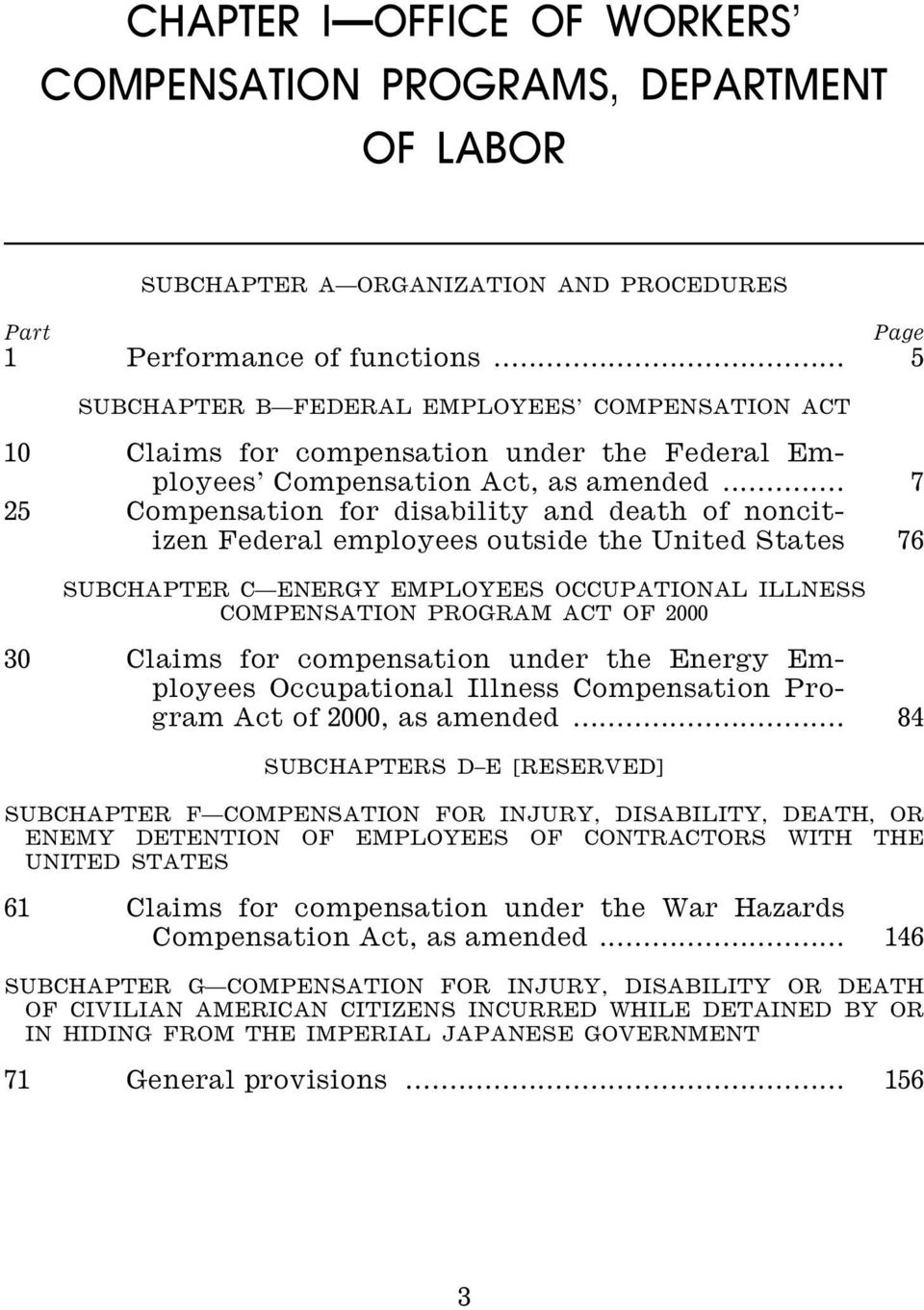
3 CHAPTER I OFFICE OF WORKERS COMPENSATION PROGRAMS, DEPARTMENT OF LABOR SUBCHAPTER A ORGANIZATION AND PROCEDURES Part Page 1 Performance of functions... 5 SUBCHAPTER B FEDERAL EMPLOYEES COMPENSATION ACT 10 Claims for compensation under the Federal Employees Compensation Act, as amended Compensation for disability and death of noncitizen Federal employees outside the United States 76 SUBCHAPTER C ENERGY EMPLOYEES OCCUPATIONAL ILLNESS COMPENSATION PROGRAM ACT OF Claims for compensation under the Energy Employees Occupational Illness Compensation Program Act of 2000, as amended SUBCHAPTERS D E [RESERVED] SUBCHAPTER F COMPENSATION FOR INJURY, DISABILITY, DEATH, OR ENEMY DETENTION OF EMPLOYEES OF CONTRACTORS WITH THE UNITED STATES 61 Claims for compensation under the War Hazards Compensation Act, as amended SUBCHAPTER G COMPENSATION FOR INJURY, DISABILITY OR DEATH OF CIVILIAN AMERICAN CITIZENS INCURRED WHILE DETAINED BY OR IN HIDING FROM THE IMPERIAL JAPANESE GOVERNMENT 71 General provisions VerDate Mar<15> :13 May 06, 2011 Jkt PO Frm Fmt 8008 Sfmt 8008 Q:\20\20V1.TXT ofr150 PsN: PC150
4 VerDate Mar<15> :13 May 06, 2011 Jkt PO Frm Fmt 8008 Sfmt 8008 Q:\20\20V1.TXT ofr150 PsN: PC150

5 SUBCHAPTER A ORGANIZATION AND PROCEDURES PART 1 PERFORMANCE OF FUNCTIONS Sec. 1.1 Under what authority was the Office of Workers Compensation Programs established? 1.2 What functions are assigned to OWCP? 1.3 What rules are contained in this chapter? 1.4 Where are other rules concerning OWCP functions found? 1.5 When was the former Bureau of Employees Compensation abolished? 1.6 How were many of OWCP s current functions administered in the past? AUTHORITY: 5 U.S.C. 301, 8145 and 8149 (Reorganization Plan No. 6 of 1950, 15 FR 3174, 3 CFR, Comp., p. 1004, 64 Stat. 1263); 42 U.S.C. 7384d and 7385s 10; Executive Order 13179, 65 FR 77487, 3 CFR, 2000 Comp., p. 321; Secretary of Labor s Order No , 36 FR 8155; Employment Standards Order No. 2 74, 39 FR SOURCE: 71 FR 78533, Dec. 29, 2006 unless otherwise noted. 1.1 Under what authority was the Office of Workers Compensation Programs established? The Assistant Secretary of Labor for Employment Standards, by authority vested in him by the Secretary of Labor in Secretary s Order No (36 FR 8755), established in the Employment Standards Administration an Office of Workers Compensation Programs (OWCP) by Employment Standards Order No (39 FR 34722). The Assistant Secretary subsequently designated as the head thereof a Director who, under the general supervision of the Assistant Secretary, administers the programs assigned to OWCP by the Assistant Secretary. 1.2 What functions are assigned to OWCP? The Assistant Secretary of Labor for Employment Standards has delegated authority and assigned responsibility to the Director of OWCP for the Department of Labor s programs under the following statutes: (a) The Federal Employees Compensation Act, as amended and extended (5 U.S.C et seq.), except 5 U.S.C as it pertains to the Employees Compensation Appeals Board. (b) The War Hazards Compensation Act (42 U.S.C et seq.). (c) The War Claims Act (50 U.S.C. App. 2003). (d) The Energy Employees Occupational Illness Compensation Program Act of 2000, as amended (42 U.S.C et seq.), except activities, pursuant to Executive Order ( Providing Compensation to America s Nuclear Weapons Workers ) of December 7, 2000, assigned to the Secretary of Health and Human Services, the Secretary of Energy and the Attorney General. (e) The Longshore and Harbor Workers Compensation Act, as amended and extended (33 U.S.C. 901 et seq.), except: 33 U.S.C. 919(d) with respect to administrative law judges in the Office of Administrative Law Judges; 33 U.S.C. 921(b) as it pertains to the Benefits Review Board; and activities, pursuant to 33 U.S.C. 941, assigned to the Assistant Secretary of Labor for Occupational Safety and Health. (f) The Black Lung Benefits Act, as amended (30 U.S.C. 901 et seq.). 1.3 What rules are contained in this chapter? The rules in this chapter are those governing the OWCP functions under the Federal Employees Compensation Act, the War Hazards Compensation Act, the War Claims Act and the Energy Employees Occupational Illness Compensation Program Act of Where are other rules concerning OWCP functions found? (a) The rules of the OWCP governing its functions under the Longshore and Harbor Workers Compensation Act and its extensions are set forth in subchapter A of chapter VI of this title. (b) The rules of the OWCP governing its functions under the Black Lung Benefits Act program are set forth in subchapter B of chapter VI of this title. (c) The rules and regulations of the Employees Compensation Appeals Board are set forth in chapter IV of this title. 5 VerDate Mar<15> :13 May 06, 2011 Jkt PO Frm Fmt 8010 Sfmt 8010 Q:\20\20V1.TXT ofr150 PsN: PC150

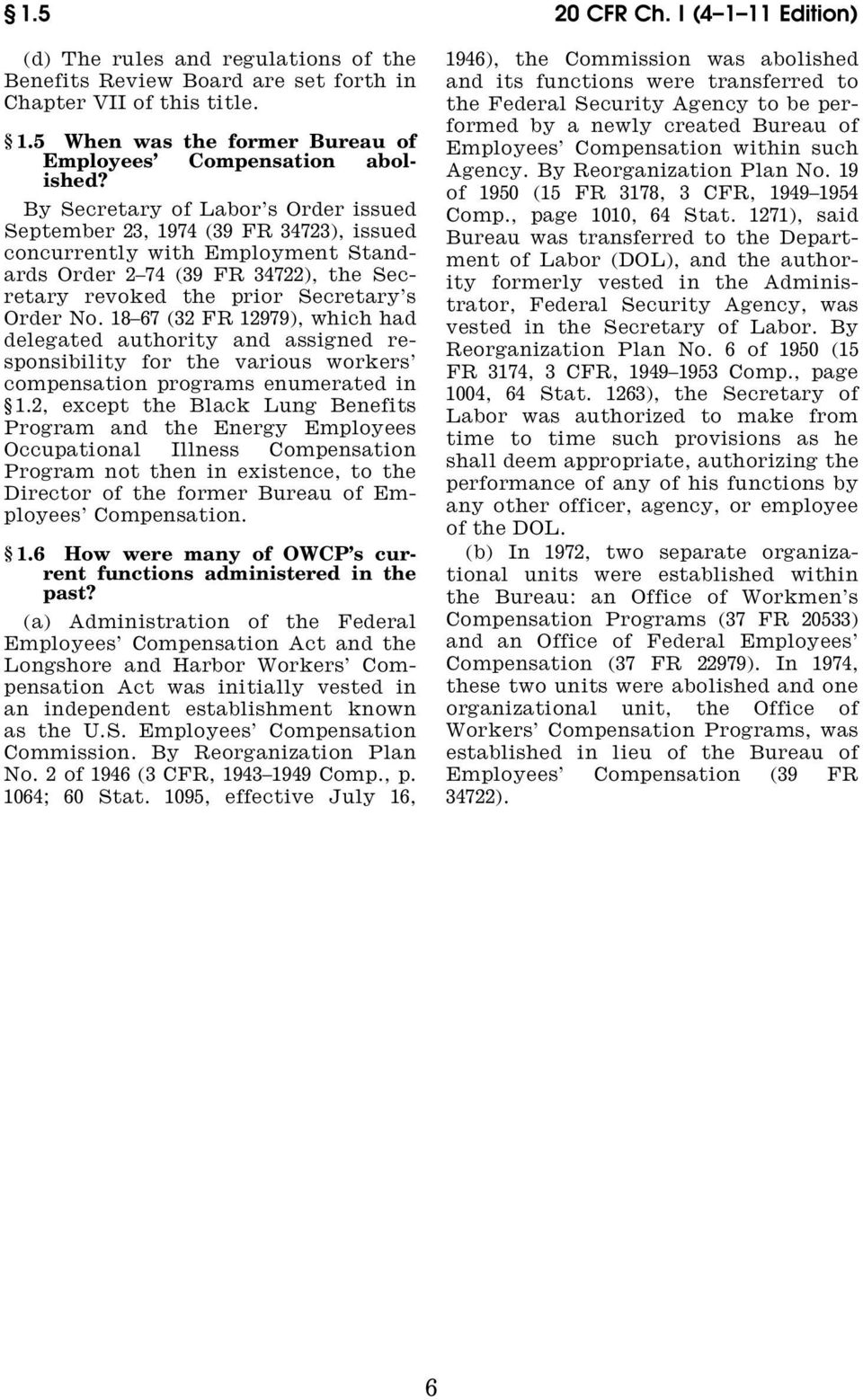
6 1.5 (d) The rules and regulations of the Benefits Review Board are set forth in Chapter VII of this title. 1.5 When was the former Bureau of Employees Compensation abolished? By Secretary of Labor s Order issued September 23, 1974 (39 FR 34723), issued concurrently with Employment Standards Order 2 74 (39 FR 34722), the Secretary revoked the prior Secretary s Order No (32 FR 12979), which had delegated authority and assigned responsibility for the various workers compensation programs enumerated in 1.2, except the Black Lung Benefits Program and the Energy Employees Occupational Illness Compensation Program not then in existence, to the Director of the former Bureau of Employees Compensation. 1.6 How were many of OWCP s current functions administered in the past? (a) Administration of the Federal Employees Compensation Act and the Longshore and Harbor Workers Compensation Act was initially vested in an independent establishment known as the U.S. Employees Compensation Commission. By Reorganization Plan No. 2 of 1946 (3 CFR, Comp., p. 1064; 60 Stat. 1095, effective July 16, 20 CFR Ch. I ( Edition) 1946), the Commission was abolished and its functions were transferred to the Federal Security Agency to be performed by a newly created Bureau of Employees Compensation within such Agency. By Reorganization Plan No. 19 of 1950 (15 FR 3178, 3 CFR, Comp., page 1010, 64 Stat. 1271), said Bureau was transferred to the Department of Labor (DOL), and the authority formerly vested in the Administrator, Federal Security Agency, was vested in the Secretary of Labor. By Reorganization Plan No. 6 of 1950 (15 FR 3174, 3 CFR, Comp., page 1004, 64 Stat. 1263), the Secretary of Labor was authorized to make from time to time such provisions as he shall deem appropriate, authorizing the performance of any of his functions by any other officer, agency, or employee of the DOL. (b) In 1972, two separate organizational units were established within the Bureau: an Office of Workmen s Compensation Programs (37 FR 20533) and an Office of Federal Employees Compensation (37 FR 22979). In 1974, these two units were abolished and one organizational unit, the Office of Workers Compensation Programs, was established in lieu of the Bureau of Employees Compensation (39 FR 34722). 6 VerDate Mar<15> :13 May 06, 2011 Jkt PO Frm Fmt 8010 Sfmt 8010 Q:\20\20V1.TXT ofr150 PsN: PC150
7 SUBCHAPTER B FEDERAL EMPLOYEES COMPENSATION ACT PART 10 CLAIMS FOR COM- PENSATION UNDER THE FEDERAL EMPLOYEES COMPENSATION ACT, AS AMENDED Subpart A General Provisions INTRODUCTION Sec What are the provisions of the FECA, in general? 10.1 What rules govern the administration of the FECA and this chapter? 10.2 What do these regulations contain? 10.3 Have the collection of information requirements of this part been approved by the Office of Management and Budget (OMB)? DEFINITIONS AND FORMS 10.5 What definitions apply to these regulations? 10.6 What special statutory definitions apply to dependents and survivors? 10.7 What forms are needed to process claims under the FECA? INFORMATION IN PROGRAM RECORDS Are all documents relating to claims filed under the FECA considered confidential? Who maintains custody and control of FECA records? How may a FECA claimant or beneficiary obtain copies of protected records? What process is used by a person who wants to correct FECA-related documents? RIGHTS AND PENALTIES May compensation rights be waived? What criminal penalties may be imposed in connection with a claim under the FECA? Is a beneficiary who defrauds the Government in connection with a claim for benefits still entitled to those benefits? Can a beneficiary who is incarcerated based on a felony conviction still receive benefits? Subpart B Filing Notices and Claims; Submitting Evidence NOTICES AND CLAIMS FOR INJURY, DISEASE AND DEATH EMPLOYEE OR SURVIVOR S AC- TIONS How and when is a notice of traumatic injury filed? How and when is a notice of occupational disease filed? How and when is a claim for wage loss compensation filed? How and when is a claim for permanent impairment filed? How and when is a claim for recurrence filed? How and when is a notice of death and claim for benefits filed? NOTICES AND CLAIMS FOR INJURY, DISEASE AND DEATH EMPLOYER S ACTIONS What should the employer do when an employee files a notice of traumatic injury or occupational disease? What should the employer do when an employee files an initial claim for compensation due to disability or permanent impairment? What should the employer do when an employee files a claim for continuing compensation due to disability? What should the employer do when an employee dies from a work-related injury or disease? EVIDENCE AND BURDEN OF PROOF What evidence is needed to establish a claim? What additional evidence is needed in cases based on occupational disease? What happens if, in any claim, the employer contests any of the facts as stated by the claimant? Does the employer participate in the claims process in any other way? What action will OWCP take with respect to information submitted by the employer? May a claimant submit additional evidence? What happens if OWCP needs more evidence from the claimant? DECISIONS ON ENTITLEMENT TO BENEFITS How does OWCP determine entitlement to benefits? What does the decision contain? To whom is the decision sent? 7 VerDate Mar<15> :13 May 06, 2011 Jkt PO Frm Fmt 8010 Sfmt 8010 Q:\20\20V1.TXT ofr150 PsN: PC150

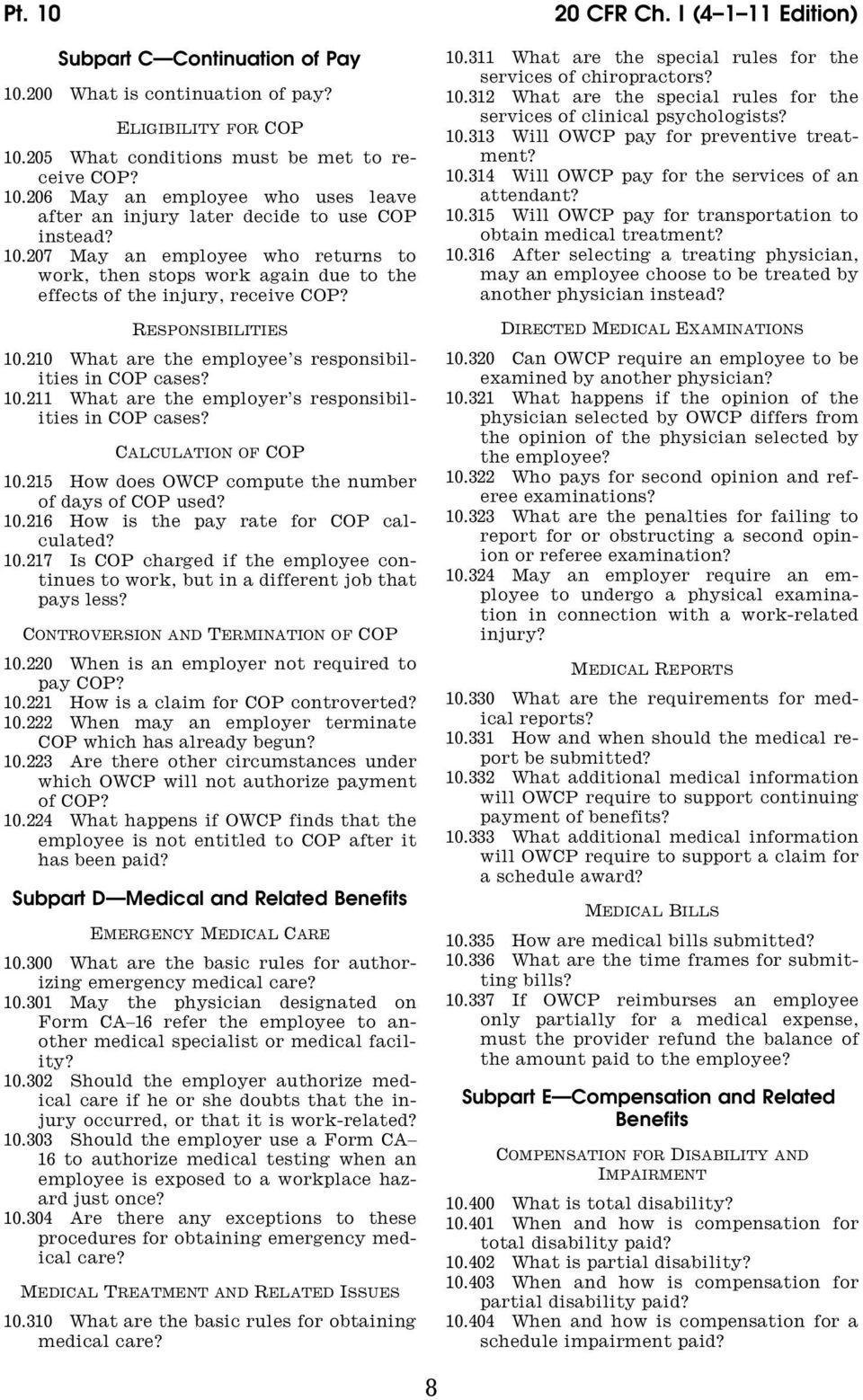
8 Pt. 10 Subpart C Continuation of Pay What is continuation of pay? ELIGIBILITY FOR COP What conditions must be met to receive COP? May an employee who uses leave after an injury later decide to use COP instead? May an employee who returns to work, then stops work again due to the effects of the injury, receive COP? RESPONSIBILITIES What are the employee s responsibilities in COP cases? What are the employer s responsibilities in COP cases? CALCULATION OF COP How does OWCP compute the number of days of COP used? How is the pay rate for COP calculated? Is COP charged if the employee continues to work, but in a different job that pays less? CONTROVERSION AND TERMINATION OF COP When is an employer not required to pay COP? How is a claim for COP controverted? When may an employer terminate COP which has already begun? Are there other circumstances under which OWCP will not authorize payment of COP? What happens if OWCP finds that the employee is not entitled to COP after it has been paid? Subpart D Medical and Related Benefits EMERGENCY MEDICAL CARE What are the basic rules for authorizing emergency medical care? May the physician designated on Form CA 16 refer the employee to another medical specialist or medical facility? Should the employer authorize medical care if he or she doubts that the injury occurred, or that it is work-related? Should the employer use a Form CA 16 to authorize medical testing when an employee is exposed to a workplace hazard just once? Are there any exceptions to these procedures for obtaining emergency medical care? MEDICAL TREATMENT AND RELATED ISSUES What are the basic rules for obtaining medical care? 20 CFR Ch. I ( Edition) What are the special rules for the services of chiropractors? What are the special rules for the services of clinical psychologists? Will OWCP pay for preventive treatment? Will OWCP pay for the services of an attendant? Will OWCP pay for transportation to obtain medical treatment? After selecting a treating physician, may an employee choose to be treated by another physician instead? DIRECTED MEDICAL EXAMINATIONS Can OWCP require an employee to be examined by another physician? What happens if the opinion of the physician selected by OWCP differs from the opinion of the physician selected by the employee? Who pays for second opinion and referee examinations? What are the penalties for failing to report for or obstructing a second opinion or referee examination? May an employer require an employee to undergo a physical examination in connection with a work-related injury? MEDICAL REPORTS What are the requirements for medical reports? How and when should the medical report be submitted? What additional medical information will OWCP require to support continuing payment of benefits? What additional medical information will OWCP require to support a claim for a schedule award? MEDICAL BILLS How are medical bills submitted? What are the time frames for submitting bills? If OWCP reimburses an employee only partially for a medical expense, must the provider refund the balance of the amount paid to the employee? Subpart E Compensation and Related Benefits COMPENSATION FOR DISABILITY AND IMPAIRMENT What is total disability? When and how is compensation for total disability paid? What is partial disability? When and how is compensation for partial disability paid? When and how is compensation for a schedule impairment paid? 8 VerDate Mar<15> :13 May 06, 2011 Jkt PO Frm Fmt 8010 Sfmt 8010 Q:\20\20V1.TXT ofr150 PsN: PC150
9 Office of Workers Compensation Programs, Labor Pt Who is considered a dependent in a claim based on disability or impairment? What are the maximum and minimum rates of compensation in disability cases? COMPENSATION FOR DEATH Who is entitled to compensation in case of death, and what are the rates of compensation payable in death cases? What are the maximum and minimum rates of compensation in death cases? Will OWCP pay the costs of burial and transportation of the remains? If a person dies while receiving a schedule award, to whom is the balance of the schedule award payable? What reports of dependents are needed in death cases? What must a beneficiary do if the number of beneficiaries decreases? How does a change in the number of beneficiaries affect the amount of compensation paid to the other beneficiaries? What reports are needed when compensation payments continue for children over age 18? ADJUSTMENTS TO COMPENSATION How are cost-of-living adjustments applied? May a beneficiary receive other kinds of payments from the Federal Government concurrently with compensation? May compensation payments be issued in a lump sum? May compensation payments be assigned to, or attached by, creditors? May someone other than the beneficiary be designated to receive compensation payments? May compensation be claimed for periods of restorable leave? OVERPAYMENTS How does OWCP notify an individual of a payment made? What does OWCP do when an overpayment is identified? How can an individual present evidence to OWCP in response to a preliminary notice of an overpayment? Under what circumstances can OWCP waive recovery of an overpayment? If OWCP finds that the recipient of an overpayment was not at fault, what criteria are used to decide whether to waive recovery of it? Is an individual responsible for an overpayment that resulted from an error made by OWCP or another Government agency? Under what circumstances would recovery of an overpayment defeat the purpose of the FECA? Under what circumstances would recovery of an overpayment be against equity and good conscience? Can OWCP require the individual who received the overpayment to submit additional financial information? What is addressed at a prerecoupment hearing? How does OWCP communicate its final decision concerning recovery of an overpayment, and what appeal right accompanies it? How are overpayments collected? Subpart F Continuing Benefits RULES AND EVIDENCE What are the basic rules for continuing receipt of compensation benefits and return to work? What medical evidence is necessary to support continuing receipt of compensation benefits? How does OWCP evaluate evidence in support of continuing receipt of compensation benefits? Under what circumstances may OWCP reduce or terminate compensation benefits? RETURN TO WORK EMPLOYER S RESPONSIBILITIES What actions must the employer take? May the employer monitor the employee s medical care? How should the employer make an offer of suitable work? May relocation expenses be paid for an employee who would need to move to accept an offer of reemployment? If an employee s light-duty job is eliminated due to downsizing, what is the effect on compensation? RETURN TO WORK EMPLOYEE S RESPONSIBILITIES What actions must the employee take with respect to returning to work? How will an employee know if OWCP considers a job to be suitable? What are the penalties for refusing to accept a suitable job offer? Does OWCP provide services to help employees return to work? What action will OWCP take if an employee refuses to undergo vocational rehabilitation? How does OWCP determine compensation after an employee completes a vocational rehabilitation program? REPORTS OF EARNINGS FROM EMPLOYMENT AND SELF-EMPLOYMENT What information must the employee report? 9 VerDate Mar<15> :13 May 06, 2011 Jkt PO Frm Fmt 8010 Sfmt 8010 Q:\20\20V1.TXT ofr150 PsN: PC150

10 Pt Must the employee report volunteer activities? Does OWCP verify reports of earnings? What action will OWCP take if the employee fails to file a report of activity indicating an ability to work? What action will OWCP take if the employee files an incomplete report? REPORTS OF DEPENDENTS How are dependents defined, and what information must the employee report? What is the penalty for failing to submit a report of dependents? What reports are needed when compensation payments continue for children over age 18? REDUCTION AND TERMINATION OF COMPENSATION When and how is compensation reduced or terminated? What action will OWCP take after issuing written notice of its intention to reduce or terminate compensation? Subpart G Appeals Process How can final decisions of OWCP be reviewed? RECONSIDERATIONS AND REVIEWS BY THE DIRECTOR What is reconsideration? How does a claimant request reconsideration? What is the time limit for requesting reconsideration? How does OWCP decide whether to grant or deny the request for reconsideration? How does OWCP decide whether new evidence requires modification of the prior decision? What is a review by the Director? HEARINGS What is a hearing? How does a claimant obtain a hearing? How is an oral hearing conducted? How is a review of the written record conducted? May subpoenas be issued for witnesses and documents? Who pays the costs associated with subpoenas? What is the employer s role when an oral hearing has been requested? May a claimant withdraw a request for or postpone a hearing? 20 CFR Ch. I ( Edition) REVIEWS BY THE EMPLOYEES COMPENSATION APPEALS BOARD (ECAB) What kinds of decisions may be appealed? Who has jurisdiction of cases on appeal to the ECAB? Subpart H Special Provisions REPRESENTATION May a claimant designate a representative? Who may serve as a representative? How are fees for services paid? How are fee applications approved? THIRD PARTY LIABILITY When must an employee or other FECA beneficiary take action against a third party? How will a beneficiary know if OWCP or SOL has determined that action against a third party is required? What must a FECA beneficiary who is required to take action against a third party do to satisfy the requirement that the claim be prosecuted? Can a FECA beneficiary who refuses to comply with a request to assign a claim to the United States or to prosecute the claim in his or her own name be penalized? What happens if a beneficiary directed by OWCP or SOL to take action against a third party does not believe that a claim can be successfully prosecuted at a reasonable cost? Under what circumstances must a recovery of money or other property in connection with an injury or death for which benefits are payable under the FECA be reported to OWCP or SOL? How much of any settlement or judgment must be paid to the United States? What amounts are included in the gross recovery? How is a structured settlement (that is, a settlement providing for receipt of funds over a specified period of time) treated for purposes of reporting the gross recovery? What amounts are included in the refundable disbursements? Is a beneficiary required to pay interest on the amount of the refund due to the United States? If the required refund is not paid within 30 days of the request for repayment, can it be collected from payments due under the FECA? Is a settlement or judgment received as a result of allegations of medical malpractice in treating an injury covered by the FECA a gross recovery that must be reported to OWCP or SOL? 10 VerDate Mar<15> :13 May 06, 2011 Jkt PO Frm Fmt 8010 Sfmt 8010 Q:\20\20V1.TXT ofr150 PsN: PC150

11 Office of Workers Compensation Programs, Labor Pt Are payments to a beneficiary as a result of an insurance policy which the beneficiary has purchased a gross recovery that must be reported to OWCP or SOL? If a settlement or judgment is received for more than one wound or medical condition, can the refundable disbursements paid on a single FECA claim be attributed to different conditions for purposes of calculating the refund or credit owed to the United States? FEDERAL GRAND AND PETIT JURORS When is a Federal grand or petit juror covered under the FECA? When does a juror s entitlement to disability compensation begin? What is the pay rate of jurors for compensation purposes? PEACE CORPS VOLUNTEERS What are the conditions of coverage for Peace Corps volunteers and volunteer leaders injured while serving outside the United States? What is the pay rate of Peace Corps volunteers and volunteer leaders for compensation purposes? NON-FEDERAL LAW ENFORCEMENT OFFICERS When is a non-federal law enforcement officer (LEO) covered under the FECA? What are the time limits for filing a LEO claim? How is a LEO claim filed, and who can file a LEO claim? Under what circumstances are benefits payable in LEO claims? What kind of objective evidence of a potential Federal crime must exist for coverage to be extended? In what situations will OWCP automatically presume that a law enforcement officer is covered by the FECA? How are benefits calculated in LEO claims? Subpart I Information for Medical Providers MEDICAL RECORDS AND BILLS What kind of medical records must providers keep? How are medical bills to be submitted? How should an employee prepare and submit requests for reimbursement for medical expenses, transportation costs, loss of wages, and incidental expenses? What are the time limitations on OWCP s payment of bills? MEDICAL FEE SCHEDULE What services are covered by the OWCP fee schedule? How are the maximum fees defined? How are payments for particular services calculated? Does the fee schedule apply to every kind of procedure? How are payments for medicinal drugs determined? How are payments for inpatient medical services determined? When and how are fees reduced? If OWCP reduces a fee, may a provider request reconsideration of the reduction? If OWCP reduces a fee, may a provider bill the claimant for the balance? EXCLUSION OF PROVIDERS What are the grounds for excluding a provider from payment under the FECA? What will cause OWCP to automatically exclude a physician or other provider of medical services and supplies? When are OWCP s exclusion procedures initiated? How is a provider notified of OWCP s intent to exclude him or her? What requirements must the provider s reply and OWCP s decision meet? How can an excluded provider request a hearing? How are hearings assigned and scheduled? How are subpoenas or advisory opinions obtained? How will the administrative law judge conduct the hearing and issue the recommended decision? How can a party request review by the Director of the administrative law judge s recommended decision? What are the effects of exclusion? How can an excluded provider be reinstated? Subpart J Death Gratuity What is the death gratuity under this subpart? Which employees are covered under this subpart? Does every employee s death due to injuries incurred in connection with his or her service with an Armed Force in a contingency operation qualify for the death gratuity? Is the death gratuity payment applicable retroactively? Does a death as a result of occupational disease qualify for payment of the death gratuity? If an employee incurs a covered injury in connection with his or her service with an Armed Force in a contingency 11 VerDate Mar<15> :13 May 06, 2011 Jkt PO Frm Fmt 8010 Sfmt 8010 Q:\20\20V1.TXT ofr150 PsN: PC150

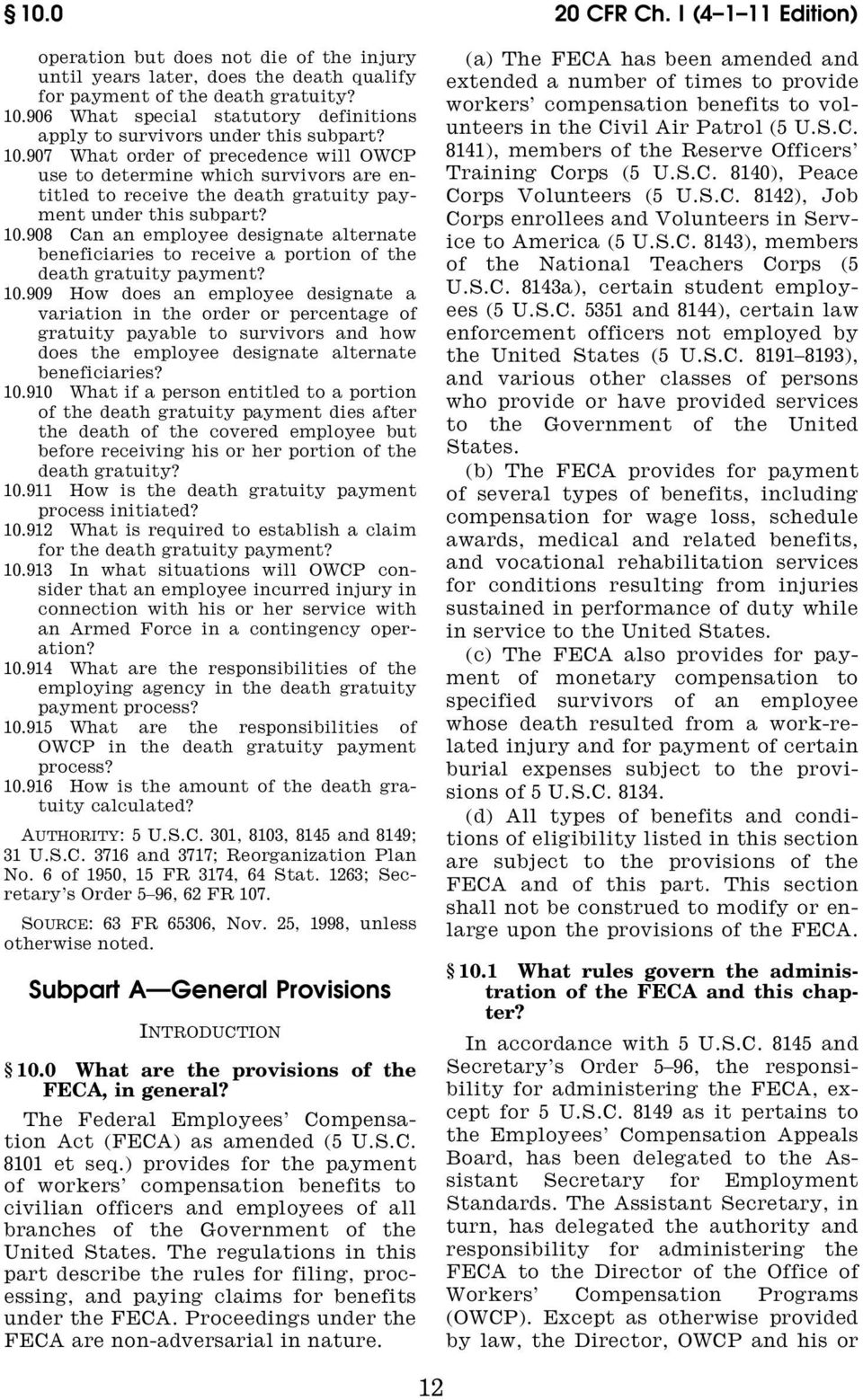
12 10.0 operation but does not die of the injury until years later, does the death qualify for payment of the death gratuity? What special statutory definitions apply to survivors under this subpart? What order of precedence will OWCP use to determine which survivors are entitled to receive the death gratuity payment under this subpart? Can an employee designate alternate beneficiaries to receive a portion of the death gratuity payment? How does an employee designate a variation in the order or percentage of gratuity payable to survivors and how does the employee designate alternate beneficiaries? What if a person entitled to a portion of the death gratuity payment dies after the death of the covered employee but before receiving his or her portion of the death gratuity? How is the death gratuity payment process initiated? What is required to establish a claim for the death gratuity payment? In what situations will OWCP consider that an employee incurred injury in connection with his or her service with an Armed Force in a contingency operation? What are the responsibilities of the employing agency in the death gratuity payment process? What are the responsibilities of OWCP in the death gratuity payment process? How is the amount of the death gratuity calculated? AUTHORITY: 5 U.S.C. 301, 8103, 8145 and 8149; 31 U.S.C and 3717; Reorganization Plan No. 6 of 1950, 15 FR 3174, 64 Stat. 1263; Secretary s Order 5 96, 62 FR 107. SOURCE: 63 FR 65306, Nov. 25, 1998, unless otherwise noted. Subpart A General Provisions INTRODUCTION 10.0 What are the provisions of the FECA, in general? The Federal Employees Compensation Act (FECA) as amended (5 U.S.C et seq.) provides for the payment of workers compensation benefits to civilian officers and employees of all branches of the Government of the United States. The regulations in this part describe the rules for filing, processing, and paying claims for benefits under the FECA. Proceedings under the FECA are non-adversarial in nature. 20 CFR Ch. I ( Edition) (a) The FECA has been amended and extended a number of times to provide workers compensation benefits to volunteers in the Civil Air Patrol (5 U.S.C. 8141), members of the Reserve Officers Training Corps (5 U.S.C. 8140), Peace Corps Volunteers (5 U.S.C. 8142), Job Corps enrollees and Volunteers in Service to America (5 U.S.C. 8143), members of the National Teachers Corps (5 U.S.C. 8143a), certain student employees (5 U.S.C and 8144), certain law enforcement officers not employed by the United States (5 U.S.C ), and various other classes of persons who provide or have provided services to the Government of the United States. (b) The FECA provides for payment of several types of benefits, including compensation for wage loss, schedule awards, medical and related benefits, and vocational rehabilitation services for conditions resulting from injuries sustained in performance of duty while in service to the United States. (c) The FECA also provides for payment of monetary compensation to specified survivors of an employee whose death resulted from a work-related injury and for payment of certain burial expenses subject to the provisions of 5 U.S.C (d) All types of benefits and conditions of eligibility listed in this section are subject to the provisions of the FECA and of this part. This section shall not be construed to modify or enlarge upon the provisions of the FECA What rules govern the administration of the FECA and this chapter? In accordance with 5 U.S.C and Secretary s Order 5 96, the responsibility for administering the FECA, except for 5 U.S.C as it pertains to the Employees Compensation Appeals Board, has been delegated to the Assistant Secretary for Employment Standards. The Assistant Secretary, in turn, has delegated the authority and responsibility for administering the FECA to the Director of the Office of Workers Compensation Programs (OWCP). Except as otherwise provided by law, the Director, OWCP and his or 12 VerDate Mar<15> :13 May 06, 2011 Jkt PO Frm Fmt 8010 Sfmt 8010 Q:\20\20V1.TXT ofr150 PsN: PC150
13 Office of Workers Compensation Programs, Labor 10.5 her designees have the exclusive authority to administer, interpret and enforce the provisions of the Act What do these regulations contain? This part 10 sets forth the regulations governing administration of all claims filed under the FECA, except to the extent specified in certain particular provisions. Its provisions are intended to assist persons seeking compensation benefits under the FECA, as well as personnel in the various Federal agencies and the Department of Labor who process claims filed under the FECA or who perform administrative functions with respect to the FECA. This part 10 applies to part 25 of this chapter except as modified by part 25. The various subparts of this part contain the following: (a) Subpart A. The general statutory and administrative framework for processing claims under the FECA. It contains a statement of purpose and scope, together with definitions of terms, descriptions of basic forms, information about the disclosure of OWCP records, and a description of rights and penalties under the FECA, including convictions for fraud. (b) Subpart B. The rules for filing notices of injury and claims for benefits under the FECA. It also addresses evidence and burden of proof, as well as the process of making decisions concerning eligibility for benefits. (c) Subpart C. The rules governing claims for and payment of continuation of pay. (d) Subpart D. The rules governing emergency and routine medical care, second opinion and referee medical examinations directed by OWCP, and medical reports and records in general. It also addresses the kinds of treatment which may be authorized and how medical bills are paid. (e) Subpart E. The rules relating to the payment of monetary compensation benefits for disability, impairment and death. It includes the provisions for identifying and processing overpayments of compensation. (f) Subpart F. The rules governing the payment of continuing compensation benefits. It includes provisions concerning the employee s and the employer s responsibilities in returning the employee to work. It also contains provisions governing reports of earnings and dependents, recurrences, and reduction and termination of compensation benefits. (g) Subpart G. The rules governing the appeals of decisions under the FECA. It includes provisions relating to hearings, reconsiderations, and appeals before the Employees Compensation Appeals Board. (h) Subpart H. The rules concerning legal representation and for adjustment and recovery from a third party. It also contains provisions relevant to three groups of employees whose status requires special application of the provisions of the FECA: Federal grand and petit jurors, Peace Corps volunteers, and non-federal law enforcement officers. (i) Subpart I. Information for medical providers. It includes rules for medical reports, medical bills, and the OWCP medical fee schedule, as well as the provisions for exclusion of medical providers Have the collection of information requirements of this part been approved by the Office of Management and Budget (OMB)? The collection of information requirements in this part have been approved by OMB and assigned OMB control numbers , , , , , , , , , , , , , , , , and DEFINITIONS AND FORMS 10.5 What definitions apply to these regulations? Certain words and phrases found in this part are defined in this section or in the FECA. Some other words and phrases that are used only in limited situations are defined in the later subparts of these regulations. (a) Benefits or Compensation means the money OWCP pays to or on behalf of a beneficiary from the Employees Compensation Fund for lost wages, a loss of wage-earning capacity or a permanent physical impairment, as well as the money paid to beneficiaries for an employee s death. These two terms 13 VerDate Mar<15> :13 May 06, 2011 Jkt PO Frm Fmt 8010 Sfmt 8010 Q:\20\20V1.TXT ofr150 PsN: PC150
14 10.5 also include any other amounts paid out of the Employees Compensation Fund for such things as medical treatment, medical examinations conducted at the request of OWCP as part of the claims adjudication process, vocational rehabilitation services, services of an attendant and funeral expenses, but does not include continuation of pay. (b) Beneficiary means an individual who is entitled to a benefit under the FECA and this part. (c) Claim means a written assertion of an individual s entitlement to benefits under the FECA, submitted in a manner authorized by this part. (d) Claimant means an individual whose claim has been filed. (e) Director means the Director of OWCP or a person designated to carry out his or her functions. (f) Disability means the incapacity, because of an employment injury, to earn the wages the employee was receiving at the time of injury. It may be partial or total. (g) Earnings from employment or selfemployment means: (1) Gross earnings or wages before any deductions and includes the value of subsistence, quarters, reimbursed expenses and any other goods or services received in kind as remuneration; or (2) A reasonable estimate of the cost to have someone else perform the duties of an individual who accepts no remuneration. Neither lack of profits, nor the characterization of the duties as a hobby, removes an unremunerated individual s responsibility to report the estimated cost to have someone else perform his or her duties. (h) Employee means, but is not limited to, an individual who fits within one of the following listed groups: (1) A civil officer or employee in any branch of the Government of the United States, including an officer or employee of an instrumentality wholly owned by the United States; (2) An individual rendering personal service to the United States similar to the service of a civil officer or employee of the United States, without pay or for nominal pay, when a statute authorizes the acceptance or use of the service, or authorizes payment of travel or other expenses of the individual; 20 CFR Ch. I ( Edition) (3) An individual, other than an independent contractor or an individual employed by an independent contractor, employed on the Menominee Indian Reservation in Wisconsin in operations conducted under a statute relating to tribal timber and logging operations on that reservation; (4) An individual appointed to a position on the office staff of a former President; or (5) An individual selected and serving as a Federal petit or grand juror. (i) Employer or Agency means any civil agency or instrumentality of the United States Government, or any other organization, group or institution employing an individual defined as an employee by this section. These terms also refer to officers and employees of an employer having responsibility for the supervision, direction or control of employees of that employer as an immediate superior, and to other employees designated by the employer to carry out the functions vested in the employer under the FECA and this part, including officers or employees delegated responsibility by an employer for authorizing medical treatment for injured employees. (j) Entitlement means entitlement to benefits as determined by OWCP under the FECA and the procedures described in this part. (k) FECA means the Federal Employees Compensation Act, as amended. (l) Hospital services means services and supplies provided by hospitals within the scope of their practice as defined by State law. (m) Impairment means any anatomic or functional abnormality or loss. A permanent impairment is any such abnormality or loss after maximum medical improvement has been achieved. (n) Knowingly means with knowledge, consciously, willfully or intentionally. (o) Medical services means services and supplies provided by or under the supervision of a physician. Reimbursable chiropractic services are limited to physical examinations (and related laboratory tests), x-rays performed to diagnose a subluxation of the spine and treatment consisting of manual manipulation of the spine to correct a subluxation. 14 VerDate Mar<15> :13 May 06, 2011 Jkt PO Frm Fmt 8010 Sfmt 8010 Q:\20\20V1.TXT ofr150 PsN: PC150

15 Office of Workers Compensation Programs, Labor 10.5 (p) Medical support services means services, drugs, supplies and appliances provided by a person other than a physician or hospital. (q) Occupational disease or Illness means a condition produced by the work environment over a period longer than a single workday or shift. (r) OWCP means the Office of Workers Compensation Programs. (s) Pay rate for compensation purposes means the employee s pay, as determined under 5 U.S.C. 8114, at the time of injury, the time disability begins or the time compensable disability recurs if the recurrence begins more than six months after the injured employee resumes regular full-time employment with the United States, whichever is greater, except as otherwise determined under 5 U.S.C with respect to any period. (t) Physician means an individual defined as such in 5 U.S.C. 8101(2), except during the period for which his or her license to practice medicine has been suspended or revoked by a State licensing or regulatory authority. (u) Qualified hospital means any hospital licensed as such under State law which has not been excluded under the provisions of subpart I of this part. Except as otherwise provided by regulation, a qualified hospital shall be deemed to be designated or approved by OWCP. (v) Qualified physician means any physician who has not been excluded under the provisions of subpart I of this part. Except as otherwise provided by regulation, a qualified physician shall be deemed to be designated or approved by OWCP. (w) Qualified provider of medical support services or supplies means any person, other than a physician or a hospital, who provides services, drugs, supplies and appliances for which OWCP makes payment, who possesses any applicable licenses required under State law, and who has not been excluded under the provisions of subpart I of this part. (x) Recurrence of disability means an inability to work after an employee has returned to work, caused by a spontaneous change in a medical condition which had resulted from a previous injury or illness without an intervening injury or new exposure to the work environment that caused the illness. This term also means an inability to work that takes place when a light-duty assignment made specifically to accommodate an employee s physical limitations due to his or her work-related injury or illness is withdrawn (except when such withdrawal occurs for reasons of misconduct, non-performance of job duties or a reduction-in-force), or when the physical requirements of such an assignment are altered so that they exceed his or her established physical limitations. (y) Recurrence of medical condition means a documented need for further medical treatment after release from treatment for the accepted condition or injury when there is no accompanying work stoppage. Continuous treatment for the original condition or injury is not considered a need for further medical treatment after release from treatment, nor is an examination without treatment. (z) Representative means an individual properly authorized by a claimant in writing to act for the claimant in connection with a claim or proceeding under the FECA or this part. (aa) Student means an individual defined at 5 U.S.C. 8101(17). Two terms used in that particular definition are further defined as follows: (1) Additional type of educational or training institution means a technical, trade, vocational, business or professional school accredited or licensed by the United States Government or a State Government or any political subdivision thereof providing courses of not less than three months duration, that prepares the individual for a livelihood in a trade, industry, vocation or profession. (2) Year beyond the high school level means: (i) The 12-month period beginning the month after the individual graduates from high school, provided he or she had indicated an intention to continue schooling within four months of high school graduation, and each successive 12-month period in which there is school attendance or the payment of compensation based on such attendance; or 15 VerDate Mar<15> :13 May 06, 2011 Jkt PO Frm Fmt 8010 Sfmt 8010 Q:\20\20V1.TXT ofr150 PsN: PC150

16 10.6 (ii) If the individual has indicated that he or she will not continue schooling within four months of high school graduation, the 12-month period beginning with the month that the individual enters school to continue his or her education, and each successive 12- month period in which there is school attendance or the payment of compensation based on such attendance. (bb) Subluxation means an incomplete dislocation, off-centering, misalignment, fixation or abnormal spacing of the vertebrae which must be demonstrable on any x-ray film to an individual trained in the reading of x-rays. (cc) Surviving spouse means the husband or wife living with or dependent for support upon a deceased employee at the time of his or her death, or living apart for reasonable cause or because of the deceased employee s desertion. (dd) Temporary aggravation of a preexisting condition means that factors of employment have directly caused that condition to be more severe for a limited period of time and have left no greater impairment than existed prior to the employment injury. (ee) Traumatic injury means a condition of the body caused by a specific event or incident, or series of events or incidents, within a single workday or shift. Such condition must be caused by external force, including stress or strain, which is identifiable as to time and place of occurrence and member or function of the body affected What special statutory definitions apply to dependents and survivors? (a) 5 U.S.C provides that certain benefits are payable to certain enumerated survivors of employees who have died from an injury sustained in the performance of duty. (b) 5 U.S.C also provides that certain other benefits may be payable to certain family members of employees who have been incarcerated due to a felony conviction. (c) 5 U.S.C. 8110(b) further provides that any employee who is found to be eligible for a basic benefit shall be entitled to have such basic benefit augmented at a specified rate for certain persons who live in the beneficiary s 20 CFR Ch. I ( Edition) household or who are dependent upon the beneficiary for support. (d) 5 U.S.C. 8101, 8110, 8133 and 8148, which define the nature of such survivorship or dependency necessary to qualify a beneficiary for a survivor s benefit or an augmented benefit, apply to the provisions of this part What forms are needed to process claims under the FECA? (a) Notice of injury, claims and certain specified reports shall be made on forms prescribed by OWCP. Employers shall not modify these forms or use substitute forms. Employers are expected to maintain an adequate supply of the basic forms needed for the proper recording and reporting of injuries. Form No. Title (1) CA 1... Federal Employee s Notice of Traumatic Injury and Claim for Continuation of Pay/ Compensation (2) CA 2... Notice of Occupational Disease and Claim for Compensation (3) CA 2a... Notice of Employee s Recurrence of Disability and Claim for Pay/ Compensation (4) CA 5... Claim for Compensation by Widow, Widower and/or Children (5) CA 5b... Claim for Compensation by Parents, Brothers, Sisters, Grandparents, or Grandchildren (6) CA 6... Official Superior s Report of Employee s Death (7) CA 7... Claim for Compensation Due to Traumatic Injury or Occupational Disease (8) CA 7a... Time Analysis Form (9) CA 7b... Leave Buy Back (LBB) Worksheet/Certification and Election (10) CA Authorization of Examination and/or Treatment (11) CA Duty Status Report (12) CA Attending Physician s Report (b) Copies of the forms listed in this paragraph are available for public inspection at the Office of Workers Compensation Programs, Employment Standards Administration, U.S. Department of Labor, Washington, DC They may also be obtained from district offices, employers (i.e., safety and health offices, supervisors), and the Internet, at owcp.htm. [63 FR 65306, Nov. 25, 1998; 63 FR 71202, Dec. 23, 1998] 16 VerDate Mar<15> :13 May 06, 2011 Jkt PO Frm Fmt 8010 Sfmt 8010 Q:\20\20V1.TXT ofr150 PsN: PC150

17 Office of Workers Compensation Programs, Labor INFORMATION IN PROGRAM RECORDS Are all documents relating to claims filed under the FECA considered confidential? All records relating to claims for benefits, including copies of such records maintained by an employer, are considered confidential and may not be released, inspected, copied or otherwise disclosed except as provided in the Freedom of Information Act and the Privacy Act of Who maintains custody and control of FECA records? All records relating to claims for benefits filed under the FECA, including any copies of such records maintained by an employing agency, are covered by the government-wide Privacy Act system of records entitled DOL/GOVT 1 (Office of Workers Compensation Programs, Federal Employees Compensation Act File). This system of records is maintained by and under the control of OWCP, and, as such, all records covered by DOL/ GOVT 1 are official records of OWCP. The protection, release, inspection and copying of records covered by DOL/ GOVT 1 shall be accomplished in accordance with the rules, guidelines and provisions of this part, as well as those contained in 29 CFR parts 70 and 71, and with the notice of the system of records and routine uses published in the FEDERAL REGISTER. All questions relating to access/disclosure, and/or amendment of FECA records maintained by OWCP or the employing agency, are to be resolved in accordance with this section How may a FECA claimant or beneficiary obtain copies of protected records? (a) A claimant seeking copies of his or her official FECA file should address a request to the District Director of the OWCP office having custody of the file. A claimant seeking copies of FECA-related documents in the custody of the employer should follow the procedures established by that agency. (b)(1) While an employing agency may establish procedures that an injured employee or beneficiary should follow in requesting access to documents it maintains, any decision issued in response to such a request must comply with the rules and regulations of the Department of Labor which govern all other aspects of safeguarding these records. (2) No employing agency has the authority to issue determinations with respect to requests for the correction or amendment of records contained in or covered by DOL/GOVT 1. That authority is within the exclusive control of OWCP. Thus, any request for correction or amendment received by an employing agency must be referred to OWCP for review and decision. (3) Any administrative appeal taken from a denial issued by the employing agency or OWCP shall be filed with the Solicitor of Labor in accordance with 29 CFR 71.7 and What process is used by a person who wants to correct FECA-related documents? Any request to amend a record covered by DOL/GOVT 1 should be directed to the district office having custody of the official file. No employer has the authority to issue determinations with regard to requests for the correction of records contained in or covered by DOL/GOVT 1. Any request for correction received by an employer must be referred to OWCP for review and decision. RIGHTS AND PENALTIES May compensation rights be waived? No employer or other person may require an employee or other claimant to enter into any agreement, either before or after an injury or death, to waive his or her right to claim compensation under the FECA. No waiver of compensation rights shall be valid What criminal penalties may be imposed in connection with a claim under the FECA? (a) A number of statutory provisions make it a crime to file a false or fraudulent claim or statement with the Government in connection with a claim under the FECA, or to wrongfully impede a FECA claim. Included among these provisions are sections 287, 1001, 1920, and 1922 of title 18, United States 17 VerDate Mar<15> :13 May 06, 2011 Jkt PO Frm Fmt 8010 Sfmt 8010 Q:\20\20V1.TXT ofr150 PsN: PC150
18 10.17 Code. Enforcement of these and other criminal provisions that may apply to claims under the FECA are within the jurisdiction of the Department of Justice. (b) In addition, administrative proceedings may be initiated under the Program Fraud Civil Remedies Act of 1986 (PFCRA), 31 U.S.C , to impose civil penalties and assessments against persons who make, submit, or present, or cause to be made, submitted or presented, false, fictitious or fraudulent claims or written statements to OWCP in connection with a claim under the FECA. The Department of Labor s regulations implementing the PFRCA are found at 29 CFR part Is a beneficiary who defrauds the Government in connection with a claim for benefits still entitled to those benefits? When a beneficiary either pleads guilty to or is found guilty on either Federal or State criminal charges of defrauding the Federal Government in connection with a claim for benefits, the beneficiary s entitlement to any further compensation benefits will terminate effective the date either the guilty plea is accepted or a verdict of guilty is returned after trial, for any injury occurring on or before the date of such guilty plea or verdict. Termination of entitlement under this section is not affected by any subsequent change in or recurrence of the beneficiary s medical condition Can a beneficiary who is incarcerated based on a felony conviction still receive benefits? (a) Whenever a beneficiary is incarcerated in a State or Federal jail, prison, penal institution or other correctional facility due to a State or Federal felony conviction, he or she forfeits all rights to compensation benefits during the period of incarceration. A beneficiary s right to compensation benefits for the period of his or her incarceration is not restored after such incarceration ends, even though payment of compensation benefits may resume. (b) If the beneficiary has eligible dependents, OWCP will pay compensation to such dependents at a reduced rate 20 CFR Ch. I ( Edition) during the period of his or her incarceration, by applying the percentages of 5 U.S.C. 8133(a)(1) through (5) to the beneficiary s gross current entitlement rather than to the beneficiary s monthly pay. (c) If OWCP s decision on entitlement is pending when the period of incarceration begins, and compensation is due for a period of time prior to such incarceration, payment for that period will only be made to the beneficiary following his or her release. Subpart B Filing Notices and Claims; Submitting Evidence NOTICES AND CLAIMS FOR INJURY, DIS- EASE, AND DEATH EMPLOYEE OR SUR- VIVOR S ACTIONS How and when is a notice of traumatic injury filed? (a) To claim benefits under the FECA, an employee who sustains a work-related traumatic injury must give notice of the injury in writing on Form CA 1, which may be obtained from the employer or from the Internet at The employee must forward this notice to the employer. Another person, including the employer, may give notice of injury on the employee s behalf. The person submitting a notice shall include the Social Security Number (SSN) of the injured employee. (b) For injuries sustained on or after September 7, 1974, a notice of injury must be filed within three years of the injury. (The form contains the necessary words of claim.) The requirements for filing notice are further described in 5 U.S.C Also see concerning time requirements for filing claims for continuation of pay. (1) If the claim is not filed within three years, compensation may still be allowed if notice of injury was given within 30 days or the employer had actual knowledge of the injury or death within 30 days after occurrence. This knowledge may consist of written records or verbal notification. An entry into an employee s medical record may also satisfy this requirement if it is sufficient to place the employer on notice of a possible work-related injury or disease. 18 VerDate Mar<15> :13 May 06, 2011 Jkt PO Frm Fmt 8010 Sfmt 8010 Q:\20\20V1.TXT ofr150 PsN: PC150

19 Office of Workers Compensation Programs, Labor (2) OWCP may excuse failure to comply with the three-year time requirement because of truly exceptional circumstances (for example, being held prisoner of war). (3) The claimant may withdraw his or her claim (but not the notice of injury) by so requesting in writing to OWCP at any time before OWCP determines eligibility for benefits. Any continuation of pay (COP) granted to an employee after a claim is withdrawn must be charged to sick or annual leave, or considered an overpayment of pay consistent with 5 U.S.C. 5584, at the employee s option. (c) However, in cases of latent disability, the time for filing claim does not begin to run until the employee has a compensable disability and is aware, or reasonably should have been aware, of the causal relationship between the disability and the employment (see 5 U.S.C. 8122(b)) How and when is a notice of occupational disease filed? (a) To claim benefits under the FECA, an employee who has a disease which he or she believes to be work-related must give notice of the condition in writing on Form CA 2, which may be obtained from the employer or from the Internet at owcp.htm. The employee must forward this notice to the employer. Another person, including the employer, may do so on the employee s behalf. The person submitting a notice shall include the Social Security Number (SSN) of the injured employee. The claimant may withdraw his or her claim (but not the notice of occupational disease) by so requesting in writing to OWCP at any time before OWCP determines eligibility for benefits. (b) For occupational diseases sustained as a result of exposure to injurious work factors that occurs on or after September 7, 1974, a notice of occupational disease must be filed within three years of the onset of the condition. (The form contains the necessary words of claim.) The requirements for timely filing are described in (b)(1) through (3). (c) However, in cases of latent disability, the time for filing claim does not begin to run until the employee has a compensable disability and is aware, or reasonably should have been aware, of the causal relationship between the disability and the employment (see 5 U.S.C. 8122(b)) How and when is a claim for wage loss compensation filed? (a) Form CA 7 is used to claim compensation for periods of disability not covered by COP. (1) An employee who is disabled with loss of pay for more than three calendar days due to an injury, or someone acting on his or her behalf, must file Form CA 7 before compensation can be paid. (2) The employee shall complete the front of Form CA 7 and submit the form to the employer for completion and transmission to OWCP. The form should be completed as soon as possible, but no more than 14 calendar days after the date pay stops due to the injury or disease. (3) The requirements for filing claims are further described in 5 U.S.C (b) Additional Forms CA 7 are used to claim compensation for additional periods of disability after the first Form CA 7 is submitted to OWCP. (1) It is the employee s responsibility to submit Form CA 7. Without receipt of such claim, OWCP has no knowledge of continuing wage loss. Therefore, while disability continues, the employee should submit a claim on Form CA 7 each two weeks until otherwise instructed by OWCP. (2) The employee shall complete the front of Form CA 7 and submit the form to the employer for completion and transmission to OWCP. (3) The employee is responsible for submitting, or arranging for the submittal of, medical evidence to OWCP which establishes both that disability continues and that the disability is due to the work-related injury. Form CA 20 is attached to Form CA 7 for this purpose. [63 FR 65306, Nov. 25, 1998; 63 FR 71202, Dec. 23, 1998] How and when is a claim for permanent impairment filed? Form CA 7 is used to claim compensation for impairment to a body 19 VerDate Mar<15> :13 May 06, 2011 Jkt PO Frm Fmt 8010 Sfmt 8010 Q:\20\20V1.TXT ofr150 PsN: PC150

20 part covered under the schedule established by 5 U.S.C If Form CA 7 has already been filed to claim disability compensation, an employee may file a claim for such impairment by sending a letter to OWCP which specifies the nature of the benefit claimed How and when is a claim for recurrence filed? (a) A recurrence should be reported on Form CA 2a if it causes the employee to lose time from work and incur a wage loss, or if the employee experiences a renewed need for treatment after previously being released from care. However, a notice of recurrence should not be filed when a new injury, new occupational disease, or new event contributing to an alreadyexisting occupational disease has occurred. In these instances, the employee should file Form CA 1 or CA 2. (b) The employee has the burden of establishing by the weight of reliable, probative and substantial evidence that the recurrence of disability is causally related to the original injury. (1) The employee must include a detailed factual statement as described on Form CA 2a. The employer may submit comments concerning the employee s statement. (2) The employee should arrange for the submittal of a detailed medical report from the attending physician as described on Form CA 2a. The employee should also submit, or arrange for the submittal of, similar medical reports for any examination and/or treatment received after returning to work following the original injury. 20 CFR Ch. I ( Edition) How and when is a notice of death and claim for benefits filed? (a) If an employee dies from a workrelated traumatic injury or an occupational disease, any survivor may file a claim for death benefits using Form CA 5 or CA 5b, which may be obtained from the employer or from the Internet at The survivor must provide this notice in writing and forward it to the employer. Another person, including the employer, may do so on the survivor s behalf. The survivor may also submit the completed Form CA 5 or CA 5b directly to OWCP. The survivor shall disclose the SSNs of all survivors on whose behalf claim for benefits is made in addition to the SSN of the deceased employee. The survivor may withdraw his or her claim (but not the notice of death) by so requesting in writing to OWCP at any time before OWCP determines eligibility for benefits. (b) For deaths that occur on or after September 7, 1974, a notice of death must be filed within three years of the death. The form contains the necessary words of claim. The requirements for timely filing are described in (b)(1) through (3). (c) However, in cases of death due to latent disability, the time for filing the claim does not begin to run until the survivor is aware, or reasonably should have been aware, of the causal relationship between the death and the employment (see 5 U.S.C. 8122(b)). (d) The filing of a notice of injury or occupational disease will satisfy the time requirements for a death claim based on the same injury or occupational disease. If an injured employee or someone acting on the employee s behalf does not file a claim before the employee s death, the right to claim compensation for disability other than medical expenses ceases and does not survive. (e) A survivor must be alive to receive any payment; there is no vested right to such payment. A report as described in of this part must be filed once each year to support continuing payments of compensation. NOTICES AND CLAIMS FOR INJURY, DIS- EASE, AND DEATH EMPLOYER S AC- TIONS What should the employer do when an employee files a notice of traumatic injury or occupational disease? (a) The employer shall complete the agency portion of Form CA 1 (for traumatic injury) or CA 2 (for occupational disease) no more than 10 working days after receipt of notice from the employee. The employer shall also complete the Receipt of Notice and give it to the employee, along with copies of both sides of Form CA 1 or Form CA 2. (b) The employer must complete and transmit the form to OWCP within VerDate Mar<15> :13 May 06, 2011 Jkt PO Frm Fmt 8010 Sfmt 8010 Q:\20\20V1.TXT ofr150 PsN: PC150
21 Office of Workers Compensation Programs, Labor working days after receipt of notice from the employee if the injury or disease will likely result in: (1) A medical charge against OWCP; (2) Disability for work beyond the day or shift of injury; (3) The need for more than two appointments for medical examination and/or treatment on separate days, leading to time loss from work; (4) Future disability; (5) Permanent impairment; or (6) Continuation of pay pursuant to 5 U.S.C (c) The employer should not wait for submittal of supporting evidence before sending the form to OWCP. (d) If none of the conditions in paragraph (b) of this section applies, the Form CA 1 or CA 2 shall be retained as a permanent record in the Employee Medical Folder in accordance with the guidelines established by the Office of Personnel Management What should the employer do when an employee files an initial claim for compensation due to disability or permanent impairment? (a) When an employee is disabled by a work-related injury and loses pay for more than three calendar days, or has a permanent impairment or serious disfigurement as described in 5 U.S.C. 8107, the employer shall furnish the employee with Form CA 7 for the purpose of claiming compensation. (b) If the employee is receiving continuation of pay (COP), the employer should give Form CA 7 to the employee by the 30th day of the COP period and submit the form to OWCP by the 40th day of the COP period. If the employee has not returned the form to the employer by the 40th day of the COP period, the employer should ask him or her to submit it as soon as possible. (c) Upon receipt of Form CA 7 from the employee, or someone acting on his or her behalf, the employer shall complete the appropriate portions of the form. As soon as possible, but no more than five working days after receipt from the employee, the employer shall forward the completed Form CA 7 and any accompanying medical report to OWCP What should the employer do when an employee files a claim for continuing compensation due to disability? (a) If the employee continues in a leave-without-pay status due to a work-related injury after the period of compensation initially claimed on Form CA 7, the employer shall furnish the employee with another Form CA 7 for the purpose of claiming continuing compensation. (b) Upon receipt of Form CA 7 from the employee, or someone acting on his or her behalf, the employer shall complete the appropriate portions of the form. As soon as possible, but no more than five working days after receipt from the employee, the employer shall forward the completed Form CA 7 and any accompanying medical report to OWCP. [63 FR 65306, Nov. 25, 1998; 63 FR 71202, Dec. 23, 1998] What should the employer do when an employee dies from a work-related injury or disease? (a) The employer shall immediately report a death due to a work-related traumatic injury or occupational disease to OWCP by telephone, telegram, or facsimile (fax). No more than 10 working days after notification of the death, the employer shall complete and send Form CA 6 to OWCP. (b) When possible, the employer shall furnish a Form CA 5 or CA 5b to all persons likely to be entitled to compensation for death of an employee. The employer should also supply information about completing and filing the form. (c) The employer shall promptly transmit Form CA 5 or CA 5b to OWCP. The employer shall also promptly transmit to OWCP any other claim or paper submitted which appears to claim compensation on account of death. EVIDENCE AND BURDEN OF PROOF What evidence is needed to establish a claim? Forms CA 1, CA 2, CA 5 and CA 5b describe the basic evidence required. OWCP may send any request for additional evidence to the claimant and to 21 VerDate Mar<15> :13 May 06, 2011 Jkt PO Frm Fmt 8010 Sfmt 8010 Q:\20\20V1.TXT ofr150 PsN: PC150
22 his or her representative, if any. Evidence should be submitted in writing. The evidence submitted must be reliable, probative and substantial. Each claim for compensation must meet five requirements before OWCP can accept it. These requirements, which the employee must establish to meet his or her burden of proof, are as follows: (a) The claim was filed within the time limits specified by the FECA; (b) The injured person was, at the time of injury, an employee of the United States as defined in 5 U.S.C. 8101(1) and 10.5(h) of this part; (c) The fact that an injury, disease or death occurred; (d) The injury, disease or death occurred while the employee was in the performance of duty; and (e) The medical condition for which compensation or medical benefits is claimed is causally related to the claimed injury, disease or death. Neither the fact that the condition manifests itself during a period of Federal employment, nor the belief of the claimant that factors of employment caused or aggravated the condition, is sufficient in itself to establish causal relationship. (f) In all claims, the claimant is responsible for submitting, or arranging for submittal of, a medical report from the attending physician. For wage loss benefits, the claimant must also submit medical evidence showing that the condition claimed is disabling. The rules for submitting medical reports are found in through What additional evidence is needed in cases based on occupational disease? (a) The employee must submit the specific detailed information described on Form CA-2 and on any checklist (Form CA-35, A-H) provided by the employer. OWCP has developed these checklists to address particular occupational diseases. The medical report should also include the information specified on the checklist for the particular disease claimed. (b) The employer should submit the specific detailed information described on Form CA-2 and on any checklist pertaining to the claimed disease. 20 CFR Ch. I ( Edition) What happens if, in any claim, the employer contests any of the facts as stated by the claimant? (a) An employer who has reason to disagree with any aspect of the claimant s report shall submit a statement to OWCP that specifically describes the factual allegation or argument with which it disagrees and provide evidence or argument to support its position. The employer may include supporting documents such as witness statements, medical reports or records, or any other relevant information. (b) Any such statement shall be submitted to OWCP with the notice of traumatic injury or death, or within 30 calendar days from the date notice of occupational disease or death is received from the claimant. If the employer does not submit a written explanation to support the disagreement, OWCP may accept the claimant s report of injury as established. The employer may not use a disagreement with an aspect of the claimant s report to delay forwarding the claim to OWCP or to compel or induce the claimant to change or withdraw the claim Does the employer participate in the claims process in any other way? (a) The employer is responsible for submitting to OWCP all relevant and probative factual and medical evidence in its possession, or which it may acquire through investigation or other means. Such evidence may be submitted at any time. (b) The employer may ascertain the events surrounding an injury and the extent of disability where it appears that an employee who alleges total disability may be performing other work, or may be engaging in activities which would indicate less than total disability. This authority is in addition to that given in (a). However, the provisions of the Privacy Act apply to any endeavor by the employer to ascertain the facts of the case (see and 10.11). (c) The employer does not have the right, except as provided in subpart C of this part, to actively participate in the claims adjudication process. 22 VerDate Mar<15> :13 May 06, 2011 Jkt PO Frm Fmt 8010 Sfmt 8010 Q:\20\20V1.TXT ofr150 PsN: PC150
23 Office of Workers Compensation Programs, Labor What action will OWCP take with respect to information submitted by the employer? OWCP will consider all evidence submitted appropriately, and OWCP will inform the employee, the employee s representative, if any, and the employer of any action taken. Where an employer contests a claim within 30 days of the initial submittal and the claim is later approved, OWCP will notify the employer of the rationale for approving the claim May a claimant submit additional evidence? A claimant or a person acting on his or her behalf may submit to OWCP at any time any other evidence relevant to the claim What happens if OWCP needs more evidence from the claimant? If the claimant submits factual evidence, medical evidence, or both, but OWCP determines that this evidence is not sufficient to meet the burden of proof, OWCP will inform the claimant of the additional evidence needed. The claimant will be allowed at least 30 days to submit the evidence required. OWCP is not required to notify the claimant a second time if the evidence submitted in response to its first request is not sufficient to meet the burden of proof. DECISIONS ON ENTITLEMENT TO BENEFITS How does OWCP determine entitlement to benefits? (a) In reaching any decision with respect to FECA coverage or entitlement, OWCP considers the claim presented by the claimant, the report by the employer, and the results of such investigation as OWCP may deem necessary. (b) OWCP claims staff apply the law, the regulations, and its procedures to the facts as reported or obtained upon investigation. They also apply decisions of the Employees Compensation Appeals Board and administrative decisions of OWCP as set forth in FECA Program Memoranda What does the decision contain? The decision shall contain findings of fact and a statement of reasons. It is accompanied by information about the claimant s appeal rights, which may include the right to a hearing, a reconsideration, and/or a review by the Employees Compensation Appeals Board. (See subpart G of this part.) To whom is the decision sent? A copy of the decision shall be mailed to the employee s last known address. If the employee has a designated representative before OWCP, a copy of the decision will also be mailed to the representative. Notification to either the employee or the representative will be considered notification to both. A copy of the decision will also be sent to the employer. Subpart C Continuation of Pay What is continuation of pay? (a) For most employees who sustain a traumatic injury, the FECA provides that the employer must continue the employee s regular pay during any periods of resulting disability, up to a maximum of 45 calendar days. This is called continuation of pay, or COP. The employer, not OWCP, pays COP. Unlike wage loss benefits, COP is subject to taxes and all other payroll deductions that are made from regular income. (b) The employer must continue the pay of an employee who is eligible for COP, and may not require the employee to use his or her own sick or annual leave, unless the provisions of (c), , or apply. However, while continuing the employee s pay, the employer may controvert the employee s COP entitlement pending a final determination by OWCP. OWCP has the exclusive authority to determine questions of entitlement and all other issues relating to COP. (c) The FECA excludes certain persons from eligibility for COP. COP cannot be authorized for members of these excluded groups, which include but are not limited to: persons rendering personal service to the United States similar to the service of a civil officer or employee of the United States, without 23 VerDate Mar<15> :13 May 06, 2011 Jkt PO Frm Fmt 8010 Sfmt 8010 Q:\20\20V1.TXT ofr150 PsN: PC150
24 pay or for nominal pay; volunteers (for instance, in the Civil Air Patrol and Peace Corps); Job Corps and Youth Conservation Corps enrollees; individuals in work-study programs, and grand or petit jurors (unless otherwise Federal employees). ELIGIBILITY FOR COP What conditions must be met to receive COP? (a) To be eligible for COP, a person must: (1) Have a traumatic injury as defined at 10.5(ee) which is job-related and the cause of the disability, and/or the cause of lost time due to the need for medical examination and treatment; (2) File Form CA 1 within 30 days of the date of the injury (but if that form is not available, using another form would not alone preclude receipt); and (3) Begin losing time from work due to the traumatic injury within 45 days of the injury. (b) OWCP may find that the employee is not entitled to COP for other reasons consistent with the statute (see ) May an employee who uses leave after an injury later decide to use COP instead? On Form CA 1, an employee may elect to use accumulated sick or annual leave, or leave advanced by the agency, instead of electing COP. The employee can change the election between leave and COP for prospective periods at any point while eligibility for COP remains. The employee may also change the election for past periods and request COP in lieu of leave already taken for the same period. In either situation, the following provisions apply: (a) The request must be made to the employer within one year of the date the leave was used or the date of the written approval of the claim by OWCP (if written approval is issued), whichever is later. (b) Where the employee is otherwise eligible, the agency shall restore leave taken in lieu of any of the 45 COP days. Where any of the 45 COP days remain unused, the agency shall continue pay prospectively. 20 CFR Ch. I ( Edition) (c) The use of leave may not be used to delay or extend the 45-day COP period or to otherwise affect the time limitation as provided by 5 U.S.C Therefore, any leave used during the period of eligibility counts towards the 45-day maximum entitlement to COP May an employee who returns to work, then stops work again due to the effects of the injury, receive COP? If the employee recovers from disability and returns to work, then becomes disabled again and stops work, the employer shall pay any of the 45 days of entitlement to COP not used during the initial period of disability where: (a) The employee completes Form CA 2a and elects to receive regular pay; (b) OWCP did not deny the original claim for disability; (c) The disability recurs and the employee stops work within 45 days of the time the employee first returned to work following the initial period of disability; and (d) Pay has not been continued for the entire 45 days. RESPONSIBILITIES What are the employee s responsibilities in COP cases? An employee who sustains a traumatic injury which he or she considers disabling, or someone authorized to act on his or her behalf, must take the following actions to ensure continuing eligibility for COP. The employee must: (a) Complete and submit Form CA 1 to the employing agency as soon as possible, but no later than 30 days from the date the traumatic injury occurred. (b) Ensure that medical evidence supporting disability resulting from the claimed traumatic injury, including a statement as to when the employee can return to his or her date of injury job, is provided to the employer within 10 calendar days after filing the claim for COP. (c) Ensure that relevant medical evidence is submitted to OWCP, and cooperate with OWCP in developing the claim. 24 VerDate Mar<15> :13 May 06, 2011 Jkt PO Frm Fmt 8010 Sfmt 8010 Q:\20\20V1.TXT ofr150 PsN: PC150
25 Office of Workers Compensation Programs, Labor (d) Ensure that the treating physician specifies work limitations and provides them to the employer and/or representatives of OWCP. (e) Provide to the treating physician a description of any specific alternative positions offered the employee, and ensure that the treating physician responds promptly to the employer and/or OWCP, with an opinion as to whether and how soon the employee could perform that or any other specific position What are the employer s responsibilities in COP cases? Once the employer learns of a traumatic injury sustained by an employee, it shall: (a) Provide a Form CA 1 and Form CA 16 to authorize medical care in accordance with Failure to do so may mean that OWCP will not uphold any termination of COP by the employer. (b) Advise the employee of the right to receive COP, and the need to elect among COP, annual or sick leave or leave without pay, for any period of disability. (c) Inform the employee of any decision to controvert COP and/or terminate pay, and the basis for doing so. (d) Complete Form CA 1 and transmit it, along with all other available pertinent information, (including the basis for any controversion), to OWCP within 10 working days after receiving the completed form from the employee. CALCULATION OF COP How does OWCP compute the number of days of COP used? COP is payable for a maximum of 45 calendar days, and every day used is counted toward this maximum. The following rules apply: (a) Time lost on the day or shift of the injury does not count toward COP. (Instead, the agency must keep the employee in a pay status for that period); (b) The first COP day is the first day disability begins following the date of injury (providing it is within the 45 days following the date of injury), except where the injury occurs before the beginning of the work day or shift, in which case the date of injury is charged to COP; (c) Any part of a day or shift (except for the day of the injury) counts as a full day toward the 45 calendar day total; (d) Regular days off are included if COP has been used on the regular work days immediately preceding or following the regular day(s) off, and medical evidence supports disability; and (e) Leave used during a period when COP is otherwise payable is counted toward the 45-day COP maximum as if the employee had been in a COP status. (f) For employees with part-time or intermittent schedules, all calendar days on which medical evidence indicates disability are counted as COP days, regardless of whether the employee was or would have been scheduled to work on those days. The rate at which COP is paid for these employees is calculated according to (b). [63 FR 65306, Nov. 25, 1998; 63 FR 71202, Dec. 23, 1998] How is the pay rate for COP calculated? The employer shall calculate COP using the period of time and the weekly pay rate. (a) The pay rate for COP purposes is equal to the employee s regular weekly pay (the average of the weekly pay over the preceding 52 weeks). (1) The pay rate excludes overtime pay, but includes other applicable extra pay except to the extent prohibited by law. (2) Changes in pay or salary (for example, promotion, demotion, withingrade increases, termination of a temporary detail, etc.) which would have otherwise occurred during the 45-day period are to be reflected in the weekly pay determination. (b) The weekly pay for COP purposes is determined according to the following formulas: (1) For full or part-time workers (permanent or temporary) who work the same number of hours each week of the year (or of the appointment), the weekly pay rate is the hourly pay rate (A) in effect on the date of injury multiplied by ( ) the number of hours worked each week (B): A B = Weekly Pay Rate. 25 VerDate Mar<15> :13 May 06, 2011 Jkt PO Frm Fmt 8010 Sfmt 8010 Q:\20\20V1.TXT ofr150 PsN: PC150
26 (2) For part-time workers (permanent or temporary) who do not work the same number of hours each week, but who do work each week of the year (or period of appointment), the weekly pay rate is an average of the weekly earnings, established by dividing ( ) the total earnings (excluding overtime) from the year immediately preceding the injury (A) by the number of weeks (or partial weeks) worked in that year (B): A B = Weekly Pay Rate. (3) For intermittent and seasonal workers, whether permanent or temporary, who do not work either the same number of hours or every week of the year (or period of appointment), the weekly pay rate is the average weekly earnings established by dividing ( ) the total earnings during the full 12-month period immediately preceding the date of injury (excluding overtime) (A), by the number of weeks (or partial weeks) worked during that year (B) (that is, A B); or 150 times the average daily wage earned in the employment during the days employed within the full year immediately preceding the date of injury divided by 52 weeks, whichever is greater. [63 FR 65306, Nov. 25, 1998; 63 FR 71202, Dec. 23, 1998] Is COP charged if the employee continues to work, but in a different job that pays less? If the employee cannot perform the duties of his or her regular position, but instead works in another job with different duties with no loss in pay, then COP is not chargeable. COP must be paid and the days counted against the 45 days authorized by law whenever an actual reduction of pay results from the injury, including a reduction of pay for the employee s normal administrative workweek that results from a change or diminution in his or her duties following an injury. However, this does not include a reduction of pay that is due solely to an employer being prohibited by law from paying extra pay to an employee for work he or she does not actually perform. 20 CFR Ch. I ( Edition) CONTROVERSION AND TERMINATION OF COP When is an employer not required to pay COP? An employer shall continue the regular pay of an eligible employee without a break in time for up to 45 calendar days, except when, and only when: (a) The disability was not caused by a traumatic injury; (b) The employee is not a citizen of the United States or Canada; (c) No written claim was filed within 30 days from the date of injury; (d) The injury was not reported until after employment has been terminated; (e) The injury occurred off the employing agency s premises and was otherwise not within the performance of official duties; (f) The injury was caused by the employee s willful misconduct, intent to injure or kill himself or herself or another person, or was proximately caused by intoxication by alcohol or illegal drugs; or (g) Work did not stop until more than 45 days following the injury. [63 FR 65306, Nov. 25, 1998; 64 FR 12684, Mar. 12, 1999] How is a claim for COP controverted? When the employer stops an employee s pay for one of the reasons cited in , the employer must controvert the claim for COP on Form CA 1, explaining in detail the basis for the refusal. The final determination on entitlement to COP always rests with OWCP When may an employer terminate COP which has already begun? (a) Where the employer has continued the pay of the employee, it may be stopped only when at least one of the following circumstances is present: (1) Medical evidence which on its face supports disability due to a work-related injury is not received within 10 calendar days after the claim is submitted (unless the employer s own investigation shows disability to exist). Where the medical evidence is later 26 VerDate Mar<15> :13 May 06, 2011 Jkt PO Frm Fmt 8010 Sfmt 8010 Q:\20\20V1.TXT ofr150 PsN: PC150
27 Office of Workers Compensation Programs, Labor provided, however, COP shall be reinstated retroactive to the date of termination; (2) The medical evidence from the treating physician shows that the employee is not disabled from his or her regular position; (3) Medical evidence from the treating physician shows that the employee is not totally disabled, and the employee refuses a written offer of a suitable alternative position which is approved by the attending physician. If OWCP later determines that the position was not suitable, OWCP will direct the employer to grant the employee COP retroactive to the termination date. (4) The employee returns to work with no loss of pay; (5) The employee s period of employment expires or employment is otherwise terminated (as established prior to the date of injury); (6) OWCP directs the employer to stop COP; and/or (7) COP has been paid for 45 calendar days. (b) An employer may not interrupt or stop COP to which the employee is otherwise entitled because of a disciplinary action, unless a preliminary notice was issued to the employee before the date of injury and the action becomes final or otherwise takes effect during the COP period. (c) An employer cannot otherwise stop COP unless it does so for one of the reasons found in this section or Where an employer stops COP, it must file a controversion with OWCP, setting forth the basis on which it terminated COP, no later than the effective date of the termination Are there other circumstances under which OWCP will not authorize payment of COP? When OWCP finds that an employee or his or her representative refuses or obstructs a medical examination required by OWCP, the right to COP is suspended until the refusal or obstruction ceases. COP already paid or payable for the period of suspension is forfeited. If already paid, the COP may be charged to annual or sick leave or considered an overpayment of pay consistent with 5 U.S.C What happens if OWCP finds that the employee is not entitled to COP after it has been paid? Where OWCP finds that the employee is not entitled to COP after it has been paid, the employee may chose to have the time charged to annual or sick leave, or considered an overpayment of pay under 5 U.S.C The employer must correct any deficiencies in COP as directed by OWCP. Subpart D Medical and Related Benefits EMERGENCY MEDICAL CARE What are the basic rules for authorizing emergency medical care? (a) When an employee sustains a work-related traumatic injury that requires medical examination, medical treatment, or both, the employer shall authorize such examination and/or treatment by issuing a Form CA 16. This form may be used for occupational disease or illness only if the employer has obtained prior permission from OWCP. (b) The employer shall issue Form CA 16 within four hours of the claimed injury. If the employer gives verbal authorization for such care, he or she should issue a Form CA 16 within 48 hours. The employer is not required to issue a Form CA 16 more than one week after the occurrence of the claimed injury. The employer may not authorize examination or medical or other treatment in any case that OWCP has disallowed. (c) Form CA 16 must contain the full name and address of the qualified physician or qualified medical facility authorized to provide service. The authorizing official must sign and date the form and must state his or her title. Form CA 16 authorizes treatment for 60 days from the date of issuance, unless OWCP terminates the authorization sooner. (d) The employer should advise the employee of the right to his or her initial choice of physician. The employer shall allow the employee to select a qualified physician, after advising him or her of those physicians excluded 27 VerDate Mar<15> :13 May 06, 2011 Jkt PO Frm Fmt 8010 Sfmt 8010 Q:\20\20V1.TXT ofr150 PsN: PC150
28 under subpart I of this part. The physician may be in private practice, including a health maintenance organization (HMO), or employed by a Federal agency such as the Department of the Army, Navy, Air Force, or Veterans Affairs. Any qualified physician may provide initial treatment of a work-related injury in an emergency. See also (b) May the physician designated on Form CA 16 refer the employee to another medical specialist or medical facility? The physician designated on Form CA 16 may refer the employee for further examination, testing, or medical care. OWCP will pay this physician or facility s bill on the authority of Form CA 16. The employer should not issue a second Form CA Should the employer authorize medical care if he or she doubts that the injury occurred, or that it is work-related? If the employer doubts that the injury occurred, or that it is work-related, he or she should authorize medical care by completing Form CA 16 and checking block 6B of the form. If the medical and factual evidence sent to OWCP shows that the condition treated is not work-related, OWCP will notify the employee, the employer, and the physician or hospital that OWCP will not authorize payment for any further treatment Should the employer use a Form CA 16 to authorize medical testing when an employee is exposed to a workplace hazard just once? (a) Simple exposure to a workplace hazard, such as an infectious agent, does not constitute a work-related injury entitling an employee to medical treatment under the FECA. The employer therefore should not use a Form CA 16 to authorize medical testing for an employee who has merely been exposed to a workplace hazard, unless the employee has sustained an identifiable injury or medical condition as a result of that exposure. OWCP will authorize preventive treatment only under certain well-defined circumstances (see ). 20 CFR Ch. I ( Edition) (b) Employers may be required under other statutes or regulations to provide their employees with medical testing and/or other services in situations described in paragraph (a) of this section. For example, regulations issued by the Occupational Safety and Health Administration at 29 CFR chapter XVII require employers to provide their employees with medical consultations and/or examinations when they either exhibit symptoms consistent with exposure to a workplace hazard, or when an identifiable event such as a spill, leak or explosion occurs and results in the likelihood of exposure to a workplace hazard. In addition, 5 U.S.C authorizes employers to establish health programs whose staff can perform tests for workplace hazards, counsel employees for exposure or feared exposure to such hazards, and provide health care screening and other associated services Are there any exceptions to these procedures for obtaining medical care? In cases involving emergencies or unusual circumstances, OWCP may authorize treatment in a manner other than as stated in this subpart. MEDICAL TREATMENT AND RELATED ISSUES What are the basic rules for obtaining medical care? (a) The employee is entitled to receive all medical services, appliances or supplies which a qualified physician prescribes or recommends and which OWCP considers necessary to treat the work-related injury. The employee need not be disabled to receive such treatment. If there is any doubt as to whether a specific service, appliance or supply is necessary to treat the workrelated injury, the employee should consult OWCP prior to obtaining it. (b) Any qualified physician or qualified hospital may provide such services, appliances and supplies. A qualified provider of medical support services may also furnish appropriate services, appliances, and supplies. OWCP may apply a test of cost-effectiveness to appliances and supplies. With respect to prescribed medications, OWCP 28 VerDate Mar<15> :13 May 06, 2011 Jkt PO Frm Fmt 8010 Sfmt 8010 Q:\20\20V1.TXT ofr150 PsN: PC150
29 Office of Workers Compensation Programs, Labor may require the use of generic equivalents where they are available What are the special rules for the services of chiropractors? (a) The services of chiropractors that may be reimbursed are limited by the FECA to treatment to correct a spinal subluxation. The costs of physical and related laboratory tests performed by or required by a chiropractor to diagnose such a subluxation are also payable. (b) In accordance with 5 U.S.C. 8101(3), a diagnosis of spinal subluxation as demonstrated by X-ray to exist must appear in the chiropractor s report before OWCP can consider payment of a chiropractor s bill. (c) A chiropractor may interpret his or her x-rays to the same extent as any other physician. To be given any weight, the medical report must state that x-rays support the finding of spinal subluxation. OWCP will not necessarily require submittal of the x-ray, or a report of the x-ray, but the report must be available for submittal on request. (d) A chiropractor may also provide services in the nature of physical therapy under the direction of a qualified physician What are the special rules for the services of clinical psychologists? A clinical psychologist may serve as a physician only within the scope of his or her practice as defined by State law. Therefore, a clinical psychologist may not serve as a physician for conditions that include a physical component unless the applicable State law allows clinical psychologists to treat physical conditions. A clinical psychologist may also perform testing, evaluation and other services under the direction of a qualified physician Will OWCP pay for preventive treatment? The FECA does not authorize payment for preventive measures such as vaccines and inoculations, and in general, preventive treatment may be a responsibility of the employing agency under the provisions of 5 U.S.C (see ). However, OWCP can authorize treatment for the following conditions, even though such treatment is designed, in part, to prevent further injury: (a) Complications of preventive measures which are provided or sponsored by the agency, such as an adverse reaction to prophylactic immunization. (b) Actual or probable exposure to a known contaminant due to an injury, thereby requiring disease-specific measures against infection. Examples include the provision of tetanus antitoxin or booster toxoid injections for puncture wounds; administration of rabies vaccine for a bite from a rabid or potentially rabid animal; or appropriate measures where exposure to human immunodeficiency virus (HIV) has occurred. (c) Conversion of tuberculin reaction from negative to positive following exposure to tuberculosis in the performance of duty. In this situation, the appropriate therapy may be authorized. (d) Where injury to one eye has resulted in loss of vision, periodic examination of the uninjured eye to detect possible sympathetic involvement of the uninjured eye at an early stage Will OWCP pay for the services of an attendant? Yes, OWCP will pay for the services of an attendant up to a maximum of $1,500 per month, where the need for such services has been medically documented. In the exercise of the discretion afforded by 5 U.S.C. 8111(a), the Director has determined that, except where payments were being made prior to January 4, 1999, direct payments to the claimant to cover such services will no longer be made. Rather, the cost of providing attendant services will be paid under section 8103 of the Act, and medical bills for these services will be considered under This decision is based on the following factors: (a) The additional payments authorized under section 8111(a) should not be necessary since OWCP will authorize payment for personal care services under 5 U.S.C. 8103, whether or not such care includes medical services, so long as the personal care services have 29 VerDate Mar<15> :13 May 06, 2011 Jkt PO Frm Fmt 8010 Sfmt 8010 Q:\20\20V1.TXT ofr150 PsN: PC150
30 been determined to be medically necessary and are provided by a home health aide, licensed practical nurse, or similarly trained individual. (b) A home health aide, licensed practical nurse, or similarly trained individual is better able to provide quality personal care services, including assistance in feeding, bathing, and using the toilet. In the past, provision of supplemental compensation directly to injured employees may have encouraged family members to take on these responsibilities even though they may not have been trained to provide such services. By paying for the services under section 8103, OWCP can better determine whether the services provided are necessary and/or adequate to meet the needs of the injured employee. In addition, a system requiring the personal care provider to submit a bill to OWCP, where the amount billed will be subject to OWCP s fee schedule, will result in greater fiscal accountability Will OWCP pay for transportation to obtain medical treatment? The employee is entitled to reimbursement of reasonable and necessary expenses, including transportation needed to obtain authorized medical services, appliances or supplies. To determine what is a reasonable distance to travel, OWCP will consider the availability of services, the employee s condition, and the means of transportation. Generally, 25 miles from the place of injury, the work site, or the employee s home, is considered a reasonable distance to travel. The standard form designated for Federal employees to claim travel expenses should be used to seek reimbursement under this section After selecting a treating physician, may an employee choose to be treated by another physician instead? (a) When the physician originally selected to provide treatment for a workrelated injury refers the employee to a specialist for further medical care, the employee need not consult OWCP for approval. In all other instances, however, the employee must submit a written request to OWCP with his or her 20 CFR Ch. I ( Edition) reasons for desiring a change of physician. (b) OWCP will approve the request if it determines that the reasons submitted are sufficient. Requests that are often approved include those for transfer of care from a general practitioner to a physician who specializes in treating conditions like the work-related one, or the need for a new physician when an employee has moved. The employer may not authorize a change of physicians. DIRECTED MEDICAL EXAMINATIONS Can OWCP require an employee to be examined by another physician? OWCP sometimes needs a second opinion from a medical specialist. The employee must submit to examination by a qualified physician as often and at such times and places as OWCP considers reasonably necessary. The employee may have a qualified physician, paid by him or her, present at such examination. However, the employee is not entitled to have anyone else present at the examination unless OWCP decides that exceptional circumstances exist. For example, where a hearing-impaired employee needs an interpreter, the presence of an interpreter would be allowed. Also, OWCP may send a case file for second opinion review where actual examination is not needed, or where the employee is deceased What happens if the opinion of the physician selected by OWCP differs from the opinion of the physician selected by the employee? (a) If one medical opinion holds more probative value, OWCP will base its determination of entitlement on that medical conclusion (see ). A difference in medical opinion sufficient to be considered a conflict occurs when two reports of virtually equal weight and rationale reach opposing conclusions (see James P. Roberts, 31 ECAB 1010 (1980)). (b) If a conflict exists between the medical opinion of the employee s physician and the medical opinion of either a second opinion physician or an OWCP medical adviser or consultant, OWCP shall appoint a third physician 30 VerDate Mar<15> :13 May 06, 2011 Jkt PO Frm Fmt 8010 Sfmt 8010 Q:\20\20V1.TXT ofr150 PsN: PC150
31 Office of Workers Compensation Programs, Labor to make an examination (see ). This is called a referee examination. OWCP will select a physician who is qualified in the appropriate specialty and who has had no prior connection with the case. The employee is not entitled to have anyone present at the examination unless OWCP decides that exceptional circumstances exist. For example, where a hearing-impaired employee needs an interpreter, the presence of an interpreter would be allowed. Also, a case file may be sent for referee medical review where there is no need for an actual examination, or where the employee is deceased Who pays for second opinion and referee examinations? OWCP will pay second opinion and referee medical specialists directly. OWCP will reimburse the employee all necessary and reasonable expenses incident to such an examination, including transportation costs and actual wages lost for the time needed to submit to an examination required by OWCP What are the penalties for failing to report for or obstructing a second opinion or referee examination? If an employee refuses to submit to or in any way obstructs an examination required by OWCP, his or her right to compensation under the FECA is suspended until such refusal or obstruction stops. The action of the employee s representative is considered to be the action of the employee for purposes of this section. The employee will forfeit compensation otherwise paid or payable under the FECA for the period of the refusal or obstruction, and any compensation already paid for that period will be declared an overpayment and will be subject to recovery pursuant to 5 U.S.C May an employer require an employee to undergo a physical examination in connection with a work-related injury? The employer may have authority independent of the FECA to require the employee to undergo a medical examination to determine whether he or she meets the medical requirements of the position held or can perform the duties of that position. Nothing in the FECA or in this part affects such authority. However, no agency-required examination or related activity shall interfere with the employee s initial choice of physician or the provision of any authorized examination or treatment, including the issuance of Form CA 16. MEDICAL REPORTS What are the requirements for medical reports? In all cases reported to OWCP, a medical report from the attending physician is required. This report should include: (a) Dates of examination and treatment; (b) History given by the employee; (c) Physical findings; (d) Results of diagnostic tests; (e) Diagnosis; (f) Course of treatment; (g) A description of any other conditions found but not due to the claimed injury; (h) The treatment given or recommended for the claimed injury; (i) The physician s opinion, with medical reasons, as to causal relationship between the diagnosed condition(s) and the factors or conditions of the employment; (j) The extent of disability affecting the employee s ability to work due to the injury; (k) The prognosis for recovery; and (l) All other material findings How and when should the medical report be submitted? (a) Form CA 16 may be used for the initial medical report, while Form CA 20 may be used for the initial report and for subsequent reports, including where continued compensation is claimed. Use of medical report forms is not required, however. The report may also be made in narrative form on the physician s letterhead stationery. The report should bear the physician s signature or signature stamp. OWCP may require an original signature on the report. (b) The report shall be submitted directly to OWCP as soon as possible after medical examination or treatment is received, either by the employee or the physician. (See also ) The employer may request a 31 VerDate Mar<15> :13 May 06, 2011 Jkt PO Frm Fmt 8010 Sfmt 8010 Q:\20\20V1.TXT ofr150 PsN: PC150
32 copy of the report from OWCP. The employer should use Form CA 17 to obtain interim reports concerning the duty status of an employee with a disabling injury. [63 FR 65306, Nov. 25, 1998; 63 FR 71202, Dec. 23, 1998] What additional medical information will OWCP require to support continuing payment of benefits? In all cases of serious injury or disease, especially those requiring hospital treatment or prolonged care, OWCP will request detailed narrative reports from the attending physician at periodic intervals. The physician will be asked to describe continuing medical treatment for the condition accepted by OWCP, a prognosis, a description of work limitations, if any, and the physician s opinion as to the continuing causal relationship between the employee s condition and factors of his or her Federal employment What additional medical information will OWCP require to support a claim for a schedule award? To support a claim for a schedule award, a medical report must contain accurate measurements of the function of the organ or member, in accordance with the American Medical Association s Guides to the Evaluation of Permanent Impairment. These measurements may include: The actual degree of loss of active or passive motion or deformity; the amount of atrophy; the decrease, if any, in strength; the disturbance of sensation; and pain due to nerve impairment. MEDICAL BILLS How are medical bills submitted? Usually, medical providers submit bills directly to OWCP. The rules for submitting and paying bills are stated in subpart I of this part. An employee claiming reimbursement of medical expenses should submit an itemized bill as described in CFR Ch. I ( Edition) What are the time frames for submitting bills? To be considered for payment, bills must be submitted by the end of the calendar year after the year when the expense was incurred, or by the end of the calendar year after the year when OWCP first accepted the claim as compensable, whichever is later If OWCP reimburses an employee only partially for a medical expense, must the provider refund the balance of the amount paid to the employee? (a) The OWCP fee schedule sets maximum limits on the amounts payable for many services (see ). The employee may be only partially reimbursed for medical expenses because the amount he or she paid to the medical provider for a service exceeds the maximum allowable charge set by the OWCP fee schedule. (b) If this happens, OWCP shall advise the employee of the maximum allowable charge for the service in question and of his or her responsibility to ask the provider to refund to the employee, or credit to the employee s account, the amount he or she paid which exceeds the maximum allowable charge. The provider may request reconsideration of the fee determination as set forth in (c) If the provider does not refund to the employee or credit to his or her account the amount of money paid in excess of the charge which OWCP allows, the employee should submit documentation of the attempt to obtain such refund or credit to OWCP. OWCP may make reasonable reimbursement to the employee after reviewing the facts and circumstances of the case. Subpart E Compensation and Related Benefits COMPENSATION FOR DISABILITY AND IMPAIRMENT What is total disability? (a) Permanent total disability is presumed to result from the loss of use of both hands, both arms, both feet, or both legs, or the loss of sight of both eyes. However, the presumption of permanent total disability as a result of 32 VerDate Mar<15> :13 May 06, 2011 Jkt PO Frm Fmt 8010 Sfmt 8010 Q:\20\20V1.TXT ofr150 PsN: PC150
33 Office of Workers Compensation Programs, Labor such loss may be rebutted by evidence to the contrary, such as evidence of continued ability to work and to earn wages despite the loss. (b) Temporary total disability is defined as the inability to return to the position held at the time of injury or earn equivalent wages, or to perform other gainful employment, due to the work-related injury. Except as presumed under paragraph (a) of this section, an employee s disability status is always considered temporary pending return to work When and how is compensation for total disability paid? (a) Compensation is payable when the employee starts to lose pay if the injury causes permanent disability or if pay loss continues for more than 14 calendar days. Otherwise, compensation is payable on the fourth day after pay stops. Compensation may not be paid while an injured employee is in a continuation of pay status or receives pay for leave. (b) Compensation for total disability is payable at the rate of percent of the pay rate if the employee has no dependents, or 75 percent of the pay rate if the employee has at least one dependent. ( Dependents are defined at 5 U.S.C. 8110(a).) What is partial disability? An injured employee who cannot return to the position held at the time of injury (or earn equivalent wages) due to the work-related injury, but who is not totally disabled for all gainful employment, is considered to be partially disabled When and how is compensation for partial disability paid? (a) 5 U.S.C outlines how compensation for partial disability is determined. If the employee has actual earnings which fairly and reasonably represent his or her wage-earning capacity, those earnings may form the basis for payment of compensation for partial disability. (See through concerning return to work.) If the employee s actual earnings do not fairly and reasonably represent his or her wage-earning capacity, or if the employee has no actual earnings, OWCP uses the factors stated in 5 U.S.C to select a position which represents his or her wage-earning capacity. However, OWCP will not secure employment for the employee in the position selected for establishing a wage-earning capacity. (b) Compensation for partial disability is payable as a percentage of the difference between the employee s pay rate for compensation purposes and the employee s wage-earning capacity. The percentage is percent of this difference if the employee has no dependents, or 75 percent of this difference if the employee has at least one dependent. (c) The formula which OWCP uses to compute the compensation payable for partial disability employs the following terms: Pay rate for compensation purposes, which is defined in 10.5(s) of this part; current pay rate, which means the salary or wages for the job held at the time of injury at the time of the determination; and earnings, which means the employee s actual earnings, or the salary or pay rate of the position selected by OWCP as representing the employee s wageearning capacity. (d) The employee s wage-earning capacity in terms of percentage is computed by dividing the employee s earnings by the current pay rate. The comparison of earnings and current pay rate for the job held at the time of injury need not be made as of the beginning of partial disability. OWCP may use any convenient date for making the comparison as long as both wage rates are in effect on the date used for comparison. (e) The employee s wage-earning capacity in terms of dollars is computed by first multiplying the pay rate for compensation purposes by the percentage of wage-earning capacity. The resulting dollar amount is then subtracted from the pay rate for compensation purposes to obtain the employee s loss of wage-earning capacity When and how is compensation for a schedule impairment paid? Compensation is provided for specified periods of time for the permanent loss or loss of use of certain members, 33 VerDate Mar<15> :13 May 06, 2011 Jkt PO Frm Fmt 8010 Sfmt 8010 Q:\20\20V1.TXT ofr150 PsN: PC150
34 organs and functions of the body. Such loss or loss of use is known as permanent impairment. Compensation for proportionate periods of time is payable for partial loss or loss of use of each member, organ or function. OWCP evaluates the degree of impairment to schedule members, organs and functions as defined in 5 U.S.C according to the standards set forth in the specified (by OWCP) edition of the American Medical Association s Guides to the Evaluation of Permanent Impairment. (a) 5 U.S.C. 8107(c) provides a list of schedule members. Pursuant to the authority provided by 5 U.S.C. 8107(c)(22), the Secretary has added the following organs to the compensation schedule for injuries that were sustained on or after September 7, 1974: Member Weeks Breast (one) Kidney (one) Larynx Lung (one) Penis Testicle (one) Tongue Ovary (one) Uterus/cervix and vulva/vagina (b) Compensation for schedule awards is payable at percent of the employee s pay, or 75 percent of the pay when the employee has at least one dependent. (c) The period of compensation payable under 5 U.S.C. 8107(c) shall be reduced by the period of compensation paid or payable under the schedule for an earlier injury if: (1) Compensation in both cases is for impairment of the same member or function or different parts of the same member or function, or for disfigurement; and (2) OWCP finds that compensation payable for the later impairment in whole or in part would duplicate the compensation payable for the pre-existing impairment. (d) Compensation not to exceed $3,500 may be paid for serious disfigurement of the face, head or neck which is likely to handicap a person in securing or maintaining employment. 20 CFR Ch. I ( Edition) Who is considered a dependent in a claim based on disability or impairment? (a) Dependents include a wife or husband; an unmarried child under 18 years of age; an unmarried child over 18 who is incapable of self-support; a student, until he or she reaches 23 years of age or completes four years of school beyond the high school level; or a wholly dependent parent. (b) Augmented compensation payable for an unmarried child, which would otherwise terminate when the child reached the age of 18, may be continued while the child is a student as defined in 5 U.S.C. 8101(17) What are the maximum and minimum rates of compensation in disability cases? (a) Compensation for total or partial disability may not exceed 75 percent of the basic monthly pay of the highest step of grade 15 of the General Schedule. (Basic monthly pay does not include locality adjustments.) However, this limit does not apply to disability sustained in the performance of duty which was due to an assault which occurred during an attempted assassination of a Federal official described under 10 U.S.C. 351(a) or 1751(a). (b) Compensation for total disability may not be less than 75 percent of the basic monthly pay of the first step of grade 2 of the General Schedule or actual pay, whichever is less. (Basic monthly pay does not include locality adjustments.) COMPENSATION FOR DEATH Who is entitled to compensation in case of death, and what are the rates of compensation payable in death cases? (a) If there is no child entitled to compensation, the employee s surviving spouse will receive compensation equal to 50 percent of the employee s monthly pay until death or remarriage before reaching age 55. Upon remarriage, the surviving spouse will be paid a lump sum equal to 24 times the monthly compensation payment (excluding compensation payable on account of another individual) to which 34 VerDate Mar<15> :13 May 06, 2011 Jkt PO Frm Fmt 8010 Sfmt 8010 Q:\20\20V1.TXT ofr150 PsN: PC150
35 Office of Workers Compensation Programs, Labor the surviving spouse was entitled immediately before the remarriage. If remarriage occurs at age 55 or older, the lump-sum payment will not be paid and compensation will continue until death. (b) If there is a child entitled to compensation, the compensation for the surviving spouse will equal 45 percent of the employee s monthly pay plus 15 percent for each child, but the total percentage may not exceed 75 percent. (c) If there is a child entitled to compensation and no surviving spouse, compensation for one child will equal 40 percent of the employee s monthly pay. Fifteen percent will be awarded for each additional child, not to exceed 75 percent, the total amount to be shared equally among all children. (d) If there is no child or surviving spouse entitled to compensation, the parents will receive compensation equal to 25 percent of the employee s monthly pay if one parent was wholly dependent on the employee at the time of death and the other was not dependent to any extent, or 20 percent each if both were wholly dependent on the employee, or a proportionate amount in the discretion of the Director if one or both were partially dependent on the employee. If there is a child or surviving spouse entitled to compensation, the parents will receive so much of the compensation described in the preceding sentence as, when added to the total percentages payable to the surviving spouse and children, will not exceed a total of 75 percent of the employee s monthly pay. (e) If there is no child, surviving spouse or dependent parent entitled to compensation, the brothers, sisters, grandparents and grandchildren will receive compensation equal to 20 percent of the employee s monthly pay to such dependent if one was wholly dependent on the employee at the time of death; or 30 percent if more than one was wholly dependent, divided among such dependents equally; or 10 percent if no one was wholly dependent but one or more was partly dependent, divided among such dependents equally. If there is a child, surviving spouse or dependent parent entitled to compensation, the brothers, sisters, grandparents and grandchildren will receive so much of the compensation described in the preceding sentence as, when added to the total percentages payable to the children, surviving spouse and dependent parents, will not exceed a total of 75 percent of the employee s monthly pay. (f) A child, brother, sister or grandchild may be entitled to receive death benefits until death, marriage, or reaching age 18. Regarding entitlement after reaching age 18, refer to of these regulations What are the maximum and minimum rates of compensation in death cases? (a) Compensation for death may not exceed the employee s pay or 75 percent of the basic monthly pay of the highest step of grade 15 of the General Schedule, except that compensation may exceed the employee s basic monthly pay if such excess is created by authorized cost-of-living increases. (Basic monthly pay does not include locality adjustments.) However, the maximum limit does not apply when the death occurred during an assassination of a Federal official described under 18 U.S.C. 351(a) or 18 U.S.C. 1751(a). (b) Compensation for death is computed on a minimum pay rate equal to the basic monthly pay of an employee at the first step of grade 2 of the General Schedule. (Basic monthly pay does not include locality adjustments.) Will OWCP pay the costs of burial and transportation of the remains? In a case accepted for death benefits, OWCP will pay up to $800 for funeral and burial expenses. When an employee s home is within the United States and the employee dies outside the United States, or away from home or the official duty station, an additional amount may be paid for transporting the remains to the employee s home. An additional amount of $200 is paid to the personal representative of the decedent for reimbursement of the costs of terminating the decedent s status as an employee of the United States. 35 VerDate Mar<15> :13 May 06, 2011 Jkt PO Frm Fmt 8010 Sfmt 8010 Q:\20\20V1.TXT ofr150 PsN: PC150
36 If a person dies while receiving a schedule award, to whom is the balance of the schedule award payable? The circumstances under which the balance of a schedule award may be paid to an employee s survivors are described in 5 U.S.C Therefore, if there is no surviving spouse or child, OWCP will pay benefits as follows: (a) To the parent, or parents, wholly dependent for support on the decedent in equal shares with any wholly dependent brother, sister, grandparent or grandchild; (b) To the parent, or parents, partially dependent for support on the decedent in equal shares when there are no wholly dependent brothers, sisters, grandparents or grandchildren (or other wholly dependent parent); and (c) To the parent, or parents, partially dependent upon the decedent, 25 percent of the amount payable, shared equally, and the remaining 75 percent to any wholly dependent brother, sister, grandparent or grandchild (or wholly dependent parent), shared equally What reports of dependents are needed in death cases? If a beneficiary is receiving compensation benefits on account of an employee s death, OWCP will ask him or her to complete a report once each year on Form CA 12. The report requires the beneficiary to note changes in marital status and dependents. If the beneficiary fails to submit the form (or an equivalent written statement) within 30 days of the date of request, OWCP shall suspend compensation until the requested form or equivalent written statement is received. The suspension will include compensation payable for or on behalf of another person (for example, compensation payable to a widow on behalf of a child). When the form or statement is received, compensation will be reinstated at the appropriate rate retroactive to the date of suspension, provided the beneficiary is entitled to such compensation. 20 CFR Ch. I ( Edition) What must a beneficiary do if the number of beneficiaries decreases? The circumstances under which compensation on account of death shall be terminated are described in 5 U.S.C. 8133(b). A beneficiary in a claim for death benefits should promptly notify OWCP of any event which would affect his or her entitlement to continued compensation. The terms marriage and remarriage include common-law marriage as recognized and defined by State law in the State where the beneficiary resides. If a beneficiary, or someone acting on his or her behalf, receives a check which includes payment of compensation for any period after the date when entitlement ended, he or she must promptly return the check to OWCP How does a change in the number of beneficiaries affect the amount of compensation paid to the other beneficiaries? If compensation to a beneficiary is terminated, the amount of compensation payable to one or more of the remaining beneficiaries may be reapportioned. Similarly, the birth of a posthumous child may result in a reapportionment of the amount of compensation payable to other beneficiaries. The parent, or someone acting on the child s behalf, shall promptly notify OWCP of the birth and submit a copy of the birth certificate What reports are needed when compensation payments continue for children over age 18? (a) Compensation payable on behalf of a child, brother, sister, or grandchild, which would otherwise end when the person reaches 18 years of age, shall be continued if and for so long as he or she is not married and is either a student as defined in 5 U.S.C. 8101(17), or physically or mentally incapable of self-support. (b) At least twice each year, OWCP will ask a beneficiary receiving compensation based on the student status of a dependent to provide proof of continuing entitlement to such compensation, including certification of school enrollment. 36 VerDate Mar<15> :13 May 06, 2011 Jkt PO Frm Fmt 8010 Sfmt 8010 Q:\20\20V1.TXT ofr150 PsN: PC150
37 Office of Workers Compensation Programs, Labor (c) Likewise, at least twice each year, OWCP will ask a beneficiary or legal guardian receiving compensation based on a dependent s physical or mental inability to support himself or herself to submit a medical report verifying that the dependent s medical condition persists and that it continues to preclude self-support. ADJUSTMENTS TO COMPENSATION How are cost-of-living adjustments applied? (a) In cases of disability, a beneficiary is eligible for cost-of-living adjustments under 5 U.S.C. 8146a where injury-related disability began more than one year prior to the date the cost-of-living adjustment took effect. The employee s use of continuation of pay as provided by 5 U.S.C. 8118, or of sick or annual leave, during any part of the period of disability does not affect the computation of the one-year period. (b) Where an injury does not result in disability but compensation is payable for permanent impairment of a covered member, organ or function of the body, a beneficiary is eligible for cost-of-living adjustments under 5 U.S.C. 8146a where the award for such impairment began more than one year prior to the date the cost-of-living adjustment took effect. (c) In cases of recurrence of disability, where the pay rate for compensation purposes is the pay rate at the time disability recurs, a beneficiary is eligible for cost-of-living adjustments under 5 U.S.C. 8146a where the effective date of that pay rate began more than one year prior to the date the cost-of living adjustment took effect. (d) In cases of death, entitlement to cost-of-living adjustments under 5 U.S.C. 8146a begins with the first such adjustment occurring more than one year after the date of death. However, if the death was preceded by a period of injury-related disability, compensation payable to the survivors will be increased by the same percentages as the cost-of-living adjustments paid or payable to the deceased employee for the period of disability, as well as by subsequent cost-of-living adjustments to which the survivors would otherwise be entitled May a beneficiary receive other kinds of payments from the Federal Government concurrently with compensation? (a) 5 U.S.C. 8116(a) provides that a beneficiary may not receive wage-loss compensation concurrently with a Federal retirement or survivor annuity. The beneficiary must elect the benefit that he or she wishes to receive, and the election, once made, is revocable. (b) An employee may receive compensation concurrently with military retired pay, retirement pay, retainer pay or equivalent pay for service in the Armed Forces or other uniformed services, subject to the reduction of such pay in accordance with 5 U.S.C. 5532(b). (c) An employee may not receive compensation for total disability concurrently with severance pay or separation pay. However, an employee may concurrently receive compensation for partial disability or permanent impairment to a schedule member, organ or function with severance pay or separation pay. (d) Pursuant to 5 U.S.C. 8116(d), a beneficiary may receive compensation under the FECA for either the death or disability of an employee concurrently with benefits under title II of the Social Security Act on account of the age or death of such employee. However, this provision of the FECA also requires OWCP to reduce the amount of any such compensation by the amount of any Social Security Act benefits that are attributable to the Federal service of the employee. (e) To determine the employee s entitlement to compensation, OWCP may require an employee to submit an affidavit or statement as to the receipt of any Federally funded or Federally assisted benefits. If an employee fails to submit such affidavit or statement within 30 days of the date of the request, his or her right to compensation shall be suspended until such time as the requested affidavit or statement is received. At that time compensation will be reinstated retroactive to the date of suspension provided the employee is entitled to such compensation. 37 VerDate Mar<15> :13 May 06, 2011 Jkt PO Frm Fmt 8010 Sfmt 8010 Q:\20\20V1.TXT ofr150 PsN: PC150
38 May compensation payments be issued in a lump sum? (a) In exercise of the discretion afforded under 5 U.S.C. 8135(a), OWCP has determined that lump-sum payments will not be made to persons entitled to wage-loss benefits (that is, those payable under 5 U.S.C and 8106). Therefore, when OWCP receives requests for lump-sum payments for wage-loss benefits, OWCP will not exercise further discretion in the matter. This determination is based on several factors, including: (1) The purpose of the FECA, which is to replace lost wages; (2) The prudence of providing wageloss benefits on a regular, recurring basis; and (3) The high cost of the long-term borrowing that is needed to pay out large lump sums. (b) However, a lump-sum payment may be made to an employee entitled to a schedule award under 5 U.S.C where OWCP determines that such a payment is in the employee s best interest. Lump-sum payments of schedule awards generally will be considered in the employee s best interest only where the employee does not rely upon compensation payments as a substitute for lost wages (that is, the employee is working or is receiving annuity payments). An employee possesses no absolute right to a lump-sum payment of benefits payable under 5 U.S.C (c) Lump-sum payments to surviving spouses are addressed in 5 U.S.C. 8135(b) May compensation payments be assigned to, or attached by, creditors? (a) As a general rule, compensation and claims for compensation are exempt from the claims of private creditors. This rule does not apply to claims submitted by Federal agencies. Further, any attempt by a FECA beneficiary to assign his or her claim is null and void. However, pursuant to provisions of the Social Security Act, 42 U.S.C. 659, and regulations issued by the Office of Personnel Management (OPM) at 5 CFR part 581, FECA benefits, including survivor s benefits, may be garnished to collect overdue alimony and child support payments. 20 CFR Ch. I ( Edition) (b) Garnishment for child support and alimony may be requested by providing a copy of the State agency or court order to the district office handling the FECA claim May someone other than the beneficiary be designated to receive compensation payments? A beneficiary may be incapable of managing or directing the management of his or her benefits because of a mental or physical disability, or because of legal incompetence, or because he or she is under 18 years of age. In this situation, absent the appointment of a guardian or other party to manage the financial affairs of the claimant by a court or administrative body authorized to do so, OWCP in its sole discretion may approve a person to serve as the representative payee for funds due the beneficiary May compensation be claimed for periods of restorable leave? The employee may claim compensation for periods of annual and sick leave which are restorable in accordance with the rules of the employing agency. Forms CA 7a and CA 7b are used for this purpose. OVERPAYMENTS How does OWCP notify an individual of a payment made? (a) In addition to providing narrative descriptions to recipients of benefits paid or payable, OWCP includes on each periodic check a clear indication of the period for which payment is being made. A form is sent to the recipient with each supplemental check which states the date and amount of the payment and the period for which payment is being made. For payments sent by electronic funds transfer (EFT), a notification of the date and amount of payment appears on the statement from the recipient s financial institution. (b) By these means, OWCP puts the recipient on notice that a payment was made and the amount of the payment. If the amount received differs from the amount indicated on the written notice or bank statement, the recipient is responsible for notifying OWCP of the difference. Absent affirmative evidence 38 VerDate Mar<15> :13 May 06, 2011 Jkt PO Frm Fmt 8010 Sfmt 8010 Q:\20\20V1.TXT ofr150 PsN: PC150
39 Office of Workers Compensation Programs, Labor to the contrary, the beneficiary will be presumed to have received the notice of payment, whether mailed or transmitted electronically What does OWCP do when an overpayment is identified? Before seeking to recover an overpayment or adjust benefits, OWCP will advise the beneficiary in writing that: (a) The overpayment exists, and the amount of overpayment; (b) A preliminary finding shows either that the individual was or was not at fault in the creation of the overpayment; (c) He or she has the right to inspect and copy Government records relating to the overpayment; and (d) He or she has the right to present evidence which challenges the fact or amount of the overpayment, and/or challenges the preliminary finding that he or she was at fault in the creation of the overpayment. He or she may also request that recovery of the overpayment be waived How can an individual present evidence to OWCP in response to a preliminary notice of an overpayment? The individual may present this evidence to OWCP in writing or at a prerecoupment hearing. The evidence must be presented or the hearing requested within 30 days of the date of the written notice of overpayment. Failure to request the hearing within this 30-day time period shall constitute a waiver of that right Under what circumstances can OWCP waive recovery of an overpayment? (a) OWCP may consider waiving an overpayment only if the individual to whom it was made was not at fault in accepting or creating the overpayment. Each recipient of compensation benefits is responsible for taking all reasonable measures to ensure that payments he or she receives from OWCP are proper. The recipient must show good faith and exercise a high degree of care in reporting events which may affect entitlement to or the amount of benefits. A recipient who has done any of the following will be found to be at fault with respect to creating an overpayment: (1) Made an incorrect statement as to a material fact which he or she knew or should have known to be incorrect; or (2) Failed to provide information which he or she knew or should have known to be material; or (3) Accepted a payment which he or she knew or should have known to be incorrect. (This provision applies only to the overpaid individual.) (b) Whether or not OWCP determines that an individual was at fault with respect to the creation of an overpayment depends on the circumstances surrounding the overpayment. The degree of care expected may vary with the complexity of those circumstances and the individual s capacity to realize that he or she is being overpaid If OWCP finds that the recipient of an overpayment was not at fault, what criteria are used to decide whether to waive recovery of it? If OWCP finds that the recipient of an overpayment was not at fault, repayment will still be required unless: (a) Adjustment or recovery of the overpayment would defeat the purpose of the FECA (see ), or (b) Adjustment or recovery of the overpayment would be against equity and good conscience (see ) Is an individual responsible for an overpayment that resulted from an error made by OWCP or another Government agency? (a) The fact that OWCP may have erred in making the overpayment, or that the overpayment may have resulted from an error by another Government agency, does not by itself relieve the individual who received the overpayment from liability for repayment if the individual also was at fault in accepting the overpayment. (b) However, OWCP may find that the individual was not at fault if failure to report an event affecting compensation benefits, or acceptance of an incorrect payment, occurred because: (1) The individual relied on misinformation given in writing by OWCP (or by another Government agency which he or she had reason to believe was connected with the administration of benefits) as to the interpretation of 39 VerDate Mar<15> :13 May 06, 2011 Jkt PO Frm Fmt 8010 Sfmt 8010 Q:\20\20V1.TXT ofr150 PsN: PC150
40 a pertinent provision of the FECA or its regulations; or (2) OWCP erred in calculating costof-living increases, schedule award length and/or percentage of impairment, or loss of wage-earning capacity Under what circumstances would recovery of an overpayment defeat the purpose of the FECA? Recovery of an overpayment will defeat the purpose of the FECA if such recovery would cause hardship to a currently or formerly entitled beneficiary because: (a) The beneficiary from whom OWCP seeks recovery needs substantially all of his or her current income (including compensation benefits) to meet current ordinary and necessary living expenses; and (b) The beneficiary s assets do not exceed a specified amount as determined by OWCP from data furnished by the Bureau of Labor Statistics. A higher amount is specified for a beneficiary with one or more dependents Under what circumstances would recovery of an overpayment be against equity and good conscience? (a) Recovery of an overpayment is considered to be against equity and good conscience when any individual who received an overpayment would experience severe financial hardship in attempting to repay the debt. (b) Recovery of an overpayment is also considered to be against equity and good conscience when any individual, in reliance on such payments or on notice that such payments would be made, gives up a valuable right or changes his or her position for the worse. In making such a decision, OWCP does not consider the individual s current ability to repay the overpayment. (1) To establish that a valuable right has been relinquished, it must be shown that the right was in fact valuable, that it cannot be regained, and that the action was based chiefly or solely in reliance on the payments or on the notice of payment. Donations to charitable causes or gratuitous transfers of funds to other individuals are not considered relinquishments of valuable rights. 20 CFR Ch. I ( Edition) (2) To establish that an individual s position has changed for the worse, it must be shown that the decision made would not otherwise have been made but for the receipt of benefits, and that this decision resulted in a loss Can OWCP require the individual who received the overpayment to submit additional financial information? (a) The individual who received the overpayment is responsible for providing information about income, expenses and assets as specified by OWCP. This information is needed to determine whether or not recovery of an overpayment would defeat the purpose of the FECA, or be against equity and good conscience. This information will also be used to determine the repayment schedule, if necessary. (b) Failure to submit the requested information within 30 days of the request shall result in denial of waiver, and no further request for waiver shall be considered until the requested information is furnished What is addressed at a prerecoupment hearing? At a pre-recoupment hearing, the OWCP representative will consider all issues in the claim on which a formal decision has been issued. Such a hearing will thus fulfill OWCP s obligation to provide pre-recoupment rights and a hearing under 5 U.S.C. 8124(b). Prerecoupment hearings shall be conducted in exactly the same manner as provided in through How does OWCP communicate its final decision concerning recovery of an overpayment, and what appeal right accompanies it? (a) OWCP will send a copy of the final decision to the individual from whom recovery is sought; his or her representative, if any; and the employing agency. (b) The only review of a final decision concerning an overpayment is to the Employees Compensation Appeals Board. The provisions of 5 U.S.C. 8124(b) (concerning hearings) and 5 U.S.C. 8128(a) (concerning reconsiderations) do not apply to such a decision. 40 VerDate Mar<15> :13 May 06, 2011 Jkt PO Frm Fmt 8010 Sfmt 8010 Q:\20\20V1.TXT ofr150 PsN: PC150
41 Office of Workers Compensation Programs, Labor How are overpayments collected? (a) When an overpayment has been made to an individual who is entitled to further payments, the individual shall refund to OWCP the amount of the overpayment as soon as the error is discovered or his or her attention is called to same. If no refund is made, OWCP shall decrease later payments of compensation, taking into account the probable extent of future payments, the rate of compensation, the financial circumstances of the individual, and any other relevant factors, so as to minimize any hardship. Should the individual die before collection has been completed, collection shall be made by decreasing later payments, if any, payable under the FECA with respect to the individual s death. (b) When an overpayment has been made to an individual who is not entitled to further payments, the individual shall refund to OWCP the amount of the overpayment as soon as the error is discovered or his or her attention is called to same. The overpayment is subject to the provisions of the Federal Claims Collection Act of 1966 (as amended) and may be reported to the Internal Revenue Service as income. If the individual fails to make such refund, OWCP may recover the same through any available means, including offset of salary, annuity benefits, or other Federal payments, including tax refunds as authorized by the Tax Refund Offset Program, or referral of the debt to a collection agency or to the Department of Justice. Subpart F Continuing Benefits RULES AND EVIDENCE What are the basic rules governing continuing receipt of compensation benefits and return to work? (a) Benefits are available only while the effects of a work-related condition continue. Compensation for wage loss due to disability is available only for any periods during which an employee s work-related medical condition prevents him or her from earning the wages earned before the work-related injury. Payment of medical benefits is available for all treatment necessary due to a work-related medical condition. (b) Each disabled employee is obligated to perform such work as he or she can, and OWCP s goal is to return each disabled employee to suitable work as soon as he or she is medically able. In determining what constitutes suitable work for a particular disabled employee, OWCP considers the employee s current physical limitations, whether the work is available within the employee s demonstrated commuting area, the employee s qualifications to perform such work, and other relevant factors. (See with respect to the payment of relocation expenses.) What medical evidence is necessary to support continuing receipt of compensation benefits? (a) The employee is responsible for providing sufficient medical evidence to justify payment of any compensation sought. (1) To support payment of continuing compensation, narrative medical evidence must be submitted whenever OWCP requests it but ordinarily not less than once a year. It must contain a physician s rationalized opinion as to whether the specific period of alleged disability is causally related to the employee s accepted injury or illness. (2) The physician s opinion must be based on the facts of the case and the complete medical background of the employee, must be one of reasonable medical certainty and must include objective findings in support of its conclusions. Subjective complaints of pain are not sufficient, in and of themselves, to support payment of continuing compensation. Likewise, medical limitations based solely on the fear of a possible future injury are also not sufficient to support payment of continuing compensation. See for a fuller discussion of medical evidence. (b) OWCP may require any kind of non-invasive testing to determine the employee s functional capacity. Failure to undergo such testing will result in a suspension of benefits. In addition, 41 VerDate Mar<15> :13 May 06, 2011 Jkt PO Frm Fmt 8010 Sfmt 8010 Q:\20\20V1.TXT ofr150 PsN: PC150
42 OWCP may direct the employee to undergo a second opinion or referee examination in any case it deems appropriate (see and ) How does OWCP evaluate evidence in support of continuing receipt of compensation benefits? In considering the medical and factual evidence, OWCP will weigh the probative value of the attending physician s report, any second opinion physician s report, any other medical reports, or any other evidence in the file. If OWCP determines that the medical evidence supporting one conclusion is more consistent, logical, and well-reasoned than evidence supporting a contrary conclusion, OWCP will use the conclusion that is supported by the weight of the medical evidence as the basis for awarding or denying further benefits. If medical reports that are equally well-reasoned support inconsistent determinations of an issue under consideration, OWCP will direct the employee to undergo a referee examination to resolve the issue. The results of the referee examination will be given special weight in determining the issue Under what circumstances may OWCP reduce or terminate compensation benefits? Once OWCP has advised the employee that it has accepted a claim and has either approved continuation of pay or paid medical benefits or compensation, benefits will not be terminated or reduced unless the weight of the evidence establishes that: (a) The disability for which compensation was paid has ceased; (b) The disabling condition is no longer causally related to the employment; (c) The employee is only partially disabled; (d) The employee has returned to work; (e) The beneficiary was convicted of fraud in connection with a claim under the FECA, or the beneficiary was incarcerated based on any felony conviction; or (f) OWCP s initial decision was in error. 20 CFR Ch. I ( Edition) RETURN TO WORK EMPLOYER S RESPONSIBILITIES What actions must the employer take? Upon authorizing medical care, the employer should advise the employee in writing as soon as possible of his or her obligation to return to work under and as defined in this subpart. The term return to work as used in this subpart is not limited to returning to work at the employee s normal worksite or usual position, but may include returning to work at other locations and in other positions. In general, the employer should make all reasonable efforts to place the employee in his or her former or an equivalent position, in accordance with 5 U.S.C. 8151(b)(2), if the employee has fully recovered after one year. The Office of Personnel Management (not OWCP) administers this provision. (a) Where the employer has specific alternative positions available for partially disabled employees, the employer should advise the employee in writing of the specific duties and physical requirements of those positions. (b) Where the employer has no specific alternative positions available for an employee who can perform restricted or limited duties, the employer should advise the employee of any accommodations the agency can make to accommodate the employee s limitations due to the injury May the employer monitor the employee s medical care? The employer may monitor the employee s medical progress and duty status by obtaining periodic medical reports. Form CA 17 is usually adequate for this purpose. To aid in returning an injured employee to suitable employment, the employer may also contact the employee s physician in writing concerning the work limitations imposed by the effects of the injury and possible job assignments. (However, the employer shall not contact the physician by telephone or through personal visit.) When such contact is made, the employer shall send a copy of any such 42 VerDate Mar<15> :13 May 06, 2011 Jkt PO Frm Fmt 8010 Sfmt 8010 Q:\20\20V1.TXT ofr150 PsN: PC150
43 Office of Workers Compensation Programs, Labor correspondence to OWCP and the employee, as well as a copy of the physician s response when received. The employer may also contact the employee at reasonable intervals to request periodic medical reports addressing his or her ability to return to work How should the employer make an offer of suitable work? Where the attending physician or OWCP notifies the employer in writing that the employee is partially disabled (that is, the employee can perform some work but not return to the position held at date of injury), the employer should act as follows: (a) If the employee can perform in a specific alternative position available in the agency, and the employer has advised the employee in writing of the specific duties and physical requirements, the employer shall notify the employee in writing immediately of the date of availability. (b) If the employee can perform restricted or limited duties, the employer should determine whether such duties are available or whether an existing job can be modified. If so, the employer shall advise the employee in writing of the duties, their physical requirements and availability. (c) The employer must make any job offer in writing. However, the employer may make a job offer verbally as long as it provides the job offer to the employee in writing within two business days of the verbal job offer. (d) The offer must include a description of the duties of the position, the physical requirements of those duties, and the date by which the employee is either to return to work or notify the employer of his or her decision to accept or refuse the job offer. The employer must send a complete copy of any job offer to OWCP when it is sent to the employee May relocation expenses be paid for an employee who would need to move to accept an offer of reemployment? If possible, the employer should offer suitable reemployment in the location where the employee currently resides. If this is not practical, the employer may offer suitable reemployment at the employee s former duty station or other location. Where the distance between the location of the offered job and the location where the employee currently resides is at least 50 miles, OWCP may pay such relocation expenses as are considered reasonable and necessary if the employee has been terminated from the agency s employment rolls and would incur relocation expenses by accepting the offered reemployment. OWCP may also pay such relocation expenses when the new employer is other than a Federal employer. OWCP will notify the employee that relocation expenses are payable if it makes a finding that the job is suitable. To determine whether a relocation expense is reasonable and necessary, OWCP shall use as a guide the Federal travel regulations for permanent changes of duty station If an employee s light-duty job is eliminated due to downsizing, what is the effect on compensation? (a) In general, an employee will not be considered to have experienced a compensable recurrence of disability as defined in 10.5(x) merely because his or her employer has eliminated the employee s light-duty position in a reduction-in-force or some other form of downsizing. When this occurs, OWCP will determine the employee s wageearning capacity based on his or her actual earnings in such light-duty position if this determination is appropriate on the basis that such earnings fairly and reasonably represent the employee s wage-earning capacity and such a determination has not already been made. (b) For the purposes of this section only, a light-duty position means a classified position to which the injured employee has been formally reassigned that conforms to the established physical limitations of the injured employee and for which the employer has already prepared a written position description such that the position constitutes regular Federal employment. In the absence of a light-duty position as described in this paragraph, OWCP will assume that the employee 43 VerDate Mar<15> :13 May 06, 2011 Jkt PO Frm Fmt 8010 Sfmt 8010 Q:\20\20V1.TXT ofr150 PsN: PC150
44 was instead engaged in non-competitive employment which does not represent the employee s wage-earning capacity, i.e., work of the type provided to injured employees who cannot otherwise be employed by the Federal Government or in any well-known branch of the general labor market. RETURN TO WORK EMPLOYEE S RESPONSIBILITIES What actions must the employee take with respect to returning to work? (a) If an employee can resume regular Federal employment, he or she must do so. No further compensation for wage loss is payable once the employee has recovered from the work-related injury to the extent that he or she can perform the duties of the position held at the time of injury, or earn equivalent wages. (b) If an employee cannot return to the job held at the time of injury due to partial disability from the effects of the work-related injury, but has recovered enough to perform some type of work, he or she must seek work. In the alternative, the employee must accept suitable work offered to him or her. (See for a definition of suitable work.) This work may be with the original employer or through job placement efforts made by or on behalf of OWCP. (c) If the employer has advised an employee in writing that specific alternative positions exist within the agency, the employee shall provide the description and physical requirements of such alternate positions to the attending physician and ask whether and when he or she will be able to perform such duties. (d) If the employer has advised an employee that it is willing to accommodate his or her work limitations, the employee shall so advise the attending physician and ask him or her to specify the limitations imposed by the injury. The employee is responsible for advising the employer immediately of these limitations. (e) From time to time, OWCP may require the employee to report his or her efforts to obtain suitable employment, whether with the Federal Government, 20 CFR Ch. I ( Edition) State and local Governments, or in the private sector How will an employee know if OWCP considers a job to be suitable? OWCP shall advise the employee that it has found the offered work to be suitable and afford the employee 30 days to accept the job or present any reasons to counter OWCP s finding of suitability. If the employee presents such reasons, and OWCP determines that the reasons are unacceptable, it will notify the employee of that determination and that he or she has 15 days in which to accept the offered work without penalty. At that point in time, OWCP s notification need not state the reasons for finding that the employee s reasons are not acceptable What are the penalties for refusing to accept a suitable job offer? (a) 5 U.S.C. 8106(c) provides that a partially disabled employee who refuses to seek suitable work, or refuses to or neglects to work after suitable work is offered to or arranged for him or her, is not entitled to compensation. An employee who refuses or neglects to work after suitable work has been offered or secured for him or her has the burden to show that this refusal or failure to work was reasonable or justified. (b) After providing the two notices described in , OWCP will terminate the employee s entitlement to further compensation under 5 U.S.C. 8105, 8106, and 8107, as provided by 5 U.S.C. 8106(c)(2). However, the employee remains entitled to medical benefits as provided by 5 U.S.C Does OWCP provide services to help employees return to work? (a) OWCP may, in its discretion, provide vocational rehabilitation services as authorized by 5 U.S.C These services include assistance from registered nurses working under the direction of OWCP. Among other things, these nurses visit the worksite, ensure that the duties of the position do not exceed the medical limitations as represented by the weight of medical evidence established by OWCP, and address any problems the employee may 44 VerDate Mar<15> :13 May 06, 2011 Jkt PO Frm Fmt 8010 Sfmt 8010 Q:\20\20V1.TXT ofr150 PsN: PC150
45 Office of Workers Compensation Programs, Labor have in adjusting to the work setting. The nurses do not evaluate medical evidence; OWCP claims staff perform this function. (b) Vocational rehabilitation services may also include vocational evaluation, testing, training, and placement services with either the original employer or a new employer, when the injured employee cannot return to the job held at the time of injury. These services also include functional capacity evaluations, which help to tailor individual rehabilitation programs to employees physical reconditioning and behavioral modification needs, and help employees to meet the demands of current or potential jobs What action will OWCP take if an employee refuses to undergo vocational rehabilitation? Under 5 U.S.C. 8104(a), OWCP may direct a permanently disabled employee to undergo vocational rehabilitation. To ensure that vocational rehabilitation services are available to all who might be entitled to benefit from them, an injured employee who has a loss of wage-earning capacity shall be presumed to be permanently disabled, for purposes of this section only, unless and until the employee proves that the disability is not permanent. If an employee without good cause fails or refuses to apply for, undergo, participate in, or continue to participate in a vocational rehabilitation effort when so directed, OWCP will act as follows: (a) Where a suitable job has been identified, OWCP will reduce the employee s future monetary compensation based on the amount which would likely have been his or her wage-earning capacity had he or she undergone vocational rehabilitation. OWCP will determine this amount in accordance with the job identified through the vocational rehabilitation planning process, which includes meetings with the OWCP nurse and the employer. The reduction will remain in effect until such time as the employee acts in good faith to comply with the direction of OWCP. (b) Where a suitable job has not been identified, because the failure or refusal occurred in the early but necessary stages of a vocational rehabilitation effort (that is, meetings with the OWCP nurse, interviews, testing, counseling, functional capacity evaluations, and work evaluations), OWCP cannot determine what would have been the employee s wage-earning capacity. (c) Under the circumstances identified in paragraph (b) of this section, in the absence of evidence to the contrary, OWCP will assume that the vocational rehabilitation effort would have resulted in a return to work with no loss of wage-earning capacity, and OWCP will reduce the employee s monetary compensation accordingly (that is, to zero). This reduction will remain in effect until such time as the employee acts in good faith to comply with the direction of OWCP How does OWCP determine compensation after an employee completes a vocational rehabilitation program? After completion of a vocational rehabilitation program, OWCP may adjust compensation to reflect the injured worker s wage-earning capacity. Actual earnings will be used if they fairly and reasonably reflect the earning capacity. The position determined to be the goal of a training plan is assumed to represent the employee s earning capacity if it is suitable and performed in sufficient numbers so as to be reasonably available, whether or not the employee is placed in such a position. REPORTS OF EARNINGS FROM EMPLOYMENT AND SELF-EMPLOYMENT What information must the employee report? (a) An employee who is receiving compensation for partial or total disability must advise OWCP immediately of any return to work, either part-time or full-time. In addition, an employee who is receiving compensation for partial or total disability will periodically be required to submit a report of earnings from employment or self-employment, either part-time or full-time. (See 10.5(g) for a definition of earnings.) (b) The employee must report even those earnings which do not seem likely to affect his or her level of benefits. Many kinds of income, though not all, 45 VerDate Mar<15> :13 May 06, 2011 Jkt PO Frm Fmt 8010 Sfmt 8010 Q:\20\20V1.TXT ofr150 PsN: PC150
46 will result in reduction of compensation benefits. While earning income will not necessarily result in a reduction of compensation, failure to report income may result in forfeiture of all benefits paid during the reporting period Must the employee report volunteer activities? An employee who is receiving compensation for partial or total disability is periodically required to report volunteer activity or any other kind of activity which shows that the employee is no longer totally disabled for work Does OWCP verify reports of earnings? To make proper determinations of an employee s entitlement to benefits, OWCP may verify the earnings reported by the employee through a variety of means, including but not limited to computer matches with the Office of Personnel Management and inquiries to the Social Security Administration. Also, OWCP may perform computer matches with records of State agencies, including but not limited to workers compensation administrations, to determine whether private employers are paying workers compensation insurance premiums for recipients of benefits under the FECA What action will OWCP take if the employee fails to file a report of activity indicating an ability to work? OWCP periodically requires each employee who is receiving compensation benefits to complete an affidavit as to any work, or activity indicating an ability to work, which the employee has performed for the prior 15 months. If an employee who is required to file such a report fails to do so within 30 days of the date of the request, his or her right to compensation for wage loss under 5 U.S.C or 8106 is suspended until OWCP receives the requested report. At that time, OWCP will reinstate compensation retroactive to the date of suspension if the employee remains entitled to compensation. 20 CFR Ch. I ( Edition) What action will OWCP take if the employee files an incomplete report? (a) If an employee knowingly omits or understates any earnings or work activity in making a report, he or she shall forfeit the right to compensation with respect to any period for which the report was required. A false or evasive statement, omission, concealment, or misrepresentation with respect to employment activity or earnings in a report may also subject an employee to criminal prosecution. (b) Where the right to compensation is forfeited, OWCP shall recover any compensation already paid for the period of forfeiture pursuant to 5 U.S.C and other relevant statutes. REPORTS OF DEPENDENTS How are dependents defined, and what information must the employee report? (a) Dependents in disability cases are defined in While the employee has one or more dependents, the employee s basic compensation for wage loss or for permanent impairment shall be augmented as provided in 5 U.S.C (The rules for death claims are found in ) (b) An employee who is receiving augmented compensation on account of dependents must advise OWCP immediately of any change in the number or status of dependents. The employee should also promptly refund to OWCP any amounts received on account of augmented compensation after the right to receive augmented compensation has ceased. Any difference between actual entitlement and the amount already paid beyond the date entitlement ended is an overpayment of compensation and may be recovered pursuant to 5 U.S.C and other relevant statutes. (c) An employee who is receiving augmented compensation shall be periodically required to submit a statement as to any dependents, or to submit supporting documents such as birth or marriage certificates or court orders, to determine if he or she is still entitled to augmented compensation. 46 VerDate Mar<15> :13 May 06, 2011 Jkt PO Frm Fmt 8010 Sfmt 8010 Q:\20\20V1.TXT ofr150 PsN: PC150
47 Office of Workers Compensation Programs, Labor What is the penalty for failing to submit a report of dependents? If an employee fails to submit a requested statement or supporting document within 30 days of the date of the request, OWCP will suspend his or her right to augmented compensation until OWCP receives the requested statement or supporting document. At that time, OWCP will reinstate augmented compensation retroactive to the date of suspension, provided that the employee is entitled to receive augmented compensation What reports are needed when compensation payments continue for children over age 18? (a) Compensation payable on behalf of a child that would otherwise end when the child reaches 18 years of age will continue if and for so long as he or she is not married and is either a student as defined in 5 U.S.C. 8101(17), or physically or mentally incapable of self-support. (b) At least twice each year, OWCP will ask an employee who receives compensation based on the student status of a child to provide proof of continuing entitlement to such compensation, including certification of school enrollment. (c) Likewise, at least twice each year, OWCP will ask an employee who receives compensation based on a child s physical or mental inability to support himself or herself to submit a medical report verifying that the child s medical condition persists and that it continues to preclude self-support. (d) If an employee fails to submit proof within 30 days of the date of the request, OWCP will suspend the employee s right to compensation until the requested information is received. At that time OWCP will reinstate compensation retroactive to the date of suspension, provided the employee is entitled to such compensation. REDUCTION AND TERMINATION OF COMPENSATION When and how is compensation reduced or terminated? (a) Except as provided in paragraphs (b) and (c) of this section, where the evidence establishes that compensation should be either reduced or terminated, OWCP will provide the beneficiary with written notice of the proposed action and give him or her 30 days to submit relevant evidence or argument to support entitlement to continued payment of compensation. This notice will include a description of the reasons for the proposed action and a copy of the specific evidence upon which OWCP is basing its determination. Payment of compensation will continue until any evidence or argument submitted has been reviewed and an appropriate decision has been issued, or until 30 days have elapsed if no additional evidence or argument is submitted. (b) OWCP will not provide such written notice when the beneficiary has no reasonable basis to expect that payment of compensation will continue. For example, when a claim has been made for a specific period of time and that specific period expires, no written notice will be given. Written notice will also not be given when a beneficiary dies, when OWCP either reduces or terminates compensation upon an employee s return to work, when OWCP terminates only medical benefits after a physician indicates that further medical treatment is not necessary or has ended, or when OWCP denies payment for a particular medical expense. (c) OWCP will also not provide such written notice when compensation is terminated, suspended or forfeited due to one of the following: A beneficiary s conviction for fraud in connection with a claim under the FECA; a beneficiary s incarceration based on any felony conviction; an employee s failure to report earnings from employment or self-employment; an employee s failure or refusal to either continue performing suitable work or to accept an offer of suitable work; or an employee s refusal to undergo or obstruction of a directed medical examination or treatment for substance abuse. 47 VerDate Mar<15> :13 May 06, 2011 Jkt PO Frm Fmt 8010 Sfmt 8010 Q:\20\20V1.TXT ofr150 PsN: PC150
48 What action will OWCP take after issuing written notice of its intention to reduce or terminate compensation? (a) If the beneficiary submits evidence or argument prior to the issuance of the decision, OWCP will evaluate it in light of the proposed action and undertake such further development as it may deem appropriate, if any. Evidence or argument which is repetitious, cumulative, or irrelevant will not require any further development. If the beneficiary does not respond within 30 days of the written notice, OWCP will issue a decision consistent with its prior notice. OWCP will not grant any request for an extension of this 30-day period. (b) Evidence or argument which refutes the evidence upon which the proposed action was based will result in the continued payment of compensation. If the beneficiary submits evidence or argument which fails to refute the evidence upon which the proposed action was based but which requires further development, OWCP will not provide the beneficiary with another notice of its proposed action upon completion of such development. Once any further development of the evidence is completed, OWCP will either continue payment or issue a decision consistent with its prior notice. Subpart G Appeals Process How can final decisions of OWCP be reviewed? There are three methods for reviewing a formal decision of the OWCP ( discuss how decisions are made). These methods are: reconsideration by the district office; a hearing before an OWCP hearing representative; and appeal to the Employees Compensation Appeals Board (ECAB). For each method there are time limitations and other restrictions which may apply, and not all options are available for all decisions, so the employee should consult the requirements set forth below. Further rules governing appeals to the ECAB are found at part 501 of this title. 20 CFR Ch. I ( Edition) RECONSIDERATIONS AND REVIEWS BY THE DIRECTOR What is reconsideration? The FECA provides that the Director may review an award for or against compensation upon application by an employee (or his or her representative) who receives an adverse decision. The employee shall exercise this right through a request to the district office. The request, along with the supporting statements and evidence, is called the application for reconsideration How does a claimant request reconsideration? (a) An employee (or representative) seeking reconsideration should send the application for reconsideration to the address as instructed by OWCP in the final decision. (b) The application for reconsideration, including all supporting documents, must: (1) Be submitted in writing; (2) Set forth arguments and contain evidence that either: (i) Shows that OWCP erroneously applied or interpreted a specific point of law; (ii) Advances a relevant legal argument not previously considered by OWCP; or (iii) Constitutes relevant and pertinent new evidence not previously considered by OWCP What is the time limit for requesting reconsideration? (a) An application for reconsideration must be sent within one year of the date of the OWCP decision for which review is sought. If submitted by mail, the application will be deemed timely if postmarked by the U.S. Postal Service within the time period allowed. If there is no such postmark, or it is not legible, other evidence such as (but not limited to) certified mail receipts, certificate of service, and affidavits, may be used to establish the mailing date. (b) OWCP will consider an untimely application for reconsideration only if the application demonstrates clear evidence of error on the part of OWCP in 48 VerDate Mar<15> :13 May 06, 2011 Jkt PO Frm Fmt 8010 Sfmt 8010 Q:\20\20V1.TXT ofr150 PsN: PC150
49 Office of Workers Compensation Programs, Labor its most recent merit decision. The application must establish, on its face, that such decision was erroneous. (c) The year in which a claimant has to timely request reconsideration shall not include any period subsequent to an OWCP decision for which the claimant can establish through probative medical evidence that he or she is unable to communicate in any way and that his or her testimony is necessary in order to obtain modification of the decision How does OWCP decide whether to grant or deny the request for reconsideration? (a) A timely request for reconsideration may be granted if OWCP determines that the employee has presented evidence and/or argument that meets at least one of the standards described in (b)(2). If reconsideration is granted, the case is reopened and the case is reviewed on its merits (see ). (b) Where the request is timely but fails to meet at least one of the standards described in (b)(2), or where the request is untimely and fails to present any clear evidence of error, OWCP will deny the application for reconsideration without reopening the case for a review on the merits. A decision denying an application for reconsideration cannot be the subject of another application for reconsideration. The only review for this type of nonmerit decision is an appeal to the ECAB (see ), and OWCP will not entertain a request for reconsideration or a hearing on this decision denying reconsideration How does OWCP decide whether new evidence requires modification of the prior decision? When application for reconsideration is granted, OWCP will review the decision for which reconsideration is sought on the merits and determine whether the new evidence or argument requires modification of the prior decision. (a) After OWCP decides to grant reconsideration, but before undertaking the review, OWCP will send a copy of the reconsideration application to the employer, which will have 20 days from the date sent to comment or submit relevant documents. OWCP will provide any such comments to the employee, who will have 20 days from the date the comments are sent to him or her within which to comment. If no comments are received from the employer, OWCP will proceed with the merit review of the case. (b) A claims examiner who did not participate in making the contested decision will conduct the merit review of the claim. When all evidence has been reviewed, OWCP will issue a new merit decision, based on all the evidence in the record. A copy of the decision will be provided to the agency. (c) An employee dissatisfied with this new merit decision may again request reconsideration under this subpart or appeal to the ECAB. An employee may not request a hearing on this decision What is a review by the Director? The FECA specifies that an award for or against payment of compensation may be reviewed at any time on the Director s own motion. Such review may be made without regard to whether there is new evidence or information. If the Director determines that a review of the award is warranted (including, but not limited to circumstances indicating a mistake of fact or law or changed conditions), the Director (at any time and on the basis of existing evidence) may modify, rescind, decrease or increase compensation previously awarded, or award compensation previously denied. A review on the Director s own motion is not subject to a request or petition and none shall be entertained. (a) The decision whether or not to review an award under this section is solely within the discretion of the Director. The Director s exercise of this discretion is not subject to review by the ECAB, nor can it be the subject of a reconsideration or hearing request. (b) Where the Director reviews an award on his or her own motion, any resulting decision is subject as appropriate to reconsideration, a hearing and/or appeal to the ECAB. Jurisdiction on review or on appeal to ECAB is limited to a review of the merits of the 49 VerDate Mar<15> :13 May 06, 2011 Jkt PO Frm Fmt 8010 Sfmt 8010 Q:\20\20V1.TXT ofr150 PsN: PC150
50 resulting decision. The Director s determination to review the award is not reviewable. HEARINGS What is a hearing? A hearing is a review of an adverse decision by a hearing representative. Initially, the claimant can choose between two formats: An oral hearing or a review of the written record. At the discretion of the hearing representative, an oral hearing may be conducted by telephone or teleconference. In addition to the evidence of record, the employee may submit new evidence to the hearing representative How does a claimant obtain a hearing? (a) A claimant, injured on or after July 4, 1966, who has received a final adverse decision by the district office may obtain a hearing by writing to the address specified in the decision. The hearing request must be sent within 30 days (as determined by postmark or other carrier s date marking) of the date of the decision for which a hearing is sought. The claimant must not have previously submitted a reconsideration request (whether or not it was granted) on the same decision. (b) The claimant may specify the type of hearing desired when making the original hearing request. If the request does not specify a format, OWCP will schedule an oral hearing. The claimant can request a change in the format of the hearing by making a written request to the Branch of Hearings and Review. OWCP will grant a request received by the Branch of Hearings and Review within 30 days of: The date OWCP acknowledges the initial hearing request, or the date OWCP issues a notice setting a date for an oral hearing, in cases where the initial request was for, or was treated as a request for, an oral hearing. A request received after those dates will be subject to OWCP s discretion. The decision to grant or deny a change of format is not reviewable. 20 CFR Ch. I ( Edition) How is an oral hearing conducted? (a) The hearing representative retains complete discretion to set the time and place of the hearing, including the amount of time allotted for the hearing, considering the issues to be resolved. (b) Unless otherwise directed in writing by the claimant, the hearing representative will mail a notice of the time and place of the oral hearing to the claimant and any representative at least 30 days before the scheduled date. The employer will also be mailed a notice at least 30 days before the scheduled date. (c) The hearing is an informal process, and the hearing representative is not bound by common law or statutory rules of evidence, by technical or formal rules of procedure or by section 5 of the Administrative Procedure Act, but the hearing representative may conduct the hearing in such manner as to best ascertain the rights of the claimant. During the hearing process, the claimant may state his or her arguments and present new written evidence in support of the claim. (d) Testimony at oral hearings is recorded, then transcribed and placed in the record. Oral testimony shall be made under oath. (e) OWCP will furnish a transcript of the oral hearing to the claimant and the employer, who have 20 days from the date it is sent to comment. Any comments received from the employer shall be sent to the claimant, who will be given an additional 20 days to comment from the date OWCP sends any agency comments. (f) The hearing remains open for the submittal of additional evidence until 30 days after the hearing is held, unless the hearing representative, in his or her sole discretion, grants an extension. Only one such extension may be granted. A copy of the decision will be mailed to the claimant s last known address, to any representative, and to the employer. (g) The hearing representative determines the conduct of the oral hearing and may terminate the hearing at any time he or she determines that all relevant evidence has been obtained, or because of misbehavior on the part of 50 VerDate Mar<15> :13 May 06, 2011 Jkt PO Frm Fmt 8010 Sfmt 8010 Q:\20\20V1.TXT ofr150 PsN: PC150
51 Office of Workers Compensation Programs, Labor the claimant and/or representative at or near the place of the oral presentation How is a review of the written record conducted? (a) The hearing representative will review the official record and any additional evidence submitted by the claimant and by the agency. The hearing representative may also conduct whatever investigation is deemed necessary. New evidence and arguments are to be submitted at any time up to the time specified by OWCP, but they should be submitted as soon as possible to avoid delaying the hearing process. (b) The claimant should submit, with his or her application for review, all evidence or argument that he or she wants to present to the hearing representative. A copy of all pertinent material will be sent to the employer, which will have 20 days from the date it is sent to comment. (Medical evidence is not considered pertinent for review and comment by the agency, and it will therefore not be furnished to the agency. OWCP has sole responsibility for evaluating medical evidence.) The employer shall send any comments to the claimant, who will have 20 more days from the date of the agency s certificate of service to comment May subpoenas be issued for witnesses and documents? A claimant may request a subpoena, but the decision to grant or deny such a request is within the discretion of the hearing representative. The hearing representative may issue subpoenas for the attendance and testimony of witnesses, and for the production of books, records, correspondence, papers or other relevant documents. Subpoenas are issued for documents only if they are relevant and cannot be obtained by other means, and for witnesses only where oral testimony is the best way to ascertain the facts. (a) A claimant may request a subpoena only as part of the hearings process, and no subpoena will be issued under any other part of the claims process. To request a subpoena, the requestor must: (1) Submit the request in writing and send it to the hearing representative as early as possible but no later than 60 days (as evidenced by postmark, electronic marker or other objective date mark) after the date of the original hearing request. (2) Explain why the testimony or evidence is directly relevant to the issues at hand, and a subpoena is the best method or opportunity to obtain such evidence because there are no other means by which the documents or testimony could have been obtained. (b) No subpoena will be issued for attendance of employees of OWCP acting in their official capacities as decisionmakers or policy administrators. For hearings taking the form of a review of the written record, no subpoena for the appearance of witnesses will be considered. (c) The hearing representative issues the subpoena under his or her own name. It may be served in person or by certified mail, return receipt requested, addressed to the person to be served at his or her last known principal place of business or residence. A decision to deny a subpoena can only be appealed as part of an appeal of any adverse decision which results from the hearing Who pays the costs associated with subpoenas? (a) Witnesses who are not employees or former employees of the Federal Government shall be paid the same fees and mileage as paid for like services in the District Court of the United States where the subpoena is returnable, except that expert witnesses shall be paid a fee not to exceed the local customary fee for such services. (b) Where OWCP asked that the witness submit evidence into the case record or asked that the witness attend, OWCP shall pay the fees and mileage. Where the claimant requested the subpoena, and where the witness submitted evidence into the record at the request of the claimant, the claimant shall pay the fees and mileage What is the employer s role when an oral hearing has been requested? (a) The employer may send one (or more, where appropriate) representative(s) to observe the proceeding, but 51 VerDate Mar<15> :13 May 06, 2011 Jkt PO Frm Fmt 8010 Sfmt 8010 Q:\20\20V1.TXT ofr150 PsN: PC150
52 the agency representative cannot give testimony or argument or otherwise participate in the hearing, except where the claimant or the hearing representative specifically asks the agency representative to testify. (b) The hearing representative may deny a request by the claimant that the agency representative testify where the claimant cannot show that the testimony would be relevant or where the agency representative does not have the appropriate level of knowledge to provide such evidence at the hearing. The employer may also comment on the hearing transcript, as described in (e) May a claimant withdraw a request for or postpone a hearing? (a) The claimant and/or representative may withdraw the hearing request at any time up to and including the day the hearing is held, or the decision issued. Withdrawing the hearing request means the record is returned to the jurisdiction of the district office and no further requests for a hearing on the underlying decision will be considered. (b) OWCP will entertain any reasonable request for scheduling the oral hearing, but such requests should be made at the time of the original application for hearing. Scheduling is at the sole discretion of the hearing representative, and is not reviewable. Once the oral hearing is scheduled and OWCP has mailed appropriate written notice to the claimant, the oral hearing cannot be postponed at the claimant s request for any reason except those stated in paragraph (c) of this section, unless the hearing representative can reschedule the hearing on the same docket (that is, during the same hearing trip). When the request to postpone a scheduled hearing does not meet the test of paragraph (c) of this section and cannot be accommodated on the docket, no further opportunity for an oral hearing will be provided. Instead, the hearing will take the form of a review of the written record and a decision issued accordingly. In the alternative, a teleconference may be substituted for the oral hearing at the discretion of the hearing representative. 20 CFR Ch. I ( Edition) (c) Where the claimant is hospitalized for a reason which is not elective, or where the death of the claimant s parent, spouse, or child prevents attendance at the hearing, a postponement may be granted upon proper documentation. REVIEW BY THE EMPLOYEES COMPENSATION APPEALS BOARD (ECAB) What kinds of decisions may be appealed? Only final decisions of OWCP may be appealed to the ECAB. However, certain types of final decisions, described in this part as not subject to further review, cannot be appealed to the ECAB. Decisions that are not appealable to the ECAB include: Decisions concerning the amounts payable for medical services, decisions concerning exclusion and reinstatement of medical providers, decisions by the Director to review an award on his or her own motion, and denials of subpoenas independent of the appeal of the underlying decision. In appeals before the ECAB, attorneys from the Office of the Solicitor of Labor shall represent OWCP Who has jurisdiction of cases on appeal to the ECAB? While a case is on appeal to the ECAB, OWCP has no jurisdiction over the claim with respect to issues which directly relate to the issue or issues on appeal. The OWCP continues to administer the claim and retains jurisdiction over issues unrelated to the issue or issues on appeal and issues which arise after the appeal as a result of ongoing administration of the case. Such issues would include, for example, the ability to terminate benefits where an individual returns to work while an appeal is pending at the ECAB. Subpart H Special Provisions REPRESENTATION May a claimant designate a representative? (a) The claims process under the FECA is informal. Unlike many workers compensation laws, the employer is not a party to the claim, and OWCP acts as an impartial evaluator of the 52 VerDate Mar<15> :13 May 06, 2011 Jkt PO Frm Fmt 8010 Sfmt 8010 Q:\20\20V1.TXT ofr150 PsN: PC150
53 Office of Workers Compensation Programs, Labor evidence. Nevertheless, a claimant may appoint one individual to represent his or her interests, but the appointment must be in writing. (b) There can be only one representative at any one time, so after one representative has been properly appointed, OWCP will not recognize another individual as representative until the claimant withdraws the authorization of the first individual. In addition, OWCP will recognize only certain types of individuals (see ). (c) A properly appointed representative who is recognized by OWCP may make a request or give direction to OWCP regarding the claims process, including a hearing. This authority includes presenting or eliciting evidence, making arguments on facts or the law, and obtaining information from the case file, to the same extent as the claimant. Any notice requirement contained in this part or the FECA is fully satisfied if served on the representative, and has the same force and effect as if sent to the claimant Who may serve as a representative? A claimant may authorize any individual to represent him or her in regard to a claim under the FECA, unless that individual s service as a representative would violate any applicable provision of law (such as 18 U.S.C. 205 and 208). A Federal employee may act as a representative only: (a) On behalf of immediate family members, defined as a spouse, children, parents, and siblings of the representative, provided no fee or gratuity is charged; or (b) While acting as a union representative, defined as any officially sanctioned union official, and no fee or gratuity is charged How are fees for services paid? A representative may charge the claimant a fee and other costs associated with the representation before OWCP. The claimant is solely responsible for paying the fee and other charges. The claimant will not be reimbursed by OWCP, nor is OWCP in any way liable for the amount of the fee. Administrative costs (mailing, copying, messenger services, travel and the like, but not including secretarial services, paralegal and other activities) need not be approved before the representative collects them. Before any fee for services can be collected, however, the fee must be approved by the Secretary. (Collecting a fee without this approval may constitute a misdemeanor under 18 U.S.C. 292.) How are fee applications approved? (a) Fee Application. (1) The representative must submit the fee application to the district office and/or the Branch of Hearings and Review, according to where the work for which the fee is charged was performed. The application shall contain the following: (i) An itemized statement showing the representative s hourly rate, the number of hours worked and specifically identifying the work performed and a total amount charged for the representation (excluding administrative costs). (ii) A statement of agreement or disagreement with the amount charged, signed by the claimant. The statement must also acknowledge that the claimant is aware that he or she must pay the fees and that OWCP is not responsible for paying the fee or other costs. (2) An incomplete application will be returned with no further comment. (b) Approval where there is no dispute. Where a fee application is accompanied by a signed statement indicating the claimant s agreement with the fee as described in paragraph (a)(1)(ii) of this section, the application is deemed approved. (c) Disputed requests. (1) Where the claimant disagrees with the amount of the fee, as indicated in the statement accompanying the submittal, OWCP will evaluate the objection and decide whether or not to approve the request. OWCP will provide a copy of the request to the claimant and ask him or her to submit any further information in support of the objection within 15 days from the date the request is forwarded. After that period has passed, OWCP will evaluate the information received to determine whether the amount of the fee is substantially in 53 VerDate Mar<15> :13 May 06, 2011 Jkt PO Frm Fmt 8010 Sfmt 8010 Q:\20\20V1.TXT ofr150 PsN: PC150
54 excess of the value of services received by looking at the following factors: (i) Usefulness of the representative s services; (ii) The nature and complexity of the claim; (iii) The actual time spent on development and presentation of the claim; and (iv) Customary local charges for similar services. (2) Where the claimant disputes the representative s request and files an objection with OWCP, an appealable decision will be issued. THIRD PARTY LIABILITY When must an employee or other FECA beneficiary take action against a third party? (a) If an injury or death for which benefits are payable under the FECA is caused, wholly or partially, by someone other than a Federal employee acting within the scope of his or her employment, the claimant can be required to take action against that third party. (b) The Office of the Solicitor of Labor (SOL) is hereby delegated authority to administer the subrogation aspects of certain FECA claims for OWCP. Either OWCP or SOL can require a FECA beneficiary to assign his or her claim for damages to the United States or to prosecute the claim in his or her own name How will a beneficiary know if OWCP or SOL has determined that action against a third party is required? When OWCP determines that an employee or other FECA beneficiary must take action against a third party, it will notify the employee or beneficiary in writing. If the case is transferred to SOL, a second notification may be issued What must a FECA beneficiary who is required to take action against a third party do to satisfy the requirement that the claim be prosecuted? At a minimum, a FECA beneficiary must do the following: (a) Seek damages for the injury or death from the third party, either 20 CFR Ch. I ( Edition) through an attorney or on his or her own behalf; (b) Either initiate a lawsuit within the appropriate statute of limitations period or obtain a written release of this obligation from OWCP or SOL unless recovery is possible through a negotiated settlement prior to filing suit; (c) Refuse to settle or dismiss the case for any amount less than the amount necessary to repay OWCP s refundable disbursements, as defined in , without receiving permission from OWCP or SOL; (d) Provide periodic status updates and other relevant information in response to requests from OWCP or SOL; (e) Submit detailed information about the amount recovered and the costs of the suit on a Statement of Recovery form approved by OWCP; and (f) Pay any required refund Can a FECA beneficiary who refuses to comply with a request to assign a claim to the United States or to prosecute the claim in his or her own name be penalized? When a FECA beneficiary refuses a request to either assign a claim or prosecute a claim in his or her own name, OWCP may determine that he or she has forfeited his or her right to all past or future compensation for the injury with respect to which the request is made. Alternatively, OWCP may also suspend the FECA beneficiary s compensation payments until he or she complies with the request What happens if a beneficiary directed by OWCP or SOL to take action against a third party does not believe that a claim can be successfully prosecuted at a reasonable cost? If a beneficiary consults an attorney and is informed that a suit for damages against a third party for the injury or death for which benefits are payable is unlikely to prevail or that the costs of such a suit are not justified by the potential recovery, he or she should request that OWCP or SOL release him or her from the obligation to proceed. This request should be in writing and provide evidence of the attorney s opinion. If OWCP or SOL agrees, the beneficiary will not be required to take further action against the third party. 54 VerDate Mar<15> :13 May 06, 2011 Jkt PO Frm Fmt 8010 Sfmt 8010 Q:\20\20V1.TXT ofr150 PsN: PC150
55 Office of Workers Compensation Programs, Labor Under what circumstances must a recovery of money or other property in connection with an injury or death for which benefits are payable under the FECA be reported to OWCP or SOL? Any person who has filed a FECA claim that has been accepted by OWCP (whether or not compensation has been paid), or who has received FECA benefits in connection with a claim filed by another, is required to notify OWCP or SOL of the receipt of money or other property as a result of a settlement or judgment in connection with the circumstances of that claim. This includes an injured employee, and in the case of a claim involving the death of an employee, a spouse, children or other dependents entitled to receive survivor s benefits. OWCP or SOL should be notified in writing within 30 days of the receipt of such money or other property or the acceptance of the FECA claim, whichever occurs later How much of any settlement or judgment must be paid to the United States? The statute permits a FECA beneficiary to retain, as a minimum, onefifth of the net amount of money or property remaining after a reasonable attorney s fee and the costs of litigation have been deducted from the third-party recovery. The United States shares in the litigation expense by allowing the beneficiary to retain, at the time of distribution, an amount equivalent to a reasonable attorney s fee proportionate to the refund due the United States. After the refund owed to the United States is calculated, the FECA beneficiary retains any surplus remaining, and this amount is credited, dollar for dollar, against future compensation for the same injury, as defined in OWCP will resume the payment of compensation only after the FECA beneficiary has been awarded compensation which exceeds the amount of the surplus. (a) The refund to the United States is calculated as follows, using the Statement of Recovery form approved by OWCP: (1) Determine the gross recovery as set forth in ; (2) Subtract the amount of attorney s fees actually paid, but not more than the maximum amount of attorney s fees considered by OWCP or SOL to be reasonable, from the gross recovery (Subtotal A); (3) Subtract the costs of litigation, as allowed by OWCP or SOL (Subtotal B); (4) Subtract one fifth of Subtotal B from Subtotal B (Subtotal C); (5) Compare Subtotal C and the refundable disbursements as defined in Subtotal D is the lower of the two amounts. (6) Multiply Subtotal D by a percentage that is determined by dividing the gross recovery into the amount of attorney s fees actually paid, but not more than the maximum amount of attorney s fees considered by OWCP or SOL to be reasonable, to determine the Government s allowance for attorney s fees, and subtract this amount from Subtotal D. (b) The credit against future benefits (also referred to as the surplus) is calculated as follows: (1) If Subtotal C, as calculated according to paragraph (a)(4) of this section, is less than the refundable disbursements, as defined in , there is no credit to be applied against future benefits; (2) If Subtotal C is greater than the refundable disbursements, the credit against future benefits (or surplus) amount is determined by subtracting the refundable disbursements from Subtotal C. (c) An example of how these calculations are made follows. In this example, a Federal employee sues another party for causing injuries for which the employee has received $22,000 in benefits under the FECA, subject to refund. The suit is settled and the injured employee receives $100,000, all of which was for his injury. The injured worker paid attorney s fees of $25,000 and costs for the litigation of $3,000. (1) Gross recovery... $100,000 Attorney s fees... 25,000 (2) Subtotal A... 75,000 (3) Costs of suit... 3,000 Subtotal B... 72,000 One-fifth of Subtotal B... 14,400 (4) Subtotal C... 57,600 Refundable Disbursements... 22, VerDate Mar<15> :13 May 06, 2011 Jkt PO Frm Fmt 8010 Sfmt 8010 Q:\20\20V1.TXT ofr150 PsN: PC150
56 (5) Subtotal D (lower of Subtotal C or refundable disbursements)... 22,000 (6) Government s allowance for attorney s fees [25,000 / 100,000) 22,000] (attorney s fees divided by gross recovery then multiplied by Subtotal D)... 5,500 Refund to the United States... 16,500 (7) Credit against future benefits [57,600 22,000] (Subtotal C minus refundable disbursements)... 35, What amounts are included in the gross recovery? (a) When a settlement or judgment is paid to, or for, one individual, the entire amount, except for the portion representing damage to real or personal property, is reported as the gross recovery. If a settlement or judgment is paid to or for more than one individual or in more than one capacity, such as a joint payment to a husband and wife for personal injury and loss of consortium or a payment to a spouse representing both loss of consortium and wrongful death, the gross recovery to be reported is the amount allocated to the injured employee. If a judge or jury specifies the percentage of a contested verdict attributable to each of several plaintiffs, OWCP or SOL will accept that division. (b) In any other case, where a judgment or settlement is paid to or on behalf of more than one individual, OWCP or SOL will determine the appropriate amount of the FECA beneficiary s gross recovery and advise the beneficiary of its determination. FECA beneficiaries may accept OWCP s or SOL s determination or demonstrate good cause for a different allocation. Whether to accept a specific allocation is at the discretion of SOL or OWCP How is a structured settlement (that is, a settlement providing for receipt of funds over a specified period of time) treated for purposes of reporting the gross recovery? In this situation, the gross recovery to be reported is the present value of the right to receive all of the payments included in the structured settlement, allocated in the case of multiple recipients in the same manner as single payment recoveries. 20 CFR Ch. I ( Edition) What amounts are included in the refundable disbursements? The refundable disbursements of a specific claim consist of the total money paid by OWCP from the Employees Compensation Fund with respect to that claim to or on behalf of a FECA beneficiary, less charges for any medical file review (i.e., the physician does not examine the employee) done at the request of OWCP. Charges for medical examinations also may be subtracted if the FECA beneficiary establishes that the examinations were required to be made available to the employee under a statute other than the FECA by the employing agency or at the employing agency s cost Is a beneficiary required to pay interest on the amount of the refund due to the United States? If the refund due to the United States is not submitted within 30 days of receiving a request for payment from SOL or OWCP, interest shall accrue on the refund due to the United States from the date of the request. The rate of interest assessed shall be the rate of the current value of funds to the United States Treasury as published in the FEDERAL REGISTER (as of the date the request for payment is sent). Waiver of the collection of interest shall be in accordance with the provisions of the Department of Labor regulations on Federal Claims Collection governing waiver of interest, 29 CFR If the required refund is not paid within 30 days of the request for repayment, can it be collected from payments due under the FECA? If the required refund is not paid within 30 days of the request for payment, OWCP can, in its discretion, collect the refund by withholding all or part of any payments currently payable to the beneficiary under the FECA with respect to any injury. The waiver provisions of through do not apply to such determinations. 56 VerDate Mar<15> :13 May 06, 2011 Jkt PO Frm Fmt 8010 Sfmt 8010 Q:\20\20V1.TXT ofr150 PsN: PC150
57 Office of Workers Compensation Programs, Labor Is a settlement or judgment received as a result of allegations of medical malpractice in treating an injury covered by the FECA a gross recovery that must be reported to OWCP or SOL? Since an injury caused by medical malpractice in treating an injury covered by the FECA is also an injury covered under the FECA, any recovery in a suit alleging such an injury is treated as a gross recovery that must be reported to OWCP or SOL Are payments to a beneficiary as a result of an insurance policy which the beneficiary has purchased a gross recovery that must be reported to OWCP or SOL? Since payments received by a FECA beneficiary pursuant to an insurance policy purchased by someone other than a liable third party are not payments in satisfaction of liability for causing an injury covered by the FECA, they are not considered a gross recovery covered by section 8132 that requires filing a Statement of Recovery and paying any required refund If a settlement or judgment is received for more than one wound or medical condition, can the refundable disbursements paid on a single FECA claim be attributed to different conditions for purposes of calculating the refund or credit owed to the United States? (a) All wounds, diseases or other medical conditions accepted by OWCP in connection with a single claim are treated as the same injury for the purpose of computing any required refund and any credit against future benefits in connection with the receipt of a recovery from a third party, except that an injury caused by medical malpractice in treating an injury covered under the FECA will be treated as a separate injury for purposes of section (b) If an injury covered under the FECA is caused under circumstances creating a legal liability in more than one person, other than the United States, to pay damages, OWCP or SOL will determine whether recoveries received from one or more third parties should be attributed to separate conditions for which compensation is payable in connection with a single FECA claim. If such an attribution is both practicable and equitable, as determined by OWCP or SOL, in its discretion, the conditions will be treated as separate injuries for purposes of calculating the refund and credit owed to the United States under section FEDERAL GRAND AND PETIT JURORS When is a Federal grand or petit juror covered under the FECA? (a) Federal grand and petit jurors are covered under the FECA when they are in performance of duty as a juror, which includes that time when a juror is: (1) In attendance at court pursuant to a summons; (2) In deliberation; (3) Sequestered by order of a judge; or (4) At a site, by order of the court, for the taking of a view. (b) A juror is not considered to be in the performance of duty while traveling to or from home in connection with the activities enumerated in paragraphs (a) (1) through (4) of this section When does a juror s entitlement to disability compensation begin? Pursuant to 28 U.S.C. 1877, entitlement to disability compensation does not commence until the day after the date of termination of service as a juror What is the pay rate of jurors for compensation purposes? For the purpose of computing compensation payable for disability or death, a juror is deemed to receive pay at the minimum rate for Grade GS 2 of the General Schedule unless his or her actual pay as an employee of the United States while serving on court leave is higher, in which case the pay rate for compensation purposes is determined in accordance with 5 U.S.C VerDate Mar<15> :13 May 06, 2011 Jkt PO Frm Fmt 8010 Sfmt 8010 Q:\20\20V1.TXT ofr150 PsN: PC150
58 PEACE CORPS VOLUNTEERS What are the conditions of coverage for Peace Corps volunteers and volunteer leaders injured while serving outside the United States? (a) Any injury sustained by a volunteer or volunteer leader while he or she is located abroad shall be presumed to have been sustained in the performance of duty, and any illness contracted during such time shall be presumed to be proximately caused by the employment. However, this presumption will be rebutted by evidence that: (1) The injury or illness was caused by the claimant s willful misconduct, intent to bring about the injury or death of self or another, or was proximately caused by the intoxication by alcohol or illegal drugs of the injured claimant; or (2) The illness is shown to have preexisted the period of service abroad; or (3) The injury or illness claimed is a manifestation of symptoms of, or consequent to, a pre-existing congenital defect or abnormality. (b) If the presumption that an injury or illness was sustained in the performance of duty is rebutted as provided by paragraph (a) of this section, the claimant has the burden of proving by the submittal of substantial and probative evidence that such injury or illness was sustained in the performance of duty with the Peace Corps. (c) If an injury or illness, or episode thereof, comes within one of the exceptions described in paragraph (a) (2) or (3) of this section, the claimant may nonetheless be entitled to compensation. This will be so provided he or she meets the burden of proving by the submittal of substantial, probative and rationalized medical evidence that the illness or injury was proximately caused by factors or conditions of Peace Corps service, or that it was materially aggravated, accelerated or precipitated by factors of Peace Corps service What is the pay rate of Peace Corps volunteers and volunteer leaders for compensation purposes? The pay rate for these claimants is defined as the pay rate in effect on the date following separation, provided 20 CFR Ch. I ( Edition) that the rate equals or exceeds the pay rate on the date of injury. It is defined in accordance with 5 U.S.C. 8142(a), not 8101(4). NON-FEDERAL LAW ENFORCEMENT OFFICERS When is a non-federal law enforcement officer (LEO) covered under the FECA? (a) A law enforcement officer (officer) includes an employee of a State or local Government, the Governments of U.S. possessions and territories, or an employee of the United States pensioned or pensionable under sections of Title 4, D.C. Code, whose functions include the activities listed in 5 U.S.C (b) Benefits are available to officers who are not employees under 5 U.S.C. 8101, and who are determined in the discretion of OWCP to have been engaged in the activities listed in 5 U.S.C with respect to the enforcement of crimes against the United States. Individuals who only perform administrative functions in support of officers are not considered officers. (c) Except as provided by 5 U.S.C and 8192 and elsewhere in this part, the provisions of the FECA and of subparts A, B, and D through I of this part apply to officers What are the time limits for filing a LEO claim? OWCP must receive a claim for benefits under 5 U.S.C within five years after the injury or death. This five-year limitation is not subject to waiver. The tolling provisions of 5 U.S.C. 8122(d) do not apply to these claims How is a LEO claim filed, and who can file a LEO claim? A claim for injury or occupational disease should be filed on Form CA 721; a death claim should be filed on Form CA 722. All claims should be submitted to the officer s employer for completion and forwarding to OWCP. A claim may be filed by the officer, the officer s survivor, or any person or association authorized to act on behalf of an officer or an officer s survivors. 58 VerDate Mar<15> :13 May 06, 2011 Jkt PO Frm Fmt 8010 Sfmt 8010 Q:\20\20V1.TXT ofr150 PsN: PC150
59 Office of Workers Compensation Programs, Labor Under what circumstances are benefits payable in LEO claims? (a) Benefits are payable when an officer is injured while apprehending, or attempting to apprehend, an individual for the commission of a Federal crime. However, either an actual Federal crime must be in progress or have been committed, or objective evidence (of which the officer is aware at the time of injury) must exist that a potential Federal crime was in progress or had already been committed. The actual or potential Federal crime must be an integral part of the criminal activity toward which the officer s actions are directed. The fact that an injury to an officer is related in some way to the commission of a Federal crime does not necessarily bring the injury within the coverage of the FECA. The FECA is not intended to cover officers who are merely enforcing local laws. (b) For benefits to be payable when an officer is injured preventing, or attempting to prevent, a Federal crime, there must be objective evidence that a Federal crime is about to be committed. An officer s belief, unsupported by objective evidence, that he or she is acting to prevent the commission of a Federal crime will not result in coverage. Moreover, the officer s subjective intent, as measured by all available evidence (including the officer s own statements and testimony, if available), must have been directed toward the prevention of a Federal crime. In this context, an officer s own statements and testimony are relevant to, but do not control, the determination of coverage What kind of objective evidence of a potential Federal crime must exist for coverage to be extended? Based on the facts available at the time of the event, the officer must have an awareness of sufficient information which would lead a reasonable officer, under the circumstances, to conclude that a Federal crime was in progress, or was about to occur. This awareness need not extend to the precise particulars of the crime (the section of Title 18, United States Code, for example), but there must be sufficient evidence that the officer was in fact engaged in actual or attempted apprehension of a Federal criminal or prevention of a Federal crime In what situations will OWCP automatically presume that a law enforcement officer is covered by the FECA? (a) Where an officer is detailed by a competent State or local authority to assist a Federal law enforcement authority in the protection of the President of the United States, or any other person actually provided or entitled to U.S. Secret Service protection, coverage will be extended. (b) Coverage for officers of the U.S. Park Police and those officers of the Uniformed Division of the U.S. Secret Service who participate in the District of Columbia Retirement System is adjudicated under the principles set forth in paragraph (a) of this section, and does not extend to numerous tangential activities of law enforcement (for example, reporting to work, changing clothes). However, officers of the Non- Uniformed Division of the U.S. Secret Service who participate in the District of Columbia Retirement System are covered under the FECA during the performance of all official duties How are benefits calculated in LEO claims? (a) Except for continuation of pay, eligible officers and survivors are entitled to the same benefits as if the officer had been an employee under 5 U.S.C However, such benefits may be reduced or adjusted as OWCP in its discretion may deem appropriate to reflect comparable benefits which the officer or survivor received or would have been entitled to receive by virtue of the officer s employment. (b) For the purpose of this section, a comparable benefit includes any benefit that the officer or survivor is entitled to receive because of the officer s employment, including pension and disability funds, State workers compensation payments, Public Safety Officers Benefits Act payments, and State and local lump-sum payments. Health benefits coverage and proceeds of life insurance policies purchased by the employer are not considered to be comparable benefits. 59 VerDate Mar<15> :13 May 06, 2011 Jkt PO Frm Fmt 8010 Sfmt 8010 Q:\20\20V1.TXT ofr150 PsN: PC150
60 (c) The FECA provides that, where an officer receives comparable benefits, compensation benefits are to be reduced proportionally in a manner that reflects the relative percentage contribution of the officer and the officer s employer to the fund which is the source of the comparable benefit. Where the source of the comparable benefit is a retirement or other system which is not fully funded, the calculation of the amount of the reduction will be based on a per capita comparison between the contribution by the employer and the contribution by all covered officers during the year prior to the officer s injury or death. (d) The non-receipt of compensation during a period where a dual benefit (such as a lump-sum payment on the death of an officer) is being offset against compensation entitlement does not result in an adjustment of the respective benefit percentages of remaining beneficiaries because of a cessation of compensation under 5 U.S.C. 8133(c). Subpart I Information for Medical Providers MEDICAL RECORDS AND BILLS What kind of medical records must providers keep? Agency medical officers, private physicians and hospitals are required to keep records of all cases treated by them under the FECA so they can supply OWCP with a history of the injury, a description of the nature and extent of injury, the results of any diagnostic studies performed, the nature of the treatment rendered and the degree of any impairment and/or disability arising from the injury How are medical bills to be submitted? (a) All charges for medical and surgical treatment, appliances or supplies furnished to injured employees, except for treatment and supplies provided by nursing homes, shall be supported by medical evidence as provided in The physician or provider shall itemize the charges on the standard Health Insurance Claim Form, HCFA 1500 or OWCP 1500, (for professional charges), the UB 92 (for hospitals), the Universal 20 CFR Ch. I ( Edition) Claim Form (for pharmacies), or other form as warranted, and submit the form promptly to OWCP. (b) The provider shall identify each service performed using the Physician s Current Procedural Terminology (CPT) code, the Health Care Financing Administration Common Procedure Coding System (HCPCS) code, the National Drug Code (NDC), or the Revenue Center Code (RCC), with a brief narrative description. Where no code is applicable, a detailed description of services performed should be provided. (c) The provider shall also state each diagnosed condition and furnish the corresponding diagnostic code using the International Classification of Disease, 9th Edition, Clinical Modification (ICD 9-CM), or as revised. A separate bill shall be submitted when the employee is discharged from treatment or monthly, if treatment for the workrelated condition is necessary for more than 30 days. (1)(i) Hospitals shall submit charges for medical and surgical treatment or supplies promptly to OWCP on the Uniform Bill (UB 92). The provider shall identify each outpatient radiology service, outpatient pathology service and physical therapy service performed, using HCPCS/CPT codes with a brief narrative description. The charge for each individual service, or the total charge for all identical services, should also appear in the UB 92. (ii) Other outpatient hospital services for which HCPCS/CPT codes exist shall also be coded individually using the coding scheme noted in this paragraph. Services for which there are no HCPCS/CPT codes available can be presented using the RCCs described in the National Uniform Billing Data Elements Specifications, current edition. The provider shall also furnish the diagnostic code using the ICD 9 CM. If the outpatient hospital services include surgical and/or invasive procedures, the provider shall code each procedure using the proper CPT/HCPCS codes and furnishing the corresponding diagnostic codes using the ICD 9 CM. (2) Pharmacies shall itemize charges for prescription medications, appliances, or supplies on the Universal Claim Form and submit them promptly 60 VerDate Mar<15> :13 May 06, 2011 Jkt PO Frm Fmt 8010 Sfmt 8010 Q:\20\20V1.TXT ofr150 PsN: PC150
61 Office of Workers Compensation Programs, Labor to OWCP. Bills for prescription medications must include the NDC assigned to the product, the generic or trade name of the drug provided, the prescription number, the quantity provided, and the date the prescription was filled. (3) Nursing homes shall itemize charges for appliances, supplies or services on the provider s billhead stationery and submit them promptly to OWCP. (d) By submitting a bill and/or accepting payment, the provider signifies that the service for which reimbursement is sought was performed as described and was necessary. In addition, the provider thereby agrees to comply with all regulations set forth in this subpart concerning the rendering of treatment and/or the process for seeking reimbursement for medical services, including the limitation imposed on the amount to be paid for such services. (e) In summary, bills submitted by providers must: be itemized on the Health Insurance Claim Form (for physicians), the UB 92 (for hospitals), or the Universal Claim Form (for pharmacies); contain the signature or signature stamp of the provider; and identify the procedures using HCPCS/CPT codes, RCCs, or NDCs. Otherwise, OWCP may return the bill to the provider for correction and resubmission How should an employee prepare and submit requests for reimbursement for medical expenses, transportation costs, loss of wages, and incidental expenses? (a) If an employee has paid bills for medical, surgical or dental services, supplies or appliances due to an injury sustained in the performance of duty, he or she may submit an itemized bill on the Health Insurance Claim Form, HCFA 1500 or OWCP 1500, together with a medical report as provided in , to OWCP for consideration. (1) The provider of such service shall state each diagnosed condition and furnish the applicable ICD 9 CM code and identify each service performed using the applicable HCPCS/CPT code, with a brief narrative description of the service performed, or, where no code is applicable, a detailed description of that service. (2) The bill must be accompanied by evidence that the provider received payment for the service from the employee and a statement of the amount paid. Acceptable evidence that payment was received includes, but is not limited to, a signed statement by the provider, a mechanical stamp or other device showing receipt of payment, a copy of the employee s canceled check (both front and back) or a copy of the employee s credit card receipt. (b) If services were provided by a hospital, pharmacy or nursing home, the employee should submit the bill in accordance with the provisions of (a). Any request for reimbursement must be accompanied by evidence, as described in paragraph (a) of this section, that the provider received payment for the service from the employee and a statement of the amount paid. (c) OWCP may waive the requirements of paragraphs (a) and (b) of this section if extensive delays in the filing or the adjudication of a claim make it unusually difficult for the employee to obtain the required information. (d) OWCP will not accept copies of bills for reimbursement unless they bear the original signature of the provider, with evidence of payment. Payment for medical and surgical treatment, appliances or supplies shall in general be no greater than the maximum allowable charge for such service determined by the Director, as set forth in (e) An employee will be only partially reimbursed for a medical expense if the amount he or she paid to a provider for the service exceeds the maximum allowable charge set by the Director s schedule. If this happens, OWCP shall advise the employee of the maximum allowable charge for the service in question and of his or her responsibility to ask the provider to refund to the employee, or credit to the employee s account, the amount he or she paid which exceeds the maximum allowable charge. The provider may request reconsideration of the fee determination as set forth in (f) If the provider fails to make appropriate refund to the employee, or to credit the employee s account, within 60 days after the employee requests a 61 VerDate Mar<15> :13 May 06, 2011 Jkt PO Frm Fmt 8010 Sfmt 8010 Q:\20\20V1.TXT ofr150 PsN: PC150
62 refund of any excess amount, or the date of a subsequent reconsideration decision which continues to disallow all or a portion of the appealed amount, OWCP shall initiate exclusion procedures as provided by (g) If the provider does not refund to the employee or credit to his or her account the amount of money paid in excess of the charge which OWCP allows, the employee should submit documentation of the attempt to obtain such refund or credit to OWCP. OWCP may make reasonable reimbursement to the employee after reviewing the facts and circumstances of the case What are the time limitations on OWCP s payment of bills? OWCP will pay providers and reimburse employees promptly for all bills received on an approved form and in a timely manner. However, no bill will be paid for expenses incurred if the bill is submitted more than one year beyond the end of the calendar year in which the expense was incurred or the service or supply was provided, or more than one year beyond the end of the calendar year in which the claim was first accepted as compensable by OWCP, whichever is later. MEDICAL FEE SCHEDULE What services are covered by the OWCP fee schedule? (a) Payment for medical and other health services furnished by physicians, hospitals and other providers for work-related injuries shall not exceed a maximum allowable charge for such service as determined by the Director, except as provided in this section. (b) The schedule of maximum allowable charges does not apply to charges for services provided in nursing homes, but it does apply to charges for treatment furnished in a nursing home by a physician or other medical professional. (c) The schedule of maximum allowable charges also does not apply to charges for appliances, supplies, services or treatment furnished by medical facilities of the U.S. Public Health Service or the Departments of the Army, Navy, Air Force and Veterans Affairs. 20 CFR Ch. I ( Edition) How are the maximum fees defined? For professional medical services, the Director shall maintain a schedule of maximum allowable fees for procedures performed in a given locality. The schedule shall consist of: An assignment of a value to procedures identified by Health Care Financing Administration Common Procedure Coding System/Current Procedural Terminology (HCPCS/CPT) code which represents the relative skill, effort, risk and time required to perform the procedure, as compared to other procedures of the same general class; an index based on a relative value scale that considers skill, labor, overhead, malpractice insurance and other related costs; and a monetary value assignment (conversion factor) for one unit of value in each of the categories of service How are payments for particular services calculated? Payment for a procedure identified by a HCPCS/CPT code shall not exceed the amount derived by multiplying the relative values for that procedure by the geographic indices for services in that area and by the dollar amount assigned to one unit in that category of service. (a) The locality which serves as a basis for the determination of average cost is defined by the Bureau of Census Metropolitan Statistical Areas. The Director shall base the determination of the relative per capita cost of medical care in a locality using information about enrollment and medical cost per county, provided by the Health Care Financing Administration (HCFA). (b) The Director shall assign the relative value units (RVUs) published by HCFA to all services for which HCFA has made assignments, using the most recent revision. Where there are no RVUs assigned to a procedure, the Director may develop and assign any RVUs that he or she considers appropriate. The geographic adjustment factor shall be that designated by Geographic Practice Cost Indices for Metropolitan Statistical Areas as devised for HCFA and as updated or revised by HCFA from time to time. The Director will devise conversion factors for each 62 VerDate Mar<15> :13 May 06, 2011 Jkt PO Frm Fmt 8010 Sfmt 8010 Q:\20\20V1.TXT ofr150 PsN: PC150
63 Office of Workers Compensation Programs, Labor category of service, and in doing so may adapt HCFA conversion factors as appropriate using OWCP s processing experience and internal data. (c) For example, if the unit values for a particular surgical procedure are 2.48 for physician s work (W), 3.63 for practice expense (PE), and 0.48 for malpractice insurance (M), and the dollar value assigned to one unit in that category of service (surgery) is $61.20, then the maximum allowable charge for one performance of that procedure is the product of the three RVUs times the corresponding geographical indices for the locality times the conversion factor. If the geographic indices for the locality are 0.988(W), (PE), and (M), then the maximum payment calculation is: [(2.48)(0.988) + (3.63)(0.948) + (0.48)(1.174)] $61.20 [ ] $ $61.20 = $ Does the fee schedule apply to every kind of procedure? Where the time, effort and skill required to perform a particular procedure vary widely from one occasion to the next, the Director may choose not to assign a relative value to that procedure. In this case the allowable charge for the procedure will be set individually based on consideration of a detailed medical report and other evidence. At its discretion, OWCP may set fees without regard to schedule limits for specially authorized consultant examinations, for examinations performed under 5 U.S.C. 8123, and for other specially authorized services How are payments for medicinal drugs determined? Payment for medicinal drugs prescribed by physicians shall not exceed the amount derived by multiplying the average wholesale price of the medication by the quantity or amount provided, plus a dispensing fee. (a) All prescription medications identified by National Drug Code (NDC) will be assigned an average wholesale price representing the product s nationally recognized wholesale price as determined by surveys of manufacturers and wholesalers. The Director will establish the dispensing fee. (b) The NDCs, the average wholesale prices, and the dispensing fee shall be reviewed from time to time and updated as necessary How are payments for inpatient medical services determined? (a) OWCP will pay for inpatient medical services according to pre-determined, condition-specific rates based on the Prospective Payment System (PPS) devised by HCFA (42 CFR parts 412, 413, 424, 485, and 489). Using this system, payment is derived by multiplying the diagnosis-related group (DRG) weight assigned to the hospital discharge by the provider-specific factors. (1) All hospital discharges will be classified according to the DRGs prescribed by the HCFA in the form of the DRG Grouper software program. On this list, each DRG represents the average resources necessary to provide care in a case in that DRG relative to the national average of resources consumed per case. (2) The provider-specific factors will be provided by HCFA in the form of their PPS Pricer software program. The software takes into consideration the type of facility, census division, actual geographic location (MSA) of the hospital, case mix cost per discharge, number of hospital beds, intern/beds ratio, operating cost to charge ratio, and other factors used by HCFA to determine the specific rate for a hospital discharge under their PPS. The Director may devise price adjustment factors as appropriate using OWCP s processing experience and internal data. (3) OWCP will base payments to facilities excluded from HCFA s PPS on consideration of detailed medical reports and other evidence. (4) The Director shall review the predetermined hospital rates at least once a year, and may adjust any or all components when he or she deems it necessary or appropriate. (b) The Director shall review the schedule of fees at least once a year, and may adjust the schedule or any of its components when he or she deems it necessary or appropriate. 63 VerDate Mar<15> :13 May 06, 2011 Jkt PO Frm Fmt 8010 Sfmt 8010 Q:\20\20V1.TXT ofr150 PsN: PC150
64 When and how are fees reduced? (a) OWCP shall accept a provider s designation of the code to identify a billed procedure or service if the code is consistent with medical reports and other evidence. Where no code is supplied, OWCP may determine the code based on the narrative description of the procedure on the billing form and in associated medical reports. OWCP will pay no more than the maximum allowable fee for that procedure. (b) If the charge submitted for a service supplied to an injured employee exceeds the maximum amount determined to be reasonable according to the schedule, OWCP shall pay the amount allowed by the schedule for that service and shall notify the provider in writing that payment was reduced for that service in accordance with the schedule. OWCP shall also notify the provider of the method for requesting reconsideration of the balance of the charge If OWCP reduces a fee, may a provider request reconsideration of the reduction? (a) A physician or other provider whose charge for service is only partially paid because it exceeds a maximum allowable amount set by the Director may, within 30 days, request reconsideration of the fee determination. (1) The provider should make such a request to the OWCP district office with jurisdiction over the employee s claim. The request must be accompanied by documentary evidence that the procedure performed was incorrectly identified by the original code, that the presence of a severe or concomitant medical condition made treatment especially difficult, or that the provider possessed unusual qualifications. In itself, board-certification in a specialty is not sufficient evidence of unusual qualifications to justify an exception. These are the only three circumstances which will justify reevaluation of the paid amount. (2) A list of OWCP district offices and their respective areas of jurisdiction is available upon request from the U.S. Department of Labor, Office of Workers Compensation Programs, Washington, DC 20210, or from the Internet 20 CFR Ch. I ( Edition) at Within 30 days of receiving the request for reconsideration, the OWCP district office shall respond in writing stating whether or not an additional amount will be allowed as reasonable, considering the evidence submitted. (b) If the OWCP district office issues a decision which continues to disallow a contested amount, the provider may apply to the Regional Director of the region with jurisdiction over the OWCP district office. The application must be filed within 30 days of the date of such decision, and it may be accompanied by additional evidence. Within 60 days of receipt of such application, the Regional Director shall issue a decision in writing stating whether or not an additional amount will be allowed as reasonable, considering the evidence submitted. This decision shall be final, and shall not be subject to further review If OWCP reduces a fee, may a provider bill the claimant for the balance? A provider whose fee for service is partially paid by OWCP as a result of the application of its fee schedule or other tests for reasonableness in accordance with this part shall not request reimbursement from the employee for additional amounts. (a) Where a provider s fee for a particular service or procedure is lower to the general public than as provided by the schedule of maximum allowable charges, the provider shall bill at the lower rate. A fee for a particular service or procedure which is higher than the provider s fee to the general public for that same service or procedure will be considered a charge substantially in excess of such provider s customary charges for the purposes of (d). (b) A provider whose fee for service is partially paid by OWCP as the result of the application of the schedule of maximum allowable charges and who collects or attempts to collect from the employee, either directly or through a collection agent, any amount in excess of the charge allowed by OWCP, and who does not cease such action or make appropriate refund to the employee within 60 days of the date of the decision of OWCP, shall be subject to 64 VerDate Mar<15> :13 May 06, 2011 Jkt PO Frm Fmt 8010 Sfmt 8010 Q:\20\20V1.TXT ofr150 PsN: PC150
65 Office of Workers Compensation Programs, Labor the exclusion procedures provided by (h). EXCLUSION OF PROVIDERS What are the grounds for excluding a provider from payment under the FECA? A physician, hospital, or provider of medical services or supplies shall be excluded from payment under the FECA if such physician, hospital or provider has: (a) Been convicted under any criminal statute of fraudulent activities in connection with any Federal or State program for which payments are made to providers for similar medical, surgical or hospital services, appliances or supplies; (b) Been excluded or suspended, or has resigned in lieu of exclusion or suspension, from participation in any Federal or State program referred to in paragraph (a) of this section; (c) Knowingly made, or caused to be made, any false statement or misrepresentation of a material fact in connection with a determination of the right to reimbursement under the FECA, or in connection with a request for payment; (d) Submitted, or caused to be submitted, three or more bills or requests for payment within a twelve-month period under this subpart containing charges which the Director finds to be substantially in excess of such provider s customary charges, unless the Director finds there is good cause for the bills or requests containing such charges; (e) Knowingly failed to timely reimburse employees for treatment, services or supplies furnished under this subpart and paid for by OWCP; (f) Failed, neglected or refused on three or more occasions during a 12- month period to submit full and accurate medical reports, or to respond to requests by OWCP for additional reports or information, as required by the FECA and ; (g) Knowingly furnished treatment, services or supplies which are substantially in excess of the employee s needs, or of a quality which fails to meet professionally recognized standards; or (h) Collected or attempted to collect from the employee, either directly or through a collection agent, an amount in excess of the charge allowed by OWCP for the procedure performed, and has failed or refused to make appropriate refund to the employee, or to cease such collection attempts, within 60 days of the date of the decision of OWCP What will cause OWCP to automatically exclude a physician or other provider of medical services and supplies? (a) OWCP shall automatically exclude a physician, hospital, or provider of medical services or supplies who has been convicted of a crime described in (a), or has been excluded or suspended, or has resigned in lieu of exclusion or suspension, from participation in any program as described in (b). (b) The exclusion applies to participating in the program and to seeking payment under the FECA for services performed after the date of the entry of the judgment of conviction or order of exclusion, suspension or resignation, as the case may be, by the court or agency concerned. Proof of the conviction, exclusion, suspension or resignation may consist of a copy thereof authenticated by the seal of the court or agency concerned When are OWCP s exclusion procedures initiated? Upon receipt of information indicating that a physician, hospital or provider of medical services or supplies (hereinafter the provider) has engaged in activities enumerated in paragraphs (c) through (h) of , the Regional Director, after completion of inquiries he or she deems appropriate, may initiate procedures to exclude the provider from participation in the FECA program. For the purposes of this section, Regional Director may include any officer designated to act on his or her behalf How is a provider notified of OWCP s intent to exclude him or her? The Regional Director shall initiate the exclusion process by sending the provider a letter, by certified mail and 65 VerDate Mar<15> :13 May 06, 2011 Jkt PO Frm Fmt 8010 Sfmt 8010 Q:\20\20V1.TXT ofr150 PsN: PC150
66 with return receipt requested, which shall contain the following: (a) A concise statement of the grounds upon which exclusion shall be based; (b) A summary of the information, with supporting documentation, upon which the Regional Director has relied in reaching an initial decision that exclusion proceedings should begin; (c) An invitation to the provider to: (1) Resign voluntarily from participation in the FECA program without admitting or denying the allegations presented in the letter; or (2) Request that the decision on exclusion be based upon the existing record and any additional documentary information the provider may wish to furnish; (d) A notice of the provider s right, in the event of an adverse ruling by the Regional Director, to request a formal hearing before an administrative law judge; (e) A notice that should the provider fail to answer (as described in ) the letter of intent within 30 calendar days of receipt, the Regional Director may deem the allegations made therein to be true and may order exclusion of the provider without conducting any further proceedings; and (f) The name and address of the OWCP representative who shall be responsible for receiving the answer from the provider What requirements must the provider s reply and OWCP s decision meet? (a) The provider s answer shall be in writing and shall include an answer to OWCP s invitation to resign voluntarily. If the provider does not offer to resign, he or she shall request that a determination be made upon the existing record and any additional information provided. (b) Should the provider fail to answer the letter of intent within 30 calendar days of receipt, the Regional Director may deem the allegations made therein to be true and may order exclusion of the provider. (c) By arrangement with the official representative, the provider may inspect or request copies of information 20 CFR Ch. I ( Edition) in the record at any time prior to the Regional Director s decision. (d) The Regional Director shall issue his or her decision in writing, and shall send a copy of the decision to the provider by certified mail, return receipt requested. The decision shall advise the provider of his or her right to request, within 30 days of the date of the adverse decision, a formal hearing before an administrative law judge under the procedures set forth in The filing of a request for a hearing within the time specified shall stay the effectiveness of the decision to exclude How can an excluded provider request a hearing? A request for a hearing shall be sent to the official representative named under (f) and shall contain: (a) A concise notice of the issues on which the provider desires to give evidence at the hearing; (b) Any request for a more definite statement by OWCP; (c) Any request for the presentation of oral argument or evidence; and (d) Any request for a certification of questions concerning professional medical standards, medical ethics or medical regulation for an advisory opinion from a competent recognized professional organization or Federal, State or local regulatory body How are hearings assigned and scheduled? (a) If the designated OWCP representative receives a timely request for hearing, the OWCP representative shall refer the matter to the Chief Administrative Law Judge of the Department of Labor, who shall assign it for an expedited hearing. The administrative law judge assigned to the matter shall consider the request for hearing, act on all requests therein, and issue a Notice of Hearing and Hearing Schedule for the conduct of the hearing. A copy of the hearing notice shall be served on the provider by certified mail, return receipt requested. The Notice of Hearing and Hearing Schedule shall include: (1) A ruling on each item raised in the request for hearing; 66 VerDate Mar<15> :13 May 06, 2011 Jkt PO Frm Fmt 8010 Sfmt 8010 Q:\20\20V1.TXT ofr150 PsN: PC150
67 Office of Workers Compensation Programs, Labor (2) A schedule for the prompt disposition of all preliminary matters, including requests for more definite statements and for the certification of questions to advisory bodies; and (3) A scheduled hearing date not less than 30 days after the date the schedule is issued, and not less than 15 days after the scheduled conclusion of preliminary matters, provided that the specific time and place of the hearing may be set on 10 days notice. (b) The purpose of the designation of issues is to provide for an effective hearing process. The provider is entitled to be heard on any matter placed in issue by his or her response to the Notice of Intent to Exclude, and may designate all issues for purposes of hearing. However, a specific designation of issues is required if the provider wishes to interpose affirmative defenses, or request the issuance of subpoenas or the certification of questions for an advisory opinion How are subpoenas or advisory opinions obtained? (a) The provider may apply to the administrative law judge for the issuance of subpoenas upon a showing of good cause therefor. (b) A certification of a request for an advisory opinion concerning professional medical standards, medical ethics or medical regulation to a competent recognized or professional organization or Federal, State or local regulatory agency may be made: (1) As to an issue properly designated by the provider, in the sound discretion of the administrative law judge, provided that the request will not unduly delay the proceedings; (2) By OWCP on its own motion either before or after the institution of proceedings, and the results thereof shall be made available to the provider at the time that proceedings are instituted or, if after the proceedings are instituted, within a reasonable time after receipt. The opinion, if rendered by the organization or agency, is advisory only and not binding on the administrative law judge How will the administrative law judge conduct the hearing and issue the recommended decision? (a) To the extent appropriate, proceedings before the administrative law judge shall be governed by 29 CFR part 18. (b) The administrative law judge shall receive such relevant evidence as may be adduced at the hearing. Evidence shall be presented under oath, orally or in the form of written statements. The administrative law judge shall consider the Notice and Response, including all pertinent documents accompanying them, and may also consider any evidence which refers to the provider or to any claim with respect to which the provider has provided medical services, hospital services, or medical services and supplies, and such other evidence as the administrative law judge may determine to be necessary or useful in evaluating the matter. (c) All hearings shall be recorded and the original of the complete transcript shall become a permanent part of the official record of the proceedings. (d) Pursuant to 5 U.S.C. 8126, the administrative law judge may: (1) Issue subpoenas for and compel the attendance of witnesses within a radius of 100 miles; (2) Administer oaths; (3) Examine witnesses; and (4) Require the production of books, papers, documents, and other evidence with respect to the proceedings. (e) At the conclusion of the hearing, the administrative law judge shall issue a written decision and cause it to be served on all parties to the proceeding, their representatives and the Director How can a party request review by the Director of the administrative law judge s recommended decision? (a) Any party adversely affected or aggrieved by the decision of the administrative law judge may file a petition for discretionary review with the Director within 30 days after issuance of such decision. The administrative law judge s decision, however, shall be effective on the date issued and shall not 67 VerDate Mar<15> :13 May 06, 2011 Jkt PO Frm Fmt 8010 Sfmt 8010 Q:\20\20V1.TXT ofr150 PsN: PC150
68 be stayed except upon order of the Director. (b) Review by the Director shall not be a matter of right but of the sound discretion of the Director. (c) Petitions for discretionary review shall be filed only upon one or more of the following grounds: (1) A finding or conclusion of material fact is not supported by substantial evidence; (2) A necessary legal conclusion is erroneous; (3) The decision is contrary to law or to the duly promulgated rules or decisions of the Director; (4) A substantial question of law, policy, or discretion is involved; or (5) A prejudicial error of procedure was committed. (d) Each issue shall be separately numbered and plainly and concisely stated, and shall be supported by detailed citations to the record when assignments of error are based on the record, and by statutes, regulations or principal authorities relied upon. Except for good cause shown, no assignment of error by any party shall rely on any question of fact or law upon which the administrative law judge had not been afforded an opportunity to pass. (e) A statement in opposition to the petition for discretionary review may be filed, but such filing shall in no way delay action on the petition. (f) If a petition is granted, review shall be limited to the questions raised by the petition. (g) A petition not granted within 20 days after receipt of the petition is deemed denied. (h) The decision of the Director shall be final with respect to the provider s participation in the program, and shall not be subject to further review by any court or agency What are the effects of exclusion? (a) OWCP shall give notice of the exclusion of a physician, hospital or provider of medical services or supplies to: (1) All OWCP district offices; (2) All Federal employers; (3) The HCFA; 20 CFR Ch. I ( Edition) (4) The State or local authority responsible for licensing or certifying the excluded party; and (5) All employees who are known to have had treatment, services or supplies from the excluded provider within the six-month period immediately preceding the order of exclusion. (b) Notwithstanding any exclusion of a physician, hospital, or provider of medical services or supplies under this subpart, OWCP shall not refuse an employee reimbursement for any otherwise reimbursable medical treatment, service or supply if: (1) Such treatment, service or supply was rendered in an emergency by an excluded physician; or (2) The employee could not reasonably have been expected to have known of such exclusion. (c) An employee who is notified that his or her attending physician has been excluded shall have a new right to select a qualified physician How can an excluded provider be reinstated? (a) If a physician, hospital, or provider of medical services or supplies has been automatically excluded pursuant to , the provider excluded will automatically be reinstated upon notice to OWCP that the conviction or exclusion which formed the basis of the automatic exclusion has been reversed or withdrawn. However, an automatic reinstatement shall not preclude OWCP from instituting exclusion proceedings based upon the underlying facts of the matter. (b) A physician, hospital, or provider of medical services or supplies excluded from participation as a result of an order issued pursuant to this subpart may apply for reinstatement one year after the entry of the order of exclusion, unless the order expressly provides for a shorter period. An application for reinstatement shall be addressed to the Director for Federal Employees Compensation, and shall contain a concise statement of the basis for the application. The application should be accompanied by supporting documents and affidavits. (c) A request for reinstatement may be accompanied by a request for oral 68 VerDate Mar<15> :13 May 06, 2011 Jkt PO Frm Fmt 8010 Sfmt 8010 Q:\20\20V1.TXT ofr150 PsN: PC150
69 Office of Workers Compensation Programs, Labor argument. Oral argument will be allowed only in unusual circumstances where it will materially aid the decision process. (d) The Director for Federal Employees Compensation shall order reinstatement only in instances where such reinstatement is clearly consistent with the goal of this subpart to protect the FECA program against fraud and abuse. To satisfy this requirement the provider must provide reasonable assurances that the basis for the exclusion will not be repeated. Subpart J Death Gratuity AUTHORITY: 5 U.S.C. 8102a. SOURCE: 74 FR 41627, Aug. 18, 2009, unless otherwise noted What is the death gratuity under this subpart? (a) The death gratuity authorized by 5 U.S.C. 8102a and payable pursuant to the provisions of this subpart is a payment to a claimant who is an eligible survivor (as defined in and ) or a designated alternate beneficiary (as defined in and ) of an employee who dies of injuries incurred in connection with the employee s service with an Armed Force in a contingency operation. This payment was authorized by section 1105 of Public Law (2008). For the purposes of this subchapter, the term Armed Force means the Army, Navy, Air Force, Marine Corps, and Coast Guard. (b) This death gratuity payment is a FECA benefit, as defined by 10.5(a) of this part. All the provisions and definitions in this part apply to claims for payment under this subpart unless otherwise specified Which employees are covered under this subpart? For purposes of this subpart, the term employee means all employees defined in 5 U.S.C and 10.5(h) of this part and all non-appropriated fund instrumentality employees as defined in section 1587(a)(1) of title 10 of the United States Code Does every employee s death due to injuries incurred in connection with his or her service with an Armed Force in a contingency operation qualify for the death gratuity? Yes. All such deaths that occur on or after January 28, 2008 (the date of enactment of Public Law (2008)) qualify for the death gratuity administered by this subpart Is the death gratuity payment applicable retroactively? An employee s death qualifies for the death gratuity if the employee died on or after October 7, 2001, and before January 28, 2008, if the death was a result of injuries incurred in connection with the employee s service with an Armed Force in the theater of operations of Operation Enduring Freedom or Operation Iraqi Freedom Does a death as a result of occupational disease qualify for payment of the death gratuity? Yes throughout this subpart, the word injury is defined as it is in 5 U.S.C. 8101(5), which includes a disease proximately caused by employment. If an employee s death results from an occupational disease incurred in connection with the employee s service in a contingency operation, the death qualifies for payment of the death gratuity under this subpart If an employee incurs a covered injury in connection with his or her service with an Armed Force in a contingency operation but does not die of the injury until years later, does the death qualify for payment of the death gratuity? Yes as long as the employee s death is a result of injuries incurred in connection with the employee s service with an Armed Force in a contingency operation, the death qualifies for the death gratuity of this subpart regardless of how long after the injury the employee s death occurs What special statutory definitions apply to survivors under this subpart? For the purposes of paying the death gratuity to eligible survivors under this subpart, OWCP will use the following definitions: 69 VerDate Mar<15> :13 May 06, 2011 Jkt PO Frm Fmt 8010 Sfmt 8010 Q:\20\20V1.TXT ofr150 PsN: PC150
70 (a) Surviving spouse means the person who was legally married to the deceased employee at the time of his or her death. (b) Children means, without regard to age or marital status, the deceased employee s natural children and adopted children. It also includes any stepchildren who were a part of the decedent s household at the time of death. (1) A stepchild will be considered part of the decedent s household if the decedent and the stepchild share the same principal place of abode in the year prior to the decedent s death. The decedent and stepchild will be considered as part of the same household notwithstanding temporary absences due to special circumstances such as illness, education, business travel, vacation travel, military service, or a written custody agreement under which the stepchild is absent from the employee s household for less than 180 days of the year. (2) A natural child who is an illegitimate child of a male decedent is included in the definition of children under this subpart if: (i) The child has been acknowledged in writing signed by the decedent; (ii) The child has been judicially determined, before the decedent s death, to be his child; (iii) The child has been otherwise proved, by evidence satisfactory to the employing agency, to be the decedent s child; or (iv) The decedent had been judicially ordered to contribute to the child s support. (c) Parent or parents mean the deceased employee s natural father and mother or father and mother through adoption. It also includes persons who stood in loco parentis to the decedent for a period of not less than one year at any time before the decedent became an employee. (1) A person stood in loco parentis when the person assumed the status of parent toward the deceased employee. (Any person who takes a child of another into his or her home and treats the child as a member of his her family, providing parental supervision, support, and education as if the child were his or her own child, will be considered to stand in loco parentis.) 20 CFR Ch. I ( Edition) (2) Only one father and one mother, or their counterparts in loco parentis, may be recognized in any case. (3) Preference will be given to those who exercised a parental relationship on the date, or most nearly before the date, on which the decedent became an employee. (d) Brother and sister mean any person, without regard to age or marital status, who is a natural brother or sister of the decedent, a half-brother or half-sister, or a brother or sister through adoption. Step-brothers or step-sisters of the decedent are not considered a brother or a sister What order of precedence will OWCP use to determine which survivors are entitled to receive the death gratuity payment under this subpart? If OWCP determines that an employee s death qualifies for the death gratuity, the FECA provides that the death gratuity payment will be disbursed to the living survivor(s) highest on the following list: (a) The employee s surviving spouse. (b) The employee s children, in equal shares. (c) The employee s parents, brothers, and sisters, or any combination of them, if designated by the employee pursuant to the designation procedures in (d) The employee s parents, in equal shares. (e) The employee s brothers and sisters, in equal shares Can an employee designate alternate beneficiaries to receive a portion of the death gratuity payment? An employee may designate another person or persons to receive not more than 50 percent of the death gratuity payment pursuant to the designation procedures in Only living persons, rather than trusts, corporations or other legal entities, may be designated under this subsection. The balance of the death gratuity will be paid according to the order of precedence described in VerDate Mar<15> :13 May 06, 2011 Jkt PO Frm Fmt 8010 Sfmt 8010 Q:\20\20V1.TXT ofr150 PsN: PC150
71 Office of Workers Compensation Programs, Labor How does an employee designate a variation in the order or percentage of gratuity payable to survivors and how does the employee designate alternate beneficiaries? (a) Form CA 40 must be used to make a variation in the order or percentages of survivors under and/or to make an alternate beneficiary designation under A designation may be made at any time before the employee s death, regardless of the time of injury. The form will not be valid unless it is signed by the employee and received and signed prior to the death of the employee by the supervisor of the employee or by another official of the employing agency authorized to do so. (b) Alternatively, any paper executed prior to the effective date of this regulation that specifies an alternate beneficiary of the death gratuity payment will serve as a valid designation if it is in writing, completed before the employee s death, signed by the employee, and signed prior to the death of the employee by the supervisor of the employee or by another official of the employing agency authorized to do so. (c) If an employee makes a survivor designation under (c), but does not designate the portions to be received by each designated survivor, the death gratuity will be disbursed to the survivors in equal shares. (d) An alternate beneficiary designation made under must indicate the percentage of the death gratuity, in 10 percent increments up to the maximum of 50 percent, that the designated person(s) will receive. No more than five alternate beneficiaries may be designated. If the designation fails to indicate the percentage to be paid to an alternate beneficiary, the designation to that person will be invalid What if a person entitled to a portion of the death gratuity payment dies after the death of the covered employee but before receiving his or her portion of the death gratuity? (a) If a person entitled to all or a portion of the death gratuity due to the order of precedence for survivors in dies after the death of the covered employee but before the person receives the death gratuity, the portion will be paid to the living survivors otherwise eligible according to the order of precedence prescribed in that subsection. (b) If a survivor designated under the survivor designation provision in (c) dies after the death of the covered employee but before receiving his or her portion of the death gratuity, the survivor s designated portion will be paid to the next living survivors according to the order of precedence. (c) If a person designated as an alternate beneficiary under dies after the death of the covered employee but before the person receives his or her designated portion of the death gratuity, the designation to that person will have no effect. The portion designated to that person will be paid according to the order of precedence prescribed in (d) If there are no living survivors or alternate beneficiaries, the death gratuity will not be paid How is the death gratuity payment process initiated? (a) Either the employing agency or a living claimant (survivor or alternate beneficiary) may initiate the death gratuity payment process. If the death gratuity payment process is initiated by the employing agency notifying OWCP of the employee s death, each claimant must file a claim with OWCP in order to receive payment of the death gratuity. The legal representative or guardian of any minor child may file on the child s behalf. Alternatively, if a claimant initiates the death gratuity payment process by filing a claim, the employing agency must complete a death notification form and submit it to OWCP. Other claimants must also file a claim for their portion of the death gratuity. (b) The employing agency must notify OWCP immediately upon learning of an employee s death that may be eligible for benefits under this subpart, by submitting form CA 42 to OWCP. The agency must also submit to OWCP any designation forms completed by the employee, and the agency must provide as much information as possible about any living survivors or alternate beneficiaries of which the agency is aware. 71 VerDate Mar<15> :13 May 06, 2011 Jkt PO Frm Fmt 8010 Sfmt 8010 Q:\20\20V1.TXT ofr150 PsN: PC150
72 (1) OWCP will then contact any living survivor(s) or alternate beneficiary(ies) it is able to identify. (2) OWCP will furnish claim form CA 41 to any identified survivor(s) or alternate beneficiary(ies) and OWCP will provide information to them explaining how to file a claim for the death gratuity. (c) Alternatively, any claimant may file a claim for death gratuity benefits with OWCP. Form CA 41 may be used for this purpose. The claimant will be required to provide any information that he or she has regarding any other beneficiaries who may be entitled to the death gratuity payment. The claimant must disclose, in addition to the Social Security number (SSN) of the deceased employee, the SSNs (if known) and all known contact information of all other possible claimants who may be eligible to receive the death gratuity payment. The claimant must also identify, if known, the agency that employed the deceased employee when he or she incurred the injury that caused his or her death. OWCP will then contact the employing agency and notify the agency that it must complete and submit form CA 42 for the employee. OWCP will also contact any other living survivor(s) or alternate beneficiary(ies) it is able to identify, furnish to them claim form CA 41, and provide information explaining how to file a claim for the death gratuity. (d) If a claimant submits a claim for the death gratuity to an employing agency, the agency must promptly transmit the claim to OWCP. This includes both claim forms CA 41 and any other claim or paper submitted which appears to claim compensation on account of the employee s death What is required to establish a claim for the death gratuity payment? Claim form CA 41 describes the basic requirements. Much of the required information will be provided by the employing agency when it completes notification form CA 42. However, the claimant bears the burden of proof to ensure that OWCP has the evidence needed to establish the claim. OWCP may send any request for additional evidence to the claimant and to his or 20 CFR Ch. I ( Edition) her representative, if any. Evidence should be submitted in writing. The evidence submitted must be reliable, probative, and substantial. Each claim for the death gratuity must establish the following before OWCP can pay the gratuity: (a) That the claim was filed within the time limits specified by the FECA, as prescribed in 5 U.S.C and this part. Timeliness is based on the date that the claimant filed the claim for the death gratuity under , not the date the employing agency submitted form CA 42. As procedures for accepting and paying retroactive claims were not available prior to the publication of the interim final rule, the applicable statute of limitations began to run for a retroactive payment under this subpart on August 18, (b) That the injured person, at the time he or she incurred the injury or disease, was an employee of the United States as defined in 5 U.S.C. 8101(1) and 10.5(h) of this part, or a non-appropriated fund instrumentality employee, as defined in 10 U.S.C. 1587(a)(1). (c) That the injury or disease occurred and that the employee s death was causally related to that injury or disease. The death certificate of the employee must be provided. Often, the employing agency will provide the death certificate and any needed medical documentation. OWCP may request from the claimant any additional documentation that may be needed to establish the claim. (d) That the employee incurred the injury or disease in connection with the employee s service with an Armed Force in a contingency operation. This will be determined from evidence provided by the employing agency or otherwise obtained by OWCP and from any evidence provided by the claimant. (1) Section 8102a defines contingency operation to include humanitarian operations, peacekeeping operations, and similar operations. ( Similar operations will be determined by OWCP.) (i) A contingency operation is defined by 10 U.S.C. 101(a)(13) as a military operation that 72 VerDate Mar<15> :13 May 06, 2011 Jkt PO Frm Fmt 8010 Sfmt 8010 Q:\20\20V1.TXT ofr150 PsN: PC150
73 Office of Workers Compensation Programs, Labor (A) Is designated by the Secretary of Defense as an operation in which members of the armed forces are or may become involved in military actions, operations, or hostilities against an enemy of the United States or against an opposing military force; or (B) Results in the call or order to, or retention on, active duty of members of the uniformed services under section 688, 12301(a), 12302, 12304, 12305, or of [Title 10], chapter 15 of [Title 10], or any other provision of law during a war or during a national emergency declared by the President or Congress. (ii) A humanitarian or peacekeeping operation is defined by 10 U.S.C. 2302(8) as a military operation in support of the provision of humanitarian or foreign disaster assistance or in support of a peacekeeping operation under chapter VI or VII of the Charter of the United Nations. The term does not include routine training, force rotation, or stationing. (iii) Humanitarian assistance is defined by 10 U.S.C. 401(e) to mean medical, surgical, dental, and veterinary care provided in areas of a country that are rural or are underserved by medical, surgical, dental, and veterinary professionals, respectively, including education, training, and technical assistance related to the care provided; construction of rudimentary surface transportation systems; well drilling and construction of basic sanitation facilities; rudimentary construction and repair of public facilities. (2) A contingency operation may take place within the United States or abroad. However, operations of the National Guard are only considered contingency operations for purposes of this subpart when the President, Secretary of the Army, or Secretary of the Air Force calls the members of the National Guard into service. A contingency operation does not include operations of the National Guard when called into service by a Governor of a State. (3) To show that the injury or disease was incurred in connection with the employee s service with an Armed Force in a contingency operation, the claim must show that the employee incurred the injury or disease while in the performance of duty as that phrase is defined for the purposes of otherwise awarding benefits under FECA. (4)(i) When the contingency operation occurs outside of the United States, OWCP will find that an employee s injury or disease was incurred in connection with the employee s service with an Armed Force in a contingency operation if the employee incurred the injury or disease while performing assignments in the same region as the operation, unless there is conclusive evidence that the employee s service was not supporting the Armed Force s operation. (ii) Economic or social development projects, including service on Provincial Reconstruction Teams, undertaken by covered employees in regions where an Armed Force is engaged in a contingency operation will be considered to be supporting the Armed Force s operation. (5) To show that an employee s injury or disease was incurred in connection with the employee s service with an Armed Force in a contingency operation, the claimant will be required to establish that the employee s service was supporting the Armed Force s operation. The death gratuity does not cover federal employees who are performing service within the United States that is not supporting activity being performed by an Armed Force. (e) The claimant must establish his or her relationship to the deceased employee so that OWCP can determine whether the claimant is the survivor entitled to receive the death gratuity payment according to the order of precedence prescribed in [75 FR 5501, Feb. 3, 2010] In what situations will OWCP consider that an employee incurred injury in connection with his or her service with an Armed Force in a contingency operation? (a) OWCP will consider that an employee incurred injury in connection with service with an Armed Force in a contingency operation if: (1) The employee incurred injury while serving under the direction or supervision of an official of an Armed Force conducting a contingency operation; or 73 VerDate Mar<15> :13 May 06, 2011 Jkt PO Frm Fmt 8010 Sfmt 8010 Q:\20\20V1.TXT ofr150 PsN: PC150
74 (2) The employee incurred injury while riding with members of an Armed Force in a vehicle or other conveyance deployed to further an Armed Force s objectives in a contingency operation. (b) An employee may incur injury in connection with service with an Armed Force in a contingency operation in situations other than those listed above. Additional situations will be determined by OWCP on a case-by-case basis. 20 CFR Ch. I ( Edition) What are the responsibilities of the employing agency in the death gratuity payment process? Because some of the information needed to establish a claim under this subpart will not be readily available to the claimants, the employing agency of the deceased employee has significant responsibilities in the death gratuity claim process. These responsibilities are as follows: (a) The agency must completely fill out form CA 42 immediately upon learning of an employee s death that may be eligible for benefits under this subpart. The agency must complete form CA 42 as promptly as possible if notified by OWCP that a survivor filed a claim based on the employee s death. The agency should provide as much information as possible regarding the circumstances of the employee s injury and his or her assigned duties at the time of the injury, so that OWCP can determine whether the injury was incurred in the performance of duty and whether the employee was performing service in connection with an Armed Force in a contingency operation at the time. (b) The employing agency must promptly transmit any form CA 41 s received from claimants to OWCP. The employer must also promptly transmit to OWCP any other claim or paper submitted that appears to claim compensation on account of the employee s death. (c) The employing agency must maintain any designations completed by the employee and signed by a representative of the agency in the employee s official personnel file or a related system of records. The agency must forward any such forms to OWCP if the agency submits form CA 42 notifying OWCP of the employee s death. The agency must also forward any other paper signed by the employee and employing agency that appears to make designations of the death gratuity. (d) If requested by OWCP, the employing agency must determine whether a survivor, who is claiming the death gratuity based on his or her status as an illegitimate child of a deceased male employee, has offered satisfactory evidence to show that he or she is in fact the employee s child. (e) The employing agency must notify OWCP of any other death gratuity payments under any other law of the United States for which the employee s death qualifies. The employing agency also must notify OWCP of any other death gratuity payments that have been paid based on the employee s death. (f) Non-appropriated fund instrumentalities must fulfill the same requirements under this subpart as any other employing agency What are the responsibilities of OWCP in the death gratuity payment process? (a) If the death gratuity payment process is initiated by the employing agency s submission of form CA 42, OWCP will identify living potential claimants. OWCP will make a reasonable effort to provide claim form CA 41 s to any known potential claimants and provide instructions on how to file a claim for the death gratuity payment. (b) If the death gratuity payment process is initiated by a claimant s submission of a claim, OWCP will contact the employing agency and prompt it to submit form CA 42. OWCP will then review the information provided by both the claim and form CA 42, and OWCP will attempt to identify all living survivors or alternate beneficiaries who may be eligible for payment of the gratuity. (c) If OWCP determines that the evidence is not sufficient to meet the claimant s burden of proof, OWCP will notify the claimant of the additional evidence needed. The claimant will be allowed at least 30 days to submit the additional evidence required. OWCP 74 VerDate Mar<15> :13 May 06, 2011 Jkt PO Frm Fmt 8010 Sfmt 8010 Q:\20\20V1.TXT ofr150 PsN: PC150
75 Office of Workers Compensation Programs, Labor may also request additional information from the employing agency. (d) OWCP will review the information provided by the claimant and information provided by the employing agency to determine whether the claim satisfies all the requirements listed in (e) OWCP will calculate the amount of the death gratuity payment and pay the beneficiaries as soon as possible after accepting the claim How is the amount of the death gratuity calculated? The death gratuity payment under this subpart equals $100,000 minus the amount of any death gratuity payments that have been paid under any other law of the United States based on the same death. A death gratuity payment is a payment in the nature of a gift, beyond reimbursement for death and funeral expenses, relocation costs, or other similar death benefits. Only other death gratuity payments will reduce the amount of the death gratuity provided in this subpart. For this reason, death benefits provided to the same employee s survivors such as those under 5 U.S.C as well as benefits paid under 5 U.S.C are not death gratuity payments, and therefore have no effect on the amount of the death gratuity provided under this subpart. (a) A payment provided under section 413 of the Foreign Service Act of 1980 (22 U.S.C. 3973), is a death gratuity payment, and if a deceased employee s survivors received that payment for the employee s death, the amount of the death gratuity paid to the survivors under this subpart would be reduced by the amount of the Foreign Service Act death gratuity. Other death gratuities that would affect the calculation of the amount payable include but are not limited to: the gratuity provision in section 1603 of the Emergency Supplemental Appropriations Act for Defense, the Global War on Terror, and Hurricane Recovery, 2006 (Pub. L , June 15, 2006); the $10,000 death gratuity to the personal representative of civilian employees, at Title VI, Section 651 of the Omnibus Consolidated Appropriations Act of 1996 (Pub. L , September 30, 1996); the death gratuity for members of the Armed Forces or any employee of the Department of Defense dying outside the United States while assigned to intelligence duties, at 10 U.S.C. 1489; and the death gratuity for employees of the Central Intelligence Agency, at 50 U.S.C. 403k. (b) The amount of the death gratuity under this section will be calculated before it is disbursed to the employee s survivors or alternate beneficiaries, by taking into account any death gratuities paid by the time of disbursement. Therefore, any designations made by the employee under are only applicable to the amount of the death gratuity as described in paragraph (a) of this section. The following examples are intended to provide guidance in this administration of this subpart. (1) Example One. An employee s survivors are entitled to the Foreign Service Act death gratuity; the employee s spouse received payment in the amount of $80,000 under that Act. A death gratuity is also payable under FECA; the amount of the FECA death gratuity that is payable is a total of $20,000. That employee, using Form CA 40 had designated 50% of the death gratuity under this subpart to be paid to his neighbor John Smith who is still living. So, 50% of the death gratuity will be paid to his spouse and the remaining 50% of the death gratuity paid under this subpart would be paid to John Smith. This means the surviving spouse will receive $10,000 and John Smith will receive $10,000. (2) Example Two. Employee dies in circumstances that would qualify her for payment of the gratuity under this subpart; her agency has paid the $10,000 death gratuity pursuant to Public Law The employee had not completed any designation form. The FECA death gratuity is reduced by the $10,000 death gratuity and employee s spouse receives $90,000. (3) Example Three. An employee of the Foreign Service whose annual salary is $75,000 dies in circumstances that would qualify for payment of both the Foreign Service Act death gratuity and the death gratuity under this subpart. Before his death, the employee designated that 40% of the death gratuity under this subpart be paid to his cousin Jane Smith, pursuant to the alternate 75 VerDate Mar<15> :13 May 06, 2011 Jkt PO Frm Fmt 8010 Sfmt 8010 Q:\20\20V1.TXT ofr150 PsN: PC150
76 Pt. 25 beneficiary designation provision at section and that 10% be paid to his uncle John Doe who has since died. At the time of his death, the employee had no surviving spouse, children, parents, or siblings. Therefore, the Foreign Service Act death gratuity will not be paid, because no eligible survivors according to the Foreign Service Act provision exist. The death gratuity under this subpart would equal $100,000, because no other death gratuity has been paid, and Jane would receive $40,000 according to the employee s designation. As John Doe is deceased, no death gratuity may be paid pursuant to the designation of a share of the death gratuity to him. PART 25 COMPENSATION FOR DISABILITY AND DEATH OF NON- CITIZEN FEDERAL EMPLOYEES OUTSIDE THE UNITED STATES Subpart A General Provisions Sec How are claims of Federal employees who are neither citizens nor residents adjudicated? 25.2 In general, what is the Director s policy regarding such claims? 25.3 What is the authority to settle and pay such claims? 25.4 What type of evidence is required to establish a claim under this part? 25.5 What special rules does OWCP apply to claims of third and fourth country nationals? 25.6 How does OWCP adjudicate claims of non-citizen residents of possessions? Subpart B The Special Schedule of Compensation How is compensation for disability paid? How is compensation for death paid? What general provisions does OWCP apply to the Special Schedule? Subpart C Extensions of the Special Schedule of Compensation How is the Special Schedule applied for employees in the Republic of the Philippines? How is the Special Schedule applied for employees in Australia? How is the Special Schedule applied for Japanese seamen? How is the Special Schedule applied to non-resident aliens in the Territory of Guam? 20 CFR Ch. I ( Edition) AUTHORITY: 5 U.S.C. 301, 8137, 8145 and 8149; 1946 Reorganization Plan No. 2, sec. 3, 3 CFR Comp., p. 1064; 60 Stat. 1095; Reorganization Plan No. 19 of 1950, sec. 1, 3 CFR Comp., p. 1010; 64 Stat. 1271; Secretary s Order 5 96, 62 FR 107. SOURCE: 63 FR 65340, Nov. 25, 1998, unless otherwise noted. Subpart A General Provisions 25.1 How are claims of Federal employees who are neither citizens nor residents adjudicated? This part describes how OWCP pays compensation under the FECA to employees of the United States who are neither citizens nor residents of the United States, any territory or Canada, as well as to any dependents of such employees. It has been determined that the compensation provided under the FECA is substantially disproportionate to the compensation for disability or death which is payable in similar cases under local law, regulation, custom or otherwise, in areas outside the United States, any territory or Canada. Therefore, with respect to the claims of such employees whose injury (or injury resulting in death) has occurred subsequent to December 7, 1941, or may occur, the regulations in this part shall apply In general, what is the Director s policy regarding such claims? (a) Pursuant to 5 U.S.C. 8137, the benefit features of local workers compensation laws, or provisions in the nature of workers compensation, in effect in areas outside the United States, any territory or Canada shall, effective as of December 7, 1941 and as recognized by the Director, be adopted and apply in the cases of employees of the United States who are neither citizens nor residents of the United States, any territory or Canada, unless a special schedule of compensation for injury or death has been established under this part for the particular locality, or for a class of employees in the particular locality. (b) The benefit provisions adopted under paragraph (a) of this section are those dealing with money payments for injury and death (including medical benefits), as well as those dealing with 76 VerDate Mar<15> :13 May 06, 2011 Jkt PO Frm Fmt 8010 Sfmt 8010 Q:\20\20V1.TXT ofr150 PsN: PC150
77 Office of Workers Compensation Programs, Labor 25.5 services and purposes forming an integral part of the local plan, provided they are of a kind or character similar to services and purposes authorized by the FECA. (1) Procedural provisions, designations of classes of beneficiaries in death cases, limitations (except those affecting amounts of benefit payments), and any other provisions not directly affecting the amounts of the benefit payments, in such local plans, shall not apply, but in lieu thereof the pertinent provisions of the FECA shall apply, unless modified in this section. (2) However, the Director may at any time modify, limit or redesignate the class or classes of beneficiaries entitled to death benefits, including the designation of persons, representatives or groups entitled to payment under local statute or custom whether or not included in the classes of beneficiaries otherwise specified by this subchapter. (c) Compensation in all cases of such employees paid and closed prior to January 4, 1999 shall be deemed compromised and paid under 5 U.S.C In all other cases, compensation may be adjusted to conform with the regulations in this part, or the beneficiary may by compromise or agreement with the Director have compensation continued on the basis of a previous adjustment of the claim. (d) Persons employed in a country or area having no well-defined workers compensation benefits structure shall be accorded the benefits provided either by local law or special schedule in a nearby country as determined by the Director. In selecting the benefit structure to be applied, equity and administrative ease will be given consideration, as well as local custom. (e) Compensation for disability and death of non-citizens outside the United States under this part, whether paid under local law or special schedule, shall in no event exceed that generally payable under the FECA What is the authority to settle and pay such claims? In addition to the authority to receive, process and pay claims, when delegated such representative or agency receiving delegation of authority shall, in respect to cases adjudicated under this part, and when so authorized by the Director, have authority to make lump-sum awards (in the manner prescribed by 5 U.S.C. 8135) whenever such authorized representative shall deem such settlement to be for the best interest of the United States, and to compromise and pay claims for any benefits provided for under this part, including claims in which there is a dispute as to questions of fact or law. The Director shall, in instructions to the particular representative concerned, establish such procedures in respect to action under this section as he or she may deem necessary, and may specify the scope of any administrative review of such action What type of evidence is required to establish a claim under this part? Claims of employees of the United States who are neither citizens nor residents of the United States, any territory or Canada, if otherwise compensable, shall be approved only upon evidence of the following nature without regard to the date of injury or death for which claim is made: (a) Appropriate certification by the Federal employing establishment; or (b) An armed service s casualty or medical record; or (c) Verification of the employment and casualty by military personnel; or (d) Recommendation of an armed service s Claim Service based on investigations conducted by it What special rules does OWCP apply to claims of third and fourth country nationals? (a) Definitions. A third country national is a person who is neither a citizen nor resident of the United States who is hired by the United States in the person s country of citizenship or residence for employment in another foreign country, or in a possession or territory of the United States. A fourth country national is a person who is neither a citizen nor resident of either the country of hire or the place of employment, but who otherwise meets the definition of third country national. Benefits applicable to local hires are the benefits provided in this part by local law or special schedule, as 77 VerDate Mar<15> :13 May 06, 2011 Jkt PO Frm Fmt 8010 Sfmt 8010 Q:\20\20V1.TXT ofr150 PsN: PC150
78 25.6 determined by the Director. With respect to a United States territory or possession, local law means only the law of the particular territory or possession. (b) Benefits payable. Third and fourth country nationals shall be paid the benefits applicable to local hires in the country of hire or the place of employment, whichever benefits are greater, provided that all benefits payable on account of one injury must be paid under the same benefit structure. (1) Where no well-defined workers compensation benefits structure is provided in either the country of hire or the place of employment, the provisions of 25.2(d) shall apply. (2) Where equitable considerations as determined by the Director so warrant, a fourth country national may be awarded benefits applicable to local hires in his or her home country How does OWCP adjudicate claims of non-citizen residents of possessions? An employee who is a bona fide permanent resident of any United States possession, territory, commonwealth or trust territory will receive the full benefits of the FECA, as amended, except that the application of the minimum benefit provisions provided therein shall be governed by the restrictions set forth in 5 U.S.C Subpart B The Special Schedule of Compensation How is compensation for disability paid? Compensation for disability shall be paid to the employee as follows: (a) Permanent total disability. In cases of permanent total disability, percent of the monthly pay during the period of such disability. (b) Temporary total disability. In cases of temporary total disability, percent of the monthly pay during the period of such disability. (c) Permanent partial disability. In cases of permanent partial disability, percent of the monthly pay, for the following losses and periods: (1) Arm lost: 280 weeks compensation. (2) Leg lost: 248 weeks compensation. 20 CFR Ch. I ( Edition) (3) Hand lost: 212 weeks compensation. (4) Foot lost: 173 weeks compensation. (5) Eye lost: 140 weeks compensation. (6) Thumb lost: 51 weeks compensation. (7) First finger lost: 28 weeks compensation. (8) Great toe lost: 26 weeks compensation. (9) Second finger lost: 18 weeks compensation. (10) Third finger lost: 17 weeks compensation. (11) Toe, other than great toe, lost: 8 weeks compensation. (12) Fourth finger lost: 7 weeks compensation. (13) Loss of hearing: One ear, 52 weeks compensation; both ears, 200 weeks compensation. (14) Phalanges: Compensation for loss of more than one phalanx of a digit shall be the same as for the loss of the entire digit. Compensation for loss of the first phalanx shall be one-half of the compensation for the loss of the entire digit. (15) Amputated arm or leg: Compensation for an arm or a leg, if amputated at or above the elbow or the knee, shall be the same as for the loss of the arm or leg; but, if amputated between the elbow and the wrist, or between the knee and the ankle, the compensation shall be the same as for the loss of the hand or the foot. (16) Binocular vision or percent of vision: Compensation for loss of binocular vision, or for 80 percent or more of the vision of an eye shall be the same as for the loss of the eye. (17) Two or more digits: Compensation for loss of two or more digits, one or more phalanges of two or more digits of a hand or foot may be proportioned to the loss of use of the hand or foot occasioned thereby, but shall not exceed the compensation for the loss of a hand or a foot. (18) Total loss of use: Compensation for a permanent total loss of use of a member shall be the same as for loss of the member. (19) Partial loss or partial loss of use: Compensation for permanent partial loss or loss of use of a member may be 78 VerDate Mar<15> :13 May 06, 2011 Jkt PO Frm Fmt 8010 Sfmt 8010 Q:\20\20V1.TXT ofr150 PsN: PC150
79 Office of Workers Compensation Programs, Labor for proportionate loss of use of the member. (20) Consecutive awards: In any case in which there shall be a loss or loss of use of more than one member or parts of more than one member set forth in paragraphs (c) (1) through (19) of this section, but not amounting to permanent total disability, the award of compensation shall be for the loss or loss of use of each such member or part thereof, which awards shall run consecutively, except that where the injury affects only two or more digits of the same hand or foot, paragraph (c)(17) of this section shall apply. (21) Other cases: In all other cases within this class of disability the compensation during the continuance of disability shall be that proportion of compensation for permanent total disability, as determined under paragraph (a) of this section, which is equal in percentage to the degree or percentage of physical impairment caused by the disability. (22) Compensation under paragraphs (c) (1) through (21) of this section for permanent partial disability shall be in addition to any compensation for temporary total or temporary partial disability under this section, and awards for temporary total, temporary partial, and permanent partial disability shall run consecutively. (d) Temporary partial disability. In cases of temporary partial disability, during the period of disability, that proportion of compensation for temporary total disability, as determined under paragraph (b) of this section, which is equal in percentage to the degree or percentage of physical impairment caused by the disability How is compensation for death paid? If the disability causes death, the compensation shall be payable in the amount and to or for the benefit of the following persons: (a) To the undertaker or person entitled to reimbursement, reasonable funeral expenses not exceeding $200. (b) To the surviving spouse, if there is no child, 35 percent of the monthly pay until his or her death or remarriage. (c) To the surviving spouse, if there is a child, the compensation payable under paragraph (b) of this section, and in addition thereto 10 percent of the monthly wage for each child, not to exceed a total of percent for such surviving spouse and children. If a child has a guardian other than the surviving spouse, the compensation payable on account of such child shall be paid to such guardian. The compensation of any child shall cease when he or she dies, marries or reaches the age of 18 years, or if over such age and incapable of self-support, becomes capable of self-support. (d) To the children, if there is no surviving spouse, 25 percent of the monthly pay for one child and 10 percent thereof for each additional child, not to exceed a total of percent thereof, divided among such children share and share alike. The compensation of each child shall be paid until he or she dies, marries or reaches the age of 18, or if over such age and incapable of self-support, becomes capable of self-support. The compensation of a child under legal age shall be paid to its guardian, if there is one, otherwise to the person having the custody or care of such child, for such child, as the Director in his or her discretion shall determine. (e) To the parents, if one is wholly dependent for support upon the deceased employee at the time of his or her death and the other is not dependent to any extent, 25 percent of the monthly pay; if both are wholly dependent, 20 percent thereof to each; if one is or both are partly dependent, a proportionate amount in the discretion of the Director. The compensation to a parent or parents in the percentages specified shall be paid if there is no surviving spouse or child, but if there is a surviving spouse or child, there shall be paid so much of such percentages for a parent or parents as, when added to the total of the percentages of the surviving spouse and children, will not exceed a total of percent of the monthly pay. (f) To the brothers, sisters, grandparents and grandchildren, if one is wholly dependent upon the deceased employee for support at the time of his or her death, 20 percent of the monthly pay to such dependent; if more than 79 VerDate Mar<15> :13 May 06, 2011 Jkt PO Frm Fmt 8010 Sfmt 8010 Q:\20\20V1.TXT ofr150 PsN: PC150
80 one are wholly dependent, 30 percent of such pay, divided among such dependents share and share alike; if there is no one of them wholly dependent, but one or more are partly dependent, 10 percent of such pay divided among such dependents share and share alike. The compensation to such beneficiaries shall be paid if there is no surviving spouse, child or dependent parent. If there is a surviving spouse, child or dependent parent, there shall be paid so much of the above percentages as, when added to the total of the percentages payable to the surviving spouse, children and dependent parents, will not exceed a total of percent of such pay. (g) The compensation of each beneficiary under paragraphs (e) and (f) of this section shall be paid until he or she, if a parent or grandparent, dies, marries or ceases to be dependent, or, if a brother, sister or grandchild, dies, marries or reaches the age of 18 years, or if over such age and incapable of self-support, becomes capable of selfsupport. The compensation of a brother, sister or grandchild under legal age shall be paid to his or her guardian, if there is one, otherwise to the person having the custody or care of such person, for such person, as the Director in his or her discretion shall determine. (h) Upon the cessation of any person s compensation for death under this subpart, the compensation of any remaining person entitled to continuing compensation in the same case shall be adjusted, so that the continuing compensation shall be at the same rate such person would have received had no award been made to the person whose compensation ceased. (i) In cases where there are two or more classes of persons entitled to compensation for death under this subpart, and the apportionment of such compensation as provided in this section would result in injustice, the Director may in his or her discretion modify the apportionments to meet the requirements of the case. 20 CFR Ch. I ( Edition) What general provisions does OWCP apply to the Special Schedule? (a) The definitions of terms in the FECA, as amended, shall apply to terms used in this subpart. (b) The provisions of the FECA, unless modified by this subpart or otherwise inapplicable, shall be applied whenever possible in the application of this subpart. (c) The provisions of the regulations for the administration of the FECA, as amended or supplemented from time to time by instructions applicable to this subpart, shall apply in the administration of compensation under this subpart, whenever they can reasonably be applied. Subpart C Extensions of the Special Schedule of Compensation How is the Special Schedule applied for employees in the Republic of the Philippines? (a) Modified special schedule of compensation. Except for injury or death of direct-hire employees of the U.S. Military Forces covered by the Philippine Medical Care Program and the Employees Compensation Program pursuant to the agreement signed by the United States and the Republic of the Philippines on March 10, 1982 who are also members of the Philippine Social Security System, the special schedule of compensation established in subpart B of this part shall apply, with the modifications or additions specified in paragraphs (b) through (k) of this section, in the Republic of the Philippines, to injury or death occurring on or after July 1, 1968, with the following limitations: (1) Temporary disability. Benefits for payments accruing on and after July 1, 1969, for injuries causing temporary disability and which occurred on and after July 1, 1968, shall be payable at the rates in the special schedule as modified in this section. (2) Permanent disability and death. Benefits for injuries occurring on and 80 VerDate Mar<15> :13 May 06, 2011 Jkt PO Frm Fmt 8010 Sfmt 8010 Q:\20\20V1.TXT ofr150 PsN: PC150
81 Office of Workers Compensation Programs, Labor after July 1, 1968, which cause permanent disability or death, shall be payable at the rates specified in the special schedule as modified in this section for all awards not paid in full before July 1, 1969, and any award paid in full prior to July 1, 1969: Provided, that application for adjustment is made, and the adjustment will result in additional benefits of at least $10. In the case of injuries or death occurring on or after December 8, 1941 and prior to July 1, 1968, the special schedule as modified in this section may be applied to prospective awards for permanent disability or death, provided that the monthly and aggregate maximum provisions in effect at the time of injury or death shall prevail. These maxima are $50 and $4,000, respectively. (b) Death benefits. 400 weeks compensation at two-thirds of the weekly wage rate, shared equally by the eligible survivors in the same class. (c) Death beneficiaries. Benefits are payable to the survivors in the following order of priority (all beneficiaries in the highest applicable classes are entitled to share equally): (1) Surviving spouse and unmarried children under 18, or over 18 and totally incapable of self-support. (2) Dependent parents. (3) Dependent grandparents. (4) Dependent grandchildren, brothers and sisters who are unmarried and under 18, or over 18 and totally incapable of self-support. (d) Burial allowance. 14 weeks wages or $400, whichever is less, payable to the eligible survivor(s), regardless of the actual expense. If there is no eligible survivor, actual burial expenses may be paid or reimbursed, in an amount not to exceed what would be paid to an eligible survivor. (e) Permanent total disability. 400 weeks compensation at two-thirds of the weekly wage rate. (f) Permanent partial disability. Where applicable, the compensation provided in paragraphs (c) (1) through (19) of , subject to an aggregate limitation of 400 weeks compensation. In all other cases, provided for permanent total disability that proportion of the compensation (paragraph (e) of this section) which is equivalent to the degree or percentage of physical impairment caused by the disability. (g) Temporary partial disability. Twothirds of the weekly loss of wage-earning capacity. (h) Compensation period for temporary disability. Compensation for temporary disability is payable for a maximum period of 80 weeks. (i) Maximum compensation. The total aggregate compensation payable in any case, for injury or death or both, shall not exceed $8,000, exclusive of medical costs and burial allowance. The weekly rate of compensation for disability or death shall not exceed $35. (j) Method of payment. Only compensation for temporary disability shall be payable periodically. Compensation for permanent disability and death shall be payable in full at the time the extent of entitlement is established. (k) Exceptions. The Director in his or her discretion may make exceptions to the regulations in this section by: (1) Reapportioning death benefits, for the sake of equity. (2) Excluding from consideration potential death beneficiaries who are not available to receive payment. (3) Paying compensation for permanent disability or death on a periodic basis, where this method of payment is considered to be in the best interest of the beneficiary How is the Special Schedule applied for employees in Australia? (a) The special schedule of compensation established by subpart B of this part shall apply in Australia with the modifications or additions specified in paragraph (b) of this section, as of December 8, 1941, in all cases of injury (or death from injury) which occurred between December 8, 1941 and December 31, 1961, inclusive, and shall be applied retrospectively in all such cases of injury (or death from injury). Compensation in all such cases pending as of July 15, 1946, shall be readjusted accordingly, with credit taken in the amount of compensation paid prior to such date. Refund of compensation shall not be required if the amount of compensation paid in any such case, otherwise than through fraud, misrepresentation or mistake, and prior to 81 VerDate Mar<15> :13 May 06, 2011 Jkt PO Frm Fmt 8010 Sfmt 8010 Q:\20\20V1.TXT ofr150 PsN: PC150
82 July 15, 1946, exceeds the amount provided for under this paragraph, and such case shall be deemed compromised and paid under 5 U.S.C (b) The total aggregate compensation payable in any case under paragraph (a) of this section, for injury or death or both, shall not exceed the sum of $4,000, exclusive of medical costs. The maximum monthly rate of compensation in any such case shall not exceed the sum of $50. (c) The benefit amounts payable under the provisions of the Commonwealth Employees Compensation Act of , Australia, shall apply as of January 1, 1962, in Australia, as the exclusive measure of compensation in cases of injury (or death from injury) according on and after January 1, 1962, and shall be applied retrospectively in all such cases, occurring on and after such date: Provided, that the compensation payable under the provisions of this paragraph shall in no event exceed that payable under the FECA How is the Special Schedule applied for Japanese seamen? (a) The special schedule of compensation established by subpart B of this part shall apply as of November 1, 1971, with the modifications or additions specified in paragraphs (b) through (i) of this section, to injuries sustained outside the continental United States or Canada by direct-hire Japanese seamen who are neither citizens nor residents of the United States or Canada and who are employed by the Military Sealift Command in Japan. (b) Temporary total disability. Weekly compensation shall be paid at 75 percent of the weekly wage rate. (c) Temporary partial disability. Weekly compensation shall be paid at 75 percent of the weekly loss of wage-earning capacity. (d) Permanent total disability. Compensation shall be paid in a lump sum equivalent to 360 weeks wages. (e) Permanent partial disability. (1) The provisions of shall apply to the types of permanent partial disability listed in paragraphs (c) (1) through (19) of that section: Provided that weekly compensation shall be paid at 75 percent of the weekly wage rate and that 20 CFR Ch. I ( Edition) the number of weeks allowed for specified losses shall be changed as follows: (i) Arm lost: 312 weeks. (ii) Leg lost: 288 weeks. (iii) Hand lost: 244 weeks. (iv) Foot lost: 205 weeks. (v) Eye lost: 160 weeks. (vi) Thumb lost: 75 weeks. (vii) First finger lost: 46 weeks. (viii) Second finger lost: 30 weeks. (ix) Third finger lost: 25 weeks. (x) Fourth finger lost: 15 weeks. (xi) Great toe lost: 38 weeks. (xii) Toe, other than great toe lost: 16 weeks. (2) In all other cases, that proportion of the compensation provided for permanent total disability in paragraph (d) of this section which is equivalent to the degree or percentage of physical impairment caused by the injury. (f) Death. If there are two or more eligible survivors, compensation equivalent to 360 weeks wages shall be paid to the survivors, share and share alike. If there is only one eligible survivor, compensation equivalent to 300 weeks wages shall be paid. The following survivors are eligible for death benefits: (1) Spouse who lived with or was dependent upon the employee. (2) Unmarried children under 21 who lived with or were dependent upon the employee. (3) Adult children who were dependent upon the employee by reason of physical or mental disability. (4) Dependent parents, grandparents and grandchildren. (g) Burial allowance. $1,000 payable to the eligible survivor(s), regardless of actual expenses. If there are no eligible survivors, actual expenses may be paid or reimbursed, up to $1,000. (h) Method of payment. Only compensation for temporary disability shall be payable periodically, as entitlement accrues. Compensation for permanent disability and death shall be payable in a lump sum. (i) Maxima. In all cases, the maximum weekly benefit shall be $130. Also, except in cases of permanent total disability and death, the aggregate maximum compensation payable for any injury shall be $40,000. (j) Prior injury. In cases where injury or death occurred prior to November 1, 1971, benefits will be paid in accordance 82 VerDate Mar<15> :13 May 06, 2011 Jkt PO Frm Fmt 8010 Sfmt 8010 Q:\20\20V1.TXT ofr150 PsN: PC150
83 Office of Workers Compensation Programs, Labor with regulations promulgated, contained in 20 CFR parts 1 399, edition revised as of January 1, How is the Special Schedule applied to non-resident aliens in the Territory of Guam? (a) The special schedule of compensation established by subpart B of this part shall apply, with the modifications or additions specified in paragraphs (b) through (k) of this section, to injury or death occurring on or after July 1, 1971 in the Territory of Guam to non-resident alien employees recruited in foreign countries for employment by the military departments in the Territory of Guam. However, the Director may, in his or her discretion, adopt the benefit features and provisions of local workers compensation law as provided in subpart A of this part, or substitute the special schedule in subpart B of this part or other modifications of the special schedule in this subpart C, if such adoption or substitution would be to the advantage of the employee or his or her beneficiary. This schedule shall not apply to any employee who becomes a permanent resident in the Territory of Guam prior to the date of his or her injury or death. (b) Death benefits. 400 weeks compensation at two-thirds of the weekly wage rate, shared equally by the eligible survivors in the same class. (c) Death beneficiaries. Beneficiaries of death benefits shall be determined in accordance with the laws or customs of the country of recruitment. (d) Burial allowance. 14 weeks wages or $400, whichever is less, payable to the eligible survivor(s), regardless of the actual expense. If there is no eligible survivor, actual burial expenses may be paid or reimbursed, in an amount not to exceed what would be paid to an eligible survivor. (e) Permanent total disability. 400 weeks compensation at two-thirds of the weekly wage rate. (f) Permanent partial disability. Where applicable, the compensation provided in paragraphs (c) (1) through (19) of , subject to an aggregate limitation of 400 weeks compensation. In all other cases, that proportion of the compensation provided for permanent total disability (paragraph (e) of this section) which is equivalent to the degree or percentage of physical impairment caused by the disability. (g) Temporary partial disability. Twothirds of the weekly loss of wage-earning capacity. (h) Compensation period for temporary disability. Compensation for temporary disability is payable for a maximum period of 80 weeks. (i) Maximum compensation. The total aggregate compensation payable in any case, for injury or death or both, shall not exceed $24,000, exclusive of medical costs and burial allowance. The weekly rate of compensation for disability or death shall not exceed $70. (j) Method of payment. Compensation for temporary disability shall be payable periodically. Compensation for permanent disability and death shall be payable in full at the time the extent of entitlement is established. (k) Exceptions. The Director may in his or her discretion make exception to the regulations in this section by: (1) Reapportioning death benefits for the sake of equity. (2) Excluding from consideration potential beneficiaries of a deceased employee who are not available to receive payment. (3) Paying compensation for permanent disability or death on a periodic basis, where this method of payment is considered to be in the best interest of the employee or his or her beneficiary(ies). 83 VerDate Mar<15> :13 May 06, 2011 Jkt PO Frm Fmt 8010 Sfmt 8010 Q:\20\20V1.TXT ofr150 PsN: PC150
84 SUBCHAPTER C ENERGY EMPLOYEES OCCUPATIONAL ILLNESS COMPENSATION PROGRAM ACT OF 2000 PART 30 CLAIMS FOR COM- PENSATION UNDER THE ENERGY EMPLOYEES OCCUPATIONAL ILL- NESS COMPENSATION PRO- GRAM ACT OF 2000, AS AMEND- ED Subpart A General Provisions INTRODUCTION Sec What are the provisions of EEOICPA, in general? 30.1 What rules govern the administration of EEOICPA and this chapter? 30.2 In general, how have the tasks associated with the administration of the EEOICPA claims process been assigned? 30.3 What do these regulations contain? DEFINITIONS 30.5 What are the definitions used in this part? INFORMATION IN PROGRAM RECORDS Are all OWCP records relating to claims filed under EEOICPA considered confidential? Who maintains custody and control of claim records? What process is used by a person who wants to obtain copies of or amend EEOICPA claim records? RIGHTS AND PENALTIES May EEOICPA benefits be assigned, transferred or garnished? What penalties may be imposed in connection with a claim under the Act? Is a beneficiary who defrauds the government in connection with a claim for EEOICPA benefits still entitled to those benefits? Subpart B Filing Claims; Evidence and Burden of Proof; Special Procedures for Certain Cancer Claims FILING CLAIMS FOR BENEFITS UNDER EEOICPA In general, how does an employee file an initial claim for benefits? In general, how is a survivor s claim filed? In general, how does an employee file a claim for additional impairment or wage-loss under Part E of EEOICPA? How does a claimant make sure that OWCP has the evidence necessary to process the claim? VERIFICATION OF ALLEGED EMPLOYMENT What must DOE do after an employee or survivor files a claim? Can OWCP request employment verification from other sources? EVIDENCE AND BURDEN OF PROOF Who is entitled to compensation under the Act? What is the claimant s responsibility with respect to burden of proof, production of documents, presumptions, and affidavits? What kind of evidence is needed to establish covered employment and how will that evidence be evaluated? What are the requirements for written medical documentation, contemporaneous records, and other records or documents? What kind of evidence is needed to establish a compensable medical condition and how will that evidence be evaluated? SPECIAL PROCEDURES FOR CERTAIN RADIOGENIC CANCER CLAIMS For those radiogenic cancer claims that do not seek benefits under Part B of the Act pursuant to the Special Exposure Cohort provisions, what will OWCP do once it determines that an employee contracted cancer? Subpart C Eligibility Criteria GENERAL PROVISIONS What is the scope of this subpart? ELIGIBILITY CRITERIA FOR CLAIMS RELATING TO COVERED BERYLLIUM ILLNESS UNDER PART B OF EEOICPA What are the criteria for eligibility for benefits relating to beryllium illnesses covered under Part B? How does a claimant prove that the employee was a covered beryllium employee exposed to beryllium dust, particles or vapor in the performance of duty? How does a claimant prove a diagnosis of a beryllium disease covered under Part B? 84 VerDate Mar<15> :13 May 06, 2011 Jkt PO Frm Fmt 8010 Sfmt 8010 Q:\20\20V1.TXT ofr150 PsN: PC150
85 Office of Workers Compensation Programs, Labor Pt. 30 ELIGIBILITY CRITERIA FOR CLAIMS RELATING TO RADIOGENIC CANCER UNDER PARTS B AND E OF EEOICPA What are the criteria for eligibility for benefits relating to radiogenic cancer? How does a claimant establish that the employee has or had contracted cancer? How does a claimant establish that the employee contracted cancer after beginning employment at a DOE facility, an atomic weapons employer facility or a RECA section 5 facility? How does a claimant establish that the radiogenic cancer was at least as likely as not related to employment at the DOE facility, the atomic weapons employer facility, or the RECA section 5 facility? How does a claimant establish that the employee is a member of the Special Exposure Cohort? How does a claimant establish that the employee has sustained an injury, illness, impairment or disease as a consequence of a diagnosed cancer? ELIGIBILITY CRITERIA FOR CLAIMS RELATING TO CHRONIC SILICOSIS UNDER PART B OF EEOICPA What are the criteria for eligibility for benefits relating to chronic silicosis? How does a claimant prove exposure to silica in the performance of duty? How does a claimant establish that the employee has been diagnosed with chronic silicosis or has sustained a consequential injury, illness, impairment or disease? ELIGIBILITY CRITERIA FOR CERTAIN URANIUM EMPLOYEES UNDER PART B OF EEOICPA What are the criteria for eligibility for benefits under Part B of EEOICPA for certain uranium employees? How does a claimant establish that a covered uranium employee has sustained a consequential injury, illness, impairment or disease? ELIGIBILITY CRITERIA FOR OTHER CLAIMS UNDER PART E OF EEOICPA What are the criteria necessary to establish that an employee contracted a covered illness under Part E of EEOICPA? How does a claimant prove employment-related exposure to a toxic substance at a DOE facility or a RECA section 5 facility? How does a claimant establish that the employee has been diagnosed with a covered illness, or sustained an injury, illness, impairment or disease as a consequence of a covered illness? Subpart D Adjudicatory Process What process will OWCP use to decide claims for entitlement and to provide for administrative review of those decisions? May subpoenas be issued for witnesses and documents in connection with a claim under Part B of EEOICPA? Who pays the costs associated with subpoenas? What information may OWCP request in connection with a claim under Part E of EEOICPA? RECOMMENDED DECISIONS ON CLAIMS How does OWCP determine entitlement to EEOICPA compensation? What does the recommended decision contain? To whom is the recommended decision sent? HEARINGS AND FINAL DECISIONS ON CLAIMS What must the claimant do if he or she objects to the recommended decision or wants to request a hearing? What happens if the claimant does not object to the recommended decision or request a hearing within 60 days? What will the FAB do if the claimant objects to the recommended decision but does not request a hearing? How is a review of the written record conducted? How is a hearing conducted? May a claimant postpone a hearing? How does the FAB issue a final decision on a claim? Can the FAB request a further response from the claimant or return a claim to the district office? Can the FAB consider objections to HHS s reconstruction of a radiation dose or to the guidelines OWCP uses to determine if a claimed cancer was at least as likely as not related to employment? May a claimant request reconsideration of a final decision of the FAB? REOPENING CLAIMS Can a claim be reopened after the FAB has issued a final decision? Subpart E Medical and Related Benefits MEDICAL TREATMENT AND RELATED ISSUES What are the basic rules for obtaining medical treatment? What are the special rules for the services of chiropractors? What are the special rules for the services of clinical psychologists? Will OWCP pay for the services of an attendant? Will OWCP pay for transportation to obtain medical treatment? 85 VerDate Mar<15> :13 May 06, 2011 Jkt PO Frm Fmt 8010 Sfmt 8010 Q:\20\20V1.TXT ofr150 PsN: PC150
86 Pt After selecting a treating physician, may an employee choose to be treated by another physician instead? Are there any exceptions to these procedures for obtaining medical care? DIRECTED MEDICAL EXAMINATIONS Can OWCP require an employee to be examined by another physician? What happens if the opinion of the physician selected by OWCP differs from the opinion of the physician selected by the employee? Who pays for second opinion and referee examinations? MEDICAL REPORTS What are the requirements for medical reports? How and when should medical reports be submitted? What additional medical information may OWCP require to support continuing payment of benefits? MEDICAL BILLS How should medical bills and reimbursement requests be submitted? What are the time frames for submitting bills and reimbursement requests? If an employee is only partially reimbursed for a medical expense, must the provider refund the balance of the amount paid to the employee? Subpart F Survivors; Payments and Offsets; Overpayments SURVIVORS What special statutory definitions apply to survivors under EEOICPA? What order of precedence will OWCP use to determine which survivors are entitled to receive compensation under EEOICPA? When is entitlement for survivors determined for purposes of EEOICPA? PAYMENT OF CLAIMS AND OFFSET FOR CERTAIN PAYMENTS What procedures will OWCP follow before it pays any compensation? To whom and in what manner will OWCP pay compensation? What compensation will be provided to covered Part B employees who only establish beryllium sensitivity under Part B of EEOICPA? What is beryllium sensitivity monitoring? Under what circumstances may a survivor claiming under Part E of the Act choose to receive the benefits that would otherwise be payable to a covered Part E employee who is deceased? 20 CFR Ch. I ( Edition) OVERPAYMENTS How does OWCP notify an individual of a payment made on a claim? What is an overpayment for purposes of EEOICPA? What does OWCP do when an overpayment is identified? Under what circumstances may OWCP waive recovery of an overpayment? If OWCP finds that the recipient of an overpayment was not at fault, what criteria are used to decide whether to waive recovery of it? Is a recipient responsible for an overpayment that resulted from an error made by OWCP? Under what circumstances would recovery of an overpayment defeat the purpose of the Act? Under what circumstances would recovery of an overpayment be against equity and good conscience? Can OWCP require the recipient of the overpayment to submit additional financial information? How does OWCP communicate its final decision concerning recovery of an overpayment? How are overpayments collected? Subpart G Special Provisions REPRESENTATION May a claimant designate a representative? Who may serve as a representative? Who is responsible for paying the representative s fee? Are there any limitations on what the representative may charge the claimant for his or her services? THIRD PARTY LIABILITY What rights does the United States have upon payment of compensation under EEOICPA? Under what circumstances must a recovery of money or other property in connection with an illness for which benefits are payable under EEOICPA be reported to OWCP? How is a structured settlement (that is, a settlement providing for receipt of funds over a specified period of time) treated for purposes of reporting the recovery? How does the United States calculate the amount to which it is subrogated? Is a settlement or judgment received as a result of allegations of medical malpractice in treating an illness covered by EEOICPA a recovery that must be reported to OWCP? Are payments to a covered Part B employee, a covered Part E employee or 86 VerDate Mar<15> :13 May 06, 2011 Jkt PO Frm Fmt 8010 Sfmt 8010 Q:\20\20V1.TXT ofr150 PsN: PC150
87 Office of Workers Compensation Programs, Labor Pt. 30 an eligible surviving beneficiary as a result of an insurance policy which the employee or eligible surviving beneficiary has purchased a recovery that must be reported to OWCP? If a settlement or judgment is received for more than one medical condition, can the amount paid on a single EEOICPA claim be attributed to different conditions for purposes of calculating the amount to which the United States is subrogated? EFFECT OF TORT SUITS AGAINST BERYLLIUM VENDORS AND ATOMIC WEAPONS EMPLOYERS What type of tort suits filed against beryllium vendors or atomic weapons employers may disqualify certain claimants from receiving benefits under Part B of EEOICPA? What happens if this type of tort suit was filed prior to October 30, 2000? What happens if this type of tort suit was filed during the period from October 30, 2000 through December 28, 2001? What happens if this type of tort suit was filed after December 28, 2001? Do all the parties to this type of tort suit have to take these actions? How will OWCP ascertain whether a claimant filed this type of tort suit and if he or she has been disqualified from receiving any benefits under Part B of EEOICPA? COORDINATION OF PART E BENEFITS WITH STATE WORKERS COMPENSATION BENEFITS What does coordination of benefits mean under Part E of EEOICPA? How will OWCP coordinate compensation payable under Part E of EEOICPA with benefits from state workers compensation programs? Under what circumstances will OWCP waive the statutory requirement to coordinate these benefits? Subpart H Information for Medical Providers MEDICAL RECORDS AND BILLS What kind of medical records must providers keep? How are medical bills to be submitted? How should an employee prepare and submit requests for reimbursement for medical expenses, transportation costs, loss of wages, and incidental expenses? What are the time limitations on OWCP s payment of bills? MEDICAL FEE SCHEDULE What services are covered by the OWCP fee schedule? How are the maximum fees defined? How are payments for particular services calculated? Does the fee schedule apply to every kind of procedure? How are payments for medicinal drugs determined? How are payments for inpatient medical services determined? When and how are fees reduced? If OWCP reduces a fee, may a provider request reconsideration of the reduction? If OWCP reduces a fee, may a provider bill the employee for the balance? EXCLUSION OF PROVIDERS What are the grounds for excluding a provider for payment under this part? What will cause OWCP to automatically exclude a physician or other provider of medical services and supplies? When are OWCP s exclusion procedures initiated? How is a provider notified of OWCP s intent to exclude him or her? What requirements must the provider s reply and OWCP s decision meet? How can an excluded provider request a hearing? How are hearings assigned and scheduled? How are subpoenas or advisory opinions obtained? How will the administrative law judge conduct the hearing and issue the recommended decision? How can a party request review by OWCP of the administrative law judge s recommended decision? What are the effects of non-automatic exclusion? How can an excluded provider be reinstated? Subpart I Wage-Loss Determinations Under Part E of EEOICPA GENERAL PROVISIONS What types of wage-loss are compensable under Part E of EEOICPA? What special definitions does OWCP use in connection with Part E wage-loss determinations? EVIDENCE OF WAGE-LOSS What evidence does OWCP use to determine a covered Part E employee s average annual wage and whether he or she experienced compensable wage-loss under Part E of EEOICPA? May a claimant submit factual evidence in support of a different determination of average annual wage and/or wage-loss than that found by OWCP? 87 VerDate Mar<15> :13 May 06, 2011 Jkt PO Frm Fmt 8010 Sfmt 8010 Q:\20\20V1.TXT ofr150 PsN: PC150
88 30.0 DETERMINATIONS OF AVERAGE ANNUAL WAGE AND PERCENTAGES OF LOSS How will OWCP calculate the average annual wage of a covered Part E employee? How will OWCP calculate the duration and extent of a covered Part E employee s initial period of compensable wage-loss? May a covered Part E employee claim for subsequent periods of compensable wage-loss? SPECIAL RULES FOR CERTAIN SURVIVOR CLAIMS UNDER PART E OF EEOICPA Are there special rules that OWCP will use to determine the extent of a deceased covered Part E employee s compensable wage-loss? Subpart J Impairment Benefits Under Part E of EEOICPA GENERAL PROVISIONS Who can receive impairment benefits under Part E? How does OWCP determine the extent of an employee s impairment that is due to a covered illness contracted through exposure to a toxic substance at a DOE facility or a RECA section 5 facility, as appropriate? How will OWCP calculate the amount of the award of impairment benefits that is payable under Part E? MEDICAL EVIDENCE OF IMPAIRMENT How may an impairment evaluation be obtained? Who will pay for an impairment evaluation? Can an impairment evaluation obtained by OWCP be challenged prior to issuance of the recommended decision? How will the FAB evaluate new medical evidence submitted to challenge the impairment determination in the recommended decision? RATABLE IMPAIRMENTS Will an impairment that cannot be assigned a numerical percentage using the AMA s Guides be included in the impairment rating? Does maximum medical improvement always have to be reached for an impairment to be included in the impairment rating? Can a covered Part E employee receive benefits for additional impairment following an award of such benefits by OWCP? AUTHORITY: 5 U.S.C. 301; 31 U.S.C and 3717; 42 U.S.C. 7384d, 7384t, 7384u and 7385s 10; Executive Order 13179, 65 FR 77487, 3 CFR, 20 CFR Ch. I ( Edition) 2000 Comp., p. 321; Secretary of Labor s Order No , 66 FR SOURCE: 71 FR 78534, Dec. 29, 2006, unless otherwise noted. Subpart A General Provisions INTRODUCTION 30.0 What are the provisions of EEOICPA, in general? Part B of the Energy Employees Occupational Illness Compensation Program Act of 2000, as amended (EEOICPA or Act), 42 U.S.C et seq., provides for the payment of compensation benefits to covered Part B employees and, where applicable, survivors of such employees, of the United States Department of Energy (DOE), its predecessor agencies and certain of its contractors and subcontractors. Part B also provides for the payment of supplemental compensation benefits to other covered Part B employees who have already been found eligible for benefits under section 5 of the Radiation Exposure Compensation Act, as amended (RECA), 42 U.S.C note, and where applicable, survivors of such persons. Part E of the Act provides for the payment of compensation benefits to covered Part E employees and, where applicable, survivors of such employees. The regulations in this part describe the rules governing filing, processing, and paying claims for benefits under both Part B and Part E of EEOICPA. (a) Part B of EEOICPA provides for the payment of either lump-sum monetary compensation for the disability of a covered Part B employee due to an occupational illness or for monitoring for beryllium sensitivity, as well as for medical and related benefits for such illness. Part B also provides for the payment of monetary compensation for the disability of a covered Part B employee to specified survivors if the employee is deceased at the time of payment. (b) Part E of EEOICPA provides for the payment of monetary compensation for the established wage-loss and/ or impairment of a covered Part E employee due to a covered illness, and for medical and related benefits for such covered illness. Part E also provides for 88 VerDate Mar<15> :13 May 06, 2011 Jkt PO Frm Fmt 8010 Sfmt 8010 Q:\20\20V1.TXT ofr150 PsN: PC150
89 Office of Workers Compensation Programs, Labor 30.3 the payment of monetary compensation for the death (and established wage-loss, where applicable) of a covered Part E employee to specified survivors if the covered Part E employee is deceased at the time of payment. (c) All types of benefits and conditions of eligibility listed in this section are subject to the provisions of EEOICPA and this part What rules govern the administration of EEOICPA and this chapter? In accordance with EEOICPA, Executive Order and Secretary s Order No , the primary responsibility for administering the Act, except for those activities assigned to the Secretary of Health and Human Services (HHS), the Secretary of Energy and the Attorney General, has been delegated to the Assistant Secretary of Labor for Employment Standards. The Assistant Secretary, in turn, has delegated the responsibility for administering the Act to the Director of the Office of Workers Compensation Programs (OWCP). Except as otherwise provided by law, the Director of OWCP and his or her designees have the exclusive authority to administer, interpret and enforce the provisions of the Act In general, how have the tasks associated with the administration of EEOICPA claims process been assigned? (a) In E.O , the President assigned the tasks associated with administration of the EEOICPA claims process among the Secretaries of Labor, HHS and Energy, and the Attorney General. In light of the fact that the Secretary of Labor has been assigned primary responsibility for administering EEOICPA, almost the entire claims process is within the exclusive control of OWCP. This means that all claimants file their claims with OWCP, and OWCP is responsible for granting or denying compensation under the Act (see through ). OWCP also provides assistance to claimants and potential claimants by providing information regarding eligibility and other program requirements, including information on completing claim forms and the types and availability of medical testing and diagnostic services related to occupational illnesses under Part B of the Act and covered illnesses under Part E of the Act. In addition, OWCP provides an administrative review process for claimants who disagree with its recommended and final adverse decisions on claims of entitlement (see through ). (b) However, HHS has exclusive control of the portion of the claims process under which it provides reconstructed doses for certain radiogenic cancer claims (see ). HHS also has exclusive control of the process for designating classes of employees to be added to the Special Exposure Cohort under Part B of the Act, and has promulgated regulations governing that process at 42 CFR part 83. Finally, HHS has promulgated regulations at 42 CFR part 81 that set out guidelines that OWCP follows when it assesses the compensability of an employee s radiogenic cancer (see ). DOE and DOJ must, among other things, notify potential claimants and submit evidence that OWCP deems necessary for its adjudication of claims under EEOICPA (see , , , and ) What do these regulations contain? This part 30 sets forth the regulations governing administration of all claims that are filed with OWCP, except to the extent specified in certain provisions. Its provisions are intended to assist persons seeking benefits under EEOICPA, as well as personnel in the various federal agencies and DOL who process claims filed under EEOICPA or who perform administrative functions with respect to EEOICPA. The various subparts of this part contain the following: (a) Subpart A. The general statutory and administrative framework for processing claims under both Parts B and E of EEOICPA. It contains a statement of purpose and scope, together with definitions of terms, information regarding the disclosure of OWCP records, and a description of rights and penalties involving EEOICPA claims, including convictions for fraud. (b) Subpart B. The rules for filing claims for entitlement under 89 VerDate Mar<15> :13 May 06, 2011 Jkt PO Frm Fmt 8010 Sfmt 8010 Q:\20\20V1.TXT ofr150 PsN: PC150
90 30.5 EEOICPA. It also addresses general standards regarding necessary evidence and the burden of proof, descriptions of basic forms and special procedures for certain cancer claims. (c) Subpart C. The eligibility criteria for occupational illnesses and covered illnesses compensable under Parts B and E of EEOICPA, respectively. (d) Subpart D. The rules governing the adjudication process leading to recommended and final decisions on claims for entitlement filed under Parts B and E of EEOICPA. It also describes the hearing and reopening processes. (e) Subpart E. The rules governing medical care, second opinion and referee medical examinations and impairment evaluations directed by OWCP as part of its adjudication of entitlement, and medical reports and records in general. It also addresses the kinds of medical treatment that may be authorized and how medical bills are paid. (f) Subpart F. The rules relating to the payment of monetary compensation available under Parts B and E of EEOICPA. It includes provisions on medical monitoring for beryllium sensitivity, on the identification, processing and recovery of overpayments of compensation, and on the maximum aggregate amount of compensation payable under Part E. (g) Subpart G. The rules concerning the representation of claimants in connection with the administrative adjudication of claims before OWCP, subrogation of the United States, the effect of tort suits against beryllium vendors and atomic weapons employers, and the coordination of benefits under Part E of EEOICPA with state workers compensation benefits for the same covered illness. (h) Subpart H. Information for medical providers. It includes rules for medical reports, medical bills, and the OWCP medical fee schedule, as well as the provisions for exclusion of medical providers. (i) Subpart I. The rules relating to the adjudication of alleged periods of wageloss of covered Part E employees. It also includes provisions on the use by OWCP of Social Security Administration earnings information and certain 20 CFR Ch. I ( Edition) medical evidence to establish compensable wage-loss. (j) Subpart J. The rules relating to the adjudication of alleged permanent impairment due to the exposure of covered Part E employees to toxic substances. It includes provisions relating to the medical evaluation of ratable impairments, the rating of progressive conditions, and qualifications of physicians. DEFINITIONS 30.5 What are the definitions used in this part? (a) Act or EEOICPA means the Energy Employees Occupational Illness Compensation Program Act of 2000, as amended (42 U.S.C et seq.). (b) Atomic weapon means any device utilizing atomic energy, exclusive of the means for transporting or propelling the device (where such means is a separable and divisible part of the device), the principle purpose of which is for use as, or for development of, a weapon, a weapon prototype, or a weapon test device. (c) Atomic weapons employee means: (1) An individual employed by an atomic weapons employer during a period when the employer was processing or producing, for the use by the United States, material that emitted radiation and was used in the production of an atomic weapon, excluding uranium mining and milling; or (2)(i) An individual employed at a facility that the National Institute for Occupational Safety and Health (NIOSH) reported had a potential for significant residual contamination outside of the period described in paragraph (c)(1) of this section; (ii) By the atomic weapons employer that owned the facility referred to in paragraph (c)(2)(i) of this section, or a subsequent owner or operator of such facility; and (iii) During a period reported by NIOSH, in its report dated October 2003 and titled Report on Residual Radioactive and Beryllium Contamination at Atomic Weapons Employer Facilities and Beryllium Vendor Facilities, or any update to that report, to have a potential for significant residual radioactive contamination. 90 VerDate Mar<15> :13 May 06, 2011 Jkt PO Frm Fmt 8010 Sfmt 8010 Q:\20\20V1.TXT ofr150 PsN: PC150
91 Office of Workers Compensation Programs, Labor 30.5 (d) Atomic weapons employer means any entity, other than the United States, that: (1) Processed or produced, for use by the United States, material that emitted radiation and was used in the production of an atomic weapon, excluding uranium mining and milling; and (2) Is designated by the Secretary of Energy as an atomic weapons employer for purposes of the compensation program. (e) Atomic weapons employer facility means any facility, owned by an atomic weapons employer, that: (1) Is or was used to process or produce, for use by the United States, material that emitted radiation and was used in the production of an atomic weapon, excluding uranium mining or milling; and (2) Is designated as such in the list periodically published in the FEDERAL REGISTER by DOE. (f) Attorney General means the Attorney General of the United States or the United States Department of Justice (DOJ). (g) Benefit or Compensation means the money the Department pays to or on behalf of either a covered Part B employee under Part B, or a covered Part E employee under Part E, from the Energy Employees Occupational Illness Compensation Fund. However, the term compensation used in section 7385f(b) of EEOICPA (restricting entitlement to only one payment of compensation under Part B) means only the payments specified in section 7384s(a)(1) and in section 7384u(a). Except as used in section 7385f(b), these two terms also include any other amounts paid out of the Fund for such things as medical treatment, monitoring, examinations, services, appliances and supplies as well as for transportation and expenses incident to the securing of such medical treatment, monitoring, examinations, services, appliances, and supplies. (h) Beryllium sensitization or sensitivity means that the individual has an abnormal beryllium lymphocyte proliferation test (LPT) performed on either blood or lung lavage cells. (i) Beryllium vendor means the specific corporations and named predecessor corporations listed in section 7384l(6) of the Act and any of the facilities designated as such in the list periodically published in the FEDERAL REG- ISTER by DOE. (j) Chronic silicosis means a non-malignant lung disease if: (1) The initial occupational exposure to silica dust preceded the onset of silicosis by at least 10 years; and (2) A written diagnosis of silicosis is made by a medical doctor and is accompanied by: (i) A chest radiograph, interpreted by an individual certified by NIOSH as a B reader, classifying the existence of pneumoconioses of category 1/0 or higher; or (ii) Results from a computer assisted tomograph or other imaging technique that are consistent with silicosis; or (iii) Lung biopsy findings consistent with silicosis. (k) Claim means a written assertion to OWCP of an individual s entitlement to benefits under EEOICPA, submitted in a manner authorized by this part. (l) Claimant means the individual who is alleged to satisfy the criteria for compensation under the Act. (m) Compensation fund or fund means the fund established on the books of the Treasury for payment of benefits and compensation under the Act. (n) Contemporaneous record means any document created at or around the time of the event that is recorded in the document. (o) Covered beryllium illness means any of the following: (1) Beryllium sensitivity as established by an abnormal LPT performed on either blood or lung lavage cells. (2) Established chronic beryllium disease (see (c)). (3) Any injury, illness, impairment, or disability sustained as a consequence of a covered beryllium illness referred to in paragraphs (o)(1) or (2) of this section. (p) Covered Part E employee means, under Part E of the Act, a Department of Energy contractor employee or a RECA section 5 uranium worker who has been determined by OWCP to have contracted a covered illness (see paragraph (r) of this section) through exposure at a Department of Energy facility or a RECA section 5 facility, as appropriate. 91 VerDate Mar<15> :13 May 06, 2011 Jkt PO Frm Fmt 8010 Sfmt 8010 Q:\20\20V1.TXT ofr150 PsN: PC150
92 30.5 (q) Covered Part B employee means, under Part B of the Act, a covered beryllium employee (see ), a covered employee with cancer (see (a)), a covered employee with chronic silicosis (see ), or a covered uranium employee (see paragraph (s) of this section). (r) Covered illness means, under Part E of the Act relating to exposures at a DOE facility or a RECA section 5 facility, an illness or death resulting from exposure to a toxic substance. (s) Covered uranium employee means, under Part B of the Act, an individual who has been determined by DOJ to be entitled to an award under section 5 of RECA, whether or not the individual was the employee or the deceased employee s survivor. (t) Current or former employee as defined in 5 U.S.C. 8101(1) as used in (a)(1) means an individual who fits within one of the following listed groups: (1) A civil officer or employee in any branch of the Government of the United States, including an officer or employee of an instrumentality wholly owned by the United States; (2) An individual rendering personal service to the United States similar to the service of a civil officer or employee of the United States, without pay or for nominal pay, when a statute authorizes the acceptance or use of the service, or authorizes payment of travel or other expenses of the individual; (3) An individual, other than an independent contractor or individual employed by an independent contractor, employed on the Menominee Indian Reservation in Wisconsin in operations conducted under a statute relating to tribal timber and logging operations on that reservation; (4) An individual appointed to a position on the office staff of a former President; or (5) An individual selected and serving as a Federal petit or grand juror. (u) Department means the United States Department of Labor (DOL). (v) Department of Energy or DOE includes the predecessor agencies of the DOE, including the Manhattan Engineering District. (w) Department of Energy contractor employee means any of the following: 20 CFR Ch. I ( Edition) (1) An individual who is or was in residence at a DOE facility as a researcher for one or more periods aggregating at least 24 months. (2) An individual who is or was employed at a DOE facility by: (i) An entity that contracted with the DOE to provide management and operating, management and integration, or environmental remediation at the facility; or (ii) A contractor or subcontractor that provided services, including construction and maintenance, at the facility. (x)(1) Department of Energy facility means, as determined by the Director of OWCP, any building, structure, or premise, including the grounds upon which such building, structure, or premise is located: (i) In which operations are, or have been, conducted by, or on behalf of, the DOE (except for buildings, structures, premises, grounds, or operations covered by E.O , dated February 1, 1982, pertaining to the Naval Nuclear Propulsion Program); and (ii) With regard to which the DOE has or had: (A) A proprietary interest; or (B) Entered into a contract with an entity to provide management and operation, management and integration, environmental remediation services, construction, or maintenance services. (2) DOL has adopted the determinations of the Department of Energy regarding Department of Energy facilities that were contained in the list of facilities published in the FEDERAL REGISTER on August 23, 2004 (69 FR 51825). DOL will periodically update this list as it deems appropriate in its sole discretion by publishing a revised list of Department of Energy facilities in the FEDERAL REGISTER. (y) Disability means, for purposes of determining entitlement to payment of Part B benefits under section 7384s(a)(1) of the Act, having been determined by OWCP to have or have had established chronic beryllium disease, cancer, or chronic silicosis. (z) Eligible surviving beneficiary means any individual who is entitled under sections 7384s(e), 7384u(e), or 7385s 3(c) and (d) of the Act to receive a payment on behalf of a deceased covered Part B 92 VerDate Mar<15> :13 May 06, 2011 Jkt PO Frm Fmt 8010 Sfmt 8010 Q:\20\20V1.TXT ofr150 PsN: PC150
93 Office of Workers Compensation Programs, Labor 30.5 employee or a deceased covered Part E employee. (aa) Employee means either a current or former employee. (bb) Occupational illness means, under Part B of the Act, a covered beryllium illness, cancer sustained in the performance of duty as defined in (a), specified cancer, chronic silicosis, or an illness for which DOJ has awarded compensation under section 5 of RECA. (cc) OWCP means the Office of Workers Compensation Programs, United States Department of Labor. One of the four divisions of OWCP is the Division of Energy Employees Occupational Illness Compensation. (dd) Physician includes surgeons, podiatrists, dentists, clinical psychologists, optometrists, chiropractors, and osteopathic practitioners within the scope of their practice as defined by state law. The term physician includes chiropractors only to the extent that their reimbursable services are limited to treatment consisting of manual manipulation of the spine to correct a subluxation as demonstrated by x-ray to exist. (ee) Qualified physician means any physician who has not been excluded under the provisions of subpart H of this part. Except as otherwise provided by regulation, a qualified physician shall be deemed to be designated or approved by OWCP. (ff) Specified cancer (as defined in section 4(b)(2) of RECA and in EEOICPA) means: (1) Leukemia (other than chronic lymphocytic leukemia) provided that the onset of the disease was at least 2 years after first exposure; (2) Lung cancer (other than in situ lung cancer that is discovered during or after a post-mortem exam); (3) Bone cancer; (4) Renal cancers; or (5) The following diseases, provided onset was at least 5 years after first exposure: (i) Multiple myeloma; (ii) Lymphomas (other than Hodgkin s disease); and (iii) Primary cancer of the: (A) Thyroid; (B) Male or female breast; (C) Esophagus; (D) Stomach; (E) Pharynx; (F) Small intestine; (G) Pancreas; (H) Bile ducts; (I) Gall bladder; (J) Salivary gland; (K) Urinary bladder; (L) Brain; (M) Colon; (N) Ovary; or (O) Liver (except if cirrhosis or hepatitis B is indicated). (6) The specified diseases designated in this section mean the physiological condition or conditions that are recognized by the National Cancer Institute under those names or nomenclature, or under any previously accepted or commonly used names or nomenclature. (gg) Survivor means: (1) For claims under Part B of the Act, and subject to paragraph (gg)(3) of this section, a surviving spouse, child, parent, grandchild and grandparent of a deceased covered Part B employee. (2) For claims under Part E of the Act, and subject to paragraph (gg)(3) of this section, a surviving spouse and child of a deceased covered Part E employee. (3) Those individuals listed in paragraphs (gg)(1) and (gg)(2) of this section do not include any individuals not living as of the time OWCP makes a lump-sum payment or payments to an eligible surviving beneficiary or beneficiaries. (hh) Time of injury means: (1) In regard to a claim arising out of exposure to beryllium or silica, the last date on which a covered Part B employee was exposed to such substance in the performance of duty in accordance with sections 7384n(a) or 7384r(c) of the Act; or (2) In regard to a claim arising out of exposure to radiation under Part B, the last date on which a covered Part B employee was exposed to radiation in the performance of duty in accordance with section 7384n(b) of the Act or, in the case of a member of the Special Exposure Cohort, the last date on which the member of the Special Exposure Cohort was employed at the Department of Energy facility or the atomic weapons employer facility at which the member was exposed to radiation; or 93 VerDate Mar<15> :13 May 06, 2011 Jkt PO Frm Fmt 8010 Sfmt 8010 Q:\20\20V1.TXT ofr150 PsN: PC150
94 30.10 (3) In regard to a claim arising out of exposure to a toxic substance, the last date on which a covered Part E employee was employed at the Department of Energy facility or RECA section 5 facility, as appropriate, at which the exposure took place. (ii) Toxic substance means any material that has the potential to cause illness or death because of its radioactive, chemical, or biological nature. (jj) Workday means a single workshift whether or not it occurred on more than one calendar day. INFORMATION IN PROGRAM RECORDS Are all OWCP records relating to claims filed under EEOICPA considered confidential? All OWCP records relating to claims for benefits under EEOICPA are considered confidential and may not be released, inspected, copied or otherwise disclosed except as provided in the Freedom of Information Act and the Privacy Act of Who maintains custody and control of claim records? All OWCP records relating to claims for benefits filed under the Act are covered by the Privacy Act system of records entitled DOL/ESA 49 (Office of Workers Compensation Programs, Energy Employees Occupational Illness Compensation Program Act File). This system of records is maintained by and under the control of OWCP, and, as such, all records covered by DOL/ESA 49 are official records of OWCP. The protection, release, inspection and copying of records covered by DOL/ ESA 49 shall be accomplished in accordance with the rules, guidelines and provisions of this part, as well as those contained in 29 CFR parts 70 and 71, and with the notice of the system of records and routine uses published in the FEDERAL REGISTER. All questions relating to access, disclosure, and/or amendment of claims records maintained by OWCP are to be resolved in accordance with this section. 20 CFR Ch. I ( Edition) What process is used by a person who wants to obtain copies of or amend EEOICPA claim records? (a) A claimant seeking copies of his or her official EEOICPA file should address a request to the District Director of the OWCP district office having custody of the file. (b) Any request to amend a record covered by DOL/ESA 49 should be directed to the district office having custody of the official file. (c) Any administrative appeal taken from a denial issued by OWCP under this section shall be filed with the Solicitor of Labor in accordance with 29 CFR 71.7 and RIGHTS AND PENALTIES May EEOICPA benefits be assigned, transferred or garnished? (a) Pursuant to section 7385f(a) of the Act, no claim for EEOICPA benefits may be assigned or transferred. (b) Provisions of the Social Security Act (42 U.S.C. 659) and regulations issued by the Office of Personnel Management at 5 CFR part 581 permit the garnishment of payments of EEOICPA monetary benefits to collect overdue alimony and child support. A request to garnish a payment for either of these purposes should be submitted to the district office that is handling the EEOICPA claim, and must be accompanied by a copy of the pertinent state agency or court order What penalties may be imposed in connection with a claim under the Act? (a) Other statutory provisions make it a crime to file a false or fraudulent claim or statement with the federal government in connection with a claim under the Act. Included among these provisions is 18 U.S.C Enforcement of criminal provisions that may apply to claims under the Act is within the jurisdiction of the Department of Justice. (b) In addition, administrative proceedings may be initiated under the Program Fraud Civil Remedies Act of 1986 (PFCRA), 31 U.S.C et seq., to impose civil penalties and assessments against persons or entities who make, submit or present, or cause to be made, submitted or presented, false, fictitious or fraudulent claims or written statements to OWCP in connection with a claim under EEOICPA. The Department s regulations implementing PFCRA are found at 29 CFR part VerDate Mar<15> :13 May 06, 2011 Jkt PO Frm Fmt 8010 Sfmt 8010 Q:\20\20V1.TXT ofr150 PsN: PC150
95 Office of Workers Compensation Programs, Labor Is a beneficiary who defrauds the government in connection with a claim for EEOICPA benefits still entitled to those benefits? When a beneficiary either pleads guilty to or is found guilty on either federal or state criminal charges of defrauding the federal or a state government in connection with a claim for benefits under the Act or any other federal or state workers compensation law, the beneficiary forfeits (effective the date either the guilty plea is accepted or a verdict of guilty is returned after trial) any entitlement to any further benefits for any injury, illness or death covered by this part for which the time of injury was on or before the date of such guilty plea or verdict. Any subsequent change in or recurrence of the beneficiary s medical condition does not affect termination of entitlement under this section. Subpart B Filing Claims; Evidence and Burden of Proof; Special Procedures for Certain Cancer Claims FILING CLAIMS FOR BENEFITS UNDER EEOICPA In general, how does an employee file an initial claim for benefits? (a) To claim benefits under EEOICPA, an employee must file a claim in writing. Form EE 1 should be used for this purpose, but any written communication that requests benefits under EEOICPA will be considered a claim. It will, however, be necessary for an employee to submit a Form EE 1 for OWCP to fully develop the claim. Copies of Form EE 1 may be obtained from OWCP or on the Internet at eeoicp/main.htm. The employee s claim must be filed with OWCP, but another person may do so on the employee s behalf. (b) The employee may choose, at his or her own option, to file for benefits for only certain conditions that are potentially compensable under the Act (e.g., the employee may not want to claim for an occupational illness or a covered illness for which a payment has been received that would necessitate an offset of EEOICPA benefits under the provisions of (b) of these regulations). The employee may withdraw his or her claim by so requesting in writing to OWCP at any time before OWCP determines his or her eligibility for benefits. (c) Except as provided in paragraph (d) of this section, a claim is considered to be filed on the date that the employee mails his or her claim to OWCP, as determined by postmark, or on the date that the claim is received by OWCP, whichever is the earliest determinable date. However, in no event will a claim under Part B of EEOICPA be considered to be filed earlier than July 31, 2001, nor will a claim under Part E of EEOICPA be considered to be filed earlier than October 30, (1) The employee, or the person filing the claim on behalf of the employee, shall affirm that the information provided on the Form EE 1 is true, and must inform OWCP of any subsequent changes to that information. (2) Except for a covered uranium employee filing a claim under Part B of the Act, the employee is responsible for submitting with his or her claim, or arranging for the submission of, medical evidence to OWCP that establishes that he or she sustained an occupational illness and/or a covered illness. This required medical evidence is described in and does not refer to mere recitations of symptoms the employee experienced that the employee believes indicate that he or she sustained an occupational illness or a covered illness. (d) For those claims under Part E of EEOICPA that were originally filed with DOE as claims for assistance under former section 7385o of EEOICPA (which was repealed on October 28, 2004), a claim is considered to be filed on the date that the employee mailed his or her claim to DOE, as determined by postmark, or on the date that the claim was received by DOE, whichever is the earliest determinable date. However, in no event will a claim referred to in this paragraph be considered to be filed earlier than October 30, In general, how is a survivor s claim filed? (a) A survivor of an employee who sustained an occupational illness or a 95 VerDate Mar<15> :13 May 06, 2011 Jkt PO Frm Fmt 8010 Sfmt 8010 Q:\20\20V1.TXT ofr150 PsN: PC150
96 covered illness must file a claim for compensation in writing. Form EE 2 should be used for this purpose, but any written communication that requests survivor benefits under the Act will be considered a claim. It will, however, be necessary for a survivor to submit a Form EE 2 for OWCP to fully develop the claim. Copies of Form EE 2 may be obtained from OWCP or on the Internet at owcp/eeoicp/main.htm. The survivor s claim must be filed with OWCP, but another person may do so on the survivor s behalf. Although only one survivor needs to file a claim under this section to initiate the development process, OWCP will distribute any monetary benefits payable on the claim among all eligible surviving beneficiaries who have filed claims with OWCP. (b) A survivor may choose, at his or her own option, to file for benefits for only certain conditions that are potentially compensable under the Act (e.g., the survivor may not want to claim for an occupational illness or a covered illness for which a payment has been received that would necessitate an offset of EEOICPA benefits under the provisions of (b) of these regulations). The survivor may withdraw his or her claim by so requesting in writing to OWCP at any time before OWCP determines his or her eligibility for benefits. (c) A survivor must be alive to receive any payment under EEOICPA; there is no vested right to such payment. (d) Except as provided in paragraph (e) of this section, a survivor s claim is considered to be filed on the date that the survivor mails his or her claim to OWCP, as determined by postmark, or the date that the claim is received by OWCP, whichever is the earliest determinable date. However, in no event will a survivor s claim under Part B of the Act be considered to be filed earlier than July 31, 2001, nor will a survivor s claim under Part E of the Act be considered to be filed earlier than October 30, (1) The survivor, or the person filing the claim on behalf of the survivor, shall affirm that the information provided on the Form EE 2 is true, and 20 CFR Ch. I ( Edition) must inform OWCP of any subsequent changes to that information. (2) Except for the survivor of a covered uranium employee claiming under Part B of the Act, the survivor is responsible for submitting, or arranging for the submission of, evidence to OWCP that establishes that the employee upon whom the survivor s claim is based was eligible for such benefits, including medical evidence that establishes that the employee sustained an occupational illness or a covered illness. This required medical evidence is described in and does not refer to mere recitations by the survivor of symptoms the employee experienced that the survivor believes indicate that the employee sustained an occupational illness or a covered illness. (e) For those claims under Part E of EEOICPA that were originally filed with DOE as claims for assistance under former section 7385o of EEOICPA (which was repealed on October 28, 2004), a claim is considered to be filed on the date that the survivor mailed his or her claim to DOE, as determined by postmark, or on the date that the claim was received by DOE, whichever is the earliest determinable date. However, in no event will a claim referred to in this paragraph be considered to be filed earlier than October 30, (f) A spouse or a child of a deceased DOE contractor employee or RECA section 5 uranium worker, who is not a covered spouse or covered child under Part E, may submit a written request to OWCP for a determination of whether that deceased DOE contractor employee or RECA section 5 uranium worker contracted a covered illness under section 7385s 4(d) of EEOICPA. (1) Any such request submitted pursuant to paragraph (f) of this section will not be considered a survivor s claim for benefits under Part E of the Act. (2) As part of its consideration of any request submitted pursuant to paragraph (f) of this section, OWCP will apply the eligibility criteria in subpart C of this part. However, the adjudicatory procedures contained in subpart D of this part will not apply to OWCP s consideration of such a request, and OWCP s response to the request will not constitute a final agency decision 96 VerDate Mar<15> :13 May 06, 2011 Jkt PO Frm Fmt 8010 Sfmt 8010 Q:\20\20V1.TXT ofr150 PsN: PC150
97 Office of Workers Compensation Programs, Labor on entitlement to any benefits under EEOICPA In general, how does an employee file a claim for additional impairment or wage-loss under Part E of EEOICPA? (a) An employee previously awarded impairment benefits by OWCP may file a claim for additional impairment benefits. Such claim must be based on an increase in the employee s minimum impairment rating attributable to the covered illness or illnesses from the impairment rating that formed the basis for the last award of such benefits by OWCP. OWCP will only adjudicate claims for such an increased rating that are filed at least two years from the date of the last award of impairment benefits. However, OWCP will not wait two years before it will adjudicate a claim for additional impairment that is based on an allegation that the employee sustained a new covered illness. (b) An employee previously awarded wage-loss benefits by OWCP may be eligible for additional wage-loss benefits for periods of wage-loss that were not addressed in a prior claim only if the employee had not reached his or her Social Security retirement age at the time of the prior award. OWCP will adjudicate claims filed on a yearly basis in connection with each succeeding calendar year for which qualifying wage-loss under Part E is alleged, as well as claims that aggregate calendar years for which qualifying wage-loss is alleged. (c) Employees should use Form EE 10 to claim for additional impairment or wage-loss benefits under Part E of EEOICPA. (1) The employee, or the person filing the claim on behalf of the employee, shall affirm that the information provided on Form EE 10 is true, and must inform OWCP of any subsequent changes to that information. (2) The employee is responsible for submitting with any claim filed under this section, or arranging for the submission of, factual and medical evidence establishing that he or she experienced another calendar year of qualifying wage-loss, and/or medical evidence establishing that he or she has an increased minimum impairment rating, as appropriate How does a claimant make sure that OWCP has the evidence necessary to process the claim? (a) Claims and certain required submissions should be made on forms prescribed by OWCP. Persons submitting forms shall not modify these forms or use substitute forms. Form No. Title (1) EE 1.. Claim for Benefits Under the Energy Employees Occupational Illness Compensation Program Act. (2) EE 2.. Claim for Survivor Benefits Under the Energy Employees Occupational Illness Compensation Program Act. (3) EE 3.. Employment History for a Claim Under the Energy Employees Occupational Illness Compensation Program Act. (4) EE 4.. Employment History Affidavit for a Claim Under the Energy Employees Occupational Illness Compensation Program Act. (b) Copies of the forms listed in this section are available for public inspection at the Office of Workers Compensation Programs, Employment Standards Administration, U.S. Department of Labor, Washington, DC They may also be obtained from OWCP district offices and on the Internet at VERIFICATION OF ALLEGED EMPLOYMENT What must DOE do after an employee or survivor files a claim? (a) After it receives a claim for benefits described in or , OWCP may request that DOE verify the employment history provided by the claimant. Upon receipt of such a request, DOE will complete Form EE 5 as soon as possible and transmit the completed form to OWCP. On this form, DOE will certify either that it concurs with the employment history provided by the claimant, that it disagrees with such history, or that it can neither concur nor disagree after making a reasonable search of its records and also making a reasonable effort to locate pertinent records not already in its possession. (b) Claims for additional impairment or wage-loss benefits under Part E of the Act described in will not require any verification of employment 97 VerDate Mar<15> :13 May 06, 2011 Jkt PO Frm Fmt 8010 Sfmt 8010 Q:\20\20V1.TXT ofr150 PsN: PC150
98 by DOE, since OWCP will have made any required findings on this particular issue when it adjudicated the employee s initial claim for benefits Can OWCP request employment verification from other sources? (a) For most claims filed under EEOICPA, DOE has access to sufficient factual information to enable it to fulfill its obligations described in (a). However, in instances where it lacks such information, DOE may arrange for other entities to provide OWCP with the information necessary to verify an employment history submitted as part of a claim. These other entities may consist of either current or former DOE contractors and subcontractors, atomic weapons employers, beryllium vendors, or other entities with access to relevant employment information. (b) On its own initiative, OWCP may also arrange for entities other than DOE to perform the employment verification duties described in (a). EVIDENCE AND BURDEN OF PROOF Who is entitled to compensation under the Act? (a) Under Part B of EEOICPA, compensation is payable to the following covered Part B employees, or their survivors: (1) A covered beryllium employee (as described in (a)) with a covered beryllium illness (as defined in 30.5(o)) who was exposed to beryllium in the performance of duty (in accordance with ). (2) A covered Part B employee with cancer (as described in (a)). (3) A covered Part B employee with chronic silicosis (as described in ). (4) A covered uranium employee (as defined in 30.5(s)). (b) Under Part E of EEOICPA, compensation is payable to a covered Part E employee (as defined in 30.5(p)), or his or her survivors. (c) Any claim that does not meet all of the criteria for at least one of these categories, as set forth in the regulations in this part, must be denied. 20 CFR Ch. I ( Edition) (d) All claims for benefits under the Act must comply with the claims procedures and requirements set forth in subpart B of this part before any payment can be made from the Fund What is the claimant s responsibility with respect to burden of proof, production of documents, presumptions, and affidavits? (a) Except where otherwise provided in the Act and these regulations, the claimant bears the burden of proving by a preponderance of the evidence the existence of each and every criterion necessary to establish eligibility under any compensable claim category set forth in Proof by a preponderance of the evidence means that it is more likely than not that the proposition to be proved is true. Subject to the exceptions expressly provided in the Act and the regulations in this part, the claimant also bears the burden of providing to OWCP all written medical documentation, contemporaneous records, or other records and documents necessary to establish any and all criteria for benefits set forth in these regulations. (b) In the event that the claim lacks required information or supporting documentation, OWCP will notify the claimant of the deficiencies and provide him or her an opportunity for correction of the deficiencies. (c) Written affidavits or declarations, subject to penalty for perjury, by the employee, survivor or any other person, will be accepted as evidence of employment history and survivor relationship for purposes of establishing eligibility and may be relied on in determining whether a claim meets the requirements of the Act for benefits if, and only if, such person attests that due diligence was used to obtain records in support of the claim, but that no records exist. (d) A claimant will not be entitled to any presumption otherwise provided for in these regulations if substantial evidence exists that rebuts the existence of the fact that is the subject of the presumption. Substantial evidence means such relevant evidence as a reasonable mind might accept as adequate 98 VerDate Mar<15> :13 May 06, 2011 Jkt PO Frm Fmt 8010 Sfmt 8010 Q:\20\20V1.TXT ofr150 PsN: PC150
99 Office of Workers Compensation Programs, Labor to support a conclusion. When such evidence exists, the claimant shall be notified and afforded the opportunity to submit additional written medical documentation or records What kind of evidence is needed to establish covered employment and how will that evidence be evaluated? (a) Evidence of covered employment may include: employment records; pay stubs; tax returns; Social Security records; and written affidavits or declarations, subject to penalty of perjury, by the employee, survivor or any other person. However, no one document is required to establish covered employment and a claimant is not required to submit all of the evidence listed above. A claimant may submit other evidence not listed above to establish covered employment. To be acceptable as evidence, all documents and records must be legible. OWCP will accept photocopies, certified copies, and original documents and records. (b) Pursuant to and/or , DOE or another entity verifying alleged employment shall certify that it concurs with the employment information provided by the claimant, that it disagrees with the information provided by the claimant, or, after a reasonable search of its records and a reasonable effort to locate pertinent records not already in its possession, it can neither concur nor disagree with the information provided by the claimant. (1) If DOE or another entity certifies that it concurs with the employment information provided by the claimant, then the criterion for covered employment will be established. (2) If DOE or another entity certifies that it disagrees with the information provided by the claimant or that after a reasonable search of its records and a reasonable effort to locate pertinent records not already in its possession it can neither concur nor disagree with the information provided by the claimant, OWCP will evaluate the evidence submitted by the claimant to determine whether the claimant has established covered employment by a preponderance of the evidence. OWCP may request additional evidence from the claimant to demonstrate that the claimant has met the criterion for covered employment. Nothing in this section shall be construed to limit OWCP s ability to require additional documentation. (3) If the only evidence of covered employment is a self-serving affidavit and DOE or another entity either disagrees with the assertion of covered employment or cannot concur or disagree with the assertion of covered employment, then OWCP may reject the claim based upon a lack of evidence of covered employment What are the requirements for written medical documentation, contemporaneous records, and other records or documents? (a) All written medical documentation, contemporaneous records, and other records or documents submitted by an employee or his or her survivor to prove any criteria provided for in these regulations must be legible. OWCP will accept photocopies, certified copies, and original documents and records. (b) To establish eligibility, the employee or his or her survivor may be required to provide, where appropriate, additional contemporaneous records to the extent they exist or an authorization to release additional contemporaneous records or a statement by the custodian(s) of the record(s) certifying that the requested record(s) no longer exist. Nothing in this section shall be construed to limit OWCP s ability to require additional documentation. (c) If a claimant submits a certified statement, by a person with knowledge of the facts, that the medical records containing a diagnosis and date of diagnosis of a covered medical condition no longer exist, then OWCP may consider other evidence to establish a diagnosis and date of diagnosis of a covered medical condition. However, if the certified statement is a self-serving document, OWCP may reject the claim based upon a lack of evidence of a covered medical condition. 99 VerDate Mar<15> :13 May 06, 2011 Jkt PO Frm Fmt 8010 Sfmt 8010 Q:\20\20V1.TXT ofr150 PsN: PC150
100 What kind of evidence is needed to establish a compensable medical condition and how will that evidence be evaluated? (a) Evidence of a compensable medical condition may include: a physician s report, laboratory reports, hospital records, death certificates, x-rays, magnetic resonance images or reports, computer axial tomography or other imaging reports, lymphocyte proliferation testings, beryllium patch tests, pulmonary function or exercise testing results, pathology reports including biopsy results and other medical records. A claimant is not required to submit all of the evidence listed in this paragraph. A claimant may submit other evidence that is not listed in this paragraph to establish a compensable medical condition. Nothing in this section shall be construed to limit OWCP s ability to require additional documentation. (b) The medical evidence submitted will be used to establish the diagnosis and the date of diagnosis of the compensable medical condition. (1) For covered beryllium illnesses, additional medical evidence, as set forth in , is required to establish a beryllium illness. (2) For chronic silicosis, additional medical evidence, as set forth in , is required to establish chronic silicosis. (3) For consequential injuries, illnesses, impairments or diseases, the claimant must also submit a physician s fully rationalized medical report showing a causal relationship between the resulting injury, illness, impairment or disease and the compensable medical condition. (c) OWCP will evaluate the medical evidence in accordance with recognized and accepted diagnostic criteria used by physicians to determine whether the claimant has established the medical condition for which compensation is sought in accordance with the requirements of the Act. 20 CFR Ch. I ( Edition) SPECIAL PROCEDURES FOR CERTAIN RADIOGENIC CANCER CLAIMS For those radiogenic cancer claims that do not seek benefits under Part B of the Act pursuant to the Special Exposure Cohort provisions, what will OWCP do once it determines that an employee contracted cancer? (a) Other than claims for a nonradiogenic cancer listed by HHS at 42 CFR 81.30, or claims seeking benefits under Part E of the Act that have previously been accepted under section 7384u of the Act, or claims previously accepted under Part B pursuant to the Special Exposure Cohort provisions, OWCP will forward the claim package (including, but not limited to, Forms EE 1, EE 2, EE 3, EE 4 and EE 5, as appropriate) to HHS for dose reconstruction. At that point in time, development of the claim by OWCP may be suspended. (1) This package will include OWCP s initial findings in regard to the diagnosis and date of diagnosis of the employee, as well as any employment history compiled by OWCP (including information such as dates and locations worked, and job titles). The package, however, will not constitute either a recommended or final decision by OWCP on the claim. (2) HHS will then reconstruct the radiation dose of the employee, after such further development of the employment history as it may deem necessary, and provide OWCP, DOE and the claimant with the final dose reconstruction report. The final dose reconstruction record will be delivered to OWCP with the final dose reconstruction report and to the claimant upon request. (b) Following its receipt of the reconstructed dose from HHS, OWCP will resume its adjudication of the cancer claim and consider whether the claimant has met the eligibility criteria set forth in subpart C of this part. However, during the period before it receives a reconstructed dose from HHS, OWCP may continue to develop other aspects of a claim, to the extent that it deems such development to be appropriate. 100 VerDate Mar<15> :13 May 06, 2011 Jkt PO Frm Fmt 8010 Sfmt 8010 Q:\20\20V1.TXT ofr150 PsN: PC150
101 Office of Workers Compensation Programs, Labor Subpart C Eligibility Criteria GENERAL PROVISIONS What is the scope of this subpart? The regulations in this subpart describe the criteria for eligibility for benefits for claims under Part B of EEOICPA relating to covered beryllium illness under sections 7384l, 7384n, 7384s and 7384t of the Act; for cancer under sections 7384l, 7384n, 7384q and 7384t of the Act; for chronic silicosis under sections 7384l, 7384r, 7384s and 7384t of the Act; and for claims relating to covered uranium employees under sections 7384t and 7384u of the Act. These regulations also describe the criteria for eligibility for benefits for claims under Part E of EEOICPA relating to covered illnesses under sections 7385s 4 and 7385s 5 of the Act. This subpart describes the type and extent of evidence that will be necessary to establish the criteria for eligibility for compensation for these illnesses. ELIGIBILITY CRITERIA FOR CLAIMS RE- LATING TO COVERED BERYLLIUM ILL- NESS UNDER PART B OF EEOICPA What are the criteria for eligibility for benefits relating to beryllium illnesses covered under Part B of EEOICPA? To establish eligibility for benefits under this section, the claimant must establish the criteria set forth in both paragraphs (a) and (b) of this section: (a) The employee is a covered beryllium employee only if the criteria in paragraphs (a)(1) and (a)(3) of this section, or (a)(2) and (a)(3) of this section, are established: (1) The employee is a current or former employee as defined in 5 U.S.C. 8101(1) (see 30.5(t) of this part) who may have been exposed to beryllium at a DOE facility or at a facility owned, operated, or occupied by a beryllium vendor; or (2) The employee is a current or former civilian employee of: (i) Any entity that contracted with the DOE to provide management and operation, management and integration, or environmental remediation of a DOE facility; or (ii) Any contractor or subcontractor that provided services, including construction and maintenance, at such a facility; or (iii) A beryllium vendor, or of a contractor or subcontractor of a beryllium vendor, during a period when the vendor was engaged in activities related to the production or processing of beryllium for sale to, or use by, the DOE, including periods during which environmental remediation of a vendor s facility was undertaken pursuant to a contract between the vendor and DOE; and (3) The civilian employee was exposed to beryllium in the performance of duty by establishing that he or she was, during a period when beryllium dust, particles, or vapor may have been present at such a facility: (i) Employed at a DOE facility (as defined in 30.5(x) of this part); or (ii) Present at a DOE facility, or at a facility owned, operated, or occupied by a beryllium vendor, because of his or her employment by the United States, a beryllium vendor, a contractor or subcontractor of a beryllium vendor, or a contractor or subcontractor of the DOE. Under this paragraph, exposure to beryllium in the performance of duty can be established whether or not the beryllium that may have been present at such facility was produced or processed for sale to, or use by, DOE. (b) The employee has one of the following: (1) Beryllium sensitivity as established by an abnormal beryllium LPT performed on either blood or lung lavage cells. (2) Established chronic beryllium disease. (3) Any injury, illness, impairment, or disability sustained as a consequence of the conditions specified in paragraphs (b)(1) and (2) of this section How does a claimant prove that the employee was a covered beryllium employee exposed to beryllium dust, particles or vapor in the performance of duty? (a) Proof of employment at or physical presence at a DOE facility, or a facility owned, operated, or occupied by a beryllium vendor, because of employment by the United States, a beryllium 101 VerDate Mar<15> :13 May 06, 2011 Jkt PO Frm Fmt 8010 Sfmt 8010 Q:\20\20V1.TXT ofr150 PsN: PC150
102 vendor, or a contractor or subcontractor of a beryllium vendor during a period when beryllium dust, particles, or vapor may have been present at such a facility, may be made by the submission of any trustworthy records that, on their face or in conjunction with other such records, establish that the employee was employed or present at a covered facility and the time period of such employment or presence. (b) If the evidence shows that exposure occurred while the employee was employed or present at a facility during a time frame that is outside the relevant time frame indicated for that facility, OWCP may request that DOE provide additional information on the facility. OWCP will determine whether the evidence of record supports enlarging the relevant time frame for that facility. (c) If the evidence shows that exposure occurred while the employee was employed or present at a facility that would have to be designated by DOE as a beryllium vendor under section 7384m of the Act to be a covered facility, and that the facility has not been so designated, OWCP will deny the claim on the ground that the facility is not a covered facility. (d) Records from the following sources may be considered as evidence for purposes of establishing employment or presence at a covered facility: (1) Records or documents created by any federal government agency (including verified information submitted for security clearance), any tribal government, or any state, county, city or local government office, agency, department, board or other entity, or other public agency or office. (2) Records or documents created by any vendor, processor, or producer of beryllium or related products designated as a beryllium vendor by the DOE in accordance with section 7384m of the Act. (3) Records or documents created as a by product of any regularly conducted business activity or by an entity that acted as a contractor or subcontractor to the DOE. 20 CFR Ch. I ( Edition) How does a claimant prove a diagnosis of a beryllium disease covered under Part B? (a) Written medical documentation is required in all cases to prove that the employee developed a covered beryllium illness. Proof that the employee developed a covered beryllium illness must be made by using the procedures outlined in paragraphs (b), (c), or (d) of this section. (b) Beryllium sensitivity or sensitization is established with an abnormal LPT performed on either blood or lung lavage cells. (c) Chronic beryllium disease is established in the following manner: (1) For diagnoses on or after January 1, 1993, beryllium sensitivity (as established in accordance with paragraph (b) of this section), together with lung pathology consistent with chronic beryllium disease, including the following: (i) A lung biopsy showing granulomas or a lymphocytic process consistent with chronic beryllium disease; (ii) A computerized axial tomography scan showing changes consistent with chronic beryllium disease; or (iii) Pulmonary function or exercise testing showing pulmonary deficits consistent with chronic beryllium disease. (2) For diagnoses before January 1, 1993, the presence of the following: (i) Occupational or environmental history, or epidemiologic evidence of beryllium exposure; and (ii) Any three of the following criteria: (A) Characteristic chest radiographic (or computed tomography (CT)) abnormalities. (B) Restrictive or obstructive lung physiology testing or diffusing lung capacity defect. (C) Lung pathology consistent with chronic beryllium disease. (D) Clinical course consistent with a chronic respiratory disorder. (E) Immunologic tests showing beryllium sensitivity (skin patch test or beryllium blood test preferred). (d) An injury, illness, impairment or disability sustained as a consequence of beryllium sensitivity or established chronic beryllium disease must be established with a fully rationalized medical report by a physician that 102 VerDate Mar<15> :13 May 06, 2011 Jkt PO Frm Fmt 8010 Sfmt 8010 Q:\20\20V1.TXT ofr150 PsN: PC150
103 Office of Workers Compensation Programs, Labor shows the relationship between the injury, illness, impairment or disability and the beryllium sensitivity or established chronic beryllium disease. Neither the fact that the injury, illness, impairment or disability manifests itself after a diagnosis of beryllium sensitivity or established chronic beryllium disease, nor the belief of the claimant that the injury, illness, impairment or disability was caused by the beryllium sensitivity or established chronic beryllium disease, is sufficient in itself to prove a causal relationship. ELIGIBILITY CRITERIA FOR CLAIMS RE- LATING TO RADIOGENIC CANCER UNDER PARTS B AND E OF EEOICPA What are the criteria for eligibility for benefits relating to radiogenic cancer? (a) To establish eligibility for benefits for radiogenic cancer under Part B of EEOICPA, an employee or his or her survivor must show that: (1) The employee has been diagnosed with one of the forms of cancer specified in 30.5(ff) of this part; and (i) Is a member of the Special Exposure Cohort (as described in (a) of this subpart) who, as a civilian DOE employee or civilian DOE contractor employee, contracted the specified cancer after beginning employment at a DOE facility; or (ii) Is a member of the Special Exposure Cohort (as described in (a) of this subpart) who, as a civilian atomic weapons employee, contracted the specified cancer after beginning employment at an atomic weapons employer facility (as defined in 30.5(e)); or (2) The employee has been diagnosed with cancer; and (i)(a) Is/was a civilian DOE employee who contracted that cancer after beginning employment at a DOE facility; or (B) Is/was a civilian DOE contractor employee who contracted that cancer after beginning employment at a DOE facility; or (C) Is/was a civilian atomic weapons employee who contracted that cancer after beginning employment at an atomic weapons employer facility; and (ii) The cancer was at least as likely as not related to the employment at the DOE facility or atomic weapons employer facility; or (3) The employee has been diagnosed with an injury, illness, impairment or disease that arose as a consequence of the accepted cancer. (b)(1) To establish eligibility for benefits for radiogenic cancer under Part E of EEOICPA, an employee or his or her survivor must show that: (i) The employee has been diagnosed with cancer; and (A) Is/was a civilian DOE contractor employee or a civilian RECA section 5 uranium worker who contracted that cancer after beginning employment at a DOE facility or a RECA section 5 facility; and (B) The cancer was at least as likely as not related to exposure to a toxic substance of a radioactive nature at a DOE facility or a RECA section 5 facility; and (C) It is at least as likely as not that the exposure to such toxic substance(s) was related to employment at a DOE facility or a RECA section 5 facility; or (ii) The employee has been diagnosed with an injury, illness, impairment or disease that arose as a consequence of the accepted cancer. (2) Eligibility for benefits for radiogenic cancer under Part E in a claim that has previously been accepted under Part B pursuant to the Special Exposure Cohort provisions is described in (a) of these regulations How does a claimant establish that the employee has or had contracted cancer? A claimant establishes that the employee has or had contracted a specified cancer (as defined in 30.5(ff)) or other cancer with medical evidence that sets forth an explicit diagnosis of cancer and the date on which that diagnosis was first made How does a claimant establish that the employee contracted cancer after beginning employment at a DOE facility, an atomic weapons employer facility or a RECA section 5 facility? (a) Proof of employment by the DOE or a DOE contractor at a DOE facility, 103 VerDate Mar<15> :13 May 06, 2011 Jkt PO Frm Fmt 8010 Sfmt 8010 Q:\20\20V1.TXT ofr150 PsN: PC150
104 or by an atomic weapons employer at an atomic weapons employer facility, or at a RECA section 5 facility, may be made by the submission of any trustworthy records that, on their face or in conjunction with other such records, establish that the employee was so employed and the time period(s) of such employment. (b)(1) Except as provided in paragraph (b)(2) of this section, if the evidence shows that exposure occurred while the employee was employed at a facility during a time frame that is outside the relevant period indicated for that facility, OWCP may request that DOE provide additional information on the facility. OWCP will determine whether the evidence of record supports enlarging the relevant period for that facility. (2) OWCP may choose not to request that DOE provide additional information on an atomic weapons employer facility that NIOSH reported had a potential for significant residual radiation contamination in its report dated October 2003 and titled Report on Residual Radioactive and Beryllium Contamination at Atomic Weapons Employer Facilities and Beryllium Vendor Facilities, or any update to that report, if the evidence referred to in paragraph (a) of this section establishes that the employee was employed at that facility during a period when NIOSH reported that it had a potential for significant residual radiation contamination. (c) If the evidence shows that exposure occurred while the employee was employed by an employer that would have to be designated by DOE as an atomic weapons employer under section 7384l(4) of the Act to be a covered employer, and that the employer has not been so designated, OWCP will deny the claim on the ground that the employer is not a covered atomic weapons employer. (d) Records from the following sources may be considered as evidence for purposes of establishing employment or presence at a covered facility: (1) Records or documents created by any federal government agency (including verified information submitted for security clearance), any tribal government, or any state, county, city or 20 CFR Ch. I ( Edition) local government office, agency, department, board or other entity, or other public agency or office. (2) Records or documents created as a byproduct of any regularly conducted business activity or by an entity that acted as a contractor or subcontractor to the DOE How does a claimant establish that the radiogenic cancer was at least as likely as not related to employment at the DOE facility, the atomic weapons employer facility, or the RECA section 5 facility? (a) HHS, with the advice of the Advisory Board on Radiation and Worker Health, has issued regulatory guidelines at 42 CFR part 81 that OWCP uses to determine whether radiogenic cancers claimed under Parts B and E were at least as likely as not related to employment at a DOE facility, an atomic weapons employer facility, or a RECA section 5 facility, as appropriate. Persons should consult HHS s regulations for information regarding the factual evidence that will be considered by OWCP, in addition to the employee s radiation dose reconstruction that will be provided to OWCP by HHS, in making this particular factual determination. (b) HHS s regulations satisfy the legal requirements in section 7384n(c) of the Act, which also sets out OWCP s obligation to use them in its adjudication of claims for radiogenic cancer filed under Part B of the Act, and provide the factual basis for OWCP to determine if the probability of causation (PoC) that an employee s cancer was sustained in the performance of duty is 50% or greater (i.e., it is at least as likely as not causally related to employment), as required under section 7384n(b). (c) OWCP also uses HHS s regulations when it makes the determination required by section 7385s 4(c)(1)(A) of the Act, since those regulations provide the factual basis for OWCP to determine if it is at least as likely as not that exposure to radiation at a DOE facility or RECA section 5 facility, as appropriate, was a significant factor in aggravating, contributing to, or causing the employee s radiogenic cancer claimed under Part E. For cancer claims under Part E, if the PoC is less 104 VerDate Mar<15> :13 May 06, 2011 Jkt PO Frm Fmt 8010 Sfmt 8010 Q:\20\20V1.TXT ofr150 PsN: PC150
105 Office of Workers Compensation Programs, Labor than 50% and the claimant alleges that the employee was exposed to additional toxic substances, OWCP will determine if the claim is otherwise compensable pursuant to (d) of this part How does a claimant establish that the employee is a member of the Special Exposure Cohort? (a) For purposes of establishing eligibility as a member of the Special Exposure Cohort (SEC) under (a)(1), the employee must have been a DOE employee, a DOE contractor employee, or an atomic weapons employee who meets any of the following requirements: (1) The employee was so employed for a number of workdays aggregating at least 250 workdays before February 1, 1992, at a gaseous diffusion plant located in Paducah, Kentucky; Portsmouth, Ohio; or Oak Ridge, Tennessee; and during such employment: (i) Was monitored through the use of dosimetry badges for exposure at the plant of the external parts of the employee s body to radiation; or (ii) Worked in a job that had exposures comparable to a job that is or was monitored through the use of dosimetry badges. (2) The employee was so employed before January 1, 1974, by DOE or a DOE contractor or subcontractor on Amchitka Island, Alaska, and was exposed to ionizing radiation in the performance of duty related to the Long Shot, Milrow, or Cannikin underground nuclear tests. (3) The employee is a member of a group or class of employees subsequently designated as additional members of the SEC by HHS. (b) For purposes of satisfying the 250 workday requirement of paragraph (a)(1) of this section, the claimant may aggregate the days of service at more than one gaseous diffusion plant. (c) Proof of employment by the DOE or a DOE contractor, or an atomic weapons employer, for the requisite time periods set forth in paragraph (a) of this section, may be made by the submission of any trustworthy records that, on their face or in conjunction with other such records, establish that the employee was so employed and the time period(s) of such employment. If the evidence shows that exposure occurred while the employee was employed by an employer that would have to be designated by DOE as an atomic weapons employer under section 7384l(4) of the Act to be a covered employer, and that the employer has not been so designated, OWCP will deny the claim on the ground that the employer is not a covered atomic weapons employer. (d) Records from the following sources may be considered as evidence for purposes of establishing employment or presence at a covered facility: (1) Records or documents created by any federal government agency (including verified information submitted for security clearance), any tribal government, or any state, county, city or local government office, agency, department, board or other entity, or other public agency or office. (2) Records or documents created as a byproduct of any regularly conducted business activity or by an entity that acted as a contractor or subcontractor to the DOE How does a claimant establish that the employee has sustained an injury, illness, impairment or disease as a consequence of a diagnosed cancer? An injury, illness, impairment or disease sustained as a consequence of a diagnosed cancer covered by the provisions of must be established with a fully rationalized medical report by a physician that shows the relationship between the injury, illness, impairment or disease and the cancer. Neither the fact that the injury, illness, impairment or disease manifests itself after a diagnosis of a cancer, nor the belief of the claimant that the injury, illness, impairment or disease was caused by the cancer, is sufficient in itself to prove a causal relationship. ELIGIBILITY CRITERIA FOR CLAIMS RE- LATING TO CHRONIC SILICOSIS UNDER PART B OF EEOICPA What are the criteria for eligibility for benefits relating to chronic silicosis? To establish eligibility for benefits for chronic silicosis under Part B of 105 VerDate Mar<15> :13 May 06, 2011 Jkt PO Frm Fmt 8010 Sfmt 8010 Q:\20\20V1.TXT ofr150 PsN: PC150
106 EEOICPA, an employee or his or her survivor must show that: (a) The employee is a civilian DOE employee, or a civilian DOE contractor employee, who was present for a number of workdays aggregating at least 250 workdays during the mining of tunnels at a DOE facility (as defined in 30.5(x)) located in Nevada or Alaska for tests or experiments related to an atomic weapon, and has been diagnosed with chronic silicosis (as defined in 30.5(j)); or (b) The employee has been diagnosed with an injury, illness, impairment or disease that arose as a consequence of the accepted chronic silicosis How does a claimant prove exposure to silica in the performance of duty? (a) Proof of the employee s employment and presence for the requisite days during the mining of tunnels at a DOE facility located in Nevada or Alaska for tests or experiments related to an atomic weapon may be made by the submission of any trustworthy records that, on their face or in conjunction with other such records, establish that the employee was so employed and present at these sites and the time period(s) of such employment and presence. (b) If the evidence shows that exposure occurred while the employee was employed and present at a facility during a time frame that is outside the relevant time frame indicated for that facility, OWCP may request that DOE provide additional information on the facility. OWCP will determine whether the evidence of record supports enlarging the relevant time frame for that facility. (c) Records from the following sources may be considered as evidence for purposes of establishing proof of employment or presence at a covered facility: (1) Records or documents created by any federal government agency (including verified information submitted for security clearance), any tribal government, or any state, county, city or local government office, agency, department, board or other entity, or other public agency or office. 20 CFR Ch. I ( Edition) (2) Records or documents created as a byproduct of any regularly conducted business activity or by an entity that acted as a contractor or subcontractor to the DOE. (d) For purposes of satisfying the 250 workday requirement of (a), the claimant may aggregate the days of service at more than one qualifying site How does a claimant establish that the employee has been diagnosed with chronic silicosis or has sustained a consequential injury, illness, impairment or disease? (a) A written diagnosis of the employee s chronic silicosis (as defined in 30.5(j)) shall be made by a medical doctor and accompanied by one of the following: (1) A chest radiograph, interpreted by an individual certified by NIOSH as a B reader, classifying the existence of pneumoconioses of category 1/0 or higher; or (2) Results from a computer assisted tomograph or other imaging technique that are consistent with silicosis; or (3) Lung biopsy findings consistent with silicosis. (b) An injury, illness, impairment or disease sustained as a consequence of accepted chronic silicosis covered by the provisions of (a) must be established with a fully rationalized medical report by a physician that shows the relationship between the injury, illness, impairment or disease and the accepted chronic silicosis. Neither the fact that the injury, illness, impairment or disease manifests itself after a diagnosis of accepted chronic silicosis, nor the belief of the claimant that the injury, illness, impairment or disease was caused by the accepted chronic silicosis, is sufficient in itself to prove a causal relationship. ELIGIBILITY CRITERIA FOR CERTAIN URA- NIUM EMPLOYEES UNDER PART B OF EEOICPA What are the criteria for eligibility for benefits under Part B of EEOICPA for certain uranium employees? In order to be eligible for benefits under this section, the claimant must establish the criteria set forth in either 106 VerDate Mar<15> :13 May 06, 2011 Jkt PO Frm Fmt 8010 Sfmt 8010 Q:\20\20V1.TXT ofr150 PsN: PC150
107 Office of Workers Compensation Programs, Labor paragraph (a) or paragraph (b) of this section: (a) The Attorney General has determined that the claimant is a covered uranium employee who is entitled to payment of $100,000 as compensation due under section 5 of RECA for a claim made under that statute (there is, however, no requirement that the claimant or surviving eligible beneficiary has actually received payment pursuant to RECA). If a deceased employee s survivor(s) has been determined to be entitled to such an award, his or her survivor(s), if any, will only be entitled to EEOICPA compensation in accordance with section 7384u(e) of the Act. (b) The covered uranium employee has been diagnosed with an injury, illness, impairment or disease that arose as a consequence of the medical condition for which he or she was determined to be entitled to payment of $100,000 as compensation due under section 5 of RECA How does a claimant establish that a covered uranium employee has sustained a consequential injury, illness, impairment or disease? An injury, illness, impairment or disease sustained as a consequence of a medical condition covered by the provisions of (a) must be established with a fully rationalized medical report by a physician that shows the relationship between the injury, illness, impairment or disease and the accepted medical condition. Neither the fact that the injury, illness, impairment or disease manifests itself after a diagnosis of a medical condition covered by the provisions of (a), nor the belief of the claimant that the injury, illness, impairment or disease was caused by such a condition, is sufficient in itself to prove a causal relationship. ELIGIBILITY CRITERIA FOR OTHER CLAIMS UNDER PART E OF EEOICPA What are the criteria necessary to establish that an employee contracted a covered illness under Part E of EEOICPA? To establish that an employee contracted a covered illness under Part E of the Act, the employee, or his or her survivor, must show one of the following: (a) That OWCP has determined under Part B of EEOICPA that the employee is a Department of Energy contractor employee as defined in 30.5(w), and that he or she has been awarded compensation under that Part of the Act for an occupational illness; (b) That the Attorney General has determined that the employee is entitled to payment of $100,000 as compensation due under section 5 of RECA for a claim made under that statute (however, if a deceased employee s survivor has been determined to be entitled to such an award, his or her survivor(s), if any, will only be entitled to benefits under Part E of EEOICPA in accordance with section 7385s 3 of the Act); (c) That the Secretary of Energy has accepted a positive determination of a Physicians Panel that the employee sustained an illness or died due to exposure to a toxic substance at a DOE facility under former section 7385o of EEOICPA, or that the Secretary of Energy has found significant evidence contrary to a negative determination of a Physicians Panel; or (d)(1) That the employee is a civilian Department of Energy contractor employee as defined in 30.5(w), or a civilian who was employed in a uranium mine or mill located in Colorado, New Mexico, Arizona, Wyoming, South Dakota, Washington, Utah, Idaho, North Dakota, Oregon or Texas at any time during the period from January 1, 1942 through December 31, 1971, or was employed in the transport of uranium ore or vanadium-uranium ore from such a mine or mill during that same period, and that he or she: (i) Has been diagnosed with an illness; and (ii) That it is at least as likely as not that exposure to a toxic substance at a Department of Energy facility or at a RECA section 5 facility, as appropriate, was a significant factor in aggravating, contributing to, or causing the illness; and (iii) That it is at least as likely as not that the exposure to such toxic substance was related to employment at a Department of Energy facility or a RECA section 5 facility, as appropriate. 107 VerDate Mar<15> :13 May 06, 2011 Jkt PO Frm Fmt 8010 Sfmt 8010 Q:\20\20V1.TXT ofr150 PsN: PC150
108 (2) In making the determination under paragraph (d)(1)(ii) of this section, OWCP will consider: (i) The nature, frequency and duration of exposure of the covered employee to the substance alleged to be toxic; (ii) Evidence of the carcinogenic or pathogenic properties of the alleged toxic substance to which the employee was exposed; (iii) An opinion of a qualified physician with expertise in treating, diagnosing or researching the illness claimed to be caused or aggravated by the alleged exposure; and (iv) Any other evidence that OWCP determines to have demonstrated relevance to the relation between a particular toxic substance and the claimed illness How does a claimant prove employment-related exposure to a toxic substance at a DOE facility or a RECA section 5 facility? To establish employment-related exposure to a toxic substance at a Department of Energy facility or RECA section 5 facility as required by (d), an employee, or his or her survivor(s), must prove that the employee was employed at such facility and that he or she was exposed to a toxic substance in the course of that employment. (a) Proof of employment may be established by any trustworthy records that, on their face or in conjunction with other such records, establish that the employee was so employed and the time period(s) of such employment. (b) Proof of exposure to a toxic substance may be established by the submission of any appropriate document or information that is evidence that such substance was present at the facility in which the employee was employed and that the employee came into contact with such substance. OWCP site exposure matrices may be used to provide probative factual evidence that a particular substance was present at either a DOE facility or a RECA section 5 facility. 20 CFR Ch. I ( Edition) How does a claimant establish that the employee has been diagnosed with a covered illness, or sustained an injury, illness, impairment or disease as a consequence of a covered illness? (a) To establish that the employee has been diagnosed with a covered illness as required by (d), the employee, or his or her survivor(s), must provide the following: (1) The name and address of any licensed physician who is the source of a diagnosis based upon documented medical information that the employee has or had an illness and that the illness may have resulted from exposure to a toxic substance while the employee was employed at a DOE facility or a RECA section 5 facility, as appropriate, and, to the extent practicable, a copy of the diagnosis and a summary of the information upon which the diagnosis is based; and (2) A signed medical release, authorizing the release of any diagnosis, medical opinion and medical records documenting the diagnosis or opinion that the employee has or had an illness and that the illness may have resulted from exposure to a toxic substance while the employee was employed at a DOE facility or RECA section 5 facility, as appropriate; and (3) To the extent practicable and appropriate, an occupational history obtained by a physician, an occupational health professional, or a DOE-sponsored Former Worker Program (if such an occupational history is not reasonably available or is inadequate, and such history is deemed by OWCP to be needed for the fair adjudication of the claim, then OWCP may assist the claimant in developing this history); and (4) Any other information or materials deemed by OWCP to be necessary to provide reasonable evidence that the employee has or had an illness that may have arisen from exposure to a toxic substance while employed at a DOE facility or RECA section 5 facility, as appropriate. (b) The employee, or his or her survivor(s), may also submit to OWCP other evidence not described in paragraph (a) of this section showing that the employee has or had an illness that 108 VerDate Mar<15> :13 May 06, 2011 Jkt PO Frm Fmt 8010 Sfmt 8010 Q:\20\20V1.TXT ofr150 PsN: PC150
109 Office of Workers Compensation Programs, Labor resulted from an exposure to a toxic substance during the course of employment at either a DOE facility or a RECA section 5 facility, as appropriate. (c) An injury, illness, impairment or disease sustained as a consequence of a covered illness (as defined in 30.5(r)) must be established with a fully rationalized medical report by a physician that shows the relationship between the injury, illness, impairment or disease and the covered illness. Neither the fact that the injury, illness, impairment or disease manifests itself after a diagnosis of a covered illness, nor the belief of the claimant that the injury, illness, impairment or disease was caused by the covered illness, is sufficient in itself to prove a causal relationship. Subpart D Adjudicatory Process What process will OWCP use to decide claims for entitlement and to provide for administrative review of those decisions? OWCP district offices will issue recommended decisions with respect to claims for entitlement under Part B and/or Part E of EEOICPA that are filed pursuant to the regulations set forth in subpart B of this part. In circumstances where a claim is made for more than one benefit available under Part B and/or Part E of the Act, OWCP may issue a recommended decision on only part of that particular claim in order to adjudicate that portion of the claim as quickly as possible. Should this occur, OWCP will issue one or more recommended decisions on the deferred portions of the claim when the adjudication of those portions is completed. All recommended decisions granting and/or denying benefits under Part B and/or Part E of the Act will be forwarded to the Final Adjudication Branch (FAB). Claimants will be given an opportunity to object to all or part of the recommended decision before the FAB. The FAB will consider objections filed by a claimant and conduct a hearing, if requested to do so by the claimant, before issuing a final decision on the claim for entitlement May subpoenas be issued for witnesses and documents in connection with a claim under Part B of EEOICPA? (a) In connection with the adjudication of a claim under Part B of EEOICPA, an OWCP district office and/ or a FAB reviewer may, at their own initiative, issue subpoenas for the attendance and testimony of witnesses, and for the production of books, electronic records, correspondence, papers or other relevant documents. Subpoenas will only be issued for documents if they are relevant and cannot be obtained by other means, and for witnesses only where oral testimony is the best way to ascertain the facts. (b) A claimant may also request a subpoena in connection with his or her claim under Part B of the Act, but such request may only be made to a FAB reviewer. No subpoenas will be issued at the request of the claimant under any other portion of the claims process. The decision to grant or deny such request is within the discretion of the FAB reviewer. To request a subpoena under this section, the requestor must: (1) Submit the request in writing and send it to the FAB reviewer as early as possible, but no later than 30 days (as evidenced by postmark, electronic marker or other objective date mark) after the date of the original hearing request; (2) Explain why the testimony or evidence is directly relevant and material to the issues in the case; and (3) Establish that a subpoena is the best method or opportunity to obtain such evidence because there are no other means by which the documents or testimony could have been obtained. (c) No subpoena will be issued for attendance of employees or contractors of OWCP or NIOSH acting in their official capacities as decision-makers or policy administrators. For hearings taking the form of a review of the written record, no subpoena for the appearance of witnesses will be considered. (d) The FAB reviewer will issue the subpoena under his or her own name. It may be served in person or by certified mail, return receipt requested, addressed to the person to be served at his or her last known principal place of business or residence. A decision to 109 VerDate Mar<15> :13 May 06, 2011 Jkt PO Frm Fmt 8010 Sfmt 8010 Q:\20\20V1.TXT ofr150 PsN: PC150
110 deny a subpoena requested by a claimant can only be challenged as part of a request for reconsideration of any adverse decision of the FAB which results from the hearing Who pays the costs associated with subpoenas? (a) Witnesses who are not employees or former employees of the federal government shall be paid the same fees and mileage as paid for like services in the District Court of the United States where the subpoena is returnable, except that expert witnesses shall be paid a fee not to exceed the local customary fee for such services. (b) Where OWCP asked that the witness submit evidence into the case record or asked that the witness attend, OWCP shall pay the fees and mileage. Where the claimant asked for the subpoena, and where the witness submitted evidence into the record at the request of the claimant, the claimant shall pay the fees and mileage What information may OWCP request in connection with a claim under Part E of EEOICPA? At any time during the course of development of a claim for benefits under Part E, OWCP may determine that it needs relevant information to adjudicate the claim. When this occurs, and at the request of OWCP, DOE and/or any contractor who employed a Department of Energy contractor employee must provide to OWCP information or documents in response to the request in connection with a claim under Part E of EEOICPA. (a) The party to whom the request is made must respond to OWCP within 90 days of the request with either: (1) The requested information or documents; or (2) A sworn statement that a good faith search for the requested information or documents was conducted, and that the information or documents could not be located. (b) DOE and/or the DOE contractor who employed a Department of Energy contractor employee must query third parties under its control to acquire the requested information or documents. (c) In providing the requested information or documents, DOE and/or the 20 CFR Ch. I ( Edition) DOE contractor who employed a DOE contractor employee must preserve the current organization of the requested information or documents, and must provide such description and indexing of the requested information or documents as OWCP considers appropriate to facilitate their use by OWCP. (d) Information or document requests may include, but are not limited to, requests for records, files and other data, whether paper, electronic, imaged or otherwise, developed, acquired or maintained by DOE or the DOE contractor who employed a DOE contractor employee. Such information or documents may include records, files and data on facility industrial hygiene, employment of individuals or groups, exposure and medical records, and claims applications. RECOMMENDED DECISIONS ON CLAIMS How does OWCP determine entitlement to EEOICPA compensation? (a) In reaching a recommended decision with respect to EEOICPA compensation, OWCP considers the claim presented by the claimant, the factual and medical evidence of record, the dose reconstruction report calculated by HHS (if any), any report submitted by DOE and the results of such investigation as OWCP may deem necessary. (b) The OWCP claims staff applies the law, the regulations and its procedures when it evaluates the medical evidence and the facts as reported or obtained upon investigation What does the recommended decision contain? The recommended decision shall contain findings of fact and conclusions of law. The recommended decision may accept or reject the claim in its entirety, or it may accept or reject a portion of the claim presented. It is accompanied by a notice of the claimant s right to file objections with, and request a hearing before, the FAB To whom is the recommended decision sent? (a) A copy of the recommended decision will be mailed to the claimant s last known address and to the claimant s designated representative before 110 VerDate Mar<15> :13 May 06, 2011 Jkt PO Frm Fmt 8010 Sfmt 8010 Q:\20\20V1.TXT ofr150 PsN: PC150
111 Office of Workers Compensation Programs, Labor OWCP, if any. Notification to either the claimant or the representative will be considered notification to both parties. (b) At the same time it issues a recommended decision on a claim, the OWCP district office will forward the record of such claim to the FAB. Any new evidence submitted to the district office following the issuance of the recommended decision will also be forwarded to the FAB for consideration. HEARINGS AND FINAL DECISIONS ON CLAIMS What must the claimant do if he or she objects to the recommended decision or wants to request a hearing? (a) Within 60 days from the date the recommended decision is issued, the claimant must state, in writing, whether he or she objects to any of the findings of fact and/or conclusions of law contained in such decision, including HHS s reconstruction of the radiation dose to which the employee was exposed (if any), and whether a hearing is desired. This written statement should be filed with the FAB at the address indicated in the notice accompanying the recommended decision. (b) For purposes of determining whether the written statement referred to in paragraph (a) of this section has been timely filed with the FAB, the statement will be considered to be filed on the date that the claimant mails it to the FAB, as determined by postmark, or on the date that such written statement is actually received by the FAB, whichever is the earliest determinable date What happens if the claimant does not object to the recommended decision or request a hearing within 60 days? (a) If the claimant does not file a written statement that objects to the recommended decision and/or requests a hearing within the period of time allotted in , the FAB may issue a final decision accepting the recommendation of the district office as provided in (b) If the recommended decision accepts all or part of a claim for compensation, the FAB may issue a final decision at any time after receiving written notice from the claimant that he or she waives any objection to all or part of the recommended decision What will the FAB do if the claimant objects to the recommended decision but does not request a hearing? If the claimant files a written statement that objects to the recommended decision within the period of time allotted in but does not request a hearing, the FAB will consider any objections by means of a review of the written record. If the claimant only objects to part of the recommended decision, the FAB may issue a final decision accepting the remaining part of the recommendation of the district office without first reviewing the written record (see ) How is a review of the written record conducted? (a) The FAB reviewer will consider the written record forwarded by the district office and any additional evidence and/or argument submitted by the claimant. The reviewer may also conduct whatever investigation is deemed necessary. (b) The claimant should submit, with his or her written statement that objects to the recommended decision, all evidence or argument that he or she wants to present to the reviewer. However, evidence or argument may be submitted at any time up to the date specified by the reviewer for the submission of such evidence or argument. (c) Any objection that is not presented to the FAB reviewer, including any objection to HHS s reconstruction of the radiation dose to which the employee was exposed (if any), whether or not the pertinent issue was previously presented to the district office, is deemed waived for all purposes How is a hearing conducted? (a) The FAB reviewer retains complete discretion to set the time and place of the hearing, including the amount of time allotted for the hearing, considering the issues to be resolved. At the discretion of the reviewer, the hearing may be conducted by telephone or teleconference. As part 111 VerDate Mar<15> :13 May 06, 2011 Jkt PO Frm Fmt 8010 Sfmt 8010 Q:\20\20V1.TXT ofr150 PsN: PC150
112 of the hearing process, the FAB reviewer will consider the written record forwarded by the district office and any additional evidence and/or argument submitted by the claimant. The reviewer may also conduct whatever investigation is deemed necessary. (1) The FAB reviewer will try to set the hearing at a place that is within commuting distance of the claimant s residence, but will not be able to do so in all cases. Therefore, for reasons of economy, the claimant may be required to travel a roundtrip distance of up to 200 miles to attend the hearing. (2) In unusual circumstances, the FAB reviewer may set a place for the hearing that is more than 200 miles roundtrip from the claimant s residence. However, in that situation, OWCP will reimburse the claimant for reasonable and necessary travel expenses incurred to attend the hearing if he or she submits a written reimbursement request that documents such expenses. (b) Unless otherwise directed in writing by the claimant, the FAB reviewer will mail a notice of the time and place of the hearing to the claimant and any representative at least 30 days before the scheduled hearing date. If the claimant only objects to part of the recommended decision, the FAB reviewer may issue a final decision accepting the remaining part of the recommendation of the district office without first holding a hearing (see ). Any objection that is not presented to the FAB reviewer, including any objection to HHS s reconstruction of the radiation dose to which the employee was exposed (if any), whether or not the pertinent issue was previously presented to the district office, is deemed waived for all purposes. (c) The hearing is an informal process, and the reviewer is not bound by common law or statutory rules of evidence, or by technical or formal rules of procedure. The reviewer may conduct the hearing in such manner as to best ascertain the rights of the claimant. During the hearing process, the claimant may state his or her arguments and present new written evidence and/or testimony in support of the claim. 20 CFR Ch. I ( Edition) (d) Testimony at hearings is recorded, then transcribed and placed in the record. Oral testimony shall be made under oath. (e) The FAB reviewer will furnish a transcript of the hearing to the claimant, who has 20 days from the date it is sent to submit any comments to the reviewer. (f) The claimant will have 30 days after the hearing is held to submit additional evidence or argument, unless the reviewer, in his or her sole discretion, grants an extension. Only one such extension may be granted. (g) The reviewer determines the conduct of the hearing and may terminate the hearing at any time he or she determines that all relevant evidence has been obtained, or because of misbehavior on the part of the claimant and/or representative at or near the place of the oral presentation May a claimant postpone a hearing? (a) The FAB will entertain any reasonable request for scheduling the time and place of the hearing, but such requests should be made at the time that the hearing is requested. Scheduling is at the discretion of the FAB, and is not reviewable. In most instances, once the hearing has been scheduled and appropriate written notice has been mailed, it cannot be postponed at the claimant s request for any reason except those stated in paragraph (b) of this section, unless the FAB reviewer can reschedule the hearing on the same docket (that is, during the same hearing trip). If a request to postpone a scheduled hearing does not meet one of the tests of paragraph (b) of this section and cannot be accommodated on the same docket, no further opportunity for a hearing will be provided. Instead, the FAB will consider the claimant s objections by means of a review of the written record. In the alternative, a teleconference may be substituted for the hearing at the discretion of the reviewer. (b) Where the claimant or the representative appointed by the claimant in accordance with of this part has a medical reason that prevents attendance at the hearing, or where the 112 VerDate Mar<15> :13 May 06, 2011 Jkt PO Frm Fmt 8010 Sfmt 8010 Q:\20\20V1.TXT ofr150 PsN: PC150
113 Office of Workers Compensation Programs, Labor death or illness of the claimant s parent, spouse, or child prevents the claimant from attending the hearing as scheduled, a postponement may be granted in the discretion of the FAB if the claimant or the representative provides at least 24 hours notice and a reasonable explanation supporting his or her inability to attend the scheduled hearing. (c) At any time after requesting a hearing, the claimant can request a change to a review of the written record by making a written request to the FAB. Once such a change is made, no further opportunity for a hearing will be provided How does the FAB issue a final decision on a claim? (a) If the claimant does not file a written statement that objects to the recommended decision and/or requests a hearing within the period of time allotted in , or if the claimant waives any objections to all or part of the recommended decision, the FAB may issue a final decision accepting the recommendation of the district office, either in whole or in part (see , and (b)). (b) If the claimant objects to all or part of the recommended decision, the FAB reviewer will issue a final decision on the claim after either the hearing or the review of the written record, and after completing such further development of the case as he or she may deem necessary. (c) Any recommended decision (or part thereof) that is pending either a hearing or a review of the written record for more than one year from the date the FAB received the written statement described in (a), or the date the Director reopened the claim for issuance of a new final decision pursuant to (a), shall be considered a final decision of the FAB on the one-year anniversary of such date. Any recommended decision described in that is pending at the FAB for more than one year from the date that the period of time described in expired shall be considered a final decision of the FAB on the oneyear anniversary of such date. (d) The decision of the FAB, whether issued pursuant to paragraph (a), (b) or (c) of this section, shall be final upon the date of issuance of such decision, unless a timely request for reconsideration under has been filed. (e) A copy of the final decision of the FAB will be mailed to the claimant s last known address and to the claimant s designated representative before OWCP, if any. Notification to either the claimant or the representative will be considered notification to both parties Can the FAB request a further response from the claimant or return a claim to the district office? At any time before the issuance of its final decision, the FAB may request that the claimant submit additional evidence or argument, or return the claim to the district office for further development and/or issuance of a newly recommended decision without issuing a final decision, whether or not requested to do so by the claimant Can the FAB consider objections to HHS s reconstruction of a radiation dose or to the guidelines OWCP uses to determine if a claimed cancer was at least as likely as not related to employment? (a) If the claimant objects to HHS s reconstruction of the radiation dose to which the employee was exposed, the FAB will evaluate the factual findings upon which HHS based its dose reconstruction. If these factual findings do not appear to be supported by substantial evidence, the claim will be returned to the district office for referral to HHS for further consideration. (b) The methodology used by HHS in arriving at reasonable estimates of the radiation doses received by an employee, established by regulations issued by HHS at 42 CFR part 82, is binding on the FAB. The FAB reviewer may determine, however, that objections concerning the application of that methodology should be considered by HHS and may return the case to the district office for referral to HHS for such consideration. (c) The methodology that OWCP uses to determine if a claimed cancer was at least as likely as not related to employment at a DOE facility, an atomic weapons employer facility, or a RECA 113 VerDate Mar<15> :13 May 06, 2011 Jkt PO Frm Fmt 8010 Sfmt 8010 Q:\20\20V1.TXT ofr150 PsN: PC150
114 section 5 facility, established by regulations issued by HHS at 42 CFR part 81, is also binding on the FAB (see ). However, since OWCP applies this methodology when it makes these determinations, the FAB reviewer may consider objections to the manner in which OWCP applied HHS s regulatory guidelines May a claimant request reconsideration of a final decision of the FAB? (a) A claimant may request reconsideration of a final decision of the FAB by filing a written request with the FAB within 30 days from the date of issuance of such decision. If a timely request for reconsideration is made, the decision in question will no longer be considered final under (d). (b) For purposes of determining whether the written request referred to in paragraph (a) of this section has been timely filed with the FAB, the request will be considered to be filed on the date that the claimant mails it to the FAB, as determined by postmark, or on the date that such written request is actually received by the FAB, whichever is the earliest determinable date. (c) A hearing is not available as part of the reconsideration process. If the FAB grants the request for reconsideration, it will consider the written record of the claim again and issue a new final decision on the claim. A new final decision that is issued after the FAB grants a request for reconsideration will be final upon the date of issuance of such new decision. (1) Instead of issuing a new final decision after granting a request for reconsideration, the FAB may return the claim to the district office for further development as provided in (2) If the FAB denies the request for reconsideration, the FAB decision that formed the basis for the request will be considered final upon the date the request is denied, and no further requests for reconsideration of that particular final decision of the FAB will be entertained. (d) A claimant may not seek judicial review of a decision on his or her claim under EEOICPA until OWCP s decision on the claim is final pursuant to either 20 CFR Ch. I ( Edition) (d) (for claims in which no request for reconsideration was filed with the FAB) or paragraph (c) of this section (for claims in which a request for reconsideration was filed with the FAB). REOPENING CLAIMS Can a claim be reopened after the FAB has issued a final decision? (a) At any time after the FAB has issued a final decision pursuant to , and without regard to whether new evidence or information is presented or obtained, the Director for Energy Employees Occupational Illness Compensation may reopen a claim and return it to the FAB for issuance of a new final decision, or to the district office for such further development as may be necessary, to be followed by a new recommended decision. The Director may also vacate any other type of decision issued by the FAB. (b) At any time after the FAB has issued a final decision pursuant to , a claimant may file a written request that the Director for Energy Employees Occupational Illness Compensation reopen his or her claim, provided that the claimant also submits new evidence of either covered employment or exposure to a toxic substance, or identifies either a change in the PoC guidelines, a change in the dose reconstruction methods or an addition of a class of employees to the Special Exposure Cohort. (1) If the Director concludes that the evidence submitted or matter identified in support of the claimant s request is material to the claim, the Director will reopen the claim and return it to the district office for such further development as may be necessary, to be followed by a new recommended decision. (2) New evidence of a medical condition described in subpart C of these regulations is not sufficient to support a written request to reopen a claim for such a condition under paragraph (b) of this section. (c) The decision whether or not to reopen a claim under this section is solely within the discretion of the Director 114 VerDate Mar<15> :13 May 06, 2011 Jkt PO Frm Fmt 8010 Sfmt 8010 Q:\20\20V1.TXT ofr150 PsN: PC150
115 Office of Workers Compensation Programs, Labor for Energy Employees Occupational Illness Compensation and is not reviewable. If the Director reopens a claim pursuant to paragraphs (a) or (b) of this section and returns it to the district office, the resulting new recommended decision will be subject to the adjudicatory process described in this subpart. However, neither the district office nor the FAB can consider any objection concerning the Director s decision to reopen a claim under this section. Subpart E Medical and Related Benefits MEDICAL TREATMENT AND RELATED ISSUES What are the basic rules for obtaining medical treatment? (a) A covered Part B employee or a covered Part E employee who fits into at least one of the compensable claim categories described in subpart C of this part is entitled to receive all medical services, appliances or supplies that a qualified physician prescribes or recommends and that OWCP considers necessary to treat his or her occupational illness or covered illness, retroactive to the date the claim for benefits for that occupational illness or covered illness under Part B or Part E of EEOICPA was filed. In situations where the occupational illness or covered illness is a secondary cancer, such treatment may include treatment of the underlying primary cancer when it is medically necessary or related to treatment of the secondary cancer; however, payment for medical treatment of the underlying primary cancer under these circumstances does not constitute a determination by OWCP that the primary cancer is a covered illness under Part E of EEOICPA. The employee need not be disabled to receive such treatment. When a survivor receives payment, OWCP will pay for such treatment if the employee died before the claim was paid. If there is any doubt as to whether a specific service, appliance or supply is necessary to treat the occupational illness or covered illness, the employee should consult OWCP prior to obtaining it. (b) If a claimant disagrees with the decision of OWCP that medical benefits provided under paragraph (a) of this section are not necessary to treat an occupational illness or covered illness, he or she may choose to utilize the adjudicatory process described in subpart D of this part. (c) Any qualified physician or qualified hospital may provide medical services, appliances and supplies to the covered Part B employee or the covered Part E employee. A qualified provider of medical support services may also furnish appropriate services, appliances, and supplies. OWCP may apply a test of cost-effectiveness when it decides if appliances and supplies are necessary to treat an occupational illness or covered illness. With respect to prescribed medications, OWCP may require the use of generic equivalents where they are available What are the special rules for the services of chiropractors? (a) The services of chiropractors that may be reimbursed by OWCP are limited to treatment to correct a spinal subluxation. The costs of physical and related laboratory tests performed by or required by a chiropractor to diagnose such a subluxation are also payable. (b) A diagnosis of spinal subluxation as demonstrated by x-ray to exist must appear in the chiropractor s report before OWCP can consider payment of a chiropractor s bill. (c) A chiropractor may interpret his or her x-rays to the same extent as any other physician. To be given any weight, the medical report must state that x-rays support the finding of spinal subluxation. OWCP will not necessarily require submission of the x- ray, or a report of the x-ray, but the report must be available for submission on request. (d) A chiropractor may also provide services in the nature of physical therapy under the direction of a qualified physician What are the special rules for the services of clinical psychologists? A clinical psychologist may serve as a physician within the scope of his or 115 VerDate Mar<15> :13 May 06, 2011 Jkt PO Frm Fmt 8010 Sfmt 8010 Q:\20\20V1.TXT ofr150 PsN: PC150
116 her practice as defined by state law. Therefore, a clinical psychologist may not serve as a physician for conditions that include a physical component unless the applicable state law allows clinical psychologists to treat physical conditions. A clinical psychologist may also perform testing, evaluation, and other services under the direction of a qualified physician Will OWCP pay for the services of an attendant? OWCP will authorize payment for personal care services under section 7384t of the Act, whether or not such care includes medical services, so long as the personal care services have been determined to be medically necessary and are provided by a home health aide, licensed practical nurse, or similarly trained individual. If a claimant disagrees with the decision of OWCP that personal care services are not medically necessary, he or she may utilize the adjudicatory process described in subpart D of this part. 20 CFR Ch. I ( Edition) Will OWCP pay for transportation to obtain medical treatment? (a) The employee is entitled to reimbursement for reasonable and necessary expenses, including transportation, incident to obtaining authorized medical services, appliances or supplies. To determine what is a reasonable distance to travel, OWCP will consider the availability of services, the employee s condition, and the means of transportation. Generally, a roundtrip distance of up to 200 miles is considered a reasonable distance to travel. (b) If travel of more than 200 miles is contemplated, or air transportation or overnight accommodations will be needed, the employee must submit a written request to OWCP for prior authorization with information describing the circumstances and necessity for such travel expenses. OWCP will approve the request if it determines that the travel expenses are reasonable and necessary, and are incident to obtaining authorized medical services, appliances or supplies. Requests for travel expenses that are often approved include those resulting from referrals to a specialist for further medical treatment, and those involving air transportation of an employee who lives in a remote geographical area with limited local medical services. (c) If a claimant disagrees with the decision of OWCP that requested travel expenses are either not reasonable or necessary, or are not incident to obtaining authorized medical services, appliances or supplies, he or she may utilize the adjudicatory process described in subpart D of this part. (d) The standard form designated for medical travel refund requests is Form OWCP 957 and must be used to seek reimbursement under this section. This form can be obtained from OWCP After selecting a treating physician, may an employee choose to be treated by another physician instead? (a) OWCP will provide the employee with an opportunity to designate a treating physician when it accepts the claim. When the physician originally selected to provide treatment for an occupational illness or a covered illness refers the employee to a specialist for further medical care, the employee need not consult OWCP for approval. In all other instances, however, the employee must submit a written request to OWCP with his or her reasons for desiring a change of physician. (b) OWCP will approve the request if it determines that the reasons submitted are sufficient. Requests that are often approved include those for transfer of care from a general practitioner to a physician who specializes in treating the occupational illnesses or covered illnesses covered by EEOICPA, or the need for a new physician when an employee has moved. (c) If a claimant disagrees with the decision of OWCP that insufficient reasons for a change of physician have been submitted, he or she may utilize the adjudicatory process described in subpart D of this part Are there any exceptions to these procedures for obtaining medical care? In cases involving emergencies or unusual circumstances, OWCP may authorize treatment in a manner other than as stated in this subpart. 116 VerDate Mar<15> :13 May 06, 2011 Jkt PO Frm Fmt 8010 Sfmt 8010 Q:\20\20V1.TXT ofr150 PsN: PC150
117 Office of Workers Compensation Programs, Labor DIRECTED MEDICAL EXAMINATIONS Can OWCP require an employee to be examined by another physician? (a) OWCP sometimes needs a second opinion from a medical specialist. The employee must submit to examination by a qualified physician who conforms to the standards regarding conflicts of interest adopted by OWCP as often and at such times and places as OWCP considers reasonably necessary. Also, OWCP may send a case file for second opinion review to a qualified physician who conforms to the standards regarding conflicts of interest adopted by OWCP where an actual examination is not needed, or where the employee is deceased. (b) If the initial examination is disrupted by someone accompanying the employee, OWCP will schedule another examination with a different qualified physician who conforms to the standards regarding conflicts of interest adopted by OWCP. The employee will not be entitled to have anyone else present at the subsequent examination unless OWCP decides that exceptional circumstances exist. For example, where a hearing-impaired employee needs an interpreter, the presence of an interpreter would be allowed What happens if the opinion of the physician selected by OWCP differs from the opinion of the physician selected by the employee? (a) If one medical opinion holds more probative value than the other, OWCP will base its determination of coverage on the medical opinion with the greatest probative value. A difference in medical opinion sufficient to be considered a conflict only occurs when two reports of virtually equal weight and rationale reach opposing conclusions. (b) If a conflict exists between the medical opinion of the employee s physician and the medical opinion of a second opinion physician, an OWCP medical adviser or consultant, or a physician submitting an impairment evaluation that meets the criteria set out in of this part, OWCP shall appoint a third physician who conforms to the standards regarding conflicts of interest adopted by OWCP to make an examination or an impairment evaluation. This is called a referee examination or a referee impairment evaluation. OWCP will select a physician who is qualified in the appropriate specialty and who has had no prior connection with the case. Also, a case file may be sent to a physician who conforms to the standards regarding conflicts of interest adopted by OWCP for a referee medical review where there is no need for an actual examination, or where the employee is deceased. (c) If the initial referee examination or referee impairment evaluation is disrupted by someone accompanying the employee, OWCP will schedule another examination or impairment evaluation with a different qualified physician who conforms to the standards regarding conflicts of interest adopted by OWCP. The employee will not be entitled to have anyone else present at the subsequent referee examination or referee impairment evaluation unless OWCP decides that exceptional circumstances exist. For example, where a hearing-impaired employee needs an interpreter, the presence of an interpreter would be allowed Who pays for second opinion and referee examinations? OWCP will pay second opinion and referee medical specialists directly. OWCP will also reimburse the employee for all necessary and reasonable expenses incident to such an examination, including transportation costs and actual wages the employee lost for the time needed to submit to an examination required by OWCP. MEDICAL REPORTS What are the requirements for medical reports? In general, medical reports from the employee s attending physician should include the following: (a) Dates of examination and treatment; (b) History given by the employee; (c) Physical findings; (d) Results of diagnostic tests; (e) Diagnosis; (f) Course of treatment; (g) A description of any other conditions found due to the claimed occupational illness or covered illness; 117 VerDate Mar<15> :13 May 06, 2011 Jkt PO Frm Fmt 8010 Sfmt 8010 Q:\20\20V1.TXT ofr150 PsN: PC150
118 (h) The treatment given or recommended for the claimed occupational illness or covered illness; and (i) All other material findings How and when should medical reports be submitted? (a) The initial medical report (and any subsequent reports) should be made in narrative form on the physician s letterhead stationery. The physician should use the Form EE 7 as a guide for the preparation of his or her initial medical report in support of a claim under Part B and/or Part E of EEOICPA. The report should bear the physician s signature or signature stamp. OWCP may require an original signature on the report. (b) The report shall be submitted directly to OWCP as soon as possible after medical examination or treatment is received, either by the employee or the physician What additional medical information may OWCP require to support continuing payment of benefits? In all cases requiring hospital treatment or prolonged care, OWCP will request detailed narrative reports from the attending physician at periodic intervals. The physician will be asked to describe continuing medical treatment for the occupational illness or covered illness accepted by OWCP, a prognosis, and the physician s opinion as to the continuing causal relationship between the need for additional treatment and the occupational illness or covered illness. MEDICAL BILLS How should medical bills and reimbursement requests be submitted? Usually, medical providers submit their bills directly for processing. The rules for submitting and processing provider bills and reimbursement requests are stated in subpart H of this part. An employee requesting reimbursement for out-of-pocket medical expenses must submit a Form OWCP 915 and meet the requirements described in CFR Ch. I ( Edition) What are the time frames for submitting bills and reimbursement requests? To be considered for payment, bills and reimbursement requests must be submitted by the end of the calendar year after the year when the expense was incurred, or by the end of the calendar year after the year when OWCP first accepted the claim as compensable under subpart D of this part, whichever is later If an employee is only partially reimbursed for a medical expense, must the provider refund the balance of the amount paid to the employee? (a) The OWCP fee schedule sets maximum limits on the amounts payable for many services. The employee may be only partially reimbursed for out-ofpocket medical expenses because the amount he or she paid to the medical provider for a service exceeds the maximum allowable charge set by the OWCP fee schedule. (b) If this happens, the employee will be advised of the maximum allowable charge for the service in question and of his or her responsibility to ask the provider to refund to the employee, or credit to the employee s account, the amount he or she paid that exceeds the maximum allowable charge. The provider that the employee paid, but not the employee, may request reconsideration of the fee determination as set forth in (c) If the provider does not refund to the employee or credit to his or her account the amount of money paid in excess of the charge that OWCP allows, the employee should submit documentation of the attempt to obtain such refund or credit to OWCP. OWCP may authorize reasonable reimbursement to the employee after reviewing the facts and circumstances of the case. 118 VerDate Mar<15> :13 May 06, 2011 Jkt PO Frm Fmt 8010 Sfmt 8010 Q:\20\20V1.TXT ofr150 PsN: PC150
119 Office of Workers Compensation Programs, Labor Subpart F Survivors; Payments and Offsets; Overpayments SURVIVORS What special statutory definitions apply to survivors under EEOICPA? (a) For the purposes of paying compensation to survivors under both Parts B and E of EEOICPA, OWCP will use the following definitions: (1) Surviving spouse means the wife or husband of a deceased covered Part B employee or deceased covered Part E employee who was married to that individual for the 365 consecutive days immediately prior to the death of that individual. (2) Child or children includes a recognized natural child of a deceased covered Part B employee or deceased covered Part E employee, a stepchild who lived with that individual in a regular parent-child relationship, and an adopted child of that individual. However, to be a covered child under Part E only, such child must have been, as of the date of the deceased covered Part E employee s death, either under the age of 18 years, or under the age of 23 years and a full-time student who was continuously enrolled in one or more educational institutions since attaining the age of 18 years, or any age and incapable of self-support. (b) For the purposes of paying compensation to survivors only under Part B of EEOICPA, OWCP will use the following additional definitions: (1) Parent includes fathers and mothers of a deceased covered Part B employee through adoption. (2) Grandchild means a child of a child of a deceased covered Part B employee. (3) Grandparent means a parent of a parent of a deceased covered Part B employee What order of precedence will OWCP use to determine which survivors are entitled to receive compensation under EEOICPA? (a) Under Part B of the Act, if OWCP determines that a survivor or survivors are entitled to receive compensation under EEOICPA because a covered Part B employee who would otherwise have been entitled to benefits is deceased, that compensation will be disbursed as follows, subject to the qualifications set forth in 30.5(gg)(3) of these regulations: (1) If there is a surviving spouse, the compensation shall be paid to that individual. (2) If there is no surviving spouse, the compensation shall be paid in equal shares to all children of the deceased covered Part B employee. (3) If there is no surviving spouse and no children, the compensation shall be paid in equal shares to the parents of the deceased covered Part B employee. (4) If there is no surviving spouse, no children and no parents, the compensation shall be paid in equal shares to all grandchildren of the deceased covered Part B employee. (5) If there is no surviving spouse, no children, no parents and no grandchildren, the compensation shall be paid in equal shares to the grandparents of the deceased covered Part B employee. (6) Notwithstanding paragraphs (a)(1) through (a)(5) of this section, if there is a surviving spouse and at least one child of the deceased covered Part B employee who is a minor at the time of payment and who is not a recognized natural child or adopted child of such surviving spouse, half of the compensation shall be paid to the surviving spouse, and the other half of the compensation shall be paid in equal shares to each child of the deceased covered Part B employee who is a minor at the time of payment. (b) Under Part E of the Act, if OWCP determines that a survivor or survivors are entitled to receive compensation under EEOICPA because a covered Part E employee who would otherwise have been entitled to benefits is deceased, that compensation will be disbursed as follows, subject to the qualifications set forth in 30.5(gg)(3) of these regulations: (1) If there is a surviving spouse, the compensation shall be paid to that individual. (2) If there is no surviving spouse, the compensation shall be paid in equal shares to all covered children of the deceased covered Part E employee. 119 VerDate Mar<15> :13 May 06, 2011 Jkt PO Frm Fmt 8010 Sfmt 8010 Q:\20\20V1.TXT ofr150 PsN: PC150
120 (3) Notwithstanding paragraphs (b)(1) and (b)(2) of this section, if there is a surviving spouse and at least one covered child of the deceased covered Part E employee who is living at the time of payment and who is not a recognized natural child or adopted child of such surviving spouse, then half of such payment shall be made to such surviving spouse, and the other half of such payment shall be made in equal shares to each covered child of the employee who is living at the time of payment When is entitlement for survivors determined for purposes of EEOICPA? Entitlement to any lump-sum payment for survivors under EEOICPA, other than for covered children under Part E, will be determined as of the time OWCP makes such a payment. As noted in (a)(2) of these regulations, a child of a deceased Part E employee will only qualify as a covered child of that individual if he or she satisfied one of the additional statutory criteria for a covered child as of the date of the deceased Part E employee s death. PAYMENT OF CLAIMS AND OFFSET FOR CERTAIN PAYMENTS What procedures will OWCP follow before it pays any compensation? (a) In cases involving the approval of a claim, whether in whole or in part, OWCP shall take all necessary steps to determine the amount of any offset or coordination of EEOICPA benefits before paying any benefits, and to verify the identity of the covered Part B employee, the covered Part E employee, or the eligible surviving beneficiary or beneficiaries. To perform these tasks, OWCP may conduct any investigation, require any claimant to provide or execute any affidavit, record or document, or authorize the release of any information as OWCP deems necessary to ensure that the compensation payment is made in the correct amount and to the correct person or persons. OWCP shall also require every claimant under Part B of the Act to execute and provide any necessary affidavit described in of these regulations. Should a 20 CFR Ch. I ( Edition) claimant fail or refuse to execute an affidavit or release of information, or fail or refuse to provide a requested document or record or to provide access to information, such failure or refusal may be deemed to be a rejection of the payment, unless the claimant does not have and cannot obtain the legal authority to provide, release, or authorize access to the required information, records, or documents. (b) To determine the amount of any offset, OWCP shall require the covered Part B employee, covered Part E employee or each eligible surviving beneficiary filing a claim under this part to execute and provide an affidavit (or declaration made under oath on Form EE 1 or EE 2) reporting the amount of any payment made pursuant to a final judgment or settlement in litigation seeking damages. Even if someone other than the covered Part B employee or the covered Part E employee receives a payment pursuant to a final judgment or settlement in litigation seeking damages (e.g., the surviving spouse of a deceased covered Part B employee or a deceased covered Part E employee), the receipt of any such payment must be reported. (1) For the purposes of this paragraph (b) only, litigation seeking damages refers to any request or demand for money (other than for workers compensation) by the covered Part B employee or the covered Part E employee, or by another individual if the covered Part B employee or the covered Part E employee is deceased, made or sought in a civil action or in anticipation of the filing of a civil action, for injuries incurred on account of an exposure for which compensation is payable under EEOICPA. This term does not also include any request or demand for money made or sought pursuant to a life insurance or health insurance contract, or any request or demand for money made or sought by an individual other than the covered Part B employee or the covered Part E employee in that individual s own right (e.g., a spouse s claim for loss of consortium), or any request or demand for money made or sought by the covered Part B employee or the covered Part E employee (or the 120 VerDate Mar<15> :13 May 06, 2011 Jkt PO Frm Fmt 8010 Sfmt 8010 Q:\20\20V1.TXT ofr150 PsN: PC150
121 Office of Workers Compensation Programs, Labor estate of a deceased covered Part B employee or deceased covered Part E employee) not for injuries incurred on account of an exposure for which compensation is payable under the EEOICPA (e.g., a covered Part B employee s or a covered Part E employee s claim for damage to real or personal property). (2) If a payment has been made pursuant to a final judgment or settlement in litigation seeking damages, OWCP shall subtract a portion of the dollar amount of such payment from the benefit payments to be made under EEOICPA. OWCP will calculate the amount to be subtracted from the benefit payments in the following manner: (i) OWCP will first determine the value of the payment made pursuant to either a final judgment or settlement in litigation seeking damages by adding the dollar amount of any monetary damages (excluding contingent awards) and any medical expenses for treatment provided on or after the date the covered Part B employee or the covered Part E employee filed a claim for EEOICPA benefits that were paid for under the final judgment or settlement. In the event that these payments include a structured settlement (where a party makes an initial cash payment and also arranges, usually through the purchase of an annuity, for payments in the future), OWCP will usually accept the cost of the annuity to the purchaser as the dollar amount of the right to receive the future payments. (ii) OWCP will then make certain deductions from the above dollar amount to arrive at the dollar amount to be subtracted from any unpaid EEOICPA benefits. Allowable deductions consist of attorney s fees OWCP deems reasonable, and itemized costs of suit (out-ofpocket expenditures not part of the normal overhead of a law firm s operation like filing fees, travel expenses, witness fees, and court reporter costs for transcripts) provided that adequate supporting documentation is submitted to OWCP. (iii) The EEOICPA benefits that will be reduced will consist of any unpaid lump-sum payments payable in the future and medical benefits payable in the future. In those cases where it has not yet paid EEOICPA benefits, OWCP will reduce such benefits on a dollarfor-dollar basis, beginning with the lump-sum payments first. If the amount to be subtracted exceeds the lump-sum payments, OWCP will reduce ongoing EEOICPA medical benefits payable in the future by the amount of any remaining surplus. This means that OWCP will apply the amount it would otherwise pay to reimburse the covered Part B employee or the covered Part E employee for any ongoing EEOICPA medical treatment to the remaining surplus until it is absorbed. In addition to this reduction of ongoing EEOICPA medical benefits, OWCP will not be the first payer for any medical expenses that are the responsibility of another party (who will instead be the first payer) as part of a final judgment or settlement in litigation seeking damages. (3) The above reduction of EEOICPA benefits will not occur if an EEOICPA claimant had his or her award under section 5 of RECA reduced by the full amount of the payment made pursuant to a final judgment or settlement in litigation seeking damages. It will also not occur if an EEOICPA claimant s prior payment of EEOICPA benefits, or his or her workers compensation benefits, were offset to reflect the full amount of the payment made pursuant to a final judgment or settlement in litigation seeking damages. However, if the prior reduction or offset of the above benefits did not reflect the full amount of the payment made pursuant to a final judgment or settlement in litigation seeking damages, OWCP will reduce currently payable EEOICPA benefits by the amount of any surplus final judgment or settlement payment that remains. (c) Except as provided in (b) of these regulations, when OWCP has verified the identity of every claimant who is entitled to the compensation payment, or to a share of the compensation payment, and has determined the correct amount of the payment or the share of the payment, OWCP shall notify every claimant, every duly appointed guardian or conservator of a claimant, or every person with power of attorney for a claimant, and require such person or persons to 121 VerDate Mar<15> :13 May 06, 2011 Jkt PO Frm Fmt 8010 Sfmt 8010 Q:\20\20V1.TXT ofr150 PsN: PC150
122 complete a Form EN 20 providing payment information. Such form shall be signed and returned to OWCP within sixty days of the date of the form or within such greater period as may be allowed by OWCP. Failure to sign and return the form within the required time may be deemed to be a rejection of the payment. If the claimant dies before the payment is received, the person who receives the payment shall return it to OWCP for redetermination of the correct disbursement of the payment. No payment shall be made until OWCP has made a determination concerning the survivors related to a respective claim for benefits. (d) The total amount of compensation (other than medical benefits) under Part E that can be paid to all claimants as a result of the exposure of a covered Part E employee shall not be more than $250,000 in any circumstances To whom and in what manner will OWCP pay compensation? (a) Except with respect to claims under Part B of the Act for beryllium sensitivity, payment shall be made to the covered Part B employee or the covered Part E employee, to the duly appointed guardian or conservator of that individual, or to the person with power of attorney for that individual, unless the covered Part B employee or covered Part E employee is deceased at the time of the payment. In all cases involving a deceased covered Part B employee or deceased covered Part E employee, payment shall be made to the eligible surviving beneficiary or beneficiaries, to the duly appointed guardian or conservator of the eligible surviving beneficiary or beneficiaries, or to every person with power of attorney for an eligible surviving beneficiary, in accordance with the terms and conditions specified in sections 7384s(e), 7384u(e), and 7385s 3(c) and (d) of EEOICPA. (b) Under Part B of the Act, compensation for any consequential injury, illness, impairment or disease is limited to payment of medical benefits for that injury, illness, impairment or disease. Under Part E of the Act, compensation for any consequential injury, illness, impairment or disease consists 20 CFR Ch. I ( Edition) of medical benefits for that injury, illness, impairment or disease, as well as any additional monetary benefits that are consistent with the terms of (d). (c) Rejected compensation payments, or shares of compensation payments, shall not be distributed to other eligible surviving beneficiaries, but shall be returned to the Fund. (d) No covered Part B employee may receive more than one lump-sum payment under Part B of EEOICPA for any occupational illnesses he or she contracted. However, any individual, including a covered Part B employee who has received a lump-sum payment for his or her own occupational illness or illnesses, may receive one lump-sum payment for each deceased covered Part B employee for whom he or she qualifies as an eligible surviving beneficiary under Part B of the Act What compensation will be provided to covered Part B employees who only establish beryllium sensitivity under Part B of EEOICPA? The establishment of beryllium sensitivity does not entitle a covered Part B employee, or the eligible surviving beneficiary or beneficiaries of a deceased covered Part B employee, to any lump-sum payment provided for under Part B. Instead, a covered Part B employee whose sole accepted occupational illness is beryllium sensitivity shall receive beryllium sensitivity monitoring, as well as medical benefits for the treatment of this occupational illness in accordance with of these regulations What is beryllium sensitivity monitoring? Beryllium sensitivity monitoring shall consist of medical examinations to confirm and monitor the extent and nature of a covered Part B employee s beryllium sensitivity. Monitoring shall also include regular medical examinations, with diagnostic testing, to determine if the covered Part B employee has established chronic beryllium disease. 122 VerDate Mar<15> :13 May 06, 2011 Jkt PO Frm Fmt 8010 Sfmt 8010 Q:\20\20V1.TXT ofr150 PsN: PC150
123 Office of Workers Compensation Programs, Labor Under what circumstances may a survivor claiming under Part E of the Act choose to receive the benefits that would otherwise be payable to a covered Part E employee who is deceased? (a) If a covered Part E employee dies after filing a claim but before monetary benefits are paid under Part E of the Act, and his or her death is from a cause other than a covered illness, his or her survivor can choose to receive either the survivor benefits payable on account of the death of that covered Part E employee, or the monetary benefits that would otherwise have been payable to the covered Part E employee. (b) For the purposes of this section only, a death from a cause other than a covered illness refers only to a death that was solely caused by a non-covered illness or illnesses. Therefore, the choice referred to in paragraph (a) of this section will not be available if a covered illness contributed to the death of the covered Part E employee in any manner. In those instances, survivor benefits will still be payable to the claimant, but he or she cannot choose to receive the monetary benefits that would have otherwise been payable to the deceased covered Part E employee in lieu of survivor benefits. (c) OWCP only makes impairment determinations based on rationalized medical evidence in the case file that is sufficiently detailed and meets the various requirements for the many different types of impairment determinations possible under the AMA s Guides. Therefore, OWCP will only make an impairment determination for a deceased covered Part E employee pursuant to this section if the medical evidence of record is sufficient to satisfy the pertinent requirements in the AMA s Guides and subpart J of this part. OVERPAYMENTS How does OWCP notify an individual of a payment made on a claim? (a) In addition to providing narrative descriptions to recipients of benefits paid or payable, OWCP includes on each check a clear indication of the reason the payment is being made. For payments sent by electronic funds transfer, a notification of the date and amount of payment appears on the statement from the recipient s financial institution. (b) By these means, OWCP puts the recipient on notice that a payment was made and the amount of the payment. If the amount received differs from the amount indicated on the written notice or bank statement, the recipient is responsible for notifying OWCP of the difference. Absent affirmative evidence to the contrary, the recipient will be presumed to have received the notice of payment, whether mailed or transmitted electronically What is an overpayment for purposes of EEOICPA? An overpayment is any amount of compensation paid under sections 7384s, 7384t, 7384u, 7385s 2 or 7385s 3 of the EEOICPA to a recipient that constitutes, as of the time OWCP makes such payment: (a) Payment where no amount is payable under this part; or (b) Payment in excess of the correct amount determined by OWCP What does OWCP do when an overpayment is identified? Before seeking to recover an overpayment or adjust benefits, OWCP will advise the recipient of the overpayment in writing that: (a) The overpayment exists, and the amount of overpayment; (b) A preliminary finding shows either that the recipient was or was not at fault in the creation of the overpayment; (c) He or she has the right to inspect and copy OWCP records relating to the overpayment; and (d) He or she has the right to present written evidence which challenges the fact or amount of the overpayment, and/or challenges the preliminary finding that he or she was at fault in the creation of the overpayment. He or she may also request that recovery of the overpayment be waived. Any submission of evidence or request that recovery of the overpayment be waived must be presented to OWCP within 30 days of the date of the written notice of overpayment. 123 VerDate Mar<15> :13 May 06, 2011 Jkt PO Frm Fmt 8010 Sfmt 8010 Q:\20\20V1.TXT ofr150 PsN: PC150
124 Under what circumstances may OWCP waive recovery of an overpayment? (a) OWCP may consider waiving recovery of an overpayment only if the recipient was not at fault in accepting or creating the overpayment. Recipients of benefits paid under EEOICPA are responsible for taking all reasonable measures to ensure that payments received from OWCP are proper. The recipient must show good faith and exercise a high degree of care in reporting events which may affect entitlement to or the amount of benefits. A recipient who has done any of the following will be found to be at fault with respect to creating an overpayment: (1) Made an incorrect statement as to a material fact which he or she knew or should have known to be incorrect; or (2) Failed to provide information which he or she knew or should have known to be material; or (3) Accepted a payment which he or she knew or should have known to be incorrect. (This provision applies only to the overpaid individual.) (b) Whether or not OWCP determines that a recipient was at fault with respect to the creation of an overpayment depends on the circumstances surrounding the overpayment. The degree of care expected may vary with the complexity of those circumstances and the recipient s capacity to realize that he or she is being overpaid If OWCP finds that the recipient of an overpayment was not at fault, what criteria are used to decide whether to waive recovery of it? If OWCP finds that the recipient of an overpayment was not at fault, repayment will still be required unless: (a) Adjustment or recovery of the overpayment would defeat the purpose of the Act (see ); or (b) Adjustment or recovery of the overpayment would be against equity and good conscience (see ) Is a recipient responsible for an overpayment that resulted from an error made by OWCP? (a) The fact that OWCP may have erred in making the overpayment does 20 CFR Ch. I ( Edition) not by itself relieve the recipient of the overpayment from liability for repayment if the recipient also was at fault in accepting the overpayment. (b) However, OWCP may find that the recipient was not at fault if failure to report an event affecting compensation benefits, or acceptance of an incorrect payment, occurred because: (1) The recipient relied on misinformation given in writing by OWCP regarding the interpretation of a pertinent provision or EEOICPA of this part; or (2) OWCP erred in calculating either the percentage of impairment or wageloss under Part E of EEOICPA Under what circumstances would recovery of an overpayment defeat the purpose of the Act? Recovery of an overpayment will defeat the purpose of the Act if such recovery would cause hardship to the recipient because: (a) The recipient from whom OWCP seeks recovery needs substantially all of his or her current income to meet current ordinary and necessary living expenses; and (b) The recipient s assets do not exceed two months expenditures as determined by OWCP using the Bureau of Labor Statistics Consumer Expenditure Survey tables Under what circumstances would recovery of an overpayment be against equity and good conscience? (a) Recovery of an overpayment is considered to be against equity and good conscience when the recipient would experience severe financial hardship in attempting to repay the debt. (b) Recovery of an overpayment is also considered to be against equity and good conscience when the recipient, in reliance on such payments or on notice that such payments would be made, gives up a valuable right or changes his or her position for the worse. In making such a decision, OWCP does not consider the recipient s current ability to repay the overpayment. (1) To establish that a valuable right has been relinquished, it must be shown that the right was in fact valuable, that it cannot be regained, and 124 VerDate Mar<15> :13 May 06, 2011 Jkt PO Frm Fmt 8010 Sfmt 8010 Q:\20\20V1.TXT ofr150 PsN: PC150
125 Office of Workers Compensation Programs, Labor that the action was based chiefly or solely in reliance on the payments or on the notice of payment. Gratuitous transfers of funds to other individuals are not considered relinquishments of valuable rights. (2) To establish that a recipient s position has changed for the worse, it must be shown that the decision made would not otherwise have been made but for the receipt of benefits, and that this decision resulted in a loss Can OWCP require the recipient of the overpayment to submit additional financial information? (a) The recipient of the overpayment is responsible for providing information about income, expenses and assets as specified by OWCP. This information is needed to determine whether or not recovery of an overpayment would defeat the purpose of the Act, or would be against equity and good conscience. This information will also be used to determine the repayment schedule, if necessary. (b) Failure to submit this requested information within 30 days of the request shall result in denial of waiver, and no further request for waiver shall be considered until the requested information is furnished How does OWCP communicate its final decision concerning recovery of an overpayment? (a) After considering any written documentation or argument submitted to OWCP within the 30-day period set out in (d), OWCP will issue a final decision on the overpayment. OWCP will send a copy of the final decision to the individual from whom recovery is sought and his or her representative, if any. (b) The provisions of subpart D of this part do not apply to any decision regarding the recovery of an overpayment How are overpayments collected? (a) When an overpayment has been made to a recipient who is entitled to further payments, the recipient shall refund to OWCP the amount of the overpayment as soon as the error is discovered or his or her attention is called to same. If no refund is made, OWCP shall recover the overpayment by reducing any further lump-sum payments due currently or in the future, taking into account the financial circumstances of the recipient, and any other relevant factors, so as to minimize any hardship. Should the recipient die before collection has been completed, further collection shall be made by decreasing later payments, if any, payable under EEOICPA with respect to the underlying occupational illness or covered illness. (b) When an overpayment has been made to a recipient and OWCP is unable to recover the overpayment by reducing compensation due currently, the recipient shall refund to OWCP the amount of the overpayment as soon as the error is discovered or his or her attention is called to same. The overpayment is subject to the provisions of the Federal Claims Collection Act of 1966, as amended (31 U.S.C et seq.), and may be reported to the Internal Revenue Service as income. If the recipient fails to make such refund, OWCP may recover the overpayment through any available means, including offset of salary, annuity benefits, or other Federal payments, including tax refunds as authorized by the Tax Refund Offset Program, or referral of the debt to a collection agency or to the Department of Justice. Subpart G Special Provisions REPRESENTATION May a claimant designate a representative? (a) The claims process under this part is informal, and OWCP acts as an impartial evaluator of the evidence. A claimant need not be represented to file a claim or receive a payment. Nevertheless, a claimant may appoint one individual to represent his or her interests, but the appointment must be in writing. (b) There can be only one representative at any one time, so after one representative has been properly appointed, OWCP will not recognize another individual as a representative until the claimant withdraws the authorization of the first individual. In 125 VerDate Mar<15> :13 May 06, 2011 Jkt PO Frm Fmt 8010 Sfmt 8010 Q:\20\20V1.TXT ofr150 PsN: PC150
126 addition, OWCP will recognize only certain types of individuals (see ). For the purposes of paragraph (b) of this section, a representative does not include a person who only has a power of attorney to act on behalf of a claimant. (c) A properly appointed representative who is recognized by OWCP may make a request or give direction to OWCP regarding the claims process, including a hearing. This authority includes presenting or eliciting evidence, making arguments on facts or the law, and obtaining information from the case file, to the same extent as the claimant. (1) Any notice requirement contained in this part or EEOICPA is fully satisfied if served on the representative, and has the same force and effect as if sent to the claimant. (2) A representative does not have authority to sign the Form EN 20, described in (c) of these regulations, which collects information necessary for issuance of a compensation payment Who may serve as a representative? A claimant may authorize any individual to represent him or her in regard to a claim under EEOICPA, unless that individual s service as a representative would violate any applicable provision of law (such as 18 U.S.C. 205 and 208). A federal employee may act as a representative only: (a) On behalf of immediate family members, defined as a spouse, children, parents, and siblings of the representative, provided no fee or gratuity is charged; or (b) While acting as a union representative, defined as any officially sanctioned union official, and no fee or gratuity is charged Who is responsible for paying the representative s fee? A representative may charge the claimant a fee for services and for costs associated with the representation before OWCP. The claimant is solely responsible for paying the fee and other costs. OWCP will not reimburse the claimant, nor is it in any way liable for the amount of the fee and costs. 20 CFR Ch. I ( Edition) Are there any limitations on what the representative may charge the claimant for his or her services? (a) Notwithstanding any contract, the representative may not receive, for services rendered in connection with a claim pending before OWCP, more than the percentages of the lump-sum payment made to the claimant set out in paragraph (b) of this section. (b) The percentages referred to in paragraph (a) of this section are: (1) 2 percent for the filing of an initial claim with OWCP, provided that the representative was retained prior to the filing of the initial claim; plus (2) 10 percent of the difference between the lump-sum payment made to the claimant and the amount proposed in the recommended decision with respect to objections to a recommended decision. (c)(1) Any representative who violates this section shall be fined not more than $5,000. (2) The authority to prosecute violations of this limitation lies with the Department of Justice. (d) The fee limitations described in this section shall not apply with respect to representative services that are rendered in connection with a petition filed with a U.S. District Court seeking review of an OWCP decision that is final pursuant to (d), or with respect to any subsequent appeal in such a proceeding. THIRD PARTY LIABILITY What rights does the United States have upon payment of compensation under EEOICPA? If an occupational illness or covered illness for which compensation is payable under EEOICPA is caused, wholly or partially, by someone other than a federal employee acting within the scope of his or her employment, a DOE contractor or subcontractor, a beryllium vendor, an atomic weapons employer or a RECA section 5 mine or mill, the United States is subrogated for the full amount of any payment of compensation under EEOICPA to any right or claim that the individual to whom the payment was made may have 126 VerDate Mar<15> :13 May 06, 2011 Jkt PO Frm Fmt 8010 Sfmt 8010 Q:\20\20V1.TXT ofr150 PsN: PC150
127 Office of Workers Compensation Programs, Labor against any person or entity on account of such occupational illness or covered illness Under what circumstances must a recovery of money or other property in connection with an illness for which benefits are payable under EEOICPA be reported to OWCP? Any person who has filed an EEOICPA claim that has been accepted by OWCP (whether or not compensation has been paid), or who has received EEOICPA benefits in connection with a claim filed by another, is required to notify OWCP of the receipt of money or other property as a result of a settlement or judgment in connection with the circumstances of that claim How is a structured settlement (that is, a settlement providing for receipt of funds over a specified period of time) treated for purposes of reporting the recovery? In this situation, the recovery to be reported is the present value of the right to receive all of the payments included in the structured settlement, allocated in the case of multiple recipients in the same manner as single payment recoveries How does the United States calculate the amount to which it is subrogated? The subrogated amount of a specific claim consists of the total money paid by OWCP from the Energy Employees Occupational Illness Compensation Fund with respect to that claim to or on behalf of a covered Part B employee, a covered Part E employee or an eligible surviving beneficiary, less charges for any medical file review (i.e., the physician did not examine the employee) done at the request of OWCP. Charges for medical examinations also may be subtracted if the covered Part B employee, covered Part E employee or an eligible surviving beneficiary establishes that the examinations were required to be made available to the covered Part B employee or covered Part E employee under a statute other than EEOICPA Is a settlement or judgment received as a result of allegations of medical malpractice in treating an illness covered by EEOICPA a recovery that must be reported to OWCP? Since an injury caused by medical malpractice in treating an occupational illness or covered illness compensable under EEOICPA is also covered under EEOICPA, any recovery in a suit alleging such an injury is treated as a recovery that must be reported to OWCP Are payments to a covered Part B employee, a covered Part E employee or an eligible surviving beneficiary as a result of an insurance policy which the employee or eligible surviving beneficiary has purchased a recovery that must be reported to OWCP? Since payments received by a covered Part B employee, a covered Part E employee or an eligible surviving beneficiary pursuant to an insurance policy purchased by someone other than a liable third party are not payments in satisfaction of liability for causing an occupational illness or covered illness compensable under the Act, they are not considered a recovery that must be reported to OWCP If a settlement or judgment is received for more than one medical condition, can the amount paid on a single EEOICPA claim be attributed to different conditions for purposes of calculating the amount to which the United States is subrogated? (a) All medical conditions accepted by OWCP in connection with a single claim are treated as the same illness for the purpose of computing the amount which the United States is entitled to offset in connection with the receipt of a recovery from a third party, except that an injury caused by medical malpractice in treating an illness covered under EEOICPA will be treated as a separate injury. (b) If an illness covered under EEOICPA is caused under circumstances creating a legal liability in more than one person, other than the United States, a DOE contractor or subcontractor, a beryllium vendor or an atomic weapons employer, to pay 127 VerDate Mar<15> :13 May 06, 2011 Jkt PO Frm Fmt 8010 Sfmt 8010 Q:\20\20V1.TXT ofr150 PsN: PC150
128 damages, OWCP will determine whether recoveries received from one or more third parties should be attributed to separate conditions for which compensation is payable in connection with a single EEOICPA claim. If such an attribution is both practicable and equitable, as determined by OWCP, in its discretion, the conditions will be treated as separate injuries for purposes of calculating the amount to which the United States is subrogated. EFFECT OF TORT SUITS AGAINST BERYL- LIUM VENDORS AND ATOMIC WEAPONS EMPLOYERS 20 CFR Ch. I ( Edition) What type of tort suits filed against beryllium vendors or atomic weapons employers may disqualify certain claimants from receiving benefits under Part B of EEOICPA? (a) A tort suit (other than an administrative or judicial proceeding for workers compensation) that includes a claim arising out of a covered Part B employee s employment-related exposure to beryllium or radiation, filed against a beryllium vendor or an atomic weapons employer, by a covered Part B employee or an eligible surviving beneficiary or beneficiaries of a deceased covered Part B employee, will disqualify that otherwise eligible individual or individuals from receiving benefits under Part B of EEOICPA unless such claim is terminated in accordance with the requirements of through of these regulations. (b) The term claim arising out of a covered Part B employee s employment-related exposure to beryllium or radiation used in paragraph (a) of this section includes a claim that is derivative of a covered Part B employee s employment-related exposure to beryllium or radiation, such as a claim for loss of consortium raised by a covered Part B employee s spouse. (c) If all claims arising out of a covered Part B employee s employmentrelated exposure to beryllium or radiation are terminated in accordance with the requirements of through of these regulations, proceeding with the remaining portion of the tort suit filed against a beryllium vendor or an atomic weapons employer will not disqualify an otherwise eligible individual or individuals from receiving benefits under Part B of EEOICPA What happens if this type of tort suit was filed prior to October 30, 2000? (a) If a tort suit described in was filed prior to October 30, 2000, the claimant or claimants will not be disqualified from receiving any EEOICPA benefits to which they may be found entitled if the tort suit was terminated in any manner prior to December 28, (b) If a tort suit described in was filed prior to October 30, 2000 and was pending as of December 28, 2001, the claimant or claimants will be disqualified from receiving any benefits under Part B of EEOICPA unless they dismissed all claims arising out of a covered Part B employee s employment-related exposure to beryllium or radiation that were included in the tort suit prior to December 31, What happens if this type of tort suit was filed during the period from October 30, 2000 through December 28, 2001? (a) If a tort suit described in was filed during the period from October 30, 2000 through December 28, 2001, the claimant or claimants will be disqualified from receiving any benefits under Part B of EEOICPA unless they dismiss all claims arising out of a covered Part B employee s employmentrelated exposure to beryllium or radiation that are included in the tort suit on or before the last permissible date described in paragraph (b) of this section. (b) The last permissible date is the later of: (1) April 30, 2003; or (2) The date that is 30 months after the date the claimant or claimants first became aware that an illness of the covered Part B employee may be connected to his or her exposure to beryllium or radiation covered by EEOICPA. For purposes of determining when this 30-month period begins, the date the claimant or claimants first became aware will be deemed to be the date they received either a reconstructed dose from HHS, or a diagnosis 128 VerDate Mar<15> :13 May 06, 2011 Jkt PO Frm Fmt 8010 Sfmt 8010 Q:\20\20V1.TXT ofr150 PsN: PC150
129 Office of Workers Compensation Programs, Labor of a covered beryllium illness, as applicable What happens if this type of tort suit was filed after December 28, 2001? (a) If a tort suit described in was filed after December 28, 2001, the claimant or claimants will be disqualified from receiving any benefits under Part B of EEOICPA if a judgment is entered against them. (b) If a tort suit described in was filed after December 28, 2001 and a judgment has not yet been entered against the claimant or claimants, they will also be disqualified from receiving any benefits under Part B of EEOICPA unless, prior to entry of any judgment, they dismiss all claims arising out of a covered Part B employee s employment-related exposure to beryllium or radiation that are included in the tort suit on or before the last permissible date described in paragraph (c) of this section. (c) The last permissible date is the later of: (1) April 30, 2003; or (2) The date that is 30 months after the date the claimant or claimants first became aware that an illness of the covered Part B employee may be connected to his or her exposure to beryllium or radiation covered by EEOICPA. For purposes of determining when this 30-month period begins, the date the claimant or claimants first became aware will be deemed to be the date they received either a reconstructed dose from HHS, or a diagnosis of a covered beryllium illness, as applicable Do all the parties to this type of tort suit have to take these actions? The type of tort suits described in may be filed by more than one individual, each with a different cause of action. For example, a tort suit may be filed against a beryllium vendor by both a covered Part B employee and his or her spouse, with the covered Part B employee claiming for chronic beryllium disease and the spouse claiming for loss of consortium due to the covered Part B employee s exposure to beryllium. However, since the spouse of a living covered Part B employee could not be an eligible surviving beneficiary under Part B of EEOICPA, the spouse would not have to comply with the termination requirements of through A similar result would occur if a tort suit were filed by both the spouse of a deceased covered Part B employee and other family members (such as children of the deceased covered part B employee). In this case, the spouse would be the only eligible surviving beneficiary of the deceased covered Part B employee under Part B of the EEOICPA because the other family members could not be eligible for benefits while he or she was alive. As a result, the spouse would be the only party to the tort suit who would have to comply with the termination requirements of through How will OWCP ascertain whether a claimant filed this type of tort suit and if he or she has been disqualified from receiving any benefits under Part B of EEOICPA? Prior to authorizing payment on a claim under Part B of EEOICPA, OWCP will require each claimant to execute and provide an affidavit stating if he or she filed a tort suit (other than an administrative or judicial proceeding for workers compensation) against either a beryllium vendor or an atomic weapons employer that included a claim arising out of a covered Part B employee s employment-related exposure to beryllium or radiation, and if so, the current status of such tort suit. OWCP may also require the submission of any supporting evidence necessary to confirm the particulars of any affidavit provided under this section. COORDINATION OF PART E BENEFITS WITH STATE WORKERS COMPENSATION BENEFITS What does coordination of benefits mean under Part E of EEOICPA? In general, coordination of benefits under Part E of the Act occurs when compensation to be received under Part E is reduced by OWCP, pursuant to section 7385s 11 of EEOICPA, to reflect certain benefits the beneficiary 129 VerDate Mar<15> :13 May 06, 2011 Jkt PO Frm Fmt 8010 Sfmt 8010 Q:\20\20V1.TXT ofr150 PsN: PC150
130 receives under a state workers compensation program for the same covered illness How will OWCP coordinate compensation payable under Part E of EEOICPA with benefits from state workers compensation programs? (a) OWCP will reduce the compensation payable under Part E by the amount of benefits the claimant receives from a state workers compensation program by reason of the same covered illness, after deducting the reasonable costs to the claimant of obtaining those benefits. (b) To determine the amount of any reduction of EEOICPA compensation, OWCP shall require the covered Part E employee or each eligible surviving beneficiary filing a claim under Part E to execute and provide affidavits reporting the amount of any benefit received pursuant to a claim filed in a state workers compensation program for the same covered illness. (c) If a covered Part E employee or a survivor of such employee receives benefits through a state workers compensation program pursuant to a claim for the same covered illness, OWCP shall reduce a portion of the dollar amount of such state workers benefit from the compensation payable under Part E. OWCP will calculate the net amount of the state workers compensation benefit amount to be subtracted from the compensation payment under Part E in the following manner: (1) OWCP will first determine the dollar value of the benefits received by that individual from a state workers compensation program by including all benefits, other than medical and vocational rehabilitation benefits, received for the same covered illness or injury sustained as a consequence of a covered illness. (2) OWCP will then make certain deductions from the above dollar benefit received under a state workers compensation program to arrive at the dollar amount that will be subtracted from any compensation payable under Part E of EEOICPA. (i) Allowable deductions consist of reasonable costs in obtaining state workers compensation benefits in- 20 CFR Ch. I ( Edition) curred by that individual, including but not limited to attorney s fees OWCP deems reasonable and itemized costs of suit (out-of-pocket expenditures not part of the normal overhead of a law firm s operation like filing, travel expenses, witness fees, and court reporter costs for transcripts), provided that adequate supporting documentation is submitted to OWCP for its consideration. (ii) The EEOICPA benefits that will be reduced will consist of any unpaid monetary payments payable in the future and medical benefits payable in the future. In those cases where it has not yet paid EEOICPA benefits under Part E, OWCP will reduce such benefits on a dollar-for-dollar basis, beginning with the current monetary payments first. If the amount to be subtracted exceeds the monetary payments currently payable, OWCP will reduce ongoing EEOICPA medical benefits payable in the future by the amount of any remaining surplus. This means that OWCP will apply the amount it would otherwise pay to reimburse the covered Part E employee for any ongoing EEOICPA medical treatment to the remaining surplus until it is absorbed (or until further monetary benefits become payable that are sufficient to absorb the surplus). (3) The above coordination of benefits will not occur if the beneficiary under a state workers compensation program receives state workers compensation benefits for both a covered and a noncovered illness arising out of and in the course of the same work-related incident Under what circumstances will OWCP waive the statutory requirement to coordinate these benefits? A waiver to the requirement to coordinate Part E benefits with benefits paid under a state workers compensation program may be granted if OWCP determines that the administrative costs and burdens of coordinating benefits in a particular case or class of cases justifies the waiver. This decision is exclusively within the discretion of OWCP. 130 VerDate Mar<15> :13 May 06, 2011 Jkt PO Frm Fmt 8010 Sfmt 8010 Q:\20\20V1.TXT ofr150 PsN: PC150
131 Office of Workers Compensation Programs, Labor Subpart H Information for Medical Providers MEDICAL RECORDS AND BILLS What kinds of medical records must providers keep? Federal Government medical officers, private physicians and hospitals are required to keep records of all cases treated by them under EEOICPA so they can supply OWCP with a history of the claimed occupational illness or covered illness, a description of the nature and extent of the claimed occupational illness or covered illness, the results of any diagnostic studies performed, and the nature of the treatment rendered. This requirement terminates after a provider has supplied OWCP with the above-noted information, and otherwise terminates ten years after the record was created How are medical bills to be submitted? (a) All charges for medical and surgical treatment, appliances or supplies furnished to employees, except for treatment and supplies provided by nursing homes, shall be supported by medical evidence as provided in The physician or provider shall itemize the charges on Form OWCP 1500 or CMS 1500 (for professional charges), Form OWCP 04 or UB 04 (for hospitals), an electronic or paper-based bill that includes required data elements (for pharmacies), or other form as warranted, and submit the form or bill promptly for processing. (b) The provider shall identify each service performed using the Physician s Current Procedural Terminology (CPT) code, the Healthcare Common Procedure Coding System (HCPCS) code, the National Drug Code (NDC) number, or the Revenue Center Code (RCC), with a brief narrative description. Where no code is applicable, a detailed description of services performed should be provided. (c) For professional charges billed on Form OWCP 1500 or CMS 1500, the provider shall also state each diagnosed condition and furnish the corresponding diagnostic code using the International Classification of Disease, 9th Edition, Clinical Modification (ICD 9 CM), or as revised. A separate bill shall be submitted when the employee is discharged from treatment or monthly, if treatment for the occupational illness is necessary for more than 30 days. (1)(i) Hospitals shall submit charges for medical and surgical treatment or supplies promptly on Form OWCP 04 or UB 04. The provider shall identify each outpatient radiology service, outpatient pathology service and physical therapy service performed, using HCPCS/CPT codes with a brief narrative description. The charge for each individual service, or the total charge for all identical services, should also appear on the form. (ii) Other outpatient hospital services for which HCPCS/CPT codes exist shall also be coded individually using the coding scheme noted in this section. Services for which there are no HCPCS/CPT codes available can be presented using the RCCs described in the National Uniform Billing Data Elements Specifications, current edition. The provider shall also furnish the diagnostic code using the ICD 9 CM. If the outpatient hospital services include surgical and/or invasive procedures, the provider shall code each procedure using the proper HCPCS/CPT codes and furnishing the corresponding diagnostic codes using the ICD 9 CM. (2) Pharmacies shall itemize charges for prescription medications, appliances, or supplies on electronic or paper-based bills and submit them promptly for processing. Bills for prescription medications must include all required data elements, including the NDC number assigned to the product, the generic or trade name of the drug provided, the prescription number, the quantity provided, and the date the prescription was filled. (3) Nursing homes shall itemize charges for appliances, supplies or services on the provider s billhead stationery and submit them promptly for processing. (d) By submitting a bill and/or accepting payment, the provider signifies that the service for which payment is sought was performed as described and was necessary. In addition, the provider thereby agrees to comply with all regulations set forth in this subpart 131 VerDate Mar<15> :13 May 06, 2011 Jkt PO Frm Fmt 8010 Sfmt 8010 Q:\20\20V1.TXT ofr150 PsN: PC150
132 concerning the rendering of treatment and/or the process for seeking payment for medical services, including the limitation imposed on the amount to be paid for such services. (e) In summary, bills submitted by providers must: Be itemized on Form OWCP 1500 or CMS 1500 (for physicians), Form OWCP 04 or UB 04 (for hospitals), or an electronic or paperbased bill that includes required data elements (for pharmacies); contain the signature or signature stamp of the provider; and identify the procedures using HCPCS/CPT codes, RCCs, or NDC numbers. Otherwise, the bill may be returned to the provider for correction and resubmission. The decision of OWCP whether to pay a provider s bill is final when issued and is not subject to the adjudicatory process described in subpart D of this part How should an employee prepare and submit requests for reimbursement for medical expenses, transportation costs, loss of wages, and incidental expenses? (a) If an employee has paid bills for medical, surgical or other services, supplies or appliances provided by a professional due to an occupational illness or a covered illness, he or she must submit a request for reimbursement on Form OWCP 915, together with an itemized bill on Form OWCP 1500 or CMS 1500 prepared by the provider and a medical report as provided in , for consideration. (1) The provider of such service shall state each diagnosed condition and furnish the applicable ICD 9 CM code and identify each service performed using the applicable HCPCS/CPT code, with a brief narrative description of the service performed, or, where no code is applicable, a detailed description of that service. (2) The reimbursement request must be accompanied by evidence that the provider received payment for the service from the employee and a statement of the amount paid. Acceptable evidence that payment was received includes, but is not limited to, a signed statement by the provider, a mechanical stamp or other device showing receipt of payment, a copy of the employee s canceled check (both front and 20 CFR Ch. I ( Edition) back) or a copy of the employee s credit card receipt. (b) If a hospital, pharmacy or nursing home provided services for which the employee paid, the employee must also use Form OWCP 915 to request reimbursement and should submit the request in accordance with the provisions of (a). Any such request for reimbursement must be accompanied by evidence, as described in paragraph (a)(2) of this section, that the provider received payment for the service from the employee and a statement of the amount paid. (c) The requirements of paragraphs (a) and (b) of this section may be waived if extensive delays in the filing or the adjudication of a claim make it unusually difficult for the employee to obtain the required information. (d) Copies of bills submitted for reimbursement will not be accepted unless they bear the original signature of the provider and evidence of payment. Payment for medical and surgical treatment, appliances or supplies shall in general be no greater than the maximum allowable charge for such service determined by OWCP, as set forth in The decision of OWCP whether to reimburse an employee for out-ofpocket medical expenses, and the amount of any reimbursement, is final when issued and is not subject to the adjudicatory process described in subpart D of this part. (e) An employee will be only partially reimbursed for a medical expense if the amount he or she paid to a provider for the service exceeds the maximum allowable charge set by OWCP s schedule. If this happens, the employee will be advised of the maximum allowable charge for the service in question and of his or her responsibility to ask the provider to refund to the employee, or credit to the employee s account, the amount he or she paid which exceeds the maximum allowable charge. The provider that the employee paid, but not the employee, may request reconsideration of the fee determination as set forth in (f) If the provider fails to make appropriate refund to the employee, or to credit the employee s account, within 60 days after the employee requests a refund of any excess amount, or the 132 VerDate Mar<15> :13 May 06, 2011 Jkt PO Frm Fmt 8010 Sfmt 8010 Q:\20\20V1.TXT ofr150 PsN: PC150
133 Office of Workers Compensation Programs, Labor date of a subsequent reconsideration decision which continues to disallow all or a portion of the disputed amount, OWCP will initiate exclusion procedures as provided by (g) If the provider does not refund to the employee or credit to his or her account the amount of money paid in excess of the allowed charge, the employee should submit documentation of the attempt to obtain such refund or credit to OWCP. OWCP may authorize reasonable reimbursement to the employee after reviewing the facts and circumstances of the case What are the time limitations on OWCP s payment of bills? OWCP will pay providers and reimburse employees promptly for all bills received on an approved form and in a timely manner. However, no bill will be paid for expenses incurred if the bill is submitted more than one year beyond the end of the calendar year in which the expense was incurred or the service or supply was provided, or more than one year beyond the end of the calendar year in which the claim was first accepted as compensable by OWCP, whichever is later. MEDICAL FEE SCHEDULE What services are covered by the OWCP fee schedule? (a) Payment for medical and other health services furnished by physicians, hospitals and other providers for occupational illnesses or covered illnesses shall not exceed a maximum allowable charge for such service as determined by OWCP, except as provided in this section. (b) The schedule of maximum allowable charges does not apply to charges for services provided in nursing homes, but it does apply to charges for treatment furnished in a nursing home by a physician or other medical professional. (c) The schedule of maximum allowable charges also does not apply to charges for appliances, supplies, services or treatment furnished by medical facilities of the U.S. Public Health Service or the Departments of the Army, Navy, Air Force and Veterans Affairs How are the maximum fees defined? For professional medical services, OWCP shall maintain a schedule of maximum allowable fees for procedures performed in a given locality. The schedule shall consist of: An assignment of a value to procedures identified by HCPCS/CPT code which represents the relative skill, effort, risk and time required to perform the procedure, as compared to other procedures of the same general class; an index based on a relative value scale that considers skill, labor, overhead, malpractice insurance and other related costs; and a monetary value assignment (conversion factor) for one unit of value in each of the categories of service How are payments for particular services calculated? Payment for a procedure identified by a HCPCS/CPT code shall not exceed the amount derived by multiplying the relative values for that procedure by the geographic indices for services in that area and by the dollar amount assigned to one unit in that category of service. (a) The locality which serves as a basis for the determination of average cost is defined by the Bureau of Census Metropolitan Statistical Areas. OWCP shall base the determination of the relative per capita cost of medical care in a locality using information about enrollment and medical cost per county, provided by the Centers for Medicare and Medicaid Services (CMS). (b) OWCP shall assign the relative value units (RVUs) published by CMS to all services for which CMS has made assignments, using the most recent revision. Where there are no RVUs assigned to a procedure, OWCP may develop and assign any RVUs considered appropriate. The geographic adjustment factor shall be that designated by Geographic Practice Cost Indices for Metropolitan Statistical Areas as devised for CMS and as updated or revised by CMS from time to time. OWCP will devise conversion factors for each category of service, and in doing so may adapt CMS conversion factors as appropriate using OWCP s processing experience and internal data. 133 VerDate Mar<15> :13 May 06, 2011 Jkt PO Frm Fmt 8010 Sfmt 8010 Q:\20\20V1.TXT ofr150 PsN: PC150
134 (c) For example, if the unit values for a particular surgical procedure are 2.48 for physician s work (W), 3.63 for practice expense (PE), and 0.48 for malpractice insurance (M), and the dollar value assigned to one unit in that category of service (surgery) is $61.20, then the maximum allowable charge for one performance of that procedure is the product of the three RVUs times the corresponding geographical indices for the locality times the conversion factor. If the geographic indices for the locality are 0.988(W), (PE), and (M), then the maximum payment calculation is: [(2.48)(0.988) + (3.63)(0.948) + (0.48)(1.174)] $61.20 [ ] $ $61.20 = $ Does the fee schedule apply to every kind of procedure? Where the time, effort and skill required to perform a particular procedure vary widely from one occasion to the next, OWCP may choose not to assign a relative value to that procedure. In this case the allowable charge for the procedure will be set individually based on consideration of a detailed medical report and other evidence. At its discretion, OWCP may set fees without regard to schedule limits for specially authorized consultant examinations, for directed medical examinations, and for other specially authorized services How are payments for medicinal drugs determined? Payment for medicinal drugs prescribed by physicians shall not exceed the amount derived by multiplying the average wholesale price of the medication by the quantity or amount provided, plus a dispensing fee. (a) All prescription medications identified by NDC number will be assigned an average wholesale price representing the product s nationally recognized wholesale price as determined by surveys of manufacturers and wholesalers. OWCP will establish the dispensing fee. (b) The NDC numbers, the average wholesale prices, and the dispensing fee shall be reviewed from time to time and updated as necessary. 20 CFR Ch. I ( Edition) How are payments for inpatient medical services determined? (a) OWCP will pay for inpatient medical services according to pre-determined, condition-specific rates based on the Prospective Payment System (PPS) devised by CMS (42 CFR parts 412, 413, 424, 485, and 489). Using this system, payment is derived by multiplying the diagnosis-related group (DRG) weight assigned to the hospital discharge by the provider-specific factors. (1) All hospital discharges will be classified according to the DRGs prescribed by CMS in the form of the DRG Grouper software program. On this list, each DRG represents the average resources necessary to provide care in a case in that DRG relative to the national average of resources consumed per case. (2) The provider-specific factors will be provided by CMS in the form of their PPS Pricer software program. The software takes into consideration the type of facility, census division, actual geographic location of the hospital, case mix cost per discharge, number of hospital beds, intern/beds ratio, operating cost to charge ratio, and other factors used by CMS to determine the specific rate for a hospital discharge under their PPS. OWCP may devise price adjustment factors as appropriate using OWCP s processing experience and internal data. (3) OWCP will base payments to facilities excluded from CMS s PPS on consideration of detailed medical reports and other evidence. (4) OWCP shall review the pre-determined hospital rates at least once a year, and may adjust any or all components when OWCP deems it necessary or appropriate. (b) OWCP shall review the schedule of fees at least once a year, and may adjust the schedule or any of its components when OWCP deems it necessary or appropriate When and how are fees reduced? (a) OWCP shall accept a provider s designation of the code to identify a billed procedure or service if the code is consistent with medical reports and 134 VerDate Mar<15> :13 May 06, 2011 Jkt PO Frm Fmt 8010 Sfmt 8010 Q:\20\20V1.TXT ofr150 PsN: PC150
135 Office of Workers Compensation Programs, Labor other evidence. Where no code is supplied, OWCP may determine the code based on the narrative description of the procedure on the billing form and in associated medical reports. OWCP will pay no more than the maximum allowable fee for that procedure. (b) If the charge submitted for a service supplied to an employee exceeds the maximum amount determined to be reasonable according to the schedule, OWCP shall pay the amount allowed by the schedule for that service and shall notify the provider in writing that payment was reduced for that service in accordance with the schedule. OWCP shall also notify the provider of the method for requesting reconsideration of the balance of the charge. The decision of OWCP to pay less than the charged amount is final when issued and is not subject to the adjudicatory process described in subpart D of this part If OWCP reduces a fee, may a provider request reconsideration of the reduction? (a) A physician or other provider whose charge for service is only partially paid because it exceeds a maximum allowable amount set by OWCP may, within 30 days, request reconsideration of the fee determination. (1) Any such request will be considered by the district office with jurisdiction over the employee s claim. The request must be accompanied by documentary evidence that the procedure performed was either incorrectly identified by the original code, that the presence of a severe or concomitant medical condition made treatment especially difficult, or that the provider possessed unusual qualifications. In itself, board certification in a specialty is not sufficient evidence of unusual qualifications to justify a charge in excess of the maximum allowable amount set by OWCP. These are the only three circumstances that will justify reevaluation of the paid amount. (2) A list of district offices and their respective areas of jurisdiction is available upon request from the U.S. Department of Labor, Office of Workers Compensation Programs, Washington, DC 20210, or on the Internet at eeoicp/main.htm. Within 30 days of receiving the request for reconsideration, the district office shall respond in writing stating whether or not an additional amount will be allowed as reasonable, considering the evidence submitted. (b) If the district office issues a decision that continues to disallow a contested amount, the provider may apply to the Regional Director of the region with jurisdiction over the district office. The application must be filed within 30 days of the date of such decision, and it may be accompanied by additional evidence. Within 60 days of receipt of such application, the Regional Director shall issue a decision in writing stating whether or not an additional amount will be allowed as reasonable, considering the evidence submitted If OWCP reduces a fee, may a provider bill the employee for the balance? A provider whose fee for service is partially paid by OWCP as a result of the application of its fee schedule or other tests for reasonableness in accordance with this part shall not request payment from the employee for the unpaid amount of the provider s bill. (a) Where a provider s fee for a particular service or procedure is lower to the general public than as provided by the schedule of maximum allowable charges, the provider shall bill at the lower rate. A fee for a particular service or procedure which is higher than the provider s fee to the general public for that same service or procedure will be considered a charge substantially in excess of such provider s customary charges for the purposes of (d). (b) A provider whose fee for service is partially paid by OWCP as the result of the application of the schedule of maximum allowable charges and who collects or attempts to collect from the employee, either directly or through a collection agent, any amount in excess of the charge allowed by OWCP, and who does not cease such action or make appropriate refund to the employee within 60 days of the date of the decision of OWCP, shall be subject to 135 VerDate Mar<15> :13 May 06, 2011 Jkt PO Frm Fmt 8010 Sfmt 8010 Q:\20\20V1.TXT ofr150 PsN: PC150
136 the exclusion procedures provided by (h). EXCLUSION OF PROVIDERS What are the grounds for excluding a provider from payment under this part? A physician, hospital, or provider of medical services or supplies shall be excluded from payment under this part if such physician, hospital or provider has: (a) Been convicted under any criminal statute of fraudulent activities in connection with any federal or state program for which payments are made to providers for similar medical, surgical or hospital services, appliances or supplies; (b) Been excluded or suspended, or has resigned in lieu of exclusion or suspension, from participation in any federal or state program referred to in paragraph (a) of this section; (c) Knowingly made, or caused to be made, any false statement or misrepresentation of a material fact in connection with a determination of the right to reimbursement under this part, or in connection with a request for payment; (d) Submitted, or caused to be submitted, three or more bills or requests for payment within a 12-month period under this subpart containing charges which OWCP finds to be substantially in excess of such provider s customary charges, unless OWCP finds there is good cause for the bills or requests containing such charges; (e) Knowingly failed to timely reimburse employees for treatment, services or supplies furnished under this subpart and paid for by OWCP; (f) Failed, neglected or refused on three or more occasions during a 12- month period to submit full and accurate medical reports, or to respond to requests by OWCP for additional reports or information, as required by of this part; (g) Knowingly furnished treatment, services or supplies which are substantially in excess of the employee s needs, or of a quality which fails to meet professionally recognized standards; or (h) Collected or attempted to collect from the employee, either directly or through a collection agent, an amount 20 CFR Ch. I ( Edition) in excess of the charge allowed by OWCP for the procedure performed, and has failed or refused to make appropriate refund to the employee, or to cease such collection attempts, within 60 days of the date of the decision of OWCP What will cause OWCP to automatically exclude a physician or other provider of medical services and supplies? (a) OWCP shall automatically exclude a physician, hospital, or provider of medical services or supplies who: (1) Has been convicted of a crime described in (a); or (2) Has been excluded or suspended, or has resigned in lieu of exclusion or suspension, from participation in any federal or state program for which payments are made to providers for similar medical, surgical or hospital services, appliances or supplies. (b) The exclusion applies to participating in the program and to seeking payment under this part for services performed after the date of the entry of the judgment of conviction or order of exclusion, suspension or resignation, as the case may be, by the court or agency concerned. Proof of the conviction, exclusion, suspension or resignation may consist of a copy thereof authenticated by the seal of the court or agency concerned When are OWCP s exclusion procedures initiated? Upon receipt of information indicating that a physician, hospital or provider of medical services or supplies (hereinafter the provider) has engaged in activities enumerated in paragraphs (c) through (h) of , the Regional Director, after completion of inquiries he or she deems appropriate, may initiate procedures to exclude the provider from participation in the EEOICPA program. For the purposes of these procedures, Regional Director may include any officer designated to act on his or her behalf How is a provider notified of OWCP s intent to exclude him or her? The Regional Director shall initiate the exclusion process by sending the provider a letter, by certified mail and 136 VerDate Mar<15> :13 May 06, 2011 Jkt PO Frm Fmt 8010 Sfmt 8010 Q:\20\20V1.TXT ofr150 PsN: PC150
137 Office of Workers Compensation Programs, Labor with return receipt requested, which shall contain the following: (a) A concise statement of the grounds upon which exclusion shall be based; (b) A summary of the information, with supporting documentation, upon which the Regional Director has relied in reaching an initial decision that exclusion proceedings should begin; (c) An invitation to the provider to: (1) Resign voluntarily from participation in the EEOICPA program without admitting or denying the allegations presented in the letter; or (2) Request that the decision on exclusion be based upon the existing record and any additional documentary information the provider may wish to furnish; (d) A notice of the provider s right, in the event of an adverse ruling by the Regional Director, to request a formal hearing before an administrative law judge; (e) A notice that should the provider fail to answer (as described in ) the letter of intent within 30 calendar days of receipt, the Regional Director may deem the allegations made therein to be true and may order exclusion of the provider without conducting any further proceedings; and (f) The name and address of the OWCP representative who shall be responsible for receiving the answer from the provider What requirements must the provider s reply and OWCP s decision meet? (a) The provider s answer shall be in writing and shall include an answer to OWCP s invitation to resign voluntarily. If the provider does not offer to resign, he or she shall request that a determination be made upon the existing record and any additional information provided. (b) Should the provider fail to answer the letter of intent within 30 calendar days of receipt, the Regional Director may deem the allegations made therein to be true and may order exclusion of the provider. (c) By arrangement with the OWCP representative, the provider may inspect or request copies of information in the record at any time prior to the Regional Director s decision. (d) The Regional Director shall issue his or her decision in writing, and shall send a copy of the decision to the provider by certified mail, return receipt requested. The decision shall advise the provider of his or her right to request, within 30 days of the date of the adverse decision, a formal hearing before an administrative law judge under the procedures set forth in The filing of a request for a hearing within the time specified shall stay the effectiveness of the decision to exclude How can an excluded provider request a hearing? A request for a hearing shall be sent to the OWCP representative named pursuant to (f) and shall contain: (a) A concise notice of the issues on which the provider desires to give evidence at the hearing; (b) Any request for a more definite statement by OWCP; (c) Any request for the presentation of oral argument or evidence; and (d) Any request for a certification of questions concerning professional medical standards, medical ethics or medical regulation for an advisory opinion from a competent recognized professional organization or federal, state or local regulatory body How are hearings assigned and scheduled? (a) If the designated OWCP representative receives a timely request for hearing, the OWCP representative shall refer the matter to the Chief Administrative Law Judge of the Department of Labor, who shall assign it for an expedited hearing. The administrative law judge assigned to the matter shall consider the request for hearing, act on all requests therein, and issue a Notice of Hearing and Hearing Schedule for the conduct of the hearing. A copy of the hearing notice shall be served on the provider by certified mail, return receipt requested. The Notice of Hearing and Hearing Schedule shall include: (1) A ruling on each item raised in the request for hearing; 137 VerDate Mar<15> :13 May 06, 2011 Jkt PO Frm Fmt 8010 Sfmt 8010 Q:\20\20V1.TXT ofr150 PsN: PC150
138 (2) A schedule for the prompt disposition of all preliminary matters, including requests for more definite statements and for the certification of questions to advisory bodies; and (3) A scheduled hearing date not less than 30 days after the date the schedule is issued, and not less than 15 days after the scheduled conclusion of preliminary matters, provided that the specific time and place of the hearing may be set on 10 days notice. (b) The purpose of the designation of issues is to provide for an effective hearing process. The provider is entitled to be heard on any matter placed in issue by his or her response to the Notice of Intent to Exclude, and may designate all issues for purposes of hearing. However, a specific designation of issues is required if the provider wishes to interpose affirmative defenses or request the certification of questions for an advisory opinion How are subpoenas or advisory opinions obtained? (a) In exclusion proceedings involving medical services provided under Part B of the Act only, the provider may apply to the administrative law judge for the issuance of subpoenas upon a showing of good cause therefore. (b) A certification of a request for an advisory opinion concerning professional medical standards, medical ethics or medical regulation to a competent recognized or professional organization or federal, state or local regulatory agency may be made: (1) As to an issue properly designated by the provider, in the sound discretion of the administrative law judge, provided that the request will not unduly delay the proceedings; (2) By OWCP on its own motion either before or after the institution of proceedings, and the results thereof shall be made available to the provider at the time that proceedings are instituted or, if after the proceedings are instituted, within a reasonable time after receipt. The opinion, if rendered by the organization or agency, is advisory only and not binding on the administrative law judge. 20 CFR Ch. I ( Edition) How will the administrative law judge conduct the hearing and issue the recommended decision? (a) To the extent appropriate, proceedings before the administrative law judge shall be governed by 29 CFR part 18. (b) The administrative law judge shall receive such relevant evidence as may be adduced at the hearing. Evidence shall be presented under oath, orally or in the form of written statements. The administrative law judge shall consider the Notice and Response, including all pertinent documents accompanying them, and may also consider any evidence which refers to the provider or to any claim with respect to which the provider has provided medical services, hospital services, or medical services and supplies, and such other evidence as the administrative law judge may determine to be necessary or useful in evaluating the matter. (c) All hearings shall be recorded and the original of the complete transcript shall become a permanent part of the official record of the proceedings. (d) In conjunction with the hearing, the administrative law judge may: (1) Administer oaths; and (2) Examine witnesses. (e) At the conclusion of the hearing, the administrative law judge shall issue a written decision and cause it to be served on all parties to the proceeding, their representatives and OWCP How can a party request review by OWCP of the administrative law judge s recommended decision? (a) Any party adversely affected or aggrieved by the decision of the administrative law judge may file a petition for discretionary review with the Director for Energy Employees Occupational Illness Compensation within 30 days after issuance of such decision. The administrative law judge s decision, however, shall be effective on the date issued and shall not be stayed except upon order of the Director. (b) Review by the Director for Energy Employees Occupational Illness Compensation shall not be a matter of right 138 VerDate Mar<15> :13 May 06, 2011 Jkt PO Frm Fmt 8010 Sfmt 8010 Q:\20\20V1.TXT ofr150 PsN: PC150
139 Office of Workers Compensation Programs, Labor but of the sound discretion of the Director. (c) Petitions for discretionary review shall be filed only upon one or more of the following grounds: (1) A finding or conclusion of material fact is not supported by substantial evidence; (2) A necessary legal conclusion is erroneous; (3) The decision is contrary to law or to the duly promulgated rules or decisions of OWCP; (4) A substantial question of law, policy, or discretion is involved; or (5) A prejudicial error of procedure was committed. (d) Each issue shall be separately numbered and plainly and concisely stated, and shall be supported by detailed citations to the record when assignments of error are based on the record, and by statutes, regulations or principal authorities relied upon. Except for good cause shown, no assignment of error by any party shall rely on any question of fact or law upon which the administrative law judge had not been afforded an opportunity to pass. (e) A statement in opposition to the petition for discretionary review may be filed, but such filing shall in no way delay action on the petition. (f) If a petition is granted, review shall be limited to the questions raised by the petition. (g) A petition not granted within 20 days after receipt of the petition is deemed denied What are the effects of nonautomatic exclusion? (a) OWCP shall give notice of the exclusion of a physician, hospital or provider of medical services or supplies to: (1) All OWCP district offices; (2) CMS; and (3) All employees who are known to have had treatment, services or supplies from the excluded provider within the six-month period immediately preceding the order of exclusion. (b) Notwithstanding any exclusion of a physician, hospital, or provider of medical services or supplies under this subpart, OWCP shall not refuse an employee reimbursement for any otherwise reimbursable medical treatment, service or supply if: (1) Such treatment, service or supply was rendered in an emergency by an excluded physician; or (2) The employee could not reasonably have been expected to know of such exclusion. (c) An employee who is notified that his or her attending physician has been excluded shall have a new right to select a qualified physician How can an excluded provider be reinstated? (a) If a physician, hospital, or provider of medical services or supplies has been automatically excluded pursuant to , the provider excluded will automatically be reinstated upon notice to OWCP that the conviction or exclusion which formed the basis of the automatic exclusion has been reversed or withdrawn. However, an automatic reinstatement shall not preclude OWCP from instituting exclusion proceedings based upon the underlying facts of the matter. (b) A physician, hospital, or provider of medical services or supplies excluded from participation as a result of an order issued pursuant to this subpart may apply for reinstatement one year after the entry of the order of exclusion, unless the order expressly provides for a shorter period. An application for reinstatement shall be addressed to the Director for Energy Employees Occupational Illness Compensation, and shall contain a concise statement of the basis for the application. The application should be accompanied by supporting documents and affidavits. (c) A request for reinstatement may be accompanied by a request for oral argument. Oral argument will be allowed only in unusual circumstances where it will materially aid the decision process. (d) The Director for Energy Employees Occupational Illness Compensation shall order reinstatement only in instances where such reinstatement is clearly consistent with the goal of this subpart to protect the EEOICPA program against fraud and abuse. To satisfy this requirement the provider must provide reasonable assurances 139 VerDate Mar<15> :13 May 06, 2011 Jkt PO Frm Fmt 8010 Sfmt 8010 Q:\20\20V1.TXT ofr150 PsN: PC150
140 that the basis for the exclusion will not be repeated. Subpart I Wage-Loss Determinations Under Part E of EEOICPA GENERAL PROVISIONS What types of wage-loss are compensable under Part E of EEOICPA? Years of wage-loss occurring prior to normal retirement age that are the result of a covered illness contracted by a covered Part E employee through work-related exposure to a toxic substance at a Department of Energy facility or a RECA section 5 facility, as appropriate, may be compensable under Part E of the Act. Whether years of wage-loss are compensable depends on determinations with respect to: (a) The average annual wage of the employee as determined by OWCP in accordance with ; (b) The percentage of his or her average annual wage that the employee was able to earn during the calendar year(s) in question as determined by OWCP in accordance with ; and (c) Whether the employee s inability to earn at least as much as his or her average annual wage was due to a covered illness as defined in 30.5(r) What special definitions does OWCP use in connection with Part E wage-loss determinations? For the purposes of paying compensation based on wage-loss under Part E of the Act, OWCP will apply the following definitions: (a) Average annual wage means four times the average quarterly wages of a covered Part E employee for the 12 quarters preceding the quarter during which he or she first experienced wageloss due to exposure to a toxic substance at a DOE facility or RECA section 5 facility, excluding any quarters during which the employee was unemployed. Because being retired is not equivalent to being unemployed, quarters during which an employee had no wages because he or she was retired will not be excluded from this calculation. 20 CFR Ch. I ( Edition) (b) Normal retirement age means the age at which a covered Part E employee first became eligible for unreduced retirement benefits under the Old-Age, Survivors and Disability Insurance (OASDI) provisions of the Social Security Act. In general, persons born during or before 1937 are eligible for unreduced OASDI retirement benefits at age 65, and that age increases in monthly increments until it reaches 67, which is the age at which persons born during or after 1960 become eligible for unreduced OASDI retirement benefits. (c) Quarter means the three-month period January through March, April through June, July through September, or October through December. (d) Quarter during which the employee was unemployed means any quarter during which the covered Part E employee had $700 (in constant 2005 dollars) or less in wages unless the quarter is one during which the employee was retired. (e) Year of wage-loss means a calendar year during which the covered Part E employee s earnings were less than his or her average annual wage, after such earnings have been adjusted using the Consumer Price Index for All Urban Consumers (CPI U), as produced by the Bureau of Labor Statistics, to reflect their value in the year during which the employee first experienced wageloss due to exposure to a toxic substance at a DOE facility or RECA section 5 facility. EVIDENCE OF WAGE-LOSS What evidence does OWCP use to determine a covered Part E employee s average annual wage and whether he or she experienced compensable wage-loss under Part E of EEOICPA? (a) OWCP may rely on quarterly wages information reported to the Social Security Administration to establish a covered Part E employee s presumed average annual wage (see ) and the duration and extent of any years of wage-loss that are compensable under Part E of the Act (see ). OWCP may also rely on other probative evidence of a covered Part E employee s wages, and may ask the claimant for additional evidence necessary to make this determination, if necessary. For the purposes of making 140 VerDate Mar<15> :13 May 06, 2011 Jkt PO Frm Fmt 8010 Sfmt 8010 Q:\20\20V1.TXT ofr150 PsN: PC150
141 Office of Workers Compensation Programs, Labor these two types of determinations, OWCP will consider all monetary payments that the covered Part E employee received in a quarter from employment or services, except for monetary payments that were not taxable as income during that quarter under the Internal Revenue Code, to be wages. (b) OWCP also requires the submission of rationalized medical evidence of sufficient probative value to establish that the period of wage-loss at issue is causally related to the covered Part E employee s covered illness May a claimant submit factual evidence in support of a different determination of average annual wage and/or wage-loss than that found by OWCP? A claimant who disagrees with the evidence OWCP has obtained under (a) and alleges a different average annual wage for the covered Part E employee, or that there was a greater duration or extent of wage-loss, may submit records that were produced in the ordinary course of business due to the employee s employment to rebut that evidence, to the extent that such records are determined to be authentic by OWCP by a preponderance of the evidence. The average annual wage and/or wage-loss of the covered Part E employee will then be determined by OWCP in the exercise of its discretion. DETERMINATIONS OF AVERAGE ANNUAL WAGE AND PERCENTAGES OF LOSS How will OWCP calculate the average annual wage of a covered Part E employee? To calculate the average annual wage of a covered Part E employee as defined in (a), OWCP will: (a) Aggregate the wages for the twelve quarters that preceded the quarter during which the covered Part E employee first experienced wage-loss due to exposure to a toxic substance at a DOE facility or a RECA section 5 facility, excluding any quarter during which the employee was unemployed; (b) Add any additional wages earned by the employee during those same quarters as evidenced by records described in (a) and ; (c) Divide the sum of paragraphs (a) and (b) of this section by 12 less the number of quarters during which the employee was unemployed; and (d) Multiply this figure by four to calculate the covered Part E employee s average annual wage How will OWCP calculate the duration and extent of a covered Part E employee s initial period of compensable wage-loss? (a) To determine the initial calendar years of wage-loss, OWCP will use the evidence it receives under and to determine the quarter in which a covered Part E employee first sustained wage-loss due to exposure to a toxic substance while engaged in employment at a DOE facility or a RECA section 5 facility, as appropriate. (b) OWCP will then compare the calendar-year wages for that employee, as adjusted, with the average annual wage determined under for each calendar year beginning with the calendar year that includes the quarter in which the wage-loss commenced, and concluding with the last calendar year of wage-loss prior to the submission of the claim or the calendar year in which the employee reached normal retirement age (as defined in (b)), whichever occurred first. (c) OWCP will then aggregate separately the number of calendar years of wage-loss in which the employee s wages, as adjusted, did not exceed 50 percent of the average annual wage determined under , and the number of calendar years of wage-loss in which the employee s wages, as adjusted, exceeded 50 percent of such average annual wage, but did not exceed 75 percent of such average annual wage. (d) For each calendar year of wageloss determined under paragraph (c) of this section during which the employee s wages did not exceed 50 percent of his or her average annual wage, OWCP will pay the employee $15,000 as compensation for wage-loss. For each calendar year of wage-loss determined under paragraph (c) of this section during which the employee s calendar-year wages exceeded 50 percent of his or her average annual wage but did not exceed 75 percent of such average annual wage, OWCP will pay the employee $10,000 as compensation for wage-loss. 141 VerDate Mar<15> :13 May 06, 2011 Jkt PO Frm Fmt 8010 Sfmt 8010 Q:\20\20V1.TXT ofr150 PsN: PC150
142 May a covered Part E employee claim for subsequent periods of compensable wage-loss? A covered Part E employee previously awarded compensation for wage-loss under may file for additional compensation for wage-loss suffered by the employee during periods subsequent to a period for which a wage-loss claim for the employee has already been adjudicated by OWCP. However, no compensation for wageloss shall be awarded for any period following the year during which the covered Part E employee attained normal retirement age for purposes of the Social Security Act as described in (b). SPECIAL RULES FOR CERTAIN SURVIVOR CLAIMS UNDER PART E OF EEOICPA Are there special rules that OWCP will use to determine the extent of a deceased covered Part E employee s compensable wage-loss? (a) For purposes of adjudicating a claim of a survivor of a deceased covered Part E employee only, OWCP will presume that such employee experienced wage-loss for each calendar year subsequent to the calendar year of his or her death through and including the calendar year in which the employee would have reached normal retirement age under the Social Security Act. During these particular calendar years, OWCP will also presume that the deceased covered Part E employee s subsequent calendar-year wages did not exceed 50 percent of his or her average annual wage as determined under (b) Except as provided in paragraph (a) of this section, OWCP will calculate the wage-loss of a deceased covered Part E employee in conformance with the provisions of through (c) If OWCP determines that a deceased covered Part E employee had an aggregate of not less than ten calendar years of adjusted earnings that did not exceed 50 percent of his or her average annual earnings, it will pay the eligible surviving beneficiary(s) additional compensation (the basic survivor award payable under section 7385s 3(a)(1) is $125,000) in the amount of 20 CFR Ch. I ( Edition) $25,000 pursuant to section 7385s 3(a)(2) of the Act. In the alternative, if OWCP determines that the aggregate number of such years is not less than 20 years, it will pay the eligible surviving beneficiary(s) additional compensation in the amount of $50,000 pursuant to section 7385s 3(a)(3). Subpart J Impairment Benefits Under Part E of EEOICPA GENERAL PROVISIONS Who can receive impairment benefits under Part E? In order to receive impairment benefits under Part E, the employee must show that: (a) He or she is a covered Part E employee who has been determined to have contracted a covered illness through exposure to a toxic substance at a DOE facility or a RECA section 5 facility, as appropriate, pursuant to either through or through of these regulations; and (b) He or she has been determined to have an impairment, pursuant to the regulations set out in this subpart, that is the result of the covered illness referred to in paragraph (a) of this section How does OWCP determine the extent of an employee s impairment that is due to a covered illness contracted through exposure to a toxic substance at a DOE facility or a RECA section 5 facility, as appropriate? (a) OWCP will determine the amount of impairment benefits to which an employee is entitled based on one or more impairment evaluations submitted by physicians. An impairment evaluation shall contain the physician s opinion on the extent of whole person impairment of all organs and body functions of the employee that are compromised or otherwise affected by the employee s covered illness or illnesses, which shall be referred to as a minimum impairment rating. (b) The minimum impairment rating shall be determined in accordance with the current edition of the American Medical Association s Guides to the Evaluation of Permanent Impairment (AMA s Guides). In making impairment 142 VerDate Mar<15> :13 May 06, 2011 Jkt PO Frm Fmt 8010 Sfmt 8010 Q:\20\20V1.TXT ofr150 PsN: PC150
143 Office of Workers Compensation Programs, Labor benefit determinations, OWCP will only consider medical reports from physicians who are certified by the relevant medical board and who satisfy any additional criteria determined by OWCP to be necessary to qualify to perform impairment evaluations under Part E, including any specific training in use of the AMA s Guides, specific training and experience related to particular conditions and other objective factors. (c) OWCP will establish criteria based upon objective factors such as training and certification that must be met by physicians preparing impairment evaluations in order for an impairment evaluation to be considered in determining an impairment award. Such criteria shall be made available to claimants and the public by OWCP How will OWCP calculate the amount of the award of impairment benefits that is payable under Part E? OWCP will multiply the percentage points of the minimum impairment rating by $2,500 to calculate the amount of the award. MEDICAL EVIDENCE OF IMPAIRMENT How may an impairment evaluation be obtained? (a) Except as provided in paragraph (b) of this section, OWCP may request that an employee undergo an evaluation of his or her permanent impairment that specifies the percentage points that are the result of the employee s covered illness or illnesses. To be of any probative value, such evaluation must be performed by a physician who meets the criteria OWCP has identified for physicians performing impairment evaluations for the pertinent covered illness or illnesses in accordance with the AMA s Guides. (b) In lieu of submitting an evaluation requested by OWCP under paragraph (a) of this section, an employee may obtain an impairment evaluation at his own initiative and submit it to OWCP for consideration. Such an evaluation will be deemed to have sufficient probative value to be considered in the adjudication of impairment benefits by OWCP only if: (1) The evaluation was performed by a physician who meets the criteria identified by OWCP for the covered illness or illnesses in question; (2) The evaluation was performed no more than one year before the date that it was received by OWCP; and (3) The evaluation conforms to all applicable requirements set out in this part Who will pay for an impairment evaluation? (a) OWCP will pay for one impairment evaluation obtained by an employee if it meets the criteria set out in (b), unless it was performed by a physician prior to the date that the claim for Part E benefits is filed, or obtained for a claim in which OWCP finds that the employee did not contract a covered illness. At its discretion, OWCP may direct that the employee undergo additional evaluations. OWCP will pay for any such additional evaluations and will reimburse the employee for any reasonable and necessary costs incident to the evaluations, as described in and of this part. (b) Except for one impairment evaluation obtained pursuant to (b) and meeting the criteria set out in (b)(1), (2) and (3), the employee must pay for any impairment evaluations not directed by OWCP Can an impairment evaluation obtained by OWCP be challenged prior to issuance of the recommended decision? (a) An employee may submit arguments challenging an impairment evaluation, and/or additional medical evidence of impairment, before the district office issues a recommended decision on his or her claim. However, the district office will not consider an additional impairment evaluation, even if it differs from the impairment evaluation obtained under or , if it does not meet the criteria listed in (b)(1), (2) and (3). (b) If the district office obtains an additional impairment evaluation that differs from the impairment evaluation obtained under or , the district office will base its recommended determinations regarding 143 VerDate Mar<15> :13 May 06, 2011 Jkt PO Frm Fmt 8010 Sfmt 8010 Q:\20\20V1.TXT ofr150 PsN: PC150
144 impairment upon the evidence it considers to have the greatest probative value, after evaluating all relevant evidence of impairment in the record, including evidence from directed impairment evaluations and referee impairment evaluations, if any, that it deems necessary pursuant to and of this part How will the FAB evaluate new medical evidence submitted to challenge the impairment determination in the recommended decision? (a) If an employee submits an additional impairment evaluation that differs from the impairment evaluation relied upon by the district office, the FAB will not consider the additional impairment evaluation if it does not meet the criteria listed in (b)(1), (2) and (3). (b) The employee shall bear the burden of proving that the additional impairment evaluation submitted is more probative than the evaluation relied upon by the district office to determine the employee s recommended minimum impairment rating. (c) If an employee submits an additional impairment evaluation that differs from the impairment evaluation relied upon by the district office, the FAB will review all relevant evidence of impairment in the record, and will base its determinations regarding impairment upon the evidence it considers to be most probative. The FAB will determine the minimum impairment rating after it has evaluated all relevant evidence and argument in the record. RATABLE IMPAIRMENTS Will an impairment that cannot be assigned a numerical percentage using the AMA s Guides be included in the impairment rating? (a) An impairment of an organ or body function that cannot be assigned a numerical impairment percentage using the AMA s Guides will not be included in the employee s impairment rating. (b) A mental impairment that does not originate from a documented physical dysfunction of the nervous system, 20 CFR Ch. I ( Edition) and cannot be assigned a numerical percentage using the AMA s Guides, will not be included in the impairment rating for the employee. Mental impairments that are due to documented physical dysfunctions of the nervous system can be assigned numerical percentages using the AMA s Guides and will be included in the rating Does maximum medical improvement always have to be reached for an impairment to be included in the impairment rating? (a) An impairment that is the result of a covered illness will be included in the employee s impairment rating determined by OWCP under only if OWCP concludes that the impairment has reached maximum medical improvement, which means that it is well-stabilized and unlikely to improve substantially with or without medical treatment. (b) Notwithstanding paragraph (a) of this section, if OWCP finds that an employee s covered illness is in the terminal stages, based upon probative medical evidence, an impairment that results from such covered illness will be included in the impairment rating for the employee even if it has not reached maximum medical improvement Can a covered Part E employee receive benefits for additional impairment following an award of such benefits by OWCP? A covered Part E employee previously awarded impairment benefits by OWCP may file a claim for additional impairment benefits. Such claim must be based on an increase in the impairment rating that is the result of the covered illness or illnesses from the impairment rating that formed the basis for the last award of such benefits by OWCP. OWCP will only adjudicate claims for such an increased rating that are filed at least two years from the date of the last award of impairment benefits. However, OWCP will not wait two years before it will adjudicate a claim for additional impairment that is based on an allegation that the employee sustained a new covered illness. 144 VerDate Mar<15> :13 May 06, 2011 Jkt PO Frm Fmt 8010 Sfmt 8010 Q:\20\20V1.TXT ofr150 PsN: PC150
145 Office of Workers Compensation Programs, Labor SUBCHAPTERS D E [RESERVED] 145 VerDate Mar<15> :13 May 06, 2011 Jkt PO Frm Fmt 8010 Sfmt 8010 Q:\20\20V1.TXT ofr150 PsN: PC150
146 SUBCHAPTER F COMPENSATION FOR INJURY, DISABILITY, DEATH, OR ENEMY DETENTION OF EMPLOYEES OF CON- TRACTORS WITH THE UNITED STATES PART 61 CLAIMS FOR COM- PENSATION UNDER THE WAR HAZARDS COMPENSATION ACT, AS AMENDED Subpart A General Provisions Sec Statutory provisions Administration of the Act and this chapter Purpose and scope of this part Definitions and use of terms. Subpart B Reimbursement of Carriers General reimbursement provisions Filing a request for reimbursement Disposition of reimbursement requests Examination of records of carrier Reimbursement of claims expense Direct payment of benefits. Subpart C Compensation for Injury, Disability or Death Entitlement to benefits Filing of notice and claim Time limitations for filing notice and claim Limitations on and deductions from benefits Furnishing of medical treatment Burial expense Reports by employees and dependents. Subpart D Detention Benefits Payment of detention benefits Filing a claim for detention benefits Time limitations for filing a claim for detention benefits Determination of detention status Limitations on and deductions from detention benefits Responsibilities of dependents receiving detention benefits Transportation of persons released from detention and return of employees Transportation of recovered bodies of missing persons. Subpart E Miscellaneous Provisions Custody of records relating to claims under the War Hazards Compensation Act Confidentiality of records Protection, release, inspection and copying of records Approval of claims for legal and other services Assignments; creditors. AUTHORITY: 1950 Reorg. Plan No. 19, sec. 1, 3 CFR, Comp., p. 1010, 64 Stat. 1271; 5 U.S.C. 8145, 8149; 42 U.S.C. 1704, 1706; Secretary s Order 7 87, 52 FR 48466; Employment Standards Order 78 1, 43 FR SOURCE: 53 FR 3679, Feb. 8, 1988, unless otherwise noted. Subpart A General Provisions 61.1 Statutory provisions (a) The War Hazards Compensation Act, as amended (42 U.S.C et seq.) provides for reimbursement of workers compensation benefits paid under the Defense Base Act (42 U.S.C et seq.), or under other workers compensation laws as described in (a), for injury or death causally related to a warrisk hazard. (b) If no benefits are payable under the Defense Base Act or other applicable workers compensation law, compensation is paid to the employee or survivors for the war-risk injury or death of (1) Any person subject to workers compensation coverage under the Defense Base Act; (2) Any person engaged by the United States under a contract for his or her personal services outside the continental United States; (3) Any person subject to workers compensation coverage under the Nonappropriated Fund Instrumentalities Act (5 U.S.C et seq.); (4) Any person engaged for personal services outside the continental United States under a contract approved and financed by the United States under the Mutual Security Act of 1954, as amended (other than title II of chapter II unless the Secretary of Labor, upon the recommendation of the head of any department or other agency of the U.S. Government, determines a contract financed under a successor provision of 146 VerDate Mar<15> :13 May 06, 2011 Jkt PO Frm Fmt 8010 Sfmt 8010 Q:\20\20V1.TXT ofr150 PsN: PC150
147 Office of Workers Compensation Programs, Labor 61.4 any successor Act should be covered by this subchapter), except that in cases where the United States is not a formal party to contracts approved and financed under the Mutual Security Act of 1954, as amended, the Secretary, upon the recommendation of the head of any department or agency of the United States, may waive the application of the Act; or (5) Any person engaged for personal services outside the continental United States by an American employer providing welfare or similar services for the benefit of the Armed Forces under appropriate authorization by the Secretary of Defense. (c) The Act also provides for payment of detention benefits to an employee specified in paragraph (a) of this section who (1) If found to be missing from his or her place of employment under circumstances supporting a reasonable inference that the absence is due to the belligerent action of a hostile force or person; (2) Is known to have been taken by a hostile force or person as a prisoner or hostage; or (3) Is not returned to his or her home or to the place of employment due to the failure of the United States or its contractor to furnish transportation Administration of the Act and this chapter. (a) Pursuant to 42 U.S.C. 1706, Secretary of Labor s Order 6 84, (49 FR 32473), and Employment Standards Order 78 1, (43 FR 51469), the responsibility for administration of the Act has been delegated to the Director, Office of Workers Compensation Programs. (b) In administering the provisions of the Act, the Director may enter into agreements or cooperative working arrangements with other agencies of the United States or of any State (including the District of Columbia, Puerto Rico, and the Virgin Islands) or political subdivisions thereof, and with other public agencies and private persons, agencies, or institutions within and outside the United States. The Director may also contract with insurance carriers for the use of their service facilities to process claims filed under the Act 61.3 Purpose and scope of this part. (a) This part 61 sets forth the rules applicable to the filing, processing, and payment of claims for reimbursement and workers compensation benefits under the provisions of the War Hazards Compensation Act, as amended. The provisions of this part are intended to afford guidance and assistance to any person, insurance carrier, self-insured employer, or compensation fund seeking benefits under the Act, as well as to personnel within the Department of Labor who administer the Act. (b) Subpart A describes the statutory and administrative framework within which claims under the Act are processed, contains a statement of purpose and scope, and defines terms used in the administration of the Act. (c) Subpart B describes the procedure by which an insurance carrier, self-insured employer, or compensation fund shall file a claim for reimbursement under section 104 of the Act, and describes the procedures for processing a claim for reimbursement and transferring a case for direct payment by the Department of Labor. (d) Subpart C contains the rules governing the filing and processing of a claim for injury, disability or death benefits under section 101(a) of the Act. (e) Subpart D contains provisions relating to claims for detention benefits under section 101(b) of the Act. (f) Subpart E contains miscellaneous provisions concerning disclosure of program information, approval of claims for legal services, and assignment of claim Definitions and use of terms. For the purpose of this part (a) The Act means the War Hazards Compensation Act, 42 U.S.C et seq., as amended. (b) Office or OWCP means the Office of Workers Compensation Programs, Employment Standards Administration, United States Department of Labor. (c) Contractor with the United States includes any contractor, subcontractor or subordinate subcontractor. 147 VerDate Mar<15> :13 May 06, 2011 Jkt PO Frm Fmt 8010 Sfmt 8010 Q:\20\20V1.TXT ofr150 PsN: PC150
148 (d) Carrier means any payer of benefits for which reimbursement is requested under the Act, and includes insurance carriers, self-insured employers and compensation funds. (e) War-risk hazard means any hazard arising during a war in which the United States is engaged; during an armed conflict in which the United States is engaged, whether or not war has been declared; or during a war or armed conflict between military forces of any origin, occurring within any country in which a person covered by the Act is serving; from (1) The discharge of any missile (including liquids and gas) or the use of any weapon, explosive, or other noxious thing by a hostile force or person or in combating an attack or an imagined attack by a hostile force or person; (2) Action of a hostile force or person, including rebellion or insurrection against the United States or any of its allies; (3) The discharge or explosion of munitions intended for use in connection with a war or armed conflict with a hostile force or person (except with respect to employees of a manufacturer, processor, or transporter of munitions during the manufacture, processing, or transporting of munitions, or while stored on the premises of the manufacturer, processor, or transporter); (4) The collision of vessels in convoy or the operation of vessels or aircraft without running lights or without other customary peacetime aids to navigation; or (5) The operation of vessels or aircraft in a zone of hostilities or engaged in war activities. (f) Hostile force or person means any nation, any subject of a foreign nation, or any other person serving a foreign nation (1) Engaged in a war against the United States or any of its allies; (2) Engaged in armed conflict, whether or not war has been declared, against the United States or any of its allies; or (3) Engaged in a war or armed conflict between military forces of any origin in any country in which a person covered by the Act is serving. 20 CFR Ch. I ( Edition) (g) Allies means any nation with which the United States is engaged in a common military effort or with which the United States has entered into a common defensive military alliance. (h) War activities includes activities directly relating to military operations. (i) Continental United States means the States and the District of Columbia. (j) Injury means injury resulting from a war-risk hazard, as defined in this section, whether or not such injury occurred in the course of the person s employment, and includes any disease proximately resulting from a war-risk hazard. (k) Death means death resulting from an injury, as defined in this section. (l) The terms compensation, physician, and medical, surgical, and hospital services and supplies when used in subparts D and E are construed and applied as defined in the Federal Employees Compensation Act, as amended (5 U.S.C et seq.). (m) The terms disability, wages, child, grandchild, brother, sister, parent, widow, widower, student, adoption or adopted are construed and applied as defined in the Longshore and Harbor Workers Compensation Act, as amended (35 U.S.C. 901 et seq.). Subpart B Reimbursement of Carriers General reimbursement provisions. (a) The Office shall reimburse any carrier that pays benefits under the Defense Base Act or other applicable workers compensation law due to the injury, disability or death of any person specified in 61.1(a), if the injury or death for which the benefits are paid arose from a war-risk hazard. The amount to be reimbursed includes disability and death payments, funeral and burial expenses, medical expenses, and the reasonable and necessary claims expense incurred in processing the request. (b) The Office shall not provide reimbursement in any case in which an additional premium for war-risk hazard was charged, or in which the carrier 148 VerDate Mar<15> :13 May 06, 2011 Jkt PO Frm Fmt 8010 Sfmt 8010 Q:\20\20V1.TXT ofr150 PsN: PC150
149 Office of Workers Compensation Programs, Labor has been reimbursed, paid, or compensated for the loss for which reimbursement is requested. (c) Reimbursement under this section with respect to benefits shall be limited to the amounts which will discharge the liability of the carrier under the applicable workers compensation law Filing a request for reimbursement. (a) A carrier or employer may file a request for reimbursement. The request shall be submitted to the U.S. Department of Labor, Office of Workers Compensation Programs, Branch of Special Claims, P.O. Box 37117, Washington, DC ; (b) Each request for reimbursement shall include documentation itemizing the payments for which reimbursement is claimed. The documentation shall be sufficient to establish the purpose of the payment, the name of the payee, the date(s) for which payment was made, and the amount of the payment. Copies of any medical reports and bills related to medical examination or treatment for which reimbursement is claimed shall also be submitted. If the carrier cannot provide copies of the payment drafts or receipts, the Office may accept a certified listing of payments which includes payee name, description of services rendered, date of services rendered, amount paid, date paid check or draft number, and signature of certifier. (c) When filing an initial request for reimbursement under the Act, the carrier shall submit copies of all available documents related to the workers compensation case, including (1) Notice and claim forms; (2) Statements of the employee or employer; (3) Medical reports; (4) Compensation orders; and (5) Proof of liability (e.g., insurance policy or other documentation) Disposition of reimbursement requests. (a) If the Office finds that insufficient or inadequate information has been submitted with the claim, the carrier shall be asked to submit further information. Failure to supply the requested information may result in disallowance of items not adequately supported as properly reimbursable. (b) The Office shall not withhold payment of an approved part of a reimbursement request because of denial of another part of the reimbursement request. (c) The Office shall regard awards, decisions and approved settlement agreements under the Defense Base Act or other applicable workers compensation law, that have become final, as establishing prima facie, the right of the beneficiary to the payment awarded or provided for. (d) The Office shall advise the carrier of the amount approved for reimbursement. If the reimbursement request has been denied in whole or in part, the Office shall provide the carrier an explanation of the action taken and the reasons for the action. A carrier within the United States may file objections with the Associate Director for Federal Employees Compensation to the disallowance or reduction of a claim within 60 days of the Office s decision. A carrier outside the United States has six months within which to file objections with the Associate Director. The Office may consider objections filed beyond the time limits under unusual circumstances or when reasonable cause has been shown for the delay. A determination by the Office is final. (e) In determining whether a claim is reimbursable, the Office shall hold the carrier to the same degree of care and prudence as any individual or corporation in the protection of its interests or the handling of its affairs would be expected to exercise under similar circumstances. A part or an item of a claim may be disapproved if the Office finds that the carrier (1) Failed to take advantage of any right accruing by assignment or subrogation (except against the United States, directly or indirectly, its employees, or members of its armed forces) due to the liability of a third party, unless the financial condition of the third party or the facts and circumstances surrounding the liability justify the failure; (2) Failed to take reasonable measures to contest, reduce, or terminate its liability by appropriate available 149 VerDate Mar<15> :13 May 06, 2011 Jkt PO Frm Fmt 8010 Sfmt 8010 Q:\20\20V1.TXT ofr150 PsN: PC150
150 procedure under workers compensation law or otherwise; or (3) Failed to make reasonable and adequate investigation or injury as to the right of any person to any benefit or payment; or (4) Failed to avoid augmentation of liability by reason of delay in recognizing or discharging a compensation claimant s right to benefits Examination of records of carrier. Whenever it is deemed necessary, the Office may request submission of case records or may inspect the records and accounts of a carrier for the purpose of verifying any allegation, fact or payment stated in the claim. The carrier shall furnish the records and permit or authorize their inspection as requested. The right of inspection shall also relate to records and data necessary for the determination of whether any premium or other charge was made with respect to the reimbursement claimed Reimbursement of claims expense. (a) A carrier may claim reimbursement for reasonable and necessary claims expense incurred in connection with a case for which reimbursement is claimed under the Act. Reimbursement may be claimed for allocated and unallocated claims expense. (b) The term allocated claims expense includes payments made for reasonable attorneys fees, court and litigation costs, expenses of witnesses and expert testimony, examinations, autopsies and other items of expense that were reasonably incurred in determining liability under the Defense Base Act or other workers compensation law. Allocated claims expense must be itemized and documented as described in (c) The term unallocated claims expense means costs that are incurred in processing a claim, but cannot be specifically itemized or documented. A carrier may receive reimbursement of unallocated claims expense in an amount of to 15% of the sum of the reimbursable payments made under the Defense Base Act or other workers compensation law. If this method of computing unallocated claims expense 20 CFR Ch. I ( Edition) would not result in reimbursement of reasonable and necessary claims expense, the Office may, in its discretion, determine an amount that fairly represents the expenses incurred. (d) The Office shall not consider as a claims expense any general administrative costs, general office maintenance costs, rent, insurance, taxes, or other similar general expenses. Nor shall expenses incurred in establishing or documenting entitlement to reimbursement under the Act be considered Direct payment of benefits. (a) The Office may pay benefits, as they accrue, directly to any entitled beneficiary in lieu of reimbursement of a carrier. (b) The Office will not accept a case for direct payment until the right of the person or persons entitled to benefits has been established and the Office finds that the carrier would be entitled to reimbursement for continuing benefits. (c) The Office will not accept a case for direct payment until the rate of compensation or benefit and the period of payment have become relatively fixed and known. The Office may accept a case for direct payment before this condition has been satisfied, if the Office determines that direct payment is advisable due to the circumstances in that particular case. (d) In cases transferred to the Office for direct payment, medical care for the effects of a war-risk injury may be furnished in a manner consistent with the regulations governing the furnishing of medical care under the Federal Employees Compensation Act, as amended (5 U.S.C. 8101, et seq.). (e) The transfer of a case to the Office for direct payment does not affect the hearing or adjudicatory rights of a beneficiary or carrier as established under the Defense Base Act or other applicable workers compensation law. (f) The Office may retransfer any case to a carrier either for the purpose of completion of adjudicatory processes or for continuation of payment of benefits. 150 VerDate Mar<15> :13 May 06, 2011 Jkt PO Frm Fmt 8010 Sfmt 8010 Q:\20\20V1.TXT ofr150 PsN: PC150
151 Office of Workers Compensation Programs, Labor Subpart C Compensation for Injury, Disability or Death Entitlement to benefits. (a) Compensation under section 101(a) of the Act is payable for injury or death due to a war-risk hazard of an employee listed in 61.1(a), whether or not the person was engaged in the course of his or her employment at the time of the injury. (b) Compensation under this subpart is paid under the provisions of the Federal Employees Compensation Act, as amended (5 U.S.C et seq.), except that the determination of beneficiaries and the computation of compensation are made in accordance with sections 6, 8, 9, and 10 of the Longshore and Harbor Workers Compensation Act (33 U.S.C. 901 et seq.). (c) The Office may not approve a claim for compensation if any of the following conditions are met: (1) The employee resides at or in the vicinity of the place of employment, does not live there solely due to the exigencies of the employment, and is injured outside the course of the employment. (2) The claim is filed due to the injury or death of a prisoner of war detained or utilized by the United States. (3) The person seeking benefits recovers or receives workers compensation benefits from any other source for the same injury or death. (4) The person seeking benefits is a national of a foreign country and is entitled to compensation benefits from that or any other foreign country on account of the same injury or death. (5) The employee is convicted in a court of competent jurisdiction of any subversive act against the United States or any of its allies Filing of notice and claim. An employee or his or her survivors may file a claim under section 101(a) of the Act only after a determination has been made that no benefits are payable under the Defense Base Act administered by the Office s Division of Longshore and Harbor Workers Compensation, Notice and claim may be filed on standard Longshore or Federal Employees Compensation Act forms. The claimant shall submit notice and claim, along with any supporting documentation, to the U.S. Department of Labor, Office of Workers Compensation Programs, Branch of Special Claims, P.O. Box 37117, Washington, DC Time limitations for filing notice and claim. The time limitation provisions found in 5 U.S.C apply to the filing of claims under section 101(a) of the War Hazards Compensation Act. The Office may waive the time limitations if it finds that circumstances beyond the claimant s control prevented the filing of a timely claim Limitations on and deductions from benefits. (a) Compensation payable for injury, disability or death may not exceed the maximum limitations specified in section 6(b) of the Longshore and Harbor Workers Compensation Act, as amended. (b) In determining benefits for disability or death, the Office shall not apply the minimum limits found in sections 6(b) and 9(e) of the Longshore and Harbor Workers Compensation Act. (c) Compensation for death or permanent disability payable to persons who are not citizens of the United States and who are not residents of the United States or Canada is in the same amount as provided for residents, except that dependents in a foreign country are limited to the employee s spouse and children, or if there be no spouse or children, to the employee s father or mother whom the employee supported, either wholly or in part, for the period of one year immediately prior to the date of the injury. The Office may discharge its liability for all future payments of compensation to a noncitizen/nonresident by paying a limp sum representing one-half the commuted value of all future compensation as determined by the Office. (d) If any employee or beneficiary receives or claims wages, payments in lieu of wages, or insurance benefits for disability or loss of life (other than workers compensation benefits), and the cost of these payments is provided in whole or in part by the United 151 VerDate Mar<15> :13 May 06, 2011 Jkt PO Frm Fmt 8010 Sfmt 8010 Q:\20\20V1.TXT ofr150 PsN: PC150
152 States, the Office shall credit the amount of the benefits against any payments to which the person is entitled under the Act. The Office shall apply credit only where the wages, payments, or benefits received are items for which the contractor is entitled to reimbursement from the United States, or where they are otherwise reimbursable by the United States. (e) If an employee who is receiving workers compensation benefits on account of a prior accident or disease sustains an injury compensable under the Act, the employee is not entitled to any benefits under the Act during the period covered by other workers compensation benefits unless the injury from a war-risk hazard increases the employee s disability. If the war-risk injury increases the disability, compensation under the Act is payable only for the amount of the increase in disability. This provision is applicable only to disability resulting jointly from two unrelated causes, namely, (1) prior industrial accident or disease, and (2) injury from a war-risk hazard. (f) Compensation for disability under this subchapter, with the exception of allowances for scheduled losses of members or functions of the body, may not be paid for the same period of time during which benefits for detention under this subchapter are paid or accrued Furnishing of medical treatment. All medical services, appliances, drugs and supplies which in the opinion of the Office are necessary for the treatment of an injury coming within the purview of section 101(a) of the Act shall be furnished to the same extent, and wherever practicable in the same manner and under the same regulations, as are prescribed for the furnishing of medical treatment under the Federal Employees Compensation Act, as amended (5 U.S.C et seq.) Burial expense. (a) When the death of a person listed in 61.1(a) results from an injury caused by a war-risk hazard, the Office shall pay reasonable burial expenses up to the amount specified in section 9 of the Longshore and Harbor Workers 20 CFR Ch. I ( Edition) Compensation Act. If any part of the burial expense has been paid by any other agency of the United States, or by any person under obligation to discharge burial expenses, the amount so paid shall be deducted from the burial expense payable by the Office. Payment will be made directly (1) to the undertaker, (2) to the estate of the deceased if the estate is obligated to make payment, or (3) to any person who has paid such burial expenses and is entitled to such reimbursement. (b) If the employee s home is within the United States and death occurs away from the employee s home or outside the United States, the Office may pay an additional sum for transporting the remains to the home Reports by employees and dependents. The Office may require a claimant to submit reports of facts materially affecting the claimant s entitlement to compensation under the Act. These may include reports of recurrence or termination of disability, of employment and earnings, or of a change in the marital or dependency status of a beneficiary. Subpart D Detention Benefits Payment of detention benefits. (a) The Office shall pay detention benefits to any person listed in 61.1(a) who is detained by a hostile force or person, or who is not returned to his or her home or to the place of employment by reason of the failure of the United States or its contractor to furnish transportation. Benefits are payable for periods of absence on and subsequent to January 1, 1942, regardless of whether the employee was actually engaged in the course of his or her employment at the time of capture or disappearance. (b) For the purposes of paying benefits for detention, the employee is considered as totally disabled until the time that the employee is returned to his or her home, to the place of employment, or to the jurisdiction of the United States. The Office shall credit the compensation benefits to the employee s account, to be paid to the employee for the period of the absence or 152 VerDate Mar<15> :13 May 06, 2011 Jkt PO Frm Fmt 8010 Sfmt 8010 Q:\20\20V1.TXT ofr150 PsN: PC150
153 Office of Workers Compensation Programs, Labor until the employee s death is in fact established or can be legally presumed to have occurred. A part of the compensation accruing to the employee may be disbursed during the period of absence to the employee s dependents. (c) During the period of absence of any employee detained by a hostile force or person, detention benefits shall be credited to the employee s account at one hundred percent of his or her average weekly wages. The average weekly wages may not exceed the average weekly wages paid to civilian employees of the United States performing the same or most similar employment in that geographic area. If there are eligible dependents, the Office may pay to these dependents seventy percent of the credited benefits. (d) The Office may not pay detention benefits under any of the following conditions: (1) The employee resides at or in the vicinity of the place of employment, does not live there solely due to the exigencies of the employment, and is detained under circumstances outside the course of the employment. (2) The person detained is a prisoner of war detained or utilized by the United States. (3) Workers compensation benefits from any other source or other payments from the United States are paid for the same period of absence or detention. (4) The person seeking detention benefits is a national of a foreign country and is entitled to compensation benefits from that or any other foreign country on account of the same absence or detention. (5) The employee has been convicted in a court of competent jurisdiction of any subversive act against the United States or any of its allies Filing a claim for detention benefits. (a) A claim for detention benefits shall contain the following information: Name, address, and occupation of the missing employee; name, address and relation to the employee of any dependent making claim; name and address of the employer; contract number under which employed; date, place and circumstances of capture or detention; date, place and circumstances of release (if applicable). The employer shall provide information about the circumstances of the detention and the employee s payrate at the time of capture. Dependents making claim for detention benefits may be required to submit all evidence available to them concerning the employment status of the missing person and the circumstances surrounding his or her absence. (b) A claim filed by a dependent or by the employee upon his or her release should be sent with any supporting documentation to the U.S. Department of Labor, Office of Workers Compensation Programs, Branch of Special Claims, P.O. Box 37117, Washington, DC Time limitations for filing a claim for detention benefits. The time limitation provisions found in the Federal Employees Compensation Act, as amended (5 U.S.C et seq.) apply to the filing of claims for detention benefits. The Office may waive the time limitations if it finds that circumstances beyond the claimant s control prevented the filing of a timely claim Determination of detention status. A determination that an employee has been detained by a hostile force or person may be made on the basis that the employee has disappeared under circumstances that make detention appear probable. In making the determination, the Office will consider the information and the conclusion of the Department or agency of the United States having knowledge of the circumstances surrounding the absence of the employee as prima facie evidence of the employee s status. The presumptive status of total disability of the missing person shall continue during the period of the absence, or until death is in fact established or can be legally presumed to have occurred Limitations on and deductions from detention benefits. (a) In determining benefits for detention, the Office shall not apply the minimum limits found in sections 6(b) 153 VerDate Mar<15> :13 May 06, 2011 Jkt PO Frm Fmt 8010 Sfmt 8010 Q:\20\20V1.TXT ofr150 PsN: PC150
154 and 9(e) of the Longshore and Harbor Workers Compensation Act. (b) If any employee or dependent receives or claims wages, payments in lieu of wages, or insurance benefits for the period of detention, and the cost of the wages, payments or benefits is provided in whole or in part by the United States, the Office shall credit the amount of the benefits against any detention payments to which the person is entitled under the Act. The Office shall apply credit only where the wages, payments, or benefits received are items for which the contractor is entitled to reimbursement from the United States, or where they are otherwise reimbursable by the United States Responsibilities of dependents receiving detention benefits. A dependent having knowledge of a change of status of a missing employee shall promptly inform the Office of the change. The Office must be advised immediately by the dependent if the employee is returned home or to the place of his or her employment, or is able to be returned to the jurisdiction of the United States Transportation of persons released from detention and return of employees. (a) The Office may furnish the cost of transporting an employee from the point of the employee s release from detention to his or her home, the place of employment, or other place within the jurisdiction of the United States. The Office shall not pay for transportation if the employee is furnished the transportation under any agreement with his or her employer or under any other provision of law. (b) The Office may furnish the cost of transportation under circumstances not involving detention, if the furnishing of transportation is an obligation of the United States or its contractor, and the United States or its contractor fails to return the employee to his or her home or to the place of employment. 20 CFR Ch. I ( Edition) Transportation of recovered bodies of missing persons. If an employee dies while in detention and the body is later recovered, the Office may provide the cost of transporting the body to the home of the deceased or to any place designated by the employee s next of kin, near relative, or legal representative. Subpart E Miscellaneous Provisions Custody of records relating to claims under the War Hazards Compensation Act. All records, medical and other reports, statements of witnesses and other papers filed with the Office with respect to the disability, death, or detention of any person coming within the purview of the Act, are the official records of the Office and are not records of the agency, establishment, Government department, employer, or individual making or having the care or use of such records Confidentiality of records. Records of the Office pertaining to injury, death, or detention are confidential, and are exempt from disclosure to the public under section 552(b)(6) of title 5, U.S. Code. No official or employee of the United States who has investigated or secured statements from witnesses and others pertaining to any case within the purview of the Act, or any person having the care or use of such records, shall disclose information from or pertaining to such records to any person, except in accordance with applicable regulations (see 29 CFR part 70a) Protection, release, inspection and copying of records. The protection, release, inspection and copying of the records shall be accomplished in accordance with the rules, guidelines and provisions contained in 29 CFR parts 70 and 70a and the annual notice of systems of records and routine uses as published in the FEDERAL REGISTER. 154 VerDate Mar<15> :13 May 06, 2011 Jkt PO Frm Fmt 8010 Sfmt 8010 Q:\20\20V1.TXT ofr150 PsN: PC150
155 Office of Workers Compensation Programs, Labor Approval of claims for legal and other services. (a) No claim for legal services or for any other services rendered in respect to a claim or award for compensation under the Act to or on account of any person shall be valid unless approved by the Office. Any such claim approved by the Office shall, in the manner and to the extent fixed by the Office, be paid out of the compensation payable to the claimant. (b) The Office shall not recognize a contract for a stipulated fee or for a fee on a contingent basis. No fee for services shall be approved except upon application supported by a sufficient statement of the extent and character of the necessary work done on behalf of the claimant. Except where the claimant was advised that the representation would be rendered on a gratuitous basis, the fee approved shall be reasonably commensurate with the actual necessary work performed by the representative, and with due regard to the capacity in which the representative appeared, the amount of compensation involved, and the circumstances of the claimant Assignments; creditors. The right of any person to benefits under the Act is not transferable of assignable at law or in equity except to the United States, and none of the moneys paid or payable (except money paid as reimbursement for funeral expenses), or rights existing under the Act are subject to execution, levy, attachment, garnishment, or other legal process or to the operation of any bankruptcy or insolvency law. 155 VerDate Mar<15> :13 May 06, 2011 Jkt PO Frm Fmt 8010 Sfmt 8010 Q:\20\20V1.TXT ofr150 PsN: PC150
156 SUBCHAPTER G COMPENSATION FOR INJURY, DISABILITY OR DEATH OF CIVILIAN AMERICAN CITIZENS INCURRED WHILE DETAINED BY OR IN HIDING FROM THE IMPERIAL JAPANESE GOVERNMENT PART 71 GENERAL PROVISIONS Sec General administrative provisions Computation of benefits Deductions from benefits Limitation upon benefits Payment of benefits Notice of injury or death Claim filing, processing, adjudication and time limits. AUTHORITY: Sec. 32, 39 Stat. 749, as amended, sec. 106, 56 Stat. 1033, as amended, sec. 5, 62 Stat. 1242, as amended; 5 U.S.C. 8145, 8149, 42 U.S.C. 1706, 50 U.S.C. App., SOURCE: 16 FR 2933, Apr. 4, 1951, unless otherwise noted General administrative provisions. (a) Section 5(f) of the War Claims Act of 1948 (act of July 3, 1948; Pub. L. 896, 80th Cong., 62 Stat. 1240) makes provision for the payment of benefits with respect to the injury, disability or death resulting from injury of any civilian American citizen occurring while he was held by or in hiding from the Imperial Japanese Government to the same extent as if such civilian American citizen were an employee within the purview of the act of December 2, 1942 (Pub. L. 784, 77th Cong., 56 Stat. 1028, 42 U.S.C. 1701, et seq.). Under section 5(f) of the said War Claims Act of 1948, the rights of individuals to benefits payable under this subchapter shall accrue from and after December 7, 1941, subject, however, to all of the provisions of said act and the regulations in this subchapter. (b) The regulations in part 61 of subchapter F of this chapter governing the administration of the benefits provided under titles I and II of the said act of December 2, 1942, as amended, shall, insofar as they are applicable and are not inconsistent with any of the provisions of this subchapter, govern the administration of the benefits payable under this subchapter. Provisions of such regulations relating to benefits for detention by the enemy, reimbursement to an employer or insurance carrier, and limitations on benefits in cases where workmen s compensation is payable are not applicable to the benefits provided in this subchapter nor are they within the purview of this subchapter. The provisions of sections 101(b), 104 and 105 of such act of December 2, 1942, and the various provisions of part 61 of this chapter relating to such provisions, accordingly, are not applicable to the payment of benefits under this subchapter. (c) All rights or benefits under this subchapter which are determinable with reference to other provisions of law other than the said War Claims Act of 1948, shall be determined with reference to such provisions as they existed and were in force on January 3, (d) As used in this subchapter: (1) The term Bureau means the Bureau of Employees Compensation, U.S. Department of Labor. (2) The term civilian American citizen means any person who, being then a citizen of the United States, was captured by the Imperial Japanese Government on or after December 7, 1941, at Midway, Guam, Wake Island, the Philippine Islands, or any Territory or possession of the United States attacked or invaded by such government or while in transit to or from any such place, or who went into hiding at any such place in order to avoid capture or internment by such government; except (i) a person who at any time voluntarily gave aid to, collaborated with, or in any manner served such government, or (ii) a person who at the time of his capture or entrance into hiding was within the purview of the Federal Employees Compensation Act of September 7, 1918, as amended and extended, or the said act of December 2, 1942, as amended, or the Missing Persons Act of March 7, 1942 (56 Stat. 143), 156 VerDate Mar<15> :13 May 06, 2011 Jkt PO Frm Fmt 8010 Sfmt 8010 Q:\20\20V1.TXT ofr150 PsN: PC150
157 Office of Workers Compensation Programs, Labor 71.6 as amended, or who was a regularly appointed, enrolled, enlisted, or inducted member of any military or naval force. (3) The terms held by the Imperial Japanese Government or captured by the Imperial Japanese Government mean a holding of such person as a prisoner, internee, hostage or in any other capacity. (4) The terms compensation, physician and medical, surgical and hospital services and supplies shall be construed and applied as defined in the Federal Employees Compensation Act of September 7, 1916, as amended. (5) The term benefit is construed as synonymous with the term compensation. (6) The terms disability, wages, child, grandchild, brother, sister, parent, widow, widower, adoption or adopted shall be construed and applied as defined in the Longshoremen s and Harbor Workers Compensation Act, as amended Computation of benefits. (a) For the purpose of determining the benefits under this subchapter, the average weekly wage of any such civilian American citizen, whether employed, self-employed, or not employed, shall be deemed to have been $ The provisions of this subchapter are applicable and benefits are payable whether or not such civilian American citizen was employed. Monthly compensation in cases involving partial disability shall be determined by the percentage which the degree of partial disability bears to total disability, and shall not be determined with respect to the extent of loss of wage-earning capacity. (b) Notwithstanding any of the provisions of part 61 of this chapter, total maximum aggregate compensation for disability payable under this subchapter is limited to $7,500 in case of injury and $7,500 in case of death, such sum being exclusive of medical costs and funeral and burial expenses Deductions from benefits. If a civilian American citizen or his dependents receives or has received from the United States any payments on account of the same injury or death, or from his employer in the form of wages or payments in lieu of wages, or in any form of support or compensation (including workmen s compensation) in respect to the same objects, the benefits under this subchapter shall be diminished in the case of an injured person by the amount of payments such injured person received on account of the same injury or disability, or in the case of dependents, by the amount of payments such dependents of the deceased civilian American citizen received on account of the same death, as the case may be Limitation upon benefits. No person, except a widow or a child, shall be entitled to benefits under this subchapter for disability with respect to himself and to death benefits on account of the death of another Payment of benefits. (a) Benefits under this subchapter payable for disability or death shall be paid only to the person entitled thereto, or to his legal or natural guardian if he has one, and shall not upon death of the person so entitled survive for the benefit of his estate or any other person. (b) The benefit of a minor or an incompetent person who has no natural or legal guardian may, in the discretion of the Bureau be paid in whole or in such part as the Bureau may determine, for and on behalf of such minor or incompetent directly to the person or institution caring for, supporting or having custody of such minor or incompetent. (c) In any case in which benefits are payable under this subchapter to any person who is prevented from accepting such benefits by the rules, regulations or customs of the church or the religious order or organization of which he is a member, such benefits will be paid, upon the request of such person, to such church or to such religious order or organization Notice of injury or death. Notwithstanding any of the provisions in part 61 of this chapter, no notice or report of injury or death shall be required for claims filed under this subchapter. 157 VerDate Mar<15> :13 May 06, 2011 Jkt PO Frm Fmt 8010 Sfmt 8010 Q:\20\20V1.TXT ofr150 PsN: PC150
158 Claim filing, processing, adjudication and time limits. (a) Claims for injury, disability or death benefits payable under section 5(f) of the said War Claims Act of 1948, originating in the United States or in its Territories or possessions, shall be filed by mailing to the Bureau of Employees Compensation, United States Department of Labor, Washington, DC All claims originating in the 20 CFR Ch. I ( Edition) Philippine Islands may be filed by mailing to the Bureau of Employees Compensation, United States Department of Labor, Manila, P.I. All claims will be finally processed and adjudicated by the Bureau at its principal office in Washington, DC. (b) The limitation provisions for the filing of claims for disability or death benefits, as prescribed by applicable provisions of statute, shall not begin to run earlier than July 3, VerDate Mar<15> :13 May 06, 2011 Jkt PO Frm Fmt 8010 Sfmt 8010 Q:\20\20V1.TXT ofr150 PsN: PC150
Office of Workers' Compensation Programs Division of Federal Employees' Compensation
 # )' A-I 1 U.S. DOL @- Employment Standards Administration Office of Workers' Compensation Programs Division of Federal Employees' Compensation Introduction WHZN INJURED AT WORK Information Guide for ~ederal
EMPLOYEE RIGHTS AND RESPONSIBILITIES WHEN INJURED AT WORK FILING A WORKERS' COMPENSATION CLAIM OBTAINING MEDICAL TREATMENT
 EMPLOYEE RIGHTS AND RESPONSIBILITIES WHEN INJURED AT WORK It has come to our attention that you have been involved in a work-related accident. We would like to take this opportunity to advise you of some
DEPARTMENTAL DIRECTIVE
 ADMINISTRATIVE COMMUNICATIONS SYSTEM U.S. DEPARTMENT OF EDUCATION DEPARTMENTAL DIRECTIVE OM:2-107 Page 1 of 11 (05/22/2007) Distribution: All Department of Education Employees Approved by: /s/ Michell
Chapter 16 WORKERS COMPENSATION
 Benefits Planning, Assistance and Outreach Chapter 16 WORKERS COMPENSATION General Provisions Every state has enacted workers compensation laws to protect employees against loss of income and for medical
CHAPTER 36 WORKER S COMPENSATION
 CHAPTER 36 WORKER S COMPENSATION 36.1 SECTION 1- PURPOSE 36.2 SECTION 2- APPLICABILITY 36.3 SECTION 3- DEFINITIONS 36.4 SECTION 4- MEDICAL SERVICES AND INITIAL MEDICAL AND OTHER BENEFITS 36.5 SECTION 5-
U.S. Department of Justice Federal Bureau of Prisons
 U.S. Department of Justice Federal Bureau of risons rogram Statement OI: HSD NUMBER: 1601.04 DATE: SUBJECT: Workers Compensation rogram 1. UROSE AND SCOE. To establish procedures for the Bureau's Workers'
for Work-Related Injuries and Disease Chapter 102 Table of Contents SUBCHAPTER 102A CSRS AND FERS... 1
 CSRS Relationship Between Retirement Annuity and Compensation FERS i Table of Contents SUBCHAPTER 102A CSRS AND FERS... 1 Part 102A1 General Information... 1 Section 100A1.1-1 Overview... 1 A. Introduction...
Worker' Compensation and Reemployment Rights
 Worker' Compensation and Reemployment Rights The Federal Employee's Compensation Act provides workers' compensation for employmentrelated injuries and occupational diseases. Benefits include wage replacement,
Subpart C Administrative Wage Garnishment
 Small Business Administration 140.11 (m) Where an IRS tax refund offset is sought, SBA must follow the Department of the Treasury s regulations governing offset of a past-due, legally enforceable debt
7 FAM 560 DEPARTMENT OF LABOR
 7 FAM 560 DEPARTMENT OF LABOR (Office of Origin: CA/OCS/L) 7 FAM 561 INTRODUCTION a. Federal law mandates entitlement to Federal benefits. Each Federal benefitspaying agency establishes policies and procedures
Traumatlc injury and Claim for Continuation of Pay/Compensation
 Federal Employee's Notice of Traumatlc injury and Claim for Continuation of Pay/Compensation U.S. Department of Labor Employment Standards Administration Office of Workers' Compensation Programs Employee
PART 301 INMATE ACCIDENT COMPENSATION
 PART 301 INMATE ACCIDENT COMPENSATION Subpart A General Sec. 301.101 Purpose and scope. 301.102 Definitions. 301.103 Inmate work assignments. 301.104 Medical attention. 301.105 Investigation and report
IF INJURED AT WORK: WHAT TO DO
 IF INJURED AT WORK: WHAT TO DO Ready reference guidefor reporting on the job injuries and securing benefits provided by the Federal Employees Compensation Act. AMERICAN POSTAL WORKERS UNION, AFL-CIO WILLIAM
Frequently Asked Questions. The term lost time injury means a non-fatal injury that causes any loss of time from work.
 Frequently Asked Questions 1. What is a lost time injury? The term lost time injury means a non-fatal injury that causes any loss of time from work. 2. What is Continuation of Pay (COP) and when does it
QUESTIONS AND ANSWERS ABOUT THE FEDERAL EMPLOYEES COMPENSATION ACT (FECA) CA-550
 QUESTIONS AND ANSWERS ABOUT THE FEDERAL EMPLOYEES COMPENSATION ACT (FECA) CA-550 Revised January 1999 This booklet contains answers to questions often asked about the Federal Employees Compensation Act
PART 537 REPAYMENT OF STUDENT LOANS
 Office of Personnel Management 537.101 536.304 Issuance of employee letters. When an employee is entitled to grade and/or pay retention, the employing agency shall give to the employee, with a copy of
Employment Standards Administration Office of Workers' Compensation Programs Division of Federal Employees' Compensation
 Employment Standards Administration Office of Workers' Compensation Programs Division of Federal Employees' Compensation ---DISCLAIMER--- QUESTIONS AND ANSWERS CONCERNING BENEFITS OF THE FEDERAL EMPLOYEES'
Questions and Answers about the Federal Employees' Compensation Act (FECA)
 Questions and Answers about the Federal Employees' Compensation Act (FECA) Double-click here to go to the Table of Contents U. S. Department of Labor Elaine L. Chao, Secretary Employment Standards Administration
LONG TERM DISABILITY INSURANCE CERTIFICATE BOOKLET
 LONG TERM DISABILITY INSURANCE CERTIFICATE BOOKLET GROUP INSURANCE FOR SOUTH LYON COMMUNITY SCHOOL NUMBER 143 TEACHERS The benefits for which you are insured are set forth in the pages of this booklet.
CHAPTER 15 WORKERS (INJURY) COMPENSATION PROGRAM. Section I Purpose, Coverage and General Information
 CHAPTER 15 WORKERS (INJURY) COMPENSATION PROGRAM Section I Purpose, Coverage and General Information 1-1. Purpose. The Federal Employees Compensation Act (FECA), 5 USC Chapter 81, provides workers compensation
LONG TERM DISABILITY INSURANCE CERTIFICATE BOOKLET
 LONG TERM DISABILITY INSURANCE CERTIFICATE BOOKLET GROUP INSURANCE FOR WAYNE WESTLAND COMMUNITY SCHOOLS SCHOOL NUMBER 944 TEACHERS The benefits for which you are insured are set forth in the pages of this
MARCH 5, 2015. Referred to Committee on Commerce and Labor. SUMMARY Revises provisions governing workers compensation.
 A.B. ASSEMBLY BILL NO. COMMITTEE ON COMMERCE AND LABOR MARCH, 0 Referred to Committee on Commerce and Labor SUMMARY Revises provisions governing workers compensation. (BDR -) FISCAL NOTE: Effect on Local
Workers Compensation Program
 Workers Compensation Program Module 18 National Guard Technician Personnel Management Course WORKERS COMPENSATION Covered under the -Federal Employees Compensation Act (FECA) Administered by the -Department
Work-Related Injuries and Fatalities What You and Your Family Need to Know About Your Benefits
 Work-Related Injuries and Fatalities What You and Your Family Need to Know About Your Benefits RI 84-2 Revised December 2008 Previous editions are not usable. Additional retirement information and all
Rights & Obligations under the Nebraska Workers Compensation Law
 Nebraska Workers Compensation Court Information Sheet: Rights & Obligations under the Nebraska Workers Compensation Law NEBRASKA WORKERS COMPENSATION COURT OFFICIAL SEAL What is workers compensation? Workers
28 CFR Ch. I (7 1 11 Edition)
 0.75 the interpretation of Executive Order 10501 of November 5, 1953, as amended, and of regulations issued thereunder in accordance with section 11 of that order; and the interpretation of Executive Order
Federal Employees Compensation Act (FECA) AFGE Firefighter Council Seminar
 Federal Employees Compensation Act (FECA) AFGE Firefighter Council Seminar 1 FECA Sole remedy for Fed workers injured on the job Benefits Medical treatment of injury Wage loss compensation Schedule award
Introductions. Welcome to FECA the Federal Employees Compensation Act
 1 Introductions Office of the Solicitor Federal Employees and Energy Workers Compensation SOL FEEWC We handle all FECA Subrogation Alexandra Tsiros Counsel for FECA Subrogation Paul Klingenberg Senior
Department of Veterans Affairs VA Directive 5810 MANAGING WORKERS' COMPENSATION CASES AND COSTS
 Department of Veterans Affairs VA Directive 5810 Washington, DC 20420 Transmittal Sheet October 23, 2007 MANAGING WORKERS' COMPENSATION CASES AND COSTS 1. REASON FOR ISSUE: To update the Department of
Update Notice. This chapter, subchapter, part, or section titled was updated to Introduction How to Use the Handbook. in Postal Bulletin issue
 Update Notice Handbook EL-505, Injury Compensation January 2015 Handbook EL-505, Injury Compensation, was last printed in December 1995. To inform you of changes since that time, we periodically update
United States Department of Labor Employees Compensation Appeals Board DECISION AND ORDER
 United States Department of Labor J.L., Appellant and U.S. POSTAL SERVICE, MANAGER, COLUMBUS PROCESSING & DISTRIBUTION CENTER, Columbus, OH, Employer Appearances: Appellant, pro se Office of Solicitor,
ADS Chapter 442 The Workers Compensation Program
 The Workers Compensation Program Document Quality Check Date: 10/09/2012 Partial Revision Date: 12/31/2007 Responsible Office: HR/ELR File Name: 442_100912 Functional Series 400 Personnel The Workers Compensation
Federal Payments That May be Available to Federal Employees and Their Families When Employees are Injured or Die on the Job
 Federal Payments That May be Available to Federal Employees and Their Families When Employees are Injured or Die on the Job Retirement & Insurance Service Theodore Roosevelt Building 1900 E Street, NW
Short Term Disability Income Protection Plan
 Short Term Disability Income Protection Plan Effective Date: January 1, 2012 Contact Information Plan Administrator: Address and Telephone #: AOL Inc. 22000 AOL Way Dulles, VA 20166 703-265-1968 703-265-3981
Subpart B Insurance Coverage That Limits Medicare Payment: General Provisions
 Subpart B Insurance Coverage That Limits Medicare Payment: General Provisions 411.20 Basis and scope. (a) Statutory basis. (1) Section 1862(b)(2)(A)(i) of the Act precludes Medicare payment for services
LONG TERM DISABILITY INSURANCE CERTIFICATE BOOKLET
 LONG TERM DISABILITY INSURANCE CERTIFICATE BOOKLET GROUP INSURANCE FOR MONROE CO COMMUNITY COLLEGE SCHOOL NUMBER 704 TEACHERS The benefits for which you are insured are set forth in the pages of this booklet.
How To Understand The Short Term Disability Plan
 Chicago Public Schools Short Term Disability Plan Plan Effective Date: January 1, 2012 CPS Short-term Disability Plan rev. 02-25-2013 Page 1 TABLE OF CONTENTS PAGE Introduction...3 General Definitions...4
L o n g Te r m D i s a b i l i t y I n s u r a n c e. O p t i o n s
 L o n g Te r m D i s a b i l i t y I n s u r a n c e O p t i o n s Long Term Disability Insurance Group Insurance for School Employees INTRODUCTION This booklet will help you understand MESSA's Optional
3 FAH-1 H-3630 COMPENSATION FOR INJURY, DISABILITY, OR DEATH
 3 FAH-1 H-3630 COMPENSATION FOR INJURY, DISABILITY, OR DEATH (Office of Origin: HR/ER/WLD) 3 FAH-1 H-3631 DEFINITIONS (CT:POH-152; 02-28-2012) 5 U.S.C. 8101 contains definitions of most used terms in this
DISABILITY PLAN. Table of Contents
 July 2004 Table of Contents Overview...2 Summary of Disability Insurance Benefits...3 Glossary of Terms...4 Employees Eligible for Disability Insurance Coverage...9 Disability Coverage... 10 Effective
2015 Work-Related Injuries & Fatalities
 2015 Work-Related Injuries & Fatalities www.feddesk.com FREE Federal & Military Guides Since 2002 2015 Work-Related Injuries & Fatalities Published by Feddesk.com FREE Federal and Military Guides Since
Revised May 2015. What Is Workers Compensation?
 This pamphlet provides an overview of the workers compensation system in the State of New Hampshire, including what is covered by workers compensation, what benefits are available, and what you should
TRIBAL COURT CODE CHAPTER 93 WORKERS COMPENSATION. 93.102 No Waiver of Sovereign Immunity or Application of State Law.
 TRIBAL COURT CODE CHAPTER 93 WORKERS COMPENSATION CONTENTS: 93.101 Citation and Purpose. 93.102 No Waiver of Sovereign Immunity or Application of State Law. 93.103 Definitions. 93.104 Reporting Obligations.
DEFENSE BASE ACT WORKERS COMPENSATION FOR EMPLOYEES OF U.S. GOVERNMENT CONTRACTORS WORKING OVERSEAS
 DEFENSE BASE ACT WORKERS COMPENSATION FOR EMPLOYEES OF U.S. GOVERNMENT CONTRACTORS WORKING OVERSEAS Federal law requires all U.S. government contractors and subcontractors to secure workers compensation
AN ACT IN THE COUNCIL OF THE DISTRICT OF COLUMBIA
 AN ACT IN THE COUNCIL OF THE DISTRICT OF COLUMBIA To amend the District of Columbia Procurement Practices Act of 1985 to make the District s false claims act consistent with federal law and thereby qualify
3 FAM 3630 WORKERS COMPENSATION PROGRAM
 3 FAM 3630 WORKERS COMPENSATION PROGRAM (CT:PER-678; 06-22-2012) (Office of Origin: HR/EX) 3 FAM 3631 GENERAL INFORMATION 3 FAM 3631.1 Authority Authority is found in 5 U.S.C. 8101-8150. 3 FAM 3631.2 Policy
CHAPTER 428. BE IT ENACTED by the Senate and General Assembly of the State of New Jersey:
 CHAPTER 428 AN ACT concerning retirement benefits for members of the Police and Firemen's Retirement System of New Jersey, amending various parts of the statutory law and supplementing P.L.1944, c.255.
Title 5: ADMINISTRATIVE PROCEDURES AND SERVICES
 Title 5: ADMINISTRATIVE PROCEDURES AND SERVICES Chapter 316-A: VICTIMS' COMPENSATION FUND Table of Contents Part 9. CRIMINAL JUSTICE PLANNING AND ASSISTANCE... Section 3360. DEFINITIONS... 3 Section 3360-A.
002 Applicant - Applicant shall mean any victim or other eligible party who has properly applied for compensation under the Act.
 - CRIME VICTIM'S REPARATIONS COMMITTEE CHAPTER 1 - DEFINITIONS 001 Act - Act shall mean the Nebraska Crime Victim's Reparation Act, Sections 81-1801 to 81-1842, R.R.S. 1996, as amended. 002 Applicant -
CITY COUNTY INSURANCE SERVICES TRUST WORKERS' COMPENSATION COVERAGE AGREEMENT
 CITY COUNTY INSURANCE SERVICES TRUST WORKERS' COMPENSATION COVERAGE AGREEMENT Various provisions of this agreement restrict coverage. Read the entire coverage agreement carefully to determine rights, duties,
Long Term Disability Income Plan
 Long Term Disability Income Plan THIS BOOKLET SUMMARIZES THE PLAN; ARIZONA LAW GOVERNS This booklet is a summary description of the Long Term Disability Income Plan. Changes to or interpretation of Arizona
3 FAM 6180 COMPUTATION OF BENEFITS UNDER FSRDS, FSRDS OFFSET AND FSPS
 3 FAM 6180 COMPUTATION OF BENEFITS UNDER FSRDS, FSRDS OFFSET AND FSPS (Office of Origin: HR/RET) 3 FAM 6181 HIGH-THREE AVERAGE SALARY An annuity under the Foreign Service Retirement and Disability System
Key Provisions of Tennessee Senate Bill 200 Effective July 1, 2014, through July 1, 2016
 2014 Construction of Statute Definition of Injury (Causation) Revises Section 50-6-116, Construction of Chapter, to indicate that for dates of injury on or after July 1, 2014, the chapter should no longer
North Carolina State Government
 North Carolina State Government W O R K E R S C O M P E N S A T I O N E M P L O Y E E H A N D B O O K PURPOSE The contents in this handbook are designed to provide employees of the State of North Carolina
CSRS Relationship Between Retirement Annuity and Compensation FERS i for Work-Related Injuries and Diseases Chapter 102
 CSRS Relationship Between Retirement Annuity and Compensation FERS i Table of Contents Subchapter 102A CSRS and FERS Part 102A1 General Information Section 102A1.1-1 Overview... 1 A. Introduction... 1
SUMMARY OF MAJOR CHANGES TO CHAPTER 12 DOD 7000.14-R, VOLUME 7B MILITARY PAY POLICY AND PROCEDURES FOR RETIRED PAY
 SUMMARY OF MAJOR CHANGES TO CHAPTER 12 DOD 7000.14-R, VOLUME 7B MILITARY PAY POLICY AND PROCEDURES FOR RETIRED PAY New and revised instructions are indicated by a star placed immediately before the new
FECA 8131. FECA and Third Party Subrogation. It s really a Statutory RIGHT OF REIMBURSEMENT FECA THIRD PARTY REQUIREMENTS
 FECA and Third Party Subrogation It s really a Statutory RIGHT OF REIMBURSEMENT Session 4 Federal Workers Compensation Conference 2012 Cathy Carter and Paul Klingenberg Department of Labor Office of Solicitor,
Work Injury Compensation Act. A Guide to the Work Injury Compensation Benefits and Claim Process
 Work Injury Compensation Act A Guide to the Work Injury Compensation Benefits and Claim Process Foreword This booklet provides a brief guide to the Work Injury Compensation Act which replaces the Workmen
HEROES EARNINGS ASSISTANCE AND RELIEF TAX ACT OF 2008
 PUBLIC LAW 110 245 JUNE 17, 2008 HEROES EARNINGS ASSISTANCE AND RELIEF TAX ACT OF 2008 VerDate Aug 31 2005 09:44 Jun 23, 2008 Jkt 069139 PO 00245 Frm 00001 Fmt 6579 Sfmt 6579 E:\PUBLAW\PUBL245.110 APPS10
AN EMPLOYER S GUIDE TO WORKERS COMPENSATION IN NEW JERSEY
 AN EMPLOYER S GUIDE TO WORKERS COMPENSATION IN NEW JERSEY I. WHAT IS WORKERS COMPENSATION?... 2 II. WORKERS COMPENSATION BENEFITS... 3 III. INSURANCE REQUIREMENTS... 4 Types of Coverage Definition of Employee
1. What do I do if I am injured at work or when I am on a Temporary Duty Assignment (TDY)?
 Federal Employees Compensation Act FAQS for Employees 1. What do I do if I am injured at work or when I am on a Temporary Duty Assignment (TDY)? If you are injured at work, you may be entitled to injury
S h o r t Te r m D i s a b i l i t y I n s u r a n c e. O p t i o n s
 S h o r t Te r m D i s a b i l i t y I n s u r a n c e O p t i o n s Short Term Disability Insurance Group Insurance for School Employees INTRODUCTION This booklet will help you understand Messa's Optional
Staker Parson. Short Term Disability Income Protection Plan
 Staker Parson Short Term Disability Income Protection Plan Effective Date: 01/01/2006 Contact Information Plan Administrator: Address and Telephone #: Claims Administrator: Address and Telephone #: Staker
MODIFICATION, TERMINATION OR SUSPENSION OF TEMPORARY DISABILITY BENEFITS
 RULE IX MODIFICATION, TERMINATION OR SUSPENSION OF TEMPORARY DISABILITY BENEFITS A. TERMINATION OF TEMPORARY DISABILITY BENEFITS BY AN ADMISSION OF LIABILITY IN CLAIMS ARISING PRIOR TO JULY 2, 1987, AT
Long-Term Disability Benefits
 Long-Term Disability Benefits Summary Plan Description GLD2006 This is a valuable document please keep in a safe place. KPERS 2 Plan Sponsor Kansas Public Employees Retirement System 611 S. Kansas Ave.,
PART 21 VOCATIONAL REHABILITATION AND EDUCATION
 Pt. 21 VOCATIONAL REHABILITATION PANEL PART 21 VOCATIONAL REHABILITATION AND EDUCATION 21.60 Vocational Rehabilitation Panel. 21.62 Duties of the Vocational Rehabilitation Panel. Subpart A Vocational Rehabilitation
Short Term Disability Income Protection Plan
 Short Term Disability Income Protection Plan Effective Date: January 1, 2011 Contact Information Plan Administrator: TIB - The Independent Bankers Bank Address and Telephone #: 350 Phelps Drive Irving,
YOUR GROUP INSURANCE PLAN BENEFITS LOCAL UNION 134 INTERNATIONAL BROTHERHOOD OF ELECTRICAL WORKERS
 YOUR GROUP INSURANCE PLAN BENEFITS LOCAL UNION 134 INTERNATIONAL BROTHERHOOD OF ELECTRICAL WORKERS The enclosed certificate is intended to explain the benefits provided by the Plan. It does not constitute
LIQUOR LIABILITY COVERAGE FORM
 COMMERCIAL GENERAL LIABILITY CG 00 34 12 07 LIQUOR LIABILITY COVERAGE FORM THIS FORM PROVIDES CLAIMS-MADE COVERAGE. PLEASE READ THE ENTIRE FORM CAREFULLY. Various provisions in this policy restrict coverage.
Accountability Report Card Summary 2013 Massachusetts
 Accountability Report Card Summary 2013 Massachusetts Massachusetts has a relatively good state whistleblower law: Scoring 64 out of a possible 100 points; and Ranking 11 th out of 51 (50 states and the
OREGON LAWS 2015 Chap. 5 CHAPTER 5
 CHAPTER 5 AN ACT SB 411 Relating to personal injury protection benefits; creating new provisions; and amending ORS 742.500, 742.502, 742.504, 742.506, 742.524 and 742.544. Be It Enacted by the People of
University System of Maryland. Your Group Life Insurance Plan
 University System of Maryland Your Group Life Insurance Plan Identification No. 115327 011 Underwritten by Unum Life Insurance Company of America 7/9/2013 CERTIFICATE OF COVERAGE The Group Insurance Policy
PTE 84-24 and Pension Plan Transactions Involving Insurance Agents or Brokers, Pension Consultants or Mutual Fund Principal Underwriters
 PTE 84-24 and Pension Plan Transactions Involving Insurance Agents or Brokers, Pension Consultants or Mutual Fund Principal Underwriters If an insurance agent or broker, pension consultant or mutual fund
University of Southern California
 SUMMARY PLAN DESCRIPTION LONG-TERM DISABILITY (LTD) BENEFIT PLAN University of Southern California (FOR DISABILITIES COMMENCING ON OR AFTER JANUARY 1, 2007) I. WHAT IS THE PURPOSE OF THE PLAN? The principal
Long-Term Disability Insurance Reference Guide
 Long-Term Disability Insurance Reference Guide ET-5109 (Created 02/2012) ii Table of Contents General Information... 1 Disability Benefits and Dates of Employment... 1 Definitions... 1 Eligibility Requirements
2. SCOPE: This directive applies to all TSA organizational elements and all TSA employees.
 OFFICE OF HUMAN CAPITAL TSA MANAGEMENT DIRECTIVE No. 1100.00-6 To enhance mission performance, TSA is committed to promoting a culture founded on its values of Integrity, Innovation and Team Spirit. NOTE:
NEW MEXICO SELF-INSURERS' FUND WORKERS' COMPENSATION AND EMPLOYERS' LIABILITY PLAN
 NEW MEXICO SELF-INSURERS' FUND WORKERS' COMPENSATION AND EMPLOYERS' LIABILITY PLAN In return for the payment of the premium and subject to all terms of this Policy, we agree with you as follows. GENERAL
INDEPENDENT CONTRACTOR AGREEMENT
 INDEPENDENT CONTRACTOR AGREEMENT This Independent Contractor Agreement ( Agreement ) is entered between Nordstrom, Inc. ( Nordstrom ), with a business address at 1700 Seventh Avenue, Suite 1000, Seattle,
NEGOTIATING WITH MEDICARE AND MEDICAID
 NEGOTIATING WITH MEDICARE AND MEDICAID I. MEDICARE PROVIDES HEALTHCARE COVERAGE A. Persons 65 Years Old and Older B. Certain Disabled Persons under 65 C. Persons with End-Stage Renal Disease II. MEDICARE
INJURED ON THE JOB? A SUMMARY OF THE RIGHTS AND BENEFITS AVAILABLE TO INJURED WORKERS UNDER ILLINOIS LAW
 INJURED ON THE JOB? A SUMMARY OF THE RIGHTS AND BENEFITS AVAILABLE TO INJURED WORKERS UNDER ILLINOIS LAW Law Offices ANESI, OZMON, RODIN, NOVAK & KOHEN, LTD 161 NORTH CLARK STREET AT RANDOLPH 21ST FLOOR
Johns Hopkins University School of Medicine. Your Group Life Insurance Plan
 Johns Hopkins University School of Medicine Your Group Life Insurance Plan Identification No. 594189 011 Underwritten by Unum Life Insurance Company of America 9/28/2009 CERTIFICATE OF COVERAGE The Group
A correction to the obligation block in 11.12. Published in Postal Bulletin 21929, September 26, 1996.
 UPDATE NOTICE This electronic Handbook EL-505 has been updated with: A correction to the obligation block in 11.12. Published in Postal Bulletin 21929, September 26, 1996. Modifications of 11.20, 11.21,
WORKERS COMPENSATION INSURANCE for DEPLOYED DEFENSE CONTRACTORS
 WORKERS COMPENSATION INSURANCE for DEPLOYED DEFENSE CONTRACTORS As the amount of contractor support to U.S. military operations increases, both contractors and contracting officers are faced with more
INDUSTRIAL COMMISSION OF ARIZONA
 INDUSTRIAL COMMISSION OF ARIZONA WORKERS COMPENSATION INFORMATION FOR THE INJURED WORKER Phoenix Office: Industrial Commission of Arizona 800 W. Washington Street Phoenix, Arizona 85007-2922 Claims Phone:
Benefits through the stages of your life. DISABILITY BENEFITS
 Benefits through the stages of your life. DISABILITY BENEFITS Table of Contents 1. Disability Benefits Death and Disability Plan...1 Overview.... 1 Eligibility and Enrollment... 3 Disability Benefits....
LONG-TERM DISABILITY BENEFITS
 LONG-TERM DISABILITY BENEFITS Revised September 1, 2004 No. 6 (*) 7000CI-U-EZ E O BENEFIT INFORMATION WHY LONG-TERM DISABILITY COVERAGE People tend to take their good health and ability to work for granted.