
ILLINOIS WORKERS COMPENSATION COMMISSION HANDBOOK OCCUPATIONAL DISEASES AND FOR INJURIES AND ILLNESSES BEFORE 2/1/06
|
|
|
- Bertram Brooks
- 10 years ago
- Views:
Transcription
1 ILLINOIS WORKERS COMPENSATION COMMISSION HANDBOOK ON WORKERS COMPENSATION AND OCCUPATIONAL DISEASES FOR INJURIES AND ILLNESSES BEFORE 2/1/06
2 ILLINOIS WORKERS COMPENSATION COMMISSION Note: On January 1, 2005, the Illinois Industrial Commission became the Illinois Workers Compensation Commission. There is no change in our services. This handbook is designed to serve as a general guide to the rights and obligations of employees who have experienced work-related injuries or diseases, as well as the rights and obligations of their employers, under the Illinois Workers Compensation and Occupational Diseases Acts. It is not intended to explain all the benefits or conditions pertaining to specific cases. Benefits are determined by applying the law to the facts of each case, such as the nature of the injury or exposure, and how and when it occurred. See our Web site for more information:
3 Table of Contents Page Chapter 1 General Information 3 Chapter 2 Reporting An Injury or Exposure 7 Chapter 3 Medical Benefits 9 Chapter 4 Compensation Benefits Temporary Total Disability Benefits 13 Permanent Partial Disability Benefits 16 Permanent Total Disability Benefits 21 Survivors Benefits 23 Chapter 5 Claims, Settlements and the Hearing Process 25 2
4 Chapter 1 General Information 1. What is workers compensation? Workers' compensation is a system of benefits provided by law to most workers who have job-related injuries or diseases. These benefits are paid regardless of fault. The amount of the benefits is limited by law. 2. Who is covered? Almost every employee who is hired, injured or whose employment is localized in the state of Illinois is covered by workers' compensation. These employees are covered from the moment they begin their jobs. 3. Who provides the benefits? The employer is responsible for providing benefits. The employer pays the benefits either directly or through a service or insurance company that administers the program for the employer. No part of the workers' compensation insurance premium or benefits can be charged to the employee. The employer must post a notice in the work place indicating the name, business address and business telephone number of the person, service company or insurance company (including the insurance policy number) to contact for questions relating to workers compensation. 3

5 4. For what injuries and diseases are benefits paid? In most instances, workers compensation benefits are paid for accidental injuries that are caused, in whole or in part, by the employee s work. Workers may also be compensated for aggravation of a pre-existing condition. Injuries are accidental if they happen unexpectedly, without plan or design. This includes injuries brought on by the repetitive use of a part of the body, as well as strokes, heart attacks or any other physical problem caused by work. Injuries suffered in employer-sponsored recreational programs (e.g., athletic events, parties, picnics) are not covered unless the employee is ordered by the employer to participate. Accidental injuries incurred while participating as a patient in a drug or alcohol rehabilitation program are not covered. 5. What benefits are provided? A. Medical care benefits The injured employee is entitled to receive all necessary first aid, medical, surgical and hospital services reasonably required to cure or relieve the effects of the injury or disease. Where necessary, the employee is also entitled to receive appropriate physical, mental or vocational rehabilitation. (For more information, please see Chapter 3.) B. Temporary total disability benefits Employees who must lose time from work in order to recover from the injury or disease are entitled to receive weekly payments until they are able to return to work that is reasonably available to them. The payments represent two-thirds (66 2/3%) of the employee s average weekly earnings during the year before the accident or last exposure, subject to certain limits. 4

6 No compensation is payable for the first three working days, unless the lost time continues for 14 or more calendar days from the date of injury. If temporary total disability benefits are not paid within 14 days, and the employer cannot justify the delay in payment, the employer may be required to pay a penalty to the employee. (For more information, please see Chapter 4, Section 1.) C. Permanent disability, disfigurement and death benefits When the employee has sustained an injury or disease which results in permanent disability, scarring or other disfigurement, additional benefits are provided to the employee. The circumstances under which these benefits are payable and the method of determining the amount of the benefit is explained in Chapter 4, Sections 2 and 3. If the injury or disease results in the employee's death, certain members of the employee's family are entitled to benefits. The way in which beneficiaries and the amount of these benefits are determined is explained in Chapter 4, Section Who administers the law? The Industrial Commission is responsible for administering the law, providing information and assistance to employees and employers, and resolving any disputes regarding employees entitlement to benefits and the amount of benefits. The Industrial Commission does not pay benefits--this is the responsibility of the employer. 7. Can an employee be fired because he or she reported an accident? It is against the law for the employer to harass, discharge, refuse to rehire or in any way discriminate against an employee for exercising his or her rights under the Workers' Compensation or Occupational Diseases Acts. Such conduct by the employer may give rise to a right to file a separate suit for damages in the Circuit Court. 5

7 8. Are workers' compensation benefits subject to income tax? No. Workers' compensation payments are not subject to state or federal income tax and need not be reported on returns as income. 6

8 Chapter 2 Reporting An Injury or Exposure 1. Who should the injured worker notify? The employee must inform the employer promptly. Any delay in the notice to the employer can delay the payment of benefits; a delay of more than 45 days may result in the loss of all benefits. Notice to a fellow worker who is not a part of management is not considered notice to the employer. 2. What should the notice include? The law requires the employee to notify the employer of the date and place of the accident, if known. To avoid possible delays, it is recommended that the notice to the employer also include the employee's name, address, telephone number and Social Security number, and a brief description of the injury, accident or disease. 3. Must the notice be in writing? Notice may be given orally or in writing. 4. What are the time limits for notifying the employer? For accidental injuries, within 45 days after the accident. For injuries resulting from radiological exposure, the employee must notify the employer 90 days after the employee knows or suspects that he or she has received an excessive dose of radiation. For occupational diseases, the employee must notify the employer as soon as practicable after he or she becomes aware of the condition. 7

9 5. What should the employer do after receiving notice? The employer should promptly take the following steps: (a) Inform the insurance carrier or administrator responsible for the workers' compensation program. (b) Provide all necessary first aid and medical services, and pay temporary total disability benefits when due. (c) If the employee cannot work for more than three days because of the injury, the employer must do one of the following: (i) begin payments of temporary total disability; or (ii) provide the employee with a written explanation of what additional information the employer needs before payments can begin; or (iii) provide the employee with a written explanation of why benefits are being denied. 6. What records must the employer maintain? Employers are required by law to maintain accurate records of work-related deaths, injuries or illness (other than minor injuries requiring only first aid and not involving further medical treatment, loss of consciousness, restriction of work or motion, or transfer to another job). Written reports of all job-related accidental deaths must be made to the Commission no later than two working days following the death. Written reports of job-related injuries or illness resulting in the loss of more than three scheduled work days must be made to the Commission between the 15th and 25th of each month. Initial reports are made on form #45, called Employer's First Report of Injury or Illness; subsequent reports are made on form #85, called Employer's Supplementary or Final Report of Injury or Illness." 8
10 Chapter 3 Medical Benefits Because prompt medical care may be essential to the employee's maximum recovery, the employee should seek medical attention immediately after the injury. The employee must cooperate in reasonable programs to assist his or her recovery and return to work. 1. Can the employee choose the treating doctor or hospital? Yes. An employee may choose any doctor or hospital at the employer's expense. It is recommended that the employee inform his or her employer in writing of the name and address of the doctor or hospital chosen. An employee may also obtain treatment from a doctor or hospital selected by the employer. Under some circumstances, the employee may rely upon treatment by prayer or spiritual means alone. 2. Is there a limit to the number of doctors an injured employee may select at the employer's expense? Yes. The employer s responsibility is to pay for all first aid and emergency services, two treating physicians, surgeons or hospitals of the employee s choice, and any additional medical care providers to whom the employee is referred by the two physicians, surgeons or hospitals. Thereafter, the employee must obtain the employer s approval of additional doctors or hospital services. If the employee chooses to see any other medical care providers not approved by the employer, the employer is not required to pay for their services. Emergency and first aid care will not be considered one of the employee's two choices of doctors. 9

11 3. Must the employer pay all physician and hospital bills? If the treatment provided is reasonably required to cure or relieve the employee from the effects of the injury or disease, and the provider of the services has given the employer the information required by law, the employer is required to pay all reasonable charges. If these requirements are not met, the fact that the employee has already paid all or part of a bill does not necessarily obligate the employer to pay the bill. If the employer refuses to pay a medical bill, it must promptly give the employee a written explanation of the basis for the refusal. 4. Can the employer ask for an evaluation by its own doctor? Yes. If an employee claims to be entitled to benefits and the employer asks for an examination by a doctor of its choice, the employee must undergo the examination at a reasonable time and place. The employer must pay for this examination. In addition, the employer must pay, in advance, sufficient money to defray travel expenses by the most convenient means and the cost of meals necessary during the trip. If the employee loses time from work, the employer must provide reimbursement for lost wages. An employee's refusal to be examined by the employer's doctor can result in loss of benefits. 5. Is the employee entitled to vocational rehabilitation? Where appropriate, the employer must pay for treatment, instruction and training necessary for the physical, mental and vocational rehabilitation of the employee, including all maintenance costs and incidental expenses. The employee must cooperate in a reasonable rehabilitative program. The employee may choose the provider of such reasonable vocational rehabilitation services or may accept the services of a provider selected by the employer. 10

12 6. What information must the employee give the employer? The employer must be given sufficient medical information to determine whether benefits are due. 7. Should the employee's doctor send medical reports to the employer? Yes. If the employee's doctor does not send medical reports to the employer or its service or insurance company, benefits may be delayed. The report should include sufficient information to allow the employer to determine whether benefit payments should be initiated, continued or terminated; to determine whether treatment is necessary to cure or relieve the employee from the effects of the injury or disease; and to determine whether the charges are reasonable. 8. Should the doctor selected by the employer send reports to the employee? Yes. The doctor must report the same information to both parties. The employee is entitled to complete copies of all medical reports and records obtained by or in the possession of the employer. 9. If an employee changes doctors, who should be notified? To avoid any delay in the payment of compensation benefits and medical expenses, the employee should notify the employer of any change in the medical care providers. 11

13 12

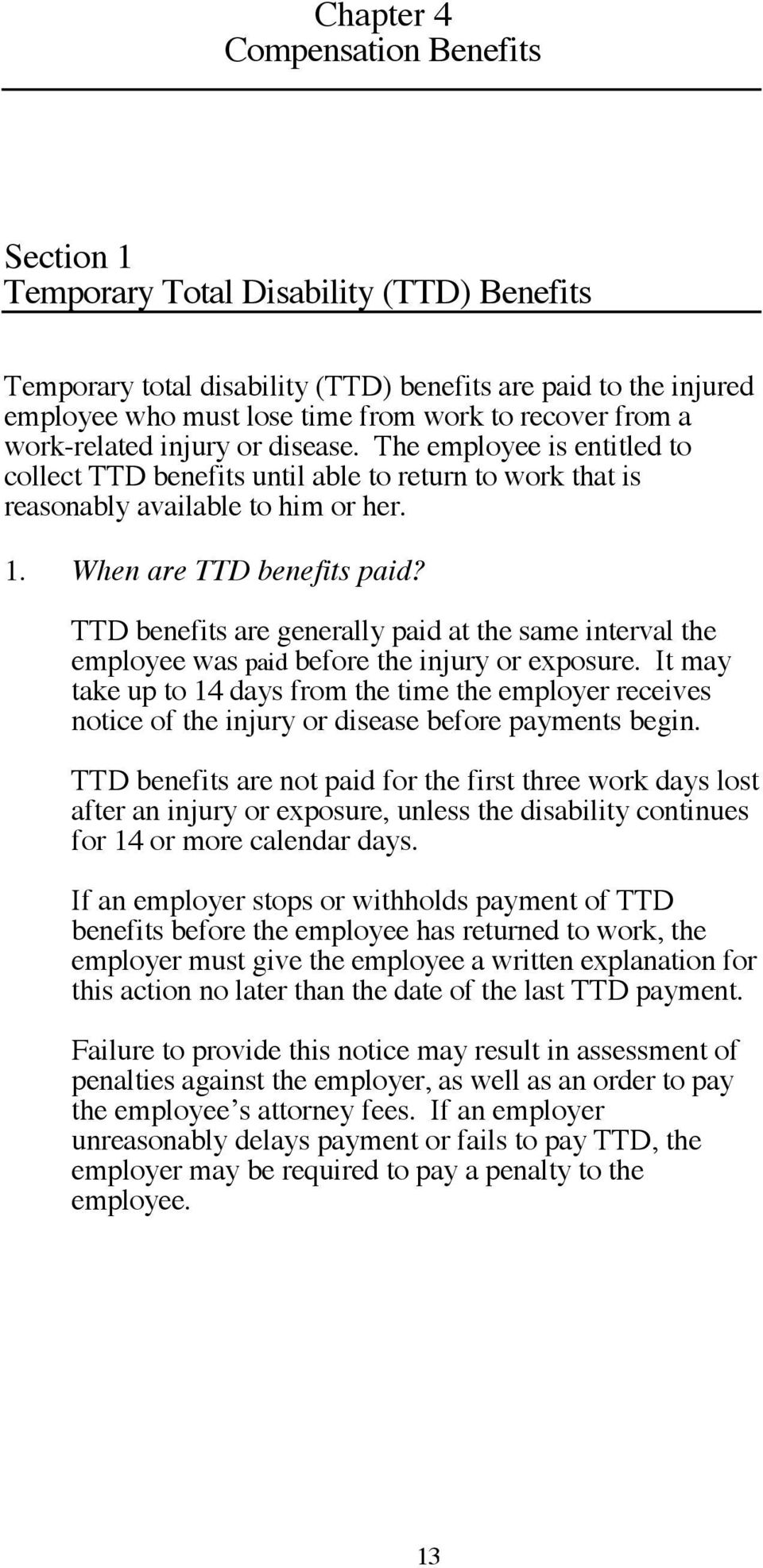
14 Chapter 4 Compensation Benefits Section 1 Temporary Total Disability (TTD) Benefits Temporary total disability (TTD) benefits are paid to the injured employee who must lose time from work to recover from a work-related injury or disease. The employee is entitled to collect TTD benefits until able to return to work that is reasonably available to him or her. 1. When are TTD benefits paid? TTD benefits are generally paid at the same interval the employee was paid before the injury or exposure. It may take up to 14 days from the time the employer receives notice of the injury or disease before payments begin. TTD benefits are not paid for the first three work days lost after an injury or exposure, unless the disability continues for 14 or more calendar days. If an employer stops or withholds payment of TTD benefits before the employee has returned to work, the employer must give the employee a written explanation for this action no later than the date of the last TTD payment. Failure to provide this notice may result in assessment of penalties against the employer, as well as an order to pay the employee s attorney fees. If an employer unreasonably delays payment or fails to pay TTD, the employer may be required to pay a penalty to the employee. 13
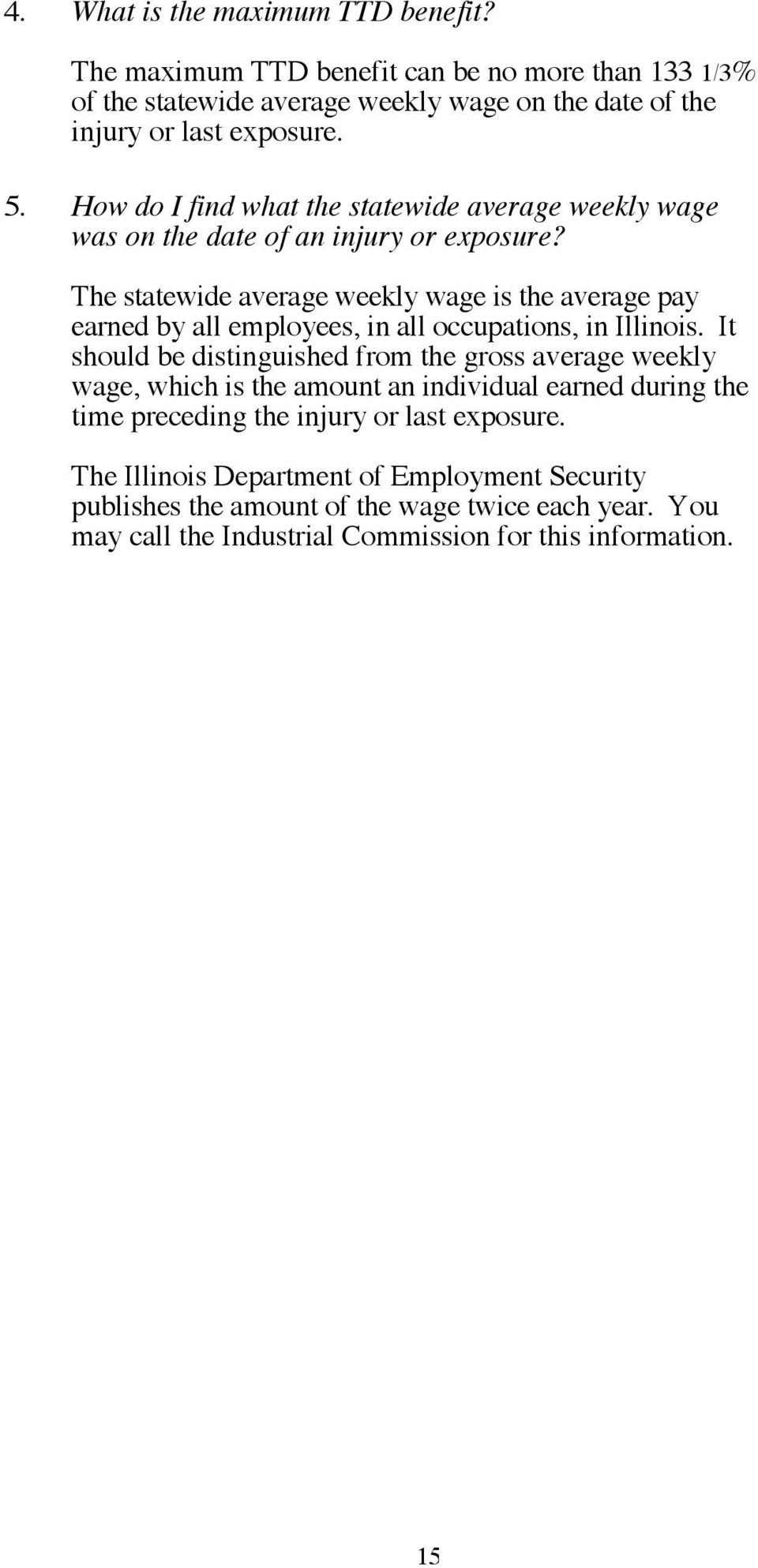
15 2. How is the amount of TTD benefits determined? The benefit is two-thirds (66 2/3%) of the employee s gross average weekly wage, subject to certain limits. The average is based on the employee s wages during the year before the injury or exposure. The rate is fixed at the time of injury, and does not change with changes in the employee's salary or the statewide average weekly wage. If an employee was working for two or more employers at the time of injury, the TTD rate may be based on the combined gross income from all jobs. This will only apply if the employer for whom he or she was working at the time of the accident or disease had prior knowledge that the employee was working at another job. If the employee had worked for the employer for only a short time or on a casual basis, it may be appropriate to consider what another person in the job with the same employer would have earned during the previous year. Under the Workers Compensation Act, overtime pay is generally not included in the calculation of the average weekly wage. Overtime pay is included, however, under the Workers' Occupational Diseases Act. TTD benefits for volunteer fire fighters, police and civil defense members or trainees are based on the gross average weekly wage earned in their regular employment if the claim arises under the Workers' Compensation Act. 3. What is the minimum TTD benefit? The minimum payment is the gross average weekly wage earned by the employee in the year before the injury or exposure, or the following amounts, whichever is lower. Single Person Married, no children One child Two children Three children Four or more children $100.90/week /week /week /week /week /week 14

16 4. What is the maximum TTD benefit? The maximum TTD benefit can be no more than 133 1/3% of the statewide average weekly wage on the date of the injury or last exposure. 5. How do I find what the statewide average weekly wage was on the date of an injury or exposure? The statewide average weekly wage is the average pay earned by all employees, in all occupations, in Illinois. It should be distinguished from the gross average weekly wage, which is the amount an individual earned during the time preceding the injury or last exposure. The Illinois Department of Employment Security publishes the amount of the wage twice each year. You may call the Industrial Commission for this information. 15
17 Section 2 Permanent Partial Disability (PPD) Benefits A permanent partial disability is the complete or partial loss or loss of use of a part of the body, or the partial loss of use of the body as a whole. Loss of use is not specifically defined in the law, but it generally means the employee is unable to do things with the body part or with the body as the whole that he or she was able to do before the injury. 1. When are PPD benefits paid? Permanent partial disability benefits are paid only if the job-related injury or disease results in some permanent loss or loss of use of a part of the body or the whole body. Not all injuries and diseases result in permanent partial disability. PPD benefits will be paid only after the employee's condition has reached a point where it will not improve any more. 2. How is the amount of PPD benefits determined? On a case-by-case basis, the Industrial Commission evaluates the physical impairment and the effect of the disability on the injured worker's life. Factors that may be considered include the individual's age, skill, occupation, training, inability to engage in certain kinds of work or activities, pain, stiffness or limitation of motion. 16

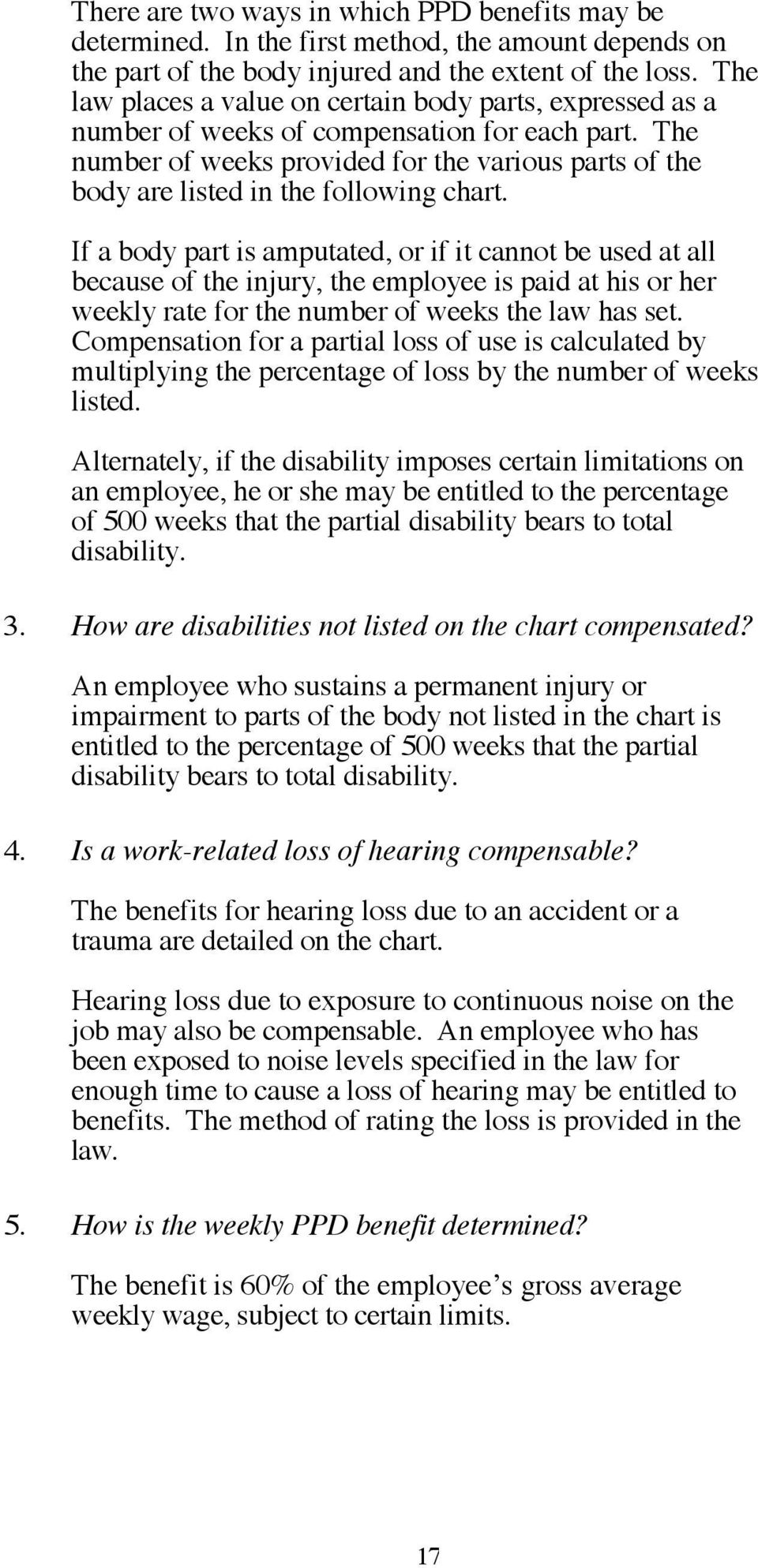
18 There are two ways in which PPD benefits may be determined. In the first method, the amount depends on the part of the body injured and the extent of the loss. The law places a value on certain body parts, expressed as a number of weeks of compensation for each part. The number of weeks provided for the various parts of the body are listed in the following chart. If a body part is amputated, or if it cannot be used at all because of the injury, the employee is paid at his or her weekly rate for the number of weeks the law has set. Compensation for a partial loss of use is calculated by multiplying the percentage of loss by the number of weeks listed. Alternately, if the disability imposes certain limitations on an employee, he or she may be entitled to the percentage of 500 weeks that the partial disability bears to total disability. 3. How are disabilities not listed on the chart compensated? An employee who sustains a permanent injury or impairment to parts of the body not listed in the chart is entitled to the percentage of 500 weeks that the partial disability bears to total disability. 4. Is a work-related loss of hearing compensable? The benefits for hearing loss due to an accident or a trauma are detailed on the chart. Hearing loss due to exposure to continuous noise on the job may also be compensable. An employee who has been exposed to noise levels specified in the law for enough time to cause a loss of hearing may be entitled to benefits. The method of rating the loss is provided in the law. 5. How is the weekly PPD benefit determined? The benefit is 60% of the employee s gross average weekly wage, subject to certain limits. 17
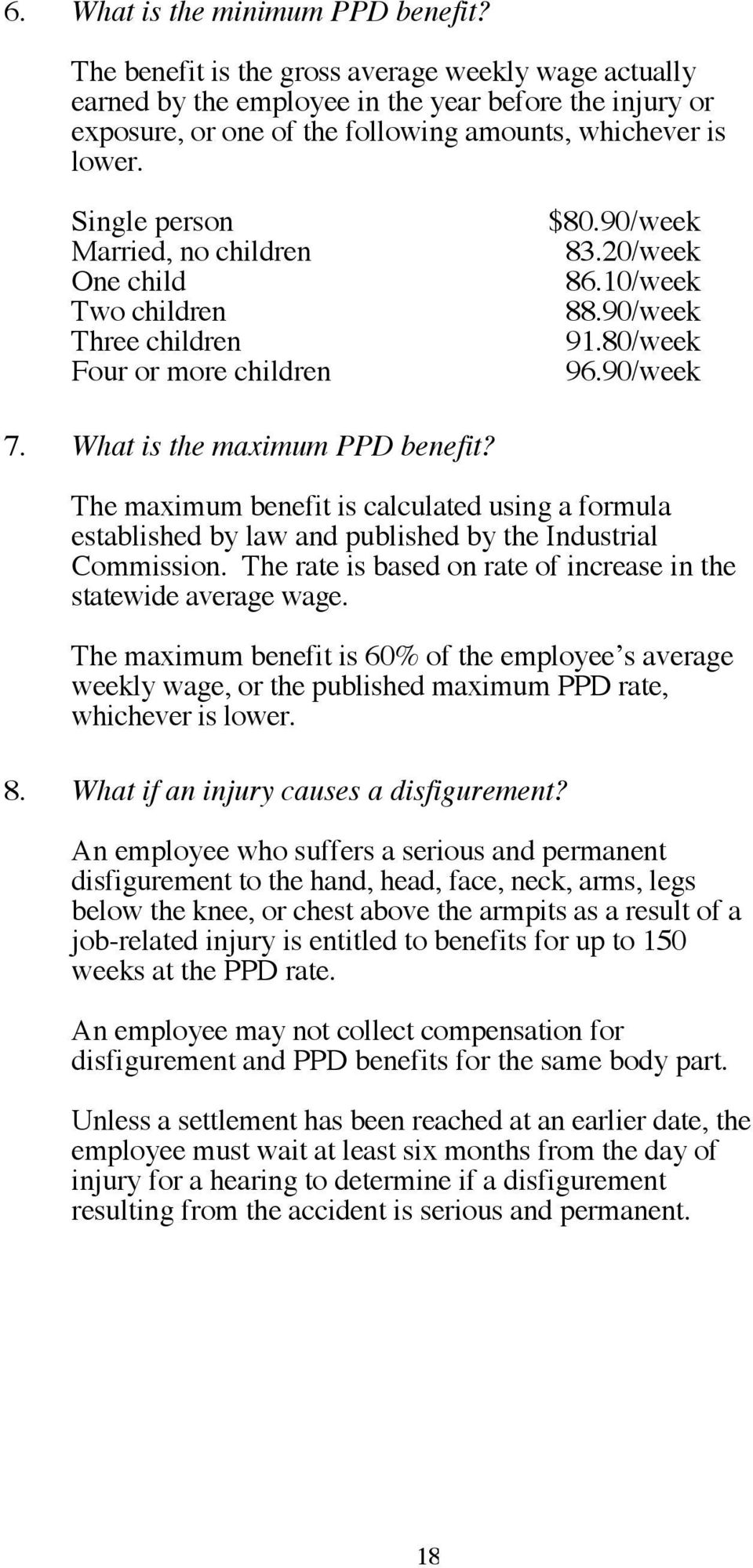
19 6. What is the minimum PPD benefit? The benefit is the gross average weekly wage actually earned by the employee in the year before the injury or exposure, or one of the following amounts, whichever is lower. Single person Married, no children One child Two children Three children Four or more children $80.90/week 83.20/week 86.10/week 88.90/week 91.80/week 96.90/week 7. What is the maximum PPD benefit? The maximum benefit is calculated using a formula established by law and published by the Industrial Commission. The rate is based on rate of increase in the statewide average wage. The maximum benefit is 60% of the employee s average weekly wage, or the published maximum PPD rate, whichever is lower. 8. What if an injury causes a disfigurement? An employee who suffers a serious and permanent disfigurement to the hand, head, face, neck, arms, legs below the knee, or chest above the armpits as a result of a job-related injury is entitled to benefits for up to 150 weeks at the PPD rate. An employee may not collect compensation for disfigurement and PPD benefits for the same body part. Unless a settlement has been reached at an earlier date, the employee must wait at least six months from the day of injury for a hearing to determine if a disfigurement resulting from the accident is serious and permanent. 18
20 9. What if an employee cannot return to the same occupation after an injury or exposure and cannot earn as much money? The employee may be entitled to receive a wage differential. The wage differential is two-thirds of the difference between the amount the injured worker is able to earn and the amount he or she would be earning in the occupation in which the employee worked at the time of the accident. An employee may be compensated for either the loss of wages or a permanent disability related to the same injury or exposure. 19
21 Body part Permanent Partial Disability Benefits For 100% Loss of Use Weeks Paid The thumb 70 The 1st (or index) finger 40 The 2nd finger 35 The 3rd finger 25 The 4th finger 20 The great toe 35 Each other toe 12 The hand 190 The arm 235 The foot 155 The leg 200 The loss of one testicle 50 The loss of both testicles 150 The sight of one eye 150 The removal of one eye 160 The hearing of one ear: Due to an accident or trauma 50 Due to an occupational disease 100 The hearing of both ears 200 Fractures resulting in permanent disability: Not less than Skull fracture 6 Fracture of a facial bone 2 Fracture of a vertebra 6 Fracture of a spine or transverse process 3 Removal of a kidney, spleen or lung 10 Loss of a part of the thumb, finger or toe up to the first joint from the tip is considered loss of one-half the digit, e.g., 35 weeks for half a thumb. Loss beyond the first joint is considered 100% loss of the digit. If an arm is amputated above the elbow, the employee is entitled to 250 weeks of compensation. If an arm is amputated at the shoulder joint and no artificial arm can be used, the employee is entitled to 300 weeks of compensation. If a leg is amputated above the knee, the employee is entitled to 225 weeks. If a leg is amputated at the hip joint and no artificial leg can be used, the employee is entitled to 275 weeks of compensation. 20
22 Section 3 Permanent Total Disability (PTD) Benefits A permanent total disability is defined as a complete disability which renders the employee permanently unable to do any kind of work for which there is a reasonably stable employment market; OR The loss of use of both hands, both arms, both feet, both legs, both eyes, or any two such parts, e.g., one leg and one arm. 1. How long is the PTD benefit paid? An employee who is permanently and totally disabled is entitled to benefits for life. If an employee who has been assigned PTD benefits returns to work or is able to return to work, benefits may be terminated or modified. 2. How is the PTD benefit determined? The benefit is two-thirds (66 2/3%) of the employee s gross average weekly wage. The average is based on the employee s wages during the year before the injury or exposure, subject to certain limits. PTD recipients are also entitled to additional payments four times a year, beginning in the second year after the award, which reflects the increase in the statewide average weekly wage during the preceding year. These payments are made from the Rate Adjustment Fund, administered by the Industrial Commission. 21
23 3. What is the minimum PTD benefit? The weekly benefit cannot be less than 50% of the statewide average weekly wage at the time of the injury or last exposure. 4. What is the maximum PTD benefit? The maximum benefit can be no more than 133 1/3% of the statewide average weekly wage at the time of the injury or last exposure 22
24 Section 4 Survivors Benefits 1. Who is entitled to survivors benefits? If the injury or disease results in the death of the employee, full benefits are paid to the spouse and/or children. Benefits are paid to children until age 18; or until age 25 if a full-time student; or, if physically or mentally incapacitated, for the duration of the incapacity. If there is no eligible spouse or child, the benefits will be paid to totally dependent parents. If the spouse remarries and there are no children at the time of remarriage who are entitled to benefits, the spouse is entitled to a final lump sum payment equal to two years of compensation. All rights to further benefits are extinguished. In cases where there is no eligible spouse, child or totally dependent parent, benefits may be paid to other survivors, such as partially dependent children, parents, grandparents, grandchildren or other heirs who were at least 50% dependent on the employee. The benefit for such individuals will depend on the degree of their dependency. 2. How is the amount of the survivors benefit determined? The benefit is two-thirds (66 2/3%) of the employee s gross average weekly wage. The average is based on the employee s wages during the year before the injury or exposure, subject to certain limits. In addition, beneficiaries who have been awarded a survivors benefit are entitled to payments from the Rate Adjustment Fund in the same manner as those awarded permanent and total disability benefits. 23
25 3. What is the minimum survivors benefit? Subject to reductions for partially dependent individuals, the weekly benefit cannot be less than 50% of the statewide average weekly wage. 4. What is the maximum survivors benefit? The maximum benefit can be no more than 133 1/3% of the statewide average weekly wage at the time of the injury or last exposure 5. Is there a limit to the total amount payable for a survivors' benefit? Yes. The survivors benefit is limited to 20 years of weekly benefits or $250,000, whichever is more. 24
26 Chapter 5 Claims, Settlements and the Hearing Process 1. What are the time limits within which an employee must file a claim at the Industrial Commission? Unless otherwise noted below, a claim must be filed within three years after an injury or disablement from an occupational disease, or within two years following the last workers compensation payment, whichever is later. For pneumoconiosis, the employee has five years from the date of last exposure or the last payment to file a claim. For radiation or asbestos exposure, the employee has 25 years after the date of last exposure to file a claim. If death is caused by the injury or occupational disease, the claim must be filed with the Industrial Commission within three years of the death, within two years of the date of last compensation payment under the Workers Compensation Act, or within three years of the date of last compensation payment under the Occupational Diseases Act, whichever is later. Payment of medical bills is not considered payment of compensation for purposes of increasing the time within which an employee may file a claim. Unless an occupational disease causes a disablement within two years of the date of last exposure to the hazards of the disease, in most cases, no compensation is payable. For berylliosis or diseases caused by the inhalation of silica or asbestos dust, disablement must occur within three years from the date of last exposure to be compensable. Failure to file a claim within the time provided by law generally results in a loss of benefits. 25
27 2. Must an employee file a claim with the Industrial Commission to receive benefits? It is not mandatory. Employees who are not receiving all the benefits provided by law, however, should file a claim. Employees who are receiving benefits but are concerned about protecting their rights to receive future medical care and compensation for disability should file. All claims must be filed within the time limits prescribed by law. The filing of a fraudulent claim may subject an employee to a penalty under Illinois law. 3. What should the employee and employer know about voluntary payments of compensation? By accepting payment of workers' compensation benefits and medical benefits, an employee does not waive or give up any rights under the Workers' Compensation Act. Merely signing receipts or other reports requested by the employer will not waive the employee's rights. In order to close out an employee's rights, a settlement must be written on the pink form called "Settlement Contract Lump Sum Petition and Order" provided by the Industrial Commission. The Industrial Commission must approve the settlement before an employee's rights are terminated. If a dispute arises regarding the amount of compensation due an employee, the employee has at least two years from the date of the last voluntary workers compensation payment to file a claim with the Industrial Commission. The payment of compensation benefits to an employee does not represent the employer s admission of liability. Even if a claim is filed with the Industrial Commission after some compensation benefits have been paid, the employer still has the right to contest its liability to pay any compensation at all. 26
28 4. What if an employee does not receive the benefits provided by law? The employee may contact the employer or the employer's representative directly. Failure to communicate may result in confusion or misunderstanding. The employer and employee may also contact the Industrial Commission for more information. If a dispute remains unresolved, a claim should be filed with the Industrial Commission. 5. What should the employee and employer know about retaining an attorney? Both the employer and the employee may retain legal counsel, and frequently do. If an attorney is retained by the employee, the law sets the following requirements: The attorney's fee must be stated on the Attorney Representation Agreement form, signed by the employee (or in death cases, by the beneficiaries) and approved by the Industrial Commission. The attorney's fee is limited to 20% of the amount of compensation recovered, unless additional fees are allowed by the Commission after a hearing. In death, partial and total disability cases, the amount of the attorney's fee shall not exceed 20% of benefits payable for 364 weeks, unless additional fees are allowed by the Commission. Attorneys shall not charge a fee on TTD benefits unless the employer fails to pay these benefits in a timely manner or in the proper amount; or unless the employer stops paying such benefits, and payments are obtained or reinstated through the efforts of the attorney. Attorneys shall not charge a fee on amounts paid for undisputed medical expenses. Attorneys shall not be paid if the amount of compensation obtained does not exceed an amount offered to the employee in writing before hiring an attorney. 27
29 6. May the parties settle a claim for compensation benefits? Yes, claims may be settled between the employer and the employee directly or through their representatives, provided the settlements are approved by the Industrial Commission. 7. What should the employee and employer know about settlements? A lump sum settlement is a contract between the employee and the employer to close a claim in exchange for an agreed-upon amount of compensation and medical services. Cases in which the employer denies liability or disputes the amount of compensation are often settled by lump sum settlements. By settling such cases, the employee avoids the risk of getting no compensation or less than is provided in the settlement, and the employer avoids the risk of paying more than is provided in the settlement. Unless they provide otherwise, approved settlement agreements usually close out the employee's rights to future medical benefits, vocational rehabilitation and additional compensation payments, even if the employee's condition worsens. Any right that is not supposed to be extinguished by the settlement should be expressly reserved in writing in the settlement agreement. An employee who is not represented by an attorney must appear in person before a representative of the Industrial Commission, who will review the settlement and insure the employee understands its effect, before approval is granted. Any settlement contract made within seven days of the injury is presumed to be fraudulent. Settlements that are made without Industrial Commission approval do not close out the employee's rights under the law. In such cases, the time an employee may file a claim with the Industrial Commission is extended indefinitely. 28
30 8. How are claims presented to the Industrial Commission? Three copies of the Application for Adjustment of Claim form must be filed with the Industrial Commission, along with a proof of service certificate stating that a copy of the application was served on the employer by mail or personal delivery. There is no fee for the forms or for filing the claim. 9. Who presides over workers compensation claims? An arbitrator appointed by the Industrial Commission acts as fact-finder and judge, conducts the hearing, and decides on the amount of benefits to which the employee is entitled. The hearing is conducted according to the Rules Governing Practice Before the Industrial Commission. Copies are available without charge from the Industrial Commission. 10. Is it possible to appeal the arbitrator s decision? Yes. The employee and the employer both have the right to appeal a decision if dissatisfied. After reviewing summaries of the facts and law involved in the case and sometimes, after hearing oral arguments, the Commission will issue an opinion. Decisions of the Commission are final for cases involving employees of the State of Illinois. In all other cases, either party may appeal to the Circuit Court and, from there, to the Industrial Commission Division of the Appellate Court. In some cases, further appeal may be taken to the Illinois Supreme Court. 11. Is there a way to get a expedited hearing? Yes. An employee who claims to be unable to work as the result of an injury or exposure and who is not receiving TTD or medical benefits may file a petition for an expedited hearing under Section 19(b-1) of the law. Forms are available from the Industrial Commission. 29
31 12. Is there any other method for resolving disputed claims? Yes. If the only disputed issues are TTD, PPD or medical expenses, the parties may agree to voluntary arbitration. By doing so, they submit their case to an arbitrator and waive their rights to review by the Commission. The arbitrator s findings of fact are final; only questions of law may be appealed to the Circuit Court. Under this procedure, the parties submit a completed form requesting voluntary arbitration, and select an arbitrator from a list of five arbitrators provided by the Commission. If they cannot agree on an arbitrator, they may select one from the American Arbitration Association. 13. Do the employer and employee have additional rights after an award provided by the Industrial Commission has been or is being paid? Yes, if an award is paid in installments and there has been no lump sum settlement contract approved by the Industrial Commission, an employee may be entitled to the following: A. Additional medical, surgical or hospital services reasonably required to cure or relieve the effects of the injury or disease. These benefits are available for life, but the need for these services must be connected to the work-related injury or disease. The expenses must be reasonable and necessary. If the employer does not agree to the expenses, the employee may file a petition asking the Commission to decide the disputed issues. B. If within 30 months after the award an employee can show that the disability resulting from the job-related injury or illness has increased or recurred, a petition for additional compensation benefits may be filed. 30
32 C. If within 30 months after the award an employer can show that the disability resulting from the job-related injury or illness has decreased or has ended, a petition for a reduction in compensation benefits may be filed. D. If the Industrial Commission has entered an award for permanent and total disability in a case that does not involve the complete loss or loss of use of two major body members and the employer can show that the employee is no longer totally disabled, the employer may petition the Commission for an order terminating the PTD payments to the employee. If you still have questions, please call the Industrial Commission at any of the local offices listed in this handbook. 31
33 Index Accident, 4 Accident reports, 8 Appeal of decisions, 29 Attorneys, 27 Average weekly wage, Benefits see specific category responsibility for, 3 Claim application, 29 time limits to filing, 25 settlement of, 28 Compensation see specific category voluntary payments, 26 Death benefits see Survivor's benefits Discrimination, prohibited against claimant, 5 Disfigurement, 18 Employees, covered, 3 Fraudulent claims, 26 Hearing, expedited Section 19(b-1), 29 Hearing loss, 17 Lump sum settlements, 28 Medical benefits choice of physicians, 9 employer's right to independent evaluation, 10 employer's responsibility, 9 limit to number of physicians, 9 vocational rehabilitation, 10 Medical reports from employee's and employer's doctors, 11 Notice of accident or injury, 7-8 posted in work place, 3 Overtime pay, 14 Permanent partial disability benefits,16-19 chart of compensation for body parts, 20 defined, 16 disfigurement, 18 hearing loss, 17 Permanent total disability benefits, defined, 21 Physical examinations, 10 Rate Adjustment Fund, 21 Records and reports of accidents, 8 Review of decisions, 29 Settlements, 28 Statewide average weekly wage, 15 Survivors' benefits beneficiaries, 23 benefits, limit to benefits, 24 Taxes, 6 Temporary total disability benefits, defined, 13 interval of payment, 13 Time limits, 25 Vocational rehabilitation, 10 Wage differential, 19 Wages, basis for computing compensation, 14 Workers' compensation, defined, 3 32
Handbook on Workers Compensation & Occupational Diseases
 Handbook on Workers Compensation & Occupational Diseases Presented by: Park District Risk Management Agency P.O. Box 4320 Wheaton, IL 60189-4320 (630) 769-0332 (630) 769-0445 (fax) Illinois Workers Compensation
Guide. to Recovery Under The Illinois Workers Compensation Act. The Injured Employee s
 The Injured Employee s Guide to Recovery Under The Illinois Workers Compensation Act Prepared By: Romanucci & Blandin, LLC 33 North LaSalle Street, 20th Floor Chicago, Illinois 60602 Toll Free: 888.458.1145
THE ILLINOIS WORKERS COMPENSATION ACT
 THE ILLINOIS WORKERS COMPENSATION ACT Frequently Asked Questions Phone: 312.977.0100 800.922.4500 Fax: 312.977.0795 www.healylawfirm.com www.illinoistruckingaccidents.com 111 WEST WASHINGTON STREET SUITE
INJURED ON THE JOB? A SUMMARY OF THE RIGHTS AND BENEFITS AVAILABLE TO INJURED WORKERS UNDER ILLINOIS LAW
 INJURED ON THE JOB? A SUMMARY OF THE RIGHTS AND BENEFITS AVAILABLE TO INJURED WORKERS UNDER ILLINOIS LAW Law Offices ANESI, OZMON, RODIN, NOVAK & KOHEN, LTD 161 NORTH CLARK STREET AT RANDOLPH 21ST FLOOR
ILLINOIS WORKERS COMPENSATION COMMISSION HANDBOOK ON WORKERS COMPENSATION AND OCCUPATIONAL DISEASES
 This book replaces all previous versions of the handbook. ILLINOIS WORKERS COMPENSATION COMMISSION HANDBOOK ON WORKERS COMPENSATION AND OCCUPATIONAL DISEASES HANDBOOK ON WORKERS COMPENSATION AND OCCUPATIONAL
I WAS HURT AT WORK WHAT DO I DO? Womick Law Firm, Chtd. 1-800-598-2440. P.O. Box 1355 1020 W. Main St. Carbondale, IL 62903 618-529-2440
 I WAS HURT AT WORK WHAT DO I DO? Womick Law Firm, Chtd. 1-800-598-2440 P.O. Box 1355 1020 W. Main St. Carbondale, IL 62903 618-529-2440 Herrin Location 501 Rushing Drive Herrin, IL 62948 618-993-0911 Belleville
Workers' Compensation in Oklahoma Employee s Rights & Responsibilities
 Workers' Compensation in Oklahoma Employee s Rights & Responsibilities Workers Compensation Court Counselor Program 1915 N. Stiles Avenue, Oklahoma City, OK 73105 210 Kerr State Office Bldg., 440 S. Houston,
Workers' Compensation in Oklahoma Employee s Rights & Responsibilities
 Workers' Compensation in Oklahoma Employee s Rights & Responsibilities The information provided in this pamphlet is general in nature and for informational purposes only. It is not intended to be a legal
2013 Nuts & Bolts Seminar Coralville
 2013 Nuts & Bolts Seminar Coralville LITIGATION TRACK Work Comp 101 2:30 pm.-3:30 p.m. Presented by Tim Semelroth RSH Legal 425 Second Street SE, Suite 1140 Cedar Rapids, Iowa 52401 Phone: 319-365-9200
Workers Compensation and Seniors
 Chapter 10 Workers Compensation and Seniors Gregory B. Cairns, Esq. Cairns & Associates, P.C. SYNOPSIS 10-1. Workers Compensation 10-2. Benefits Available 10-3. Filing a Workers Compensation Claim 10-4.
A GUIDE TO INDIANA WORKER S COMPENSATION
 A GUIDE TO INDIANA WORKER S COMPENSATION 2004 EDITION MACEY SWANSON AND ALLMAN 445 North Pennsylvania Street Suite 401 Indianapolis, IN 46204-1800 Phone: (317) 637-2345 Fax: (317) 637-2369 A GUIDE TO INDIANA
A GUIDE TO THE BENEFITS PROVIDED BY THE ILLINOIS WORKERS COMPENSATION ACT
 A GUIDE TO THE BENEFITS PROVIDED BY THE ILLINOIS WORKERS COMPENSATION ACT INTRODUCTION The information contained in this booklet is an overview of benefits provided by the Illinois Workers Compensation
North Carolina State Government
 North Carolina State Government W O R K E R S C O M P E N S A T I O N E M P L O Y E E H A N D B O O K PURPOSE The contents in this handbook are designed to provide employees of the State of North Carolina
Guide for Injured Workers
 Guide for Injured Workers This is a guide to Oklahoma workers' compensation law and rules. It is based on laws and rules in effect in 2015. Laws and rules can change by acts of the Legislature, rulemaking
What Happens After I Report the Injury?
 Introduction The Iowa Workers Compensation Act provides the only legal remedy against their employer for workers who are injured on the job. Workers Compensation law can be very technical. The law is administered
How To Get Paid For An Injury From Work
 COLORADO DEPARTMENT OF LABOR & EMPLOYMENT Division of Workers Compensation EMPLOYEE S GUIDE August 2014 THE INFORMATION IN THIS BOOKLET IS INTENDED TO BE GENERAL INFORMATION ON THE COLORADO WORKERS COMPENSATION
Rights & Obligations under the Nebraska Workers Compensation Law
 Nebraska Workers Compensation Court Information Sheet: Rights & Obligations under the Nebraska Workers Compensation Law NEBRASKA WORKERS COMPENSATION COURT OFFICIAL SEAL What is workers compensation? Workers
Workers' Compensation in Oklahoma Employer s Rights & Responsibilities
 Workers' Compensation in Oklahoma Employer s Rights & Responsibilities Workers Compensation Court Counselor Program 1915 N. Stiles Avenue, Oklahoma City, OK 73105 210 Kerr State Office Bldg, 440 S. Houston,
Workers' Compensation in Oklahoma Employer s Rights & Responsibilities
 Workers' Compensation in Oklahoma Employer s Rights & Responsibilities The information provided in this pamphlet is general in nature and for informational purposes only. It is not intended to be a legal
TRIBAL COURT CODE CHAPTER 93 WORKERS COMPENSATION. 93.102 No Waiver of Sovereign Immunity or Application of State Law.
 TRIBAL COURT CODE CHAPTER 93 WORKERS COMPENSATION CONTENTS: 93.101 Citation and Purpose. 93.102 No Waiver of Sovereign Immunity or Application of State Law. 93.103 Definitions. 93.104 Reporting Obligations.
Guide to. For Connecticut Private Sector Employees
 Guide to Workers Compensation For Connecticut Private Sector Employees NEW ENGLAND HEALTH CARE EMPLOYEES UNION DISTRICT 1199, SEIU 77 Huyshope Avenue, Hartford, CT 06106 860-549-1199 September 2009 Workers
Your Rights Under the Missouri Workers Compensation Law
 Your Rights Under the Missouri Workers Compensation Law All states have workers compensation laws. The Missouri Workers Compensation Law is contained in Chapter 287 of the Revised Statutes of Missouri.
Key Provisions of Tennessee Senate Bill 200 Effective July 1, 2014, through July 1, 2016
 2014 Construction of Statute Definition of Injury (Causation) Revises Section 50-6-116, Construction of Chapter, to indicate that for dates of injury on or after July 1, 2014, the chapter should no longer
Steiner, Segal, Muller & Donan
 The Law Firm of Steiner, Segal, Muller & Donan What You Need To Know About Pennsylvania Worker s Compensation Benefits Representing Injured Workers in Pennsylvania for over 25 years! 2401 Pennsylvania
Worker' Compensation and Reemployment Rights
 Worker' Compensation and Reemployment Rights The Federal Employee's Compensation Act provides workers' compensation for employmentrelated injuries and occupational diseases. Benefits include wage replacement,
GEORGIA STATE BOARD OF WORKERS COMPENSATION EMPLOYEE HANDBOOK
 GEORGIA STATE BOARD OF WORKERS COMPENSATION EMPLOYEE HANDBOOK Please be aware that the Workers Compensation Law, Rules and Regulations are subject to change on July 1st of each year. If you have any questions
Guide to Workers Compensation
 Guide to Workers Compensation Iowa Division of Workers Compensation Iowa Workforce Development Sixth Edition - 2005 Dear Workers Compensation Associate: It is our pleasure to provide you with a complimentary
Who Is Covered by the WC Law?
 Who Is Covered by the WC Law? More than 98% of Wisconsin workers are covered from the day they start employment. You are covered if your employer usually has three or more fulltime or part-time employees.
WORKERS COMPENSATION IN RHODE ISLAND A SUMMARY OF THE LAW
 WORKERS COMPENSATION IN RHODE ISLAND A SUMMARY OF THE LAW PREPARED BY ATTORNEY GARY J. LEVINE 369 SOUTH MAIN STREET PROVIDENCE, RI 09203 401-521-3100 www.workerscompri.com TABLE OF CONTENTS INJURIES COVERED
INDUSTRIAL COMMISSION OF ARIZONA
 INDUSTRIAL COMMISSION OF ARIZONA WORKERS COMPENSATION INFORMATION FOR THE INJURED WORKER Phoenix Office: Industrial Commission of Arizona 800 W. Washington Street Phoenix, Arizona 85007-2922 Claims Phone:
Table of Contents. A Message From Attorney Edgar Snyder 1. Eligibility for Workers Compensation 3. Types of Workers Compensation Claims 5
 Table of Contents A Message From Attorney Edgar Snyder 1 Eligibility for Workers Compensation 3 Types of Workers Compensation Claims 5 Workers Compensation Benefits Payments 9 The Hearing Process 13 The
SECTION I WHAT TO DO WHEN INJURED ON THE JOB
 SECTION I WHAT TO DO WHEN INJURED ON THE JOB This booklet is designed to give you general information concerning your rights when injured on the job. The following sections of this booklet outline the
Revised May 2015. What Is Workers Compensation?
 This pamphlet provides an overview of the workers compensation system in the State of New Hampshire, including what is covered by workers compensation, what benefits are available, and what you should
The ACCG Claims Office staff is here to help you. Please feel free to call us with your questions and concerns.
 1 WELCOME This handbook contains information prepared by the Association County Commissioners of Georgia - Group Self-Insurance Workers Compensation Fund (ACCG - GSIWCF) to assist employees and management
Workers Compensation Employee Benefits
 Provided By The Holmes Organisation Workers Compensation Employee The Florida Workers Compensation Law (FWCL) regulates the determination and payment of benefits for injured employees in the state. An
What is & what is not covered under workers compensation? Basically, what are the benefits... in plain language?
 SEQUATCHIE VALLEY PLANNING & DEVELOPMENT AGENCY Employee Workers Compensation Handbook wchandbk.wpd Preface. Workers Compensation is a state-defined optional benefit that may be provided by Tennessee s
The Commonwealth of Massachusetts Department of Industrial Accidents. For injured workers
 The Commonwealth of Massachusetts Department of Industrial Accidents For injured workers WHAT IS WORKERS COMPENSATION? The Massachusetts Workers Compensation system is in place to protect you if you are
Long Term Disability Insurance
 Long Term Disability Insurance This subsection summarizes the group Long Term Disability Insurance plan available through PEBB. It is a summary only. For full details, see the Certificate of Insurance
How To Get Paid In Illinois Workers Compensation
 www.ilcomplaw.com (312) 226-2650 Injured at work? You don t have to fight alone. Illinois Workers Compensation: Your Legal Rights and Responsibilities A Worker s Guide to the Illinois Workers Compensation
Injured on-the-job? Know Your Workers' Compensation Rights in New Jersey
 Page1 Injured on-the-job? Know Your Workers' Compensation Rights in New Jersey HPAE members who are injured or made ill on-the-job may be entitled to cash benefits, medical care, and other benefits under
GEORGIA WORKERS' COMPENSATION Explanation of Basic Procedures
 GEORGIA WORKERS' COMPENSATION Explanation of Basic Procedures A. Initiating Claim 1. Accident must arise out of, and in the course of, employment (O.C.G.A. 34-9-1). a. "Arising out of" means what the employee
Workers Compensation
 INFORMATION BRIEF Minnesota House of Representatives Research Department 600 State Office Building St. Paul, MN 55155 December 1998 Linda Holmes, Legislative Analyst (651) 296-5059 Workers Compensation
BULLETIN J A N U A R Y 1, 2 0 1 6. Information About The North Carolina Workers Compensation Act. Pat McCrory, Governor. Andrew T.
 BULLETIN NORTH CAROLINA INDUSTRIAL COMMISSION ADMINISTERING THE WORKERS COMPENSATION ACT STREET ADDRESS DOBBS BUILDING 430 NORTH SALISBURY STREET RALEIGH, NORTH CAROLINA 27603-5937 MAILING ADDRESS 4340
Arkansas Workers Compensation Questions & Answers
 Arkansas Workers Compensation Questions & Answers What is Workers' Compensation? Arkansas' no-fault com pensation law was created by an initiated act in 1939 to guarantee prom pt, automatic benefits to
STANDARD INSURANCE COMPANY
 STANDARD INSURANCE COMPANY A Stock Life Insurance Company 900 SW Fifth Avenue Portland, Oregon 97204-1282 (503) 321-7000 CERTIFICATE GROUP LIFE INSURANCE Policyholder: City of Alexandria, Virginia Policy
FactsforWorkers.com A Legal Information Resource for Workers provided by Hedberg & Boulton, P.C.
 FactsforWorkers.com A Legal Information Resource for Workers provided by Hedberg & Boulton, P.C. Iowa Workers Compensation Law Fast Facts An Overview on Work-Related Injuries for Iowa Workers What is Workers
Social Security Social Website
 9126113 SSA- POMS: 0152120.080 Illinois Workers' Compensation (WC)- 09i24/2009 Social Security Social Website E Program Operations Manual System (POMS) Effective Dates: 09/24/2009 - Present BASIC (09-08)
The Illinois Workers Compensation Act is a no fault law designed to provide benefits to workers injured
 The Illinois Workers Compensation Act is a no fault law designed to provide benefits to workers injured in the course of their employment. It is the exclusive legal remedy against an employer for injuries
How To Get A Workers Compensation Check In The United States
 New Hire Notice -- Injuries Caused By Work What does workers compensation cover? You may be entitled to workers' compensation benefits if you are injured or become ill because of your job. Workers' compensation
Who Administers the Workers Compensation Program and Related Responsibilities?
 What is Workers Compensation? Who Administers the Workers Compensation Program and Related Responsibilities? Who is Eligible for Workers Compensation? What Coverage is Provided? What is a Compensable Injury?
Legislative Update. legal challenge to new law. significant changes to oklahoma work comp
 Quality Insight for Your Industry Legislative Update significant changes to oklahoma work comp Since our last Legislative Update on the new Workers' Compensation system in Oklahoma, the NCCI filed a 12.9%
Short Term Disability Insurance
 Short Term Disability Insurance This subsection summarizes the group Short Term Disability Insurance plan available through PEBB. It is a summary only. For full details, see the Certificate of Insurance
MARCH 5, 2015. Referred to Committee on Commerce and Labor. SUMMARY Revises provisions governing workers compensation.
 A.B. ASSEMBLY BILL NO. COMMITTEE ON COMMERCE AND LABOR MARCH, 0 Referred to Committee on Commerce and Labor SUMMARY Revises provisions governing workers compensation. (BDR -) FISCAL NOTE: Effect on Local
Customer Workers Compensation Benefit Overview
 Customer Workers Compensation Benefit Overview OREGON INDEMNITY ISSUES Temporary Total Benefits Temporary Partial Benefits Permanent Partial Benefits Permanent Total Benefits Workers injured on or after
DISABILITY PLAN. Table of Contents
 July 2004 Table of Contents Overview...2 Summary of Disability Insurance Benefits...3 Glossary of Terms...4 Employees Eligible for Disability Insurance Coverage...9 Disability Coverage... 10 Effective
An Employee s Guide to the Missouri Workers Compensation System
 An Employee s Guide to the Missouri Workers Compensation System Missouri Department of Labor and Industrial Relations Division of Workers Compensation Important Information You may want to put names and
2011 Changes to Kansas Workers Compensation Act
 On April 18, 2011, Kansas Governor Sam Brownback signed a new law changing the workers compensation system. (H.B. 2134) amends the Workers Compensation Act (KSA Sec. 44-501, et seq.) by changing Sections
Life and Accident Insurance
 Life and Accident Insurance Honda offers basic life and accident insurance and business travel insurance benefits for you or your survivors in the event of your accidental death or serious injury. Table
Workers Compensation Procedure
 City and County of Denver Workers Compensation Procedure Issued September 10, 2001 Revised 2/1/2013 Workplace Safety 201 West Colfax Avenue Dept. 1105 Denver, CO 80202 [email protected] Workplace
Workers Compensation Claim State Environmental Guide - Tennessee
 Workers Compensation Claim State Environmental Guide - Tennessee TENNESSEE http://www.state.tn.us/labor-wfd/wcomp.html Indemnity issues Temporary Total Benefits Temporary Partial Benefits Permanent Partial
Work-Related Injuries and Fatalities What You and Your Family Need to Know About Your Benefits
 Work-Related Injuries and Fatalities What You and Your Family Need to Know About Your Benefits RI 84-2 Revised December 2008 Previous editions are not usable. Additional retirement information and all
FILING WORKERS COMPENSATION CLAIMS IN IDAHO
 Claims contact information First Report of Injury forms [email protected] General e-mail [email protected] FILING WORKERS COMPENSATION CLAIMS IN IDAHO Provider inquiries 208-332-2169 or 800-334-2370
WORKERS COMPENSATION & YOUR RIGHTS
 WORKERS COMPENSATION & YOUR RIGHTS 655 Florida Grove Road Mailing Address P.O. Box 760 Woodbridge, NJ 07095 (732) 324-7600 GILL & CHAMAS Raymond A. Gill, Jr.* Peter Chamas* James Pagliuca Michael J. Hanus
Northwest Territories and Nunavut 06.03
 POLICY STATEMENT The Workers Safety and Compensation Commission (WSCC) provides monthly pension payments to workers with a permanent disability resulting from a work-related injury or disease. In the case
MARITIME WORKER JOB RELATED INJURY
 JEFFREY S. MUTNICK, P.C. [email protected] Admitted in Oregon MARITIME WORKER JOB RELATED INJURY As a maritime worker, your employer must provide compensation for job-related injuries. This entitlement
CHAPTER 36 WORKER S COMPENSATION
 CHAPTER 36 WORKER S COMPENSATION 36.1 SECTION 1- PURPOSE 36.2 SECTION 2- APPLICABILITY 36.3 SECTION 3- DEFINITIONS 36.4 SECTION 4- MEDICAL SERVICES AND INITIAL MEDICAL AND OTHER BENEFITS 36.5 SECTION 5-
Employee Group Benefits UNDERWRITTEN BY SUN LIFE ASSURANCE COMPANY OF CANADA
 Employee Group Benefits UNDERWRITTEN BY SUN LIFE ASSURANCE COMPANY OF CANADA Howard University and Howard University Hospital D.B.A. Howard University, Inc. YOUR GROUP LIFE INSURANCE CONTAINS AN ACCELERATED
Workmen Compensation Act, 1923
 Workmen Compensation Act, 1923 Applicability:- Employer includes any person whether incorporated or not and any agent of employer and when services are temporarily lent or let on hire to another person,
This document printed May 4, 2006 takes the place of any documents previously issued to you which described your benefits.
 City of Albuquerque LIFE INSURANCE ACCIDENTAL DEATH & DISMEMBERMENT INSURANCE EFFECTIVE DATE: July 1, 2005 CN004 Policy No.: FLX-980032 This document printed May 4, 2006 takes the place of any documents
Long-Term Disability Insurance
 Long-Term Disability Insurance Developed for the Employees of City of Colorado Springs (Employees with less than 5 years of PERA Service) (City Council Members) How This Program Protects You If you suffer
.25 Schedule of [Attorneys'] Attorney's Fees.
![.25 Schedule of [Attorneys'] Attorney's Fees.](/thumbs/24/3479873.jpg ".25 Schedule of [Attorneys'] Attorney's Fees.") .25 Schedule of [Attorneys'] Attorney's Fees. A. The Commission shall approve [attorneys'] attorney's fees in accordance with the schedule of fees established from time to time by the Commission and set
.25 Schedule of [Attorneys'] Attorney's Fees. A. The Commission shall approve [attorneys'] attorney's fees in accordance with the schedule of fees established from time to time by the Commission and set
WORKERS COMPENSATION AND ACCIDENT HANDBOOK
 WORKERS COMPENSATION AND ACCIDENT HANDBOOK Compliments of Shelley W. Elovitz, Esquire Rothman Gordon, P.C. 310 Grant Street Third Floor, Grant Building Pittsburgh, PA 15219 www.rothmangordon.com New Client
LEGISLATIVE BILL 310
 LB 0 LB 0 LEGISLATURE OF NEBRASKA ONE HUNDRED THIRD LEGISLATURE FIRST SESSION LEGISLATIVE BILL 0 Introduced by Bolz,. Read first time January, 0 Committee: Business and Labor A BILL FOR AN ACT relating
LONG-TERM DISABILITY BENEFITS
 LONG-TERM DISABILITY BENEFITS Revised September 1, 2004 No. 6 (*) 7000CI-U-EZ E O BENEFIT INFORMATION WHY LONG-TERM DISABILITY COVERAGE People tend to take their good health and ability to work for granted.
Workers Compensation Resource Guide
 Workers Compensation Resource Guide TABLE OF CONTENTS I. Definition of Workers Compensation 3 II. Reporting an Injury 3 III. Seeking Medical Treatment 4 IV. Covering the Cost of Medical Treatment 5 V.
Anne Arundel County, Maryland Group Life Certificate of Insurance Class 3 Retirees Group Policy Number 646904
 Anne Arundel County, Maryland Group Life Certificate of Insurance Class 3 Retirees Group Policy Number 646904 STANDARD INSURANCE COMPANY A Stock Life Insurance Company 900 SW Fifth Avenue Portland, Oregon
GEORGIA WORKERS COMPENSATION BASICS Michael Memberg Ken David & Associates, LLC
 This article presents general guidelines for Georgia nonprofit organizations as of the date written and should not be construed as legal advice. Always consult an attorney to address your particular situation.
Variations in Prescribed Amount and other Workers' Compensation Payments
 Workers' Compensation and Injury Management Act 1981 Variations in Prescribed Amount and other Workers' Compensation Payments Effective 1 July 2014 For the financial year beginning 1 July 2014, the Prescribed
WORKERS COMPENSATION AND ACCIDENT HANDBOOK
 WORKERS COMPENSATION AND ACCIDENT HANDBOOK Compliments of Shelley W. Elovitz, Esquire Rothman Gordon, P.C. 310 Grant Street Third Floor, Grant Building Pittsburgh, PA 15219 www.rothmangordon.com New Client
GROUP INSURANCE CERTIFICATE IMPORTANT: PLEASE READ THIS
 GROUP INSURANCE CERTIFICATE STANDARD INSURANCE COMPANY certifies that you will be insured under the Group Policy described below during the time, in the manner, and for the amounts provided in the Group
Standard Insurance Company. Certificate: Group Life Insurance
 Standard Insurance Company A Stock Life Insurance Company 900 SW Fifth Avenue Portland, Oregon 97204-1282 (503) 321-7000 Certificate: Group Life Insurance Policyholder: City of Seattle Policy Number: 608217-D
Summary of New South Carolina Workers Compensation Laws For Injuries On or After July 1, 2007
 Summary of New South Carolina Workers Compensation Laws For Injuries On or After July 1, 2007 Appeals o 1-23-600(D): Cuts out the Circuit Court chain of appeal. Appeals from the Full Commission go directly
Coordination of Worker s Compensation Benefits
 Coordination of Worker s Compensation Benefits Richard Swanson MACEY SWANSON AND ALLMAN June 9, 2011 Temporary Total Disability (TTD) These are weekly benefits paid to an employee when the employee is:
40.65 DUTY DISABILITY AND SURVIVOR BENEFITS Wisconsin Retirement System ET-5103 (11/2013)
 40.65 DUTY DISABILITY AND SURVIVOR BENEFITS Wisconsin Retirement System ET-5103 (11/2013) Table of Contents DUTY DISABILITY BENEFIT What Is A Duty Disability Benefit? 2 Am I Eligible To Apply? 3 Presumptive
Disability. Short-Term Disability benefits. Long-Term Disability benefits
 Your plan provides you with disability coverage that gives you and your family protection against some of the financial hardships that can occur if you become disabled or injured. The benefits include:
Illinois Injury Guide. INJURY LAW OFFICES Toll Free (866) 891-9211
 Illinois Injury Guide INJURY LAW OFFICES Toll Free (866) 891-9211 Woodruff Johnson & Palermo is a law firm that represents injury victims and their families. Our experienced legal team will help you like